US10692218B2 - Method and system of detecting image tampering, electronic device and storage medium - Google Patents
Method and system of detecting image tampering, electronic device and storage medium Download PDFInfo
- Publication number
- US10692218B2 US10692218B2 US16/084,227 US201716084227A US10692218B2 US 10692218 B2 US10692218 B2 US 10692218B2 US 201716084227 A US201716084227 A US 201716084227A US 10692218 B2 US10692218 B2 US 10692218B2
- Authority
- US
- United States
- Prior art keywords
- image
- tampering
- tampering detection
- encoder
- tampered
- Prior art date
- Legal status (The legal status is an assumption and is not a legal conclusion. Google has not performed a legal analysis and makes no representation as to the accuracy of the status listed.)
- Active, expires
Links
Images




Classifications
-
- G—PHYSICS
- G06—COMPUTING OR CALCULATING; COUNTING
- G06T—IMAGE DATA PROCESSING OR GENERATION, IN GENERAL
- G06T1/00—General purpose image data processing
- G06T1/0021—Image watermarking
- G06T1/0028—Adaptive watermarking, e.g. Human Visual System [HVS]-based watermarking
-
- G—PHYSICS
- G06—COMPUTING OR CALCULATING; COUNTING
- G06N—COMPUTING ARRANGEMENTS BASED ON SPECIFIC COMPUTATIONAL MODELS
- G06N3/00—Computing arrangements based on biological models
- G06N3/02—Neural networks
- G06N3/04—Architecture, e.g. interconnection topology
- G06N3/045—Combinations of networks
-
- G06N3/0454—
-
- G—PHYSICS
- G06—COMPUTING OR CALCULATING; COUNTING
- G06N—COMPUTING ARRANGEMENTS BASED ON SPECIFIC COMPUTATIONAL MODELS
- G06N3/00—Computing arrangements based on biological models
- G06N3/02—Neural networks
- G06N3/04—Architecture, e.g. interconnection topology
- G06N3/045—Combinations of networks
- G06N3/0455—Auto-encoder networks; Encoder-decoder networks
-
- G—PHYSICS
- G06—COMPUTING OR CALCULATING; COUNTING
- G06N—COMPUTING ARRANGEMENTS BASED ON SPECIFIC COMPUTATIONAL MODELS
- G06N3/00—Computing arrangements based on biological models
- G06N3/02—Neural networks
- G06N3/04—Architecture, e.g. interconnection topology
- G06N3/0499—Feedforward networks
-
- G—PHYSICS
- G06—COMPUTING OR CALCULATING; COUNTING
- G06N—COMPUTING ARRANGEMENTS BASED ON SPECIFIC COMPUTATIONAL MODELS
- G06N3/00—Computing arrangements based on biological models
- G06N3/02—Neural networks
- G06N3/08—Learning methods
- G06N3/088—Non-supervised learning, e.g. competitive learning
-
- G—PHYSICS
- G06—COMPUTING OR CALCULATING; COUNTING
- G06N—COMPUTING ARRANGEMENTS BASED ON SPECIFIC COMPUTATIONAL MODELS
- G06N3/00—Computing arrangements based on biological models
- G06N3/02—Neural networks
- G06N3/08—Learning methods
- G06N3/09—Supervised learning
-
- G—PHYSICS
- G06—COMPUTING OR CALCULATING; COUNTING
- G06T—IMAGE DATA PROCESSING OR GENERATION, IN GENERAL
- G06T7/00—Image analysis
- G06T7/0002—Inspection of images, e.g. flaw detection
-
- G—PHYSICS
- G06—COMPUTING OR CALCULATING; COUNTING
- G06T—IMAGE DATA PROCESSING OR GENERATION, IN GENERAL
- G06T7/00—Image analysis
- G06T7/10—Segmentation; Edge detection
- G06T7/11—Region-based segmentation
-
- G—PHYSICS
- G06—COMPUTING OR CALCULATING; COUNTING
- G06N—COMPUTING ARRANGEMENTS BASED ON SPECIFIC COMPUTATIONAL MODELS
- G06N3/00—Computing arrangements based on biological models
- G06N3/02—Neural networks
- G06N3/04—Architecture, e.g. interconnection topology
- G06N3/048—Activation functions
-
- G06N3/0481—
-
- G—PHYSICS
- G06—COMPUTING OR CALCULATING; COUNTING
- G06T—IMAGE DATA PROCESSING OR GENERATION, IN GENERAL
- G06T2201/00—General purpose image data processing
- G06T2201/005—Image watermarking
- G06T2201/0201—Image watermarking whereby only tamper or origin are detected and no embedding takes place
-
- G—PHYSICS
- G06—COMPUTING OR CALCULATING; COUNTING
- G06T—IMAGE DATA PROCESSING OR GENERATION, IN GENERAL
- G06T2207/00—Indexing scheme for image analysis or image enhancement
- G06T2207/10—Image acquisition modality
- G06T2207/10004—Still image; Photographic image
-
- G—PHYSICS
- G06—COMPUTING OR CALCULATING; COUNTING
- G06T—IMAGE DATA PROCESSING OR GENERATION, IN GENERAL
- G06T2207/00—Indexing scheme for image analysis or image enhancement
- G06T2207/10—Image acquisition modality
- G06T2207/10024—Color image
-
- G—PHYSICS
- G06—COMPUTING OR CALCULATING; COUNTING
- G06T—IMAGE DATA PROCESSING OR GENERATION, IN GENERAL
- G06T2207/00—Indexing scheme for image analysis or image enhancement
- G06T2207/20—Special algorithmic details
- G06T2207/20021—Dividing image into blocks, subimages or windows
-
- G—PHYSICS
- G06—COMPUTING OR CALCULATING; COUNTING
- G06T—IMAGE DATA PROCESSING OR GENERATION, IN GENERAL
- G06T2207/00—Indexing scheme for image analysis or image enhancement
- G06T2207/20—Special algorithmic details
- G06T2207/20081—Training; Learning
-
- G—PHYSICS
- G06—COMPUTING OR CALCULATING; COUNTING
- G06T—IMAGE DATA PROCESSING OR GENERATION, IN GENERAL
- G06T2207/00—Indexing scheme for image analysis or image enhancement
- G06T2207/20—Special algorithmic details
- G06T2207/20084—Artificial neural networks [ANN]
Definitions
- This disclosure relates generally to the technical field of computers, and more particularly relates to a method and system of detecting image tampering, an electronic device and a storage medium.
- most existing image tampering detection technologies are used to detect single types of tampering, for example, they may only detect these single types of tampering such as copy, move or merge.
- these algorithms may only deal with JPEG type image tampering detection, so that relatively single image formats may be subjected to the image tampering detection.
- the existing image tampering detection algorithms need to depend on complicated feature extraction, and extracted features do not have robustness for changes of tampering types, so that the accuracy of detecting the image tampering may not be guaranteed.
- This disclosure mainly aims to provide a method and system of detecting image tampering, an electronic device and a storage medium, and is aimed at accurately detecting different types and formats of image tampering.
- a method of detecting image tampering including:
- an extraction module which is used for carrying out block segmentation on a to-be-detected image to segment the to-be-detected image into a plurality of image small fragments, and extracting initial tampering detection features from all the image small fragments;
- a detection module which is used for encoding the extracted initial tampering detection features with a predetermined encoder to generate complicated tampering features, and determining a tampering detection result corresponding to the to-be-detected image according to the generated complicated tampering features, wherein the tampering detection result includes an image-tampered result and an image-not-tampered result.
- the method and system of detecting the image tampering, the electronic device and the storage medium which are provided by the disclosure, carry out the block segmentation on the to-be-detected image to segment the to-be-detected image into the plurality of image small fragments, extract the initial tampering detection features from all the image small fragments, then encode the extracted initial tampering detection features with the predetermined encoder to generate the complicated tampering features, and determine the tampering detection result of the to-be-detected image according to the complicated tampering features.
- the image type capable of being subjected to tampering detection is not limited to JPEG; in addition, due to the segmenting and encoding modes for detection, various types of image tampering modes may be accurately detected, thus realizing accurate detection for different types and formats of image tampering.
- FIG. 1 is an application environment schematic diagram of a preferred embodiment for implementing a method of detecting image tampering of the disclosure
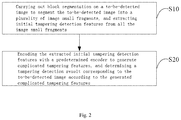
- FIG. 2 is a flowchart of one embodiment of a method of detecting image tampering of the disclosure
- FIG. 3 is a refined flowchart of step S 10 in FIG. 2 ;
- FIG. 4 is a schematic diagram of a structure of a stacked auto-encoder in one embodiment of a method of detecting image tampering of the disclosure
- FIG. 6 is a schematic diagram of a refined functional module of an extraction module 01 in FIG. 5 .
- FIG. 1 is an application environment schematic diagram of a preferred embodiment for implementing a method of detecting image tampering in accordance with the disclosure.
- An electronic device 1 is equipment capable of automatically calculating a value and/or processing information according to a preset or pre-stored instruction.
- the electronic device 1 may be a computer, a single network server, a server group consisting of multiple network servers, or a cloud computing-based cloud consisting of a large number of hosts or network servers, wherein as one of distributed computations, cloud computing is a super virtual computer consisting of a group of loosely-coupled computer sets.
- the electronic device 1 includes storage equipment 11 and processing equipment 12 and the like.
- the processing equipment 12 is used for supporting operation of the electronic device 1 , and may include one or multiple micro processors, digital processors and the like.
- the storage equipment 11 is used for storing various data and computer readable instructions, and may include one or multiple non-volatile memories, such as a Read-Only Memory (ROM), an Electrically Programmable Read-Only Memory (EPROM) or a Flash Memory (FM) and the like.
- ROM Read-Only Memory
- EPROM Electrically Programmable Read-Only Memory
- FM Flash Memory
- the storage equipment 11 stores an image tampering detection program which includes at least one computer readable instruction stored in the storage equipment 11 .
- the at least one computer readable instruction may be executed by the processing equipment 12 so as to implement methods of detecting image tampering of all the embodiments of the application.
- a method of detecting image tampering is provided.
- the method of detecting image tampering includes:
- Step S 10 block segmentation is carried out on a to-be-detected image to segment the to-be-detected image into a plurality of image small fragments, and initial tampering detection features are extracted from all the image small fragments.
- Step S 20 the extracted initial tampering detection features are encoded with a predetermined encoder to generate complicated tampering features, and a tampering detection result corresponding to the to-be-detected image is determined according to the generated complicated tampering features, wherein the tampering detection result includes an image-tampered result and an image-not-tampered result.
- the predetermined encoder is capable of performing deep learning such as learning and training, for example the stacked auto-encoder.
- a training process of the predetermined encoder is as follows:
- a preset number for example, 100,000
- the tampering result of each image sample is marked, wherein the tampering result includes the image-tampered result and the image-not-tampered result
- D. block segmentation is carried out on each image sample to segment each image sample into N*M (for example, 32*32) image small fragments, wherein N and M are positive integers, and initial tampering detection features are extracted from all the image small fragments of each image sample to extract the initial tampering detection features corresponding to each image sample;
- N*M for example, 32*32
- E. all the image samples are classified into a first data set and a second data set according to a ratio of X to Y (for example, 8 to 2), wherein the number of image samples in the first data set is greater than that of image samples in the second data set, the first data set is used as a training set, and the second data set is used as a test set; and X is greater than 0, and Y is greater than 0;
- the accuracy rate of the trained encoder is greater than or equal to a preset accuracy rate (for example, 95%), the training is ended, or if the accuracy rate of the trained encoder is less than the preset accuracy rate, the number of image samples is increased, and the steps D, E and F are repeatedly executed till the accuracy rate of the trained encoder is greater than or equal to the preset accuracy rate.
- a preset accuracy rate for example, 98%
- This embodiment carries out the block segmentation on the to-be-detected image to segment the to-be-detected image into the plurality of image small fragments, extracts the initial tampering detection features from all the image small fragments, then encodes the extracted initial tampering detection features with the predetermined encoder to generate the complicated tampering features, and determine the tampering detection result of the to-be-detected image according to the complicated tampering features.
- the image type capable of being subjected to tampering detection is not limited to JPEG; in addition, due to the segmenting and encoding modes for detection, various types of image tampering modes may be accurately detected, thus realizing accurate detection for different types and formats of image tampering.
- the step S 10 may include:
- Step S 101 the to-be-detected image is converted from a first color space (for example, an RGB color space) into a second color space (for example, a YCrCb color space);
- a first color space for example, an RGB color space
- a second color space for example, a YCrCb color space
- Step S 102 the block segmentation is carried out on the to-be-detected image to segment the to-be-detected image into N*M (for example, 32*32) image small fragments, wherein N and M are positive integers;
- Step S 103 a preset wavelet function, such as multi-level (for example, three-level) two-dimensional Daubechies wavelet decomposition is applied to each second color space component of each image small fragment to obtain multiple (for example, 30) corresponding pixel coefficient maps, a tabulate statistics coefficient (for example, a pixel standard deviation, a pixel mean value and/or a pixel sum which correspond to each pixel coefficient map) of each pixel coefficient map is calculated, and multiple tabulate statistics coefficients are obtained from each image small fragment by applying a wavelet function, such as Daubechies Orthogonal wavelets D2-D5, wherein the tabulate statistics coefficients are the initial tampering detection features of the corresponding image small fragments.
- a preset wavelet function such as multi-level (for example, three-level) two-dimensional Daubechies wavelet decomposition is applied to each second color space component of each image small fragment to obtain multiple (for example, 30) corresponding pixel coefficient maps
- a tabulate statistics coefficient for example
- each detail feature of the to-be-detected image may be extracted more particularly; and in addition, by the use of the ways, such as the Daubechies wavelet and the Daubechies Orthogonal wavelet, of obtaining the tabulate statistics coefficient of each image small fragment, which serves as the initial tampering detection features, the extracted initial tampering detection features may be more accurate.
- the predetermined encoder is the Stacked Auto-Encoder (SAE).
- SAE Stacked Auto-Encoder
- FIG. 4 is a schematic diagram of a structure of a stacked auto-encoder in one embodiment of a method of detecting image tampering in accordance with the disclosure.
- the stacked auto-encoder is formed by stacking multiple layers of basic auto-encoders, and an output of each layer of auto-encoder is an input of the next layer of auto-encoder.
- the stacked auto-encoder also includes a neural network Multi-Layer Perceptron (MLP).
- MLP neural network Multi-Layer Perceptron
- ⁇ (.) is an activation function of the neuron.
- a sigmoid function is used in this embodiment, and its expression is as follows:
- the input layer of the stacked auto-encoder receives the initial tampering detection features, and then sends the received initial tampering detection features into a middle implicit encoding layer for feature dimension reduction filtration, and the original input layer is reconstructed through decoding of the decoding layers; encoding of the SAE and training of the decoding layers are instructed by calculating a difference between the reconstructed input and the original input, so that final outputs of the encoding layers of the SAE are senior complicated tampering features of original input features; and use of the senior complicated tampering features is favorable for improving the judgment and classification capacity of the features extracted by the SAE, thus improving the accuracy of detecting the image tampering.
- the step S 20 may include:
- the initial tampering detection features of all the image small fragments are encoded with the predetermined encoder to generate the complicated tampering features of all the image small fragments;
- first tampering detection results corresponding to all the image small fragments are determined according to the complicated tampering features of all the image small fragments, wherein the first tampering detection results include the image-tampered results and the image-not-tampered results;
- the tampering detection result corresponding to one image small fragment is the image-tampered result
- the tampering detection result corresponding to the to-be-detected image is determined as the image-tampered result.
- the tampering of each image small fragment may be detected according to the complicated tampering feature of each image small fragment. If the first tampering detection result corresponding to one or multiple image small fragments is the image-tampered result, the to-be-detected image has a tampered part, and then the tampering detection result corresponding to the to-be-detected image is determined as the image-tampered result.
- the to-be-detected image has no tampered part, and then the tampering detection result corresponding to the to-be-detected image is determined as the image-not-tampered result.
- the stacked auto-encoder also includes an adjacent region perception layer for determining the tampering detection result corresponding to the to-be-detected image according to scene information of adjacent regions.
- the step S 20 also may include:
- adjacent scene information of each image small fragment is calculated according to a preset algorithm, and a second tampering detection result corresponding to each image small fragment is determined according to the adjacent scene information of each image small fragment, wherein the second tampering detection result includes an image-tampered result and an image-not-tampered result;
- the tampering detection result corresponding to one image small fragment is the image-tampered result
- the tampering detection result corresponding to the to-be-detected image is determined as the image-tampered result
- the tampering detection result corresponding to the to-be-detected image is determined as the image-not-tampered result.
- the adjacent scene information of all the image small fragments are calculated and obtained by using the adjacent region perception layer, and the second tampering detection results corresponding to all the image small fragments are determined according to the adjacent scene information of all the image small fragments.
- the tampering detection of the to-be-detected image is carried out.
- the tampering detection result corresponding to the to-be-detected image is determined as the image-not-tampered result, so that the phenomenon of wrong tampering detection of the to-be-detected image due to misjudgment on the first tampering detection results and the like is prevented, and the accuracy and the stability of detecting the image tampering are further improved.
- the preset algorithm includes:
- N ( P ) [ Y P 0 ,Y P 1 ,Y P 2 , . . . ,Y P i , . . . ,Y P K ], Y P i in this formula represents the complicated tampering feature of the ith adjacent image small fragment of the image small fragment P, and K represents that there are totally K image small fragments adjacent to the image small fragment P.
- An average value of classification results of all adjacent image small fragments corresponding to the image small fragment P is calculated, and the calculation formula of the average value is below:
- MLP(Y P i ) represents an MLP classification result of the ith adjacent image small fragment of the image small fragment P
- K may be set as 8 (namely: 8 possible directions of each image small fragment may be used for final tampering judgment classification); if the average value of the classification results corresponding to the image small fragment P is greater than or equal to a preset threshold value (for example, 0.5), the second tampering detection result corresponding to the image small fragment P is determined as the image-tampered result, or if the average value of the classification results corresponding to the image small fragment P is less than the preset threshold value, the second tampering detection result corresponding to the image small fragment P is determined as the image-not-tampered result.
- a preset threshold value for example, 0.5
- a system of detecting image tampering is further provided.
- FIG. 5 is a schematic diagram of a functional module of one embodiment of a system of detecting image tamping of the disclosure.
- the system of detecting the image tamping includes:
- an extraction module 01 which is used for carrying out block segmentation on a to-be-detected image to segment the to-be-detected image into a plurality of image small fragments, and extracting initial tampering detection features from all the image small fragments.
- the initial tampering detection features may include a color feature, a pixel feature and the like, and will not be limited here, wherein when the block segmentation is carried out on the to-be-detected image, the to-be-detected image may be segmented into respective image small fragments with the same sizes, or may be segmented into image small fragments with different sizes according to a certain ratio or randomly, and the segmentation will not be limited here.
- the image small fragments may be either in regular shapes, such as squares and rectangles, or irregularly shaped fragments, and their shapes will not be limited here.
- a detection module 02 which is used for encoding the extracted initial tampering detection features with a predetermined encoder to generate complicated tampering features, and determining a tampering detection result corresponding to the to-be-detected image according to the generated complicated tampering features, wherein the tampering detection result includes an image-tampered result and a image-not-tampered result.
- the extracted initial tampering detection features are encoded with the predetermined encoder to generate the complicated tampering features, and detection is finally carried out according to the generated complicated tampering features to determine whether the to-be-detected image is in a tampered state or a non-tampered state
- the predetermined encoder may be a relatively fixed encoder, and also may be an encoder capable of performing deep learning such as learning and training, for example a single auto-encoder and a stacked auto-encoder, and it will not be limited here.
- the predetermined encoder is capable of performing deep learning such as learning and training, for example the stacked auto-encoder.
- a training process of the predetermined encoder is as follows:
- a preset number for example, 100,000
- the tampering result of each image sample is marked, wherein the tampering result includes the image-tampered result and the image-not-tampered result
- D. block segmentation is carried out on each image sample to segment each image sample into N*M (for example, 32*32) image small fragments, wherein N and M are positive integers, and initial tampering detection features are extracted from all the image small fragments of each image sample to extract the initial tampering detection features corresponding to each image sample;
- N*M for example, 32*32
- E. all the image samples are classified into a first data set and a second data set according to a ratio of X to Y (for example, 8 to 2), wherein the number of image samples in the first data set is greater than that of image samples in the second data set, the first data set is used as a training set, and the second data set is used as a test set; and X is greater than 0, and Y is greater than 0;
- the encoder is trained with the initial tampering detection features corresponding to all the image samples in the first data set, and the accuracy rate of the trained encoder is verified with the initial tampering detection features corresponding to all the image samples in the second data set;
- the accuracy rate of the trained encoder is greater than or equal to a preset accuracy rate (for example, 95%), the training is ended, or if the accuracy rate of the trained encoder is less than the preset accuracy rate, the number of image samples is increased, and the steps D, E and F are repeatedly executed till the accuracy rate of the trained encoder is greater than or equal to the preset accuracy rate.
- a preset accuracy rate for example, 98%
- This embodiment carries out the block segmentation on the to-be-detected image to segment the to-be-detected image into the plurality of image small fragments, extracts the initial tampering detection features from all the image small fragments, then encodes the extracted initial tampering detection features with the predetermined encoder to generate the complicated tampering features, and determine the tampering detection result of the to-be-detected image according to the complicated tampering features.
- the image type capable of being subjected to tampering detection is not limited to JPEG; in addition, due to the segmenting and encoding modes for detection, various types of image tampering modes may be accurately detected, thus realizing accurate detection for different types and formats of image tampering.
- the extraction module 01 may include:
- an obtaining unit 013 which is used for applying a preset wavelet function, such as multi-level (for example, three-level) two-dimensional Daubechies wavelet decomposition to each second color space component of each image small fragment to obtain multiple (for example, 30) corresponding pixel coefficient maps, calculating a tabulate statistics coefficient (for example, a pixel standard deviation, a pixel mean value and/or a pixel sum which correspond to each pixel coefficient map) of each pixel coefficient map, and obtaining multiple tabulate statistics coefficients from each image small fragment by applying a wavelet function, such as Daubechies Orthogonal wavelets D2-D5, wherein the tabulate statistics coefficients are the initial tampering detection features of the corresponding image small fragments.
- a preset wavelet function such as multi-level (for example, three-level) two-dimensional Daubechies wavelet decomposition to each second color space component of each image small fragment to obtain multiple (for example, 30) corresponding pixel coefficient maps
- each detail feature of the to-be-detected image may be extracted more particularly; and in addition, by the use of the ways, such as the Daubechies wavelet and the Daubechies Orthogonal wavelet, of obtaining the tabulate statistics coefficient of each image small fragment, which serves as the initial tampering detection features, the extracted initial tampering detection features may be more accurate.
- the predetermined encoder is the Stacked Auto-Encoder (SAE).
- SAE Stacked Auto-Encoder
- the stacked auto-encoder is formed by stacking multiple layers of basic auto-encoders, and an output of each layer of auto-encoder is an input of the next layer of auto-encoder.
- the stacked auto-encoder also includes a neural network Multi-Layer Perceptron (MLP).
- MLP neural network Multi-Layer Perceptron
- the neural network multi-layer perceptron is jointed with the last layer of auto-encoder, and is used for determining the tampering detection result of the to-be-detected image according to the generated complicated tampering features.
- ⁇ (.) is an activation function of the neuron.
- a sigmoid function is used in this embodiment, and its expression is as follows:
- the input layer of the stacked auto-encoder receives the initial tampering detection features, and then sends the received initial tampering detection features into a middle implicit encoding layer for feature dimension reduction filtration, and the original input layer is reconstructed through decoding of the decoding layers; encoding of the SAE and training of the decoding layers are instructed by calculating a difference between the reconstructed input and the original input, so that final outputs of the encoding layers of the SAE are senior complicated tampering features of original input features; and use of the senior complicated tampering features is favorable for improving the judgment and classification capacity of the features extracted by the SAE, thus improving the accuracy of detecting the image tampering.
- the detection module 02 also may be used for:
- first tampering detection results corresponding to all the image small fragments according to the complicated tampering features of all the image small fragments, wherein the first tampering detection results include the image-tampered results and the image-not-tampered results;
- the tampering of each image small fragment may be detected according to the complicated tampering feature of each image small fragment. If the first tampering detection result corresponding to one or multiple image small fragments is the image-tampered result, the to-be-detected image has a tampered part, and then the tampering detection result corresponding to the to-be-detected image is determined as the image-tampered result.
- the stacked auto-encoder also includes an adjacent region perception layer for determining the tampering detection result corresponding to the to-be-detected image according to scene information of adjacent regions.
- the detection module 02 also may be used for:
- the second tampering detection results corresponding to all the image small fragments are all image-not-tampered results, but the first tampering detection result corresponding to one image small fragment is the image-tampered result, determining that the tampering detection result corresponding to the to-be-detected image is the image-not-tampered result.
- the adjacent scene information of all the image small fragments are calculated and obtained by using the adjacent region perception layer, and the second tampering detection results corresponding to all the image small fragments are determined according to the adjacent scene information of all the image small fragments.
- the tampering detection of the to-be-detected image is carried out.
- the tampering detection result corresponding to the to-be-detected image is determined as the image-not-tampered result, so that the phenomenon of wrong tampering detection of the to-be-detected image due to misjudgment on the first tampering detection results and the like is prevented, and the accuracy and the stability of detecting the image tampering are further improved.
- Y P i in this formula represents the complicated tampering feature of the ith adjacent image small fragment of the image small fragment P, and K represents that there are totally K image small fragments adjacent to the image small fragment P.
- An average value of classification results of all adjacent image small fragments corresponding to the image small fragment P is calculated, and the calculation formula of the average value is below:
- MLP(Y P i ) represents an MLP classification result of the ith adjacent image small fragment of the image small fragment P
- K may be set as 8 (namely: 8 possible directions of each image small fragment may be used for final tampering judgment classification); if the average value of the classification results corresponding to the image small fragment P is greater than or equal to a preset threshold value (for example, 0.5), the second tampering detection result corresponding to the image small fragment P is the image-tampered result, or if the average value of the classification results corresponding to the image small fragment P is less than the preset threshold value, the second tampering detection result corresponding to the image small fragment P is the image-not-tampered result.
- a preset threshold value for example, 0.5
- the extraction module 01 , the detection module 02 and the like may be embedded or independent in an electronic device by means of hardware, and also may be stored in storage equipment of the electronic device by means of software so as to call processing equipment to execute operations corresponding to the various modules.
- the processing equipment may be a Central Processing Unit (CPU), a micro processor, a single-chip microcomputer and the like.
- a computer readable storage medium stores a system of detecting image tampering.
- the system of detecting the image tampering may be executed by at least one processor, so that the at least one processor may execute the steps of the method of detecting image tampering in the above embodiments.
- Specific implementation processes of the steps S 10 , S 20 and S 30 of the method of detecting image tampering are as mentioned above, so that no more details will be given here.
- Computer software products can be stored in a storage medium (e.g., an ROM/RAM, a magnetic disk, an optical disc) and may include a plurality of instructions that, when executed, can cause a set of terminal equipment (e.g., a mobile phone, a computer, a server, a conditioner, network equipment), to execute the methods described in the various embodiments of the disclosure.
- a storage medium e.g., an ROM/RAM, a magnetic disk, an optical disc
- a set of terminal equipment e.g., a mobile phone, a computer, a server, a conditioner, network equipment
Landscapes
- Engineering & Computer Science (AREA)
- Physics & Mathematics (AREA)
- Theoretical Computer Science (AREA)
- General Physics & Mathematics (AREA)
- General Health & Medical Sciences (AREA)
- General Engineering & Computer Science (AREA)
- Biophysics (AREA)
- Computational Linguistics (AREA)
- Data Mining & Analysis (AREA)
- Evolutionary Computation (AREA)
- Artificial Intelligence (AREA)
- Molecular Biology (AREA)
- Computing Systems (AREA)
- Biomedical Technology (AREA)
- Life Sciences & Earth Sciences (AREA)
- Mathematical Physics (AREA)
- Software Systems (AREA)
- Health & Medical Sciences (AREA)
- Computer Vision & Pattern Recognition (AREA)
- Quality & Reliability (AREA)
- Image Analysis (AREA)
- Compression Or Coding Systems Of Tv Signals (AREA)
- Storage Device Security (AREA)
Abstract
Description
e (l)=ƒ(Z (l)),Z (l+1) =W (l) ae (l) +b (l),
ae (l)=ƒ(Z (n+l)),Z (n+l+1) =W (n−l) ae (n+l) +b (n−l),
Y=ae (n).
N(P)=[Y P 0 ,Y P 1 ,Y P 2 , . . . ,Y P i , . . . ,Y P K],
YP i in this formula represents the complicated tampering feature of the ith adjacent image small fragment of the image small fragment P, and K represents that there are totally K image small fragments adjacent to the image small fragment P. An average value of classification results of all adjacent image small fragments corresponding to the image small fragment P is calculated, and the calculation formula of the average value is below:
e (l)=ƒ(Z (l)),Z (l+1) =W (l) ae (l) +b (l),
ae (l)=ƒ(Z (n+l) ,Z (n+l+1) =W (n−l) ae (n+l) +b (n−l),
Y=ae (n).
N(P)=[Y P 0 ,Y P 1 ,Y P 2 , . . . ,Y P i , . . . ,Y P K],
Claims (8)
Applications Claiming Priority (4)
| Application Number | Priority Date | Filing Date | Title |
|---|---|---|---|
| CN201611265608 | 2016-12-30 | ||
| CN201611265608.2 | 2016-12-30 | ||
| CN201611265608.2A CN106846303A (en) | 2016-12-30 | 2016-12-30 | Distorted image detection method and device |
| PCT/CN2017/091312 WO2018120724A1 (en) | 2016-12-30 | 2017-06-30 | Image tampering detection method and system, electronic apparatus and storage medium |
Publications (2)
| Publication Number | Publication Date |
|---|---|
| US20190156486A1 US20190156486A1 (en) | 2019-05-23 |
| US10692218B2 true US10692218B2 (en) | 2020-06-23 |
Family
ID=59117401
Family Applications (1)
| Application Number | Title | Priority Date | Filing Date |
|---|---|---|---|
| US16/084,227 Active 2037-11-16 US10692218B2 (en) | 2016-12-30 | 2017-06-30 | Method and system of detecting image tampering, electronic device and storage medium |
Country Status (9)
| Country | Link |
|---|---|
| US (1) | US10692218B2 (en) |
| EP (1) | EP3396625A4 (en) |
| JP (1) | JP2019503530A (en) |
| KR (1) | KR102168397B1 (en) |
| CN (1) | CN106846303A (en) |
| AU (1) | AU2017389535B2 (en) |
| SG (1) | SG11201808824YA (en) |
| TW (1) | TWI665639B (en) |
| WO (1) | WO2018120724A1 (en) |
Cited By (2)
| Publication number | Priority date | Publication date | Assignee | Title |
|---|---|---|---|---|
| US12131328B2 (en) | 2022-09-13 | 2024-10-29 | Bank Of America Corporation | Systems and methods for hyperspectral imaging based authentication |
| US12555351B2 (en) | 2022-11-22 | 2026-02-17 | Macau University Of Science And Technology | Method, system and device for copy-paste tampered image detection |
Families Citing this family (41)
| Publication number | Priority date | Publication date | Assignee | Title |
|---|---|---|---|---|
| CN106846303A (en) | 2016-12-30 | 2017-06-13 | 平安科技(深圳)有限公司 | Distorted image detection method and device |
| CN107464237A (en) * | 2017-08-04 | 2017-12-12 | 平安科技(深圳)有限公司 | Distorted image detection method, electronic installation and readable storage medium storing program for executing |
| CN107657259A (en) * | 2017-09-30 | 2018-02-02 | 平安科技(深圳)有限公司 | Distorted image detection method, electronic installation and readable storage medium storing program for executing |
| CN108230227B (en) * | 2018-02-06 | 2021-09-03 | 中国银行股份有限公司 | Image tampering identification method and device and electronic equipment |
| CN108564035B (en) * | 2018-04-13 | 2020-09-25 | 杭州睿琪软件有限公司 | Method and system for identifying information recorded on document |
| CN111709883B (en) | 2019-03-01 | 2023-06-13 | 阿里巴巴集团控股有限公司 | Image detection method, device and equipment |
| CN111753595A (en) * | 2019-03-29 | 2020-10-09 | 北京市商汤科技开发有限公司 | Liveness detection method and device, device and storage medium |
| CN110009621B (en) * | 2019-04-02 | 2023-11-07 | 广东工业大学 | Tamper video detection method, tamper video detection device, tamper video detection equipment and readable storage medium |
| US12613999B2 (en) | 2019-06-25 | 2026-04-28 | International Business Machines Corporation | Detecting electronic system modification |
| CN110378254B (en) * | 2019-07-03 | 2022-04-19 | 中科软科技股份有限公司 | Method and system for identifying vehicle damage image modification trace, electronic device and storage medium |
| CN110609794B (en) * | 2019-09-12 | 2023-04-28 | 中国联合网络通信集团有限公司 | Page detection method and device |
| CN110895811B (en) * | 2019-11-05 | 2023-05-09 | 泰康保险集团股份有限公司 | Image tampering detection method and device |
| CN110942456B (en) * | 2019-11-25 | 2024-01-23 | 深圳前海微众银行股份有限公司 | Tamper image detection method, device, equipment and storage medium |
| CN111275055B (en) * | 2020-01-21 | 2023-06-06 | 北京市商汤科技开发有限公司 | Network training method and device, and image processing method and device |
| CN111325265B (en) * | 2020-02-17 | 2023-09-01 | 中国银联股份有限公司 | Detection method and device for tampered image |
| CN111260645B (en) * | 2020-02-20 | 2023-10-13 | 中国科学院自动化研究所 | Tampered image detection method and system based on block classification deep learning |
| CN111553916B (en) * | 2020-05-09 | 2023-11-14 | 中科计算技术创新研究院 | Image tampering area detection method based on multiple features and convolutional neural network |
| CN111950037A (en) * | 2020-08-25 | 2020-11-17 | 北京天融信网络安全技术有限公司 | Detection method, detection device, electronic equipment and storage medium |
| CN112465764A (en) * | 2020-11-24 | 2021-03-09 | 泰康保险集团股份有限公司 | Image tampering detection method and device |
| CN112508039B (en) * | 2020-12-08 | 2024-04-02 | 中国银联股份有限公司 | Image detection method and device |
| CN112861960B (en) * | 2021-02-03 | 2022-09-02 | 湖南大学 | Image tampering detection method, system and storage medium |
| CN112949431B (en) * | 2021-02-08 | 2024-06-25 | 证通股份有限公司 | Video tamper detection method and system, and storage medium |
| CN112950564B (en) * | 2021-02-23 | 2022-04-01 | 北京三快在线科技有限公司 | Image detection method and device, storage medium and electronic equipment |
| CN112800727B (en) * | 2021-04-14 | 2021-07-20 | 北京三维天地科技股份有限公司 | Method for annotating PDF file and application system |
| CN113012152B (en) * | 2021-04-27 | 2023-04-14 | 深圳大学 | Image tampering chain detection method, device and electronic equipment |
| CN113780062A (en) * | 2021-07-26 | 2021-12-10 | 岚图汽车科技有限公司 | Vehicle-mounted intelligent interaction method based on emotion recognition, storage medium and chip |
| CN113920434A (en) * | 2021-10-27 | 2022-01-11 | 珠海丹德图像技术有限公司 | Image reproduction detection method, device and medium based on target |
| US12528190B2 (en) * | 2022-02-11 | 2026-01-20 | Toyota Research Institute, Inc. | Systems and methods for deformable object manipulation using air |
| CN114612798B (en) * | 2022-03-09 | 2024-05-14 | 云南大学 | Satellite image tampering detection method based on Flow model |
| CN114677670B (en) * | 2022-03-30 | 2024-04-26 | 康旭科技有限公司 | A method for automatically identifying and locating identity card tampering |
| CN114612476B (en) * | 2022-05-13 | 2022-07-22 | 南京信息工程大学 | An Image Tampering Detection Method Based on Full Resolution Hybrid Attention Mechanism |
| CN115578626B (en) * | 2022-07-07 | 2025-07-15 | 福州大学 | Multi-scale image tampering detection method based on hybrid attention mechanism |
| CN115357944B (en) * | 2022-08-16 | 2025-08-01 | 河南大学 | Image tampering detection method based on shallow feature enhancement and attention mechanism |
| CN116342601B (en) * | 2023-05-30 | 2023-07-21 | 山东省人工智能研究院 | Image tampering detection method based on edge guidance and multi-level search |
| US20250045380A1 (en) * | 2023-08-03 | 2025-02-06 | Wells Fargo Bank, N.A. | Systems and methods for detecting evidence of tampering in a document |
| CN117132816B (en) * | 2023-08-25 | 2025-11-11 | 中国工商银行股份有限公司 | Image classification method and device, storage medium and electronic equipment |
| CN117253108A (en) * | 2023-09-27 | 2023-12-19 | 支付宝(杭州)信息技术有限公司 | Image tampering detection method, image tampering detection model training method and device |
| CN118279913B (en) * | 2024-06-03 | 2024-08-20 | 中国海洋大学 | In-domain modeling copy-move tampering detection method based on semantic segmentation |
| WO2025263292A1 (en) * | 2024-06-20 | 2025-12-26 | ソニーグループ株式会社 | Information processing device and method |
| CN118447024A (en) * | 2024-07-08 | 2024-08-06 | 安徽农业大学 | Image tampering detection method and device based on cascading graph characteristics |
| CN119067954A (en) * | 2024-09-04 | 2024-12-03 | 平安科技(深圳)有限公司 | Image detection method, device, computer equipment and readable storage medium |
Citations (12)
| Publication number | Priority date | Publication date | Assignee | Title |
|---|---|---|---|---|
| US6285775B1 (en) | 1998-10-01 | 2001-09-04 | The Trustees Of The University Of Princeton | Watermarking scheme for image authentication |
| US20070258618A1 (en) | 2006-05-05 | 2007-11-08 | Yun-Qing Shi | System and/or method for image tamper detection |
| US20080193031A1 (en) | 2007-02-09 | 2008-08-14 | New Jersey Institute Of Technology | Method and apparatus for a natural image model based approach to image/splicing/tampering detection |
| US20080267520A1 (en) * | 2007-04-25 | 2008-10-30 | Chao-Ho Chen | Method of image authentication and restoration |
| CN101655972A (en) | 2009-09-17 | 2010-02-24 | 上海交通大学 | Image mosaic blinding method based on wavelet domain |
| CN102063627A (en) | 2010-12-31 | 2011-05-18 | 宁波大学 | Method for recognizing natural images and computer generated images based on multi-wavelet transform |
| CN102184537A (en) | 2011-04-22 | 2011-09-14 | 西安理工大学 | Image region tamper detection method based on wavelet transform and principal component analysis |
| CN103345758A (en) | 2013-07-25 | 2013-10-09 | 南京邮电大学 | Joint photographic experts group (JPEG) image region copying and tampering blind detection method based on discrete cosine transformation (DCT) statistical features |
| CN104933721A (en) | 2015-06-25 | 2015-09-23 | 西安理工大学 | Algorithm for tampering detection of mosaic images based on the characteristics of color filter array |
| US20150339543A1 (en) | 2014-05-22 | 2015-11-26 | Xerox Corporation | Method and apparatus for classifying machine printed text and handwritten text |
| CN105426912A (en) | 2015-11-12 | 2016-03-23 | 河南师范大学 | Blind separation method for replacement aliasing image |
| CN106846303A (en) | 2016-12-30 | 2017-06-13 | 平安科技(深圳)有限公司 | Distorted image detection method and device |
Family Cites Families (5)
| Publication number | Priority date | Publication date | Assignee | Title |
|---|---|---|---|---|
| EP1936576B1 (en) * | 2006-12-20 | 2011-08-17 | Axis AB | Camera tampering detection |
| CN101901470A (en) * | 2010-02-10 | 2010-12-01 | 桂林电子科技大学 | Image tampering detection and recovery method based on semi-fragile watermarking in energy domain |
| CN103544703B (en) * | 2013-10-19 | 2016-12-07 | 上海理工大学 | Digital picture splicing detection method |
| TWI534651B (en) * | 2014-01-21 | 2016-05-21 | Nat Penghu University Of Science And Technology | Image forgery detection method based on transparent layer mask |
| TW201612854A (en) * | 2014-09-23 | 2016-04-01 | Nat Penghu University Of Science And Technology | Image component feature based synthetic image forgery detection method |
-
2016
- 2016-12-30 CN CN201611265608.2A patent/CN106846303A/en active Pending
-
2017
- 2017-06-30 SG SG11201808824YA patent/SG11201808824YA/en unknown
- 2017-06-30 US US16/084,227 patent/US10692218B2/en active Active
- 2017-06-30 WO PCT/CN2017/091312 patent/WO2018120724A1/en not_active Ceased
- 2017-06-30 JP JP2018528057A patent/JP2019503530A/en active Pending
- 2017-06-30 AU AU2017389535A patent/AU2017389535B2/en not_active Ceased
- 2017-06-30 KR KR1020187017248A patent/KR102168397B1/en active Active
- 2017-06-30 EP EP17882272.2A patent/EP3396625A4/en not_active Withdrawn
- 2017-10-13 TW TW106135244A patent/TWI665639B/en not_active IP Right Cessation
Patent Citations (12)
| Publication number | Priority date | Publication date | Assignee | Title |
|---|---|---|---|---|
| US6285775B1 (en) | 1998-10-01 | 2001-09-04 | The Trustees Of The University Of Princeton | Watermarking scheme for image authentication |
| US20070258618A1 (en) | 2006-05-05 | 2007-11-08 | Yun-Qing Shi | System and/or method for image tamper detection |
| US20080193031A1 (en) | 2007-02-09 | 2008-08-14 | New Jersey Institute Of Technology | Method and apparatus for a natural image model based approach to image/splicing/tampering detection |
| US20080267520A1 (en) * | 2007-04-25 | 2008-10-30 | Chao-Ho Chen | Method of image authentication and restoration |
| CN101655972A (en) | 2009-09-17 | 2010-02-24 | 上海交通大学 | Image mosaic blinding method based on wavelet domain |
| CN102063627A (en) | 2010-12-31 | 2011-05-18 | 宁波大学 | Method for recognizing natural images and computer generated images based on multi-wavelet transform |
| CN102184537A (en) | 2011-04-22 | 2011-09-14 | 西安理工大学 | Image region tamper detection method based on wavelet transform and principal component analysis |
| CN103345758A (en) | 2013-07-25 | 2013-10-09 | 南京邮电大学 | Joint photographic experts group (JPEG) image region copying and tampering blind detection method based on discrete cosine transformation (DCT) statistical features |
| US20150339543A1 (en) | 2014-05-22 | 2015-11-26 | Xerox Corporation | Method and apparatus for classifying machine printed text and handwritten text |
| CN104933721A (en) | 2015-06-25 | 2015-09-23 | 西安理工大学 | Algorithm for tampering detection of mosaic images based on the characteristics of color filter array |
| CN105426912A (en) | 2015-11-12 | 2016-03-23 | 河南师范大学 | Blind separation method for replacement aliasing image |
| CN106846303A (en) | 2016-12-30 | 2017-06-13 | 平安科技(深圳)有限公司 | Distorted image detection method and device |
Non-Patent Citations (6)
| Title |
|---|
| Computer English Translation of Chinese Patent No. CN 103106656 A, pp. 1-15. (Year: 2013). * |
| Search Report of European Patent Application No. 17882272.2 dated Jul. 9, 2019. |
| Takayoshi Yamashita, Deep Learning to Learn in the Illustration, Feb. 22, 2016, pp. 68-77, Kodansha Company, Limited, Japan. |
| Ying Zhang et al, Image Region Forgery Defection: A Deep Learning Approach, Proceedings of the Singapore Cyber-Security Conference(SG-CRC), Jan. 15, 2016, p. 1-11. |
| Ying Zhang et al, Image Region Forgery Detection: A Deep Learning Approach, Proceedings of the Singapore Cyber-Security Conference, Jan. 15, 2016, pp. 1-11. |
| Zhang, et al. (Image Region Forgery Detection: A Deep Learning Approach), pp. 1-11. (Year: 2016). * |
Cited By (2)
| Publication number | Priority date | Publication date | Assignee | Title |
|---|---|---|---|---|
| US12131328B2 (en) | 2022-09-13 | 2024-10-29 | Bank Of America Corporation | Systems and methods for hyperspectral imaging based authentication |
| US12555351B2 (en) | 2022-11-22 | 2026-02-17 | Macau University Of Science And Technology | Method, system and device for copy-paste tampered image detection |
Also Published As
| Publication number | Publication date |
|---|---|
| CN106846303A (en) | 2017-06-13 |
| KR20190019040A (en) | 2019-02-26 |
| TW201824179A (en) | 2018-07-01 |
| TWI665639B (en) | 2019-07-11 |
| AU2017389535A1 (en) | 2018-10-04 |
| US20190156486A1 (en) | 2019-05-23 |
| SG11201808824YA (en) | 2018-11-29 |
| KR102168397B1 (en) | 2020-10-22 |
| EP3396625A1 (en) | 2018-10-31 |
| EP3396625A4 (en) | 2019-08-07 |
| JP2019503530A (en) | 2019-02-07 |
| WO2018120724A1 (en) | 2018-07-05 |
| AU2017389535B2 (en) | 2019-10-10 |
Similar Documents
| Publication | Publication Date | Title |
|---|---|---|
| US20190156486A1 (en) | Method and system of detecting image tampering, electronic device and storage medium | |
| CN113673530B (en) | Remote sensing image semantic segmentation method, device, computer equipment and storage medium | |
| CN113239865B (en) | Lane line detection method based on deep learning | |
| CN107622489B (en) | Image tampering detection method and device | |
| CN115661623A (en) | Pavement crack detection method, medium and system | |
| CN113313092B (en) | Handwritten signature recognition method, and claims settlement automation processing method, device and equipment | |
| CN114973271B (en) | Text information extraction method, extraction system, electronic device and storage medium | |
| CN111160169A (en) | Face detection method, device, equipment and computer readable storage medium | |
| CN112861135B (en) | Malicious code detection method based on attention mechanism | |
| CN117197543B (en) | Network anomaly detection method and device based on GMD visualization and improved ResNeXt | |
| CN116910752B (en) | Malicious code detection method based on big data | |
| CN113516148B (en) | Image processing method, device, equipment and storage medium based on artificial intelligence | |
| CN110895811A (en) | Image tampering detection method and device | |
| CN116311214B (en) | License plate recognition method and device | |
| CN118262276A (en) | Video forgery detection method, device, electronic device and storage medium | |
| CN113989632A (en) | Bridge detection method and device for remote sensing image, electronic equipment and storage medium | |
| CN115937878B (en) | Intelligent contract vulnerability detection method and system based on HOG and DRSN-LSTM | |
| CN113705314A (en) | Video processing method, apparatus, readable storage medium, and program product | |
| CN116704324A (en) | Target detection method, system, device and storage medium based on underwater images | |
| CN118468272B (en) | Malicious code variant detection method and system based on domain space feature alignment method | |
| CN110969640A (en) | Video image segmentation method, terminal device and computer-readable storage medium | |
| CN113298102B (en) | Training method and device for target classification model | |
| CN113497781B (en) | Phishing website identification method and device and computer readable storage medium | |
| CN116127449B (en) | A method and device for identifying malicious code, storage medium, and terminal device | |
| CN119963825B (en) | Method, device, equipment and medium for identifying hydraulic building cracks |
Legal Events
| Date | Code | Title | Description |
|---|---|---|---|
| FEPP | Fee payment procedure |
Free format text: ENTITY STATUS SET TO UNDISCOUNTED (ORIGINAL EVENT CODE: BIG.); ENTITY STATUS OF PATENT OWNER: LARGE ENTITY |
|
| AS | Assignment |
Owner name: PING AN TECHNOLOGY (SHENZHEN) CO.,LTD., CHINA Free format text: ASSIGNMENT OF ASSIGNORS INTEREST;ASSIGNORS:WANG, JIANZONG;XIAO, JING;REEL/FRAME:047885/0386 Effective date: 20180625 |
|
| STPP | Information on status: patent application and granting procedure in general |
Free format text: DOCKETED NEW CASE - READY FOR EXAMINATION |
|
| STPP | Information on status: patent application and granting procedure in general |
Free format text: RESPONSE TO NON-FINAL OFFICE ACTION ENTERED AND FORWARDED TO EXAMINER |
|
| STPP | Information on status: patent application and granting procedure in general |
Free format text: PUBLICATIONS -- ISSUE FEE PAYMENT VERIFIED |
|
| STCF | Information on status: patent grant |
Free format text: PATENTED CASE |
|
| MAFP | Maintenance fee payment |
Free format text: PAYMENT OF MAINTENANCE FEE, 4TH YEAR, LARGE ENTITY (ORIGINAL EVENT CODE: M1551); ENTITY STATUS OF PATENT OWNER: LARGE ENTITY Year of fee payment: 4 |