US10690199B2 - Automatic transmission - Google Patents
Automatic transmission Download PDFInfo
- Publication number
- US10690199B2 US10690199B2 US16/256,130 US201916256130A US10690199B2 US 10690199 B2 US10690199 B2 US 10690199B2 US 201916256130 A US201916256130 A US 201916256130A US 10690199 B2 US10690199 B2 US 10690199B2
- Authority
- US
- United States
- Prior art keywords
- engagement
- hydraulic chamber
- piston
- oil channel
- disposed
- Prior art date
- Legal status (The legal status is an assumption and is not a legal conclusion. Google has not performed a legal analysis and makes no representation as to the accuracy of the status listed.)
- Expired - Fee Related
Links
- 230000005540 biological transmission Effects 0.000 title claims abstract description 97
- 230000008878 coupling Effects 0.000 claims abstract description 50
- 238000010168 coupling process Methods 0.000 claims abstract description 50
- 238000005859 coupling reaction Methods 0.000 claims abstract description 50
- 239000012530 fluid Substances 0.000 claims description 33
- 238000005461 lubrication Methods 0.000 description 20
- 238000003780 insertion Methods 0.000 description 4
- 230000037431 insertion Effects 0.000 description 4
- 239000000565 sealant Substances 0.000 description 3
- 230000004308 accommodation Effects 0.000 description 1
- 239000000969 carrier Substances 0.000 description 1
- 238000005516 engineering process Methods 0.000 description 1
- 238000004519 manufacturing process Methods 0.000 description 1
- 230000007246 mechanism Effects 0.000 description 1
Images






Classifications
-
- F—MECHANICAL ENGINEERING; LIGHTING; HEATING; WEAPONS; BLASTING
- F16—ENGINEERING ELEMENTS AND UNITS; GENERAL MEASURES FOR PRODUCING AND MAINTAINING EFFECTIVE FUNCTIONING OF MACHINES OR INSTALLATIONS; THERMAL INSULATION IN GENERAL
- F16D—COUPLINGS FOR TRANSMITTING ROTATION; CLUTCHES; BRAKES
- F16D55/00—Brakes with substantially-radial braking surfaces pressed together in axial direction, e.g. disc brakes
- F16D55/24—Brakes with substantially-radial braking surfaces pressed together in axial direction, e.g. disc brakes with a plurality of axially-movable discs, lamellae, or pads, pressed from one side towards an axially-located member
- F16D55/26—Brakes with substantially-radial braking surfaces pressed together in axial direction, e.g. disc brakes with a plurality of axially-movable discs, lamellae, or pads, pressed from one side towards an axially-located member without self-tightening action
- F16D55/36—Brakes with a plurality of rotating discs all lying side by side
- F16D55/40—Brakes with a plurality of rotating discs all lying side by side actuated by a fluid-pressure device arranged in or one the brake
-
- F—MECHANICAL ENGINEERING; LIGHTING; HEATING; WEAPONS; BLASTING
- F16—ENGINEERING ELEMENTS AND UNITS; GENERAL MEASURES FOR PRODUCING AND MAINTAINING EFFECTIVE FUNCTIONING OF MACHINES OR INSTALLATIONS; THERMAL INSULATION IN GENERAL
- F16D—COUPLINGS FOR TRANSMITTING ROTATION; CLUTCHES; BRAKES
- F16D25/00—Fluid-actuated clutches
- F16D25/06—Fluid-actuated clutches in which the fluid actuates a piston incorporated in, i.e. rotating with the clutch
- F16D25/062—Fluid-actuated clutches in which the fluid actuates a piston incorporated in, i.e. rotating with the clutch the clutch having friction surfaces
- F16D25/063—Fluid-actuated clutches in which the fluid actuates a piston incorporated in, i.e. rotating with the clutch the clutch having friction surfaces with clutch members exclusively moving axially
- F16D25/0635—Fluid-actuated clutches in which the fluid actuates a piston incorporated in, i.e. rotating with the clutch the clutch having friction surfaces with clutch members exclusively moving axially with flat friction surfaces, e.g. discs
- F16D25/0638—Fluid-actuated clutches in which the fluid actuates a piston incorporated in, i.e. rotating with the clutch the clutch having friction surfaces with clutch members exclusively moving axially with flat friction surfaces, e.g. discs with more than two discs, e.g. multiple lamellae
-
- F—MECHANICAL ENGINEERING; LIGHTING; HEATING; WEAPONS; BLASTING
- F16—ENGINEERING ELEMENTS AND UNITS; GENERAL MEASURES FOR PRODUCING AND MAINTAINING EFFECTIVE FUNCTIONING OF MACHINES OR INSTALLATIONS; THERMAL INSULATION IN GENERAL
- F16D—COUPLINGS FOR TRANSMITTING ROTATION; CLUTCHES; BRAKES
- F16D65/00—Parts or details
- F16D65/14—Actuating mechanisms for brakes; Means for initiating operation at a predetermined position
-
- F—MECHANICAL ENGINEERING; LIGHTING; HEATING; WEAPONS; BLASTING
- F16—ENGINEERING ELEMENTS AND UNITS; GENERAL MEASURES FOR PRODUCING AND MAINTAINING EFFECTIVE FUNCTIONING OF MACHINES OR INSTALLATIONS; THERMAL INSULATION IN GENERAL
- F16D—COUPLINGS FOR TRANSMITTING ROTATION; CLUTCHES; BRAKES
- F16D65/00—Parts or details
- F16D65/14—Actuating mechanisms for brakes; Means for initiating operation at a predetermined position
- F16D65/16—Actuating mechanisms for brakes; Means for initiating operation at a predetermined position arranged in or on the brake
- F16D65/18—Actuating mechanisms for brakes; Means for initiating operation at a predetermined position arranged in or on the brake adapted for drawing members together, e.g. for disc brakes
-
- F—MECHANICAL ENGINEERING; LIGHTING; HEATING; WEAPONS; BLASTING
- F16—ENGINEERING ELEMENTS AND UNITS; GENERAL MEASURES FOR PRODUCING AND MAINTAINING EFFECTIVE FUNCTIONING OF MACHINES OR INSTALLATIONS; THERMAL INSULATION IN GENERAL
- F16D—COUPLINGS FOR TRANSMITTING ROTATION; CLUTCHES; BRAKES
- F16D65/00—Parts or details
- F16D65/14—Actuating mechanisms for brakes; Means for initiating operation at a predetermined position
- F16D65/16—Actuating mechanisms for brakes; Means for initiating operation at a predetermined position arranged in or on the brake
- F16D65/18—Actuating mechanisms for brakes; Means for initiating operation at a predetermined position arranged in or on the brake adapted for drawing members together, e.g. for disc brakes
- F16D65/186—Actuating mechanisms for brakes; Means for initiating operation at a predetermined position arranged in or on the brake adapted for drawing members together, e.g. for disc brakes with full-face force-applying member, e.g. annular
-
- F—MECHANICAL ENGINEERING; LIGHTING; HEATING; WEAPONS; BLASTING
- F16—ENGINEERING ELEMENTS AND UNITS; GENERAL MEASURES FOR PRODUCING AND MAINTAINING EFFECTIVE FUNCTIONING OF MACHINES OR INSTALLATIONS; THERMAL INSULATION IN GENERAL
- F16H—GEARING
- F16H57/00—General details of gearing
- F16H57/08—General details of gearing of gearings with members having orbital motion
- F16H57/10—Braking arrangements
-
- F—MECHANICAL ENGINEERING; LIGHTING; HEATING; WEAPONS; BLASTING
- F16—ENGINEERING ELEMENTS AND UNITS; GENERAL MEASURES FOR PRODUCING AND MAINTAINING EFFECTIVE FUNCTIONING OF MACHINES OR INSTALLATIONS; THERMAL INSULATION IN GENERAL
- F16H—GEARING
- F16H63/00—Control outputs from the control unit to change-speed- or reversing-gearings for conveying rotary motion or to other devices than the final output mechanism
- F16H63/02—Final output mechanisms therefor; Actuating means for the final output mechanisms
- F16H63/30—Constructional features of the final output mechanisms
- F16H63/3023—Constructional features of the final output mechanisms the final output mechanisms comprising elements moved by fluid pressure
- F16H63/3026—Constructional features of the final output mechanisms the final output mechanisms comprising elements moved by fluid pressure comprising friction clutches or brakes
-
- F—MECHANICAL ENGINEERING; LIGHTING; HEATING; WEAPONS; BLASTING
- F16—ENGINEERING ELEMENTS AND UNITS; GENERAL MEASURES FOR PRODUCING AND MAINTAINING EFFECTIVE FUNCTIONING OF MACHINES OR INSTALLATIONS; THERMAL INSULATION IN GENERAL
- F16D—COUPLINGS FOR TRANSMITTING ROTATION; CLUTCHES; BRAKES
- F16D2121/00—Type of actuator operation force
- F16D2121/02—Fluid pressure
- F16D2121/04—Fluid pressure acting on a piston-type actuator, e.g. for liquid pressure
-
- F—MECHANICAL ENGINEERING; LIGHTING; HEATING; WEAPONS; BLASTING
- F16—ENGINEERING ELEMENTS AND UNITS; GENERAL MEASURES FOR PRODUCING AND MAINTAINING EFFECTIVE FUNCTIONING OF MACHINES OR INSTALLATIONS; THERMAL INSULATION IN GENERAL
- F16D—COUPLINGS FOR TRANSMITTING ROTATION; CLUTCHES; BRAKES
- F16D2121/00—Type of actuator operation force
- F16D2121/02—Fluid pressure
- F16D2121/04—Fluid pressure acting on a piston-type actuator, e.g. for liquid pressure
- F16D2121/06—Fluid pressure acting on a piston-type actuator, e.g. for liquid pressure for releasing a normally applied brake
-
- F—MECHANICAL ENGINEERING; LIGHTING; HEATING; WEAPONS; BLASTING
- F16—ENGINEERING ELEMENTS AND UNITS; GENERAL MEASURES FOR PRODUCING AND MAINTAINING EFFECTIVE FUNCTIONING OF MACHINES OR INSTALLATIONS; THERMAL INSULATION IN GENERAL
- F16D—COUPLINGS FOR TRANSMITTING ROTATION; CLUTCHES; BRAKES
- F16D65/00—Parts or details
- F16D65/78—Features relating to cooling
- F16D65/84—Features relating to cooling for disc brakes
- F16D65/853—Features relating to cooling for disc brakes with closed cooling system
-
- F—MECHANICAL ENGINEERING; LIGHTING; HEATING; WEAPONS; BLASTING
- F16—ENGINEERING ELEMENTS AND UNITS; GENERAL MEASURES FOR PRODUCING AND MAINTAINING EFFECTIVE FUNCTIONING OF MACHINES OR INSTALLATIONS; THERMAL INSULATION IN GENERAL
- F16H—GEARING
- F16H63/00—Control outputs from the control unit to change-speed- or reversing-gearings for conveying rotary motion or to other devices than the final output mechanism
- F16H63/02—Final output mechanisms therefor; Actuating means for the final output mechanisms
- F16H63/30—Constructional features of the final output mechanisms
- F16H63/3023—Constructional features of the final output mechanisms the final output mechanisms comprising elements moved by fluid pressure
- F16H63/3026—Constructional features of the final output mechanisms the final output mechanisms comprising elements moved by fluid pressure comprising friction clutches or brakes
- F16H2063/303—Constructional features of the final output mechanisms the final output mechanisms comprising elements moved by fluid pressure comprising friction clutches or brakes the friction member is actuated and released by applying pressure to different fluid chambers
-
- F—MECHANICAL ENGINEERING; LIGHTING; HEATING; WEAPONS; BLASTING
- F16—ENGINEERING ELEMENTS AND UNITS; GENERAL MEASURES FOR PRODUCING AND MAINTAINING EFFECTIVE FUNCTIONING OF MACHINES OR INSTALLATIONS; THERMAL INSULATION IN GENERAL
- F16H—GEARING
- F16H2200/00—Transmissions for multiple ratios
- F16H2200/003—Transmissions for multiple ratios characterised by the number of forward speeds
- F16H2200/006—Transmissions for multiple ratios characterised by the number of forward speeds the gear ratios comprising eight forward speeds
-
- F—MECHANICAL ENGINEERING; LIGHTING; HEATING; WEAPONS; BLASTING
- F16—ENGINEERING ELEMENTS AND UNITS; GENERAL MEASURES FOR PRODUCING AND MAINTAINING EFFECTIVE FUNCTIONING OF MACHINES OR INSTALLATIONS; THERMAL INSULATION IN GENERAL
- F16H—GEARING
- F16H2200/00—Transmissions for multiple ratios
- F16H2200/20—Transmissions using gears with orbital motion
- F16H2200/2002—Transmissions using gears with orbital motion characterised by the number of sets of orbital gears
- F16H2200/2012—Transmissions using gears with orbital motion characterised by the number of sets of orbital gears with four sets of orbital gears
-
- F—MECHANICAL ENGINEERING; LIGHTING; HEATING; WEAPONS; BLASTING
- F16—ENGINEERING ELEMENTS AND UNITS; GENERAL MEASURES FOR PRODUCING AND MAINTAINING EFFECTIVE FUNCTIONING OF MACHINES OR INSTALLATIONS; THERMAL INSULATION IN GENERAL
- F16H—GEARING
- F16H2200/00—Transmissions for multiple ratios
- F16H2200/20—Transmissions using gears with orbital motion
- F16H2200/203—Transmissions using gears with orbital motion characterised by the engaging friction means not of the freewheel type, e.g. friction clutches or brakes
- F16H2200/2043—Transmissions using gears with orbital motion characterised by the engaging friction means not of the freewheel type, e.g. friction clutches or brakes with five engaging means
-
- F—MECHANICAL ENGINEERING; LIGHTING; HEATING; WEAPONS; BLASTING
- F16—ENGINEERING ELEMENTS AND UNITS; GENERAL MEASURES FOR PRODUCING AND MAINTAINING EFFECTIVE FUNCTIONING OF MACHINES OR INSTALLATIONS; THERMAL INSULATION IN GENERAL
- F16H—GEARING
- F16H3/00—Toothed gearings for conveying rotary motion with variable gear ratio or for reversing rotary motion
- F16H3/44—Toothed gearings for conveying rotary motion with variable gear ratio or for reversing rotary motion using gears having orbital motion
- F16H3/62—Gearings having three or more central gears
- F16H3/66—Gearings having three or more central gears composed of a number of gear trains without drive passing from one train to another
-
- F—MECHANICAL ENGINEERING; LIGHTING; HEATING; WEAPONS; BLASTING
- F16—ENGINEERING ELEMENTS AND UNITS; GENERAL MEASURES FOR PRODUCING AND MAINTAINING EFFECTIVE FUNCTIONING OF MACHINES OR INSTALLATIONS; THERMAL INSULATION IN GENERAL
- F16H—GEARING
- F16H3/00—Toothed gearings for conveying rotary motion with variable gear ratio or for reversing rotary motion
- F16H3/44—Toothed gearings for conveying rotary motion with variable gear ratio or for reversing rotary motion using gears having orbital motion
- F16H3/62—Gearings having three or more central gears
- F16H3/66—Gearings having three or more central gears composed of a number of gear trains without drive passing from one train to another
- F16H3/663—Gearings having three or more central gears composed of a number of gear trains without drive passing from one train to another with conveying rotary motion between axially spaced orbital gears, e.g. a stepped orbital gear or Ravigneaux
-
- F—MECHANICAL ENGINEERING; LIGHTING; HEATING; WEAPONS; BLASTING
- F16—ENGINEERING ELEMENTS AND UNITS; GENERAL MEASURES FOR PRODUCING AND MAINTAINING EFFECTIVE FUNCTIONING OF MACHINES OR INSTALLATIONS; THERMAL INSULATION IN GENERAL
- F16H—GEARING
- F16H57/00—General details of gearing
- F16H57/04—Features relating to lubrication or cooling or heating
- F16H57/0467—Elements of gearings to be lubricated, cooled or heated
- F16H57/0473—Friction devices, e.g. clutches or brakes
-
- F—MECHANICAL ENGINEERING; LIGHTING; HEATING; WEAPONS; BLASTING
- F16—ENGINEERING ELEMENTS AND UNITS; GENERAL MEASURES FOR PRODUCING AND MAINTAINING EFFECTIVE FUNCTIONING OF MACHINES OR INSTALLATIONS; THERMAL INSULATION IN GENERAL
- F16H—GEARING
- F16H57/00—General details of gearing
- F16H57/04—Features relating to lubrication or cooling or heating
- F16H57/048—Type of gearings to be lubricated, cooled or heated
- F16H57/0482—Gearings with gears having orbital motion
- F16H57/0484—Gearings with gears having orbital motion with variable gear ratio or for reversing rotary motion
Definitions
- the present disclosure relates to an automatic transmission mounted on a vehicle, and belongs to a technical field of the automatic transmission for vehicles.
- An automatic transmission mounted on a vehicle is provided with a plurality of planetary gear sets (planetary gear mechanisms), and a plurality of friction engaging elements, such as a clutch and a brake.
- the automatic transmission is constructed so that the friction engaging elements are selectively engaged with each other by a hydraulic control to switch between power transmission paths via respective planetary gear sets, thereby achieving a plurality of forward gear ratios and normally one reverse gear ratio.
- a torque converter tends to be eliminated from the automatic transmission because the transmission is demanded, for example, to have more selectable gear ratios, and to reduce the weight. Without the torque converter, the vehicle can smoothly start traveling without an engine stall by carrying out a slip control of at least one friction engaging element which is engaged at a first gear.
- the slip control of the friction engaging element engaged at the first gear when the vehicle starts traveling since the brake of which a hydraulic chamber does not rotate is better in controllability when engaged, than the clutch of which a hydraulic chamber rotates, the slip control of the brake may be carried out.
- a piston which causes a friction plate to be engaged is biased and moved in the engaging direction by a spring in order to improve the response when the vehicle starts traveling.
- JP2017-150533A discloses a brake in which a piston causing a plurality of friction plates to be engaged is biased by a first spring and a second spring in the engaging direction from a released position to a first position a given distance away from the released position, is biased only by the second spring from the first position to a second position where the plurality of friction plates become in a zero clearance state, and is then biased by the hydraulic pressure for engagement from the second position to an engaged position to cause the plurality of friction plates to be engaged.
- FIG. 17 illustrates a cross-sectional view of such a brake 200 in the automatic transmission.
- the brake 200 includes a plurality of friction plates 203 disposed between an inner stationary member 201 coupled to a transmission case and an outer rotary member 202 coupled to a given rotary member, and a piston 206 fitted into a cylinder 205 which is formed by an outer cylindrical part 204 a, a flange part 204 b, and an inner cylindrical part 204 c of a housing 204 which is a part of the transmission case.
- the brake 200 also includes a hydraulic chamber 207 for engagement to which hydraulic fluid for engagement which biases the piston 206 in the engaging direction is supplied, and a hydraulic chamber 208 for release which is disposed at the opposite side of the hydraulic chamber 207 with the piston 206 therebetween, and to which hydraulic fluid for release which biases the piston 206 in the releasing direction is supplied.
- a first spring 209 and a second spring 210 which bias the piston 206 in the engaging direction are disposed.
- the second spring 210 is disposed inside a groove portion 204 d formed in the outer cylindrical part 204 a of the housing 204 , and the first spring 209 is disposed radially inward of the second spring 210 .
- the piston 206 When the piston 206 reaches the first position, the piston 206 is then biased only by the first spring 209 to be moved from the first position to the second position where the plurality of friction plates 203 become in the zero clearance state. After the piston 206 reaches the second position, when the hydraulic pressure for engagement is supplied, the piston 206 is then biased by the hydraulic pressure for engagement to be moved to the engaged position where the plurality of friction plates 203 are engaged.
- the piston 206 can be moved with sufficient response by the first spring 209 and the second spring 210 from the released position to the first position, and can then be moved with sufficient accuracy by the first spring 209 from the first position to the second position.
- the automatic transmission provided with the brake disclosed in JP2017-150533A has a structure with a large axial dimension in that a hydraulic chamber for engagement to which hydraulic fluid for engagement which biases the piston in the engaging direction is supplied is disposed in the axial directions serially at the opposite side from the friction plates of the piston which causes the plurality of friction plates to be engaged disposed between the inner stationary member coupled to the transmission case and the outer rotary member.
- an oil channel forming member forming a supply oil channel for engagement which supplies hydraulic fluid for engagement to the hydraulic chamber for engagement is provided radially inward of the hydraulic chamber for engagement disposed radially inward of the inner stationary member so as to be coupled to the transmission case.
- the hydraulic fluid for engagement is supplied from the transmission case through the supply oil channel for engagement of the oil channel forming member to the hydraulic chamber for engagement.
- one purpose of the present disclosure is to provide an automatic transmission provided with a brake in which a hydraulic chamber for engagement is formed radially inward of an inner stationary member coupled to a transmission case, in which an oil channel forming member forming a supply oil channel for engagement can be radially downsized.
- an automatic transmission which includes a transmission case and a brake.
- the brake includes an inner stationary member coupled to the transmission case, an outer rotary member coupled to a given rotary member, a plurality of friction plates disposed between the inner stationary member and the outer rotary member, a piston configured to cause the plurality of friction plates to be engaged, and a hydraulic chamber for engagement, disposed radially inward of the inner stationary member, and to which hydraulic fluid is supplied, the hydraulic fluid biasing the piston in an engaging direction to cause the plurality of friction plates to be engaged with each other.
- the automatic transmission further includes an oil channel forming member forming a supply oil channel for engagement through which the hydraulic fluid is supplied to the hydraulic chamber for engagement.
- the piston includes a pressing part located radially outward in the piston and configured to press the friction plates, a first hydraulic chamber forming part for engagement, located radially inward in the piston and forming the hydraulic chamber for engagement, and a first coupling part located at a radially intermediate part and extending radially so as to couple the pressing part to the first hydraulic chamber forming part for engagement.
- the oil channel forming member includes a bonding part located at a radially intermediate part and coupled to one side of the inner stationary member in axial directions, a second hydraulic chamber forming part for engagement located radially inward in the oil channel forming member, disposed at one side of the piston in axial directions, and forming the hydraulic chamber for engagement, and a second coupling part located at a radially intermediate part in the oil channel forming member and extending radially so as to couple the bonding part to the second hydraulic chamber forming part for engagement.
- the bonding part and the second coupling part of the oil channel forming member are disposed in a cutoff part formed in the first coupling part of the piston, the cutoff part being shaped corresponding to the bonding part and the second coupling part of the oil channel forming member.
- the bonding part and the second coupling part of the oil channel forming member are disposed so as to overlap with the first coupling part of the piston in circumferential directions.
- the automatic transmission as described above since the bonding part and the second coupling part of the oil channel forming member forming the supply oil channel for engagement through which the hydraulic fluid is supplied to the hydraulic chamber for engagement can be disposed so as to overlap with the first coupling part of the piston in the circumferential directions, compared to a case where the oil channel forming member is disposed radially inward of the hydraulic chamber for engagement, the automatic transmission as described above can be shortened in radial dimensions and thereby it can be radially downsized.
- the bonding part and the second coupling part of the oil channel forming member are disposed in the cutoff part formed in the first coupling part of the piston, the oil channel forming member can be disposed to a position axially overlapping with the piston, and thereby, the automatic transmission can be axially downsized.
- the automatic transmission may further include a spring configured to bias the piston in the engaging direction, and a hydraulic chamber for release, disposed at an opposite side of the piston from the hydraulic chamber for engagement, and to which hydraulic fluid to bias the piston in a releasing direction is supplied, the releasing direction being opposite from the engaging direction.
- the hydraulic chamber for engagement and the hydraulic chamber for release may each be disposed so as to overlap with the spring in a radially internal and external relationship.
- the automatic transmission can be axially downsized.
- the hydraulic chamber for release may be formed to have an outer diameter smaller than the hydraulic chamber for engagement.
- a biasing force receiving member configured to receive the biasing force of the spring may be coupled to the piston and may be disposed at an outer circumferential side of the hydraulic chamber for release.
- the biasing force receiving member can be coupled to the piston at the outer circumferential side of the hydraulic chamber for release of which the outer diameter is formed smaller than the hydraulic chamber for engagement, thereby effectively utilizing the space at the outer circumferential side of the hydraulic chamber for release.
- FIG. 1 is a view schematically illustrating an automatic transmission according to one embodiment of the present disclosure.
- FIG. 2 is an engagement table of friction engaging elements of the automatic transmission.
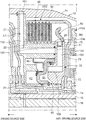
- FIG. 3 is a cross-sectional view illustrating a brake of the automatic transmission, and its periphery.
- FIG. 4 is another cross-sectional view illustrating the brake and its periphery.
- FIG. 5 is another cross-sectional view illustrating the brake and its periphery.
- FIG. 6 is another cross-sectional view illustrating the brake and its periphery.
- FIG. 7 is another cross-sectional view illustrating the brake and its periphery.
- FIG. 8 is a perspective view illustrating an assembled state of a hub member, a biasing unit, an oil channel forming member, and a piston of the brake.
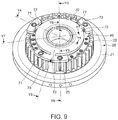
- FIG. 9 is a perspective view illustrating an assembled state of the hub member, the biasing unit, and the oil channel forming member of the brake.
- FIG. 10 is a perspective view illustrating an assembled state of the hub member and the biasing unit of the brake.
- FIG. 11 is a perspective view illustrating the biasing unit.
- FIG. 12 is a cross-sectional view illustrating the biasing unit taken along a line Y 12 -Y 12 in FIG. 11 .
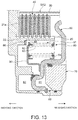
- FIG. 13 is a cross-sectional view illustrating the brake in a released state.
- FIG. 14 is a cross-sectional view illustrating the brake in an immediately-before-contact state.
- FIG. 15 is a cross-sectional view illustrating the brake in a zero clearance state.
- FIG. 16 is a cross-sectional view illustrating the brake in an engaged state.
- FIG. 17 is a cross-sectional view illustrating a brake of a conventional automatic transmission.
- FIG. 1 is a view schematically illustrating an automatic transmission according to one embodiment of the present disclosure.
- An automatic transmission 10 has, in a transmission case 11 , an input shaft 12 coupled to a driving source and disposed at the driving source side (left side in this figure), and an output shaft 13 disposed at the opposite side of the driving source side (anti-driving-source side, or right side in this figure).
- the automatic transmission 10 is of a longitudinal type for a front-engine rear-drive (FR) vehicle in which the input shaft 12 and the output shaft 13 are disposed coaxially.
- FR front-engine rear-drive
- first, second, third, and fourth planetary gear sets (hereinafter, simply referred to as “the first, second, third, and fourth gear sets”) PG 1 , PG 2 , PG 3 , and PG 4 are disposed in this order from the driving source side.
- a first clutch CL 1 is disposed at the driving source side of the first gear set PG 1
- a second clutch CL 2 is disposed at the driving source side of the first clutch CL 1
- a third clutch CL 3 is disposed at the driving source side of the second clutch CL 2
- a first brake BR 1 is disposed at the driving source side of the third clutch CL 3
- a second brake BR 2 is disposed at the driving source side of the third gear set PG 3 and at the anti-driving-source side of the second gear set PG 2 .
- Each of the first, second, third, and fourth gear sets PG 1 , PG 2 , PG 3 , and PG 4 is of a single pinion type in which a pinion supported by a carrier directly meshes with sun gears and a ring gear.
- the first, second, third, and fourth gear sets PG 1 , PG 2 , PG 3 , and PG 4 have sun gears S 1 , S 2 , S 3 , and S 4 , ring gears R 1 , R 2 , R 3 , and R 4 , and carriers C 1 , C 2 , C 3 , and C 4 , as rotary members, respectively.
- the first gear set PG 1 is of a double sun gear type in which the sun gear S 1 is divided into two in the axial directions.
- the sun gear S 1 has a first sun gear S 1 a disposed at the driving source side, and a second sun gear S 1 b disposed on the anti-driving-source side.
- the first and the second sun gears S 1 a and S 1 b have the same number of teeth, and mesh with the same pinion supported by the carrier C 1 .
- the first and the second sun gears S 1 a and S 1 b always rotate together.
- the sun gear S 1 of the first gear set PG 1 (specifically, the second sun gear S 1 b ) is always coupled to the sun gear S 4 of the fourth gear set PG 4
- the ring gear R 1 of the first gear set PG 1 is always coupled to the sun gear S 2 of the second gear set PG 2
- the carrier C 2 of the second gear set PG 2 is always coupled to the carrier C 4 of the fourth gear set PG 4
- the carrier C 3 of the third gear set PG 3 is always coupled to the ring gear R 4 of the fourth gear set PG 4 .
- the input shaft 12 is always coupled to the carrier C 1 of the first gear set PG 1 via the first sun gear S 1 a and the second sun gear S 1 b, and the output shaft 13 is always coupled to the carrier C 4 of the fourth gear set PG 4 .
- the first clutch CL 1 is disposed between the input shaft 12 and the carrier C 1 of the first gear set PG 1 , and the sun gear S 3 of the third gear set PG 3 , and connects and disconnects these gears sets.
- the second clutch CL 2 is disposed between the ring gear R 1 of the first gear set PG 1 and the sun gear S 2 of the second gear set PG 2 , and the sun gear S 3 of the third gear set PG 3 , and connects and disconnects these gear sets.
- the third clutch CL 3 is disposed between the ring gear R 2 of the second gear set PG 2 and the sun gear S 3 of the third gear set PG 3 , and connects and disconnects these gear sets.
- the first brake BR 1 is disposed between the transmission case 11 and the sun gear S 1 of the first gear set PG 1 (specifically, the first sun gear S 1 a ), and connects and disconnects these gears.
- the second brake BR 2 is disposed between the transmission case 11 and the ring gear R 3 of the third gear set PG 3 , and connects and disconnects these gears.
- the automatic transmission 10 selectively combines the engaged states of the first clutch CL 1 , the second clutch CL 2 , the third clutch CL 3 , the first brake BR 1 , and the second brake BR 2 to form first to eighth gears for a D-range (forward driving range) and a reverse gear for an R-range, as illustrated in FIG. 2 .
- this automatic transmission 10 a slip control is carried out for the second brake BR 2 which engages at the first gear when the vehicle starts traveling, and thereby the second brake BR 2 corresponds to a friction engaging element of the automatic transmission according to the present disclosure.
- this brake BR 2 is described.
- FIG. 3 is a cross-sectional view of the brake of the automatic transmission and its periphery
- FIG. 4 is another cross-sectional view of the brake and its periphery
- FIGS. 5-7 are other cross-sectional views of the brake and its periphery.
- FIGS. 3-7 illustrate cross sections of the brake and its periphery, taken along lines Y 3 -Y 3 , Y 4 -Y 4 , Y 5 -Y 5 , Y 6 -Y 6 , and Y 7 -Y 7 in FIG. 9 , respectively, as will be described in detail.
- the brake BR 2 is accommodated in the transmission case 11 formed in a substantially cylindrical shape.
- the brake BR 2 is disposed at an outer circumferential surface of a power transmission member 14 which is coupled to the sun gear S 3 of the third gear set PG 3 so as to be integrated with one of a pair of inner and outer rotary members of the first, second, and third clutches CL 1 , CL 2 , and CL 3 .
- the power transmission member 14 is disposed at an outer circumferential surface of a power transmission member 15 which couples the carrier C 2 of the second gear set PG 2 to the carrier C 4 of the fourth gear set PG 4
- the power transmission member 15 is disposed at an outer circumferential surface of a power transmission member 16 which couples the sun gear S 1 of the first gear set PG 1 (specifically, the second sun gear S 1 b ) to the sun gear S 4 of the fourth gear set PG 4 .
- the brake BR 2 includes a hub member 20 coupled to the transmission case 11 , a drum member 30 which is disposed on the anti-driving-source side of the hub member 20 and is coupled to the ring gear R 3 of the third gear set PG 3 , a plurality of friction plates 40 placed in line in the axial directions between the hub member 20 and the drum member 30 , and a piston 50 which is disposed on the anti-driving-source side of the plurality of friction plates 40 and causes the plurality of friction plates 40 to be engaged.
- the brake BR 2 has a hydraulic chamber 60 to which hydraulic fluid which biases the piston 50 is supplied, and the hydraulic chamber 60 includes a hydraulic chamber 61 for engagement to which hydraulic fluid for engagement which biases the piston 50 in the engaging direction is supplied, and a hydraulic chamber 62 for release which is disposed at the opposite side of the piston 50 from the hydraulic chamber 61 for engagement, and to which hydraulic fluid for release which biases the piston 50 in the releasing direction is supplied.
- the brake BR 2 also has an oil channel forming member 70 which forms a supply oil channel for engagement which supplies hydraulic fluid to the hydraulic chamber 61 for engagement, and the oil channel forming member 70 is disposed on the anti-driving-source side of the piston 50 and is coupled to the anti-driving-source side of the hub member 20 .
- the brake BR 2 also has a biasing unit 80 provided with a biasing member 81 which biases the piston 50
- the biasing unit 80 includes, as the biasing member 81 , first springs 82 and second springs 83 which bias the piston 50 in the engaging direction, as first biasing members and second biasing members. That is, the biasing member 81 may be referred to as a spring.
- FIG. 8 is a perspective view illustrating an assembled state of the hub member, the biasing unit, the oil channel forming member, and the piston of the brake
- FIG. 9 is a perspective view illustrating an assembled state of the hub member, the biasing unit, and the oil channel forming member of the brake
- FIG. 10 is a perspective view illustrating an assembled state of the hub member and the biasing unit of the brake
- FIG. 11 is a perspective view illustrating the biasing unit
- FIG. 12 is a cross-sectional view illustrating the biasing unit taken along a line Y 12 -Y 12 in FIG. 11 .
- the hub member 20 includes a vertical wall part 21 which extends in a direction perpendicular to the axial directions of the transmission case 11 and having a substantially annular shape, as well as a first cylinder part 22 , a second cylinder part 23 , and a third cylinder part 24 which extend to the anti-driving-source side from the vertical wall part 21 and each having a substantially cylindrical shape.
- the first cylinder part 22 extends axially from the radially center side of the vertical wall part 21
- the second cylinder part 23 extends axially from the vertical wall part 21 , at a location radially inward of the first cylinder part 22
- the third cylinder part 24 extends axially from the vertical wall part 21 , at a location radially inward of the second cylinder part 23 .
- the first cylinder part 22 is longer in the axial directions than the second cylinder part 23 , and is shorter in the axial directions than the third cylinder part 24 .
- the hub member 20 is fitted into a groove portion 11 a for the hub member which is formed in an inner circumferential surface of the transmission case 11 to have a substantially cylindrical shape according to the shape of the vertical wall part 21 , and is prevented by a snap ring 17 from coming out to the driving source side.
- the hub member 20 is coupled to the transmission case 11 by fixing the vertical wall part 21 to the transmission case 11 by using a rotation stop pin (not illustrated).
- a spline 22 a is formed in an outer circumferential surface of the first cylinder part 22 of the hub member 20 so that the first cylinder part 22 constitutes an inner stationary member coupled to the transmission case 11 .
- Stationary-side friction plates 41 which constitute the friction plates 40 spline-engage with the spline 22 a.
- the second cylinder part 23 and the third cylinder part 24 constitute a cylinder 62 a of the hydraulic chamber 62 for release together with the vertical wall part 21 .
- the drum member 30 includes a cylinder part 31 which is disposed at the outer circumferential side of the first cylinder part 22 of the hub member 20 so as to oppose the first cylinder part 22 and extends axially to have a substantially cylindrical shape, and a vertical wall part 32 which extends in a direction perpendicular to the axial directions of the transmission case 11 from the anti-driving-source side of the cylinder part 31 radially inwardly to have a substantially disk shape.
- the vertical wall part 32 of the drum member 30 is coupled to the ring gear R 3 .
- a spline 31 a is formed in an inner circumferential surface of the cylinder part 31 of the drum member 30 so that the cylinder part 31 constitutes the outer rotary member coupled to the ring gear R 3 as the rotary member.
- Rotary-side friction plates 42 which constitute the friction plates 40 spline-engage with the spline 31 a.
- the stationary-side friction plates 41 and the rotary-side friction plates 42 are disposed alternately in the axial directions.
- the piston 50 is disposed between the hub member 20 and the drum member 30 , in more detail, between the first cylinder part 22 of the hub member 20 and the cylinder part 31 of the drum member 30 , and is slidably fitted onto the outer circumferential side of the third cylinder part 24 of the hub member 20 .
- the piston 50 is prevented by a snap ring 18 from coming out to the anti-driving-source side.
- the piston 50 includes a pressing part 51 which is formed annularly and is provided at the outer circumferential side of the piston 50 to press the friction plates 40 , a hydraulic chamber forming part 52 for engagement which is provided at the inner circumferential side and forms the hydraulic chamber 61 for engagement, and coupling parts 53 which couple the pressing part 51 to the hydraulic chamber forming part 52 for engagement, and extend radially.
- the pressing part 51 is disposed on the anti-driving-source side of the friction plates 40 , the hydraulic chamber forming part 52 for engagement is disposed radially inward of the first cylinder part 22 of the hub member 20 , and the coupling parts 53 are provided so as to be coupled to the hydraulic chamber forming part 52 for engagement through the anti-driving-source side of the first cylinder part 22 of the hub member 20 from the pressing part 51 .
- the pressing part 51 and the hydraulic chamber forming part 52 for engagement are provided so as to project to the driving source side from the coupling parts 53 .
- the oil channel forming member 70 is disposed on the anti-driving-source side of the piston 50 .
- the oil channel forming member 70 is fitted onto the outer circumferential side of the third cylinder part 24 of the hub member 20 , and is coupled to the anti-driving-source side of the first cylinder part 22 of the hub member 20 .
- the oil channel forming member 70 includes bonding parts 71 which are provided at the outer circumferential side, and are coupled to the anti-driving-source side of the first cylinder part 22 of the hub member 20 , a hydraulic chamber forming part 72 for engagement which is provided at the inner circumferential side and is disposed on the anti-driving-source side of the piston 50 to form the hydraulic chamber 61 for engagement, and coupling parts 73 which couple the bonding parts 71 to the hydraulic chamber forming part 72 for engagement, and extends radially.
- the hydraulic chamber forming part 72 for engagement is formed annularly and has a given thickness, and as illustrated in FIG. 3 , it is fitted into a space between the third cylinder part 24 of the hub member 20 and the outer circumferential side of the hydraulic chamber forming part 52 for engagement of the piston 50 .
- the hydraulic chamber 61 for engagement is comprised of the hydraulic chamber forming part 52 for engagement of the piston 50 , the hydraulic chamber forming part 72 for engagement of the oil channel forming member 70 , and the third cylinder part 24 of the hub member 20 .
- the bonding parts 71 are formed so as to have the thickness less than that of the hydraulic chamber forming part 72 for engagement, and are provided so as to overlap in the axial directions with the anti-driving-source side of the hydraulic chamber forming part 72 for engagement. As illustrated in FIGS. 8 and 9 , each bonding part 71 is formed in an arc shape.
- the oil channel forming member 70 is provided with a plurality of bonding parts 71 (in this embodiment, three bonding parts 71 ) in the circumferential directions, which separate substantially equally from each other in the circumferential directions.
- Each bonding part 71 is formed with a bolt insertion hole 71 a into which a fastening bolt 74 is inserted as a fastening member, and a bolt accommodation hole 71 b in which a head 74 a of the fastening bolt 74 is accommodated.
- the oil channel forming member 70 is coupled to the anti-driving-source side of the first cylinder part 22 by threadedly engaging through the bolt insertion holes 71 a the fastening bolts 74 with threaded holes 22 b formed on the anti-driving-source side of the first cylinder part 22 of the hub member 20 .
- As the fastening bolts 74 a sealed bolt in which an outer circumferential surface of a thread part 74 b is covered with a sealant is used.
- Each coupling part 73 of the oil channel forming member 70 has substantially the same thickness as the bonding part 71 , and as illustrated in FIGS. 8 and 9 , it extends radially inward from the circumferentially center side of the bonding part 71 and is coupled to the hydraulic chamber forming part 72 for engagement.
- one of the bonding parts 71 disposed at the lower side of the transmission case 11 is coupled to the first cylinder part 22 by using the two fastening bolts 74 at both sides in the circumferential directions, and each of other two bonding parts 71 disposed at the upper side of the transmission case 11 is coupled to the first cylinder part 22 by using one fastening bolt 74 at the center in the circumferential directions.
- Cutoff parts 53 a are formed in the coupling parts 53 of the piston 50 so that the coupling parts 53 are cutoff in substantially the same shape as the bonding parts 71 and the coupling parts 73 of the oil channel forming member 70 .
- the oil channel forming member 70 is disposed within a radial range of the piston 50 , and is disposed at a position where the bonding parts 71 and the coupling parts 73 of the oil channel forming member 70 overlap with the coupling part 53 of the piston 50 in the axial directions by being fitted into the cutoff parts 53 a of the coupling part 53 of the piston 50 .
- the automatic transmission can be radially downsized by disposing the oil channel forming member 70 within the radial range of the piston 50 .
- the hydraulic chamber forming part 52 for engagement of the piston 50 includes an outer cylinder part 52 a which is fitted onto the outer circumferential side of the hydraulic chamber forming part 72 for engagement of the oil channel forming member 70 and extends axially, an oil-pressure receiving part 52 b for engagement which extends radially inward from the driving source side of the outer cylinder part 52 a, and an inner cylinder part 52 c which extends to the anti-driving-source side from the radially inward of the oil-pressure receiving part 52 b for engagement, is fitted into the third cylinder part 24 of the hub member 20 , and extends axially.
- the hydraulic chamber 60 is disposed radially inward of the first cylinder part 22 of the hub member 20 , and the hydraulic chamber 61 for engagement and the hydraulic chamber 62 for release are disposed radially inward of the first cylinder part 22 .
- the hydraulic chamber 61 for engagement is formed by the hydraulic chamber forming part 52 for engagement of the piston 50 , the hydraulic chamber forming part 72 for engagement of the oil channel forming member 70 , and the third cylinder part 24 of the hub member 20 .
- the inner cylinder part 52 c of the piston 50 is prevented by the snap ring 18 from coming out to the anti-driving-source side.
- a radially inward part of the oil-pressure receiving part 52 b for engagement of the piston 50 is bulged to the driving source side into a substantially channel shape in the cross section to form a bulged part 52 d.
- the bulged part 52 d is slidably fitted into the cylinder 62 a of the hub member 20 through seal members 63 and 64 .
- the hydraulic chamber 62 for release is formed by the bulged part 52 d of the piston 50 and the cylinder 62 a of the hub member 20 .
- the hydraulic chamber 62 for release has a smaller outer diameter than the hydraulic chamber 61 for engagement, and a biasing force receiving member 90 is disposed at the outer circumferential side of the hydraulic chamber 62 for release.
- the biasing force receiving member 90 is coupled to the piston 50 and receives a biasing force caused by the biasing member 81 of the biasing unit 80 .
- the space at the outer circumferential side of the hydraulic chamber 62 for release can be used effectively.
- the biasing force receiving member 90 is formed annularly, and includes a radially extended part 91 extending radially between the first cylinder part 22 and the second cylinder part 23 of the hub member 20 , and an axially extended part 92 extending axially to the anti-driving-source side from the radially inward of the radially extended part 91 .
- the biasing force receiving member 90 is coupled to the piston 50 by coupling the anti-driving-source side of the axially extended part 92 to a part of the oil-pressure receiving part 52 b for engagement of the piston 50 radially outward of the bulged part 52 d.
- the biasing unit 80 provided with the biasing member 81 is attached between the biasing force receiving member 90 (specifically, the radially extended part 91 ) and the oil channel forming member 70 .
- the biasing unit 80 includes the first springs 82 and the second springs 83 which extend axially, a first retainer plate 84 which holds one ends of the first springs 82 and the second springs 83 at the anti-driving-source side, and a second retainer plate 85 which is axially separated from the first retainer plate 84 and holds the other end of the first springs 82 at the driving source side.
- the first retainer plate 84 is formed annularly, and is provided with a first spring guide part 84 a and a second spring guide part 84 b which project cylindrically to the driving source side and to which the first springs 82 and the second springs 83 are attached.
- the first springs 82 and the second springs 83 are disposed at different circumferential positions but radially overlap with each other.
- the automatic transmission can be shortened in the radial dimensions.
- the first spring 82 is disposed at both sides of each of the six second springs 83 in the circumferential directions.
- the second retainer plate 85 is formed substantially symmetry in the axial directions to the first retainer plate 84 .
- the second retainer plate 85 includes a first spring guide part 85 a which projects cylindrically to the anti-driving-source side and to which the first springs 82 are attached.
- the second retainer plate 85 is formed with insertion holes 85 b into which the second springs 83 are inserted so that the other ends of the second springs 83 at the driving source side can project to the driving source side.
- the first springs 82 have a larger biasing force than the second springs 83 .
- the first springs 82 and the second springs 83 are coil springs, and the first springs 82 are large-sized coil springs which have a larger coil diameter than the second springs 83 .
- the second springs 83 have a longer free length than the first springs 82 , and the other ends of the second springs 83 are held by the first retainer plate 84 so as to be projectable from the second retainer plate 85 to the driving source side.
- the biasing unit 80 is attached to the transmission case 11 by the first retainer plate 84 being supported at the driving source side on both sides in the circumferential directions of the bonding parts 71 of the oil channel forming member 70 , and the second retainer plate 85 being supported at the anti-driving-source side of the radially extended part 91 of the biasing force receiving member 90 .
- the radially extended part 91 of the biasing force receiving member 90 is formed to have the radial dimension which is smaller than the outer diameter of the second retainer plate 85 and is substantially the same as that of the second spring 83 so that it supports the second retainer plate 85 , and supports the other end parts of the second springs 83 inserted into the insertion holes 85 b of the second retainer plate 85 .
- the inner circumferential surface of the first cylinder part 22 of the hub member 20 is formed radially larger than the first retainer plate 84 and the second retainer plate 85 , and the biasing unit 80 is disposed at the inner circumferential side of the first cylinder part 22 .
- the inner circumferential surface of the first cylinder part 22 of the hub member 20 projects radially inward at the driving source side to form a stepped part 22 c, and a stop member 86 is attached to the anti-driving-source side of the stepped part 22 c.
- the stop member 86 is formed radially smaller than the radially extended part 91 of the biasing force receiving member 90 and larger than the second retainer plate 85 so that it stops the second retainer plate 85 when the second retainer plate 85 is moved to the driving source side by receiving the biasing force of the biasing member 81 .
- the piston 50 is adjusted to be located at an immediately-before-contact position where it is immediately before contacting the plurality of friction plates 40 when the second retainer plate 85 supported by the biasing force receiving member 90 contacts the stop member 86 .
- the immediately-before-contact position of the piston 50 is suitably adjusted between the released position where the plurality of friction plates 40 become in the released state and the zero clearance position where the plurality of friction plates 40 become in the zero clearance state.
- the stop member 86 may be comprised of a plurality of stop members, each formed in an arc shape having a given length in the circumferential directions and is separated from one another in the circumferential directions, or may be formed an annular shape covering the entire circumference.
- the biasing force receiving member 90 receives the biasing force only from the first springs 82 in the engaging direction.
- the piston 50 is adjusted to be located at the zero clearance position when the first springs 82 become the free length.
- the biasing unit 80 is constructed so that the first springs 82 make the biasing force act in the engaging direction on the piston 50 through the biasing force receiving member 90 from the released position to the immediately-before-contact position, and the second springs 83 make the biasing force act in the engaging direction on the piston 50 through the biasing force receiving member 90 from the released position to the zero clearance position.
- the brake BR 2 can move the piston 50 to the zero clearance position with sufficient response and with sufficient accuracy.
- the piston 50 is biased in the releasing direction against the biasing forces of the first springs 82 , and is moved to the immediately-before-contact position. Subsequently, the piston 50 is biased in the releasing direction against the biasing forces of the first springs 82 and the second springs 83 , and is moved to the released position.
- the hydraulic chamber 60 is disposed at a different radial position from the biasing member 81 but axially overlaps with the biasing member 81 .
- the hydraulic chamber 61 for engagement and the hydraulic chamber 62 for release are disposed at different radial positions from the first springs 82 and the second springs 83 but axially overlap with the first springs 82 and the second springs 83 .
- the automatic transmission can be shortened in the axial directions.
- a supply oil channel L 1 for engagement which supplies the hydraulic fluid for engagement to the hydraulic chamber 61 for engagement of the brake BR 2 , and a supply oil channel L 2 for release which supplies the hydraulic fluid for release to the hydraulic chamber 62 for release of the brake BR 2 are formed in the transmission case 11 , the hub member 20 , and the oil channel forming member 70 .
- a supply oil channel L 3 for lubrication which supplies the hydraulic fluid for lubrication to the friction plates 40 is formed in the transmission case 11 and the hub member 20 .
- the supply oil channel L 1 for engagement is comprised of a radial oil channel 102 which is provided in the vertical wall part 21 of the hub member 20 and extends radially, an axial oil channel 103 which is provided in the first cylinder part 22 of the hub member 20 , extends axially, and is coupled to the radial oil channel 102 , an axial oil channel 104 which is provided in the bonding parts 71 of the oil channel forming member 70 , extends axially, and is coupled to the axial oil channel 103 , a radial oil channel 105 which is provided in the bonding parts 71 , the coupling parts 73 , and the hydraulic chamber forming part 72 for engagement of the oil channel forming member 70 , extends radially, and is coupled to the axial oil channel 104 , and an axial oil channel 106 which is provided in the hydraulic chamber forming part 72 for engagement of the oil channel forming member 70 , extends axially, is coupled to the radial oil channel 102 , and an axial
- the radial oil channel 102 of the hub member 20 is coupled to a radial oil channel 101 which is provided in the transmission case 11 and extends radially.
- the radial oil channel 101 leads to a control valve unit (not illustrated) disposed below the transmission case 11 .
- the control valve unit supplies a given hydraulic pressure for engagement by supplying the hydraulic fluid for engagement to the hydraulic chamber 61 for engagement through the radial oil channel 101 and the supply oil channel L 1 for engagement.
- the radial oil channel 105 of the oil channel forming member 70 is formed so as to extend radially inward from the outer circumferential surface of the bonding part 71 of the oil channel forming member 70 , and a closing member 75 which closes the opening of the radial oil channel 105 is attached to the outer circumferential surface of the bonding part 71 .
- the supply oil channel L 2 for release is comprised of a radial oil channel 112 which is provided in the vertical wall part 21 of the hub member 20 and extends radially, an axial oil channel 113 which is provided in the first cylinder part 22 of the hub member 20 , extends axially, and is coupled to the radial oil channel 112 , and a radial oil channel 114 which is provided in the first cylinder part 22 , the vertical wall part 21 , and the second cylinder part 23 of the hub member 20 , extends radially, is coupled to the axial oil channel 113 , and opens to the hydraulic chamber 62 for release.
- the radial oil channel 112 of the hub member 20 is coupled to a radial oil channel 111 which is provided in the transmission case 11 and extends radially.
- the radial oil channel 111 leads to the control valve unit.
- the control valve unit supplies a given hydraulic pressure for release by supplying the hydraulic fluid for release to the hydraulic chamber 62 for release through the radial oil channel 111 and the supply oil channel L 2 for release.
- the radial oil channel 114 of the hub member 20 is formed so as to extend radially inward from the outer circumferential surface of the first cylinder part 22 of the hub member 20 , and closing members 25 which close the openings of radial oil channel 114 are attached to the outer circumferential surface of the first cylinder part 22 .
- the axial oil channel 113 of the hub member 20 is formed so as to extend axially to the driving source side from an end face on the anti-driving-source side of the first cylinder part 22 of the hub member 20 , and the fastening bolts 74 are attached to the end face on the anti-driving-source side of the first cylinder part 22 , as the closing members which close the openings of the axial oil channel 113 .
- the threaded holes 22 b are formed in the openings of the axial oil channel 113 on the anti-driving-source side of the first cylinder part 22 .
- the fastening bolts 74 which couple the oil channel forming member 70 to the hub member 20 are threadedly engaged with the threaded holes 22 b, and the openings of the axial oil channel 113 are closed by using the fastening bolts 74 .
- As the fastening bolt 74 a sealed bolt in which the outer circumferential surface of the thread part 74 b is covered with the sealant is used.
- the fastening members 74 coupling the oil channel forming member 70 function as the closing members which close the openings of the axial oil channel 113 of the first cylinder part 22 , the openings of the axial oil channel 113 can be closed without the number of components being increased.
- the supply oil channel L 3 for lubrication is comprised of a radial oil channel 122 which is formed in the vertical wall part 21 of the hub member 20 and extends radially, circumferential oil channels 123 which are formed in the vertical wall part 21 of the hub member 20 , arcuately extend in the circumferential directions, and are coupled to the radial oil channel 122 , axial oil channels 124 which are formed in the first cylinder part 22 of the hub member 20 , extend axially, and are coupled to the circumferential oil channels 123 , and radial oil channels 125 which are formed in the first cylinder part 22 of the hub member 20 , extend radially, are coupled to the axial oil channels 124 , and open to the outer circumferential surface of the first cylinder part 22 of the hub member 20 .
- a plurality of radial oil channels 125 which open to the outer circumferential surface of the first cylinder part 22 are formed with an interval therebetween in the axial directions so that they open to the respective teeth parts of the spline 22 a.
- the radial oil channels 125 are formed so as to open to tip ends of the teeth parts of the spline 22 a.
- the radial oil channels 125 may be formed so as to open to the bottoms of the teeth parts of the spline 22 a.
- the radial oil channel 122 of the hub member 20 is coupled to a radial oil channel 121 which is provided in the transmission case 11 and extends radially.
- the radial oil channel 121 leads to the control valve unit.
- the control valve unit can supply the hydraulic fluid for lubrication to the plurality of friction plates 40 through the radial oil channel 121 and the supply oil channel L 3 for lubrication.
- the hydraulic fluid for lubrication is supplied to the friction plates 40 from the outer circumferential surface of the first cylinder part 22 of the hub member 20 as the inner stationary member to cool the generated heat of the friction plates 40 .
- the hydraulic fluid for lubrication supplied to the friction plates 40 moves to the inner circumferential surface of the cylinder part 31 of the drum member 30 as the outer rotary member, and moves in the axial directions by the rotation of the cylinder part 31 of the drum member 30 , and thereby stagnation of the hydraulic fluid for lubrication is prevented.
- the axial oil channels 124 of the hub member 20 are formed so as to extend axially to the driving source side from an end face on the anti-driving-source side of the first cylinder part 22 of the hub member 20 , and closing members 26 which close the openings of the axial oil channels 124 are attached to the end face on the anti-driving-source side of the first cylinder part 22 .
- the radial oil channels 102 , 112 , and 122 which respectively constitute the supply oil channel L 1 for engagement, the supply oil channel L 2 for release, and the supply oil channel L 3 for lubrication are sequentially disposed in the circumferential directions at a lower side of the transmission case 11 .
- the circumferential oil channels 123 which constitute the supply oil channel L 3 for lubrication are coupled to the radial oil channel 122 , and arcuately extend in the circumferential directions away from the radial oil channel 112 , and extend to the opposite side of the radial oil channel 102 from the radial oil channel 112 .
- the supply oil channel L 3 for lubrication is provided with a plurality of (specifically, five) axial oil channels 124 coupled to the circumferential oil channels 123 , which are substantially equally separated from each other in the circumferential directions, and the axial oil channels 124 are coupled to a plurality of radial oil channels 125 which open to the outer circumferential surface of the first cylinder part 22 of the hub member 20 , respectively.
- the openings of two axial oil channels 124 which constitute the supply oil channel L 3 for lubrication are closed by attaching the closing members 26 to the end face on the anti-driving-source side of the first cylinder part 22 .
- the openings on the anti-driving-source side of three axial oil channels 124 which constitute the supply oil channel L 3 for lubrication are closed by using the fastening bolts 74 which couple the oil channel forming member 70 to the hub member 20 .
- axial oil channels 124 ′ which constitute the supply oil channel L 3 for lubrication are formed so as to extend axially to the driving source side from an end face on the anti-driving-source side of the first cylinder part 22 of the hub member 20 , and the fastening bolts 74 are attached as the closing members which close openings of the axial oil channels 124 ′ to the end face at the anti-driving-source side of the first cylinder part 22 .
- the threaded holes 22 b are formed in the openings of the axial oil channels 124 ′ on the anti-driving-source side of the first cylinder part 22 of the hub member 20 .
- the fastening bolts 74 which couple the oil channel forming member 70 to the hub member 20 are threadedly engaged with the threaded holes 22 b, and the openings of the axial oil channels 124 ′ are closed by using the fastening bolts 74 .
- a sealed bolt in which the outer circumferential surface of the thread part 74 b is covered with the sealant is used as the fastening bolt 74 .
- the fastening members 74 coupling the oil channel forming member 70 function as the closing members which close the openings of the axial oil channels 124 ′ of the first cylinder part 22 , the openings of the axial oil channels 124 ′ can be closed without the number of components being increased.
- the axial oil channels 103 , 113 , and 124 which constitute the supply oil channel L 1 for engagement, the supply oil channel L 2 for release, and the supply oil channel L 3 for lubrication, respectively are formed at different circumferential positions, and are formed in boss parts 22 d which project radially inward from the inner circumferential surface of the first cylinder part 22 of the hub member 20 .
- cutoff parts 84 c and 85 c are formed in the first retainer plate 84 and the second retainer plate 85 of the biasing unit 80 , corresponding to the boss parts 22 d, respectively.
- FIG. 13 is a cross-sectional view illustrating the brake in the released state
- FIG. 14 is a cross-sectional view illustrating the brake in the immediately-before-contact state
- FIG. 15 is a cross-sectional view illustrating the brake in the zero clearance state
- FIG. 16 is a cross-sectional view illustrating the brake in the engaged state.
- FIGS. 13-16 are enlarged views illustrating substantial parts of the brake in FIG. 7 .
- FIG. 13 the released state of the brake BR 2 where the piston 50 is located at the released position in which the plurality of friction plates 40 become in the released state is illustrated.
- This released state of the brake BR 2 is achieved by releasing the hydraulic pressure for engagement from the hydraulic chamber 61 for engagement, and supplying the hydraulic pressure for release to the hydraulic chamber 62 for release, to compress the first springs 82 and the second springs 83 through the biasing force receiving member 90 and move the piston 50 in the releasing direction, that is, toward the anti-driving-source side.
- the hydraulic pressure for release is released from the hydraulic chamber 62 for release in the released state illustrated in FIG. 13 , and as illustrated in FIG. 14 , the piston 50 is moved in the engaging direction, that is, toward the driving source side by receiving the biasing forces of the first springs 82 and the second springs 83 through the biasing force receiving member 90 until the second retainer plate 85 contacts the stop member 86 , the piston 50 then reaches the immediately-before-contact position where the piston 50 is at a location just before contacting the plurality of friction plates 40 , and thereby the brake BR 2 becomes in the immediately-before-contact state.
- the piston 50 When the second retainer plate 85 contacts the stop member 86 in the immediately-before-contact state, as illustrated in FIG. 15 , the piston 50 is moved in the engaging direction by receiving the biasing force of the second springs 83 through the biasing force receiving member 90 until the second springs 83 reach the free length thereof, and the piston 50 is then located at the zero clearance position where the piston 50 contacts or substantially contacts the friction plates 40 without pressing the plurality of friction plates 40 to make the friction plates 40 become in the zero clearance state, and thereby the brake BR 2 becomes in the zero clearance state.
- the piston 50 can be moved with sufficient response by the first springs 82 and the second springs 83 from the released position to the immediately-before-contact position, and can be moved with sufficient accuracy by the first springs 82 from the immediately-before-contact position to the zero clearance position.
- the slip control of the brake BR 2 is carried out when the vehicle starts traveling.
- the hydraulic pressure for engagement is supplied to the hydraulic chamber 61 for engagement to engage the plurality of friction plates 40 .
- the hydraulic pressure for release is supplied to the hydraulic chamber 62 for release to disengage the plurality of friction plates 40 .
- the hydraulic fluid for lubrication is supplied to the plurality of friction plates 40 through the supply oil channel L 3 for lubrication, and when the slip control of the brake BR 2 is carried out, the hydraulic fluid for lubrication is supplied to the plurality of friction plates 40 through the supply oil channel L 3 for lubrication.
- the automatic transmission 10 includes the brake BR 2 in which the hydraulic chamber 61 for engagement is formed radially inward of the inner stationary member 22 coupled to the transmission case 11 , and the oil channel forming member 70 forming the supply oil channel L 1 for engagement which supplies the hydraulic fluid to the hydraulic chamber 61 for engagement.
- the piston 50 includes the pressing part 51 , the hydraulic chamber forming part 52 for engagement and the coupling part 53 extending radially so as to couple the pressing part 51 to the hydraulic chamber forming part 52 for engagement.
- the oil channel forming member 70 includes the bonding part 71 coupled to one side of the inner stationary member 22 in axial directions, the hydraulic chamber forming part 72 for engagement disposed at one side of the piston 50 in axial directions, and the coupling part 73 extending radially so as to couple the bonding part 71 to the hydraulic chamber forming part 72 for engagement.
- the bonding part 71 and the coupling part 73 of the oil channel forming member 70 are disposed in the cutoff part 53 a formed in the coupling part 53 of the piston 50 , which is shaped corresponded to the bonding part 71 and the coupling part 73 of the oil channel forming member 70 .
- the oil channel forming member 70 is disposed radially inward of the piston 50 .
- the oil channel forming member 70 forming the supply oil channel L 1 for engagement which supplies the hydraulic fluid to the hydraulic chamber 61 for engagement can be disposed radially inward of the piston 50 , thus, compared to a case where the oil channel forming member 70 is disposed radially inward of the hydraulic chamber 61 for engagement, the automatic transmission can be shortened in radial dimensions and thereby it can be radially downsized.
- the bonding part 71 and the coupling part 73 of the oil channel forming member 70 are disposed in the cutoff part 53 a formed in the coupling part 53 of the piston 50 , which is shaped corresponded to the bonding part 71 and the coupling part 73 of the oil channel forming member 70 , the oil channel forming member 70 can be disposed so as to axially overlap with the piston 50 , thereby it can be axially downsized.
- the automatic transmission includes the biasing member 81 which biases the piston 50 in the engaging direction and the hydraulic chamber 62 for release which is disposed at the opposite side of the piston 50 from the hydraulic chamber 61 for engagement.
- the hydraulic chamber 61 for engagement and the hydraulic chamber 62 for release are disposed at different radial positions from the biasing member 81 but axially overlap with the biasing member 81 .
- the automatic transmission can be axially downsized as compared with the conventional automatic transmission in which the hydraulic chamber 61 for engagement and the hydraulic chamber 62 for release do not overlap axially with the biasing member 81 .
- the hydraulic chamber 62 for release is formed to have a smaller outer diameter than the hydraulic chamber 61 for engagement, and the biasing force receiving member 90 which is coupled to the piston 50 and receives the biasing force of the biasing member 81 is disposed at the outer circumferential side of the hydraulic chamber 62 for release.
- the biasing force receiving member 90 can be coupled to the piston 50 at the outer circumferential side of the hydraulic chamber 62 for release of which the outer diameter is formed smaller than the hydraulic chamber 61 for engagement, thereby effectively utilizing the space at the outer circumferential side of the hydraulic chamber 62 for release.
- the oil channel forming member forming the supply oil channel for engagement is radially downsized, and thus, it may also be suitably utilized in the manufacturing technology field of such automatic transmissions and/or vehicles mounted with the automatic transmissions.
Landscapes
- Engineering & Computer Science (AREA)
- General Engineering & Computer Science (AREA)
- Mechanical Engineering (AREA)
- Physics & Mathematics (AREA)
- Fluid Mechanics (AREA)
- Hydraulic Clutches, Magnetic Clutches, Fluid Clutches, And Fluid Joints (AREA)
- Structure Of Transmissions (AREA)
- Mechanical Operated Clutches (AREA)
- Braking Arrangements (AREA)
Abstract
Description
Claims (3)
Applications Claiming Priority (2)
| Application Number | Priority Date | Filing Date | Title |
|---|---|---|---|
| JP2018028072A JP2019143708A (en) | 2018-02-20 | 2018-02-20 | Automatic transmission |
| JP2018-028072 | 2018-02-20 |
Publications (2)
| Publication Number | Publication Date |
|---|---|
| US20190257376A1 US20190257376A1 (en) | 2019-08-22 |
| US10690199B2 true US10690199B2 (en) | 2020-06-23 |
Family
ID=65408968
Family Applications (1)
| Application Number | Title | Priority Date | Filing Date |
|---|---|---|---|
| US16/256,130 Expired - Fee Related US10690199B2 (en) | 2018-02-20 | 2019-01-24 | Automatic transmission |
Country Status (4)
| Country | Link |
|---|---|
| US (1) | US10690199B2 (en) |
| EP (1) | EP3527855B1 (en) |
| JP (1) | JP2019143708A (en) |
| CN (1) | CN110173520B (en) |
Families Citing this family (7)
| Publication number | Priority date | Publication date | Assignee | Title |
|---|---|---|---|---|
| JP7040105B2 (en) | 2018-02-20 | 2022-03-23 | マツダ株式会社 | Automatic transmission |
| JP2019143707A (en) * | 2018-02-20 | 2019-08-29 | マツダ株式会社 | Automatic transmission |
| JP6958446B2 (en) * | 2018-03-15 | 2021-11-02 | マツダ株式会社 | Automatic transmission |
| JP6958445B2 (en) * | 2018-03-15 | 2021-11-02 | マツダ株式会社 | Automatic transmission |
| DE102018131876A1 (en) * | 2018-12-12 | 2020-06-18 | Schaeffler Technologies AG & Co. KG | Brake system with several pressure pistons for an electric wheel drive unit; and wheel drive unit |
| JP7413712B2 (en) * | 2019-10-16 | 2024-01-16 | マツダ株式会社 | automatic transmission |
| JP7131528B2 (en) * | 2019-10-30 | 2022-09-06 | マツダ株式会社 | automatic transmission |
Citations (4)
| Publication number | Priority date | Publication date | Assignee | Title |
|---|---|---|---|---|
| US20140113762A1 (en) * | 2012-10-23 | 2014-04-24 | Ford Global Technologies, Llc | Automatic transmission assembly |
| US8858394B2 (en) * | 2011-09-23 | 2014-10-14 | Chrysler Group Llc | Apparatus and method for automated transmission clutch fill during engine start-stop operation |
| JP2017150533A (en) | 2016-02-23 | 2017-08-31 | マツダ株式会社 | Automatic transmission |
| US20170276235A1 (en) * | 2014-10-30 | 2017-09-28 | Mazda Motor Corporation | Brake device of transmission |
Family Cites Families (18)
| Publication number | Priority date | Publication date | Assignee | Title |
|---|---|---|---|---|
| JPS4417847Y1 (en) * | 1964-11-26 | 1969-08-02 | ||
| JPS5817942Y2 (en) * | 1977-05-16 | 1983-04-12 | 新潟コンバ−タ−株式会社 | Large clutch device |
| JPS61274125A (en) * | 1985-05-23 | 1986-12-04 | Nissan Motor Co Ltd | Torque transmission device |
| US5050710A (en) * | 1990-04-10 | 1991-09-24 | Caterpillar Inc. | Wet disc brake mechanism |
| DE10323515A1 (en) * | 2003-05-24 | 2004-12-23 | Dr.Ing.H.C. F. Porsche Ag | Coupling device and method for operating a multi-plate clutch |
| CN100458220C (en) * | 2003-09-10 | 2009-02-04 | 爱信艾达株式会社 | Automatic Transmission for Vehicles |
| JP2006312956A (en) * | 2005-05-06 | 2006-11-16 | Toyota Motor Corp | Automatic transmission fastening control device |
| JP4770625B2 (en) * | 2006-07-24 | 2011-09-14 | マツダ株式会社 | Automatic transmission |
| JP2011106555A (en) * | 2009-11-17 | 2011-06-02 | Aisin Seiki Co Ltd | Torque converter apparatus |
| WO2013171986A1 (en) * | 2012-05-18 | 2013-11-21 | 株式会社パイオラックス | Spring device |
| JP2014004895A (en) * | 2012-06-22 | 2014-01-16 | Aisin Seiki Co Ltd | Driving force transmission structure for vehicle |
| WO2014061234A1 (en) * | 2012-10-18 | 2014-04-24 | マツダ株式会社 | Brake device for automatic transmission and control system therefor |
| DE102013012815A1 (en) * | 2012-11-20 | 2014-05-22 | Borgwarner Inc. | Dual clutch device for arrangement in powertrain of motor car, has clutch supporting hub structure that is provided with hub portions, and transmission input shaft which is connected with coupling assembly |
| US9482287B2 (en) * | 2014-02-12 | 2016-11-01 | Ford Global Technologies, Llc | Pressure plate stress-relief grooves for a friction element assembly in a transmission of a motor vehicle and associated method |
| JP6210017B2 (en) * | 2014-04-17 | 2017-10-11 | マツダ株式会社 | Automatic transmission |
| DE112015004801B4 (en) * | 2014-10-23 | 2020-08-06 | Mazda Motor Corporation | Automatically shiftable transmission |
| JP6315006B2 (en) * | 2016-02-23 | 2018-04-25 | マツダ株式会社 | Friction engagement element and automatic transmission |
| JP6570466B2 (en) * | 2016-03-17 | 2019-09-04 | 三菱ロジスネクスト株式会社 | Brake device for vehicle |
-
2018
- 2018-02-20 JP JP2018028072A patent/JP2019143708A/en active Pending
-
2019
- 2019-01-24 US US16/256,130 patent/US10690199B2/en not_active Expired - Fee Related
- 2019-02-11 EP EP19156464.0A patent/EP3527855B1/en not_active Not-in-force
- 2019-02-15 CN CN201910115790.0A patent/CN110173520B/en not_active Expired - Fee Related
Patent Citations (4)
| Publication number | Priority date | Publication date | Assignee | Title |
|---|---|---|---|---|
| US8858394B2 (en) * | 2011-09-23 | 2014-10-14 | Chrysler Group Llc | Apparatus and method for automated transmission clutch fill during engine start-stop operation |
| US20140113762A1 (en) * | 2012-10-23 | 2014-04-24 | Ford Global Technologies, Llc | Automatic transmission assembly |
| US20170276235A1 (en) * | 2014-10-30 | 2017-09-28 | Mazda Motor Corporation | Brake device of transmission |
| JP2017150533A (en) | 2016-02-23 | 2017-08-31 | マツダ株式会社 | Automatic transmission |
Also Published As
| Publication number | Publication date |
|---|---|
| EP3527855B1 (en) | 2020-05-27 |
| CN110173520B (en) | 2020-09-22 |
| US20190257376A1 (en) | 2019-08-22 |
| EP3527855A1 (en) | 2019-08-21 |
| JP2019143708A (en) | 2019-08-29 |
| CN110173520A (en) | 2019-08-27 |
Similar Documents
| Publication | Publication Date | Title |
|---|---|---|
| US10865837B2 (en) | Automatic transmission | |
| US11067135B2 (en) | Automatic transmission | |
| US20190257376A1 (en) | Automatic transmission | |
| US10690246B2 (en) | Automatic transmission | |
| US10774924B2 (en) | Automatic transmission | |
| US9845871B2 (en) | Automatic transmission | |
| US7998011B2 (en) | Speed change apparatus | |
| CN105026797B (en) | power transmission device | |
| US10788120B2 (en) | Automatic transmission | |
| US11149848B2 (en) | Automatic transmission | |
| JP2017198307A (en) | Power transmission device for vehicle and method for manufacturing the same | |
| US5178588A (en) | Parking gear mounting structure for automatic transmission | |
| JP2017198306A (en) | Power transmission device for vehicle and manufacturing method thereof | |
| US11204098B2 (en) | Automatic transmission | |
| US11306792B2 (en) | Automatic transmission | |
| JP2020101273A (en) | Automatic transmission | |
| JP2020016273A (en) | Automatic transmission | |
| JP2020101272A (en) | Automatic transmission | |
| JPH07269663A (en) | Automatic transmission |
Legal Events
| Date | Code | Title | Description |
|---|---|---|---|
| AS | Assignment |
Owner name: MAZDA MOTOR CORPORATION, JAPAN Free format text: ASSIGNMENT OF ASSIGNORS INTEREST;ASSIGNORS:YAMAKAWA, SHOTA;IWASAKI, TATSUHIKO;ISHIZAKA, TOMOTAKA;REEL/FRAME:048121/0383 Effective date: 20181218 |
|
| FEPP | Fee payment procedure |
Free format text: ENTITY STATUS SET TO UNDISCOUNTED (ORIGINAL EVENT CODE: BIG.); ENTITY STATUS OF PATENT OWNER: LARGE ENTITY |
|
| STPP | Information on status: patent application and granting procedure in general |
Free format text: NOTICE OF ALLOWANCE MAILED -- APPLICATION RECEIVED IN OFFICE OF PUBLICATIONS |
|
| STPP | Information on status: patent application and granting procedure in general |
Free format text: PUBLICATIONS -- ISSUE FEE PAYMENT VERIFIED |
|
| STCF | Information on status: patent grant |
Free format text: PATENTED CASE |
|
| FEPP | Fee payment procedure |
Free format text: MAINTENANCE FEE REMINDER MAILED (ORIGINAL EVENT CODE: REM.); ENTITY STATUS OF PATENT OWNER: LARGE ENTITY |
|
| LAPS | Lapse for failure to pay maintenance fees |
Free format text: PATENT EXPIRED FOR FAILURE TO PAY MAINTENANCE FEES (ORIGINAL EVENT CODE: EXP.); ENTITY STATUS OF PATENT OWNER: LARGE ENTITY |
|
| STCH | Information on status: patent discontinuation |
Free format text: PATENT EXPIRED DUE TO NONPAYMENT OF MAINTENANCE FEES UNDER 37 CFR 1.362 |
|
| FP | Lapsed due to failure to pay maintenance fee |
Effective date: 20240623 |