US10689486B2 - Resin produced by polycondensation, and resin composition - Google Patents
Resin produced by polycondensation, and resin composition Download PDFInfo
- Publication number
- US10689486B2 US10689486B2 US15/306,638 US201515306638A US10689486B2 US 10689486 B2 US10689486 B2 US 10689486B2 US 201515306638 A US201515306638 A US 201515306638A US 10689486 B2 US10689486 B2 US 10689486B2
- Authority
- US
- United States
- Prior art keywords
- resin
- mol
- polycarbonate resin
- group
- structural unit
- Prior art date
- Legal status (The legal status is an assumption and is not a legal conclusion. Google has not performed a legal analysis and makes no representation as to the accuracy of the status listed.)
- Active, expires
Links
- 0 *OC1=CC=C(C2(C3=CC=C(*O)C=C3)C3=C(C=CC=C3)C3=C2/C=C\C=C/3)C=C1.OCOC1=CC(C2=C(OCO)C=CC3=CC=CC=C32)=C2C=CC=CC2=C1.[1*]C.[2*]C Chemical compound *OC1=CC=C(C2(C3=CC=C(*O)C=C3)C3=C(C=CC=C3)C3=C2/C=C\C=C/3)C=C1.OCOC1=CC(C2=C(OCO)C=CC3=CC=CC=C32)=C2C=CC=CC2=C1.[1*]C.[2*]C 0.000 description 34
- XAZWSYXCHDYDNQ-UHFFFAOYSA-N OCOC1=CC=C2C=CC=CC2=C1C1=C(OCO)C=CC2=CC=CC=C21 Chemical compound OCOC1=CC=C2C=CC=CC2=C1C1=C(OCO)C=CC2=CC=CC=C21 XAZWSYXCHDYDNQ-UHFFFAOYSA-N 0.000 description 13
- GDFNQRDPGRGVGB-UHFFFAOYSA-M O=CO[Y]C1([Y]C(=O)O)C2=CC=CC=C2C2=C\C=C/C=C\21 Chemical compound O=CO[Y]C1([Y]C(=O)O)C2=CC=CC=C2C2=C\C=C/C=C\21 GDFNQRDPGRGVGB-UHFFFAOYSA-M 0.000 description 4
- VVEOUONUEJBYKZ-UHFFFAOYSA-N OCOC1=CC(C2=C(OCO)C=CC3=C2C=CC=C3)=C2C=CC=CC2=C1 Chemical compound OCOC1=CC(C2=C(OCO)C=CC3=C2C=CC=C3)=C2C=CC=CC2=C1 VVEOUONUEJBYKZ-UHFFFAOYSA-N 0.000 description 2
- NURPFDVARICTJF-UHFFFAOYSA-M C[Y]C1([Y]OC=O)C2=CC=CC=C2C2=C\C=C/C=C\21 Chemical compound C[Y]C1([Y]OC=O)C2=CC=CC=C2C2=C\C=C/C=C\21 NURPFDVARICTJF-UHFFFAOYSA-M 0.000 description 1
- NQXNYVAALXGLQT-UHFFFAOYSA-N OCCOc1ccc(C2(c3ccccc3-c3c2cccc3)c(cc2)ccc2OCCO)cc1 Chemical compound OCCOc1ccc(C2(c3ccccc3-c3c2cccc3)c(cc2)ccc2OCCO)cc1 NQXNYVAALXGLQT-UHFFFAOYSA-N 0.000 description 1
- YWFPGFJLYRKYJZ-UHFFFAOYSA-N Oc1ccc(C2(c3ccccc3-c3ccccc23)c(cc2)ccc2O)cc1 Chemical compound Oc1ccc(C2(c3ccccc3-c3ccccc23)c(cc2)ccc2O)cc1 YWFPGFJLYRKYJZ-UHFFFAOYSA-N 0.000 description 1
- RBIYFLJSPLKEMT-UHFFFAOYSA-N [Y]C1([Y])C2=CC=CC=C2C2=C\C=C/C=C\21 Chemical compound [Y]C1([Y])C2=CC=CC=C2C2=C\C=C/C=C\21 RBIYFLJSPLKEMT-UHFFFAOYSA-N 0.000 description 1
Classifications
-
- C—CHEMISTRY; METALLURGY
- C08—ORGANIC MACROMOLECULAR COMPOUNDS; THEIR PREPARATION OR CHEMICAL WORKING-UP; COMPOSITIONS BASED THEREON
- C08G—MACROMOLECULAR COMPOUNDS OBTAINED OTHERWISE THAN BY REACTIONS ONLY INVOLVING UNSATURATED CARBON-TO-CARBON BONDS
- C08G64/00—Macromolecular compounds obtained by reactions forming a carbonic ester link in the main chain of the macromolecule
- C08G64/16—Aliphatic-aromatic or araliphatic polycarbonates
- C08G64/1608—Aliphatic-aromatic or araliphatic polycarbonates saturated
-
- C—CHEMISTRY; METALLURGY
- C08—ORGANIC MACROMOLECULAR COMPOUNDS; THEIR PREPARATION OR CHEMICAL WORKING-UP; COMPOSITIONS BASED THEREON
- C08G—MACROMOLECULAR COMPOUNDS OBTAINED OTHERWISE THAN BY REACTIONS ONLY INVOLVING UNSATURATED CARBON-TO-CARBON BONDS
- C08G64/00—Macromolecular compounds obtained by reactions forming a carbonic ester link in the main chain of the macromolecule
- C08G64/04—Aromatic polycarbonates
-
- C—CHEMISTRY; METALLURGY
- C08—ORGANIC MACROMOLECULAR COMPOUNDS; THEIR PREPARATION OR CHEMICAL WORKING-UP; COMPOSITIONS BASED THEREON
- C08G—MACROMOLECULAR COMPOUNDS OBTAINED OTHERWISE THAN BY REACTIONS ONLY INVOLVING UNSATURATED CARBON-TO-CARBON BONDS
- C08G63/00—Macromolecular compounds obtained by reactions forming a carboxylic ester link in the main chain of the macromolecule
- C08G63/02—Polyesters derived from hydroxycarboxylic acids or from polycarboxylic acids and polyhydroxy compounds
- C08G63/12—Polyesters derived from hydroxycarboxylic acids or from polycarboxylic acids and polyhydroxy compounds derived from polycarboxylic acids and polyhydroxy compounds
- C08G63/16—Dicarboxylic acids and dihydroxy compounds
- C08G63/18—Dicarboxylic acids and dihydroxy compounds the acids or hydroxy compounds containing carbocyclic rings
- C08G63/19—Hydroxy compounds containing aromatic rings
- C08G63/193—Hydroxy compounds containing aromatic rings containing two or more aromatic rings
-
- C—CHEMISTRY; METALLURGY
- C08—ORGANIC MACROMOLECULAR COMPOUNDS; THEIR PREPARATION OR CHEMICAL WORKING-UP; COMPOSITIONS BASED THEREON
- C08G—MACROMOLECULAR COMPOUNDS OBTAINED OTHERWISE THAN BY REACTIONS ONLY INVOLVING UNSATURATED CARBON-TO-CARBON BONDS
- C08G63/00—Macromolecular compounds obtained by reactions forming a carboxylic ester link in the main chain of the macromolecule
- C08G63/02—Polyesters derived from hydroxycarboxylic acids or from polycarboxylic acids and polyhydroxy compounds
- C08G63/12—Polyesters derived from hydroxycarboxylic acids or from polycarboxylic acids and polyhydroxy compounds derived from polycarboxylic acids and polyhydroxy compounds
- C08G63/16—Dicarboxylic acids and dihydroxy compounds
- C08G63/18—Dicarboxylic acids and dihydroxy compounds the acids or hydroxy compounds containing carbocyclic rings
- C08G63/19—Hydroxy compounds containing aromatic rings
- C08G63/193—Hydroxy compounds containing aromatic rings containing two or more aromatic rings
- C08G63/197—Hydroxy compounds containing aromatic rings containing two or more aromatic rings containing condensed aromatic rings
-
- C—CHEMISTRY; METALLURGY
- C08—ORGANIC MACROMOLECULAR COMPOUNDS; THEIR PREPARATION OR CHEMICAL WORKING-UP; COMPOSITIONS BASED THEREON
- C08G—MACROMOLECULAR COMPOUNDS OBTAINED OTHERWISE THAN BY REACTIONS ONLY INVOLVING UNSATURATED CARBON-TO-CARBON BONDS
- C08G63/00—Macromolecular compounds obtained by reactions forming a carboxylic ester link in the main chain of the macromolecule
- C08G63/64—Polyesters containing both carboxylic ester groups and carbonate groups
-
- C—CHEMISTRY; METALLURGY
- C08—ORGANIC MACROMOLECULAR COMPOUNDS; THEIR PREPARATION OR CHEMICAL WORKING-UP; COMPOSITIONS BASED THEREON
- C08G—MACROMOLECULAR COMPOUNDS OBTAINED OTHERWISE THAN BY REACTIONS ONLY INVOLVING UNSATURATED CARBON-TO-CARBON BONDS
- C08G63/00—Macromolecular compounds obtained by reactions forming a carboxylic ester link in the main chain of the macromolecule
- C08G63/66—Polyesters containing oxygen in the form of ether groups
- C08G63/668—Polyesters containing oxygen in the form of ether groups derived from polycarboxylic acids and polyhydroxy compounds
- C08G63/672—Dicarboxylic acids and dihydroxy compounds
-
- C—CHEMISTRY; METALLURGY
- C08—ORGANIC MACROMOLECULAR COMPOUNDS; THEIR PREPARATION OR CHEMICAL WORKING-UP; COMPOSITIONS BASED THEREON
- C08G—MACROMOLECULAR COMPOUNDS OBTAINED OTHERWISE THAN BY REACTIONS ONLY INVOLVING UNSATURATED CARBON-TO-CARBON BONDS
- C08G64/00—Macromolecular compounds obtained by reactions forming a carbonic ester link in the main chain of the macromolecule
- C08G64/04—Aromatic polycarbonates
- C08G64/06—Aromatic polycarbonates not containing aliphatic unsaturation
-
- C—CHEMISTRY; METALLURGY
- C08—ORGANIC MACROMOLECULAR COMPOUNDS; THEIR PREPARATION OR CHEMICAL WORKING-UP; COMPOSITIONS BASED THEREON
- C08K—Use of inorganic or non-macromolecular organic substances as compounding ingredients
- C08K5/00—Use of organic ingredients
- C08K5/0008—Organic ingredients according to more than one of the "one dot" groups of C08K5/01 - C08K5/59
- C08K5/005—Stabilisers against oxidation, heat, light, ozone
-
- C—CHEMISTRY; METALLURGY
- C08—ORGANIC MACROMOLECULAR COMPOUNDS; THEIR PREPARATION OR CHEMICAL WORKING-UP; COMPOSITIONS BASED THEREON
- C08K—Use of inorganic or non-macromolecular organic substances as compounding ingredients
- C08K5/00—Use of organic ingredients
- C08K5/02—Halogenated hydrocarbons
-
- C—CHEMISTRY; METALLURGY
- C08—ORGANIC MACROMOLECULAR COMPOUNDS; THEIR PREPARATION OR CHEMICAL WORKING-UP; COMPOSITIONS BASED THEREON
- C08K—Use of inorganic or non-macromolecular organic substances as compounding ingredients
- C08K5/00—Use of organic ingredients
- C08K5/04—Oxygen-containing compounds
- C08K5/10—Esters; Ether-esters
- C08K5/101—Esters; Ether-esters of monocarboxylic acids
- C08K5/103—Esters; Ether-esters of monocarboxylic acids with polyalcohols
-
- C—CHEMISTRY; METALLURGY
- C08—ORGANIC MACROMOLECULAR COMPOUNDS; THEIR PREPARATION OR CHEMICAL WORKING-UP; COMPOSITIONS BASED THEREON
- C08K—Use of inorganic or non-macromolecular organic substances as compounding ingredients
- C08K5/00—Use of organic ingredients
- C08K5/04—Oxygen-containing compounds
- C08K5/13—Phenols; Phenolates
- C08K5/134—Phenols containing ester groups
-
- C—CHEMISTRY; METALLURGY
- C08—ORGANIC MACROMOLECULAR COMPOUNDS; THEIR PREPARATION OR CHEMICAL WORKING-UP; COMPOSITIONS BASED THEREON
- C08L—COMPOSITIONS OF MACROMOLECULAR COMPOUNDS
- C08L67/00—Compositions of polyesters obtained by reactions forming a carboxylic ester link in the main chain; Compositions of derivatives of such polymers
- C08L67/02—Polyesters derived from dicarboxylic acids and dihydroxy compounds
-
- C—CHEMISTRY; METALLURGY
- C08—ORGANIC MACROMOLECULAR COMPOUNDS; THEIR PREPARATION OR CHEMICAL WORKING-UP; COMPOSITIONS BASED THEREON
- C08L—COMPOSITIONS OF MACROMOLECULAR COMPOUNDS
- C08L69/00—Compositions of polycarbonates; Compositions of derivatives of polycarbonates
-
- G—PHYSICS
- G02—OPTICS
- G02B—OPTICAL ELEMENTS, SYSTEMS OR APPARATUS
- G02B1/00—Optical elements characterised by the material of which they are made; Optical coatings for optical elements
- G02B1/04—Optical elements characterised by the material of which they are made; Optical coatings for optical elements made of organic materials, e.g. plastics
-
- G—PHYSICS
- G02—OPTICS
- G02B—OPTICAL ELEMENTS, SYSTEMS OR APPARATUS
- G02B1/00—Optical elements characterised by the material of which they are made; Optical coatings for optical elements
- G02B1/04—Optical elements characterised by the material of which they are made; Optical coatings for optical elements made of organic materials, e.g. plastics
- G02B1/041—Lenses
-
- H—ELECTRICITY
- H01—ELECTRIC ELEMENTS
- H01G—CAPACITORS; CAPACITORS, RECTIFIERS, DETECTORS, SWITCHING DEVICES, LIGHT-SENSITIVE OR TEMPERATURE-SENSITIVE DEVICES OF THE ELECTROLYTIC TYPE
- H01G9/00—Electrolytic capacitors, rectifiers, detectors, switching devices, light-sensitive or temperature-sensitive devices; Processes of their manufacture
- H01G9/20—Light-sensitive devices
-
- H—ELECTRICITY
- H10—SEMICONDUCTOR DEVICES; ELECTRIC SOLID-STATE DEVICES NOT OTHERWISE PROVIDED FOR
- H10K—ORGANIC ELECTRIC SOLID-STATE DEVICES
- H10K10/00—Organic devices specially adapted for rectifying, amplifying, oscillating or switching; Organic capacitors or resistors having potential barriers
-
- H—ELECTRICITY
- H10—SEMICONDUCTOR DEVICES; ELECTRIC SOLID-STATE DEVICES NOT OTHERWISE PROVIDED FOR
- H10K—ORGANIC ELECTRIC SOLID-STATE DEVICES
- H10K50/00—Organic light-emitting devices
-
- C—CHEMISTRY; METALLURGY
- C08—ORGANIC MACROMOLECULAR COMPOUNDS; THEIR PREPARATION OR CHEMICAL WORKING-UP; COMPOSITIONS BASED THEREON
- C08G—MACROMOLECULAR COMPOUNDS OBTAINED OTHERWISE THAN BY REACTIONS ONLY INVOLVING UNSATURATED CARBON-TO-CARBON BONDS
- C08G2261/00—Macromolecular compounds obtained by reactions forming a carbon-to-carbon link in the main chain of the macromolecule
- C08G2261/90—Applications
- C08G2261/91—Photovoltaic applications
-
- Y—GENERAL TAGGING OF NEW TECHNOLOGICAL DEVELOPMENTS; GENERAL TAGGING OF CROSS-SECTIONAL TECHNOLOGIES SPANNING OVER SEVERAL SECTIONS OF THE IPC; TECHNICAL SUBJECTS COVERED BY FORMER USPC CROSS-REFERENCE ART COLLECTIONS [XRACs] AND DIGESTS
- Y02—TECHNOLOGIES OR APPLICATIONS FOR MITIGATION OR ADAPTATION AGAINST CLIMATE CHANGE
- Y02E—REDUCTION OF GREENHOUSE GAS [GHG] EMISSIONS, RELATED TO ENERGY GENERATION, TRANSMISSION OR DISTRIBUTION
- Y02E10/00—Energy generation through renewable energy sources
- Y02E10/50—Photovoltaic [PV] energy
- Y02E10/549—Organic PV cells
Definitions
- the present invention relates to a resin produced by polycondensation, which comprises a structural unit having a specific binaphthyl skeleton and a structural unit having a specific fluorene structure, and a resin composition.
- optical glasses As a material of optical elements to be used in optical systems of various cameras such as cameras, film integrated type cameras and video cameras, an optical glass or an optical transparent resin is used.
- Optical glasses are excellent in heat resistance, transparency, size stability, chemical resistance, etc., and there are various optical glasses with different refractive indexes or Abbe numbers.
- optical glasses have problems of high material costs, bad molding processability and low productivity. In particular, significantly advanced techniques and high costs are required for processing for obtaining an aspherical lens to be used for aberration correction, and this is a major obstacle from a practical viewpoint.
- optical lenses made of optical transparent resins can be mass-produced by injection molding, and in addition, an aspherical lens can be easily produced therefrom.
- optical lenses are currently used as camera lenses.
- optical transparent resins include a polycarbonate made of bisphenol A, a polymethyl methacrylate and an amorphous polyolefin.
- aberration is corrected by combining a plurality of concave lenses and convex lenses.
- chromatic aberration is synthetically corrected by combining convex lenses having chromatic aberration with concave lenses having chromatic aberration whose sign is opposite to that of the chromatic aberration of the convex lenses.
- the concave lenses are required to have high dispersion (i.e., a low Abbe number).
- the polycarbonate made of bisphenol A has a refractive index of about 1.59 and an Abbe number of about 32
- the polymethyl methacrylate has a refractive index of about 1.49 and an Abbe number of about 58
- the amorphous polyolefin has a refractive index of about 1.54 and an Abbe number of about 56.
- the polycarbonate can be used as concave lenses for aberration correction, but when the Abbe number is 32, it cannot be said that sufficiently high dispersion is obtained thereby. For this reason, a novel material which can be used as concave lenses for aberration correction has been desired.
- Patent Document 1 discloses a polyester resin composition obtained by copolymerization of a fluorene-based dihydroxy compound having a refractive index of about 1.66 and an Abbe number of about 20.
- the polycarbonate resin made of bisphenol A is widely used for optical lenses, but applications of the polycarbonate resin are limited because of high birefringence thereof as a drawback.
- a resin material having high imaging performance and low birefringence has been desired.
- Examples of methods for realizing low birefringence of resin materials include a technique of canceling positive birefringence of a composition with negative birefringence of another composition (Patent Document 5).
- the sign (positive or negative) of birefringence is determined by the difference between the polarizability of the polymer main chain direction and the polarizability of the polymer side chain direction.
- a polycarbonate resin made of bisphenol having a fluorene structure in which the polarizability of the polymer side chain direction is larger has negative birefringence.
- the component ratio of materials whose birefringence signs are opposite to each other is very important.
- Patent Document 6 describes that use of a dicarboxylic acid having a fluorene structure as a raw material in a polyester resin is effective for reduction of birefringence.
- carboxylic acid is a type of a compound having a hydroxyl group (Non-Patent Document 1).
- Patent Documents 2, 3 and 4 do not disclose any resin having a structural unit derived from a compound represented by general formula (1).
- Patent Document 4 describes a polymer comprising a structural unit represented by general formula (A), but it is not a polymer comprising a structural unit having a fluorene structure. Further, the patent document does not disclose whether the sign of birefringence of the polymer comprising a structural unit represented by general formula (A) is positive or negative.
- A represents a C 2-4 alkylene group.
- the naphthalene ring may be substituted with a substituent, and substituted substituents may be subjected to ring condensation.
- m and l respectively represent an integer of 0 ⁇ m ⁇ 50 and an integer of 0 ⁇ l ⁇ 50.
- the purpose of the present invention is to provide a resin having excellent optical characteristics such as a high refractive index and a low Abbe number in view of the above-described problems.
- a resin obtained by using a specific monomer particularly provides optically superior performance, for example, a high refractive index and a low Abbe number.
- the present invention is, for example, as follows:
- a polyester resin comprising which comprises:
- X represents a C 1-10 alkylene group
- R 1 and R 2 each independently represent a hydrogen atom, a C 1-20 alkyl group, a C 1-20 alkoxyl group, a C 5-20 cycloalkyl group, a C 5-20 cycloalkoxyl group, a C 6-20 aryl group or a C 6-20 aryloxy group and R represents a hydrogen atom or a C 1-20 hydroxyalkyl group;
- R 1 and R 2 are as defined in item [1], or a compound represented by general formula (2b) below:
- Ys each independently represent a single bond, a C 1-20 alkyl group, a C 1-20 alkoxyl group, a C 5-20 cycloalkyl group, a C 5-20 cycloalkoxyl group, a C 6-20 aryl group or a C 6-20 aryloxy group.
- polyester resin according to any one of items [1] to [4], further comprising a structural unit derived from glycol, wherein in the structural units derived from the dihydroxy compound in the polyester resin, the ratio of the structural unit derived from glycol is 5 to 70 mol %.
- X represents a C 1-10 alkylene group
- R 1 and R 2 each independently represent a hydrogen atom, a C 1-20 alkyl group, a C 1-20 alkoxyl group, a C 5-20 cycloalkyl group, a C 5-20 cycloalkoxyl group, a C 6-20 aryl group or a C 6-20 aryloxy group and R represents a hydrogen atom or a C 1-20 hydroxyalkyl group;
- the optical member according to item [6] which is an optical lens of a single-lens reflex camera, a digital still camera, a video camera, a cellular phone with a camera, a disposable camera, a telescope, binoculars, a microscope or a projector.
- a polyester carbonate resin comprising:
- X represents a C 1-10 alkylene group
- R 1 and R 2 each independently represent a hydrogen atom, a C 1-20 alkyl group, a C 1-20 alkoxyl group, a C 5-20 cycloalkyl group, a C 5-20 cycloalkoxyl group, a C 6-20 aryl group or a C 6-20 aryloxy group and R represents a hydrogen atom or a C 1-20 hydroxyalkyl group;
- R 1 and R 2 are as defined in item [8], or a compound represented by general formula (2b) below:
- R 1 and R 2 are as defined in item [8].
- the polyester carbonate resin according to item [10] wherein the dicarboxylic acid having a fluorene group is a dicarboxylic acid represented by general formula (3) below:
- Ys each independently represent a single bond, a C 1-20 alkyl group, a C 1-20 alkoxyl group, a C 5-20 cycloalkyl group, a C 5-20 cycloalkoxyl group, a C 6-20 aryl group or a C 6-20 aryloxy group.
- the carbonic acid diester is selected from the group consisting of diphenyl carbonate, ditolyl carbonate, bis(chlorophenyl) carbonate, m-cresyl carbonate, dimethyl carbonate, diethyl carbonate, dibutyl carbonate and dicyclohexyl carbonate.
- the polyester carbonate resin according to any one of items [8] to [10-2], wherein in structural units derived from a dihydroxy compound in the polyester carbonate resin, the ratio of the structural unit derived from the compound represented by general formula (1) is 5 to 95 mol % and the ratio of the structural unit derived from the compound represented by general formula (2) is 2.5 to 47.5 mol %.
- X represents a C 1-10 alkylene group
- R 1 and R 2 each independently represent a hydrogen atom, a C 1-20 alkyl group, a C 1-20 alkoxyl group, a C 5-20 cycloalkyl group, a C 5-20 cycloalkoxyl group, a C 6-20 aryl group or a C 6-20 aryloxy group and R represents a hydrogen atom or a C 1-20 hydroxyalkyl group;
- polyester carbonate resin according to any one of items [8] to [11-1], which has a refractive index of 1.645 to 1.660.
- polyester carbonate resin according to any one of items [8] to [12], which has a polystyrene equivalent weight-average molecular weight (Mw) of 14,000 to 100,000.
- the optical member according to item [14] which is an optical lens of a single-lens reflex camera, a digital still camera, a video camera, a cellular phone with a camera, a disposable camera, a telescope, binoculars, a microscope or a projector.
- a polycarbonate resin comprising:
- X represents a C 1-10 alkylene group
- R 1 and R 2 each independently represent a hydrogen atom, a C 1-20 alkyl group, a C 1-20 alkoxyl group, a C 5-20 cycloalkyl group, a C 5-20 cycloalkoxyl group, a C 6-20 aryl group or a C 6-20 aryloxy group and R represents a hydrogen atom or a C 1-20 hydroxyalkyl group, the polycarbonate resin having a phenol content of 0.1 to 3000 ppm.
- a polycarbonate resin comprising:
- X represents a C 1-10 alkylene group
- R 1 and R 2 each independently represent a hydrogen atom, a C 1-20 alkyl group, a C 1-20 alkoxyl group, a C 5-20 cycloalkyl group, a C 5-20 cycloalkoxyl group, a C 6-20 aryl group or a C 6-20 aryloxy group and R represents a hydrogen atom or a C 1-20 hydroxyalkyl group, the polycarbonate resin having a carbonic acid diester content of 0.1 to 1000 ppm.
- a resin composition which comprises:
- a polycarbonate resin comprising:
- X represents a C 1-10 alkylene group
- R 1 and R 2 each independently represent a hydrogen atom, a C 1-20 alkyl group, a C 1-20 alkoxyl group, a C 5-20 cycloalkyl group, a C 5-20 cycloalkoxyl group, a C 6-20 aryl group or a C 6-20 aryloxy group and R represents a hydrogen atom or a C 1-20 hydroxyalkyl group;
- a polycarbonate resin composition comprising:
- polycarbonate resin comprising a structural unit derived from a compound represented by general formula (1) below:
- X represents a C 1-10 alkylene group
- polycarbonate resin comprising a structural unit derived from a compound represented by general formula (2) below:
- R 1 and R 2 each independently represent a hydrogen atom, a C 1-20 alkyl group, a C 1-20 alkoxyl group, a C 5-20 cycloalkyl group, a C 5-20 cycloalkoxyl group, a C 6-20 aryl group or a C 6-20 aryloxy group and R represents a hydrogen atom or a C 1-20 hydroxyalkyl group, the polycarbonate resin composition having a phenol content of 0.1 to 3000 ppm.
- a polycarbonate resin composition comprising:
- polycarbonate resin comprising a structural unit derived from a compound represented by general formula (1) below:
- X represents a C 1-10 alkylene group
- polycarbonate resin comprising a structural unit derived from a compound represented by general formula (2) below:
- R 1 and R 2 each independently represent a hydrogen atom, a C 1-20 alkyl group, a C 1-20 alkoxyl group, a C 5-20 cycloalkyl group, a C 5-20 cycloalkoxyl group, a C 6-20 aryl group or a C 6-20 aryloxy group and R represents a hydrogen atom or a C 1-20 hydroxyalkyl group, the polycarbonate resin composition having a carbonic acid diester content of 0.1 to 1000 ppm.
- X represents a C 1-10 alkylene group
- Y represents an organic group having 1 to 40 carbon atoms and 1 to 4 oxygen atoms, which has at least one functional group selected from a hydroxyl group, a hydroxycarbonyl group, an alkoxycarbonyl group, an acyloxycarbonyl group and a halogenated carbonyl group, in the condition of
- a compound having 2 or more functional groups which are at least one type selected from a hydroxyl group, a hydroxycarbonyl group, an alkoxycarbonyl group, an acyloxycarbonyl group and a halogenated carbonyl group, and
- a compound having 2 or more functional groups which are at least one type selected from a hydroxyl group, a hydroxycarbonyl group, an alkoxycarbonyl group, an acyloxycarbonyl group and a halogenated carbonyl group, and
- R 1 and R 2 each independently represent a hydrogen atom, a C 1-20 alkyl group, a C 1-20 alkoxyl group, a C 5-20 cycloalkyl group, a C 5-20 cycloalkoxyl group, a C 6-20 aryl group or a C 6-20 aryloxy group.
- R 1 and R 2 each independently represent a hydrogen atom, a C 1-20 alkyl group, a C 1-20 alkoxyl group, a C 5-20 cycloalkyl group, a C 5-20 cycloalkoxyl group, a C 6-20 aryl group or a C 6-20 aryloxy group.
- R 1 and R 2 each independently represent a hydrogen atom, a C 1-20 alkyl group, a C 1-20 alkoxyl group, a C 5-20 cycloalkyl group, a C 5-20 cycloalkoxyl group, a C 6-20 aryl group or a C 6-20 aryloxy group.
- Ys each independently represent a single bond, a C 1-20 alkyl group, a C 1-20 alkoxyl group, a C 5-20 cycloalkyl group, a C 5-20 cycloalkoxyl group, a C 6-20 aryl group or a C 6-20 aryloxy group.
- the resin of the embodiment of the present invention is a resin produced by polycondensation using at least a compound represented by general formula (1) and a compound represented by general formula (2) as raw materials.
- the resin produced by polycondensation is preferably polyester, polyester carbonate or polycarbonate.
- the structural unit derived from the compound represented by general formula (1) contributes to a high refractive index, and in addition, contributes to reduction of the Abbe number more than the structural unit derived from the compound represented by general formula (2).
- the structural unit derived from the compound represented by general formula (2) contributes to a high refractive index and a low Abbe number, and in addition, has effects of reducing a birefringence value derived from the compound represented by general formula (1) and reducing optical distortion of an optical molded body.
- Optical characteristics such as the refractive index, Abbe number and birefringence value are significantly affected by chemical structures of structural units, and the influence related to the matter as to whether a chemical bond between structural units is an ester bond or carbonate bond is relatively small.
- the functional group which contributes to polycondensation is an alcoholic hydroxyl group.
- a typical example of the functional group which contributes to polycondensation is a hydroxyl group, and examples thereof include an alcoholic hydroxyl group, a phenolic hydroxyl group and a carboxylic hydroxyl group.
- the resin of the embodiment has a structural unit derived from a dihydroxy compound (excluding dicarboxylic acid) and a structural unit derived from a dicarboxylic acid, but it does not mean that raw materials of the resin are limited to the dihydroxy compound and the dicarboxylic acid.
- raw materials of the resin are limited to the dihydroxy compound and the dicarboxylic acid.
- an ester, an acid anhydride and an acid halide of the dicarboxylic acid may also be used as raw materials.
- a component derived from the dihydroxy compound in the resin is sometimes referred to as a “dihydroxy component” or “dihydroxy structural unit”, and a component derived from the dicarboxylic acid is sometimes referred to as a “dicarboxylic acid component” or “dicarboxylic acid structural unit”.
- carboxylic acid is a type of hydroxy compound and dicarboxylic acid is a type of dihydroxy compound.
- a resin composition obtained by mixing a resin obtained by polycondensation of at least the compound represented by general formula (1) and a resin obtained by polycondensation of at least the compound represented by general formula (2) is also provided. Accordingly, the resin composition contains the structural unit derived from the compound represented by general formula (1) and the structural unit derived from the compound represented by general formula (2).
- Optical characteristics such as the refractive index, Abbe number and birefringence value are significantly affected by structures of these structural units, and the influence related to the matter as to whether the structural units exist in one molecule as in the case of copolymers or exist in a plurality of molecules as in the case of mixtures is relatively small.
- Examples of the dihydroxy compound represented by general formula (1) include 2,2′-bis(hydroxymethoxy)-1,1′-binaphthalene, 2,2′-bis(2-hydroxyethoxy)-1,1′-binaphthalene, 2,2′-bis(3-hydroxypropyloxy)-1,1′-binaphthalene and 2,2′-bis(4-hydroxybutoxy)-1,1′-binaphthalene.
- 2,2′-bis(2-hydroxyethoxy)-1,1′-binaphthalene is preferably used.
- R 1 and R 2 each independently represent a hydrogen atom, a C 1-20 alkyl group, a C 1-20 alkoxyl group, a C 5-20 cycloalkyl group, a C 5-20 cycloalkoxyl group, a C 6-20 aryl group or a C 6-20 aryloxy group and R represents a hydrogen atom or a C 1-20 hydroxyalkyl group.
- a compound having a fluorene structure represented by general formula (2a) or (2b) is preferably used. It is sufficient when at least one of such compounds is used, and two or more of them may be used in combination.
- R 1 and R 2 each independently represent a hydrogen atom, a C 1-20 alkyl group, a C 1-20 alkoxyl group, a C 5-20 cycloalkyl group, a C 5-20 cycloalkoxyl group, a C 6-20 aryl group or a C 6-20 aryloxy group.
- R 1 and R 2 preferred is a hydrogen atom, a C 1-12 alkyl group or a C 6-12 aryl group; more preferred is a hydrogen atom, a methyl group, an ethyl group, a propyl group, an isopropyl group, a butyl group, an isobutyl group, a sec-butyl group, a tert-butyl group, a cycloheptyl group, a cyclopropyl group or a phenyl group; and particularly preferred is a hydrogen atom, a methyl group or a phenyl group.
- Examples of the dihydroxy compound represented by formula (2a) include 9,9-bis(4-(2-hydroxyethoxy)phenyl)fluorene, 9,9-bis(4-(2-hydroxyethoxy)-3-methylphenyl)fluorene, 9,9-bis(4-(2-hydroxyethoxy)-3,5-dimethylphenyl)fluorene, 9,9-bis(4-(2-hydroxyethoxy)-3-tert-butylphenyl)fluorene, 9,9-bis(4-(2-hydroxyethoxy)-3-isopropylphenyl)fluorene, 9,9-bis(4-(2-hydroxyethoxy)-3-cyclohexylphenyl)fluorene and 9,9-bis(4-(2-hydroxyethoxy)-3-phenylphenyl)fluorene.
- 9,9-bis(4-(2-hydroxyethoxy)phenyl)fluorene is preferably used.
- R 1 and R 2 each independently represent a hydrogen atom, a C 1-20 alkyl group, a C 1-20 alkoxyl group, a C 5-20 cycloalkyl group, a C 5-20 cycloalkoxyl group, a C 6-20 aryl group or a C 6-20 aryloxy group.
- R 1 and R 2 preferred is a hydrogen atom, a C 1-12 alkyl group or a C 6-12 aryl group; more preferred is a hydrogen atom, a methyl group, an ethyl group, a propyl group, an isopropyl group, a butyl group, an isobutyl group, a sec-butyl group, a tert-butyl group, a cycloheptyl group, a cyclopropyl group or a phenyl group; and particularly preferred is a hydrogen atom or a methyl group.
- Examples of the dihydroxy compound represented by formula (2b) include 9,9-bis(4-hydroxyphenyl)fluorene, 9,9-bis(4-hydroxy-3-methylphenyl)fluorene, 9,9-bis(4-hydroxy-3-ethylphenyl)fluorene, 9,9-bis(4-hydroxy-3-n-propylphenyl)fluorene, 9,9-bis(4-hydroxy-3-isopropylphenyl)fluorene, 9,9-bis(4-hydroxy-3-n-butylphenyl)fluorene, 9,9-bis(4-hydroxy-3-sec-butylphenyl)fluorene, 9,9-bis(4-hydroxy-3-tert-butylphenyl)fluorene, 9,9-bis(4-hydroxy-3-cyclohexylphenyl)fluorene, 9,9-bis(4-hydroxy-2-phenylphenyl)fluorene, 9,9-bis(4-hydroxy-3-phenyl
- 9,9-bis(4-hydroxy-3-phenylphenyl)fluorene and 9,9-bis(4-hydroxy-3-methylphenyl)fluorene are preferred. These compounds may be used solely, or two or more of them may be used in combination.
- the resin of the present invention is preferably polyester, polyester carbonate or polycarbonate.
- these preferred resins will be respectively described in detail.
- the polycarbonate resin of the embodiment is a polycarbonate resin having: a structural unit derived from a compound represented by general formula (1) (hereinafter sometimes referred to as “structural unit (A)”); and a structural unit derived from a compound represented by general formula (2) (excluding carboxylic acid) (hereinafter sometimes referred to as “structural unit (B)”).
- structural unit (A) a structural unit derived from a compound represented by general formula (1)
- structural unit (2) excluding carboxylic acid
- X represents a C 1-10 alkylene group.
- R 1 and R 2 each independently represent a hydrogen atom, a C 1-20 alkyl group, a C 1-20 alkoxyl group, a C 5-20 cycloalkyl group, a C 5-20 cycloalkoxyl group, a C 6-20 aryl group or a C 6-20 aryloxy group; and
- R represents a hydrogen atom or a C 1-20 hydroxyalkyl group.
- R 1 and R 2 are as defined with respect to formula (2) above.
- R 1 and R 2 are as defined with respect to formula (2) above.
- an aromatic dihydroxy compound and an aliphatic dihydroxy compound can be used in combination.
- the polycarbonate resin comprises a structural unit (A) derived from a compound represented by general formula (1) and a structural unit derived from a compound represented by general formula (2a) (hereinafter sometimes referred to as “structural unit (C)”).
- the ratio of the total of the carbonate unit induced from the structural unit (A) and the carbonate unit induced from the structural unit (C) is preferably 50 mol % or more, more preferably 80 mol % or more, particularly preferably 90 mol % or more, and most preferably 100 mol % relative to all the carbonate units constituting the polycarbonate resin.
- the polycarbonate resin may contain a structural unit other than the structural units (A) and (C).
- the molar ratio between the structural unit (A) and the structural unit (C) (A/C) is preferably 20/80 to 99/1, more preferably 30/70 to 95/5, and particularly preferably 40/60 to 90/10.
- the ratio of the carbonate unit induced from the structural unit (A) is preferably 1 to 99 mol % relative to all the carbonate units constituting the polycarbonate resin.
- the ratio of the carbonate unit induced from the structural unit (A) is more preferably 30 to 90 mol %, and even more preferably 40 to 80 mol % relative to all the carbonate units constituting the polycarbonate resin.
- the polystyrene equivalent weight-average molecular weight (Mw) of the polycarbonate resin is preferably 20000 to 200000.
- the polystyrene equivalent weight-average molecular weight (Mw) is more preferably 25000 to 120000, even more preferably 25000 to 60000, and particularly preferably 40000 to 60000.
- Mw is less than 20000
- a molded body becomes fragile and therefore it is undesirable.
- Mw is more than 200000
- the melt viscosity increases, resulting in difficulty in taking out a resin from a mold at the time of molding, and in addition, the flowability is reduced, resulting in difficulty in injection molding in a molten state, and therefore it is undesirable.
- the polycarbonate resin may have a structure of either a random copolymer, block copolymer or alternating copolymer.
- the refractive index (nD) of the polycarbonate resin at 23° C. at a wavelength of 589 nm is preferably 1.640 to 1.680, more preferably 1.645 to 1.675, and even more preferably 1.650 to 1.670.
- the above-described polycarbonate resin has a high refractive index (nD) and is suitable as an optical lens material.
- the refractive index can be measured by the method of JIS-K-7142 using a film having a thickness of 0.1 mm and an Abbe's refractometer.
- the Abbe number ( ⁇ ) of the polycarbonate resin is preferably 24 or less, more preferably 23 or less, and even more preferably 22 or less.
- nD refractive index at a wavelength of 589 nm
- nC refractive index at a wavelength of 656 nm
- nF refractive index at a wavelength of 486 nm
- the glass transition temperature (Tg) is preferably 95 to 180° C., more preferably 110 to 170° C., even more preferably 115 to 160° C., and particularly preferably 125 to 145° C.
- Tg is lower than 95° C.
- the melting temperature of the resin increases, decomposition and coloring of the resin tend to be easily caused, and therefore it is undesirable.
- the glass transition temperature of the resin is too high, in the case of using a widely-used mold temperature controller, the difference between the mold temperature and the glass transition temperature of the resin increases. For this reason, it is difficult to use a resin having a too high glass transition temperature for applications which require exact surface accuracy of products, and therefore it is undesirable.
- the 5% weight reduction temperature (Td) of the polycarbonate resin measured at a temperature raising rate of 10° C./min is preferably 350° C. or higher.
- the 5% weight reduction temperature is lower than 350° C., the resin is thermally decomposed significantly at the time of molding and it is difficult to obtain a good molded body, and therefore it is undesirable.
- the orientation birefringence ( ⁇ n) that is a scale of the amount of birefringence is preferably 1.0 ⁇ 10 ⁇ 3 or less, more preferably 0.8 ⁇ 10 ⁇ 3 or less, even more preferably 0.3 ⁇ 10 ⁇ 3 or less, and particularly preferably 0.2 ⁇ 10 ⁇ 3 or less.
- ⁇ n it is represented by the below-described formula using the refractive index in the film stretching direction (n//) and the refractive index in the direction perpendicular to the stretching direction (n ⁇ ), and the case where ⁇ n is positive is referred to as “positive birefringence” and the case where ⁇ n is negative is referred to as “negative birefringence”.
- ⁇ n n// ⁇ n ⁇
- the phenol content in the polycarbonate resin is preferably 0.1 to 3000 ppm, more preferably 0.1 to 2000 ppm, and particularly preferably 1 to 1000 ppm, 1 to 800 ppm, 1 to 500 ppm or 1 to 300 ppm.
- the carbonic acid diester content in the polycarbonate resin is preferably 0.1 to 1000 ppm, more preferably 0.1 to 500 ppm, and particularly preferably 1 to 100 ppm.
- the content of phenol or carbonic acid diester When the content of phenol or carbonic acid diester is more than the above-described ranges, it may cause problems such as reduction in the strength of a resin molded body obtained and generation of odor. Meanwhile, when the content of phenol or carbonic acid diester is less than the above-described ranges, it may cause reduction in the plasticity of a resin at the time of melting.
- the total light transmittance of an optical molded body obtained by using the polycarbonate resin is preferably 85% or more, and more preferably 88% or more, and is comparable to those of a bisphenol A-type polycarbonate resin, etc.
- an antioxidant to the polycarbonate resin, an antioxidant, a mold release agent, an ultraviolet absorber, a flowability improving agent, a crystal nucleating agent, a toughening agent, a dye, an antistatic agent, an antimicrobial agent or the like may be added.
- the polycarbonate resin having a structural unit derived from a compound represented by general formula (2a) can be produced by the melt polycondensation method using a compound represented by general formula (1), a compound represented by general formula (2a) and a carbonate precursor such as a carbonic acid diester in the presence or absence of a basic compound catalyst or a transesterification catalyst or a mixed catalyst made of both of them.
- Examples of the carbonic acid diester to be used in the reaction include diphenyl carbonate, ditolyl carbonate, bis(chlorophenyl) carbonate, m-cresyl carbonate, dimethyl carbonate, diethyl carbonate, dibutyl carbonate and dicyclohexyl carbonate. Among them, diphenyl carbonate is particularly preferred.
- the carbonic acid diester is used at a ratio of preferably 0.97 to 1.20 mol, and more preferably 0.98 to 1.10 mol relative to 1 mol of the total of the dihydroxy compounds. When the amount of the carbonic acid diester is not within these ranges, for example, problems that a resin does not have a desired molecular weight, and that an unreacted raw material remains in a resin, resulting in reduction in optical characteristics may be caused.
- Examples of the basic compound catalyst particularly include an alkali metal compound, an alkaline earth metal compound and a nitrogen-containing compound.
- alkali metal compound examples include an organic salt, inorganic salt, oxide, hydroxide, hydride or alkoxide of an alkali metal, etc.
- Specific examples thereof include sodium hydroxide, potassium hydroxide, cesium hydroxide, lithium hydroxide, sodium hydrogen carbonate, sodium carbonate, potassium carbonate, cesium carbonate, lithium carbonate, sodium acetate, potassium acetate, cesium acetate, lithium acetate, sodium stearate, potassium stearate, cesium stearate, lithium stearate, sodium borohydride, sodium tetraphenylborate, sodium benzoate, potassium benzoate, cesium benzoate, lithium benzoate, disodium hydrogen phosphate, dipotassium hydrogen phosphate, dilithium hydrogen phosphate, disodium phenyl phosphate, a disodium salt, dipotassium salt, dicesium salt or dilithium salt of bisphenol A, and a sodium salt, potassium salt, cesium salt or lithium salt of phenol.
- alkaline earth metal compound examples include an organic salt, inorganic salt, oxide, hydroxide, hydride or alkoxide of an alkaline earth metal, etc.
- specific examples thereof include magnesium hydroxide, calcium hydroxide, strontium hydroxide, barium hydroxide, magnesium hydrogen carbonate, calcium hydrogen carbonate, strontium hydrogen carbonate, barium hydrogen carbonate, magnesium carbonate, calcium carbonate, strontium carbonate, barium carbonate, magnesium acetate, calcium acetate, strontium acetate, barium acetate, magnesium stearate, calcium stearate, calcium benzoate and magnesium phenyl phosphate.
- nitrogen-containing compound examples include quaternary ammonium hydroxides and salts thereof, and amines. Specific examples thereof include: quaternary ammonium hydroxides having an alkyl group, aryl group or the like such as tetramethylammonium hydroxide, tetraethylammonium hydroxide, tetrapropylammonium hydroxide, tetrabutylammonium hydroxide and trimethylbenzylammonium hydroxide; tertiary amines such as triethylamine, dimethylbenzylamine and triphenylamine; secondary amines such as diethylamine and dibutylamine; primaryamines such as propylamine and butylamine; imidazoles such as 2-methylimidazole, 2-phenylimidazole and benzimidazole; and bases or basic salts such as ammonia, tetramethylammonium borohydride, tetrabutylammonium boron
- salts of zinc, tin, zirconium, lead, etc. are preferably used. These substances may be used solely, or two or more of them may be used in combination.
- the transesterification catalyst zinc acetate, zinc benzoate, zinc 2-ethylhexanoate, tin(II) chloride, tin(IV) chloride, tin(II) acetate, tin(IV) acetate, dibutyltin dilaurate, dibutyltin oxide, dibutyltin dimethoxide, zirconium acetylacetonato, zirconium oxyacetate, zirconium tetrabutoxide, lead(II) acetate, lead(IV) acetate or the like is specifically used.
- These catalysts are used at a ratio of 1 ⁇ 10 ⁇ 9 to 1 ⁇ 10 ⁇ 3 mol, and preferably 1 ⁇ 10 ⁇ 7 to 1 ⁇ 10 ⁇ 4 mol relative to 1 mol of the total of the dihydroxy compounds.
- the catalyst two or more types of such catalysts may be used in combination. Further, the catalyst itself may be added directly, or may be dissolved in a solvent such as water and phenol and then added.
- melt polycondensation is carried out while removing a by-product by means of the transesterification reaction under heating conditions and under ordinary pressure or reduced pressure.
- the catalyst may be present from the start of the reaction together with the raw materials, or may be added in the middle of the reaction.
- the reaction may be performed with a monohydroxy compound by-produced being retained, but not distilled away.
- the reaction time is 20 minutes to 240 minutes, preferably 40 minutes to 180 minutes, and particularly preferably 60 minutes to 150 minutes.
- the monohydroxy compound by-produced is distilled away immediately after it is produced, the content of a high-molecular-weight body in the polycarbonate resin finally obtained is decreased.
- Preferred reaction time may vary depending on a reaction scale.
- the melt polycondensation reaction may be either a continuous type or a batch type.
- the reaction apparatus to be used for performing the reaction may be a vertical apparatus equipped with an anchor type stirring blade, maxblend stirring blade, helicalribbon type stirring blade or the like, or a horizontal apparatus equipped with a paddle blade, lattice blade, spectacle-shaped blade or the like, or an extruder-type apparatus equipped with a screw. Further, use of these reaction apparatuses in combination is suitably carried out in consideration of the viscosity of a polymerized product.
- the catalyst may be removed or deactivated, but is not necessarily required to be deactivated.
- a method for deactivating a catalyst by means of addition of a publicly-known acidic substance can be suitably carried out.
- esters such as butyl benzoate; aromatic sulfonic acids such as p-toluenesulfonic acid; aromatic sulfonic acid esters such as butyl p-toluenesulfonate and hexyl p-toluenesulfonate; phosphoric acids such as phosphorous acid, phosphoric acid and phosphonic acid; phosphorous acid esters such as triphenyl phosphite, monophenyl phosphite, diphenyl phosphite, diethyl phosphite, di-n-propyl phosphite, di-n-butyl phosphite, di-n-hexyl phosphite, dioctyl phosphite and monooctyl phosphite; phosphoric acid esters such as triphenyl phosphate, diphenyl phosphate,
- deactivating agents are preferably used. From the viewpoint of effects of a deactivating agent, stability against the resin, etc., p-toluene or butyl sulfonate is particularly preferred.
- These deactivating agents are used in an amount of 0.01 to 50 times, and preferably 0.3 to 20 times the molar quantity of the catalyst. When the amount is less than 0.01 times the molar quantity of the catalyst, the deactivating effect is insufficient and therefore it is undesirable. When the amount is more than 50 times the molar quantity of the catalyst, heat resistance of the resin is reduced and a molded body tends to be easily colored, and therefore it is undesirable.
- the addition of the deactivating agent can be carried out by means of kneading, and either a continuous type or a batch type may be employed.
- the temperature at the time of kneading is preferably 200 to 350° C., more preferably 230 to 300° C., and particularly preferably 250 to 270° C.
- an extruder is suitably used in the case of the continuous type method, and Labo Plastomill or a kneader is suitably used in the case of the batch type method.
- the extruder include a single screw extruder, a twin screw extruder, a multi-screw extruder, etc.
- the atmosphere pressure for melting and kneading the resin composition is not particularly limited, and ordinary pressure or reduced pressure, for example, a pressure ranging from ordinary pressure (760 mmHg) to 0.1 mmHg is preferred in terms of antioxidation and removal of decomposed materials and low boiling point components such as phenol.
- the extruder may be either a vent-type extruder or a non-vent-type extruder, but from the viewpoint of quality improvement of extruded products, preferred is a vent-type extruder.
- vent pressure may be either ordinary pressure or reduced pressure, but for example, it may be a pressure ranging from ordinary pressure (760 mmHg) to 0.1 mmHg, and it is preferably a pressure of about 100 to 0.1 mmHg, and more preferably a pressure of about 50 to 0.1 mmHg in terms of antioxidation and removal of decomposed materials and low boiling point components such as phenol. Further, hydrogenation and devolatilization may also be carried out for the purpose of more efficiently reducing low boiling point components such as phenol.
- Kneading of the deactivating agent may be carried out immediately after the polymerization reaction is completed, or may be carried out after the resin after the polymerization is pelletized. Further, in addition to the deactivating agent, other additives (antioxidant, mold release agent, ultraviolet absorber, flowability improving agent, crystal nucleating agent, toughening agent, dye, antistatic agent, antimicrobial agent, etc.) may also be added in a similar manner.
- additives antioxidant, mold release agent, ultraviolet absorber, flowability improving agent, crystal nucleating agent, toughening agent, dye, antistatic agent, antimicrobial agent, etc.
- a process of devolatilizing and removing a low boiling point compound in the polymer under a pressure of 0.1 to 1 mmHg and at a temperature of 200 to 350° C. may be carried out.
- the temperature at the time of devolatilizing and removing is preferably 230 to 300° C., and more preferably 250 to 270° C.
- a horizontal apparatus equipped with a stirring blade having excellent surface renewal ability such as a paddle blade, a lattice blade and a spectacle-shaped blade, or a thin film evaporator is suitably used.
- the content of foreign materials in the polycarbonate resin is as small as possible, and filtration of a melting raw material, filtration of a catalyst solution, etc. are suitably carried out.
- the mesh of the filter is preferably 5 m or less, and more preferably 1 ⁇ m or less.
- filtration of the produced resin using a polymer filter is suitably carried out.
- the mesh of the polymer filter is preferably 100 ⁇ m or less, and more preferably 30 ⁇ m or less.
- the process of obtaining a resin pellet should definitely be carried out in a low-dust environment, which is preferably Class 6 or lower, and more preferably Class 5 or lower.
- An optical molded body can be produced using the above-described polycarbonate resin. It is molded according to any method, for example, the injection molding method, compression molding method, extrusion molding method, solution casting method or the like.
- the polycarbonate resin of the embodiment is excellent in moldability and heat resistance, and therefore can be advantageously used particularly for optical lenses which require injection molding.
- the polycarbonate resin of the embodiment can be mixed with another resin such as another polycarbonate resin and a polyester resin to be used.
- additives such as an antioxidant, a processing stabilizer, a light stabilizer, a heavy metal deactivator, a flame retardant, a lubricant, an antistatic agent, a surfactant, an antimicrobial agent, a mold release agent, an ultraviolet absorber, a plasticizer and a compatibilizer may be mixed therewith.
- antioxidants examples include triethylene glycol-bis[3-(3-tert-butyl-5-methyl-4-hydroxyphenyl)propionate], 1,6-hexanediol-bis[3-(3,5-di-tert-butyl-4-hydroxyphenyl)propionate], pentaerythritol tetrakis[3-(3,5-di-tert-butyl-4-hydroxyphenyl)propionate], octadecyl-3-(3,5-di-tert-butyl-4-hydroxyphenyl)propionate, 1,3,5-trimethyl-2,4,6-tris(3,5-di-tert-butyl-4-hydroxybenzyl)benzene, N,N-hexamethylene bis(3,5-di-tert-butyl-4-hydroxy-hydrocinnamide), 3,5-di-tert-butyl-4-hydroxy-benzylphosphonate-diethyl ester, tris
- processing stabilizer examples include a phosphorus-based processing heat stabilizer and a sulfur-based processing heat stabilizer.
- phosphorus-based processing heat stabilizer examples include phosphorous acid, phosphoric acid, phosphonous acid, phosphonic acid and esters thereof.
- triphenyl phosphite tris(nonylphenyl) phosphite, tris(2,4-di-tert-butylphenyl) phosphite, tris(2,6-di-tert-butylphenyl) phosphite, tridecyl phosphite, trioctyl phosphite, trioctadecyl phosphite, didecylmonophenyl phosphite, dioctylmonophenyl phosphite, diisopropylmonophenyl phosphite, monobutyldiphenyl phosphite, monodecyldiphenyl phosphite, monooctyldiphenyl phosphite, bis(2,6-di-tert-butyl-4-methylphenyl) pentaerythritol
- sulfur-based processing heat stabilizer examples include pentaerythritol-tetrakis(3-lauryl thiopropionate), pentaerythritol-tetrakis(3-myristyl thiopropionate), pentaerythritol-tetrakis(3-stearyl thiopropionate), dilauryl-3,3′-thiodipropionate, dimyristyl-3,3′-thiodipropionate and distearyl-3,3′-thiodipropionate.
- the content of the sulfur-based processing heat stabilizer in the polycarbonate resin is preferably 0.001 to 0.2 parts by weight relative to 100 parts by weight of the polycarbonate resin.
- the mold release agent it is preferred that 90 wt % or more of it is made of an ester of an alcohol and a fatty acid.
- the ester of an alcohol and a fatty acid include an ester of a monohydric alcohol and a fatty acid and a partial ester or whole ester of a polyhydric alcohol and a fatty acid.
- an ester of a monohydric alcohol and a fatty acid an ester of a monohydric alcohol having 1 to 20 carbon atoms and a saturated fatty acid having 10 to 30 carbon atoms is preferred.
- partial ester or whole ester of a polyhydric alcohol and a fatty acid a partial ester or whole ester of a polyhydric alcohol having 1 to 25 carbon atoms and a saturated fatty acid having 10 to 30 carbon atoms is preferred.
- ester of a monohydric alcohol and a saturated fatty acid examples include stearyl stearate, palmityl palmitate, butyl stearate, methyl laurate and isopropyl palmitate.
- Specific examples of the partial ester or whole ester of a polyhydric alcohol and a saturated fatty acid include whole esters or partial esters of monoglyceride stearate, diglyceride stearate, triglyceride stearate, monosorbitate stearate, monoglyceride behenate, monoglyceride caprate, monoglyceride laurate, pentaerythritol monostearate, pentaerythritol tetrastearate, pentaerythritol tetrapelargonate, propylene glycol monostearate, biphenyl biphenate, sorbitan monostearate, 2-ethylhexyl stearate and dipentaerythritol
- monoglyceride stearate and monoglyceride laurate are particularly preferred.
- the content of these mold release agents is preferably 0.005 to 2.0 parts by weight, more preferably 0.01 to 0.6 parts by weight, and even more preferably 0.02 to 0.5 parts by weight relative to 100 parts by weight of the polycarbonate resin.
- the ultraviolet absorber is preferably at least one ultraviolet absorber selected from the group consisting of a benzotriazole-based ultraviolet absorber, a benzophenone-based ultraviolet absorber, a triazine-based ultraviolet absorber, a cyclic iminoester-based ultraviolet absorber and a cyanoacrylate-based ultraviolet absorber. That is, ultraviolet absorbers mentioned below may be used solely, or two or more of them may be used in combination.
- benzotriazole-based ultraviolet absorber examples include 2-(2-hydroxy-5-methylphenyl)benzotriazole, 2-(2-hydroxy-5-tert-octylphenyl)benzotriazole, 2-(2-hydroxy-3,5-dicumylphenyl)phenylbenzotriazole, 2-(2-hydroxy-3-tert-butyl-5-methylphenyl)-5-chlorobenzotriazole, 2,2′-methylenebis[4-(1,1,3,3-tetramethylbutyl)-6-(2N-benzotriazol-2-yl)phenol], 2-(2-hydroxy-3,5-di-tert-butylphenyl)benzotriazole, 2-(2-hydroxy-3,5-di-tert-butylphenyl)-5-chlorobenzotriazole, 2-(2-hydroxy-3,5-di-tert-amylphenyl)benzotriazole, 2-(2-hydroxy-5-tert-octylphenyl
- benzophenone-based ultraviolet absorber examples include 2,4-dihydroxybenzophenone, 2-hydroxy-4-methoxybenzophenone, 2-hydroxy-4-octoxybenzophenone, 2-hydroxy-4-benzyloxybenzophenone, 2-hydroxy-4-methoxy-5-sulfoxybenzophenone, 2-hydroxy-4-methoxy-5-sulfoxytrihydrate bezophenone, 2,2′-dihydroxy-4-methoxybenzophenone, 2,2′,4,4′-tetrahydroxybenzophenone, 2,2′-dihydroxy-4,4′-dimethoxybenzophenone, 2,2′-dihydroxy-4,4′-dimethoxy-5-sodiumsulfoxybenzophenone, bis(5-benzoyl-4-hydroxy-2-methoxyphenyl)methane, 2-hydroxy-4-n-dodecyloxybenzophonone and 2-hydroxy-4-methoxy-2′-carboxybenzophenone.
- triazine-based ultraviolet absorber examples include 2-(4,6-diphenyl-1,3,5-triazin-2-yl)-5-[(hexyl)oxy]-phenol, 2-(4,6-bis(2,4-dimethylphenyl)-1,3,5-triazin-2-yl)-5-[(octyl)oxy]-phenol and 2,4,6-tris(2-hydroxy-4-hexyloxy-3-methylphenyl)-1,3,5-triazine.
- Examples of the cyclic iminoester-based ultraviolet absorber include 2,2′-bis(3,1-benzoxazin-4-one), 2,2′-p-phenylenebis(3,1-benzoxazin-4-one), 2,2′-m-phenylenebis(3,1-benzoxazin-4-one), 2,2′-(4,4′-diphenylene)bis(3,1-benzoxazin-4-one), 2,2′-(2,6-naphthalene)bis(3,1-benzoxazin-4-one), 2,2′-(1,5-naphthalene)bis(3,1-benzoxazin-4-one), 2,2′-(2-methyl-p-phenylene)bis(3,1-benzoxazin-4-one), 2,2′-(2-nitro-p-phenylene)bis(3,1-benzoxazin-4-one) and 2,2′-(2-chloro-p-phenylene)bis(3,1-benzoxazin-4-one).
- cyanoacrylate-based ultraviolet absorber examples include 1,3-bis-[(2′-cyano-3′,3′-diphenylacryloyl)oxy]-2,2-bis[(2-cyano-3,3-diphenylacryloyl) oxy]methyl)propane and 1,3-bis-[(2-cyano-3,3-diphenylacryloyl)oxy]benzene.
- the content of the ultraviolet absorber is preferably 0.01 to 3.0 parts by weight, more preferably 0.02 to 1.0 parts by weight, and even more preferably 0.05 to 0.8 parts by weight relative to 100 parts by weight of the polycarbonate resin. When the content is within these ranges, sufficient weatherability can be imparted to the polycarbonate resin according to intended use.
- the polycarbonate resin of the embodiment exhibits a high refractive index and excellent heat resistance, and further has flowability appropriate for molding. Moreover, the polycarbonate resin exhibits low birefringence and optical distortion is not easily caused thereby, and therefore, other than as optical lenses, the polycarbonate resin can be advantageously used as a structural material of optical components such as a transparent conductive substrate to be used for a liquid crystal display, an organic EL display, a solar cell, etc., an optical disk, a liquid crystal panel, an optical card, a sheet, a film, an optical fiber, a connector, a vapor-deposited plastic reflection mirror and a display, or as an optical molded body appropriate for use as a functional material.
- optical components such as a transparent conductive substrate to be used for a liquid crystal display, an organic EL display, a solar cell, etc., an optical disk, a liquid crystal panel, an optical card, a sheet, a film, an optical fiber, a connector, a vapor-deposited plastic reflection mirror and a
- a coat layer such as an antireflection layer, a hard coat layer or the like may be provided according to need.
- the antireflection layer may be either a single layer or a multilayer, and may be made of either an organic substance or an inorganic substance, but is preferably made of an inorganic substance. Specific examples thereof include oxides and fluorides such as silicon oxide, aluminium oxide, zirconium oxide, titanium oxide, cerium oxide, magnesium oxide and magnesium fluoride.
- An optical lens produced by using the polycarbonate resin of the embodiment has a high refractive index and excellent heat resistance, and therefore can be used in the field in which expensive glass lenses having a high refractive index have been conventionally used including telescopes, binoculars and television projectors and is very useful.
- the optical lens is preferably used in the form of an aspherical lens according to need.
- the aspherical lens since the spherical aberration can be adjusted to be substantially zero by one lens, it is not necessary to remove the spherical aberration by combining a plurality of spherical lenses, and reduction in weight and reduction in the production cost can be carried out. Accordingly, the aspherical lens is particularly useful as a camera lens among optical lenses.
- the optical lens is molded by any method such as the injection molding method, the compression molding method and the injection compression molding method.
- any method such as the injection molding method, the compression molding method and the injection compression molding method.
- the molding environment In order to avoid mixing of a foreign material in the optical lens as much as possible, the molding environment must be a low-dust environment, and it is preferably Class 6 or lower, and more preferably Class 5 or lower.
- An optical film produced by using the polycarbonate resin of the embodiment has excellent transparency and heat resistance, and therefore is suitably used for a film for liquid crystal substrates, an optical memory card, etc.
- the molding environment In order to avoid mixing of a foreign material in the optical film as much as possible, the molding environment must be a low-dust environment, and it is preferably Class 6 or lower, and more preferably Class 5 or lower.
- the above-described polycarbonate resin may be in the form of a resin composition containing a plurality of resins.
- the polycarbonate resin composition comprises: a polycarbonate resin (E) having a structural unit (A) derived from a compound represented by general formula (1); and a polycarbonate resin (F) having a structural unit (B) derived from a compound represented by general formula (2) (excluding dicarboxylic acid).
- the polycarbonate resin composition comprises at least a polycarbonate resin (E) having a structural unit (A) derived from a compound represented by general formula (1) and a polycarbonate resin (F) having a structural unit (B) derived from a compound represented by general formula (2).
- the polycarbonate resin composition comprises a structural unit derived from preferably a compound represented by general formula (2a) or (2b), and more preferably a compound represented by general formula (2a), which are included in the compound represented by general formula (2).
- the polycarbonate resin composition may contain another resin in addition to the polycarbonate resin (E) and the polycarbonate resin (F) within a range in which the features of the present invention are not impaired.
- polycarbonate resin composition examples include: polyethylene, polypropylene, polyvinyl chloride, polystyrene, (meth)acrylic resin, ABS resin, polyamide, polyacetal, polycarbonate (other than the polycarbonate resin (E) and the polycarbonate resin (F)), polyphenylene ether, polyester, polyphenylene sulfide, polyimide, polyether sulfone, polyether ether ketone, fluororesin, cycloolefin polymer, ethylene-vinyl acetate copolymer, epoxy resin, silicone resin, phenol resin, unsaturated polyester resin and polyurethane.
- the content of the above-described another resin which may be contained in the polycarbonate resin composition is preferably 20 parts by mass or less, and more preferably 10 parts by mass or less relative to the total mass of the polycarbonate resin (E) and the polycarbonate resin (F).
- the polycarbonate resin (E) is preferably composed of the carbonate unit induced from the structural unit (A), and the polycarbonate resin (F) is preferably composed of the carbonate unit induced from the structural unit (B). Further, a resin composition composed of only the polycarbonate resin (E) and the polycarbonate resin (F) is particularly preferred.
- the polycarbonate resin composition phenol produced at the time of the production of respective resins constituting the composition and carbonic acid diester which is unreacted and remains are present as impurities.
- the phenol content in the polycarbonate resin composition is preferably 0.1 to 3000 ppm, more preferably 0.1 to 2000 ppm, and particularly preferably 1 to 1000 ppm, 1 to 800 ppm, 1 to 500 ppm or 1 to 300 ppm.
- the carbonic acid diester content in the polycarbonate resin composition is preferably 0.1 to 1000 ppm, more preferably 0.1 to 500 ppm, and particularly preferably 1 to 100 ppm.
- a resin composition having physical properties appropriate for purposes can be obtained.
- the adjustment of the phenol content and the carbonic acid diester content can be suitably carried out by changing conditions for polycondensation and apparatuses.
- the adjustment can also be carried out by changing conditions for the extrusion process after polycondensation.
- the content of phenol or carbonic acid diester When the content of phenol or carbonic acid diester is more than the above-described ranges, it may cause problems such as reduction in the strength of a resin molded body obtained and generation of odor. Meanwhile, when the content of phenol or carbonic acid diester is less than the above-described ranges, it may cause reduction in the plasticity of a resin at the time of melting.
- the polycarbonate resin (E) comprises the structural unit derived from the compound represented by general formula (1).
- a repeating structural unit of the polycarbonate resin (E) a structural unit derived from a compound other than the compound represented by general formula (1) may be contained, but the amount thereof is desirably 20 mol % or less, and more desirably 10 mol % or less relative to 100 mol % of the structural unit (A). When the amount is within the above-described ranges, a high refractive index can be retained.
- the polystyrene equivalent average molecular weight (Mw) of the polycarbonate resin (E) is preferably 20000 to 200000, more preferably 25000 to 120000, and particularly preferably 25000 to 50000.
- Mw is less than 20000
- a resin becomes fragile and therefore it is undesirable.
- Mw is more than 200000
- the melt viscosity increases, resulting in difficulty in taking out a resin from a mold at the time of molding, and in addition, the flowability is reduced, resulting in difficulty in handling in a molten state, and therefore it is undesirable.
- the method for producing the polycarbonate resin (E) is not particularly limited.
- it can be produced by the melt polycondensation method using a dihydroxy compound represented by general formula (1) in the presence of a carbonic acid diester and a catalyst.
- a catalyst a basic compound catalyst or a transesterification catalyst or a mixed catalyst made of both of them can be used.
- the polycarbonate resin (E) may contain a structural unit derived from another dihydroxy compound other than the dihydroxy compound represented by general formula (1).
- another dihydroxy compound include: an aliphatic dihydroxy compound such as ethylene glycol, 1,3-propanediol, 1,2-propanediol, 1,4-butanediol, 1,3-butanediol, 1,2-butanediol, 1,5-heptanediol and 1,6-hexanediol; an alicyclic dihydroxy compound such as 1,2-cyclohexanedimethanol, 1,3-cyclohexanedimethanol, 1,4-cyclohexanedimethanol, tricyclodecanedimethanol, pentacyclopentadecanedimethanol, 2,6-decalindimethanol, 1,5-decalindimethanol, 2,3-decalindimethanol, 2,3-norbornanedimethanol, 2,5-norbornane
- the above-described another dihydroxy compound is added in an amount of desirably 20 mol % or less, and more desirably 10 mol % or less relative to 100 mol % of the structural unit derived from the dihydroxy compound represented by general formula (1).
- the amount is within the above-described ranges, a high refractive index can be retained.
- the method for producing the polycarbonate resin (F) is the same as the above-described method for producing the polycarbonate resin (E), except that the compound represented by general formula (1) is changed to the compound represented by general formula (2).
- the method for producing the polycarbonate resin composition is not particularly limited.
- it can be produced by any of the following methods:
- kneading either a continuous type method or a batch type method may be employed.
- a continuous type method an extruder is suitably used in the case of the continuous type method, and Labo Plastomill or a kneader is suitably used in the case of the batch type method.
- the polycarbonate resin (E) and the polycarbonate resin (F) are blended together with a weight ratio ((100 ⁇ (E))/((E)+(F))) of preferably 1 to 99%, more preferably 10 to 90%, even more preferably 25 to 60%, and particularly preferably 40 to 70%.
- the polycarbonate resin composition may contain two or more types of each of the polycarbonate resin (E) and the polycarbonate resin (F).
- (E) and (F) in the formula (100 ⁇ (E))/((E)+(F)) respectively mean the total weight of the two or more types of the polycarbonate resin (E) and the total weight of the two or more types of the polycarbonate resin (F).
- the difference of the polystyrene equivalent weight-average molecular weight ( ⁇ Mw) between the polycarbonate resin (E) and the polycarbonate resin (F) is preferably 0 to 120,000, more preferably 0 to 80,000, and particularly preferably 0 to 20,000.
- ⁇ Mw polystyrene equivalent weight-average molecular weight
- an antioxidant for the polycarbonate resin composition, an antioxidant, a mold release agent, an ultraviolet absorber, a flowability improving agent, a toughening agent, a crystal nucleating agent, a dye, an antistatic agent, an antimicrobial agent or the like may be added according to need.
- These additives may be added in advance to each or either of the polycarbonate resin (E) and the polycarbonate resin (F) before performing kneading, and may be added and kneaded simultaneously at the time of kneading or may be kneaded after mixing.
- the polycarbonate resin composition may contain a polycarbonate resin other than the polycarbonate resin (E) and the polycarbonate resin (F), but more preferably, does not substantially contain such a polycarbonate resin.
- antioxidant processing stabilizer, mold release agent and ultraviolet absorber contained in the resin composition
- the same things as those described in “(3) Optical molded body obtained by using polycarbonate resin” above can be used, and the same adding amounts can also be employed.
- an optical molded body such as an optical lens and an optical film can be produced according to methods similar to those described in “(3) Optical molded body obtained by using polycarbonate resin” above.
- the polycarbonate resin composition of the embodiment is excellent in moldability and heat resistance, and therefore can be advantageously used particularly for optical lenses which require injection molding.
- Preferred physical properties of the polycarbonate resin composition and the molded body are as described below.
- the molecular weight (polystyrene equivalent weight-average molecular weight (Mw)) of the polycarbonate resin composition of the embodiment (after mixing) is preferably 20000 to 200000, more preferably 25000 to 120000, and particularly preferably 25000 to 50000.
- the glass transition temperature of the polycarbonate resin composition of the embodiment is preferably 95° C. to 180° C., and more preferably 115° C. to 160° C.
- the refractive index of the molded body produced from the polycarbonate resin composition of the embodiment is preferably 1.640 to 1.680, and more preferably 1.650 to 1.670.
- the Abbe number of the molded body produced from the polycarbonate resin composition of the embodiment is preferably 24 or less, and more preferably 23 or less.
- optical distortion of the polycarbonate resin composition of the embodiment when a molded piece of the polycarbonate resin composition is sandwiched between two polarizing plates and light leakage from behind is visually observed according to the crossed-Nicol method, it is preferred that light leakage is not significant, but is slight.
- the molded body produced from the polycarbonate resin composition of the embodiment exhibits low birefringence, it is suitable for a structural material of optical components such as a lens, an optical film and an optical sheet. It is particularly suitable for optical components such as a lens because it has high transparency as well as low birefringence.
- a coat layer such as an antireflection layer, a hard coat layer or the like may be provided according to need.
- the antireflection layer may be either a single layer or a multilayer, and may be made of either an organic substance or an inorganic substance, but is preferably made of an inorganic substance. Specific examples thereof include oxides and fluorides such as silicon oxide, aluminium oxide, zirconium oxide, titanium oxide, cerium oxide, magnesium oxide and magnesium fluoride.
- the polyester resin of the embodiment has a structural unit derived from a dihydroxy compound represented by general formula (1) (hereinafter sometimes referred to as “structural unit (G)”) and a structural unit derived from a dihydroxy compound represented by general formula (2) (hereinafter sometimes referred to as “structural unit (H)”).
- structural unit (G) a structural unit derived from a dihydroxy compound represented by general formula (1)
- structural unit (H) a structural unit derived from a dihydroxy compound represented by general formula (2)
- the structural units are bound to each other via an ester bond.
- the ester bond is also referred to as “structural unit derived from a dicarboxylic acid or a derivative thereof” or “dicarboxylic acid structural unit”.
- X represents a C 1-10 alkylene group.
- R 1 and R 2 each independently represent a hydrogen atom, a C 1-20 alkyl group, a C 1-20 alkoxyl group, a C 1-20 cycloalkyl group, a C 5-20 cycloalkoxyl group, a C 6-20 aryl group or a C 6-20 aryloxy group; and
- R represents a hydrogen atom or a C 1-20 hydroxyalkyl group.
- R 1 and R 2 are as defined with respect to formula (2) above.
- R 1 and R 2 are as defined with respect to formula (2) above.
- structural unit (I) the structural unit derived from the compound represented by general formula (2a) is sometimes referred to as “structural unit (I)”.
- the ratio of the total of the dihydroxy structural unit and the dicarboxylic acid structural unit in all the structural units of the polyester resin is preferably 80 mol % or more, more preferably 90 mol % or more, and particularly preferably 100 mol %.
- the polyester resin of the embodiment may contain a structural unit derived from a dihydroxy compound other than the structural units (G) to (I), and examples of the dihydroxy compound (excluding dicarboxylic acid and derivatives thereof) include alkylene glycols (e.g, linear or branched C 2-12 alkylene glycols such as ethylene glycol, propylene glycol, trimethylene glycol, 1,3-butanediol, tetramethylene glycol (1,4-butanediol), hexanediol, neopentylglycol, octanediol and decanediol), and (poly)oxyalkylene glycols (e.g., diethylene glycol, triethylene glycol, dipropylene glycol).
- alkylene glycols e.g, linear or branched C 2-12 alkylene glycols such as ethylene glycol, propylene glycol, trimethylene glycol, 1,3-butaned
- one type may be contained solely, or two or more types may be contained in combination.
- the ratio of the structural unit derived from ethylene glycol in all the dihydroxy structural units is preferably 5 to 70 mol %, and more preferably 5 to 40 mol %.
- the ratio of the structural unit (G) in all the dihydroxy structural units (excluding the structural unit derived from dicarboxylic acid) is preferably 5 to 95 mol %, and more preferably 60 to 95%.
- the content of the structural unit (H) is preferably 95 to 5 mol %, and more preferably 40 to 5 mol % relative to all the dihydroxy structural units (excluding the structural unit derived from dicarboxylic acid). The same applies to the case where the structural unit (H) is the structural unit (I).
- the molar ratio between the structural unit (G) and the structural unit (H) (G/H) is preferably 40/60 to 99/1, more preferably 60/40 to 95/5, and particularly preferably 70/30 to 90/10.
- the dicarboxylic acid structural unit contained in the polyester resin of the embodiment is not particularly limited, but preferred are structural units derived from: aromatic dicarboxylic acids such as naphthalene dicarboxylic acid, terephthalic acid, isophthalic acid, phthalic acid, 2-methylterephthalic acid, biphenyl dicarboxylic acid and tetralin dicarboxylic acid; aliphatic dicarboxylic acids such as oxalic acid, malonic acid, succinic acid, maleic acid, fumaric acid, glutaric acid, adipic acid, pimelic acid, suberic acid, azelaic acid, sebacic acid, decanedicarboxylic acid, dodecanedicarboxylic acid, cyclohexanedicarboxylic acid, decalin dicarboxylic acid, norbornane dicarboxylic acid, tricyclodecanedicarboxylic acid, pentacyclododecanedicarbox
- Ys each independently represent a single bond, a C 1-20 alkyl group, a C 1-20 alkoxyl group, a C 5-20 cycloalkyl group, a C 5-20 cycloalkoxyl group, a C 6-20 aryl group or a C 6-20 aryloxy group.
- the dicarboxylic acid structural unit constituting the polyester resin of the embodiment may be composed of one of the structural units mentioned above, or two or more of the structural units.
- the polyester resin may have a structure of either a random copolymer, block copolymer or alternating copolymer.
- the above-described polyester resin can be produced by reacting a compound by which the dicarboxylic acid structural unit is produced (e.g., dicarboxylic acids, and esters, acid anhydrides and acid halides thereof) with a compound by which the dihydroxy structural unit is produced (e.g., dihydroxy compounds, excluding structural units derived from dicarboxylic acids).
- a compound by which the dicarboxylic acid structural unit is produced e.g., dicarboxylic acids, and esters, acid anhydrides and acid halides thereof
- a compound by which the dihydroxy structural unit is produced e.g., dihydroxy compounds, excluding structural units derived from dicarboxylic acids.
- reaction method examples include various methods such as the melt polymerization method including the transesterification method and the direct polymerization method, the solution polymerization method and the interfacial polymerization method. Among them, the melt polymerization method not using a reaction solvent is preferred.
- the dicarboxylic acid or a derivative thereof is preferably used at a ratio of 0.90 to 1.01 mol relative to 1 mol of the total of the dihydroxy compounds.
- the transesterification method that is one of melt polymerization methods is a method of obtaining a polyester by reacting a dicarboxylic acid ester with the dihydroxy compound (excluding the dicarboxylic acid) in the presence of a catalyst and performing transesterification while distilling away an alcohol produced, and it is generally used for synthesis of a polyester resin.
- the direct polymerization method is a method of obtaining a polyester resin by performing a dehydration reaction of the dicarboxylic acid and the dihydroxy compound (excluding the dicarboxylic acid) to form an ester compound and then performing a transesterification reaction while distilling away an excess of the dihydroxy compound under reduced pressure.
- the direct polymerization method has the advantages that distillation of an alcohol is not performed unlike the transesterification method and that an inexpensive dicarboxylic acid can be used as a raw material.
- the type of the polymerization catalyst the amount of the catalyst, polymerization conditions such as temperature, and additives such as a heat stabilizer, an etherification prevention agent and a catalyst deactivator for performing these melt polymerization methods, publicly-known methods can be referred to.
- the reaction may be performed in the presence of a catalyst.
- a metal catalyst for example, various catalysts to be utilized for the production of polyester resins, for example, a metal catalyst can be used.
- a metal catalyst for example, a metal compound including an alkali metal, an alkaline earth metal, a transition metal, a metal belonging to Group 13 of the periodic table, a metal belonging to Group 14 of the periodic table, a metal belonging to Group 15 of the periodic table or the like is used.
- the metal compound include alkoxides, organic acid salts (acetates, propionates, etc.), inorganic acid salts (borates, carbonates, etc.) and metal oxides. These catalysts may be used solely, or two or more of them may be used in combination.
- the amount of the catalyst to be used may be, for example, about 0.01 ⁇ 10 ⁇ 4 to 100 ⁇ 10 ⁇ 4 mol, and preferably about 0.1 ⁇ 10 ⁇ 4 to 40 ⁇ 10 ⁇ 4 mol relative to 1 mol of the dicarboxylic acid.
- alkali metal compound examples include sodium hydroxide, potassium hydroxide, cesium hydroxide, lithium hydroxide, sodium hydrogen carbonate, sodium carbonate, potassium carbonate, cesium carbonate, lithium carbonate, sodium acetate, potassium acetate, cesium acetate, lithium acetate, sodium stearate, potassium stearate, cesium stearate, stearium, potassium benzoate, cesium benzoate, lithium benzoate, disodium hydrogen phosphate, dipotassium hydrogen phosphate, dilithium hydrogen phosphate, disodium phenyl phosphate, a disodium salt, dipotassium salt, dicesium salt or dilithium salt of bisphenol A, and a sodium salt, potassium salt, cesium salt or lithium salt of phenol.
- alkaline earth metal compound examples include magnesium hydroxide, calcium hydroxide, strontium hydroxide, barium hydroxide, magnesium hydrogen carbonate, calcium hydrogen carbonate, strontium hydrogen carbonate, barium hydrogen carbonate, magnesium carbonate, calcium carbonate, strontium carbonate, barium carbonate, magnesium acetate, calcium acetate, strontium acetate, barium acetate, magnesium stearate, calcium stearate, calcium benzoate and magnesium phenyl phosphate.
- salts of zinc, tin, zirconium and lead are preferably used. These substances may be used solely, or two or more of them may be used in combination.
- These catalysts are used at a ratio of generally about 1 ⁇ 10 ⁇ 9 to 1 ⁇ 10 ⁇ 3 mol, and preferably about 1 ⁇ 10 ⁇ 7 to 1 ⁇ 10 ⁇ 4 mol relative to 1 mol of the total of the dihydroxy compounds (excluding the dicarboxylic acid).
- various additives such as an antioxidant, a mold release agent, a light stabilizer, an ultraviolet absorber, a plasticizer, an extender, a matting agent, a drying regulator, an antistatic agent, an anti-settling agent, a surfactant, a flowability improving agent, a drying oil, a wax, a filler, a coloring agent, a reinforcing agent, a surface smoothing agent, a leveling agent, a curing reaction accelerator and a thickener, and a molding aid can be added.
- Specific examples, adding amounts, etc. of these additives are as described in “1. Polycarbonate resin” above.
- an ester of a multifunctional alcohol and a fatty acid, particularly a stearic acid ester of glycerin is preferably added in an amount of 0.005 to 2.0 parts by weight, preferably 0.01 to 0.6 parts by weight, and more preferably 0.02 to 0.5 parts by weight relative to 100 parts by weight of the polyester resin, thereby reducing troubles due to mold release failure.
- the catalyst in order not to impair thermal stability and hydrolytic stability of the obtained polyester resin, it is preferred to remove or deactivate the catalyst after the polymerization reaction is completed.
- the catalyst can be deactivated by means of addition of a publicly-known acidic substance.
- aromatic sulfonic acids such as p-toluenesulfonic acid; aromatic sulfonic acid esters such as butyl p-toluenesulfonate and hexyl p-toluenesulfonate; aromatic sulfonates such as dodecylbenzenesulfonic acid tetrabutylphosphonium salt; organic halides such as stearic acid chloride, benzoyl chloride and p-toluenesulfonic acid chloride; alkyl sulfates such as dimethyl sulfate; organic halides such as benzyl chloride; etc. are preferably used.
- the content of foreign materials in the polyester resin of the embodiment is as small as possible, and filtration of a melting raw material, filtration of a catalyst solution and filtration of a melting oligomer are preferably carried out.
- the mesh of the filter is preferably 7 ⁇ m or less, and more preferably 5 ⁇ m or less.
- filtration of the produced resin using a polymer filter is preferably carried out.
- the mesh of the polymer filter is preferably 100 ⁇ m or less, and more preferably 30 ⁇ m or less.
- the process of obtaining a resin pellet should definitely be carried out in a low-dust environment, which is preferably Class 6 or lower, and more preferably Class 5 or lower.
- the refractive index and the Abbe number can be measured according to the below-described methods.
- the polyester resin is dissolved in methylene chloride to produce a cast film, and the refractive index is measured by a refractometer.
- the value of the refractive index is measured at 25° C. and at 589 nm (d line), and the value of the Abbe number is calculated from refractive indexes measured at 656 nm (C line), 486 nm (F line) and d line.
- the refractive index measured in this way is preferably 1.60 or more, and more preferably 1.645 to 1.70. Further, the Abbe number is preferably 21 or less, more preferably 20 or less, and for example, 17 to 21.
- the glass transition temperature is measured by a differential scanning calorimeter and is not particularly limited, but is usually 110° C. or higher, preferably 115° C. or higher, and more preferably 120° C. or higher.
- an optical lens produced by using the resin is sufficiently resistant to the surface treatment including hard coating.
- glass transition temperatures of the polyester resin and the polyester carbonate resin can be easily set to be 110° C. or higher by suitably selecting a conventionally-known diol or dicarboxylic acid (e.g., a diol having a cyclic acetal skeleton or aromatic hydrocarbon group, a dicarboxylic acid having a naphthalene skeleton).
- the glass transition temperature is preferably lower than 150° C.
- the above-described polyester resin can be used for various applications.
- it can be used for an injection molded body, a sheet, a film, an extrusion molded body such as a pipe, a bottle, a foam, an adhesive material, an adhesive and a paint.
- the sheet may be either a single layer or a multilayer
- the film may also be either a single layer or a multilayer and may be unstretched or stretched in one direction or two directions, and may be laminated on a steel plate or the like.
- the bottle may be either a direct blow bottle or an injection blow bottle, and may be obtained by injection molding.
- the foam may be either a bead foam or an extruded foam.
- the polyester resin can be particularly preferably used for applications requiring high heat resistance and water vapor barrier properties, for example, products used in automobiles, packaging materials for import and export, electronic materials such as back sheets of solar cells, and food packaging materials for retorting or heating with a microwave oven.
- the molding environment must be a low-dust environment, and it is preferably Class 6 or lower, and more preferably Class 5 or lower.
- the optical lens obtained by molding the polyester resin is preferably used in the form of an aspherical lens according to need.
- the aspherical lens since the spherical aberration can be adjusted to be substantially zero by one lens, it is not necessary to remove the spherical aberration by combining a plurality of spherical lenses, and reduction in weight and reduction in the production cost can be carried out. Accordingly, the aspherical lens is particularly useful as a camera lens among optical lenses.
- the astigmatism of the aspherical lens is preferably 0 to 15 m ⁇ , and more preferably 0 to 10 m ⁇ .
- a coat layer such as an antireflection layer, a hard coat layer or the like may be provided according to need.
- the antireflection layer may be either a single layer or a multilayer, and may be made of either an organic substance or an inorganic substance, but is preferably made of an inorganic substance. Specific examples thereof include oxides and fluorides such as silicon oxide, aluminium oxide, zirconium oxide, titanium oxide, cerium oxide, magnesium oxide and magnesium fluoride.
- the optical lens obtained by molding the polyester resin can be used as various lenses such as a pickup lens, an f- ⁇ lens and a spectacle lens, but because of its high refractive index and low Abbe number, it can be particularly preferably used as a lens for correction of chromatic aberration.
- the optical lens is preferably used as a lens of a single-lens reflex camera, a digital still camera, a video camera, a cellular phone with a camera, a disposable camera, a telescope, binoculars, a microscope, a projector or the like.
- the optical lens obtained by using the polyester resin of the embodiment is a concave lens, it can be combined with another convex lens having a high Abbe number to be used as an optical lens system having a small chromatic aberration.
- the Abbe number of the convex lens to be combined is preferably 40 to 60, and more preferably 50 to 60.
- the polyester carbonate resin of the embodiment has a structural unit (L) derived from a dihydroxy compound represented by general formula (1) and a structural unit (M) derived from a dihydroxy compound represented by general formula (2).
- the structural units are bound to each other via a carbonate bond and an ester bond.
- the carbonate bond is also referred to as “structural unit derived from a carbonic acid diester”, and the ester bond is also referred to as “structural unit derived from a dicarboxylic acid or a derivative thereof” or “dicarboxylic acid structural unit”.
- X represents a C 1-10 alkylene group.
- R 1 and R 2 each independently represent a hydrogen atom, a C 1-20 alkyl group, a C 1-20 alkoxyl group, a C 5-20 cycloalkyl group, a C 5-20 cycloalkoxyl group, a C 6-20 aryl group or a C 6-20 aryloxy group; and
- R represents a hydrogen atom or a C 1-20 hydroxyalkyl group.
- R 1 and R 2 are as defined with respect to formula (2) above.
- structural unit (N) the structural unit derived from the compound represented by general formula (2a) is sometimes referred to as “structural unit (N)”.
- the ratio of the total of the dihydroxy structural unit (excluding the structural unit derived from dicarboxylic acid), the carbonic acid diester structural unit and the dicarboxylic acid structural unit in all the structural units of the polyester carbonate resin is preferably 80 mol % or more, more preferably 90 mol % or more, and particularly preferably 100 mol %.
- the ratio of the structural unit (L) in all the dihydroxy structural units (excluding the dicarboxylic acid structural unit) is preferably 5 to 95 mol %.
- the content of the structural unit (M) is preferably 2.5 to 47.5 mol %, and more preferably 5 to 45 mol % relative to all the dihydroxy structural units (including the dicarboxylic acid structural unit). The same applies to the case where the structural unit (M) is the structural unit (N).
- the molar ratio between the structural unit (L) and the structural unit (M) (L/M) is preferably 1/99 to 99/1, more preferably 20/80 to 95/5, and particularly preferably 40/60 to 90/10.
- the polyester carbonate resin may have a structure of either a random copolymer, block copolymer or alternating copolymer.
- the polyester carbonate resin of the embodiment may contain a structural unit derived from a dihydroxy compound other than the structural units (L) to (N), and examples of the dihydroxy compound (excluding dicarboxylic acid and derivatives thereof) include alkylene glycols (e.g, linear or branched C 2-12 alkylene glycols such as ethylene glycol, propylene glycol, trimethylene glycol, 1,3-butanediol, tetramethylene glycol (1,4-butanediol), hexanediol, neopentylglycol, octanediol and decanediol), and (poly)oxyalkylene glycols (e.g., diethylene glycol, triethylene glycol, dipropylene glycol).
- alkylene glycols e.g, linear or branched C 2-12 alkylene glycols such as ethylene glycol, propylene glycol, trimethylene glycol, 1,3-butan
- one type may be contained solely, or two or more types may be contained in combination.
- Examples of the carbonic acid diester which is a precursor of a carbonate bond include diphenyl carbonate, ditolyl carbonate, bis(chlorophenyl) carbonate, m-cresyl carbonate, dimethyl carbonate, diethyl carbonate, dibutyl carbonate and dicyclohexyl carbonate.
- diphenyl carbonate is particularly preferred.
- Diphenyl carbonate is used at a ratio of preferably 0.97 to 1.10 mol, and more preferably 0.98 to 1.05 mol relative to 1 mol of the total of the dihydroxy compounds.
- the structural unit derived from the dicarboxylic acid contained in the polyester carbonate resin of the embodiment is not particularly limited, but preferred are structural units derived from: aromatic dicarboxylic acids such as naphthalene dicarboxylic acid, terephthalic acid, isophthalic acid, phthalic acid, 2-methylterephthalic acid, biphenyl dicarboxylic acid and tetralin dicarboxylic acid; aliphatic dicarboxylic acids such as oxalic acid, malonic acid, succinic acid, maleic acid, fumaric acid, glutaric acid, adipic acid, pimelic acid, suberic acid, azelaic acid, sebacic acid, decanedicarboxylic acid, dodecanedicarboxylic acid, cyclohexanedicarboxylic acid, decalin dicarboxylic acid, norbornane dicarboxylic acid, tricyclodecanedicarboxylic acid, pentacyclodo
- Ys each independently represent a single bond, a C 1-20 alkyl group, a C 1-20 alkoxyl group, a C 5-20 cycloalkyl group, a C 5-20 cycloalkoxyl group, a C 6-20 aryl group or a C 6-20 aryloxy group.
- the dicarboxylic acid structural unit may be composed of one of the structural units mentioned above, or two or more of the structural units.
- the above-described polyester carbonate resin can be produced by performing a transesterification reaction of a compound by which the carbonic acid diester structural unit is produced, a compound by which the dicarboxylic acid structural unit is produced and a compound by which the dihydroxy structural unit is produced in a molten state in the presence of the catalyst.
- the compound represented by general formula (1), the compound represented by general formula (2) (preferably the compound represented by general formula (2a) or (2b)), a dicarboxylic acid or a derivative thereof, and a carbonic acid diester are reacted.
- the reaction method include various methods such as the melt polymerization method including the transesterification method and the direct polymerization method, the solution polymerization method and the interfacial polymerization method. Among them, the melt polymerization method not using a reaction solvent is preferred.
- the carbonic acid diester is used at a ratio of preferably 0.97 to 1.10 mol, and more preferably 0.98 to 1.05 mol relative to 1 mol of the total of the dihydroxy compounds. Further, the dicarboxylic acid or a derivative thereof is used at a ratio of preferably 0.01 to 0.20 mol, and more preferably 0.05 to 0.15 mol relative to 1 mol of the total of the dihydroxy compounds (excluding the dicarboxylic acid).
- the transesterification method that is one of melt polymerization methods is a method of obtaining a polyester by reacting a dicarboxylic acid ester with the dihydroxy compound (excluding the dicarboxylic acid) in the presence of a catalyst and performing transesterification while distilling away an alcohol produced, and it is generally used for synthesis of a polyester resin.
- the direct polymerization method is a method of obtaining a polyester resin by performing a dehydration reaction of the dicarboxylic acid and the dihydroxy compound (excluding the dicarboxylic acid) to form an ester compound and then performing a transesterification reaction while distilling away an excess of the dihydroxy compound under reduced pressure.
- the direct polymerization method has the advantages that distillation of an alcohol is not performed unlike the transesterification method and that an inexpensive dicarboxylic acid can be used as a raw material.
- the type of the polymerization catalyst the amount of the catalyst, polymerization conditions such as temperature, and additives such as a heat stabilizer, an etherification prevention agent and a catalyst deactivator for performing these melt polymerization methods, publicly-known methods can be referred to.
- the reaction may be performed in the presence of a catalyst.
- a metal catalyst for example, various catalysts to be utilized for the production of polyester carbonate resins, for example, a metal catalyst can be used.
- a metal catalyst for example, a metal compound including an alkali metal, an alkaline earth metal, a transition metal, a metal belonging to Group 13 of the periodic table, a metal belonging to Group 14 of the periodic table, a metal belonging to Group 15 of the periodic table or the like is used.
- the metal compound include alkoxides, organic acid salts (acetates, propionates, etc.), inorganic acid salts (borates, carbonates, etc.) and metal oxides. These catalysts may be used solely, or two or more of them may be used in combination.
- the amount of the catalyst to be used may be, for example, about 0.01 ⁇ 10 ⁇ 4 to 100 ⁇ 10 ⁇ 4 mol, and preferably about 0.1 ⁇ 10 ⁇ 4 to 40 ⁇ 10 ⁇ 4 mol relative to 1 mol of the dicarboxylic acid component.
- alkali metal compound examples include sodium hydroxide, potassium hydroxide, cesium hydroxide, lithium hydroxide, sodium hydrogen carbonate, sodium carbonate, potassium carbonate, cesium carbonate, lithium carbonate, sodium acetate, potassium acetate, cesium acetate, lithium acetate, sodium stearate, potassium stearate, cesium stearate, stearium, potassium benzoate, cesium benzoate, lithium benzoate, disodium hydrogen phosphate, dipotassium hydrogen phosphate, dilithium hydrogen phosphate, disodium phenyl phosphate, a disodium salt, dipotassium salt, dicesium salt or dilithium salt of bisphenol A, and a sodium salt, potassium salt, cesium salt or lithium salt of phenol.
- alkaline earth metal compound examples include magnesium hydroxide, calcium hydroxide, strontium hydroxide, barium hydroxide, magnesium hydrogen carbonate, calcium hydrogen carbonate, strontium hydrogen carbonate, barium hydrogen carbonate, magnesium carbonate, calcium carbonate, strontium carbonate, barium carbonate, magnesium acetate, calcium acetate, strontium acetate, barium acetate, magnesium stearate, calcium stearate, calcium benzoate and magnesium phenyl phosphate.
- salts of zinc, tin, zirconium and lead are preferably used. These substances may be used solely, or two or more of them may be used in combination.
- These catalysts are used at a ratio of generally 1 ⁇ 10 ⁇ 9 to 1 ⁇ 10 3 mol, and preferably 10 ⁇ 7 to 10 ⁇ 4 mol relative to 1 mol of the total of the dihydroxy compounds (excluding the dicarboxylic acid).
- polyester carbonate resin To the polyester carbonate resin, other resins, various additives such as an antioxidant, a mold release agent, a light stabilizer, an ultraviolet absorber, a plasticizer, an extender, a matting agent, a drying regulator, an antistatic agent, an anti-settling agent, a surfactant, a flowability improving agent, a drying oil, a wax, a filler, a coloring agent, a reinforcing agent, a surface smoothing agent, a leveling agent, a curing reaction accelerator and a thickener, and a molding aid can be added. Specific examples, adding amounts, etc. of these additives are as described in “1. Polycarbonate resin” above.
- an ester of a multifunctional alcohol and a fatty acid, particularly a stearic acid ester of glycerin is preferably added in an amount of 0.005 to 2.0 parts by weight, preferably 0.01 to 0.6 parts by weight, and more preferably 0.02 to 0.5 parts by weight relative to 100 parts by weight of the polyester carbonate resin, thereby reducing troubles due to mold release failure.
- the catalyst in order not to impair thermal stability and hydrolytic stability of the obtained polyester carbonate resin, it is preferred to remove or deactivate the catalyst after the polymerization reaction is completed.
- the catalyst can be deactivated by means of addition of a publicly-known acidic substance.
- aromatic sulfonic acids such as p-toluenesulfonic acid; aromatic sulfonic acid esters such as butyl p-toluenesulfonate and hexyl p-toluenesulfonate; aromatic sulfonates such as dodecylbenzenesulfonic acid tetrabutylphosphonium salt; organic halides such as stearic acid chloride, benzoyl chloride and p-toluenesulfonic acid chloride; alkyl sulfates such as dimethyl sulfate; organic halides such as benzyl chloride; etc. are preferably used.
- the content of foreign materials in the polyester carbonate resin of the embodiment is as small as possible, and filtration of a melting raw material, filtration of a catalyst solution and filtration of a melting oligomer are preferably carried out.
- the mesh of the filter is preferably 7 ⁇ m or less, and more preferably 5 ⁇ m or less.
- filtration of the produced resin using a polymer filter is preferably carried out.
- the mesh of the polymer filter is preferably 100 m or less, and more preferably 30 m or less.
- the process of obtaining a resin pellet should definitely be carried out in a low-dust environment, which is preferably Class 6 or lower, and more preferably Class 5 or lower.
- the refractive index and the Abbe number can be measured according to the below-described measurement methods.
- the polyester carbonate resin is dissolved in methylene chloride to produce a cast film, and the refractive index is measured by a refractometer.
- the value of the refractive index is measured at 25° C. and at 589 nm (d line), and the value of the Abbe number is calculated from refractive indexes measured at 656 nm (C line), 486 nm (F line) and d line.
- the refractive index measured in this way is preferably 1.60 or more, and more preferably 1.645 to 1.665. Further, the Abbe number is preferably 24 or less, more preferably 21 or less, and for example, 18 to 24.
- the glass transition temperature is measured by a differential scanning calorimeter and is not particularly limited, but is usually 110° C. or higher, preferably 115° C. or higher, and more preferably 120° C. or higher.
- an optical lens produced by using the resin is sufficiently resistant to the surface treatment including hard coating.
- glass transition temperatures of the polyester resin and the polyester carbonate resin can be easily set to be 110° C. or higher by suitably selecting a conventionally-known diol or dicarboxylic acid (e.g., a diol having a cyclic acetal skeleton or aromatic hydrocarbon group, a dicarboxylic acid having a naphthalene skeleton).
- the glass transition temperature is preferably lower than 150° C.
- the polystyrene equivalent weight-average molecular weight (Mw) is preferably 10000 to 100000, and more preferably 20000 to 50000.
- Mw is less than 10000
- a resin molded body obtained tends to be fragile and therefore it is undesirable.
- Mw is more than 100000, the melt viscosity increases, resulting in difficulty in taking out a resin from a mold at the time of molding, and in addition, the flowability is reduced, resulting in difficulty in injection molding in a molten state, and therefore it is undesirable.
- the color phase of the solution (brightness; L value) is measured according to the method shown in the Examples, and is preferably 88 or more, and more preferably 95 to 99.
- L value is less than 88, the resin is more strongly colored, resulting in difficulty in use thereof as an optical material, and therefore it is undesirable.
- polyester carbonate resin of the embodiment The limiting viscosity and the semicrystallization time of the polyester carbonate resin of the embodiment are the same as those described in “2. Polyester resin” above.
- the resin of the embodiment preferably satisfies the below-described physical properties (1) and (2) simultaneously.
- the measurement value of the middle point glass-transition temperature is 120° C. or higher.
- the above-described polyester carbonate resin can be used for various applications.
- it can be used for an injection molded body, a sheet, a film, an extrusion molded body such as a pipe, a bottle, a foam, an adhesive material, an adhesive and a paint.
- the sheet may be either a single layer or a multilayer
- the film may also be either a single layer or a multilayer and may be unstretched or stretched in one direction or two directions, and may be laminated on a steel plate or the like.
- the bottle may be either a direct blow bottle or an injection blow bottle, and may be obtained by injection molding.
- the foam may be either a bead foam or an extruded foam.
- the polyester resin can be particularly preferably used for applications requiring high heat resistance and water vapor barrier properties, for example, products used in automobiles, packaging materials for import and export, electronic materials such as back sheets of solar cells, and food packaging materials for retorting or heating with a microwave oven.
- the molding environment must be a low-dust environment, and it is preferably Class 6 or lower, and more preferably Class 5 or lower.
- the optical lens obtained by molding the polyester carbonate resin is preferably used in the form of an aspherical lens according to need.
- the aspherical lens since the spherical aberration can be adjusted to be substantially zero by one lens, it is not necessary to remove the spherical aberration by combining a plurality of spherical lenses, and reduction in weight and reduction in the production cost can be carried out. Accordingly, the aspherical lens is particularly useful as a camera lens among optical lenses.
- the astigmatism of the aspherical lens is preferably 0 to 15 m ⁇ , and more preferably 0 to 10 m ⁇ .
- a coat layer such as an antireflection layer, a hard coat layer or the like may be provided according to need.
- the antireflection layer may be either a single layer or a multilayer, and may be made of either an organic substance or an inorganic substance, but is preferably made of an inorganic substance. Specific examples thereof include oxides and fluorides such as silicon oxide, aluminium oxide, zirconium oxide, titanium oxide, cerium oxide, magnesium oxide and magnesium fluoride.
- the optical lens obtained by molding the polyester carbonate resin can be used as various lenses such as a pickup lens, an f- ⁇ lens and a spectacle lens, but because of its high refractive index and low Abbe number, it can be particularly preferably used as a lens for correction of chromatic aberration.
- the optical lens is preferably used as a lens of a single-lens reflex camera, a digital still camera, a video camera, a cellular phone with a camera, a disposable camera, a telescope, binoculars, a microscope, a projector or the like.
- the optical lens obtained by using the polyester carbonate resin of the embodiment is a concave lens, it can be combined with another convex lens having a high Abbe number to be used as an optical lens system having a small chromatic aberration.
- the Abbe number of the convex lens to be combined is preferably 40 to 60, and more preferably 50 to 60.
- nD refractive index at a wavelength of 589 nm
- nC refractive index at a wavelength of 656 nm
- nF refractive index at a wavelength of 486 nm
- Tg Glass transition temperature (Tg): It was measured using a differential scanning calorimeter (DSC) (measurement apparatus: DSC7000X manufactured by Hitachi High-Tech Science Corporation).
- Td Thermal decomposition initiation temperature
- the direction in which the refractive index becomes maximum in the surface of the above-described stretched film was obtained using an ellipsometer M-220 manufacture by JASCO Corporation, and the birefringence sign was judged from the relationship between the direction and the stretching direction.
- the stretching direction is a direction in which the refractive index becomes maximum in the film surface.
- the stretching direction is a direction perpendicular to a direction in which the refractive index becomes maximum in the film surface.
- Total light transmittance The total light transmittance of a film having a thickness of 0.1 mm made of the polycarbonate resin produced in the Examples was measured according to the method of JIS-K-7361-1 using a turbidimeter NDH2000 manufactured by Nippon Denshoku Industries Co., Ltd. 8) Amounts of residual phenol and residual diphenyl carbonate: 1.0 g of a polycarbonate resin was precisely weighed and dissolved in 10 ml of dichloromethane, and the mixture was gradually added to 100 ml of methanol with stirring to reprecipitate the resin.
- Standard substance solution solution of 200 ppm trimethylol phenol in chloroform Measurement apparatus (GC-MS): Agilent HP6890/5973MSD Column: capillary column DB-5MS, 30 m ⁇ 0.25 mm I.D., film thickness: 0.5 ⁇ m Temperature raising conditions: 50° C. (5 min hold) to 300° C.
- BHEBN 2,2′-bis(2-hydroxyethoxy)-1,1′-binaphthalene
- BPEF 9,9-bis(4-(2-hydroxyethoxy)phenyl)fluorene
- DPC diphenyl carbonate
- 8.8 ⁇ 10 ⁇ 5 g 1.0 ⁇ 10 ⁇ 6 mol of sodium hydrogen carbonate
- the temperature was increased to 240° C. at a rate of 60° C./hr, and a reaction was performed with stirring for 30 minutes.
- nitrogen was blown into the reactor to adjust the pressure to ordinary pressure, and a polycarbonate resin produced was taken out therefrom.
- the amount of residual phenol was 150 ppm
- the amount of residual DPC was 120 ppm.
- Example 2 The operation was carried out in a manner similar to that in Example 1, except that the amounts of BHEBN, BPEF, DPC and sodium hydrogen carbonate were changed to 17.1 g (0.046 mol), 30.1 g (0.069 mol), 25.0 g (0.117 mol) and 8.7 ⁇ 10 ⁇ 5 g (1.0 ⁇ 10 ⁇ 6 mol), respectively, and a polycarbonate resin produced was taken out.
- the amount of residual phenol was 60 ppm
- the amount of residual DPC was 250 ppm.
- Example 2 The operation was carried out in a manner similar to that in Example 1, except that the amounts of BHEBN, BPEF, DPC and sodium hydrogen carbonate were changed to 30.0 g (0.080 mol), 15.1 g (0.034 mol), 25.0 g (0.117 mol) and 8.7 ⁇ 10 ⁇ 4 g (1.0 ⁇ 10 ⁇ 6 mol), respectively, and a polycarbonate resin produced was taken out.
- the amount of residual phenol was 120 ppm.
- Example 2 The operation was carried out in a manner similar to that in Example 1, except that the amounts of BHEBN, BPEF, DPC and sodium hydrogen carbonate were changed to 38.9 g (0.104 mol), 5.07 g (0.012 mol), 25.0 g (0.117 mol) and 1.1 ⁇ 10 ⁇ 4 g (1.3 ⁇ 10 ⁇ 6 mol), respectively, and a polycarbonate resin produced was taken out.
- the amount of residual phenol was 100 ppm.
- Example 2 The operation was carried out in a manner similar to that in Example 1, except that the time of stirring performed under the same conditions after heating to 180° C. under nitrogen atmosphere (760 mmHg) and confirming complete dissolution of the raw materials was reduced from 110 minutes to 30 minutes and that the final pressure reducing degree was adjusted to 50 mmHg, and a polycarbonate resin produced was taken out.
- the amount of residual phenol was 3500 ppm
- the amount of residual DPC was 1200 ppm.
- BPA bisphenol A
- Each of the polycarbonate resins obtained in Examples 1-4, Reference Example 1 and Comparative Example 1 was dissolved in methylene chloride to prepare a resin solution in which the solid component concentration was 5.3 wt %.
- This resin solution was poured into a mold for the production of a cast film, and released and dried after volatilization of methylene chloride, thereby preparing a cast film having a thickness of 0.1 mm.
- the refractive index (nD), the Abbe number ( ⁇ ) and the total light transmittance of the cast film were evaluated. Further, the obtained cast film was stretched 1.5-fold at a temperature of Tg+5° C. to evaluate the orientation birefringence ( ⁇ n).
- Example 1 Physical properties Composition ratio Total light Amount of BHEBN BPEF BPA Tg Td transmittance residual phenol mol % mol % mol % Mw ° C. ° C. nD v % ppm
- Example 1 30 70 — 105000 141 368 1.647 22 89 150
- Example 2 40 60 — 44000 135 366 1.65 22 89 60
- Example 3 70 30 — 56000 123 363 1.659 21 88 120
- Example 4 90 10 53000 120 361 1.655 20 88 100 Reference 30 70 — 4000 75 324 — — — 3500
- Example 1 Comparative — — 100 33000 148 — 1.589 30 91 0
- Example 1 Comparative — — 100 33000 148 — 1.589 30 91 0
- Example 1 Comparative — — 100 33000 148 — 1.589 30 91 0
- Example 1 Comparative — — 100 33000 148 — 1.589 30 91
- BHEBN 2,2′-bis(2-hydroxyethoxy)-1,1′-binaphthalene
- BEPF 9,9-bis(4-(2-hydroxyethoxy)-3-phenylphenyl)fluorene
- DPC diphenyl carbonate
- 1.5 ⁇ 10 ⁇ 4 g (1.8 ⁇ 10 ⁇ 6 mol) of sodium hydrogen carbonate were put into a 300 ml four-neck flask equipped with a stirrer and a distillation apparatus, and it was heated to 180° C.
- Example 7 The operation was carried out in a manner similar to that in Example 7, except that the amounts of BHEBN, BEPF, DPC and sodium hydrogen carbonate were changed to 5.17 g (0.014 mol), 19.0 g (0.032 mol), 10.0 g (0.047 mol) and 9.7 ⁇ 10 ⁇ 5 g (1.2 ⁇ 10 ⁇ 6 mol), respectively, and a polycarbonate resin produced was taken out.
- Example 7 The operation was carried out in a manner similar to that in Example 7, except that the amounts of BHEBN, BEPF, DPC and sodium hydrogen carbonate were changed to 13.8 g (0.037 mol), 32.6 g (0.055 mol), 20.0 g (0.093 mol) and 1.5 ⁇ 10 ⁇ 4 g (1.8 ⁇ 10 ⁇ 6 mol), respectively, and a polycarbonate resin produced was taken out.
- Example 7 The operation was carried out in a manner similar to that in Example 7, except that the amounts of BHEBN, BEPF, DPC and sodium hydrogen carbonate were changed to 24.4 g (0.065 mol), 16.5 g (0.028 mol), 20.2 g (0.094 mol) and 1.6 ⁇ 10 ⁇ 4 g (1.9 ⁇ 10 ⁇ 6 mol), respectively, and a polycarbonate resin produced was taken out.
- Example 7 The operation was carried out in a manner similar to that in Example 7, except that the amounts of BHEBN, BEPF, DPC and sodium hydrogen carbonate were changed to 31.0 g (0.083 mol), 5.4 g (0.009 mol), 20.0 g (0.093 mol) and 1.5 ⁇ 10 ⁇ 4 g (1.8 ⁇ 10 ⁇ 6 mol), respectively, and a polycarbonate resin produced was taken out.
- BPA bisphenol A
- the start of distillation of by-produced phenol was confirmed. After that, the temperature was kept for 20 minutes to perform a reaction. Further, the temperature was increased to 230° C. at a rate of 75° C./hr, and 10 minutes after the end of the increase of the temperature, the temperature was kept while the pressure reducing degree was adjusted to 1 mmHg or less over 1 hour. After that, the temperature was increased to 240° C. at a rate of 60° C./hr, and a reaction was performed with stirring for 30 minutes. After the reaction was completed, nitrogen was blown into the reactor to adjust the pressure to ordinary pressure, and a polycarbonate resin produced was taken out therefrom.
- Each of the polycarbonate resins obtained in Examples 7-11, Comparative Example 2 and Reference Example 2 was dissolved in methylene chloride to prepare a resin solution in which the solid component concentration was 5.3 wt %.
- This resin solution was poured into a mold for the production of a cast film, and released and dried after volatilization of methylene chloride, thereby preparing a cast film having a thickness of 0.1 mm.
- the refractive index (nD), the Abbe number ( ⁇ ) and the total light transmittance of the cast film were evaluated. Further, the obtained cast film was stretched 1.5-fold at a temperature of Tg+5° C. to evaluate the orientation birefringence ( ⁇ n).
- Tg Glass transition temperature
- Refractive index (nD) The polycarbonate resin composition was press-molded to obtain a molded body (cuboid of 3 mm (thickness) ⁇ 8 mm ⁇ 8 mm), and the refractive index of the molded body was measured using a refractometer (KPR-200) manufactured by Shimadzu Corporation (23° C., wavelength: 589 nm).
- nD refractive index at a wavelength of 589 nm
- nC refractive index at a wavelength of 656 nm
- nF refractive index at a wavelength of 486 nm
- Optical distortion A molded piece having a thickness of 3 mm made of the polycarbonate resin composition was sandwiched between two polarizing plates, and light leakage from behind was visually observed according to the crossed-Nicol method to make evaluation. More specifically, each of the polycarbonate resin compositions obtained in Examples 13-17 and Comparative Examples 3-5 was injection-molded to obtain a molded piece having a diameter of 50 mm and a thickness of 3 mm using an injection molding machine ROBOSHOT S-2000i30A manufactured by FANUC Corporation. The molded piece was sandwiched between two polarizing plates, and light leakage from behind was visually observed according to the crossed-Nicol method to make evaluation. Rating in the evaluation is as follows: A: Slight light leakage was observed. B: Light leakage was observed. C: Significant light leakage was observed.
- the temperature was increased to 230° C. at a rate of 45° C./hr, and conditions were kept at 230° C. and 200 mmHg for 10 minutes.
- the pressure reducing degree was adjusted to 150 mmHg over 20 minutes, and conditions were kept at 230° C. and 150 mmHg for 10 minutes.
- the pressure reducing degree was adjusted to 120 mmHg over 10 minutes, and conditions were kept at 230° C. and 120 mmHg for 70 minutes.
- the pressure reducing degree was adjusted to 100 mmHg over 10 minutes, and conditions were kept at 230° C. and 100 mmHg for 10 minutes.
- the pressure reducing degree was adjusted to 1 mmHg or less over 40 minutes, and stirring was performed under conditions of 230° C. and 1 mmHg or less for 30 minutes to perform a polymerization reaction. After the reaction was completed, nitrogen was blown into the reactor to increase the pressure, and a polycarbonate resin produced was taken out therefrom while being pelletized.
- Mw was 33000
- Tg was 115° C.
- residual phenol was 300 ppm
- residual DPC was 250 ppm.
- the pressure reducing degree was adjusted to 120 mmHg over 10 minutes, and conditions were kept at 240° C. and 120 mmHg for 70 minutes. After that, the pressure reducing degree was adjusted to 100 mmHg over 10 minutes, and conditions were kept at 240° C. and 100 mmHg for 10 minutes. Further, the pressure reducing degree was adjusted to 1 mmHg or less over 40 minutes, and stirring was performed under conditions of 240° C. and 1 mmHg or less for 10 minutes to perform a polymerization reaction.
- a pellet of a polycarbonate resin made of bisphenol A type polycarbonate resin “Iupilon H-4000” (trade name, manufactured by Mitsubishi Engineering-Plastics Corporation, Mw: 33000) was injection-molded to obtain a circular plate having a diameter of 50 mm and a thickness of 3 mm. The circular plate was transparent.
- the evaluation results are shown in Table 7.
- the pellet produced in Synthesis Example 1 was injection-molded to obtain a circular plate having a diameter of 50 mm and a thickness of 3 mm.
- the circular plate was transparent.
- the evaluation results are shown in Table 7.
- the pellet produced in Synthesis Example 2 was injection-molded to obtain a circular plate having a diameter of 50 mm and a thickness of 3 mm.
- the circular plate was transparent.
- the evaluation results are shown in Table 7.
- the polyester resin was dissolved in methylene chloride to prepare a resin solution in which the solid component concentration was 5.3 wt %.
- This resin solution was poured into a mold for the production of a cast film, and released and dried after volatilization of methylene chloride, thereby preparing a cast film having a thickness of 0.1 mm.
- the refractive index (nD) and the Abbe number ( ⁇ ) of the cast film were evaluated.
- the refractive index was measured according to the method of JIS-K-7142 using a refractometer manufactured by Atago Co., Ltd. (25° C., wavelength: 589 nm).
- nD refractive index at a wavelength of 589 nm
- nC refractive index at a wavelength of 656 nm
- nF refractive index at a wavelength of 486 nm
- Tg Glass transition temperature (Tg): It was measured using a differential scanning calorimeter (DSC) (measurement apparatus: DSC7000X manufactured by Hitachi High-Tech Science Corporation).
- DMT dimethyl terephthalate
- BPEF 9,9-bis[4-(2-hydroxyethoxy)phenyl]fluorene
- BHEBN 2,2′-bis(2-hydroxyethoxy)-1,1′-binaphthalene
- the mixture was gradually heated and melted with stirring under nitrogen atmosphere in the presence of zinc acetate dihydrate in an amount of 0.023 mol % relative to the dicarboxylic acid component to perform an esterification reaction.
- germanium oxide in an amount of 0.14 mol %
- triethyl phosphate in an amount of 0.12 mol % relative to 100 mol % of the dicarboxylic acid component were added.
- the temperature was gradually increased and the pressure was gradually reduced, ethylene glycol was removed while reducing the pressure, and finally, polycondensation was performed at 250 to 280° C. and 0.1 kPa or less. After that, the content was taken out from the reactor, and a copolymerized polyester resin having a fluorene skeleton was obtained.
- the polystyrene equivalent weight-average molecular weight of the obtained polyester resin was 42,000. Evaluation of physical properties is shown in Table 8.
- Example 8 The operation was carried out in a manner similar to that in Example 1, except that the amounts of BPEF and BHEBN were changed to 0.27 mol and 0.63 mol, respectively, and that DMT was changed to dimethyl 2,6-naphthalenedicarboxylate (hereinafter abbreviated as “NDCM”). As a result, a polyester copolymer having a weight average molecular weight of 40,500 was obtained. Evaluation of physical properties is shown in Table 8.
- a transesterification reaction and a polycondensation reaction were performed using the same apparatus and reaction conditions as those in Example 18 above, except that the raw materials and feed amounts were changed to those described in Table 8, and a copolymerized polyester resin was obtained.
- the results of evaluation of physical properties of the obtained resin are shown in Table 8.
- Tg Glass transition temperature
- nD Refractive index
- nD refractive index at a wavelength of 589 nm
- nC refractive index at a wavelength of 656 nm
- nF refractive index at a wavelength of 486 nm
- BHEBN 2,2′-bis(2-hydroxyethoxy)-1,1′-binaphthalene
- BPEF 9,9-bis(4-(2-hydroxyethoxy)phenyl)fluorene
- DPC diphenyl carbonate
- DMT dimethyl terephthalate
- the rotational speed was increased to 200 rpm, the pressure was reduced to 200 mmHg at a rate of 28 mmHg/min, and the temperature was increased to 260° C. at a rate of 60° C./hr. During this, the start of distillation of by-produced phenol was confirmed. After the pressure reached 200 mmHg and the temperature reached 260° C., the pressure was reduced at 10 mmHg/min. After the pressure reached 0.8 mmHg, the reaction was completed. Nitrogen was blown into the reactor to adjust the pressure to ordinary pressure, and a polyester carbonate resin produced was taken out therefrom.
Landscapes
- Chemical & Material Sciences (AREA)
- Health & Medical Sciences (AREA)
- Chemical Kinetics & Catalysis (AREA)
- Medicinal Chemistry (AREA)
- Polymers & Plastics (AREA)
- Organic Chemistry (AREA)
- Physics & Mathematics (AREA)
- Optics & Photonics (AREA)
- General Physics & Mathematics (AREA)
- Engineering & Computer Science (AREA)
- Power Engineering (AREA)
- Microelectronics & Electronic Packaging (AREA)
- Polyesters Or Polycarbonates (AREA)
- Compositions Of Macromolecular Compounds (AREA)
Abstract

Description

(X represents a C1-10 alkylene group.)

(In the formula, A represents a C2-4 alkylene group. The naphthalene ring may be substituted with a substituent, and substituted substituents may be subjected to ring condensation. m and l respectively represent an integer of 0≤m≤50 and an integer of 0≤l≤50.)
- Patent Document 1: Japanese Laid-Open Patent Publication No. 2006-335974
- Patent Document 2: Japanese Laid-Open Patent Publication No. 2000-302857
- Patent Document 3: Japanese Laid-Open Patent Publication No. 2001-72872
- Patent Document 4: Japanese Laid-Open Patent Publication No. 2002-332345
- Patent Document 5: International Publication WO2007/142149 pamphlet
- Patent Document 6: Japanese Laid-Open Patent Publication No. 2013-64119
- Non-Patent Document 1: Renji Okazaki, “Iwanami Lecture Series, Introduction to Modern Chemistry <9> Characteristics and Molecular Transform of Organic Compounds”, Iwanami Shoten, 2004, page 96 (in Japanese)

wherein X represents a C1-10 alkylene group;

wherein R1 and R2 each independently represent a hydrogen atom, a C1-20 alkyl group, a C1-20 alkoxyl group, a C5-20 cycloalkyl group, a C5-20 cycloalkoxyl group, a C6-20 aryl group or a C6-20 aryloxy group and R represents a hydrogen atom or a C1-20 hydroxyalkyl group; and

wherein R1 and R2 are as defined in item [1], or a compound represented by general formula (2b) below:

wherein R1 and R2 are as defined in item [1].
[3] The polyester resin according to item [1] or [2], wherein the dicarboxylic acid or a derivative thereof is naphthalene dicarboxylic acid, terephthalic acid, isophthalic acid, dicarboxylic acid having a fluorene group or an ester thereof.
[3-1] The polyester resin according to item [3], wherein the dicarboxylic acid having a fluorene group is a dicarboxylic acid represented by general formula (3) below:

wherein Ys each independently represent a single bond, a C1-20 alkyl group, a C1-20 alkoxyl group, a C5-20 cycloalkyl group, a C5-20 cycloalkoxyl group, a C6-20 aryl group or a C6-20 aryloxy group.
[4] The polyester resin according to any one of items [1] to [3-1], wherein in structural units derived from a dihydroxy compound in the polyester resin, the ratio of the structural unit derived from the compound represented by general formula (1) is 5 to 95 mol % and the ratio of the structural unit derived from the compound represented by general formula (2) is 2.5 to 47.5 mol %.
[5] The polyester resin according to any one of items [1] to [4], further comprising a structural unit derived from glycol, wherein in the structural units derived from the dihydroxy compound in the polyester resin, the ratio of the structural unit derived from glycol is 5 to 70 mol %.
[5-1] A polyester resin obtained by copolymerization of:

wherein X represents a C1-10 alkylene group;

wherein R1 and R2 each independently represent a hydrogen atom, a C1-20 alkyl group, a C1-20 alkoxyl group, a C5-20 cycloalkyl group, a C5-20 cycloalkoxyl group, a C6-20 aryl group or a C6-20 aryloxy group and R represents a hydrogen atom or a C1-20 hydroxyalkyl group; and

wherein X represents a C1-10 alkylene group;

wherein R1 and R2 each independently represent a hydrogen atom, a C1-20 alkyl group, a C1-20 alkoxyl group, a C5-20 cycloalkyl group, a C5-20 cycloalkoxyl group, a C6-20 aryl group or a C6-20 aryloxy group and R represents a hydrogen atom or a C1-20 hydroxyalkyl group;

wherein R1 and R2 are as defined in item [8], or a compound represented by general formula (2b) below:

wherein R1 and R2 are as defined in item [8].
[10] The polyester carbonate resin according to item [8] or [9], wherein the dicarboxylic acid or a derivative thereof is naphthalene dicarboxylic acid, terephthalic acid, isophthalic acid, dicarboxylic acid having a fluorene group or an ester thereof.
[10-1] The polyester carbonate resin according to item [10], wherein the dicarboxylic acid having a fluorene group is a dicarboxylic acid represented by general formula (3) below:

wherein Ys each independently represent a single bond, a C1-20 alkyl group, a C1-20 alkoxyl group, a C5-20 cycloalkyl group, a C5-20 cycloalkoxyl group, a C6-20 aryl group or a C6-20 aryloxy group.
[10-2] The polyester carbonate resin according to any one of items [8] to [10-1], wherein the carbonic acid diester is selected from the group consisting of diphenyl carbonate, ditolyl carbonate, bis(chlorophenyl) carbonate, m-cresyl carbonate, dimethyl carbonate, diethyl carbonate, dibutyl carbonate and dicyclohexyl carbonate.
[11] The polyester carbonate resin according to any one of items [8] to [10-2], wherein in structural units derived from a dihydroxy compound in the polyester carbonate resin, the ratio of the structural unit derived from the compound represented by general formula (1) is 5 to 95 mol % and the ratio of the structural unit derived from the compound represented by general formula (2) is 2.5 to 47.5 mol %.
[11-1] A polyester carbonate resin obtained by copolymerization of:

wherein X represents a C1-10 alkylene group;

wherein R1 and R2 each independently represent a hydrogen atom, a C1-20 alkyl group, a C1-20 alkoxyl group, a C5-20 cycloalkyl group, a C5-20 cycloalkoxyl group, a C6-20 aryl group or a C6-20 aryloxy group and R represents a hydrogen atom or a C1-20 hydroxyalkyl group;

wherein X represents a C1-10 alkylene group; and

wherein R1 and R2 each independently represent a hydrogen atom, a C1-20 alkyl group, a C1-20 alkoxyl group, a C5-20 cycloalkyl group, a C5-20 cycloalkoxyl group, a C6-20 aryl group or a C6-20 aryloxy group and R represents a hydrogen atom or a C1-20 hydroxyalkyl group, the polycarbonate resin having a phenol content of 0.1 to 3000 ppm.
[17] A polycarbonate resin, comprising:

wherein X represents a C1-10 alkylene group; and

wherein R1 and R2 each independently represent a hydrogen atom, a C1-20 alkyl group, a C1-20 alkoxyl group, a C5-20 cycloalkyl group, a C5-20 cycloalkoxyl group, a C6-20 aryl group or a C6-20 aryloxy group and R represents a hydrogen atom or a C1-20 hydroxyalkyl group, the polycarbonate resin having a carbonic acid diester content of 0.1 to 1000 ppm.
[18] A resin composition, which comprises:
-
- a structural unit derived from a compound represented by general formula (1) below:

-
- a structural unit derived from a compound represented by general formula (2) below:


wherein X represents a C1-10 alkylene group; and

wherein R1 and R2 each independently represent a hydrogen atom, a C1-20 alkyl group, a C1-20 alkoxyl group, a C5-20 cycloalkyl group, a C5-20 cycloalkoxyl group, a C6-20 aryl group or a C6-20 aryloxy group and R represents a hydrogen atom or a C1-20 hydroxyalkyl group, the polycarbonate resin composition having a phenol content of 0.1 to 3000 ppm.
[22] A polycarbonate resin composition, comprising:

wherein X represents a C1-10 alkylene group; and

wherein R1 and R2 each independently represent a hydrogen atom, a C1-20 alkyl group, a C1-20 alkoxyl group, a C5-20 cycloalkyl group, a C5-20 cycloalkoxyl group, a C6-20 aryl group or a C6-20 aryloxy group and R represents a hydrogen atom or a C1-20 hydroxyalkyl group, the polycarbonate resin composition having a carbonic acid diester content of 0.1 to 1000 ppm.
[23] The resin composition according to item [20] or [21], further comprising an antioxidant and/or a mold release agent.
[24] The resin composition according to item [23], wherein the antioxidant is pentaerythritol tetrakis[3-(3,5-di-tert-butyl-4-hydroxyphenyl)propionate].
[25] The resin composition according to item [22] or [23], wherein the mold release agent is an ester of an alcohol and a fatty acid.
[25-1] The resin composition according to item [25], wherein the ester of an alcohol and a fatty acid is monoglyceride stearate or monoglyceride laurate.
<1> A resin produced by polycondensation of:

wherein X represents a C1-10 alkylene group; and

wherein Y represents an organic group having 1 to 40 carbon atoms and 1 to 4 oxygen atoms, which has at least one functional group selected from a hydroxyl group, a hydroxycarbonyl group, an alkoxycarbonyl group, an acyloxycarbonyl group and a halogenated carbonyl group,
in the condition of

wherein R1 and R2 each independently represent a hydrogen atom, a C1-20 alkyl group, a C1-20 alkoxyl group, a C5-20 cycloalkyl group, a C5-20 cycloalkoxyl group, a C6-20 aryl group or a C6-20 aryloxy group.
<4> The resin according to item <1> or the resin composition according to item <2>, wherein the compound represented by general formula (4) is a compound represented by general formula (2b):

wherein R1 and R2 each independently represent a hydrogen atom, a C1-20 alkyl group, a C1-20 alkoxyl group, a C5-20 cycloalkyl group, a C5-20 cycloalkoxyl group, a C6-20 aryl group or a C6-20 aryloxy group.
<5> The resin according to item <1> or the resin composition according to item <2>, wherein the compound represented by general formula (4) is a compound represented by general formula (3):

wherein Ys each independently represent a single bond, a C1-20 alkyl group, a C1-20 alkoxyl group, a C5-20 cycloalkyl group, a C5-20 cycloalkoxyl group, a C6-20 aryl group or a C6-20 aryloxy group.

(X represents a C1-10 alkylene group.)

[In formula (2), R1 and R2 each independently represent a hydrogen atom, a C1-20 alkyl group, a C1-20 alkoxyl group, a C5-20 cycloalkyl group, a C5-20 cycloalkoxyl group, a C6-20 aryl group or a C6-20 aryloxy group and R represents a hydrogen atom or a C1-20 hydroxyalkyl group.]

(In formula (2a), R1 and R2 each independently represent a hydrogen atom, a C1-20 alkyl group, a C1-20 alkoxyl group, a C5-20 cycloalkyl group, a C5-20 cycloalkoxyl group, a C6-20 aryl group or a C6-20 aryloxy group.)

(In formula (2b), R1 and R2 each independently represent a hydrogen atom, a C1-20 alkyl group, a C1-20 alkoxyl group, a C5-20 cycloalkyl group, a C5-20 cycloalkoxyl group, a C6-20 aryl group or a C6-20 aryloxy group.)

[In formula (1), X represents a C1-10 alkylene group.]

[In formula (2):

(In formula (2a), R1 and R2 are as defined with respect to formula (2) above.)
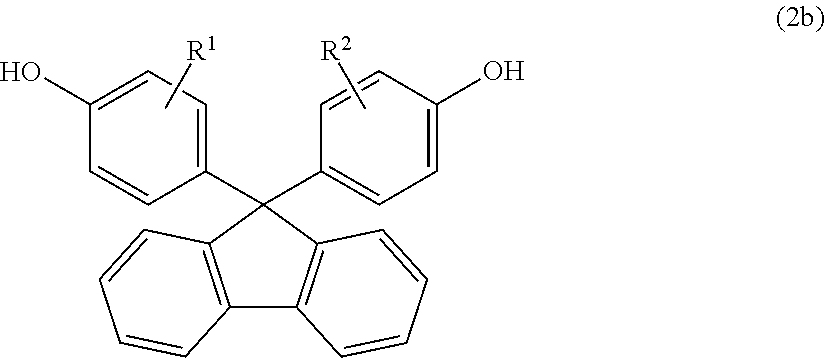
(In formula (2b), R1 and R2 are as defined with respect to formula (2) above.)
ν=(nD−1)/(nF−nC)
Δn=Re/d
Δn=n//−n⊥

[In formula (1), X represents a C1-10 alkylene group.]

[In formula (2):

(In formula (2a), R1 and R2 are as defined with respect to formula (2) above.)

(In formula (2b), R1 and R2 are as defined with respect to formula (2) above.)

(In the formula, Ys each independently represent a single bond, a C1-20 alkyl group, a C1-20 alkoxyl group, a C5-20 cycloalkyl group, a C5-20 cycloalkoxyl group, a C6-20 aryl group or a C6-20 aryloxy group.)

[In formula (1), X represents a C1-10 alkylene group.]

[In formula (2):

(In formula (2a), R1 and R2 are as defined with respect to formula (2) above.)

(In formula (2b), R1 and R2 are as defined with respect to formula (2) above.) Note that details of the compound represented by general formula (2a) or (2b) are as described above.

(In the formula, Ys each independently represent a single bond, a C1-20 alkyl group, a C1-20 alkoxyl group, a C5-20 cycloalkyl group, a C5-20 cycloalkoxyl group, a C6-20 aryl group or a C6-20 aryloxy group.)
[Measurement Conditions]
Apparatus: HLC-8320GPC manufactured by Tosoh Corporation
Column:
-
- Guard column: TSKguardcolumn SuperMPHZ-M×1
- Analysis column: TSKgel SuperMultiporeHZ-M×3
Solvent: tetrahydrofuran
Injection amount: 10 μL
Sample concentration: 0.2 w/v % tetrahydrofuran solution
Flow rate of solvent: 0.35 ml/min
Measurement temperature: 40° C.
Detector: RI
2) Refractive index (nD): The refractive index of a film having a thickness of 0.1 mm made of the polycarbonate resin produced in the Examples was measured according to the method of JIS-K-7142 using an Abbe's refractometer (23° C., wavelength: 589 nm).
3) Abbe number (ν): Refractive indexes of a film having a thickness of 0.1 mm made of the polycarbonate resin produced in the Examples were measured at 23° C. and at wavelengths of 486 nm, 589 nm and 656 nm using an Abbe's refractometer, and the Abbe number was calculated using the below-described formula:
ν=(nD−1)/(nF−nC)
6) Orientation birefringence (Δn): A cast film having a thickness of 0.1 mm was cut into a 5.0×5.0 cm square; after that, both the ends of the film were sandwiched between chucks (distance between the chucks: 3.0 cm); the film was stretched 1.5-fold at a temperature of Tg of the polycarbonate resin+5° C.; the phase difference (Re) at 589 nm was measured using an ellipsometer M-220 manufacture by JASCO Corporation; and after that, the orientation birefringence (Δn) was obtained from the below-described formula:
Δn=Re/d
8) Amounts of residual phenol and residual diphenyl carbonate: 1.0 g of a polycarbonate resin was precisely weighed and dissolved in 10 ml of dichloromethane, and the mixture was gradually added to 100 ml of methanol with stirring to reprecipitate the resin. After the mixture was sufficiently stirred, a precipitate was separated by filtration, a filtrate was concentrated by an evaporator, and 1.0 g of a standard substance solution was precisely weighed and added to the obtained solid. 1 g of chloroform was further added thereto, and the diluted solution was quantified by means of GC-MS.
Standard substance solution: solution of 200 ppm trimethylol phenol in chloroform
Measurement apparatus (GC-MS): Agilent HP6890/5973MSD
Column: capillary column DB-5MS, 30 m×0.25 mm I.D., film thickness: 0.5 μm
Temperature raising conditions: 50° C. (5 min hold) to 300° C. (15 min hold), 10° C./min
Temperature of inlet: 300° C., Amount of injection: 1.0 μl (split ratio: 25)
Ionization method: EI method
Carrier gas: He, 1.0 ml/min
Aux temperature: 300° C.
Mass scanning range: 33 to 700
| TABLE 1 | ||
| Physical properties | ||
| Composition ratio | Total light | Amount of |
| BHEBN | BPEF | BPA | Tg | Td | transmittance | residual phenol | |||||
| mol % | mol % | mol % | Mw | ° C. | ° C. | nD | v | % | ppm | ||
| Example 1 | 30 | 70 | — | 105000 | 141 | 368 | 1.647 | 22 | 89 | 150 |
| Example 2 | 40 | 60 | — | 44000 | 135 | 366 | 1.65 | 22 | 89 | 60 |
| Example 3 | 70 | 30 | — | 56000 | 123 | 363 | 1.659 | 21 | 88 | 120 |
| Example 4 | 90 | 10 | — | 53000 | 120 | 361 | 1.655 | 20 | 88 | 100 |
| Reference | 30 | 70 | — | 4000 | 75 | 324 | — | — | — | 3500 |
| Example 1 | ||||||||||
| Comparative | — | — | 100 | 33000 | 148 | — | 1.589 | 30 | 91 | 0 |
| Example 1 | ||||||||||
| TABLE 2 | ||
| Birefringence | ||
| Composition ratio | Orientation |
| BHEBN | BPEF | BPA | birefringence | birefringence | ||
| mol % | mol % | mol % | (Δn) | sign | ||
| Example 1 | 30 | 70 | — | 0.28 × 10⁻³ | negative |
| Example 2 | 40 | 60 | — | 0.11 × 10⁻³ | negative |
| Example 3 | 70 | 30 | — | 0.02 × 10⁻³ | negative |
| Example 4 | 90 | 10 | — | 0.28 × 10⁻³ | positive |
| Reference | 30 | 70 | — | — | — |
| Example 1 | |||||
| Comparative | — | — | 100 | 9.5 × 10⁻³ | positive |
| Example 1 | |||||
| TABLE 3 | |||
| Orientation birefringence Δn (×10−3) | Evaluation | ||
| 0 to 0.1 | Extremely very small | ||
| More than 0.1 to 0.4 | Very small | ||
| More than 0.4 to 1.0 | Small | ||
| More than 1.0 | Large | ||
| TABLE 4 | ||
| Physical properties | ||
| Composition ratio | Total light |
| BHEBN | BEPF | BPA | Mw | Tg | Td | nD | v | transmittance | ||
| mol % | mol % | mol % | — | ° C. | ° C. | — | — | % | ||
| Example 7 | 10 | 90 | — | 36000 | 152 | 364 | 1.656 | 21 | 87 |
| Example 8 | 30 | 70 | — | 47000 | 145 | 367 | 1.658 | 21 | 87 |
| Example 9 | 40 | 60 | — | 50000 | 141 | 367 | 1.659 | 21 | 87 |
| Example 10 | 70 | 30 | — | 39000 | 129 | 372 | 1.663 | 20 | 86 |
| Example 11 | 90 | 10 | — | 38000 | 120 | 373 | 1.666 | 19 | 86 |
| Comparative | — | — | 100 | 33000 | 148 | — | 1.586 | 30 | 91 |
| Example 2 | |||||||||
| Reference | 70 | 30 | — | 2800 | 54 | 314 | — | — | — |
| Example 2 | |||||||||
| TABLE 5 | ||
| Birefringence | ||
| Composition ratio | Orientation |
| BHEBN | BEPF | BPA | birefringence | birefringence | ||
| mol % | mol % | mol % | (Δn) | sign | ||
| Example 7 | 10 | 90 | — | 0.60 × 10⁻³ | negative |
| Example 8 | 30 | 70 | — | 0.41 × 10⁻³ | negative |
| Example 9 | 40 | 60 | — | 0.29 × 10⁻³ | negative |
| Example 10 | 70 | 30 | — | 0.02 × 10⁻³ | positive |
| Example 11 | 90 | 10 | — | 0.21 × 10⁻³ | positive |
| Comparative | — | — | 100 | 9.5 × 10⁻³ | positive |
| Example 2 | |||||
| Reference | 70 | 30 | — | — | — |
| Example 2 | |||||
| TABLE 6 | |||
| Orientation birefringence Δn (×10−3) | Evaluation | ||
| 0 to 0.1 | Extremely very small | ||
| More than 0.1 to 0.4 | Very small | ||
| More than 0.4 to 1.0 | Small | ||
| More than 1.0 | Large | ||
Mw was calculated from the GPC retention time.
[Measurement Conditions]
Apparatus: HLC-8320GPC manufactured by Tosoh Corporation
Column:
4) Abbe number (ν): The polycarbonate resin composition was press-molded to obtain a molded body (cuboid of 3 mm (thickness)×8 mm×8 mm), and refractive indexes of the molded body were measured at wavelengths of 486 nm, 589 nm and 656 nm using a refractometer (KPR-200) manufactured by Shimadzu Corporation. Further, the Abbe number was calculated using the below-described formula:
ν=(nD−1)/(nF−nC)
A: Slight light leakage was observed.
B: Light leakage was observed.
C: Significant light leakage was observed.
| TABLE 7 | ||||||||
| Example | Example | Example | Comparative | Comparative | Comparative | |||
| Resin composition | Example 13 | Example 14 | 15 | 16 | 17 | Example 4 | Example 5 | Example 6 |
| Parts by weight of resin (A1) | 8.8 | 26.8 | 46 | 66.6 | 88.4 | — | 100 | — |
| Parts by weight of resin (B1) | 91.2 | 73.2 | 54 | 33.4 | 11.6 | — | — | 100 |
| Parts by weight of H4000 | — | — | — | — | — | 100 | — | — |
| Tg (° C.) | 142 | 136 | 128 | 123 | 117 | 146 | 115 | 146 |
| Refractive index nD | 1.642 | 1.646 | 1.652 | 1.659 | 1.665 | 1.586 | 1.668 | 1.639 |
| Abbe number v | 23 | 22 | 21 | 20 | 19 | 30 | 19 | 24 |
| Optical distortion | B | A | A | A | A | C | B | B |
2. Polyester Resin
<Methods for Evaluating Polyester Resins>
[Measurement Conditions]
Apparatus: HLC-8320GPC manufactured by Tosoh Corporation
Column:
ν=(nD−1)/(nF−nC)
| TABLE 8 | |||
| Copolymerization composition ratio | Physical | ||
| Dicarboxylic | Dihydroxy | properties |
| acid component | component | Refractive | |||
| (molar ratio) | (molar ratio) | Tg | index | Abbe |
| DMT | DMI | DMN | FDPT | NDCM | EG | BPEF | BHEBN | (° C.) | (d line/25° C.) | number | ||
| Example 18 | 1.00 | 0.10 | 0.09 | 0.81 | 120 | 1.658 | 20 | ||||
| Example 19 | 1.00 | 0.10 | 0.27 | 0.63 | 124 | 1.652 | 20 | ||||
| Comparative | 1.00 | 0.20 | 0.80 | 122 | 1.634 | 23 | |||||
| Example 7 | |||||||||||
| Comparative | 0.50 | 0.50 | 0.15 | 0.85 | 137 | 1.645 | 22 | ||||
| Example 8 | |||||||||||
| Comparative | 0.75 | 0.25 | 0.15 | 0.85 | 151 | 1.652 | 21 | ||||
| Example 9 | |||||||||||
| Comparative | 0.50 | 0.50 | 0.10 | 0.90 | 150 | 1.650 | 21 | ||||
| Example 10 | |||||||||||
| DMT: dimethyl terephthalate | |||||||||||
| DMI: dimethyl isophthalate | |||||||||||
| DMN: dimethyl 2,6-naphthalenedicarboxylate | |||||||||||
| FDPT: 9,9-di(ethyl t-butoxycarboxylate)fluorene (9,9-di(carboxyethyl)fluorene or di-t-butyl ester of fluorene-9,9-dipropionic acid | |||||||||||
| NDCM: dimethyl naphthalenecarboxylate | |||||||||||
| EG: ethylene glycol | |||||||||||
| BPEF: 9,9-bis[4-(2-hydroxyethoxy)phenyl]fluorene | |||||||||||
| BHEBN: 2,2′-bis(2-hydroxyethoxy)-1,1′-binaphthalene | |||||||||||
3. Polyester Carbonate Resin
<Methods for Evaluating Polyester Carbonate Resins>
[Measurement Conditions]
Apparatus: HLC-8320GPC manufactured by Tosoh Corporation
Column:
4) Abbe number (ν): The polyester carbonate resin was press-molded to obtain a circular plate having a diameter of 40 mm and a thickness of 3 mm, and refractive indexes were measured at wavelengths of 486 nm, 589 nm and 656 nm using a refractometer (KPR-200) manufactured by Shimadzu Device Corporation. Further, the Abbe number was calculated using the below-described formula:
ν=(nD−1)/(nF−nC)
| TABLE 9 | |||
| Copolymerization composition ratio | Evaluation results | ||
| Dicarboxylic | Dihydroxy | Refractive | glass | ||||
| acid component | component | index | Abbe | Molecular | transition | ||
| (mol %) | (mol %) | (d line/25° C.) | number | weight | temperature | Brightness |
| DMT | BHEBN | BHBN | BPEF | nD | v | Mn | Mw | Tg (° C.) | L | ||
| Example 20 | 10 | 40 | 50 | 1.650 | 21 | 16600 | 33000 | 133 | 94.7 | |
| Example 21 | 10 | 40 | 50 | 1.653 | 21 | 12400 | 24200 | 134 | 95.1 | |
| Example 22 | 11 | 80 | 9 | 1.653 | 19 | 6800 | 12400 | 118 | 95.2 | |
| Example 23 | 10 | 9 | 81 | 1.647 | 23 | 16800 | 37000 | 149 | 95.0 | |
| Example 24 | 10 | 25 | 65 | 1.646 | 22 | 16900 | 37100 | 144 | 89.1 | |
| Example 25 | 10 | 55 | 35 | 1.650 | 21 | 17300 | 40600 | 135 | 97.6 | |
| Comparative | 10 | 40 | 50 | — | — | 2600 | 3700 | — | 69.2 | |
| Example 11 | ||||||||||
| Comparative | 10 | 81 | 9 | — | — | 1400 | 1600 | 110 | 26.2 | |
| Example 12 | ||||||||||
| DMT: dimethyl terephthalate, BHEBN: 2,2′-bis(2-hydroxyethoxy)-1,1′-binaphthalene | ||||||||||
| BHBN: 2,2′-bis(2-hydroxy)-1,1′-binaphthalene | ||||||||||
| BPEF: 9,9-bis[4-(2-hydroxyethoxy)phenyl]fluorene | ||||||||||
Claims (4)
Applications Claiming Priority (3)
| Application Number | Priority Date | Filing Date | Title |
|---|---|---|---|
| JP2014-096100 | 2014-05-07 | ||
| JP2014096100 | 2014-05-07 | ||
| PCT/JP2015/063143 WO2015170691A1 (en) | 2014-05-07 | 2015-05-01 | Resin produced by polycondensation, and resin composition |
Related Parent Applications (1)
| Application Number | Title | Priority Date | Filing Date |
|---|---|---|---|
| PCT/JP2015/063143 A-371-Of-International WO2015170691A1 (en) | 2014-05-07 | 2015-05-01 | Resin produced by polycondensation, and resin composition |
Related Child Applications (1)
| Application Number | Title | Priority Date | Filing Date |
|---|---|---|---|
| US16/800,130 Division US11370882B2 (en) | 2014-05-07 | 2020-02-25 | Resin produced by polycondensation, and resin composition |
Publications (2)
| Publication Number | Publication Date |
|---|---|
| US20170044312A1 US20170044312A1 (en) | 2017-02-16 |
| US10689486B2 true US10689486B2 (en) | 2020-06-23 |
Family
ID=54392541
Family Applications (3)
| Application Number | Title | Priority Date | Filing Date |
|---|---|---|---|
| US15/306,638 Active 2035-06-10 US10689486B2 (en) | 2014-05-07 | 2015-05-01 | Resin produced by polycondensation, and resin composition |
| US16/800,130 Active 2035-11-21 US11370882B2 (en) | 2014-05-07 | 2020-02-25 | Resin produced by polycondensation, and resin composition |
| US17/745,289 Pending US20220282038A1 (en) | 2014-05-07 | 2022-05-16 | Resin produced by polycondensation, and resin composition |
Family Applications After (2)
| Application Number | Title | Priority Date | Filing Date |
|---|---|---|---|
| US16/800,130 Active 2035-11-21 US11370882B2 (en) | 2014-05-07 | 2020-02-25 | Resin produced by polycondensation, and resin composition |
| US17/745,289 Pending US20220282038A1 (en) | 2014-05-07 | 2022-05-16 | Resin produced by polycondensation, and resin composition |
Country Status (7)
| Country | Link |
|---|---|
| US (3) | US10689486B2 (en) |
| EP (2) | EP3141570B1 (en) |
| JP (2) | JP6631514B2 (en) |
| KR (1) | KR102289075B1 (en) |
| CN (2) | CN106255712B (en) |
| TW (1) | TWI662059B (en) |
| WO (1) | WO2015170691A1 (en) |
Cited By (2)
| Publication number | Priority date | Publication date | Assignee | Title |
|---|---|---|---|---|
| US10816699B2 (en) * | 2014-12-04 | 2020-10-27 | Mitsubishi Gas Chemical Company, Inc. | Functional sheet including polyester resin, and lens using functional sheet |
| US11110688B2 (en) * | 2018-07-05 | 2021-09-07 | Toray Plastics (America), Inc. | Anti-blush and chemical resistant polyester film |
Families Citing this family (32)
| Publication number | Priority date | Publication date | Assignee | Title |
|---|---|---|---|---|
| US10640642B2 (en) * | 2015-11-04 | 2020-05-05 | Mitsubishi Gas Chemical Company, Inc. | Method for producing resin composition |
| CN106916288B (en) * | 2015-12-24 | 2019-08-30 | 远东新世纪股份有限公司 | modified copolyester composition |
| WO2017146023A1 (en) * | 2016-02-24 | 2017-08-31 | 富士フイルム株式会社 | Polycarbonate resin, molded body, optical component, and lens |
| JP6680650B2 (en) * | 2016-08-30 | 2020-04-15 | 帝人株式会社 | Polyester resin |
| US10913848B2 (en) | 2017-03-31 | 2021-02-09 | Mitsubishi Gas Chemical Company, Inc. | Polycarbonate resin composition and optical lens using same |
| TWI830267B (en) * | 2017-08-30 | 2024-01-21 | 日商三菱瓦斯化學股份有限公司 | Polycarbonate resin, method for producing the same, and optical lens |
| US11261294B2 (en) | 2017-08-30 | 2022-03-01 | Teijin Limited | Thermoplastic resin and optical member |
| KR102499266B1 (en) * | 2017-10-19 | 2023-02-13 | 삼성전자주식회사 | Display apparatus |
| CN108131632A (en) * | 2017-12-13 | 2018-06-08 | 柏涛涛 | A kind of intelligent solar street light |
| CN111527125B (en) * | 2017-12-28 | 2022-07-22 | 帝人株式会社 | Poly (ester) carbonate and method for producing poly (ester) carbonate |
| CN111630109B (en) * | 2018-01-23 | 2023-03-28 | 三菱瓦斯化学株式会社 | Polycarbonate resin composition, method for producing same, and optical lens |
| KR102415803B1 (en) | 2018-03-12 | 2022-06-30 | 데이진 가부시키가이샤 | Polyester resin or polyester carbonate resin, and optical member using the resin |
| WO2019188702A1 (en) | 2018-03-30 | 2019-10-03 | 帝人株式会社 | Polycarbonate resin and optical member containing same |
| JP7342878B2 (en) * | 2018-10-16 | 2023-09-12 | 三菱瓦斯化学株式会社 | Polyester carbonate resin and optical lenses |
| CN112955422B (en) * | 2018-10-19 | 2023-08-22 | 三菱瓦斯化学株式会社 | polycyclic compound |
| CN113272376A (en) * | 2018-12-27 | 2021-08-17 | 三菱瓦斯化学株式会社 | Resin composition, molded body, optical lens, and optical lens unit |
| US12281198B2 (en) | 2019-02-27 | 2025-04-22 | Teijin Limited | Thermoplastic resin and optical member |
| CN114375313A (en) * | 2019-07-19 | 2022-04-19 | 帝人株式会社 | Thermoplastic resin and optical member comprising the same |
| JP7512757B2 (en) * | 2020-08-13 | 2024-07-09 | 三菱瓦斯化学株式会社 | Resin composition, and optical lens and optical film containing same |
| CN116457415B (en) * | 2020-10-27 | 2025-07-01 | 帝人株式会社 | Thermoplastic resin and optical component comprising the same |
| CN112961336B (en) * | 2021-04-09 | 2023-01-13 | 万华化学集团股份有限公司 | Polycarbonate resin with stable high refractive index, preparation method and application thereof |
| EP4443199A4 (en) * | 2021-11-30 | 2025-03-26 | Mitsubishi Gas Chemical Company, Inc. | OPTICAL LENS WITH THERMOPLASTIC RESIN |
| TW202344557A (en) | 2022-02-16 | 2023-11-16 | 日商三菱瓦斯化學股份有限公司 | Curable resin, cured product thereof, resin composition, and method for producing curable resin |
| EP4480987A4 (en) | 2022-02-16 | 2026-02-18 | Mitsubishi Gas Chemical Co | METHOD FOR PRODUCING A HOLDING RESIN |
| TWI885506B (en) * | 2022-10-05 | 2025-06-01 | 南韓商Lg化學股份有限公司 | Polycarbonate resin and preparation method thereof |
| CN115716912B (en) * | 2022-11-04 | 2023-09-19 | 万华化学集团股份有限公司 | A yellowing-resistant thermoplastic resin composition and its preparation method and application |
| CN115926135B (en) * | 2022-11-17 | 2024-08-20 | 万华化学集团股份有限公司 | A thermoplastic resin composition for optical forming body and a method for producing the same |
| WO2024184503A1 (en) * | 2023-03-09 | 2024-09-12 | Reuter Chemische Apparatebau E.K. | Sulfur-containing heterocyclic compounds and thermoplastic resins |
| EP4715010A1 (en) * | 2023-05-18 | 2026-03-25 | Mitsubishi Gas Chemical Company, Inc. | Thermoplastic resin composition and optical lens including same |
| CN121693528A (en) * | 2023-11-24 | 2026-03-17 | 大阪燃气化学有限公司 | Polyester resin, process for producing the same, and use thereof |
| CN118909238B (en) * | 2023-11-29 | 2025-07-15 | 万华化学集团股份有限公司 | High-refractive-index polycarbonate resin and preparation method and application thereof |
| WO2026023510A1 (en) * | 2024-07-23 | 2026-01-29 | 三菱瓦斯化学株式会社 | Polycarbonate resin composition and method for producing same |
Citations (20)
| Publication number | Priority date | Publication date | Assignee | Title |
|---|---|---|---|---|
| US5530086A (en) * | 1992-07-30 | 1996-06-25 | Kanebo, Ltd. | Polyester containing 9,9-bis(4-(2-hydroxyalkoxy)phenyl fluorene |
| JPH09302077A (en) | 1996-05-17 | 1997-11-25 | Kanebo Ltd | Polyester polymer and molded product thereof |
| JP2000302857A (en) | 1999-04-21 | 2000-10-31 | Mitsubishi Gas Chem Co Inc | Molding material for optical recording media |
| JP2001072872A (en) | 1999-07-02 | 2001-03-21 | Konica Corp | Resin composition and optical lens |
| JP2002332345A (en) | 2001-05-08 | 2002-11-22 | Konica Corp | Resin composition and optical lens |
| JP2006335974A (en) | 2005-06-06 | 2006-12-14 | Kanebo Ltd | Polyester resin composition and optical component |
| JP2007057916A (en) | 2005-08-25 | 2007-03-08 | Mitsubishi Gas Chem Co Inc | Optical lens |
| WO2007142149A1 (en) | 2006-06-05 | 2007-12-13 | Mitsubishi Gas Chemical Company, Inc. | Optical lens |
| JP2009067681A (en) | 2007-09-10 | 2009-04-02 | Mitsubishi Chemicals Corp | Process for producing bisphenyl fluorenedicarboxylic acid diester, and polymer obtained by polymerizing the same |
| JP2010100770A (en) | 2008-10-27 | 2010-05-06 | Mitsubishi Gas Chemical Co Inc | Method for producing thermoplastic resin, polyester resin and polycarbonate resin, and use of them |
| JP2010241947A (en) | 2009-04-06 | 2010-10-28 | Mitsubishi Gas Chemical Co Inc | POLYCARBONATE RESIN COMPOSITION, METHOD FOR PRODUCING MOLDED ARTICLE USING SAME, AND MOLDED ARTICLE |
| JP2010248445A (en) | 2009-04-20 | 2010-11-04 | Mitsubishi Gas Chemical Co Inc | Polycarbonate resin composition |
| JP2011168722A (en) | 2010-02-19 | 2011-09-01 | Osaka Gas Chem Kk | Polyester resin having fluorene skeleton |
| JP2012077266A (en) | 2010-10-06 | 2012-04-19 | Teijin Chem Ltd | Thermoplastic resin comprising fluorene derivative, and melt polymerization method thereof |
| WO2012099261A1 (en) | 2011-01-19 | 2012-07-26 | 帝人化成株式会社 | Polyester carbonate copolymer and production method therefor |
| JP2013064117A (en) * | 2011-08-29 | 2013-04-11 | Osaka Gas Chem Kk | Polyester resin having fluorene skeleton |
| JP2013064119A (en) | 2011-08-29 | 2013-04-11 | Osaka Gas Chem Kk | Polyester resin having fluorene skeleton |
| WO2014073496A1 (en) | 2012-11-07 | 2014-05-15 | 三菱瓦斯化学株式会社 | Polycarbonate resin, production method therefor, and optical molded body |
| JP2014185325A (en) | 2013-02-20 | 2014-10-02 | Teijin Ltd | Polycarbonate copolymer |
| JP2014221865A (en) | 2013-05-13 | 2014-11-27 | 帝人株式会社 | Polyester carbonate copolymer |
Family Cites Families (11)
| Publication number | Priority date | Publication date | Assignee | Title |
|---|---|---|---|---|
| US5043237A (en) * | 1990-01-12 | 1991-08-27 | E. I. Du Pont De Nemours And Company | Inhibitor-containing photohardenable electrostatic master compositions having improved resolution |
| IL115803A (en) * | 1994-11-03 | 2000-02-17 | Ppg Industries Inc | Indeno-naphthopyran derivatives useful for photochromic articles |
| US5723072A (en) * | 1996-06-17 | 1998-03-03 | Ppg Industries, Inc. | Photochromic heterocyclic fused indenonaphthopyrans |
| US5955520A (en) * | 1996-06-17 | 1999-09-21 | Ppg Industries, Inc. | Photochromic indeno-fused naphthopyrans |
| JPH1087800A (en) * | 1996-09-10 | 1998-04-07 | Teijin Chem Ltd | Polyester carbonate resin |
| CN1234796A (en) * | 1996-10-02 | 1999-11-10 | Ppg工业公司 | New substituted naphthopyran compounds |
| US6946227B2 (en) * | 2002-11-20 | 2005-09-20 | Xerox Corporation | Imaging members |
| JP4281998B2 (en) * | 2003-06-06 | 2009-06-17 | 三菱瓦斯化学株式会社 | Polycarbonate resin composition |
| JP5005949B2 (en) * | 2006-05-01 | 2012-08-22 | 出光興産株式会社 | Polycarbonate resin composition, optical molded product and lighting unit |
| WO2010010703A1 (en) * | 2008-07-25 | 2010-01-28 | 三菱瓦斯化学株式会社 | Polycarbonate resin composition and optical material using the same |
| JP6512219B2 (en) * | 2014-05-02 | 2019-05-15 | 三菱瓦斯化学株式会社 | Polycarbonate resin composition, and optical material and optical lens using the same |
-
2015
- 2015-05-01 KR KR1020167023960A patent/KR102289075B1/en active Active
- 2015-05-01 EP EP15789371.0A patent/EP3141570B1/en active Active
- 2015-05-01 US US15/306,638 patent/US10689486B2/en active Active
- 2015-05-01 JP JP2016517907A patent/JP6631514B2/en active Active
- 2015-05-01 CN CN201580022948.XA patent/CN106255712B/en active Active
- 2015-05-01 WO PCT/JP2015/063143 patent/WO2015170691A1/en not_active Ceased
- 2015-05-01 CN CN201811501106.4A patent/CN109593196B/en active Active
- 2015-05-01 EP EP18201503.2A patent/EP3483197A1/en not_active Withdrawn
- 2015-05-04 TW TW104114090A patent/TWI662059B/en active
-
2019
- 2019-11-18 JP JP2019207891A patent/JP6908092B2/en active Active
-
2020
- 2020-02-25 US US16/800,130 patent/US11370882B2/en active Active
-
2022
- 2022-05-16 US US17/745,289 patent/US20220282038A1/en active Pending
Patent Citations (28)
| Publication number | Priority date | Publication date | Assignee | Title |
|---|---|---|---|---|
| US5530086A (en) * | 1992-07-30 | 1996-06-25 | Kanebo, Ltd. | Polyester containing 9,9-bis(4-(2-hydroxyalkoxy)phenyl fluorene |
| JPH09302077A (en) | 1996-05-17 | 1997-11-25 | Kanebo Ltd | Polyester polymer and molded product thereof |
| US6066711A (en) | 1996-05-17 | 2000-05-23 | Kanebo, Ltd. | Polyester polymer and its moldings |
| JP2000302857A (en) | 1999-04-21 | 2000-10-31 | Mitsubishi Gas Chem Co Inc | Molding material for optical recording media |
| JP2001072872A (en) | 1999-07-02 | 2001-03-21 | Konica Corp | Resin composition and optical lens |
| JP2002332345A (en) | 2001-05-08 | 2002-11-22 | Konica Corp | Resin composition and optical lens |
| JP2006335974A (en) | 2005-06-06 | 2006-12-14 | Kanebo Ltd | Polyester resin composition and optical component |
| JP2007057916A (en) | 2005-08-25 | 2007-03-08 | Mitsubishi Gas Chem Co Inc | Optical lens |
| WO2007142149A1 (en) | 2006-06-05 | 2007-12-13 | Mitsubishi Gas Chemical Company, Inc. | Optical lens |
| US20100048855A1 (en) | 2006-06-05 | 2010-02-25 | Noriyuki Kato | Optical Lens |
| JP2009067681A (en) | 2007-09-10 | 2009-04-02 | Mitsubishi Chemicals Corp | Process for producing bisphenyl fluorenedicarboxylic acid diester, and polymer obtained by polymerizing the same |
| JP2010100770A (en) | 2008-10-27 | 2010-05-06 | Mitsubishi Gas Chemical Co Inc | Method for producing thermoplastic resin, polyester resin and polycarbonate resin, and use of them |
| US20100144995A1 (en) | 2008-10-27 | 2010-06-10 | Mitsubishi Gas Chemical Company, Inc. | Method for producing thermoplastic resin, polyester resin and polycarbonate resin, and their applications |
| JP2010241947A (en) | 2009-04-06 | 2010-10-28 | Mitsubishi Gas Chemical Co Inc | POLYCARBONATE RESIN COMPOSITION, METHOD FOR PRODUCING MOLDED ARTICLE USING SAME, AND MOLDED ARTICLE |
| US20120116000A1 (en) | 2009-04-06 | 2012-05-10 | Mitsubishi Gas Chemical Company, Inc. | Polycarbonate resin composition, and process for producing molded products and optical lens using the same |
| JP2010248445A (en) | 2009-04-20 | 2010-11-04 | Mitsubishi Gas Chemical Co Inc | Polycarbonate resin composition |
| US20120095139A1 (en) | 2009-04-20 | 2012-04-19 | Mitsubishi Gas Chemical Company, Inc. | Polycarbonate resin composition, process for producing molded products using the same, and optical lens |
| JP2011168722A (en) | 2010-02-19 | 2011-09-01 | Osaka Gas Chem Kk | Polyester resin having fluorene skeleton |
| JP2012077266A (en) | 2010-10-06 | 2012-04-19 | Teijin Chem Ltd | Thermoplastic resin comprising fluorene derivative, and melt polymerization method thereof |
| WO2012099261A1 (en) | 2011-01-19 | 2012-07-26 | 帝人化成株式会社 | Polyester carbonate copolymer and production method therefor |
| TW201242989A (en) | 2011-01-19 | 2012-11-01 | Teijin Chemicals Ltd | Polyester carbonate copolymer and production method therefor |
| JP2013064117A (en) * | 2011-08-29 | 2013-04-11 | Osaka Gas Chem Kk | Polyester resin having fluorene skeleton |
| JP2013064119A (en) | 2011-08-29 | 2013-04-11 | Osaka Gas Chem Kk | Polyester resin having fluorene skeleton |
| WO2014073496A1 (en) | 2012-11-07 | 2014-05-15 | 三菱瓦斯化学株式会社 | Polycarbonate resin, production method therefor, and optical molded body |
| EP2918621A1 (en) | 2012-11-07 | 2015-09-16 | Mitsubishi Gas Chemical Company, Inc. | Polycarbonate resin, production method therefor, and optical molded body |
| US20150285954A1 (en) | 2012-11-07 | 2015-10-08 | Mitsubishi Gas Chemical Company, Inc. | Polycarbonate resin, production method therefor, and optical molded body |
| JP2014185325A (en) | 2013-02-20 | 2014-10-02 | Teijin Ltd | Polycarbonate copolymer |
| JP2014221865A (en) | 2013-05-13 | 2014-11-27 | 帝人株式会社 | Polyester carbonate copolymer |
Non-Patent Citations (5)
| Title |
|---|
| Extended European Search Report issued in Patent Application No. 15789371.0, dated Dec. 12, 2017. |
| International Search Report issued in Patent Application No. PCT/JP2015/063143, dated Jun. 2, 2015. |
| JP 2001-072872 A, machine translation, JPO Japan Platform for Patent Information (J-PlatPat). (Year: 2001). * |
| JP 2013-064117 A, machine translation, EPO espacnet. (Year: 2013). * |
| Toshikazu Tanaka et al., "Optically Active Poly (aryl carbonates) Consisting of Axially Chiral Units. Chiral Binaphthyl Group Induced Helical Polymer"; Journal of the American Chemical Society, vol. 120, No. 18; May 1, 1998; pp. 4530-4531. |
Cited By (2)
| Publication number | Priority date | Publication date | Assignee | Title |
|---|---|---|---|---|
| US10816699B2 (en) * | 2014-12-04 | 2020-10-27 | Mitsubishi Gas Chemical Company, Inc. | Functional sheet including polyester resin, and lens using functional sheet |
| US11110688B2 (en) * | 2018-07-05 | 2021-09-07 | Toray Plastics (America), Inc. | Anti-blush and chemical resistant polyester film |
Also Published As
| Publication number | Publication date |
|---|---|
| WO2015170691A1 (en) | 2015-11-12 |
| JP6631514B2 (en) | 2020-01-15 |
| CN106255712B (en) | 2018-12-18 |
| EP3141570A1 (en) | 2017-03-15 |
| US11370882B2 (en) | 2022-06-28 |
| KR20170005792A (en) | 2017-01-16 |
| US20220282038A1 (en) | 2022-09-08 |
| EP3141570B1 (en) | 2018-12-05 |
| EP3141570A4 (en) | 2018-01-10 |
| EP3483197A1 (en) | 2019-05-15 |
| KR102289075B1 (en) | 2021-08-11 |
| US20170044312A1 (en) | 2017-02-16 |
| TWI662059B (en) | 2019-06-11 |
| JPWO2015170691A1 (en) | 2017-04-20 |
| JP6908092B2 (en) | 2021-07-21 |
| TW201546110A (en) | 2015-12-16 |
| CN106255712A (en) | 2016-12-21 |
| JP2020045492A (en) | 2020-03-26 |
| CN109593196A (en) | 2019-04-09 |
| CN109593196B (en) | 2021-08-13 |
| US20200190259A1 (en) | 2020-06-18 |
Similar Documents
| Publication | Publication Date | Title |
|---|---|---|
| US11370882B2 (en) | Resin produced by polycondensation, and resin composition | |
| CN108329464B (en) | Polycarbonate resin, process for producing the same, and optical molded article | |
| KR102678028B1 (en) | Dihydroxy compound | |
| US10711100B2 (en) | Dihydroxy compound | |
| WO2018016516A1 (en) | Polycarbonate resin, method for producing same, and optical lens | |
| US20250092194A1 (en) | Polycarbonate resin, and optical lens and optical film using same | |
| HK1234427A1 (en) | Resin produced by polycondensation, and resin composition | |
| HK1234427B (en) | Resin produced by polycondensation, and resin composition | |
| HK1228939A1 (en) | Resin produced by polycondensation, and resin composition | |
| HK1211970B (en) | Polycarbonate resin, production method therefor, and optical molded body |
Legal Events
| Date | Code | Title | Description |
|---|---|---|---|
| AS | Assignment |
Owner name: MITSUBISHI GAS CHEMICAL COMPANY, INC., JAPAN Free format text: ASSIGNMENT OF ASSIGNORS INTEREST;ASSIGNORS:KATO, NORIYUKI;ISHIZUKA, HIROHITO;SHIRATAKE, MUNENORI;AND OTHERS;SIGNING DATES FROM 20160520 TO 20160524;REEL/FRAME:040122/0321 |
|
| STPP | Information on status: patent application and granting procedure in general |
Free format text: FINAL REJECTION MAILED |
|
| STPP | Information on status: patent application and granting procedure in general |
Free format text: ADVISORY ACTION MAILED |
|
| STPP | Information on status: patent application and granting procedure in general |
Free format text: DOCKETED NEW CASE - READY FOR EXAMINATION |
|
| STPP | Information on status: patent application and granting procedure in general |
Free format text: NON FINAL ACTION MAILED |
|
| STPP | Information on status: patent application and granting procedure in general |
Free format text: RESPONSE TO NON-FINAL OFFICE ACTION ENTERED AND FORWARDED TO EXAMINER |
|
| STPP | Information on status: patent application and granting procedure in general |
Free format text: NOTICE OF ALLOWANCE MAILED -- APPLICATION RECEIVED IN OFFICE OF PUBLICATIONS |
|
| STPP | Information on status: patent application and granting procedure in general |
Free format text: PUBLICATIONS -- ISSUE FEE PAYMENT RECEIVED |
|
| STCF | Information on status: patent grant |
Free format text: PATENTED CASE |
|
| MAFP | Maintenance fee payment |
Free format text: PAYMENT OF MAINTENANCE FEE, 4TH YEAR, LARGE ENTITY (ORIGINAL EVENT CODE: M1551); ENTITY STATUS OF PATENT OWNER: LARGE ENTITY Year of fee payment: 4 |