US10686139B2 - Nitrogen-containing compound and organic electroluminescence device including the same - Google Patents
Nitrogen-containing compound and organic electroluminescence device including the same Download PDFInfo
- Publication number
- US10686139B2 US10686139B2 US15/378,084 US201615378084A US10686139B2 US 10686139 B2 US10686139 B2 US 10686139B2 US 201615378084 A US201615378084 A US 201615378084A US 10686139 B2 US10686139 B2 US 10686139B2
- Authority
- US
- United States
- Prior art keywords
- formula
- nitrogen
- containing compound
- represented
- substituted
- Prior art date
- Legal status (The legal status is an assumption and is not a legal conclusion. Google has not performed a legal analysis and makes no representation as to the accuracy of the status listed.)
- Active, expires
Links
- 0 C.C*C.C1=CC=CC=C1 Chemical compound C.C*C.C1=CC=CC=C1 0.000 description 31
- CRSOQBOWXPBRES-UHFFFAOYSA-N CC(C)(C)C Chemical compound CC(C)(C)C CRSOQBOWXPBRES-UHFFFAOYSA-N 0.000 description 8
- GMILNSKRIUMDOU-UHFFFAOYSA-N C1=CC2=C(C=C1)N(C1=CC3=C(C=C1)N(C1=CC=C(C4=C(C5=CC=C(N6C7=C(C=CC=C7)C7=C6/C=C\C(N6C8=C(C=CC=C8)C8=C6C=CC=C8)=C/7)C=C5)N=CC=N4)C=C1)C1=C3C=CC=C1)C1=C2C=CC=C1.C1=CC=C(C2=NC(C3=CC=C(N4C5=C(C=CC=C5)C(C5=CC=CC=C5)(C5=CC=CC=C5)C5=C4C=CC=C5)C=C3)=CC(C3=CC=C(N4C5=C(C=CC=C5)C(C5=CC=CC=C5)(C5=CC=CC=C5)C5=C4C=CC=C5)C=C3)=N2)C=C1.CC1=C(C2=CC=C(N3C4=C(C=CC=C4)C(C)(C)C4=C3C=CC=C4)C=C2)N=C(C2=CC=CC=C2)N=C1C1=CC=C(N2C3=C(C=CC=C3)C(C)(C)C3=C2C=CC=C3)C=C1.CC1=C(C2=CC=C(N3C4=C(C=CC=C4)C(C)(C)C4=C3C=CC=C4)C=C2)N=CN=C1C1=CC=C(N2C3=C(C=CC=C3)C(C)(C)C3=C2C=CC=C3)C=C1.CC1=C(C2=CC=C(N3C4=C(C=CC=C4)C(C4=CC=CC=C4)(C4=CC=CC=C4)C4=C3C=CC=C4)C=C2)N=C(C2=CC=CC=C2)N=C1C1=CC=C(N2C3=C(C=CC=C3)C(C3=CC=CC=C3)(C3=CC=CC=C3)C3=C2C=CC=C3)C=C1.CC1=C(C2=CC=C(N3C4=C(C=CC=C4)C(C4=CC=CC=C4)(C4=CC=CC=C4)C4=C3C=CC=C4)C=C2)N=CN=C1C1=CC=C(N2C3=C(C=CC=C3)C(C3=CC=CC=C3)(C3=CC=CC=C3)C3=C2C=CC=C3)C=C1 Chemical compound C1=CC2=C(C=C1)N(C1=CC3=C(C=C1)N(C1=CC=C(C4=C(C5=CC=C(N6C7=C(C=CC=C7)C7=C6/C=C\C(N6C8=C(C=CC=C8)C8=C6C=CC=C8)=C/7)C=C5)N=CC=N4)C=C1)C1=C3C=CC=C1)C1=C2C=CC=C1.C1=CC=C(C2=NC(C3=CC=C(N4C5=C(C=CC=C5)C(C5=CC=CC=C5)(C5=CC=CC=C5)C5=C4C=CC=C5)C=C3)=CC(C3=CC=C(N4C5=C(C=CC=C5)C(C5=CC=CC=C5)(C5=CC=CC=C5)C5=C4C=CC=C5)C=C3)=N2)C=C1.CC1=C(C2=CC=C(N3C4=C(C=CC=C4)C(C)(C)C4=C3C=CC=C4)C=C2)N=C(C2=CC=CC=C2)N=C1C1=CC=C(N2C3=C(C=CC=C3)C(C)(C)C3=C2C=CC=C3)C=C1.CC1=C(C2=CC=C(N3C4=C(C=CC=C4)C(C)(C)C4=C3C=CC=C4)C=C2)N=CN=C1C1=CC=C(N2C3=C(C=CC=C3)C(C)(C)C3=C2C=CC=C3)C=C1.CC1=C(C2=CC=C(N3C4=C(C=CC=C4)C(C4=CC=CC=C4)(C4=CC=CC=C4)C4=C3C=CC=C4)C=C2)N=C(C2=CC=CC=C2)N=C1C1=CC=C(N2C3=C(C=CC=C3)C(C3=CC=CC=C3)(C3=CC=CC=C3)C3=C2C=CC=C3)C=C1.CC1=C(C2=CC=C(N3C4=C(C=CC=C4)C(C4=CC=CC=C4)(C4=CC=CC=C4)C4=C3C=CC=C4)C=C2)N=CN=C1C1=CC=C(N2C3=C(C=CC=C3)C(C3=CC=CC=C3)(C3=CC=CC=C3)C3=C2C=CC=C3)C=C1 GMILNSKRIUMDOU-UHFFFAOYSA-N 0.000 description 3
- RSKVHHYDQLCQHU-UHFFFAOYSA-N C1=CC=C(C2(C3=CC=CC=C3)C3=C(C=CC=C3)N(C3=CC=C(C4=NC=CC=N4)C=C3)C3=C2C=CC=C3)C=C1.C1=CC=C([Ge]2(C3=CC=CC=C3)C3=C(C=CC=C3)N(C3=CC=C(C4=NC=CC=N4)C=C3)C3=C2C=CC=C3)C=C1.C1=CC=C([Si]2(C3=CC=CC=C3)C3=C(C=CC=C3)N(C3=CC=C(C4=NC=CC=N4)C=C3)C3=C2C=CC=C3)C=C1.C1=CN=C(C2=CC=C(N3C4=C(C=CC=C4)[Si]4(C5=C(C=CC=C5)C5=C4/C=C\C=C/5)C4=C3C=CC=C4)C=C2)N=C1.CC1=CC2=C(C=C1)N(C1=CC=C(C3=NC(C4=CC=CC=C4)=CC(C4=CC=CC=C4)=N3)C=C1)C1=C(C=C(C)C=C1)C21C2=C(C=CC=C2)C2=C1/C=C\C=C/2.CC1=CC2=C(C=C1)N(C1=CC=C(C3=NC=CC=N3)C=C1)C1=C(C=C(C)C=C1)C21C2=C(C=CC=C2)OC2=C1C=CC=C2.CC1=NC(C2=CC=C(N3C4=CC=CC=C4C(C4=CC=CC=C4)(C4=CC=CC=C4)C4=C3C=CC=C4)C=C2)=C(C)C(C2=CC=C(N3C4=C(C=CC=C4)C(C4=CC=CC=C4)(C4=CC=CC=C4)C4=C3C=CC=C4)C=C2)=N1.O=P1(C2=CC=CC=C2)C2=C(C=CC=C2)N(C2=CC=C(C3=NC=CC=N3)C=C2)C2=C1C=CC=C2 Chemical compound C1=CC=C(C2(C3=CC=CC=C3)C3=C(C=CC=C3)N(C3=CC=C(C4=NC=CC=N4)C=C3)C3=C2C=CC=C3)C=C1.C1=CC=C([Ge]2(C3=CC=CC=C3)C3=C(C=CC=C3)N(C3=CC=C(C4=NC=CC=N4)C=C3)C3=C2C=CC=C3)C=C1.C1=CC=C([Si]2(C3=CC=CC=C3)C3=C(C=CC=C3)N(C3=CC=C(C4=NC=CC=N4)C=C3)C3=C2C=CC=C3)C=C1.C1=CN=C(C2=CC=C(N3C4=C(C=CC=C4)[Si]4(C5=C(C=CC=C5)C5=C4/C=C\C=C/5)C4=C3C=CC=C4)C=C2)N=C1.CC1=CC2=C(C=C1)N(C1=CC=C(C3=NC(C4=CC=CC=C4)=CC(C4=CC=CC=C4)=N3)C=C1)C1=C(C=C(C)C=C1)C21C2=C(C=CC=C2)C2=C1/C=C\C=C/2.CC1=CC2=C(C=C1)N(C1=CC=C(C3=NC=CC=N3)C=C1)C1=C(C=C(C)C=C1)C21C2=C(C=CC=C2)OC2=C1C=CC=C2.CC1=NC(C2=CC=C(N3C4=CC=CC=C4C(C4=CC=CC=C4)(C4=CC=CC=C4)C4=C3C=CC=C4)C=C2)=C(C)C(C2=CC=C(N3C4=C(C=CC=C4)C(C4=CC=CC=C4)(C4=CC=CC=C4)C4=C3C=CC=C4)C=C2)=N1.O=P1(C2=CC=CC=C2)C2=C(C=CC=C2)N(C2=CC=C(C3=NC=CC=N3)C=C2)C2=C1C=CC=C2 RSKVHHYDQLCQHU-UHFFFAOYSA-N 0.000 description 3
- JRCAEUMGCCIIGV-UHFFFAOYSA-N C1=CC=C(C2=C(C3=CC=C(N4C5=C(C=CC=C5)C5=C4/C=C\C(N4C6=C(C=CC=C6)C6=C4C=CC=C6)=C/5)C=C3)N=CC=N2)C=C1.C1=CC=C(C2=CC(C3=CC=CC=C3)=NC(C3=CC=C(N4C5=C(C=CC=C5)C5(C6=C(C=CC=C6)C6=C5/C=C\C=C/6)C5=C4C=CC=C5)C=C3)=N2)C=C1.C1=CC=C(C2=CC3=C(C=C2)N(C2=CC=C(C4=NC=CC=N4)C=C2)C2=C(C=C(C4=CC=CC=C4)C=C2)C32C3=C(C=CC=C3)C3=C2/C=C\C=C/3)C=C1.C1=CC=C(C2=NC(C3=CC=C(N4C5=C(C=CC=C5)C(C5=CC=CC=C5)(C5=CC=CC=C5)C5=C4C=CC=C5)C=C3)=CN=C2)C=C1.C1=CN=C(C2=CC=C(N3C4=C(C=CC=C4)C4(C5=C(C=CC=C5)C5=C4/C=C\C=C/5)C4=C3C=CC=C4)C=C2)N=C1.C1=CN=C(C2=CC=C(N3C4=C(C=CC=C4)C4(C5=C(C=CC=C5)OC5=C4C=CC=C5)C4=C3C=CC=C4)C=C2)N=C1.CC1=C(C2=CC=CC=C2)N=C(C2=CC=CC=C2)N=C1C1=CC=C(N2C3=C(C=CC=C3)C(C3=CC=CC=C3)(C3=CC=CC=C3)C3=C2C=CC=C3)C=C1.CC1=CC2=C(C=C1)N(C1=CC=C(C3=NC=CC=N3)C=C1)C1=C(C=C(C)C=C1)C21C2=C(C=CC=C2)C2=C1/C=C\C=C/2 Chemical compound C1=CC=C(C2=C(C3=CC=C(N4C5=C(C=CC=C5)C5=C4/C=C\C(N4C6=C(C=CC=C6)C6=C4C=CC=C6)=C/5)C=C3)N=CC=N2)C=C1.C1=CC=C(C2=CC(C3=CC=CC=C3)=NC(C3=CC=C(N4C5=C(C=CC=C5)C5(C6=C(C=CC=C6)C6=C5/C=C\C=C/6)C5=C4C=CC=C5)C=C3)=N2)C=C1.C1=CC=C(C2=CC3=C(C=C2)N(C2=CC=C(C4=NC=CC=N4)C=C2)C2=C(C=C(C4=CC=CC=C4)C=C2)C32C3=C(C=CC=C3)C3=C2/C=C\C=C/3)C=C1.C1=CC=C(C2=NC(C3=CC=C(N4C5=C(C=CC=C5)C(C5=CC=CC=C5)(C5=CC=CC=C5)C5=C4C=CC=C5)C=C3)=CN=C2)C=C1.C1=CN=C(C2=CC=C(N3C4=C(C=CC=C4)C4(C5=C(C=CC=C5)C5=C4/C=C\C=C/5)C4=C3C=CC=C4)C=C2)N=C1.C1=CN=C(C2=CC=C(N3C4=C(C=CC=C4)C4(C5=C(C=CC=C5)OC5=C4C=CC=C5)C4=C3C=CC=C4)C=C2)N=C1.CC1=C(C2=CC=CC=C2)N=C(C2=CC=CC=C2)N=C1C1=CC=C(N2C3=C(C=CC=C3)C(C3=CC=CC=C3)(C3=CC=CC=C3)C3=C2C=CC=C3)C=C1.CC1=CC2=C(C=C1)N(C1=CC=C(C3=NC=CC=N3)C=C1)C1=C(C=C(C)C=C1)C21C2=C(C=CC=C2)C2=C1/C=C\C=C/2 JRCAEUMGCCIIGV-UHFFFAOYSA-N 0.000 description 3
- VFJOPOHNIUJKLS-UHFFFAOYSA-N C1=CN=C(C2=CC=C(N3C4=C(C=CC=C4)C4(C5=C(C=CC=C5)SC5=C4C=CC=C5)C4=C3C=CC=C4)C=C2)N=C1.C1=CN=C(C2=CC=C(N3C4=C(C=CC=C4)SC4=C3C=CC=C4)C=C2)N=C1.CC1=CC2=C(C=C1)N(C1=CC=C(C3=NC(C)=NC(C4=CC=CC=C4)=C3C)C=C1)C1=C(C=C(C)C=C1)C21C2=C(C=CC=C2)C2=C1C=CC=C2.CC1=CC2=C(C=C1)N(C1=CC=C(C3=NC=CC=N3)C=C1)C1=C(C=C(C)C=C1)C21C2=C(C=CC=C2)SC2=C1C=CC=C2.CC1=NC(C2=CC=C(N3C4=CC=CC=C4C(C4=CC=CC=C4)(C4=CC=CC=C4)C4=C3C=CC=C4)C=C2)=C(C)C(C2=CC=C(N3C4=C(C=CC=C4)C4(C5=C(C=CC=C5)C5=C4C=CC=C5)C4=C3C=CC=C4)C=C2)=N1.CC1=NC(C2=CC=C(N3C4=CC=CC=C4C4(C5=C(C=CC=C5)C5=C4C=CC=C5)C4=C3C=CC=C4)C=C2)=C(C)C(C2=CC=C(N3C4=C(C=CC=C4)C4(C5=C(C=CC=C5)C5=C4C=CC=C5)C4=C3C=CC=C4)C=C2)=N1 Chemical compound C1=CN=C(C2=CC=C(N3C4=C(C=CC=C4)C4(C5=C(C=CC=C5)SC5=C4C=CC=C5)C4=C3C=CC=C4)C=C2)N=C1.C1=CN=C(C2=CC=C(N3C4=C(C=CC=C4)SC4=C3C=CC=C4)C=C2)N=C1.CC1=CC2=C(C=C1)N(C1=CC=C(C3=NC(C)=NC(C4=CC=CC=C4)=C3C)C=C1)C1=C(C=C(C)C=C1)C21C2=C(C=CC=C2)C2=C1C=CC=C2.CC1=CC2=C(C=C1)N(C1=CC=C(C3=NC=CC=N3)C=C1)C1=C(C=C(C)C=C1)C21C2=C(C=CC=C2)SC2=C1C=CC=C2.CC1=NC(C2=CC=C(N3C4=CC=CC=C4C(C4=CC=CC=C4)(C4=CC=CC=C4)C4=C3C=CC=C4)C=C2)=C(C)C(C2=CC=C(N3C4=C(C=CC=C4)C4(C5=C(C=CC=C5)C5=C4C=CC=C5)C4=C3C=CC=C4)C=C2)=N1.CC1=NC(C2=CC=C(N3C4=CC=CC=C4C4(C5=C(C=CC=C5)C5=C4C=CC=C5)C4=C3C=CC=C4)C=C2)=C(C)C(C2=CC=C(N3C4=C(C=CC=C4)C4(C5=C(C=CC=C5)C5=C4C=CC=C5)C4=C3C=CC=C4)C=C2)=N1 VFJOPOHNIUJKLS-UHFFFAOYSA-N 0.000 description 3
- ZALGMKOARBVYKF-UHFFFAOYSA-N CC(C)(C)N1C2=CC=CC=C2C(C2=CC=CC=C2)(C2=CC=CC=C2)C2=C1C=CC=C2.CC(C)(C)N1C2=CC=CC=C2C2(C3=C(C=CC=C3)C3=C2C=CC=C3)C2=C1C=CC=C2.CC(C)(C)N1C2=CC=CC=C2C2(C3=CC=CC=C3OC3=C2C=CC=C3)C2=C1C=CC=C2.CC(C)(C)N1C2=CC=CC=C2SC2=C1C=CC=C2.CC1(C)C2=CC=CC=C2N(C(C)(C)C)C2=C1C=CC=C2 Chemical compound CC(C)(C)N1C2=CC=CC=C2C(C2=CC=CC=C2)(C2=CC=CC=C2)C2=C1C=CC=C2.CC(C)(C)N1C2=CC=CC=C2C2(C3=C(C=CC=C3)C3=C2C=CC=C3)C2=C1C=CC=C2.CC(C)(C)N1C2=CC=CC=C2C2(C3=CC=CC=C3OC3=C2C=CC=C3)C2=C1C=CC=C2.CC(C)(C)N1C2=CC=CC=C2SC2=C1C=CC=C2.CC1(C)C2=CC=CC=C2N(C(C)(C)C)C2=C1C=CC=C2 ZALGMKOARBVYKF-UHFFFAOYSA-N 0.000 description 3
- UQZMPEAIHKHACK-UHFFFAOYSA-N CC(C)(C)N1C2=CC=CC=C2C2(C3=CC=CC=C3SC3=C2C=CC=C3)C2=C1C=CC=C2.CC(C)(C)N1C2=CC=CC=C2P(=O)(C2=CC=CC=C2)C2=C1C=CC=C2.CC(C)(C)N1C2=CC=CC=C2[Ge](C2=CC=CC=C2)(C2=CC=CC=C2)C2=C1C=CC=C2.CC(C)(C)N1C2=CC=CC=C2[Si](C2=CC=CC=C2)(C2=CC=CC=C2)C2=C1C=CC=C2.CC(C)(C)N1C2=CC=CC=C2[Si]2(C3=CC=CC=C3C3=C2C=CC=C3)C2=C1C=CC=C2 Chemical compound CC(C)(C)N1C2=CC=CC=C2C2(C3=CC=CC=C3SC3=C2C=CC=C3)C2=C1C=CC=C2.CC(C)(C)N1C2=CC=CC=C2P(=O)(C2=CC=CC=C2)C2=C1C=CC=C2.CC(C)(C)N1C2=CC=CC=C2[Ge](C2=CC=CC=C2)(C2=CC=CC=C2)C2=C1C=CC=C2.CC(C)(C)N1C2=CC=CC=C2[Si](C2=CC=CC=C2)(C2=CC=CC=C2)C2=C1C=CC=C2.CC(C)(C)N1C2=CC=CC=C2[Si]2(C3=CC=CC=C3C3=C2C=CC=C3)C2=C1C=CC=C2 UQZMPEAIHKHACK-UHFFFAOYSA-N 0.000 description 3
- ANEWTWHKKQAOHZ-UHFFFAOYSA-N CC1=CC2=C(C=C1)N(C1=CC(N3C4=C(C=CC=C4)C4=C3C=CC=C4)=CC(C3=NC(C)=NC(C4=CC=CC=C4)=C3C)=C1)C1=C(C=C(C)C=C1)C21C2=C(C=CC=C2)C2=C1C=CC=C2.CC1=CC2=C(C=C1)N(C1=CC=C(C3=NC(C)=NC(C4=CC=C(N5C6=C(C=CC=C6)C(C6=CC=CC=C6)(C6=CC=CC=C6)C6=C5C=CC=C6)C=C4)=C3C)C=C1)C1=C(C=C(C)C=C1)C21C2=C(C=CC=C2)C2=C1C=CC=C2.CC1=CC2=C(C=C1)N(C1=CC=C(C3=NC(C)=NC(C4=CC=C(N5C6=C(C=CC=C6)C6=C5C=CC(N5C7=C(C=CC=C7)C7=C5C=CC=C7)=C6)C=C4)=C3C)C=C1)C1=C(C=C(C)C=C1)C21C2=C(C=CC=C2)C2=C1C=CC=C2.CC1=CC2=C(C=C1)N(C1=CC=CC(C3=NC(C)=NC(C4=CC=CC(N5C6=C(C=C(C)C=C6)C6(C7=C(C=CC=C7)C7=C6C=CC=C7)C6=C5C=CC(C)=C6)=C4)=C3C)=C1)C1=C(C=C(C)C=C1)C21C2=C(C=CC=C2)C2=C1C=CC=C2.CC1=NC(C2=CC=CC=C2)=C(C)C(C2=CC(N3C4=C(C=CC=C4)C4(C5=C(C=CC=C5)C5=C4C=CC=C5)C4=C3C=CC=C4)=CC(N3C4=C(C=CC=C4)C4=C3C=CC=C4)=C2)=N1 Chemical compound CC1=CC2=C(C=C1)N(C1=CC(N3C4=C(C=CC=C4)C4=C3C=CC=C4)=CC(C3=NC(C)=NC(C4=CC=CC=C4)=C3C)=C1)C1=C(C=C(C)C=C1)C21C2=C(C=CC=C2)C2=C1C=CC=C2.CC1=CC2=C(C=C1)N(C1=CC=C(C3=NC(C)=NC(C4=CC=C(N5C6=C(C=CC=C6)C(C6=CC=CC=C6)(C6=CC=CC=C6)C6=C5C=CC=C6)C=C4)=C3C)C=C1)C1=C(C=C(C)C=C1)C21C2=C(C=CC=C2)C2=C1C=CC=C2.CC1=CC2=C(C=C1)N(C1=CC=C(C3=NC(C)=NC(C4=CC=C(N5C6=C(C=CC=C6)C6=C5C=CC(N5C7=C(C=CC=C7)C7=C5C=CC=C7)=C6)C=C4)=C3C)C=C1)C1=C(C=C(C)C=C1)C21C2=C(C=CC=C2)C2=C1C=CC=C2.CC1=CC2=C(C=C1)N(C1=CC=CC(C3=NC(C)=NC(C4=CC=CC(N5C6=C(C=C(C)C=C6)C6(C7=C(C=CC=C7)C7=C6C=CC=C7)C6=C5C=CC(C)=C6)=C4)=C3C)=C1)C1=C(C=C(C)C=C1)C21C2=C(C=CC=C2)C2=C1C=CC=C2.CC1=NC(C2=CC=CC=C2)=C(C)C(C2=CC(N3C4=C(C=CC=C4)C4(C5=C(C=CC=C5)C5=C4C=CC=C5)C4=C3C=CC=C4)=CC(N3C4=C(C=CC=C4)C4=C3C=CC=C4)=C2)=N1 ANEWTWHKKQAOHZ-UHFFFAOYSA-N 0.000 description 3
- MESQIFVDVZVOET-YUXVRWOUSA-N CC1=CC2=C(C=C1)N(C1=CC=C(C3=NN=C(C4=CC=C(N5C6=C(C=C(C)C=C6)C6(C7=C(C=CC=C7)C7=C6C=CC=C7)C6=C5C=CC(C)=C6)C=C4)C=C3)C=C1)C1=C(C=C(C)C=C1)C21C2=C(C=CC=C2)C2=C1C=CC=C2.CC1=CC2=C(C=C1)N(C1=CC=CC(C(=N)/C=C(\C=N)C3=CC=CC(N4C5=C(C=C(C)C=C5)C5(C6=C(C=CC=C6)C6=C5C=CC=C6)C5=C4C=CC(C)=C5)=C3)=C1)C1=C(C=C(C)C=C1)C21C2=C(C=CC=C2)C2=C1C=CC=C2.CC1=CC2=C(C=C1)N(C1=CC=CC(C3=NC(C)=NC(C4=CC=CC(N5C6=C(C=CC=C6)C6=C5C=CC(N5C7=C(C=CC=C7)C7=C5C=CC=C7)=C6)=C4)=C3C)=C1)C1=C(C=C(C)C=C1)C21C2=C(C=CC=C2)C2=C1C=CC=C2.CC1=NC(C2=CC=C(N3C4=C(C=CC=C4)[Si](C4=CC=CC=C4)(C4=CC=CC=C4)C4=C3C=CC=C4)C=C2)=C(C)C(C2=CC=C(N3C4=C(C=CC=C4)C4(C5=C(C=CC=C5)C5=C4C=CC=C5)C4=C3C=CC=C4)C=C2)=N1 Chemical compound CC1=CC2=C(C=C1)N(C1=CC=C(C3=NN=C(C4=CC=C(N5C6=C(C=C(C)C=C6)C6(C7=C(C=CC=C7)C7=C6C=CC=C7)C6=C5C=CC(C)=C6)C=C4)C=C3)C=C1)C1=C(C=C(C)C=C1)C21C2=C(C=CC=C2)C2=C1C=CC=C2.CC1=CC2=C(C=C1)N(C1=CC=CC(C(=N)/C=C(\C=N)C3=CC=CC(N4C5=C(C=C(C)C=C5)C5(C6=C(C=CC=C6)C6=C5C=CC=C6)C5=C4C=CC(C)=C5)=C3)=C1)C1=C(C=C(C)C=C1)C21C2=C(C=CC=C2)C2=C1C=CC=C2.CC1=CC2=C(C=C1)N(C1=CC=CC(C3=NC(C)=NC(C4=CC=CC(N5C6=C(C=CC=C6)C6=C5C=CC(N5C7=C(C=CC=C7)C7=C5C=CC=C7)=C6)=C4)=C3C)=C1)C1=C(C=C(C)C=C1)C21C2=C(C=CC=C2)C2=C1C=CC=C2.CC1=NC(C2=CC=C(N3C4=C(C=CC=C4)[Si](C4=CC=CC=C4)(C4=CC=CC=C4)C4=C3C=CC=C4)C=C2)=C(C)C(C2=CC=C(N3C4=C(C=CC=C4)C4(C5=C(C=CC=C5)C5=C4C=CC=C5)C4=C3C=CC=C4)C=C2)=N1 MESQIFVDVZVOET-YUXVRWOUSA-N 0.000 description 3
- WVZCJIDKARUMLD-UHFFFAOYSA-N C1=CC(C2=CC=C(N3C4=C(C=C(N5C6=C(C=CC=C6)C6=C5C=CC=C6)C=C4)C4=C3C=CC(N3C5=C(C=CC=C5)C5=C3C=CC=C5)=C4)C=C2)=CN=C1.C1=CC2=C(C=C1)N(C1=CC3=C(C=C1)N(C1=CC=C(C4=CC=NC=C4)C=C1)C1=C3C=C(N3C4=C(C=CC=C4)C4=C3C=CC=C4)C=C1)C1=C2C=CC=C1.C1=CC=C(C2=NC(C3=CC=CC=C3)=NC(C3=CC=C(N4C5=C(C=C(N6C7=C(C=CC=C7)C7=C6C=CC=C7)C=C5)C5=C4C=CC(N4C6=C(C=CC=C6)C6=C4C=CC=C6)=C5)C=C3)=C2)C=C1.C1=CC=C(C2=NC(C3=NC=CC=C3)=CC(C3=CC=C(N4C5=C(C=CC=C5)C5=C4C=CC(N4C6=C(C=CC=C6)C6=C4C=CC=C6)=C5)C=C3)=C2)N=C1.C1=CN=C(C2=CC=C(N3C4=C(C=C(N5C6=C(C=CC=C6)C6=C5C=CC=C6)C=C4)C4=C3C=CC(N3C5=C(C=CC=C5)C5=C3C=CC=C5)=C4)C=C2)C=C1.C1=CN=CC(C2=NC(C3=CN=CC=C3)=CC(C3=CC=C(N4C5=C(C=CC=C5)C5=C4C=CC(N4C6=C(C=CC=C6)C6=C4C=CC=C6)=C5)C=C3)=C2)=C1 Chemical compound C1=CC(C2=CC=C(N3C4=C(C=C(N5C6=C(C=CC=C6)C6=C5C=CC=C6)C=C4)C4=C3C=CC(N3C5=C(C=CC=C5)C5=C3C=CC=C5)=C4)C=C2)=CN=C1.C1=CC2=C(C=C1)N(C1=CC3=C(C=C1)N(C1=CC=C(C4=CC=NC=C4)C=C1)C1=C3C=C(N3C4=C(C=CC=C4)C4=C3C=CC=C4)C=C1)C1=C2C=CC=C1.C1=CC=C(C2=NC(C3=CC=CC=C3)=NC(C3=CC=C(N4C5=C(C=C(N6C7=C(C=CC=C7)C7=C6C=CC=C7)C=C5)C5=C4C=CC(N4C6=C(C=CC=C6)C6=C4C=CC=C6)=C5)C=C3)=C2)C=C1.C1=CC=C(C2=NC(C3=NC=CC=C3)=CC(C3=CC=C(N4C5=C(C=CC=C5)C5=C4C=CC(N4C6=C(C=CC=C6)C6=C4C=CC=C6)=C5)C=C3)=C2)N=C1.C1=CN=C(C2=CC=C(N3C4=C(C=C(N5C6=C(C=CC=C6)C6=C5C=CC=C6)C=C4)C4=C3C=CC(N3C5=C(C=CC=C5)C5=C3C=CC=C5)=C4)C=C2)C=C1.C1=CN=CC(C2=NC(C3=CN=CC=C3)=CC(C3=CC=C(N4C5=C(C=CC=C5)C5=C4C=CC(N4C6=C(C=CC=C6)C6=C4C=CC=C6)=C5)C=C3)=C2)=C1 WVZCJIDKARUMLD-UHFFFAOYSA-N 0.000 description 2
- HRVVJQFXIXGFLC-UHFFFAOYSA-N C1=CC2=C(C=C1)C(C1=NC=C(C3=CC=C(N4C5=C(C=CC=C5)C5=C4C=CC(N4C6=C(C=CC=C6)C6=C4C=CC=C6)=C5)C=C3)N=C1)=CC=C2.C1=CC2=C(C=C1)N(C1=CC3=C(C=C1)N(C1=CC=C(C4=CC=NC=N4)C=C1)C1=C3C=CC=C1)C1=C2C=CC=C1.C1=CC2=C(C=C1)N(C1=CC3=C(C=C1)N(C1=CC=C(C4=CN=CC=N4)C=C1)C1=C3C=CC=C1)C1=C2C=CC=C1.C1=CC=C(C2=C(C3=CC=C(N4C5=C(C=CC=C5)C5=C4C=CC(N4C6=C(C=CC=C6)C6=C4C=CC=C6)=C5)C=C3)N=CC=N2)C=C1.C1=CC=C(C2=CC=CC3=C2N(C2=CC=C(C4=NC=CC=N4)C=C2)C2=C3C=C(N3C4=C(C=CC=C4)C4=C3C=CC=C4)C=C2)C=C1.C1=CC=C(C2=NC(C3=CC=C(N4C5=C(C=CC=C5)C5=C4C=CC(N4C6=C(C=CC=C6)C6=C4C=CC=C6)=C5)C=C3)=C(C3=CC=CC=C3)N=C2)C=C1.C1=CC=C(C2=NC=C(C3=CC=C(N4C5=C(C=CC=C5)C5=C4C=CC(N4C6=C(C=CC=C6)C6=C4C=CC=C6)=C5)C=C3)N=C2)C=C1.CC1=C(C2=CC=C(N3C4=C(C=CC=C4)C4=C3C=CC(N3C5=C(C=CC=C5)C5=C3C=CC=C5)=C4)C=C2)N=CN=C1 Chemical compound C1=CC2=C(C=C1)C(C1=NC=C(C3=CC=C(N4C5=C(C=CC=C5)C5=C4C=CC(N4C6=C(C=CC=C6)C6=C4C=CC=C6)=C5)C=C3)N=C1)=CC=C2.C1=CC2=C(C=C1)N(C1=CC3=C(C=C1)N(C1=CC=C(C4=CC=NC=N4)C=C1)C1=C3C=CC=C1)C1=C2C=CC=C1.C1=CC2=C(C=C1)N(C1=CC3=C(C=C1)N(C1=CC=C(C4=CN=CC=N4)C=C1)C1=C3C=CC=C1)C1=C2C=CC=C1.C1=CC=C(C2=C(C3=CC=C(N4C5=C(C=CC=C5)C5=C4C=CC(N4C6=C(C=CC=C6)C6=C4C=CC=C6)=C5)C=C3)N=CC=N2)C=C1.C1=CC=C(C2=CC=CC3=C2N(C2=CC=C(C4=NC=CC=N4)C=C2)C2=C3C=C(N3C4=C(C=CC=C4)C4=C3C=CC=C4)C=C2)C=C1.C1=CC=C(C2=NC(C3=CC=C(N4C5=C(C=CC=C5)C5=C4C=CC(N4C6=C(C=CC=C6)C6=C4C=CC=C6)=C5)C=C3)=C(C3=CC=CC=C3)N=C2)C=C1.C1=CC=C(C2=NC=C(C3=CC=C(N4C5=C(C=CC=C5)C5=C4C=CC(N4C6=C(C=CC=C6)C6=C4C=CC=C6)=C5)C=C3)N=C2)C=C1.CC1=C(C2=CC=C(N3C4=C(C=CC=C4)C4=C3C=CC(N3C5=C(C=CC=C5)C5=C3C=CC=C5)=C4)C=C2)N=CN=C1 HRVVJQFXIXGFLC-UHFFFAOYSA-N 0.000 description 2
- GHJYFFJWYCFSRA-UHFFFAOYSA-N C1=CC2=C(C=C1)N(C1=CC3=C(C=C1)N(C1=CC=C(C4=C(C5=CC=C(N6C7=C(C=CC=C7)C7=C6C=CC(N6C8=C(C=CC=C8)C8=C6C=CC=C8)=C7)C=C5)N=CC=N4)C=C1)C1=C3C=CC=C1)C1=C2C=CC=C1.C1=CC=C(C2=NC(C3=CC=C(N4C5=C(C=CC=C5)C(C5=CC=CC=C5)(C5=CC=CC=C5)C5=C4C=CC=C5)C=C3)=CC(C3=CC=C(N4C5=C(C=CC=C5)C(C5=CC=CC=C5)(C5=CC=CC=C5)C5=C4C=CC=C5)C=C3)=N2)C=C1.C1=CC=C(C2=NC(C3=CC=C(N4C5=C(C=CC=C5)C(C5=CC=CC=C5)(C5=CC=CC=C5)C5=C4C=CC=C5)C=C3)=CN=C2)C=C1.CC1=C(C2=CC=CC=C2)N=C(C2=CC=CC=C2)N=C1C1=CC=C(N2C3=C(C=CC=C3)C(C3=CC=CC=C3)(C3=CC=CC=C3)C3=C2C=CC=C3)C=C1 Chemical compound C1=CC2=C(C=C1)N(C1=CC3=C(C=C1)N(C1=CC=C(C4=C(C5=CC=C(N6C7=C(C=CC=C7)C7=C6C=CC(N6C8=C(C=CC=C8)C8=C6C=CC=C8)=C7)C=C5)N=CC=N4)C=C1)C1=C3C=CC=C1)C1=C2C=CC=C1.C1=CC=C(C2=NC(C3=CC=C(N4C5=C(C=CC=C5)C(C5=CC=CC=C5)(C5=CC=CC=C5)C5=C4C=CC=C5)C=C3)=CC(C3=CC=C(N4C5=C(C=CC=C5)C(C5=CC=CC=C5)(C5=CC=CC=C5)C5=C4C=CC=C5)C=C3)=N2)C=C1.C1=CC=C(C2=NC(C3=CC=C(N4C5=C(C=CC=C5)C(C5=CC=CC=C5)(C5=CC=CC=C5)C5=C4C=CC=C5)C=C3)=CN=C2)C=C1.CC1=C(C2=CC=CC=C2)N=C(C2=CC=CC=C2)N=C1C1=CC=C(N2C3=C(C=CC=C3)C(C3=CC=CC=C3)(C3=CC=CC=C3)C3=C2C=CC=C3)C=C1 GHJYFFJWYCFSRA-UHFFFAOYSA-N 0.000 description 2
- XRRWWEAXFNCVNI-UHFFFAOYSA-N C1=CC2=C(C=C1)N(C1=CC3=C(C=C1)N(C1=CC=C(C4=CC(C5=CC=NC=C5)=NC(C5=CC=NC=C5)=C4)C=C1)C1=C3C=CC=C1)C1=C2C=CC=C1.C1=CC=C(C2=CC(C3=CC=C(N4C5=C(C=CC=C5)C5=C4/C=C\C(N4C6=C(C=CC=C6)C6=C4C=CC=C6)=C/5)C=C3)=NC(C3=CC=CC=C3)=N2)C=C1.C1=CC=C(C2=CC(N3C4=C(C=CC=C4)C4=C3/C=C\C(N3C5=C(C=CC=C5)C5=C3C=CC=C5)=C/4)=CC(C3=NC=CC=N3)=C2)C=C1.C1=CC=C(C2=NC(C3=CC=C(N4C5=C(C=CC=C5)C5=C4C=CC(N4C6=C(C=CC=C6)C6=C4C=CC=C6)=C5)C=C3)=CC(C3=CC=C(N4C5=C(C=CC=C5)C5=C4/C=C\C(N4C6=C(C=CC=C6)C6=C4C=CC=C6)=C/5)C=C3)=N2)C=C1 Chemical compound C1=CC2=C(C=C1)N(C1=CC3=C(C=C1)N(C1=CC=C(C4=CC(C5=CC=NC=C5)=NC(C5=CC=NC=C5)=C4)C=C1)C1=C3C=CC=C1)C1=C2C=CC=C1.C1=CC=C(C2=CC(C3=CC=C(N4C5=C(C=CC=C5)C5=C4/C=C\C(N4C6=C(C=CC=C6)C6=C4C=CC=C6)=C/5)C=C3)=NC(C3=CC=CC=C3)=N2)C=C1.C1=CC=C(C2=CC(N3C4=C(C=CC=C4)C4=C3/C=C\C(N3C5=C(C=CC=C5)C5=C3C=CC=C5)=C/4)=CC(C3=NC=CC=N3)=C2)C=C1.C1=CC=C(C2=NC(C3=CC=C(N4C5=C(C=CC=C5)C5=C4C=CC(N4C6=C(C=CC=C6)C6=C4C=CC=C6)=C5)C=C3)=CC(C3=CC=C(N4C5=C(C=CC=C5)C5=C4/C=C\C(N4C6=C(C=CC=C6)C6=C4C=CC=C6)=C/5)C=C3)=N2)C=C1 XRRWWEAXFNCVNI-UHFFFAOYSA-N 0.000 description 2
- RFCAKLIPPLBLNA-UHFFFAOYSA-N C1=CC2=C(C=C1)N(C1=CC3=C(C=C1)N(C1=CC=C(C4=CC=NC=N4)C=C1)C1=C3C=C(N3C4=C(C=CC=C4)C4=C3C=CC=C4)C=C1)C1=C2C=CC=C1.C1=CC2=C(C=C1)N(C1=CC3=C(C=C1)N(C1=CC=C(C4=CN=CC=N4)C=C1)C1=C3C=C(N3C4=C(C=CC=C4)C4=C3C=CC=C4)C=C1)C1=C2C=CC=C1.C1=CC=C(C2=C(C3=CC=C(N4C5=C(C=C(N6C7=C(C=CC=C7)C7=C6C=CC=C7)C=C5)C5=C4C=CC(N4C6=C(C=CC=C6)C6=C4C=CC=C6)=C5)C=C3)N=CC=N2)C=C1.C1=CC=C(C2=CC(C3=CC=CC=C3)=NC(C3=CC=C(N4C5=C(C=C(N6C7=C(C=CC=C7)C7=C6C=CC=C7)C=C5)C5=C4C=CC(N4C6=C(C=CC=C6)C6=C4C=CC=C6)=C5)C=C3)=N2)C=C1.C1=CC=C(C2=NC=C(C3=CC=C(N4C5=C(C=C(N6C7=C(C=CC=C7)C7=C6C=CC=C7)C=C5)C5=C4C=CC(N4C6=C(C=CC=C6)C6=C4C=CC=C6)=C5)C=C3)N=C2)C=C1.CC1=C(C2=CC=C(N3C4=C(C=C(N5C6=C(C=CC=C6)C6=C5C=CC=C6)C=C4)C4=C3C=CC(N3C5=C(C=CC=C5)C5=C3C=CC=C5)=C4)C=C2)N=CC=N1 Chemical compound C1=CC2=C(C=C1)N(C1=CC3=C(C=C1)N(C1=CC=C(C4=CC=NC=N4)C=C1)C1=C3C=C(N3C4=C(C=CC=C4)C4=C3C=CC=C4)C=C1)C1=C2C=CC=C1.C1=CC2=C(C=C1)N(C1=CC3=C(C=C1)N(C1=CC=C(C4=CN=CC=N4)C=C1)C1=C3C=C(N3C4=C(C=CC=C4)C4=C3C=CC=C4)C=C1)C1=C2C=CC=C1.C1=CC=C(C2=C(C3=CC=C(N4C5=C(C=C(N6C7=C(C=CC=C7)C7=C6C=CC=C7)C=C5)C5=C4C=CC(N4C6=C(C=CC=C6)C6=C4C=CC=C6)=C5)C=C3)N=CC=N2)C=C1.C1=CC=C(C2=CC(C3=CC=CC=C3)=NC(C3=CC=C(N4C5=C(C=C(N6C7=C(C=CC=C7)C7=C6C=CC=C7)C=C5)C5=C4C=CC(N4C6=C(C=CC=C6)C6=C4C=CC=C6)=C5)C=C3)=N2)C=C1.C1=CC=C(C2=NC=C(C3=CC=C(N4C5=C(C=C(N6C7=C(C=CC=C7)C7=C6C=CC=C7)C=C5)C5=C4C=CC(N4C6=C(C=CC=C6)C6=C4C=CC=C6)=C5)C=C3)N=C2)C=C1.CC1=C(C2=CC=C(N3C4=C(C=C(N5C6=C(C=CC=C6)C6=C5C=CC=C6)C=C4)C4=C3C=CC(N3C5=C(C=CC=C5)C5=C3C=CC=C5)=C4)C=C2)N=CC=N1 RFCAKLIPPLBLNA-UHFFFAOYSA-N 0.000 description 2
- VWOPYKIQUMPPEL-UHFFFAOYSA-N C1=CC2=C(C=C1)N(C1=CC3=C(C=C1)N(C1=CC=C(C4=CN=CC=N4)C=C1)C1=C3/C=C\C=C/1)C1=C2C=CC=C1.C1=CC=C(/C2=C/C=C\C3=C2N(C2=CC=C(C4=NC=CC=N4)C=C2)C2=C3C=C(N3C4=C(C=CC=C4)C4=C3C=CC=C4)C=C2)C=C1.C1=CC=C(C2=CC(C3=CC=CC=C3)=NC(C3=CC=C(N4C5=C(C=C(N6C7=C(C=CC=C7)C7=C6C=CC=C7)C=C5)C5=C4/C(C4=CC=CC=C4)=C\C=C/5)C=C3)=N2)C=C1.C1=CC=C(C2=CC(C3=CC=CC=C3)=NC(C3=CC=C(N4C5=C(C=C(N6C7=C(C=CC=C7)C7=C6C=CC=C7)C=C5)C5=C4/C=C\C(C4=CC=CC=C4)=C/5)C=C3)=N2)C=C1.C1=CC=C(C2=CC(C3=CC=CC=C3)=NC(C3=CC=C(N4C5=C(C=C(N6C7=C(C=CC=C7)C7=C6C=CC=C7)C=C5)C5=C4/C=C\C=C/5)C=C3)=N2)C=C1.C1=CC=C(C2=NC(C3=CC=C(N4C5=C(C=C(N6C7=C(C=CC=C7)C7=C6C=CC=C7)C=C5)C5=C4/C=C\C=C/5)C=C3)=NC(C3=CC=CC4=C3C=CC=C4)=C2)C=C1.C1=CC=C(C2=NC(C3=CC=C(N4C5=C(C=C(N6C7=C(C=CC=C7)C7=C6C=CC=C7)C=C5)C5=C4/C=C\C=C/5)C=C3)=NC(C3=CC=CC4=C3C=CC=C4)=C2)C=C1.C1=CN=C(C2=CC=C(N3C4=C(C=C(N5C6=C(C=CC=C6)C6=C5C=CC=C6)C=C4)C4=C3/C=C\C=C/4)C=C2)N=C1 Chemical compound C1=CC2=C(C=C1)N(C1=CC3=C(C=C1)N(C1=CC=C(C4=CN=CC=N4)C=C1)C1=C3/C=C\C=C/1)C1=C2C=CC=C1.C1=CC=C(/C2=C/C=C\C3=C2N(C2=CC=C(C4=NC=CC=N4)C=C2)C2=C3C=C(N3C4=C(C=CC=C4)C4=C3C=CC=C4)C=C2)C=C1.C1=CC=C(C2=CC(C3=CC=CC=C3)=NC(C3=CC=C(N4C5=C(C=C(N6C7=C(C=CC=C7)C7=C6C=CC=C7)C=C5)C5=C4/C(C4=CC=CC=C4)=C\C=C/5)C=C3)=N2)C=C1.C1=CC=C(C2=CC(C3=CC=CC=C3)=NC(C3=CC=C(N4C5=C(C=C(N6C7=C(C=CC=C7)C7=C6C=CC=C7)C=C5)C5=C4/C=C\C(C4=CC=CC=C4)=C/5)C=C3)=N2)C=C1.C1=CC=C(C2=CC(C3=CC=CC=C3)=NC(C3=CC=C(N4C5=C(C=C(N6C7=C(C=CC=C7)C7=C6C=CC=C7)C=C5)C5=C4/C=C\C=C/5)C=C3)=N2)C=C1.C1=CC=C(C2=NC(C3=CC=C(N4C5=C(C=C(N6C7=C(C=CC=C7)C7=C6C=CC=C7)C=C5)C5=C4/C=C\C=C/5)C=C3)=NC(C3=CC=CC4=C3C=CC=C4)=C2)C=C1.C1=CC=C(C2=NC(C3=CC=C(N4C5=C(C=C(N6C7=C(C=CC=C7)C7=C6C=CC=C7)C=C5)C5=C4/C=C\C=C/5)C=C3)=NC(C3=CC=CC4=C3C=CC=C4)=C2)C=C1.C1=CN=C(C2=CC=C(N3C4=C(C=C(N5C6=C(C=CC=C6)C6=C5C=CC=C6)C=C4)C4=C3/C=C\C=C/4)C=C2)N=C1 VWOPYKIQUMPPEL-UHFFFAOYSA-N 0.000 description 2
- CUZCHYMPIHHUQF-UHFFFAOYSA-N C1=CC=C(C2(C3=CC=CC=C3)C3=C(C=CC=C3)N(C3=CC=C(C4=C(C5=CC=C(N6C7=C(C=CC=C7)C(C7=CC=CC=C7)(C7=CC=CC=C7)C7=C6C=CC=C7)C=C5)N=CC=N4)C=C3)C3=C2C=CC=C3)C=C1.C1=CC=C(C2(C3=CC=CC=C3)C3=C(C=CC=C3)N(C3=CC=C(C4=CN=CC(C5=CC=C(N6C7=C(C=CC=C7)C(C7=CC=CC=C7)(C7=CC=CC=C7)C7=C6C=CC=C7)C=C5)=N4)C=C3)C3=C2C=CC=C3)C=C1.CC1=C(C2=CC=C(N3C4=C(C=CC=C4)C(C)(C)C4=C3C=CC=C4)C=C2)N=C(C2=CC=CC=C2)N=C1C1=CC=C(N2C3=C(C=CC=C3)C(C)(C)C3=C2C=CC=C3)C=C1.CC1=C(C2=CC=C(N3C4=C(C=CC=C4)C(C)(C)C4=C3C=CC=C4)C=C2)N=CN=C1C1=CC=C(N2C3=C(C=CC=C3)C(C)(C)C3=C2C=CC=C3)C=C1.CC1=C(C2=CC=C(N3C4=C(C=CC=C4)C(C4=CC=CC=C4)(C4=CC=CC=C4)C4=C3C=CC=C4)C=C2)N=C(C2=CC=CC=C2)N=C1C1=CC=C(N2C3=C(C=CC=C3)C(C3=CC=CC=C3)(C3=CC=CC=C3)C3=C2C=CC=C3)C=C1.CC1=C(C2=CC=C(N3C4=C(C=CC=C4)C(C4=CC=CC=C4)(C4=CC=CC=C4)C4=C3C=CC=C4)C=C2)N=CN=C1C1=CC=C(N2C3=C(C=CC=C3)C(C3=CC=CC=C3)(C3=CC=CC=C3)C3=C2C=CC=C3)C=C1.CC1=C(C2=CC=CC=C2)N=C(C2=CC=CC=C2)N=C1C1=CC=C(N2C3=C(C=CC=C3)C3=C2/C=C\C(N2C4=C(C=CC=C4)C4=C2/C=C\C=C/4)=C/3)C=C1.CC1=NC(C2=CC=C(N3C4=C(C=CC=C4)C(C4=CC=CC=C4)(C4=CC=CC=C4)C4=C3C=CC=C4)C=C2)=CC(C2=CC=C(N3C4=C(C=CC=C4)C(C4=CC=CC=C4)(C4=CC=CC=C4)C4=C3C=CC=C4)C=C2)=N1 Chemical compound C1=CC=C(C2(C3=CC=CC=C3)C3=C(C=CC=C3)N(C3=CC=C(C4=C(C5=CC=C(N6C7=C(C=CC=C7)C(C7=CC=CC=C7)(C7=CC=CC=C7)C7=C6C=CC=C7)C=C5)N=CC=N4)C=C3)C3=C2C=CC=C3)C=C1.C1=CC=C(C2(C3=CC=CC=C3)C3=C(C=CC=C3)N(C3=CC=C(C4=CN=CC(C5=CC=C(N6C7=C(C=CC=C7)C(C7=CC=CC=C7)(C7=CC=CC=C7)C7=C6C=CC=C7)C=C5)=N4)C=C3)C3=C2C=CC=C3)C=C1.CC1=C(C2=CC=C(N3C4=C(C=CC=C4)C(C)(C)C4=C3C=CC=C4)C=C2)N=C(C2=CC=CC=C2)N=C1C1=CC=C(N2C3=C(C=CC=C3)C(C)(C)C3=C2C=CC=C3)C=C1.CC1=C(C2=CC=C(N3C4=C(C=CC=C4)C(C)(C)C4=C3C=CC=C4)C=C2)N=CN=C1C1=CC=C(N2C3=C(C=CC=C3)C(C)(C)C3=C2C=CC=C3)C=C1.CC1=C(C2=CC=C(N3C4=C(C=CC=C4)C(C4=CC=CC=C4)(C4=CC=CC=C4)C4=C3C=CC=C4)C=C2)N=C(C2=CC=CC=C2)N=C1C1=CC=C(N2C3=C(C=CC=C3)C(C3=CC=CC=C3)(C3=CC=CC=C3)C3=C2C=CC=C3)C=C1.CC1=C(C2=CC=C(N3C4=C(C=CC=C4)C(C4=CC=CC=C4)(C4=CC=CC=C4)C4=C3C=CC=C4)C=C2)N=CN=C1C1=CC=C(N2C3=C(C=CC=C3)C(C3=CC=CC=C3)(C3=CC=CC=C3)C3=C2C=CC=C3)C=C1.CC1=C(C2=CC=CC=C2)N=C(C2=CC=CC=C2)N=C1C1=CC=C(N2C3=C(C=CC=C3)C3=C2/C=C\C(N2C4=C(C=CC=C4)C4=C2/C=C\C=C/4)=C/3)C=C1.CC1=NC(C2=CC=C(N3C4=C(C=CC=C4)C(C4=CC=CC=C4)(C4=CC=CC=C4)C4=C3C=CC=C4)C=C2)=CC(C2=CC=C(N3C4=C(C=CC=C4)C(C4=CC=CC=C4)(C4=CC=CC=C4)C4=C3C=CC=C4)C=C2)=N1 CUZCHYMPIHHUQF-UHFFFAOYSA-N 0.000 description 2
- DNUOXTXHESGFGV-UHFFFAOYSA-N C1=CC=C(C2(C3=CC=CC=C3)C3=C(C=CC=C3)N(C3=CC=C(C4=CN=CC(C5=CC=C(N6C7=C(C=CC=C7)C(C7=CC=CC=C7)(C7=CC=CC=C7)C7=C6C=CC=C7)C=C5)=N4)C=C3)C3=C2C=CC=C3)C=C1.C1=CC=C(C2=NC(C3=CC=C(N4C5=C(C=CC=C5)C(C5=CC=CC=C5)(C5=CC=CC=C5)C5=C4C=CC=C5)C=C3)=CC(C3=CC=C(N4C5=C(C=CC=C5)C(C5=CC=CC=C5)(C5=CC=CC=C5)C5=C4C=CC=C5)C=C3)=N2)C=C1.CC1=NC(C2=CC=C(N3C4=C(C=CC=C4)C(C4=CC=CC=C4)(C4=CC=CC=C4)C4=C3C=CC=C4)C=C2)=CC(C2=CC=C(N3C4=C(C=CC=C4)C(C4=CC=CC=C4)(C4=CC=CC=C4)C4=C3C=CC=C4)C=C2)=N1 Chemical compound C1=CC=C(C2(C3=CC=CC=C3)C3=C(C=CC=C3)N(C3=CC=C(C4=CN=CC(C5=CC=C(N6C7=C(C=CC=C7)C(C7=CC=CC=C7)(C7=CC=CC=C7)C7=C6C=CC=C7)C=C5)=N4)C=C3)C3=C2C=CC=C3)C=C1.C1=CC=C(C2=NC(C3=CC=C(N4C5=C(C=CC=C5)C(C5=CC=CC=C5)(C5=CC=CC=C5)C5=C4C=CC=C5)C=C3)=CC(C3=CC=C(N4C5=C(C=CC=C5)C(C5=CC=CC=C5)(C5=CC=CC=C5)C5=C4C=CC=C5)C=C3)=N2)C=C1.CC1=NC(C2=CC=C(N3C4=C(C=CC=C4)C(C4=CC=CC=C4)(C4=CC=CC=C4)C4=C3C=CC=C4)C=C2)=CC(C2=CC=C(N3C4=C(C=CC=C4)C(C4=CC=CC=C4)(C4=CC=CC=C4)C4=C3C=CC=C4)C=C2)=N1 DNUOXTXHESGFGV-UHFFFAOYSA-N 0.000 description 2
- WWMOPAXYHSSCRG-UHFFFAOYSA-N C1=CC=C(C2(C3=CC=CC=C3)C3=C(C=CC=C3)N(C3=CC=C(C4=NC=CC=N4)C=C3)C3=C2C=CC=C3)C=C1.C1=CC=C([Ge]2(C3=CC=CC=C3)C3=C(C=CC=C3)N(C3=CC=C(C4=NC=CC=N4)C=C3)C3=C2C=CC=C3)C=C1.C1=CC=C([Si]2(C3=CC=CC=C3)C3=C(C=CC=C3)N(C3=CC=C(C4=NC=CC=N4)C=C3)C3=C2C=CC=C3)C=C1.C1=CN=C(C2=CC=C(N3C4=C(C=CC=C4)[Si]4(C5=C(C=CC=C5)C5=C4C=CC=C5)C4=C3C=CC=C4)C=C2)N=C1.CC1=CC2=C(C=C1)N(C1=CC=C(C3=NC(C4=CC=CC=C4)=CC(C4=CC=CC=C4)=N3)C=C1)C1=C(C=C(C)C=C1)C21C2=C(C=CC=C2)C2=C1C=CC=C2.CC1=CC2=C(C=C1)N(C1=CC=C(C3=NC=CC=N3)C=C1)C1=C(C=C(C)C=C1)C21C2=C(C=CC=C2)OC2=C1C=CC=C2.O=P1(C2=CC=CC=C2)C2=C(C=CC=C2)N(C2=CC=C(C3=NC=CC=N3)C=C2)C2=C1C=CC=C2 Chemical compound C1=CC=C(C2(C3=CC=CC=C3)C3=C(C=CC=C3)N(C3=CC=C(C4=NC=CC=N4)C=C3)C3=C2C=CC=C3)C=C1.C1=CC=C([Ge]2(C3=CC=CC=C3)C3=C(C=CC=C3)N(C3=CC=C(C4=NC=CC=N4)C=C3)C3=C2C=CC=C3)C=C1.C1=CC=C([Si]2(C3=CC=CC=C3)C3=C(C=CC=C3)N(C3=CC=C(C4=NC=CC=N4)C=C3)C3=C2C=CC=C3)C=C1.C1=CN=C(C2=CC=C(N3C4=C(C=CC=C4)[Si]4(C5=C(C=CC=C5)C5=C4C=CC=C5)C4=C3C=CC=C4)C=C2)N=C1.CC1=CC2=C(C=C1)N(C1=CC=C(C3=NC(C4=CC=CC=C4)=CC(C4=CC=CC=C4)=N3)C=C1)C1=C(C=C(C)C=C1)C21C2=C(C=CC=C2)C2=C1C=CC=C2.CC1=CC2=C(C=C1)N(C1=CC=C(C3=NC=CC=N3)C=C1)C1=C(C=C(C)C=C1)C21C2=C(C=CC=C2)OC2=C1C=CC=C2.O=P1(C2=CC=CC=C2)C2=C(C=CC=C2)N(C2=CC=C(C3=NC=CC=N3)C=C2)C2=C1C=CC=C2 WWMOPAXYHSSCRG-UHFFFAOYSA-N 0.000 description 2
- SQIMUVXRTJRBQA-UHFFFAOYSA-N C1=CC=C(C2=C(C3=CC=C(N4C5=C(C=C(N6C7=C(C=CC=C7)C7=C6C=CC=C7)C=C5)C5=C4C=CC(N4C6=C(C=CC=C6)C6=C4C=CC=C6)=C5)C=C3)N=CN=C2)C=C1.C1=CC=C(C2=NC(C3=CC=C(N4C5=C(C=C(N6C7=C(C=CC=C7)C7=C6C=CC=C7)C=C5)C5=C4C=CC(N4C6=C(C=CC=C6)C6=C4C=CC=C6)=C5)C=C3)=CC=N2)C=C1.CC1=C(C2=CC=C(N3C4=C(C=C(N5C6=C(C=CC=C6)C6=C5C=CC=C6)C=C4)C4=C3C=CC(N3C5=C(C=CC=C5)C5=C3C=CC=C5)=C4)C=C2)N=C(C2=CC=CC=C2)N=C1.CC1=C(C2=CC=C(N3C4=C(C=C(N5C6=C(C=CC=C6)C6=C5C=CC=C6)C=C4)C4=C3C=CC(N3C5=C(C=CC=C5)C5=C3C=CC=C5)=C4)C=C2)N=C(C2=CC=CC=C2)N=C1C1=CC=CC=C1.CC1=C(C2=CC=C(N3C4=C(C=C(N5C6=C(C=CC=C6)C6=C5C=CC=C6)C=C4)C4=C3C=CC(N3C5=C(C=CC=C5)C5=C3C=CC=C5)=C4)C=C2)N=CN=C1.CC1=NC(C2=CC=C(N3C4=C(C=C(N5C6=C(C=CC=C6)C6=C5C=CC=C6)C=C4)C4=C3C=CC(N3C5=C(C=CC=C5)C5=C3C=CC=C5)=C4)C=C2)=CC=N1 Chemical compound C1=CC=C(C2=C(C3=CC=C(N4C5=C(C=C(N6C7=C(C=CC=C7)C7=C6C=CC=C7)C=C5)C5=C4C=CC(N4C6=C(C=CC=C6)C6=C4C=CC=C6)=C5)C=C3)N=CN=C2)C=C1.C1=CC=C(C2=NC(C3=CC=C(N4C5=C(C=C(N6C7=C(C=CC=C7)C7=C6C=CC=C7)C=C5)C5=C4C=CC(N4C6=C(C=CC=C6)C6=C4C=CC=C6)=C5)C=C3)=CC=N2)C=C1.CC1=C(C2=CC=C(N3C4=C(C=C(N5C6=C(C=CC=C6)C6=C5C=CC=C6)C=C4)C4=C3C=CC(N3C5=C(C=CC=C5)C5=C3C=CC=C5)=C4)C=C2)N=C(C2=CC=CC=C2)N=C1.CC1=C(C2=CC=C(N3C4=C(C=C(N5C6=C(C=CC=C6)C6=C5C=CC=C6)C=C4)C4=C3C=CC(N3C5=C(C=CC=C5)C5=C3C=CC=C5)=C4)C=C2)N=C(C2=CC=CC=C2)N=C1C1=CC=CC=C1.CC1=C(C2=CC=C(N3C4=C(C=C(N5C6=C(C=CC=C6)C6=C5C=CC=C6)C=C4)C4=C3C=CC(N3C5=C(C=CC=C5)C5=C3C=CC=C5)=C4)C=C2)N=CN=C1.CC1=NC(C2=CC=C(N3C4=C(C=C(N5C6=C(C=CC=C6)C6=C5C=CC=C6)C=C4)C4=C3C=CC(N3C5=C(C=CC=C5)C5=C3C=CC=C5)=C4)C=C2)=CC=N1 SQIMUVXRTJRBQA-UHFFFAOYSA-N 0.000 description 2
- ONLZIXFNWJWOCF-UHFFFAOYSA-N C1=CC=C(C2=C(C3=CC=C(N4C5=C(C=CC=C5)C5=C4/C=C\C(N4C6=C(C=CC=C6)C6=C4C=CC=C6)=C/5)C=C3)N=CC=N2)C=C1.C1=CC=C(C2=CC(C3=CC=C(N4C5=C(C=CC=C5)C5=C4C=CC(N4C6=C(C=CC=C6)C6=C4C=CC=C6)=C5)C=C3)=NC(C3=CC=CC=C3)=N2)C=C1.C1=CC=C(C2=CC(N3C4=C(C=CC=C4)C4=C3C=CC(N3C5=C(C=CC=C5)C5=C3C=CC=C5)=C4)=CC(C3=NC=CC=N3)=C2)C=C1.C1=CC=C(C2=NC(C3=CC=C(N4C5=C(C=CC=C5)C5=C4C=CC(N4C6=C(C=CC=C6)C6=C4C=CC=C6)=C5)C=C3)=CC(C3=CC=C(N4C5=C(C=CC=C5)C5=C4C=CC(N4C6=C(C=CC=C6)C6=C4C=CC=C6)=C5)C=C3)=N2)C=C1.C1=CC=C(C2=NC(C3=CC=C(N4C5=C(C=CC=C5)C5=C4C=CC(N4C6=C(C=CC=C6)C6=C4C=CC=C6)=C5)C=C3)=CC(C3=CC=C(N4C5=C(C=CC=C5)C5=C4C=CC(N4C6=C(C=CC=C6)C6=C4C=CC=C6)=C5)C=C3)=N2)C=C1.CC1=C(C2=CC=CC=C2)N=CN=C1C1=CC=C(N2C3=C(C=CC=C3)C3=C2C=CC(N2C4=C(C=CC=C4)C4=C2C=CC=C4)=C3)C=C1 Chemical compound C1=CC=C(C2=C(C3=CC=C(N4C5=C(C=CC=C5)C5=C4/C=C\C(N4C6=C(C=CC=C6)C6=C4C=CC=C6)=C/5)C=C3)N=CC=N2)C=C1.C1=CC=C(C2=CC(C3=CC=C(N4C5=C(C=CC=C5)C5=C4C=CC(N4C6=C(C=CC=C6)C6=C4C=CC=C6)=C5)C=C3)=NC(C3=CC=CC=C3)=N2)C=C1.C1=CC=C(C2=CC(N3C4=C(C=CC=C4)C4=C3C=CC(N3C5=C(C=CC=C5)C5=C3C=CC=C5)=C4)=CC(C3=NC=CC=N3)=C2)C=C1.C1=CC=C(C2=NC(C3=CC=C(N4C5=C(C=CC=C5)C5=C4C=CC(N4C6=C(C=CC=C6)C6=C4C=CC=C6)=C5)C=C3)=CC(C3=CC=C(N4C5=C(C=CC=C5)C5=C4C=CC(N4C6=C(C=CC=C6)C6=C4C=CC=C6)=C5)C=C3)=N2)C=C1.C1=CC=C(C2=NC(C3=CC=C(N4C5=C(C=CC=C5)C5=C4C=CC(N4C6=C(C=CC=C6)C6=C4C=CC=C6)=C5)C=C3)=CC(C3=CC=C(N4C5=C(C=CC=C5)C5=C4C=CC(N4C6=C(C=CC=C6)C6=C4C=CC=C6)=C5)C=C3)=N2)C=C1.CC1=C(C2=CC=CC=C2)N=CN=C1C1=CC=C(N2C3=C(C=CC=C3)C3=C2C=CC(N2C4=C(C=CC=C4)C4=C2C=CC=C4)=C3)C=C1 ONLZIXFNWJWOCF-UHFFFAOYSA-N 0.000 description 2
- YXBGIOCLPJONHD-UHFFFAOYSA-N C1=CC=C(C2=C(C3=CC=C(N4C5=C(C=CC=C5)C5=C4C=CC(N4C6=C(C=CC=C6)C6=C4C=CC=C6)=C5)C=C3)N=CC=N2)C=C1.C1=CC=C(C2=CC(C3=CC=C(N4C5=C(C=CC=C5)C5=C4/C=C\C(N4C6=C(C=CC=C6)C6=C4/C=C\C=C/6)=C/5)C=C3)=NC(C3=CC=CC=C3)=N2)C=C1.C1=CC=C(C2=NC(C3=CC=C(N4C5=C(C=CC=C5)C5=C4C=CC(N4C6=C(C=CC=C6)C6=C4C=CC=C6)=C5)C=C3)=CC(C3=CC=C(N4C5=C(C=CC=C5)C5=C4/C=C\C(N4C6=C(C=CC=C6)C6=C4/C=C\C=C/6)=C/5)C=C3)=N2)C=C1.C1=CN=C(C2=CC(N3C4=C(C=CC=C4)C4=C3C=CC(N3C5=C(C=CC=C5)C5=C3C=CC=C5)=C4)=CC(N3C4=C(C=CC=C4)C4=C3/C=C\C(N3C5=C(C=CC=C5)C5=C3/C=C\C=C/5)=C/4)=C2)N=C1.CC1=C(C2=CC=CC=C2)N=CN=C1C1=CC=C(N2C3=C(C=CC=C3)C3=C2/C=C\C(N2C4=C(C=CC=C4)C4=C2C=CC=C4)=C/3)C=C1 Chemical compound C1=CC=C(C2=C(C3=CC=C(N4C5=C(C=CC=C5)C5=C4C=CC(N4C6=C(C=CC=C6)C6=C4C=CC=C6)=C5)C=C3)N=CC=N2)C=C1.C1=CC=C(C2=CC(C3=CC=C(N4C5=C(C=CC=C5)C5=C4/C=C\C(N4C6=C(C=CC=C6)C6=C4/C=C\C=C/6)=C/5)C=C3)=NC(C3=CC=CC=C3)=N2)C=C1.C1=CC=C(C2=NC(C3=CC=C(N4C5=C(C=CC=C5)C5=C4C=CC(N4C6=C(C=CC=C6)C6=C4C=CC=C6)=C5)C=C3)=CC(C3=CC=C(N4C5=C(C=CC=C5)C5=C4/C=C\C(N4C6=C(C=CC=C6)C6=C4/C=C\C=C/6)=C/5)C=C3)=N2)C=C1.C1=CN=C(C2=CC(N3C4=C(C=CC=C4)C4=C3C=CC(N3C5=C(C=CC=C5)C5=C3C=CC=C5)=C4)=CC(N3C4=C(C=CC=C4)C4=C3/C=C\C(N3C5=C(C=CC=C5)C5=C3/C=C\C=C/5)=C/4)=C2)N=C1.CC1=C(C2=CC=CC=C2)N=CN=C1C1=CC=C(N2C3=C(C=CC=C3)C3=C2/C=C\C(N2C4=C(C=CC=C4)C4=C2C=CC=C4)=C/3)C=C1 YXBGIOCLPJONHD-UHFFFAOYSA-N 0.000 description 2
- JETIGTUISPTUSV-UHFFFAOYSA-N C1=CC=C(C2=C(C3=CC=C(N4C5=C(C=CC=C5)C5=C4C=CC(N4C6=C(C=CC=C6)C6=C4C=CC=C6)=C5)C=C3)N=CC=N2)C=C1.C1=CC=C(C2=CC(C3=CC=CC=C3)=NC(C3=CC=C(N4C5=C(C=CC=C5)C5(C6=C(C=CC=C6)C6=C5C=CC=C6)C5=C4C=CC=C5)C=C3)=N2)C=C1.C1=CC=C(C2=CC3=C(C=C2)N(C2=CC=C(C4=NC=CC=N4)C=C2)C2=C(C=C(C4=CC=CC=C4)C=C2)C32C3=C(C=CC=C3)C3=C2C=CC=C3)C=C1.C1=CN=C(C2=CC=C(N3C4=C(C=CC=C4)C4(C5=C(C=CC=C5)C5=C4C=CC=C5)C4=C3C=CC=C4)C=C2)N=C1.C1=CN=C(C2=CC=C(N3C4=C(C=CC=C4)C4(C5=C(C=CC=C5)OC5=C4C=CC=C5)C4=C3C=CC=C4)C=C2)N=C1.CC1=CC2=C(C=C1)N(C1=CC=C(C3=NC=CC=N3)C=C1)C1=C(C=C(C)C=C1)C21C2=C(C=CC=C2)C2=C1C=CC=C2 Chemical compound C1=CC=C(C2=C(C3=CC=C(N4C5=C(C=CC=C5)C5=C4C=CC(N4C6=C(C=CC=C6)C6=C4C=CC=C6)=C5)C=C3)N=CC=N2)C=C1.C1=CC=C(C2=CC(C3=CC=CC=C3)=NC(C3=CC=C(N4C5=C(C=CC=C5)C5(C6=C(C=CC=C6)C6=C5C=CC=C6)C5=C4C=CC=C5)C=C3)=N2)C=C1.C1=CC=C(C2=CC3=C(C=C2)N(C2=CC=C(C4=NC=CC=N4)C=C2)C2=C(C=C(C4=CC=CC=C4)C=C2)C32C3=C(C=CC=C3)C3=C2C=CC=C3)C=C1.C1=CN=C(C2=CC=C(N3C4=C(C=CC=C4)C4(C5=C(C=CC=C5)C5=C4C=CC=C5)C4=C3C=CC=C4)C=C2)N=C1.C1=CN=C(C2=CC=C(N3C4=C(C=CC=C4)C4(C5=C(C=CC=C5)OC5=C4C=CC=C5)C4=C3C=CC=C4)C=C2)N=C1.CC1=CC2=C(C=C1)N(C1=CC=C(C3=NC=CC=N3)C=C1)C1=C(C=C(C)C=C1)C21C2=C(C=CC=C2)C2=C1C=CC=C2 JETIGTUISPTUSV-UHFFFAOYSA-N 0.000 description 2
- GKSRLWFQNJXQCW-UHFFFAOYSA-N C1=CC=C(C2=C(C3=CC=C(N4C5=C(C=CC=C5)C5=C4C=CC(N4C6=C(C=CC=C6)C6=C4C=CC=C6)=C5)C=C3)N=CN=C2)C=C1.C1=CC=C(C2=NC(C3=CC=C(N4C5=C(C=CC=C5)C5=C4C=CC(N4C6=C(C=CC=C6)C6=C4C=CC=C6)=C5)C=C3)=C(C3=CC=CC=C3)C=N2)C=C1.C1=CC=C(C2=NC(C3=CC=CC=C3)=NC(C3=CC=C(N4C5=C(C=CC=C5)C5=C4C=CC(N4C6=C(C=CC=C6)C6=C4C=CC=C6)=C5)C=C3)=C2)C=C1.C1=CN=C(C2=CC=C(N3C4=C(C=C(N5C6=C(C=CC=C6)C6=C5C=CC=C6)C=C4)C4=C3C=CC(N3C5=C(C=CC=C5)C5=C3C=CC=C5)=C4)C=C2)N=C1.CC1=CC(C)=NC(C2=CC=C(N3C4=C(C=C(N5C6=C(C=CC=C6)C6=C5C=CC=C6)C=C4)C4=C3C=CC(N3C5=C(C=CC=C5)C5=C3C=CC=C5)=C4)C=C2)=N1.CC1=NC(C2=CC=C(N3C4=C(C=CC=C4)C4=C3C=CC(N3C5=C(C=CC=C5)C5=C3C=CC=C5)=C4)C=C2)=C(C)C=N1 Chemical compound C1=CC=C(C2=C(C3=CC=C(N4C5=C(C=CC=C5)C5=C4C=CC(N4C6=C(C=CC=C6)C6=C4C=CC=C6)=C5)C=C3)N=CN=C2)C=C1.C1=CC=C(C2=NC(C3=CC=C(N4C5=C(C=CC=C5)C5=C4C=CC(N4C6=C(C=CC=C6)C6=C4C=CC=C6)=C5)C=C3)=C(C3=CC=CC=C3)C=N2)C=C1.C1=CC=C(C2=NC(C3=CC=CC=C3)=NC(C3=CC=C(N4C5=C(C=CC=C5)C5=C4C=CC(N4C6=C(C=CC=C6)C6=C4C=CC=C6)=C5)C=C3)=C2)C=C1.C1=CN=C(C2=CC=C(N3C4=C(C=C(N5C6=C(C=CC=C6)C6=C5C=CC=C6)C=C4)C4=C3C=CC(N3C5=C(C=CC=C5)C5=C3C=CC=C5)=C4)C=C2)N=C1.CC1=CC(C)=NC(C2=CC=C(N3C4=C(C=C(N5C6=C(C=CC=C6)C6=C5C=CC=C6)C=C4)C4=C3C=CC(N3C5=C(C=CC=C5)C5=C3C=CC=C5)=C4)C=C2)=N1.CC1=NC(C2=CC=C(N3C4=C(C=CC=C4)C4=C3C=CC(N3C5=C(C=CC=C5)C5=C3C=CC=C5)=C4)C=C2)=C(C)C=N1 GKSRLWFQNJXQCW-UHFFFAOYSA-N 0.000 description 2
- JWIXZFUMVXJHMT-UHFFFAOYSA-N C1=CC=C(C2=CC(C3=CC=CC=C3)=NC(C3=CC=C(N4C5=C(C=C(N6C7=C(C=CC=C7)C7=C6C=CC=C7)C=C5)C5=C4C(C4=CC=CC=C4)=CC=C5)C=C3)=N2)C=C1.C1=CC=C(C2=CC(C3=CC=CC=C3)=NC(C3=CC=C(N4C5=C(C=CC=C5)C5=C4C=CC(N4C6=C(C=CC=C6)C6=C4C=CC=C6)=C5)C=C3)=N2)C=C1.C1=CC=C(C2=CC3=C(C=C2)N(C2=CC=C(C4=NC(C5=CC=CC=C5)=CC(C5=CC=CC=C5)=N4)C=C2)C2=C3C=C(N3C4=C(C=CC=C4)C4=C3C=CC=C4)C=C2)C=C1.C1=CC=C(C2=NC(C3=CC=C(N4C5=C(C=CC=C5)C5=C4C=CC(N4C6=C(C=CC=C6)C6=C4C=CC=C6)=C5)C=C3)=NC(C3=CC=CC4=C3C=CC=C4)=C2)C=C1.C1=CC=C(C2=NC(C3=CC=C(N4C5=C(C=CC=C5)C5=C4C=CC(N4C6=C(C=CC=C6)C6=C4C=CC=C6)=C5)C=C3)=NC(C3=CC=CC4=C3C=CC=C4)=C2)C=C1.C1=CN=C(C2=CC=C(N3C4=C(C=CC=C4)C4=C3C=CC(N3C5=C(C=CC=C5)C5=C3C=CC=C5)=C4)C=C2)N=C1 Chemical compound C1=CC=C(C2=CC(C3=CC=CC=C3)=NC(C3=CC=C(N4C5=C(C=C(N6C7=C(C=CC=C7)C7=C6C=CC=C7)C=C5)C5=C4C(C4=CC=CC=C4)=CC=C5)C=C3)=N2)C=C1.C1=CC=C(C2=CC(C3=CC=CC=C3)=NC(C3=CC=C(N4C5=C(C=CC=C5)C5=C4C=CC(N4C6=C(C=CC=C6)C6=C4C=CC=C6)=C5)C=C3)=N2)C=C1.C1=CC=C(C2=CC3=C(C=C2)N(C2=CC=C(C4=NC(C5=CC=CC=C5)=CC(C5=CC=CC=C5)=N4)C=C2)C2=C3C=C(N3C4=C(C=CC=C4)C4=C3C=CC=C4)C=C2)C=C1.C1=CC=C(C2=NC(C3=CC=C(N4C5=C(C=CC=C5)C5=C4C=CC(N4C6=C(C=CC=C6)C6=C4C=CC=C6)=C5)C=C3)=NC(C3=CC=CC4=C3C=CC=C4)=C2)C=C1.C1=CC=C(C2=NC(C3=CC=C(N4C5=C(C=CC=C5)C5=C4C=CC(N4C6=C(C=CC=C6)C6=C4C=CC=C6)=C5)C=C3)=NC(C3=CC=CC4=C3C=CC=C4)=C2)C=C1.C1=CN=C(C2=CC=C(N3C4=C(C=CC=C4)C4=C3C=CC(N3C5=C(C=CC=C5)C5=C3C=CC=C5)=C4)C=C2)N=C1 JWIXZFUMVXJHMT-UHFFFAOYSA-N 0.000 description 2
- QFVXVLKVYUYMBT-UHFFFAOYSA-N C1=CN=C(C2=CC=C(N3C4=C(C=CC=C4)C4(C5=C(C=CC=C5)SC5=C4C=CC=C5)C4=C3C=CC=C4)C=C2)N=C1.C1=CN=C(C2=CC=C(N3C4=C(C=CC=C4)SC4=C3C=CC=C4)C=C2)N=C1.CC1=CC2=C(C=C1)N(C1=CC=C(C3=NC(C)=NC(C4=CC=CC=C4)=C3C)C=C1)C1=C(C=C(C)C=C1)C21C2=C(C=CC=C2)C2=C1C=CC=C2.CC1=CC2=C(C=C1)N(C1=CC=C(C3=NC=CC=N3)C=C1)C1=C(C=C(C)C=C1)C21C2=C(C=CC=C2)SC2=C1C=CC=C2.CC1=NC(C2=CC=C(N3C4=C(C=CC=C4)C(C4=CC=CC=C4)(C4=CC=CC=C4)C4=C3C=CC=C4)C=C2)=C(C)C(C2=CC=C(N3C4=C(C=CC=C4)C(C4=CC=CC=C4)(C4=CC=CC=C4)C4=C3C=CC=C4)C=C2)=N1.CC1=NC(C2=CC=C(N3C4=C(C=CC=C4)C4(C5=C(C=CC=C5)C5=C4C=CC=C5)C4=C3C=CC=C4)C=C2)=C(C)C(C2=CC=C(N3C4=C(C=CC=C4)C4(C5=C(C=CC=C5)C5=C4C=CC=C5)C4=C3C=CC=C4)C=C2)=N1 Chemical compound C1=CN=C(C2=CC=C(N3C4=C(C=CC=C4)C4(C5=C(C=CC=C5)SC5=C4C=CC=C5)C4=C3C=CC=C4)C=C2)N=C1.C1=CN=C(C2=CC=C(N3C4=C(C=CC=C4)SC4=C3C=CC=C4)C=C2)N=C1.CC1=CC2=C(C=C1)N(C1=CC=C(C3=NC(C)=NC(C4=CC=CC=C4)=C3C)C=C1)C1=C(C=C(C)C=C1)C21C2=C(C=CC=C2)C2=C1C=CC=C2.CC1=CC2=C(C=C1)N(C1=CC=C(C3=NC=CC=N3)C=C1)C1=C(C=C(C)C=C1)C21C2=C(C=CC=C2)SC2=C1C=CC=C2.CC1=NC(C2=CC=C(N3C4=C(C=CC=C4)C(C4=CC=CC=C4)(C4=CC=CC=C4)C4=C3C=CC=C4)C=C2)=C(C)C(C2=CC=C(N3C4=C(C=CC=C4)C(C4=CC=CC=C4)(C4=CC=CC=C4)C4=C3C=CC=C4)C=C2)=N1.CC1=NC(C2=CC=C(N3C4=C(C=CC=C4)C4(C5=C(C=CC=C5)C5=C4C=CC=C5)C4=C3C=CC=C4)C=C2)=C(C)C(C2=CC=C(N3C4=C(C=CC=C4)C4(C5=C(C=CC=C5)C5=C4C=CC=C5)C4=C3C=CC=C4)C=C2)=N1 QFVXVLKVYUYMBT-UHFFFAOYSA-N 0.000 description 2
- YISRKPGQJWMGRZ-UHFFFAOYSA-N CC(C)(C)N1C2=CC=CC=C2C2(C3=CC=CC=C3SC3=C2C=CC=C3)C2=C1C=CC=C2.CC(C)(C)N1C2=CC=CC=C2P(=O)(C2=CC=CC=C2)C2=C1C=CC=C2.CC(C)(C)N1C2=CC=CC=C2[Ge](C2=CC=CC=C2)(C2=CC=CC=C2)C2=C1C=CC=C2.CC(C)(C)N1C2=CC=CC=C2[Si]2(C3=CC=CC=C3C3=C2C=CC=C3)C2=C1C=CC=C2 Chemical compound CC(C)(C)N1C2=CC=CC=C2C2(C3=CC=CC=C3SC3=C2C=CC=C3)C2=C1C=CC=C2.CC(C)(C)N1C2=CC=CC=C2P(=O)(C2=CC=CC=C2)C2=C1C=CC=C2.CC(C)(C)N1C2=CC=CC=C2[Ge](C2=CC=CC=C2)(C2=CC=CC=C2)C2=C1C=CC=C2.CC(C)(C)N1C2=CC=CC=C2[Si]2(C3=CC=CC=C3C3=C2C=CC=C3)C2=C1C=CC=C2 YISRKPGQJWMGRZ-UHFFFAOYSA-N 0.000 description 2
- HVORIQKQMAWGHD-UHFFFAOYSA-N CC1=C(C2=CC=C(N3C4=C(C=CC=C4)C4=C3C=CC(N3C5=C(C=CC=C5)C5=C3C=CC=C5)=C4)C=C2)N=C(C2=CC=CC=C2)N=C1C1=CC=C(N2C3=C(C=CC=C3)C3=C2/C=C\C(N2C4=C(C=CC=C4)C4=C2/C=C\C=C/4)=C/3)C=C1.CC1=C(C2=CC=C(N3C4=C(C=CC=C4)C4=C3C=CC(N3C5=C(C=CC=C5)C5=C3C=CC=C5)=C4)C=C2)N=CN=C1C1=CC=C(N2C3=C(C=CC=C3)C3=C2/C=C\C(N2C4=C(C=CC=C4)C4=C2/C=C\C=C/4)=C/3)C=C1.CC1=NC(C2=CC=C(N3C4=C(C=CC=C4)C4=C3C=CC(N3C5=C(C=CC=C5)C5=C3C=CC=C5)=C4)C=C2)=CC(C2=CC=C(N3C4=C(C=CC=C4)C4=C3/C=C\C(N3C5=C(C=CC=C5)C5=C3/C=C\C=C/5)=C/4)C=C2)=N1.CC1=NC(C2=CC=CC=C2)=CC(C2=CC=C(N3C4=C(C=CC=C4)C4=C3/C=C\C(N3C5=C(C=CC=C5)C5=C3/C=C\C=C/5)=C/4)C=C2)=N1 Chemical compound CC1=C(C2=CC=C(N3C4=C(C=CC=C4)C4=C3C=CC(N3C5=C(C=CC=C5)C5=C3C=CC=C5)=C4)C=C2)N=C(C2=CC=CC=C2)N=C1C1=CC=C(N2C3=C(C=CC=C3)C3=C2/C=C\C(N2C4=C(C=CC=C4)C4=C2/C=C\C=C/4)=C/3)C=C1.CC1=C(C2=CC=C(N3C4=C(C=CC=C4)C4=C3C=CC(N3C5=C(C=CC=C5)C5=C3C=CC=C5)=C4)C=C2)N=CN=C1C1=CC=C(N2C3=C(C=CC=C3)C3=C2/C=C\C(N2C4=C(C=CC=C4)C4=C2/C=C\C=C/4)=C/3)C=C1.CC1=NC(C2=CC=C(N3C4=C(C=CC=C4)C4=C3C=CC(N3C5=C(C=CC=C5)C5=C3C=CC=C5)=C4)C=C2)=CC(C2=CC=C(N3C4=C(C=CC=C4)C4=C3/C=C\C(N3C5=C(C=CC=C5)C5=C3/C=C\C=C/5)=C/4)C=C2)=N1.CC1=NC(C2=CC=CC=C2)=CC(C2=CC=C(N3C4=C(C=CC=C4)C4=C3/C=C\C(N3C5=C(C=CC=C5)C5=C3/C=C\C=C/5)=C/4)C=C2)=N1 HVORIQKQMAWGHD-UHFFFAOYSA-N 0.000 description 2
- UEIGVFPVHGSQQH-UHFFFAOYSA-N CC1=CC2=C(C=C1)C(C1=CC(N3C4=C(C=CC=C4)C4=C3C=CC=C4)=CC(C3=NC(C)=NC(C4=CC=CC=C4)=C3C)=C1)C1=C(C=C(C)C=C1)C21C2=C(C=CC=C2)C2=C1C=CC=C2.CC1=CC2=C(C=C1)N(C1=CC=C(C3=NC(C)=NC(C4=CC=C(N5C6=C(C=CC=C6)C(C6=CC=CC=C6)(C6=CC=CC=C6)C6=C5C=CC=C6)C=C4)=C3C)C=C1)C1=C(C=C(C)C=C1)C21C2=C(C=CC=C2)C2=C1C=CC=C2.CC1=NC(C2=CC=C(N3C4=C(C=CC=C4)C(C4=CC=CC=C4)(C4=CC=CC=C4)C4=C3C=CC=C4)C=C2)=C(C)C(C2=CC=C(N3C4=C(C=CC=C4)C4(C5=C(C=CC=C5)C5=C4C=CC=C5)C4=C3C=CC=C4)C=C2)=N1.CC1=NC(C2=CC=CC=C2)=C(C)C(C2=CC(C3C4=C(C=CC=C4)C4(C5=C(C=CC=C5)C5=C4C=CC=C5)C4=C3C=CC=C4)=CC(N3C4=C(C=CC=C4)C4=C3C=CC=C4)=C2)=N1 Chemical compound CC1=CC2=C(C=C1)C(C1=CC(N3C4=C(C=CC=C4)C4=C3C=CC=C4)=CC(C3=NC(C)=NC(C4=CC=CC=C4)=C3C)=C1)C1=C(C=C(C)C=C1)C21C2=C(C=CC=C2)C2=C1C=CC=C2.CC1=CC2=C(C=C1)N(C1=CC=C(C3=NC(C)=NC(C4=CC=C(N5C6=C(C=CC=C6)C(C6=CC=CC=C6)(C6=CC=CC=C6)C6=C5C=CC=C6)C=C4)=C3C)C=C1)C1=C(C=C(C)C=C1)C21C2=C(C=CC=C2)C2=C1C=CC=C2.CC1=NC(C2=CC=C(N3C4=C(C=CC=C4)C(C4=CC=CC=C4)(C4=CC=CC=C4)C4=C3C=CC=C4)C=C2)=C(C)C(C2=CC=C(N3C4=C(C=CC=C4)C4(C5=C(C=CC=C5)C5=C4C=CC=C5)C4=C3C=CC=C4)C=C2)=N1.CC1=NC(C2=CC=CC=C2)=C(C)C(C2=CC(C3C4=C(C=CC=C4)C4(C5=C(C=CC=C5)C5=C4C=CC=C5)C4=C3C=CC=C4)=CC(N3C4=C(C=CC=C4)C4=C3C=CC=C4)=C2)=N1 UEIGVFPVHGSQQH-UHFFFAOYSA-N 0.000 description 2
- PWZXRBJLRCZMOJ-UHFFFAOYSA-N CC1=CC2=C(C=C1)N(C1=CC=C(C3=NC(C)=NC(C4=CC=C(N5C6=C(C=CC=C6)C6=C5C=CC(N5C7=C(C=CC=C7)C7=C5C=CC=C7)=C6)C=C4)=C3C)C=C1)C1=C(C=C(C)C=C1)C21C2=C(C=CC=C2)C2=C1C=CC=C2.CC1=CC2=C(C=C1)N(C1=CC=CC(C3=NC(C)=NC(C4=CC=CC(N5C6=C(C=C(C)C=C6)C6(C7=C(C=CC=C7)C7=C6C=CC=C7)C6=C5C=CC(C)=C6)=C4)=C3C)=C1)C1=C(C=C(C)C=C1)C21C2=C(C=CC=C2)C2=C1C=CC=C2.CC1=CC2=C(C=C1)N(C1=CC=CC(C3=NC(C)=NC(C4=CC=CC(N5C6=C(C=CC=C6)C6=C5C=CC(N5C7=C(C=CC=C7)C7=C5C=CC=C7)=C6)=C4)=C3C)=C1)C1=C(C=C(C)C=C1)C21C2=C(C=CC=C2)C2=C1C=CC=C2.CC1=NC(C2=CC=C(N3C4=C(C=CC=C4)[Si](C4=CC=CC=C4)(C4=CC=CC=C4)C4=C3C=CC=C4)C=C2)=C(C)C(C2=CC=C(N3C4=C(C=CC=C4)C4(C5=C(C=CC=C5)C5=C4C=CC=C5)C4=C3C=CC=C4)C=C2)=N1 Chemical compound CC1=CC2=C(C=C1)N(C1=CC=C(C3=NC(C)=NC(C4=CC=C(N5C6=C(C=CC=C6)C6=C5C=CC(N5C7=C(C=CC=C7)C7=C5C=CC=C7)=C6)C=C4)=C3C)C=C1)C1=C(C=C(C)C=C1)C21C2=C(C=CC=C2)C2=C1C=CC=C2.CC1=CC2=C(C=C1)N(C1=CC=CC(C3=NC(C)=NC(C4=CC=CC(N5C6=C(C=C(C)C=C6)C6(C7=C(C=CC=C7)C7=C6C=CC=C7)C6=C5C=CC(C)=C6)=C4)=C3C)=C1)C1=C(C=C(C)C=C1)C21C2=C(C=CC=C2)C2=C1C=CC=C2.CC1=CC2=C(C=C1)N(C1=CC=CC(C3=NC(C)=NC(C4=CC=CC(N5C6=C(C=CC=C6)C6=C5C=CC(N5C7=C(C=CC=C7)C7=C5C=CC=C7)=C6)=C4)=C3C)=C1)C1=C(C=C(C)C=C1)C21C2=C(C=CC=C2)C2=C1C=CC=C2.CC1=NC(C2=CC=C(N3C4=C(C=CC=C4)[Si](C4=CC=CC=C4)(C4=CC=CC=C4)C4=C3C=CC=C4)C=C2)=C(C)C(C2=CC=C(N3C4=C(C=CC=C4)C4(C5=C(C=CC=C5)C5=C4C=CC=C5)C4=C3C=CC=C4)C=C2)=N1 PWZXRBJLRCZMOJ-UHFFFAOYSA-N 0.000 description 2
- INSHRLMYTAOAFH-UHFFFAOYSA-N CC1=CC2=C(C=C1)N(C1=CC=C(C3=NN=C(C4=CC=C(N5C6=C(C=C(C)C=C6)C6(C7=C(C=CC=C7)C7=C6C=CC=C7)C6=C5C=CC(C)=C6)C=C4)C=C3)C=C1)C1=C(C=C(C)C=C1)C21C2=C(C=CC=C2)C2=C1C=CC=C2.CC1=CC2=C(C=C1)N(C1=CC=CC(C3=NN=CC(C4=CC=CC(N5C6=C(C=C(C)C=C6)C6(C7=C(C=CC=C7)C7=C6C=CC=C7)C6=C5C=CC(C)=C6)=C4)=C3)=C1)C1=C(C=C(C)C=C1)C21C2=C(C=CC=C2)C2=C1C=CC=C2.CC1=NC(C)=C(C)C(C2=CC=C(N3C4=C(C=CC=C4)C4(C5=C(C=CC=C5)C5=C4C=CC=C5)C4=C3C=CC=C4)C=C2)=N1.CC1=NC(C2=CN=CC=C2)=C(C)C(C2=CC=C(N3C4=C(C=CC=C4)C4(C5=C(C=CC=C5)OC5=C4C=CC=C5)C4=C3C=CC=C4)C=C2)=N1.CC1=NC(C2=CN=CN=C2)=C(C)C(C2=CC=C(N3C4=C(C=CC=C4)C4(C5=C(C=CC=C5)OC5=C4C=CC=C5)C4=C3C=CC=C4)C=C2)=N1 Chemical compound CC1=CC2=C(C=C1)N(C1=CC=C(C3=NN=C(C4=CC=C(N5C6=C(C=C(C)C=C6)C6(C7=C(C=CC=C7)C7=C6C=CC=C7)C6=C5C=CC(C)=C6)C=C4)C=C3)C=C1)C1=C(C=C(C)C=C1)C21C2=C(C=CC=C2)C2=C1C=CC=C2.CC1=CC2=C(C=C1)N(C1=CC=CC(C3=NN=CC(C4=CC=CC(N5C6=C(C=C(C)C=C6)C6(C7=C(C=CC=C7)C7=C6C=CC=C7)C6=C5C=CC(C)=C6)=C4)=C3)=C1)C1=C(C=C(C)C=C1)C21C2=C(C=CC=C2)C2=C1C=CC=C2.CC1=NC(C)=C(C)C(C2=CC=C(N3C4=C(C=CC=C4)C4(C5=C(C=CC=C5)C5=C4C=CC=C5)C4=C3C=CC=C4)C=C2)=N1.CC1=NC(C2=CN=CC=C2)=C(C)C(C2=CC=C(N3C4=C(C=CC=C4)C4(C5=C(C=CC=C5)OC5=C4C=CC=C5)C4=C3C=CC=C4)C=C2)=N1.CC1=NC(C2=CN=CN=C2)=C(C)C(C2=CC=C(N3C4=C(C=CC=C4)C4(C5=C(C=CC=C5)OC5=C4C=CC=C5)C4=C3C=CC=C4)C=C2)=N1 INSHRLMYTAOAFH-UHFFFAOYSA-N 0.000 description 2
- RIHLLOXKWAVQKX-UHFFFAOYSA-N CC1=NC(C)=C(C)C(C2=CC=C(N3C4=C(C=CC=C4)C4(C5=C(C=CC=C5)C5=C4C=CC=C5)C4=C3C=CC=C4)C=C2)=N1.CC1=NC(C2=CN=CC=C2)=C(C)C(C2=CC=C(N3C4=C(C=CC=C4)C4(C5=C(C=CC=C5)OC5=C4C=CC=C5)C4=C3C=CC=C4)C=C2)=N1.CC1=NC(C2=CN=CN=C2)=C(C)C(C2=CC=C(N3C4=C(C=CC=C4)C4(C5=C(C=CC=C5)OC5=C4C=CC=C5)C4=C3C=CC=C4)C=C2)=N1 Chemical compound CC1=NC(C)=C(C)C(C2=CC=C(N3C4=C(C=CC=C4)C4(C5=C(C=CC=C5)C5=C4C=CC=C5)C4=C3C=CC=C4)C=C2)=N1.CC1=NC(C2=CN=CC=C2)=C(C)C(C2=CC=C(N3C4=C(C=CC=C4)C4(C5=C(C=CC=C5)OC5=C4C=CC=C5)C4=C3C=CC=C4)C=C2)=N1.CC1=NC(C2=CN=CN=C2)=C(C)C(C2=CC=C(N3C4=C(C=CC=C4)C4(C5=C(C=CC=C5)OC5=C4C=CC=C5)C4=C3C=CC=C4)C=C2)=N1 RIHLLOXKWAVQKX-UHFFFAOYSA-N 0.000 description 2
- JIFWEOGXQYTWOV-UHFFFAOYSA-N *.B.BrC1=CC=C(C2=NC=CC=N2)C=C1.C.C1=CN=C(C2=CC=C(N3C4=C(C=C(N5C6=C(C=CC=C6)C6=C5C=CC=C6)C=C4)C4=C3/C=C\C(N3C5=C(C=CC=C5)C5=C3C=CC=C5)=C/4)C=C2)N=C1.[H]N1C2=C(C=C(N3C4=C(C=CC=C4)C4=C3C=CC=C4)C=C2)C2=C1/C=C\C(N1C3=C(C=CC=C3)C3=C1C=CC=C3)=C/2 Chemical compound *.B.BrC1=CC=C(C2=NC=CC=N2)C=C1.C.C1=CN=C(C2=CC=C(N3C4=C(C=C(N5C6=C(C=CC=C6)C6=C5C=CC=C6)C=C4)C4=C3/C=C\C(N3C5=C(C=CC=C5)C5=C3C=CC=C5)=C/4)C=C2)N=C1.[H]N1C2=C(C=C(N3C4=C(C=CC=C4)C4=C3C=CC=C4)C=C2)C2=C1/C=C\C(N1C3=C(C=CC=C3)C3=C1C=CC=C3)=C/2 JIFWEOGXQYTWOV-UHFFFAOYSA-N 0.000 description 1
- NBEMGAHUOWKWPF-UHFFFAOYSA-N B.BrC1=CC=C(C2=NC=CC=N2)C=C1.C.C1=CC=C(C2(C3=CC=CC=C3)C3=C(C=CC=C3)N(C3=CC=C(C4=NC=CC=N4)C=C3)C3=C2C=CC=C3)C=C1.[H]N1C2=C(C=CC=C2)C(C2=CC=CC=C2)(C2=CC=CC=C2)C2=C1C=CC=C2 Chemical compound B.BrC1=CC=C(C2=NC=CC=N2)C=C1.C.C1=CC=C(C2(C3=CC=CC=C3)C3=C(C=CC=C3)N(C3=CC=C(C4=NC=CC=N4)C=C3)C3=C2C=CC=C3)C=C1.[H]N1C2=C(C=CC=C2)C(C2=CC=CC=C2)(C2=CC=CC=C2)C2=C1C=CC=C2 NBEMGAHUOWKWPF-UHFFFAOYSA-N 0.000 description 1
- FEOHMEZTKBBRHZ-UHFFFAOYSA-N B.BrC1=CC=C(C2=NC=CC=N2)C=C1.C1=CN=C(C2=CC=C(N3C4=C(C=CC=C4)C4(C5=C(C=CC=C5)C5=C4C=CC=C5)C4=C3C=CC=C4)C=C2)N=C1.[H]N1C2=C(C=CC=C2)C2(C3=C(C=CC=C3)C3=C2C=CC=C3)C2=C1C=CC=C2 Chemical compound B.BrC1=CC=C(C2=NC=CC=N2)C=C1.C1=CN=C(C2=CC=C(N3C4=C(C=CC=C4)C4(C5=C(C=CC=C5)C5=C4C=CC=C5)C4=C3C=CC=C4)C=C2)N=C1.[H]N1C2=C(C=CC=C2)C2(C3=C(C=CC=C3)C3=C2C=CC=C3)C2=C1C=CC=C2 FEOHMEZTKBBRHZ-UHFFFAOYSA-N 0.000 description 1
- QBSWZFKUVPJXHG-UHFFFAOYSA-N B.BrC1=CC=C(C2=NC=CC=N2)C=C1.C1=CN=C(C2=CC=C(N3C4=C(C=CC=C4)C4(C5=C(C=CC=C5)OC5=C4C=CC=C5)C4=C3C=CC=C4)C=C2)N=C1.I.[H]N1C2=C(C=CC=C2)C2(C3=C(C=CC=C3)OC3=C2C=CC=C3)C2=C1C=CC=C2 Chemical compound B.BrC1=CC=C(C2=NC=CC=N2)C=C1.C1=CN=C(C2=CC=C(N3C4=C(C=CC=C4)C4(C5=C(C=CC=C5)OC5=C4C=CC=C5)C4=C3C=CC=C4)C=C2)N=C1.I.[H]N1C2=C(C=CC=C2)C2(C3=C(C=CC=C3)OC3=C2C=CC=C3)C2=C1C=CC=C2 QBSWZFKUVPJXHG-UHFFFAOYSA-N 0.000 description 1
- IUKZCDGGUOBIQZ-UHFFFAOYSA-N B.BrC1=CC=C(C2=NC=CC=N2)C=C1.CC1=CC2=C(C=C1)N(C1=CC=C(C3=NC=CC=N3)C=C1)C1=C(C=C(C)C=C1)C21C2=C(C=CC=C2)C2=C1C=CC=C2.[HH].[H]N1C2=C(C=C(C)C=C2)C2(C3=C(C=CC=C3)C3=C2C=CC=C3)C2=C1C=CC(C)=C2 Chemical compound B.BrC1=CC=C(C2=NC=CC=N2)C=C1.CC1=CC2=C(C=C1)N(C1=CC=C(C3=NC=CC=N3)C=C1)C1=C(C=C(C)C=C1)C21C2=C(C=CC=C2)C2=C1C=CC=C2.[HH].[H]N1C2=C(C=C(C)C=C2)C2(C3=C(C=CC=C3)C3=C2C=CC=C3)C2=C1C=CC(C)=C2 IUKZCDGGUOBIQZ-UHFFFAOYSA-N 0.000 description 1
- GSMMWGIJBBIVOL-UHFFFAOYSA-N BrC1=CC=C(C2=NC(C3=CC=CC=C3)=CC(C3=CC=CC=C3)=N2)C=C1.C.CC1=CC2=C(C=C1)N(C1=CC=C(C3=NC(C4=CC=CC=C4)=CC(C4=CC=CC=C4)=N3)C=C1)C1=C(C=C(C)C=C1)C21C2=C(C=CC=C2)C2=C1C=CC=C2.[HH].[H]N1C2=C(C=C(C)C=C2)C2(C3=C(C=CC=C3)C3=C2C=CC=C3)C2=C1C=CC(C)=C2 Chemical compound BrC1=CC=C(C2=NC(C3=CC=CC=C3)=CC(C3=CC=CC=C3)=N2)C=C1.C.CC1=CC2=C(C=C1)N(C1=CC=C(C3=NC(C4=CC=CC=C4)=CC(C4=CC=CC=C4)=N3)C=C1)C1=C(C=C(C)C=C1)C21C2=C(C=CC=C2)C2=C1C=CC=C2.[HH].[H]N1C2=C(C=C(C)C=C2)C2(C3=C(C=CC=C3)C3=C2C=CC=C3)C2=C1C=CC(C)=C2 GSMMWGIJBBIVOL-UHFFFAOYSA-N 0.000 description 1
- HYTUUZNJNVIIIL-UHFFFAOYSA-N C.C.C1=CC=C(C2(C3=CC=CC=C3)C3=C(C=CC=C3)N(C3=CC=C(C4=CN=CC(C5=CC=C(N6C7=C(C=CC=C7)C(C7=CC=CC=C7)(C7=CC=CC=C7)C7=C6C=CC=C7)C=C5)=N4)C=C3)C3=C2C=CC=C3)C=C1.CC1=CC=C(N2C3=C(C=CC=C3)C(C3=CC=CC=C3)(C3=CC=CC=C3)C3=C2C=CC=C3)C=C1.ClC1=CN=CC(Cl)=N1 Chemical compound C.C.C1=CC=C(C2(C3=CC=CC=C3)C3=C(C=CC=C3)N(C3=CC=C(C4=CN=CC(C5=CC=C(N6C7=C(C=CC=C7)C(C7=CC=CC=C7)(C7=CC=CC=C7)C7=C6C=CC=C7)C=C5)=N4)C=C3)C3=C2C=CC=C3)C=C1.CC1=CC=C(N2C3=C(C=CC=C3)C(C3=CC=CC=C3)(C3=CC=CC=C3)C3=C2C=CC=C3)C=C1.ClC1=CN=CC(Cl)=N1 HYTUUZNJNVIIIL-UHFFFAOYSA-N 0.000 description 1
- LOKBIWZGRANXEP-UHFFFAOYSA-N C.C1=CC=C(C2=NC(C3=CC=C(N4C5=C(C=CC=C5)C(C5=CC=CC=C5)(C5=CC=CC=C5)C5=C4C=CC=C5)C=C3)=CC(C3=CC=C(N4C5=C(C=CC=C5)C(C5=CC=CC=C5)(C5=CC=CC=C5)C5=C4C=CC=C5)C=C3)=N2)C=C1.CC1=CC=C(N2C3=C(C=CC=C3)C(C3=CC=CC=C3)(C3=CC=CC=C3)C3=C2C=CC=C3)C=C1.ClC1=CC(Cl)=NC(C2=CC=CC=C2)=N1.F Chemical compound C.C1=CC=C(C2=NC(C3=CC=C(N4C5=C(C=CC=C5)C(C5=CC=CC=C5)(C5=CC=CC=C5)C5=C4C=CC=C5)C=C3)=CC(C3=CC=C(N4C5=C(C=CC=C5)C(C5=CC=CC=C5)(C5=CC=CC=C5)C5=C4C=CC=C5)C=C3)=N2)C=C1.CC1=CC=C(N2C3=C(C=CC=C3)C(C3=CC=CC=C3)(C3=CC=CC=C3)C3=C2C=CC=C3)C=C1.ClC1=CC(Cl)=NC(C2=CC=CC=C2)=N1.F LOKBIWZGRANXEP-UHFFFAOYSA-N 0.000 description 1
- VFZHPJPSHIUYIJ-RCUQKECRSA-N C.CC1=CC=C(N2C3=C(C=CC=C3)C(C3=CC=CC=C3)(C3=CC=CC=C3)C3=C2C=CC=C3)C=C1.CC1=NC(C2=CC=C(N3C4=C(C=CC=C4)C(C4=CC=CC=C4)(C4=CC=CC=C4)C4=C3C=CC=C4)C=C2)=CC(C2=CC=C(N3C4=C(C=CC=C4)C(C4=CC=CC=C4)(C4=CC=CC=C4)C4=C3C=CC=C4)C=C2)=N1.CC1=NC(Cl)=CC(Cl)=N1.[2HH] Chemical compound C.CC1=CC=C(N2C3=C(C=CC=C3)C(C3=CC=CC=C3)(C3=CC=CC=C3)C3=C2C=CC=C3)C=C1.CC1=NC(C2=CC=C(N3C4=C(C=CC=C4)C(C4=CC=CC=C4)(C4=CC=CC=C4)C4=C3C=CC=C4)C=C2)=CC(C2=CC=C(N3C4=C(C=CC=C4)C(C4=CC=CC=C4)(C4=CC=CC=C4)C4=C3C=CC=C4)C=C2)=N1.CC1=NC(Cl)=CC(Cl)=N1.[2HH] VFZHPJPSHIUYIJ-RCUQKECRSA-N 0.000 description 1
- WHFOBBFXWVCUFV-UHFFFAOYSA-N C1=CC(C2=CC=C(N3C4=C(C=C(N5C6=C(C=CC=C6)C6=C5C=CC=C6)C=C4)C4=C3/C=C\C(N3C5=C(C=CC=C5)C5=C3C=CC=C5)=C/4)C=C2)=CN=C1.C1=CC2=C(C=C1)N(C1=CC3=C(C=C1)N(C1=CC=C(C4=CC(C5=CC=NC=C5)=NC(C5=CC=NC=C5)=C4)C=C1)C1=C3/C=C\C=C/1)C1=C2C=CC=C1.C1=CC=C(C2=NC(C3=NC=CC=C3)=CC(C3=CC=C(N4C5=C(C=C(N6C7=C(C=CC=C7)C7=C6C=CC=C7)C=C5)C5=C4/C=C\C=C/5)C=C3)=C2)N=C1.C1=CN=C(C2=CC=C(N3C4=C(C=C(N5C6=C(C=CC=C6)C6=C5C=CC=C6)C=C4)C4=C3/C=C\C(N3C5=C(C=CC=C5)C5=C3C=CC=C5)=C/4)C=C2)C=C1.C1=CN=CC(C2=NC(C3=CN=CC=C3)=CC(C3=CC=C(N4C5=C(C=C(N6C7=C(C=CC=C7)C7=C6C=CC=C7)C=C5)C5=C4/C=C\C=C/5)C=C3)=C2)=C1 Chemical compound C1=CC(C2=CC=C(N3C4=C(C=C(N5C6=C(C=CC=C6)C6=C5C=CC=C6)C=C4)C4=C3/C=C\C(N3C5=C(C=CC=C5)C5=C3C=CC=C5)=C/4)C=C2)=CN=C1.C1=CC2=C(C=C1)N(C1=CC3=C(C=C1)N(C1=CC=C(C4=CC(C5=CC=NC=C5)=NC(C5=CC=NC=C5)=C4)C=C1)C1=C3/C=C\C=C/1)C1=C2C=CC=C1.C1=CC=C(C2=NC(C3=NC=CC=C3)=CC(C3=CC=C(N4C5=C(C=C(N6C7=C(C=CC=C7)C7=C6C=CC=C7)C=C5)C5=C4/C=C\C=C/5)C=C3)=C2)N=C1.C1=CN=C(C2=CC=C(N3C4=C(C=C(N5C6=C(C=CC=C6)C6=C5C=CC=C6)C=C4)C4=C3/C=C\C(N3C5=C(C=CC=C5)C5=C3C=CC=C5)=C/4)C=C2)C=C1.C1=CN=CC(C2=NC(C3=CN=CC=C3)=CC(C3=CC=C(N4C5=C(C=C(N6C7=C(C=CC=C7)C7=C6C=CC=C7)C=C5)C5=C4/C=C\C=C/5)C=C3)=C2)=C1 WHFOBBFXWVCUFV-UHFFFAOYSA-N 0.000 description 1
- PKDMFKOHPDPRHD-UHFFFAOYSA-N C1=CC2=C(C=C1)C(C1=NC=C(C3=CC=C(N4C5=C(C=C(N6C7=C(C=CC=C7)C7=C6C=CC=C7)C=C5)C5=C4/C=C\C=C/5)C=C3)N=C1)=CC=C2.C1=CC2=C(C=C1)N(C1=CC3=C(C=C1)N(C1=CC=C(C4=CC=NC=N4)C=C1)C1=C3/C=C\C=C/1)C1=C2C=CC=C1.C1=CC=C(C2=C(C3=CC=C(N4C5=C(C=C(N6C7=C(C=CC=C7)C7=C6C=CC=C7)C=C5)C5=C4/C=C\C=C/5)C=C3)N=CC=N2)C=C1.C1=CC=C(C2=C(C3=CC=C(N4C5=C(C=C(N6C7=C(C=CC=C7)C7=C6C=CC=C7)C=C5)C5=C4/C=C\C=C/5)C=C3)N=CN=C2)C=C1.C1=CC=C(C2=NC(C3=CC=C(N4C5=C(C=C(N6C7=C(C=CC=C7)C7=C6C=CC=C7)C=C5)C5=C4/C=C\C=C/5)C=C3)=C(C3=CC=CC=C3)N=C2)C=C1.C1=CC=C(C2=NC=C(C3=CC=C(N4C5=C(C=C(N6C7=C(C=CC=C7)C7=C6C=CC=C7)C=C5)C5=C4/C=C\C=C/5)C=C3)N=C2)C=C1.CC1=C(C2=CC=C(N3C4=C(C=C(N5C6=C(C=CC=C6)C6=C5C=CC=C6)C=C4)C4=C3/C=C\C=C/4)C=C2)N=CN=C1.CC1=NC(C2=CC=C(N3C4=C(C=C(N5C6=C(C=CC=C6)C6=C5C=CC=C6)C=C4)C4=C3/C=C\C=C/4)C=C2)=C(C)C=N1 Chemical compound C1=CC2=C(C=C1)C(C1=NC=C(C3=CC=C(N4C5=C(C=C(N6C7=C(C=CC=C7)C7=C6C=CC=C7)C=C5)C5=C4/C=C\C=C/5)C=C3)N=C1)=CC=C2.C1=CC2=C(C=C1)N(C1=CC3=C(C=C1)N(C1=CC=C(C4=CC=NC=N4)C=C1)C1=C3/C=C\C=C/1)C1=C2C=CC=C1.C1=CC=C(C2=C(C3=CC=C(N4C5=C(C=C(N6C7=C(C=CC=C7)C7=C6C=CC=C7)C=C5)C5=C4/C=C\C=C/5)C=C3)N=CC=N2)C=C1.C1=CC=C(C2=C(C3=CC=C(N4C5=C(C=C(N6C7=C(C=CC=C7)C7=C6C=CC=C7)C=C5)C5=C4/C=C\C=C/5)C=C3)N=CN=C2)C=C1.C1=CC=C(C2=NC(C3=CC=C(N4C5=C(C=C(N6C7=C(C=CC=C7)C7=C6C=CC=C7)C=C5)C5=C4/C=C\C=C/5)C=C3)=C(C3=CC=CC=C3)N=C2)C=C1.C1=CC=C(C2=NC=C(C3=CC=C(N4C5=C(C=C(N6C7=C(C=CC=C7)C7=C6C=CC=C7)C=C5)C5=C4/C=C\C=C/5)C=C3)N=C2)C=C1.CC1=C(C2=CC=C(N3C4=C(C=C(N5C6=C(C=CC=C6)C6=C5C=CC=C6)C=C4)C4=C3/C=C\C=C/4)C=C2)N=CN=C1.CC1=NC(C2=CC=C(N3C4=C(C=C(N5C6=C(C=CC=C6)C6=C5C=CC=C6)C=C4)C4=C3/C=C\C=C/4)C=C2)=C(C)C=N1 PKDMFKOHPDPRHD-UHFFFAOYSA-N 0.000 description 1
- KBESDSJJHFWRIS-UHFFFAOYSA-N C1=CC2=C(C=C1)C(C1=NC=C(C3=CC=C(N4C5=C(C=C(N6C7=C(C=CC=C7)C7=C6C=CC=C7)C=C5)C5=C4/C=C\C=C/5)C=C3)N=C1)=CC=C2.C1=CC2=C(C=C1)N(C1=CC3=C(C=C1)N(C1=CC=C(C4=CN=CC=N4)C=C1)C1=C3/C=C\C=C/1)C1=C2C=CC=C1.C1=CC=C(C2=C(C3=CC=C(N4C5=C(C=C(N6C7=C(C=CC=C7)C7=C6C=CC=C7)C=C5)C5=C4/C=C\C=C/5)C=C3)N=CC=N2)C=C1.C1=CC=C(C2=C(C3=CC=C(N4C5=C(C=C(N6C7=C(C=CC=C7)C7=C6C=CC=C7)C=C5)C5=C4/C=C\C=C/5)C=C3)N=CC=N2)C=C1.C1=CC=C(C2=NC(C3=CC=C(N4C5=C(C=C(N6C7=C(C=CC=C7)C7=C6C=CC=C7)C=C5)C5=C4/C=C\C=C/5)C=C3)=C(C3=CC=CC=C3)N=C2)C=C1.C1=CC=C(C2=NC=C(C3=CC=C(N4C5=C(C=C(N6C7=C(C=CC=C7)C7=C6C=CC=C7)C=C5)C5=C4/C=C\C=C/5)C=C3)N=C2)C=C1.CC1=C(C2=CC=C(N3C4=C(C=C(N5C6=C(C=CC=C6)C6=C5C=CC=C6)C=C4)C4=C3/C=C\C=C/4)C=C2)N=CC=N1.CC1=NC(C2=CC=C(N3C4=C(C=C(N5C6=C(C=CC=C6)C6=C5C=CC=C6)C=C4)C4=C3/C=C\C=C/4)C=C2)=C(C)C=N1 Chemical compound C1=CC2=C(C=C1)C(C1=NC=C(C3=CC=C(N4C5=C(C=C(N6C7=C(C=CC=C7)C7=C6C=CC=C7)C=C5)C5=C4/C=C\C=C/5)C=C3)N=C1)=CC=C2.C1=CC2=C(C=C1)N(C1=CC3=C(C=C1)N(C1=CC=C(C4=CN=CC=N4)C=C1)C1=C3/C=C\C=C/1)C1=C2C=CC=C1.C1=CC=C(C2=C(C3=CC=C(N4C5=C(C=C(N6C7=C(C=CC=C7)C7=C6C=CC=C7)C=C5)C5=C4/C=C\C=C/5)C=C3)N=CC=N2)C=C1.C1=CC=C(C2=C(C3=CC=C(N4C5=C(C=C(N6C7=C(C=CC=C7)C7=C6C=CC=C7)C=C5)C5=C4/C=C\C=C/5)C=C3)N=CC=N2)C=C1.C1=CC=C(C2=NC(C3=CC=C(N4C5=C(C=C(N6C7=C(C=CC=C7)C7=C6C=CC=C7)C=C5)C5=C4/C=C\C=C/5)C=C3)=C(C3=CC=CC=C3)N=C2)C=C1.C1=CC=C(C2=NC=C(C3=CC=C(N4C5=C(C=C(N6C7=C(C=CC=C7)C7=C6C=CC=C7)C=C5)C5=C4/C=C\C=C/5)C=C3)N=C2)C=C1.CC1=C(C2=CC=C(N3C4=C(C=C(N5C6=C(C=CC=C6)C6=C5C=CC=C6)C=C4)C4=C3/C=C\C=C/4)C=C2)N=CC=N1.CC1=NC(C2=CC=C(N3C4=C(C=C(N5C6=C(C=CC=C6)C6=C5C=CC=C6)C=C4)C4=C3/C=C\C=C/4)C=C2)=C(C)C=N1 KBESDSJJHFWRIS-UHFFFAOYSA-N 0.000 description 1
- ZBJVBKLVJLHMQJ-UHFFFAOYSA-N C1=CC2=C(C=C1)C(C1=NC=C(C3=CC=C(N4C5=C(C=C(N6C7=C(C=CC=C7)C7=C6C=CC=C7)C=C5)C5=C4/C=C\C=C/5)C=C3)N=C1)=CC=C2.C1=CC2=C(C=C1)N(C1=CC3=C(C=C1)N(C1=CC=C(C4=CN=CC=N4)C=C1)C1=C3/C=C\C=C/1)C1=C2C=CC=C1.C1=CC=C(C2=C(C3=CC=C(N4C5=C(C=C(N6C7=C(C=CC=C7)C7=C6C=CC=C7)C=C5)C5=C4/C=C\C=C/5)C=C3)N=CC=N2)C=C1.C1=CC=C(C2=NC(C3=CC=C(N4C5=C(C=C(N6C7=C(C=CC=C7)C7=C6C=CC=C7)C=C5)C5=C4/C=C\C=C/5)C=C3)=C(C3=CC=CC=C3)N=C2)C=C1.C1=CC=C(C2=NC(C3=NC=CC=C3)=CC(C3=CC=C(N4C5=C(C=C(N6C7=C(C=CC=C7)C7=C6C=CC=C7)C=C5)C5=C4/C=C\C=C/5)C=C3)=C2)N=C1.C1=CC=C(C2=NC=C(C3=CC=C(N4C5=C(C=C(N6C7=C(C=CC=C7)C7=C6C=CC=C7)C=C5)C5=C4/C=C\C=C/5)C=C3)N=C2)C=C1 Chemical compound C1=CC2=C(C=C1)C(C1=NC=C(C3=CC=C(N4C5=C(C=C(N6C7=C(C=CC=C7)C7=C6C=CC=C7)C=C5)C5=C4/C=C\C=C/5)C=C3)N=C1)=CC=C2.C1=CC2=C(C=C1)N(C1=CC3=C(C=C1)N(C1=CC=C(C4=CN=CC=N4)C=C1)C1=C3/C=C\C=C/1)C1=C2C=CC=C1.C1=CC=C(C2=C(C3=CC=C(N4C5=C(C=C(N6C7=C(C=CC=C7)C7=C6C=CC=C7)C=C5)C5=C4/C=C\C=C/5)C=C3)N=CC=N2)C=C1.C1=CC=C(C2=NC(C3=CC=C(N4C5=C(C=C(N6C7=C(C=CC=C7)C7=C6C=CC=C7)C=C5)C5=C4/C=C\C=C/5)C=C3)=C(C3=CC=CC=C3)N=C2)C=C1.C1=CC=C(C2=NC(C3=NC=CC=C3)=CC(C3=CC=C(N4C5=C(C=C(N6C7=C(C=CC=C7)C7=C6C=CC=C7)C=C5)C5=C4/C=C\C=C/5)C=C3)=C2)N=C1.C1=CC=C(C2=NC=C(C3=CC=C(N4C5=C(C=C(N6C7=C(C=CC=C7)C7=C6C=CC=C7)C=C5)C5=C4/C=C\C=C/5)C=C3)N=C2)C=C1 ZBJVBKLVJLHMQJ-UHFFFAOYSA-N 0.000 description 1
- YIKBHSZQUOHOJD-UHFFFAOYSA-N C1=CC2=C(C=C1)N(C1=CC3=C(C=C1)N(C1=CC=C(C4=CC(C5=CC=NC=C5)=NC(C5=CC=NC=C5)=C4)C=C1)C1=C3/C=C\C=C/1)C1=C2C=CC=C1.C1=CC=C(C2=NC(C3=NC=CC=C3)=CC(C3=CC=C(N4C5=C(C=C(N6C7=C(C=CC=C7)C7=C6C=CC=C7)C=C5)C5=C4/C=C\C=C/5)C=C3)=C2)N=C1.C1=CN=CC(C2=NC(C3=CN=CC=C3)=CC(C3=CC=C(N4C5=C(C=C(N6C7=C(C=CC=C7)C7=C6C=CC=C7)C=C5)C5=C4/C=C\C=C/5)C=C3)=C2)=C1 Chemical compound C1=CC2=C(C=C1)N(C1=CC3=C(C=C1)N(C1=CC=C(C4=CC(C5=CC=NC=C5)=NC(C5=CC=NC=C5)=C4)C=C1)C1=C3/C=C\C=C/1)C1=C2C=CC=C1.C1=CC=C(C2=NC(C3=NC=CC=C3)=CC(C3=CC=C(N4C5=C(C=C(N6C7=C(C=CC=C7)C7=C6C=CC=C7)C=C5)C5=C4/C=C\C=C/5)C=C3)=C2)N=C1.C1=CN=CC(C2=NC(C3=CN=CC=C3)=CC(C3=CC=C(N4C5=C(C=C(N6C7=C(C=CC=C7)C7=C6C=CC=C7)C=C5)C5=C4/C=C\C=C/5)C=C3)=C2)=C1 YIKBHSZQUOHOJD-UHFFFAOYSA-N 0.000 description 1
- OAHPMPCZLBZHHU-UHFFFAOYSA-N C1=CC2=C(C=C1)N(C1=CC3=C(C=C1)N(C1=CC=C(C4=CC(C5=CC=NC=C5)=NC(C5=CC=NC=C5)=C4)C=C1)C1=C3/C=C\C=C/1)C1=C2C=CC=C1.C1=CN=CC(C2=NC(C3=CN=CC=C3)=CC(C3=CC=C(N4C5=C(C=C(N6C7=C(C=CC=C7)C7=C6C=CC=C7)C=C5)C5=C4/C=C\C=C/5)C=C3)=C2)=C1 Chemical compound C1=CC2=C(C=C1)N(C1=CC3=C(C=C1)N(C1=CC=C(C4=CC(C5=CC=NC=C5)=NC(C5=CC=NC=C5)=C4)C=C1)C1=C3/C=C\C=C/1)C1=C2C=CC=C1.C1=CN=CC(C2=NC(C3=CN=CC=C3)=CC(C3=CC=C(N4C5=C(C=C(N6C7=C(C=CC=C7)C7=C6C=CC=C7)C=C5)C5=C4/C=C\C=C/5)C=C3)=C2)=C1 OAHPMPCZLBZHHU-UHFFFAOYSA-N 0.000 description 1
- MKZFLPCHJBBZDP-UHFFFAOYSA-N C1=CC2=C(C=C1)N(C1=CC3=C(C=C1)N(C1=CC=C(C4=CC=NC=C4)C=C1)C1=C3/C=C(N3C4=C(C=CC=C4)C4=C3C=CC=C4)\C=C/1)C1=C2C=CC=C1.C1=CC=C(C2=NC(C3=CC=C(N4C5=C(C=C(N6C7=C(C=CC=C7)C7=C6C=CC=C7)C=C5)C5=C4/C=C\C(N4C6=C(C=CC=C6)C6=C4C=CC=C6)=C/5)C=C3)=CC=N2)C=C1.C1=CC=C(C2=NC(C3=CC=CC=C3)=NC(C3=CC=C(N4C5=C(C=C(N6C7=C(C=CC=C7)C7=C6C=CC=C7)C=C5)C5=C4/C=C\C(N4C6=C(C=CC=C6)C6=C4C=CC=C6)=C/5)C=C3)=C2)C=C1.CC1=C(C2=CC=C(N3C4=C(C=C(N5C6=C(C=CC=C6)C6=C5C=CC=C6)C=C4)C4=C3/C=C\C(N3C5=C(C=CC=C5)C5=C3C=CC=C5)=C/4)C=C2)N=C(C2=CC=CC=C2)N=C1.CC1=C(C2=CC=C(N3C4=C(C=C(N5C6=C(C=CC=C6)C6=C5C=CC=C6)C=C4)C4=C3/C=C\C(N3C5=C(C=CC=C5)C5=C3C=CC=C5)=C/4)C=C2)N=C(C2=CC=CC=C2)N=C1C1=CC=CC=C1.CC1=NC(C2=CC=C(N3C4=C(C=C(N5C6=C(C=CC=C6)C6=C5C=CC=C6)C=C4)C4=C3/C=C\C(N3C5=C(C=CC=C5)C5=C3C=CC=C5)=C/4)C=C2)=CC=N1 Chemical compound C1=CC2=C(C=C1)N(C1=CC3=C(C=C1)N(C1=CC=C(C4=CC=NC=C4)C=C1)C1=C3/C=C(N3C4=C(C=CC=C4)C4=C3C=CC=C4)\C=C/1)C1=C2C=CC=C1.C1=CC=C(C2=NC(C3=CC=C(N4C5=C(C=C(N6C7=C(C=CC=C7)C7=C6C=CC=C7)C=C5)C5=C4/C=C\C(N4C6=C(C=CC=C6)C6=C4C=CC=C6)=C/5)C=C3)=CC=N2)C=C1.C1=CC=C(C2=NC(C3=CC=CC=C3)=NC(C3=CC=C(N4C5=C(C=C(N6C7=C(C=CC=C7)C7=C6C=CC=C7)C=C5)C5=C4/C=C\C(N4C6=C(C=CC=C6)C6=C4C=CC=C6)=C/5)C=C3)=C2)C=C1.CC1=C(C2=CC=C(N3C4=C(C=C(N5C6=C(C=CC=C6)C6=C5C=CC=C6)C=C4)C4=C3/C=C\C(N3C5=C(C=CC=C5)C5=C3C=CC=C5)=C/4)C=C2)N=C(C2=CC=CC=C2)N=C1.CC1=C(C2=CC=C(N3C4=C(C=C(N5C6=C(C=CC=C6)C6=C5C=CC=C6)C=C4)C4=C3/C=C\C(N3C5=C(C=CC=C5)C5=C3C=CC=C5)=C/4)C=C2)N=C(C2=CC=CC=C2)N=C1C1=CC=CC=C1.CC1=NC(C2=CC=C(N3C4=C(C=C(N5C6=C(C=CC=C6)C6=C5C=CC=C6)C=C4)C4=C3/C=C\C(N3C5=C(C=CC=C5)C5=C3C=CC=C5)=C/4)C=C2)=CC=N1 MKZFLPCHJBBZDP-UHFFFAOYSA-N 0.000 description 1
- NXGDPCVIGSLLST-UHFFFAOYSA-N C1=CC2=C(C=C1)N(C1=CC3=C(C=C1)N(C1=CC=C(C4=CC=NC=N4)C=C1)C1=C3/C=C(N3C4=C(C=CC=C4)C4=C3C=CC=C4)\C=C/1)C1=C2C=CC=C1.C1=CC=C(C2=C(C3=CC=C(N4C5=C(C=C(N6C7=C(C=CC=C7)C7=C6C=CC=C7)C=C5)C5=C4/C=C\C(N4C6=C(C=CC=C6)C6=C4C=CC=C6)=C/5)C=C3)N=CC=N2)C=C1.C1=CC=C(C2=C(C3=CC=C(N4C5=C(C=C(N6C7=C(C=CC=C7)C7=C6C=CC=C7)C=C5)C5=C4/C=C\C(N4C6=C(C=CC=C6)C6=C4C=CC=C6)=C/5)C=C3)N=CN=C2)C=C1.C1=CC=C(C2=NC=C(C3=CC=C(N4C5=C(C=C(N6C7=C(C=CC=C7)C7=C6C=CC=C7)C=C5)C5=C4/C=C\C(N4C6=C(C=CC=C6)C6=C4C=CC=C6)=C/5)C=C3)N=C2)C=C1.CC1=C(C2=CC=C(N3C4=C(C=C(N5C6=C(C=CC=C6)C6=C5C=CC=C6)C=C4)C4=C3/C=C\C(N3C5=C(C=CC=C5)C5=C3C=CC=C5)=C/4)C=C2)N=CC=N1.CC1=C(C2=CC=C(N3C4=C(C=C(N5C6=C(C=CC=C6)C6=C5C=CC=C6)C=C4)C4=C3/C=C\C(N3C5=C(C=CC=C5)C5=C3C=CC=C5)=C/4)C=C2)N=CN=C1 Chemical compound C1=CC2=C(C=C1)N(C1=CC3=C(C=C1)N(C1=CC=C(C4=CC=NC=N4)C=C1)C1=C3/C=C(N3C4=C(C=CC=C4)C4=C3C=CC=C4)\C=C/1)C1=C2C=CC=C1.C1=CC=C(C2=C(C3=CC=C(N4C5=C(C=C(N6C7=C(C=CC=C7)C7=C6C=CC=C7)C=C5)C5=C4/C=C\C(N4C6=C(C=CC=C6)C6=C4C=CC=C6)=C/5)C=C3)N=CC=N2)C=C1.C1=CC=C(C2=C(C3=CC=C(N4C5=C(C=C(N6C7=C(C=CC=C7)C7=C6C=CC=C7)C=C5)C5=C4/C=C\C(N4C6=C(C=CC=C6)C6=C4C=CC=C6)=C/5)C=C3)N=CN=C2)C=C1.C1=CC=C(C2=NC=C(C3=CC=C(N4C5=C(C=C(N6C7=C(C=CC=C7)C7=C6C=CC=C7)C=C5)C5=C4/C=C\C(N4C6=C(C=CC=C6)C6=C4C=CC=C6)=C/5)C=C3)N=C2)C=C1.CC1=C(C2=CC=C(N3C4=C(C=C(N5C6=C(C=CC=C6)C6=C5C=CC=C6)C=C4)C4=C3/C=C\C(N3C5=C(C=CC=C5)C5=C3C=CC=C5)=C/4)C=C2)N=CC=N1.CC1=C(C2=CC=C(N3C4=C(C=C(N5C6=C(C=CC=C6)C6=C5C=CC=C6)C=C4)C4=C3/C=C\C(N3C5=C(C=CC=C5)C5=C3C=CC=C5)=C/4)C=C2)N=CN=C1 NXGDPCVIGSLLST-UHFFFAOYSA-N 0.000 description 1
- PLFPGNKRLZRGKD-UHFFFAOYSA-N C1=CC2=C(C=C1)N(C1=CC3=C(C=C1)N(C1=CC=C(C4=CN=CC=N4)C=C1)C1=C3/C=C(N3C4=C(C=CC=C4)C4=C3C=CC=C4)\C=C/1)C1=C2C=CC=C1.C1=CC=C(C2=CC(C3=CC=CC=C3)=NC(C3=CC=C(N4C5=C(C=C(N6C7=C(C=CC=C7)C7=C6C=CC=C7)C=C5)C5=C4/C=C\C(N4C6=C(C=CC=C6)C6=C4C=CC=C6)=C/5)C=C3)=N2)C=C1.C1=CC=C(C2=NC(C3=CC=C(N4C5=C(C=C(N6C7=C(C=CC=C7)C7=C6C=CC=C7)C=C5)C5=C4/C=C\C=C/5)C=C3)=C(C3=CC=CC=C3)C=N2)C=C1.C1=CC=C(C2=NC(C3=CC=CC=C3)=NC(C3=CC=C(N4C5=C(C=C(N6C7=C(C=CC=C7)C7=C6C=CC=C7)C=C5)C5=C4/C=C\C=C/5)C=C3)=C2)C=C1.C1=CN=C(C2=CC=C(N3C4=C(C=C(N5C6=C(C=CC=C6)C6=C5C=CC=C6)C=C4)C4=C3/C=C\C(N3C5=C(C=CC=C5)C5=C3C=CC=C5)=C/4)C=C2)N=C1.CC1=CC(C)=NC(C2=CC=C(N3C4=C(C=C(N5C6=C(C=CC=C6)C6=C5C=CC=C6)C=C4)C4=C3/C=C\C(N3C5=C(C=CC=C5)C5=C3C=CC=C5)=C/4)C=C2)=N1 Chemical compound C1=CC2=C(C=C1)N(C1=CC3=C(C=C1)N(C1=CC=C(C4=CN=CC=N4)C=C1)C1=C3/C=C(N3C4=C(C=CC=C4)C4=C3C=CC=C4)\C=C/1)C1=C2C=CC=C1.C1=CC=C(C2=CC(C3=CC=CC=C3)=NC(C3=CC=C(N4C5=C(C=C(N6C7=C(C=CC=C7)C7=C6C=CC=C7)C=C5)C5=C4/C=C\C(N4C6=C(C=CC=C6)C6=C4C=CC=C6)=C/5)C=C3)=N2)C=C1.C1=CC=C(C2=NC(C3=CC=C(N4C5=C(C=C(N6C7=C(C=CC=C7)C7=C6C=CC=C7)C=C5)C5=C4/C=C\C=C/5)C=C3)=C(C3=CC=CC=C3)C=N2)C=C1.C1=CC=C(C2=NC(C3=CC=CC=C3)=NC(C3=CC=C(N4C5=C(C=C(N6C7=C(C=CC=C7)C7=C6C=CC=C7)C=C5)C5=C4/C=C\C=C/5)C=C3)=C2)C=C1.C1=CN=C(C2=CC=C(N3C4=C(C=C(N5C6=C(C=CC=C6)C6=C5C=CC=C6)C=C4)C4=C3/C=C\C(N3C5=C(C=CC=C5)C5=C3C=CC=C5)=C/4)C=C2)N=C1.CC1=CC(C)=NC(C2=CC=C(N3C4=C(C=C(N5C6=C(C=CC=C6)C6=C5C=CC=C6)C=C4)C4=C3/C=C\C(N3C5=C(C=CC=C5)C5=C3C=CC=C5)=C/4)C=C2)=N1 PLFPGNKRLZRGKD-UHFFFAOYSA-N 0.000 description 1
- IDKYEADFHYRRMP-UHFFFAOYSA-N C1=CC=C(C2(C3=CC=CC=C3)C3=C(C=CC=C3)N(C3=CC=C(C4=C(C5=CC=C(N6C7=C(C=CC=C7)C(C7=CC=CC=C7)(C7=CC=CC=C7)C7=C6C=CC=C7)C=C5)N=CC=N4)C=C3)C3=C2C=CC=C3)C=C1.C1=CC=C(C2(C3=CC=CC=C3)C3=C(C=CC=C3)N(C3=CC=C(C4=CN=CC(C5=CC=C(N6C7=C(C=CC=C7)C(C7=CC=CC=C7)(C7=CC=CC=C7)C7=C6C=CC=C7)C=C5)=N4)C=C3)C3=C2C=CC=C3)C=C1.C1=CC=C(C2=C(C3=CC=C(N4C5=C(C=CC=C5)C5=C4/C=C\C(N4C6=C(C=CC=C6)C6=C4C=CC=C6)=C/5)C=C3)N=CC=N2)C=C1.CC1=NC(C2=CC=C(N3C4=C(C=CC=C4)C(C4=CC=CC=C4)(C4=CC=CC=C4)C4=C3C=CC=C4)C=C2)=CC(C2=CC=C(N3C4=C(C=CC=C4)C(C4=CC=CC=C4)(C4=CC=CC=C4)C4=C3C=CC=C4)C=C2)=N1 Chemical compound C1=CC=C(C2(C3=CC=CC=C3)C3=C(C=CC=C3)N(C3=CC=C(C4=C(C5=CC=C(N6C7=C(C=CC=C7)C(C7=CC=CC=C7)(C7=CC=CC=C7)C7=C6C=CC=C7)C=C5)N=CC=N4)C=C3)C3=C2C=CC=C3)C=C1.C1=CC=C(C2(C3=CC=CC=C3)C3=C(C=CC=C3)N(C3=CC=C(C4=CN=CC(C5=CC=C(N6C7=C(C=CC=C7)C(C7=CC=CC=C7)(C7=CC=CC=C7)C7=C6C=CC=C7)C=C5)=N4)C=C3)C3=C2C=CC=C3)C=C1.C1=CC=C(C2=C(C3=CC=C(N4C5=C(C=CC=C5)C5=C4/C=C\C(N4C6=C(C=CC=C6)C6=C4C=CC=C6)=C/5)C=C3)N=CC=N2)C=C1.CC1=NC(C2=CC=C(N3C4=C(C=CC=C4)C(C4=CC=CC=C4)(C4=CC=CC=C4)C4=C3C=CC=C4)C=C2)=CC(C2=CC=C(N3C4=C(C=CC=C4)C(C4=CC=CC=C4)(C4=CC=CC=C4)C4=C3C=CC=C4)C=C2)=N1 IDKYEADFHYRRMP-UHFFFAOYSA-N 0.000 description 1
- LVFWTMKTWQAROF-UHFFFAOYSA-N C1=CC=C(C2(C3=CC=CC=C3)C3=C(C=CC=C3)N(C3=CC=C(C4=C(C5=CC=C(N6C7=C(C=CC=C7)C(C7=CC=CC=C7)(C7=CC=CC=C7)C7=C6C=CC=C7)C=C5)N=CC=N4)C=C3)C3=C2C=CC=C3)C=C1.C1=CC=C(C2(C3=CC=CC=C3)C3=C(C=CC=C3)N(C3=CC=C(C4=CN=CC(C5=CC=C(N6C7=C(C=CC=C7)C(C7=CC=CC=C7)(C7=CC=CC=C7)C7=C6C=CC=C7)C=C5)=N4)C=C3)C3=C2C=CC=C3)C=C1.CC1=C(C2=CC=C(N3C4=C(C=CC=C4)C4=C3C=CC(N3C5=C(C=CC=C5)C5=C3C=CC=C5)=C4)C=C2)N=C(C2=CC=CC=C2)N=C1C1=CC=C(N2C3=C(C=CC=C3)C3=C2C=CC(N2C4=C(C=CC=C4)C4=C2C=CC=C4)=C3)C=C1.CC1=C(C2=CC=C(N3C4=C(C=CC=C4)C4=C3C=CC(N3C5=C(C=CC=C5)C5=C3C=CC=C5)=C4)C=C2)N=CN=C1C1=CC=C(N2C3=C(C=CC=C3)C3=C2C=CC(N2C4=C(C=CC=C4)C4=C2C=CC=C4)=C3)C=C1.CC1=C(C2=CC=CC=C2)N=C(C2=CC=CC=C2)N=C1C1=CC=C(N2C3=C(C=CC=C3)C3=C2C=CC(N2C4=C(C=CC=C4)C4=C2C=CC=C4)=C3)C=C1.CC1=NC(C2=CC=C(N3C4=C(C=CC=C4)C(C4=CC=CC=C4)(C4=CC=CC=C4)C4=C3C=CC=C4)C=C2)=CC(C2=CC=C(N3C4=C(C=CC=C4)C(C4=CC=CC=C4)(C4=CC=CC=C4)C4=C3C=CC=C4)C=C2)=N1 Chemical compound C1=CC=C(C2(C3=CC=CC=C3)C3=C(C=CC=C3)N(C3=CC=C(C4=C(C5=CC=C(N6C7=C(C=CC=C7)C(C7=CC=CC=C7)(C7=CC=CC=C7)C7=C6C=CC=C7)C=C5)N=CC=N4)C=C3)C3=C2C=CC=C3)C=C1.C1=CC=C(C2(C3=CC=CC=C3)C3=C(C=CC=C3)N(C3=CC=C(C4=CN=CC(C5=CC=C(N6C7=C(C=CC=C7)C(C7=CC=CC=C7)(C7=CC=CC=C7)C7=C6C=CC=C7)C=C5)=N4)C=C3)C3=C2C=CC=C3)C=C1.CC1=C(C2=CC=C(N3C4=C(C=CC=C4)C4=C3C=CC(N3C5=C(C=CC=C5)C5=C3C=CC=C5)=C4)C=C2)N=C(C2=CC=CC=C2)N=C1C1=CC=C(N2C3=C(C=CC=C3)C3=C2C=CC(N2C4=C(C=CC=C4)C4=C2C=CC=C4)=C3)C=C1.CC1=C(C2=CC=C(N3C4=C(C=CC=C4)C4=C3C=CC(N3C5=C(C=CC=C5)C5=C3C=CC=C5)=C4)C=C2)N=CN=C1C1=CC=C(N2C3=C(C=CC=C3)C3=C2C=CC(N2C4=C(C=CC=C4)C4=C2C=CC=C4)=C3)C=C1.CC1=C(C2=CC=CC=C2)N=C(C2=CC=CC=C2)N=C1C1=CC=C(N2C3=C(C=CC=C3)C3=C2C=CC(N2C4=C(C=CC=C4)C4=C2C=CC=C4)=C3)C=C1.CC1=NC(C2=CC=C(N3C4=C(C=CC=C4)C(C4=CC=CC=C4)(C4=CC=CC=C4)C4=C3C=CC=C4)C=C2)=CC(C2=CC=C(N3C4=C(C=CC=C4)C(C4=CC=CC=C4)(C4=CC=CC=C4)C4=C3C=CC=C4)C=C2)=N1 LVFWTMKTWQAROF-UHFFFAOYSA-N 0.000 description 1
- KFXRWHJHLQMSKS-UHFFFAOYSA-N C1=CC=C(C2(C3=CC=CC=C3)C3=C(C=CC=C3)N(C3=CC=C(C4=C(C5=CC=C(N6C7=C(C=CC=C7)C(C7=CC=CC=C7)(C7=CC=CC=C7)C7=C6C=CC=C7)C=C5)N=CC=N4)C=C3)C3=C2C=CC=C3)C=C1.C1=CC=C(C2(C3=CC=CC=C3)C3=C(C=CC=C3)N(C3=CC=C(C4=CN=CC(C5=CC=C(N6C7=C(C=CC=C7)C(C7=CC=CC=C7)(C7=CC=CC=C7)C7=C6C=CC=C7)C=C5)=N4)C=C3)C3=C2C=CC=C3)C=C1.CC1=C(C2=CC=C(N3C4=C(C=CC=C4)C4=C3C=CC(N3C5=C(C=CC=C5)C5=C3C=CC=C5)=C4)C=C2)N=C(C2=CC=CC=C2)N=C1C1=CC=C(N2C3=C(C=CC=C3)C3=C2C=CC(N2C4=C(C=CC=C4)C4=C2C=CC=C4)=C3)C=C1.CC1=C(C2=CC=CC=C2)N=C(C2=CC=CC=C2)N=C1C1=CC=C(N2C3=C(C=CC=C3)C3=C2C=CC(N2C4=C(C=CC=C4)C4=C2C=CC=C4)=C3)C=C1.CC1=NC(C2=CC=C(N3C4=C(C=CC=C4)C(C4=CC=CC=C4)(C4=CC=CC=C4)C4=C3C=CC=C4)C=C2)=CC(C2=CC=C(N3C4=C(C=CC=C4)C(C4=CC=CC=C4)(C4=CC=CC=C4)C4=C3C=CC=C4)C=C2)=N1 Chemical compound C1=CC=C(C2(C3=CC=CC=C3)C3=C(C=CC=C3)N(C3=CC=C(C4=C(C5=CC=C(N6C7=C(C=CC=C7)C(C7=CC=CC=C7)(C7=CC=CC=C7)C7=C6C=CC=C7)C=C5)N=CC=N4)C=C3)C3=C2C=CC=C3)C=C1.C1=CC=C(C2(C3=CC=CC=C3)C3=C(C=CC=C3)N(C3=CC=C(C4=CN=CC(C5=CC=C(N6C7=C(C=CC=C7)C(C7=CC=CC=C7)(C7=CC=CC=C7)C7=C6C=CC=C7)C=C5)=N4)C=C3)C3=C2C=CC=C3)C=C1.CC1=C(C2=CC=C(N3C4=C(C=CC=C4)C4=C3C=CC(N3C5=C(C=CC=C5)C5=C3C=CC=C5)=C4)C=C2)N=C(C2=CC=CC=C2)N=C1C1=CC=C(N2C3=C(C=CC=C3)C3=C2C=CC(N2C4=C(C=CC=C4)C4=C2C=CC=C4)=C3)C=C1.CC1=C(C2=CC=CC=C2)N=C(C2=CC=CC=C2)N=C1C1=CC=C(N2C3=C(C=CC=C3)C3=C2C=CC(N2C4=C(C=CC=C4)C4=C2C=CC=C4)=C3)C=C1.CC1=NC(C2=CC=C(N3C4=C(C=CC=C4)C(C4=CC=CC=C4)(C4=CC=CC=C4)C4=C3C=CC=C4)C=C2)=CC(C2=CC=C(N3C4=C(C=CC=C4)C(C4=CC=CC=C4)(C4=CC=CC=C4)C4=C3C=CC=C4)C=C2)=N1 KFXRWHJHLQMSKS-UHFFFAOYSA-N 0.000 description 1
- QBKJLWKUGNMDNK-UHFFFAOYSA-N C1=CC=C(C2(C3=CC=CC=C3)C3=C(C=CC=C3)N(C3=CC=C(C4=CN=CC(C5=CC=C(N6C7=C(C=CC=C7)C(C7=CC=CC=C7)(C7=CC=CC=C7)C7=C6C=CC=C7)C=C5)=N4)C=C3)C3=C2C=CC=C3)C=C1.C1=CC=C(C2=NC(C3=CC=C(N4C5=C(C=CC=C5)C(C5=CC=CC=C5)(C5=CC=CC=C5)C5=C4C=CC=C5)C=C3)=CC(C3=CC=C(N4C5=C(C=CC=C5)C(C5=CC=CC=C5)(C5=CC=CC=C5)C5=C4C=CC=C5)C=C3)=N2)C=C1.C1=CN=C(C2=CC=C(N3C4=C(C=CC=C4)C4(C5=C(C=CC=C5)C5=C4/C=C\C=C/5)C4=C3C=CC=C4)C=C2)N=C1.CC1=CC2=C(C=C1)N(C1=CC=C(C3=NC=CC=N3)C=C1)C1=C(C=C(C)C=C1)C21C2=C(C=CC=C2)C2=C1/C=C\C=C/2.CC1=NC(C2=CC=C(N3C4=C(C=CC=C4)C(C4=CC=CC=C4)(C4=CC=CC=C4)C4=C3C=CC=C4)C=C2)=CC(C2=CC=C(N3C4=C(C=CC=C4)C(C4=CC=CC=C4)(C4=CC=CC=C4)C4=C3C=CC=C4)C=C2)=N1 Chemical compound C1=CC=C(C2(C3=CC=CC=C3)C3=C(C=CC=C3)N(C3=CC=C(C4=CN=CC(C5=CC=C(N6C7=C(C=CC=C7)C(C7=CC=CC=C7)(C7=CC=CC=C7)C7=C6C=CC=C7)C=C5)=N4)C=C3)C3=C2C=CC=C3)C=C1.C1=CC=C(C2=NC(C3=CC=C(N4C5=C(C=CC=C5)C(C5=CC=CC=C5)(C5=CC=CC=C5)C5=C4C=CC=C5)C=C3)=CC(C3=CC=C(N4C5=C(C=CC=C5)C(C5=CC=CC=C5)(C5=CC=CC=C5)C5=C4C=CC=C5)C=C3)=N2)C=C1.C1=CN=C(C2=CC=C(N3C4=C(C=CC=C4)C4(C5=C(C=CC=C5)C5=C4/C=C\C=C/5)C4=C3C=CC=C4)C=C2)N=C1.CC1=CC2=C(C=C1)N(C1=CC=C(C3=NC=CC=N3)C=C1)C1=C(C=C(C)C=C1)C21C2=C(C=CC=C2)C2=C1/C=C\C=C/2.CC1=NC(C2=CC=C(N3C4=C(C=CC=C4)C(C4=CC=CC=C4)(C4=CC=CC=C4)C4=C3C=CC=C4)C=C2)=CC(C2=CC=C(N3C4=C(C=CC=C4)C(C4=CC=CC=C4)(C4=CC=CC=C4)C4=C3C=CC=C4)C=C2)=N1 QBKJLWKUGNMDNK-UHFFFAOYSA-N 0.000 description 1
- OKPKMVIYQTZTQM-UHFFFAOYSA-N C1=CC=C(C2(C3=CC=CC=C3)C3=C(C=CC=C3)N(C3=CC=C(C4=NC=CC=N4)C=C3)C3=C2C=CC=C3)C=C1.C1=CN=C(C2=CC=C(N3C4=C(C=CC=C4)C4(C5=C(C=CC=C5)C5=C4C=CC=C5)C4=C3C=CC=C4)C=C2)N=C1.C1=CN=C(C2=CC=C(N3C4=C(C=CC=C4)C4(C5=C(C=CC=C5)OC5=C4C=CC=C5)C4=C3C=CC=C4)C=C2)N=C1.CC1=CC2=C(C=C1)N(C1=CC=C(C3=NC(C4=CC=CC=C4)=CC(C4=CC=CC=C4)=N3)C=C1)C1=C(C=C(C)C=C1)C21C2=C(C=CC=C2)C2=C1C=CC=C2.CC1=CC2=C(C=C1)N(C1=CC=C(C3=NC=CC=N3)C=C1)C1=C(C=C(C)C=C1)C21C2=C(C=CC=C2)C2=C1C=CC=C2 Chemical compound C1=CC=C(C2(C3=CC=CC=C3)C3=C(C=CC=C3)N(C3=CC=C(C4=NC=CC=N4)C=C3)C3=C2C=CC=C3)C=C1.C1=CN=C(C2=CC=C(N3C4=C(C=CC=C4)C4(C5=C(C=CC=C5)C5=C4C=CC=C5)C4=C3C=CC=C4)C=C2)N=C1.C1=CN=C(C2=CC=C(N3C4=C(C=CC=C4)C4(C5=C(C=CC=C5)OC5=C4C=CC=C5)C4=C3C=CC=C4)C=C2)N=C1.CC1=CC2=C(C=C1)N(C1=CC=C(C3=NC(C4=CC=CC=C4)=CC(C4=CC=CC=C4)=N3)C=C1)C1=C(C=C(C)C=C1)C21C2=C(C=CC=C2)C2=C1C=CC=C2.CC1=CC2=C(C=C1)N(C1=CC=C(C3=NC=CC=N3)C=C1)C1=C(C=C(C)C=C1)C21C2=C(C=CC=C2)C2=C1C=CC=C2 OKPKMVIYQTZTQM-UHFFFAOYSA-N 0.000 description 1
- QROJARGEOBDLBF-UHFFFAOYSA-N C1=CC=C(C2(C3=CC=CC=C3)C3=C(C=CC=C3)N(C3=CC=C(C4=NC=CC=N4)C=C3)C3=C2C=CC=C3)C=C1.C1=CN=C(C2=CC=C(N3C4=C(C=CC=C4)C4(C5=C(C=CC=C5)OC5=C4C=CC=C5)C4=C3C=CC=C4)C=C2)N=C1.CC1=CC2=C(C=C1)N(C1=CC=C(C3=NC(C4=CC=CC=C4)=CC(C4=CC=CC=C4)=N3)C=C1)C1=C(C=C(C)C=C1)C21C2=C(C=CC=C2)C2=C1/C=C\C=C/2 Chemical compound C1=CC=C(C2(C3=CC=CC=C3)C3=C(C=CC=C3)N(C3=CC=C(C4=NC=CC=N4)C=C3)C3=C2C=CC=C3)C=C1.C1=CN=C(C2=CC=C(N3C4=C(C=CC=C4)C4(C5=C(C=CC=C5)OC5=C4C=CC=C5)C4=C3C=CC=C4)C=C2)N=C1.CC1=CC2=C(C=C1)N(C1=CC=C(C3=NC(C4=CC=CC=C4)=CC(C4=CC=CC=C4)=N3)C=C1)C1=C(C=C(C)C=C1)C21C2=C(C=CC=C2)C2=C1/C=C\C=C/2 QROJARGEOBDLBF-UHFFFAOYSA-N 0.000 description 1
- WMYSWUONDGMNJO-UHFFFAOYSA-N C1=CC=C(C2=CC(C3=CC=C(N4C5=C(C=CC=C5)C5=C4C=CC(N4C6=C(C=CC=C6)C6=C4C=CC=C6)=C5)C=C3)=NC(C3=CC=CC=C3)=N2)C=C1.C1=CN=C(C2=CC(N3C4=C(C=CC=C4)C4=C3C=CC(N3C5=C(C=CC=C5)C5=C3C=CC=C5)=C4)=CC(N3C4=C(C=CC=C4)C4=C3C=CC(N3C5=C(C=CC=C5)C5=C3C=CC=C5)=C4)=C2)N=C1.CC1=C(C2=CC=C(N3C4=C(C=CC=C4)C4=C3C=CC(N3C5=C(C=CC=C5)C5=C3C=CC=C5)=C4)C=C2)N=CN=C1C1=CC=C(N2C3=C(C=CC=C3)C3=C2C=CC(N2C4=C(C=CC=C4)C4=C2C=CC=C4)=C3)C=C1.CC1=NC(C2=CC=C(N3C4=C(C=CC=C4)C4=C3C=CC(N3C5=C(C=CC=C5)C5=C3C=CC=C5)=C4)C=C2)=CC(C2=CC=C(N3C4=C(C=CC=C4)C4=C3C=CC(N3C5=C(C=CC=C5)C5=C3C=CC=C5)=C4)C=C2)=N1.CC1=NC(C2=CC=CC=C2)=CC(C2=CC=C(N3C4=C(C=CC=C4)C4=C3C=CC(N3C5=C(C=CC=C5)C5=C3C=CC=C5)=C4)C=C2)=N1 Chemical compound C1=CC=C(C2=CC(C3=CC=C(N4C5=C(C=CC=C5)C5=C4C=CC(N4C6=C(C=CC=C6)C6=C4C=CC=C6)=C5)C=C3)=NC(C3=CC=CC=C3)=N2)C=C1.C1=CN=C(C2=CC(N3C4=C(C=CC=C4)C4=C3C=CC(N3C5=C(C=CC=C5)C5=C3C=CC=C5)=C4)=CC(N3C4=C(C=CC=C4)C4=C3C=CC(N3C5=C(C=CC=C5)C5=C3C=CC=C5)=C4)=C2)N=C1.CC1=C(C2=CC=C(N3C4=C(C=CC=C4)C4=C3C=CC(N3C5=C(C=CC=C5)C5=C3C=CC=C5)=C4)C=C2)N=CN=C1C1=CC=C(N2C3=C(C=CC=C3)C3=C2C=CC(N2C4=C(C=CC=C4)C4=C2C=CC=C4)=C3)C=C1.CC1=NC(C2=CC=C(N3C4=C(C=CC=C4)C4=C3C=CC(N3C5=C(C=CC=C5)C5=C3C=CC=C5)=C4)C=C2)=CC(C2=CC=C(N3C4=C(C=CC=C4)C4=C3C=CC(N3C5=C(C=CC=C5)C5=C3C=CC=C5)=C4)C=C2)=N1.CC1=NC(C2=CC=CC=C2)=CC(C2=CC=C(N3C4=C(C=CC=C4)C4=C3C=CC(N3C5=C(C=CC=C5)C5=C3C=CC=C5)=C4)C=C2)=N1 WMYSWUONDGMNJO-UHFFFAOYSA-N 0.000 description 1
- HVMLKWPBOCDRRO-UHFFFAOYSA-N C1=CC=C(C2=CC(C3=CC=C(N4C5=C(C=CC=C5)C5=C4C=CC(N4C6=C(C=CC=C6)C6=C4C=CC=C6)=C5)C=C3)=NC(C3=CC=CC=C3)=N2)C=C1.C1=CN=C(C2=CC(N3C4=C(C=CC=C4)C4=C3C=CC(N3C5=C(C=CC=C5)C5=C3C=CC=C5)=C4)=CC(N3C4=C(C=CC=C4)C4=C3C=CC(N3C5=C(C=CC=C5)C5=C3C=CC=C5)=C4)=C2)N=C1.CC1=NC(C2=CC=C(N3C4=C(C=CC=C4)C4=C3C=CC(N3C5=C(C=CC=C5)C5=C3C=CC=C5)=C4)C=C2)=CC(C2=CC=C(N3C4=C(C=CC=C4)C4=C3C=CC(N3C5=C(C=CC=C5)C5=C3C=CC=C5)=C4)C=C2)=N1.CC1=NC(C2=CC=CC=C2)=CC(C2=CC=C(N3C4=C(C=CC=C4)C4=C3C=CC(N3C5=C(C=CC=C5)C5=C3C=CC=C5)=C4)C=C2)=N1 Chemical compound C1=CC=C(C2=CC(C3=CC=C(N4C5=C(C=CC=C5)C5=C4C=CC(N4C6=C(C=CC=C6)C6=C4C=CC=C6)=C5)C=C3)=NC(C3=CC=CC=C3)=N2)C=C1.C1=CN=C(C2=CC(N3C4=C(C=CC=C4)C4=C3C=CC(N3C5=C(C=CC=C5)C5=C3C=CC=C5)=C4)=CC(N3C4=C(C=CC=C4)C4=C3C=CC(N3C5=C(C=CC=C5)C5=C3C=CC=C5)=C4)=C2)N=C1.CC1=NC(C2=CC=C(N3C4=C(C=CC=C4)C4=C3C=CC(N3C5=C(C=CC=C5)C5=C3C=CC=C5)=C4)C=C2)=CC(C2=CC=C(N3C4=C(C=CC=C4)C4=C3C=CC(N3C5=C(C=CC=C5)C5=C3C=CC=C5)=C4)C=C2)=N1.CC1=NC(C2=CC=CC=C2)=CC(C2=CC=C(N3C4=C(C=CC=C4)C4=C3C=CC(N3C5=C(C=CC=C5)C5=C3C=CC=C5)=C4)C=C2)=N1 HVMLKWPBOCDRRO-UHFFFAOYSA-N 0.000 description 1
- SYTRSJYSYSRNJX-UHFFFAOYSA-N C1=CC=C(C2=NC(C3=CC=C(N4C5=C(C=C(N6C7=C(C=CC=C7)C7=C6C=CC=C7)C=C5)C5=C4/C=C\C=C/5)C=C3)=C(C3=CC=CC=C3)C=N2)C=C1.C1=CC=C(C2=NC(C3=CC=CC=C3)=NC(C3=CC=C(N4C5=C(C=C(N6C7=C(C=CC=C7)C7=C6C=CC=C7)C=C5)C5=C4/C=C\C=C/5)C=C3)=C2)C=C1 Chemical compound C1=CC=C(C2=NC(C3=CC=C(N4C5=C(C=C(N6C7=C(C=CC=C7)C7=C6C=CC=C7)C=C5)C5=C4/C=C\C=C/5)C=C3)=C(C3=CC=CC=C3)C=N2)C=C1.C1=CC=C(C2=NC(C3=CC=CC=C3)=NC(C3=CC=C(N4C5=C(C=C(N6C7=C(C=CC=C7)C7=C6C=CC=C7)C=C5)C5=C4/C=C\C=C/5)C=C3)=C2)C=C1 SYTRSJYSYSRNJX-UHFFFAOYSA-N 0.000 description 1
- QJQCOILLLMWAHH-UHFFFAOYSA-N CC(C)(C)N1C2=CC=CC=C2C(C2=CC=CC=C2)(C2=CC=CC=C2)C2=C1C=CC=C2.CC(C)(C)N1C2=CC=CC=C2C2(C3=C(C=CC=C3)C3=C2C=CC=C3)C2=C1C=CC=C2.CC(C)(C)N1C2=CC=CC=C2C2(C3=CC=CC=C3OC3=C2C=CC=C3)C2=C1C=CC=C2.CC(C)(C)N1C2=CC=CC=C2SC2=C1C=CC=C2.CC(C)(C)N1C2=CC=CC=C2[Si](C2=CC=CC=C2)(C2=CC=CC=C2)C2=C1C=CC=C2.CC1(C)C2=CC=CC=C2N(C(C)(C)C)C2=C1C=CC=C2 Chemical compound CC(C)(C)N1C2=CC=CC=C2C(C2=CC=CC=C2)(C2=CC=CC=C2)C2=C1C=CC=C2.CC(C)(C)N1C2=CC=CC=C2C2(C3=C(C=CC=C3)C3=C2C=CC=C3)C2=C1C=CC=C2.CC(C)(C)N1C2=CC=CC=C2C2(C3=CC=CC=C3OC3=C2C=CC=C3)C2=C1C=CC=C2.CC(C)(C)N1C2=CC=CC=C2SC2=C1C=CC=C2.CC(C)(C)N1C2=CC=CC=C2[Si](C2=CC=CC=C2)(C2=CC=CC=C2)C2=C1C=CC=C2.CC1(C)C2=CC=CC=C2N(C(C)(C)C)C2=C1C=CC=C2 QJQCOILLLMWAHH-UHFFFAOYSA-N 0.000 description 1
- PVSCYVDONYZTOT-UHFFFAOYSA-N CC(C)(C)N1C2=CC=CC=C2C(C2=CC=CC=C2)(C2=CC=CC=C2)C2=C1C=CC=C2.CC(C)(C)N1C2=CC=CC=C2C2(C3=C(C=CC=C3)C3=C2C=CC=C3)C2=C1C=CC=C2.CC(C)(C)N1C2=CC=CC=C2C2(C3=CC=CC=C3OC3=C2C=CC=C3)C2=C1C=CC=C2.CC(C)(C)N1C2=CC=CC=C2[Si](C2=CC=CC=C2)(C2=CC=CC=C2)C2=C1C=CC=C2 Chemical compound CC(C)(C)N1C2=CC=CC=C2C(C2=CC=CC=C2)(C2=CC=CC=C2)C2=C1C=CC=C2.CC(C)(C)N1C2=CC=CC=C2C2(C3=C(C=CC=C3)C3=C2C=CC=C3)C2=C1C=CC=C2.CC(C)(C)N1C2=CC=CC=C2C2(C3=CC=CC=C3OC3=C2C=CC=C3)C2=C1C=CC=C2.CC(C)(C)N1C2=CC=CC=C2[Si](C2=CC=CC=C2)(C2=CC=CC=C2)C2=C1C=CC=C2 PVSCYVDONYZTOT-UHFFFAOYSA-N 0.000 description 1
- OWCKVRLSEDWXLW-UHFFFAOYSA-N CC1=CC2=C(C=C1)N(C1=CC=C(C3=NC(C4=CC=CC=C4)=CC(C4=CC=CC=C4)=N3)C=C1)C1=C(C=C(C)C=C1)C21C2=C(C=CC=C2)C2=C1C=CC=C2.CC1=CC2=C(C=C1)N(C1=CC=C(C3=NC=CC=N3)C=C1)C1=C(C=C(C)C=C1)C21C2=C(C=CC=C2)C2=C1C=CC=C2 Chemical compound CC1=CC2=C(C=C1)N(C1=CC=C(C3=NC(C4=CC=CC=C4)=CC(C4=CC=CC=C4)=N3)C=C1)C1=C(C=C(C)C=C1)C21C2=C(C=CC=C2)C2=C1C=CC=C2.CC1=CC2=C(C=C1)N(C1=CC=C(C3=NC=CC=N3)C=C1)C1=C(C=C(C)C=C1)C21C2=C(C=CC=C2)C2=C1C=CC=C2 OWCKVRLSEDWXLW-UHFFFAOYSA-N 0.000 description 1
- BGMJSEUVVGMTDM-UHFFFAOYSA-N CC1=NC(C2=CN=CC=C2)=C(C)C(C2=CC=C(N3C4=C(C=CC=C4)C4(C5=C(C=CC=C5)OC5=C4C=CC=C5)C4=C3C=CC=C4)C=C2)=N1.CC1=NC(C2=CN=CN=C2)=C(C)C(C2=CC=C(N3C4=C(C=CC=C4)C4(C5=C(C=CC=C5)OC5=C4C=CC=C5)C4=C3C=CC=C4)C=C2)=N1.CC1=NC(F)=C(C)C(C2=CC=C(N3C4=C(C=CC=C4)C4(C5=C(C=CC=C5)C5=C4C=CC=C5)C4=C3C=CC=C4)C=C2)=N1 Chemical compound CC1=NC(C2=CN=CC=C2)=C(C)C(C2=CC=C(N3C4=C(C=CC=C4)C4(C5=C(C=CC=C5)OC5=C4C=CC=C5)C4=C3C=CC=C4)C=C2)=N1.CC1=NC(C2=CN=CN=C2)=C(C)C(C2=CC=C(N3C4=C(C=CC=C4)C4(C5=C(C=CC=C5)OC5=C4C=CC=C5)C4=C3C=CC=C4)C=C2)=N1.CC1=NC(F)=C(C)C(C2=CC=C(N3C4=C(C=CC=C4)C4(C5=C(C=CC=C5)C5=C4C=CC=C5)C4=C3C=CC=C4)C=C2)=N1 BGMJSEUVVGMTDM-UHFFFAOYSA-N 0.000 description 1
- IWVGDAZJERDIKV-UHFFFAOYSA-N CC1=NC(CN2C3=C(C=CC=C3)C(C3=CC=CC=C3)(C3=CC=CC=C3)C3=C2C=CC=C3)=CC(CN2C3=C(C=CC=C3)C(C3=CC=CC=C3)(C3=CC=CC=C3)C3=C2C=CC=C3)=N1.CC1=NC(N2C3=C(C=CC=C3)C(C3=CC=CC=C3)(C3=CC=CC=C3)C3=C2C=CC=C3)=CC(N2C3=C(C=CC=C3)C(C3=CC=CC=C3)(C3=CC=CC=C3)C3=C2C=CC=C3)=N1 Chemical compound CC1=NC(CN2C3=C(C=CC=C3)C(C3=CC=CC=C3)(C3=CC=CC=C3)C3=C2C=CC=C3)=CC(CN2C3=C(C=CC=C3)C(C3=CC=CC=C3)(C3=CC=CC=C3)C3=C2C=CC=C3)=N1.CC1=NC(N2C3=C(C=CC=C3)C(C3=CC=CC=C3)(C3=CC=CC=C3)C3=C2C=CC=C3)=CC(N2C3=C(C=CC=C3)C(C3=CC=CC=C3)(C3=CC=CC=C3)C3=C2C=CC=C3)=N1 IWVGDAZJERDIKV-UHFFFAOYSA-N 0.000 description 1
- OUOKWEVFQBMGPZ-UHFFFAOYSA-N Cc1cncnc1-c(cc1)ccc1-[n]1c(ccc(-[n]2c3ccccc3c3c2cccc3)c2)c2c2ccccc12 Chemical compound Cc1cncnc1-c(cc1)ccc1-[n]1c(ccc(-[n]2c3ccccc3c3c2cccc3)c2)c2c2ccccc12 OUOKWEVFQBMGPZ-UHFFFAOYSA-N 0.000 description 1
- ULNHNBDWBGFYKO-UHFFFAOYSA-N c(cc1)cc(c2ccccc22)c1[n]2-c(cc1)cc(c2ccccc22)c1[n]2-c(cc1)ccc1-c1ncc(-c2c(cccc3)c3ccc2)nc1 Chemical compound c(cc1)cc(c2ccccc22)c1[n]2-c(cc1)cc(c2ccccc22)c1[n]2-c(cc1)ccc1-c1ncc(-c2c(cccc3)c3ccc2)nc1 ULNHNBDWBGFYKO-UHFFFAOYSA-N 0.000 description 1
- JEWCYFRHLBRETD-UHFFFAOYSA-N c(cc1)cc(c2ccccc22)c1[n]2-c(cc1)cc(c2ccccc22)c1[n]2-c(cc1)ccc1-c1nccnc1 Chemical compound c(cc1)cc(c2ccccc22)c1[n]2-c(cc1)cc(c2ccccc22)c1[n]2-c(cc1)ccc1-c1nccnc1 JEWCYFRHLBRETD-UHFFFAOYSA-N 0.000 description 1
- UZZRBQHXWXEJGR-UHFFFAOYSA-N c(cc1)ccc1-c(cccc1c2c3ccc(-[n]4c5ccccc5c5c4cccc5)c2)c1[n]3-c(cc1)ccc1-c1ncccn1 Chemical compound c(cc1)ccc1-c(cccc1c2c3ccc(-[n]4c5ccccc5c5c4cccc5)c2)c1[n]3-c(cc1)ccc1-c1ncccn1 UZZRBQHXWXEJGR-UHFFFAOYSA-N 0.000 description 1
- QATHSSFBPTZUEW-UHFFFAOYSA-N c(cc1)ccc1-c(nc1)cnc1-c(cc1)ccc1-[n]1c(ccc(-[n]2c3ccccc3c3ccccc23)c2)c2c2ccccc12 Chemical compound c(cc1)ccc1-c(nc1)cnc1-c(cc1)ccc1-[n]1c(ccc(-[n]2c3ccccc3c3ccccc23)c2)c2c2ccccc12 QATHSSFBPTZUEW-UHFFFAOYSA-N 0.000 description 1
- ZZCMFJOSBJMQBO-UHFFFAOYSA-N c(cc1)ccc1-c1c(-c(cc2)ccc2-[n]2c(ccc(-[n]3c(cccc4)c4c4ccccc34)c3)c3c3ccccc23)nccn1 Chemical compound c(cc1)ccc1-c1c(-c(cc2)ccc2-[n]2c(ccc(-[n]3c(cccc4)c4c4ccccc34)c3)c3c3ccccc23)nccn1 ZZCMFJOSBJMQBO-UHFFFAOYSA-N 0.000 description 1
- WINNCMGTYYUPPK-UHFFFAOYSA-N c(cc1)ccc1-c1c(-c(cc2)ccc2-[n]2c(ccc(-[n]3c4ccccc4c4c3cccc4)c3)c3c3ccccc23)nc(-c2ccccc2)nc1 Chemical compound c(cc1)ccc1-c1c(-c(cc2)ccc2-[n]2c(ccc(-[n]3c4ccccc4c4c3cccc4)c3)c3c3ccccc23)nc(-c2ccccc2)nc1 WINNCMGTYYUPPK-UHFFFAOYSA-N 0.000 description 1
- MNDFFEURZZFFMT-UHFFFAOYSA-N c(cc1)ccc1-c1nc(-c(cc2)ccc2-[n]2c(ccc(-[n]3c4ccccc4c4ccccc34)c3)c3c3ccccc23)c(-c2ccccc2)nc1 Chemical compound c(cc1)ccc1-c1nc(-c(cc2)ccc2-[n]2c(ccc(-[n]3c4ccccc4c4ccccc34)c3)c3c3ccccc23)c(-c2ccccc2)nc1 MNDFFEURZZFFMT-UHFFFAOYSA-N 0.000 description 1
- VKFWHTYHLBFBPG-UHFFFAOYSA-N c(cc1)ccc1-c1nc(-c2ccccc2)nc(-c(cc2)ccc2-[n]2c(ccc(-[n]3c(cccc4)c4c4ccccc34)c3)c3c3ccccc23)c1 Chemical compound c(cc1)ccc1-c1nc(-c2ccccc2)nc(-c(cc2)ccc2-[n]2c(ccc(-[n]3c(cccc4)c4c4ccccc34)c3)c3c3ccccc23)c1 VKFWHTYHLBFBPG-UHFFFAOYSA-N 0.000 description 1
- JDMXNSRRDQWZAK-UHFFFAOYSA-N c(cc1c2ccccc22)ccc1[n]2-c(cc1)cc(c2ccccc22)c1[n]2-c(cc1)ccc1-c1ncncc1 Chemical compound c(cc1c2ccccc22)ccc1[n]2-c(cc1)cc(c2ccccc22)c1[n]2-c(cc1)ccc1-c1ncncc1 JDMXNSRRDQWZAK-UHFFFAOYSA-N 0.000 description 1
Images


Classifications
-
- H01L51/0067—
-
- C—CHEMISTRY; METALLURGY
- C07—ORGANIC CHEMISTRY
- C07D—HETEROCYCLIC COMPOUNDS
- C07D401/00—Heterocyclic compounds containing two or more hetero rings, having nitrogen atoms as the only ring hetero atoms, at least one ring being a six-membered ring with only one nitrogen atom
- C07D401/02—Heterocyclic compounds containing two or more hetero rings, having nitrogen atoms as the only ring hetero atoms, at least one ring being a six-membered ring with only one nitrogen atom containing two hetero rings
- C07D401/10—Heterocyclic compounds containing two or more hetero rings, having nitrogen atoms as the only ring hetero atoms, at least one ring being a six-membered ring with only one nitrogen atom containing two hetero rings linked by a carbon chain containing aromatic rings
-
- C—CHEMISTRY; METALLURGY
- C07—ORGANIC CHEMISTRY
- C07D—HETEROCYCLIC COMPOUNDS
- C07D403/00—Heterocyclic compounds containing two or more hetero rings, having nitrogen atoms as the only ring hetero atoms, not provided for by group C07D401/00
- C07D403/14—Heterocyclic compounds containing two or more hetero rings, having nitrogen atoms as the only ring hetero atoms, not provided for by group C07D401/00 containing three or more hetero rings
-
- C—CHEMISTRY; METALLURGY
- C07—ORGANIC CHEMISTRY
- C07D—HETEROCYCLIC COMPOUNDS
- C07D209/00—Heterocyclic compounds containing five-membered rings, condensed with other rings, with one nitrogen atom as the only ring hetero atom
- C07D209/56—Ring systems containing three or more rings
- C07D209/80—[b, c]- or [b, d]-condensed
- C07D209/82—Carbazoles; Hydrogenated carbazoles
-
- C—CHEMISTRY; METALLURGY
- C07—ORGANIC CHEMISTRY
- C07D—HETEROCYCLIC COMPOUNDS
- C07D401/00—Heterocyclic compounds containing two or more hetero rings, having nitrogen atoms as the only ring hetero atoms, at least one ring being a six-membered ring with only one nitrogen atom
- C07D401/14—Heterocyclic compounds containing two or more hetero rings, having nitrogen atoms as the only ring hetero atoms, at least one ring being a six-membered ring with only one nitrogen atom containing three or more hetero rings
-
- C—CHEMISTRY; METALLURGY
- C07—ORGANIC CHEMISTRY
- C07D—HETEROCYCLIC COMPOUNDS
- C07D491/00—Heterocyclic compounds containing in the condensed ring system both one or more rings having oxygen atoms as the only ring hetero atoms and one or more rings having nitrogen atoms as the only ring hetero atoms, not provided for by groups C07D451/00 - C07D459/00, C07D463/00, C07D477/00 or C07D489/00
- C07D491/02—Heterocyclic compounds containing in the condensed ring system both one or more rings having oxygen atoms as the only ring hetero atoms and one or more rings having nitrogen atoms as the only ring hetero atoms, not provided for by groups C07D451/00 - C07D459/00, C07D463/00, C07D477/00 or C07D489/00 in which the condensed system contains two hetero rings
- C07D491/10—Spiro-condensed systems
- C07D491/107—Spiro-condensed systems with only one oxygen atom as ring hetero atom in the oxygen-containing ring
-
- C—CHEMISTRY; METALLURGY
- C09—DYES; PAINTS; POLISHES; NATURAL RESINS; ADHESIVES; COMPOSITIONS NOT OTHERWISE PROVIDED FOR; APPLICATIONS OF MATERIALS NOT OTHERWISE PROVIDED FOR
- C09K—MATERIALS FOR MISCELLANEOUS APPLICATIONS, NOT PROVIDED FOR ELSEWHERE
- C09K11/00—Luminescent materials, e.g. electroluminescent or chemiluminescent
- C09K11/06—Luminescent materials, e.g. electroluminescent or chemiluminescent containing organic luminescent materials
-
- H01L51/0071—
-
- H01L51/0072—
-
- H—ELECTRICITY
- H10—SEMICONDUCTOR DEVICES; ELECTRIC SOLID-STATE DEVICES NOT OTHERWISE PROVIDED FOR
- H10K—ORGANIC ELECTRIC SOLID-STATE DEVICES
- H10K50/00—Organic light-emitting devices
- H10K50/10—OLEDs or polymer light-emitting diodes [PLED]
- H10K50/11—OLEDs or polymer light-emitting diodes [PLED] characterised by the electroluminescent [EL] layers
-
- H—ELECTRICITY
- H10—SEMICONDUCTOR DEVICES; ELECTRIC SOLID-STATE DEVICES NOT OTHERWISE PROVIDED FOR
- H10K—ORGANIC ELECTRIC SOLID-STATE DEVICES
- H10K50/00—Organic light-emitting devices
- H10K50/10—OLEDs or polymer light-emitting diodes [PLED]
- H10K50/14—Carrier transporting layers
- H10K50/15—Hole transporting layers
-
- H—ELECTRICITY
- H10—SEMICONDUCTOR DEVICES; ELECTRIC SOLID-STATE DEVICES NOT OTHERWISE PROVIDED FOR
- H10K—ORGANIC ELECTRIC SOLID-STATE DEVICES
- H10K50/00—Organic light-emitting devices
- H10K50/10—OLEDs or polymer light-emitting diodes [PLED]
- H10K50/14—Carrier transporting layers
- H10K50/16—Electron transporting layers
-
- H—ELECTRICITY
- H10—SEMICONDUCTOR DEVICES; ELECTRIC SOLID-STATE DEVICES NOT OTHERWISE PROVIDED FOR
- H10K—ORGANIC ELECTRIC SOLID-STATE DEVICES
- H10K85/00—Organic materials used in the body or electrodes of devices covered by this subclass
- H10K85/60—Organic compounds having low molecular weight
- H10K85/615—Polycyclic condensed aromatic hydrocarbons, e.g. anthracene
-
- H—ELECTRICITY
- H10—SEMICONDUCTOR DEVICES; ELECTRIC SOLID-STATE DEVICES NOT OTHERWISE PROVIDED FOR
- H10K—ORGANIC ELECTRIC SOLID-STATE DEVICES
- H10K85/00—Organic materials used in the body or electrodes of devices covered by this subclass
- H10K85/60—Organic compounds having low molecular weight
- H10K85/649—Aromatic compounds comprising a hetero atom
- H10K85/654—Aromatic compounds comprising a hetero atom comprising only nitrogen as heteroatom
-
- H—ELECTRICITY
- H10—SEMICONDUCTOR DEVICES; ELECTRIC SOLID-STATE DEVICES NOT OTHERWISE PROVIDED FOR
- H10K—ORGANIC ELECTRIC SOLID-STATE DEVICES
- H10K85/00—Organic materials used in the body or electrodes of devices covered by this subclass
- H10K85/60—Organic compounds having low molecular weight
- H10K85/649—Aromatic compounds comprising a hetero atom
- H10K85/657—Polycyclic condensed heteroaromatic hydrocarbons
-
- H—ELECTRICITY
- H10—SEMICONDUCTOR DEVICES; ELECTRIC SOLID-STATE DEVICES NOT OTHERWISE PROVIDED FOR
- H10K—ORGANIC ELECTRIC SOLID-STATE DEVICES
- H10K85/00—Organic materials used in the body or electrodes of devices covered by this subclass
- H10K85/60—Organic compounds having low molecular weight
- H10K85/649—Aromatic compounds comprising a hetero atom
- H10K85/657—Polycyclic condensed heteroaromatic hydrocarbons
- H10K85/6572—Polycyclic condensed heteroaromatic hydrocarbons comprising only nitrogen in the heteroaromatic polycondensed ring system, e.g. phenanthroline or carbazole
-
- H—ELECTRICITY
- H10—SEMICONDUCTOR DEVICES; ELECTRIC SOLID-STATE DEVICES NOT OTHERWISE PROVIDED FOR
- H10K—ORGANIC ELECTRIC SOLID-STATE DEVICES
- H10K85/00—Organic materials used in the body or electrodes of devices covered by this subclass
- H10K85/60—Organic compounds having low molecular weight
- H10K85/649—Aromatic compounds comprising a hetero atom
- H10K85/657—Polycyclic condensed heteroaromatic hydrocarbons
- H10K85/6574—Polycyclic condensed heteroaromatic hydrocarbons comprising only oxygen in the heteroaromatic polycondensed ring system, e.g. cumarine dyes
-
- C—CHEMISTRY; METALLURGY
- C09—DYES; PAINTS; POLISHES; NATURAL RESINS; ADHESIVES; COMPOSITIONS NOT OTHERWISE PROVIDED FOR; APPLICATIONS OF MATERIALS NOT OTHERWISE PROVIDED FOR
- C09K—MATERIALS FOR MISCELLANEOUS APPLICATIONS, NOT PROVIDED FOR ELSEWHERE
- C09K2211/00—Chemical nature of organic luminescent or tenebrescent compounds
- C09K2211/10—Non-macromolecular compounds
- C09K2211/1003—Carbocyclic compounds
- C09K2211/1007—Non-condensed systems
-
- C—CHEMISTRY; METALLURGY
- C09—DYES; PAINTS; POLISHES; NATURAL RESINS; ADHESIVES; COMPOSITIONS NOT OTHERWISE PROVIDED FOR; APPLICATIONS OF MATERIALS NOT OTHERWISE PROVIDED FOR
- C09K—MATERIALS FOR MISCELLANEOUS APPLICATIONS, NOT PROVIDED FOR ELSEWHERE
- C09K2211/00—Chemical nature of organic luminescent or tenebrescent compounds
- C09K2211/10—Non-macromolecular compounds
- C09K2211/1018—Heterocyclic compounds
- C09K2211/1025—Heterocyclic compounds characterised by ligands
- C09K2211/1029—Heterocyclic compounds characterised by ligands containing one nitrogen atom as the heteroatom
-
- C—CHEMISTRY; METALLURGY
- C09—DYES; PAINTS; POLISHES; NATURAL RESINS; ADHESIVES; COMPOSITIONS NOT OTHERWISE PROVIDED FOR; APPLICATIONS OF MATERIALS NOT OTHERWISE PROVIDED FOR
- C09K—MATERIALS FOR MISCELLANEOUS APPLICATIONS, NOT PROVIDED FOR ELSEWHERE
- C09K2211/00—Chemical nature of organic luminescent or tenebrescent compounds
- C09K2211/10—Non-macromolecular compounds
- C09K2211/1018—Heterocyclic compounds
- C09K2211/1025—Heterocyclic compounds characterised by ligands
- C09K2211/1044—Heterocyclic compounds characterised by ligands containing two nitrogen atoms as heteroatoms
-
- H01L51/5016—
-
- H01L51/5056—
-
- H01L51/5072—
-
- H—ELECTRICITY
- H10—SEMICONDUCTOR DEVICES; ELECTRIC SOLID-STATE DEVICES NOT OTHERWISE PROVIDED FOR
- H10K—ORGANIC ELECTRIC SOLID-STATE DEVICES
- H10K2101/00—Properties of the organic materials covered by group H10K85/00
- H10K2101/10—Triplet emission
Definitions
- Korean Patent Application No. 10-2016-0065045 filed on May 26, 2016, in the Korean Intellectual Property Office, and entitled: “Nitrogen-Containing Compound and Organic Electroluminescence Device Including the Same,” is incorporated by reference herein in its entirety.
- Embodiments relate to a nitrogen-containing compound and an organic electroluminescence device including the same.
- the development of an organic electroluminescence display as an image display is being actively conducted.
- the organic electroluminescence display is different from a liquid crystal display and is a self-luminescent display accomplishing display via the recombination of holes and electrons (injected from a first electrode and a second electrode) in an emission layer and the light emission from a luminescent material including an organic compound in the emission layer.
- An organic electroluminescence device may include, e.g., a first electrode, a hole transport layer disposed on the first electrode, an emission layer disposed on the hole transport layer, an electron transport layer disposed on the emission layer, and a second electrode disposed on the electron transport layer. Holes are injected from the first electrode, and the injected holes move via the hole transport layer and are injected to the emission layer. Meanwhile, electrons are injected from the second electrode, and the injected electrons move via the electron transport layer and are injected to the emission layer. The holes and the electrons injected to the emission layer recombine to produce excitons in the emission layer.
- the organic electroluminescence device may emit light using light generated by the excitons.
- Embodiments are directed to a nitrogen-containing compound and an organic electroluminescence device including the same.
- the embodiments may be realized by providing a nitrogen-containing compound represented by the following Formula 1:
- X 1 to X 6 are each independently CR 1 or N, provided that one or two of X 1 to X 6 are N, each R 1 is independently a bond to L, a hydrogen atom, a deuterium atom, a halogen atom, a substituted or unsubstituted alkyl group having 1 to 30 carbon atoms, a substituted or unsubstituted aryl group having 6 to 30 ring carbon atoms, or a substituted or unsubstituted heteroaryl group having 2 to 30 ring carbon atoms, L is a substituted or unsubstituted arylene group having 6 to 30 ring carbon atoms, n is 1 or 2, and Du is a group represented by the following Formula 2,
- R 2 to R 11 are each independently a hydrogen atom, a deuterium atom, a substituted or unsubstituted alkyl group having 1 to 30 carbon atoms, a substituted or unsubstituted aryl group having 6 to 30 ring carbon atoms, or a substituted or unsubstituted heteroaryl group of 2 to 30 ring carbon atoms, adjacent ones of R 2 to R 11 are separate or are combined to form a ring, and
- L may be a substituted or unsubstituted phenylene group.
- the nitrogen-containing compound represented by Formula 1 may be represented by the following Formula 3:
- the nitrogen-containing compound represented by Formula 1 may be represented by the following Formula 4:
- the nitrogen-containing compound represented by Formula 1 may be represented by the following Formula 5:
- Y may be the direct linkage or CR 2 R 3 .
- the nitrogen-containing compound represented by the above Formula 1 may be represented by the following Formula 6:
- R 12 is a hydrogen atom or a substituted or unsubstituted carbazole group, and X 1 to X 6 are defined the same as those of Formula 1.
- the group represented by Formula 2 may be represented by one of the following Formulae 7 to 16, in which
- the nitrogen-containing compound represented by Formula 1 may be one of the following Compounds 1 to 95:
- the embodiments may be realized by providing an organic electroluminescence device including a first electrode; a hole transport region on the first electrode; an emission layer on the hole transport region; an electron transport region on the emission layer; and a second electrode on the electron transport region, wherein the emission layer includes a nitrogen-containing compound represented by the following Formula 1:
- X 1 to X 6 are each independently CR 1 or N provided that one or two of X 1 to X 6 are N, each R 1 is independently a bond to L, a hydrogen atom, a deuterium atom, a halogen atom, a substituted or unsubstituted alkyl group having 1 to 30 carbon atoms, a substituted or unsubstituted aryl group having 6 to 30 ring carbon atoms, or a substituted or unsubstituted heteroaryl group having 2 to 30 ring carbon atoms, L is a substituted or unsubstituted arylene group having 6 to 30 ring carbon atoms, n is 1 or 2, and Du is a group represented by the following Formula 2,
- R 2 to R 11 are each independently a hydrogen atom, a deuterium atom, a substituted or unsubstituted alkyl group having 1 to 30 carbon atoms, a substituted or unsubstituted aryl group having 6 to 30 ring carbon atoms, or a substituted or unsubstituted heteroaryl group of 2 to 30 ring carbon atoms, adjacent ones of R 2 to R 11 are separate or are combined to form a ring, and
- An absolute value of a difference between a singlet energy level and a triplet energy level of the nitrogen-containing compound represented by Formula 1 may be about 0.2 eV or less.
- L may be a substituted or unsubstituted phenylene group.
- the nitrogen-containing compound represented by Formula 1 may be represented by the following Formula 3:
- the nitrogen-containing compound represented by Formula 1 may be represented by the following Formula 4:
- the nitrogen-containing compound represented by Formula 1 may be represented by the following Formula 5:
- Y may be the direct linkage or CR 2 R 3 .
- the nitrogen-containing compound represented by the above Formula 1 may be represented by the following Formula 6:
- R 12 is a hydrogen atom or a substituted or unsubstituted carbazole group, and X 1 to X 6 are defined the same as those of Formula 1.
- the group represented by Formula 2 may be represented by one of the following Formulae 7 to 16, in which
- the nitrogen-containing compound represented by Formula 1 may be one of the following Compounds 1 to 95:
- the hole transport region may include a hole injection layer and a hole transport layer
- the electron transport region may include an electron injection layer and an electron transport layer.
- the embodiments may be realized by providing a nitrogen-containing compound represented by the following Formula 1′:
- X 1 to X 6 are each independently CR 1 or N, provided that two of X 1 to X 6 are N, each R 1 is independently a single bond, a hydrogen atom, a methyl group, or a phenyl group, n′ is 1 or 2, Y is a CR 2 R 3 , R 2 to R 11 are each independently a hydrogen atom, a methyl group, or a substituted or unsubstituted phenyl group, and R 2 and R 3 are separate or are combined to form a ring.
- the nitrogen-containing compound represented by Formula 1′ may be one of the following Compounds 53, 55, 61, 66, 67, 69, 70, or 71:
- the embodiments may be realized by providing an organic electroluminescence device including a first electrode; a hole transport region on the first electrode; an emission layer on the hole transport region; an electron transport region on the emission layer; and a second electrode on the electron transport region, wherein the emission layer includes the nitrogen-containing compound according to an embodiment.
- An absolute value of a difference between a singlet energy level and a triplet energy level of the nitrogen-containing compound may be about 0.2 eV or less.
- the nitrogen containing compound may be a dopant in the emission layer.
- FIG. 1 illustrates a cross-sectional view schematically showing an organic electroluminescence device according to an embodiment
- FIG. 2 illustrates a cross-sectional view schematically showing an organic electroluminescence device according to an embodiment.
- substituted or unsubstituted may mean substituted with at least one substituent selected from a deuterium atom, a halogen atom, cyano, nitro, amino, silyl, boron, phosphine oxide, phosphine sulfide, alkyl, alkenyl, fluorenyl, aryl, and heteroaryl or unsubstituted.
- substituents selected from a deuterium atom, a halogen atom, cyano, nitro, amino, silyl, boron, phosphine oxide, phosphine sulfide, alkyl, alkenyl, fluorenyl, aryl, and heteroaryl or unsubstituted.
- each of the substituent illustrated above may be substituted or unsubstituted.
- a biphenyl may be interpreted as aryl, or a phenyl substituted with phenyl.
- the term “forming a ring by combining adjacent groups with each other” or “combine to form a ring” may mean forming a substituted or unsubstituted hydrocarbon ring, or substituted or unsubstituted heterocycle by combining adjacent groups with each other.
- the hydrocarbon ring may include an aliphatic hydrocarbon ring and an aromatic hydrocarbon ring.
- the heterocycle may include an aliphatic heterocycle and aromatic heterocycle.
- the hydrocarbon ring and heterocycle may be a monocycle or polycycle.
- the ring formed by combining adjacent groups may be connected with another ring to form a Spiro structure.
- adjacent groups may mean a substituent substituted with an atom directly connected with another atom substituted with a corresponding substituent, a different substituent substituted with an atom substituted with a corresponding substituent, or a substituent disposed stereoscopically at the nearest position to a corresponding substituent.
- two methyl groups in 1,2-dimethylbenzene may be interpreted as “adjacent groups”
- two ethyl groups in 1,1-diethylcyclopentene may be interpreted as “adjacent groups”.
- halogen may include a fluorine atom, a chlorine atom, a bromine atom, or an iodine atom.
- the alkyl group may have a linear or branched chain or a cycle shape.
- the carbon number of the alkyl group may be 1 to 30, 1 to 20, 1 to 10, or 1 to 6.
- Examples of the alkyl group may include methyl, ethyl, n-propyl, isopropyl, n-butyl, s-butyl, t-butyl, i-butyl, 2-ethylbutyl, 3,3-dimethylbutyl, n-pentyl, i-pentyl, neopentyl, t-pentyl, cyclopentyl, 1-methylpentyl, 3-methylpentyl, 2-ethylpentyl, 4-methyl-2-pentyl, n-hexyl, 1-methylhexyl, 2-ethyihexyl, 2-butylhexyl, cyclohexyl, 4-methylcyclohexyl, 4-t-but
- the aryl group may be monocyclic aryl or polycyclic aryl.
- the carbon number of the aryl group for forming a ring may be 6 to 30, 6 to 20, or 6 to 15.
- Examples of the aryl group may include phenyl, naphthyl, anthracenyl, phenanthryl, biphenyl, terphenyl, quaterphenyl, quinqphenyl, sexiphenyl, triphenylene, pyrenyl, benzofluoranthenyl, chrysenyl, fluorenyl, etc., without limitation.
- the fluorenyl group may be substituted, or two substituents may be combined to form a Spiro structure.
- the heteroaryl group may be heteroaryl group including at least one of O, N, or S as a heteroatom.
- the carbon number of the heteroaryl group for forming a ring may be 2 to 30, or 2 to 20.
- the heteroaryl group may include thiophene, furan, pyrrole, imidazole, thiazole, oxazole, oxadiazole, triazole, pyridyl, bipyridyl, pyrimidyl, triazine, triazole, acridyl, pyridazine, pyrazinyl, quinolinyl, quinazoline, quinoxalinyl, phenoxazyl, phthalazinyl, pyrido pyrimidinyl, pyrido pyrazinyl, pyrazino pyrazinyl, isoquinoline, indole, carbazole, N-arylcarbazole, N-
- the explanation of the aryl group may be applied to the arylene group, except that the arylene is divalent.
- the silyl group may include alkyl silyl group and aryl silyl group.
- Examples of the silyl group may include trimethylsilyl, triethylsilyl, t-butyl dimethylsilyl, vinyl dimethylsilyl, propyl dimethylsilyl, triphenylsilyl, diphenylsilyl, phenylsilyl, etc., without limitation.
- the boron group may include alkyl boron group and aryl boron group.
- Examples of the boron group may include trimethyl boron, triethyl boron, t-butyl dimethyl boron, triphenyl boron, diphenyl boron, phenyl boron, etc., without limitation.
- the alkenyl group may be linear or branched.
- the carbon number may be, e.g., 2 to 30, 2 to 20, or 2 to 10.
- Examples of the alkenyl may include vinyl, 1-butenyl, 1-pentenyl, 1,3-butadienyl aryl, styrenyl, styrylvinyl, etc., without limitation.
- the carbon number of the amine group may be, e.g., 1 to 30.
- the amine may include an alkyl amine group and aryl amine group. Examples of the amine group may include methylamine, dimethylamine, phenylamine, naphthylamine, 9-methyl-anthracenylamine, triphenylamine, etc., without limitation.
- the nitrogen-containing compound according to an embodiment may represented by the following Formula 1.
- X 1 to X 6 may each independently be, e.g., CR 1 or N. In an implementation, one or two among X 1 to X 6 may be N.
- Each R 1 may independently be or include, e.g., a bond to L, a hydrogen atom, a deuterium atom, a halogen atom, a substituted or unsubstituted alkyl group having 1 to 30 carbon atoms, a substituted or unsubstituted aryl group having 6 to 30 ring carbon atoms, or a substituted or unsubstituted heteroaryl group of 2 to 30 ring carbon atoms.
- R 1 may be a substituted or unsubstituted fluorenyl group.
- L may be or may include, e.g., a substituted or unsubstituted arylene group having 6 to 30 ring carbon atoms.
- n may be, e.g., 1 or 2.
- Du may be, e.g., a group represented by the following Formula 2.
- Y may be, e.g., a direct linkage, O, S, CR 2 R 3 , Si, Ge, or P.
- R 2 to R 11 may each independently be or include, e.g., a hydrogen atom, a deuterium atom, halogen atom, a substituted or unsubstituted alkyl group having 1 to 30 carbon atoms, a substituted or unsubstituted aryl group having 6 to 30 ring carbon atoms, or a substituted or unsubstituted heteroaryl group having 2 to 30 ring carbon atoms.
- at least one of R 2 to R 11 may be a substituted or unsubstituted fluorenyl group.
- adjacent ones of R 2 to R 11 may be separate or may be combined with an adjacent group to form a ring.
- the direct linkage may be, e.g., a single bond.
- the nitrogen-containing compound according to an embodiment may include an electron acceptor, a linker, and an electron donor.
- the hexagonal ring moiety including X 1 to X 6 in Formula 1 may be the electron acceptor
- L may be the linker
- Du represented by Formula 2
- the hexagonal ring moiety including X 1 to X 6 in Formula 1 may include one or two N, e.g., one or two of X 1 to X 6 may be N.
- the hexagonal ring moiety including X 1 to X 6 in Formula 1 may include two N, e.g., two of X 1 to X 6 may be N.
- the nitrogen-containing compound may be represented by one of the following Formulae 3 to 5.
- L, Du, R 1 , and n may be the same as described above.
- X 1 to X 6 may be represented by CR 1 , and a plurality of R 1 may be the same or different.
- the substituents may be the same or different.
- R 1 in the case where R 1 is plural, at least one may be hydrogen atom.
- R 1 may be or may include, e.g., a substituted or unsubstituted alkyl group having 1 to 30 carbon atoms. In an implementation, R 1 may be or may include, e.g., a substituted or unsubstituted alkyl group having 1 to 10 carbon atoms. In an implementation, R 1 may be methyl or ethyl. In an implementation, R 1 may be methyl.
- R 1 may be or may include, e.g., a substituted or unsubstituted aryl group having 6 to 30 ring carbon atoms. In an implementation, R 1 may be or may include, e.g., a substituted or unsubstituted aryl group of 6 to 20 ring carbon atoms. In an implementation, R 1 may be phenyl or naphthyl. In an implementation, R 1 may be phenyl. In an implementation, R 1 may be naphthyl. In an implementation, R 1 may be fluorenyl.
- a plurality of adjacent R 1 may combine but not form a ring.
- the hexagonal ring moiety including X 1 to X 6 may be a monocycle.
- L may be, e.g., a substituted or unsubstituted phenylene group.
- L may be, e.g., 1,3-phenylene or 1,4-phenylene.
- L may be, e.g., 1,4-phenylene.
- the compound represented by Formula 1 may be represented by the following Formula 6.
- R 12 may be or may include, e.g., a hydrogen atom or a substituted or unsubstituted carbazole group.
- X 1 to X 6 may be the same as defined in the above.
- the compound represented by Formula 6 may be provided with a low electron accepting property and a low electron donating property, in the case where the compound is used in a TADF organic electroluminescence device, deep blue may be attained.
- Y may be a direct linkage, or CR 2 R 3 . In the case where Y is the direct linkage, Du represented by Formula 2 may be, e.g., a substituted or unsubstituted carbazole group.
- R 2 and R 3 may each independently be, e.g., a substituted or unsubstituted alkyl group having 2 to 30 carbon atoms, or a substituted unsubstituted aryl group having 6 to 30 ring carbon atoms.
- R 2 and R 3 may each independently be, e.g., methyl or phenyl.
- R 2 and R 3 may combine with each other to form a ring.
- R 2 and R 3 may combine to form a fluorene ring.
- the group represented by Formula 2 may be represented by one of the following Formulae 7 to 16.
- Each of Formulae 9 to 16 may be additionally substituted, and the substituent may be the substituent described in the above definition of “substituted or unsubstituted”.
- each of Formulae 9 to 16 may be substituted with alkyl or unsubstituted.
- R 4 to R 11 may each independently be or include, e.g., a substituted or unsubstituted heteroaryl group having 2 to 30 ring carbon atoms, a substituent including fluorine atom, or a substituent including silicon atom.
- the substituent including the fluorine atom may be, e.g., alkyl group substituted with at least one fluorine atom, or aryl group substituted with at least one fluorine atom, which has 6 to 30 ring carbon atoms.
- the substituent including the fluorine group may be, e.g., CF 3 .
- the substituent including the silicon atom may be, e.g., trimethylsilyl.
- n may be 2.
- the compound represented by Formula 1 may include two electron donors represented by Du, and an organic electroluminescence device including the same may easily attain high efficiency.
- two L may be the same or different, and two Du may be the same or different.
- the nitrogen-containing compound represented by Formula 1 may be one of the following Compounds 1 to 95.
- FIG. 1 illustrates a cross-sectional view schematically showing an organic electroluminescence device according to an embodiment.
- FIG. 2 illustrates a cross-sectional view schematically showing an organic electroluminescence device according to an embodiment.
- an organic electroluminescence device 10 may include a first electrode EL 1 , a hole transport region HTR, an emission layer EML, an electron transport region ETR, and a second electrode EL 2 .
- the first electrode EL 1 has conductivity.
- the first electrode EL 1 may be a pixel electrode or an anode.
- the first electrode EL 1 may be a transmissive electrode, a transflective electrode, or a reflective electrode.
- the first electrode EL 1 may be formed using a transparent metal oxide such as indium tin oxide (ITO), indium zinc oxide (IZO), zinc oxide (ZnO), or indium tin zinc oxide (ITZO).
- the first electrode EL 1 may include Ag, Mg, Cu, Al, Pt, Pd, Au, Ni, Nd, Ir, Cr, Li, Ca, LiF/Ca, LiF/Al, Mo, Ti, a compound thereof, or a mixture thereof (for example, a mixture of Ag and Mg). Also, the first electrode EL 1 may include a plurality of layers including the reflective layer or transflective layer formed using the above materials, or a transparent layer formed using ITO, IZO, ZnO, or ITZO.
- the hole transport region HTR may be provided on the first electrode EL 1 .
- the hole transport region HTR may include at least one of a hole injection layer HIL, a hole transport layer HTL, a hole buffer layer, or an electron blocking layer.
- the thickness of the hole transport region HTR may be, e.g., from about 200 ⁇ to about 3,000 ⁇ .
- the hole transport region HTR may have a single layer formed using a single material, a single layer formed using a plurality of different materials, or a multilayer structure including a plurality of layers formed using a plurality of different materials.
- the hole transport region HTR may have the structure of a single layer such as a hole injection layer HIL and a hole transport layer HTL, or may have a structure of a single layer formed using a hole injection material and a hole transport material.
- the hole transport region HTR may have a structure of a single layer formed using a plurality of different materials, or a structure laminated from the first electrode EU of hole injection layer HIL/hole transport layer HTL, hole injection layer HIL/hole transport layer HTL/buffer layer, hole injection layer HIL/hole buffer layer, hole transport layer HTL/hole buffer layer, or hole injection layer HIL/hole transport layer HTL/electron blocking layer, without limitation.
- the hole transport region HTR may be formed using various methods such as a vacuum deposition method, a spin coating method, a cast method, a Langmuir-Blodgett (LB) method, an inkjet printing method, a laser printing method, and a laser induced thermal imaging (LITI) method.
- a vacuum deposition method such as a vacuum deposition method, a spin coating method, a cast method, a Langmuir-Blodgett (LB) method, an inkjet printing method, a laser printing method, and a laser induced thermal imaging (LITI) method.
- LB Langmuir-Blodgett
- LITI laser induced thermal imaging
- the hole injection layer HIL may include, e.g., dipyrazino[2,3-f:2′,3′-h]quinoxaline-2,3,6,7,10,11-hexacarbonitrile (HAT-CN), a phthalocyanine compound such as copper phthalocyanine; N,N′-diphenyl-N,N′-bis-[4-(phenyl-m-tolyl-amino)-phenyl]-biphenyl-4,4′-diamine (DNTPD), 4,4′,4′′-tris(3-methylphenylphenylamino)triphenylamine (m-MTDATA), 4,4′,4′′-tris(N,N-diphenylamino)triphenylamine (TDATA), 4,4′,4′′-tris ⁇ N-(2-naphthyl)-N-phenylamino ⁇ -triphenylamine (2-TNATA), poly(3,4-ethylenedioxythiophene
- the hole transport layer HTL may include, e.g., a carbazole derivative such as N-phenyl carbazole, and polyvinyl carbazole, a fluorine-based derivative, N,N′-bis(3-methylphenyl)-N,N′-diphenyl-[1,1-biphenyl]-4,4′-diamine (TPD), a triphenylamine-based derivative such as 4,4′,4′′-tris(N-carbazolyl)triphenylamine (TCTA), N,N′-di(1-naphthyl)-N,N′-diphenylbenzidine (NPB), 4,4′-cyclohexylidene bis[N,N-bis(4-methylphenyl)benzenamine] (TAPC), 4,4′-bis[N,N′-(3-tolyl)amino]-3,3′-dimethylbiphenyl (HMTPD), etc.
- the thickness of the hole transport region HTR may be from about 100 ⁇ to about 10,000 ⁇ , e.g., from about 100 ⁇ to about 1,000 ⁇ .
- the thickness of the hole injection layer HIL may be from about 100 ⁇ to about 10,000 ⁇ , e.g., from about 100 ⁇ to about 1,000 ⁇
- the thickness of the hole transport layer HTL may be from about 30 ⁇ to about 1,000 ⁇ .
- satisfactory hole transport properties may be obtained without the substantial increase of a driving voltage.
- the hole transport region HTR may further include a charge generating material other than the above-described materials to improve conductivity.
- the charge generating material may be dispersed in the hole transport region HTR uniformly or non-uniformly.
- the charge generating material may be, for example, a p-dopant.
- the p-dopant may be one of a quinone derivative, a metal oxide, or a cyano group-containing compound, without limitation.
- non-limiting examples of the p-dopant may include a quinone derivative such as tetracyanoquinodimethane (TCNQ), and 2,3,5,6-tetrafluoro-tetracyanoquinodimethane (F4-TCNQ), a metal oxide such as tungsten oxide, and molybdenum oxide, without limitation.
- a quinone derivative such as tetracyanoquinodimethane (TCNQ), and 2,3,5,6-tetrafluoro-tetracyanoquinodimethane (F4-TCNQ)
- a metal oxide such as tungsten oxide, and molybdenum oxide
- the hole transport region HTR may further include one of the hole buffer layer or the electron blocking layer other than the hole injection layer HIL and the hole transport layer HTL.
- the hole buffer layer may compensate an optical resonance distance according to the wavelength of light emitted from the emission layer EML and increase light emission efficiency.
- Materials included in the hole transport region HTR may be used as materials included in the hole buffer layer.
- the electron blocking layer is a layer preventing electron injection from the electron transport region ETR to the hole transport region HTR.
- the emission layer EML may be provided on the hole transport region HTR.
- the thickness of the emission layer EML may be, e.g., from about 100 ⁇ to about 1,000 ⁇ .
- the emission layer EML may have a single layer formed using a single material, a single layer formed using a plurality of different materials, or a multilayer structure having a plurality of layers formed using a plurality of different materials.
- the nitrogen-containing compound according to an embodiment of the present disclosure may be included in at least one organic layer provided between the first electrode EL 1 and the second electrode EL 2 .
- the nitrogen-containing compound according to an embodiment may be included in the hole transport region HTR.
- the nitrogen-containing compound according to an embodiment may be included in the hole transport layer HTL.
- the emission layer EML may include the nitrogen-containing compound according to an embodiment.
- the emission layer EML may include a nitrogen-containing compound represented by the following Formula 1.
- X 1 to X 6 , L, Du, n, and L are the same as described above.
- the emission layer EML may include at least one kind of the nitrogen-containing compound represented by Formula 1.
- the emission layer EML may further include a suitable material other than the nitrogen-containing compound represented by Formula 1.
- the emission layer EML may further include a fluorescent material including, e.g., spiro-DPVBi, spiro-6P, 2,2′,7,7′-tetrakis(biphenyl-4-yl)-9,9′-spirobifluorene (spiro-sexiphenyl), distyryl-benzene (DSB), distyryl-arylene (DSA), a polyfluorene (PFO)-based polymer, or a poly(p-phenylene vinylene)-based polymer.
- a fluorescent material including, e.g., spiro-DPVBi, spiro-6P, 2,2′,7,7′-tetrakis(biphenyl-4-yl)-9,9′-spirobi
- the nitrogen-containing compound according to an embodiment may be a material included in the emission layer EML and may radiate delayed fluorescence.
- the nitrogen-containing compound represented by Formula 1 may be a delayed fluorescence material.
- the nitrogen-containing compound represented by Formula 1 may be a TADF material.
- the nitrogen-containing compound according to an embodiment may include an electron acceptor, a linker, and an electron donor to radiate delayed fluorescence.
- the hexagonal ring moiety including X 1 to X 6 may be the electron acceptor
- L may be the linker
- Du represented by Formula 2 may be the electron donor.
- the nitrogen-containing compound according to an embodiment may be a TADF material emitting blue light. In an implementation, the nitrogen-containing compound according to an embodiment may be a TADF material emitting deep blue light. In an implementation, the nitrogen-containing compound according to an embodiment may emit blue light having a wavelength region of about 440 nm to about 480 nm, e.g., about 440 nm to about 475 nm, about 440 nm to about 470 nm, or about 440 nm to about 450 nm.
- the compound according to an embodiment may be included as a dopant material of the emission layer.
- the nitrogen-containing compound according to an embodiment may have an absolute difference of about 0.2 eV or less between a singlet energy level and a triplet energy level. By controlling the singlet-triplet energy gap small, the TADF may be efficiently emitted.
- the emission layer EML may further include a host.
- the host may include a suitable host material, e.g., tris(8-hydroxyquinolino)aluminum (Alq3), 4,4′-bis(N-carbazolyl)-1,1′-biphenyl (CBP), poly(n-vinylcarbazole) (PVK), 9,10-di(naphthalene-2-yl)anthracene (ADN), 4,4′,4′′-tris(carbazol-9-yl)-triphenylamine (TCTA), 1,3,5-tris(N-phenylbenzimidazole-2-yl)benzene (TPBi), 3-tert-butyl-9,10-di(naphth-2-yl)anthracene (TBADN), distyrylarylene (DSA), 4,4′-bis(9-carbazolyl)-2,2′-dimethyl-biphenyl (CD
- the emission layer EML may have a thickness, e.g., of about 10 nm to about 100 nm.
- the electron transport region ETR may be provided on the emission layer EML.
- the electron transport region ETR may include at least one of an electron blocking layer, an electron transport layer ETL, or an electron injection layer EIL.
- the electron transport region ETR may have a single layer formed using a single material, a single layer formed using a plurality of different materials, or a multilayer structure including a plurality of layers formed using a plurality of different materials.
- the electron transport region ETR may have the structure of a single layer such as the electron injection layer EIL or the electron transport layer ETL, a single layer structure formed using an electron injection material and an electron transport material.
- the electron transport region ETR may have a single layer structure, or a structure laminated from the first electrode EL 1 of electron transport layer ETL/electron injection layer EIL, or hole blocking layer/electron transport layer ETL/electron injection layer EIL.
- the thickness of the electron transport region ETR may be, e.g., about 1,000 ⁇ to about 1,500 ⁇ .
- the electron transport region ETR may be formed using various methods such as a vacuum deposition method, a spin coating method, a cast method, a Langmuir-Blodgett (LB) method, an inkjet printing method, a laser printing method, and a laser induced thermal imaging (LITI) method.
- a vacuum deposition method such as a vacuum deposition method, a spin coating method, a cast method, a Langmuir-Blodgett (LB) method, an inkjet printing method, a laser printing method, and a laser induced thermal imaging (LITI) method.
- LB Langmuir-Blodgett
- LITI laser induced thermal imaging
- the electron transport region ETR may include, e.g., tris(8-hydroxyquinolinato)aluminum (Alq3), 1,3,5-tri[(3-pyridye-phen-3-yl]benzene, 2,4,6-tris(3′-(pyridin-3-yl)biphenyl-3-yl)-1,3,5-triazine, 2-(4-(N-phenylbenzoimidazolyl-1-ylphenyl)-9,10-dinaphthylanthracene, 1,3,5-tri(1-phenyl-1H-benzo[d]imidazol-2-yl)phenyl (TPBi), 2,9-dimethyl-4,7-diphenyl-1,10-phenanthroline (BCP), 4,7-diphenyl-1,10-phenanthroline (Bphen), 3-(4-biphenylyl)-4-phenyl
- the thickness of the electron transport layer ETL may be from about 100 ⁇ to about 1,000 ⁇ , e.g., from about 150 ⁇ to about 500 ⁇ . If the thickness of the electron transport layer ETL satisfies the above-described range, satisfactory electron transport properties may be obtained without the substantial increase of a driving voltage.
- the electron transport region ETR may include, e.g., LiF, lithium quinolate (LiQ), Li 2 O, BaO, NaCl, CsF, a metal in lanthanoides such as Yb, or a metal halide such as RbCl and RbI.
- the electron injection layer EIL also may be formed using a mixture material of an electron transport material and an insulating organo metal salt.
- the organo metal salt may be a material having an energy band gap of about 4 eV or more.
- the organo metal salt may include, e.g., a metal acetate, a metal benzoate, a metal acetoacetate, a metal acetylacetonate, or a metal stearate.
- the thickness of the electron injection layer EIL may be from about 1 ⁇ to about 100 ⁇ , e.g., about 3 ⁇ to about 90 ⁇ . In the case where the thickness of the electron injection layer EIL satisfies the above described range, satisfactory electron injection property may be obtained without inducing the substantial increase of a driving voltage.
- the electron transport region ETR may include a hole blocking layer, as described above.
- the hole blocking layer may include, e.g., at least one of 2,9-dimethyl-4,7-diphenyl-1,10-phenanthroline (BCP), or 4,7-diphenyl-1,10-phenanthroline (Bphen).
- the second electrode EL 2 may be provided on the electron transport region ETR.
- the second electrode EL 2 may be a common electrode or a cathode.
- the second electrode EL 2 may be a transmissive electrode, a transflective electrode, or a reflective electrode.
- the second electrode EL 2 may include a transparent metal oxide, e.g., ITO, IZO, ZnO, ITZO, etc.
- the second electrode EL 2 may include, e.g., Ag, Mg, Cu, Al, Pt, Pd, Au, Ni, Nd, Ir, Cr, Li, Ca, LiF/Ca, LiF/Al, Mo, Ti, a compound thereof, or a mixture thereof (for example, a mixture of Ag and Mg).
- the second electrode EL 2 may have a multilayered structure including a reflective layer or a transflective layer formed using the above-described materials or a transparent conductive layer formed using ITO, IZO, ZnO, ITZO, etc.
- the second electrode EL 2 may be connected with an auxiliary electrode. If the second electrode EL 2 is connected with the auxiliary electrode, the resistance of the second electrode EL 2 may decrease.
- voltages may be applied to each of the first electrode EL 2 and the second electrode EL 2 , and holes injected from the first electrode EL 1 may move via the hole transport region HTR to the emission layer EML, and electrons injected from the second electrode EL 2 may move via the electron transport region ETR to the emission layer EML.
- the electrons and holes may be recombined in the emission layer EML to generate excitons, and the excitons may emit light via transition from an excited state to a ground state.
- the first electrode EL 1 may be the reflective electrode
- the second electrode EL 2 may be the transmissive electrode or transflective electrode.
- the first electrode EL 1 may be the transmissive electrode or the transflective electrode
- the second electrode EL 2 may be the reflective electrode.
- the organic electroluminescence device may include the nitrogen-containing compound represented by Formula 1, thereby attaining high emission efficiency.
- the nitrogen-containing compound represented by Formula 1 may emit light via a TAFD process. Accordingly, the organic electroluminescence device according to an embodiment may accomplish high efficiency.
- the organic electroluminescence device according to an embodiment of the present disclosure may emit blue light via the TAPF process and attain high efficiency.
- the molecular weight of the white solid compound measured by FAB-MS was 651. Through the results, the white solid compound was identified as Compound 19.
- the molecular weight of the compound measured by MALDI-TOF-MS was 909.65. Through the results, the light yellow solid compound was identified as Compound 53.
- the light yellow solid compound was identified as Compound 55.
- the crude product thus obtained was separated by silica gel column chromatography (using a mixed solvent of dichloromethane and hexane) and recrystallized using a mixed solvent of toluene/hexane to obtain 1.8 g (yield 90%) of a white solid compound.
- the light yellow solid compound was identified as Compound 66.
- the molecular weight of the white solid compound measured by FAB-MS was 514. Through the results, the white solid compound was identified as Compound 67.
- the white solid compound was identified as Compound 69.
- the crude product thus obtained was separated by silica gel column chromatography (using a mixed solvent of dichloromethane and hexane) and recrystallized using a mixed solvent of toluene/hexane to obtain 1.87 g (yield 90%) of a white solid compound.
- the white solid compound was identified as Compound 70.
- the molecular weight of the compound measured by FAB-MS was 666. Through the results, the white solid compound was identified as Compound 71.
- Organic electroluminescence devices of Examples 1 to 5 were manufactured using Compounds 53, 55, 61, 67, and 71 as emission layer materials.
- Organic electroluminescence devices of Comparative Examples 1 and 2 were manufactured using the following Comparative Compounds X1 and X2 as emission layer materials.
- the organic electroluminescence devices of Examples 1 to 5 and Comparative Examples 1 and 2 were manufactured as follows. On a glass substrate, ITO with a thickness of about 150 nm was patterned, washed with ultrapure water, and treated with UV-ozone for about 10 minutes.
- a hole injection layer with a thickness of about 10 nm was formed using HAT-CN
- a hole transport layer with a thickness of about 80 nm was formed using NPB
- an emission layer in which the above-described nitrogen-containing compound is doped in a doping amount of 18% in a DPEPO host material and having a layer thickness of about 20 nm was formed
- an electron transport layer with a thickness of about 30 nm was formed using TPBi
- an electron injection layer with a thickness of about 0.5 nm was formed using LiF
- a second electrode with a thickness of about 100 nm was formed using aluminum (Al).
- Each layer and the second electrode were formed by a resistance heating method using a vacuum deposition apparatus.
- the maximum emission wavelength and external quantum efficiency of the organic electroluminescence devices thus manufactured were measured.
- the maximum emission wavelength was obtained using deposited specimens of target compounds for measuring on a quartz glass plate by measuring the maximum emission wavelength of an emission spectrum at room temperature (about 300 K).
- the external quantum efficiency was measured using an external quantum efficiency measurement apparatus C9920-2-12 of HAMAMATSU Photonics Co. The measured results are shown in the following Table 1.
- the difference ⁇ E ST of a singlet energy level and a triplet energy level was calculated using Gaussian09 by a function B3LYP, 6-31G(d).
- Example 1 When comparing Example 1 and Comparative Example 1, the maximum emission wavelength of Example 1 (in which the emission material included a linker between a donor and an acceptor) was decreased to shorter wavelength by about 30 nm, when compared to that of Comparative Example 1 (in which an emission material did not include a linker).
- the emission wavelength of Comparative Example 2 (in which the emission material included an alkyl group between an electron donor and an electron acceptor) was increased to longer wavelength, when compared to that of Example 1, e.g., due to the weakening of the electron donating property of the electron donor. Selecting an appropriate linker may have an effect on the separation of HOMO-LUMO orbital.
- the application of the organic electroluminescence device to a display driving voltage may be decreased and emission efficiency and life may be increased.
- materials for the organic electroluminescence device may be developed.
- a technique may attain the high efficiency of a fluorescent device based on triplet-triplet annihilation (TTA) due to the collision of triplet excitons.
- TTA triplet-triplet annihilation
- singlet excitons of which theoretical production ratio is only about 25%, may be produced up to about 40%.
- the production ratio may increase to about twice that of other fluorescent devices.
- the loss of triplet excitons may be also included.
- Fluorescent emission by thermally activated delayed fluorescence may have theoretical production efficiency of singlet excitons of about 100%, and may rapidly increase emission efficiency.
- various TADF materials may exhibit red and/or green color.
- TADF materials exhibiting blue color with high efficiency may be rarely reported.
- a blue emitting device using the TADF may be used.
- TADF materials may have a nitrogen-containing polycyclic structure and may be green emitting materials. Materials exhibiting blue-green emission may have not have ideal efficiency. An organic electroluminescence device using TADF materials may emit sky blue color. The material may not emit blue color with short wavelength of about 480 nm or less, which is suitable for a display.
- Compounds having TADF material properties may be applied to organic electroluminescence devices.
- the embodiments may provide pyridine-, pyrimidine-, pyridazine-, pyrazine-based compounds from which a ⁇ -conjugation system is not diffused, which emit blue light.
- a compound according to an embodiment may have a combined structure of an acceptor having a pyridine-, pyrimidine-, pyridazine-, pyrazine-based skeleton with a donor, which may be used in an organic electroluminescence device emitting blue light with high efficiency.
- the embodiments may provide a compound emitting blue to deep blue color, and a blue emitting material with short wavelength may be obtained by reinforcing the electron donating property as in Example 1.
- blue emission may be attained, and at the same time, high external quantum efficiency may be accomplished.
- the compound according to an embodiment may be used as a material for an organic electroluminescence device.
- the compound according to an embodiment may be used as a TADF material.
- the compound according to an embodiment may increase or improve the emission efficiency of an organic electroluminescence device.
- the embodiments may provide a nitrogen-containing compound with improved emission efficiency.
Landscapes
- Chemical & Material Sciences (AREA)
- Organic Chemistry (AREA)
- Engineering & Computer Science (AREA)
- Materials Engineering (AREA)
- Physics & Mathematics (AREA)
- Spectroscopy & Molecular Physics (AREA)
- Optics & Photonics (AREA)
- Electroluminescent Light Sources (AREA)
- Nitrogen Condensed Heterocyclic Rings (AREA)
- Plural Heterocyclic Compounds (AREA)
- Heterocyclic Carbon Compounds Containing A Hetero Ring Having Oxygen Or Sulfur (AREA)
Abstract

Description


represents a bonding site with L of Formula 1.

wherein, in Formula 3, L, Du, R1, and n are defined the same as those of Formula 1.

wherein, in Formula 4, L, Du, R1, and n are defined the same as those of Formula 1.

wherein, in Formula 5, L, Du, R1, and n are defined the same as those of Formula 1.


is defined the same as that of Formula 2:


represents a bonding site with L of Formula 1.

wherein, in Formula 3, L, Du, R1, and n are defined the same as those of Formula 1.

wherein, in Formula 4, L, Du, R1, and n are defined the same as those of Formula 1.

wherein, in Formula 5, L, Du, R1, and n are defined the same as those of Formula 1.


is defined the same as that of Formula 2:


means a position to be connected or bonded.


represents a bonding site with L of Formula 1.


| TABLE 1 | ||||
| Device | ||||
| manufacturing | Dopant material | External quantum | ||
| example | in emission layer | ΔEST (b) | λmax | efficiency EQE % |
| Example 1 | Compound 53 | 0.01 | 461 | 18.7 |
| Example 2 | Compound 55 | 0.01 | 446 | 9.5 |
| Example 3 | Compound 61 | 0.01 | 469 | 14.8 |
| Example 4 | Compound 67 | 0.01 | 462 | 9.9 |
| Example 5 | Compound 71 | 0.01 | 468 | 20.5 |
| Comparative | Comparative | 0.01 | 490 | 20.9 |
| Example 1 | Compound X-1 | |||
| Comparative | Comparative | 0.01 | 525 | 13.3 |
| Example 2 | Compound X-2 | |||
Claims (18)


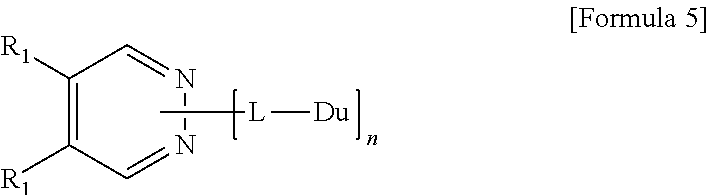


Applications Claiming Priority (2)
| Application Number | Priority Date | Filing Date | Title |
|---|---|---|---|
| KR10-2016-0065045 | 2016-05-26 | ||
| KR1020160065045A KR102651014B1 (en) | 2016-05-26 | 2016-05-26 | Compound including nitrogen and organic electroluminescence device including the same |
Publications (2)
| Publication Number | Publication Date |
|---|---|
| US20170346017A1 US20170346017A1 (en) | 2017-11-30 |
| US10686139B2 true US10686139B2 (en) | 2020-06-16 |
Family
ID=60420571
Family Applications (1)
| Application Number | Title | Priority Date | Filing Date |
|---|---|---|---|
| US15/378,084 Active 2038-02-11 US10686139B2 (en) | 2016-05-26 | 2016-12-14 | Nitrogen-containing compound and organic electroluminescence device including the same |
Country Status (3)
| Country | Link |
|---|---|
| US (1) | US10686139B2 (en) |
| JP (2) | JP2017210464A (en) |
| KR (1) | KR102651014B1 (en) |
Families Citing this family (12)
| Publication number | Priority date | Publication date | Assignee | Title |
|---|---|---|---|---|
| KR20180095760A (en) * | 2017-02-17 | 2018-08-28 | 삼성디스플레이 주식회사 | Heterocyclic compound and organic light emitting device comprising the same |
| KR102472171B1 (en) * | 2017-08-29 | 2022-11-30 | 삼성디스플레이 주식회사 | Polycyclic compound and organic electroluminescence device including the same |
| CN111247128B (en) * | 2018-03-22 | 2023-05-23 | 株式会社Lg化学 | Compound and organic light emitting diode comprising the same |
| US11737358B2 (en) * | 2018-03-22 | 2023-08-22 | Lg Chem, Ltd. | Compound and organic light emitting device comprising same |
| KR102666847B1 (en) | 2018-07-06 | 2024-05-21 | 삼성디스플레이 주식회사 | Organic electroluminescence device and nitrogen-containing compound for organic electroluminescence device |
| CN109627233A (en) * | 2018-07-27 | 2019-04-16 | 华南理工大学 | A kind of organic photoelectrical material of azacyclic molecules and its preparation method and application replaced based on carbazole derivates |
| US11485706B2 (en) * | 2018-09-11 | 2022-11-01 | Universal Display Corporation | Organic electroluminescent materials and devices |
| KR102713389B1 (en) * | 2018-11-29 | 2024-10-08 | 삼성디스플레이 주식회사 | Organic electroluminescence device and polycyclic compound for organic electroluminescence device |
| TW202110808A (en) * | 2019-06-27 | 2021-03-16 | 日商關東化學股份有限公司 | A spiroacridane-based compound, a hole transport material including the same, and an organic electronic device including the same in a hole transport layer |
| CN110862817A (en) * | 2019-09-30 | 2020-03-06 | 常州强力昱镭光电材料有限公司 | Thermally activated delayed fluorescence material, thermally activated delayed fluorescence composition and organic electroluminescent device |
| CN111072677A (en) * | 2019-12-27 | 2020-04-28 | 烟台显华化工科技有限公司 | Organic compound and application thereof |
| KR102840233B1 (en) * | 2020-01-07 | 2025-07-31 | 삼성디스플레이 주식회사 | Organic electroluminescence device and nitrogen-containing compound for organic electroluminescence device |
Citations (32)
| Publication number | Priority date | Publication date | Assignee | Title |
|---|---|---|---|---|
| US20050186446A1 (en) * | 2003-04-18 | 2005-08-25 | Semiconductor Energy Laboratory Co., Ltd. | Quinoxaline derivative, and organic semiconductor device, electric field light emitting device, and electronic device which have the same |
| JP2006156445A (en) * | 2004-11-25 | 2006-06-15 | Konica Minolta Holdings Inc | Organic electroluminescence element, display device and lighting device |
| JP2011049511A (en) | 2009-07-31 | 2011-03-10 | Fujifilm Corp | Organic electroluminescent element |
| KR20110102055A (en) * | 2010-03-10 | 2011-09-16 | 제일모직주식회사 | Compound for organic photoelectric device and organic photoelectric device comprising same |
| KR20110110508A (en) * | 2010-04-01 | 2011-10-07 | 에스에프씨 주식회사 | Spiro compound and organic light emitting device comprising the same |
| WO2012048266A1 (en) | 2010-10-08 | 2012-04-12 | Universal Display Corporation | Novel 3, 9-linked oligocarbazole-based hosts, containing dbt and dbr fragments, separated by aromatic spacers |
| WO2012077902A2 (en) | 2010-12-08 | 2012-06-14 | 제일모직 주식회사 | Compound for an organic optoelectronic device, organic light-emitting diode including the compound, and display device including the organic light-emitting diode |
| WO2012099219A1 (en) | 2011-01-20 | 2012-07-26 | 出光興産株式会社 | Organic electroluminescent element |
| WO2013081088A1 (en) | 2011-12-02 | 2013-06-06 | 国立大学法人九州大学 | Organic light emitting device and delayed fluorescent material and compound used therein |
| WO2013172255A1 (en) | 2012-05-17 | 2013-11-21 | 国立大学法人九州大学 | Compound, light emitting material, and organic light emitting element |
| KR20130142967A (en) | 2012-06-20 | 2013-12-30 | 에스에프씨 주식회사 | Heterocyclic compounds and organic light-emitting diode including the same |
| US20140034916A1 (en) * | 2012-07-31 | 2014-02-06 | Samsung Display Co., Ltd. | Condensed-cyclic compounds and organic light-emitting diodes comprising the same |
| WO2014058124A1 (en) | 2012-10-08 | 2014-04-17 | 제일모직 주식회사 | Compound for organic optoelectric device, organic light emitting diode comprising same, and display device comprising organic light emitting diode |
| WO2014148493A1 (en) | 2013-03-18 | 2014-09-25 | 出光興産株式会社 | Light-emitting device |
| US8847218B2 (en) * | 2011-01-20 | 2014-09-30 | Idemitsu Kosan Co., Ltd. | Organic electroluminescent element |
| WO2014196585A1 (en) | 2013-06-05 | 2014-12-11 | 国立大学法人九州大学 | Luminescent material, organic luminescent element, and compound |
| WO2015016200A1 (en) | 2013-08-01 | 2015-02-05 | 国立大学法人九州大学 | Compound, light-emitting material, and organic light-emitting element |
| WO2015020217A1 (en) | 2013-08-09 | 2015-02-12 | 出光興産株式会社 | Organic electroluminescence composition, material for organic electroluminescence element, solution of material for organic electroluminescence element, and organic electroluminescence element |
| WO2015022835A1 (en) | 2013-08-14 | 2015-02-19 | コニカミノルタ株式会社 | Organic electroluminescent element, lighting device, display device and fluorescent compound |
| WO2015033894A1 (en) | 2013-09-04 | 2015-03-12 | 出光興産株式会社 | Carbazole derivative, material for organic electroluminescent element which comprises same, and organic electroluminescent element and electronic device each manufactured using same |
| US20150126736A1 (en) * | 2012-05-02 | 2015-05-07 | Rohm And Haas Electronic Materials Korea Ltd. | Novel organic electroluminescence compounds and organic electroluminescence device containing the same |
| WO2015093551A1 (en) | 2013-12-18 | 2015-06-25 | 出光興産株式会社 | Compound, organic electroluminescence element material, ink composition, organic electroluminescence element, electronic device, and method for producing compound |
| KR20150070860A (en) | 2013-12-17 | 2015-06-25 | 삼성전자주식회사 | Condensed cyclic compound and organic light emitting device including the same |
| WO2015121241A1 (en) * | 2014-02-14 | 2015-08-20 | Yersin, Hartmut | Organic tadf molecules having steric hindrance at the donor and at the acceptor for optoelectronic devices |
| WO2015175678A1 (en) | 2014-05-14 | 2015-11-19 | President And Fellows Of Harvard College | Organic light-emitting diode materials |
| KR20150143353A (en) | 2014-06-13 | 2015-12-23 | 린나이코리아 주식회사 | Temperature detection apparatus |
| KR20150143552A (en) | 2013-04-08 | 2015-12-23 | 메르크 파텐트 게엠베하 | Organic electroluminescent device |
| US20160093813A1 (en) | 2013-04-08 | 2016-03-31 | Merck Patent Gmbh | Organic electroluminescent device |
| US20160168162A1 (en) * | 2014-12-15 | 2016-06-16 | Samsung Electronics, Co. Ltd. | Luminescent compound and electroluminescent device exhibiting thermally activated delayed fluorescence |
| JP2016130231A (en) | 2015-01-08 | 2016-07-21 | 国立大学法人九州大学 | Compound, mixture, light-emitting layer, organic light-emitting element, and assist dopant |
| US20160372683A1 (en) * | 2014-03-07 | 2016-12-22 | Konica Minolta, Inc. | Organic electroluminescence element, display device, illumination device, and light-emitting composition |
| KR101769764B1 (en) | 2014-12-17 | 2017-08-22 | 경상대학교산학협력단 | Novel organic semiconductor compound and organic light emitting device using the same |
Family Cites Families (6)
| Publication number | Priority date | Publication date | Assignee | Title |
|---|---|---|---|---|
| TWI304441B (en) * | 2005-01-07 | 2008-12-21 | Ind Tech Res Inst | Micro power-assembly device driven by molecular motors |
| US20100295444A1 (en) | 2009-05-22 | 2010-11-25 | Idemitsu Kosan Co., Ltd. | Organic electroluminescence device |
| US8335303B2 (en) * | 2009-11-11 | 2012-12-18 | Centurylink Intellectual Property Llc | System and method for telephone call control |
| KR101432599B1 (en) * | 2010-08-04 | 2014-08-21 | 제일모직주식회사 | Compound for organic photoelectric device and organic photoelectric device including the same |
| JP6195823B2 (en) * | 2011-05-05 | 2017-09-13 | メルク パテント ゲーエムベーハー | Compounds for electronic devices |
| KR102633852B1 (en) * | 2016-01-25 | 2024-02-07 | 삼성디스플레이 주식회사 | Carbazole-based compound and organic light emitting device comprising the same |
-
2016
- 2016-05-26 KR KR1020160065045A patent/KR102651014B1/en active Active
- 2016-06-03 JP JP2016112197A patent/JP2017210464A/en not_active Withdrawn
- 2016-12-14 US US15/378,084 patent/US10686139B2/en active Active
-
2020
- 2020-08-21 JP JP2020140484A patent/JP7078961B2/en active Active
Patent Citations (43)
| Publication number | Priority date | Publication date | Assignee | Title |
|---|---|---|---|---|
| US20050186446A1 (en) * | 2003-04-18 | 2005-08-25 | Semiconductor Energy Laboratory Co., Ltd. | Quinoxaline derivative, and organic semiconductor device, electric field light emitting device, and electronic device which have the same |
| JP2006156445A (en) * | 2004-11-25 | 2006-06-15 | Konica Minolta Holdings Inc | Organic electroluminescence element, display device and lighting device |
| US8609257B2 (en) | 2009-07-31 | 2013-12-17 | Udc Ireland Limited | Organic electroluminescence device |
| JP2011049511A (en) | 2009-07-31 | 2011-03-10 | Fujifilm Corp | Organic electroluminescent element |
| KR20110102055A (en) * | 2010-03-10 | 2011-09-16 | 제일모직주식회사 | Compound for organic photoelectric device and organic photoelectric device comprising same |
| KR20110110508A (en) * | 2010-04-01 | 2011-10-07 | 에스에프씨 주식회사 | Spiro compound and organic light emitting device comprising the same |
| WO2012048266A1 (en) | 2010-10-08 | 2012-04-12 | Universal Display Corporation | Novel 3, 9-linked oligocarbazole-based hosts, containing dbt and dbr fragments, separated by aromatic spacers |
| US20130292659A1 (en) * | 2010-12-08 | 2013-11-07 | Hyung-Sun Kim | Compound for organic optoelectronic device, organic light emitting diode including the same, and display device including the organic light emitting diode |
| WO2012077902A2 (en) | 2010-12-08 | 2012-06-14 | 제일모직 주식회사 | Compound for an organic optoelectronic device, organic light-emitting diode including the compound, and display device including the organic light-emitting diode |
| US8847218B2 (en) * | 2011-01-20 | 2014-09-30 | Idemitsu Kosan Co., Ltd. | Organic electroluminescent element |
| US20130020558A1 (en) * | 2011-01-20 | 2013-01-24 | Idemitsu Kosan Co., Ltd. | Organic electroluminescence device |
| WO2012099219A1 (en) | 2011-01-20 | 2012-07-26 | 出光興産株式会社 | Organic electroluminescent element |
| US9159941B2 (en) | 2011-01-20 | 2015-10-13 | Idemitsu Kosan Co., Ltd. | Organic electroluminescence device |
| WO2013081088A1 (en) | 2011-12-02 | 2013-06-06 | 国立大学法人九州大学 | Organic light emitting device and delayed fluorescent material and compound used therein |
| US20150126736A1 (en) * | 2012-05-02 | 2015-05-07 | Rohm And Haas Electronic Materials Korea Ltd. | Novel organic electroluminescence compounds and organic electroluminescence device containing the same |
| WO2013172255A1 (en) | 2012-05-17 | 2013-11-21 | 国立大学法人九州大学 | Compound, light emitting material, and organic light emitting element |
| KR20130142967A (en) | 2012-06-20 | 2013-12-30 | 에스에프씨 주식회사 | Heterocyclic compounds and organic light-emitting diode including the same |
| US20140034916A1 (en) * | 2012-07-31 | 2014-02-06 | Samsung Display Co., Ltd. | Condensed-cyclic compounds and organic light-emitting diodes comprising the same |
| WO2014058124A1 (en) | 2012-10-08 | 2014-04-17 | 제일모직 주식회사 | Compound for organic optoelectric device, organic light emitting diode comprising same, and display device comprising organic light emitting diode |
| WO2014148493A1 (en) | 2013-03-18 | 2014-09-25 | 出光興産株式会社 | Light-emitting device |
| US20160028025A1 (en) * | 2013-03-18 | 2016-01-28 | Idemitsu Kosan Co., Ltd. | Light-emitting device |
| KR20150143552A (en) | 2013-04-08 | 2015-12-23 | 메르크 파텐트 게엠베하 | Organic electroluminescent device |
| US20160093812A1 (en) | 2013-04-08 | 2016-03-31 | Merck Patent Gmbh | Organic electroluminescent device |
| US20160093813A1 (en) | 2013-04-08 | 2016-03-31 | Merck Patent Gmbh | Organic electroluminescent device |
| WO2014196585A1 (en) | 2013-06-05 | 2014-12-11 | 国立大学法人九州大学 | Luminescent material, organic luminescent element, and compound |
| WO2015016200A1 (en) | 2013-08-01 | 2015-02-05 | 国立大学法人九州大学 | Compound, light-emitting material, and organic light-emitting element |
| US20160172600A1 (en) * | 2013-08-01 | 2016-06-16 | Kyushu University, National University Corporation | Compound, light emitting material, and organic light emitting device |
| WO2015020217A1 (en) | 2013-08-09 | 2015-02-12 | 出光興産株式会社 | Organic electroluminescence composition, material for organic electroluminescence element, solution of material for organic electroluminescence element, and organic electroluminescence element |
| US20160190477A1 (en) | 2013-08-09 | 2016-06-30 | Idemitsu Kosan Co., Ltd. | Organic electroluminescence composition, material for organic electroluminescence element, solution of material for organic electroluminescence element, and organic electroluminescence element |
| WO2015022835A1 (en) | 2013-08-14 | 2015-02-19 | コニカミノルタ株式会社 | Organic electroluminescent element, lighting device, display device and fluorescent compound |
| WO2015033894A1 (en) | 2013-09-04 | 2015-03-12 | 出光興産株式会社 | Carbazole derivative, material for organic electroluminescent element which comprises same, and organic electroluminescent element and electronic device each manufactured using same |
| US9963429B2 (en) | 2013-09-04 | 2018-05-08 | Idemitsu Kosan Co., Ltd. | Carbazole derivative, material for organic electroluminescent element which comprises same, and organic electroluminescent element and electronic device each manufactured using same |
| KR20150070860A (en) | 2013-12-17 | 2015-06-25 | 삼성전자주식회사 | Condensed cyclic compound and organic light emitting device including the same |
| WO2015093551A1 (en) | 2013-12-18 | 2015-06-25 | 出光興産株式会社 | Compound, organic electroluminescence element material, ink composition, organic electroluminescence element, electronic device, and method for producing compound |
| US10032991B2 (en) | 2013-12-18 | 2018-07-24 | Idemitsu Kosan Co., Ltd. | Compound, organic electroluminescence element material, ink composition, organic electroluminescence element, electronic device, and method for producing compound |
| WO2015121241A1 (en) * | 2014-02-14 | 2015-08-20 | Yersin, Hartmut | Organic tadf molecules having steric hindrance at the donor and at the acceptor for optoelectronic devices |
| US20160372683A1 (en) * | 2014-03-07 | 2016-12-22 | Konica Minolta, Inc. | Organic electroluminescence element, display device, illumination device, and light-emitting composition |
| US20170244049A1 (en) * | 2014-05-14 | 2017-08-24 | President And Fellows Of Harvard College | Organic light-emitting diode materials |
| WO2015175678A1 (en) | 2014-05-14 | 2015-11-19 | President And Fellows Of Harvard College | Organic light-emitting diode materials |
| KR20150143353A (en) | 2014-06-13 | 2015-12-23 | 린나이코리아 주식회사 | Temperature detection apparatus |
| US20160168162A1 (en) * | 2014-12-15 | 2016-06-16 | Samsung Electronics, Co. Ltd. | Luminescent compound and electroluminescent device exhibiting thermally activated delayed fluorescence |
| KR101769764B1 (en) | 2014-12-17 | 2017-08-22 | 경상대학교산학협력단 | Novel organic semiconductor compound and organic light emitting device using the same |
| JP2016130231A (en) | 2015-01-08 | 2016-07-21 | 国立大学法人九州大学 | Compound, mixture, light-emitting layer, organic light-emitting element, and assist dopant |
Non-Patent Citations (3)
| Title |
|---|
| Komatsu et al. "Light-blue thermally activated delayed fluorescent emitters realizing a high external quantum efficiency of 25% and unprecedented low drive voltages in OLEDs" J. Mater. Chem. C. Apr. 2016, 2274. (Year: 2016). * |
| Machine translation of JP-2006156445, translation generated Feb. 2019, 28 pages (Year: 2019). * |
| Sun et al. "Thermally Activated Delayed Fluorescence from Azasiline Based Intramolecular Charge-Transfer Emitter (DTPDDA) and a Highly Efficient Blue Light Emitting Diode" Chem. Mater. 2015, 27, 6675-6681. (Year: 2015). * |
Also Published As
| Publication number | Publication date |
|---|---|
| KR20170134841A (en) | 2017-12-07 |
| JP7078961B2 (en) | 2022-06-01 |
| JP2021001175A (en) | 2021-01-07 |
| KR102651014B1 (en) | 2024-03-26 |
| JP2017210464A (en) | 2017-11-30 |
| US20170346017A1 (en) | 2017-11-30 |
Similar Documents
| Publication | Publication Date | Title |
|---|---|---|
| US20240147844A1 (en) | Organic electroluminescence device and monoamine compound for organic electroluminescence device | |
| US10686139B2 (en) | Nitrogen-containing compound and organic electroluminescence device including the same | |
| US12133454B2 (en) | Organic electroluminescence device and polycyclic compound for organic electroluminescence device | |
| US10333085B2 (en) | Polycyclic compound and organic electroluminescence device including the same | |
| US12289991B2 (en) | Organic electroluminescence device | |
| KR102631944B1 (en) | Aromatic compound and organic electroluminescence device including the same | |
| EP3299374B1 (en) | Amine compound and organic electroluminescence device including the same | |
| US11276836B2 (en) | Organic electroluminescence device and polycyclic compound for organic electroluminescence device | |
| US11515486B2 (en) | Organic electroluminescence device and polycyclic compound for organic electroluminescence device | |
| US20190148652A1 (en) | Nitrogen-containing compound-containing compound and organic electroluminescence device including the same | |
| US10714693B2 (en) | Polycyclic compound and organic electroluminescence device including the same | |
| US10673000B2 (en) | Heterocyclic compound and organic electroluminescence device including the same | |
| US10580993B2 (en) | Amine compound and organic electroluminescence device including the same | |
| US11018306B2 (en) | Compound for thermally activated delayed fluorescence and organic electroluminescence device including the same | |
| US11165026B2 (en) | Heterocyclic compound and organic electroluminescence device including the same | |
| US20200280004A1 (en) | Heterocyclic compound and organic electroluminescence device including the same | |
| US11174427B2 (en) | Aromatic compound and organic electroluminescence device including the same | |
| US10862050B2 (en) | Heterocyclic compound and organic electroluminescence device including the same | |
| EP3428173B1 (en) | Dibenzo[b,e][1,4]oxasiline compounds and organic electroluminescence devices including the same | |
| US11309511B2 (en) | Organic electroluminescence device and nitrogen-containing compound for organic electroluminescence device | |
| US11254694B2 (en) | Polycyclic compound and organic electroluminescence device including the same | |
| US12022733B2 (en) | Organic electroluminescence device and monoamine compound for organic electroluminescence device | |
| US20200185606A1 (en) | Organic electroluminescence device and polycyclic compound for organic electroluminescence device |
Legal Events
| Date | Code | Title | Description |
|---|---|---|---|
| AS | Assignment |
Owner name: KYUSHU UNIVERSITY, NATIONAL UNIVERSITY CORPORATION, JAPAN Free format text: ASSIGNMENT OF ASSIGNORS INTEREST;ASSIGNORS:NAKANO, HIROMI;SATO, SHURI;FUJITA, YOSHIMASA;AND OTHERS;SIGNING DATES FROM 20160629 TO 20160728;REEL/FRAME:040729/0041 Owner name: SAMSUNG DISPLAY CO., LTD., KOREA, REPUBLIC OF Free format text: ASSIGNMENT OF ASSIGNORS INTEREST;ASSIGNORS:NAKANO, HIROMI;SATO, SHURI;FUJITA, YOSHIMASA;AND OTHERS;SIGNING DATES FROM 20160629 TO 20160728;REEL/FRAME:040729/0041 Owner name: KYUSHU UNIVERSITY, NATIONAL UNIVERSITY CORPORATION Free format text: ASSIGNMENT OF ASSIGNORS INTEREST;ASSIGNORS:NAKANO, HIROMI;SATO, SHURI;FUJITA, YOSHIMASA;AND OTHERS;SIGNING DATES FROM 20160629 TO 20160728;REEL/FRAME:040729/0041 |
|
| STPP | Information on status: patent application and granting procedure in general |
Free format text: NON FINAL ACTION MAILED |
|
| STPP | Information on status: patent application and granting procedure in general |
Free format text: RESPONSE TO NON-FINAL OFFICE ACTION ENTERED AND FORWARDED TO EXAMINER |
|
| STPP | Information on status: patent application and granting procedure in general |
Free format text: FINAL REJECTION MAILED |
|
| STPP | Information on status: patent application and granting procedure in general |
Free format text: RESPONSE AFTER FINAL ACTION FORWARDED TO EXAMINER |
|
| STPP | Information on status: patent application and granting procedure in general |
Free format text: ADVISORY ACTION MAILED |
|
| STPP | Information on status: patent application and granting procedure in general |
Free format text: DOCKETED NEW CASE - READY FOR EXAMINATION |
|
| STPP | Information on status: patent application and granting procedure in general |
Free format text: NON FINAL ACTION MAILED |
|
| STPP | Information on status: patent application and granting procedure in general |
Free format text: RESPONSE TO NON-FINAL OFFICE ACTION ENTERED AND FORWARDED TO EXAMINER |
|
| STPP | Information on status: patent application and granting procedure in general |
Free format text: NOTICE OF ALLOWANCE MAILED -- APPLICATION RECEIVED IN OFFICE OF PUBLICATIONS |
|
| STPP | Information on status: patent application and granting procedure in general |
Free format text: NOTICE OF ALLOWANCE MAILED -- APPLICATION RECEIVED IN OFFICE OF PUBLICATIONS |
|
| STPP | Information on status: patent application and granting procedure in general |
Free format text: PUBLICATIONS -- ISSUE FEE PAYMENT VERIFIED |
|
| STCF | Information on status: patent grant |
Free format text: PATENTED CASE |
|
| CC | Certificate of correction | ||
| MAFP | Maintenance fee payment |
Free format text: PAYMENT OF MAINTENANCE FEE, 4TH YEAR, LARGE ENTITY (ORIGINAL EVENT CODE: M1551); ENTITY STATUS OF PATENT OWNER: LARGE ENTITY Year of fee payment: 4 |