US10654180B2 - Easily disassembled folding knife - Google Patents
Easily disassembled folding knife Download PDFInfo
- Publication number
- US10654180B2 US10654180B2 US15/601,761 US201715601761A US10654180B2 US 10654180 B2 US10654180 B2 US 10654180B2 US 201715601761 A US201715601761 A US 201715601761A US 10654180 B2 US10654180 B2 US 10654180B2
- Authority
- US
- United States
- Prior art keywords
- side portion
- opening
- locking element
- blade
- end portion
- Prior art date
- Legal status (The legal status is an assumption and is not a legal conclusion. Google has not performed a legal analysis and makes no representation as to the accuracy of the status listed.)
- Active, expires
Links
Images




Classifications
-
- B—PERFORMING OPERATIONS; TRANSPORTING
- B26—HAND CUTTING TOOLS; CUTTING; SEVERING
- B26B—HAND-HELD CUTTING TOOLS NOT OTHERWISE PROVIDED FOR
- B26B5/00—Hand knives with one or more detachable blades
- B26B5/001—Hand knives with one or more detachable blades with blades being slid out of handle immediately prior to use
- B26B5/003—Hand knives with one or more detachable blades with blades being slid out of handle immediately prior to use comprising retraction means for the blade or the blade holder
-
- B—PERFORMING OPERATIONS; TRANSPORTING
- B26—HAND CUTTING TOOLS; CUTTING; SEVERING
- B26B—HAND-HELD CUTTING TOOLS NOT OTHERWISE PROVIDED FOR
- B26B1/00—Hand knives with adjustable blade; Pocket knives
- B26B1/02—Hand knives with adjustable blade; Pocket knives with pivoted blade
- B26B1/04—Hand knives with adjustable blade; Pocket knives with pivoted blade lockable in adjusted position
- B26B1/048—Hand knives with adjustable blade; Pocket knives with pivoted blade lockable in adjusted position with a locking member being slidable or movable along the handle
-
- B—PERFORMING OPERATIONS; TRANSPORTING
- B26—HAND CUTTING TOOLS; CUTTING; SEVERING
- B26B—HAND-HELD CUTTING TOOLS NOT OTHERWISE PROVIDED FOR
- B26B1/00—Hand knives with adjustable blade; Pocket knives
- B26B1/02—Hand knives with adjustable blade; Pocket knives with pivoted blade
- B26B1/04—Hand knives with adjustable blade; Pocket knives with pivoted blade lockable in adjusted position
- B26B1/046—Hand knives with adjustable blade; Pocket knives with pivoted blade lockable in adjusted position with a locking member acting in axial direction parallel to the pivot axis of the blade
Definitions
- the present disclosure relates to folding knives and, more particularly, to folding knives configured to be easily disassembled.
- Folding knives are available in various configurations.
- the blade of a folding knife can be removable to facilitate cleaning, sharpening, replacement, or storing of a blade.
- U.S. Pat. Nos. 7,370,421 and 7,716,839 describe a knife having a removable blade. Because folding knives having removable blades are particularly advantageous in harsh conditions (i.e., in situations where a knife is likely to become dirty or dull, and thus where the ability to clean, sharpen, or replace a blade in the field is important), it would be beneficial to provide a folding knife with a removable blade having as simple a structure as possible. Simpler configurations can help to ensure that the blade remains easily removable after use in harsh conditions and that removal of the blade can be accomplished as quickly and reliably as possible. Accordingly, simple mechanisms allowing a folding knife to be easily disassembled are desirable.
- folding knives that can be more easily disassembled than known folding knives, such as for cleaning or replacing a blade or other components.
- folding knives disclosed herein can be manually disassembled, that is, disassembled without the use of additional tools (e.g., without a screwdriver, etc.).
- easily disassembled folding knives include a handle having first and second side portions having complementary locking elements which can prevent the side portions from being separated from one another.
- a folding knife can comprise a handle portion, a pivot element, a blade, a locking element, and a cap.
- the handle portion can include a first side portion and a second side portion that is laterally spaced from the first side portion.
- the first side portion can have a first opening, and an outer surface of the first side portion can have a recess that surrounds the first opening.
- the pivot element can extend from an inner surface of the second side portion.
- the blade can be disposed between the first side portion and the second side portion.
- the blade can have a second opening in a tang portion of the blade.
- the pivot element can extend through the second opening such that the blade is pivotable relative to the handle portion about the pivot element between an open position and a closed position.
- the locking element can be disposed at least partially within the recess of the first side portion.
- the locking element can be movable between a locked position and an unlocked position.
- the locking element can prevent disassembly of the first and second side portions when the locking element is in the locked position, and the locking element can allow disassembly of the first and second side portions when the locking element is in the unlocked position.
- the cap can be coupled to the first side portion adjacent the locking element and can cover the first opening.
- An end portion of the pivot element can be sized to extend through the first opening into the cap.
- the locking element can comprise an actuator that is movable relative to the cap and the recess of the first side portion between a first position and a second position.
- the locking element can be in the locked position when the actuator is in the first position, and the locking element can be in the unlocked position when the actuator is in the second position.
- the end portion of the pivot element can have a non-circular cross-sectional profile.
- the locking element can comprise a first end portion, a second portion comprising an actuator that extends from the first end portion, and a non-circular opening formed in the first end portion.
- the actuator can be movable within the recess of the first side portion between a first position and a second position. Movement of the actuator can cause the non-circular opening to rotate relative to the pivot element such that when the actuator is in the first position, the first end portion of the locking element engages the end portion of the pivot element, and when the actuator is in the second positon, the first end portion of the locking element disengages the end portion of the pivot element.
- the end portion of the pivot element can have a hexagonal shape and the non-circular opening can have a hexagonal shape.
- the hexagonal shape of the end portion of the pivot element and the hexagonal shape of the non-circular opening can be rotationally aligned when the actuator is in the second position.
- the hexagonal shape of the end portion of the pivot element and the hexagonal shape of the non-circular opening can be rotationally offset when the actuator is in the first position.
- the folding knife can further comprise a bore formed in the actuator, a spring disposed within the bore, and a ball disposed at least partially within the bore.
- An outer surface of the recess can have retaining openings at locations corresponding to the first position and second position of the actuator such that when the actuator is in the first position or the second position, the ball is disposed over one of the retaining openings and the spring forces the ball partially into the retaining opening to selectively retain the actuator in the first position or the second position.
- the cap can comprise an annular shoulder, a first recessed portion disposed radially inwardly from the shoulder, and a second recessed portion disposed radially inwardly from the first recessed portion.
- the second recessed portion can comprise a first depth that is greater than a second depth of the first recessed portion
- the locking element can be at least partially disposed in the first recessed portion
- the annular shoulder can circumscribe the first end portion except where the annular shoulder comprises a slot through which the actuator extends, and the slot can be sized and shaped to allow the actuator to move relative to the recess.
- an inner diameter of the second recessed portion can be greater than an outer diameter of the end portion of the pivot element such that there is an annular gap separating the end portion of the pivot element from a surrounding wall of the second recessed portion.
- the annular shoulder can comprise threaded openings.
- the folding knife can further comprise fasteners that extend through the first side portion and into the threaded openings to couple the cap to the first side portion.
- the folding knife can further comprise a washer disposed between the blade tang and an inner surface of the first side portion.
- the washer can have a cylindrical portion disposed in the first opening and a flange portion that contacts the blade tang.
- the folding knife can further comprise a rotatable wheel mounted on a shaft between the first and second side portions of the handle.
- the shaft can have first and second end portions, the first end portion of the shaft can be rotatably mounted to one of the first and second side portions of the handle, and the other of the first and second side portions can have a threaded opening that receives the second end portion of the shaft.
- the wheel can be rotatable to move the second end portion into and out of the threaded opening and the second end portion can have external threads that engage internal threads of the threaded opening to hold the first and second side portions of the handle together when the second end portion of the shaft is tightened into the threaded opening.
- a folding knife can comprise a handle portion, a rotatable wheel, and a blade.
- the handle portion can include a first side portion and a second side portion that is laterally spaced from the first side portion.
- the second side portion can have a threaded opening.
- the rotatable wheel can be disposed between the first and second side portions and coupled to a shaft extending from an inner surface of the first side portion.
- the shaft can have an externally threaded portion that can engage internal threads of the threaded opening, rotation of the wheel in a first direction relative to the first side portion can cause the externally threaded portion of the shaft to extend into the threaded opening and engage the internal threads, thereby retaining the first and second side portions together, and rotation of the wheel in a second direction opposite the first direction can remove the externally threaded portion from the threaded opening so that the shaft no longer retains the first and second side portions together.
- the blade can be pivotably connected to the handle portion such that the blade is pivotable relative to the handle portion between an open position and a closed position.
- a portion of the wheel can extend outwardly from the handle portion such that the wheel can be rotated by a user.
- an annular outer surface of the wheel can comprise circumferentially spaced ridges.
- the folding knife can further comprise a pivot element extending from an inner surface of the first side portion.
- the blade can be disposed between the first side portion and the second side portion.
- the blade can have a first opening in a tang portion of the blade such that the blade is pivotable relative to the handle portion about the pivot element between the open position and the closed position.
- the second side portion can have a second opening.
- An outer surface of the second side portion can have a recess that surrounds the second opening.
- the folding knife can further comprise a locking element disposed at least partially within the recess of the second side portion.
- the locking element can be movable between a locked position and an unlocked position. The locking element can prevent disassembly of the first and second side portions when the locking element is in the locked position, and the locking element can allow disassembly of the first and second side portions when the locking element is in the unlocked position.
- the folding knife can further comprise a cap coupled to the second side portion adjacent the locking element and covering the second opening.
- An end portion of the pivot element can be sized to extend through the second opening into the cap.
- the locking element can comprise an actuator that is movable relative to the cap and the recess of the second side portion between a first position and a second position.
- the locking element can be in the locked position when the actuator is in the first position, and the locking element can be in the unlocked position when the actuator is in the second position.
- the end portion of the pivot element can have a non-circular cross-sectional profile.
- the locking element can comprise a first end portion, a second portion comprising an actuator that extends from the first end portion, and a non-circular opening formed in the first end portion.
- the actuator can be movable within the recess of the first side portion between a first position and a second position. Movement of the actuator can cause the non-circular opening to rotate relative to the pivot element such that when the actuator is in the first position, the first end portion of the locking element can engage the end portion of the pivot element, and when the actuator is in the second position, the first end portion of the locking element can disengage the end portion of the pivot element.
- the end portion of the pivot element can have a hexagonal shape and the non-circular opening can have a hexagonal shape.
- the hexagonal shape of the end portion of the pivot element and the hexagonal shape of the non-circular opening can be rotationally aligned when the actuator is in the second position.
- the hexagonal shape of the end portion of the pivot element and the hexagonal shape of the non-circular opening can be rotationally offset when the actuator is in the first position.
- a folding knife can comprise a handle portion, a pivot element, a blade, a locking element, a cap, and a rotatable wheel.
- the handle portion can comprise a first side portion and a second side portion that is laterally spaced from the first side portion.
- the first side portion can have a first opening, and an outer surface of the first side portion can have a recess that surrounds the first opening.
- the second side portion can have a threaded opening.
- the pivot element can extend from an inner surface of the second side portion.
- the blade can be disposed between the first side portion and the second side portion.
- the blade can have a second opening in a tang portion of the blade.
- the pivot element can extend through the second opening such that the blade is pivotable relative to the handle portion about the pivot element between an open position and a closed position.
- the locking element can be disposed at least partially within the recess of the first side portion.
- the locking element can be movable between a locked position and an unlocked position.
- the locking element can prevent disassembly of the first and second side portions when the locking element is in the locked position.
- the locking element can allow disassembly of the first and second side portions when the locking element is in the unlocked position.
- the cap can be coupled to the first side portion adjacent the locking element and can cover the first opening.
- An end portion of the pivot element can be sized to extend through the first opening into the cap.
- the rotatable wheel can be disposed between the first and second side portions and can be coupled to a shaft extending from an inner surface of the second side portion.
- the shaft can have an externally threaded portion that can engage internal threads of the threaded opening. Rotation of the wheel in a first direction relative to the first side portion can cause the externally threaded portion of the shaft to extend into the threaded opening and engage the internal threads, thereby retaining the first and second side portions together, and rotation of the wheel in a second direction opposite the first direction can remove the externally threaded portion from the threaded opening so that the shaft no longer retains the first and second side portions together.
- FIG. 1 is a perspective view of an exemplary folding knife.
- FIGS. 2 and 3 are side views of the folding knife of FIG. 1 in an open configuration and a closed configuration, respectively.
- FIGS. 4A and 4B show a perspective view and a perspective, exploded view of another exemplary folding knife, respectively.
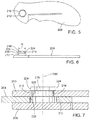
- FIGS. 5 and 6 show side and bottom views, respectively, of a side portion of the folding knife of FIGS. 4A and 4B .
- FIG. 9 shows a perspective, exploded view of another exemplary folding knife.
- FIGS. 13-14 show a folding knife having another exemplary secondary locking mechanism.
- FIGS. 15B-19 show various components of the folding knife of FIG. 15A .
- FIG. 20 shows another exemplary folding knife.
- FIG. 22 shows a partially assembled view of the folding knife of FIG. 20 .
- FIG. 24 shows another exemplary folding knife.
- FIG. 25 shows a partially assembled view of the folding knife of FIG. 24 .
- FIGS. 27-28 each show a partially assembled view of the folding knife of FIG. 24 .
- FIG. 29 shows another exemplary folding knife in a closed configuration.
- FIG. 30 shows the folding knife of FIG. 29 in an open configuration.
- FIGS. 31-34 show various components of the folding knife of FIG. 30 .
- FIG. 35 shows a perspective, exploded view of the folding knife of FIG. 30 .
- FIG. 37 shows a perspective, exploded view of another exemplary folding knife.
- FIG. 38 shows the folding knife of FIG. 37 in a closed configuration.
- FIG. 39 shows a partial perspective view of the folding knife of FIG. 37 .
- FIG. 40 shows a side view of the folding knife of FIG. 37 in a disassembled configuration.
- FIG. 42 shows a detail view of a portion of the folding knife of FIG. 37 in a partially assembled configuration.
- folding knives that can be more easily disassembled than known folding knives, such as for cleaning or replacing a blade or other components.
- folding knives disclosed herein can be manually disassembled, that is, disassembled without the use of additional tools (e.g., without a screwdriver, etc.).
- easily disassembled folding knives include a handle having first and second side portions having complementary locking elements which can prevent the side portions from being separated from one another.
- a first embodiment of a folding knife 100 can include a handle portion 102 and a blade 104 .
- the blade 104 can be pivotably connected to the handle 102 such that the blade 104 can be pivoted about an axis 106 between an open position for using the blade (as shown in FIG. 2 ) and a closed position for storing the blade (as shown in FIG. 3 ).
- the handle 102 can include a first side portion 108 and a second side portion 110 .
- the first and second side portions can be spaced apart from each other by a distance, thereby defining a blade receiving channel 112 between the two side portions for receiving the blade when it is pivoted to its closed position. As shown in FIG.
- the first side portion 108 can include a leaf spring 114 (known as a “liner lock” or a “frame lock”) that is biased into a position engaging the rear edge of the tang of the blade 104 to retain the blade in the open position, as is known in the art.
- a leaf spring 114 (known as a “liner lock” or a “frame lock”) that is biased into a position engaging the rear edge of the tang of the blade 104 to retain the blade in the open position, as is known in the art.
- FIGS. 4-8 illustrate one embodiment of a folding knife 200 including a handle portion 202 and a blade 204 pivotably connected to the handle 202 for pivoting motion about an axis 206 .
- the handle 202 can include a first side portion 208 and a second side portion 210 .
- FIG. 4A illustrates a perspective view of the knife 200 .
- FIG. 4B illustrates an exploded perspective view of the knife 200 .
- FIGS. 5 and 6 illustrate side and bottom views, respectively, of the first side portion 208 .
- a primary raised cylindrical protrusion 212 which functions as a pivot element or pivot pin for the blade, can extend laterally from the inner surface of the first side portion 208 .
- the central longitudinal axis of the primary cylindrical protrusion 212 can be aligned with the pivot axis 206 .
- a secondary raised cylindrical portion 214 can extend laterally from the inner side surface of the primary cylindrical protrusion 212 .
- the diameter of the secondary cylindrical portion 214 can be smaller than the diameter of the primary cylindrical portion 212
- the central longitudinal axis of the secondary protrusion 214 can be aligned with the central longitudinal axis of the primary protrusion 212 and the pivot axis 206 .
- a hexagonal locking portion, or locking element, 216 can be attached to the inner side surface of the secondary protrusion 214 .
- the width W of the locking portion 216 can be greater than the diameter of the secondary protrusion 214 , so that a locking channel 218 is thereby defined between the primary protrusion 212 and the locking portion 216 .
- the width of the channel 218 (the distance between the pivot pin 212 and the locking element 216 ) is sized to receive the second side portion 210 , as further described below. As shown in FIGS.
- the thickness of each of the first side portion 208 , the primary protrusion 212 , the secondary protrusion 214 , and the locking portion 216 along the pivot axis are approximately the same. In alternative embodiments, however, the precise thicknesses of each of these components along the pivot axis can be any suitable length, and are independent of one another.
- the second side portion 210 can include a hexagonal opening 220 that extends through the entire second side portion 210 .
- the hexagonal opening 220 can be advantageously sized so that it is only slightly larger than the hexagonal locking portion 216 of the first side portion 208 .
- the opening 220 can be further configured such that when the first and second side portions are placed adjacent one another in an assembled, as-used configuration, the hexagonal shape of the opening 220 is rotationally offset about the pivot axis 206 from the hexagonal shape of the locking portion 216 . As best shown in FIG.
- the hexagonal shape of the opening 220 can be rotationally offset from the hexagonal shape of the locking portion 216 by approximately 30 degrees ( 1/12 of a full rotation), such that the corners of the two hexagonal shapes are rotationally offset from each other as far as possible.
- the blade 204 can have a circular opening 222 .
- the circular opening 222 can be sized so that its diameter is larger than both the width of the locking portion 216 and the diameter of the primary protrusion 208 .
- a knife can comprise a locking element (e.g., locking element 216 ) having a non-circular cross-sectional shape (taken along a plane perpendicular to the pivot axis 206 ) that extends through an opening (e.g., opening 220 ) of the same or similar shape in a side portion of the handle.
- the locking element 216 and corresponding opening 220 can be any of various shapes, such as, without limitation, square, triangular, cruciform (cross shaped), etc.
- first component has a non-circular cross-sectional shape that fits though a correspondingly shaped opening in a second component
- shape of the first component and the opening can be any of various shapes, including but not limited to a square, hexagon, triangle, cruciform, oval, etc.
- the non-circular locking element cooperates with the non-circular opening to prevent lateral separation of the side portions 208 , 210 of the handle when the locking element is rotationally offset from the opening.
- rotating the second side portion 210 such that the opening 220 is rotationally aligned with the locking element 216 allows lateral separation of the side portions 208 , 210 of the handle.
- the shape of the opening 220 need not correspond exactly to the cross-sectional shape of the locking element 216 .
- the opening 220 in the side portion 210 can have any non-circular shape that is sized and shaped: (1) to allow the locking element 216 to slide through the opening 220 when the side portion 210 is in a first rotational position in which the opening 220 is rotationally aligned with the locking element 216 and (2) to block the locking element 216 from sliding through the opening 220 when the side portion 210 is in a second rotational position in which the opening 220 is rotationally offset from the locking element 216 .
- rotationally aligned means that the opening 220 in the side portion 210 is in a rotational position relative to the locking element 216 about a central axis (e.g., pivot axis 206 ) extending through the opening and the locking element such that the locking element can fit or slide through the opening in a direction along the axis 206 .
- rotationally offset means that the opening 220 in the side portion 210 is in a rotational position relative to the locking element 216 about the central axis 206 extending through the opening and the locking element such that the locking element cannot fit or slide through the opening in a direction along the axis 206 .
- the folding knife 200 comprising the first side portion 208 , the second side portion 210 , and the blade 204 , as described above, can be assembled by sliding the opening 222 of the blade over the locking portion 216 , the secondary protrusion 214 , and the primary protrusion 212 , such that the blade 204 rests against the first side portion 208 . Referring to FIG.
- the folding knife 200 can be further assembled by positioning the second side portion 210 so that it is rotationally offset around the axis 206 from the first side portion 208 by about 30 degrees, so that the hexagonal shape of the opening 220 and the hexagonal shape of the locking portion 216 are generally aligned, and then sliding the hexagonal opening 220 of the second side portion 210 over the locking portion 216 and the secondary protrusion 214 until the second side portion 210 rests within the locking channel 218 adjacent the blade.
- the central longitudinal axis of the protrusions 212 , 214 , and the locking portion 216 , as well as of the opening 222 in the blade 204 and the opening 220 in the second side portion 210 are aligned with the pivot axis 206 .
- the second side portion 210 can then be rotated from the position shown in FIG. 8 until it is rotationally aligned with the first side portion 208 , and such that the hexagonal shape of the opening 220 is rotationally offset from the hexagonal shape of the locking portion 216 .
- the corners 224 of the locking portion 216 extend beyond the edges of the opening 220 , thereby preventing the second side portion 210 from being removed in a lateral direction away from the first side portion 208 , and thereby also preventing the blade 204 from being removed from the rest of the knife 200 .
- the second side portion 210 can be rotated about 30 degrees from the first side portion 208 such that the corners of the locking portion 216 no longer capture the second side portion 210 , as in the configuration shown in FIG. 8 , which can then slide laterally away from the first side portion 208 along the axis 206 .
- Mechanisms for retaining the second side portion 210 against rotation relative to the first side portion 208 in the as-use position are described in detail below.
- the first side portion 208 can be formed integrally, with the primary cylindrical protrusion 212 , the secondary protrusion 214 , and the locking portion 216 all being formed from a single piece of material, or each of these components can be formed separately and joined later in the fabrication process, such as by welding.
- the primary protrusion 212 , the secondary protrusion 214 , and the locking portion 216 can be an integral component that is removably secured to the first side portion, such as with a screw or other removable fastener.
- Each of the components of the knife 200 can be formed of various materials, including metals, plastics, and/or composites.
- FIGS. 9-10 illustrate another embodiment of a folding knife 300 which can include a blade 304 pivotably connected to a handle portion 302 for pivoting motion about an axis 306 .
- the handle 302 can include a first side portion 308 , a second side portion 310 , a washer 312 , a pivot and locking element 314 , and a locking screw 316 .
- FIG. 9 illustrates an exploded perspective view of the knife 300 .
- the first side portion 308 can include a cylindrical recess 318 formed in the inner surface of the first side portion 308 and having a central longitudinal axis aligned with the pivot axis 306 .
- a circular opening 320 also having a central longitudinal axis aligned with the pivot axis 306 can extend from the end of the recess 318 to the outer surface of the first side portion 308 .
- the washer 312 can be configured to be positioned within the recess 318 .
- the washer 312 can be secured within the recess 318 , such as with an adhesive or a press-fit configuration, to prevent the washer from being removed when the knife is disassembled.
- the pivot and locking element 314 can comprise a first cylindrical portion 322 coupled to a second cylindrical portion 324 , itself coupled to a hexagonal locking portion 326 .
- the cylindrical portion 322 functions as the pivot pin or pivot element for the blade.
- the first cylindrical portion 322 can have a threaded recess 334 at one end configured to receive the locking screw 316 and can have a diameter which is larger than the diameter of the second cylindrical portion 324 .
- the hexagonal portion 326 can have a width which is also larger than the diameter of the second cylindrical portion 324 .
- a locking channel 328 can be defined between the first cylindrical portion 322 and the hexagonal portion 326 for receiving the second side portion 310 .
- the screw 316 can be configured to engage the threaded recess of the first cylindrical portion 322 , and can have a head having a diameter larger than the diameter of the opening 320 .
- An assembly 336 can comprise the first side portion 308 , washer 312 , pivot and locking element 314 , and locking screw 316 .
- the assembly 336 has a structure similar to that of the first side portion 208 of the knife 200 .
- the blade 304 can have a cylindrical opening 338 which has a diameter greater than the diameters of the first cylindrical portion 322 and the second cylindrical portion 324 , and greater than the width of the hexagonal portion 326 .
- the second side portion 310 can include a hexagonal recess 330 in communication with a cylindrical cavity 332 contained entirely within the second side portion 310 .
- the hexagonal recess 330 can advantageously be sized so that it is slightly larger than the hexagonal portion 326 of the assembly 336 .
- the hexagonal shape of the recess 330 can be rotationally offset from the hexagonal shape of the portion 326 by approximately 30 degrees ( 1/12 of a full rotation) such that the corners of the two hexagonal shapes are rotationally offset from each other as far as possible.
- the cylindrical cavity 332 can be large enough that the hexagonal portion 326 can be situated and freely rotate within it.
- the folding knife 300 comprising the assembly 336 , the second side portion 310 , and the blade 304 , as described above, can be assembled by sliding the opening 338 of the blade 304 over the hexagonal portion 326 , second cylindrical portion 324 , and first cylindrical portion 322 , such that the blade 304 rests against the first side portion 308 .
- the folding knife 300 can be further assembled by positioning the second side portion 310 so that it is rotationally offset around axis 306 from the first side portion 308 by about 30 degrees, so that the hexagonal shape of the recess 330 and the hexagonal shape of the portion 326 are generally aligned, and then sliding the recess 330 of the second side portion 310 over the hexagonal portion 326 and the second cylindrical portion 324 such that the hexagonal portion 326 rests within the cylindrical cavity 332 .
- the central longitudinal axis of the washer 312 , locking element 314 , locking screw 316 , recess 330 , cavity 332 , and opening 338 can all be generally aligned with the pivot axis 306 .
- the second side portion 310 can then be rotated until it is rotationally aligned with the first side portion 308 , and such that the hexagonal shape of the recess 330 is rotationally offset from the hexagonal shape of the portion 326 .
- the corners of the hexagonal portion 326 extend beyond the edges of the recess 330 , thereby preventing the second side portion 310 from being removed laterally away from the assembly 336 (including the first side portion 308 ), and thereby also preventing the blade 304 from being removed from the knife 300 .
- a secondary securing mechanism can be provided which can help to ensure that the two halves do not inadvertently rotate with respect to each other and thereby become unfastened.
- a variety of such mechanisms can be used, and one example is shown in FIGS. 11-12 .
- a knife 400 can include a removable first side portion 402 having a distal portion 404 and a proximal portion 406 , and a second side portion 408 .
- the distal portion 404 can include a notch 410
- the proximal portion 406 can include one or more slots 412 containing springs 418 and a projection 414 configured to fit within the notch 410
- the second side portion 408 can include one or more projections, or knobs, 416 configured to extend into respective slots 412 .
- the springs 418 can be retained within the slots 412 by any of various suitable means, for example, by an external cover (not illustrated) situated over the slots 412 .
- the springs 418 are configured to exert a biasing force that urges the proximal portion 406 toward the distal portion 404 in the direction of arrow 420 , causing the projection 414 to engage the recess 410 , thereby preventing rotation of the distal portion 404 relative to the rest of the handle.
- the distal portion 404 can be removed by sliding the proximal portion 406 rearwardly in the direction of arrow 422 against the biasing force of the springs until the projection 414 is removed from the slot 410 .
- the distal portion 404 can then be rotated relative to the hexagonal locking element and slid laterally away from the second side portion 408 , as described in detail above.
- FIGS. 13-14 Another exemplary embodiment of a secondary securing mechanism that can be used with a knife is shown in FIGS. 13-14 .
- FIG. 13 shows a knife 500 including a distal portion 502 and a proximal portion 504 of a first side portion of the knife 500 and
- FIG. 14 shows a cross sectional view of knife 500 along line 14 - 14 of FIG. 13 .
- the secondary locking portion illustrated in FIGS. 13-14 is similar to that illustrated in FIGS. 11-12 , except that it uses a dovetail locking system, rather than a notch and projection to rotationally lock the distal portion 502 , thereby preventing the knife from becoming unfastened.
- the distal portion 502 can include one or more dovetail-shaped projections 506 that are shaped to mate with respective one or more dovetail-shaped slots 508 of the proximal portion 504 .
- a removable spring clip can be used to prevent rotation of the side portions of the handle relative to each other.
- a clip comprises two opposing resilient legs that can slide onto the first and second side portions 208 , 210 , thereby providing a clamping force against the side portions to hold them together.
- Knife 600 can include a handle 602 and a blade 604 .
- the handle 602 can include a first side portion 606 , a second side portion 608 , a liner lock portion 610 , and a locking portion 612 .
- the first side portion 606 can include three engagement elements 614 A-C, each having respective recesses 616 which can have flat-oval shapes (e.g., a shape comprising an oval with flat sides).
- Each engagement element 614 can also include respective generally circular openings 618 extending through the first side portion 606 and respective flat-oval openings 620 extending away from the respective circular openings 618 and through the first side portion 606 .
- the recesses 616 can be formed in a front surface 622 of the first side portion 606 , which can be the exposed surface of the first side portion 606 when the knife 600 is fully assembled. Further, the flat-oval openings 620 can have a width W 1 which is smaller than a width W 2 (see FIG. 19 ) of the recesses 616 , which can be about the same as the diameter of the circular openings 618 , such that a lip or ledge 626 is formed in the first side portion 606 . In some cases, the recesses 616 can be formed by removing material from the first side portion 606 , for example, by removing between about 1 ⁇ 4 and about 3 ⁇ 4, or by removing about 1 ⁇ 2 of the thickness of the first side portion 606 . In the illustrated embodiment, the knife 600 includes three engagement elements 614 A-C, but in alternative embodiments, fewer or additional engagement elements can be used.
- two of the engagement elements 614 A and 614 B can be located near a distal portion of the handle 602 (and thus can be called distal engagement elements) and a third engagement element 614 C can be located near a proximal portion of the handle 602 (and thus can be called a proximal engagement element).
- the flat-oval shapes of the respective components of the distal engagement elements 614 A and 614 B can be generally aligned with the length of the first side portion 606 .
- flat sides of the flat-oval openings 620 and the recesses 616 of the distal engagement elements 614 A, 614 B can be parallel or substantially parallel to the length of the first side portion 606 , a top surface 628 of the first side portion 606 , and/or a bottom surface 630 of the first side portion 606 .
- the flat-oval shapes of the respective components of the proximal engagement element 614 C can be angularly offset from the length of the first side portion 606 . That is, flat sides of the flat-oval opening 620 and the recess 616 of the proximal engagement element 614 C can be angularly offset from the top surface 628 , bottom surface 630 , and/or the length of the first side portion 606 , and thus from the respective flat sides of the components of the distal engagement elements 614 A, 614 B.
- the flat sides of the openings 620 of the proximal engagement elements can be offset from the flat sides of the openings 620 of the distal engagement elements by an angle ⁇ , which can be, for example, between about 5° and about 45°.
- a back surface 624 ( FIG. 15B ) of the first side portion 606 which can be the unexposed, or internal surface of the first side portion 606 when the knife 600 is fully assembled, can include a pin 632 ( FIG. 15A ) and a bearing pad 634 ( FIG. 15B ).
- the pin 632 can engage with the locking portion 612 when the knife 600 is in a fully assembled configuration, as described further below.
- the bearing pad 634 can protrude outward from the back surface 624 , in order to reduce the surface area of contact between the first side portion 606 and the blade 604 when the knife is in a fully assembled configuration, as explained further below.
- the second side portion 608 can have an overall shape generally matching that of the first side portion 606 .
- the second side portion 608 can include three engagement elements 636 A-C protruding outwardly from an internal surface 638 of the second side portion 608 , which can be the unexposed surface of the second side portion 608 when the knife 600 is fully assembled.
- Second side portion 608 can include more or fewer than three engagement elements 636 , but in many embodiments, the second side portion 608 can have the same number of engagement elements 636 as first side portion 606 has engagement elements 614 .
- the engagement elements 636 of the second side portion 608 can be configured to engage the engagement elements 614 of the first side portion 606 , as further described below.
- the positions of the engagement elements 636 on the second side portion 608 can also be configured such that the engagement portions 636 can be aligned with respective circular openings 618 simultaneously.
- the washer 648 can also be made of a different material than the rest of the second side portion 608 , for example, a relatively lubricous metal material, to reduce friction between the blade 604 and the second side portion 608 .
- a washer need not be a component of the engagement element 636 A and can be a separate component.
- the second side portion 608 can also include a pin 650 protruding outwardly from the internal surface 638 of the second side portion 608 .
- the pin 650 can engage with the locking portion 612 when the knife 600 is in a fully assembled configuration, as described further below.
- the liner lock portion 610 can have an overall shape generally matching that of the first and second side portions 606 , 608 , and can comprise a relatively thin piece of material, such that proximal and distal leaf springs 652 , 654 can be manipulated by a user relatively easily.
- the liner lock portion 610 can include four openings 656 A-D, which can be sized and positioned such that the liner lock portion 610 can be positioned adjacent to the second side portion 608 with the engagement elements 636 A-C extending through openings 656 A-C, respectively, and with the pin 650 extending through the opening 656 D.
- the distal leaf spring 654 can protect against inadvertent closing of the blade 604 after it has been opened by a user, and the proximal leaf spring 652 can prevent the locking portion 612 from accidentally moving to an unlocked position, as described further below.
- the locking portion 612 can include a pivot opening 658 , which can be sized to fit over the base portion 640 of the engagement element 636 C such that the locking portion 612 can pivot about the engagement element 636 C, for example, from a locked position when the knife is fully assembled to an unlocked position allowing the knife to be assembled or disassembled.
- the locking portion 612 can also include a notch 660 which can be positioned to fit over the pin 650 when the pivot opening 658 is fitted over the engagement element 636 C.
- the notch 660 can have a shape which allows the pin 650 to move through the notch 660 as the locking portion 612 is pivoted about the engagement element 636 C.
- the notch 660 can include a first end 660 A and a second end 660 B such that the pin 650 is situated at the first end 660 A when the knife 600 is in a fully assembled configuration (and the locking portion 612 is in a locked position, as shown in dashed lines in FIG. 17 ), and such that the pin 650 is situated at the second end 660 B when the locking portion 612 is in an unlocked position such that the knife can be assembled or disassembled (as shown in solid lines in FIG. 17 ).
- the locking portion 612 can also include an opening 662 which can be positioned to receive the pin 632 of the first side portion, as described further below.
- the blade 604 can include a pivot opening 668 sized to fit over the base portion 640 of the engagement element 636 A but not over the washer 648 .
- the engagement element 636 A serves as a pivot pin or pivot element for the blade.
- the blade can also include a first locking surface 670 which can be situated to engage with a distal end portion of the distal leaf spring 654 when the blade 604 is in an open position, and a second locking surface 672 which can be situated to engage with the base portion 640 of the engagement element 636 B when the blade is in the open position. In this way, the distal leaf spring 654 and engagement element 636 B can act to prevent the blade 604 from moving with respect to the handle 602 when the blade is in an open position.
- the blade can be configured such that the first locking surface 670 is positioned to engage with the base portion 640 of the engagement element 636 B when the blade 604 is in a closed position, such that the blade 604 cannot pivot about the engagement element 636 A to the extent that the blade is exposed outside the handle 602 , e.g., by pivoting beyond the top surface 628 .
- the blade 604 can also include an extension 674 which can extend outside the handle 602 when the blade 604 is in a closed position, which can allow a user to more easily manipulate and open the blade 604 with his or her fingers.
- the second side portion 608 (including the engagement elements 636 ) can be laid on a flat surface with the engagement elements 636 protruding outward from the flat surface.
- the liner lock portion 610 can then be laid down over the second side portion, with the engagement elements 636 extending through the respective openings in the liner lock portion 610 .
- the locking portion 612 can then be laid down over the liner lock portion 610 with the pin 650 situated at the second end 660 B of the notch 660 (that is, in the unlocked position shown in FIG. 16 ).
- the blade 604 can then be laid down over the liner lock portion such that the engagement element 636 A extends through the pivot opening 668 .
- the first side portion 606 can then be laid down over the blade 604 and the locking element 612 such that the respective head portions 644 of the engagement elements 636 extend through respective circular openings 618 of the engagement elements 614 .
- the head portions 644 can be situated within respective recesses 616 and the neck portions 642 can be situated within respective circular openings 618 .
- the locking portion 612 can then be pivoted about the engagement portion 636 C from the open (unlocked) position to the closed (locked) position, as indicated by arrow 680 in FIG. 19 .
- the engagement of the opening 662 of the locking portion 612 and the pin 632 of the first side portion 606 causes the first side portion 606 to rotate slightly about element 636 A and translate distally as indicated by arrow 682 until the first side portion 606 is aligned side-by-side with the second side portion.
- the head portions 644 are positioned within respective recesses 616 and the neck portions 642 are positioned within respective flat-oval openings 620 .
- first side portion 606 is restrained against separation from the second side portion 608 , as the head portions 644 are engaged with respective lips 626 .
- the proximal leaf spring 652 engages with the locking surface 664 , restraining the locking portion from motion toward the open position, and the knife 600 is in the fully assembled configuration, as shown in FIG. 18 .
- the blade 604 can then be pivoted to the open position, wherein it is locked open by the distal leaf spring 654 .
- a user can manually depress the distal leaf spring 654 to close the blade 604 .
- Each lip 626 can be a ramped surface that increases in thickness extending from the opening 618 to the end of the recess 616 opposite the opening 618 .
- a user can manually depress the proximal leaf spring 652 and pivot the locking portion 612 toward the unlocked position, causing the first side portion 606 to rotate and translate proximally until the neck portions 642 of the engagement elements 636 are situated within the circular openings 616 , at which point the various components can then be removed from one another laterally.
- Knife 700 can include a handle 702 and a blade 704 .
- the handle 702 can include a first side portion 706 , a second side portion 708 , and a locking button 744 .
- the first side portion 706 can include a main body 710 , a circular recess 712 formed in an outer surface 714 (i.e., an exposed surface when the knife 700 is fully assembled) of the main body 710 , and a flat-oval shaped opening 716 extending from the recess 712 through the main body 710 to form a lip or ledge 717 .
- the first side portion 706 can also include a protruding pin 718 extending from an inner surface 720 ( FIG. 23 ) of the main body 710 .
- the recess 712 , opening 716 , and pin 718 can be located at a distal portion of the first side portion 706 .
- a proximal portion of the handle 706 can include a locking portion 722 which is offset from the main body 710 in the direction of the inner surface 720 , such as by an intermediate offsetting element 723 .
- the locking portion 722 can include a circular locking recess 724 .
- the second side portion 708 can include a main body 726 , an engagement element 728 comprising a relatively wide base portion 730 , relatively narrow neck portion 732 , and a relatively wide head portion 734 having a flat-oval shape matching that of (but being slightly smaller than) the flat-oval opening 716 of the first side portion 706 .
- the second side portion 708 can also include a semi-circular groove 736 positioned partially around the engagement element 728 .
- the second side portion 708 can also include a locking portion 738 which is offset from the main body 726 in the direction of an inner surface 740 ( FIG. 23 ) of the main body 726 , such as by an intermediate offsetting element 741 .
- the locking portion 738 can include a circular locking opening 742 .
- the blade 704 can include a circular opening 746 sized to fit over the engagement element 728 , a first locking surface 748 situated to engage the pin 718 when the knife 700 is in a fully assembled configuration and the blade 704 is in a closed position, and a second locking surface 750 situated to engage the pin 718 when the knife is in a fully assembled configuration and the blade 704 is in an open position.
- the blade 704 can also have a shape including an extension 752 which extends from the fully assembled knife 700 when the blade is in both the open and the closed positions, in order to assist a user in opening and/or closing the blade.
- the locking button 744 can include a relatively wide base 754 , relatively narrow head 756 , and a spring 758 disposed in recess 724 and extending away from the base 754 in a direction away from the head 756 .
- the knife 700 can also include a sharpening element 760 coupled to, for example, the inner surface 740 of the second side portion 708 .
- the sharpening element can include, as examples, a sharpening steel element, or a diamond sharpening element or any suitably abrasive surface to allow a user to sharpen a blade (e.g., blade 704 ) thereon.
- Any of the knives described herein can include such a sharpening element, e.g., to facilitate sharpening of the blade in the field.
- this eliminates the need to carry a separate sharpener for sharpening the blade of the knife.
- the knife can easily be disassembled, preferably without the use of any tools and the blade can be sharpened on the sharpening surface 760 of the handle portion 708 .
- element 760 can be a removable sharpening element that can be removed from handle portion 708 for use.
- the opening 746 of the blade can be positioned over the engagement element 728 of the second side portion 708 .
- the flat-oval opening 716 of the first side portion 706 can then be aligned with the flat-oval head portion 734 of the second side portion 708 , and the first side portion can be laid over the second side portion such that the head portion 734 is situated within the recess 712 , the neck portion 732 is situated within the opening 716 , and the pin 718 is situated within the groove 736 , as shown in FIG. 22 .
- the button 744 can then be situated such that the spring 758 fits within the circular recess 724 .
- first side portion 706 can be locked to the second side portion 708 . That is, first side portion 706 is restrained against motion away from the second side portion by the engagement of the head portion 734 with the lip 717 and by the engagement of the locking portion 738 with the locking portion 722 .
- the button can be urged into engagement with the opening 742 by the spring 758 , such that the head 756 is positioned within the opening 742 , and the base 754 is positioned within the recess 724 , as shown in FIG. 23 , thereby preventing any further relative rotation between the side portions 706 , 708 .
- the button can then be depressed (e.g., manually) until its head 756 is no longer situated within the opening 742 , the first side portion 706 can be rotated to separate the locking portions 722 , 738 and align the head portion 734 with the opening 718 , and the components can then be removed from one another laterally.
- the knife 700 incorporates washers or similar components, as described above, e.g., with respect to knife 600 .
- the knife 700 incorporates a liner lock or other similar component, as described above, e.g., with respect to knife 600 .
- the base 754 of the button 744 can be configured to be retained within the recess 724 when the first side portion 706 is separated from the second side portion 708 .
- FIGS. 24-28 illustrate an alternative embodiment of an easily disassembled folding knife 800 .
- Knife 800 can include a handle 802 and a blade 804 .
- the handle 802 can include a first side portion 806 and a second side portion 808 .
- the first side portion 806 can include a main body 810 , two circular recesses 812 , 814 formed in an outer surface (i.e., an exposed surface when the knife 800 is fully assembled) of the main body 810 , and two respective flat-oval shaped openings 818 , 820 extending from the recesses 812 , 814 through the main body 810 to form respective lips or ledges 822 , 824 .
- the first side portion 806 can also include a protruding pin 826 extending from an inner surface of the main body 810 .
- the recess 812 , opening 818 , and pin 826 can be located at a distal portion of the first side portion 806 , while the recess 814 and opening 820 can be located at a proximal portion of the first side portion 806 .
- the second side portion 808 can include a main body 830 , an engagement element 832 comprising a relatively wide base portion 834 , relatively narrow neck portion 836 , and a relatively wide head portion 838 having a flat-oval shape matching that of (but being slightly smaller than) the flat-oval opening 818 of the first side portion 806 .
- the second side portion 808 can also include a divot 864 which can receive an end of the pin 826 when the knife 800 is fully assembled.
- the second side portion 808 can also include a locking portion 840 which includes an actuating arm 842 and a retaining element 843 mounted to the arm 842 .
- the retaining element 843 comprises a relatively narrow neck portion 844 and a relatively wide head portion 846 having a flat-oval shape matching that (but being slightly smaller than) the flat-oval opening 820 of the first side portion 806 .
- the actuating arm 842 and retaining element 843 can be coupled to one another such that rotation of the arm 842 causes rotation of the retaining element 843 .
- the second side portion 808 can also include a pair of pins 848 which can prevent the actuating arm 842 from being rotated too far into the handle 802 when the knife 800 is fully assembled.
- the flat-oval openings 818 , 820 of the first side portion 806 can be oriented in the same direction. That is, the flat sides of the flat-oval openings 818 , 820 , can be generally parallel to one another. As also shown, the flat-oval head portion 838 can be oriented such that the flat sides of the head portion 838 are offset angularly from the flat sides of the opening 818 when the knife 800 is fully assembled, as shown in FIG. 24 .
- the head portion 846 of retaining element 843 can be oriented such that the flat sides of the head portion 846 are offset angularly from the flat sides of the opening 820 when the knife 800 is fully assembled (as shown, they are offset by about 90° when the knife 800 is fully assembled, but various angular offsets are suitable).
- the first and second side portions 806 , 808 , of the knife 800 can include divots 858 and the actuating arm 842 can include gripping elements 860 (e.g., a nail-nick) aligned with the divots 858 , in order to further facilitate the manual operation (e.g., rotation) of the actuation arm 842 .
- the blade 804 can include a circular opening 850 sized to fit over the engagement element 832 , a first locking surface 852 situated to engage the pin 826 when the knife 800 is in a fully assembled configuration and the blade 804 is in a closed position, and a second locking surface 854 situated to engage the pin 826 when the knife is in a fully assembled configuration and the blade 804 is in an open position.
- the blade 804 can also have a shape including an extension 856 which extends from the fully assembled knife 800 when the blade is in both the open and the closed positions, in order to assist a user in opening and/or closing the blade.
- the opening 850 of the blade can be positioned over the engagement element 832 of the second side portion 808 , as shown in FIG. 28 .
- the flat-oval opening 818 of the first side portion 806 can then be aligned with the flat-oval head portion 838 of the second side portion 808 , and the first side portion 806 can be laid over the second side portion such that the head portion 838 is situated within the recess 812 , and the neck portion 836 is situated within the opening 818 , as shown in FIG. 27 .
- the locking portion 840 can then be rotated such that the opening 820 will be aligned with the head portion 846 when the first side portion 806 is rotated to bring the opening 820 to the head portion 846 .
- the first side portion 806 can then be rotated about engagement element 832 such that the opening 820 moves toward the locking portion 840 and head portion 846 .
- the opening 820 can be seated on the locking portion 840 such that the neck 844 is situated within the opening 820 and the head 846 is situated within the recess 814 , as shown in FIG. 25 .
- the locking portion 840 can then be rotated such that the head 846 is no longer aligned with the opening 820 , such as by manual operation (e.g., rotation) of the actuating arm 842 to the closed or locked position shown in FIG. 24 .
- the first side portion 806 thus can be restrained against motion away from the second side portion 808 by the engagement of the head portion 838 by the lip 822 and by the engagement of the head 846 by the lip 824 .
- the locking portion 840 can be rotated to the open or unlocked position to align the head 846 with the opening 820 .
- the first side portion 806 can then be lifted off the locking portion 840 and rotated to align the opening 818 with the head portion 838 .
- the components of the knife 800 can then be removed from one another laterally.
- the knife 800 incorporates washers 862 or similar components, as described above, e.g., with respect to knife 600 .
- the knife 800 incorporates a liner lock or other similar component, as described above, e.g., with respect to knife 600 .
- Knife 900 can include a handle 902 and a blade 904 .
- the handle 902 can include a first side portion 906 and a second side portion 908 .
- the first side portion 906 can include a main body 910 and two recesses 912 , 914 formed in an outer surface 916 (i.e., an exposed surface when the knife 900 is fully assembled) of the main body 910 .
- the recesses 912 , 914 can each have shapes resembling the shape of a keyhole, or include a circle-shaped portion 918 with a fan-shaped portion 920 extending away from the circle-shaped portion 918 .
- the first side portion 906 can further include two circular openings 922 , 924 extending from the centers of respective circle-shaped portions 918 through the main body 910 .
- the first side portion 906 can also include two rotatable locking or retaining elements, or locks 926 , 928 situated within respective recesses 912 , 914 .
- the locks 926 , 928 can have shapes comprising circles with circular recesses 927 , 929 at their centers and hexagonal openings 930 , 932 at the centers of the circular recesses 927 , 929 .
- the locks can also have respective actuators or levers 934 , 936 extending away from the circle-shaped portions.
- the actuators 934 , 936 can be positioned within the respective fan-shaped portions 920 of the recesses 912 , 914 such that a user can move the actuator from one side of the fan-shaped portion 920 to the other side of the fan-shaped portion 920 to cause the hexagonal openings 930 , 932 to rotate.
- the first side portion 906 can also include several screws 938 screwed into the main body 910 such that the heads of the screws overlap the recesses 912 , 914 , and locks 926 , 928 , to retain the locks 926 , 928 within the recesses 912 , 914 .
- the second side portion 908 can include a main body 940 , a spacer 942 , a distal engagement portion 944 , a proximal engagement portion 946 , and a pin 948 .
- the distal engagement portion 944 can include a relatively wide base portion 950 , a relatively narrow neck portion 952 , and a relatively wide head 954 .
- the proximal engagement portion 946 can similarly include a relatively wide base portion 956 , a relatively narrow neck 958 , and a relatively wide head 960 .
- the heads 954 , 960 can have shapes matching that of, but being slightly smaller than, the hexagonal openings 930 , 932 .
- the rotatable locks 926 , 928 can be fabricated from the same material (e.g., steel) as the heads 954 , 960 so that the head portions 954 , 960 can easily slide through the hexagonal openings 930 , 932 in the locks 926 , 928 .
- the spacer 942 can be coupled to the main body 940 , for example by an adhesive, by screws 962 as shown, or by various other suitable means.
- the distal engagement portion 944 can be seated within a recess 943 in the main body 940 and coupled thereto by a screw 945 , or by various other suitable means.
- the proximal engagement portion 946 can be seated within a recess 947 in the spacer 942 and coupled thereto by a screw 949 , or by various other suitable means.
- the pin 948 can be situated to engage the blade (described below) to prevent it from pivoting farther than desired.
- the blade 904 can include a circular opening 964 sized to fit over the distal engagement portion 944 and a semi-circular slot 966 positioned with respect to the opening 964 to fit over the pin 948 when the opening 964 is fitted over the engagement portion 944 .
- the blade 904 can also include an extension 968 which can extend free of the handle 902 when the knife 900 is fully assembled and the blade is in either an open or a closed position, in order to assist a user in opening and/or closing the blade 904 .
- the knife 900 can also include a recessed compartment 974 housed within the second side portion 908 .
- the compartment 974 can allow a user of the knife 900 to store various items in the handle 906 of the knife 900 , for example, other blades or tools, flint and steel, blade sharpeners, matches, medication, or any other sufficiently small items the user may want to have available in the field. Any of the knives described herein can include such an internal compartment, e.g., to facilitate storage and concealing of small items in the field.
- the recessed compartment 974 can be covered by a lid 976 , which can be pivotally connected to the inside surface of the handle portion 908 .
- the opening 964 of the blade 904 can be positioned over the engagement element 944 such that the pin 948 is positioned within the slot 966 .
- the locks 926 , 928 can then be actuated such that the hexagonal openings 930 , 932 are generally aligned with the heads 954 , 960 .
- the first side portion 906 can then be laid down on the second side portion 908 such that the engagement portions 944 , 946 extend through the openings 922 , 924 , 930 , 932 such that the necks 952 , 958 are situated within the hexagonal openings 930 , 932 , and such that the heads 954 , 960 are situated within the circular recesses 927 , 929 .
- the locks 926 , 928 can then be actuated (pivoted) such that the hexagonal openings 930 , 932 are no longer aligned with the heads 954 , 960 , thereby locking the first side portion 906 to the second side portion 908 , in a manner similar to that described above.
- the head portions 954 , 960 can comprise a ramped surface with variable thickness that contacts the respective locks 926 , 928 , and the surfaces of the locks 926 , 928 which contact the head portions 954 , 960 , can comprise complementarily ramped surfaces with variable thickness.
- the locks 926 , 928 can be actuated such that the hexagonal openings 930 , 932 are aligned with the heads 954 , 960 , and the components of the knife 900 can then be removed from one another laterally.
- the knife 900 incorporates washers 970 or similar components, as described above, e.g., with respect to knife 600 .
- the knife 900 incorporates a liner lock or other similar component, as described above, e.g., with respect to knife 600 .
- FIG. 36 shows one embodiment of the second side portion 908 including a recess 978 formed in the second side portion 908 and a secondary tool element 980 pivotally coupled to the second side portion 908 by pivot element 982 .
- the recess 978 can be formed on the inside surface of the side portion 908 , although it can be formed on the outside surface of the side portion 908 in other embodiments.
- the secondary tool 980 can pivot with respect to the second side portion from a closed position, in which the tool 980 is situated within the recess 978 , and an open position, in which the tool 980 can be used.
- the secondary tool 980 can be hidden within the knife 900 .
- the tool 980 can be pivoted about element 982 to an open position for use.
- the side portion 908 can be removed from the knife, and the side portion 908 and tool element 980 can be used as a separate tool.
- the tool 980 can comprise a blade, a screwdriver, a can opener, a sharpener for sharpening the blade 904 , a nail file, or any other suitable tool known in the art.
- FIGS. 37-42 illustrate an alternative embodiment of an easily disassembled folding knife 1000 .
- the knife 1000 can include a handle 1002 and a blade 1004 and can be configured similar to the knife 900 shown in FIGS. 29-36 .
- the handle 1002 can include a first side portion 1006 and a second side portion 1008 .
- the first side portion 1006 of the handle 1002 can include a main body 1005 , a first opening 1007 , a first recess 1010 formed in an outer surface 1012 (i.e., an exposed surface when the knife 1000 is fully assembled) of the main body 1005 and surrounding the first opening 1007 , a second opening 1020 extending through the main body 1005 , and a second recess 1011 formed in an inner surface 1013 (i.e., a concealed surface when the knife 1000 is fully assembled) and surrounding the second opening 1020 .
- the first recess 1010 can be configured similar to the recess 912 of the knife 900 and can house a locking or retaining element 1014 .
- the locking element 1014 can include a first end portion 1014 a , a second end portion in the form of an actuator or lever 1014 b extending from the first end portion and directed toward the outer surface 1012 of the first side portion 1006 and a hexagonal (or other non-circular shaped) opening 1016 ( FIG. 40 ) formed in the first end portion 1014 a and directed toward the inner surface 1013 of the first side portion 1006 .
- the first end portion 1014 a of the locking element 1014 can have a circular shape as shown, although it can have various other shapes (e.g., square) in the other embodiments.
- the actuator 1014 b can be configured such that a user can move the actuator 1014 b within the first recess 1010 from one side of the recess 1010 to the other via manual pressure of a user's digit (e.g., a finger or thumb) applied to the actuator, causing the hexagonal opening 1016 to rotate relative to the first opening 1007 , similar to the manner described above with respect to locking element 926 .
- the first recess 1010 can also include retaining openings 1036 ( FIG. 41 ) on either side of the first recess 1010 as discussed in further detail below.
- the second opening 1020 of the first side portion 1006 can be configured to receive a threaded insert or nut 1009 .
- the insert 1009 can have internal threads configured to engage corresponding external threads of the second side portion 1008 , as further described below.
- the insert 1009 can be fixedly secured to the first side portion 1006 such as by a tolerance fit, an adhesive, and/or fasteners.
- the insert 1009 can be removably coupled to the first side portion 1006 .
- the second opening 1020 can have a non-circular shape
- the insert 1009 can have an outer surface having a non-circular shape corresponding to the non-circular shape of the second opening 1020 .
- the second opening 1020 and the outer surface of insert 1009 can have a flat surface 1025 . Configuring the second opening 1020 and the insert 1009 in this manner can prevent relative rotational movement between the second opening 1020 and the insert 1009 (e.g., when assembling and/or disassembling the knife 1000 , as further described below).
- the second opening 1020 can comprise an internally threaded bore formed directly in the first side portion 1006 and configured to engage corresponding external threads of the second side portion 1008 (e.g., the threads of shaft 1028 , described below).
- the second side portion 1008 of the handle 1002 can include a main body 1021 and a pivot element 1022 extending from an inner surface 1023 (i.e., a concealed surface when the knife 1000 is fully assembled) of the main body 1021 .
- the pivot element 1022 in the illustrated embodiment comprises a cylindrical base 1022 a , a cylindrical intermediate portion 1022 b having a smaller diameter than the base 1022 a , and a non-circular or non-cylindrical end portion 1022 c that serves as a locking feature configured to engage and disengage from the locking element 1014 , as further described below.
- the end portion 1022 c can have a hexagonal cross-sectional profile (in a plane perpendicular to the pivot axis defined by the pivot element 1022 ) as shown, or can have other non-circular shapes.
- the pivot element 1022 can be sized to extend through a circular opening 1024 in the blade 1004 , through the first opening 1007 of the first side portion 1006 , and through the hexagonal opening 1016 of the locking element 1014 .
- the base 1022 a resides within the opening 1024 of the blade 1004 and the blade can pivot relative to the base 1022 a between the open and closed positions of the blade.
- the end portion 1022 c can be configured to selectively engage the locking element 1014 (e.g., similar to the manner in which the distal engagement portion 944 engages the locking element 926 ).
- the second side portion 1008 can also include a secondary securing mechanism.
- the second securing mechanism can comprise a rotatable member in the form of a wheel 1026 coupled to a shaft 1028 .
- the wheel 1026 can be fixedly secured to the shaft 1028
- the shaft 1028 can be rotatably coupled to the main body 1021 .
- the shaft 1028 is rotatable relative to, but desirably (although not necessarily) non-removable from the main body 1021 of the second side portion 1008 .
- the wheel 1026 and the shaft 1028 can be integrally formed from a single, unitary piece of material.
- the wheel 1026 and the shaft 1028 can be formed from separate pieces that are fixedly secured together such as by tolerance fit, an adhesive, and/or retaining member (e.g., a set screw, a c-clip, and/or other fastener).
- the shaft 1028 can have a threaded portion extending away from the inner surface 1023 of the second side portion 1008 .
- the threaded portion of the shaft 1028 can have external threads configured to engage the internal threads of the insert 1009 of the first side portion 1006 .
- the wheel 1026 can be sized such that it is slightly narrower in the lateral direction than a spacer 1030 that is coupled to the inner surface 1023 of the second side portion 1008 . This can allow the wheel 1026 to freely rotate relative to the first and second side portions 1006 , 1008 when the knife 1000 is assembled and the first side portion 1006 presses firmly against the spacer 1030 .
- the second recess 1011 in the first side portion 1006 can also facilitate rotation of the wheel 1026 relative to the first and second side portions 1006 , 1008 , for example, by providing space for a retaining member (e.g., a c-clip) that is used to fixedly secure the wheel 1026 to the shaft 1028 .
- a retaining member e.g., a c-clip
- the wheel 1026 can be sized and positioned such that at least a portion of the wheel 1026 extends outwardly from the handle and is exposed for use by a user.
- the wheel 1026 can be formed with circumferentially spaced apart ridges or teeth 1029 along its circumferential edge to enhance the grip of a user.
- the wheel 1026 can be easily rotated by manual pressure exerted on the wheel by a user's digit (a finger or thumb of a user) without the use of any tools.
- the wheel 1026 can be referred to as a “thumb wheel” because it can be easily rotated with a thumb.
- the locking element 1014 can be moved from a closed or locked position to an open or unlocked position by pivoting the actuator 1014 b relative to the first side portion 1006 such that the actuator 1014 b moves from one side of the first recess 1010 to the other. This rotates the hexagonal opening 1016 of the locking element 1014 relative to the hexagonal end portion 1022 c of the pivot element 1022 such that the hexagonal opening 1016 and the hexagonal end portion 1022 c align with each other and allow the locking element 1014 to disengage from the end portion 1022 c of the pivot element 1022 .
- the locking element 1014 and the hexagonal end portion 1022 c can move laterally relative to each other, thereby loosening the grip or connection between the first and second side portions 1006 , 1008 on the blade 1004 , although they cannot be completely separated from each other until the wheel 1026 is actuated to disconnect the first and second side portions 1006 , 1008 at the opposite end of the handle.
- the wheel 1026 can be rotated in a first direction relative to the first and second side portions 1006 , 1008 . This rotates the shaft 1028 and retracts the shaft 1028 of the second side portion 1008 from within the insert 1009 of the first side portion 1006 .
- the first and second side portions 1006 , 1008 and the blade 1004 can then be laterally separated from each other, as shown, for example, in FIGS. 37 and 40 .
- the opening 1024 in the blade 1004 can be positioned over the pivot element 1022 of the second side portion 1008 .
- the end portion 1022 c of the pivot element 1022 can then be inserted through the hexagonal opening 1016 of the locking element 1014 .
- the locking element 1014 can then be moved from the unlocked position to the locked position by pivoting the actuator 1014 b relative to the first side portion 1006 such that the actuator 1014 b moves from one side of the first recess 1010 to the other.
- the shaft 1028 of the second side portion 1008 can be inserted into the insert 1009 of the first side portion 1006 .
- the wheel 1026 can then be rotated in a second direction (i.e., opposite the first direction) relative to the first and second side portions 1006 , 1008 , thus pulling the first and second side portions 1006 , 1008 laterally toward each other until the first and second side portions 1006 , 1008 are held firmly together.
- the knife 1000 can also include a cap 1017 , as best shown in FIG. 38 .
- the cap 1017 can be coupled to the first side portion 1006 and can be configured to couple the locking element 1014 to the first side portion 1006 , as further described below.
- the cap 1017 can also be configured to cover the end portion 1022 c of the pivot element 1022 , the first end portion 1014 a of the locking element 1014 , and the hexagonal opening 1016 of the locking element 1014 in order to prevent debris from entering the hexagonal opening 1016 and/or accruing on the pivot element 1022 which could potentially damage the knife 1000 or hinder the ease of use, assembly, and/or disassembly of the knife 1000 .
- the cap 1017 in the illustrated embodiment includes an annular shoulder 1027 , a first recessed portion 1018 disposed radially inwardly from the shoulder 1027 , and a second recessed portion 1019 disposed radially inwardly from the first recessed portion 1018 .
- the second recessed portion 1019 can comprise a depth that is greater than a depth of the first recessed portion 1018 .
- the first portion 1014 a of the locking element 1014 is disposed in the first recess 1018 of the cap 1017 , and the shoulder 1027 of the cap 1017 circumscribes the first portion 1014 a except where the shoulder 1027 comprises a slot 1031 through which the actuator 1014 b extends.
- the slot 1031 is sized and shaped to allow the actuator 1014 b to rotate or pivot relative to the first recess 1010 of the first side portion 1006 .
- the second recessed portion 1019 of the cap 1017 can be configured to receive the end portion 1022 c of the pivot element 1022 .
- the second recessed portion 1019 can be configured such that there is a gap 1032 between the second recessed portion 1019 of the cap 1017 and the end portion 1022 c .
- the gap 1032 is about 0.1 mm to about 1 mm or about 0.2 mm to about 0.5 mm.
- the gap 1032 may have any other dimensions to accommodate the end portion 1022 c .
- the gap 1032 ensures that the end portion 1022 c can extend completely through the hexagonal opening 1016 of the locking element 1014 without contacting the cap 1017 .
- the intermediate portion 1022 b of the pivot element 1022 is disposed within the opening 1016 of first portion 1014 a of the locking element 1014 .
- the width of the opening 1016 is greater than the diameter of the intermediate portion 1022 b . This, in turn, allows the locking element 1014 to be easily actuated between the lock and release positions.
- the gap 1032 can thus make assembling and disassembling the knife 1000 relatively easier than when no gap is present.
- the gap 1032 can also accommodate variation in manufacturing tolerances (e.g., of the handle 1002 and/or the locking element 1014 ).
- the inner diameter of the second recessed portion 1019 is greater than the outer diameter of the end portion 1022 c to define an annular gap 1044 separating the end portion 1022 c from the surrounding wall of the recessed portion 1019 .
- the gap 1044 is about 0.1 mm to about 1 mm or about 0.2 mm to about 0.5 mm, although the gap can be greater than 1 mm or less than 0.1 mm in other embodiments.
- the presence of the gap 1044 further enhances the ability to assemble and disassemble the knife 1000 .
- the gap 1044 also further accommodates variation in manufacturing tolerances.
- the cap 1017 can be coupled to the first side portion 1006 via fasteners (e.g., screws), adhesive and/or any other method for coupling.
- the shoulder 1027 can comprises threaded openings (not shown) configured to receive fasteners 1035 , as shown in FIG. 40 .
- the fasteners 1035 can extend through the first side portion 1006 and into respective threaded openings in the shoulder 1027 , thereby coupling the cap 1017 , and thus the locking element 1014 , to the first side portion 1006 .
- a washer 1040 can be disposed between the blade tang and the inner surface 1013 of the first side portion 1006 of the handle.
- the washer 1040 can have a cylindrical portion 1040 a and a flange portion 1040 b .
- the cylindrical portion 1040 a can be disposed in the opening 1007 while the flange portion 1040 b can seat against the inner surface 1013 and can contact the blade tang to reduce the drag of the blade tang upon pivoting movement of the blade.
- the cylindrical portion 1040 a desirably is press fitted within the opening 1007 so that the washer 1040 does not fall out or become separated from the first side portion 1006 under its own weight during disassembly of the handle. If desired, the washer 1040 can be manually removed from the opening 1007 using one's finger.
- another washer 1042 can be disposed around the base 1022 a of the pivot pin adjacent the inner surface 1023 of the second side portion 1008 .
- washer 1042 can have a cylindrical portion 1042 a press-fitted within an opening in the side portion 1008 and a flange portion 1042 b positioned against the inner surface 1023 .
- the washers 1040 , 1042 can be made of a relatively low-friction polymeric material, such as PTFE or nylon.
- the washers 1040 , 1042 can be replaced with O-rings disposed in respective openings in the side portions 1006 , 1008 , or positioned against the inner surfaces of the side portions 1006 , 1008 .
- another washer (not shown) can be positioned within the recessed portion 1010 of the first side portion 1006 at a location between the first portion 1014 a of the locking element and the adjacent surface of the recessed portion 1010 to reduce sliding friction between the locking element 1014 and the adjacent surface of the recessed portion 1010 .
- the actuator 1014 b of the locking element 1014 can comprise a bore 1033 , and a spring 1034 and a ball 1038 disposed within the bore 1033 .
- the ball 1038 can be spherical and can have a diameter slightly less than a diameter of the bore 1033 .
- the first recess 1010 in the first side portion 1006 can include the retaining openings or recesses 1036 .
- the retaining openings 1036 can have a diameter that is less than the diameter of the ball 1038 .
- the retaining openings 1036 can be disposed at locations in the first recess 1010 corresponding to the lock and the release configurations of the locking element 1014 .
- the ball 1038 when the actuator 1014 b is positioned such that the locking element 1014 is in the lock or the release configurations, the ball 1038 is disposed over one of the retaining openings 1036 , and the spring 1034 forces the ball 1038 partially into the retaining opening 1036 .
- the ball 1038 and the retaining opening 1036 act as a stopper configured to selectively retain the actuator 1014 b in the lock and the release configurations. This can, for example, help to ensure that the actuator 1014 b , and thus the locking element 1014 , does not inadvertently move from the lock position to the release position or vice versa without a user intending such movement.
- the actuator 1014 b With the ball 1038 disposed in one of the retaining openings 1036 , the actuator 1014 b can be moved by applying sufficient force to the actuator 1014 b such that the first recess 1010 press on the ball 1038 and the spring 1034 is compressed. This causes the ball 1038 to retract from the retaining opening 1036 , thus allowing the actuator 1014 b to rotate relative to the first recess 1010 .
- a knife can include one or more dowels or thumb-actuated screws 984 ( FIG. 31 ) each of which extends through one side portion 906 and is tightened into a threaded opening in the other side portion 908 .
- the screw 984 allows a user to tighten the first and second side portions of a handle laterally toward one another using manual pressure without the use of tools.
- a bearing system such as is described in U.S. Pat. App. Pub. No.
- a knife can be provided in a kit with a plurality of blades or other tools. Because the folding knives described herein are more readily disassembled and re-assembled than other known knives, any of the blades in the kit can easily be installed in the knife, depending on the particular functionality desired.
- a knife can be provided with a clip secured to the handle portion so that the knife can be clipped onto, for example, a user's belt or pocket.
- a folding knife can include a first side portion having locking elements formed integrally, such as in knife 200 , and a second side portion having a recess and cavity for receiving the locking elements, such as in knife 300 .
- a folding knife can include a first side portion and structurally distinct locking elements which together can form an assembly, such as in knife 300 , and a second side portion having an opening extending therethrough, such as in knife 200 .
- a folding knife can comprise the locking portion 840 of the embodiment of FIGS. 24-28 to retain the rear ends of handle side portions together and the locking element 926 of the embodiment of FIGS. 29-35 to retain the forward ends of the handle side portions together.
- the embodiments disclosed herein provide advantages over prior folding knives, including prior folding knives having removable blades.
- some of the knives disclosed herein have a simple construction which can increase reliability of the knife and simplify the process of removing or replacing a blade.
- the handle can be disassembled and the blade can be removed or replaced by hand, without using any tools, and preferably without removing any small parts, thereby reducing or eliminating the chance of losing a part of the knife.
- the terms “a”, “an” and “at least one” encompass one or more of the specified element. That is, if two of a particular element are present, one of these elements is also present and thus “an” element is present.
- the terms “a plurality of” and “plural” mean two or more of the specified element.
- the term “and/or” used between the last two of a list of elements means any one or more of the listed elements.
- the phrase “A, B, and/or C” means “A,” “B,” “C,” “A and B,” “A and C,” “B and C” or “A, B and C.”
- Coupled generally means physically coupled or linked and does not exclude the presence of intermediate elements between the coupled items absent specific contrary language.
Landscapes
- Life Sciences & Earth Sciences (AREA)
- Forests & Forestry (AREA)
- Engineering & Computer Science (AREA)
- Mechanical Engineering (AREA)
- Knives (AREA)
- Surgical Instruments (AREA)
Abstract
Description
Claims (17)
Priority Applications (1)
| Application Number | Priority Date | Filing Date | Title |
|---|---|---|---|
| US15/601,761 US10654180B2 (en) | 2016-05-23 | 2017-05-22 | Easily disassembled folding knife |
Applications Claiming Priority (3)
| Application Number | Priority Date | Filing Date | Title |
|---|---|---|---|
| US201662340376P | 2016-05-23 | 2016-05-23 | |
| US201762481452P | 2017-04-04 | 2017-04-04 | |
| US15/601,761 US10654180B2 (en) | 2016-05-23 | 2017-05-22 | Easily disassembled folding knife |
Publications (2)
| Publication Number | Publication Date |
|---|---|
| US20170334077A1 US20170334077A1 (en) | 2017-11-23 |
| US10654180B2 true US10654180B2 (en) | 2020-05-19 |
Family
ID=60329356
Family Applications (1)
| Application Number | Title | Priority Date | Filing Date |
|---|---|---|---|
| US15/601,761 Active 2037-09-06 US10654180B2 (en) | 2016-05-23 | 2017-05-22 | Easily disassembled folding knife |
Country Status (3)
| Country | Link |
|---|---|
| US (1) | US10654180B2 (en) |
| CN (1) | CN107414896B (en) |
| TW (1) | TWI755397B (en) |
Cited By (2)
| Publication number | Priority date | Publication date | Assignee | Title |
|---|---|---|---|---|
| US10882197B1 (en) * | 2018-04-12 | 2021-01-05 | Gb Ii Corporation | Easily disassembled folding knife |
| US11498229B2 (en) | 2020-03-31 | 2022-11-15 | Gb Ii Corporation | Easily disassembled folding knife |
Families Citing this family (19)
| Publication number | Priority date | Publication date | Assignee | Title |
|---|---|---|---|---|
| US9597809B2 (en) | 2013-03-04 | 2017-03-21 | Gb Ii Corporation | Easily disassembled folding knife |
| TWI642524B (en) | 2017-04-10 | 2018-12-01 | 美商GB II公司dba哥倫比亞河刀及工具公司 | Folding knife that can be quickly disassembled and assembled |
| TWI645947B (en) * | 2018-01-18 | 2019-01-01 | 羅燕芬 | Folding knife that can be disassembled and assembled safely and quickly |
| US10926396B2 (en) * | 2018-06-19 | 2021-02-23 | Leatherman Tool Group, Inc. | Tool having one or more rotatable tool members |
| CN112654464B (en) * | 2018-09-07 | 2023-05-30 | 迈克尔·奥唐纳 | Modular Tool Set |
| WO2020058851A1 (en) * | 2018-09-18 | 2020-03-26 | Fiskars Brands, Inc. | Folding knife with frame lock guard |
| US11279050B2 (en) * | 2019-03-28 | 2022-03-22 | Gb Ii Corporation | Easily disassembled folding knife with replaceable blade |
| US11491667B2 (en) * | 2019-04-26 | 2022-11-08 | Gb Ii Corporation | Easily disassembled folding knife |
| US11148274B2 (en) * | 2019-05-15 | 2021-10-19 | Usa Products Group | Multi-task tool assembly with detachable load tension body |
| USD991392S1 (en) * | 2020-06-03 | 2023-07-04 | Microtech Knives, Inc. | Fixed blade knife |
| US20220184485A1 (en) * | 2020-12-14 | 2022-06-16 | Yolanda Taylor | Handheld Tool for Scraping Scratch-Off Tickets |
| USD985095S1 (en) * | 2021-01-06 | 2023-05-02 | Microtech Knives, Inc. | Fixed blade knife |
| USD985096S1 (en) * | 2021-01-19 | 2023-05-02 | Microtech Knives | Fixed blade knife |
| CN114571508B (en) * | 2022-03-03 | 2025-02-14 | 刘明嘉 | Cutter body and tool with replaceable blade |
| USD1047656S1 (en) * | 2023-07-14 | 2024-10-22 | Outdoor Edge Cutlery, Llc | Knife handle |
| USD1047657S1 (en) * | 2023-07-14 | 2024-10-22 | Outdoor Edge Cutlery, Llc | Knife handle |
| USD1107856S1 (en) | 2023-07-14 | 2025-12-30 | Outdoor Edge Cutlery, Llc | Knife handle |
| USD1105883S1 (en) * | 2024-03-18 | 2025-12-16 | Ken Onion Hawaii, Llc | Folding knife |
| USD1086841S1 (en) | 2024-07-22 | 2025-08-05 | Outdoor Edge Cutlery, Llc | Knife blade |
Citations (61)
| Publication number | Priority date | Publication date | Assignee | Title |
|---|---|---|---|---|
| US298115A (en) | 1884-05-06 | Harvey w | ||
| US1049931A (en) | 1911-11-13 | 1913-01-07 | Alexander Pinkney Smith | Pocket-knife. |
| US1182043A (en) | 1915-09-25 | 1916-05-09 | Schless Brod & Co | Knife. |
| US1299173A (en) | 1918-06-27 | 1919-04-01 | Charles R Grey | Knife. |
| US1350251A (en) | 1919-07-23 | 1920-08-17 | Armour Robert | Trick pocket-knife |
| US1428296A (en) | 1921-07-08 | 1922-09-05 | Neft Max | Knife |
| US1487655A (en) | 1922-03-09 | 1924-03-18 | Hlavacek Louis | Blade-holding device |
| US1667462A (en) | 1925-05-18 | 1928-04-24 | George A Logan | Combination tool |
| US3061927A (en) | 1961-03-01 | 1962-11-06 | Ludwigsdorf Oswald Von Fra Und | Pocket knife |
| US3829967A (en) | 1971-12-09 | 1974-08-20 | Stanley Tools Ltd | Folding blade pocket knives |
| US4161818A (en) | 1978-02-06 | 1979-07-24 | Star Sales Company | Folding pocket knife having replaceable blades |
| US4218819A (en) | 1979-05-17 | 1980-08-26 | Phelps Paul S | Spring locked disassembly folding knife |
| US4408394A (en) | 1982-02-08 | 1983-10-11 | Phelps Paul S | Disassemblable jack knife |
| US4730393A (en) | 1986-01-17 | 1988-03-15 | W.R. Case & Sons Cutlery Co. | Locking knife with movable scale |
| US5022156A (en) | 1990-08-10 | 1991-06-11 | Nicholas Kallens | Handle fastener assembly and method of making same |
| CN2194827Y (en) | 1994-07-06 | 1995-04-19 | 黄银汉 | Stagger artist's knife |
| US5572793A (en) * | 1993-01-22 | 1996-11-12 | Collins; Walter W. | Locking knife and sheath |
| US5594966A (en) | 1993-11-10 | 1997-01-21 | Saint-Gobain/Norton Industrial Ceramics Corporation | Knife with blade sharpener stored in knife handle |
| US5605495A (en) | 1995-11-30 | 1997-02-25 | Jenkins, Jr.; R. B. | Knife with sharpening member handles |
| US5661908A (en) | 1996-08-16 | 1997-09-02 | Chen; Tsai-Yuan | Multifunctional foldable saw |
| CN2275020Y (en) | 1996-12-27 | 1998-02-25 | 钟延兆 | utility knife |
| WO1999000224A2 (en) | 1997-06-30 | 1999-01-07 | Better Tools, Inc. | Utility knife |
| US5916277A (en) | 1997-07-08 | 1999-06-29 | Fiskars Inc. | Multi-function tool with removable head |
| CN2326401Y (en) | 1998-01-21 | 1999-06-30 | 赵建全 | utility knife |
| CN2385854Y (en) | 1999-09-04 | 2000-07-05 | 黄银汉 | A quick disassembly and assembly device for manual knives |
| US6101723A (en) | 1997-08-26 | 2000-08-15 | Spyderco, Inc. | Folding knife with eccentric pivot pin |
| US6134788A (en) | 1999-06-30 | 2000-10-24 | Chen; Tsai-Ching | Tool holder |
| US6591504B2 (en) | 2001-07-12 | 2003-07-15 | Kat U.S.A. Ltd. | Folding knife with safety lock |
| US6751820B1 (en) | 2003-06-16 | 2004-06-22 | Shuh Wu | Detachable combination tool |
| US6802126B2 (en) * | 2003-02-14 | 2004-10-12 | Harrison Huang | Utility knife |
| US6942255B2 (en) | 2002-04-23 | 2005-09-13 | Q3Jmc, Inc. | Twist fitting for air tank connections |
| US20050257377A1 (en) | 2004-05-24 | 2005-11-24 | Lu Chen D | Foldable tool retainer capable of updating the tool easily |
| US7022915B1 (en) * | 2005-07-11 | 2006-04-04 | Ato-Ernesprise, Inc. | Protective cover system for painting applications |
| CN2774721Y (en) | 2005-03-04 | 2006-04-26 | 高志成 | Folding knife |
| US7100285B1 (en) | 2003-11-13 | 2006-09-05 | Yin-Hai Huang | Self-opening handle for a heavy duty artistic knife |
| US20070011884A1 (en) * | 2005-06-29 | 2007-01-18 | Basso Industry Corp. | Switchover mechanism for a reversible control valve of a pneumatic tool |
| CN2902614Y (en) | 2006-05-09 | 2007-05-23 | 梁芬 | Self stoning type small knife |
| US7246441B1 (en) | 2004-07-15 | 2007-07-24 | Collins Walter W | Convertible knife system |
| US7370421B2 (en) | 2002-07-30 | 2008-05-13 | Kai U.S.A., Ltd. | Folding knife with removable blade |
| US20080222896A1 (en) | 2007-03-12 | 2008-09-18 | Microtech Knives, Inc. | Field strippable knife |
| US7716839B2 (en) | 2002-07-30 | 2010-05-18 | Kai U.S.A., Ltd. | Folding knife with removable blade |
| CN201471444U (en) | 2009-08-20 | 2010-05-19 | 上海昆杰五金工具有限公司 | Button lock cutter |
| CN201500984U (en) | 2009-08-28 | 2010-06-09 | 上海昆杰五金工具有限公司 | Side-locked cutting tool |
| US20100177508A1 (en) * | 2009-01-14 | 2010-07-15 | Mag Instrument, Inc. | Portable Lighting Device |
| US20100281696A1 (en) * | 2009-05-04 | 2010-11-11 | Wen Hao | Self loading utility knife |
| US20110041344A1 (en) * | 2009-05-04 | 2011-02-24 | Huang Yuan De | Self loading utility knife |
| US8051518B2 (en) | 2008-12-26 | 2011-11-08 | Massaro Daniel J | Combination tool |
| US20110272265A1 (en) * | 2010-05-10 | 2011-11-10 | Hubbell Incorporated | Anti-Buckling Housing For Switch Assembly |
| US8087173B2 (en) * | 2008-01-30 | 2012-01-03 | Yu Kwong Savio Tang | Modular tool system |
| US20120011728A1 (en) * | 2010-07-19 | 2012-01-19 | Stanley Black & Decker, Inc. | Utility knife and fastener thereof |
| US20120017443A1 (en) * | 2010-07-22 | 2012-01-26 | Wen Hao | Side blade lock and release mechanism for use with a knife |
| US20120124754A1 (en) | 2007-03-28 | 2012-05-24 | Spencer Frazer | Discrete multitool locking method and apparatus |
| US20140027234A1 (en) * | 2011-04-01 | 2014-01-30 | Xiamen Solex High-Tech Industries Co., Ltd. | Auto-rebound switching apparatus and the switching method thereof |
| US20140245615A1 (en) * | 2013-03-04 | 2014-09-04 | GB II Corporation, dba Columbia River Knife & Tool Company | Easily disassembled folding knife |
| US8893389B2 (en) | 2011-05-31 | 2014-11-25 | Fiskars Brands, Inc. | Cantilever spring assist knife |
| US20160029733A1 (en) * | 2014-08-01 | 2016-02-04 | Carter J. Kovarik | Helmet for Reducing Concussive Forces During Collision and Facilitating Rapid Facemask Removal |
| US20160031096A1 (en) * | 2014-06-25 | 2016-02-04 | Bill Koenig | Folding Tool Adapted for Simple Assembly and Disassembly |
| US20160059429A1 (en) | 2009-08-22 | 2016-03-03 | Laura Jane Mayes | Double headed knife |
| US20160311123A1 (en) | 2015-04-23 | 2016-10-27 | Jess Michael Schoon | Tool worn on user's hand |
| US20180290282A1 (en) | 2012-11-28 | 2018-10-11 | Hangzhou Great Star Industrial Co., Ltd. | Manual Tool Capable of Unfolding Only One Work Accessory |
| US10226871B2 (en) * | 2017-04-10 | 2019-03-12 | Gb Ii Corporation | Folding knife configured for rapid assembly and disassembly |
Family Cites Families (6)
| Publication number | Priority date | Publication date | Assignee | Title |
|---|---|---|---|---|
| CA2328592C (en) * | 2000-01-12 | 2006-03-28 | Benjamin C. Rivera | Folding multipurpose tool including blade lock release mechanism |
| CN2456890Y (en) * | 2001-01-08 | 2001-10-31 | 家钰企业有限公司 | Folding knife with safety switch |
| US20060272157A1 (en) * | 2005-06-07 | 2006-12-07 | Zeng Min Z | Foldable knife |
| CN201401419Y (en) * | 2009-03-09 | 2010-02-10 | 山东中泰阳光电气科技有限公司 | Sealing rubber cap |
| CN201544254U (en) * | 2009-04-22 | 2010-08-11 | 林雪良 | Paper cutter head and folding knife |
| CN104260025A (en) * | 2014-10-09 | 2015-01-07 | 浙江亿洋工具制造有限公司 | Two-way wrench |
-
2017
- 2017-05-22 US US15/601,761 patent/US10654180B2/en active Active
- 2017-05-22 TW TW106116906A patent/TWI755397B/en active
- 2017-05-23 CN CN201710368120.0A patent/CN107414896B/en active Active
Patent Citations (67)
| Publication number | Priority date | Publication date | Assignee | Title |
|---|---|---|---|---|
| US298115A (en) | 1884-05-06 | Harvey w | ||
| US1049931A (en) | 1911-11-13 | 1913-01-07 | Alexander Pinkney Smith | Pocket-knife. |
| US1182043A (en) | 1915-09-25 | 1916-05-09 | Schless Brod & Co | Knife. |
| US1299173A (en) | 1918-06-27 | 1919-04-01 | Charles R Grey | Knife. |
| US1350251A (en) | 1919-07-23 | 1920-08-17 | Armour Robert | Trick pocket-knife |
| US1428296A (en) | 1921-07-08 | 1922-09-05 | Neft Max | Knife |
| US1487655A (en) | 1922-03-09 | 1924-03-18 | Hlavacek Louis | Blade-holding device |
| US1667462A (en) | 1925-05-18 | 1928-04-24 | George A Logan | Combination tool |
| US3061927A (en) | 1961-03-01 | 1962-11-06 | Ludwigsdorf Oswald Von Fra Und | Pocket knife |
| US3829967A (en) | 1971-12-09 | 1974-08-20 | Stanley Tools Ltd | Folding blade pocket knives |
| US4161818A (en) | 1978-02-06 | 1979-07-24 | Star Sales Company | Folding pocket knife having replaceable blades |
| US4218819A (en) | 1979-05-17 | 1980-08-26 | Phelps Paul S | Spring locked disassembly folding knife |
| US4408394A (en) | 1982-02-08 | 1983-10-11 | Phelps Paul S | Disassemblable jack knife |
| US4730393A (en) | 1986-01-17 | 1988-03-15 | W.R. Case & Sons Cutlery Co. | Locking knife with movable scale |
| US5022156A (en) | 1990-08-10 | 1991-06-11 | Nicholas Kallens | Handle fastener assembly and method of making same |
| US5572793A (en) * | 1993-01-22 | 1996-11-12 | Collins; Walter W. | Locking knife and sheath |
| US5594966A (en) | 1993-11-10 | 1997-01-21 | Saint-Gobain/Norton Industrial Ceramics Corporation | Knife with blade sharpener stored in knife handle |
| CN2194827Y (en) | 1994-07-06 | 1995-04-19 | 黄银汉 | Stagger artist's knife |
| US5605495A (en) | 1995-11-30 | 1997-02-25 | Jenkins, Jr.; R. B. | Knife with sharpening member handles |
| US5661908A (en) | 1996-08-16 | 1997-09-02 | Chen; Tsai-Yuan | Multifunctional foldable saw |
| CN2275020Y (en) | 1996-12-27 | 1998-02-25 | 钟延兆 | utility knife |
| WO1999000224A2 (en) | 1997-06-30 | 1999-01-07 | Better Tools, Inc. | Utility knife |
| US5916277A (en) | 1997-07-08 | 1999-06-29 | Fiskars Inc. | Multi-function tool with removable head |
| US6101723A (en) | 1997-08-26 | 2000-08-15 | Spyderco, Inc. | Folding knife with eccentric pivot pin |
| CN2326401Y (en) | 1998-01-21 | 1999-06-30 | 赵建全 | utility knife |
| US6134788A (en) | 1999-06-30 | 2000-10-24 | Chen; Tsai-Ching | Tool holder |
| CN2385854Y (en) | 1999-09-04 | 2000-07-05 | 黄银汉 | A quick disassembly and assembly device for manual knives |
| US6591504B2 (en) | 2001-07-12 | 2003-07-15 | Kat U.S.A. Ltd. | Folding knife with safety lock |
| US6942255B2 (en) | 2002-04-23 | 2005-09-13 | Q3Jmc, Inc. | Twist fitting for air tank connections |
| US7716839B2 (en) | 2002-07-30 | 2010-05-18 | Kai U.S.A., Ltd. | Folding knife with removable blade |
| US7370421B2 (en) | 2002-07-30 | 2008-05-13 | Kai U.S.A., Ltd. | Folding knife with removable blade |
| US6802126B2 (en) * | 2003-02-14 | 2004-10-12 | Harrison Huang | Utility knife |
| US6751820B1 (en) | 2003-06-16 | 2004-06-22 | Shuh Wu | Detachable combination tool |
| US7100285B1 (en) | 2003-11-13 | 2006-09-05 | Yin-Hai Huang | Self-opening handle for a heavy duty artistic knife |
| US20050257377A1 (en) | 2004-05-24 | 2005-11-24 | Lu Chen D | Foldable tool retainer capable of updating the tool easily |
| US7162803B2 (en) | 2004-05-24 | 2007-01-16 | Chen Dung Lu | Foldable tool retainer capable of updating the tool easily |
| US7246441B1 (en) | 2004-07-15 | 2007-07-24 | Collins Walter W | Convertible knife system |
| CN2774721Y (en) | 2005-03-04 | 2006-04-26 | 高志成 | Folding knife |
| US20070011884A1 (en) * | 2005-06-29 | 2007-01-18 | Basso Industry Corp. | Switchover mechanism for a reversible control valve of a pneumatic tool |
| US7022915B1 (en) * | 2005-07-11 | 2006-04-04 | Ato-Ernesprise, Inc. | Protective cover system for painting applications |
| CN2902614Y (en) | 2006-05-09 | 2007-05-23 | 梁芬 | Self stoning type small knife |
| US20080222896A1 (en) | 2007-03-12 | 2008-09-18 | Microtech Knives, Inc. | Field strippable knife |
| US20120124754A1 (en) | 2007-03-28 | 2012-05-24 | Spencer Frazer | Discrete multitool locking method and apparatus |
| US8087173B2 (en) * | 2008-01-30 | 2012-01-03 | Yu Kwong Savio Tang | Modular tool system |
| US8051518B2 (en) | 2008-12-26 | 2011-11-08 | Massaro Daniel J | Combination tool |
| US20100177508A1 (en) * | 2009-01-14 | 2010-07-15 | Mag Instrument, Inc. | Portable Lighting Device |
| US20100281696A1 (en) * | 2009-05-04 | 2010-11-11 | Wen Hao | Self loading utility knife |
| US20110041344A1 (en) * | 2009-05-04 | 2011-02-24 | Huang Yuan De | Self loading utility knife |
| CN201471444U (en) | 2009-08-20 | 2010-05-19 | 上海昆杰五金工具有限公司 | Button lock cutter |
| US20160059429A1 (en) | 2009-08-22 | 2016-03-03 | Laura Jane Mayes | Double headed knife |
| CN201500984U (en) | 2009-08-28 | 2010-06-09 | 上海昆杰五金工具有限公司 | Side-locked cutting tool |
| US20110272265A1 (en) * | 2010-05-10 | 2011-11-10 | Hubbell Incorporated | Anti-Buckling Housing For Switch Assembly |
| US20120011728A1 (en) * | 2010-07-19 | 2012-01-19 | Stanley Black & Decker, Inc. | Utility knife and fastener thereof |
| US20120017443A1 (en) * | 2010-07-22 | 2012-01-26 | Wen Hao | Side blade lock and release mechanism for use with a knife |
| US20140027234A1 (en) * | 2011-04-01 | 2014-01-30 | Xiamen Solex High-Tech Industries Co., Ltd. | Auto-rebound switching apparatus and the switching method thereof |
| US8893389B2 (en) | 2011-05-31 | 2014-11-25 | Fiskars Brands, Inc. | Cantilever spring assist knife |
| US20180290282A1 (en) | 2012-11-28 | 2018-10-11 | Hangzhou Great Star Industrial Co., Ltd. | Manual Tool Capable of Unfolding Only One Work Accessory |
| HK1198150A1 (en) | 2013-03-04 | 2015-03-13 | Gb Ii Corporation Dba Columbia River Knife And Tool Company | Easily disassembled folding knife |
| CN104029223A (en) | 2013-03-04 | 2014-09-10 | 肯尼斯·J·阿宁 | Detachable Folding Knife |
| CN104029223B (en) | 2013-03-04 | 2016-05-11 | 肯尼斯·J·阿宁 | Easy-to-disassemble folding knife |
| US9586328B2 (en) | 2013-03-04 | 2017-03-07 | Gb Ii Corporation | Easily disassembled folding knife |
| US9597809B2 (en) | 2013-03-04 | 2017-03-21 | Gb Ii Corporation | Easily disassembled folding knife |
| US20140245615A1 (en) * | 2013-03-04 | 2014-09-04 | GB II Corporation, dba Columbia River Knife & Tool Company | Easily disassembled folding knife |
| US20160031096A1 (en) * | 2014-06-25 | 2016-02-04 | Bill Koenig | Folding Tool Adapted for Simple Assembly and Disassembly |
| US20160029733A1 (en) * | 2014-08-01 | 2016-02-04 | Carter J. Kovarik | Helmet for Reducing Concussive Forces During Collision and Facilitating Rapid Facemask Removal |
| US20160311123A1 (en) | 2015-04-23 | 2016-10-27 | Jess Michael Schoon | Tool worn on user's hand |
| US10226871B2 (en) * | 2017-04-10 | 2019-03-12 | Gb Ii Corporation | Folding knife configured for rapid assembly and disassembly |
Non-Patent Citations (1)
| Title |
|---|
| First Office Action and Search Report (including English translation) from State Intellectual Property Office of the People's Republic of China, for Chinese Patent Application No. 201410076626.0, dated Jun. 10, 2015, 15 pages. |
Cited By (4)
| Publication number | Priority date | Publication date | Assignee | Title |
|---|---|---|---|---|
| US10882197B1 (en) * | 2018-04-12 | 2021-01-05 | Gb Ii Corporation | Easily disassembled folding knife |
| US20210107172A1 (en) * | 2018-04-12 | 2021-04-15 | Gb Ii Corporation Dba Columbia River Knife & Tool Company | Easily disassembled folding knife |
| US11571823B2 (en) * | 2018-04-12 | 2023-02-07 | Gb Ii Corporation | Easily disassembled folding knife |
| US11498229B2 (en) | 2020-03-31 | 2022-11-15 | Gb Ii Corporation | Easily disassembled folding knife |
Also Published As
| Publication number | Publication date |
|---|---|
| US20170334077A1 (en) | 2017-11-23 |
| CN107414896B (en) | 2021-08-06 |
| CN107414896A (en) | 2017-12-01 |
| TWI755397B (en) | 2022-02-21 |
| TW201801875A (en) | 2018-01-16 |
Similar Documents
| Publication | Publication Date | Title |
|---|---|---|
| US10654180B2 (en) | Easily disassembled folding knife | |
| US11660767B2 (en) | Easily disassembled folding knife | |
| US11951641B2 (en) | Easily disassembled folding knife | |
| US11571823B2 (en) | Easily disassembled folding knife | |
| US5502895A (en) | Folding blade pocket knife | |
| US11279050B2 (en) | Easily disassembled folding knife with replaceable blade | |
| US11498229B2 (en) | Easily disassembled folding knife | |
| US7716839B2 (en) | Folding knife with removable blade | |
| US12172329B2 (en) | Folding knife with locking linkage assembly | |
| US11123884B1 (en) | Folding knife with safety mechanisms | |
| US8966769B1 (en) | Folding knife with bolt locking assembly | |
| HK1242258A1 (en) | Easily disassembled folding knife | |
| HK1242258B (en) | Easily disassembled folding knife | |
| HK1198150B (en) | Easily disassembled folding knife | |
| HK40059311A (en) | Easily disassembled folding knife | |
| HK40039419A (en) | Easily disassembled folding knife | |
| HK40036912A (en) | Easily disassembled folding knife with replaceable blade |
Legal Events
| Date | Code | Title | Description |
|---|---|---|---|
| AS | Assignment |
Owner name: GB II CORPORATION, OREGON Free format text: ASSIGNMENT OF ASSIGNORS INTEREST;ASSIGNOR:HUANG, FRANK;REEL/FRAME:043209/0358 Effective date: 20170512 |
|
| AS | Assignment |
Owner name: GB II CORPORATION, OREGON Free format text: ASSIGNMENT OF ASSIGNORS INTEREST;ASSIGNOR:ONION, KENNETH J.;REEL/FRAME:047230/0884 Effective date: 20180720 |
|
| STPP | Information on status: patent application and granting procedure in general |
Free format text: RESPONSE TO NON-FINAL OFFICE ACTION ENTERED AND FORWARDED TO EXAMINER |
|
| STPP | Information on status: patent application and granting procedure in general |
Free format text: NON FINAL ACTION MAILED |
|
| STPP | Information on status: patent application and granting procedure in general |
Free format text: RESPONSE TO NON-FINAL OFFICE ACTION ENTERED AND FORWARDED TO EXAMINER |
|
| STPP | Information on status: patent application and granting procedure in general |
Free format text: FINAL REJECTION MAILED |
|
| STPP | Information on status: patent application and granting procedure in general |
Free format text: RESPONSE AFTER FINAL ACTION FORWARDED TO EXAMINER |
|
| STPP | Information on status: patent application and granting procedure in general |
Free format text: NOTICE OF ALLOWANCE MAILED -- APPLICATION RECEIVED IN OFFICE OF PUBLICATIONS |
|
| STPP | Information on status: patent application and granting procedure in general |
Free format text: PUBLICATIONS -- ISSUE FEE PAYMENT VERIFIED |
|
| STCF | Information on status: patent grant |
Free format text: PATENTED CASE |
|
| MAFP | Maintenance fee payment |
Free format text: PAYMENT OF MAINTENANCE FEE, 4TH YR, SMALL ENTITY (ORIGINAL EVENT CODE: M2551); ENTITY STATUS OF PATENT OWNER: SMALL ENTITY Year of fee payment: 4 |