US10635484B2 - Device and method for dynamically adjusting task loading of multi-core processor - Google Patents
Device and method for dynamically adjusting task loading of multi-core processor Download PDFInfo
- Publication number
- US10635484B2 US10635484B2 US15/831,655 US201715831655A US10635484B2 US 10635484 B2 US10635484 B2 US 10635484B2 US 201715831655 A US201715831655 A US 201715831655A US 10635484 B2 US10635484 B2 US 10635484B2
- Authority
- US
- United States
- Prior art keywords
- processor core
- core
- hmp
- migration threshold
- loading
- Prior art date
- Legal status (The legal status is an assumption and is not a legal conclusion. Google has not performed a legal analysis and makes no representation as to the accuracy of the status listed.)
- Active, expires
Links
Images




Classifications
-
- G—PHYSICS
- G06—COMPUTING OR CALCULATING; COUNTING
- G06F—ELECTRIC DIGITAL DATA PROCESSING
- G06F9/00—Arrangements for program control, e.g. control units
- G06F9/06—Arrangements for program control, e.g. control units using stored programs, i.e. using an internal store of processing equipment to receive or retain programs
- G06F9/46—Multiprogramming arrangements
- G06F9/50—Allocation of resources, e.g. of the central processing unit [CPU]
- G06F9/5005—Allocation of resources, e.g. of the central processing unit [CPU] to service a request
- G06F9/5027—Allocation of resources, e.g. of the central processing unit [CPU] to service a request the resource being a machine, e.g. CPUs, Servers, Terminals
- G06F9/505—Allocation of resources, e.g. of the central processing unit [CPU] to service a request the resource being a machine, e.g. CPUs, Servers, Terminals considering the load
-
- G—PHYSICS
- G06—COMPUTING OR CALCULATING; COUNTING
- G06F—ELECTRIC DIGITAL DATA PROCESSING
- G06F9/00—Arrangements for program control, e.g. control units
- G06F9/06—Arrangements for program control, e.g. control units using stored programs, i.e. using an internal store of processing equipment to receive or retain programs
- G06F9/46—Multiprogramming arrangements
- G06F9/48—Program initiating; Program switching, e.g. by interrupt
- G06F9/4806—Task transfer initiation or dispatching
- G06F9/4843—Task transfer initiation or dispatching by program, e.g. task dispatcher, supervisor, operating system
- G06F9/4881—Scheduling strategies for dispatcher, e.g. round robin, multi-level priority queues
-
- G—PHYSICS
- G06—COMPUTING OR CALCULATING; COUNTING
- G06F—ELECTRIC DIGITAL DATA PROCESSING
- G06F15/00—Digital computers in general; Data processing equipment in general
- G06F15/76—Architectures of general purpose stored program computers
- G06F15/80—Architectures of general purpose stored program computers comprising an array of processing units with common control, e.g. single instruction multiple data processors
-
- G—PHYSICS
- G06—COMPUTING OR CALCULATING; COUNTING
- G06F—ELECTRIC DIGITAL DATA PROCESSING
- G06F9/00—Arrangements for program control, e.g. control units
- G06F9/06—Arrangements for program control, e.g. control units using stored programs, i.e. using an internal store of processing equipment to receive or retain programs
- G06F9/46—Multiprogramming arrangements
- G06F9/50—Allocation of resources, e.g. of the central processing unit [CPU]
- G06F9/5005—Allocation of resources, e.g. of the central processing unit [CPU] to service a request
- G06F9/5027—Allocation of resources, e.g. of the central processing unit [CPU] to service a request the resource being a machine, e.g. CPUs, Servers, Terminals
- G06F9/5038—Allocation of resources, e.g. of the central processing unit [CPU] to service a request the resource being a machine, e.g. CPUs, Servers, Terminals considering the execution order of a plurality of tasks, e.g. taking priority or time dependency constraints into consideration
-
- G—PHYSICS
- G06—COMPUTING OR CALCULATING; COUNTING
- G06F—ELECTRIC DIGITAL DATA PROCESSING
- G06F9/00—Arrangements for program control, e.g. control units
- G06F9/06—Arrangements for program control, e.g. control units using stored programs, i.e. using an internal store of processing equipment to receive or retain programs
- G06F9/46—Multiprogramming arrangements
- G06F9/50—Allocation of resources, e.g. of the central processing unit [CPU]
- G06F9/5083—Techniques for rebalancing the load in a distributed system
- G06F9/5088—Techniques for rebalancing the load in a distributed system involving task migration
-
- Y—GENERAL TAGGING OF NEW TECHNOLOGICAL DEVELOPMENTS; GENERAL TAGGING OF CROSS-SECTIONAL TECHNOLOGIES SPANNING OVER SEVERAL SECTIONS OF THE IPC; TECHNICAL SUBJECTS COVERED BY FORMER USPC CROSS-REFERENCE ART COLLECTIONS [XRACs] AND DIGESTS
- Y02—TECHNOLOGIES OR APPLICATIONS FOR MITIGATION OR ADAPTATION AGAINST CLIMATE CHANGE
- Y02D—CLIMATE CHANGE MITIGATION TECHNOLOGIES IN INFORMATION AND COMMUNICATION TECHNOLOGIES [ICT], I.E. INFORMATION AND COMMUNICATION TECHNOLOGIES AIMING AT THE REDUCTION OF THEIR OWN ENERGY USE
- Y02D10/00—Energy efficient computing, e.g. low power processors, power management or thermal management
-
- Y02D10/32—
Definitions
- the invention relates in general to a multi-core processor, and more particularly to a device and method for allocating task loading of a multi-core processor.
- a heterogeneous multi-processing (HMP) architecture can use different types of processors for collaborative operations to achieve an overall computation task.
- ARM big.LITTLE is an example using a heterogeneous multi-processing architecture.
- a task to be executed requires large amounts of computation, the task is more suitably executed by a big core.
- the task is suitably executed by a little core.
- a big core has higher performance but is more power consuming, whereas a little core has lower performance but is more power saving.
- a conventional task loading allocation may not entirely satisfy various different requirements.
- a user needs high performance over being power saving; in other situations, a user needs to be power saving over high performance. Therefore, there is a need for a flexibly adjustable multi-core processor that attends to various needs.
- a multi-core processing device is provided according to an embodiment of the present invention.
- the multi-core processing device includes a first processor core and a second processor core.
- the computation capability of the second processor core is greater than that of the first processor core.
- the multi-core processing device adjusts one of an hmp_up_migration threshold and an hmp_down_migration threshold.
- a multi-core processing device is provided according to an embodiment of the present invention.
- the multi-core processing device includes a first processor core and a second processor core.
- the computation capability of the second processor core is greater than that of the first processor core.
- the multi-core processing device relocates the task from the second processor core to the first processor core.
- the multi-core processing device relocates the task from the first processor core to the second processor core.
- At least one of the hmp_down_migration threshold and the hmp_up_migration threshold changes from a first value to a second value during a run time of the multi-core processing device.
- the run time refers a period in which total task loading of the multi-core processing device at any time point is non-zero and the multi-core processing device is operating to process the oading.
- a method for dynamically adjusting task loading of a multi-core processing device includes a first processor core and a second processor core.
- the computation capability of the second processor core is greater than that of the first processor core.
- the method includes steps of: providing target task loading of the first processor core; determining a difference between target task loading of the first processor core and current task loading of the first processor core; when the difference is smaller than a tolerable error, changing neither of an hmp_up_migration threshold and an hmp_down_migration threshold; and when the difference is greater than the tolerable error, changing one of the hmp_up_migration threshold and the hmp_down_migration threshold.
- a method for dynamically adjusting task loading of a multi-core processing device includes a first processor core and a second processor core.
- the computation capability of the second processor core is greater than that of the first processor core.
- the method includes steps of: when loading of a task is lower than an hmp_down_migration threshold, relocating the task from the second processor core to the first processor core; when loading of the task is higher than an hmp_up_migration threshold, relocating the task from the first processor core to the second processor core; and changing at least one of the hmp_down_migration threshold and the hmp_up_migration threshold from a first value to a second value during a run time of the multi-core processing device.
- FIG. 1 is a schematic diagram of global task scheduling of a multi-core processor architecture
- FIG. 2 shows the progressing of task loading migration under a static migration threshold
- FIG. 3A is a flowchart of statically adjusting a migration threshold
- FIG. 3B is a flowchart of dynamically adjusting a migration threshold according to an embodiment
- FIG. 4 is a flowchart of how to achieve dynamically adjusting a migration threshold
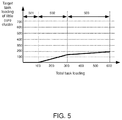
- FIG. 5 shows an optimal task allocation curve according to an embodiment
- FIG. 6 shows a performance prioritized task allocation curve
- FIG. 7 shows a power-saving prioritized task allocation curve
- FIG. 8 is a multi-core processing device according to an embodiment.
- a system may be a multi-core processing device, which may include multiple processor cores having different computation capabilities.
- a multi-core processing device includes a first processor core cluster and a second processor core cluster.
- the first processor core cluster may include multiple identical first processor cores
- the second processor core cluster may include multiple identical second processor cores.
- the computation capability of each of the second processor cores is greater than the computation capability of each of the first processor cores.
- the second processor core having the greater computation capability may be referred to as a big core, whereas the first processor core may be referred to as a little core.
- a big core has higher performance but is more power consuming; a little core has lower performance but is more power saving.
- FIG. 1 shows a schematic diagram of global task scheduling of a multi-core processor architecture.
- the task if loading of a task exceeds an hmp_up_migration threshold, the task is switched to and executed by a big core or a big core cluster 102 . If loading of this task is lower than an hmp_down_migration threshold, the task is switched to and executed by a little core or a little core cluster 101 .
- the hmp_up_migration threshold is usually larger than the hmp_down_migration threshold. If a system includes only one migration threshold serving as a determination basis for switching between big and little cores, frequent and unnecessary switching may be caused when loading of a task fluctuates about this migration threshold. Using dual thresholds as a determination basis for switching, the drawback of the above single value can be prevented while performance can be enhanced.
- FIG. 2 shows the progressing of loading migration under a static migration threshold.
- the global task scheduling of a system provides a static migration threshold; that is, the migration threshold stays constant under different applications or during a process of different overall resources.
- there are a total of two static migration thresholds including an hmp_down_migration threshold 204 and an hmp_up_migration threshold 205 .
- the task loading is handled by a small core cluster.
- FIG. 3A shows a flowchart of statically adjusting a migration threshold.
- the loading of a newly added task is predetermined to be executed by a certain processor core, which may be a big core or a little core (represented by big/little core herein) (step 301 ). It is determined whether task loading migration is to be performed (step 302 ). In step 302 , if the newly task is intended to be executed by a big core, the system determines whether the task loading is lower than the hmp_down_migration threshold. If so, the loading of the newly added is allocated to a little core. If not, the newly added task is executed by the original big core. Thus, step 302 leads to two results—switching and not switching. If the result is not switching, the newly added task is executed by the original big/little core. If the result is switching, the newly added task is switched to and executed by another core (step 303 ). The another core switched to may be represented by a little/big core.
- FIG. 3B shows a flowchart of dynamically adjusting a migration threshold according to an embodiment. Compared to FIG. 3A , FIG. 3B further includes steps of adjusting a migration threshold (step 304 and step 305 ). In some embodiments, there are two migration thresholds, including an hmp_down_migration threshold and an hmp_up_migration threshold. In step 304 , the system determines whether a migration threshold needs to be changed. If a difference between current task loading and target task loading is within a tolerable error, it is determined that no change is needed.
- Step 302 is performed if no change is needed, otherwise step 305 is performed if change is needed. Step 302 is performed after changing the migration threshold in step 305 to determine whether switching of a core is needed.
- FIG. 4 shows a flowchart of how to achieve dynamically adjusting a migration threshold.
- current total loading is calculated (step 410 ).
- An index of the computation capability may be Dhrystone million instructions executed per second (DMIPS).
- the maximum total loading is (N+M*X)*100, wherein the little core cluster has N processor cores, the big core cluster has M processor cores, and 100 represents a loading level when a processor core in the little core cluster operates at a full capacity.
- target task loading is calculated (step 420 ).
- step 420 is calculation for an optimal task allocation, which may be planned in advance according to system resources and applications.
- the optimal task allocation can be realized by a look-up table (LUT). Implementation details of step 420 are described below.
- the optimal task allocation can be represented by a curve.
- FIG. 5 shows an optimal task allocation curve according to an embodiment.
- the horizontal axis represents current total loading
- the vertical axis represents target task loading of a little core cluster.
- the slope of a first line segment is 0, and all task loading is executed by the big core cluster.
- the second phase 502 a part of the task loading is gradually allocated to the little core cluster.
- task loading on both the big core cluster and the little core cluster continues increasing, until upper performance limits of the two clusters are reached.
- FIG. 6 shows a task allocation curve when performance is prioritized.
- FIG. 6 includes only two straight line segments.
- the slope of the first line segment is 0, which means that all tasks are executed by the big core cluster.
- the upper performance limit of the big core cluster is reached. If there are more new tasks at this point, these extra tasks are allocated to the little core cluster until the upper performance limit of the little core cluster is also reached.
- the slope of the second line segment is 1, which means that the extra tasks are allocated to the little core cluster because the upper performance limit of the big core cluster is reached.
- FIG. 7 shows a task allocation curve when power saving is prioritized.
- the slope of the first line segment is 1, which means that all newly added tasks are allocated to the little core cluster.
- the slope of the second line segment is 0, which means all new tasks are allocated to the big core cluster because the upper performance limit of the little core cluster is reached.
- a system may provide multiple different target task loading curves to select from. If the goal is high performance, the target task loading curve in FIG. 6 may be selected to determine dynamic task migration. In contrast, if the goal is low power consumption, the target task loading curve in FIG. 7 may be selected to determine dynamic task migration. Also referring to FIG. 4 , in step 430 , whether the current task loading condition matches expected target task loading can be determined. If the current task loading condition matches the expected target task loading, the hmp_up_migration threshold and the hmp_down_migration threshold are not changed. Conversely, if the target task loading condition does not match the expected target task loading, either the hmp_up_migration threshold or the hmp_down_migration threshold needs to be changed.
- step 440 when the difference between the current task loading condition and the target task loading is within a tolerable error, it is considered that the target task loading is matched.
- the hmp_up_migration threshold and the hmp_down_migration threshold are changed.
- the hmp_down_migration threshold is increased or the hmp_up_migration threshold is increased when the target task loading of the little core cluster is higher than the current task loading, such that the newly added task can be more likely allocated to the little core cluster.
- the hmp_up_migration threshold is decreased or the hmp_down_migration threshold is decreased, such that the newly added task can be more likely allocated to the big core cluster. It should be noted that, the above determination method based on the difference between the target task loading of the little core cluster and the current task loading is merely an example.
- the target task loading curve of the big core cluster can be first provided, and the difference between the target task loading and the current task loading of the big core cluster is then determined.
- the hmp_up_migration threshold can be increased or the hmp_down_migration threshold can be increased, such that the newly added task loading can be more likely allocated to the small core cluster.
- the hmp_up_migration threshold can be decreased or the hmp_down_migration threshold can be decreased, such that the newly added task loading can be more likely allocated to the big core cluster.
- the hmp_up_migration threshold or the hmp_down_migration threshold may be adjusted by a larger value.
- An embodiment of adjusting the hmp_up_migration threshold or the hmp_down_migration threshold is given below.
- absolute delta threshold is a value by which the hmp_up_migration threshold or the hmp_down_migration threshold is adjusted
- Adjust factor is a factor associated with coarse tuning or fine tuning
- Current task loading is the current task loading
- Tiget task loading the target task loading.
- FIG. 8 shows a multi-core processing device according to an embodiment.
- a multi-core processing device 800 includes a first processor core cluster 801 , a second processor core cluster 802 , and a task loading allocating circuit 803 .
- the first processor core cluster 801 includes multiple first processor cores 804 .
- the second processor core cluster 802 includes multiple second processor cores 805 .
- the computation capability of the second processor cores 805 is greater than that of the first processor cores 804 .
- the task loading allocating circuit 803 determines whether a difference between current task loading of the first processor core cluster 801 and target task loading of the first processor core cluster 801 is greater than a tolerable error.
- the multi-core processing device 800 includes only one first processor core 804 and only one second processor core 805 .
- the task loading allocating circuit 803 determines whether a difference between current task loading of the first processor core 804 and target task loading of the first processor core 804 is greater than a tolerable error.
- the task loading allocating circuit 803 can also determine whether a difference between current task loading of the second processor core cluster 802 and target task loading of the second processor core 802 is greater than a tolerable error.
- the task loading allocating circuit 803 may also determine whether a difference between current task loading of the second processor core 805 and target task loading of the second processor core 805 is greater than a tolerable error.
- the determining of the target task loading and the current task loading can be completed by the first processor core 804 and the second processor core 805 .
- the multi-core processing device 800 may not include the task loading allocating circuit 803 .
Landscapes
- Engineering & Computer Science (AREA)
- Theoretical Computer Science (AREA)
- Software Systems (AREA)
- Physics & Mathematics (AREA)
- General Engineering & Computer Science (AREA)
- General Physics & Mathematics (AREA)
- Computer Hardware Design (AREA)
- Computing Systems (AREA)
- Power Sources (AREA)
- Multi Processors (AREA)
Abstract
Description
Claims (20)
Priority Applications (1)
| Application Number | Priority Date | Filing Date | Title |
|---|---|---|---|
| US15/831,655 US10635484B2 (en) | 2016-12-07 | 2017-12-05 | Device and method for dynamically adjusting task loading of multi-core processor |
Applications Claiming Priority (2)
| Application Number | Priority Date | Filing Date | Title |
|---|---|---|---|
| US201662430943P | 2016-12-07 | 2016-12-07 | |
| US15/831,655 US10635484B2 (en) | 2016-12-07 | 2017-12-05 | Device and method for dynamically adjusting task loading of multi-core processor |
Publications (2)
| Publication Number | Publication Date |
|---|---|
| US20180157527A1 US20180157527A1 (en) | 2018-06-07 |
| US10635484B2 true US10635484B2 (en) | 2020-04-28 |
Family
ID=62243889
Family Applications (1)
| Application Number | Title | Priority Date | Filing Date |
|---|---|---|---|
| US15/831,655 Active 2038-04-05 US10635484B2 (en) | 2016-12-07 | 2017-12-05 | Device and method for dynamically adjusting task loading of multi-core processor |
Country Status (3)
| Country | Link |
|---|---|
| US (1) | US10635484B2 (en) |
| CN (1) | CN108170525B (en) |
| TW (1) | TWI693548B (en) |
Families Citing this family (10)
| Publication number | Priority date | Publication date | Assignee | Title |
|---|---|---|---|---|
| US10656701B2 (en) * | 2016-12-16 | 2020-05-19 | Red Hat, Inc. | Managing processor frequencies |
| JP7310378B2 (en) | 2019-07-08 | 2023-07-19 | 富士通株式会社 | Information processing program, information processing method, and information processing apparatus |
| CN111198757B (en) * | 2020-01-06 | 2023-11-28 | 北京小米移动软件有限公司 | CPU kernel scheduling method, CPU kernel scheduling device and storage medium |
| CN111831414A (en) * | 2020-07-01 | 2020-10-27 | Oppo广东移动通信有限公司 | Thread migration method, device, storage medium and electronic device |
| CN114546631A (en) * | 2020-11-24 | 2022-05-27 | 北京灵汐科技有限公司 | Task scheduling method, control method, core, electronic device and readable medium |
| CN113626190B (en) * | 2021-08-04 | 2022-10-18 | 电子科技大学 | Load balancing method in microkernel operating system facing multi-kernel environment |
| CN113568390B (en) * | 2021-09-22 | 2021-12-14 | 中国核动力研究设计院 | DCS (distributed control system) dynamic layered communication method and system based on multi-level processor |
| CN115904647A (en) * | 2021-09-30 | 2023-04-04 | 荣耀终端有限公司 | A task scheduling method, electronic equipment, chip system and storage medium |
| CN114661473B (en) * | 2022-03-29 | 2024-10-11 | Oppo广东移动通信有限公司 | Task processing method, device, storage medium and electronic device |
| WO2026063678A1 (en) * | 2024-09-22 | 2026-03-26 | 삼성전자 주식회사 | Electronic device and method for supporting single affinity setting |
Citations (4)
| Publication number | Priority date | Publication date | Assignee | Title |
|---|---|---|---|---|
| US20150040136A1 (en) * | 2013-08-01 | 2015-02-05 | Texas Instruments, Incorporated | System constraints-aware scheduler for heterogeneous computing architecture |
| TW201527950A (en) | 2013-10-31 | 2015-07-16 | Samsung Electronics Co Ltd | Electronic systems including heterogeneous multi-core processors and methods of operating same |
| US20160139964A1 (en) * | 2014-11-17 | 2016-05-19 | Mediatek Inc. | Energy Efficient Multi-Cluster System and Its Operations |
| US20160327999A1 (en) * | 2014-09-17 | 2016-11-10 | Mediatek Inc. | Dynamic frequency scaling in multi-processor systems |
Family Cites Families (14)
| Publication number | Priority date | Publication date | Assignee | Title |
|---|---|---|---|---|
| US8346999B2 (en) * | 2009-12-15 | 2013-01-01 | Intel Corporation | Dynamic receive queue balancing with high and low thresholds |
| CN101901042B (en) * | 2010-08-27 | 2011-07-27 | 上海交通大学 | Method for reducing power consumption based on dynamic task migrating technology in multi-GPU (Graphic Processing Unit) system |
| CN102759980B (en) * | 2011-04-29 | 2016-01-20 | 晨星软件研发(深圳)有限公司 | Multi-core electronic system and rate adjustment device thereof |
| CN102594869A (en) * | 2011-12-30 | 2012-07-18 | 深圳市同洲视讯传媒有限公司 | Method and device for dynamically distributing resources under cloud computing environment |
| CN102707996A (en) * | 2012-05-15 | 2012-10-03 | 江苏中科梦兰电子科技有限公司 | Task scheduling method for heterogeneous multi-core processor |
| CN103870322B (en) * | 2012-12-17 | 2017-06-30 | 联发科技股份有限公司 | Method for controlling task transfer, non-transitory computer readable medium, heterogeneous multi-core system |
| US20140173623A1 (en) * | 2012-12-17 | 2014-06-19 | Mediatek Inc. | Method for controlling task migration of task in heterogeneous multi-core system based on dynamic migration threshold and related computer readable medium |
| CN104008013B (en) * | 2013-02-26 | 2018-02-09 | 华为技术有限公司 | A kind of nuclear resource distribution method, device and many-core system |
| CN103617076A (en) * | 2013-10-31 | 2014-03-05 | 中兴通讯股份有限公司 | Method and system for dispatching virtualized resources and server |
| CN103942103A (en) * | 2014-04-16 | 2014-07-23 | 乐视致新电子科技(天津)有限公司 | Method and device for generating processor scheduling policy in multi-core system and scheduling system |
| US9665161B2 (en) * | 2014-08-27 | 2017-05-30 | Mediatek Inc. | Method and computer-readable medium for dynamically managing power of multi-core processor |
| CN104516480B (en) * | 2014-12-08 | 2018-11-27 | 广东欧珀移动通信有限公司 | A kind of method and device reducing system power dissipation |
| CN105893141A (en) * | 2015-12-17 | 2016-08-24 | 乐视致新电子科技(天津)有限公司 | Regulation control method and apparatus for multi-core processor and mobile terminal using method |
| CN111538572B (en) * | 2020-03-26 | 2024-11-19 | 中国平安人寿保险股份有限公司 | Task processing method, device, scheduling server and medium |
-
2017
- 2017-11-07 TW TW106138353A patent/TWI693548B/en active
- 2017-11-13 CN CN201711116747.3A patent/CN108170525B/en active Active
- 2017-12-05 US US15/831,655 patent/US10635484B2/en active Active
Patent Citations (4)
| Publication number | Priority date | Publication date | Assignee | Title |
|---|---|---|---|---|
| US20150040136A1 (en) * | 2013-08-01 | 2015-02-05 | Texas Instruments, Incorporated | System constraints-aware scheduler for heterogeneous computing architecture |
| TW201527950A (en) | 2013-10-31 | 2015-07-16 | Samsung Electronics Co Ltd | Electronic systems including heterogeneous multi-core processors and methods of operating same |
| US20160327999A1 (en) * | 2014-09-17 | 2016-11-10 | Mediatek Inc. | Dynamic frequency scaling in multi-processor systems |
| US20160139964A1 (en) * | 2014-11-17 | 2016-05-19 | Mediatek Inc. | Energy Efficient Multi-Cluster System and Its Operations |
Non-Patent Citations (1)
| Title |
|---|
| Lukefahr et al., "Composite Cores: Pushing Heterogeneity into a Core", 2012. IEEE, pp. 317-328. (Year: 2012). * |
Also Published As
| Publication number | Publication date |
|---|---|
| CN108170525A (en) | 2018-06-15 |
| TW201821981A (en) | 2018-06-16 |
| CN108170525B (en) | 2022-02-08 |
| TWI693548B (en) | 2020-05-11 |
| US20180157527A1 (en) | 2018-06-07 |
Similar Documents
| Publication | Publication Date | Title |
|---|---|---|
| US20180157527A1 (en) | Device and method for dynamically adjusting task loading of multi-core processor | |
| US20140173623A1 (en) | Method for controlling task migration of task in heterogeneous multi-core system based on dynamic migration threshold and related computer readable medium | |
| CN105452986B (en) | For the system and method that there is selective power or the main memory access of performance optimization to interweave | |
| US8307370B2 (en) | Apparatus and method for balancing load in multi-core processor system | |
| CN103870322B (en) | Method for controlling task transfer, non-transitory computer readable medium, heterogeneous multi-core system | |
| US8799913B2 (en) | Computing system, method and computer-readable medium for managing a processing of tasks | |
| US9323306B2 (en) | Energy based time scheduler for parallel computing system | |
| US9612879B2 (en) | System constraints-aware scheduler for heterogeneous computing architecture | |
| CN108983946B (en) | Server power consumption control method, system and equipment | |
| US9568978B2 (en) | Controlling power consumption in processor-based systems and components thereof | |
| US9213381B2 (en) | Voltage regulator dynamically determining whether requested power transition can be supported | |
| US20110119463A1 (en) | Computing system and method controlling memory of computing system | |
| US7644297B2 (en) | Processor, control device for a processor, clock frequency determining method and source voltage controlling method of a processor | |
| JP2008059054A (en) | Processor system | |
| US20100332785A1 (en) | Memory management system and method thereof | |
| US8959371B2 (en) | Techniques for reducing processor power consumption through dynamic processor resource allocation | |
| KR101232561B1 (en) | Apparatus and method for scheduling task and resizing cache memory of embedded multicore processor | |
| JP5988930B2 (en) | Deployment apparatus and its deployment method for standby system in server virtualization environment | |
| US10627885B2 (en) | Hybrid prioritized resource allocation in thermally- or power-constrained computing devices | |
| US20160011962A1 (en) | Allocating memory usage based on voltage regulator efficiency | |
| WO2017065629A1 (en) | Task scheduler and method for scheduling a plurality of tasks | |
| EP3788453B1 (en) | Processor load step balancing | |
| US20120297151A1 (en) | Memory management apparatus, memory management method and control program | |
| US20240345899A1 (en) | Digitalized power index for automatic dvfs of multi-core processor | |
| KR101824182B1 (en) | Processor and method for power management |
Legal Events
| Date | Code | Title | Description |
|---|---|---|---|
| AS | Assignment |
Owner name: MSTAR SEMICONDUCTOR, INC., TAIWAN Free format text: ASSIGNMENT OF ASSIGNORS INTEREST;ASSIGNORS:TUNG, YI-SHIN;SHIH, TSE-TSUNG;HUANG, TZU-JUNG;REEL/FRAME:044300/0663 Effective date: 20171106 |
|
| FEPP | Fee payment procedure |
Free format text: ENTITY STATUS SET TO UNDISCOUNTED (ORIGINAL EVENT CODE: BIG.); ENTITY STATUS OF PATENT OWNER: LARGE ENTITY |
|
| STPP | Information on status: patent application and granting procedure in general |
Free format text: DOCKETED NEW CASE - READY FOR EXAMINATION |
|
| STPP | Information on status: patent application and granting procedure in general |
Free format text: NON FINAL ACTION MAILED |
|
| STPP | Information on status: patent application and granting procedure in general |
Free format text: RESPONSE TO NON-FINAL OFFICE ACTION ENTERED AND FORWARDED TO EXAMINER |
|
| AS | Assignment |
Owner name: MEDIATEK INC., TAIWAN Free format text: MERGER;ASSIGNOR:MSTAR SEMICONDUCTOR, INC.;REEL/FRAME:050665/0001 Effective date: 20190124 |
|
| STPP | Information on status: patent application and granting procedure in general |
Free format text: NOTICE OF ALLOWANCE MAILED -- APPLICATION RECEIVED IN OFFICE OF PUBLICATIONS |
|
| STCF | Information on status: patent grant |
Free format text: PATENTED CASE |
|
| MAFP | Maintenance fee payment |
Free format text: PAYMENT OF MAINTENANCE FEE, 4TH YEAR, LARGE ENTITY (ORIGINAL EVENT CODE: M1551); ENTITY STATUS OF PATENT OWNER: LARGE ENTITY Year of fee payment: 4 |