US10622925B2 - Control device and control method - Google Patents
Control device and control method Download PDFInfo
- Publication number
- US10622925B2 US10622925B2 US15/520,134 US201515520134A US10622925B2 US 10622925 B2 US10622925 B2 US 10622925B2 US 201515520134 A US201515520134 A US 201515520134A US 10622925 B2 US10622925 B2 US 10622925B2
- Authority
- US
- United States
- Prior art keywords
- magnet
- short circuit
- permanent
- phase short
- axis current
- Prior art date
- Legal status (The legal status is an assumption and is not a legal conclusion. Google has not performed a legal analysis and makes no representation as to the accuracy of the status listed.)
- Expired - Fee Related, expires
Links
Images
Classifications
-
- H—ELECTRICITY
- H02—GENERATION; CONVERSION OR DISTRIBUTION OF ELECTRIC POWER
- H02P—CONTROL OR REGULATION OF ELECTRIC MOTORS, ELECTRIC GENERATORS OR DYNAMO-ELECTRIC CONVERTERS; CONTROLLING TRANSFORMERS, REACTORS OR CHOKE COILS
- H02P21/00—Arrangements or methods for the control of electric machines by vector control, e.g. by control of field orientation
- H02P21/14—Estimation or adaptation of machine parameters, e.g. flux, current or voltage
- H02P21/141—Flux estimation
-
- H—ELECTRICITY
- H02—GENERATION; CONVERSION OR DISTRIBUTION OF ELECTRIC POWER
- H02P—CONTROL OR REGULATION OF ELECTRIC MOTORS, ELECTRIC GENERATORS OR DYNAMO-ELECTRIC CONVERTERS; CONTROLLING TRANSFORMERS, REACTORS OR CHOKE COILS
- H02P29/00—Arrangements for regulating or controlling electric motors, appropriate for both AC and DC motors
- H02P29/60—Controlling or determining the temperature of the motor or of the drive
- H02P29/66—Controlling or determining the temperature of the rotor
- H02P29/662—Controlling or determining the temperature of the rotor the rotor having permanent magnets
Definitions
- the present invention relates to a control device and a control method for a permanent-magnet-type synchronous machine.
- Methods for protecting the permanent magnet from being overheated are roughly classified into: a method in which designing is performed with an allowance provided in advance to beat radiation such that the permanent magnet is not overheated even in any operating state; and a method in which the magnet temperature is detected, and during heating, operation is controlled by reducing an operation load or activating a cooler.
- methods for detecting the magnet temperature in the method in which operation is controlled are roughly classified into: a method in which a temperature sensor or a sensor for detecting a magnetic flux which changes in response to the magnet temperature is additionally installed for detecting the magnet temperature; and a method in which the magnet temperature is estimated from a current, a voltage, or the like during operation of the motor.
- examples of operation in which the magnet temperature easily rises in the method in which the magnet temperature is estimated from a current, a voltage, or the like during operation of the motor include not only a state where the motor is rotated at a high speed with a large torque by a high current, but also a state where three-phase short circuit operation of the motor is performed.
- the three-phase short circuit operation is operation in which three-phase terminals of the motor is virtually short-circuited.
- the magnet temperature is estimated on the basis on information about how the ratio of a magnetic flux fundamental and harmonics change as compared to that at a reference time (for example, see Patent Document 2).
- the magnet magnetic flux or the magnet temperature is estimated from the difference between an actual voltage and a voltage calculated from a motor model held within a controller (for example, see Patent Document 3 and Patent Document 4).
- Patent Document 1 Japanese Laid-open Patent Publication No. 2006-280141
- Patent Document 2 Japanese Laid-Open Patent Publication No. 2014-007851
- Patent Document 3 Japanese Laid-open Patent Publication No. 2001-186800
- Patent Document 4 Japanese Laid-Open Patent Publication No. 2005-192325
- the capacities of the motor and a heat radiator have to be increased, so that there is a problem in that it is difficult to reduce the size and the weight of the motor which is a permanent-magnet-type synchronous machine.
- a temperature sensor or a sensor for detecting a magnetic flux which chancres in response to the magnet temperature
- a space corresponding to the sensor to be installed is required, and the installation location is limited, so that there is a problem that it is difficult to reduce the size and the weight of a control device or the motor which is a permanent-magnet-type synchronous machine.
- Patent Document 3 it is difficult to determine whether a shift off the voltage is due to a change in the magnet magnetic flux or the magnetic flux or due to a change in winding resistance caused by a change in the temperature of the winding, so that there is a problem that the accuracy off estimation of the magnet magnetic flux is low.
- the present invention has been made to solve the above-described problems, and an object of the present invention is; to enable the size of a permanent-magnet-type synchronous machine or a control device to be reduced without needing a particular sensor such as a temperature sensor or a magnetic flux sensor; and to estimate a magnet magnetic flux or a magnet temperature during three-phase short-circuit operation with higher accuracy than in the case where only a d-axis current is used.
- a control device is a control device including a phase short circuit unit for short-circuiting three-phase terminals of a permanent-magnet-type synchronous machine having a permanent magnet, wherein, during three-phase short circuit operation in which the three-phase terminals are short-circuited by the phase short circuit unit and the permanent-magnet-type synchronous machine is operated, a magnet state of the permanent magnet is estimated on the basis of a d-axis characteristic and a q-axis characteristic.
- a control method is a control method, wherein a processor executes: a three-phase short circuit step of short-circuiting three-phase terminals of a permanent-magnet-type synchronous machine having a permanent magnet during operation of the permanent-magnet-type synchronous machine; a detection step of detecting a d-axis characteristic and a q-axis characteristic of the permanent-magnet-type synchronous machine when the three-phase terminals are short-circuited in the three-phase short circuit step; and a magnet state estimation step of estimating a magnet state of the permanent magnet on the basis of the d-axis characteristic and the q-axis characteristic detected in the detection step.
- control device and the control method configured as described above enables the size of the permanent-magnet-type synchronous machine or the control device to be reduced without needing a particular temperature sensor or the like during the three-phase short circuit operation, and also enables the magnet magnetic flux or the magnet temperature to be estimated with higher accuracy than in the case only a d-axis current is used.
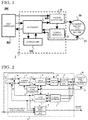
- FIG. 1 is a diagram showing the hardware configuration of a synchronous machine system including a control device according to Embodiment 1 of the present Invention.
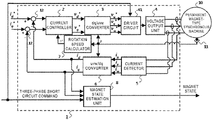
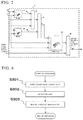
- FIG. 2 is a diagram showing the entire configuration of a permanent-magnet-type synchronous machine and the control device according to Embodiment 1 of the present invention.
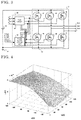
- FIG. 3 is a diagram showing the configurations of a voltage output unit and a driver circuit in the control device according to Embodiment 1 of the present invention.
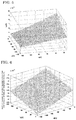
- FIG. 4 is a diagram showing a setting example of a d-axis inductances Ld to be used in the control device according to Embodiment 1 of the present invention.
- FIG. 5 is a diagram showing a setting example of a q-axis inductance Lq to be used in the control device according to Embodiment 1 of the present invention.
- FIG. 6 is a diagram showing a setting example of a rate of change of a magnet magnetic flux per unit change of a magnet temperature which is to be used in the control device according to Embodiment 1 of the present invention.
- FIG. 7 is a diagram showing the configuration of a magnet state estimation unit in the control device according to Embodiment 1 of the present invention.
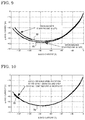
- FIG. 8 is a flowchart of a control method according to Embodiment 1 of the present invention.
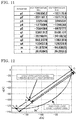
- FIG. 9 is a diagram showing an example of three-phase short circuit current loci in a control device according to Embodiment 2 of the present invention.
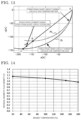
- FIG. 10 is a diagram showing an example of three-phase short circuit current loci in the control device according to Embodiment 2 of the present invention.
- FIG. 11 is a diagram showing an example of parameters of approximate curves of three-phase short circuit current loci in the control device according to Embodiment 2 of the present invention.
- FIG. 12 is an explanatory diagram for obtaining a magnet magnetic flux estimated value on the basis of a d-axis current id and a q-axis current iq by using a three-phase short circuit current locus in the control device according to Embodiment 2 of the present invention.
- FIG. 13 is an explanatory diagram for obtaining a magnet temperature estimated value on the basis of the d-axis current id and the q-axis current iq by using three-phase short circuit current loci in the control device according to Embodiment 2 of the present invention.
- FIG. 14 is a diagram showing the temperature dependence of a residual magnetic flux density representing a magnet magnetic flux which is to be used in the control device according to Embodiment 2 of the present invention.
- FIG. 1 is a diagram showing the hardware configuration of a synchronous machine system including a control device according to Embodiment 1 for carrying out the present invention.
- a synchronous machine system 200 includes a host controller 102 , a control device 1 , a permanent-magnet-type synchronous machine 10 , and a rotation angle detector 11 .
- the control device 1 includes, as hardware, a processor 100 , a storage unit 101 , a voltage output unit 4 , and a current detector 5 .
- the storage unit 101 includes: a volatile storage unit such as a random access memory; and a nonvolatile auxiliary storage unit such as a flash memory.
- the storage unit 101 may include: a volatile storage unit such as a random access memory; and an auxiliary storage unit such as a hard disk instead of a nonvolatile auxiliary storage unit.
- the processor 100 executes a program inputted from the storage unit 101 . Since the storage unit 101 includes the auxiliary storage unit and the volatile storage unit, the program is inputted from the auxiliary storage unit through the volatile storage unit to the processor 100 . In addition, the processor 100 may output data such as a calculation result to the volatile storage unit of the storage unit 101 , or may store the data in the auxiliary storage unit through the volatile storage unit.
- FIG. 2 is a diagram showing the entire configuration of the permanent-magnet-type synchronous machine and the control device according to Embodiment 1 for carrying out the present invention.
- the configuration of the control device 1 according to the present embodiment will be described with reference to FIG. 2 .
- the control device 1 includes a current controller 2 , a dq/uvw converter 3 , the voltage output unit 4 , the current detector 5 , an uvw/dq converter 6 , at rotation speed calculator 7 , a magnet state estimation unit 8 , adders/subtractors 12 , and a driver circuit 41 .
- the control device 1 receives input of a d-axis current command id*, a q-axis current command iq*, and a three-phase short circuit command from the host controller 102 which is not shown, and a rotation angle ⁇ acquired from the rotation angle detector 11 which is installed at the permanent-magnet-type synchronous machine 10 ; and outputs a magnet state and voltages which are to be inputted to the permanent-magnet-type synchronous machine 10 and correspond to three-phase voltage commands.
- the control device 1 may receive input of a torque command or the like from the host controller 102 . In this case, the control device 1 converts the torque command or the like to the d-axis current command id* and the q-axis current command iq*.
- the permanent-magnet-type synchronous machine 10 includes: a stator having windings through which three-phase currents generated by the voltages corresponding to the three-phase voltage commands flow; and a rotor having different magnetic poles which are formed by a permanent magnet and arranged alternately in the circumferential direction with respect to a rotation shaft.
- the rotation angle detector 11 is installed at the rotor of the permanent-magnet-type synchronous machine 10 and detects the rotation angle ⁇ of the rotor.
- the current controller 2 receives: values obtained by subtracting a d-axis current id and a q-axis current iq, which are provided by a device outside the control device 1 (e.g., the host controller 102 which is not shown), from the d-axis current command id* and the q-axis current command iq*, respectively, by the adders/subtractors 12 ; and a rotation speed ⁇ of the rotor of the permanent-magnet-type synchronous machine 10 . Then, upon reception of these inputs, the current controller 2 outputs a d-axis voltage command vd* and a q-axis voltage command vq*.
- the d-axis voltage command vd* and the q-axis voltage command vq* are set to values with which the d-axis current id and the q-axis current iq flowing through the permanent-magnet-type synchronous machine 10 are caused to follow the d-axis current command id* and the q-axis current command iq*.
- the dq/uvw converter 3 converts the d-axis voltage command vd* and the q-axis voltage command vq* to three-phase voltage commands vu*, w*, and w* on the basis of ⁇ indicating the circumferential direction of the rotor of the permanent-magnet-type synchronous machine 10 , by using a well-known coordinate conversion method.
- the driver circuit 41 receives the three-phase voltage commands vu*, vv*, and vw* or the three-phase short circuit command and sands switching signals for driving later-described switching elements, to the voltage output unit 4 .
- the voltage output unit 4 Upon reception of the switching signals, the voltage output unit 4 outputs voltages corresponding to the three-phase voltage commands vu*, vv*, and vw*. Upon reception of the three-phase short circuit command from the host controller 102 , the voltage output unit 4 short-circuits three-phase terminals of the permanent-magnet-type synchronous machine 10 by making the later-described switching elements of the voltage output unit 4 conductive.
- the current detector 5 is, for example, a current sensor such as a resistance which is installed on a wire which connects the voltage output unit 4 to the permanent-magnet-type synchronous machine 10 .
- the current detector 5 detects three-phase currents iu, iv, and iw flowing from the voltage output unit 4 to the permanent-magnet-type synchronous machine 10 .
- the uvw/dq converter 6 converts the three-phase currents iu, iv, and iw detected by the current detector 5 to the d-axis current id and the q-axis current iq by using a well-known coordinate conversion method.
- the rotation speed calculator 7 outputs the rotation speed ⁇ of the rotor of the permanent-magnet-type synchronous machine 10 on the basis of the rotation angle ⁇ of the rotor acquired from the rotation angle detector 11 which is installed at the permanent-magnet-type synchronous machine 10 .
- the magnet state estimation unit 8 estimates the magnet state of the permanent-magnet-type synchronous machine 10 on the basis of the d-axis current id and the c-axis current iq acquired from the uvw/dq converter 6 .
- the magnet state refers to the magnet temperature or the magnet magnetic flux of the permanent magnet.
- the magnet state includes an induced voltage constant or a torque constant which is substantially equivalent to the magnet magnetic flux.
- the current controller 2 , the dq/uvw converter 3 , the uvw/dq converter 41 , the rotation speed calculator 7 , the magnet state estimation unit 8 , the adders/subtractors 12 , and the driver circuit 41 in FIG. 2 are implemented by the processor 100 which executes a program stored in the storage unit 101 or by a processing circuit such as a system LSI which is not shown.
- the above functions may foe executed by cooperation of a plurality of processors 100 and a plurality of storage units 101 , or may be executed by cooperation of a plurality of processing circuits.
- the above functions may be executed by cooperation of a combination of: a plurality of processors 100 and a plurality of storage units 101 ; and a plurality of processing circuits.
- FIG. 3 is a diagram showing the configurations of the voltage output unit and the driver circuit in the control device according to the present embodiment.
- FIG. 3 shows a specific configuration example of the voltage output unit of the present embodiment.
- the voltage output unit 4 is supplied with DC power from a power supply 52 such as a battery.
- the voltage output unit 4 includes a three-phase bridge circuit having six switching elements 42 to 47 .
- the driver circuit 41 sends the switching signals for driving the switching elements 42 to 47 .
- the three-phase bridge circuit of the voltage output unit 4 is composed of a bridge in which the six switching elements 42 to 47 such as MOSFETs are used.
- the switching elements 42 and 45 are connected in series
- the switching elements 43 and 46 are connected in series
- the switching elements 44 and 47 are connected in series
- further these three pairs of the switching elements are connected in parallel.
- one shunt resistor may be connected as the current detector 5 at each of GND 54 (ground) sides of the three switching elements 45 , 46 , and 47 at the lower side. These shunt resistors are used for detecting the three-phase currents iu, iv, and iw flowing from the voltage output unit 4 to the permanent-magnet-type synchronous machine 10 .
- the number of the shunt resistors is three, two shunt resistor may be provided, or the current detection is possible even with one shunt resistor, and such a configuration may be provided.
- the one shunt resistor is not provided between the GND 54 and a connection portion 53 to which the GND 54 sides of the switching elements 45 , 46 , and 47 are electrically connected. This is because one shunt resistor provided at such a position cannot detect a current during three-phase short circuit. Thus, even in the case where one shunt resistor is used, the shunt resistor needs to be provided between any of the GND 54 sides of the switching elements 45 , 46 , and 47 and the connection portion 53 .
- the current detector 5 detects a current phase by a PLL, which is a phase synchronous circuit, or the like, and estimates three-phase currents on the basis of the assumption that the three-phase currents are generally balanced.
- a PLL phase synchronous circuit, or the like
- the three-phase currents iu, iv, and iw respectively flow from between the switching element 42 and the switching element 45 through a bus bar or the like to a U-phase terminal 51 - 1 of the permanent-magnet-type synchronous machine 10 , from between the switching element 43 and the switching element 46 through a bus bar or the like to a V-phase terminal 51 - 2 of the permanent-magnet-type synchronous machine 10 , and from between the switching element 44 and the switching element 47 through a bus bar or the like to a W-phase terminal 51 - 3 of the permanent-magnet-type synchronous machine 10 , to be supplied to the permanent-magnet-type synchronous machine 10 .
- FIG. 2 shows the current detector 5 including three current transformers and a peripheral amplifier circuit.
- the number of the current transformers may be two.
- the current detector 5 can obtain a current value of the remaining one phase by using the fact that the sum of the three-phase currents is zero.
- the number of the current transformers may be one.
- the current detector 5 can obtain the three-phase currents on the basis of current phase detection and the assumption that the three-phase currents are generally balanced.
- shunt resistors may be connected in series with the bus bars or the like.
- the driver circuit 41 has a PWM circuit 49 and a phase short circuit unit 50 .
- the PWM circuit 49 sends, to the switching elements 42 to 47 , switching signals composed of waveforms for switching the switching elements 42 to 47 in accordance with the voltages corresponding to the three-phase voltage commands vu*, w*, and vw*.
- the phase short circuit unit 50 When the phase short circuit unit 50 receives the three-phase short circuit command from the host controller 102 which is not shown, the phase short circuit unit 50 sends, to the switching elements 42 to 47 , a three-phase short circuit switching signal for making only a specific group among the switching elements 42 to 47 conductive.
- the three-phase short circuit switching signal includes a three-phase short circuit switching signal based on upper-arm conduction and a three-phase short circuit switching signal based on lower-arm conduction.
- the three-phase short circuit switching signal based on upper-arm conduction refers to a signal for making the switching elements 42 to 44 conductive and not making the switching elements 45 to 47 conductive.
- the three-phase short circuit switching signal based on lower-arm conduction refers to a signal for making the switching elements 45 to 47 conductive and not making the switching elements 42 to 44 conductive.
- any of upper-arm conduction and lower-arm conduction is allowable.
- the switching elements 42 to 44 or the switching elements 45 to 47 which have received the three-phase short circuit switching signal, being made conductive, the u-phase terminal 51 - 1 , the V-phase terminal 51 - 2 , and the W-phase terminal 51 - 3 , which are the three-phase terminals of the permanent-magnet-type synchronous machine 10 , are short-circuited. That is, the phase short circuit unit 50 short-circuits the U-phase terminal 51 - 1 , the v-phase terminal 51 - 2 , and the W-phase terminal 51 - 3 , which are the three-phase terminals of the permanent-magnet-type synchronous machine 10 .
- the magnet state estimation unit 8 calculates a magnet magnetic flux estimated value ⁇ PM of the magnet magnetic flux as the magnet state on the basis of the following mathematical expression by using: the d-axis current id and the q-axis current iq acquired from the uvw/dq converter 6 ; and a d-axis inductance Ld and a q-axis inductance Lq which are preset.
- FIG. 4 is a diagram showing a setting example of the d-axis inductance Ld to be used in the control device according to the present embodiment.
- the horizontal axis in FIG. 4 represents the d-axis current id
- the vertical axis in FIG. 4 represents the q-axis current iq
- the height axis in FIG. 4 represents the d-axis inductance Ld.
- FIG. 5 is a diagram showing a setting example of the q-axis inductance Lq to be used in the control device of the present embodiment.
- the horizontal axis in FIG. 5 represents the d-axis current id
- the vertical axis in FIG. 5 represents the q-axis current iq
- the d-axis inductance Ld and the q-axis inductance Lq which are preset, may not be fixed values but may be set as maps corresponding to the d-axis current id and the q-axis current iq as shown in FIGS. 4 and 5 . These set values are different depending on the permanent-magnet-type synchronous machine 10 which is a driving target of the control device 1 .
- the magnet state estimation unit 8 may directly use a d-axis magnetic flux ⁇ d and a q-axis magnetic flux ⁇ q without explicitly using the d-axis inductance Ld and the q-axis inductance Lq. Specifically, the magnet state estimation unit 8 may obtain the d-axis magnetic flux ⁇ d and the q-axis magnetic flux ⁇ q from the d-axis current id and the q-axis current iq with maps, and may calculate the magnet magnetic flux estimated value ⁇ PM on the basis of the following mathematical expression.
- the magnet state estimation unit 8 calculates a magnet temperature estimated value TPM from the magnet magnetic flux estimated value ⁇ PM calculated therein.
- FIG. 6 is a diagram showing a setting example of a rate of change of the magnet magnetic flux per unit change of the magnet temperature which is to be used in the control device of the present embodiment.
- the horizontal axis in FIG. 6 represents the d-axis current id
- the vertical axis in FIG. 6 represents the q-axis current iq
- the height axis in FIG. 6 represents the rate of change of the magnet magnetic flux per unit change of the magnet temperature.
- the magnet state estimation unit 8 calculates the magnet temperature estimated value TPM of the magnet temperature as the magnet state from the magnet magnetic flux estimated value ⁇ PM, which is calculated by expression (2), further on the basis of the following mathematical expression.
- ⁇ PM 0 indicates a preset reference magnet magnetic flux and is a value corresponding to the magnet magnetic flux at a reference magnet temperature TPM 0 and k indicates the rate of change of the magnet magnetic flux per unit change of the magnet temperature and is a preset value.
- k does not need to be set as a fixed value and may be set as a map corresponding to the d-axis current id and the q-axis current iq as shown in FIG. 6 .
- the set value of k is different depending on the permanent-magnet-type synchronous machine 10 which is a driving target of the control device 1 .
- FIG. 7 is a diagram showing the configuration of the magnet state estimation unit in the control device according to the present embodiment.
- the magnet temperature estimated value TPM can also be directly obtained on the basis of the magnet magnetic flux estimated value ⁇ PM, which is obtained on the basis of expression (1) and expression (2), the d-axis current id, and the q-axis current iq as shown in the magnet state estimation unit 8 in FIG. 7 .
- a q-axis magnetic flux map 81 obtains the q-axis magnetic flux ⁇ q from the d-axis current id and the q-axis current iq.
- a d-axis magnetic flux map 82 obtains the d-axis magnetic flux ⁇ d from the d-axis current id and the q-axis current iq.
- a multiplier/divider 83 divides the q-axis magnetic flux ⁇ q by the d-axis current id and multiplies the resultant value by the q-axis current iq.
- a subtractor 84 sums up a value obtained by inverting the sign of the output value of the multiplier/divider 83 and a value obtained by inverting the sign of the output value of the d-axis magnetic flux map 82 .
- the output value of the subtractor 84 is equivalent to the magnet magnetic flux estimated value ⁇ PM shown in expression (2).
- the magnet temperature estimated value TPM is obtained from the d-axis current id, the q-axis current iq, and the magnet magnetic flux estimated value ⁇ PM, which is the output value of the subtractor 84 .
- the temperature estimation map 85 corresponds to expression (3). Meanwhile, since k and ⁇ PM 0 in expression (3) slightly change in accordance with the d-axis current id and the q-axis current iq in some cases, the temperature estimation map 85 is implemented as a map in consideration of these changes.
- a switch 86 outputs the magnet temperature estimated value TPM only when the three-phase short circuit command is valid.
- FIG. 8 is a flowchart of a control method according to the present embodiment.
- the processor 100 sequentially executes a three-phase short circuit step S 301 , a detection step S 302 , and a magnet state estimation step S 303 .
- the U-phase terminal 51 - 1 , the V-phase terminal 51 - 2 , and the W-phase terminal 51 - 3 which are the three-phase terminals of the permanent-magnet-type synchronous machine 10 , are short-circuited.
- the d-axis current id and the q-axis current iq are detected as a d-axis characteristic and a q-axis characteristic of the permanent-magnet-type synchronous machine 10 .
- the magnet magnetic flux estimated value ⁇ PM of the magnet magnetic flux is estimated as the magnet state of the permanent magnet by using expression (1) or expression (2) on the basis of: the d-axis current id which is the d-axis characteristic detected in the detection step S 302 ; and the q-axis current iq which is the q-axis characteristic detected in the detection step S 302 .
- the magnet temperature estimated value TPM of the magnet temperature is estimated as the magnet state of the permanent magnet by using expression (3), FIG. 6 , or FIG. 7 on the basis of the d-axis current id and the q-axis current iq which are detected in the detection step S 302 .
- the control device 1 calculates the magnet magnetic flux estimated value ⁇ PM of the magnet magnetic flux as the magnet state of the permanent magnet of the permanent-magnet-type synchronous machine 10 on the basis of the d-axis current id, the preset d-axis inductance Ld, the q-axis current iq, and the preset q-axis inductance Lq.
- the control device 1 estimates the magnet state of the permanent magnet of the permanent-magnet-type synchronous machine 10 on the basis of: d-axis characteristics which are the d-axis current id and the preset d-axis inductance Ld; and q-axis characteristics which are the q-axis current iq and the preset q-axis inductance Lq.
- the q-axis current by also using the q-axis current, it is made possible to distinguish between a current change due to a change in the winding resistance and a current change due to a change in the magnet state and estimate the magnet state more accurately at a low rotation speed (which depends on the characteristics of the permanent-magnet-type synchronous machine, but is equal to or greater than about 300 rpm in the case of the permanent-magnet-type synchronous machine used in the experiment) than in the case where the d-axis current is used.
- the motor in the case of performing a braking operation in order to stop rotation of a motor, the motor is driven such that a torque in a direction opposite to the rotation direction is generated.
- a torque for braking is generated by short-circuiting three phases of the motor in some cases.
- the control device 1 can achieve sufficient accuracy of estimation of the magnet state even at a low rotation speed at which a braking torque is generated by a three-phase short circuit.
- the rotation speed of the synchronous machine during operation is normally determined from the rotation speed of the power source (e.g., the rotation speed of an engine corresponding to the vehicle speed).
- the rotation speed of the power source e.g., the rotation speed of an engine corresponding to the vehicle speed.
- overheating of the permanent magnet may foe caused even at an intermediate rotation speed (e.g., 1000 rpm), and thus it is necessary to continue to estimate the magnet state.
- the control device 1 can achieve sufficient accuracy of estimation of the magnet state. Since the accuracy of estimation of the magnet state improves, heat radiation designing can have allowance, so that there is an advantage that the size of the permanent-magnet-type synchronous machine can be reduced, for example.
- the control device 1 calculates the magnet magnetic flux estimated value ⁇ PM of the magnet magnetic flux as the magnet state of the permanent magnet of the permanent-magnet-type synchronous machine 10 on the basis of the d-axis current id, the d-axis magnetic flux ⁇ d, the q-axis current iq, and the q-axis magnetic flux ⁇ q.
- the control device 1 estimates the magnet state of the permanent magnet of the permanent-magnet-type synchronous machine 10 on the basis of: the d-axis characteristics which are the d-axis current id and the d-axis magnetic flux ⁇ d; and the q-axis characteristics which are the q-axis current iq and the q-axis magnetic flux ⁇ q.
- the control device 1 further calculates the magnet temperature estimated value TPM of the magnet temperature as the magnet state of the permanent magnet of the permanent-magnet-type synchronous machine 10 on the basis of the magnet magnetic flux estimated value ⁇ PM by using: the preset reference magnet temperature TPM 0 ; the reference magnet magnetic flux ⁇ PM 0 which is preset at the reference magnet temperature TPM 0 ; and the preset rate of change k of the magnet magnetic flux per unit change of the magnet temperature.
- the control device 1 further calculates the magnet temperature estimated value TPM of the magnet temperature as the magnet state of the permanent magnet of the permanent-magnet-type synchronous machine 10 on the basis of the d-axis current id, the q-axis current iq, and the magnet magnetic flux estimated value ⁇ PM by using the preset temperature estimation map 85 .
- the same advantageous effect is achieved as in the above-described case where the magnet temperature estimated value TPM is calculated on the basis of the magnet magnetic flux estimated value ⁇ PM by using: the preset reference magnet temperature TPM 0 ; the reference magnet magnetic flux ⁇ PM 0 which is preset at the reference magnet temperature TPM 0 ; and the preset rate of change k of the magnet magnetic flux per unit change of the magnet temperature.
- This configuration is required when the rate of change k of the magnet magnetic flux per unit change of the magnet temperature is not constant and the necessity to correct the rate of change k arises.
- the magnet temperature and the magnet magnetic flux are nonlinear with respect to the d-axis current id and the q-axis current iq, this can be taken into consideration by the temperature estimation map 85 , so that the accuracy of the magnet temperature estimated value TPM improves.
- FIG. 9 is a diagram showing an example of three-phase short circuit current loci in a control device according to Embodiment 2 for carrying out the present invention.
- the horizontal axis in FIG. 9 represents the d-axis current id
- the vertical axis in FIG. 5 represents the q-axis current iq.
- the control device 1 according to the present embodiment is different from Embodiment 1 in the following points.
- the magnet state estimation unit 8 in the present embodiment calculates the magnet state on the basis of a preset three-phase short circuit current locus and the d-axis current id and the q-axis current iq which are acquired from the uvw/dq converter 6 .
- the three-phase short circuit current locus refers to the locus of the d-axis current id and the q-axis current iq which are drawn on a dq-axis coordinate plane when the rotor of the permanent-magnet-type synchronous machine 10 is externally rotated and the rotation speed is slowly changed in a state where the three-phase terminals 51 - 1 to 51 - 3 of the permanent-magnet-type synchronous machine 10 , which is a driving target of the control device 1 , are short-circuited.
- the three-phase short circuit current locus refers to a curved line which is formed by steady-state values of the d-axis current id and the q-axis current iq which are different at each rotation speed.
- the three-phase short circuit current locus is different depending on a difference in the magnet state of the permanent-magnet-type-synchronous machine 10 .
- FIG. 9 shows, as an example of actually measured three-phase short circuit current loci, a three-phase short circuit current locus 71 in the ease where the magnet temperature is 28° C., and a three-phase short circuit current locus 72 in the case where the magnet temperature is 57° C.
- the absolute values of the d-axis current id and the q-axis current iq which do not flow during rest, increase as the rotation speed of the rotor increases.
- FIG. 9 is obtained by plotting the d-axis current id and the q-axis current iq on the dq-axis coordinate plane when the rotation speed is changed.
- the absolute value of the q-axis current iq of the three-phase short circuit current-locus is lower than the absolute value of the q-axis current iq of the three-phase short circuit current locus 71 at the same d-axis current id, and the shapes of the three-phase short circuit current loci 71 and 72 are different from each other depending on the magnet temperature. This is because the magnet magnetic flux of the permanent magnet changes due to a change in the magnet temperature, and the voltage induced by rotation of the magnet magnetic flux also changes, so that the d-axis current id and the q-axis current iq become different from each other.
- FIG. 10 is a diagram showing an example of three-phase short circuit current loci in the control device according to the present embodiment.
- the horizontal axis in FIG. 10 represents the d-axis current id
- the vertical axis in FIG. 10 represents the q-axis current iq.
- the three-phase short circuit current locus 71 shown toy a thin line is one recorded at a magnet temperature of 28° C. while the rotation speed is changed.
- FIG. 10 is one obtained by plotting the d-axis current id and the q-axis current iq when the winding resistance is gradually increased by increasing the temperature of the winding while the rotation speed is kept at a fixed speed of 700 [rpm].
- the three-phase short circuit current loci 71 and 73 overlap each other.
- the three-phase short circuit current locus 71 has a notable characteristic in that the shape of the three-phase short circuit current locus 71 does not change even when an electrical resistance such as the winding resistance of the permanent-magnet-type synchronous machine 10 changes.
- FIG. 10 is obtained by experimentally confirming this characteristic.
- the three-phase short circuit current locus 71 in a state where the winding resistance has increased overlaps the three-phase short circuit current locus 71 in a state where the winding resistance is low.
- points in the case of rotation at a higher rotation speed, on the three-phase short circuit current locus 71 in a state where the winding resistance has increased overlap points in the case of rotation at a lower rotation speed, on the three-phase short circuit current locus 71 in a state where the winding resistance is low.
- the winding resistance is denoted by R and the rotation speed of the rotor is denoted by ⁇
- points at which R ⁇ is equal to each other, on the three-phase short circuit current locus 71 overlap each other.
- FIG. 11 is a diagram showing an example of parameters of approximate curves of three-phase short circuit current loci in the control device according to the present embodiment.
- parameters of a curve-approximated approximate curve are set. Specifically, for example, 11 constant values of parameters p1 to p5, q1 to q4, m, and s are set, and curve approximation of the shape of the three-phase short circuit current locus is performed by the following rational function.
- X in expression (4) indicates the d-axis current id that is normalized, and is provided by the following mathematical expression.
- FIG. 11 A specific example of the set values of the 11 parameters is shown in FIG. 11 .
- the parameters at a high temperature side in FIG. 11 are approximate parameters corresponding to a three-phase short circuit current locus obtained when the magnet temperature is 57° C. which is a high temperature.
- the parameters at a low temperature side in FIG. 11 are approximate parameters corresponding to a three-phase short circuit current locus obtained when the magnet temperature is 28° C. which is a low temperature.
- the parameters at the high temperature side correspond to the three-phase short circuit current locus 72 in FIG. 9 .
- the parameters at the low temperature side correspond to the three-phase short circuit current locus 71 in FIG. 9 .
- the magnet state estimation unit 8 estimates the magnet state on the basis of the d-axis current id and the q-axis current iq by using a preset three-phase short circuit current locus, will be described.
- FIG. 12 is an explanatory diagram for obtaining a magnet magnetic flux estimated value on the basis of dq-axis current values by using a three-phase short circuit current locus in the control device according to the present embodiment.
- the horizontal axis in FIG. 12 represents the d-axis current id
- the vertical axis in FIG. 12 represents the q-axis current iq.
- A a point obtained by plotting the d-axis current id and the q-axis current iq during the three-phase short circuit operation is denoted by A.
- a half line OA is drawn from the origin O to A, and a point at which the half line OA intersects a preset three-phase short circuit current locus 74 is denoted by B.
- the ratio oft the magnet magnetic flux estimated value ⁇ PM during the three-phase short circuit operation; and a magnet magnetic flux ⁇ PM,B when the three-phase short circuit current locus 74 is obtained is equal to the ratio of the lengths of OA and OB.
- the magnet magnetic flux estimated value ⁇ PM during the three-phase short circuit operation is obtained by: dividing the value of the magnet magnetic flux corresponding to B when the three-phase short circuit current locus 74 is obtained, that is, the magnet magnetic flux reference value ⁇ PM,B, by the length of OB; and multiplying the resultant value by the length of OA.
- the magnet magnetic flux reference value ⁇ PM,B refers to a magnet magnetic flux when the three-phase short circuit current locus 74 is obtained, and is desirably a preset value.
- a design value of the permanent-magnet-type synchronous machine 10 which is a driving target, is used.
- a value that is separately measured by a method such as in a no-load induced voltage test (a test in which the rotor of the synchronous machine is mechanically rotated by an externally provided torque, and the magnet magnetic flux is measured from a voltage induced at that time), is set.
- the magnet magnetic flux reference value ⁇ PM,B corresponding to the three-phase short circuit current locus is not limited to the preset value, and may be the magnet magnetic flux estimated value ⁇ PM which is calculated by expression (1) or expression (2) in Embodiment 1.
- the magnet temperature that is, the magnet temperature estimated value can be calculated by using the magnet magnetic flux estimated value ⁇ PM obtained as described above and the method described in Embodiment 1.
- the magnet temperature estimated value TPM during the three-phase short circuit operation at the point A can be calculated, for example, by: assigning the magnet magnetic flux estimated value ⁇ PM during the three-phase snort circuit operation in FIG. 12 to the magnet magnetic flux estimated value ⁇ PM in expression (3) of Embodiment 1; assigning the magnet magnetic flux reference value ⁇ PM,B corresponding to the three-phase short circuit current locus 74 in FIG.
- Embodiment 1 assigning a later-described magnet temperature reference value TPM,B which is preset corresponding to the three-phase short circuit current locus 74 in FIG. 12 , to the reference magnet temperature TPM 0 in expression (3) of Embodiment 1.
- the magnet temperature estimated value TPM can be estimated on the basis of a magnet temperature reference value corresponding to one three-phase short circuit current locus.
- FIG. 13 is an explanatory diagram for obtaining a magnet temperature estimated value on the basis of the d-axis current and the q-axis current by using three-phase short circuit current loci in the control device according to the present embodiment.
- the horizontal axis in FIG. 13 represents the d-axis current id
- the vertical axis in FIG. 13 represents the q-axis current iq.
- A a point obtained by plotting the d-axis current id and the q-axis current iq during the three-phase short circuit operation is denoted by A.
- a half line OA is drawn from the origin O to A, a point at which the half line OA intersects a preset three-phase short circuit current locus 76 at the high temperature side is denoted by B, and a point at which the half line OA intersects a preset three-phase short circuit current locus 75 at the low temperature side is denoted by C.
- the ratio of the length of a line segment AB and the length of a line segment AC corresponds to the ratio of: a difference obtained by subtracting a magnet temperature TPM,C when the three-phase short circuit current locus 75 at the low temperature side is obtained from a magnet temperature estimated value TPM,A during the three-phase short circuit operation; and a difference obtained by subtracting the magnet temperature estimated value TPM,A during the three-phase short circuit operation from a magnet temperature TPM,B when the three-phase short circuit current locus 76 at the high temperature side is obtained.
- the length of the line segment AB is defined to be negative.
- the length of the line segment AC is defined to be negative.
- TPM,B indicates the magnet temperature when the three-phase short circuit current locus 76 at the high temperature side is obtained, that is, a magnet temperature reference value which is preset corresponding to the three-phase short circuit current locus 76 .
- TPM,C indicates the magnet temperature when the three-phase short circuit current locus 75 at the low temperature side is obtained, that is, a magnet temperature reference value which is preset corresponding to the three-phase short circuit current locus 75 .
- id,B indicates the d-axis current at the point B
- id,C indicates the d-axis current at the point C
- id indicates the d-axis current during the three-phase short circuit operation.
- a q-axis current iq,B at the point B, a q-axis current iq,C at the point C, and the q-axis current iq during the three-phase short circuit operation may be used.
- each of the magnet temperature reference values TPM,B and TPM,C corresponding to the three-phase short circuit current loci 75 and 76 is not limited to the preset value, and may be the magnet temperature estimated value TPM calculated by expression (3) or FIG. 7 in Embodiment 1.
- the magnet temperature estimated value TPM,A is estimated by using the two three-phase short circuit current loci 75 and 76 , since the two three-phase short circuit current loci 75 and 76 are loci containing the nonlinearity of the relationship between the d-axis current id and the q-axis current iq, and the magnet magnetic flux, that is, the influence of magnetic flux saturation, the magnet temperature estimated value TPM,A can be estimated in consideration of the influence of magnetic flux saturation.
- the accuracy of estimation of the magnet temperature estimated value TPM,A improves more than in the case where the magnet temperature estimated value TPM,A is estimated by using one three-phase short circuit current locus.
- the number of the magnet temperature reference values corresponding to the three-phase short circuit current loci is not limited to two as described above, and even when the number is two or more, that is, a plural number, it is possible to calculate the magnet temperature estimated value TPM,A.
- the magnet temperature estimated value TPM,A is estimated by expression (6), using the two magnet temperature reference values TPM,B and TPM,C.
- the magnet temperature estimated value TPM,A is estimated by expression (6), using the two magnet temperature reference values TPM,C and TPM,D (in expression (6), the subscript B is replaced with C, and the subscript C is replaced with D).
- the magnet temperature estimated value TPM,A can be estimated.
- the accuracy of estimation of the magnet temperature estimated value TPM,A improves more than in the case with two three-phase short circuit current loci.
- the reason why the accuracy of estimation improves is that nonlinearity of the relationship between the magnet magnetic flux (and the three-phase short circuit current locus determined by the magnet magnetic flux) and the magnet temperature is corrected.
- FIG. 14 is a diagram showing the temperature dependence of a residual magnetic flux density representing a magnet magnetic flux which is to toe used in the control device according to the present embodiment.
- the horizontal axis in FIG. 14 represents the magnet temperature
- the vertical axis in FIG. 14 represents an actually measured value of the residual magnetic flux density of a permanent magnet formed of a typical material.
- the relationship between the magnet magnetic flux density and the magnet temperature deviates from linearity particularly as the temperature becomes higher.
- the magnet state estimation unit 8 performs calculation through repetitive calculation by Hewton-Raphson method. Specifically, the magnet state estimation unit 8 repeats calculation by the following mathematical expression.
- id,0 indicates the d-axis current during the three-phase short circuit operation
- iq,0 indicates the q-axis current during the three-phase short circuit operation
- the magnet state estimation unit 8 ends the repetitive calculation of expression (7).
- the number of times of the repetitive calculation may be fixed as 5.
- id,min indicates the d-axis current that is the minimum on the three-phase short circuit current locus.
- the three-phase short circuit current loci 71 to 76 are not limited to actually measured ones, and may be obtained by analysis.
- the control device 1 calculates the magnet magnetic flux estimated value ⁇ PM of the magnet magnetic flux as the magnet state by using the preset three-phase short circuit current locus 74 on the basis oft the d-axis current id and the q-axis current iq during the three-phase short circuit operation; and the d-axis current id, the q-axis current iq, and the magnet magnetic flux reference value ⁇ PM,B corresponding to the three-phase short circuit current locus.
- the control device 1 estimates the magnet state of the permanent magnet of the permanent-magnet-type synchronous machine 10 on the basis oft the d-axis characteristic which is the d-axis current id; and the q-axis characteristic which is the q-axis current iq.
- the control device 1 achieves the same advantageous effect as in the case of Embodiment 1 in which the magnet magnetic flux estimated value ⁇ PM is calculated on the basis of the d-axis current id, the preset d-axis inductance Ld, the q-axis current iq, and the preset q-axis inductance Lq.
- the magnet magnetic flux can be estimated as the magnet state in consideration of the nonlinearity of magnetic flux change.
- it is possible to estimate the magnet magnetic flux with higher accuracy than in Embodiment 1.
- the control device 1 also calculates the magnet temperature estimated value TPM,A of the magnet temperature as the magnet state by using the preset three-phase short circuit current loci 75 and 76 on the basis of: the d-axis current id and the q-axis current iq during the three-phase short circuit operation; and the magnet temperature reference values TPM,B and TPM,C corresponding to the three-phase short circuit current loci 75 and 76 .
- the control device 1 achieves the same advantageous effect as in the above-described case where the magnet magnetic flux estimated value ⁇ PM of the magnet magnetic flux is calculated as the magnet state by using the d-axis current id, the q-axis current iq, the preset three-phase short circuit current locus 74 , and the magnet magnetic flux reference value ⁇ PM,B corresponding to the three-phase short circuit current locus 74 .
- the magnet temperature can be estimated as the magnet state in consideration of the non-linearity of magnetic flux change.
Landscapes
- Engineering & Computer Science (AREA)
- Power Engineering (AREA)
- Control Of Ac Motors In General (AREA)
- Control Of Electric Motors In General (AREA)
Abstract
Description
Claims (10)
Applications Claiming Priority (3)
| Application Number | Priority Date | Filing Date | Title |
|---|---|---|---|
| JP2014-251585 | 2014-12-12 | ||
| JP2014251585 | 2014-12-12 | ||
| PCT/JP2015/073979 WO2016092910A1 (en) | 2014-12-12 | 2015-08-26 | Control device and control method |
Publications (2)
| Publication Number | Publication Date |
|---|---|
| US20170331404A1 US20170331404A1 (en) | 2017-11-16 |
| US10622925B2 true US10622925B2 (en) | 2020-04-14 |
Family
ID=56107107
Family Applications (1)
| Application Number | Title | Priority Date | Filing Date |
|---|---|---|---|
| US15/520,134 Expired - Fee Related US10622925B2 (en) | 2014-12-12 | 2015-08-26 | Control device and control method |
Country Status (3)
| Country | Link |
|---|---|
| US (1) | US10622925B2 (en) |
| JP (1) | JP5980456B1 (en) |
| WO (1) | WO2016092910A1 (en) |
Families Citing this family (3)
| Publication number | Priority date | Publication date | Assignee | Title |
|---|---|---|---|---|
| JP6214711B2 (en) * | 2016-04-12 | 2017-10-18 | 三菱電機株式会社 | Control device for rotating electrical machine |
| GB2574416A (en) * | 2018-06-05 | 2019-12-11 | Bombardier Transp Gmbh | A method and an apparatus for determining a temperature of a rotor |
| CN114279583A (en) * | 2021-12-14 | 2022-04-05 | 蜂巢传动科技河北有限公司 | Magnetic steel temperature test method and system for permanent magnet synchronous motor |
Citations (15)
| Publication number | Priority date | Publication date | Assignee | Title |
|---|---|---|---|---|
| JP2001186800A (en) | 1999-12-27 | 2001-07-06 | Toyo Electric Mfg Co Ltd | Control device for permanent magnet synchronous motor |
| JP2005192325A (en) | 2003-12-25 | 2005-07-14 | Yaskawa Electric Corp | Demagnetization detection method of permanent magnet motor |
| JP2006280141A (en) | 2005-03-30 | 2006-10-12 | Honda Motor Co Ltd | Hybrid vehicle motor constant detection device and hybrid vehicle motor control device |
| US20080197799A1 (en) * | 2007-02-15 | 2008-08-21 | Sanyo Electric Co., Ltd. | Motor control device |
| JP2010200515A (en) | 2009-02-26 | 2010-09-09 | Nissan Motor Co Ltd | Device for estimating magnet temperature of motor |
| JP2010268566A (en) | 2009-05-13 | 2010-11-25 | Nissan Motor Co Ltd | Control device for independent wheel drive electric vehicle |
| US20110031907A1 (en) * | 2009-08-05 | 2011-02-10 | Denso Corporation | Control apparatus for electric rotating machine |
| US20110062908A1 (en) * | 2007-10-29 | 2011-03-17 | Mitsubishi Electric Corporation | Controller of motor |
| US20130169202A1 (en) * | 2011-12-30 | 2013-07-04 | GM Global Technology Operations LLC | Methods, systems and apparatus for generating voltage commands used to control operation of a permanent magnet machine |
| WO2013108877A1 (en) | 2012-01-20 | 2013-07-25 | 三菱電機株式会社 | Control device and control method for permanent magnet electric motor |
| JP2014007851A (en) | 2012-06-25 | 2014-01-16 | Nissan Motor Co Ltd | Control device for electric motor, and control method for electric motor |
| US20140145660A1 (en) * | 2011-10-21 | 2014-05-29 | Aisin Aw Co., Ltd. | Rotating electrical machine control device |
| US20140292238A1 (en) * | 2011-08-31 | 2014-10-02 | Hitachi Automotive Systems, Ltd. | Power Conversion Device |
| US20140333240A1 (en) * | 2013-05-13 | 2014-11-13 | Mitsubishi Electric Corporation | Synchronous machine controller |
| US9219441B2 (en) * | 2013-02-21 | 2015-12-22 | Kabushiki Kaisha Toshiba | Magnet flux amount estimation device, synchronous motor driving device, and electric motor car |
Family Cites Families (2)
| Publication number | Priority date | Publication date | Assignee | Title |
|---|---|---|---|---|
| JP5332301B2 (en) * | 2008-05-12 | 2013-11-06 | 富士電機株式会社 | Control device for permanent magnet type synchronous motor |
| JP5420006B2 (en) * | 2012-03-22 | 2014-02-19 | 三菱電機株式会社 | Synchronous machine controller |
-
2015
- 2015-08-26 JP JP2015563002A patent/JP5980456B1/en active Active
- 2015-08-26 WO PCT/JP2015/073979 patent/WO2016092910A1/en not_active Ceased
- 2015-08-26 US US15/520,134 patent/US10622925B2/en not_active Expired - Fee Related
Patent Citations (16)
| Publication number | Priority date | Publication date | Assignee | Title |
|---|---|---|---|---|
| JP2001186800A (en) | 1999-12-27 | 2001-07-06 | Toyo Electric Mfg Co Ltd | Control device for permanent magnet synchronous motor |
| JP2005192325A (en) | 2003-12-25 | 2005-07-14 | Yaskawa Electric Corp | Demagnetization detection method of permanent magnet motor |
| JP2006280141A (en) | 2005-03-30 | 2006-10-12 | Honda Motor Co Ltd | Hybrid vehicle motor constant detection device and hybrid vehicle motor control device |
| US20080197799A1 (en) * | 2007-02-15 | 2008-08-21 | Sanyo Electric Co., Ltd. | Motor control device |
| US20110062908A1 (en) * | 2007-10-29 | 2011-03-17 | Mitsubishi Electric Corporation | Controller of motor |
| JP2010200515A (en) | 2009-02-26 | 2010-09-09 | Nissan Motor Co Ltd | Device for estimating magnet temperature of motor |
| JP2010268566A (en) | 2009-05-13 | 2010-11-25 | Nissan Motor Co Ltd | Control device for independent wheel drive electric vehicle |
| US20110031907A1 (en) * | 2009-08-05 | 2011-02-10 | Denso Corporation | Control apparatus for electric rotating machine |
| US20140292238A1 (en) * | 2011-08-31 | 2014-10-02 | Hitachi Automotive Systems, Ltd. | Power Conversion Device |
| US20140145660A1 (en) * | 2011-10-21 | 2014-05-29 | Aisin Aw Co., Ltd. | Rotating electrical machine control device |
| US20130169202A1 (en) * | 2011-12-30 | 2013-07-04 | GM Global Technology Operations LLC | Methods, systems and apparatus for generating voltage commands used to control operation of a permanent magnet machine |
| WO2013108877A1 (en) | 2012-01-20 | 2013-07-25 | 三菱電機株式会社 | Control device and control method for permanent magnet electric motor |
| US20140354204A1 (en) | 2012-01-20 | 2014-12-04 | Mitsubishi Electric Corporation | Control device and control method for permanent magnet motor |
| JP2014007851A (en) | 2012-06-25 | 2014-01-16 | Nissan Motor Co Ltd | Control device for electric motor, and control method for electric motor |
| US9219441B2 (en) * | 2013-02-21 | 2015-12-22 | Kabushiki Kaisha Toshiba | Magnet flux amount estimation device, synchronous motor driving device, and electric motor car |
| US20140333240A1 (en) * | 2013-05-13 | 2014-11-13 | Mitsubishi Electric Corporation | Synchronous machine controller |
Non-Patent Citations (1)
| Title |
|---|
| International Search Report dated Nov. 10, 2015 in PCT/JP2015/073979 filed Aug. 26, 2015. |
Also Published As
| Publication number | Publication date |
|---|---|
| JPWO2016092910A1 (en) | 2017-04-27 |
| JP5980456B1 (en) | 2016-08-31 |
| WO2016092910A1 (en) | 2016-06-16 |
| US20170331404A1 (en) | 2017-11-16 |
Similar Documents
| Publication | Publication Date | Title |
|---|---|---|
| US10804831B2 (en) | Control apparatus for alternating-current rotary electric machine | |
| CN102195554B (en) | Control apparatus for electric rotating machine | |
| US8872454B2 (en) | Control unit of rotary device | |
| US10778130B2 (en) | Control apparatus for alternating-current rotary electric machine | |
| JP6324474B1 (en) | Motor system control device and temperature detection state determination method | |
| BR112016018514B1 (en) | METHOD AND SYSTEM TO CONTROL AN AC MACHINE | |
| JP6954150B2 (en) | AC motor control device | |
| JP2009261182A (en) | Magnet temperature estimating device for rotating electric machine and electric vehicle equipped with the same, and method of estimating magnet temperature for the rotating electric machine | |
| US12123900B2 (en) | Power conversion device, temperature estimation method, and non-transitory computer readable storage medium with an executable program recorded thereon | |
| JP6011324B2 (en) | Rotating electrical machine control device | |
| JP7058725B2 (en) | Motor control device | |
| US10536101B2 (en) | Control device for alternating current motor | |
| US10622925B2 (en) | Control device and control method | |
| US9154070B2 (en) | Controller for AC motor | |
| JPH1169900A (en) | Electric car control device | |
| JP2019122188A (en) | Motor control device and demagnetization determination circuit | |
| JP2010268599A (en) | Control device for permanent magnet motor | |
| EP3787174B1 (en) | Pulse pattern generating device | |
| JP2022140897A (en) | Motor control device | |
| US11843332B2 (en) | Control device and control method for electric motor | |
| JP2023092165A (en) | Control device for electric motor |
Legal Events
| Date | Code | Title | Description |
|---|---|---|---|
| AS | Assignment |
Owner name: MITSUBISHI ELECTRIC CORPORATION, JAPAN Free format text: ASSIGNMENT OF ASSIGNORS INTEREST;ASSIGNORS:TAKAGI, FUMIAKI;KOBAYASHI, TAKAHIKO;IEZAWA, MASAHIRO;SIGNING DATES FROM 20170324 TO 20170329;REEL/FRAME:042056/0304 |
|
| STPP | Information on status: patent application and granting procedure in general |
Free format text: NON FINAL ACTION MAILED |
|
| STPP | Information on status: patent application and granting procedure in general |
Free format text: RESPONSE TO NON-FINAL OFFICE ACTION ENTERED AND FORWARDED TO EXAMINER |
|
| STPP | Information on status: patent application and granting procedure in general |
Free format text: NON FINAL ACTION MAILED |
|
| STPP | Information on status: patent application and granting procedure in general |
Free format text: RESPONSE TO NON-FINAL OFFICE ACTION ENTERED AND FORWARDED TO EXAMINER |
|
| STPP | Information on status: patent application and granting procedure in general |
Free format text: NOTICE OF ALLOWANCE MAILED -- APPLICATION RECEIVED IN OFFICE OF PUBLICATIONS |
|
| STCF | Information on status: patent grant |
Free format text: PATENTED CASE |
|
| FEPP | Fee payment procedure |
Free format text: MAINTENANCE FEE REMINDER MAILED (ORIGINAL EVENT CODE: REM.); ENTITY STATUS OF PATENT OWNER: LARGE ENTITY |
|
| LAPS | Lapse for failure to pay maintenance fees |
Free format text: PATENT EXPIRED FOR FAILURE TO PAY MAINTENANCE FEES (ORIGINAL EVENT CODE: EXP.); ENTITY STATUS OF PATENT OWNER: LARGE ENTITY |
|
| STCH | Information on status: patent discontinuation |
Free format text: PATENT EXPIRED DUE TO NONPAYMENT OF MAINTENANCE FEES UNDER 37 CFR 1.362 |
|
| FP | Lapsed due to failure to pay maintenance fee |
Effective date: 20240414 |