US10614547B2 - Methods of spatial normalization of positron emission tomography images - Google Patents
Methods of spatial normalization of positron emission tomography images Download PDFInfo
- Publication number
- US10614547B2 US10614547B2 US14/344,934 US201214344934A US10614547B2 US 10614547 B2 US10614547 B2 US 10614547B2 US 201214344934 A US201214344934 A US 201214344934A US 10614547 B2 US10614547 B2 US 10614547B2
- Authority
- US
- United States
- Prior art keywords
- image
- pet
- spect
- template image
- adaptive template
- Prior art date
- Legal status (The legal status is an assumption and is not a legal conclusion. Google has not performed a legal analysis and makes no representation as to the accuracy of the status listed.)
- Active
Links
Images




Classifications
-
- G—PHYSICS
- G06—COMPUTING OR CALCULATING; COUNTING
- G06T—IMAGE DATA PROCESSING OR GENERATION, IN GENERAL
- G06T3/00—Geometric image transformations in the plane of the image
- G06T3/14—Transformations for image registration, e.g. adjusting or mapping for alignment of images
-
- G06T3/0068—
-
- A—HUMAN NECESSITIES
- A61—MEDICAL OR VETERINARY SCIENCE; HYGIENE
- A61B—DIAGNOSIS; SURGERY; IDENTIFICATION
- A61B6/00—Apparatus or devices for radiation diagnosis; Apparatus or devices for radiation diagnosis combined with radiation therapy equipment
- A61B6/02—Arrangements for diagnosis sequentially in different planes; Stereoscopic radiation diagnosis
- A61B6/03—Computed tomography [CT]
- A61B6/037—Emission tomography
-
- A—HUMAN NECESSITIES
- A61—MEDICAL OR VETERINARY SCIENCE; HYGIENE
- A61B—DIAGNOSIS; SURGERY; IDENTIFICATION
- A61B6/00—Apparatus or devices for radiation diagnosis; Apparatus or devices for radiation diagnosis combined with radiation therapy equipment
- A61B6/50—Apparatus or devices for radiation diagnosis; Apparatus or devices for radiation diagnosis combined with radiation therapy equipment specially adapted for specific body parts; specially adapted for specific clinical applications
- A61B6/501—Apparatus or devices for radiation diagnosis; Apparatus or devices for radiation diagnosis combined with radiation therapy equipment specially adapted for specific body parts; specially adapted for specific clinical applications for diagnosis of the head, e.g. neuroimaging or craniography
-
- A—HUMAN NECESSITIES
- A61—MEDICAL OR VETERINARY SCIENCE; HYGIENE
- A61B—DIAGNOSIS; SURGERY; IDENTIFICATION
- A61B6/00—Apparatus or devices for radiation diagnosis; Apparatus or devices for radiation diagnosis combined with radiation therapy equipment
- A61B6/52—Devices using data or image processing specially adapted for radiation diagnosis
- A61B6/5211—Devices using data or image processing specially adapted for radiation diagnosis involving processing of medical diagnostic data
- A61B6/5217—Devices using data or image processing specially adapted for radiation diagnosis involving processing of medical diagnostic data extracting a diagnostic or physiological parameter from medical diagnostic data
-
- G—PHYSICS
- G06—COMPUTING OR CALCULATING; COUNTING
- G06T—IMAGE DATA PROCESSING OR GENERATION, IN GENERAL
- G06T7/00—Image analysis
- G06T7/30—Determination of transform parameters for the alignment of images, i.e. image registration
- G06T7/33—Determination of transform parameters for the alignment of images, i.e. image registration using feature-based methods
- G06T7/337—Determination of transform parameters for the alignment of images, i.e. image registration using feature-based methods involving reference images or patches
-
- G—PHYSICS
- G16—INFORMATION AND COMMUNICATION TECHNOLOGY [ICT] SPECIALLY ADAPTED FOR SPECIFIC APPLICATION FIELDS
- G16H—HEALTHCARE INFORMATICS, i.e. INFORMATION AND COMMUNICATION TECHNOLOGY [ICT] SPECIALLY ADAPTED FOR THE HANDLING OR PROCESSING OF MEDICAL OR HEALTHCARE DATA
- G16H50/00—ICT specially adapted for medical diagnosis, medical simulation or medical data mining; ICT specially adapted for detecting, monitoring or modelling epidemics or pandemics
- G16H50/30—ICT specially adapted for medical diagnosis, medical simulation or medical data mining; ICT specially adapted for detecting, monitoring or modelling epidemics or pandemics for calculating health indices; for individual health risk assessment
-
- G—PHYSICS
- G06—COMPUTING OR CALCULATING; COUNTING
- G06T—IMAGE DATA PROCESSING OR GENERATION, IN GENERAL
- G06T2207/00—Indexing scheme for image analysis or image enhancement
- G06T2207/10—Image acquisition modality
- G06T2207/10072—Tomographic images
- G06T2207/10104—Positron emission tomography [PET]
-
- G—PHYSICS
- G06—COMPUTING OR CALCULATING; COUNTING
- G06T—IMAGE DATA PROCESSING OR GENERATION, IN GENERAL
- G06T2207/00—Indexing scheme for image analysis or image enhancement
- G06T2207/10—Image acquisition modality
- G06T2207/10072—Tomographic images
- G06T2207/10108—Single photon emission computed tomography [SPECT]
-
- G—PHYSICS
- G06—COMPUTING OR CALCULATING; COUNTING
- G06T—IMAGE DATA PROCESSING OR GENERATION, IN GENERAL
- G06T2207/00—Indexing scheme for image analysis or image enhancement
- G06T2207/20—Special algorithmic details
- G06T2207/20004—Adaptive image processing
-
- G—PHYSICS
- G06—COMPUTING OR CALCULATING; COUNTING
- G06T—IMAGE DATA PROCESSING OR GENERATION, IN GENERAL
- G06T2207/00—Indexing scheme for image analysis or image enhancement
- G06T2207/30—Subject of image; Context of image processing
- G06T2207/30004—Biomedical image processing
- G06T2207/30016—Brain
Definitions
- the present invention relates to the field of positron emission tomography (PET) image analysis and single photon emission tomography (SPECT). More specifically, the present invention relates to a method of spatial normalization of PET and SPECT images.
- PET positron emission tomography
- SPECT single photon emission tomography
- either the individual PET/SPECT image or a co-registered anatomical image may be used to find the spatial transformation between an individual image and a template image located in the reference space.
- anatomical information will enhance the possibility of making a good spatial normalization.
- there is a trade-off in making a method dependent on an anatomical image For instance when there is no anatomical image available, the options would either be to disallow the analysis completely, or to use an alternative PET/SPECT-based method which would produce different results.
- the present invention provides a model-controlled adaptive template image integrated with a spatial normalization method.
- the present invention may be applied to imaging agents such as, by way of illustration and not of limitation, amyloid imaging agents.
- the present invention provides an adaptive template image for registering a PET image
- the adaptive template image includes a template image model wherein the values for each voxel in a template image vary (ie, have a variability) according to one or more control parameters.
- the present invention is tuned to the specific problem of registering imaging data from patients with Alzheimer's Disease (AD), MCI, as well as individuals expressing a normal uptake pattern, a high uptake pattern, or a low uptake pattern.
- AD Alzheimer's Disease
- the variability of values for each voxel ranges between a value corresponding to the normal level of uptake of an imaging agent and an abnormal level of uptake of the imaging agent.
- the level of uptake of the imaging agent may be indicate/be detected for the grey matter of the brain.
- the abnormal level of uptake may result from a relatively high level of uptake or a relatively low level of uptake of the imaging agent.
- the variability of values for each voxel ranges between a value corresponding to a normal level of amyloid in grey matter and a high amyloid level in grey matter.
- the imaging agent may be [ 18 F]Flutemetamol (Flutemetamol), where high levels of uptake in gray matter are indicative of high levels of amyloid.
- the imaging agent could be DaTSCAN®, sold by GE Healthcare of Amersham, U.K., where low levels of uptake in the striatum are indicative of low levels of dopamine transport.
- the present invention provides a method of registering a PET or SPECT image to an adaptive template image comprising the steps of:
- the present invention provides a method of constructing an adaptive template comprising the steps of:
- the present invention further provides non-transitory computer readable storage medium comprising computer readable program code including instructions for registering a PET image to an adaptive template image, wherein execution of the computer readable program code causes a processor to carry out the steps of the method of registering a PET image to an adaptive template image of the present invention.
- the present invention still further provides a non-transitory computer readable storage medium comprising computer readable program code including instructions for using an adaptive template the present invention.
- the present invention even further provides A system for registering a PET image to an adaptive template comprising:
- PET positron emission tomography
- a detector for detecting positron emissions from a brain of a subject wherein the detector generates signals representing the positron emissions that are stored in the storage device;
- an image processor for, wherein the image processor is programmed to:
- This system is further contemplated to include a display for displaying an image of the brain based on the SSP data set.
- PET positron emission tomography
- an image processor for registering a PET image to an adaptive template image that is programmed to:
- the present invention even still yet further provides a computer-implemented method of registering a registering a PET image to an adaptive template image, the method comprising:
- the present invention also still further provides a computer-implemented method of constructing an adaptive template comprising the steps of:
- FIG. 1 provides an illustration of typical Flutemetamol uptake patterns in an amyloid positive (A ⁇ +) and amyloid negative (A ⁇ ) scan.
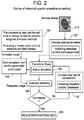
- FIG. 2 depicts an outline of the complete image registration procedure including the novel extension.
- FIG. 3 depicts an illustration of the calculated mean SUVR values of the composite region COM SUVR for all subjects in two different groups of A ⁇ and A ⁇ + scans.
- FIG. 4 depicts the resulting slope and intercept images according to one embodiment of the present invention.
- FIG. 5 shows template images of the present invention.
- FIG. 6 depicts a system for performing the instant invention.
- the present invention provides a spatial normalization method when using imaging agents. While a specific embodiment for scans with the [ 18 F]-Flutemetamol amyloid imaging agent, which only depends on the Flutemetamol scan itself, are described in detail, the present invention is also applicable to other imaging agents used for other imaging applications. For example, the present invention may also be employed for DaTSCAN imaging where low uptake in the brain is indicative of disease.
- the uptake pattern in Flutemetamol scans can differ much between normal subjects (A ⁇ ) and subjects with high amyloid in gray matter (A ⁇ +). Therefore the spatial normalization method has been extended with an adaptive template mechanism, which during the image registration process alters the template image along with the spatial transformation parameters to make it more similar to the scan being registered. By using this extension, the method can accurately spatially normalize scans ranging over the whole amyloid scale from A ⁇ to very high A ⁇ +.
- the present invention solves this by creating a model over how the typical uptake pattern in the whole image varies along the scale going from A ⁇ to A ⁇ +.
- a one parameter linear regression model for each voxel in the image is used to express the dependence, but generally a more advanced model expressing uptake pattern dependence on multiple parameters, is also contemplated by the present invention.
- the model is built once for all in a separate pre-processing step and is then fixed as an internal part of the method.
- the adaptive template method has potential to be used for other imaging agents as well as for both PET and SPECT applications. While the examples provided hereinbelow are directed PET applications, the present invention also applies to SPECT applications.
- the present invention may alter one or more of the parameters for the image, the image template, or both.
- parameters for spatial transformation may include translation along each axis (providing three possible parameters), scaling along each axis (providing another three possible parameters), and rotation about each axis (providing an additional three parameters), for a total of up to nine parameters which may be altered by the present invention.
- parameters which account for shape differences between the image and the adaptive template provide additional parameters which may be altered by the present invention
- An illustration of typical Flutemetamol uptake patterns in an A ⁇ + and A ⁇ scan is shown in FIG. 1 .
- the A ⁇ + have much more activity in cortical gray matter and even though white matter activity is about the same in the two cases the relative activity pattern between white and gray matter is to some extent reversed. That is from having highest activity in white matter in A ⁇ to the opposite with highest, or at least as high, activity in gray matter in A ⁇ +.
- Spatial normalization is the process of transforming a scan from patient space to a standard space thus allowing for comparison of data from different subjects. Typically this is performed through an iterative process where the patient scan is compared with a template image and where it is geometrically transformed to be as similar to the template as possible.
- a similarity metric for a spatial normalization method which would be able to perform accurate and robust registrations of both of these types of images, by comparing them to a common template image.
- the present invention provides an extension to be used together with a standard image registration method, where the number of possible template images is infinite. Basically, no definite selection of one specific template image occurs. Instead the intensities in the template are continuously altered during the registration, to make the template converge along with the spatial transformation parameters, to optimally fit the image being registered.
- An outline of the complete image registration procedure including the novel extension is shown in FIG. 2 .
- Step 100 is a pre-processing step performed once during a design phase to prepare the adaptive template of the present invention.
- a moving image ie, the patient image
- the step of choosing starting parameters 120 for the moving image is performed.
- step 120 is the step of choosing a template control start parameter.
- An adaptive template is then built 130 using the control parameter for the adaptive template and the model from step 100 .
- a transforming step 140 is performed in which the moving image is adjusted using the start parameters.
- a comparison step 150 is performed which compares the similarity between the transformed moving image and the adaptive template.
- the similarity metric is evaluated from the voxel values in the template image and the transformed moving image. If the moving image and the adaptive template are found to be sufficiently or maximally converged, the registration of the moving image is completed, step 160 . Should the moving image and the adaptive template not be sufficiently or maximally converged, the step of choosing new parameters 170 , for both the moving image and the template control parameter, is performed. Then transforming step 140 is repeated, this time using the parameters chosen during step 170 . Additionally, step 130 is repeated in which the existing adaptive template is also modified by the new template control parameter chosen during step 170 . The comparison step 150 is again performed using the newly transformed moving image and adaptive temple. If the method has not converged, another set of adaptive template and transformation parameters is selected by the optimization method and a new evaluation of the similarity metric is made.
- the optimization method may be any numerical optimization method.
- Convergence may be sufficiently achieved when the value of a function for describing the similarity between the images has reached a level deemed suitable for proceeding. Convergence is desirably achieved when the value of a function for describing the similarity between the images has reached its maximum, ie, showing maximum similarity between the template image in reference space and the transformed image.
- the similarity metric could be based, for example, on correlation or on mutual information, although the present invention contemplates that any suitable similarity metric may be applied.
- the pre-processing step 100 is performed once and the extra parameter or parameters controlling the template model are added to the registration parameters and altered by the optimization method in a similar way as the parameters controlling the geometry change.
- the following will now in detail describe the creation of a one-parameter linear template model, which has been found to be suitable for Flutemetamol PET scans.
- the present invention is contemplated to provide a non-transitory computer-readable storage medium with an executable program for performing the method of the present invention.
- This computer-readable storage medium includes computer-readable program code includes instructions for performing a method of the present invention, such that execution of the computer-readable program code causes a processor to perform the steps of the method of the present invention.
- the present invention is contemplated to use an adaptive template model of the present invention for performing the spatial normalization method of the present invention.
- the starting parameters may be fixed for all procedures and the updated parameters may be selected automatically by the process.
- MNI Montreal Neurological Institute
- this mean image will also be located in the reference space and can be used for spatial normalization of new unseen images by using an image registration method to find the transformation making the new images match the template mean image.
- the problem with this approach is that the mean image will only be representative for one typical image pattern for a specific level of amyloid, i.e. either the pattern of a A ⁇ , A ⁇ +, or something in between.
- the present invention instead calculates a regression model for each voxel in the template image, where the dependent variable which is the voxel intensities in the input images is regressed on some variable which ideally for each input image expresses a “true” value of where on a scale from A ⁇ to very severe A ⁇ + it is located.
- the present invention calculates for all input images a mean standard uptake ratio value (SUVR) inside a large composite region (COM) covering regions known to be most affected by A ⁇ in Alzheimer's disease patients. These regions were the prefrontal cortex, parietal cortex, precuneus, lateral temporal cortex, and the anterior and posterior cingulate cortices.
- SUVR mean standard uptake ratio value
- COM composite region
- FIG. 3 An illustration of the calculated SUVR values of the composite region COM SUVR for all subjects in two different groups of A ⁇ and A ⁇ + scans is shown in FIG. 3 .
- the present invention uses a good sampling over the whole spectrum from A ⁇ subjects with very low Flutemetamol uptake inside COM to A ⁇ + subjects with a very high Flutemetamol uptake.
- the intercept image will correspond to a pattern of a fully normal subject located in the lower part of the COM SUVR scale.
- the slope image on the other hand, will have the highest values for the parts of the image where the largest changes occur when going from low to high on the COM SUVR scale.
- Such synthetic images are used as the adaptive template in a spatial normalization method.
- the slope image, I Slope , and intercept image, I 0 is the adaptive template model is controlled by one single parameter x.
- This parameter x is then adjusted by the image registration algorithm in a similar way as any of the other parameters, and the template image is updated accordingly any time the x parameter is changed.
- System 200 includes a scanner 210 for performing PET or SPECT scans, a computer 220 for receiving scan images, e.g, the patient image (aka, the moving image), and a database 230 for providing the adaptive template.
- Computer 220 typically includes a display 222 , an input device 224 such as a keyboard 224 a and a mouse 224 b , and a processor 226 .
- Processor 226 typically includes software for performing the method of the instant invention using the adaptive template from database 230 and the moving image from scanner 210 .
- processor 226 is contemplated to include non-transitory computer readable storage medium with an executable program for using an adaptive template of the present invention and for registering a PET image to an adaptive template image according to a method of the instant invention using the moving image from scanner 210 .
- the non-transitory computer readable storage medium includes computer-readable program code including instructions for using an adaptive template of the present invention and for registering a PET image to an adaptive template image.
- Connections between scanner 210 , computer 220 , and database 230 are contemplated to be by any means known to the art, such as hardwire, wireless, or any combination thereof. Additionally, the present invention contemplates that processor 226 and database 230 are connected such that processor 226 may return the upgraded adaptive template to database 230 upon completion of the method of the present invention.
Landscapes
- Health & Medical Sciences (AREA)
- Engineering & Computer Science (AREA)
- Life Sciences & Earth Sciences (AREA)
- Medical Informatics (AREA)
- Physics & Mathematics (AREA)
- Public Health (AREA)
- Pathology (AREA)
- Biomedical Technology (AREA)
- General Health & Medical Sciences (AREA)
- Veterinary Medicine (AREA)
- Radiology & Medical Imaging (AREA)
- Biophysics (AREA)
- High Energy & Nuclear Physics (AREA)
- Animal Behavior & Ethology (AREA)
- Nuclear Medicine, Radiotherapy & Molecular Imaging (AREA)
- Optics & Photonics (AREA)
- Surgery (AREA)
- Molecular Biology (AREA)
- Heart & Thoracic Surgery (AREA)
- Computer Vision & Pattern Recognition (AREA)
- General Physics & Mathematics (AREA)
- Theoretical Computer Science (AREA)
- Neurology (AREA)
- Oral & Maxillofacial Surgery (AREA)
- Dentistry (AREA)
- Neurosurgery (AREA)
- Physiology (AREA)
- Databases & Information Systems (AREA)
- Epidemiology (AREA)
- Primary Health Care (AREA)
- Data Mining & Analysis (AREA)
- Nuclear Medicine (AREA)
Abstract
Description
-
- Spatially normalizing an individual PET image to an adaptive template image located in the reference space;
- Comparing the spatially normalized individual PET image to the adaptive template image to determine whether both are sufficiently converged; and
- Altering the parameter controlling the template image and the parameters controlling the spatial transformation for the individual PET image so as render an altered template image and an updated spatially transformed individual PET image in the event that the comparing step does not determine that the spatially normalized individual PET image is sufficiently converged to the adaptive template image.
y i={circumflex over (α)}i+{circumflex over (β)}i COM SUVR+εi Equation 1
-
- Linear regression model
Applying this model over all input images regressed on the corresponding COMSUVR values provides an intercept image and a slope image according to Equation 2:
I 0=[{circumflex over (α)}1 {circumflex over (α)}2 . . . {circumflex over (α)}n]
I Slope=[{circumflex over (β)}1 β2 . . . {circumflex over (β)}n] Equation 2 - Intercept image, I0, and slope image, ISlope, created from linear regression, where n is the number of voxels in the images.
- Linear regression model
I template =I 0 +I slope x Equation 3
-
- Template image equation
A value of the scale factor x of 0.0 will correspond to I0 itself, which represents a pattern of an Aβ− subject, and a value of 1.0 will correspond to an Aβ+ subject in the high end of the COMSUVR scale. From this formula the present invention can create synthetic images for any x along the linear path defined by ISlope.FIG. 5 shows such synthetic images covering values of x from 0.0 to 1.0 in steps of 0.2.
- Template image equation
Claims (15)
I i template =I i 0 +I i slope x,
I i template =I i 0 +I i slope x,
I i template =I i 0 +I i slope x,
I i template =I i 0 +I i slope x,
I i template =I i 0 +I i slope x,
I i template =I i 0 +I i slope x,
I i template =I i 0 +I i slope x,
I i template =I i 0 +I i slope x,
Priority Applications (1)
| Application Number | Priority Date | Filing Date | Title |
|---|---|---|---|
| US14/344,934 US10614547B2 (en) | 2011-09-20 | 2012-09-20 | Methods of spatial normalization of positron emission tomography images |
Applications Claiming Priority (3)
| Application Number | Priority Date | Filing Date | Title |
|---|---|---|---|
| US201161536702P | 2011-09-20 | 2011-09-20 | |
| PCT/US2012/056182 WO2013043775A1 (en) | 2011-09-20 | 2012-09-20 | Methods of spatial normalization of positron emission tomography images |
| US14/344,934 US10614547B2 (en) | 2011-09-20 | 2012-09-20 | Methods of spatial normalization of positron emission tomography images |
Related Parent Applications (1)
| Application Number | Title | Priority Date | Filing Date |
|---|---|---|---|
| PCT/US2012/056182 A-371-Of-International WO2013043775A1 (en) | 2011-09-20 | 2012-09-20 | Methods of spatial normalization of positron emission tomography images |
Related Child Applications (1)
| Application Number | Title | Priority Date | Filing Date |
|---|---|---|---|
| US16/841,329 Continuation US11488282B2 (en) | 2011-09-20 | 2020-04-06 | Methods of spatial normalization of positron emission tomography images |
Publications (2)
| Publication Number | Publication Date |
|---|---|
| US20140350392A1 US20140350392A1 (en) | 2014-11-27 |
| US10614547B2 true US10614547B2 (en) | 2020-04-07 |
Family
ID=46964089
Family Applications (3)
| Application Number | Title | Priority Date | Filing Date |
|---|---|---|---|
| US14/344,934 Active US10614547B2 (en) | 2011-09-20 | 2012-09-20 | Methods of spatial normalization of positron emission tomography images |
| US16/841,329 Active 2033-07-11 US11488282B2 (en) | 2011-09-20 | 2020-04-06 | Methods of spatial normalization of positron emission tomography images |
| US17/954,034 Abandoned US20230026994A1 (en) | 2011-09-20 | 2022-09-27 | Methods of spatial normalization of positron emission tomography images |
Family Applications After (2)
| Application Number | Title | Priority Date | Filing Date |
|---|---|---|---|
| US16/841,329 Active 2033-07-11 US11488282B2 (en) | 2011-09-20 | 2020-04-06 | Methods of spatial normalization of positron emission tomography images |
| US17/954,034 Abandoned US20230026994A1 (en) | 2011-09-20 | 2022-09-27 | Methods of spatial normalization of positron emission tomography images |
Country Status (8)
| Country | Link |
|---|---|
| US (3) | US10614547B2 (en) |
| EP (1) | EP2757955B1 (en) |
| JP (1) | JP6106675B2 (en) |
| CN (1) | CN103930032B (en) |
| AU (1) | AU2012312482B2 (en) |
| CA (1) | CA2849119C (en) |
| ES (1) | ES2922280T3 (en) |
| WO (1) | WO2013043775A1 (en) |
Cited By (1)
| Publication number | Priority date | Publication date | Assignee | Title |
|---|---|---|---|---|
| US11475612B2 (en) * | 2018-02-28 | 2022-10-18 | Seoul National University R&Db Foundation | Device for spatial normalization of medical image using deep learning and method therefor |
Families Citing this family (14)
| Publication number | Priority date | Publication date | Assignee | Title |
|---|---|---|---|---|
| EP2757955B1 (en) | 2011-09-20 | 2022-06-15 | GE Healthcare Limited | Methods of spatial normalization of positron emission tomography images |
| CA3228582A1 (en) | 2012-03-07 | 2013-09-12 | Ziteo, Inc. | Methods and systems for tracking and guiding sensors and instruments |
| CN106663321B (en) * | 2014-07-15 | 2021-04-06 | 皇家飞利浦有限公司 | Statistical testing of imaging data including stereotaxic normalization using personalized template images |
| US10617401B2 (en) | 2014-11-14 | 2020-04-14 | Ziteo, Inc. | Systems for localization of targets inside a body |
| US10152519B2 (en) | 2015-03-05 | 2018-12-11 | Bio-Rad Laboratories, Inc. | Optimized spectral matching and display |
| TWI587841B (en) * | 2015-03-06 | 2017-06-21 | 國立陽明大學 | System and method of quantitative analysis nuclear medicine brain imaging |
| JP2021513054A (en) * | 2018-02-02 | 2021-05-20 | コーニンクレッカ フィリップス エヌ ヴェKoninklijke Philips N.V. | Correction of standard capture value (SUV) scaling differences in serial positron emission tomography (PET) examinations using image alignment and regression analysis |
| WO2019168310A1 (en) * | 2018-02-28 | 2019-09-06 | 서울대학교산학협력단 | Device for spatial normalization of medical image using deep learning and method therefor |
| CA3136002A1 (en) | 2019-04-09 | 2020-10-15 | Ziteo, Inc. | Methods and systems for high performance and versatile molecular imaging |
| KR102261111B1 (en) * | 2019-09-10 | 2021-06-04 | 인하대학교 산학협력단 | Generalization of intensity distribution of medical images using gans |
| JP2022021076A (en) * | 2020-07-21 | 2022-02-02 | 浜松ホトニクス株式会社 | Brain image diagnostic system and brain image diagnostic method |
| CN113450314A (en) * | 2021-06-04 | 2021-09-28 | 迈格生命科技(深圳)有限公司 | Image processing method, device, storage medium and product |
| US12181455B2 (en) | 2021-07-28 | 2024-12-31 | John Wiley & Sons, Inc. | Adaptive search mass spectrometer spectral analysis |
| KR102603177B1 (en) * | 2022-06-03 | 2023-11-17 | 주식회사 브라이토닉스이미징 | System for spatial normalization of image, quantification using spatial normalization and method thereof |
Citations (6)
| Publication number | Priority date | Publication date | Assignee | Title |
|---|---|---|---|---|
| US5948384A (en) * | 1990-09-14 | 1999-09-07 | Syngenix Limited | Particulate agents |
| JP2006320387A (en) | 2005-05-17 | 2006-11-30 | Univ Of Tsukuba | Computer-aided diagnosis apparatus and method |
| WO2008093057A1 (en) | 2007-01-30 | 2008-08-07 | Ge Healthcare Limited | Tools for aiding in the diagnosis of neurodegenerative diseases |
| US20100049032A1 (en) * | 2006-07-12 | 2010-02-25 | Florian Steinke | Method for determining a property map of an object, particularly of a living being, based on at least a first image, particularly a magnetic resonance image |
| US20100221181A1 (en) * | 2007-09-26 | 2010-09-02 | Koninklijke Philips Electronics N.V. | Method of differentially diagnosing different types of dementia |
| US20110160543A1 (en) * | 2008-05-28 | 2011-06-30 | The Trustees Of Columbia University In The City Of New York | Voxel-based methods for assessing subjects using positron emission tomography |
Family Cites Families (1)
| Publication number | Priority date | Publication date | Assignee | Title |
|---|---|---|---|---|
| EP2757955B1 (en) | 2011-09-20 | 2022-06-15 | GE Healthcare Limited | Methods of spatial normalization of positron emission tomography images |
-
2012
- 2012-09-20 EP EP12766824.2A patent/EP2757955B1/en active Active
- 2012-09-20 CA CA2849119A patent/CA2849119C/en active Active
- 2012-09-20 WO PCT/US2012/056182 patent/WO2013043775A1/en not_active Ceased
- 2012-09-20 US US14/344,934 patent/US10614547B2/en active Active
- 2012-09-20 AU AU2012312482A patent/AU2012312482B2/en active Active
- 2012-09-20 ES ES12766824T patent/ES2922280T3/en active Active
- 2012-09-20 CN CN201280056787.2A patent/CN103930032B/en active Active
- 2012-09-20 JP JP2014530963A patent/JP6106675B2/en active Active
-
2020
- 2020-04-06 US US16/841,329 patent/US11488282B2/en active Active
-
2022
- 2022-09-27 US US17/954,034 patent/US20230026994A1/en not_active Abandoned
Patent Citations (9)
| Publication number | Priority date | Publication date | Assignee | Title |
|---|---|---|---|---|
| US5948384A (en) * | 1990-09-14 | 1999-09-07 | Syngenix Limited | Particulate agents |
| JP2006320387A (en) | 2005-05-17 | 2006-11-30 | Univ Of Tsukuba | Computer-aided diagnosis apparatus and method |
| US20100049032A1 (en) * | 2006-07-12 | 2010-02-25 | Florian Steinke | Method for determining a property map of an object, particularly of a living being, based on at least a first image, particularly a magnetic resonance image |
| WO2008093057A1 (en) | 2007-01-30 | 2008-08-07 | Ge Healthcare Limited | Tools for aiding in the diagnosis of neurodegenerative diseases |
| US20100080432A1 (en) | 2007-01-30 | 2010-04-01 | Johan Axel Lilja | Tools for aiding in the diagnosis of neurodegenerative diseases |
| JP2010517030A (en) | 2007-01-30 | 2010-05-20 | ジーイー・ヘルスケア・リミテッド | Tools to help diagnose neurodegenerative diseases |
| EP2126609B1 (en) | 2007-01-30 | 2013-03-27 | GE Healthcare Limited | Tools for aiding in the diagnosis of neurodegenerative diseases |
| US20100221181A1 (en) * | 2007-09-26 | 2010-09-02 | Koninklijke Philips Electronics N.V. | Method of differentially diagnosing different types of dementia |
| US20110160543A1 (en) * | 2008-05-28 | 2011-06-30 | The Trustees Of Columbia University In The City Of New York | Voxel-based methods for assessing subjects using positron emission tomography |
Non-Patent Citations (3)
| Title |
|---|
| Fripp J. et. al., "Generative Atlases and Atlas Selection for C11-PIB-PET-PET Registration of Elderly, Mild Cognitive Impaired and Alzheimer Disease Patients," Biomedical Imaging: From Nano to Macro, 2008. ISBI 2008. 5th IEEE International Symposium. May 14, 2008, pp. 1155-1158. * |
| Fripp, et.al. Biomedical Imaging: From Nano to Macro, 2008, p. 1155-1158. |
| PCT/US2012/056182 ISRWO dated Feb. 13, 2013. |
Cited By (1)
| Publication number | Priority date | Publication date | Assignee | Title |
|---|---|---|---|---|
| US11475612B2 (en) * | 2018-02-28 | 2022-10-18 | Seoul National University R&Db Foundation | Device for spatial normalization of medical image using deep learning and method therefor |
Also Published As
| Publication number | Publication date |
|---|---|
| AU2012312482B2 (en) | 2017-06-01 |
| US11488282B2 (en) | 2022-11-01 |
| JP6106675B2 (en) | 2017-04-05 |
| EP2757955A1 (en) | 2014-07-30 |
| EP2757955B1 (en) | 2022-06-15 |
| US20230026994A1 (en) | 2023-01-26 |
| US20200234400A1 (en) | 2020-07-23 |
| AU2012312482A1 (en) | 2014-04-17 |
| CN103930032B (en) | 2018-10-12 |
| WO2013043775A1 (en) | 2013-03-28 |
| JP2014530352A (en) | 2014-11-17 |
| CN103930032A (en) | 2014-07-16 |
| US20140350392A1 (en) | 2014-11-27 |
| CA2849119A1 (en) | 2013-03-28 |
| ES2922280T3 (en) | 2022-09-12 |
| CA2849119C (en) | 2022-06-07 |
Similar Documents
| Publication | Publication Date | Title |
|---|---|---|
| US11488282B2 (en) | Methods of spatial normalization of positron emission tomography images | |
| JP2014530352A5 (en) | ||
| Largent et al. | Pseudo-CT generation for MRI-only radiation therapy treatment planning: comparison among patch-based, atlas-based, and bulk density methods | |
| JP7030050B2 (en) | Pseudo-CT generation from MR data using tissue parameter estimation | |
| Schreibmann et al. | MR‐based attenuation correction for hybrid PET‐MR brain imaging systems using deformable image registration | |
| JP6567179B2 (en) | Pseudo CT generation from MR data using feature regression model | |
| US8774481B2 (en) | Atlas-assisted synthetic computed tomography using deformable image registration | |
| US10229517B2 (en) | Method and apparatus for automated determination of contours in iterative reconstruction of image data | |
| EP3268931B1 (en) | Method and apparatus for assessing image registration | |
| US20160012586A1 (en) | Scan region determining apparatus | |
| CN107865658B (en) | Method and apparatus for correcting synthetic electron density maps | |
| Park et al. | Deformable registration of CT and cone-beam CT with local intensity matching | |
| EP3707673B1 (en) | Method and apparatus for medical imaging | |
| CA2850185A1 (en) | Variable-depth stereotactic surface projections | |
| DE102016215105A1 (en) | Method and data processing unit for determining an acquisition data processing algorithm | |
| Kang et al. | Prediction of standard-dose PET image by low-dose PET and MRI images | |
| Bilgel et al. | Deformation field correction for spatial normalization of PET images using a population-derived partial least squares model | |
| Li | Multimodal intra-and inter-subject nonrigid registration of small animal images. | |
| GB2583555A (en) | Method and apparatus for medical imaging |
Legal Events
| Date | Code | Title | Description |
|---|---|---|---|
| AS | Assignment |
Owner name: GE HEALTHCARE LIMITED, UNITED KINGDOM Free format text: ASSIGNMENT OF ASSIGNORS INTEREST;ASSIGNORS:LUNDQVIST, ROGER;THURFJELL, NILS LENNART;LILJA, JOHAN AXEL;REEL/FRAME:032436/0934 Effective date: 20130204 |
|
| FEPP | Fee payment procedure |
Free format text: PAYOR NUMBER ASSIGNED (ORIGINAL EVENT CODE: ASPN); ENTITY STATUS OF PATENT OWNER: LARGE ENTITY |
|
| STPP | Information on status: patent application and granting procedure in general |
Free format text: DOCKETED NEW CASE - READY FOR EXAMINATION |
|
| STPP | Information on status: patent application and granting procedure in general |
Free format text: NON FINAL ACTION MAILED |
|
| STPP | Information on status: patent application and granting procedure in general |
Free format text: RESPONSE TO NON-FINAL OFFICE ACTION ENTERED AND FORWARDED TO EXAMINER |
|
| STPP | Information on status: patent application and granting procedure in general |
Free format text: NOTICE OF ALLOWANCE MAILED -- APPLICATION RECEIVED IN OFFICE OF PUBLICATIONS |
|
| STPP | Information on status: patent application and granting procedure in general |
Free format text: NOTICE OF ALLOWANCE MAILED -- APPLICATION RECEIVED IN OFFICE OF PUBLICATIONS |
|
| STPP | Information on status: patent application and granting procedure in general |
Free format text: PUBLICATIONS -- ISSUE FEE PAYMENT VERIFIED |
|
| STCF | Information on status: patent grant |
Free format text: PATENTED CASE |
|
| MAFP | Maintenance fee payment |
Free format text: PAYMENT OF MAINTENANCE FEE, 4TH YEAR, LARGE ENTITY (ORIGINAL EVENT CODE: M1551); ENTITY STATUS OF PATENT OWNER: LARGE ENTITY Year of fee payment: 4 |