US10583387B2 - Guanidine compounds for carbon dioxide capture - Google Patents
Guanidine compounds for carbon dioxide capture Download PDFInfo
- Publication number
- US10583387B2 US10583387B2 US15/978,323 US201815978323A US10583387B2 US 10583387 B2 US10583387 B2 US 10583387B2 US 201815978323 A US201815978323 A US 201815978323A US 10583387 B2 US10583387 B2 US 10583387B2
- Authority
- US
- United States
- Prior art keywords
- carbon dioxide
- carbonate
- ring
- sorbent
- aqueous solution
- Prior art date
- Legal status (The legal status is an assumption and is not a legal conclusion. Google has not performed a legal analysis and makes no representation as to the accuracy of the status listed.)
- Active, expires
Links
- 0 N=C(N)N/N=C/*/C=N/NC(=N)N Chemical compound N=C(N)N/N=C/*/C=N/NC(=N)N 0.000 description 9
- LFXZWGZABWHIDS-UHFFFAOYSA-P C.C.C.C.C.C.C.C.C.C.C.C.C.CC(=O)CC[O-]C=O.CC(=O)CC[O-]C=O.CC(=O)CN.CC(=O)CN.CC(=O)C[NH3+].CC(=O)C[NH3+].CCC(C)=O.O.O.O.O.O Chemical compound C.C.C.C.C.C.C.C.C.C.C.C.C.CC(=O)CC[O-]C=O.CC(=O)CC[O-]C=O.CC(=O)CN.CC(=O)CN.CC(=O)C[NH3+].CC(=O)C[NH3+].CCC(C)=O.O.O.O.O.O LFXZWGZABWHIDS-UHFFFAOYSA-P 0.000 description 1
- XVLNFNZIYWSGBN-VPJHSEKQSA-N CC(=N\NC(=N)N)/C(C)=N/NC(=N)N.N=C(N)N/N=C/C=N/NC(=N)N Chemical compound CC(=N\NC(=N)N)/C(C)=N/NC(=N)N.N=C(N)N/N=C/C=N/NC(=N)N XVLNFNZIYWSGBN-VPJHSEKQSA-N 0.000 description 1
- XTDKPQNXOPASGN-SILIXDKGSA-N N=C(N)C/N=C/C1=CC(/C=N/CC(=N)N)=NC=N1.N=C(N)C/N=C/C1=CN=CC(/C=N/CC(=N)N)=C1.N=C(N)C/N=C/C1=CNC=C1/C=N/CC(=N)N.N=C(N)C/N=C/C1=COC=C1/C=N/CC(=N)N.N=C(N)N/N=C/C1=CC=C(/C=N/NC(=N)N)C=C1.N=C(N)N/N=C/C1=CC=C(/C=N/NC(=N)N)N1.N=C(N)N/N=C/C1=CC=C(/C=N/NC(=N)N)O1.N=C(N)N/N=C/C1=CC=C(/C=N/NC(=N)N)S1.N=C(N)N/N=C/C1=CC=CC(/C=N/NC(=N)N)=C1.N=C(N)N/N=C/C1=CC=CC(/C=N/NC(=N)N)=N1.N=C(N)N/N=C/C1=CN=CC(/C=N/NC(=N)N)=N1 Chemical compound N=C(N)C/N=C/C1=CC(/C=N/CC(=N)N)=NC=N1.N=C(N)C/N=C/C1=CN=CC(/C=N/CC(=N)N)=C1.N=C(N)C/N=C/C1=CNC=C1/C=N/CC(=N)N.N=C(N)C/N=C/C1=COC=C1/C=N/CC(=N)N.N=C(N)N/N=C/C1=CC=C(/C=N/NC(=N)N)C=C1.N=C(N)N/N=C/C1=CC=C(/C=N/NC(=N)N)N1.N=C(N)N/N=C/C1=CC=C(/C=N/NC(=N)N)O1.N=C(N)N/N=C/C1=CC=C(/C=N/NC(=N)N)S1.N=C(N)N/N=C/C1=CC=CC(/C=N/NC(=N)N)=C1.N=C(N)N/N=C/C1=CC=CC(/C=N/NC(=N)N)=N1.N=C(N)N/N=C/C1=CN=CC(/C=N/NC(=N)N)=N1 XTDKPQNXOPASGN-SILIXDKGSA-N 0.000 description 1
- CRMLCCJJLBDJNJ-VEQRDEFOSA-N N=C(N)C/N=C/C1=CSC=C1/C=N/CC(=N)N Chemical compound N=C(N)C/N=C/C1=CSC=C1/C=N/CC(=N)N CRMLCCJJLBDJNJ-VEQRDEFOSA-N 0.000 description 1
- CKVXCBTYYNMBPV-VHUAAIQRSA-N N=C(N)N/N=C/C1=CC=CC(/C=N/NC(=N)N)=N1 Chemical compound N=C(N)N/N=C/C1=CC=CC(/C=N/NC(=N)N)=N1 CKVXCBTYYNMBPV-VHUAAIQRSA-N 0.000 description 1
- JCJMVSDVPRRNSU-UVEKSMONSA-O N=C(N)N/N=C/C=N/NC(N)=[NH2+] Chemical compound N=C(N)N/N=C/C=N/NC(N)=[NH2+] JCJMVSDVPRRNSU-UVEKSMONSA-O 0.000 description 1
- XTDKPQNXOPASGN-SILIXDKGSA-A NC(=[NH2+])C/N=C/C1=CC(/C=N/CC(N)=[NH2+])=NC=N1.NC(=[NH2+])C/N=C/C1=CN=CC(/C=N/CC(N)=[NH2+])=C1.NC(=[NH2+])C/N=C/C1=CNC=C1/C=N/CC(N)=[NH2+].NC(=[NH2+])C/N=C/C1=COC=C1/C=N/CC(N)=[NH2+].NC(=[NH2+])N/N=C/C1=CC=C(/C=N/NC(N)=[NH2+])C=C1.NC(=[NH2+])N/N=C/C1=CC=C(/C=N/NC(N)=[NH2+])N1.NC(=[NH2+])N/N=C/C1=CC=C(/C=N/NC(N)=[NH2+])O1.NC(=[NH2+])N/N=C/C1=CC=C(/C=N/NC(N)=[NH2+])S1.NC(=[NH2+])N/N=C/C1=CC=CC(/C=N/NC(N)=[NH2+])=C1.NC(=[NH2+])N/N=C/C1=CC=CC(/C=N/NC(N)=[NH2+])=N1.NC(=[NH2+])N/N=C/C1=CN=CC(/C=N/NC(N)=[NH2+])=N1 Chemical compound NC(=[NH2+])C/N=C/C1=CC(/C=N/CC(N)=[NH2+])=NC=N1.NC(=[NH2+])C/N=C/C1=CN=CC(/C=N/CC(N)=[NH2+])=C1.NC(=[NH2+])C/N=C/C1=CNC=C1/C=N/CC(N)=[NH2+].NC(=[NH2+])C/N=C/C1=COC=C1/C=N/CC(N)=[NH2+].NC(=[NH2+])N/N=C/C1=CC=C(/C=N/NC(N)=[NH2+])C=C1.NC(=[NH2+])N/N=C/C1=CC=C(/C=N/NC(N)=[NH2+])N1.NC(=[NH2+])N/N=C/C1=CC=C(/C=N/NC(N)=[NH2+])O1.NC(=[NH2+])N/N=C/C1=CC=C(/C=N/NC(N)=[NH2+])S1.NC(=[NH2+])N/N=C/C1=CC=CC(/C=N/NC(N)=[NH2+])=C1.NC(=[NH2+])N/N=C/C1=CC=CC(/C=N/NC(N)=[NH2+])=N1.NC(=[NH2+])N/N=C/C1=CN=CC(/C=N/NC(N)=[NH2+])=N1 XTDKPQNXOPASGN-SILIXDKGSA-A 0.000 description 1
- CRMLCCJJLBDJNJ-VEQRDEFOSA-P NC(=[NH2+])C/N=C/C1=CSC=C1/C=N/CC(N)=[NH2+] Chemical compound NC(=[NH2+])C/N=C/C1=CSC=C1/C=N/CC(N)=[NH2+] CRMLCCJJLBDJNJ-VEQRDEFOSA-P 0.000 description 1
- JCJMVSDVPRRNSU-UVEKSMONSA-P NC(=[NH2+])N/N=C/C=N/NC(N)=[NH2+] Chemical compound NC(=[NH2+])N/N=C/C=N/NC(N)=[NH2+] JCJMVSDVPRRNSU-UVEKSMONSA-P 0.000 description 1
Images


Classifications
-
- B—PERFORMING OPERATIONS; TRANSPORTING
- B01—PHYSICAL OR CHEMICAL PROCESSES OR APPARATUS IN GENERAL
- B01D—SEPARATION
- B01D53/00—Separation of gases or vapours; Recovering vapours of volatile solvents from gases; Chemical or biological purification of waste gases, e.g. engine exhaust gases, smoke, fumes, flue gases, aerosols
- B01D53/14—Separation of gases or vapours; Recovering vapours of volatile solvents from gases; Chemical or biological purification of waste gases, e.g. engine exhaust gases, smoke, fumes, flue gases, aerosols by absorption
- B01D53/1456—Removing acid components
- B01D53/1475—Removing carbon dioxide
-
- B—PERFORMING OPERATIONS; TRANSPORTING
- B01—PHYSICAL OR CHEMICAL PROCESSES OR APPARATUS IN GENERAL
- B01D—SEPARATION
- B01D53/00—Separation of gases or vapours; Recovering vapours of volatile solvents from gases; Chemical or biological purification of waste gases, e.g. engine exhaust gases, smoke, fumes, flue gases, aerosols
- B01D53/14—Separation of gases or vapours; Recovering vapours of volatile solvents from gases; Chemical or biological purification of waste gases, e.g. engine exhaust gases, smoke, fumes, flue gases, aerosols by absorption
- B01D53/1493—Selection of liquid materials for use as absorbents
-
- C—CHEMISTRY; METALLURGY
- C07—ORGANIC CHEMISTRY
- C07C—ACYCLIC OR CARBOCYCLIC COMPOUNDS
- C07C279/00—Derivatives of guanidine, i.e. compounds containing the group, the singly-bound nitrogen atoms not being part of nitro or nitroso groups
- C07C279/04—Derivatives of guanidine, i.e. compounds containing the group, the singly-bound nitrogen atoms not being part of nitro or nitroso groups having nitrogen atoms of guanidine groups bound to acyclic carbon atoms of a carbon skeleton
- C07C279/12—Derivatives of guanidine, i.e. compounds containing the group, the singly-bound nitrogen atoms not being part of nitro or nitroso groups having nitrogen atoms of guanidine groups bound to acyclic carbon atoms of a carbon skeleton being further substituted by nitrogen atoms not being part of nitro or nitroso groups
-
- B—PERFORMING OPERATIONS; TRANSPORTING
- B01—PHYSICAL OR CHEMICAL PROCESSES OR APPARATUS IN GENERAL
- B01D—SEPARATION
- B01D2252/00—Absorbents, i.e. solvents and liquid materials for gas absorption
- B01D2252/20—Organic absorbents
- B01D2252/204—Amines
- B01D2252/20415—Tri- or polyamines
-
- B—PERFORMING OPERATIONS; TRANSPORTING
- B01—PHYSICAL OR CHEMICAL PROCESSES OR APPARATUS IN GENERAL
- B01D—SEPARATION
- B01D2252/00—Absorbents, i.e. solvents and liquid materials for gas absorption
- B01D2252/20—Organic absorbents
- B01D2252/204—Amines
- B01D2252/20436—Cyclic amines
- B01D2252/20442—Cyclic amines containing a piperidine-ring
-
- B—PERFORMING OPERATIONS; TRANSPORTING
- B01—PHYSICAL OR CHEMICAL PROCESSES OR APPARATUS IN GENERAL
- B01D—SEPARATION
- B01D2252/00—Absorbents, i.e. solvents and liquid materials for gas absorption
- B01D2252/20—Organic absorbents
- B01D2252/204—Amines
- B01D2252/20494—Amino acids, their salts or derivatives
-
- B—PERFORMING OPERATIONS; TRANSPORTING
- B01—PHYSICAL OR CHEMICAL PROCESSES OR APPARATUS IN GENERAL
- B01D—SEPARATION
- B01D2252/00—Absorbents, i.e. solvents and liquid materials for gas absorption
- B01D2252/20—Organic absorbents
- B01D2252/205—Other organic compounds not covered by B01D2252/00 - B01D2252/20494
- B01D2252/2053—Other nitrogen compounds
-
- B—PERFORMING OPERATIONS; TRANSPORTING
- B01—PHYSICAL OR CHEMICAL PROCESSES OR APPARATUS IN GENERAL
- B01D—SEPARATION
- B01D2257/00—Components to be removed
- B01D2257/50—Carbon oxides
- B01D2257/504—Carbon dioxide
-
- B—PERFORMING OPERATIONS; TRANSPORTING
- B01—PHYSICAL OR CHEMICAL PROCESSES OR APPARATUS IN GENERAL
- B01D—SEPARATION
- B01D2258/00—Sources of waste gases
- B01D2258/06—Polluted air
-
- Y—GENERAL TAGGING OF NEW TECHNOLOGICAL DEVELOPMENTS; GENERAL TAGGING OF CROSS-SECTIONAL TECHNOLOGIES SPANNING OVER SEVERAL SECTIONS OF THE IPC; TECHNICAL SUBJECTS COVERED BY FORMER USPC CROSS-REFERENCE ART COLLECTIONS [XRACs] AND DIGESTS
- Y02—TECHNOLOGIES OR APPLICATIONS FOR MITIGATION OR ADAPTATION AGAINST CLIMATE CHANGE
- Y02C—CAPTURE, STORAGE, SEQUESTRATION OR DISPOSAL OF GREENHOUSE GASES [GHG]
- Y02C20/00—Capture or disposal of greenhouse gases
- Y02C20/40—Capture or disposal of greenhouse gases of CO2
-
- Y—GENERAL TAGGING OF NEW TECHNOLOGICAL DEVELOPMENTS; GENERAL TAGGING OF CROSS-SECTIONAL TECHNOLOGIES SPANNING OVER SEVERAL SECTIONS OF THE IPC; TECHNICAL SUBJECTS COVERED BY FORMER USPC CROSS-REFERENCE ART COLLECTIONS [XRACs] AND DIGESTS
- Y02—TECHNOLOGIES OR APPLICATIONS FOR MITIGATION OR ADAPTATION AGAINST CLIMATE CHANGE
- Y02W—CLIMATE CHANGE MITIGATION TECHNOLOGIES RELATED TO WASTEWATER TREATMENT OR WASTE MANAGEMENT
- Y02W10/00—Technologies for wastewater treatment
- Y02W10/30—Wastewater or sewage treatment systems using renewable energies
- Y02W10/37—Wastewater or sewage treatment systems using renewable energies using solar energy
Definitions
- the present invention generally relates to methods for capturing and removing carbon dioxide from a gaseous source, such as air, and more specifically, wherein such methods employ guanidine-based compositions.
- Direct air capture (DAC) of carbon dioxide from ambient air by engineered chemical reactions represents a distinct category of NETs among other more “natural” approaches to negative emissions, including bioenergy with carbon capture and storage, afforestation and reforestation, and enhanced weathering of minerals.
- DAC has the advantage of relatively low land and water requirements, and it has been estimated it could remove up to 12 GtCO 2 /year (Psarras, P., et al., WIREs Energy Environ 6:e253, DOI: 10.1002/wene.253, 2017).
- living up to such great expectations requires sustained research efforts over the next few decades to improve the existing DAC technologies or develop completely new ones that are economical and can be deployed on a large scale.
- aqueous alkaline sorbents i.e., NaOH, KOH, Ca(OH) 2
- porous solid-supported amines The aqueous alkaline sorbents have the advantage of ready availability and relatively fast sorption kinetics, but are highly corrosive and the sorbent regeneration is energy intensive, requiring very high temperatures of ⁇ 900° C.
- Solid-supported amines have lower regeneration energies and temperatures but tend to have slower sorption kinetics and their optimum performance requires maintaining a high surface area over multiple cycles and preventing water condensation in the pores (Wang, T., et al., Greenhouse Gas Sci. Technol.
- the instant disclosure describes a process for removing carbon dioxide from a gaseous source by first contacting the gaseous source with an aqueous carbon dioxide sorbent (e.g., a metal hydroxide, metal carbonate, or an organoamine, such as an amino acid) that quickly captures large amounts of carbon dioxide from the gaseous source in the form of an aqueous-soluble carbonate or bicarbonate salt, followed by contact and complexation with a specialized bis-iminoguanidine compound, as further discussed below, which results in precipitation of a carbonate or bicarbonate salt of the bis-iminoguanidine compound.
- the precipitated salt can then conveniently be removed from solution.
- the precipitated salt is subjected to sufficient heat, preferably by a renewable energy process (e.g., solar heating), to release carbon dioxide gas with simultaneous regeneration of the bis-iminoguanidine compound, wherein the released carbon dioxide gas is either quarantined for storage and/or converted into a useful product.
- a renewable energy process e.g., solar heating
- the carbon dioxide complexing compound i.e., the specialized bis-iminoguanidine compound
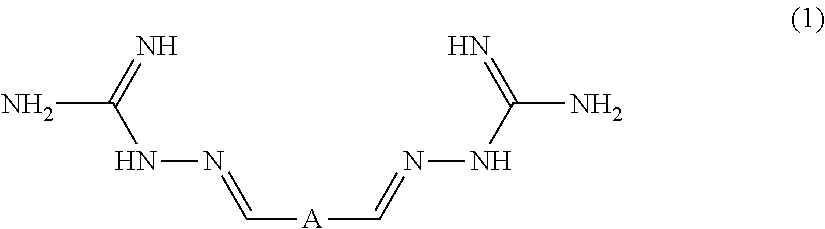
- the carbon dioxide complexing compound before contact with the aqueous-soluble carbonate or bicarbonate salt formed from the carbon dioxide sorbent, has a structure within the following generic formula:
- A is a ring-containing moiety or a bond, and wherein one or more of the hydrogen atoms in Formula (1) may be replaced with one, two, or more equivalent number of methyl groups.
- the precipitated carbonate or bicarbonate salt containing the specialized bis-iminoguanidine compound may have a structure within the following generic formula:
- A is as provided above under Formula (1);
- X m ⁇ is a carbonate or bicarbonate anion, with m being 1 for bicarbonate and 2 for carbonate; and
- the method for removing carbon dioxide from a gaseous source involves the following steps: (i) contacting the gaseous source with an aqueous solution of a carbon dioxide sorbent that reacts with carbon dioxide to form an aqueous-soluble carbonate or bicarbonate salt of the carbon dioxide sorbent; (ii) contacting the aqueous solution from step (i) with a carbon dioxide complexing compound, which is different from the carbon dioxide sorbent, to result in precipitation of a carbonate or bicarbonate salt of the carbon dioxide complexing compound and regeneration of the carbon dioxide sorbent; and (iii) removing the precipitated carbonate or bicarbonate salt from the aqueous solution in step (ii) to result in a solid form of the carbonate or bicarbonate salt of the carbon dioxide complexing compound.
- the method may further include: (iv) regenerating the carbon dioxide complexing compound by subjecting the carbonate or bicarbonate salt of the carbon dioxide complexing compound to heat sufficient to result in release of carbon dioxide gas emanating from the carbonate or bicarbonate salt of the carbon dioxide complexing compound along with simultaneous restoration of the carbon dioxide complexing compound, wherein the released carbon dioxide gas is either quarantined for storage and/or converted into a useful product.
- the gaseous source is contacted intimately with the aqueous solution of the carbon dioxide sorbent by use of an air-liquid contact facilitator, wherein the air-liquid contact facilitator increases the surface area of the aqueous solution containing the carbon dioxide sorbent to increase the air-liquid contact area between the gaseous source and the aqueous solution containing the carbon dioxide sorbent.
- the air-liquid contact facilitator is a humidifying device that contains a reservoir of the aqueous solution containing the carbon dioxide sorbent, and the humidifying device increases the surface area of the aqueous solution by wicking the aqueous solution or forming a mist of the aqueous solution.
- FIG. 1 Schematic diagram showing CO 2 capture from ambient air with aqueous PyBIG, leading to crystallization of PyBIGH 2 (CO 3 )(H 2 O) 4 .
- the CO 2 is released, and the PyBIG compound is regenerated quantitatively by relatively mild heating of the carbonate crystals.
- FIGS. 2A, 2B General schematic showing a direct air capture (DAC) cycle combining CO 2 absorption by an aqueous sorbent, crystallization of PyBIGH 2 (CO 3 )(H 2 O) 4 and sorbent regeneration, and CO 2 release and PyBIG regeneration by heating of the carbonate crystals.
- FIG. 2B Schematic diagram analogous to FIG. 2A , in the particular case where the aqueous sorbent is an alkali carbonate (in particular, sodium carbonate).
- the aqueous sorbent is an alkali carbonate (in particular, sodium carbonate).
- FIGS. 3A, 3B Chart showing absorption of atmospheric CO 2 into a 1 M aqueous solution of glycine/KOH ( FIG. 3A ) or sarcosine/KOH ( FIG. 3B ) as a function of time. Squares and dots correspond to carbonate and total CO 2 (carbonate+carbamate) loadings, respectively.
- FIGS. 4A, 4B Chart showing regeneration of glycine (dots) and sarcosine (squares) sorbents with PyBIG, wherein the total amount of CO 2 removed (mol/mol) is shown as a function of time.
- FIG. 4B Graph showing measured swing capacity for three consecutive loading/regeneration cycles with sarcosine/PyBIG. The column on the right (cycle n) corresponds to the measured swing capacity using PyBIG that was ‘aged’ at 120° C. in open air for a week.
- a gaseous source containing carbon dioxide is contacted with an aqueous solution of a carbon dioxide (CO 2 ) sorbent that reacts with carbon dioxide to form an aqueous-soluble carbonate or bicarbonate salt of the carbon dioxide sorbent.
- CO 2 carbon dioxide
- the foregoing step can herein be referred to as a first step, i.e., step (i).
- the gaseous source can be any volume of gas containing carbon dioxide.
- the gaseous source can be, for example, air, waste gas from an industrial or commercial process, flue gas from a power plant, exhaust from an engine, or sewage or landfill gas.
- aqueous refers to the presence of water.
- the only liquid in the solution is water, while in other embodiments, the liquid in the solution may be water in admixture with a water-soluble organic solvent, such as an alcohol, acetone, or tetrahydrofuran.
- the CO 2 sorbent may be, for example, one or more organoamines, alkali hydroxides (e.g., NaOH or KOH), alkali carbonates (e.g., Na 2 CO 3 or K 2 CO 3 ), and/or alkaline earth hydroxides (e.g., Ca(OH) 2 ).
- the organoamines may be primary or secondary amines. Some examples of conventional organoamines include methylamine, ethylamine, ethylenediamine, and ethanolamine.
- organoamines react with carbon dioxide to form ammonium bicarbonates and ammonium carbonates.
- metal hydroxides react with carbon dioxide to form metal bicarbonates and carbonates; and metal carbonates react with carbon dioxide to form metal bicarbonates.
- any one or more of the above carbon dioxide sorbents is excluded.
- the carbon dioxide sorbent can be present in any suitable concentration in the aqueous solution, e.g., 0.1, 0.2, 0.5, 1, 1.5, 2, 2.5, 3, 4, or 5 M concentration, or a saturated concentration, or a concentration within a range bounded by any two of the foregoing values.
- the one or more organoamines are selected from one or more amino acids.
- Any amino acid which includes natural and non-natural amino acids, should be capable of functioning as a carbon dioxide sorbent, although some amino acids may function better than others.
- the amino acid may be an alpha- or beta-amino acid, or a derivative or mimic of an amino acid (e.g., taurine).
- suitable amino acids include glycine, sarcosine, alanine, beta-alanine (3-aminopropanoic acid), valine, leucine, isoleucine, serine, threonine, glutamine, asparagine, glutamic acid, aspartic acid, lysine, histidine, arginine, phenylalanine, tyrosine, proline, and tryptophan, and N-alkyl derivatives, ester derivatives, or salts of any of the foregoing amino acids.
- the amino acid is selected from glycine and/or N-alkylglycines, wherein the alkyl group is independently selected from hydrocarbon groups containing 1-6 carbon atoms (e.g., methyl, ethyl, n-propyl, isopropyl, n-butyl, isobutyl, sec-butyl, t-butyl, n-pentyl, isopentyl, n-hexyl, and isohexyl).
- N-alkylglycines include sarcosine (where the N-alkyl group is methyl) and N-methylalanine.
- the amino acid or other organoamine should possess at least one NH group.
- the gaseous source is contacted intimately with the aqueous solution containing the carbon dioxide sorbent by use of an air-liquid contact facilitator.
- the air-liquid contact facilitator functions by increasing the contact surface area between the gaseous source and the aqueous solution.
- the air-liquid contact facilitator typically achieves this by increasing the surface area of the aqueous solution containing the carbon dioxide sorbent. Numerous methods are available for increasing the surface area of an aqueous solution, all of which are considered herein.
- the air-liquid contact facilitator may increase the solution surface area by, for example, spreading the solution onto an absorbent material (e.g., a wick), which the solution spreads into by capillary action.
- the air-liquid contact facilitator may increase the solution surface area by forming a mist (i.e., aerosol) of the solution.
- the surface area of the gas may be increased to increase the contact surface area between the gas and the solution.
- the gaseous source may be bubbled through the sorbent solution, along with optional agitation (e.g., stirring) of the solution. Regardless of the process used for increasing the surface area of the solution, the result is an increased area of contact between the sorbent-containing solution and the carbon dioxide-containing gaseous source.
- the air-liquid contact facilitator is a humidifying device that contains a reservoir of the aqueous solution containing the carbon dioxide sorbent, and the humidifying device increases the surface area of the aqueous solution by wicking the aqueous solution or forming a mist of the aqueous solution. As the reservoir is in contact with the increased surface area part of the solution (e.g., wicked solution or solution mist), the reservoir will accumulate the resulting aqueous-soluble carbonate or bicarbonate salt of the carbon dioxide sorbent over time.
- a feature may be included whereby an amount of water and/or other solvent is added over time to precisely or approximately replenish the amount of water and/or other solvent that has been lost over the same period of time.
- step (i) After the carbon dioxide sorbent forms the aqueous-soluble carbonate or bicarbonate salt in step (i), the aqueous solution from step (i) is contacted with a carbon dioxide complexing compound, which is different from the carbon dioxide sorbent and has a bis-iminoguanidine (“BIG”) structure according to Formula (1), as provided above.
- BIG bis-iminoguanidine
- the foregoing contacting step can herein be referred to as a second step, i.e., step (ii).
- the term “contacting” refers to contact on a molecular level.
- carbon dioxide complexing compound refers to the ability of the bis-iminoguanidine compound to complex with the carbonate or bicarbonate anion and form a precipitate salt (i.e., aqueous-insoluble salt) with the carbonate or bicarbonate anion.
- a precipitate salt i.e., aqueous-insoluble salt
- the carbon dioxide complexing compound forms the insoluble carbonate or bicarbonate salt, it simultaneously regenerates the carbon dioxide sorbent by abstracting protons from the carbon dioxide sorbent in the aqueous-soluble salt, thereby forming the bis-iminoguanidinium (BIGH 2 + ) salt structure according to Formula (1a), as provided above.
- Any suitable method for molecularly contacting the carbon dioxide complexing compound with the aqueous solution is considered herein.
- the carbon dioxide complexing compound is added to the aqueous solution directly as a solid, at which time the carbon dioxide complexing compound at least partially dissolves into the aqueous solution before precipitating as an insoluble carbonate or bicarbonate salt.
- the carbon dioxide complexing compound is added as a pre-made aqueous solution or suspension to the aqueous solution containing the aqueous-soluble carbonate or bicarbonate salt.
- the precipitated bis-iminoguanidinium salt is crystalline (e.g., monocrystalline or polycrystalline), while in other embodiments, the salt is amorphous.
- the bis-iminoguanidine compound that herein functions as a carbon dioxide complexing compound in step (ii) has a structure within the scope of the following generic structure:
- variable A is either a ring-containing moiety or a bond.
- Formula (1) depicts a specific tautomeric arrangement, Formula (1) is intended to include any other tautomers that can be derived from or interconvert with the tautomer shown in Formula (1).
- tautomeric structures have the same atomic connections (aside from one or more protons) but differ in the placement of double bonds, generally with concomitant relocation of one or more protons.
- variable A in Formula (1) is a bond.
- the compound under Formula (1) can correspond to the following exemplary structures (along with optional replacement of one, two, or more hydrogen atoms with an equivalent number of methyl groups):
- the variable A is a ring-containing moiety.
- the ring-containing moiety may be or include a ring (i.e., a cyclic group).
- the ring-containing moiety (A) is or includes any cyclic group that includes at least one, two, three, or four carbon ring atoms. Since the cyclic group is attached to two iminoguanidine groups, the cyclic group in the ring-containing moiety (A) necessarily includes two sites engaged in bonds, either directly, or indirectly via a linker, to the iminoguanidine groups. Typically, the two sites in the ring (A) linked, directly or indirectly, to the iminoguanidine groups are ring carbon atoms.
- the ring-containing moiety is or includes a monocyclic ring, i.e., a single ring not bound or fused to another ring.
- the ring-containing moiety is or includes a ring system, wherein the term “ring system” refers to a polycyclic moiety (e.g., a bicyclic or tricyclic moiety).
- the cyclic group can be polycyclic by either possessing a bond between at least two rings or a shared (i.e., fused) bond between at least two rings.
- the one or more rings in the ring-containing moiety is typically a five-membered, six-membered, or seven-membered ring.
- the ring-containing moiety (A) is or includes a carbocyclic ring or ring system.
- carbocyclic indicates that the ring or ring system contains only carbon ring atoms.
- the carbocyclic ring or ring system can be saturated or unsaturated. Some examples of carbocyclic rings that are monocyclic and saturated include cyclopentyl, cyclohexyl, and cycloheptyl rings.
- carbocyclic rings that are monocyclic and unsaturated include cyclopentenyl, cyclopentadienyl, cyclohexenyl, cyclohexadienyl, cycloheptenyl, cycloheptadienyl, and phenylene (benzene) rings.
- carbocyclic rings that are polycyclic and saturated include decalin, norbornane, bicyclohexane, and 1,2-dicyclohexylethane ring systems.
- carbocyclic rings that are polycyclic and unsaturated include naphthalene, anthracene, phenanthrene, phenalene, and indene ring systems.
- the ring-containing moiety (A) is or includes a heterocyclic ring or ring system.
- heterocyclic indicates that the ring or ring system contains at least one ring heteroatom.
- the ring heteroatom is typically selected from nitrogen, oxygen, and sulfur.
- the heterocyclic ring or ring system can be saturated or unsaturated.
- heterocyclic saturated rings or ring systems include those containing at least one ring nitrogen atom (e.g., pyrrolidine, piperidine, piperazine, imidazolidine, azepane, and decahydroquinoline rings); those containing at least one ring oxygen atom (e.g., oxetane, tetrahydrofuran, tetrahydropyran, 1,4-dioxane, 1,3-dioxane, and 1,3-dioxepane rings); those containing at least one ring sulfur atom (e.g., tetrahydrothiophene, tetrahydrothiopyran, 1,4-dithiane, 1,3-dithiane, and 1,3-dithiolane rings); those containing at least one ring oxygen atom and at least one ring nitrogen atom (e.g., morpholine and oxazolidine rings); and those containing at least one ring nitrogen atom
- heterocyclic unsaturated rings or ring systems include those containing at least one ring nitrogen atom (e.g., pyrrole, imidazole, pyrazole, pyridine, pyrazine, pyrimidine, 1,3,5-triazine, azepine, diazepine, indole, purine, benzimidazole, indazole, 2,2′-bipyridine, quinoline, isoquinoline, phenanthroline, 1,4,5,6-tetrahydropyrimidine, 1,2,3,6-tetrahydropyridine, 1,2,3,4-tetrahydroquinoline, quinoxaline, quinazoline, pyridazine, cinnoline, and 1,8-naphthyridine rings); those containing at least one ring oxygen atom (e.g., furan, pyran, 1,4-dioxin, benzofuran, dibenzofuran, and dibenzodi
- Formula (1) and sub-formulas are intended to include any regioisomers that may differ in the connection points of the two iminoguanidine groups on the ring-containing moiety (A).
- A is taken as a benzene (phenylene) ring
- the two shown iminoguanidine groups may be located at the 1,4 (para), 1,3 (meta) or 1,2 (ortho) positions.
- the iminoguanidine groups are located the farthest from each other on the ring-containing moiety. In the case of a benzene ring, the farthest positions correspond to the 1,4 (para) positions.
- Formula (1) is intended to include all resulting stereoisomers.
- the stereoisomer may include one or more enantiomers and/or diastereomers.
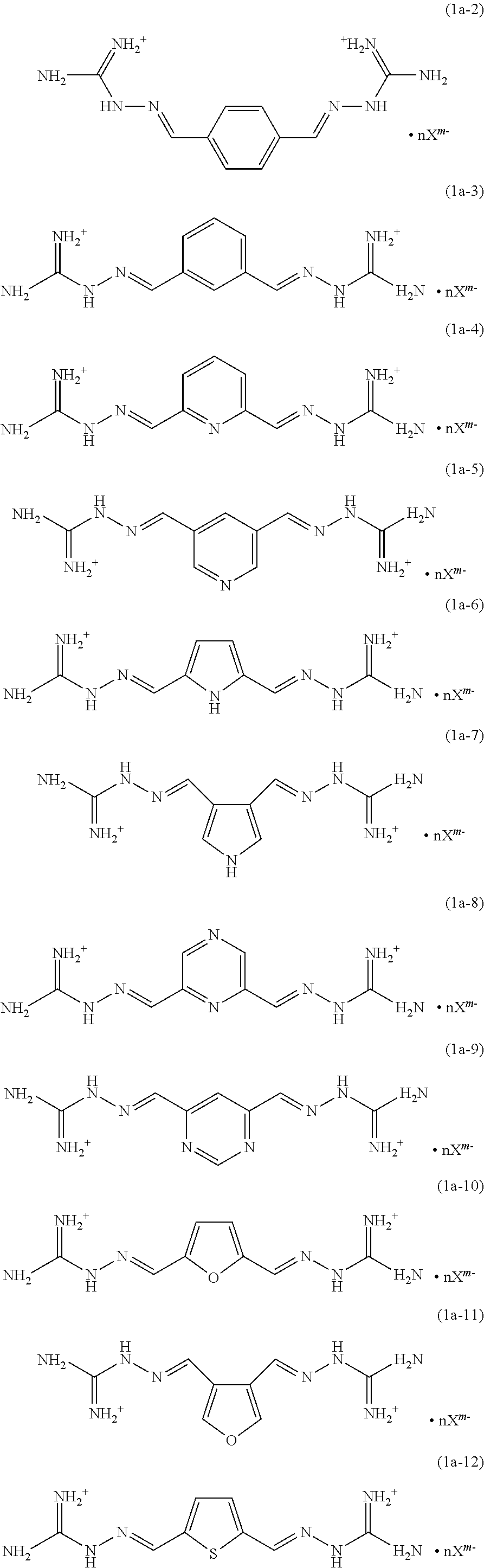
- Some examples of compounds according to Formula (1) in which A is a ring-containing moiety include the following:
- step (ii) when the bis-iminoguanidine molecule according to Formula (1) or sub-formula thereof contacts the aqueous solution from step (i), an aqueous-insoluble salt forms, which includes a mono-protonated (mono-cationic) or di-protonated (bi-cationic) form of the bis-iminoguanidine molecule complexed with carbonate or bicarbonate. At the same time, the carbon dioxide sorbent is regenerated, as discussed above.
- the salt form of Formula (1) can be expressed by the following generic structure:
- Formula (1a) or (1a′) As the structure in Formula (1a) or (1a′) derives directly from Formula (1), it is understood that Formula (1a) or (1a′), like Formula (1), includes all possible tautomers, regioisomers, and stereoisomers described above for Formula (1).
- the positive charge shown in Formula (1a) or (1a′) may be located on any of the other nitrogen atoms through tautomerizaton.
- the positive charge is generally distributed among all atoms capable of holding a positive charge in the various tautomers.
- partial double bond character is generally present among all of the bonds capable of engaging in double bonds in the various tautomers.
- the structures in Formulas (1), (1a), and (1a′) include the possibility of one or more of the hydrogen atoms in Formula (1), (1a), or (1a′), whether the hydrogen atoms are shown or not shown in the formula, being replaced with one or more methyl groups, respectively.
- X m ⁇ is a carbonate or bicarbonate anion, with m being 1 for bicarbonate and 2 for carbonate.
- variable A in Formula (1) is a bond
- variable A in Formula (1a) or (1a′) will necessarily also be a bond.
- the compound under Formula (1a) has the following structure:
- variable A in Formula (1) is a ring-containing moiety
- variable A in Formula (1a) or (1a′) will necessarily also be the same ring-containing moiety.
- Some examples of compounds according to Formula (1a) include the following:
- any of the above exemplary compounds under Formula (1a) or (1a′) may be converted to the respective neutral analogue according to Formula (1) by removal of the one or two protons located on the one or two positively charged amine groups.
- the hydrogen atom on the ring nitrogen atom may (optionally) be replaced with a hydrocarbon group, such as a methyl, ethyl, n-propyl, isopropyl, n-butyl, isobutyl, sec-butyl, t-butyl, phenyl, or benzyl group.
- one or more of the hydrogen atoms in any of the above exemplary structures may be replaced with one, two, or more methyl groups, respectively.
- the substitution in the structure of neutral compounds under Formula (1) should not result in substantial insolubility of the neutral compound in the aqueous solution containing the sorbent.
- the aqueous solution may be heated to a mild temperature (e.g., 40 or 50° C.) to aid in solubilization of the neutral compound.
- An aqueous-soluble organic solvent may also be added to improve the solubility of the neutral compound.
- step (iii) After the carbonate or bicarbonate salt is precipitated from the aqueous solution in step (ii), the precipitate is removed (separated) from the aqueous solution to result in a solid form of the carbonate or bicarbonate salt precipitated from step (ii).
- the foregoing salt removal step may herein be referred to as the third step, i.e., step (iii).
- the precipitated salt is filtered from the solution. If desired, the isolated salt may be rinsed and/or dried. The filtered solution is generally re-used, since it contains the regenerated carbon dioxide sorbent.
- the method may further include a step of regenerating (restoring) the neutral bis-iminoguanidine carbon dioxide complexing compound of Formula (1) while at the same time releasing carbon dioxide gas by decomposition of the bicarbonate or carbonate species in the salt.
- the foregoing step may herein be referred to as a fourth step, i.e., “step (iv)”.
- the bis-iminoguanidinium salt removed in step (iii) is subjected to heat, or vacuum, or both (heat and vacuum), sufficient to result in release of carbon dioxide gas from the salt while at the same time (i.e., simultaneously) regenerating the neutral form of the bis-iminoguanidine compound of Formula (1).
- the carbon dioxide that has been released can be either quarantined for storage for an unspecified amount of time or until it is used in another process, or the released carbon dioxide gas may be directly used in a process or converted to a useful chemical substance or feedstock as the carbon dioxide is released.
- the evolved carbon dioxide gas is stored and/or pressurized, as appropriate, and may be subsequently further processed or reacted in an industrial or commercial process.
- the carbon dioxide may be conveyed to a process where the carbon dioxide is converted to, for example, dry ice, a hydrocarbon fuel, methanol, or ethanol.
- the regeneration step may be conducted at ambient (room) temperature, e.g., 20° C., 25° C., or 30° C. Generally, the greater the vacuum, the lower the temperature that can successfully achieve the regeneration step.
- the salt in step (iii) may be heated to a temperature of at least or above 40° C., 50° C., or 60° C. and up to or below 160° C., 180° C., 200° C., 220° C., or 250° C. to effect the release of carbon dioxide and regeneration of the carbon dioxide complexing compound.
- the temperature used in step (iii) is precisely or about, for example, 40° C., 50° C., 60° C., 70° C., 80° C., 90° C., 100° C., 110° C., 120° C., 130° C., 140° C., 150° C., 160° C., 170° C., 180° C., 190° C., 200° C., 220° C., or 250° C.
- any two of the foregoing values such as 20-250° C., 30-250° C., 40-250° C., 40-180° C., 40-160° C., 40-120° C., 60-160° C., 60-140° C., 60-120° C., 60-100° C., 60-90° C., 60-80° C., 70-160° C., 70-140° C., 70-120° C., 70-100° C., 80-160° C., 80-140° C., 80-120° C., or 80-100° C.
- the bis-iminoguanidinium salt in step (iii) is heated by use of a renewable energy source, which may be practiced with or without a vacuum.
- the renewable energy source may be, for example, solar energy.
- the solar energy is used for direct heating, such as in a solar heat concentrator (e.g., a solar oven).
- the solar energy is used for indirect heating, such as by converting the solar energy to electricity or hydrogen, which is then used to power a heating device.
- direct or indirect solar energy may be used to heat water to steam, and the bis-iminoguanidinium salt in step (iii) is heated with the steam.
- Hydrogen may be used directly as a fuel, or indirectly in a fuel cell to produce electricity.
- Other forms of renewable energy e.g., wind or hydroelectric power
- Geothermal power may also be used directly or indirectly to heat the salt in step (iii).
- a manmade heating process that employs a fuel that emits carbon dioxide when combusted is excluded in step (iii).
- the compounds according to Formula (1) can be synthesized by methods well known in the art.
- a compounds according to Formula (1) is synthesized by reacting aminoguanidine (or a methylated derivative thereof) with a ring-containing dialdehyde or diketone under conditions where an imine linkage is formed between an amino group on the aminoguanidine and the carbon of the aldehyde or ketone group.
- the ring-containing dialdehyde or diketone includes a ring-containing moiety (A), as described above.
- a general schematic of the process is provided as follows:
- A is a ring-containing moiety, as described above.
- the group R is typically hydrogen (which corresponds to a dialdehyde reactant), but R may be a hydrocarbon group, particularly a hydrocarbon group containing 1-6, 1-7, or 1-8 carbon atoms, such as methyl, ethyl, n-propyl, isopropyl, n-butyl, isobutyl, sec-butyl, t-butyl, phenyl, or benzyl group, which corresponds to a diketone reactant.
- the above scheme is for directly producing a neutral bis-iminoguanidine compound according to Formula (1).
- a guanidinium salt can be produced and converted to the neutral guanidine compound by reaction with a base.
- any one or more hydrogen atoms of the aminoguanidine or aminoguanidinium reactant may be replaced with one or more methyl groups, respectively, except that the aminoguanidine or aminoguanidinium reactant should retain at least one primary amine group for reaction with the dialdehyde or diketone.
- one or more hydrogen atoms of the bis-iminoguanidinium or bis-iminoguanidine product may be replaced with one or more methyl groups by, for example, reaction with methyl iodide.
- the PyBIG compound was synthesized according to a previously reported method, which was scaled up and optimized (see C. A. Seipp et al., Angew. Chem. Int. Ed. 56, 1042-1045, 2017). The details of the synthesis are as follows:
- Pyridine-2,6-dicarbaldehyde A mixture of pyridine-2,6-dimethanol (10.00 g, 71.86 mmol) and Dess-Martin periodinane (67.06 g, 158.10 mmol) were suspended in 400 mL of dichloromethane. The reaction mixture was stirred at room temperature for 12 hours. Subsequently, 100 mL of water was added to the reaction and the mixture was stirred at room temperature for an additional 12 hours. A 300 mL 50/50 mixture of saturated NaHCO 3 and 10% Na 2 S 2 O 3 was added to the reaction mixture and stirred for two additional hours, and then the mixture was filtered through a celite plug.
- the filtrate was poured into a separatory funnel and the organic layer was collected, washed with brine, and dried with Na 2 SO 4 .
- the dichloromethane was removed under vacuum resulting in a white-yellow solid.
- the product was purified by column chromatography by partly dissolving the product in hexanes and loading it onto a silica gel column (Note: the solid is not fully soluble in hexanes), and eluting it using a hexanes-ethyl acetate solvent system (7:3 hexanes/ethyl acetate). The final product was isolated as a white solid. Yield: 7.64 g, 78.7%.
- aqueous 2,6-pyridine-bis(iminoguanidine) captures CO 2 from ambient air and binds it as a crystalline tetrahydrated carbonate salt PyBIGH 2 (CO 3 )(H 2 O) 4 .
- the CO 2 can be released by heating the carbonate crystals at relatively mild temperatures of 80-120° C., which regenerates the PyBIG compound quantitatively.
- a general schematic of the process is shown in FIG. 1 .
- the crystalline PyBIG compound (as PyBIG.2H2O hydrate) first dissolves into water (equation 1), then the two guanidine groups become protonated by water molecules, generating the dicationic form of the compound (PyBIGH 2 2+ ) and HO ⁇ (equation 2).
- the hydroxide anions are the actual active species that react with the CO 2 absorbed from air (equation 3) and generate bicarbonate (equation 4) and carbonate anions (equation 5).
- the PyBIGH 2 2+ and CO 3 2 ⁇ ions crystallize with water into crystalline PyBIGH 2 (CO 3 )(H 2 O) 4 (equation 6).
- the net reaction shown in equation 7, corresponds to crystalline PyBIG converting into crystalline PyBIGH 2 (CO 3 )(H 2 O) 4 , in the presence of CO 2 and water, through dissolution/recrystallization.
- FIG. 2A provides a general schematic of the above concept.
- FIG. 2B shows an analogous process where a bicarbonate salt results from reaction of a carbonate salt with carbon dioxide and water.
- the resulting mixture was filtered, and the separated crystalline solid was confirmed by PXRD and FTIR to be PyBIGH 2 (CO 3 )(H 2 O) 4 .
- Subsequent heating of the carbonate crystals in the oven for one hour at 120° C. regenerated the PyBIG solid, which was recycled back into the original sodium bicarbonate solution.
- the entire carbonate separation cycle was run three times, with observed yields for PyBIGH 2 (CO 3 )(H 2 O) 4 crystallization of 99.0 ⁇ 0.4%, 97.2 ⁇ 0.6%, and 91.4 ⁇ 0.4%, corresponding to the first, second, and third cycle, respectively.
- the regeneration of the PyBIG compound was nearly quantitative in each cycle.
- Aqueous amino acids have a number of positive attributes that make them promising candidates for DAC. They have fast CO 2 sorption kinetics, on par with or surpassing more traditional sorbents like monoethanolamine or NaOH. Amino acids are non-volatile, non-corrosive, environmentally friendly, and relatively inexpensive. They are also less susceptible to oxidation than amines. While amino acid sorbents have been employed in CO 2 scrubbing from flue gas, their use in DAC remains largely unexplored. The chemical reactions involved in the CO 2 absorption with amino acids and in the sorbent regeneration with PyBIG are depicted in equations 8-10 below, with glycine being a representative example.
- the anionic form of glycine reacts with CO 2 and generates the corresponding carbamic acid, which is deprotonated by a second equivalent of glycine to generate the carbamate and the zwitterionic glycine (equation 8).
- the carbamate is subsequently hydrolyzed to glycinate and bicarbonate (equation 9).
- PyBIG takes two protons and a carbonate anion from solution and crystallizes as PyBIGH 2 (CO 3 )(H 2 O) 4 (equation 10), which in the process leads to deprotonation of the zwitterionic glycine and regeneration of the glycinate sorbent (normally the two protons are abstracted from bicarbonate and the zwitterion).
- equation 10 PyBIGH 2 (CO 3 )(H 2 O) 4
- DAC is more suitably done in a more open system with contactors that are optimized to ingest large volumes of ambient air, in many ways similar in design with large-scale cooling towers.
- a household humidifier was used as an air-liquid contactor. Like a cooling tower, an air humidifier is designed to maximize the air-water contact area, and by replacing the water with an amino acid solution, it effectively becomes a DAC absorber.
- the humidifier consists of a reservoir with a capacity of ⁇ 2 L, a rotating wick, which is made of a porous fabric that absorbs the liquid from the reservoir and provides a larger surface area, and a fan.
- the reservoir was filled with 1.5 L aqueous solutions of glycine or sarcosine (1 M) and KOH (1 M) and the fan was run on slow setting, corresponding to an air flow rate of 3.8 ⁇ 0.2 m/s.
- the capture experiments were run at ambient temperature (21 ⁇ 1° C.).
- thermodynamics of the CO 2 absorption and desorption as well as of sorbent regeneration, which define the energy and efficiency boundaries for the DAC system.
- the energetics of the CO 2 absorption (equation 7) can be obtained by adding up the energetics of the elementary reactions represented by equations 1-6.
- the enthalpies of CO 2 hydration (equation 3) and of reaction with HO— to generate bicarbonate (equation 4) are already known.
- the heat of bicarbonate deprotonation by HO— to make CO 3 2 ⁇ (equation 5) can also be calculated from published thermodynamic data on carbonate protonation and water ionization.
- DSC differential scanning calorimetry
- anhydrous PyBIGH 2 (CO 3 ) was prepared by overnight vacuum pumping of PyBIGH 2 (CO 3 )(H 2 O) 4 at 30° C.
- the difference between the measured endotherms of PyBIGH 2 (CO 3 )(H 2 O) 4 and PyBIGH 2 (CO 3 ), of 148 kJ/mol, can be assigned to dehydration of the carbonate salt.
- log K reg log K sp (PyBIG) ⁇ log K sp (PyBIGH 2 (CO 3 )(H 2 O) 4 ) ⁇ pK a (Gly) ⁇ pK a (HCO 3 ⁇ )+pK a1 (PyBIG)+pK a2 (PyBIG) (11)
- the amino acid regeneration is driven by the difference in solubility between PyBIG and PyBIGH 2 (CO 3 )(H 2 O) 4 , as well as the difference in basicity between glycine and bicarbonate on the one hand, and PyBIG on the other hand.
- the pKa values at 25° C. for the two guanidinium groups of PyBIG, as determined by potentiometric titration, are 7.6 and 8.7.
- the pKa values of glycine and bicarbonate are 9.5 and 10.3, respectively (Yang N. et al., Ind. Eng. Chem. Res. 53, 12848-12855, 2014).
- PyBIG is not sufficiently basic to drive the regeneration equilibrium to the right, and therefore, the main driving force has to come from the solubility difference between PyBIG and PyBIGH 2 (CO 3 )(H 2 O) 4 .
- a preliminary estimated value of 1.0 ⁇ 10 ⁇ 8 is given for the solubility product of PyBIGH 2 (CO 3 )(H 2 O) 4 .
- determination of a more accurate value became possible as the exact speciation of PyBIG in solution could now be obtained based on the measured pKa values of PyBIG, resulting in a revised K sp for PyBIGH 2 (CO 3 )(H 2 O) 4 of 1.0 ⁇ 0.3 ⁇ 10 ⁇ 9 at 25° C.
- the amino acid solutions (5 mL) were placed in 20 mL vials and PyBIG.2.5H 2 O was added as a solid.
- the resulting suspensions were shaken at 1000 rpm on a vortex mixer, adding a teflon-coated micro stir bar to each vial to aid in the mixing.
- Subsamples (50 ⁇ L) were withdrawn hourly for the first 8 hours and then after 24 hours, using a 0.22 ⁇ m syringe filter to remove solid particulates from solution prior to preparing samples for 1 H NMR and IC.
- the subsamples were first diluted with 450 ⁇ L of D 2 O, then left at room temperature for 24 hours before they were analyzed by NMR spectroscopy.
- For IC analyses 20 ⁇ L of the solutions used for NMR analyses were diluted with 980 ⁇ L of deionized H 2 O. At the end of the regenerations, the final solids were filtered and analyzed by PXRD for phase identification.
- the cyclic capacity defined as the difference between the maximum CO 2 loading observed after absorption and the minimum CO 2 loading measured after regeneration, is 0.35 and 0.31 mol/mol for the glycine and sarcosine sorbents, respectively.
- the average swing capacity defined as the difference between the maximum CO 2 loading observed after 24 hours of absorption and the minimum CO 2 loading measured after 24 hours of regeneration (based on three separate runs), was 0.28 ⁇ 0.06 and 0.31 ⁇ 0.05 mol/mol for the glycine and sarcosine sorbents, respectively.
- FIG. 4B shows the measured swing capacity for three consecutive loading/regeneration cycles with sarcosine/PyBIG. As shown in FIG. 4B , the swing capacity remained relatively constant over three consecutive loading/regeneration cycles. However, many more cycles will have to be run to test the long-term robustness of this DAC system.
- the room-temperature crystallization-based sorbent regeneration employed herein circumvents the heating of the amino acid sorbent, thereby extending its operational lifetime, the long-term stability of PyBIG that must be thermally regenerated remains a concern, as its degradation over time would lead to a gradual decrease in the cyclic capacity.
- the compound was subjected to accelerated aging by heating it at 120° C. in open air for a week, which is the equivalent of 336 thermal regeneration cycles (based on a typical 30 minute regeneration time).
- the thermogravimetric analysis showed minimal weight changes over this extended period of heating, with only 0.5% weight loss after the initial 35.3% corresponding to the CO 2 and H 2 O loss.
- the ‘aged’ PyBIG was subsequently used in a sarcosine regeneration cycle and the measured swing capacity of 0.26 ⁇ 0.02 mol/mol was very similar to the corresponding values measured with fresh PyBIG ( FIG. 4B ), attesting to the thermal stability of the guanidine compound.
- Regeneration of the amino acid sorbents can also be achieved in a traditional fashion, by boiling the aqueous solutions under reflux. After one hour of refluxing, the total CO 2 removed from the glycine and sarcosine sorbents was 0.31 and 0.30 mol/mol, respectively, which are comparable with the corresponding values observed in the regenerations using PyBIG. With longer reaction times, the boiling regenerations outperforms the regenerations with PyBIG, with the total CO 2 swing capacity increasing to 0.47 and 0.45 mol/mol after 4 hours of refluxing the glycine and sarcosine solutions, respectively. However, such long refluxing times are expected to come at a cost in terms of energy consumption and sorbent degradation.
- the CO 2 release from the PyBIGH 2 (CO 3 )(H 2 O) 4 crystals was conducted by solar heating with a solar oven.
- the oven consists of a vacuum-insulated borosilicate tube placed in the focal point of two adjustable parabolic reflectors. The temperature inside the tube was monitored with a thermocouple.
- the PyBIGH 2 (CO 3 )(H 2 O) 4 samples 36.4-45.0 mg, 0.095-0.118 mmol) were loaded in 1 mL glass vials, which were placed inside the oven tube.
- the solar oven was then placed in the full sun and oriented to capture the maximum amount of sunlight. The temperature was ramped to the targeted values of 120° C., 130° C., 140° C., 150° C., or 160° C.
- this study also identified a number of limitations for the current DAC system and provided guidelines for the design and optimization of future DAC technologies.
- the air humidifier used in this study is not optimized for DAC as it provides a relatively small air-water interfacial area, which limits the overall CO 2 uptake rate.
- the humidifier evaporates large amounts of water, which in the case of DAC is a disadvantage. Combining the amino acid sorbents with better air-liquid contactors that optimize the air-water interfacial area and minimize the water loss may lead to more efficient DAC systems.
Landscapes
- Chemical & Material Sciences (AREA)
- Organic Chemistry (AREA)
- Engineering & Computer Science (AREA)
- Analytical Chemistry (AREA)
- General Chemical & Material Sciences (AREA)
- Oil, Petroleum & Natural Gas (AREA)
- Chemical Kinetics & Catalysis (AREA)
- Gas Separation By Absorption (AREA)
Abstract
Description

where A is a ring-containing moiety or a bond, and wherein one or more of the hydrogen atoms in Formula (1) may be replaced with one, two, or more equivalent number of methyl groups.

wherein A is as provided above under Formula (1); Xm− is a carbonate or bicarbonate anion, with m being 1 for bicarbonate and 2 for carbonate; and n is an integer of 1 or 2; provided that n×m=2.




PyBIG(s)

PyBIG(aq)+2H2O
CO2(g)
CO2(aq)+HO− (aq)
HCO3 − (aq)+HO− (aq)
PyBIGH2 2+ (aq)+CO3 2− (aq)+4H2O
PyBIG(s)+CO2(g)+5H2O→PyBIGH2(CO3)(H2O)4(s) (7)
CO3 2−+CO3+H2O→2HCO3 − (Eq. 1)
PyBIG(s)+2HCO3 −+4H2O→PyBIGH2(CO3)(H2O)4(s)+CO3 2− (Eq. 2)

| TABLE 1 |
| Reaction enthalpies for the corresponding elementary |
| steps involved in DAC with PyBIG. |
| Equation | Reaction | ΔH (kJ/mol) | |
| 1 | PyBIG dissolution | 42.5 | This |
| 2 | PyBIG protonation | 43.6a | This |
| 3 | CO2 dissolution | −19.4 | 29 |
| 4 | HCO3 − formation | −50 | 30 |
| 5 | CO3 2− formation | −40.4 | 31, 32 |
| 6 | PyBIGH2(CO3)(H2O)4 cryst. | −47 | This study |
| aThe enthalpy for |
|||
log Kreg=log Ksp(PyBIG)−log Ksp(PyBIGH2(CO3)(H2O)4)−pKa(Gly)−pKa(HCO3 −)+pKa1(PyBIG)+pKa2(PyBIG) (11)
| TABLE 2 |
| Carbon dioxide loading values for DAC with 1M aqueous |
| solutions of potassium glycinate and sarcosinate |
| pH | Carbonatea | Carbamate | Total CO2 | |
| Sorbent | (initial/final) | (M) | (M) | (M) |
| Glycine (1M) | 12.31/9.52 | 0.54 ± 0.08 | 0.22 ± 0.06 | 0.77 ± 0.04 |
| Sarcosine (1M) | 12.92/9.99 | 0.54 ± 0.07 | 0.15 ± 0.02 | 0.69 ± 0.05 |
| aAs the sum of CO3 2− and HCO3 − concentrations. | ||||
| TABLE 3 |
| Regeneration results for the 1M aqueous solutions of potassium |
| glycinate and sarcosinate after stirring with a suspension |
| of PyBIG (0.5 molar equiv) for 24 hours. |
| pH | Carbonate | Carbamate | Total CO2 | |
| Sorbent | (initial/final) | (M) | (M) | (M) |
| Glycine (1M) | 9.63/10.33 | 0.33 | 0.05 | 0.38 |
| Sarcosine (1M) | 9.99/10.53 | 0.29 | 0.03 | 0.32 |
| TABLE 4 |
| Carbon dioxide release from PyBIGH2(CO3)(H2O)4 and regeneration |
| of PyBIG by heating with concentrated solar power. Three different |
| measurements were done at each temperature, and the reported % weight |
| losses and regeneration yields are the average values. |
| T | Heating time | Weight loss | Regeneration yield | ||
| (° C.) | (min) | (%) | (%) | ||
| 120 | 30 | 32.3 ± 0.8 | 92 ± 2 | ||
| 130 | 15 | 32.3 ± 0.8 | 92 ± 2 | ||
| 140 | 10 | 33.2 ± 0.8 | 95 ± 2 | ||
| 150 | 5 | 32.5 ± 0.8 | 93 ± 2 | ||
| 160 | 2 | 33.8 ± 0.3 | 96 ± 1 | ||
Claims (23)

Priority Applications (1)
| Application Number | Priority Date | Filing Date | Title |
|---|---|---|---|
| US15/978,323 US10583387B2 (en) | 2017-06-05 | 2018-05-14 | Guanidine compounds for carbon dioxide capture |
Applications Claiming Priority (3)
| Application Number | Priority Date | Filing Date | Title |
|---|---|---|---|
| US201762514997P | 2017-06-05 | 2017-06-05 | |
| US201862647052P | 2018-03-23 | 2018-03-23 | |
| US15/978,323 US10583387B2 (en) | 2017-06-05 | 2018-05-14 | Guanidine compounds for carbon dioxide capture |
Publications (2)
| Publication Number | Publication Date |
|---|---|
| US20180345207A1 US20180345207A1 (en) | 2018-12-06 |
| US10583387B2 true US10583387B2 (en) | 2020-03-10 |
Family
ID=64458624
Family Applications (1)
| Application Number | Title | Priority Date | Filing Date |
|---|---|---|---|
| US15/978,323 Active 2038-05-31 US10583387B2 (en) | 2017-06-05 | 2018-05-14 | Guanidine compounds for carbon dioxide capture |
Country Status (2)
| Country | Link |
|---|---|
| US (1) | US10583387B2 (en) |
| WO (1) | WO2018226368A1 (en) |
Cited By (4)
| Publication number | Priority date | Publication date | Assignee | Title |
|---|---|---|---|---|
| US20240067860A1 (en) * | 2022-08-15 | 2024-02-29 | Chevron U.S.A. Inc. | Compositions and methods for carbon dioxide solidification |
| US12059648B2 (en) | 2021-02-05 | 2024-08-13 | Ge Infrastructure Technology Llc | Carbon dioxide capture system and method of capturing carbon dioxide |
| WO2025064278A1 (en) * | 2023-09-21 | 2025-03-27 | Ut-Battelle, Llc | Carbon-capture sorbent regeneration by magnetic heating of nanoparticles |
| WO2026076412A1 (en) * | 2024-10-03 | 2026-04-09 | Olcv Dac Technology, Llc | Synthesis of iminoguanidines |
Families Citing this family (18)
| Publication number | Priority date | Publication date | Assignee | Title |
|---|---|---|---|---|
| US20180134655A1 (en) * | 2016-11-15 | 2018-05-17 | Ut-Battelle, Llc | Guanidine compounds for removal of oxyanions from aqueous solutions and for carbon dioxide capture |
| CN108003120B (en) * | 2017-11-24 | 2020-04-07 | 中山大学 | Imine guanidine derivative containing furan skeleton and preparation and application thereof |
| DE102020004542A1 (en) * | 2020-07-27 | 2022-01-27 | Ulrich Dietz | Processes for binding, transport, reaction activation, conversion, storage and release of water-soluble gases |
| AU2021344444A1 (en) * | 2020-09-17 | 2023-05-04 | Kc8 Capture Technologies Ltd | A solvent solution and process |
| CN112591710B (en) * | 2020-12-15 | 2022-08-02 | 湖南理工学院 | A kind of high-purity fuel hydrogen preparation and delivery system and control method thereof |
| CN112635835B (en) * | 2020-12-22 | 2024-03-29 | 远景动力技术(江苏)有限公司 | High-low temperature compatible non-aqueous electrolyte and lithium ion battery |
| US12601327B2 (en) * | 2021-09-28 | 2026-04-14 | Fervo Energy Company | Direct air capture using geothermal cooling towers |
| WO2023076393A1 (en) * | 2021-10-27 | 2023-05-04 | Ut-Battelle, Llc | Intensified carbon capture using building infrastructure |
| CN114768477B (en) * | 2022-03-18 | 2023-11-17 | 中国科学技术大学 | Carbon dioxide trapping method |
| WO2024039676A1 (en) * | 2022-08-15 | 2024-02-22 | Chevron U.S.A. Inc. | Compositions and methods of using a complexing agent |
| US12415889B2 (en) | 2022-08-19 | 2025-09-16 | International Business Machines Corporation | Cyclopropenimines for activation of carbon dioxide |
| US12478951B2 (en) | 2022-08-19 | 2025-11-25 | International Business Machines Corporation | Cyclopropenimines for activation of carbon dioxide |
| US12479793B2 (en) * | 2022-08-19 | 2025-11-25 | International Business Machines Corporation | Cyclopropenimines for mineralization of carbon dioxide |
| US20250073680A1 (en) * | 2023-08-28 | 2025-03-06 | Ut-Battelle, Llc | Method of regenerating bis(iminoguanidine) carbon dioxide sorbents from carbonate or bicarbonate salt thereof |
| US20250073668A1 (en) * | 2023-08-30 | 2025-03-06 | Hexion Inc. | Carbon dioxide sorbent molecules, processes of making, and uses |
| WO2025217337A1 (en) * | 2024-04-10 | 2025-10-16 | Prometheus Fuels, Inc. | Systems and methods for optimizing fuel production from behind-the-meter solar power |
| WO2026015475A1 (en) * | 2024-07-07 | 2026-01-15 | The Board Of Trustees Of The Leland Stanford Junior University | Electrochemical co2 capture through ph-independent redox chemistry |
| WO2026080330A1 (en) * | 2024-10-07 | 2026-04-16 | Olcv Dac Technology, Llc | Precipitation of carbon dioxide complexes |
Citations (9)
| Publication number | Priority date | Publication date | Assignee | Title |
|---|---|---|---|---|
| US4120789A (en) * | 1976-02-23 | 1978-10-17 | Anic, S.P.A. | Method for the purification of sewage waters which contain organic compounds of an anionic nature |
| US20030219440A1 (en) | 2002-04-17 | 2003-11-27 | Annette Tobia | 3-deoxyglucosone and skin |
| US20120027664A1 (en) | 2010-07-30 | 2012-02-02 | General Electric Company | Carbon dioxide capture system and methods of capturing carbon dioxide |
| US8246731B2 (en) | 2004-05-04 | 2012-08-21 | The Trustees Of Columbia University In The City Of New York | Systems and methods for extraction of carbon dioxide from air |
| US20140178278A1 (en) | 2012-12-21 | 2014-06-26 | Exxonmobil Research And Engineering Company | Co2 capture via amine-co2 product phase separation |
| US9260326B2 (en) | 2012-05-31 | 2016-02-16 | Ut-Battelle, Llc | Selective oxoanion separation using a tripodal ligand |
| US20170014760A1 (en) | 2015-07-14 | 2017-01-19 | John E. Stauffer | Carbon dioxide recovery |
| US20170081223A1 (en) | 2015-09-18 | 2017-03-23 | Saudi Arabian Oil Company | Treating seawater for oilfield operations |
| US20180134655A1 (en) | 2016-11-15 | 2018-05-17 | Ut-Battelle, Llc | Guanidine compounds for removal of oxyanions from aqueous solutions and for carbon dioxide capture |
-
2018
- 2018-05-14 WO PCT/US2018/032502 patent/WO2018226368A1/en not_active Ceased
- 2018-05-14 US US15/978,323 patent/US10583387B2/en active Active
Patent Citations (9)
| Publication number | Priority date | Publication date | Assignee | Title |
|---|---|---|---|---|
| US4120789A (en) * | 1976-02-23 | 1978-10-17 | Anic, S.P.A. | Method for the purification of sewage waters which contain organic compounds of an anionic nature |
| US20030219440A1 (en) | 2002-04-17 | 2003-11-27 | Annette Tobia | 3-deoxyglucosone and skin |
| US8246731B2 (en) | 2004-05-04 | 2012-08-21 | The Trustees Of Columbia University In The City Of New York | Systems and methods for extraction of carbon dioxide from air |
| US20120027664A1 (en) | 2010-07-30 | 2012-02-02 | General Electric Company | Carbon dioxide capture system and methods of capturing carbon dioxide |
| US9260326B2 (en) | 2012-05-31 | 2016-02-16 | Ut-Battelle, Llc | Selective oxoanion separation using a tripodal ligand |
| US20140178278A1 (en) | 2012-12-21 | 2014-06-26 | Exxonmobil Research And Engineering Company | Co2 capture via amine-co2 product phase separation |
| US20170014760A1 (en) | 2015-07-14 | 2017-01-19 | John E. Stauffer | Carbon dioxide recovery |
| US20170081223A1 (en) | 2015-09-18 | 2017-03-23 | Saudi Arabian Oil Company | Treating seawater for oilfield operations |
| US20180134655A1 (en) | 2016-11-15 | 2018-05-17 | Ut-Battelle, Llc | Guanidine compounds for removal of oxyanions from aqueous solutions and for carbon dioxide capture |
Non-Patent Citations (8)
| Title |
|---|
| Berge, S.M., et al., "Pharmaceutical Salts", Journal of Pharmaceutical Sciences, (1977), vol. 66, pp. 1-19. |
| Custelcean R. et al., "Aqueous sulfate separation by crystallization of sulfate-water clusters", Angew. Chem. Int. Ed., (2015), 54, pp. 10525-10529. |
| Custelcean R. et al., "Aqueous sulfate separation by sequestration of [(SO4)2(H2O)4]4-clusters within highly insoluble imine-linked bis-guanidinium crystals", Chem. Eur. J., (2016), 22, pp. 1997-2003. |
| French, F.A., et al. "Chemotherapy Studies on Transplanted Mouse Tumors", Cancer Research, (1960), 20, pp. 505-538. |
| International Search Report and Written Opinion dated Sep. 18, 2018 issued in PCT/US18/32502. |
| Knownium, K. et al., "Novel endotoxin-sequestering compounds with terephthalaldehyde-bis-guanylhydrazone scaffolds", Bioorganic & Medicinal Chemistry Letters, (2006), 16, pp. 1305-1308. |
| U.S. Office Action dated Jun. 13, 2018 issued in U.S. Appl. No. 15/813,557. |
| Ulrich, P.C., et al. "The Trypanocidal Activity of Various Aromatic Bisguanylhydrazones In Vivo", Drug Development Research, (1982), 2, pp. 219-228. |
Cited By (6)
| Publication number | Priority date | Publication date | Assignee | Title |
|---|---|---|---|---|
| US12059648B2 (en) | 2021-02-05 | 2024-08-13 | Ge Infrastructure Technology Llc | Carbon dioxide capture system and method of capturing carbon dioxide |
| US20240067860A1 (en) * | 2022-08-15 | 2024-02-29 | Chevron U.S.A. Inc. | Compositions and methods for carbon dioxide solidification |
| US12410355B2 (en) * | 2022-08-15 | 2025-09-09 | Chevron U.S.A. Inc. | Compositions and methods for carbon dioxide solidification |
| WO2025064278A1 (en) * | 2023-09-21 | 2025-03-27 | Ut-Battelle, Llc | Carbon-capture sorbent regeneration by magnetic heating of nanoparticles |
| US12521668B2 (en) | 2023-09-21 | 2026-01-13 | Ut-Battelle, Llc | Carbon-capture sorbent regeneration by magnetic heating of nanoparticles |
| WO2026076412A1 (en) * | 2024-10-03 | 2026-04-09 | Olcv Dac Technology, Llc | Synthesis of iminoguanidines |
Also Published As
| Publication number | Publication date |
|---|---|
| US20180345207A1 (en) | 2018-12-06 |
| WO2018226368A1 (en) | 2018-12-13 |
Similar Documents
| Publication | Publication Date | Title |
|---|---|---|
| US10583387B2 (en) | Guanidine compounds for carbon dioxide capture | |
| US10633332B2 (en) | Guanidine compounds for removal of oxyanions from aqueous solutions and for carbon dioxide capture | |
| Brethomé et al. | Direct air capture of CO2 via aqueous-phase absorption and crystalline-phase release using concentrated solar power | |
| JP6491667B2 (en) | Acid gas recovery and release system | |
| Zhang et al. | Efficient absorption of SO2 with low-partial pressures by environmentally benign functional deep eutectic solvents | |
| JP6195845B2 (en) | Method and absorption medium for absorbing CO2 from a mixed gas | |
| EP2889073B1 (en) | Acid gas removal method | |
| US20190027771A1 (en) | Acid gas regenerable battery | |
| CN108993098B (en) | Efficient CO capture2Eutectic solvent system and preparation method and application thereof | |
| CN107096352B (en) | SO is absorbed to eutectic solvent that can regenerate2Method (2) | |
| CA2878103C (en) | Co2 sorption by supported amino acid ionic liquids | |
| CN108993125B (en) | Eutectic solvent for removing carbon dioxide in air and flue gas | |
| EP2563497A1 (en) | Process for the capture of carbon dioxide | |
| CN107670464A (en) | A kind of process regenerated with eutectic solvent absorbing sulfur dioxide in flue and use hydrogen sulfide | |
| Barzagli et al. | Direct CO2 air capture with aqueous 2-(ethylamino) ethanol and 2-(2-aminoethoxy) ethanol: 13C NMR speciation of the absorbed solutions and study of the sorbent regeneration improved by a transition metal oxide catalyst | |
| CN109701362A (en) | A liquid-solid phase change absorbent for carbon dioxide capture and its application | |
| CN113477052B (en) | A kind of amine ethylated piperazine and preparation method thereof, carbon dioxide absorbent and application thereof | |
| CN105561734A (en) | Thermosensitive amine group carbon dioxide absorbent | |
| US20240082823A1 (en) | Microwave regeneration of carbon dioxide sorbents | |
| CN109200760B (en) | Low-energy-consumption regenerated eutectic solvent for removing carbon dioxide stably | |
| Cao et al. | Low-Temperature Desorption of CO2 from Carbamic Acid for CO2 Condensation by Direct Air Capture | |
| CN102941008B (en) | A method for absorbing SO2 and regenerating absorbent with soluble calcium brine solution | |
| US20250073680A1 (en) | Method of regenerating bis(iminoguanidine) carbon dioxide sorbents from carbonate or bicarbonate salt thereof | |
| KR101383762B1 (en) | Carbon Dioxide Capture Sorbent and Method for Carbon Dioxide Capture | |
| US20150098890A1 (en) | Carbon dioxide absorbing composition including sterically hindered alkanolamine, and method and apparatus for absorbing carbon dioxide using the same |
Legal Events
| Date | Code | Title | Description |
|---|---|---|---|
| FEPP | Fee payment procedure |
Free format text: ENTITY STATUS SET TO UNDISCOUNTED (ORIGINAL EVENT CODE: BIG.); ENTITY STATUS OF PATENT OWNER: SMALL ENTITY |
|
| FEPP | Fee payment procedure |
Free format text: ENTITY STATUS SET TO SMALL (ORIGINAL EVENT CODE: SMAL); ENTITY STATUS OF PATENT OWNER: SMALL ENTITY |
|
| STPP | Information on status: patent application and granting procedure in general |
Free format text: DOCKETED NEW CASE - READY FOR EXAMINATION |
|
| STPP | Information on status: patent application and granting procedure in general |
Free format text: NON FINAL ACTION MAILED |
|
| STPP | Information on status: patent application and granting procedure in general |
Free format text: NOTICE OF ALLOWANCE MAILED -- APPLICATION RECEIVED IN OFFICE OF PUBLICATIONS |
|
| AS | Assignment |
Owner name: UT-BATTELLE, LLC, TENNESSEE Free format text: ASSIGNMENT OF ASSIGNORS INTEREST;ASSIGNOR:CUSTELCEAN, RADU;REEL/FRAME:051637/0690 Effective date: 20190430 |
|
| STPP | Information on status: patent application and granting procedure in general |
Free format text: PUBLICATIONS -- ISSUE FEE PAYMENT RECEIVED |
|
| STCF | Information on status: patent grant |
Free format text: PATENTED CASE |
|
| AS | Assignment |
Owner name: OAK RIDGE ASSOCIATED UNIVERSITIES, TENNESSEE Free format text: ASSIGNMENT OF ASSIGNORS INTEREST;ASSIGNORS:WILLIAMS, NEIL JUSTIN;SEIPP, CHARLES AARON;SIGNING DATES FROM 20200128 TO 20211026;REEL/FRAME:059335/0308 |
|
| AS | Assignment |
Owner name: UT-BATTELLE, LLC, TENNESSEE Free format text: ASSIGNMENT OF ASSIGNORS INTEREST;ASSIGNOR:OAK RIDGE ASSOCIATED UNIVERSITIES;REEL/FRAME:059498/0664 Effective date: 20220404 |
|
| MAFP | Maintenance fee payment |
Free format text: PAYMENT OF MAINTENANCE FEE, 4TH YR, SMALL ENTITY (ORIGINAL EVENT CODE: M2551); ENTITY STATUS OF PATENT OWNER: SMALL ENTITY Year of fee payment: 4 |