US10556895B2 - Quaternary amine compounds and antibody-drug conjugates thereof - Google Patents
Quaternary amine compounds and antibody-drug conjugates thereof Download PDFInfo
- Publication number
- US10556895B2 US10556895B2 US15/583,492 US201715583492A US10556895B2 US 10556895 B2 US10556895 B2 US 10556895B2 US 201715583492 A US201715583492 A US 201715583492A US 10556895 B2 US10556895 B2 US 10556895B2
- Authority
- US
- United States
- Prior art keywords
- antibody
- seq
- drug
- page
- mmol
- Prior art date
- Legal status (The legal status is an assumption and is not a legal conclusion. Google has not performed a legal analysis and makes no representation as to the accuracy of the status listed.)
- Active
Links
- 0 [10*]N([20*])[30*] Chemical compound [10*]N([20*])[30*] 0.000 description 35
- KHWGLFGKQKDSMQ-VNWVCNTMSA-N C.CPB=O.NC(=O)NCCC[C@H](CC(=O)C1(C(=O)CCCCCCN2C(=O)C=CC2=O)CCC1)C(=O)NC1=CC=C(CO)C=C1.NC(=O)NCCC[C@H](CC(=O)C1(C(=O)O)CCC1)C(=O)NC1=CC=C(CO)C=C1 Chemical compound C.CPB=O.NC(=O)NCCC[C@H](CC(=O)C1(C(=O)CCCCCCN2C(=O)C=CC2=O)CCC1)C(=O)NC1=CC=C(CO)C=C1.NC(=O)NCCC[C@H](CC(=O)C1(C(=O)O)CCC1)C(=O)NC1=CC=C(CO)C=C1 KHWGLFGKQKDSMQ-VNWVCNTMSA-N 0.000 description 2
- IUXKPGKLTZMOPJ-RKXIDYJMSA-M C.C.C.CC(=O)OCC1C2=C(C=CC=C2)C2=C1/C=C\C=C/2.CCOC(=O)C1(C(=O)C[C@@H](CCCNC(N)=O)C(=O)CC2=CC=C(CO)C=C2)CCC1.CCOC(=O)C1(C(=O)ON2C(=O)CCC2=O)CCC1.C[C@@H](CCCNC(N)=O)C(=O)NC1=CC=C(CO)C=C1.C[C@@H](CCCNC(N)=O)C(=O)O.NC(=O)NCCC[C@H](CC(=O)C1(C(=O)O)CCC1)C(=O)NC1=CC=C(CO)C=C1.NC(=O)NCCC[C@H](N)C(=O)NC1=CC=C(CO)C=C1.NC(=O)NCCC[C@H](N)C(=O)O.NC1=CC=C(CO)C=C1.O=COO[K].[2H]CF.[KH] Chemical compound C.C.C.CC(=O)OCC1C2=C(C=CC=C2)C2=C1/C=C\C=C/2.CCOC(=O)C1(C(=O)C[C@@H](CCCNC(N)=O)C(=O)CC2=CC=C(CO)C=C2)CCC1.CCOC(=O)C1(C(=O)ON2C(=O)CCC2=O)CCC1.C[C@@H](CCCNC(N)=O)C(=O)NC1=CC=C(CO)C=C1.C[C@@H](CCCNC(N)=O)C(=O)O.NC(=O)NCCC[C@H](CC(=O)C1(C(=O)O)CCC1)C(=O)NC1=CC=C(CO)C=C1.NC(=O)NCCC[C@H](N)C(=O)NC1=CC=C(CO)C=C1.NC(=O)NCCC[C@H](N)C(=O)O.NC1=CC=C(CO)C=C1.O=COO[K].[2H]CF.[KH] IUXKPGKLTZMOPJ-RKXIDYJMSA-M 0.000 description 1
- GOUWKSYTVCIQMW-IHJQHYPZSA-N C.C.C[C@@H](CCCNC(N)=O)C(=O)NC1=CC=C(CO)C=C1.C[C@@H](CCCNC(N)=O)C(=O)O.NC1=CC=C(CO)C=C1 Chemical compound C.C.C[C@@H](CCCNC(N)=O)C(=O)NC1=CC=C(CO)C=C1.C[C@@H](CCCNC(N)=O)C(=O)O.NC1=CC=C(CO)C=C1 GOUWKSYTVCIQMW-IHJQHYPZSA-N 0.000 description 1
- XAGVJEDKZKLRPH-PNVYIYISSA-M C.CC(=O)OCC1C2=C(C=CC=C2)C2=C1/C=C\C=C/2.C[C@@H](CCCNC(N)=O)C(=O)O.NC(=O)NCCC[C@H](N)C(=O)O.O=COO[K].[KH] Chemical compound C.CC(=O)OCC1C2=C(C=CC=C2)C2=C1/C=C\C=C/2.C[C@@H](CCCNC(N)=O)C(=O)O.NC(=O)NCCC[C@H](N)C(=O)O.O=COO[K].[KH] XAGVJEDKZKLRPH-PNVYIYISSA-M 0.000 description 1
- ZDLGMWQPVJHLSO-ZNVMAFHTSA-O C.CC(=O)O[C@H](C[C@H](C(C)C)N(C)C(C)=O)C1=NC(C(=O)N[C@@H](CC2=CC=CC=C2)C[C@H](C)C(C)=O)=CS1.CC1=CC=C(NC(=O)[C@H](CCCNC(N)=O)CC(=O)C2(C(=O)CCCCCCN3C(=O)C=CC3=O)CCC2)C=C1.CC1=CC=C(NC(=O)[C@H](CCCNC(N)=O)CC(=O)C2(C(=O)CCCCCCN3C(=O)C=CC3=O)CCC2)C=C1.CC[C@H](C)[C@@H](C)CC(=O)[C@H]1CCCCN1(C)CC1=CC=C(NC(=O)OC[C@@H](C)SSC2=CC=C(N(=O)O)N=C2)C=C1.CC[N+](C)(C)CCOC1=CC2=C(C=C1)NC(C(=O)N1C[C@@H](CCl)/C3=C1/C=C(/O)C1=CC=CC=C13)=C2.[H][C@@]12N(C)C3=CC(OC)=C([C@@]4(C(=O)OC)C[C@H]5C[C@@](O)(CC)C[N+](CC)(CCC6=C4NC4=CC=CC=C46)C5)C=C3[C@@]13CCN1CC=C[C@@](CC)([C@@H](OC(C)=O)[C@]2(O)C(=O)OC)[C@]13[H] Chemical compound C.CC(=O)O[C@H](C[C@H](C(C)C)N(C)C(C)=O)C1=NC(C(=O)N[C@@H](CC2=CC=CC=C2)C[C@H](C)C(C)=O)=CS1.CC1=CC=C(NC(=O)[C@H](CCCNC(N)=O)CC(=O)C2(C(=O)CCCCCCN3C(=O)C=CC3=O)CCC2)C=C1.CC1=CC=C(NC(=O)[C@H](CCCNC(N)=O)CC(=O)C2(C(=O)CCCCCCN3C(=O)C=CC3=O)CCC2)C=C1.CC[C@H](C)[C@@H](C)CC(=O)[C@H]1CCCCN1(C)CC1=CC=C(NC(=O)OC[C@@H](C)SSC2=CC=C(N(=O)O)N=C2)C=C1.CC[N+](C)(C)CCOC1=CC2=C(C=C1)NC(C(=O)N1C[C@@H](CCl)/C3=C1/C=C(/O)C1=CC=CC=C13)=C2.[H][C@@]12N(C)C3=CC(OC)=C([C@@]4(C(=O)OC)C[C@H]5C[C@@](O)(CC)C[N+](CC)(CCC6=C4NC4=CC=CC=C46)C5)C=C3[C@@]13CCN1CC=C[C@@](CC)([C@@H](OC(C)=O)[C@]2(O)C(=O)OC)[C@]13[H] ZDLGMWQPVJHLSO-ZNVMAFHTSA-O 0.000 description 1
- ABSFFFHYDGQNJM-GRIFWYOTSA-O C.CNC(=O)[C@H](CCCNC(N)=O)CC(=O)C1(C(=O)CCCCCCN2C(=O)C=CC2=O)CCC1.COC1=CC2=C(C=C1OCCCN1CCOCC1)C(NC1=CC(C)=C(F)C=C1)=NC=[N+]2CC1=CC=C(NC(C)=O)C=C1.COC1=CC2=C(C=C1OCCC[N+]1(CC3=CC=C(C)C=C3)CCOCC1)C(NC1=CC(C)=C(F)C=C1)=NC=N2.C[C@H](CCCNC(N)=O)CC(=O)C1(C(=O)CCCCCCN2C(=O)C=CC2=O)CCC1 Chemical compound C.CNC(=O)[C@H](CCCNC(N)=O)CC(=O)C1(C(=O)CCCCCCN2C(=O)C=CC2=O)CCC1.COC1=CC2=C(C=C1OCCCN1CCOCC1)C(NC1=CC(C)=C(F)C=C1)=NC=[N+]2CC1=CC=C(NC(C)=O)C=C1.COC1=CC2=C(C=C1OCCC[N+]1(CC3=CC=C(C)C=C3)CCOCC1)C(NC1=CC(C)=C(F)C=C1)=NC=N2.C[C@H](CCCNC(N)=O)CC(=O)C1(C(=O)CCCCCCN2C(=O)C=CC2=O)CCC1 ABSFFFHYDGQNJM-GRIFWYOTSA-O 0.000 description 1
- DQTVXLDSXVYJJU-RCWTXCDDSA-N CC(=O)OBr.C[C@@H](CCCNC(N)=O)C(=O)NC1=CC=C(CBr)C=C1.C[C@@H](CCCNC(N)=O)C(=O)NC1=CC=C(CO)C=C1 Chemical compound CC(=O)OBr.C[C@@H](CCCNC(N)=O)C(=O)NC1=CC=C(CBr)C=C1.C[C@@H](CCCNC(N)=O)C(=O)NC1=CC=C(CO)C=C1 DQTVXLDSXVYJJU-RCWTXCDDSA-N 0.000 description 1
- XOHQWFHVPYLKMX-TWDREFEESA-N CC(=O)OBr.C[C@@H](CCCNC(N)=O)C(=O)NC1=CC=C(CBr)C=C1.C[C@@H](CCCNC(N)=O)C(=O)NC1=CC=C(CO)C=C1.O=C1C=CC(=O)N1CCCCCCC(=O)C1(C(=O)O)CCC1.O=C1C=CC(=O)N1CCCCCCC(=O)C1(C(=O)OC2=C(F)C(F)=C(F)C(F)=C2F)CCC1.OC1=C(F)C(F)=C(F)C(F)=C1F Chemical compound CC(=O)OBr.C[C@@H](CCCNC(N)=O)C(=O)NC1=CC=C(CBr)C=C1.C[C@@H](CCCNC(N)=O)C(=O)NC1=CC=C(CO)C=C1.O=C1C=CC(=O)N1CCCCCCC(=O)C1(C(=O)O)CCC1.O=C1C=CC(=O)N1CCCCCCC(=O)C1(C(=O)OC2=C(F)C(F)=C(F)C(F)=C2F)CCC1.OC1=C(F)C(F)=C(F)C(F)=C1F XOHQWFHVPYLKMX-TWDREFEESA-N 0.000 description 1
- ISLBDXGIRQCYGX-IDEIXCOCSA-N CC(C)(C)O.CC(C)(C)OC(=O)NCCCCCN1C(=O)C=CC1=O.CCl.Cl.NCCCCCC(=O)O.NCCCCCN1C(=O)C=CC1=O.O=C(O)CCCCCN1C(=O)C=CC1=O.O=C1C=CC(=O)O1.[2H]CC Chemical compound CC(C)(C)O.CC(C)(C)OC(=O)NCCCCCN1C(=O)C=CC1=O.CCl.Cl.NCCCCCC(=O)O.NCCCCCN1C(=O)C=CC1=O.O=C(O)CCCCCN1C(=O)C=CC1=O.O=C1C=CC(=O)O1.[2H]CC ISLBDXGIRQCYGX-IDEIXCOCSA-N 0.000 description 1
- CIRLDBQPTMDINC-UHFFFAOYSA-N CC(C)(C)O.CC(C)(C)OC(=O)NCCCCCN1C(=O)C=CC1=O.O=C(O)CCCCCN1C(=O)C=CC1=O Chemical compound CC(C)(C)O.CC(C)(C)OC(=O)NCCCCCN1C(=O)C=CC1=O.O=C(O)CCCCCN1C(=O)C=CC1=O CIRLDBQPTMDINC-UHFFFAOYSA-N 0.000 description 1
- JCSQWWHOJLMRJR-UHFFFAOYSA-N CC(C)(C)OC(=O)NCCCCCN1C(=O)C=CC1=O.CCl.Cl.NCCCCCN1C(=O)C=CC1=O Chemical compound CC(C)(C)OC(=O)NCCCCCN1C(=O)C=CC1=O.CCl.Cl.NCCCCCN1C(=O)C=CC1=O JCSQWWHOJLMRJR-UHFFFAOYSA-N 0.000 description 1
- YNPUIJIKDRXYGX-YVMONPNESA-N CC(C)/C=C(\F)C(C)C Chemical compound CC(C)/C=C(\F)C(C)C YNPUIJIKDRXYGX-YVMONPNESA-N 0.000 description 1
- VOJXWVNLAGSXBL-UHFFFAOYSA-N CC(C)C1=CN(C(C)C)N=N1 Chemical compound CC(C)C1=CN(C(C)C)N=N1 VOJXWVNLAGSXBL-UHFFFAOYSA-N 0.000 description 1
- LDTVMYHINZSUPV-UHFFFAOYSA-N CC1=NN=C(C(C)C)N1 Chemical compound CC1=NN=C(C(C)C)N1 LDTVMYHINZSUPV-UHFFFAOYSA-N 0.000 description 1
- ZOWAXBCDRNHDPH-UHFFFAOYSA-O CCC(C)C(NC(=O)C1CCCC[N+]1(C)CC1=CC=C(CC(=O)C(CCCNC(N)=O)NC(=O)C2(C(=O)NCCCCCN3C(=O)CCC3=O)CCC2)C=C1)C(=O)N(C)C(CC(OC(C)=O)C1=NC(C(=O)CC(CC2=CC=CC=C2)CC(C)C(=O)O)=CS1)C(C)C Chemical compound CCC(C)C(NC(=O)C1CCCC[N+]1(C)CC1=CC=C(CC(=O)C(CCCNC(N)=O)NC(=O)C2(C(=O)NCCCCCN3C(=O)CCC3=O)CCC2)C=C1)C(=O)N(C)C(CC(OC(C)=O)C1=NC(C(=O)CC(CC2=CC=CC=C2)CC(C)C(=O)O)=CS1)C(C)C ZOWAXBCDRNHDPH-UHFFFAOYSA-O 0.000 description 1
- YLWWANCHPLQTOD-VQHQGSMSSA-N CCOC(=O)C1(C(=O)C[C@@H](CCCNC(N)=O)C(=O)CC2=CC=C(CO)C=C2)CCC1.CCOC(=O)C1(C(=O)ON2C(=O)CCC2=O)CCC1.NC(=O)NCCC[C@H](N)C(=O)NC1=CC=C(CO)C=C1 Chemical compound CCOC(=O)C1(C(=O)C[C@@H](CCCNC(N)=O)C(=O)CC2=CC=C(CO)C=C2)CCC1.CCOC(=O)C1(C(=O)ON2C(=O)CCC2=O)CCC1.NC(=O)NCCC[C@H](N)C(=O)NC1=CC=C(CO)C=C1 YLWWANCHPLQTOD-VQHQGSMSSA-N 0.000 description 1
- ZPQJFYYABABQNX-VFLSCRPESA-N CCOC(=O)C1(C(=O)C[C@@H](CCCNC(N)=O)C(=O)CC2=CC=C(CO)C=C2)CCC1.NC(=O)NCCC[C@H](CC(=O)C1(C(=O)O)CCC1)C(=O)NC1=CC=C(CO)C=C1 Chemical compound CCOC(=O)C1(C(=O)C[C@@H](CCCNC(N)=O)C(=O)CC2=CC=C(CO)C=C2)CCC1.NC(=O)NCCC[C@H](CC(=O)C1(C(=O)O)CCC1)C(=O)NC1=CC=C(CO)C=C1 ZPQJFYYABABQNX-VFLSCRPESA-N 0.000 description 1
- HZVVDZUUJGVGRA-YLIFYTIESA-O CC[C@H](C)[C@@H]([C@@H](CC(=O)N1CCC[C@H]1[C@H](OC)[C@@H](C)C(=O)N[C@@H](CC1=CC=CC=C1)C1=NC=CS1)OC)N(C)C(=O)[C@@H](NC(=O)[C@H](C(C)C)N(C)C)C(C)C.CC[C@H](C)[C@@H]([C@@H](CC(=O)N1CCC[C@H]1[C@H](OC)[C@@H](C)C(=O)N[C@@H](CC1=CC=CC=C1)C1=NC=CS1)OC)N(C)C(=O)[C@@H](NC(=O)[C@H](C(C)C)[N+](C)(C)CC1=CC=C(NC(=O)[C@H](CCCNC(N)=O)NC(=O)C2(C(=O)NCCCCCN3C(=O)C=CC3=O)CCC2)C=C1)C(C)C.NC(=O)NCCC[C@H](NC(=O)C1(C(=O)NCCCCCN2C(=O)C=CC2=O)CCC1)C(=O)NC1=CC=C(CCl)C=C1 Chemical compound CC[C@H](C)[C@@H]([C@@H](CC(=O)N1CCC[C@H]1[C@H](OC)[C@@H](C)C(=O)N[C@@H](CC1=CC=CC=C1)C1=NC=CS1)OC)N(C)C(=O)[C@@H](NC(=O)[C@H](C(C)C)N(C)C)C(C)C.CC[C@H](C)[C@@H]([C@@H](CC(=O)N1CCC[C@H]1[C@H](OC)[C@@H](C)C(=O)N[C@@H](CC1=CC=CC=C1)C1=NC=CS1)OC)N(C)C(=O)[C@@H](NC(=O)[C@H](C(C)C)[N+](C)(C)CC1=CC=C(NC(=O)[C@H](CCCNC(N)=O)NC(=O)C2(C(=O)NCCCCCN3C(=O)C=CC3=O)CCC2)C=C1)C(C)C.NC(=O)NCCC[C@H](NC(=O)C1(C(=O)NCCCCCN2C(=O)C=CC2=O)CCC1)C(=O)NC1=CC=C(CCl)C=C1 HZVVDZUUJGVGRA-YLIFYTIESA-O 0.000 description 1
- FUXKLFGZINHBME-MJYOYUHQSA-O CC[C@H](C)[C@@H]([C@@H](CC(=O)N1CCC[C@H]1[C@H](OC)[C@@H](C)C(=O)N[C@@H](CC1=CC=CC=C1)C1=NC=CS1)OC)N(C)C(=O)[C@@H](NC(=O)[C@H](C(C)C)[N+](C)(C)CC1=CC=C(CC(=O)[C@H](CCCNC(N)=O)NC(=O)C2(C(=O)NCCCCCN3C(=O)C=CC3=O)CCC2)C=C1)C(C)C Chemical compound CC[C@H](C)[C@@H]([C@@H](CC(=O)N1CCC[C@H]1[C@H](OC)[C@@H](C)C(=O)N[C@@H](CC1=CC=CC=C1)C1=NC=CS1)OC)N(C)C(=O)[C@@H](NC(=O)[C@H](C(C)C)[N+](C)(C)CC1=CC=C(CC(=O)[C@H](CCCNC(N)=O)NC(=O)C2(C(=O)NCCCCCN3C(=O)C=CC3=O)CCC2)C=C1)C(C)C FUXKLFGZINHBME-MJYOYUHQSA-O 0.000 description 1
- YKFNZACJHGHIAT-DIKIMGKESA-N CC[C@H](C)[C@H](CC(=O)[C@H]1CCCCN1(C)CC1=CC=C(NC(=O)OC[C@@H](C)SSC2=CC=C(N(=O)O)N=C2)C=C1)C(=O)N(C)[C@H](C[C@@H](OC(C)=O)C1=NC(C(=O)N[C@@H](CC2=CC=CC=C2)C[C@H](C)C(C)=O)=CS1)C(C)C Chemical compound CC[C@H](C)[C@H](CC(=O)[C@H]1CCCCN1(C)CC1=CC=C(NC(=O)OC[C@@H](C)SSC2=CC=C(N(=O)O)N=C2)C=C1)C(=O)N(C)[C@H](C[C@@H](OC(C)=O)C1=NC(C(=O)N[C@@H](CC2=CC=CC=C2)C[C@H](C)C(C)=O)=CS1)C(C)C YKFNZACJHGHIAT-DIKIMGKESA-N 0.000 description 1
- XYNFDAJHMHJFFC-HNQBCWCCSA-N CC[C@H](C)[C@H](NC(=O)[C@H]1CCCCN1(C)CC1=CC=C(NC(=O)OC[C@@H](C)SSC2=CC=C(N(=O)O)N=C2)C=C1)C(=O)N(C)[C@H](C[C@@H](OC(C)=O)C1=NC(C(=O)N[C@@H](CC2=CC=CC=C2)C[C@H](C)C(=O)O)=CS1)C(C)C Chemical compound CC[C@H](C)[C@H](NC(=O)[C@H]1CCCCN1(C)CC1=CC=C(NC(=O)OC[C@@H](C)SSC2=CC=C(N(=O)O)N=C2)C=C1)C(=O)N(C)[C@H](C[C@@H](OC(C)=O)C1=NC(C(=O)N[C@@H](CC2=CC=CC=C2)C[C@H](C)C(=O)O)=CS1)C(C)C XYNFDAJHMHJFFC-HNQBCWCCSA-N 0.000 description 1
- PPINPSRAMXYYGR-RQOBOXDQSA-N CC[C@H](C)[C@H](NC(=O)[C@H]1CCCCN1(C)CC1=CC=C(NC(=O)OC[C@@H](C)SSC2=CC=C(N(=O)O)N=C2)C=C1)C(=O)N(C)[C@H](C[C@@H](OC(C)=O)C1=NC(C(=O)N[C@@H](CC2=CC=CC=C2)C[C@H](C)C(=O)O)=CS1)C(C)C.CC[C@H](C)[C@H](NC(=O)[C@H]1CCCCN1C)C(=O)N(C)[C@H](C[C@@H](OC(C)=O)C1=NC(C(=O)N[C@@H](CC2=CC=CC=C2)C[C@H](C)C(=O)O)=CS1)C(C)C.C[C@H](COC(=O)NC1=CC=C(CCl)C=C1)SSC1=CC=C(N(=O)O)N=C1 Chemical compound CC[C@H](C)[C@H](NC(=O)[C@H]1CCCCN1(C)CC1=CC=C(NC(=O)OC[C@@H](C)SSC2=CC=C(N(=O)O)N=C2)C=C1)C(=O)N(C)[C@H](C[C@@H](OC(C)=O)C1=NC(C(=O)N[C@@H](CC2=CC=CC=C2)C[C@H](C)C(=O)O)=CS1)C(C)C.CC[C@H](C)[C@H](NC(=O)[C@H]1CCCCN1C)C(=O)N(C)[C@H](C[C@@H](OC(C)=O)C1=NC(C(=O)N[C@@H](CC2=CC=CC=C2)C[C@H](C)C(=O)O)=CS1)C(C)C.C[C@H](COC(=O)NC1=CC=C(CCl)C=C1)SSC1=CC=C(N(=O)O)N=C1 PPINPSRAMXYYGR-RQOBOXDQSA-N 0.000 description 1
- DSLMNTQEGSUWQT-YITMNOPPSA-O CC[C@H](C)[C@H](NC(=O)[C@H]1CCCCN1C)C(=O)N(C)[C@H](C[C@@H](OC(C)=O)C1=NC(C(=O)N[C@@H](CC2=CC=CC=C2)C[C@H](C)C(=O)O)=CS1)C(C)C.CC[C@H](C)[C@H](NC(=O)[C@H]1CCCC[N+]1(C)CC1=CC=C(NC(=O)[C@H](CCCNC(N)=O)NC(=O)C2(C(=O)NCCCCCN3C(=O)C=CC3=O)CCC2)C=C1)C(=O)N(C)[C@H](C[C@@H](OC(C)=O)C1=NC(C(=O)N[C@@H](CC2=CC=CC=C2)C[C@H](C)C(=O)O)=CS1)C(C)C.NC(=O)NCCC[C@H](NC(=O)C1(C(=O)NCCCCCN2C(=O)C=CC2=O)CCC1)C(=O)NC1=CC=C(CCl)C=C1 Chemical compound CC[C@H](C)[C@H](NC(=O)[C@H]1CCCCN1C)C(=O)N(C)[C@H](C[C@@H](OC(C)=O)C1=NC(C(=O)N[C@@H](CC2=CC=CC=C2)C[C@H](C)C(=O)O)=CS1)C(C)C.CC[C@H](C)[C@H](NC(=O)[C@H]1CCCC[N+]1(C)CC1=CC=C(NC(=O)[C@H](CCCNC(N)=O)NC(=O)C2(C(=O)NCCCCCN3C(=O)C=CC3=O)CCC2)C=C1)C(=O)N(C)[C@H](C[C@@H](OC(C)=O)C1=NC(C(=O)N[C@@H](CC2=CC=CC=C2)C[C@H](C)C(=O)O)=CS1)C(C)C.NC(=O)NCCC[C@H](NC(=O)C1(C(=O)NCCCCCN2C(=O)C=CC2=O)CCC1)C(=O)NC1=CC=C(CCl)C=C1 DSLMNTQEGSUWQT-YITMNOPPSA-O 0.000 description 1
- SPYOVEYXBGEMEG-QIYYIYANSA-O CN(C)CCOC1=CC2=C(C=C1)N/C(CN1C[C@@H](CCl)C3=C1C=C(O)C1=CC=CC=C13)=C\2.C[N+](C)(CCOC1=CC2=C(C=C1)NC(CN1C[C@@H](CCl)/C3=C1/C=C(/O)C1=CC=CC=C13)=C2)CC1=CC=C(NC(=O)[C@H](CCCNC(N)=O)NC(=O)C2(C(=O)NCCCCCN3C(=O)C=CC3=O)CCC2)C=C1.NC(=O)NCCC[C@H](NC(=O)C1(C(=O)NCCCCCN2C(=O)C=CC2=O)CCC1)C(=O)NC1=CC=C(CCl)C=C1 Chemical compound CN(C)CCOC1=CC2=C(C=C1)N/C(CN1C[C@@H](CCl)C3=C1C=C(O)C1=CC=CC=C13)=C\2.C[N+](C)(CCOC1=CC2=C(C=C1)NC(CN1C[C@@H](CCl)/C3=C1/C=C(/O)C1=CC=CC=C13)=C2)CC1=CC=C(NC(=O)[C@H](CCCNC(N)=O)NC(=O)C2(C(=O)NCCCCCN3C(=O)C=CC3=O)CCC2)C=C1.NC(=O)NCCC[C@H](NC(=O)C1(C(=O)NCCCCCN2C(=O)C=CC2=O)CCC1)C(=O)NC1=CC=C(CCl)C=C1 SPYOVEYXBGEMEG-QIYYIYANSA-O 0.000 description 1
- ALHJPPRJSABRII-KXQOOQHDSA-O COC1=C/C2=C(\C=C/1OCCC[N+]1(CC3=CC=C(NC(=O)[C@H](CCCNC(N)=O)CC(=O)C4(C(=O)CCCCCCN5C(=O)C=CC5=O)CCC4)C=C3)CCOCC1)C(NC1=CC(C)=C(F)C=C1)=NC=N2 Chemical compound COC1=C/C2=C(\C=C/1OCCC[N+]1(CC3=CC=C(NC(=O)[C@H](CCCNC(N)=O)CC(=O)C4(C(=O)CCCCCCN5C(=O)C=CC5=O)CCC4)C=C3)CCOCC1)C(NC1=CC(C)=C(F)C=C1)=NC=N2 ALHJPPRJSABRII-KXQOOQHDSA-O 0.000 description 1
- IONJDIJXGOYMKY-FAIXQHPJSA-N COC1=CC2=C(C=C1OCCCN1(CC3=CC=C(CC(=O)[C@H](CCCNC(N)=O)NC(=O)C4(C(=O)NCCCCCN5C(=O)C=CC5=O)CCC4)C=C3)CCOCC1)C(NC1=CC(Cl)=C(F)C=C1)=NC=N2 Chemical compound COC1=CC2=C(C=C1OCCCN1(CC3=CC=C(CC(=O)[C@H](CCCNC(N)=O)NC(=O)C4(C(=O)NCCCCCN5C(=O)C=CC5=O)CCC4)C=C3)CCOCC1)C(NC1=CC(Cl)=C(F)C=C1)=NC=N2 IONJDIJXGOYMKY-FAIXQHPJSA-N 0.000 description 1
- PWZNVUBTJZFHHH-RJDRRNAJSA-N COC1=CC2=C(C=C1OCCCN1CCOCC1)/C(NC1=CC(Cl)=C(F)C=C1)=N\C=N/2CC1=CC=C(NC(=O)[C@@H](C)CCCNC(N)=O)C=C1.COC1=CC2=C(C=C1OCCCN1CCOCC1)/C(NC1=CC(Cl)=C(F)C=C1)=N\C=N/2CC1=CC=C(NC(=O)[C@@H](N)CCCNC(N)=O)C=C1 Chemical compound COC1=CC2=C(C=C1OCCCN1CCOCC1)/C(NC1=CC(Cl)=C(F)C=C1)=N\C=N/2CC1=CC=C(NC(=O)[C@@H](C)CCCNC(N)=O)C=C1.COC1=CC2=C(C=C1OCCCN1CCOCC1)/C(NC1=CC(Cl)=C(F)C=C1)=N\C=N/2CC1=CC=C(NC(=O)[C@@H](N)CCCNC(N)=O)C=C1 PWZNVUBTJZFHHH-RJDRRNAJSA-N 0.000 description 1
- POBYKCYYQYFAFH-BXMOPTDBSA-O COC1=CC2=C(C=C1OCCCN1CCOCC1)/C(NC1=CC(Cl)=C(F)C=C1)=N\C=N/2CC1=CC=C(NC(=O)[C@@H](C)CCCNC(N)=O)C=C1.COC1=CC2=C(C=C1OCCCN1CCOCC1)C(NC1=CC(Cl)=C(F)C=C1)=NC=N2.COC1=CC2=C(C=C1OCCC[N+]1(CC3=CC=C(NC(=O)[C@@H](C)CCCNC(N)=O)C=C3)CCOCC1)C(NC1=CC(Cl)=C(F)C=C1)=NC=N2.C[C@@H](CCCNC(N)=O)C(=O)NC1=CC=C(CBr)C=C1.[2H]CF Chemical compound COC1=CC2=C(C=C1OCCCN1CCOCC1)/C(NC1=CC(Cl)=C(F)C=C1)=N\C=N/2CC1=CC=C(NC(=O)[C@@H](C)CCCNC(N)=O)C=C1.COC1=CC2=C(C=C1OCCCN1CCOCC1)C(NC1=CC(Cl)=C(F)C=C1)=NC=N2.COC1=CC2=C(C=C1OCCC[N+]1(CC3=CC=C(NC(=O)[C@@H](C)CCCNC(N)=O)C=C3)CCOCC1)C(NC1=CC(Cl)=C(F)C=C1)=NC=N2.C[C@@H](CCCNC(N)=O)C(=O)NC1=CC=C(CBr)C=C1.[2H]CF POBYKCYYQYFAFH-BXMOPTDBSA-O 0.000 description 1
- OMZMBDNPKSMQQV-ANYGJUKOSA-P COC1=CC2=C(C=C1OCCCN1CCOCC1)/C(NC1=CC(Cl)=C(F)C=C1)=N\C=N/2CC1=CC=C(NC(=O)[C@@H](N)CCCNC(N)=O)C=C1.COC1=CC2=C(C=C1OCCCN1CCOCC1)/C(NC1=CC(Cl)=C(F)C=C1)=N\C=N/2CC1=CC=C(NC(=O)[C@H](CCCNC(N)=O)CC(=O)C2(C(=O)CCCCCCN3C(=O)C=CC3=O)CCC2)C=C1.COC1=CC2=C(C=C1OCCC[N+]1(CC3=CC=C(NC(=O)[C@@H](N)CCCNC(N)=O)C=C3)CCOCC1)C(NC1=CC(Cl)=C(F)C=C1)=NC=N2.COC1=CC2=C(C=C1OCCC[N+]1(CC3=CC=C(NC(=O)[C@H](CCCNC(N)=O)CC(=O)C4(C(=O)CCCCCCN5C(=O)C=CC5=O)CCC4)C=C3)CCOCC1)C(NC1=CC(Cl)=C(F)C=C1)=NC=N2.O=C1C=CC(=O)N1CCCCCCC(=O)C1(C(=O)OC2=C(F)C(F)=C(F)C(F)=C2F)CCC1 Chemical compound COC1=CC2=C(C=C1OCCCN1CCOCC1)/C(NC1=CC(Cl)=C(F)C=C1)=N\C=N/2CC1=CC=C(NC(=O)[C@@H](N)CCCNC(N)=O)C=C1.COC1=CC2=C(C=C1OCCCN1CCOCC1)/C(NC1=CC(Cl)=C(F)C=C1)=N\C=N/2CC1=CC=C(NC(=O)[C@H](CCCNC(N)=O)CC(=O)C2(C(=O)CCCCCCN3C(=O)C=CC3=O)CCC2)C=C1.COC1=CC2=C(C=C1OCCC[N+]1(CC3=CC=C(NC(=O)[C@@H](N)CCCNC(N)=O)C=C3)CCOCC1)C(NC1=CC(Cl)=C(F)C=C1)=NC=N2.COC1=CC2=C(C=C1OCCC[N+]1(CC3=CC=C(NC(=O)[C@H](CCCNC(N)=O)CC(=O)C4(C(=O)CCCCCCN5C(=O)C=CC5=O)CCC4)C=C3)CCOCC1)C(NC1=CC(Cl)=C(F)C=C1)=NC=N2.O=C1C=CC(=O)N1CCCCCCC(=O)C1(C(=O)OC2=C(F)C(F)=C(F)C(F)=C2F)CCC1 OMZMBDNPKSMQQV-ANYGJUKOSA-P 0.000 description 1
- ZTLMFUXTYNNYAP-FHUVUSEBSA-N COC1=CC2=C(C=C1OCCCN1CCOCC1)/C(NC1=CC(Cl)=C(F)C=C1)=N\C=N/2CC1=CC=C(NC(=O)[C@@H](N)CCCNC(N)=O)C=C1.COC1=CC2=C(C=C1OCCCN1CCOCC1)/C(NC1=CC(Cl)=C(F)C=C1)=N\C=N/2CC1=CC=C(NC(=O)[C@H](CCCNC(N)=O)CC(=O)C2(C(=O)CCCCCCN3C(=O)C=CC3=O)CCC2)C=C1.O=C1C=CC(=O)N1CCCCCCC(=O)C1(C(=O)OC2=C(F)C(F)=C(F)C(F)=C2F)CCC1 Chemical compound COC1=CC2=C(C=C1OCCCN1CCOCC1)/C(NC1=CC(Cl)=C(F)C=C1)=N\C=N/2CC1=CC=C(NC(=O)[C@@H](N)CCCNC(N)=O)C=C1.COC1=CC2=C(C=C1OCCCN1CCOCC1)/C(NC1=CC(Cl)=C(F)C=C1)=N\C=N/2CC1=CC=C(NC(=O)[C@H](CCCNC(N)=O)CC(=O)C2(C(=O)CCCCCCN3C(=O)C=CC3=O)CCC2)C=C1.O=C1C=CC(=O)N1CCCCCCC(=O)C1(C(=O)OC2=C(F)C(F)=C(F)C(F)=C2F)CCC1 ZTLMFUXTYNNYAP-FHUVUSEBSA-N 0.000 description 1
- KJMBLYDFPYTCIR-KXQOOQHDSA-N COC1=CC2=C(C=C1OCCCN1CCOCC1)C(NC1=CC(C)=C(F)C=C1)=NC=N2CC1=CC=C(NC(=O)[C@H](CCCNC(N)=O)CC(=O)C2(C(=O)CCCCCCN3C(=O)C=CC3=O)CCC2)C=C1 Chemical compound COC1=CC2=C(C=C1OCCCN1CCOCC1)C(NC1=CC(C)=C(F)C=C1)=NC=N2CC1=CC=C(NC(=O)[C@H](CCCNC(N)=O)CC(=O)C2(C(=O)CCCCCCN3C(=O)C=CC3=O)CCC2)C=C1 KJMBLYDFPYTCIR-KXQOOQHDSA-N 0.000 description 1
- GRCNRADHRPEDHS-BXMOPTDBSA-P COC1=CC2=C(C=C1OCCCN1CCOCC1)C(NC1=CC(Cl)=C(F)C=C1)=NC=N2.COC1=CC2=C(C=C1OCCCN1CCOCC1)C(NC1=CC(Cl)=C(F)C=C1)=NC=[N+]2CC1=CC=C(NC(=O)[C@@H](C)CCCNC(N)=O)C=C1.COC1=CC2=C(C=C1OCCC[N+]1(CC3=CC=C(NC(=O)[C@@H](C)CCCNC(N)=O)C=C3)CCOCC1)C(NC1=CC(Cl)=C(F)C=C1)=NC=N2.C[C@@H](CCCNC(N)=O)C(=O)NC1=CC=C(CBr)C=C1.[2H]CF Chemical compound COC1=CC2=C(C=C1OCCCN1CCOCC1)C(NC1=CC(Cl)=C(F)C=C1)=NC=N2.COC1=CC2=C(C=C1OCCCN1CCOCC1)C(NC1=CC(Cl)=C(F)C=C1)=NC=[N+]2CC1=CC=C(NC(=O)[C@@H](C)CCCNC(N)=O)C=C1.COC1=CC2=C(C=C1OCCC[N+]1(CC3=CC=C(NC(=O)[C@@H](C)CCCNC(N)=O)C=C3)CCOCC1)C(NC1=CC(Cl)=C(F)C=C1)=NC=N2.C[C@@H](CCCNC(N)=O)C(=O)NC1=CC=C(CBr)C=C1.[2H]CF GRCNRADHRPEDHS-BXMOPTDBSA-P 0.000 description 1
- SYSOJDQCBRQGIZ-FAIXQHPJSA-N COC1=CC2=C(C=C1OCCCN1CCOCC1)C(NC1=CC(Cl)=C(F)C=C1)=NC=N2CC1=CC=C(CC(=O)[C@H](CCCNC(N)=O)NC(=O)C2(C(=O)NCCCCCN3C(=O)C=CC3=O)CCC2)C=C1 Chemical compound COC1=CC2=C(C=C1OCCCN1CCOCC1)C(NC1=CC(Cl)=C(F)C=C1)=NC=N2CC1=CC=C(CC(=O)[C@H](CCCNC(N)=O)NC(=O)C2(C(=O)NCCCCCN3C(=O)C=CC3=O)CCC2)C=C1 SYSOJDQCBRQGIZ-FAIXQHPJSA-N 0.000 description 1
- OCQDVSAROVWZAY-RJDRRNAJSA-P COC1=CC2=C(C=C1OCCC[N+]1(CC3=CC=C(NC(=O)[C@@H](C)CCCNC(N)=O)C=C3)CCOCC1)C(NC1=CC(Cl)=C(F)C=C1)=NC=N2.COC1=CC2=C(C=C1OCCC[N+]1(CC3=CC=C(NC(=O)[C@@H](N)CCCNC(N)=O)C=C3)CCOCC1)C(NC1=CC(Cl)=C(F)C=C1)=NC=N2 Chemical compound COC1=CC2=C(C=C1OCCC[N+]1(CC3=CC=C(NC(=O)[C@@H](C)CCCNC(N)=O)C=C3)CCOCC1)C(NC1=CC(Cl)=C(F)C=C1)=NC=N2.COC1=CC2=C(C=C1OCCC[N+]1(CC3=CC=C(NC(=O)[C@@H](N)CCCNC(N)=O)C=C3)CCOCC1)C(NC1=CC(Cl)=C(F)C=C1)=NC=N2 OCQDVSAROVWZAY-RJDRRNAJSA-P 0.000 description 1
- ORBKMIDVYBRDNX-FHUVUSEBSA-P COC1=CC2=C(C=C1OCCC[N+]1(CC3=CC=C(NC(=O)[C@@H](N)CCCNC(N)=O)C=C3)CCOCC1)C(NC1=CC(Cl)=C(F)C=C1)=NC=N2.COC1=CC2=C(C=C1OCCC[N+]1(CC3=CC=C(NC(=O)[C@H](CCCNC(N)=O)CC(=O)C4(C(=O)CCCCCCN5C(=O)C=CC5=O)CCC4)C=C3)CCOCC1)C(NC1=CC(Cl)=C(F)C=C1)=NC=N2.O=C1C=CC(=O)N1CCCCCCC(=O)C1(C(=O)OC2=C(F)C(F)=C(F)C(F)=C2F)CCC1 Chemical compound COC1=CC2=C(C=C1OCCC[N+]1(CC3=CC=C(NC(=O)[C@@H](N)CCCNC(N)=O)C=C3)CCOCC1)C(NC1=CC(Cl)=C(F)C=C1)=NC=N2.COC1=CC2=C(C=C1OCCC[N+]1(CC3=CC=C(NC(=O)[C@H](CCCNC(N)=O)CC(=O)C4(C(=O)CCCCCCN5C(=O)C=CC5=O)CCC4)C=C3)CCOCC1)C(NC1=CC(Cl)=C(F)C=C1)=NC=N2.O=C1C=CC(=O)N1CCCCCCC(=O)C1(C(=O)OC2=C(F)C(F)=C(F)C(F)=C2F)CCC1 ORBKMIDVYBRDNX-FHUVUSEBSA-P 0.000 description 1
- XBXBLHZDKYFXNT-STHPQOGFSA-N C[C@@H](CCCNC(N)=O)C(=O)NC1=CC=C(CO)C=C1.NC(=O)NCCC[C@H](N)C(=O)NC1=CC=C(CO)C=C1.[2H]CF Chemical compound C[C@@H](CCCNC(N)=O)C(=O)NC1=CC=C(CO)C=C1.NC(=O)NCCC[C@H](N)C(=O)NC1=CC=C(CO)C=C1.[2H]CF XBXBLHZDKYFXNT-STHPQOGFSA-N 0.000 description 1
- LFNJSZFPKPHAHO-BSGLVDAKSA-N C[C@H](COC(=O)NC1=CC=C(CCl)C=C1)SSC1=CC=C([N+](=O)[O-])N=C1.C[C@H](COC(=O)NC1=CC=C(CO)C=C1)SSC1=CC=C([N+](=O)[O-])N=C1 Chemical compound C[C@H](COC(=O)NC1=CC=C(CCl)C=C1)SSC1=CC=C([N+](=O)[O-])N=C1.C[C@H](COC(=O)NC1=CC=C(CO)C=C1)SSC1=CC=C([N+](=O)[O-])N=C1 LFNJSZFPKPHAHO-BSGLVDAKSA-N 0.000 description 1
- OCEAJWAKSHQXJQ-XCEDALPCSA-O C[N+](C)(CCOC1=CC2=C(C=C1)NC(C(=O)N1C[C@@H](CCl)/C3=C1/C=C(/O)C1=CC=CC=C13)=C2)CC1=CC=C(NC(=O)[C@H](CCCNC(N)=O)CC(=O)C2(C(=O)CCCCCCN3C(=O)C=CC3=O)CCC2)C=C1 Chemical compound C[N+](C)(CCOC1=CC2=C(C=C1)NC(C(=O)N1C[C@@H](CCl)/C3=C1/C=C(/O)C1=CC=CC=C13)=C2)CC1=CC=C(NC(=O)[C@H](CCCNC(N)=O)CC(=O)C2(C(=O)CCCCCCN3C(=O)C=CC3=O)CCC2)C=C1 OCEAJWAKSHQXJQ-XCEDALPCSA-O 0.000 description 1
- GZMWSWWKJCVNBI-WGYIJZORSA-O C[N+](C)(CCOC1=CC2=C(C=C1)NC(C(=O)N1C[C@@H](CCl)C3=C1C=C(O)C1=CC=CC=C13)=C2)CC1=CC=C(NC(=O)[C@H](CCCNC(N)=O)NC(=O)C2(C(=O)NCCCCCN3C(=O)C=CC3=O)CCC2)C=C1 Chemical compound C[N+](C)(CCOC1=CC2=C(C=C1)NC(C(=O)N1C[C@@H](CCl)C3=C1C=C(O)C1=CC=CC=C13)=C2)CC1=CC=C(NC(=O)[C@H](CCCNC(N)=O)NC(=O)C2(C(=O)NCCCCCN3C(=O)C=CC3=O)CCC2)C=C1 GZMWSWWKJCVNBI-WGYIJZORSA-O 0.000 description 1
- NRIYJHSAPYTXKX-ITEXDBGESA-N NC(=O)NCCC[C@H](CC(=O)C1(NC(=O)CCCCCN2C(=O)C=CC2=O)CCC1)C(=O)NC1=CC=C(CCl)C=C1.NC(=O)NCCC[C@H](CC(=O)C1(NC(=O)CCCCCN2C(=O)C=CC2=O)CCC1)C(=O)NC1=CC=C(CO)C=C1.O=S(Cl)Cl Chemical compound NC(=O)NCCC[C@H](CC(=O)C1(NC(=O)CCCCCN2C(=O)C=CC2=O)CCC1)C(=O)NC1=CC=C(CCl)C=C1.NC(=O)NCCC[C@H](CC(=O)C1(NC(=O)CCCCCN2C(=O)C=CC2=O)CCC1)C(=O)NC1=CC=C(CO)C=C1.O=S(Cl)Cl NRIYJHSAPYTXKX-ITEXDBGESA-N 0.000 description 1
- CRAUUPAFDCSLCC-JHHAYAHDSA-O NC(=O)NCCC[C@H](NC(=O)C1(C(=O)NCCCCCN2C(=O)C=CC2=O)CCC1)C(=O)NC1=CC=C(CCl)C=C1.O=S(=O)(O)O.[H][C@@]12N(C)C3=CC(OC)=C([C@@]4(C(=O)OC)C[C@H]5C[C@@](O)(CC)C[N+](CC6=CC=C(NC(=O)[C@H](CCCNC(N)=O)NC(=O)C7(C(=O)NCCCCCN8C(=O)C=CC8=O)CCC7)C=C6)(CC/C6=C\4NC4=CC=CC=C46)C5)C=C3[C@@]13CCN1C/C=C\[C@@](CC)([C@@H](OC(C)=O)[C@]2(O)C(=O)OC)[C@]13[H].[H][C@]12C[N@](CC/C3=C(/NC4=C3C=CC=C4)[C@@](C(=O)OC)(C3=CC4=C(C=C3OC)N(C)[C@@]3([H])[C@@](O)(C(=O)OC)[C@H](OC(C)=O)[C@]5(CC)/C=C\CN6CC[C@]43[C@@]65[H])C1)C[C@](O)(CC)C2 Chemical compound NC(=O)NCCC[C@H](NC(=O)C1(C(=O)NCCCCCN2C(=O)C=CC2=O)CCC1)C(=O)NC1=CC=C(CCl)C=C1.O=S(=O)(O)O.[H][C@@]12N(C)C3=CC(OC)=C([C@@]4(C(=O)OC)C[C@H]5C[C@@](O)(CC)C[N+](CC6=CC=C(NC(=O)[C@H](CCCNC(N)=O)NC(=O)C7(C(=O)NCCCCCN8C(=O)C=CC8=O)CCC7)C=C6)(CC/C6=C\4NC4=CC=CC=C46)C5)C=C3[C@@]13CCN1C/C=C\[C@@](CC)([C@@H](OC(C)=O)[C@]2(O)C(=O)OC)[C@]13[H].[H][C@]12C[N@](CC/C3=C(/NC4=C3C=CC=C4)[C@@](C(=O)OC)(C3=CC4=C(C=C3OC)N(C)[C@@]3([H])[C@@](O)(C(=O)OC)[C@H](OC(C)=O)[C@]5(CC)/C=C\CN6CC[C@]43[C@@]65[H])C1)C[C@](O)(CC)C2 CRAUUPAFDCSLCC-JHHAYAHDSA-O 0.000 description 1
- JEBHMXREWQNLPV-UHFFFAOYSA-N NCCCCCC(=O)O.O=C(O)CCCCCN1C(=O)C=CC1=O.O=C1C=CC(=O)O1 Chemical compound NCCCCCC(=O)O.O=C(O)CCCCCN1C(=O)C=CC1=O.O=C1C=CC(=O)O1 JEBHMXREWQNLPV-UHFFFAOYSA-N 0.000 description 1
- PMOXQEMLOVMOKE-UHFFFAOYSA-N O=C1C=CC(=O)N1CCCCCCC(=O)C1(C(=O)O)CCC1.O=C1C=CC(=O)N1CCCCCCC(=O)C1(C(=O)O)CCC1.O=C1C=CC(=O)N1CCCCCCC(=O)C1(C(=O)OC2=C(F)C(F)=C(F)C(F)=C2F)CCC1.O=C1C=CC(=O)N1CCCCCCC(=O)C1(C(=O)OC2=C(F)C(F)=C(F)C(F)=C2F)CCC1.OC1=C(F)C(F)=C(F)C(F)=C1F.OC1=C(F)C(F)=C(F)C(F)=C1F Chemical compound O=C1C=CC(=O)N1CCCCCCC(=O)C1(C(=O)O)CCC1.O=C1C=CC(=O)N1CCCCCCC(=O)C1(C(=O)O)CCC1.O=C1C=CC(=O)N1CCCCCCC(=O)C1(C(=O)OC2=C(F)C(F)=C(F)C(F)=C2F)CCC1.O=C1C=CC(=O)N1CCCCCCC(=O)C1(C(=O)OC2=C(F)C(F)=C(F)C(F)=C2F)CCC1.OC1=C(F)C(F)=C(F)C(F)=C1F.OC1=C(F)C(F)=C(F)C(F)=C1F PMOXQEMLOVMOKE-UHFFFAOYSA-N 0.000 description 1
- LUQAQQPLHCCGNM-WYQSCOGCSA-O [H][C@@]12N(C)C3=CC(OC)=C([C@@]4(C(=O)OC)C[C@H]5C[C@@](O)(CC)C[N+](CC6=CC=C(NC(=O)[C@H](CCCNC(N)=O)CC(=O)C7(C(=O)CCCCCCN8C(=O)C=CC8=O)CCC7)C=C6)(CCC6=C4NC4=CC=CC=C46)C5)C=C3[C@@]13CCN1CC=C[C@@](CC)([C@@H](OC(C)=O)[C@]2(O)C(=O)OC)[C@]13[H] Chemical compound [H][C@@]12N(C)C3=CC(OC)=C([C@@]4(C(=O)OC)C[C@H]5C[C@@](O)(CC)C[N+](CC6=CC=C(NC(=O)[C@H](CCCNC(N)=O)CC(=O)C7(C(=O)CCCCCCN8C(=O)C=CC8=O)CCC7)C=C6)(CCC6=C4NC4=CC=CC=C46)C5)C=C3[C@@]13CCN1CC=C[C@@](CC)([C@@H](OC(C)=O)[C@]2(O)C(=O)OC)[C@]13[H] LUQAQQPLHCCGNM-WYQSCOGCSA-O 0.000 description 1
- KTONJTLRIVQVIA-URMGKOLUSA-O [H][C@@]12N(C)C3=CC(OC)=C([C@@]4(C(=O)OC)C[C@H]5C[C@@](O)(CC)C[N+](CC6=CC=C(NC(=O)[C@H](CCCNC(N)=O)NC(=O)C7(C(=O)NCCCCCN8C(=O)C=CC8=O)CCC7)C=C6)(CCC6=C4NC4=CC=CC=C46)C5)C=C3[C@@]13CCN1CC=C[C@@](CC)([C@@H](OC(C)=O)[C@]2(O)C(=O)OC)[C@]13[H] Chemical compound [H][C@@]12N(C)C3=CC(OC)=C([C@@]4(C(=O)OC)C[C@H]5C[C@@](O)(CC)C[N+](CC6=CC=C(NC(=O)[C@H](CCCNC(N)=O)NC(=O)C7(C(=O)NCCCCCN8C(=O)C=CC8=O)CCC7)C=C6)(CCC6=C4NC4=CC=CC=C46)C5)C=C3[C@@]13CCN1CC=C[C@@](CC)([C@@H](OC(C)=O)[C@]2(O)C(=O)OC)[C@]13[H] KTONJTLRIVQVIA-URMGKOLUSA-O 0.000 description 1
Images

Classifications
-
- A—HUMAN NECESSITIES
- A61—MEDICAL OR VETERINARY SCIENCE; HYGIENE
- A61K—PREPARATIONS FOR MEDICAL, DENTAL OR TOILETRY PURPOSES
- A61K31/00—Medicinal preparations containing organic active ingredients
- A61K31/33—Heterocyclic compounds
- A61K31/395—Heterocyclic compounds having nitrogen as a ring hetero atom, e.g. guanethidine or rifamycins
- A61K31/435—Heterocyclic compounds having nitrogen as a ring hetero atom, e.g. guanethidine or rifamycins having six-membered rings with one nitrogen as the only ring hetero atom
- A61K31/47—Quinolines; Isoquinolines
- A61K31/475—Quinolines; Isoquinolines having an indole ring, e.g. yohimbine, reserpine, strychnine, vinblastine
-
- C—CHEMISTRY; METALLURGY
- C07—ORGANIC CHEMISTRY
- C07D—HETEROCYCLIC COMPOUNDS
- C07D417/00—Heterocyclic compounds containing two or more hetero rings, at least one ring having nitrogen and sulfur atoms as the only ring hetero atoms, not provided for by group C07D415/00
- C07D417/14—Heterocyclic compounds containing two or more hetero rings, at least one ring having nitrogen and sulfur atoms as the only ring hetero atoms, not provided for by group C07D415/00 containing three or more hetero rings
-
- A—HUMAN NECESSITIES
- A61—MEDICAL OR VETERINARY SCIENCE; HYGIENE
- A61K—PREPARATIONS FOR MEDICAL, DENTAL OR TOILETRY PURPOSES
- A61K31/00—Medicinal preparations containing organic active ingredients
- A61K31/33—Heterocyclic compounds
- A61K31/395—Heterocyclic compounds having nitrogen as a ring hetero atom, e.g. guanethidine or rifamycins
- A61K31/535—Heterocyclic compounds having nitrogen as a ring hetero atom, e.g. guanethidine or rifamycins having six-membered rings with at least one nitrogen and one oxygen as the ring hetero atoms, e.g. 1,2-oxazines
- A61K31/5375—1,4-Oxazines, e.g. morpholine
- A61K31/5377—1,4-Oxazines, e.g. morpholine not condensed and containing further heterocyclic rings, e.g. timolol
-
- A—HUMAN NECESSITIES
- A61—MEDICAL OR VETERINARY SCIENCE; HYGIENE
- A61K—PREPARATIONS FOR MEDICAL, DENTAL OR TOILETRY PURPOSES
- A61K47/00—Medicinal preparations characterised by the non-active ingredients used, e.g. carriers or inert additives; Targeting or modifying agents chemically bound to the active ingredient
- A61K47/50—Medicinal preparations characterised by the non-active ingredients used, e.g. carriers or inert additives; Targeting or modifying agents chemically bound to the active ingredient the non-active ingredient being chemically bound to the active ingredient, e.g. polymer-drug conjugates
- A61K47/51—Medicinal preparations characterised by the non-active ingredients used, e.g. carriers or inert additives; Targeting or modifying agents chemically bound to the active ingredient the non-active ingredient being chemically bound to the active ingredient, e.g. polymer-drug conjugates the non-active ingredient being a modifying agent
- A61K47/68—Medicinal preparations characterised by the non-active ingredients used, e.g. carriers or inert additives; Targeting or modifying agents chemically bound to the active ingredient the non-active ingredient being chemically bound to the active ingredient, e.g. polymer-drug conjugates the non-active ingredient being a modifying agent the modifying agent being an antibody, an immunoglobulin or a fragment thereof, e.g. an Fc-fragment
- A61K47/6801—Drug-antibody or immunoglobulin conjugates defined by the pharmacologically or therapeutically active agent
- A61K47/6803—Drugs conjugated to an antibody or immunoglobulin, e.g. cisplatin-antibody conjugates
-
- A—HUMAN NECESSITIES
- A61—MEDICAL OR VETERINARY SCIENCE; HYGIENE
- A61P—SPECIFIC THERAPEUTIC ACTIVITY OF CHEMICAL COMPOUNDS OR MEDICINAL PREPARATIONS
- A61P35/00—Antineoplastic agents
-
- C—CHEMISTRY; METALLURGY
- C07—ORGANIC CHEMISTRY
- C07D—HETEROCYCLIC COMPOUNDS
- C07D403/00—Heterocyclic compounds containing two or more hetero rings, having nitrogen atoms as the only ring hetero atoms, not provided for by group C07D401/00
- C07D403/02—Heterocyclic compounds containing two or more hetero rings, having nitrogen atoms as the only ring hetero atoms, not provided for by group C07D401/00 containing two hetero rings
- C07D403/12—Heterocyclic compounds containing two or more hetero rings, having nitrogen atoms as the only ring hetero atoms, not provided for by group C07D401/00 containing two hetero rings linked by a chain containing hetero atoms as chain links
-
- C—CHEMISTRY; METALLURGY
- C07—ORGANIC CHEMISTRY
- C07D—HETEROCYCLIC COMPOUNDS
- C07D403/00—Heterocyclic compounds containing two or more hetero rings, having nitrogen atoms as the only ring hetero atoms, not provided for by group C07D401/00
- C07D403/14—Heterocyclic compounds containing two or more hetero rings, having nitrogen atoms as the only ring hetero atoms, not provided for by group C07D401/00 containing three or more hetero rings
-
- C—CHEMISTRY; METALLURGY
- C07—ORGANIC CHEMISTRY
- C07D—HETEROCYCLIC COMPOUNDS
- C07D471/00—Heterocyclic compounds containing nitrogen atoms as the only ring hetero atoms in the condensed system, at least one ring being a six-membered ring with one nitrogen atom, not provided for by groups C07D451/00 - C07D463/00
- C07D471/02—Heterocyclic compounds containing nitrogen atoms as the only ring hetero atoms in the condensed system, at least one ring being a six-membered ring with one nitrogen atom, not provided for by groups C07D451/00 - C07D463/00 in which the condensed system contains two hetero rings
-
- A—HUMAN NECESSITIES
- A61—MEDICAL OR VETERINARY SCIENCE; HYGIENE
- A61K—PREPARATIONS FOR MEDICAL, DENTAL OR TOILETRY PURPOSES
- A61K47/00—Medicinal preparations characterised by the non-active ingredients used, e.g. carriers or inert additives; Targeting or modifying agents chemically bound to the active ingredient
- A61K47/50—Medicinal preparations characterised by the non-active ingredients used, e.g. carriers or inert additives; Targeting or modifying agents chemically bound to the active ingredient the non-active ingredient being chemically bound to the active ingredient, e.g. polymer-drug conjugates
- A61K47/51—Medicinal preparations characterised by the non-active ingredients used, e.g. carriers or inert additives; Targeting or modifying agents chemically bound to the active ingredient the non-active ingredient being chemically bound to the active ingredient, e.g. polymer-drug conjugates the non-active ingredient being a modifying agent
- A61K47/68—Medicinal preparations characterised by the non-active ingredients used, e.g. carriers or inert additives; Targeting or modifying agents chemically bound to the active ingredient the non-active ingredient being chemically bound to the active ingredient, e.g. polymer-drug conjugates the non-active ingredient being a modifying agent the modifying agent being an antibody, an immunoglobulin or a fragment thereof, e.g. an Fc-fragment
- A61K47/6801—Drug-antibody or immunoglobulin conjugates defined by the pharmacologically or therapeutically active agent
- A61K47/6803—Drugs conjugated to an antibody or immunoglobulin, e.g. cisplatin-antibody conjugates
- A61K47/6805—Drugs conjugated to an antibody or immunoglobulin, e.g. cisplatin-antibody conjugates the drug being a vinca alkaloid
-
- A—HUMAN NECESSITIES
- A61—MEDICAL OR VETERINARY SCIENCE; HYGIENE
- A61K—PREPARATIONS FOR MEDICAL, DENTAL OR TOILETRY PURPOSES
- A61K47/00—Medicinal preparations characterised by the non-active ingredients used, e.g. carriers or inert additives; Targeting or modifying agents chemically bound to the active ingredient
- A61K47/50—Medicinal preparations characterised by the non-active ingredients used, e.g. carriers or inert additives; Targeting or modifying agents chemically bound to the active ingredient the non-active ingredient being chemically bound to the active ingredient, e.g. polymer-drug conjugates
- A61K47/51—Medicinal preparations characterised by the non-active ingredients used, e.g. carriers or inert additives; Targeting or modifying agents chemically bound to the active ingredient the non-active ingredient being chemically bound to the active ingredient, e.g. polymer-drug conjugates the non-active ingredient being a modifying agent
- A61K47/68—Medicinal preparations characterised by the non-active ingredients used, e.g. carriers or inert additives; Targeting or modifying agents chemically bound to the active ingredient the non-active ingredient being chemically bound to the active ingredient, e.g. polymer-drug conjugates the non-active ingredient being a modifying agent the modifying agent being an antibody, an immunoglobulin or a fragment thereof, e.g. an Fc-fragment
- A61K47/6835—Medicinal preparations characterised by the non-active ingredients used, e.g. carriers or inert additives; Targeting or modifying agents chemically bound to the active ingredient the non-active ingredient being chemically bound to the active ingredient, e.g. polymer-drug conjugates the non-active ingredient being a modifying agent the modifying agent being an antibody, an immunoglobulin or a fragment thereof, e.g. an Fc-fragment the modifying agent being an antibody or an immunoglobulin bearing at least one antigen-binding site
- A61K47/6851—Medicinal preparations characterised by the non-active ingredients used, e.g. carriers or inert additives; Targeting or modifying agents chemically bound to the active ingredient the non-active ingredient being chemically bound to the active ingredient, e.g. polymer-drug conjugates the non-active ingredient being a modifying agent the modifying agent being an antibody, an immunoglobulin or a fragment thereof, e.g. an Fc-fragment the modifying agent being an antibody or an immunoglobulin bearing at least one antigen-binding site the antibody targeting a determinant of a tumour cell
-
- A—HUMAN NECESSITIES
- A61—MEDICAL OR VETERINARY SCIENCE; HYGIENE
- A61K—PREPARATIONS FOR MEDICAL, DENTAL OR TOILETRY PURPOSES
- A61K47/00—Medicinal preparations characterised by the non-active ingredients used, e.g. carriers or inert additives; Targeting or modifying agents chemically bound to the active ingredient
- A61K47/50—Medicinal preparations characterised by the non-active ingredients used, e.g. carriers or inert additives; Targeting or modifying agents chemically bound to the active ingredient the non-active ingredient being chemically bound to the active ingredient, e.g. polymer-drug conjugates
- A61K47/51—Medicinal preparations characterised by the non-active ingredients used, e.g. carriers or inert additives; Targeting or modifying agents chemically bound to the active ingredient the non-active ingredient being chemically bound to the active ingredient, e.g. polymer-drug conjugates the non-active ingredient being a modifying agent
- A61K47/68—Medicinal preparations characterised by the non-active ingredients used, e.g. carriers or inert additives; Targeting or modifying agents chemically bound to the active ingredient the non-active ingredient being chemically bound to the active ingredient, e.g. polymer-drug conjugates the non-active ingredient being a modifying agent the modifying agent being an antibody, an immunoglobulin or a fragment thereof, e.g. an Fc-fragment
- A61K47/6889—Conjugates wherein the antibody being the modifying agent and wherein the linker, binder or spacer confers particular properties to the conjugates, e.g. peptidic enzyme-labile linkers or acid-labile linkers, providing for an acid-labile immuno conjugate wherein the drug may be released from its antibody conjugated part in an acidic, e.g. tumoural or environment
Definitions
- This invention relates to novel quaternary amine compounds which are useful as linkers of antibody-drug conjugates (ADC). This invention also relates to ADCs containing quaternary amine linkers. This invention also relates to methods of treating diseases in humans.
- ADC antibody-drug conjugates
- Adcetris® (brentuximab vedotin) is a CD30-directed antibody-drug conjugate (ADC) indicated for the treatment of relapsed or refractory Hodgkin's lymphoma and systemic anaplastic large cell lymphoma (ALCL).
- Kadcyla® (ado-trastuzumab emtansine) is a new therapy approved for patients with HER2-positive, late-stage (metastatic) breast cancer.
- This invention relates to antibody-drug conjugates represented by Formula (I) Ab-(L-D) p ,
- Ab is an antibody;
- p is 1-8;
- L-D is a chemical moiety represented by the following formula -Str-(Pep)-Sp-D;
- Str is a stretcher unit covalently attached to Ab;
- Pep is a linker;
- D is anti-tumor agent represented by the following formula
- This invention also relates to a method of treating cancer, use of antibody-drug conjugates of Formula (I) in therapy, and use of antibody-drug conjugates of Formula (I) in manufacturing a medicament for treating cancer.
- This invention also relates to method of preparing antibody-drug conjugates of Formula (I).
- FIG. 1 shows the efficacy comparison of CD22 ADCs in SCID mice with WSU-DLCL2 human diffuse large B-cell lymphoma tumors.
- CD22 ADC1-2 and ADC2-2 both demonstrated dose-dependent inhibition of tumor growth compared with vehicle group, and ADC1-2 displayed greater anti-tumor activity than ADC2-2.
- the non-binding control NaPi2b ADCs had minimal effect on the tumor growth.
- This invention relates to antibody-conjugates of Formula (I).
- D is an anti-tumor moiety with a potency of IC 50 10 nM or less.
- Pep is a peptidyl moiety.
- Pep is a Val-Cit moiety.
- Pep is a Phe-Lys moiety.
- Pep is a Val-Ala moiety.
- Pep is a non-peptide chemical moiety selected from the group consisting of:
- W is —NH-heterocycloalkyl- or heterocycloalkyl
- Y is heteroaryl, aryl, —C(O)C 1 -C 6 alkylene, C 2 -C 6 alkenyl, C 1 -C 6 alkylenyl or —C 1 -C 6 alkylene-NH—
- each R 1 is independently C 1 -C 10 alkyl, C 2 -C 10 alkenyl, (C 1 -C 10 alkyl)NHC(NH)NH 2 or (C 1 -C 10 alkyl)NHC(O)NH 2
- R 3 and R 2 are each independently H, C 1 -C 10 alkyl, C 2 -C 10 alkenyl, arylalkyl or heteroarylalkyl, or R 3 and R 2 together may form a C 3 -C 7 cycloalkyl
- R 4 and R 5 are each independently C 1 -C 10 alkyl, C 2 -C 10 alkenyl
- This invention also relates to antibody-conjugates of Formula (I), which is represented by: Ab-(L-D) p wherein Ab is an antibody; L-D is a chemical moiety represented by the following formula
- R 1 is C 1 -C 6 alkyl, C 2 -C 6 alkenyl, (C 1 -C 6 alkyl)NHC(NH)NH 2 or (C 1 -C 6 alkyl)NHC(O)NH 2 ; and R 3 and R 2 are each independently H, C 1 -C 10 alkyl.
- This invention also relates to antibody-conjugates of Formula (I), which is represented by: Ab-(L-D) p wherein Ab is an antibody; L-D is a chemical moiety of the following formula:
- R 1 is C 1 -C 6 alkyl, (C 1 -C 6 alkyl)NHC(NH)NH 2 or (C 1 -C 6 alkyl)NHC(O)NH 2 ; and R 4 and R 5 together form a C 3 -C 7 cycloalkyl ring.
- This invention also relates to antibody-conjugates of Formula (I), which is represented by: Ab-(L-D) p wherein Ab is an antibody; L-D is a chemical moiety represented by the following formula
- R 1 is C 1 -C 6 alkyl, (C 1 -C 6 alkyl)NHC(NH)NH 2 or (C 1 -C 6 alkyl)NHC(O)NH 2 .
- This invention also relates to antibody-conjugates of Formula (I) represented by the following formula:
- Str is a chemical moiety represented by the following formula:
- R 6 is selected from the group consisting of C 1 -C 10 alkylene, and C 1 -C 10 alkylene-C(O)N(R a )—C 2 -C 6 alkylene, where each alkylene may be substituted by one to five substituents selected from the group consisting of halo, trifluoromethyl, difluoromethyl, amino, alkylamino, cyano, sulfonyl, sulfonamide, sulfoxide, hydroxy, alkoxy, ester, carboxylic acid, alkylthio aryl, C 3 -C 8 cycloalkyl, C 4 -C 7 heterocycloalkyl, heteroarylalkyl and heteroaryl; each R a is independently H or C 1 -C 6 alkyl; and p is 1, 2, 3 or 4.
- This invention also relates to antibody-conjugates of Formula (I) represented by the following formula:
- Str is a chemical moiety represented by the following formula:
- R 6 is selected from the group consisting of C 1 -C 10 alkylene, and C 1 -C 10 alkylene-C(O)N(R a )—C 2 -C 6 alkylene, where each alkylene may be substituted by one to five substituents selected from the group consisting of halo, trifluoromethyl, difluoromethyl, amino, alkylamino, cyano, sulfonyl, sulfonamide, sulfoxide, hydroxy, alkoxy, ester, carboxylic acid, alkylthio aryl, C 3 -C 8 cycloalkyl, C 4 -C 7 heterocycloalkyl, heteroarylalkyl and heteroaryl; each R a is independently H or C 1 -C 6 alkyl; and p is 1, 2, 3 or 4.
- This invention also relates to antibody-conjugates of Formula (I) represented by the following formula:
- Str is a chemical moiety represented by the following formula:
- R 6 is selected from the group consisting of C 1 -C 10 alkylene, and C 1 -C 10 alkylene-C(O)N(R a )—C 2 -C 6 alkylene, where each alkylene may be substituted by one to five substituents selected from the group consisting of halo, trifluoromethyl, difluoromethyl, amino, alkylamino, cyano, sulfonyl, sulfonamide, sulfoxide, hydroxy, alkoxy, ester, carboxylic acid, alkylthio aryl, C 3 -C 8 cycloalkyl, C 4 -C 7 heterocycloalkyl, heteroarylalkyl and heteroaryl; each R a is independently H or C 1 -C 6 alkyl; and p is 1, 2, 3 or 4.
- This invention also relates to antibody-conjuagates of Formula (I)(A1) represented by the following formula:
- R 1 is C 1 -C 6 alkyl-NH 2 , (C 1 -C 6 alkyl)NHC(NH)NH 2 or (C 1 -C 6 alkyl)NHC(O)NH 2 ; and p is 1, 2, 3 or 4.
- This invention also relates to antibody-conjuagates of Formula (I)(B1) represented by the following formula:
- R 1 is C 1 -C 6 alkyl-NH 2 , (C 1 -C 6 alkyl)NHC(NH)NH 2 or (C 1 -C 6 alkyl)NHC(O)NH 2 ; and R 4 and R 5 are each independently C 1 -C 6 alkyl, wherein said alkyl are unsubstituted, or R 4 and R 5 may form a C 3 -C 7 cycloalkyl ring.
- This invention also relates to antibody-conjuagates of Formula (I)(C1) represented by the following formula:
- R 1 is C 1 -C 6 alkyl-NH 2 , (C 1 -C 6 alkyl)NHC(NH)NH 2 or (C 1 -C 6 alkyl)NHC(O)NH 2 ; and p is 1, 2, 3 or 4.
- Ab-(L-D) p is a chemical moiety of Formula (II)
- Ab-(L-D) p is Formula (III)
- This invention also relates to antibody-conjugates of formula (I), (I)(A1), (I)(A2), wherein Y is heteroaryl, aryl or alkenyl; and R 6 is C 1 -C 10 alkylene.
- This invention also relates to antibody-conjugates of formula (I), (I)(A1), (I)(A2), wherein Y is
- This invention also relates to any one of the above antibody-conjugates, wherein Y is
- This invention also relates to any one of the above antibody-conjugates, wherein Y is
- This invention also relates to any one of the above antibody-conjugates, wherein
- Str is a chemical moiety represented by the following formula:
- R 6 is selected from the group consisting of C 1 -C 10 alkylene, C 2 -C 10 alkenyl, C 3 -C 8 cycloalkyl, (C 1 -C 8 alkylene)O—, and C 1 -C 10 alkylene-C(O)N(R a )—C 2 -C 6 alkylene, where each alkylene may be substituted by one to five substituents selected from the group consisting of halo, trifluoromethyl, difluoromethyl, amino, alkylamino, cyano, sulfonyl, sulfonamide, sulfoxide, hydroxy, alkoxy, ester, carboxylic acid, alkylthio aryl, C 3 -C 8 cycloalkyl, C 4 -C 7 heterocycloalkyl, heteroarylalkyl and heteroaryl; and each R a is independently H or C 1 -C 6 alkyl.
- This invention also relates to any one of the above antibody-conjugates, wherein Str has the formula:
- R 7 is selected from C 1 -C 10 alkylene, C 2 -C 10 alkenyl, (C 1 -C 10 alkylene)O—, N(R c )—(C 2 -C 6 alkylene)-N(R c ) and N(R c )—(C 2 -C 6 alkylene); and each R c is independently H or C 1 -C 6 alkyl.
- This invention also relates to any one of the above antibody-conjugates, wherein
- Str is a chemical moiety represented by the following formula:
- R 6 is C 1 -C 6 alkylene.
- This invention also relates to a compound of Formula L-D, which is represented by the following formula -Str-(Pep)-Sp-D; Str is a stretcher unit covalently attached to Ab; Pep is a linker; D is anti-tumor antibiotic agent represented by the following formula
- This invention also relates to non-peptide compounds of Formula:
- Str is a stretcher unit which can be covalently attached to an antibody
- Y is heteroaryl, aryl, —C(O)C 2 -C 6 alkenyl, C 2 -C 6 alkenyl or —C 2 -C 6 alkenyl-NH—
- R 1 is C 1 -C 10 alkyl, (C 1 -C 10 alkyl)NHC(NH)NH 2 or (C 1 -C 10 alkyl)NHC(O)NH 2
- R 3 and R 2 are each independently H, C 1 -C 10 alkyl, arylalkyl or heteroarylalkyl, or R 3 and R 2 together may form a C 3 -C 7 cycloalkyl
- D is a drug.
- This invention also relates to non-peptide compounds represented by the following formula:
- R 6 is C 1 -C 10 alkylene.
- This invention also relates to non-peptide compounds represented by the following formula:
- This invention also relates to non-peptide compounds of Formula:
- Str is a stretcher unit which can be covalently attached to an antibody
- R 1 is C 1 -C 10 alkyl, (C 1 -C 10 alkyl)NHC(NH)NH 2 or (C 1 -C 10 alkyl)NHC(O)NH 2
- R 4 and R 5 are each independently C 1 -C 10 alkyl, arylalkyl, heteroarylalkyl, (C 1 -C 10 alkyl)OCH 2 —, or R 4 and R 5 may form a C 3 -C 7 cycloalkyl ring.
- This invention also relates to non-peptide compounds represented by the following formula
- R 6 is C 1 -C 10 alkylene; and R 4 and R 5 together form a C 3 -C 7 cycloalkyl ring.
- This invention also relates to non-peptide compounds represented by the following formula
- This invention also relates to compounds of Formula
- Het is an optionally substituted heteroaryl group.
- This invention also relates to compounds of Formula
- This invention also relates to compounds of Formula
- This invention also relates to compounds of Formula
- This invention also relates to any of the above compounds of Formula (I)(A1)(LD), (I)(A2)(LD), (I)(A3)(LD), (I)(B1)(LD), (I)(B2)(LD), (I)(B3)(LD), (II)(A1)(LD), or (III)(A1)(LD), wherein Str has the following formula:
- R 6 is selected from the group consisting of C 1 -C 10 alkylene, C 3 -C 8 cycloalkyl, O—(C 1 -C 8 alkylene), and C 1 -C 10 alkylene-C(O)N(R a )—C 2 -C 6 alkylene, where each alkylene may be substituted by one to five substituents selected from the group consisting of halo, trifluoromethyl, difluoromethyl, amino, alkylamino, cyano, sulfonyl, sulfonamide, sulfoxide, hydroxy, alkoxy, ester, carboxylic acid, alkylthio aryl, C 3 -C 5 cycloalkyl, C 4 -C 7 heterocycloalkyl and heteroaryl;
- This invention also relates to compounds of formula (I)(A1)(LD), (I)(A2)(LD), (I)(A3)(LD), (I)(B1)(LD), (I)(B2)(LD), (I)(B3)(LD), (II)(A1)(LD), (II)(A2)(LD), (II)(A3)(LD), and (IV)(A1)(LD), wherein R 6 is C 1 -C 10 alkylene;
- This invention also relates to any compounds of Formula (I)(A1)(LD), (I)(A2)(LD), (I)(A3)(LD), (I)(B1)(LD), (I)(B2)(LD), (I)(B3)(LD), (II)(A1)(LD), or (III)(A1)(LD), where R 6 is —(CH 2 ) q is 1-10.
- This invention also relates to compounds of formula (I)(A1)(LD), (I)(A2)(LD), (I)(A3)(LD), (I)(B1)(LD), (I)(B2)(LD), (I)(B3)(LD), (II)(A1)(LD), (II)(A2)(LD), (II)(A3)(LD), and (IV)(A1)(LD), wherein:
- Str is a chemical moiety represented by the following formula:
- R 6 is selected from the group consisting of C 1 -C 10 alkylene, C 2 -C 10 alkenyl, C 3 -C 8 cycloalkyl, (C 1 -C 8 alkylene)O—, and C 1 -C 10 alkylene-C(O)N(R a )—C 2 -C 6 alkylene, where each alkylene may be substituted by one to five substituents selected from the group consisting of halo, trifluoromethyl, difluoromethyl, amino, alkylamino, cyano, sulfonyl, sulfonamide, sulfoxide, hydroxy, alkoxy, ester, carboxylic acid, alkylthio aryl, C 3 -C 8 cycloalkyl, C 4 -C 7 heterocycloalkyl, heteroarylalkyl and heteroaryl; and
- This invention also relates to compounds of formula (I)(A1)(LD), (I)(A2)(LD), (I)(A3)(LD), (I)(B1)(LD), (I)(B2)(LD), (I)(B3)(LD), (II)(A1)(LD), (II)(A2)(LD), (II)(A3)(LD), and (IV)(A1)(LD), wherein Str has the formula:
- R 7 is selected from C 1 -C 10 alkylene, C 2 -C 10 alkenyl, (C 1 -C 10 alkylene)O—, N(R c )—(C 2 -C 6 alkylene)-N(R c ) and N(R c )—(C 2 -C 6 alkylene); and
- This invention also relates to non-peptide compounds wherein R 6 is C 1 -C 10 alkylene.
- This invention also relates to any one of the above antibody-drug conjugates wherein p is 1.
- This invention also relates to any one of the above antibody-drug conjugates wherein p is 2.
- This invention also relates to any one of the above antibody-drug conjugates wherein the antibody binds to one or more of polypeptides selected from the group consisting of:
- This invention also relates to methods of treating a disease in a human in need thereof, comprising administering to said human an effective amount of an antibody-drug conjugate of any of the above-described embodiments.
- This invention also relates to pharmaceutical compositions comprising an antibody-drug conjugate of any of the above-described embodiments and a pharmaceutically acceptable carrier thereof.
- This invention also relates to any of the above-described antibody-drug conjugates, wherein the antibody binds to one or more of polypeptides selected from the group consisting of:
- This invention also relates to any of the above-described antibody-drug conjugates wherein the antibody binds to CD33.
- This invention also relates to any of the above-described antibody-drug conjugates wherein the antibody binds to CD33 and the anti-CD33 antibody comprise an HVR-L1 comprising the amino acid sequence of SEQ ID NO: 11, an HVR-L2 comprising the amino acid sequence of SEQ ID NO: 12, an HVR-L3 comprising the amino acid sequence of SEQ ID NO: 13, an HVR-H1 comprising the amino acid sequence of SEQ ID NO: 14, an HVR-H2 comprising the amino acid sequence of SEQ ID NO: 15, and an HVR-H3 comprising the amino acid sequence of SEQ ID NO: 16.
- This invention also relates to any of the above-described antibody-drug conjugates wherein the antibody binds to CD33 and the anti-CD33 antibody comprises a VL domain comprising the amino acid sequence of SEQ ID NO: 17 and a VH domain comprising the amino acid sequence of SEQ ID NO: 18.
- the antibody of the antibody-drug conjugate binds CD33.
- the antibody of the antibody-drug conjugate comprises (a) HVR-H1 comprising the amino acid sequence of SEQ ID NO:22; (b) HVR-H2 comprising the amino acid sequence of SEQ ID NO:23; (c) HVR-H3 comprising the amino acid sequence of SEQ ID NO:24; (d) HVR-L1 comprising the amino acid sequence of SEQ ID NO: 19; (e) HVR-L2 comprising the amino acid sequence of SEQ ID NO:20; and (f) HVR-L3 comprising an amino acid sequence selected from SEQ ID NO:21.
- the antibody comprises a VH as in any of the embodiments provided above, and a VL as in any of the embodiments provided above. In one embodiment, the antibody comprises the VL and VH sequences in SEQ ID NO:25 and SEQ ID NO:26, respectively, including post-translational modifications of those sequences.
- This invention also relates to any of the above-described antibody-drug conjugates wherein the antibody binds to NaPi2b.
- This invention also relates to any of the above-described antibody-drug conjugates wherein the antibody binds to NaPi2b and the NaPi2b antibody comprise an HVR-L1 comprising the amino acid sequence of SEQ ID NO: 1, an HVR-L2 comprising the amino acid sequence of SEQ ID NO:2, an HVR-L3 comprising the amino acid sequence of SEQ ID NO:3, an HVR-H1 comprising the amino acid sequence of SEQ ID NO:4, an HVR-H2 comprising the amino acid sequence of SEQ ID NO:5, and an HVR-H3 comprising the amino acid sequence of SEQ ID NO: 6.
- This invention also relates to any of the above-described antibody-drug conjugates wherein the antibody binds to NaPi2b and the NaPi2b antibody comprise s a VL domain comprising the amino acid sequence of SEQ ID NO:7 and a VH domain comprising the amino acid sequence of SEQ ID NO:8.
- This invention also relates to any of the above-described antibody-drug conjugates wherein the antibody binds to NaPi2b and the NaPi2b antibody comprises an amino acid sequence of SEQ ID NO:9 and an amino acid sequence of SEQ ID NO: 10.
- This invention also relates to any of the above-described antibody-drug conjugates wherein the antibody binds to NaPi2b.
- This invention also relates to any of the above-described antibody-drug conjugates wherein the antibody binds to CD-22 and the anti-CD-22 antibody comprise an HVR-L1 comprising the amino acid sequence of SEQ ID NO:41, an HVR-L2 comprising the amino acid sequence of SEQ ID NO: 42, an HVR-L3 comprising the amino acid sequence of SEQ ID NO:43, an HVR-H1 comprising the amino acid sequence of SEQ ID NO:44, an HVR-H2 comprising the amino acid sequence of SEQ ID NO:45, and an HVR-H3 comprising the amino acid sequence of SEQ ID NO:46.
- HVR-L1 comprising the amino acid sequence of SEQ ID NO:41
- an HVR-L2 comprising the amino acid sequence of SEQ ID NO: 42
- an HVR-L3 comprising the amino acid sequence of SEQ ID NO:43
- an HVR-H1 comprising the amino acid sequence of SEQ ID NO:44
- an HVR-H2 comprising the amino acid
- This invention also relates to any of the above-described antibody-drug conjugates wherein the antibody binds to CD-22 and the CD-22 antibody comprise s a VL domain comprising the amino acid sequence of SEQ ID NO:47 and a VH domain comprising the amino acid sequence of SEQ ID NO:48.
- This invention also relates to any of the above-described antibody-drug conjugates wherein the antibody binds to CD-22 and the CD-22 antibody comprises an amino acid sequence of SEQ ID NO:49 and an amino acid sequence of SEQ ID NO: 50.
- peptidomimetic or PM as used herein means a non-peptide chemical moiety.
- Peptides are short chains of amino acid monomers linked by peptide (amide) bonds, the covalent chemical bonds formed when the carboxyl group of one amino acid reacts with the amino group of another.
- the shortest peptides are dipeptides, consisting of 2 amino acids joined by a single peptide bond, followed by tripeptides, tetrapeptides, etc.
- a quaternary amine chemical moiety includes non-amino acid chemical moieties.
- a quaternary amine chemical moiety may also include one or more amino acid that are separated by one or more non-amino acid chemical units.
- a quaternary amine chemical moiety does not contain in any portion of its chemical structure two or more adjacent amino acids that are linked by peptide bonds.
- amino acid as used herein means glycine, alanine, valine, leucine, isoleucine, phenylalanine, proline, serine, threonine, tyrosine, cysteine, methionine, lysine, arginine, histidine, tryptophan, aspartic acid, glutamic acid, asparagine, glutamine or citrulline.
- antibody herein is used in the broadest sense and specifically covers monoclonal antibodies, polyclonal antibodies, dimers, multimers, multispecific antibodies (e.g., bispecific antibodies), and antibody fragments, so long as they exhibit the desired biological activity (Miller et al (2003) Jour. of Immunology 170:4854-4861). Antibodies may be murine, human, humanized, chimeric, or derived from other species. An antibody is a protein generated by the immune system that is capable of recognizing and binding to a specific antigen. (Janeway, C., Travers, P., Walport, M., Shlomchik (2001) Immuno Biology, 5th Ed., Garland Publishing, New York).
- a target antigen generally has numerous binding sites, also called epitopes, recognized by CDRs on multiple antibodies. Each antibody that specifically binds to a different epitope has a different structure. Thus, one antigen may have more than one corresponding antibody.
- An antibody includes a full-length immunoglobulin molecule or an immunologically active portion of a full-length immunoglobulin molecule, i.e., a molecule that contains an antigen binding site that immunospecifically binds an antigen of a target of interest or part thereof, such targets including but not limited to, cancer cell or cells that produce autoimmune antibodies associated with an autoimmune disease.
- the immunoglobulin disclosed herein can be of any type (e.g., IgG, IgE, IgM, IgD, and IgA), class (e.g., IgG1, IgG2, IgG3, IgG4, IgA1 and IgA2) or subclass of immunoglobulin molecule.
- the immunoglobulins can be derived from any species. In one aspect, however, the immunoglobulin is of human, murine, or rabbit origin.
- antibody fragment(s) comprises a portion of a full length antibody, generally the antigen binding or variable region thereof.
- antibody fragments include Fab, Fab′, F(ab′) 2 , and Fv fragments; diabodies; linear antibodies; minibodies (Olafsen et al (2004) Protein Eng. Design & Sel. 17(4):315-323), fragments produced by a Fab expression library, anti-idiotypic (anti-Id) antibodies, CDR (complementary determining region), and epitope-binding fragments of any of the above which immunospecifically bind to cancer cell antigens, viral antigens or microbial antigens, single-chain antibody molecules; and multispecific antibodies formed from antibody fragments.
- monoclonal antibody refers to an antibody obtained from a population of substantially homogeneous antibodies, i.e., the individual antibodies comprising the population are identical except for possible naturally occurring mutations that may be present in minor amounts. Monoclonal antibodies are highly specific, being directed against a single antigenic site.
- each monoclonal antibody is directed against a single determinant on the antigen.
- the monoclonal antibodies are advantageous in that they may be synthesized uncontaminated by other antibodies.
- the modifier “monoclonal” indicates the character of the antibody as being obtained from a substantially homogeneous population of antibodies, and is not to be construed as requiring production of the antibody by any particular method.
- the monoclonal antibodies to be used in accordance with the present invention may be made by the hybridoma method first described by Kohler et al (1975) Nature, 256:495, or may be made by recombinant DNA methods (see for example: U.S. Pat. Nos. 4,816,567; 5,807,715).
- the monoclonal antibodies may also be isolated from phage antibody libraries using the techniques described in Clackson et al (1991) Nature, 352:624-628; Marks et al (1991) J. Mol. Biol., 222:581-597; for example.
- the monoclonal antibodies herein specifically include “chimeric” antibodies in which a portion of the heavy and/or light chain is identical with or homologous to corresponding sequences in antibodies derived from a particular species or belonging to a particular antibody class or subclass, while the remainder of the chain(s) is identical with or homologous to corresponding sequences in antibodies derived from another species or belonging to another antibody class or subclass, as well as fragments of such antibodies, so long as they exhibit the desired biological activity (U.S. Pat. No. 4,816,567; and Morrison et al (1984) Proc. Natl. Acad. Sci. USA, 81:6851-6855).
- Chimeric antibodies of interest herein include “primatized” antibodies comprising variable domain antigen-binding sequences derived from a non-human primate (e.g., Old World Monkey, Ape, etc.) and human constant region sequences.
- the term “intact antibody” as used herein is one comprising a VL and VH domains, as well as a light chain constant domain (CL) and heavy chain constant domains, CH1, CH2 and CH3.
- the constant domains may be native sequence constant domains (e.g., human native sequence constant domains) or amino acid sequence variant thereof.
- the intact antibody may have one or more “effector functions” which refer to those biological activities attributable to the Fc constant region (a native sequence Fc region or amino acid sequence variant Fc region) of an antibody. Examples of antibody effector functions include Clq binding; complement dependent cytotoxicity; Fc receptor binding; antibody-dependent cell-mediated cytotoxicity (ADCC); phagocytosis; and down regulation of cell surface receptors such as B cell receptor and BCR.
- Fc region means a C-terminal region of an immunoglobulin heavy chain that contains at least a portion of the constant region.
- the term includes native sequence Fc regions and variant Fc regions.
- a human IgG heavy chain Fc region extends from Cys226, or from Pro230, to the carboxyl-terminus of the heavy chain.
- the C-terminal lysine (Lys447) of the Fc region may or may not be present.
- numbering of amino acid residues in the Fc region or constant region is according to the EU numbering system, also called the EU index, as described in Kabat et al., Sequences of Proteins of Immunological Interest, 5th Ed. Public Health Service, National Institutes of Health, Bethesda, Md., 1991.
- FR refers to variable domain residues other than hypervariable region (HVR) residues.
- the FR of a variable domain generally consists of four FR domains: FR1, FR2, FR3, and FR4. Accordingly, the HVR and FR sequences generally appear in the following sequence in VH (or VL): FR1-H1(L1)-FR2-H2(L2)-FR3-H3(L3)-FR4.
- immunoglobulin antibodies can be assigned to different “classes.” There are five major classes of intact immunoglobulin antibodies: IgA, IgD, IgE, IgG, and IgM, and several of these may be further divided into “subclasses” (isotypes), e.g., IgG1, IgG2, IgG3, IgG4, IgA, and IgA2.
- the heavy-chain constant domains that correspond to the different classes of antibodies are called ⁇ , ⁇ , ⁇ , ⁇ , and ⁇ , respectively.
- the subunit structures and three-dimensional configurations of different classes of immunoglobulins are well known.
- Ig forms include hinge-modifications or hingeless forms (Roux et al (1998) J. Immunol. 161:4083-4090; Lund et al (2000) Eur. J. Biochem. 267:7246-7256; US 2005/0048572; US 2004/0229310).
- human antibody refers to an antibody which possesses an amino acid sequence which corresponds to that of an antibody produced by a human or a human cell or derived from a non-human source that utilizes human antibody repertoires or other human antibody-encoding sequences. This definition of a human antibody specifically excludes a humanized antibody comprising non-human antigen-binding residues.
- human consensus framework refers to a framework which represents the most commonly occurring amino acid residues in a selection of human immunoglobulin VL or VH framework sequences.
- the selection of human immunoglobulin VL or VH sequences is from a subgroup of variable domain sequences.
- the subgroup of sequences is a subgroup as in Kabat et al., Sequences of Proteins of Immunological Interest , Fifth Edition, NIH Publication 91-3242, Bethesda Md. (1991), vols. 1-3.
- the subgroup is subgroup kappa I as in Kabat et al., supra.
- the subgroup is subgroup III as in Kabat et al., supra.
- humanized antibody refers to a chimeric antibody comprising amino acid residues from non-human HVRs and amino acid residues from human FRs.
- a humanized antibody will comprise substantially all of at least one, and typically two, variable domains, in which all or substantially all of the HVRs (e.g., CDRs) correspond to those of a non-human antibody, and all or substantially all of the FRs correspond to those of a human antibody.
- a humanized antibody optionally may comprise at least a portion of an antibody constant region derived from a human antibody.
- a “humanized form” of an antibody, e.g., a non-human antibody refers to an antibody that has undergone humanization.
- hypervariable region refers to each of the regions of an antibody variable domain which are hypervariable in sequence and/or form structurally defined loops (“hypervariable loops”).
- native four-chain antibodies comprise six HVRs; three in the VH (H1, H2, H3), and three in the VL (L1, L2, L3).
- HVRs generally comprise amino acid residues from the hypervariable loops and/or from the “complementarity determining regions” (CDRs), the latter being of highest sequence variability and/or involved in antigen recognition.
- CDRs complementarity determining regions
- Exemplary hypervariable loops occur at amino acid residues 26-32 (L1), 50-52 (L2), 91-96 (L3), 26-32 (H1), 53-55 (H2), and 96-101 (H3).
- Exemplary CDRs CDR-L1, CDR-L2, CDR-L3, CDR-H1, CDR-H2, and CDR-H3 occur at amino acid residues 24-34 of L1, 50-56 of L2, 89-97 of L3, 31-35B of H1, 50-65 of H2, and 95-102 of H3.
- CDRs generally comprise the amino acid residues that form the hypervariable loops.
- CDRs also comprise “specificity determining residues,” or “SDRs,” which are residues that contact antigen. SDRs are contained within regions of the CDRs called abbreviated-CDRs, or a-CDRs.
- Exemplary a-CDRs (a-CDR-L1, a-CDR-L2, a-CDR-L3, a-CDR-H1, a-CDR-H2, and a-CDR-H3) occur at amino acid residues 31-34 of L1, 50-55 of L2, 89-96 of L3, 31-35B of H1, 50-58 of H2, and 95-102 of H3.
- HVR residues and other residues in the variable domain are numbered herein according to Kabat et al., supra.
- variable region or “variable domain” as used herein refers to the domain of an antibody heavy or light chain that is involved in binding the antibody to antigen.
- the variable domains of the heavy chain and light chain (VH and VL, respectively) of a native antibody generally have similar structures, with each domain comprising four conserved framework regions (FRs) and three hypervariable regions (HVRs).
- FRs conserved framework regions
- HVRs hypervariable regions
- antibodies that bind a particular antigen may be isolated using a VH or VL domain from an antibody that binds the antigen to screen a library of complementary VL or VH domains, respectively. See, e.g., Portolano et al., J. Immunol. 150:880-887 (1993); Clarkson et al., Nature 352:624-628 (1991).
- vector refers to a nucleic acid molecule capable of propagating another nucleic acid to which it is linked.
- the term includes the vector as a self-replicating nucleic acid structure as well as the vector incorporated into the genome of a host cell into which it has been introduced.
- Certain vectors are capable of directing the expression of nucleic acids to which they are operatively linked. Such vectors are referred to herein as “expression vectors.”
- free cysteine amino acid refers to a cysteine amino acid residue which has been engineered into a parent antibody, has a thiol functional group (—SH), and is not paired as an intramolecular or intermolecular disulfide bridge.
- Linker means a chemical moiety comprising a chain of atoms that covalently attaches a drug moiety to an antibody.
- a linker is a divalent radical, specified as L.
- drug moiety means a substance that that inhibits or prevents a cellular function and/or causes cell death or destruction.
- Cytotoxic agents include, but are not limited to, radioactive isotopes (e.g., At 211 , I 131 , I 125 , Y 90 , Re 186 , Re 188 , Sm 153 , Bi 212 , P 32 , Pb 212 and radioactive isotopes of Lu); chemotherapeutic agents or drugs (e.g., methotrexate, adriamycin, vinca alkaloids (vincristine, vinblastine, etoposide), doxorubicin, melphalan, mitomycin C, chlorambucil, daunorubicin or other intercalating agents); growth inhibitory agents; enzymes and fragments thereof such as nucleolytic enzymes; and the various antitumor or anticancer agents disclosed below.
- radioactive isotopes e.g., At 211
- acyl refers to the group —C(O)R′, where R′ is alkyl, C 3 -C 6 cycloalkyl, or heterocyclyl, as each is defined herein.
- alkoxy refers to the group —OR′, where R′ is C 1 -C 4 alkyl or C 3 -C 6 cycloalkyl as defined above.
- examples of“alkoxy” include methoxy, ethoxy, isopropoxy, propoxy, butoxy, t-butoxy, isobutoxy, cyclopropoxy, and cyclobutoxy, and halogenated forms thereof, e.g. fluoromethoxy and difluoromethoxy.
- alkyl refers to a straight or branched, monovalent or divalent hydrocarbon chain radical having from one to twelve (C 1 -C 12 ) carbon atoms, which may be unsubstituted or substituted with multiple degrees of substitution, for example one, two, three, four, five or six included within the present invention.
- substituents are selected from the group consisting of halo, trifluoromethyl, difluoromethyl, amino, alkylamino, cyano, sulfonyl, sulfonamide, sulfoxide, hydroxy, alkoxy, ester, carboxylic acid and alkylthio.
- Examples of“alkyl” as used herein include, but are not limited to, methyl (Me, —CH 3 ), ethyl (Et, —CH 2 CH 3 ), 1-propyl (n-Pr, n-propyl, —CH 2 CH 2 CH 3 ), 2-propyl (i-Pr, i-propyl, —CH(CH 3 ) 2 ), 1-butyl (n-Bu, n-butyl, —CH 2 CH 2 CH 2 CH 3 ), 2-methyl-1-propyl (i-Bu, i-butyl, —CH 2 CH(CH 3 ) 2 ), 2-butyl (s-Bu, s-butyl, —CH(CH 3 )CH 2 CH 3 ), 2-methyl-2-propyl (t-Bu, t-butyl, —C(CH 3 ) 3 ), 1-pentyl (n-pentyl, —CH 2 CH 2 CH 2 CH 3 ), 2-pentyl (
- alkenyl means a linear or branched, monovalent or divalent hydrocarbon chain radical of any length from two to eight carbon atoms (C 2 -C 10 ) with at least one site of unsaturation, i.e., a carbon-carbon, sp 2 double bond, wherein the alkenyl radical may be optionally substituted independently with one or more substituents described above in the definition of “alkyl”, and includes radicals having “cis” and “trans” orientations, or alternatively, “E” and “Z” orientations.
- alkenyl examples include, but are not limited to, ethenyl or vinyl (—CH ⁇ CH 2 ), prop-1-enyl (—CH ⁇ CHCH 3 ), prop-2-enyl (—CH 2 CH ⁇ CH 2 ), 2-methylprop-1-enyl, but-1-enyl, but-2-enyl, but-3-enyl, buta-1,3-dienyl, 2-methylbuta-1,3-diene, hex-1-enyl, hex-2-enyl, hex-3-enyl, hex-4-enyl, hexa-1,3-dienyl as well as the divalent (“alkenylene”) and substituted versions thereof.
- alkenylene examples include, but are not limited to, ethenyl or vinyl (—CH ⁇ CH 2 ), prop-1-enyl (—CH ⁇ CHCH 3 ), prop-2-enyl (—CH 2 CH ⁇ CH 2 ), 2-methylprop-1-enyl, but-1-eny
- alkynyl refers to a linear or branched, monovalent or divalent hydrocarbon radical of any length from two to eight carbon atoms (C 2 -C 10 ) with at least one site of unsaturation, i.e., a carbon-carbon, sp triple bond, wherein the alkynyl radical may be optionally substituted independently with one or more substituents described above in the definition of alkyl, examples of alkynyl includes, but not limited to, ethynyl (—C ⁇ CH), prop-1-ynyl (—C ⁇ CCH 3 ), prop-2-ynyl (propargyl, —CH 2 C ⁇ CH), but-1-ynyl, but-2-ynyl and but-3-ynyl, as well as the divalent (“alkynylene”) and substituted versions thereof.
- alkylamino refers to the group —NR′R′′, wherein R′ is H, C 1 -C 6 alkyl or C 3 -C 6 cycloalkyl, and R′′ is C 1 -C 6 alkyl or C 3 -C 6 cycloalkyl
- alkylamino include, but are not limited to, methylamino, dimethylamino, ethylamino, diethylamino, propylamino and cyclopropylamino.
- amide refers to the group —C(O)NR′R′′, wherein R′ and R′′ are each independently H, C 1 -C 6 alkyl, or C 3 -C 6 cycloalkyl; examples of amide include, but are not limited to, —C(O)NH 2 , —C(O)NHCH 3 , and —C(O)N(CH 3 ) 2 .
- aryl refers to an aromatic, hydrocarbon, ring system.
- the ring system may be monocyclic or fused polycyclic (e.g., bicyclic, tricyclic, etc.), substituted or unsubstituted.
- the monocyclic aryl ring is C 5 -C 10 , or C 5 -C 7 , or C 5 -C 6 , where these carbon numbers refer to the number of carbon atoms that form the ring system.
- a C 6 ring system i.e. a phenyl ring, is an aryl group.
- the polycyclic ring is a bicyclic aryl group, where examples of bicyclic aryl groups include are C 8 -C 12 , or C 9 -C 10 .
- a naphthyl ring, which has 10 carbon atoms, is a polycyclic aryl group. Examples of substituents for aryl are described below in the definition of “optionally substituted”.
- cyano refers to the group —CN.
- cycloalkyl refers to a non-aromatic, substituted or unsubstituted, saturated or partially unsaturated hydrocarbon ring group. Examples of substituents are described in the definition of “optionally substituted”.
- the cycloalkyl group is 3 to 12 carbon atoms (C 3 -C 12 ). In other examples, cycloalkyl is C 3 -C 8 , C 3 -C 10 or C 5 -C 10 .
- the cycloalkyl group, as a monocycle is C 3 -C 8 , C 3 -C 6 or C 5 -C 6 .
- the cycloalkyl group, as a bicycle is C 7 -C 12 .
- the cycloalkyl group, as a spiro system is C 5 -C 12 .
- Examples of monocyclic cycloalkyl include cyclopropyl, cyclobutyl, cyclopentyl, 1-cyclopent-1-enyl, 1-cyclopent-2-enyl, 1-cyclopent-3-enyl, cyclohexyl, perdeuteriocyclohexyl, 1-cyclohex-1-enyl, 1-cyclohex-2-enyl, 1-cyclohex-3-enyl, cyclohexadienyl, cycloheptyl, cyclooctyl, cyclononyl, cyclodecyl, cycloundecyl and cyclododecyl.
- Exemplary arrangements of bicyclic cycloalkyls having 7 to 12 ring atoms include, but are not limited to, [4,4], [4,5], [5,5], [5,6] or [6,6] ring systems.
- Exemplary bridged bicyclic cycloalkyls include, but are not limited to, bicyclo[2.2.1]heptane, bicyclo[2.2.2]octane and bicyclo[3.2.2]nonane.
- Examples of spiro cycloalkyl include, spiro[2.2]pentane, spiro[2.3]hexane, spiro[2.4]heptane, spiro[2.5]octane and spiro[4.5]decane.
- esters refers to the group —C(O)OR′, where R′ is C 1 -C 6 alkyl, or C 3 -C 6 cycloalkyl.
- heterocycle refers to unsubstituted and substituted mono- or polycyclic non-aromatic ring system containing 2 to 12 ring carbon atoms and 1 to 3 ring hetero atoms.
- Polycyclic ring systems can be fused bi- or tri-cyclic, spiro or bridged.
- heteroatoms include N, O, and S, including N-oxides, sulfur oxides, and dioxides.
- the ring is three to eight-membered and is either fully saturated or has one or more degrees of unsaturation. Multiple degrees of substitution are included within the present definition.
- heterocyclic groups include, but are not limited to tetrahydrofuranyl, pyranyl, 1,4-dioxanyl, 1,3-dioxanyl, oxolanyl, oxetanyl, 2-oxa-6-azaspiro[3.3]heptan-6-yl, piperidinyl, pyrrolidinyl, morpholinyl, azetidinyl, piperazinyl, pyrrolidinonyl, piperazinonyl, pyrazolidinyl, imidazolinyl, imidazolidinyl, and their various tautomers.
- heteroaryl refers to an aromatic ring system containing 1 to 9 carbon(s) and at least one heteroatom. Examples of heteroatoms include N, O, and S. Heteroaryl may be monocyclic or polycyclic, substituted or unsubstituted. A monocyclic heteroaryl group may have 2 to 6 ring carbon atoms and 1 to 3 ring hetero atoms in the ring, while a polycyclic heteroaryl may contain 3 to 9 ring carbon atoms and 1 to 5 ring hetero atoms.
- a polycyclic heteroaryl ring may contain fused, spiro or bridged ring junctions, for example, bicyclic heteroaryl is a polycyclic heteroaryl.
- Bicyclic heteroaryl rings may contain from 8 to 12 member atoms.
- Monocyclic heteroaryl rings may contain from 5 to 8 member atoms (carbons and heteroatoms).
- heteroaryl groups include but are not limited to: benzofuranyl, benzothiophenyl, furanyl, imidazolyl, indolyl, azaindolyl, azabenzimidazolyl, benzoxazolyl, benzthiazolyl, benzothiadiazolyl, benzotriazolyl, benzoimidazolyl, tetrazinyl, tetrazolyl, isothiazolyl, oxazolyl, isoxazolyl, pyrazinyl, pyrazolyl, pyridazinyl, pyridinyl, pyrimidinyl, pyrrolyl, quinolinyl, quinazolinyl, quinoxalinyl, triazinyl, triazolyl, thiazolyl and thiophenyl. Examples of substituents for heteroaryl are described below in the definition of “optionally substituted”.
- heteroarylalkyl means the group (heteroaryl)C 1 -C 3 alkyl.
- arylalkyl means the group (aryl)C 1 -C 3 alkyl.
- urea refers to the group —NR′C(O)NR′′, wherein R′ and R′′ are each independently H, C 1 -C 6 alkyl, or C 3 -C 6 cycloalkyl.
- the term “optionally” means that the subsequently described event(s) may or may not occur, and includes both event(s) that occur and event(s) that do not occur.
- the phrase “optionally substituted”, “substituted” or variations thereof denote an optional substitution, including multiple degrees of substitution, with one or more substituent group, for example, one, two or three.
- the phrase should not be interpreted as duplicative of the substitutions herein described and depicted.
- Exemplary optional substituent groups include acyl, C 1 -C 6 alkyl, sulfonyl, amino, sulfonamide, sulfoxide, alkoxy, cyano, halo, urea, ester, carboxylic acid, amide, hydroxy, oxo, and nitro.
- treatment refers to alleviating the specified condition, eliminating or reducing one or more symptoms of the condition, slowing or eliminating the progression of the condition.
- the term “effective amount” means that amount of a drug or pharmaceutical agent that will elicit the biological or medical response of a tissue, system, animal, or human that is being sought, for instance, by a researcher or clinician.
- the term “therapeutically effective amount” means any amount which, as compared to a corresponding subject who has not received such amount, results in treatment of a disease, disorder, or side effect, or a decrease in the rate of advancement of a disease or disorder. The term also includes within its scope amounts effective to enhance normal physiological function.
- therapeutically effective amounts of a compound of Formula I, as well as salts thereof may be administered as the raw chemical. Additionally, the active ingredient may be presented as a pharmaceutical composition.
- This invention also relates to any one of the examples in the Experimental section.
- phrases “pharmaceutically acceptable salt,” as used herein, refers to pharmaceutically acceptable organic or inorganic salts of an antibody-drug conjugate (ADC) or a linker-drug moiety.
- Exemplary salts include, but are not limited, to sulfate, citrate, acetate, oxalate, chloride, bromide, iodide, nitrate, bisulfate, phosphate, acid phosphate, isonicotinate, lactate, salicylate, acid citrate, tartrate, oleate, tannate, pantothenate, bitartrate, ascorbate, succinate, maleate, gentisinate, fumarate, gluconate, glucuronate, saccharate, formate, benzoate, glutamate, methanesulfonate, ethanesulfonate, benzenesulfonate, p-toluenesulfonate, and pamoate (i.e
- a pharmaceutically acceptable salt may involve the inclusion of another molecule such as an acetate ion, a succinate ion or other counterion.
- the counterion may be any organic or inorganic moiety that stabilizes the charge on the parent compound.
- a pharmaceutically acceptable salt may have more than one charged atom in its structure. Instances where multiple charged atoms are part of the pharmaceutically acceptable salt can have multiple counter ions. Hence, a pharmaceutically acceptable salt can have one or more charged atoms and/or one or more counterion.
- salts which are not pharmaceutically acceptable, may be useful in the preparation of compounds of this invention and these should be considered to form a further aspect of the invention.
- These salts such as oxalic or trifluoroacetate, while not in themselves pharmaceutically acceptable, may be useful in the preparation of salts useful as intermediates in obtaining the compounds of the invention and their pharmaceutically acceptable salts.
- Compounds of the present invention may exist in solid or liquid form. In the solid state, it may exist in crystalline or noncrystalline form, or as a mixture thereof.
- pharmaceutically acceptable solvates may be formed for crystalline or noncrystalline compounds.
- solvent molecules are incorporated into the crystalline lattice during crystallization.
- Solvates may involve non-aqueous solvents such as, but not limited to, ethanol, isopropanol, DMSO, acetic acid, ethanolamine, or ethyl acetate, or they may involve water as the solvent that is incorporated into the crystalline lattice.
- Solvates wherein water is the solvent incorporated into the crystalline lattice are typically referred to as “hydrates.” Hydrates include stoichiometric hydrates as well as compositions containing variable amounts of water. The invention includes all such solvates.
- polymorphs may exhibit polymorphism (i.e. the capacity to occur in different crystalline structures). These different crystalline forms are typically known as “polymorphs.”
- the invention includes all such polymorphs. Polymorphs have the same chemical composition but differ in packing, geometrical arrangement, and other descriptive properties of the crystalline solid state. Polymorphs, therefore, may have different physical properties such as shape, density, hardness, deformability, stability, and dissolution properties. Polymorphs typically exhibit different melting points, IR spectra, and X-ray powder diffraction patterns, which may be used for identification.
- polymorphs may be produced, for example, by changing or adjusting the reaction conditions or reagents, used in making the compound. For example, changes in temperature, pressure, or solvent may result in polymorphs. In addition, one polymorph may spontaneously convert to another polymorph under certain conditions.
- Compounds of the present invention or a salt thereof may exist in stereoisomeric forms (e.g., it contains one or more asymmetric carbon atoms).
- the individual stereoisomers (enantiomers and diastereomers) and mixtures of these are included within the scope of the present invention.
- a compound or salt of Formula (I) may exist in tautomeric forms other than that shown in the formula and these are also included within the scope of the present invention.
- the present invention includes all combinations and subsets of the particular groups defined hereinabove.
- the scope of the present invention includes mixtures of stereoisomers as well as purified enantiomers or enantiomerically/diastereomerically enriched mixtures. It is to be understood that the present invention includes all combinations and subsets of the particular groups defined hereinabove.
- the subject invention also includes isotopically-labelled forms of the compounds of the present invention, but for the fact that one or more atoms are replaced by an atom having an atomic mass or mass number different from the atomic mass or mass number usually found in nature.
- isotopes that can be incorporated into compounds of the invention and pharmaceutically acceptable salts thereof include isotopes of hydrogen, carbon, nitrogen, oxygen, phosphorous, sulphur, fluorine, iodine, and chlorine, such as 2 H, 3 H, 11 C, 13 C, 14 C, 15 N, 17 O, 18 O, 31 P, 32 P, 35 S, 18 F, 36 Cl, 123 I and 125 I.
- Isotopically-labelled compounds of the present invention for example those into which radioactive isotopes such as 3 H, 14 C are incorporated, are useful in drug and/or substrate tissue distribution assays. Tritiated, i.e., 3 H, and carbon-14, i.e., 14 C, isotopes are commonly used for their ease of preparation and detectability.
- 11 C and 18 F isotopes are useful in PET (positron emission tomography), and 125 I isotopes are useful in SPECT (single photon emission computerized tomography), all useful in brain imaging.
- substitution with heavier isotopes such as deuterium, i.e., 2 H can afford certain therapeutic advantages resulting from greater metabolic stability, for example increased in vivo half-life or reduced dosage requirements and, hence, may be preferred in some circumstances.
- Isotopically labelled compounds of formula I and following of this invention can generally be prepared by carrying out the procedures disclosed in the Schemes and/or in the Examples below, by substituting a readily available isotopically labelled reagent for a non-isotopically labelled reagent.
- compositions of therapeutic antibody-drug conjugates (ADC) of the invention are typically prepared for parenteral administration, i.e. bolus, intravenous, intratumor injection with a pharmaceutically acceptable parenteral vehicle and in a unit dosage injectable form.
- An antibody-drug conjugate (ADC) having the desired degree of purity is optionally mixed with pharmaceutically acceptable diluents, carriers, excipients or stabilizers (Remington's Pharmaceutical Sciences (1980) 16th edition, Osol, A. Ed.), in the form of a lyophilized formulation or an aqueous solution.
- the compounds of the invention include antibody-drug conjugates comprising cysteine engineered antibodies where one or more amino acids of a wild-type or parent antibody are replaced with a cysteine amino acid. Any form of antibody may be so engineered, i.e. mutated.
- a parent Fab antibody fragment may be engineered to form a cysteine engineered Fab, referred to herein as “ThioFab.”
- a parent monoclonal antibody may be engineered to form a “ThioMab.”
- a single site mutation yields a single engineered cysteine residue in a ThioFab, while a single site mutation yields two engineered cysteine residues in a ThioMab, due to the dimeric nature of the IgG antibody.
- Mutants with replaced (“engineered”) cysteine (Cys) residues are evaluated for the reactivity of the newly introduced, engineered cysteine thiol groups.
- the thiol reactivity value is a relative, numerical term in the range of 0 to 1.0 and can be measured for any cysteine engineered antibody.
- Thiol reactivity values of cysteine engineered antibodies of the invention are in the ranges of 0.6 to 1.0; 0.7 to 1.0; or 0.8 to 1.0.
- DNA encoding an amino acid sequence variant of the starting polypeptide is prepared by a variety of methods known in the art. These methods include, but are not limited to, preparation by site-directed (or oligonucleotide-mediated) mutagenesis, PCR mutagenesis, and cassette mutagenesis of an earlier prepared DNA encoding the polypeptide.
- Variants of recombinant antibodies may be constructed also by restriction fragment manipulation or by overlap extension PCR with synthetic oligonucleotides. Mutagenic primers encode the cysteine codon replacement(s). Standard mutagenesis techniques can be employed to generate DNA encoding such mutant cysteine engineered antibodies. General guidance can be found in Sambrook et al Molecular Cloning, A Laboratory Manual, Cold Spring Harbor Laboratory Press, Cold Spring Harbor, N.Y., 1989; and Ausubel et al Current Protocols in Molecular Biology, Greene Publishing and Wiley-Interscience, New York, N.Y., 1993.
- Cysteine amino acids may be engineered at reactive sites in an antibody and which do not form intrachain or intermolecular disulfide linkages (Junutula, et al., 2008b Nature Biotech., 26(8):925-932; Dornan et al (2009) Blood 114(13):2721-2729; U.S. Pat. Nos. 7,521,541; 7,723,485; WO2009/052249, Shen et al (2012) Nature Biotech., 30(2): 184-191; Junutula et al (2008) Jour of Immun. Methods 332:41-52).
- the engineered cysteine thiols may react with linker reagents or the linker-drug intermediates of the present invention which have thiol-reactive, electrophilic groups such as maleimide or alpha-halo amides to form ADC with cysteine engineered antibodies (ThioMabs) and the drug (D) moiety.
- the location of the drug moiety can thus be designed, controlled, and known.
- the drug loading can be controlled since the engineered cysteine thiol groups typically react with thiol-reactive linker reagents or linker-drug intermediates in high yield.
- Engineering an antibody to introduce a cysteine amino acid by substitution at a single site on the heavy or light chain gives two new cysteines on the symmetrical antibody.
- a drug loading near 2 can be achieved and near homogeneity of the conjugation product ADC.
- cysteine engineered antibodies of the invention preferably retain the antigen binding capability of their wild type, parent antibody counterparts.
- cysteine engineered antibodies are capable of binding, preferably specifically, to antigens.
- antigens include, for example, tumor-associated antigens (TAA), cell surface receptor proteins and other cell surface molecules, transmembrane proteins, signaling proteins, cell survival regulatory factors, cell proliferation regulatory factors, molecules associated with (for e.g., known or suspected to contribute functionally to) tissue development or differentiation, lymphokines, cytokines, molecules involved in cell cycle regulation, molecules involved in vasculogenesis and molecules associated with (for e.g., known or suspected to contribute functionally to) angiogenesis.
- TAA tumor-associated antigens
- the tumor-associated antigen may be a cluster differentiation factor (i.e., a CD protein).
- An antigen to which a cysteine engineered antibody is capable of binding may be a member of a subset of one of the above-mentioned categories, wherein the other subset(s) of said category comprise other molecules/antigens that have a distinct characteristic (with respect to the antigen of interest).
- Cysteine engineered antibodies are prepared for conjugation with linker-drug intermediates by reduction and reoxidation of intrachain disulfide groups.
- Antibodies including but not limited to cysteine engineered antibodies, which may be useful in the antibody-drug conjugates of the invention in the treatment of cancer include, but are not limited to, antibodies against cell surface receptors and tumor-associated antigens (TAA).
- TAA tumor-associated antigens
- Certain tumor-associated antigens are known in the art, and can be prepared for use in generating antibodies using methods and information which are well known in the art.
- TAA tumor-associated antigens
- tumor-associated polypeptides are more abundantly expressed on the surface of the cancer cells as compared to on the surface of the non-cancerous cells.
- the identification of such tumor-associated cell surface antigen polypeptides has given rise to the ability to more specifically target cancer cells for destruction via antibody-based therapies.
- tumor-associated antigens TAA include, but are not limited to, those listed below. For convenience, information relating to these antigens, all of which are known in the art, is listed below and includes names, alternative names, Genbank accession numbers and primary reference(s), following nucleic acid and protein sequence identification conventions of the National Center for Biotechnology Information (NCBI). Nucleic acid and protein sequences corresponding to TAA listed below are available in public databases such as GenBank.
- Tumor-associated antigens targeted by antibodies include all amino acid sequence variants and isoforms possessing at least about 70%, 80%, 85%, 90%, or 95% sequence identity relative to the sequences identified in the cited references, and/or which exhibit substantially the same biological properties or characteristics as a TAA having a sequence found in the cited references.
- a TAA having a variant sequence generally is able to bind specifically to an antibody that binds specifically to the TAA with the corresponding sequence listed.
- the antibody binds to one or more of the following polypeptides: BMPR1B; E16; STEAP1; 0772P; MPF; NaPi2b; Sema 5b; PSCA hlg; ETBR; MSG783; STEAP2; TrpM4; CRIPTO; CD21; CD79b; FcRH2; HER2; NCA; MDP; IL20R ⁇ ; Brevican; EphB2R; ASLG659; PSCA; GEDA; BAFF-R; CD22; CD79a; CXCR5; HLA-DOB; P2X5; CD72; LY64; FcRH1; IRTA2; TENB2; PMEL17; TMEFF1; GDNF-Ra1; Ly6E; TMEM46; Ly6G6D; LGR5; RET; LY6K; GPR19; GPR54; ASPHD1; Tyrosinase; TMEM118; G
- the antibody binds to BMPR1B.
- the antibody binds to E16.
- the antibody binds to STEAP1.
- the antibody binds to 0772P.
- the antibody binds to MPF.
- the antibody binds to NaPi2b.
- the antibody binds to Sema 5b.
- the antibody binds to PSCA hlg.
- the antibody binds to ETBR.
- the antibody binds to MSG783.
- the antibody binds to STEAP2.
- the antibody binds to TrpM4.
- the antibody binds to CRIPTO.
- the antibody binds to CD21.
- the antibody binds to CD79b.
- the antibody binds to FcRH2.
- the antibody binds to HER2.
- the antibody binds to NCA.
- the antibody binds to MDP.
- the antibody binds to IL20R ⁇ .
- the antibody binds to Brevican.
- the antibody binds to EphB2R.
- the antibody binds to ASLG659.
- the antibody binds to PSCA.
- the antibody binds to GEDA.
- the antibody binds to BAFF-R.
- the antibody binds to CD22.
- the antibody binds to CD79a.
- the antibody binds to CXCR5.
- the antibody binds to HLA-DOB.
- the antibody binds to P2X5.
- the antibody binds to CD72.
- the antibody binds to LY64.
- the antibody binds to FcRH1.
- the antibody binds to IRTA2.
- the antibody binds to TENB2.
- the antibody binds to PMEL17.
- the antibody binds to TMEFF1.
- the antibody binds to GDNF-Ra1.
- the antibody binds to Ly6E.
- the antibody binds to TMEM46.
- the antibody binds to Ly6G6D.
- the antibody binds to LGR5.
- the antibody binds to RET.
- the antibody binds to LY6K.
- the antibody binds to GPR19.
- the antibody binds to GPR54.
- the antibody binds to ASPHD1.
- the antibody binds to Tyrosinase.
- the antibody binds to TMEM118.
- the antibody binds to GPR172A.
- the antibody binds to CD33.
- the parent antibody may also be a fusion protein comprising an albumin-binding peptide (ABP) sequence (Dennis et al. (2002) “Albumin Binding As A General Strategy For Improving The Pharmacokinetics Of Proteins” J Biol Chem. 277:35035-35043; WO 01/45746).
- Antibodies of the invention include fusion proteins with ABP sequences taught by: (i) Dennis et al (2002) J Biol Chem. 277:35035-35043 at Tables III and IV, page 35038; (ii) US 20040001827 at [0076]; and (iii) WO 01/45746 at pages 12-13, and all of which are incorporated herein by reference.
- ABP albumin-binding peptide
- Antibodies may be produced using recombinant methods and compositions, e.g., as described in U.S. Pat. No. 4,816,567 and known in the art.
- the antibody is produced in a eukaryotic host cell (e.g., mammalian host cell).
- the antibody is produced in a prokaryotic host cell (e.g., E. coli ).
- one or more amino acid modifications may be introduced into the Fc region of an antibody provided herein, thereby generating an Fc region variant.
- the Fc region variant may comprise a human Fc region sequence (e.g., a human IgG1, IgG2, IgG3 or IgG4 Fc region) comprising an amino acid modification (e.g., a substitution) at one or more amino acid positions.
- the invention contemplates an antibody variant that possesses some but not all effector functions, which make it a desirable candidate for applications in which the half-life of the antibody in vivo is important yet certain effector functions (such as complement and ADCC) are unnecessary or deleterious.
- In vitro and/or in vivo cytotoxicity assays can be conducted to confirm the reduction/depletion of CDC and/or ADCC activities.
- Fc receptor (FcR) binding assays can be conducted to ensure that the antibody lacks Fc ⁇ R binding (hence likely lacking ADCC activity), but retains FcRn binding ability.
- the drug loading is the average number of drug moieties per antibody.
- Drug loading may range from 1 to 8 drugs (D) per antibody (Ab), i.e. where 1, 2, 3, 4, 5, 6, 7, and 8 drug moieties are covalently attached to the antibody.
- Compositions of ADC include collections of antibodies conjugated with a range of drugs, from 1 to 8.
- the average number of drugs per antibody in preparations of ADC from conjugation reactions may be characterized by conventional means such as mass spectroscopy, ELISA assay, electrophoresis, and HPLC.
- the quantitative distribution of ADC in terms of p may also be determined.
- ELISA the averaged value of p in a particular preparation of ADC may be determined (Hamblett et al (2004) Clin. Cancer Res.
- p drug
- ELISA assay for detection of antibody-drug conjugates does not determine where the drug moieties are attached to the antibody, such as the heavy chain or light chain fragments, or the particular amino acid residues.
- separation, purification, and characterization of homogeneous ADC where p is a certain value from ADC with other drug loadings may be achieved by means such as reverse phase HPLC or electrophoresis.
- p may be limited by the number of attachment sites on the antibody.
- an antibody may have only one or several cysteine thiol groups, or may have only one or several sufficiently reactive thiol groups through which a linker may be attached.
- Higher drug loading e.g. p>5, may cause aggregation, insolubility, toxicity, or loss of cellular permeability of certain antibody-drug conjugates.
- an antibody may contain, for example, many lysine residues that do not react with the linker-drug intermediate (X-L-D) or linker reagent. Only the most reactive lysine groups may react with an amine-reactive linker reagent. Also, only the most reactive cysteine thiol groups may react with a thiol-reactive linker reagent or linker-drug intermediate. Generally, antibodies do not contain many, if any, free and reactive cysteine thiol groups which may be linked to a drug moiety.
- cysteine thiol residues in the antibodies of the compounds exist as disulfide bridges and must be reduced with a reducing agent such as dithiothreitol (DTT) or TCEP, under partial or total reducing conditions.
- DTT dithiothreitol
- the loading (drug/antibody ratio, “DAR”) of an ADC may be controlled in several different manners, including: (i) limiting the molar excess of linker-drug intermediate or linker reagent relative to antibody, (ii) limiting the conjugation reaction time or temperature, and (iii) partial or limiting reductive conditions for cysteine thiol modification.
- the resulting product is a mixture of Antibody-drug conjugate s with a distribution of drug moieties attached to an antibody, e.g. 1, 2, 3, etc.
- Liquid chromatography methods such as polymeric reverse phase (PLRP) and hydrophobic interaction (HIC) may separate compounds in the mixture by drug loading value.
- Preparations of ADC with a single drug loading value (p) may be isolated, however, these single loading value ADCs may still be heterogeneous mixtures because the drug moieties may be attached, via the linker, at different sites on the antibody.
- the antibody-drug conjugate compositions of the invention include mixtures of antibody-drug conjugate compounds where the antibody has one or more drug moieties and where the drug moieties may be attached to the antibody at various amino acid residues.
- drugs containing tertiary amine or pyridine functional groups include, but not limited to, topotecan, LB-100, IB-01212, Mcl-1 inhibitors, 68Ga-BNOTA-PRGD2, Venetoclax, technetium Tc 99mtilmanocept, E-7016, HM-30181AK, paclitaxel, AS-1896596, EM-015, Gadoteridol, BGJ-398, EC-1456, Dovitinib, pyrroltinib maleate, GSK-923295, irinotecan, BGP-15, 90Y-edotreotide, mibefradil, resminostat, itarnafloxin, NMS-P153, NMS-P937, irinotecansucrosofate, abiraterone, A-366, SB-743921, Gilteritinib, Abemaciclib, IPP-204106, Vinflunine, C
- Ro-28-2653 Becatecarin, GS-164, JNK-401, Tamolarizine, Pibrozelesin, S-16020-2, NK-611, Ladirubicin, TOP-008, Declopramide, Lurtotecan, TAS-103, Dexniguldipine, BAM-1120, Conophylline, ICRF-193, Anhydrovinblastine, tubulysin, ecteinascidins, and L-745631.
- the antibody-drug conjugates (ADC) of the present invention may be used to treat various diseases or disorders, e.g. characterized by the overexpression of a tumor antigen.
- exemplary conditions or hyperproliferative disorders include benign or malignant solid tumors and hematological disorders such as leukemia and lymphoid malignancies.
- Others include neuronal, glial, astrocytal, hypothalamic, glandular, macrophagal, epithelial, stromal, blastocoelic, inflammatory, angiogenic and immunologic, including autoimmune, disorders.
- an ADC of the invention comprising an anti-NaPi2b antibody, such as those described above, is used in a method of treating solid tumor, e.g., ovarian.
- an ADC of the invention comprising an anti-CD33 antibody, such as those described herein, is used in a method of treating hematological malignancies such as non-Hodgkin's lymphoma (NHL), diffuse large hematopoietic lymphoma, follicular lymphoma, mantle cell lymphoma, chronic lymphocytic leukemia, multiple myeloma, acute myeloid leukemia (AML), and myeloid cell leukemia (MCL), and including B-cell related cancers and proliferative disorders.
- NHL non-Hodgkin's lymphoma
- follicular lymphoma mantle cell lymphoma
- chronic lymphocytic leukemia multiple myeloma
- AML acute myeloid leukemia
- MCL myeloid cell leukemia
- B-cell related cancers and proliferative disorders See: U.S. Pat. No. 8,226,945; Li et al (2013) Mol.
- an ADC of the invention comprising an anti-MUC16 antibody, such as those described herein, is used in a method of treating ovarian, breast and pancreatic cancers.
- the cancer may be associated with the expression or activity of a MUC16/CA125/0772P polypeptide. See: WO 2007/001851; U.S. Pat. Nos. 7,989,595; 8,449,883; 7,723,485; Chen et al (2007) Cancer Res. 67(10): 4924-4932; Junutula, et al., (2008) Nature Biotech., 26(8):925-932, the contents of which are incorporated by reference.
- an ADC of the invention comprising an anti-HER2 antibody, such as those described above, is used in a method of treating cancer, e.g., breast or gastric cancer, more specifically HER2+ breast or gastric cancer, wherein the method comprises administering such ADC to a patient in need of such treatment.
- the ADC comprises the anti-HER2 antibody trastuzumab or pertuzumab.
- the disease or disorder to be treated is a hyperproliferative disease such as cancer.
- cancer to be treated herein include, but are not limited to, carcinoma, lymphoma, blastoma, sarcoma, and leukemia or lymphoid malignancies. More particular examples of such cancers include squamous cell cancer (e.g.
- lung cancer including small-cell lung cancer, non-small cell lung cancer, adenocarcinoma of the lung and squamous carcinoma of the lung, cancer of the peritoneum, hepatocellular cancer, gastric or stomach cancer including gastrointestinal cancer, pancreatic cancer, glioblastoma, cervical cancer, ovarian cancer, liver cancer, bladder cancer, hepatoma, breast cancer, colon cancer, rectal cancer, colorectal cancer, endometrial or uterine carcinoma, salivary gland carcinoma, kidney or renal cancer, prostate cancer, vulval cancer, thyroid cancer, hepatic carcinoma, anal carcinoma, penile carcinoma, as well as head and neck cancer.
- lung cancer including small-cell lung cancer, non-small cell lung cancer, adenocarcinoma of the lung and squamous carcinoma of the lung, cancer of the peritoneum, hepatocellular cancer, gastric or stomach cancer including gastrointestinal cancer, pancreatic cancer, glioblastoma, cervical cancer, ovarian cancer, liver cancer,
- Autoimmune diseases for which the Antibody-drug conjugate s may be used in treatment include rheumatologic disorders (such as, for example, rheumatoid arthritis, Sjögren's syndrome, scleroderma, lupus such as systemic lupus erythematosus (SLE) and lupus nephritis, polymyositis/dermatomyositis, cryoglobulinemia, anti-phospholipid antibody syndrome, and psoriatic arthritis), osteoarthritis, autoimmune gastrointestinal and liver disorders (such as, for example, inflammatory bowel diseases (e.g., ulcerative colitis and Crohn's disease), autoimmune gastritis and pernicious anemia, autoimmune hepatitis, primary biliary cirrhosis, primary sclerosing cholangitis, and celiac disease), vasculitis (such as, for example, ANCA-associated vasculitis, including Churg-Str
- More preferred such diseases include, for example, rheumatoid arthritis, ulcerative colitis, ANCA-associated vasculitis, lupus, multiple sclerosis, Sjögren's syndrome, Graves' disease, IDDM, pernicious anemia, thyroiditis, and glomerulonephritis.
- an ADC for the prevention or treatment of disease, the appropriate dosage of an ADC will depend on the type of disease to be treated, as defined above, the severity and course of the disease, whether the molecule is administered for preventive or therapeutic purposes, previous therapy, the patient's clinical history and response to the antibody, and the discretion of the attending physician.
- the molecule is suitably administered to the patient at one time or over a series of treatments.
- about 1 ⁇ g/kg to 15 mg/kg (e.g. 0.1-20 mg/kg) of molecule is an initial candidate dosage for administration to the patient, whether, for example, by one or more separate administrations, or by continuous infusion.
- a typical daily dosage might range from about 1 ⁇ g/kg to 100 mg/kg or more, depending on the factors mentioned above.
- An exemplary dosage of ADC to be administered to a patient is in the range of about 0.1 to about 10 mg/kg of patient weight.
- N1′-[(1S)-1-[[4-(chloromethyl)phenyl]carbamoyl]-4-ureido-butyl]-N-[5-(2,5-dioxopyrrol-1-yl)pentyl]cyclobutane-1,1-dicarboxamide (100 mass %, 1 equiv., 0.04713 mmol, 1.000, 27.76 mg)
- Dolastatin 10 100 mass %, 37 mg, 0.04713 mmol, 1.000, 37 mg
- tetrabutylammonium iodide 65.65 mass %, 0.3 equiv., 0.01414 mmol, 0.3000, 7.956 mg
- N,N-dimethylformamide 100 mass %, 50 ⁇ L, 0.646 mmol, 13.7, 47.3 mg, 0.05 mL).
- N1′-[(1S)-1-[[4-(chloromethyl)phenyl]carbamoyl]-4-ureido-butyl]-N-[5-(2,5-dioxopyrrol-1-yl)pentyl]cyclobutane-1,1-dicarboxamide (100 mass %, 17 mg, 0.02886 mmol, 1.000, 17 mg), (2S,4R)-4-[[2-[(1R,3R)-1-acetoxy-4-methyl-3-[methyl-[(2S,3S)-3-methyl-2-[[(2R)-1-methylpiperidine-2-carbonyl]amino]pentanoyl]amino]pentyl]thiazole-4-carbonyl]amino]-2-methyl-5-phenyl-pentanoic acid (100 mass %, 1 equiv., 0.02886 mmol, 1.000, 21.01 mg) and
- (2S,4R)-4-[[2-[(1R,3R)-1-acetoxy-4-methyl-3-[methyl-[(2S,3S)-3-methyl-2-[[(2R)-1-methyl-1-[[4-[[(2R)-2-[(6-nitro-3-pyridyl)disulfanyl]propoxy]carbonylamino]phenyl]methyl]piperidin-1-ium-2-carbonyl]amino]pentanoyl]amino]pentyl]thiazole-4-carbonyl]amino]-2-methyl-5-phenyl-pentanoic acid was isolated. (100 mass %, 4.6 mg, 0.0041576 mmol, 0.32, 4.6 mg) (32% yield), M/Z 1106.4.
- Step 1 (S)—N-(5-(2,5-dioxo-2,5-dihydro-1H-pyrrol-1-yl)pentyl)-N-(1-(4-(hydroxymethyl)phenylamino)-1-oxo-5-ureidopentan-2-yl)cyclobutane-1,1-dicarboxamide
- Step 2 (S)—N-(1-(4-(chloromethyl)phenylamino)-1-oxo-5-ureidopentan-2-yl)-1-(6-(2,5-dioxo-2,5-dihydro-1H-pyrrol-1-yl)hexanamido)cyclobutanecarboxamide
- Step 3 2-[[2-[(1S)-1-(chloromethyl)-5-hydroxy-1,2-dihydrobenzo[e]indole-3-carbonyl]-1H-indol-5-yl]oxy]ethyl-[[4-[[(2S)-2-[[1-[5-(2,5-dioxopyrrol-1-yl)pentylcarbamoyl]cyclobutanecarbonyl]amino]-5-ureido-pentanoyl]amino]phenyl]methyl]-dimethyl-ammonium
- the cysteine engineered antibodies may be made reactive for conjugation with linker-drug intermediates of the invention, by treatment with a reducing agent such as DTT (Cleland's reagent, dithiothreitol) or TCEP (tris(2-carboxyethyl)phosphine hydrochloride; Getz et al (1999) Anal. Biochem. Vol 273:73-80; Soltec Ventures, Beverly, Mass.).
- a reducing agent such as DTT (Cleland's reagent, dithiothreitol) or TCEP (tris(2-carboxyethyl)phosphine hydrochloride; Getz et al (1999) Anal. Biochem. Vol 273:73-80; Soltec Ventures, Beverly, Mass.).
- Full length, cysteine engineered monoclonal antibodies (ThioMabs) expressed in CHO cells (Gomez et al (2010) Biotechnology and Bioeng. 105(4):7
- Light chain amino acids are numbered according to Kabat (Kabat et al., Sequences of proteins of immunological interest , (1991) 5th Ed., US Dept of Health and Human Service, National Institutes of Health, Bethesda, Md.). Heavy chain amino acids are numbered according to the EU numbering system (Edelman et al (1969) Proc. Natl. Acad. of Sci. 63(1):78-85), except where noted as the Kabat system. Single letter amino acid abbreviations are used.
- ThioMabs Full length, cysteine engineered monoclonal antibodies (ThioMabs) expressed in CHO cells bear cysteine adducts (cystines) or glutathionylated on the engineered cysteines due to cell culture conditions.
- cysteine adducts cysteine adducts
- glutathionylated glutathionylated on the engineered cysteines due to cell culture conditions.
- the ThioMabs are dissolved in 500 mM sodium borate and 500 mM sodium chloride at about pH 8.0 and reduced with about a 50-100 fold excess of 1 mM TCEP (tris(2-carboxyethyl)phosphine hydrochloride (Getz et al (1999) Anal. Biochem.
- Disulfide bonds were reestablished between cysteine residues present in the parent Mab by carrying out reoxidation.
- the eluted reduced ThioMab is treated with 15 ⁇ or 2 mM dehydroascorbic acid (dhAA) at pH 7 for 3 hours or for 3 hrs in 50 mM Tris-Cl, pH 7.5, or with 2 mM aqueous copper sulfate (CuSO 4 ) at room temperature overnight.
- Other oxidants i.e. oxidizing agents, and oxidizing conditions, which are known in the art may be used.
- Ambient air oxidation may also be effective. This mild, partial reoxidation step forms intrachain disulfides efficiently with high fidelity.
- the buffer is exchanged by elution over Sephadex G25 resin and eluted with PBS with 1 mM DTPA.
- the thiol/Ab value is checked by determining the reduced antibody concentration from the absorbance at 280 nm of the solution and the thiol concentration by reaction with DTNB (Aldrich, Milwaukee, Wis.) and determination of the absorbance at 412 nm.
- Liquid chromatography/Mass Spectrometric Analysis was performed on a TSQ Quantum Triple QuadrupoleTM mass spectrometer with extended mass range (Thermo Electron, San Jose Calif.). Samples were chromatographed on a PRLP-S®, 1000 A, microbore column (50 mm ⁇ 2.1 mm, Polymer Laboratories, Shropshire, UK) heated to 75° C. A linear gradient from 30-40% B (solvent A: 0.05% TFA in water, solvent B: 0.04% TFA in acetonitrile) was used and the eluent was directly ionized using the electrospray source.
- HIC Hydrophobic Interaction Chromatography
- Conjugation reactions were allowed to proceed at room temperature for 1-12 hours (until maximum conjugation was achieved). Conjugation reactions were purified via cation exchange chromatography and/or gel filtration using disposable columns (S maxi or Zeba, respectively). Additional purification by preparative gel filtration (S200 columns) was performed if the crude conjugate was significantly aggregated according to analytical SEC (e.g., >10%). Conjugates were subsequently exchanged into formulation buffer (20 mM His-acetate, pH 5.5, 240 mM sucrose) using either gel filtration or dialysis. Tween-20 was subsequently added to the purified conjugate to reach a final concentration of 0.02%.
- the antibody is dissolved in PBS (phosphate buffered saline) buffer and chilled on ice.
- PBS phosphate buffered saline
- the conjugation mixture may be loaded and eluted through a HiTrap SP FF column to remove excess drug-linker intermediate and other impurities.
- the reaction mixture is concentrated by centrifugal ultrafiltration and the cysteine engineered antibody drug conjugate is purified and desalted by elution through G25 resin in PBS, filtered through 0.2 ⁇ m filters under sterile conditions
- the ADCs of the present invention can be prepared according to the procedure described in the above section.
- non-peptide linkers for ADCs are expected to be cleavable in a lysosome for proper drug release.
- the lysosome is enriched with some proteases which show optimal hydrolytic activity at an acidic pH.
- Cathepsin B is a representative lysosomal protease and has been shown to contribute to the activation of ADC peptide linkers.
- an assay was developed using purified cathepsin B to identify cleavable linker-drug constructs that are suitable for conjugation with antibody.
- Norfloxacin was used to represent the drug component of the linker-drug.
- the percentage of cleavage relative to the control peptides (such as Val-Cit) was measured at a given time point as well as the kinetic parameters of the cleavage reaction (Km and Vmax).
- Km and Vmax the kinetic parameters of the cleavage reaction
- Cathepsin B cleavage activity using experimental linker-drugs as substrate was measured by monitoring the release of Norfloxacin using LC/MS.
- Varying concentrations of linker-drug (3-fold serial dilutions) were incubated in 20 uL reactions containing 20 nM Cathepsin B (EMD Millipore cat. #219364, human liver), 10 mM MES pH 6.0, 1 mM DTT, 0.03% CHAPS, and 25 nM Norfloxacin-d5 internal standard (Santa Cruz Biotechnology, cat. # sc-301482). Reactions were incubated for 1 hour at 37° C., followed by addition of 60 uL of 2% formic acid to quench the reactions.
- Efficacy of an ADC was measured by a cell proliferation assay employing the following protocol (CELLTITER GLOTM Luminescent Cell Viability Assay, Promega Corp. Technical Bulletin TB288; Mendoza et al (2002) Cancer Res. 62:5485-5488):
- Control wells were prepared containing medium and without cells.
- ADC was added to the experimental wells and incubated for 3-5 days.
- the plate was incubated at room temperature for 10 minutes to stabilize the luminescence signal.
- ADCs anti-Napi2B antibody-drug conjugates
- mice Female C.B-17 SCID-beige mice (Charles River Laboratories; San Diego, Calif.) were each inoculated in the thoracic mammary fat pad area with 5 million Igrov-1 cells. When the xenograft tumors reached an average tumor volume of 100-300 mm3 (referred to as Day 0), animals were randomized into groups of 7-10 mice each and received a single intravenous injection of the ADCs. Tumors and body weights of mice were measured 1-2 times a week throughout the study. Mice were promptly euthanized when body weight loss was >20% of their starting weight. All animals were euthanized before tumors reached 3000 mm3 or showed signs of impending ulceration.
- the efficacy of the anti-Napi2B antibody-drug conjugates was investigated in a mouse xenograft model of OVCAR3-X2.1 (human ovarian cancer).
- OVCAR3-X2.1 human ovarian cancer.
- the OVCAR3 cell line was obtained from ATCC (American Type Culture Collection; Manassas, Va.) and a sub-line OVCAR3-X2.1 was generated at Genentech for optimal growth in mice.
- mice Female C.B-17 SCID-beige mice (Charles River Laboratories; San Diego, Calif.) were each inoculated in the thoracic mammary fat pad area with ten million OVCAR3-X2.1 cells. When the xenograft tumors reached an average tumor volume of 100-300 mm3 (referred to as Day 0), animals were randomized into groups of 7-10 mice each and received a single intravenous injection of the ADCs. Tumors and body weights of mice were measured 1-2 times a week throughout the study. Mice were promptly euthanized when body weight loss was >20% of their starting weight. All animals were euthanized before tumors reached 3000 mm3 or showed signs of impending ulceration.
- the efficacy of the anti-CD22 antibody-drug conjugates is investigated in a mouse xenograft model of BJAB-luc (human Burkitt's lymphoma) or WSU-DLCL2 (human diffuse large B-cell lymphoma).
- BJAB-luc human Burkitt's lymphoma
- WSU-DLCL2 human diffuse large B-cell lymphoma
- the BJAB cell line is obtained from DSMZ (German Collection of Microorganisms and Cell Cultures; Braunschweig, Germany), and a sub-line BJAB-luc is generated at Genentech to stably express the luciferase gene.
- the WSU-DLCL2 cell line is also originated from DSMZ.
- mice Female C.B-17 SCID mice (Charles River Laboratories; Hollister, Calif.) are each inoculated subcutaneously in the flank area with 20 million cells of BJAB-luc or WSU-DLCL2.
- Day 0 When the xenograft tumors reached an average tumor volume of 100-300 mm3 (referred to as Day 0), animals are randomized into groups of 7-10 mice each and received a single intravenous injection of the ADCs. Tumors and body weights of mice are measured 1-2 times a week throughout the study. Mice are promptly euthanized when body weight loss is >20% of their starting weight. All animals are euthanized before tumors reached 3000 mm3 or showed signs of impending ulceration.
- the efficacy of the anti-CD22 antibody-drug conjugates was investigated in a mouse xenograft model of WSU-DLCL2 (human diffuse large B-cell lymphoma).
- WSU-DLCL2 human diffuse large B-cell lymphoma
- the WSU-DLCL2 cell line was obtained from DSMZ (German Collection of Microorganisms and Cell Cultures; Braunschweig, Germany).
- mice Female C.B-17 SCID mice (Charles River Laboratories; Hollister, Calif.) were each inoculated subcutaneously in the flank area with 20 million WSU-DLCL2 cells. When the xenograft tumors reached an average tumor volume of 100-300 mm3 (referred to as Day 0), animals were randomized into groups of 7-10 mice each and received a single intravenous injection of the ADCs. Tumors and body weights of mice were measured 1-2 times a week throughout the study. Mice were promptly euthanized when body weight loss was >20% of their starting weight. All animals were euthanized before tumors reached 3000 mm3 or showed signs of impending ulceration.
- ADC Linker-Drug structures Example 1 Corresponding Anti-Napi2b 10H1.11.4B LC K149C MC-Sq-Cit-PAB Dolastatin 10 (ADC1-1, DAR 1.9) and ADC Anti-CD22 10F4v3 LC K149C MC-Sq-Cit-PAB Dolastatin 10 (ADC1-2, DAR 1.9) Structure Name (S)-N-(4-((S)-2-(1-(5-(2,5-dioxo-2,5-dihydro-1H-pyrrol-1-yl)pentylcarbamoyl)cyclobutanecarboxamido)-5-ureidopentanamido)benzyl)- 1-((S)-1-(((3R,4S,5S)-3-methoxy-1-((S)-2-((1R,2R)-1-methoxy-2-methyl-3-oxo-3-((S)-2-phenyl-1-
- the Napi2b antibody of ADCs of the present invention comprises three light chain hypervariable regions and three heavy chain hypervariable regions (SEQ ID NO: 1-6), the sequences of which are shown below.
- the Napi2b antibody of ADCs of the present invention comprises the variable light chain sequence of SEQ ID NO: 7 and the variable heavy chain sequence of SEQ ID NO: 8.
- the NaPi2b antibody of ADCs of the present invention comprises the light chain sequence of SEQ ID NO: 9 and the heavy chain sequence of SEQ ID NO: 10.
- the anti-CD33 antibody of ADCs of the present invention comprises three light chain hypervariable regions and three heavy chain hypervariable regions, the sequences (SEQ ID NO: 11-16) of which are shown below.
- the anti-CD33 antibody of ADCs of the present invention comprises the variable light chain sequence of SEQ ID NO: 17 and the variable heavy chain sequce of SEQ ID NO: 18.
- the anti-CD33 antibody of ADCs of the present invention comprises the light chain sequence of SEQ ID NO: 19 and the heavy chain sequence of SEQ ID NO: 20.
- the anti-CD33 antibody of ADCs of the present invention comprises three light chain hypervariable regions and three heavy chain hypervariable regions, the sequences (Seq ID NO: 19-24) of which are shown below.
- the anti-CD33 antibody of ADCs of the present invention comprises the variable light chain sequence of SEQ ID NO: 25 and the variable heavy chain sequce of SEQ ID NO: 26.
- the anti-CD33 antibody of ADCs of the present invention comprises the variable light chain sequence of SEQ ID NO: 27 and the variable heavy chain sequce of SEQ ID NO: 28.
- the anti-CD33 antibody of ADCs of the present invention comprises the variable light chain sequence of SEQ ID NO: 29 and the variable heavy chain sequce of SEQ ID NO: 30.
- the anti-CD33 antibody of ADCs of the present invention comprises the variable light chain sequence of SEQ ID NO: 31 and the variable heavy chain sequce of SEQ ID NO: 32.
- the anti-CD22 antibody of ADCs of the present invention comprises three light chain hypervariable regions and three heavy chain hypervariable regions (SEQ ID NO: 41-46), the sequences of which are shown below.
- the anti-CD22 antibody of ADCs of the present invention comprises the variable light chain sequence of SEQ ID NO: 47 and the variable heavy chain sequce of SEQ ID NO: 48.
- the anti-CD22 antibody of ADCs of the present invention comprises the light chain sequence of SEQ ID NO: 49 and the heavy chain sequence of SEQ ID NO: 50.
- anti-CD22 10F4v3 LC K149C MC-Sq-Cit-PAB-Tubulysin M (ADC2-2) displays target-specific killing in BJAB and WSU-DLCL2
- anti-CD22 10F4v3 LC K149C MC-Sq-Cit-PAB-Dolastatin 10 (ADC1-2) displays target-specific killing in WSU-DLCL2
- ADC2-1 anti-Napi2b 10H1.11.4B LC K149C MC-Sq-Cit-PAB-Tubulysin M (ADC2-1) displays target-specific killing in IGROV-1 and OVCAR-3 ⁇ 2.1 in the EdU Prolif assay
- IGROV-1 OVCAR-3x2.1 NCI-H441 IC50 IC50 Molecule Name CNJ DAR nM ng/mL nM ng/mL nM ng/mL Anti-Napi2b 10H1.11.4B LC 3030 1.9 2.07 310.5 1.004 150.6 >133.33 >20000 K149C MC-Sq-Cit-PAB- Tubulysin M (ADC2-1) anti-CD22 10F4v3 LC 3031 1.9 >133.33 >20000 >133.33 >20000 >133.33 >20000 K149C MC-Sq-Cit-PAB- Tubulysin M (ADC2-2)
- ADC1-1 anti-Napi2b 10H1.11.4B LC K149C MC-Sq-Cit-PAB-Dolastatin 10 (ADC1-1) displays target-specific killing in IGROV-1 and OVCAR-3 ⁇ 2.1 in the EdU Prolif assay
- ADCs were tested in in vivo assays described above and were found to be active. The activities of said ADCs are illustrated in FIG. 1 and the description below.
- FIG. 1 shows efficacy comparison of CD22 ADCs in SCID mice with WSU-DLCL2 human diffuse large B-cell lymphoma tumors.
- CD22 ADC1-2 and ADC2-2 both demonstrated dose-dependent inhibition of tumor growth compared with vehicle group, and ADC1-2 displayed greater anti-tumor activity than ADC2-2.
- the non-binding control NaPi2b ADCs had minimal effect on the tumor growth.
Landscapes
- Health & Medical Sciences (AREA)
- Chemical & Material Sciences (AREA)
- Organic Chemistry (AREA)
- Bioinformatics & Cheminformatics (AREA)
- Engineering & Computer Science (AREA)
- Life Sciences & Earth Sciences (AREA)
- Veterinary Medicine (AREA)
- Pharmacology & Pharmacy (AREA)
- Animal Behavior & Ethology (AREA)
- General Health & Medical Sciences (AREA)
- Public Health (AREA)
- Medicinal Chemistry (AREA)
- Epidemiology (AREA)
- Immunology (AREA)
- Chemical Kinetics & Catalysis (AREA)
- General Chemical & Material Sciences (AREA)
- Nuclear Medicine, Radiotherapy & Molecular Imaging (AREA)
- Cell Biology (AREA)
- Peptides Or Proteins (AREA)
- Medicinal Preparation (AREA)
- Medicines Containing Antibodies Or Antigens For Use As Internal Diagnostic Agents (AREA)
- Pharmaceuticals Containing Other Organic And Inorganic Compounds (AREA)
- Medicines That Contain Protein Lipid Enzymes And Other Medicines (AREA)
- Plural Heterocyclic Compounds (AREA)
- Nitrogen And Oxygen Or Sulfur-Condensed Heterocyclic Ring Systems (AREA)
- Acyclic And Carbocyclic Compounds In Medicinal Compositions (AREA)
Abstract
Description
Ab-(L-D)p,
Ab is an antibody;
p is 1-8;
L-D is a chemical moiety represented by the following formula
-Str-(Pep)-Sp-D;
Str is a stretcher unit covalently attached to Ab;
Pep is a linker;
D is anti-tumor agent represented by the following formula

-
- wherein R20 and R30 are each independently C1-C6 alkyl, and
- R10 is a non-hydrogen substituent; or
- R30 is C1-C6alkyl, and R10 and R20 together with the N form a substituted C3-C7 heterocycloalkyl ring; or
- R30 is absent, and R10 and R20 together with the N form a substituted heteroaryl ring; Sp-D is a spacer moiety of formula:

This invention also relates to a method of treating cancer, use of antibody-drug conjugates of Formula (I) in therapy, and use of antibody-drug conjugates of Formula (I) in manufacturing a medicament for treating cancer. This invention also relates to method of preparing antibody-drug conjugates of Formula (I).

W is —NH-heterocycloalkyl- or heterocycloalkyl;
Y is heteroaryl, aryl, —C(O)C1-C6alkylene, C2-C6alkenyl, C1-C6alkylenyl or —C1-C6alkylene-NH—;
each R1 is independently C1-C10alkyl, C2-C10alkenyl, (C1-C10alkyl)NHC(NH)NH2 or (C1-C10alkyl)NHC(O)NH2;
R3 and R2 are each independently H, C1-C10alkyl, C2-C10alkenyl, arylalkyl or heteroarylalkyl, or R3 and R2 together may form a C3-C7 cycloalkyl;
R4 and R5 are each independently C1-C10 alkyl, C2-C10 alkenyl, arylalkyl, heteroarylalkyl, (C1-C10 alkyl)OCH2—, or R4 and R5 may form a C3-C7 cycloalkyl ring; and
p is an integer from 1 to 8.
Ab-(L-D)p
wherein Ab is an antibody; L-D is a chemical moiety represented by the following formula

R1 is C1-C6 alkyl, C2-C6 alkenyl, (C1-C6 alkyl)NHC(NH)NH2 or (C1-C6 alkyl)NHC(O)NH2; and
R3 and R2 are each independently H, C1-C10 alkyl.
Ab-(L-D)p
wherein Ab is an antibody; L-D is a chemical moiety of the following formula:

R1 is C1-C6 alkyl, (C1-C6 alkyl)NHC(NH)NH2 or (C1-C6 alkyl)NHC(O)NH2; and
R4 and R5 together form a C3-C7 cycloalkyl ring.
Ab-(L-D)p
wherein Ab is an antibody;
L-D is a chemical moiety represented by the following formula

and
R1 is C1-C6 alkyl, (C1-C6 alkyl)NHC(NH)NH2 or (C1-C6 alkyl)NHC(O)NH2.

wherein:
Str is a chemical moiety represented by the following formula:

wherein R6 is selected from the group consisting of C1-C10 alkylene, and C1-C10alkylene-C(O)N(Ra)—C2-C6 alkylene, where each alkylene may be substituted by one to five substituents selected from the group consisting of halo, trifluoromethyl, difluoromethyl, amino, alkylamino, cyano, sulfonyl, sulfonamide, sulfoxide, hydroxy, alkoxy, ester, carboxylic acid, alkylthio aryl, C3-C8 cycloalkyl, C4-C7 heterocycloalkyl, heteroarylalkyl and heteroaryl;
each Ra is independently H or C1-C6 alkyl; and
p is 1, 2, 3 or 4.

wherein:
Str is a chemical moiety represented by the following formula:

wherein R6 is selected from the group consisting of C1-C10 alkylene, and C1-C10 alkylene-C(O)N(Ra)—C2-C6 alkylene, where each alkylene may be substituted by one to five substituents selected from the group consisting of halo, trifluoromethyl, difluoromethyl, amino, alkylamino, cyano, sulfonyl, sulfonamide, sulfoxide, hydroxy, alkoxy, ester, carboxylic acid, alkylthio aryl, C3-C8 cycloalkyl, C4-C7 heterocycloalkyl, heteroarylalkyl and heteroaryl; each Ra is independently H or C1-C6 alkyl; and
p is 1, 2, 3 or 4.

wherein:
Str is a chemical moiety represented by the following formula:

wherein R6 is selected from the group consisting of C1-C10 alkylene, and C1-C10 alkylene-C(O)N(Ra)—C2-C6 alkylene, where each alkylene may be substituted by one to five substituents selected from the group consisting of halo, trifluoromethyl, difluoromethyl, amino, alkylamino, cyano, sulfonyl, sulfonamide, sulfoxide, hydroxy, alkoxy, ester, carboxylic acid, alkylthio aryl, C3-C8 cycloalkyl, C4-C7 heterocycloalkyl, heteroarylalkyl and heteroaryl; each Ra is independently H or C1-C6 alkyl; and
p is 1, 2, 3 or 4.

wherein:
R1 is C1-C6 alkyl-NH2, (C1-C6 alkyl)NHC(NH)NH2 or (C1-C6 alkyl)NHC(O)NH2; and
p is 1, 2, 3 or 4.

wherein:
p is 1, 2, 3 or 4;
R1 is C1-C6alkyl-NH2, (C1-C6alkyl)NHC(NH)NH2 or (C1-C6alkyl)NHC(O)NH2; and
R4 and R5 are each independently C1-C6 alkyl, wherein said alkyl are unsubstituted, or R4 and R5 may form a C3-C7 cycloalkyl ring.

wherein:
R1 is C1-C6alkyl-NH2, (C1-C6alkyl)NHC(NH)NH2 or (C1-C6alkyl)NHC(O)NH2; and
p is 1, 2, 3 or 4.


wherein R6 is selected from the group consisting of C1-C10alkylene, C2-C10alkenyl, C3-C8cycloalkyl, (C1-C8alkylene)O—, and C1-C10alkylene-C(O)N(Ra)—C2-C6alkylene, where each alkylene may be substituted by one to five substituents selected from the group consisting of halo, trifluoromethyl, difluoromethyl, amino, alkylamino, cyano, sulfonyl, sulfonamide, sulfoxide, hydroxy, alkoxy, ester, carboxylic acid, alkylthio aryl, C3-C8cycloalkyl, C4-C7heterocycloalkyl, heteroarylalkyl and heteroaryl; and
each Ra is independently H or C1-C6alkyl.

wherein R7 is selected from C1-C10alkylene, C2-C10alkenyl, (C1-C10alkylene)O—, N(Rc)—(C2-C6 alkylene)-N(Rc) and N(Rc)—(C2-C6alkylene); and
each Rc is independently H or C1-C6 alkyl.

and
R6 is C1-C6alkylene.
Linker-Drugs
-Str-(Pep)-Sp-D;
Str is a stretcher unit covalently attached to Ab;
Pep is a linker;
D is anti-tumor antibiotic agent represented by the following formula

-
- wherein R20 and R30 are each independently C1-C6alkyl, and
- R10 is a non-hydrogen substituent; or
- R30 is C1-C6alkyl, and R10 and R20 together with the N form a substituted C3-C7heterocycloalkyl ring; or
- R30 is absent, and R10 and R20 together with the N form a substituted heteroaryl ring; and
Sp-D is a chemical moiety of Formula:


wherein:
Str is a stretcher unit which can be covalently attached to an antibody;
Y is heteroaryl, aryl, —C(O)C2-C6alkenyl, C2-C6alkenyl or —C2-C6alkenyl-NH—;
R1 is C1-C10alkyl, (C1-C10alkyl)NHC(NH)NH2 or (C1-C10 alkyl)NHC(O)NH2;
R3 and R2 are each independently H, C1-C10alkyl, arylalkyl or heteroarylalkyl, or R3 and R2 together may form a C3-C7cycloalkyl; and
D is a drug.

wherein R6 is C1-C10 alkylene.


wherein:
Str is a stretcher unit which can be covalently attached to an antibody;
R1 is C1-C10alkyl, (C1-C10alkyl)NHC(NH)NH2 or (C1-C10alkyl)NHC(O)NH2; and
R4 and R5 are each independently C1-C10alkyl, arylalkyl, heteroarylalkyl, (C1-C10alkyl)OCH2—, or
R4 and R5 may form a C3-C7cycloalkyl ring.

wherein R6 is C1-C10alkylene; and R4 and R5 together form a C3-C7cycloalkyl ring.


wherein Het is an optionally substituted heteroaryl group.

wherein q is 0-5; and R11 is NO2 or CN.


wherein R6 is selected from the group consisting of C1-C10alkylene, C3-C8cycloalkyl, O—(C1-C8alkylene), and C1-C10alkylene-C(O)N(Ra)—C2-C6alkylene, where each alkylene may be substituted by one to five substituents selected from the group consisting of halo, trifluoromethyl, difluoromethyl, amino, alkylamino, cyano, sulfonyl, sulfonamide, sulfoxide, hydroxy, alkoxy, ester, carboxylic acid, alkylthio aryl, C3-C5cycloalkyl, C4-C7heterocycloalkyl and heteroaryl;
- each Ra is independently H or C1-C6alkyl;
- Sp is —Ar—Rb—, wherein Ar is aryl or heteroaryl; and
- Rb is (C1-C10alkylene)O—.
- Sp is —Ar—Rb—, wherein Ar is aryl; and
- Rb is C1-C6alkylene.

wherein R6 is selected from the group consisting of C1-C10alkylene, C2-C10alkenyl, C3-C8cycloalkyl, (C1-C8alkylene)O—, and C1-C10alkylene-C(O)N(Ra)—C2-C6alkylene, where each alkylene may be substituted by one to five substituents selected from the group consisting of halo, trifluoromethyl, difluoromethyl, amino, alkylamino, cyano, sulfonyl, sulfonamide, sulfoxide, hydroxy, alkoxy, ester, carboxylic acid, alkylthio aryl, C3-C8cycloalkyl, C4-C7heterocycloalkyl, heteroarylalkyl and heteroaryl; and
- each Ra is independently H or C1-C6alkyl.

wherein R7 is selected from C1-C10alkylene, C2-C10alkenyl, (C1-C10alkylene)O—, N(Rc)—(C2-C6 alkylene)-N(Rc) and N(Rc)—(C2-C6alkylene); and
- each Rc is independently H or C1-C6 alkyl.
-
- CLL1;
- BMPR1B;
- E16;
- STEAP1;
- 0772P;
- MPF;
- NaPi2b;
- Sema 5b;
- PSCA hlg;
- ETBR;
- MSG783;
- STEAP2;
- TrpM4;
- CRIPTO;
- CD21;
- CD79b;
- FcRH2;
- HER2;
- NCA;
- MDP;
- IL20Rα;
- Brevican;
- EphB2R;
- ASLG659;
- PSCA;
- GEDA;
- BAFF-R;
- CD22;
- CD79a;
- CXCR5;
- HLA-DOB;
- P2X5;
- CD72;
- LY64;
- FcRH1;
- IRTA2;
- TENB2;
- PMEL17;
- TMEFF1;
- GDNF-Ra1;
- Ly6E;
- TMEM46;
- Ly6G6D;
- LGR5;
- RET;
- LY6K;
- GPR19;
- GPR54;
- ASPHD1;
- Tyrosinase;
- TMEM118;
- GPR172A;
- MUC16 and
- CD33.
-
- CLL1;
- STEAP1;
- NaPi2b;
- STEAP2;
- TrpM4;
- CRIPTO;
- CD21;
- CD79b;
- FcRH2;
- HER2;
- CD22;
- CD79a;
- CD72;
- LY64;
- Ly6E;
- MUC16; and
- CD33.
- (1) BMPR1B (bone morphogenetic protein receptor-type IB, Genbank accession no. NM_001203)
- ten Dijke, P., et al Science 264 (5155):101-104 (1994), Oncogene 14 (11):1377-1382 (1997)); WO2004063362 (Claim 2); WO2003042661 (Claim 12); US2003134790-A1 (Page 38-39); WO2002102235 (Claim 13; Page 296); WO2003055443 (Page 91-92); WO200299122 (Example 2; Page 528-530); WO2003029421 (Claim 6); WO2003024392 (
Claim 2; FIG. 112); WO200298358 (Claim 1; Page 183); WO200254940 (Page 100-101); WO200259377 (Page 349-350); WO200230268 (Claim 27; Page 376); WO200148204 (Example; FIG. 4) - NP_001194 bone morphogenetic protein receptor, type IB/pid=NP_001194.1—Cross-references: MIM:603248; NP_001194.1; AY065994
- (2) E16 (LAT1, SLC7A5, Genbank accession no. NM_003486)
- Biochem. Biophys. Res. Commun. 255 (2), 283-288 (1999), Nature 395 (6699):288-291 (1998), Gaugitsch, H. W., et al (1992) J. Biol. Chem. 267 (16): 11267-11273); WO2004048938 (Example 2); WO2004032842 (Example IV); WO2003042661 (Claim 12); WO2003016475 (Claim 1); WO200278524 (Example 2); WO200299074 (Claim 19; Page 127-129); WO200286443 (Claim 27; Pages 222, 393); WO2003003906 (
Claim 10; Page 293); WO200264798 (Claim 33; Page 93-95); WO200014228 (Claim 5; Page 133-136); US2003224454 (FIG. 3 ); WO2003025138 (Claim 12; Page 150); - NP_003477 solute carrier family 7 (cationic amino acid transporter, y+ system),
member 5/pid=NP_003477.3—Homo sapiens - Cross-references: MIM:600182; NP_003477.3; NM_015923; NM_003486_1
- (3) STEAP1 (six transmembrane epithelial antigen of prostate, Genbank accession no. NM_012449)
- Cancer Res. 61 (15), 5857-5860 (2001), Hubert, R. S., et al (1999) Proc. Natl. Acad. Sci. U.S.A. 96 (25): 14523-14528); WO2004065577 (Claim 6); WO2004027049 (FIG. 1L); EP1394274 (Example 11); WO2004016225 (Claim 2); WO2003042661 (Claim 12); US2003157089 (Example 5); US2003185830 (Example 5); US2003064397 (
FIG. 2 ); WO200289747 (Example 5; Page 618-619); WO2003022995 (Example 9;FIG. 13A , Example 53; Page 173, Example 2;FIG. 2A ); - NP_036581 six transmembrane epithelial antigen of the prostate
- Cross-references: MIM:604415; NP_036581.1; NM_012449_1
- (4) 0772P (CA125, MUC16, Genbank accession no. AF361486)
- J. Biol. Chem. 276 (29):27371-27375 (2001)); WO2004045553 (Claim 14); WO200292836 (Claim 6; FIG. 12); WO200283866 (
Claim 15; Page 116-121); US2003124140 (Example 16); Cross-references: GI:34501467; AAK74120.3; AF361486_1 - (5) MPF (MPF, MSLN, SMR, megakaryocyte potentiating factor, mesothelin, Genbank accession no. NM_005823) Yamaguchi, N., et al Biol. Chem. 269 (2), 805-808 (1994), Proc. Natl. Acad. Sci. U.S.A. 96 (20):11531-11536 (1999), Proc. Natl. Acad. Sci. U.S.A. 93 (1):136-140 (1996), J. Biol. Chem. 270 (37):21984-21990 (1995)); WO2003101283 (Claim 14); (WO2002102235 (Claim 13; Page 287-288); WO2002101075 (Claim 4; Page 308-309); WO200271928 (Page 320-321); WO9410312 (Page 52-57); Cross-references: MIM:601051; NP_005814.2; NM_005823_1
- (6) NaPi2b (NAPI-3B, NPTIIb, SLC34A2, solute carrier family 34 (sodium phosphate),
member 2, type II sodium-dependent phosphate transporter 3b, Genbank accession no. NM_006424) - J. Biol. Chem. 277 (22):19665-19672 (2002), Genomics 62 (2):281-284 (1999), Feild, J. A., et al (1999) Biochem. Biophys. Res. Commun. 258 (3):578-582); WO2004022778 (Claim 2); EP1394274 (Example 11); WO2002102235 (Claim 13; Page 326); EP875569 (Claim 1; Page 17-19); WO200157188 (
Claim 20; Page 329); WO2004032842 (Example IV); WO200175177 (Claim 24; Page 139-140); - Cross-references: MIM:604217; NP_006415.1; NM_006424_1
- (7) Sema 5b (FLJ10372, KIAA1445, Mm.42015, SEMA5B, SEMAG, Semaphorin 5b Hlog, sema domain, seven thrombospondin repeats (type 1 and type 1-like), transmembrane domain (TM) and short cytoplasmic domain, (semaphorin) 5B, Genbank accession no. AB040878) Nagase T., et al (2000) DNA Res. 7 (2):143-150); WO2004000997 (Claim 1); WO2003003984 (Claim 1); WO200206339 (Claim 1; Page 50); WO200188133 (Claim 1; Page 41-43, 48-58); WO2003054152 (Claim 20); WO2003101400 (Claim 11);
- Accession: Q9P283; EMBL; AB040878; BAA95969.1. Genew; HGNC:10737;
- (8) PSCA hlg (2700050C12Rik, C530008O16Rik, RIKEN cDNA 2700050C12, RIKEN cDNA 2700050C12 gene, Genbank accession no. AY358628); Ross et al (2002) Cancer Res. 62:2546-2553; US2003129192 (Claim 2); US2004044180 (Claim 12); US2004044179 (Claim 11); US2003096961 (Claim 11); US2003232056 (Example 5); WO2003105758 (Claim 12); US2003206918 (Example 5); EP1347046 (Claim 1); WO2003025148 (Claim 20); Cross-references: GI:37182378; AAQ88991.1; AY358628_1
- (9) ETBR (Endothelin type B receptor, Genbank accession no. AY275463);
- Nakamuta M., et al Biochem. Biophys. Res. Commun. 177, 34-39, 1991; Ogawa Y., et al Biochem. Biophys. Res. Commun. 178, 248-255, 1991; Arai H., et al Jpn. Circ. J. 56, 1303-1307, 1992; Arai H., et al J. Biol. Chem. 268, 3463-3470, 1993; Sakamoto A., Yanagisawa M., et al Biochem. Biophys. Res. Commun. 178, 656-663, 1991; Elshourbagy N. A., et al J. Biol. Chem. 268, 3873-3879, 1993; Haendler B., et al J. Cardiovasc. Pharmacol. 20, s1-S4, 1992; Tsutsumi M., et al Gene 228, 43-49, 1999; Strausberg R. L., et al Proc. Natl. Acad. Sci. U.S.A. 99, 16899-16903, 2002; Bourgeois C., et al J. Clin. Endocrinol. Metab. 82, 3116-3123, 1997; Okamoto Y., et al Biol. Chem. 272, 21589-21596, 1997; Verheij J. B., et al Am. J. Med. Genet. 108, 223-225, 2002; Hofstra R. M. W., et al Eur. J. Hum. Genet. 5, 180-185, 1997; Puffenberger E. G., et al Cell 79, 1257-1266, 1994; Attie T., et al, Hum. Mol. Genet. 4, 2407-2409, 1995; Auricchio A., et al Hum. Mol. Genet. 5:351-354, 1996; Amiel J., et al Hum. Mol. Genet. 5, 355-357, 1996; Hofstra R. M. W., et al Nat. Genet. 12, 445-447, 1996; Svensson P. J., et al Hum. Genet. 103, 145-148, 1998; Fuchs S., et al Mol. Med. 7, 115-124, 2001; Pingault V., et al (2002) Hum. Genet. 111, 198-206; WO2004045516 (Claim 1); WO2004048938 (Example 2); WO2004040000 (Claim 151); WO2003087768 (Claim 1); WO2003016475 (Claim 1); WO2003016475 (Claim 1); WO200261087 (FIG. 1); WO2003016494 (FIG. 6); WO2003025138 (Claim 12; Page 144); WO200198351 (Claim 1; Page 124-125); EP522868 (Claim 8; FIG. 2); WO200177172 (Claim 1; Page 297-299); US2003109676; U.S. Pat. No. 6,518,404 (FIG. 3); U.S. Pat. No. 5,773,223 (Claim 1a; Col 31-34); WO2004001004;
- (10) MSG783 (RNF124, hypothetical protein FLJ20315, Genbank accession no. NM_017763); WO2003104275 (Claim 1); WO2004046342 (Example 2); WO2003042661 (Claim 12); WO2003083074 (Claim 14; Page 61); WO2003018621 (Claim 1); WO2003024392 (
Claim 2; FIG. 93); WO200166689 (Example 6); - Cross-references: LocusID:54894; NP_060233.2; NM_017763_1
- (11) STEAP2 (HGNC_8639, IPCA-1, PCANAP1, STAMP1, STEAP2, STMP, prostate cancer associated gene 1, prostate cancer associated protein 1, six transmembrane epithelial antigen of
prostate 2, six transmembrane prostate protein, Genbank accession no. AF455138) Lab. Invest. 82 (11):1573-1582 (2002)); WO2003087306; US2003064397 (Claim 1; FIG. 1); WO200272596 (Claim 13; Page 54-55); WO200172962 (Claim 1; FIG. 4B); WO2003104270 (Claim 11); WO2003104270 (Claim 16); US2004005598 (Claim 22); WO2003042661 (Claim 12); US2003060612 (Claim 12; FIG. 10); WO200226822 (Claim 23; FIG. 2); WO200216429 (Claim 12; FIG. 10); - Cross-references: GI:22655488; AAN04080.1; AF455138_1
- (12) TrpM4 (BR22450, FLJ20041, TRPM4, TRPM4B, transient receptor potential cation channel, subfamily M, member 4, Genbank accession no. NM_017636)
- Xu, X. Z., et al Proc. Natl. Acad. Sci. U.S.A. 98 (19): 10692-10697 (2001), Cell 109 (3):397-407 (2002), J. Biol. Chem. 278 (33):30813-30820 (2003)); US2003143557 (Claim 4); WO200040614 (Claim 14; Page 100-103); WO200210382 (Claim 1; FIG. 9A); WO2003042661 (Claim 12); WO200230268 (Claim 27; Page 391); US2003219806 (Claim 4); WO200162794 (Claim 14; FIG. 1A-D);
- Cross-references: MIM:606936; NP_060106.2; NM_017636_1
- (13) CRIPTO (CR, CR1, CRGF, CRIPTO, TDGF1, teratocarcinoma-derived growth factor, Genbank accession no. NP_003203 or NM_003212)
- Ciccodicola, A., et al EMBO J. 8 (7):1987-1991 (1989), Am. J. Hum. Genet. 49 (3):555-565 (1991)); US2003224411 (Claim 1); WO2003083041 (Example 1); WO2003034984 (Claim 12); WO200288170 (
Claim 2; Page 52-53); WO2003024392 (Claim 2; FIG. 58); WO200216413 (Claim 1; Page 94-95, 105); WO200222808 (Claim 2; FIG. 1); U.S. Pat. No. 5,854,399 (Example 2; Col 17-18); U.S. Pat. No. 5,792,616 (FIG. 2); - Cross-references: MIM:187395; NP_003203.1; NM_003212_1
- (14) CD21 (CR2 (Complement receptor 2) or C3DR (C3d/Epstein Barr virus receptor) or Hs.73792 Genbank accession no. M26004)
- Fujisaku et al (1989) J. Biol. Chem. 264 (4):2118-2125); Weis J. J., et al J. Exp. Med. 167, 1047-1066, 1988; Moore M., et al Proc. Natl. Acad. Sci. U.S.A. 84, 9194-9198, 1987; Barel M., et al Mol. Immunol. 35, 1025-1031, 1998; Weis J. J., et al Proc. Natl. Acad. Sci. U.S.A. 83, 5639-5643, 1986; Sinha S. K., et al (1993) J. Immunol. 150, 5311-5320; WO2004045520 (Example 4); US2004005538 (Example 1); WO2003062401 (Claim 9); WO2004045520 (Example 4); WO9102536 (FIGS. 9.1-9.9); WO2004020595 (Claim 1);
- Accession: P20023; Q13866; Q14212; EMBL; M26004; AAA35786.1.
- (15) CD79b (CD79B, CD79β, IGb (immunoglobulin-associated beta), B29, Genbank accession no. NM_000626 or 11038674)
- Proc. Natl. Acad. Sci. U.S.A. (2003) 100 (7):4126-4131, Blood (2002) 100 (9):3068-3076, Muller et al (1992) Eur. J. Immunol. 22 (6): 1621-1625); WO2004016225 (
claim 2, FIG. 140); WO2003087768, US2004101874 (claim 1, page 102); WO2003062401 (claim 9); WO200278524 (Example 2); US2002150573 (claim 5, page 15); U.S. Pat. No. 5,644,033; WO2003048202 (claim 1, pages 306 and 309); WO 99/558658, U.S. Pat. No. 6,534,482 (claim 13, FIG. 17A/B); WO200055351 (claim 11, pages 1145-1146); - Cross-references: MIM: 147245; NP_000617.1; NM_000626_1
- (16) FcRH2 (IFGP4, IRTA4, SPAP1A (SH2 domain containing phosphatase anchor protein 1a), SPAP1B, SPAP1C, Genbank accession no. NM_030764, AY358130)
- Genome Res. 13 (10):2265-2270 (2003), Immunogenetics 54 (2):87-95 (2002), Blood 99 (8):2662-2669 (2002), Proc. Natl. Acad. Sci. U.S.A. 98 (17):9772-9777 (2001), Xu, M. J., et al (2001) Biochem. Biophys. Res. Commun. 280 (3):768-775; WO2004016225 (Claim 2); WO2003077836; WO200138490 (
Claim 5; FIG. 18D-1-18D-2); WO2003097803 (Claim 12); WO2003089624 (Claim 25); - Cross-references: MIM:606509; NP_110391.2; NM_030764_1
- (17) HER2 (ErbB2, Genbank accession no. M11730)
- Coussens L., et al Science (1985) 230(4730): 1132-1139); Yamamoto T., et al Nature 319, 230-234, 1986; Semba K., et al Proc. Natl. Acad. Sci. U.S.A. 82, 6497-6501, 1985; Swiercz J. M., et al J. Cell Biol. 165, 869-880, 2004; Kuhns J. J., et al J. Biol. Chem. 274, 36422-36427, 1999; Cho H.-S., et al Nature 421, 756-760, 2003; Ehsani A., et al (1993)
Genomics 15, 426-429; WO2004048938 (Example 2); WO2004027049 (FIG. 1I); WO2004009622; WO2003081210; WO2003089904 (Claim 9); WO2003016475 (Claim 1); US2003118592; WO2003008537 (Claim 1); WO2003055439 (Claim 29; FIG. 1A-B); WO2003025228 (Claim 37; FIG. 5C); WO200222636 (Example 13; Page 95-107); WO200212341 (Claim 68; FIG. 7); WO200213847 (Page 71-74); WO200214503 (Page 114-117); WO200153463 (Claim 2; Page 41-46); WO200141787 (Page 15); WO200044899 (Claim 52; FIG. 7); WO200020579 (Claim 3; FIG. 2); U.S. Pat. No. 5,869,445 (Claim 3; Col 31-38); WO9630514 (Claim 2; Page 56-61); EP1439393 (Claim 7); WO2004043361 (Claim 7); WO2004022709; WO200100244 (Example 3; FIG. 4); Accession: P04626; EMBL; M11767; AAA35808.1. EMBL; M11761; AAA35808.1. - (18) NCA (CEACAM6, Genbank accession no. M18728);
- Barnett T., et al Genomics 3, 59-66, 1988; Tawaragi Y., et al Biochem. Biophys. Res. Commun. 150, 89-96, 1988; Strausberg R. L., et al Proc. Natl. Acad. Sci. U.S.A. 99:16899-16903, 2002; WO2004063709; EP1439393 (Claim 7); WO2004044178 (Example 4); WO2004031238; WO2003042661 (Claim 12); WO200278524 (Example 2); WO200286443 (Claim 27; Page 427); WO200260317 (Claim 2);
- Accession: P40199; Q14920; EMBL; M29541; AAA59915.1. EMBL; M18728;
- (19) MDP (DPEP1, Genbank accession no. BC017023)
- Proc. Natl. Acad. Sci. U.S.A. 99 (26):16899-16903 (2002)); WO2003016475 (Claim 1); WO200264798 (Claim 33; Page 85-87); JP05003790 (FIG. 6-8); WO9946284 (FIG. 9); Cross-references: MIM: 179780; AAH17023.1; BC017023_1
- (20) IL20Rα (IL20Rα, ZCYTOR7, Genbank accession no. AF184971);
- Clark H. F., et al Genome Res. 13, 2265-2270, 2003; Mungall A. J., et al Nature 425, 805-811, 2003; Blumberg H., et al Cell 104, 9-19, 2001; Dumoutier L., et al J. Immunol. 167, 3545-3549, 2001; Parrish-Novak J., et al J. Biol. Chem. 277, 47517-47523, 2002; Pletnev S., et al (2003) Biochemistry 42:12617-12624; Sheikh F., et al (2004) J. Immunol. 172, 2006-2010; EP1394274 (Example 11); US2004005320 (Example 5); WO2003029262 (Page 74-75); WO2003002717 (
Claim 2; Page 63); WO200222153 (Page 45-47); US2002042366 (Page 20-21); WO200146261 (Page 57-59); WO200146232 (Page 63-65); WO9837193 (Claim 1; Page 55-59); Accession: Q9UHF4; Q6UWA9; Q96SH8; EMBL; AF184971; AAF01320.1. - (21) Brevican (BCAN, BEHAB, Genbank accession no. AF229053)
- Gary S. C., et al Gene 256, 139-147, 2000; Clark H. F., et al Genome Res. 13, 2265-2270, 2003; Strausberg R. L., et al Proc. Natl. Acad. Sci. U.S.A. 99, 16899-16903, 2002; US2003186372 (Claim 11); US2003186373 (Claim 11); US2003119131 (Claim 1; FIG. 52); US2003119122 (Claim 1; FIG. 52); US2003119126 (Claim 1); US2003119121 (Claim 1; FIG. 52); US2003119129 (Claim 1); US2003119130 (Claim 1); US2003119128 (Claim 1; FIG. 52); US2003119125 (Claim 1); WO2003016475 (Claim 1); WO200202634 (Claim 1);
- (22) EphB2R (DRT, ERK, Hek5, EPHT3, Tyro5, Genbank accession no. NM_004442) Chan, J. and Watt, V. M., Oncogene 6 (6), 1057-1061 (1991) Oncogene 10 (5):897-905 (1995), Annu. Rev. Neurosci. 21:309-345 (1998), Int. Rev. Cytol. 196:177-244 (2000)); WO2003042661 (Claim 12); WO200053216 (Claim 1; Page 41); WO2004065576 (Claim 1); WO2004020583 (Claim 9); WO2003004529 (Page 128-132); WO200053216 (Claim 1; Page 42); Cross-references: MIM:600997; NP_004433.2; NM_004442_1
- (23) ASLG659 (B7h, Genbank accession no. AX092328)
- US20040101899 (Claim 2); WO2003104399 (Claim 11); WO2004000221 (FIG. 3); US2003165504 (Claim 1); US2003124140 (Example 2); US2003065143 (FIG. 60); WO2002102235 (Claim 13; Page 299); US2003091580 (Example 2); WO200210187 (Claim 6; FIG. 10); WO200194641 (Claim 12; FIG. 7b); WO200202624 (Claim 13; FIG. 1A-1B); US2002034749 (Claim 54; Page 45-46); WO200206317 (Example 2; Page 320-321, Claim 34; Page 321-322); WO200271928 (Page 468-469); WO200202587 (Example 1; FIG. 1); WO200140269 (Example 3; Pages 190-192); WO200036107 (Example 2; Page 205-207); WO2004053079 (Claim 12); WO2003004989 (Claim 1); WO200271928 (Page 233-234, 452-453); WO 0116318;
- (24) PSCA (Prostate stem cell antigen precursor, Genbank accession no. AJ297436) Reiter R. E., et al Proc. Natl. Acad. Sci. U.S.A. 95, 1735-1740, 1998; Gu Z., et al Oncogene 19, 1288-1296, 2000; Biochem. Biophys. Res. Commun. (2000) 275(3):783-788; WO2004022709; EP1394274 (Example 11); US2004018553 (Claim 17); WO2003008537 (Claim 1); WO200281646 (Claim 1; Page 164); WO2003003906 (
Claim 10; Page 288); WO200140309 (Example 1; FIG. 17); US2001055751 (Example 1; FIG. 1b); WO200032752 (Claim 18; FIG. 1); WO9851805 (Claim 17; Page 97); WO9851824 (Claim 10; Page 94); WO9840403 (Claim 2; FIG. 1B); - Accession: 043653; EMBL; AF043498; AAC39607.1.
- (25) GEDA (Genbank accession No. AY260763);
- AAP14954 lipoma HMGIC fusion-partner-like protein/pid=AAP14954.1—Homo sapiens Species: Homo sapiens (human)
- WO2003054152 (Claim 20); WO2003000842 (Claim 1); WO2003023013 (Example 3, Claim 20); US2003194704 (Claim 45);
- Cross-references: GI:30102449; AAP14954.1; AY260763_1
- (26) BAFF-R (B cell-activating factor receptor, BLyS receptor 3, BR3, Genbank accession No. AF116456); BAFF receptor/pid=NP_443177.1—Homo sapiens
- Thompson, J. S., et al Science 293 (5537), 2108-2111 (2001); WO2004058309; WO2004011611; WO2003045422 (Example; Page 32-33); WO2003014294 (Claim 35; FIG. 6B); WO2003035846 (Claim 70; Page 615-616); WO200294852 (Col 136-137); WO200238766 (Claim 3; Page 133); WO200224909 (Example 3; FIG. 3);
- Cross-references: MIM: 606269; NP_443177.1; NM_052945_1; AF132600
- (27) CD22 (B-cell receptor CD22-B isoform, BL-CAM, Lyb-8, Lyb8, SIGLEC-2, FLJ22814, Genbank accession No. AK026467);
- Wilson et al (1991) J. Exp. Med. 173:137-146; WO2003072036 (Claim 1;
FIG. 1 ); - Cross-references: MIM:107266; NP_001762.1; NM_00177_1
- (28) CD79a (CD79A, CD79a, immunoglobulin-associated alpha, a B cell-specific protein that covalently interacts with Ig beta (CD79B) and forms a complex on the surface with Ig M molecules, transduces a signal involved in B-cell differentiation), pI: 4.84, MW: 25028 TM: 2 [P] Gene Chromosome: 19q13.2, Genbank accession No. NP_001774.10)
- WO2003088808, US20030228319; WO2003062401 (claim 9); US2002150573 (claim 4, pages 13-14); WO9958658 (claim 13, FIG. 16); WO9207574 (FIG. 1); U.S. Pat. No. 5,644,033; Ha et al (1992) J. Immunol. 148(5): 1526-1531; Mueller et al (1992) Eur. J. Biochem. 22:1621-1625; Hashimoto et al (1994) Immunogenetics 40(4):287-295; Preud'homme et al (1992) Clin. Exp. Immunol. 90(1):141-146; Yu et al (1992) J. Immunol. 148(2) 633-637; Sakaguchi et al (1988) EMBO J. 7(11):3457-3464;
- (29) CXCR5 (Burkitt's lymphoma receptor 1, a G protein-coupled receptor that is activated by the CXCL13 chemokine, functions in lymphocyte migration and humoral defense, plays a role in HIV-2 infection and perhaps development of AIDS, lymphoma, myeloma, and leukemia); 372 aa, pI: 8.54 MW: 41959 TM: 7 [P] Gene Chromosome: 11q23.3, Genbank accession No. NP_001707.1)
- WO2004040000; WO2004015426; US2003105292 (Example 2); U.S. Pat. No. 6,555,339 (Example 2); WO200261087 (FIG. 1); WO200157188 (
Claim 20, page 269); WO200172830 (pages 12-13); WO200022129 (Example 1, pages 152-153, Example 2, pages 254-256); WO9928468 (claim 1, page 38); U.S. Pat. No. 5,440,021 (Example 2, col 49-52); WO9428931 (pages 56-58); WO9217497 (claim 7, FIG. 5); Dobner et al (1992) Eur. J. Immunol. 22:2795-2799; Barella et al (1995) Biochem. J. 309:773-779; - (30) HLA-DOB (Beta subunit of MHC class II molecule (Ia antigen) that binds peptides and presents them to CD4+T lymphocytes); 273 aa, pI: 6.56 MW: 30820 TM: 1 [P] Gene Chromosome: 6p21.3, Genbank accession No. NP_002111.1)
- Tonnelle et al (1985) EMBO J. 4(11):2839-2847; Jonsson et al (1989) Immunogenetics 29(6):411-413; Beck et al (1992) J. Mol. Biol. 228:433-441; Strausberg et al (2002) Proc. Natl. Acad. Sci USA 99:16899-16903; Servenius et al (1987) J. Biol. Chem. 262:8759-8766; Beck et al (1996) J. Mol. Biol. 255:1-13; Naruse et al (2002) Tissue Antigens 59:512-519; WO9958658 (claim 13, FIG. 15); U.S. Pat. No. 6,153,408 (Col 35-38); U.S. Pat. No. 5,976,551 (col 168-170); U.S. Pat. No. 6,011,146 (col 145-146); Kasahara et al (1989) Immunogenetics 30(1):66-68; Larhammar et al (1985) J. Biol. Chem. 260(26):14111-14119;
- (31) P2X5 (Purinergic receptor P2X ligand-gated
ion channel 5, an ion channel gated by extracellular ATP, may be involved in synaptic transmission and neurogenesis, deficiency may contribute to the pathophysiology of idiopathic detrusor instability); 422 aa), pI: 7.63, MW: 47206 TM: 1 [P] Gene Chromosome: 17p13.3, Genbank accession No. NP_002552.2) - Le et al (1997) FEBS Lett. 418(1-2): 195-199; WO2004047749; WO2003072035 (claim 10); Touchman et al (2000) Genome Res. 10:165-173; WO200222660 (claim 20); WO2003093444 (claim 1); WO2003087768 (claim 1); WO2003029277 (page 82);
- (32) CD72 (B-cell differentiation antigen CD72, Lyb-2) PROTEIN SEQUENCE Full maeaity . . . tafrfpd (1 . . . 359; 359 aa), pI: 8.66, MW: 40225 TM: 1 [P] Gene Chromosome: 9p13.3, Genbank accession No. NP_001773.1)
- WO2004042346 (claim 65); WO2003026493 (pages 51-52, 57-58); WO200075655 (pages 105-106); Von Hoegen et al (1990) J. Immunol. 144(12):4870-4877; Strausberg et al (2002) Proc. Natl. Acad. Sci USA 99:16899-16903;
- (33) LY64 (Lymphocyte antigen 64 (RP105), type I membrane protein of the leucine rich repeat (LRR) family, regulates B-cell activation and apoptosis, loss of function is associated with increased disease activity in patients with systemic lupus erythematosis); 661 aa, pI: 6.20, MW: 74147 TM: 1 [P] Gene Chromosome: 5q12, Genbank accession No. NP_005573.1) US2002193567; WO9707198 (claim 11, pages 39-42); Miura et al (1996) Genomics 38(3):299-304; Miura et al (1998) Blood 92:2815-2822; WO2003083047; WO9744452 (claim 8, pages 57-61); WO200012130 (pages 24-26);
- (34) FcRH1 (Fc receptor-like protein 1, a putative receptor for the immunoglobulin Fc domain that contains C2 type Ig-like and ITAM domains, may have a role in B-lymphocyte differentiation); 429 aa, pI: 5.28, MW: 46925 TM: 1 [P] Gene Chromosome: 1q21-1q22, Genbank accession No. NP_443170.1)
- WO2003077836; WO200138490 (claim 6, FIG. 18E-1-18-E-2); Davis et al (2001) Proc. Natl. Acad. Sci USA 98(17):9772-9777; WO2003089624 (claim 8); EP1347046 (claim 1); WO2003089624 (claim 7);
- (35) IRTA2 (Immunoglobulin superfamily receptor translocation associated 2, a putative immunoreceptor with possible roles in B cell development and lymphomagenesis; deregulation of the gene by translocation occurs in some B cell malignancies); 977 aa, pI: 6.88 MW: 106468 TM: 1 [P] Gene Chromosome: 1q21, Genbank accession No. Human:AF343662, AF343663, AF343664, AF343665, AF369794, AF397453, AK090423, AK090475, AL834187, AY358085; Mouse:AK089756, AY158090, AY506558; NP_112571.1
- WO2003024392 (
claim 2, FIG. 97); Nakayama et al (2000) Biochem. Biophys. Res. Commun. 277(1): 124-127; WO2003077836; WO200138490 (claim 3, FIG. 18B-1-18B-2); - (36) TENB2 (TMEFF2, tomoregulin, TPEF, HPP 1, TR, putative transmembrane proteoglycan, related to the EGF/heregulin family of growth factors and follistatin); 374 aa, NCBI Accession: AAD55776, AAF91397, AAG49451, NCBI RefSeq: NP_057276; NCBI Gene: 23671; OMIM: 605734; SwissProt Q9UIK5; Genbank accession No. AF179274; AY358907, CAF85723, CQ782436
- WO2004074320 (SEQ ID NO 810); JP2004113151 (
SEQ ID NOS 2, 4, 8); WO2003042661 (SEQ ID NO 580); WO2003009814 (SEQ ID NO 411); EP1295944 (pages 69-70); WO200230268 (page 329); WO200190304 (SEQ ID NO 2706); US2004249130; US2004022727; WO2004063355; US2004197325; US2003232350; US2004005563; US2003124579; Horie et al (2000) Genomics 67:146-152; Uchida et al (1999) Biochem. Biophys. Res. Commun. 266:593-602; Liang et al (2000) Cancer Res. 60:4907-12; Glynne-Jones et al (2001) Int J Cancer. October 15; 94(2):178-84; - (37) PMEL17 (silver homolog; SILV; D12S53E; PMEL17; (SI); (SIL); ME20; gp100) BC001414; BT007202; M32295; M77348; NM_006928; McGlinchey, R. P. et al (2009) Proc. Natl. Acad. Sci. U.S.A. 106 (33), 13731-13736; Kummer, M. P. et al (2009) J. Biol. Chem. 284 (4), 2296-2306;
- (38) TMEFF1 (transmembrane protein with EGF-like and two follistatin-like domains 1; Tomoregulin-1; H7365; C9orf2; C9ORF2; U19878; X83961) NM_080655; NM_003692; Harms, P. W. (2003) Genes Dev. 17 (21), 2624-2629; Gery, S. et al (2003) Oncogene 22 (18):2723-2727;
- (39) GDNF-Ra1 (GDNF family receptor alpha 1; GFRA1; GDNFR; GDNFRA; RETL1; TRNR1; RET1L; GDNFR-alpha1; GFR-ALPHA-1; U95847; BC014962; NM_145793) NM_005264; Kim, M. H. et al (2009) Mol. Cell. Biol. 29 (8), 2264-2277; Treanor, J. J. et al (1996) Nature 382 (6586):80-83;
- (40) Ly6E (lymphocyte antigen 6 complex, locus E; Ly67,RIG-E,SCA-2,TSA-1) NP_002337.1; NM_002346.2; de Nooij-van Dalen, A. G. et al (2003) Int. J. Cancer 103 (6), 768-774; Zammit, D. J. et al (2002) Mol. Cell. Biol. 22 (3):946-952;
- (41) TMEM46 (shisa homolog 2 (Xenopus laevis); SHISA2) NP_001007539.1; NM_001007538.1; Furushima, K. et al (2007) Dev. Biol. 306 (2), 480-492; Clark, H. F. et al (2003) Genome Res. 13 (10):2265-2270;
- (42) Ly6G6D (lymphocyte antigen 6 complex, locus G6D; Ly6-D, MEGT1) NP_067079.2; NM_021246.2; Mallya, M. et al (2002) Genomics 80 (1): 113-123; Ribas, G. et al (1999) J. Immunol. 163 (1):278-287;
- (43) LGR5 (leucine-rich repeat-containing G protein-coupled
receptor 5; GPR49, GPR67) NP_003658.1; NM_003667.2; Salanti, G. et al (2009) Am. J. Epidemiol. 170 (5):537-545; Yamamoto, Y. et al (2003) Hepatology 37 (3):528-533; - (44) RET (ret proto-oncogene; MEN2A; HSCR1; MEN2B; MTC1; (PTC); CDHF12; Hs. 168114; RET51; RET-ELE1) NP_066124.1; NM_020975.4; Tsukamoto, H. et al (2009) Cancer Sci. 100 (10): 1895-1901; Narita, N. et al (2009) Oncogene 28 (34):3058-3068;
- (45) LY6K (lymphocyte antigen 6 complex, locus K; LY6K; HSJ001348; FLJ35226) NP_059997.3; NM_017527.3; Ishikawa, N. et al (2007) Cancer Res. 67 (24):11601-11611; de Nooij-van Dalen, A. G. et al (2003) Int. J. Cancer 103 (6):768-774;
- (46) GPR19 (G protein-coupled receptor 19; Mm.4787) NP_006134.1; NM_006143.2; Montpetit, A. and Sinnett, D. (1999) Hum. Genet. 105 (1-2):162-164; O'Dowd, B. F. et al (1996) FEBS Lett. 394 (3):325-329;
- (47) GPR54 (KISS1 receptor; KISS1R; GPR54; HOT7T175; AXOR12) NP_115940.2; NM_032551.4; Navenot, J. M. et al (2009) Mol. Pharmacol. 75 (6):1300-1306; Hata, K. et al (2009) Anticancer Res. 29 (2):617-623;
- (48) ASPHD1 (aspartate beta-hydroxylase domain containing 1; LOC253982) NP_859069.2; NM_181718.3; Gerhard, D. S. et al (2004) Genome Res. 14 (10B):2121-2127;
- (49) Tyrosinase (TYR; OCAIA; OCA1A; tyrosinase; SHEP3) NP_000363.1; NM_000372.4; Bishop, D. T. et al (2009) Nat. Genet. 41 (8):920-925; Nan, H. et al (2009) Int. J. Cancer 125 (4):909-917;
- (50) TMEM118 (ring finger protein, transmembrane 2; RNFT2; FLJ14627) NP_001103373.1; NM_001109903.1; Clark, H. F. et al (2003) Genome Res. 13 (10):2265-2270; Scherer, S. E. et al (2006) Nature 440 (7082):346-351
- (51) GPR172A (G protein-coupled receptor 172A; GPCR41; FLJ11856; D15Ertd747e) NP_078807.1; NM_024531.3; Ericsson, T. A. et al (2003) Proc. Natl. Acad. Sci. U.S.A. 100 (11):6759-6764; Takeda, S. et al (2002) FEBS Lett. 520 (1-3):97-101.


Procedure


| ADC Linker-Drug structures |
| Example | 1 |
| Corresponding | Anti-Napi2b 10H1.11.4B LC K149C MC-Sq-Cit-PAB Dolastatin 10 (ADC1-1, DAR 1.9) and |
| ADC | Anti-CD22 10F4v3 LC K149C MC-Sq-Cit-PAB Dolastatin 10 (ADC1-2, DAR 1.9) |
| Structure |  |
| Name | (S)-N-(4-((S)-2-(1-(5-(2,5-dioxo-2,5-dihydro-1H-pyrrol-1-yl)pentylcarbamoyl)cyclobutanecarboxamido)-5-ureidopentanamido)benzyl)- |
| 1-((S)-1-(((3R,4S,5S)-3-methoxy-1-((S)-2-((1R,2R)-1-methoxy-2-methyl-3-oxo-3-((S)-2-phenyl-1-(thiazol-2-yl)ethylamino)propyl) | |
| pyrrolidin-1-yl)-5-methyl-1-oxoheptan-4-yl)(methyl)amino)-3-methyl-1-oxobutan-2-ylamino)-N,N,3-trimethyl-1-oxobutan-2-aminium | |
| Example | 2 |
| Corresponding | Anti-CD22 10F4v3 LC K149C MC-Sq-Cit-PAB-Tubulysin M (ADC2-2, DAR 1.8) and |
| ADC | Anti-Napi2b 10H1.11.4B LC K149C MC-Sq-Cit-PAB-Tubulysin M (ADC2-1, DAR 1.8) |
| Structure |  |
| Name | 2-(1-((1-acetoxy-1-(4-(4-carboxy-1-phenylpentan-2-ylcarbamoyl)thiazol-2-yl)-4-methylpentan-3-yl)(methyl)amino)-3-methyl-1- |
| oxopentan-2-ylcarbamoyl)-1-(4-(2-(1-(5-(2,5-dioxo-2,5-dihydro-1H-pyrrol-1-yl)pentylcarbamoyl)cyclobutanecarboxamido)-5- | |
| ureidopentanamido)benzyl)-1-methylpiperidinium | |
| Example | 3 |
| Corresponding | Anti-CD22 10F4v3 LC K149C difulfide tubulysin M (DAR 2.0) and |
| ADC | Anti-NaPi2b 10H1.11.4B LC K149C disulfide tubulysin M (DAR 2.0) |
| Structure |  |
| Name | (2S,4R)-4-[[2-[(1R,3R)-1-acetoxy-4-methyl-3-[methyl-[(2S,3S)-3-methyl-2-[[(2R)-1-methyl-1-[[4-[[(2R)-2-[(6-nitro-3- |
| pyridyl)disulfanyl]propoxy]carbonylamino]phenyl]methyl]piperidin-1-ium-2-carbonyl]amino]pentanoyl]amino]pentyl]thiazole-4- | |
| carbonyl]amino]-2-methyl-5-phenyl-pentanoic acid | |
| (Nitro-MM-PDS-PAB-Tubulysin M) | |
| Example | 4 |
| Structure |  |
| Name | 2-[[2-[(1S)-1-(chloromethyl)-5-hydroxy-1,2-dihydrobenzo[e]indole-3-carbonyl]-1H-indol-5-yl]oxy]ethyl-[[4-[[(2S)-2-[[1-[5-(2,5- |
| dioxopyrrol-1-yl)pentylcarbamoyl]cyclobutanecarbonyl]amino]-5-ureido-pentanoyl]amino]phenyl]methyl]-dimethyl-ammonium | |
| (MC-Sq-Cit-PAB-DuocarmycinDM) | |
| Example | 5 |
| Structure | 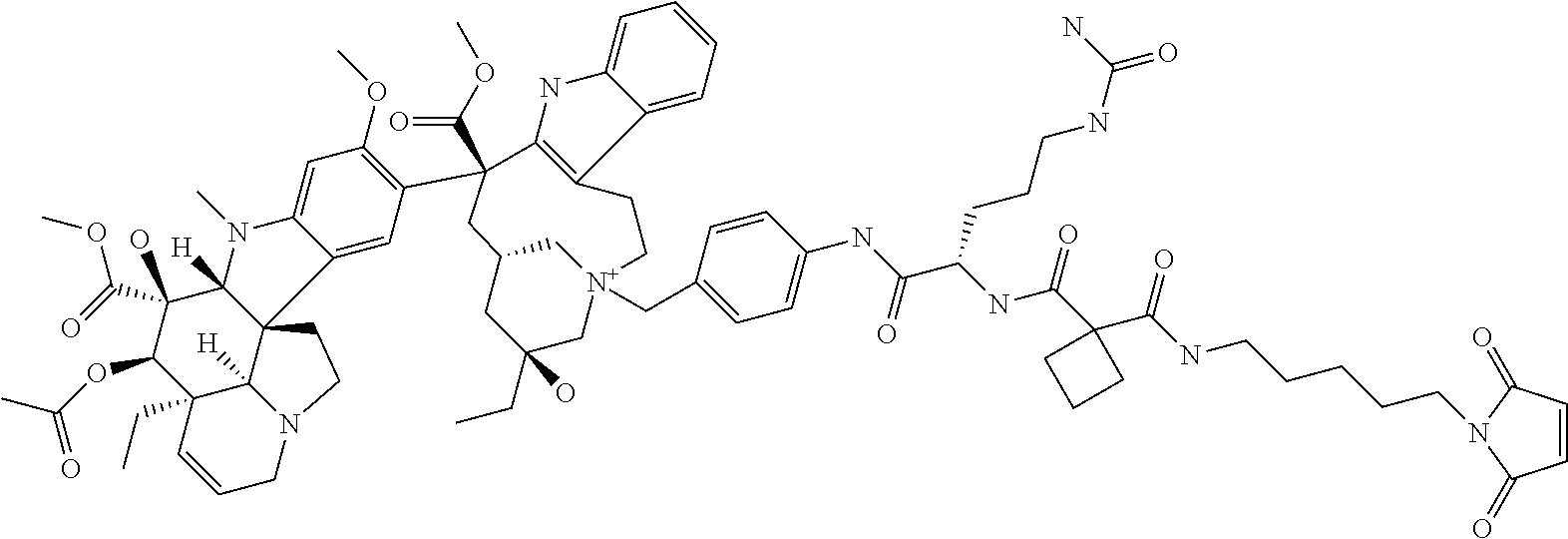 |
| Name | |
| Example | 6 |
| Structure |  |
| Name | (S)-4-(3-(4-(3-chloro-4-fluorophenylamino)-7-methoxyquinazolin-6-yloxy)propyl)-4-(4-(2-(1-(5-(2,5-dioxo-2,5-dihydro-1H- |
| pyrrol-1-yl)pentylcarbamoyl)cyclobutanecarboxamido)-5-ureidopentanamido)benzyl)morpholin-4-ium | |
| MC-Sq-Cit-PAB-morph-linked-gefitinib | |
| Example | 7 |
| Structure |  |
| Name | (S)-4-(3-chloro-4-fluorophenylamino)-1-(4-(2-(1-(5-(2,5-dioxo-2,5-dihydro-1H-pyrrol-1-yl)pentylcarbamoyl)cyclo- |
| butanecarboxamido)-5-ureidopentanamido)benzyl)-7-methoxy-6-(3-morpholinopropoxy)quinazolin-1-ium | |
| MC-Sq-Cit-PAB-primidine-linked-gefitinib | |
Sequences
NaPi2b Humanized Antibody:
| 10H1.11.4B HVR-L | |
| Seq ID No: 1 | |
| RSSETLVHSSGNTYLE | |
| 10H1.11.4B HVR-L2 | |
| Seq ID No: 2 | |
| RVSNRFS | |
| 10H1.11.4B HVR-L3 | |
| Seq ID No: 3 | |
| FQGSFNPLT | |
| 10H1.11.4B HVR-Hl | |
| Seq ID No: 4 | |
| GFSFSDFAMS | |
| 10H1.11.4B HVR-H2 | |
| Seq ID No: 5 | |
| ATIGRVAFHTYYPDSMKG | |
| 10H1.11.4B HVR-H3 | |
| Seq ID No: 6 | |
| ARHRGFDVGHFDF | |
| 10H1.11.4B VL | |
| SEQ ID NO: 7 | |
| DIQMTQSPSSLSASVGDRVTITCRSSETLVHSSGNTYLEWYQQK | |
| PGKAPKLLIYRVSNRFSGVPSRFSGSGSGTDFTLTISSLQPEDFAT | |
| YYCFQGSFNPLTFGQGTKVEIKR | |
| 10H1.11.4B VH | |
| SEQ ID NO: 8 | |
| EVQLVESGGGLVQPGGSLRLSCAASGFSFSDFAMSWVRQAPGK | |
| GLEWVATIGRVAFHTYYPDSMKGRFTISRDNSKNTLYLQMNSL | |
| RAEDTAVYYCARHRGFDVGHFDFWGQGTLVTVSS | |
| 10H1.11.4B Light Chain | |
| SEQ ID NO: 9 | |
| DIQMTQSPSSLSASVGDRVTITCRSSETLVHSSGNTYLEWYQQK | |
| PGKAPKLLIYRVSNRFSGVPSRFSGSGSGTDFTLTISSLQPEDFAT | |
| YYCFQGSFNPLTFGQGTKVEIKRTVAAPSVFIFPPSDEQLKSGTA | |
| SVVCLLNNFYPREAKVQWKVDNALQSGNSQESVTEQDSKDST | |
| YSLSSTLTLSKADYEKHKVYACEVTHQGLSSPVTKSFNRGEC | |
| 10H1.11.4B Heavy Chain | |
| SEQ ID NO: 10 | |
| EVQLVESGGGLVQPGGSLRLSCAASGFSFSDFAMSWVRQAPGK | |
| GLEWVATIGRVAFHTYYPDSMKGRFTISRDNSKNTLYLQMNSL | |
| RAEDTAVYYCARHRGFDVGHFDFWGQGTLVTVSSCSTKGPSVF | |
| PLAPSSKSTSGGTAALGCLVKDYFPEPVTVSWNSGALTSGVHTF | |
| PAVLQSSGLYSLSSVVTVPSSSLGTQTYICNVNHKPSNTKVDKK | |
| VEPKSCDKTHTCPPCPAPELLGGPSVFLFPPKPKDTLMISRTPEV | |
| TCVVVDVSHEDPEVKFNWYVDGVEVHNAKTKPREEQYNSTYR | |
| VVSVLTVLHQDWLNGKEYKCKVSNKALPAPIEKTISKAKGQPR | |
| EPQVYTLPPSREEMTKNQVSLTCLVKGFYPSDIAVEWESNGQPE | |
| NNYKTTPPVLDSDGSFFLYSKLTVDKSRWQQGNVFSCSVMHEA | |
| LHNHYTQKSLSLSPGK |
Anti-CD33 Humanized Antibody:
| 15G15.33-HVR L1 | |
| SEQ ID NO: 11 | |
| RSSQSLLHSNGYNYLD | |
| 15G15.33-HVR L2 | |
| SEQ ID NO: 12 | |
| LGVNSVS | |
| 15G15.33-HVR L3 | |
| SEQ ID NO: 13 | |
| MQALQTPWT | |
| 15G15.33-HVR H1 | |
| SEQ ID NO: 14 | |
| NHAIS | |
| 15G15.33-HVR H2 | |
| SEQ ID NO: 15 | |
| GIIPIFGTANYAQKFQG | |
| 15G15.33-HVR H3 | |
| SEQ ID NO: 16 | |
| EWADVFDI | |
| 15G15.33 VL | |
| SEQ ID NO: 17 | |
| EIVLTQSPLSLPVTPGEPASISCRSSQSLLHSNGYNYLDW | |
| YLQKPGQSPQLLIYLGVNSVSGVPDRFSGSGSGTDFTLKI | |
| SRVEAEDVGVYYCMQALQTPWTFGQGTKVEIK | |
| 15G15.33 VH | |
| SEQ ID NO: 18 | |
| QVQLVQSGAEVKKPGSSVKVSCKASGGIFSNHAISWVR | |
| QAPGQGLEWMGGIIPIFGTANYAQKFQGRVTITADESTS | |
| TAFMELSSLRSEDTAVYYCAREWADVFDIWGQGTMVT | |
| VSS |
| 9C3-HVR L1 | |
| Seq ID NO: 19 | |
| RASQGIRNDLG | |
| 9C3-HVR L2 | |
| Seq ID NO: 20 | |
| AASSLQS | |
| 9C3-HVR L3 | |
| Seq ID NO: 21 | |
| LQHNSYPWT | |
| 9C3-HVR H1 | |
| Seq ID NO: 22 | |
| GNYMS | |
| 9C3-HVR H2 | |
| Seq ID NO: 23 | |
| LIYSGDSTYYADSVKG | |
| 9C3-HVR H3 | |
| Seq ID NO: 24 | |
| DGYYVSDMVV | |
| 9C3 VL | |
| Seq ID NO: 25 | |
| DIQMTQSPSSLSASVGDRVTITCRASQGIRNDLGWYQQK | |
| PGKAPKRLIYAASSLQSGVPSRFSGSGSGTEFTLTISSLQP | |
| EDFATYYCLQHNSYPWTFGQGTKLEIK | |
| 9C3 VH | |
| Seq ID NO: 26 | |
| EVQLVESGGALIQPGGSLRLSCVASGFTISGNYMSWVRQ | |
| APGKGLEWVSLIYSGDSTYYADSVKGRFNISRDISKNTVY | |
| LQMNSLRVEDTAVYYCVRDGYYVSDMVVWGKGTTVT | |
| VSS | |
| 9C3.2 VL | |
| Seq ID NO: 27 | |
| DIQMTQSPSSLSASVGDRVTITCRASQGIRNDLGWYQQK | |
| PGKAPKRLIYAASSLQSGVPSRFSGSGSGTEFTLTISSLQP | |
| EDFATYYCLQHNSYPWTFGQGTKLEIK | |
| 9C3.2 VH | |
| Seq ID NO: 28 | |
| EVQLVESGGALIQPGGSLRLSCVASGFTISGNYMSWVRQ | |
| APGKGLEWVSLIYSGDSTYYADSVKGRFTISRDISKNTVY | |
| LQMNSLRVEDTAVYYCVRDGYYVSDMVVWGKGTTVT | |
| VSS | |
| 9C3.3 VL | |
| Seq ID NO: 29 | |
| DIQMTQSPSSLSASVGDRVTITCRASQGIRNDLGWYQQK | |
| PGKAPKRLIYAASSLQSGVPSRFSGSGSGTEFTLTISSLQP | |
| EDFATYYCLQHNSYPWTFGQGTKLEIK | |
| 9C3.3 VH | |
| Seq ID NO: 30 | |
| EVQLVESGGALIQPGGSLRLSCVASGFTISGNYMSWVRQ | |
| APGKGLEWVSLIYSGDSTYYADSVKGRFSISRDISKNTVY | |
| LQMNSLRVEDTAVYYCVRDGYYVSDMVVWGKGTTVT | |
| VSS | |
| 9C3.4 VL | |
| Seq ID NO: 31 | |
| DIQMTQSPSSLSASVGDRVTITCRASQGIRNDLGWYQQK | |
| PGKAPKRLIYAASSLQSGVPSRFSGSGSGTEFTLTISSLQP | |
| EDFATYYCLQHNSYPWTFGQGTKLEIK | |
| 9C3.4 VH | |
| Seq ID NO: 32 | |
| EVQLVESGGALIQPGGSLRLSCVASGFTISGNYMSWVRQ | |
| APGKGLEWVSLIYSGDSTYYADSVKGRFAISRDISKNTVY | |
| LQMNSLRVEDTAVYYCVRDGYYVSDMVVWGKGTTVT | |
| VSS |
Anti-CD22 Humanized Antibody:
| h10F4.V3.K149C HVR-L1 | |
| Seq ID No: 41 | |
| RSSQSIVHSVGNTFLE | |
| h10F4.V3.K149C HVR-L2 | |
| Seq ID No: 42 | |
| KVSNRFS | |
| h10F4.V3.K149C HVR-L3 | |
| Seq ID No: 43 | |
| FQGSQFPYT | |
| h10F4.V3.K149C HVR-H1 | |
| Seq ID No: 44 | |
| GYEFSRSWMN | |
| h10F4.V3.K149C HVR-H2 | |
| Seq ID No: 45 | |
| RIYPGDGDTNYSGKFKG | |
| h10F4.V3.K149C HVR-H3 | |
| Seq ID No: 46 | |
| DGSSWDWYFDV | |
| h10F4.V3.K149C VL | |
| SEQ ID NO: 47 | |
| DIQMTQSPSSLSASVGDRVTITCRSSQSIVHSVGNTFLEWYQQKP | |
| GKAPKLLIYKVSNRFSGVPSRFSGSGSGTDFTLTISSLQPEDFATY | |
| YCFQGSQFPYTFGQGTKVEIKR | |
| h10F4.V3.K149C VH | |
| SEQ ID NO: 48 | |
| EVQLVESGGGLVQPGGSLRLSCAASGYEFSRSWMNWVRQAPG | |
| KGLEWVGRIYPGDGDTNYSGKFKGRFTISADTSKNTAYLQMNS | |
| LRAEDTAVYYCARDGSSWDWYFDVWGQGTLVTVSS | |
| h10F4.V3.K149C Light Chain | |
| SEQ ID NO: 49 | |
| DIQMTQSPSSLSASVGDRVTITCRSSQSIVHSVGNTFLEWYQQKP | |
| GKAPKLLIYKVSNRFSGVPSRFSGSGSGTDFTLTISSLQPEDFATY | |
| YCFQGSQFPYTFGQGTKVEIKRTVAAPSVFIFPPSDEQLKSGTAS | |
| VVCLLNNFYPREAKVQWCVDNALQSGNSQESVTEQDSKDSTY | |
| SLSSTLTLSKADYEKHKVYACEVTHQGLSSPVTKSFNRGEC | |
| h10F4.V3.K149C Heavy Chain | |
| SEQ ID NO: 50 | |
| EVQLVESGGGLVQPGGSLRLSCAASGYEFSRSWMNWVRQAPG | |
| KGLEWVGRIYPGDGDTNYSGKFKGRFTISADTSKNTAYLQMNS | |
| LRAEDTAVYYCARDGSSWDWYFDVWGQGTLVTVSSASTKGPS | |
| VFPLAPSSKSTSGGTAALGCLVKDYFPEPVTVSWNSGALTSGVH | |
| TFPAVLQSSGLYSLSSVVTVPSSSLGTQTYICNVNHKPSNTKVD | |
| KKVEPKSCDKTHTCPPCPAPELLGGPSVFLFPPKPKDTLMISRTP | |
| EVTCVVVDVSHEDPEVKFNWYVDGVEVHNAKTKPREEQYNST | |
| YRVVSVLTVLHQDWLNGKEYKCKVSNKALPAPIEKTISKAKGQ | |
| PREPQVYTLPPSREEMTKNQVSLTCLVKGFYPSDIAVEWESNGQ | |
| PENNYKTTPPVLDSDGSFFLYSKLTVDKSRW | |
| QQGNVFSCSVMHEALHNHYTQKSLSLSPGK |
ADC In Vitro Data
| WSU-DLCL2 | ||||
| BJAB IC50 | IC50 | Jurkat IC50 | ||
| Molecule Name | DAR | nM | ng/mL | nM | ng/mL | nM | ng/mL |
| anti-CD22 10F4v3 LC K149C | |||||||
| MC-Sq-Cit-PAB- | 1.9 | 17.4 | 2610 | 0.147 | 22.05 | >133.33 | >20000 |
| Tubulysin M (ADC2-2) | |||||||
| Anti-Napi2b 10H1.11.4B LC | 1.9 | >133.33 | >20000 | 83.5 | 12525 | >133.33 | >20000 |
| K149C MC-Sq-Cit-PAB- | |||||||
| Tubulysin M (ADC2-1) | |||||||
| WSU-DLCL2 | ||||
| BJAB IC50 | IC50 | Jurkat IC50 | ||
| Molecule Name | CNJ | DAR | nM | ng/mL | nM | ng/mL | nM | ng/mL |
| anti-CD22 10F4v3 LC K149C | ||||||||
| MC-Sq-Cit-PAB- | 3048 | 1.8 | 53.0 | 7950 | 0.385 | 57.8 | 71.4 | 10710 |
| Dolastatin 10 (ADC1-2) | ||||||||
| Anti-Napi2b 10H1.11.4B LC | 3047 | 1.8 | >133.33 | >20000 | 44.2 | 6630 | 73.6 | 11040 |
| K149C MC-Sq-Cit-PAB- | ||||||||
| Dolastatin 10 (ADC1-1) | ||||||||
| IGROV-1 | OVCAR-3x2.1 | NCI-H441 | ||
| IC50 | IC50 | IC50 | ||
| Molecule Name | CNJ | DAR | nM | ng/mL | nM | ng/mL | nM | ng/mL |
| Anti-Napi2b 10H1.11.4B LC | 3030 | 1.9 | 2.07 | 310.5 | 1.004 | 150.6 | >133.33 | >20000 |
| K149C MC-Sq-Cit-PAB- | ||||||||
| Tubulysin M (ADC2-1) | ||||||||
| anti-CD22 10F4v3 LC | 3031 | 1.9 | >133.33 | >20000 | >133.33 | >20000 | >133.33 | >20000 |
| K149C MC-Sq-Cit-PAB- | ||||||||
| Tubulysin M (ADC2-2) | ||||||||
| IGROV-1 | OVCAR-3x2.1 | NCI-H441 | ||
| IC50 | IC50 | IC50 | ||
| Molecule Name | CNJ | DAR | nM | ng/mL | nM | ng/mL | nM | ng/mL |
| Anti-Napi2b 10H1.11.4B LC | 3047 | 1.8 | 3.19 | 478.5 | 1.52 | 228.0 | 95.4 | 14310 |
| K149C MC-Sq-Cit-PAB- | ||||||||
| Dolastatin 10 (ADC1-1) | ||||||||
| anti-CD22 10F4v3 LC K149C | 3048 | 1.8 | 114.2 | 17130 | 35.5 | 5325 | 106.5 | 15975 |
| MC-Sq-Cit-PAB- | ||||||||
| Dolastatin 10 (ADC1-2) | ||||||||
ADC In Vivo Data
Claims (6)


Priority Applications (2)
| Application Number | Priority Date | Filing Date | Title |
|---|---|---|---|
| US15/583,492 US10556895B2 (en) | 2014-12-03 | 2017-05-01 | Quaternary amine compounds and antibody-drug conjugates thereof |
| US16/697,706 US11104673B2 (en) | 2014-12-03 | 2019-11-27 | Quaternary amine compounds and antibody-drug conjugates thereof |
Applications Claiming Priority (3)
| Application Number | Priority Date | Filing Date | Title |
|---|---|---|---|
| US201462087127P | 2014-12-03 | 2014-12-03 | |
| PCT/US2015/063538 WO2016090050A1 (en) | 2014-12-03 | 2015-12-02 | Quaternary amine compounds and antibody-drug conjugates thereof |
| US15/583,492 US10556895B2 (en) | 2014-12-03 | 2017-05-01 | Quaternary amine compounds and antibody-drug conjugates thereof |
Related Parent Applications (1)
| Application Number | Title | Priority Date | Filing Date |
|---|---|---|---|
| PCT/US2015/063538 Continuation WO2016090050A1 (en) | 2014-12-03 | 2015-12-02 | Quaternary amine compounds and antibody-drug conjugates thereof |
Related Child Applications (1)
| Application Number | Title | Priority Date | Filing Date |
|---|---|---|---|
| US16/697,706 Division US11104673B2 (en) | 2014-12-03 | 2019-11-27 | Quaternary amine compounds and antibody-drug conjugates thereof |
Publications (2)
| Publication Number | Publication Date |
|---|---|
| US20170232113A1 US20170232113A1 (en) | 2017-08-17 |
| US10556895B2 true US10556895B2 (en) | 2020-02-11 |
Family
ID=55022691
Family Applications (2)
| Application Number | Title | Priority Date | Filing Date |
|---|---|---|---|
| US15/583,492 Active US10556895B2 (en) | 2014-12-03 | 2017-05-01 | Quaternary amine compounds and antibody-drug conjugates thereof |
| US16/697,706 Active US11104673B2 (en) | 2014-12-03 | 2019-11-27 | Quaternary amine compounds and antibody-drug conjugates thereof |
Family Applications After (1)
| Application Number | Title | Priority Date | Filing Date |
|---|---|---|---|
| US16/697,706 Active US11104673B2 (en) | 2014-12-03 | 2019-11-27 | Quaternary amine compounds and antibody-drug conjugates thereof |
Country Status (10)
| Country | Link |
|---|---|
| US (2) | US10556895B2 (en) |
| EP (1) | EP3226909A1 (en) |
| JP (1) | JP6752204B2 (en) |
| KR (1) | KR20170086121A (en) |
| CN (1) | CN107206101B (en) |
| AU (1) | AU2015358532C1 (en) |
| CA (1) | CA2969689A1 (en) |
| IL (1) | IL252622B (en) |
| MX (1) | MX2017007169A (en) |
| WO (1) | WO2016090050A1 (en) |
Families Citing this family (21)
| Publication number | Priority date | Publication date | Assignee | Title |
|---|---|---|---|---|
| MX381017B (en) | 2013-12-16 | 2025-03-12 | Genentech Inc | PEPTIDOMIMETIC COMPOUNDS AND ANTIBODY-DRUG CONJUGATES THEREOF. |
| JP6895254B2 (en) | 2013-12-16 | 2021-06-30 | ジェネンテック, インコーポレイテッド | Peptidomimetic compounds and their antibodies-drug conjugates |
| CA2928952A1 (en) | 2013-12-16 | 2015-06-25 | Genentech, Inc. | Peptidomimetic compounds and antibody-drug conjugates thereof |
| DK3191502T3 (en) * | 2014-09-11 | 2021-07-19 | Seagen Inc | TARGETED ADMINISTRATION OF TERTIARY AMOUNTING MEDICINAL PRODUCTS |
| SG11201701627PA (en) | 2014-09-12 | 2017-03-30 | Genentech Inc | Anti-cll-1 antibodies and immunoconjugates |
| CA2969689A1 (en) * | 2014-12-03 | 2016-06-09 | Genentech, Inc. | Quaternary amine compounds and antibody-drug conjugates thereof |
| EP3307780A1 (en) | 2015-06-15 | 2018-04-18 | Genentech, Inc. | Antibodies and immunoconjugates |
| TW201718647A (en) | 2015-06-16 | 2017-06-01 | 建南德克公司 | Anti-CLL-1 antibodies and methods of use |
| US11229708B2 (en) * | 2015-12-04 | 2022-01-25 | Seagen Inc. | Conjugates of quaternized tubulysin compounds |
| US11793880B2 (en) | 2015-12-04 | 2023-10-24 | Seagen Inc. | Conjugates of quaternized tubulysin compounds |
| EP3464280B1 (en) | 2016-06-06 | 2021-10-06 | F. Hoffmann-La Roche AG | Silvestrol antibody-drug conjugates and methods of use |
| CN111601803A (en) * | 2017-09-08 | 2020-08-28 | 西雅图基因公司 | The preparation method of tubulin and its intermediate |
| EP4667495A3 (en) * | 2017-12-15 | 2026-03-11 | Sichuan Kelun-Biotech Biopharmaceutical Co., Ltd. | Bioactive molecule conjugate, preparation method and use thereof |
| WO2019149116A1 (en) * | 2018-01-30 | 2019-08-08 | 四川科伦博泰生物医药股份有限公司 | Method for preparing conjugate |
| WO2019154120A1 (en) * | 2018-02-11 | 2019-08-15 | 四川科伦博泰生物医药股份有限公司 | Cytotoxic agent and conjugate thereof, preparation method therefor and use thereof |
| MX2021001924A (en) * | 2018-08-17 | 2021-04-28 | Mersana Therapeutics Inc | Napi2b-targeted polymer antibody-drug conjugates and methods of use thereof. |
| MY208067A (en) | 2018-12-21 | 2025-04-11 | Regeneron Pharma | Tubulysins and protein-tubulysin conjugates |
| US20220304993A1 (en) | 2019-06-21 | 2022-09-29 | Ascendis Pharma A/S | Conjugates of an electron-donating nitrogen or tertiary amine comprising compounds |
| EP4046996A1 (en) | 2021-02-19 | 2022-08-24 | Universität Bielefeld | Cryptophycin compounds and conjugates thereof |
| CN119923407A (en) * | 2022-01-14 | 2025-05-02 | 新加坡国立大学 | Antibody sequences of three antibody candidates targeting human lymphocyte antigen 6 family member K (LY6K) |
| CN116020457A (en) * | 2023-01-30 | 2023-04-28 | 上海大学 | A kind of ruthenium-based catalyst and its preparation method and application |
Citations (23)
| Publication number | Priority date | Publication date | Assignee | Title |
|---|---|---|---|---|
| EP0328446A1 (en) | 1988-02-08 | 1989-08-16 | La Region Wallonne | Conjugates of vinca derivatives containing a detergent chain in position C-3 |
| US6214345B1 (en) | 1993-05-14 | 2001-04-10 | Bristol-Myers Squibb Co. | Lysosomal enzyme-cleavable antitumor drug conjugates |
| WO2007038658A2 (en) | 2005-09-26 | 2007-04-05 | Medarex, Inc. | Antibody-drug conjugates and methods of use |
| US7223837B2 (en) | 2001-03-23 | 2007-05-29 | Syntarga B.V. | Elongated and multiple spacers in activatible prodrugs |
| US7521541B2 (en) | 2004-09-23 | 2009-04-21 | Genetech Inc. | Cysteine engineered antibodies and conjugates |
| WO2009099741A1 (en) | 2008-02-01 | 2009-08-13 | Genentech, Inc. | Nemorubicin metabolite and analog reagents, antibody-drug conjugates and methods |
| US20090318668A1 (en) * | 2006-02-02 | 2009-12-24 | Patrick Henry Beusker | Water-Soluble CC-1065 Analogs and Their Conjugates |
| WO2012166560A1 (en) | 2011-05-27 | 2012-12-06 | Ambrx, Inc. | Compositions containing, methods involving, and uses of non-natural amino acid linked dolastatin derivatives |
| WO2013068874A1 (en) | 2011-11-11 | 2013-05-16 | Pfizer Inc. | Antibody-drug conjugates |
| WO2013149159A1 (en) | 2012-03-30 | 2013-10-03 | Genentech, Inc. | Anti-lgr5 antibodies and immunoconjugates |
| WO2013165940A1 (en) | 2012-05-01 | 2013-11-07 | Genentech, Inc. | Anti-pmel17 antibodies and immunoconjugates |
| WO2013177055A2 (en) | 2012-05-21 | 2013-11-28 | Genentech, Inc. | ANTI-Ly6E ANTIBODIES AND IMMUNOCONJUGATES AND METHODS OF USE |
| WO2013185117A1 (en) | 2012-06-07 | 2013-12-12 | Ambrx, Inc. | Prostate-specific membrane antigen antibody drug conjugates |
| WO2013192360A1 (en) | 2012-06-19 | 2013-12-27 | Ambrx, Inc. | Anti-cd70 antibody drug conjugates |
| WO2014092804A1 (en) | 2012-12-13 | 2014-06-19 | Immunomedics, Inc. | Dosages of immunoconjugates of antibodies and sn-38 for improved efficacy and decreased toxicity |
| WO2014100762A1 (en) | 2012-12-21 | 2014-06-26 | Biolliance C.V. | Hydrophilic self-immolative linkers and conjugates thereof |
| WO2014193722A1 (en) | 2013-05-31 | 2014-12-04 | Genentech, Inc. | Anti-wall teichoic antibodies and conjugates |
| WO2014194247A1 (en) | 2013-05-31 | 2014-12-04 | Genentech, Inc. | Anti-wall teichoic antibodies and conjugates |
| WO2015023355A1 (en) | 2013-08-12 | 2015-02-19 | Genentech, Inc. | 1-(chloromethyl)-2,3-dihydro-1h-benzo[e]indole dimer antibody-drug conjugate compounds, and methods of use and treatment |
| WO2015095227A2 (en) | 2013-12-16 | 2015-06-25 | Genentech, Inc. | Peptidomimetic compounds and antibody-drug conjugates thereof |
| WO2015095223A2 (en) | 2013-12-16 | 2015-06-25 | Genentech, Inc. | Peptidomimetic compounds and antibody-drug conjugates thereof |
| WO2015095124A1 (en) | 2013-12-16 | 2015-06-25 | Genentech Inc. | Peptidomimetic compounds and antibody-drug conjugates thereof |
| WO2016040684A1 (en) | 2014-09-11 | 2016-03-17 | Seattle Genetics, Inc | Targeted delivery of tertiary amine-containing drug substances |
Family Cites Families (240)
| Publication number | Priority date | Publication date | Assignee | Title |
|---|---|---|---|---|
| US4816567A (en) | 1983-04-08 | 1989-03-28 | Genentech, Inc. | Recombinant immunoglobin preparations |
| US5807715A (en) | 1984-08-27 | 1998-09-15 | The Board Of Trustees Of The Leland Stanford Junior University | Methods and transformed mammalian lymphocyte cells for producing functional antigen-binding protein including chimeric immunoglobulin |
| WO1991002536A1 (en) | 1989-08-23 | 1991-03-07 | Scripps Clinic And Research Foundation | Compositions and methods for detection and treatment of epstein-barr virus infection and immune disorders |
| JPH053790A (en) | 1990-04-19 | 1993-01-14 | Fujisawa Pharmaceut Co Ltd | Dehydropeptidase-I |
| US5256643A (en) | 1990-05-29 | 1993-10-26 | The Government Of The United States | Human cripto protein |
| WO1992007574A1 (en) | 1990-10-25 | 1992-05-14 | Tanox Biosystems, Inc. | Glycoproteins associated with membrane-bound immunoglobulins as antibody targets on b cells |
| US5440021A (en) | 1991-03-29 | 1995-08-08 | Chuntharapai; Anan | Antibodies to human IL-8 type B receptor |
| US5543503A (en) | 1991-03-29 | 1996-08-06 | Genentech Inc. | Antibodies to human IL-8 type A receptor |
| ES2149772T5 (en) | 1991-03-29 | 2008-02-16 | Genentech, Inc. | HUMAN RECEPTORS PF4A AND ITS USE. |
| JP3050424B2 (en) | 1991-07-12 | 2000-06-12 | 塩野義製薬株式会社 | Human endothelin receptor |
| US5264557A (en) | 1991-08-23 | 1993-11-23 | The United States Of America As Represented By The Department Of Health And Human Services | Polypeptide of a human cripto-related gene, CR-3 |
| US6153408A (en) | 1991-11-15 | 2000-11-28 | Institut Pasteur And Institut National De La Sante Et De La Recherche Medicale | Altered major histocompatibility complex (MHC) determinant and methods of using the determinant |
| US6011146A (en) | 1991-11-15 | 2000-01-04 | Institut Pasteur | Altered major histocompatibility complex (MHC) determinant and methods of using the determinant |
| IL107366A (en) | 1992-10-23 | 2003-03-12 | Chugai Pharmaceutical Co Ltd | Genes coding for megakaryocyte potentiator |
| US5644033A (en) | 1992-12-22 | 1997-07-01 | Health Research, Inc. | Monoclonal antibodies that define a unique antigen of human B cell antigen receptor complex and methods of using same for diagnosis and treatment |
| US5869445A (en) | 1993-03-17 | 1999-02-09 | University Of Washington | Methods for eliciting or enhancing reactivity to HER-2/neu protein |
| US5801005A (en) | 1993-03-17 | 1998-09-01 | University Of Washington | Immune reactivity to HER-2/neu protein for diagnosis of malignancies in which the HER-2/neu oncogene is associated |
| US5773223A (en) | 1993-09-02 | 1998-06-30 | Chiron Corporation | Endothelin B1, (ETB1) receptor polypeptide and its encoding nucleic acid methods, and uses thereof |
| US5750370A (en) | 1995-06-06 | 1998-05-12 | Human Genome Sciences, Inc. | Nucleic acid encoding human endothlein-bombesin receptor and method of producing the receptor |
| US5707829A (en) | 1995-08-11 | 1998-01-13 | Genetics Institute, Inc. | DNA sequences and secreted proteins encoded thereby |
| US20020193567A1 (en) | 1995-08-11 | 2002-12-19 | Genetics Institute, Inc. | Secreted proteins and polynucleotides encoding them |
| JP3646191B2 (en) | 1996-03-19 | 2005-05-11 | 大塚製薬株式会社 | Human gene |
| PL329930A1 (en) | 1996-05-17 | 1999-04-26 | Schering Corp | Antigens of human lymphocytes b and related reagents |
| US5945511A (en) | 1997-02-20 | 1999-08-31 | Zymogenetics, Inc. | Class II cytokine receptor |
| US7033827B2 (en) | 1997-02-25 | 2006-04-25 | Corixa Corporation | Prostate-specific polynucleotide compositions |
| US20030185830A1 (en) | 1997-02-25 | 2003-10-02 | Corixa Corporation | Compositions and methods for the therapy and diagnosis of prostate cancer |
| US6267960B1 (en) | 1997-03-10 | 2001-07-31 | The Regents Of The University Of California | PSCA: prostate stem cell antigen |
| US6541212B2 (en) | 1997-03-10 | 2003-04-01 | The Regents Of The University Of California | Methods for detecting prostate stem cell antigen protein |
| US6261791B1 (en) | 1997-03-10 | 2001-07-17 | The Regents Of The University Of California | Method for diagnosing cancer using specific PSCA antibodies |
| US6555339B1 (en) | 1997-04-14 | 2003-04-29 | Arena Pharmaceuticals, Inc. | Non-endogenous, constitutively activated human protein-coupled receptors |
| US6319688B1 (en) | 1997-04-28 | 2001-11-20 | Smithkline Beecham Corporation | Polynucleotide encoding human sodium dependent phosphate transporter (IPT-1) |
| WO1998051805A1 (en) | 1997-05-15 | 1998-11-19 | Abbott Laboratories | Reagents and methods useful for detecting diseases of the prostate |
| WO1998051824A1 (en) | 1997-05-15 | 1998-11-19 | Abbott Laboratories | Reagents and methods useful for detecting disease of the urinary tract |
| US20030060612A1 (en) | 1997-10-28 | 2003-03-27 | Genentech, Inc. | Compositions and methods for the diagnosis and treatment of tumor |
| US20020034749A1 (en) | 1997-11-18 | 2002-03-21 | Billing-Medel Patricia A. | Reagents and methods useful for detecting diseases of the breast |
| US6110695A (en) | 1997-12-02 | 2000-08-29 | The Regents Of The University Of California | Modulating the interaction of the chemokine, B Lymphocyte Hemoattractant, and its Receptor, BLR1 |
| AU762991B2 (en) | 1998-03-13 | 2003-07-10 | Burnham Institute, The | Molecules that home to various selected organs or tissues |
| CA2685270C (en) | 1998-05-13 | 2014-07-29 | Pharmexa Inc. | Expression vectors for stimulating an immune response and methods of using the same |
| US20020187472A1 (en) | 2001-03-09 | 2002-12-12 | Preeti Lal | Steap-related protein |
| US20030064397A1 (en) | 1998-05-22 | 2003-04-03 | Incyte Genomics, Inc. | Transmembrane protein differentially expressed in prostate and lung tumors |
| WO2000012130A1 (en) | 1998-08-27 | 2000-03-09 | Smithkline Beecham Corporation | Rp105 agonists and antagonists |
| JP4689781B2 (en) | 1998-09-03 | 2011-05-25 | 独立行政法人科学技術振興機構 | Amino acid transport protein and its gene |
| WO2000020579A1 (en) | 1998-10-02 | 2000-04-13 | Mcmaster University | Spliced form of erbb-2/neu oncogene |
| WO2001057188A2 (en) | 2000-02-03 | 2001-08-09 | Hyseq, Inc. | Novel nucleic acids and polypeptides |
| US6962980B2 (en) | 1999-09-24 | 2005-11-08 | Corixa Corporation | Compositions and methods for the therapy and diagnosis of ovarian cancer |
| US20030091580A1 (en) | 2001-06-18 | 2003-05-15 | Mitcham Jennifer L. | Compositions and methods for the therapy and diagnosis of ovarian cancer |
| US6858710B2 (en) | 1998-12-17 | 2005-02-22 | Corixa Corporation | Compositions and methods for the therapy and diagnosis of ovarian cancer |
| US20020119158A1 (en) | 1998-12-17 | 2002-08-29 | Corixa Corporation | Compositions and methods for the therapy and diagnosis of ovarian cancer |
| US6468546B1 (en) | 1998-12-17 | 2002-10-22 | Corixa Corporation | Compositions and methods for therapy and diagnosis of ovarian cancer |
| EP2006300A3 (en) | 1998-12-30 | 2009-03-11 | Beth Israel Deaconess Medical Center, Inc. | Characterization of a calcium channel family |
| US20030009013A1 (en) | 1998-12-30 | 2003-01-09 | Genentech, Inc. | Secreted and transmembrane polypeptides and nucleic acids encoding the same |
| DE60044665D1 (en) | 1999-01-29 | 2010-08-26 | Corixa Corp | HER2 / NEW FUSION PROTEINS |
| GB9905124D0 (en) | 1999-03-05 | 1999-04-28 | Smithkline Beecham Biolog | Novel compounds |
| AU3395900A (en) | 1999-03-12 | 2000-10-04 | Human Genome Sciences, Inc. | Human lung cancer associated gene sequences and polypeptides |
| US7304126B2 (en) | 1999-05-11 | 2007-12-04 | Genentech, Inc. | Secreted and transmembrane polypeptides and nucleic acids encoding the same |
| AU4952600A (en) | 1999-06-03 | 2000-12-28 | Takeda Chemical Industries Ltd. | Screening method with the use of cd100 |
| ES2466715T3 (en) | 1999-06-25 | 2014-06-11 | Immunogen, Inc. | Treatment methods using anti-ErbB-maitansinoid antibody conjugates |
| US7589172B2 (en) | 1999-07-20 | 2009-09-15 | Genentech, Inc. | PRO256 polypeptides |
| US7297770B2 (en) | 1999-08-10 | 2007-11-20 | Genentech, Inc. | PRO6496 polypeptides |
| US7294696B2 (en) | 1999-08-17 | 2007-11-13 | Genentech Inc. | PRO7168 polypeptides |
| CA2380355A1 (en) | 1999-09-01 | 2001-03-08 | Genentech, Inc. | Secreted and transmembrane polypeptides and nucleic acids encoding the same |
| US20030232056A1 (en) | 1999-09-10 | 2003-12-18 | Corixa Corporation | Compositions and methods for the therapy and diagnosis of ovarian cancer |
| US20030206918A1 (en) | 1999-09-10 | 2003-11-06 | Corixa Corporation | Compositions and methods for the therapy and diagnosis of ovarian cancer |
| US20030129192A1 (en) | 1999-09-10 | 2003-07-10 | Corixa Corporation | Compositions and methods for the therapy and diagnosis of ovarian cancer |
| JP4028237B2 (en) | 1999-10-29 | 2007-12-26 | ジェネンテック・インコーポレーテッド | Anti-prostate stem cell antigen (PSCA) antibody composition and method of use |
| ES2591102T3 (en) | 1999-11-29 | 2016-11-24 | The Trustees Of Columbia University In The City Of New York | Isolation of five novel genes encoding new Fc receptor-type melanomas involved in the pathogenesis of lymphoma / melanoma |
| AU1807401A (en) | 1999-11-30 | 2001-06-12 | Corixa Corporation | Compositions and methods for therapy and diagnosis of breast cancer |
| WO2001041787A1 (en) | 1999-12-10 | 2001-06-14 | Epimmune Inc. | INDUCING CELLULAR IMMUNE RESPONSES TO HER2/neu USING PEPTIDE AND NUCLEIC ACID COMPOSITIONS |
| NZ502058A (en) | 1999-12-23 | 2003-11-28 | Ovita Ltd | Isolated mutated nucleic acid molecule for regulation of ovulation rate |
| DK1246846T3 (en) | 1999-12-23 | 2008-12-08 | Zymogenetics Inc | Soluble interleukin-20 receptor |
| WO2001046261A1 (en) | 1999-12-23 | 2001-06-28 | Zymogenetics, Inc. | Method for treating inflammation |
| US6610286B2 (en) | 1999-12-23 | 2003-08-26 | Zymogenetics, Inc. | Method for treating inflammation using soluble receptors to interleukin-20 |
| US20040001827A1 (en) | 2002-06-28 | 2004-01-01 | Dennis Mark S. | Serum albumin binding peptides for tumor targeting |
| ES2270893T3 (en) | 1999-12-24 | 2007-04-16 | Genentech, Inc. | PROCEDURE AND COMPOSITIONS TO EXTEND THE AVERAGE LIFE OF BIOACTIVE COMPOUNDS. |
| US7294695B2 (en) | 2000-01-20 | 2007-11-13 | Genentech, Inc. | PRO10268 polypeptides |
| AU2001234493A1 (en) | 2000-01-21 | 2001-07-31 | Corixa Corporation | Compounds and methods for prevention and treatment of her-2/neu associated malignancies |
| US20030224379A1 (en) | 2000-01-21 | 2003-12-04 | Tang Y. Tom | Novel nucleic acids and polypeptides |
| US20030104562A1 (en) | 2000-02-11 | 2003-06-05 | Genentech, Inc. | Secreted and transmembrane polypeptides and nucleic acids encoding the same |
| AU2001238596A1 (en) | 2000-02-22 | 2001-09-03 | Millennium Pharmaceuticals, Inc. | 18607, a novel human calcium channel |
| US20030219806A1 (en) | 2000-02-22 | 2003-11-27 | Millennium Pharmaceuticals, Inc. | Novel 18607, 15603, 69318, 12303, 48000, 52920, 5433, 38554, 57301, 58324, 55063, 52991, 59914, 59921 and 33751 molecules and uses therefor |
| US20040002068A1 (en) | 2000-03-01 | 2004-01-01 | Corixa Corporation | Compositions and methods for the detection, diagnosis and therapy of hematological malignancies |
| US20040005561A1 (en) | 2000-03-01 | 2004-01-08 | Corixa Corporation | Compositions and methods for the detection, diagnosis and therapy of hematological malignancies |
| EP1261743A2 (en) | 2000-03-07 | 2002-12-04 | Hyseq, Inc. | Novel nucleic acids and polypeptides |
| JP2004521602A (en) | 2000-03-24 | 2004-07-22 | ファハリ サッチオグリュ | Novel prostate-specific or testis-specific nucleic acid molecules, polypeptides, and diagnostic and therapeutic methods |
| US20030186889A1 (en) | 2000-03-31 | 2003-10-02 | Wolf-Georg Forssmann | Diagnostic and medicament for analysing the cell surface proteome of tumour and inflammatory cells and for treating tumorous and inflammatory diseases, preferably using a specific chemokine receptor analysis and the chemokine receptor-ligand interaction |
| US7279294B2 (en) | 2000-04-03 | 2007-10-09 | The United States Of America As Represented By The Secretary, Dept. Of Health And Human Services, Nih | Tumor markers in ovarian cancer |
| EP1301594A2 (en) | 2000-04-07 | 2003-04-16 | Arena Pharmaceuticals, Inc. | Non-endogenous, consstitutively activated known g protein-coupled receptors |
| WO2001088133A2 (en) | 2000-05-18 | 2001-11-22 | Lexicon Genetics Incorporated | Human semaphorin homologs and polynucleotides encoding the same |
| WO2001090304A2 (en) | 2000-05-19 | 2001-11-29 | Human Genome Sciences, Inc. | Nucleic acids, proteins, and antibodies |
| WO2001094641A2 (en) | 2000-06-09 | 2001-12-13 | Idec Pharmaceuticals Corporation | Gene targets and ligands that bind thereto for treatment and diagnosis of ovarian carcinomas |
| AU2001268471A1 (en) | 2000-06-16 | 2002-01-02 | Incyte Genomics, Inc. | G-protein coupled receptors |
| AU2001271714A1 (en) | 2000-06-30 | 2002-01-14 | Human Genome Sciences, Inc. | B7-like polynucleotides, polypeptides, and antibodies |
| CA2413262A1 (en) | 2000-06-30 | 2002-01-10 | Amgen, Inc. | B7-like molecules and uses thereof |
| JP2004528003A (en) | 2000-06-30 | 2004-09-16 | インサイト・ゲノミックス・インコーポレイテッド | Extracellular matrix and cell adhesion molecules |
| AU2002214531A1 (en) | 2000-07-03 | 2002-01-30 | Curagen Corporation | Proteins and nucleic acids encoding same |
| US20040044179A1 (en) | 2000-07-25 | 2004-03-04 | Genentech, Inc. | Secreted and transmembrane polypeptides and nucleic acids encoding the same |
| US6891030B2 (en) | 2000-07-27 | 2005-05-10 | Mayo Foundation For Medical Education And Research | T-cell immunoregulatory molecule |
| CA2417671A1 (en) | 2000-07-28 | 2002-02-07 | Ulrich Wissenbach | Trp8, trp9 and trp10, novel markers for cancer |
| US7229623B1 (en) | 2000-08-03 | 2007-06-12 | Corixa Corporation | Her-2/neu fusion proteins |
| WO2002013847A2 (en) | 2000-08-14 | 2002-02-21 | Corixa Corporation | Methods for diagnosis and therapy of hematological and virus-associated malignancies |
| WO2002014503A2 (en) | 2000-08-14 | 2002-02-21 | Corixa Corporation | Compositions and methods for the therapy and diagnosis of her-2/neu-associated malignancies |
| GB0020953D0 (en) | 2000-08-24 | 2000-10-11 | Smithkline Beecham Biolog | Vaccine |
| AU2001270118A1 (en) | 2000-08-24 | 2002-03-04 | Genentech, Inc. | Compositions and methods for the diagnosis and treatment of tumor |
| EP1346040A2 (en) | 2000-09-11 | 2003-09-24 | Nuvelo, Inc. | Novel nucleic acids and polypeptides |
| US6613567B1 (en) | 2000-09-15 | 2003-09-02 | Isis Pharmaceuticals, Inc. | Antisense inhibition of Her-2 expression |
| US7582293B2 (en) | 2000-09-15 | 2009-09-01 | Genentech, Inc. | Anti-PRO6308 antibodies |
| WO2002022153A2 (en) | 2000-09-15 | 2002-03-21 | Zymogenetics, Inc. | Use of a polypeptide comprising the extracellular domains of il-20rb for the treatment of inflammation |
| WO2002022808A2 (en) | 2000-09-18 | 2002-03-21 | Biogen, Inc. | Cripto mutant and uses thereof |
| UA83458C2 (en) | 2000-09-18 | 2008-07-25 | Байоджен Айдек Ма Інк. | The isolated polypeptide baff-r (the receptor of the factor of activation of b-cells of the family tnf) |
| AU2002215345A1 (en) | 2000-10-13 | 2002-04-22 | Eos Biotechnology, Inc. | Methods of diagnosis of prostate cancer, compositions and methods of screening for modulators of prostate cancer |
| CA2428242A1 (en) | 2000-11-07 | 2002-05-16 | Zymogenetics, Inc. | Human tumor necrosis factor receptor |
| US20020150573A1 (en) | 2000-11-10 | 2002-10-17 | The Rockefeller University | Anti-Igalpha-Igbeta antibody for lymphoma therapy |
| WO2002061087A2 (en) | 2000-12-19 | 2002-08-08 | Lifespan Biosciences, Inc. | Antigenic peptides, such as for g protein-coupled receptors (gpcrs), antibodies thereto, and systems for identifying such antigenic peptides |
| US20020159986A1 (en) | 2001-01-12 | 2002-10-31 | John Langenfeld | Bone morphogenetic protein-2 in the treatment and diagnosis of cancer |
| US20030119125A1 (en) | 2001-01-16 | 2003-06-26 | Genentech, Inc. | Secreted and transmembrane polypeptides and nucleic acids encoding the same |
| US20030119133A1 (en) | 2001-01-16 | 2003-06-26 | Genentech, Inc. | Secreted and transmembrane polypeptides and nucleic acids encoding the same |
| US7754208B2 (en) | 2001-01-17 | 2010-07-13 | Trubion Pharmaceuticals, Inc. | Binding domain-immunoglobulin fusion proteins |
| CA2440703A1 (en) | 2001-01-24 | 2002-08-01 | Protein Design Labs, Inc. | Methods of diagnosis of breast cancer, compositions and methods of screening for modulators of breast cancer |
| US20030073144A1 (en) | 2001-01-30 | 2003-04-17 | Corixa Corporation | Compositions and methods for the therapy and diagnosis of pancreatic cancer |
| WO2002064798A1 (en) | 2001-02-12 | 2002-08-22 | Bionomics Limited | Dna sequences differentially expressed in tumour cell lines |
| AU2002258518A1 (en) | 2001-03-14 | 2002-09-24 | Millennium Pharmaceuticals, Inc. | Nucleic acid molecules and proteins for the identification, assessment, prevention, and therapy of ovarian cancer |
| WO2002078524A2 (en) | 2001-03-28 | 2002-10-10 | Zycos Inc. | Translational profiling |
| WO2003008537A2 (en) | 2001-04-06 | 2003-01-30 | Mannkind Corporation | Epitope sequences |
| US6820011B2 (en) | 2001-04-11 | 2004-11-16 | The Regents Of The University Of Colorado | Three-dimensional structure of complement receptor type 2 and uses thereof |
| JP5232350B2 (en) | 2001-04-17 | 2013-07-10 | ザ ボード オブ トラスティーズ オブ ザ ユニバーシティ オブ アーカンソー | Repeat sequence of CA125 gene and its use for diagnostic and therapeutic intervention |
| JP2005527180A (en) | 2001-04-18 | 2005-09-15 | プロテイン デザイン ラブス, インコーポレイテッド | Lung cancer diagnosis method, composition of lung cancer modifier and screening method |
| WO2003083041A2 (en) | 2002-03-22 | 2003-10-09 | Biogen, Inc. | Cripto-specific antibodies |
| HUP0501113A3 (en) | 2001-04-26 | 2007-12-28 | Biogen Idec Inc | Cripto blocking antibodies and uses thereof |
| EP1515982A4 (en) | 2001-05-09 | 2005-10-26 | Corixa Corp | METHODS AND COMPOSITIONS FOR THE THERAPY AND DIAGNOSIS OF PROSTATE CANCER |
| WO2002092836A2 (en) | 2001-05-11 | 2002-11-21 | Sloan-Kettering Institute For Cancer Research | Nucleic acid sequence encoding ovarian antigen, ca125, and uses thereof |
| KR100976743B1 (en) | 2001-05-24 | 2010-08-19 | 지모제넥틱스, 인코포레이티드 | TACI-immunoglobulin fusion protein |
| JP2005518185A (en) | 2001-06-04 | 2005-06-23 | キュラジェン コーポレイション | Novel protein and nucleic acid encoding it |
| AU2002314901A1 (en) | 2001-06-04 | 2002-12-16 | Eos Biotechnology, Inc. | Methods of diagnosis and treatment of androgen-dependent prostate cancer, prostate cancer undergoing androgen-withdrawal, and androgen-independent prostate cancer |
| JP2005505257A (en) | 2001-06-05 | 2005-02-24 | エクセリクシス・インコーポレイテッド | IGs as p53 pathway modifiers and methods of use |
| DE60237917D1 (en) | 2001-06-05 | 2010-11-18 | Exelixis Inc | GFATS AS MODULATORS OF THE P53 PATH AND METHOD OF USE |
| US7235358B2 (en) | 2001-06-08 | 2007-06-26 | Expression Diagnostics, Inc. | Methods and compositions for diagnosing and monitoring transplant rejection |
| WO2002101075A2 (en) | 2001-06-13 | 2002-12-19 | Millennium Pharmaceuticals, Inc. | Novel genes, compositions, kits, and methods for identification, assessment, prevention, and therapy of cervical cancer |
| US7189507B2 (en) | 2001-06-18 | 2007-03-13 | Pdl Biopharma, Inc. | Methods of diagnosis of ovarian cancer, compositions and methods of screening for modulators of ovarian cancer |
| AU2002347428A1 (en) | 2001-06-18 | 2003-01-02 | Eos Biotechnology Inc. | Methods of diagnosis of ovarian cancer, compositions and methods of screening for modulators of ovarian cancer |
| AU2002322280A1 (en) | 2001-06-21 | 2003-01-21 | Millennium Pharmaceuticals, Inc. | Compositions, kits, and methods for identification, assessment, prevention, and therapy of breast cancer |
| US20030108958A1 (en) | 2001-06-28 | 2003-06-12 | Rene De Waal Malefyt | Biological activity of AK155 |
| US20030120040A1 (en) | 2001-06-29 | 2003-06-26 | Genentech, Inc. | Secreted and Transmembrane polypeptides and nucleic acids encoding the same |
| AU2002314433A1 (en) | 2001-07-02 | 2003-01-21 | Licentia Ltd. | Ephrin-tie receptor materials and methods |
| US20040076955A1 (en) | 2001-07-03 | 2004-04-22 | Eos Biotechnology, Inc. | Methods of diagnosis of bladder cancer, compositions and methods of screening for modulators of bladder cancer |
| WO2003003984A2 (en) | 2001-07-05 | 2003-01-16 | Curagen Corporation | Novel proteins and nucleic acids encoding same |
| US7446185B2 (en) | 2001-07-18 | 2008-11-04 | The Regents Of The University Of California | Her2/neu target antigen and use of same to stimulate an immune response |
| WO2003009814A2 (en) | 2001-07-25 | 2003-02-06 | Millennium Pharmaceuticals, Inc. | Novel genes, compositions, kits, and methods for identification, assessment, prevention, and therapy of prostate cancer |
| CN1636067A (en) | 2001-08-03 | 2005-07-06 | 杰南技术公司 | TACIs and BR3 polypeptides and uses thereof |
| AU2002324700A1 (en) | 2001-08-14 | 2003-03-03 | Bayer Ag | Nucleic acid and amino acid sequences involved in pain |
| US20030092013A1 (en) | 2001-08-16 | 2003-05-15 | Vitivity, Inc. | Diagnosis and treatment of vascular disease |
| AU2002313559A1 (en) | 2001-08-23 | 2003-03-10 | Oxford Biomedica (Uk) Limited | Genes |
| AU2002357643A1 (en) | 2001-08-29 | 2003-04-14 | Vanderbilt University | The human mob-5 (il-24) receptors and uses thereof |
| US20030124579A1 (en) | 2001-09-05 | 2003-07-03 | Eos Biotechnology, Inc. | Methods of diagnosis of ovarian cancer, compositions and methods of screening for modulators of ovarian cancer |
| EP2287186B1 (en) | 2001-09-06 | 2014-12-31 | Agensys, Inc. | Nucleic acid and corresponding protein entitled STEAP-1 useful in treatment and detection of cancer |
| WO2003025138A2 (en) | 2001-09-17 | 2003-03-27 | Protein Design Labs, Inc. | Methods of diagnosis of cancer compositions and methods of screening for modulators of cancer |
| EP2143438B1 (en) | 2001-09-18 | 2011-07-13 | Genentech, Inc. | Compositions and methods for the diagnosis and treatment of tumors |
| WO2003025228A1 (en) | 2001-09-18 | 2003-03-27 | Proteologics, Inc. | Methods and compositions for treating hcap associated diseases |
| WO2003025148A2 (en) | 2001-09-19 | 2003-03-27 | Nuvelo, Inc. | Novel nucleic acids and polypeptides |
| AU2002327792A1 (en) | 2001-09-28 | 2003-04-07 | Bing Yang | Diagnosis and treatment of diseases caused by mutations in cd72 |
| WO2003029277A2 (en) | 2001-10-03 | 2003-04-10 | Rigel Pharmaceuticals, Inc. | Modulators of lymphocyte activation and migration |
| US20040249144A1 (en) | 2001-10-03 | 2004-12-09 | Zairen Sun | Regulated breast cancer genes |
| CA2461665A1 (en) | 2001-10-19 | 2003-05-01 | Genentech, Inc. | Compositions and methods for the diagnosis and treatment of inflammatory bowel disorders |
| US20050123925A1 (en) | 2002-11-15 | 2005-06-09 | Genentech, Inc. | Compositions and methods for the diagnosis and treatment of tumor |
| US7825089B2 (en) | 2001-10-24 | 2010-11-02 | National Jewish Health | Three-dimensional structures of TALL-1 and its cognate receptors and modified proteins and methods related thereto |
| EP2053135A1 (en) | 2001-10-31 | 2009-04-29 | Alcon, Inc. | Bone morphonic proteins (BMP), BMP receptors and BMP binding proteins and their use in the diagnosis and treatment of glaucoma |
| WO2003042661A2 (en) | 2001-11-13 | 2003-05-22 | Protein Design Labs, Inc. | Methods of diagnosis of cancer, compositions and methods of screening for modulators of cancer |
| US20030232350A1 (en) | 2001-11-13 | 2003-12-18 | Eos Biotechnology, Inc. | Methods of diagnosis of cancer, compositions and methods of screening for modulators of cancer |
| US7344843B2 (en) | 2001-11-29 | 2008-03-18 | Serono Genetics Institute S.A. | Agonists and antagonists of prolixin for the treatment of metabolic disorders |
| AU2002349784A1 (en) | 2001-12-03 | 2003-06-17 | Asahi Kasei Pharma Corporation | Nf-kappab activating genes |
| CA2469941A1 (en) | 2001-12-10 | 2003-07-03 | Nuvelo, Inc. | Novel nucleic acids and polypeptides |
| US20030134790A1 (en) | 2002-01-11 | 2003-07-17 | University Of Medicine And Dentistry Of New Jersey | Bone Morphogenetic Protein-2 And Bone Morphogenetic Protein-4 In The Treatment And Diagnosis Of Cancer |
| US7452675B2 (en) | 2002-01-25 | 2008-11-18 | The Queen's Medical Center | Methods of screening for TRPM4b modulators |
| WO2003072736A2 (en) | 2002-02-21 | 2003-09-04 | Duke University | Reagents and treatment methods for autoimmune diseases |
| WO2003072035A2 (en) | 2002-02-22 | 2003-09-04 | Genentech, Inc. | Compositions and methods for the treatment of immune related diseases |
| US20030165966A1 (en) | 2002-03-01 | 2003-09-04 | Marcia Belvin | MSRAs as modifiers of the p53 pathway and methods of use |
| EP2258712A3 (en) | 2002-03-15 | 2011-05-04 | Multicell Immunotherapeutics, Inc. | Compositions and Methods to Initiate or Enhance Antibody and Major-histocompatibility Class I or Class II-restricted T Cell Responses by Using Immunomodulatory, Non-coding RNA Motifs |
| WO2004000997A2 (en) | 2002-03-19 | 2003-12-31 | Curagen Corporation | Therapeutic polypeptides, nucleic acids encoding same, and methods of use |
| US7202033B2 (en) | 2002-03-21 | 2007-04-10 | Sunesis Pharmaceuticals, Inc. | Identification of kinase inhibitors |
| US7193069B2 (en) | 2002-03-22 | 2007-03-20 | Research Association For Biotechnology | Full-length cDNA |
| AU2003245239A1 (en) | 2002-03-25 | 2003-11-03 | Uab Research Foundation | FC receptor homolog, reagents, and uses thereof |
| AU2003222103A1 (en) | 2002-03-28 | 2003-10-13 | Idec Pharmaceuticals Corporation | Novel gene targets and ligands that bind thereto for treatment and diagnosis of colon carcinomas |
| US20030194704A1 (en) | 2002-04-03 | 2003-10-16 | Penn Sharron Gaynor | Human genome-derived single exon nucleic acid probes useful for gene expression analysis two |
| AU2003223469A1 (en) | 2002-04-05 | 2003-10-27 | Agensys, Inc. | Nucleic acid and corresponding protein entitled 98p4b6 useful in treatment and detection of cancer |
| WO2003087768A2 (en) | 2002-04-12 | 2003-10-23 | Mitokor | Targets for therapeutic intervention identified in the mitochondrial proteome |
| KR20040101502A (en) | 2002-04-16 | 2004-12-02 | 제넨테크, 인크. | Compositions and Methods for the Diagnosis and Treatment of Tumor |
| AU2003239158A1 (en) | 2002-04-17 | 2003-11-03 | Baylor College Of Medicine | Aib1 as a prognostic marker and predictor of resistance to encocrine therapy |
| AU2003228869A1 (en) | 2002-05-03 | 2003-11-17 | Incyte Corporation | Transporters and ion channels |
| EP1572925A4 (en) | 2002-05-15 | 2007-08-15 | Avalon Pharmaceuticals | CANCER-RELATED GENE AS A TARGET FOR CHEMOTHERAPY |
| US20030224454A1 (en) | 2002-05-30 | 2003-12-04 | Ryseck Rolf Peter | Human solute carrier family 7, member 11 (hSLC7A11) |
| AU2003239969A1 (en) | 2002-06-04 | 2003-12-19 | Avalon Pharmaceuticals, Inc. | Cancer-linked gene as target for chemotherapy |
| WO2003101283A2 (en) | 2002-06-04 | 2003-12-11 | Incyte Corporation | Diagnostics markers for lung cancer |
| WO2003104270A2 (en) | 2002-06-06 | 2003-12-18 | Ingenium Pharmaceuticals Ag | Dudulin 2 genes, expression products, non-human animal model: uses in human hematological disease |
| DE60336227D1 (en) | 2002-06-06 | 2011-04-14 | Oncotherapy Science Inc | Genes and proteins related to human colonic cancer |
| EP1576111A4 (en) | 2002-06-07 | 2006-10-18 | Avalon Pharmaceuticals | Cancer-linked gene as target for chemotherapy |
| WO2003105758A2 (en) | 2002-06-12 | 2003-12-24 | Avalon Pharmaceuticals, Inc. | Cancer-linked gene as target for chemotherapy |
| CA2487809A1 (en) | 2002-06-18 | 2003-12-24 | Archemix Corp. | Aptamer-toxin molecules and methods for using same |
| US20040249130A1 (en) | 2002-06-18 | 2004-12-09 | Martin Stanton | Aptamer-toxin molecules and methods for using same |
| EP1539218A4 (en) | 2002-06-20 | 2007-08-22 | Univ California | COMPOSITIONS AND METHODS FOR MODULATING LYMPHOCYTE ACTIVITY |
| AU2003278161A1 (en) | 2002-06-21 | 2004-01-06 | Johns Hopkins University School Of Medicine | Membrane associated tumor endothelium markers |
| WO2004009622A2 (en) | 2002-07-19 | 2004-01-29 | Cellzome Ag | Protein complexes of cellular networks underlying the development of cancer and other diseases |
| EP1551877A4 (en) | 2002-07-25 | 2006-01-18 | Genentech Inc | ANTI-TACI ANTIBODIES AND USES THEREOF |
| JP2004121218A (en) | 2002-08-06 | 2004-04-22 | Jenokkusu Soyaku Kenkyusho:Kk | Method for testing bronchial asthma or chronic obstructive pulmonary disease |
| WO2004015426A1 (en) | 2002-08-06 | 2004-02-19 | Bayer Healthcare Ag | Diagnostics and therapeutics for diseases associated with human cxc chemokine receptor 5(cxcr5) |
| EP1578371A4 (en) | 2002-08-19 | 2009-05-20 | Genentech Inc | COMPOSITIONS AND METHODS FOR DIAGNOSING AND TREATING TUMORS |
| WO2004020583A2 (en) | 2002-08-27 | 2004-03-11 | Bristol-Myers Squibb Company | Polynucleotide predictor set for identifying protein tyrosine kinase modulators |
| WO2004020595A2 (en) | 2002-08-29 | 2004-03-11 | Five Prime Therapeutics, Inc. | Novel human polypeptides encoded by polynucleotides |
| AU2002951346A0 (en) | 2002-09-05 | 2002-09-26 | Garvan Institute Of Medical Research | Diagnosis of ovarian cancer |
| WO2004022709A2 (en) | 2002-09-06 | 2004-03-18 | Mannkind Corporation | Epitope sequences |
| AU2003300776A1 (en) | 2002-09-09 | 2004-05-25 | Omeros Corporation | G protein coupled receptors and uses thereof |
| JP2004113151A (en) | 2002-09-27 | 2004-04-15 | Sankyo Co Ltd | Oncogene and its application |
| CA2500978A1 (en) | 2002-10-03 | 2004-04-15 | Mcgill University | Antibodies and cyclic peptides which bind cea (carcinoembryonic antigen) and their use as cancer therapeutics |
| CA2501131A1 (en) | 2002-10-04 | 2004-04-22 | Van Andel Research Institute | Molecular sub-classification of kidney tumors and the discovery of new diagnostic markers |
| AU2003287345A1 (en) | 2002-10-31 | 2004-06-07 | Genentech, Inc. | Methods and compositions for increasing antibody production |
| EP2364716A3 (en) | 2002-11-08 | 2012-01-11 | Genentech, Inc. | Compositions and methods for the treatment of natural killer cell related diseases |
| WO2004044178A2 (en) | 2002-11-13 | 2004-05-27 | Genentech, Inc. | Methods and compositions for diagnosing dysplasia |
| CA2505601C (en) | 2002-11-15 | 2014-10-28 | Musc Foundation For Research Development | Complement receptor 2 targeted complement modulators |
| JP2006516189A (en) | 2002-11-15 | 2006-06-29 | ザ ボード オブ トラスティーズ オブ ザ ユニバーシティ オブ アーカンソー | CA125 gene and its use for diagnosis and therapy |
| US20080213166A1 (en) | 2002-11-20 | 2008-09-04 | Biogen Idec Inc. | Novel Gene Targets and Ligands that Bind Thereto for Treatment and Diagnosis of Colon Carcinomas |
| WO2004047749A2 (en) | 2002-11-21 | 2004-06-10 | University Of Utah Research Foundation | Purinergic modulation of smell |
| WO2004048938A2 (en) | 2002-11-26 | 2004-06-10 | Protein Design Labs, Inc. | Methods of detecting soft tissue sarcoma, compositions and methods of screening for soft tissue sarcoma modulators |
| EP1581641A4 (en) | 2002-12-06 | 2006-11-15 | Diadexus Inc | COMPOSITIONS, SPLICE VARIANTS AND METHODS RELATING TO OVARY SPECIFIC GENES AND PROTEINS |
| US20040157278A1 (en) | 2002-12-13 | 2004-08-12 | Bayer Corporation | Detection methods using TIMP 1 |
| WO2004058171A2 (en) | 2002-12-20 | 2004-07-15 | Protein Design Labs, Inc. | Antibodies against gpr64 and uses thereof |
| AU2003299819A1 (en) | 2002-12-23 | 2004-07-22 | Human Genome Sciences, Inc. | Neutrokine-alpha conjugate, neutrokine-alpha complex, and uses thereof |
| WO2004063709A2 (en) | 2003-01-08 | 2004-07-29 | Bristol-Myers Squibb Company | Biomarkers and methods for determining sensitivity to epidermal growth factor receptor modulators |
| US20050181375A1 (en) | 2003-01-10 | 2005-08-18 | Natasha Aziz | Novel methods of diagnosis of metastatic cancer, compositions and methods of screening for modulators of metastatic cancer |
| US20050227301A1 (en) | 2003-01-10 | 2005-10-13 | Polgen | Cell cycle progression proteins |
| US20040171823A1 (en) | 2003-01-14 | 2004-09-02 | Nadler Steven G. | Polynucleotides and polypeptides associated with the NF-kappaB pathway |
| WO2004065576A2 (en) | 2003-01-15 | 2004-08-05 | Millennium Pharmaceuticals, Inc. | Methods and compositions for the treatment of urological disorder using differential expressed polypeptides |
| US7575893B2 (en) | 2003-01-23 | 2009-08-18 | Genentech, Inc. | Methods for producing humanized antibodies and improving yield of antibodies or antigen binding fragments in cell culture |
| CA2516128A1 (en) | 2003-02-14 | 2004-09-02 | Sagres Discovery, Inc. | Therapeutic targets in cancer |
| US20030224411A1 (en) | 2003-03-13 | 2003-12-04 | Stanton Lawrence W. | Genes that are up- or down-regulated during differentiation of human embryonic stem cells |
| NZ563370A (en) | 2005-06-20 | 2010-10-29 | Genentech Inc | Compositions and methods for the diagnosis and treatment of tumor |
| CL2007001536A1 (en) | 2006-05-30 | 2008-01-25 | Genentech Inc | Anti-cd22 antibodies; polynucleotides that encode them; vector and host cell that includes them; manufacturing method; method of detecting the antibody in a biological sample; immunoconjugate comprising the antibody; composition that comprises it and its use to treat proliferative cell disorders b. |
| AR066476A1 (en) | 2007-05-08 | 2009-08-19 | Genentech Inc | ANTI-MUC16 ANTIBODIES DESIGNED WITH CYSTEINE AND ANTIBODIES AND PHARMACOS CONJUGAODS |
| CA2698541C (en) | 2007-10-19 | 2018-01-09 | Genentech, Inc. | Cysteine engineered anti-tenb2 antibodies and antibody drug conjugates |
| JP6067222B2 (en) * | 2008-07-15 | 2017-01-25 | ジェネンテック, インコーポレイテッド | Anthracycline derivative conjugates, methods for their preparation and their use as antitumor compounds |
| HK1207388A1 (en) * | 2012-05-15 | 2016-01-29 | Seattle Genetics, Inc. | Self-stabilizing linker conjugates |
| SG11201500142RA (en) * | 2012-07-09 | 2015-02-27 | Genentech Inc | Immunoconjugates comprising anti-cd22 antibodies |
| CA2969689A1 (en) * | 2014-12-03 | 2016-06-09 | Genentech, Inc. | Quaternary amine compounds and antibody-drug conjugates thereof |
-
2015
- 2015-12-02 CA CA2969689A patent/CA2969689A1/en not_active Abandoned
- 2015-12-02 JP JP2017529997A patent/JP6752204B2/en active Active
- 2015-12-02 MX MX2017007169A patent/MX2017007169A/en unknown
- 2015-12-02 KR KR1020177017794A patent/KR20170086121A/en not_active Ceased
- 2015-12-02 CN CN201580075206.3A patent/CN107206101B/en active Active
- 2015-12-02 WO PCT/US2015/063538 patent/WO2016090050A1/en not_active Ceased
- 2015-12-02 EP EP15816305.5A patent/EP3226909A1/en active Pending
- 2015-12-02 AU AU2015358532A patent/AU2015358532C1/en not_active Ceased
-
2017
- 2017-05-01 US US15/583,492 patent/US10556895B2/en active Active
- 2017-06-01 IL IL252622A patent/IL252622B/en active IP Right Grant
-
2019
- 2019-11-27 US US16/697,706 patent/US11104673B2/en active Active
Patent Citations (27)
| Publication number | Priority date | Publication date | Assignee | Title |
|---|---|---|---|---|
| EP0328446A1 (en) | 1988-02-08 | 1989-08-16 | La Region Wallonne | Conjugates of vinca derivatives containing a detergent chain in position C-3 |
| US5024835A (en) | 1988-02-08 | 1991-06-18 | Ire-Celltarg S.A. | Conjugates of a vinca derivative carrying a detergent chain in the C-3 position |
| US6214345B1 (en) | 1993-05-14 | 2001-04-10 | Bristol-Myers Squibb Co. | Lysosomal enzyme-cleavable antitumor drug conjugates |
| US7223837B2 (en) | 2001-03-23 | 2007-05-29 | Syntarga B.V. | Elongated and multiple spacers in activatible prodrugs |
| US7521541B2 (en) | 2004-09-23 | 2009-04-21 | Genetech Inc. | Cysteine engineered antibodies and conjugates |
| WO2007038658A2 (en) | 2005-09-26 | 2007-04-05 | Medarex, Inc. | Antibody-drug conjugates and methods of use |
| US20090318668A1 (en) * | 2006-02-02 | 2009-12-24 | Patrick Henry Beusker | Water-Soluble CC-1065 Analogs and Their Conjugates |
| WO2009099741A1 (en) | 2008-02-01 | 2009-08-13 | Genentech, Inc. | Nemorubicin metabolite and analog reagents, antibody-drug conjugates and methods |
| WO2012166560A1 (en) | 2011-05-27 | 2012-12-06 | Ambrx, Inc. | Compositions containing, methods involving, and uses of non-natural amino acid linked dolastatin derivatives |
| WO2013068874A1 (en) | 2011-11-11 | 2013-05-16 | Pfizer Inc. | Antibody-drug conjugates |
| WO2013149159A1 (en) | 2012-03-30 | 2013-10-03 | Genentech, Inc. | Anti-lgr5 antibodies and immunoconjugates |
| WO2013165940A1 (en) | 2012-05-01 | 2013-11-07 | Genentech, Inc. | Anti-pmel17 antibodies and immunoconjugates |
| WO2013177055A2 (en) | 2012-05-21 | 2013-11-28 | Genentech, Inc. | ANTI-Ly6E ANTIBODIES AND IMMUNOCONJUGATES AND METHODS OF USE |
| WO2013185117A1 (en) | 2012-06-07 | 2013-12-12 | Ambrx, Inc. | Prostate-specific membrane antigen antibody drug conjugates |
| WO2013192360A1 (en) | 2012-06-19 | 2013-12-27 | Ambrx, Inc. | Anti-cd70 antibody drug conjugates |
| WO2014092804A1 (en) | 2012-12-13 | 2014-06-19 | Immunomedics, Inc. | Dosages of immunoconjugates of antibodies and sn-38 for improved efficacy and decreased toxicity |
| WO2014100762A1 (en) | 2012-12-21 | 2014-06-26 | Biolliance C.V. | Hydrophilic self-immolative linkers and conjugates thereof |
| WO2014193722A1 (en) | 2013-05-31 | 2014-12-04 | Genentech, Inc. | Anti-wall teichoic antibodies and conjugates |
| WO2014194247A1 (en) | 2013-05-31 | 2014-12-04 | Genentech, Inc. | Anti-wall teichoic antibodies and conjugates |
| WO2015023355A1 (en) | 2013-08-12 | 2015-02-19 | Genentech, Inc. | 1-(chloromethyl)-2,3-dihydro-1h-benzo[e]indole dimer antibody-drug conjugate compounds, and methods of use and treatment |
| WO2015095227A2 (en) | 2013-12-16 | 2015-06-25 | Genentech, Inc. | Peptidomimetic compounds and antibody-drug conjugates thereof |
| WO2015095223A2 (en) | 2013-12-16 | 2015-06-25 | Genentech, Inc. | Peptidomimetic compounds and antibody-drug conjugates thereof |
| WO2015095124A1 (en) | 2013-12-16 | 2015-06-25 | Genentech Inc. | Peptidomimetic compounds and antibody-drug conjugates thereof |
| US20160279261A1 (en) * | 2013-12-16 | 2016-09-29 | Genentech, Inc. | Peptidomimetic compounds and antibody-drug conjugates thereof |
| US20160279260A1 (en) * | 2013-12-16 | 2016-09-29 | Genentech, Inc. | Peptidomimetic compounds and antibody-drug conjugates thereof |
| US20160310611A1 (en) * | 2013-12-16 | 2016-10-27 | Genentech Inc. | Peptidomimetic compounds and antibody-drug conjugates thereof |
| WO2016040684A1 (en) | 2014-09-11 | 2016-03-17 | Seattle Genetics, Inc | Targeted delivery of tertiary amine-containing drug substances |
Non-Patent Citations (18)
Also Published As
| Publication number | Publication date |
|---|---|
| JP6752204B2 (en) | 2020-09-09 |
| EP3226909A1 (en) | 2017-10-11 |
| US11104673B2 (en) | 2021-08-31 |
| CN107206101B (en) | 2021-06-25 |
| US20200087297A1 (en) | 2020-03-19 |
| IL252622A0 (en) | 2017-08-31 |
| AU2015358532B2 (en) | 2020-05-07 |
| AU2015358532C1 (en) | 2020-10-29 |
| US20170232113A1 (en) | 2017-08-17 |
| CA2969689A1 (en) | 2016-06-09 |
| CN107206101A (en) | 2017-09-26 |
| AU2015358532A1 (en) | 2017-06-29 |
| KR20170086121A (en) | 2017-07-25 |
| JP2018507168A (en) | 2018-03-15 |
| MX2017007169A (en) | 2018-05-02 |
| WO2016090050A1 (en) | 2016-06-09 |
| IL252622B (en) | 2020-11-30 |
Similar Documents
| Publication | Publication Date | Title |
|---|---|---|
| US11104673B2 (en) | Quaternary amine compounds and antibody-drug conjugates thereof | |
| US11692043B2 (en) | Peptidomimetic compounds and antibody-drug conjugates thereof | |
| US9999681B2 (en) | Peptidomimetic compounds and antibody-drug conjugates thereof | |
| HK1244235B (en) | Quaternary amine compounds and antibody-drug conjugates thereof | |
| HK1244235A1 (en) | Quaternary amine compounds and antibody-drug conjugates thereof | |
| HK1225319B (en) | Peptidomimetic compounds and antibody-drug conjugates thereof | |
| HK1227744B (en) | Peptidomimetic compounds and antibody-drug conjugates thereof |
Legal Events
| Date | Code | Title | Description |
|---|---|---|---|
| STPP | Information on status: patent application and granting procedure in general |
Free format text: FINAL REJECTION MAILED |
|
| STPP | Information on status: patent application and granting procedure in general |
Free format text: ADVISORY ACTION MAILED |
|
| STPP | Information on status: patent application and granting procedure in general |
Free format text: FINAL REJECTION MAILED |
|
| STPP | Information on status: patent application and granting procedure in general |
Free format text: NOTICE OF ALLOWANCE MAILED -- APPLICATION RECEIVED IN OFFICE OF PUBLICATIONS |
|
| STPP | Information on status: patent application and granting procedure in general |
Free format text: PUBLICATIONS -- ISSUE FEE PAYMENT RECEIVED |
|
| STPP | Information on status: patent application and granting procedure in general |
Free format text: PUBLICATIONS -- ISSUE FEE PAYMENT VERIFIED |
|
| STCF | Information on status: patent grant |
Free format text: PATENTED CASE |
|
| MAFP | Maintenance fee payment |
Free format text: PAYMENT OF MAINTENANCE FEE, 4TH YEAR, LARGE ENTITY (ORIGINAL EVENT CODE: M1551); ENTITY STATUS OF PATENT OWNER: LARGE ENTITY Year of fee payment: 4 |