US10538498B2 - 1,3,4-oxadiazole sulfonamide derivative compounds as histone deacetylase 6 inhibitor, and the pharmaceutical composition comprising the same - Google Patents

1,3,4-oxadiazole sulfonamide derivative compounds as histone deacetylase 6 inhibitor, and the pharmaceutical composition comprising the same Download PDF

Info

Publication number
US10538498B2
US10538498B2 US15/747,952 US201615747952A US10538498B2 US 10538498 B2 US10538498 B2 US 10538498B2 US 201615747952 A US201615747952 A US 201615747952A US 10538498 B2 US10538498 B2 US 10538498B2
Authority
US
United States
Prior art keywords
alkyl
compound
formula
mmol
methyl
Prior art date
Legal status (The legal status is an assumption and is not a legal conclusion. Google has not performed a legal analysis and makes no representation as to the accuracy of the status listed.)
Active
Application number
US15/747,952
Other versions
US20180251437A1 (en
Inventor
Jaekwang Lee
Younghue HAN
Yuntae Kim
DaeKyu Choi
Jaeki Min
Miseon BAE
Hyunmo Yang
Dohoon Kim
Current Assignee (The listed assignees may be inaccurate. Google has not performed a legal analysis and makes no representation or warranty as to the accuracy of the list.)
Chong Kun Dang Corp
Original Assignee
Chong Kun Dang Corp
Priority date (The priority date is an assumption and is not a legal conclusion. Google has not performed a legal analysis and makes no representation as to the accuracy of the date listed.)
Filing date
Publication date
Application filed by Chong Kun Dang Corp filed Critical Chong Kun Dang Corp
Assigned to CHONG KUN DANG PHARMACEUTICAL CORP. reassignment CHONG KUN DANG PHARMACEUTICAL CORP. ASSIGNMENT OF ASSIGNORS INTEREST (SEE DOCUMENT FOR DETAILS). Assignors: BAE, Miseon, CHOI, DaeKyu, HAN, Younghue, KIM, DOHOON, KIM, YUNTAE, LEE, JAEKWANG, MIN, JAEKI, YANG, Hyunmo
Publication of US20180251437A1 publication Critical patent/US20180251437A1/en
Application granted granted Critical
Publication of US10538498B2 publication Critical patent/US10538498B2/en
Active legal-status Critical Current
Anticipated expiration legal-status Critical

Links

Classifications

    • AHUMAN NECESSITIES
    • A61MEDICAL OR VETERINARY SCIENCE; HYGIENE
    • A61KPREPARATIONS FOR MEDICAL, DENTAL OR TOILETRY PURPOSES
    • A61K31/00Medicinal preparations containing organic active ingredients
    • A61K31/16Amides, e.g. hydroxamic acids
    • A61K31/18Sulfonamides
    • AHUMAN NECESSITIES
    • A61MEDICAL OR VETERINARY SCIENCE; HYGIENE
    • A61KPREPARATIONS FOR MEDICAL, DENTAL OR TOILETRY PURPOSES
    • A61K31/00Medicinal preparations containing organic active ingredients
    • A61K31/33Heterocyclic compounds
    • A61K31/395Heterocyclic compounds having nitrogen as a ring hetero atom, e.g. guanethidine or rifamycins
    • A61K31/41Heterocyclic compounds having nitrogen as a ring hetero atom, e.g. guanethidine or rifamycins having five-membered rings with two or more ring hetero atoms, at least one of which being nitrogen, e.g. tetrazole
    • A61K31/4245Oxadiazoles
    • AHUMAN NECESSITIES
    • A61MEDICAL OR VETERINARY SCIENCE; HYGIENE
    • A61PSPECIFIC THERAPEUTIC ACTIVITY OF CHEMICAL COMPOUNDS OR MEDICINAL PREPARATIONS
    • A61P1/00Drugs for disorders of the alimentary tract or the digestive system
    • AHUMAN NECESSITIES
    • A61MEDICAL OR VETERINARY SCIENCE; HYGIENE
    • A61PSPECIFIC THERAPEUTIC ACTIVITY OF CHEMICAL COMPOUNDS OR MEDICINAL PREPARATIONS
    • A61P17/00Drugs for dermatological disorders
    • AHUMAN NECESSITIES
    • A61MEDICAL OR VETERINARY SCIENCE; HYGIENE
    • A61PSPECIFIC THERAPEUTIC ACTIVITY OF CHEMICAL COMPOUNDS OR MEDICINAL PREPARATIONS
    • A61P19/00Drugs for skeletal disorders
    • AHUMAN NECESSITIES
    • A61MEDICAL OR VETERINARY SCIENCE; HYGIENE
    • A61PSPECIFIC THERAPEUTIC ACTIVITY OF CHEMICAL COMPOUNDS OR MEDICINAL PREPARATIONS
    • A61P25/00Drugs for disorders of the nervous system
    • AHUMAN NECESSITIES
    • A61MEDICAL OR VETERINARY SCIENCE; HYGIENE
    • A61PSPECIFIC THERAPEUTIC ACTIVITY OF CHEMICAL COMPOUNDS OR MEDICINAL PREPARATIONS
    • A61P3/00Drugs for disorders of the metabolism
    • AHUMAN NECESSITIES
    • A61MEDICAL OR VETERINARY SCIENCE; HYGIENE
    • A61PSPECIFIC THERAPEUTIC ACTIVITY OF CHEMICAL COMPOUNDS OR MEDICINAL PREPARATIONS
    • A61P35/00Antineoplastic agents
    • AHUMAN NECESSITIES
    • A61MEDICAL OR VETERINARY SCIENCE; HYGIENE
    • A61PSPECIFIC THERAPEUTIC ACTIVITY OF CHEMICAL COMPOUNDS OR MEDICINAL PREPARATIONS
    • A61P37/00Drugs for immunological or allergic disorders
    • AHUMAN NECESSITIES
    • A61MEDICAL OR VETERINARY SCIENCE; HYGIENE
    • A61PSPECIFIC THERAPEUTIC ACTIVITY OF CHEMICAL COMPOUNDS OR MEDICINAL PREPARATIONS
    • A61P9/00Drugs for disorders of the cardiovascular system
    • CCHEMISTRY; METALLURGY
    • C07ORGANIC CHEMISTRY
    • C07DHETEROCYCLIC COMPOUNDS
    • C07D271/00Heterocyclic compounds containing five-membered rings having two nitrogen atoms and one oxygen atom as the only ring hetero atoms
    • C07D271/02Heterocyclic compounds containing five-membered rings having two nitrogen atoms and one oxygen atom as the only ring hetero atoms not condensed with other rings
    • C07D271/101,3,4-Oxadiazoles; Hydrogenated 1,3,4-oxadiazoles
    • CCHEMISTRY; METALLURGY
    • C07ORGANIC CHEMISTRY
    • C07DHETEROCYCLIC COMPOUNDS
    • C07D413/00Heterocyclic compounds containing two or more hetero rings, at least one ring having nitrogen and oxygen atoms as the only ring hetero atoms
    • C07D413/02Heterocyclic compounds containing two or more hetero rings, at least one ring having nitrogen and oxygen atoms as the only ring hetero atoms containing two hetero rings
    • C07D413/04Heterocyclic compounds containing two or more hetero rings, at least one ring having nitrogen and oxygen atoms as the only ring hetero atoms containing two hetero rings directly linked by a ring-member-to-ring-member bond
    • CCHEMISTRY; METALLURGY
    • C07ORGANIC CHEMISTRY
    • C07DHETEROCYCLIC COMPOUNDS
    • C07D413/00Heterocyclic compounds containing two or more hetero rings, at least one ring having nitrogen and oxygen atoms as the only ring hetero atoms
    • C07D413/02Heterocyclic compounds containing two or more hetero rings, at least one ring having nitrogen and oxygen atoms as the only ring hetero atoms containing two hetero rings
    • C07D413/10Heterocyclic compounds containing two or more hetero rings, at least one ring having nitrogen and oxygen atoms as the only ring hetero atoms containing two hetero rings linked by a carbon chain containing aromatic rings
    • CCHEMISTRY; METALLURGY
    • C07ORGANIC CHEMISTRY
    • C07DHETEROCYCLIC COMPOUNDS
    • C07D413/00Heterocyclic compounds containing two or more hetero rings, at least one ring having nitrogen and oxygen atoms as the only ring hetero atoms
    • C07D413/02Heterocyclic compounds containing two or more hetero rings, at least one ring having nitrogen and oxygen atoms as the only ring hetero atoms containing two hetero rings
    • C07D413/12Heterocyclic compounds containing two or more hetero rings, at least one ring having nitrogen and oxygen atoms as the only ring hetero atoms containing two hetero rings linked by a chain containing hetero atoms as chain links
    • CCHEMISTRY; METALLURGY
    • C07ORGANIC CHEMISTRY
    • C07DHETEROCYCLIC COMPOUNDS
    • C07D413/00Heterocyclic compounds containing two or more hetero rings, at least one ring having nitrogen and oxygen atoms as the only ring hetero atoms
    • C07D413/14Heterocyclic compounds containing two or more hetero rings, at least one ring having nitrogen and oxygen atoms as the only ring hetero atoms containing three or more hetero rings
    • CCHEMISTRY; METALLURGY
    • C07ORGANIC CHEMISTRY
    • C07DHETEROCYCLIC COMPOUNDS
    • C07D417/00Heterocyclic compounds containing two or more hetero rings, at least one ring having nitrogen and sulfur atoms as the only ring hetero atoms, not provided for by group C07D415/00
    • C07D417/02Heterocyclic compounds containing two or more hetero rings, at least one ring having nitrogen and sulfur atoms as the only ring hetero atoms, not provided for by group C07D415/00 containing two hetero rings
    • C07D417/12Heterocyclic compounds containing two or more hetero rings, at least one ring having nitrogen and sulfur atoms as the only ring hetero atoms, not provided for by group C07D415/00 containing two hetero rings linked by a chain containing hetero atoms as chain links
    • CCHEMISTRY; METALLURGY
    • C07ORGANIC CHEMISTRY
    • C07DHETEROCYCLIC COMPOUNDS
    • C07D513/00Heterocyclic compounds containing in the condensed system at least one hetero ring having nitrogen and sulfur atoms as the only ring hetero atoms, not provided for in groups C07D463/00, C07D477/00 or C07D499/00 - C07D507/00
    • C07D513/02Heterocyclic compounds containing in the condensed system at least one hetero ring having nitrogen and sulfur atoms as the only ring hetero atoms, not provided for in groups C07D463/00, C07D477/00 or C07D499/00 - C07D507/00 in which the condensed system contains two hetero rings
    • C07D513/04Ortho-condensed systems

Definitions

  • the present invention relates to 1,3,4-oxadiazole sulfonamide derivative compounds having histone deacetylase 6 (HDAC6) inhibitory activity, stereoisomers thereof, or pharmaceutically acceptable salts thereof; uses thereof for the preparation of therapeutic medicaments; methods of treating diseases using the same; pharmaceutical compositions comprising the same; and methods for preparing the same.
  • HDAC6 histone deacetylase 6
  • Post-translational modifications such as acetylation are very crucial regulatory modules at the heart of biological processes in the cells and are tightly regulated by a multitude of enzymes. Histones are the chief protein components of chromatin and act as spools around which DNA strands. Also, the balance of histone acetylation and deacetylation is a critical role in the regulation of gene expression.
  • Histone deacetylases are enzymes that remove acetyl groups from lysine residues on histone proteins of chromatin, and are known to be associated with gene silencing and induce cell cycle arrest, angiogenic inhibition, immune regulation, cell death, etc. (Hassig et al., Curr. Opin. Chem. Biol. 1997, 1, 300-308). In addition, it was reported that the inhibition of enzymatic function of HDACs induces the apoptosis of cancer cells in vivo by reducing the activity of cancer cell survival-associated factors and activating cancer cell apoptosis-associated factors (Warrell et al, J. Natl. Cancer Inst. 1998, 90, 1621-1625).
  • HDACs In humans, 18 HDACs have been identified and are subdivided into four classes based on their homology to yeast HDACs. Among them, 11 HDACs use zinc as a cofactor and can be divided into three groups: Class I (HDAC1, 2, 3 and 8), Class II (IIa: HDAC4, 5, 7 and 9; IIb: HDAC6 and 10), Class IV (HDAC 11). Additionally, 7 HDACs of Class III (SIRT 1-7) require NAD + instead of zinc as a cofactor (Bolden et al., Nat. Rev. Drug Discov. 2006, 5(9), 769-784).
  • HDAC inhibitors are in preclinical or clinical development, but to date, only non-selective HDAC inhibitors have been identified as anticancer agents, and only vorinostat (SAHA) and romidepsin (FK228) have been approved for the treatment of cutaneous T-cell lymphoma.
  • SAHA vorinostat
  • FK2228 romidepsin
  • non-selective HDAC inhibitors are known to cause side effects such as fatigue and nausea, generally at high doses (Piekarz et al., Pharmaceuticals 2010, 3, 2751-2767). Such side effects have been reported to be due to the inhibition of class I HDACs. Due to such side effects, the use of non-selective HDAC inhibitors in the development of drugs other than anticancer drugs has been limited (Witt et al., Cancer Letters, 2009, 277, 8-21).
  • selective HDAC inhibitors have potential to be developed as therapeutic agents effective for the treatment of various diseases (Matthias et al., Mol. Cell. Biol. 2008, 28, 1688-1701).
  • HDAC6 a member of Class IIb HDACs, is present mainly in the cytoplasm and is involved in the deacetylation of a number of non-histone substrates (HSP90, cortactin, etc.), including tubulin, (Yao et al., Mol. Cell 2005, 18, 601-607). HDAC6 has two catalytic domains, and the zinc finger domain of C-terminal can bind to ubiquitinated proteins.
  • HDAC6 has a number of non-histone proteins as substrates, and thus plays an important role in various diseases, including cancer, inflammatory diseases, autoimmune diseases, neurological diseases and neurodegenerative disorders (Santo et al., Blood 2012 119: 2579-258; Vishwakarma et al., International Immunopharmacology 2013, 16, 72-78; Hu et al., J. Neurol. Sci. 2011, 304, 1-8).
  • the common structural characteristic of various HDAC inhibitors is a structure consisting of a cap group, a linker and a zinc-binding group (ZBG), as shown in the following Vorinostat structure.
  • ZBG zinc-binding group
  • Many researchers have conducted studies on enzyme inhibitory activity and selectivity by structurally modifying the cap group and the linker Among these groups, the zinc-binding group is known to play a more important role in enzyme inhibitory activity and selectivity (Wiest et al., J. Org. Chem. 2013 78: 5051-5065; Methot et al., Bioorg. Med. Chem. Lett. 2008, 18, 973-978).
  • the zinc-binding group is generally a hydroxamic acid or benzamide derivative.
  • the hydroxamic acid derivative exhibits a potent HDAC inhibitory effect, but has problems of low bioavailability and severe off-target activity.
  • the benzamide derivative has a problem in that it can produce toxic metabolites in vivo, because it contains aniline (Woster et al., Med. Chem. Commun. 2015, online publication).
  • Another object of the present invention is to provide pharmaceutical compositions containing 1,3,4-oxadiazole sulfonamide derivative compounds having selective HDAC6 inhibitory activity, stereoisomers thereof, or pharmaceutically acceptable salts thereof.
  • Still another object of the present invention is to provide methods for preparing the novel compounds.
  • Still another object of the present invention is to provide pharmaceutical compositions for prevention or treatment of HDAC6 activity-associated diseases, including infectious diseases; neoplasms; endocrine, nutritional and metabolic diseases; mental and behavioral disorders; neurological diseases; diseases of the eye and adnexa; cardiovascular diseases; respiratory diseases; digestive diseases; diseases of the skin and subcutaneous tissue; diseases of the musculoskeletal system and connective tissue; or congenital malformations, deformations and chromosomal abnormalities, which contain the above compound.
  • infectious diseases including infectious diseases; neoplasms; endocrine, nutritional and metabolic diseases; mental and behavioral disorders; neurological diseases; diseases of the eye and adnexa; cardiovascular diseases; respiratory diseases; digestive diseases; diseases of the skin and subcutaneous tissue; diseases of the musculoskeletal system and connective tissue; or congenital malformations, deformations and chromosomal abnormalities, which contain the above compound.
  • Still another object of the present invention is to provide the use of the compounds for the preparation of therapeutic medicaments against HDAC6 activity-associated diseases.
  • Yet another object of the present invention is to provide methods for treating HDAC6 activity-associated diseases, which comprise administering a therapeutically effective amount of the pharmaceutical compositions containing the compounds.
  • the present inventors have discovered 1,3,4-oxadiazole sulfonamide derivative compounds, which have histone deacetylase 6 (HDAC6) inhibitory activity, and have found that these compounds can be used for the inhibition or treatment of histone deacetylase 6 (HDAC6) activity-associated diseases, thereby completing the present invention.
  • HDAC6 histone deacetylase 6
  • the present invention provides an 1,3,4-oxadiazole sulfonamide derivative compound represented by the following formula I, a stereoisomer thereof, or a pharmaceutically acceptable salt thereof:
  • R 1 is —CX 2 H or —CX 3 ;
  • R 2 is —(C 1 -C 4 alkyl), —(C 1 -C 4 alkyl)-O(C 1 -C 4 alkyl), —(C 1 -C 4 )—C( ⁇ O)—O(C 1 -C 4 alkyl), —(C 1 -C 4 alkyl)-O—C( ⁇ O)—(C 1 -C 4 alkyl), —(C 1 -C 4 alkyl)-NR A R B , —(C 1 -C 4 alkyl)-aryl, —(C 1 -C 4 alkyl)-heteroaryl, -aryl, -heteroaryl,
  • R B may be substituted with —X or —OH,
  • At least one H of the —(C 1 -C 4 alkyl)-aryl, —(C 1 -C 4 alkyl)heteroaryl, -aryl or -heteroaryl may be substituted with —X, —OH, —O(C 1 -C 4 alkyl), —(C 1 -C 4 alkyl), —CF 3 , —CF 2 H, —(C 1 -C 4 alkyl)-OH, —C( ⁇ O)—(C 1 -C 4 alkyl), —C( ⁇ O)—O(C 1 -C 4 alkyl), —(C 1 -C 4 alkyl)-C( ⁇ O)—(C 1 -C 4 alkyl), —C( ⁇ O)—CF 3 or —C( ⁇ O)—CF 2 H, and
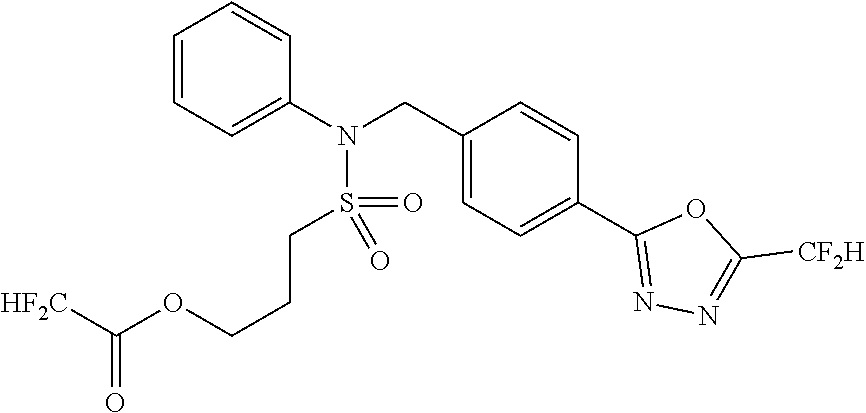
  • —X may be substituted with —X, —OH, —O(C 1 -C 4 alkyl), —NR A R B , —CN, —(C 1 -C 4 alkyl), —CF 3 , —CF 2 H, —(C 1 -C 4 alkyl)-OH, —(C 1 -C 4 alkyl)-NR A R B , —C( ⁇ O)—(C 1 -C 4 alkyl), —C( ⁇ O)—CF 3 , —C( ⁇ O)—CF 2 H, —C( ⁇ O)—NR A R B , —C( ⁇ O)—O(C 1 -C 4 alkyl), —(C 1 -C 4 alkyl)-C( ⁇ O)—(C 1 -C 4 alkyl), —(C 1 -C 4 alkyl)-OC( ⁇ O)—CF 2 H, —(C 3 -C 6 heterocycloalkyl), —(
  • R 3 is —H, —(C 1 -C 4 alkyl), —(C 1 -C 4 alkyl)-O(C 1 -C 4 alkyl), —(C 1 -C 4 alkyl)-C( ⁇ O)—O(C 1 -C 4 alkyl), -aryl, -heteroaryl,
  • —(C 1 -C 4 alkyl), —(C 1 -C 4 alkyl)-O(C 1 -C 4 alkyl) or —(C 1 -C 4 alkyl)-C( ⁇ O)—O(C 1 -C 4 alkyl) may be substituted with —X or —OH,
  • At least one H of the -aryl or -heteroaryl may be substituted with —X, —OH, —O(C 1 -C 4 alkyl), —(C 1 -C 4 alkyl), —CF 3 , —CF 2 H, —(C 1 -C 4 alkyl)-OH, —C( ⁇ O)—(C 1 -C 4 alkyl), —C( ⁇ O)—O(C 1 -C 4 alkyl), —(C 1 -C 4 alkyl)-C( ⁇ O)—(C 1 -C 4 alkyl), —C( ⁇ O)—CF3, —C( ⁇ O)—CF 2 H,
  • —X may be substituted with —X, —OH, —O(C 1 -C 4 alkyl), —(C 1 -C 4 alkyl), —C( ⁇ O)—(C 1 -C 4 alkyl), —C( ⁇ O)—O(C 1 -C 4 alkyl) or —(C 3 -C 6 heterocycloalkyl);
  • R 4 is —CX 2 H or —CX 3 ;
  • L 1 to L 4 are each independently —(C 0 -C 2 alkyl)-;
  • Z 1 to Z 8 are each independently N or CR Z , wherein at least three of Z 1 to Z 4 or Z 5 to Z 8 may not be simultaneously N, and R Z is —H, —X or —O(C 1 -C 4 alkyl);
  • Z 9 and Z 10 are each independently N or S;
  • Y 1 to Y 3 are each independently —CH 2 —, —NR C —, —O— or —S( ⁇ O) 2 —;
  • Y 4 to Y 7 are each independently —CH 2 —, —NR D — or —O—;
  • Y 8 is —C( ⁇ O), —CH 2 — or —NR E —;
  • Y 9 and Y 10 are each independently —NR F — or —S( ⁇ O) 2 —;
  • R A and R B are each independently —H, —(C 1 -C 4 alkyl), —(C 1 -C 4 alkyl)-aryl, —C( ⁇ O)—CF 2 H or —C( ⁇ O)—O(C 1 -C 4 alkyl);
  • R C to R E are each independently —H, —(C 1 -C 4 alkyl), —(C 1 -C 4 alkyl)-OH, —(C 1 -C 4 alkyl)-O—(C 1 -C 4 alkyl), —C( ⁇ O)—(C 1 -C 4 alkyl), —C( ⁇ O)—O(C 1 -C 4 alkyl), —C( ⁇ O)—(C 3 -C 7 cycloalkyl), —(C 1 -C 4 alkyl)-C( ⁇ O)—(C 2 -C 6 heterocycloalkyl), —S( ⁇ O) 2 —(C 1 -C 4 alkyl), —(C 1 -C 4 alkyl) aryl, —(C 2 -C 4 alkenyl)-aryl, —(C 1 -C 4 alkyl)-heteroaryl, -aryl, -heteroaryl,
  • —X may be substituted with —X, —OH, —O(C 1 -C 4 alkyl), —(C 1 -C 4 alkyl) or —CF 3 ;
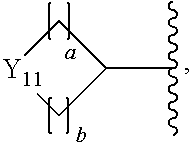
  • Y 11 is —CH 2 —, —NR F — or —O—;
  • R F is —(C 1 -C 4 alkyl), —C( ⁇ O)—(C 1 -C 4 alkyl), —C( ⁇ O)—(C 1 -C 4 alkyl)-OH, —C( ⁇ O)—(C 3 -C 7 cycloalkyl) or —S( ⁇ O) 2 —(C 1 -C 4 alkyl);
  • Y 1 or Y 2 is —CH—;
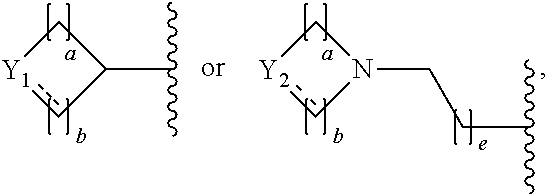
  • a to e are each independently an integer of 0, 1, 2 or 3, provided that a and b may not be simultaneously 0, and c and d may not be simultaneously 0; and
  • X is F, Cl, Br or I.
  • R 1 is —CX 2 H or —CX 3 ;
  • R 2 is —(C 1 -C 4 alkyl), —(C 1 -C 4 alkyl)-O(C 1 -C 4 alkyl), —(C 1 -C 4 alkyl)-C( ⁇ O)—O(C 1 -C 4 alkyl), —(C 1 -C 4 alkyl)-O—C( ⁇ O)—(C 1 -C 4 alkyl), —(C 1 -C 4 alkyl)-NR A R B , —(C 1 -C 4 alkyl)-heteroaryl, -aryl, -heteroaryl,
  • R B may be substituted with —X or —OH,
  • At least one H of the —(C 1 -C 4 alkyl)-heteroaryl, -aryl or -heteroaryl may be substituted with —O(C 1 -C 4 alkyl), —(C 1 -C 4 alkyl) or —(C 1 -C 4 alkyl)-OH, and
  • —X may be substituted with —X, —OH, —NR A R B , —CN, —(C 1 -C 4 alkyl), —(C 1 -C 4 alkyl)-OH, —(C 1 -C 4 alkyl)-NR A R B , —C( ⁇ O)—NR A R B , —C( ⁇ O)—O(C 1 -C 4 alkyl), —(C 1 -C 4 alkyl)-C( ⁇ O)—(C 1 -C 4 alkyl), —(C 1 -C 4 alkyl)-OC( ⁇ O)—CF 2 H, —(C 3 -C 6 heterocycloalkyl), —(C 1 -C 4 alkyl)-aryl, -aryl or -heteroaryl, wherein at least one H of the —(C 1 -C 4 alkyl)-aryl, -aryl or -heteroaryl may be substituted with
  • R 3 is —H, —(C 1 -C 4 alkyl), -aryl, -heteroaryl,
  • At least one H of the -aryl or -heteroaryl may be substituted with —X, —O(C 1 -C 4 alkyl), —(C 1 -C 4 alkyl), —CF 3 , —C( ⁇ O)—(C 1 -C 4 alkyl),
  • C 1 -C 4 alkyl may be substituted with —(C 1 -C 4 alkyl), —C( ⁇ O)—(C 1 -C 4 alkyl), —C( ⁇ O)—O(C 1 -C 4 alkyl) or —(C 3 -C 6 heterocycloalkyl);
  • R 4 is —CX 2 H or —CX 3 ;
  • L 1 to L 4 are each independently —(C 0 -C 2 alkyl)-;
  • Z 1 to Z 8 are each independently N or CR Z , wherein at least three of Z 1 to Z 4 or Z 5 to Z 8 may not be simultaneously N, and R Z is —H, —X or —O(C 1 -C 4 alkyl);
  • Z 9 and Z 10 are each independently N or S;
  • Y 1 to Y 3 are each independently —CH 2 —, —NR C —, —O— or —S( ⁇ O) 2 —;
  • Y 4 to Y 7 are each independently —CH 2 —, —NR D — or —O—;
  • Y 8 is —C( ⁇ O), —CH 2 — or —NR E —;
  • Y 9 and Y 10 are each independently —NR F — or —S( ⁇ O) 2 —;
  • R A and R B are each independently —H, —(C 1 -C 4 alkyl), —(C 1 -C 4 alkyl)-aryl, —C( ⁇ O)—CF 2 H or —C( ⁇ O)—O(C 1 -C 4 alkyl);
  • R C to R E are each independently —H, —(C 1 -C 4 alkyl), —(C 1 -C 4 alkyl)-OH, —(C 1 -C 4 alkyl)-O—(C 1 -C 4 alkyl), —C( ⁇ O)—(C 1 -C 4 alkyl), —C( ⁇ O)—O(C 1 -C 4 alkyl), —C( ⁇ O)—(C 3 -C 7 cycloalkyl), —(C 1 -C 4 alkyl)-C( ⁇ O)—(C 2 -C 6 heterocycloalkyl), —S( ⁇ O) 2 -(C 1 -C 4 alkyl), —(C 1 -C 4 alkyl)-aryl, —(C 2 -C 4 alkenyl)-aryl, —(C 1 -C 4 alkyl) ⁇
  • —X may be substituted with —X, —OH, —O(C 1 -C 4 alkyl), —(C 1 -C 4 alkyl) or —CF 3 ;
  • Y 11 is —CH 2 —, —NR F — or —O—;
  • R F is —(C 1 -C 4 alkyl), —C( ⁇ O)—(C 1 -C 4 alkyl), —C( ⁇ O)—(C 1 -C 4 alkyl)-OH, —C( ⁇ O)—(C 3 -C 7 cycloalkyl) or —S( ⁇ O) 2 —(C 1 -C 4 alkyl);
  • Y 1 or Y 2 is —CH—;
  • a to e are each independently an integer of 0, 1, 2 or 3, provided that a and b may not be simultaneously 0, and c and d may not be simultaneously 0; and
  • X is F, C l , Br or I.
  • R 1 is —CX 2 H
  • R 2 is —(C 1 -C 4 alkyl), —(C 1 -C 4 alkyl)-C( ⁇ O)—O(C 1 -C 4 alkyl), —(C 1 -C 4 alkyl)-NR A R B , -heteroaryl,
  • At least one H of the -heteroaryl may be substituted with —O(C 1 -C 4 alkyl), —(C 1 -C 4 alkyl) or —(C 1 -C 4 alkyl)-OH, and
  • R 3 is -aryl, -heteroaryl or
  • H of the -aryl or -heteroaryl may be substituted with —X, —O(C 1 -C 4 alkyl), —(C 1 -C 4 alkyl), —CF 3 or —C( ⁇ O)—(C 1 -C 4 alkyl), and
  • L 1 and L 3 are each independently —(C 0 alkyl)-;
  • L 2 is —(C 1 alkyl)-
  • Z 1 to Z 4 are each independently N or CR Z , wherein at least two of Z 1 to Z 4 may not be simultaneously N, and R Z is —H or X;
  • Y 1 is —NR C —, —O— or —S( ⁇ O) 2 —;
  • Y 2 is —CH 2 — or —NR C —;
  • Y 6 and Y 7 are each independently —O—;
  • Y 8 is —CH 2 —
  • R A and R B are each independently —(C 1 -C 4 alkyl);
  • R C is —(C 1 -C 4 alkyl), —(C 1 -C 4 alkyl)-OH, —C( ⁇ O)—(C 1 -C 4 alkyl), —S( ⁇ O) 2 —(C 1 -C 4 alkyl) or
  • Y 11 is —NR F — or —O—;
  • R F is —(C 1 -C 4 alkyl), —C( ⁇ O)—(C 1 -C 4 alkyl), —C( ⁇ O)—(C 1 -C 4 alkyl)-OH or —S( ⁇ O) 2 —(C 1 -C 4 alkyl);
  • a, b and e are each independently an integer of 0, 1 or 2, provided that a and b may not be simultaneously 0;
  • X is F, Cl, Br or I.
  • R 1 is —CF 2 H
  • R 2 is —(C 1 -C 4 alkyl), —(C 1 -C 4 alkyl)-NR A R B ,
  • R 3 is -aryl or -heteroaryl
  • H of the -aryl or -heteroaryl may be substituted with —X or —(C 1 -C 4 alkyl);
  • L 1 and L 3 are each independently —(C 0 alkyl)-;
  • L 2 is —(C 1 alkyl)-
  • Z 1 to Z 4 are each independently N or CR Z , wherein at least two of Z 1 to Z 4 may not be simultaneously N, and R Z is H or X;
  • Y 1 is —NR C —, —O— or —S( ⁇ O) 2 —;
  • Y 2 is —NR C —
  • R A and R B are each independently —(C 1 -C 4 alkyl);
  • R C is —(C 1 -C 4 alkyl), —C( ⁇ O)—(C 1 -C 4 alkyl), —S( ⁇ O) 2 —(C 1 -C 4 alkyl) or
  • Y 11 is —NR F — or —O—;
  • R F is —(C 1 -C 4 alkyl), —C( ⁇ O)—(C 1 -C 4 alkyl), —C( ⁇ O)—(C 1 -C 4 alkyl)-OH or —S( ⁇ O) 2 —(C 1 -C 4 alkyl);
  • a, b and e are each independently an integer of 0, 1 or 2, provided that a and b may not be simultaneously 0;
  • X is F, Cl or Br.
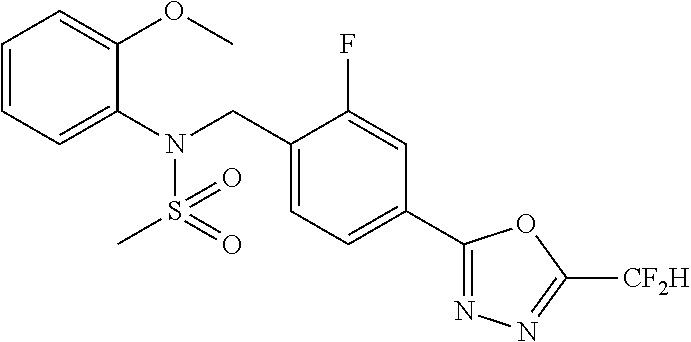
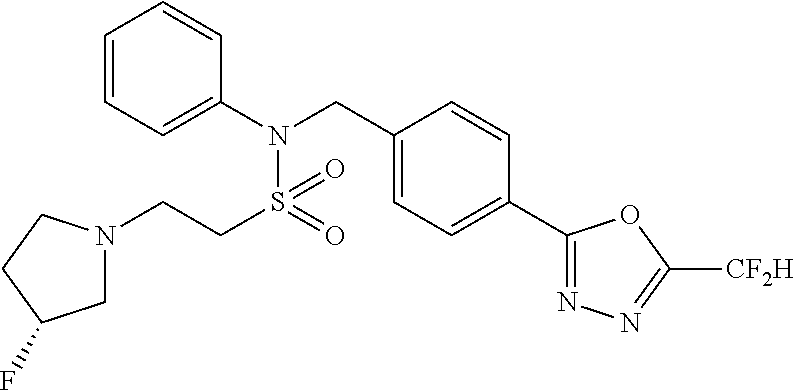
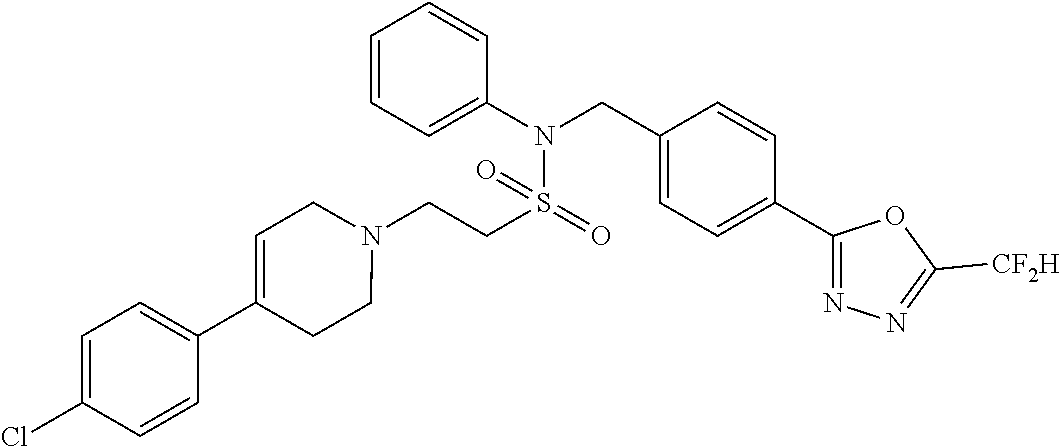
  • the compounds represented by formula I, stereoisomers thereof or pharmaceutically acceptable salts thereof may be selected from the group consisting of compounds 11154, 11156, 11168, 11170, 11171, 11172, 11176, 11178, 11182, 11191, 11193, 11197, 11217, 11225, 11227, 11231, 11254, 11256, 11276, 11284, 11287, 11289, 11324, 11345, 11346, 11350, 11352, 11353, 11354, 11355, 11366, 11367, 11368, 11372, 11373, 11377, 11390, 11411, 11412, 11426, 11428, 11433, 11447, 11448, 11451, 11452, 11460, 11461, 11462, 11463, 11497, 11501, 11502, 11503, 11504, 11505, 11506, 11507, 11508, 115
  • the compounds represented by formula I, stereoisomers thereof or pharmaceutically acceptable salts thereof may be selected from the group consisting of compounds 11154, 11170, 11172, 11178, 11182, 11191, 11197, 11217, 11256, 11350, 11352, 11354, 11355, 11366, 11367, 11368, 11372, 11373, 11390, 11411, 11412, 11426, 11428, 11433, 11447, 11451, 11452, 11460, 11461, 11462, 11463, 11497, 11501, 11502, 11503, 11504, 11505, 11506, 11507, 11521, 11540, 11541, 11552, 11553, 11637, 11646, 11665, 11681, 11683, 11684, 11685 and 11781.
  • the term “pharmaceutically acceptable salt” means any salt that is generally used in the pharmaceutical field.
  • the pharmaceutically acceptable salt include, but are not limited to, salts with inorganic ions such as calcium, potassium, sodium or magnesium ions, salts with inorganic acids such as hydrochloric acid, nitric acid, phosphoric acid, bromic acid, iodic acid, perchloric acid or sulfuric acid, salts with organic acids such as acetic acid, trifluoroacetic acid, citric acid, maleic acid, succinic acid, oxalic acid, benzoic acid, tartaric acid, fumaric acid, mandelic acid, propionic acid, lactic acid, glycolic acid, gluconic acid, galacturonic acid, glutamic acid, glutaric acid, glucuronic acid, aspartic acid, ascorbic acid, carbonic acid, vanillic acid, hydroiodic acid or the like, salts with sulfonic acids such as methanesulfonic
  • preferred salts include salts with hydrochloric acid, phosphoric acid, sulfuric acid, trifluoroacetic acid, citric acid, bromic acid, maleic acid, tartaric acid or the like, and preferred examples of such compounds include compounds 11172 as disclosed herein.
  • the compounds represented by formula I may contain one or more asymmetrical carbon atoms, and thus may exist in the form of racemates, racemic mixtures, single enantiomers, diastereomeric mixtures, and individual diastereomers.
  • the compounds of formula I can be separated into such isomers by methods known in the art, for example, column chromatography or HPLC.
  • stereoisomers of the compounds of formula I may be synthesized by stereospecific synthesis using optically pure starting materials and/or reagents of known configuration.
  • the present invention provides methods for the preparation of the 1,3,4-oxadiazole sulfonamide derivative compounds presented by formula I, stereoisomers thereof, or pharmaceutically acceptable salts thereof.
  • the ester moiety of a compound of formula 1-1 is substituted with hydrazine to prepare a compound of formula 1-2, which is then reacted with trifluoroacetic anhydride or difluoroacetic anhydride to prepare a compound of formula 1-3.
  • the prepared compound of formula 1-3 is reacted with 1-methoxy-N-triethylammoniosulfonyl-methaneimidate (Burgess reagent) to yield a compound of formula 1-4 which has an oxadiazole structure.
  • the compound of formula 1-4 is deprotected, thereby preparing an intermediate of formula 1-5.
  • the ester moiety of a compound of formula 2-1 is substituted with hydrazine to prepare a compound of formula 2-2, which is then reacted with trifluoroacetic anhydride or difluoroacetic anhydride to prepare a compound of formula 2-3.
  • the compound of formula 2-3 is reacted with 1-methoxy-N-triethylammoniosulfonyl-methaneimidate (Burgess reagent) to yield a compound of formula 2-4 which has an oxadiazole structure.
  • the methyl group of the compound of formula 2-4 is halogenated, thereby preparing an intermediate of formula 2-5.
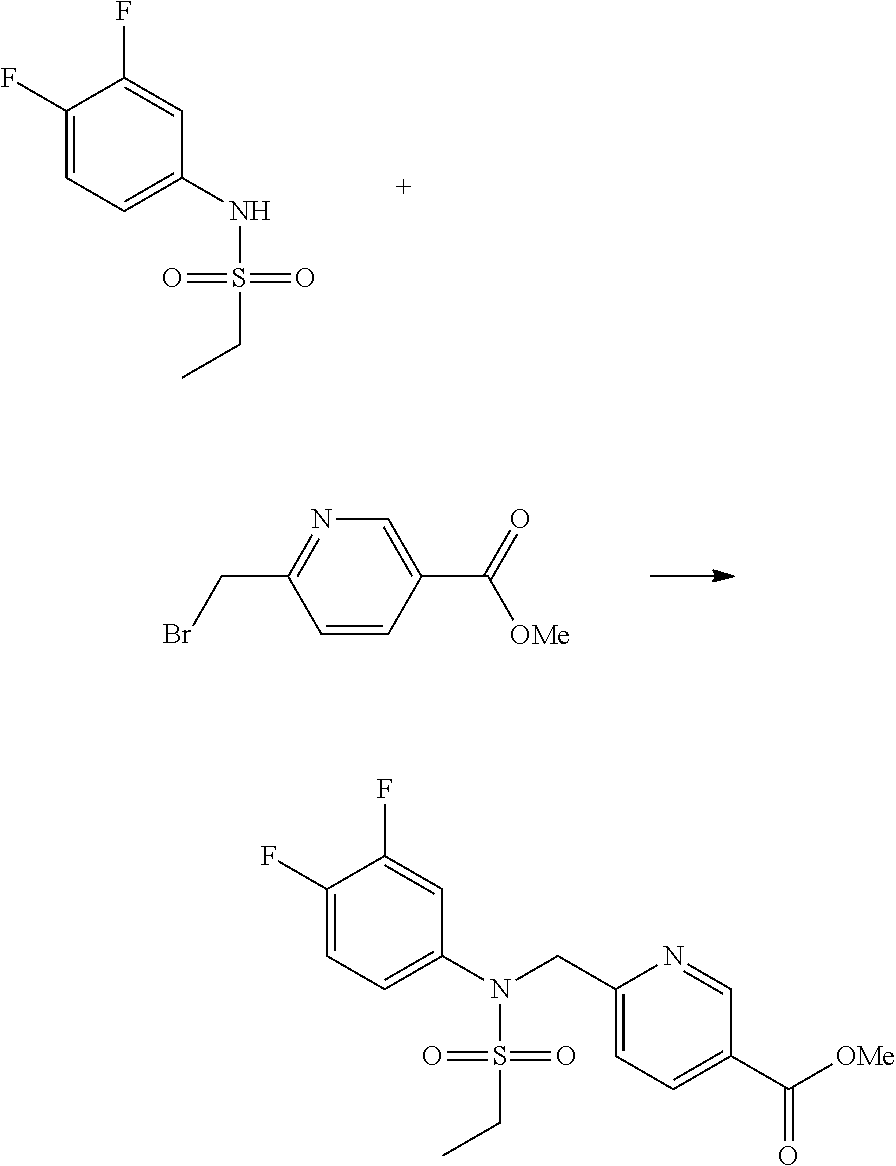
  • Reaction scheme 3 above shows a general method for synthesis of compounds having a sulfonamide structure. As shown therein, a compound of formula 3-1 is reacted with an amine to yield a compound of formula 3-2, which is then reacted with a compound of formula 2-5 under a basic condition, thereby preparing a compound of formula 3-3.
  • Compounds that are prepared according to reaction scheme 3 are compounds 11229, 11230, 11231, 11252, 11253, 11254, 11287, 11288, 11289, 11290, 11291, 11292, 11747, 11748, 11749, 11774, 11775 and 11776.
  • Reaction scheme 4 above shows a general method for synthesis of compounds having a sulfonamide structure.
  • a compound of formula 1-5 is reacted with any of various sulfonyl chloride compounds (formula 3-1) to yield a compound of formula 4-1, which is then subjected to a substitution reaction with R 3 -L 2 -X, thereby preparing a compound of formula 3-3.
  • Compounds that are prepared according to reaction scheme 4 are compounds 11078, 11121 and 11222.
  • Reaction scheme 5 above shows a general method for synthesis of compounds having a sulfonamide structure.
  • a compound of formula 5-1 is subjected to a reductive amination reaction with an amine compound to yield a compound of formula 5-2, which is then reacted with any of various sulfonyl chloride compounds (formula 3-1) to yield a compound of formula 5-4.
  • a compound of formula 3-2 is subjected to a substitution reaction with a compound of formula 5-3 under a basic condition to yield the compound of formula 5-4. Then, the compound of formula 5-4 is reacted with hydrazine to yield a compound of formula 5-5.
  • Compounds that are prepared according to this reaction scheme are compounds 11044, 11045, 11088, 11089, 11128, 11129, 11133, 11156, 11169, 11170, 11171, 11172, 11175, 11176, 11177, 11178, 11179, 11180, 11181, 11182, 11183, 11184, 11190, 11191, 11192, 11193, 11194, 11195, 11219, 11220, 11221, 11248, 11249, 11250, 11251, 11273, 11274, 11275, 11276, 11277, 11278, 11279, 11280, 11281, 11282, 11283, 11284, 11352, 11353, 11460, 11461, 11462, 11463, 11497, 11507 and 11508.
  • Reaction scheme 6 above shows a general method for synthesis of compounds having a sulfonamide structure.
  • a compound of formula 6-1 is subjected to a reductive amination reaction with a compound of formula 5-1 to yield a compound of formula 6-2, which is then reacted with any of various sulfonyl chloride compounds (formula 3-1), thereby preparing a compound of formula 6-3.
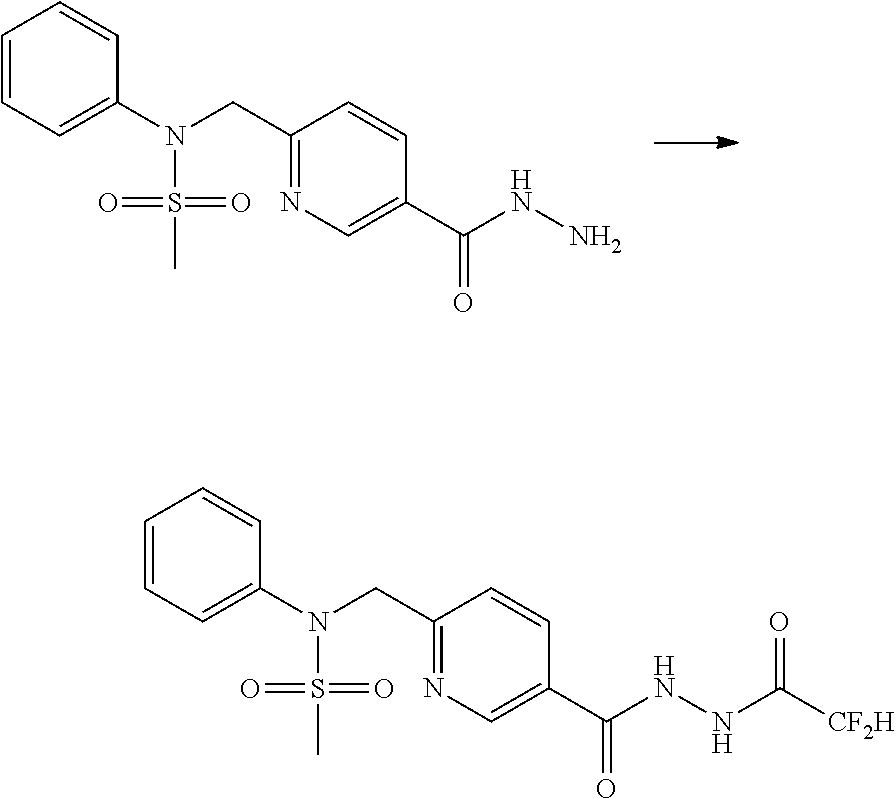
  • the compound of formula 6-3 is reacted with hydrazine to yield a compound of formula 6-4, which is then reacted with trifluoroacetic anhydride or difluoroacetic anhydride to yield a compound of formula 6-5, which has an oxadiazole structure.
  • a compound that is prepared according to reaction scheme 6 above is compound 11186.
  • Reaction scheme 7 above shows a general method for synthesis of compounds having a sulfonamide structure.
  • a compound of formula 7-1 is reacted with any of various amine compounds to yield a compound of formula 7-2, which is then subjected to a substitution reaction with a compound of formula 5-1, thereby preparing a compound of formula 7-3.
  • the protecting group of the compound of formula 7-3 is removed, thereby preparing a compound of formula 7-4.
  • the compound of formula 7-4 is subjected to a reductive amination reaction or a substitution reaction, thereby preparing a compound of formula 7-5.
  • the compound of formula 7-5 is reacted with hydrazine to yield a compound of formula 7-6, which is then reacted with trifluoroacetic anhydride or difluoroacetic anhydride, thereby preparing a compound of formula 7-7, which has an oxadiazole structure.
  • Reaction scheme 8 above shows a general method for synthesis of compounds having a sulfonamide structure.
  • a compound of formula 7-4 is subjected to a reductive amination reaction, a substitution reaction or an amide coupling reaction to yield a compound of formula 8-1, which is then reacted with hydrazine, thereby preparing a compound of formula 8-2.
  • the compound of formula 8-2 is reacted with trifluoroacetic anhydride or difluoroacetic anhydride to yield a compound of formula 8-3 or formula 8-4.
  • the compound of formula 8-3 is subjected to a cyclization reaction using a base and a good leaving group, thereby preparing the compound of formula 8-4.
  • the prepared compound of formula 8-4 is deprotected to yield a compound of formula 8-5, which is then subjected to a reductive amination reaction or a substitution reaction, thereby preparing a compound of formula 8-6.
  • Reaction scheme 9 above shows a general method for synthesis of compounds having a sulfonamide structure.
  • a compound of formula 8-1 is deprotected to yield a compound of formula 9-1, which is then subjected to a substitution reaction, thereby preparing a compound of formula 9-2.
  • the compound of formula 9-2 is reacted with hydrazine to yield a compound of formula 9-3, which is then subjected to a cyclization reaction with trifluoroacetic anhydride or difluoroacetic anhydride, thereby preparing a compound of formula 8-6.
  • Reaction scheme 10 above shows a general method for synthesis of compounds having a sulfonamide structure.
  • a compound of formula 10-1 is subjected to a substitution reaction with a compound of formula 10-2 to yield a compound of formula 10-3, and the nitro group of the compound of formula 10-3 is reduced with zinc, thereby preparing a compound of formula 10-4.
  • the compound of formula 10-4 is reacted with any of various sulfonyl chloride compounds (formula 3-1) to obtain a compound of formula 10-5, which is then subjected to a substitution reaction with a compound of formula 5-1, thereby preparing a compound of formula 10-7.
  • the compound of formula 10-7 is deprotected and subjected to a reductive amination reaction, a substitution reaction or an amide coupling reaction to yield a compound of formula 10-8, which is then reacted with hydrazine to yield a compound of formula 10-9.
  • the compound of formula 10-9 is subjected to a cyclization reaction with trifluoroacetic anhydride or difluoroacetic anhydride, thereby preparing a compound of formula 10-10.
  • Reaction scheme 11 above shows a general method for synthesis of compounds having a sulfonamide structure.
  • a compound of formula 9-1 is subjected to a substitution reaction with a compound of formula 11-2 to yield a compound of formula 11-3, and the nitro group of the compound of formula 11-3 is reduced with zinc to yield a compound of formula 11-4.
  • the compound of formula 11-4 is reacted with any of various sulfonyl chloride compounds (formula 3-1) to yield a compound of formula 11-5, which is then subjected to a substitution reaction with a compound of formula 5-1, thereby preparing a compound of formula 11-6.
  • the compound of formula 11-6 is reacted with hydrazine to yield a compound of formula 11-7, which is then subjected to a cyclization reaction with trifluoroacetic anhydride or difluoroacetic acid, thereby preparing a compound of formula 11-8.
  • a compound that is prepared according to reaction scheme 11 above is compound 11392.
  • Reaction scheme 12 above shows a general method for synthesis of compounds having a sulfonamide structure.
  • a compound of formula 12-1 is subjected to a substitution reaction with any of various sulfonyl chloride compounds (formula 3-1) to yield a compound of formula 12-2, which is then subjected to a Suzuki coupling reaction with boron ester, thereby preparing a compound of formula 12-3.
  • the compound of formula 12-3 is subjected to a reduction reaction in the presence of palladium and hydrogen to yield a compound of formula 12-4, which is then subjected to a substitution reaction with a compound of formula 5-1, thereby preparing a compound of formula 12-5.
  • the compound of formula 12-5 is deprotected, and then subjected to a reductive amination reaction with an amine, thereby preparing a compound of formula 12-7.
  • the compound of formula 12-7 is reacted with hydrazine to yield a compound of formula 12-8, which is then subjected to a cyclization reaction with trifluoroacetic anhydride or difluoroacetic anhydride, thereby preparing a compound of formula 12-9.
  • a compound that is prepared according to reaction scheme 12 above is compound 11427.
  • Reaction scheme 13 above shows a general method for synthesis of compounds having a sulfonamide structure.
  • a protecting group is introduced into a compound of formula 13-1 to yield a compound of formula 13-2, and the benzonitrile group of the compound of formula 13-2 is substituted with hydroxybenzimide in the presence of hydroxylamine and a base to yield a compound of formula 13-3.
  • the prepared compound of formula 13-3 is subjected to a cyclization reaction with trifluoroacetic anhydride or difluoroacetic anhydride to yield a compound of formula 13-4.
  • the compound of formula 13-4 is deprotected to yield a compound of formula 13-5, which is then subjected to a substitution reaction with any of various sulfonyl chloride compounds (formula 3-1), thereby preparing a compound of formula 13-6.
  • the compound of formula 13-6 is subjected to a substitution reaction with a compound of formula 2-5 under a basic condition to yield a compound of formula 13-7.
  • the compound of formula 13-7 is subjected to a cyclization reaction using a good leaving group under a basic condition, thereby preparing a compound of formula 13-8.
  • a compound that is prepared according to reaction scheme 13 above is compound 11389.
  • Reaction scheme 14 above shows a general method for synthesis of compounds having a sulfonamide structure.
  • the methyl group of a compound of formula 2-1 is halogenated to yield a compound of formula 5-1, which is then subjected to a substitution reaction with any of various sulfonamide compounds (formula 3-2), thereby preparing a compound of formula 5-4.
  • the compound of formula 5-4 is reacted with hydrazine to yield a compound of formula 5-5, which is then subjected to a cyclization reaction with trifluoroacetic anhydride or difluoroacetic acid, thereby preparing a compound of formula 3-3.
  • Reaction scheme 15 above shows a general method for synthesis of compounds having a sulfonamide structure.
  • a compound of formula 15-1 is subjected to a substitution reaction any of various primary amine compounds to yield a compound of formula 15-2 or formula 15-3, which is then subjected to a substitution reaction with a compound of formula 5-1, thereby preparing a compound of formula 15-4 or 15-5.
  • the prepared compound is reacted with an amine compound (formula 10-2) to yield a compound of formula 15-6, which is then reacted with hydrazine, thereby preparing a compound of formula 15-7.
  • the prepared compound is subjected to a cyclization reaction with trifluoroacetic anhydride or difluoroacetic anhydride, thereby preparing a compound of formula 15-8.
  • Reaction scheme 16 above shows a general method for synthesis of compounds having a sulfonamide structure.
  • a compound of formula 15-6 is deprotected to yield a compound of formula 16-1, which is then subjected to a reductive amination reaction or a substitution reaction, thereby preparing a compound of formula 16-2.
  • the prepared compound is reacted with hydrazine to yield a compound of formula 16-3, which is then subjected to a cyclization reaction with trifluoroacetic anhydride or difluoroacetic anhydride, thereby preparing a compound of formula 16-4.
  • Reaction scheme 17 above shows a general method for synthesis of compounds having a sulfonamide structure.
  • a compound of formula 16-1 is subjected to a reductive amination reaction with a ketone compound to yield a compound of formula 17-1 which is then deprotected to yield a compound of formula 17-2.
  • the prepared compound is subjected to a substitution reaction to yield a compound of formula 17-3.
  • the compound of formula 17-3 is reacted with hydrazine to yield a compound of formula 17-4, which is then subjected to a cyclization reaction with trifluoroacetic anhydride or difluoroacetic anhydride, thereby preparing a compound of formula 17-5.
  • a compound that is prepared according to reaction scheme 17 above is compound 11582.
  • Reaction scheme 18 above shows a general method for synthesis of compounds having a sulfonamide structure. As shown therein, a compound of formula 15-8 is deprotected to yield a compound of formula 18-1, which is then subjected to a substitution reaction, thereby synthesizing a compound of formula 18-2.
  • Reaction scheme 19 above shows a general method for synthesis of compounds having a sulfonamide structure.
  • a compound of formula 15-6 is subjected to a reductive amination reaction with aldehyde to yield a compound of formula 19-1.
  • the prepared compound of formula 19-1 is reacted with hydrazine to yield a compound of formula 19-2, which is then subjected to a cyclization reaction with trifluoroacetic anhydride or difluoroacetic anhydride, thereby preparing a compound of formula 19-3.
  • Reaction scheme 20 above shows a general method for synthesis of compounds having a sulfonamide structure.
  • a compound of formula 20-1 is reacted with hydrazine to yield a compound of formula 20-5, which is then subjected to a cyclization reaction to yield a compound of formula 20-3.
  • the prepared compound of formula 20-3 is brominated to yield a compound of formula 20-6.
  • acyl chloride of formula 20-4 is used to yield the compound of formula 20-6.
  • a compound of formula 14-1 is subjected to a substitution reaction with any of various primary amine compounds to yield a compound of formula 14-3, which is then subjected to a substitution reaction with the compound of formula 20-6 to yield a compound of formula 20-7.
  • the prepared compound is reacted with an amine compound (formula 14-6), thereby preparing a compound of formula 20-8.
  • Reaction scheme 21 above shows a general method for synthesis of compounds having a sulfonamide structure.
  • a compound of formula 21-1 is reacted with hydrazine to yield a compound of formula 21-2, which is then subjected to a cyclization reaction with trifluoroacetic anhydride or difluoroacetic anhydride, thereby preparing a compound of formula 21-4.
  • the prepared compound of formula 21-4 is deprotected to yield a compound of formula 21-5, which is then subjected to a reductive amination reaction or a substitution reaction, thereby preparing a compound of formula 21-6.
  • Reaction scheme 22 above shows a general method for synthesis of compounds having a sulfonamide structure.
  • a compound of formula 22-1 is subjected to a reductive amination reaction to yield a compound of formula 22-2, which is then deprotected, thereby preparing a compound of formula 22-3.
  • the prepared compound of formula 22-3 is subjected to a reductive amination reaction or a substitution reaction, thereby preparing a compound of formula 22-4.
  • Reaction scheme 23 above shows a general method for synthesis of compounds having a sulfonamide structure.
  • a compound of formula 23-1 is subjected to a reductive amination reaction to yield a compound of formula 23-2, and the hydroxyl group of the compound of formula 23-1 is substituted with fluoride to yield a compound of formula 23-3.
  • the prepared compound of formula 23-3 is reacted with hydrazine to yield a compound of formula 23-4, which is then subjected to a cyclization reaction with trifluoroacetic anhydride or difluoroacetic anhydride, thereby preparing a compound of formula 23-5.
  • Reaction scheme 24 above shows a general method for synthesis of compounds having a sulfonamide structure.
  • a compound of formula 24-1 is subjected sequentially to a substitution reaction with a compound of formula 3-1 and a substitution reaction with a compound of formula 5-1 to obtain a compound of formula 24-3, which is then reacted with hydrazine to yield a compound of formula 24-4.
  • the prepared compound of formula 24-4 is subjected to a cyclization reaction with trifluoroacetic anhydride or difluoroacetic anhydride to yield a compound of formula 24-5, which is then deprotected, thereby preparing a compound of formula 24-6.
  • the prepared compound of formula 24-6 is subjected to a reductive amination reaction or a substitution reaction, thereby preparing a compound of formula 24-7.
  • Reaction scheme 25 above shows a general method for synthesis of compounds having a sulfonamide structure.
  • a compound of formula 25-1 is subjected sequentially to a substitution reaction with a compound of formula 3-1 and a substitution reaction with a compound of formula 5-1 to obtain a compound of formula 25-3.
  • the compound of formula 25-4 is subjected to a reductive amination reaction or a substitution reaction to yield a compound of formula 25-5.
  • the compound of formula 25-5 is reacted with hydrazine to yield a compound of formula 25-6, which is then subjected to a cyclization reaction with trifluoroacetic anhydride or difluoroacetic anhydride, thereby preparing a compound of formula 25-7.
  • a compound that is prepared according to reaction scheme 25 above is compound 11712.
  • compositions Comprising 1,3,4-Oxadiazole Sulfonamide Derivative Compounds, the Use Thereof and the Method of Treating Diseases
  • the present invention provides a pharmaceutical composition for preventing or treating histone deacetylase 6 (HDAC6) activity-associated diseases, which contains, as an active ingredient, a compound represented by the following formula I, a stereoisomer thereof or a pharmaceutically acceptable salt thereof:
  • HDAC6 histone deacetylase 6
  • the pharmaceutical composition according to the present invention exhibits a remarkable effect on the prevention or treatment of histone deacetylase 6 (HDAC6) activity-associated diseases by selectively inhibiting histone deacetylase 6 (HDAC6).
  • HDAC6 histone deacetylase 6
  • the histone deacetylase 6 (HDAC6) activity-associated diseases include infectious diseases such as prion disease; neoplasms such as benign tumor (e.g. myelodysplastic syndrome) or malignant tumor (e.g. multiple myeloma, lymphoma, leukemia, lung cancer, rectal cancer, colon cancer, prostate cancer, urothelial carcinoma, breast cancer, melanoma, skin cancer, liver cancer, brain cancer, gastric cancer, ovarian cancer, pancreatic cancer, head and neck cancer, oral cancer, or glioma); endocrine, nutritional and metabolic diseases such as Wilson's disease, amyloidosis or diabetes; mental and behavioral disorders such as depression or Rett's syndrome, and the like; neurological diseases such as atrophy of central nervous system (e.g.
  • Huntington's disease spinal muscular atrophy (SMA), spinocerebellar ataxia (SCA)), neurodegenerative disease (e.g. Alzheimer's disease), movement disorder (e.g. Parkinson's disease), neuropathy (e.g. hereditary neuropathy (Charcot-Marie-Tooth disease), sporadic neuropathy, inflammatory neuropathy, drug-induced neuropathy), motor neuron diseases (amyotrophic lateral sclerosis (ALS)), or demyelinating diseases of the central nervous system (e.g.
  • MS multiple sclerosis
  • diseases of the eye and adnexa such as uveitis
  • cardiovascular diseases such as atrial fibrillation or stroke and the like
  • respiratory diseases such as asthma
  • digestive diseases such as alcoholic liver disease, inflammatory bowel disease, Crohn's disease or ulcerative bowel disease, and the like
  • diseases of the skin and subcutaneous tissue such as psoriasis
  • diseases of the musculoskeletal system and connective tissue such as rheumatoid arthritis, osteoarthritis or systemic lupus erythematosus (SLE), and the like
  • congenital malformations, deformations and chromosomal abnormalities such as autosomal dominant polycystic kidney disease, as well as disorders or diseases associated with the abnormal function of histone deacetylase.
  • the pharmaceutically acceptable salt is as described above with respect to a pharmaceutically acceptable salt of the compound represented by formula I according to the present invention.
  • the pharmaceutical composition according to the present invention may further contain at least one pharmaceutically acceptable carrier in addition to the compound of formula I, an isomer thereof or a pharmaceutically acceptable salt thereof.
  • the pharmaceutically acceptable carrier that is used in the present invention may be at least one of physiological saline, sterile water, Ringer solution, buffered saline, dextrose solution, maltodextrin solution, glycerol, ethanol, and a mixture of two or more thereof. If necessary, the composition may contain other conventional additives such as an antioxidant, a buffer or a bacteriostatic agent.
  • compositions can be formulated into injectable formulations such as solutions, suspensions, turbid fluid, etc, pills, capsules, granules or tablets using a diluent, a dispersing agent, a surfactant, a binder and a lubricant.
  • injectable formulations such as solutions, suspensions, turbid fluid, etc, pills, capsules, granules or tablets using a diluent, a dispersing agent, a surfactant, a binder and a lubricant.
  • the composition of the present invention may be in the form of patches, liquids, pills, capsules, granules, tablets, suppositories, etc.
  • These formulations can be prepared either by conventional methods that are used for formulation in the art or by the method disclosed in Remington's Pharmaceutical Science (the latest edition), Mack Publishing Company, Easton Pa.
  • the pharmaceutical composition of the present invention may be administered orally or parenterally (e.g., intravenously, subcutaneously, intraperitoneally or topically) depending on the intended use.
  • the dose of the pharmaceutical composition varies depending on the patient's weight, age, sex, health conditions and diet, the time of administration, the mode of administration, excretion rate, the severity of the disease, and the like.
  • the daily dose of the compound of formula I according to the present invention may be about 1 to 1000 mg/kg, preferably 5 to 100 mg/kg, and may be administered once to several times a day.
  • the pharmaceutical composition of the present invention may further contain, in addition to the compound represented by formula I, a stereoisomer thereof or a pharmaceutically acceptable salt thereof, one or more active ingredients that exhibit medicinal efficacy identical or similar thereto.
  • the present invention also provides a method for preventing or treating a histone deacetylase-mediated disease, which comprises administering a therapeutically effective amount of the compound represented by formula I, a stereoisomer thereof or a pharmaceutically acceptable salt thereof.
  • terapéuticaally effective amount refers to the amount of the compound represented by formula I, which is effective for the prevention or treatment of histone deacetylase 6 activity-associated diseases.
  • the present invention also provides a method of selectively inhibiting HDAC6, which comprises administering the compound of formula I, a stereoisomer thereof or a pharmaceutically acceptable salt thereof to mammals including humans.
  • the method of preventing or treating histone deacetylase 6 activity-associated disease includes inhibiting or averting the disease as well as addressing the disease itself, prior to the onset of symptoms by administering the compound represented by formula I.
  • the magnitude of a prophylactic or therapeutic dose of a particular active ingredient will vary with the nature and severity of the disease or condition, and may also vary according to the route by which the active ingredient is administered.
  • the dose and the dose frequency will also vary according to the age, body weight, and response of the individual patient. Suitable dosing regimens can be readily selected by those skilled in the art with due consideration of such factors.
  • the method of preventing or treating histone deacetylase 6 activity-associated disease may further comprise administering a therapeutically effective amount of an additional active agent helpful for the treatment of the disease together with the compound represented by formula I, in which the additional active agent can exhibit a synergistic effect with the compound of formula I or an assistant effect.
  • the present invention is also intended to provide the use of the compound represented by formula I, a stereoisomer thereof or a pharmaceutically acceptable salt thereof, for the preparation of a medicament for treating histone deacetylase 6 activity-associated disease.
  • the compound represented by formula I may be mixed with a pharmaceutically acceptable adjuvant, diluent, carrier or the like, and combined with other active agents such that the active ingredients can have synergistic effects.
  • composition and treatment method of the present invention may be appropriately combined unless contradictory to one another.
  • the compounds represented by formula I, stereoisomers thereof or pharmaceutically acceptable salts thereof can selectively inhibit HDAC6, and thus exhibit excellent effects on the prevention or treatment of histone deacetylase 6 activity-associated diseases.
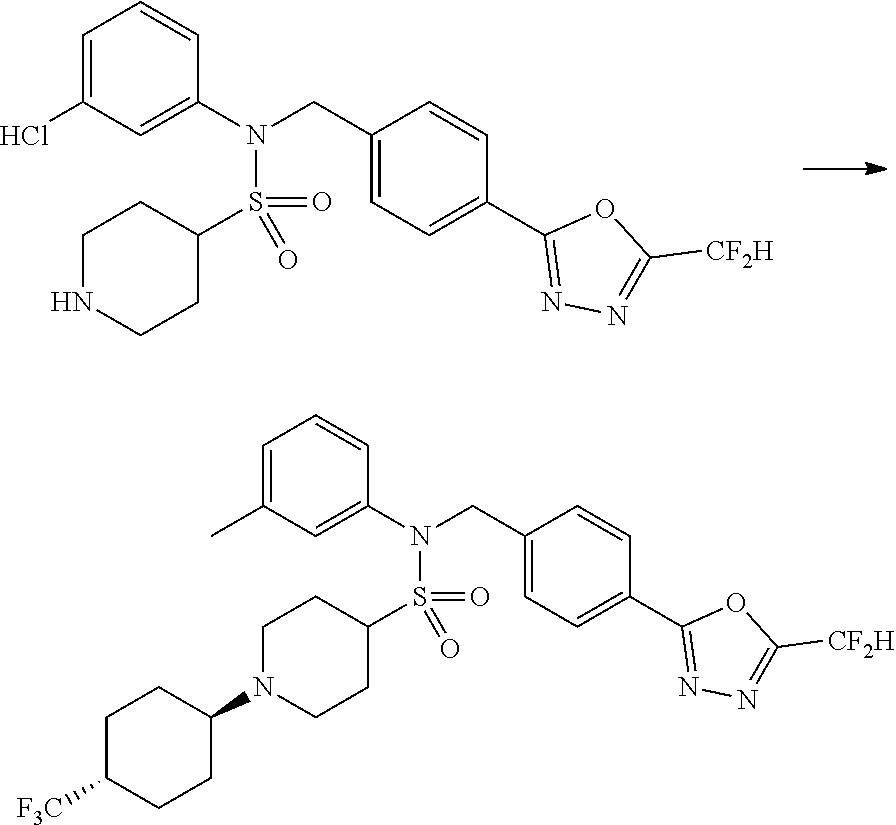
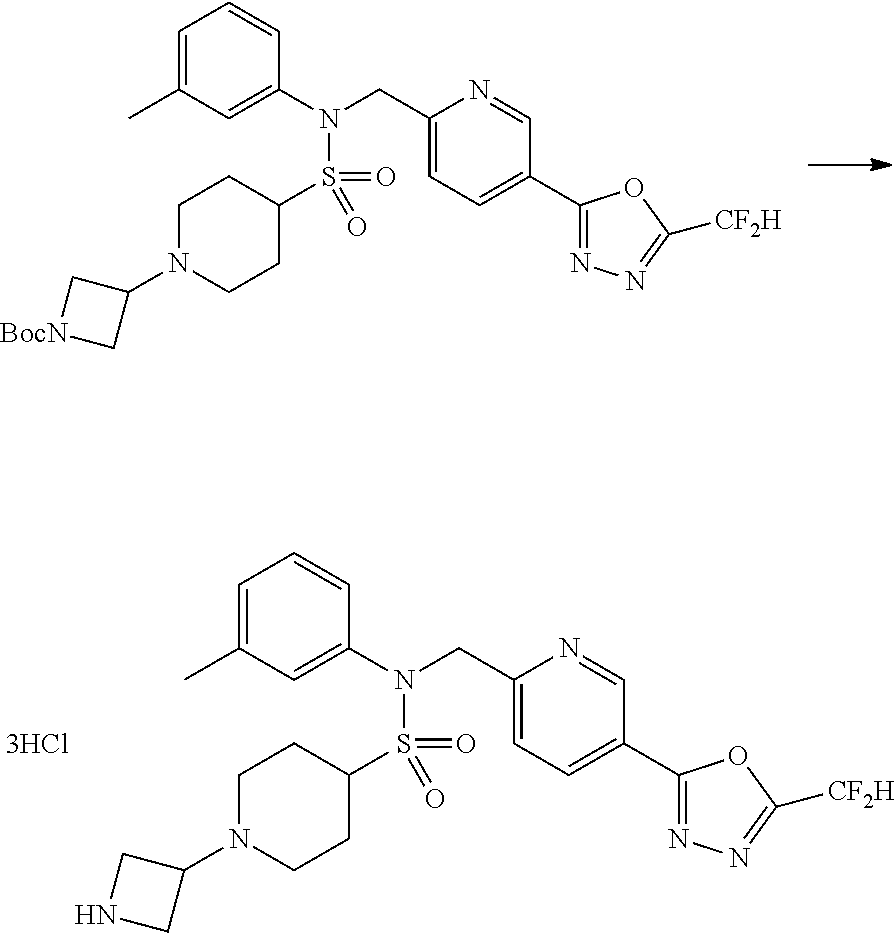
  • N-(pyridin-2-ylmethyl)methanesulfonamide (0.300 g, 1.611 mmol), NaH (60.00%, 0.077 g, 1.933 mmol) and methyl 4-(bromomethyl)-3-fluorobenzoate (0.438 g, 1.772 mmol) in N,N-dimethylformide (10 mL) was stirred at the room temperature for 5 hr. Then, water was added to the reaction mixture, followed by extraction with ethyl acetate. The organic layer was washed with aqueous saturated ammonium chloride solution, dried with anhydrous MgSO 4 , filtered, and concentrated in vacuo.
  • N-(pyridin-2-ylmethyl)methanesulfonamide (0.300 g, 1.611 mmol), NaH (60.00%, 0.077 g, 1.933 mmol) and methyl 4-(bromomethyl)benzoate (0.406 g, 1.772 mmol) in N,N-dimethylformide (10 mL) was stirred at the room temperature for 5 hr. Then, water was added to the reaction mixture, followed by extraction with ethyl acetate. The organic layer was washed with aqueous saturated ammonium chloride solution, dried with anhydrous MgSO 4 , filtered, and concentrated in vacuo.
  • the bi-phasic mixture was passed through a plastic frit to remove the solid residues and the aqueous layer, and the organic layer collected was concentrated in vacuo.
  • N-(pyridin-3-yl)methanesulfonamide (0.400 g, 2.323 mmol), NaH (60.00%, 0.111 g, 2.787 mmol) and methyl 4-(bromomethyl)benzoate (0.585 g, 2.555 mmol) in N,N-dimethylformide (10 mL) was stirred at the room temperature for 5 hr. Then, water was added to the reaction mixture, followed by extraction with ethyl acetate. The organic layer was washed with saturated aqueous sodium chloride solution, dried with anhydrous MgSO 4 , filtered, and concentrated in vacuo.
  • N-(pyridin-3-yl)methanesulfonamide (0.800 g, 4.646 mmol), sodium hydride (60.00%, 0.223 g, 5.575 mmol) and methyl 4-(bromomethyl)-3-fluorobenzoate (1.263 g, 5.110 mmol) in N,N-dimethylformide (20 mL) was stirred at the room temperature for 5 hr. Then, water was added to the reaction mixture, followed by extraction with ethyl acetate. The organic layer was washed with aqueous saturated ammonium chloride solution, dried with anhydrous MgSO 4 , filtered, and concentrated in vacuo.
  • Triethylamine (0.032 mL, 0.232 mmol) was added to a solution of (4-(5-(trifluoromethyl)-1,3,4-oxadiazol-2-yl)phenyl)methanamine hydrochloride (0.050 g, 0.179 mmol) in dichloromethane (2 mL) at the room temperature and the mixture was stirred at the same temperature for 10 min.
  • the reaction mixture was treated with methanesulfonyl chloride (0.015 mL, 0.197 mmol), and stirred for additional 5 hr at the same temperature. Then, saturated aqueous ammonium chloride solution was added to the reaction mixture, followed by extraction with dichloromethane.
  • the bi-phasic mixture was passed through a plastic frit to remove the solid residues and the aqueous layer, and the organic layer collected was concentrated in vacuo.
  • N-(pyridin-2-ylmethyl)methanesulfonamide (0.300 g, 1.611 mmol), sodium hydride (60.00%, 0.077 g, 1.933 mmol) and methyl 6-(bromomethyl)nicotinate (0.408 g, 1.772 mmol) in N,N-dimethylformide (10 mL) was stirred at the room temperature for 5 hr. Then, water was added to the reaction mixture, followed by extraction with ethyl acetate. The organic layer was washed with aqueous saturated ammonium chloride solution, dried with anhydrous MgSO 4 , filtered, and concentrated in vacuo.
  • N-(pyridin-3-yl)methanesulfonamide (0.500 g, 2.904 mmol), sodium hydride (60.00%, 0.139 g, 3.484 mmol) and methyl 4-(bromomethyl)-3-methoxybenzoate (0.828 g, 3.194 mmol) in N,N-dimethylformide (10 mL) was stirred at the room temperature for 5 hr. Then, water was added to the reaction mixture, followed by extraction with ethyl acetate. The organic layer was washed with aqueous saturated ammonium chloride solution, dried with anhydrous MgSO 4 , filtered, and concentrated in vacuo.
  • Methyl 2-fluoro-4-formylbenzoate (1.490 g, 8.181 mmol) and AcOH (0.501 mL, 8.181 mmol) were added to a solution of pyridin-3-amine (0.700 g, 7.437 mmol) in dichloromethane (20 mL) at the room temperature, and the mixture was stirred at the same temperature for 1 hr.
  • the reaction mixture was treated with Na(OAc) 3 BH (3.153 g, 14.875 mmol), and stirred for additional 12 hr at the same temperature. Then, water was added to the reaction mixture, followed by extraction with ethyl acetate.
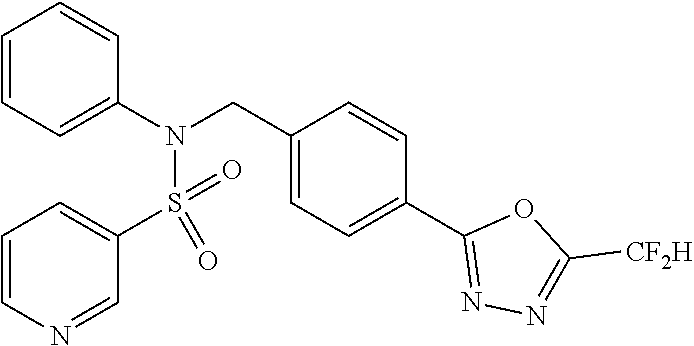
  • Triethylamine (0.075 mL, 0.544 mmol) was added to a solution of N-(4-(hydrazinecarbonyl)benzyl)-N-phenylpyridine-3-sulfonamide (0.160 g, 0.418 mmol) in tetrahydrofuran (8 mL) at the room temperature, and the mixture was stirred for 10 min at the same temperature.
  • the reaction mixture was treated with trifluoroacetic anhydride (0.061 mL, 0.460 mmol), heated at reflux for 14 hr, and cooled down to the room temperature to terminate the reaction. Then, saturated aqueous sodium bicarbonate solution was added to the reaction mixture, followed by extraction with dichloromethane.
  • the bi-phasic mixture was passed through a plastic frit to remove the solid residues and the aqueous layer, and the organic layer collected was concentrated in vacuo.
  • Triethylamine (0.075 mL, 0.544 mmol) was added to a solution of N-(4-(hydrazinecarbonyl)benzyl)-N-phenylpyridine-3-sulfonamide (0.160 g, 0.418 mmol) in tetrahydrofuran (8 mL) at the room temperature, and the mixture was stirred for 10 min at the same temperature.
  • the reaction mixture was treated with 2,2-difluoroacetic anhydride (0.050 mL, 0.460 mmol), heated at reflux for 14 hr, and cooled down to the room temperature to terminate the reaction. Then, saturated aqueous sodium bicarbonate solution was added to the reaction mixture, followed by extraction with dichloromethane.
  • the bi-phasic mixture was passed through a plastic frit to remove the solid residues and the aqueous layer, and the organic layer collected was concentrated in vacuo.
  • the bi-phasic mixture was passed through a plastic frit to remove the solid residues and the aqueous layer, and the organic layer collected was concentrated in vacuo.
  • the bi-phasic mixture was passed through a plastic frit to remove the solid residues and the aqueous layer, and the organic layer collected was concentrated in vacuo.
  • the bi-phasic mixture was passed through a plastic frit to remove the solid residues and the aqueous layer, and the organic layer collected was concentrated in vacuo.
  • N-phenylmethanesulfonamide (0.800 g, 4.673 mmol), sodium hydride (60.00%, 0.224 g, 5.607 mmol) and methyl 4-(bromomethyl)benzoate (1.177 g, 5.140 mmol) in N,N-dimethylformide (10 mL) was stirred at the room temperature for 5 hr. Then, water was added to the reaction mixture, followed by extraction with ethyl acetate. The organic layer was washed with aqueous saturated ammonium chloride solution, dried with anhydrous MgSO 4 , filtered, and concentrated in vacuo.
  • N-phenylmethanesulfonamide (0.800 g, 4.673 mmol), sodium hydride (60.00%, 0.224 g, 5.607 mmol) and methyl 4-(bromomethyl)-3-fluorobenzoate (1.270 g, 5.140 mmol) in N,N-dimethylformide (10 mL) was stirred at the room temperature for 5 hr. Then, water was added to the reaction mixture, followed by extraction with ethyl acetate. The organic layer was washed with aqueous saturated sodium chloride solution, dried with anhydrous MgSO 4 , filtered, and concentrated in vacuo.
  • N-phenylmethanesulfonamide (0.800 g, 4.673 mmol), sodium hydride (60.00%, 0.224 g, 5.607 mmol) and methyl 6-(bromomethyl)nicotinate (1.182 g, 5.140 mmol) in N,N-dimethylformide (10 mL) was stirred at the room temperature for 5 hr. Then, water was added to the reaction mixture, followed by extraction with ethyl acetate. The organic layer was washed with aqueous saturated sodium chloride solution, dried with anhydrous MgSO 4 , filtered, and concentrated in vacuo.
  • Methyl 5-formylpicolinate (0.975 g, 5.906 mmol) and acetic acid (0.338 mL, 5.906 mmol) were added to a solution of aniline (0.500 g, 5.369 mmol) in dichloromethane (20 mL) at the room temperature, and the mixture was stirred at the same temperature for 30 min.
  • the reaction mixture was treated with sodium triacetoxyborohydride (2.276 g, 10.738 mmol), stirred for additional 12 hr at the same temperature. Then, water was added to the reaction mixture, followed by extraction with dichloromethane.
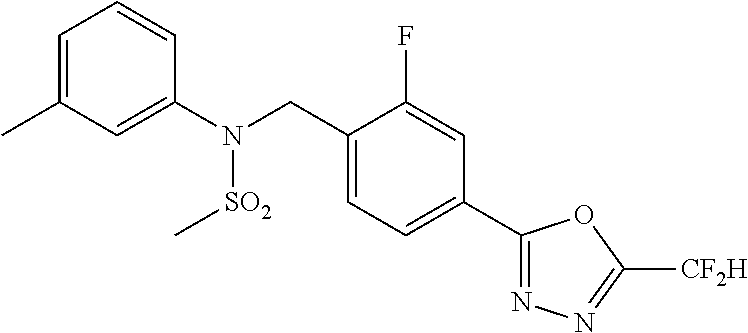
  • N-(m-tolyl)methanesulfonamide (0.500 g, 2.699 mmol), sodium hydride (60.00%, 0.130 g, 3.239 mmol) and methyl 4-(bromomethyl)-3-fluorobenzoate (0.734 g, 2.969 mmol) in N,N-dimethylformide (10 mL) was stirred at the room temperature for 5 hr. Then, water was added to the reaction mixture, followed by extraction with ethyl acetate. The organic layer was washed with aqueous saturated ammonium chloride solution, dried with anhydrous MgSO 4 , filtered, and concentrated in vacuo.
  • N-(3-methoxyphenyl)methanesulfonamide (0.700 g, 3.252 mmol), sodium hydride (60.00%, 0.156 g, 3.902 mmol) and methyl 4-(bromomethyl)-3-fluorobenzoate (0.884 g, 3.577 mmol) in N,N-dimethylformide (10 mL) was stirred at the room temperature for 5 hr. Then, water was added to the reaction mixture, followed by extraction with ethyl acetate. The organic layer was washed with aqueous saturated ammonium chloride solution, dried with anhydrous MgSO 4 , filtered, and concentrated in vacuo.
  • Methyl 2-fluoro-4-formylbenzoate (1.076 g, 5.906 mmol) and acetic acid (0.338 mL, 5.906 mmol) were added to a solution of aniline (0.500 g, 5.369 mmol) in dichloromethane (30 mL) at the room temperature, and the mixture was stirred at the same temperature for 30 min.
  • the reaction mixture was treated with sodium triacetoxyborohydride (2.276 g, 10.738 mmol), and stirred for additional 12 hr at the same temperature. Then, water was added to the reaction mixture, followed by extraction with dichloromethane.
  • Acetic acid (0.099 mL, 1.731 mmol) was added to a solution of methyl 4-(aminomethyl)benzoate (0.260 g, 1.574 mmol) and methyl 4-formylbenzoate (0.284 g, 1.731 mmol) in dichloromethane (10 mL) at the room temperature, and the mixture was stirred at the same temperature for 30 min.
  • the reaction mixture was treated with sodium triacetoxyborohydride (0.667 g, 3.148 mmol), and stirred for additional 12 hr at the same temperature. Then, water was added to the reaction mixture, followed by extraction with dichloromethane.
  • N-(3-chlorophenyl)methanesulfonamide (0.700 g, 3.404 mmol), sodium hydride (60.00%, 0.163 g, 4.084 mmol) and methyl 4-(bromomethyl)-3-fluorobenzoate (0.925 g, 3.744 mmol) in N,N-dimethylformide (10 mL) was stirred at the room temperature for 5 hr. Then, water was added to the reaction mixture, followed by extraction with ethyl acetate. The organic layer was washed with aqueous saturated ammonium chloride solution, dried with anhydrous MgSO 4 , filtered, and concentrated in vacuo.
  • N-(4-methoxyphenyl)methanesulfonamide 1.000 g, 4.969 mmol
  • sodium hydride (60.00%, 0.239 g, 5.963 mmol)
  • methyl 4-(bromomethyl)-3-fluorobenzoate (1.350 g, 5.466 mmol) in N,N-dimethylformide (20 mL) was stirred at the room temperature for 5 hr. Then, water was added to the reaction mixture, followed by extraction with ethyl acetate. The organic layer was washed with aqueous saturated ammonium chloride solution, dried with anhydrous MgSO 4 , filtered, and concentrated in vacuo.
  • N-(pyrimidin-5-yl)methanesulfonamide (0.610 g, 3.522 mmol), sodium hydride (60.00%, 0.169 g, 4.227 mmol) and methyl 4-(bromomethyl)-3-fluorobenzoate (0.957 g, 3.874 mmol) in N,N-dimethylformide (10 mL) was stirred at the room temperature for 5 hr. Then, water was added to the reaction mixture, followed by extraction with ethyl acetate. The organic layer was washed with aqueous saturated ammonium chloride solution, dried with anhydrous MgSO 4 , filtered, and concentrated in vacuo.
  • Acetic acid (0.283 mL, 4.950 mmol) was added to a solution of 3-fluoroaniline (0.500 g, 4.500 mmol) and methyl 6-formylnicotinate (0.817 g, 4.950 mmol) in dichloromethane (20 mL) at the room temperature, and the mixture was stirred at the same temperature for 30 min.
  • the reaction mixture was treated with sodium triacetoxyborohydride (1.907 g, 8.999 mmol), and stirred for additional 12 hr at the same temperature. Then, water was added to the reaction mixture, followed by extraction with dichloromethane.
  • N-(2-(trifluoromethyl)phenyl)methanesulfonamide (0.500 g, 2.090 mmol), sodium hydride (60.00%, 0.100 g, 2.508 mmol) and methyl 4-(bromomethyl)-3-fluorobenzoate (0.568 g, 2.299 mmol) in N,N-dimethylformide (10 mL) was stirred at the room temperature for 5 hr. Then, water was added to the reaction mixture, followed by extraction with ethyl acetate. The organic layer was washed with aqueous saturated ammonium chloride solution, dried with anhydrous MgSO 4 , filtered, and concentrated in vacuo.
  • Triethylamine (1.622 mL, 11.699 mmol) was added to a solution of 3-fluoroaniline (1.000 g, 8.999 mmol) in dichloromethane (14 mL) at the room temperature, and the mixture was stirred at the same temperature for 10 min.
  • the reaction mixture was treated with pyridine-3-sulfonyl chloride (1.758 g, 9.899 mmol), and stirred for additional 24 hr at the same temperature.
  • the precipitates were collected by filtration, washed by diethylether, and dried to give N-(3-fluorophenyl)pyridine-3-sulfonamide as light yellow solid (1.900 g, 83.7%).

Landscapes

  • Chemical & Material Sciences (AREA)
  • Organic Chemistry (AREA)
  • Health & Medical Sciences (AREA)
  • Medicinal Chemistry (AREA)
  • General Health & Medical Sciences (AREA)
  • Animal Behavior & Ethology (AREA)
  • Life Sciences & Earth Sciences (AREA)
  • Veterinary Medicine (AREA)
  • Public Health (AREA)
  • Pharmacology & Pharmacy (AREA)
  • Chemical Kinetics & Catalysis (AREA)
  • Nuclear Medicine, Radiotherapy & Molecular Imaging (AREA)
  • General Chemical & Material Sciences (AREA)
  • Bioinformatics & Cheminformatics (AREA)
  • Engineering & Computer Science (AREA)
  • Epidemiology (AREA)
  • Neurology (AREA)
  • Biomedical Technology (AREA)
  • Neurosurgery (AREA)
  • Immunology (AREA)
  • Heart & Thoracic Surgery (AREA)
  • Hematology (AREA)
  • Cardiology (AREA)
  • Diabetes (AREA)
  • Dermatology (AREA)
  • Physical Education & Sports Medicine (AREA)
  • Obesity (AREA)
  • Pharmaceuticals Containing Other Organic And Inorganic Compounds (AREA)
  • Plural Heterocyclic Compounds (AREA)
  • Heterocyclic Carbon Compounds Containing A Hetero Ring Having Nitrogen And Oxygen As The Only Ring Hetero Atoms (AREA)

Abstract

The present invention relates to novel compounds represented by the formula I having histone deacetylase 6 (HDAC6) inhibitory activity, stereoisomers thereof or pharmaceutically acceptable salts thereof, the use thereof for the preparation of therapeutic medicaments, pharmaceutical compositions containing the same, a method for treating diseases using the composition, and methods for preparing the novel compounds. (I) The novel compounds, stereoisomers thereof or pharmaceutically acceptable salts thereof according to the present invention have histone deacetylase (HDAC) inhibitory activity and are effective for the prevention or treatment of HDAC6-mediated diseases.
Figure US10538498-20200121-C00001

Description

TECHNICAL FIELD
The present invention relates to 1,3,4-oxadiazole sulfonamide derivative compounds having histone deacetylase 6 (HDAC6) inhibitory activity, stereoisomers thereof, or pharmaceutically acceptable salts thereof; uses thereof for the preparation of therapeutic medicaments; methods of treating diseases using the same; pharmaceutical compositions comprising the same; and methods for preparing the same.
BACKGROUND ART
Post-translational modifications such as acetylation are very crucial regulatory modules at the heart of biological processes in the cells and are tightly regulated by a multitude of enzymes. Histones are the chief protein components of chromatin and act as spools around which DNA strands. Also, the balance of histone acetylation and deacetylation is a critical role in the regulation of gene expression.
Histone deacetylases (HDACs) are enzymes that remove acetyl groups from lysine residues on histone proteins of chromatin, and are known to be associated with gene silencing and induce cell cycle arrest, angiogenic inhibition, immune regulation, cell death, etc. (Hassig et al., Curr. Opin. Chem. Biol. 1997, 1, 300-308). In addition, it was reported that the inhibition of enzymatic function of HDACs induces the apoptosis of cancer cells in vivo by reducing the activity of cancer cell survival-associated factors and activating cancer cell apoptosis-associated factors (Warrell et al, J. Natl. Cancer Inst. 1998, 90, 1621-1625).
In humans, 18 HDACs have been identified and are subdivided into four classes based on their homology to yeast HDACs. Among them, 11 HDACs use zinc as a cofactor and can be divided into three groups: Class I (HDAC1, 2, 3 and 8), Class II (IIa: HDAC4, 5, 7 and 9; IIb: HDAC6 and 10), Class IV (HDAC 11). Additionally, 7 HDACs of Class III (SIRT 1-7) require NAD+ instead of zinc as a cofactor (Bolden et al., Nat. Rev. Drug Discov. 2006, 5(9), 769-784).
Various HDAC inhibitors are in preclinical or clinical development, but to date, only non-selective HDAC inhibitors have been identified as anticancer agents, and only vorinostat (SAHA) and romidepsin (FK228) have been approved for the treatment of cutaneous T-cell lymphoma. However, non-selective HDAC inhibitors are known to cause side effects such as fatigue and nausea, generally at high doses (Piekarz et al., Pharmaceuticals 2010, 3, 2751-2767). Such side effects have been reported to be due to the inhibition of class I HDACs. Due to such side effects, the use of non-selective HDAC inhibitors in the development of drugs other than anticancer drugs has been limited (Witt et al., Cancer Letters, 2009, 277, 8-21).
Meanwhile, it was reported that the selective inhibition of class II HDACs would not show toxicity shown in the inhibition of class I HDACs. Also, when selective HDAC inhibitors are developed, side effects such as toxicity, which are caused by the non-selective HDAC inhibition, can be overcome. Thus, selective HDAC inhibitors have potential to be developed as therapeutic agents effective for the treatment of various diseases (Matthias et al., Mol. Cell. Biol. 2008, 28, 1688-1701).
It is known that HDAC6, a member of Class IIb HDACs, is present mainly in the cytoplasm and is involved in the deacetylation of a number of non-histone substrates (HSP90, cortactin, etc.), including tubulin, (Yao et al., Mol. Cell 2005, 18, 601-607). HDAC6 has two catalytic domains, and the zinc finger domain of C-terminal can bind to ubiquitinated proteins. It is known that HDAC6 has a number of non-histone proteins as substrates, and thus plays an important role in various diseases, including cancer, inflammatory diseases, autoimmune diseases, neurological diseases and neurodegenerative disorders (Santo et al., Blood 2012 119: 2579-258; Vishwakarma et al., International Immunopharmacology 2013, 16, 72-78; Hu et al., J. Neurol. Sci. 2011, 304, 1-8).
The common structural characteristic of various HDAC inhibitors is a structure consisting of a cap group, a linker and a zinc-binding group (ZBG), as shown in the following Vorinostat structure. Many researchers have conducted studies on enzyme inhibitory activity and selectivity by structurally modifying the cap group and the linker Among these groups, the zinc-binding group is known to play a more important role in enzyme inhibitory activity and selectivity (Wiest et al., J. Org. Chem. 2013 78: 5051-5065; Methot et al., Bioorg. Med. Chem. Lett. 2008, 18, 973-978).
Figure US10538498-20200121-C00002
The zinc-binding group is generally a hydroxamic acid or benzamide derivative. Herein, the hydroxamic acid derivative exhibits a potent HDAC inhibitory effect, but has problems of low bioavailability and severe off-target activity. In addition, the benzamide derivative has a problem in that it can produce toxic metabolites in vivo, because it contains aniline (Woster et al., Med. Chem. Commun. 2015, online publication).
Accordingly, there is a need for the development of selective HDAC 6 inhibitors for treatment of diseases such as cancer, inflammatory diseases, autoimmune diseases, neurological diseases and neurodegenerative disorders, which have a zinc-binding group with improved bioavailability and, at the same time, cause no side effects, unlike non-selective inhibitors that cause side effects.
DISCLOSURE OF INVENTION Technical Problem
It is an object of the present invention to provide 1,3,4-oxadiazole sulfonamide derivative compounds having selective HDAC6 inhibitory activity, stereoisomers thereof, or pharmaceutically acceptable salts thereof.
Another object of the present invention is to provide pharmaceutical compositions containing 1,3,4-oxadiazole sulfonamide derivative compounds having selective HDAC6 inhibitory activity, stereoisomers thereof, or pharmaceutically acceptable salts thereof.
Still another object of the present invention is to provide methods for preparing the novel compounds.
Still another object of the present invention is to provide pharmaceutical compositions for prevention or treatment of HDAC6 activity-associated diseases, including infectious diseases; neoplasms; endocrine, nutritional and metabolic diseases; mental and behavioral disorders; neurological diseases; diseases of the eye and adnexa; cardiovascular diseases; respiratory diseases; digestive diseases; diseases of the skin and subcutaneous tissue; diseases of the musculoskeletal system and connective tissue; or congenital malformations, deformations and chromosomal abnormalities, which contain the above compound.
Still another object of the present invention is to provide the use of the compounds for the preparation of therapeutic medicaments against HDAC6 activity-associated diseases.
Yet another object of the present invention is to provide methods for treating HDAC6 activity-associated diseases, which comprise administering a therapeutically effective amount of the pharmaceutical compositions containing the compounds.
Solution to Problem
The present inventors have discovered 1,3,4-oxadiazole sulfonamide derivative compounds, which have histone deacetylase 6 (HDAC6) inhibitory activity, and have found that these compounds can be used for the inhibition or treatment of histone deacetylase 6 (HDAC6) activity-associated diseases, thereby completing the present invention.
1,3,4-Oxadiazole Sulfonamide Derivative Compounds
To achieve the above objects, the present invention provides an 1,3,4-oxadiazole sulfonamide derivative compound represented by the following formula I, a stereoisomer thereof, or a pharmaceutically acceptable salt thereof:
Figure US10538498-20200121-C00003
wherein R1 is —CX2H or —CX3;
R2 is —(C1-C4 alkyl), —(C1-C4 alkyl)-O(C1-C4 alkyl), —(C1-C4)—C(═O)—O(C1-C4 alkyl), —(C1-C4 alkyl)-O—C(═O)—(C1-C4 alkyl), —(C1-C4 alkyl)-NRARB, —(C1-C4 alkyl)-aryl, —(C1-C4 alkyl)-heteroaryl, -aryl, -heteroaryl,
Figure US10538498-20200121-C00004
wherein at least one H of the —(C1-C4 alkyl), —(C1-C4 alkyl)-O(C1-C4 alkyl), —(C1-C4 alkyl)-C(═O)—O(C1-C4 alkyl), —(C1-C4 alkyl)-O—C(═O)—(C1-C4 alkyl) or —(C1-C4 alkyl)-NRARB may be substituted with —X or —OH,
at least one H of the —(C1-C4 alkyl)-aryl, —(C1-C4 alkyl)heteroaryl, -aryl or -heteroaryl may be substituted with —X, —OH, —O(C1-C4 alkyl), —(C1-C4 alkyl), —CF3, —CF2H, —(C1-C4 alkyl)-OH, —C(═O)—(C1-C4 alkyl), —C(═O)—O(C1-C4 alkyl), —(C1-C4 alkyl)-C(═O)—(C1-C4 alkyl), —C(═O)—CF3 or —C(═O)—CF2H, and
at least one H of
Figure US10538498-20200121-C00005

may be substituted with —X, —OH, —O(C1-C4 alkyl), —NRARB, —CN, —(C1-C4 alkyl), —CF3, —CF2H, —(C1-C4 alkyl)-OH, —(C1-C4 alkyl)-NRARB, —C(═O)—(C1-C4 alkyl), —C(═O)—CF3, —C(═O)—CF2H, —C(═O)—NRARB, —C(═O)—O(C1-C4 alkyl), —(C1-C4 alkyl)-C(═O)—(C1-C4 alkyl), —(C1-C4 alkyl)-OC(═O)—CF2H, —(C3-C6 heterocycloalkyl), —(C1-C4 alkyl)-aryl, aryl or heteroaryl, wherein at least one H of the —(C1-C4 alkyl)-aryl, aryl or heteroaryl may be substituted with —X, —OH, —O(C1-C4 alkyl) or —(C1-C4 alkyl);
R3 is —H, —(C1-C4 alkyl), —(C1-C4 alkyl)-O(C1-C4 alkyl), —(C1-C4 alkyl)-C(═O)—O(C1-C4 alkyl), -aryl, -heteroaryl,
Figure US10538498-20200121-C00006

wherein at least one H of the —(C1-C4 alkyl), —(C1-C4 alkyl)-O(C1-C4 alkyl) or —(C1-C4 alkyl)-C(═O)—O(C1-C4 alkyl) may be substituted with —X or —OH,
at least one H of the -aryl or -heteroaryl may be substituted with —X, —OH, —O(C1-C4 alkyl), —(C1-C4 alkyl), —CF3, —CF2H, —(C1-C4 alkyl)-OH, —C(═O)—(C1-C4 alkyl), —C(═O)—O(C1-C4 alkyl), —(C1-C4 alkyl)-C(═O)—(C1-C4 alkyl), —C(═O)—CF3, —C(═O)—CF2H,
Figure US10538498-20200121-C00007
at least one H of
Figure US10538498-20200121-C00008

may be substituted with —X, —OH, —O(C1-C4 alkyl), —(C1-C4 alkyl), —C(═O)—(C1-C4 alkyl), —C(═O)—O(C1-C4 alkyl) or —(C3-C6 heterocycloalkyl);
R4 is —CX2H or —CX3;
L1 to L4 are each independently —(C0-C2 alkyl)-;
Z1 to Z8 are each independently N or CRZ, wherein at least three of Z1 to Z4 or Z5 to Z8 may not be simultaneously N, and RZ is —H, —X or —O(C1-C4 alkyl);
Z9 and Z10 are each independently N or S;
Y1 to Y3 are each independently —CH2—, —NRC—, —O— or —S(═O)2—;
Y4 to Y7 are each independently —CH2—, —NRD— or —O—;
Y8 is —C(═O), —CH2— or —NRE—;
Y9 and Y10 are each independently —NRF— or —S(═O)2—;
RA and RB are each independently —H, —(C1-C4 alkyl), —(C1-C4 alkyl)-aryl, —C(═O)—CF2H or —C(═O)—O(C1-C4 alkyl);
RC to RE are each independently —H, —(C1-C4 alkyl), —(C1-C4 alkyl)-OH, —(C1-C4 alkyl)-O—(C1-C4 alkyl), —C(═O)—(C1-C4 alkyl), —C(═O)—O(C1-C4 alkyl), —C(═O)—(C3-C7 cycloalkyl), —(C1-C4 alkyl)-C(═O)—(C2-C6 heterocycloalkyl), —S(═O)2—(C1-C4 alkyl), —(C1-C4 alkyl) aryl, —(C2-C4 alkenyl)-aryl, —(C1-C4 alkyl)-heteroaryl, -aryl, -heteroaryl,
Figure US10538498-20200121-C00009
wherein at least one H of the —(C1-C4 alkyl)-aryl, —(C2-C4 alkenyl)-aryl, —(C1-C4 alkyl)-heteroaryl, -aryl, -heteroaryl,
Figure US10538498-20200121-C00010

may be substituted with —X, —OH, —O(C1-C4 alkyl), —(C1-C4 alkyl) or —CF3;
Y11 is —CH2—, —NRF— or —O—;
RF is —(C1-C4 alkyl), —C(═O)—(C1-C4 alkyl), —C(═O)—(C1-C4 alkyl)-OH, —C(═O)—(C3-C7 cycloalkyl) or —S(═O)2—(C1-C4 alkyl);
Figure US10538498-20200121-P00001
is a single bond or a double bond, provided that
Figure US10538498-20200121-P00001
is a double bond, Y1 or Y2 is —CH—;
a to e are each independently an integer of 0, 1, 2 or 3, provided that a and b may not be simultaneously 0, and c and d may not be simultaneously 0; and
X is F, Cl, Br or I.
According to preferable embodiment of the present invention,
R1 is —CX2H or —CX3;
R2 is —(C1-C4 alkyl), —(C1-C4 alkyl)-O(C1-C4 alkyl), —(C1-C4 alkyl)-C(═O)—O(C1-C4 alkyl), —(C1-C4 alkyl)-O—C(═O)—(C1-C4 alkyl), —(C1-C4 alkyl)-NRARB, —(C1-C4 alkyl)-heteroaryl, -aryl, -heteroaryl,
Figure US10538498-20200121-C00011
wherein at least one H of the —(C1-C4 alkyl), —(C1-C4 alkyl)-O(C1-C4 alkyl), —(C1-C4 alkyl)-C(═O)—O(C1-C4 alkyl), —(C1-C4 alkyl)-O—C(═O)—(C1-C4 alkyl) or —(C1-C4 alkyl)-NRARB may be substituted with —X or —OH,
at least one H of the —(C1-C4 alkyl)-heteroaryl, -aryl or -heteroaryl may be substituted with —O(C1-C4 alkyl), —(C1-C4 alkyl) or —(C1-C4 alkyl)-OH, and
at least one H of
Figure US10538498-20200121-C00012

may be substituted with —X, —OH, —NRARB, —CN, —(C1-C4 alkyl), —(C1-C4 alkyl)-OH, —(C1-C4 alkyl)-NRARB, —C(═O)—NRARB, —C(═O)—O(C1-C4 alkyl), —(C1-C4 alkyl)-C(═O)—(C1-C4 alkyl), —(C1-C4 alkyl)-OC(═O)—CF2H, —(C3-C6 heterocycloalkyl), —(C1-C4 alkyl)-aryl, -aryl or -heteroaryl, wherein at least one H of the —(C1-C4 alkyl)-aryl, -aryl or -heteroaryl may be substituted with —X, —OH, —O(C1-C4 alkyl) or —(C1-C4 alkyl);
R3 is —H, —(C1-C4 alkyl), -aryl, -heteroaryl,
Figure US10538498-20200121-C00013

wherein at least one H of the —(C1-C4 alkyl) may be substituted with —X or —OH,
at least one H of the -aryl or -heteroaryl may be substituted with —X, —O(C1-C4 alkyl), —(C1-C4 alkyl), —CF3, —C(═O)—(C1-C4 alkyl),
Figure US10538498-20200121-C00014

and
at least and H of
Figure US10538498-20200121-C00015

may be substituted with —(C1-C4 alkyl), —C(═O)—(C1-C4 alkyl), —C(═O)—O(C1-C4 alkyl) or —(C3-C6 heterocycloalkyl);
R4 is —CX2H or —CX3;
L1 to L4 are each independently —(C0-C2 alkyl)-;
Z1 to Z8 are each independently N or CRZ, wherein at least three of Z1 to Z4 or Z5 to Z8 may not be simultaneously N, and RZ is —H, —X or —O(C1-C4 alkyl);
Z9 and Z10 are each independently N or S;
Y1 to Y3 are each independently —CH2—, —NRC—, —O— or —S(═O)2—;
Y4 to Y7 are each independently —CH2—, —NRD— or —O—;
Y8 is —C(═O), —CH2— or —NRE—;
Y9 and Y10 are each independently —NRF— or —S(═O)2—;
RA and RB are each independently —H, —(C1-C4 alkyl), —(C1-C4 alkyl)-aryl, —C(═O)—CF2H or —C(═O)—O(C1-C4 alkyl);
RC to RE are each independently —H, —(C1-C4 alkyl), —(C1-C4 alkyl)-OH, —(C1-C4 alkyl)-O—(C1-C4 alkyl), —C(═O)—(C1-C4 alkyl), —C(═O)—O(C1-C4 alkyl), —C(═O)—(C3-C7 cycloalkyl), —(C1-C4 alkyl)-C(═O)—(C2-C6 heterocycloalkyl), —S(═O)2-(C1-C4 alkyl), —(C1-C4 alkyl)-aryl, —(C2-C4 alkenyl)-aryl, —(C1-C4 alkyl)−
Figure US10538498-20200121-C00016

heteroaryl, -aryl, -heteroaryl,
wherein at least one H of the —(C1-C4 alkyl)-aryl, —(C2-C4 alkenyl)-aryl, —(C1-C4 alkyl)-heteroaryl, -aryl, -heteroaryl,
Figure US10538498-20200121-C00017

may be substituted with —X, —OH, —O(C1-C4 alkyl), —(C1-C4 alkyl) or —CF3;
Y11 is —CH2—, —NRF— or —O—;
RF is —(C1-C4 alkyl), —C(═O)—(C1-C4 alkyl), —C(═O)—(C1-C4 alkyl)-OH, —C(═O)—(C3-C7 cycloalkyl) or —S(═O)2—(C1-C4 alkyl);
Figure US10538498-20200121-P00001
is a single bond or a double bond, provided that
Figure US10538498-20200121-P00001
is a double bond, Y1 or Y2 is —CH—;
a to e are each independently an integer of 0, 1, 2 or 3, provided that a and b may not be simultaneously 0, and c and d may not be simultaneously 0; and
X is F, Cl, Br or I.
According to more preferable embodiment of the present invention,
R1 is —CX2H;
R2 is —(C1-C4 alkyl), —(C1-C4 alkyl)-C(═O)—O(C1-C4 alkyl), —(C1-C4 alkyl)-NRARB, -heteroaryl,
Figure US10538498-20200121-C00018
wherein at least one H of the —(C1-C4 alkyl), —(C1-C4 alkyl)-C(═O)—O(C1-C4 alkyl) or —(C1-C4 alkyl)-NRARB may be substituted with —X or —OH,
at least one H of the -heteroaryl may be substituted with —O(C1-C4 alkyl), —(C1-C4 alkyl) or —(C1-C4 alkyl)-OH, and
at least one H of
Figure US10538498-20200121-C00019

may be substituted with —(C1-C4 alkyl) or —(C1-C4 alkyl)-OH;
R3 is -aryl, -heteroaryl or
Figure US10538498-20200121-C00020
wherein at least one H of the -aryl or -heteroaryl may be substituted with —X, —O(C1-C4 alkyl), —(C1-C4 alkyl), —CF3 or —C(═O)—(C1-C4 alkyl), and
at least one H of
Figure US10538498-20200121-C00021

may be substituted with —(C1-C4 alkyl);
L1 and L3 are each independently —(C0 alkyl)-;
L2 is —(C1 alkyl)-;
Z1 to Z4 are each independently N or CRZ, wherein at least two of Z1 to Z4 may not be simultaneously N, and RZ is —H or X;
Y1 is —NRC—, —O— or —S(═O)2—;
Y2 is —CH2— or —NRC—;
Y6 and Y7 are each independently —O—;
Y8 is —CH2—;
RA and RB are each independently —(C1-C4 alkyl);
RC is —(C1-C4 alkyl), —(C1-C4 alkyl)-OH, —C(═O)—(C1-C4 alkyl), —S(═O)2—(C1-C4 alkyl) or
Figure US10538498-20200121-C00022
wherein at least one H of
Figure US10538498-20200121-C00023

may be substituted with —(C1-C4 alkyl);
Y11 is —NRF— or —O—;
RF is —(C1-C4 alkyl), —C(═O)—(C1-C4 alkyl), —C(═O)—(C1-C4 alkyl)-OH or —S(═O)2—(C1-C4 alkyl);
Figure US10538498-20200121-P00001
is a single bond;
a, b and e are each independently an integer of 0, 1 or 2, provided that a and b may not be simultaneously 0; and
X is F, Cl, Br or I.
According to particularly preferable embodiment of the present invention,
R1 is —CF2H;
R2 is —(C1-C4 alkyl), —(C1-C4 alkyl)-NRARB,
Figure US10538498-20200121-C00024
wherein at least one H of the —(C1-C4 alkyl) or —(C1-C4 alkyl)-NRARB may be substituted with —X or OH, and
at least one H of
Figure US10538498-20200121-C00025

may be substituted with —(C1-C4 alkyl);
R3 is -aryl or -heteroaryl,
wherein at least one H of the -aryl or -heteroaryl may be substituted with —X or —(C1-C4 alkyl);
L1 and L3 are each independently —(C0 alkyl)-;
L2 is —(C1 alkyl)-;
Z1 to Z4 are each independently N or CRZ, wherein at least two of Z1 to Z4 may not be simultaneously N, and RZ is H or X;
Y1 is —NRC—, —O— or —S(═O)2—;
Y2 is —NRC—;
RA and RB are each independently —(C1-C4 alkyl);
RC is —(C1-C4 alkyl), —C(═O)—(C1-C4 alkyl), —S(═O)2—(C1-C4 alkyl) or
Figure US10538498-20200121-C00026

wherein at least one H of
Figure US10538498-20200121-C00027

may be substituted with —(C1-C4 alkyl);
Y11 is —NRF— or —O—;
RF is —(C1-C4 alkyl), —C(═O)—(C1-C4 alkyl), —C(═O)—(C1-C4 alkyl)-OH or —S(═O)2—(C1-C4 alkyl);
Figure US10538498-20200121-P00001
is a single bond;
a, b and e are each independently an integer of 0, 1 or 2, provided that a and b may not be simultaneously 0; and
X is F, Cl or Br.
The specific compounds represented by formula I are shown in Table 1 below:
TABLE 1
Ex. Comp. Structure
1 11044
Figure US10538498-20200121-C00028
2 11045
Figure US10538498-20200121-C00029
3 11078
Figure US10538498-20200121-C00030
4 11088
Figure US10538498-20200121-C00031
5 1089
Figure US10538498-20200121-C00032
6 11120
Figure US10538498-20200121-C00033
7 11121
Figure US10538498-20200121-C00034
8 11128
Figure US10538498-20200121-C00035
9 11129
Figure US10538498-20200121-C00036
10 11133
Figure US10538498-20200121-C00037
11 11151
Figure US10538498-20200121-C00038
12 11152
Figure US10538498-20200121-C00039
13 11153
Figure US10538498-20200121-C00040
14 11154
Figure US10538498-20200121-C00041
15 11155
Figure US10538498-20200121-C00042
16 11156
Figure US10538498-20200121-C00043
17 11167
Figure US10538498-20200121-C00044
18 11168
Figure US10538498-20200121-C00045
19 11169
Figure US10538498-20200121-C00046
20 11170
Figure US10538498-20200121-C00047
21 11171
Figure US10538498-20200121-C00048
22 11172
Figure US10538498-20200121-C00049
23 11173
Figure US10538498-20200121-C00050
24 11174
Figure US10538498-20200121-C00051
25 11175
Figure US10538498-20200121-C00052
26 11176
Figure US10538498-20200121-C00053
27 11177
Figure US10538498-20200121-C00054
28 11178
Figure US10538498-20200121-C00055
29 11179
Figure US10538498-20200121-C00056
30 11180
Figure US10538498-20200121-C00057
31 11181
Figure US10538498-20200121-C00058
32 11182
Figure US10538498-20200121-C00059
33 11183
Figure US10538498-20200121-C00060
34 11184
Figure US10538498-20200121-C00061
35 11186
Figure US10538498-20200121-C00062
36 11190
Figure US10538498-20200121-C00063
37 11191
Figure US10538498-20200121-C00064
38 11192
Figure US10538498-20200121-C00065
39 11193
Figure US10538498-20200121-C00066
40 11194
Figure US10538498-20200121-C00067
41 11195
Figure US10538498-20200121-C00068
42 11196
Figure US10538498-20200121-C00069
43 11197
Figure US10538498-20200121-C00070
44 11216
Figure US10538498-20200121-C00071
45 11217
Figure US10538498-20200121-C00072
46 11218
Figure US10538498-20200121-C00073
47 11219
Figure US10538498-20200121-C00074
48 11220
Figure US10538498-20200121-C00075
49 11221
Figure US10538498-20200121-C00076
50 11222
Figure US10538498-20200121-C00077
51 11225
Figure US10538498-20200121-C00078
52 11226
Figure US10538498-20200121-C00079
53 11227
Figure US10538498-20200121-C00080
54 11229
Figure US10538498-20200121-C00081
55 11230
Figure US10538498-20200121-C00082
56 11231
Figure US10538498-20200121-C00083
57 11248
Figure US10538498-20200121-C00084
58 11249
Figure US10538498-20200121-C00085
59 11250
Figure US10538498-20200121-C00086
60 11251
Figure US10538498-20200121-C00087
61 11252
Figure US10538498-20200121-C00088
62 11253
Figure US10538498-20200121-C00089
63 11254
Figure US10538498-20200121-C00090
64 11255
Figure US10538498-20200121-C00091
65 11256
Figure US10538498-20200121-C00092
66 11271
Figure US10538498-20200121-C00093
67 11272
Figure US10538498-20200121-C00094
68 11273
Figure US10538498-20200121-C00095
69 11274
Figure US10538498-20200121-C00096
70 11275
Figure US10538498-20200121-C00097
71 11276
Figure US10538498-20200121-C00098
72 11277
Figure US10538498-20200121-C00099
73 11278
Figure US10538498-20200121-C00100
74 11279
Figure US10538498-20200121-C00101
75 11280
Figure US10538498-20200121-C00102
76 11281
Figure US10538498-20200121-C00103
77 11282
Figure US10538498-20200121-C00104
78 11283
Figure US10538498-20200121-C00105
79 11284
Figure US10538498-20200121-C00106
80 11287
Figure US10538498-20200121-C00107
81 11288
Figure US10538498-20200121-C00108
82 11289
Figure US10538498-20200121-C00109
83 11290
Figure US10538498-20200121-C00110
84 11291
Figure US10538498-20200121-C00111
85 11292
Figure US10538498-20200121-C00112
86 11323
Figure US10538498-20200121-C00113
87 11324
Figure US10538498-20200121-C00114
88 11338
Figure US10538498-20200121-C00115
89 11345
Figure US10538498-20200121-C00116
90 11346
Figure US10538498-20200121-C00117
91 11347
Figure US10538498-20200121-C00118
92 11348
Figure US10538498-20200121-C00119
93 11350
Figure US10538498-20200121-C00120
94 11351
Figure US10538498-20200121-C00121
95 11352
Figure US10538498-20200121-C00122
96 11353
Figure US10538498-20200121-C00123
97 11354
Figure US10538498-20200121-C00124
98 11355
Figure US10538498-20200121-C00125
99 11366
Figure US10538498-20200121-C00126
100 11367
Figure US10538498-20200121-C00127
101 11368
Figure US10538498-20200121-C00128
102 11372
Figure US10538498-20200121-C00129
103 11373
Figure US10538498-20200121-C00130
104 11377
Figure US10538498-20200121-C00131
105 11386
Figure US10538498-20200121-C00132
106 11387
Figure US10538498-20200121-C00133
107 11388
Figure US10538498-20200121-C00134
108 11389
Figure US10538498-20200121-C00135
109 11390
Figure US10538498-20200121-C00136
110 11392
Figure US10538498-20200121-C00137
111 11402
Figure US10538498-20200121-C00138
112 11403
Figure US10538498-20200121-C00139
113 11404
Figure US10538498-20200121-C00140
114 11405
Figure US10538498-20200121-C00141
115 11406
Figure US10538498-20200121-C00142
116 11411
Figure US10538498-20200121-C00143
117 11412
Figure US10538498-20200121-C00144
118 11426
Figure US10538498-20200121-C00145
119 11427
Figure US10538498-20200121-C00146
120 11428
Figure US10538498-20200121-C00147
121 11429
Figure US10538498-20200121-C00148
122 11430
Figure US10538498-20200121-C00149
123 11431
Figure US10538498-20200121-C00150
124 11432
Figure US10538498-20200121-C00151
125 11433
Figure US10538498-20200121-C00152
126 11447
Figure US10538498-20200121-C00153
127 11448
Figure US10538498-20200121-C00154
128 11451
Figure US10538498-20200121-C00155
129 11452
Figure US10538498-20200121-C00156
130 11460
Figure US10538498-20200121-C00157
131 11461
Figure US10538498-20200121-C00158
132 11462
Figure US10538498-20200121-C00159
133 11463
Figure US10538498-20200121-C00160
134 11497
Figure US10538498-20200121-C00161
135 11501
Figure US10538498-20200121-C00162
136 11502
Figure US10538498-20200121-C00163
137 11503
Figure US10538498-20200121-C00164
138 11504
Figure US10538498-20200121-C00165
139 11505
Figure US10538498-20200121-C00166
140 11506
Figure US10538498-20200121-C00167
141 11507
Figure US10538498-20200121-C00168
142 11508
Figure US10538498-20200121-C00169
143 11514
Figure US10538498-20200121-C00170
144 11518
Figure US10538498-20200121-C00171
145 11520
Figure US10538498-20200121-C00172
146 11521
Figure US10538498-20200121-C00173
147 11522
Figure US10538498-20200121-C00174
148 11539
Figure US10538498-20200121-C00175
149 11540
Figure US10538498-20200121-C00176
150 11541
Figure US10538498-20200121-C00177
151 11552
Figure US10538498-20200121-C00178
152 11553
Figure US10538498-20200121-C00179
153 11554
Figure US10538498-20200121-C00180
154 11564
Figure US10538498-20200121-C00181
155 11565
Figure US10538498-20200121-C00182
156 11566
Figure US10538498-20200121-C00183
157 11567
Figure US10538498-20200121-C00184
158 11573
Figure US10538498-20200121-C00185
159 11582
Figure US10538498-20200121-C00186
160 11583
Figure US10538498-20200121-C00187
161 11588
Figure US10538498-20200121-C00188
162 11589
Figure US10538498-20200121-C00189
163 11605
Figure US10538498-20200121-C00190
164 11606
Figure US10538498-20200121-C00191
165 11625
Figure US10538498-20200121-C00192
166 11628
Figure US10538498-20200121-C00193
167 11629
Figure US10538498-20200121-C00194
168 11630
Figure US10538498-20200121-C00195
169 11631
Figure US10538498-20200121-C00196
170 11632
Figure US10538498-20200121-C00197
171 11633
Figure US10538498-20200121-C00198
172 11634
Figure US10538498-20200121-C00199
173 11636
Figure US10538498-20200121-C00200
174 11637
Figure US10538498-20200121-C00201
175 11638
Figure US10538498-20200121-C00202
176 11639
Figure US10538498-20200121-C00203
177 11645
Figure US10538498-20200121-C00204
178 11646
Figure US10538498-20200121-C00205
179 11647
Figure US10538498-20200121-C00206
180 11648
Figure US10538498-20200121-C00207
181 11655
Figure US10538498-20200121-C00208
182 11656
Figure US10538498-20200121-C00209
183 11657
Figure US10538498-20200121-C00210
184 11658
Figure US10538498-20200121-C00211
185 11663
Figure US10538498-20200121-C00212
186 11665
Figure US10538498-20200121-C00213
187 11668
Figure US10538498-20200121-C00214
188 11669
Figure US10538498-20200121-C00215
189 11675
Figure US10538498-20200121-C00216
190 11676
Figure US10538498-20200121-C00217
191 11677
Figure US10538498-20200121-C00218
192 11678
Figure US10538498-20200121-C00219
193 11679
Figure US10538498-20200121-C00220
194 11680
Figure US10538498-20200121-C00221
195 11681
Figure US10538498-20200121-C00222
196 11682
Figure US10538498-20200121-C00223
197 11683
Figure US10538498-20200121-C00224
198 11684
Figure US10538498-20200121-C00225
199 11685
Figure US10538498-20200121-C00226
200 11686
Figure US10538498-20200121-C00227
201 11687
Figure US10538498-20200121-C00228
202 11688
Figure US10538498-20200121-C00229
203 11689
Figure US10538498-20200121-C00230
204 11690
Figure US10538498-20200121-C00231
205 11691
Figure US10538498-20200121-C00232
206 11692
Figure US10538498-20200121-C00233
207 11693
Figure US10538498-20200121-C00234
208 11694
Figure US10538498-20200121-C00235
209 11695
Figure US10538498-20200121-C00236
210 11696
Figure US10538498-20200121-C00237
211 11697
Figure US10538498-20200121-C00238
212 11698
Figure US10538498-20200121-C00239
213 11699
Figure US10538498-20200121-C00240
214 11700
Figure US10538498-20200121-C00241
215 11705
Figure US10538498-20200121-C00242
216 11706
Figure US10538498-20200121-C00243
217 11707
Figure US10538498-20200121-C00244
218 11708
Figure US10538498-20200121-C00245
219 11709
Figure US10538498-20200121-C00246
220 11710
Figure US10538498-20200121-C00247
221 11711
Figure US10538498-20200121-C00248
222 11712
Figure US10538498-20200121-C00249
223 11717
Figure US10538498-20200121-C00250
224 11718
Figure US10538498-20200121-C00251
225 11719
Figure US10538498-20200121-C00252
226 11721
Figure US10538498-20200121-C00253
227 11722
Figure US10538498-20200121-C00254
228 11723
Figure US10538498-20200121-C00255
229 11724
Figure US10538498-20200121-C00256
230 11725
Figure US10538498-20200121-C00257
231 11726
Figure US10538498-20200121-C00258
232 11727
Figure US10538498-20200121-C00259
233 11728
Figure US10538498-20200121-C00260
234 11729
Figure US10538498-20200121-C00261
235 11730
Figure US10538498-20200121-C00262
236 11731
Figure US10538498-20200121-C00263
237 11732
Figure US10538498-20200121-C00264
238 11733
Figure US10538498-20200121-C00265
239 11734
Figure US10538498-20200121-C00266
240 11735
Figure US10538498-20200121-C00267
241 11736
Figure US10538498-20200121-C00268
242 11737
Figure US10538498-20200121-C00269
243 11738
Figure US10538498-20200121-C00270
244 11739
Figure US10538498-20200121-C00271
245 11740
Figure US10538498-20200121-C00272
246 11741
Figure US10538498-20200121-C00273
247 11742
Figure US10538498-20200121-C00274
248 11743
Figure US10538498-20200121-C00275
249 11744
Figure US10538498-20200121-C00276
250 11745
Figure US10538498-20200121-C00277
251 11746
Figure US10538498-20200121-C00278
252 11747
Figure US10538498-20200121-C00279
253 11748
Figure US10538498-20200121-C00280
254 11749
Figure US10538498-20200121-C00281
255 11750
Figure US10538498-20200121-C00282
256 11751
Figure US10538498-20200121-C00283
257 11752
Figure US10538498-20200121-C00284
258 11753
Figure US10538498-20200121-C00285
259 11754
Figure US10538498-20200121-C00286
260 11755
Figure US10538498-20200121-C00287
261 11756
Figure US10538498-20200121-C00288
262 11757
Figure US10538498-20200121-C00289
263 11758
Figure US10538498-20200121-C00290
264 11759
Figure US10538498-20200121-C00291
265 11760
Figure US10538498-20200121-C00292
266 11761
Figure US10538498-20200121-C00293
267 11762
Figure US10538498-20200121-C00294
268 11763
Figure US10538498-20200121-C00295
269 11764
Figure US10538498-20200121-C00296
270 11765
Figure US10538498-20200121-C00297
271 11766
Figure US10538498-20200121-C00298
272 11767
Figure US10538498-20200121-C00299
273 11768
Figure US10538498-20200121-C00300
274 11769
Figure US10538498-20200121-C00301
275 11770
Figure US10538498-20200121-C00302
276 11771
Figure US10538498-20200121-C00303
277 11772
Figure US10538498-20200121-C00304
278 11773
Figure US10538498-20200121-C00305
279 11774
Figure US10538498-20200121-C00306
280 11775
Figure US10538498-20200121-C00307
281 11776
Figure US10538498-20200121-C00308
282 11777
Figure US10538498-20200121-C00309
283 11778
Figure US10538498-20200121-C00310
284 11779
Figure US10538498-20200121-C00311
285 11780
Figure US10538498-20200121-C00312
286 11781
Figure US10538498-20200121-C00313
287 11782
Figure US10538498-20200121-C00314
288 11783
Figure US10538498-20200121-C00315
289 11784
Figure US10538498-20200121-C00316
290 11785
Figure US10538498-20200121-C00317
291 11786
Figure US10538498-20200121-C00318
292 11790
Figure US10538498-20200121-C00319
293 11791
Figure US10538498-20200121-C00320
294 11792
Figure US10538498-20200121-C00321
295 11793
Figure US10538498-20200121-C00322
296 11794
Figure US10538498-20200121-C00323
297 11795
Figure US10538498-20200121-C00324
298 11796
Figure US10538498-20200121-C00325
299 11797
Figure US10538498-20200121-C00326
300 11798
Figure US10538498-20200121-C00327
301 11799
Figure US10538498-20200121-C00328
302 11800
Figure US10538498-20200121-C00329
303 11801
Figure US10538498-20200121-C00330
304 11802
Figure US10538498-20200121-C00331
305 11803
Figure US10538498-20200121-C00332
306 11804
Figure US10538498-20200121-C00333
307 11805
Figure US10538498-20200121-C00334
308 11806
Figure US10538498-20200121-C00335
309 11807
Figure US10538498-20200121-C00336
310 11808
Figure US10538498-20200121-C00337
311 11809
Figure US10538498-20200121-C00338
312 11810
Figure US10538498-20200121-C00339
313 11811
Figure US10538498-20200121-C00340
314 11812
Figure US10538498-20200121-C00341
315 11813
Figure US10538498-20200121-C00342
316 11814
Figure US10538498-20200121-C00343
317 11815
Figure US10538498-20200121-C00344
318 11816
Figure US10538498-20200121-C00345
319 11817
Figure US10538498-20200121-C00346
320 11818
Figure US10538498-20200121-C00347
321 11819
Figure US10538498-20200121-C00348
322 11820
Figure US10538498-20200121-C00349
323 11821
Figure US10538498-20200121-C00350
324 11822
Figure US10538498-20200121-C00351
325 11836
Figure US10538498-20200121-C00352
326 11837
Figure US10538498-20200121-C00353
327 11838
Figure US10538498-20200121-C00354
328 11839
Figure US10538498-20200121-C00355
329 11840
Figure US10538498-20200121-C00356
330 11841
Figure US10538498-20200121-C00357
331 11842
Figure US10538498-20200121-C00358
332 11843
Figure US10538498-20200121-C00359
333 11844
Figure US10538498-20200121-C00360
334 11845
Figure US10538498-20200121-C00361
335 11847
Figure US10538498-20200121-C00362
336 11848
Figure US10538498-20200121-C00363
337 11849
Figure US10538498-20200121-C00364
Preferably, the compounds represented by formula I, stereoisomers thereof or pharmaceutically acceptable salts thereof may be selected from the group consisting of compounds 11154, 11156, 11168, 11170, 11171, 11172, 11176, 11178, 11182, 11191, 11193, 11197, 11217, 11225, 11227, 11231, 11254, 11256, 11276, 11284, 11287, 11289, 11324, 11345, 11346, 11350, 11352, 11353, 11354, 11355, 11366, 11367, 11368, 11372, 11373, 11377, 11390, 11411, 11412, 11426, 11428, 11433, 11447, 11448, 11451, 11452, 11460, 11461, 11462, 11463, 11497, 11501, 11502, 11503, 11504, 11505, 11506, 11507, 11508, 11521, 11522, 11539, 11540, 11541, 11552, 11553, 11554, 11564, 11582, 11583, 11637, 11638, 11646, 11647, 11665, 11679, 11680, 11681, 11682, 11683, 11684, 11685, 11721, 11777, 11781, 11782, 11803, 11806, 11809 and 11837. More preferably, the compounds represented by formula I, stereoisomers thereof or pharmaceutically acceptable salts thereof may be selected from the group consisting of compounds 11154, 11170, 11172, 11178, 11182, 11191, 11197, 11217, 11256, 11350, 11352, 11354, 11355, 11366, 11367, 11368, 11372, 11373, 11390, 11411, 11412, 11426, 11428, 11433, 11447, 11451, 11452, 11460, 11461, 11462, 11463, 11497, 11501, 11502, 11503, 11504, 11505, 11506, 11507, 11521, 11540, 11541, 11552, 11553, 11637, 11646, 11665, 11681, 11683, 11684, 11685 and 11781.
As used herein, the term “pharmaceutically acceptable salt” means any salt that is generally used in the pharmaceutical field. Examples of the pharmaceutically acceptable salt include, but are not limited to, salts with inorganic ions such as calcium, potassium, sodium or magnesium ions, salts with inorganic acids such as hydrochloric acid, nitric acid, phosphoric acid, bromic acid, iodic acid, perchloric acid or sulfuric acid, salts with organic acids such as acetic acid, trifluoroacetic acid, citric acid, maleic acid, succinic acid, oxalic acid, benzoic acid, tartaric acid, fumaric acid, mandelic acid, propionic acid, lactic acid, glycolic acid, gluconic acid, galacturonic acid, glutamic acid, glutaric acid, glucuronic acid, aspartic acid, ascorbic acid, carbonic acid, vanillic acid, hydroiodic acid or the like, salts with sulfonic acids such as methanesulfonic acid, ethanesulfonic acid, benzenesulfonic acid, p-toluenesulfonic acid or naphthalenesulfonic acid, salts with amino acids such as glycine, arginine or lysine, and salts with amines such as trimethylamine, triethylamine, ammonia, pyridine or picoline.
In the present invention, preferred salts include salts with hydrochloric acid, phosphoric acid, sulfuric acid, trifluoroacetic acid, citric acid, bromic acid, maleic acid, tartaric acid or the like, and preferred examples of such compounds include compounds 11172 as disclosed herein.
The compounds represented by formula I may contain one or more asymmetrical carbon atoms, and thus may exist in the form of racemates, racemic mixtures, single enantiomers, diastereomeric mixtures, and individual diastereomers. The compounds of formula I can be separated into such isomers by methods known in the art, for example, column chromatography or HPLC. Alternatively, stereoisomers of the compounds of formula I may be synthesized by stereospecific synthesis using optically pure starting materials and/or reagents of known configuration.
Methods for Preparation of 1,3,4-Oxadiazole Sulfonamide Derivative Compounds
The present invention provides methods for the preparation of the 1,3,4-oxadiazole sulfonamide derivative compounds presented by formula I, stereoisomers thereof, or pharmaceutically acceptable salts thereof.
Preferred methods for the preparation of the 1,3,4-oxadiazole sulfonamide derivative compounds presented by formula I, stereoisomers thereof, or pharmaceutically acceptable salts thereof are as shown in reaction schemes 1 to 25 below, and also include modifications obvious to those skilled in the art.
Figure US10538498-20200121-C00365
As shown in reaction scheme 1 above, the ester moiety of a compound of formula 1-1 is substituted with hydrazine to prepare a compound of formula 1-2, which is then reacted with trifluoroacetic anhydride or difluoroacetic anhydride to prepare a compound of formula 1-3. Then, the prepared compound of formula 1-3 is reacted with 1-methoxy-N-triethylammoniosulfonyl-methaneimidate (Burgess reagent) to yield a compound of formula 1-4 which has an oxadiazole structure. Then, the compound of formula 1-4 is deprotected, thereby preparing an intermediate of formula 1-5.
Figure US10538498-20200121-C00366
As shown in reaction scheme 2 above, the ester moiety of a compound of formula 2-1 is substituted with hydrazine to prepare a compound of formula 2-2, which is then reacted with trifluoroacetic anhydride or difluoroacetic anhydride to prepare a compound of formula 2-3. Next, the compound of formula 2-3 is reacted with 1-methoxy-N-triethylammoniosulfonyl-methaneimidate (Burgess reagent) to yield a compound of formula 2-4 which has an oxadiazole structure. Then, the methyl group of the compound of formula 2-4 is halogenated, thereby preparing an intermediate of formula 2-5.
Figure US10538498-20200121-C00367
Reaction scheme 3 above shows a general method for synthesis of compounds having a sulfonamide structure. As shown therein, a compound of formula 3-1 is reacted with an amine to yield a compound of formula 3-2, which is then reacted with a compound of formula 2-5 under a basic condition, thereby preparing a compound of formula 3-3.
Compounds that are prepared according to reaction scheme 3 are compounds 11229, 11230, 11231, 11252, 11253, 11254, 11287, 11288, 11289, 11290, 11291, 11292, 11747, 11748, 11749, 11774, 11775 and 11776.
Figure US10538498-20200121-C00368
Reaction scheme 4 above shows a general method for synthesis of compounds having a sulfonamide structure. As shown therein, a compound of formula 1-5 is reacted with any of various sulfonyl chloride compounds (formula 3-1) to yield a compound of formula 4-1, which is then subjected to a substitution reaction with R3-L2-X, thereby preparing a compound of formula 3-3.
Compounds that are prepared according to reaction scheme 4 are compounds 11078, 11121 and 11222.
Figure US10538498-20200121-C00369
Reaction scheme 5 above shows a general method for synthesis of compounds having a sulfonamide structure. As shown therein, a compound of formula 5-1 is subjected to a reductive amination reaction with an amine compound to yield a compound of formula 5-2, which is then reacted with any of various sulfonyl chloride compounds (formula 3-1) to yield a compound of formula 5-4. Alternatively, a compound of formula 3-2 is subjected to a substitution reaction with a compound of formula 5-3 under a basic condition to yield the compound of formula 5-4. Then, the compound of formula 5-4 is reacted with hydrazine to yield a compound of formula 5-5. Next, the compound of formula 5-5 is reacted with trifluoroacetic anhydride or difluoroacetic anhydride, thereby preparing a compound of formula 3-3 which has an oxadiazole structure. Compounds that are prepared according to reaction scheme 5 above are compounds 11120, 11151, 11152, 11153, 11154, 11155, 11167, 11168, 11173, 11174, 11196, 11197, 11216, 11217, 11218, 11225, 11226, 11227, 11255, 11256, 11271, 11272, 11323, 11324, 11338, 11345, 11346, 11347, 11348, 11350, 11351, 11354, 11355, 11366, 11390, 11411, 11412, 11428, 11429, 11430, 11431, 11432, 11433, 11504, 11505, 11506, 11520, 11521, 11522, 11539, 11540, 11541, 11628, 11636, 11668, 11669, 11739, 11740, 11741, 11742, 11743, 11744, 11745, 11746 and 11750.
In addition, a compound of formula 5-6, which has no oxadiazole structure, is reacted with 1-methoxy-N-triethylammoniosulfonyl-methaneimidate (Burgess reagent) to yield a compound of formula 3-3, which has an oxadiazole structure. Compounds that are prepared according to this reaction scheme are compounds 11044, 11045, 11088, 11089, 11128, 11129, 11133, 11156, 11169, 11170, 11171, 11172, 11175, 11176, 11177, 11178, 11179, 11180, 11181, 11182, 11183, 11184, 11190, 11191, 11192, 11193, 11194, 11195, 11219, 11220, 11221, 11248, 11249, 11250, 11251, 11273, 11274, 11275, 11276, 11277, 11278, 11279, 11280, 11281, 11282, 11283, 11284, 11352, 11353, 11460, 11461, 11462, 11463, 11497, 11507 and 11508.
Figure US10538498-20200121-C00370
Reaction scheme 6 above shows a general method for synthesis of compounds having a sulfonamide structure. As shown therein, a compound of formula 6-1 is subjected to a reductive amination reaction with a compound of formula 5-1 to yield a compound of formula 6-2, which is then reacted with any of various sulfonyl chloride compounds (formula 3-1), thereby preparing a compound of formula 6-3. The compound of formula 6-3 is reacted with hydrazine to yield a compound of formula 6-4, which is then reacted with trifluoroacetic anhydride or difluoroacetic anhydride to yield a compound of formula 6-5, which has an oxadiazole structure.
A compound that is prepared according to reaction scheme 6 above is compound 11186.
Figure US10538498-20200121-C00371
Figure US10538498-20200121-C00372
Reaction scheme 7 above shows a general method for synthesis of compounds having a sulfonamide structure. As shown therein, a compound of formula 7-1 is reacted with any of various amine compounds to yield a compound of formula 7-2, which is then subjected to a substitution reaction with a compound of formula 5-1, thereby preparing a compound of formula 7-3. The protecting group of the compound of formula 7-3 is removed, thereby preparing a compound of formula 7-4. The compound of formula 7-4 is subjected to a reductive amination reaction or a substitution reaction, thereby preparing a compound of formula 7-5. The compound of formula 7-5 is reacted with hydrazine to yield a compound of formula 7-6, which is then reacted with trifluoroacetic anhydride or difluoroacetic anhydride, thereby preparing a compound of formula 7-7, which has an oxadiazole structure.
Compounds that are prepared according to reaction scheme 7 above are compounds 11367, 11368, 11372, 11373, 11377, 11426, 11501, 11625, 11637, 11638, 11639 and 11794.
Figure US10538498-20200121-C00373
Figure US10538498-20200121-C00374
Reaction scheme 8 above shows a general method for synthesis of compounds having a sulfonamide structure. As shown therein, a compound of formula 7-4 is subjected to a reductive amination reaction, a substitution reaction or an amide coupling reaction to yield a compound of formula 8-1, which is then reacted with hydrazine, thereby preparing a compound of formula 8-2. Then, the compound of formula 8-2 is reacted with trifluoroacetic anhydride or difluoroacetic anhydride to yield a compound of formula 8-3 or formula 8-4. Next, the compound of formula 8-3 is subjected to a cyclization reaction using a base and a good leaving group, thereby preparing the compound of formula 8-4. The prepared compound of formula 8-4 is deprotected to yield a compound of formula 8-5, which is then subjected to a reductive amination reaction or a substitution reaction, thereby preparing a compound of formula 8-6.
Compounds that are prepared according to reaction scheme 8 above are compounds 1 1447, 11448, 11451, 11452, 11837, 11838 and 11839.
Figure US10538498-20200121-C00375
Reaction scheme 9 above shows a general method for synthesis of compounds having a sulfonamide structure. As shown therein, a compound of formula 8-1 is deprotected to yield a compound of formula 9-1, which is then subjected to a substitution reaction, thereby preparing a compound of formula 9-2. Next, the compound of formula 9-2 is reacted with hydrazine to yield a compound of formula 9-3, which is then subjected to a cyclization reaction with trifluoroacetic anhydride or difluoroacetic anhydride, thereby preparing a compound of formula 8-6.
Compounds that are prepared according to reaction scheme 9 above are compounds 11502 and 11503.
Figure US10538498-20200121-C00376
Figure US10538498-20200121-C00377
Reaction scheme 10 above shows a general method for synthesis of compounds having a sulfonamide structure. As shown therein, a compound of formula 10-1 is subjected to a substitution reaction with a compound of formula 10-2 to yield a compound of formula 10-3, and the nitro group of the compound of formula 10-3 is reduced with zinc, thereby preparing a compound of formula 10-4. Next, the compound of formula 10-4 is reacted with any of various sulfonyl chloride compounds (formula 3-1) to obtain a compound of formula 10-5, which is then subjected to a substitution reaction with a compound of formula 5-1, thereby preparing a compound of formula 10-7. Next, the compound of formula 10-7 is deprotected and subjected to a reductive amination reaction, a substitution reaction or an amide coupling reaction to yield a compound of formula 10-8, which is then reacted with hydrazine to yield a compound of formula 10-9. Next, the compound of formula 10-9 is subjected to a cyclization reaction with trifluoroacetic anhydride or difluoroacetic anhydride, thereby preparing a compound of formula 10-10.
Compounds that are prepared according to reaction scheme 10 above are compounds 11386, 11387, 11388, 11402, 11403, 11404, 11405 and 11406.
Figure US10538498-20200121-C00378
Reaction scheme 11 above shows a general method for synthesis of compounds having a sulfonamide structure. As shown therein, a compound of formula 9-1 is subjected to a substitution reaction with a compound of formula 11-2 to yield a compound of formula 11-3, and the nitro group of the compound of formula 11-3 is reduced with zinc to yield a compound of formula 11-4. Next, the compound of formula 11-4 is reacted with any of various sulfonyl chloride compounds (formula 3-1) to yield a compound of formula 11-5, which is then subjected to a substitution reaction with a compound of formula 5-1, thereby preparing a compound of formula 11-6. The compound of formula 11-6 is reacted with hydrazine to yield a compound of formula 11-7, which is then subjected to a cyclization reaction with trifluoroacetic anhydride or difluoroacetic acid, thereby preparing a compound of formula 11-8.
A compound that is prepared according to reaction scheme 11 above is compound 11392.
Figure US10538498-20200121-C00379
Figure US10538498-20200121-C00380
Reaction scheme 12 above shows a general method for synthesis of compounds having a sulfonamide structure. As shown therein, a compound of formula 12-1 is subjected to a substitution reaction with any of various sulfonyl chloride compounds (formula 3-1) to yield a compound of formula 12-2, which is then subjected to a Suzuki coupling reaction with boron ester, thereby preparing a compound of formula 12-3. The compound of formula 12-3 is subjected to a reduction reaction in the presence of palladium and hydrogen to yield a compound of formula 12-4, which is then subjected to a substitution reaction with a compound of formula 5-1, thereby preparing a compound of formula 12-5. The compound of formula 12-5 is deprotected, and then subjected to a reductive amination reaction with an amine, thereby preparing a compound of formula 12-7. Next, the compound of formula 12-7 is reacted with hydrazine to yield a compound of formula 12-8, which is then subjected to a cyclization reaction with trifluoroacetic anhydride or difluoroacetic anhydride, thereby preparing a compound of formula 12-9.
A compound that is prepared according to reaction scheme 12 above is compound 11427.
Figure US10538498-20200121-C00381
Reaction scheme 13 above shows a general method for synthesis of compounds having a sulfonamide structure. As shown therein, a protecting group is introduced into a compound of formula 13-1 to yield a compound of formula 13-2, and the benzonitrile group of the compound of formula 13-2 is substituted with hydroxybenzimide in the presence of hydroxylamine and a base to yield a compound of formula 13-3. Then, the prepared compound of formula 13-3 is subjected to a cyclization reaction with trifluoroacetic anhydride or difluoroacetic anhydride to yield a compound of formula 13-4. Next, the compound of formula 13-4 is deprotected to yield a compound of formula 13-5, which is then subjected to a substitution reaction with any of various sulfonyl chloride compounds (formula 3-1), thereby preparing a compound of formula 13-6. The compound of formula 13-6 is subjected to a substitution reaction with a compound of formula 2-5 under a basic condition to yield a compound of formula 13-7. When the oxadiazole ring is open, the compound of formula 13-7 is subjected to a cyclization reaction using a good leaving group under a basic condition, thereby preparing a compound of formula 13-8.
A compound that is prepared according to reaction scheme 13 above is compound 11389.
Figure US10538498-20200121-C00382
Reaction scheme 14 above shows a general method for synthesis of compounds having a sulfonamide structure. As shown therein, the methyl group of a compound of formula 2-1 is halogenated to yield a compound of formula 5-1, which is then subjected to a substitution reaction with any of various sulfonamide compounds (formula 3-2), thereby preparing a compound of formula 5-4. Next, the compound of formula 5-4 is reacted with hydrazine to yield a compound of formula 5-5, which is then subjected to a cyclization reaction with trifluoroacetic anhydride or difluoroacetic acid, thereby preparing a compound of formula 3-3.
Compounds that are prepared according to reaction scheme 14 above are compounds 11518, 11564, 11565, 11566, 11567, 11573, 11605 and 11606.
Figure US10538498-20200121-C00383
Reaction scheme 15 above shows a general method for synthesis of compounds having a sulfonamide structure. As shown therein, a compound of formula 15-1 is subjected to a substitution reaction any of various primary amine compounds to yield a compound of formula 15-2 or formula 15-3, which is then subjected to a substitution reaction with a compound of formula 5-1, thereby preparing a compound of formula 15-4 or 15-5. The prepared compound is reacted with an amine compound (formula 10-2) to yield a compound of formula 15-6, which is then reacted with hydrazine, thereby preparing a compound of formula 15-7. Next, the prepared compound is subjected to a cyclization reaction with trifluoroacetic anhydride or difluoroacetic anhydride, thereby preparing a compound of formula 15-8.
Compounds that are prepared according to reaction scheme 15 above are compounds 11514, 11588, 11589, 11629, 11630, 11631. 11632, 11645, 11647, 11655, 11657, 11658, 11663, 11675, 11676, 11677, 11678, 11679, 11685, 11700, 11705, 11706, 11707, 11708, 11709, 11710, 11711, 11717, 11718, 11719, 11721, 11722, 11723, 11724 and 11786.
Figure US10538498-20200121-C00384
Reaction scheme 16 above shows a general method for synthesis of compounds having a sulfonamide structure. As shown therein, a compound of formula 15-6 is deprotected to yield a compound of formula 16-1, which is then subjected to a reductive amination reaction or a substitution reaction, thereby preparing a compound of formula 16-2. Next, the prepared compound is reacted with hydrazine to yield a compound of formula 16-3, which is then subjected to a cyclization reaction with trifluoroacetic anhydride or difluoroacetic anhydride, thereby preparing a compound of formula 16-4.
Compounds that are prepared according to reaction scheme 16 above are compounds 11552, 11553, 11554, 11583, 11648 and 11656.
Figure US10538498-20200121-C00385
Reaction scheme 17 above shows a general method for synthesis of compounds having a sulfonamide structure. As shown therein, a compound of formula 16-1 is subjected to a reductive amination reaction with a ketone compound to yield a compound of formula 17-1 which is then deprotected to yield a compound of formula 17-2. Then, the prepared compound is subjected to a substitution reaction to yield a compound of formula 17-3. The compound of formula 17-3 is reacted with hydrazine to yield a compound of formula 17-4, which is then subjected to a cyclization reaction with trifluoroacetic anhydride or difluoroacetic anhydride, thereby preparing a compound of formula 17-5.
A compound that is prepared according to reaction scheme 17 above is compound 11582.
Figure US10538498-20200121-C00386
Reaction scheme 18 above shows a general method for synthesis of compounds having a sulfonamide structure. As shown therein, a compound of formula 15-8 is deprotected to yield a compound of formula 18-1, which is then subjected to a substitution reaction, thereby synthesizing a compound of formula 18-2.
Compounds that are prepared according to reaction scheme 18 above are compounds 11633 and 11634.
Figure US10538498-20200121-C00387
Reaction scheme 19 above shows a general method for synthesis of compounds having a sulfonamide structure. As shown therein, a compound of formula 15-6 is subjected to a reductive amination reaction with aldehyde to yield a compound of formula 19-1. The prepared compound of formula 19-1 is reacted with hydrazine to yield a compound of formula 19-2, which is then subjected to a cyclization reaction with trifluoroacetic anhydride or difluoroacetic anhydride, thereby preparing a compound of formula 19-3.
Compounds that are prepared according to reaction scheme 19 above are compounds 11646 and 11665.
Figure US10538498-20200121-C00388
Reaction scheme 20 above shows a general method for synthesis of compounds having a sulfonamide structure. As shown therein, a compound of formula 20-1 is reacted with hydrazine to yield a compound of formula 20-5, which is then subjected to a cyclization reaction to yield a compound of formula 20-3. The prepared compound of formula 20-3 is brominated to yield a compound of formula 20-6. Alternatively, acyl chloride of formula 20-4 is used to yield the compound of formula 20-6. Meanwhile, a compound of formula 14-1 is subjected to a substitution reaction with any of various primary amine compounds to yield a compound of formula 14-3, which is then subjected to a substitution reaction with the compound of formula 20-6 to yield a compound of formula 20-7. Then, the prepared compound is reacted with an amine compound (formula 14-6), thereby preparing a compound of formula 20-8.
Compounds that are prepared according to reaction scheme 20 above are compounds 11737, 11738, 11751, 11752, 11753, 11754, 11755, 11756, 11757, 11758, 11759, 11760, 11761, 11762, 11763, 11764, 11765, 11766, 11767, 11768, 11769, 11770, 11771, 11772, 11773, 11795, 11796, 11797, 11798, 11799, 11800, 11801, 11802, 11803, 11804, 11805, 11806, 11807, 11808, 11809, 11810, 11811, 11812, 11813, 11814, 11815, 11816, 11817, 11818, 11819, 11820, 11821, 11822, 11842, 11843, 11844, 11845, 11847, 11848 and 11849.
Figure US10538498-20200121-C00389
Reaction scheme 21 above shows a general method for synthesis of compounds having a sulfonamide structure. As shown therein, a compound of formula 21-1 is reacted with hydrazine to yield a compound of formula 21-2, which is then subjected to a cyclization reaction with trifluoroacetic anhydride or difluoroacetic anhydride, thereby preparing a compound of formula 21-4. The prepared compound of formula 21-4 is deprotected to yield a compound of formula 21-5, which is then subjected to a reductive amination reaction or a substitution reaction, thereby preparing a compound of formula 21-6.
Compounds that are prepared according to reaction scheme 21 above are compounds 11680, 11681, 11682, 11683, 11684, 11686, 11687, 11688, 11689, 11690, 11691, 11692, 11693, 11694, 11695, 11696, 11697, 11698, 11699, 11725, 11726, 11727, 11728, 11790, 11791, 11792 and 11793.
Figure US10538498-20200121-C00390
Reaction scheme 22 above shows a general method for synthesis of compounds having a sulfonamide structure. As shown therein, a compound of formula 22-1 is subjected to a reductive amination reaction to yield a compound of formula 22-2, which is then deprotected, thereby preparing a compound of formula 22-3. The prepared compound of formula 22-3 is subjected to a reductive amination reaction or a substitution reaction, thereby preparing a compound of formula 22-4.
Compounds that are prepared according to reaction scheme 22 above are compounds 11777, 11778, 11779, 11780, 11781, 11782, 11783, 11784, 11785 and 11836.
Figure US10538498-20200121-C00391
Reaction scheme 23 above shows a general method for synthesis of compounds having a sulfonamide structure. As shown therein, a compound of formula 23-1 is subjected to a reductive amination reaction to yield a compound of formula 23-2, and the hydroxyl group of the compound of formula 23-1 is substituted with fluoride to yield a compound of formula 23-3. The prepared compound of formula 23-3 is reacted with hydrazine to yield a compound of formula 23-4, which is then subjected to a cyclization reaction with trifluoroacetic anhydride or difluoroacetic anhydride, thereby preparing a compound of formula 23-5.
Compounds that are prepared according to reaction scheme 23 above are compounds 11840 and 11841.
Figure US10538498-20200121-C00392
Figure US10538498-20200121-C00393
Reaction scheme 24 above shows a general method for synthesis of compounds having a sulfonamide structure. As shown therein, a compound of formula 24-1 is subjected sequentially to a substitution reaction with a compound of formula 3-1 and a substitution reaction with a compound of formula 5-1 to obtain a compound of formula 24-3, which is then reacted with hydrazine to yield a compound of formula 24-4. Then, the prepared compound of formula 24-4 is subjected to a cyclization reaction with trifluoroacetic anhydride or difluoroacetic anhydride to yield a compound of formula 24-5, which is then deprotected, thereby preparing a compound of formula 24-6. Then, the prepared compound of formula 24-6 is subjected to a reductive amination reaction or a substitution reaction, thereby preparing a compound of formula 24-7.
Compounds that are prepared according to reaction scheme 24 above are compounds 11729, 11730, 11731, 11732, 11733, 11734, 11735 and 11736.
Figure US10538498-20200121-C00394
Figure US10538498-20200121-C00395
Reaction scheme 25 above shows a general method for synthesis of compounds having a sulfonamide structure. As shown therein, a compound of formula 25-1 is subjected sequentially to a substitution reaction with a compound of formula 3-1 and a substitution reaction with a compound of formula 5-1 to obtain a compound of formula 25-3. The compound of formula 25-4 is subjected to a reductive amination reaction or a substitution reaction to yield a compound of formula 25-5. Then, the compound of formula 25-5 is reacted with hydrazine to yield a compound of formula 25-6, which is then subjected to a cyclization reaction with trifluoroacetic anhydride or difluoroacetic anhydride, thereby preparing a compound of formula 25-7.
A compound that is prepared according to reaction scheme 25 above is compound 11712.
Compositions Comprising 1,3,4-Oxadiazole Sulfonamide Derivative Compounds, the Use Thereof and the Method of Treating Diseases
The present invention provides a pharmaceutical composition for preventing or treating histone deacetylase 6 (HDAC6) activity-associated diseases, which contains, as an active ingredient, a compound represented by the following formula I, a stereoisomer thereof or a pharmaceutically acceptable salt thereof:
Figure US10538498-20200121-C00396
wherein formula I is as defined above.
The pharmaceutical composition according to the present invention exhibits a remarkable effect on the prevention or treatment of histone deacetylase 6 (HDAC6) activity-associated diseases by selectively inhibiting histone deacetylase 6 (HDAC6).
The histone deacetylase 6 (HDAC6) activity-associated diseases include infectious diseases such as prion disease; neoplasms such as benign tumor (e.g. myelodysplastic syndrome) or malignant tumor (e.g. multiple myeloma, lymphoma, leukemia, lung cancer, rectal cancer, colon cancer, prostate cancer, urothelial carcinoma, breast cancer, melanoma, skin cancer, liver cancer, brain cancer, gastric cancer, ovarian cancer, pancreatic cancer, head and neck cancer, oral cancer, or glioma); endocrine, nutritional and metabolic diseases such as Wilson's disease, amyloidosis or diabetes; mental and behavioral disorders such as depression or Rett's syndrome, and the like; neurological diseases such as atrophy of central nervous system (e.g. Huntington's disease, spinal muscular atrophy (SMA), spinocerebellar ataxia (SCA)), neurodegenerative disease (e.g. Alzheimer's disease), movement disorder (e.g. Parkinson's disease), neuropathy (e.g. hereditary neuropathy (Charcot-Marie-Tooth disease), sporadic neuropathy, inflammatory neuropathy, drug-induced neuropathy), motor neuron diseases (amyotrophic lateral sclerosis (ALS)), or demyelinating diseases of the central nervous system (e.g. multiple sclerosis (MS)), and the like; diseases of the eye and adnexa, such as uveitis; cardiovascular diseases such as atrial fibrillation or stroke and the like; respiratory diseases such as asthma; digestive diseases such as alcoholic liver disease, inflammatory bowel disease, Crohn's disease or ulcerative bowel disease, and the like; diseases of the skin and subcutaneous tissue, such as psoriasis; diseases of the musculoskeletal system and connective tissue, such as rheumatoid arthritis, osteoarthritis or systemic lupus erythematosus (SLE), and the like; or congenital malformations, deformations and chromosomal abnormalities, such as autosomal dominant polycystic kidney disease, as well as disorders or diseases associated with the abnormal function of histone deacetylase.
The pharmaceutically acceptable salt is as described above with respect to a pharmaceutically acceptable salt of the compound represented by formula I according to the present invention.
For administration, the pharmaceutical composition according to the present invention may further contain at least one pharmaceutically acceptable carrier in addition to the compound of formula I, an isomer thereof or a pharmaceutically acceptable salt thereof. The pharmaceutically acceptable carrier that is used in the present invention may be at least one of physiological saline, sterile water, Ringer solution, buffered saline, dextrose solution, maltodextrin solution, glycerol, ethanol, and a mixture of two or more thereof. If necessary, the composition may contain other conventional additives such as an antioxidant, a buffer or a bacteriostatic agent. In addition, the composition can be formulated into injectable formulations such as solutions, suspensions, turbid fluid, etc, pills, capsules, granules or tablets using a diluent, a dispersing agent, a surfactant, a binder and a lubricant. Thus, the composition of the present invention may be in the form of patches, liquids, pills, capsules, granules, tablets, suppositories, etc. These formulations can be prepared either by conventional methods that are used for formulation in the art or by the method disclosed in Remington's Pharmaceutical Science (the latest edition), Mack Publishing Company, Easton Pa.
The pharmaceutical composition of the present invention may be administered orally or parenterally (e.g., intravenously, subcutaneously, intraperitoneally or topically) depending on the intended use. The dose of the pharmaceutical composition varies depending on the patient's weight, age, sex, health conditions and diet, the time of administration, the mode of administration, excretion rate, the severity of the disease, and the like. The daily dose of the compound of formula I according to the present invention may be about 1 to 1000 mg/kg, preferably 5 to 100 mg/kg, and may be administered once to several times a day.
The pharmaceutical composition of the present invention may further contain, in addition to the compound represented by formula I, a stereoisomer thereof or a pharmaceutically acceptable salt thereof, one or more active ingredients that exhibit medicinal efficacy identical or similar thereto.
The present invention also provides a method for preventing or treating a histone deacetylase-mediated disease, which comprises administering a therapeutically effective amount of the compound represented by formula I, a stereoisomer thereof or a pharmaceutically acceptable salt thereof.
As used herein, the term “therapeutically effective amount” refers to the amount of the compound represented by formula I, which is effective for the prevention or treatment of histone deacetylase 6 activity-associated diseases.
The present invention also provides a method of selectively inhibiting HDAC6, which comprises administering the compound of formula I, a stereoisomer thereof or a pharmaceutically acceptable salt thereof to mammals including humans.
The method of preventing or treating histone deacetylase 6 activity-associated disease according to the present invention includes inhibiting or averting the disease as well as addressing the disease itself, prior to the onset of symptoms by administering the compound represented by formula I. In the management of diseases, the magnitude of a prophylactic or therapeutic dose of a particular active ingredient will vary with the nature and severity of the disease or condition, and may also vary according to the route by which the active ingredient is administered. The dose and the dose frequency will also vary according to the age, body weight, and response of the individual patient. Suitable dosing regimens can be readily selected by those skilled in the art with due consideration of such factors. In addition, the method of preventing or treating histone deacetylase 6 activity-associated disease according to the present invention may further comprise administering a therapeutically effective amount of an additional active agent helpful for the treatment of the disease together with the compound represented by formula I, in which the additional active agent can exhibit a synergistic effect with the compound of formula I or an assistant effect.
The present invention is also intended to provide the use of the compound represented by formula I, a stereoisomer thereof or a pharmaceutically acceptable salt thereof, for the preparation of a medicament for treating histone deacetylase 6 activity-associated disease. For the preparation of the medicament, the compound represented by formula I may be mixed with a pharmaceutically acceptable adjuvant, diluent, carrier or the like, and combined with other active agents such that the active ingredients can have synergistic effects.
The particulars mentioned in the use, composition and treatment method of the present invention may be appropriately combined unless contradictory to one another.
Advantageous Effects of Invention
The compounds represented by formula I, stereoisomers thereof or pharmaceutically acceptable salts thereof can selectively inhibit HDAC6, and thus exhibit excellent effects on the prevention or treatment of histone deacetylase 6 activity-associated diseases.
MODE FOR THE INVENTION
Hereinafter, preferred examples will be presented to assist in the understanding of the present invention. However, these examples are provided only for a better understanding of the present invention and are not intended to limit the scope of the present invention.
Preparation of 1,3,4-Oxadiazole Sulfonamide Derivative Compounds
Specific methods for preparing the compounds of formula I are as follows.
EXAMPLE 1 Compound 11044: N-(2-fluoro-4-(5-(trifluoromethyl)-1,3,4-oxadiazol-2-yl)benzyl)-N-(pyridin-2-ylmethyl)methanesulfonamide [Step 1] N-(pyridin-2-ylmethyl)methanesulfonamide
Figure US10538498-20200121-C00397
A solution of pyridin-2-ylmethanamine (1.000 g, 9.247 mmol), pyridine (0.821 mL, 10.172 mmol) and methanesulfonyl chloride (0.865 mL, 11.097 mmol) in dichloromethane (10 mL) was stirred at the room temperature for 12 hr. The precipitates were collected by filtration, washed by dichloromethane, and dried to give N-(pyridin-2-ylmethyl)methanesulfonamide as brown solid (1.050 g, 61.0%).
[Step 2] Methyl 3-fluoro-4-((N-(pyridin-2-ylmethyl)methylsulfonamido)methyl)benzoate
Figure US10538498-20200121-C00398
A solution of N-(pyridin-2-ylmethyl)methanesulfonamide (0.300 g, 1.611 mmol), NaH (60.00%, 0.077 g, 1.933 mmol) and methyl 4-(bromomethyl)-3-fluorobenzoate (0.438 g, 1.772 mmol) in N,N-dimethylformide (10 mL) was stirred at the room temperature for 5 hr. Then, water was added to the reaction mixture, followed by extraction with ethyl acetate. The organic layer was washed with aqueous saturated ammonium chloride solution, dried with anhydrous MgSO4, filtered, and concentrated in vacuo. The residue was chromatographed (SiO2, 12 g cartridge; ethylacetate/hexane=0% to 40%) to give methyl 3-fluoro-4-((N-(pyridin-2-ylmethyl)methylsulfonamido)methyl)benzoate as white solid (0.290 g, 51.1%).
[Step 3] N-(2-fluoro-4-(hydrazinecarbonyl)benzyl)-N-(pyridin-2-ylmethyl)methanesulfonamide
Figure US10538498-20200121-C00399
A mixture of methyl 3-fluoro-4-((N-(pyridin-2-ylmethyl)methylsulfonamido)methyl)benzoate (0.400 g, 1.135 mmol) and hydrazine hydrate (0.568 g, 11.351 mmol) in ethanol (10 mL) was heated at 120° C. for 1 hr under the microwaves, and cooled down to the room temperature to terminate the reaction. Then, water was added to the reaction mixture, followed by extraction with ethyl acetate. The organic layer was washed with saturated aqueous sodium chloride solution dried with anhydrous MgSO4, filtered, and concentrated in vacuo. The title compound was used without further purification (N-(2-fluoro-4-(hydrazinecarbonyl)benzyl)-N-(pyridin-2-ylmethyl)methanesulfonamide, 0.370 g, 92.5%, yellow solid).
[Step 4] N-(2-fluoro-4-(2-(2,2,2-trifluoroacetyl)hydrazine-1-carbonyl)benzyl)-N-(pyridin-2-ylmethyl)methanesulfonamide
Figure US10538498-20200121-C00400
A solution of N-(2-fluoro-4-(hydrazinecarbonyl)benzyl)-N-(pyridin-2-ylmethyl)methanesulfonamide (0.370 g, 1.050 mmol), trifluoroacetic anhydride (TFAA, 0.131 mL, 0.945 mmol) and triethylamine (TEA, 0.220 mL, 1.575 mmol) in dichloromethane (10 mL) was stirred at the room temperature for 5 hr. Then, water was added to the reaction mixture, followed by extraction with dichloromethane. The organic layer was washed with saturated aqueous sodium chloride solution, dried with anhydrous MgSO4, filtered, and concentrated in vacuo. The residue was chromatographed (SiO2, 12 g cartridge; ethylacetate/hexane=0% to 40%) to give N-(2-fluoro-4-(2-(2,2,2-trifluoroacetyl)hydrazine-1-carbonyl)benzyl)-N-(pyridin-2-ylmethyl)methanesulfonamide as yellow solid (0.350 g, 74.3%).
[Step 5] Compound 11044
Figure US10538498-20200121-C00401
A solution of N-(2-fluoro-4-(2-(2,2,2-trifluoroacetyl)hydrazine-1-carbonyl)benzyl)-N-(pyridin-2-ylmethyl)methanesulfonamide (0.350 g, 0.781 mmol) and Burgess reagent (1-methoxy-N-triethylammoniosulfonyl-methanimidate, 0.279 g, 1.171 mmol) in tetrahydrofuran (10 mL) was stirred at 150° C. for 30 min, and cooled down to the room temperature to terminate the reaction. Then, water was added to the reaction mixture, followed by extraction with ethyl acetate. The organic layer was washed with saturated aqueous sodium chloride solution, dried with anhydrous MgSO4, filtered, and concentrated in vacuo. The residue was chromatographed (SiO2, 12 g cartridge; ethylacetate/hexane=0% to 30%) to give N-(2-fluoro-4-(5-(trifluoromethyl)-1,3,4-oxadiazol-2-yl)benzyl)-N-(pyridin-2-ylmethyl)methanesulfonamide as yellow solid (0.095 g, 28.3%).
1H NMR (400 MHz, CDCl3) δ 8.62-8.55 (m, 1H), 7.90 (dd, 1H, J=8.1, 1.7 Hz), 7.81-7.72 (m, 2H), 7.72-7.66 (m, 1H), 7.34-7.21 (m, 3H), 4.65 (s, 2H), 4.57 (s, 2H), 3.07 (s, 3H); LRMS (ES) m/z 431.1 (M++1).
EXAMPLE 2 Compound 11045: N-(pyridin-2-ylmethyl)-N-(4-(5-(trifluoromethyl)-1,3,4-oxadiazol-2-yl)benzyl)methanesulfonamide [Step 1] methyl 4-((N-(pyridin-2-ylmethyl)methylsulfonamido)methyl)benzoate
Figure US10538498-20200121-C00402
A solution of N-(pyridin-2-ylmethyl)methanesulfonamide (0.300 g, 1.611 mmol), NaH (60.00%, 0.077 g, 1.933 mmol) and methyl 4-(bromomethyl)benzoate (0.406 g, 1.772 mmol) in N,N-dimethylformide (10 mL) was stirred at the room temperature for 5 hr. Then, water was added to the reaction mixture, followed by extraction with ethyl acetate. The organic layer was washed with aqueous saturated ammonium chloride solution, dried with anhydrous MgSO4, filtered, and concentrated in vacuo. The residue was chromatographed (SiO2, 12 g cartridge; ethyl acetate/hexane=0% to 40%) to give methyl4-((N-(pyridin-2-ylmethyl)methylsulfonamido)methyl)benzoate as yellow solid (0.270 g, 50.1%).
[Step 2] N-(4-(hydrazinecarbonyl)benzyl)-N-(pyridin-2-ylmethyl)methanesulfonamide
Figure US10538498-20200121-C00403
A mixture of methyl 4-((N-(pyridin-2-ylmethyl)methylsulfonamido)methyl)benzoate (0.420 g, 1.256 mmol) and hydrazine hydrate (0.629 g, 12.560 mmol) in ethanol (10 mL) was heated at 120° C. for 1 hr under the microwaves, and cooled down to the room temperature to terminate the reaction. Then, water was added to the reaction mixture, followed by extraction with ethyl acetate. The organic layer was washed with saturated aqueous sodium chloride solution, dried with anhydrous MgSO4, filtered, and concentrated in vacuo. The title compound was used without further purification (N-(4-(hydrazinecarbonyl)benzyl)-N-(pyridin-2-ylmethyl)methanesulfonamide, 0.330 g, 78.6%, yellow solid).
[Step 3] N-(pyridin-2-ylmethyl)-N-(4-(2-(2,2,2-trifluoroacetyl)hydrazine-1-carbonyl)benzyl)methanesulfonamide
Figure US10538498-20200121-C00404
A solution of N-(4-(hydrazinecarbonyl)benzyl)-N-(pyridin-2-ylmethyl)methanesulfonamide (0.332 g, 0.993 mmol), TFAA (0.124 mL, 0.894 mmol) and TEA (0.208 mL, 1.489 mmol) in dichloromethane (10 mL) was stirred at the room temperature for 5 hr. Then, water was added to the reaction mixture, followed by extraction with dichloromethane. The organic layer was washed with saturated aqueous sodium chloride solution, dried with anhydrous MgSO4, filtered, and concentrated in vacuo. The residue was chromatographed (SiO2, 12 g cartridge; ethyl acetate/hexane=0% to 40%) to give N-(pyridin-2-ylmethyl)-N-(4-(2-(2,2,2-trifluoroacetyl)hydrazine-1-carbonyl)benzyl)methanesulfonamide as yellow solid (0.330 g, 77.2%).
[Step 4] Compound 11045
Figure US10538498-20200121-C00405
A mixture of N-(pyridin-2-ylmethyl)-N-(4-(2-(2,2,2-trifluoroacetyl)hydrazine-1-carbonyl)benzyl)methanesulfonamide (0.330 g, 0.767 mmol) and Burgess reagent (0.274 g, 1.150 mmol) in tetrahydrofuran (10 mL) was heated at 150° C. for 30 min under the microwaves, and cooled down to the room temperature to terminate the reaction. Then, water was added to the reaction mixture, followed by extraction with ethyl acetate. The organic layer was washed with saturated aqueous sodium chloride solution, dried with anhydrous MgSO4, filtered, and concentrated in vacuo. The residue was chromatographed (SiO2, 12 g cartridge; ethyl acetate/hexane=0% to 30%) to give N-(pyridin-2-ylmethyl)-N-(4-(5-(trifluoromethyl)-1,3,4-oxadiazol-2-yl)benzyl)methanesulfonamide as white solid (0.100 g, 31.6%).
1H NMR (400 MHz, CDCl3) δ 8.62-8.56 (m, 1H), 8.10-8.03 (m, 2H), 7.76-7.67 (m, 1H), 7.60-7.53 (m, 2H), 7.34-7.25 (m, 2H), 4.58 (s, 4H), 3.04 (s, 3H); LRMS (ES) m/z 413.1 (M++1).
EXAMPLE 3 Compound 11078, 4-methoxy-N-(4-(5-(trifluoromethyl)-1,3,4-oxadiazol-2-yl)benzyl)benzenesulfonamide [Step 1] tert-butyl (4-(hydrazinecarbonyl)benzyl)carbamate
Figure US10538498-20200121-C00406
A mixture of methyl 4-(((tert-butoxycarbonyl)amino)methyl)benzoate (10.000 g, 37.692 mmol) and hydrazine monohydrate (9.661 g, 301.534 mmol) in ethanol (20 mL) prepared at the ambient temperature was heated at reflux for 20 hr, and cooled down to the ambient temperature, and concentrated under the reduced pressure to remove the solvent. The precipitates were collected by filtration, washed by water, and dried to give tert-butyl (4-(hydrazinecarbonyl)benzyl)carbamate as white solid (9.800 g, 98.0%).
[Step 2] tert-butyl (4-(2-(2,2,2-trifluoroacetyl)hydrazine-1-carbonyl)benzyl)carbamate
Figure US10538498-20200121-C00407
TEA (3.396 mL, 24.500 mmol) was added to a solution of tert-butyl (4-(hydrazinecarbonyl)benzyl)carbamate (5.000 g, 18.846 mmol) in dichloromethane (20 mL) at 0° C., and the mixture was stirred at the same temperature. The reaction mixture was treated with TFAA (2.760 mL, 20.730 mmol), and stirred for additional 3 hr at the room temperature. Then, water was added to the reaction mixture, followed by extraction with ethyl acetate. The organic layer was washed with saturated aqueous sodium chloride solution, dried with anhydrous MgSO4, filtered, and concentrated in vacuo. The title compound was used without further purification (tert-butyl (4-(2-(2,2,2-trifluoroacetyl)hydrazine-1-carbonyl)benzyl)carbamate, 6.000 g, 88.1%, white solid).
[Step 3] tert-butyl (4-(5-(trifluoromethyl)-1,3,4-oxadiazol-2-yl)benzyl)carbamate
Figure US10538498-20200121-C00408
A mixture of tert-butyl 4-(2-(2,2,2-trifluoroacetyl)hydrazinecarbonyl)benzylcarbamate (6.990 g, 19.346 mmol) and Burgess reagent (7.438 g, 29.019 mmol) in tetrahydrofuran (25 mL) was heated at 150° C. for 30 min under the microwaves, and cooled down to the room temperature to terminate the reaction. Then, water was added to the reaction mixture, followed by extraction with ethyl acetate. The organic layer was washed with saturated aqueous sodium chloride solution, dried with anhydrous MgSO4, filtered, and concentrated in vacuo. The residue was chromatographed (SiO2, 80 g cartridge; ethyl acetate/hexane=0% to 20%) to give tert-butyl 4-(5-(trifluoromethyl)-1,3,4-oxadiazol-2-yl)benzylcarbamate as white solid (4.500 g, 67.8%).
[Step 4] (4-(5-(trifluoromethyl)-1,3,4-oxadiazol-2-yl)phenyl)methanamine hydrochloride
Figure US10538498-20200121-C00409
A solution of tert-butyl (4-(5-(trifluoromethyl)-1,3,4-oxadiazol-2-yl)benzyl)carbamate (3.760 g, 10.953 mmol) in dichloromethane (20 mL) was mixed with HCl (4.00 M solution, 3.012 mL, 12.048 mmol) at the room temperature. The reaction mixture was stirred at the same temperature for 8 hr. The precipitates were collected by filtration, washed by dichloromethane, and dried to give (4-(5-(trifluoromethyl)-1,3,4-oxadiazol-2-yl)phenyl)methanamine hydrochloride as white solid (2.800 g, 91.4%).
[Step 5] Compound 11078
Figure US10538498-20200121-C00410
A solution of (4-(5-(trifluoromethyl)-1,3,4-oxadiazol-2-yl)phenyl)methanamine hydrochloride (0.050 g, 0.179 mmol), 4-methoxybenzene-1-sulfonyl chloride (0.041 g, 0.197 mmol) and pyridine (0.017 g, 0.215 mmol) in dichloromethane (10 mL) was stirred at the room temperature for 20 min. Then, aqueous 1N-hydrochloric acid solution was added to the reaction mixture, followed by extraction with dichloromethane. The bi-phasic mixture was passed through a plastic frit to remove the solid residues and the aqueous layer, and the organic layer collected was concentrated in vacuo. The residue was chromatographed (SiO2, 12 g cartridge; ethyl acetate/hexane=0% to 10%) to give 4-methoxy-N-(4-(5-(trifluoromethyl)-1,3,4-oxadiazol-2-yl)benzyl)benzenesulfonamide as white solid (0.065 g, 87.9%).
1H NMR (400 MHz, DMSO-d6) δ 8.20 (s, 1H), 8.06-8.01 (m, 2H), 7.81-7.72 (m, 2H), 7.58-7.53 (m, 2H), 7.17-7.09 (m, 2H), 4.11 (s, 2H), 3.86 (d, 3H, J=0.9 Hz); LRMS (ES) m/z 414.0 (M++1).
EXAMPLE 4 Compound 11088: N-(pyridin-3-yl)-N-(4-(5-(trifluoromethyl)-1,3,4-oxadiazol-2-yl)benzyl)methanesulfonamide [Step 1] N-(pyridin-3-yl)methanesulfonamide
Figure US10538498-20200121-C00411
A solution of pyridin-3-amine (3.000 g, 31.874 mmol), pyridine (2.830 mL, 35.062 mmol) and methanesulfonyl chloride (4.381 g, 38.249 mmol) in dichloromethane (80 mL) was stirred at the room temperature for 12 hr. The precipitates were collected by filtration, washed by dichloromethane, and dried to give N-(pyridin-3-yl)methanesulfonamide as yellow solid (3.200 g, 58.3%).
[Step 2] methyl 4-((N-(pyridin-3-yl)methylsulfonamido)methyl)benzoate
Figure US10538498-20200121-C00412
A solution of N-(pyridin-3-yl)methanesulfonamide (0.400 g, 2.323 mmol), NaH (60.00%, 0.111 g, 2.787 mmol) and methyl 4-(bromomethyl)benzoate (0.585 g, 2.555 mmol) in N,N-dimethylformide (10 mL) was stirred at the room temperature for 5 hr. Then, water was added to the reaction mixture, followed by extraction with ethyl acetate. The organic layer was washed with saturated aqueous sodium chloride solution, dried with anhydrous MgSO4, filtered, and concentrated in vacuo. The residue was chromatographed (SiO2, 12 g cartridge; ethyl acetate/hexane=0% to 30%) to give methyl 4-((N-(pyridin-3-yl)methylsulfonamido)methyl)benzoate as yellow solid (0.210 g, 28.2%).
[Step 3] N-(4-(hydrazinecarbonyl)benzyl)-N-(pyridin-3-yl)methanesulfonamide
Figure US10538498-20200121-C00413
A solution of methyl 4-((N-(pyridin-3-yl)methylsulfonamido)methyl)benzoate (0.210 g, 0.656 mmol) and hydrazine hydrate (0.328 g, 6.555 mmol) in ethanol (10 mL) was stirred at 120° C. for 1 hr, and cooled down to the room temperature to terminate the reaction. Then, water was added to the reaction mixture, followed by extraction with ethyl acetate. The organic layer was washed with aqueous saturated sodium chloride solution, dried with anhydrous MgSO4, filtered, and concentrated in vacuo. The title compound was used without further purification (N-(4-(hydrazinecarbonyl)benzyl)-N-(pyridin-3-yl)methanesulfonamide, 0.150 g, 71.4%, yellow solid).
[Step 4] N-(pyridin-3-yl)-N-(4-(2-(2,2,2-trifluoroacetyl)hydrazine-1-carbonyl)benzyl)methanesulfonamide
Figure US10538498-20200121-C00414
A solution of N-(4-(hydrazinecarbonyl)benzyl)-N-(pyridin-3-yl)methanesulfonamide (0.150 g, 0.468 mmol), trifluoroacetic anhydride (0.059 mL, 0.421 mmol) and triethylamine (0.098 mL, 0.702 mmol) in dichloromethane (5 mL) was stirred at the room temperature for 5 hr. Then, water was added to the reaction mixture, followed by extraction with dichloromethane. The organic layer was washed with aqueous saturated sodium chloride solution, dried with anhydrous MgSO4, filtered, and concentrated in vacuo. The residue was chromatographed (SiO2, 12 g cartridge; ethyl acetate/hexane=0% to 30%) to give N-(pyridin-3-yl)-N-(4-(2-(2,2,2-trifluoroacetyl)hydrazine-1-carbonyl)benzyl)methanesulfonamide as yellow oil (0.110 g, 56.4%).
[Step 5] Compound 11088
Figure US10538498-20200121-C00415
A mixture of N-(pyridin-3-yl)-N-(4-(2-(2,2,2-trifluoroacetyl)hydrazine-1-carbonyl)benzyl)methanesulfonamide (0.110 g, 0.264 mmol) and 1-methoxy-N-triethylammoniosulfonyl-methanimidate (Burgess reagent, 0.094 g, 0.396 mmol) in tetrahydrofuran (10 mL) was heated at 150° C. for 30 min under the microwaves, and cooled down to the room temperature to terminate the reaction. Then, water was added to the reaction mixture, followed by extraction with ethyl acetate. The organic layer was washed with aqueous saturated sodium chloride solution, dried with anhydrous MgSO4, filtered, and concentrated in vacuo. The residue was chromatographed (SiO2, 12 g cartridge; ethyl acetate/hexane=0% to 30%) to give N-(pyridin-3-yl)-N-(4-(5-(trifluoromethyl)-1,3,4-oxadiazol-2-yl)benzyl)methanesulfonamide as white solid (0.073 g, 69.4%).
1H NMR (400 MHz, CDCl3) δ 9.07 (s, 1H), 8.59 (s, 1H), 8.08 (d, 2H, J=8.3 Hz), 7.97 (d, 1H, J=8.5 Hz), 7.55 (d, 3H, J=8.1 Hz), 5.15 (s, 2H), 3.15 (s, 3H); LRMS (ES) m/z 399.19 (M++1).
EXAMPLE 5 Compound 11089: N-(2-fluoro-4-(5-(trifluoromethyl)-1,3,4-oxadiazol-2-yl)benzyl)-N-(pyridin-3-yl)methanesulfonamide [Step 1] methyl 3-fluoro-4-((N-(pyridin-3-yl)methylsulfonamido)methyl)benzoate
Figure US10538498-20200121-C00416
A solution of N-(pyridin-3-yl)methanesulfonamide (0.400 g, 2.323 mmol), NaH (60.00%, 0.111 g, 2.787 mmol) and methyl 4-(bromomethyl)-3-fluorobenzoate (0.631 g, 2.555 mmol) in N,N-dimethylformide (10 mL) was stirred at the room temperature for 5 hr. Then, water was added to the reaction mixture, followed by extraction with ethyl acetate. The organic layer was washed with saturated aqueous sodium chloride solution, dried with anhydrous MgSO4, filtered, and concentrated in vacuo. The residue was chromatographed (SiO2, 12 g cartridge; ethyl acetate/hexane=0% to 30%) to give methyl 3-fluoro-4-((N-(pyridin-3-yl)methylsulfonamido)methyl)benzoate as white solid (0.250 g, 31.8%).
[Step 2] N-(2-fluoro-4-(hydrazinecarbonyl)benzyl)-N-(pyridin-3-yl)methanesulfonamide
Figure US10538498-20200121-C00417
A mixture of methyl 3-fluoro-4-((N-(pyridin-3-yl)methylsulfonamido)methyl)benzoate (0.250 g, 0.739 mmol) and hydrazine hydrate (0.370 g, 7.389 mmol) in ethanol (10 mL) was heated at 120° C. for 1 hr under the microwaves, and cooled down to the room temperature to terminate the reaction. Then, water was added to the reaction mixture, followed by extraction with ethyl acetate. The organic layer was washed with aqueous saturated sodium chloride solution, dried with anhydrous MgSO4, filtered, and concentrated in vacuo. The title compound was used without further purification (N-(2-fluoro-4-(hydrazinecarbonyl)benzyl)-N-(pyridin-3-yl)methanesulfonamide, 0.200 g, 80.0%, yellow solid).
[Step 3] N-(2-fluoro-4-(2-(2,2,2-trifluoroacetyl)hydrazine-1-carbonyl)benzyl)-N-(pyridin-3-yl)methanesulfonamide
Figure US10538498-20200121-C00418
A solution of N-(2-fluoro-4-(hydrazinecarbonyl)benzyl)-N-(pyridin-3-yl)methanesulfonamide (0.200 g, 0.591 mmol), trifluoroacetic anhydride (0.074 mL, 0.532 mmol) and triethylamine (0.124 mL, 0.887 mmol) in dichloromethane (5 mL) was stirred at the room temperature for 5 hr. Then, water was added to the reaction mixture, followed by extraction with dichloromethane. The organic layer was washed with aqueous saturated sodium chloride solution, dried with anhydrous MgSO4, filtered, and concentrated in vacuo. The residue was chromatographed (SiO2, 12 g cartridge; ethyl acetate/hexane=0% to 30%) to give N-(2-fluoro-4-(2-(2,2,2-trifluoroacetyl)hydrazine-1-carbonyl)benzyl)-N-(pyridin-3-yl)methanesulfonamide as yellow oil (0.130 g, 50.6%).
[Step 4] Compound 11089
Figure US10538498-20200121-C00419
A mixture of N-(2-fluoro-4-(2-(2,2,2-trifluoroacetyl)hydrazine-1-carbonyl)benzyl)-N-(pyridin-3-yl)methanesulfonamide (0.130 g, 0.299 mmol) and 1-methoxy-N-triethylammoniosulfonyl-methanimidate (Burgess reagent, 0.107 g, 0.449 mmol) in tetrahydrofuran (10 mL) was heated at 150° C. for 30 min under the microwaves, and cooled down to the room temperature to terminate the reaction. Then, water was added to the reaction mixture, followed by extraction with ethyl acetate. The organic layer was washed with aqueous saturated ammonium chloride solution, dried with anhydrous MgSO4, filtered, and concentrated in vacuo. The residue was chromatographed (SiO2, 4 g cartridge; ethyl acetate/hexane=0% to 30%) to give N-(2-fluoro-4-(5-(trifluoromethyl)-1,3,4-oxadiazol-2-yl)benzyl)-N-(pyridin-3-yl)methane sulfonamide as yellow solid (0.091 g, 73.0%).
1H NMR (400 MHz, CDCl3) δ 8.70 (s, 1H), 8.58 (d, 1H, J=4.7 Hz), 7.91 (dd, 1H, J=8.0, 1.5 Hz), 7.81-7.73 (m, 2H), 7.69 (t, 1H, J=7.6 Hz), 7.40 (dd, 1H, J=8.3, 4.8 Hz), 5.09 (s, 2H), 3.09 (s, 3H); LRMS (ES) m/z 416.9 (M++1).
EXAMPLE 6 Compound 11120: N-(4-(5-(difluoromethyl)-1,3,4-oxadiazol-2-yl)-2-fluorobenzyl)-N-(pyridin-3-yl)methanesulfonamide [Step 1] methyl 3-fluoro-4-((N-(pyridin-3-yl)methylsulfonamido)methyl)benzoate
Figure US10538498-20200121-C00420
A solution of N-(pyridin-3-yl)methanesulfonamide (0.800 g, 4.646 mmol), sodium hydride (60.00%, 0.223 g, 5.575 mmol) and methyl 4-(bromomethyl)-3-fluorobenzoate (1.263 g, 5.110 mmol) in N,N-dimethylformide (20 mL) was stirred at the room temperature for 5 hr. Then, water was added to the reaction mixture, followed by extraction with ethyl acetate. The organic layer was washed with aqueous saturated ammonium chloride solution, dried with anhydrous MgSO4, filtered, and concentrated in vacuo. The residue was chromatographed (SiO2, 12 g cartridge; ethyl acetate/hexane=0% to 40%) to give methyl 3-fluoro-4-((N-(pyridin-3-yl)methylsulfonamido)methyl)benzoate as yellow solid (0.740 g, 47.1%).
[Step 2] N-(2-fluoro-4-(hydrazinecarbonyl)benzyl)-N-(pyridin-3-yl)methanesulfonamide
Figure US10538498-20200121-C00421
A mixture of methyl 3-fluoro-4-((N-(pyridin-3-yl)methylsulfonamido)methyl)benzoate (0.740 g, 2.187 mmol) and hydrazine hydrate (1.095 g, 21.871 mmol) in ethanol (10 mL) was heated at 120° C. for 1 hr under the microwaves, and cooled down to the room temperature to terminate the reaction. Then, water was added to the reaction mixture, followed by extraction with ethyl acetate. The organic layer was washed with aqueous saturated sodium chloride solution, dried with anhydrous MgSO4, filtered, and concentrated in vacuo. The title compound was used without further purification (N-(2-fluoro-4-(hydrazinecarbonyl)benzyl)-N-(pyridin-3-yl)methanesulfonamide, 0.610 g, 82.4%, yellow solid).
[Step 3] Compound 11120
Figure US10538498-20200121-C00422
A solution of N-(2-fluoro-4-(hydrazinecarbonyl)benzyl)-N-(pyridin-3-yl)methanesulfonamide (0.080 g, 0.236 mmol), difluoroacetic anhydride (0.031 mL, 0.284 mmol) and triethylamine (0.066 mL, 0.473 mmol) in dichloromethane (1 mL) was stirred at the room temperature for 1 hr. Then, water was added to the reaction mixture, followed by extraction with dichloromethane. The organic layer was washed with aqueous saturated sodium chloride solution, dried with anhydrous MgSO4, filtered, and concentrated in vacuo. The residue was chromatographed (SiO2, 4 g cartridge; methanol/dichloromethane=0% to 5%) to give N-(4-(5-(difluoromethyl)-1,3,4-oxadiazol-2-yl)-2-fluorobenzyl)-N-(pyridin-3-yl)methanesulfonamide as white solid (0.041 g, 43.5%).
1H NMR (400 MHz, CDCl3) δ 8.92 (s, 1H), 8.65-8.59 (m, 1H), 8.02-7.95 (m, 1H), 7.92 (dd, 1H, J=8.0, 1.7 Hz), 7.78 (dd, 1H, J=10.0, 1.7 Hz), 7.67 (t, 1H, J=7.6 Hz), 7.59 (dd, 1H, J=8.4, 5.1 Hz), 7.06 (s, 0.2H), 6.93 (s, 0.4H), 6.80 (s, 0.2H), 5.13 (s, 2H), 3.13 (s, 3H); LRMS (ES) m/z 399.1 (M++1).
EXAMPLE 7 Compound 11121: N-(4-(5-(trifluoromethyl)-1,3,4-oxadiazol-2-yl)benzyl)methanesulfonamide
Figure US10538498-20200121-C00423
Triethylamine (0.032 mL, 0.232 mmol) was added to a solution of (4-(5-(trifluoromethyl)-1,3,4-oxadiazol-2-yl)phenyl)methanamine hydrochloride (0.050 g, 0.179 mmol) in dichloromethane (2 mL) at the room temperature and the mixture was stirred at the same temperature for 10 min. The reaction mixture was treated with methanesulfonyl chloride (0.015 mL, 0.197 mmol), and stirred for additional 5 hr at the same temperature. Then, saturated aqueous ammonium chloride solution was added to the reaction mixture, followed by extraction with dichloromethane. The bi-phasic mixture was passed through a plastic frit to remove the solid residues and the aqueous layer, and the organic layer collected was concentrated in vacuo. The residue was chromatographed (SiO2, 4 g cartridge; ethyl acetate/hexane=0% to 50%) to give N-(4-(5-(trifluoromethyl)-1,3,4-oxadiazol-2-yl)benzyl)methanesulfonamide as white solid (0.055 g, 95.7%).
1H NMR (400 MHz, DMSO-d6) δ 8.17-8.07 (m, 2H), 7.77 (s, 1H), 7.66 (d, 2H, J=8.2 Hz), 4.32 (d, 2H, J=3.6 Hz), 2.96 (s, 3H); LRMS (ES) m/z 320.19 (M+−1).
EXAMPLE 8 Compound 11128: N-(pyridin-2-ylmethyl)-N-((5-(5-(trifluoromethyl)-1,3,4-oxadiazol-2-yl)pyridin-2-yl)methyl)methanesulfonamide [Step 1] methyl 6-((N-(pyridin-2-ylmethyl)methylsulfonamido)methyl)nicotinate
Figure US10538498-20200121-C00424
A solution of N-(pyridin-2-ylmethyl)methanesulfonamide (0.300 g, 1.611 mmol), sodium hydride (60.00%, 0.077 g, 1.933 mmol) and methyl 6-(bromomethyl)nicotinate (0.408 g, 1.772 mmol) in N,N-dimethylformide (10 mL) was stirred at the room temperature for 5 hr. Then, water was added to the reaction mixture, followed by extraction with ethyl acetate. The organic layer was washed with aqueous saturated ammonium chloride solution, dried with anhydrous MgSO4, filtered, and concentrated in vacuo. The residue was chromatographed (SiO2, 12 g cartridge; ethyl acetate/hexane=0% to 50%) to give methyl 6-((N-(pyridin-2-ylmethyl)methylsulfonamido)methyl)nicotinate as yellow solid (0.290 g, 53.7%).
[Step 2] N-((5-(hydrazinecarbonyl)pyridin-2-yl)methyl)-N-(pyridin-2-ylmethyl)methanesulfonamide
Figure US10538498-20200121-C00425
A mixture of methyl 6-((N-(pyridin-2-ylmethyl)methylsulfonamido)methyl)nicotinate (0.290 g, 0.865 mmol) and hydrazine hydrate (0.433 g, 8.647 mmol) in ethanol (10 mL) was heated at 120° C. for 1 hr under the microwaves, and cooled down to the room temperature to terminate the reaction. Then, water was added to the reaction mixture, followed by extraction with ethyl acetate. The organic layer was washed with aqueous saturated sodium chloride solution, dried with anhydrous MgSO4, filtered, and concentrated in vacuo. The title compound was used without further purification (N-((5-(hydrazinecarbonyl)pyridin-2-yl)methyl)-N-(pyridin-2-ylmethyl)methanesulfonamide, 0.110 g, 37.9%, white solid).
[Step 3] N-(pyridin-2-ylmethyl)-N-((5-(2-(2,2,2-trifluoroacetyl)hydrazine-1-carbonyl)pyridin-2-yl)methyl)methanesulfonamide
Figure US10538498-20200121-C00426
A solution of N-((5-(hydrazinecarbonyl)pyridin-2-yl)methyl)-N-(pyridin-2-ylmethyl)methanesulfonamide (0.110 g, 0.328 mmol), trifluoroacetic anhydride (0.041 mL, 0.295 mmol) and triethylamine (0.069 mL, 0.492 mmol) in dichloromethane (10 mL) was stirred at the room temperature for 5 hr. Then, water was added to the reaction mixture, followed by extraction with ethyl acetate. The organic layer was washed with aqueous saturated sodium chloride solution, dried with anhydrous MgSO4, filtered, and concentrated in vacuo. The residue was chromatographed (SiO2, 12 g cartridge; ethyl acetate/hexane=0% to 30%) to give N-(pyridin-2-ylmethyl)-N-((5-(2-(2,2,2-trifluoroacetyl)hydrazine-1-carbonyl)pyridin-2-yl)methyl)methanesulfonamide as yellow oil (0.091 g, 64.3%).
[Step 4] Compound 11128
Figure US10538498-20200121-C00427
A mixture of N-(pyridin-2-ylmethyl)-N-((5-(2-(2,2,2-trifluoroacetyl)hydrazine-1-carbonyl)pyridin-2-yl)methyl)methanesulfonamide (0.091 g, 0.211 mmol) and 1-methoxy-N-triethylammoniosulfonyl-methanimidate (Burgess reagent, 0.075 g, 0.316 mmol) in tetrahydrofuran (10 mL) was heated at 150° C. for 30 min under the microwaves, and cooled down to the room temperature to terminate the reaction. Then, water was added to the reaction mixture, followed by extraction with ethyl acetate. The organic layer was washed with aqueous saturated sodium chloride solution, dried with anhydrous MgSO4, filtered, and concentrated in vacuo. The residue was chromatographed (SiO2, 4 g cartridge; ethyl acetate/hexane=0% to 50%) to give N-(pyridin-2-ylmethyl)-N-((5-(5-(trifluoromethyl)-1,3,4-oxadiazol-2-yl)pyridin-2-yl)methyl)methanesulfonamide as white solid (0.021 g, 24.1%).
1H NMR (400 MHz, CDCl3) δ 9.27 (dd, 1H, J=2.2, 0.9 Hz), 8.61-8.54 (m, 1H), 8.43-8.35 (m, 1H), 7.76 (t, 1H, J=7.8 Hz), 7.67 (dd, 1H, J=8.2, 0.8 Hz), 7.46 (d, 1H, J=7.9 Hz), 7.29 (s, 1H), 4.73 (s, 2H), 4.67 (s, 2H), 3.16 (s, 3H); LRMS (ES) m/z 414.3 (M++1).
EXAMPLE 9 Compound 11129: N-(2-methoxy-4-(5-(trifluoromethyl)-1,3,4-oxadiazol-2-yl)benzyl)-N-(pyridin-3-yl)methanesulfonamide [Step 1] methyl 3-methoxy-4-((N-(pyridin-3-yl)methylsulfonamido)methyl)benzoate
Figure US10538498-20200121-C00428
A solution of N-(pyridin-3-yl)methanesulfonamide (0.500 g, 2.904 mmol), sodium hydride (60.00%, 0.139 g, 3.484 mmol) and methyl 4-(bromomethyl)-3-methoxybenzoate (0.828 g, 3.194 mmol) in N,N-dimethylformide (10 mL) was stirred at the room temperature for 5 hr. Then, water was added to the reaction mixture, followed by extraction with ethyl acetate. The organic layer was washed with aqueous saturated ammonium chloride solution, dried with anhydrous MgSO4, filtered, and concentrated in vacuo. The residue was chromatographed (SiO2, 12 g cartridge; ethyl acetate/hexane=0% to 30%) to give methyl 3-methoxy-4-((N-(pyridin-3-yl)methylsulfonamido)methyl)benzoate as yellow solid (0.117 g, 11.5%).
[Step 2] N-(4-(hydrazinecarbonyl)-2-methoxybenzyl)-N-(pyridin-3-yl)methanesulfonamide
Figure US10538498-20200121-C00429
A mixture of methyl 3-methoxy-4-((N-(pyridin-3-yl)methylsulfonamido)methyl)benzoate (0.117 g, 0.334 mmol) and hydrazine hydrate (0.167 g, 3.339 mmol) in ethanol (10 mL) was heated at 120° C. for 1 hr under the microwaves, and cooled down to the room temperature to terminate the reaction. Then, water was added to the reaction mixture, followed by extraction with ethyl acetate. The organic layer was washed with aqueous saturated sodium chloride solution, dried with anhydrous MgSO4, filtered, and concentrated in vacuo. The title compound was used without further purification (N-(4-(hydrazinecarbonyl)-2-methoxybenzyl)-N-(pyridin-3-yl)methanesulfonamide, 0.100 g, 85.5%, yellow oil).
[Step 3] N-(2-methoxy-4-(2-(2,2,2-trifluoroacetyl)hydrazine-1-carbonyl)benzyl)-N-(pyridin-3-yl)methanesulfonamide
Figure US10538498-20200121-C00430
A solution of N-(4-(hydrazinecarbonyl)-2-methoxybenzyl)-N-(pyridin-3-yl)methanesulfonamide (0.100 g, 0.285 mmol), trifluoroacetic anhydride (0.036 mL, 0.257 mmol) and triethylamine (0.059 mL, 0.428 mmol) in dichloromethane (10 mL) was stirred at the room temperature for 5 hr. Then, water was added to the reaction mixture, followed by extraction with dichloromethane. The organic layer was washed with aqueous saturated sodium chloride solution, dried with anhydrous MgSO4, filtered, and concentrated in vacuo. The residue was chromatographed (SiO2, 12 g cartridge; ethyl acetate/hexane=0% to 30%) to give N-(2-methoxy-4-(2-(2,2,2-trifluoroacetyl)hydrazine-1-carbonyl)benzyl)-N-(pyridin-3-yl)methanesulfonamide as yellow oil (0.090 g, 70.6%).
[Step 4] Compound 11129
Figure US10538498-20200121-C00431
A mixture of N-(2-methoxy-4-(2-(2,2,2-trifluoroacetyl)hydrazine-1-carbonyl)benzyl)-N-(pyridin-3-yl)methanesulfonamide (0.090 g, 0.202 mmol) and 1-methoxy-N-triethylammoniosulfonyl-methanimidate (Burgess reagent, 0.072 g, 0.302 mmol) in tetrahydrofuran (10 mL) was heated at 150° C. for 30 min under the microwaves, cooled down to the room temperature to terminate the reaction. Then, water was added to the reaction mixture, followed by extraction with ethyl acetate. The organic layer was washed with aqueous saturated sodium chloride solution, dried with anhydrous MgSO4, filtered, and concentrated in vacuo. The residue was chromatographed (SiO2, 4 g cartridge; ethyl acetate/hexane=0% to 30%) to give N-(2-methoxy-4-(5-(trifluoromethyl)-1,3,4-oxadiazol-2-yl)benzyl)-N-(pyridin-3-yl)methanesulfonamide as white solid (0.036 g, 41.7%).
1H NMR (400 MHz, CDCl3) δ 8.76 (s, 1H), 8.56 (d, 1H, J=5.1 Hz), 8.01 (d, 1H, J=8.5 Hz), 7.67 (dd, 1H, J=7.9, 1.6 Hz), 7.61-7.52 (m, 3H), 5.08 (s, 2H), 3.90 (s, 3H), 3.09 (s, 3H); LRMS (ES) m/z 429.3 (M++1).
EXAMPLE 10 Compound 11133: N-(3-fluoro-4-(5-(trifluoromethyl)-1,3,4-oxadiazol-2-yl)benzyl)-N-(pyridin-3-yl)methanesulfonamide [Step 1] methyl 2-fluoro-4-((pyridin-3-ylamino)methyl)benzoate
Figure US10538498-20200121-C00432
Methyl 2-fluoro-4-formylbenzoate (1.490 g, 8.181 mmol) and AcOH (0.501 mL, 8.181 mmol) were added to a solution of pyridin-3-amine (0.700 g, 7.437 mmol) in dichloromethane (20 mL) at the room temperature, and the mixture was stirred at the same temperature for 1 hr. The reaction mixture was treated with Na(OAc)3BH (3.153 g, 14.875 mmol), and stirred for additional 12 hr at the same temperature. Then, water was added to the reaction mixture, followed by extraction with ethyl acetate. The organic layer was washed with saturated aqueous sodium chloride solution, dried with anhydrous MgSO4, filtered, and concentrated in vacuo. The residue was chromatographed (SiO2, 12 g cartridge; ethyl acetate/hexane=0% to 30%) to give methyl 2-fluoro-4-((pyridin-3-ylamino)methyl)benzoate as yellow oil (0.500 g, 25.8%).
[Step 2] methyl 2-fluoro-4-((N-(pyridin-3-yl)methylsulfonamido)methyl)benzoate
Figure US10538498-20200121-C00433
A solution of methyl 2-fluoro-4-((pyridin-3-ylamino)methyl)benzoate (0.500 g, 1.921 mmol), pyridine (0.171 mL, 2.113 mmol) and methanesulfonyl chloride (0.180 mL, 2.305 mmol) in dichloromethane (10 mL) was stirred at the room temperature for 12 hr. Then, water was added to the reaction mixture, followed by extraction with dichloromethane. The organic layer was washed with aqueous 1N-hydrochloric acid solution, dried with anhydrous MgSO4, filtered, and concentrated in vacuo. The residue was chromatographed (SiO2, 12 g cartridge; ethyl acetate/hexane=0% to 30%) to give methyl 2-fluoro-4-((N-(pyridin-3-yl)methylsulfonamido)methyl)benzoate as yellow solid (0.160 g, 24.6%).
[Step 3] N-(3-fluoro-4-(hydrazinecarbonyl)benzyl)-N-(pyridin-3-yl)methanesulfonamide
Figure US10538498-20200121-C00434
A mixture of methyl 2-fluoro-4-((N-(pyridin-3-yl)methylsulfonamido)methyl)benzoate (0.160 g, 0.473 mmol) and hydrazine hydrate (0.237 g, 4.729 mmol) in ethanol (10 mL) was heated at 120° C. for 1 hr under the microwaves, and cooled down to the room temperature to terminate the reaction. Then, water was added to the reaction mixture, followed by extraction with ethyl acetate. The organic layer was washed with aqueous saturated sodium chloride solution, dried with anhydrous MgSO4, filtered, and concentrated in vacuo. The title compound was used without further purification (N-(3-fluoro-4-(hydrazinecarbonyl)benzyl)-N-(pyridin-3-yl)methanesulfonamide, 0.109 g, 68.1%, yellow oil).
[Step 4] N-(3-fluoro-4-(2-(2,2,2-trifluoroacetyl)hydrazine-1-carbonyl)benzyl)-N-(pyridin-3-yl)methanesulfonamide
Figure US10538498-20200121-C00435
A solution of N-(3-fluoro-4-(hydrazinecarbonyl)benzyl)-N-(pyridin-3-yl)methanesulfonamide (0.109 g, 0.322 mmol), trifluoroacetic anhydride (0.040 mL, 0.290 mmol) and triethylamine (0.067 mL, 0.483 mmol) in dichloromethane (5 mL) was stirred at the room temperature for 5 hr. Then, water was added to the reaction mixture, followed by extraction with dichloromethane. The organic layer was washed with aqueous saturated sodium chloride solution, dried with anhydrous MgSO4, filtered, and concentrated in vacuo. The residue was chromatographed (SiO2, 4 g cartridge; ethyl acetate/hexane=0% to 60%) to give N-(3-fluoro-4-(2-(2,2,2-trifluoroacetyl)hydrazine-1-carbonyl)benzyl)-N-(pyridin-3-yl)methanesulfonamide as yellow oil (0.071 g, 50.7%).
[Step 5] Compound 11133
Figure US10538498-20200121-C00436
A mixture of N-(3-fluoro-4-(2-(2,2,2-trifluoroacetyl)hydrazine-1-carbonyl)benzyl)-N-(pyridin-3-yl)methanesulfonamide (0.071 g, 0.163 mmol) and 1-methoxy-N-triethylammoniosulfonyl-methanimidate (Burgess reagent, 0.058 g, 0.245 mmol) in tetrahydrofuran (10 mL) was heated at 150° C. for 30 min under the microwaves, and cooled down to the room temperature to terminate the reaction. Then, water was added to the reaction mixture, followed by extraction with ethyl acetate. The organic layer was washed with aqueous saturated sodium chloride solution, dried with anhydrous MgSO4, filtered, and concentrated in vacuo. The residue was chromatographed (SiO2, 4 g cartridge; methanol/dichloromethane=0% to 5%) to give N-(3-fluoro-4-(5-(trifluoromethyl)-1,3,4-oxadiazol-2-yl)benzyl)-N-(pyridin-3-yl)methanesulfonamide as yellow oil (0.031 g, 45.6%).
1H NMR (400 MHz, CDCl3) δ 9.24 (s, 1H), 8.60 (d, 1H, J=5.1 Hz), 8.13-8.02 (m, 2H), 7.67-7.54 (m, 1H), 7.37 (d, 2H, J=9.3 Hz), 5.19 (s, 2H), 3.16 (s, 3H); LRMS (ES) m/z 417.1 (M++1).
EXAMPLE 11 Compound 11151: N-phenyl-N-(4-(5-(trifluoromethyl)-1,3,4-oxadiazol-2-yl)benzyl)pyridine-3-sulfonamide [Step 1] N-phenylpyridine-4-sulfonamide
Figure US10538498-20200121-C00437
A solution of aniline (0.200 g, 2.147 mmol) and Pyridine (0.260 mL, 3.221 mmol) in dichloromethane (6 mL) was mixed with pyridine-4-sulfonyl chloride hydrochloride (0.483 g, 2.255 mmol) at the room temperature, and the reaction mixture was stirred at the same temperature for 10 hr. Then, saturated aqueous ammonium chloride solution was added to the reaction mixture, followed by extraction with dichloromethane. The organic layer was washed with aqueous saturated sodium chloride solution, dried with anhydrous MgSO4, filtered, and concentrated in vacuo. The residue was chromatographed (SiO2, 12 g cartridge; ethyl acetate/hexane=0% to 30%) to give N-phenylpyridine-4-sulfonamide as yellow solid (0.250 g, 49.7%).
[Step 2] methyl 4-((N-phenylpyridine-3-sulfonamido)methyl)benzoate
Figure US10538498-20200121-C00438
Sodium hydride (60.00%, 0.082 g, 2.049 mmol) was added to a solution of N-phenylpyridine-3-sulfonamide (0.400 g, 1.707 mmol) in N,N-dimethylformide (8 mL) at 0° C., and the mixture was stirred at the same temperature for 20 min. The reaction mixture was treated with methyl 4-(bromomethyl)benzoate (0.430 g, 1.878 mmol), and stirred for additional 8 hr at the room temperature. Then, saturated aqueous ammonium chloride solution was added to the reaction mixture, followed by extraction with ethyl acetate. The organic layer was washed with aqueous saturated sodium chloride solution, dried with anhydrous MgSO4, filtered, and concentrated in vacuo. The residue was chromatographed (SiO2, 12 g cartridge; ethyl acetate/hexane=0% to 40%) to give methyl 4-((N-phenylpyridine-3-sulfonamido)methyl)benzoate as white solid (0.380 g, 58.2%).
[Step 3] N-(4-(hydrazinecarbonyl)benzyl)-N-phenylpyridine-3-sulfonamide
Figure US10538498-20200121-C00439
A mixture of methyl 4-((N-phenylpyridine-3-sulfonamido)methyl)benzoate (0.330 g, 0.863 mmol) and hydrazine hydrate (0.138 g, 4.315 mmol) in ethanol (6 mL) was heated at reflux for 16 hr, and cooled down to the ambient temperature, and concentrated under the reduced pressure. The precipitates were collected by filtration, washed by water, and dried to give N-(4-(hydrazinecarbonyl)benzyl)-N-phenylpyridine-3-sulfonamide as white solid (0.320 g, 97.0%).
[Step 4] Compound 11151
Figure US10538498-20200121-C00440
Triethylamine (0.075 mL, 0.544 mmol) was added to a solution of N-(4-(hydrazinecarbonyl)benzyl)-N-phenylpyridine-3-sulfonamide (0.160 g, 0.418 mmol) in tetrahydrofuran (8 mL) at the room temperature, and the mixture was stirred for 10 min at the same temperature. The reaction mixture was treated with trifluoroacetic anhydride (0.061 mL, 0.460 mmol), heated at reflux for 14 hr, and cooled down to the room temperature to terminate the reaction. Then, saturated aqueous sodium bicarbonate solution was added to the reaction mixture, followed by extraction with dichloromethane. The bi-phasic mixture was passed through a plastic frit to remove the solid residues and the aqueous layer, and the organic layer collected was concentrated in vacuo. The residue was chromatographed (SiO2, 12 g cartridge; ethyl acetate/hexane=0% to 50%) to give N-phenyl-N-(4-(5-(trifluoromethyl)-1,3,4-oxadiazol-2-yl)benzyl)pyridine-3-sulfonamide as white solid (0.150 g, 77.9%).
1H NMR (400 MHz, DMSO-d6) δ 8.95 (dd, 1H, J=4.9, 1.6 Hz), 8.84 (dd, 1H, J=2.4, 0.8 Hz), 8.10 (ddd, 1H, J=8.1, 2.4, 1.6 Hz), 8.06-7.99 (m, 2H), 7.73 (ddd, 1H, J=8.1, 4.9, 0.8 Hz), 7.66-7.54 (m, 2H), 7.38-7.24 (m, 3H), 7.21-7.12 (m, 2H), 5.04 (s, 2H); LRMS (ES) m/z 462.0 (M++1).
EXAMPLE 12 Compound 11152: N-(4-(5-(difluoromethyl)-1,3,4-oxadiazol-2-yl)benzyl)-N-phenylpyridine-3-sulfonamide
Figure US10538498-20200121-C00441
Triethylamine (0.075 mL, 0.544 mmol) was added to a solution of N-(4-(hydrazinecarbonyl)benzyl)-N-phenylpyridine-3-sulfonamide (0.160 g, 0.418 mmol) in tetrahydrofuran (8 mL) at the room temperature, and the mixture was stirred for 10 min at the same temperature. The reaction mixture was treated with 2,2-difluoroacetic anhydride (0.050 mL, 0.460 mmol), heated at reflux for 14 hr, and cooled down to the room temperature to terminate the reaction. Then, saturated aqueous sodium bicarbonate solution was added to the reaction mixture, followed by extraction with dichloromethane. The bi-phasic mixture was passed through a plastic frit to remove the solid residues and the aqueous layer, and the organic layer collected was concentrated in vacuo. The residue was chromatographed (SiO2, 12 g cartridge; ethyl acetate/hexane=0% to 50%) to give N-(4-(5-(difluoromethyl)-1,3,4-oxadiazol-2-yl)benzyl)-N-phenylpyridine-3-sulfonamide as white solid (0.140 g, 75.6%).
1H NMR (400 MHz, DMSO-d6) δ 8.95 (dd, 1H, J=4.9, 1.6 Hz), 8.84 (dd, 1H, J=2.3, 0.8 Hz), 8.09 (ddd, 1H, J=8.1, 2.4, 1.6 Hz), 8.06-7.96 (m, 2H), 7.78-7.66 (m, 1H), 7.64-7.53 (m, 3H), 7.43 (s, OH), 7.38-7.26 (m, 3H), 7.21-7.12 (m, 2H), 5.03 (s, 2H); LRMS (ES) m/z 444.0 (M++1).
EXAMPLE 13 Compound 11153: N-(2-fluoro-4-(5-(trifluoromethyl)-1,3,4-oxadiazol-2-yl)benzyl)-N-phenylethanesulfonamide [Step 1] methyl 3-fluoro-4-((N-phenylethylsulfonamido)methyl)benzoate
Figure US10538498-20200121-C00442
A solution of ethanesulfonyl chloride (0.219 mL, 2.314 mmol), N,N-dimethylpyridin-4-amine (DMAP, 0.071 g, 0.579 mmol) and pyridine (0.233 mL, 2.893 mmol) in dichloromethane (10 mL) was stirred at the room temperature for 30 min, and then mixed with methyl 3-fluoro-4-((phenylamino)methyl)benzoate (0.500 g, 1.928 mmol). The reaction mixture was heated at reflux for 5 hr, cooled down to the room temperature to terminate the reaction. Then, saturated aqueous ammonium chloride solution was added to the reaction mixture, followed by extraction with dichloromethane. The organic layer was washed with aqueous saturated sodium chloride solution, dried with anhydrous MgSO4, filtered, and concentrated in vacuo. The residue was chromatographed (SiO2, 12 g cartridge; ethyl acetate/hexane=0% to 25%) to give methyl 3-fluoro-4-((N-phenylethylsulfonamido)methyl)benzoate as white solid (0.450 g, 66.4%).
[Step 2] N-(2-fluoro-4-(hydrazinecarbonyl)benzyl)-N-phenylethanesulfonamide
Figure US10538498-20200121-C00443
A mixture of methyl 3-fluoro-4-((N-phenylethylsulfonamido)methyl)benzoate (0.450 g, 1.281 mmol) and hydrazine hydrate (0.205 g, 6.403 mmol) in ethanol (8 mL) was heated at reflux for 16 hr, and cooled down to the ambient temperature, and concentrated under the reduced pressure to remove the solvent. The precipitates were collected by filtration, washed by water, and dried to give N-(2-fluoro-4-(hydrazinecarbonyl)benzyl)-N-phenylethanesulfonamide as white solid (0.420 g, 93.3%).
[Step 3] Compound 11153
Figure US10538498-20200121-C00444
A solution of N-(2-fluoro-4-(hydrazinecarbonyl)benzyl)-N-phenylethanesulfonamide (0.080 g, 0.228 mmol) and triethylamine (0.041 mL, 0.296 mmol) in tetrahydrofuran (2 mL) was stirred at the room temperature for 10 min, and then mixed with trifluoroacetic anhydride (0.033 mL, 0.250 mmol). The reaction mixture was heated at reflux for 6 hr, and cooled down to the room temperature to terminate the reaction. Then, saturated aqueous sodium bicarbonate solution was added to the reaction mixture, followed by extraction with dichloromethane. The bi-phasic mixture was passed through a plastic frit to remove the solid residues and the aqueous layer, and the organic layer collected was concentrated in vacuo. The residue was chromatographed (SiO2, 12 g cartridge; ethyl acetate/hexane=0% to 40%) to give N-(2-fluoro-4-(5-(trifluoromethyl)-1,3,4-oxadiazol-2-yl)benzyl)-N-phenylethanesulfonamide as white solid (0.075 g, 76.7%).
1H NMR (400 MHz, DMSO-d6) δ 7.91 (dd, 1H, J=8.0, 1.7 Hz), 7.84 (dd, 1H, J=10.1, 1.7 Hz), 7.71 (t, 1H, J=7.7 Hz), 7.51-7.43 (m, 2H), 7.44-7.30 (m, 3H), 5.11 (s, 2H), 3.31 (q, 2H, J=7.3 Hz), 1.33 (t, 3H, J=7.3 Hz); LRMS (ES) m/z 430.0 (M++1).
EXAMPLE 14 Compound 11154: N-(4-(5-(difluoromethyl)-1,3,4-oxadiazol-2-yl)-2-fluorobenzyl)-N-phenylethanesulfonamide
Figure US10538498-20200121-C00445
A solution of N-(2-fluoro-4-(hydrazinecarbonyl)benzyl)-N-phenylethanesulfonamide (0.080 g, 0.228 mmol) and triethylamine (0.041 mL, 0.296 mmol) in tetrahydrofuran (2 mL) was stirred at the room temperature for 10 min, and then mixed with 2,2-difluoroacetic anhydride (0.030 mL, 0.273 mmol). The reaction mixture was heated at reflux for 3 hr, and cooled down to the room temperature to terminate the reaction. Then, saturated aqueous sodium bicarbonate solution was added to the reaction mixture, followed by extraction with dichloromethane. The bi-phasic mixture was passed through a plastic frit to remove the solid residues and the aqueous layer, and the organic layer collected was concentrated in vacuo. The residue was chromatographed (SiO2, 4 g cartridge; ethyl acetate/hexane=0% to 40%) to give N-(4-(5-(difluoromethyl)-1,3,4-oxadiazol-2-yl)-2-fluorobenzyl)-N-phenylethanesulfonamide as white solid (0.065 g, 69.4%).
1H NMR (400 MHz, DMSO-d6) δ 7.88 (dd, 1H, J=8.0, 1.7 Hz), 7.80 (dd, 1H, J=10.2, 1.7 Hz), 7.75-7.67 (m, 1H), 7.58-7.40 (m, 3H), 7.39 (dd, 2H, J=8.5, 6.9 Hz), 7.34-7.27 (m, 1H), 5.10 (s, 2H), 3.30 (q, 2H, J=7.4 Hz), 1.33 (t, 3H, J=7.3 Hz); LRMS (ES) m/z 412.3 (M++1).
EXAMPLE 15 Compound 11155: N-(3-fluorophenyl)-N-(4-(5-(trifluoromethyl)-1,3,4-oxadiazol-2-yl)benzyl)pyridine-3-sulfonamide [Step 1] N-(3-fluorophenyl)-N-(4-(hydrazinecarbonyl)benzyl)pyridine-3-sulfonamide
Figure US10538498-20200121-C00446
A mixture of methyl 4-((N-(3-fluorophenyl)pyridine-3-sulfonamido)methyl)benzoate (0.300 g, 0.749 mmol) and hydrazine hydrate (0.120 g, 3.746 mmol) in ethanol (6 mL) prepared at the ambient temperature was heated at reflux for 16 hr, and cooled down to the ambient temperature, and concentrated under the reduced pressure to remove the solvent. The residue was diluted with aqueous saturated sodium bicarbonate solution and stirred at the ambient temperature. The resulting precipitates were collected by filtration, washed by water, and dried to give N-(3-fluorophenyl)-N-(4-(hydrazinecarbonyl)benzyl)pyridine-3-sulfonamide as white solid (0.290 g, 96.7%).
[Step 2] Compound 11155
Figure US10538498-20200121-C00447
A solution of N-(3-fluorophenyl)-N-(4-(hydrazinecarbonyl)benzyl)pyridine-3-sulfonamide (0.100 g, 0.250 mmol) and triethylamine (0.045 mL, 0.325 mmol) in tetrahydrofuran (2 mL) was stirred at the room temperature for 10 min, and then mixed with trifluoroacetic anhydride (0.037 mL, 0.275 mmol). The reaction mixture was heated at reflux for 3 hr, and cooled down to the room temperature to terminate the reaction. Then, saturated aqueous sodium bicarbonate solution was added to the reaction mixture, followed by extraction with dichloromethane. The bi-phasic mixture was passed through a plastic frit to remove the solid residues and the aqueous layer, and the organic layer collected was concentrated in vacuo. The residue was chromatographed (SiO2, 4 g cartridge; ethyl acetate/hexane=0% to 40%) to give N-(3-fluorophenyl)-N-(4-(5-(trifluoromethyl)-1,3,4-oxadiazol-2-yl)benzyl)pyridine-3-sulfonamide as white solid (0.060 g, 50.2%).
1H NMR (400 MHz, DMSO-d6) δ 8.97 (dd, 1H, J=4.9, 1.6 Hz), 8.87 (dd, 1H, J=2.4, 0.8 Hz), 8.11 (ddd, 1H, J=8.1, 2.4, 1.6 Hz), 8.05-7.95 (m, 2H), 7.74 (ddd, 1H, J=8.1, 4.9, 0.8 Hz), 7.69 (s, 0.2H), 7.62-7.57 (m, 2H), 7.56 (s, 0.5H), 7.43 (s, 0.2H), 7.37 (dd, 1H, J=8.2, 6.6 Hz), 7.21-7.11 (m, 2H), 7.07 (ddd, 1H, J=8.1, 2.0, 1.0 Hz), 5.04 (s, 2H); LRMS (ES) m/z 477.2 (M+−1).
EXAMPLE 16 Compound 11156: N-(4-(5-(difluoromethyl)-1,3,4-oxadiazol-2-yl)benzyl)-N-(3-fluorophenyl)pyridine-3-sulfonamide [Step 1] N-(4-(2-(2,2-difluoroacetyl)hydrazine-1-carbonyl)benzyl)-N-(3-fluorophenyl)pyridine-3-sulfonamide
Figure US10538498-20200121-C00448
A solution of N-(3-fluorophenyl)-N-(4-(hydrazinecarbonyl)benzyl)pyridine-3-sulfonamide (0.100 g, 0.250 mmol) and triethylamine (0.045 mL, 0.325 mmol) in tetrahydrofuran (2 mL) was stirred at the room temperature for 10 min, and then mixed with 2,2-difluoroacetic anhydride (0.033 mL, 0.300 mmol). The reaction mixture was heated at reflux for 3 hr, and cooled down to the room temperature to terminate the reaction. Then, saturated aqueous sodium bicarbonate solution was added to the reaction mixture, followed by extraction with dichloromethane. The organic layer was washed with aqueous saturated sodium chloride solution, dried with anhydrous MgSO4, filtered, and concentrated in vacuo. The residue was chromatographed (SiO2, 4 g cartridge; ethyl acetate/hexane=0% to 40%) to give N-(4-(2-(2,2-difluoroacetyl)hydrazine-1-carbonyl)benzyl)-N-(3-fluorophenyl)pyridine-3-sulfonamide as white solid (0.080 g, 67.0%).
[Step 2] Compound 11156
Figure US10538498-20200121-C00449
A mixture of N-(4-(2-(2,2-difluoroacetyl)hydrazine-1-carbonyl)benzyl)-N-(3-fluorophenyl)pyridine-3-sulfonamide (0.080 g, 0.167 mmol) and 1-methoxy-N-triethylammoniosulfonyl-methanimidate (Burgess reagent, 0.035 g, 0.201 mmol) in tetrahydrofuran (2 mL) was heated at 150° C. for 30 min under the microwaves, and cooled down to the room temperature to terminate the reaction. Then, water was added to the reaction mixture, followed by extraction with ethyl acetate. The organic layer was washed with aqueous saturated sodium chloride solution, dried with anhydrous MgSO4, filtered, and concentrated in vacuo. The residue was chromatographed (SiO2, 4 g cartridge; ethyl acetate/hexane=0% to 40%) to give N-(4-(5-(difluoromethyl)-1,3,4-oxadiazol-2-yl)benzyl)-N-(3-fluorophenyl)pyridine-3-sulfonamide as white solid (0.055 g, 71.4%).
1H NMR (400 MHz, DMSO-d6) δ 8.97 (dd, 1H, J=4.9, 1.5 Hz), 8.87 (d, 1H, J=2.3 Hz), 8.11 (ddd, 1H, J=8.1, 2.4, 1.6 Hz), 8.08-7.97 (m, 2H), 7.74 (ddd, 1H, J=8.0, 4.9, 0.8 Hz), 7.60 (d, 2H, J=8.2 Hz), 7.37 (td, 1H, J=8.1, 6.6 Hz), 7.22-7.10 (m, 2H), 7.10-7.02 (m, 1H), 5.05 (s, 2H); LRMS (ES) m/z 462.0 (M++1).
EXAMPLE 17 Compound 11167: N-phenyl-N-(4-(5-(trifluoromethyl)-1,3,4-oxadiazol-2-yl)benzyl)methanesulfonamide [Step 1] N-phenylmethanesulfonamide
Figure US10538498-20200121-C00450
A solution of aniline (3.000 g, 32.213 mmol), pyridine (2.860 mL, 35.434 mmol) and methanesulfonyl chloride (3.012 mL, 38.656 mmol) in dichloromethane (80 mL) was stirred at the room temperature for 12 hr. Then, water was added to the reaction mixture, followed by extraction with dichloromethane. The organic layer was washed with aqueous 1N-hydrochloric acid solution, dried with anhydrous MgSO4, filtered, and concentrated in vacuo. The title compound was used without further purification (N-phenylmethanesulfonamide, 4.100 g, 74.3%, white solid).
[Step 2] methyl 4-((N-phenylmethylsulfonamido)methyl)benzoate
Figure US10538498-20200121-C00451
A solution of N-phenylmethanesulfonamide (0.800 g, 4.673 mmol), sodium hydride (60.00%, 0.224 g, 5.607 mmol) and methyl 4-(bromomethyl)benzoate (1.177 g, 5.140 mmol) in N,N-dimethylformide (10 mL) was stirred at the room temperature for 5 hr. Then, water was added to the reaction mixture, followed by extraction with ethyl acetate. The organic layer was washed with aqueous saturated ammonium chloride solution, dried with anhydrous MgSO4, filtered, and concentrated in vacuo. The residue was chromatographed (SiO2, 12 g cartridge; ethyl acetate/hexane=0% to 40%) to give methyl 4-((N-phenylmethylsulfonamido)methyl)benzoate as white solid (0.700 g, 46.9%).
[Step 3] N-(4-(hydrazinecarbonyl)benzyl)-N-phenylmethanesulfonamide
Figure US10538498-20200121-C00452
A mixture of methyl 4-((N-phenylmethylsulfonamido)methyl)benzoate (0.700 g, 2.192 mmol) and hydrazine hydrate (1.097 g, 21.917 mmol) in dichloromethane (10 mL) was heated at 120° C. for 1 hr under the microwaves, and cooled down to the room temperature to terminate the reaction. Then, water was added to the reaction mixture, followed by extraction with ethyl acetate. The organic layer was washed with aqueous saturated sodium chloride solution, dried with anhydrous MgSO4, filtered, and concentrated in vacuo. The title compound was used without further purification (N-(4-(hydrazinecarbonyl)benzyl)-N-phenylmethanesulfonamide, 0.430 g, 61.4%, yellow oil).
[Step 4] Compound 11167
Figure US10538498-20200121-C00453
A solution of N-(4-(hydrazinecarbonyl)benzyl)-N-phenylmethanesulfonamide (0.200 g, 0.626 mmol), trifluoroacetic anhydride (0.096 mL, 0.689 mmol) and triethylamine (0.175 mL, 1.252 mmol) in dichloromethane (10 mL) was stirred at the room temperature for 5 hr. Then, water was added to the reaction mixture, followed by extraction with dichloromethane. The organic layer was washed with aqueous saturated sodium chloride solution, dried with anhydrous MgSO4, filtered, and concentrated in vacuo. The residue was chromatographed (SiO2, 4 g cartridge; ethyl acetate/hexane=0% to 40%) to give N-phenyl-N-(4-(5-(trifluoromethyl)-1,3,4-oxadiazol-2-yl)benzyl)methanesulfonamide as white solid (0.140 g, 56.3%).
1H NMR (400 MHz, CDCl3) δ 8.09-8.01 (m, 2H), 7.54-7.47 (m, 2H), 7.42-7.26 (m, 5H), 4.97 (s, 2H), 3.01 (s, 3H); LRMS (ES) m/z 398.1 (M++1).
EXAMPLE 18 Compound 11168: N-(4-(5-(difluoromethyl)-1,3,4-oxadiazol-2-yl)benzyl)-N-phenylmethanesulfonamide
Figure US10538498-20200121-C00454
A solution of N-(4-(hydrazinecarbonyl)benzyl)-N-phenylmethanesulfonamide (0.200 g, 0.626 mmol), difluoroacetic anhydride (0.075 mL, 0.689 mmol) and triethylamine (0.131 mL, 0.939 mmol) in dichloromethane (10 mL) was stirred at the room temperature for 5 hr. Then, water was added to the reaction mixture, followed by extraction with dichloromethane. The organic layer was washed with aqueous saturated sodium chloride solution, dried with anhydrous MgSO4, filtered, and concentrated in vacuo. The residue was chromatographed (SiO2, 4 g cartridge; ethyl acetate/hexane=0% to 40%) to give N-(4-(5-(difluoromethyl)-1,3,4-oxadiazol-2-yl)benzyl)-N-phenylmethanesulfonamide as white solid (0.110 g, 46.3%).
1H NMR (400 MHz, CDCl3) δ 8.08-7.97 (m, 2H), 7.53-7.45 (m, 2H), 7.44-7.26 (m, 5H), 7.05 (s, 0.2H), 6.92 (s, 0.5H), 6.79 (s, 0.2H), 4.96 (s, 2H), 3.01 (s, 3H); LRMS (ES) m/z 380.0 (M++1).
EXAMPLE 19 Compound 11169: N-(2-fluoro-4-(5-(trifluoromethyl)-1,3,4-oxadiazol-2-yl)benzyl)-N-phenylmethanesulfonamide [Step 1] methyl 3-fluoro-4-((N-phenylmethylsulfonamido)methyl)benzoate
Figure US10538498-20200121-C00455
A solution of N-phenylmethanesulfonamide (0.800 g, 4.673 mmol), sodium hydride (60.00%, 0.224 g, 5.607 mmol) and methyl 4-(bromomethyl)-3-fluorobenzoate (1.270 g, 5.140 mmol) in N,N-dimethylformide (10 mL) was stirred at the room temperature for 5 hr. Then, water was added to the reaction mixture, followed by extraction with ethyl acetate. The organic layer was washed with aqueous saturated sodium chloride solution, dried with anhydrous MgSO4, filtered, and concentrated in vacuo. The residue was chromatographed (SiO2, 12 g cartridge; ethyl acetate/hexane=0% to 50%) to give methyl 3-fluoro-4-((N-phenylmethylsulfonamido)methyl)benzoate as yellow solid (0.752 g, 47.7%).
[Step 2] N-(2-fluoro-4-(hydrazinecarbonyl)benzyl)-N-phenylmethanesulfonamide
Figure US10538498-20200121-C00456
A mixture of methyl 3-fluoro-4-((N-phenylmethylsulfonamido)methyl)benzoate (0.752 g, 2.229 mmol) and hydrazine hydrate (1.116 g, 22.290 mmol) in ethanol (10 mL) was heated at 120° C. for 1 hr under the microwaves, and cooled down to the room temperature to terminate the reaction. Then, water was added to the reaction mixture, followed by extraction with ethyl acetate. The organic layer was washed with aqueous saturated sodium chloride solution, dried with anhydrous MgSO4, filtered, and concentrated in vacuo. The title compound was used without further purification (N-(2-fluoro-4-(hydrazinecarbonyl)benzyl)-N-phenylmethanesulfonamide, 0.700 g, 93.1%, yellow oil).
[Step 3] N-(2-fluoro-4-(2-(2,2,2-trifluoroacetyl)hydrazine-1-carbonyl)benzyl)-N-phenylmethanesulfonamide
Figure US10538498-20200121-C00457
A solution of N-(2-fluoro-4-(hydrazinecarbonyl)benzyl)-N-phenylmethanesulfonamide (0.200 g, 0.593 mmol), trifluoroacetic anhydride (0.091 mL, 0.652 mmol) and triethylamine (0.124 mL, 0.889 mmol) in dichloromethane (10 mL) was stirred at the room temperature for 5 hr. Then, water was added to the reaction mixture, followed by extraction with dichloromethane. The organic layer was washed with aqueous saturated ammonium chloride solution, dried with anhydrous MgSO4, filtered, and concentrated in vacuo. The title compound was used without further purification (N-(2-fluoro-4-(2-(2,2,2-trifluoroacetyl)hydrazine-1-carbonyl)benzyl)-N-phenylmethanesulfonamide, 0.150 g, 58.4%, yellow oil).
[Step 4] Compound 11169
Figure US10538498-20200121-C00458
A mixture of N-(2-fluoro-4-(2-(2,2,2-trifluoroacetyl)hydrazine-1-carbonyl)benzyl)-N-phenylmethanesulfonamide (0.150 g, 0.346 mmol) and 1-methoxy-N-triethylammoniosulfonyl-methanimidate (Burgess reagent, 0.124 g, 0.519 mmol) in tetrahydrofuran (10 mL) was heated at 150° C. for 30 min under the microwaves, and cooled down to the room temperature to terminate the reaction. Then, water was added to the reaction mixture, followed by extraction with ethyl acetate. The organic layer was washed with aqueous saturated sodium chloride solution, dried with anhydrous MgSO4, filtered, and concentrated in vacuo. The residue was chromatographed (SiO2, 4 g cartridge; ethyl acetate/hexane=0% to 50%) to give N-(2-fluoro-4-(5-(trifluoromethyl)-1,3,4-oxadiazol-2-yl)benzyl)-N-phenylmethanesulfonamide as white solid (0.091 g, 63.3%).
1H NMR (400 MHz, CDCl3) δ 7.88 (dd, 1H, J=8.1, 1.7 Hz), 7.75 (dd, 1H, J=9.8, 1.6 Hz), 7.71 (t, 1H, J=7.6 Hz), 7.42-7.29 (m, 5H), 5.05 (s, 2H), 3.03 (s, 3H); LRMS (ES) m/z 416.3 (M++1).
EXAMPLE 20 Compound 11170: N-(4-(5-(difluoromethyl)-1,3,4-oxadiazol-2-yl)-2-fluorobenzyl)-N-phenylmethanesulfonamide [Step 1] N-(4-(2-(2,2-difluoroacetyl)hydrazine-1-carbonyl)-2-fluorobenzyl)-N-phenylmethanesulfonamide
Figure US10538498-20200121-C00459
A solution of N-(2-fluoro-4-(hydrazinecarbonyl)benzyl)-N-phenylmethanesulfonamide (0.200 g, 0.593 mmol), difluoroacetic anhydride (0.071 mL, 0.652 mmol) and triethylamine (0.124 mL, 0.889 mmol) in dichloromethane (10 mL) was stirred at the room temperature for 5 hr. Then, water was added to the reaction mixture, followed by extraction with dichloromethane. The organic layer was washed with aqueous saturated sodium chloride solution, dried with anhydrous MgSO4, filtered, and concentrated in vacuo. The title compound was used without further purification (N-(4-(2-(2,2-difluoroacetyl)hydrazine-1-carbonyl)-2-fluorobenzyl)-N-phenylmethane sulfonamide, 0.110 g, 44.7%, yellow oil).
[Step 2] Compound 11170
Figure US10538498-20200121-C00460
A mixture of N-(4-(2-(2,2-difluoroacetyl)hydrazine-1-carbonyl)-2-fluorobenzyl)-N-phenylmethanesulfonamide (0.110 g, 0.254 mmol) and 1-methoxy-N-triethylammoniosulfonyl-methanimidate (Burgess reagent, 0.091 g, 0.381 mmol) in tetrahydrofuran (10 mL) was heated at 150° C. for 30 min under the microwaves, and cooled down to the room temperature to terminate the reaction. Then, water was added to the reaction mixture, followed by extraction with ethyl acetate. The organic layer was washed with aqueous saturated sodium chloride solution, dried with anhydrous MgSO4, filtered, and concentrated in vacuo. The residue was chromatographed (SiO2, 4 g cartridge; ethyl acetate/hexane=0% to 40%) to give N-(4-(5-(difluoromethyl)-1,3,4-oxadiazol-2-yl)-2-fluorobenzyl)-N-phenylmethanesulfonamide as white solid (0.071 g, 70.4%).
1H NMR (400 MHz, CDCl3) δ 7.88 (d, 1H, J=8.3 Hz), 7.75 (d, 1H, J=10.0 Hz), 7.68 (t, 1H, J=7.7 Hz), 7.42-7.29 (m, 5H), 7.05 (s, 0.2H), 6.92 (s, 0.5H), 6.79 (s, 0.2H), 5.04 (s, 2H), 3.03 (s, 3H); LRMS (ES) m/z 398.5 (M++1).
EXAMPLE 21 Compound 11171: N-phenyl-N-((5-(5-(trifluoromethyl)-1,3,4-oxadiazol-2-yl)pyridin-2-yl)methyl)methanesulfonamide [Step 1] methyl 6-((N-phenylmethylsulfonamido)methyl)nicotinate
Figure US10538498-20200121-C00461
A solution of N-phenylmethanesulfonamide (0.800 g, 4.673 mmol), sodium hydride (60.00%, 0.224 g, 5.607 mmol) and methyl 6-(bromomethyl)nicotinate (1.182 g, 5.140 mmol) in N,N-dimethylformide (10 mL) was stirred at the room temperature for 5 hr. Then, water was added to the reaction mixture, followed by extraction with ethyl acetate. The organic layer was washed with aqueous saturated sodium chloride solution, dried with anhydrous MgSO4, filtered, and concentrated in vacuo. The residue was chromatographed (SiO2, 12 g cartridge; ethyl acetate/hexane=0% to 50%) to give methyl 6-((N-phenylmethylsulfonamido)methyl)nicotinate as yellow solid (0.323 g, 21.6%).
[Step 2] N-((5-(hydrazinecarbonyl)pyridin-2-yl)methyl)-N-phenylmethanesulfonamide
Figure US10538498-20200121-C00462
A mixture of methyl 6-((N-phenylmethylsulfonamido)methyl)nicotinate (0.323 g, 1.008 mmol) and hydrazine hydrate (0.505 g, 10.082 mmol) in ethanol (10 mL) was heated at 120° C. for 1 hr under the microwaves, and cooled down to the room temperature to terminate the reaction. Then, water was added to the reaction mixture, followed by extraction with ethyl acetate. The organic layer was washed with aqueous saturated sodium chloride solution, dried with anhydrous MgSO4, filtered, and concentrated in vacuo. The title compound was used without further purification (N-((5-(hydrazinecarbonyl)pyridin-2-yl)methyl)-N-phenylmethanesulfonamide, 0.300 g, 92.9%, yellow oil).
[Step 3] N-phenyl-N-((5-(2-(2,2,2-trifluoroacetyl)hydrazine-1-carbonyl)pyridin-2-yl)methyl)methanesulfonamide
Figure US10538498-20200121-C00463
A solution of N-((5-(hydrazinecarbonyl)pyridin-2-yl)methyl)-N-phenylmethanesulfonamide (0.100 g, 0.312 mmol), trifluoroacetic anhydride (0.048 mL, 0.343 mmol) and triethylamine (0.065 mL, 0.468 mmol) in dichloromethane (10 mL) was stirred at the room temperature for 5 hr. Then, water was added to the reaction mixture, followed by extraction with dichloromethane. The organic layer was washed with aqueous saturated sodium chloride solution, dried (anhydrous MgSO4), filtered, and concentrated in vacuo. The title compound was used without further purification (N-phenyl-N-((5-(2-(2,2,2-trifluoroacetyl)hydrazine-1-carbonyl)pyridin-2-yl)methyl)methanesulfonamide, 0.083 g, 63.9%, yellow oil).
[Step 4] Compound 11171
Figure US10538498-20200121-C00464
A mixture of N-phenyl-N-((5-(2-(2,2,2-trifluoroacetyl)hydrazine-1-carbonyl)pyridin-2-yl)methyl)methanesulfonamide (0.083 g, 0.199 mmol) and 1-methoxy-N-triethylammoniosulfonyl-methanimidate (Burgess reagent, 0.071 g, 0.299 mmol) in tetrahydrofuran (10 mL) was heated at 150° C. for 30 min under the microwaves, and cooled down to the room temperature to terminate the reaction. Then, water was added to the reaction mixture, followed by extraction with ethyl acetate. The organic layer was washed with aqueous saturated sodium chloride solution, dried with anhydrous MgSO4, filtered, and concentrated in vacuo. The residue was chromatographed (SiO2, 4 g cartridge; ethyl acetate/hexane=0% to 60%) to give N-phenyl-N-((5-(5-(trifluoromethyl)-1,3,4-oxadiazol-2-yl)pyridin-2-yl)methyl)methanesulfonamide as yellow solid (0.053 g, 66.7%).
1H NMR (400 MHz, CDCl3) δ 9.25 (dd, 1H, J=2.3, 0.8 Hz), 8.40 (dd, 1H, J=8.3, 2.3 Hz), 7.76 (dd, 1H, J=8.2, 0.8 Hz), 7.46-7.34 (m, 4H), 7.35-7.29 (m, 1H), 5.18 (s, 2H), 3.08 (s, 3H); LRMS (ES) m/z 399.3 (M++1).
EXAMPLE 22 Compound 11172: N-((5-(5-(difluoromethyl)-1,3,4-oxadiazol-2-yl)pyridin-2-yl)methyl)-N-phenylmethanesulfonamide [Step 1] N-((5-(2-(2,2-difluoroacetyl)hydrazine-1-carbonyl)pyridin-2-yl)methyl)-N-phenylmethanesulfonamide
Figure US10538498-20200121-C00465
A solution of N-((5-(hydrazinecarbonyl)pyridin-2-yl)methyl)-N-phenylmethanesulfonamide (0.100 g, 0.312 mmol), difluoroacetic anhydride (0.037 mL, 0.343 mmol) and triethylamine (0.065 mL, 0.468 mmol) in dichloromethane (10 mL) was stirred at the room temperature for 5 hr. Then, water was added to the reaction mixture, followed by extraction with dichloromethane. The organic layer was washed with aqueous saturated sodium chloride solution, dried with anhydrous MgSO4, filtered, and concentrated in vacuo. The title compound was used without further purification (N-((5-(2-(2,2-difluoroacetyl)hydrazine-1-carbonyl)pyridin-2-yl)methyl)-N-phenylmethanesulfonamide, 0.083 g, 66.7%, yellow oil).
[Step 2] Compound 11172
Figure US10538498-20200121-C00466
A mixture of N-((5-(2-(2,2-difluoroacetyl)hydrazine-1-carbonyl)pyridin-2-yl)methyl)-N-phenylmethanesulfonamide (0.083 g, 0.208 mmol) and 1-methoxy-N-triethylammoniosulfonyl-methanimidate (Burgess reagent, 0.074 g, 0.313 mmol) in tetrahydrofuran (10 mL) was heated at 150° C. for 30 min under the microwaves, and cooled down to the room temperature to terminate the reaction. Then, water was added to the reaction mixture, followed by extraction with ethyl acetate. The organic layer was washed with aqueous saturated sodium chloride solution, dried with anhydrous MgSO4, filtered, and concentrated in vacuo. The residue was chromatographed (SiO2, 4 g cartridge; ethyl acetate/hexane=0% to 50%) to give N-((5-(5-(difluoromethyl)-1,3,4-oxadiazol-2-yl)pyridin-2-yl)methyl)-N-phenylmethanesulfonamide as yellow solid (0.043 g, 54.3%).
1H NMR (400 MHz, CDCl3) δ 9.25 (dd, 1H, J=2.2, 0.9 Hz), 8.40 (dd, 1H, J=8.3, 2.2 Hz), 7.74 (dd, 1H, J=8.1, 0.8 Hz), 7.49-7.29 (m, 5H), 7.08 (s, 0.2H), 6.95 (s, 0.5H), 6.82 (s, 0.2H), 5.17 (s, 2H), 3.09 (s, 3H); LRMS (ES) m/z 381.2 (M++1).
[Step 3] Compound 11172 HCl Salt
Figure US10538498-20200121-C00467
A solution of N-((5-(5-(difluoromethyl)-1,3,4-oxadiazol-2-yl)pyridin-2-yl)methyl)-N-phenylmethanesulfonamide (0.026 g, 0.068 mmol) and hydrogen chloride (1.00 M solution in EtOAc, 0.075 mL, 0.075 mmol) in ethyl acetate (2 mL) was stirred at the room temperature for 1 hr. The precipitates were collected by filtration, washed by ethyl acetate, and dried to give N-((5-(5-(difluoromethyl)-1,3,4-oxadiazol-2-yl)pyridin-2-yl)methyl)-N-phenylmethanesulfonamide hydrochloride as white solid (0.028 g, 98.3%).
EXAMPLE 23 Compound 11173: N-phenyl-N-((6-(5-(trifluoromethyl)-1,3,4-oxadiazol-2-yl)pyridin-3-yl)methyl)methanesulfonamide [Step 1] methyl 5-((phenylamino)methyl)picolinate
Figure US10538498-20200121-C00468
Methyl 5-formylpicolinate (0.975 g, 5.906 mmol) and acetic acid (0.338 mL, 5.906 mmol) were added to a solution of aniline (0.500 g, 5.369 mmol) in dichloromethane (20 mL) at the room temperature, and the mixture was stirred at the same temperature for 30 min. The reaction mixture was treated with sodium triacetoxyborohydride (2.276 g, 10.738 mmol), stirred for additional 12 hr at the same temperature. Then, water was added to the reaction mixture, followed by extraction with dichloromethane. The organic layer was washed with aqueous saturated sodium bicarbonate solution, dried with anhydrous MgSO4, filtered, and concentrated in vacuo. The residue was chromatographed (SiO2, 12 g cartridge; ethyl acetate/hexane=0% to 40%) to give methyl 5-((phenylamino)methyl)picolinate as yellow solid (0.672 g, 51.7%).
[Step 2] methyl 5-((N-phenylmethylsulfonamido)methyl)picolinate
Figure US10538498-20200121-C00469
A solution of methyl 5-((phenylamino)methyl)picolinate (0.672 g, 2.774 mmol), triethylamine (0.773 mL, 5.547 mmol) and methanesulfonyl chloride (0.259 mL, 3.328 mmol) in dichloromethane (10 mL) was stirred at the room temperature for 5 hr. Then, water was added to the reaction mixture, followed by extraction with dichloromethane. The organic layer was washed with aqueous saturated ammonium chloride solution, dried with anhydrous MgSO4, filtered, and concentrated in vacuo. The residue was chromatographed (SiO2, 12 g cartridge; ethyl acetate/hexane=0% to 30%) to give methyl 5-((N-phenylmethylsulfonamido)methyl)picolinate as yellow oil (0.620 g, 69.8%).
[Step 3] N-((6-(hydrazinecarbonyl)pyridin-3-yl)methyl)-N-phenylmethanesulfonamide
Figure US10538498-20200121-C00470
A mixture of methyl 5-((N-phenylmethylsulfonamido)methyl)picolinate (0.620 g, 1.935 mmol) and hydrazine hydrate (0.969 g, 19.353 mmol) in dichloromethane (10 mL) was heated at 120° C. for 1 hr under the microwaves, and cooled down to the room temperature to terminate the reaction. Then, water was added to the reaction mixture, followed by extraction with ethyl acetate. The organic layer was washed with aqueous saturated sodium chloride solution, dried with anhydrous MgSO4, filtered, and concentrated in vacuo. The title compound was used without further purification (N-((6-(hydrazinecarbonyl)pyridin-3-yl)methyl)-N-phenylmethanesulfonamide, 0.590 g, 95.2%, yellow oil).
[Step 4] Compound 11173
Figure US10538498-20200121-C00471
A solution of N-((6-(hydrazinecarbonyl)pyridin-3-yl)methyl)-N-phenylmethanesulfonamide (0.200 g, 0.624 mmol), trifluoroacetic anhydride (0.096 mL, 0.687 mmol) and triethylamine (0.131 mL, 0.936 mmol) in dichloromethane (10 mL) was stirred at the room temperature for 5 hr. Then, water was added to the reaction mixture, followed by extraction with dichloromethane. The organic layer was washed with aqueous saturated sodium chloride solution, dried with anhydrous MgSO4, filtered, and concentrated in vacuo. The residue was chromatographed (SiO2, 4 g cartridge; ethyl acetate/hexane=0% to 50%) to give N-phenyl-N-((6-(5-(trifluoromethyl)-1,3,4-oxadiazol-2-yl)pyridin-3-yl)methyl)methanesulfonamide as yellow solid (0.100 g, 40.2%).
1H NMR (400 MHz, CDCl3) δ 8.67-8.60 (m, 1H), 8.31-8.24 (m, 1H), 8.04-7.96 (m, 1H), 7.45-7.24 (m, 5H), 5.01 (s, 2H), 3.03 (s, 3H); LRMS (ES) m/z 399.0 (M++1).
EXAMPLE 24 Compound 11174: N-((6-(5-(difluoromethyl)-1,3,4-oxadiazol-2-yl)pyridin-3-yl)methyl)-N-phenylmethanesulfonamide
Figure US10538498-20200121-C00472
A solution of N-((6-(hydrazinecarbonyl)pyridin-3-yl)methyl)-N-phenylmethanesulfonamide (0.200 g, 0.624 mmol), difluoroacetic anhydride (0.075 mL, 0.687 mmol) and triethylamine (0.131 mL, 0.936 mmol) in dichloromethane (10 mL) was stirred at the room temperature for 5 hr. Then, water was added to the reaction mixture, followed by extraction with dichloromethane. The organic layer was washed with aqueous saturated sodium chloride solution, dried with anhydrous MgSO4, filtered, and concentrated in vacuo. The residue was chromatographed (SiO2, 4 g cartridge; ethyl acetate/hexane=0% to 50%) to give N-((6-(5-(difluoromethyl)-1,3,4-oxadiazol-2-yl)pyridin-3-yl)methyl)-N-phenylmethanesulfonamide as yellow solid (0.110 g, 46.3%).
1H NMR (400 MHz, CDCl3) δ 8.63 (dd, 1H, J=2.2, 0.8 Hz), 8.25 (d, 1H, J=8.1, 0.8 Hz), 8.02-7.95 (m, 1H), 7.41-7.29 (m, 5H), 7.07 (s, 0.2H), 6.94 (s, 0.5H), 6.81 (s, 0.2H), 5.01 (s, 2H), 3.03 (s, 3H); LRMS (ES) m/z 381.3 (M++1).
EXAMPLE 25 Compound 11175: N-(2-fluoro-4-(5-(trifluoromethyl)-1,3,4-oxadiazol-2-yl)benzyl)-N-(3-(trifluoromethyl)phenyl)methanesulfonamide [Step 1] N-(3-(trifluoromethyl)phenyl)methanesulfonamide
Figure US10538498-20200121-C00473
A solution of 3-(trifluoromethyl)aniline (1.000 g, 6.206 mmol), pyridine (0.551 mL, 6.827 mmol) and methanesulfonyl chloride (0.580 mL, 7.447 mmol) in dichloromethane (10 mL) was stirred at the room temperature for 12 hr. Then, water was added to the reaction mixture, followed by extraction with dichloromethane. The organic layer was washed with aqueous 1N-hydrochloric acid solution, dried with anhydrous MgSO4, filtered, and concentrated in vacuo. The title compound was used without further purification (N-(3-(trifluoromethyl)phenyl)methanesulfonamide, 1.050 g, 70.7%, yellow oil).
[Step 2] methyl 3-fluoro-4-((N-(3-(trifluoromethyl)phenyl)methylsulfonamido)methyl)benzoate
Figure US10538498-20200121-C00474
A solution of N-(3-(trifluoromethyl)phenyl)methanesulfonamide (0.500 g, 2.090 mmol), sodium hydride (60.00%, 0.100 g, 2.508 mmol) and methyl 4-(bromomethyl)-3-fluorobenzoate (0.568 g, 2.299 mmol) in N,N-dimethylformide (10 mL) was stirred at the room temperature for 5 hr. Then, water was added to the reaction mixture, followed by extraction with ethyl acetate. The organic layer was washed with aqueous saturated ammonium chloride solution, dried with anhydrous MgSO4, filtered, and concentrated in vacuo. The residue was chromatographed (SiO2, 12 g cartridge; ethyl acetate/hexane=0% to 30%) to give methyl 3-fluoro-4-((N-(3-(trifluoromethyl)phenyl)methylsulfonamido)methyl)benzoate as yellow solid (0.600 g, 70.8%).
[Step 3] N-(2-fluoro-4-(hydrazinecarbonyl)benzyl)-N-(3-(trifluoromethyl)phenyl)methanesulfonamide
Figure US10538498-20200121-C00475
A mixture of methyl 3-fluoro-4-((N-(3-(trifluoromethyl)phenyl)methylsulfonamido)methyl)benzoate (0.665 g, 1.641 mmol) and hydrazine hydrate (0.821 g, 16.405 mmol) in dichloromethane (10 mL) was heated at 120° C. for 1 hr under the microwaves, and cooled down to the room temperature to terminate the reaction. Then, water was added to the reaction mixture, followed by extraction with ethyl acetate. The organic layer was washed with aqueous saturated sodium chloride solution, dried with anhydrous MgSO4, filtered, and concentrated in vacuo. The title compound was used without further purification (N-(2-fluoro-4-(hydrazinecarbonyl)benzyl)-N-(3-(trifluoromethyl)phenyl)methanesulfonamide, 0.520 g, 78.2%, yellow oil).
[Step 4] N-(2-fluoro-4-(2-(2,2,2-trifluoroacetyl)hydrazine-1-carbonyl)benzyl)-N-(3-(trifluoromethyl)phenyl)methanesulfonamide
Figure US10538498-20200121-C00476
A solution of N-(2-fluoro-4-(hydrazinecarbonyl)benzyl)-N-(3-(trifluoromethyl)phenyl)methanesulfonamide (0.200 g, 0.493 mmol), trifluoroacetic anhydride (0.075 mL, 0.543 mmol) and triethylamine (0.103 mL, 0.740 mmol) in dichloromethane (10 mL) was stirred at the room temperature for 5 hr. Then, water was added to the reaction mixture, followed by extraction with dichloromethane. The organic layer was washed with aqueous saturated sodium chloride solution, dried with anhydrous MgSO4, filtered, and concentrated in vacuo. The title compound was used without further purification (N-(2-fluoro-4-(2-(2,2,2-trifluoroacetyl)hydrazine-1-carbonyl)benzyl)-N-(3-(trifluoromethyl)phenyl)methanesulfonamide, 0.140 g, 56.6%, white solid).
[Step 5] Compound 11175
Figure US10538498-20200121-C00477
A mixture of N-(2-fluoro-4-(2-(2,2,2-trifluoroacetyl)hydrazine-1-carbonyl)benzyl)-N-(3-(trifluoromethyl)phenyl)methanesulfonamide (0.140 g, 0.279 mmol) and 1-methoxy-N-triethylammoniosulfonyl-methanimidate (Burgess reagent, 0.100 g, 0.419 mmol) in tetrahydrofuran (10 mL) was heated at 150° C. for 30 min under the microwaves, and cooled down to the room temperature to terminate the reaction. Then, water was added to the reaction mixture, followed by extraction with ethyl acetate. The organic layer was washed with aqueous saturated sodium chloride solution, dried with anhydrous MgSO4, filtered, and concentrated in vacuo. The residue was chromatographed (SiO2, 4 g cartridge; ethyl acetate/hexane=0% to 40%) to give N-(2-fluoro-4-(5-(trifluoromethyl)-1,3,4-oxadiazol-2-yl)benzyl)-N-(3-(trifluoromethyl)phenyl)methanesulfonamide as yellow solid (0.094 g, 69.6%).
1H NMR (400 MHz, CDCl3) δ 7.89 (dt, 1H, J=8.1, 4.0 Hz), 7.81-7.72 (m, 1H), 7.68 (t, 1H, J=7.6 Hz), 7.63-7.56 (m, 2H), 7.56-7.45 (m, 2H), 5.07 (s, 2H), 3.06 (s, 3H); LRMS (ES) m/z 484.3 (M++1).
EXAMPLE 26 Compound 11176: N-(4-(5-(difluoromethyl)-1,3,4-oxadiazol-2-yl)-2-fluorobenzyl)-N-(3-(trifluoromethyl)phenyl)methanesulfonamide [Step 1] N-(4-(2-(2,2-difluoroacetyl)hydrazine-1-carbonyl)-2-fluorobenzyl)-N-(3-(trifluoromethyl)phenyl)methanesulfonamide
Figure US10538498-20200121-C00478
A solution of N-(2-fluoro-4-(hydrazinecarbonyl)benzyl)-N-(3-(trifluoromethyl)phenyl)methanesulfonamide (0.200 g, 0.493 mmol), difluoroacetic anhydride (0.059 mL, 0.543 mmol) and triethylamine (0.103 mL, 0.740 mmol) in dichloromethane (10 mL) was stirred at the room temperature for 5 hr. Then, water was added to the reaction mixture, followed by extraction with dichloromethane. The organic layer was washed with aqueous saturated sodium chloride solution, dried with anhydrous MgSO4, filtered, and concentrated in vacuo. The title compound was used without further purification (N-(4-(2-(2,2-difluoroacetyl)hydrazine-1-carbonyl)-2-fluorobenzyl)-N-(3-(trifluoromethyl)phenyl)methanesulfonamide, 0.130 g, 54.5%, white solid).
[Step 2] Compound 11176
Figure US10538498-20200121-C00479
A mixture of N-(4-(2-(2,2-difluoroacetyl)hydrazine-1-carbonyl)-2-fluorobenzyl)-N-(3-(trifluoromethyl)phenyl)methanesulfonamide (0.130 g, 0.269 mmol) and 1-methoxy-N-triethylammoniosulfonyl-methanimidate (Burgess reagent, 0.096 g, 0.403 mmol) in tetrahydrofuran (10 mL) was heated at 150° C. for 30 min under the microwaves, and cooled down to the room temperature to terminate the reaction. Then, water was added to the reaction mixture, followed by extraction with ethyl acetate. The organic layer was washed with aqueous saturated sodium chloride solution, dried with anhydrous MgSO4, filtered, and concentrated in vacuo. The residue was chromatographed (SiO2, 4 g cartridge; ethyl acetate/hexane=0% to 40%) to give N-(4-(5-(difluoromethyl)-1,3,4-oxadiazol-2-yl)-2-fluorobenzyl)-N-(3-(trifluoromethyl)phenyl)methanesulfonamide as yellow solid (0.094 g, 75.1%).
1H NMR (400 MHz, CDCl3) δ 7.90 (dd, 1H, J=8.0, 1.7 Hz), 7.76 (dd, 1H, J=9.9, 1.7 Hz), 7.66 (t, 1H, J=7.6 Hz), 7.61-7.55 (m, 2H), 7.55-7.45 (m, 2H), 7.05 (s, 0.2H), 6.92 (s, 0.4H), 6.79 (s, 0.2H), 5.06 (s, 2H), 3.05 (s, 3H); LRMS (ES) m/z 466.2 (M++1).
EXAMPLE 27 Compound 11177: N-(2-fluoro-4-(5-(trifluoromethyl)-1,3,4-oxadiazol-2-yl)benzyl)-N-(m-tolyl)methanesulfonamide [Step 1] N-(m-tolyl)methanesulfonamide
Figure US10538498-20200121-C00480
A solution of m-toluidine hydrochloride (1.000 g, 6.963 mmol), pyridine (0.618 mL, 7.660 mmol) and methanesulfonyl chloride (0.651 mL, 8.356 mmol) in dichloromethane (10 mL) was stirred at the room temperature for 12 hr. Then, water was added to the reaction mixture, followed by extraction with dichloromethane. The organic layer was washed with aqueous 1N-hydrochloric acid solution, dried with anhydrous MgSO4, filtered, and concentrated in vacuo. The title compound was used without further purification (N-(m-tolyl)methanesulfonamide, 1.100 g, 85.3%, white solid).
[Step 2] methyl 3-fluoro-4-((N-(m-tolyl)methylsulfonamido)methyl)benzoate
Figure US10538498-20200121-C00481
A solution of N-(m-tolyl)methanesulfonamide (0.500 g, 2.699 mmol), sodium hydride (60.00%, 0.130 g, 3.239 mmol) and methyl 4-(bromomethyl)-3-fluorobenzoate (0.734 g, 2.969 mmol) in N,N-dimethylformide (10 mL) was stirred at the room temperature for 5 hr. Then, water was added to the reaction mixture, followed by extraction with ethyl acetate. The organic layer was washed with aqueous saturated ammonium chloride solution, dried with anhydrous MgSO4, filtered, and concentrated in vacuo. The residue was chromatographed (SiO2, 12 g cartridge; ethyl acetate/hexane=0% to 30%) to give methyl 3-fluoro-4-((N-(m-tolyl)methylsulfonamido)methyl)benzoate as yellow solid (0.630 g, 66.4%).
[Step 3] N-(2-fluoro-4-(hydrazinecarbonyl)benzyl)-N-(m-tolyl)methanesulfonamide
Figure US10538498-20200121-C00482
A mixture of methyl 3-fluoro-4-((N-(m-tolyl)methylsulfonamido)methyl)benzoate (0.630 g, 1.793 mmol) and hydrazine hydrate (0.898 g, 17.929 mmol) in ethanol (10 mL) was heated at 120° C. for 1 hr under the microwaves, and cooled down to the room temperature to terminate the reaction. Then, water was added to the reaction mixture, followed by extraction with dichloromethane. The organic layer was washed with aqueous saturated sodium chloride solution, dried with anhydrous MgSO4, filtered, and concentrated in vacuo. The title compound was used without further purification (N-(2-fluoro-4-(hydrazinecarbonyl)benzyl)-N-(m-tolyl)methanesulfonamide, 0.590 g, 93.7%, yellow oil).
[Step 4] N-(2-fluoro-4-(2-(2,2,2-trifluoroacetyl)hydrazine-1-carbonyl)benzyl)-N-(m-tolyl)methanesulfonamide
Figure US10538498-20200121-C00483
A solution of N-(2-fluoro-4-(hydrazinecarbonyl)benzyl)-N-(m-tolyl)methanesulfonamide (0.200 g, 0.569 mmol), trifluoroacetic anhydride (0.087 mL, 0.626 mmol) and triethylamine (0.119 mL, 0.854 mmol) in dichloromethane (10 mL) was stirred at the room temperature for 5 hr. Then, water was added to the reaction mixture, followed by extraction with dichloromethane. The organic layer was washed with aqueous saturated sodium chloride solution, dried with anhydrous MgSO4, filtered, and concentrated in vacuo. The title compound was used without further purification (N-(2-fluoro-4-(2-(2,2,2-trifluoroacetyl)hydrazine-1-carbonyl)benzyl)-N-(m-tolyl)methanesulfonamide, 0.153 g, 60.1%, white solid).
[Step 5] Compound 11177
Figure US10538498-20200121-C00484
A mixture of N-(2-fluoro-4-(2-(2,2,2-trifluoroacetyl)hydrazine-1-carbonyl)benzyl)-N-(m-tolyl)methanesulfonamide (0.153 g, 0.342 mmol) and 1-methoxy-N-triethylammoniosulfonyl-methanimidate (Burgess reagent, 0.122 g, 0.513 mmol) in tetrahydrofuran (10 mL) was heated at 150° C. for 30 min under the microwaves, and cooled down to the room temperature to terminate the reaction. Then, water was added to the reaction mixture, followed by extraction with ethyl acetate. The organic layer was washed with aqueous saturated sodium chloride solution, dried with anhydrous MgSO4, filtered, and concentrated in vacuo. The residue was chromatographed (SiO2, 4 g cartridge; ethyl acetate/hexane=0% to 50%) to give N-(2-fluoro-4-(5-(trifluoromethyl)-1,3,4-oxadiazol-2-yl)benzyl)-N-(m-tolyl)methanesulfonamide as yellow solid (0.100 g, 68.1%).
1H NMR (400 MHz, CDCl3) δ 7.88 (dd, 1H, J=8.1, 1.7 Hz), 7.79-7.67 (m, 2H), 7.30-7.09 (m, 4H), 5.03 (s, 2H), 3.02 (s, 3H), 2.34 (s, 3H); LRMS (ES) m/z 430.0 (M++1).
EXAMPLE 28 Compound 11178: N-(4-(5-(difluoromethyl)-1,3,4-oxadiazol-2-yl)-2-fluorobenzyl)-N-(m-tolyl)methanesulfonamide [Step 1] N-(4-(2-(2,2-difluoroacetyl)hydrazine-1-carbonyl)-2-fluorobenzyl)-N-(m-tolyl)methanesulfonamide
Figure US10538498-20200121-C00485
A solution of N-(2-fluoro-4-(hydrazinecarbonyl)benzyl)-N-(m-tolyl)methanesulfonamide (0.200 g, 0.569 mmol), difluoroacetic anhydride (0.068 mL, 0.626 mmol) and triethylamine (0.119 mL, 0.854 mmol) in dichloromethane (10 mL) was stirred at the room temperature for 5 hr. Then, water was added to the reaction mixture, followed by extraction with dichloromethane. The organic layer was washed with aqueous saturated sodium chloride solution, dried with anhydrous MgSO4, filtered, and concentrated in vacuo. The title compound was used without further purification (N-(4-(2-(2,2-difluoroacetyl)hydrazine-1-carbonyl)-2-fluorobenzyl)-N-(m-tolyl)methanesulfonamide, 0.130 g, 53.2%, white solid).
[Step 2] Compound 11178
Figure US10538498-20200121-C00486
A mixture of N-(4-(2-(2,2-difluoroacetyl)hydrazine-1-carbonyl)-2-fluorobenzyl)-N-(m-tolyl)methanesulfonamide (0.130 g, 0.303 mmol) and 1-methoxy-N-triethylammoniosulfonyl-methanimidate (Burgess reagent, 0.108 g, 0.454 mmol) in tetrahydrofuran (10 mL) was heated at 150° C. for 30 min under the microwaves, and cooled down to the room temperature to terminate the reaction. Then, water was added to the reaction mixture, followed by extraction with ethyl acetate. The organic layer was washed with aqueous saturated sodium chloride solution, dried with anhydrous MgSO4, filtered, and concentrated in vacuo. The residue was chromatographed (SiO2, 4 g cartridge; ethyl acetate/hexane=0% to 40%) to give N-(4-(5-(difluoromethyl)-1,3,4-oxadiazol-2-yl)-2-fluorobenzyl)-N-(m-tolyl)methanesulfonamide as yellow solid (0.091 g, 73.1%).
1H NMR (400 MHz, CDCl3) δ 7.92-7.83 (m, 1H), 7.79-7.64 (m, 2H), 7.25 (dd, 1H, J=15.9, 8.2 Hz), 7.19-7.08 (m, 3H), 7.05 (s, 0.2H), 6.92 (S, 0.5H), 6.79 (s, 0.2H), 5.02 (s, 2H), 3.02 (s, 3H), 2.34 (s, 3H); LRMS (ES) m/z 412.0 (M++1).
EXAMPLE 29 Compound 11179: N-(2-fluoro-4-(5-(trifluoromethyl)-1,3,4-oxadiazol-2-yl)benzyl)-N-(3-methoxyphenyl)methanesulfonamide [Step 1] N-(3-methoxyphenyl)methanesulfonamide
Figure US10538498-20200121-C00487
A solution of 3-methoxyaniline (1.000 g, 8.120 mmol), pyridine (0.721 mL, 8.931 mmol) and methanesulfonyl chloride (0.759 mL, 9.743 mmol) in dichloromethane (10 mL) was stirred at the room temperature for 12 hr. Then, water was added to the reaction mixture, followed by extraction with dichloromethane. The organic layer was washed with aqueous 1N-hydrochloric acid solution, dried with anhydrous MgSO4, filtered, and concentrated in vacuo. The title compound was used without further purification (N-(3-methoxyphenyl)methanesulfonamide, 0.920 g, 52.6%, yellow oil).
[Step 2] methyl 3-fluoro-4-((N-(3-methoxyphenyl)methylsulfonamido)methyl)benzoate
Figure US10538498-20200121-C00488
A solution of N-(3-methoxyphenyl)methanesulfonamide (0.700 g, 3.252 mmol), sodium hydride (60.00%, 0.156 g, 3.902 mmol) and methyl 4-(bromomethyl)-3-fluorobenzoate (0.884 g, 3.577 mmol) in N,N-dimethylformide (10 mL) was stirred at the room temperature for 5 hr. Then, water was added to the reaction mixture, followed by extraction with ethyl acetate. The organic layer was washed with aqueous saturated ammonium chloride solution, dried with anhydrous MgSO4, filtered, and concentrated in vacuo. The residue was chromatographed (SiO2, 12 g cartridge; ethyl acetate/hexane=0% to 30%) to give methyl 3-fluoro-4-((N-(3-methoxyphenyl)methylsulfonamido)methyl)benzoate as yellow solid (0.900 g, 75.3%).
[Step 3] N-(2-fluoro-4-(hydrazinecarbonyl)benzyl)-N-(3-methoxyphenyl)methanesulfonamide
Figure US10538498-20200121-C00489
A mixture of methyl 3-fluoro-4-((N-(3-methoxyphenyl)methylsulfonamido)methyl)benzoate (0.973 g, 2.648 mmol) and hydrazine hydrate (1.326 g, 26.484 mmol) in ethanol (10 mL) was heated at 120° C. for 1 hr under the microwaves, and cooled down to the room temperature to terminate the reaction. Then, water was added to the reaction mixture, followed by extraction with ethyl acetate. The organic layer was washed with aqueous saturated sodium chloride solution, dried with anhydrous MgSO4, filtered, and concentrated in vacuo. The title compound was used without further purification (N-(2-fluoro-4-(hydrazinecarbonyl)benzyl)-N-(3-methoxyphenyl)methanesulfonamide, 0.830 g, 85.3%, yellow oil).
[Step 4] N-(2-fluoro-4-(2-(2,2,2-trifluoroacetyl)hydrazine-1-carbonyl)benzyl)-N-(3-methoxyphenyl)methanesulfonamide
Figure US10538498-20200121-C00490
A solution of N-(2-fluoro-4-(hydrazinecarbonyl)benzyl)-N-(3-methoxyphenyl)methanesulfonamide (0.200 g, 0.544 mmol), trifluoroacetic anhydride (0.083 mL, 0.599 mmol) and triethylamine (0.114 mL, 0.817 mmol) in dichloromethane (10 mL) was stirred at the room temperature for 5 hr. Then, water was added to the reaction mixture, followed by extraction with dichloromethane. The organic layer was washed with aqueous saturated sodium chloride solution, dried with anhydrous MgSO4, filtered, and concentrated in vacuo. The title compound was used without further purification (N-(2-fluoro-4-(2-(2,2,2-trifluoroacetyl)hydrazine-1-carbonyl)benzyl)-N-(3-methoxyphenyl)methanesulfonamide, 0.140 g, 55.5%, yellow solid).
[Step 5] Compound 11179
Figure US10538498-20200121-C00491
A mixture of N-(2-fluoro-4-(2-(2,2,2-trifluoroacetyl)hydrazine-1-carbonyl)benzyl)-N-(3-methoxyphenyl)methanesulfonamide (0.140 g, 0.302 mmol) and 1-methoxy-N-triethylammoniosulfonyl-methanimidate (Burgess reagent, 0.108 g, 0.453 mmol) in tetrahydrofuran (10 mL) was heated at 150° C. for 30 min under the microwaves, cooled down to the room temperature to terminate the reaction. Then, water was added to the reaction mixture, followed by extraction with ethyl acetate. The organic layer was washed with aqueous saturated sodium chloride solution, dried with anhydrous MgSO4, filtered, and concentrated in vacuo. The residue was chromatographed (SiO2, 4 g cartridge; ethyl acetate/hexane=0% to 40%) to give N-(2-fluoro-4-(5-(trifluoromethyl)-1,3,4-oxadiazol-2-yl)benzyl)-N-(3-methoxyphenyl)methanesulfonamide as white solid (0.100 g, 74.3%).
1H NMR (400 MHz, CDCl3) δ 7.90-7.82 (m, 1H), 7.79-7.65 (m, 2H), 7.31-7.20 (m, 1H), 6.96-6.80 (m, 3H), 5.03 (s, 2H), 3.77 (s, 3H), 3.02 (s, 3H); LRMS (ES) m/z 446.3 (M++1).
EXAMPLE 30 Compound 11180: N-(4-(5-(difluoromethyl)-1,3,4-oxadiazol-2-yl)-2-fluorobenzyl)-N-(3-methoxyphenyl)methanesulfonamide [Step 1] N-(4-(2-(2,2-difluoroacetyl)hydrazine-1-carbonyl)-2-fluorobenzyl)-N-(3-methoxyphenyl)methanesulfonamide
Figure US10538498-20200121-C00492
A solution of N-(2-fluoro-4-(hydrazinecarbonyl)benzyl)-N-(3-methoxyphenyl)methanesulfonamide (0.200 g, 0.544 mmol), difluoroacetic anhydride (0.065 mL, 0.599 mmol) and triethylamine (0.114 mL, 0.817 mmol) in dichloromethane (10 mL) was stirred at the room temperature for 5 hr. Then, water was added to the reaction mixture, followed by extraction with dichloromethane. The organic layer was washed with aqueous saturated sodium chloride solution, dried with anhydrous MgSO4, filtered, and concentrated in vacuo. The title compound was used without further purification (N-(4-(2-(2,2-difluoroacetyl)hydrazine-1-carbonyl)-2-fluorobenzyl)-N-(3-methoxyphenyl)methanesulfonamide, 0.160 g, 66.0%, white solid).
[Step 2] Compound 11180
Figure US10538498-20200121-C00493
A mixture of N-(4-(2-(2,2-difluoroacetyl)hydrazine-1-carbonyl)-2-fluorobenzyl)-N-(3-methoxyphenyl)methanesulfonamide (0.160 g, 0.359 mmol) and 1-methoxy-N-triethylammoniosulfonyl-methanimidate (Burgess reagent, 0.128 g, 0.539 mmol) in dichloromethane (10 mL) was heated at 150° C. for 30 min under the microwaves, cooled down to the room temperature to terminate the reaction. Then, water was added to the reaction mixture, followed by extraction with ethyl acetate. The organic layer was washed with aqueous saturated sodium chloride solution, dried with anhydrous MgSO4, filtered, and concentrated in vacuo. The residue was chromatographed (SiO2, 4 g cartridge; ethyl acetate/hexane=0% to 40%) to give N-(4-(5-(difluoromethyl)-1,3,4-oxadiazol-2-yl)-2-fluorobenzyl)-N-(3-methoxyphenyl)methanesulfonamide as white solid (0.120 g, 78.2%).
1H NMR (400 MHz, CDCl3) δ 7.88 (dd, 1H, J=7.9, 1.7 Hz), 7.75 (dd, 1H, J=10.0, 1.7 Hz), 7.68 (t, 1H, J=7.6 Hz), 7.31-7.22 (m, 1H), 7.05 (s, 0.2H), 6.95-6.81 (m, 3H), 6.79 (s, 0.2H), 5.03 (s, 2H), 3.78 (d, 3H, J=0.6 Hz), 3.03 (d, 3H, J=0.5 Hz); LRMS (ES) m/z 428.1 (M++1).
EXAMPLE 31 Compound 11181: N-(2-fluoro-4-(5-(trifluoromethyl)-1,3,4-oxadiazol-2-yl)benzyl)-N-(3-fluorophenyl)methanesulfonamide [Step 1] N-(3-fluorophenyl)methanesulfonamide
Figure US10538498-20200121-C00494
A solution of 3-fluoroaniline (0.800 g, 7.199 mmol), pyridine (0.639 mL, 7.919 mmol) and methanesulfonyl chloride (0.673 mL, 8.639 mmol) in dichloromethane (20 mL) was stirred at the room temperature for 12 hr. Then, water was added to the reaction mixture, followed by extraction with dichloromethane. The organic layer was washed with aqueous 1N-hydrochloric acid solution, dried with anhydrous MgSO4, filtered, and concentrated in vacuo. The title compound was used without further purification (N-(3-fluorophenyl)methanesulfonamide, 0.610 g, 44.8%, yellow oil).
[Step 2] methyl 3-fluoro-4-((N-(3-fluorophenyl)methylsulfonamido)methyl)benzoate
Figure US10538498-20200121-C00495
A solution of N-(3-fluorophenyl)methanesulfonamide (0.610 g, 3.224 mmol), sodium hydride (0.093 g, 3.869 mmol) and methyl 4-(bromomethyl)-3-fluorobenzoate (0.876 g, 3.547 mmol) in N,N-dimethylformide (10 mL) was stirred at the room temperature for 5 hr. Then, water was added to the reaction mixture, followed by extraction with ethyl acetate. The organic layer was washed with aqueous saturated sodium chloride solution, dried with anhydrous MgSO4, filtered, and concentrated in vacuo. The title compound was used without further purification (methyl 3-fluoro-4-((N-(3-fluorophenyl)methylsulfonamido)methyl)benzoate, 0.590 g, 51.5%, yellow oil).
[Step 3] N-(2-fluoro-4-(hydrazinecarbonyl)benzyl)-N-(3-fluorophenyl)methanesulfonamide
Figure US10538498-20200121-C00496
A mixture of methyl 3-fluoro-4-((N-(3-fluorophenyl)methylsulfonamido)methyl)benzoate (0.590 g, 1.660 mmol) and hydrazine hydrate (0.831 g, 16.603 mmol) in dichloromethane (10 mL) was heated at 120° C. for 1 hr under the microwaves, and cooled down to the room temperature to terminate the reaction. Then, water was added to the reaction mixture, followed by extraction with ethyl acetate. The organic layer was washed with aqueous saturated sodium chloride solution, dried with anhydrous MgSO4, filtered, and concentrated in vacuo. The title compound was used without further purification (N-(2-fluoro-4-(hydrazinecarbonyl)benzyl)-N-(3-fluorophenyl)methanesulfonamide, 0.500 g, 84.7%, yellow oil).
[Step 4] N-(2-fluoro-4-(2-(2,2,2-trifluoroacetyl)hydrazine-1-carbonyl)benzyl)-N-(3-fluorophenyl)methanesulfonamide
Figure US10538498-20200121-C00497
A solution of N-(2-fluoro-4-(hydrazinecarbonyl)benzyl)-N-(3-fluorophenyl)methanesulfonamide (0.200 g, 0.563 mmol), trifluoroacetic anhydride (0.086 mL, 0.619 mmol) and triethylamine (0.118 mL, 0.844 mmol) in dichloromethane (10 mL) was stirred at the room temperature for 5 hr. Then, water was added to the reaction mixture, followed by extraction with dichloromethane. The organic layer was washed with aqueous saturated sodium chloride solution, dried with anhydrous MgSO4, filtered, and concentrated in vacuo. The title compound was used without further purification (N-(2-fluoro-4-(2-(2,2,2-trifluoroacetyl)hydrazine-1-carbonyl)benzyl)-N-(3-fluorophenyl)methanesulfonamide, 0.150 g, 59.0%, yellow solid).
[Step 5] Compound 11181
Figure US10538498-20200121-C00498
A mixture of N-(2-fluoro-4-(2-(2,2,2-trifluoroacetyl)hydrazine-1-carbonyl)benzyl)-N-(3-fluorophenyl)methanesulfonamide (0.150 g, 0.332 mmol) and 1-methoxy-N-triethylammoniosulfonyl-methanimidate (Burgess reagent, 0.119 g, 0.498 mmol) in tetrahydrofuran (10 mL) was heated at 150° C. for 30 min under the microwaves, and cooled down to the room temperature to terminate the reaction. Then, water was added to the reaction mixture, followed by extraction with ethyl acetate. The organic layer was washed with aqueous saturated sodium chloride solution, dried with anhydrous MgSO4, filtered, and concentrated in vacuo. The residue was chromatographed (SiO2, 4 g cartridge; ethyl acetate/hexane=0% to 40%) to give N-(2-fluoro-4-(5-(trifluoromethyl)-1,3,4-oxadiazol-2-yl)benzyl)-N-(3-fluorophenyl)methanesulfonamide as white solid (0.091 g, 63.2%).
1H NMR (400 MHz, CDCl3) δ 7.89 (dd, 1H, J=8.1, 1.7 Hz), 7.77 (dd, 1H, J=9.8, 1.6 Hz), 7.68 (t, 1H, J=7.6 Hz), 7.39-7.30 (m, 1H), 7.18-6.99 (m, 3H), 5.04 (s, 2H), 3.05 (s, 3H); LRMS (ES) m/z 434.1 (M++1).
EXAMPLE 32 Compound 11182: N-(4-(5-(difluoromethyl)-1,3,4-oxadiazol-2-yl)-2-fluorobenzyl)-N-(3-fluorophenyl)methanesulfonamide [Step 1] N-(4-(2-(2,2-difluoroacetyl)hydrazine-1-carbonyl)-2-fluorobenzyl)-N-(3-fluorophenyl)methanesulfonamide
Figure US10538498-20200121-C00499
A solution of N-(2-fluoro-4-(hydrazinecarbonyl)benzyl)-N-(3-fluorophenyl)methanesulfonamide (0.200 g, 0.563 mmol), difluoroacetic anhydride (0.067 mL, 0.619 mmol) and triethylamine (0.118 mL, 0.844 mmol) in dichloromethane (10 mL) was stirred at the room temperature for 5 hr. Then, water was added to the reaction mixture, followed by extraction with dichloromethane. The organic layer was washed with aqueous saturated sodium chloride solution, dried with anhydrous MgSO4, filtered, and concentrated in vacuo. The title compound was used without further purification (N-(4-(2-(2,2-difluoroacetyl)hydrazine-1-carbonyl)-2-fluorobenzyl)-N-(3-fluorophenyl)methanesulfonamide, 0.150 g, 61.5%, white solid).
[Step 2] Compound 11182
Figure US10538498-20200121-C00500
A mixture of N-(4-(2-(2,2-difluoroacetyl)hydrazine-1-carbonyl)-2-fluorobenzyl)-N-(3-fluorophenyl)methanesulfonamide (0.150 g, 0.346 mmol) and 1-methoxy-N-triethylammoniosulfonyl-methanimidate (Burgess reagent, 0.124 g, 0.519 mmol) in tetrahydrofuran (10 mL) was heated at 150° C. for 30 min under the microwaves, and cooled down to the room temperature to terminate the reaction. Then, water was added to the reaction mixture, followed by extraction with ethyl acetate. The organic layer was washed with aqueous saturated sodium chloride solution, dried with anhydrous MgSO4, filtered, and concentrated in vacuo. The residue was chromatographed (SiO2, 4 g cartridge; ethyl acetate/hexane=0% to 40%) to give N-(4-(5-(difluoromethyl)-1,3,4-oxadiazol-2-yl)-2-fluorobenzyl)-N-(3-fluorophenyl)methanesulfonamide as white solid (0.089 g, 61.9%).
1H NMR (400 MHz, CDCl3) δ 7.89 (dd, 1H, J=8.0, 1.7 Hz), 7.77 (dd, 1H, J=9.9, 1.7 Hz), 7.66 (t, 1H, J=7.6 Hz), 7.34 (td, 1H, J=8.2, 6.3 Hz), 7.18-6.98 (m, 3H), 6.92 (s, 0.5H), 6.79 (s, 0.2H), 5.03 (s, 2H), 3.04 (s, 3H); LRMS (ES) m/z 416.3 (M++1).
EXAMPLE 33 Compound 11183: N-(3-fluoro-4-(5-(trifluoromethyl)-1,3,4-oxadiazol-2-yl)benzyl)-N-phenylmethanesulfonamide [Step 1] methyl 2-fluoro-4-((phenylamino)methyl)benzoate
Figure US10538498-20200121-C00501
Methyl 2-fluoro-4-formylbenzoate (1.076 g, 5.906 mmol) and acetic acid (0.338 mL, 5.906 mmol) were added to a solution of aniline (0.500 g, 5.369 mmol) in dichloromethane (30 mL) at the room temperature, and the mixture was stirred at the same temperature for 30 min. The reaction mixture was treated with sodium triacetoxyborohydride (2.276 g, 10.738 mmol), and stirred for additional 12 hr at the same temperature. Then, water was added to the reaction mixture, followed by extraction with dichloromethane. The organic layer was washed with aqueous saturated sodium chloride solution, dried with anhydrous MgSO4, filtered, and concentrated in vacuo. The residue was chromatographed (SiO2, 12 g cartridge; ethyl acetate/hexane=0% to 30%) to give methyl 2-fluoro-4-((phenylamino)methyl)benzoate as colorless oil (1.000 g, 71.8%).
[Step 2] methyl 2-fluoro-4-((N-phenylmethylsulfonamido)methyl)benzoate
Figure US10538498-20200121-C00502
A solution of methyl 2-fluoro-4-((phenylamino)methyl)benzoate (0.540 g, 2.083 mmol), triethylamine (0.581 mL, 4.165 mmol) and methanesulfonyl chloride (0.195 mL, 2.499 mmol) in dichloromethane (10 mL) was stirred at the room temperature for 5 hr. Then, water was added to the reaction mixture, followed by extraction with dichloromethane. The organic layer was washed with aqueous saturated ammonium chloride solution, dried with anhydrous MgSO4, filtered, and concentrated in vacuo. The residue was chromatographed (SiO2, 12 g cartridge; ethyl acetate/hexane=0% to 35%) to give methyl 2-fluoro-4-((N-phenylmethylsulfonamido)methyl)benzoate as yellow solid (0.600 g, 85.4%).
[Step 3] N-(3-fluoro-4-(hydrazinecarbonyl)benzyl)-N-phenylmethanesulfonamide
Figure US10538498-20200121-C00503
A mixture of methyl 2-fluoro-4-((N-phenylmethylsulfonamido)methyl)benzoate (0.600 g, 1.778 mmol) and hydrazine hydrate (0.890 g, 17.785 mmol) in dichloromethane (10 mL) was heated at 120° C. for 1 hr under the microwaves, and cooled down to the room temperature to terminate the reaction. Then, water was added to the reaction mixture, followed by extraction with ethyl acetate. The organic layer was washed with aqueous saturated sodium chloride solution, dried with anhydrous MgSO4, filtered, and concentrated in vacuo. The title compound was used without further purification (N-(3-fluoro-4-(hydrazinecarbonyl)benzyl)-N-phenylmethanesulfonamide, 0.520 g, 86.7%, yellow oil).
[Step 4] N-(3-fluoro-4-(2-(2,2,2-trifluoroacetyl)hydrazine-1-carbonyl)benzyl)-N-phenylmethanesulfonamide
Figure US10538498-20200121-C00504
A solution of N-(3-fluoro-4-(hydrazinecarbonyl)benzyl)-N-phenylmethanesulfonamide (0.200 g, 0.593 mmol), trifluoroacetic anhydride (0.091 mL, 0.652 mmol) and triethylamine (0.124 mL, 0.889 mmol) in dichloromethane (10 mL) was stirred at the room temperature for 5 hr. Then, water was added to the reaction mixture, followed by extraction with dichloromethane. The organic layer was washed with aqueous saturated sodium chloride solution, dried with anhydrous MgSO4, filtered, and concentrated in vacuo. The title compound was used without further purification (N-(3-fluoro-4-(2-(2,2,2-trifluoroacetyl)hydrazine-1-carbonyl)benzyl)-N-phenylmethanesulfonamide, 0.120 g, 46.7%, white solid).
[Step 5] Compound 11183
Figure US10538498-20200121-C00505
A mixture of N-(3-fluoro-4-(2-(2,2,2-trifluoroacetyl)hydrazine-1-carbonyl)benzyl)-N-phenylmethanesulfonamide (0.120 g, 0.277 mmol) and 1-methoxy-N-triethylammoniosulfonyl-methanimidate (Burgess reagent, 0.099 g, 0.415 mmol) in tetrahydrofuran (10 mL) was heated at 150° C. for 30 min under the microwaves, and cooled down to the room temperature to terminate the reaction. Then, water was added to the reaction mixture, followed by extraction with ethyl acetate. The organic layer was washed with aqueous saturated sodium chloride solution, dried with anhydrous MgSO4, filtered, and concentrated in vacuo. The residue was chromatographed (SiO2, 4 g cartridge; ethyl acetate/hexane=0% to 40%) to give N-(3-fluoro-4-(5-(trifluoromethyl)-1,3,4-oxadiazol-2-yl)benzyl)-N-phenylmethanesulfonamide as white solid (0.079 g, 68.7%).
1H NMR (400 MHz, CDCl3) δ 8.05 (dd, 1H, J=8.2, 7.0 Hz), 7.46-7.25 (m, 7H), 4.96 (s, 2H), 3.02 (s, 3H); LRMS (ES) m/z 416.3 (M++1).
EXAMPLE 34 Compound 11184: N-(4-(5-(difluoromethyl)-1,3,4-oxadiazol-2-yl)-3-fluorobenzyl)-N-phenylmethanesulfonamide [Step 1] N-(4-(2-(2,2-difluoroacetyl)hydrazine-1-carbonyl)-3-fluorobenzyl)-N-phenylmethanesulfonamide
Figure US10538498-20200121-C00506
A solution of N-(3-fluoro-4-(hydrazinecarbonyl)benzyl)-N-phenylmethanesulfonamide (0.200 g, 0.593 mmol), difluoroacetic anhydride (0.071 mL, 0.652 mmol) and triethylamine (0.124 mL, 0.889 mmol) in dichloromethane (10 mL) was stirred at the room temperature for 5 hr. Then, water was added to the reaction mixture, followed by extraction with dichloromethane. The organic layer was washed with aqueous saturated sodium chloride solution, dried with anhydrous MgSO4, filtered, and concentrated in vacuo. The title compound was used without further purification (N-(4-(2-(2,2-difluoroacetyl)hydrazine-1-carbonyl)-3-fluorobenzyl)-N-phenylmethanesulfonamide, 0.130 g, 52.8%, white solid).
[Step 2] Compound 11184
Figure US10538498-20200121-C00507
A solution of N-(4-(2-(2,2-difluoroacetyl)hydrazine-1-carbonyl)-3-fluorobenzyl)-N-phenylmethanesulfonamide (0.130 g, 0.313 mmol) and 1-methoxy-N-triethylammoniosulfonyl-methanimidate (Burgess reagent, 0.112 g, 0.469 mmol) in tetrahydrofuran (10 mL) was stirred at 150° C. for 30 min, and cooled down to the room temperature to terminate the reaction. Then, water was added to the reaction mixture, followed by extraction with ethyl acetate. The organic layer was washed with aqueous saturated sodium chloride solution, dried with anhydrous MgSO4, filtered, and concentrated in vacuo. The residue was chromatographed (SiO2, 4 g cartridge; ethyl acetate/hexane=0% to 40%) to give N-(4-(5-(difluoromethyl)-1,3,4-oxadiazol-2-yl)-3-fluorobenzyl)-N-phenylmethanesulfonamide as white solid (0.096 g, 77.2%).
1H NMR (400 MHz, CDCl3) δ 8.04 (dd, 1H, J=8.2, 7.0 Hz), 7.45-7.28 (m, 6H), 7.06 (s, OH), 6.94 (s, OH), 6.81 (s, OH), 4.96 (s, 2H), 3.02 (s, 3H); LRMS (ES) m/z 398.3 (M++1).
EXAMPLE 35 Compound 11186: N,N-bis(4-(5-(difluoromethyl)-1,3,4-oxadiazol-2-yl)benzyl)methanesulfonamide [Step 1] dimethyl 4,4′-(azanediylbis(methylene))dibenzoate
Figure US10538498-20200121-C00508
Acetic acid (0.099 mL, 1.731 mmol) was added to a solution of methyl 4-(aminomethyl)benzoate (0.260 g, 1.574 mmol) and methyl 4-formylbenzoate (0.284 g, 1.731 mmol) in dichloromethane (10 mL) at the room temperature, and the mixture was stirred at the same temperature for 30 min. The reaction mixture was treated with sodium triacetoxyborohydride (0.667 g, 3.148 mmol), and stirred for additional 12 hr at the same temperature. Then, water was added to the reaction mixture, followed by extraction with dichloromethane. The organic layer was washed with aqueous saturated sodium bicarbonate solution, dried with anhydrous MgSO4, filtered, and concentrated in vacuo. The residue was chromatographed (SiO2, 12 g cartridge; ethyl acetate/hexane=0% to 30%) to give dimethyl 4,4′-(azanediylbis(methylene))dibenzoate as white solid (0.248 g, 50.3%).
[Step 2] dimethyl 4,4′-(((methylsulfonyl)azanediyl)bis(methylene))dibenzoate
Figure US10538498-20200121-C00509
A solution of dimethyl 4,4′-(azanediylbis(methylene))dibenzoate (0.248 g, 0.791 mmol), triethylamine (0.165 mL, 1.187 mmol) and methanesulfonyl chloride (0.074 mL, 0.950 mmol) in dichloromethane (10 mL) was stirred at the room temperature for 5 hr. Then, water was added to the reaction mixture, followed by extraction with dichloromethane. The organic layer was washed with aqueous saturated sodium chloride solution, dried with anhydrous MgSO4, filtered, and concentrated in vacuo. The residue was chromatographed (SiO2, 12 g cartridge; ethyl acetate/hexane=0% to 20%) to give dimethyl 4,4′-(((methylsulfonyl)azanediyl)bis(methylene))dibenzoate as white solid (0.250 g, 80.7%).
[Step 3] N,N-bis(4-(hydrazinecarbonyl)benzyl)methanesulfonamide
Figure US10538498-20200121-C00510
A mixture of dimethyl 4,4′-(((methylsulfonyl)azanediyl)bis(methylene))dibenzoate (0.250 g, 0.639 mmol) and hydrazine hydrate (0.320 g, 6.387 mmol) in ethanol (10 mL) was heated at 120° C. for 1 hr under the microwaves, and cooled down to the room temperature to terminate the reaction. Then, water was added to the reaction mixture, followed by extraction with ethyl acetate. The organic layer was washed with aqueous saturated sodium chloride solution, dried with anhydrous MgSO4, filtered, and concentrated in vacuo. The title compound was used without further purification (N,N-bis(4-(hydrazinecarbonyl)benzyl)methanesulfonamide, 0.210 g, 84.0%, white solid).
[Step 4] Compound 11186
Figure US10538498-20200121-C00511
A solution of N,N-bis(4-(hydrazinecarbonyl)benzyl)methanesulfonamide (0.100 g, 0.255 mmol), difluoroacetic anhydride (0.033 mL, 0.307 mmol) and triethylamine (0.071 mL, 0.511 mmol) in dichloromethane (10 mL) was stirred at the room temperature for 5 hr. Then, water was added to the reaction mixture, followed by extraction with dichloromethane. The organic layer was washed with aqueous saturated sodium chloride solution, dried with anhydrous MgSO4, filtered, and concentrated in vacuo. The residue was chromatographed (SiO2, 4 g cartridge; ethyl acetate/hexane=0% to 40%) to give N,N-bis(4-(5-(difluoromethyl)-1,3,4-oxadiazol-2-yl)benzyl)methanesulfonamide as white solid (0.079 g, 60.5%).
1H NMR (400 MHz, CDCl3) δ 8.10 (d, 4H, J=8.0 Hz), 7.48 (d, 4H, J=7.8 Hz), 7.07 (s, 0.3H), 6.94 (s, 0.8H), 6.81 (s, 0.4H), 4.49 (s, 4H), 2.96 (s, 3H); LRMS (ES) m/z 512.2 (M++1).
EXAMPLE 36 Compound 11190: N-(3-chlorophenyl)-N-(2-fluoro-4-(5-(trifluoromethyl)-1,3,4-oxadiazol-2-yl)benzyl)methanesulfonamide [Step 1] N-(3-chlorophenyl)methanesulfonamide
Figure US10538498-20200121-C00512
A solution of 3-chloroaniline (0.500 g, 3.919 mmol), pyridine (0.348 mL, 4.311 mmol) and methanesulfonyl chloride (0.366 mL, 4.703 mmol) in dichloromethane (10 mL) was stirred at the room temperature for 5 hr. Then, water was added to the reaction mixture, followed by extraction with dichloromethane. The organic layer was washed with aqueous 1N-hydrochloric acid solution, dried with anhydrous MgSO4, filtered, and concentrated in vacuo. The title compound was used without further purification (N-(3-chlorophenyl)methanesulfonamide, 0.700 g, 86.8%, yellow solid).
[Step 2] methyl 4-((N-(3-chlorophenyl)methylsulfonamido)methyl)-3-fluorobenzoate
Figure US10538498-20200121-C00513
A solution of N-(3-chlorophenyl)methanesulfonamide (0.700 g, 3.404 mmol), sodium hydride (60.00%, 0.163 g, 4.084 mmol) and methyl 4-(bromomethyl)-3-fluorobenzoate (0.925 g, 3.744 mmol) in N,N-dimethylformide (10 mL) was stirred at the room temperature for 5 hr. Then, water was added to the reaction mixture, followed by extraction with ethyl acetate. The organic layer was washed with aqueous saturated ammonium chloride solution, dried with anhydrous MgSO4, filtered, and concentrated in vacuo. The residue was chromatographed (SiO2, 12 g cartridge; ethyl acetate/hexane=0% to 30%) to give methyl 4-((N-(3-chlorophenyl)methylsulfonamido)methyl)-3-fluorobenzoate as yellow solid (0.640 g, 50.6%).
[Step 3] N-(3-chlorophenyl)-N-(2-fluoro-4-(hydrazinecarbonyl)benzyl)methanesulfonamide
Figure US10538498-20200121-C00514
A mixture of methyl 4-((N-(3-chlorophenyl)methylsulfonamido)methyl)-3-fluorobenzoate (0.640 g, 1.721 mmol) and hydrazine hydrate (0.862 g, 17.213 mmol) in ethanol (10 mL) was heated at 120° C. for 1 hr under the microwaves, and cooled down to the room temperature to terminate the reaction. Then, water was added to the reaction mixture, followed by extraction with ethyl acetate. The organic layer was washed with aqueous saturated sodium chloride solution, dried with anhydrous MgSO4, filtered, and concentrated in vacuo. The title compound was used without further purification (N-(3-chlorophenyl)-N-(2-fluoro-4-(hydrazinecarbonyl)benzyl)methanesulfonamide, 0.570 g, 89.1%, white solid).
[Step 4] N-(3-chlorophenyl)-N-(2-fluoro-4-(2-(2,2,2-trifluoroacetyl)hydrazine-1-carbonyl)benzyl)methanesulfonamide
Figure US10538498-20200121-C00515
A solution of N-(3-chlorophenyl)-N-(2-fluoro-4-(hydrazinecarbonyl)benzyl)methanesulfonamide (0.250 g, 0.672 mmol), trifluoroacetic anhydride (0.112 mL, 0.807 mmol) and triethylamine (0.187 mL, 1.345 mmol) in dichloromethane (10 mL) was stirred at the room temperature for 5 hr. Then, water was added to the reaction mixture, followed by extraction with dichloromethane. The organic layer was washed with aqueous saturated sodium chloride solution, dried with anhydrous MgSO4, filtered, and concentrated in vacuo. The title compound was used without further purification (N-(3-chlorophenyl)-N-(2-fluoro-4-(2-(2,2,2-trifluoroacetyl)hydrazine-1-carbonyl)benzyl)methanesulfonamide, 0.170 g, 54.0%, yellow solid).
[Step 5] Compound 11190
Figure US10538498-20200121-C00516
A mixture of N-(3-chlorophenyl)-N-(2-fluoro-4-(2-(2,2,2-trifluoroacetyl)hydrazine-1-carbonyl)benzyl)methanesulfonamide (0.170 g, 0.363 mmol) and 1-methoxy-N-triethylammoniosulfonyl-methanimidate (Burgess reagent, 0.130 g, 0.545 mmol) in tetrahydrofuran (10 mL) was heated at 150° C. for 30 min under the microwaves, and cooled down to the room temperature to terminate the reaction. Then, water was added to the reaction mixture, followed by extraction with ethyl acetate. The organic layer was washed with aqueous saturated sodium chloride solution, dried with anhydrous MgSO4, filtered, and concentrated in vacuo. The residue was chromatographed (SiO2, 4 g cartridge; ethyl acetate/hexane=0% to 30%) to give N-(3-chlorophenyl)-N-(2-fluoro-4-(5-(trifluoromethyl)-1,3,4-oxadiazol-2-yl)benzyl)methanesulfonamide as white solid (0.110 g, 67.3%).
1H NMR (400 MHz, CDCl3) δ 7.90 (dd, 1H, J=8.0, 1.7 Hz), 7.78 (dd, 1H, J=9.9, 1.7 Hz), 7.68 (t, 1H, J=7.6 Hz), 7.39-7.27 (m, 3H), 7.32-7.19 (m, 1H), 5.03 (s, 2H), 3.04 (s, 3H); LRMS (ES) m/z 450.2 (M++1).
EXAMPLE 37 Compound 11191: N-(3-chlorophenyl)-N-(4-(5-(difluoromethyl)-1,3,4-oxadiazol-2-yl)-2-fluorobenzyl)methanesulfonamide [Step 1] N-(3-chlorophenyl)-N-(4-(2-(2,2-difluoroacetyl)hydrazine-1-carbonyl)-2-fluorobenzyl)methanesulfonamide
Figure US10538498-20200121-C00517
A solution of N-(3-chlorophenyl)-N-(2-fluoro-4-(hydrazinecarbonyl)benzyl)methanesulfonamide (0.250 g, 0.672 mmol), difluoroacetic anhydride (0.088 mL, 0.807 mmol) and triethylamine (0.187 mL, 1.345 mmol) in dichloromethane (10 mL) was stirred at the room temperature for 5 hr. Then, water was added to the reaction mixture, followed by extraction with dichloromethane. The organic layer was washed with aqueous saturated sodium chloride solution, dried with anhydrous MgSO4, filtered, and concentrated in vacuo. The title compound was used without further purification (N-(3-chlorophenyl)-N-(4-(2-(2,2-difluoroacetyl)hydrazine-1-carbonyl)-2-fluorobenzyl)methanesulfonamide, 0.180 g, 59.5%, yellow solid).
[Step 2] Compound 11191
Figure US10538498-20200121-C00518
A mixture of N-(3-chlorophenyl)-N-(4-(2-(2,2-difluoroacetyl)hydrazine-1-carbonyl)-2-fluorobenzyl)methanesulfonamide (0.180 g, 0.400 mmol) and 1-methoxy-N-triethylammoniosulfonyl-methanimidate (Burgess reagent, 0.143 g, 0.600 mmol) in tetrahydrofuran (10 mL) was heated at 150° C. for 30 min under the microwaves, and cooled down to the room temperature to terminate the reaction. Then, water was added to the reaction mixture, followed by extraction with ethyl acetate. The organic layer was washed with aqueous saturated sodium chloride solution, dried with anhydrous MgSO4, filtered, and concentrated in vacuo. The residue was chromatographed (SiO2, 4 g cartridge; ethyl acetate/hexane=0% to 40%) to give N-(3-chlorophenyl)-N-(4-(5-(difluoromethyl)-1,3,4-oxadiazol-2-yl)-2-fluorobenzyl)methanesulfonamide as white solid (0.120 g, 69.4%).
1H NMR (400 MHz, CDCl3) δ 7.89 (dd, 1H, J=8.0, 1.7 Hz), 7.76 (dd, 1H, J=10.0, 1.7 Hz), 7.65 (t, 1H, J=7.6 Hz), 7.39-7.18 (m, 4H), 7.05 (s, 0.2H), 6.93 (s, 0.5H), 6.80 (s, 0.2H), 5.02 (s, 2H), 3.04 (s, 3H); LRMS (ES) m/z 432.0 (M++1).
EXAMPLE 38 Compound 11192: N-(2-fluoro-4-(5-(trifluoromethyl)-1,3,4-oxadiazol-2-yl)benzyl)-N-(4-methoxyphenyl)methanesulfonamide [Step 1] N-(4-methoxyphenyl)methanesulfonamide
Figure US10538498-20200121-C00519
A solution of 4-methoxyaniline (0.600 g, 4.872 mmol), pyridine (0.424 g, 5.359 mmol) and methanesulfonyl chloride (0.670 g, 5.846 mmol) in dichloromethane (10 mL) was stirred at the room temperature for 5 hr. Then, water was added to the reaction mixture, followed by extraction with ethyl acetate. The organic layer was washed with aqueous 1N-hydrochloric acid solution, dried with anhydrous MgSO4, filtered, and concentrated in vacuo. The title compound was used without further purification (N-(4-methoxyphenyl)methanesulfonamide, 0.840 g, 85.7%, yellow solid).
[Step 2] methyl 3-fluoro-4-((N-(4-methoxyphenyl)methylsulfonamido)methyl)benzoate
Figure US10538498-20200121-C00520
A solution of N-(4-methoxyphenyl)methanesulfonamide (1.000 g, 4.969 mmol), sodium hydride (60.00%, 0.239 g, 5.963 mmol) and methyl 4-(bromomethyl)-3-fluorobenzoate (1.350 g, 5.466 mmol) in N,N-dimethylformide (20 mL) was stirred at the room temperature for 5 hr. Then, water was added to the reaction mixture, followed by extraction with ethyl acetate. The organic layer was washed with aqueous saturated ammonium chloride solution, dried with anhydrous MgSO4, filtered, and concentrated in vacuo. The residue was chromatographed (SiO2, 12 g cartridge; ethyl acetate/hexane=0% to 40%) to give methyl 3-fluoro-4-((N-(4-methoxyphenyl)methylsulfonamido)methyl)benzoate as yellow solid (0.810 g, 44.4%).
[Step 3] N-(2-fluoro-4-(hydrazinecarbonyl)benzyl)-N-(4-methoxyphenyl)methanesulfonamide
Figure US10538498-20200121-C00521
A mixture of methyl 3-fluoro-4-((N-(4-methoxyphenyl)methylsulfonamido)methyl)benzoate (0.810 g, 2.205 mmol) and hydrazine hydrate (1.104 g, 22.047 mmol) in ethanol (10 mL) was heated at 120° C. for 1 hr under the microwaves, and cooled down to the room temperature to terminate the reaction. Then, water was added to the reaction mixture, followed by extraction with ethyl acetate. The organic layer was washed with aqueous saturated sodium chloride solution, dried with anhydrous MgSO4, filtered, and concentrated in vacuo. The title compound was used without further purification (N-(2-fluoro-4-(hydrazinecarbonyl)benzyl)-N-(4-methoxyphenyl)methanesulfonamide, 0.700 g, 86.4%, white solid).
[Step 4] N-(2-fluoro-4-(2-(2,2,2-trifluoroacetyl)hydrazine-1-carbonyl)benzyl)-N-(4-methoxyphenyl)methanesulfonamide
Figure US10538498-20200121-C00522
A solution of N-(2-fluoro-4-(hydrazinecarbonyl)benzyl)-N-(4-methoxyphenyl)methanesulfonamide (0.350 g, 0.953 mmol), trifluoroacetic anhydride (0.159 mL, 1.143 mmol) and triethylamine (0.264 mL, 1.905 mmol) in dichloromethane (10 mL) was stirred at the room temperature for 5 hr. Then, water was added to the reaction mixture, followed by extraction with dichloromethane. The organic layer was washed with aqueous saturated sodium chloride solution, dried with anhydrous MgSO4, filtered, and concentrated in vacuo. The title compound was used without further purification (N-(2-fluoro-4-(2-(2,2,2-trifluoroacetyl)hydrazine-1-carbonyl)benzyl)-N-(4-methoxyphenyl)methanesulfonamide, 0.250 g, 56.6%, yellow solid).
[Step 5] Compound 11192
Figure US10538498-20200121-C00523
A mixture of N-(2-fluoro-4-(2-(2,2,2-trifluoroacetyl)hydrazine-1-carbonyl)benzyl)-N-(4-methoxyphenyl)methanesulfonamide (0.250 g, 0.539 mmol) and 1-methoxy-N-triethylammoniosulfonyl-methanimidate (Burgess reagent, 0.193 g, 0.809 mmol) in tetrahydrofuran (10 mL) was heated at 150° C. for 30 min under the microwaves, and cooled down to the room temperature to terminate the reaction. Then, water was added to the reaction mixture, followed by extraction with ethyl acetate. The organic layer was washed with aqueous saturated sodium chloride solution, dried with anhydrous MgSO4, filtered, and concentrated in vacuo. The residue was chromatographed (SiO2, 4 g cartridge; ethyl acetate/hexane=0% to 40%) to give N-(2-fluoro-4-(5-(trifluoromethyl)-1,3,4-oxadiazol-2-yl)benzyl)-N-(4-methoxyphenyl)methanesulfonamide as yellow solid (0.190 g, 79.1%).
1H NMR (400 MHz, CDCl3) δ 7.88 (dd, 1H, J=8.0, 1.8 Hz), 7.78-7.65 (m, 2H), 7.26-7.16 (m, 2H), 6.92-6.81 (m, 2H), 4.98 (s, 2H), 3.79 (s, 3H), 3.01 (s, 3H); LRMS (ES) m/z 446.2 (M++1).
EXAMPLE 39 Compound 11193: N-(4-(5-(difluoromethyl)-1,3,4-oxadiazol-2-yl)-2-fluorobenzyl)-N-(4-methoxyphenyl)methanesulfonamide [Step 1] N-(4-(2-(2,2-difluoroacetyl)hydrazine-1-carbonyl)-2-fluorobenzyl)-N-(4-methoxyphenyl)methanesulfonamide
Figure US10538498-20200121-C00524
A solution of N-(2-fluoro-4-(hydrazinecarbonyl)benzyl)-N-(4-methoxyphenyl)methanesulfonamide (0.350 g, 0.953 mmol), difluoroacetic anhydride (0.124 mL, 1.143 mmol) and triethylamine (0.264 mL, 1.905 mmol) in dichloromethane (10 mL) was stirred at the room temperature for 5 hr. Then, water was added to the reaction mixture, followed by extraction with dichloromethane. The organic layer was washed with aqueous saturated sodium chloride solution, dried with anhydrous MgSO4, filtered, and concentrated in vacuo. The title compound was used without further purification (N-(4-(2-(2,2-difluoroacetyl)hydrazine-1-carbonyl)-2-fluorobenzyl)-N-(4-methoxyphenyl)methanesulfonamide, 0.260 g, 61.3%, white solid).
[Step 2] Compound 11193
Figure US10538498-20200121-C00525
A mixture of N-(4-(2-(2,2-difluoroacetyl)hydrazine-1-carbonyl)-2-fluorobenzyl)-N-(4-methoxyphenyl)methanesulfonamide (0.260 g, 0.584 mmol) and 1-methoxy-N-triethylammoniosulfonyl-methanimidate (Burgess reagent, 0.209 g, 0.876 mmol) in tetrahydrofuran (10 mL) was heated at 150° C. for 30 min under the microwaves, and cooled down to the room temperature to terminate the reaction. Then, water was added to the reaction mixture, followed by extraction with ethyl acetate. The organic layer was washed with aqueous saturated sodium chloride solution, dried with anhydrous MgSO4, filtered, and concentrated in vacuo. The residue was chromatographed (SiO2, 4 g cartridge; ethyl acetate/hexane=0% to 30%) to give N-(4-(5-(difluoromethyl)-1,3,4-oxadiazol-2-yl)-2-fluorobenzyl)-N-(4-methoxyphenyl)methanesulfonamide as yellow solid (0.180 g, 72.1%).
1H NMR (400 MHz, CDCl3) δ 7.88 (dd, 1H, J=8.0, 1.7 Hz), 7.75 (dd, 1H, J=9.9, 1.7 Hz), 7.67 (dd, 1H, J=8.0, 7.3 Hz), 7.26-7.16 (m, 2H), 7.05 (s, 0.2H), 6.92 (s, 0.5H), 6.89-6.82 (m, 2H), 6.80 (s, 0.2H), 4.98 (s, 2H), 3.79 (s, 3H), 3.01 (s, 3H); LRMS (ES) m/z 428.3 (M++1).
EXAMPLE 40 Compound 11194: N-(2-fluoro-4-(5-(trifluoromethyl)-1,3,4-oxadiazol-2-yl)benzyl)-N-(pyrimidin-5-yl)methanesulfonamide [Step 1] N-(pyrimidin-5-yl)methanesulfonamide
Figure US10538498-20200121-C00526
A solution of pyrimidin-5-amine (0.500 g, 5.257 mmol), pyridine (0.467 mL, 5.783 mmol) and methanesulfonyl chloride (0.492 mL, 6.308 mmol) in dichloromethane (10 mL) was stirred at the room temperature for 5 hr. Then, water was added to the reaction mixture, followed by extraction with dichloromethane. The organic layer was washed with aqueous saturated sodium chloride solution, dried with anhydrous MgSO4, filtered, and concentrated in vacuo. The residue was chromatographed (SiO2, 12 g cartridge; ethyl acetate/hexane=0% to 50%) to give N-(pyrimidin-5-yl)methanesulfonamide as yellow solid (0.610 g, 67.0%).
[Step 2] methyl 3-fluoro-4-((N-(pyrimidin-5-yl)methylsulfonamido)methyl)benzoate
Figure US10538498-20200121-C00527
A solution of N-(pyrimidin-5-yl)methanesulfonamide (0.610 g, 3.522 mmol), sodium hydride (60.00%, 0.169 g, 4.227 mmol) and methyl 4-(bromomethyl)-3-fluorobenzoate (0.957 g, 3.874 mmol) in N,N-dimethylformide (10 mL) was stirred at the room temperature for 5 hr. Then, water was added to the reaction mixture, followed by extraction with ethyl acetate. The organic layer was washed with aqueous saturated ammonium chloride solution, dried with anhydrous MgSO4, filtered, and concentrated in vacuo. The residue was chromatographed (SiO2, 12 g cartridge; ethyl acetate/hexane=0% to 30%) to give methyl 3-fluoro-4-((N-(pyrimidin-5-yl)methylsulfonamido)methyl)benzoate as yellow solid (0.590 g, 49.4%).
[Step 3] N-(2-fluoro-4-(hydrazinecarbonyl)benzyl)-N-(pyrimidin-5-yl)methanesulfonamide
Figure US10538498-20200121-C00528
A mixture of methyl 3-fluoro-4-((N-(pyrimidin-5-yl)methylsulfonamido)methyl)benzoate (0.590 g, 1.739 mmol) and hydrazine hydrate (0.870 g, 17.387 mmol) in ethanol (10 mL) was heated at 120° C. for 1 hr under the microwaves, and cooled down to the room temperature to terminate the reaction. Then, water was added to the reaction mixture, followed by extraction with ethyl acetate. The organic layer was washed with aqueous saturated sodium chloride solution, dried with anhydrous MgSO4, filtered, and concentrated in vacuo. The title compound was used without further purification (N-(2-fluoro-4-(hydrazinecarbonyl)benzyl)-N-(pyrimidin-5-yl)methanesulfonamide, 0.520 g, 88.1%, white solid).
[Step 4] N-(2-fluoro-4-(2-(2,2,2-trifluoroacetyl)hydrazine-1-carbonyl)benzyl)-N-(pyrimidin-5-yl)methanesulfonamide
Figure US10538498-20200121-C00529
A solution of N-(2-fluoro-4-(hydrazinecarbonyl)benzyl)-N-(pyrimidin-5-yl)methanesulfonamide (0.245 g, 0.722 mmol), trifluoroacetic anhydride (0.121 mL, 0.866 mmol) and triethylamine (0.200 mL, 1.444 mmol) in dichloromethane (10 mL) was stirred at the room temperature for 5 hr. Then, water was added to the reaction mixture, followed by extraction with dichloromethane. The organic layer was washed with aqueous saturated sodium chloride solution, dried with anhydrous MgSO4, filtered, and concentrated in vacuo. The title compound was used without further purification (N-(2-fluoro-4-(2-(2,2,2-trifluoroacetyl)hydrazine-1-carbonyl)benzyl)-N-(pyrimidin-5-yl)methanesulfonamide, 0.180 g, 57.3%, yellow solid).
[Step 5] Compound 11194
Figure US10538498-20200121-C00530
A mixture of N-(2-fluoro-4-(2-(2,2,2-trifluoroacetyl)hydrazine-1-carbonyl)benzyl)-N-(pyrimidin-5-yl)methanesulfonamide (0.180 g, 0.413 mmol) and 1-methoxy-N-triethylammoniosulfonyl-methanimidate (Burgess reagent, 0.148 g, 0.620 mmol) in tetrahydrofuran (10 mL) was heated at 150° C. for 30 min under the microwaves, and cooled down to the room temperature to terminate the reaction. Then, water was added to the reaction mixture, followed by extraction with ethyl acetate. The organic layer was washed with aqueous saturated sodium chloride solution, dried with anhydrous MgSO4, filtered, and concentrated in vacuo. The residue was chromatographed (SiO2, 4 g cartridge; ethyl acetate/hexane=0% to 60%) to give N-(2-fluoro-4-(5-(trifluoromethyl)-1,3,4-oxadiazol-2-yl)benzyl)-N-(pyrimidin-5-yl)methanesulfonamide as yellow solid (0.090 g, 52.2%).
1H NMR (400 MHz, CDCl3) δ 9.14 (d, 1H, J=0.6 Hz), 8.73 (s, 2H), 7.94 (dd, 1H, J=8.1, 1.6 Hz), 7.81 (dd, 1H, J=9.8, 1.7 Hz), 7.68 (t, 1H, J=7.6 Hz), 5.07 (s, 2H), 3.10 (s, 3H); LRMS (ES) m/z 418.3 (M++1).
EXAMPLE 41 Compound 11195: N-(4-(5-(difluoromethyl)-1,3,4-oxadiazol-2-yl)-2-fluorobenzyl)-N-(pyrimidin-5-yl)methanesulfonamide [Step 1] N-(4-(2-(2,2-difluoroacetyl)hydrazine-1-carbonyl)-2-fluorobenzyl)-N-(pyrimidin5-5yl)methanesulfonamide
Figure US10538498-20200121-C00531
A solution of N-(2-fluoro-4-(hydrazinecarbonyl)benzyl)-N-(pyrimidin-5-yl)methanesulfonamide (0.245 g, 0.722 mmol), difluoroacetic anhydride (0.094 mL, 0.866 mmol) and triethylamine (0.200 mL, 1.444 mmol) in dichloromethane (10 mL) was stirred at the room temperature for 5 hr. Then, water was added to the reaction mixture, followed by extraction with dichloromethane. The organic layer was washed with aqueous saturated sodium chloride solution, dried with anhydrous MgSO4, filtered, and concentrated in vacuo. The title compound was used without further purification N-(4-(2-(2,2-difluoroacetyl)hydrazine-1-carbonyl)-2-fluorobenzyl)-N-(pyrimidin5-5yl)methanesulfonamide, 0.170 g, 52.3%, yellow solid).
[Step 2] Compound 11195
Figure US10538498-20200121-C00532
A mixture of N-(4-(2-(2,2-difluoroacetyl)hydrazine-1-carbonyl)-2-fluorobenzyl)-N-(pyrimidin-5-yl)methanesulfonamide (0.170 g, 0.407 mmol) and 1-methoxy-N-triethylammoniosulfonyl-methanimidate (Burgess reagent, 0.146 g, 0.611 mmol) in tetrahydrofuran (10 mL) was heated at 150° C. for 30 min under the microwaves, and cooled down to the room temperature to terminate the reaction. Then, water was added to the reaction mixture, followed by extraction with ethyl acetate. The organic layer was washed with aqueous saturated sodium chloride solution, dried with anhydrous MgSO4, filtered, and concentrated in vacuo. The residue was chromatographed (SiO2, 4 g cartridge; ethyl acetate/hexane=0% to 50%) to give N-(4-(5-(difluoromethyl)-1,3,4-oxadiazol-2-yl)-2-fluorobenzyl)-N-(pyrimidin-5-yl)methanesulfonamide as yellow solid (0.100 g, 61.5%).
1H NMR (400 MHz, CDCl3) δ 9.12 (s, 1H), 8.70 (s, 2H), 7.91 (dd, 1H, J=8.1, 1.6 Hz), 7.78 (dd, 1H, J=10.0, 1.6 Hz), 7.64 (t, 1H, J=7.6 Hz), 7.04 (s, 0.04H), 6.91 (s, 0.06H), 6.78 (s, 0.2H), 5.04 (s, 2H), 3.08 (s, 3H); LRMS (ES) m/z 400.1 (M++1).
EXAMPLE 42 Compound 11196: N-(3-bromophenyl)-N-(2-fluoro-4-(5-(trifluoromethyl)-1,3,4-oxadiazol-2-yl)benzyl)methanesulfonamide [Step 1] N-(3-bromophenyl)methanesulfonamide
Figure US10538498-20200121-C00533
A solution of 3-bromoaniline (1.000 g, 5.813 mmol), pyridine (0.516 mL, 6.394 mmol) and methanesulfonyl chloride (0.799 g, 6.976 mmol) in dichloromethane (50 mL) was stirred at the room temperature for 12 hr. Then, water was added to the reaction mixture, followed by extraction with dichloromethane. The organic layer was washed with aqueous 1N-hydrochloric acid solution, dried with anhydrous MgSO4, filtered, and concentrated in vacuo. The residue was chromatographed (SiO2, 40 g cartridge; ethyl acetate/hexane=0% to 30%) to give N-(3-bromophenyl)methanesulfonamide as white solid (1.100 g, 75.7%).
[Step 2] methyl 4-((N-(3-bromophenyl)methylsulfonamido)methyl)-3-fluorobenzoate
Figure US10538498-20200121-C00534
A solution of N-(3-bromophenyl)methanesulfonamide (0.500 g, 1.999 mmol), sodium hydride (60.00%, 0.096 g, 2.399 mmol) and methyl 4-(bromomethyl)-3-fluorobenzoate (0.543 g, 2.199 mmol) in N,N-dimethylformide (10 mL) was stirred at the room temperature for 5 hr. Then, water was added to the reaction mixture, followed by extraction with ethyl acetate. The organic layer was washed with aqueous saturated ammonium chloride solution, dried with anhydrous MgSO4, filtered, and concentrated in vacuo. The residue was chromatographed (SiO2, 12 g cartridge; ethyl acetate/hexane=0% to 30%) to give methyl 4-((N-(3-bromophenyl)methylsulfonamido)methyl)-3-fluorobenzoate as yellow solid (0.490 g, 58.9%).
[Step 3] N-(3-bromophenyl)-N-(2-fluoro-4-(hydrazinecarbonyl)benzyl)methanesulfonamide
Figure US10538498-20200121-C00535
A mixture of methyl 4-((N-(3-bromophenyl)methylsulfonamido)methyl)-3-fluorobenzoate (0.490 g, 1.177 mmol) and hydrazine hydrate (0.589 g, 11.771 mmol) in ethanol (10 mL) was heated at 120° C. for 1 hr under the microwaves, and cooled down to the room temperature to terminate the reaction. Then, water was added to the reaction mixture, followed by extraction with ethyl acetate. The organic layer was washed with aqueous saturated sodium chloride solution, dried with anhydrous MgSO4, filtered, and concentrated in vacuo. The title compound was used without further purification (N-(3-bromophenyl)-N-(2-fluoro-4-(hydrazinecarbonyl)benzyl)methanesulfonamide, 0.400 g, 81.6%, white solid).
[Step 4] Compound 11196
Figure US10538498-20200121-C00536
A solution of N-(3-bromophenyl)-N-(2-fluoro-4-(hydrazinecarbonyl)benzyl)methanesulfonamide (0.200 g, 0.480 mmol), trifluoroacetic anhydride (0.074 mL, 0.529 mmol) and triethylamine (0.100 mL, 0.721 mmol) in dichloromethane (10 mL) was stirred at the room temperature for 5 hr. Then, water was added to the reaction mixture, followed by extraction with dichloromethane. The organic layer was washed with aqueous saturated sodium chloride solution, dried with anhydrous MgSO4, filtered, and concentrated in vacuo. The residue was chromatographed (SiO2, 12 g cartridge; ethyl acetate/hexane=0% to 50%) to give N-(3-bromophenyl)-N-(2-fluoro-4-(5-(trifluoromethyl)-1,3,4-oxadiazol-2-yl)benzyl)methanesulfonamide as white solid (0.100 g, 42.1%).
1H NMR (400 MHz, CDCl3) δ 7.90 (dd, 1H, J=8.1, 1.7 Hz), 7.77 (dd, 1H, J=9.8, 1.6 Hz), 7.68 (dd, 1H, J=8.1, 7.2 Hz), 7.52 (t, 1H, J=1.9 Hz), 7.48-7.44 (m, 1H), 7.29-7.22 (m, 2H), 5.03 (s, 2H), 3.04 (s, 3H); LRMS (ES) m/z 496.2 (M++1).
EXAMPLE 43 Compound 11197: N-(3-bromophenyl)-N-(4-(5-(difluoromethyl)-1,3,4-oxadiazol-2-yl)-2-fluorobenzyl)methanesulfonamide
Figure US10538498-20200121-C00537
A solution of N-(3-bromophenyl)-N-(2-fluoro-4-(hydrazinecarbonyl)benzyl)methanesulfonamide (0.200 g, 0.480 mmol), difluoroacetic anhydride (0.057 mL, 0.529 mmol) and triethylamine (0.100 mL, 0.721 mmol) in dichloromethane (10 mL) was stirred at the room temperature for 5 hr. Then, water was added to the reaction mixture, followed by extraction with dichloromethane. The organic layer was washed with aqueous saturated sodium chloride solution, dried with anhydrous MgSO4, filtered, and concentrated in vacuo. The residue was chromatographed (SiO2, 4 g cartridge; ethyl acetate/hexane=0% to 40%) to give N-(3-bromophenyl)-N-(4-(5-(difluoromethyl)-1,3,4-oxadiazol-2-yl)-2-fluorobenzyl)methanesulfonamide as yellow solid (0.130 g, 56.8%).
1H NMR (400 MHz, CDCl3) δ 7.89 (dd, 1H, J=8.0, 1.6 Hz), 7.77 (dt, 1H, J=10.0, 1.3 Hz), 7.65 (t, 1H, J=7.6 Hz), 7.54-7.49 (m, 1H), 7.48-7.42 (m, 1H), 7.32-7.20 (m, 2H), 7.05 (s, 0.2H), 6.93 (s, 0.5H), 6.80 (s, 0.2H), 5.02 (s, 2H), 3.04 (s, 3H); LRMS (ES) m/z 478.2 (M++1).
EXAMPLE 44 Compound 11216: N-(3-fluorophenyl)-N-((5-(5-(trifluoromethyl)-1,3,4-oxadiazol-2-yl)pyridin-2-yl)methyl)methanesulfonamide [Step 1] methyl 6-(((3-fluorophenyl)amino)methyl)nicotinate
Figure US10538498-20200121-C00538
Acetic acid (0.283 mL, 4.950 mmol) was added to a solution of 3-fluoroaniline (0.500 g, 4.500 mmol) and methyl 6-formylnicotinate (0.817 g, 4.950 mmol) in dichloromethane (20 mL) at the room temperature, and the mixture was stirred at the same temperature for 30 min. The reaction mixture was treated with sodium triacetoxyborohydride (1.907 g, 8.999 mmol), and stirred for additional 12 hr at the same temperature. Then, water was added to the reaction mixture, followed by extraction with dichloromethane. The organic layer was washed with aqueous saturated sodium bicarbonate solution, dried with anhydrous MgSO4, filtered, and concentrated in vacuo. The residue was chromatographed (SiO2, 12 g cartridge; ethyl acetate/hexane=0% to 40%) to give methyl 6-(((3-fluorophenyl)amino)methyl)nicotinate as yellow oil (0.500 g, 42.7%).
[Step 2] methyl 6-((N-(3-fluorophenyl)methylsulfonamido)methyl)nicotinate
Figure US10538498-20200121-C00539
A solution of methyl 6-(((3-fluorophenyl)amino)methyl)nicotinate (0.500 g, 1.921 mmol), pyridine (0.186 mL, 2.305 mmol), N,N-dimethylpyridin-4-amine (DMAP, 0.012 g, 0.096 mmol) and methanesulfonyl chloride (0.180 mL, 2.305 mmol) in dichloromethane (10 mL) was stirred at 50° C. for 12 hr, and cooled down to the room temperature to terminate the reaction. Then, water was added to the reaction mixture, followed by extraction with dichloromethane. The organic layer was washed with aqueous saturated sodium chloride solution, dried with anhydrous MgSO4, filtered, and concentrated in vacuo. The residue was chromatographed (SiO2, 12 g cartridge; ethyl acetate/hexane=0% to 40%) to give methyl 6-((N-(3-fluorophenyl)methylsulfonamido)methyl)nicotinate as yellow solid (0.380 g, 58.5%).
[Step 3] N-(3-fluorophenyl)-N-((5-(hydrazinecarbonyl)pyridin-2-yl)methyl)methanesulfonamide
Figure US10538498-20200121-C00540
A mixture of methyl 6-((N-(3-fluorophenyl)methylsulfonamido)methyl)nicotinate (0.380 g, 1.123 mmol) and hydrazine hydrate (0.562 g, 11.231 mmol) in ethanol (10 mL) was heated at 120° C. for 1 hr under the microwaves, and cooled down to the room temperature to terminate the reaction. Then, water was added to the reaction mixture, followed by extraction with ethyl acetate. The organic layer was washed with aqueous saturated sodium chloride solution, dried with anhydrous MgSO4, filtered, and concentrated in vacuo. The title compound was used without further purification (N-(3-fluorophenyl)-N-((5-(hydrazinecarbonyl)pyridin-2-yl)methyl)methanesulfonamide, 0.280 g, 73.7%, white solid).
[Step 4] Compound 11216
Figure US10538498-20200121-C00541
A solution of N-(3-fluorophenyl)-N-((5-(hydrazinecarbonyl)pyridin-2-yl)methyl)methanesulfonamide (0.090 g, 0.266 mmol), trifluoroacetic anhydride (0.041 mL, 0.293 mmol) and triethylamine (0.055 mL, 0.399 mmol) in dichloromethane (10 mL) was stirred at the room temperature for 5 hr. Then, water was added to the reaction mixture, followed by extraction with dichloromethane. The organic layer was washed with aqueous saturated sodium chloride solution, dried with anhydrous MgSO4, filtered, and concentrated in vacuo. The residue was chromatographed (SiO2, 4 g cartridge; ethyl acetate/hexane=0% to 40%) to give N-(3-fluorophenyl)-N-((5-(5-(trifluoromethyl)-1,3,4-oxadiazol-2-yl)pyridin-2-yl)methyl)methanesulfonamide as white solid (0.043 g, 38.8%).
1H NMR (400 MHz, CDCl3) δ 9.27 (dd, 1H, J=2.3, 0.8 Hz), 8.41 (dd, 1H, J=8.2, 2.2 Hz), 7.73-7.66 (m, 1H), 7.38-7.31 (m, 1H), 7.26-7.17 (m, 2H), 7.07-6.97 (m, 1H), 5.16 (s, 2H), 3.10 (s, 3H); LRMS (ES) m/z 417.3 (M++1).
EXAMPLE 45 Compound 11217: N-((5-(5-(difluoromethyl)-1,3,4-oxadiazol-2-yl)pyridin-2-yl)methyl)-N-(3-fluorophenyl)methanesulfonamide
Figure US10538498-20200121-C00542
A solution of N-(3-fluorophenyl)-N-((5-(hydrazinecarbonyl)pyridin-2-yl)methyl)methanesulfonamide (0.090 g, 0.266 mmol), difluoroacetic anhydride (0.032 mL, 0.293 mmol) and triethylamine (0.055 mL, 0.399 mmol) in dichloromethane (10 mL) was stirred at the room temperature for 5 hr. Then, water was added to the reaction mixture, followed by extraction with ethyl acetate. The organic layer was washed with aqueous saturated sodium chloride solution, dried with anhydrous MgSO4, filtered, and concentrated in vacuo. The residue was chromatographed (SiO2, 12 g cartridge; ethyl acetate/hexane=0% to 40%) to give N-((5-(5-(difluoromethyl)-1,3,4-oxadiazol-2-yl)pyridin-2-yl)methyl)-N-(3-fluorophenyl)methanesulfonamide as yellow solid (0.053 g, 50.0%).
1H NMR (400 MHz, CDCl3) δ 9.27 (dd, 1H, J=2.3, 0.9 Hz), 8.40 (dd, 1H, J=8.2, 2.2 Hz), 7.68 (dd, 1H, J=8.3, 0.8 Hz), 7.38-7.30 (m, 1H), 7.27-7.16 (m, 2H), 7.08 (s, 0.2H), 7.05-6.98 (m, 1H), 6.95 (s, 0.5H), 6.82 (s, 0.2H), 5.15 (s, 2H), 3.10 (s, 3H); LRMS (ES) m/z 399.0 (M++1).
EXAMPLE 46 Compound 11218: N-(2-fluoro-4-(5-(trifluoromethyl)-1,3,4-oxadiazol-2-yl)benzyl)-N-(2-(trifluoromethyl)phenyl)methanesulfonamide [Step 1] N-(2-(trifluoromethyl)phenyl)methanesulfonamide
Figure US10538498-20200121-C00543
A solution of 2-(trifluoromethyl)aniline (1.000 g, 6.206 mmol), pyridine (0.551 mL, 6.827 mmol) and methanesulfonyl chloride (0.580 mL, 7.447 mmol) in dichloromethane (10 mL) was stirred at the room temperature for 12 hr. Then, water was added to the reaction mixture, followed by extraction with dichloromethane. The organic layer was washed with aqueous 1N-hydrochloric acid solution, dried with anhydrous MgSO4, filtered, and concentrated in vacuo. The title compound was used without further purification (N-(2-(trifluoromethyl)phenyl)methanesulfonamide, 1.100 g, 74.1%, yellow solid).
[Step 2] methyl 3-fluoro-4-((N-(2-(trifluoromethyl)phenyl)methylsulfonamido)methyl)benzoate
Figure US10538498-20200121-C00544
A solution of N-(2-(trifluoromethyl)phenyl)methanesulfonamide (0.500 g, 2.090 mmol), sodium hydride (60.00%, 0.100 g, 2.508 mmol) and methyl 4-(bromomethyl)-3-fluorobenzoate (0.568 g, 2.299 mmol) in N,N-dimethylformide (10 mL) was stirred at the room temperature for 5 hr. Then, water was added to the reaction mixture, followed by extraction with ethyl acetate. The organic layer was washed with aqueous saturated ammonium chloride solution, dried with anhydrous MgSO4, filtered, and concentrated in vacuo. The residue was chromatographed (SiO2, 12 g cartridge; ethyl acetate/hexane=0% to 40%) to give methyl 3-fluoro-4-((N-(2-(trifluoromethyl)phenyl)methylsulfonamido)methyl)benzoate as yellow solid (0.610 g, 72.0%).
[Step 3] N-(2-fluoro-4-(hydrazinecarbonyl)benzyl)-N-(2-(trifluoromethyl)phenyl)methanesulfonamide
Figure US10538498-20200121-C00545
A mixture of methyl 3-fluoro-4-((N-(2-(trifluoromethyl)phenyl)methylsulfonamido)methyl)benzoate (0.610 g, 1.505 mmol) and hydrazine hydrate (0.753 g, 15.048 mmol) in ethanol (10 mL) was heated at 120° C. for 1 hr under the microwaves, and cooled down to the room temperature to terminate the reaction. Then, water was added to the reaction mixture, followed by extraction with ethyl acetate. The organic layer was washed with aqueous saturated sodium chloride solution, dried with anhydrous MgSO4, filtered, and concentrated in vacuo. The title compound was used without further purification (N-(2-fluoro-4-(hydrazinecarbonyl)benzyl)-N-(2-(trifluoromethyl)phenyl)methanesulfonamide, 0.530 g, 86.9%, yellow solid).
[Step 4] Compound 11218
Figure US10538498-20200121-C00546
A solution of N-(2-fluoro-4-(hydrazinecarbonyl)benzyl)-N-(2-(trifluoromethyl)phenyl)methanesulfonamide (0.265 g, 0.654 mmol), trifluoroacetic anhydride (0.100 mL, 0.719 mmol) and triethylamine (0.136 mL, 0.981 mmol) in dichloromethane (10 mL) was stirred at the room temperature for 5 hr. Then, water was added to the reaction mixture, followed by extraction with dichloromethane. The organic layer was washed with aqueous saturated sodium chloride solution, dried with anhydrous MgSO4, filtered, and concentrated in vacuo. The residue was chromatographed (SiO2, 4 g cartridge; ethyl acetate/hexane=0% to 40%) to give N-(2-fluoro-4-(5-(trifluoromethyl)-1,3,4-oxadiazol-2-yl)benzyl)-N-(2-(trifluoromethyl)phenyl)methanesulfonamide as white solid (0.190 g, 60.1%).
1H NMR (400 MHz, CDCl3) δ 7.87 (dd, 1H, J=8.0, 1.7 Hz), 7.79-7.70 (m, 2H), 7.66-7.57 (m, 1H), 7.56-7.46 (m, 2H), 7.31-7.21 (m, 1H), 5.01 (dd, 1H, J=14.7, 1.5 Hz), 4.86 (d, 1H, J=14.7 Hz), 3.12 (s, 3H); LRMS (ES) m/z 484.2 (M++1).
EXAMPLE 47 Compound 11219: N-(4-(5-(difluoromethyl)-1,3,4-oxadiazol-2-yl)-2-fluorobenzyl)-N-(2-(trifluoromethyl)phenyl)methanesulfonamide [Step 1] N-(4-(2-(2,2-difluoroacetyl)hydrazine-1-carbonyl)-2-fluorobenzyl)-N-(2-(trifluoromethyl)phenyl)methanesulfonamide
Figure US10538498-20200121-C00547
A solution of N-(2-fluoro-4-(hydrazinecarbonyl)benzyl)-N-(2-(trifluoromethyl)phenyl)methanesulfonamide (0.270 g, 0.666 mmol), difluoroacetic anhydride (0.087 mL, 0.799 mmol) and TEA (0.185 mL, 1.332 mmol) in (10 mL) was stirred at the room temperature for 5 hr. Then, water was added to the reaction mixture, followed by extraction with dichloromethane. The organic layer was washed with aqueous saturated sodium chloride solution, dried with anhydrous MgSO4, filtered, and concentrated in vacuo. The title compound was used without further purification (N-(4-(2-(2,2-difluoroacetyl)hydrazine-1-carbonyl)-2-fluorobenzyl)-N-(2-(trifluoromethyl)phenyl)methanesulfonamide, 0.192 g, 59.6%, yellow solid).
[Step 2] Compound 11219
Figure US10538498-20200121-C00548
A mixture of N-(4-(2-(2,2-difluoroacetyl)hydrazine-1-carbonyl)-2-fluorobenzyl)-N-(2-(trifluoromethyl)phenyl)methanesulfonamide (0.192 g, 0.397 mmol) and 1-methoxy-N-triethylammoniosulfonyl-methanimidate (Burgess reagent, 0.142 g, 0.596 mmol) in tetrahydrofuran (10 mL) was heated at 150° C. for 30 min under the microwaves, and cooled down to the room temperature to terminate the reaction. Then, water was added to the reaction mixture, followed by extraction with ethyl acetate. The organic layer was washed with aqueous saturated sodium chloride solution, dried with anhydrous MgSO4, filtered, and concentrated in vacuo. The residue was chromatographed (SiO2, 4 g cartridge; ethyl acetate/hexane=0% to 30%) to give N-(4-(5-(difluoromethyl)-1,3,4-oxadiazol-2-yl)-2-fluorobenzyl)-N-(2-(trifluoromethyl)phenyl)methanesulfonamide as yellow solid (0.110 g, 59.5%).
1H NMR (400 MHz, CDCl3) δ 7.87 (dd, 1H, J=8.0, 1.7 Hz), 7.79-7.70 (m, 2H), 7.59 (t, 1H, J=7.6 Hz), 7.55-7.46 (m, 2H), 7.27-7.21 (m, 1H), 7.06 (s, 0.2H), 6.93 (s, 0.5H), 6.80 (s, 0.2H), 5.00 (dd, 1H, J=14.8, 1.4 Hz), 4.86 (d, 1H, J=14.6 Hz), 3.12 (s, 3H); LRMS (ES) m/z 466.2 (M++1).
EXAMPLE 48 Compound 11220: N-(2-fluoro-4-(5-(trifluoromethyl)-1,3,4-oxadiazol-2-yl)benzyl)-N-(4-(trifluoromethyl)phenyl)methanesulfonamide [Step 1] N-(4-(trifluoromethyl)phenyl)methanesulfonamide
Figure US10538498-20200121-C00549
A solution of 4-(trifluoromethyl)aniline (1.000 g, 6.206 mmol), pyridine (0.551 mL, 6.827 mmol) and methanesulfonyl chloride (0.580 mL, 7.447 mmol) in dichloromethane (10 mL) was stirred at the room temperature for 12 hr. Then, water was added to the reaction mixture, followed by extraction with dichloromethane. The organic layer was washed with aqueous 1N-hydrochloric acid solution, dried with anhydrous MgSO4, filtered, and concentrated in vacuo. The title compound was used without further purification (N-(4-(trifluoromethyl)phenyl)methanesulfonamide, 1.200 g, 80.8%, yellow oil).
[Step 2] methyl 3-fluoro-4-((N-(4-(trifluoromethyl)phenyl)methylsulfonamido)methyl)benzoate
Figure US10538498-20200121-C00550
A solution of N-(4-(trifluoromethyl)phenyl)methanesulfonamide (0.500 g, 2.090 mmol), sodium hydride (60.00%, 0.100 g, 2.508 mmol) and methyl 4-(bromomethyl)-3-fluorobenzoate (0.568 g, 2.299 mmol) in N,N-dimethylformide (10 mL) was stirred at the room temperature for 5 hr. Then, water was added to the reaction mixture, followed by extraction with ethyl acetate. The organic layer was washed with aqueous saturated ammonium chloride solution, dried with anhydrous MgSO4, filtered, and concentrated in vacuo. The residue was chromatographed (SiO2, 12 g cartridge; ethyl acetate/hexane=0% to 40%) to give methyl 3-fluoro-4-((N-(4-(trifluoromethyl)phenyl)methylsulfonamido)methyl)benzoate as white solid (0.630 g, 74.4%).
[Step 3] N-(2-fluoro-4-(hydrazinecarbonyl)benzyl)-N-(4-(trifluoromethyl)phenyl)methanesulfonamide
Figure US10538498-20200121-C00551
A solution of methyl 3-fluoro-4-((N-(4-(trifluoromethyl)phenyl)methylsulfonamido)methyl)benzoate (0.630 g, 1.554 mmol) and hydrazine hydrate (0.778 g, 15.542 mmol) in ethanol (10 mL) was stirred at 120° C. for 1 hr, and cooled down to the room temperature to terminate the reaction. Then, water was added to the reaction mixture, followed by extraction with ethyl acetate. The organic layer was washed with aqueous saturated sodium chloride solution, dried with anhydrous MgSO4, filtered, and concentrated in vacuo. The title compound was used without further purification (N-(2-fluoro-4-(hydrazinecarbonyl)benzyl)-N-(4-(trifluoromethyl)phenyl)methanesulfonamide, 0.600 g, 95.2%, yellow solid).
[Step 4] N-(2-fluoro-4-(2-(2,2,2-trifluoroacetyl)hydrazine-1-carbonyl)benzyl)-N-(4-(trifluoromethyl)phenyl)methanesulfonamide
Figure US10538498-20200121-C00552
A solution of N-(2-fluoro-4-(hydrazinecarbonyl)benzyl)-N-(4-(trifluoromethyl)phenyl)methanesulfonamide (0.240 g, 0.592 mmol), trifluoroacetic anhydride (0.091 mL, 0.651 mmol) and triethylamine (0.123 mL, 0.888 mmol) in dichloromethane (10 mL) was stirred at the room temperature for 5 hr. Then, water was added to the reaction mixture, followed by extraction with dichloromethane. The organic layer was washed with aqueous saturated sodium chloride solution, dried with anhydrous MgSO4, filtered, and concentrated in vacuo. The title compound was used without further purification (N-(2-fluoro-4-(2-(2,2,2-trifluoroacetyl)hydrazine-1-carbonyl)benzyl)-N-(4-(trifluoromethyl)phenyl)methanesulfonamide, 0.180 g, 60.6%, yellow solid).
[Step 5] Compound 11220
Figure US10538498-20200121-C00553
A mixture of N-(2-fluoro-4-(2-(2,2,2-trifluoroacetyl)hydrazine-1-carbonyl)benzyl)-N-(4-(trifluoromethyl)phenyl)methanesulfonamide (0.180 g, 0.359 mmol) and 1-methoxy-N-triethylammoniosulfonyl-methanimidate (Burgess reagent, 0.128 g, 0.539 mmol) in tetrahydrofuran (10 mL) was heated at 150° C. for 30 min under the microwaves, and cooled down to the room temperature to terminate the reaction. Then, water was added to the reaction mixture, followed by extraction with ethyl acetate. The organic layer was washed with aqueous saturated sodium chloride solution, dried with anhydrous MgSO4, filtered, and concentrated in vacuo. The residue was chromatographed (SiO2, 4 g cartridge; ethyl acetate/hexane=0% to 30%) to give N-(2-fluoro-4-(5-(trifluoromethyl)-1,3,4-oxadiazol-2-yl)benzyl)-N-(4-(trifluoromethyl)phenyl)methanesulfonamide as yellow solid (0.130 g, 74.9%).
1H NMR (400 MHz, CDCl3) δ 7.89 (dd, 1H, J=8.1, 1.7 Hz), 7.78 (dd, 1H, J=9.8, 1.7 Hz), 7.72-7.60 (m, 3H), 7.52-7.45 (m, 2H), 5.09 (s, 2H), 3.05 (s, 3H); LRMS (ES) m/z 484.4 (M++1).
EXAMPLE 49 Compound 11221: N-(4-(5-(difluoromethyl)-1,3,4-oxadiazol-2-yl)-2-fluorobenzyl)-N-(4-(trifluoromethyl)phenyl)methanesulfonamide [Step 1] N-(4-(2-(2,2-difluoroacetyl)hydrazine-1-carbonyl)-2-fluorobenzyl)-N-(4-(trifluoromethyl)phenyl)methanesulfonamide
Figure US10538498-20200121-C00554
A solution of N-(2-fluoro-4-(hydrazinecarbonyl)benzyl)-N-(4-(trifluoromethyl)phenyl)methanesulfonamide (0.240 g, 0.592 mmol), difluoroacetic anhydride (0.077 mL, 0.710 mmol) and triethylamine (0.123 mL, 0.888 mmol) in dichloromethane (10 mL) was stirred at the room temperature for 5 hr. Then, water was added to the reaction mixture, followed by extraction with dichloromethane. The organic layer was washed with aqueous saturated sodium chloride solution, dried with anhydrous MgSO4, filtered, and concentrated in vacuo. The title compound was used without further purification (N-(4-(2-(2,2-difluoroacetyl)hydrazine-1-carbonyl)-2-fluorobenzyl)-N-(4-(trifluoromethyl)phenyl)methanesulfonamide, 0.140 g, 48.9%, yellow solid).
[Step 2] Compound 11221
Figure US10538498-20200121-C00555
A mixture of N-(4-(2-(2,2-difluoroacetyl)hydrazine-1-carbonyl)-2-fluorobenzyl)-N-(4-(trifluoromethyl)phenyl)methanesulfonamide (0.140 g, 0.365 mmol) and 1-methoxy-N-triethylammoniosulfonyl-methanimidate (Burgess reagent, 0.131 g, 0.548 mmol) in tetrahydrofuran (10 mL) was heated at 150° C. for 30 min under the microwaves, and cooled down to the room temperature to terminate the reaction. Then, water was added to the reaction mixture, followed by extraction with ethyl acetate. The organic layer was washed with aqueous saturated sodium chloride solution, dried with anhydrous MgSO4, filtered, and concentrated in vacuo. The residue was chromatographed (SiO2, 4 g cartridge; ethyl acetate/hexane=0% to 30%) to give N-(4-(5-(difluoromethyl)-1,3,4-oxadiazol-2-yl)-2-fluorobenzyl)-N-(4-(trifluoromethyl)phenyl)methanesulfonamide as yellow solid (0.092 g, 54.1%).
1H NMR (400 MHz, CDCl3) δ 7.89 (dd, 1H, J=8.1, 1.7 Hz), 7.77 (dd, 1H, J=10.0, 1.7 Hz), 7.70-7.60 (m, 3H), 7.52-7.44 (m, 2H), 7.05 (s, 0.2H), 6.92 (s, 0.5H), 6.79 (s, 0.2H), 5.08 (s, 2H), 3.05 (s, 3H); LRMS (ES) m/z 466.3 (M++1).
EXAMPLE 50 Compound 11222: N-butyl-N-(4-(5-(trifluoromethyl)-1,3,4-oxadiazol-2-yl)benzyl)methanesulfonamide
Figure US10538498-20200121-C00556
Sodium hydride (60.00%, 0.016 g, 0.405 mmol) was added to a solution of N-(4-(5-(trifluoromethyl)-1,3,4-oxadiazol-2-yl)benzyl)methanesulfonamide (0.100 g, 0.311 mmol) in N,N-dimethylformide (2 mL) at 0° C., and the mixture was stirred for 30 min. The reaction mixture was treated with 1-iodobutane (0.063 g, 0.342 mmol), and stirred at the same temperature for 30 min. Then, water was added to the reaction mixture, followed by extraction with ethyl acetate. The organic layer was washed with aqueous saturated sodium chloride solution, dried with anhydrous MgSO4, filtered, and concentrated in vacuo. The residue was chromatographed (SiO2, 4 g cartridge; ethyl acetate/hexane=0% to 25%) to give the crude product which was rechromatographed (SiO2, 4 g cartridge; acetonitrile/aqueous 1%-formic acid solution=5% to 50%) to give N-butyl-N-(4-(5-(trifluoromethyl)-1,3,4-oxadiazol-2-yl)benzyl)methanesulfonamide as white solid (0.035 g, 29.8%).
1H NMR (400 MHz, CDCl3) δ 8.14-8.06 (m, 2H), 7.61-7.53 (m, 2H), 4.46 (s, 2H), 3.27-3.12 (m, 2H), 2.90 (s, 3H), 1.47 (ddt, 2H, J=9.3, 7.7, 3.4 Hz), 1.28-1.21 (m, 2H), 0.84 (t, 3H, J=7.3 Hz); LRMS (ES) m/z 378.3 (M++1).
EXAMPLE 51 Compound 11225: N-(4-(5-(difluoromethyl)-1,3,4-oxadiazol-2-yl)-2-fluorobenzyl)-N-(3-fluorophenyl)pyridine-3-sulfonamide [Step 1] N-(3-fluorophenyl)pyridine-3-sulfonamide
Figure US10538498-20200121-C00557
Triethylamine (1.622 mL, 11.699 mmol) was added to a solution of 3-fluoroaniline (1.000 g, 8.999 mmol) in dichloromethane (14 mL) at the room temperature, and the mixture was stirred at the same temperature for 10 min. The reaction mixture was treated with pyridine-3-sulfonyl chloride (1.758 g, 9.899 mmol), and stirred for additional 24 hr at the same temperature. The precipitates were collected by filtration, washed by diethylether, and dried to give N-(3-fluorophenyl)pyridine-3-sulfonamide as light yellow solid (1.900 g, 83.7%).
[Step 2] methyl 3-fluoro-4-((N-(3-fluorophenyl)pyridine-3-sulfonamido)methyl)benzoate
Figure US10538498-20200121-C00558
Sodium hydride (60.00%, 0.076 g, 1.903 mmol) was added to a solution of N-(3-fluorophenyl)pyridine-3-sulfonamide (0.400 g, 1.586 mmol) in N,N-dimethylformide (6 mL) at 0° C., and the mixture was stirred at the same temperature for 20 min. The reaction mixture was treated with methyl 4-(bromomethyl)-3-fluorobenzoate (0.411 g, 1.665 mmol), and stirred for additional 16 hr at the room temperature. Then, aqueous 1N-hydrochloric acid solution was added to the reaction mixture, followed by extraction with ethyl acetate. The organic layer was washed with aqueous saturated sodium chloride solution, dried with anhydrous MgSO4, filtered, and concentrated in vacuo. The residue was chromatographed (SiO2, 12 g cartridge; ethyl acetate/hexane=0% to 40%) to give methyl 3-fluoro-4-((N-(3-fluorophenyl)pyridine-3-sulfonamido)methyl)benzoate as white solid (0.250 g, 37.7%).
[Step 3] N-(2-fluoro-4-(hydrazinecarbonyl)benzyl)-N-(3-fluorophenyl)pyridine-3-sulfonamide
Figure US10538498-20200121-C00559
A mixture of methyl 3-fluoro-4-((N-(3-fluorophenyl)pyridine-3-sulfonamido)methyl)benzoate (0.250 g, 0.598 mmol) and hydrazine hydrate (0.057 g, 1.793 mmol) in ethanol (6 mL) prepared at the ambient temperature was heated at reflux for 24 hr, and cooled down to the ambient temperature. The reaction mixture was concentrated under the reduced pressure to remove the solvent. The residue was diluted with aqueous saturated sodium bicarbonate solution and stirred. The resulting precipitates were collected by filtration, washed by water, and dried to give N-(2-fluoro-4-(hydrazinecarbonyl)benzyl)-N-(3-fluorophenyl)pyridine-3-sulfonamide as white solid (0.220 g, 88.0%).
[Step 4] Compound 11225
Figure US10538498-20200121-C00560
A solution of N-(2-fluoro-4-(hydrazinecarbonyl)benzyl)-N-(3-fluorophenyl)pyridine-3-sulfonamide (0.040 g, 0.096 mmol) and triethylamine (0.017 mL, 0.124 mmol) in tetrahydrofuran (2 mL) was stirred at the room temperature for 10 min, and then mixed with 2,2-difluoroacetic anhydride (0.012 mL, 0.115 mmol). The reaction mixture was heated at reflux for 8 hr, and cooled down to the room temperature to terminate the reaction. Then, saturated aqueous sodium bicarbonate solution was added to the reaction mixture, followed by extraction with dichloromethane. The bi-phasic mixture was passed through a plastic frit to remove the solid residues and the aqueous layer, and the organic layer collected was concentrated in vacuo. The residue was chromatographed (SiO2, 4 g cartridge; ethyl acetate/hexane=0% to 40%) to give N-(4-(5-(difluoromethyl)-1,3,4-oxadiazol-2-yl)-2-fluorobenzyl)-N-(3-fluorophenyl)pyridine-3-sulfonamide as white solid (0.035 g, 76.5%).
1H NMR (400 MHz, DMSO-d6) δ 8.96 (dd, 1H, J=4.9, 1.6 Hz), 8.87 (dd, 1H, J=2.4, 0.8 Hz), 8.11 (ddd, 1H, J=8.1, 2.4, 1.6 Hz), 7.91-7.78 (m, 2H), 7.78-7.69 (m, 2H), 7.68 (s, 0.25H), 7.56 (s, 0.5H), 7.44 (s, 0.25H), 7.39 (td, 1H, J=8.2, 6.6 Hz), 7.24-7.11 (m, 2H), 7.06 (ddd, 1H, J=8.0, 2.0, 0.9 Hz), 5.08 (s, 2H); LRMS (ES) m/z 480.1 (M++1).
EXAMPLE 52 Compound 11226: N-(benzo[d][1,3]dioxol-5-yl)-N-(2-fluoro-4-(5-(trifluoromethyl)-1,3,4-oxadiazol-2-yl)benzyl)methanesulfonamide [Step 1] N-(benzo[d][1,3]dioxol-5-yl)methanesulfonamide
Figure US10538498-20200121-C00561
Triethylamine (1.314 mL, 9.479 mmol) was added to a solution of benzo[d][1,3]dioxol-5-amine (1.000 g, 7.292 mmol) in dichloromethane (14 mL) at the room temperature, and the mixture was stirred at the same temperature for 10 min. The reaction mixture was treated with methanesulfonyl chloride (0.621 mL, 8.021 mmol), and stirred for additional 24 hr at the same temperature. Then, aqueous 0.1N-hydrochloric acid solution was added to the reaction mixture, followed by extraction with dichloromethane. The organic layer was washed with aqueous saturated sodium chloride solution, dried with anhydrous MgSO4, filtered, and concentrated in vacuo. The title compound was used without further purification (N-(benzo[d][1,3]dioxol-5-yl)methanesulfonamide, 1.400 g, 89.2%, light yellow solid).
[Step 2] methyl 4-((N-(benzo[d][1,3]dioxol-5-yl)methylsulfonamido)methyl)-3-fluorobenzoate
Figure US10538498-20200121-C00562
Sodium hydride (60.00%, 0.067 g, 1.673 mmol) was added to a solution of N-(benzo[d][1,3]dioxol-5-yl)methanesulfonamide (0.300 g, 1.394 mmol) in N,N-dimethylformide (4 mL) at 0° C., and the mixture was stirred at the same temperature for 20 min. The reaction mixture was treated with methyl 4-(bromomethyl)-3-fluorobenzoate (0.362 g, 1.464 mmol), and stirred for additional 16 hr at the room temperature. Then, aqueous 1N-hydrochloric acid solution was added to the reaction mixture, followed by extraction with ethyl acetate. The organic layer was washed with aqueous saturated sodium chloride solution, dried with anhydrous MgSO4, filtered, and concentrated in vacuo. The residue was chromatographed (SiO2, 12 g cartridge; ethyl acetate/hexane=0% to 50%) to give methyl 4-((N-(benzo[d][1,3]dioxol-5-yl)methylsulfonamido)methyl)-3-fluorobenzoate as white solid (0.210 g, 39.5%).
[Step 3] N-(benzo[d][1,3]dioxol-5-yl)-N-(2-fluoro-4-(hydrazinecarbonyl)benzyl)methanesulfonamide
Figure US10538498-20200121-C00563
A mixture of methyl 4-((N-(benzo[d][1,3]dioxol-5-yl)methylsulfonamido)methyl)-3-fluorobenzoate (0.210 g, 0.551 mmol) and hydrazine hydrate (0.053 g, 1.652 mmol) in ethanol (6 mL) prepared at the ambient temperature was heated at reflux for 24 hr, cooled down to the ambient temperature, and concentrated under the reduced pressure to remove the solvent. The residue was diluted with aqueous saturated sodium bicarbonate solution and stirred. The resulting precipitates were collected by filtration, washed by water, and dried to give N-(benzo[d][1,3]dioxol-5-yl)-N-(2-fluoro-4-(hydrazinecarbonyl)benzyl)methanesulfonamide as white solid (0.190 g, 90.5%).
[Step 4] Compound 11226
Figure US10538498-20200121-C00564
A solution of N-(benzo[d][1,3]dioxol-5-yl)-N-(2-fluoro-4-(hydrazinecarbonyl)benzyl)methanesulfonamide (0.055 g, 0.144 mmol) and triethylamine (0.026 mL, 0.187 mmol) in tetrahydrofuran (2 mL) was stirred at the room temperature for 10 min, and then mixed with trifluoroacetic anhydride (0.021 mL, 0.159 mmol). The reaction mixture was heated at reflux for 8 hr, and cooled down to the room temperature to terminate the reaction. Then, saturated aqueous sodium bicarbonate solution was added to the reaction mixture, followed by extraction with dichloromethane. The bi-phasic mixture was passed through a plastic frit to remove the solid residues and the aqueous layer, and the organic layer collected was concentrated in vacuo. The residue was chromatographed (SiO2, 4 g cartridge; ethyl acetate/hexane=0% to 40%) to give N-(benzo[d][1,3]dioxol-5-yl)-N-(2-fluoro-4-(5-(trifluoromethyl)-1,3,4-oxadiazol-2-yl)benzyl)methanesulfonamide as white solid (0.040 g, 60.4%).
1H NMR (400 MHz, DMSO-d6) δ 7.98-7.80 (m, 2H), 7.72 (t, 1H, J=7.7 Hz), 6.99-6.86 (m, 2H), 6.06 (s, 2H), 4.99 (s, 2H), 3.15 (s, 3H); LRMS (ES) m/z 460.2 (M++1).
EXAMPLE 53 Compound 11227: N-(benzo[d][1,3]dioxol-5-yl)-N-(4-(5-(difluoromethyl)-1,3,4-oxadiazol-2-yl)-2-fluorobenzyl)methanesulfonamide
Figure US10538498-20200121-C00565
A solution of N-(benzo[d][1,3]dioxol-5-yl)-N-(2-fluoro-4-(hydrazinecarbonyl)benzyl)methanesulfonamide (0.055 g, 0.144 mmol) and triethylamine (0.026 mL, 0.187 mmol) in tetrahydrofuran (2 mL) was stirred at the room temperature for 10 min, and then mixed with 2,2-difluoroacetic anhydride (0.019 mL, 0.173 mmol). The reaction mixture was heated at reflux for 8 hr, and cooled down to the room temperature to terminate the reaction. Then, saturated aqueous sodium bicarbonate solution was added to the reaction mixture, followed by extraction with dichloromethane. The bi-phasic mixture was passed through a plastic frit to remove the solid residues and the aqueous layer, and the organic layer collected was concentrated in vacuo. The residue was chromatographed (SiO2, 4 g cartridge; ethyl acetate/hexane=0% to 40%) to give N-(benzo[d][1,3]dioxol-5-yl)-N-(4-(5-(difluoromethyl)-1,3,4-oxadiazol-2-yl)-2-fluorobenzyl)methanesulfonamide as white solid (0.035 g, 55.0%).
1H NMR (400 MHz, DMSO-d6) δ 7.90 (dd, 1H, J=8.0, 1.7 Hz), 7.82 (dd, 1H, J=10.3, 1.6 Hz), 7.71 (t, 1H, J=6.8 Hz), 7.69 (s, 0.25H), 7.57 (d, 0.5H), 7.44 (s, 0.25H), 7.10 (s, 1H), 6.96-6.85 (m, 2H), 6.06 (s, 2H), 4.98 (s, 2H), 3.14 (d, 3H, J=0.7 Hz); LRMS (ES) m/z 442.2 (M++1).
EXAMPLE 54 Compound 11229: N-(4-(5-(difluoromethyl)-1,3,4-oxadiazol-2-yl)-2-fluorobenzyl)-N-phenylcyclohexanesulfonamide [Step 1] N-phenylcyclohexanesulfonamide
Figure US10538498-20200121-C00566
A mixture of aniline (0.500 g, 5.369 mmol) and pyridine (0.520 mL, 6.443 mmol) in dichloromethane (10 mL) was treated at the room temperature with cyclohexanesulfonyl chloride (1.079 g, 5.906 mmol), and stirred at the same temperature for 5 min. The reaction mixture was stirred at the same temperature for additional 2 hr. Then, water was added to the reaction mixture, followed by extraction with dichloromethane. The organic layer was washed with aqueous 0.1N-hydrochloric acid solution, dried with anhydrous MgSO4, filtered, and concentrated in vacuo. The title compound was used without further purification (N-phenylcyclohexanesulfonamide, 1.400 g, 109.0%, brown solid).
[Step 2] Compound 11229
Figure US10538498-20200121-C00567
A mixture of 2-(4-(bromomethyl)-3-fluorophenyl)-5-(difluoromethyl)-1,3,4-oxadiazole (0.050 g, 0.154 mmol) and N-phenylcyclohexanesulfonamide (0.040 g, 0.169 mmol) in N,N-dimethylformide (10 mL) was treated at the room temperature with NaH (60.00%, 0.007 g, 0.185 mmol), and stirred at the same temperature for 5 min. The reaction mixture was stirred at the same temperature for additional 12 hr. Then, water was added to the reaction mixture, followed by extraction with ethyl acetate. The organic layer was washed with aqueous saturated ammonium chloride solution, dried with anhydrous MgSO4, filtered, and concentrated in vacuo. The residue was chromatographed (SiO2, 12 g cartridge; ethyl acetate/hexane=0% to 20%) to give N-(4-(5-(difluoromethyl)-1,3,4-oxadiazol-2-yl)-2-fluorobenzyl)-N-phenylcyclohexanesulfonamide as white solid (0.070 g, 97.8%).
1H NMR (400 MHz, CDCl3) δ 7.88-7.86 (m, 1H), 7.74-7.69 (m, 2H), 7.35-7.27 (m, 5H), 6.91 (t, 1H, J=52.0 Hz), 5.08 (brs, 2H), 3.05-3.00 (m, 1H), 2.23-2.14 (m, 2H), 1.92 (m, 2H), 1.72-1.66 (m, 4H), 1.28-1.24 (m, 2H); LRMS (ES) m/z 466.30 (M++1).
EXAMPLE 55 Compound 11230: N-(4-(5-(difluoromethyl)-1,3,4-oxadiazol-2-yl)-2-fluorobenzyl)-N-phenylbutane-2-sulfonamide [Step 1] N-phenylbutane-2-sulfonamide
Figure US10538498-20200121-C00568
A mixture of aniline (0.078 mL, 0.859 mmol) and pyridine (0.083 mL, 1.031 mmol) in dichloromethane (10 mL) was treated at the room temperature with butane-2-sulfonyl chloride (0.148 g, 0.945 mmol). The reaction mixture was stirred at the same temperature for 12 hr. Then, water was added to the reaction mixture, followed by extraction with dichloromethane. The organic layer was washed with aqueous 0.1N-hydrochloric acid solution, dried with anhydrous MgSO4, filtered, and concentrated in vacuo. The residue was chromatographed (SiO2, 12 g cartridge; ethyl acetate/hexane=0% to 30%) to give N-phenylbutane-2-sulfonamide as yellow solid (0.160 g, 87.3%).
[Step 2] Compound 11230
Figure US10538498-20200121-C00569
A solution of 2-(4-(bromomethyl)-3-fluorophenyl)-5-(difluoromethyl)-1,3,4-oxadiazole (0.050 g, 0.154 mmol) and N-phenylbutane-2-sulfonamide (0.036 g, 0.169 mmol) in dichloromethane (10 mL) was mixed at the room temperature with sodium hydride (60.00%, 0.007 g, 0.185 mmol). The reaction mixture was stirred at the same temperature for 12 hr. Then, water was added to the reaction mixture, followed by extraction with dichloromethane. The organic layer was washed with aqueous 0.1N-hydrochloric acid solution, dried with anhydrous MgSO4, filtered, and concentrated in vacuo. The residue was chromatographed (SiO2, 12 g cartridge; ethyl acetate/hexane=0% to 20%) to give N-(4-(5-(difluoromethyl)-1,3,4-oxadiazol-2-yl)-2-fluorobenzyl)-N-phenylbutane-2-sulfonamide as white solid (0.045 g, 64.0%).
1H NMR (400 MHz, CDCl3) δ 7.88-7.86 (m, 1H), 7.74-7.69 (m, 2H), 7.35-7.27 (m, 5H), 6.91 (t, 1H, J=52.0 Hz), 5.11-5.08 (m, 2H), 3.09-3.04 (m, 1H), 2.13-2.07 (m, 1H), 1.74-1.64 (m, 1H), 1.44 (d, 3H, J=8.0 Hz), 1.03 (t, 3H, J=8.0 Hz); LRMS (ES) m/z m/z 440.23 (M++1).
EXAMPLE 56 Compound 11231: methyl 2-(N-(4-(5-(difluoromethyl)-1,3,4-oxadiazol-2-yl)-2-fluorobenzyl)-N-phenylsulfamoyl)acetate [Step 1] methyl 2-(N-phenylsulfamoyl)acetate
Figure US10538498-20200121-C00570
A mixture of aniline (0.147 mL, 1.611 mmol) and pyridine (0.156 mL, 1.933 mmol) in dichloromethane (10 mL) was treated at the room temperature with methyl 2-(chlorosulfonyl)acetate (0.306 g, 1.772 mmol). The reaction mixture was stirred at the same temperature for 12 hr. Then, water was added to the reaction mixture, followed by extraction with dichloromethane. The organic layer was washed with aqueous 0.1N-hydrochloric acid solution, dried with anhydrous MgSO4, filtered, and concentrated in vacuo. The title compound was used without further purification. (methyl 2-(N-phenylsulfamoyl)acetate, 0.300 g, 75.3%, brown solid).
[Step 2] Compound 11231
Figure US10538498-20200121-C00571
A solution of 2-(4-(bromomethyl)-3-fluorophenyl)-5-(difluoromethyl)-1,3,4-oxadiazole (0.050 g, 0.154 mmol), methyl 2-(N-phenylsulfamoyl)acetate (0.039 g, 0.169 mmol) and sodium hydride (60.00%, 0.007 g, 0.185 mmol) in dichloromethane (10 mL) was stirred at the room temperature for 12. Then, water was added to the reaction mixture, followed by extraction with dichloromethane. The organic layer was washed with aqueous 0.1N-hydrochloric acid solution, dried with anhydrous MgSO4, filtered, and concentrated in vacuo. The residue was chromatographed (SiO2, 12 g cartridge; ethyl acetate/hexane=0% to 20%) to give methyl 2-(N-(4-(5-(difluoromethyl)-1,3,4-oxadiazol-2-yl)-2-fluorobenzyl)-N-phenylsulfamoyl)acetate as light-yellow oil (0.035 g, 50.0%).
1H NMR (400 MHz, CDCl3) δ 7.89-7.87 (m, 1H), 7.72-7.66 (m, 2H), 7.47-7.45 (m, 2H), 7.40-7.28 (m, 3H), 6.91 (t, 1H, J=52.0 Hz), 5.12 (s, 2H), 4.07 (s, 2H), 3.87 (s, 3H); LRMS (ES) m/z 454.27 (M+−1).
EXAMPLE 57 Compound 11248: N-(2-fluoro-4-(5-(trifluoromethyl)-1,3,4-oxadiazol-2-yl)benzyl)-N-(o-tolyl)methanesulfonamide [Step 1] N-(o-tolyl)methanesulfonamide
Figure US10538498-20200121-C00572
A solution of o-toluidine (1.000 g, 9.332 mmol), pyridine (0.829 mL, 10.265 mmol) and methanesulfonyl chloride (0.873 mL, 11.198 mmol) in dichloromethane (10 mL) was stirred at the room temperature for 12 hr. Then, water was added to the reaction mixture, followed by extraction with dichloromethane. The organic layer was washed with aqueous 1N-hydrochloric acid solution, dried with anhydrous MgSO4, filtered, and concentrated in vacuo. The title compound was used without further purification (N-(o-tolyl)methanesulfonamide, 0.910 g, 52.6%, yellow solid).
[Step 2] methyl 3-fluoro-4-((N-(o-tolyl)methylsulfonamido)methyl)benzoate
Figure US10538498-20200121-C00573
A solution of N-(o-tolyl)methanesulfonamide (0.500 g, 2.699 mmol), sodium hydride (60.00%, 0.130 g, 3.239 mmol) and methyl 4-(bromomethyl)-3-fluorobenzoate (0.734 g, 2.969 mmol) in N,N-dimethylformide (10 mL) was stirred at the room temperature for 5 hr. Then, water was added to the reaction mixture, followed by extraction with ethyl acetate. The organic layer was washed with aqueous saturated ammonium chloride solution, dried with anhydrous MgSO4, filtered, and concentrated in vacuo. The residue was chromatographed (SiO2, 12 g cartridge; ethyl acetate/hexane=0% to 40%) to give methyl 3-fluoro-4-((N-(o-tolyl)methylsulfonamido)methyl)benzoate as yellow solid (0.610 g, 64.3%).
[Step 3] N-(2-fluoro-4-(hydrazinecarbonyl)benzyl)-N-(o-tolyl)methanesulfonamide
Figure US10538498-20200121-C00574
A mixture of methyl 3-fluoro-4-((N-(o-tolyl)methylsulfonamido)methyl)benzoate (0.610 g, 1.736 mmol) and hydrazine hydrate (0.869 g, 17.360 mmol) in ethanol (10 mL) was heated at 120° C. for 1 hr under the microwaves, and cooled down to the room temperature to terminate the reaction. Then, water was added to the reaction mixture, followed by extraction with ethyl acetate. The organic layer was washed with aqueous saturated sodium chloride solution, dried with anhydrous MgSO4, filtered, and concentrated in vacuo. The title compound was used without further purification (N-(2-fluoro-4-(hydrazinecarbonyl)benzyl)-N-(o-tolyl)methanesulfonamide, 0.530 g, 86.9%, yellow solid).
[Step 4] N-(2-fluoro-4-(2-(2,2,2-trifluoroacetyl)hydrazine-1-carbonyl)benzyl)-N-(o-tolyl)methanesulfonamide
Figure US10538498-20200121-C00575
A solution of N-(2-fluoro-4-(hydrazinecarbonyl)benzyl)-N-(o-tolyl)methanesulfonamide (0.260 g, 0.740 mmol), trifluoroacetic anhydride (0.113 mL, 0.814 mmol) and triethylamine (0.154 mL, 1.110 mmol) in dichloromethane (10 mL) was stirred at the room temperature for 5 hr. Then, water was added to the reaction mixture, followed by extraction with dichloromethane. The organic layer was washed with aqueous saturated sodium chloride solution, dried with anhydrous MgSO4, filtered, and concentrated in vacuo. The title compound was used without further purification (N-(2-fluoro-4-(2-(2,2,2-trifluoroacetyl)hydrazine-1-carbonyl)benzyl)-N-(o-tolyl)methanesulfonamide, 0.190 g, 57.4%, yellow solid).
[Step 5] Compound 11248
Figure US10538498-20200121-C00576
A mixture of N-(2-fluoro-4-(2-(2,2,2-trifluoroacetyl)hydrazine-1-carbonyl)benzyl)-N-(o-tolyl)methanesulfonamide (0.190 g, 0.425 mmol) and 1-methoxy-N-triethylammoniosulfonyl-methanimidate (Burgess reagent, 0.152 g, 0.637 mmol) in tetrahydrofuran (10 mL) was heated at 150° C. for 30 min under the microwaves, and cooled down to the room temperature to terminate the reaction. Then, water was added to the reaction mixture, followed by extraction with ethyl acetate. The organic layer was washed with aqueous saturated sodium chloride solution, dried with anhydrous MgSO4, filtered, and concentrated in vacuo. The residue was chromatographed (SiO2, 4 g cartridge; ethyl acetate/hexane=0% to 50%) to give N-(2-fluoro-4-(5-(trifluoromethyl)-1,3,4-oxadiazol-2-yl)benzyl)-N-(o-tolyl)methanesulfonamide as white solid (0.100 g, 54.8%).
1H NMR (400 MHz, CDCl3) δ 7.85 (dd, 1H, J=8.1, 2.0 Hz), 7.80-7.72 (m, 1H), 7.61-7.51 (m, 1H), 7.28-7.15 (m, 4H), 4.92 (s, 2H), 3.07 (s, 3H), 2.23 (s, 3H); LRMS (ES) m/z 430.3 (M++1).
EXAMPLE 58 Compound 11249: N-(4-(5-(difluoromethyl)-1,3,4-oxadiazol-2-yl)-2-fluorobenzyl)-N-(o-tolyl)methanesulfonamide [Step 1] N-(4-(2-(2,2-difluoroacetyl)hydrazine-1-carbonyl)-2-fluorobenzyl)-N-(o-tolyl)methanesulfonamide
Figure US10538498-20200121-C00577
A solution of N-(2-fluoro-4-(hydrazinecarbonyl)benzyl)-N-(o-tolyl)methanesulfonamide (0.260 g, 0.740 mmol), difluoroacetic anhydride (0.097 mL, 0.888 mmol) and triethylamine (0.205 mL, 1.480 mmol) in dichloromethane (10 mL) was stirred at the room temperature for 5 hr. Then, water was added to the reaction mixture, followed by extraction with dichloromethane. The organic layer was washed with aqueous saturated sodium chloride solution, dried with anhydrous MgSO4, filtered, and concentrated in vacuo. The title compound was used without further purification (N-(4-(2-(2,2-difluoroacetyl)hydrazine-1-carbonyl)-2-fluorobenzyl)-N-(o-tolyl)methanesulfonamide, 0.180 g, 56.7%, yellow solid).
[Step 2] Compound 11249
Figure US10538498-20200121-C00578
A mixture of N-(4-(2-(2,2-difluoroacetyl)hydrazine-1-carbonyl)-2-fluorobenzyl)-N-(o-tolyl)methanesulfonamide (0.180 g, 0.419 mmol) and 1-methoxy-N-triethylammoniosulfonyl-methanimidate (Burgess reagent, 0.150 g, 0.629 mmol) in tetrahydrofuran (10 mL) was heated at 150° C. for 30 min under the microwaves, and cooled down to the room temperature to terminate the reaction. Then, water was added to the reaction mixture, followed by extraction with ethyl acetate. The organic layer was washed with aqueous saturated sodium chloride solution, dried with anhydrous MgSO4, filtered, and concentrated in vacuo. The residue was chromatographed (SiO2, 4 g cartridge; ethyl acetate/hexane=0% to 40%) to give N-(4-(5-(difluoromethyl)-1,3,4-oxadiazol-2-yl)-2-fluorobenzyl)-N-(o-tolyl)methanesulfonamide as white solid (0.110 g, 63.8%).
1H NMR (400 MHz, CDCl3) δ 7.84 (dd, 1H, J=8.0, 1.7 Hz), 7.74 (dd, 1H, J=9.7, 1.7 Hz), 7.57-7.47 (m, 1H), 7.27-7.15 (m, 4H), 7.05 (s, 0.2H), 6.92 (s, 0.5H), 6.80 (s, 0.2H), 4.91 (s, 2H), 3.06 (s, 3H), 2.22 (s, 3H); LRMS (ES) m/z 412.3 (M++1).
EXAMPLE 59 Compound 11250: N-(2-fluoro-4-(5-(trifluoromethyl)-1,3,4-oxadiazol-2-yl)benzyl)-N-(2-methoxyphenyl)methanesulfonamide [Step 1] N-(2-methoxyphenyl)methanesulfonamide
Figure US10538498-20200121-C00579
A solution of 2-methoxyaniline (1.000 g, 8.120 mmol), pyridine (0.721 mL, 8.931 mmol) and methanesulfonyl chloride (0.759 mL, 9.743 mmol) in dichloromethane (10 mL) was stirred at the room temperature for 12 hr. Then, water was added to the reaction mixture, followed by extraction with dichloromethane. The organic layer was washed with aqueous 1N-hydrochloric acid solution, dried with anhydrous MgSO4, filtered, and concentrated in vacuo. The title compound was used without further purification (N-(2-methoxyphenyl)methanesulfonamide, 0.920 g, 56.3%, brown solid).
[Step 2] methyl 3-fluoro-4-((N-(2-methoxyphenyl)methylsulfonamido)methyl)benzoate
Figure US10538498-20200121-C00580
A solution of N-(2-methoxyphenyl)methanesulfonamide (0.500 g, 2.485 mmol), sodium hydride (60.00%, 0.119 g, 2.982 mmol) and methyl 4-(bromomethyl)-3-fluorobenzoate (0.675 g, 2.733 mmol) in N,N-dimethylformide (10 mL) was stirred at the room temperature for 5 hr. Then, water was added to the reaction mixture, followed by extraction with ethyl acetate. The organic layer was washed with aqueous saturated ammonium chloride solution, dried with anhydrous MgSO4, filtered, and concentrated in vacuo. The residue was chromatographed (SiO2, 12 g cartridge; ethyl acetate/hexane=0% to 30%) to give methyl 3-fluoro-4-((N-(2-methoxyphenyl)methylsulfonamido)methyl)benzoate as yellow solid (0.630 g, 69.0%).
[Step 3] N-(2-fluoro-4-(hydrazinecarbonyl)benzyl)-N-(2-methoxyphenyl)methanesulfonamide
Figure US10538498-20200121-C00581
A solution of methyl 3-fluoro-4-((N-(2-methoxyphenyl)methylsulfonamido)methyl)benzoate (0.630 g, 1.715 mmol) and hydrazine hydrate (0.858 g, 17.148 mmol) in ethanol (10 mL) was stirred at 120° C. for 1 hr, and cooled down to the room temperature to terminate the reaction. Then, water was added to the reaction mixture, followed by extraction with ethyl acetate. The organic layer was washed with aqueous saturated sodium chloride solution, dried with anhydrous MgSO4, filtered, and concentrated in vacuo. The title compound was used without further purification (N-(2-fluoro-4-(hydrazinecarbonyl)benzyl)-N-(2-methoxyphenyl)methanesulfonamide, 0.520 g, 82.5%, yellow solid).
[Step 4] N-(2-fluoro-4-(2-(2,2,2-trifluoroacetyl)hydrazine-1-carbonyl)benzyl)-N-(2-methoxyphenyl)methanesulfonamide
Figure US10538498-20200121-C00582
A solution of N-(2-fluoro-4-(hydrazinecarbonyl)benzyl)-N-(2-methoxyphenyl)methanesulfonamide (0.260 g, 0.708 mmol), trifluoroacetic anhydride (0.108 mL, 0.778 mmol) and triethylamine (0.147 mL, 1.062 mmol) in dichloromethane (10 mL) was stirred at the room temperature for 5 hr. Then, water was added to the reaction mixture, followed by extraction with dichloromethane. The organic layer was washed with aqueous saturated sodium chloride solution, dried with anhydrous MgSO4, filtered, and concentrated in vacuo. The title compound was used without further purification (N-(2-fluoro-4-(2-(2,2,2-trifluoroacetyl)hydrazine-1-carbonyl)benzyl)-N-(2-methoxyphenyl)methanesulfonamide, 0.210 g, 64.0%, yellow solid).
[Step 5] Compound 11250
Figure US10538498-20200121-C00583
A mixture of N-(2-fluoro-4-(2-(2,2,2-trifluoroacetyl)hydrazine-1-carbonyl)benzyl)-N-(2-methoxyphenyl)methanesulfonamide (0.210 g, 0.453 mmol) and 1-methoxy-N-triethylammoniosulfonyl-methanimidate (Burgess reagent, 0.162 g, 0.680 mmol) in tetrahydrofuran (10 mL) was heated at 150° C. for 30 min under the microwaves, and cooled down to the room temperature to terminate the reaction. Then, water was added to the reaction mixture, followed by extraction with ethyl acetate. The organic layer was washed with aqueous saturated sodium chloride solution, dried with anhydrous MgSO4, filtered, and concentrated in vacuo. The residue was chromatographed (SiO2, 4 g cartridge; ethyl acetate/hexane=0% to 40%) to give N-(2-fluoro-4-(5-(trifluoromethyl)-1,3,4-oxadiazol-2-yl)benzyl)-N-(2-methoxyphenyl)methanesulfonamide as white solid (0.130 g, 64.4%).
1H NMR (400 MHz, CDCl3) δ 7.87 (dd, 1H, J=8.0, 1.8 Hz), 7.80-7.67 (m, 2H), 7.36-7.26 (m, 1H), 7.24-7.15 (m, 1H), 7.02-6.94 (m, 1H), 6.93-6.82 (m, 1H), 4.97 (s, 2H), 3.94 (d, 3H, J=0.9 Hz), 3.04 (d, 3H, J=1.0 Hz); LRMS (ES) m/z 446.0 (M++1).
EXAMPLE 60 Compound 11251: N-(4-(5-(difluoromethyl)-1,3,4-oxadiazol-2-yl)-2-fluorobenzyl)-N-(2-methoxyphenyl)methanesulfonamide [Step 1] N-(4-(2-(2,2-difluoroacetyl)hydrazine-1-carbonyl)-2-fluorobenzyl)-N-(2-methoxyphenyl)methanesulfonamide
Figure US10538498-20200121-C00584
A solution of N-(2-fluoro-4-(hydrazinecarbonyl)benzyl)-N-(2-methoxyphenyl)methanesulfonamide (0.260 g, 0.708 mmol), difluoroacetic anhydride (0.092 mL, 0.849 mmol) and triethylamine (0.196 mL, 1.415 mmol) in dichloromethane (10 mL) was stirred at the room temperature for 5 hr. Then, water was added to the reaction mixture, followed by extraction with dichloromethane. The organic layer was washed with aqueous saturated sodium chloride solution, dried with anhydrous MgSO4, filtered, and concentrated in vacuo. The title compound was used without further purification (N-(4-(2-(2,2-difluoroacetyl)hydrazine-1-carbonyl)-2-fluorobenzyl)-N-(2-methoxyphenyl)methanesulfonamide, 0.210 g, 66.6%, yellow solid).
[Step 2] Compound 11251
Figure US10538498-20200121-C00585
A mixture of N-(4-(2-(2,2-difluoroacetyl)hydrazine-1-carbonyl)-2-fluorobenzyl)-N-(2-methoxyphenyl)methanesulfonamide (0.210 g, 0.471 mmol) and 1-methoxy-N-triethylammoniosulfonyl-methanimidate (Burgess reagent, 0.169 g, 0.707 mmol) in tetrahydrofuran (10 mL) was heated at 150° C. for 30 min under the microwaves, and cooled down to the room temperature to terminate the reaction. Then, water was added to the reaction mixture, followed by extraction with ethyl acetate. The organic layer was washed with aqueous saturated sodium chloride solution, dried with anhydrous MgSO4, filtered, and concentrated in vacuo. The residue was chromatographed (SiO2, 4 g cartridge; ethyl acetate/hexane=0% to 40%) to give N-(4-(5-(difluoromethyl)-1,3,4-oxadiazol-2-yl)-2-fluorobenzyl)-N-(2-methoxyphenyl)methanesulfonamide as white solid (0.126 g, 62.5%).
1H NMR (400 MHz, CDCl3) δ 7.91-7.83 (m, 1H), 7.77-7.66 (m, 2H), 7.36-7.26 (m, 1H), 7.22-7.15 (m, 1H), 7.05 (s, 0.2H), 7.00-6.94 (m, 1H), 6.92 (s, 0.5H), 6.91-6.83 (m, 1H), 6.79 (s, 0.2H), 4.97 (s, 2H), 3.94 (s, 3H), 3.04 (s, 3H); LRMS (ES) m/z 428.1 (M++1).
EXAMPLE 61 Compound 11252: N-(4-(5-(difluoromethyl)-1,3,4-oxadiazol-2-yl)-2-fluorobenzyl)-N-phenylpyridine-3-sulfonamide [Step 1] N-phenylpyridine-3-sulfonamide
Figure US10538498-20200121-C00586
A solution of pyridine-3-sulfonyl chloride (2.002 g, 11.275 mmol) and pyridine (1.274 g, 16.107 mmol) in dichloromethane (14 mL) was stirred at the room temperature for 20 min, and mixed with aniline (1.000 g, 10.738 mmol). The reaction mixture was stirred at the same temperature for additional 24 hr. Then, aqueous 0.1N-hydrochloric acid solution was added to the reaction mixture, followed by extraction with dichloromethane. The bi-phasic mixture was passed through a plastic frit to remove the solid residues and the aqueous layer, and the organic layer collected was concentrated in vacuo. The title compound was used without further purification (N-phenylpyridine-3-sulfonamide, 2.300 g, 91.4%, orange solid).
[Step 2] 3-fluoro-4-methylbenzohydrazide
Figure US10538498-20200121-C00587
A mixture of methyl 3-fluoro-4-methylbenzoate (10.000 g, 59.464 mmol) and hydrazine hydrate (9.526 g, 297.318 mmol) in ethanol (20 mL) prepared at the ambient temperature was heated at reflux for 16 hr, and cooled down to the ambient temperature, and concentrated under the reduced pressure to remove the solvent. The precipitates were collected by filtration, washed by water, and dried to give 3-fluoro-4-methylbenzohydrazide as white solid (9.500 g, 95.0%).
[Step 3] N′-(2,2-difluoroacetyl)-3-fluoro-4-methylbenzohydrazide
Figure US10538498-20200121-C00588
A solution of 3-fluoro-4-methylbenzohydrazide (4.000 g, 23.785 mmol) and triethylamine (4.286 mL, 30.921 mmol) in tetrahydrofuran (12 mL) was stirred at the room temperature for 10 min, and then mixed with 2,2-difluoroacetic anhydride (3.105 mL, 28.543 mmol). The reaction mixture was heated at reflux for 8 hr, and cooled down to the room temperature to terminate the reaction. Then, saturated aqueous sodium bicarbonate solution was added to the reaction mixture, followed by extraction with ethyl acetate. The organic layer was washed with aqueous saturated sodium chloride solution, dried with anhydrous MgSO4, filtered, and concentrated in vacuo. The residue was chromatographed (SiO2, 24 g cartridge; ethyl acetate/hexane=0% to 30%) to give N′-(2,2-difluoroacetyl)-3-fluoro-4-methylbenzohydrazide as white solid (4.900 g, 83.7%).
[Step 4] 2-(difluoromethyl)-5-(3-fluoro-4-methylphenyl)-1,3,4-oxadiazole
Figure US10538498-20200121-C00589
A mixture of N′-(2,2-difluoroacetyl)-3-fluoro-4-methylbenzohydrazide (4.800 g, 19.497 mmol) and 1-methoxy-N-triethylammoniosulfonyl-methanimidate (Burgess reagent, 3.563 g, 20.472 mmol) in tetrahydrofuran (25 mL) prepared at the ambient temperature was heated at reflux for 16 hr, and cooled down to the ambient temperature. Then, water was added to the reaction mixture, followed by extraction with ethyl acetate. The organic layer was washed with aqueous saturated sodium chloride solution, dried with anhydrous MgSO4, filtered, and concentrated in vacuo. The residue was chromatographed (SiO2, 40 g cartridge; ethyl acetate/hexane=0% to 15%) to give 2-(difluoromethyl)-5-(3-fluoro-4-methylphenyl)-1,3,4-oxadiazole as white solid (2.830 g, 63.6%).
[Step 5] 2-(4-(bromomethyl)-3-fluorophenyl)-5-(difluoromethyl)-1,3,4-oxadiazole
Figure US10538498-20200121-C00590
A mixture of 2-(difluoromethyl)-5-(3-fluoro-4-methylphenyl)-1,3,4-oxadiazole (2.830 g, 12.403 mmol), 1-bromopyrrolidine-2,5-dione (NBS, 2.317 g, 13.023 mmol) and Azobisisobutyronitrile (AIBN, 0.102 g, 0.620 mmol) in dichloromethane (20 mL) prepared at the ambient temperature was heated at reflux for 24 hr, and cooled down to the ambient temperature. Then, saturated aqueous sodium bicarbonate solution was added to the reaction mixture, followed by extraction with dichloromethane. The organic layer was washed with aqueous saturated sodium chloride solution, dried with anhydrous MgSO4, filtered, and concentrated in vacuo. The residue was chromatographed (SiO2, 40 g cartridge; ethyl acetate/hexane=0% to 10%) to give 2-(4-(bromomethyl)-3-fluorophenyl)-5-(difluoromethyl)-1,3,4-oxadiazole as white solid (2.900 g, 76.1%).
[Step 6] Compound 11252
Figure US10538498-20200121-C00591
Sodium hydride (60.00%, 0.007 g, 0.179 mmol) was added to a solution of N-phenylpyridine-3-sulfonamide (0.035 g, 0.149 mmol) in N,N-dimethylformide (1 mL) at 0° C., and the mixture was stirred at the same temperature for 20 min. The reaction mixture was treated with 2-(4-(bromomethyl)-3-fluorophenyl)-5-(difluoromethyl)-1,3,4-oxadiazole (0.048 g, 0.157 mmol), and stirred for additional 16 hr at the room temperature. Then, aqueous 0.1N-hydrochloric acid solution was added to the reaction mixture, followed by extraction with dichloromethane. The bi-phasic mixture was passed through a plastic frit to remove the solid residues and the aqueous layer, and the organic layer collected was concentrated in vacuo. The residue was chromatographed (SiO2, 4 g cartridge; ethyl acetate/hexane=0% to 40%) to give N-(4-(5-(difluoromethyl)-1,3,4-oxadiazol-2-yl)-2-fluorobenzyl)-N-phenylpyridine-3-sulfonamide as white solid (0.055 g, 80.0%).
1H NMR (400 MHz, CDCl3) δ 8.94-8.85 (m, 2H), 7.96-7.84 (m, 2H), 7.74-7.66 (m, 2H), 7.52-7.46 (m, 1H), 7.35-7.24 (m, 3H), 7.05 (ddd, 2H, J=6.7, 3.1, 1.1 Hz), 7.04-6.76 (m, 1H), 4.95 (s, 2H); LRMS (ES) m/z 461.0 (M++1).
EXAMPLE 62 Compound 11253: N-(2-fluoro-4-(5-(trifluoromethyl)-1,3,4-oxadiazol-2-yl)benzyl)-N-(6-(trifluoromethyl)pyridin-2-yl)pyridine-3-sulfonamide
Figure US10538498-20200121-C00592
Sodium hydride (60.00%, 0.007 g, 0.178 mmol) was added to a solution of N-(6-(trifluoromethyl)pyridin-2-yl)pyridine-3-sulfonamide (0.045 g, 0.148 mmol) in N,N-dimethylformide (1 mL) at 0° C., and the mixture was stirred at the same temperature for 30 min. The reaction mixture was treated with 2-(4-(bromomethyl)-3-fluorophenyl)-5-(trifluoromethyl)-1,3,4-oxadiazole (0.051 g, 0.156 mmol), and stirred for additional 16 hr at the room temperature. Then, aqueous 0.1N-hydrochloric acid solution was added to the reaction mixture, followed by extraction with dichloromethane. The organic layer was washed with aqueous saturated sodium chloride solution, dried with anhydrous MgSO4, filtered, and concentrated in vacuo. The residue was chromatographed (SiO2, 4 g cartridge; ethyl acetate/hexane=0% to 60%) to give N-(2-fluoro-4-(5-(trifluoromethyl)-1,3,4-oxadiazol-2-yl)benzyl)-N-(6-(trifluoromethyl)pyridin-2-yl)pyridine-3-sulfonamide as white solid (0.045 g, 55.4%).
1H NMR (400 MHz, CDCl3) δ 8.95 (d, 1H, J=2.4 Hz), 8.87 (dd, 1H, J=4.9, 1.6 Hz), 8.02 (dt, 1H, J=8.0, 2.0 Hz), 7.90 (t, 1H, J=7.9 Hz), 7.82 (dd, 1H, J=8.0, 1.7 Hz), 7.79-7.71 (m, 2H), 7.63 (t, 1H, J=7.6 Hz), 7.54-7.47 (m, 2H), 5.22 (s, 2H); LRMS (ES) m/z 546.18 (M+−1).
EXAMPLE 63 Compound 11254: N-(3-acetylphenyl)-N-(4-(5-(difluoromethyl)-1,3,4-oxadiazol-2-yl)-2-fluorobenzyl)methanesulfonamide [Step 1] N-(3-acetylphenyl)methanesulfonamide
Figure US10538498-20200121-C00593
Triethylamine (1.333 mL, 9.618 mmol) was added to a solution of 1-(3-aminophenyl)ethan-1-one (1.000 g, 7.398 mmol) in dichloromethane (14 mL) at the room temperature, and the mixture was stirred at the same temperature for 10 min. The reaction mixture was treated with methanesulfonyl chloride (0.630 mL, 8.138 mmol), and stirred for additional 24 hr at the same temperature. Then, water was added to the reaction mixture, followed by extraction with ethyl acetate. The organic layer was washed with aqueous saturated sodium chloride solution, dried with anhydrous MgSO4, filtered, and concentrated in vacuo. The residue was chromatographed (SiO2, 24 g cartridge; ethyl acetate/hexane=0% to 30%) to give N-(3-acetylphenyl)methanesulfonamide as white solid (0.750 g, 47.5%).
[Step 2] Compound 11254
Figure US10538498-20200121-C00594
Sodium hydride (60.00%, 0.007 g, 0.169 mmol) was added to a solution of N-(3-acetylphenyl)methanesulfonamide (0.030 g, 0.141 mmol) in N,N-dimethylformide (1 mL) at 0° C., and the mixture was stirred at the same temperature for 30 min. The reaction mixture was treated with 2-(4-(bromomethyl)-3-fluorophenyl)-5-(difluoromethyl)-1,3,4-oxadiazole (0.045 g, 0.148 mmol), and stirred for additional 16 hr at the room temperature. Then, aqueous 0.1N-hydrochloric acid solution was added to the reaction mixture, followed by extraction with dichloromethane. The organic layer was washed with aqueous saturated sodium chloride solution, dried with anhydrous MgSO4, filtered, and concentrated in vacuo. The residue was chromatographed (SiO2, 4 g cartridge; ethyl acetate/hexane=0% to 40%) to give N-(3-acetylphenyl)-N-(4-(5-(difluoromethyl)-1,3,4-oxadiazol-2-yl)-2-fluorobenzyl)methanesulfonamide as white solid (0.030 g, 48.5%).
1H NMR (400 MHz, CDCl3) δ 7.92 (t, 1H, J=1.9 Hz), 7.89-7.82 (m, 2H), 7.72 (dd, 1H, J=9.9, 1.7 Hz), 7.64 (t, 1H, J=7.6 Hz), 7.52 (ddd, 1H, J=8.0, 2.3, 1.2 Hz), 7.45 (t, 1H, J=7.8 Hz), 6.89 (t, 1H, J=51.7 Hz), 5.04 (s, 2H), 3.02 (s, 3H), 2.58 (s, 3H); LRMS (ES) m/z 438.16 (M+−1).
EXAMPLE 64 Compound 11255: N-(2-fluoro-4-(5-(trifluoromethyl)-1,3,4-oxadiazol-2-yl)benzyl)-N-(3-fluorophenyl)tetrahydro-2H-thiopyran-4-sulfonamide 1,1-dioxide [Step 1] N-(3-fluorophenyl)tetrahydro-2H-thiopyran-4-sulfonamide 1,1-dioxide
Figure US10538498-20200121-C00595
Triethylamine (0.162 mL, 1.170 mmol) was added to a solution of aniline (0.100 g, 0.900 mmol) in dichloromethane (4 mL) at 0° C., and the mixture was stirred at the same temperature for 10 min. The reaction mixture was treated with tetrahydro-2H-thiopyran-4-sulfonyl chloride 1,1-dioxide (0.209 g, 0.900 mmol), and stirred for additional 25 hr at the room temperature. Then, aqueous 0.1N-hydrochloric acid solution was added to the reaction mixture, followed by extraction with dichloromethane. The bi-phasic mixture was passed through a plastic frit to remove the solid residues and the aqueous layer, and the organic layer collected was concentrated in vacuo. The residue was chromatographed (SiO2, 12 g cartridge; ethyl acetate/hexane=0% to 50%) to give N-(3-fluorophenyl)tetrahydro-2H-thiopyran-4-sulfonamide 1,1-dioxide as white solid (0.250 g, 90.4%).
[Step 2] methyl 3-fluoro-4-(((N-(3-fluorophenyl)-1,1-dioxidotetrahydro-2H-thiopyran)-4-sulfonamido)methyl)benzoate
Figure US10538498-20200121-C00596
Sodium hydride (60.00%, 0.041 g, 1.032 mmol) was added to a solution of N-(3-fluorophenyl)tetrahydro-2H-thiopyran-4-sulfonamide 1,1-dioxide (0.244 g, 0.794 mmol) in N,N-dimethylformide (6 mL) at 0° C., and stirred at the same temperature for 20 min. The reaction mixture was treated with methyl 4-(bromomethyl)-3-fluorobenzoate (0.216 g, 0.873 mmol), and stirred at the same temperature for 20 min. Then, aqueous 1N-hydrochloric acid solution was added to the reaction mixture, followed by extraction with ethyl acetate. The organic layer was washed with aqueous saturated sodium chloride solution, dried with anhydrous MgSO4, filtered, and concentrated in vacuo. The residue was chromatographed (SiO2, 12 g cartridge; ethyl acetate/hexane=0% to 30%) to give methyl 3-fluoro-4-(((N-(3-fluorophenyl)-1,1-dioxidotetrahydro-2H-thiopyran)-4-sulfonamido)methyl)benzoate as colorlessness oil (0.220 g, 58.5%).
[Step 3] N-(2-fluoro-4-(hydrazinecarbonyl)benzyl)-N-(3-fluorophenyl)tetrahydro-2H-thiopyran-4-sulfonamide 1,1-dioxide
Figure US10538498-20200121-C00597
A mixture of methyl 3-fluoro-4-(((N-(3-fluorophenyl)-1,1-dioxidotetrahydro-2H-thiopyran)-4-sulfonamido)methyl)benzoate (0.220 g, 0.465 mmol) and hydrazine hydrate (0.074 g, 2.323 mmol) in ethanol (8 mL) prepared at the ambient temperature was heated at reflux for 18 hr, and cooled down to the ambient temperature, and concentrated under the reduced pressure to remove the solvent. The residue was diluted with water and stirred. The resulting precipitates were collected by filtration, washed by water, and dried to give N-(2-fluoro-4-(hydrazinecarbonyl)benzyl)-N-(3-fluorophenyl)tetrahydro-2H-thiopyran-4-sulfonamide 1,1-dioxide as white solid (0.200 g, 90.9%).
[Step 4] Compound 11255
Figure US10538498-20200121-C00598
A solution of N-(2-fluoro-4-(hydrazinecarbonyl)benzyl)-N-(3-fluorophenyl)tetrahydro-2H-thiopyran-4-sulfonamide 1,1-dioxide (0.070 g, 0.148 mmol) and triethylamine (0.027 mL, 0.192 mmol) in tetrahydrofuran (2 mL) was stirred at the room temperature for 10 min, and then mixed with trifluoroacetic anhydride (0.022 mL, 0.163 mmol). The reaction mixture was heated at reflux for 16 hr, and cooled down to the room temperature to terminate the reaction. Then, saturated aqueous sodium bicarbonate solution was added to the reaction mixture, followed by extraction with dichloromethane. The bi-phasic mixture was passed through a plastic frit to remove the solid residues and the aqueous layer, and the organic layer collected was concentrated in vacuo. The residue was chromatographed (SiO2, 4 g cartridge; ethyl acetate/hexane=0% to 30%) to give N-(2-fluoro-4-(5-(trifluoromethyl)-1,3,4-oxadiazol-2-yl)benzyl)-N-(3-fluorophenyl)tetrahydro-2H-thiopyran-4-sulfonamide 1,1-dioxide as white solid (0.065 g, 79.7%).
1H NMR (400 MHz, DMSO-d6) δ 7.93 (dd, 1H, J=8.0, 1.7 Hz), 7.85 (dd, 1H, J=10.1, 1.7 Hz), 7.68 (t, 1H, J=7.7 Hz), 7.51-7.39 (m, 2H), 7.35-7.30 (m, 1H), 7.22-7.15 (m, 1H), 5.18 (s, 2H), 3.76 (t, 1H, J=11.7 Hz), 3.51-3.43 (m, 2H), 3.37-3.29 (m, 2H), 3.23 (d, 2H, J=13.8 Hz), 2.18 (q, 2H, J=12.6 Hz); LRMS (ES) m/z 552.3 (M++1).
EXAMPLE 65 Compound 11256: N-(4-(5-(difluoromethyl)-1,3,4-oxadiazol-2-yl)-2-fluorobenzyl)-N-(3-fluorophenyl)tetrahydro-2H-thiopyran-4-sulfonamide 1,1-dioxide
Figure US10538498-20200121-C00599
A solution of N-(2-fluoro-4-(hydrazinecarbonyl)benzyl)-N-(3-fluorophenyl)tetrahydro-2H-thiopyran-4-sulfonamide 1,1-dioxide (0.070 g, 0.148 mmol) and triethylamine (0.027 mL, 0.192 mmol) in tetrahydrofuran (2 mL) was stirred at the room temperature for 10 min, and then mixed with 2,2-difluoroacetic anhydride (0.019 mL, 0.177 mmol). The reaction mixture was heated at reflux for 16 hr, and cooled down to the room temperature to terminate the reaction. Then, saturated aqueous sodium bicarbonate solution was added to the reaction mixture, followed by extraction with dichloromethane. The organic layer was washed with aqueous saturated sodium chloride solution, dried with anhydrous MgSO4, filtered, and concentrated in vacuo. The residue was chromatographed (SiO2, 4 g cartridge; ethyl acetate/hexane=0% to 30%) to give N-(4-(5-(difluoromethyl)-1,3,4-oxadiazol-2-yl)-2-fluorobenzyl)-N-(3-fluorophenyl)tetrahydro-2H-thiopyran-4-sulfonamide 1,1-dioxide as white solid (0.070 g, 88.8%).
1H NMR (400 MHz, DMSO-d6) δ 7.90 (dd, 1H, J=8.0, 1.7 Hz), 7.82 (dd, 1H, J=10.1, 1.7 Hz), 7.68 (d, 1H, J=8.2 Hz), 7.65 (s, 0.25H), 7.56 (s, 0.5H), 7.49 (m, 0.25H), 7.49-7.37 (m, 2H), 7.33 (dd, 1H, J=8.2, 1.9 Hz), 7.19 (td, 1H, J=8.2, 2.2 Hz), 5.17 (s, 2H), 3.75 (t, 1H, J=11.8 Hz), 3.53-3.41 (m, 2H), 3.36-3.28 (m, 2H), 3.23 (d, 2H, J=13.6 Hz), 2.18 (q, 2H, J=12.6 Hz); LRMS (ES) m/z 534.3 (M++1).
EXAMPLE 66 Compound 11271: N-(4-chlorophenyl)-N-(2-fluoro-4-(5-(trifluoromethyl)-1,3,4-oxadiazol-2-yl)benzyl)methanesulfonamide [Step 1] N-(4-chlorophenyl)methanesulfonamide
Figure US10538498-20200121-C00600
A solution of 4-chloroaniline (1.000 g, 7.839 mmol), pyridine (0.696 mL, 8.623 mmol) and methanesulfonyl chloride (0.733 mL, 9.407 mmol) in dichloromethane (10 mL) was stirred at the room temperature for 12 hr. Then, water was added to the reaction mixture, followed by extraction with dichloromethane. The organic layer was washed with aqueous 1N-hydrochloric acid solution, dried with anhydrous MgSO4, filtered, and concentrated in vacuo. The title compound was used without further purification (N-(4-chlorophenyl)methanesulfonamide, 0.950 g, 58.9%, brown solid).
[Step 2] methyl 4-((N-(4-chlorophenyl)methylsulfonamido)methyl)-3-fluorobenzoate
Figure US10538498-20200121-C00601
A solution of N-(4-chlorophenyl)methanesulfonamide (0.500 g, 2.431 mmol), sodium hydride (60.00%, 0.117 g, 2.917 mmol) and methyl 4-(bromomethyl)-3-fluorobenzoate (0.661 g, 2.674 mmol) in N,N-dimethylformide (10 mL) was stirred at the room temperature for 5 hr. Then, water was added to the reaction mixture, followed by extraction with ethyl acetate. The organic layer was washed with aqueous saturated ammonium chloride solution, dried with anhydrous MgSO4, filtered, and concentrated in vacuo. The residue was chromatographed (SiO2, 12 g cartridge; ethyl acetate/hexane=0% to 30%) to give methyl 4-((N-(4-chlorophenyl)methylsulfonamido)methyl)-3-fluorobenzoate as yellow solid (0.690 g, 76.3%).
[Step 3] N-(4-chlorophenyl)-N-(2-fluoro-4-(hydrazinecarbonyl)benzyl)methanesulfonamide
Figure US10538498-20200121-C00602
A mixture of methyl 4-((N-(4-chlorophenyl)methylsulfonamido)methyl)-3-fluorobenzoate (0.690 g, 1.856 mmol) and hydrazine hydrate (0.929 g, 18.558 mmol) in ethanol (10 mL) was heated at 120° C. for 1 hr under the microwaves, and cooled down to the room temperature to terminate the reaction. Then, water was added to the reaction mixture, followed by extraction with ethyl acetate. The organic layer was washed with aqueous saturated sodium chloride solution, dried with anhydrous MgSO4, filtered, and concentrated in vacuo. The title compound was used without further purification (N-(4-chlorophenyl)-N-(2-fluoro-4-(hydrazinecarbonyl)benzyl)methanesulfonamide, 0.580 g, 84.1%, yellow solid).
[Step 4] Compound 11271
Figure US10538498-20200121-C00603
A solution of N-(4-chlorophenyl)-N-(2-fluoro-4-(hydrazinecarbonyl)benzyl)methanesulfonamide (0.300 g, 0.807 mmol), trifluoroacetic anhydride (0.123 mL, 0.888 mmol) and triethylamine (0.169 mL, 1.210 mmol) in dichloromethane (10 mL) was stirred at the room temperature for 5 hr. Then, water was added to the reaction mixture, followed by extraction with dichloromethane. The organic layer was washed with aqueous saturated sodium chloride solution, dried with anhydrous MgSO4, filtered, and concentrated in vacuo. The title compound was used without further purification (N-(4-chlorophenyl)-N-(2-fluoro-4-(5-(trifluoromethyl)-1,3,4-oxadiazol-2-yl)benzyl)methanesulfonamide, 0.120 g, 33.1%, white solid).
1H NMR (400 MHz, CDCl3) δ 7.88 (dd, 1H, J=8.0, 1.7 Hz), 7.76 (dd, 1H, J=9.8, 1.7 Hz), 7.67 (t, 1H, J=7.6 Hz), 7.38-7.29 (m, 2H), 7.31-7.22 (m, 2H), 5.01 (s, 2H), 3.02 (s, 3H); LRMS (ES) m/z 450.3 (M++1).
EXAMPLE 67 Compound 11272: N-(2-fluoro-4-(5-(trifluoromethyl)-1,3,4-oxadiazol-2-yl)benzyl)-N-(5-fluoropyridin-3-yl)methanesulfonamide [Step 1] N-(5-fluoropyridin-3-yl)methanesulfonamide
Figure US10538498-20200121-C00604
A solution of 5-fluoropyridin-3-amine (1.000 g, 8.920 mmol), pyridine (0.792 mL, 9.812 mmol) and methanesulfonyl chloride (0.834 mL, 10.704 mmol) in dichloromethane (20 mL) was stirred at the room temperature for 5 hr. The precipitates were collected by filtration, washed by saturated aqueous dichloromethane solution, and dried to give N-(5-fluoropyridin-3-yl)methanesulfonamide as yellow solid (0.890 g, 52.5%).
[Step 2] methyl 3-fluoro-4-((N-(5-fluoropyridin-3-yl)methylsulfonamido)methyl)benzoate
Figure US10538498-20200121-C00605
A solution of N-(5-fluoropyridin-3-yl)methanesulfonamide (0.380 g, 1.998 mmol), sodium hydride (60.00%, 0.096 g, 2.398 mmol) and methyl 4-(bromomethyl)-3-fluorobenzoate (0.543 g, 2.198 mmol) in N,N-dimethylformide (10 mL) was stirred at the room temperature for 5 hr. Then, water was added to the reaction mixture, followed by extraction with ethyl acetate. The organic layer was washed with aqueous saturated ammonium chloride solution, dried with anhydrous MgSO4, filtered, and concentrated in vacuo. The residue was chromatographed (SiO2, 12 g cartridge; ethyl acetate/hexane=0% to 40%) to give methyl 3-fluoro-4-((N-(5-fluoropyridin-3-yl)methylsulfonamido)methyl)benzoate as yellow solid (0.510 g, 71.6%).
[Step 3] N-(2-fluoro-4-(hydrazinecarbonyl)benzyl)-N-(5-fluoropyridin-3-yl)methanesulfonamide
Figure US10538498-20200121-C00606
A mixture of methyl 3-fluoro-4-((N-(5-fluoropyridin-3-yl)methylsulfonamido)methyl)benzoate (0.510 g, 1.431 mmol) and hydrazine hydrate (0.716 g, 14.312 mmol) in ethanol (10 mL) was heated at 120° C. for 1 hr under the microwaves, and cooled down to the room temperature to terminate the reaction. Then, water was added to the reaction mixture, followed by extraction with ethyl acetate. The organic layer was washed with aqueous saturated sodium chloride solution, dried with anhydrous MgSO4, filtered, and concentrated in vacuo. The title compound was used without further purification (N-(2-fluoro-4-(hydrazinecarbonyl)benzyl)-N-(5-fluoropyridin-3-yl)methanesulfonamide, 0.440 g, 86.3%, yellow solid).
[Step 4] Compound 11272
Figure US10538498-20200121-C00607
A solution of N-(2-fluoro-4-(hydrazinecarbonyl)benzyl)-N-(5-fluoropyridin-3-yl)methanesulfonamide (0.220 g, 0.617 mmol), trifluoroacetic anhydride (0.094 mL, 0.679 mmol) and triethylamine (0.129 mL, 0.926 mmol) in dichloromethane (10 mL) was stirred at the room temperature for 5 hr. Then, water was added to the reaction mixture, followed by extraction with dichloromethane. The organic layer was washed with aqueous saturated sodium chloride solution, dried with anhydrous MgSO4, filtered, and concentrated in vacuo. The title compound was obtained without further purification (N-(2-fluoro-4-(5-(trifluoromethyl)-1,3,4-oxadiazol-2-yl)benzyl)-N-(5-fluoropyridin-3-yl)methanesulfonamide, 0.110 g, 41.0%, yellow solid).
1H NMR (400 MHz, CDCl3) δ 8.48-8.42 (m, 2H), 7.92 (dd, 1H, J=8.1, 1.7 Hz), 7.80 (dd, 1H, J=9.8, 1.7 Hz), 7.67 (t, 1H, J=7.6 Hz), 7.52-7.43 (m, 1H), 5.07 (s, 2H), 3.09 (s, 3H); LRMS (ES) m/z 435.1 (M++1).
EXAMPLE 68 Compound 11273: N-(2-fluoro-4-(5-(trifluoromethyl)-1,3,4-oxadiazol-2-yl)benzyl)-N-(2-fluorophenyl)methanesulfonamide [Step 1] N-(2-fluorophenyl)methanesulfonamide
Figure US10538498-20200121-C00608
A solution of 2-fluoroaniline (1.000 g, 8.999 mmol), pyridine (0.799 mL, 9.899 mmol) and methanesulfonyl chloride (0.841 mL, 10.799 mmol) in dichloromethane (10 mL) was stirred at the room temperature for 12 hr. Then, water was added to the reaction mixture, followed by extraction with dichloromethane. The organic layer was washed with aqueous 1N-hydrochloric acid solution, dried with anhydrous MgSO4, filtered, and concentrated in vacuo. The title compound was used without further purification (N-(2-fluorophenyl)methanesulfonamide, 0.900 g, 52.9%, yellow solid).
[Step 2] methyl 3-fluoro-4-((N-(2-fluorophenyl)methylsulfonamido)methyl)benzoate
Figure US10538498-20200121-C00609
A solution of N-(2-fluorophenyl)methanesulfonamide (0.500 g, 2.643 mmol), sodium hydride (60.00%, 0.127 g, 3.171 mmol) and methyl 4-(bromomethyl)-3-fluorobenzoate (0.718 g, 2.907 mmol) in N,N-dimethylformide (10 mL) was stirred at the room temperature for 5 hr. Then, water was added to the reaction mixture, followed by extraction with ethyl acetate. The organic layer was washed with aqueous saturated ammonium chloride solution, dried with anhydrous MgSO4, filtered, and concentrated in vacuo. The residue was chromatographed (SiO2, 12 g cartridge; ethyl acetate/hexane=0% to 30%) to give methyl 3-fluoro-4-((N-(2-fluorophenyl)methylsulfonamido)methyl)benzoate as yellow solid (0.630 g, 67.1%).
[Step 3] N-(2-fluoro-4-(hydrazinecarbonyl)benzyl)-N-(2-fluorophenyl)methanesulfonamide
Figure US10538498-20200121-C00610
A mixture of methyl 3-fluoro-4-((N-(2-fluorophenyl)methylsulfonamido)methyl)benzoate (0.680 g, 1.914 mmol) and hydrazine hydrate (0.958 g, 19.136 mmol) in ethanol (10 mL) was heated at 120° C. for 1 hr under the microwaves, and cooled down to the room temperature to terminate the reaction. Then, water was added to the reaction mixture, followed by extraction with ethyl acetate. The organic layer was washed with aqueous saturated sodium chloride solution, dried with anhydrous MgSO4, filtered, and concentrated in vacuo. The title compound was used without further purification (N-(2-fluoro-4-(hydrazinecarbonyl)benzyl)-N-(2-fluorophenyl)methanesulfonamide, 0.590 g, 86.8%, white solid).
[Step 4] N-(2-fluoro-4-(2-(2,2,2-trifluoroacetyl)hydrazine-1-carbonyl)benzyl)-N-(2-fluorophenyl)methanesulfonamide
Figure US10538498-20200121-C00611
A solution of N-(2-fluoro-4-(hydrazinecarbonyl)benzyl)-N-(2-fluorophenyl)methanesulfonamide (0.290 g, 0.816 mmol), trifluoroacetic anhydride (0.125 mL, 0.898 mmol) and triethylamine (0.170 mL, 1.224 mmol) in dichloromethane (10 mL) was stirred at the room temperature for 5 hr. Then, water was added to the reaction mixture, followed by extraction with dichloromethane. The organic layer was washed with aqueous saturated sodium chloride solution, dried with anhydrous MgSO4, filtered, and concentrated in vacuo. The title compound was used without further purification (N-(2-fluoro-4-(2-(2,2,2-trifluoroacetyl)hydrazine-1-carbonyl)benzyl)-N-(2-fluorophenyl)methanesulfonamide, 0.210 g, 57.0%, yellow solid).
[Step 5] Compound 11273
Figure US10538498-20200121-C00612
A solution of N-(2-fluoro-4-(2-(2,2,2-trifluoroacetyl)hydrazine-1-carbonyl)benzyl)-N-(2-fluorophenyl)methanesulfonamide (0.210 g, 0.465 mmol) in tetrahydrofuran (10 mL) was treated with 1-methoxy-N-triethylammoniosulfonyl-methanimidate (Burgess reagent, 0.166 g, 0.698 mmol), heated at 150° C. under the microwaves for 30 min, and cooled down to the room temperature to terminate the reaction. Then, water was added to the reaction mixture, followed by extraction with ethyl acetate. The organic layer was washed with aqueous saturated sodium chloride solution, dried with anhydrous MgSO4, filtered, and concentrated in vacuo. The residue was chromatographed (SiO2, 4 g cartridge; ethyl acetate/hexane=0% to 40%) to give N-(2-fluoro-4-(5-(trifluoromethyl)-1,3,4-oxadiazol-2-yl)benzyl)-N-(2-fluorophenyl)methanesulfonamide as yellow solid (0.150 g, 74.4%).
1H NMR (400 MHz, CDCl3) δ 7.89 (dd, 1H, J=8.0, 1.7 Hz), 7.79-7.67 (m, 2H), 7.41-7.30 (m, 1H), 7.32-7.23 (m, 1H), 7.22-7.07 (m, 2H), 5.00 (s, 2H), 3.09 (s, 3H); LRMS (ES) m/z 434.0 (M++1).
EXAMPLE 69 Compound 11274: N-(2-fluoro-4-(5-(trifluoromethyl)-1,3,4-oxadiazol-2-yl)benzyl)-N-(2-fluorophenyl)methanesulfonamide [Step 1] N-(4-(2-(2,2-difluoroacetyl)hydrazine-1-carbonyl)-2-fluorobenzyl)-N-(2-fluorophenyl)methanesulfonamide
Figure US10538498-20200121-C00613
A solution of N-(2-fluoro-4-(hydrazinecarbonyl)benzyl)-N-(2-fluorophenyl)methanesulfonamide (0.290 g, 0.816 mmol), difluoroacetic anhydride (0.098 mL, 0.898 mmol) and triethylamine (0.170 mL, 1.224 mmol) in dichloromethane (10 mL) was stirred at the room temperature for 5 hr. Then, water was added to the reaction mixture, followed by extraction with dichloromethane. The organic layer was washed with aqueous saturated sodium chloride solution, dried with anhydrous MgSO4, filtered, and concentrated in vacuo. The title compound was used without further purification (N-(4-(2-(2,2-difluoroacetyl)hydrazine-1-carbonyl)-2-fluorobenzyl)-N-(2-fluorophenyl)methanesulfonamide, 0.200 g, 56.5%, yellow solid).
[Step 2] Compound 11274
Figure US10538498-20200121-C00614
A mixture of N-(4-(2-(2,2-difluoroacetyl)hydrazine-1-carbonyl)-2-fluorobenzyl)-N-(2-fluorophenyl)methanesulfonamide (0.200 g, 0.461 mmol) and 1-methoxy-N-triethylammoniosulfonyl-methanimidate (Burgess reagent, 0.165 g, 0.692 mmol) in tetrahydrofuran (10 mL) was heated at 150° C. for 30 min under the microwaves, and cooled down to the room temperature to terminate the reaction. Then, water was added to the reaction mixture, followed by extraction with ethyl acetate. The organic layer was washed with aqueous saturated sodium chloride solution, dried with anhydrous MgSO4, filtered, and concentrated in vacuo. The residue was chromatographed (SiO2, 4 g cartridge; ethyl acetate/hexane=0% to 40%) to give N-(2-fluoro-4-(5-(trifluoromethyl)-1,3,4-oxadiazol-2-yl)benzyl)-N-(2-fluorophenyl)methanesulfonamide as yellow solid (0.110 g, 57.4%).
1H NMR (400 MHz, CDCl3) δ 7.89 (dd, 1H, J=8.0, 1.7 Hz), 7.74 (dd, 1H, J=9.9, 1.6 Hz), 7.68 (t, 1H, J=7.6 Hz), 7.38-7.31 (m, 1H), 7.30-7.24 (m, 1H), 7.20-7.08 (m, 2H), 7.05 (s, 0.2H), 6.92 (s, 0.5H), 6.80 (s, 0.2H), 4.99 (s, 2H), 3.09 (s, 3H); LRMS (ES) m/z 416.3 (M++1).
EXAMPLE 70 Compound 11275: N-(2-fluoro-4-(5-(trifluoromethyl)-1,3,4-oxadiazol-2-yl)benzyl)-N-(4-fluorophenyl)methanesulfonamide [Step 1] N-(4-fluorophenyl)methanesulfonamide
Figure US10538498-20200121-C00615
A solution of 4-fluoroaniline (1.000 g, 8.999 mmol), pyridine (0.799 mL, 9.899 mmol) and methanesulfonyl chloride (0.841 mL, 10.799 mmol) in dichloromethane (10 mL) was stirred at the room temperature for 12 hr. Then, water was added to the reaction mixture, followed by extraction with dichloromethane. The organic layer was washed with aqueous 1N-hydrochloric acid solution, dried with anhydrous MgSO4, filtered, and concentrated in vacuo. The title compound was used without further purification (N-(4-fluorophenyl)methanesulfonamide, 0.960 g, 56.4%, brown solid).
[Step 2] methyl 3-fluoro-4-((N-(4-fluorophenyl)methylsulfonamido)methyl)benzoate
Figure US10538498-20200121-C00616
A solution of N-(4-fluorophenyl)methanesulfonamide (0.500 g, 2.643 mmol), sodium hydride (60.00%, 0.127 g, 3.171 mmol) and methyl 4-(bromomethyl)-3-fluorobenzoate (0.718 g, 2.907 mmol) in N,N-dimethylformide (10 mL) was stirred at the room temperature for 5 hr. Then, water was added to the reaction mixture, followed by extraction with ethyl acetate. The organic layer was washed with aqueous saturated ammonium chloride solution, dried with anhydrous MgSO4, filtered, and concentrated in vacuo. The residue was chromatographed (SiO2, 12 g cartridge; ethyl acetate/hexane=0% to 30%) to give methyl 3-fluoro-4-((N-(4-fluorophenyl)methylsulfonamido)methyl)benzoate as yellow solid (0.690 g, 73.5%).
[Step 3] N-(2-fluoro-4-(hydrazinecarbonyl)benzyl)-N-(4-fluorophenyl)methanesulfonamide
Figure US10538498-20200121-C00617
A mixture of methyl 3-fluoro-4-((N-(4-fluorophenyl)methylsulfonamido)methyl)benzoate (0.690 g, 1.942 mmol) and hydrazine hydrate (0.972 g, 19.417 mmol) in ethanol (10 mL) was heated at 120° C. for 1 hr under the microwaves, and cooled down to the room temperature to terminate the reaction. Then, water was added to the reaction mixture, followed by extraction with ethyl acetate. The organic layer was washed with aqueous saturated sodium chloride solution, dried with anhydrous MgSO4, filtered, and concentrated in vacuo. The title compound was used without further purification (N-(2-fluoro-4-(hydrazinecarbonyl)benzyl)-N-(4-fluorophenyl)methanesulfonamide, 0.610 g, 88.4%, yellow solid).
[Step 4] N-(2-fluoro-4-(2-(2,2,2-trifluoroacetyl)hydrazine-1-carbonyl)benzyl)-N-(4-fluorophenyl)methanesulfonamide
Figure US10538498-20200121-C00618
A solution of N-(2-fluoro-4-(hydrazinecarbonyl)benzyl)-N-(4-fluorophenyl)methanesulfonamide (0.300 g, 0.844 mmol), trifluoroacetic anhydride (0.129 mL, 0.929 mmol) and triethylamine (0.176 mL, 1.266 mmol) in dichloromethane (10 mL) was stirred at the room temperature for 5 hr. Then, water was added to the reaction mixture, followed by extraction with dichloromethane. The organic layer was washed with aqueous saturated sodium chloride solution, dried with anhydrous MgSO4, filtered, and concentrated in vacuo. The title compound was used without further purification (N-(2-fluoro-4-(2-(2,2,2-trifluoroacetyl)hydrazine-1-carbonyl)benzyl)-N-(4-fluorophenyl)methanesulfonamide, 0.210 g, 55.1%, yellow solid).
[Step 5] Compound 11275
Figure US10538498-20200121-C00619
A mixture of N-(2-fluoro-4-(2-(2,2,2-trifluoroacetyl)hydrazine-1-carbonyl)benzyl)-N-(4-fluorophenyl)methanesulfonamide (0.210 g, 0.465 mmol) and 1-methoxy-N-triethylammoniosulfonyl-methanimidate (Burgess reagent, 0.166 g, 0.698 mmol) in tetrahydrofuran (10 mL) was heated at 150° C. for 30 min under the microwaves, and cooled down to the room temperature to terminate the reaction. Then, water was added to the reaction mixture, followed by extraction with ethyl acetate. The organic layer was washed with aqueous saturated sodium chloride solution, dried with anhydrous MgSO4, filtered, and concentrated in vacuo. The residue was chromatographed (SiO2, 4 g cartridge; ethyl acetate/hexane=0% to 40%) to give N-(2-fluoro-4-(5-(trifluoromethyl)-1,3,4-oxadiazol-2-yl)benzyl)-N-(4-fluorophenyl)methanesulfonamide as white solid (0.140 g, 69.4%).
1H NMR (400 MHz, CDCl3) δ 7.89 (dd, 1H, J=8.0, 1.7 Hz), 7.76 (dd, 1H, J=9.8, 1.6 Hz), 7.68 (t, 1H, J=7.6 Hz), 7.35-7.23 (m, 2H), 7.13-7.00 (m, 2H), 5.00 (s, 2H), 3.03 (s, 3H); LRMS (ES) m/z 434.2 (M++1).
EXAMPLE 71 Compound 11276: N-(4-(5-(difluoromethyl)-1,3,4-oxadiazol-2-yl)-2-fluorobenzyl)-N-(4-fluorophenyl)methanesulfonamide [Step 1] N-(4-(2-(2,2-difluoroacetyl)hydrazine-1-carbonyl)-2-fluorobenzyl)-N-(4-fluorophenyl)methanesulfonamide
Figure US10538498-20200121-C00620
A solution of N-(2-fluoro-4-(hydrazinecarbonyl)benzyl)-N-(4-fluorophenyl)methanesulfonamide (0.300 g, 0.844 mmol), difluoroacetic anhydride (0.101 mL, 0.929 mmol) and triethylamine (0.176 mL, 1.266 mmol) in dichloromethane (10 mL) was stirred at the room temperature for 5 hr. Then, water was added to the reaction mixture, followed by extraction with dichloromethane. The organic layer was washed with aqueous saturated sodium chloride solution, dried with anhydrous MgSO4, filtered, and concentrated in vacuo. The title compound was used without further purification (N-(4-(2-(2,2-difluoroacetyl)hydrazine-1-carbonyl)-2-fluorobenzyl)-N-(4-fluorophenyl)methanesulfonamide, 0.230 g, 62.9%, yellow solid).
[Step 2] Compound 11276
Figure US10538498-20200121-C00621
A mixture of N-(4-(2-(2,2-difluoroacetyl)hydrazine-1-carbonyl)-2-fluorobenzyl)-N-(4-fluorophenyl)methanesulfonamide (0.230 g, 0.531 mmol) and 1-methoxy-N-triethylammoniosulfonyl-methanimidate (Burgess reagent, 0.190 g, 0.796 mmol) in tetrahydrofuran (10 mL) was heated at 150° C. for 30 min under the microwaves, and cooled down to the room temperature to terminate the reaction. Then, water was added to the reaction mixture, followed by extraction with ethyl acetate. The organic layer was washed with aqueous saturated sodium chloride solution, dried with anhydrous MgSO4, filtered, and concentrated in vacuo. The residue was chromatographed (SiO2, 4 g cartridge; ethyl acetate/hexane=0% to 40%) to give N-(4-(5-(difluoromethyl)-1,3,4-oxadiazol-2-yl)-2-fluorobenzyl)-N-(4-fluorophenyl)methanesulfonamide as yellow solid (0.140 g, 63.5%).
1H NMR (400 MHz, CDCl3) δ 7.89 (dd, 1H, J=8.0, 1.7 Hz), 7.76 (dd, 1H, J=9.9, 1.7 Hz), 7.65 (t, 1H, J=7.6 Hz), 7.34-7.24 (m, 2H), 7.11-7.00 (m, 2H), 6.93 (s, 0.5H), 6.80 (s, 0.2H), 4.99 (s, 2H), 3.03 (s, 3H); LRMS (ES) m/z 416.3 (M++1).
EXAMPLE 72 Compound 11277: N-(4-bromophenyl)-N-(2-fluoro-4-(5-(trifluoromethyl)-1,3,4-oxadiazol-2-yl)benzyl)methanesulfonamide [Step 1] N-(4-bromophenyl)methanesulfonamide
Figure US10538498-20200121-C00622
A solution of 4-bromoaniline (1.000 g, 5.813 mmol), pyridine (0.516 mL, 6.395 mmol) and methanesulfonyl chloride (0.544 mL, 6.976 mmol) in dichloromethane (10 mL) was stirred at the room temperature for 12 hr. Then, water was added to the reaction mixture, followed by extraction with dichloromethane. The organic layer was washed with aqueous 1N-hydrochloric acid solution, dried with anhydrous MgSO4, filtered, and concentrated in vacuo. The title compound was used without further purification (N-(4-bromophenyl)methanesulfonamide, 0.960 g, 66.0%, yellow solid).
[Step 2] methyl 4-((N-(4-bromophenyl)methylsulfonamido)methyl)-3-fluorobenzoate
Figure US10538498-20200121-C00623
A solution of N-(4-bromophenyl)methanesulfonamide (0.500 g, 1.999 mmol), sodium hydride (60.00%, 0.096 g, 2.399 mmol) and methyl 4-(bromomethyl)-3-fluorobenzoate (0.543 g, 2.199 mmol) in N,N-dimethylformide (10 mL) was stirred at the room temperature for 5 hr. Then, water was added to the reaction mixture, followed by extraction with ethyl acetate. The organic layer was washed with aqueous saturated ammonium chloride solution, dried with anhydrous MgSO4, filtered, and concentrated in vacuo. The residue was chromatographed (SiO2, 12 g cartridge; ethyl acetate/hexane=0% to 30%) to give methyl 4-((N-(4-bromophenyl)methylsulfonamido)methyl)-3-fluorobenzoate as yellow solid (0.680 g, 81.7%).
[Step 3] N-(4-bromophenyl)-N-(2-fluoro-4-(hydrazinecarbonyl)benzyl)methanesulfonamide
Figure US10538498-20200121-C00624
A mixture of methyl 4-((N-(4-bromophenyl)methylsulfonamido)methyl)-3-fluorobenzoate (0.680 g, 1.634 mmol) and hydrazine hydrate (0.818 g, 16.336 mmol) in ethanol (10 mL) was heated at 120° C. for 1 hr under the microwaves, and cooled down to the room temperature to terminate the reaction. Then, water was added to the reaction mixture, followed by extraction with ethyl acetate. The organic layer was washed with aqueous saturated sodium chloride solution, dried with anhydrous MgSO4, filtered, and concentrated in vacuo. The title compound was used without further purification (N-(4-bromophenyl)-N-(2-fluoro-4-(hydrazinecarbonyl)benzyl)methanesulfonamide, 0.650 g, 95.6%, white solid).
[Step 4] N-(4-bromophenyl)-N-(2-fluoro-4-(2-(2,2,2-trifluoroacetyl)hydrazine-1-carbonyl)benzyl)methanesulfonamide
Figure US10538498-20200121-C00625
A solution of N-(4-bromophenyl)-N-(2-fluoro-4-(hydrazinecarbonyl)benzyl)methanesulfonamide (0.290 g, 0.697 mmol), trifluoroacetic anhydride (0.108 mL, 0.766 mmol) and triethylamine (0.117 mL, 0.836 mmol) in dichloromethane (10 mL) was stirred at the room temperature for 5 hr. Then, water was added to the reaction mixture, followed by extraction with dichloromethane. The organic layer was washed with aqueous saturated sodium chloride solution, dried with anhydrous MgSO4, filtered, and concentrated in vacuo. The title compound was used without further purification (N-(4-bromophenyl)-N-(2-fluoro-4-(2-(2,2,2-trifluoroacetyl)hydrazine-1-carbonyl)benzyl)methanesulfonamide, 0.258 g, 72.3%, yellow solid).
[Step 5] Compound 11277
Figure US10538498-20200121-C00626
A solution of N-(4-bromophenyl)-N-(2-fluoro-4-(2-(2,2,2-trifluoroacetyl)hydrazine-1-carbonyl)benzyl)methanesulfonamide (0.290 g, 0.566 mmol) and 1-methoxy-N-triethylammoniosulfonyl-methanimidate (Burgess reagent, 0.202 g, 0.849 mmol) in tetrahydrofuran (10 mL) was stirred at 150° C. for 30 min, and cooled down to the room temperature to terminate the reaction. Then, water was added to the reaction mixture, followed by extraction with ethyl acetate. The organic layer was washed with aqueous saturated sodium chloride solution, dried with anhydrous MgSO4, filtered, and concentrated in vacuo. The residue was chromatographed (SiO2, 4 g cartridge; ethyl acetate/hexane=0% to 30%) to give N-(4-bromophenyl)-N-(2-fluoro-4-(5-(trifluoromethyl)-1,3,4-oxadiazol-2-yl)benzyl)methanesulfonamide as yellow solid (0.190 g, 67.9%).
1H NMR (400 MHz, CDCl3) δ 7.92-7.85 (m, 1H), 7.76 (dd, 1H, J=9.9, 1.7 Hz), 7.71-7.62 (m, 1H), 7.54-7.45 (m, 2H), 7.24-7.17 (m, 2H), 5.01 (s, 2H), 3.02 (s, 3H); LRMS (ES) m/z 496.2 (M++1).
EXAMPLE 73 Compound 11278: N-(4-bromophenyl)-N-(4-(5-(difluoromethyl)-1,3,4-oxadiazol-2-yl)-2-fluorobenzyl)methanesulfonamide [Step 1] N-(4-bromophenyl)-N-(4-(2-(2,2-difluoroacetyl)hydrazine-1-carbonyl)-2-fluorobenzyl)methanesulfonamide
Figure US10538498-20200121-C00627
A solution of N-(4-bromophenyl)-N-(2-fluoro-4-(hydrazinecarbonyl)benzyl)methanesulfonamide (0.300 g, 0.721 mmol), difluoroacetic anhydride (0.138 g, 0.793 mmol) and triethylamine (0.121 mL, 0.865 mmol) in dichloromethane (10 mL) was stirred at the room temperature for 5 hr. Then, water was added to the reaction mixture, followed by extraction with dichloromethane. The organic layer was washed with aqueous saturated sodium chloride solution, dried with anhydrous MgSO4, filtered, and concentrated in vacuo. The title compound was used without further purification (N-(4-bromophenyl)-N-(4-(2-(2,2-difluoroacetyl)hydrazine-1-carbonyl)-2-fluorobenzyl)methanesulfonamide, 0.240 g, 67.4%, yellow solid).
[Step 2] Compound 11278
Figure US10538498-20200121-C00628
A mixture of N-(4-bromophenyl)-N-(4-(2-(2,2-difluoroacetyl)hydrazine-1-carbonyl)-2-fluorobenzyl)methanesulfonamide (0.240 g, 0.486 mmol) and 1-methoxy-N-triethylammoniosulfonyl-methanimidate (Burgess reagent, 0.174 g, 0.728 mmol) in dichloromethane (10 mL) was heated at 150° C. for 30 min under the microwaves, and cooled down to the room temperature to terminate the reaction. Then, water was added to the reaction mixture, followed by extraction with ethyl acetate. The organic layer was washed with aqueous saturated sodium chloride solution, dried with anhydrous MgSO4, filtered, and concentrated in vacuo. The residue was chromatographed (SiO2, 4 g cartridge; ethyl acetate/hexane=0% to 40%) to give N-(4-bromophenyl)-N-(4-(5-(difluoromethyl)-1,3,4-oxadiazol-2-yl)-2-fluorobenzyl)methanesulfonamide as white solid (0.150 g, 64.9%).
1H NMR (400 MHz, CDCl3) δ 7.89 (dd, 1H, J=8.1, 1.7 Hz), 7.76 (dd, 1H, J=9.9, 1.7 Hz), 7.64 (t, 1H, J=7.6 Hz), 7.54-7.45 (m, 2H), 7.25-7.16 (m, 2H), 7.05 (s, 0.2H), 6.93 (s, 0.5H), 6.80 (s, 0.2H), 5.01 (s, 2H), 3.02 (s, 3H); LRMS (ES) m/z 476.2 (M++1).
EXAMPLE 74 Compound 11279: N-(2-chlorophenyl)-N-(2-fluoro-4-(5-(trifluoromethyl)-1,3,4-oxadiazol-2-yl)benzyl)methanesulfonamide [Step 1] N-(2-chlorophenyl)methanesulfonamide
Figure US10538498-20200121-C00629
A solution of 2-chloroaniline (1.000 g, 7.839 mmol), pyridine (0.696 mL, 8.623 mmol) and methanesulfonyl chloride (0.733 mL, 9.407 mmol) in dichloromethane (10 mL) was stirred at the room temperature for 12 hr. Then, water was added to the reaction mixture, followed by extraction with dichloromethane. The organic layer was washed with aqueous 1N-hydrochloric acid solution, dried with anhydrous MgSO4, filtered, and concentrated in vacuo. The title compound was used without further purification (N-(2-chlorophenyl)methanesulfonamide, 0.940 g, 58.3%, yellow solid).
[Step 2] methyl 4-((N-(2-chlorophenyl)methylsulfonamido)methyl)-3-fluorobenzoate
Figure US10538498-20200121-C00630
A solution of N-(2-chlorophenyl)methanesulfonamide (0.500 g, 2.431 mmol), sodium hydride (60.00%, 0.117 g, 2.917 mmol) and methyl 4-(bromomethyl)-3-fluorobenzoate (0.661 g, 2.674 mmol) in N,N-dimethylformide (10 mL) was stirred at the room temperature for 5 hr. Then, water was added to the reaction mixture, followed by extraction with ethyl acetate. The organic layer was washed with aqueous saturated ammonium chloride solution, dried with anhydrous MgSO4, filtered, and concentrated in vacuo. The residue was chromatographed (SiO2, 12 g cartridge; ethyl acetate/hexane=0% to 30%) to give methyl 4-((N-(2-chlorophenyl)methylsulfonamido)methyl)-3-fluorobenzoate as yellow solid (0.640 g, 70.8%).
[Step 3] N-(2-chlorophenyl)-N-(2-fluoro-4-(hydrazinecarbonyl)benzyl)methanesulfonamide
Figure US10538498-20200121-C00631
A mixture of methyl 4-((N-(2-chlorophenyl)methylsulfonamido)methyl)-3-fluorobenzoate (0.640 g, 1.721 mmol) and hydrazine hydrate (0.862 g, 17.213 mmol) in ethanol (10 mL) was heated at 120° C. for 1 hr under the microwaves, and cooled down to the room temperature to terminate the reaction. Then, water was added to the reaction mixture, followed by extraction with ethyl acetate. The organic layer was washed with aqueous saturated sodium chloride solution, dried with anhydrous MgSO4, filtered, and concentrated in vacuo. The title compound was used without further purification (N-(2-chlorophenyl)-N-(2-fluoro-4-(hydrazinecarbonyl)benzyl)methanesulfonamide, 0.580 g, 90.6%, yellow solid).
[Step 4] N-(2-chlorophenyl)-N-(2-fluoro-4-(2-(2,2,2-trifluoroacetyl)hydrazine-1-carbonyl)benzyl)methanesulfonamide
Figure US10538498-20200121-C00632
A solution of N-(2-chlorophenyl)-N-(2-fluoro-4-(hydrazinecarbonyl)benzyl)methanesulfonamide (0.290 g, 0.780 mmol), trifluoroacetic anhydride (0.121 mL, 0.858 mmol) and triethylamine (0.130 mL, 0.936 mmol) in dichloromethane (10 mL) was stirred at the room temperature for 5 hr. Then, water was added to the reaction mixture, followed by extraction with dichloromethane. The organic layer was washed with aqueous saturated sodium chloride solution, dried with anhydrous MgSO4, filtered, and concentrated in vacuo. The title compound was used without further purification (N-(2-chlorophenyl)-N-(2-fluoro-4-(2-(2,2,2-trifluoroacetyl)hydrazine-1-carbonyl)benzyl)methanesulfonamide, 0.200 g, 54.8%, yellow solid).
[Step 5] Compound 11279
Figure US10538498-20200121-C00633
A mixture of N-(2-chlorophenyl)-N-(2-fluoro-4-(2-(2,2,2-trifluoroacetyl)hydrazine-1-carbonyl)benzyl)methanesulfonamide (0.200 g, 0.428 mmol) and 1-methoxy-N-triethylammoniosulfonyl-methanimidate (Burgess reagent, 0.153 g, 0.641 mmol) in tetrahydrofuran (10 mL) was heated at 150° C. for 30 min under the microwaves, and cooled down to the room temperature to terminate the reaction. Then, water was added to the reaction mixture, followed by extraction with ethyl acetate. The organic layer was washed with aqueous saturated sodium chloride solution, dried with anhydrous MgSO4, filtered, and concentrated in vacuo. The residue was chromatographed (SiO2, 4 g cartridge; ethyl acetate/hexane=0% to 40%) to give N-(2-chlorophenyl)-N-(2-fluoro-4-(5-(trifluoromethyl)-1,3,4-oxadiazol-2-yl)benzyl)methanesulfonamide as yellow solid (0.120 g, 65.0%).
1H NMR (400 MHz, CDCl3) δ 7.89 (dd, 1H, J=8.0, 1.7 Hz), 7.77-7.66 (m, 2H), 7.52-7.44 (m, 1H), 7.36-7.17 (m, 3H), 5.04 (s, 2H), 3.14 (s, 3H); LRMS (ES) m/z 450.0 (M++1).
EXAMPLE 75 Compound 11280: N-(2-chlorophenyl)-N-(4-(5-(difluoromethyl)-1,3,4-oxadiazol-2-yl)-2-fluorobenzyl)methanesulfonamide [Step 1] N-(2-chlorophenyl)-N-(4-(2-(2,2-difluoroacetyl)hydrazine-1-carbonyl)-2-fluorobenzyl)methanesulfonamide
Figure US10538498-20200121-C00634
A solution of N-(2-chlorophenyl)-N-(2-fluoro-4-(hydrazinecarbonyl)benzyl)methanesulfonamide (0.290 g, 0.780 mmol), difluoroacetic anhydride (0.093 mL, 0.858 mmol) and triethylamine (0.130 mL, 0.936 mmol) in dichloromethane (10 mL) was stirred at the room temperature for 5 hr. Then, water was added to the reaction mixture, followed by extraction with dichloromethane. The organic layer was washed with aqueous saturated sodium chloride solution, dried with anhydrous MgSO4, filtered, and concentrated in vacuo. The title compound was used without further purification (N-(2-chlorophenyl)-N-(4-(2-(2,2-difluoroacetyl)hydrazine-1-carbonyl)-2-fluorobenzyl)methanesulfonamide, 0.220 g, 62.7%, yellow solid).
[Step 2] Compound 11280
Figure US10538498-20200121-C00635
A mixture of N-(2-chlorophenyl)-N-(4-(2-(2,2-difluoroacetyl)hydrazine-1-carbonyl)-2-fluorobenzyl)methanesulfonamide (0.220 g, 0.489 mmol) and 1-methoxy-N-triethylammoniosulfonyl-methanimidate (Burgess reagent, 0.175 g, 0.734 mmol) in tetrahydrofuran (10 mL) was heated at 150° C. for 30 min under the microwaves, and cooled down to the room temperature to terminate the reaction. Then, water was added to the reaction mixture, followed by extraction with ethyl acetate. The organic layer was washed with aqueous saturated sodium chloride solution, dried with anhydrous MgSO4, filtered, and concentrated in vacuo. The residue was chromatographed (SiO2, 4 g cartridge; ethyl acetate/hexane=0% to 40%) to give N-(2-chlorophenyl)-N-(4-(5-(difluoromethyl)-1,3,4-oxadiazol-2-yl)-2-fluorobenzyl)methanesulfonamide as yellow solid (0.130 g, 61.6%).
1H NMR (400 MHz, CDCl3) δ 7.91-7.82 (m, 1H), 7.78-7.62 (m, 2H), 7.53-7.43 (m, 1H), 7.36-7.26 (m, 1H), 7.26-7.17 (m, 2H), 7.06 (s, 0.2H), 6.93 (s, 0.5H), 6.80 (s, 0.2H), 5.02 (s, 2H), 3.13 (s, 3H); LRMS (ES) m/z 432.2 (M++1).
EXAMPLE 76 Compound 11281: N-(4-chlorophenyl)-N-(4-(5-(difluoromethyl)-1,3,4-oxadiazol-2-yl)-2-fluorobenzyl)methanesulfonamide [Step 1] N-(4-chlorophenyl)-N-(4-(2-(2,2-difluoroacetyl)hydrazine-1-carbonyl)-2-fluorobenzyl)methanesulfonamide
Figure US10538498-20200121-C00636
A solution of N-(4-chlorophenyl)-N-(2-fluoro-4-(hydrazinecarbonyl)benzyl)methanesulfonamide (0.300 g, 0.807 mmol), difluoroacetic anhydride (0.097 mL, 0.888 mmol) and triethylamine (0.135 mL, 0.968 mmol) in dichloromethane (10 mL) was stirred at the room temperature for 5 hr. Then, water was added to the reaction mixture, followed by extraction with dichloromethane. The organic layer was washed with aqueous saturated sodium chloride solution, dried with anhydrous MgSO4, filtered, and concentrated in vacuo. The title compound was used without further purification (N-(4-chlorophenyl)-N-(4-(2-(2,2-difluoroacetyl)hydrazine-1-carbonyl)-2-fluorobenzyl)methanesulfonamide, 0.240 g, 66.1%, yellow solid).
[Step 2] Compound 11281
Figure US10538498-20200121-C00637
A mixture of N-(4-chlorophenyl)-N-(4-(2-(2,2-difluoroacetyl)hydrazine-1-carbonyl)-2-fluorobenzyl)methanesulfonamide (0.240 g, 0.534 mmol) and 1-methoxy-N-triethylammoniosulfonyl-methanimidate (Burgess reagent, 0.191 g, 0.800 mmol) in tetrahydrofuran (10 mL) was heated at 150° C. for 30 min under the microwaves, and cooled down to the room temperature to terminate the reaction. Then, water was added to the reaction mixture, followed by extraction with ethyl acetate. The organic layer was washed with aqueous saturated sodium chloride solution, dried with anhydrous MgSO4, filtered, and concentrated in vacuo. The residue was chromatographed (SiO2, 12 g cartridge; ethyl acetate/hexane=0% to 40%) to give N-(4-chlorophenyl)-N-(4-(5-(difluoromethyl)-1,3,4-oxadiazol-2-yl)-2-fluorobenzyl)methanesulfonamide as yellow solid (0.140 g, 60.8%).
1H NMR (400 MHz, CDCl3) δ 7.93-7.85 (m, 1H), 7.80-7.72 (m, 1H), 7.65 (t, 1H, J=7.7 Hz), 7.37-7.30 (m, 2H), 7.30-7.22 (m, 2H), 7.05 (s, 0.2H), 6.93 (s, 0.5H), 6.80 (s, 0.2H), 5.01 (s, 2H), 3.02 (s, 3H); LRMS (ES) m/z 432.2 (M++1).
EXAMPLE 77 Compound 11282: N-(2-fluoro-4-(5-(trifluoromethyl)-1,3,4-oxadiazol-2-yl)benzyl)-N-(p-tolyl)methanesulfonamide [Step 1] N-(p-tolyl)methanesulfonamide
Figure US10538498-20200121-C00638
A solution of p-toluidine (1.000 g, 9.332 mmol), pyridine (0.829 mL, 10.265 mmol) and methanesulfonyl chloride (0.873 mL, 11.198 mmol) in dichloromethane (10 mL) was stirred at the room temperature for 5 hr. Then, water was added to the reaction mixture, followed by extraction with dichloromethane. The organic layer was washed with aqueous 1N-hydrochloric acid solution, dried with anhydrous MgSO4, filtered, and concentrated in vacuo. The title compound was used without further purification (N-(p-tolyl)methanesulfonamide, 1.100 g, 63.6%, yellow solid).
[Step 2] methyl 3-fluoro-4-((N-(p-tolyl)methylsulfonamido)methyl)benzoate
Figure US10538498-20200121-C00639
A solution of N-(p-tolyl)methanesulfonamide (0.500 g, 2.699 mmol), sodium hydride (60.00%, 0.130 g, 3.239 mmol) and methyl 4-(bromomethyl)-3-fluorobenzoate (0.734 g, 2.969 mmol) in N,N-dimethylformide (10 mL) was stirred at the room temperature for 5 hr. Then, water was added to the reaction mixture, followed by extraction with ethyl acetate. The organic layer was washed with aqueous saturated ammonium chloride solution, dried with anhydrous MgSO4, filtered, and concentrated in vacuo. The residue was chromatographed (SiO2, 12 g cartridge; ethyl acetate/hexane=0% to 30%) to give methyl 3-fluoro-4-((N-(p-tolyl)methylsulfonamido)methyl)benzoate as white solid (0.660 g, 69.6%).
[Step 3] N-(2-fluoro-4-(hydrazinecarbonyl)benzyl)-N-(p-tolyl)methanesulfonamide
Figure US10538498-20200121-C00640
A mixture of methyl 3-fluoro-4-((N-(p-tolyl)methylsulfonamido)methyl)benzoate (0.660 g, 1.878 mmol) and hydrazine hydrate (0.940 g, 18.783 mmol) in ethanol (10 mL) was heated at 120° C. for 1 hr under the microwaves, and cooled down to the room temperature to terminate the reaction. Then, water was added to the reaction mixture, followed by extraction with ethyl acetate. The organic layer was washed with aqueous saturated sodium chloride solution, dried with anhydrous MgSO4, filtered, and concentrated in vacuo. The title compound was used without further purification (N-(2-fluoro-4-(hydrazinecarbonyl)benzyl)-N-(p-tolyl)methanesulfonamide, 0.540 g, 81.8%, white solid).
[Step 4] N-(2-fluoro-4-(2-(2,2,2-trifluoroacetyl)hydrazine-1-carbonyl)benzyl)-N-(p-tolyl)methanesulfonamide
Figure US10538498-20200121-C00641
A solution of N-(2-fluoro-4-(hydrazinecarbonyl)benzyl)-N-(p-tolyl)methanesulfonamide (0.270 g, 0.768 mmol), trifluoroacetic anhydride (0.118 mL, 0.845 mmol) and triethylamine (0.161 mL, 1.153 mmol) in dichloromethane (10 mL) was stirred at the room temperature for 5 hr. Then, water was added to the reaction mixture, followed by extraction with dichloromethane. The organic layer was washed with aqueous saturated sodium chloride solution, dried with anhydrous MgSO4, filtered, and concentrated in vacuo. The title compound was used without further purification (N-(2-fluoro-4-(2-(2,2,2-trifluoroacetyl)hydrazine-1-carbonyl)benzyl)-N-(p-tolyl)methanesulfonamide, 0.190 g, 55.3%, white solid).
[Step 5] Compound 11282
Figure US10538498-20200121-C00642
A mixture of N-(2-fluoro-4-(2-(2,2,2-trifluoroacetyl)hydrazine-1-carbonyl)benzyl)-N-(p-tolyl)methanesulfonamide (0.190 g, 0.425 mmol) and 1-methoxy-N-triethylammoniosulfonyl-methanimidate (Burgess reagent, 0.152 g, 0.637 mmol) in tetrahydrofuran (10 mL) was heated at 150° C. for 30 min under the microwaves, and cooled down to the room temperature to terminate the reaction. Then, water was added to the reaction mixture, followed by extraction with ethyl acetate. The organic layer was washed with aqueous saturated sodium chloride solution, dried with anhydrous MgSO4, filtered, and concentrated in vacuo. The residue was chromatographed (SiO2, 4 g cartridge; ethyl acetate/hexane=0% to 40%) to give N-(2-fluoro-4-(5-(trifluoromethyl)-1,3,4-oxadiazol-2-yl)benzyl)-N-(p-tolyl)methanesulfonamide as yellow solid (0.110 g, 60.3%).
1H NMR (400 MHz, CDCl3) δ 7.88 (dd, 1H, J=8.0, 1.7 Hz), 7.79-7.65 (m, 2H), 7.25-7.08 (m, 4H), 5.02 (s, 2H), 3.01 (s, 3H), 2.33 (s, 3H); LRMS (ES) m/z 430.3 (M++1).
EXAMPLE 78 Compound 11283: N-(4-(5-(difluoromethyl)-1,3,4-oxadiazol-2-yl)-2-fluorobenzyl)-N-(p-tolyl)methanesulfonamide [Step 1] N-(4-(2-(2,2-difluoroacetyl)hydrazine-1-carbonyl)-2-fluorobenzyl)-N-(p-tolyl)methanesulfonamide
Figure US10538498-20200121-C00643
A solution of N-(2-fluoro-4-(hydrazinecarbonyl)benzyl)-N-(p-tolyl)methanesulfonamide (0.270 g, 0.768 mmol), difluoroacetic anhydride (0.092 mL, 0.845 mmol) and triethylamine (0.129 mL, 0.922 mmol) in dichloromethane (10 mL) was stirred at the room temperature for 5 hr. Then, water was added to the reaction mixture, followed by extraction with dichloromethane. The organic layer was washed with aqueous saturated sodium chloride solution, dried with anhydrous MgSO4, filtered, and concentrated in vacuo. The title compound was used without further purification (N-(4-(2-(2,2-difluoroacetyl)hydrazine-1-carbonyl)-2-fluorobenzyl)-N-(p-tolyl)methanesulfonamide, 0.210 g, 63.6%, yellow solid).
[Step 2] Compound 11283
Figure US10538498-20200121-C00644
A mixture of N-(4-(2-(2,2-difluoroacetyl)hydrazine-1-carbonyl)-2-fluorobenzyl)-N-(p-tolyl)methanesulfonamide (0.210 g, 0.489 mmol) and 1-methoxy-N-triethylammoniosulfonyl-methanimidate (Burgess reagent, 0.175 g, 0.734 mmol) in tetrahydrofuran (10 mL) was heated at 150° C. for 30 min under the microwaves, and cooled down to the room temperature to terminate the reaction. Then, water was added to the reaction mixture, followed by extraction with ethyl acetate. The organic layer was washed with aqueous saturated sodium chloride solution, dried with anhydrous MgSO4, filtered, and concentrated in vacuo. The residue was chromatographed (SiO2, 4 g cartridge; ethyl acetate/hexane=0% to 40%) to give N-(4-(5-(difluoromethyl)-1,3,4-oxadiazol-2-yl)-2-fluorobenzyl)-N-(p-tolyl)methanesulfonamide as yellow solid (0.120 g, 59.6%).
1H NMR (400 MHz, CDCl3) δ 7.87 (dd, 1H, J=8.1, 1.6 Hz), 7.74 (dd, 1H, J=9.9, 1.7 Hz), 7.68 (t, 1H, J=7.7 Hz), 7.25-7.12 (m, 4H), 7.05 (s, 0.2H), 6.92 (s, 0.5H), 6.79 (s, 0.2H), 5.01 (s, 2H), 3.01 (s, 3H), 2.33 (s, 3H); LRMS (ES) m/z 412.4 (M++1).
EXAMPLE 79 Compound 11284: N-(4-(5-(difluoromethyl)-1,3,4-oxadiazol-2-yl)-2-fluorobenzyl)-N-(5-fluoropyridin-3-yl)methanesulfonamide [Step 1] N-(4-(2-(2,2-difluoroacetyl)hydrazine-1-carbonyl)-2-fluorobenzyl)-N-(5-fluoropyridin-3-yl)methanesulfonamide
Figure US10538498-20200121-C00645
A solution of N-(2-fluoro-4-(hydrazinecarbonyl)benzyl)-N-(5-fluoropyridin-3-yl)methanesulfonamide (0.220 g, 0.617 mmol), difluoroacetic anhydride (0.074 mL, 0.679 mmol) and triethylamine (0.129 mL, 0.926 mmol) in dichloromethane (10 mL) was stirred at the room temperature for 5 hr. Then, water was added to the reaction mixture, followed by extraction with dichloromethane. The organic layer was washed with aqueous saturated sodium chloride solution, dried with anhydrous MgSO4, filtered, and concentrated in vacuo. The residue was chromatographed (SiO2, 12 g cartridge; ethyl acetate/hexane=0% to 30%) to give N-(4-(2-(2,2-difluoroacetyl)hydrazine-1-carbonyl)-2-fluorobenzyl)-N-(5-fluoropyridin-3-yl)methanesulfonamide as yellow solid (0.140 g, 52.2%).
[Step 2] Compound 11284
Figure US10538498-20200121-C00646
A mixture of N-(4-(2-(2,2-difluoroacetyl)hydrazine-1-carbonyl)-2-fluorobenzyl)-N-(5-fluoropyridin-3-yl)methanesulfonamide (0.140 g, 0.322 mmol) and 1-methoxy-N-triethylammoniosulfonyl-methanimidate (Burgess reagent, 0.115 g, 0.483 mmol) in tetrahydrofuran (10 mL) was heated at 150° C. for 30 min under the microwaves, and cooled down to the room temperature to terminate the reaction. Then, water was added to the reaction mixture, followed by extraction with ethyl acetate. The organic layer was washed with aqueous saturated sodium chloride solution, dried with anhydrous MgSO4, filtered, and concentrated in vacuo. The residue was chromatographed (SiO2, 4 g cartridge; ethyl acetate/hexane=0% to 40%) to give N-(4-(5-(difluoromethyl)-1,3,4-oxadiazol-2-yl)-2-fluorobenzyl)-N-(5-fluoropyridin-3-yl)methanesulfonamide as yellow solid (0.086 g, 64.1%).
1H NMR (400 MHz, CDCl3) δ 8.46 (s, 2H), 7.92 (dd, 1H, J=8.1, 1.7 Hz), 7.80 (dd, 1H, J=9.8, 1.3 Hz), 7.65 (t, 1H, J=7.7 Hz), 7.54-7.43 (m, 1H), 7.06 (s, 0.2H), 6.93 (s, 0.5H), 6.80 (s, 0.2H), 5.07 (s, 2H), 3.09 (d, 3H, J=1.1 Hz); LRMS (ES) m/z 417.3 (M++1).
EXAMPLE 80 Compound 11287: methyl 3-(N-(4-(5-(difluoromethyl)-1,3,4-oxadiazol-2-yl)-2-fluorobenzyl)-N-phenylsulfamoyl)propanoate [Step 1] methyl 3-(N-phenylsulfamoyl)propanoate
Figure US10538498-20200121-C00647
A solution of aniline (0.490 mL, 5.369 mmol) and pyridine (0.520 mL, 6.443 mmol) in dichloromethane (10 mL) was mixed at the room temperature with methyl 3-(chlorosulfonyl)propanoate (1.102 g, 5.906 mmol). The reaction mixture was stirred at the same temperature for 12 hr. Then, water was added to the reaction mixture, followed by extraction with dichloromethane. The organic layer was washed with aqueous 0.1N-hydrochloric acid solution, dried with anhydrous MgSO4, filtered, and concentrated in vacuo. The title compound was used without further purification (methyl 3-(N-phenylsulfamoyl)propanoate, 1.000 g, 71.3%, brown solid).
[Step 2] Compound 11287
Figure US10538498-20200121-C00648
Sodium hydride (60.00%, 0.014 g, 0.345 mmol) was added to a solution of methyl 3-(N-phenylsulfamoyl)propanoate (0.070 g, 0.288 mmol) in N,N-dimethylformide (1 mL) at 0° C., and the mixture was stirred at the same temperature for 20 min. The reaction mixture was treated with 2-(4-(bromomethyl)-3-fluorophenyl)-5-(difluoromethyl)-1,3,4-oxadiazole (0.093 g, 0.302 mmol), and stirred for additional 16 hr at the room temperature. Then, aqueous 0.1N-hydrochloric acid solution was added to the reaction mixture, followed by extraction with dichloromethane. The bi-phasic mixture was passed through a plastic frit to remove the solid residues and the aqueous layer, and the organic layer collected was concentrated in vacuo. The residue was chromatographed (SiO2, 4 g cartridge; ethyl acetate/hexane=0% to 30%) to give methyl 3-(N-(4-(5-(difluoromethyl)-1,3,4-oxadiazol-2-yl)-2-fluorobenzyl)-N-phenylsulfamoyl)propanoate as white solid (0.085 g, 62.9%).
1H NMR (400 MHz, DMSO-d6) δ 7.88 (dd, 1H, J=8.1, 1.7 Hz), 7.80 (dd, 1H, J=10.2, 1.7 Hz), 7.73-7.67 (m, 1H), 7.66 (s, 0.25H), 7.56 (s, 0.5H), 7.50 (s, 0.25H), 7.50-7.45 (m, 2H), 7.44-7.36 (m, 2H), 7.36-7.29 (m, 1H), 5.11 (s, 2H), 3.67 (s, 3H), 3.59 (t, 2H, J=7.4 Hz), 2.84 (t, 2H, J=7.4 Hz); LRMS (ES) m/z 470.2 (M++1).
EXAMPLE 81 Compound 11288: N-(4-(5-(difluoromethyl)-1,3,4-oxadiazol-2-yl)-2-fluorobenzyl)-3-methoxy-N-phenylbutane-1-sulfonamide [Step 1] 3-methoxy-2-methyl-N-phenylpropane-1-sulfonamide
Figure US10538498-20200121-C00649
A solution of aniline (0.245 mL, 2.684 mmol) and pyridine (0.259 mL, 3.221 mmol) in dichloromethane (10 mL) was mixed at the room temperature with 3-methoxy-2-methylpropane-1-sulfonyl chloride (0.551 g, 2.953 mmol). The reaction mixture was stirred at the same temperature for 12 hr. Then, water was added to the reaction mixture, followed by extraction with dichloromethane. The organic layer was washed with aqueous 0.1N-hydrochloric acid solution, dried with anhydrous MgSO4, filtered, and concentrated in vacuo. The title compound was used without further purification (3-methoxy-2-methyl-N-phenylpropane-1-sulfonamide, 0.500 g, 76.5%, brown solid).
[Step 2] Compound 11288
Figure US10538498-20200121-C00650
Sodium hydride (60.00%, 0.012 g, 0.296 mmol) was added to a solution of 3-methoxy-2-methyl-N-phenylpropane-1-sulfonamide (0.060 g, 0.247 mmol) in N,N-dimethylformide (1 mL) at 0° C., and the mixture was stirred at the same temperature for 20 min. The reaction mixture was treated with 2-(4-(bromomethyl)-3-fluorophenyl)-5-(difluoromethyl)-1,3,4-oxadiazole (0.080 g, 0.259 mmol), and stirred for additional 16 hr at the room temperature. Then, aqueous 0.1N-hydrochloric acid solution was added to the reaction mixture, followed by extraction with dichloromethane. The bi-phasic mixture was passed through a plastic frit to remove the solid residues and the aqueous layer, and the organic layer collected was concentrated in vacuo. The residue was chromatographed (SiO2, 4 g cartridge; ethyl acetate/hexane=0% to 30%) to give N-(4-(5-(difluoromethyl)-1,3,4-oxadiazol-2-yl)-2-fluorobenzyl)-3-methoxy-N-phenylbutane-1-sulfonamide as white solid (0.045 g, 38.9%).
1H NMR (400 MHz, DMSO-d6) 400 MHz): δ 7.88 (dd, 1H, J=8.1, 1.7 Hz), 7.80 (dd, 1H, J=10.2, 1.7 Hz), 7.70 (d, 1H, J=8.0 Hz), 7.67 (s, 0.25H), 7.56 (s, 0.5H), 7.53-7.44 (m, 2H), 7.43 (s, 0.25H), 7.43-7.34 (m, 2H), 7.36-7.27 (m, 1H), 5.09 (s, 2H), 3.49-3.40 (m, 2H), 3.33-3.22 (m, 4H), 3.12 (dd, 1H, J=14.0, 8.2 Hz), 2.32 (tt, 1H, J=12.8, 6.1 Hz), 1.08 (d, 3H, J=6.8 Hz); LRMS (ES) m/z 468.17 (M+−1).
EXAMPLE 82 Compound 11289: N-(4-(5-(difluoromethyl)-1,3,4-oxadiazol-2-yl)-2-fluorobenzyl)-N-phenylpropane-1-sulfonamide [Step 1] N-phenylpropane-1-sulfonamide
Figure US10538498-20200121-C00651
A solution of aniline (0.490 mL, 5.369 mmol) and propane-1-sulfonyl chloride (0.628 g, 5.637 mmol) in dichloromethane (10 mL) was stirred at the room temperature for 5 min, and mixed with triethylamine (1.497 mL, 10.738 mmol). The reaction mixture was stirred at the same temperature for additional 12 hr. Then, water was added to the reaction mixture, followed by extraction with dichloromethane. The organic layer was washed with aqueous saturated sodium chloride solution, dried with anhydrous MgSO4, filtered, and concentrated in vacuo. The residue was chromatographed (SiO2, 12 g cartridge; ethyl acetate/hexane=0% to 20%) to give N-phenylpropane-1-sulfonamide as light yellow oil (0.130 g, 12.2%).
[Step 2] Compound 11289
Figure US10538498-20200121-C00652
Sodium hydride (60.00%, 0.011 g, 0.271 mmol) was added to a solution of N-phenylpropane-1-sulfonamide (0.045 g, 0.226 mmol) in N,N-dimethylformide (1 mL) at 0° C., and the mixture was stirred at the same temperature for 20 min. The reaction mixture was treated with 2-(4-(bromomethyl)-3-fluorophenyl)-5-(difluoromethyl)-1,3,4-oxadiazole (0.073 g, 0.237 mmol), and stirred for additional 16 hr at the room temperature. Then, aqueous 0.1N-hydrochloric acid solution was added to the reaction mixture, followed by extraction with dichloromethane. The bi-phasic mixture was passed through a plastic frit to remove the solid residues and the aqueous layer, and the organic layer collected was concentrated in vacuo. The residue was chromatographed (SiO2, 4 g cartridge; ethyl acetate/hexane=0% to 15%) to give N-(4-(5-(difluoromethyl)-1,3,4-oxadiazol-2-yl)-2-fluorobenzyl)-N-phenylpropane-1-sulfonamide as white solid (0.060 g, 62.5%).
1H NMR (400 MHz, CDCl3) δ 7.87 (dd, 1H, J=8.1, 1.6 Hz), 7.77-7.65 (m, 2H), 7.41-7.27 (m, 5H), 6.92 (t, 1H, J=51.7 Hz), 5.06 (s, 2H), 3.17-2.99 (m, 2H), 2.06-1.83 (m, 2H), 1.09 (t, 3H, J=7.4 Hz); LRMS (ES) m/z 424.32 (M+−1).
EXAMPLE 83 Compound 11290: N-(4-(5-(difluoromethyl)-1,3,4-oxadiazol-2-yl)-2-fluorobenzyl)-N-phenylbutane-1-sulfonamide [Step 1] N-phenylbutane-1-sulfonamide
Figure US10538498-20200121-C00653
A solution of aniline (0.490 mL, 5.369 mmol) and butane-1-sulfonyl chloride (0.883 g, 5.637 mmol) in dichloromethane (10 mL) was stirred at the room temperature for 5 min, and mixed with triethylamine (1.497 mL, 10.738 mmol). The reaction mixture was stirred at the same temperature for additional 12 hr. Then, water was added to the reaction mixture, followed by extraction with dichloromethane. The organic layer was washed with aqueous saturated sodium chloride solution, dried with anhydrous MgSO4, filtered, and concentrated in vacuo. The residue was chromatographed (SiO2, 12 g cartridge; ethyl acetate/hexane=0% to 20%) to give N-phenylbutane-1-sulfonamide as light yellow oil (0.460 g, 40.2%).
[Step 2] Compound 11290
Figure US10538498-20200121-C00654
Sodium hydride (60.00%, 0.010 g, 0.253 mmol) was added to a solution of N-phenylbutane-1-sulfonamide (0.045 g, 0.211 mmol) in N,N-dimethylformide (1 mL) at 0° C., and the mixture was stirred at the same temperature for 20 min. The reaction mixture was treated with 2-(4-(bromomethyl)-3-fluorophenyl)-5-(difluoromethyl)-1,3,4-oxadiazole (0.068 g, 0.222 mmol), and stirred for additional 16 hr at the room temperature. Then, aqueous 0.1N-hydrochloric acid solution was added to the reaction mixture, followed by extraction with dichloromethane. The bi-phasic mixture was passed through a plastic frit to remove the solid residues and the aqueous layer, and the organic layer collected was concentrated in vacuo. The residue was chromatographed (SiO2, 4 g cartridge; ethyl acetate/hexane=0% to 15%) to give N-(4-(5-(difluoromethyl)-1,3,4-oxadiazol-2-yl)-2-fluorobenzyl)-N-phenylbutane-1-sulfonamide as white solid (0.060 g, 64.7%).
1H NMR (400 MHz, CDCl3) δ 7.87 (dd, 1H, J=8.0, 1.7 Hz), 7.78-7.63 (m, 2H), 7.42-7.25 (m, 5H), 6.92 (t, 1H, J=51.7 Hz), 5.06 (s, 2H), 3.15-3.03 (m, 2H), 1.98-1.79 (m, 2H), 1.48 (h, 2H, J=7.4 Hz), 0.97 (t, 3H, J=7.3 Hz); LRMS (ES) m/z 440.2 (M++1).
EXAMPLE 84 Compound 11291: N-(4-(5-(difluoromethyl)-1,3,4-oxadiazol-2-yl)-2-fluorobenzyl)-N-phenylcyclopropanesulfonamide [Step 1] N-phenylcyclopropanesulfonamide
Figure US10538498-20200121-C00655
A solution of Aniline (0.500 g, 5.369 mmol) and Et3N (1.630 g, 16.107 mmol) in dichloromethane (10 mL) was stirred at the room temperature for 10 min, and mixed with cyclopropanesulfonyl chloride (1.510 g, 10.738 mmol). The reaction mixture was stirred at the same temperature for additional 12 hr. Then, water was added to the reaction mixture, followed by extraction with dichloromethane. The organic layer was washed with saturated aqueous sodium chloride solution, dried with anhydrous MgSO4, filtered, and concentrated in vacuo. The residue was chromatographed (SiO2, 12 g cartridge; ethyl acetate/hexane=0% to 50%) to give N-phenylcyclopropanesulfonamide as white solid (0.650 g, 61.4%).
[Step 2] Compound 11291
Figure US10538498-20200121-C00656
Sodium hydride (60.00%, 0.011 g, 0.274 mmol) was added to a solution of N-phenylcyclopropanesulfonamide (0.045 g, 0.228 mmol) in N,N-dimethylformide (1 mL) at 0° C., and the mixture was stirred at the same temperature for 20 min. The reaction mixture was treated with 2-(4-(bromomethyl)-3-fluorophenyl)-5-(difluoromethyl)-1,3,4-oxadiazole (0.074 g, 0.240 mmol), and stirred for additional 16 hr at the room temperature. Then, aqueous 0.1N-hydrochloric acid solution was added to the reaction mixture, followed by extraction with dichloromethane. The bi-phasic mixture was passed through a plastic frit to remove the solid residues and the aqueous layer, and the organic layer collected was concentrated in vacuo. The residue was chromatographed (SiO2, 4 g cartridge; ethyl acetate/hexane=0% to 20%) to give N-(4-(5-(difluoromethyl)-1,3,4-oxadiazol-2-yl)-2-fluorobenzyl)-N-phenylcyclopropanesulfonamide as white solid (0.055 g, 56.9%).
1H NMR (400 MHz, CDCl3) δ 7.87 (dd, 1H, J=8.1, 1.6 Hz), 7.76-7.65 (m, 2H), 7.41-7.26 (m, 5H), 6.92 (t, 1H, J=51.7 Hz), 5.07 (s, 2H), 2.51 (tt, 1H, J=8.0, 4.8 Hz), 1.18-1.11 (m, 2H), 1.06-0.98 (m, 2H); LRMS (ES) m/z 424.3 (M++1).
EXAMPLE 85 Compound 11292: N-cyclohexyl-N-(4-(5-(difluoromethyl)-1,3,4-oxadiazol-2-yl)-2-fluorobenzyl)methanesulfonamide [Step 1] N-cyclohexylmethanesulfonamide
Figure US10538498-20200121-C00657
A solution of methanesulfonyl chloride (0.858 mL, 11.091 mmol) and pyridine (1.221 mL, 15.124 mmol) in dichloromethane (16 mL) was stirred at the room temperature for 10 min, and mixed with cyclohexanamine (1.000 g, 10.083 mmol). The reaction mixture was stirred at the same temperature for additional 24 hr. Then, aqueous 0.1N-hydrochloric acid solution was added to the reaction mixture, followed by extraction with dichloromethane. The bi-phasic mixture was passed through a plastic frit to remove the solid residues and the aqueous layer, and the organic layer collected was concentrated in vacuo. The title compound was used without further purification (N-cyclohexylmethanesulfonamide, 1.700 g, 95.1%, yellow solid).
[Step 2] Compound 11292
Figure US10538498-20200121-C00658
Sodium hydride (60.00%, 0.014 g, 0.338 mmol) was added to a solution of N-cyclohexylmethanesulfonamide (0.050 g, 0.282 mmol) in N,N-dimethylformide (1 mL) at 0° C., and the mixture was stirred at the same temperature for 20 min. The reaction mixture was treated with 2-(4-(bromomethyl)-3-fluorophenyl)-5-(difluoromethyl)-1,3,4-oxadiazole (0.087 g, 0.282 mmol), and stirred for additional 16 hr at the room temperature. Then, aqueous 0.1N-hydrochloric acid solution was added to the reaction mixture, followed by extraction with dichloromethane. The bi-phasic mixture was passed through a plastic frit to remove the solid residues and the aqueous layer, and the organic layer collected was concentrated in vacuo. The residue was chromatographed (SiO2, 4 g cartridge; ethyl acetate/hexane=0% to 30%) to give N-cyclohexyl-N-(4-(5-(difluoromethyl)-1,3,4-oxadiazol-2-yl)-2-fluorobenzyl)methanesulfonamide as light yellow oil (0.080 g, 70.3%).
1H NMR (400 MHz, CDCl3) δ 7.88 (dd, 1H, J=8.2, 1.6 Hz), 7.84-7.72 (m, 2H), 6.91 (t, 1H, J=51.7 Hz), 4.49 (s, 2H), 3.74 (tt, 1H, J=11.3, 2.9 Hz), 2.94 (d, 3H, J=9.4 Hz), 1.87-1.66 (m, 4H), 1.66-1.52 (m, 1H), 1.31 (qt, 4H, J=12.6, 6.9 Hz), 1.01 (dt, 1H, J=9.5, 6.3 Hz); LRMS (ES) m/z 404.0 (M++1).
EXAMPLE 86 Compound 11323: N-((5-(5-(trifluoromethyl)-1,3,4-oxadiazol-2-yl)pyridin-2-yl)methyl)-N-(3-(trifluoromethyl)phenyl)methanesulfonamide [Step 1] methyl 6-((N-(3-(trifluoromethyl)phenyl)methylsulfonamido)methyl)nicotinate
Figure US10538498-20200121-C00659
A solution of N-(3-(trifluoromethyl)phenyl)methanesulfonamide (0.500 g, 2.090 mmol), sodium hydride (60.00%, 0.100 g, 2.508 mmol) and methyl 6-(bromomethyl)nicotinate (0.529 g, 2.299 mmol) in N,N-dimethylformide (10 mL) was stirred at the room temperature for 5 hr. Then, water was added to the reaction mixture, followed by extraction with ethyl acetate. The organic layer was washed with aqueous saturated ammonium chloride solution, dried with anhydrous MgSO4, filtered, and concentrated in vacuo. The residue was chromatographed (SiO2, 12 g cartridge; ethyl acetate/hexane=0% to 50%) to give methyl 6-((N-(3-(trifluoromethyl)phenyl)methylsulfonamido)methyl)nicotinate as yellow solid (0.400 g, 49.3%).
[Step 2] N-((5-(hydrazinecarbonyl)pyridin-2-yl)methyl)-N-(3-(trifluoromethyl)phenyl)methanesulfonamide
Figure US10538498-20200121-C00660
A mixture of methyl 6-((N-(3-(trifluoromethyl)phenyl)methylsulfonamido)methyl)nicotinate (0.400 g, 1.030 mmol) and hydrazine hydrate (0.516 g, 10.300 mmol) in ethanol (10 mL) was heated at 120° C. for 1 hr under the microwaves, and cooled down to the room temperature to terminate the reaction. Then, water was added to the reaction mixture, followed by extraction with ethyl acetate. The organic layer was washed with aqueous saturated sodium chloride solution, dried with anhydrous MgSO4, filtered, and concentrated in vacuo. The title compound was used without further purification (N-((5-(hydrazinecarbonyl)pyridin-2-yl)methyl)-N-(3-(trifluoromethyl)phenyl)methanesulfonamide, 0.300 g, 75.0%, yellow solid).
[Step 3] Compound 11323
Figure US10538498-20200121-C00661
A solution of N-((5-(hydrazinecarbonyl)pyridin-2-yl)methyl)-N-(3-(trifluoromethyl)phenyl)methanesulfonamide (0.150 g, 0.386 mmol), trifluoroacetic anhydride (0.060 mL, 0.425 mmol) and triethylamine (0.081 mL, 0.579 mmol) in dichloromethane (10 mL) was stirred at the room temperature for 5 hr. Then, water was added to the reaction mixture, followed by extraction with dichloromethane. The organic layer was washed with aqueous saturated sodium chloride solution, dried with anhydrous MgSO4, filtered, and concentrated in vacuo. The residue was chromatographed (SiO2, 12 g cartridge; ethyl acetate/hexane=0% to 40%) to give N-((5-(5-(trifluoromethyl)-1,3,4-oxadiazol-2-yl)pyridin-2-yl)methyl)-N-(3-(trifluoromethyl)phenyl)methanesulfonamide as yellow solid (0.067 g, 37.2%).
1H NMR (400 MHz, CDCl3) δ 9.28 (dd, 1H, J=2.3, 0.8 Hz), 8.41 (dd, 1H, J=8.2, 2.2 Hz), 7.76-7.62 (m, 3H), 7.62-7.47 (m, 2H), 5.18 (s, 2H), 3.10 (s, 3H); LRMS (ES) m/z 467.3 (M++1).
EXAMPLE 87 Compound 11324: N-((5-(5-(difluoromethyl)-1,3,4-oxadiazol-2-yl)pyridin-2-yl)methyl)-N-(3-(trifluoromethyl)phenyl)methanesulfonamide
Figure US10538498-20200121-C00662
A mixture of N-((5-(hydrazinecarbonyl)pyridin-2-yl)methyl)-N-(3-(trifluoromethyl)phenyl)methanesulfonamide (0.150 g, 0.386 mmol), difluoroacetic anhydride (0.050 mL, 0.463 mmol) and triethylamine (0.081 mL, 0.579 mmol) in dichloromethane (10 mL) was heated at 150° C. for 30 min under the microwaves, and cooled down to the room temperature to terminate the reaction. Then, water was added to the reaction mixture, followed by extraction with dichloromethane. The organic layer was washed with aqueous saturated sodium chloride solution, dried with anhydrous MgSO4, filtered, and concentrated in vacuo. The residue was chromatographed (SiO2, 4 g cartridge; ethyl acetate/hexane=0% to 40%) to give N-((5-(5-(difluoromethyl)-1,3,4-oxadiazol-2-yl)pyridin-2-yl)methyl)-N-(3-(trifluoromethyl)phenyl)methanesulfonamide as yellow solid (0.074 g, 42.7%).
1H NMR (400 MHz, CDCl3) δ 9.28 (dd, 1H, J=2.2, 0.9 Hz), 8.42 (dd, 1H, J=8.2, 2.2, 0.8 Hz), 7.73 (dq, 1H, J=3.0, 0.8 Hz), 7.70-7.62 (m, 2H), 7.62-7.45 (m, 2H), 7.08 (s, 0.2H), 6.95 (s, 0.5H), 6.83 (s, 0.2H), 5.18 (s, 2H), 3.10 (d, 3H, J=0.7 Hz); LRMS (ES) m/z 449.3 (M++1).
EXAMPLE 88 Compound 11338: tert-butyl 4-(N-(4-(5-(difluoromethyl)-1,3,4-oxadiazol-2-yl)-2-fluorobenzyl)methylsulfonamido)piperidine-1-carboxylate [Step 1] tert-butyl 4-(methylsulfonamido)piperidine-1-carboxylate
Figure US10538498-20200121-C00663
A solution of methanesulfonyl chloride (0.425 mL, 5.492 mmol) and pyridine (0.605 mL, 7.490 mmol) in dichloromethane (14 mL) was stirred at the room temperature for 20 min, and mixed with tert-butyl 4-aminopiperidine-1-carboxylate (1.000 g, 4.993 mmol). The reaction mixture was stirred at the same temperature for additional 24 hr. Then, aqueous 0.1N-hydrochloric acid solution was added to the reaction mixture, followed by extraction with dichloromethane. The bi-phasic mixture was passed through a plastic frit to remove the solid residues and the aqueous layer, and the organic layer collected was concentrated in vacuo. The title compound was used without further purification (tert-butyl 4-(methylsulfonamido)piperidine-1-carboxylate, 1.300 g, 93.5%, white solid).
[Step 2] tert-butyl 4-(N-(2-fluoro-4-(methoxycarbonyl)benzyl)methylsulfonamido)piperidine-1-carboxylate
Figure US10538498-20200121-C00664
Sodium hydride (60.00%, 0.172 g, 4.311 mmol) was added to a solution of tert-butyl 4-(methylsulfonamido)piperidine-1-carboxylate (1.000 g, 3.592 mmol) in N,N-dimethylformide (8 mL) at 0° C., and the mixture was stirred at the same temperature for 20 min. The reaction mixture was treated with methyl 4-(bromomethyl)-3-fluorobenzoate (0.932 g, 3.772 mmol), and stirred for additional 16 hr at the room temperature. Then, aqueous 0.1N-hydrochloric acid solution was added to the reaction mixture, followed by extraction with dichloromethane. The bi-phasic mixture was passed through a plastic frit to remove the solid residues and the aqueous layer, and the organic layer collected was concentrated in vacuo. The residue was chromatographed (SiO2, 12 g cartridge; ethyl acetate/hexane=0% to 20%) to give tert-butyl 4-(N-(2-fluoro-4-(methoxycarbonyl)benzyl)methylsulfonamido)piperidine-1-carboxylate as white solid (1.200 g, 75.1%).
[Step 3] tert-butyl 4-(N-(2-fluoro-4-(hydrazinecarbonyl)benzyl)methylsulfonamido)piperidine-1-carboxylate
Figure US10538498-20200121-C00665
A mixture of tert-butyl 4-(N-(2-fluoro-4-(methoxycarbonyl)benzyl)methylsulfonamido)piperidine-1-carboxylate (1.200 g, 2.700 mmol) and hydrazine hydrate (0.394 mL, 8.099 mmol) in ethanol (10 mL) prepared at the ambient temperature was heated at reflux for 24 hr, and cooled down to the ambient temperature, and concentrated under the reduced pressure to remove the solvent. Then, water was added to the reaction mixture, followed by extraction with dichloromethane. The bi-phasic mixture was passed through a plastic frit to remove the solid residues and the aqueous layer, and the organic layer collected was concentrated in vacuo. The title compound was used without further purification (tert-butyl 4-(N-(2-fluoro-4-(hydrazinecarbonyl)benzyl)methylsulfonamido)piperidine-1-carboxylate, 1.100 g, 91.7%, white solid).
[Step 4] Compound 11338
Figure US10538498-20200121-C00666
Triethylamine (0.122 mL, 0.877 mmol) was added to a solution of tert-butyl 4-(N-(2-fluoro-4-(hydrazinecarbonyl)benzyl)methylsulfonamido)piperidine-1-carboxylate (0.300 g, 0.675 mmol) in dichloromethane (8 mL) at the room temperature, and the mixture was stirred for 20 min at the same temperature. The reaction mixture was treated with 2,2-difluoroacetic anhydride (0.088 mL, 0.810 mmol), heated at reflux for 16 hr, and cooled down to the room temperature to terminate the reaction. Then, aqueous 0.1N-hydrochloric acid solution was added to the reaction mixture, followed by extraction with dichloromethane. The bi-phasic mixture was passed through a plastic frit to remove the solid residues and the aqueous layer, and the organic layer collected was concentrated in vacuo. The residue was chromatographed (SiO2, 12 g cartridge; ethyl acetate/hexane=0% to 40%) to give tert-butyl 4-(N-(4-(5-(difluoromethyl)-1,3,4-oxadiazol-2-yl)-2-fluorobenzyl)methylsulfonamido)piperidine-1-carboxylate as light yellow oil (0.280 g, 82.2%).
1H NMR (400 MHz, CDCl3) δ 7.91 (dd, 1H, J=8.2, 1.6 Hz), 7.83-7.77 (m, 2H), 6.92 (t, 1H, J=51.7 Hz), 4.50 (s, 2H), 4.11 (q, 2H, J=7.2 Hz), 3.92 (tt, 1H, J=12.1, 3.8 Hz), 2.94 (s, 3H), 2.71 (t, 2H, J=12.8 Hz), 1.70 (t, 2H, J=13.6 Hz), 1.64-1.48 (m, 2H), 1.42 (s, 9H); LRMS (ES) m/z 405.33 (M++1).
EXAMPLE 89 Compound 11345: N-(benzo[d][1,3]dioxol-5-yl)-N-((5-(5-(difluoromethyl)-1,3,4-oxadiazol-2-yl)pyridin-2-yl)methyl)methanesulfonamide [Step 1] methyl 6-((benzo[d][1,3]dioxol-5-ylamino)methyl)nicotinate
Figure US10538498-20200121-C00667
Acetic acid (0.150 mL, 2.625 mmol) was added to a solution of benzo[d][1,3]dioxol-5-amine (0.300 g, 2.188 mmol) and methyl 6-formylnicotinate (0.379 g, 2.297 mmol) in dichloromethane (10 mL) at the room temperature, and the mixture was stirred at the same temperature for 30 min. The reaction mixture was treated with sodium triacetoxyborohydride (0.927 g, 4.375 mmol), and stirred for additional 12 hr at the same temperature. Then, water was added to the reaction mixture, followed by extraction with dichloromethane. The organic layer was washed with aqueous saturated sodium chloride solution, dried with anhydrous MgSO4, filtered, and concentrated in vacuo. The residue was chromatographed (SiO2, 12 g cartridge; ethyl acetate/hexane=0% to 40%) to give methyl 6-((benzo[d][1,3]dioxol-5-ylamino)methyl)nicotinate as yellow solid (0.492 g, 78.6%).
[Step 2] methyl 6-((N-(benzo[d][1,3]dioxol-5-yl)methylsulfonamido)methyl)nicotinate
Figure US10538498-20200121-C00668
A mixture of methyl 6-((benzo[d][1,3]dioxol-5-ylamino)methyl)nicotinate (0.490 g, 1.712 mmol), triethylamine (0.477 mL, 3.423 mmol) and methanesulfonyl chloride (0.160 mL, 2.054 mmol) in dichloromethane (10 mL) prepared at the ambient temperature was heated at reflux for 15 hr, and cooled down to the ambient temperature. Then, water was added to the reaction mixture, followed by extraction with dichloromethane. The organic layer was washed with aqueous saturated ammonium chloride solution, dried with anhydrous MgSO4, filtered, and concentrated in vacuo. The residue was chromatographed (SiO2, 40 g cartridge; ethyl acetate/hexane=0% to 30%) to give methyl 6-((N-(benzo[d][1,3]dioxol-5-yl)methylsulfonamido)methyl)nicotinate as brown oil (0.216 g, 34.6%).
[Step 3] N-(benzo[d][1,3]dioxol-5-yl)-N-((5-(hydrazinecarbonyl)pyridin-2-yl)methyl)methanesulfonamide
Figure US10538498-20200121-C00669
A mixture of methyl 6-((N-(benzo[d][1,3]dioxol-5-yl)methylsulfonamido)methyl)nicotinate (0.216 g, 0.593 mmol) and hydrazine hydrate (50.00% solution, 0.165 mL, 1.778 mmol) in ethanol (10 mL) was stirred at the ambient temperature for 1 hr. Then, water was added to the reaction mixture, followed by extraction with ethyl acetate. The organic layer was washed with aqueous saturated sodium chloride solution, dried with anhydrous MgSO4, filtered, and concentrated in vacuo. The title compound was used without further purification (N-(benzo[d][1,3]dioxol-5-yl)-N-((5-(hydrazinecarbonyl)pyridin-2-yl)methyl)methanesulfonamide, 0.131 g, 60.6%, white foamy solid).
[Step 4] Compound 11345
Figure US10538498-20200121-C00670
A mixture of N-(benzo[d][1,3]dioxol-5-yl)-N-((5-(hydrazinecarbonyl)pyridin-2-yl)methyl)methanesulfonamide (0.135 g, 0.371 mmol), difluoroacetic anhydride (0.060 mL, 0.556 mmol) and triethylamine (0.155 mL, 1.112 mmol) in dichloromethane (5 mL) prepared at the ambient temperature was heated at reflux for 36 hr, and cooled down to the ambient temperature, and concentrated under the reduced pressure to remove the solvent. Then, water was added to the reaction mixture, followed by extraction with ethyl acetate. The organic layer was washed with aqueous saturated sodium chloride solution, dried with anhydrous MgSO4, filtered, and concentrated in vacuo. The residue was chromatographed (SiO2, 12 g cartridge; ethyl acetate/hexane=10% to 50%) to give N-(benzo[d][1,3]dioxol-5-yl)-N-((5-(5-(difluoromethyl)-1,3,4-oxadiazol-2-yl)pyridin-2-yl)methyl)methanesulfonamide as brown solid (0.097 g, 61.7%).
1H NMR (400 MHz, CDCl3) δ 9.23 (d, 1H, J=2.2 Hz), 8.37 (dd, 1H, J=8.2, 2.2 Hz), 7.67 (d, 1H, J=8.2 Hz), 7.26 (s, 0.4H), 7.06 (s, 0.2H), 6.93 (s, 0.5H), 6.88-6.76 (m, 2H), 6.72 (d, 1H, J=8.2 Hz), 5.96 (s, 2H), 5.04 (s, 2H), 3.06 (s, 3H); LRMS (ES) m/z 425.24 (M++1).
EXAMPLE 90 Compound 11346: N-((5-(5-(difluoromethyl)-1,3,4-oxadiazol-2-yl)pyridin-2-yl)methyl)-N-(4-methoxyphenyl)methanesulfonamide [Step 1] methyl 6-(((4-methoxyphenyl)amino)methyl)nicotinate
Figure US10538498-20200121-C00671
Acetic acid (0.167 mL, 2.923 mmol) was added to a solution of 4-methoxyaniline (0.300 g, 2.436 mmol) and methyl 6-formylnicotinate (0.422 g, 2.558 mmol) in dichloromethane (10 mL) at the room temperature, and the mixture was stirred at the same temperature for 30 min. The reaction mixture was treated with sodium triacetoxyborohydride (1.033 g, 4.872 mmol), and stirred for additional 12 hr at the same temperature. Then, water was added to the reaction mixture, followed by extraction with dichloromethane. The organic layer was washed with aqueous saturated sodium chloride solution, dried with anhydrous MgSO4, filtered, and concentrated in vacuo. The residue was chromatographed (SiO2, 12 g cartridge; ethyl acetate/hexane=0% to 40%) to give methyl 6-(((4-methoxyphenyl)amino)methyl)nicotinate as yellow solid (0.537 g, 81.0%).
[Step 2] methyl 6-((N-(4-methoxyphenyl)methylsulfonamido)methyl)nicotinate
Figure US10538498-20200121-C00672
A solution of methyl 6-(((4-methoxyphenyl)amino)methyl)nicotinate (0.530 g, 1.946 mmol), triethylamine (0.543 mL, 3.893 mmol) and methanesulfonyl chloride (0.182 mL, 2.336 mmol) in dichloromethane (10 mL) was stirred at the room temperature for 5 hr. Then, water was added to the reaction mixture, followed by extraction with ethyl acetate. The organic layer was washed with aqueous saturated sodium chloride solution, dried with anhydrous MgSO4, filtered, and concentrated in vacuo. The residue was chromatographed (SiO2, 12 g cartridge; ethyl acetate/hexane=0% to 30%) to give methyl 6-((N-(4-methoxyphenyl)methylsulfonamido)methyl)nicotinate as pale brown solid (0.305 g, 44.7%).
[Step 3] N-((5-(hydrazinecarbonyl)pyridin-2-yl)methyl)-N-(4-methoxyphenyl)methanesulfonamide
Figure US10538498-20200121-C00673
A mixture of methyl 6-((N-(4-methoxyphenyl)methylsulfonamido)methyl)nicotinate (0.305 g, 0.870 mmol) and hydrazine hydrate (50.00% solution, 0.242 mL, 2.611 mmol) in ethanol (10 mL) was stirred at the ambient temperature for 1 hr. Then, water was added to the reaction mixture, followed by extraction with ethyl acetate. The organic layer was washed with aqueous saturated sodium chloride solution, dried with anhydrous MgSO4, filtered, and concentrated in vacuo. The residue was chromatographed (SiO2, 12 g cartridge; ethyl acetate/hexane=0% to 30%) to give N-((5-(hydrazinecarbonyl)pyridin-2-yl)methyl)-N-(4-methoxyphenyl)methanesulfonamide as white solid (0.282 g, 92.5%)
[Step 4] Compound 11346
Figure US10538498-20200121-C00674
A mixture of N-((5-(hydrazinecarbonyl)pyridin-2-yl)methyl)-N-(4-methoxyphenyl)methanesulfonamide (0.282 g, 0.805 mmol), difluoroacetic anhydride (0.131 mL, 1.207 mmol) and triethylamine (0.337 mL, 2.414 mmol) in dichloromethane (5 mL) was heated at reflux for 36 hr, and cooled down to the ambient temperature. Then, water was added to the reaction mixture, followed by extraction with ethyl acetate. The organic layer was washed with aqueous saturated sodium chloride solution, dried with anhydrous MgSO4, filtered, and concentrated in vacuo. The residue was chromatographed (SiO2, 12 g cartridge; ethyl acetate/hexane=10% to 50%) to give N-((5-(5-(difluoromethyl)-1,3,4-oxadiazol-2-yl)pyridin-2-yl)methyl)-N-(4-methoxyphenyl)methanesulfonamide as brown solid (0.228 g, 69.0%).
1H NMR (400 MHz, CDCl3) δ 9.22 (dd, 1H, J=2.2, 0.9 Hz), 8.37 (dd, 1H, J=8.3, 2.2 Hz), 7.71 (d, 1H, J=8.2 Hz), 7.34-7.21 (m, 2H), 7.06 (s, 0.2H), 6.93 (s, 0.4H), 6.88-6.81 (m, 2H), 6.80 (s, 0.2H), 5.08 (s, 2H), 3.76 (s, 3H), 3.05 (s, 3H); LRMS (ES) m/z 411.28 (M++1).
EXAMPLE 91 Compound 11347: N-(5-bromopyridin-2-yl)-N-(4-(5-(difluoromethyl)-1,3,4-oxadiazol-2-yl)benzyl)methanesulfonamide [Step 1] Methyl 4-((N-(5-bromopyridin-2-yl)methylsulfonamido)methyl)benzoate
Figure US10538498-20200121-C00675
A solution of methanesulfonyl chloride (0.106 mL, 1.370 mmol), N,N-dimethylpyridin-4-amine (DMAP, 0.046 g, 0.374 mmol) and pyridine (0.151 mL, 1.868 mmol) in dichloromethane (10 mL) was stirred at the room temperature for 20 min, and then mixed with methyl 4-(((5-bromopyridin-2-yl)amino)methyl)benzoate (0.400 g, 1.245 mmol). The reaction mixture was heated at reflux for 24 hr, and cooled down to the room temperature to terminate the reaction. Then, aqueous 0.1N-hydrochloric acid solution was added to the reaction mixture, followed by extraction with dichloromethane. The bi-phasic mixture was passed through a plastic frit to remove the solid residues and the aqueous layer, and the organic layer collected was concentrated in vacuo. The residue was chromatographed (SiO2, 12 g cartridge; ethyl acetate/hexane=0% to 15%) to give methyl 4-((N-(5-bromopyridin-2-yl)methylsulfonamido)methyl)benzoate as yellow solid (0.350 g, 70.4%).
[Step 2] N-(5-bromopyridin-2-yl)-N-(4-(hydrazinecarbonyl)benzyl)methanesulfonamide
Figure US10538498-20200121-C00676
A mixture of methyl 4-((N-(5-bromopyridin-2-yl)methylsulfonamido)methyl)benzoate (0.350 g, 0.877 mmol) and hydrazine hydrate (0.084 g, 2.630 mmol) in ethanol (8 mL) prepared at the ambient temperature was heated at reflux for 24 hr, and cooled down to the ambient temperature, and concentrated under the reduced pressure to remove the solvent. The residue was diluted with aqueous saturated sodium bicarbonate solution and stirred. The resulting precipitates were collected by filtration, washed by water, and dried to give N-(5-bromopyridin-2-yl)-N-(4-(hydrazinecarbonyl)benzyl)methanesulfonamide as white solid (0.290 g, 82.9%).
[Step 3] Compound 11347
Figure US10538498-20200121-C00677
Triethylamine (0.032 mL, 0.234 mmol) was added to a solution of N-(5-bromopyridin-2-yl)-N-(4-(hydrazinecarbonyl)benzyl)methanesulfonamide (0.072 g, 0.180 mmol) in tetrahydrofuran (1 mL) at the room temperature, and the mixture was stirred for 10 min at the same temperature. The reaction mixture was treated with 2,2-difluoroacetic anhydride (0.024 mL, 0.216 mmol), heated at reflux for 6 hr, and cooled down to the room temperature to terminate the reaction. Then, saturated aqueous sodium bicarbonate solution was added to the reaction mixture, followed by extraction with dichloromethane. The bi-phasic mixture was passed through a plastic frit to remove the solid residues and the aqueous layer, and the organic layer collected was concentrated in vacuo. The residue was chromatographed (SiO2, 4 g cartridge; ethyl acetate/hexane=0% to 40%) to give the crude product which was rechromatographed (SiO2 plate, 20×20×1 mm; ethyl acetate/hexane=30%) to give N-(5-bromopyridin-2-yl)-N-(4-(5-(difluoromethyl)-1,3,4-oxadiazol-2-yl)benzyl)methanesulfonamide as white solid (0.035 g, 42.3%).
1H NMR (400 MHz, CDCl3) δ 8.39-8.31 (m, 1H), 8.08-7.99 (m, 2H), 7.61 (dd, 1H, J=8.7, 2.6 Hz), 7.56-7.46 (m, 2H), 7.32-7.26 (m, 2H), 6.89 (t, 1H, J=51.7 Hz), 5.16 (s, 2H), 3.07 (s, 3H); LRMS (ES) m/z 461.1 (M++1).
EXAMPLE 92 Compound 11348: N-(5-chloropyridin-2-yl)-N-(4-(5-(difluoromethyl-1,3,4-oxadiazol-2-yl)benzyl)methanesulfonamide [Step 1] methyl 4-((N-(5-chloropyridin-2-yl)methylsulfonamido)methyl)benzoate
Figure US10538498-20200121-C00678
A solution of methanesulfonyl chloride (0.123 mL, 1.590 mmol), N,N-dimethylpyridin-4-amine (DMAP, 0.053 g, 0.434 mmol) and pyridine (0.175 mL, 2.168 mmol) in dichloromethane (10 mL) was stirred at the room temperature for 20 min, and then mixed with methyl 4-(((5-chloropyridin-2-yl)amino)methyl)benzoate (0.400 g, 1.446 mmol). The reaction mixture was heated at reflux for 24 hr, and cooled down to the room temperature to terminate the reaction. Then, aqueous 0.1N-hydrochloric acid solution was added to the reaction mixture, followed by extraction with dichloromethane. The bi-phasic mixture was passed through a plastic frit to remove the solid residues and the aqueous layer, and the organic layer collected was concentrated in vacuo. The residue was chromatographed (SiO2, 12 g cartridge; ethyl acetate/hexane=0% to 15%) to give methyl 4-((N-(5-chloropyridin-2-yl)methylsulfonamido)methyl)benzoate as white solid (0.320 g, 62.4%).
[Step 2] N-(5-chloropyridin-2-yl)-N-(4-(hydrazinecarbonyl)benzyl)methanesulfonamide
Figure US10538498-20200121-C00679
A mixture of methyl 4-((N-(5-chloropyridin-2-yl)methylsulfonamido)methyl)benzoate (0.320 g, 0.902 mmol) and hydrazine hydrate (0.087 g, 2.706 mmol) in ethanol (8 mL) prepared at the ambient temperature was heated at reflux for 24 hr, and cooled down to the ambient temperature, and concentrated under the reduced pressure to remove the solvent. The residue was diluted with aqueous saturated sodium bicarbonate solution and stirred. The resulting precipitates were collected by filtration, washed by water, and dried to give N-(5-chloropyridin-2-yl)-N-(4-(hydrazinecarbonyl)benzyl)methanesulfonamide as white solid (0.280 g, 87.5%).
[Step 3] Compound 11348
Figure US10538498-20200121-C00680
N-(5-chloropyridin-2-yl)-N-(4-(hydrazinecarbonyl)benzyl)methanesulfonamide (0.074 g, 0.207 mmol) in tetrahydrofuran (1 mL) was stirred for 10 min at the room temperature. The reaction mixture was treated with 2,2-difluoroacetic anhydride (0.027 mL, 0.249 mml), and heated at reflux for 6 hr. The reaction mixture was cooled down to the room temperature to terminate the reaction. Then, water was added to the reaction mixture, followed by extraction with ethyl acetate. The bi-phasic mixture was passed through a plastic frit to remove the solid residues and the aqueous layer, and the organic layer collected was concentrated in vacuo. The residue was chromatographed (SiO2, 4 g cartridge; ethyl acetate/hexane=0% to 30%) to give N-(5-chloropyridin-2-yl)-N-(4-(5-(difluoromethyl-1,3,4-oxadiazol-2-yl)benzyl)methanesulfonamide as white solid (0.030 g, 34.9%).
1H NMR (400 MHz, CDCl3) δ 8.48 (dd, 1H, J=2.6, 0.7 Hz), 8.09-8.00 (m, 2H), 7.77 (ddd, 1H, J=8.6, 2.5, 0.6 Hz), 7.54 (d, 2H, J=8.2 Hz), 7.30-7.27 (m, 1H), 6.92 (t, 1H, J=51.7 Hz), 5.19 (s, 2H), 3.10 (s, 3H); LRMS (ES) m/z 415.2 (M++1).
EXAMPLE 93 Compound 11350: N-((5-(5-(difluoromethyl)-1,3,4-oxadiazol-2-yl)pyridin-2-yl)methyl)-N-phenyltetrahydro-2H-thiopyran-4-sulfonamide 1,1-dioxide [Step 1] N-phenyltetrahydro-2H-thiopyran-4-sulfonamide 1,1-dioxide
Figure US10538498-20200121-C00681
Triethylamine (0.193 mL, 1.396 mmol) was added to a solution of aniline (0.100 g, 1.074 mmol) in dichloromethane (6 mL) at 0° C., and the mixture was stirred at the same temperature for 20 min. The reaction mixture was treated with tetrahydro-2H-thiopyran-4-sulfonyl chloride 1,1-dioxide (0.250 g, 1.074 mmol), and stirred for additional 16 hr at the room temperature. Then, aqueous 0.1N-hydrochloric acid solution was added to the reaction mixture, followed by extraction with dichloromethane. The organic layer was washed with aqueous saturated sodium chloride solution, dried with anhydrous MgSO4, filtered, and concentrated in vacuo. The title compound was used without further purification (N-phenyltetrahydro-2H-thiopyran-4-sulfonamide 1,1-dioxide, 0.310 g, 99.8%, white solid).
[Step 2] methyl 6-(((1,1-dioxido-N-phenyltetrahydro-2H-thiopyran)-4-sulfonamido)methyl)nicotinate
Figure US10538498-20200121-C00682
A solution of methyl 6-(bromomethyl)nicotinate (0.125 g, 0.544 mmol) and potassium iodide (0.017 g, 0.104 mmol) in N,N-dimethylformide (2 mL) was stirred at the room temperature for 20 min, and mixed with N-phenyltetrahydro-2H-thiopyran-4-sulfonamide 1,1-dioxide (0.150 g, 0.518 mmol) and potassium carbonate (0.086 g, 0.622 mmol). The reaction mixture was stirred at the same temperature for additional 24 hr. Then, aqueous 0.1N-hydrochloric acid solution was added to the reaction mixture, followed by extraction with ethyl acetate. The bi-phasic mixture was passed through a plastic frit to remove the solid residues and the aqueous layer, and the organic layer collected was concentrated in vacuo. The residue was chromatographed (SiO2, 12 g cartridge; ethyl acetate/hexane=0% to 60%) to give methyl 6-(((1,1-dioxido-N-phenyltetrahydro-2H-thiopyran)-4-sulfonamido)methyl)nicotinate as white solid (0.200 g, 87.9%).
[Step 3] N-((5-(hydrazinecarbonyl)pyridin-2-yl)methyl)-N-phenyltetrahydro-2H-thiopyran-4-sulfonamide 1,1-dioxide
Figure US10538498-20200121-C00683
A mixture of methyl 6-(((1,1-dioxido-N-phenyltetrahydro-2H-thiopyran)-4-sulfonamido)methyl)nicotinate (0.200 g, 0.456 mmol) and hydrazine hydrate (0.067 mL, 1.368 mmol) in ethanol (4 mL) prepared at the ambient temperature was heated at reflux for 16 hr, and cooled down to the ambient temperature, and concentrated under the reduced pressure to remove the solvent. The precipitates were collected by filtration, washed by water, and dried to give N-((5-(hydrazinecarbonyl)pyridin-2-yl)methyl)-N-phenyltetrahydro-2H-thiopyran-4-sulfonamide 1,1-dioxide as white solid (0.180 g, 90.0%).
[Step 4] Compound 11350
Figure US10538498-20200121-C00684
Triethylamine (0.057 mL, 0.410 mmol) was added to a solution of N-((5-(hydrazinecarbonyl)pyridin-2-yl)methyl)-N-phenyltetrahydro-2H-thiopyran-4-sulfonamide 1,1-dioxide (0.090 g, 0.205 mmol) in tetrahydrofuran (1 mL) at the room temperature, and the mixture was stirred for 10 min at the same temperature. The reaction mixture was treated with 2,2-difluoroacetic anhydride (0.033 mL, 0.308 mmol), heated at reflux for 6 hr, and cooled down to the room temperature to terminate the reaction. Then, water was added to the reaction mixture, followed by extraction with dichloromethane. The bi-phasic mixture was passed through a plastic frit to remove the solid residues and the aqueous layer, and the organic layer collected was concentrated in vacuo. The residue was chromatographed (SiO2, 4 g cartridge; methanol/dichloromethane=0% to 5%) to give N-((5-(5-(difluoromethyl)-1,3,4-oxadiazol-2-yl)pyridin-2-yl)methyl)-N-phenyltetrahydro-2H-thiopyran-4-sulfonamide 1,1-dioxide as white solid (0.070 g, 68.4%)
1H NMR (400 MHz, CDCl3) δ 9.24 (d, 1H, J=2.1 Hz), 8.37 (dd, 1H, J=8.2, 2.2 Hz), 7.59 (d, 1H, J=8.2 Hz), 7.45-7.28 (m, 5H), 6.95 (t, 1H, J=51.6 Hz), 5.16 (s, 2H), 3.45 (p, 1H, J=6.3 Hz), 3.41-3.28 (m, 2H), 3.05-2.94 (m, 2H), 2.64 (q, 4H, J=6.3 Hz); LRMS (ES) m/z 499.3 (M++1).
EXAMPLE 94 Compound 11351: N-cyclohexyl-N-((5-(5-(difluoromethyl)-1,3,4-oxadiazol-2-yl)pyridin-2-yl)methyl)methanesulfonamide [Step 1] Methyl 6-((N-cyclohexylmethylsulfonamido)methyl)nicotinate
Figure US10538498-20200121-C00685
A solution of methyl 6-(bromomethyl)nicotinate (0.164 g, 0.711 mmol) and potassium iodide (0.022 g, 0.135 mmol) in N,N-dimethylformide (2 mL) was stirred at the room temperature for 20 min, and mixed with N-cyclohexylmethanesulfonamide (0.120 g, 0.677 mmol) and potassium carbonate (0.112 g, 0.812 mmol). The reaction mixture was stirred at the same temperature for additional 24 hr. Then, aqueous 0.1N-hydrochloric acid solution was added to the reaction mixture, followed by extraction with dichloromethane. The bi-phasic mixture was passed through a plastic frit to remove the solid residues and the aqueous layer, and the organic layer collected was concentrated in vacuo. The residue was chromatographed (SiO2, 12 g cartridge; ethyl acetate/hexane=0% to 40%) to give methyl 6-((N-cyclohexylmethylsulfonamido)methyl)nicotinate as white solid (0.210 g, 95.0%).
[Step 2] N-cyclohexyl-N-((5-(hydrazinecarbonyl)pyridin-2-yl)methyl)methanesulfonamide
Figure US10538498-20200121-C00686
A mixture of methyl 6-((N-cyclohexylmethylsulfonamido)methyl)nicotinate (0.210 g, 0.643 mmol) and hydrazine hydrate (0.094 mL, 1.930 mmol) prepared at the ambient temperature in ethanol (4 mL) was heated at reflux for 16 hr, and cooled down to the ambient temperature, and concentrated under the reduced pressure to remove the solvent. The precipitates were collected by filtration, washed by water, and dried to give N-cyclohexyl-N-((5-(hydrazinecarbonyl)pyridin-2-yl)methyl)methanesulfonamide as white solid (0.180 g, 85.7%).
[Step 3] Compound 11351
Figure US10538498-20200121-C00687
Triethylamine (0.077 mL, 0.551 mmol) was added to a solution of N-cyclohexyl-N-((5-(hydrazinecarbonyl)pyridin-2-yl)methyl)methanesulfonamide (0.090 g, 0.276 mmol) in tetrahydrofuran (1 mL) at the room temperature, and the mixture was stirred for 10 min at the same temperature. The reaction mixture was treated with 2,2-difluoroacetic anhydride (0.045 mL, 0.414 mmol), heated at reflux for 6 hr, and cooled down to the room temperature to terminate the reaction. Then, water was added to the reaction mixture, followed by extraction with dichloromethane. The bi-phasic mixture was passed through a plastic frit to remove the solid residues and the aqueous layer, and the organic layer collected was concentrated in vacuo. The residue was chromatographed (SiO2, 4 g cartridge; ethyl acetate/hexane=0% to 50%) to give N-cyclohexyl-N-((5-(5-(difluoromethyl)-1,3,4-oxadiazol-2-yl)pyridin-2-yl)methyl)methanesulfonamide as white solid (0.070 g, 65.7%).
1H NMR (400 MHz, CDCl3) δ 9.21 (dd, 1H, J=2.3, 0.8 Hz), 8.36 (dd, 1H, J=8.3, 2.2 Hz), 7.80 (dd, 1H, J=8.3, 0.8 Hz), 6.93 (t, 1H, J=51.6 Hz), 4.59 (s, 2H), 3.86-3.69 (m, 1H), 3.00 (s, 3H), 1.84-1.66 (m, 4H), 1.59 (d, 1H, J=13.6 Hz), 1.31 (td, 4H, J=9.4, 2.8 Hz), 1.07-0.88 (m, 1H); LRMS (ES) m/z 387.0 (M++1).
EXAMPLE 95 Compound 11352: N-(3-chlorophenyl)-N-((5-(5-(difluoromethyl)-1,3,4-oxadiazol-2-yl)pyridin-2-yl)methyl)methanesulfonamide [Step 1] Methyl 6-((N-(3-chlorophenyl)methylsulfonamido)methyl)nicotinate
Figure US10538498-20200121-C00688
A solution of methyl 6-(bromomethyl)nicotinate (0.294 g, 1.276 mmol) and potassium iodide (0.040 g, 0.243 mmol) in N,N-dimethylformide (4 mL) was stirred at the room temperature for 20 min, and mixed with N-(3-chlorophenyl)methanesulfonamide (0.250 g, 1.216 mmol) and potassium carbonate (0.202 g, 1.459 mmol). The reaction mixture was stirred at the same temperature for additional 24 hr. Then, aqueous 0.1N-hydrochloric acid solution was added to the reaction mixture, followed by extraction with dichloromethane. The bi-phasic mixture was passed through a plastic frit to remove the solid residues and the aqueous layer, and the organic layer collected was concentrated in vacuo. The residue was chromatographed (SiO2, 12 g cartridge; ethyl acetate/hexane=0% to 40%) to give methyl 6-((N-(3-chlorophenyl)methylsulfonamido)methyl)nicotinate as light yellow solid (0.292 g, 67.7%).
[Step 2] (N-(3-chlorophenyl)-N-((5-(hydrazinecarbonyl)pyridin-2-yl)methyl)methanesulfonamide
Figure US10538498-20200121-C00689
A mixture of methyl 6-((N-(3-chlorophenyl)methylsulfonamido)methyl)nicotinate (0.292 g, 0.823 mmol) and hydrazine hydrate (0.087 mL, 2.469 mmol) in ethanol (6 mL) prepared at ambient temperature was heated at reflux for 16 hr, and cooled down to the ambient temperature, and concentrated under the reduced pressure to remove the solvent. The title compound was used without further purification (N-(3-chlorophenyl)-N-((5-(hydrazinecarbonyl)pyridin-2-yl)methyl)methanesulfonamide, 0.250 g, 85.6%, white solid).
[Step 3] N-(3-chlorophenyl)-N-((5-(2-(2,2-difluoroacetyl)hydrazine-1-carbonyl)pyridin-2-yl)methyl)methanesulfonamide
Figure US10538498-20200121-C00690
Triethylamine (0.112 mL, 0.803 mmol) was added to a solution of N-(3-chlorophenyl)-N-((5-(hydrazinecarbonyl)pyridin-2-yl)methyl)methanesulfonamide (0.190 g, 0.535 mmol) in tetrahydrofuran (3 mL) at the room temperature, and the mixture was stirred for 10 min at the same temperature. The reaction mixture was treated with 2,2-difluoroacetic anhydride (0.070 mL, 0.643 mmol), heated at reflux for 16 hr, and cooled down to the room temperature to terminate the reaction. Then, water was added to the reaction mixture, followed by extraction with dichloromethane. The bi-phasic mixture was passed through a plastic frit to remove the solid residues and the aqueous layer, and the organic layer collected was concentrated in vacuo. The residue was chromatographed (SiO2, 12 g cartridge; ethyl acetate/hexane=0% to 50%) to give N-(3-chlorophenyl)-N-((5-(2-(2,2-difluoroacetyl)hydrazine-1-carbonyl)pyridin-2-yl)methyl)methanesulfonamide as white solid (0.210 g, 90.6%).
[Step 4] Compound 11352
Figure US10538498-20200121-C00691
A mixture of N-(3-chlorophenyl)-N-((5-(2-(2,2-difluoroacetyl)hydrazine-1-carbonyl)pyridin-2-yl)methyl)methanesulfonamide (0.110 g, 0.254 mmol) and 1-methoxy-N-triethylammoniosulfonyl-methanimidate (Burgess reagent, 0.073 g, 0.305 mmol) in tetrahydrofuran (6 mL) was heated at 130° C. for 30 min under the microwaves. Then, water was added to the reaction mixture, followed by extraction with dichloromethane. The organic layer was washed with aqueous saturated sodium chloride solution, dried with anhydrous MgSO4, filtered, and concentrated in vacuo. The residue was chromatographed (SiO2, 4 g cartridge; ethyl acetate/hexane=0% to 40%) to give N-(3-chlorophenyl)-N-((5-(5-(difluoromethyl)-1,3,4-oxadiazol-2-yl)pyridin-2-yl)methyl)methanesulfonamide as white solid (0.080 g, 75.9%).
1H NMR (400 MHz, CDCl3) δ 9.27 (dd, 1H, J=2.3, 0.8 Hz), 8.41 (dd, 1H, J=8.2, 2.2 Hz), 7.67 (dd, 1H, J=8.2, 0.9 Hz), 7.47 (dt, 1H, J=2.6, 1.1 Hz), 7.36-7.26 (m, 4H), 6.95 (t, 1H, J=51.6 Hz), 5.14 (s, 2H), 3.10 (s, 3H); LRMS (ES) m/z 417.0 (M++1).
EXAMPLE 96 Compound 11353: N-((5-(5-(difluoromethyl)-1,3,4-oxadiazol-2-yl)pyridin-2-yl)methyl)-N-(pyridin-3-yl)methanesulfonamide [Step 1] methyl 6-((N-(pyridin-3-yl)methylsulfonamido)methyl)nicotinate
Figure US10538498-20200121-C00692
A solution of methyl 6-(bromomethyl)nicotinate (0.168 g, 0.732 mmol) and potassium iodide (0.023 g, 0.139 mmol) in N,N-dimethylformide (2 mL) was stirred at the room temperature for 20 min, and mixed with N-(pyridin-3-yl)methanesulfonamide (0.120 g, 0.697 mmol) and potassium carbonate (0.116 g, 0.836 mmol). The reaction mixture was stirred at the same temperature for additional 24 hr. Then, aqueous 0.1N-hydrochloric acid solution was added to the reaction mixture, followed by extraction with dichloromethane. The bi-phasic mixture was passed through a plastic frit to remove the solid residues and the aqueous layer, and the organic layer collected was concentrated in vacuo. The residue was chromatographed (SiO2, 12 g cartridge; methanol/dichloromethane=0% to 5%) to give methyl 6-((N-(pyridin-3-yl)methylsulfonamido)methyl)nicotinate as yellow solid (0.140 g, 62.5%).
[Step 2] N-((5-(hydrazinecarbonyl)pyridin-2-yl)methyl)-N-(pyridin-3-yl)methanesulfonamide
Figure US10538498-20200121-C00693
A mixture of methyl 6-((N-(pyridin-3-yl)methylsulfonamido)methyl)nicotinate (0.140 g, 0.436 mmol) and hydrazine hydrate (0.064 mL, 1.307 mmol) in ethanol (4 mL) prepared at the ambient temperature was heated at reflux for 16 hr, and cooled down to the ambient temperature, and concentrated under the reduced pressure to remove the solvent. The title compound was used without further purification (N-((5-(hydrazinecarbonyl)pyridin-2-yl)methyl)-N-(pyridin-3-yl)methanesulfonamide, 0.135 g, 96.4%, light yellow oil).
[Step 3] N-((5-(2-(2,2-difluoroacetyl)hydrazine-1-carbonyl)pyridin-2-yl)methyl)-N-(pyridin-3-yl)methanesulfonamide
Figure US10538498-20200121-C00694
Triethylamine (0.117 mL, 0.840 mmol) was added to a solution of N-((5-(hydrazinecarbonyl)pyridin-2-yl)methyl)-N-(pyridin-3-yl)methanesulfonamide (0.135 g, 0.420 mmol) in tetrahydrofuran (1 mL) at the room temperature, and the mixture was stirred for 10 min at the same temperature. The reaction mixture was treated with 2,2-difluoroacetic anhydride (0.069 mL, 0.630 mmol), heated at reflux for 6 hr, and cooled down to the room temperature to terminate the reaction. Then, water was added to the reaction mixture, followed by extraction with ethyl acetate. The bi-phasic mixture was passed through a plastic frit to remove the solid residues and the aqueous layer, and the organic layer collected was concentrated in vacuo. The residue was chromatographed (SiO2, 4 g cartridge; methanol/dichloromethane=0% to 5%) to give N-((5-(2-(2,2-difluoroacetyl)hydrazine-1-carbonyl)pyridin-2-yl)methyl)-N-(pyridin-3-yl)methanesulfonamide as yellow oil (0.070 g, 43.7%).
[Step 4] Compound 11353
Figure US10538498-20200121-C00695
A mixture of N-((5-(2-(2,2-difluoroacetyl)hydrazine-1-carbonyl)pyridin-2-yl)methyl)-N-(pyridin-3-yl)methanesulfonamide (0.070 g, 0.184 mmol) and 1-methoxy-N-triethylammoniosulfonyl-methanimidate (Burgess reagent, 0.052 g, 0.220 mmol) in tetrahydrofuran (2 mL) was heated at 130° C. for 30 min under the microwaves. Then, water was added to the reaction mixture, followed by extraction with dichloromethane. The bi-phasic mixture was passed through a plastic frit to remove the solid residues and the aqueous layer, and the organic layer collected was concentrated in vacuo. The residue was chromatographed (SiO2, 4 g cartridge; methanol/dichloromethane=0% to 5%) to give N-((5-(5-(difluoromethyl)-1,3,4-oxadiazol-2-yl)pyridin-2-yl)methyl)-N-(pyridin-3-yl)methanesulfonamide as light yellow oil (0.025 g, 35.7%).
1H NMR (400 MHz, CDCl3) δ 9.28 (d, J=1.7 Hz, 1H), 8.89 (d, J=2.1 Hz, 1H), 8.57 (dd, J=5.0, 1.2 Hz, 1H), 8.42 (dd, J=8.2, 2.2 Hz, 1H), 8.15 (d, J=9.0 Hz, 1H), 7.54 (m, 1H), 6.94 (t, J=51.6 Hz, 1H), 5.19 (s, 2H), 3.10 (s, 3H); LRMS (ES) m/z 382.27 (M++1).
EXAMPLE 97 Compound 11354: N-(3-bromophenyl)-N-((5-(5-(difluoromethyl)-1,3,4-oxadiazol-2-yl)pyridin-2-yl)methyl)methanesulfonamide [Step 1] methyl 6-((N-(3-bromophenyl)methylsulfonamido)methyl)nicotinate
Figure US10538498-20200121-C00696
A solution of methyl 6-(bromomethyl)nicotinate (0.193 g, 0.840 mmol) and potassium iodide (0.027 g, 0.160 mmol) in N,N-dimethylformide (3 mL) was stirred at the room temperature for 20 min, and mixed with N-(3-bromophenyl)methanesulfonamide (0.200 g, 0.800 mmol) and potassium carbonate (0.144 g, 1.040 mmol). The reaction mixture was stirred at the same temperature for additional 24 hr. Then, aqueous 0.1N-hydrochloric acid solution was added to the reaction mixture, followed by extraction with dichloromethane. The bi-phasic mixture was passed through a plastic frit to remove the solid residues and the aqueous layer, and the organic layer collected was concentrated in vacuo. The residue was chromatographed (SiO2, 12 g cartridge; ethyl acetate/hexane=0% to 40%) to give methyl 6-((N-(3-bromophenyl)methylsulfonamido)methyl)nicotinate as white solid (0.270 g, 84.6%).
[Step 2] N-(3-bromophenyl)-N-((5-(hydrazinecarbonyl)pyridin-2-yl)methyl)methanesulfonamide
Figure US10538498-20200121-C00697
A mixture of methyl 6-((N-(3-bromophenyl)methylsulfonamido)methyl)nicotinate (0.270 g, 0.676 mmol) and hydrazine monohydrate (0.099 mL, 2.029 mmol) in ethanol (6 mL) prepared at the ambient temperature was heated at reflux for 8 hr, and cooled down to the ambient temperature, and concentrated under the reduced pressure to remove the solvent. The precipitates were collected by filtration, washed by water, and dried to give N-(3-bromophenyl)-N-((5-(hydrazinecarbonyl)pyridin-2-yl)methyl)methanesulfonamide as white solid (0.250 g, 92.6%).
[Step 3] Compound 11354
Figure US10538498-20200121-C00698
Triethylamine (0.042 mL, 0.304 mmol) was added to a solution of N-(3-bromophenyl)-N-((5-(hydrazinecarbonyl)pyridin-2-yl)methyl)methanesulfonamide (0.061 g, 0.152 mmol) in tetrahydrofuran (2 mL) at the room temperature, and the mixture was stirred for 20 min at the same temperature. The reaction mixture was treated with 2,2-difluoroacetic anhydride (0.025 mL, 0.228 mmol), heated at reflux for 8 hr, and cooled down to the room temperature to terminate the reaction. Then, water was added to the reaction mixture, followed by extraction with dichloromethane. The bi-phasic mixture was passed through a plastic frit to remove the solid residues and the aqueous layer, and the organic layer collected was concentrated in vacuo. The residue was chromatographed (SiO2, 4 g cartridge; ethyl acetate/hexane=0% to 50%) to give N-(3-bromophenyl)-N-((5-(5-(difluoromethyl)-1,3,4-oxadiazol-2-yl)pyridin-2-yl)methyl)methanesulfonamide as white solid (0.055 g, 78.8%).
1H NMR (400 MHz, CDCl3) δ 9.26 (d, J=1.7 Hz, 1H), 8.40 (dd, J=8.2, 2.1 Hz, 1H), 7.67 (d, J=8.2 Hz, 1H), 7.61 (m, 1H), 7.44˜7.37 (m, 2H), 7.24 (t, J=8.0 Hz, 1H), 6.95 (t, J=51.6 Hz, 1H), 5.13 (s, 2H), 3.09 (s, 3H); LRMS (ES) m/z 491.06 (M++1).
EXAMPLE 98 Compound 11355: N-((5-(5-(difluoromethyl)-1,3,4-oxadiazol-2-yl)pyridin-2-yl)methyl)-N-(m-tolyl)methanesulfonamide [Step 1] 6-((N-(m-tolyl)methylsulfonamido)methyl)nicotinate
Figure US10538498-20200121-C00699
A solution of methyl 6-(bromomethyl)nicotinate (0.196 g, 0.850 mmol) and potassium iodide (0.027 g, 0.162 mmol) in N,N-dimethylformide (3 mL) was stirred at the room temperature for 20 min, and mixed with N-(m-tolyl)methanesulfonamide (0.150 g, 0.810 mmol) and potassium carbonate (0.145 g, 1.053 mmol). The reaction mixture was stirred at the same temperature for additional 24 hr. Then, aqueous 0.1N-hydrochloric acid solution was added to the reaction mixture, followed by extraction with dichloromethane. The bi-phasic mixture was passed through a plastic frit to remove the solid residues and the aqueous layer, and the organic layer collected was concentrated in vacuo. The residue was chromatographed (SiO2, 12 g cartridge; ethyl acetate/hexane=0% to 50%) to give methyl 6-((N-(m-tolyl)methylsulfonamido)methyl)nicotinate as white solid (0.200 g, 73.9%).
[Step 2] N-((5-(hydrazinecarbonyl)pyridin-2-yl)methyl)-N-(m-tolyl)methanesulfonamide
Figure US10538498-20200121-C00700
A mixture of methyl 6-((N-(m-tolyl)methylsulfonamido)methyl)nicotinate (0.200 g, 0.598 mmol) and hydrazine monohydrate (0.087 mL, 1.794 mmol) in ethanol (3 mL) prepared at the ambient temperature was heated at reflux for 8 hr, cooled down to the ambient temperature, and concentrated under the reduced pressure to remove the solvent. Then, water was added to the concentrates, followed by extraction with dichloromethane. The organic layer was washed with aqueous saturated sodium chloride solution, dried with anhydrous MgSO4, filtered, and concentrated in vacuo. The title compound was used without further purification (N-((5-(hydrazinecarbonyl)pyridin-2-yl)methyl)-N-(m-tolyl)methanesulfonamide, 0.190 g, 95.0%, white solid).
[Step 3] Compound 11355
Figure US10538498-20200121-C00701
Triethylamine (0.055 mL, 0.391 mmol) was added to a solution of N-((5-(hydrazinecarbonyl)pyridin-2-yl)methyl)-N-(m-tolyl)methanesulfonamide (0.065 g, 0.196 mmol) in tetrahydrofuran (2 mL) at the room temperature, and the mixture was stirred for 20 min at the same temperature. The reaction mixture was treated with 2,2-difluoroacetic anhydride (0.032 mL, 0.293 mmol), heated at reflux for 8 hr, and cooled down to the room temperature to terminate the reaction. Then, water was added to the reaction mixture, followed by extraction with dichloromethane. The bi-phasic mixture was passed through a plastic frit to remove the solid residues and the aqueous layer, and the organic layer collected was concentrated in vacuo. The residue was chromatographed (SiO2, 4 g cartridge; ethyl acetate/hexane=0% to 50%) to give N-((5-(5-(difluoromethyl)-1,3,4-oxadiazol-2-yl)pyridin-2-yl)methyl)-N-(m-tolyl)methane sulfonamide as white solid (0.048 g, 62.2%).
1H NMR (400 MHz, CDCl3) δ 9.23 (d, J=2.0 Hz, 1H), 8.39 (dd, J=8.3, 2.2 Hz, 1H), 7.75 (d, J=8.3 Hz, 1H), 7.28˜7.18 (m, 3H), 6.95 (t, J=51.6 Hz, 1H), 5.14 (s, 2H), 3.07 (s, 3H); LRMS (ES) m/z 394.99 (M++1).
EXAMPLE 99 Compound 11366: N-(3-bromophenyl)-N-((5-(5-(difluoromethyl)-1,3,4-oxadiazol-2-yl)pyridin-2-yl)methyl)ethanesulfonamide [Step 1] N-(3-bromophenyl)ethanesulfonamide
Figure US10538498-20200121-C00702
A solution of 3-bromoaniline (3.000 g, 17.439 mmol), pyridine (1.545 mL, 19.183 mmol) and ethanesulfonyl chloride (2.148 mL, 22.670 mmol) in dichloromethane (100 mL) was stirred at the room temperature for 5 hr. Then, water was added to the reaction mixture, followed by extraction with dichloromethane. The organic layer was washed with aqueous saturated sodium chloride solution, dried with anhydrous MgSO4, filtered, and concentrated in vacuo. The residue was chromatographed (SiO2, 40 g cartridge; ethyl acetate/hexane=0% to 40%) to give N-(3-bromophenyl)ethanesulfonamide as colorless oil (4.000 g, 86.8%).
[Step 2] methyl 6-((N-(3-bromophenyl)ethylsulfonamido)methyl)nicotinate
Figure US10538498-20200121-C00703
A solution of methyl 6-(bromomethyl)nicotinate (0.479 g, 2.082 mmol) and potassium iodide (0.063 g, 0.379 mmol) in N,N-dimethylformide (30 mL) was stirred at the room temperature for 30 min, and mixed with N-(3-bromophenyl)ethanesulfonamide (0.500 g, 1.893 mmol) and potassium carbonate (0.392 g, 2.839 mmol). The reaction mixture was stirred at 50° C. for additional 12 hr, and cooled down to the room temperature to terminate the reaction. Then, water was added to the reaction mixture, followed by extraction with ethyl acetate. The organic layer was washed with aqueous saturated ammonium chloride solution, dried with anhydrous MgSO4, filtered, and concentrated in vacuo. The residue was chromatographed (SiO2, 12 g cartridge; ethyl acetate/hexane=0% to 30%) to give methyl 6-((N-(3-bromophenyl)ethylsulfonamido)methyl)nicotinate as yellow solid (0.582 g, 74.4%).
[Step 3] N-(3-bromophenyl)-N-((5-(hydrazinecarbonyl)pyridin-2-yl)methyl)methanesulfonamide
Figure US10538498-20200121-C00704
A mixture of methyl 6-((N-(3-bromophenyl)methylsulfonamido)methyl)nicotinate (0.582 g, 1.458 mmol) and hydrazine hydrate (0.730 g, 14.577 mmol) in ethanol (40 mL) was heated at reflux for 5 hr, and cooled down to the ambient temperature. Then, water was added to the reaction mixture, followed by extraction with ethyl acetate. The organic layer was washed with aqueous saturated sodium chloride solution, dried with anhydrous MgSO4, filtered, and concentrated in vacuo. The title compound was used without further purification (N-(3-bromophenyl)-N-((5-(hydrazinecarbonyl)pyridin-2-yl)methyl)methanesulfonamide, 0.500 g, 85.9%, colorless oil).
[Step 4] Compound 11366
Figure US10538498-20200121-C00705
A mixture of N-(3-bromophenyl)-N-((5-(hydrazinecarbonyl)pyridin-2-yl)methyl)methanesulfonamide (0.500 g, 1.210 mmol), triethylamine (0.843 mL, 6.049 mmol) and difluoroacetic anhydride (0.329 mL, 3.025 mmol) in tetrahydrofuran (10 mL) prepared at ambient temperature was heated at reflux for 12 hr, and cooled down to the ambient temperature. Then, water was added to the reaction mixture, followed by extraction with ethyl acetate. The organic layer was washed with aqueous saturated sodium chloride solution, dried with anhydrous MgSO4, filtered, and concentrated in vacuo. The residue was chromatographed (SiO2, 12 g cartridge; ethyl acetate/hexane=0% to 40%) to give N-(3-bromophenyl)-N-((5-(5-(difluoromethyl)-1,3,4-oxadiazol-2-yl)pyridin-2-yl)methyl)ethanesulfonamide as colorless oil (0.430 g, 74.8%).
1H NMR (400 MHz, CDCl3) δ 9.25 (d, 1H, J=1.8 Hz), 8.40 (dd, 1H, J=8.2, 2.3 Hz), 7.70 (d, 1H, J=8.3 Hz), 7.63-7.62 (m, 1H), 7.43-7.37 (m, 2H), 7.24-7.20 (m, 1H), 7.07 (s, 0.2H), 6.95 (s, 0.5H), 6.82 (s, 0.8H), 5.16 (s, 2H), 3.21 (q, 2H, J=7.4 Hz), 1.48-1.41 (m, 3H); LRMS (ES) m/z 473.0 (M++1).
EXAMPLE 100 Compound 11367: N-((5-(5-(difluoromethyl)-1,3,4-oxadiazol-2-yl)pyridin-2-yl)methyl)-1-methyl-N-phenylpiperidine-4-sulfonamide [Step 1] tert-butyl 4-(N-phenylsulfamoyl)piperidine-1-carboxylate
Figure US10538498-20200121-C00706
Triethylamine (1.946 mL, 13.959 mmol) was added to a solution of aniline (0.980 mL, 10.738 mmol) in dichloromethane (10 mL) at the room temperature, and the mixture was stirred at the same temperature for 20 min. The reaction mixture was treated with tert-butyl 4-(chlorosulfonyl)piperidine-1-carboxylate (3.199 g, 11.275 mmol), and stirred for additional 16 hr at the same temperature. Then, aqueous 0.1N-hydrochloric acid solution was added to the reaction mixture, followed by extraction with dichloromethane. The organic layer was washed with aqueous saturated sodium chloride solution, dried with anhydrous MgSO4, filtered, and concentrated in vacuo. The title compound was used without further purification (tert-butyl 4-(N-phenylsulfamoyl)piperidine-1-carboxylate, 3.600 g, 98.5%, white solid).
[Step 2] methyl 6-(((1-(tert-butoxycarbonyl)-N-phenylpiperidine)-4-sulfonamido)methyl)nicotinate
Figure US10538498-20200121-C00707
A solution of methyl 6-(bromomethyl)nicotinate (0.710 g, 3.084 mmol) and potassium iodide (0.098 g, 0.587 mmol) in N,N-dimethylformide (6 mL) was stirred at the room temperature for 30 min, and mixed with tert-butyl 4-(N-phenylsulfamoyl)piperidine-1-carboxylate (1.000 g, 2.937 mmol) and potassium carbonate (0.487 g, 3.525 mmol). The reaction mixture was stirred at the same temperature for additional 24 hr. The reaction mixture was diluted with water, and stirred at the ambient temperature. The resulting precipitates were collected by filtration, washed by water solution, and dried to give methyl 6-(((1-(tert-butoxycarbonyl)-N-phenylpiperidine)-4-sulfonamido)methyl)nicotinate as brown solid (1.350 g, 93.9%).
[Step 3] methyl 6-((N-phenylpiperidine-4-sulfonamido)methyl)nicotinate hydrochloride
Figure US10538498-20200121-C00708
A solution of methyl 6-(((1-(tert-butoxycarbonyl)-N-phenylpiperidine)-4-sulfonamido)methyl)nicotinate (0.436 g, 0.891 mmol) and hydrochloric acid (4.00 M solution in 1,4-dioxane, 0.891 mL, 3.562 mmol) in dichloromethane (10 mL) was stirred at the room temperature for 1 hr, and concentrated under the reduced pressure to remove the solvent. The title compound was used without further purification (methyl 6-((N-phenylpiperidine-4-sulfonamido)methyl)nicotinate hydrochloride, 0.350 g, 92.3%, yellow solid).
[Step 4] methyl 6-(((1-methyl-N-phenylpiperidine)-4-sulfonamido)methyl)nicotinate
Figure US10538498-20200121-C00709
Acetic acid (0.032 mL, 0.563 mmol) was added to a solution of methyl 6-((N-phenylpiperidine-4-sulfonamido)methyl)nicotinate hydrochloride (0.200 g, 0.470 mmol) and formaldehyde (0.141 g, 4.696 mmol) in dichloromethane (10 mL) at the room temperature, and the mixture was stirred at the same temperature for 30 min. The reaction mixture was treated with sodium triacetoxyborohydride (0.199 g, 0.939 mmol), and stirred for additional 12 hr at the same temperature. Then, water was added to the reaction mixture, followed by extraction with dichloromethane. The organic layer was washed with aqueous saturated sodium bicarbonate solution, dried with anhydrous MgSO4, filtered, and concentrated in vacuo. The residue was chromatographed (SiO2, 4 g cartridge; ethyl acetate/hexane=0% to 40%) to give methyl 6-(((1-methyl-N-phenylpiperidine)-4-sulfonamido)methyl)nicotinate as yellow oil (0.142 g, 74.9%).
[Step 5] N-((5-(hydrazinecarbonyl)pyridin-2-yl)methyl)-1-methyl-N-phenylpiperidine-4-sulfonamide
Figure US10538498-20200121-C00710
A mixture of methyl 6-(((1-methyl-N-phenylpiperidine)-4-sulfonamido)methyl)nicotinate (0.142 g, 0.352 mmol) and hydrazine monohydrate (0.171 mL, 3.519 mmol) in ethanol (10 mL) prepared at the ambient temperature was heated at reflux for 12 hr, and cooled down to the ambient temperature, and concentrated under the reduced pressure to remove the solvent. The title compound was used without further purification (N-((5-(hydrazinecarbonyl)pyridin-2-yl)methyl)-1-methyl-N-phenylpiperidine-4-sulfonamide, 0.130 g, 91.5%, yellow solid).
[Step 6] Compound 11367
Figure US10538498-20200121-C00711
A mixture of N-((5-(hydrazinecarbonyl)pyridin-2-yl)methyl)-1-methyl-N-phenylpiperidine-4-sulfonamide (0.130 g, 0.322 mmol), difluoroacetic anhydride (0.062 g, 0.354 mmol) and triethylamine (0.054 mL, 0.387 mmol) in tetrahydrofuran (10 mL) prepared at the ambient temperature was heated at reflux for 5 hr, and cooled down to the ambient temperature. Then, water was added to the reaction mixture, followed by extraction with ethyl acetate. The organic layer was washed with aqueous saturated sodium chloride solution, dried with anhydrous MgSO4, filtered, and concentrated in vacuo. The residue was chromatographed (SiO2, 12 g cartridge; methanol/dichloromethane=0% to 5%) to give N-((5-(5-(difluoromethyl)-1,3,4-oxadiazol-2-yl)pyridin-2-yl)methyl)-1-methyl-N-phenylpiperidine-4-sulfonamide as yellow solid (0.094 g, 62.9%).
1H NMR (400 MHz, CDCl3) δ 9.29-9.20 (m, 1H), 8.41-8.37 (m, 1H), 7.60-7.47 (m, 2H), 7.36-7.29 (m, 4H), 7.08 (s, 0.2H), 6.95 (s, 0.5H), 6.82 (s, 0.2H), 5.14 (s, 2H), 3.68-3.65 (m, 2H), 3.45-3.35 (m, 3H), 3.17-3.10 (m, 2H), 2.84 (s, 3H), 2.64-2.49 (m, 2H); LRMS (ES) m/z 464.4 (M++1).
EXAMPLE 101 Compound 11368: N-((5-(5-(difluoromethyl)-1,3,4-oxadiazol-2-yl)pyridin-2-yl)methyl)-1-ethyl-N-phenylpiperidine-4-sulfonamide [Step 1] methyl 6-(((1-ethyl-N-phenylpiperidine)-4-sulfonamido)methyl)nicotinate
Figure US10538498-20200121-C00712
Acetic acid (0.032 mL, 0.563 mmol) was added to a solution of methyl 6-((N-phenylpiperidine-4-sulfonamido)methyl)nicotinate hydrochloride (0.200 g, 0.470 mmol) and acetaldehyde (0.207 g, 4.696 mmol) in dichloromethane (10 mL) at the room temperature, and the mixture was stirred at the same temperature for 30 min. The reaction mixture was treated with sodium triacetoxyborohydride (0.199 g, 0.939 mmol), and stirred for additional 12 hr at the same temperature. Then, water was added to the reaction mixture, followed by extraction with dichloromethane. The organic layer was washed with aqueous saturated sodium bicarbonate solution, dried with anhydrous MgSO4, filtered, and concentrated in vacuo. The residue was chromatographed (SiO2, 4 g cartridge; ethyl acetate/hexane=0% to 50%) to give methyl 6-(((1-ethyl-N-phenylpiperidine)-4-sulfonamido)methyl)nicotinate as yellow oil (0.139 g, 70.9%).
[Step 2] 1-ethyl-N-((5-(hydrazinecarbonyl)pyridin-2-yl)methyl)-N-phenylpiperidine-4-sulfonamide
Figure US10538498-20200121-C00713
A mixture of methyl 6-(((1-ethyl-N-phenylpiperidine)-4-sulfonamido)methyl)nicotinate (0.139 g, 0.333 mmol) and hydrazine monohydrate (0.162 mL, 3.329 mmol) in ethanol (10 mL) prepared at the ambient temperature was heated at reflux for 12 hr, cooled down to the ambient temperature, and concentrated under the reduced pressure to remove the solvent. The title compound was used without further purification (1-ethyl-N-((5-(hydrazinecarbonyl)pyridin-2-yl)methyl)-N-phenylpiperidine-4-sulfonamide, 0.120 g, 86.3%, white solid).
[Step 3] Compound 11368
Figure US10538498-20200121-C00714
A mixture of 1-ethyl-N-((5-(hydrazinecarbonyl)pyridin-2-yl)methyl)-N-phenylpiperidine-4-sulfonamide (0.120 g, 0.287 mmol), difluoroacetic anhydride (0.055 g, 0.316 mmol) and triethylamine (0.048 mL, 0.345 mmol) in tetrahydrofuran (10 mL) prepared at the ambient temperature was heated at reflux for 5 hr, and cooled down to the ambient temperature. Then, water was added to the reaction mixture, followed by extraction with ethyl acetate. The organic layer was washed with aqueous saturated sodium chloride solution, dried with anhydrous MgSO4, filtered, and concentrated in vacuo. The residue was chromatographed (SiO2, 12 g cartridge; methanol/dichloromethane=0% to 5%) to give N-((5-(5-(difluoromethyl)-1,3,4-oxadiazol-2-yl)pyridin-2-yl)methyl)-1-ethyl-N-phenylpiperidine-4-sulfonamide as white solid (0.082 g, 59.7%).
1H NMR (400 MHz, CDCl3) δ 9.30-9.20 (m, 1H), 8.40-8.34 (m, 1H), 7.55-7.54 (m, 1H), 7.47-7.45 (m, 1H), 7.41-7.29 (m, 4H), 7.08 (s, 0.2H), 6.95 (s, 0.5H), 6.82 (s, 0.2H), 5.14 (s, 2H), 3.80-3.65 (m, 2H), 3.45-3.31 (m, 2H), 3.29-3.07 (m, 3H), 2.70-2.61 (m, 2H), 2.55-2.50 (m, 2H), 1.41-1.26 (m, 3H); LRMS (ES) m/z 478.4 (M++1).
EXAMPLE 102 Compound 11372: N-(4-(5-(difluoromethyl)-1,3,4-oxadiazol-2-yl)-2-fluorobenzyl)-1-methyl-N-phenylpiperidine-4-sulfonamide [Step 1] tert-butyl 4-(N-(2-fluoro-4-(methoxycarbonyl)benzyl)-N-phenylsulfamoyl)piperidine-1-carboxylate
Figure US10538498-20200121-C00715
A solution of methyl 4-(bromomethyl)-3-fluorobenzoate (0.610 g, 2.467 mmol) and potassium iodide (0.039 g, 0.235 mmol) in N,N-dimethylformide (8 mL) was stirred at the room temperature for 30 min, and mixed with tert-butyl 4-(N-phenylsulfamoyl)piperidine-1-carboxylate (0.800 g, 2.350 mmol) and potassium carbonate (0.422 g, 3.055 mmol). The reaction mixture was stirred at the same temperature for additional 24 hr. Then, water was added to the reaction mixture, followed by extraction with dichloromethane. The bi-phasic mixture was passed through a plastic frit to remove the solid residues and aqueous layer, and the organic layer collected was concentrated in vacuo. The residue was chromatographed (SiO2, 12 g cartridge; ethyl acetate/hexane=0% to 70%) to give tert-butyl 4-(N-(2-fluoro-4-(methoxycarbonyl)benzyl)-N-phenylsulfamoyl)piperidine-1-carboxylate as white solid (1.100 g, 92.4%).
[Step 2] methyl 3-fluoro-4-((N-phenylpiperidine-4-sulfonamido)methyl)benzoate hydrochloride
Figure US10538498-20200121-C00716
A solution of tert-butyl 4-(N-(2-fluoro-4-(methoxycarbonyl)benzyl)-N-phenylsulfamoyl)piperidine-1-carboxylate (1.100 g, 2.171 mmol) in dichloromethane (10 mL) was mixed at the room temperature with hydrochloric acid (0.158 g, 4.343 mmol). The reaction mixture was stirred at the same temperature for 5 hr. The precipitates were collected by filtration, washed by dichloromethane, and dried to give methyl 3-fluoro-4-((N-phenylpiperidine-4-sulfonamido)methyl)benzoate hydrochloride as white solid (0.850 g, 88.4%).
[Step 3] methyl 3-fluoro-4-(((1-methyl-N-phenylpiperidine)-4-sulfonamido)methyl)benzoate
Figure US10538498-20200121-C00717
A solution of methyl 3-fluoro-4-((N-phenylpiperidine-4-sulfonamido)methyl)benzoate hydrochloride (0.100 g, 0.226 mmol), formaldehyde (0.034 g, 1.129 mmol) and acetic acid (0.006 mL, 0.113 mmol) in methanol (2 mL) was stirred at the room temperature for 20 min, and mixed with sodium cyanoborohydride (0.043 g, 0.677 mmol). The reaction mixture was stirred at the same temperature for additional 5 hr, and concentrated under the reduced pressure to remove the solvent. Then, saturated aqueous sodium bicarbonate solution was added to the concentrate, followed by extraction with dichloromethane. The organic layer was washed with aqueous saturated sodium chloride solution, dried with anhydrous MgSO4, filtered, and concentrated in vacuo. The residue was chromatographed (SiO2, 12 g cartridge; methanol/dichloromethane=0% to 10%) to give methyl 3-fluoro-4-(((1-methyl-N-phenylpiperidine)-4-sulfonamido)methyl)benzoate as white solid (0.080 g, 84.3%).
[Step 4] N-(2-fluoro-4-(hydrazinecarbonyl)benzyl)-1-methyl-N-phenylpiperidine-4-sulfonamide
Figure US10538498-20200121-C00718
A mixture of methyl 3-fluoro-4-(((1-methyl-N-phenylpiperidine)-4-sulfonamido)methyl)benzoate (0.080 g, 0.190 mmol) and hydrazine monohydrate (0.028 mL, 0.571 mmol) in ethanol (3 mL) prepared at the ambient temperature was heated at reflux for 16 hr, cooled down to the ambient temperature, and concentrated under the reduced pressure to remove the solvent. The residue was diluted with aqueous saturated sodium bicarbonate solution and stirred. The resulting precipitates were collected by filtration, washed by water, and dried to give N-(2-fluoro-4-(hydrazinecarbonyl)benzyl)-1-methyl-N-phenylpiperidine-4-sulfonamide as white solid (0.075 g, 93.8%).
[Step 5] Compound 11372
Figure US10538498-20200121-C00719
Triethylamine (0.046 mL, 0.327 mmol) was added to solution of N-(2-fluoro-4-(hydrazinecarbonyl)benzyl)-1-methyl-N-phenylpiperidine-4-sulfonamide (0.069 g, 0.164 mmol) in tetrahydrofuran (2 mL) at the room temperature, and the mixture was stirred for 10 min at the same temperature. The reaction mixture was treated with 2,2-difluoroacetic anhydride (0.027 mL, 0.245 mmol), heated at reflux for 5 hr, and cooled down to the room temperature to terminate the reaction. Then, saturated aqueous sodium bicarbonate solution was added to the reaction mixture, followed by extraction with dichloromethane. The bi-phasic mixture was passed through a plastic frit to remove the solid residues and aqueous layer, and the organic layer collected was concentrated in vacuo. The residue was chromatographed (SiO2, 4 g cartridge; methanol/dichloromethane=0% to 5%) to give N-(4-(5-(difluoromethyl)-1,3,4-oxadiazol-2-yl)-2-fluorobenzyl)-1-methyl-N-phenylpiperidine-4-sulfonamide as white solid (0.055 g, 70.0%).
1H NMR (400 MHz, CDCl3) δ 7.85 (dd, 1H, J=8.0, 1.6 Hz), 7.69 (d, 1H, J=16.4 Hz), 7.62 (t, 1H, J=7.4 Hz), 7.37-7.26 (m, 5H), 7.02 (s, 0.25H), 6.89 (s, 0.5H), 6.76 (s, 0.25H), 5.06 (s, 2H), 3.19 (m, 3H), 2.51-2.42 (m, 4H), 2.28-2.04 (m, 5H); LRMS (ES) m/z 481.21 (M++1).
EXAMPLE 103 Compound 11373: N-(4-(5-(difluoromethyl)-1,3,4-oxadiazol-2-yl)-2-fluorobenzyl)-1-ethyl-N-phenylpiperidine-4-sulfonamide [Step 1] methyl 4-(((1-ethyl-N-phenylpiperidine)-4-sulfonamido)methyl)-3-fluorobenzoate
Figure US10538498-20200121-C00720
A solution of methyl 3-fluoro-4-((N-phenylpiperidine-4-sulfonamido)methyl)benzoate hydrochloride (0.100 g, 0.226 mmol) and acetaldehyde (0.038 mL, 0.677 mmol) in methanol (2 mL) was stirred at the room temperature for 20 min, and mixed with sodium cyanoborohydride (0.043 g, 0.677 mmol). The reaction mixture was stirred at the same temperature for additional 5 hr. Then, saturated aqueous sodium bicarbonate solution was added to the reaction mixture, followed by extraction with dichloromethane. The bi-phasic mixture was passed through a plastic frit to remove the solid residues and aqueous layer, and the organic layer collected was concentrated in vacuo. The residue was chromatographed (SiO2, 12 g cartridge; ethyl acetate/hexane=0% to 100%) to give methyl 4-(((1-ethyl-N-phenylpiperidine)-4-sulfonamido)methyl)-3-fluorobenzoate as white solid (0.080 g, 81.5%).
[Step 2] 1-ethyl-N-(2-fluoro-4-(hydrazinecarbonyl)benzyl)-N-phenylpiperidine-4-sulfonamide
Figure US10538498-20200121-C00721
A mixture of methyl 4-(((1-ethyl-N-phenylpiperidine)-4-sulfonamido)methyl)-3-fluorobenzoate (0.080 g, 0.184 mmol) and hydrazine monohydrate (0.045 mL, 0.921 mmol) in ethanol (3 mL) prepared at the ambient temperature was heated at reflux for 18 hr, cooled down to the ambient temperature, and concentrated under the reduced pressure to remove the solvent. The residue was diluted with aqueous saturated sodium bicarbonate solution and stirred. The resulting precipitates were collected by filtration, washed by water, and dried to give 1-ethyl-N-(2-fluoro-4-(hydrazinecarbonyl)benzyl)-N-phenylpiperidine-4-sulfonamide as white solid (0.070 g, 87.5%).
[Step 3] Compound 11373
Figure US10538498-20200121-C00722
Triethylamine (0.040 mL, 0.289 mmol) was added to solution of 1-ethyl-N-(2-fluoro-4-(hydrazinecarbonyl)benzyl)-N-phenylpiperidine-4-sulfonamide (0.063 g, 0.145 mmol) in tetrahydrofuran (2 mL) at the room temperature, and the mixture was stirred for 10 min at the same temperature. The reaction mixture was treated with 2,2-difluoroacetic anhydride (0.024 mL, 0.217 mmol), heated at reflux for 5 hr, and cooled down to the room temperature to terminate the reaction. Then, saturated aqueous sodium bicarbonate solution was added to the reaction mixture, followed by extraction with dichloromethane. The bi-phasic mixture was passed through a plastic frit to remove the solid residues and aqueous layer, and the organic layer collected was concentrated in vacuo. The residue was chromatographed (SiO2, 4 g cartridge; methanol/dichloromethane=0% to 5%) to give N-(4-(5-(difluoromethyl)-1,3,4-oxadiazol-2-yl)-2-fluorobenzyl)-1-ethyl-N-phenylpiperidine-4-sulfonamide as white solid (0.055 g, 77.0%).
1H NMR (400 MHz, CDCl3) δ 7.85 (dd, 1H, J=8.1, 1.6 Hz), 7.69 (dd, 1H, J=9.8, 1.4 Hz), 7.64 (t, 1H, J=6.7 Hz), 7.33-7.02 (m, 5H), 7.02 (s, 0.25H), 6.89 (s, 0.5H), 6.76 (s, 0.25H), 5.06 (s, 2H), 3.21 (m, 3H), 2.65 (m, 3H), 2.24 (m, 5H), 1.24 (m, 3H); LRMS (ES) m/z 495.18 (M++1).
EXAMPLE 104 Compound 11377, N-(4-(5-(difluoromethyl)-1,3,4-oxadiazol-2-yl)-2-fluorobenzyl)-1-(2-hydroxy-2-methylpropyl)-N-phenylpiperidine-4-sulfonamide [Step 1] ethyl 3-fluoro-4-(((1-(2-hydroxy-2-methylpropyl)-N-phenylpiperidine)-4-sulfonamido)methyl)benzoate
Figure US10538498-20200121-C00723
A mixture of methyl 3-fluoro-4-((N-phenylpiperidine-4-sulfonamido)methyl)benzoate hydrochloride (0.090 g, 0.203 mmol), 2,2-dimethyloxirane (0.073 g, 1.016 mmol) and potassium carbonate (0.056 g, 0.406 mmol) in ethanol (6 mL) was heated at 120° C. for 30 min under the microwaves. Then, the reaction mixture was concentrated under the reduced pressure to remove the solvent. The precipitates were collected by filtration, washed by water, and dried to give ethyl 3-fluoro-4-(((1-(2-hydroxy-2-methylpropyl)-N-phenylpiperidine)-4-sulfonamido)methyl)benzoate as white solid (0.080 g, 79.9%).
[Step 2] N-(2-fluoro-4-(hydrazinecarbonyl)benzyl)-1-(2-hydroxy-2-methylpropyl)-N-phenylpiperidine-4-sulfonamide
Figure US10538498-20200121-C00724
A mixture of ethyl 3-fluoro-4-(((1-(2-hydroxy-2-methylpropyl)-N-phenylpiperidine)-4-sulfonamido)methyl)benzoate (0.080 g, 0.162 mmol) and hydrazine monohydrate (0.039 mL, 0.812 mmol) in ethanol (2 mL) prepared at the ambient temperature was heated at reflux for 16 hr, cooled down to the ambient temperature, and concentrated under the reduced pressure to remove the solvent. The residue was diluted with aqueous saturated sodium bicarbonate solution and stirred. The resulting precipitates were collected by filtration, washed by water, and dried to give N-(2-fluoro-4-(hydrazinecarbonyl)benzyl)-1-(2-hydroxy-2-methylpropyl)-N-phenylpiperidine-4-sulfonamide as white solid (0.065 g, 83.6%).
[Step 3] Compound 11377
Figure US10538498-20200121-C00725
Triethylamine (0.025 mL, 0.180 mmol) was added to solution of N-(2-fluoro-4-(hydrazinecarbonyl)benzyl)-1-(2-hydroxy-2-methylpropyl)-N-phenylpiperidine-4-sulfonamide (0.043 g, 0.090 mmol) in tetrahydrofuran (3 mL) at the room temperature, and the mixture was stirred for 10 min at the same temperature. The reaction mixture was treated with 2,2-difluoroacetic anhydride (0.015 mL, 0.135 mmol), heated at reflux for 5 hr, and cooled down to the room temperature to terminate the reaction. Then, saturated aqueous sodium bicarbonate solution was added to the reaction mixture, followed by extraction with dichloromethane. The bi-phasic mixture was passed through a plastic frit to remove the solid residues and aqueous layer, and the organic layer collected was concentrated in vacuo. The residue was chromatographed (SiO2, 4 g cartridge; ethyl acetate/hexane=0% to 70%) to give N-(4-(5-(difluoromethyl)-1,3,4-oxadiazol-2-yl)-2-fluorobenzyl)-1-(2-hydroxy-2-methylpropyl)-N-phenylpiperidine-4-sulfonamide as white solid (0.015 g, 31.0%).
1H NMR (400 MHz, CDCl3) δ 7.85 (dd, 1H, J=8.0, 1.5 Hz), 7.70 (dd, 1H, J=9.9, 1.5 Hz), 7.63 (t, 1H, J=7.6 Hz), 7.35-7.27 (m, 5H), 7.02 (s, 0.25H), 6.89 (s, 0.5H), 6.76 (s, 0.25H), 5.05 (s, 2H), 3.24 (m, 2H), 3.14 (m, 1H), 2.63-2.54 (m, 4H), 2.23-2.16 (m, 4H), 1.25 (S, 6H); LRMS (ES) m/z 539.54 (M++1).
EXAMPLE 105 Compound 11386, N-(4-((4-acetylpiperazin-1-yl)methyl)phenyl)-N-((5-(5-(difluoromethyl)-1,3,4-oxadiazol-2-yl)pyridin-2-yl)methyl)ethanesulfonamide [Step 1] tert-butyl 4-(4-nitrobenzyl)piperazine-1-carboxylate
Figure US10538498-20200121-C00726
A solution of 1-(bromomethyl)-4-nitrobenzene (1.000 g, 4.629 mmol), N,N-diisopropylethylamine (1.209 mL, 6.943 mmol) and tert-butyl piperazine-1-carboxylate (0.948 g, 5.092 mmol) in acetonitrile (50 mL) was stirred at the room temperature for 5 hr. Then, water was added to the reaction mixture, followed by extraction with ethyl acetate. The organic layer was washed with aqueous saturated sodium chloride solution, dried with anhydrous MgSO4, filtered, and concentrated in vacuo. The residue was chromatographed (SiO2, 12 g cartridge; ethyl acetate/hexane=0% to 20%) to give tert-butyl 4-(4-nitrobenzyl)piperazine-1-carboxylate as yellow oil (1.100 g, 73.9%).
[Step 2] tert-butyl 4-(4-aminobenzyl)piperazine-1-carboxylate
Figure US10538498-20200121-C00727
A solution of tert-butyl 4-(4-nitrobenzyl)piperazine-1-carboxylate (1.100 g, 3.423 mmol), ammonium chloride (0.915 g, 17.114 mmol) and Zn dust (1.119 g, 17.114 mmol) in tetrahydrofuran (20 mL)/water (20 mL) was stirred at the room temperature for 12 hr. The reaction mixture was filtered to remove solids. Then, water was added to the filtrate, followed by extraction with ethyl acetate. The organic layer was washed with aqueous saturated sodium chloride solution, dried with anhydrous MgSO4, filtered, and concentrated in vacuo. The title compound was used without further purification (tert-butyl 4-(4-aminobenzyl)piperazine-1-carboxylate, 0.900 g, 90.2%, yellow solid).
[Step 3] tert-butyl 4-(4-(ethylsulfonamido)benzyl)piperazine-1-carboxylate
Figure US10538498-20200121-C00728
A solution of tert-butyl 4-(4-aminobenzyl)piperazine-1-carboxylate (0.900 g, 3.089 mmol), pyridine (0.299 mL, 3.706 mmol) and ethanesulfonyl chloride (0.477 g, 3.706 mmol) in dichloromethane (30 mL) was stirred at the room temperature for 12 hr. Then, water was added to the reaction mixture, followed by extraction with dichloromethane. The organic layer was washed with aqueous saturated ammonium chloride solution, dried with anhydrous MgSO4, filtered, and concentrated in vacuo. The residue was chromatographed (SiO2, 12 g cartridge; ethyl acetate/hexane=0% to 40%) to give tert-butyl 4-(4-(ethylsulfonamido)benzyl)piperazine-1-carboxylate as yellow solid (0.800 g, 67.5%).
[Step 4] tert-butyl 4-(4-(N-((5-(methoxycarbonyl)pyridin-2-yl)methyl)ethylsulfonamido)benzyl)piperazine-1-carboxylate
Figure US10538498-20200121-C00729
A solution of methyl 6-(bromomethyl)nicotinate (0.528 g, 2.295 mmol) and potassium iodide (0.069 g, 0.417 mmol) in N,N-dimethylformide (20 mL) was stirred at the room temperature for 30 min, and mixed with tert-butyl 4-(4-(ethylsulfonamido)benzyl)piperazine-1-carboxylate (0.800 g, 2.086 mmol) and potassium carbonate (0.432 g, 3.129 mmol). The reaction mixture was stirred at 50° C. for additional 12 hr, and cooled down to the room temperature to terminate the reaction. Then, water was added to the reaction mixture, followed by extraction with ethyl acetate. The organic layer was washed with aqueous saturated ammonium chloride solution, dried with anhydrous MgSO4, filtered, and concentrated in vacuo. The residue was chromatographed (SiO2, 12 g cartridge; ethyl acetate/hexane=0% to 40%) to give tert-butyl 4-(4-(N-((5-(methoxycarbonyl)pyridin-2-yl)methyl)ethylsulfonamido)benzyl)piperazine-1-carboxylate as yellow solid (0.623 g, 56.1%).
[Step 5] methyl 6-((N-(4-(piperazin-1-ylmethyl)phenyl)ethylsulfonamido)methyl)nicotinate hydrochloride
Figure US10538498-20200121-C00730
A solution of tert-butyl 4-(4-(N-((5-(methoxycarbonyl)pyridin-2-yl)methyl)ethylsulfonamido)benzyl)piperazine-1-carboxylate (0.623 g, 1.170 mmol) and hydrochloric acid (4.00 M solution in 1,4-dioxane, 1.170 mL, 4.678 mmol) in dichloromethane (30 mL) was stirred at the room temperature for 5 hr. The reaction mixture was concentrated under the reduced pressure to remove the solvent, and then, the title compound was used without further purification (methyl 6-((N-(4-(piperazin-1-ylmethyl)phenyl)ethylsulfonamido)methyl)nicotinate hydrochloride, 0.500 g, 91.2%, yellow solid).
[Step 6] methyl 6-((N-(4-((4-acetylpiperazin-1-yl)methyl)phenyl)ethylsulfonamido)methyl)nicotinate
Figure US10538498-20200121-C00731
A solution of methyl 6-((N-(4-(piperazin-1-ylmethyl)phenyl)ethylsulfonamido)methyl)nicotinate hydrochloride (0.150 g, 0.320 mmol), triethylamine (0.067 mL, 0.480 mmol) and acetic anhydride (0.042 g, 0.416 mmol) in dichloromethane (5 mL) was stirred at the room temperature for 5 hr. Then, water was added to the reaction mixture, followed by extraction with dichloromethane. The organic layer was washed with aqueous saturated ammonium chloride solution, dried with anhydrous MgSO4, filtered, and concentrated in vacuo. The residue was chromatographed (SiO2, 12 g cartridge; methanol/dichloromethane=0% to 5%) to give methyl 6-((N-(4-((4-acetylpiperazin-1-yl)methyl)phenyl)ethylsulfonamido)methyl)nicotinate as yellow oil (0.090 g, 59.3%).
[Step 7] N-(4-((4-acetylpiperazin-1-yl)methyl)phenyl)-N-((5-(hydrazinecarbonyl)pyridin-2-yl)methyl)ethanesulfonamide
Figure US10538498-20200121-C00732
A solution of methyl 6-((N-(4-((4-acetylpiperazin-1-yl)methyl)phenyl)ethylsulfonamido)methyl)nicotinate (0.090 g, 0.190 mmol) and hydrazine hydrate (0.095 g, 1.896 mmol) in ethanol (5 mL) was stirred at 90° C. for 12 hr, and cooled down to the room temperature to terminate the reaction. Then, water was added to the reaction mixture, followed by extraction with dichloromethane. The organic layer was washed with aqueous saturated sodium bicarbonate solution, dried with anhydrous MgSO4, filtered, and concentrated in vacuo. The title compound was used without further purification (N-(4-((4-acetylpiperazin-1-yl)methyl)phenyl)-N-((5-(hydrazinecarbonyl)pyridin-2-yl)methyl)ethanesulfonamide, 0.071 g, 78.9%, white solid).
[Step 8] Compound 11386
Figure US10538498-20200121-C00733
A mixture of N-(4-((4-acetylpiperazin-1-yl)methyl)phenyl)-N-((5-(hydrazinecarbonyl)pyridin-2-yl)methyl)ethanesulfonamide (0.072 g, 0.152 mmol), triethylamine (0.085 mL, 0.607 mmol) and 2,2-difluoroacetic anhydride (0.033 mL, 0.303 mmol) in tetrahydrofuran (10 mL) prepared at the room temperature was heated at reflux for 5 hr, and cooled down to the ambient temperature. Then, water was added to the reaction mixture, followed by extraction with ethyl acetate. The organic layer was washed with aqueous saturated ammonium chloride solution, dried with anhydrous MgSO4, filtered, and concentrated in vacuo. The residue was chromatographed (SiO2, 4 g cartridge; methanol/dichloromethane=0% to 5%) to give N-(4-((4-acetylpiperazin-1-yl)methyl)phenyl)-N-((5-(5-(difluoromethyl)-1,3,4-oxadiazol-2-yl)pyridin-2-yl)methyl)ethanesulfonamide as yellow solid (0.026 g, 32.1%).
1H NMR (400 MHz, CDCl3) δ 9.23 (dd, 1H, J=2.2, 0.9 Hz), 8.39 (dd, 1H, J=8.2, 2.2 Hz), 7.77 (d, 1H, J=8.3 Hz), 7.39 (s, 4H), 6.95 (m, 1H), 5.18 (s, 2H), 3.62 (s, 3H), 3.50 (s, 3H), 3.22 (q, 2H, J=7.4 Hz), 2.43 (s, 4H), 2.09 (s, 3H), 1.47 (t, 3H, J=7.4 Hz); LRMS (ES) m/z 535.34 (M++1).
EXAMPLE 106 Compound 11387, N-((5-(5-(difluoromethyl)-1,3,4-oxadiazol-2-yl)pyridin-2-yl)methyl)-N-(4-((4-(methylsulfonyl)piperazin-1-yl)methyl)phenyl)ethanesulfonamide [Step 1] methyl 6-((N-(4-((4-(methylsulfonyl)piperazin-1-yl)methyl)phenyl)ethylsulfonamido)methyl)nicotinate
Figure US10538498-20200121-C00734
A solution of methyl 6-((N-(4-(piperazin-1-ylmethyl)phenyl)ethylsulfonamido)methyl)nicotinate hydrochloride (0.150 g, 0.320 mmol), triethylamine (0.067 mL, 0.480 mmol) and methanesulfonyl chloride (0.032 mL, 0.416 mmol) in dichloromethane (5 mL) was stirred at the room temperature for 5 hr. Then, water was added to the reaction mixture, followed by extraction with dichloromethane. The organic layer was washed with aqueous saturated ammonium chloride solution, dried with anhydrous MgSO4, filtered, and concentrated in vacuo. The residue was chromatographed (SiO2, 12 g cartridge; methanol/dichloromethane=0% to 5%) to give methyl 6-((N-(4-((4-(methylsulfonyl)piperazin-1-yl)methyl)phenyl)ethylsulfonamido)methyl)nicotinate as yellow oil (0.094 g, 57.6%).
[Step 2] N-((5-(hydrazinecarbonyl)pyridin-2-yl)methyl)-N-(4-((4-(methylsulfonyl)piperazin-1-yl)methyl)phenyl)ethanesulfonamide
Figure US10538498-20200121-C00735
A solution of methyl 6-((N-(4-((4-(methylsulfonyl)piperazin-1-yl)methyl)phenyl)ethylsulfonamido)methyl)nicotinate (0.094 g, 0.184 mmol) and hydrazine hydrate (0.092 g, 1.841 mmol) in ethanol (5 mL) was stirred at 90° C. for 12 hr, and cooled down to the room temperature to terminate the reaction. Then, water was added to the reaction mixture, followed by extraction with dichloromethane. The organic layer was washed with aqueous saturated sodium bicarbonate solution, dried with anhydrous MgSO4, filtered, and concentrated in vacuo. The title compound was used without further purification (N-((5-(hydrazinecarbonyl)pyridin-2-yl)methyl)-N-(4-((4-(methylsulfonyl)piperazin-1-yl)methyl)phenyl)ethanesulfonamide, 0.069 g, 73.4%, white solid).
[Step 3] Compound 11387
Figure US10538498-20200121-C00736
A mixture of N-((5-(hydrazinecarbonyl)pyridin-2-yl)methyl)-N-(4-((4-(methylsulfonyl)piperazin-1-yl)methyl)phenyl)ethanesulfonamide (0.090 g, 0.176 mmol), triethylamine (0.098 mL, 0.705 mmol) and 2,2-difluoroacetic anhydride (0.038 mL, 0.353 mmol) in tetrahydrofuran (10 mL) prepared at the room temperature was heated at reflux for 5 hr, and cooled down to the ambient temperature. Then, water was added to the reaction mixture, followed by extraction with dichloromethane. The organic layer was washed with aqueous saturated ammonium chloride solution, dried with anhydrous MgSO4, filtered, and concentrated in vacuo. The residue was chromatographed (SiO2, 4 g cartridge; methanol/dichloromethane=0% to 5%) to give N-((5-(5-(difluoromethyl)-1,3,4-oxadiazol-2-yl)pyridin-2-yl)methyl)-N-(4-((4-(methylsulfonyl)piperazin-1-yl)methyl)phenyl)ethanesulfonamide as yellow solid (0.031 g, 30.8%).
1H NMR (400 MHz, CDCl3) δ 9.22 (td, 1H, J=2.2, 0.9 Hz), 8.39 (dd, 1H, J=8.2, 2.2 Hz), 7.70 (ddd, 1H, J=8.2, 4.7, 0.9 Hz), 7.53-7.44 (m, 2H), 7.46-7.37 (m, 2H), 7.11-6.80 (m, 1H), 5.17 (s, 2H), 3.72 (s, 1H), 3.55-3.50 (m, 3H), 3.22 (q, 2H, J=7.4 Hz), 3.06 (s, 4H), 2.84 (s, 3H), 1.44 (s, 5H); LRMS (ES) m/z 571.37 (M++1).
EXAMPLE 107 Compound 11388, N-(3-((4-acetylpiperazin-1-yl)methyl)phenyl)-N-((5-(5-(difluoromethyl)-1,3,4-oxadiazol-2-yl)pyridin-2-yl)methyl)ethanesulfonamide [Step 1] tert-butyl 4-(3-nitrobenzyl)piperazine-1-carboxylate
Figure US10538498-20200121-C00737
A solution of 1-(bromomethyl)-3-nitrobenzene (1.000 g, 4.629 mmol), N,N-diisopropylethylamine (1.209 mL, 6.943 mmol) and tert-butyl piperazine-1-carboxylate (0.948 g, 5.092 mmol) in acetonitrile (20 mL) was stirred at the room temperature for 5 hr. Then, water was added to the reaction mixture, followed by extraction with ethyl acetate. The organic layer was washed with aqueous saturated sodium chloride solution, dried with anhydrous MgSO4, filtered, and concentrated in vacuo. The residue was chromatographed (SiO2, 12 g cartridge; ethyl acetate/hexane=0% to 20%) to give tert-butyl 4-(3-nitrobenzyl)piperazine-1-carboxylate as yellow oil (1.050 g, 70.6%).
[Step 2] tert-butyl 4-(3-aminobenzyl)piperazine-1-carboxylate
Figure US10538498-20200121-C00738
A solution of tert-butyl 4-(3-nitrobenzyl)piperazine-1-carboxylate (1.050 g, 3.267 mmol), ammonium chloride (0.874 g, 16.336 mmol) and Zinc dust (1.068 g, 16.336 mmol) in tetrahydrofuran (20 mL)/water (20 mL) was stirred at the room temperature for 12 hr. The reaction mixture was filtered to remove solids. Then, water was added to the filtrate, followed by extraction with ethyl acetate. The organic layer was washed with aqueous saturated sodium chloride solution, dried with anhydrous MgSO4, filtered, and concentrated in vacuo. The title compound was used without further purification (tert-butyl 4-(3-aminobenzyl)piperazine-1-carboxylate, 0.940 g, 98.7%, yellow solid).
[Step 3] tert-butyl 4-(3-(ethylsulfonamido)benzyl)piperazine-1-carboxylate
Figure US10538498-20200121-C00739
A solution of tert-butyl 4-(3-aminobenzyl)piperazine-1-carboxylate (0.940 g, 3.226 mmol), pyridine (0.312 mL, 3.871 mmol) and ethanesulfonyl chloride (0.456 g, 3.548 mmol) in dichloromethane (30 mL) was stirred at the room temperature for 12 hr. Then, water was added to the reaction mixture, followed by extraction with dichloromethane. The organic layer was washed with aqueous saturated ammonium chloride solution, separated, dried with anhydrous MgSO4, filtered, and concentrated in vacuo. The residue was chromatographed (SiO2, 12 g cartridge; ethyl acetate/hexane=0% to 40%) to give tert-butyl 4-(3-(ethylsulfonamido)benzyl)piperazine-1-carboxylate as yellow solid (1.080 g, 87.3%).
[Step 4] tert-butyl 4-(3-(N-((5-(methoxycarbonyl)pyridin-2-yl)methyl)ethylsulfonamido)benzyl)piperazine-1-carboxylate
Figure US10538498-20200121-C00740
A solution of methyl 6-(bromomethyl)nicotinate (0.713 g, 3.098 mmol) and potassium iodide (0.093 g, 0.563 mmol) in N,N-dimethylformide (30 mL) was stirred at the room temperature for 30 min, and mixed with tert-butyl 4-(3-(ethylsulfonamido)benzyl)piperazine-1-carboxylate (1.080 g, 2.816 mmol) and potassium carbonate (0.584 g, 4.224 mmol). The reaction mixture was stirred at 50° C. for additional 12 hr, and cooled down to the room temperature to terminate the reaction. Then, water was added to the reaction mixture, followed by extraction with ethyl acetate. The organic layer was washed with aqueous saturated ammonium chloride solution, dried with anhydrous MgSO4, filtered, and concentrated in vacuo. The residue was chromatographed (SiO2, 12 g cartridge; ethyl acetate/hexane=0% to 40%) to give tert-butyl 4-(3-(N-((5-(methoxycarbonyl)pyridin-2-yl)methyl)ethylsulfonamido)benzyl)piperazine-1-carboxylate as yellow solid (0.616 g, 41.1%).
[Step 5] methyl 6-((N-(3-(piperazin-1-ylmethyl)phenyl)ethylsulfonamido)methyl)nicotinate hydrochloride
Figure US10538498-20200121-C00741
A solution of tert-butyl 4-(3-(N-((5-(methoxycarbonyl)pyridin-2-yl)methyl)ethylsulfonamido)benzyl)piperazine-1-carboxylate (0.616 g, 1.156 mmol) and hydrochloric acid (4.00 M solution in 1,4-dioxane, 1.156 mL, 4.626 mmol) in dichloromethane (20 mL) was stirred at the room temperature for 5 hr, and concentrated under the reduced pressure to remove the solvent. The title compound was used without further purification (methyl 6-((N-(3-(piperazin-1-ylmethyl)phenyl)ethylsulfonamido)methyl)nicotinate hydrochloride, 0.520 g, 95.9%, yellow solid).
[Step 6] methyl 6-((N-(3-((4-acetylpiperazin-1-yl)methyl)phenyl)ethylsulfonamido)methyl)nicotinate
Figure US10538498-20200121-C00742
A solution of methyl 6-((N-(3-(piperazin-1-ylmethyl)phenyl)ethylsulfonamido)methyl)nicotinate hydrochloride (0.150 g, 0.320 mmol), triethylamine (0.067 mL, 0.480 mmol) and acetic anhydride (0.039 g, 0.384 mmol) in dichloromethane (5 mL) was stirred at the room temperature for 5 hr. Then, water was added to the reaction mixture, followed by extraction with dichloromethane. The organic layer was washed with aqueous saturated ammonium chloride solution, dried with anhydrous MgSO4, filtered, and concentrated in vacuo. The residue was chromatographed (SiO2, 12 g cartridge; methanol/dichloromethane=0% to 5%) to give methyl 6-((N-(3-((4-acetylpiperazin-1-yl)methyl)phenyl)ethylsulfonamido)methyl)nicotinate as yellow solid (0.094 g, 61.9%).
[Step 7] N-(3-((4-acetylpiperazin-1-yl)methyl)phenyl)-N-((5-(hydrazinecarbonyl)pyridin-2-yl)methyl)ethanesulfonamide
Figure US10538498-20200121-C00743
A solution of methyl 6-((N-(3-((4-acetylpiperazin-1-yl)methyl)phenyl)ethylsulfonamido)methyl)nicotinate (0.094 g, 0.198 mmol) and hydrazine hydrate (0.099 g, 1.981 mmol) in ethanol (10 mL) was stirred at 90° C. for 5 hr, and cooled down to the room temperature to terminate the reaction. Then, water was added to the reaction mixture, followed by extraction with dichloromethane. The organic layer was washed with aqueous saturated sodium bicarbonate solution, dried with anhydrous MgSO4, filtered, and concentrated in vacuo. The title compound was used without further purification (N-(3-((4-acetylpiperazin-1-yl)methyl)phenyl)-N-((5-(hydrazinecarbonyl)pyridin-2-yl)methyl)ethanesulfonamide, 0.064 g, 68.1%, white solid).
[Step 8] Compound 11388
Figure US10538498-20200121-C00744
A mixture of N-(3-((4-acetylpiperazin-1-yl)methyl)phenyl)-N-((5-(hydrazinecarbonyl)pyridin-2-yl)methyl)ethanesulfonamide (0.061 g, 0.129 mmol), triethylamine (0.072 mL, 0.514 mmol) and 2,2-difluoroacetic anhydride (0.028 mL, 0.257 mmol) in tetrahydrofuran (10 mL) prepared at the room temperature was heated at reflux for 5 hr, and cooled down to the ambient temperature. Then, water was added to the reaction mixture, followed by extraction with ethyl acetate. The organic layer was washed with aqueous saturated ammonium chloride solution, dried with anhydrous MgSO4, filtered, and concentrated in vacuo. The residue was chromatographed (SiO2, 12 g cartridge; methanol/dichloromethane=0% to 5%) to give N-(3-((4-acetylpiperazin-1-yl)methyl)phenyl)-N-((5-(5-(difluoromethyl)-1,3,4-oxadiazol-2-yl)pyridin-2-yl)methyl)ethanesulfonamide as yellow solid (0.018 g, 26.2%).
1H NMR (400 MHz, CDCl3) δ 9.21 (d, 1H, J=2.2 Hz), 8.38 (dd, 1H, J=8.2, 2.2 Hz), 7.76 (d, 1H, J=8.2 Hz), 7.44 (s, 1H), 7.35-7.23 (m, 3H), 7.13-6.77 (m, 1H), 5.18 (s, 2H), 3.88-3.33 (m, 6H), 3.21 (q, 2H, J=7.4 Hz), 2.40 (s, 4H), 2.08 (s, 3H), 1.46 (t, 3H, J=7.4 Hz); LRMS (ES) m/z 535.47 (M++1).
EXAMPLE 108 Compound 11389, N-(4-(5-(difluoromethyl)-1,3,4-oxadiazol-2-yl)-2-fluorobenzyl)-N-(4-(5-(trifluoromethyl)-1,2,4-oxadiazol-3-yl)benzyl)methanesulfonamide [Step 1] (tert-butyl (4-cyanobenzyl)carbamate
Figure US10538498-20200121-C00745
Triethylamine (4.932 mL, 35.583 mmol) was added to solution of 4-(aminomethyl)benzonitrile hydrochloride (5.000 g, 29.652 mmol) in dichloromethane (20 mL) at the room temperature, and the mixture was stirred for 10 min at the same temperature. The reaction mixture was treated at the same temperature with Di-tert-butyl dicarbonate (6.795 g, 31.135 mmol) and stirred for additional 5 hr. Then, water was added to the reaction mixture, followed by extraction with dichloromethane. The organic layer was washed with aqueous saturated sodium chloride solution, dried with anhydrous MgSO4, filtered, and concentrated in vacuo. The title compound was used without further purification (tert-butyl (4-cyanobenzyl)carbamate, 6.850 g, 99.5%, white solid).
[Step 2] tert-butyl (Z)-4-(N′-hydroxycarbamimidoyl)benzylcarbamate
Figure US10538498-20200121-C00746
A mixture of tert-butyl 4-cyanobenzylcarbamate (6.800 g, 29.275 mmol), NH2OH (6.103 g, 87.825 mmol), Na2CO3 (9.309 g, 87.825 mmol) and NH2OH (50.00% solution in water, 5.372 mL, 87.825 mmol) in ethanol (20 mL) prepared at the room temperature was heated at reflux for 14 hr, cooled down to the ambient temperature, and concentrated under the reduced pressure to remove the solvent. The residue was diluted with aqueous saturated sodium bicarbonate solution and stirred. The resulting precipitates were collected by filtration, washed by water, and dried to give tert-butyl (Z)-4-(N′-hydroxycarbamimidoyl)benzylcarbamate as white solid (7.500 g, 96.6%).
[Step 3] tert-butyl (4-(5-(trifluoromethyl)-1,2,4-oxadiazol-3-yl)benzyl)carbamate
Figure US10538498-20200121-C00747
Triethylamine (5.298 mL, 38.219 mmol) was added to solution of tert-butyl (Z)-(4-(N′-hydroxycarbamimidoyl)benzyl)carbamate (7.800 g, 29.400 mmol) in N,N-dimethylformide (25 mL) at 0° C., and the mixture was stirred at the same temperature. The reaction mixture was treated at 80° C. with Trifluoroacetic anhydride (TFAA, 4.305 mL, 32.340 mmol), stirred for additional 2 hr, cooled down to the room temperature to terminate the reaction and concentrated under the reduced pressure to terminate the reaction. Then, aqueous ammonium chloride solution was added to the reaction mixture, followed by extraction with ethyl acetate. The organic layer was washed with brine, dried with anhydrous MgSO4, filtered, and concentrated in vacuo. The residue was chromatographed (SiO2, 80 g cartridge; ethyl acetate/hexane=0% to 30%) to give tert-butyl (4-(5-(trifluoromethyl)-1,2,4-oxadiazol-3-yl)benzyl)carbamate as colorlessness oil (5.240 g, 51.9%).
[Step 4] (4-(5-(trifluoromethyl)-1,2,4-oxadiazol-3-yl)phenyl)methanamine hydrochloride
Figure US10538498-20200121-C00748
A solution of tert-butyl (4-(5-(trifluoromethyl)-1,2,4-oxadiazol-3-yl)benzyl)carbamate (5.240 g, 15.263 mmol) in dichloromethane (20 mL) prepared at the room temperature was mixed with HCl (4.00 M solution, 4.197 mL, 16.789 mmol). The reaction mixture was stirred at the same temperature for 1 hr. The precipitates were collected by filtration, washed by dichloromethane, and dried to give (4-(5-(trifluoromethyl)-1,2,4-oxadiazol-3-yl)phenyl)methanamine hydrochloride as white solid (3.900 g, 91.4%).
[Step 5] N-(4-(5-(trifluoromethyl)-1,2,4-oxadiazol-3-yl)benzyl)methanesulfonamide
Figure US10538498-20200121-C00749
Triethylamine (0.060 mL, 0.429 mmol) was added to solution of (4-(5-(trifluoromethyl)-1,2,4-oxadiazol-3-yl)phenyl)methanamine hydrochloride (0.100 g, 0.358 mmol) in dichloromethane (4 mL) at the room temperature, and the mixture was stirred for 10 min at the same temperature. The reaction mixture was treated at the same temperature with methanesulfonyl chloride (0.028 mL, 0.358 mmol) and stirred for additional 3 hr. Then, water was added to the reaction mixture, followed by extraction with dichloromethane. The bi-phasic mixture was passed through a plastic frit to remove the solid residues and aqueous layer, and the organic layer collected was concentrated in vacuo. The title compound was used without further purification (N-(4-(5-(trifluoromethyl)-1,2,4-oxadiazol-3-yl)benzyl)methanesulfonamide, 0.110 g, 95.7%, white solid).
[Step 6] N-(4-(2-(2,2-difluoroacetyl)hydrazine-1-carbonyl)-2-fluorobenzyl)-N-(4-(5-(trifluoromethyl)-1,2,4-oxadiazol-3-yl)benzyl)methanesulfonamide
Figure US10538498-20200121-C00750
A solution of 2-(4-(bromomethyl)-3-fluorophenyl)-5-(difluoromethyl)-1,3,4-oxadiazole (0.043 g, 0.141 mmol) and potassium iodide (0.004 g, 0.027 mmol) in N,N-dimethylformide (2 mL) was stirred at the room temperature for 30 min, and mixed with N-(4-(5-(trifluoromethyl)-1,2,4-oxadiazol-3-yl)benzyl)methanesulfonamide (0.043 g, 0.134 mmol) and potassium carbonate (0.028 g, 0.201 mmol). The reaction mixture was stirred at the same temperature for additional 8 hr. Then, water was added to the reaction mixture, followed by extraction with dichloromethane. The bi-phasic mixture was passed through a plastic frit to remove the solid residues and aqueous layer, and the organic layer collected was concentrated in vacuo. The residue was chromatographed (SiO2, 4 g cartridge; ethyl acetate/hexane=0% to 35%) to give N-(4-(2-(2,2-difluoroacetyl)hydrazine-1-carbonyl)-2-fluorobenzyl)-N-(4-(5-(trifluoromethyl)-1,2,4-oxadiazol-3-yl)benzyl)methanesulfonamide as yellow solid (0.050 g, 66.1%).
[Step 7] Compound 11389
Figure US10538498-20200121-C00751
A mixture of N-(4-(2-(2,2-difluoroacetyl)hydrazine-1-carbonyl)-2-fluorobenzyl)-N-(4-(5-(trifluoromethyl)-1,2,4-oxadiazol-3-yl)benzyl)methanesulfonamide (0.050 g, 0.088 mmol) and 1-methoxy-N-triethylammoniosulfonyl-methanimidate (Burgess reagent, 0.063 g, 0.265 mmol) in tetrahydrofuran (4 mL) was heated at 130° C. for 30 min under the microwaves. Then, water was added to the reaction mixture, followed by extraction with dichloromethane. The bi-phasic mixture was passed through a plastic frit to remove the solid residues and aqueous layer, and the organic layer collected was concentrated in vacuo. The residue was chromatographed (SiO2, 4 g cartridge; ethyl acetate/hexane=0% to 25%) to give N-(4-(5-(difluoromethyl)-1,3,4-oxadiazol-2-yl)-2-fluorobenzyl)-N-(4-(5-(trifluoromethyl)-1,2,4-oxadiazol-3-yl)benzyl)methanesulfonamide as white solid (0.025 g, 51.6%).
1H NMR (400 MHz, DMSO-D6) δ 7.94 (d, 2H, J=8.3 Hz), 7.78 (dd, 1H, J=25.9, 17.9 Hz), 7.70-7.67 (m, 1.25H), 7.62 (t, 5H, J=7.8 Hz), 7.56 (s, 0.5H), 7.50 (d, 1H, J=8.3 Hz), 7.43 (s, 0.25H), 4.60 (s, 2H), 4.55 (s, 2H), 3.17 (s, 3H); LRMS (ES) m/z 548.38 (M++1).
EXAMPLE 109 Compound 11390, N-((5-(5-(difluoromethyl)-1,3,4-oxadiazol-2-yl)pyridin-2-yl)methyl)-N-phenyltetrahydro-2H-pyran-4-sulfonamide [Step 1] N-phenyltetrahydro-2H-pyran-4-sulfonamide
Figure US10538498-20200121-C00752
A solution of aniline (0.294 mL, 3.221 mmol) and triethylamine (0.539 mL, 3.866 mmol) in dichloromethane (8 mL) was stirred at 0° C. for 10 min, and mixed with tetrahydro-2H-pyran-4-sulfonyl chloride (0.624 g, 3.382 mmol). The reaction mixture was stirred at the room temperature for additional 6 hr. Then, aqueous 0.1N-hydrochloric acid solution was added to the reaction mixture, followed by extraction with dichloromethane. The bi-phasic mixture was passed through a plastic frit to remove the solid residues and aqueous layer, and the organic layer collected was concentrated in vacuo. The residue was chromatographed (SiO2, 12 g cartridge; ethyl acetate/hexane=0% to 40%) to give N-phenyltetrahydro-2H-pyran-4-sulfonamide as light yellow oil (0.650 g, 83.6%).
[Step 2] methyl 6-(((N-phenyltetrahydro-2H-pyran)-4-sulfonamido)methyl)nicotinate
Figure US10538498-20200121-C00753
A solution of methyl 6-(bromomethyl)nicotinate (0.497 g, 2.158 mmol) and potassium iodide (0.068 g, 0.411 mmol) in N,N-dimethylformide (8 mL) was stirred at the room temperature for 20 min, and mixed with N-phenyltetrahydro-2H-pyran-4-sulfonamide (0.496 g, 2.055 mmol) and potassium carbonate (0.369 g, 2.672 mmol). The reaction mixture was stirred at the same temperature for additional 18 hr. Then, water was added to the reaction mixture, followed by extraction with ethyl acetate. The organic layer was washed with aqueous saturated sodium chloride solution, dried with anhydrous MgSO4, filtered, and concentrated in vacuo. The residue was chromatographed (SiO2, 12 g cartridge; ethyl acetate/hexane=0% to 40%) to give methyl 6-(((N-phenyltetrahydro-2H-pyran)-4-sulfonamido)methyl)nicotinate as yellow solid (0.650 g, 81.0%).
[Step 3] N-((5-(hydrazinecarbonyl)pyridin-2-yl)methyl)-N-phenyltetrahydro-2H-pyran-4-sulfonamide
Figure US10538498-20200121-C00754
A mixture of methyl 6-(((N-phenyltetrahydro-2H-pyran)-4-sulfonamido)methyl)nicotinate (0.650 g, 1.665 mmol) and hydrazine monohydrate (0.405 mL, 8.324 mmol) in ethanol (10 mL) prepared at the room temperature was heated at reflux for 8 hr, cooled down to the ambient temperature, and concentrated under the reduced pressure to remove the solvent. The residue was diluted with aqueous saturated sodium bicarbonate solution and stirred. The resulting precipitates were collected by filtration, washed by water, and dried to give N-((5-(hydrazinecarbonyl)pyridin-2-yl)methyl)-N-phenyltetrahydro-2H-pyran-4-sulfonamide as white solid (0.580 g, 89.2%).
[Step 4] Compound 11390
Figure US10538498-20200121-C00755
Triethylamine (0.039 mL, 0.277 mmol) was added to solution of N-((5-(hydrazinecarbonyl)pyridin-2-yl)methyl)-N-phenyltetrahydro-2H-pyran-4-sulfonamide (0.054 g, 0.138 mmol) in tetrahydrofuran (2 mL) at the room temperature, and the mixture was stirred for 10 min at the same temperature. The reaction mixture was treated with 2,2-difluoroacetic anhydride (0.023 mL, 0.207 mmol), heated at reflux for 3 hr, and cooled down to the room temperature to terminate the reaction. Then, aqueous saturated sodium bicarbonate solution was added to the reaction mixture, followed by extraction with dichloromethane. The organic layer was washed with aqueous saturated sodium chloride solution, dried with anhydrous MgSO4, filtered, and concentrated in vacuo. The residue was chromatographed (SiO2, 12 g cartridge; ethyl acetate/hexane=0% to 40%) to give N-((5-(5-(difluoromethyl)-1,3,4-oxadiazol-2-yl)pyridin-2-yl)methyl)-N-phenyltetrahydro-2H-pyran-4-sulfonamide as white solid (0.055 g, 88.3%).
1H NMR (400 MHz, CDCl3) δ 9.18 (d, 1H, J=2.2 Hz), 8.38 (dd, 1H, J=8.2, 2.2 Hz), 7.75 (d, 1H, J=8.2 Hz), 7.40 (m, 2 Hz), 7.35 (m, 2H), 7.25 (m, 1 Hz), 7.05 (s, 0.25H), 6.92 (s, 0.5H), 6.79 (s, 0.25H), 5.20 (s, 2H), 4.11-4.07 (m, 2H), 3.39-3.30 (m, 3H), 2.20-1.99 (m, 4H); LRMS (ES) m/z 451.35 (M++1).
EXAMPLE 110 Compound 11392, N-(4-(5-(difluoromethyl)-1,3,4-oxadiazol-2-yl)-2-fluorobenzyl)-N-(3-((1,1-dioxidothiomorpholino)methyl)phenyl)ethanesulfonamide [Step 1] 4-(3-nitrobenzyl)thiomorpholine 1,1-dioxide
Figure US10538498-20200121-C00756
A solution of 1-(bromomethyl)-3-nitrobenzene (2.400 g, 11.110 mmol), thiomorpholine 1,1-dioxide (1.427 g, 10.554 mmol) and N,N-diisopropylethylamine (2.516 mL, 14.442 mmol) in acetonitrile (16 mL) was stirred at the room temperature for 24 hr. Then, water was added to the reaction mixture, followed by extraction with dichloromethane. The organic layer was washed with aqueous saturated sodium chloride solution, dried with anhydrous MgSO4, filtered, and concentrated in vacuo. The residue was chromatographed (SiO2, 12 g cartridge; ethyl acetate/hexane=0% to 50%) to give 4-(3-nitrobenzyl)thiomorpholine 1,1-dioxide as yellow solid (2.800 g, 93.2%).
[Step 2] 4-(3-aminobenzyl)thiomorpholine 1,1-dioxide
Figure US10538498-20200121-C00757
A solution of 4-(3-nitrobenzyl)thiomorpholine 1,1-dioxide (2.750 g, 10.174 mmol), zinc (2.661 g, 40.696 mmol) and ammonium chloride (2.177 g, 40.696 mmol) in tetrahydrofuran (10 mL)/water (5 mL) was stirred at the room temperature for 16 hr. The reaction mixture was filtered by paper filter to remove solids. Then, saturated aqueous sodium bicarbonate solution was added to filtrate, followed by extraction with dichloromethane. The organic layer was washed with aqueous saturated sodium chloride solution, dried with anhydrous MgSO4, filtered, and concentrated in vacuo. The residue was chromatographed (SiO2, 12 g cartridge; ethyl acetate/hexane=0% to 50%) to give 4-(3-aminobenzyl)thiomorpholine 1,1-dioxide as yellow solid (2.100 g, 85.9%).
[Step 3] N-(3-((1,1-dioxidothiomorpholino)methyl)phenyl)ethanesulfonamide
Figure US10538498-20200121-C00758
A solution of 4-(3-aminobenzyl)thiomorpholine 1,1-dioxide (1.000 g, 4.161 mmol) and pyridine (0.402 mL, 4.993 mmol) in dichloromethane (20 mL) was mixed at 0° C. with ethanesulfonyl chloride (0.387 mL, 4.369 mmol), and stirred at the same temperature for 20 min. The reaction mixture was stirred at the room temperature for additional 16 hr. Then, aqueous 0.1N-hydrochloric acid solution was added to the reaction mixture, followed by extraction with dichloromethane. The organic layer was washed with aqueous saturated sodium chloride solution, dried with anhydrous MgSO4, filtered, and concentrated in vacuo. The residue was chromatographed (SiO2, 12 g cartridge; ethyl acetate/hexane=0% to 50%) to give N-(3-((1,1-dioxidothiomorpholino)methyl)phenyl)ethanesulfonamide as light yellow solid (1.200 g, 86.8%).
[Step 4] methyl 4-((N-(3-((1,1-dioxidothiomorpholino)methyl)phenyl)ethylsulfonamido)methyl)-3-fluorobenzoate
Figure US10538498-20200121-C00759
A solution of methyl 4-(bromomethyl)-3-fluorobenzoate (0.531 g, 2.148 mmol) and potassium iodide (0.068 g, 0.409 mmol) in N,N-dimethylformide (8 mL) was stirred at the room temperature for 20 min, and mixed with N-(3-((1,1-dioxidothiomorpholino)methyl)phenyl)ethanesulfonamide (0.680 g, 2.046 mmol) and potassium carbonate (0.368 g, 2.659 mmol). The reaction mixture was stirred at the same temperature for additional 8 hr. Then, water was added to the reaction mixture, followed by extraction with dichloromethane. The bi-phasic mixture was passed through a plastic frit to remove the solid residues and aqueous layer, and the organic layer collected was concentrated in vacuo. The residue was chromatographed (SiO2, 40 g cartridge; ethyl acetate/hexane=0% to 70%) to give methyl 4-((N-(3-((1,1-dioxidothiomorpholino)methyl)phenyl)ethylsulfonamido)methyl)-3-fluorobenzoate as white solid (0.880 g, 86.3%).
[Step 5] N-(3-((1,1-dioxidothiomorpholino)methyl)phenyl)-N-(2-fluoro-4-(hydrazinecarbonyl)benzyl)ethanesulfonamide
Figure US10538498-20200121-C00760
A mixture of methyl 4-((N-(3-((1,1-dioxidothiomorpholino)methyl)phenyl)ethylsulfonamido)methyl)-3-fluorobenzoate (0.880 g, 1.765 mmol) and hydrazine monohydrate (0.257 mL, 5.295 mmol) in ethanol (8 mL) prepared at the room temperature was heated at reflux for 14 hr, cooled down to the ambient temperature, and concentrated under the reduced pressure to remove the solvent. The residue was diluted with aqueous saturated sodium bicarbonate solution and stirred. The resulting precipitates were collected by filtration, washed by water, and dried to give N-(3-((1,1-dioxidothiomorpholino)methyl)phenyl)-N-(2-fluoro-4-(hydrazinecarbonyl)benzyl)ethanesulfonamide as white solid (0.850 g, 96.6%).
[Step 6] Compound 11392
Figure US10538498-20200121-C00761
Triethylamine (0.028 mL, 0.201 mmol) was added to solution of N-(3-((1,1-dioxidothiomorpholino)methyl)phenyl)-N-(2-fluoro-4-(hydrazinecarbonyl)benzyl)ethanesulfonamide (0.050 g, 0.100 mmol) in tetrahydrofuran (2 mL) at the room temperature, and the mixture was stirred for 10 min at the same temperature. The reaction mixture was treated with 2,2-difluoroacetic anhydride (0.016 mL, 0.150 mmol), heated at reflux for 5 hr, and cooled down to the room temperature to terminate the reaction. Then, aqueous saturated sodium bicarbonate solution was added to the reaction mixture, followed by extraction with dichloromethane. The bi-phasic mixture was passed through a plastic frit to remove the solid residues and aqueous layer, and the organic layer collected was concentrated in vacuo. The residue was chromatographed (SiO2, 4 g cartridge; ethyl acetate/hexane=0% to 80%) to give N-(4-(5-(difluoromethyl)-1,3,4-oxadiazol-2-yl)-2-fluorobenzyl)-N-(3-((1,1-dioxidothiomorpholino)methyl)phenyl)ethanesulfonamide as white solid (0.045 g, 80.3%).
1H NMR (400 MHz, CDCl3) δ 7.86 (dd, 1H, J=8.1, 1.5 Hz), 7.84-7.66 (m, 2H), 7.32-7.28 (m, 2 Hz), 7.25-7.21 (m, 2 Hz), 7.02 (s, 0.25H), 6.89 (s, 0.5H), 6.77 (s, 0.25H), 5.03 (s, 2H), 3.62 (m, 2H), 3.13 (q, 2H, J=7.4 Hz), 3.02 (m, 4H), 2.87 (m, 4H), 1.45 (t, 3H, J=7.4 Hz); LRMS (ES) m/z 560.47 (M++1).
EXAMPLE 111 Compound 11402: N-(4-((4-acetylpiperazin-1-yl)methyl)phenyl)-N-(4-(5-(difluoromethyl)-1,3,4-oxadiazol-2-yl)-2-fluorobenzyl)ethanesulfonamide [Step 1] tert-butyl 4-(4-(N-(2-fluoro-4-(methoxycarbonyl)benzyl)ethylsulfonamido)benzyl)piperazine-1-carboxylate
Figure US10538498-20200121-C00762
A solution of methyl 4-(bromomethyl)-3-fluorobenzoate (0.454 g, 1.836 mmol) and potassium iodide (0.055 g, 0.334 mmol) in N,N-dimethylformide (30 mL) was stirred at the room temperature for 30 min, and mixed with tert-butyl 4-(4-(ethylsulfonamido)benzyl)piperazine-1-carboxylate (0.640 g, 1.669 mmol) and potassium carbonate (0.346 g, 2.503 mmol). The reaction mixture was stirred at 50° C. for additional 12 hr, and cooled down to the room temperature to terminate the reaction. Then, water was added to the reaction mixture, followed by extraction with ethyl acetate. The organic layer was washed with aqueous saturated ammonium chloride solution, dried with anhydrous MgSO4, filtered, and concentrated in vacuo. The residue was chromatographed (SiO2, 12 g cartridge; ethyl acetate/hexane=0% to 30%) to give tert-butyl 4-(4-(N-(2-fluoro-4-(methoxycarbonyl)benzyl)ethylsulfonamido)benzyl)piperazine-1-carboxylate as yellow solid (0.780 g, 85.0%).
[Step 2] methyl 3-fluoro-4-((N-(4-(piperazin-1-ylmethyl)phenyl)ethylsulfonamido)methyl)benzoate hydrochloride
Figure US10538498-20200121-C00763
A solution of tert-butyl 4-(4-(N-(2-fluoro-4-(methoxycarbonyl)benzyl)ethylsulfonamido)benzyl)piperazine-1-carboxylate (0.780 g, 1.419 mmol) and hydrochloric acid (4.00 M solution in 1,4-dioxane, 1.419 mL, 5.676 mmol) in dichloromethane (10 mL) was stirred at the room temperature for 5 hr, and concentrated under the reduced pressure to remove the solvent. The title compound was used without further purification (methyl 3-fluoro-4-((N-(4-(piperazin-1-ylmethyl)phenyl)ethylsulfonamido)methyl)benzoate hydrochloride, 0.680 g, 98.6%, white solid).
[Step 3] methyl 4-((N-(4-((4-acetylpiperazin-1-yl)methyl)phenyl)ethylsulfonamido)methyl)-3-fluorobenzoate
Figure US10538498-20200121-C00764
A solution of methyl 3-fluoro-4-((N-(4-(piperazin-1-ylmethyl)phenyl)ethylsulfonamido)methyl)benzoate hydrochloride (0.200 g, 0.412 mmol), triethylamine (0.086 mL, 0.617 mmol) and acetic anhydride (0.047 mL, 0.494 mmol) in dichloromethane (5 mL) was stirred at the room temperature for 5 hr. Then, water was added to the reaction mixture, followed by extraction with dichloromethane. The organic layer was washed with aqueous saturated ammonium chloride solution, dried with anhydrous MgSO4, filtered, and concentrated in vacuo. The title compound was used without further purification (methyl 4-((N-(4-((4-acetylpiperazin-1-yl)methyl)phenyl)ethylsulfonamido)methyl)-3-fluorobenzoate, 0.130 g, 64.3%, yellow oil).
[Step 4] N-(4-((4-acetylpiperazin-1-yl)methyl)phenyl)-N-(2-fluoro-4-(hydrazinecarbonyl)benzyl)ethanesulfonamide
Figure US10538498-20200121-C00765
A solution of methyl 4-((N-(4-((4-acetylpiperazin-1-yl)methyl)phenyl)ethylsulfonamido)methyl)-3-fluorobenzoate (0.130 g, 0.264 mmol) and hydrazine monohydrate (0.129 mL, 2.645 mmol) in ethanol (5 mL) was stirred at the room temperature for 12 hr. Then, water was added to the reaction mixture, followed by extraction with dichloromethane. The organic layer was washed with aqueous saturated sodium bicarbonate solution, dried with anhydrous MgSO4, filtered, and concentrated in vacuo. The title compound was used without further purification (N-(4-((4-acetylpiperazin-1-yl)methyl)phenyl)-N-(2-fluoro-4-(hydrazinecarbonyl)benzyl)ethanesulfonamide, 0.096 g, 73.8%, yellow solid).
[Step 5] Compound 11402
Figure US10538498-20200121-C00766
A mixture of N-(4-((4-acetylpiperazin-1-yl)methyl)phenyl)-N-(2-fluoro-4-(hydrazinecarbonyl)benzyl)ethanesulfonamide (0.096 g, 0.195 mmol), triethylamine (0.109 mL, 0.781 mmol) and 2,2-difluoroacetic anhydride (0.042 mL, 0.391 mmol) in tetrahydrofuran (10 mL) prepared at the room temperature was heated at reflux for 5 hr, and cooled down to the ambient temperature. Then, water was added to the reaction mixture, followed by extraction with ethyl acetate. The organic layer was washed with aqueous saturated ammonium chloride solution, dried with anhydrous MgSO4, filtered, and concentrated in vacuo. The residue was chromatographed (SiO2, 4 g cartridge; methanol/dichloromethane=0% to 5%) to give N-(4-((4-acetylpiperazin-1-yl)methyl)phenyl)-N-(4-(5-(difluoromethyl)-1,3,4-oxadiazol-2-yl)-2-fluorobenzyl)ethanesulfonamide as yellow oil (0.021 g, 19.5%).
1H NMR (400 MHz, CDCl3) δ 7.88 (dd, 1H, J=8.0, 1.7 Hz), 7.76-7.66 (m, 2H), 7.30 (t, 4H, J=4.7 Hz), 7.10-6.72 (m, 1H), 5.05 (s, 2H), 3.62 (s, 2H), 3.52-3.42 (m, 4H), 3.20-3.08 (m, 2H), 2.41 (s, 4H), 2.08 (d, 3H, J=1.5 Hz), 1.51-1.39 (m, 3H); LRMS (ES) m/z 552.45 (M++1).
EXAMPLE 112 Compound 11403, N-(3-((4-acetylpiperazin-1-yl)methyl)phenyl)-N-(4-(5-(difluoromethyl)-1,3,4-oxadiazol-2-yl)-2-fluorobenzyl)ethanesulfonamide [Step 1] tert-butyl 4-(3-(N-(2-fluoro-4-(methoxycarbonyl)benzyl)ethylsulfonamido)benzyl)piperazine-1-carboxylate
Figure US10538498-20200121-C00767
A solution of methyl 4-(bromomethyl)-3-fluorobenzoate (0.454 g, 1.836 mmol) and potassium iodide (0.055 g, 0.334 mmol) in N,N-dimethylformide (30 mL) was stirred at the room temperature for 30 min, and mixed with tert-butyl 4-(3-(ethylsulfonamido)benzyl)piperazine-1-carboxylate (0.640 g, 1.669 mmol) and potassium carbonate (0.346 g, 2.503 mmol). The reaction mixture was stirred at 50° C. for additional 12 hr, and cooled down to the room temperature to terminate the reaction. Then, water was added to the reaction mixture, followed by extraction with ethyl acetate. The organic layer was washed with aqueous saturated ammonium chloride solution, dried with anhydrous MgSO4, filtered, and concentrated in vacuo. The residue was chromatographed (SiO2, 12 g cartridge; ethyl acetate/hexane=0% to 30%) to give tert-butyl 4-(3-(N-(2-fluoro-4-(methoxycarbonyl)benzyl)ethylsulfonamido)benzyl)piperazine-1-carboxylate as yellow solid (0.780 g, 85.0%).
[Step 2] methyl 3-fluoro-4-((N-(3-(piperazin-1-ylmethyl)phenyl)ethylsulfonamido)methyl)benzoate hydrochloride
Figure US10538498-20200121-C00768
A solution of tert-butyl 4-(3-(N-(2-fluoro-4-(methoxycarbonyl)benzyl)ethylsulfonamido)benzyl)piperazine-1-carboxylate (0.780 g, 1.419 mmol) and hydrochloric acid (4.00 M solution in 1,4-dioxane, 1.419 mL, 5.676 mmol) in dichloromethane (10 mL) was stirred at the room temperature for 5 hr, and concentrated under the reduced pressure to remove the solvent. The title compound was used without further purification (methyl 3-fluoro-4-((N-(3-(piperazin-1-ylmethyl)phenyl)ethylsulfonamido)methyl)benzoate hydrochloride, 0.680 g, 98.6%, white solid).
[Step 3] methyl 4-((N-(3-((4-acetylpiperazin-1-yl)methyl)phenyl)ethylsulfonamido)methyl)-3-fluorobenzoate
Figure US10538498-20200121-C00769
A solution of methyl 3-fluoro-4-((N-(3-(piperazin-1-ylmethyl)phenyl)ethylsulfonamido)methyl)benzoate hydrochloride (0.200 g, 0.412 mmol), triethylamine (0.086 mL, 0.617 mmol) and acetic anhydride (0.050 mL, 0.535 mmol) in dichloromethane (5 mL) was stirred at the room temperature for 5 hr. Then, water was added to the reaction mixture, followed by extraction with dichloromethane. The organic layer was washed with aqueous saturated ammonium chloride solution, dried with anhydrous MgSO4, filtered, and concentrated in vacuo. The residue was chromatographed (SiO2, 12 g cartridge; methanol/dichloromethane=0% to 5%) to give methyl 4-((N-(3-((4-acetylpiperazin-1-yl)methyl)phenyl)ethylsulfonamido)methyl)-3-fluorobenzoate as yellow oil (0.160 g, 79.1%).
[Step 4] N-(3-((4-acetylpiperazin-1-yl)methyl)phenyl)-N-(2-fluoro-4-(hydrazinecarbonyl)benzyl)ethanesulfonamide
Figure US10538498-20200121-C00770
A solution of methyl 4-((N-(3-((4-acetylpiperazin-1-yl)methyl)phenyl)ethylsulfonamido)methyl)-3-fluorobenzoate (0.160 g, 0.325 mmol) and hydrazine monohydrate (0.158 mL, 3.255 mmol) in ethanol (5 mL) was stirred at 90° C. for 12 hr and cooled down to the room temperature to terminate the reaction. Then, water was added to the reaction mixture, followed by extraction with dichloromethane. The organic layer was washed with aqueous saturated sodium bicarbonate solution, dried with anhydrous MgSO4, filtered, and concentrated in vacuo. The title compound was used without further purification (N-(3-((4-acetylpiperazin-1-yl)methyl)phenyl)-N-(2-fluoro-4-(hydrazinecarbonyl)benzyl)ethanesulfonamide, 0.096 g, 60.0%, yellow solid).
[Step 5] Compound 11403
Figure US10538498-20200121-C00771
A mixture of N-(3-((4-acetylpiperazin-1-yl)methyl)phenyl)-N-(2-fluoro-4-(hydrazinecarbonyl)benzyl)ethanesulfonamide (0.096 g, 0.195 mmol), triethylamine (0.109 mL, 0.781 mmol) and 2,2-difluoroacetic anhydride (0.042 mL, 0.391 mmol) in tetrahydrofuran (10 mL) prepared at the room temperature was heated at reflux for 5 hr, and cooled down to the ambient temperature. Then, water was added to the reaction mixture, followed by extraction with ethyl acetate. The organic layer was washed with aqueous saturated ammonium chloride solution, dried with anhydrous MgSO4, filtered, and concentrated in vacuo. The residue was chromatographed (SiO2, 4 g cartridge; methanol/dichloromethane=0% to 5%) to give N-(3-((4-acetylpiperazin-1-yl)methyl)phenyl)-N-(4-(5-(difluoromethyl)-1,3,4-oxadiazol-2-yl)-2-fluorobenzyl)ethanesulfonamide as white solid (0.021 g, 19.5%).
1H NMR (400 MHz, CDCl3) δ 7.85 (dd, 1H, J=8.0, 1.6 Hz), 7.73-7.63 (m, 2H), 7.34-7.25 (m, 2H), 7.27-7.18 (m, 2H), 7.11-6.77 (m, 1H), 5.05 (s, 2H), 3.57 (d, 2H, J=6.2 Hz), 3.51-3.39 (m, 4H), 3.15 (q, 2H, J=7.4 Hz), 2.33 (t, 4H, J=10.2 Hz), 2.06 (s, 3H), 1.45 (t, 3H, J=7.4 Hz); LRMS (ES) m/z 552.51 (M++1).
EXAMPLE 113 Compound 11404, N-(4-(5-(difluoromethyl)-1,3,4-oxadiazol-2-yl)-2-fluorobenzyl)-N-(3-((4-(methylsulfonyl)piperazin-1-yl)methyl)phenyl)ethanesulfonamide [Step 1] methyl 3-fluoro-4-((N-(3-((4-(methylsulfonyl)piperazin-1-yl)methyl)phenyl)ethylsulfonamido)methyl)benzoate
Figure US10538498-20200121-C00772
A solution of methyl 3-fluoro-4-((N-(3-(piperazin-1-ylmethyl)phenyl)ethylsulfonamido)methyl)benzoate hydrochloride (0.200 g, 0.412 mmol), triethylamine (0.086 mL, 0.617 mmol) and methanesulfonyl chloride (0.041 mL, 0.535 mmol) in dichloromethane (5 mL) was stirred at the room temperature for 5 hr. Then, water was added to the reaction mixture, followed by extraction with dichloromethane. The organic layer was washed with aqueous saturated ammonium chloride solution, dried with anhydrous MgSO4, filtered, and concentrated in vacuo. The residue was chromatographed (SiO2, 12 g cartridge; methanol/dichloromethane=0% to 5%) to give methyl 3-fluoro-4-((N-(3-((4-(methylsulfonyl)piperazin-1-yl)methyl)phenyl)ethylsulfonamido)methyl)benzoate as yellow oil (0.130 g, 59.9%).
[Step 2] N-(2-fluoro-4-(hydrazinecarbonyl)benzyl)-N-(3-((4-(methylsulfonyl)piperazin-1-yl)methyl)phenyl)ethanesulfonamide
Figure US10538498-20200121-C00773
A solution of methyl 3-fluoro-4-((N-(3-((4-(methylsulfonyl)piperazin-1-yl)methyl)phenyl)ethylsulfonamido)methyl)benzoate (0.130 g, 0.246 mmol) and hydrazine monohydrate (0.120 mL, 2.464 mmol) in ethanol (10 mL) was stirred at 90° C. for 12 hr, and cooled down to the room temperature to terminate the reaction. Then, water was added to the reaction mixture, followed by extraction with dichloromethane. The organic layer was washed with aqueous saturated sodium bicarbonate solution, dried with anhydrous MgSO4, filtered, and concentrated in vacuo. The title compound was used without further purification (N-(2-fluoro-4-(hydrazinecarbonyl)benzyl)-N-(3-((4-(methylsulfonyl)piperazin-1-yl)methyl)phenyl)ethanesulfonamide, 0.092 g, 70.8%, yellow solid).
[Step 3] Compound 11404
Figure US10538498-20200121-C00774
A mixture of N-(2-fluoro-4-(hydrazinecarbonyl)benzyl)-N-(3-((4-(methylsulfonyl)piperazin-1-yl)methyl)phenyl)ethanesulfonamide (0.160 g, 0.303 mmol), triethylamine (0.169 mL, 1.213 mmol) and 2,2-difluoroacetic anhydride (0.066 mL, 0.606 mmol) in tetrahydrofuran (10 mL) prepared at the room temperature was heated at reflux for 12 hr, and cooled down to the ambient temperature. Then, water was added to the reaction mixture, followed by extraction with ethyl acetate. The organic layer was washed with aqueous saturated ammonium chloride solution, dried with anhydrous MgSO4, filtered, and concentrated in vacuo. The residue was chromatographed (SiO2, 4 g cartridge; methanol/dichloromethane=0% to 5%) to give N-(4-(5-(difluoromethyl)-1,3,4-oxadiazol-2-yl)-2-fluorobenzyl)-N-(3-((4-(methylsulfonyl)piperazin-1-yl)methyl)phenyl)ethanesulfonamide as yellow oil (0.110 g, 61.7%).
1H NMR (400 MHz, CDCl3) δ 7.86 (dd, 1H, J=8.0, 1.7 Hz), 7.73-7.63 (m, 2H), 7.36-7.16 (m, 4H), 7.11-6.75 (m, 1H), 5.04 (s, 2H), 3.52 (s, 2H), 3.21-3.10 (m, 6H), 2.78 (s, 3H), 2.45 (s, 4H), 1.51-1.40 (m, 3H); LRMS (ES) m/z 588.48 (M++1).
EXAMPLE 114 Compound 11405, N-(4-(5-(difluoromethyl)-1,3,4-oxadiazol-2-yl)-2-fluorobenzyl)-N-(3-((4-methylpiperazin-1-yl)methyl)phenyl)ethanesulfonamide [Step 1] methyl 3-fluoro-4-((N-(3-((4-methylpiperazin-1-yl)methyl)phenyl)ethylsulfonamido)methyl)benzoate
Figure US10538498-20200121-C00775
A solution of methyl 3-fluoro-4-((N-(3-(piperazin-1-ylmethyl)phenyl)ethylsulfonamido)methyl)benzoate hydrochloride (0.200 g, 0.412 mmol), formaldehyde (0.037 g, 1.235 mmol) and acetic acid (0.026 mL, 0.453 mmol) in dichloromethane (5 mL) was stirred at the room temperature for 30 min, and mixed with sodium triacetoxyborohydride (0.131 g, 0.617 mmol). The reaction mixture was stirred at the same temperature for additional 5 hr. Then, water was added to the reaction mixture, followed by extraction with dichloromethane. The organic layer was washed with aqueous saturated sodium bicarbonate solution, dried with anhydrous MgSO4, filtered, and concentrated in vacuo. The residue was chromatographed (SiO2, 12 g cartridge; methanol/dichloromethane=0% to 5%) to give methyl 3-fluoro-4-((N-(3-((4-methylpiperazin-1-yl)methyl)phenyl)ethylsulfonamido)methyl)benzoate as yellow oil (0.120 g, 62.9%).
[Step 2] N-(2-fluoro-4-(hydrazinecarbonyl)benzyl)-N-(3-((4-methylpiperazin-1-yl)methyl)phenyl)ethanesulfonamide
Figure US10538498-20200121-C00776
A solution of methyl 3-fluoro-4-((N-(3-((4-methylpiperazin-1-yl)methyl)phenyl)ethylsulfonamido)methyl)benzoate (0.120 g, 0.259 mmol) and hydrazine monohydrate (0.126 mL, 2.589 mmol) in ethanol (5 mL) was stirred at 90° C. for 12 hr, and cooled down to the room temperature to terminate the reaction. Then, water was added to the reaction mixture, followed by extraction with dichloromethane. The organic layer was washed with aqueous saturated sodium chloride solution, dried with anhydrous MgSO4, filtered, and concentrated in vacuo. The title compound was used without further purification (N-(2-fluoro-4-(hydrazinecarbonyl)benzyl)-N-(3-((4-methylpiperazin-1-yl)methyl)phenyl)ethanesulfonamide, 0.089 g, 74.2%, yellow solid).
[Step 3] Compound 11405
Figure US10538498-20200121-C00777
A mixture of N-(2-fluoro-4-(hydrazinecarbonyl)benzyl)-N-(3-((4-methylpiperazin-1-yl)methyl)phenyl)ethanesulfonamide (0.150 g, 0.324 mmol), triethylamine (0.180 mL, 1.294 mmol) and 2,2-difluoroacetic anhydride (0.070 mL, 0.647 mmol) in tetrahydrofuran (10 mL) prepared at the room temperature was heated at reflux for 12 hr, and cooled down to the ambient temperature. Then, water was added to the reaction mixture, followed by extraction with ethyl acetate. The organic layer was washed with aqueous saturated sodium chloride solution, dried with anhydrous MgSO4, filtered, and concentrated in vacuo. The residue was chromatographed (SiO2, 4 g cartridge; methanol/dichloromethane=0% to 5%) to give N-(4-(5-(difluoromethyl)-1,3,4-oxadiazol-2-yl)-2-fluorobenzyl)-N-(3-((4-methylpiperazin-1-yl)methyl)phenyl)ethanesulfonamide as yellow oil (0.090 g, 53.1%).
1H NMR (400 MHz, CDCl3) δ 7.87 (dd, 1H, J=8.1, 1.7 Hz), 7.75-7.65 (m, 2H), 7.34-7.18 (m, 4H), 7.12-6.73 (m, 1H), 5.06 (s, 2H), 3.50 (s, 2H), 3.15 (q, 2H, J=7.4 Hz), 2.71-2.40 (m, 8H), 2.37 (s, 3H), 1.47 (t, 3H, J=7.4 Hz); LRMS (ES) m/z 524.50 (M++1).
EXAMPLE 115 Compound 11406, N-(3-((4-acetylpiperazin-1-yl)methyl)phenyl)-N-(2-fluoro-4-(5-(trifluoromethyl)-1,3,4-oxadiazol-2-yl)benzyl)ethanesulfonamide
Figure US10538498-20200121-C00778
A mixture of N-(3-((4-acetylpiperazin-1-yl)methyl)phenyl)-N-(2-fluoro-4-(hydrazinecarbonyl)benzyl)ethanesulfonamide (0.052 g, 0.106 mmol), triethylamine (0.059 mL, 0.423 mmol) and trifluoroacetic anhydride (0.030 mL, 0.212 mmol) in tetrahydrofuran (10 mL) prepared at the room temperature was heated at reflux for 12 hr, and cooled down to the ambient temperature. Then, water was added to the reaction mixture, followed by extraction with ethyl acetate. The organic layer was washed with aqueous saturated ammonium chloride solution, dried with anhydrous MgSO4, filtered, and concentrated in vacuo. The residue was chromatographed (SiO2, 12 g cartridge; ethyl acetate/hexane=0% to 100%) to give N-(3-((4-acetylpiperazin-1-yl)methyl)phenyl)-N-(2-fluoro-4-(5-(trifluoromethyl)-1,3,4-oxadiazol-2-yl)benzyl)ethanesulfonamide as yellow solid (0.021 g, 34.9%).
1H NMR (400 MHz, CDCl3) δ 7.88 (dd, 1H, J=8.0, 1.6 Hz), 7.77-7.68 (m, 2H), 7.61 (s, 1H), 7.48-7.32 (m, 3H), 5.07 (s, 2H), 4.18 (s, 2H), 3.85 (s, 2H), 3.18 (q, 3H, J=7.4 Hz), 3.07 (s, 5H), 2.13 (s, 3H), 1.46 (t, 3H, J=7.4 Hz); LRMS (ES) m/z 570.56 (M++1).
EXAMPLE 116 Compound 11411, N-(3-chloro-4-fluorophenyl)-N-((5-(5-(difluoromethyl)-1,3,4-oxadiazol-2-yl)pyridin-2-yl)methyl)ethanesulfonamide [Step 1] N-(3-chloro-4-fluorophenyl)ethanesulfonamide
Figure US10538498-20200121-C00779
A solution of 3-chloro-4-fluoroaniline (2.000 g, 13.740 mmol), pyridine (1.328 mL, 16.488 mmol) and ethanesulfonyl chloride (1.943 g, 15.114 mmol) in dichloromethane (100 mL) was stirred at the room temperature for 5 hr. Then, water was added to the reaction mixture, followed by extraction with dichloromethane. The organic layer was washed with aqueous 1N-hydrochloric acid solution, dried with anhydrous MgSO4, filtered, and concentrated in vacuo. The title compound was used without further purification (N-(3-chloro-4-fluorophenyl)ethanesulfonamide, 2.100 g, 64.3%, black solid).
[Step 2] methyl 6-((N-(3-chloro-4-fluorophenyl)ethylsulfonamido)methyl)nicotinate
Figure US10538498-20200121-C00780
A solution of methyl 6-(bromomethyl)nicotinate (0.658 g, 2.861 mmol) and potassium iodide (0.086 g, 0.520 mmol) in N,N-dimethylformide (30 mL) was mixed at 50° C. with N-(3-chloro-4-fluorophenyl)ethanesulfonamide (0.600 g, 2.601 mmol) and potassium carbonate (0.539 g, 3.902 mmol). The reaction mixture was stirred at the same temperature for 12 hr and cooled down to the room temperature to terminate the reaction. Then, water was added to the reaction mixture, followed by extraction with ethyl acetate. The organic layer was washed with aqueous saturated ammonium chloride solution, dried with anhydrous MgSO4, filtered, and concentrated in vacuo. The residue was chromatographed (SiO2, 12 g cartridge; ethyl acetate/hexane=0% to 40%) to give methyl 6-((N-(3-chloro-4-fluorophenyl)ethylsulfonamido)methyl)nicotinate as yellow solid (0.510 g, 50.7%).
[Step 3] N-(3-chloro-4-fluorophenyl)-N-((5-(hydrazinecarbonyl)pyridin-2-yl)methyl)ethanesulfonamide
Figure US10538498-20200121-C00781
A solution of methyl 6-((N-(3-chloro-4-fluorophenyl)ethylsulfonamido)methyl)nicotinate (0.510 g, 1.318 mmol) and hydrazine monohydrate (0.641 mL, 13.184 mmol) in ethanol (10 mL) was stirred at 90° C. for 12 hr, cooled down to the room temperature to terminate the reaction and concentrated under the reduced pressure to remove the solvent. The title compound was used without further purification (N-(3-chloro-4-fluorophenyl)-N-((5-(hydrazinecarbonyl)pyridin-2-yl)methyl)ethanesulfonamide, 0.300 g, 58.8%, white solid).
[Step 4] Compound 11411
Figure US10538498-20200121-C00782
A solution of N-(3-chloro-4-fluorophenyl)-N-((5-(hydrazinecarbonyl)pyridin-2-yl)methyl)ethanesulfonamide (0.150 g, 0.388 mmol), triethylamine (0.216 mL, 1.551 mmol) and 2,2-difluoroacetic anhydride (0.084 mL, 0.776 mmol) in tetrahydrofuran (10 mL) was stirred at 90° C. for 5 hr, and cooled down to the room temperature to terminate the reaction. Then, water was added to the reaction mixture, followed by extraction with ethyl acetate. The organic layer was washed with aqueous saturated ammonium chloride solution, dried with anhydrous MgSO4, filtered, and concentrated in vacuo. The residue was chromatographed (SiO2, 4 g cartridge; ethyl acetate/hexane=0% to 50%) to give N-(3-chloro-4-fluorophenyl)-N-((5-(5-(difluoromethyl)-1,3,4-oxadiazol-2-yl)pyridin-2-yl)methyl)ethanesulfonamide as white solid (0.092 g, 53.1%).
1H NMR (400 MHz, CDCl3) δ 9.26 (dd, 1H, J=2.3, 0.9 Hz), 8.42 (ddd, 1H, J=8.3, 2.3, 0.7 Hz), 7.70 (dd, 1H, J=8.2, 0.9 Hz), 7.54 (ddd, 1H, J=6.5, 2.7, 0.7 Hz), 7.38-7.26 (m, 1H), 7.16-7.09 (m, 1H), 7.09-6.81 (m, 1H), 5.13 (s, 2H), 3.21 (qd, 2H, J=7.4, 0.7 Hz), 1.45 (td, 3H, J=7.4, 0.8 Hz); LRMS (ES) m/z 447.44 (M++1).
EXAMPLE 117 Compound 11412, N-((5-(5-(difluoromethyl)-1,3,4-oxadiazol-2-yl)pyridin-2-yl)methyl)-N-phenylethanesulfonamide [Step 1] N-phenylethanesulfonamide
Figure US10538498-20200121-C00783
Triethylamine (1.946 mL, 13.959 mmol) was added to solution of aniline (0.980 mL, 10.738 mmol) in dichloromethane (12 mL) prepared at 0° C., and the mixture was stirred for 20 min at the same temperature. The reaction mixture was treated with ethanesulfonyl chloride (1.119 mL, 11.811 mmol and stirred for additional 24 hr at the room temperature. Then, water was added to the reaction mixture, followed by extraction with dichloromethane. The bi-phasic mixture was passed through a plastic frit to remove the solid residues and aqueous layer, and the organic layer collected was concentrated in vacuo. The residue was chromatographed (SiO2, 40 g cartridge; ethyl acetate/hexane=0% to 15%) to give N-phenylethanesulfonamide as yellow oil (1.400 g, 70.4%).
[Step 2] methyl 6-((N-phenylethylsulfonamido)methyl)nicotinate
Figure US10538498-20200121-C00784
A solution of methyl 6-(bromomethyl)nicotinate (0.710 g, 3.088 mmol) and potassium iodide (0.093 g, 0.561 mmol) in N,N-dimethylformide (30 mL) was mixed at the room temperature with N-phenylethanesulfonamide (0.520 g, 2.807 mmol) and potassium carbonate (0.582 g, 4.211 mmol). The reaction mixture was stirred at the same temperature for 12 hr. Then, water was added to the reaction mixture, followed by extraction with ethyl acetate. The organic layer was washed with aqueous saturated ammonium chloride solution, dried with anhydrous MgSO4, filtered, and concentrated in vacuo. The residue was chromatographed (SiO2, 12 g cartridge; ethyl acetate/hexane=0% to 100%) to give methyl 6-((N-phenylethylsulfonamido)methyl)nicotinate as yellow solid (0.500 g, 53.3%).
[Step 3] N-((5-(hydrazinecarbonyl)pyridin-2-yl)methyl)-N-phenylethanesulfonamide
Figure US10538498-20200121-C00785
A solution of methyl 6-((N-phenylethylsulfonamido)methyl)nicotinate (0.300 g, 0.897 mmol) and hydrazine monohydrate (0.436 mL, 8.972 mmol) in ethanol (10 mL) was stirred at 90° C. for 12 hr, cooled down to the room temperature to terminate the reaction, and concentrated under the reduced pressure to remove the solvent. The title compound was used without further purification (N-((5-(hydrazinecarbonyl)pyridin-2-yl)methyl)-N-phenylethanesulfonamide, 0.220 g, 73.3%, white solid).
[Step 4] Compound 11412
Figure US10538498-20200121-C00786
A solution of N-((5-(hydrazinecarbonyl)pyridin-2-yl)methyl)-N-phenylethanesulfonamide (0.220 g, 0.658 mmol), triethylamine (0.367 mL, 2.632 mmol) and 2,2-difluoroacetic anhydride (0.143 mL, 1.316 mmol) in tetrahydrofuran (10 mL) was stirred at 90° C. for 5 hr and cooled down to the room temperature to terminate the reaction. Then, water was added to the reaction mixture, followed by extraction with ethyl acetate. The organic layer was washed with aqueous saturated ammonium chloride solution, dried with anhydrous MgSO4, filtered, and concentrated in vacuo. The residue was chromatographed (SiO2, 4 g cartridge; ethyl acetate/hexane=0% to 50%) to give N-((5-(5-(difluoromethyl)-1,3,4-oxadiazol-2-yl)pyridin-2-yl)methyl)-N-phenylethanesulfonamide as white solid (0.120 g, 46.2%).
1H NMR (400 MHz, CDCl3) δ 9.23 (dd, 1H, J=2.2, 0.8 Hz), 8.42 (dd, 1H, J=8.3, 2.2 Hz), 7.80 (dd, 1H, J=8.3, 0.8 Hz), 7.48-7.24 (m, 5H), 7.09-6.80 (m, 1H), 5.22 (s, 2H), 3.21 (q, 2H, J=7.4 Hz), 1.46 (t, 3H, J=7.4 Hz); LRMS (ES) m/z 395.43 (M++1).
EXAMPLE 118 Compound 11426, N-((5-(5-(difluoromethyl)-1,3,4-oxadiazol-2-yl)pyridin-2-yl)methyl)-1-(methylsulfonyl)-N-phenylpiperidine-4-sulfonamide [Step 1] methyl 6-(((1-(methylsulfonyl)-N-phenylpiperidine)-4-sulfonamido)methyl)nicotinate
Figure US10538498-20200121-C00787
A solution of methyl 6-((N-phenylpiperidine-4-sulfonamido)methyl)nicotinate hydrochloride (0.165 g, 0.387 mmol), triethylamine (0.081 mL, 0.581 mmol) and methanesulfonyl chloride (0.036 mL, 0.465 mmol) in dichloromethane (10 mL) was stirred at the room temperature for 5 hr. Then, water was added to the reaction mixture, followed by extraction with dichloromethane. The organic layer was washed with aqueous saturated sodium chloride solution, dried with anhydrous MgSO4, filtered, and concentrated in vacuo. The residue was chromatographed (SiO2, 12 g cartridge; ethyl acetate/hexane=0% to 80%) to give methyl 6-(((1-(methylsulfonyl)-N-phenylpiperidine)-4-sulfonamido)methyl)nicotinate as yellow solid (0.110 g, 60.7%).
[Step 2] N-((5-(hydrazinecarbonyl)pyridin-2-yl)methyl)-1-(methylsulfonyl)-N-phenylpiperidine-4-sulfonamide
Figure US10538498-20200121-C00788
A solution of methyl 6-(((1-(methylsulfonyl)-N-phenylpiperidine)-4-sulfonamido)methyl)nicotinate (0.110 g, 0.235 mmol) and hydrazine monohydrate (0.118 g, 2.353 mmol) in ethanol (10 mL) was stirred at the room temperature for 12 hr and concentrated under the reduced pressure to remove the solvent. Then, water was added to the concentrate, followed by extraction with dichloromethane. The organic layer was washed with aqueous saturated sodium bicarbonate solution, dried with anhydrous MgSO4, filtered, and concentrated in vacuo. The title compound was used without further purification (N-((5-(hydrazinecarbonyl)pyridin-2-yl)methyl)-1-(methylsulfonyl)-N-phenylpiperidine-4-sulfonamide, 0.086 g, 78.2%, yellow solid).
[Step 3] Compound 11426
Figure US10538498-20200121-C00789
A mixture of N-((5-(hydrazinecarbonyl)pyridin-2-yl)methyl)-1-(methylsulfonyl)-N-phenylpiperidine-4-sulfonamide (0.086 g, 0.184 mmol), triethylamine (0.103 mL, 0.736 mmol) and 2,2-difluoroacetic anhydride (0.040 mL, 0.368 mmol) in tetrahydrofuran (10 mL) prepared at the room temperature was heated at reflux for 12 hr and cooled down to the ambient temperature. Then, water was added to the reaction mixture, followed by extraction with ethyl acetate. The organic layer was washed with aqueous saturated ammonium chloride solution, dried with anhydrous MgSO4, filtered, and concentrated in vacuo. The residue was chromatographed (SiO2, 12 g cartridge; methanol/dichloromethane=0% to 5%) to give N-((5-(5-(difluoromethyl)-1,3,4-oxadiazol-2-yl)pyridin-2-yl)methyl)-1-(methylsulfonyl)-N-phenylpiperidine-4-sulfonamide as yellow solid (0.053 g, 54.6%).
1H NMR (400 MHz, CDCl3) δ 9.23 (s, 1H), 8.40 (dd, 1H, J=8.3, 2.2 Hz), 7.71 (d, 1H, J=8.2 Hz), 7.46-7.32 (m, 3H), 7.34-7.26 (m, 2H), 7.11-6.78 (m, 1H), 5.21 (s, 2H), 3.96-3.88 (m, 2H), 3.31-3.21 (m, 1H), 2.86-2.76 (m, 5H), 2.32-2.23 (m, 2H), 2.15-2.01 (m, 2H); LRMS (ES) m/z 528.51 (M++1).
EXAMPLE 119 Compound 11427, N-(4-(5-(difluoromethyl)-1,3,4-oxadiazol-2-yl)-2-fluorobenzyl)-N-(3-(1-methylpiperidin-4-yl)phenyl)ethanesulfonamide [Step 1] tert-butyl 4-(3-(ethylsulfonamido)phenyl)-3,6-dihydropyridine-1(2H)-carboxylate
Figure US10538498-20200121-C00790
A mixture of N-(3-bromophenyl)ethanesulfonamide (1.000 g, 3.786 mmol), tert-butyl 4-(4,4,5,5-tetramethyl-1,3,2-dioxaborolan-2-yl)-3,6-dihydropyridine-1(2H)-carboxylate (1.288 g, 4.164 mmol), [1,1′-Bis(di-tert-butylphosphino)-ferrocene]palladium(II)Dichloride (0.247 g, 0.379 mmol) and sodium carbonate (0.602 g, 5.679 mmol) in 1,4-dioxane (50 mL)/water (10 mL) prepared at the room temperature was heated at reflux for 12 hr, cooled down to the ambient temperature and filtered through a celite pad to remove solids. Then, water was added to the filtrate, followed by extraction with ethyl acetate. The organic layer was washed with aqueous saturated sodium chloride solution, dried with anhydrous MgSO4, filtered, and concentrated in vacuo. The residue was chromatographed (SiO2, 40 g cartridge; ethyl acetate/hexane=0% to 30%) to give tert-butyl 4-(3-(ethylsulfonamido)phenyl)-3,6-dihydropyridine-1(2H)-carboxylate as yellow solid (1.300 g, 93.7%).
[Step 2] tert-butyl 4-(3-(ethylsulfonamido)phenyl)piperidine-1-carboxylate
Figure US10538498-20200121-C00791
A solution of tert-butyl 4-(3-(ethylsulfonamido)phenyl)-3,6-dihydropyridine-1(2H)-carboxylate (0.900 g, 2.456 mmol) in Pd/C (50 mg) and methanol (20 mL) was stirred at the room temperature for 12 hr under the presence of H2 gas and filtered through a celite pad to remove solids. Then, water was added to the filtrate, followed by extraction with ethyl acetate. The organic layer was washed with aqueous saturated sodium chloride solution, dried with anhydrous MgSO4, filtered, and concentrated in vacuo. The title compound was used without further purification (tert-butyl 4-(3-(ethylsulfonamido)phenyl)piperidine-1-carboxylate, 0.820 g, 90.6%, yellow solid).
[Step 3] tert-butyl 4-(3-(N-(2-fluoro-4-(methoxycarbonyl)benzyl)ethylsulfonamido)phenyl)piperidine-1-carboxylate
Figure US10538498-20200121-C00792
A solution of methyl 4-(bromomethyl)-3-fluorobenzoate (0.605 g, 2.448 mmol) and potassium iodide (0.074 g, 0.445 mmol) in N,N-dimethylformide (10 mL) was stirred at the room temperature for 30 min, and mixed with tert-butyl 4-(3-(ethylsulfonamido)phenyl)piperidine-1-carboxylate (0.820 g, 2.225 mmol) and potassium carbonate (0.461 g, 3.338 mmol). The reaction mixture was stirred at 50° C. for additional 12 hr and cooled down to the room temperature to terminate the reaction. Then, water was added to the reaction mixture, followed by extraction with ethyl acetate. The organic layer was washed with aqueous saturated ammonium chloride solution, dried with anhydrous MgSO4, filtered, and concentrated in vacuo. The residue was chromatographed (SiO2, 12 g cartridge; ethyl acetate/hexane=0% to 30%) to give tert-butyl 4-(3-(N-(2-fluoro-4-(methoxycarbonyl)benzyl)ethylsulfonamido)phenyl)piperidine-1-carboxylate as yellow solid (0.900 g, 75.6%).
[Step 4] methyl 3-fluoro-4-((N-(3-(piperidin-4-yl)phenyl)ethylsulfonamido)methyl)benzoate hydrochloride
Figure US10538498-20200121-C00793
A solution of tert-butyl 4-(3-(N-(2-fluoro-4-(methoxycarbonyl)benzyl)ethylsulfonamido)phenyl)piperidine-1-carboxylate (0.900 g, 1.683 mmol) and hydrochloric acid (4.00 M solution in 1,4-dioxane, 1.683 mL, 6.734 mmol) in dichloromethane (10 mL) was stirred at the room temperature for 5 hr, and concentrated under the reduced pressure to remove the solvent. The title compound was used without further purification (methyl 3-fluoro-4-((N-(3-(piperidin-4-yl)phenyl)ethylsulfonamido)methyl)benzoate hydrochloride, 0.750 g, 94.6%, yellow solid).
[Step 5] methyl 3-fluoro-4-((N-(3-(1-methylpiperidin-4-yl)phenyl)ethylsulfonamido)methyl)benzoate
Figure US10538498-20200121-C00794
A solution of methyl 3-fluoro-4-((N-(3-(piperidin-4-yl)phenyl)ethylsulfonamido)methyl)benzoate hydrochloride (0.300 g, 0.637 mmol), formaldehyde (0.057 g, 1.911 mmol) and acetic acid (0.044 mL, 0.764 mmol) in dichloromethane (10 mL) was stirred at the room temperature for 30 min, and mixed with sodium triacetoxyborohydride (0.202 g, 0.955 mmol). The reaction mixture was stirred at the same temperature for additional 12 hr. Then, water was added to the reaction mixture, followed by extraction with dichloromethane. The organic layer was washed with aqueous saturated sodium bicarbonate solution, dried with anhydrous MgSO4, filtered, and concentrated in vacuo. The residue was chromatographed (SiO2, 12 g cartridge; methanol/dichloromethane=0% to 5%) to give methyl 3-fluoro-4-((N-(3-(1-methylpiperidin-4-yl)phenyl)ethylsulfonamido)methyl)benzoate as yellow solid (0.264 g, 92.4%).
[Step 6] N-(2-fluoro-4-(hydrazinecarbonyl)benzyl)-N-(3-(1-methylpiperidin-4-yl)phenyl)ethanesulfonamide
Figure US10538498-20200121-C00795
A solution of methyl 3-fluoro-4-((N-(3-(1-methylpiperidin-4-yl)phenyl)ethylsulfonamido)methyl)benzoate (0.264 g, 0.589 mmol) and hydrazine monohydrate (0.286 mL, 5.886 mmol) in ethanol (10 mL) was stirred at 90° C. for 12 hr and cooled down to the room temperature to terminate the reaction. Then, water was added to the reaction mixture, followed by extraction with dichloromethane. The organic layer was washed with aqueous saturated sodium bicarbonate solution, dried with anhydrous MgSO4, filtered, and concentrated in vacuo. The title compound was used without further purification (N-(2-fluoro-4-(hydrazinecarbonyl)benzyl)-N-(3-(1-methylpiperidin-4-yl)phenyl)ethanesulfonamide, 0.176 g, 66.7%, yellow solid).
[Step 7] Compound 11427
Figure US10538498-20200121-C00796
A solution of N-(2-fluoro-4-(hydrazinecarbonyl)benzyl)-N-(3-(1-methylpiperidin-4-yl)phenyl)ethanesulfonamide (0.176 g, 0.392 mmol), triethylamine (0.219 mL, 1.569 mmol) and 2,2-difluoroacetic anhydride (0.085 mL, 0.785 mmol) in dichloromethane (10 mL) was stirred at the room temperature for 5 hr. Then, water was added to the reaction mixture, followed by extraction with ethyl acetate. The organic layer was washed with aqueous saturated sodium chloride solution, dried with anhydrous MgSO4, filtered, and concentrated in vacuo. The residue was chromatographed (SiO2, 4 g cartridge; methanol/dichloromethane=0% to 5%) to give N-(4-(5-(difluoromethyl)-1,3,4-oxadiazol-2-yl)-2-fluorobenzyl)-N-(3-(1-methylpiperidin-4-yl)phenyl)ethanesulfonamide as yellow solid (0.098 g, 49.1%).
1H NMR (400 MHz, CDCl3) δ 7.87 (dd, 1H, J=8.0, 1.7 Hz), 7.76-7.64 (m, 2H), 7.29 (d, 1H, J=15.5 Hz), 7.24-7.11 (m, 3H), 7.08-6.73 (m, 1H), 5.05 (s, 2H), 3.14 (q, 4H, J=7.4 Hz), 2.54 (tt, 1H, J=11.9, 3.8 Hz), 2.48 (s, 3H), 2.35-2.24 (m, 2H), 2.07-1.91 (m, 2H), 1.89-1.81 (m, 2H), 1.46 (t, 3H, J=7.4 Hz); LRMS (ES) m/z 509.40 (M++1).
EXAMPLE 120 Compound 11428, N-((5-(5-(difluoromethyl)-1,3,4-oxadiazol-2-yl)pyridin-2-yl)methyl)-N-phenyltetrahydrofuran-3-sulfonamide [Step 1] N-phenyltetrahydrofuran-3-sulfonamide
Figure US10538498-20200121-C00797
A solution of aniline (0.147 mL, 1.611 mmol), triethylamine (0.337 mL, 2.416 mmol) and tetrahydrofuran-3-sulfonyl chloride (0.330 g, 1.933 mmol) in dichloromethane (10 mL) was stirred at the room temperature for 5 hr. Then, water was added to the reaction mixture, followed by extraction with dichloromethane. The organic layer was washed with aqueous saturated ammonium chloride solution, dried with anhydrous MgSO4, filtered, and concentrated in vacuo. The residue was chromatographed (SiO2, 12 g cartridge; ethyl acetate/hexane=0% to 40%) to give N-phenyltetrahydrofuran-3-sulfonamide as yellow solid (0.300 g, 82.0%).
[Step 2] methyl 6-(((N-phenyltetrahydrofuran)-3-sulfonamido)methyl)nicotinate
Figure US10538498-20200121-C00798
A solution of N-phenyltetrahydrofuran-3-sulfonamide (0.300 g, 1.320 mmol), potassium carbonate (0.274 g, 1.980 mmol), methyl 6-(bromomethyl)nicotinate (0.334 g, 1.452 mmol) and potassium iodide (0.110 g, 0.660 mmol) in N,N-dimethylformide (10 mL) was stirred at the room temperature for 12 hr. Then, water was added to the reaction mixture, followed by extraction with ethyl acetate. The organic layer was washed with aqueous saturated ammonium chloride solution, dried with anhydrous MgSO4, filtered, and concentrated in vacuo. The residue was chromatographed (SiO2, 12 g cartridge; ethyl acetate/hexane=0% to 70%) to give methyl 6-(((N-phenyltetrahydrofuran)-3-sulfonamido)methyl)nicotinate as yellow solid (0.120 g, 24.2%).
[Step 3] N-((5-(hydrazinecarbonyl)pyridin-2-yl)methyl)-N-phenyltetrahydrofuran-3-sulfonamide
Figure US10538498-20200121-C00799
A solution of methyl 6-(((N-phenyltetrahydrofuran)-3-sulfonamido)methyl)nicotinate (0.120 g, 0.319 mmol) and hydrazine monohydrate (0.155 mL, 3.188 mmol) in ethanol (10 mL) was stirred at 90° C. for 12 hr cooled down to the room temperature to terminate the reaction and concentrated under the reduced pressure to remove the solvent. Then, water was added to the concentrate, followed by extraction with dichloromethane. The organic layer was washed with aqueous saturated sodium bicarbonate solution, dried with anhydrous MgSO4, filtered, and concentrated in vacuo. The title compound was used without further purification (N-((5-(hydrazinecarbonyl)pyridin-2-yl)methyl)-N-phenyltetrahydrofuran-3-sulfonamide, 0.082 g, 68.3%, white solid).
[Step 4] Compound 11428
Figure US10538498-20200121-C00800
A solution of N-((5-(hydrazinecarbonyl)pyridin-2-yl)methyl)-N-phenyltetrahydrofuran-3-sulfonamide (0.082 g, 0.218 mmol), triethylamine (0.121 mL, 0.871 mmol) and 2,2-difluoroacetic anhydride (0.047 mL, 0.436 mmol) in tetrahydrofuran (10 mL) was stirred at 90° C. for 5 hr and cooled down to the room temperature to terminate the reaction. Then, water was added to the reaction mixture, followed by extraction with ethyl acetate. The organic layer was washed with aqueous saturated ammonium chloride solution, dried with anhydrous MgSO4, filtered, and concentrated in vacuo. The residue was chromatographed (SiO2, 4 g cartridge; ethyl acetate/hexane=0% to 50%) to give N-((5-(5-(difluoromethyl)-1,3,4-oxadiazol-2-yl)pyridin-2-yl)methyl)-N-phenyltetrahydrofuran-3-sulfonamide as yellow solid (0.051 g, 53.6%).
1H NMR (400 MHz, CDCl3) δ 9.23 (dd, 1H, J=2.3, 0.9 Hz), 8.39 (dd, 1H, J=8.3, 2.2 Hz), 7.72 (dd, 1H, J=8.2, 0.8 Hz), 7.47-7.25 (m, 5H), 7.11-6.77 (m, 1H), 5.28-5.13 (m, 2H), 4.20-3.91 (m, 4H), 3.85 (ddd, 1H, J=8.8, 7.3, 6.1 Hz), 2.45-2.20 (m, 2H); LRMS (ES) m/z 437.41 (M++1).
EXAMPLE 121 Compound 11429, N-(3-chloro-4-fluorophenyl)-N-((5-(5-(trifluoromethyl)-1,3,4-oxadiazol-2-yl)pyridin-2-yl)methyl)ethanesulfonamide
Figure US10538498-20200121-C00801
A solution of N-(3-chloro-4-fluorophenyl)-N-((5-(hydrazinecarbonyl)pyridin-2-yl)methyl)ethanesulfonamide (0.068 g, 0.176 mmol), triethylamine (0.098 mL, 0.703 mmol) and trifluoroacetic anhydride (0.050 mL, 0.352 mmol) in tetrahydrofuran (10 mL) was stirred at 90° C. for 5 hr and cooled down to the room temperature to terminate the reaction. Then, water was added to the reaction mixture, followed by extraction with ethyl acetate. The organic layer was washed with aqueous saturated ammonium chloride solution, dried with anhydrous MgSO4, filtered, and concentrated in vacuo. The residue was chromatographed (SiO2, 12 g cartridge; ethyl acetate/hexane=0% to 50%) to give N-(3-chloro-4-fluorophenyl)-N-((5-(5-(trifluoromethyl)-1,3,4-oxadiazol-2-yl)pyridin-2-yl)methyl)ethanesulfonamide as yellow solid (0.042 g, 51.4%).
1H NMR (400 MHz, CDCl3) δ 9.26 (dd, 1H, J=2.3, 0.8 Hz), 8.42 (dd, 1H, J=8.2, 2.2 Hz), 7.70 (dd, 1H, J=8.3, 0.8 Hz), 7.54 (dd, 1H, J=6.4, 2.7 Hz), 7.34 (ddd, 1H, J=8.9, 4.1, 2.7 Hz), 7.12 (t, 1H, J=8.6 Hz), 5.13 (s, 2H), 3.20 (q, 2H, J=7.4 Hz), 1.45 (t, 3H, J=7.4 Hz); LRMS (ES) m/z 465.30 (M++1).
EXAMPLE 122 Compound 11430, N-phenyl-N-((5-(5-(trifluoromethyl)-1,3,4-oxadiazol-2-yl)pyridin-2-yl)methyl)ethanesulfonamide
Figure US10538498-20200121-C00802
A solution of N-((5-(hydrazinecarbonyl)pyridin-2-yl)methyl)-N-phenylethanesulfonamide (0.056 g, 0.167 mmol), triethylamine (0.093 mL, 0.670 mmol) and trifluoroacetic anhydride (0.047 mL, 0.335 mmol) in tetrahydrofuran (10 mL) was stirred at 90° C. for 5 hr and cooled down to the room temperature to terminate the reaction. Then, water was added to the reaction mixture, followed by extraction with ethyl acetate. The organic layer was washed with aqueous saturated ammonium chloride solution, dried with anhydrous MgSO4, filtered, and concentrated in vacuo. The residue was chromatographed (SiO2, 4 g cartridge; ethyl acetate/hexane=0% to 60%) to give N-phenyl-N-((5-(5-(trifluoromethyl)-1,3,4-oxadiazol-2-yl)pyridin-2-yl)methyl)ethanesulfonamide as yellow solid (0.036 g, 52.1%).
1H NMR (400 MHz, CDCl3) δ 9.22 (dd, 1H, J=2.2, 0.8 Hz), 8.38 (dd, 1H, J=8.3, 2.2 Hz), 7.78 (dt, 1H, J=8.3, 0.7 Hz), 7.47-7.40 (m, 2H), 7.45-7.32 (m, 2H), 7.36-7.24 (m, 1H), 5.20 (s, 2H), 3.20 (q, 2H, J=7.4 Hz), 1.50-1.41 (m, 3H); LRMS (ES) m/z 413.0 (M++1).
EXAMPLE 123 Compound 11431, N-phenyl-N-((5-(5-(trifluoromethyl)-1,3,4-oxadiazol-2-yl)pyridin-2-yl)methyl)tetrahydro-2H-pyran-4-sulfonamide
Figure US10538498-20200121-C00803
A solution of N-((5-(hydrazinecarbonyl)pyridin-2-yl)methyl)-N-phenyltetrahydro-2H-pyran-4-sulfonamide (0.095 g, 0.243 mmol), triethylamine (0.136 mL, 0.973 mmol) and trifluoroacetic anhydride (0.069 mL, 0.487 mmol) in tetrahydrofuran (10 mL) was stirred at 90° C. for 5 hr and cooled down to the room temperature to terminate the reaction. Then, water was added to the reaction mixture, followed by extraction with ethyl acetate. The organic layer was washed with aqueous saturated ammonium chloride solution, dried with anhydrous MgSO4, filtered, and concentrated in vacuo. The residue was chromatographed (SiO2, 4 g cartridge; ethyl acetate/hexane=0% to 60%) to give N-phenyl-N-((5-(5-(trifluoromethyl)-1,3,4-oxadiazol-2-yl)pyridin-2-yl)methyl)tetrahydro-2H-pyran-4-sulfonamide as white solid (0.056 g, 49.1%).
1H NMR (400 MHz, CDCl3) δ 9.20 (dt, 1H, J=2.1, 1.0 Hz), 8.39 (dt, 1H, J=8.3, 2.0 Hz), 7.78 (dt, 1H, J=8.3, 1.1 Hz), 7.43 (ddd, 2H, J=8.3, 1.8, 0.8 Hz), 7.44-7.32 (m, 2H), 7.36-7.21 (m, 1H), 5.22 (d, 2H, J=1.5 Hz), 4.19-4.07 (m, 2H), 3.46-3.28 (m, 3H), 2.10-1.96 (m, 4H); LRMS (ES) m/z 469.30 (M++1).
EXAMPLE 124 Compound 11432, N-(3-chloro-4-fluorophenyl)-N-((5-(5-(trifluoromethyl)-1,3,4-oxadiazol-2-yl)pyridin-2-yl)methyl)methanesulfonamide [Step 1] N-(3-chloro-4-fluorophenyl)methanesulfonamide
Figure US10538498-20200121-C00804
A solution of 3-chloro-4-fluoroaniline (2.000 g, 13.740 mmol), pyridine (1.217 mL, 15.114 mmol) and methanesulfonyl chloride (1.276 mL, 16.488 mmol) in dichloromethane (80 mL) was stirred at the room temperature for 5 hr. Then, water was added to the reaction mixture, followed by extraction with dichloromethane. The organic layer was washed with aqueous 1N-hydrochloric acid solution, dried with anhydrous MgSO4, filtered, and concentrated in vacuo. The title compound was used without further purification (N-(3-chloro-4-fluorophenyl)methanesulfonamide, 2.600 g, 84.6%, black solid).
[Step 2] methyl 6-((N-(3-chloro-4-fluorophenyl)methylsulfonamido)methyl)nicotinate
Figure US10538498-20200121-C00805
A solution of methyl 6-(bromomethyl)nicotinate (0.339 g, 1.476 mmol) and potassium iodide (0.111 g, 0.671 mmol) in N,N-dimethylformide (10 mL) was stirred at the room temperature for 30 min, and mixed with N-(3-chloro-4-fluorophenyl)methanesulfonamide (0.300 g, 1.341 mmol) and potassium carbonate (0.278 g, 2.012 mmol). The reaction mixture was stirred at the same temperature for additional 12 hr. Then, water was added to the reaction mixture, followed by extraction with ethyl acetate. The organic layer was washed with aqueous saturated ammonium chloride solution, dried with anhydrous MgSO4, filtered, and concentrated in vacuo. The residue was chromatographed (SiO2, 12 g cartridge; ethyl acetate/hexane=0% to 50%) to give methyl 6-((N-(3-chloro-4-fluorophenyl)methylsulfonamido)methyl)nicotinate as yellow solid (0.290 g, 58.0%).
[Step 3] N-(3-chloro-4-fluorophenyl)-N-((5-(hydrazinecarbonyl)pyridin-2-yl)methyl)methanesulfonamide
Figure US10538498-20200121-C00806
A solution of methyl 6-((N-(3-chloro-4-fluorophenyl)methylsulfonamido)methyl)nicotinate (0.100 g, 0.268 mmol) and hydrazine monohydrate (0.130 mL, 2.682 mmol) in ethanol (10 mL) was stirred at 90° C. for 12 hr, cooled down to the room temperature to terminate the reaction and concentrated under the reduced pressure to remove the solvent. Then, water was added to the concentrate, followed by extraction with dichloromethane. The organic layer was washed with aqueous saturated sodium bicarbonate solution, dried with anhydrous MgSO4, filtered, and concentrated in vacuo. The title compound was used without further purification (N-(3-chloro-4-fluorophenyl)-N-((5-(hydrazinecarbonyl)pyridin-2-yl)methyl)methanesulfonamide, 0.071 g, 71.0%, yellow solid).
[Step 4] Compound 11432
Figure US10538498-20200121-C00807
A solution of N-(3-chloro-4-fluorophenyl)-N-((5-(hydrazinecarbonyl)pyridin-2-yl)methyl)methanesulfonamide (0.071 g, 0.190 mmol), triethylamine (0.106 mL, 0.762 mmol) and trifluoroacetic anhydride (0.054 mL, 0.381 mmol) in tetrahydrofuran (10 mL) was stirred at 90° C. for 5 hr and cooled down to the room temperature to terminate the reaction. Then, water was added to the reaction mixture, followed by extraction with ethyl acetate. The organic layer was washed with aqueous saturated ammonium chloride solution, dried with anhydrous MgSO4, filtered, and concentrated in vacuo. The residue was chromatographed (SiO2, 4 g cartridge; ethyl acetate/hexane=0% to 50%) to give N-(3-chloro-4-fluorophenyl)-N-((5-(5-(trifluoromethyl)-1,3,4-oxadiazol-2-yl)pyridin-2-yl)methyl)methanesulfonamide as yellow solid (0.036 g, 41.9%).
1H NMR (400 MHz, CDCl3) δ 9.29 (dd, 1H, J=2.3, 0.8 Hz), 8.43 (dd, 1H, J=8.2, 2.2 Hz), 7.67 (dt, 1H, J=8.3, 0.7 Hz), 7.54 (dd, 1H, J=6.4, 2.7 Hz), 7.41-7.26 (m, 1H), 7.14 (t, 1H, J=8.6 Hz), 5.11 (s, 2H), 3.09 (d, 3H, J=0.4 Hz); LRMS (ES) m/z 451.38 (M++1).
EXAMPLE 125 Compound 11433, N-(3-chloro-4-fluorophenyl)-N-((5-(5-(difluoromethyl)-1,3,4-oxadiazol-2-yl)pyridin-2-yl)methyl)methanesulfonamide
Figure US10538498-20200121-C00808
A solution of N-(3-chloro-4-fluorophenyl)-N-((5-(hydrazinecarbonyl)pyridin-2-yl)methyl)methanesulfonamide (0.070 g, 0.188 mmol), triethylamine (0.105 mL, 0.751 mmol) and 2,2-difluoroacetic anhydride (0.047 mL, 0.376 mmol) in tetrahydrofuran (10 mL) was stirred at the room temperature for 5 hr. Then, water was added to the reaction mixture, followed by extraction with ethyl acetate. The organic layer was washed with aqueous saturated ammonium chloride solution, dried with anhydrous MgSO4, filtered, and concentrated in vacuo. The residue was chromatographed (SiO2, 4 g cartridge; ethyl acetate/hexane=0% to 50%) to give N-(3-chloro-4-fluorophenyl)-N-((5-(5-(difluoromethyl)-1,3,4-oxadiazol-2-yl)pyridin-2-yl)methyl)methanesulfonamide as yellow solid (0.046 g, 56.6%).
1H NMR (400 MHz, CDCl3) δ 9.29 (d, 1H, J=2.1 Hz), 8.42 (dd, 1H, J=8.2, 2.2 Hz), 7.65 (dd, 1H, J=8.1, 0.8 Hz), 7.54 (dd, 1H, J=6.5, 2.7 Hz), 7.34 (ddd, 1H, J=8.8, 4.1, 2.7 Hz), 7.14 (t, 1H, J=8.7 Hz), 7.10-6.81 (m, 1H), 5.10 (s, 2H), 3.09 (s, 3H); LRMS (ES) m/z 433.40 (M++1).
EXAMPLE 126 Compound 11447, 1-(1-acetylazetidin-3-yl)-N-(3-chloro-4-fluorophenyl)-N-(4-(5-(difluoromethyl)-1,3,4-oxadiazol-2-yl)-2-fluorobenzyl)piperidine-4-sulfonamide [Step 1] tert-butyl 4-(N-(3-chloro-4-fluorophenyl)sulfamoyl)piperidine-1-carboxylate
Figure US10538498-20200121-C00809
A mixture of 3-chloro-4-fluoroaniline (2.200 g, 15.114 mmol) and tert-butyl 4-(chlorosulfonyl)piperidine-1-carboxylate (4.289 g, 15.114 mmol) in dichloromethane (20 mL) was treated at the room temperature with triethylamine (2.528 mL, 18.137 mmol). The reaction mixture was stirred at the same temperature for 18 hr. Then, saturated aqueous sodium bicarbonate solution was added to the reaction mixture, followed by extraction with dichloromethane. The organic layer was washed with aqueous saturated sodium chloride solution, dried with anhydrous MgSO4, filtered, and concentrated in vacuo. The residue was chromatographed (SiO2, 40 g cartridge; ethyl acetate/hexane=10% to 30%) to give tert-butyl 4-(N-(3-chloro-4-fluorophenyl)sulfamoyl)piperidine-1-carboxylate as pale purple solid (2.940 g, 49.5%).
[Step 2] tert-butyl 4-(N-(3-chloro-4-fluorophenyl)-N-(2-fluoro-4-(methoxycarbonyl)benzyl)sulfamoyl)piperidine-1-carboxylate
Figure US10538498-20200121-C00810
A mixture of tert-butyl 4-(N-(3-chloro-4-fluorophenyl)sulfamoyl)piperidine-1-carboxylate (1.500 g, 3.818 mmol), methyl 4-(bromomethyl)-3-fluorobenzoate (1.132 g, 4.582 mmol), potassium carbonate (0.792 g, 5.727 mmol) and potassium iodide (0.951 g, 5.727 mmol) in N,N-dimethylformide (10 mL) was stirred at the room temperature for 16 hr. Then, water was added to the reaction mixture, followed by extraction with ethyl acetate. The organic layer was washed with aqueous saturated sodium chloride solution, dried with anhydrous MgSO4, filtered, and concentrated in vacuo. The residue was chromatographed (SiO2, 40 g cartridge; ethyl acetate/hexane=20% to 50%) to give tert-butyl 4-(N-(3-chloro-4-fluorophenyl)-N-(2-fluoro-4-(methoxycarbonyl)benzyl)sulfamoyl)piperidine-1-carboxylate as white solid (1.860 g, 87.1%).
[Step 3] methyl 4-((N-(3-chloro-4-fluorophenyl)piperidine-4-sulfonamido)methyl)-3-fluorobenzoate hydrochloride
Figure US10538498-20200121-C00811
A solution of tert-butyl 4-(N-(3-chloro-4-fluorophenyl)-N-(2-fluoro-4-(methoxycarbonyl)benzyl)sulfamoyl)piperidine-1-carboxylate (1.860 g, 3.327 mmol) in 1,4-dioxane (8 mL) was mixed at the room temperature with hydrochloric acid (4.00 M solution in 1,4-dioxane, 8.318 mL, 33.273 mmol), and stirred at the same temperature for 1 hr. The reaction mixture was diluted with ethyl acetate (10 mL) and hexane (50 mL) and stirred. The resulting precipitates were collected by filtration, washed by hexane, and dried to give methyl 4-((N-(3-chloro-4-fluorophenyl)piperidine-4-sulfonamido)methyl)-3-fluorobenzoate hydrochloride as beige solid (1.620 g, 98.3%).
[Step 4] tert-butyl 3-(4-(N-(3-chloro-4-fluorophenyl)-N-(2-fluoro-4-(methoxycarbonyl)benzyl)sulfamoyl)piperidin-1-yl)azetidine-1-carboxylate
Figure US10538498-20200121-C00812
A mixture of methyl 4-((N-(3-chloro-4-fluorophenyl)piperidine-4-sulfonamido)methyl)-3-fluorobenzoate hydrochloride (1.300 g, 2.624 mmol), tert-butyl 3-oxoazetidine-1-carboxylate (0.674 g, 3.937 mmol) and N,N-diisopropylethylamine (0.686 mL, 3.937 mmol) in dichloromethane (50 mL) was treated at the room temperature with sodium triacetoxyborohydride (1.112 g, 5.249 mmol) and stirred at the same temperature for 16 hr. Then, saturated aqueous sodium bicarbonate solution was added to the reaction mixture, followed by extraction with dichloromethane. The organic layer was washed with aqueous saturated sodium chloride solution, dried with anhydrous MgSO4, filtered, and concentrated in vacuo. The residue was chromatographed (SiO2, 40 g cartridge; ethyl acetate/hexane=40% to 70%) to give tert-butyl 3-(4-(N-(3-chloro-4-fluorophenyl)-N-(2-fluoro-4-(methoxycarbonyl)benzyl)sulfamoyl)piperidin-1-yl)azetidine-1-carboxylate as white solid (1.178 g, 73.1%).
[Step 5] tert-butyl 3-(4-(N-(3-chloro-4-fluorophenyl)-N-(2-fluoro-4-(hydrazinecarbonyl)benzyl)sulfamoyl)piperidin-1-yl)azetidine-1-carboxylate
Figure US10538498-20200121-C00813
tert-butyl 3-(4-(N-(3-chloro-4-fluorophenyl)-N-(2-fluoro-4-(methoxycarbonyl)benzyl)sulfamoyl)piperidin-1-yl)azetidine-1-carboxylate (1.178 g, 1.918 mmol) and hydrazine monohydrate (0.932 mL, 19.183 mmol) were mixed at the room temperature in ethanol (20 mL), stirred at 110° C. for 2 hr, cooled down to the room temperature to terminate the reaction and concentrated under the reduced pressure to remove the solvent. The residue was diluted with water (100 mL) and stirred. The resulting precipitates were collected by filtration, washed by water, and dried to give tert-butyl 3-(4-(N-(3-chloro-4-fluorophenyl)-N-(2-fluoro-4-(hydrazinecarbonyl)benzyl)sulfamoyl)piperidin-1-yl)azetidine-1-carboxylate as white solid (1.149 g, 97.5%).
[Step 6] tert-butyl 3-(4-(N-(3-chloro-4-fluorophenyl)-N-(4-(2-(2,2-difluoroacetyl)hydrazine-1-carbonyl)-2-fluorobenzyl)sulfamoyl)piperidin-1-yl)azetidine-1-carboxylate
Figure US10538498-20200121-C00814
A solution of tert-butyl 3-(4-(N-(3-chloro-4-fluorophenyl)-N-(2-fluoro-4-(hydrazinecarbonyl)benzyl)sulfamoyl)piperidin-1-yl)azetidine-1-carboxylate (1.149 g, 1.871 mmol) in tetrahydrofuran (30 mL) was mixed at 70° C. with 2,2-difluoroacetic anhydride (0.244 mL, 2.245 mmol) and N,N-diisopropylethylamine (0.489 mL, 2.807 mmol), stirred at the same temperature for 1 hr and cooled down to the room temperature to terminate the reaction. Then, saturated aqueous sodium bicarbonate solution was added to the reaction mixture, followed by extraction with ethyl acetate. The organic layer was washed with aqueous saturated sodium chloride solution, dried with anhydrous MgSO4, filtered, and concentrated in vacuo. The residue was chromatographed (SiO2, 40 g cartridge; ethyl acetate/hexane=30% to 60%) to give tert-butyl 3-(4-(N-(3-chloro-4-fluorophenyl)-N-(4-(2-(2,2-difluoroacetyl)hydrazine-1-carbonyl)-2-fluorobenzyl)sulfamoyl)piperidin-1-yl)azetidine-1-carboxylate as white solid (1.058 g, 81.7%).
[Step 7] tert-butyl 3-(4-(N-(3-chloro-4-fluorophenyl)-N-(4-(5-(difluoromethyl)-1,3,4-oxadiazol-2-yl)-2-fluorobenzyl)sulfamoyl)piperidin-1-yl)azetidine-1-carboxylate
Figure US10538498-20200121-C00815
A solution of tert-butyl 3-(4-(N-(3-chloro-4-fluorophenyl)-N-(4-(2-(2,2-difluoroacetyl)hydrazine-1-carbonyl)-2-fluorobenzyl)sulfamoyl)piperidin-1-yl)azetidine-1-carboxylate (1.000 g, 1.445 mmol) in dichloromethane (30 mL) was mixed at the room temperature with methanesulfonyl chloride (0.134 mL, 1.734 mmol) and N,N-diisopropylethylamine (0.377 mL, 2.167 mmol) and stirred at the same temperature for 1 hr. Then, saturated aqueous ammonium chloride solution was added to the reaction mixture, followed by extraction with ethyl acetate. The organic layer was washed with aqueous saturated sodium bicarbonate solution, dried with anhydrous MgSO4, filtered, and concentrated in vacuo. The residue was chromatographed (SiO2, 40 g cartridge; ethyl acetate/hexane=40% to 70%) to give tert-butyl 3-(4-(N-(3-chloro-4-fluorophenyl)-N-(4-(5-(difluoromethyl)-1,3,4-oxadiazol-2-yl)-2-fluorobenzyl)sulfamoyl)piperidin-1-yl)azetidine-1-carboxylate as light yellow solid (0.680 g, 69.8%).
[Step 8] 1-(azetidin-3-yl)-N-(3-chloro-4-fluorophenyl)-N-(4-(5-(difluoromethyl)-1,3,4-oxadiazol-2-yl)-2-fluorobenzyl)piperidine-4-sulfonamide dihydrochloride
Figure US10538498-20200121-C00816
A solution of tert-butyl 3-(4-(N-(3-chloro-4-fluorophenyl)-N-(4-(5-(difluoromethyl)-1,3,4-oxadiazol-2-yl)-2-fluorobenzyl)sulfamoyl)piperidin-1-yl)azetidine-1-carboxylate (0.680 g, 1.009 mmol) in 1,4-dioxane (10 mL) was mixed at the room temperature with hydrochloric acid (4.00 M solution in 1,4-dioxane, 5.044 mL, 20.175 mmol) and stirred at the same temperature for 1 hr. The reaction mixture was diluted with ethyl acetate (10 mL) and hexane (70 mL) and stirred. The resulting precipitates were collected by filtration, washed by hexane, and dried to give 1-(azetidin-3-yl)-N-(3-chloro-4-fluorophenyl)-N-(4-(5-(difluoromethyl)-1,3,4-oxadiazol-2-yl)-2-fluorobenzyl)piperidine-4-sulfonamide dihydrochloride as white solid (0.620 g, 95.0%).
[Step 9] Compound 11447
Figure US10538498-20200121-C00817
A slurry of 1-(azetidin-3-yl)-N-(3-chloro-4-fluorophenyl)-N-(4-(5-(difluoromethyl)-1,3,4-oxadiazol-2-yl)-2-fluorobenzyl)piperidine-4-sulfonamide dihydrochloride (0.050 g, 0.077 mmol) in dichloromethane (5 mL) was mixed at the room temperature with acetyl chloride (0.008 mL, 0.116 mmol) and N,N-diisopropylethylamine (0.047 mL, 0.271 mmol) and stirred at the same temperature for 3 hr. Then, saturated aqueous sodium bicarbonate solution was added to the reaction mixture, followed by extraction with dichloromethane. The organic layer was washed with aqueous saturated sodium chloride solution, dried with anhydrous MgSO4, filtered, and concentrated in vacuo. The residue was chromatographed (SiO2, 12 g cartridge; methanol/dichloromethane=0% to 10%) to give 1-(1-acetylazetidin-3-yl)-N-(3-chloro-4-fluorophenyl)-N-(4-(5-(difluoromethyl)-1,3,4-oxadiazol-2-yl)-2-fluorobenzyl)piperidine-4-sulfonamide as beige solid (0.023 g, 48.3%).
1H NMR (400 MHz, DMSO-d6) δ 7.88 (dd, 2H, J=7.9, 1.6 Hz), 7.83-7.75 (m, 2H), 7.71-7.62 (m, 1.25H), 7.54 (s, 0.5H), 7.51-7.47 (m, 1H), 7.44-7.36 (m, 1.25H), 5.12 (s, 2H), 4.10 (t, 1H, J=7.9 Hz), 3.92 (dd, 1H, J=8.6, 5.0 Hz), 3.82 (t, 1H, J=8.5 Hz), 3.63 (m, 1H), 3.12-3.06 (m, 1H), 2.89 (t, 2H, J=12.8 Hz), 2.11 (d, 2H, J=11.2 Hz), 2.01-1.89 (m, 2H), 1.89 (s, 3H), 1.75-1.71 (m, 2H); LRMS (ES) m/z 616.5 (M++1).
EXAMPLE 127 Compound 11448, N-(3-chloro-4-fluorophenyl)-N-(4-(5-(difluoromethyl)-1,3,4-oxadiazol-2-yl)-2-fluorobenzyl)-1-(1-(methylsulfonyl)azetidin-3-yl)piperidine-4-sulfonamide
Figure US10538498-20200121-C00818
A slurry of 1-(azetidin-3-yl)-N-(3-chloro-4-fluorophenyl)-N-(4-(5-(difluoromethyl)-1,3,4-oxadiazol-2-yl)-2-fluorobenzyl)piperidine-4-sulfonamide dihydrochloride (0.050 g, 0.077 mmol) in dichloromethane (5 mL) was mixed at the room temperature with methanesulfonyl chloride (0.009 mL, 0.116 mmol) and N,N-diisopropylethylamine (0.047 mL, 0.271 mmol) and stirred at the same temperature for 3 hr. Then, saturated aqueous sodium bicarbonate solution was added to the reaction mixture, followed by extraction with dichloromethane. The organic layer was washed with aqueous saturated sodium chloride solution, dried with anhydrous MgSO4, filtered, and concentrated in vacuo. The residue was chromatographed (SiO2, 12 g cartridge; ethyl acetate/hexane=50% to 80%) to give N-(3-chloro-4-fluorophenyl)-N-(4-(5-(difluoromethyl)-1,3,4-oxadiazol-2-yl)-2-fluorobenzyl)-1-(1-(methylsulfonyl)azetidin-3-yl)piperidine-4-sulfonamide as light yellow solid (0.026 g, 51.6%).
1H NMR (400 MHz, DMSO-d6) δ 7.88 (dd, 1H, J=8.0, 1.7 Hz), 7.83-7.75 (m, 2H), 7.70-7.61 (m, 1.25H), 7.54 (s, 0.5H), 7.49 (m, 1H), 7.44-7.36 (m, 1.25H), 5.12 (s, 2H), 3.85 (t, 2H, J=7.7 Hz), 3.75 (dd, 2H, J=8.4, 6.0 Hz), 3.16 (q, 1H, J=6.5 Hz), 3.00 (s, 3H), 2.87 (d, 2H, J=11.0 Hz), 2.10 (d, 2H, J=12.1 Hz), 1.97-1.86 (m, 2H), 1.76-1.62 (m, 2H); LRMS (ES) m/z 652.4 (M++1).
EXAMPLE 128 Compound 11451, N-(3-chloro-4-fluorophenyl)-N-(4-(5-(difluoromethyl)-1,3,4-oxadiazol-2-yl)-2-fluorobenzyl)-1-(1-methylazetidin-3-yl)piperidine-4-sulfonamide
Figure US10538498-20200121-C00819
A mixture of 1-(azetidin-3-yl)-N-(3-chloro-4-fluorophenyl)-N-(4-(5-(difluoromethyl)-1,3,4-oxadiazol-2-yl)-2-fluorobenzyl)piperidine-4-sulfonamide dihydrochloride (0.100 g, 0.155 mmol) and formaldehyde (37.00% solution in water, 0.023 mL, 0.309 mmol) in dichloromethane (5 mL) was treated at the room temperature with sodium triacetoxyborohydride (0.066 g, 0.309 mmol) and stirred at the same temperature for 3 hr. Then, saturated aqueous sodium bicarbonate solution was added to the reaction mixture, followed by extraction with dichloromethane. The organic layer was washed with aqueous saturated sodium chloride solution, dried with anhydrous MgSO4, filtered, and concentrated in vacuo. The residue was chromatographed (SiO2, 12 g cartridge; methanol/dichloromethane=0% to 15%) to give the crude product, and then the crude product was dissolved in ethyl acetate (1 mL) and hexane (10 mL) and stirred. The resulting precipitates were collected by filtration, washed by hexane, and dried to give N-(3-chloro-4-fluorophenyl)-N-(4-(5-(difluoromethyl)-1,3,4-oxadiazol-2-yl)-2-fluorobenzyl)-1-(1-methylazetidin-3-yl)piperidine-4-sulfonamide as light yellow solid (0.022 g, 24.2%).
1H NMR (400 MHz, DMSO-d6) δ 7.87 (dd, 2H, J=8.0, 1.7 Hz), 7.83-7.74 (m, 2H), 7.70-7.61 (m, 1.25H), 7.54 (s, 0.5H), 7.48 (m, 1H), 7.45-7.35 (m, 1.25H), 5.11 (s, 2H), 3.50-3.47 (m, 2H), 2.92-2.86 (m, 3H), 2.79 (d, 2H, J=11.2 Hz), 2.31 (s, 3H), 2.08-2.04 (m, 2H), 1.83 (t, 2H, J=11.5 Hz), 1.67 (dt, 2H, J=12.2, 6.3 Hz); LRMS (ES) m/z 588.6 (M++1).
EXAMPLE 129 Compound 11452, N-(3-chloro-4-fluorophenyl)-N-(4-(5-(difluoromethyl)-1,3,4-oxadiazol-2-yl)-2-fluorobenzyl)-1-(1-(2-hydroxyacetyl)azetidin-3-yl)piperidine-4-sulfonamide
Figure US10538498-20200121-C00820
A mixture of 1-(azetidin-3-yl)-N-(3-chloro-4-fluorophenyl)-N-(4-(5-(difluoromethyl)-1,3,4-oxadiazol-2-yl)-2-fluorobenzyl)piperidine-4-sulfonamide dihydrochloride (0.100 g, 0.155 mmol), 2-hydroxyacetic acid (0.013 g, 0.170 mmol) and 1H-benzo[d][1,2,3]triazol-1-ol (HOBt, 0.031 g, 0.232 mmol) in dichloromethane (5 mL) was treated at the room temperature with 1-Ethyl-3-(3-dimethylaminopropyl)carbodiimide (EDC, 0.036 g, 0.232 mmol) and N,N-diisopropylethylamine (0.121 mL, 0.696 mmol) and stirred at the same temperature for 16 hr. Then, saturated aqueous sodium bicarbonate solution was added to the reaction mixture, followed by extraction with dichloromethane. The organic layer was washed with aqueous saturated sodium chloride solution, dried with anhydrous MgSO4, filtered, and concentrated in vacuo. The residue was chromatographed (SiO2, 12 g cartridge; methanol/dichloromethane=0% to 10%) to give the crude product, and then the crude product was dissolved in ethyl acetate (1 mL) and hexane (10 mL) and stirred. The resulting precipitates were collected by filtration, washed by hexane, and dried to give N-(3-chloro-4-fluorophenyl)-N-(4-(5-(difluoromethyl)-1,3,4-oxadiazol-2-yl)-2-fluorobenzyl)-1-(1-(2-hydroxyacetyl)azetidin-3-yl)piperidine-4-sulfonamide as light yellow solid (0.041 g, 42.0%).
1H NMR (400 MHz, DMSO-d6) δ 7.87 (dd, 1H, J=8.0, 1.7 Hz), 7.83-7.75 (m, 2H), 7.70-7.62 (m, 1.25H), 7.54 (s, 0.5H), 7.49 (m, 1H), 7.44-7.35 (m, 1.25H), 5.12 (s, 2H), 4.88 (t, 1H, J=6.0 Hz), 4.16 (m, 1H), 3.98 (m, 1H), 3.91-3.87 (m, 2H), 3.69 (dd, 1H, J=10.0, 5.1 Hz), 3.37 (m, 1H), 3.14 (dq, 1H, J=12.4, 6.6, 5.9 Hz), 2.92-2.84 (m, 2H), 2.10 (d, 2H, J=12.0 Hz), 1.93-1.86 (m, 2H), 1.77-1.62 (m, 2H); LRMS (ES) m/z 632.6 (M++1).
EXAMPLE 130 Compound 11460, N-((5-(5-(difluoromethyl)-1,3,4-oxadiazol-2-yl)pyridin-2-yl)methyl)-N-(3-fluoro-4-methylphenyl)ethanesulfonamide [Step 1] N-(3-fluoro-4-methylphenyl)ethanesulfonamide
Figure US10538498-20200121-C00821
A solution of 3-fluoro-4-methylaniline (0.457 mL, 3.995 mmol), pyridine (0.483 mL, 5.993 mmol) and ethanesulfonyl chloride (0.453 mL, 4.794 mmol) in dichloromethane (10 mL) was stirred at the room temperature for 18 hr. Then, water was added to the reaction mixture, followed by extraction with ethyl acetate. The organic layer was washed with aqueous 1M-hydrochloric acid solution, dried with anhydrous MgSO4, filtered, and concentrated in vacuo. The residue was chromatographed (SiO2, 12 g cartridge; ethyl acetate/hexane=0% to 80%) to give N-(3-fluoro-4-methylphenyl)ethanesulfonamide as yellow solid (0.623 g, 71.8%).
[Step 2] Methyl 6-((N-(3-fluoro-4-methylphenyl)ethylsulfonamido)methyl)nicotinate
Figure US10538498-20200121-C00822
A solution of N-(3-fluoro-4-methylphenyl)ethanesulfonamide (0.250 g, 1.151 mmol), methyl 6-(bromomethyl)nicotinate (0.318 g, 1.381 mmol), potassium carbonate (0.239 g, 1.726 mmol) and potassium iodide (0.019 g, 0.115 mmol) in N,N-dimethylformide (10 mL) was stirred at the room temperature for 18 hr. Then, water was added to the reaction mixture, followed by extraction with ethyl acetate. The organic layer was washed with aqueous saturated sodium chloride solution, dried with anhydrous MgSO4, filtered, and concentrated in vacuo. The residue was chromatographed (SiO2, 12 g cartridge; ethyl acetate/hexane=0% to 100%) to give methyl 6-((N-(3-fluoro-4-methylphenyl)ethylsulfonamido)methyl)nicotinate as white solid (0.290 g, 68.8%).
[Step 3] N-(3-fluoro-4-methylphenyl)-N-((5-(hydrazinecarbonyl)pyridin-2-yl)methyl)ethanesulfonamide
Figure US10538498-20200121-C00823
Methyl 6-4N-(3-fluoro-4-methylphenyl)ethylsulfonamido)methyl)nicotinate (0.290 g, 0.791 mmol) and hydrazine monohydrate (1.154 mL, 23.744 mmol) were mixed at the room temperature in ethanol (8 mL)/water (2 mL), stirred at 90° C. for 18 hr, cooled down to the room temperature to terminate the reaction and concentrated under the reduced pressure to remove the solvent. The title compound was used without further purification (N-(3-fluoro-4-methylphenyl)-N-((5-(hydrazinecarbonyl)pyridin-2-yl)methyl)ethanesulfonamide, 0.259 g, 89.3%, yellow solid).
[Step 4] N-((5-(2-(2,2-difluoroacetyl)hydrazine-1-carbonyl)pyridin-2-yl)methyl)-N-(3-fluoro-4-methylphenyl)ethanesulfonamide
Figure US10538498-20200121-C00824
A solution of N-(3-fluoro-4-methylphenyl)-N-((5-(hydrazinecarbonyl)pyridin-2-yl)methyl)ethanesulfonamide (0.080 g, 0.218 mmol) and triethylamine (0.046 mL, 0.328 mmol) in tetrahydrofuran (10 mL) was mixed at the room temperature with 2,2-difluoroacetic anhydride (0.029 mL, 0.262 mmol), stirred at 50° C. for 18 hr and cooled down to the room temperature to terminate the reaction. Then, water was added to the reaction mixture, followed by extraction with ethyl acetate. The organic layer was washed with aqueous saturated sodium chloride solution, dried with anhydrous MgSO4, filtered, and concentrated in vacuo. The title compound was used without further purification (N-((5-(2-(2,2-difluoroacetyl)hydrazine-1-carbonyl)pyridin-2-yl)methyl)-N-(3-fluoro-4-methylphenyl)ethanesulfonamide, 0.087 g, 89.7%, yellow oil).
[Step 5] Compound 11460
Figure US10538498-20200121-C00825
A mixture of N-((5-(2-(2,2-difluoroacetyl)hydrazine-1-carbonyl)pyridin-2-yl)methyl)-N-(3-fluoro-4-methylphenyl)ethanesulfonamide (0.090 g, 0.203 mmol) and 1-methoxy-N-triethylammoniosulfonyl-methanimidate (Burgess reagent, 0.145 g, 0.608 mmol) in tetrahydrofuran (10 mL) was heated at 150° C. for 30 min under the microwaves, cooled down to the room temperature. Then, water was added to the reaction mixture, followed by extraction with ethyl acetate. The organic layer was washed with aqueous saturated sodium chloride solution, dried with anhydrous MgSO4, filtered, and concentrated in vacuo. The residue was chromatographed (SiO2, 4 g cartridge; ethyl acetate/hexane=0% to 100%) to give N-((5-(5-(difluoromethyl)-1,3,4-oxadiazol-2-yl)pyridin-2-yl)methyl)-N-(3-fluoro-4-methylphenyl)ethanesulfonamide as yellow solid (0.050 g, 57.9%).
1H NMR (400 MHz, CDCl3) δ 9.21 (dd, 1H, J=2.2, 0.9 Hz), 8.37 (dd, 1H, J=8.2, 2.2 Hz), 7.75-7.66 (m, 1H), 7.16-7.07 (m, 3H), 6.86 (d, 1H, J=51.6 Hz), 5.14 (s, 2H), 3.18 (q, 2H, J=7.4 Hz), 2.20 (d, 3H, J=1.9 Hz), 1.42 (t, 3H, J=7.4 Hz); LRMS (ES) m/z 427.3 (M++1).
EXAMPLE 131 Compound 11461, N-((5-(5-(difluoromethyl)-1,3,4-oxadiazol-2-yl)pyridin-2-yl)methyl)-N-(4-fluoro-3-methylphenyl)ethanesulfonamide [Step 1] N-(4-fluoro-3-methylphenyl)ethanesulfonamide
Figure US10538498-20200121-C00826
A solution of 4-fluoro-3-methylaniline (0.500 g, 3.995 mmol), pyridine (0.483 mL, 5.993 mmol) and ethanesulfonyl chloride (0.453 mL, 4.794 mmol) in dichloromethane (10 mL) was stirred at the room temperature for 18 hr. Then, water was added to the reaction mixture, followed by extraction with ethyl acetate. The organic layer was washed with aqueous 1M-hydrochloric acid solution, dried with anhydrous MgSO4, filtered, and concentrated in vacuo. The residue was chromatographed (SiO2, 12 g cartridge; ethyl acetate/hexane=0% to 80%) to give N-(4-fluoro-3-methylphenyl)ethanesulfonamide as yellow solid (0.633 g, 72.9%).
[Step 2] methyl 6-4N-(4-fluoro-3-methylphenyl)ethylsulfonamido)methyl)nicotinate
Figure US10538498-20200121-C00827
A solution of N-(4-fluoro-3-methylphenyl)ethanesulfonamide (0.250 g, 1.151 mmol), methyl 6-(bromomethyl)nicotinate (0.318 g, 1.381 mmol), potassium carbonate (0.239 g, 1.726 mmol) and potassium iodide (0.019 g, 0.115 mmol) in N,N-dimethylformide (10 mL) was stirred at the room temperature for 18 hr. Then, water was added to the reaction mixture, followed by extraction with ethyl acetate. The organic layer was washed with aqueous saturated sodium chloride solution, dried with anhydrous MgSO4, filtered, and concentrated in vacuo. The residue was chromatographed (SiO2, 12 g cartridge; ethyl acetate/hexane=0% to 100%) to give methyl 6-((N-(4-fluoro-3-methylphenyl)ethylsulfonamido)methyl)nicotinate as white solid (0.230 g, 54.6%).
[Step 3] N-(4-fluoro-3-methylphenyl)-N-((5-(hydrazinecarbonyl)pyridin-2-yl)methyl)ethanesulfonamide
Figure US10538498-20200121-C00828
Methyl 6-((N-(4-fluoro-3-methylphenyl)ethylsulfonamido)methyl)nicotinate (0.230 g, 0.628 mmol) and hydrazine monohydrate (0.915 mL, 18.831 mmol) were mixed at the room temperature in ethanol (8 mL)/water (2 mL), stirred at 90° C. for 18 hr, cooled down to the room temperature to terminate the reaction and concentrated under the reduced pressure to remove the solvent. The title compound was used without further purification (N-(4-fluoro-3-methylphenyl)-N-((5-(hydrazinecarbonyl)pyridin-2-yl)methyl)ethanesulfonamide, 0.222 g, 96.5%, yellow solid).
[Step 4] N-((5-(2-(2,2-difluoroacetyl)hydrazine-1-carbonyl)pyridin-2-yl)methyl)-N-(4-fluoro-3-methylphenyl)ethanesulfonamide
Figure US10538498-20200121-C00829
A solution of N-(4-fluoro-3-methylphenyl)-N-((5-(hydrazinecarbonyl)pyridin-2-yl)methyl)ethanesulfonamide (0.080 g, 0.218 mmol) and triethylamine (0.046 mL, 0.328 mmol) in tetrahydrofuran (10 mL) was mixed at the room temperature with 2,2-difluoroacetic anhydride (0.029 mL, 0.262 mmol), stirred at 50° C. for 18 hr and cooled down to the room temperature to terminate the reaction. Then, water was added to the reaction mixture, followed by extraction with ethyl acetate. The organic layer was washed with aqueous saturated sodium chloride solution, dried with anhydrous MgSO4, filtered, and concentrated in vacuo. The title compound was used without further purification (N-((5-(2-(2,2-difluoroacetyl)hydrazine-1-carbonyl)pyridin-2-yl)methyl)-N-(4-fluoro-3-methylphenyl)ethanesulfonamide, 0.088 g, 94.5%, yellow oil).
[Step 5] Compound 11461
Figure US10538498-20200121-C00830
A mixture of N-((5-(2-(2,2-difluoroacetyl)hydrazine-1-carbonyl)pyridin-2-yl)methyl)-N-(4-fluoro-3-methylphenyl)ethanesulfonamide (0.090 g, 0.203 mmol) and 1-methoxy-N-triethylammoniosulfonyl-methanimidate (Burgess reagent, 0.145 g, 0.608 mmol) in tetrahydrofuran (10 mL) was heated at 150° C. for 30 min under the microwaves, cooled down to the room temperature to terminate the reaction. Then, water was added to the reaction mixture, followed by extraction with ethyl acetate. The organic layer was washed with aqueous saturated sodium chloride solution, dried with anhydrous MgSO4, filtered, and concentrated in vacuo. The residue was chromatographed (SiO2, 4 g cartridge; ethyl acetate/hexane=0% to 100%) to give N-((5-(5-(difluoromethyl)-1,3,4-oxadiazol-2-yl)pyridin-2-yl)methyl)-N-(4-fluoro-3-methylphenyl)ethanesulfonamide as yellow solid (0.070 g, 81.1%).
1H NMR (400 MHz, CDCl3) δ 9.21 (dd, 1H, J=2.2, 0.8 Hz), 8.39 (dd, 1H, J=8.3, 2.2 Hz), 7.74 (dd, 1H, J=8.3, 0.9 Hz), 7.25-7.12 (m, 2H), 7.07-6.78 (m, 2H), 5.12 (s, 2H), 3.17 (q, 2H, J=7.4 Hz), 2.22 (d, 3H, J=2.0 Hz), 1.44 (t, 3H, J=7.4 Hz); LRMS (ES) m/z 427.3 (M++1)
EXAMPLE 132 Compound 11462, N-((5-(5-(difluoromethyl)-1,3,4-oxadiazol-2-yl)pyridin-2-yl)methyl)-N-(3,4-difluorophenyl)ethanesulfonamide [Step 1] N-(3,4-difluorophenyl)ethanesulfonamide
Figure US10538498-20200121-C00831
A solution of 3,4-difluoroaniline (0.384 mL, 3.873 mmol), pyridine (0.468 mL, 5.809 mmol) and ethanesulfonyl chloride (0.439 mL, 4.647 mmol) in dichloromethane (10 mL) was stirred at the room temperature for 18 hr. Then, water was added to the reaction mixture, followed by extraction with ethyl acetate. The organic layer was washed with aqueous 1M-hydrochloric acid solution, dried with anhydrous MgSO4, filtered, and concentrated in vacuo. The residue was chromatographed (SiO2, 12 g cartridge; ethyl acetate/hexane=0% to 80%) to give N-(3,4-difluorophenyl)ethanesulfonamide as yellow solid (0.670 g, 78.2%).
[Step 2] Methyl 6-((N-(3,4-difluorophenyl)ethylsulfonamido)methyl)nicotinate
Figure US10538498-20200121-C00832
A solution of N-(3,4-difluorophenyl)ethanesulfonamide (0.250 g, 1.130 mmol), methyl 6-(bromomethyl)nicotinate (0.312 g, 1.356 mmol), potassium carbonate (0.234 g, 1.695 mmol) and potassium iodide (0.019 g, 0.113 mmol) in N,N-dimethylformide (10 mL) was stirred at the room temperature for 18 hr. Then, water was added to the reaction mixture, followed by extraction with ethyl acetate. The organic layer was washed with aqueous saturated sodium chloride solution, dried with anhydrous MgSO4, filtered, and concentrated in vacuo. The residue was chromatographed (SiO2, 12 g cartridge; ethyl acetate/hexane=0% to 100%) to give methyl 6-((N-(3,4-difluorophenyl)ethylsulfonamido)methyl)nicotinate as yellow solid (0.151 g, 36.1%).
[Step 3] N-(3,4-difluorophenyl)-N-((5-(hydrazinecarbonyl)pyridin-2-yl)methyl)ethanesulfonamide
Figure US10538498-20200121-C00833
Methyl 6-((N-(3,4-difluorophenyl)ethylsulfonamido)methyl)nicotinate (0.160 g, 0.432 mmol) and hydrazine monohydrate (0.630 mL, 12.960 mmol) were mixed at the room temperature in ethanol (8 mL)/water (2 mL), stirred at 90° C. for 18 hr, cooled down to the room temperature to terminate the reaction and concentrated under the reduced pressure to remove the solvent. The title compound was used without further purification (N-(3,4-difluorophenyl)-N-((5-(hydrazinecarbonyl)pyridin-2-yl)methyl)ethanesulfonamide, 0.152 g, 95.0%, yellow solid).
[Step 4] N-((5-(2-(2,2-difluoroacetyl)hydrazine-1-carbonyl)pyridin-2-yl)methyl)-N-(3,4-difluorophenyl)ethanesulfonamide
Figure US10538498-20200121-C00834
A solution of N-(3,4-difluorophenyl)-N-((5-(hydrazinecarbonyl)pyridin-2-yl)methyl)ethanesulfonamide (0.080 g, 0.216 mmol) and triethylamine (0.045 mL, 0.324 mmol) in tetrahydrofuran (10 mL) was mixed at the room temperature with 2,2-difluoroacetic anhydride (0.028 mL, 0.259 mmol), stirred at 50° C. for 18 hr and cooled down to the room temperature to terminate the reaction. Then, water was added to the reaction mixture, followed by extraction with ethyl acetate. The organic layer was washed with aqueous saturated sodium chloride solution, dried with anhydrous MgSO4, filtered, and concentrated in vacuo. The title compound was used without further purification (N-((5-(2-(2,2-difluoroacetyl)hydrazine-1-carbonyl)pyridin-2-yl)methyl)-N-(3,4-difluorophenyl)ethanesulfonamide, 0.090 g, 92.9%, yellow oil).
[Step 5] Compound 11462
Figure US10538498-20200121-C00835
A mixture of N-((5-(2-(2,2-difluoroacetyl)hydrazine-1-carbonyl)pyridin-2-yl)methyl)-N-(3,4-difluorophenyl)ethanesulfonamide (0.090 g, 0.201 mmol) and 1-methoxy-N-triethylammoniosulfonyl-methanimidate (Burgess reagent, 0.143 g, 0.602 mmol) in tetrahydrofuran (10 mL) was heated at 150° C. for 30 min under the microwaves, cooled down to the room temperature to terminate the reaction. Then, water was added to the reaction mixture, followed by extraction with ethyl acetate. The organic layer was washed with aqueous saturated sodium chloride solution, dried with anhydrous MgSO4, filtered, and concentrated in vacuo. The residue was chromatographed (SiO2, 4 g cartridge; ethyl acetate/hexane=0% to 100%) to give N-((5-(5-(difluoromethyl)-1,3,4-oxadiazol-2-yl)pyridin-2-yl)methyl)-N-(3,4-difluorophenyl)ethanesulfonamide as yellow solid (0.053 g, 61.4%).
1H NMR (400 MHz, CDCl3) δ 9.24 (dd, 1H, J=2.2, 0.8 Hz), 8.42 (dd, 1H, J=8.2, 2.2 Hz), 7.69 (dd, 1H, J=8.2, 0.8 Hz), 7.32 (ddd, 1H, J=11.0, 7.0, 2.6 Hz), 7.22-7.08 (m, 2H), 6.93 (t, 1H, J=51.6 Hz), 5.13 (s, 2H), 3.18 (q, 2H, J=7.4 Hz), 1.42 (t, 3H, J=7.4 Hz); LRMS (ES) m/z 431.3 (M++1).
EXAMPLE 133 Compound 11463, N-((5-(5-(difluoromethyl)-1,3,4-oxadiazol-2-yl)pyridin-2-yl)methyl)-N-(3,5-difluorophenyl)ethanesulfonamide [Step 1] N-(3,5-difluorophenyl)ethanesulfonamide
Figure US10538498-20200121-C00836
A solution of 3,5-difluoroaniline (0.500 g, 3.873 mmol), pyridine (0.468 mL, 5.809 mmol) and ethanesulfonyl chloride (0.439 mL, 4.647 mmol) in dichloromethane (10 mL) was stirred at the room temperature for 18 hr. Then, water was added to the reaction mixture, followed by extraction with ethyl acetate. The organic layer was washed with aqueous 1M-hydrochloric acid solution, dried with anhydrous MgSO4, filtered, and concentrated in vacuo. The residue was chromatographed (SiO2, 12 g cartridge; ethyl acetate/hexane=0% to 80%) to give N-(3,5-difluorophenyl)ethanesulfonamide as yellow solid (0.611 g, 71.3%).
[Step 2] Methyl 6-((N-(3,5-difluorophenyl)ethylsulfonamido)methyl)nicotinate
Figure US10538498-20200121-C00837
A solution of N-(3,5-difluorophenyl)ethanesulfonamide (0.250 g, 1.130 mmol), methyl 6-(bromomethyl)nicotinate (0.312 g, 1.356 mmol), potassium carbonate (0.234 g, 1.695 mmol) and potassium iodide (0.019 g, 0.113 mmol) in N,N-dimethylformide (10 mL) was stirred at the room temperature for 18 hr. Then, water was added to the reaction mixture, followed by extraction with ethyl acetate. The organic layer was washed with aqueous saturated sodium chloride solution, dried with anhydrous MgSO4, filtered, and concentrated in vacuo. The residue was chromatographed (SiO2, 12 g cartridge; ethyl acetate/hexane=0% to 100%) to give methyl 6-((N-(3,5-difluorophenyl)ethylsulfonamido)methyl)nicotinate as yellow solid (0.175 g, 41.8%).
[Step 3] N-(3,5-difluorophenyl)-N-((5-(hydrazinecarbonyl)pyridin-2-yl)methyl)ethanesulfonamide
Figure US10538498-20200121-C00838
Methyl 6-((N-(3,5-difluorophenyl)ethylsulfonamido)methyl)nicotinate (0.180 g, 0.486 mmol) and hydrazine monohydrate (0.709 mL, 14.580 mmol) were mixed at the room temperature in ethanol (8 mL)/water (2 mL), stirred at 90° C. for 18 hr, cooled down to the room temperature to terminate the reaction and concentrated under the reduced pressure to remove the solvent. The title compound was used without further purification (N-(3,5-difluorophenyl)-N-((5-(hydrazinecarbonyl)pyridin-2-yl)methyl)ethanesulfonamide, 0.177 g, 98.3%, yellow solid).
[Step 4] N-((5-(2-(2,2-difluoroacetyl)hydrazine-1-carbonyl)pyridin-2-yl)methyl)-N-(3,5-difluorophenyl)ethanesulfonamide
Figure US10538498-20200121-C00839
A solution of N-(3,5-difluorophenyl)-N-((5-(hydrazinecarbonyl)pyridin-2-yl)methyl)ethanesulfonamide (0.080 g, 0.216 mmol) and triethylamine (0.045 mL, 0.324 mmol) in tetrahydrofuran (10 mL) was mixed at the room temperature with 2,2-difluoroacetic anhydride (0.028 mL, 0.259 mmol), stirred at 50° C. for 18 hr and cooled down to the room temperature to terminate the reaction. Then, water was added to the reaction mixture, followed by extraction with ethyl acetate. The organic layer was washed with aqueous saturated sodium chloride solution, dried with anhydrous MgSO4, filtered, and concentrated in vacuo. The title compound was used without further purification (N-((5-(2-(2,2-difluoroacetyl)hydrazine-1-carbonyl)pyridin-2-yl)methyl)-N-(3,5-difluorophenyl)ethanesulfonamide, 0.092 g, 95.0%, yellow oil).
[Step 5] Compound 11463
Figure US10538498-20200121-C00840
A mixture of N-((5-(2-(2,2-difluoroacetyl)hydrazine-1-carbonyl)pyridin-2-yl)methyl)-N-(3,5-difluorophenyl)ethanesulfonamide (0.090 g, 0.201 mmol) and 1-methoxy-N-triethylammoniosulfonyl-methanimidate (Burgess reagent, 0.143 g, 0.602 mmol) in tetrahydrofuran (10 mL) was heated at 150° C. for 30 min under the microwaves, cooled down to the room temperature. Then, water was added to the reaction mixture, followed by extraction with ethyl acetate. The organic layer was washed with aqueous saturated sodium chloride solution, dried with anhydrous MgSO4, filtered, and concentrated in vacuo. The residue was chromatographed (SiO2, 4 g cartridge; ethyl acetate/hexane=0% to 100%) to give N-((5-(5-(difluoromethyl)-1,3,4-oxadiazol-2-yl)pyridin-2-yl)methyl)-N-(3,5-difluorophenyl)ethanesulfonamide as yellow solid (0.046 g, 53.2%).
1H NMR (400 MHz, CDCl3) δ 9.25 (dd, 1H, J=2.2, 0.9 Hz), 8.39 (dd, 1H, J=8.3, 2.2 Hz), 7.65 (d, 1H, J=8.2 Hz), 7.10-7.00 (m, 2H), 6.87 (d, 1H, J=51.6 Hz), 6.70 (tt, 1H, J=8.6, 2.3 Hz), 5.16 (s, 2H), 3.22 (q, 2H, J=7.4 Hz), 1.41 (t, 3H, J=7.4 Hz); LRMS (ES) m/z 431.2 (M++1).
EXAMPLE 134 Compound 11497, N-(3-chloro-4-fluorophenyl)-N-((5-(5-(difluoromethyl)-1,3,4-oxadiazol-2-yl)pyridin-2-yl)methyl)tetrahydro-2H-thiopyran-4-sulfonamide 1,1-dioxide [Step 1] N-(3-chloro-4-fluorophenyl)tetrahydro-2H-thiopyran-4-sulfonamide 1,1-dioxide
Figure US10538498-20200121-C00841
A solution of 3-chloro-4-fluoroaniline (0.300 g, 2.061 mmol), triethylamine (0.575 mL, 4.122 mmol) and tetrahydro-2H-thiopyran-4-sulfonyl chloride 1,1-dioxide (0.528 g, 2.267 mmol) in dichloromethane (10 mL) was stirred at the room temperature for 5 hr. Then, water was added to the reaction mixture, followed by extraction with dichloromethane. The organic layer was washed with aqueous saturated ammonium chloride solution, dried with anhydrous MgSO4, filtered, and concentrated in vacuo. The residue was chromatographed (SiO2, 12 g cartridge; ethyl acetate/hexane=0% to 20%) to give N-(3-chloro-4-fluorophenyl)tetrahydro-2H-thiopyran-4-sulfonamide 1,1-dioxide as yellow solid (0.265 g, 37.6%).
[Step 2] methyl 6-(((N-(3-chloro-4-fluorophenyl)-1,1-dioxidotetrahydro-2H-thiopyran)-4-sulfonamido)methyl)nicotinate
Figure US10538498-20200121-C00842
A solution of N-(3-chloro-4-fluorophenyl)tetrahydro-2H-thiopyran-4-sulfonamide 1,1-dioxide (0.265 g, 0.775 mmol), potassium carbonate (0.161 g, 1.163 mmol), methyl 6-(bromomethyl)nicotinate (0.196 g, 0.853 mmol) and potassium iodide (0.064 g, 0.388 mmol) in N,N-dimethylformide (15 mL) was stirred at the room temperature for 12 hr. Then, water was added to the reaction mixture, followed by extraction with ethyl acetate. The organic layer was washed with aqueous saturated ammonium chloride solution, dried with anhydrous MgSO4, filtered, and concentrated in vacuo. The residue was chromatographed (SiO2, 12 g cartridge; ethyl acetate/hexane=0% to 60%) to give methyl 6-(((N-(3-chloro-4-fluorophenyl)-1,1-dioxidotetrahydro-2H-thiopyran)-4-sulfonamido)methyl)nicotinate as yellow solid (0.370 g, 97.2%).
[Step 3] N-(3-chloro-4-fluorophenyl)-N-((5-(hydrazinecarbonyl)pyridin-2-yl)methyl)tetrahydro-2H-thiopyran-4-sulfonamide 1,1-dioxide
Figure US10538498-20200121-C00843
A solution of methyl 6-(((N-(3-chloro-4-fluorophenyl)-1,1-dioxidotetrahydro-2H-thiopyran)-4-sulfonamido)methyl)nicotinate (0.370 g, 0.754 mmol) and hydrazine monohydrate (0.377 g, 7.536 mmol) in ethanol (5 mL) was stirred at 90° C. for 12 hr, cooled down to the room temperature to terminate the reaction and concentrated under the reduced pressure to remove the solvent. The residue was diluted with sodium bicarbonate (20 mL) and stirred. The resulting precipitates were collected by filtration, washed by water, and dried to give N-(3-chloro-4-fluorophenyl)-N-((5-(hydrazinecarbonyl)pyridin-2-yl)methyl)tetrahydro-2H-thiopyran-4-sulfonamide 1,1-dioxide as white solid (0.220 g, 59.5%).
[Step 4] N-(3-chloro-4-fluorophenyl)-N-((5-(2-(2,2-difluoroacetyl)hydrazine-1-carbonyl)pyridin-2-yl)methyl)tetrahydro-2H-thiopyran-4-sulfonamide 1,1-dioxide
Figure US10538498-20200121-C00844
A solution of N-(3-chloro-4-fluorophenyl)-N-((5-(hydrazinecarbonyl)pyridin-2-yl)methyl)tetrahydro-2H-thiopyran-4-sulfonamide 1,1-dioxide (0.220 g, 0.448 mmol), triethylamine (0.250 mL, 1.792 mmol) and 2,2-difluoroacetic anhydride (0.111 mL, 0.896 mmol) in tetrahydrofuran (10 mL) was stirred at 90° C. for 5 hr and cooled down to the room temperature to terminate the reaction. Then, water was added to the reaction mixture, followed by extraction with ethyl acetate. The organic layer was washed with aqueous saturated ammonium chloride solution, dried with anhydrous MgSO4, filtered, and concentrated in vacuo. The title compound was used without further purification (N-(3-chloro-4-fluorophenyl)-N-((5-(2-(2,2-difluoroacetyl)hydrazine-1-carbonyl)pyridin-2-yl)methyl)tetrahydro-2H-thiopyran-4-sulfonamide 1,1-dioxide, 0.140 g, 54.9%, yellow solid).
[Step 5] Compound 11497
Figure US10538498-20200121-C00845
A solution of N-(3-chloro-4-fluorophenyl)-N-((5-(2-(2,2-difluoroacetyl)hydrazine-1-carbonyl)pyridin-2-yl)methyl)tetrahydro-2H-thiopyran-4-sulfonamide 1,1-dioxide (0.140 g, 0.246 mmol) and 1-methoxy-N-triethylammoniosulfonyl-methanimidate (Burgess reagent, 0.176 g, 0.738 mmol) in tetrahydrofuran (15 mL) was stirred at 90° C. for 5 hr and cooled down to the room temperature to terminate the reaction. Then, water was added to the reaction mixture, followed by extraction with ethyl acetate. The organic layer was washed with aqueous saturated ammonium chloride solution, dried with anhydrous MgSO4, filtered, and concentrated in vacuo. The residue was chromatographed (SiO2, 4 g cartridge; ethyl acetate/hexane=0% to 60%) to give N-(3-chloro-4-fluorophenyl)-N-((5-(5-(difluoromethyl)-1,3,4-oxadiazol-2-yl)pyridin-2-yl)methyl)tetrahydro-2H-thiopyran-4-sulfonamide 1,1-dioxide as white solid (0.095 g, 70.1%).
1H NMR (400 MHz, CDCl3) δ 9.30 (dd, 1H, J=2.2, 0.9 Hz), 8.42 (dd, 1H, J=8.2, 2.2 Hz), 7.57-7.48 (m, 2H), 7.35-7.27 (m, 1H), 7.13 (t, 1H, J=8.6 Hz), 7.10-6.82 (m, 1H), 5.09 (s, 2H), 3.49-3.31 (m, 3H), 3.07-2.95 (m, 2H), 2.70-2.61 (m, 4H); LRMS (ES) m/z 551.45 (M++1).
EXAMPLE 135 Compound 11501, N-(3-chloro-4-fluorophenyl)-N-((5-(5-(difluoromethyl)-1,3,4-oxadiazol-2-yl)pyridin-2-yl)methyl)-1-(oxetan-3-yl)piperidine-4-sulfonamide [Step 1] methyl 6-(((1-(tert-butoxycarbonyl)-N-(3-chloro-4-fluorophenyl)piperidine)-4-sulfonamido)methyl)nicotinate
Figure US10538498-20200121-C00846
tert-butyl 4-(N-(3-chloro-4-fluorophenyl)sulfamoyl)piperidine-1-carboxylate (1.440 g, 3.665 mmol), methyl 6-(bromomethyl)nicotinate (1.012 g, 4.398 mmol), potassium carbonate (0.760 g, 5.498 mmol) and potassium iodide (0.913 g, 5.498 mmol) were mixed at the room temperature in N,N-dimethylformide (30 mL) and then stirred at the same temperature for 16 hr. Then, saturated aqueous ammonium chloride solution was added to the reaction mixture, followed by extraction with ethyl acetate. The organic layer was washed with aqueous saturated sodium chloride solution, dried with anhydrous MgSO4, filtered, and concentrated in vacuo. The residue was chromatographed (SiO2, 80 g cartridge; ethyl acetate/hexane=20% to 50%) to give methyl 6-(((1-(tert-butoxycarbonyl)-N-(3-chloro-4-fluorophenyl)piperidine)-4-sulfonamido)methyl)nicotinate as beige solid (1.920 g, 96.6%).
[Step 2] methyl 6-((N-(3-chloro-4-fluorophenyl)piperidine-4-sulfonamido)methyl)nicotinate dihydrochloride
Figure US10538498-20200121-C00847
A solution of methyl 6-(((1-(tert-butoxycarbonyl)-N-(3-chloro-4-fluorophenyl)piperidine)-4-sulfonamido)methyl)nicotinate (1.920 g, 3.542 mmol) in 1,4-dioxane (10 mL) was mixed at the room temperature with hydrochloric acid (4.00 M solution in 1,4-dioxane, 8.856 mL, 35.423 mmol), stirred at the same temperature for 3 hr, and concentrated under the reduced pressure to remove the solvent. The residue was diluted with ethyl acetate (20 mL) and hexane (20 mL) and stirred. The resulting precipitates were collected by filtration, washed by hexane, and dried to give methyl 6-((N-(3-chloro-4-fluorophenyl)piperidine-4-sulfonamido)methyl)nicotinate dihydrochloride as brown solid (1.760 g, 96.5%).
[Step 3] methyl 6-(((N-(3-chloro-4-fluorophenyl)-1-(oxetan-3-yl)piperidine)-4-sulfonamido)methyl)nicotinate
Figure US10538498-20200121-C00848
A mixture of methyl 6-((N-(3-chloro-4-fluorophenyl)piperidine-4-sulfonamido)methyl)nicotinate dihydrochloride (0.300 g, 0.583 mmol), oxetan-3-one (0.084 g, 1.165 mmol) and N,N-diisopropylethylamine (0.254 mL, 1.457 mmol) in dichloromethane (20 mL) was treated at the room temperature with sodium triacetoxyborohydride (0.247 g, 1.165 mmol), and stirred at the same temperature for 16 hr. Then, saturated aqueous sodium bicarbonate solution was added to the reaction mixture, followed by extraction with dichloromethane. The organic layer was washed with aqueous saturated sodium chloride solution, dried with anhydrous MgSO4, filtered, and concentrated in vacuo. The residue was chromatographed (SiO2, 12 g cartridge; ethyl acetate/hexane=50% to 80%) to give methyl 6-(((N-(3-chloro-4-fluorophenyl)-1-(oxetan-3-yl)piperidine)-4-sulfonamido)methyl)nicotinate as beige solid (0.286 g, 98.6%).
[Step 4] N-(3-chloro-4-fluorophenyl)-N-((5-(hydrazinecarbonyl)pyridin-2-yl)methyl)-1-(oxetan-3-yl)piperidine-4-sulfonamide
Figure US10538498-20200121-C00849
A slurry of methyl 6-(((N-(3-chloro-4-fluorophenyl)-1-(oxetan-3-yl)piperidine)-4-sulfonamido)methyl)nicotinate (0.286 g, 0.574 mmol) in ethanol (5 mL) was mixed at the room temperature with hydrazine monohydrate (0.558 mL, 11.487 mmol), stirred at 110° C. for 16 hr, cooled down to the room temperature to terminate the reaction and concentrated under the reduced pressure to remove the solvent. The residue was diluted with ethyl acetate (5 mL) and hexane (30 mL) and stirred. The resulting precipitates were collected by filtration, washed by hexane, and dried to give N-(3-chloro-4-fluorophenyl)-N-((5-(hydrazinecarbonyl)pyridin-2-yl)methyl)-1-(oxetan-3-yl)piperidine-4-sulfonamide as white solid (0.243 g, 85.0%).
[Step 5] Compound 11501
Figure US10538498-20200121-C00850
A solution of N-(3-chloro-4-fluorophenyl)-N-((5-(hydrazinecarbonyl)pyridin-2-yl)methyl)-1-(oxetan-3-yl)piperidine-4-sulfonamide (0.243 g, 0.488 mmol) in tetrahydrofuran (10 mL) was mixed at 70° C. with 2,2-difluoroacetic anhydride (0.152 mL, 1.220 mmol) and N,N-diisopropylethylamine (0.255 mL, 1.464 mmol). The reaction mixture was stirred at the same temperature for 1 hr and cooled down to the room temperature to terminate the reaction. Then, water was added to the reaction mixture, followed by extraction with ethyl acetate. The organic layer was washed with aqueous saturated sodium chloride solution, dried with anhydrous MgSO4, filtered, and concentrated in vacuo. The residue was chromatographed (SiO2, 12 g cartridge; ethyl acetate/hexane=60% to 90%) to give the crude product, and then the crude product was dissolved in dichloromethane (3 mL) and hexane (30 mL) and stirred. The resulting precipitates were collected by filtration, washed by hexane, and dried to give N-(3-chloro-4-fluorophenyl)-N-((5-(5-(difluoromethyl)-1,3,4-oxadiazol-2-yl)pyridin-2-yl)methyl)-1-(oxetan-3-yl)piperidine-4-sulfonamide as white solid (0.126 g, 46.3%).
1H NMR (400 MHz, DMSO-d6) δ 9.11 (s, 1H), 8.42 (m, 1H), 7.83 (m, 1H), 7.73-7.69 (m, 1.25H), 7.56-7.54 (m, 1.5H), 7.46-7.36 (m, 1.25H), 5.18 (s, 2H), 4.53 (t, 2H, J=6.5 Hz), 4.42 (t, 2H, J=6.1 Hz), 3.44 (m, 1H), 2.80 (d, 2H, J=10.9 Hz), 2.11 (d, 2H, J=11.9 Hz), 1.86 (t, 2H, J=11.7 Hz), 1.72 (t, 2H, J=12.1 Hz); LRMS (ES) m/z 558.5 (M++1).
EXAMPLE 136 Compound 11502, 1-(1-acetylazetidin-3-yl)-N-(3-chloro-4-fluorophenyl)-N-((5-(5-(difluoromethyl)-1,3,4-oxadiazol-2-yl)pyridin-2-yl)methyl)piperidine-4-sulfonamide [Step 1] methyl 6-(((1-(1-(tert-butoxycarbonyl)azetidin-3-yl)-N-(3-chloro-4-fluorophenyl)piperidine)-4-sulfonamido)methyl)nicotinate
Figure US10538498-20200121-C00851
A mixture of methyl 6-((N-(3-chloro-4-fluorophenyl)piperidine-4-sulfonamido)methyl)nicotinate dihydrochloride (1.600 g, 3.108 mmol), tert-butyl 3-oxoazetidine-1-carboxylate (0.798 g, 4.662 mmol) and N,N-diisopropylethylamine (1.353 mL, 7.770 mmol) in dichloromethane (50 mL) was treated at the room temperature with sodium triacetoxyborohydride (1.317 g, 6.216 mmol) and stirred at the same temperature for 16 hr. Then, saturated aqueous sodium bicarbonate solution was added to the reaction mixture, followed by extraction with dichloromethane. The organic layer was washed with aqueous saturated sodium chloride solution, dried with anhydrous MgSO4, filtered, and concentrated in vacuo. The residue was chromatographed (SiO2, 40 g cartridge; ethyl acetate/hexane=30% to 60%) to give methyl 6-(((1-(1-(tert-butoxycarbonyl)azetidin-3-yl)-N-(3-chloro-4-fluorophenyl)piperidine)-4-sulfonamido)methyl)nicotinate as beige solid (1.520 g, 81.9%).
[Step 2] methyl 6-(((1-(azetidin-3-yl)-N-(3-chloro-4-fluorophenyl)piperidine)-4-sulfonamido)methyl)nicotinate trihydrochloride
Figure US10538498-20200121-C00852
A solution of methyl 6-(((1-(1-(tert-butoxycarbonyl)azetidin-3-yl)-N-(3-chloro-4-fluorophenyl)piperidine)-4-sulfonamido)methyl)nicotinate (1.520 g, 2.546 mmol) in 1,4-dioxane (20 mL) was mixed at the room temperature with hydrochloric acid (4.00 M solution in 1,4-dioxane, 9.546 mL, 38.185 mmol), stirred at the same temperature for 3 hr, and concentrated under the reduced pressure to remove the solvent. The residue was diluted with ethyl acetate (20 mL) and hexane (50 mL) and stirred. The resulting precipitates were collected by filtration, washed by hexane, and dried to give methyl 6-(((1-(azetidin-3-yl)-N-(3-chloro-4-fluorophenyl)piperidine)-4-sulfonamido)methyl)nicotinate trihydrochloride as beige solid (1.420 g, 92.0%).
[Step 3] Methyl 6-(((1-(1-acetylazetidin-3-yl)-N-(3-chloro-4-fluorophenyl)piperidine)-4-sulfonamido)methyl)nicotinate
Figure US10538498-20200121-C00853
A solution of methyl 6-(((1-(azetidin-3-yl)-N-(3-chloro-4-fluorophenyl)piperidine)-4-sulfonamido)methyl)nicotinate trihydrochloride (0.300 g, 0.604 mmol) and N,N-diisopropylethylamine (0.210 mL, 1.207 mmol) in dichloromethane (10 mL) was mixed at the room temperature with acetic anhydride (0.085 mL, 0.905 mmol). The reaction mixture was stirred at the same temperature for 18 hr. Then, water was added to the reaction mixture, followed by extraction with ethyl acetate. The organic layer was washed with aqueous saturated sodium chloride solution, dried with anhydrous MgSO4, filtered, and concentrated in vacuo. The residue was chromatographed (SiO2, 12 g cartridge; methanol/dichloromethane=0% to 15%) to give methyl 6-(((1-(1-acetylazetidin-3-yl)-N-(3-chloro-4-fluorophenyl)piperidine)-4-sulfonamido)methyl)nicotinate as colorless oil (0.320 g, 98.3%).
[Step 4] 1-(1-acetylazetidin-3-yl)-N-(3-chloro-4-fluorophenyl)-N-((5-(hydrazinecarbonyl)pyridin-2-yl)methyl)piperidine-4-sulfonamide
Figure US10538498-20200121-C00854
Methyl 6-(((1-(1-acetylazetidin-3-yl)-N-(3-chloro-4-fluorophenyl)piperidine)-4-sulfonamido)methyl)nicotinate (0.330 g, 0.612 mmol) and hydrazine monohydrate (0.893 mL, 18.367 mmol) were mixed at the room temperature in ethanol (8 mL)/water (2 mL), stirred at 80° C. for 18 hr and cooled down to the room temperature to terminate the reaction. Then, water was added to the reaction mixture, followed by extraction with ethyl acetate. The organic layer was washed with aqueous saturated sodium chloride solution, dried with anhydrous MgSO4, filtered, and concentrated in vacuo. The title compound was used without further purification (1-(1-acetylazetidin-3-yl)-N-(3-chloro-4-fluorophenyl)-N-((5-(hydrazinecarbonyl)pyridin-2-yl)methyl)piperidine-4-sulfonamide, 0.288 g, 87.3%, white solid).
[Step 5] Compound 11502
Figure US10538498-20200121-C00855
A solution of 1-(1-acetylazetidin-3-yl)-N-(3-chloro-4-fluorophenyl)-N-((5-(hydrazinecarbonyl)pyridin-2-yl)methyl)piperidine-4-sulfonamide (0.288 g, 0.534 mmol) and triethylamine (0.223 mL, 1.603 mmol) in tetrahydrofuran (10 mL) was mixed at room temperature with 2,2-difluoroacetic anhydride (0.199 mL, 1.603 mmol). The reaction mixture was stirred at 80° C. for 1 hr and cooled down to the room temperature to terminate the reaction. Then, water was added to the reaction mixture, followed by extraction with ethyl acetate. The organic layer was washed with aqueous saturated sodium chloride solution, dried with anhydrous MgSO4, filtered, and concentrated in vacuo. The residue was chromatographed (SiO2, 12 g cartridge; methanol/dichloromethane=0% to 20%) to give 1-(1-acetylazetidin-3-yl)-N-(3-chloro-4-fluorophenyl)-N-((5-(5-(difluoromethyl)-1,3,4-oxadiazol-2-yl)pyridin-2-yl)methyl)piperidine-4-sulfonamide as white solid (0.020 g, 6.2%).
1H NMR (400 MHz, CDCl3) δ 9.20 (dd, 1H, J=2.2, 0.8 Hz), 8.37 (dd, 1H, J=8.2, 2.2 Hz), 7.63 (dd, 1H, J=8.2, 0.8 Hz), 7.49 (dd, 1H, J=6.4, 2.7 Hz), 7.29 (ddd, 1H, J=8.9, 4.1, 2.7 Hz), 7.12-7.03 (m, 1H), 6.86 (d, 1H, J=51.6 Hz), 5.09 (d, 2H, J=1.6 Hz), 4.12 (t, 1H, J=7.8 Hz), 4.05-3.91 (m, 2H), 3.84 (dd, 1H, J=10.0, 5.3 Hz), 3.20-3.06 (m, 2H), 3.00-2.89 (m, 1H), 2.16 (d, 1H, J=13.5 Hz), 1.95 (td, 6H, J=12.7, 10.8, 5.1 Hz), 1.86 (s, 3H); LRMS (ES) m/z 599.5 (M++1).
EXAMPLE 137 Compound 11503, N-(3-chloro-4-fluorophenyl)-N-((5-(5-(difluoromethyl)-1,3,4-oxadiazol-2-yl)pyridin-2-yl)methyl)-1-(1-(methylsulfonyl)azetidin-3-yl)piperidine-4-sulfonamide [Step 1] methyl 6-(((N-(3-chloro-4-fluorophenyl)-1-(1-(methylsulfonyl)azetidin-3-yl)piperidine)-4-sulfonamido)methyl)nicotinate
Figure US10538498-20200121-C00856
A solution of methyl 6-(((1-(azetidin-3-yl)-N-(3-chloro-4-fluorophenyl)piperidine)-4-sulfonamido)methyl)nicotinate trihydrochloride (0.300 g, 0.604 mmol) and N,N-diisopropylethylamine (0.210 mL, 1.207 mmol) in dichloromethane (10 mL) was mixed at the room temperature with methanesulfonyl chloride (0.070 mL, 0.905 mmol). The reaction mixture was stirred at the same temperature for 18 hr. Then, water was added to the reaction mixture, followed by extraction with ethyl acetate. The organic layer was washed with aqueous saturated sodium chloride solution, dried with anhydrous MgSO4, filtered, and concentrated in vacuo. The residue was chromatographed (SiO2, 12 g cartridge; methanol/dichloromethane=0% to 15%) to give methyl 6-(((N-(3-chloro-4-fluorophenyl)-1-(1-(methylsulfonyl)azetidin-3-yl)piperidine)-4-sulfonamido)methyl)nicotinate as yellow solid (0.280 g, 80.7%).
[Step 2] N-(3-chloro-4-fluorophenyl)-N-((5-(hydrazinecarbonyl)pyridin-2-yl)methyl)-1-(1-(methylsulfonyl)azetidin-3-yl)piperidine-4-sulfonamide
Figure US10538498-20200121-C00857
methyl 6-(((N-(3-chloro-4-fluorophenyl)-1-(1-(methylsulfonyl)azetidin-3-yl)piperidine)-4-sulfonamido)methyl)nicotinate (0.280 g, 0.487 mmol) and hydrazine monohydrate (0.710 mL, 14.607 mmol) were mixed at the room temperature in ethanol (8 mL)/water (2 mL), stirred at 80° C. for 18 hr and cooled down to the room temperature to terminate the reaction. Then, water was added to the reaction mixture, followed by extraction with ethyl acetate. The organic layer was washed with aqueous saturated sodium chloride solution, dried with anhydrous MgSO4, filtered, and concentrated in vacuo. The title compound was used without further purification (N-(3-chloro-4-fluorophenyl)-N-((5-(hydrazinecarbonyl)pyridin-2-yl)methyl)-1-(1-(methylsulfonyl)azetidin-3-yl)piperidine-4-sulfonamide, 0.245 g, 87.5%, white solid).
[Step 3] Compound 11503
Figure US10538498-20200121-C00858
A solution of N-(3-chloro-4-fluorophenyl)-N-((5-(hydrazinecarbonyl)pyridin-2-yl)methyl)-1-(1-(methylsulfonyl)azetidin-3-yl)piperidine-4-sulfonamide (0.245 g, 0.426 mmol) and triethylamine (0.178 mL, 1.278 mmol) in tetrahydrofuran (10 mL) was mixed at the room temperature with 2,2-difluoroacetic anhydride (0.159 mL, 1.278 mmol), stirred at 80° C. for 1 hr and cooled down to the room temperature to terminate the reaction. Then, water was added to the reaction mixture, followed by extraction with ethyl acetate. The organic layer was washed with aqueous saturated sodium chloride solution, dried with anhydrous MgSO4, filtered, and concentrated in vacuo. The residue was chromatographed (SiO2, 12 g cartridge; methanol/dichloromethane=0% to 20%) to give N-(3-chloro-4-fluorophenyl)-N-((5-(5-(difluoromethyl)-1,3,4-oxadiazol-2-yl)pyridin-2-yl)methyl)-1-(1-(methylsulfonyl)azetidin-3-yl)piperidine-4-sulfonamide as white solid (0.120 g, 44.4%).
1H NMR (400 MHz, CDCl3) δ 9.19 (dd, 1H, J=2.3, 0.8 Hz), 8.35 (dd, 1H, J=8.2, 2.2 Hz), 7.61 (dd, 1H, J=8.3, 0.9 Hz), 7.48 (dd, 1H, J=6.4, 2.7 Hz), 7.33-7.27 (m, 2H), 7.10-7.05 (m, 2H), 7.05-6.78 (m, 1H), 5.07 (s, 2H), 3.85 (ddd, 4H, J=30.8, 8.0, 6.6 Hz), 3.18 (q, 1H, J=6.6 Hz), 3.10 (s, 1H), 2.87 (s, 3H), 2.12 (s, 2H), 1.93 (t, 4H, J=9.7 Hz); LRMS (ES) m/z 635.5 (M++1).
EXAMPLE 138 Compound 11504, N-(4-chloro-3-methylphenyl)-N-((5-(5-(difluoromethyl)-1,3,4-oxadiazol-2-yl)pyridin-2-yl)methyl)ethanesulfonamide [Step 1] N-(4-chloro-3-methylphenyl)ethanesulfonamide
Figure US10538498-20200121-C00859
A solution of 4-chloro-3-methylaniline (0.500 g, 3.531 mmol) and pyridine (0.427 mL, 5.297 mmol) in dichloromethane (20 mL) was mixed at the room temperature with ethanesulfonyl chloride (0.400 mL, 4.237 mmol) and stirred at the same temperature for 12 hr. Then, aqueous 1M-hydrochloric acid solution was added to the reaction mixture, followed by extraction with dichloromethane. The bi-phasic mixture was passed through a plastic frit to remove the solid residues and aqueous layer, and the organic layer collected was concentrated in vacuo. The residue was chromatographed (SiO2, 12 g cartridge; ethyl acetate/hexane=5% to 50%) to give N-(4-chloro-3-methylphenyl)ethanesulfonamide as beige solid (0.440 g, 53.3%).
[Step 2] methyl 6-((N-(4-chloro-3-methylphenyl)ethylsulfonamido)methyl)nicotinate
Figure US10538498-20200121-C00860
A solution of N-(4-chloro-3-methylphenyl)ethanesulfonamide (0.200 g, 0.856 mmol), potassium carbonate (0.177 g, 1.284 mmol), methyl 6-(bromomethyl)nicotinate (0.217 g, 0.941 mmol) and potassium iodide (0.071 g, 0.428 mmol) in N,N-dimethylformide (10 mL) was stirred at the room temperature for 12 hr. Then, water was added to the reaction mixture, followed by extraction with ethyl acetate. The organic layer was washed with aqueous saturated ammonium chloride solution, dried with anhydrous MgSO4, filtered, and concentrated in vacuo. The residue was chromatographed (SiO2, 12 g cartridge; ethyl acetate/hexane=0% to 40%) to give methyl 6-((N-(4-chloro-3-methylphenyl)ethylsulfonamido)methyl)nicotinate as yellow solid (0.150 g, 45.8%).
[Step 3] N-(4-chloro-3-methylphenyl)-N-((5-(hydrazinecarbonyl)pyridin-2-yl)methyl)ethanesulfonamide
Figure US10538498-20200121-C00861
A solution of methyl 6-((N-(4-chloro-3-methylphenyl)ethylsulfonamido)methyl)nicotinate (0.150 g, 0.392 mmol) and hydrazine monohydrate (0.190 mL, 3.918 mmol) in ethanol (10 mL) was stirred at 90° C. for 12 hr and cooled down to the room temperature to terminate the reaction. Then, water was added to the reaction mixture, followed by extraction with dichloromethane. The organic layer was washed with aqueous saturated sodium bicarbonate solution, dried with anhydrous MgSO4, filtered, and concentrated in vacuo. The title compound was used without further purification (N-(4-chloro-3-methylphenyl)-N-((5-(hydrazinecarbonyl)pyridin-2-yl)methyl)ethanesulfonamide, 0.077 g, 51.3%, yellow oil).
[Step 4] Compound 11504
Figure US10538498-20200121-C00862
A solution of N-(4-chloro-3-methylphenyl)-N-((5-(hydrazinecarbonyl)pyridin-2-yl)methyl)ethanesulfonamide (0.077 g, 0.201 mmol), triethylamine (0.112 mL, 0.804 mmol) and 2,2-difluoroacetic anhydride (0.050 mL, 0.402 mmol) in tetrahydrofuran (5 mL) was stirred at 90° C. for 5 hr and cooled down to the room temperature to terminate the reaction. Then, water was added to the reaction mixture, followed by extraction with dichloromethane. The organic layer was washed with aqueous saturated ammonium chloride solution, dried with anhydrous MgSO4, filtered, and concentrated in vacuo. The residue was chromatographed (SiO2, 4 g cartridge; ethyl acetate/hexane=0% to 20%) to give N-(4-chloro-3-methylphenyl)-N-((5-(5-(difluoromethyl)-1,3,4-oxadiazol-2-yl)pyridin-2-yl)methyl)ethanesulfonamide as yellow solid (0.035 g, 39.3%).
1H NMR (400 MHz, CDCl3) δ 9.23 (dd, 1H, J=2.2, 0.9 Hz), 8.41 (dd, 1H, J=8.2, 2.2 Hz), 7.75 (dd, 1H, J=8.2, 0.9 Hz), 7.35-7.26 (m, 2H), 7.19 (ddd, 1H, J=8.6, 2.7, 0.7 Hz), 7.10-6.80 (m, 1H), 5.16 (s, 2H), 3.20 (q, 2H, J=7.4 Hz), 2.35 (s, 3H), 1.46 (t, 3H, J=7.4 Hz); LRMS (ES) m/z 443.3 (M++1).
EXAMPLE 139 Compound 11505, N-(3-chloro-4-methylphenyl)-N-((5-(5-(difluoromethyl)-1,3,4-oxadiazol-2-yl)pyridin-2-yl)methyl)ethanesulfonamide [Step 1] N-(3-chloro-4-methylphenyl)ethanesulfonamide
Figure US10538498-20200121-C00863
A solution of 3-chloro-4-methylaniline (0.500 g, 3.531 mmol), ethanesulfonyl chloride (0.501 mL, 5.297 mmol) and pyridine (0.341 mL, 4.237 mmol) in dichloromethane (15 mL) was stirred at the room temperature for 18 hr. Then, water was added to the reaction mixture, followed by extraction with ethyl acetate. The organic layer was washed with aqueous 1M-hydrochloric acid solution, dried with anhydrous MgSO4, filtered, and concentrated in vacuo. The residue was chromatographed (SiO2, 12 g cartridge; ethyl acetate/hexane=0% to 80%) to give N-(3-chloro-4-methylphenyl)ethanesulfonamide as red solid (0.528 g, 64.0%).
[Step 2] methyl 6-((N-(3-chloro-4-methylphenyl)ethylsulfonamido)methyl)nicotinate
Figure US10538498-20200121-C00864
A solution of methyl 6-(bromomethyl)nicotinate (0.217 g, 0.941 mmol) and potassium iodide (0.071 g, 0.428 mmol) in N,N-dimethylformide (10 mL) was mixed at the room temperature with N-(3-chloro-4-methylphenyl)ethanesulfonamide (0.200 g, 0.856 mmol) and potassium carbonate (0.177 g, 1.284 mmol). The reaction mixture was stirred at the same temperature for 12 hr. Then, water was added to the reaction mixture, followed by extraction with ethyl acetate. The organic layer was washed with aqueous saturated ammonium chloride solution, dried with anhydrous MgSO4, filtered, and concentrated in vacuo. The residue was chromatographed (SiO2, 12 g cartridge; ethyl acetate/hexane=0% to 50%) to give methyl 6-((N-(3-chloro-4-methylphenyl)ethylsulfonamido)methyl)nicotinate as yellow solid (0.140 g, 42.7%).
[Step 3] N-(3-chloro-4-methylphenyl)-N-((5-(hydrazinecarbonyl)pyridin-2-yl)methyl)ethanesulfonamide
Figure US10538498-20200121-C00865
A solution of methyl 6-((N-(3-chloro-4-methylphenyl)ethylsulfonamido)methyl)nicotinate (0.140 g, 0.366 mmol) and hydrazine monohydrate (0.178 mL, 3.657 mmol) in ethanol (10 mL) was stirred at 90° C. for 12 hr, cooled down to the room temperature to terminate the reaction and concentrated under the reduced pressure to remove the solvent. Then, water was added to the reaction mixture, followed by extraction with dichloromethane. The organic layer was washed with aqueous saturated sodium bicarbonate solution, dried with anhydrous MgSO4, filtered, and concentrated in vacuo. The title compound was used without further purification (N-(3-chloro-4-methylphenyl)-N-((5-(hydrazinecarbonyl)pyridin-2-yl)methyl)ethanesulfonamide, 0.088 g, 62.9%, yellow oil).
[Step 4] Compound 11505
Figure US10538498-20200121-C00866
A solution of N-(3-chloro-4-methylphenyl)-N-((5-(hydrazinecarbonyl)pyridin-2-yl)methyl)ethanesulfonamide (0.088 g, 0.230 mmol), triethylamine (0.128 mL, 0.919 mmol) and 2,2-difluoroacetic anhydride (0.057 mL, 0.460 mmol) in tetrahydrofuran (5 mL) was stirred at 90° C. for 5 hr and cooled down to the room temperature to terminate the reaction. Then, water was added to the reaction mixture, followed by extraction with dichloromethane. The organic layer was washed with aqueous saturated ammonium chloride solution, dried with anhydrous MgSO4, filtered, and concentrated in vacuo. The residue was chromatographed (SiO2, 4 g cartridge; ethyl acetate/hexane=0% to 20%) to give the title compound as yellow oil (0.055 g, 54.0%).
1H NMR (400 MHz, CDCl3) δ 9.23 (dd, 1H, J=2.2, 0.9 Hz), 8.40 (dd, 1H, J=8.3, 2.2 Hz), 7.73 (dd, 1H, J=8.3, 0.9 Hz), 7.44 (d, 1H, J=2.1 Hz), 7.33-7.16 (m, 2H), 7.10-6.80 (m, 1H), 5.14 (s, 2H), 3.20 (q, 2H, J=7.4 Hz), 2.33 (s, 3H), 1.45 (t, 3H, J=7.4 Hz); LRMS (ES) m/z 443.43 (M++1).
EXAMPLE 140 Compound 11506, N-(3,5-dichlorophenyl)-N-((5-(5-(difluoromethyl)-1,3,4-oxadiazol-2-yl)pyridin-2-yl)methyl)ethanesulfonamide [Step 1] N-(3,5-dichlorophenyl)ethanesulfonamide
Figure US10538498-20200121-C00867
A solution of 3,5-dichloroaniline (0.500 g, 3.086 mmol) and pyridine (0.298 mL, 3.703 mmol) in dichloromethane (15 mL) was mixed at the room temperature with ethanesulfonyl chloride (0.437 mL, 4.629 mmol). The reaction mixture was stirred at the same temperature for 18 hr. Then, water was added to the reaction mixture, followed by extraction with ethyl acetate. The organic layer was washed with aqueous saturated sodium chloride solution, dried with anhydrous MgSO4, filtered, and concentrated in vacuo. The residue was chromatographed (SiO2, 40 g cartridge; ethyl acetate/hexane=0% to 30%) to give N-(3,5-dichlorophenyl)ethanesulfonamide as white solid (0.638 g, 81.3%)
[Step 2] methyl 6-((N-(3,5-dichlorophenyl)ethylsulfonamido)methyl)nicotinate
Figure US10538498-20200121-C00868
A solution of methyl 6-(bromomethyl)nicotinate (0.199 g, 0.866 mmol) and potassium iodide (0.065 g, 0.393 mmol) in N,N-dimethylformide (10 mL) was mixed at the room temperature with N-(3,5-dichlorophenyl)ethanesulfonamide (0.200 g, 0.787 mmol) and potassium carbonate (0.163 g, 1.180 mmol). The reaction mixture was stirred at the same temperature for 12 hr. Then, water was added to the reaction mixture, followed by extraction with ethyl acetate. The organic layer was washed with aqueous saturated ammonium chloride solution, dried with anhydrous MgSO4, filtered, and concentrated in vacuo. The residue was chromatographed (SiO2, 12 g cartridge; ethyl acetate/hexane=0% to 40%) to give methyl 6-((N-(3,5-dichlorophenyl)ethylsulfonamido)methyl)nicotinate as yellow solid (0.160 g, 50.4%).
[Step 3] N-(3,5-dichlorophenyl)-N-((5-(hydrazinecarbonyl)pyridin-2-yl)methyl)ethanesulfonamide
Figure US10538498-20200121-C00869
A solution of methyl 6-((N-(3,5-dichlorophenyl)ethylsulfonamido)methyl)nicotinate (0.160 g, 0.397 mmol) and hydrazine monohydrate (0.193 mL, 3.968 mmol) in ethanol (10 mL) was stirred at 90° C. for 12 hr, cooled down to the room temperature to terminate the reaction and concentrated under the reduced pressure to remove the solvent. Then, water was added to the concentrate, followed by extraction with dichloromethane. The organic layer was washed with aqueous saturated sodium bicarbonate solution, dried with anhydrous MgSO4, filtered, and concentrated in vacuo. The title compound was used without further purification (N-(3,5-dichlorophenyl)-N-((5-(hydrazinecarbonyl)pyridin-2-yl)methyl)ethanesulfonamide, 0.087 g, 54.4%, yellow oil).
[Step 4] Compound 11506
Figure US10538498-20200121-C00870
A solution of N-(3,5-dichlorophenyl)-N-((5-(hydrazinecarbonyl)pyridin-2-yl)methyl)ethanesulfonamide (0.087 g, 0.216 mmol), triethylamine (0.120 mL, 0.863 mmol) and 2,2-difluoroacetic anhydride (0.054 mL, 0.431 mmol) in tetrahydrofuran (5 mL) was stirred at 90° C. for 5 hr and cooled down to the room temperature to terminate the reaction. Then, water was added to the reaction mixture, followed by extraction with dichloromethane. The organic layer was washed with aqueous saturated ammonium chloride solution, dried with anhydrous MgSO4, filtered, and concentrated in vacuo. The residue was chromatographed (SiO2, 4 g cartridge; ethyl acetate/hexane=0% to 20%) to give N-(3,5-dichlorophenyl)-N-((5-(5-(difluoromethyl)-1,3,4-oxadiazol-2-yl)pyridin-2-yl)methyl)ethanesulfonamide as yellow oil (0.039 g, 39.0%).
1H NMR (400 MHz, CDCl3) δ 9.28 (dd, 1H, J=2.2, 0.9 Hz), 8.43 (dd, 1H, J=8.2, 2.2 Hz), 7.67 (dt, 1H, J=8.2, 0.7 Hz), 7.41 (d, 2H, J=1.8 Hz), 7.28 (d, 1H, J=1.8 Hz), 7.10-6.81 (m, 1H), 5.15 (s, 2H), 3.23 (q, 2H, J=7.4 Hz), 1.45 (t, 3H, J=7.4 Hz); LRMS (ES) m/z 463.35 (M++1).
EXAMPLE 141 Compound 11507, N-(3,4-dichlorophenyl)-N-((5-(5-(difluoromethyl)-1,3,4-oxadiazol-2-yl)pyridin-2-yl)methyl)ethanesulfonamide [Step 1] N-(3,4-dichlorophenyl)ethanesulfonamide
Figure US10538498-20200121-C00871
A solution of 3,4-dichloroaniline (0.500 g, 3.086 mmol) and pyridine (0.373 mL, 4.629 mmol) in dichloromethane (20 mL) was mixed at the room temperature with ethanesulfonyl chloride (0.350 mL, 3.703 mmol) and stirred at the same temperature for 12 hr. Then, aqueous 1M-hydrochloric acid solution was added to the reaction mixture, followed by extraction with dichloromethane. The bi-phasic mixture was passed through a plastic frit to remove the solid residues and aqueous layer, and the organic layer collected was concentrated in vacuo. The residue was chromatographed (SiO2, 12 g cartridge; ethyl acetate/hexane=5% to 50%) to give N-(3,4-dichlorophenyl)ethanesulfonamide as red solid (0.430 g, 54.8%).
[Step 2] methyl 6-4N-(3,4-dichlorophenyl)ethylsulfonamido)methyl)nicotinate
Figure US10538498-20200121-C00872
A solution of methyl 6-(bromomethyl)nicotinate (0.199 g, 0.866 mmol) and potassium iodide (0.065 g, 0.393 mmol) in N,N-dimethylformide (10 mL) was mixed at the room temperature with N-(3,4-dichlorophenyl)ethanesulfonamide (0.200 g, 0.787 mmol) and potassium carbonate (0.163 g, 1.180 mmol). The reaction mixture was stirred at the same temperature for 12 hr. Then, water was added to the reaction mixture, followed by extraction with ethyl acetate. The organic layer was washed with aqueous saturated ammonium chloride solution, dried with anhydrous MgSO4, filtered, and concentrated in vacuo. The residue was chromatographed (SiO2, 12 g cartridge; ethyl acetate/hexane=0% to 50%) to give methyl 6-((N-(3,4-dichlorophenyl)ethylsulfonamido)methyl)nicotinate as yellow solid (0.110 g, 34.7%).
[Step 3] N-(3,4-dichlorophenyl)-N-((5-(hydrazinecarbonyl)pyridin-2-yl)methyl)ethanesulfonamide
Figure US10538498-20200121-C00873
A solution of methyl 6-((N-(3,4-dichlorophenyl)ethylsulfonamido)methyl)nicotinate (0.110 g, 0.273 mmol) and hydrazine monohydrate (0.133 mL, 2.728 mmol) in ethanol (10 mL) was stirred at 90° C. for 12 hr, cooled down to the room temperature to terminate the reaction and concentrated under the reduced pressure to remove the solvent. Then, water was added to the reaction mixture, followed by extraction with dichloromethane. The organic layer was washed with aqueous saturated sodium bicarbonate solution, dried with anhydrous MgSO4, filtered, and concentrated in vacuo. The title compound was used without further purification (N-(3,4-dichlorophenyl)-N-((5-(hydrazinecarbonyl)pyridin-2-yl)methyl)ethanesulfonamide, 0.046 g, 41.8%, yellow oil).
[Step 4] N-(3,4-dichlorophenyl)-N-((5-(2-(2,2-difluoroacetyl)hydrazine-1-carbonyl)pyridin-2-yl)methyl)ethanesulfonamide
Figure US10538498-20200121-C00874
A solution of N-(3,4-dichlorophenyl)-N-((5-(hydrazinecarbonyl)pyridin-2-yl)methyl)ethanesulfonamide (0.046 g, 0.114 mmol), triethylamine (0.064 mL, 0.456 mmol) and 2,2-difluoroacetic anhydride (0.028 mL, 0.228 mmol) in tetrahydrofuran (5 mL) was stirred at 90° C. for 5 hr, and cooled down to the room temperature to terminate the reaction. Then, water was added to the reaction mixture, followed by extraction with dichloromethane. The organic layer was washed with aqueous saturated sodium chloride solution, dried with anhydrous MgSO4, filtered, and concentrated in vacuo. The title compound was used without further purification (N-(3,4-dichlorophenyl)-N-((5-(2-(2,2-difluoroacetyl)hydrazine-1-carbonyl)pyridin-2-yl)methyl)ethanesulfonamide, 0.029 g, 52.8%, yellow oil).
[Step 5] Compound 11507
Figure US10538498-20200121-C00875
A solution of N-(3,4-dichlorophenyl)-N-((5-(2-(2,2-difluoroacetyl)hydrazine-1-carbonyl)pyridin-2-yl)methyl)ethanesulfonamide (0.029 g, 0.060 mmol) and 1-methoxy-N-triethylammoniosulfonyl-methanimidate (Burgess reagent, 0.029 g, 0.121 mmol) in tetrahydrofuran (5 mL) was stirred at 90° C. for 5 hr and cooled down to the room temperature to terminate the reaction. Then, water was added to the reaction mixture, followed by extraction with ethyl acetate. The organic layer was washed with aqueous saturated ammonium chloride solution, dried with anhydrous MgSO4, filtered, and concentrated in vacuo. The residue was chromatographed (SiO2, 4 g cartridge; ethyl acetate/hexane=0% to 50%) to give N-(3,4-dichlorophenyl)-N-((5-(5-(difluoromethyl)-1,3,4-oxadiazol-2-yl)pyridin-2-yl)methyl)ethanesulfonamide as yellow solid (0.012 g, 43.0%).
1H NMR (400 MHz, CDCl3) δ 9.26 (dd, 1H, J=2.2, 0.9 Hz), 8.41 (dd, 1H, J=8.2, 2.2 Hz), 7.68 (dd, 1H, J=8.2, 0.9 Hz), 7.60 (d, 1H, J=2.5 Hz), 7.42 (d, 1H, J=8.7 Hz), 7.36-7.25 (m, 1H), 7.16-6.77 (m, 1H), 5.15 (s, 2H), 3.21 (q, 2H, J=7.4 Hz), 1.49-1.38 (m, 3H); LRMS (ES) m/z 463.35 (M++1).
EXAMPLE 142 Compound 11508, N-(3-chloro-5-methylphenyl)-N-((5-(5-(difluoromethyl)-1,3,4-oxadiazol-2-yl)pyridin-2-yl)methyl)ethanesulfonamide [Step 1] N-(3-chloro-5-methylphenyl)ethanesulfonamide
Figure US10538498-20200121-C00876
A solution of 3-chloro-5-methylaniline (0.500 g, 3.531 mmol) and pyridine (0.427 mL, 5.297 mmol) in dichloromethane (20 mL) was mixed at the room temperature with ethanesulfonyl chloride (0.400 mL, 4.237 mmol), and stirred at the same temperature for 12 hr. Then, aqueous 1M-hydrochloric acid solution was added to the reaction mixture, followed by extraction with dichloromethane. The bi-phasic mixture was passed through a plastic frit to remove the solid residues and aqueous layer, and the organic layer collected was concentrated in vacuo. The residue was chromatographed (SiO2, 12 g cartridge; ethyl acetate/hexane=5% to 50%) to give N-(3-chloro-5-methylphenyl)ethanesulfonamide as beige solid (0.380 g, 46.0%).
[Step 2] methyl 6-((N-(3-chloro-5-methylphenyl)ethylsulfonamido)methyl)nicotinate
Figure US10538498-20200121-C00877
A solution of methyl 6-(bromomethyl)nicotinate (0.217 g, 0.941 mmol) and potassium iodide (0.071 g, 0.428 mmol) in N,N-dimethylformide (10 mL) was mixed at the room temperature with N-(3-chloro-5-methylphenyl)ethanesulfonamide (0.200 g, 0.856 mmol) and potassium carbonate (0.177 g, 1.284 mmol). The reaction mixture was stirred at the same temperature for 12 hr. Then, water was added to the reaction mixture, followed by extraction with ethyl acetate. The organic layer was washed with aqueous saturated ammonium chloride solution, dried with anhydrous MgSO4, filtered, and concentrated in vacuo. The residue was chromatographed (SiO2, 12 g cartridge; ethyl acetate/hexane=0% to 50%) to give methyl 6-((N-(3-chloro-5-methylphenyl)ethylsulfonamido)methyl)nicotinate as yellow solid (0.130 g, 39.7%).
[Step 3] N-(3-chloro-5-methylphenyl)-N-((5-(hydrazinecarbonyl)pyridin-2-yl)methyl)ethanesulfonamide
Figure US10538498-20200121-C00878
A solution of methyl 6-((N-(3-chloro-5-methylphenyl)ethylsulfonamido)methyl)nicotinate (0.130 g, 0.340 mmol) and hydrazine monohydrate (0.165 mL, 3.395 mmol) in ethanol (10 mL) was stirred at 90° C. for 12 hr, cooled down to the room temperature to terminate the reaction and concentrated under the reduced pressure to remove the solvent. Then, water was added to the reaction mixture, followed by extraction with dichloromethane. The organic layer was washed with aqueous saturated sodium bicarbonate solution, dried with anhydrous MgSO4, filtered, and concentrated in vacuo. The title compound was used without further purification (N-(3-chloro-5-methylphenyl)-N-((5-(hydrazinecarbonyl)pyridin-2-yl)methyl)ethanesulfonamide, 0.063 g, 48.5%, yellow oil).
[Step 4] N-(3-chloro-5-methylphenyl)-N-((5-(2-(2,2-difluoroacetyl)hydrazine-1-carbonyl)pyridin-2-yl)methyl)ethanesulfonamide
Figure US10538498-20200121-C00879
A solution of N-(3-chloro-5-methylphenyl)-N-((5-(hydrazinecarbonyl)pyridin-2-yl)methyl)ethanesulfonamide (0.063 g, 0.165 mmol), triethylamine (0.092 mL, 0.658 mmol) and 2,2-difluoroacetic anhydride (0.041 mL, 0.329 mmol) in tetrahydrofuran (5 mL) was stirred at 90° C. for 5 hr and cooled down to the room temperature to terminate the reaction. Then, water was added to the reaction mixture, followed by extraction with dichloromethane. The organic layer was washed with aqueous saturated ammonium chloride solution, dried with anhydrous MgSO4, filtered, and concentrated in vacuo. The title compound was used without further purification (N-(3-chloro-5-methylphenyl)-N-((5-(2-(2,2-difluoroacetyl)hydrazine-1-carbonyl)pyridin-2-yl)methyl)ethanesulfonamide, 0.034 g, 44.8%, yellow oil).
[Step 5] Compound 11508
Figure US10538498-20200121-C00880
A solution of N-(3-chloro-5-methylphenyl)-N-((5-(2-(2,2-difluoroacetyl)hydrazine-1-carbonyl)pyridin-2-yl)methyl)ethanesulfonamide (0.034 g, 0.074 mmol) and 1-methoxy-N-triethylammoniosulfonyl-methanimidate (Burgess reagent, 0.035 g, 0.148 mmol) in tetrahydrofuran (5 mL) was stirred at 90° C. for 5 hr, and cooled down to the room temperature to terminate the reaction. Then, water was added to the reaction mixture, followed by extraction with ethyl acetate. The organic layer was washed with aqueous saturated ammonium chloride solution, dried with anhydrous MgSO4, filtered, and concentrated in vacuo. The residue was chromatographed (SiO2, 4 g cartridge; ethyl acetate/hexane=0% to 50%) to give N-(3-chloro-5-methylphenyl)-N-((5-(5-(difluoromethyl)-1,3,4-oxadiazol-2-yl)pyridin-2-yl)methyl)ethanesulfonamide as yellow solid (0.026 g, 79.6%).
1H NMR (400 MHz, CDCl3) δ 9.25 (dd, 1H, J=2.2, 0.9 Hz), 8.41 (dd, 1H, J=8.2, 2.2 Hz), 7.73 (dd, 1H, J=8.2, 0.8 Hz), 7.26 (td, 1H, J=2.0, 0.6 Hz), 7.16 (ddt, 1H, J=2.3, 1.5, 0.8 Hz), 7.12-7.06 (m, 1H), 7.02-6.79 (m, 1H), 5.15 (s, 2H), 3.21 (q, 2H, J=7.4 Hz), 2.32 (s, 3H), 1.46 (t, 3H, J=7.4 Hz); LRMS (ES) m/z 443.36 (M++1).
EXAMPLE 143 Compound 11514, N-(3-chloro-4-fluorophenyl)-N-(4-(5-(difluoromethyl)-1,3,4-oxadiazol-2-yl)-2-fluorobenzyl)-2-(pyrrolidin-1-yl)ethane-1-sulfonamide [Step 1] N-(3-chloro-4-fluorophenyl)ethenesulfonamide
Figure US10538498-20200121-C00881
A solution of 3-chloro-4-fluoroaniline (3.000 g, 20.610 mmol) and 2-chloroethane-1-sulfonyl chloride (2.369 mL, 22.671 mmol) in dichloromethane (14 mL) was mixed at the room temperature with pyridine (2.158 mL, 26.793 mmol) and stirred at the same temperature for 6 hr. Then, aqueous 0.1N-hydrochloric acid solution was added to the reaction mixture, followed by extraction with dichloromethane The bi-phasic mixture was passed through a plastic frit to remove the solid residues and aqueous layer, and the organic layer collected was concentrated in vacuo. The residue was chromatographed (SiO2, 24 g cartridge; ethyl acetate/hexane=0% to 20%) to give N-(3-chloro-4-fluorophenyl)ethenesulfonamide as gray solid (3.800 g, 78.2%).
[Step 2] methyl 4-((N-(3-chloro-4-fluorophenyl)vinylsulfonamido)methyl)-3-fluorobenzoate
Figure US10538498-20200121-C00882
A solution of N-(3-chloro-4-fluorophenyl)ethenesulfonamide (2.000 g, 8.487 mmol), methyl 4-(bromomethyl)-3-fluorobenzoate (3.145 g, 12.730 mmol) and potassium carbonate (1.290 g, 9.335 mmol) in N,N-dimethylformide (10 mL) was stirred at the room temperature for 16 hr. Then, water was added to the reaction mixture, followed by extraction with dichloromethane. The bi-phasic mixture was passed through a plastic frit to remove the solid residues and aqueous layer, and the organic layer collected was concentrated in vacuo. The residue was chromatographed (SiO2, 24 g cartridge; ethyl acetate/hexane=0% to 30%) to give methyl 4-((N-(3-chloro-4-fluorophenyl)vinylsulfonamido)methyl)-3-fluorobenzoate as light yellow solid (2.700 g, 91.1%).
[Step 3] methyl 4-(((N-(3-chloro-4-fluorophenyl)-2-(pyrrolidin-1-yl)ethyl)sulfonamido)methyl)-3-fluorobenzoate
Figure US10538498-20200121-C00883
A solution of methyl 4-((N-(3-chloro-4-fluorophenyl)vinylsulfonamido)methyl)-3-fluorobenzoate (0.200 g, 0.498 mmol), N,N-diisopropylethylamine (0.104 mL, 0.597 mmol) and pyrrolidine (0.071 g, 0.995 mmol) in tetrahydrofuran (5 mL) was stirred at the room temperature for 5 hr. Then, water was added to the reaction mixture, followed by extraction with ethyl acetate. The organic layer was washed with aqueous saturated ammonium chloride solution, dried with anhydrous MgSO4, filtered, and concentrated in vacuo. The residue was chromatographed (SiO2, 12 g cartridge; ethyl acetate/hexane=0% to 60%) to give methyl 4-(((N-(3-chloro-4-fluorophenyl)-2-(pyrrolidin-1-yl)ethyl)sulfonamido)methyl)-3-fluorobenzoate as yellow solid (0.150 g, 63.7%).
[Step 4] N-(3-chloro-4-fluorophenyl)-N-(2-fluoro-4-(hydrazinecarbonyl)benzyl)-2-(pyrrolidin-1-yl)ethane-1-sulfonamide
Figure US10538498-20200121-C00884
A solution of methyl 4-(((N-(3-chloro-4-fluorophenyl)-2-(pyrrolidin-1-yl)ethyl)sulfonamido)methyl)-3-fluorobenzoate (0.150 g, 0.317 mmol) and hydrazine monohydrate (0.154 mL, 3.172 mmol) in ethanol (10 mL) was stirred at 90° C. for 12 hr, cooled down to the room temperature to terminate the reaction and concentrated under the reduced pressure to remove the solvent. The residue was diluted with sodium bicarbonate (10 mL) and water (5 mL) and stirred. The resulting precipitates were collected by filtration, washed by water, and dried to give N-(3-chloro-4-fluorophenyl)-N-(2-fluoro-4-(hydrazinecarbonyl)benzyl)-2-(pyrrolidin-1-yl)ethane-1-sulfonamide as white solid (0.100 g, 66.7%).
[Step 5] Compound 11514
Figure US10538498-20200121-C00885
A solution of N-(3-chloro-4-fluorophenyl)-N-(2-fluoro-4-(hydrazinecarbonyl)benzyl)-2-(pyrrolidin-1-yl)ethane-1-sulfonamide (0.100 g, 0.211 mmol), triethylamine (0.147 mL, 1.057 mmol) and 2,2-difluoroacetic anhydride (0.079 mL, 0.634 mmol) in tetrahydrofuran (10 mL) was stirred at 90° C. for 5 hr and cooled down to the room temperature to terminate the reaction. Then, water was added to the reaction mixture, followed by extraction with ethyl acetate. The organic layer was washed with aqueous saturated ammonium chloride solution, dried with anhydrous MgSO4, filtered, and concentrated in vacuo. The residue was chromatographed (SiO2, 4 g cartridge; ethyl acetate/hexane=0% to 50%) to give N-(3-chloro-4-fluorophenyl)-N-(4-(5-(difluoromethyl)-1,3,4-oxadiazol-2-yl)-2-fluorobenzyl)-2-(pyrrolidin-1-yl)ethane-1-sulfonamide as yellow oil (0.045 g, 39.9%).
1H NMR (400 MHz, CDCl3) δ 7.90 (dd, 1H, J=8.1, 1.6 Hz), 7.75 (dd, 1H, J=9.9, 1.7 Hz), 7.67 (dd, 1H, J=8.0, 7.2 Hz), 7.51 (dd, 1H, J=6.4, 2.6 Hz), 7.25 (ddd, 1H, J=8.8, 4.2, 2.7 Hz), 7.10 (t, 1H, J=8.6 Hz), 7.06-6.77 (m, 1H), 5.04 (s, 2H), 3.32 (dd, 2H, J=7.4, 6.5 Hz), 3.05 (dd, 2H, J=7.4, 6.4 Hz), 2.75-2.49 (m, 4H), 1.96-1.84 (m, 4H); LRMS (ES) m/z 533.40 (M++1).
EXAMPLE 144 Compound 11518, N-((5-(5-(difluoromethyl)-1,3,4-oxadiazol-2-yl)pyrazin-2-yl)methyl)-N-phenylmethanesulfonamide [Step 1] methyl 5-(bromomethyl)pyrazine-2-carboxylate
Figure US10538498-20200121-C00886
A mixture of methyl 5-methylpyrazine-2-carboxylate (3.000 g, 19.717 mmol), 1-bromopyrrolidine-2,5-dione (NBS, 3.685 g, 20.703 mmol) and Azobisisobutyronitrile (AIBN, 1.295 g, 7.887 mmol) in carbon tetrachloride (20 mL) prepared at the room temperature was heated at reflux for 10 hr, and cooled down to the ambient temperature. Then, water was added to the reaction mixture, followed by extraction with ethyl acetate. The organic layer was washed with aqueous saturated sodium chloride solution, dried with anhydrous MgSO4, filtered, and concentrated in vacuo. The residue was chromatographed (SiO2, 40 g cartridge; ethyl acetate/hexane=0% to 15%) to give methyl 5-(bromomethyl)pyrazine-2-carboxylate as gray solid (1.500 g, 32.9%).
[Step 2] methyl 5-((N-phenylmethylsulfonamido)methyl)pyrazine-2-carboxylate
Figure US10538498-20200121-C00887
A solution of methyl 5-(bromomethyl)pyrazine-2-carboxylate (0.567 g, 2.453 mmol) and potassium iodide (0.039 g, 0.234 mmol) in N,N-dimethylformide (6 mL) was stirred at the room temperature for 30 min, and mixed with N-phenylmethanesulfonamide (0.400 g, 2.336 mmol) and potassium carbonate (0.420 g, 3.037 mmol). The reaction mixture was stirred at the same temperature for additional 8 hr. The reaction mixture was diluted with water and stirred. The resulting precipitates were collected by filtration, washed by water, and dried to give methyl 5-((N-phenylmethylsulfonamido)methyl)pyrazine-2-carboxylate as white solid (0.710 g, 94.6%).
[Step 3] N-((5-(hydrazinecarbonyl)pyrazin-2-yl)methyl)-N-phenylmethanesulfonamide
Figure US10538498-20200121-C00888
A solution of methyl 5-((N-phenylmethylsulfonamido)methyl)pyrazine-2-carboxylate (0.400 g, 1.245 mmol) and potassium carbonate (0.860 g, 6.224 mmol) in ethanol (4 mL) was mixed at the room temperature with hydrazine monohydrate (0.605 mL, 12.447 mmol). The reaction mixture was heated at reflux for 2 hr, cooled down to the room temperature to terminate the reaction and concentrated under the reduced pressure to remove the solvent. Then, saturated aqueous sodium bicarbonate solution was added to the reaction mixture, followed by extraction with dichloromethane. The organic layer was washed with aqueous saturated sodium chloride solution, dried with anhydrous MgSO4, filtered, and concentrated in vacuo. The title compound was used without further purification (N-((5-(hydrazinecarbonyl)pyrazin-2-yl)methyl)-N-phenylmethanesulfonamide, 0.350 g, 87.5%, white solid).
[Step 4] Compound 11518
Figure US10538498-20200121-C00889
A solution of N-((5-(hydrazinecarbonyl)pyrazin-2-yl)methyl)-N-phenylmethanesulfonamide (0.100 g, 0.311 mmol) and triethylamine (0.130 mL, 0.934 mmol) in tetrahydrofuran (5 mL) was mixed at the room temperature with 2,2-difluoroacetic anhydride (0.085 mL, 0.685 mmol). The reaction mixture was heated at reflux for 5 hr and cooled down to the room temperature to terminate the reaction. Then, water was added to the reaction mixture, followed by extraction with dichloromethane. The bi-phasic mixture was passed through a plastic frit to remove the solid residues and aqueous layer, and the organic layer collected was concentrated in vacuo. The residue was chromatographed (SiO2, 12 g cartridge; ethyl acetate/hexane=0% to 60%) to give N-((5-(5-(difluoromethyl)-1,3,4-oxadiazol-2-yl)pyrazin-2-yl)methyl)-N-phenylmethanesulfonamide as white solid (0.070 g, 59.0%).
1H NMR (400 MHz, CDCl3) δ 9.39 (d, 1H, J=1.4 Hz), 8.90 (d, 1H, J=1.4 Hz), 7.41-7.35 (m, 4 Hz), 7.32 (m, 1 Hz), 7.07 (s, 0.25H), 6.94 (s, 0.5H), 6.81 (s, 0.25H), 5.19 (s, 2H), 3.05 (s, 3H); LRMS (ES) m/z 382.34 (M++1).
EXAMPLE 145 Compound 11520, N-(4-(5-(difluoromethyl)-1,3,4-oxadiazol-2-yl)-2-fluorobenzyl)-N-(1-methyl-1H-indazol-4-yl)ethanesulfonamide [Step 1] N-(1-methyl-1H-indazol-4-yl)ethanesulfonamide
Figure US10538498-20200121-C00890
A solution of 1-methyl-1H-indazol-4-amine (0.300 g, 2.038 mmol), pyridine (0.197 mL, 2.446 mmol) and ethanesulfonyl chloride (0.231 mL, 2.446 mmol) in dichloromethane (20 mL) was stirred at the room temperature for 5 hr. Then, water was added to the reaction mixture, followed by extraction with dichloromethane. The organic layer was washed with aqueous 1N-hydrochloric acid solution, dried with anhydrous MgSO4, filtered, and concentrated in vacuo. The title compound was used without further purification (N-(1-methyl-1H-indazol-4-yl)ethanesulfonamide, 0.350 g, 71.8%, yellow oil).
[Step 2] methyl 3-fluoro-4-((N-(1-methyl-1H-indazol-4-yl)ethylsulfonamido)methyl)benzoate
Figure US10538498-20200121-C00891
A solution of methyl 4-(bromomethyl)-3-fluorobenzoate (0.216 g, 0.873 mmol) and potassium iodide (0.066 g, 0.397 mmol) in N,N-dimethylformide (20 mL) was stirred at the room temperature for 30 min, and mixed with N-(1-methyl-1H-indazol-4-yl)ethanesulfonamide (0.190 g, 0.794 mmol) and potassium carbonate (0.165 g, 1.191 mmol). The reaction mixture was stirred at 50° C. for additional 12 hr and cooled down to the room temperature to terminate the reaction. Then, water was added to the reaction mixture, followed by extraction with ethyl acetate. The organic layer was washed with aqueous saturated ammonium chloride solution, dried with anhydrous MgSO4, filtered, and concentrated in vacuo. The residue was chromatographed (SiO2, 12 g cartridge; ethyl acetate/hexane=0% to 40%) to give methyl 3-fluoro-4-((N-(1-methyl-1H-indazol-4-yl)ethylsulfonamido)methyl)benzoate as yellow solid (0.250 g, 77.7%).
[Step 3] N-(2-fluoro-4-(hydrazinecarbonyl)benzyl)-N-(1-methyl-1H-indazol-4-yl)ethanesulfonamide
Figure US10538498-20200121-C00892
A solution of methyl 3-fluoro-4-((N-(1-methyl-1H-indazol-4-yl)ethylsulfonamido)methyl)benzoate (0.250 g, 0.617 mmol) and hydrazine monohydrate (0.300 mL, 6.166 mmol) in ethanol (15 mL) was stirred at 90° C. for 12 hr, cooled down to the room temperature to terminate the reaction and concentrated under the reduced pressure to remove the solvent. Then, water was added to the concentrate, followed by extraction with dichloromethane. The organic layer was washed with aqueous saturated sodium bicarbonate solution, dried with anhydrous MgSO4, filtered, and concentrated in vacuo. The title compound was used without further purification (N-(2-fluoro-4-(hydrazinecarbonyl)benzyl)-N-(1-methyl-1H-indazol-4-yl)ethanesulfonamide, 0.200 g, 80.0%, yellow oil).
[Step 4] Compound 11520
Figure US10538498-20200121-C00893
A mixture of N-(2-fluoro-4-(hydrazinecarbonyl)benzyl)-N-(1-methyl-1H-indazol-4-yl)ethanesulfonamide (0.200 g, 0.493 mmol), triethylamine (0.344 mL, 2.466 mmol) and 2,2-difluoroacetic anhydride (0.184 mL, 1.480 mmol) in tetrahydrofuran (15 mL) prepared at the room temperature was heated at reflux for 12 hr, and cooled down to the ambient temperature. Then, water was added to the reaction mixture, followed by extraction with ethyl acetate. The organic layer was washed with aqueous saturated ammonium chloride solution, dried with anhydrous MgSO4, filtered, and concentrated in vacuo. The residue was chromatographed (SiO2, 4 g cartridge; ethyl acetate/hexane=0% to 40%) to give N-(4-(5-(difluoromethyl)-1,3,4-oxadiazol-2-yl)-2-fluorobenzyl)-N-(1-methyl-1H-indazol-4-yl)ethanesulfonamide as white solid (0.110 g, 47.9%).
1H NMR (400 MHz, CDCl3) δ 8.01 (d, 1H, J=0.9 Hz), 7.82 (dt, 1H, J=8.1, 1.5 Hz), 7.71-7.62 (m, 2H), 7.42-7.30 (m, 2H), 7.13 (dd, 1H, J=7.0, 1.1 Hz), 7.07-6.74 (m, 1H), 5.17 (s, 2H), 4.08 (s, 3H), 3.20 (q, 2H, J=7.4 Hz), 1.48 (td, 3H, J=7.4, 1.1 Hz); LRMS (ES) m/z 466.42 (M++1).
EXAMPLE 146 Compound 11521, N-(4-(5-(difluoromethyl)-1,3,4-oxadiazol-2-yl)-2-fluorobenzyl)-N-(1-methyl-1H-indazol-6-yl)ethanesulfonamide [Step 1] N-(1-methyl-1H-indazol-6-yl)ethanesulfonamide
Figure US10538498-20200121-C00894
A solution of 1-methyl-1H-indazol-6-amine (0.300 g, 2.038 mmol), pyridine (0.197 mL, 2.446 mmol) and ethanesulfonyl chloride (0.231 mL, 2.446 mmol) in dichloromethane (20 mL) was stirred at the room temperature for 5 hr. Then, water was added to the reaction mixture, followed by extraction with dichloromethane. The organic layer was washed with aqueous 1N-hydrochloric acid solution, dried with anhydrous MgSO4, filtered, and concentrated in vacuo. The title compound was used without further purification (N-(1-methyl-1H-indazol-6-yl)ethanesulfonamide, 0.360 g, 73.8%, yellow oil).
[Step 2] methyl 3-fluoro-4-((N-(1-methyl-1H-indazol-6-yl)ethylsulfonamido)methyl)benzoate
Figure US10538498-20200121-C00895
A solution of methyl 4-(bromomethyl)-3-fluorobenzoate (0.261 g, 1.057 mmol) and potassium iodide (0.080 g, 0.481 mmol) in N,N-dimethylformide (20 mL) was stirred at the room temperature for 30 min, and mixed with N-(1-methyl-1H-indazol-6-yl)ethanesulfonamide (0.230 g, 0.961 mmol) and potassium carbonate (0.199 g, 1.442 mmol). The reaction mixture was stirred at 50° C. for additional 12 hr and cooled down to the room temperature to terminate the reaction. Then, water was added to the reaction mixture, followed by extraction with ethyl acetate. The organic layer was washed with aqueous saturated ammonium chloride solution, dried with anhydrous MgSO4, filtered, and concentrated in vacuo. The residue was chromatographed (SiO2, 12 g cartridge; ethyl acetate/hexane=0% to 40%) to give methyl 3-fluoro-4-((N-(1-methyl-1H-indazol-6-yl)ethylsulfonamido)methyl)benzoate as yellow oil (0.200 g, 51.3%).
[Step 3] N-(2-fluoro-4-(hydrazinecarbonyl)benzyl)-N-(1-methyl-1H-indazol-6-yl)ethanesulfonamide
Figure US10538498-20200121-C00896
A solution of methyl 3-fluoro-4-((N-(1-methyl-1H-indazol-6-yl)ethylsulfonamido)methyl)benzoate (0.200 g, 0.493 mmol) and hydrazine monohydrate (0.240 mL, 4.933 mmol) in ethanol (20 mL) was stirred at 90° C. for 12 hr, cooled down to the room temperature to terminate the reaction and concentrated under the reduced pressure to remove the solvent. Then, water was added to the concentrate, followed by extraction with dichloromethane. The organic layer was washed with aqueous saturated sodium bicarbonate solution, dried with anhydrous MgSO4, filtered, and concentrated in vacuo. The title compound was used without further purification (N-(2-fluoro-4-(hydrazinecarbonyl)benzyl)-N-(1-methyl-1H-indazol-6-yl)ethanesulfonamide, 0.180 g, 90.0%, white solid).
[Step 4] Compound 11521
Figure US10538498-20200121-C00897
A mixture of N-(2-fluoro-4-(hydrazinecarbonyl)benzyl)-N-(1-methyl-1H-indazol-6-yl)ethanesulfonamide (0.180 g, 0.444 mmol), triethylamine (0.309 mL, 2.220 mmol) and 2,2-difluoroacetic anhydride (0.166 mL, 1.332 mmol) in tetrahydrofuran (15 mL) prepared at the room temperature was heated at reflux for 12 hr, and cooled down to the ambient temperature. Then, water was added to the reaction mixture, followed by extraction with ethyl acetate. The organic layer was washed with aqueous saturated ammonium chloride solution, dried with anhydrous MgSO4, filtered, and concentrated in vacuo. The residue was chromatographed (SiO2, 4 g cartridge; ethyl acetate/hexane=0% to 40%) to give N-(4-(5-(difluoromethyl)-1,3,4-oxadiazol-2-yl)-2-fluorobenzyl)-N-(1-methyl-1H-indazol-6-yl)ethanesulfonamide as yellow oil (0.130 g, 62.9%).
1H NMR (400 MHz, CDCl3) δ 7.96 (d, 1H, J=1.0 Hz), 7.88 (dd, 1H, J=8.0, 1.6 Hz), 7.77-7.66 (m, 3H), 7.42 (dt, 1H, J=1.8, 0.8 Hz), 7.11 (dd, 1H, J=8.6, 1.8 Hz), 7.06-6.76 (m, 1H), 5.16 (s, 2H), 4.04 (s, 3H), 3.17 (q, 2H, J=7.4 Hz), 1.49 (d, 3H, J=7.3 Hz); LRMS (ES) m/z 466.30 (M++1).
EXAMPLE 147 Compound 11522, N-(4-(5-(difluoromethyl)-1,3,4-oxadiazol-2-yl)-2-fluorobenzyl)-N-(1-methyl-1H-indazol-7-yl)ethanesulfonamide [Step 1] N-(1-methyl-1H-indazol-7-yl)ethanesulfonamide
Figure US10538498-20200121-C00898
A solution of 1-methyl-1H-indazol-7-amine (0.500 g, 3.397 mmol), pyridine (0.328 mL, 4.077 mmol) and ethanesulfonyl chloride (0.385 mL, 4.077 mmol) in dichloromethane (20 mL) was stirred at the room temperature for 5 hr. Then, water was added to the reaction mixture, followed by extraction with dichloromethane. The organic layer was washed with aqueous 1N-hydrochloric acid solution, dried with anhydrous MgSO4, filtered, and concentrated in vacuo. The title compound was used without further purification (N-(1-methyl-1H-indazol-7-yl)ethanesulfonamide, 0.550 g, 67.7%, yellow solid).
[Step 2] methyl 3-fluoro-4-((N-(1-methyl-1H-indazol-7-yl)ethylsulfonamido)methyl)benzoate
Figure US10538498-20200121-C00899
A solution of methyl 4-(bromomethyl)-3-fluorobenzoate (0.227 g, 0.919 mmol) and potassium iodide (0.069 g, 0.418 mmol) in N,N-dimethylformide (10 mL) was stirred at the room temperature for 30 min, and mixed with N-(1-methyl-1H-indazol-7-yl)ethanesulfonamide (0.200 g, 0.836 mmol) and potassium carbonate (0.173 g, 1.254 mmol). The reaction mixture was stirred at 50° C. for additional 12 hr and cooled down to the room temperature to terminate the reaction. Then, water was added to the reaction mixture, followed by extraction with ethyl acetate. The organic layer was washed with aqueous saturated ammonium chloride solution, dried with anhydrous MgSO4, filtered, and concentrated in vacuo. The residue was chromatographed (SiO2, 12 g cartridge; ethyl acetate/hexane=0% to 40%) to give methyl 3-fluoro-4-((N-(1-methyl-1H-indazol-7-yl)ethylsulfonamido)methyl)benzoate as yellow oil (0.240 g, 70.8%).
[Step 3] N-(2-fluoro-4-(hydrazinecarbonyl)benzyl)-N-(1-methyl-1H-indazol-7-yl)ethanesulfonamide
Figure US10538498-20200121-C00900
A solution of methyl 3-fluoro-4-((N-(1-methyl-1H-indazol-7-yl)ethylsulfonamido)methyl)benzoate (0.240 g, 0.592 mmol) and hydrazine monohydrate (0.288 mL, 5.919 mmol) in ethanol (20 mL) was stirred at 90° C. for 12 hr, cooled down to the room temperature to terminate the reaction and concentrated under the reduced pressure to remove the solvent. Then, water was added to the concentrate, followed by extraction with ethyl acetate. The organic layer was washed with aqueous saturated ammonium chloride solution, dried with anhydrous MgSO4, filtered, and concentrated in vacuo. The title compound was used without further purification (N-(2-fluoro-4-(hydrazinecarbonyl)benzyl)-N-(1-methyl-1H-indazol-7-yl)ethanesulfonamide, 0.200 g, 83.3%, yellow oil).
[Step 4] Compound 11522
Figure US10538498-20200121-C00901
A mixture of N-(2-fluoro-4-(hydrazinecarbonyl)benzyl)-N-(1-methyl-1H-indazol-7-yl)ethanesulfonamide (0.200 g, 0.493 mmol), triethylamine (0.344 mL, 2.466 mmol) and 2,2-difluoroacetic anhydride (0.184 mL, 1.480 mmol) in tetrahydrofuran (15 mL) was heated at reflux for 12 hr, and cooled down to the ambient temperature. Then, water was added to the reaction mixture, followed by extraction with ethyl acetate. The organic layer was washed with aqueous saturated ammonium chloride solution, dried with anhydrous MgSO4, filtered, and concentrated in vacuo. The residue was chromatographed (SiO2, 4 g cartridge; ethyl acetate/hexane=0% to 40%) to give N-(4-(5-(difluoromethyl)-1,3,4-oxadiazol-2-yl)-2-fluorobenzyl)-N-(1-methyl-1H-indazol-7-yl)ethanesulfonamide as yellow oil (0.150 g, 65.3%).
1H NMR (400 MHz, CDCl3) δ7.98 (d, 1H, J=1.5 Hz), 7.80 (dd, 1H, J=8.0, 1.7 Hz), 7.78-7.71 (m, 2H), 7.42 (t, 1H, J=7.6 Hz), 7.27-7.20 (m, 1H), 7.12 (dd, 1H, J=8.0, 7.4 Hz), 7.07-6.76 (m, 1H), 5.07 (d, 2H, J=1.0 Hz), 4.13 (s, 3H), 3.29 (qd, 2H, J=7.4, 1.8 Hz), 1.52 (t, 3H, J=7.4 Hz); LRMS (ES) m/z 466.42 (M++1).
EXAMPLE 148 Compound 11539, N-((5-(5-(difluoromethyl)-1,3,4-oxadiazol-2-yl)pyridin-2-yl)methyl)-N-(1-methyl-1H-indazol-4-yl)ethanesulfonamide [Step 1] methyl 6-((N-(1-methyl-1H-indazol-4-yl)ethylsulfonamido)methyl)nicotinate
Figure US10538498-20200121-C00902
A solution of methyl 6-(bromomethyl)nicotinate (0.159 g, 0.690 mmol) and potassium iodide (0.052 g, 0.313 mmol) in N,N-dimethylformide (15 mL) was mixed at the room temperature with N-(1-methyl-1H-indazol-4-yl)ethanesulfonamide (0.150 g, 0.627 mmol) and potassium carbonate (0.130 g, 0.940 mmol). The reaction mixture was stirred at the same temperature for 12 hr. Then, water was added to the reaction mixture, followed by extraction with ethyl acetate. The organic layer was washed with aqueous saturated ammonium chloride solution, dried with anhydrous MgSO4, filtered, and concentrated in vacuo. The residue was chromatographed (SiO2, 12 g cartridge; ethyl acetate/hexane=0% to 40%) to give methyl 6-((N-(1-methyl-1H-indazol-4-yl)ethylsulfonamido)methyl)nicotinate as yellow oil (0.190 g, 78.0%).
[Step 2] N-((5-(hydrazinecarbonyl)pyridin-2-yl)methyl)-N-(1-methyl-1H-indazol-4-yl)ethanesulfonamide
Figure US10538498-20200121-C00903
A solution of methyl 6-((N-(1-methyl-1H-indazol-4-yl)ethylsulfonamido)methyl)nicotinate (0.190 g, 0.489 mmol) and hydrazine monohydrate (0.245 g, 4.891 mmol) in ethanol (10 mL) was stirred at 90° C. for 12 hr, cooled down to the room temperature to terminate the reaction and concentrated under the reduced pressure to remove the solvent. The residue was diluted with water (10 mL) and sodium bicarbonate (5 mL) and stirred. The resulting precipitates were collected by filtration, washed by water, and dried to give N-((5-(hydrazinecarbonyl)pyridin-2-yl)methyl)-N-(1-methyl-1H-indazol-4-yl)ethanesulfonamide as white solid (0.150 g, 78.9%).
[Step 3] Compound 11539
Figure US10538498-20200121-C00904
A mixture of N-((5-(hydrazinecarbonyl)pyridin-2-yl)methyl)-N-(1-methyl-1H-indazol-4-yl)ethanesulfonamide (0.080 g, 0.206 mmol), triethylamine (0.144 mL, 1.030 mmol) and 2,2-difluoroacetic anhydride (0.077 mL, 0.618 mmol) in tetrahydrofuran (5 mL) prepared at the room temperature was heated at reflux for 12 hr, and cooled down to the ambient temperature. Then, water was added to the reaction mixture, followed by extraction with ethyl acetate. The organic layer was washed with aqueous saturated ammonium chloride solution, dried with anhydrous MgSO4, filtered, and concentrated in vacuo. The residue was chromatographed (SiO2, 4 g cartridge; ethyl acetate/hexane=0% to 40%) to give N-((5-(5-(difluoromethyl)-1,3,4-oxadiazol-2-yl)pyridin-2-yl)methyl)-N-(1-methyl-1H-indazol-4-yl)ethanesulfonamide as yellow oil (0.056 g, 60.6%).
1H NMR (400 MHz, CDCl3) δ 9.17 (dd, 1H, J=2.2, 0.9 Hz), 8.35 (dd, 1H, J=8.3, 2.3 Hz), 8.08 (d, 1H, J=0.8 Hz), 7.78 (dd, 1H, J=8.3, 0.9 Hz), 7.42-7.26 (m, 2H), 7.21 (dd, 1H, J=6.6, 1.5 Hz), 7.10-6.76 (m, 1H), 5.28 (s, 2H), 4.08 (s, 3H), 3.26 (q, 2H, J=7.4 Hz), 1.48 (t, 3H, J=7.4 Hz); LRMS (ES) m/z 449.40 (M++1).
EXAMPLE 149 Compound 11540, N-((5-(5-(difluoromethyl)-1,3,4-oxadiazol-2-yl)pyridin-2-yl)methyl)-N-(1-methyl-1H-indazol-6-yl)ethanesulfonamide [Step 1] methyl 6-((N-(1-methyl-1H-indazol-6-yl)ethylsulfonamido)methyl)nicotinate
Figure US10538498-20200121-C00905
A solution of methyl 6-(bromomethyl)nicotinate (0.212 g, 0.919 mmol) and potassium iodide (0.069 g, 0.418 mmol) in N,N-dimethylformide (15 mL) was mixed at 50° C. with N-(1-methyl-1H-indazol-6-yl)ethanesulfonamide (0.200 g, 0.836 mmol) and potassium carbonate (0.173 g, 1.254 mmol). The reaction mixture was stirred at the same temperature for 12 hr and cooled down to the room temperature to terminate the reaction. Then, water was added to the reaction mixture, followed by extraction with ethyl acetate. The organic layer was washed with aqueous saturated ammonium chloride solution, dried with anhydrous MgSO4, filtered, and concentrated in vacuo. The residue was chromatographed (SiO2, 12 g cartridge; ethyl acetate/hexane=0% to 40%) to give methyl 6-((N-(1-methyl-1H-indazol-6-yl)ethylsulfonamido)methyl)nicotinate as yellow solid (0.220 g, 67.8%).
[Step 2] N-((5-(hydrazinecarbonyl)pyridin-2-yl)methyl)-N-(1-methyl-1H-indazol-6-yl)ethanesulfonamide
Figure US10538498-20200121-C00906
A solution of methyl 6-((N-(1-methyl-1H-indazol-6-yl)ethylsulfonamido)methyl)nicotinate (0.200 g, 0.515 mmol) and hydrazine monohydrate
(0.258 g, 5.149 mmol) in ethanol (20 mL) was stirred at 90° C. for 12 hr and cooled down to the room temperature to terminate the reaction. Then, water was added to the reaction mixture, followed by extraction with ethyl acetate. The organic layer was washed with aqueous saturated sodium chloride solution, dried with anhydrous MgSO4, filtered, and concentrated in vacuo. The residue was diluted with water (10 mL) and sodium bicarbonate (5 mL) and stirred. The resulting precipitates were collected by filtration, washed by water, and dried to give N-((5-(hydrazinecarbonyl)pyridin-2-yl)methyl)-N-(1-methyl-1H-indazol-6-yl)ethanesulfonamide as yellow solid (0.170 g, 85.0%).
[Step 3] Compound 11540
Figure US10538498-20200121-C00907
A mixture of N-((5-(hydrazinecarbonyl)pyridin-2-yl)methyl)-N-(1-methyl-1H-indazol-6-yl)ethanesulfonamide (0.100 g, 0.257 mmol), triethylamine (0.179 mL, 1.287 mmol) and 2,2-difluoroacetic anhydride (0.096 mL, 0.772 mmol) in tetrahydrofuran (10 mL) prepared at the room temperature was heated at reflux for 12 hr, and cooled down to the ambient temperature. Then, water was added to the reaction mixture, followed by extraction with ethyl acetate. The organic layer was washed with aqueous saturated ammonium chloride solution, dried with anhydrous MgSO4, filtered, and concentrated in vacuo. The residue was chromatographed (SiO2, 4 g cartridge; ethyl acetate/hexane=0% to 50%) to give N-((5-(5-(difluoromethyl)-1,3,4-oxadiazol-2-yl)pyridin-2-yl)methyl)-N-(1-methyl-1H-indazol-6-yl)ethanesulfonamide as white solid (0.089 g, 77.1%).
1H NMR (400 MHz, CDCl3) δ 9.22 (dd, 1H, J=2.2, 0.9 Hz), 8.38 (dd, 1H, J=8.2, 2.2 Hz), 7.95 (d, 1H, J=1.0 Hz), 7.78 (dd, 1H, J=8.3, 0.9 Hz), 7.70 (dd, 1H, J=8.6, 0.7 Hz), 7.54 (dt, 1H, J=1.7, 0.9 Hz), 7.19 (dd, 1H, J=8.6, 1.8 Hz), 7.10-6.75 (m, 1H), 5.27 (s, 2H), 4.06 (s, 3H), 3.23 (q, 2H, J=7.4 Hz), 1.47 (t, 3H, J=7.4 Hz); LRMS (ES) m/z 449.34 (M++1).
EXAMPLE 150 Compound 11541, N-((5-(5-(difluoromethyl)-1,3,4-oxadiazol-2-yl)pyridin-2-yl)methyl)-N-(1-methyl-1H-indazol-7-yl)ethanesulfonamide [Step 1] methyl 6-((N-(1-methyl-1H-indazol-7-yl)ethylsulfonamido)methyl)nicotinate
Figure US10538498-20200121-C00908
A solution of methyl 6-(bromomethyl)nicotinate (0.212 g, 0.919 mmol) and potassium iodide (0.069 g, 0.418 mmol) in N,N-dimethylformide (15 mL) was mixed at 50° C. with N-(1-methyl-1H-indazol-7-yl)ethanesulfonamide (0.200 g, 0.836 mmol) and potassium carbonate (0.173 g, 1.254 mmol). The reaction mixture was stirred at the same temperature for 12 hr and cooled down to the room temperature to terminate the reaction. Then, water was added to the reaction mixture, followed by extraction with ethyl acetate. The organic layer was washed with aqueous saturated ammonium chloride solution, dried with anhydrous MgSO4, filtered, and concentrated in vacuo. The residue was chromatographed (SiO2, 12 g cartridge; ethyl acetate/hexane=0% to 40%) to give methyl 6-((N-(1-methyl-1H-indazol-7-yl)ethylsulfonamido)methyl)nicotinate as yellow solid (0.230 g, 70.8%).
[Step 2] N-((5-(hydrazinecarbonyl)pyridin-2-yl)methyl)-N-(1-methyl-1H-indazol-7-yl)ethanesulfonamide
Figure US10538498-20200121-C00909
A solution of methyl 6-((N-(1-methyl-1H-indazol-7-yl)ethylsulfonamido)methyl)nicotinate (0.230 g, 0.592 mmol) and hydrazine monohydrate
(0.296 g, 5.921 mmol) in ethanol (20 mL) was stirred at 90° C. for 12 hr and cooled down to the room temperature to terminate the reaction. Then, water was added to the reaction mixture, followed by extraction with ethyl acetate. The organic layer was washed with aqueous saturated sodium chloride solution, dried with anhydrous MgSO4, filtered, and concentrated in vacuo. The residue was diluted with water (10 mL) and sodium bicarbonate (5 mL) and stirred. The resulting precipitates were collected by filtration, washed by water, and dried to give N-((5-(hydrazinecarbonyl)pyridin-2-yl)methyl)-N-(1-methyl-1H-indazol-7-yl)ethanesulfonamide as yellow solid (0.180 g, 78.3%).
[Step 3] Compound 11541
Figure US10538498-20200121-C00910
A mixture of N-((5-(hydrazinecarbonyl)pyridin-2-yl)methyl)-N-(1-methyl-1H-indazol-7-yl)ethanesulfonamide (0.050 g, 0.129 mmol), triethylamine (0.090 mL, 0.644 mmol) and 2,2-difluoroacetic anhydride (0.048 mL, 0.386 mmol) in tetrahydrofuran (10 mL) prepared at the room temperature was heated at reflux for 12 hr, and cooled down to the ambient temperature. Then, water was added to the reaction mixture, followed by extraction with ethyl acetate. The organic layer was washed with aqueous saturated ammonium chloride solution, dried with anhydrous MgSO4, filtered, and concentrated in vacuo. The residue was chromatographed (SiO2, 4 g cartridge; ethyl acetate/hexane=0% to 50%) to give N-((5-(5-(difluoromethyl)-1,3,4-oxadiazol-2-yl)pyridin-2-yl)methyl)-N-(1-methyl-1H-indazol-7-yl)ethanesulfonamide as yellow oil (0.039 g, 67.6%).
1H NMR (400 MHz, CDCl3) δ 9.34 (dd, 1H, J=2.2, 0.8 Hz), 8.33 (dd, 1H, J=8.1, 2.3 Hz), 8.01 (s, 1H), 7.71 (dd, 1H, J=8.0, 1.0 Hz), 7.36 (dd, 1H, J=8.1, 0.9 Hz), 7.17 (dd, 1H, J=7.4, 1.0 Hz), 7.02 (dd, 1H, J=8.0, 7.4 Hz), 6.97-6.81 (m, 1H), 5.39 (d, 1H, J=15.1 Hz), 4.91 (d, 1H, J=15.1 Hz), 4.33 (s, 3H), 3.61 (dq, 1H, J=13.6, 7.5 Hz), 3.42 (dq, 1H, J=13.5, 7.4 Hz), 1.51 (t, 3H, J=7.4 Hz); LRMS (ES) m/z 449.46 (M++1).
EXAMPLE 151 Compound 11552, N-(3-chloro-4-fluorophenyl)-N-(4-(5-(difluoromethyl)-1,3,4-oxadiazol-2-yl)-2-fluorobenzyl)-2-(4-methylpiperazin-1-yl)ethane-1-sulfonamide [Step 1] tert-butyl 4-(2-(N-(3-chloro-4-fluorophenyl)-N-(2-fluoro-4-(methoxycarbonyl)benzyl)sulfamoyl)ethyl)piperazine-1-carboxylate
Figure US10538498-20200121-C00911
A solution of methyl 4-((N-(3-chloro-4-fluorophenyl)vinylsulfonamido)methyl)-3-fluorobenzoate (1.000 g, 2.489 mmol), N,N-diisopropylethylamine (0.650 mL, 3.733 mmol) and tert-butyl piperazine-1-carboxylate (0.603 g, 3.235 mmol) in tetrahydrofuran (5 mL) was stirred at the room temperature for 5 hr. Then, water was added to the reaction mixture, followed by extraction with ethyl acetate. The organic layer was washed with aqueous saturated ammonium chloride solution, dried with anhydrous MgSO4, filtered, and concentrated in vacuo. The residue was chromatographed (SiO2, 12 g cartridge; ethyl acetate/hexane=0% to 30%) to give tert-butyl 4-(2-(N-(3-chloro-4-fluorophenyl)-N-(2-fluoro-4-(methoxycarbonyl)benzyl)sulfamoyl)ethyl)piperazine-1-carboxylate as white solid (1.300 g, 88.8%).
[Step 2] methyl 4-(((N-(3-chloro-4-fluorophenyl)-2-(piperazin-1-yl)ethyl)sulfonamido)methyl)-3-fluorobenzoate hydrochloride
Figure US10538498-20200121-C00912
A solution of tert-butyl 4-(2-(N-(3-chloro-4-fluorophenyl)-N-(2-fluoro-4-(methoxycarbonyl)benzyl)sulfamoyl)ethyl)piperazine-1-carboxylate (1.300 g, 2.211 mmol) and hydrogen chloride (4.00 M solution in 1,4-dioxane, 1.105 mL, 4.421 mmol) in dichloromethane (50 mL) was stirred at the room temperature for 5 hr. The precipitates were collected by filtration, washed by dichloromethane, and dried to give methyl 4-(((N-(3-chloro-4-fluorophenyl)-2-(piperazin-1-yl)ethyl)sulfonamido)methyl)-3-fluorobenzoate hydrochloride as white solid (1.150 g, 99.2%).
[Step 3] methyl 4-(((N-(3-chloro-4-fluorophenyl)-2-(4-methylpiperazin-1-yl)ethyl)sulfonamido)methyl)-3-fluorobenzoate
Figure US10538498-20200121-C00913
A solution of methyl 4-(((N-(3-chloro-4-fluorophenyl)-2-(piperazin-1-yl)ethyl)sulfonamido)methyl)-3-fluorobenzoate hydrochloride (0.200 g, 0.381 mmol), formaldehyde (0.023 g, 0.763 mmol) and acetic acid (0.024 mL, 0.420 mmol) in dichloromethane (10 mL) was mixed at the room temperature with sodium triacetoxyborohydride (0.162 g, 0.763 mmol). The reaction mixture was stirred at the same temperature for 12 hr. Then, water was added to the reaction mixture, followed by extraction with dichloromethane. The organic layer was washed with aqueous saturated sodium bicarbonate solution, dried with anhydrous MgSO4, filtered, and concentrated in vacuo. The residue was chromatographed (SiO2, 12 g cartridge; methanol/dichloromethane=0% to 5%) to give methyl 4-(((N-(3-chloro-4-fluorophenyl)-2-(4-methylpiperazin-1-yl)ethyl)sulfonamido)methyl)-3-fluorobenzoate as yellow oil (0.150 g, 78.4%).
[Step 4] N-(3-chloro-4-fluorophenyl)-N-(2-fluoro-4-(hydrazinecarbonyl)benzyl)-2-(4-methylpiperazin-1-yl)ethane-1-sulfonamide
Figure US10538498-20200121-C00914
A solution of methyl 4-(((N-(3-chloro-4-fluorophenyl)-2-(4-methylpiperazin-1-yl)ethyl)sulfonamido)methyl)-3-fluorobenzoate (0.150 g, 0.299 mmol) and hydrazine monohydrate (0.145 mL, 2.988 mmol) in ethanol (20 mL) was stirred at 90° C. for 12 hr, cooled down to the room temperature to terminate the reaction and concentrated under the reduced pressure to remove the solvent. The residue was diluted with water (10 mL) and sodium bicarbonate (5 mL) and stirred. The resulting precipitates were collected by filtration, washed by water, and dried to give N-(3-chloro-4-fluorophenyl)-N-(2-fluoro-4-(hydrazinecarbonyl)benzyl)-2-(4-methylpiperazin-1-yl)ethane-1-sulfonamide as white solid (0.120 g, 80.0%).
[Step 5] Compound 11552
Figure US10538498-20200121-C00915
A mixture of N-(3-chloro-4-fluorophenyl)-N-(2-fluoro-4-(hydrazinecarbonyl)benzyl)-2-(4-methylpiperazin-1-yl)ethane-1-sulfonamide (0.080 g, 0.159 mmol), triethylamine (0.111 mL, 0.797 mmol) and 2,2-difluoroacetic anhydride (0.059 mL, 0.478 mmol) in tetrahydrofuran (10 mL) was heated at reflux for 12 hr, and cooled down to the ambient temperature. Then, water was added to the reaction mixture, followed by extraction with ethyl acetate. The organic layer was washed with aqueous saturated ammonium chloride solution, dried with anhydrous MgSO4, filtered, and concentrated in vacuo. The residue was chromatographed (SiO2, 4 g cartridge; methanol/dichloromethane=0% to 5%) to give N-(3-chloro-4-fluorophenyl)-N-(4-(5-(difluoromethyl)-1,3,4-oxadiazol-2-yl)-2-fluorobenzyl)-2-(4-methylpiperazin-1-yl)ethane-1-sulfonamide as white solid (0.056 g, 62.5%).
1H NMR (400 MHz, CDCl3) δ 7.91 (dd, 1H, J=7.9, 1.6 Hz), 7.76 (dd, 1H, J=9.9, 1.6 Hz), 7.66 (t, 1H, J=7.6 Hz), 7.50 (dd, 1H, J=6.5, 2.6 Hz), 7.24 (ddd, 1H, J=8.8, 4.1, 2.7 Hz), 7.11 (t, 1H, J=8.6 Hz), 7.07-6.74 (m, 1H), 5.03 (s, 2H), 3.28 (t, 2H, J=6.9 Hz), 2.94 (t, 2H, J=6.9 Hz), 2.59 (s, 8H), 2.36 (s, 3H); LRMS (ES) m/z 562.47 (M++1).
EXAMPLE 152 Compound 11553, 2-(4-acetylpiperazin-1-yl)-N-(3-chloro-4-fluorophenyl)-N-(4-(5-(difluoromethyl)-1,3,4-oxadiazol-2-yl)-2-fluorobenzyl)ethane-1-sulfonamide [Step 1] methyl 4-(((2-(4-acetylpiperazin-1-yl)-N-(3-chloro-4-fluorophenyl)ethyl)sulfonamido)methyl)-3-fluorobenzoate
Figure US10538498-20200121-C00916
A solution of methyl 4-(((N-(3-chloro-4-fluorophenyl)-2-(piperazin-1-yl)ethyl)sulfonamido)methyl)-3-fluorobenzoate hydrochloride (0.200 g, 0.381 mmol), triethylamine (0.080 mL, 0.572 mmol) and acetic anhydride (0.047 mL, 0.496 mmol) in dichloromethane (10 mL) was stirred at the room temperature for 5 hr. Then, water was added to the reaction mixture, followed by extraction with dichloromethane. The organic layer was washed with aqueous saturated ammonium chloride solution, dried with anhydrous MgSO4, filtered, and concentrated in vacuo. The residue was chromatographed (SiO2, 12 g cartridge; ethyl acetate/hexane=0% to 80%) to give methyl 4-(((2-(4-acetylpiperazin-1-yl)-N-(3-chloro-4-fluorophenyl)ethyl)sulfonamido)methyl)-3-fluorobenzoate as yellow oil (0.160 g, 79.2%).
[Step 2] 2-(4-acetylpiperazin-1-yl)-N-(3-chloro-4-fluorophenyl)-N-(2-fluoro-4-(hydrazinecarbonyl)benzyl)ethane-1-sulfonamide
Figure US10538498-20200121-C00917
A solution of methyl 4-(((2-(4-acetylpiperazin-1-yl)-N-(3-chloro-4-fluorophenyl)ethyl)sulfonamido)methyl)-3-fluorobenzoate (0.160 g, 0.302 mmol) and hydrazine monohydrate (0.147 mL, 3.019 mmol) in ethanol (20 mL) was stirred at 90° C. for 12 hr and cooled down to the room temperature to terminate the reaction. Then, water was added to the reaction mixture, followed by extraction with ethyl acetate. The organic layer was washed with aqueous saturated sodium chloride solution, dried with anhydrous MgSO4, filtered, and concentrated in vacuo. The residue was diluted with water (10 mL) and sodium bicarbonate (5 mL) and stirred. The resulting precipitates were collected by filtration, washed by water, and dried to give 2-(4-acetylpiperazin-1-yl)-N-(3-chloro-4-fluorophenyl)-N-(2-fluoro-4-(hydrazinecarbonyl)benzyl)ethane-1-sulfonamide as white solid (0.130 g, 81.2%).
[Step 3] Compound 11553
Figure US10538498-20200121-C00918
A mixture of 2-(4-acetylpiperazin-1-yl)-N-(3-chloro-4-fluorophenyl)-N-(2-fluoro-4-(hydrazinecarbonyl)benzyl)ethane-1-sulfonamide (0.080 g, 0.151 mmol), triethylamine (0.105 mL, 0.755 mmol) and 2,2-difluoroacetic anhydride (0.056 mL, 0.453 mmol) in tetrahydrofuran (10 mL) prepared at the room temperature was heated at reflux for 12 hr, and cooled down to the ambient temperature. Then, water was added to the reaction mixture, followed by extraction with ethyl acetate. The organic layer was washed with aqueous saturated ammonium chloride solution, dried with anhydrous MgSO4, filtered, and concentrated in vacuo. The residue was chromatographed (SiO2, 4 g cartridge; methanol/dichloromethane=0% to 5%) to give 2-(4-acetylpiperazin-1-yl)-N-(3-chloro-4-fluorophenyl)-N-(4-(5-(difluoromethyl)-1,3,4-oxadiazol-2-yl)-2-fluorobenzyl)ethane-1-sulfonamide as yellow solid (0.051 g, 57.3%).
1H NMR (400 MHz, CDCl3) δ 7.91 (dd, 1H, J=8.1, 1.7 Hz), 7.77 (dd, 1H, J=9.9, 1.6 Hz), 7.64 (t, 1H, J=7.6 Hz), 7.45 (dd, 1H, J=6.4, 2.6 Hz), 7.22 (ddd, 1H, J=8.9, 4.2, 2.6 Hz), 7.12 (t, 1H, J=8.6 Hz), 7.08-6.77 (m, 1H), 5.01 (s, 2H), 3.68 (t, 2H, J=5.1 Hz), 3.57-3.49 (m, 2H), 3.29 (dd, 2H, J=8.1, 6.1 Hz), 2.94 (dd, 2H, J=8.0, 6.1 Hz), 2.57-2.45 (m, 4H), 2.12 (s, 3H); LRMS (ES) m/z 590.42 (M++1).
EXAMPLE 153 Compound 11554, N-(3-chloro-4-fluorophenyl)-N-(4-(5-(difluoromethyl)-1,3,4-oxadiazol-2-yl)-2-fluorobenzyl)-2-(4-(methylsulfonyl)piperazin-1-yl)ethane-1-sulfonamide [Step 1] methyl 4-(((N-(3-chloro-4-fluorophenyl)-2-(4-(methylsulfonyl)piperazin-1-yl)ethyl)sulfonamido)methyl)-3-fluorobenzoate
Figure US10538498-20200121-C00919
A solution of methyl 4-(((N-(3-chloro-4-fluorophenyl)-2-(piperazin-1-yl)ethyl)sulfonamido)methyl)-3-fluorobenzoate hydrochloride (0.200 g, 0.381 mmol), triethylamine (0.106 mL, 0.763 mmol) and methanesulfonyl chloride (0.038 mL, 0.496 mmol) in dichloromethane (10 mL) was stirred at the room temperature for 5 hr. Then, water was added to the reaction mixture, followed by extraction with dichloromethane. The organic layer was washed with aqueous saturated ammonium chloride solution, dried with anhydrous MgSO4, filtered, and concentrated in vacuo. The residue was chromatographed (SiO2, 12 g cartridge; methanol/dichloromethane=0% to 5%) to give methyl 4-(((N-(3-chloro-4-fluorophenyl)-2-(4-(methylsulfonyl)piperazin-1-yl)ethyl)sulfonamido)methyl)-3-fluorobenzoate as yellow solid (0.180 g, 83.4%).
[Step 2] N-(3-chloro-4-fluorophenyl)-N-(2-fluoro-4-(hydrazinecarbonyl)benzyl)-2-(4-(methylsulfonyl)piperazin-1-yl)ethane-1-sulfonamide
Figure US10538498-20200121-C00920
A solution of methyl 4-(((N-(3-chloro-4-fluorophenyl)-2-(4-(methylsulfonyl)piperazin-1-yl)ethyl)sulfonamido)methyl)-3-fluorobenzoate (0.180 g, 0.318 mmol) and hydrazine monohydrate (0.155 mL, 3.180 mmol) in ethanol (10 mL) was stirred at 90° C. for 12 hr, cooled down to the room temperature to terminate the reaction and concentrated under the reduced pressure to remove the solvent. The residue was diluted with water (10 mL) and sodium bicarbonate (5 mL) and stirred. The resulting precipitates were collected by filtration, washed by water, and dried to give N-(3-chloro-4-fluorophenyl)-N-(2-fluoro-4-(hydrazinecarbonyl)benzyl)-2-(4-(methylsulfonyl)piperazin-1-yl)ethane-1-sulfonamide as white solid (0.130 g, 72.2%).
[Step 3] Compound 11554
Figure US10538498-20200121-C00921
A mixture of N-(3-chloro-4-fluorophenyl)-N-(2-fluoro-4-(hydrazinecarbonyl)benzyl)-2-(4-(methylsulfonyl)piperazin-1-yl)ethane-1-sulfonamide (0.080 g, 0.141 mmol), triethylamine (0.098 mL, 0.707 mmol) and 2,2-difluoroacetic anhydride (0.053 mL, 0.424 mmol) in tetrahydrofuran (5 mL) prepared at the room temperature was heated at reflux for 12 hr, and cooled down to the ambient temperature. Then, water was added to the reaction mixture, followed by extraction with dichloromethane. The organic layer was washed with aqueous saturated ammonium chloride solution, dried with anhydrous MgSO4, filtered, and concentrated in vacuo. The residue was chromatographed (SiO2, 4 g cartridge; methanol/dichloromethane=0% to 5%) to give N-(3-chloro-4-fluorophenyl)-N-(4-(5-(difluoromethyl)-1,3,4-oxadiazol-2-yl)-2-fluorobenzyl)-2-(4-(methylsulfonyl)piperazin-1-yl)ethane-1-sulfonamide as yellow solid (0.034 g, 38.4%).
1H NMR (400 MHz, CDCl3) δ 7.95-7.86 (m, 1H), 7.81-7.73 (m, 1H), 7.63 (t, 1H, J=7.7 Hz), 7.44 (dt, 1H, J=6.5, 2.2 Hz), 7.27-7.16 (m, 1H), 7.17-7.07 (m, 1H), 7.08-6.75 (m, 1H), 5.01 (s, 2H), 3.34-3.25 (m, 6H), 2.98 (td, 2H, J=7.0, 1.7 Hz), 2.82 (s, 3H), 2.68-2.61 (m, 4H); LRMS (ES) m/z 626.39 (M++1).
EXAMPLE 154 Compound 11564, N-((5-(5-(difluoromethyl)-1,3,4-oxadiazol-2-yl)pyrimidin-2-yl)methyl)-N-phenylmethanesulfonamide [Step 1] methyl 2-(bromomethyl)pyrimidine-5-carboxylate
Figure US10538498-20200121-C00922
A mixture of methyl 2-methylpyrimidine-5-carboxylate (1.000 g, 6.572 mmol), 1-bromopyrrolidine-2,5-dione (NBS, 1.228 g, 6.901 mmol) and Azobisisobutyronitrile (AIBN, 0.432 g, 2.629 mmol) in carbon tetrachloride (6 mL) prepared at the room temperature was heated at reflux for 10 hr, and cooled down to the ambient temperature. Then, water was added to the reaction mixture, followed by extraction with dichloromethane. The organic layer was washed with aqueous saturated sodium chloride solution, dried with anhydrous MgSO4, filtered, and concentrated in vacuo. The residue was chromatographed (SiO2, 24 g cartridge; ethyl acetate/hexane=0% to 15%) to give methyl 2-(bromomethyl)pyrimidine-5-carboxylate as gray solid (0.390 g, 25.7%).
[Step 2] methyl 2-((N-phenylmethylsulfonamido)methyl)pyrimidine-5-carboxylate
Figure US10538498-20200121-C00923
A solution of methyl 2-(bromomethyl)pyrimidine-5-carboxylate (0.383 g, 1.656 mmol) and potassium iodide (0.026 g, 0.158 mmol) in N,N-dimethylformide (4 mL) was mixed at the room temperature with N-phenylmethanesulfonamide (0.270 g, 1.577 mmol) and potassium carbonate (0.262 g, 1.892 mmol). The reaction mixture was stirred at the same temperature for 30 min. Then, water was added to the reaction mixture, followed by extraction with dichloromethane. The bi-phasic mixture was passed through a plastic frit to remove the solid residues and aqueous layer, and the organic layer collected was concentrated in vacuo. The residue was chromatographed (SiO2, 12 g cartridge; ethyl acetate/hexane=0% to 80%) to give methyl 2-((N-phenylmethylsulfonamido)methyl)pyrimidine-5-carboxylate as white solid (0.370 g, 73.0%).
[Step 3] N-((5-(hydrazinecarbonyl)pyrimidin-2-yl)methyl)-N-phenylmethanesulfonamide
Figure US10538498-20200121-C00924
A mixture of methyl 2-((N-phenylmethylsulfonamido)methyl)pyrimidine-5-carboxylate (0.200 g, 0.622 mmol) and hydrazine monohydrate (0.151 mL, 3.112 mmol) in ethanol (5 mL) prepared at the room temperature was heated at reflux for 5 hr, cooled down to the ambient temperature, and concentrated under the reduced pressure to remove the solvent. Then, water was added to the reaction mixture, followed by extraction with dichloromethane. The organic layer was washed with aqueous saturated sodium chloride solution, dried with anhydrous MgSO4, filtered, and concentrated in vacuo. The title compound was used without further purification (N-((5-(hydrazinecarbonyl)pyrimidin-2-yl)methyl)-N-phenylmethanesulfonamide, 0.150 g, 75.0%, white solid).
[Step 4] Compound 11564
Figure US10538498-20200121-C00925
A solution of N-((5-(hydrazinecarbonyl)pyrimidin-2-yl)methyl)-N-phenylmethanesulfonamide (0.070 g, 0.218 mmol), triethylamine (0.152 mL, 1.089 mmol) and 2,2-difluoroacetic anhydride (0.081 mL, 0.653 mmol) in tetrahydrofuran (5 mL) was stirred at 90° C. for 5 hr and cooled down to the room temperature to terminate the reaction. Then, water was added to the reaction mixture, followed by extraction with dichloromethane. The organic layer was washed with aqueous saturated ammonium chloride solution, dried with anhydrous MgSO4, filtered, and concentrated in vacuo. The residue was chromatographed (SiO2, 4 g cartridge; ethyl acetate/hexane=0% to 60%) to give N-((5-(5-(difluoromethyl)-1,3,4-oxadiazol-2-yl)pyrimidin-2-yl)methyl)-N-phenylmethanesulfonamide as yellow solid (0.049 g, 59.0%).
1H NMR (400 MHz, CDCl3) δ 9.43 (s, 2H), 7.54-7.46 (m, 2H), 7.43-7.27 (m, 3H), 7.17-6.79 (m, 1H), 5.30 (s, 2H), 3.24 (s, 3H); LRMS (ES) m/z 382.34 (M++1).
EXAMPLE 155 Compound 11565, N-phenyl-N-((5-(5-(trifluoromethyl)-1,3,4-oxadiazol-2-yl)pyrimidin-2-yl)methyl)methanesulfonamide
Figure US10538498-20200121-C00926
A solution of N-((5-(hydrazinecarbonyl)pyrimidin-2-yl)methyl)-N-phenylmethanesulfonamide (0.056 g, 0.174 mmol), triethylamine (0.121 mL, 0.871 mmol) and trifluoroacetic anhydride (0.074 mL, 0.523 mmol) in tetrahydrofuran (5 mL) was stirred at 90° C. for 5 hr and cooled down to the room temperature to terminate the reaction. Then, water was added to the reaction mixture, followed by extraction with dichloromethane. The organic layer was washed with aqueous saturated ammonium chloride solution, dried with anhydrous MgSO4, filtered, and concentrated in vacuo. The residue was chromatographed (SiO2, 12 g cartridge; methanol/dichloromethane=0% to 5%) to give N-phenyl-N-((5-(5-(trifluoromethyl)-1,3,4-oxadiazol-2-yl)pyrimidin-2-yl)methyl)methanesulfonamide as white solid (0.031 g, 44.5%).
1H NMR (400 MHz, CDCl3) δ 9.44 (s, 2H), 7.55-7.46 (m, 2H), 7.43-7.27 (m, 3H), 5.31 (s, 2H), 3.23 (s, 3H); LRMS (ES) m/z 400.30 (M++1).
EXAMPLE 156 Compound 11566, N-((6-(5-(difluoromethyl)-1,3,4-oxadiazol-2-yl)pyridazin-3-yl)methyl)-N-phenylmethanesulfonamide [Step 1] methyl 6-(bromomethyl)pyridazine-3-carboxylate
Figure US10538498-20200121-C00927
A mixture of methyl 6-methylpyridazine-3-carboxylate (1.000 g, 6.572 mmol), 1-bromopyrrolidine-2,5-dione (NBS, 1.228 g, 6.901 mmol) and Azobisisobutyronitrile (AIBN, 0.432 g, 2.629 mmol) in carbon tetrachloride (6 mL) prepared at the room temperature was heated at reflux for 10 hr, and cooled down to the ambient temperature. Then, water was added to the reaction mixture, followed by extraction with dichloromethane. The organic layer was washed with aqueous saturated sodium chloride solution, dried with anhydrous MgSO4, filtered, and concentrated in vacuo. The residue was chromatographed (SiO2, 24 g cartridge; ethyl acetate/hexane=0% to 15%) to give methyl 6-(bromomethyl)pyridazine-3-carboxylate as white solid (0.490 g, 32.3%).
[Step 2] methyl 6-((N-phenylmethylsulfonamido)methyl)pyridazine-3-carboxylate
Figure US10538498-20200121-C00928
A solution of methyl 6-(bromomethyl)pyridazine-3-carboxylate (0.468 g, 2.024 mmol) and potassium iodide (0.032 g, 0.193 mmol) in N,N-dimethylformide (5 mL) was stirred at the room temperature for 30 min, and mixed with N-phenylmethanesulfonamide (0.330 g, 1.927 mmol) and potassium carbonate (0.346 g, 2.506 mmol). The reaction mixture was stirred at the same temperature for additional 24 hr. Then, water was added to the reaction mixture, followed by extraction with dichloromethane. The organic layer was washed with aqueous saturated sodium chloride solution, dried with anhydrous MgSO4, filtered, and concentrated in vacuo. The residue was chromatographed (SiO2, 12 g cartridge; ethyl acetate/hexane=0% to 70%) to give methyl 6-((N-phenylmethylsulfonamido)methyl)pyridazine-3-carboxylate as white solid (0.450 g, 72.7%).
[Step 3] N-((6-(hydrazinecarbonyl)pyridazin-3-yl)methyl)-N-phenylmethanesulfonamide
Figure US10538498-20200121-C00929
A mixture of methyl 6-((N-phenylmethylsulfonamido)methyl)pyridazine-3-carboxylate (0.200 g, 0.622 mmol) and hydrazine monohydrate (0.151 mL, 3.112 mmol) in ethanol (5 mL) prepared at the room temperature was heated at reflux for 3 hr, cooled down to the ambient temperature, and concentrated under the reduced pressure to remove the solvent. Then, water was added to the reaction mixture, followed by extraction with dichloromethane. The organic layer was washed with aqueous saturated sodium chloride solution, dried with anhydrous MgSO4, filtered, and concentrated in vacuo. The title compound was used without further purification (N-(((6-(hydrazinecarbonyl)pyridazin-3-yl)methyl)-N-phenylmethanesulfonamide, 0.150 g, 75.0%, white solid).
[Step 4] Compound 11566
Figure US10538498-20200121-C00930
A solution of N-((6-(hydrazinecarbonyl)pyridazin-3-yl)methyl)-N-phenylmethanesulfonamide (0.080 g, 0.249 mmol), triethylamine (0.173 mL, 1.245 mmol) and 2,2-difluoroacetic anhydride (0.093 mL, 0.747 mmol) in dichloromethane (5 mL) was stirred at 90° C. for 5 hr and cooled down to the room temperature to terminate the reaction. Then, water was added to the reaction mixture, followed by extraction with dichloromethane. The organic layer was washed with aqueous saturated ammonium chloride solution, dried with anhydrous MgSO4, filtered, and concentrated in vacuo. The residue was chromatographed (SiO2, 4 g cartridge; ethyl acetate/hexane=0% to 60%) to give N-((6-(5-(difluoromethyl)-1,3,4-oxadiazol-2-yl)pyridazin-3-yl)methyl)-N-phenylmethanesulfonamide as white solid (0.059 g, 62.1%).
1H NMR (400 MHz, CDCl3) δ 8.42 (d, 1H, J=8.8 Hz), 8.01 (d, 1H, J=8.8 Hz), 7.47-7.41 (m, 2H), 7.42-7.36 (m, 2H), 7.35-7.29 (m, 1H), 7.14-6.82 (m, 1H), 5.40 (s, 2H), 3.10 (s, 3H); LRMS (ES) m/z 381.90 (M++1).
EXAMPLE 157 Compound 11567, N-phenyl-N-((6-(5-(trifluoromethyl)-1,3,4-oxadiazol-2-yl)pyridazin-3-yl)methyl)methanesulfonamide
Figure US10538498-20200121-C00931
A solution of N-((6-(hydrazinecarbonyl)pyridazin-3-yl)methyl)-N-phenylmethanesulfonamide (0.067 g, 0.208 mmol), triethylamine (0.145 mL, 1.042 mmol) and trifluoroacetic anhydride (0.088 mL, 0.625 mmol) in dichloromethane (5 mL) was stirred at 90° C. for 5 hr and cooled down to the room temperature to terminate the reaction. Then, water was added to the reaction mixture, followed by extraction with dichloromethane. The organic layer was washed with aqueous saturated ammonium chloride solution, dried with anhydrous MgSO4, filtered, and concentrated in vacuo. The residue was chromatographed (SiO2, 4 g cartridge; ethyl acetate/hexane=0% to 60%) to give N-phenyl-N-((6-(5-(trifluoromethyl)-1,3,4-oxadiazol-2-yl)pyridazin-3-yl)methyl)methanesulfonamide as white solid (0.042 g, 50.4%).
1H NMR (400 MHz, CDCl3) δ 8.44 (d, 1H, J=8.8 Hz), 8.03 (d, 1H, J=8.8 Hz), 7.48-7.34 (m, 4H), 7.37-7.28 (m, 1H), 5.40 (s, 2H), 3.10 (s, 3H); LRMS (ES) m/z 400.2 (M++1).
EXAMPLE 158 Compound 11573, N-phenyl-N-((5-(5-(trifluoromethyl)-1,3,4-oxadiazol-2-yl)pyrazin-2-yl)methyl)methanesulfonamide
Figure US10538498-20200121-C00932
A solution of N-((5-(hydrazinecarbonyl)pyrazin-2-yl)methyl)-N-phenylmethanesulfonamide (0.080 g, 0.249 mmol) and triethylamine (0.104 mL, 0.747 mmol) in tetrahydrofuran (5 mL) was mixed at the room temperature with trifluoroacetic anhydride (0.077 mL, 0.548 mmol). The reaction mixture was heated at reflux for 5 hr and cooled down to the room temperature to terminate the reaction. Then, water was added to the reaction mixture, followed by extraction with dichloromethane. The bi-phasic mixture was passed through a plastic frit to remove the solid residues and aqueous layer, and the organic layer collected was concentrated in vacuo. The residue was chromatographed (SiO2, 12 g cartridge; ethyl acetate/hexane=0% to 60%) to give N-phenyl-N-((5-(5-(trifluoromethyl)-1,3,4-oxadiazol-2-yl)pyrazin-2-yl)methyl)methanesulfonamide as white solid (0.055 g, 55.3%).
1H NMR (400 MHz, CDCl3) δ 9.40 (d, 1H, J=1.4 Hz), 8.92 (d, 1H, J=1.5 Hz), 7.41-7.35 (m, 4H), 7.33-7.29 (m, 1H), 5.19 (s, 2H), 3.00 (s, 3H); LRMS (ES) m/z 400.32 (M++1).
EXAMPLE 159 Compound 11582, N-(3-chloro-4-fluorophenyl)-N-(4-(5-(difluoromethyl)-1,3,4-oxadiazol-2-yl)-2-fluorobenzyl)-2-(4-(1-(methylsulfonyl)azetidin-3-yl)piperazin-1-yl)ethane-1-sulfonamide [Step 1] tert-butyl 3-(4-(2-(N-(3-chloro-4-fluorophenyl)-N-(2-fluoro-4-(methoxycarbonyl)benzyl)sulfamoyl)ethyl)piperazin-1-yl)azetidine-1-carboxylate
Figure US10538498-20200121-C00933
A solution of methyl 4-(((N-(3-chloro-4-fluorophenyl)-2-(piperazin-1-yl)ethyl)sulfonamido)methyl)-3-fluorobenzoate hydrochloride (0.400 g, 0.763 mmol), tert-butyl 3-oxoazetidine-1-carboxylate (0.157 g, 0.915 mmol), acetic acid (0.065 mL, 1.144 mmol) and sodium triacetoxyborohydride (0.323 g, 1.526 mmol) in dichloromethane (20 mL) was stirred at the room temperature for 12 hr. Then, water was added to the reaction mixture, followed by extraction with dichloromethane. The organic layer was washed with aqueous saturated sodium bicarbonate solution, dried with anhydrous MgSO4, filtered, and concentrated in vacuo. The residue was chromatographed (SiO2, 12 g cartridge; methanol/dichloromethane=0% to 5%) to give tert-butyl 3-(4-(2-(N-(3-chloro-4-fluorophenyl)-N-(2-fluoro-4-(methoxycarbonyl)benzyl)sulfamoyl)ethyl)piperazin-1-yl)azetidine-1-carboxylate as white solid (0.350 g, 71.3%).
[Step 2] methyl 4-(((2-(4-(azetidin-3-yl)piperazin-1-yl)-N-(3-chloro-4-fluorophenyl)ethyl)sulfonamido)methyl)-3-fluorobenzoate hydrochloride
Figure US10538498-20200121-C00934
A solution of tert-butyl 3-(4-(2-(N-(3-chloro-4-fluorophenyl)-N-(2-fluoro-4-(methoxycarbonyl)benzyl)sulfamoyl)ethyl)piperazin-1-yl)azetidine-1-carboxylate (0.350 g, 0.544 mmol) and hydrogen chloride (4.00 M solution in 1,4-dioxane, 0.272 mL, 1.088 mmol) in dichloromethane (20 mL) was stirred at the room temperature for 12 hr. The precipitates were collected by filtration, washed by dichloromethane, and dried to give methyl 4-(((2-(4-(azetidin-3-yl)piperazin-1-yl)-N-(3-chloro-4-fluorophenyl)ethyl)sulfonamido)methyl)-3-fluorobenzoate hydrochloride as white solid (0.300 g, 95.1%).
[Step 3] methyl 4-(((N-(3-chloro-4-fluorophenyl)-2-(4-(1-(methylsulfonyl)azetidin-3-yl)piperazin-1-yl)ethyl)sulfonamido)methyl)-3-fluorobenzoate
Figure US10538498-20200121-C00935
A solution of methyl 4-(((2-(4-(azetidin-3-yl)piperazin-1-yl)-N-(3-chloro-4-fluorophenyl)ethyl)sulfonamido)methyl)-3-fluorobenzoate hydrochloride (0.100 g, 0.173 mmol), triethylamine (0.036 mL, 0.259 mmol) and methanesulfonyl chloride (0.016 mL, 0.207 mmol) in dichloromethane (10 mL) was stirred at the room temperature for 5 hr. Then, water was added to the reaction mixture, followed by extraction with dichloromethane. The organic layer was washed with aqueous saturated ammonium chloride solution, dried with anhydrous MgSO4, filtered, and concentrated in vacuo. The residue was chromatographed (SiO2, 4 g cartridge; methanol/dichloromethane=0% to 5%) to give methyl 4-(((N-(3-chloro-4-fluorophenyl)-2-(4-(1-(methylsulfonyl)azetidin-3-yl)piperazin-1-yl)ethyl)sulfonamido)methyl)-3-fluorobenzoate as white solid (0.083 g, 77.4%).
[Step 4] N-(3-chloro-4-fluorophenyl)-N-(2-fluoro-4-(hydrazinecarbonyl)benzyl)-2-(4-(1-(methylsulfonyl)azetidin-3-yl)piperazin-1-yl)ethane-1-sulfonamide
Figure US10538498-20200121-C00936
A solution of methyl 4-(((N-(3-chloro-4-fluorophenyl)-2-(4-(1-(methylsulfonyl)azetidin-3-yl)piperazin-1-yl)ethyl)sulfonamido)methyl)-3-fluorobenzoate (0.100 g, 0.161 mmol) and hydrazine monohydrate (0.078 mL, 1.610 mmol) in ethanol (10 mL) was stirred at 90° C. for 12 hr, and cooled down to the room temperature to terminate the reaction, and concentrated under the reduced pressure to remove the solvent. The concentrate was diluted with water (10 mL) and sodium bicarbonate (5 mL) and stirred. The resulting precipitates were collected by filtration and dried to give N-(3-chloro-4-fluorophenyl)-N-(2-fluoro-4-(hydrazinecarbonyl)benzyl)-2-(4-(1-(methylsulfonyl)azetidin-3-yl)piperazin-1-yl)ethane-1-sulfonamide as white solid (0.083 g, 83.0%).
[Step 5] Compound 11582
Figure US10538498-20200121-C00937
A solution of N-(3-chloro-4-fluorophenyl)-N-(2-fluoro-4-(hydrazinecarbonyl)benzyl)-2-(4-(1-(methylsulfonyl)azetidin-3-yl)piperazin-1-yl)ethane-1-sulfonamide (0.070 g, 0.113 mmol), triethylamine (0.079 mL, 0.563 mmol) and 2,2-difluoroacetic anhydride (0.042 mL, 0.338 mmol) in tetrahydrofuran (10 mL) was stirred at 90° C. for 5 hr and cooled down to the room temperature to terminate the reaction Then, aqueous 1.0 N-hydrochloric acid solution was added to the reaction mixture, followed by extraction with dichloromethane. The organic layer was washed with aqueous saturated ammonium chloride solution, dried with anhydrous MgSO4, filtered, and concentrated in vacuo. The residue was chromatographed (SiO2, 12 g cartridge; methanol/dichloromethane=0% to 5%) to give N-(3-chloro-4-fluorophenyl)-N-(4-(5-(difluoromethyl)-1,3,4-oxadiazol-2-yl)-2-fluorobenzyl)-2-(4-(1-(methylsulfonyl)azetidin-3-yl)piperazin-1-yl)ethane-1-sulfonamide as white solid (0.041 g, 53.4%).
1H NMR (400 MHz, CDCl3) δ 7.90 (dd, 1H, J=8.0, 1.6 Hz), 7.76 (dd, 1H, J=9.8, 1.6 Hz), 7.64 (t, 1H, J=7.6 Hz), 7.47 (dd, 1H, J=6.4, 2.6 Hz), 7.28-7.20 (m, 1H), 7.11 (t, 1H, J=8.6 Hz), 7.08-6.77 (m, 1H), 5.02 (s, 2H), 3.99-3.84 (m, 4H), 3.35-3.30 (m, 2H), 3.31-3.20 (m, 1H), 2.97 (t, 2H, J=7.1 Hz), 2.91 (s, 3H), 2.63 (s, 4H), 2.50 (s, 4H); LRMS (ES) m/z 681.52 (M++1).
EXAMPLE 160 Compound 11583, N-(3-chloro-4-fluorophenyl)-N-(4-(5-(difluoromethyl)-1,3,4-oxadiazol-2-yl)-2-fluorobenzyl)-2-(4-(oxetan-3-yl)piperazin-1-yl)ethane-1-sulfonamide [Step 1] methyl 4-(((N-(3-chloro-4-fluorophenyl)-2-(4-(oxetan-3-yl)piperazin-1-yl)ethyl)sulfonamido)methyl)-3-fluorobenzoate
Figure US10538498-20200121-C00938
A solution of methyl 4-(((N-(3-chloro-4-fluorophenyl)-2-(piperazin-1-yl)ethyl)sulfonamido)methyl)-3-fluorobenzoate hydrochloride (0.200 g, 0.381 mmol), oxetan-3-one (0.036 g, 0.496 mmol) and acetic acid (0.024 mL, 0.420 mmol) in dichloromethane (10 mL) was mixed at the room temperature with sodium triacetoxyborohydride (0.162 g, 0.763 mmol). The reaction mixture was stirred at the same temperature for 30 min. Then, water was added to the reaction mixture, followed by extraction with dichloromethane. The organic layer was washed with aqueous saturated sodium bicarbonate solution, dried with anhydrous MgSO4, filtered, and concentrated in vacuo. The residue was chromatographed (SiO2, 4 g cartridge; methanol/dichloromethane=0% to 5%) to give methyl 4-(((N-(3-chloro-4-fluorophenyl)-2-(4-(oxetan-3-yl)piperazin-1-yl)ethyl)sulfonamido)methyl)-3-fluorobenzoate as yellow solid (0.150 g, 72.3%).
[Step 2] N-(3-chloro-4-fluorophenyl)-N-(2-fluoro-4-(hydrazinecarbonyl)benzyl)-2-(4-(oxetan-3-yl)piperazin-1-yl)ethane-1-sulfonamide
Figure US10538498-20200121-C00939
A solution of methyl 4-(((N-(3-chloro-4-fluorophenyl)-2-(4-(oxetan-3-yl)piperazin-1-yl)ethyl)sulfonamido)methyl)-3-fluorobenzoate (0.150 g, 0.276 mmol) and hydrazine monohydrate (0.134 mL, 2.757 mmol) in ethanol (10 mL) was stirred at 90° C. for 12 hr, cooled down to the room temperature to terminate the reaction and concentrated under the reduced pressure to remove the solvent. The residue was diluted with water (10 mL) and sodium bicarbonate (5 mL) and stirred. The resulting precipitates were collected by filtration, washed by water, and dried to give N-(3-chloro-4-fluorophenyl)-N-(2-fluoro-4-(hydrazinecarbonyl)benzyl)-2-(4-(oxetan-3-yl)piperazin-1-yl)ethane-1-sulfonamide as white solid (0.120 g, 80.0%).
[Step 3] Compound 11583
Figure US10538498-20200121-C00940
A solution of N-(3-chloro-4-fluorophenyl)-N-(2-fluoro-4-(hydrazinecarbonyl)benzyl)-2-(4-(oxetan-3-yl)piperazin-1-yl)ethane-1-sulfonamide (0.070 g, 0.129 mmol), triethylamine (0.090 mL, 0.643 mmol) and 2,2-difluoroacetic anhydride (0.048 mL, 0.386 mmol) in tetrahydrofuran (10 mL) was stirred at 90° C. for 5 hr and cooled down to the room temperature to terminate the reaction Then, aqueous 1.0 N-hydrochloric acid solution was added to the reaction mixture, followed by extraction with dichloromethane. The organic layer was washed with aqueous saturated sodium chloride solution, dried with anhydrous MgSO4, filtered, and concentrated in vacuo. The residue was chromatographed (SiO2, 4 g cartridge; methanol/dichloromethane=0% to 5%) to give N-(3-chloro-4-fluorophenyl)-N-(4-(5-(difluoromethyl)-1,3,4-oxadiazol-2-yl)-2-fluorobenzyl)-2-(4-(oxetan-3-yl)piperazin-1-yl)ethane-1-sulfonamide as white solid (0.040 g, 51.5%).
1H NMR (400 MHz, CDCl3) δ 7.91 (dd, 1H, J=8.1, 1.7 Hz), 7.77 (dd, 1H, J=9.9, 1.7 Hz), 7.65 (t, 1H, J=7.6 Hz), 7.48 (dd, 1H, J=6.4, 2.7 Hz), 7.27-7.21 (m, 1H), 7.11 (t, 1H, J=8.6 Hz), 7.07-6.77 (m, 1H), 5.02 (s, 2H), 4.68 (dt, 4H, J=22.2, 6.4 Hz), 3.64-3.53 (m, 1H), 3.34 (s, 2H), 2.99 (t, 2H, J=7.0 Hz), 2.68 (s, 4H), 2.50 (s, 4H); LRMS (ES) m/z 604.45 (M++1).
EXAMPLE 161 Compound 11588, N-(4-(5-(difluoromethyl)-1,3,4-oxadiazol-2-yl)-2-fluorobenzyl)-3-morpholino-N-phenylpropane-1-sulfonamide [Step 1] 3-chloro-N-phenylpropane-1-sulfonamide
Figure US10538498-20200121-C00941
A solution of aniline (0.980 mL, 10.738 mmol), triethylamine (1.796 mL, 12.885 mmol) and 3-chloropropane-1-sulfonyl chloride (2.091 g, 11.811 mmol) in dichloromethane (30 mL) was stirred at the room temperature for 5 hr. Then, water was added to the reaction mixture, followed by extraction with dichloromethane. The organic layer was washed with aqueous saturated ammonium chloride solution, dried with anhydrous MgSO4, filtered, and concentrated in vacuo. The residue was chromatographed (SiO2, 24 g cartridge; ethyl acetate/hexane=0% to 5%) to give 3-chloro-N-phenylpropane-1-sulfonamide as yellow oil (2.000 g, 79.7%).
[Step 2] methyl 4-(((3-chloro-N-phenylpropyl)sulfonamido)methyl)-3-fluorobenzoate
Figure US10538498-20200121-C00942
A solution of 3-chloro-N-phenylpropane-1-sulfonamide (2.000 g, 8.558 mmol), potassium carbonate (1.774 g, 12.836 mmol), methyl 4-(bromomethyl)-3-fluorobenzoate (2.326 g, 9.413 mmol) and potassium iodide (0.710 g, 4.279 mmol) in N,N-dimethylformide (5 mL) was stirred at the room temperature for 30 min and for additional 12 hr at 50° C., then, cooled down to the room temperature to terminate the reaction. Then, water was added to the reaction mixture, followed by extraction with ammonium chloride. The organic layer was washed with aqueous saturated sodium chloride solution, dried with anhydrous MgSO4, filtered, and concentrated in vacuo. The residue was chromatographed (SiO2, 24 g cartridge; ethyl acetate/hexane=0% to 30%) to give methyl 4-(((3-chloro-N-phenylpropyl)sulfonamido)methyl)-3-fluorobenzoate as yellow oil (2.800 g, 81.8%).
[Step 3] methyl 3-fluoro-4-(((3-morpholino-N-phenylpropyl)sulfonamido)methyl)benzoate
Figure US10538498-20200121-C00943
A solution of methyl 4-(((3-chloro-N-phenylpropyl)sulfonamido)methyl)-3-fluorobenzoate (0.200 g, 0.500 mmol), potassium iodide (0.042 g, 0.250 mmol), potassium carbonate (0.104 g, 0.750 mmol) and morpholine (0.056 mL, 0.650 mmol) in N,N-dimethylformide (10 mL) was stirred at 50° C. for 12 hr and cooled down to the room temperature to terminate the reaction. Then, aqueous 1.0 N-hydrochloric acid solution was added to the reaction mixture, followed by extraction with ethyl acetate. The organic layer was washed with aqueous saturated ammonium chloride solution, dried with anhydrous MgSO4, filtered, and concentrated in vacuo. The residue was chromatographed (SiO2, 4 g cartridge; methanol/dichloromethane=0% to 5%) to give methyl 3-fluoro-4-(((3-morpholino-N-phenylpropyl)sulfonamido)methyl)benzoate as yellow oil (0.110 g, 48.8%).
[Step 4] N-(2-fluoro-4-(hydrazinecarbonyl)benzyl)-3-morpholino-N-phenylpropane-1-sulfonamide
Figure US10538498-20200121-C00944
A solution of methyl 3-fluoro-4-(((3-morpholino-N-phenylpropyl)sulfonamido)methyl)benzoate (0.100 g, 0.222 mmol) and hydrazine monohydrate (0.108 mL, 2.220 mmol) in ethanol (10 mL) was stirred at 90° C. for 12 hr, cooled down to the room temperature to terminate the reaction and concentrated under the reduced pressure to remove the solvent. The residue was diluted with water (5 mL) and aqueous saturated sodium bicarbonate solution (3 mL) and stirred. The resulting precipitates were collected by filtration and dried to give N-(2-fluoro-4-(hydrazinecarbonyl)benzyl)-3-morpholino-N-phenylpropane-1-sulfonamide as white solid (0.089 g, 89.0%).
[Step 5] Compound 11588
Figure US10538498-20200121-C00945
A solution of N-(2-fluoro-4-(hydrazinecarbonyl)benzyl)-3-morpholino-N-phenylpropane-1-sulfonamide (0.089 g, 0.198 mmol), triethyl amine (0.138 mL, 0.988 mmol) and 2,2-difluoroacetic anhydride (0.074 mL, 0.593 mmol) in tetrahydrofuran (5 mL) was stirred at the room temperature for 18 hr Then, aqueous 1.0 N-hydrochloric acid solution was added to the reaction mixture, followed by extraction with dichloromethane. The organic layer was washed with aqueous saturated ammonium chloride solution, dried with anhydrous MgSO4, filtered, and concentrated in vacuo. The residue was chromatographed (SiO2, 4 g cartridge; methanol/dichloromethane=0% to 5%) to give N-(4-(5-(difluoromethyl)-1,3,4-oxadiazol-2-yl)-2-fluorobenzyl)-3-morpholino-N-phenylpropane-1-sulfonamide as yellow oil (0.040 g, 39.7%).
1H NMR (400 MHz, CDCl3) δ 7.85 (dd, 1H, J=8.0, 1.7 Hz), 7.73 (dd, 1H, J=9.9, 1.6 Hz), 7.59 (t, 1H, J=7.6 Hz), 7.41-7.27 (m, 5H), 7.07-6.75 (m, 1H), 5.04 (s, 2H), 4.01 (t, 4H, J=4.8 Hz), 3.31 (t, 4H, J=6.9 Hz), 3.21 (t, 4H, J=7.8 Hz), 2.51-2.31 (m, 2H); LRMS (ES) m/z 511.40 (M++1).
EXAMPLE 162 Compound 11589, N-(4-(5-(difluoromethyl)-1,3,4-oxadiazol-2-yl)-2-fluorobenzyl)-3-(4-methylpiperazin-1-yl)-N-phenylpropane-1-sulfonamide [Step 1] methyl 3-fluoro-4-(((3-(4-methylpiperazin-1-yl)-N-phenylpropyl)sulfonamido)methyl)benzoate
Figure US10538498-20200121-C00946
A solution of methyl 4-(((3-chloro-N-phenylpropyl)sulfonamido)methyl)-3-fluorobenzoate (0.200 g, 0.500 mmol), potassium iodide (0.042 g, 0.250 mmol), potassium carbonate (0.104 g, 0.750 mmol) and 1-methylpiperazine (0.072 mL, 0.650 mmol) in N,N-dimethylformide (10 mL) was stirred at 50° C. for 12 hr and cooled down to the room temperature to terminate the reaction. Then, aqueous 1.0 N-hydrochloric acid solution was added to the reaction mixture, followed by extraction with ethyl acetate. The organic layer was washed with aqueous saturated ammonium chloride solution, dried with anhydrous MgSO4, filtered, and concentrated in vacuo. The residue was chromatographed (SiO2, 4 g cartridge; methanol/dichloromethane=0% to 5%) to give methyl methyl 3-fluoro-4-(((3-(4-methylpiperazin-1-yl)-N-phenylpropyl)sulfonamido)methyl)benzoate as yellow oil (0.160 g, 71.2%).
[Step 2] N-(2-fluoro-4-(hydrazinecarbonyl)benzyl)-3-(4-methylpiperazin-1-yl)-N-phenylpropane-1-sulfonamide
Figure US10538498-20200121-C00947
A solution of methyl 3-fluoro-4-(((3-(4-methylpiperazin-1-yl)-N-phenylpropyl)sulfonamido)methyl)benzoate (0.088 g, 0.190 mmol) and hydrazine monohydrate (0.092 mL, 1.898 mmol) in ethanol (10 mL) was stirred at 90° C. for 12 hr, cooled down to the room temperature to terminate the reaction and concentrated under the reduced pressure to remove the solvent. The residue was diluted with water (5 mL) and sodium bicarbonate (2 mL) and stirred. The resulting precipitates were collected by filtration and dried to give N-(2-fluoro-4-(hydrazinecarbonyl)benzyl)-3-(4-methylpiperazin-1-yl)-N-phenylpropane-1-sulfonamide as white solid (0.070 g, 79.5%).
[Step 3] Compound 11589
Figure US10538498-20200121-C00948
A solution of N-(2-fluoro-4-(hydrazinecarbonyl)benzyl)-3-(4-methylpiperazin-1-yl)-N-phenylpropane-1-sulfonamide (0.070 g, 0.151 mmol), triethylamine (0.105 mL, 0.755 mmol) and 2,2-difluoroacetic anhydride (0.079 g, 0.453 mmol) in tetrahydrofuran (5 mL) was stirred at 90° C. for 5 hr and cooled down to the room temperature to terminate the reaction Then, aqueous 1.0 N-hydrochloric acid solution was added to the reaction mixture, followed by extraction with dichloromethane. The organic layer was washed with aqueous saturated ammonium chloride solution, dried with anhydrous MgSO4, filtered, and concentrated in vacuo. The residue was chromatographed (SiO2, 4 g cartridge; methanol/dichloromethane=0% to 5%) to give N-(4-(5-(difluoromethyl)-1,3,4-oxadiazol-2-yl)-2-fluorobenzyl)-3-(4-methylpiperazin-1-yl)-N-phenylpropane-1-sulfonamide as white solid (0.031 g, 39.2%).
1H NMR (400 MHz, CDCl3) δ 7.87 (dd, 1H, J=8.1, 1.6 Hz), 7.74 (dd, 1H, J=9.9, 1.6 Hz), 7.63 (t, 1H, J=7.6 Hz), 7.42-7.27 (m, 5H), 7.08-6.76 (m, 1H), 5.06 (s, 2H), 3.28-3.19 (m, 4H), 3.07-3.02 (m, 4H), 2.80-2.72 (m, 5H), 2.21-2.08 (m, 4H); LRMS (ES) m/z 524.44 (M++1).
EXAMPLE 163 Compound 11605, N-((2-(5-(difluoromethyl)-1,3,4-oxadiazol-2-yl)pyrimidin-5-yl)methyl)-N-phenylmethanesulfonamide [Step 1] methyl 5-(bromomethyl)pyrimidine-2-carboxylate
Figure US10538498-20200121-C00949
A mixture of methyl 5-methylpyrimidine-2-carboxylate (0.500 g, 3.286 mmol), 1-bromopyrrolidine-2,5-dione (NBS, 0.643 g, 3.615 mmol) and Azobisisobutyronitrile (AIBN, 0.216 g, 1.314 mmol) in carbon tetrachloride (4 mL) prepared at the room temperature was heated at reflux for 10 hr, and cooled down to the ambient temperature. Then, water was added to the reaction mixture, followed by extraction with ethyl acetate. The organic layer was washed with aqueous saturated sodium chloride solution, dried with anhydrous MgSO4, filtered, and concentrated in vacuo. The residue was chromatographed (SiO2, 12 g cartridge; ethyl acetate/hexane=0% to 30%) to give methyl 5-(bromomethyl)pyrimidine-2-carboxylate as white solid (0.380 g, 50.0%).
[Step 2] methyl 5-((N-phenylmethylsulfonamido)methyl)pyrimidine-2-carboxylate
Figure US10538498-20200121-C00950
A solution of methyl 5-(bromomethyl)pyrimidine-2-carboxylate (0.270 g, 1.168 mmol) and potassium iodide (0.019 g, 0.117 mmol) in N,N-dimethylformide (5 mL) was stirred at the room temperature for 20 min, and mixed with N-phenylmethanesulfonamide (0.200 g, 1.168 mmol) and potassium carbonate (0.194 g, 1.402 mmol). The reaction mixture was stirred at the same temperature for additional 8 hr. Then, water was added to the reaction mixture, followed by extraction with dichloromethane. The bi-phasic mixture was passed through a plastic frit to remove the solid residues and aqueous layer, and the organic layer collected was concentrated in vacuo. The residue was chromatographed (SiO2, 12 g cartridge; ethyl acetate/hexane=0% to 80%) to give methyl 5-((N-phenylmethylsulfonamido)methyl)pyrimidine-2-carboxylate as light yellow solid (0.220 g, 58.6%).
[Step 3] N-((2-(hydrazinecarbonyl)pyrimidin-5-yl)methyl)-N-phenylmethanesulfonamide
Figure US10538498-20200121-C00951
A mixture of methyl 5-((N-phenylmethylsulfonamido)methyl)pyrimidine-2-carboxylate (0.220 g, 0.685 mmol) and hydrazine monohydrate (0.166 mL, 3.423 mmol) in ethanol (4 mL) prepared at the room temperature was heated at reflux for 5 hr, cooled down to the ambient temperature, and concentrated under the reduced pressure to remove the solvent. Then, saturated aqueous sodium bicarbonate solution was added to the concentrate, followed by extraction with dichloromethane. The organic layer was washed with aqueous saturated sodium chloride solution, dried with anhydrous MgSO4, filtered, and concentrated in vacuo. The title compound was used without further purification (N-((2-(hydrazinecarbonyl)pyrimidin-5-yl)methyl)-N-phenylmethanesulfonamide, 0.190 g, 86.4%, white solid).
[Step 4] Compound 11605
Figure US10538498-20200121-C00952
A solution of N-((2-(hydrazinecarbonyl)pyrimidin-5-yl)methyl)-N-phenylmethanesulfonamide (0.045 g, 0.140 mmol) and triethylamine (0.059 mL, 0.420 mmol) in tetrahydrofuran (1.5 mL) was mixed at the room temperature with 2,2-difluoroacetic anhydride (0.038 mL, 0.308 mmol), stirred at 60° C. for 2 hr and cooled down to the room temperature to terminate the reaction. Then, water was added to the reaction mixture, followed by extraction with dichloromethane. The bi-phasic mixture was passed through a plastic frit to remove the solid residues and aqueous layer, and the organic layer collected was concentrated in vacuo. The residue was chromatographed (SiO2, 4 g cartridge; ethyl acetate/hexane=0% to 50%) to give N-((2-(5-(difluoromethyl)-1,3,4-oxadiazol-2-yl)pyrimidin-5-yl)methyl)-N-phenylmethanesulfonamide as white solid (0.040 g, 74.9%).
1H NMR (400 MHz, CDCl3) δ 8.87 (s, 2H), 7.41-7.34 (m, 3H), 7.31 (d, 2H, J=9.8 Hz), 7.07 (s, 0.25H), 6.94 (s, 0.5H), 6.81 (s, 0.25H), 5.00 (s, 2H), 3.01 (s, 3H); LRMS (ES) m/z 382.34 (M++1).
EXAMPLE 164 Compound 11606, N-phenyl-N-((2-(5-(trifluoromethyl)-1,3,4-oxadiazol-2-yl)pyrimidin-5-yl)methyl)methanesulfonamide
Figure US10538498-20200121-C00953
A solution of N-((2-(hydrazinecarbonyl)pyrimidin-5-yl)methyl)-N-phenylmethanesulfonamide (0.030 g, 0.093 mmol) and triethylamine (0.039 mL, 0.280 mmol) in tetrahydrofuran (1.5 mL) was mixed at the room temperature with trifluoroacetic anhydride (0.029 mL, 0.205 mmol), stirred at 60° C. for 2 hr and cooled down to the room temperature to terminate the reaction. Then, water was added to the reaction mixture, followed by extraction with dichloromethane. The bi-phasic mixture was passed through a plastic frit to remove the solid residues and aqueous layer, and the organic layer collected was concentrated in vacuo. The residue was chromatographed (SiO2, 4 g cartridge; ethyl acetate/hexane=0% to 50%) to give N-phenyl-N-((2-(5-(trifluoromethyl)-1,3,4-oxadiazol-2-yl)pyrimidin-5-yl)methyl)methanesulfonamide as white solid (0.028 g, 75.1%).
1H NMR (400 MHz, CDCl3) δ 8.89 (s, 2H), 7.42-7.28 (m, 5H), 5.00 (s, 2H), 3.01 (s, 3H); LRMS (ES) m/z 400.38 (M++1).
EXAMPLE 165 Compound 11625, N-(4-(5-(difluoromethyl)-1,3,4-oxadiazol-2-yl)-2-fluorobenzyl)-1-(oxetan-3-yl)-N-phenylpiperidine-4-sulfonamide [Step 1] methyl 3-fluoro-4-(((1-(oxetan-3-yl)-N-phenylpiperidine)-4-sulfonamido)methyl)benzoate
Figure US10538498-20200121-C00954
A solution of methyl 3-fluoro-4-((N-phenylpiperidine-4-sulfonamido)methyl)benzoate hydrochloride (0.100 g, 0.226 mmol), oxetan-3-one (0.020 g, 0.271 mmol) and acetic acid (0.014 mL, 0.248 mmol) in dichloromethane (10 mL) was stirred at the room temperature for 30 min, and mixed with sodium triacetoxyborohydride (0.096 g, 0.452 mmol). The reaction mixture was stirred at the same temperature for additional 12 hr. Then, water was added to the reaction mixture, followed by extraction with dichloromethane. The organic layer was washed with aqueous saturated sodium bicarbonate solution, dried with anhydrous MgSO4, filtered, and concentrated in vacuo. The residue was chromatographed (SiO2, 12 g cartridge; ethyl acetate/hexane=0% to 60%) to give methyl 3-fluoro-4-(((1-(oxetan-3-yl)-N-phenylpiperidine)-4-sulfonamido)methyl)benzoate as white solid (0.090 g, 86.2%).
[Step 2] N-(2-fluoro-4-(hydrazinecarbonyl)benzyl)-1-(oxetan-3-yl)-N-phenylpiperidine-4-sulfonamide
Figure US10538498-20200121-C00955
A solution of methyl 3-fluoro-4-(((1-(oxetan-3-yl)-N-phenylpiperidine)-4-sulfonamido)methyl)benzoate (0.100 g, 0.216 mmol) and hydrazine monohydrate (0.105 mL, 2.162 mmol) in ethanol (10 mL) was stirred at the room temperature for 18 hr, and concentrated under the reduced pressure to remove the solvent. The residue was diluted with water (10 mL) and sodium bicarbonate (5 mL) and stirred. The resulting precipitates were collected by filtration, washed by hexane, and dried to give N-(2-fluoro-4-(hydrazinecarbonyl)benzyl)-1-(oxetan-3-yl)-N-phenylpiperidine-4-sulfonamide as white solid (0.089 g, 89.0%).
[Step 3] compound 11625
Figure US10538498-20200121-C00956
A solution of N-(2-fluoro-4-(hydrazinecarbonyl)benzyl)-1-(oxetan-3-yl)-N-phenylpiperidine-4-sulfonamide (0.050 g, 0.108 mmol), triethylamine (0.075 mL, 0.540 mmol) and 2,2-difluoroacetic anhydride (0.040 mL, 0.324 mmol) in tetrahydrofuran (10 mL) was stirred at the room temperature for 5 hr. Then, water was added to the reaction mixture, followed by extraction with dichloromethane. The organic layer was washed with aqueous saturated ammonium chloride solution, dried with anhydrous MgSO4, filtered, and concentrated in vacuo. The residue was chromatographed (SiO2, 4 g cartridge; ethyl acetate/hexane=0% to 70%) to give N-(4-(5-(difluoromethyl)-1,3,4-oxadiazol-2-yl)-2-fluorobenzyl)-1-(oxetan-3-yl)-N-phenylpiperidine-4-sulfonamide as white solid (0.023 g, 40.7%).
1H NMR (400 MHz, CDCl3) δ 7.87 (dd, 1H, J=8.1, 1.6 Hz), 7.73 (dd, 1H, J=9.9, 1.6 Hz), 7.60 (t, 1H, J=7.6 Hz), 7.41-7.27 (m, 5H), 7.10-6.75 (m, 1H), 5.07 (s, 2H), 4.98-4.91 (m, 2H), 4.74 (t, 2H, J=7.2 Hz), 3.93 (s, 1H), 3.37-3.16 (m, 3H), 2.65-2.60 (m, 2H), 2.48-2.43 (m, 2H), 2.40-2.31 (m, 2H); LRMS (ES) m/z 523.38 (M++1).
EXAMPLE 166 Compound 11628, N-(4-(5-(difluoromethyl)-1,3,4-oxadiazol-2-yl)benzyl)-N-(pyridin-3-yl)methanesulfonamide [Step 1] methyl 4-((N-(pyridin-3-yl)methylsulfonamido)methyl)benzoate
Figure US10538498-20200121-C00957
N-(pyridin-3-yl)methanesulfonamide (1.000 g, 5.807 mmol), methyl 4-(bromomethyl)benzoate (1.995 g, 8.711 mmol), potassium carbonate (1.204 g, 8.711 mmol) and potassium iodide (0.096 g, 0.581 mmol) were mixed at the room temperature in N,N-dimethylformide (20 mL), stirred at 50° C. for 18 hr and cooled down to the room temperature to terminate the reaction. Then, water was added to the reaction mixture, followed by extraction with ethyl acetate. The organic layer was washed with aqueous saturated sodium chloride solution, dried with anhydrous MgSO4, filtered, and concentrated in vacuo. The residue was chromatographed (SiO2, 40 g cartridge; ethyl acetate/hexane=0% to 80%) to give methyl 4-((N-(pyridin-3-yl)methylsulfonamido)methyl)benzoate as red solid (1.510 g, 81.2%).
[Step 2] N-(4-(hydrazinecarbonyl)benzyl)-N-(pyridin-3-yl)methanesulfonamide
Figure US10538498-20200121-C00958
Methyl 4-((N-(pyridin-3-yl)methylsulfonamido)methyl)benzoate (1.500 g, 4.682 mmol) and hydrazine monohydrate (5.689 mL, 117.056 mmol) were mixed at the room temperature in ethanol (20 mL)/water (5 mL), stirred at 80° C. for 18 hr and cooled down to the room temperature to terminate the reaction. Then, water was added to the reaction mixture, followed by extraction with ethyl acetate. The organic layer was washed with aqueous saturated sodium chloride solution, dried with anhydrous MgSO4, filtered, and concentrated in vacuo. The title compound was used without further purification (N-(4-(hydrazinecarbonyl)benzyl)-N-(pyridin-3-yl)methanesulfonamide, 1.120 g, 74.7%, yellow solid).
[Step 3] Compound 11628
Figure US10538498-20200121-C00959
A solution of N-(4-(hydrazinecarbonyl)benzyl)-N-(pyridin-3-yl)methanesulfonamide (0.200 g, 0.624 mmol) and triethylamine (0.261 mL, 1.873 mmol) in tetrahydrofuran (10 mL) was mixed at the room temperature with 2,2-difluoroacetic anhydride (0.233 mL, 1.873 mmol), stirred at 80° C. for 1 hr and cooled down to the room temperature to terminate the reaction. Then, water was added to the reaction mixture, followed by extraction with ethyl acetate. The organic layer was washed with aqueous saturated sodium chloride solution, dried with anhydrous MgSO4, filtered, and concentrated in vacuo. The residue was chromatographed (SiO2 plate, 20×20×1 mm; methanol/dichloromethane=10%) to give N-(4-(5-(difluoromethyl)-1,3,4-oxadiazol-2-yl)benzyl)-N-(pyridin-3-yl)methanesulfonamide as white solid (0.023 g, 9.7%).
1H NMR (400 MHz, DMSO-d6) δ 8.57 (d, 1H, J=2.4 Hz), 8.43 (dd, J=4.8, 1.1 Hz, 1H), 7.98 (d, 2H, J=8.2 Hz), 7.90 (d, 1H, J=8.2 Hz), 7.65-7.38 (m, 4H), 5.03 (s, 2H), 3.20 (s, 3H); LRMS (ES) m/z 380.9 (M++1).
EXAMPLE 167 Compound 11629, N-(4-(5-(difluoromethyl)-1,3,4-oxadiazol-2-yl)benzyl)-N-phenyl-2-(piperidin-1-yl)ethane-1-sulfonamide [Step 1] N-phenylethenesulfonamide
Figure US10538498-20200121-C00960
A solution of aniline (0.980 mL, 10.738 mmol), 2-chloroethane-1-sulfonyl chloride (1.233 mL, 11.811 mmol) and pyridine (1.730 mL, 21.475 mmol) in dichloromethane (20 mL) was stirred at the room temperature for 18 hr. Then, water was added to the reaction mixture, followed by extraction with dichloromethane. The organic layer was washed with aqueous saturated sodium chloride solution, dried with anhydrous MgSO4, filtered, and concentrated in vacuo. The residue was chromatographed (SiO2, 40 g cartridge; ethyl acetate/hexane=0% to 20%) to give N-phenylethenesulfonamide as yellow oil (0.945 g, 48.0%).
[Step 2] methyl 4-((N-phenylvinylsulfonamido)methyl)benzoate
Figure US10538498-20200121-C00961
A solution of N-phenylethenesulfonamide (0.945 g, 5.157 mmol), methyl 4-(bromomethyl)benzoate (1.300 g, 5.673 mmol), potassium iodide (0.428 g, 2.579 mmol) and potassium carbonate (1.069 g, 7.736 mmol) in N,N-dimethylformide (50 mL) was stirred at the room temperature for 18 hr. Then, water was added to the reaction mixture, followed by extraction with ethyl acetate. The organic layer was washed with aqueous saturated sodium chloride solution, dried with anhydrous MgSO4, filtered, and concentrated in vacuo. The residue was chromatographed (SiO2, 40 g cartridge; ethyl acetate/hexane=0% to 20%) to give methyl 4-((N-phenylvinylsulfonamido)methyl)benzoate as light green solid (1.500 g, 87.8%).
[Step 3] methyl 4-(((N-phenyl-2-(piperidin-1-yl)ethyl)sulfonamido)methyl)benzoate
Figure US10538498-20200121-C00962
A solution of methyl 4-((N-phenylvinylsulfonamido)methyl)benzoate (0.300 g, 0.905 mmol), piperdine (0.179 mL, 1.811 mmol) and N,N-Diisopropylethylamine (0.189 mL, 1.086 mmol) in tetrahydrofuran (5 mL) was stirred at the room temperature for 5 hr. Then, water was added to the reaction mixture, followed by extraction with ethyl acetate. The organic layer was washed with aqueous saturated ammonium chloride solution, dried with anhydrous MgSO4, filtered, and concentrated in vacuo. The residue was chromatographed (SiO2, 4 g cartridge; ethyl acetate/hexane=20% to 80%) to give methyl 4-(((N-phenyl-2-(piperidin-1-yl)ethyl)sulfonamido)methyl)benzoate as white solid (0.334 g, 88.7%).
[Step 4] N-(4-(hydrazinecarbonyl)benzyl)-N-phenyl-2-(piperidin-1-yl)ethane-1-sulfonamide
Figure US10538498-20200121-C00963
A solution of methyl 4-(((N-phenyl-2-(piperidin-1-yl)ethyl)sulfonamido)methyl)benzoate (0.334 g, 0.803 mmol) and hydrazine hydrate (0.402 g, 8.028 mmol) in ethanol (10 mL) was stirred at 90° C. for 12 hr, cooled down to the room temperature to terminate the reaction and concentrated under the reduced pressure to remove the solvent. The residue was diluted with sodium bicarbonate (10 mL) and water (5 mL) and stirred. The resulting precipitates were collected by filtration, washed by water, and dried to give N-(4-(hydrazinecarbonyl)benzyl)-N-phenyl-2-(piperidin-1-yl)ethane-1-sulfonamide as white solid (0.273 g, 81.7%).
[Step 5] Compound 11629
Figure US10538498-20200121-C00964
A solution of N-(4-(hydrazinecarbonyl)benzyl)-N-phenyl-2-(piperidin-1-yl)ethane-1-sulfonamide (0.100 g, 0.240 mmol), triethylamine (0.167 mL, 1.200 mmol) and 2,2-difluoroacetic anhydride (0.090 mL, 0.720 mmol) in tetrahydrofuran (5 mL) was stirred at 90° C. for 12 hr, cooled down to the room temperature to terminate the reaction and concentrated under the reduced pressure to remove the solvent. Then, water was added to the concentrate, followed by extraction with dichloromethane. The organic layer was washed with aqueous saturated ammonium chloride solution, dried with anhydrous MgSO4, filtered, and concentrated in vacuo. The residue was chromatographed (SiO2, 4 g cartridge; ethyl acetate/hexane=0% to 50%) to give N-(4-(5-(difluoromethyl)-1,3,4-oxadiazol-2-yl)benzyl)-N-phenyl-2-(piperidin-1-yl)ethane-1-sulfonamide as white solid (0.035 g, 30.8%).
1H NMR (400 MHz, CDCl3) δ8.02 (d, 2H, J=8.4 Hz), 7.46 (d, 2H, J=8.4 Hz), 7.47˜7.28 (m, 5H), 6.91 (t, 1H, J=51.7 Hz), 5.00 (s, 2H), 3.58˜3.56 (m, 2H), 3.06 (t, 2H, J=7.1 Hz), 2.70 (brs, 4H), 1.79 (brs, 4H), 1.55 (brs, 2H); LRMS (ES) m/z 477.3 (M++1).
EXAMPLE 168 Compound 11630, N-(4-(5-(difluoromethyl)-1,3,4-oxadiazol-2-yl)benzyl)-2-(4-methylpiperazin-1-yl)-N-phenylethane-1-sulfonamide [Step 1] methyl 4-(((2-(4-methylpiperazin-1-yl)-N-phenylethyl)sulfonamido)methyl)benzoate
Figure US10538498-20200121-C00965
A solution of methyl 4-((N-phenylvinylsulfonamido)methyl)benzoate (0.300 g, 0.905 mmol), 1-methylpiperazine (0.202 mL, 1.811 mmol) and N,N-Diisopropylethylamine (0.189 mL, 1.086 mmol) in tetrahydrofuran (5 mL) was stirred at the room temperature for 5 hr. Then, water was added to the reaction mixture, followed by extraction with ethyl acetate. The organic layer was washed with aqueous saturated ammonium chloride solution, dried with anhydrous MgSO4, filtered, and concentrated in vacuo. The residue was chromatographed (SiO2, 4 g cartridge; ethyl acetate/hexane=20% to 80%) to give methyl 4-(((2-(4-methylpiperazin-1-yl)-N-phenylethyl)sulfonamido)methyl)benzoate as white solid (0.362 g, 92.7%).
[Step 2] N-(4-(hydrazinecarbonyl)benzyl)-2-(4-methylpiperazin-1-yl)-N-phenylethane-1-sulfonamide
Figure US10538498-20200121-C00966
A solution of methyl 4-(((2-(4-methylpiperazin-1-yl)-N-phenylethyl)sulfonamido)methyl)benzoate (0.362 g, 0.840 mmol) and hydrazine hydrate (0.420 g, 8.395 mmol) in ethanol (10 mL) was stirred at 90° C. for 12 hr, cooled down to the room temperature to terminate the reaction and concentrated under the reduced pressure to remove the solvent. The residue was diluted with sodium bicarbonate (10 mL) and water (5 mL) and stirred. The resulting precipitates were collected by filtration, washed by water, and dried to give N-(4-(hydrazinecarbonyl)benzyl)-2-(4-methylpiperazin-1-yl)-N-phenylethane-1-sulfonamide as white solid (0.237 g, 65.5%).
[Step 3] Compound 11630
Figure US10538498-20200121-C00967
A solution of N-(4-(hydrazinecarbonyl)benzyl)-2-(4-methylpiperazin-1-yl)-N-phenylethane-1-sulfonamide (0.100 g, 0.232 mmol), triethylamine (0.161 mL, 1.159 mmol) and 2,2-difluoroacetic anhydride (0.086 mL, 0.695 mmol) in tetrahydrofuran (5 mL) was stirred at 90° C. for 12 hr, cooled down to the room temperature to terminate the reaction and concentrated under the reduced pressure to remove the solvent. Then, water was added to the concentrate, followed by extraction with dichloromethane. The organic layer was washed with aqueous saturated ammonium chloride solution, dried with anhydrous MgSO4, filtered, and concentrated in vacuo. The residue was chromatographed (SiO2, 4 g cartridge; ethyl acetate/hexane=0% to 50%) to give N-(4-(5-(difluoromethyl)-1,3,4-oxadiazol-2-yl)benzyl)-2-(4-methylpiperazin-1-yl)-N-phenylethane-1-sulfonamide as colorless oil (0.033 g, 28.7%).
1H NMR (400 MHz, CDCl3) δ8.04 (d, 2H, J=8.4 Hz), 7.47 (d, 2H, J=8.6 Hz), 7.36˜7.30 (m, 5H), 6.92 (t, 1H, J=51.7 Hz), 4.97 (s, 2H), 3.29 (dd, 2H, J=8.3, 6.2 Hz), 3.01 (dd, 2H, J=8.2, 6.3 Hz), 2.79 (brs, 8H), 2.57 (s, 3H); LRMS (ES) m/z 492.3 (M++1).
EXAMPLE 169 Compound 11631, tert-butyl 4-(2-(N-(4-(5-(difluoromethyl)-1,3,4-oxadiazol-2-yl)benzyl)-N-phenylsulfamoyl)ethyl)piperazine-1-carboxylate [Step 1] tert-butyl 4-(2-(N-(4-(methoxycarbonyl)benzyl)-N-phenylsulfamoyl)ethyl)piperazine-1-carboxylate
Figure US10538498-20200121-C00968
A solution of methyl 4-((N-phenylvinylsulfonamido)methyl)benzoate (0.300 g, 0.905 mmol), tert-butyl piperazine-1-carboxylate (0.337 g, 1.811 mmol) and N,N-Diisopropylethylamine (0.189 mL, 1.086 mmol) in tetrahydrofuran (5 mL) was stirred at the room temperature for 5 hr. Then, water was added to the reaction mixture, followed by extraction with ethyl acetate. The organic layer was washed with aqueous saturated ammonium chloride solution, dried with anhydrous MgSO4, filtered, and concentrated in vacuo. The residue was chromatographed (SiO2, 4 g cartridge; ethyl acetate/hexane=20% to 80%) to give tert-butyl 4-(2-(N-(4-(methoxycarbonyl)benzyl)-N-phenylsulfamoyl)ethyl)piperazine-1-carboxylate as white solid (0.411 g, 87.7%).
[Step 2] tert-butyl 4-(2-(N-(4-(hydrazinecarbonyl)benzyl)-N-phenylsulfamoyl)ethyl)piperazine-1-carboxylate
Figure US10538498-20200121-C00969
A solution of tert-butyl 4-(2-(N-(4-(methoxycarbonyl)benzyl)-N-phenylsulfamoyl)ethyl)piperazine-1-carboxylate (0.411 g, 0.794 mmol) and hydrazine hydrate (0.397 g, 7.936 mmol) in ethanol (10 mL) was stirred at 90° C. for 12 hr, cooled down to the room temperature to terminate the reaction and concentrated under the reduced pressure to remove the solvent. The residue was diluted with sodium bicarbonate (10 mL) and water (5 mL) and stirred. The resulting precipitates were collected by filtration, washed by water, and dried to give tert-butyl 4-(2-(N-(4-(hydrazinecarbonyl)benzyl)-N-phenylsulfamoyl)ethyl)piperazine-1-carboxylate as white solid (0.344 g, 83.8%).
[Step 3] Compound 11631
Figure US10538498-20200121-C00970
A solution of tert-butyl 4-(2-(N-(4-(hydrazinecarbonyl)benzyl)-N-phenylsulfamoyl)ethyl)piperazine-1-carboxylate (0.240 g, 0.464 mmol), triethylamine (0.323 mL, 2.318 mmol) and 2,2-difluoroacetic anhydride (0.173 mL, 1.391 mmol) in tetrahydrofuran (5 mL) was stirred at 90° C. for 18 hr, cooled down to the room temperature to terminate the reaction and concentrated under the reduced pressure to remove the solvent. Then, water was added to the concentrate, followed by extraction with dichloromethane. The organic layer was washed with aqueous saturated ammonium chloride solution, dried with anhydrous MgSO4, filtered, and concentrated in vacuo. The residue was chromatographed (SiO2, 4 g cartridge; ethyl acetate/hexane=0% to 50%) to give tert-butyl 4-(2-(N-(4-(5-(difluoromethyl)-1,3,4-oxadiazol-2-yl)benzyl)-N-phenylsulfamoyl)ethyl)piperazine-1-carboxylate as yellow oil (0.199 g, 74.3%).
1H NMR (400 MHz, CDCl3) δ8.03 (d, 2H, J=8.5 Hz), 7.46 (d, 2H, J=8.6 Hz), 7.37˜7.28 (m, 5H), 6.92 (t, 1H, J=51.7 Hz), 4.98 (s, 2H), 3.54 (brs, 4H), 3.41 (brs, 2H), 3.00 (t, 2H, J=7.3 Hz), 2.56 (brs, 4H), 1.48 (s, 9H); LRMS (ES) m/z 578.3 (M++1).
EXAMPLE 170 Compound 11632, N-(4-(5-(difluoromethyl)-1,3,4-oxadiazol-2-yl)benzyl)-2-((3S,5R)-3,5-dimethylpiperazin-1-yl)-N-phenylethane-1-sulfonamide [Step 1] methyl 4-(((2-((3S,5R)-3,5-dimethylpiperazin-1-yl)-N-phenylethyl)sulfonamido)methyl)benzoate
Figure US10538498-20200121-C00971
A solution of methyl 4-((N-phenylvinylsulfonamido)methyl)benzoate (0.300 g, 0.905 mmol), (2S,6R)-2,6-dimethylpiperazine (0.207 g, 1.811 mmol) and N,N-Diisopropylethylamine (0.189 mL, 1.086 mmol) in tetrahydrofuran (5 mL) was stirred at the room temperature for 5 hr. Then, water was added to the reaction mixture, followed by extraction with ethyl acetate. The organic layer was washed with aqueous saturated ammonium chloride solution, dried with anhydrous MgSO4, filtered, and concentrated in vacuo. The residue was chromatographed (SiO2, 4 g cartridge; methanol/dichloromethane=0% to 10%) to give methyl 4-(((2-((3S,5R)-3,5-dimethylpiperazin-1-yl)-N-phenylethyl)sulfonamido)methyl)benzoate as white solid (0.403 g, 99.9%).
[Step 2] 2-((3S,5R)-3,5-dimethylpiperazin-1-yl)-N-(4-(hydrazinecarbonyl)benzyl)-N-phenylethane-1-sulfonamide
Figure US10538498-20200121-C00972
A solution of methyl 4-(((2-((3S,5R)-3,5-dimethylpiperazin-1-yl)-N-phenylethyl)sulfonamido)methyl)benzoate (0.403 g, 0.904 mmol) and hydrazine hydrate (0.453 g, 9.042 mmol) in ethanol (10 mL) was stirred at 90° C. for 12 hr, cooled down to the room temperature to terminate the reaction and concentrated under the reduced pressure to remove the solvent. The residue was diluted with sodium bicarbonate (10 mL) and water (5 mL) and stirred. The resulting precipitates were collected by filtration, washed by water, and dried to give 2-((3S,5R)-3,5-dimethylpiperazin-1-yl)-N-(4-(hydrazinecarbonyl)benzyl)-N-phenylethane-1-sulfonamide as yellow solid (0.263 g, 65.3%).
[Step 3] N-(4-(2-(2,2-difluoroacetyl)hydrazine-1-carbonyl)benzyl)-2-((3S,5R)-3,5-dimethylpiperazin-1-yl)-N-phenylethane-1-sulfonamide
Figure US10538498-20200121-C00973
A solution of 2-((3S,5R)-3,5-dimethylpiperazin-1-yl)-N-(4-(hydrazinecarbonyl)benzyl)-N-phenylethane-1-sulfonamide (0.100 g, 0.224 mmol), triethylamine (0.156 mL, 1.122 mmol) and 2,2-difluoroacetic anhydride (0.084 mL, 0.673 mmol) in tetrahydrofuran (5 mL) was stirred at 90° C. for 12 hr and cooled down to the room temperature to terminate the reaction. Then, water was added to the reaction mixture, followed by extraction with dichloromethane. The organic layer was washed with aqueous saturated ammonium chloride solution, dried with anhydrous MgSO4, filtered, and concentrated in vacuo. The title compound was used without further purification N-(4-(2-(2,2-difluoroacetyl)hydrazine-1-carbonyl)benzyl)-2-((3S,5R)-3,5-dimethylpiperazin-1-yl)-N-phenylethane-1-sulfonamide, 0.125 g, 106.4%, yellow oil).
[Step 4] Compound 11632
Figure US10538498-20200121-C00974
A mixture of N-(4-(2-(2,2-difluoroacetyl)hydrazine-1-carbonyl)benzyl)-2-((3S,5R)-3,5-dimethylpiperazin-1-yl)-N-phenylethane-1-sulfonamide (0.125 g, 0.239 mmol) and 1-methoxy-N-triethylammoniosulfonyl-methanimidate (Burgess reagent, 0.171 g, 0.716 mmol) in tetrahydrofuran (2 mL) was heated at 150° C. for 0.5 hr under the microwaves, cooled down to the room temperature to terminate the reaction. Then, water was added to the reaction mixture, followed by extraction with ethyl acetate. The organic layer was washed with aqueous saturated sodium chloride solution, dried with anhydrous MgSO4, filtered, and concentrated in vacuo. The residue was chromatographed (SiO2, 4 g cartridge; methanol/dichloromethane=0% to 10%) to give N-(4-(5-(difluoromethyl)-1,3,4-oxadiazol-2-yl)benzyl)-2-((3S,5R)-3,5-dimethylpiperazin-1-yl)-N-phenylethane-1-sulfonamide as yellow solid (0.015 g, 12.0%).
1H NMR (400 MHz, CDCl3+CD3OD) δ7.99˜7.97 (m, 2H), 7.42 (d, 2H, J=8.1 Hz), 7.31˜7.28 (m, 5H), 6.88 (t, 1H, J=51.9 Hz), 4.93 (s, 2H), 3.39˜3.36 (m, 4H), 3.12˜2.96 (m, 4H), 2.74˜2.46 (m, 4H), 1.37 (s, 6H). LRMS (ES) m/z 506.4 (M++1).
EXAMPLE 171 Compound 11633, 2-(4-acetylpiperazin-1-yl)-N-(4-(5-(difluoromethyl)-1,3,4-oxadiazol-2-yl)benzyl)-N-phenylethane-1-sulfonamide [Step 1] N-(4-(5-(difluoromethyl)-1,3,4-oxadiazol-2-yl)benzyl)-N-phenyl-2-(piperazin-1-yl)ethane-1-sulfonamide hydrochloride
Figure US10538498-20200121-C00975
A solution of tert-butyl 4-(2-(N-(4-(5-(difluoromethyl)-1,3,4-oxadiazol-2-yl)benzyl)-N-phenylsulfamoyl)ethyl)piperazine-1-carboxylate (0.150 g, 0.290 mmol) and hydrogen chloride (4.00 M solution in 1,4-dioxane, 0.362 mL, 1.449 mmol) in 1,4-dioxane (5 mL) was stirred at the room temperature for 2 hr, and concentrated under the reduced pressure to remove the solvent. The residue was diluted with diethylether (10 mL) and stirred. The resulting precipitates were collected by filtration, washed by diethylether, and dried to give N-(4-(5-(difluoromethyl)-1,3,4-oxadiazol-2-yl)benzyl)-N-phenyl-2-(piperazin-1-yl)ethane-1-sulfonamide hydrochloride as white solid (0.146 g, 98.0%).
[Step 2] Compound 11633
Figure US10538498-20200121-C00976
A solution of N-(4-(5-(difluoromethyl)-1,3,4-oxadiazol-2-yl)benzyl)-N-phenyl-2-(piperazin-1-yl)ethane-1-sulfonamide hydrochloride (0.050 g, 0.097 mmol), acetic anhydride (0.014 mL, 0.146 mmol) and triethylamine (0.041 mL, 0.292 mmol) in dichloromethane (5 mL) was stirred at the room temperature for 5 hr. Then, water was added to the reaction mixture, followed by extraction with dichloromethane. The bi-phasic mixture was passed through a plastic frit to remove the solid residues and aqueous layer, and the organic layer collected was concentrated in vacuo. The residue was chromatographed (SiO2, 4 g cartridge; ethyl acetate/hexane=30% to 100%) to give 2-(4-acetylpiperazin-1-yl)-N-(4-(5-(difluoromethyl)-1,3,4-oxadiazol-2-yl)benzyl)-N-phenylethane-1-sulfonamide as white solid (0.033 g, 65.3%).
1H NMR (400 MHz, CDCl3) δ8.04 (d, 2H, J=8.1 Hz), 7.46 (d, 2H, J=8.2 Hz), 7.37˜7.31 (m, 5H), 6.92 (t, 1H, J=51.8 Hz), 4.99 (s, 2H), 3.75˜3.70 (m, 4H), 3.63˜3.49 (m, 2H), 3.10˜3.05 (m, 2H), 2.72˜2.50 (m, 4H), 2.12 (s, 3H); LRMS (ES) m/z 520.3 (M++1).
EXAMPLE 172 Compound 11634, N-(4-(5-(difluoromethyl)-1,3,4-oxadiazol-2-yl)benzyl)-2-(4-(methylsulfonyl)piperazin-1-yl)-N-phenylethane-1-sulfonamide
Figure US10538498-20200121-C00977
A solution of N-(4-(5-(difluoromethyl)-1,3,4-oxadiazol-2-yl)benzyl)-N-phenyl-2-(piperazin-1-yl)ethane-1-sulfonamide hydrochloride (0.050 g, 0.097 mmol), methanesulfonyl chloride (0.011 mL, 0.146 mmol) and triethylamine (0.041 mL, 0.292 mmol) in dichloromethane (5 mL) was stirred at the room temperature for 5 hr. Then, water was added to the reaction mixture, followed by extraction with dichloromethane. The bi-phasic mixture was passed through a plastic frit to remove the solid residues and aqueous layer, and the organic layer collected was concentrated in vacuo. The residue was chromatographed (SiO2, 4 g cartridge; ethyl acetate/hexane=30% to 80%) to give N-(4-(5-(difluoromethyl)-1,3,4-oxadiazol-2-yl)benzyl)-2-(4-(methylsulfonyl)piperazin-1-yl)-N-phenylethane-1-sulfonamide as white solid (0.041 g, 75.3%).
1H NMR (400 MHz, CDCl3) δ8.4 Hz, 2H), 7.46 (d, 2H, J=8.5 Hz), 7.38˜7.29 (m, 5H), 6.92 (t, 1H, J=51.7 Hz), 4.98 (s, 2H), 3.40˜3.37 (m, 6H), 3.06˜3.05 (m, 2H), 2.83 (s, 3H), 2.74 (brs, 4H); LRMS (ES) m/z 556.3 (M++1).
EXAMPLE 173 Compound 11636, N-(4-(5-(difluoromethyl)-1,3,4-oxadiazol-2-yl)benzyl)-N-(pyrimidin-5-yl)methanesulfonamide [Step 1] methyl 4-((N-(pyrimidin-5-yl)methylsulfonamido)methyl)benzoate
Figure US10538498-20200121-C00978
A solution of N-(pyrimidin-5-yl)methanesulfonamide (0.300 g, 1.732 mmol) and potassium carbonate (0.359 g, 2.598 mmol) in N,N-dimethylformide (10 mL) was stirred at the room temperature for 30 min, and mixed with methyl 4-(bromomethyl)benzoate (0.436 g, 1.905 mmol) and potassium iodide (0.144 g, 0.866 mmol). The reaction mixture was stirred at 50° C. for additional 12 hr and cooled down to the room temperature to terminate the reaction. Then, water was added to the reaction mixture, followed by extraction with ethyl acetate. The organic layer was washed with aqueous saturated ammonium chloride solution, dried with anhydrous MgSO4, filtered, and concentrated in vacuo. The residue was chromatographed (SiO2, 12 g cartridge; ethyl acetate/hexane=0% to 50%) to give methyl 4-((N-(pyrimidin-5-yl)methylsulfonamido)methyl)benzoate as white solid (0.350 g, 62.9%).
[Step 2] N-(4-(hydrazinecarbonyl)benzyl)-N-(pyrimidin-5-yl)methanesulfonamide
Figure US10538498-20200121-C00979
A solution of methyl 4-((N-(pyrimidin-5-yl)methylsulfonamido)methyl)benzoate (0.350 g, 1.089 mmol) and hydrazine monohydrate (0.529 mL, 10.892 mmol) in ethanol (20 mL) was stirred at 90° C. for 12 hr, cooled down to the room temperature to terminate the reaction and concentrated under the reduced pressure to remove the solvent. The residue was diluted with water (10 mL) and sodium bicarbonate (5 mL) and stirred. The resulting precipitates were collected by filtration, washed by hexane, and dried to give N-(4-(hydrazinecarbonyl)benzyl)-N-(pyrimidin-5-yl)methanesulfonamide as white solid (0.290 g, 82.9%).
[Step 3] Compound 11636
Figure US10538498-20200121-C00980
A mixture of N-(4-(hydrazinecarbonyl)benzyl)-N-(pyrimidin-5-yl)methanesulfonamide (0.100 g, 0.311 mmol), triethylamine (0.217 mL, 1.556 mmol) and 2,2-difluoroacetic anhydride (0.116 mL, 0.934 mmol) in tetrahydrofuran (10 mL) prepared at the room temperature was heated at reflux for 12 hr, and cooled down to the ambient temperature. Then, water was added to the reaction mixture, followed by extraction with dichloromethane. The organic layer was washed with aqueous saturated ammonium chloride solution, dried with anhydrous MgSO4, filtered, and concentrated in vacuo. The residue was chromatographed (SiO2, 4 g cartridge; ethyl acetate/hexane=0% to 60%) to give N-(4-(5-(difluoromethyl)-1,3,4-oxadiazol-2-yl)benzyl)-N-(pyrimidin-5-yl)methanesulfonamide as white solid (0.073 g, 61.5%).
1H NMR (400 MHz, MeOD) δ 9.00 (s, 1H), 8.86 (s, 2H), 8.08 (d, 2H, J=6.6 Hz), 7.62 (d, 2H, J=8.4 Hz), 7.34 (s, 0.3H), 7.21 (s, 0.5H), 7.08 (s, 0.3H), 5.14 (s, 2H), 3.20 (s, 3H); LRMS (ES) m/z 382.2 (M++1).
EXAMPLE 174 Compound 11637, N-(4-(5-(difluoromethyl)-1,3,4-oxadiazol-2-yl)benzyl)-1-methyl-N-phenylpiperidine-4-sulfonamide [Step 1] tert-butyl 4-(N-(4-(methoxycarbonyl)benzyl)-N-phenylsulfamoyl)piperidine-1-carboxylate
Figure US10538498-20200121-C00981
tert-butyl 4-(N-phenylsulfamoyl)piperidine-1-carboxylate (0.600 g, 1.763 mmol), methyl 4-(bromomethyl)benzoate (0.606 g, 2.644 mmol), potassium carbonate (0.487 g, 3.526 mmol) and potassium iodide (0.029 g, 0.176 mmol) were mixed at the room temperature in N,N-dimethylformide (15 mL), stirred at 50° C. for 18 hr and cooled down to the room temperature to terminate the reaction. Then, water was added to the reaction mixture, followed by extraction with ethyl acetate. The organic layer was washed with aqueous saturated sodium chloride solution, dried with anhydrous MgSO4, filtered, and concentrated in vacuo. The residue was chromatographed (SiO2, 12 g cartridge; ethyl acetate/hexane=0% to 80%) to give tert-butyl 4-(N-(4-(methoxycarbonyl)benzyl)-N-phenylsulfamoyl)piperidine-1-carboxylate as white solid (0.855 g, 99.3%).
[Step 2] methyl 4-((N-phenylpiperidine-4-sulfonamido)methyl)benzoate hydrochloride
Figure US10538498-20200121-C00982
A solution of tert-butyl 4-(N-(4-(methoxycarbonyl)benzyl)-N-phenylsulfamoyl)piperidine-1-carboxylate (0.855 g, 1.750 mmol) in dichloromethane (15 mL) was mixed at the room temperature with hydrochloric acid (4.00 M solution, 1.750 mL, 7.000 mmol). The reaction mixture was stirred at the same temperature for 18 hr, and concentrated under the reduced pressure to remove the solvent. The precipitates were collected by filtration, washed by dichloromethane, and dried to give methyl 4-((N-phenylpiperidine-4-sulfonamido)methyl)benzoate hydrochloride as white solid (0.558 g, 75.0%).
[Step 3] methyl 4-(((1-methyl-N-phenylpiperidine)-4-sulfonamido)methyl)benzoate
Figure US10538498-20200121-C00983
A solution of methyl 4-((N-phenylpiperidine-4-sulfonamido)methyl)benzoate hydrochloride (0.100 g, 0.235 mmol) and paraformaldehyde (0.011 g, 0.353 mmol) in dichloromethane (10 mL) was mixed at the room temperature with sodium triacetoxyborohydride (0.100 g, 0.471 mmol). The reaction mixture was stirred at the same temperature for 18 hr. Then, water was added to the reaction mixture, followed by extraction with ethyl acetate. The organic layer was washed with aqueous saturated sodium chloride solution, dried with anhydrous MgSO4, filtered, and concentrated in vacuo. The residue was chromatographed (SiO2, 12 g cartridge; methanol/dichloromethane=0% to 15%) to give methyl 4-(((1-methyl-N-phenylpiperidine)-4-sulfonamido)methyl)benzoate as white solid (0.067 g, 70.7%).
[Step 4] N-(4-(hydrazinecarbonyl)benzyl)-1-methyl-N-phenylpiperidine-4-sulfonamide
Figure US10538498-20200121-C00984
Methyl 4-(((1-methyl-N-phenylpiperidine)-4-sulfonamido)methyl)benzoate (0.067 g, 0.166 mmol) and hydrazine monohydrate (0.243 mL, 4.994 mmol) were mixed at the room temperature in ethanol (16 mL)/water (4 mL), stirred at 80° C. for 18 hr and cooled down to the room temperature to terminate the reaction. Then, water was added to the reaction mixture, followed by extraction with ethyl acetate. The organic layer was washed with aqueous saturated sodium chloride solution, dried with anhydrous MgSO4, filtered, and concentrated in vacuo. The title compound was used without further purification (N-(4-(hydrazinecarbonyl)benzyl)-1-methyl-N-phenylpiperidine-4-sulfonamide, 0.050 g, 74.6%, white solid).
[Step 5] Compound 11637
Figure US10538498-20200121-C00985
A solution of N-(4-(hydrazinecarbonyl)benzyl)-1-methyl-N-phenylpiperidine-4-sulfonamide (0.050 g, 0.124 mmol) and triethylamine (0.035 mL, 0.248 mmol) in tetrahydrofuran (10 mL) was mixed at the room temperature with 2,2-difluoroacetic anhydride (0.046 mL, 0.373 mmol), stirred at 80° C. for 1 hr and cooled down to the room temperature to terminate the reaction. Then, water was added to the reaction mixture, followed by extraction with ethyl acetate. The organic layer was washed with aqueous saturated sodium chloride solution, dried with anhydrous MgSO4, filtered, and concentrated in vacuo. The residue was chromatographed (SiO2, 4 g cartridge; methanol/dichloromethane=0% to 15%) to give N-(4-(5-(difluoromethyl)-1,3,4-oxadiazol-2-yl)benzyl)-1-methyl-N-phenylpiperidine-4-sulfonamide as white solid (0.017 g, 29.6%).
1H NMR (400 MHz, CDCl3) δ 8.00 (d, 2H, J=8.4 Hz), 7.42 (d, 2H, J=8.4 Hz), 7.42-7.23 (m, 5H), 7.01 (s, 0.25H), 6.88 (s, 0.5H), 6.75 (s, 0.25H), 4.98 (s, 2H), 3.20-3.0 (m, 3H), 2.51-2.38 (m, 3H), 2.38-2.10 (m, 6H); LRMS (ES) m/z 463.3 (M++1).
EXAMPLE 175 Compound 11638, N-(4-(5-(difluoromethyl)-1,3,4-oxadiazol-2-yl)benzyl)-1-isopropyl-N-phenylpiperidine-4-sulfonamide [Step 1] Methyl 4-(((1-isopropyl-N-phenylpiperidine)-4-sulfonamido)methyl)benzoate
Figure US10538498-20200121-C00986
A solution of methyl 4-((N-phenylpiperidine-4-sulfonamido)methyl)benzoate hydrochloride (0.100 g, 0.235 mmol) and propan-2-one (0.021 mL, 0.282 mmol) in dichloromethane (10 mL) was mixed at the room temperature with sodium triacetoxyborohydride (0.100 g, 0.471 mmol). The reaction mixture was stirred at the same temperature for 18 hr. Then, water was added to the reaction mixture, followed by extraction with ethyl acetate. The organic layer was washed with aqueous saturated sodium chloride solution, dried with anhydrous MgSO4, filtered, and concentrated in vacuo. The residue was chromatographed (SiO2, 12 g cartridge; methanol/dichloromethane=0% to 15%) to give methyl 4-(((1-isopropyl-N-phenylpiperidine)-4-sulfonamido)methyl)benzoate as white solid (0.078 g, 77.0%).
[Step 2] N-(4-(hydrazinecarbonyl)benzyl)-1-isopropyl-N-phenylpiperidine-4-sulfonamide
Figure US10538498-20200121-C00987
Methyl 4-(((1-isopropyl-N-phenylpiperidine)-4-sulfonamido)methyl)benzoate (0.078 g, 0.181 mmol) and hydrazine monohydrate (0.264 mL, 5.435 mmol) were mixed at the room temperature in ethanol (16 mL)/water (4 mL), stirred at 80° C. for 18 hr and cooled down to the room temperature to terminate the reaction. Then, water was added to the reaction mixture, followed by extraction with ethyl acetate. The organic layer was washed with aqueous saturated sodium chloride solution, dried with anhydrous MgSO4, filtered, and concentrated in vacuo. The title compound was used without further purification (N-(4-(hydrazinecarbonyl)benzyl)-1-isopropyl-N-phenylpiperidine-4-sulfonamide, 0.061 g, 78.2%, white solid).
[Step 3] Compound 11638
Figure US10538498-20200121-C00988
A solution of N-(4-(hydrazinecarbonyl)benzyl)-1-isopropyl-N-phenylpiperidine-4-sulfonamide (0.061 g, 0.142 mmol) and triethylamine (0.039 mL, 0.283 mmol) in tetrahydrofuran (10 mL) was mixed at the room temperature with 2,2-difluoroacetic anhydride (0.053 mL, 0.425 mmol), stirred at 80° C. for 1 hr and cooled down to the room temperature to terminate the reaction. Then, water was added to the reaction mixture, followed by extraction with ethyl acetate. The organic layer was washed with aqueous saturated sodium chloride solution, dried with anhydrous MgSO4, filtered, and concentrated in vacuo. The residue was chromatographed (SiO2, 12 g cartridge; ethyl acetate/hexane=0% to 30%) to give N-(4-(5-(difluoromethyl)-1,3,4-oxadiazol-2-yl)benzyl)-1-isopropyl-N-phenylpiperidine-4-sulfonamide as white solid (0.044 g, 63.3%).
1H NMR (400 MHz, CDCl3) δ 8.00 (d, 2H, J=8.2 Hz), 7.42 (d, 2H, J=8.2 Hz), 7.30-7.24 (m, 5H), 7.01 (s, 0.25H), 6.88 (s, 0.5H), 6.75 (s, 0.25H), 4.99 (s, 2H), 3.45-2.88 (m, 4H), 2.65-1.82 (m, 6H), 1.53-0.89 (m, 6H); LRMS (ES) m/z 491.3 (M++1).
EXAMPLE 176 Compound 11639, 1-cyclobutyl-N-(4-(5-(difluoromethyl)-1,3,4-oxadiazol-2-yl)benzyl)-N-phenylpiperidine-4-sulfonamide [Step 1] methyl 4-(((1-cyclobutyl-N-phenylpiperidine)-4-sulfonamido)methyl)benzoate
Figure US10538498-20200121-C00989
A solution of methyl 4-((N-phenylpiperidine-4-sulfonamido)methyl)benzoate hydrochloride (0.100 g, 0.235 mmol) and cyclobutanone (0.021 mL, 0.282 mmol) in dichloromethane (10 mL) was mixed at the room temperature with sodium triacetoxyborohydride (0.100 g, 0.471 mmol). The reaction mixture was stirred at the same temperature for 18 hr. Then, water was added to the reaction mixture, followed by extraction with ethyl acetate. The organic layer was washed with aqueous saturated sodium chloride solution, dried with anhydrous MgSO4, filtered, and concentrated in vacuo. The residue was chromatographed (SiO2, 12 g cartridge; methanol/dichloromethane=0% to 15%) to give methyl 4-(((1-cyclobutyl-N-phenylpiperidine)-4-sulfonamido)methyl)benzoate as white solid (0.084 g, 80.7%).
[Step 2] 1-cyclobutyl-N-(4-(hydrazinecarbonyl)benzyl)-N-phenylpiperidine-4-sulfonamide
Figure US10538498-20200121-C00990
Methyl 4-(((1-cyclobutyl-N-phenylpiperidine)-4-sulfonamido)methyl)benzoate (0.084 g, 0.190 mmol) and hydrazine monohydrate (0.277 mL, 5.694 mmol) were mixed at the room temperature in ethanol (16 mL)/water (4 mL), stirred at 80° C. for 18 hr and cooled down to the room temperature to terminate the reaction. Then, water was added to the reaction mixture, followed by extraction with ethyl acetate. The organic layer was washed with aqueous saturated sodium chloride solution, dried with anhydrous MgSO4, filtered, and concentrated in vacuo. The title compound was used without further purification (1-cyclobutyl-N-(4-(hydrazinecarbonyl)benzyl)-N-phenylpiperidine-4-sulfonamide, 0.078 g, 92.9%, white solid).
[Step 3] Compound 11639
Figure US10538498-20200121-C00991
A solution of 1-cyclobutyl-N-(4-(hydrazinecarbonyl)benzyl)-N-phenylpiperidine-4-sulfonamide (0.078 g, 0.176 mmol) and triethylamine (0.049 mL, 0.352 mmol) in tetrahydrofuran (10 mL) was mixed at the room temperature with 2,2-difluoroacetic anhydride (0.066 mL, 0.529 mmol), stirred at 80° C. for 1 hr and cooled down to the room temperature to terminate the reaction. Then, water was added to the reaction mixture, followed by extraction with ethyl acetate. The organic layer was washed with aqueous saturated sodium chloride solution, dried with anhydrous MgSO4, filtered, and concentrated in vacuo. The residue was chromatographed (SiO2, 12 g cartridge; methanol/dichloromethane=0% to 15%) to give 1-cyclobutyl-N-(4-(5-(difluoromethyl)-1,3,4-oxadiazol-2-yl)benzyl)-N-phenylpiperidine-4-sulfonamide as white solid (0.058 g, 65.5%).
1H NMR (400 MHz, CDCl3) δ 7.99 (d, 2H, J=8.4 Hz), 7.42 (d, 2H, J=8.4 Hz), 7.32-7.21 (m, 5H), 7.01 (s, 0.25H), 6.88 (s, 0.5H), 6.75 (s, 0.25H), 4.97 (s, 2H), 3.18-2.91 (m, 3H), 2.83-2.62 (m, 2H), 2.25-1.85 (m, 8H), 1.85-1.60 (m, 4H); LRMS (ES) m/z 503.2 (M++1).
EXAMPLE 177 Compound 11645, N-(4-(5-(difluoromethyl)-1,3,4-oxadiazol-2-yl)benzyl)-N-phenyl-2-(pyrrolidin-1-yl)ethane-1-sulfonamide [Step 1] methyl 4-(((N-phenyl-2-(pyrrolidin-1-yl)ethyl)sulfonamido)methyl)benzoate
Figure US10538498-20200121-C00992
A solution of methyl 4-((N-phenylvinylsulfonamido)methyl)benzoate (0.200 g, 0.604 mmol), pyrrolidine (0.086 g, 1.207 mmol) and N,N-Diisopropylethylamine (0.126 mL, 0.724 mmol) in tetrahydrofuran (5 mL) was stirred at the room temperature for 5 hr. Then, water was added to the reaction mixture, followed by extraction with ethyl acetate. The organic layer was washed with aqueous saturated ammonium chloride solution, dried with anhydrous MgSO4, filtered, and concentrated in vacuo. The residue was chromatographed (SiO2, 4 g cartridge; ethyl acetate/hexane=20% to 80%) to give methyl 4-(((N-phenyl-2-(pyrrolidin-1-yl)ethyl)sulfonamido)methyl)benzoate as white solid (0.173 g, 71.1%).
[Step 2] N-(4-(hydrazinecarbonyl)benzyl)-N-phenyl-2-(pyrrolidin-1-yl)ethane-1-sulfonamide as white solid
Figure US10538498-20200121-C00993
A solution of methyl 4-(((N-phenyl-2-(pyrrolidin-1-yl)ethyl)sulfonamido)methyl)benzoate (0.173 g, 0.429 mmol) and hydrazine hydrate (0.215 g, 4.288 mmol) in ethanol (10 mL) was stirred at 90° C. for 12 hr, cooled down to the room temperature to terminate the reaction and concentrated under the reduced pressure to remove the solvent. The residue was diluted with aqueous saturated sodium bicarbonate solution (10 mL) and water (5 mL) and stirred. The resulting precipitates were collected by filtration, washed by water, and dried to give N-(4-(hydrazinecarbonyl)benzyl)-N-phenyl-2-(pyrrolidin-1-yl)ethane-1-sulfonamide as white solid (0.173 g, 99.9%).
[Step 3] Compound 11645
Figure US10538498-20200121-C00994
A solution of N-(4-(hydrazinecarbonyl)benzyl)-N-phenyl-2-(pyrrolidin-1-yl)ethane-1-sulfonamide (0.650 g, 1.615 mmol), triethylamine (1.125 mL, 8.074 mmol) and 2,2-difluoroacetic anhydride (0.602 mL, 4.845 mmol) in tetrahydrofuran (2 mL) was stirred at 90° C. for 0.5 hr, cooled down to the room temperature to terminate the reaction and concentrated under the reduced pressure to remove the solvent. Then, water was added to the concentrate, followed by extraction with dichloromethane. The bi-phasic mixture was passed through a plastic frit to remove the solid residues and aqueous layer, and the organic layer collected was concentrated in vacuo. The residue was chromatographed (SiO2, 12 g cartridge; ethyl acetate/hexane=0% to 50%) to give N-(4-(5-(difluoromethyl)-1,3,4-oxadiazol-2-yl)benzyl)-N-phenyl-2-(pyrrolidin-1-yl)ethane-1-sulfonamide as white solid (0.020 g, 2.7%).
1H NMR (400 MHz, CDCl3) δ8.03 (d, 2H, J=8.3 Hz), 7.47 (d, 2H, J=8.2 Hz), 7.35˜7.28 (m, 5H), 6.91 (t, 1H, J=51.7 Hz), 4.99 (s, 2H), 3.51 (brs, 2H), 3.15 (t, 2H, J=7.4 Hz), 2.78 (brs, 4H), 1.94 (brs, 4H); LRMS (ES) m/z 463.3 (M++1).
EXAMPLE 178 Compound 11646, N-(4-(5-(difluoromethyl)-1,3,4-oxadiazol-2-yl)benzyl)-N-phenyl-2-((3S,5R)-3,4,5-trimethylpiperazin-1-yl)ethane-1-sulfonamide [Step 1] methyl 4-(((N-phenyl-2-((3S,5R)-3,4,5-trimethylpiperazin-1-yl)ethyl)sulfonamido)methyl)benzoate
Figure US10538498-20200121-C00995
A solution of methyl 4-(((2-((3S,5R)-3,5-dimethylpiperazin-1-yl)-N-phenylethyl)sulfonamido)methyl)benzoate (0.500 g, 1.122 mmol) and formaldehyde (0.413 mL, 11.221 mmol) in acetonitrile (5 mL) was mixed at the room temperature with sodium triacetoxyborohydride (1.189 g, 5.611 mmol). The reaction mixture was stirred at the same temperature for 12 hr. Then, water was added to the reaction mixture, followed by extraction with ethyl acetate. The organic layer was washed with aqueous saturated sodium chloride solution, dried with anhydrous MgSO4, filtered, and concentrated in vacuo. The residue was chromatographed (SiO2, 12 g cartridge; methanol/dichloromethane=0% to 5%) to give methyl 4-(((N-phenyl-2-((3S,5R)-3,4,5-trimethylpiperazin-1-yl)ethyl)sulfonamido)methyl)benzoate as white solid (0.309 g, 59.9%).
[Step 2] N-(4-(hydrazinecarbonyl)benzyl)-N-phenyl-2-((3S,5R)-3,4,5-trimethylpiperazin-1-yl)ethane-1-sulfonamide
Figure US10538498-20200121-C00996
A solution of methyl 4-(((N-phenyl-2-((3S,5R)-3,4,5-trimethylpiperazin-1-yl)ethyl)sulfonamido)methyl)benzoate (0.160 g, 0.348 mmol) and hydrazine hydrate (0.174 g, 3.481 mmol) in ethanol (3 mL) was stirred at 90° C. for 18 hr, cooled down to the room temperature to terminate the reaction and concentrated under the reduced pressure to remove the solvent. The residue was diluted with sodium bicarbonate (20 mL) and water (10 mL) and stirred. The resulting precipitates were collected by filtration, washed by water, and dried to give N-(4-(hydrazinecarbonyl)benzyl)-N-phenyl-2-((3S,5R)-3,4,5-trimethylpiperazin-1-yl)ethane-1-sulfonamide as white solid (0.078 g, 48.8%).
[Step 3] Compound 11646
Figure US10538498-20200121-C00997
A solution of N-(4-(hydrazinecarbonyl)benzyl)-N-phenyl-2-((3S,5R)-3,4,5-trimethylpiperazin-1-yl)ethane-1-sulfonamide (0.078 g, 0.170 mmol), triethylamine (0.118 mL, 0.849 mmol) and 2,2-difluoroacetic anhydride (0.063 mL, 0.509 mmol) in tetrahydrofuran (3 mL) was stirred at 90° C. for 1 hr, cooled down to the room temperature to terminate the reaction and concentrated under the reduced pressure to remove the solvent. Then, aqueous N-sodium bicarbonate solution was added to the concentrate, followed by extraction with dichloromethane. The bi-phasic mixture was passed through a plastic frit to remove the solid residues and aqueous layer, and the organic layer collected was concentrated in vacuo. The residue was chromatographed (SiO2, 4 g cartridge; methanol/dichloromethane=0% to 10%) to give N-(4-(5-(difluoromethyl)-1,3,4-oxadiazol-2-yl)benzyl)-N-phenyl-2-((3S,5R)-3,4,5-trimethylpiperazin-1-yl)ethane-1-sulfonamide as yellow oil (0.068 g, 76.7%).
1H NMR (400 MHz, CDCl3) δ8.04 (d, 2H, J=8.4 Hz), 7.47 (d, 2H, J=8.4 Hz), 7.38˜7.29 (m, 5H), 6.92 (t, 1H, J=51.7 Hz), 4.97 (s, 2H), 3.32 (t, 2H, J=7.0 Hz), 3.14 (brs, 2H), 3.06 (t, 2H, J=7.0 Hz), 2.88˜2.85 (m, 4H), 2.80 (s, 3H), 1.47 (d, 6H, J=5.8 Hz); LRMS (ES) m/z 520.3 (M++1).
EXAMPLE 179 Compound 11647, N-(4-(5-(difluoromethyl)-1,3,4-oxadiazol-2-yl)benzyl)-N-phenyl-3-(pyrrolidin-1-yl)propane-1-sulfonamide [Step 1] 3-chloro-N-phenylpropane-1-sulfonamide
Figure US10538498-20200121-C00998
A solution of aniline (1.961 mL, 21.475 mmol), 3-chloropropane-1-sulfonyl chloride (2.865 mL, 23.623 mmol) and pyridine (3.460 mL, 42.951 mmol) in dichloromethane (5 mL) was stirred at the room temperature for 18 hr. Then, aqueous N-hydrochloric acid solution was added to the reaction mixture, followed by extraction with dichloromethane. The organic layer was washed with aqueous saturated sodium chloride solution, dried with anhydrous MgSO4, filtered, and concentrated in vacuo. The residue was chromatographed (SiO2, 40 g cartridge; ethyl acetate/hexane=0% to 30%) to give 3-chloro-N-phenylpropane-1-sulfonamide as yellow oil (3.160 g, 63.0%).
[Step 2] methyl 4-(((3-chloro-N-phenylpropyl)sulfonamido)methyl)benzoate
Figure US10538498-20200121-C00999
A solution of 3-chloro-N-phenylpropane-1-sulfonamide (3.160 g, 13.521 mmol), methyl 4-(bromomethyl)benzoate (3.407 g, 14.873 mmol), potassium iodide (1.122 g, 6.761 mmol) and potassium carbonate (2.803 g, 20.282 mmol) in N,N-dimethylformide (20 mL) was stirred at the room temperature for 18 hr. Then, water was added to the reaction mixture, followed by extraction with ethyl acetate. The organic layer was washed with aqueous saturated sodium chloride solution, dried with anhydrous MgSO4, filtered, and concentrated in vacuo. The residue was chromatographed (SiO2, 80 g cartridge; ethyl acetate/hexane=0% to 50%) to give methyl 4-(((3-chloro-N-phenylpropyl)sulfonamido)methyl)benzoate as yellow solid (3.200 g, 62.0%).
[Step 3] methyl 4-(((N-phenyl-3-(pyrrolidin-1-yl)propyl)sulfonamido)methyl)benzoate
Figure US10538498-20200121-C01000
A solution of methyl 4-(((3-chloro-N-phenylpropyl)sulfonamido)methyl)benzoate (0.500 g, 1.309 mmol), pyrrolidine (0.186 g, 2.619 mmol) and N,N-Diisopropylethylamine (0.274 mL, 1.571 mmol) in tetrahydrofuran (5 mL) was stirred at the room temperature for 18 hr and then for additional 2 hr at 90° C., and cooled down to the room temperature to terminate the reaction. Then, water was added to the reaction mixture, followed by extraction with ethyl acetate. The organic layer was washed with aqueous saturated sodium chloride solution, dried with anhydrous MgSO4, filtered, and concentrated in vacuo. The residue was chromatographed (SiO2, 4 g cartridge; methanol/dichloromethane=0% to 10%) to give methyl 4-(((N-phenyl-3-(pyrrolidin-1-yl)propyl)sulfonamido)methyl)benzoate as ivory solid (0.340 g, 62.3%).
[Step 4] N-(4-(hydrazinecarbonyl)benzyl)-N-phenyl-3-(pyrrolidin-1-yl)propane-1-sulfonamide
Figure US10538498-20200121-C01001
A solution of methyl 4-(((N-phenyl-3-(pyrrolidin-1-yl)propyl)sulfonamido)methyl)benzoate (0.200 g, 0.480 mmol) and hydrazine hydrate (0.240 g, 4.801 mmol) in ethanol (3 mL) was stirred at 90° C. for 18 hr, cooled down to the room temperature to terminate the reaction and concentrated under the reduced pressure to remove the solvent. The residue was diluted with sodium bicarbonate (20 mL) and water (10 mL) and stirred. The resulting precipitates were collected by filtration, washed by water, and dried to give N-(4-(hydrazinecarbonyl)benzyl)-N-phenyl-3-(pyrrolidin-1-yl)propane-1-sulfonamide as white solid (0.181 g, 90.5%).
[Step 5] Compound 11647
Figure US10538498-20200121-C01002
A solution of N-(4-(hydrazinecarbonyl)benzyl)-N-phenyl-3-(pyrrolidin-1-yl)propane-1-sulfonamide (0.092 g, 0.221 mmol), triethylamine (0.154 mL, 1.104 mmol) and 2,2-difluoroacetic anhydride (0.082 mL, 0.663 mmol) in tetrahydrofuran (3 mL) was stirred at 90° C. for 1 hr, cooled down to the room temperature to terminate the reaction and concentrated under the reduced pressure to remove the solvent. Then, aqueous N-sodium bicarbonate solution was added to the reaction mixture, followed by extraction with dichloromethane. The bi-phasic mixture was passed through a plastic frit to remove the solid residues and aqueous layer, and the organic layer collected was concentrated in vacuo. The residue was chromatographed (SiO2, 4 g cartridge; methanol/dichloromethane=0% to 10%) to give N-(4-(5-(difluoromethyl)-1,3,4-oxadiazol-2-yl)benzyl)-N-phenyl-3-(pyrrolidin-1-yl)propane-1-sulfonamide as yellow oil (0.071 g, 67.3%).
1H NMR (400 MHz, CDCl3) δ8.01 (d, 2H, J=8.5 Hz), 7.45 (d, 2H, J=8.6 Hz), 7.36˜7.25 (m, 5H), 6.91 (t, 1H, J=51.7 Hz), 4.98 (s, 2H), 3.80˜3.79 (m, 2H), 3.33˜3.26 (m, 4H), 2.80×2.79 (m, 2H), 2.42×2.35 (m, 2H), 2.10×2.05 (m, 4H); LRMS (ES) m/z 447.1 (M++1).
EXAMPLE 180 Compound 11648, N-(4-(5-(difluoromethyl)-1,3,4-oxadiazol-2-yl)benzyl)-3-(4-(methylsulfonyl)piperazin-1-yl)-N-phenylpropane-1-sulfonamide [Step 1] tert-butyl 4-(3-(N-(4-(methoxycarbonyl)benzyl)-N-phenylsulfamoyl)propyl)piperazine-1-carboxylate
Figure US10538498-20200121-C01003
A solution of methyl 4-(((3-chloro-N-phenylpropyl)sulfonamido)methyl)benzoate (0.978 g, 2.561 mmol), tert-butyl piperazine-1-carboxylate (0.954 g, 5.122 mmol) and potassium carbonate (0.531 g, 3.842 mmol) in N,N-dimethylformide (5 mL) was stirred at the room temperature for 18 hr. Then, water was added to the reaction mixture, followed by extraction with ethyl acetate. The organic layer was washed with aqueous saturated sodium chloride solution, dried with anhydrous MgSO4, filtered, and concentrated in vacuo. The residue was chromatographed (SiO2, 12 g cartridge; ethyl acetate/hexane=0% to 30%) to give tert-butyl 4-(3-(N-(4-(methoxycarbonyl)benzyl)-N-phenylsulfamoyl)propyl)piperazine-1-carboxylate as white solid (1.190 g, 87.4%).
[Step 2] methyl 4-(((N-phenyl-3-(piperazin-1-yl)propyl)sulfonamido)methyl)benzoate hydrochloride
Figure US10538498-20200121-C01004
A solution of tert-butyl 4-(3-(N-(4-(methoxycarbonyl)benzyl)-N-phenylsulfamoyl)propyl)piperazine-1-carboxylate (1.190 g, 2.238 mmol) and hydrochloric acid (4.00 M solution, 2.798 mL, 11.191 mmol) in 1,4-dioxane (5 mL) was stirred at the room temperature for 2 hr, and concentrated under the reduced pressure to remove the solvent. The residue was diluted with diethylether (20 mL) and stirred. The resulting precipitates were collected by filtration, washed by diethylether, and dried to give methyl 4-(((N-phenyl-3-(piperazin-1-yl)propyl)sulfonamido)methyl)benzoate hydrochloride as white solid (0.932 g, 89.0%).
[Step 3] methyl 4-(((3-(4-(methylsulfonyl)piperazin-1-yl)-N-phenylpropyl)sulfonamido)methyl)benzoate
Figure US10538498-20200121-C01005
A solution of methyl 4-(((N-phenyl-3-(piperazin-1-yl)propyl)sulfonamido)methyl)benzoate hydrochloride (0.300 g, 0.641 mmol), methanesulfonyl chloride (0.074 mL, 0.962 mmol) and triethylamine (0.268 mL, 1.923 mmol) in dichloromethane (2 mL) was stirred at the room temperature for 3 hr. Then, water was added to the reaction mixture, followed by extraction with dichloromethane. The bi-phasic mixture was passed through a plastic frit to remove the solid residues and aqueous layer, and the organic layer collected was concentrated in vacuo. The residue was chromatographed (SiO2, 4 g cartridge; methanol/dichloromethane=0% to 5%) to give methyl 4-(((3-(4-(methylsulfonyl)piperazin-1-yl)-N-phenylpropyl)sulfonamido)methyl)benzoate as white solid (0.131 g, 40.2%).
[Step 4] N-(4-(hydrazinecarbonyl)benzyl)-3-(4-(methylsulfonyl)piperazin-1-yl)-N-phenylpropane-1-sulfonamide
Figure US10538498-20200121-C01006
A solution of methyl 4-(((3-(4-(methylsulfonyl)piperazin-1-yl)-N-phenylpropyl)sulfonamido)methyl)benzoate (0.131 g, 0.257 mmol) and hydrazine hydrate (0.129 g, 2.57 mmol) in ethanol (3 mL) was stirred at 90° C. for 18 hr, cooled down to the room temperature to terminate the reaction and concentrated under the reduced pressure to remove the solvent. The residue was diluted with sodium bicarbonate (20 mL) and water (10 mL), and stirred. The resulting precipitates were collected by filtration, washed by water, and dried to give N-(4-(hydrazinecarbonyl)benzyl)-3-(4-(methylsulfonyl)piperazin-1-yl)-N-phenylpropane-1-sulfonamide as white solid (0.056 g, 42.7%).
[Step 5] Compound 11648
Figure US10538498-20200121-C01007
A solution of N-(4-(hydrazinecarbonyl)benzyl)-3-(4-(methylsulfonyl)piperazin-1-yl)-N-phenylpropane-1-sulfonamide (0.056 g, 0.110 mmol), triethylamine (0.077 mL, 0.549 mmol) and 2,2-difluoroacetic anhydride (0.041 mL, 0.330 mmol) in tetrahydrofuran (3 mL) was stirred at 90° C. for 1 hr, cooled down to the room temperature to terminate the reaction and concentrated under the reduced pressure to remove the solvent. Then, aqueous N-sodium bicarbonate solution was added to the concentrate, followed by extraction with dichloromethane. The bi-phasic mixture was passed through a plastic frit to remove the solid residues and aqueous layer, and the organic layer collected was concentrated in vacuo. The residue was chromatographed (SiO2, 4 g cartridge; methanol/dichloromethane=0% to 10%) to give N-(4-(5-(difluoromethyl)-1,3,4-oxadiazol-2-yl)benzyl)-3-(4-(methylsulfonyl)piperazin-1-yl)-N-phenylpropane-1-sulfonamide as white solid (0.059 g, 93.6%).
1H NMR (400 MHz, CDCl3) δ8.02 (d, 2H, J=8.4 Hz), 7.44 (d, 2H, J=8.5 Hz), 7.35˜7.27 (m, 5H), 6.92 (t, 1H, J=51.7 Hz), 4.96 (s, 2H), 3.59 (brs, 4H), 3.26 (t, 2H, J=7.1 Hz), 3.22˜3.12 (m, 6H), 2.87 (s, 3H), 2.37˜2.30 (m, 2H); LRMS (ES) m/z 570.3 (M++1).
EXAMPLE 181 Compound 11655, N-(4-(5-(difluoromethyl)-1,3,4-oxadiazol-2-yl)benzyl)-2-morpholino-N-phenylethanesulfonamide [Step 1] methyl 4-((2-morpholino-N-phenylethylsulfonamido)methyl)benzoate
Figure US10538498-20200121-C01008
A solution of methyl 4-((N-phenylvinylsulfonamido)methyl)benzoate (0.300 g, 0.905 mmol), morpholine (0.078 mL, 0.905 mmol) and N,N-Diisopropylethylamine (0.312 mL, 1.811 mmol) in dichloromethane (10 mL) was stirred at the room temperature for 18 hr. Then, water was added to the reaction mixture, followed by extraction with dichloromethane. The organic layer was washed with aqueous saturated sodium chloride solution, dried with anhydrous MgSO4, filtered, and concentrated in vacuo. The residue was chromatographed (SiO2, 12 g cartridge; methanol/dichloromethane=0% to 5%) to give methyl 4-((2-morpholino-N-phenylethylsulfonamido)methyl)benzoate as white solid (0.250 g, 66.0%).
[Step 2] N-(4-(hydrazinecarbonyl)benzyl)-2-morpholino-N-phenylethanesulfonamide
Figure US10538498-20200121-C01009
A solution of methyl 4-((2-morpholino-N-phenylethylsulfonamido)methyl)benzoate (0.250 g, 0.597 mmol) and hydrazine (0.375 mL, 11.947 mmol) in ethanol (10 mL) was stirred at 80° C. for 6 hr, cooled down to the room temperature to terminate the reaction and concentrated under the reduced pressure to remove the solvent. The concentrate was crystallized at the room temperature using water (10 mL). The resulting precipitates were filtered and dried to give N-(4-(hydrazinecarbonyl)benzyl)-2-morpholino-N-phenylethanesulfonamide as white solid (0.180 g, 72.0%).
[Step 3] Compound 11655
Figure US10538498-20200121-C01010
A mixture of N-(4-(hydrazinecarbonyl)benzyl)-2-morpholino-N-phenylethanesulfonamide (0.180 g, 0.430 mmol), 2,2-difluoroacetic anhydride (0.160 mL, 1.290 mmol) and triethylamine (0.300 mL, 2.150 mmol) in tetrahydrofuran (10 mL) prepared at the room temperature was heated at reflux for 12 hr, and cooled down to the ambient temperature. Then, water was added to the reaction mixture, followed by extraction with dichloromethane. The organic layer was washed with aqueous saturated sodium chloride solution, dried with anhydrous MgSO4, filtered, and concentrated in vacuo. The residue was chromatographed (SiO2, 12 g cartridge; methanol/dichloromethane=0% to 5%) to give N-(4-(5-(difluoromethyl)-1,3,4-oxadiazol-2-yl)benzyl)-2-morpholino-N-phenylethanesulfonamide as white solid (0.179 g, 87.0%).
1H NMR (400 MHz, CDCl3) δ 7.99 (d, 2H, J=8.3 Hz), 7.54-7.52 (m, 2H), 7.45-7.33 (m, 4H), 7.26 (t, 1H, J=7.3 Hz), 6.21 (t, 1H, J=53.5 Hz), 5.04 (s, 2H), 3.64-3.61 (m, 4H), 3.53-3.49 (m, 2H), 2.89-2.85 (m, 2H), 2.60-2.56 (m, 4H); LRMS (ES) m/z 479.0 (M++1).
EXAMPLE 182 Compound 11656, 3-(4-acetylpiperazin-1-yl)-N-(4-(5-(difluoromethyl)-1,3,4-oxadiazol-2-yl)benzyl)-N-phenylpropane-1-sulfonamide [Step 1] methyl 4-(((3-(4-acetylpiperazin-1-yl)-N-phenylpropyl)sulfonamido)methyl)benzoate
Figure US10538498-20200121-C01011
A solution of methyl 4-(((N-phenyl-3-(piperazin-1-yl)propyl)sulfonamido)methyl)benzoate hydrochloride (0.300 g, 0.641 mmol), acetic anhydride (0.091 mL, 0.962 mmol) and triethylamine (0.268 mL, 1.923 mmol) in dichloromethane (2 mL) was stirred at the room temperature for 3 hr. Then, water was added to the reaction mixture, followed by extraction with dichloromethane. The bi-phasic mixture was passed through a plastic frit to remove the solid residues and aqueous layer, and the organic layer collected was concentrated in vacuo. The residue was chromatographed (SiO2, 4 g cartridge; methanol/dichloromethane=0% to 5%) to give methyl 4-(((3-(4-acetylpiperazin-1-yl)-N-phenylpropyl)sulfonamido)methyl)benzoate as colorless oil (0.201 g, 66.2%).
[Step 2] 3-(4-acetylpiperazin-1-yl)-N-(4-(hydrazinecarbonyl)benzyl)-N-phenylpropane-1-sulfonamide
Figure US10538498-20200121-C01012
A solution methyl 4-(((3-(4-acetylpiperazin-1-yl)-N-phenylpropyl)sulfonamido)methyl)benzoate (0.118 g, 0.249 mmol) and hydrazine hydrate (0.116 g, 2.315 mmol) in ethanol (3 ml) were stirred at 90° C. for 18 hr, cooled down to the room temperature to terminate the reaction and concentrated under the reduced pressure to remove the solvent. The concentrate was diluted aqueous N-sodium bicarbonate solution (20 ml) and water (10 ml), and stirred. The resulting precipitates were collected by filtration and dried to give 3-(4-acetylpiperazin-1-yl)-N-(4-(hydrazinecarbonyl)benzyl)-N-phenylpropane-1-sulfonamide as white solid (0.078 g, 71.1%).
[Step 3] Compound 11656
Figure US10538498-20200121-C01013
A solution of 3-(4-acetylpiperazin-1-yl)-N-(4-(hydrazinecarbonyl)benzyl)-N-phenylpropane-1-sulfonamide (0.118 g, 0.249 mmol), triethylamine (0.174 mL, 1.246 mmol) and 2,2-difluoroacetic anhydride (0.093 mL, 0.747 mmol) in tetrahydrofuran (3 mL) was stirred at 90° C. for 1 hr, cooled down to the room temperature to terminate the reaction and concentrated under the reduced pressure to remove the solvent. Then, aqueous N-sodium bicarbonate solution was added to the concentrate, followed by extraction with dichloromethane. The bi-phasic mixture was passed through a plastic frit to remove the solid residues and aqueous layer, and the organic layer collected was concentrated in vacuo. The residue was chromatographed (SiO2, 4 g cartridge; methanol/dichloromethane=0% to 10%) to give 3-(4-acetylpiperazin-1-yl)-N-(4-(5-(difluoromethyl)-1,3,4-oxadiazol-2-yl)benzyl)-N-phenylpropane-1-sulfonamide as yellow solid (0.020 g, 15.2%).
1H NMR (400 MHz, CDCl3) δ8.04 (d, 2H, J=8.2 Hz), 7.48 (d, 2H, J=8.1 Hz), 7.38˜7.28 (m, 5H), 6.92 (t, 1H, J=51.8 Hz), 5.00 (s, 2H), 3.73˜7.64 (m, 4H), 3.29 (m, 2H), 2.81˜2.60 (m, 6H), 2.28˜2.24 (m, 2H), 2.12 (s, 3H); LRMS (ES) m/z 534.2 (M++1).
EXAMPLE 183 Compound 11657, N-(4-(5-(difluoromethyl)-1,3,4-oxadiazol-2-yl)benzyl)-N-phenyl-3-(piperidin-1-yl)propane-1-sulfonamide [Step 1] methyl 4-(((N-phenyl-3-(piperidin-1-yl)propyl)sulfonamido)methyl)benzoate
Figure US10538498-20200121-C01014
A solution of methyl 4-(((3-chloro-N-phenylpropyl)sulfonamido)methyl)benzoate (0.500 g, 1.309 mmol), piperdine (0.259 mL, 2.619 mmol) and potassium carbonate (0.271 g, 1.964 mmol) in N,N-dimethylformide (3 mL) was stirred at 80° C. for 18 hr and cooled down to the room temperature to terminate the reaction. Then, water was added to the reaction mixture, followed by extraction with ethyl acetate. The organic layer was washed with aqueous saturated sodium chloride solution, dried with anhydrous MgSO4, filtered, and concentrated in vacuo. The residue was chromatographed (SiO2, 4 g cartridge; methanol/dichloromethane=0% to 10%) to give methyl 4-(((N-phenyl-3-(piperidin-1-yl)propyl)sulfonamido)methyl)benzoate as white solid (0.127 g, 22.5%).
[Step 2] N-(4-(hydrazinecarbonyl)benzyl)-N-phenyl-3-(piperidin-1-yl)propane-1-sulfonamide
Figure US10538498-20200121-C01015
A solution of methyl 4-(((N-phenyl-3-(piperidin-1-yl)propyl)sulfonamido)methyl)benzoate (0.127 g, 0.295 mmol) and hydrazine hydrate (0.148 g, 2.950 mmol) in ethanol (3 mL) was stirred at 90° C. for 18 hr, cooled down to the room temperature to terminate the reaction and concentrated under the reduced pressure to remove the solvent. The residue was diluted with sodium bicarbonate (20 mL) and water (10 mL) and stirred. The resulting precipitates were collected by filtration, washed by water, and dried to give N-(4-(hydrazinecarbonyl)benzyl)-N-phenyl-3-(piperidin-1-yl)propane-1-sulfonamide as white solid (0.123 g, 96.8%).
[Step 3] Compound 11657
Figure US10538498-20200121-C01016
A solution of N-(4-(hydrazinecarbonyl)benzyl)-N-phenyl-3-(piperidin-1-yl)propane-1-sulfonamide (0.123 g, 0.286 mmol), triethylamine (0.198 mL, 1.43 mmol) and 2,2-difluoroacetic anhydride (0.107 mL, 0.858 mmol) in tetrahydrofuran (3 mL) was stirred at 90° C. for 1 hr, cooled down to the room temperature to terminate the reaction and concentrated under the reduced pressure to remove the solvent. Then, aqueous N-sodium bicarbonate solution was added to the reaction mixture, followed by extraction with dichloromethane. The bi-phasic mixture was passed through a plastic frit to remove the solid residues and aqueous layer, and the organic layer collected was concentrated in vacuo. The residue was chromatographed (SiO2, 4 g cartridge; methanol/dichloromethane=0% to 10%) to give N-(4-(5-(difluoromethyl)-1,3,4-oxadiazol-2-yl)benzyl)-N-phenyl-3-(piperidin-1-yl)propane-1-sulfonamide as yellow oil (0.081 g, 58.0%).
1H NMR (400 MHz, CDCl3) δ8.03 (d, 2H, J=8.4 Hz), 7.47 (d, 2H, J=8.4 Hz), 7.36˜7.26 (m, 5H), 6.91 (t, 1H, J=51.7 Hz), 4.99 (s, 2H), 3.24˜3.17 (m, 2H), 2.64˜2.59 (m, 6H), 2.21˜2.15 (m, 2H), 1.70˜1.69 (m, 4H), 1.51-1.36 (m, 2H); LRMS (ES) m/z 491.3 (M++1).
EXAMPLE 184 Compound 11658, N-(4-(5-(difluoromethyl)-1,3,4-oxadiazol-2-yl)benzyl)-3-(4-methylpiperazin-1-yl)-N-phenylpropane-1-sulfonamide [Step 1] methyl 4-(((3-(4-methylpiperazin-1-yl)-N-phenylpropyl)sulfonamido)methyl)benzoate
Figure US10538498-20200121-C01017
A solution of methyl 4-(((3-chloro-N-phenylpropyl)sulfonamido)methyl)benzoate (0.500 g, 1.309 mmol), 1-methylpiperazine (0.291 mL, 2.619 mmol) and potassium carbonate (0.271 g, 1.964 mmol) in N,N-dimethylformide (3 mL) was stirred at 80° C. for 18 hr and cooled down to the room temperature to terminate the reaction. Then, water was added to the reaction mixture, followed by extraction with ethyl acetate. The organic layer was washed with aqueous saturated sodium chloride solution, dried with anhydrous MgSO4, filtered, and concentrated in vacuo. The residue was chromatographed (SiO2, 4 g cartridge; methanol/dichloromethane=0% to 10%) to give methyl 4-(((3-(4-methylpiperazin-1-yl)-N-phenylpropyl)sulfonamido)methyl)benzoate as white solid (0.464 g, 79.6%).
[Step 2] N-(4-(hydrazinecarbonyl)benzyl)-3-(4-methylpiperazin-1-yl)-N-phenylpropane-1-sulfonamide
Figure US10538498-20200121-C01018
A solution of methyl 4-(((3-(4-methylpiperazin-1-yl)-N-phenylpropyl)sulfonamido)methyl)benzoate (0.200 g, 0.449 mmol) and hydrazine hydrate (0.225 g, 4.489 mmol) in ethanol (3 mL) was stirred at 90° C. for 18 hr, cooled down to the room temperature to terminate the reaction and concentrated under the reduced pressure to remove the solvent. The residue was diluted with sodium bicarbonate (20 mL) and water (10 mL) and stirred. The resulting precipitates were collected by filtration, washed by water, and dried to give N-(4-(hydrazinecarbonyl)benzyl)-3-(4-methylpiperazin-1-yl)-N-phenylpropane-1-sulfonamide as white solid (0.116 g, 58.0%).
[Step 3] Compound 11658
Figure US10538498-20200121-C01019
A solution of N-(4-(hydrazinecarbonyl)benzyl)-3-(4-methylpiperazin-1-yl)-N-phenylpropane-1-sulfonamide (0.116 g, 0.260 mmol), triethylamine (0.181 mL, 1.302 mmol) and 2,2-difluoroacetic anhydride (0.097 mL, 0.781 mmol) in tetrahydrofuran (3 mL) was stirred at 90° C. for 1 hr, cooled down to the room temperature to terminate the reaction and concentrated under the reduced pressure to remove the solvent. Then, aqueous N-sodium bicarbonate solution was added to the reaction mixture, followed by extraction with dichloromethane. The bi-phasic mixture was passed through a plastic frit to remove the solid residues and aqueous layer, and the organic layer collected was concentrated in vacuo. The residue was chromatographed (SiO2, 4 g cartridge; methanol/dichloromethane=0% to 10%) to give N-(4-(5-(difluoromethyl)-1,3,4-oxadiazol-2-yl)benzyl)-3-(4-methylpiperazin-1-yl)-N-phenylpropane-1-sulfonamide as yellow oil (0.068 g, 51.6%).
1H NMR (400 MHz, CDCl3) δ8.04 (d, 2H, J=8.3 Hz), 7.47 (d, 2H, J=8.3 Hz), 7.37˜7.27 (m, 5H), 6.91 (t, 1H, J=51.7 Hz), 4.98 (s, 2H), 3.20˜3.13 (m, 2H), 2.61˜2.54 (m, 8H), 2.54˜2.49 (m, 2H), 2.44 (s, 3H), 2.09˜2.03 (m, 2H); LRMS (ES) m/z 506.4 (M++1).
EXAMPLE 185 Compound 11663, 2-(4-benzylpiperazin-1-yl)-N-(4-(5-(difluoromethyl)-1,3,4-oxadiazol-2-yl)benzyl)-N-phenylethanesulfonamide [Step 1] methyl 4-((2-(4-benzylpiperazin-1-yl)-N-phenylethylsulfonamido)methyl)benzoate
Figure US10538498-20200121-C01020
A solution of methyl 4-((N-phenylvinylsulfonamido)methyl)benzoate (0.500 g, 1.509 mmol), 1-benzylpiperazine (0.258 mL, 1.509 mmol) and N,N-Diisopropylethylamine (0.520 mL, 3.018 mmol) in dichloromethane (10 mL) was stirred at the room temperature for 18 hr. Then, water was added to the reaction mixture, followed by extraction with dichloromethane. The organic layer was washed with aqueous saturated sodium chloride solution, dried with anhydrous MgSO4, filtered, and concentrated in vacuo. The residue was chromatographed (SiO2, 12 g cartridge; methanol/dichloromethane=0% to 5%) to give methyl 4-((2-(4-benzylpiperazin-1-yl)-N-phenylethylsulfonamido)methyl)benzoate as white solid (0.430 g, 56.1%).
[Step 2] 2-(4-benzylpiperazin-1-yl)-N-(4-(hydrazinecarbonyl)benzyl)-N-phenylethanesulfonamide
Figure US10538498-20200121-C01021
A solution of methyl 4-((2-(4-benzylpiperazin-1-yl)-N-phenylethylsulfonamido)methyl)benzoate (0.200 g, 0.394 mmol) and hydrazine (0.247 mL, 7.880 mmol) in ethanol (10 mL) was stirred at 80° C. for 6 hr, cooled down to the room temperature to terminate the reaction and concentrated under the reduced pressure to remove the solvent. The crude product was crystallized at the room temperature using water (20 mL). The resulting precipitates were filtered and dried to give 2-(4-benzylpiperazin-1-yl)-N-(4-(hydrazinecarbonyl)benzyl)-N-phenylethanesulfonamide as white solid (0.160 g, 80.0%).
[Step 3] compound 11663
Figure US10538498-20200121-C01022
A mixture of 2-(4-benzylpiperazin-1-yl)-N-(4-(hydrazinecarbonyl)benzyl)-N-phenylethanesulfonamide (0.160 g, 0.315 mmol), 2,2-Difluoroacetic anhydride (0.118 mL, 0.946 mmol) and triethylamine (0.220 mL, 1.576 mmol) in tetrahydrofuran (10 mL) prepared at the room temperature was heated at reflux for 12 hr, and cooled down to the ambient temperature. Then, water was added to the reaction mixture, followed by extraction with dichloromethane. The organic layer was washed with aqueous saturated sodium chloride solution, dried with anhydrous MgSO4, filtered, and concentrated in vacuo. The residue was chromatographed (SiO2, 12 g cartridge; methanol/dichloromethane=0% to 5%) to give 2-(4-benzylpiperazin-1-yl)-N-(4-(5-(difluoromethyl)-1,3,4-oxadiazol-2-yl)benzyl)-N-phenylethanesulfonamide as white solid (0.060 g, 33.5%).
1H NMR (400 MHz, DMSO-d6) δ7.98 (d, 2H, J=8.3 Hz), 7.52 (d, 2H, J=8.4 Hz), 7.41-7.24 (m, 11H), 5.03 (s, 2H), 3.91-3.88 (m, 2H), 3.49 (t, 2H, J=7.0 Hz), 2.88-2.65 (m, 6H); LRMS (ES) m/z 568.1 (M++1).
EXAMPLE 186 Compound 11665, N-(4-(5-(difluoromethyl)-1,3,4-oxadiazol-2-yl)benzyl)-N-phenyl-3-((3R,5S)-3,4,5-trimethylpiperazin-1-yl)propane-1-sulfonamide [Step 1] methyl 4-(((3-((3R,5S)-3,5-dimethylpiperazin-1-yl)-N-phenylpropyl)sulfonamido)methyl)benzoate
Figure US10538498-20200121-C01023
A solution of methyl 4-(((3-chloro-N-phenylpropyl)sulfonamido)methyl)benzoate (0.500 g, 1.309 mmol), (2R,6S)-2,6-dimethylpiperazine (0.299 g, 2.619 mmol) and potassium carbonate (0.271 g, 1.964 mmol) in N,N-dimethylformide (3 mL) was stirred at 80° C. for 18 hr and cooled down to the room temperature to terminate the reaction. Then, water was added to the reaction mixture, followed by extraction with ethyl acetate. The organic layer was washed with aqueous saturated sodium chloride solution, dried with anhydrous MgSO4, filtered, and concentrated in vacuo. The residue was chromatographed (SiO2, 4 g cartridge; methanol/dichloromethane=0% to 10%) to give methyl 4-(((3-((3R,5S)-3,5-dimethylpiperazin-1-yl)-N-phenylpropyl)sulfonamido)methyl)benzoate as white solid (0.515 g, 85.6%).
[Step 2] methyl 4-(((N-phenyl-3-((3R,5S)-3,4,5-trimethylpiperazin-1-yl)propyl)sulfonamido)methyl)benzoate
Figure US10538498-20200121-C01024
A solution of methyl 4-(((3-((3R,5S)-3,5-dimethylpiperazin-1-yl)-N-phenylpropyl)sulfonamido)methyl)benzoate (0.200 g, 0.435 mmol), paraformaldehyde (0.131 g, 4.352 mmol) and sodium triacetoxyborohydride (0.461 g, 2.176 mmol) in acetonitrile (5 mL) was stirred at the room temperature for 18 hr. Then, water was added to the reaction mixture, followed by extraction with ethyl acetate. The organic layer was washed with aqueous saturated sodium chloride solution, dried with anhydrous MgSO4, filtered, and concentrated in vacuo. The residue was chromatographed (SiO2, 4 g cartridge; methanol/dichloromethane=0% to 10%) to give methyl 4-(((N-phenyl-3-((3R,5S)-3,4,5-trimethylpiperazin-1-yl)propyl)sulfonamido)methyl)benzoate as yellow solid (0.063 g, 30.3%).
[Step 3] N-(4-(hydrazinecarbonyl)benzyl)-N-phenyl-3-((3R,5S)-3,4,5-trimethylpiperazin-1-yl)propane-1-sulfonamide
Figure US10538498-20200121-C01025
A solution of methyl 4-(((N-phenyl-3-((3R,5S)-3,4,5-trimethylpiperazin-1-yl)propyl)sulfonamido)methyl)benzoate (0.063 g, 0.133 mmol) and hydrazine hydrate (0.067 g, 1.330 mmol) in ethanol (5 mL) was stirred at 90° C. for 18 hr, cooled down to the room temperature to terminate the reaction and concentrated under the reduced pressure to remove the solvent. The residue was diluted with sodium bicarbonate (20 mL) and water (10 mL) and stirred. The resulting precipitates were collected by filtration, washed by water, and dried to give N-(4-(hydrazinecarbonyl)benzyl)-N-phenyl-3-((3R,5S)-3,4,5-trimethylpiperazin-1-yl)propane-1-sulfonamide as white solid (0.041 g, 64.4%).
[Step 4] Compound 11665
Figure US10538498-20200121-C01026
A solution of N-(4-(hydrazinecarbonyl)benzyl)-N-phenyl-3-((3R,5S)-3,4,5-trimethylpiperazin-1-yl)propane-1-sulfonamide (0.041 g, 0.086 mmol), triethylamine (0.060 mL, 0.429 mmol) and 2,2-difluoroacetic anhydride (0.032 mL, 0.257 mmol) in tetrahydrofuran (3 mL) was stirred at 90° C. for 1 hr, cooled down to the room temperature to terminate the reaction and concentrated under the reduced pressure to remove the solvent. Then, aqueous N-sodium bicarbonate solution was added to the reaction mixture, followed by extraction with dichloromethane. The bi-phasic mixture was passed through a plastic frit to remove the solid residues and aqueous layer, and the organic layer collected was concentrated in vacuo. The residue was chromatographed (SiO2, 4 g cartridge; methanol/dichloromethane=0% to 10%) to give N-(4-(5-(difluoromethyl)-1,3,4-oxadiazol-2-yl)benzyl)-N-phenyl-3-((3R,5S)-3,4,5-trimethylpiperazin-1-yl)propane-1-sulfonamide as colorless oil (0.031 g, 67.3%).
1H NMR (400 MHz, CDCl3) δ8.04 (dt, 2H, J=8.5, 1.8 Hz), 7.47 (d, 2H, J=8.6 Hz), 7.37˜7.26 (m, 5H), 6.91 (t, 1H, J=51.7 Hz), 4.98 (s, 2H), 3.19˜3.15 (m, 2H), 2.72 (d, 2H, J=10.6 Hz), 2.42 (t, 2H, J=6.8 Hz), 2.35 (brs, 4H), 2.09˜2.01 (m, 4H), 1.16 (d, 6H, J=5.1 Hz); LRMS (ES) m/z 534.1 (M++1).
EXAMPLE 187 Compound 11668, N-((adamantan-1-yl)methyl)-N-(4-(5-(difluoromethyl)-1,3,4-oxadiazol-2-yl)benzyl)methanesulfonamide [Step 1] methyl 4-((((adamantan-1-yl)methyl)amino)methyl)benzoate
Figure US10538498-20200121-C01027
A mixture of methyl 4-formylbenzoate (0.500 g, 3.046 mmol) and (adamantan-1-yl)methanamine (0.654 mL, 3.960 mmol) in dichloromethane (20 mL) was treated at the room temperature with sodium triacetoxyborohydride (1.291 g, 6.092 mmol), and stirred at the same temperature for 3 hr. Then, saturated aqueous sodium bicarbonate solution was added to the reaction mixture, followed by extraction with dichloromethane. The organic layer was washed with aqueous saturated sodium chloride solution, dried with anhydrous MgSO4, filtered, and concentrated in vacuo. The residue was chromatographed (SiO2, 12 g cartridge; ethyl acetate/hexane=30% to 70%) to give methyl 4-((((adamantan-1-yl)methyl)amino)methyl)benzoate as colorless oil (0.860 g, 90.1%).
[Step 2] methyl 4-((N-((adamantan-1-yl)methyl)methylsulfonamido)methyl)benzoate
Figure US10538498-20200121-C01028
A solution of methyl 4-((((adamantan-1-yl)methyl)amino)methyl)benzoate (0.860 g, 2.744 mmol) in dichloromethane (50 mL) was mixed at the room temperature with methanesulfonyl chloride (0.276 mL, 3.567 mmol) and triethylamine (0.574 mL, 4.116 mmol), and stirred at the same temperature for 1 hr. Then, saturated aqueous sodium bicarbonate solution was added to the reaction mixture, followed by extraction with dichloromethane. The organic layer was washed with aqueous saturated sodium chloride solution, dried with anhydrous MgSO4, filtered, and concentrated in vacuo. The residue was chromatographed (SiO2, 40 g cartridge; ethyl acetate/hexane=20% to 50%) to give methyl 4-((N-((adamantan-1-yl)methyl)methylsulfonamido)methyl)benzoate as beige solid (0.956 g, 89.0%).
[Step 3] N-((adamantan-1-yl)methyl)-N-(4-(hydrazinecarbonyl)benzyl)methanesulfonamide
Figure US10538498-20200121-C01029
A solution of methyl 4-((N-((adamantan-1-yl)methyl)methylsulfonamido)methyl)benzoate (0.956 g, 2.442 mmol) in tetrahydrofuran (7 mL)/ethanol (7 mL) was mixed at the room temperature with hydrazine monohydrate (2.373 mL, 48.834 mmol). The reaction mixture was heated at reflux for 18 hr, cooled down to the room temperature to terminate the reaction and concentrated under the reduced pressure to remove the solvent. Then, water was added to the reaction mixture, followed by extraction with ethyl acetate. The organic layer was washed with aqueous saturated sodium chloride solution, dried with anhydrous MgSO4, filtered, and concentrated in vacuo. The residue was diluted with ethyl acetate (10 mL) and hexane (50 mL) and stirred. The resulting precipitates were collected by filtration, washed by hexane, and dried to give N-((adamantan-1-yl)methyl)-N-(4-(hydrazinecarbonyl)benzyl)methanesulfonamide as white solid (0.935 g, 97.8%).
[Step 4] Compound 11668
Figure US10538498-20200121-C01030
A mixture of N-((adamantan-1-yl)methyl)-N-(4-(hydrazinecarbonyl)benzyl)methanesulfonamide (0.300 g, 0.766 mmol) and triethylamine (0.427 mL, 3.065 mmol) in tetrahydrofuran (20 mL) was treated at the room temperature with 2,2-difluoroacetic anhydride (0.286 mL, 2.299 mmol). The reaction mixture was heated at reflux for 1 hr and cooled down to the room temperature to terminate the reaction. Then, water was added to the reaction mixture, followed by extraction with ethyl acetate. The organic layer was washed with aqueous saturated sodium chloride solution, dried with anhydrous MgSO4, filtered, and concentrated in vacuo. The residue was chromatographed (SiO2, 12 g cartridge; ethyl acetate/hexane=20% to 50%) to give the concentrate, and then the concentrate was dissolved in ethyl acetate (5 mL) and hexane (30 mL) and stirred. The resulting precipitates were collected by filtration, washed by hexane, and dried to give N-((adamantan-1-yl)methyl)-N-(4-(5-(difluoromethyl)-1,3,4-oxadiazol-2-yl)benzyl)methanesulfonamide as white solid (0.262 g, 75.7%).
1H NMR (400 MHz, DMSO-d6) δ 8.07 (d, 2H, J=8.4 Hz), 7.68 (s, 0.25H), 7.65 (d, 2H, J=8.4 Hz), 7.55 (s, 0.5H), 7.42 (s, 0.25H), 4.51 (s, 2H), 2.97 (s, 3H), 2.93 (s, 2H), 1.86 (s, 3H), 1.64-1.56 (m, 3H), 1.53-1.47 (m, 3H), 1.47-1.41 (m, 6H); LRMS (ES) m/z 452.1 (M++1).
EXAMPLE 188 Compound 11669, N-((adamantan-1-yl)methyl)-N-((5-(5-(difluoromethyl)-1,3,4-oxadiazol-2-yl)pyridin-2-yl)methyl)methanesulfonamide [Step 1] methyl 6-((((adamantan-1-yl)methyl)amino)methyl)nicotinate
Figure US10538498-20200121-C01031
A mixture of methyl 6-formylnicotinate (0.320 g, 1.938 mmol) and (adamantan-1-yl)methanamine (0.416 mL, 2.519 mmol) in dichloromethane (20 mL) was treated at the room temperature with sodium triacetoxyborohydride (0.821 g, 3.875 mmol), and stirred at the same temperature for 3 hr. Then, saturated aqueous sodium bicarbonate solution was added to the reaction mixture, followed by extraction with dichloromethane. The organic layer was washed with aqueous saturated sodium chloride solution, dried with anhydrous MgSO4, filtered, and concentrated in vacuo. The residue was chromatographed (SiO2, 12 g cartridge; ethyl acetate/hexane=30% to 70%) to give methyl 6-((((adamantan-1-yl)methyl)amino)methyl)nicotinate as yellow oil (0.530 g, 87.0%).
[Step 2] methyl 6-((N-((adamantan-1-yl)methyl)methylsulfonamido)methyl)nicotinate
Figure US10538498-20200121-C01032
A solution of methyl 6-((((adamantan-1-yl)methyl)amino)methyl)nicotinate (0.530 g, 1.686 mmol) in dichloromethane (50 mL) was mixed at the room temperature with methanesulfonyl chloride (0.170 mL, 2.191 mmol) and triethylamine (0.352 mL, 2.528 mmol), and stirred at the same temperature for 1 hr. Then, saturated aqueous sodium bicarbonate solution was added to the reaction mixture, followed by extraction with dichloromethane. The organic layer was washed with aqueous saturated sodium chloride solution, dried with anhydrous MgSO4, filtered, and concentrated in vacuo. The residue was chromatographed (SiO2, 40 g cartridge; ethyl acetate/hexane=30% to 70%) to give methyl 6-((N-((adamantan-1-yl)methyl)methylsulfonamido)methyl)nicotinate as yellow solid (0.510 g, 77.1%).
[Step 3] N-((adamantan-1-yl)methyl)-N-((5-(hydrazinecarbonyl)pyridin-2-yl)methyl)methanesulfonamide
Figure US10538498-20200121-C01033
A solution of methyl 6-((N-((adamantan-1-yl)methyl)methylsulfonamido)methyl)nicotinate (0.510 g, 1.299 mmol) in tetrahydrofuran (7 mL)/ethanol (7 mL) was mixed at the room temperature with hydrazine monohydrate (1.263 mL, 25.987 mmol). The reaction mixture was heated at reflux for 18 hr, cooled down to the room temperature to terminate the reaction and concentrated under the reduced pressure to remove the solvent. Then, water was added to the reaction mixture, followed by extraction with ethyl acetate. The organic layer was washed with aqueous saturated sodium chloride solution, dried with anhydrous MgSO4, filtered, and concentrated in vacuo. The residue was diluted with ethyl acetate (10 mL) and hexane (50 mL) and stirred. The resulting precipitates were collected by filtration, washed by hexane, and dried to give N-((adamantan-1-yl)methyl)-N-((5-(hydrazinecarbonyl)pyridin-2-yl)methyl)methanesulfonamide as white solid (0.365 g, 71.6%).
[Step 4] Compound 11669
Figure US10538498-20200121-C01034
A mixture of N-((adamantan-1-yl)methyl)-N-((5-(hydrazinecarbonyl)pyridin-2-yl)methyl)methanesulfonamide (0.300 g, 0.764 mmol) and triethylamine (0.426 mL, 3.057 mmol) in tetrahydrofuran (20 mL) was treated at the room temperature with 2,2-difluoroacetic anhydride (0.285 mL, 2.293 mmol). The reaction mixture was heated at reflux for 1 hr and cooled down to the room temperature to terminate the reaction. Then, water was added to the reaction mixture, followed by extraction with ethyl acetate. The organic layer was washed with aqueous saturated sodium chloride solution, dried with anhydrous MgSO4, filtered, and concentrated in vacuo. The residue was chromatographed (SiO2, 12 g cartridge; ethyl acetate/hexane=30% to 60%) to give the concentrate, and then the concentrate was dissolved in ethyl acetate (5 mL) and hexane (30 mL) and stirred. The resulting precipitates were collected by filtration, washed by hexane, and dried to give N-((adamantan-1-yl)methyl)-N-((5-(5-(difluoromethyl)-1,3,4-oxadiazol-2-yl)pyridin-2-yl)methyl)methanesulfonamide as white solid (0.241 g, 69.7%).
1H NMR (400 MHz, DMSO-d6) δ 9.17 (dd, 1H, J=2.2, 0.8 Hz), 8.50 (dd, 1H, J=8.3, 2.3 Hz), 7.83 (dd, 1H, J=8.3, 0.9 Hz), 7.58 (t, 1H, J=51.3 Hz), 4.61 (s, 2H), 3.01 (s, 3H), 2.96 (s, 2H), 1.88 (s, 3H), 1.66-1.58 (m, 3H), 1.57-1.51 (m, 3H), 1.50-1.45 (m, 6H); LRMS (ES) m/z 453.3 (M++1).
EXAMPLE 189 Compound 11675, N-(4-(5-(difluoromethyl)-1,3,4-oxadiazol-2-yl)benzyl)-2-(4-methylpiperidin-1-yl)-N-phenylethanesulfonamide [Step 1] methyl 4-((2-(4-methylpiperidin-1-yl)-N-phenylethylsulfonamido)methyl)benzoate
Figure US10538498-20200121-C01035
A solution of methyl 4-((N-phenylvinylsulfonamido)methyl)benzoate (0.200 g, 0.604 mmol), 4-methylpiperidine (0.060 g, 0.604 mmol) and N,N-Diisopropylethylamine (0.208 mL, 1.207 mmol) in dichloromethane (10 mL) was stirred at the room temperature for 18 hr. Then, water was added to the reaction mixture, followed by extraction with dichloromethane. The organic layer was washed with aqueous saturated sodium chloride solution, dried with anhydrous MgSO4, filtered, and concentrated in vacuo. The residue was chromatographed (SiO2, 12 g cartridge; methanol/dichloromethane=5% to 10%) to give methyl 4-((2-(4-methylpiperidin-1-yl)-N-phenylethylsulfonamido)methyl)benzoate as white solid (0.230 g, 88.5%).
[Step 2] N-(4-(hydrazinecarbonyl)benzyl)-2-(4-methylpiperidin-1-yl)-N-phenylethanesulfonamide
Figure US10538498-20200121-C01036
A mixture of methyl 4-((2-(4-methylpiperidin-1-yl)-N-phenylethylsulfonamido)methyl)benzoate (0.230 g, 0.534 mmol) and hydrazine (0.335 mL, 10.684 mmol) in ethanol (5 mL) prepared at the room temperature was heated at reflux for 6 hr, cooled down to the ambient temperature, and concentrated under the reduced pressure to remove the solvent. The residue was diluted with water (20 mL) and stirred. The resulting precipitates were collected by filtration and dried to give N-(4-(hydrazinecarbonyl)benzyl)-2-(4-methylpiperidin-1-yl)-N-phenylethanesulfonamide as white solid (0.160 g, 69.6%).
[Step 3] Compound 11675
Figure US10538498-20200121-C01037
A mixture of N-(4-(hydrazinecarbonyl)benzyl)-2-(4-methylpiperidin-1-yl)-N-phenylethanesulfonamide (0.160 g, 0.372 mmol), 2,2-difluoroacetic anhydride (0.139 mL, 1.115 mmol) and triethylamine (0.259 mL, 1.858 mmol) in tetrahydrofuran (10 mL) prepared at the room temperature was heated at reflux for 12 hr, and cooled down to the ambient temperature. Then, water was added to the reaction mixture, followed by extraction with dichloromethane. The organic layer was washed with aqueous saturated sodium chloride solution, dried with anhydrous MgSO4, filtered, and concentrated in vacuo. The residue was chromatographed (SiO2, 12 g cartridge; methanol/dichloromethane=0% to 5%) to give N-(4-(5-(difluoromethyl)-1,3,4-oxadiazol-2-yl)benzyl)-2-(4-methylpiperidin-1-yl)-N-phenylethanesulfonamide as white solid (0.060 g, 32.9%).
1H NMR (400 MHz, CDCl3) δ 8.00 (d, 2H, J=8.1 Hz), 7.43 (d, 2H, J=8.0 Hz), 7.33-7.27 (m, 5H), 6.91 (t, 1H, J=51.9 Hz), 4.96 (s, 2H), 3.84-3.75 (m, 2H), 3.58-3.48 (m, 2H), 3.40-3.36 (m, 2H), 2.66 (m, 2H), 1.86-1.84 (m, 2H), 1.65 (m, 2H), 1.27 (t, 1H, J=1.3 Hz), 1.03-1.02 (m, 3H); LRMS (ES) m/z 491.8 (M++1).
EXAMPLE 190 Compound 11676, (1-(2-(N-(4-(5-(difluoromethyl)-1,3,4-oxadiazol-2-yl)benzyl)-N-Phenylsulfamoyl)ethyl)piperidin-4-yl)methyl 2,2-difluoroacetate [Step 1] methyl 4-((2-(4-(hydroxymethyl)piperidin-1-yl)-N-phenylethylsulfonamido)methyl)benzoate
Figure US10538498-20200121-C01038
A solution of methyl 4-((N-phenylvinylsulfonamido)methyl)benzoate (0.200 g, 0.604 mmol), piperidin-4-ylmethanol (0.070 g, 0.604 mmol) and N,N-Diisopropylethylamine (0.208 mL, 1.207 mmol) in dichloromethane (10 mL) was stirred at the room temperature for 18 hr. Then, water was added to the reaction mixture, followed by extraction with dichloromethane. The organic layer was washed with aqueous saturated sodium chloride solution, dried with anhydrous MgSO4, filtered, and concentrated in vacuo. The residue was chromatographed (SiO2, 12 g cartridge; methanol/dichloromethane=5% to 10%) to give methyl 4-((2-(4-(hydroxymethyl)piperidin-1-yl)-N-phenylethylsulfonamido)methyl)benzoate as white solid (0.180 g, 66.8%).
[Step 2] N-(4-(hydrazinecarbonyl)benzyl)-2-(4-(hydroxymethyl)piperidin-1-yl)-N-phenylethanesulfonamide
Figure US10538498-20200121-C01039
A mixture of methyl 4-((2-(4-(hydroxymethyl)piperidin-1-yl)-N-phenylethylsulfonamido)methyl)benzoate (0.180 g, 0.403 mmol) and hydrazine (0.253 mL, 8.062 mmol) in ethanol (5 mL) prepared at the room temperature was heated at reflux for 6 hr, cooled down to the ambient temperature, and concentrated under the reduced pressure to remove the solvent. The residue was diluted with water (20 mL) and stirred. The resulting precipitates were collected by filtration and dried to give N-(4-(hydrazinecarbonyl)benzyl)-2-(4-(hydroxymethyl)piperidin-1-yl)-N-phenylethanesulfonamide as white solid (0.100 g, 55.6%).
[Step 3] Compound 11676
Figure US10538498-20200121-C01040
A mixture of N-(4-(hydrazinecarbonyl)benzyl)-2-(4-(hydroxymethyl)piperidin-1-yl)-N-phenylethanesulfonamide (0.100 g, 0.224 mmol), 2,2-difluoroacetic anhydride (0.084 mL, 0.672 mmol) and triethylamine (0.156 mL, 1.120 mmol) in tetrahydrofuran (10 mL) prepared at the room temperature was heated at reflux for 12 hr, and cooled down to the ambient temperature. Then, water was added to the reaction mixture, followed by extraction with dichloromethane. The organic layer was washed with aqueous saturated sodium chloride solution, dried with anhydrous MgSO4, filtered, and concentrated in vacuo. The residue was chromatographed (SiO2, 12 g cartridge; methanol/dichloromethane=0% to 5%) to give (1-(2-(N-(4-(5-(difluoromethyl)-1,3,4-oxadiazol-2-yl)benzyl)-N-Phenylsulfamoyl)ethyl)piperidin-4-yl)methyl 2,2-difluoroacetate as white solid (0.050 g, 38.2%).
1H NMR (400 MHz, CDCl3) δ 8.02 (d, 2H, J=8.3 Hz), 7.44 (d, 2H, J=8.0 Hz), 7.37-7.28 (m, 5H), 6.91 (t, 1H, J=51.7 Hz), 5.96 (t, 1H, J=53.1 Hz), 4.97 (d, 2H), 4.22 (d, 2H, J=6.1 Hz), 3.84-3.81 (m, 2H), 3.69-3.65 (m, 2H), 3.44-3.40 (m, 2H), 2.77 (m, 2H), 2.02-1.78 (m, 5H); LRMS (ES) m/z 585.9 (M++1).
EXAMPLE 191 Compound 11677, tert-butyl 2,2-difluoroacetyl(1-(2-(N-(4-(5-(difluoromethyl)-1,3,4-oxadiazol-2-yl)benzyl)-N-phenylsulfamoyl)ethyl)piperidin-4-yl)carbamate [Step 1] methyl 4-((2-(4-(tert-butoxycarbonylamino)piperidin-1-yl)-N-phenylethylsulfonamido)methyl)benzoate
Figure US10538498-20200121-C01041
A solution of methyl 4-((N-phenylvinylsulfonamido)methyl)benzoate (0.200 g, 0.604 mmol), tert-butyl piperidin-4-ylcarbamate (0.121 g, 0.604 mmol) and N,N-Diisopropylethylamine (0.208 mL, 1.207 mmol) in dichloromethane (10 mL) was stirred at the room temperature for 18 hr. Then, water was added to the reaction mixture, followed by extraction with dichloromethane. The organic layer was washed with aqueous saturated sodium chloride solution, dried with anhydrous MgSO4, filtered, and concentrated in vacuo. The residue was chromatographed (SiO2, 12 g cartridge; methanol/dichloromethane=5% to 10%) to give methyl 4-((2-(4-(tert-butoxycarbonylamino)piperidin-1-yl)-N-phenylethylsulfonamido)methyl)benzoate as white solid (0.220 g, 68.6%).
[Step 2] tert-butyl 1-(2-(N-(4-(hydrazinecarbonyl)benzyl)-N-phenylsulfamoyl)ethyl)piperidin-4-ylcarbamate
Figure US10538498-20200121-C01042
A mixture of methyl 4-((2-(4-(tert-butoxycarbonylamino)piperidin-1-yl)-N-phenylethylsulfonamido)methyl)benzoate (0.220 g, 0.414 mmol) and hydrazine (0.260 mL, 8.276 mmol) in ethanol (5 mL) prepared at the room temperature was heated at reflux for 6 hr, cooled down to the ambient temperature, and concentrated under the reduced pressure to remove the solvent. The residue was diluted with water (20 mL) and stirred. The resulting precipitates were collected by filtration and dried to give tert-butyl 1-(2-(N-(4-(hydrazinecarbonyl)benzyl)-N-phenylsulfamoyl)ethyl)piperidin-4-ylcarbamate as white solid (0.120 g, 54.5%).
[Step 3] Compound 11677
Figure US10538498-20200121-C01043
A mixture of give tert-butyl 1-(2-(N-(4-(hydrazinecarbonyl)benzyl)-N-phenylsulfamoyl)ethyl)piperidin-4-ylcarbamate (0.120 g, 0.226 mmol), 2,2-difluoroacetic anhydride (0.084 mL, 0.677 mmol) and triethylamine (0.157 mL, 1.129 mmol) in tetrahydrofuran (10 mL) prepared at the room temperature was heated at reflux for 12 hr, and cooled down to the ambient temperature. Then, water was added to the reaction mixture, followed by extraction with dichloromethane. The organic layer was washed with aqueous saturated sodium chloride solution, dried with anhydrous MgSO4, filtered, and concentrated in vacuo. The residue was chromatographed (SiO2, 12 g cartridge; methanol/dichloromethane=0% to 5%) to give tert-butyl 2,2-difluoroacetyl(1-(2-(N-(4-(5-(difluoromethyl)-1,3,4-oxadiazol-2-yl)benzyl)-N-phenylsulfamoyl)ethyl)piperidin-4-yl)carbamate as white solid (0.050 g, 33.1%).
1H NMR (400 MHz, CDCl3) δ 8.01 (d, 2H, J=8.2 Hz), 7.43 (d, 2H, J=8.2 Hz), 7.33-7.28 (m, 5H), 6.91 (t, 1H, J=51.7 Hz), 5.87 (t, 1H, J=54.6 Hz), 4.95 (d, 2H), 4.60 (m, 1H), 3.79-3.70 (m, 4H), 3.47-3.44 (m, 2H), 2.95-2.84 (m, 4H), 1.89 (m, 2H), 1.58-1.44 (m, 9H); LRMS (ES) m/z 670.4 (M++1).
EXAMPLE 192 Compound 11678, 2-(5-(2,2-difluoroacetyl)-1H-imidazol-1-yl)-N-(4-(5-(difluoromethyl)-1,3,4-oxadiazol-2-yl)benzyl)-N-phenylethane-1-sulfonamide [Step 1] methyl 4-((2-(1H-imidazol-1-yl)-N-phenylethylsulfonamido)methyl)benzoate
Figure US10538498-20200121-C01044
A solution of methyl 4-((N-phenylvinylsulfonamido)methyl)benzoate (0.200 g, 0.604 mmol), 1H-imidazole (0.041 g, 0.604 mmol) and N,N-Diisopropylethylamine (0.208 mL, 1.207 mmol) in dichloromethane (10 mL) was stirred at the room temperature for 18 hr. Then, water was added to the reaction mixture, followed by extraction with dichloromethane. The organic layer was washed with aqueous saturated sodium chloride solution, dried with anhydrous MgSO4, filtered, and concentrated in vacuo. The residue was chromatographed (SiO2, 12 g cartridge; methanol/dichloromethane=5% to 10%) to give methyl 4-((2-(1H-imidazol-1-yl)-N-phenylethylsulfonamido)methyl)benzoate as white solid (0.210 g, 87.1%).
[Step 2] N-(4-(hydrazinecarbonyl)benzyl)-2-(1H-imidazol-1-yl)-N-phenylethanesulfonamide
Figure US10538498-20200121-C01045
A mixture of methyl 4-((2-(1H-imidazol-1-yl)-N-phenylethylsulfonamido)methyl)benzoate (0.210 g, 0.526 mmol) and hydrazine (0.330 mL, 10.514 mmol) in ethanol (5 mL) prepared at the room temperature was heated at reflux for 6 hr, cooled down to the ambient temperature, and concentrated under the reduced pressure to remove the solvent. The residue was diluted with water (20 mL) and stirred. The resulting precipitates were collected by filtration and dried to give N-(4-(hydrazinecarbonyl)benzyl)-2-(1H-imidazol-1-yl)-N-phenylethanesulfonamide as white solid (0.130 g, 61.9%).
[Step 3] Compound 11678
Figure US10538498-20200121-C01046
A mixture of N-(4-(hydrazinecarbonyl)benzyl)-2-(1H-imidazol-1-yl)-N-phenylethane sulfonamide (0.130 g, 0.325 mmol), 2,2-difluoroacetic anhydride (0.121 mL, 0.976 mmol) and triethylamine (0.227 mL, 1.627 mmol) in tetrahydrofuran (10 mL) prepared at the room temperature was heated at reflux for 12 hr, and cooled down to the ambient temperature. Then, water was added to the reaction mixture, followed by extraction with dichloromethane. The organic layer was washed with aqueous saturated sodium chloride solution, dried with anhydrous MgSO4, filtered, and concentrated in vacuo. The residue was chromatographed (SiO2, 12 g cartridge; methanol/dichloromethane=0% to 5%) to give 2-(5-(2,2-difluoroacetyl)-1H-imidazol-1-yl)-N-(4-(5-(difluoromethyl)-1,3,4-oxadiazol-2-yl)benzyl)-N-phenylethane-1-sulfonamide as white solid (0.040 g, 22.9%).
1H NMR (400 MHz, DMSO-d6) δ7.99 (d, 2H), 7.97 (s, 1H), 7.53-7.52 (m, 3H), 7.43-7.29 (m, 5H), 7.09 (t, 1H, J=51.7 Hz), 6.25 (t, 1H, J=54.6 Hz), 5.03 (s, 1H), 4.88-4.84 (m, 2H), 3.85-3.82 (m, 2H); LRMS (ES) m/z 583.3 (M++1).
EXAMPLE 193 Compound 11679, N-(4-(5-(difluoromethyl)-1,3,4-oxadiazol-2-yl)benzyl)-2-(4-(3-hydroxypropyl)piperazin-1-yl)-N-phenylethane-1-sulfonamide [Step 1] methyl 4-((2-(4-(3-hydroxypropyl)piperazin-1-yl)-N-phenylethylsulfonamido)methyl)benzoate
Figure US10538498-20200121-C01047
A solution of methyl 4-((N-phenylvinylsulfonamido)methyl)benzoate (0.200 g, 0.604 mmol), 3-(piperazin-1-yl)propan-1-ol (0.087 g, 0.604 mmol) and N,N-Diisopropylethylamine (0.208 mL, 1.207 mmol) in dichloromethane (5 mL) was stirred at the room temperature for 18 hr. Then, water was added to the reaction mixture, followed by extraction with dichloromethane. The organic layer was washed with aqueous saturated sodium chloride solution, dried with anhydrous MgSO4, filtered, and concentrated in vacuo. The residue was chromatographed (SiO2, 12 g cartridge; methanol/dichloromethane=5% to 10%) to give methyl 4-((2-(4-(3-hydroxypropyl)piperazin-1-yl)-N-phenylethylsulfonamido)methyl)benzoate as white solid (0.230 g, 80.1%).
[Step 2] N-(4-(hydrazinecarbonyl)benzyl)-2-(4-(3-hydroxypropyl)piperazin-1-yl)-N-phenylethanesulfonamide
Figure US10538498-20200121-C01048
A mixture of methyl 4-((2-(4-(3-hydroxypropyl)piperazin-1-yl)-N-phenylethylsulfonamido)methyl)benzoate (0.230 g, 0.484 mmol) and hydrazine (0.304 mL, 9.672 mmol) in ethanol (5 mL) prepared at the room temperature was heated at reflux for 6 hr, cooled down to the ambient temperature, and concentrated under the reduced pressure to remove the solvent. The residue was diluted with water (20 mL) and stirred. The resulting precipitates were collected by filtration and dried to give N-(4-(hydrazinecarbonyl)benzyl)-2-(4-(3-hydroxypropyl)piperazin-1-yl)-N-phenylethanesulfonamide as white solid (0.140 g, 60.9%).
[Step 3] Compound 11679
Figure US10538498-20200121-C01049
A mixture of N-(4-(hydrazinecarbonyl)benzyl)-2-(4-(3-hydroxypropyl)piperazin-1-yl)-N-phenylethanesulfonamide (0.140 g, 0.294 mmol), 2,2-difluoroacetic anhydride (0.110 mL, 0.883 mmol) and triethylamine (0.205 mL, 1.472 mmol) in tetrahydrofuran (10 mL) prepared at the room temperature was heated at reflux for 12 hr, and cooled down to the ambient temperature. Then, water was added to the reaction mixture, followed by extraction with dichloromethane. The organic layer was washed with aqueous saturated sodium chloride solution, dried with anhydrous MgSO4, filtered, and concentrated in vacuo. The residue was chromatographed (SiO2, 12 g cartridge; methanol/dichloromethane=0% to 5%) to give N-(4-(5-(difluoromethyl)-1,3,4-oxadiazol-2-yl)benzyl)-2-(4-(3-hydroxypropyl)piperazin-1-yl)-N-phenylethane-1-sulfonamide as white solid (0.080 g, 50.7%).
1H NMR (400 MHz, DMSO-d6) δ8.03-7.98 (m, 2H), 7.55-7.53 (m, 2H), 7.44-7.24 (m, 5H), 5.86 (t, 1H, J=55.2 Hz), 5.04 (s, 2H), 3.51-3.39 (m, 6H), 3.38-3.20 (m, 4H), 2.94-2.91 (m, 4H), 2.68 (m, 2H), 1.99-1.78 (m, 2H); LRMS (ES) m/z 534.9 (M++1).
EXAMPLE 194 Compound 11680, N-(4-(5-(difluoromethyl)-1,3,4-oxadiazol-2-yl)benzyl)-1-(oxetan-3-yl)-N-phenylpiperidine-4-sulfonamide [Step 1] tert-butyl 4-(N-(4-(hydrazinecarbonyl)benzyl)-N-phenylsulfamoyl)piperidine-1-carboxylate
Figure US10538498-20200121-C01050
tert-butyl 4-(N-(4-(methoxycarbonyl)benzyl)-N-phenylsulfamoyl)piperidine-1-carboxylate (0.830 g, 1.699 mmol) and hydrazine monohydrate (2.477 mL, 50.962 mmol) in tetrahydrofuran (7 mL)/ethanol (7 mL) was mixed at the room temperature, heated at 120° C. under the microwaves for 90 min, cooled down to the room temperature, and concentrated under the reduced pressure to remove the solvent. The residue was diluted with ethyl acetate (20 mL) and hexane (40 mL) and stirred. The resulting precipitates were collected by filtration, washed by hexane, and dried to give tert-butyl 4-(N-(4-(hydrazinecarbonyl)benzyl)-N-phenylsulfamoyl)piperidine-1-carboxylate as white solid (0.720 g, 86.7%).
[Step 2] tert-butyl 4-(N-(4-(2-(2,2-difluoroacetyl)hydrazine-1-carbonyl)benzyl)-N-phenylsulfamoyl)piperidine-1-carboxylate
Figure US10538498-20200121-C01051
A mixture of tert-butyl 4-(N-(4-(hydrazinecarbonyl)benzyl)-N-phenylsulfamoyl)piperidine-1-carboxylate (0.720 g, 1.474 mmol) and triethylamine (1.027 mL, 7.368 mmol) in tetrahydrofuran (20 mL) was treated at the room temperature with 2,2-difluoroacetic anhydride (0.550 mL, 4.421 mmol), stirred at 70° C. for 1 hr and cooled down to the room temperature to terminate the reaction. Then, water was added to the reaction mixture, followed by extraction with ethyl acetate. The organic layer was washed with aqueous saturated sodium chloride solution, dried with anhydrous MgSO4, filtered, and concentrated in vacuo. The residue was chromatographed (SiO2, 40 g cartridge; ethyl acetate/hexane=30% to 60%) to give tert-butyl 4-(N-(4-(2-(2,2-difluoroacetyl)hydrazine-1-carbonyl)benzyl)-N-phenylsulfamoyl)piperidine-1-carboxylate as white solid (0.610 g, 73.1%).
[Step 3] tert-butyl 4-(N-(4-(5-(difluoromethyl)-1,3,4-oxadiazol-2-yl)benzyl)-N-phenylsulfamoyl)piperidine-1-carboxylate
Figure US10538498-20200121-C01052
A mixture of tert-butyl 4-(N-(4-(2-(2,2-difluoroacetyl)hydrazine-1-carbonyl)benzyl)-N-phenylsulfamoyl)piperidine-1-carboxylate (0.610 g, 1.077 mmol) and triethylamine (0.450 mL, 3.230 mmol) in dichloromethane (30 mL) was treated at the room temperature with methanesulfonyl chloride (0.208 mL, 2.691 mmol), and stirred at the same temperature for 1 hr. Then, water was added to the reaction mixture, followed by extraction with ethyl acetate. The organic layer was washed with aqueous saturated sodium chloride solution, dried with anhydrous MgSO4, filtered, and concentrated in vacuo. The residue was chromatographed (SiO2, 40 g cartridge; ethyl acetate/hexane=20% to 50%) to give tert-butyl 4-(N-(4-(5-(difluoromethyl)-1,3,4-oxadiazol-2-yl)benzyl)-N-phenylsulfamoyl)piperidine-1-carboxylate as white solid (0.360 g, 61.0%).
[Step 4] N-(4-(5-(difluoromethyl)-1,3,4-oxadiazol-2-yl)benzyl)-N-phenylpiperidine-4-sulfonamide hydrochloride
Figure US10538498-20200121-C01053
A solution of tert-butyl 4-(N-(4-(5-(difluoromethyl)-1,3,4-oxadiazol-2-yl)benzyl)-N-phenylsulfamoyl)piperidine-1-carboxylate (0.360 g, 0.656 mmol) in 1,4-dioxane (10 mL) was mixed at the room temperature with hydrochloric acid (4.00 M solution in 1,4-dioxane, 4.922 mL, 19.686 mmol), stirred at the same temperature for 1 hr, and concentrated under the reduced pressure to remove the solvent. The residue was diluted with ethyl acetate (20 mL) and hexane (20 mL) and stirred. The resulting precipitates were collected by filtration, washed by hexane, and dried to give N-(4-(5-(difluoromethyl)-1,3,4-oxadiazol-2-yl)benzyl)-N-phenylpiperidine-4-sulfonamide hydrochloride as white solid (0.290 g, 91.1%).
[Step 5] Compound 11680
Figure US10538498-20200121-C01054
A mixture of N-(4-(5-(difluoromethyl)-1,3,4-oxadiazol-2-yl)benzyl)-N-phenylpiperidine-4-sulfonamide hydrochloride (0.100 g, 0.206 mmol), oxetan-3-one (0.074 g, 1.031 mmol) and N,N-diisopropylethylamine (0.072 mL, 0.412 mmol) in dichloromethane (5 mL) was treated at the room temperature with sodium triacetoxyborohydride (0.087 g, 0.412 mmol) and stirred at the same temperature for 18 hr. Then, saturated aqueous sodium bicarbonate solution was added to the reaction mixture, followed by extraction with ethyl acetate. The organic layer was washed with aqueous saturated sodium chloride solution, dried with anhydrous MgSO4, filtered, and concentrated in vacuo. The residue was chromatographed (SiO2, 12 g cartridge; methanol/dichloromethane=0% to 10%) to give the concentrate, and then the concentrate was dissolved in ethyl acetate (3 mL) and hexane (30 mL) and stirred. The resulting precipitates were collected by filtration, washed by hexane, and dried to give N-(4-(5-(difluoromethyl)-1,3,4-oxadiazol-2-yl)benzyl)-1-(oxetan-3-yl)-N-phenylpiperidine-4-sulfonamide as white solid (0.062 g, 59.6%).
1H NMR (400 MHz, DMSO-d6) δ 8.00 (d, 2H, J=8.3 Hz), 7.65 (s, 0.25H), 7.55-7.47 (m, 2.5H), 7.47-7.39 (m, 2.25H), 7.33 (t, 2H, J=7.7 Hz), 7.23 (t, 1H, J=7.3 Hz), 5.08 (s, 2H), 4.53 (t, 2H, J=6.5 Hz), 4.42 (t, 2H, J=6.1 Hz), 3.44 (m, 1H), 3.29 (m, 1H), 2.79 (d, 2H, J=10.9 Hz), 2.08 (d, 2H, J=12.3 Hz), 1.84 (t, 2H, J=11.5 Hz), 1.80-1.66 (m, 2H); LRMS (ES) m/z 505.3 (M++1).
EXAMPLE 195 Compound 11681, N-(3-chlorophenyl)-N-(4-(5-(difluoromethyl)-1,3,4-oxadiazol-2-yl)benzyl)-1-(oxetan-3-yl)piperidine-4-sulfonamide [Step 1] tert-butyl 4-(N-(3-chlorophenyl)sulfamoyl)piperidine-1-carboxylate
Figure US10538498-20200121-C01055
A solution of tert-butyl 4-(chlorosulfonyl)piperidine-1-carboxylate (3.000 g, 10.572 mmol) in dichloromethane (50 mL) was mixed at the room temperature with 3-chloroaniline (1.618 g, 12.686 mmol) and triethylamine (2.210 mL, 15.858 mmol), and stirred at the same temperature for 18 hr. Then, water was added to the reaction mixture, followed by extraction with dichloromethane. The organic layer was washed with aqueous saturated sodium chloride solution, dried with anhydrous MgSO4, filtered, and concentrated in vacuo. The residue was chromatographed (SiO2, 40 g cartridge; ethyl acetate/hexane=20% to 50%) to give the concentrate, and then the concentrate was dissolved in ethyl acetate (10 mL) and hexane (100 mL) and stirred. The resulting precipitates were collected by filtration, washed by hexane, and dried to give tert-butyl 4-(N-(3-chlorophenyl)sulfamoyl)piperidine-1-carboxylate as white solid (0.860 g, 21.7%).
[Step 2] tert-butyl 4-(N-(3-chlorophenyl)-N-(4-(methoxycarbonyl)benzyl)sulfamoyl)piperidine-1-carboxylate
Figure US10538498-20200121-C01056
A mixture of tert-butyl 4-(N-(3-chlorophenyl)sulfamoyl)piperidine-1-carboxylate (0.400 g, 1.067 mmol), methyl 4-(bromomethyl)benzoate (0.318 g, 1.387 mmol), potassium carbonate (0.295 g, 2.134 mmol) and potassium iodide (0.354 g, 2.134 mmol) in N,N-dimethylformide (10 mL) was stirred at the room temperature for 6 hr. Then, water was added to the reaction mixture, followed by extraction with ethyl acetate. The organic layer was washed with aqueous saturated sodium chloride solution, dried with anhydrous MgSO4, filtered, and concentrated in vacuo. The residue was chromatographed (SiO2, 40 g cartridge; ethyl acetate/hexane=20% to 50%) to give tert-butyl 4-(N-(3-chlorophenyl)-N-(4-(methoxycarbonyl)benzyl)sulfamoyl)piperidine-1-carboxylate as beige solid (0.430 g, 77.0%).
[Step 3] tert-butyl 4-(N-(3-chlorophenyl)-N-(4-(hydrazinecarbonyl)benzyl)sulfamoyl)piperidine-1-carboxylate
Figure US10538498-20200121-C01057
A solution of tert-butyl 4-(N-(3-chlorophenyl)-N-(4-(methoxycarbonyl)benzyl)sulfamoyl)piperidine-1-carboxylate (0.430 g, 0.822 mmol) in tetrahydrofuran (7 mL)/ethanol (7 mL) was mixed at the room temperature with hydrazine monohydrate (1.199 mL, 24.664 mmol). The reaction mixture was heated at reflux for 18 hr, cooled down to the room temperature to terminate the reaction and concentrated under the reduced pressure to remove the solvent. The residue was diluted with water (50 mL) and stirred. The resulting precipitates were collected by filtration, washed by water, and dried to give tert-butyl 4-(N-(3-chlorophenyl)-N-(4-(hydrazinecarbonyl)benzyl)sulfamoyl)piperidine-1-carboxylate as white solid (0.369 g, 85.8%).
[Step 4] tert-butyl 4-(N-(3-chlorophenyl)-N-(4-(5-(difluoromethyl)-1,3,4-oxadiazol-2-yl)benzyl)sulfamoyl)piperidine-1-carboxylate
Figure US10538498-20200121-C01058
A mixture of tert-butyl 4-(N-(3-chlorophenyl)-N-(4-(hydrazinecarbonyl)benzyl)sulfamoyl)piperidine-1-carboxylate (0.369 g, 0.705 mmol) and triethylamine (0.393 mL, 2.822 mmol) in tetrahydrofuran (10 mL) was treated at the room temperature with 2,2-difluoroacetic anhydride (0.263 mL, 2.116 mmol). The reaction mixture was heated at reflux for 1 hr and cooled down to the room temperature to terminate the reaction. Then, water was added to the reaction mixture, followed by extraction with ethyl acetate. The organic layer was washed with aqueous saturated sodium chloride solution, dried with anhydrous MgSO4, filtered, and concentrated in vacuo. The residue was chromatographed (SiO2, 12 g cartridge; ethyl acetate/hexane=20% to 50%) to give tert-butyl 4-(N-(3-chlorophenyl)-N-(4-(5-(difluoromethyl)-1,3,4-oxadiazol-2-yl)benzyl)sulfamoyl)piperidine-1-carboxylate as white solid (0.352 g, 85.6%).
[Step 5] N-(3-chlorophenyl)-N-(4-(5-(difluoromethyl)-1,3,4-oxadiazol-2-yl)benzyl)piperidine-4-sulfonamide hydrochloride
Figure US10538498-20200121-C01059
A solution of tert-butyl 4-(N-(3-chlorophenyl)-N-(4-(5-(difluoromethyl)-1,3,4-oxadiazol-2-yl)benzyl)sulfamoyl)piperidine-1-carboxylate (0.352 g, 0.604 mmol) in 1,4-dioxane (2 mL) was mixed at the room temperature with hydrochloric acid (4.00 M solution in 1,4-dioxane, 3.019 mL, 12.074 mmol), and stirred at the same temperature for 1 hr. The reaction mixture was diluted with ethyl acetate (5 mL) and hexane (20 mL) and stirred. The resulting precipitates were collected by filtration, washed by hexane, and dried to give N-(3-chlorophenyl)-N-(4-(5-(difluoromethyl)-1,3,4-oxadiazol-2-yl)benzyl)piperidine-4-sulfonamide hydrochloride as white solid (0.290 g, 92.5%).
[Step 6] Compound 11681
Figure US10538498-20200121-C01060
A mixture of N-(3-chlorophenyl)-N-(4-(5-(difluoromethyl)-1,3,4-oxadiazol-2-yl)benzyl)piperidine-4-sulfonamide hydrochloride (0.100 g, 0.193 mmol), oxetan-3-one (0.069 g, 0.963 mmol) and N,N-diisopropylethylamine (0.067 mL, 0.385 mmol) in dichloromethane (5 mL) was treated at the room temperature with sodium triacetoxyborohydride (0.082 g, 0.385 mmol), and stirred at the same temperature for 18 hr. Then, saturated aqueous sodium bicarbonate solution was added to the reaction mixture, followed by extraction with ethyl acetate. The organic layer was washed with aqueous saturated sodium chloride solution, dried with anhydrous MgSO4, filtered, and concentrated in vacuo. The residue was chromatographed (SiO2, 12 g cartridge; methanol/dichloromethane=0% to 10%) to give the concentrate, and then the concentrate was dissolved in ethyl acetate (3 mL) and hexane (30 mL) and stirred. The resulting precipitates were collected by filtration, washed by hexane, and dried to give N-(3-chlorophenyl)-N-(4-(5-(difluoromethyl)-1,3,4-oxadiazol-2-yl)benzyl)-1-(oxetan-3-yl)piperidine-4-sulfonamide as white solid (0.068 g, 65.5%).
1H NMR (400 MHz, DMSO-d6) δ 8.00 (d, 2H, J=8.4 Hz), 7.66 (s, 0.25H), 7.59-7.53 (t, 1H, J=2.0 Hz), 7.53-7.48 (m, 2.5H), 7.44 (ddd, 1H, J=7.9, 2.1, 1.1 Hz), 7.40 (s, 0.25H), 7.35 (t, 1H, J=8.0 Hz), 7.29 (ddd, 1H, J=8.1, 2.1, 1.2 Hz), 5.12 (s, 2H), 4.53 (t, 2H, J=6.5 Hz), 4.42 (t, 2H, J=6.1 Hz), 3.40 (m, 1H), 3.31 (m, 1H), 2.80 (d, 2H, J=11.1 Hz), 2.12-2.00 (m, 2H), 1.86 (t, 2H, J=11.4 Hz), 1.79-1.65 (m, 2H); LRMS (ES) m/z 539.2 (M++1).
EXAMPLE 196 Compound 11682, N-(4-(5-(difluoromethyl)-1,3,4-oxadiazol-2-yl)benzyl)-1-(oxetan-3-yl)-N-(m-tolyl)piperidine-4-sulfonamide [Step 1] tert-butyl 4-(N-(m-tolyl)sulfamoyl)piperidine-1-carboxylate
Figure US10538498-20200121-C01061
A solution of tert-butyl 4-(chlorosulfonyl)piperidine-1-carboxylate (3.000 g, 10.572 mmol) in dichloromethane (50 mL) was mixed at the room temperature with m-toluidine hydrochloride (1.822 g, 12.686 mmol) and triethylamine (3.684 mL, 26.430 mmol), and stirred at the same temperature for 18 hr. Then, water was added to the reaction mixture, followed by extraction with dichloromethane. The organic layer was washed with aqueous saturated sodium chloride solution, dried with anhydrous MgSO4, filtered, and concentrated in vacuo. The residue was chromatographed (SiO2, 40 g cartridge; ethyl acetate/hexane=20% to 50%) to give the concentrate, and then the concentrate was dissolved in ethyl acetate (10 mL) and hexane (100 mL) and stirred. The resulting precipitates were collected by filtration, washed by hexane, and dried to give tert-butyl 4-(N-(m-tolyl)sulfamoyl)piperidine-1-carboxylate as white solid (1.880 g, 50.2%).
[Step 2] tert-butyl 4-(N-(4-(methoxycarbonyl)benzyl)-N-(m-tolyl)sulfamoyl)piperidine-1-carboxylate
Figure US10538498-20200121-C01062
A mixture of tert-butyl 4-(N-(m-tolyl)sulfamoyl)piperidine-1-carboxylate (0.880 g, 2.483 mmol), methyl 4-(bromomethyl)benzoate (0.739 g, 3.227 mmol), potassium carbonate (0.686 g, 4.965 mmol) and potassium iodide (0.824 g, 4.965 mmol) in N,N-dimethylformide (20 mL) was stirred at the room temperature for 6 hr. Then, water was added to the reaction mixture, followed by extraction with ethyl acetate. The organic layer was washed with aqueous saturated sodium chloride solution, dried with anhydrous MgSO4, filtered, and concentrated in vacuo. The residue was chromatographed (SiO2, 40 g cartridge; ethyl acetate/hexane=20% to 50%) to give tert-butyl 4-(N-(4-(methoxycarbonyl)benzyl)-N-(m-tolyl)sulfamoyl)piperidine-1-carboxylate as beige solid (0.930 g, 74.5%).
[Step 3] tert-butyl 4-(N-(4-(hydrazinecarbonyl)benzyl)-N-(m-tolyl)sulfamoyl)piperidine-1-carboxylate
Figure US10538498-20200121-C01063
A solution of tert-butyl 4-(N-(4-(methoxycarbonyl)benzyl)-N-(m-tolyl)sulfamoyl)piperidine-1-carboxylate (0.930 g, 1.850 mmol) in tetrahydrofuran (20 mL)/ethanol (20 mL) was mixed at the room temperature with hydrazine monohydrate (2.698 mL, 55.508 mmol). The reaction mixture was heated at reflux for 18 hr, cooled down to the room temperature to terminate the reaction and concentrated under the reduced pressure to remove the solvent. The residue was diluted with water (50 mL) and stirred. The resulting precipitates were collected by filtration, washed by water, and dried to give tert-butyl 4-(N-(4-(hydrazinecarbonyl)benzyl)-N-(m-tolyl)sulfamoyl)piperidine-1-carboxylate as white solid (0.866 g, 93.1%).
[Step 4] tert-butyl 4-(N-(4-(5-(difluoromethyl)-1,3,4-oxadiazol-2-yl)benzyl)-N-(m-tolyl)sulfamoyl)piperidine-1-carboxylate
Figure US10538498-20200121-C01064
A reaction mixture of tert-butyl 4-(N-(4-(hydrazinecarbonyl)benzyl)-N-(m-tolyl)sulfamoyl)piperidine-1-carboxylate (0.866 g, 1.723 mmol) and triethylamine (0.961 mL, 6.892 mmol) in tetrahydrofuran (20 mL) was treated at the room temperature with 2,2-difluoroacetic anhydride (0.643 mL, 5.169 mmol). The reaction mixture was heated at reflux for 1 hr and cooled down to the room temperature to terminate the reaction. Then, water was added to the reaction mixture, followed by extraction with ethyl acetate. The organic layer was washed with aqueous saturated sodium chloride solution, dried with anhydrous MgSO4, filtered, and concentrated in vacuo. The residue was chromatographed (SiO2, 40 g cartridge; ethyl acetate/hexane=20% to 50%) to give tert-butyl 4-(N-(4-(5-(difluoromethyl)-1,3,4-oxadiazol-2-yl)benzyl)-N-(m-tolyl)sulfamoyl)piperidine-1-carboxylate as white solid (0.823 g, 84.9%).
[Step 5] N-(4-(5-(difluoromethyl)-1,3,4-oxadiazol-2-yl)benzyl)-N-(m-tolyl)piperidine-4-sulfonamide hydrochloride
Figure US10538498-20200121-C01065
A suspension of tert-butyl 4-(N-(4-(5-(difluoromethyl)-1,3,4-oxadiazol-2-yl)benzyl)-N-(m-tolyl)sulfamoyl)piperidine-1-carboxylate (0.823 g, 1.463 mmol) in 1,4-dioxane (5 mL) was mixed at the room temperature with hydrochloric acid (4.00 M solution in 1,4-dioxane, 5.485 mL, 21.942 mmol), and stirred at the same temperature for 1 hr. The reaction mixture was diluted with ethyl acetate (10 mL) and hexane (30 mL) and stirred. The resulting precipitates were collected by filtration, washed by hexane, and dried to give N-(4-(5-(difluoromethyl)-1,3,4-oxadiazol-2-yl)benzyl)-N-(m-tolyl)piperidine-4-sulfonamide hydrochloride as white solid (0.723 g, 99.1%).
[Step 6] Compound 11682
Figure US10538498-20200121-C01066
A mixture of N-(4-(5-(difluoromethyl)-1,3,4-oxadiazol-2-yl)benzyl)-N-(m-tolyl)piperidine-4-sulfonamide hydrochloride (0.100 g, 0.200 mmol), oxetan-3-one (0.072 g, 1.002 mmol) and N,N-diisopropylethylamine (0.070 mL, 0.401 mmol) in dichloromethane (5 mL) was treated at the room temperature with sodium triacetoxyborohydride (0.085 g, 0.401 mmol), and stirred at the same temperature for 18 hr. Then, saturated aqueous sodium bicarbonate solution was added to the reaction mixture, followed by extraction with ethyl acetate. The organic layer was washed with aqueous saturated sodium chloride solution, dried with anhydrous MgSO4, filtered, and concentrated in vacuo. The residue was chromatographed (SiO2, 12 g cartridge; methanol/dichloromethane=0% to 10%) to give the concentrate, and then the concentrate was dissolved in ethyl acetate (3 mL) and hexane (30 mL) and stirred. The resulting precipitates were collected by filtration, washed by hexane, and dried to give N-(4-(5-(difluoromethyl)-1,3,4-oxadiazol-2-yl)benzyl)-1-(oxetan-3-yl)-N-(m-tolyl)piperidine-4-sulfonamide as white solid (0.072 g, 69.3%).
1H NMR (400 MHz, DMSO-d6) δ 7.98 (d, 2H, J=8.3 Hz), 7.66 (s, 0.25H), 7.56-7.47 (m, 2.5H), 7.40 (s, 0.25H), 7.27-7.17 (m, 3H), 7.04 (d, 1H, J=6.9 Hz), 5.06 (s, 2H), 4.53 (t, 2H, J=6.5 Hz), 4.42 (t, 2H, J=6.1 Hz), 3.40 (m, 1H), 3.25 (m, 1H), 2.80 (d, 2H, J=10.8 Hz), 2.25 (s, 3H), 2.14-2.02 (m, 2H), 1.81 (t, 2H, J=11.5 Hz), 1.79-1.69 (m, 2H); LRMS (ES) m/z 519.3 (M++1).
EXAMPLE 197 Compound 11683, N-(3-chlorophenyl)-N-((5-(5-(difluoromethyl)-1,3,4-oxadiazol-2-yl)pyridin-2-yl)methyl)-1-(oxetan-3-yl)piperidine-4-sulfonamide [Step 1] methyl 6-(((1-(tert-butoxycarbonyl)-N-(3-chlorophenyl)piperidine)-4-sulfonamido)methyl)nicotinate
Figure US10538498-20200121-C01067
A mixture of tert-butyl 4-(N-(3-chlorophenyl)sulfamoyl)piperidine-1-carboxylate (0.460 g, 1.227 mmol), methyl 6-(bromomethyl)nicotinate (0.367 g, 1.595 mmol), potassium carbonate (0.339 g, 2.454 mmol) and potassium iodide (0.407 g, 2.454 mmol) in N,N-dimethylformide (10 mL) was stirred at the room temperature for 6 hr. Then, water was added to the reaction mixture, followed by extraction with ethyl acetate. The organic layer was washed with aqueous saturated sodium chloride solution, dried with anhydrous MgSO4, filtered, and concentrated in vacuo. The residue was chromatographed (SiO2, 40 g cartridge; ethyl acetate/hexane=30% to 60%) to give methyl 6-(((1-(tert-butoxycarbonyl)-N-(3-chlorophenyl)piperidine)-4-sulfonamido)methyl)nicotinate as white solid (0.436 g, 67.8%).
[Step 2] tert-butyl 4-(N-(3-chlorophenyl)-N-((5-(hydrazinecarbonyl)pyridin-2-yl)methyl)sulfamoyl)piperidine-1-carboxylate
Figure US10538498-20200121-C01068
A solution of methyl 6-(((1-(tert-butoxycarbonyl)-N-(3-chlorophenyl)piperidine)-4-sulfonamido)methyl)nicotinate (0.436 g, 0.832 mmol) in tetrahydrofuran (7 mL)/ethanol (7 mL) was mixed at the room temperature with hydrazine monohydrate (1.213 mL, 24.960 mmol). The reaction mixture was heated at reflux for 18 hr, cooled down to the room temperature to terminate the reaction and concentrated under the reduced pressure to remove the solvent. The residue was diluted with water (50 mL) and stirred. The resulting precipitates were collected by filtration, washed by water, and dried to give tert-butyl 4-(N-(3-chlorophenyl)-N-((5-(hydrazinecarbonyl)pyridin-2-yl)methyl)sulfamoyl)piperidine-1-carboxylate as white solid (0.275 g, 63.1%).
[Step 3] tert-butyl 4-(N-(3-chlorophenyl)-N-((5-(5-(difluoromethyl)-1,3,4-oxadiazol-2-yl)pyridin-2-yl)methyl)sulfamoyl)piperidine-1-carboxylate
Figure US10538498-20200121-C01069
A reaction mixture of tert-butyl 4-(N-(3-chlorophenyl)-N-((5-(hydrazinecarbonyl)pyridin-2-yl)methyl)sulfamoyl)piperidine-1-carboxylate (0.275 g, 0.525 mmol) and triethylamine (0.293 mL, 2.099 mmol) in tetrahydrofuran (10 mL) was treated at the room temperature with 2,2-difluoroacetic anhydride (0.196 mL, 1.574 mmol). The reaction mixture was heated at reflux for 1 hr and cooled down to the room temperature to terminate the reaction. Then, water was added to the reaction mixture, followed by extraction with ethyl acetate. The organic layer was washed with aqueous saturated sodium chloride solution, dried with anhydrous MgSO4, filtered, and concentrated in vacuo. The residue was chromatographed (SiO2, 12 g cartridge; ethyl acetate/hexane=20% to 50%) to give tert-butyl 4-(N-(3-chlorophenyl)-N-((5-(5-(difluoromethyl)-1,3,4-oxadiazol-2-yl)pyridin-2-yl)methyl)sulfamoyl)piperidine-1-carboxylate as white solid (0.230 g, 75.0%).
[Step 4] N-(3-chlorophenyl)-N-((5-(5-(difluoromethyl)-1,3,4-oxadiazol-2-yl)pyridin-2-yl)methyl)piperidine-4-sulfonamide dihydrochloride
Figure US10538498-20200121-C01070
A solution of tert-butyl 4-(N-(3-chlorophenyl)-N-((5-(5-(difluoromethyl)-1,3,4-oxadiazol-2-yl)pyridin-2-yl)methyl)sulfamoyl)piperidine-1-carboxylate (0.230 g, 0.394 mmol) in 1,4-dioxane (2 mL) was mixed at the room temperature with hydrochloric acid (4.00 M solution in 1,4-dioxane, 1.969 mL, 7.876 mmol), and stirred at the same temperature for 1 hr. The reaction mixture was diluted with ethyl acetate (5 mL) and hexane (20 mL) and stirred. The resulting precipitates were collected by filtration, washed by hexane, and dried to give N-(3-chlorophenyl)-N-((5-(5-(difluoromethyl)-1,3,4-oxadiazol-2-yl)pyridin-2-yl)methyl)piperidine-4-sulfonamide dihydrochloride as white solid (0.206 g, 93.9%).
[Step 5] Compound 11683
Figure US10538498-20200121-C01071
A mixture of N-(3-chlorophenyl)-N-((5-(5-(difluoromethyl)-1,3,4-oxadiazol-2-yl)pyridin-2-yl)methyl)piperidine-4-sulfonamide dihydrochloride (0.100 g, 0.180 mmol), oxetan-3-one (0.065 g, 0.898 mmol) and N,N-diisopropylethylamine (0.094 mL, 0.539 mmol) in dichloromethane (5 mL) was treated at the room temperature with sodium triacetoxyborohydride (0.076 g, 0.359 mmol), and stirred at the same temperature for 18 hr. Then, saturated aqueous sodium bicarbonate solution was added to the reaction mixture, followed by extraction with ethyl acetate. The organic layer was washed with aqueous saturated sodium chloride solution, dried with anhydrous MgSO4, filtered, and concentrated in vacuo. The residue was chromatographed (SiO2, 12 g cartridge; methanol/dichloromethane=0% to 10%) to give the concentrate, and then the concentrate was dissolved in ethyl acetate (3 mL) and hexane (30 mL) and stirred. The resulting precipitates were collected by filtration, washed by hexane, and dried to give N-(3-chlorophenyl)-N-((5-(5-(difluoromethyl)-1,3,4-oxadiazol-2-yl)pyridin-2-yl)methyl)-1-(oxetan-3-yl)piperidine-4-sulfonamide as white solid (0.076 g, 78.4%).
1H NMR (400 MHz, DMSO-d6) δ 9.10 (d, 1H, J=2.2 Hz), 8.41 (m, 1H), 7.72-7.67 (m, 1.25H), 7.64 (t, 1H, J=2.1 Hz), 7.56 (s, 0.5H), 7.51 (m, 1H), 7.43 (s, 0.25H), 7.37 (t, 1H, J=8.0 Hz), 7.31 (m, 1H), 5.21 (s, 2H), 4.52 (t, 2H, J=6.5 Hz), 4.42 (t, 2H, J=6.1 Hz), 3.47-3.38 (m, 2H), 2.80 (d, 2H, J=11.1 Hz), 2.11 (d, 2H, J=12.5 Hz), 1.85 (t, 2H, J=11.4 Hz), 1.77-1.64 (m, 2H); LRMS (ES) m/z 540.2 (M++1).
EXAMPLE 198 Compound 11684, N-((5-(5-(difluoromethyl)-1,3,4-oxadiazol-2-yl)pyridin-2-yl)methyl)-1-(oxetan-3-yl)-N-(m-tolyl)piperidine-4-sulfonamide [Step 1] methyl 6-(((1-(tert-butoxycarbonyl)-N-(m-tolyl)piperidine)-4-sulfonamido)methyl)nicotinate
Figure US10538498-20200121-C01072
A mixture of tert-butyl 4-(N-(m-tolyl)sulfamoyl)piperidine-1-carboxylate (1.000 g, 2.821 mmol), methyl 6-(bromomethyl)nicotinate (0.844 g, 3.667 mmol), potassium carbonate (0.780 g, 5.642 mmol) and potassium iodide (0.937 g, 5.642 mmol) in N,N-dimethylformide (20 mL) was stirred at the room temperature for 6 hr. Then, water was added to the reaction mixture, followed by extraction with ethyl acetate. The organic layer was washed with aqueous saturated sodium chloride solution, dried with anhydrous MgSO4, filtered, and concentrated in vacuo. The residue was chromatographed (SiO2, 40 g cartridge; ethyl acetate/hexane=30% to 60%) to give methyl 6-(((1-(tert-butoxycarbonyl)-N-(m-tolyl)piperidine)-4-sulfonamido)methyl)nicotinate as white solid (1.230 g, 86.6%).
[Step 2] tert-butyl 4-(N-((5-(hydrazinecarbonyl)pyridin-2-yl)methyl)-N-(m-tolyl)sulfamoyl)piperidine-1-carboxylate
Figure US10538498-20200121-C01073
A solution of methyl 6-(((1-(tert-butoxycarbonyl)-N-(m-tolyl)piperidine)-4-sulfonamido)methyl)nicotinate (1.230 g, 2.442 mmol) in tetrahydrofuran (7 mL)/ethanol (7 mL) was mixed at the room temperature with hydrazine monohydrate (3.561 mL, 73.271 mmol). The reaction mixture was heated at reflux for 18 hr, cooled down to the room temperature to terminate the reaction and concentrated under the reduced pressure to remove the solvent. The residue was diluted with water (50 mL) and stirred. The resulting precipitates were collected by filtration, washed by water, and dried to give tert-butyl 4-(N-((5-(hydrazinecarbonyl)pyridin-2-yl)methyl)-N-(m-tolyl)sulfamoyl)piperidine-1-carboxylate as white solid (0.961 g, 78.1%).
[Step 3] tert-butyl 4-(N-((5-(5-(difluoromethyl)-1,3,4-oxadiazol-2-yl)pyridin-2-yl)methyl)-N-(m-tolyl)sulfamoyl)piperidine-1-carboxylate
Figure US10538498-20200121-C01074
A mixture of tert-butyl 4-(N-((5-(hydrazinecarbonyl)pyridin-2-yl)methyl)-N-(m-tolyl)sulfamoyl)piperidine-1-carboxylate (0.961 g, 1.908 mmol) and triethylamine (1.064 mL, 7.633 mmol) in tetrahydrofuran (20 mL) was treated at the room temperature with 2,2-difluoroacetic anhydride (0.712 mL, 5.725 mmol). The reaction mixture was heated at reflux for 1 hr and cooled down to the room temperature to terminate the reaction. Then, water was added to the reaction mixture, followed by extraction with ethyl acetate. The organic layer was washed with aqueous saturated sodium chloride solution, dried with anhydrous MgSO4, filtered, and concentrated in vacuo. The residue was chromatographed (SiO2, 40 g cartridge; ethyl acetate/hexane=20% to 50%) to give tert-butyl 4-(N-((5-(5-(difluoromethyl)-1,3,4-oxadiazol-2-yl)pyridin-2-yl)methyl)-N-(m-tolyl)sulfamoyl)piperidine-1-carboxylate as white solid (0.910 g, 84.6%).
[Step 4] N-((5-(5-(difluoromethyl)-1,3,4-oxadiazol-2-yl)pyridin-2-yl)methyl)-N-(m-tolyl)piperidine-4-sulfonamide dihydrochloride
Figure US10538498-20200121-C01075
A solution of tert-butyl 4-(N-((5-(5-(difluoromethyl)-1,3,4-oxadiazol-2-yl)pyridin-2-yl)methyl)-N-(m-tolyl)sulfamoyl)piperidine-1-carboxylate (0.910 g, 1.615 mmol) in 1,4-dioxane (5 mL) was mixed at the room temperature with hydrochloric acid (4.00 M solution in 1,4-dioxane, 6.055 mL, 24.218 mmol), and stirred at the same temperature for 1 hr. The reaction mixture was diluted with ethyl acetate (10 mL) and hexane (30 mL) and stirred. The resulting precipitates were collected by filtration, washed by hexane, and dried to give N-((5-(5-(difluoromethyl)-1,3,4-oxadiazol-2-yl)pyridin-2-yl)methyl)-N-(m-tolyl)piperidine-4-sulfonamide dihydrochloride as white solid (0.843 g, 97.3%).
[Step 5] Compound 11684
Figure US10538498-20200121-C01076
A mixture of N-((5-(5-(difluoromethyl)-1,3,4-oxadiazol-2-yl)pyridin-2-yl)methyl)-N-(m-tolyl)piperidine-4-sulfonamide dihydrochloride (0.100 g, 0.186 mmol), oxetan-3-one (0.067 g, 0.932 mmol) and N,N-diisopropylethylamine (0.097 mL, 0.559 mmol) in dichloromethane (5 mL) was treated at the room temperature with sodium triacetoxyborohydride (0.079 g, 0.373 mmol), and stirred at the same temperature for 18 hr. Then, saturated aqueous sodium bicarbonate solution was added to the reaction mixture, followed by extraction with ammonium chloride. The organic layer was washed with aqueous saturated sodium chloride solution, dried with anhydrous MgSO4, filtered, and concentrated in vacuo. The residue was chromatographed (SiO2, 12 g cartridge; methanol/dichloromethane=0% to 10%) to give the concentrate, and then the concentrate was dissolved in ethyl acetate (3 mL) and hexane (30 mL) and stirred. The resulting precipitates were collected by filtration, washed by hexane, and dried to give N-((5-(5-(difluoromethyl)-1,3,4-oxadiazol-2-yl)pyridin-2-yl)methyl)-1-(oxetan-3-yl)-N-(m-tolyl)piperidine-4-sulfonamide as white solid (0.049 g, 50.6%).
1H NMR (400 MHz, DMSO-d6) δ 9.09 (dd, 1H, J=2.1, 0.8 Hz), 8.41 (dd, 1H, J=8.3, 2.3 Hz), 7.71 (d, 1H, J=8.6 Hz), 7.56 (t, 1H, J=51.3 Hz), 7.33 (s, 1H), 7.30 (d, 1H, J=8.0 Hz), 7.22 (t, 1H, J=7.7 Hz), 7.06 (d, 1H, J=7.5 Hz), 5.15 (s, 2H), 4.52 (t, 2H, J=6.5 Hz), 4.42 (t, 2H, J=6.1 Hz), 3.40 (m, 1H), 3.26 (m, 1H), 2.79 (d, 2H, J=11.0 Hz), 2.26 (s, 3H), 2.11 (d, 2H, J=12.2 Hz), 1.84 (t, 2H, J=11.4 Hz), 1.79-1.64 (m, 2H); LRMS (ES) m/z 520.3 (M++1).
EXAMPLE 199 Compound 11685, N-(4-(5-(difluoromethyl)-1,3,4-oxadiazol-2-yl)benzyl)-3-(dimethylamino)-N-phenylpropane-1-sulfonamide [Step 1] methyl 4-(((3-(azetidin-1-yl)-N-phenylpropyl)sulfonamido)methyl)benzoate
Figure US10538498-20200121-C01077
A solution of methyl 4-(((3-chloro-N-phenylpropyl)sulfonamido)methyl)benzoate (0.250 g, 0.655 mmol), azetidine hydrochloride (0.122 g, 1.309 mmol) and potassium carbonate (0.136 g, 0.982 mmol) in N,N-dimethylformide (3 mL) was stirred at 80° C. for 18 hr and cooled down to the room temperature to terminate the reaction. Then, water was added to the reaction mixture, followed by extraction with ethyl acetate. The organic layer was washed with aqueous saturated sodium chloride solution, dried with anhydrous MgSO4, filtered, and concentrated in vacuo. The residue was chromatographed (SiO2, 4 g cartridge; ethyl acetate/hexane=0% to 30%) to give methyl 4-(((3-(azetidin-1-yl)-N-phenylpropyl)sulfonamido)methyl)benzoate as white solid (0.108 g, 42.3%).
[Step 2] 3-(dimethylamino)-N-(4-(hydrazinecarbonyl)benzyl)-N-phenylpropane-1-sulfonamide
Figure US10538498-20200121-C01078
A solution of methyl 4-(((3-(dimethylamino)-N-phenylpropyl)sulfonamido)methyl)benzoate (0.108 g, 0.277 mmol) and hydrazine monohydrate (0.134 mL, 2.766 mmol) in ethanol (3 mL) was stirred at 80° C. for 18 hr, cooled down to the room temperature to terminate the reaction and concentrated under the reduced pressure to remove the solvent. The residue was diluted with sodium bicarbonate (5 mL) and stirred. The resulting precipitates were collected by filtration and dried to give 3-(dimethylamino)-N-(4-(hydrazinecarbonyl)benzyl)-N-phenylpropane-1-sulfonamide as white solid (0.099 g, 91.5%).
[Step 3] Compound 11685
Figure US10538498-20200121-C01079
A solution of 3-(dimethylamino)-N-(4-(hydrazinecarbonyl)benzyl)-N-phenylpropane-1-sulfonamide (0.099 g, 0.253 mmol), 2,2-difluoroacetic anhydride (0.314 mL, 2.528 mmol) and triethylamine (0.176 mL, 1.264 mmol) in tetrahydrofuran (5 mL) was stirred at 80° C. for 1 hr and cooled down to the room temperature to terminate the reaction. Then, aqueous N-sodium bicarbonate solution was added to the reaction mixture, followed by extraction with dichloromethane. The bi-phasic mixture was passed through a plastic frit to remove the solid residues and aqueous layer, and the organic layer collected was concentrated in vacuo. The residue was chromatographed (SiO2, 4 g cartridge; methanol/dichloromethane=0% to 10%) to give N-(4-(5-(difluoromethyl)-1,3,4-oxadiazol-2-yl)benzyl)-3-(dimethylamino)-N-phenylpropane-1-sulfonamide as white solid (0.023 g, 20.2%).
1H NMR (400 MHz, CD3OD) δ8.03 (d, 2H, J=8.4 Hz), 7.55 (d, 2H, J=8.4 Hz), 7.43˜7.26 (m, 5H), 7.21 (t, 1H, J=51.7 Hz), 5.05 (s, 2H), 3.28 (t, 2H, J=7.6 Hz), 2.60 (t, 2H, J=7.5 Hz), 2.36 (s, 6H), 2.11˜2.03 (m, 2H); LRMS (ES) m/z 451.3 (M++1).
EXAMPLE 200 Compound 11686, 1-(bicyclo[2.2.1]heptan-2-yl)-N-((5-(5-(difluoromethyl)-1,3,4-oxadiazol-2-yl)pyridin-2-yl)methyl)-N-(m-tolyl)piperidine-4-sulfonamide
Figure US10538498-20200121-C01080
A mixture of N-((5-(5-(difluoromethyl)-1,3,4-oxadiazol-2-yl)pyridin-2-yl)methyl)-N-(m-tolyl)piperidine-4-sulfonamide dihydrochloride (0.050 g, 0.093 mmol), bicyclo[2.2.1]heptan-2-one (0.021 g, 0.186 mmol) and N,N-diisopropylethylamine (0.041 mL, 0.233 mmol) in dichloromethane (5 mL) was treated at the room temperature with sodium triacetoxyborohydride (0.040 g, 0.186 mmol), and stirred at the same temperature for 18 hr. Then, saturated aqueous sodium bicarbonate solution was added to the reaction mixture, followed by extraction with dichloromethane. The organic layer was washed with aqueous saturated sodium chloride solution, dried with anhydrous MgSO4, filtered, and concentrated in vacuo. The residue was chromatographed (SiO2, 4 g cartridge; ethyl acetate/hexane=50% to 80%) to give the concentrate, and then the concentrate was dissolved in ethyl acetate (3 mL) and hexane (30 mL) and stirred. The resulting precipitates were collected by filtration, washed by hexane, and dried to give 1-(bicyclo[2.2.1]heptan-2-yl)-N-((5-(5-(difluoromethyl)-1,3,4-oxadiazol-2-yl)pyridin-2-yl)methyl)-N-(m-tolyl)piperidine-4-sulfonamide as white solid (0.039 g, 75.0%).
1H NMR (400 MHz, DMSO-d6) δ 9.09 (dd, 1H, J=2.4, 0.8 Hz), 8.42 (dd, 1H, J=8.3, 2.3 Hz), 7.71 (d, 1H, J=8.3 Hz), 7.56 (t, 1H, J=51.2 Hz), 7.33 (s, 1H), 7.29 (d, 1H, J=8.2 Hz), 7.22 (t, 1H, J=7.7 Hz), 7.06 (d, 1H, J=7.5 Hz), 5.15 (s, 2H), 3.25 (m, 1H), 3.03-2.89 (m, 2H), 2.29-2.24 (m, 4H), 2.19 (m, 1H), 2.15-2.04 (m, 3H), 1.84-1.62 (m, 6H), 1.43 (m, 1H), 1.32 (m, 1H), 1.27-1.13 (m, 3H), 0.81 (m, 1H); LRMS (ES) m/z 558.3 (M++1).
EXAMPLE 201 Compound 11687, 1-(4,4-difluorocyclohexyl)-N-((5-(5-(difluoromethyl)-1,3,4-oxadiazol-2-yl)pyridin-2-yl)methyl)-N-(m-tolyl)piperidine-4-sulfonamide
Figure US10538498-20200121-C01081
A mixture of N-((5-(5-(difluoromethyl)-1,3,4-oxadiazol-2-yl)pyridin-2-yl)methyl)-N-(m-tolyl)piperidine-4-sulfonamide dihydrochloride (0.050 g, 0.093 mmol), 4,4-difluorocyclohexan-1-one (0.025 g, 0.186 mmol) and N,N-diisopropylethylamine (0.041 mL, 0.233 mmol) in dichloromethane (5 mL) was treated at the room temperature with sodium triacetoxyborohydride (0.040 g, 0.186 mmol), and stirred at the same temperature for 18 hr. Then, saturated aqueous sodium bicarbonate solution was added to the reaction mixture, followed by extraction with dichloromethane. The organic layer was washed with aqueous saturated sodium chloride solution, dried with anhydrous MgSO4, filtered, and concentrated in vacuo. The residue was chromatographed (SiO2, 4 g cartridge; ethyl acetate/hexane=50% to 80%) to give the concentrate, and then the concentrate was dissolved in ethyl acetate (3 mL) and hexane (30 mL) and stirred. The resulting precipitates were collected by filtration, washed by hexane, and dried to give 1-(4,4-difluorocyclohexyl)-N-((5-(5-(difluoromethyl)-1,3,4-oxadiazol-2-yl)pyridin-2-yl)methyl)-N-(m-tolyl)piperidine-4-sulfonamide as white solid (0.036 g, 66.4%).
1H NMR (400 MHz, DMSO-d6) δ 9.09 (m, 1H), 8.41 (dd, 1H, J=8.3, 2.3 Hz), 7.71 (d, 1H, J=8.2 Hz), 7.56 (t, 1H, J=51.3 Hz), 7.33 (s, 1H), 7.29 (d, 1H, J=8.3 Hz), 7.22 (t, 1H, J=7.7 Hz), 7.06 (d, 1H, J=7.6 Hz), 5.15 (s, 2H), 3.41 (m, 1H), 3.25 (m, 1H), 2.92 (d, 2H, J=11.1 Hz), 2.26 (s, 3H), 2.19 (t, 2H, J=11.4 Hz), 2.13-1.98 (m, 4H), 1.87-1.62 (m, 6H), 1.58-1.47 (m, 2H); LRMS (ES) m/z 582.3 (M++1).
EXAMPLE 202 Compound 11688, N-((5-(5-(difluoromethyl)-1,3,4-oxadiazol-2-yl)pyridin-2-yl)methyl)-1-((1r,4r)-4-fluorocyclohexyl)-N-(m-tolyl)piperidine-4-sulfonamide
Figure US10538498-20200121-C01082
A mixture of N-((5-(5-(difluoromethyl)-1,3,4-oxadiazol-2-yl)pyridin-2-yl)methyl)-N-(m-tolyl)piperidine-4-sulfonamide dihydrochloride (0.050 g, 0.093 mmol), 4-fluorocyclohexan-1-one (0.022 g, 0.186 mmol) and N,N-diisopropylethylamine (0.041 mL, 0.233 mmol) in dichloromethane (5 mL) was treated at the room temperature with sodium triacetoxyborohydride (0.040 g, 0.186 mmol), and stirred at the same temperature for 18 hr. Then, saturated aqueous sodium bicarbonate solution was added to the reaction mixture, followed by extraction with dichloromethane. The organic layer was washed with aqueous saturated sodium chloride solution, dried with anhydrous MgSO4, filtered, and concentrated in vacuo. The residue was chromatographed (SiO2, 4 g cartridge; ethyl acetate/hexane=60% to 90%) to give N-((5-(5-(difluoromethyl)-1,3,4-oxadiazol-2-yl)pyridin-2-yl)methyl)-1-((1r,4r)-4-fluorocyclohexyl)-N-(m-tolyl)piperidine-4-sulfonamide as white solid (0.008 g, 15.2%).
1H NMR (400 MHz, DMSO-d6) δ 9.09 (m, 1H), 8.41 (dd, 1H, J=8.3, 2.3 Hz), 7.71 (d, 1H, J=8.3 Hz), 7.56 (t, 1H, J=51.3 Hz), 7.33 (s, 1H), 7.29 (d, 1H, J=8.0 Hz), 7.22 (t, 1H, J=7.7 Hz), 7.05 (d, 1H, J=7.7 Hz), 5.14 (s, 2H), 4.63-4.36 (ddt, 1H, J=49.3, 10.0, 5.5 Hz), 3.21 (m, 1H), 2.91 (d, 2H, J=11.1 Hz), 2.33 (m, 1H), 2.26 (s, 3H), 2.23-2.12 (m, 2H), 2.12-1.99 (m, 4H), 1.77-1.69 (m, 2H), 1.69-1.58 (m, 2H), 1.47-1.26 (m, 4H); LRMS (ES) m/z 564.2 (M++1).
EXAMPLE 203 Compound 11689, N-((5-(5-(difluoromethyl)-1,3,4-oxadiazol-2-yl)pyridin-2-yl)methyl)-1-((1s,4s)-4-fluorocyclohexyl)-N-(m-tolyl)piperidine-4-sulfonamide
Figure US10538498-20200121-C01083
A mixture of N-((5-(5-(difluoromethyl)-1,3,4-oxadiazol-2-yl)pyridin-2-yl)methyl)-N-(m-tolyl)piperidine-4-sulfonamide dihydrochloride (0.050 g, 0.093 mmol), 4-fluorocyclohexan-1-one (0.022 g, 0.186 mmol) and N,N-diisopropylethylamine (0.041 mL, 0.233 mmol) in dichloromethane (5 mL) was treated at the room temperature with sodium triacetoxyborohydride (0.040 g, 0.186 mmol), and stirred at the same temperature for 18 hr. Then, saturated aqueous sodium bicarbonate solution was added to the reaction mixture, followed by extraction with dichloromethane. The organic layer was washed with aqueous saturated sodium chloride solution, dried with anhydrous MgSO4, filtered, and concentrated in vacuo. The residue was chromatographed (SiO2, 4 g cartridge; ethyl acetate/hexane=60% to 90%) to give N-((5-(5-(difluoromethyl)-1,3,4-oxadiazol-2-yl)pyridin-2-yl)methyl)-1-((1s,4s)-4-fluorocyclohexyl)-N-(m-tolyl)piperidine-4-sulfonamide as light yellow solid (0.011 g, 20.9%).
1H NMR (400 MHz, DMSO-d6) δ 9.09 (d, 1H, J=2.2 Hz), 8.41 (dd, 1H, J=8.2, 2.3 Hz), 7.71 (d, 1H, J=8.4 Hz), 7.56 (t, 1H, J=51.2 Hz), 7.37-7.27 (m, 2H), 7.22 (t, 1H, J=7.7 Hz), 7.06 (d, 1H, J=7.6 Hz), 5.15 (s, 2H), 4.76 (d, 1H, J=48.7 Hz), 3.22 (m, 1H), 2.93 (d, 2H, J=11.1 Hz), 2.37 (m, 1H), 2.28-2.17 (m, 5H), 2.09 (d, 2H, J=12.0 Hz), 1.96-1.88 (m, 2H), 1.73-1.61 (m, 2H), 1.60-1.43 (m, 6H); LRMS (ES) m/z 564.2 (M++1).
EXAMPLE 204 Compound 11690, N-((5-(5-(difluoromethyl)-1,3,4-oxadiazol-2-yl)pyridin-2-yl)methyl)-N-(m-tolyl)-1-((1r,4r)-4-(trifluoromethyl)cyclohexyl)piperidine-4-sulfonamide
Figure US10538498-20200121-C01084
A mixture of N-((5-(5-(difluoromethyl)-1,3,4-oxadiazol-2-yl)pyridin-2-yl)methyl)-N-(m-tolyl)piperidine-4-sulfonamide dihydrochloride (0.050 g, 0.093 mmol), 4-(trifluoromethyl)cyclohexan-1-one (0.031 g, 0.186 mmol) and N,N-diisopropylethylamine (0.041 mL, 0.233 mmol) in dichloromethane (5 mL) was treated at the room temperature with sodium triacetoxyborohydride (0.040 g, 0.186 mmol), and stirred at the same temperature for 18 hr. Then, saturated aqueous sodium bicarbonate solution was added to the reaction mixture, followed by extraction with dichloromethane. The organic layer was washed with aqueous saturated sodium chloride solution, dried with anhydrous MgSO4, filtered, and concentrated in vacuo. The residue was chromatographed (SiO2, 4 g cartridge; ethyl acetate/hexane=60% to 90%) to give N-((5-(5-(difluoromethyl)-1,3,4-oxadiazol-2-yl)pyridin-2-yl)methyl)-N-(m-tolyl)-1-((1r,4r)-4-(trifluoromethyl)cyclohexyl)piperidine-4-sulfonamide as white solid (0.009 g, 15.7%).
1H NMR (400 MHz, DMSO-d6) δ 9.09 (d, 1H, J=2.2 Hz), 8.41 (dd, 1H, J=8.3, 2.3 Hz), 7.72 (d, 1H, J=8.2 Hz), 7.56 (t, 1H, J=51.3 Hz), 7.33 (s, 1H), 7.29 (d, 1H, J=8.4 Hz), 7.22 (t, 1H, J=7.7 Hz), 7.06 (d, 1H, J=7.5 Hz), 5.16 (s, 2H), 3.28 (m, 1H), 3.08 (d, 2H, J=11.3 Hz), 2.33 (m, 1H), 2.26 (s, 3H), 2.23 (m, 1H), 2.15-2.06 (m, 2H), 1.96-1.82 (m, 4H), 1.75-1.58 (m, 4H), 1.57-1.48 (m, 2H), 1.42 (t, 2H, J=12.6 Hz); LRMS (ES) m/z 614.3 (M++1).
EXAMPLE 205 Compound 11691, N-((5-(5-(difluoromethyl)-1,3,4-oxadiazol-2-yl)pyridin-2-yl)methyl)-N-(m-tolyl)-1-((1s,4s)-4-(trifluoromethyl)cyclohexyl)piperidine-4-sulfonamide
Figure US10538498-20200121-C01085
A mixture of N-((5-(5-(difluoromethyl)-1,3,4-oxadiazol-2-yl)pyridin-2-yl)methyl)-N-(m-tolyl)piperidine-4-sulfonamide dihydrochloride (0.050 g, 0.093 mmol), 4-(trifluoromethyl)cyclohexan-1-one (0.031 g, 0.186 mmol) and N,N-diisopropylethylamine (0.041 mL, 0.233 mmol) in dichloromethane (5 mL) was treated at the room temperature with sodium triacetoxyborohydride (0.040 g, 0.186 mmol), and stirred at the same temperature for 18 hr. Then, saturated aqueous sodium bicarbonate solution was added to the reaction mixture, followed by extraction with dichloromethane. The organic layer was washed with aqueous saturated sodium chloride solution, dried with anhydrous MgSO4, filtered, and concentrated in vacuo. The residue was chromatographed (SiO2, 4 g cartridge; ethyl acetate/hexane=60% to 90%) to give N-((5-(5-(difluoromethyl)-1,3,4-oxadiazol-2-yl)pyridin-2-yl)methyl)-N-(m-tolyl)-1-((1s,4s)-4-(trifluoromethyl)cyclohexyl)piperidine-4-sulfonamide as white solid (0.010 g, 17.5%).
1H NMR (400 MHz, DMSO-d6) δ 9.09 (d, 1H, J=2.3 Hz), 8.41 (dd, 1H, J=8.2, 2.3 Hz), 7.71 (d, 1H, J=8.2 Hz), 7.56 (t, 1H, J=51.3 Hz), 7.33 (s, 1H), 7.29 (m, 1H), 7.22 (t, 1H, J=7.7 Hz), 7.05 (d, 1H, J=7.4 Hz), 5.15 (s, 2H), 3.21 (m, 1H), 2.90 (d, 2H, J=11.1 Hz), 2.33 (m, 1H), 2.30-2.18 (m, 6H), 2.08 (d, 2H, J=11.8 Hz), 1.91-1.86 (m, 2H), 1.84-1.76 (m, 2H), 1.72-1.58 (m, 2H), 1.37-1.13 (m, 4H); LRMS (ES) m/z 614.3 (M++1).
EXAMPLE 206 Compound 11692, N-((5-(5-(difluoromethyl)-1,3,4-oxadiazol-2-yl)pyridin-2-yl)methyl)-1-(tetrahydro-2H-pyran-4-yl)-N-(m-tolyl)piperidine-4-sulfonamide
Figure US10538498-20200121-C01086
A mixture of N-((5-(5-(difluoromethyl)-1,3,4-oxadiazol-2-yl)pyridin-2-yl)methyl)-N-(m-tolyl)piperidine-4-sulfonamide dihydrochloride (0.050 g, 0.093 mmol), tetrahydro-4H-pyran-4-one (0.019 g, 0.186 mmol) and N,N-diisopropylethylamine (0.041 mL, 0.233 mmol) in dichloromethane (5 mL) was treated at the room temperature with sodium triacetoxyborohydride (0.040 g, 0.186 mmol), and stirred at the same temperature for 18 hr. Then, saturated aqueous sodium bicarbonate solution was added to the reaction mixture, followed by extraction with dichloromethane. The organic layer was washed with aqueous saturated sodium chloride solution, dried with anhydrous MgSO4, filtered, and concentrated in vacuo. The residue was chromatographed (SiO2, 4 g cartridge; ethyl acetate/hexane=70% to 100%) to give the concentrate, and then the concentrate was dissolved in ethyl acetate (3 mL) and hexane (30 mL) and stirred. The resulting precipitates were collected by filtration, washed by hexane, and dried to give N-((5-(5-(difluoromethyl)-1,3,4-oxadiazol-2-yl)pyridin-2-yl)methyl)-1-(tetrahydro-2H-pyran-4-yl)-N-(m-tolyl)piperidine-4-sulfonamide as white solid (0.044 g, 86.2%).
1H NMR (400 MHz, DMSO-d6) δ 9.09 (d, 1H, J=2.2 Hz), 8.42 (dd, 1H, J=8.3, 2.2 Hz), 7.71 (d, 1H, J=8.1 Hz), 7.56 (t, 1H, J=51.3 Hz), 7.33 (s, 1H), 7.30 (d, 1H, J=8.7 Hz), 7.22 (t, 1H, J=7.7 Hz), 7.06 (d, 1H, J=7.5 Hz), 5.15 (s, 2H), 3.87 (d, 2H, J=8.7 Hz), 3.31-3.21 (m, 4H), 2.97 (d, 2H, J=11.2 Hz), 2.26 (s, 3H), 2.21-2.05 (m, 4H), 1.73-1.59 (m, 4H), 1.49-1.33 (m, 2H); LRMS (ES) m/z 548.0 (M++1).
EXAMPLE 207 Compound 11693, 1-(bicyclo[2.2.1]heptan-2-yl)-N-(4-(5-(difluoromethyl)-1,3,4-oxadiazol-2-yl)benzyl)-N-(m-tolyl)piperidine-4-sulfonamide
Figure US10538498-20200121-C01087
A mixture of N-(4-(5-(difluoromethyl)-1,3,4-oxadiazol-2-yl)benzyl)-N-(m-tolyl)piperidine-4-sulfonamide hydrochloride (0.050 g, 0.100 mmol), bicyclo[2.2.1]heptan-2-one (0.022 g, 0.200 mmol) and N,N-diisopropylethylamine (0.026 mL, 0.150 mmol) in dichloromethane (5 mL) was treated at the room temperature with sodium triacetoxyborohydride (0.042 g, 0.200 mmol), and stirred at the same temperature for 18 hr. Then, saturated aqueous sodium bicarbonate solution was added to the reaction mixture, followed by extraction with dichloromethane. The organic layer was washed with aqueous saturated sodium chloride solution, dried with anhydrous MgSO4, filtered, and concentrated in vacuo. The residue was chromatographed (SiO2, 4 g cartridge; ethyl acetate/hexane=50% to 80%) to give the concentrate, and then the concentrate was dissolved in ethyl acetate (3 mL) and hexane (30 mL) and stirred. The resulting precipitates were collected by filtration, washed by hexane, and dried to give 1-(bicyclo[2.2.1]heptan-2-yl)-N-(4-(5-(difluoromethyl)-1,3,4-oxadiazol-2-yl)benzyl)-N-(m-tolyl)piperidine-4-sulfonamide as white solid (0.026 g, 46.6%).
1H NMR (400 MHz, DMSO-d6) δ 7.98 (d, 2H, J=8.3 Hz), 7.66 (s, 0.25H), 7.56-7.47 (m, 2.5H), 7.40 (s, 0.25H), 7.28-7.16 (m, 3H), 7.04 (d, 1H, J=6.6 Hz), 5.06 (s, 2H), 3.19 (m, 1H), 3.03-2.89 (m, 2H), 2.27-2.23 (m, 4H), 2.20 (m, 1H), 2.13 (m, 1H), 2.05 (d, 2H, J=11.0 Hz), 1.84-1.63 (m, 6H), 1.45 (m, 1H), 1.32 (m, 1H), 1.27-1.13 (m, 3H), 0.83 (m, 1H); LRMS (ES) m/z 557.0 (M++1).
EXAMPLE 208 Compound 11694, 1-(4,4-difluorocyclohexyl)-N-(4-(5-(difluoromethyl)-1,3,4-oxadiazol-2-yl)benzyl)-N-(m-tolyl)piperidine-4-sulfonamide
Figure US10538498-20200121-C01088
A mixture of N-(4-(5-(difluoromethyl)-1,3,4-oxadiazol-2-yl)benzyl)-N-(m-tolyl)piperidine-4-sulfonamide hydrochloride (0.050 g, 0.100 mmol), 4,4-difluorocyclohexan-1-one (0.027 g, 0.200 mmol) and N,N-diisopropylethylamine (0.026 mL, 0.150 mmol) in dichloromethane (5 mL) was treated at the room temperature with sodium triacetoxyborohydride (0.042 g, 0.200 mmol), and stirred at the same temperature for 18 hr. Then, saturated aqueous sodium bicarbonate solution was added to the reaction mixture, followed by extraction with dichloromethane. The organic layer was washed with aqueous saturated sodium chloride solution, dried with anhydrous MgSO4, filtered, and concentrated in vacuo. The residue was chromatographed (SiO2, 4 g cartridge; ethyl acetate/hexane=50% to 80%) to give the concentrate, and then the concentrate was dissolved in ethyl acetate (3 mL) and hexane (30 mL) and stirred. The resulting precipitates were collected by filtration, washed by hexane, and dried to give 1-(4,4-difluorocyclohexyl)-N-(4-(5-(difluoromethyl)-1,3,4-oxadiazol-2-yl)benzyl)-N-(m-tolyl)piperidine-4-sulfonamide as white solid (0.037 g, 63.6%).
1H NMR (400 MHz, DMSO-d6) δ 7.98 (d, 2H, J=8.4 Hz), 7.66 (s, 0.25H), 7.55-7.47 (m, 2.5H), 7.40 (s, 0.25H), 7.27-7.18 (m, 3H), 7.04 (d, 1H, J=6.7 Hz), 5.05 (s, 2H), 3.31 (m, 1H), 3.17 (m, 1H), 2.93 (d, 2H, J=11.1 Hz), 2.25 (s, 3H), 2.19 (t, 2H, J=11.4 Hz), 2.11-1.98 (m, 4H), 1.88-1.61 (m, 6H), 1.58-1.47 (m, 2H); LRMS (ES) m/z 581.2 (M++1).
EXAMPLE 209 Compound 11695, N-(4-(5-(difluoromethyl)-1,3,4-oxadiazol-2-yl)benzyl)-1-((1r,4r)-4-fluorocyclohexyl)-N-(m-tolyl)piperidine-4-sulfonamide
Figure US10538498-20200121-C01089
A mixture of N-(4-(5-(difluoromethyl)-1,3,4-oxadiazol-2-yl)benzyl)-N-(m-tolyl)piperidine-4-sulfonamide hydrochloride (0.050 g, 0.100 mmol), 4-fluorocyclohexan-1-one (0.023 g, 0.200 mmol) and N,N-diisopropylethylamine (0.026 mL, 0.150 mmol) in dichloromethane (5 mL) was treated at the room temperature with sodium triacetoxyborohydride (0.042 g, 0.200 mmol), and stirred at the same temperature for 18 hr. Then, saturated aqueous sodium bicarbonate solution was added to the reaction mixture, followed by extraction with dichloromethane. The organic layer was washed with aqueous saturated sodium chloride solution, dried with anhydrous MgSO4, filtered, and concentrated in vacuo. The residue was chromatographed (SiO2, 4 g cartridge; ethyl acetate/hexane=60% to 90%) to give N-(4-(5-(difluoromethyl)-1,3,4-oxadiazol-2-yl)benzyl)-1-((1r,4r)-4-fluorocyclohexyl)-N-(m-tolyl)piperidine-4-sulfonamide as white solid (0.011 g, 19.5%).
1H NMR (400 MHz, DMSO-d6) δ 7.98 (d, 2H, J=8.4 Hz), 7.66 (s, 0.25H), 7.55-7.47 (m, 2.5H), 7.40 (s, 0.25H), 7.27-7.15 (m, 3H), 7.04 (m, 1H), 5.05 (s, 2H), 4.49 (dt, 1H, J=10.3, 5.6 Hz), 3.16 (m, 1H), 2.91 (d, 2H, J=11.1 Hz), 2.35 (m, 1H), 2.25 (s, 3H), 2.22-2.12 (m, 2H), 2.09-1.98 (m, 4H), 1.77-1.58 (m, 4H), 1.50-1.26 (m, 4H); LRMS (ES) m/z 563.2 (M++1).
EXAMPLE 210 Compound 11696, N-(4-(5-(difluoromethyl)-1,3,4-oxadiazol-2-yl)benzyl)-1-((1s,4s)-4-fluorocyclohexyl)-N-(m-tolyl)piperidine-4-sulfonamide
Figure US10538498-20200121-C01090
A mixture of N-(4-(5-(difluoromethyl)-1,3,4-oxadiazol-2-yl)benzyl)-N-(m-tolyl)piperidine-4-sulfonamide hydrochloride (0.050 g, 0.100 mmol), 4-fluorocyclohexan-1-one (0.023 g, 0.200 mmol) and N,N-diisopropylethylamine (0.026 mL, 0.150 mmol) in dichloromethane (5 mL) was treated at the room temperature with sodium triacetoxyborohydride (0.042 g, 0.200 mmol), and stirred at the same temperature for 18 hr. Then, saturated aqueous sodium bicarbonate solution was added to the reaction mixture, followed by extraction with dichloromethane. The organic layer was washed with aqueous saturated sodium chloride solution, dried with anhydrous MgSO4, filtered, and concentrated in vacuo. The residue was chromatographed (SiO2, 4 g cartridge; ethyl acetate/hexane=60% to 90%) to give N-(4-(5-(difluoromethyl)-1,3,4-oxadiazol-2-yl)benzyl)-1-((1s,4s)-4-fluorocyclohexyl)-N-(m-tolyl)piperidine-4-sulfonamide as white solid (0.013 g, 23.1%).
1H NMR (400 MHz, DMSO-d6) δ 7.98 (d, 2H, J=8.4 Hz), 7.66 (s, 0.25H), 7.55-7.47 (m, 2.5H), 7.40 (s, 0.25H), 7.28-7.16 (m, 3H), 7.04 (m, 1H), 5.06 (s, 2H), 4.76 (d, 1H, J=49.0 Hz), 3.17 (m, 1H), 2.93 (d, 2H, J=11.1 Hz), 2.36 (m, 1H), 2.27-2.12 (m, 5H), 2.11-2.03 (m, 2H), 2.02-1.88 (m, 2H), 1.74-1.62 (m, 2H), 1.59-1.38 (m, 6H); LRMS (ES) m/z 563.3 (M++1).
EXAMPLE 211 Compound 11697, N-(4-(5-(difluoromethyl)-1,3,4-oxadiazol-2-yl)benzyl)-N-(m-tolyl)-1-((1r,4r)-4-(trifluoromethyl)cyclohexyl)piperidine-4-sulfonamide
Figure US10538498-20200121-C01091
A mixture of N-(4-(5-(difluoromethyl)-1,3,4-oxadiazol-2-yl)benzyl)-N-(m-tolyl)piperidine-4-sulfonamide hydrochloride (0.050 g, 0.100 mmol), 4-(trifluoromethyl)cyclohexan-1-one (0.033 g, 0.200 mmol) and N,N-diisopropylethylamine (0.026 mL, 0.150 mmol) in dichloromethane (5 mL) was treated at the room temperature with sodium triacetoxyborohydride (0.042 g, 0.200 mmol), and stirred at the same temperature for 18 hr. Then, saturated aqueous sodium bicarbonate solution was added to the reaction mixture, followed by extraction with dichloromethane. The organic layer was washed with aqueous saturated sodium chloride solution, dried with anhydrous MgSO4, filtered, and concentrated in vacuo. The residue was chromatographed (SiO2, 4 g cartridge; ethyl acetate/hexane=60% to 90%) to give N-(4-(5-(difluoromethyl)-1,3,4-oxadiazol-2-yl)benzyl)-N-(m-tolyl)-1-((1r,4r)-4-(trifluoromethyl)cyclohexyl)piperidine-4-sulfonamide as white solid (0.013 g, 21.2%).
1H NMR (400 MHz, DMSO-d6) δ 7.98 (d, 2H, J=8.4 Hz), 7.66 (s, 0.25H), 7.55-7.47 (m, 2.5H), 7.40 (s, 0.25H), 7.29-7.15 (m, 3H), 7.04 (m, 1H), 5.06 (s, 2H), 3.21 (m, 1H), 3.09 (d, 2H, J=11.3 Hz), 2.34 (m, 1H), 2.27-2.20 (m, 4H), 2.07 (d, 2H, J=12.3 Hz), 1.96-1.85 (m, 4H), 1.75-1.58 (m, 4H), 1.57-1.48 (m, 2H), 1.42 (t, 2H, J=12.5 Hz); LRMS (ES) m/z 613.3 (M++1).
EXAMPLE 212 Compound 11698, N-(4-(5-(difluoromethyl)-1,3,4-oxadiazol-2-yl)benzyl)-N-(m-tolyl)-1-((1s,4s)-4-(trifluoromethyl)cyclohexyl)piperidine-4-sulfonamide
Figure US10538498-20200121-C01092
A mixture of N-(4-(5-(difluoromethyl)-1,3,4-oxadiazol-2-yl)benzyl)-N-(m-tolyl)piperidine-4-sulfonamide hydrochloride (0.050 g, 0.100 mmol), 4-(trifluoromethyl)cyclohexan-1-one (0.033 g, 0.200 mmol) and N,N-diisopropylethylamine (0.026 mL, 0.150 mmol) in dichloromethane (5 mL) was treated at the room temperature with sodium triacetoxyborohydride (0.042 g, 0.200 mmol), and stirred at the same temperature for 18 hr. Then, saturated aqueous sodium bicarbonate solution was added to the reaction mixture, followed by extraction with dichloromethane. The organic layer was washed with aqueous saturated sodium chloride solution, dried with anhydrous MgSO4, filtered, and concentrated in vacuo. The residue was chromatographed (SiO2, 4 g cartridge; ethyl acetate/hexane=60% to 90%) to give N-(4-(5-(difluoromethyl)-1,3,4-oxadiazol-2-yl)benzyl)-N-(m-tolyl)-1-((1s,4s)-4-(trifluoromethyl)cyclohexyl)piperidine-4-sulfonamide as white solid (0.016 g, 26.1%).
1H NMR (400 MHz, DMSO-d6) δ 7.98 (d, 2H, J=8.4 Hz), 7.66 (s, 0.25H), 7.55-7.47 (m, 2.5H), 7.40 (s, 0.25H), 7.27-7.16 (m, 3H), 7.04 (d, 1H, J=6.8 Hz), 5.05 (s, 2H), 3.15 (m, 1H), 2.90 (d, 2H, J=11.0 Hz), 2.34 (m, 1H), 2.29-2.14 (m, 6H), 2.06 (d, 2H, J=11.8 Hz), 1.93-1.75 (m, 4H), 1.72-1.61 (m, 2H), 1.34-1.21 (m, 4H); LRMS (ES) m/z 613.3 (M++1).
EXAMPLE 213 Compound 11699, N-(4-(5-(difluoromethyl)-1,3,4-oxadiazol-2-yl)benzyl)-1-(tetrahydro-2H-pyran-4-yl)-N-(m-tolyl)piperidine-4-sulfonamide
Figure US10538498-20200121-C01093
A mixture of N-(4-(5-(difluoromethyl)-1,3,4-oxadiazol-2-yl)benzyl)-N-(m-tolyl)piperidine-4-sulfonamide hydrochloride (0.050 g, 0.100 mmol), tetrahydro-4H-pyran-4-one (0.020 g, 0.200 mmol) and N,N-diisopropylethylamine (0.026 mL, 0.150 mmol) in dichloromethane (5 mL) was treated at the room temperature with sodium triacetoxyborohydride (0.042 g, 0.200 mmol), and stirred at the same temperature for 18 hr. Then, saturated aqueous sodium bicarbonate solution was added to the reaction mixture, followed by extraction with dichloromethane. The organic layer was washed with aqueous saturated sodium chloride solution, dried with anhydrous MgSO4, filtered, and concentrated in vacuo. The residue was chromatographed (SiO2, 4 g cartridge; ethyl acetate/hexane=70% to 100%) to give the concentrate, and then the concentrate was dissolved in ethyl acetate (3 mL) and hexane (30 mL) and stirred. The resulting precipitates were collected by filtration, washed by hexane, and dried to give N-(4-(5-(difluoromethyl)-1,3,4-oxadiazol-2-yl)benzyl)-1-(tetrahydro-2H-pyran-4-yl)-N-(m-tolyl)piperidine-4-sulfonamide as white solid (0.030 g, 54.8%).
1H NMR (400 MHz, DMSO-d6) δ 7.98 (d, 2H, J J=8.4 Hz), 7.66 (s, 0.25H), 7.55-7.47 (m, 2.5H), 7.40 (s, 0.25H), 7.27-7.16 (m, 3H), 7.04 (d, 1H, J=6.6 Hz), 5.06 (s, 2H), 3.92-3.84 (m, 2H), 3.31-3.22 (m, 2H), 3.18 (m, 1H), 2.98 (d, 2H, J=11.0 Hz), 2.45 (m, 1H), 2.25 (s, 3H), 2.16 (t, 2H, J=11.4 Hz), 2.07 (d, 2H, J=12.4 Hz), 1.74-1.59 (m, 4H), 1.49-1.34 (qd, 2H, J=12.0, 4.4 Hz); LRMS (ES) m/z 547.3 (M++1).
EXAMPLE 214 Compound 11700, N-(4-(5-(difluoromethyl)-1,3,4-oxadiazol-2-yl)benzyl)-2-(3-hydroxypiperidin-1-yl)-N-phenylethanesulfonamide [Step 1] methyl 4-((2-(3-hydroxypiperidin-1-yl)-N-phenylethylsulfonamido)methyl)benzoate
Figure US10538498-20200121-C01094
A solution of methyl 4-((N-phenylvinylsulfonamido)methyl)benzoate (0.200 g, 0.604 mmol), piperidin-3-ol (0.082 g, 0.604 mmol) and N,N-Diisopropylethylamine (0.208 mL, 1.207 mmol) in dichloromethane (10 mL) was stirred at the room temperature for 18 hr. Then, water was added to the reaction mixture, followed by extraction with dichloromethane. The organic layer was washed with aqueous saturated sodium chloride solution, dried with anhydrous MgSO4, filtered, and concentrated in vacuo. The residue was chromatographed (SiO2, 12 g cartridge; methanol/dichloromethane=5% to 10%) to give methyl 4-((2-(3-hydroxypiperidin-1-yl)-N-phenylethylsulfonamido)methyl)benzoate as white solid (0.220 g, 84.3%).
[Step 2] N-(4-(hydrazinecarbonyl)benzyl)-2-(3-hydroxypiperidin-1-yl)-N-phenylethanesulfonamide
Figure US10538498-20200121-C01095
A mixture of methyl 4-((2-(3-hydroxypiperidin-1-yl)-N-phenylethylsulfonamido)methyl)benzoate (0.220 g, 0.509 mmol) and hydrazine (0.319 mL, 10.173 mmol) in ethanol (5 mL) prepared at the room temperature was heated at reflux for 6 hr, cooled down to the ambient temperature, and concentrated under the reduced pressure to remove the solvent. The residue was diluted with water (20 mL) and stirred. The resulting precipitates were collected by filtration and dried to give N-(4-(hydrazinecarbonyl)benzyl)-2-(3-hydroxypiperidin-1-yl)-N-phenylethanesulfonamide as white solid (0.130 g, 59.1%).
[Step 3] Compound 11700
Figure US10538498-20200121-C01096
A mixture of N-(4-(hydrazinecarbonyl)benzyl)-2-(3-hydroxypiperidin-1-yl)-N-phenylethanesulfonamide (0.130 g, 0.301 mmol), 2,2-difluoroacetic anhydride (0.112 mL, 0.902 mmol) and Triethylamine (0.209 mL, 1.503 mmol) in tetrahydrofuran (10 mL) was heated at reflux for 12 hr, cooled down to the ambient temperature, and concentrated under the reduced pressure to remove the solvent. Then, water was added to the reaction mixture, followed by extraction with dichloromethane. The organic layer was washed with aqueous saturated sodium chloride solution, dried with anhydrous MgSO4, filtered, and concentrated in vacuo. The residue was chromatographed (SiO2, 12 g cartridge; methanol/dichloromethane=0% to 5%) to give N-(4-(5-(difluoromethyl)-1,3,4-oxadiazol-2-yl)benzyl)-2-(3-hydroxypiperidin-1-yl)-N-phenylethanesulfonamide as yellow solid (0.001 g, 0.7%).
1H NMR (400 MHz, CD3OD) δ8.03 (d, 2H, J=8.44 Hz), 7.56 (d, 2H, J=8.48 Hz), 7.45-7.29 (m, 5H), 7.21 (t, 1H, J=51.6 Hz), 5.07 (s, 2H), 3.75-3.65 (m, 2H), 3.44-3.40 (m, 2H), 2.93-2.89 (m, 1H), 2.23-2.12 (m, 1H), 2.14-2.01 (m, 1H), 1.95-1.85 (m, 1H), 1.91-1.86 (m, 1H), 1.86-1.78 (m, 1H), 1.82-1.77 (m, 1H), 1.64-1.50 (m, 1H), 1.32-1.24 (m, 1H); LRMS (ES) m/z 493.3 (M++1).
EXAMPLE 215 Compound 11705, (S)—N-(4-(5-(difluoromethyl)-1,3,4-oxadiazol-2-yl)benzyl)-3-(3-fluoropyrrolidin-1-yl)-N-phenylpropane-1-sulfonamide [Step 1] methyl (S)-4-(((3-(3-fluoropyrrolidin-1-yl)-N-phenylpropyl)sulfonamido)methyl)benzoate
Figure US10538498-20200121-C01097
A solution of methyl 4-(((3-chloro-N-phenylpropyl)sulfonamido)methyl)benzoate (0.250 g, 0.655 mmol), (S)-3-fluoropyrrolidin hydrochloride (0.123 g, 0.982 mmol) and potassium carbonate (0.136 g, 0.982 mmol) in N,N-dimethylformide (3 mL) was stirred at 80° C. for 18 hr and cooled down to the room temperature to terminate the reaction. Then, water was added to the reaction mixture, followed by extraction with ethyl acetate. The organic layer was washed with aqueous saturated sodium chloride solution, dried with anhydrous MgSO4, filtered, and concentrated in vacuo. The residue was chromatographed (SiO2, 4 g cartridge; methanol/dichloromethane=0% to 5%) to give methyl (S)-4-(((3-(3-fluoropyrrolidin-1-yl)-N-phenylpropyl)sulfonamido)methyl)benzoate as colorless oil (0.162 g, 57.0%).
[Step 2] (S)-3-(3-fluoropyrrolidin-1-yl)-N-(4-(hydrazinecarbonyl)benzyl)-N-phenylpropane-1-sulfonamide
Figure US10538498-20200121-C01098
A solution of methyl (S)-4-(((3-(3-fluoropyrrolidin-1-yl)-N-phenylpropyl)sulfonamido)methyl)benzoate (0.162 g, 0.373 mmol) and hydrazine monohydrate (0.181 mL, 3.730 mmol) in ethanol (3 mL) was stirred at 80° C. for 18 hr, cooled down to the room temperature to terminate the reaction and concentrated under the reduced pressure to remove the solvent. The residue was diluted with sodium bicarbonate (5 mL) and stirred. The resulting precipitates were collected by filtration and dried to give (S)-3-(3-fluoropyrrolidin-1-yl)-N-(4-(hydrazinecarbonyl)benzyl)-N-phenylpropane-1-sulfonamide as white solid (0.106 g, 65.4%).
[Step 3] Compound 11705
Figure US10538498-20200121-C01099
A solution of (S)-3-(3-fluoropyrrolidin-1-yl)-N-(4-(hydrazinecarbonyl)benzyl)-N-phenylpropane-1-sulfonamide (0.106 g, 0.244 mmol), 2,2-difluoroacetic anhydride (0.303 mL, 2.439 mmol) and triethylamine (0.170 mL, 1.220 mmol) in tetrahydrofuran (5 mL) was stirred at 80° C. for 1 hr and cooled down to the room temperature to terminate the reaction. Then, aqueous N-sodium bicarbonate solution was added to the reaction mixture, followed by extraction with dichloromethane. The bi-phasic mixture was passed through a plastic frit to remove the solid residues and aqueous layer, and the organic layer collected was concentrated in vacuo. The residue was chromatographed (SiO2, 4 g cartridge; methanol/dichloromethane=0% to 10%) to give (S)—N-(4-(5-(difluoromethyl)-1,3,4-oxadiazol-2-yl)benzyl)-3-(3-fluoropyrrolidin-1-yl)-N-phenylpropane-1-sulfonamide as colorless oil (0.059 g, 49.0%).
1H NMR (400 MHz, CD3OD) δ8.00 (d, 2H, J=8.4 Hz), 7.54 (d, 2H, J=8.6 Hz), 7.43˜7.25 (m, 5H), 7.21 (t, 1H, J=51.7 Hz), 5.26˜5.09 (m, 1H), 5.05 (s, 2H), 3.31˜3.26 (m, 2H), 2.99˜2.88 (m, 2H), 2.69 (dd, 1H, J=11.7, 4.9 Hz), 2.65˜2.59 (m, 2H), 2.41 (q, 1H, J=8.0 Hz), 2.28˜2.14 (m, 1H), 2.12˜2.03 (m, 2H), 2.02˜1.93 (m, 1H); LRMS (ES) m/z 495.3 (M++1).
EXAMPLE 216 Compound 11706, N-(4-(5-(difluoromethyl)-1,3,4-oxadiazol-2-yl)benzyl)-3-(3,3-difluoropyrrolidin-1-yl)-N-phenylpropane-1-sulfonamide [Step 1] methyl 4-(((3-(3,3-difluoropyrrolidin-1-yl)-N-phenylpropyl)sulfonamido)methyl)benzoate
Figure US10538498-20200121-C01100
A solution of methyl 4-(((3-chloro-N-phenylpropyl)sulfonamido)methyl)benzoate (0.250 g, 0.655 mmol), 3,3-difluoropyrrolidin hydrochloride (0.188 g, 1.309 mmol) and potassium carbonate (0.136 g, 0.982 mmol) in N,N-dimethylformide (3 mL) was stirred at 80° C. for 18 hr and cooled down to the room temperature to terminate the reaction. Then, water was added to the reaction mixture, followed by extraction with ethyl acetate. The organic layer was washed with aqueous saturated sodium chloride solution, dried with anhydrous MgSO4, filtered, and concentrated in vacuo. The residue was chromatographed (SiO2, 4 g cartridge; methanol/dichloromethane=0% to 5%) to give methyl 4-(((3-(3,3-difluoropyrrolidin-1-yl)-N-phenylpropyl)sulfonamido)methyl)benzoate as yellow oil (0.277 g, 93.5%).
[Step 2] 3-(3,3-difluoropyrrolidin-1-yl)-N-(4-(hydrazinecarbonyl)benzyl)-N-phenylpropane-1-sulfonamide
Figure US10538498-20200121-C01101
A solution of methyl 4-(((3-(3,3-difluoropyrrolidin-1-yl)-N-phenylpropyl)sulfonamido)methyl)benzoate (0.277 g, 0.612 mmol) and hydrazine monohydrate (0.297 mL, 6.119 mmol) in ethanol (3 mL) was stirred at 80° C. for 18 hr, cooled down to the room temperature to terminate the reaction and concentrated under the reduced pressure to remove the solvent. The residue was diluted with sodium bicarbonate (5 mL) and stirred. The resulting precipitates were collected by filtration and dried to give 3-(3,3-difluoropyrrolidin-1-yl)-N-(4-(hydrazinecarbonyl)benzyl)-N-phenylpropane-1-sulfonamide as white solid (0.139 g, 50.2%).
[Step 3] Compound 11706
Figure US10538498-20200121-C01102
A solution of 3-(3,3-difluoropyrrolidin-1-yl)-N-(4-(hydrazinecarbonyl)benzyl)-N-phenylpropane-1-sulfonamide (0.139 g, 0.307 mmol), 2,2-difluoroacetic anhydride (0.382 mL, 3.072 mmol) and triethylamine (0.214 mL, 1.536 mmol) in tetrahydrofuran (5 mL) was stirred at 80° C. for 1 hr and cooled down to the room temperature to terminate the reaction. Then, aqueous N-sodium bicarbonate solution was added to the reaction mixture, followed by extraction with dichloromethane. The bi-phasic mixture was passed through a plastic frit to remove the solid residues and aqueous layer, and the organic layer collected was concentrated in vacuo. The residue was chromatographed (SiO2, 4 g cartridge; methanol/dichloromethane=0% to 10%) to give N-(4-(5-(difluoromethyl)-1,3,4-oxadiazol-2-yl)benzyl)-3-(3,3-difluoropyrrolidin-1-yl)-N-phenylpropane-1-sulfonamide as colorless oil (0.079 g, 49.9%).
1H NMR (400 MHz, CD3OD) δ7.99 (d, 2H, J=8.5 Hz), 7.53 (d, 2H, J=8.5 Hz), 7.42˜7.26 (m, 5H), 7.20 (t, 1H, J=51.7 Hz), 5.05 (s, 2H), 4.22 (t, 2H, J=6.1 Hz), 3.68 (q, 2H, J=11.6 Hz), 3.61˜3.54 (m, 2H), 3.32˜3.30 (m, 2H), 2.44˜2.34 (m, 2H), 2.25˜2.18 (m, 2H); LRMS (ES) m/z 557.3 (M++1).
EXAMPLE 217 Compound 11707, (S)—N-(4-(5-(difluoromethyl)-1,3,4-oxadiazol-2-yl)benzyl)-3-(2-methylpyrrolidin-1-yl)-N-phenylpropane-1-sulfonamide [Step 1] methyl (S)-4-(((3-(2-methylpyrrolidin-1-yl)-N-phenylpropyl)sulfonamido)methyl)benzoate
Figure US10538498-20200121-C01103
A solution of methyl 4-(((3-chloro-N-phenylpropyl)sulfonamido)methyl)benzoate (0.250 g, 0.655 mmol), (S)-2-methylpyrrolidine hydrochloride (0.076 g, 0.622 mmol) and potassium carbonate (0.136 g, 0.982 mmol) in N,N-dimethylformide (3 mL) was stirred at 80° C. for 18 hr and cooled down to the room temperature to terminate the reaction. Then, water was added to the reaction mixture, followed by extraction with ethyl acetate. The organic layer was washed with aqueous saturated sodium chloride solution, dried with anhydrous MgSO4, filtered, and concentrated in vacuo. The residue was chromatographed (SiO2, 4 g cartridge; methanol/dichloromethane=0% to 5%) to give methyl (S)-4-(((3-(2-methylpyrrolidin-1-yl)-N-phenylpropyl)sulfonamido)methyl)benzoate as white solid (0.158 g, 56.0%).
[Step 2] (S)—N-(4-(hydrazinecarbonyl)benzyl)-3-(2-methylpyrrolidin-1-yl)-N-phenylpropane-1-sulfonamide
Figure US10538498-20200121-C01104
A solution of methyl (S)-4-(((3-(2-methylpyrrolidin-1-yl)-N-phenylpropyl)sulfonamido)methyl)benzoate (0.158 g, 0.367 mmol) and hydrazine monohydrate (0.178 mL, 3.667 mmol) in ethanol (3 mL) was stirred at 80° C. for 18 hr, cooled down to the room temperature to terminate the reaction and concentrated under the reduced pressure to remove the solvent. The residue was diluted with sodium bicarbonate (5 mL) and stirred. The resulting precipitates were collected by filtration and dried to give (S)—N-(4-(hydrazinecarbonyl)benzyl)-3-(2-methylpyrrolidin-1-yl)-N-phenylpropane-1-sulfonamide as white solid (0.110 g, 69.7%).
[Step 3] Compound 11707
Figure US10538498-20200121-C01105
A solution of (S)—N-(4-(hydrazinecarbonyl)benzyl)-3-(2-methylpyrrolidin-1-yl)-N-phenylpropane-1-sulfonamide (0.110 g, 0.255 mmol), 2,2-difluoroacetic anhydride (0.318 mL, 2.555 mmol) and triethylamine (0.178 mL, 1.277 mmol) in tetrahydrofuran (5 mL) was stirred at 80° C. for 1 hr, and cooled down to the room temperature to terminate the reaction. Then, aqueous N-sodium bicarbonate solution was added to the reaction mixture, followed by extraction with dichloromethane. The bi-phasic mixture was passed through a plastic frit to remove the solid residues and aqueous layer, and the organic layer collected was concentrated in vacuo. The residue was chromatographed (SiO2, 4 g cartridge; methanol/dichloromethane=0% to 10%) to give (S)—N-(4-(5-(difluoromethyl)-1,3,4-oxadiazol-2-yl)benzyl)-3-(2-methylpyrrolidin-1-yl)-N-phenylpropane-1-sulfonamide as yellow solid (0.083 g, 66.4%).
1H NMR (400 MHz, CD3OD) δ8.00 (d, 2H, J=8.5 Hz), 7.54 (d, 2H, J=8.5 Hz), 7.43˜7.27 (m, 5H), 7.22 (t, 1H, J=51.7 Hz), 5.05 (s, 2H), 3.74 (brs, 1H), 3.55 (brs, 1H), 3.47˜3.39 (m, 3H), 3.16˜3.14 (m, 2H), 2.34˜2.26 (m, 3H), 2.11˜2.08 (m, 2H), 1.79˜1.76 (m, 1H), 1.45 (d, 3H, J=5.4 Hz); LRMS (ES) m/z 491.3 (M++1).
EXAMPLE 218 Compound 11708, N-(4-(5-(difluoromethyl)-1,3,4-oxadiazol-2-yl)benzyl)-3-hydroxy-N-phenylpropane-1-sulfonamide [Step 1] methyl (R)-4-(((3-(3-fluoropyrrolidin-1-yl)-N-phenylpropyl)sulfonamido)methyl)benzoate
Figure US10538498-20200121-C01106
A solution of methyl 4-(((3-chloro-N-phenylpropyl)sulfonamido)methyl)benzoate (0.250 g, 0.655 mmol), (R)-3-fluoropyrrolidin hydrochloride (0.123 g, 0.982 mmol) and potassium carbonate (0.136 g, 0.982 mmol) in N,N-dimethylformide (3 mL) was stirred at 80° C. for 18 hr, and cooled down to the room temperature to terminate the reaction. Then, water was added to the reaction mixture, followed by extraction with ethyl acetate. The organic layer was washed with aqueous saturated sodium chloride solution, dried with anhydrous MgSO4, filtered, and concentrated in vacuo. The residue was chromatographed (SiO2, 4 g cartridge; methanol/dichloromethane=0% to 5%) to give methyl (R)-4-(((3-(3-fluoropyrrolidin-1-yl)-N-phenylpropyl)sulfonamido)methyl)benzoate as colorless oil (0.225 g, 79.1%).
[Step 2] N-(4-(hydrazinecarbonyl)benzyl)-3-hydroxy-N-phenylpropane-1-sulfonamide
Figure US10538498-20200121-C01107
A solution of methyl (R)-4-(((3-(3-fluoropyrrolidin-1-yl)-N-phenylpropyl)sulfonamido)methyl)benzoate (0.225 g, 0.518 mmol) and hydrazine monohydrate (0.252 mL, 5.178 mmol) in ethanol (3 mL) was stirred at 80° C. for 18 hr, cooled down to the room temperature to terminate the reaction and concentrated under the reduced pressure to remove the solvent. The residue was diluted with sodium bicarbonate (5 mL) and stirred. The resulting precipitates were collected by filtration and dried to give N-(4-(hydrazinecarbonyl)benzyl)-3-hydroxy-N-phenylpropane-1-sulfonamide as white solid (0.180 g, 95.7%).
[Step 3] Compound 11708
Figure US10538498-20200121-C01108
A solution of N-(4-(hydrazinecarbonyl)benzyl)-3-hydroxy-N-phenylpropane-1-sulfonamide (0.100 g, 0.275 mmol), 2,2-difluoroacetic anhydride (0.342 mL, 2.752 mmol) and triethylamine (0.192 mL, 1.376 mmol) in tetrahydrofuran (5 mL) was stirred at 80° C. for 1 hr, and cooled down to the room temperature to terminate the reaction. Then, aqueous N-sodium bicarbonate solution was added to the reaction mixture, followed by extraction with dichloromethane. The bi-phasic mixture was passed through a plastic frit to remove the solid residues and aqueous layer, and the organic layer collected was concentrated in vacuo. The residue was chromatographed (SiO2, 4 g cartridge; methanol/dichloromethane=0% to 10%) to give N-(4-(5-(difluoromethyl)-1,3,4-oxadiazol-2-yl)benzyl)-3-hydroxy-N-phenylpropane-1-sulfonamide as colorless oil (0.036 g, 30.9%).
1H NMR (400 MHz, CD3OD) δ8.04 (d, 2H, J=8.5 Hz), 7.48 (d, 2H, J=8.6 Hz), 7.35˜7.28 (m, 5H), 6.92 (t, 1H, J=51.7 Hz), 4.98 (s, 2H), 3.82 (t, 2H, J=5.9 Hz), 3.27 (dd, 1H, J=8.8, 6.2 Hz), 2.29˜2.12 (m, 2H), 1.74 (brs, 1H); LRMS (ES) m/z 424.3 (M++1).
EXAMPLE 219 Compound 11709, 3-(N-(4-(5-(difluoromethyl)-1,3,4-oxadiazol-2-yl)benzyl)-N-phenylsulfamoyl)propyl 2,2-difluoroacetate
Figure US10538498-20200121-C01109
A solution of N-(4-(hydrazinecarbonyl)benzyl)-3-hydroxy-N-phenylpropane-1-sulfonamide (0.080 g, 0.220 mmol), 2,2-difluoroacetic anhydride (0.274 mL, 2.201 mmol) and triethylamine (0.153 mL, 1.101 mmol) in tetrahydrofuran (5 mL) was stirred at 80° C. for 1 hr, and cooled down to the room temperature to terminate the reaction. Then, aqueous N-sodium bicarbonate solution was added to the reaction mixture, followed by extraction with dichloromethane. The bi-phasic mixture was passed through a plastic frit to remove the solid residues and aqueous layer, and the organic layer collected was concentrated in vacuo. The residue was chromatographed (SiO2, 4 g cartridge; ethyl acetate/hexane=20% to 80%) to give 3-(N-(4-(5-(difluoromethyl)-1,3,4-oxadiazol-2-yl)benzyl)-N-phenylsulfamoyl)propyl 2,2-difluoroacetate as colorless oil (0.029 g, 26.5%).
1H NMR (400 MHz, CD3OD) δ8.02 (d, 2H, J=8.6 Hz), 7.54 (d, 2H, J=8.6 Hz), 7.42˜7.26 (m, 5H), 7.21 (t, 1H, J=51.6 Hz), 5.05 (s, 2H), 4.43 (t, 2H, J=6.3 Hz), 3.37˜3.35 (m, 2H), 2.32˜2.25 (m, 2H); LRMS (ES) m/z 502.1 (M++1).
EXAMPLE 220 Compound 11710, N-((5-(5-(difluoromethyl)-1,3,4-oxadiazol-2-yl)pyridin-2-yl)methyl)-N-phenyl-3-(pyrrolidin-1-yl)propane-1-sulfonamide [Step 1] methyl 6-(((3-chloro-N-phenylpropyl)sulfonamido)methyl)nicotinate
Figure US10538498-20200121-C01110
A solution of 3-chloro-N-phenylpropane-1-sulfonamide (2.000 g, 8.558 mmol) and potassium carbonate (1.774 g, 12.836 mmol) in N,N-dimethylformide (100 mL) was stirred at the room temperature for 30 min, and mixed with methyl 4-(bromomethyl)-3-fluorobenzoate (2.067 g, 8.985 mmol) and potassium iodide (0.710 g, 4.279 mmol). The reaction mixture was stirred at the same temperature for additional 12 hr. Then, water was added to the reaction mixture, followed by extraction with ethyl acetate. The organic layer was washed with aqueous saturated ammonium chloride solution, dried with anhydrous MgSO4, filtered, and concentrated in vacuo. The residue was chromatographed (SiO2, 24 g cartridge; ethyl acetate/hexane=0% to 50%) to give methyl 6-(((3-chloro-N-phenylpropyl)sulfonamido)methyl)nicotinate as yellow solid (2.000 g, 61.0%).
[Step 2] methyl 6-(((N-phenyl-3-(pyrrolidin-1-yl)propyl)sulfonamido)methyl)nicotinate
Figure US10538498-20200121-C01111
A solution of methyl 6-(((3-chloro-N-phenylpropyl)sulfonamido)methyl)nicotinate (0.200 g, 0.522 mmol), N,N-Diisopropylethylamine (0.136 mL, 0.784 mmol) and pyrrolidine (0.074 g, 1.045 mmol) in tetrahydrofuran (10 mL) was stirred at 70° C. for 12 hr, and cooled down to the room temperature to terminate the reaction. Then, water was added to the reaction mixture, followed by extraction with ethyl acetate. The organic layer was washed with aqueous saturated ammonium chloride solution, dried with anhydrous MgSO4, filtered, and concentrated in vacuo. The residue was chromatographed (SiO2, 4 g cartridge; methanol/dichloromethane=0% to 5%) to give methyl 6-(((N-phenyl-3-(pyrrolidin-1-yl)propyl)sulfonamido)methyl)nicotinate as yellow solid (0.130 g, 59.6%).
[Step 3] N-((5-(hydrazinecarbonyl)pyridin-2-yl)methyl)-N-phenyl-3-(pyrrolidin-1-yl)propane-1-sulfonamide
Figure US10538498-20200121-C01112
A solution of methyl 6-(((N-phenyl-3-(pyrrolidin-1-yl)propyl)sulfonamido)methyl)nicotinate (0.130 g, 0.311 mmol) and hydrazine monohydrate (0.151 mL, 3.114 mmol) in ethanol (10 mL) was stirred at 90° C. for 12 hr, cooled down to the room temperature to terminate the reaction, and concentrated under the reduced pressure to remove the solvent. The residue was diluted with water (5 mL) and sodium bicarbonate (3 mL) and stirred. The resulting precipitates were collected by filtration and dried to give N-((5-(hydrazinecarbonyl)pyridin-2-yl)methyl)-N-phenyl-3-(pyrrolidin-1-yl)propane-1-sulfonamide as white solid (0.098 g, 75.4%).
[Step 4] Compound 11710
Figure US10538498-20200121-C01113
A solution of N-((5-(hydrazinecarbonyl)pyridin-2-yl)methyl)-N-phenyl-3-(pyrrolidin-1-yl)propane-1-sulfonamide (0.070 g, 0.168 mmol), triethylamine (0.117 mL, 0.838 mmol) and 2,2-difluoroacetic anhydride (0.063 mL, 0.503 mmol) in tetrahydrofuran (10 mL) was stirred at 70° C. for 12 hr, and cooled down to the room temperature to terminate the reaction. Then, water was added to the reaction mixture, followed by extraction with dichloromethane. The organic layer was washed with aqueous saturated ammonium chloride solution, dried with anhydrous MgSO4, filtered, and concentrated in vacuo. The residue was chromatographed (SiO2, 4 g cartridge; methanol/dichloromethane=0% to 5%) to give N-((5-(5-(difluoromethyl)-1,3,4-oxadiazol-2-yl)pyridin-2-yl)methyl)-N-phenyl-3-(pyrrolidin-1-yl)propane-1-sulfonamide as yellow solid (0.049 g, 61.2%).
1H NMR (400 MHz, CDCl3) δ 9.24 (s, 1H), 8.38-8.36 (m, 1H), 7.69 (d, 1H, J=8.3 Hz), 7.45-7.28 (m, 5H), 7.07 (s, 0.2H), 6.94 (s, 0.5H), 6.81 (s, 0.3H), 5.17 (s, 2H), 3.14-3.37 (m, 2H), 2.95-2.90 (m, 6H), 2.32-2.30 (m, 2H), 2.06-1.98 (m, 4H); LRMS (ES) m/z 478.3 (M++1).
EXAMPLE 221 Compound 11711, N-(3-chloro-4-fluorophenyl)-N-((5-(5-(difluoromethyl)-1,3,4-oxadiazol-2-yl)pyridin-2-yl)methyl)-3-morpholinopropane-1-sulfonamide [Step 1] 3-chloro-N-(3-chloro-4-fluorophenyl)propane-1-sulfonamide
Figure US10538498-20200121-C01114
A solution of 3-chloro-4-fluoroaniline (5.000 g, 34.350 mmol) and pyridine (5.534 mL, 68.700 mmol) in dichloromethane (50 mL) was mixed at the room temperature with 3-chloropropane-1-sulfonyl chloride (4.594 mL, 37.785 mmol). The reaction mixture was stirred at the same temperature for 18 hr. Then, water was added to the reaction mixture, followed by extraction with ethyl acetate. The organic layer was washed with aqueous saturated sodium chloride solution, dried with anhydrous MgSO4, filtered, and concentrated in vacuo. The residue was chromatographed (SiO2, 80 g cartridge; ethyl acetate/hexane=0% to 30%) to give 3-chloro-N-(3-chloro-4-fluorophenyl)propane-1-sulfonamide as brown solid (8.700 g, 88.5%).
[Step 2] Methyl 6-(((3-chloro-N-(3-chloro-4-fluorophenyl)propyl)sulfonamido)methyl)nicotinate
Figure US10538498-20200121-C01115
3-chloro-N-(3-chloro-4-fluorophenyl)propane-1-sulfonamide (2.500 g, 8.737 mmol), methyl 6-(bromomethyl)nicotinate (2.010 g, 8.737 mmol), potassium carbonate (2.415 g, 17.474 mmol) and potassium iodide (0.725 g, 4.368 mmol) were mixed at the room temperature in N,N-dimethylformide (20 mL), stirred at 50° C. for 18 hr, and cooled down to the room temperature to terminate the reaction. Then, water was added to the reaction mixture, followed by extraction with ethyl acetate. The organic layer was washed with aqueous saturated ammonium chloride solution, dried with anhydrous MgSO4, filtered, and concentrated in vacuo. The residue was chromatographed (SiO2, 40 g cartridge; ethyl acetate/hexane=0% to 80%) to give methyl 6-(((3-chloro-N-(3-chloro-4-fluorophenyl)propyl)sulfonamido)methyl)nicotinate as res oil (3.800 g, 99.9%).
[Step 3] methyl 6-(((N-(3-chloro-4-fluorophenyl)-3-morpholinopropyl)sulfonamido)methyl)nicotinate
Figure US10538498-20200121-C01116
Methyl 6-(((3-chloro-N-(3-chloro-4-fluorophenyl)propyl)sulfonamido)methyl)nicotinate (0.200 g, 0.459 mmol), morpholine (0.048 mL, 0.551 mmol), potassium carbonate (0.127 g, 0.919 mmol) and potassium iodide (0.008 g, 0.046 mmol) were mixed at the room temperature in N,N-dimethylformide (15 mL), stirred at 80° C. for 18 hr, and cooled down to the room temperature to terminate the reaction. Then, water was added to the reaction mixture, followed by extraction with ethyl acetate. The organic layer was washed with aqueous saturated sodium chloride solution, dried with anhydrous MgSO4, filtered, and concentrated in vacuo. The residue was chromatographed (SiO2, 12 g cartridge; ethyl acetate/hexane=0% to 80%) to give methyl 6-(((N-(3-chloro-4-fluorophenyl)-3-morpholinopropyl)sulfonamido)methyl)nicotinate as yellow oil (0.058 g, 26.0%).
[Step 4] N-(3-chloro-4-fluorophenyl)-N-((5-(hydrazinecarbonyl)pyridin-2-yl)methyl)-3-morpholinopropane-1-sulfonamide
Figure US10538498-20200121-C01117
methyl 6-(((N-(3-chloro-4-fluorophenyl)-3-morpholinopropyl)sulfonamido)methyl)nicotinate (0.058 g, 0.119 mmol) and hydrazine monohydrate (0.174 mL, 3.581 mmol) were mixed at the room temperature in ethanol (10 mL), stirred at 70° C. for 18 hr, cooled down to the room temperature to terminate the reaction and concentrated under the reduced pressure to remove the solvent. The title compound was used without further purification (N-(3-chloro-4-fluorophenyl)-N-((5-(hydrazinecarbonyl)pyridin-2-yl)methyl)-3-morpholinopropane-1-sulfonamide, 0.057 g, 98.3%, white solid).
[Step 5] Compound 11711
Figure US10538498-20200121-C01118
A solution of N-(3-chloro-4-fluorophenyl)-N-((5-(hydrazinecarbonyl)pyridin-2-yl)methyl)-3-morpholinopropane-1-sulfonamide (0.057 g, 0.117 mmol) and triethylamine (0.033 mL, 0.235 mmol) in tetrahydrofuran (10 mL) was mixed at the room temperature with 2,2-difluoroacetic anhydride (0.044 mL, 0.352 mmol), stirred at 80° C. for 2 hr and cooled down to the room temperature to terminate the reaction. Then, water was added to the reaction mixture, followed by extraction with ethyl acetate. The organic layer was washed with aqueous saturated sodium chloride solution, dried with anhydrous MgSO4, filtered, and concentrated in vacuo. The residue was chromatographed (SiO2, 12 g cartridge; methanol/dichloromethane=0% to 10%) to give N-(3-chloro-4-fluorophenyl)-N-((5-(5-(difluoromethyl)-1,3,4-oxadiazol-2-yl)pyridin-2-yl)methyl)-3-morpholinopropane-1-sulfonamide as yellow solid (0.025 g, 39.0%).
1H NMR (400 MHz, CDCl3) δ 9.23-9.22 (m, 1H), 8.38 (dd, 1H, J=8.2, 2.2 Hz), 7.63 (d, 1H, J=8.2 Hz), 7.52-7.50 (m, 1H), 7.33-7.29 (m, 1H), 7.11-7.06 (m, 1H), 7.06 (s, 0.25H), 6.93 (s, 0.5H), 6.80 (s, 0.25H), 5.07 (s, 2H); LRMS (ES) m/z 546.3 (M++1).
EXAMPLE 222 Compound 11712, N-((5-(5-(difluoromethyl)-1,3,4-oxadiazol-2-yl)pyridin-2-yl)methyl)-N-(2-methylisoindolin-4-yl)ethanesulfonamide [Step 1] tert-butyl 4-(ethylsulfonamido)isoindoline-2-carboxylate
Figure US10538498-20200121-C01119
A solution of tert-butyl 4-aminoisoindoline-2-carboxylate (2.000 g, 8.536 mmol) in dichloromethane (50 mL) was mixed at the room temperature with ethanesulfonyl chloride (0.887 mL, 9.390 mmol) and triethylamine (1.785 mL, 12.804 mmol), and stirred at the same temperature for 18 hr. Then, saturated aqueous sodium bicarbonate solution was added to the reaction mixture, followed by extraction with dichloromethane. The organic layer was washed with aqueous saturated sodium chloride solution, dried with anhydrous MgSO4, filtered, and concentrated in vacuo. The residue was chromatographed (SiO2, 40 g cartridge; ethyl acetate/hexane=10% to 30%) to give tert-butyl 4-(ethylsulfonamido)isoindoline-2-carboxylate as white solid (2.770 g, 99.4%).
[Step 2] tert-butyl 4-(N-((5-(methoxycarbonyl)pyridin-2-yl)methyl)ethylsulfonamido)isoindoline-2-carboxylate
Figure US10538498-20200121-C01120
A mixture of tert-butyl 4-(ethylsulfonamido)isoindoline-2-carboxylate (1.380 g, 4.228 mmol), methyl 6-(bromomethyl)nicotinate (1.264 g, 5.496 mmol), potassium iodide (1.404 g, 8.456 mmol) and potassium carbonate (1.169 g, 8.456 mmol) in N,N-dimethylformide (20 mL) was stirred at the room temperature for 18 hr. Then, water was added to the reaction mixture, followed by extraction with ethyl acetate. The organic layer was washed with aqueous saturated sodium chloride solution, dried with anhydrous MgSO4, filtered, and concentrated in vacuo. The residue was chromatographed (SiO2, 40 g cartridge; ethyl acetate/hexane=20% to 50%) to give tert-butyl 4-(N-((5-(methoxycarbonyl)pyridin-2-yl)methyl)ethylsulfonamido)isoindoline-2-carboxylate as brown solid (0.506 g, 25.2%).
[Step 3] methyl 6-((N-(isoindolin-4-yl)ethylsulfonamido)methyl)nicotinate dihydrochloride
Figure US10538498-20200121-C01121
A solution of tert-butyl 4-(N-((5-(methoxycarbonyl)pyridin-2-yl)methyl)ethylsulfonamido)isoindoline-2-carboxylate (0.506 g, 1.064 mmol) in 1,4-dioxane (5 mL) was mixed at the room temperature with hydrochloric acid (4.00 M solution in 1,4-dioxane, 5.320 mL, 21.280 mmol), stirred at the same temperature for 3 hr, and concentrated under the reduced pressure to remove the solvent. The residue was diluted with ethyl acetate (10 mL) and hexane (10 mL) and stirred. The resulting precipitates were collected by filtration, washed by hexane, and dried to give methyl 6-((N-(isoindolin-4-yl)ethylsulfonamido)methyl)nicotinate dihydrochloride as brown solid (0.420 g, 88.0%).
[Step 4] methyl 6-((N-(2-methylisoindolin-4-yl)ethylsulfonamido)methyl)nicotinate
Figure US10538498-20200121-C01122
A mixture of methyl 6-((N-(isoindolin-4-yl)ethylsulfonamido)methyl)nicotinate dihydrochloride (0.200 g, 0.446 mmol), paraformaldehyde (0.067 g, 2.230 mmol) and N,N-diisopropylethylamine (0.194 mL, 1.115 mmol) in dichloromethane (10 mL) was treated at the room temperature with sodium triacetoxyborohydride (0.189 g, 0.892 mmol), and stirred at the same temperature for 18 hr. Then, saturated aqueous sodium bicarbonate solution was added to the reaction mixture, followed by extraction with dichloromethane. The organic layer was washed with aqueous saturated sodium chloride solution, dried with anhydrous MgSO4, filtered, and concentrated in vacuo. The residue was chromatographed (SiO2, 12 g cartridge; methanol/dichloromethane=0% to 10%) to give methyl 6-((N-(2-methylisoindolin-4-yl)ethylsulfonamido)methyl)nicotinate as brown solid (0.077 g, 44.3%).
[Step 5] N-((5-(hydrazinecarbonyl)pyridin-2-yl)methyl)-N-(2-methylisoindolin-4-yl)ethanesulfonamide
Figure US10538498-20200121-C01123
methyl 6-((N-(2-methylisoindolin-4-yl)ethylsulfonamido)methyl)nicotinate (0.077 g, 0.198 mmol) and hydrazine monohydrate (0.480 mL, 9.885 mmol) were mixed at the room temperature in ethanol (5 mL), stirred at 110° C. for 18 hr, cooled down to the room temperature to terminate the reaction and concentrated under the reduced pressure to remove the solvent. The title compound was used without further purification (N-((5-(hydrazinecarbonyl)pyridin-2-yl)methyl)-N-(2-methylisoindolin-4-yl)ethanesulfonamide, 0.077 g, 100.0%, brown solid).
[Step 6] Compound 11712
Figure US10538498-20200121-C01124
A solution of N-((5-(hydrazinecarbonyl)pyridin-2-yl)methyl)-N-(2-methylisoindolin-4-yl)ethanesulfonamide (0.077 g, 0.198 mmol) in tetrahydrofuran (10 mL) was mixed at the room temperature with 2,2-difluoroacetic anhydride (0.074 mL, 0.593 mmol) and triethylamine (0.110 mL, 0.791 mmol). The reaction mixture was heated at reflux for 1 hr and cooled down to the room temperature to terminate the reaction. Then, saturated aqueous sodium bicarbonate solution was added to the reaction mixture, followed by extraction with ethyl acetate. The organic layer was washed with aqueous saturated sodium chloride solution, dried with anhydrous MgSO4, filtered, and concentrated in vacuo. The residue was chromatographed (SiO2, 12 g cartridge; methanol/dichloromethane=0% to 10%) to give N-((5-(5-(difluoromethyl)-1,3,4-oxadiazol-2-yl)pyridin-2-yl)methyl)-N-(2-methylisoindolin-4-yl)ethanesulfonamide as beige solid (0.046 g, 51.8%).
1H NMR (400 MHz, DMSO-d6) δ 9.10 (m, 1H), 8.42 (dd, 1H, J=8.2, 2.3 Hz), 7.73-7.65 (m, 1.25H), 7.56 (s, 0.5H), 7.43 (s, 0.25H), 7.32 (d, 1H, J=7.6 Hz), 7.21 (t, 1H, J=7.6 Hz), 7.16 (d, 1H, J=7.3 Hz), 5.00 (s, 2H), 3.85 (s, 2H), 3.76 (s, 2H), 3.48-3.40 (m, 2H), 2.41 (s, 3H), 1.31 (t, 3H, J=7.3 Hz); LRMS (ES) m/z 450.3 (M++1).
EXAMPLE 223 Compound 11717, N-(4-(5-(difluoromethyl)-1,3,4-oxadiazol-2-yl)benzyl)-2-(4-(2-hydroxyethyl)piperazin-1-yl)-N-phenylethanesulfonamide [Step 1] Methyl 4-(((2-(4-(2-hydroxyethyl)piperazin-1-yl)-N-phenylethyl)sulfonamido)methyl)benzoate
Figure US10538498-20200121-C01125
A solution of methyl 4-((N-phenylvinylsulfonamido)methyl)benzoate (0.300 g, 0.905 mmol), 2-(piperazin-1-yl)ethanol (0.122 mL, 0.996 mmol) and N,N-diisopropylethylamine (0.312 mL, 1.811 mmol) in dichloromethane (5 mL) was stirred at the room temperature for 18 hr. Then, water was added to the reaction mixture, followed by extraction with dichloromethane. The organic layer was washed with aqueous saturated sodium chloride solution, dried with anhydrous MgSO4, filtered, and concentrated in vacuo. The residue was chromatographed (SiO2, 12 g cartridge; methanol/dichloromethane=3% to 5%) to give methyl 4-(((2-(4-(2-hydroxyethyl)piperazin-1-yl)-N-phenylethyl)sulfonamido)methyl)benzoate as white solid (0.350 g, 83.8%).
[Step 2] N-(4-(hydrazinecarbonyl)benzyl)-2-(4-(2-hydroxyethyl)piperazin-1-yl)-N-phenylethanesulfonamide
Figure US10538498-20200121-C01126
A solution of methyl 4-(((2-(4-(2-hydroxyethyl)piperazin-1-yl)-N-phenylethyl)sulfonamido)methyl)benzoate (0.350 g, 0.758 mmol) and hydrazine (0.476 mL, 15.166 mmol) in ethanol (5 mL) prepared at the room temperature was heated at the reflux for 12 hr, cooled down to the room temperature to terminate the reaction and concentrated under the reduced pressure to remove the solvent. The resulting precipitates were collected by filtration and dried to give N-(4-(hydrazinecarbonyl)benzyl)-2-(4-(2-hydroxyethyl)piperazin-1-yl)-N-phenylethanesulfonamide as white solid (0.130 g, 37.1%).
[Step 3] Compound 11717
Figure US10538498-20200121-C01127
A mixture of N-(4-(hydrazinecarbonyl)benzyl)-2-(4-(2-hydroxyethyl)piperazin-1-yl)-N-phenylethanesulfonamide (0.130 g, 0.282 mmol), 2,2-difluoroacetic anhydride (0.105 mL, 0.845 mmol) and triethylamine (0.196 mL, 1.408 mmol) in tetrahydrofuran (5 mL) was heated at reflux for 6 hr, and cooled down to the ambient temperature. Then, water was added to the reaction mixture, followed by extraction with dichloromethane. The organic layer was washed with aqueous saturated sodium chloride solution, dried with anhydrous MgSO4, filtered, and concentrated in vacuo. The residue was chromatographed (SiO2, 12 g cartridge; methanol/dichloromethane=3% to 5%) to give N-(4-(5-(difluoromethyl)-1,3,4-oxadiazol-2-yl)benzyl)-2-(4-(2-hydroxyethyl)piperazin-1-yl)-N-phenylethanesulfonamide as orange solid (0.070 g, 47.7%).
1H NMR (400 MHz, DMSO-d6) δ7.99 (d, 2H, J=8.4 Hz), 7.54-7.52 (m, 2H), 7.43-7.24 (m, 6H), 5.04 (s, 2H), 3.77-3.76 (m, 2H), 3.49-3.45 (m, 4H), 3.18 (m, 2H), 3.04 (m, 4H), 2.84 (m, 2H), 2.50 (m, 2H); LRMS (ES) m/z 522.0 (M++1).
EXAMPLE 224 Compound 11718, N-((5-(5-(difluoromethyl)-1,3,4-oxadiazol-2-yl)pyridin-2-yl)methyl)-3-morpholino-N-phenylpropane-1-sulfonamide [Step 1] methyl 6-(((3-morpholino-N-phenylpropyl)sulfonamido)methyl)nicotinate
Figure US10538498-20200121-C01128
A solution of methyl 6-(((3-chloro-N-phenylpropyl)sulfonamido)methyl)nicotinate (0.150 g, 0.392 mmol), N,N-diisopropylethylamine (0.341 mL, 1.959 mmol) and morpholine (0.102 mL, 1.175 mmol) in tetrahydrofuran (10 mL) was stirred at 70° C. for 18 hr and cooled down to the room temperature to terminate the reaction. Then, water was added to the reaction mixture, followed by extraction with dichloromethane. The organic layer was washed with aqueous saturated ammonium chloride solution, dried with anhydrous MgSO4, filtered, and concentrated in vacuo. The residue was chromatographed (SiO2, 4 g cartridge; methanol/dichloromethane=0% to 5%) to give methyl 6-(((3-morpholino-N-phenylpropyl) sulfonamido)methyl)nicotinate as yellow solid (0.080 g, 47.1%).
[Step 2] N-((5-(hydrazinecarbonyl)pyridin-2-yl)methyl)-3-morpholino-N-phenylpropane-1-sulfonamide
Figure US10538498-20200121-C01129
A solution of methyl 6-(((3-morpholino-N-phenylpropyl) sulfonamido)methyl)nicotinate (0.080 g, 0.185 mmol) and hydrazine monohydrate (0.090 mL, 1.845 mmol) in ethanol (10 mL) was stirred at 90° C. for 12 hr and cooled down to the room temperature to terminate the reaction. Then, water was added to the reaction mixture, followed by extraction with dichloromethane. The organic layer was washed with aqueous saturated sodium bicarbonate solution, dried with anhydrous MgSO4, filtered, and concentrated in vacuo. The title compound was used without further purification (N-((5-(hydrazinecarbonyl)pyridin-2-yl)methyl)-3-morpholino-N-phenylpropane-1-sulfonamide, 0.069 g, 86.2%, white solid).
[Step 3] Compound 11718
Figure US10538498-20200121-C01130
A solution of N-((5-(hydrazinecarbonyl)pyridin-2-yl)methyl)-3-morpholino-N-phenylpropane-1-sulfonamide (0.100 g, 0.231 mmol), triethylamine (0.161 mL, 1.153 mmol) and 2,2-difluoroacetic anhydride (0.086 mL, 0.692 mmol) in tetrahydrofuran (10 mL) was stirred at 70° C. for 12 hr and cooled down to the room temperature to terminate the reaction. Then, water was added to the reaction mixture, followed by extraction with dichloromethane. The organic layer was washed with aqueous saturated ammonium chloride solution, dried with anhydrous MgSO4, filtered, and concentrated in vacuo. The residue was chromatographed (SiO2, 4 g cartridge; methanol/dichloromethane=0% to 5%) to give N-((5-(5-(difluoromethyl)-1,3,4-oxadiazol-2-yl)pyridin-2-yl)methyl)-3-morpholino-N-phenylpropane-1-sulfonamide as yellow solid (0.041 g, 36.0%).
1H NMR (400 MHz, CDCl3) δ 9.25-9.24 (m, 1H), 8.38-8.36 (m, 1H), 7.73-7.70 (m, 1H), 7.44-7.30 (m, 5H), 5.17 (s, 2H), 3.76-3.73 (m, 4H), 3.33-3.29 (m, 2H), 2.55-2.46 (m, 6H), 2.16-2.14 (m, 2H); LRMS (ES) m/z 494.3 (M++1).
EXAMPLE 225 Compound 11719, N-((5-(5-(difluoromethyl)-1,3,4-oxadiazol-2-yl)pyridin-2-yl)methyl)-3-(3,3-difluoropyrrolidin-1-yl)-N-phenylpropane-1-sulfonamide [Step 1] methyl 6-(((3-(3,3-difluoropyrrolidin-1-yl)-N-phenylpropyl)sulfonamido)methyl)nicotinate
Figure US10538498-20200121-C01131
A solution of methyl 6-(((3-chloro-N-phenylpropyl)sulfonamido)methyl)nicotinate (0.150 g, 0.392 mmol), N,N-diisopropylethylamine (0.341 mL, 1.959 mmol) and 3,3-difluoropyrrolidin (0.126 g, 1.175 mmol) in tetrahydrofuran (10 mL) was stirred at 70° C. for 18 hr and cooled down to the room temperature to terminate the reaction. Then, water was added to the reaction mixture, followed by extraction with dichloromethane. The organic layer was washed with aqueous saturated sodium chloride solution, dried with anhydrous MgSO4, filtered, and concentrated in vacuo. The residue was chromatographed (SiO2, 4 g cartridge; methanol/dichloromethane=0% to 5%) to give methyl 6-(((3-(3,3-difluoropyrrolidin-1-yl)-N-phenylpropyl)sulfonamido)methyl)nicotinate as yellow solid (0.049 g, 27.6%).
[Step 2] 3-(3,3-difluoropyrrolidin-1-yl)-N-((5-(hydrazinecarbonyl)pyridin-2-yl)methyl)-N-phenylpropane-1-sulfonamide
Figure US10538498-20200121-C01132
A solution of methyl 6-(((3-(3,3-difluoropyrrolidin-1-yl)-N-phenylpropyl)sulfonamido)methyl)nicotinate (0.049 g, 0.108 mmol) and hydrazine monohydrate (0.053 mL, 1.080 mmol) in ethanol (5 mL) was stirred at 90° C. for 12 hr, cooled down to the room temperature to terminate the reaction and concentrated under the reduced pressure to remove the solvent. Then, water was added to the reaction mixture, followed by extraction with dichloromethane. The organic layer was washed with aqueous saturated sodium bicarbonate solution, dried with anhydrous MgSO4, filtered, and concentrated in vacuo. The title compound was used without further purification (3-(3,3-difluoropyrrolidin-1-yl)-N-((5-(hydrazinecarbonyl)pyridin-2-yl)methyl)-N-phenylpropane-1-sulfonamide, 0.023 g, 46.9%, yellow solid).
[Step 3] Compound 11719
Figure US10538498-20200121-C01133
A solution of 3-(3,3-difluoropyrrolidin-1-yl)-N-((5-(hydrazinecarbonyl)pyridin-2-yl)methyl)-N-phenylpropane-1-sulfonamide (0.057 g, 0.126 mmol), triethylamine (0.088 mL, 0.628 mmol) and 2,2-difluoroacetic anhydride (0.047 mL, 0.377 mmol) in tetrahydrofuran (10 mL) was stirred at 70° C. for 12 hr and cooled down to the room temperature to terminate the reaction. Then, water was added to the reaction mixture, followed by extraction with dichloromethane. The organic layer was washed with aqueous saturated ammonium chloride solution, dried with anhydrous MgSO4, filtered, and concentrated in vacuo. The residue was chromatographed (SiO2, 4 g cartridge; methanol/dichloromethane=0% to 5%) to give N-((5-(5-(difluoromethyl)-1,3,4-oxadiazol-2-yl)pyridin-2-yl)methyl)-3-(3,3-difluoropyrrolidin-1-yl)-N-phenylpropane-1-sulfonamide as yellow solid (0.019 g, 29.4%).
1H NMR (400 MHz, CDCl3) δ 9.23-9.22 (m, 1H), 8.38-8.36 (m, 1H), 7.72-7.70 (m, 1H), 7.44-7.27 (m, 5H), 7.07 (s, 0.2H), 6.94 (s, 0.5H), 6.81 (s, 0.2H), 5.16 (s, 2H), 3.31-3.28 (m, 2H), 2.97-2.91 (m, 2H), 2.79 (brs, 2H), 2.66 (brs, 2H), 2.35-2.25 (m, 2H), 2.11-2.04 (m, 2H); LRMS (ES) m/z 514.3 (M++1).
EXAMPLE 226 Compound 11721, N-(3-chloro-4-fluorophenyl)-N-((5-(5-(difluoromethyl)-1,3,4-oxadiazol-2-yl)pyridin-2-yl)methyl)-3-(pyrrolidin-1-yl)propane-1-sulfonamide [Step 1] Methyl 6-(((N-(3-chloro-4-fluorophenyl)-3-(pyrrolidin-1-yl)propyl)sulfonamido)methyl)nicotinate
Figure US10538498-20200121-C01134
methyl 6-(((3-chloro-N-(3-chloro-4-fluorophenyl)propyl)sulfonamido)methyl)nicotinate (0.200 g, 0.459 mmol), pyrrolidine (0.057 mL, 0.689 mmol) and N,N-diisopropylethylamine (0.160 mL, 0.919 mmol) were mixed at the room temperature in tetrahydrofuran (10 mL), stirred at 80° C. for 18 hr and cooled down to the room temperature to terminate the reaction. Then, water was added to the reaction mixture, followed by extraction with ethyl acetate. The organic layer was washed with aqueous saturated sodium chloride solution, dried with anhydrous MgSO4, filtered, and concentrated in vacuo. The residue was chromatographed (SiO2, 4 g cartridge; methanol/dichloromethane=0% to 20%) to give methyl 6-(((N-(3-chloro-4-fluorophenyl)-3-(pyrrolidin-1-yl)propyl)sulfonamido)methyl)nicotinate as yellow solid (0.123 g, 57.0%).
[Step 2] N-(3-chloro-4-fluorophenyl)-N-((5-(hydrazinecarbonyl)pyridin-2-yl)methyl)-3-(pyrrolidin-1-yl)propane-1-sulfonamide
Figure US10538498-20200121-C01135
methyl 6-(((N-(3-chloro-4-fluorophenyl)-3-(pyrrolidin-1-yl)propyl)sulfonamido)methyl)nicotinate (0.123 g, 0.262 mmol) and hydrazine monohydrate (0.382 mL, 7.852 mmol) were mixed at the room temperature in ethanol (10 mL), stirred at 70° C. for 18 hr and cooled down to the room temperature to terminate the reaction. Then, water was added to the reaction mixture, followed by extraction with ethyl acetate. The organic layer was washed with aqueous saturated sodium chloride solution, dried with anhydrous MgSO4, filtered, and concentrated in vacuo. The title compound was used without further purification (N-(3-chloro-4-fluorophenyl)-N-((5-(hydrazinecarbonyl)pyridin-2-yl)methyl)-3-(pyrrolidin-1-yl)propane-1-sulfonamide, 0.121 g, 98.4%, colorless oil).
[Step 3] Compound 11721
Figure US10538498-20200121-C01136
A solution of N-(3-chloro-4-fluorophenyl)-N-((5-(hydrazinecarbonyl)pyridin-2-yl)methyl)-3-(pyrrolidin-1-yl)propane-1-sulfonamide (0.130 g, 0.277 mmol) and triethylamine (0.116 mL, 0.830 mmol) in tetrahydrofuran (10 mL) was mixed at the room temperature with 2,2-difluoroacetic anhydride (0.103 mL, 0.830 mmol), stirred at 70° C. for 2 hr and cooled down to the room temperature to terminate the reaction. Then, water was added to the reaction mixture, followed by extraction with ethyl acetate. The organic layer was washed with aqueous saturated sodium chloride solution, dried with anhydrous MgSO4, filtered, and concentrated in vacuo. The residue was chromatographed (SiO2, 4 g cartridge; methanol/dichloromethane=0% to 20%) to give N-(3-chloro-4-fluorophenyl)-N-((5-(5-(difluoromethyl)-1,3,4-oxadiazol-2-yl)pyridin-2-yl)methyl)-3-(pyrrolidin-1-yl)propane-1-sulfonamide as yellow solid (0.056 g, 38.2%).
1H NMR (400 MHz, CDCl3) δ 9.21-9.21 (m, 1H), 8.36 (dd, 1H, J=8.2, 2.2 Hz), 7.63 (d, 1H, J=8.2 Hz), 7.52-7.50 (m, 1H), 7.32-7.28 (m, 1H), 7.10-7.06 (m, 1H), 7.05 (s, 0.25H), 6.92 (s, 0.5H), 6.79 (s, 0.25H), 5.07 (s, 2H), 3.30-3.26 (m, 2H), 2.70-2.66 (m, 2H), 2.65-2.58 (m, 4H), 2.14-2.02 (m, 2H), 1.86-1.81 (m, 4H); LRMS (ES) m/z 530.2 (M++1).
EXAMPLE 227 Compound 11722, N-(3-chloro-4-fluorophenyl)-N-(4-(5-(difluoromethyl)-1,3,4-oxadiazol-2-yl)benzyl)-3-(pyrrolidin-1-yl)propane-1-sulfonamide [Step 1] Methyl 4-(((3-chloro-N-(3-chloro-4-fluorophenyl)propyl)sulfonamido)methyl)benzoate
Figure US10538498-20200121-C01137
3-chloro-N-(3-chloro-4-fluorophenyl)propane-1-sulfonamide (3.000 g, 10.484 mmol), methyl 4-(bromomethyl)benzoate (2.522 g, 11.009 mmol), potassium iodide (0.870 g, 5.242 mmol) and potassium carbonate (2.898 g, 20.969 mmol) were mixed at the room temperature in N,N-dimethylformide (20 mL), stirred at 50° C. for 18 hr and cooled down to the room temperature to terminate the reaction. Then, water was added to the reaction mixture, followed by extraction with ethyl acetate. The organic layer was washed with aqueous saturated sodium chloride solution, dried with anhydrous MgSO4, filtered, and concentrated in vacuo. The residue was chromatographed (SiO2, 12 g cartridge; ethyl acetate/hexane=0% to 30%) to give methyl 4-(((3-chloro-N-(3-chloro-4-fluorophenyl)propyl)sulfonamido)methyl)benzoate as yellow solid (4.500 g, 98.8%).
[Step 2] Methyl 4-(((N-(3-chloro-4-fluorophenyl)-3-(pyrrolidin-1-yl)propyl)sulfonamido)methyl)benzoate
Figure US10538498-20200121-C01138
Methyl 4-(((3-chloro-N-(3-chloro-4-fluorophenyl)propyl)sulfonamido)methyl)benzoate (0.200 g, 0.461 mmol), pyrrolidine (0.076 mL, 0.921 mmol) and N,N-diisopropylethylamine (0.160 mL, 0.921 mmol) were mixed at the room temperature in tetrahydrofuran (10 mL), stirred at 80° C. for 18 hr and cooled down to the room temperature to terminate the reaction. Then, water was added to the reaction mixture, followed by extraction with ethyl acetate. The organic layer was washed with aqueous saturated sodium chloride solution, dried with anhydrous MgSO4, filtered, and concentrated in vacuo. The residue was chromatographed (SiO2, 4 g cartridge; methanol/dichloromethane=0% to 20%) to give methyl 4-(((N-(3-chloro-4-fluorophenyl)-3-(pyrrolidin-1-yl)propyl)sulfonamido)methyl)benzoate as yellow solid (0.135 g, 62.5%).
[Step 3] N-(3-chloro-4-fluorophenyl)-N-(4-(hydrazinecarbonyl)benzyl)-3-(pyrrolidin-1-yl)propane-1-sulfonamide
Figure US10538498-20200121-C01139
Methyl 4-(((N-(3-chloro-4-fluorophenyl)-3-(pyrrolidin-1-yl)propyl)sulfonamido)methyl)benzoate (0.135 g, 0.288 mmol) and hydrazine monohydrate (0.420 mL, 8.636 mmol) were mixed at the room temperature in ethanol (10 mL), stirred at 70° C. for 18 hr and cooled down to the room temperature to terminate the reaction. Then, water was added to the reaction mixture, followed by extraction with ethyl acetate. The organic layer was washed with aqueous saturated sodium chloride solution, dried with anhydrous MgSO4, filtered, and concentrated in vacuo. The title compound was used without further purification (N-(3-chloro-4-fluorophenyl)-N-(4-(hydrazinecarbonyl)benzyl)-3-(pyrrolidin-1-yl)propane-1-sulfonamide, 0.130 g, 96.3%, colorless oil).
[Step 4] Compound 11722
Figure US10538498-20200121-C01140
A solution of N-(3-chloro-4-fluorophenyl)-N-(4-(hydrazinecarbonyl)benzyl)-3-(pyrrolidin-1-yl)propane-1-sulfonamide (0.130 g, 0.277 mmol) and triethylamine (0.116 mL, 0.832 mmol) in tetrahydrofuran (10 mL) was mixed at the room temperature with 2,2-difluoroacetic anhydride (0.103 mL, 0.832 mmol), stirred at 70° C. for 2 hr and cooled down to the room temperature to terminate the reaction. Then, water was added to the reaction mixture, followed by extraction with ethyl acetate. The organic layer was washed with aqueous saturated sodium chloride solution, dried with anhydrous MgSO4, filtered, and concentrated in vacuo. The residue was chromatographed (SiO2, 4 g cartridge; methanol/dichloromethane=0% to 20%) to give N-(3-chloro-4-fluorophenyl)-N-(4-(5-(difluoromethyl)-1,3,4-oxadiazol-2-yl)benzyl)-3-(pyrrolidin-1-yl)propane-1-sulfonamide as yellow solid (0.063 g, 43.0%).
1H NMR (400 MHz, CDCl3) δ 8.02-8.00 (m, 2H), 7.43 (d, 2H, J=8.4 Hz), 7.37 (dd, 1H, J=6.4, 2.6 Hz), 7.18-7.14 (m, 1H), 7.07-7.03 (m, 1H), 7.02 (s, 0.25H), 6.89 (s, 0.5H), 6.76 (s, 0.25H), 4.90 (s, 2H), 3.23-3.19 (m, 2H), 2.65-2.62 (m, 2H), 2.60-2.50 (m, 4H), 2.13-2.02 (m, 2H), 1.86-1.77 (m, 4H); LRMS (ES) m/z 529.3 (M++1).
EXAMPLE 228 Compound 11723, N-(3-chloro-4-fluorophenyl)-N-(4-(5-(difluoromethyl)-1,3,4-oxadiazol-2-yl)benzyl)-3-morpholinopropane-1-sulfonamide [Step 1] Methyl 4-(((N-(3-chloro-4-fluorophenyl)-3-morpholinopropyl)sulfonamido)methyl)benzoate
Figure US10538498-20200121-C01141
Methyl 4-(((3-chloro-N-(3-chloro-4-fluorophenyl)propyl) sulfonamido)methyl)benzoate (0.200 g, 0.461 mmol), morpholine (0.060 mL, 0.691 mmol) and N,N-diisopropylethylamine (0.160 mL, 0.921 mmol) were mixed at the room temperature in tetrahydrofuran (10 mL), stirred at 80° C. for 18 hr and cooled down to the room temperature to terminate the reaction. Then, water was added to the reaction mixture, followed by extraction with ethyl acetate. The organic layer was washed with aqueous saturated sodium chloride solution, dried with anhydrous MgSO4, filtered, and concentrated in vacuo. The residue was chromatographed (SiO2, 4 g cartridge; methanol/dichloromethane=0% to 20%) to give methyl 4-(((N-(3-chloro-4-fluorophenyl)-3-morpholinopropyl)sulfonamido)methyl)benzoate as yellow solid (0.031 g, 13.9%)
[Step 2] N-(3-chloro-4-fluorophenyl)-N-(4-(hydrazinecarbonyl)benzyl)-3-morpholinopropane-1-sulfonamide
Figure US10538498-20200121-C01142
methyl 4-(((N-(3-chloro-4-fluorophenyl)-3-morpholinopropyl)sulfonamido)methyl)benzoate (0.031 g, 0.064 mmol) and hydrazine monohydrate (0.093 mL, 1.918 mmol) were mixed at the room temperature in ethanol (10 mL), stirred at 70° C. for 18 hr and cooled down to the room temperature to terminate the reaction. Then, water was added to the reaction mixture, followed by extraction with ethyl acetate. The organic layer was washed with aqueous saturated sodium chloride solution, dried with anhydrous MgSO4, filtered, and concentrated in vacuo. The title compound was used without further purification (N-(3-chloro-4-fluorophenyl)-N-(4-(hydrazinecarbonyl)benzyl)-3-morpholinopropane-1-sulfonamide, 0.030 g, 96.8%, colorless oil).
[Step 3] Compound 11723
Figure US10538498-20200121-C01143
A solution of N-(3-chloro-4-fluorophenyl)-N-(4-(hydrazinecarbonyl)benzyl)-3-morpholinopropane-1-sulfonamide (0.030 g, 0.062 mmol) and triethylamine (0.026 mL, 0.186 mmol) in tetrahydrofuran (10 mL) was mixed at the room temperature with 2,2-difluoroacetic anhydride (0.023 mL, 0.186 mmol), stirred at 70° C. for 2 hr and cooled down to the room temperature to terminate the reaction. Then, water was added to the reaction mixture, followed by extraction with ethyl acetate. The organic layer was washed with aqueous saturated sodium chloride solution, dried with anhydrous MgSO4, filtered, and concentrated in vacuo. The residue was chromatographed (SiO2, 4 g cartridge; methanol/dichloromethane=0% to 20%) to give N-(3-chloro-4-fluorophenyl)-N-(4-(5-(difluoromethyl)-1,3,4-oxadiazol-2-yl)benzyl)-3-morpholinopropane-1-sulfonamide as yellow oil (0.020 g, 59.3%).
1H NMR (400 MHz, CDCl3) δ 8.05-8.01 (m, 2H), 7.44 (d, 2H, J=8.4 Hz), 7.37 (dd, 1H, J=6.4, 2.6 Hz), 7.18-7.14 (m, 1H), 7.10-7.05 (m, 1H), 7.02 (s, 0.25H), 6.90 (s, 0.5H), 6.77 (s, 0.25H), 4.91 (s, 2H), 3.83-3.62 (m, 4H), 3.29-3.18 (m, 2H), 2.62-2.40 (m, 6H), 2.18-2.05 (m, 2H); LRMS (ES) m/z 545.2 (M++1).
EXAMPLE 229 Compound 11724, (R)—N-(4-(5-(difluoromethyl)-1,3,4-oxadiazol-2-yl)benzyl)-3-(3-fluoropyrrolidin-1-yl)-N-phenylpropane-1-sulfonamide [Step 1] (R)-3-(3-fluoropyrrolidin-1-yl)-N-(4-(hydrazinecarbonyl)benzyl)-N-phenylpropane-1-sulfonamide
Figure US10538498-20200121-C01144
A solution of methyl (R)-4-(((3-(3-fluoropyrrolidin-1-yl)-N-phenylpropyl)sulfonamido)methyl)benzoate (0.095 g, 0.219 mmol) and hydrazine monohydrate (0.106 mL, 2.186 mmol) in ethanol (2 mL) was stirred at 80° C. for 18 hr and cooled down to the room temperature to terminate the reaction. Then, aqueous N-sodium bicarbonate solution was added to the reaction mixture, followed by extraction with dichloromethane. The bi-phasic mixture was passed through a plastic frit to remove the solid residues and aqueous layer, and the organic layer collected was concentrated in vacuo. The title compound was used without further purification ((R)-3-(3-fluoropyrrolidin-1-yl)-N-(4-(hydrazinecarbonyl)benzyl)-N-phenylpropane-1-sulfonamide, 0.078 g, 82.1%, yellow oil).
[Step 2] (R)—N-(4-(2-(2,2-difluoroacetyl)hydrazine-1-carbonyl)benzyl)-3-(3-fluoropyrrolidin-1-yl)-N-phenylpropane-1-sulfonamide
Figure US10538498-20200121-C01145
A solution of (R)-3-(3-fluoropyrrolidin-1-yl)-N-(4-(hydrazinecarbonyl)benzyl)-N-phenylpropane-1-sulfonamide (0.078 g, 0.180 mmol), 2,2-difluoroacetic anhydride (0.045 mL, 0.359 mmol) and triethylamine (0.050 mL, 0.359 mmol) in tetrahydrofuran (2 mL) was stirred at 80° C. for 0.5 hr and cooled down to the room temperature to terminate the reaction. Then, aqueous N-sodium bicarbonate solution was added to the reaction mixture, followed by extraction with dichloromethane. The bi-phasic mixture was passed through a plastic frit to remove the solid residues and aqueous layer, and the organic layer collected was concentrated in vacuo. The residue was chromatographed (SiO2, 4 g cartridge; methanol/dichloromethane=0% to 5%) to give (R)—N-(4-(2-(2,2-difluoroacetyl)hydrazine-1-carbonyl)benzyl)-3-(3-fluoropyrrolidin-1-yl)-N-phenylpropane-1-sulfonamide as white solid (0.058 g, 63.0%).
[Step 3] Compound 11724
Figure US10538498-20200121-C01146
A solution of (R)—N-(4-(2-(2,2-difluoroacetyl)hydrazine-1-carbonyl)benzyl)-3-(3-fluoropyrrolidin-1-yl)-N-phenylpropane-1-sulfonamide (0.058 g, 0.113 mmol), methanesulfonyl chloride (0.026 mL, 0.339 mmol) and triethylamine (0.032 mL, 0.226 mmol) in dichloromethane (2 mL) was stirred at the room temperature for 0.5 hr. Then, water was added to the reaction mixture, followed by extraction with dichloromethane. The bi-phasic mixture was passed through a plastic frit to remove the solid residues and aqueous layer, and the organic layer collected was concentrated in vacuo. The residue was chromatographed (SiO2, 4 g cartridge; methanol/dichloromethane=0% to 5%) to give (R)—N-(4-(5-(difluoromethyl)-1,3,4-oxadiazol-2-yl)benzyl)-3-(3-fluoropyrrolidin-1-yl)-N-phenylpropane-1-sulfonamide as yellow oil (0.008 g, 14.3%).
1H NMR (400 MHz, CD3OD) δ8.03 (d, 2H, J=8.5 Hz), 7.56 (d, 2H, J=8.6 Hz), 7.43˜7.26 (m, 5H), 7.21 (t, 1H, J=51.6 Hz), 5.30˜5.16 (m, 1H), 5.06 (s, 2H), 3.14˜3.02 (m, 2H), 2.91˜2.83 (m, 1H), 2.79˜2.72 (m, 2H), 2.63˜2.57 (m, 1H), 2.40˜2.17 (m, 2H), 2.15˜2.00 (m, 4H); LRMS (ES) m/z 495.3 (M++1).
EXAMPLE 230 Compound 11725, N-(3-chlorophenyl)-N-(4-(5-(difluoromethyl)-1,3,4-oxadiazol-2-yl)benzyl)-1-((1r,4r)-4-fluorocyclohexyl)piperidine-4-sulfonamide
Figure US10538498-20200121-C01147
A mixture of N-(3-chlorophenyl)-N-(4-(5-(difluoromethyl)-1,3,4-oxadiazol-2-yl)benzyl)piperidine-4-sulfonamide hydrochloride (0.150 g, 0.289 mmol), 4-fluorocyclohexan-1-one (0.101 g, 0.866 mmol) and N,N-diisopropylethylamine (0.101 mL, 0.578 mmol) in dichloromethane (6 mL) was treated at the room temperature with sodium triacetoxyborohydride (0.122 g, 0.578 mmol), and stirred at the same temperature for 18 hr. Then, saturated aqueous sodium bicarbonate solution was added to the reaction mixture, followed by extraction with dichloromethane. The organic layer was washed with aqueous saturated sodium chloride solution, dried with anhydrous MgSO4, filtered, and concentrated in vacuo. The residue was chromatographed (SiO2, 12 g cartridge; ethyl acetate/hexane=80% to 100%) to give N-(3-chlorophenyl)-N-(4-(5-(difluoromethyl)-1,3,4-oxadiazol-2-yl)benzyl)-1-((1r,4r)-4-fluorocyclohexyl)piperidine-4-sulfonamide as white solid (0.047 g, 27.9%).
1H NMR (400 MHz, DMSO-d6) δ 7.99 (d, 2H, J=8.4 Hz), 7.66 (s, 0.25H), 7.57-7.47 (m, 3.5H), 7.44 (m, 1H), 7.40 (s, 0.25H), 7.35 (t, 1H, J=8.0 Hz), 7.29 (m, 1H), 5.11 (s, 2H), 4.48 (m, 1H), 3.28 (m, 1H), 2.91 (d, 2H, J=11.1 Hz), 2.33 (m, 1H), 2.24-2.14 (m, 2H), 2.10-1.94 (m, 4H), 1.77-1.57 (m, 4H), 1.48-1.28 (m, 4H); LRMS (ES) m/z 583.2 (M++1).
EXAMPLE 231 Compound 11726, N-(3-chlorophenyl)-N-(4-(5-(difluoromethyl)-1,3,4-oxadiazol-2-yl)benzyl)-1-((1s,4s)-4-fluorocyclohexyl)piperidine-4-sulfonamide
Figure US10538498-20200121-C01148
A mixture of N-(3-chlorophenyl)-N-(4-(5-(difluoromethyl)-1,3,4-oxadiazol-2-yl)benzyl)piperidine-4-sulfonamide hydrochloride (0.150 g, 0.289 mmol), 4-fluorocyclohexan-1-one (0.101 g, 0.866 mmol) and N,N-diisopropylethylamine (0.101 mL, 0.578 mmol) in dichloromethane (6 mL) was treated at the room temperature with sodium triacetoxyborohydride (0.122 g, 0.578 mmol), and stirred at the same temperature for 18 hr. Then, saturated aqueous sodium bicarbonate solution was added to the reaction mixture, followed by extraction with dichloromethane. The organic layer was washed with aqueous saturated sodium chloride solution, dried with anhydrous MgSO4, filtered, and concentrated in vacuo. The residue was chromatographed (SiO2, 12 g cartridge; ethyl acetate/hexane=80% to 100%) to give N-(3-chlorophenyl)-N-(4-(5-(difluoromethyl)-1,3,4-oxadiazol-2-yl)benzyl)-1-((1s,4s)-4-fluorocyclohexyl)piperidine-4-sulfonamide as white solid (0.036 g, 21.4%).
1H NMR (400 MHz, DMSO-d6) δ 7.99 (d, 2H, J=8.4 Hz), 7.66 (s, 0.25H), 7.58-7.48 (m, 3.5H), 7.46 (m, 1H), 7.40 (s, 0.25H), 7.35 (t, 1H, J=8.0 Hz), 7.29 (m, 1H), 5.11 (s, 2H), 4.76 (d, 1H, J=48.8 Hz), 3.28 (m, 1H), 2.93 (d, 2H, J=11.1 Hz), 2.36 (m, 1H), 2.29-2.15 (m, 2H), 2.11-2.03 (d, 2H, J=11.4 Hz), 2.01-1.84 (m, 2H), 1.66 (qd, 2H, J=12.2, 3.9 Hz), 1.60-1.40 (m, 6H); LRMS (ES) m/z 583.3 (M++1).
EXAMPLE 232 Compound 11727, N-(3-chlorophenyl)-N-((5-(5-(difluoromethyl)-1,3,4-oxadiazol-2-yl)pyridin-2-yl)methyl)-1-((1r,4r)-4-fluorocyclohexyl)piperidine-4-sulfonamide
Figure US10538498-20200121-C01149
A mixture of N-(3-chlorophenyl)-N-((5-(5-(difluoromethyl)-1,3,4-oxadiazol-2-yl)pyridin-2-yl)methyl)piperidine-4-sulfonamide dihydrochloride (0.100 g, 0.180 mmol), 4-fluorocyclohexan-1-one (0.063 g, 0.539 mmol) and N,N-diisopropylethylamine (0.094 mL, 0.539 mmol) in dichloromethane (10 mL) was treated at the room temperature with sodium triacetoxyborohydride (0.076 g, 0.359 mmol), and stirred at the same temperature for 18 hr. Then, saturated aqueous sodium bicarbonate solution was added to the reaction mixture, followed by extraction with dichloromethane. The organic layer was washed with aqueous saturated sodium chloride solution, dried with anhydrous MgSO4, filtered, and concentrated in vacuo. The residue was chromatographed (SiO2, 12 g cartridge; ethyl acetate/hexane=80% to 100%) to give N-(3-chlorophenyl)-N-((5-(5-(difluoromethyl)-1,3,4-oxadiazol-2-yl)pyridin-2-yl)methyl)-1-((1r,4r)-4-fluorocyclohexyl)piperidine-4-sulfonamide as white solid (0.032 g, 30.5%).
1H NMR (400 MHz, DMSO-d6) δ 9.10 (dd, 1H, J=2.2, 0.8 Hz), 8.41 (dd, 1H, J=8.3, 2.3 Hz), 7.72-7.65 (m, 1.25H), 7.62 (t, 1H, J=2.1 Hz), 7.56 (s, 0.5H), 7.50 (ddd, 1H, J=8.0, 2.2, 1.1 Hz), 7.43 (s, 0.25H), 7.37 (t, 1H, J=8.0 Hz), 7.30 (ddd, 1H, J=8.1, 2.1, 1.1 Hz), 5.20 (s, 2H), 4.49 (m, 1H), 3.31 (m, 1H), 2.91 (d, 2H, J=11.2 Hz), 2.33 (m, 1H), 2.19 (t, 2H, J=11.4 Hz), 2.11-1.97 (m, 4H), 1.77-1.57 (m, 4H), 1.46-1.29 (m, 4H); LRMS (ES) m/z 584.3 (M++1).
EXAMPLE 233 Compound 11728, N-(3-chlorophenyl)-N-((5-(5-(difluoromethyl)-1,3,4-oxadiazol-2-yl)pyridin-2-yl)methyl)-1-((1s,4s)-4-fluorocyclohexyl)piperidine-4-sulfonamide
Figure US10538498-20200121-C01150
A mixture of N-(3-chlorophenyl)-N-((5-(5-(difluoromethyl)-1,3,4-oxadiazol-2-yl)pyridin-2-yl)methyl)piperidine-4-sulfonamide dihydrochloride (0.100 g, 0.180 mmol), 4-fluorocyclohexan-1-one (0.063 g, 0.539 mmol) and N,N-diisopropylethylamine (0.094 mL, 0.539 mmol) in dichloromethane (10 mL) was treated at the room temperature with sodium triacetoxyborohydride (0.076 g, 0.359 mmol), and stirred at the same temperature for 18 hr. Then, saturated aqueous sodium bicarbonate solution was added to the reaction mixture, followed by extraction with dichloromethane. The organic layer was washed with aqueous saturated sodium chloride solution, dried with anhydrous MgSO4, filtered, and concentrated in vacuo. The residue was chromatographed (SiO2, 12 g cartridge; ethyl acetate/hexane=80% to 100%) to give N-(3-chlorophenyl)-N-((5-(5-(difluoromethyl)-1,3,4-oxadiazol-2-yl)pyridin-2-yl)methyl)-1-((1s,4s)-4-fluorocyclohexyl)piperidine-4-sulfonamide as white solid (0.033 g, 31.5%).
1H NMR (400 MHz, DMSO-d6) δ 9.10 (dd, 1H, J=2.3, 0.9 Hz), 8.41 (dd, 1H, J=8.2, 2.3 Hz), 7.74-7.67 (m, 1.25H), 7.63 (t, 1H, J=2.0 Hz), 7.56 (s, 0.5H), 7.50 (ddd, 1H, J=8.1, 2.2, 1.2 Hz), 7.43 (s, 0.25H), 7.37 (t, 1H, J=8.0 Hz), 7.31 (ddd, 1H, J=8.1, 2.1, 1.1 Hz), 5.20 (s, 2H), 4.76 (d, 1H, J=48.9 Hz), 3.28 (m, 1H), 2.93 (d, 2H, J=11.2 Hz), 2.36 (m, 1H), 2.29-2.19 (m, 2H), 2.13-2.05 (m, 2H), 1.99-1.87 (m, 2H), 1.71-1.60 (m, 2H), 1.60-1.42 (m, 6H); LRMS (ES) m/z 584.2 (M++1).
EXAMPLE 234 Compound 11729, N-(4-(5-(difluoromethyl)-1,3,4-oxadiazol-2-yl)benzyl)-N-(2-methylisoindolin-5-yl)methanesulfonamide [Step 1] tert-butyl 5-(methylsulfonamido)isoindoline-2-carboxylate
Figure US10538498-20200121-C01151
A solution of tert-butyl 5-aminoisoindoline-2-carboxylate (2.000 g, 8.536 mmol) in dichloromethane (50 mL) was mixed at the room temperature with methanesulfonyl chloride (0.661 mL, 8.536 mmol) and triethylamine (1.428 mL, 10.243 mmol), and stirred at the same temperature for 18 hr. Then, saturated aqueous sodium bicarbonate solution was added to the reaction mixture, followed by extraction with dichloromethane. The organic layer was washed with aqueous saturated sodium chloride solution, dried with anhydrous MgSO4, filtered, and concentrated in vacuo. The residue was chromatographed (SiO2, 40 g cartridge; ethyl acetate/hexane=20% to 50%) to give tert-butyl 5-(methylsulfonamido)isoindoline-2-carboxylate as white solid (2.220 g, 83.3%).
[Step 2] tert-butyl 5-(N-(4-(methoxycarbonyl)benzyl)methylsulfonamido)isoindoline-2-carboxylate
Figure US10538498-20200121-C01152
A mixture of tert-butyl 5-(methylsulfonamido)isoindoline-2-carboxylate (0.800 g, 2.561 mmol), methyl 4-(bromomethyl)benzoate (0.763 g, 3.329 mmol), potassium iodide (0.850 g, 5.122 mmol) and potassium carbonate (0.708 g, 5.122 mmol) in N,N-dimethylformide (15 mL) was stirred at the room temperature for 18 hr. Then, water was added to the reaction mixture, followed by extraction with ethyl acetate. The organic layer was washed with aqueous saturated sodium chloride solution, dried with anhydrous MgSO4, filtered, and concentrated in vacuo. The residue was chromatographed (SiO2, 40 g cartridge; ethyl acetate/hexane=30% to 60%) to give tert-butyl 5-(N-(4-(methoxycarbonyl)benzyl)methylsulfonamido)isoindoline-2-carboxylate as white solid (1.000 g, 84.8%)
[Step 3] tert-butyl 5-(N-(4-(hydrazinecarbonyl)benzyl)methylsulfonamido)isoindoline-2-carboxylate
Figure US10538498-20200121-C01153
A solution of tert-butyl 5-(N-(4-(methoxycarbonyl)benzyl)methylsulfonamido)isoindoline-2-carboxylate (1.000 g, 2.171 mmol) in tetrahydrofuran (10 mL)/ethanol (10 mL) was mixed at the room temperature with hydrazine monohydrate (2.111 mL, 43.426 mmol). The reaction mixture was heated at reflux for 18 hr, cooled down to the room temperature to terminate the reaction and concentrated under the reduced pressure to remove the solvent. The title compound was used without further purification (tert-butyl 5-(N-(4-(hydrazinecarbonyl)benzyl)methylsulfonamido)isoindoline-2-carboxylate, 0.914 g, 91.4%, white solid).
[Step 4] tert-butyl 5-(N-(4-(5-(difluoromethyl)-1,3,4-oxadiazol-2-yl)benzyl)methylsulfonamido)isoindoline-2-carboxylate
Figure US10538498-20200121-C01154
A solution of tert-butyl 5-(N-(4-(hydrazinecarbonyl)benzyl)methylsulfonamido)isoindoline-2-carboxylate (0.914 g, 1.985 mmol) in tetrahydrofuran (30 mL) was mixed at 50° C. with 2,2-difluoroacetic anhydride (0.987 mL, 7.938 mmol) and triethylamine (1.383 mL, 9.923 mmol). The reaction mixture was heated at reflux for 1 hr and cooled down to the room temperature to terminate the reaction. Then, water was added to the reaction mixture, followed by extraction with ethyl acetate. The organic layer was washed with aqueous saturated sodium chloride solution, dried with anhydrous MgSO4, filtered, and concentrated in vacuo. The residue was chromatographed (SiO2, 40 g cartridge; ethyl acetate/hexane=20% to 50%) to give tert-butyl 5-(N-(4-(5-(difluoromethyl)-1,3,4-oxadiazol-2-yl)benzyl)methylsulfonamido)isoindoline-2-carboxylate as white solid (0.963 g, 93.2%).
[Step 5] N-(4-(5-(difluoromethyl)-1,3,4-oxadiazol-2-yl)benzyl)-N-(isoindolin-5-yl)methanesulfonamide hydrochloride
Figure US10538498-20200121-C01155
A solution of tert-butyl 5-(N-(4-(5-(difluoromethyl)-1,3,4-oxadiazol-2-yl)benzyl)methylsulfonamido)isoindoline-2-carboxylate (0.963 g, 1.850 mmol) in 1,4-dioxane (10 mL) was mixed at the room temperature with hydrochloric acid (4.00 M solution in 1,4-dioxane, 4.625 mL, 18.500 mmol), and stirred at the same temperature for 1 hr. The reaction mixture was diluted with ethyl acetate (5 mL) and hexane (30 mL) and stirred. The resulting precipitates were collected by filtration, washed by hexane, and dried to give N-(4-(5-(difluoromethyl)-1,3,4-oxadiazol-2-yl)benzyl)-N-(isoindolin-5-yl)methanesulfonamide hydrochloride as beige solid (0.835 g, 98.8%).
[Step 6] Compound 11729
Figure US10538498-20200121-C01156
A mixture of N-(4-(5-(difluoromethyl)-1,3,4-oxadiazol-2-yl)benzyl)-N-(isoindolin-5-yl)methanesulfonamide hydrochloride (0.050 g, 0.109 mmol), paraformaldehyde (0.016 g, 0.547 mmol) and N,N-diisopropylethylamine (0.038 mL, 0.219 mmol) in dichloromethane (5 mL) was treated at the room temperature with sodium triacetoxyborohydride (0.046 g, 0.219 mmol), and stirred at the same temperature for 18 hr. Then, saturated aqueous sodium bicarbonate solution was added to the reaction mixture, followed by extraction with dichloromethane. The organic layer was washed with aqueous saturated sodium chloride solution, dried with anhydrous MgSO4, filtered, and concentrated in vacuo. The residue was chromatographed (SiO2, 12 g cartridge; methanol/dichloromethane=0% to 5%) to give N-(4-(5-(difluoromethyl)-1,3,4-oxadiazol-2-yl)benzyl)-N-(2-methylisoindolin-5-yl)methanesulfonamide as light yellow solid (0.013 g, 27.3%).
1H NMR (400 MHz, DMSO-d6) δ 7.98 (d, 2H, J=8.3 Hz), 7.67 (s, 0.25H), 7.58-7.51 (m, 2.5H), 7.41 (s, 0.25H), 7.31 (s, 1H), 7.24 (dd, 1H, J=8.0, 2.0 Hz), 7.19 (d, 1H, J=8.0 Hz), 4.96 (s, 2H), 3.81 (s, 2H), 3.80 (s, 2H), 3.12 (s, 3H), 2.48 (s, 3H); LRMS (ES) m/z 435.3 (M++1).
EXAMPLE 235 Compound 11730, N-(4-(5-(difluoromethyl)-1,3,4-oxadiazol-2-yl)benzyl)-N-(2-isopropylisoindolin-5-yl)methanesulfonamide
Figure US10538498-20200121-C01157
A mixture of N-(4-(5-(difluoromethyl)-1,3,4-oxadiazol-2-yl)benzyl)-N-(isoindolin-5-yl)methanesulfonamide hydrochloride (0.050 g, 0.109 mmol), acetone (0.040 mL, 0.547 mmol) and N,N-diisopropylethylamine (0.038 mL, 0.219 mmol) in dichloromethane (5 mL) was treated at the room temperature with sodium triacetoxyborohydride (0.046 g, 0.219 mmol), and stirred at the same temperature for 18 hr. Then, saturated aqueous sodium bicarbonate solution was added to the reaction mixture, followed by extraction with dichloromethane. The organic layer was washed with aqueous saturated sodium chloride solution, dried with anhydrous MgSO4, filtered, and concentrated in vacuo. The residue was chromatographed (SiO2, 12 g cartridge; methanol/dichloromethane=0% to 5%) to give N-(4-(5-(difluoromethyl)-1,3,4-oxadiazol-2-yl)benzyl)-N-(2-isopropylisoindolin-5-yl)methanesulfonamide as beige solid (0.016 g, 31.6%).
1H NMR (400 MHz, DMSO-d6) δ 7.98 (d, 2H, J=7.9 Hz), 7.66 (s, 0.25H), 7.60-7.50 (m, 2.5H), 7.41 (s, 0.25H), 7.29 (s, 1H), 7.26-7.15 (m, 2H), 4.96 (s, 2H), 3.78 (s, 4H), 3.14 (s, 3H), 2.65 (p, 1H, J=6.2 Hz), 1.05 (d, 6H, J=6.2 Hz); LRMS (ES) m/z 463.3 (M++1).
EXAMPLE 236 Compound 11731, N-(4-(5-(difluoromethyl)-1,3,4-oxadiazol-2-yl)benzyl)-N-(2-(oxetan-3-yl)isoindolin-5-yl)methanesulfonamide
Figure US10538498-20200121-C01158
A mixture of N-(4-(5-(difluoromethyl)-1,3,4-oxadiazol-2-yl)benzyl)-N-(isoindolin-5-yl)methanesulfonamide hydrochloride (0.050 g, 0.109 mmol), oxetan-3-one (0.039 g, 0.547 mmol) and N,N-diisopropylethylamine (0.038 mL, 0.219 mmol) in dichloromethane (5 mL) was treated at the room temperature with sodium triacetoxyborohydride (0.046 g, 0.219 mmol), and stirred at the same temperature for 18 hr. Then, saturated aqueous sodium bicarbonate solution was added to the reaction mixture, followed by extraction with dichloromethane. The organic layer was washed with aqueous saturated sodium chloride solution, dried with anhydrous MgSO4, filtered, and concentrated in vacuo. The residue was chromatographed (SiO2, 12 g cartridge; methanol/dichloromethane=0% to 5%) to give N-(4-(5-(difluoromethyl)-1,3,4-oxadiazol-2-yl)benzyl)-N-(2-(oxetan-3-yl)isoindolin-5-yl)methanesulfonamide as beige solid (0.027 g, 51.8%).
1H NMR (400 MHz, DMSO-d6) δ 7.98 (d, 2H, J=8.2 Hz), 7.66 (s, 0.25H), 7.59-7.51 (m, 2.5H), 7.31 (s, 0.25H), 7.26 (s, 1H), 7.28-7.15 (m, 2H), 4.96 (s, 2H), 4.61 (t, 2H, J=6.6 Hz), 4.52 (t, 2H, J=5.9 Hz), 3.93 (p, 1H, J=6.1 Hz), 3.81 (s, 4H), 3.12 (s, 3H); LRMS (ES) m/z 477.3 (M++1).
EXAMPLE 237 Compound 11732, N-(2-acetylisoindolin-5-yl)-N-(4-(5-(difluoromethyl)-1,3,4-oxadiazol-2-yl)benzyl)methanesulfonamide
Figure US10538498-20200121-C01159
A mixture of N-(4-(5-(difluoromethyl)-1,3,4-oxadiazol-2-yl)benzyl)-N-(isoindolin-5-yl)methanesulfonamide hydrochloride (0.050 g, 0.109 mmol) in dichloromethane (5 mL) was treated at the room temperature with acetyl chloride (0.023 mL, 0.328 mmol) and N,N-diisopropylethylamine (0.038 mL, 0.219 mmol), and stirred at the same temperature for 18 hr. Then, saturated aqueous sodium bicarbonate solution was added to the reaction mixture, followed by extraction with dichloromethane. The organic layer was washed with aqueous saturated sodium chloride solution, dried with anhydrous MgSO4, filtered, and concentrated in vacuo. The residue was chromatographed (SiO2, 12 g cartridge; methanol/dichloromethane=0% to 5%) to give N-(2-acetylisoindolin-5-yl)-N-(4-(5-(difluoromethyl)-1,3,4-oxadiazol-2-yl)benzyl)methanesulfonamide as white solid (0.038 g, 75.1%).
1H NMR (400 MHz, DMSO-d6) δ 7.98 (d, 2H, J=7.9 Hz), 7.66 (s, 0.25H), 7.59-7.51 (m, 2.5H), 7.47-7.36 (m, 1.25H), 7.36-7.25 (m, 2H), 4.98 (s, 2H), 4.76 (s, 2H), 4.55 (d, 2H, J=6.0 Hz), 3.14 (s, 3H), 2.02 (s, 3H); LRMS (ES) m/z 463.3 (M++1).
EXAMPLE 238 Compound 11733, N-((5-(5-(difluoromethyl)-1,3,4-oxadiazol-2-yl)pyridin-2-yl)methyl)-N-(2-methylisoindolin-5-yl)methanesulfonamide [Step 1] tert-butyl 5-(N-((5-(methoxycarbonyl)pyridin-2-yl)methyl)methylsulfonamido)isoindoline-2-carboxylate
Figure US10538498-20200121-C01160
A mixture of tert-butyl 5-(methylsulfonamido)isoindoline-2-carboxylate (1.420 g, 4.546 mmol), methyl 6-(bromomethyl)nicotinate (1.360 g, 5.909 mmol), potassium iodide (1.509 g, 9.091 mmol) and potassium carbonate (1.256 g, 9.091 mmol) in N,N-dimethylformide (20 mL) was stirred at the room temperature for 18 hr. Then, water was added to the reaction mixture, followed by extraction with ethyl acetate. The organic layer was washed with aqueous saturated sodium chloride solution, dried with anhydrous MgSO4, filtered, and concentrated in vacuo. The residue was chromatographed (SiO2, 40 g cartridge; ethyl acetate/hexane=40% to 70%) to give tert-butyl 5-(N-((5-(methoxycarbonyl)pyridin-2-yl)methyl)methylsulfonamido)isoindoline-2-carboxylate as brown solid (1.826 g, 87.0%).
[Step 2] tert-butyl 5-(N-((5-(hydrazinecarbonyl)pyridin-2-yl)methyl)methylsulfonamido)isoindoline-2-carboxylate
Figure US10538498-20200121-C01161
A solution of tert-butyl 5-(N-((5-(methoxycarbonyl)pyridin-2-yl)methyl)methylsulfonamido)isoindoline-2-carboxylate (1.826 g, 3.956 mmol) in tetrahydrofuran (15 mL)/ethanol (15 mL) was mixed at the room temperature with hydrazine monohydrate (3.846 mL, 79.128 mmol). The reaction mixture was heated at reflux for 18 hr, cooled down to the room temperature to terminate the reaction and concentrated under the reduced pressure to remove the solvent. The title compound was used without further purification (tert-butyl 5-(N-((5-(hydrazinecarbonyl)pyridin-2-yl)methyl)methylsulfonamido)isoindoline-2-carboxylate, 1.757 g, 96.2%, beige solid).
[Step 3] tert-butyl 5-(N-((5-(5-(difluoromethyl)-1,3,4-oxadiazol-2-yl)pyridin-2-yl)methyl)methylsulfonamido)isoindoline-2-carboxylate
Figure US10538498-20200121-C01162
A solution of tert-butyl 5-(N-((5-(hydrazinecarbonyl)pyridin-2-yl)methyl)methylsulfonamido)isoindoline-2-carboxylate (1.757 g, 3.807 mmol) in tetrahydrofuran (50 mL) was mixed at 50° C. with 2,2-difluoroacetic anhydride (1.893 mL, 15.227 mmol) and triethylamine (2.653 mL, 19.034 mmol). The reaction mixture was heated at reflux for 1 hr and cooled down to the room temperature to terminate the reaction. Then, water was added to the reaction mixture, followed by extraction with ethyl acetate. The organic layer was washed with aqueous saturated sodium chloride solution, dried with anhydrous MgSO4, filtered, and concentrated in vacuo. The residue was chromatographed (SiO2, 40 g cartridge; ethyl acetate/hexane=30% to 70%) to give tert-butyl 5-(N-((5-(5-(difluoromethyl)-1,3,4-oxadiazol-2-yl)pyridin-2-yl)methyl)methylsulfonamido)isoindoline-2-carboxylate as white solid (1.518 g, 76.5%).
[Step 4] N-((5-(5-(difluoromethyl)-1,3,4-oxadiazol-2-yl)pyridin-2-yl)methyl)-N-(isoindolin-5-yl)methanesulfonamide dihydrochloride
Figure US10538498-20200121-C01163
A solution of tert-butyl 5-(N-((5-(5-(difluoromethyl)-1,3,4-oxadiazol-2-yl)pyridin-2-yl)methyl)methylsulfonamido)isoindoline-2-carboxylate (1.518 g, 2.911 mmol) in 1,4-dioxane (15 mL) was mixed at the room temperature with hydrochloric acid (4.00 M solution in 1,4-dioxane, 7.277 mL, 29.106 mmol), and stirred at the same temperature for 1 hr. The reaction mixture was diluted with ethyl acetate (10 mL) and hexane (50 mL) and stirred. The resulting precipitates were collected by filtration, washed by hexane, and dried to give N-((5-(5-(difluoromethyl)-1,3,4-oxadiazol-2-yl)pyridin-2-yl)methyl)-N-(isoindolin-5-yl)methanesulfonamide dihydrochloride as beige solid (1.320 g, 91.7%).
[Step 5] Compound 11733
Figure US10538498-20200121-C01164
A mixture of N-((5-(5-(difluoromethyl)-1,3,4-oxadiazol-2-yl)pyridin-2-yl)methyl)-N-(isoindolin-5-yl)methanesulfonamide dihydrochloride (0.050 g, 0.101 mmol), paraformaldehyde (0.015 g, 0.506 mmol) and N,N-diisopropylethylamine (0.035 mL, 0.202 mmol) in dichloromethane (5 mL) was treated at the room temperature with sodium triacetoxyborohydride (0.043 g, 0.202 mmol), and stirred at the same temperature for 18 hr. Then, saturated aqueous sodium bicarbonate solution was added to the reaction mixture, followed by extraction with dichloromethane. The organic layer was washed with aqueous saturated sodium chloride solution, dried with anhydrous MgSO4, filtered, and concentrated in vacuo. The residue was chromatographed (SiO2, 12 g cartridge; methanol/dichloromethane=0% to 10%) to give N-((5-(5-(difluoromethyl)-1,3,4-oxadiazol-2-yl)pyridin-2-yl)methyl)-N-(2-methylisoindolin-5-yl)methanesulfonamide as beige solid (0.018 g, 40.9%).
1H NMR (400 MHz, DMSO-d6) δ 9.10 (d, 1H, J=2.2 Hz), 8.41 (dd, 1H, J=8.2, 2.2 Hz), 7.75 (d, 1H, J J=8.3 Hz), 7.57 (t, 1H, J=51.2 Hz), 7.36 (s, 1H), 7.28 (dd, 1H, J=8.1, 1.9 Hz), 7.20 (d, 1H, J=8.0 Hz), 5.07 (s, 2H), 3.78 (s, 2H), 3.76 (s, 2H), 3.16 (s, 3H), 2.45 (s, 3H); LRMS (ES) m/z 436.0 (M++1).
EXAMPLE 239 Compound 11734, N-((5-(5-(difluoromethyl)-1,3,4-oxadiazol-2-yl)pyridin-2-yl)methyl)-N-(2-isopropylisoindolin-5-yl)methanesulfonamide
Figure US10538498-20200121-C01165
A mixture of N-((5-(5-(difluoromethyl)-1,3,4-oxadiazol-2-yl)pyridin-2-yl)methyl)-N-(isoindolin-5-yl)methanesulfonamide dihydrochloride (0.050 g, 0.101 mmol), acetone (0.037 mL, 0.506 mmol) and N,N-diisopropylethylamine (0.035 mL, 0.202 mmol) in dichloromethane (5 mL) was treated at the room temperature with sodium triacetoxyborohydride (0.043 g, 0.202 mmol), and stirred at the same temperature for 18 hr. Then, saturated aqueous sodium bicarbonate solution was added to the reaction mixture, followed by extraction with dichloromethane. The organic layer was washed with aqueous saturated sodium chloride solution, dried with anhydrous MgSO4, filtered, and concentrated in vacuo. The residue was chromatographed (SiO2, 12 g cartridge; methanol/dichloromethane=0% to 10%) to give N-((5-(5-(difluoromethyl)-1,3,4-oxadiazol-2-yl)pyridin-2-yl)methyl)-N-(2-isopropylisoindolin-5-yl)methanesulfonamide as white solid (0.039 g, 83.2%).
1H NMR (400 MHz, DMSO-d6) δ 9.10 (d, 1H, J=2.2 Hz), 8.40 (dd, 1H, J=8.2, 2.3 Hz), 7.74 (d, 1H, J=8.3 Hz), 7.56 (t, 1H, J=51.3 Hz), 7.35 (s, 1H), 7.27 (dd, 1H, J=8.0, 2.0 Hz), 7.20 (d, 1H, J=8.1 Hz), 5.07 (s, 2H), 3.80 (s, 2H), 3.79 (s, 2H), 3.16 (s, 3H), 2.66 (p, 1H, J=6.2 Hz), 1.06 (d, 6H, J=6.2 Hz); LRMS (ES) m/z 464.1 (M++1).
EXAMPLE 240 Compound 11735, N-((5-(5-(difluoromethyl)-1,3,4-oxadiazol-2-yl)pyridin-2-yl)methyl)-N-(2-(oxetan-3-yl)isoindolin-5-yl)methanesulfonamide
Figure US10538498-20200121-C01166
A mixture of N-((5-(5-(difluoromethyl)-1,3,4-oxadiazol-2-yl)pyridin-2-yl)methyl)-N-(isoindolin-5-yl)methanesulfonamide dihydrochloride (0.050 g, 0.101 mmol), oxetan-3-one (0.036 g, 0.506 mmol) and N,N-diisopropylethylamine (0.035 mL, 0.202 mmol) in dichloromethane (5 mL) was treated at the room temperature with sodium triacetoxyborohydride (0.043 g, 0.202 mmol), and stirred at the same temperature for 18 hr. Then, saturated aqueous sodium bicarbonate solution was added to the reaction mixture, followed by extraction with dichloromethane. The organic layer was washed with aqueous saturated sodium chloride solution, dried with anhydrous MgSO4, filtered, and concentrated in vacuo. The residue was chromatographed (SiO2, 12 g cartridge; methanol/dichloromethane=0% to 5%) to give N-((5-(5-(difluoromethyl)-1,3,4-oxadiazol-2-yl)pyridin-2-yl)methyl)-N-(2-(oxetan-3-yl)isoindolin-5-yl)methanesulfonamide as brown solid (0.012 g, 24.8%).
1H NMR (400 MHz, DMSO-d6) δ 9.11 (d, 1H, J=2.2 Hz), 8.41 (dd, 1H, J=8.2, 2.3 Hz), 7.75 (d, 1H, J J=8.3 Hz), 7.57 (t, 1H, J=51.2 Hz), 7.38 (s, 1H), 7.30 (dd, 1H, J=8.0, 2.0 Hz), 7.23 (d, 1H, J=8.0 Hz), 5.08 (s, 2H), 4.62 (t, 2H, J=6.5 Hz), 4.53 (t, 2H, J=5.7 Hz), 3.94 (p, 1H, J=6.1 Hz), 3.83 (s, 2H), 3.82 (s, 2H), 3.17 (s, 3H); LRMS (ES) m/z 478.3 (M++1).
EXAMPLE 241 Compound 11736, N-(2-acetylisoindolin-5-yl)-N-((5-(5-(difluoromethyl)-1,3,4-oxadiazol-2-yl)pyridin-2-yl)methyl)methanesulfonamide
Figure US10538498-20200121-C01167
A mixture of N-((5-(5-(difluoromethyl)-1,3,4-oxadiazol-2-yl)pyridin-2-yl)methyl)-N-(isoindolin-5-yl)methanesulfonamide dihydrochloride (0.050 g, 0.101 mmol) in dichloromethane (5 mL) was treated at the room temperature with acetyl chloride (0.022 mL, 0.303 mmol) and N,N-diisopropylethylamine (0.035 mL, 0.202 mmol), and stirred at the same temperature for 18 hr. Then, saturated aqueous sodium bicarbonate solution was added to the reaction mixture, followed by extraction with dichloromethane. The organic layer was washed with aqueous saturated sodium chloride solution, dried with anhydrous MgSO4, filtered, and concentrated in vacuo. The residue was chromatographed (SiO2, 12 g cartridge; methanol/dichloromethane=0% to 5%) to give N-(2-acetylisoindolin-5-yl)-N-((5-(5-(difluoromethyl)-1,3,4-oxadiazol-2-yl)pyridin-2-yl)methyl)methanesulfonamide as white solid (0.036 g, 76.8%).
1H NMR (400 MHz, DMSO-d6) δ 9.11 (d, 1H, J=2.2 Hz), 8.41 (dd, 1H, J=8.2, 2.2 Hz), 7.75 (dd, 1H, J=8.3, 3.2 Hz), 7.70 (s, 0.25H), 7.57 (s, 0.5H), 7.52-7.42 (m, 1.25H), 7.39 (td, 1H, J=8.0, 2.1 Hz), 7.33 (t, 1H, J=8.4 Hz), 5.10 (s, 2H), 4.78 (d, 2H, J=5.3 Hz), 4.56 (d, 2H, J=5.2 Hz), 3.19 (s, 3H), 2.03 (s, 3H); LRMS (ES) m/z 464.3 (M++1).
EXAMPLE 242 Compound 11737, N-(4-(5-(difluoromethyl)-1,3,4-oxadiazol-2-yl)benzyl)-2-(4-methyl-1,4-diazepan-1-yl)-N-phenylethanesulfonamide [Step 1] 4-(chloromethyl)benzohydrazide
Figure US10538498-20200121-C01168
A solution of 4-(chloromethyl)benzoyl chloride (7.200 g, 38.087 mmol) and hydrazine (11.954 mL, 380.872 mmol) in dichloromethane (5 mL) was stirred at the room temperature for 18 hr. Then, water was added to the reaction mixture, followed by extraction with dichloromethane. The organic layer was washed with aqueous saturated sodium chloride solution, dried with anhydrous MgSO4, filtered, and concentrated in vacuo. The precipitates were collected by filtration and dried to give 4-(chloromethyl)benzohydrazide as white solid (7.000 g, 99.5%).
[Step 2] 2-(4-(chloromethyl)phenyl)-5-(difluoromethyl)-1,3,4-oxadiazole
Figure US10538498-20200121-C01169
A solution of 4-(chloromethyl)benzohydrazide (7.300 g, 39.541 mmol), 2,2-difluoroacetic anhydride (14.747 mL, 118.622 mmol) and triethylamine (27.556 mL, 197.703 mmol) in tetrahydrofuran (5 mL) was stirred at the room temperature for 18 hr, and concentrated under the reduced pressure to remove the solvent. Then, water was added to the reaction mixture, followed by extraction with dichloromethane. The organic layer was washed with aqueous saturated sodium chloride solution, dried with anhydrous MgSO4, filtered, and concentrated in vacuo. The residue was chromatographed (SiO2, 12 g cartridge; ethyl acetate/hexane=5% to 10%) to give 2-(4-(chloromethyl)phenyl)-5-(difluoromethyl)-1,3,4-oxadiazole as white solid (5.012 g, 51.8%).
[Step 3] N-(4-(5-(difluoromethyl)-1,3,4-oxadiazol-2-yl)benzyl)-N-phenylethenesulfonamide
Figure US10538498-20200121-C01170
A solution of N-phenylethenesulfonamide (0.200 g, 1.092 mmol), 2-(4-(chloromethyl)phenyl)-5-(difluoromethyl)-1,3,4-oxadiazole (0.267 g, 1.092 mmol), potassium carbonate (0.151 g, 1.092 mmol) and potassium iodide (0.018 g, 0.109 mmol) in N,N-dimethylformide (5 mL) was stirred at the room temperature for 18 hr, and concentrated under the reduced pressure to remove the solvent. Then, water was added to the reaction mixture, followed by extraction with dichloromethane. The organic layer was washed with aqueous saturated sodium chloride solution, dried with anhydrous MgSO4, filtered, and concentrated in vacuo. The residue was chromatographed (SiO2, 12 g cartridge; ethyl acetate/hexane=0% to 10%) to give N-(4-(5-(difluoromethyl)-1,3,4-oxadiazol-2-yl)benzyl)-N-phenylethenesulfonamide as white solid (0.220 g, 51.5%).
[Step 4] Compound 11737
Figure US10538498-20200121-C01171
A solution of N-(4-(5-(difluoromethyl)-1,3,4-oxadiazol-2-yl)benzyl)-N-phenylethenesulfonamide (0.100 g, 0.255 mmol), 1-methylhomopiperazine (0.035 mL, 0.281 mmol) and N,N-Diisopropylethylamine (0.088 mL, 0.511 mmol) in dichloromethane (5 mL) was stirred at the room temperature for 18 hr, and concentrated under the reduced pressure to remove the solvent. The residue was chromatographed (SiO2, 12 g cartridge; methanol/dichloromethane=3% to 5%) to give N-(4-(5-(difluoromethyl)-1,3,4-oxadiazol-2-yl)benzyl)-2-(4-methyl-1,4-diazepan-1-yl)-N-phenylethanesulfonamide as white solid (0.016 g, 12.4%).
1H NMR (400 MHz, DMSO-d6) δ 7.98 (d, 2H, J=8.4 Hz), 7.54-7.52 (m, 2H), 7.45-7.25 (m, 6H), 5.04 (s, 2H), 3.42-3.39 (m, 2H), 2.94-2.90 (m, 2H), 2.70-2.67 (m, 4H), 2.57-2.56 (m, 4H), 2.27 (s, 3H), 1.71 (m, 2H); LRMS (ES) m/z 507.0 (M++1).
EXAMPLE 243 Compound 11738, 2-(azetidin-1-yl)-N-(4-(5-(difluoromethyl)-1,3,4-oxadiazol-2-yl)benzyl)-N-phenylethanesulfonamide
Figure US10538498-20200121-C01172
A solution of N-(4-(5-(difluoromethyl)-1,3,4-oxadiazol-2-yl)benzyl)-N-phenylethenesulfonamide (0.100 g, 0.255 mmol), azetidine (0.026 g, 0.281 mmol) and N,N-diisopropylethylamine (0.088 mL, 0.511 mmol) in dichloromethane (5 mL) was stirred at the room temperature for 18 hr, and concentrated under the reduced pressure to remove the solvent. The residue was chromatographed (SiO2, 12 g cartridge; methanol/dichloromethane=3% to 5%) to give 2-(azetidin-1-yl)-N-(4-(5-(difluoromethyl)-1,3,4-oxadiazol-2-yl)benzyl)-N-phenylethanesulfonamide as white solid (0.045 g, 39.3%).
1H NMR (400 MHz, DMSO-d6) δ8.98 (d, 2H, J=8.4 Hz), 7.54-7.52 (m, 2H), 7.44-7.23 (m, 6H), 5.03 (s, 2H), 3.24-3.20 (m, 2H), 3.13 (t, 4H, J=6.9 Hz), 2.77-2.73 (m, 2H), 2.00-1.93 (m, 2H); LRMS (ES) m/z 449.2 (M++1).
EXAMPLE 244 Compound 11739, N-(4-(5-(difluoromethyl)-1,3,4-oxadiazol-2-yl)benzyl)-N-(thiazol-2-yl)methanesulfonamide [Step 1] N-(thiazol-2-yl)methanesulfonamide
Figure US10538498-20200121-C01173
A solution of thiazol-2-amine (0.500 g, 4.993 mmol), pyridine (0.603 mL, 7.490 mmol) and methanesulfonyl chloride (0.502 mL, 6.491 mmol) in dichloromethane (20 mL) was stirred at the room temperature for 5 hr. Then, water was added to the reaction mixture, followed by extraction with dichloromethane. The organic layer was washed with aqueous 1N-hydrochloric acid solution, dried with anhydrous MgSO4, filtered, and concentrated in vacuo. The title compound was used without further purification (N-(thiazol-2-yl)methanesulfonamide, 0.390 g, 43.8%, yellow solid).
[Step 2] methyl 4-((N-(thiazol-2-yl)methylsulfonamido)methyl)benzoate
Figure US10538498-20200121-C01174
A solution of N-(thiazol-2-yl)methanesulfonamide (0.300 g, 1.683 mmol) and potassium carbonate (0.349 g, 2.525 mmol) in N,N-dimethylformide (20 mL) was mixed at the room temperature with methyl 4-(bromomethyl)benzoate (4.240 g, 1.852 mmol) and potassium iodide (0.140 g, 0.842 mmol). The reaction mixture was stirred at the same temperature for 12 hr. Then, water was added to the reaction mixture, followed by extraction with ethyl acetate. The organic layer was washed with aqueous saturated ammonium chloride solution, dried with anhydrous MgSO4, filtered, and concentrated in vacuo. The residue was chromatographed (SiO2, 12 g cartridge; ethyl acetate/hexane=0% to 20%) to give methyl 4-((N-(thiazol-2-yl)methylsulfonamido)methyl)benzoate as yellow solid (0.210 g, 38.2%).
[Step 3] N-(4-(hydrazinecarbonyl)benzyl)-N-(thiazol-2-yl)methanesulfonamide
Figure US10538498-20200121-C01175
A solution of methyl 4-((N-(thiazol-2-yl)methylsulfonamido)methyl)benzoate (0.210 g, 0.643 mmol) and hydrazine monohydrate (0.313 mL, 6.434 mmol) in ethanol (10 mL) was stirred at 90° C. for 12 hr, cooled down to the room temperature to terminate the reaction and concentrated under the reduced pressure to remove the solvent. Then, water was added to the reaction mixture, followed by extraction with dichloromethane. The organic layer was washed with aqueous saturated sodium bicarbonate solution, dried with anhydrous MgSO4, filtered, and concentrated in vacuo. The title compound was used without further purification (N-(4-(hydrazinecarbonyl)benzyl)-N-(thiazol-2-yl)methanesulfonamide, 0.130 g, 61.9%, white solid).
[Step 4] Compound 11739
Figure US10538498-20200121-C01176
A solution of N-(4-(hydrazinecarbonyl)benzyl)-N-(thiazol-2-yl)methanesulfonamide (0.130 g, 0.398 mmol), triethylamine (0.278 mL, 1.991 mmol) and 2,2-difluoroacetic anhydride (0.149 mL, 1.195 mmol) in tetrahydrofuran (10 mL) was stirred at 70° C. for 12 hr and cooled down to the room temperature to terminate the reaction. Then, water was added to the reaction mixture, followed by extraction with dichloromethane. The organic layer was washed with aqueous saturated ammonium chloride solution, dried with anhydrous MgSO4, filtered, and concentrated in vacuo. The residue was chromatographed (SiO2, 4 g cartridge; ethyl acetate/hexane=0% to 50%) to give N-(4-(5-(difluoromethyl)-1,3,4-oxadiazol-2-yl)benzyl)-N-(thiazol-2-yl)methanesulfonamide as white solid (0.059 g, 38.3%).
1H NMR (400 MHz, CDCl3) δ 8.10 (d, 2H, J=8.4 Hz), 7.67 (d, 2H, J=8.5 Hz), 7.51 (d, 1H, J=3.6 Hz), 7.06 (d, 1H, J=3.6 Hz), 7.05 (s, 0.3H), 6.92 (s, 0.5H), 6.79 (s, 0.3H), 5.28 (s, 2H), 3.11 (s, 3H); LRMS (ES) m/z 387.2 (M++1).
EXAMPLE 245 Compound 11740, N-(benzo[d]thiazol-2-yl)-N-(4-(5-(difluoromethyl)-1,3,4-oxadiazol-2-yl)benzyl)methanesulfonamide [Step 1] N-(benzo[d]thiazol-2-yl)methanesulfonamide
Figure US10538498-20200121-C01177
A solution of benzo[d]thiazol-2-amine (0.500 g, 3.329 mmol), pyridine (0.402 mL, 4.993 mmol) and methanesulfonyl chloride (0.335 mL, 4.328 mmol) in dichloromethane (20 mL) was stirred at the room temperature for 5 hr. Then, water was added to the reaction mixture, followed by extraction with dichloromethane. The organic layer was washed with aqueous 1N-hydrochloric acid solution, dried with anhydrous MgSO4, filtered, and concentrated in vacuo. The title compound was used without further purification (N-(benzo[d]thiazol-2-yl)methanesulfonamide, 0.390 g, 51.3%, yellow solid).
[Step 2] methyl 4-((N-(benzo[d]thiazol-2-yl)methylsulfonamido)methyl)benzoate
Figure US10538498-20200121-C01178
A solution of N-(benzo[d]thiazol-2-yl)methanesulfonamide (0.250 g, 1.095 mmol) and potassium carbonate (0.227 g, 1.643 mmol) in N,N-dimethylformide (20 mL) was mixed at the room temperature with methyl 4-(bromomethyl)benzoate (0.276 g, 1.205 mmol) and potassium iodide (0.091 g, 0.548 mmol). The reaction mixture was stirred at the same temperature for 12 hr. Then, water was added to the reaction mixture, followed by extraction with ethyl acetate. The organic layer was washed with aqueous saturated ammonium chloride solution, dried with anhydrous MgSO4, filtered, and concentrated in vacuo. The residue was chromatographed (SiO2, 12 g cartridge; ethyl acetate/hexane=0% to 40%) to give methyl 4-((N-(benzo[d]thiazol-2-yl)methylsulfonamido)methyl)benzoate as yellow solid (0.190 g, 46.1%).
[Step 3] N-(benzo[d]thiazol-2-yl)-N-(4-(hydrazinecarbonyl)benzyl)methanesulfonamide
Figure US10538498-20200121-C01179
A solution of methyl 4-((N-(benzo[d]thiazol-2-yl)methylsulfonamido)methyl)benzoate (0.190 g, 0.505 mmol) and hydrazine monohydrate (0.245 mL, 5.047 mmol) in ethanol (10 mL) was stirred at 90° C. for 12 hr, cooled down to the room temperature to terminate the reaction and concentrated under the reduced pressure to remove the solvent. Then, water was added to the reaction mixture, followed by extraction with dichloromethane. The organic layer was washed with aqueous saturated sodium bicarbonate solution, dried with anhydrous MgSO4, filtered, and concentrated in vacuo. The title compound was used without further purification (N-(benzo[d]thiazol-2-yl)-N-(4-(hydrazinecarbonyl)benzyl)methanesulfonamide, 0.090 g, 47.4%, yellow solid).
[Step 4] Compound 11740
Figure US10538498-20200121-C01180
A solution of N-(benzo[d]thiazol-2-yl)-N-(4-(hydrazinecarbonyl)benzyl)methanesulfonamide (0.090 g, 0.239 mmol), triethylamine (0.167 mL, 1.195 mmol) and 2,2-difluoroacetic anhydride (0.089 mL, 0.717 mmol) in tetrahydrofuran (10 mL) was stirred at 70° C. for 12 hr and cooled down to the room temperature to terminate the reaction. Then, water was added to the reaction mixture, followed by extraction with dichloromethane. The organic layer was washed with aqueous saturated ammonium chloride solution, dried with anhydrous MgSO4, filtered, and concentrated in vacuo. The residue was chromatographed (SiO2, 4 g cartridge; ethyl acetate/hexane=0% to 50%) to give N-(benzo[d]thiazol-2-yl)-N-(4-(5-(difluoromethyl)-1,3,4-oxadiazol-2-yl)benzyl)methanesulfonamide as yellow solid (0.039 g, 37.4%).
1H NMR (400 MHz, CDCl3) δ 8.11 (d, 2H, J=6.8 Hz), 7.86-7.84 (m, 1H), 7.76 (d, 3H, J=7.3 Hz), 7.48-7.46 (m, 1H), 7.44-7.32 (m, 1H), 7.04 (s, 0.2H), 6.92 (s, 0.4H), 6.79 (s, 0.2H), 5.45 (s, 2H), 3.14 (s, 3H); LRMS (ES) m/z 437.2 (M++1).
EXAMPLE 246 Compound 11741, N-(4-(5-(difluoromethyl)-1,3,4-oxadiazol-2-yl)benzyl)-N-(oxazol-2-yl)methanesulfonamide [Step 1] N-(oxazol-2-yl)methanesulfonamide
Figure US10538498-20200121-C01181
A solution of oxazol-2-amine (0.300 g, 3.568 mmol), methanesulfonyl chloride (0.304 mL, 3.925 mmol) and triethylamine (0.746 mL, 5.352 mmol) in dichloromethane (3 mL) was stirred at the room temperature for 3 hr. Then, water was added to the reaction mixture, followed by extraction with dichloromethane. The organic layer was washed with aqueous saturated sodium chloride solution, dried with anhydrous MgSO4, filtered, and concentrated in vacuo. The residue was chromatographed (SiO2, 4 g cartridge; ethyl acetate/hexane=0% to 50%) to give N-(oxazol-2-yl)methanesulfonamide as yellow oil (0.150 g, 25.9%).
[Step 2] methyl 4-((N-(oxazol-2-yl)methylsulfonamido)methyl)benzoate
Figure US10538498-20200121-C01182
A solution of N-(oxazol-2-yl)methanesulfonamide (0.200 g, 1.233 mmol), methyl 4-(bromomethyl)benzoate (0.339 g, 1.480 mmol), potassium carbonate (0.205 g, 1.480 mmol) and potassium iodide (0.102 g, 0.617 mmol) in N,N-dimethylformide (3 mL) was stirred at the room temperature for 18 hr. Then, water was added to the reaction mixture, followed by extraction with ethyl acetate. The organic layer was washed with aqueous saturated sodium chloride solution, dried with anhydrous MgSO4, filtered, and concentrated in vacuo. The residue was chromatographed (SiO2, 4 g cartridge; ethyl acetate/hexane=0% to 50%) to give methyl 4-((N-(oxazol-2-yl)methylsulfonamido)methyl)benzoate as white solid (0.106 g, 27.7%).
[Step 3] N-(4-(hydrazinecarbonyl)benzyl)-N-(oxazol-2-yl)methanesulfonamide
Figure US10538498-20200121-C01183
A solution of methyl 4-((N-(oxazol-2-yl)methylsulfonamido)methyl)benzoate (0.106 g, 0.342 mmol) and hydrazine monohydrate (0.166 mL, 3.416 mmol) in ethanol (3 mL) was stirred at 80° C. for 18 hr, cooled down to the room temperature to terminate the reaction and concentrated under the reduced pressure to remove the solvent. The residue was diluted with sodium bicarbonate (5 mL) and stirred. The resulting precipitates were collected by filtration and dried to give N-(4-(hydrazinecarbonyl)benzyl)-N-(oxazol-2-yl)methanesulfonamide as white solid (0.075 g, 70.8%).
[Step 4] Compound 11741
Figure US10538498-20200121-C01184
A solution of N-(4-(hydrazinecarbonyl)benzyl)-N-(oxazol-2-yl)methanesulfonamide (0.075 g, 0.242 mmol), 2,2-difluoroacetic anhydride (0.090 mL, 0.725 mmol) and triethylamine (0.101 mL, 0.725 mmol) in tetrahydrofuran (2 mL) was stirred at 80° C. for 0.5 hr and cooled down to the room temperature to terminate the reaction. Then, saturated aqueous sodium bicarbonate solution was added to the reaction mixture, followed by extraction with ethyl acetate. The organic layer was washed with aqueous saturated sodium chloride solution, dried with anhydrous MgSO4, filtered, and concentrated in vacuo. The residue was chromatographed (SiO2, 4 g cartridge; methanol/dichloromethane=0% to 5%) to give N-(4-(5-(difluoromethyl)-1,3,4-oxadiazol-2-yl)benzyl)-N-(oxazol-2-yl)methanesulfonamide as white solid (0.034 g, 38.0%).
1H NMR (400 MHz, CD3OD) δ8.11 (d, 2H, J=8.1 Hz), 7.74 (s, 1H), 7.64 (d, 2H, J=8.0 Hz), 7.10 (s, 1H), 7.23 (t, 1H, J=51.8 Hz), 5.13 (s, 2H), 3.38 (s, 3H); LRMS (ES) m/z 371.2 (M++1).
EXAMPLE 247 Compound 11742, N-(4-(5-(difluoromethyl)-1,3,4-oxadiazol-2-yl)benzyl)-N-(1-isopropyl-1H-indazol-6-yl)methanesulfonamide [Step 1] N-(1-isopropyl-1H-indazol-6-yl)methanesulfonamide
Figure US10538498-20200121-C01185
A solution of 1-isopropyl-1H-indazol-6-amine (0.300 g, 1.712 mmol), methanesulfonyl chloride (0.146 mL, 1.883 mmol) and triethylamine (0.358 mL, 2.568 mmol) in dichloromethane (3 mL) was stirred at the room temperature for 3 hr. Then, water was added to the reaction mixture, followed by extraction with dichloromethane. The organic layer was washed with aqueous saturated sodium chloride solution, dried with anhydrous MgSO4, filtered, and concentrated in vacuo. The residue was chromatographed (SiO2, 4 g cartridge; ethyl acetate/hexane=0% to 50%) to give N-(1-isopropyl-1H-indazol-6-yl)methanesulfonamide as orange solid (0.407 g, 93.8%).
[Step 2] methyl 4-((N-(1-isopropyl-1H-indazol-6-yl)methylsulfonamido)methyl)benzoate
Figure US10538498-20200121-C01186
A solution of N-(1-isopropyl-1H-indazol-6-yl)methanesulfonamide (0.200 g, 0.790 mmol), methyl 4-(bromomethyl)benzoate (0.217 g, 0.947 mmol), potassium carbonate (0.131 g, 0.947 mmol) and potassium iodide (0.066 g, 0.395 mmol) in N,N-dimethylformide (3 mL) was stirred at the room temperature for 18 hr. Then, water was added to the reaction mixture, followed by extraction with ethyl acetate. The organic layer was washed with aqueous saturated sodium chloride solution, dried with anhydrous MgSO4, filtered, and concentrated in vacuo. The residue was chromatographed (SiO2, 4 g cartridge; ethyl acetate/hexane=0% to 50%) to give methyl 4-((N-(1-isopropyl-1H-indazol-6-yl)methylsulfonamido)methyl)benzoate as yellow solid (0.251 g, 79.3%).
[Step 3] N-(4-(hydrazinecarbonyl)benzyl)-N-(1-isopropyl-1H-indazol-6-yl)methanesulfonamide
Figure US10538498-20200121-C01187
A solution of methyl 4-((N-(1-isopropyl-1H-indazol-6-yl)methylsulfonamido)methyl)benzoate (0.251 g, 0.625 mmol) and hydrazine monohydrate (0.304 mL, 6.252 mmol) in ethanol (3 mL) was stirred at 80° C. for 18 hr, cooled down to the room temperature to terminate the reaction and concentrated under the reduced pressure to remove the solvent. The residue was diluted with sodium bicarbonate (5 mL) and stirred. The resulting precipitates were collected by filtration and dried to give N-(4-(hydrazinecarbonyl)benzyl)-N-(1-isopropyl-1H-indazol-6-yl)methanesulfonamide as white solid (0.242 g, 96.6%).
[Step 4] Compound 11741
Figure US10538498-20200121-C01188
A solution of N-(4-(hydrazinecarbonyl)benzyl)-N-(1-isopropyl-1H-indazol-6-yl)methanesulfonamide (0.080 g, 0.199 mmol), 2,2-difluoroacetic anhydride (0.074 mL, 0.598 mmol) and triethylamine (0.083 mL, 0.598 mmol) in tetrahydrofuran (2 mL) was stirred at 80° C. for 0.5 hr and cooled down to the room temperature to terminate the reaction. Then, saturated aqueous sodium bicarbonate solution was added to the reaction mixture, followed by extraction with ethyl acetate. The organic layer was washed with aqueous saturated sodium chloride solution, dried with anhydrous MgSO4, filtered, and concentrated in vacuo. The residue was chromatographed (SiO2, 4 g cartridge; methanol/dichloromethane=0% to 5%) to give N-(4-(5-(difluoromethyl)-1,3,4-oxadiazol-2-yl)benzyl)-N-(1-isopropyl-1H-indazol-6-yl)methanesulfonamide as white solid (0.075 g, 82.0%).
1H NMR (400 MHz, CD3OD) δ8.01 (d, 2H, J=8.3 Hz), 7.99 (s, 1H), 7.73 (d, 1H, J=8.6 Hz), 7.62 (s, 1H), 7.58 (d, 2H, J=8.2 Hz), 7.19 (t, 1H, J=51.7 Hz), 7.22 (dd, 1H, J=8.7, 1.3 Hz), 4.93-4.87 (m, 1H), 3.33 (s, 3H), 1.50 (d, 6H, J=6.6 Hz); LRMS (ES) m/z 462.2 (M++1).
EXAMPLE 248 Compound 11743, N-(4-(5-(difluoromethyl)-1,3,4-oxadiazol-2-yl)benzyl)-N-(1-ethyl-1H-indazol-6-yl)methanesulfonamide [Step 1] N-(1-ethyl-1H-indazol-6-yl)methanesulfonamide
Figure US10538498-20200121-C01189
A solution of 1-ethyl-1H-indazol-6-amine (0.350 g, 2.171 mmol), methanesulfonyl chloride (0.185 mL, 2.388 mmol) and triethylamine (0.454 mL, 3.257 mmol) in dichloromethane (3 mL) was stirred at the room temperature for 3 hr. Then, water was added to the reaction mixture, followed by extraction with dichloromethane. The organic layer was washed with aqueous saturated sodium chloride solution, dried with anhydrous MgSO4, filtered, and concentrated in vacuo. The residue was chromatographed (SiO2, 4 g cartridge; ethyl acetate/hexane=0% to 50%) to give N-(1-ethyl-1H-indazol-6-yl)methanesulfonamide as pink solid (0.508 g, 97.7%).
[Step 2] methyl 4-((N-(1-ethyl-1H-indazol-6-yl)methylsulfonamido)methyl)benzoate
Figure US10538498-20200121-C01190
A solution of N-(1-ethyl-1H-indazol-6-yl)methanesulfonamide (0.200 g, 0.836 mmol), methyl 4-(bromomethyl)benzoate (0.230 g, 1.003 mmol), potassium carbonate (0.139 g, 1.003 mmol) and potassium iodide (0.069 g, 0.418 mmol) in N,N-dimethylformide (3 mL) was stirred at the room temperature for 18 hr. Then, water was added to the reaction mixture, followed by extraction with ethyl acetate. The organic layer was washed with aqueous saturated sodium chloride solution, dried with anhydrous MgSO4, filtered, and concentrated in vacuo. The residue was chromatographed (SiO2, 4 g cartridge; ethyl acetate/hexane=0% to 50%) to give methyl 4-((N-(1-ethyl-1H-indazol-6-yl)methylsulfonamido)methyl)benzoate as ivory solid (0.223 g, 68.9%).
[Step 3] N-(1-ethyl-1H-indazol-6-yl)-N-(4-(hydrazinecarbonyl)benzyl)methanesulfonamide
Figure US10538498-20200121-C01191
A solution of methyl 4-((N-(1-ethyl-1H-indazol-6-yl)methylsulfonamido)methyl)benzoate (0.223 g, 0.576 mmol) and hydrazine monohydrate (0.280 mL, 5.756 mmol) in ethanol (3 mL) was stirred at 80° C. for 18 hr, cooled down to the room temperature to terminate the reaction and concentrated under the reduced pressure to remove the solvent. The residue was diluted with sodium bicarbonate (5 mL) and stirred. The resulting precipitates were collected by filtration and dried to give N-(1-ethyl-1H-indazol-6-yl)-N-(4-(hydrazinecarbonyl)benzyl)methanesulfonamide as white solid (0.205 g, 91.8%).
[Step 4] Compound 11743
Figure US10538498-20200121-C01192
A solution of N-(1-ethyl-1H-indazol-6-yl)-N-(4-(hydrazinecarbonyl)benzyl)methanesulfonamide (0.080 g, 0.206 mmol), 2,2-difluoroacetic anhydride (0.077 mL, 0.619 mmol) and triethylamine (0.086 mL, 0.619 mmol) in tetrahydrofuran (2 mL) was stirred at 80° C. for 0.5 hr and cooled down to the room temperature to terminate the reaction. Then, saturated aqueous sodium bicarbonate solution was added to the reaction mixture, followed by extraction with ethyl acetate. The organic layer was washed with aqueous saturated sodium chloride solution, dried with anhydrous MgSO4, filtered, and concentrated in vacuo. The residue was chromatographed (SiO2, 4 g cartridge; methanol/dichloromethane=0% to 5%) to give N-(4-(5-(difluoromethyl)-1,3,4-oxadiazol-2-yl)benzyl)-N-(1-ethyl-1H-indazol-6-yl)methanesulfonamide as white solid (0.054 g, 58.9%).
1H NMR (400 MHz, CD3OD) δ8.01 (d, 2H, J=8.3 Hz), 7.92 (s, 1H), 7.74 (d, 1H, J=8.6 Hz), 7.63 (s, 1H), 7.59 (d, 2H, J=8.2 Hz), 7.19 (t, 1H, J=51.7 Hz), 7.23 (dd, 1H, J=8.6, 1.7 Hz), 5.10 (s, 2H), 4.42 (q, 2H, J=7.2 Hz), 3.13 (s, 3H), 1.41 (t, 3H, J=7.2 Hz); LRMS (ES) m/z 448.2 (M++1).
EXAMPLE 249 Compound 11744, N-(4-(5-(difluoromethyl)-1,3,4-oxadiazol-2-yl)benzyl)-N-(2-isopropylbenzo[d]thiazol-6-yl)methanesulfonamide [Step 1] N-(2-isopropylbenzo[d]thiazol-6-yl)methanesulfonamide
Figure US10538498-20200121-C01193
A solution of 2-isopropylbenzo[d]thiazol-6-amine (0.250 g, 1.300 mmol), methanesulfonyl chloride (0.111 mL, 1.430 mmol) and triethylamine (0.272 mL, 1.950 mmol) in dichloromethane (3 mL) was stirred at the room temperature for 3 hr. Then, water was added to the reaction mixture, followed by extraction with dichloromethane. The organic layer was washed with aqueous saturated sodium chloride solution, dried with anhydrous MgSO4, filtered, and concentrated in vacuo. The residue was chromatographed (SiO2, 4 g cartridge; ethyl acetate/hexane=0% to 50%) to give N-(2-isopropylbenzo[d]thiazol-6-yl)methanesulfonamide as orange solid (0.307 g, 87.2%).
[Step 2] methyl 4-((N-(2-isopropylbenzo[d]thiazol-6-yl)methylsulfonamido)methyl)benzoate
Figure US10538498-20200121-C01194
A solution of N-(2-isopropylbenzo[d]thiazol-6-yl)methanesulfonamide (0.300 g, 1.110 mmol), methyl 4-(bromomethyl)benzoate (0.305 g, 1.332 mmol), potassium carbonate (0.184 g, 1.332 mmol) and potassium iodide (0.092 g, 0.555 mmol) in N,N-dimethylformide (3 mL) was stirred at the room temperature for 18 hr. Then, water was added to the reaction mixture, followed by extraction with ethyl acetate. The organic layer was washed with aqueous saturated sodium chloride solution, dried with anhydrous MgSO4, filtered, and concentrated in vacuo. The residue was chromatographed (SiO2, 4 g cartridge; ethyl acetate/hexane=0% to 50%) to give methyl 4-((N-(2-isopropylbenzo[d]thiazol-6-yl)methylsulfonamido)methyl)benzoate as pink solid (0.415 g, 89.3%).
[Step 3] N-(4-(hydrazinecarbonyl)benzyl)-N-(2-isopropylbenzo[d]thiazol-6-yl)methanesulfonamide
Figure US10538498-20200121-C01195
A solution of methyl 4-((N-(2-isopropylbenzo[d]thiazol-6-yl)methylsulfonamido)methyl)benzoate (0.415 g, 0.992 mmol) and hydrazine monohydrate (0.482 mL, 9.916 mmol) in ethanol (3 mL) was stirred at 80° C. for 18 hr, cooled down to the room temperature to terminate the reaction and concentrated under the reduced pressure to remove the solvent. The residue was diluted with sodium bicarbonate (5 mL) and stirred. The resulting precipitates were collected by filtration and dried to give N-(4-(hydrazinecarbonyl)benzyl)-N-(2-isopropylbenzo[d]thiazol-6-yl)methanesulfonamide as orange solid (0.307 g, 74.0%).
[Step 4] Compound 11744
Figure US10538498-20200121-C01196
A solution of N-(4-(hydrazinecarbonyl)benzyl)-N-(2-isopropylbenzo[d]thiazol-6-yl)methanesulfonamide (0.080 g, 0.191 mmol), 2,2-difluoroacetic anhydride (0.071 mL, 0.573 mmol) and triethylamine (0.080 mL, 0.573 mmol) in tetrahydrofuran (2 mL) was stirred at 80° C. for 0.5 hr and cooled down to the room temperature to terminate the reaction. Then, saturated aqueous sodium bicarbonate solution was added to the reaction mixture, followed by extraction with ethyl acetate. The organic layer was washed with aqueous saturated sodium chloride solution, dried with anhydrous MgSO4, filtered, and concentrated in vacuo. The residue was chromatographed (SiO2, 4 g cartridge; methanol/dichloromethane=0% to 5%) to give N-(4-(5-(difluoromethyl)-1,3,4-oxadiazol-2-yl)benzyl)-N-(2-isopropylbenzo[d]thiazol-6-yl)methanesulfonamide as ivory solid (0.057 g, 62.3%).
1H NMR (400 MHz, CD3OD) δ8.01 (d, 1H, J=1.8 Hz), 7.98 (d, 2H, J=8.3 Hz), 7.86 (d, 1H, J=8.7 Hz), 7.57˜7.53 (m, 3H), 7.19 (t, 1H, J=51.7 Hz), 5.07 (s, 2H), 3.43˜3.36 (m, 1H), 3.12 (s, 3H), 1.43 (d, 6H, J=6.9 Hz); LRMS (ES) m/z 479.3 (M++1).
EXAMPLE 250 Compound 11745, N-(4-(5-(difluoromethyl)-1,3,4-oxadiazol-2-yl)benzyl)-N-(1,3-dimethyl-2-oxo-2,3-dihydro-1H-benzo[d]imidazol-5-yl) methanesulfonamide [Step 1] N-(1,3-dimethyl-2-oxo-2,3-dihydro-1H-benzo[d]imidazol-5-yl)methanesulfonamide
Figure US10538498-20200121-C01197
A solution of 5-amino-1,3-dimethyl-1,3-dihydro-2H-benzo[d]imidazol-2-one (0.350 g, 1.975 mmol), methanesulfonyl chloride (0.168 mL, 2.173 mmol) and triethylamine (0.413 mL, 2.963 mmol) in dichloromethane (3 mL) was stirred at the room temperature for 3 hr. Then, water was added to the reaction mixture, followed by extraction with dichloromethane. The organic layer was washed with aqueous saturated sodium chloride solution, dried with anhydrous MgSO4, filtered, and concentrated in vacuo. The residue was chromatographed (SiO2, 4 g cartridge; ethyl acetate/hexane=0% to 50%) to give N-(1,3-dimethyl-2-oxo-2,3-dihydro-1H-benzo[d]imidazol-5-yl)methanesulfonamide as pink solid (0.432 g, 85.6%).
[Step 2] methyl 4-((N-(1,3-dimethyl-2-oxo-2,3-dihydro-1H-benzo[d]imidazol-5-yl)methylsulfonamido)methyl)benzoate
Figure US10538498-20200121-C01198
A solution of N-(1,3-dimethyl-2-oxo-2,3-dihydro-1H-benzo[d]imidazol-5-yl)methanesulfonamide (0.200 g, 0.783 mmol), methyl 4-(bromomethyl)benzoate (0.215 g, 0.940 mmol), potassium carbonate (0.130 g, 0.940 mmol) and potassium iodide (0.065 g, 0.392 mmol) in N,N-dimethylformide (3 mL) was stirred at the room temperature for 18 hr. Then, water was added to the reaction mixture, followed by extraction with ethyl acetate. The organic layer was washed with aqueous saturated sodium chloride solution, dried with anhydrous MgSO4, filtered, and concentrated in vacuo. The residue was chromatographed (SiO2, 4 g cartridge; ethyl acetate/hexane=0% to 50%) to give methyl 4-((N-(1,3-dimethyl-2-oxo-2,3-dihydro-1H-benzo[d]imidazol-5-yl)methylsulfonamido)methyl)benzoate as yellow solid (0.291 g, 92.1%).
[Step 3] N-(1,3-dimethyl-2-oxo-2,3-dihydro-1H-benzo[d]imidazol-5-yl)-N-(4-(hydrazinecarbonyl)benzyl)methanesulfonamide
Figure US10538498-20200121-C01199
A solution of methyl 4-((N-(1,3-dimethyl-2-oxo-2,3-dihydro-1H-benzo[d]imidazol-5-yl)methylsulfonamido)methyl)benzoate (0.291 g, 0.721 mmol) and hydrazine monohydrate (0.351 mL, 7.213 mmol) in ethanol (3 mL) was stirred at 80° C. for 18 hr, cooled down to the room temperature to terminate the reaction and concentrated under the reduced pressure to remove the solvent. The residue was diluted with sodium bicarbonate (5 mL) and stirred. The resulting precipitates were collected by filtration and dried to give N-(1,3-dimethyl-2-oxo-2,3-dihydro-1H-benzo[d]imidazol-5-yl)-N-(4-(hydrazinecarbonyl)benzyl)methanesulfonamide as yellow solid (0.188 g, 64.5%).
[Step 4] Compound 11745
Figure US10538498-20200121-C01200
A solution of N-(1,3-dimethyl-2-oxo-2,3-dihydro-1H-benzo[d]imidazol-5-yl)-N-(4-(hydrazinecarbonyl)benzyl)methanesulfonamide (0.080 g, 0.198 mmol), 2,2-difluoroacetic anhydride (0.074 mL, 0.595 mmol) and triethylamine (0.083 mL, 0.595 mmol) in tetrahydrofuran (2 mL) was stirred at 80° C. for 0.5 hr and cooled down to the room temperature to terminate the reaction. Then, saturated aqueous sodium bicarbonate solution was added to the reaction mixture, followed by extraction with ethyl acetate. The organic layer was washed with aqueous saturated sodium chloride solution, dried with anhydrous MgSO4, filtered, and concentrated in vacuo. The residue was chromatographed (SiO2, 4 g cartridge; methanol/dichloromethane=0% to 5%) to give N-(4-(5-(difluoromethyl)-1,3,4-oxadiazol-2-yl)benzyl)-N-(1,3-dimethyl-2-oxo-2,3-dihydro-1H-benzo[d]imidazol-5-yl) methanesulfonamide as white solid (0.083 g, 90.6%).
1H NMR (400 MHz, CD3OD) δ7.99 (d, 2H, J=8.4 Hz), 7.55 (d, 2H, J=8.4 Hz), 7.20 (t, 1H, J=51.7 Hz), 7.19˜7.15 (m, 2H), 7.06 (d, 1H, J=8.3 Hz), 5.01 (s, 2H), 3.35 (s, 3H), 3.33 (s, 3H), 3.10 (s, 3H); LRMS (ES) m/z 464.2 (M++1).
EXAMPLE 251 Compound 11746, N-(4-(5-(difluoromethyl)-1,3,4-oxadiazol-2-yl)benzyl)-N-(1,3-dimethyl-1H-indazol-5-yl)methanesulfonamide [Step 1] N-(1,3-dimethyl-1H-indazol-5-yl)methanesulfonamide
Figure US10538498-20200121-C01201
A solution of 1,3-dimethyl-1H-indazol-5-amine (0.250 g, 1.551 mmol), methanesulfonyl chloride (0.132 mL, 1.706 mmol) and triethylamine (0.324 mL, 2.326 mmol) in dichloromethane (3 mL) was stirred at the room temperature for 3 hr. Then, water was added to the reaction mixture, followed by extraction with dichloromethane. The organic layer was washed with aqueous saturated sodium chloride solution, dried with anhydrous MgSO4, filtered, and concentrated in vacuo. The residue was chromatographed (SiO2, 4 g cartridge; ethyl acetate/hexane=0% to 50%) to give N-(1,3-dimethyl-1H-indazol-5-yl)methanesulfonamide as white solid (0.220 g, 59.3%).
[Step 2] methyl 4-((N-(1,3-dimethyl-1H-indazol-5-yl)methylsulfonamido)methyl)benzoate
Figure US10538498-20200121-C01202
A solution of N-(1,3-dimethyl-1H-indazol-5-yl)methanesulfonamide (0.250 g, 1.045 mmol), methyl 4-(bromomethyl)benzoate (0.287 g, 1.254 mmol), potassium carbonate (0.173 g, 1.254 mmol) and potassium iodide (0.087 g, 0.522 mmol) in N,N-dimethylformide (3 mL) was stirred at the room temperature for 18 hr. Then, water was added to the reaction mixture, followed by extraction with ethyl acetate. The organic layer was washed with aqueous saturated sodium chloride solution, dried with anhydrous MgSO4, filtered, and concentrated in vacuo. The residue was chromatographed (SiO2, 4 g cartridge; ethyl acetate/hexane=0% to 50%) to give methyl 4-((N-(1,3-dimethyl-1H-indazol-5-yl)methylsulfonamido)methyl)benzoate as yellow solid (0.341 g, 84.2%).
[Step 3] N-(1,3-dimethyl-1H-indazol-5-yl)-N-(4-(hydrazinecarbonyl)benzyl)methanesulfonamide
Figure US10538498-20200121-C01203
A solution of methyl 4-((N-(1,3-dimethyl-1H-indazol-5-yl)methylsulfonamido)methyl)benzoate (0.341 g, 0.880 mmol) and hydrazine monohydrate (0.428 mL, 8.801 mmol) in ethanol (3 mL) was stirred at 80° C. for 18 hr, cooled down to the room temperature to terminate the reaction and concentrated under the reduced pressure to remove the solvent. The residue was diluted with sodium bicarbonate (5 mL) and stirred. The resulting precipitates were collected by filtration and dried to give N-(1,3-dimethyl-1H-indazol-5-yl)-N-(4-(hydrazinecarbonyl)benzyl)methanesulfonamide as white solid (0.280 g, 82.0%).
[Step 4] Compound 11746
Figure US10538498-20200121-C01204
A solution of N-(1,3-dimethyl-1H-indazol-5-yl)-N-(4-(hydrazinecarbonyl)benzyl)methanesulfonamide (0.080 g, 0.206 mmol), 2,2-difluoroacetic anhydride (0.077 mL, 0.619 mmol) and triethylamine (0.086 mL, 0.619 mmol) in tetrahydrofuran (2 mL) was stirred at 80° C. for 0.5 hr and cooled down to the room temperature to terminate the reaction. Then, saturated aqueous sodium bicarbonate solution was added to the reaction mixture, followed by extraction with ethyl acetate. The organic layer was washed with aqueous saturated sodium chloride solution, dried with anhydrous MgSO4, filtered, and concentrated in vacuo. The residue was chromatographed (SiO2, 4 g cartridge; methanol/dichloromethane=0% to 5%) to give N-(4-(5-(difluoromethyl)-1,3,4-oxadiazol-2-yl)benzyl)-N-(1,3-dimethyl-1H-indazol-5-yl)methanesulfonamide as white solid (0.078 g, 84.5%).
1H NMR (400 MHz, CD3OD) δ7.97 (d, 2H, J=8.2 Hz), 7.75 (s, 1H), 7.54 (d, 2H, J=8.2 Hz), 7.42˜7.37 (m, 2H), 7.19 (t, 1H, J=51.7 Hz), 5.04 (s, 2H), 3.93 (s, 3H), 3.10 (s, 3H), 2.48 (s, 3H); LRMS (ES) m/z 448.3 (M++1).
EXAMPLE 252 Compound 11747, N-(4-(5-(difluoromethyl)-1,3,4-oxadiazol-2-yl)-2-fluorobenzyl)-N-(2,3-dihydro-1H-inden-5-yl)methanesulfonamide [Step 1] N-(2,3-dihydro-1H-inden-5-yl)methanesulfonamide
Figure US10538498-20200121-C01205
A solution of 2,3-dihydro-1H-inden-5-amine (0.500 g, 3.754 mmol) and pyridine (0.605 mL, 7.508 mmol) in dichloromethane (20 mL) was mixed at the room temperature with methanesulfonyl chloride (0.320 mL, 4.129 mmol). The reaction mixture was stirred at the same temperature for 18 hr. Then, aqueous 1M-hydrochloric acid solution was added to the reaction mixture, followed by extraction with ethyl acetate. The organic layer was washed with aqueous saturated sodium chloride solution, dried with anhydrous MgSO4, filtered, and concentrated in vacuo. The residue was chromatographed (SiO2, 12 g cartridge; ethyl acetate/hexane=0% to 80%) to give N-(2,3-dihydro-1H-inden-5-yl)methanesulfonamide as yellow solid (0.660 g, 83.2%).
[Step 2] Compound 11747
Figure US10538498-20200121-C01206
N-(2,3-dihydro-1H-inden-5-yl)methanesulfonamide (0.200 g, 0.947 mmol), 2-(4-(bromomethyl)-3-fluorophenyl)-5-(difluoromethyl)-1,3,4-oxadiazole (0.320 g, 1.041 mmol), potassium carbonate (0.262 g, 1.893 mmol) and potassium iodide (0.047 g, 0.284 mmol) were mixed at the room temperature in N,N-dimethylformide (10 mL) and then stirred at the same temperature for 18 hr. Then, water was added to the reaction mixture, followed by extraction with ethyl acetate. The organic layer was washed with aqueous saturated sodium chloride solution, dried with anhydrous MgSO4, filtered, and concentrated in vacuo. The residue was chromatographed (SiO2, 12 g cartridge; ethyl acetate/hexane=0% to 50%) to give N-(4-(5-(difluoromethyl)-1,3,4-oxadiazol-2-yl)-2-fluorobenzyl)-N-(2,3-dihydro-1H-inden-5-yl)methanesulfonamide as yellow solid (0.240 g, 58.0%).
1H NMR (400 MHz, CDCl3) δ 7.87-7.84 (m, 1H), 7.73-7.66 (m, 2H), 7.17-7.15 (m, 2H), 7.05-7.02 (m, 1H), 7.03 (s, 0.25H), 6.89 (s, 0.5H), 6.76 (s, 0.25H), 4.98 (s, 2H), 2.99 (s, 3H), 2.88-2.83 (m, 4H), 2.11-1.02 (m, 2H); LRMS (ES) m/z 438.1 (M++1).
EXAMPLE 253 Compound 11748, (R)—N-(4-(5-(difluoromethyl)-1,3,4-oxadiazol-2-yl)-2-fluorobenzyl)-N-(2,3-dihydro-1H-inden-1-yl)methanesulfonamide [Step 1] (R)—N-(2,3-dihydro-1H-inden-1-yl)methanesulfonamide
Figure US10538498-20200121-C01207
A solution of (R)-2,3-dihydro-1H-inden-1-amine (0.500 g, 3.754 mmol) and pyridine (0.605 mL, 7.508 mmol) in dichloromethane (20 mL) was mixed at the room temperature with methanesulfonyl chloride (0.320 mL, 4.129 mmol). The reaction mixture was stirred at the same temperature for 18 hr. Then, aqueous 1M-hydrochloric acid solution was added to the reaction mixture, followed by extraction with ethyl acetate. The organic layer was washed with aqueous saturated sodium chloride solution, dried with anhydrous MgSO4, filtered, and concentrated in vacuo. The residue was chromatographed (SiO2, 12 g cartridge; ethyl acetate/hexane=0% to 50%) to give (R)—N-(2,3-dihydro-1H-inden-1-yl)methanesulfonamide as white solid (0.407 g, 51.3%).
[Step 2] Compound 11748
Figure US10538498-20200121-C01208
(R)—N-(2,3-dihydro-1H-inden-1-yl)methanesulfonamide (0.200 g, 0.947 mmol), 2-(4-(bromomethyl)-3-fluorophenyl)-5-(difluoromethyl)-1,3,4-oxadiazole (0.320 g, 1.041 mmol), potassium carbonate (0.262 g, 1.893 mmol) and potassium iodide (0.047 g, 0.284 mmol) were mixed at the room temperature in N,N-dimethylformide (10 mL) and then stirred at the same temperature for 18 hr. Then, water was added to the reaction mixture, followed by extraction with ethyl acetate. The organic layer was washed with aqueous saturated sodium chloride solution, dried with anhydrous MgSO4, filtered, and concentrated in vacuo. The residue was chromatographed (SiO2, 12 g cartridge; ethyl acetate/hexane=0% to 30%) to give (R)—N-(4-(5-(difluoromethyl)-1,3,4-oxadiazol-2-yl)-2-fluorobenzyl)-N-(2,3-dihydro-1H-inden-1-yl)methanesulfonamide as white solid (0.017 g, 4.1%).
1H NMR (400 MHz, CDCl3) δ 7.83-7.81 (m, 1H), 7.72-7.68 (m, 1H), 7.57 (dd, 1H, J=10.2, 1.6 Hz), 7.21-7.14 (m, 3H), 7.07-7.04 (m, 1H), 7.03 (s, 0.25H), 6.90 (s, 0.5H), 6.77 (s, 0.25H), 5.62-5.58 (m, 1H), 4.43-4.29 (m, 2H), 3.05 (s, 3H), 2.98-2.81 (m, 2H), 2.54-2.45 (m, 1H), 2.06-1.97 (m, 1H); LRMS (ES) m/z 438.3 (M++1).
EXAMPLE 254 Compound 11749, (S)—N-(4-(5-(difluoromethyl)-1,3,4-oxadiazol-2-yl)-2-fluorobenzyl)-N-(2,3-dihydro-1H-inden-1-yl)methanesulfonamide [Step 1] (S)—N-(2,3-dihydro-1H-inden-1-yl)methanesulfonamide
Figure US10538498-20200121-C01209
A solution of (S)-2,3-dihydro-1H-inden-1-amine (0.500 g, 3.754 mmol) and pyridine (0.605 mL, 7.508 mmol) in dichloromethane (20 mL) was mixed at the room temperature with methanesulfonyl chloride (0.320 mL, 4.129 mmol). The reaction mixture was stirred at the same temperature for 18 hr. Then, aqueous 1M-hydrochloric acid solution was added to the reaction mixture, followed by extraction with ethyl acetate. The organic layer was washed with aqueous saturated sodium chloride solution, dried with anhydrous MgSO4, filtered, and concentrated in vacuo. The residue was chromatographed (SiO2, 12 g cartridge; ethyl acetate/hexane=0% to 50%) to give (S)—N-(2,3-dihydro-1H-inden-1-yl)methanesulfonamide as white solid (0.542 g, 68.3%).
[Step 2] Compound 11749
Figure US10538498-20200121-C01210
(S)—N-(2,3-dihydro-1H-inden-1-yl)methanesulfonamide (0.200 g, 0.947 mmol), 2-(4-(bromomethyl)-3-fluorophenyl)-5-(difluoromethyl)-1,3,4-oxadiazole (0.320 g, 1.041 mmol), potassium carbonate (0.262 g, 1.893 mmol) and potassium iodide (0.047 g, 0.284 mmol) were mixed at the room temperature in N,N-dimethylformide (10 mL) and then stirred at the same temperature for 18 hr. Then, water was added to the reaction mixture, followed by extraction with ethyl acetate. The organic layer was washed with aqueous saturated sodium chloride solution, dried with anhydrous MgSO4, filtered, and concentrated in vacuo. The residue was chromatographed (SiO2, 12 g cartridge; ethyl acetate/hexane=0% to 30%) to give (S)—N-(4-(5-(difluoromethyl)-1,3,4-oxadiazol-2-yl)-2-fluorobenzyl)-N-(2,3-dihydro-1H-inden-1-yl)methanesulfonamide as white solid (0.011 g, 2.7%).
1H NMR (400 MHz, CDCl3) δ 7.83-7.81 (m, 1H), 7.72-7.68 (m, 1H), 7.59-7.56 (m, 1H), 7.21-7.18 (m, 2H), 7.16-7.15 (m, 1H), 7.07-7.04 (m, 1H), 7.03 (s, 0.25H), 6.90 (s, 0.5H), 6.77 (s, 0.25H), 5.62-5.59 (m, 1H), 4.43-4.29 (m, 2H), 3.05 (s, 3H), 2.98-2.81 (m, 2H), 2.54-2.45 (m, 1H), 2.06-1.97 (m, 1H); LRMS (ES) m/z 438.2 (M++1).
EXAMPLE 255 Compound 11750, N-(4-(5-(difluoromethyl)-1,3,4-oxadiazol-2-yl)benzyl)-N-(5-methyl-4,5,6,7-tetrahydrothiazolo[5,4-c]pyridin-2-yl)methanesulfonamide [Step 1] tert-butyl 2-((4-(methoxycarbonyl)benzyl)amino)-6,7-dihydrothiazolo[5,4-c]pyridine-5(4H)-carboxylate
Figure US10538498-20200121-C01211
A solution of tert-butyl 2-amino-6,7-dihydrothiazolo[5,4-c]pyridine-5(4H)-carboxylate (0.500 g, 1.958 mmol), methyl 4-formylbenzoate (0.354 g, 2.154 mmol) and acetic acid (0.135 mL, 2.350 mmol) in dichloromethane (20 mL) was stirred at the room temperature for 30 min, and mixed with sodium triacetoxyborohydride (0.830 g, 3.916 mmol). The reaction mixture was stirred at the same temperature for additional 12 hr. Then, water was added to the reaction mixture, followed by extraction with dichloromethane. The organic layer was washed with aqueous saturated sodium bicarbonate solution, dried with anhydrous MgSO4, filtered, and concentrated in vacuo. The residue was chromatographed (SiO2, 12 g cartridge; ethyl acetate/hexane=0% to 40%) to give tert-butyl 2-((4-(methoxycarbonyl)benzyl)amino)-6,7-dihydrothiazolo[5,4-c]pyridine-5(4H)-carboxylate as white solid (0.350 g, 44.3%).
[Step 2] tert-butyl 2-(N-(4-(methoxycarbonyl)benzyl)methylsulfonamido)-6,7-dihydrothiazolo[5,4-c]pyridine-5(4H)-carboxylate
Figure US10538498-20200121-C01212
A solution of tert-butyl 2-((4-(methoxycarbonyl)benzyl)amino)-6,7-dihydrothiazolo[5,4-c]pyridine-5(4H)-carboxylate (0.170 g, 0.421 mmol), TEA (0.056 g, 0.548 mmol), N,N-dimethylpyridin-4-amine (0.005 g, 0.042 mmol) and methanesulfonyl chloride (0.039 mL, 0.506 mmol) in dichloromethane (10 mL) was stirred at 50° C. for 12 hr and cooled down to the room temperature to terminate the reaction. Then, water was added to the reaction mixture, followed by extraction with dichloromethane. The organic layer was washed with aqueous saturated ammonium chloride solution, dried with anhydrous MgSO4, filtered, and concentrated in vacuo. The residue was chromatographed (SiO2, 12 g cartridge; ethyl acetate/hexane=0% to 30%) to give tert-butyl 2-(N-(4-(methoxycarbonyl)benzyl)methylsulfonamido)-6,7-dihydrothiazolo[5,4-c]pyridine-5(4H)-carboxylate as white solid (0.110 g, 54.2%).
[Step 3] methyl 4-((N-(4,5,6,7-tetrahydrothiazolo[5,4-c]pyridin-2-yl)methylsulfonamido)methyl)benzoate hydrochloride
Figure US10538498-20200121-C01213
A solution of tert-butyl 2-(N-(4-(methoxycarbonyl)benzyl)methylsulfonamido)-6,7-dihydrothiazolo[5,4-c]pyridine-5(4H)-carboxylate (0.110 g, 0.228 mmol) and hydrogen chloride (4.00 M solution in 1,4-dioxane, 0.114 mL, 0.457 mmol) in dichloromethane (10 mL) was stirred at the room temperature for 5 hr, and concentrated under the reduced pressure to remove the solvent. The title compound was used without further purification (methyl 4-((N-(4,5,6,7-tetrahydrothiazolo[5,4-c]pyridin-2-yl)methylsulfonamido)methyl)benzoate hydrochloride, 0.089 g, 93.2%, white solid).
[Step 4] methyl 4-((N-(5-methyl-4,5,6,7-tetrahydrothiazolo[5,4-c]pyridin-2-yl)methylsulfonamido)methyl)benzoate
Figure US10538498-20200121-C01214
A solution of methyl 4-((N-(4,5,6,7-tetrahydrothiazolo[5,4-c]pyridin-2-yl)methylsulfonamido)methyl)benzoate hydrochloride (0.089 g, 0.213 mmol), paraformaldehyde (0.013 g, 0.426 mmol) and acetic acid (0.015 mL, 0.256 mmol) in (10 mL) was stirred at the room temperature for 30 min, and mixed with sodium triacetoxyborohydride (0.090 g, 0.426 mmol). The reaction mixture was stirred at the same temperature for additional 12 hr. Then, water was added to the reaction mixture, followed by extraction with dichloromethane. The organic layer was washed with aqueous saturated sodium bicarbonate solution, dried with anhydrous MgSO4, filtered, and concentrated in vacuo. The residue was chromatographed (SiO2, 4 g cartridge; methanol/dichloromethane=0% to 5%) to give methyl 4-((N-(5-methyl-4,5,6,7-tetrahydrothiazolo[5,4-c]pyridin-2-yl)methylsulfonamido)methyl)benzoate as yellow solid (0.073 g, 86.7%).
[Step 5] N-(4-(hydrazinecarbonyl)benzyl)-N-(5-methyl-4,5,6,7-tetrahydrothiazolo[5,4-c]pyridin-2-yl)methanesulfonamide
Figure US10538498-20200121-C01215
A solution of methyl 4-((N-(5-methyl-4,5,6,7-tetrahydrothiazolo[5,4-c]pyridin-2-yl)methylsulfonamido)methyl)benzoate (0.035 g, 0.088 mmol) and hydrazine monohydrate (0.043 mL, 0.885 mmol) in ethanol (10 mL) was stirred at 90° C. for 12 hr, cooled down to the room temperature to terminate the reaction and concentrated under the reduced pressure to remove the solvent. Then, water was added to the reaction mixture, followed by extraction with dichloromethane. The organic layer was washed with aqueous saturated sodium bicarbonate solution, dried with anhydrous MgSO4, filtered, and concentrated in vacuo. The title compound was used without further purification (N-(4-(hydrazinecarbonyl)benzyl)-N-(5-methyl-4,5,6,7-tetrahydrothiazolo[5,4-c]pyridin-2-yl)methanesulfonamide, 0.021 g, 60.0%, white solid).
[Step 6] Compound 11750
Figure US10538498-20200121-C01216
A solution of N-(4-(hydrazinecarbonyl)benzyl)-N-(5-methyl-4,5,6,7-tetrahydrothiazolo[5,4-c]pyridin-2-yl)methanesulfonamide (0.038 g, 0.096 mmol), TEA (0.049 g, 0.480 mmol) and 2,2-difluoroacetic anhydride (0.050 g, 0.288 mmol) in tetrahydrofuran (5 mL) was stirred at 70° C. for 12 hr and cooled down to the room temperature to terminate the reaction. Then, water was added to the reaction mixture, followed by extraction with dichloromethane. The organic layer was washed with aqueous saturated ammonium chloride solution, dried with anhydrous MgSO4, filtered, and concentrated in vacuo. The residue was chromatographed (SiO2, 4 g cartridge; ethyl acetate/hexane=0% to 40%) to give N-(4-(5-(difluoromethyl)-1,3,4-oxadiazol-2-yl)benzyl)-N-(5-methyl-4,5,6,7-tetrahydrothiazolo[5,4-c]pyridin-2-yl)methanesulfonamide as white solid (0.010 g, 22.8%).
1H NMR (400 MHz, CDCl3) δ 8.09 (d, 2H, J=6.7 Hz), 7.63 (d, 2H, J=8.5 Hz), 7.05 (s, 0.2H), 6.92 (s, 0.5H), 6.80 (s, 0.3H), 5.19 (s, 2H), 3.54 (s, 2H), 3.09 (s, 3H), 2.84-2.78 (m, 4H), 2.49 (s, 3H); LRMS (ES) m/z 456.3 (M++1).
EXAMPLE 256 Compound 11751, N-(4-(5-(difluoromethyl)-1,3,4-oxadiazol-2-yl)benzyl)-2-(4-(2-morpholino-2-oxoethyl)piperazin-1-yl)-N-phenylethane-1-sulfonamide
Figure US10538498-20200121-C01217
A solution of N-(4-(5-(difluoromethyl)-1,3,4-oxadiazol-2-yl)benzyl)-N-phenylethenesulfonamide (0.100 g, 0.255 mmol), 1-(morpholin-4-yl)-2-(piperazin-1-yl)ethan-1-one (0.109 g, 0.511 mmol) and N-,N-diisopropylethylamine (0.176 mL, 1.022 mmol) in dichloromethane (5 mL) was stirred at the room temperature for 18 hr. Then, water was added to the reaction mixture, followed by extraction with dichloromethane. The organic layer was washed with aqueous saturated sodium chloride solution, dried with anhydrous MgSO4, filtered, and concentrated in vacuo. The residue was chromatographed (SiO2, 12 g cartridge; methanol/dichloromethane=3% to 5%) to give N-(4-(5-(difluoromethyl)-1,3,4-oxadiazol-2-yl)benzyl)-2-(4-(2-morpholino-2-oxoethyl)piperazin-1-yl)-N-phenylethane-1-sulfonamide as white solid (0.015 g, 9.7%).
1H NMR (400 MHz, CDCl3) δ 8.04-8.02 (m, 2H), 7.46 (d, 2H, J=8.3 Hz), 7.36-7.28 (m, 5H), 6.92 (t, 1H, J=51.7 Hz), 5.00 (s, 2H), 3.77-3.66 (m, 6H), 3.69-3.59 (m, 2H), 3.58-3.51 (m, 4H), 3.36-3.31 (m, 2H), 3.11-3.06 (m, 2H), 2.87-2.82 (m, 6H)); LRMS (ES) m/z 605.2 (M++1).
EXAMPLE 257 Compound 11752, N-(4-(5-(difluoromethyl)-1,3,4-oxadiazol-2-yl)benzyl)-2-(1,4-oxazepan-4-yl)-N-phenylethane-1-sulfonamide
Figure US10538498-20200121-C01218
A solution of N-(4-(5-(difluoromethyl)-1,3,4-oxadiazol-2-yl)benzyl)-N-phenylethenesulfonamide (0.100 g, 0.255 mmol), Homomorpholine Hydrochloride (0.070 g, 0.511 mmol) and N-,N-diisopropylethylamine (0.176 mL, 1.022 mmol) in dichloromethane (5 mL) was stirred at the room temperature for 18 hr. Then, water was added to the reaction mixture, followed by extraction with dichloromethane. The organic layer was washed with aqueous saturated sodium chloride solution, dried with anhydrous MgSO4, filtered, and concentrated in vacuo. The residue was chromatographed (SiO2, 12 g cartridge; methanol/dichloromethane=3% to 5%) to give N-(4-(5-(difluoromethyl)-1,3,4-oxadiazol-2-yl)benzyl)-2-(1,4-oxazepan-4-yl)-N-phenylethane-1-sulfonamide as white solid (0.017 g, 13.5%).
1H NMR (400 MHz, CDCl3) δ 8.04-8.02 (m, 2H), 7.47 (d, 2H, J=8.4 Hz), 7.38-7.27 (m, 5H), 6.91 (t, 1H, J J=51.7 Hz), 4.99 (s, 2H), 3.84-3.71 (m, 4H), 3.40-3.31 (m, 2H), 3.17-3.09 (m, 2H), 2.86-2.75 (m, 4H), 2.00-1.97 (m, 2H); LRMS (ES) m/z 493.1 (M++1).
EXAMPLE 258 Compound 11753, (R)—N-(4-(5-(difluoromethyl)-1,3,4-oxadiazol-2-yl)benzyl)-2-(3-fluoropyrrolidin-1-yl)-N-phenylethane-1-sulfonamide
Figure US10538498-20200121-C01219
A solution of N-(4-(5-(difluoromethyl)-1,3,4-oxadiazol-2-yl)benzyl)-N-phenylethenesulfonamide (0.100 g, 0.255 mmol), (R)-(−)3-fluoropyrrolidin hydrochloride (0.064 g, 0.511 mmol) and N,N-diisopropylethylamine (0.176 mL, 1.022 mmol) in dichloromethane (5 mL) was stirred at the room temperature for 18 hr. Then, water was added to the reaction mixture, followed by extraction with dichloromethane. The organic layer was washed with aqueous saturated sodium chloride solution, dried with anhydrous MgSO4, filtered, and concentrated in vacuo. The residue was chromatographed (SiO2, 12 g cartridge; methanol/dichloromethane=3% to 5%) to give (R)—N-(4-(5-(difluoromethyl)-1,3,4-oxadiazol-2-yl)benzyl)-2-(3-fluoropyrrolidin-1-yl)-N-phenylethane-1-sulfonamide as white solid (0.089 g, 72.5%).
1H NMR (700 MHz, CDCl3) δ 7.98-7.97 (m, 2H), 7.45 (d, 2H, J=8.5 Hz), 7.34-7.23 (m, 5H), 6.90 (t, 1H, J=51.7 Hz), 5.23 (m, 1H), 4.99 (s, 2H), 3.32-3.30 (m, 2H), 3.07-2.95 (m, 4H), 2.70-2.63 (m, 1H), 2.42-2.41 (m, 1H), 2.23-2.18 (m, 2H); LRMS (ES) m/z 481.3 (M++1).
EXAMPLE 259 Compound 11754, (R)—N-(4-(5-(difluoromethyl)-1,3,4-oxadiazol-2-yl)benzyl)-2-(3-(dimethylamino)pyrrolidin-1-yl)-N-phenylethane-1-sulfonamide [Step 1] Compound 11754
Figure US10538498-20200121-C01220
A solution of N-(4-(5-(difluoromethyl)-1,3,4-oxadiazol-2-yl)benzyl)-N-phenylethenesulfonamide (0.100 g, 0.255 mmol), (R)-(+)-3-(dimethylamino)pyrrolidine dihydrochloride (0.096 g, 0.511 mmol) and N-,N-diisopropylethylamine (0.176 mL, 1.022 mmol) in dichloromethane (5 mL) was stirred at the room temperature for 18 hr. Then, water was added to the reaction mixture, followed by extraction with dichloromethane. The organic layer was washed with aqueous saturated sodium chloride solution, dried with anhydrous MgSO4, filtered, and concentrated in vacuo. The residue was chromatographed (SiO2, 12 g cartridge; methanol/dichloromethane=3% to 5%) to give (R)—N-(4-(5-(difluoromethyl)-1,3,4-oxadiazol-2-yl)benzyl)-2-(3-(dimethylamino)pyrrolidin-1-yl)-N-phenylethane-1-sulfonamide as white solid (0.082 g, 63.5%).
1H NMR (700 MHz, CDCl3) δ 8.00 (d, 2H, J=8.5 Hz), 7.44 (d, 2H, J=8.5 Hz), 7.33-7.24 (m, 5H), 6.90 (t, 1H, J=51.7 Hz), 4.96 (s, 2H), 3.28 (t, 2H, J J=7.5 Hz), 3.05-2.98 (m, 2H), 2.97-2.90 (m, 2H), 2.78-2.59 (m, 2H), 2.47 (m, 1H), 2.27 (s, 6H), 2.06-1.98 (m, 1H), 1.79 (m, 1H); LRMS (ES) m/z 506.4 (M++1).
EXAMPLE 260 Compound 11755, (S)—N-(4-(5-(difluoromethyl)-1,3,4-oxadiazol-2-yl)benzyl)-2-(3-(dimethylamino)pyrrolidin-1-yl)-N-phenylethane-1-sulfonamide
Figure US10538498-20200121-C01221
A solution of N-(4-(5-(difluoromethyl)-1,3,4-oxadiazol-2-yl)benzyl)-N-phenylethenesulfonamide (0.100 g, 0.255 mmol), (S)-(−)-3-dimethylaminopyrrolidine dihydrochloride (0.096 g, 0.511 mmol) and N,N-diisopropylethylamine (0.176 mL, 1.022 mmol) in dichloromethane (5 mL) was stirred at the room temperature for 18 hr. Then, water was added to the reaction mixture, followed by extraction with dichloromethane. The organic layer was washed with aqueous saturated sodium chloride solution, dried with anhydrous MgSO4, filtered, and concentrated in vacuo. The residue was chromatographed (SiO2, 12 g cartridge; methanol/dichloromethane=3% to 5%) to give (S)—N-(4-(5-(difluoromethyl)-1,3,4-oxadiazol-2-yl)benzyl)-2-(3-(dimethylamino)pyrrolidin-1-yl)-N-phenylethane-1-sulfonamide as white solid (0.120 g, 92.9%).
1H NMR (700 MHz, CDCl3) δ 8.07-7.01 (m, 2H), 7.46-7.44 (m, 2H), 7.34-7.26 (m, 5H), 6.91 (t, 1H, J J=51.7 Hz), 4.97 (s, 2H), 3.28 (t, 2H, J=7.4 Hz), 3.05-3.00 (m, 2H), 2.98-2.84 (m, 1H), 2.84-2.79 (m, 1H), 2.74-2.68 (m, 1H), 2.65-2.59 (m, 1H), 2.55-2.50 (m, 1H), 2.29 (s, 6H), 2.08-1.99 (m, 1H), 1.85-1.77 (m, 1H); LRMS (ES) m/z 506.3 (M++1).
EXAMPLE 261 Compound 11756, N-(4-(5-(difluoromethyl)-1,3,4-oxadiazol-2-yl)benzyl)-2-(isoindolin-2-yl)-N-phenylethane-1-sulfonamide
Figure US10538498-20200121-C01222
A solution of N-(4-(5-(difluoromethyl)-1,3,4-oxadiazol-2-yl)benzyl)-N-phenylethenesulfonamide (0.100 g, 0.255 mmol), isoindoline (0.061 g, 0.511 mmol) and N,N-diisopropylethylamine (0.176 mL, 1.022 mmol) in dichloromethane (5 mL) was stirred at the room temperature for 18 hr. Then, water was added to the reaction mixture, followed by extraction with dichloromethane. The organic layer was washed with aqueous saturated sodium chloride solution, dried with anhydrous MgSO4, filtered, and concentrated in vacuo. The residue was chromatographed (SiO2, 12 g cartridge; methanol/dichloromethane=3% to 5%) to give N-(4-(5-(difluoromethyl)-1,3,4-oxadiazol-2-yl)benzyl)-2-(isoindolin-2-yl)-N-phenylethane-1-sulfonamide as white solid (0.032 g, 24.5%).
1H NMR (700 MHz, CDCl3) δ 8.02 (d, 2H, J=8.5 Hz), 7.46 (d, 2H, J=8.5 Hz), 7.35-7.24 (m, 5H),), 6.91 (t, 1H, J=51.7 Hz), 5.01 (s, 2H), 4.11 (s, 4H), 3.51-3.46 (dd, 1H, J=9.1, 5.7 Hz), 3.37-3.32 (m, 1H); LRMS (ES) m/z 511.3 (M++1).
EXAMPLE 262 Compound 11757, N-(4-(5-(difluoromethyl)-1,3,4-oxadiazol-2-yl)benzyl)-2-(4-ethylpiperazin-1-yl)-N-phenylethane-1-sulfonamide
Figure US10538498-20200121-C01223
A solution of N-(4-(5-(difluoromethyl)-1,3,4-oxadiazol-2-yl)benzyl)-N-phenylethenesulfonamide (0.100 g, 0.255 mmol), 1-ethylpiperazine (0.061 g, 0.511 mmol) and N,N-diisopropylethylamine (0.176 mL, 1.022 mmol) in dichloromethane (5 mL) was stirred at the room temperature for 18 hr. Then, water was added to the reaction mixture, followed by extraction with dichloromethane. The organic layer was washed with aqueous saturated sodium chloride solution, dried with anhydrous MgSO4, filtered, and concentrated in vacuo. The residue was chromatographed (SiO2, 12 g cartridge; methanol/dichloromethane=3% to 5%) to give N-(4-(5-(difluoromethyl)-1,3,4-oxadiazol-2-yl)benzyl)-2-(4-ethylpiperazin-1-yl)-N-phenylethane-1-sulfonamide as white solid (0.032 g, 24.5%).
1H NMR (700 MHz, CDCl3) δ 8.04-8.02 (m, 2H), 7.46 (d, 2H, J=8.5 Hz), 7.35-7.28 (m, 5H), 6.91 (t, 1H, J=51.7 Hz), 4.97 (s, 2H), 3.30-3.28 (m, 2H), 2.98-2.96 (m, 2H), 2.66-2.57 (m, 10H), 1.19 (t, 3H, J=7.2 Hz); LRMS (ES) m/z 506.1 (M++1).
EXAMPLE 263 Compound 11758, N-(4-(5-(difluoromethyl)-1,3,4-oxadiazol-2-yl)benzyl)-2-(4-(2-methoxyethyl)piperazin-1-yl)-N-phenylethane-1-sulfonamide
Figure US10538498-20200121-C01224
A solution of N-(4-(5-(difluoromethyl)-1,3,4-oxadiazol-2-yl)benzyl)-N-phenylethenesulfonamide (0.100 g, 0.255 mmol), 1-(2-methoxyethyl)piperazine (0.074 g, 0.511 mmol) and N,N-diisopropylethylamine (0.176 mL, 1.022 mmol) in dichloromethane (5 mL) was stirred at the room temperature for 18 hr. Then, water was added to the reaction mixture, followed by extraction with dichloromethane. The organic layer was washed with aqueous saturated sodium chloride solution, dried with anhydrous MgSO4, filtered, and concentrated in vacuo. The residue was chromatographed (SiO2, 12 g cartridge; methanol/dichloromethane=3% to 5%) to give N-(4-(5-(difluoromethyl)-1,3,4-oxadiazol-2-yl)benzyl)-2-(4-(2-methoxyethyl)piperazin-1-yl)-N-phenylethane-1-sulfonamide as white solid (0.040 g, 29.2%).
1H NMR (700 MHz, CDCl3) δ 8.01-8.00 (m, 2H), 7.45 (d, 2H, J=8.5 Hz), 7.34-7.26 (m, 5H), 6.91 (t, 1H, J=51.7 Hz), 4.96 (s, 2H), 3.55 (t, 3H, J=5.5 Hz), 3.36 (s, 3H), 3.29-3.27 (m, 2H), 2.94-2.93 (m, 2H), 2.65-2.60 (m, 10H); LRMS (ES) m/z 536.4 (M++1).
EXAMPLE 264 Compound 11759, 2-(4-acetyl-1,4-diazepan-1-yl)-N-(4-(5-(difluoromethyl)-1,3,4-oxadiazol-2-yl)benzyl)-N-phenylethane-1-sulfonamide
Figure US10538498-20200121-C01225
A solution of N-(4-(5-(difluoromethyl)-1,3,4-oxadiazol-2-yl)benzyl)-N-phenylethenesulfonamide (0.100 g, 0.255 mmol), N-acetylhomopiperazine (0.073 g, 0.511 mmol) and N,N-diisopropylethylamine (0.176 mL, 1.022 mmol) in dichloromethane (5 mL) was stirred at the room temperature for 18 hr. Then, water was added to the reaction mixture, followed by extraction with dichloromethane. The organic layer was washed with aqueous saturated sodium chloride solution, dried with anhydrous MgSO4, filtered, and concentrated in vacuo. The residue was chromatographed (SiO2, 12 g cartridge; methanol/dichloromethane=3% to 5%) to give 2-(4-acetyl-1,4-diazepan-1-yl)-N-(4-(5-(difluoromethyl)-1,3,4-oxadiazol-2-yl)benzyl)-N-phenylethane-1-sulfonamide as white solid (0.032 g, 23.5%).
1H NMR (700 MHz, CDCl3) δ 8.04-8.00 (m, 2H), 7.45 (d, 2H, J=8.3 Hz), 7.36-7.27 (m, 5H), 6.91 (t, 1H, J=51.7 Hz), 4.96 (s, 2H), 3.68-3.66 (m, 1H), 3.64-3.59 (m, 1H), 3.56-3.51 (m, 2H), 3.36-3.33 (m, 1H), 3.32-3.27 (m, 1H), 3.13-3.07 (m, 2H), 2.79-2.66 (m, 4H), 2.11-2.09 (m, 3H), 1.97 (m, 1H), 1.88-1.87 (m, 1H); LRMS (ES) m/z 534.3 (M++1).
EXAMPLE 265 Compound 11760, 2-(4-benzyl-1,4-diazepan-1-yl)-N-(4-(5-(difluoromethyl)-1,3,4-oxadiazol-2-yl)benzyl)-N-phenylethane-1-sulfonamide
Figure US10538498-20200121-C01226
A solution of N-(4-(5-(difluoromethyl)-1,3,4-oxadiazol-2-yl)benzyl)-N-phenylethenesulfonamide (0.100 g, 0.255 mmol), 1-Benzylhomopiperazine (0.097 g, 0.511 mmol) and N,N-diisopropylethylamine (0.176 mL, 1.022 mmol) in dichloromethane (5 mL) was stirred at the room temperature for 18 hr. Then, water was added to the reaction mixture, followed by extraction with dichloromethane. The organic layer was washed with aqueous saturated sodium chloride solution, dried with anhydrous MgSO4, filtered, and concentrated in vacuo. The residue was chromatographed (SiO2, 12 g cartridge; methanol/dichloromethane=3% to 5%) to give 2-(4-benzyl-1,4-diazepan-1-yl)-N-(4-(5-(difluoromethyl)-1,3,4-oxadiazol-2-yl)benzyl)-N-phenylethane-1-sulfonamide as white solid (0.032 g, 21.5%).
1H NMR (700 MHz, CDCl3) δ 8.03-7.98 (m, 2H), 7.47-7.44 (m, 2H), 7.38-7.28 (m, 10H),), 6.92 (t, 1H, J=51.7 Hz), 4.97 (s, 2H), 3.82 (s, 2H), 3.30-3.28 (m, 2H), 3.13-3.11 (m, 2H), 2.85-2.80 (m, 8H), 1.96 (m, 2H); LRMS (ES) m/z 582.4 (M++1).
EXAMPLE 266 Compound 11761, 2-(4-(cyclopropanecarbonyl)piperazin-1-yl)-N-(4-(5-(difluoromethyl)-1,3,4-oxadiazol-2-yl)benzyl)-N-phenylethane-1-sulfonamide
Figure US10538498-20200121-C01227
A solution of N-(4-(5-(difluoromethyl)-1,3,4-oxadiazol-2-yl)benzyl)-N-phenylethenesulfonamide (0.100 g, 0.255 mmol), 1-(cyclopropylcarbonyl)piperazine (0.079 g, 0.511 mmol) and N,N-diisopropylethylamine (0.176 mL, 1.022 mmol) in dichloromethane (5 mL) was stirred at the room temperature for 18 hr. Then, water was added to the reaction mixture, followed by extraction with dichloromethane. The organic layer was washed with aqueous saturated sodium chloride solution, dried with anhydrous MgSO4, filtered, and concentrated in vacuo. The residue was chromatographed (SiO2, 12 g cartridge; methanol/dichloromethane=3% to 5%) to give 2-(4-(cyclopropanecarbonyl)piperazin-1-yl)-N-(4-(5-(difluoromethyl)-1,3,4-oxadiazol-2-yl)benzyl)-N-phenylethane-1-sulfonamide as white solid (0.034 g, 24.4%).
1H NMR (700 MHz, CDCl3) δ 8.03-8.02 (m, 2H), 7.47-7.45 (m, 2H), 7.36-7.30 (m, 2H), 7.33-7.275 (m, 3H), 6.91 (t, 1H, J=51.7 Hz), 4.98 (s, 2H), 3.77 (m, 2H), 3.73-3.71 (m, 2H), 3.40-3.35 (t, 2H, J=7.2 Hz), 3.01-2.99 (m, 2H), 2.63-2.55 (m, 4H), 1.75-1.71 (tt, 1H, J=8.0, 4.7 Hz), 1.01-0.99 (m, 2H), 0.81 (m, 2H); LRMS (ES) m/z 546.0 (M++1).
EXAMPLE 267 Compound 11762, 2-(4-benzylpiperidin-1-yl)-N-(4-(5-(difluoromethyl)-1,3,4-oxadiazol-2-yl)benzyl)-N-phenylethane-1-sulfonamide
Figure US10538498-20200121-C01228
A solution of N-(4-(5-(difluoromethyl)-1,3,4-oxadiazol-2-yl)benzyl)-N-phenylethenesulfonamide (0.100 g, 0.255 mmol), 4-benzylpiperidine (0.090 g, 0.511 mmol) and N,N-diisopropylethylamine (0.176 mL, 1.022 mmol) in dichloromethane (5 mL) was stirred at the room temperature for 18 hr. Then, water was added to the reaction mixture, followed by extraction with dichloromethane. The organic layer was washed with aqueous saturated sodium chloride solution, dried with anhydrous MgSO4, filtered, and concentrated in vacuo. The residue was chromatographed (SiO2, 12 g cartridge; methanol/dichloromethane=3% to 5%) to give 2-(4-benzylpiperidin-1-yl)-N-(4-(5-(difluoromethyl)-1,3,4-oxadiazol-2-yl)benzyl)-N-phenylethane-1-sulfonamide as white solid (0.042 g, 29.0%).
1H NMR (700 MHz, CDCl3) δ 8.06-8.02 (m, 2H), 7.46 (d, 2H, J=8.5 Hz), 7.36-7.14 (m, 10H), 6.91 (t, 1H, J=51.7 Hz), 4.97 (s, 2H), 3.30-3.28 (m, 2H), 2.90-2.88 (m, 4H), 2.58-2.57 (m, 2H), 2.04-2.01 (m, 2H), 1.71-1.69 (m, 2H), 1.57-1.5\6 (m, 1H), 1.34-1.32 (m, 2H); LRMS (ES) m/z 567.0 (M++1).
EXAMPLE 268 Compound 11763, N-(4-(5-(difluoromethyl)-1,3,4-oxadiazol-2-yl)benzyl)-2-(4-morpholinopiperidin-1-yl)-N-phenylethane-1-sulfonamide
Figure US10538498-20200121-C01229
A solution of N-(4-(5-(difluoromethyl)-1,3,4-oxadiazol-2-yl)benzyl)-N-phenylethenesulfonamide (0.100 g, 0.255 mmol), 4-morpholinopiperidine (0.087 g, 0.511 mmol) and N,N-diisopropylethylamine (0.176 mL, 1.022 mmol) in dichloromethane (5 mL) was stirred at the room temperature for 18 hr. Then, water was added to the reaction mixture, followed by extraction with dichloromethane. The organic layer was washed with aqueous saturated sodium chloride solution, dried with anhydrous MgSO4, filtered, and concentrated in vacuo. The residue was chromatographed (SiO2, 12 g cartridge; methanol/dichloromethane=3% to 5%) to give N-(4-(5-(difluoromethyl)-1,3,4-oxadiazol-2-yl)benzyl)-2-(4-morpholinopiperidin-1-yl)-N-phenylethane-1-sulfonamide as white solid (0.110 g, 76.7%).
1H NMR (700 MHz, CDCl3) δ 8.01-8.00 (m, 2H), 7.45 (d, 2H, J=8.5 Hz), 7.34-7.26 (m, 5H), 6.91 (t, 1H, J J=51.7 Hz), 4.96 (d, 2H), 3.75 (t, 4H, J=4.6 Hz), 3.29-3.27 (m, 2H), 2.97-2.95 (dt, 2H, J=11.3, 3.4 Hz), 2.90-2.88 (m, 2H), 2.58 (t, 4H, J=4.7 Hz), 2.23-2.22 (m, 1H), 2.10-2.07 (td, 1H, J=11.8, 2.3 Hz), 1.90-1.86 (dt, 1H, J J J=12.8, 3.0 Hz), 1.61-1.55 (td, 1H, J=12.1, 3.7 Hz); LRMS (ES) m/z 562.1 (M++1).
EXAMPLE 269 Compound 11764, N-(4-(5-(difluoromethyl)-1,3,4-oxadiazol-2-yl)benzyl)-2-(4-(3-methyl-1,2,4-oxadiazol-5-yl)piperidin-1-yl)-N-phenylethane-1-sulfonamide
Figure US10538498-20200121-C01230
A solution of N-(4-(5-(difluoromethyl)-1,3,4-oxadiazol-2-yl)benzyl)-N-phenylethenesulfonamide (0.100 g, 0.255 mmol), 4-(3-methyl-1,2,4-oxadiazol-5-yl)piperidine (0.085 g, 0.511 mmol) and N,N-diisopropylethylamine (0.176 mL, 1.022 mmol) in dichloromethane (5 mL) was stirred at the room temperature for 18 hr. Then, water was added to the reaction mixture, followed by extraction with dichloromethane. The organic layer was washed with aqueous saturated sodium chloride solution, dried with anhydrous MgSO4, filtered, and concentrated in vacuo. The residue was chromatographed (SiO2, 12 g cartridge; methanol/dichloromethane=3% to 5%) to give N-(4-(5-(difluoromethyl)-1,3,4-oxadiazol-2-yl)benzyl)-2-(4-(3-methyl-1,2,4-oxadiazol-5-yl)piperidin-1-yl)-N-phenylethane-1-sulfonamide as white solid (0.115 g, 80.6%).
1H NMR (700 MHz, CDCl3) δ 8.02-8.00 (m, 2H), 7.46-7.45 (m, 2H), 7.34-7.27 (m, 5H), 6.91 (t, 1H, J=51.7 Hz), 4.97 (s, 2H), 3.33-3.31 (m, 2H), 2.96-2.93 (m, 5H), 2.38 (s, 3H), 2.29-2.27 (m, 2H), 2.15-2.13 (m, 2H), 1.98-1.93 (m, 2H); LRMS (ES) m/z 559.3 (M++1).
EXAMPLE 270 Compound 11765, 2-(benzyl(ethyl)amino)-N-(4-(5-(difluoromethyl)-1,3,4-oxadiazol-2-yl)benzyl)-N-phenylethane-1-sulfonamide
Figure US10538498-20200121-C01231
A solution of N-(4-(5-(difluoromethyl)-1,3,4-oxadiazol-2-yl)benzyl)-N-phenylethenesulfonamide (0.100 g, 0.255 mmol), N-ethylbenzylamine (0.069 g, 0.511 mmol) and N,N-diisopropylethylamine (0.176 mL, 1.022 mmol) in dichloromethane (5 mL) was stirred at the room temperature for 18 hr. Then, water was added to the reaction mixture, followed by extraction with dichloromethane. The organic layer was washed with aqueous saturated sodium chloride solution, dried with anhydrous MgSO4, filtered, and concentrated in vacuo. The residue was chromatographed (SiO2, 12 g cartridge; methanol/dichloromethane=3% to 5%) to give 2-(benzyl(ethyl)amino)-N-(4-(5-(difluoromethyl)-1,3,4-oxadiazol-2-yl)benzyl)-N-phenylethane-1-sulfonamide as white solid (0.018 g, 13.4%).
1H NMR (700 MHz, CDCl3) δ 8.04-7.93 (m, 2H), 7.45-7.24 (m, 10H), 7.34-7.21 (m, 2H), 6.91 (t, 1H, J=51.7 Hz), 4.82 (s, 2H), 3.64 (s, 2H), 3.26 (m, 2H), 3.05-3.02 (m, 2H), 2.64-2.59 (m, 2H), 1.13 (t, 3H, J=7.1 Hz); LRMS (ES) m/z 527.4 (M++1).
EXAMPLE 271 Compound 11766, N-(4-(5-(difluoromethyl)-1,3,4-oxadiazol-2-yl)benzyl)-N-phenyl-2-(4-phenylpiperazin-1-yl)ethane-1-sulfonamide
Figure US10538498-20200121-C01232
A solution of N-(4-(5-(difluoromethyl)-1,3,4-oxadiazol-2-yl)benzyl)-N-phenylethenesulfonamide (0.100 g, 0.255 mmol), 1-phenylpiperazine (0.083 g, 0.511 mmol) and N,N-diisopropylethylamine (0.176 mL, 1.022 mmol) in dichloromethane (5 mL) was stirred at the room temperature for 18 hr. Then, water was added to the reaction mixture, followed by extraction with dichloromethane. The organic layer was washed with aqueous saturated sodium chloride solution, dried with anhydrous MgSO4, filtered, and concentrated in vacuo. The residue was chromatographed (SiO2, 12 g cartridge; methanol/dichloromethane=3% to 5%) to give N-(4-(5-(difluoromethyl)-1,3,4-oxadiazol-2-yl)benzyl)-N-phenyl-2-(4-phenylpiperazin-1-yl)ethane-1-sulfonamide as white solid (0.021 g, 14.8%).
1H NMR (700 MHz, CDCl3) δ 8.05-7.97 (m, 2H), 7.49-7.41 (m, 2H), 7.38-7.28 (m, 8H), 7.00-6.88 (m, 2H), 6.91 (t, 1H, J=51.7 Hz), 5.01 (s, 2H), 3.47 (m, 2H), 3.32-3.25 (m, 4H), 3.09-3.05 (m, 2H), 2.91-2.80 (m, 4H); LRMS (ES) m/z 555.1 (M++1).
EXAMPLE 272 Compound 11767, N-(4-(5-(difluoromethyl)-1,3,4-oxadiazol-2-yl)benzyl)-N-phenyl-2-(4-(pyridin-2-yl)piperazin-1-yl)ethane-1-sulfonamide
Figure US10538498-20200121-C01233
A solution of N-(4-(5-(difluoromethyl)-1,3,4-oxadiazol-2-yl)benzyl)-N-phenylethenesulfonamide (0.100 g, 0.255 mmol), 1-(2-pyridyl)piperazine (0.083 g, 0.511 mmol) and N,N-diisopropylethylamine (0.176 mL, 1.022 mmol) in dichloromethane (5 mL) was stirred at the room temperature for 18 hr. Then, water was added to the reaction mixture, followed by extraction with dichloromethane. The organic layer was washed with aqueous saturated sodium chloride solution, dried with anhydrous MgSO4, filtered, and concentrated in vacuo. The residue was chromatographed (SiO2, 12 g cartridge; methanol/dichloromethane=3% to 5%) to give N-(4-(5-(difluoromethyl)-1,3,4-oxadiazol-2-yl)benzyl)-N-phenyl-2-(4-(pyridin-2-yl)piperazin-1-yl)ethane-1-sulfonamide as white solid (0.025 g, 17.6%).
1H NMR (400 MHz, CDCl3) δ 8.22-8.16 (m, 1H), 8.04-7.97 (m, 2H), 7.51 (m, 1H), 7.49-7.38 (m, 2H), 7.41-7.25 (m, 5H), 6.91 (t, 1H, J J=51.7 Hz), 6.70-6.68 (m, 2H), 5.01 (s, 2H), 3.67 (t, 4H, J=5.0 Hz), 3.44 (t, 2H, J=7.4 Hz), 3.04 (dd, 2H, J=8.8, 6.1 Hz), 2.27-2.67 (m, 4H); LRMS (ES) m/z 555.2 (M++1).
EXAMPLE 273 Compound 11768, N-(4-(5-(difluoromethyl)-1,3,4-oxadiazol-2-yl)benzyl)-N-phenyl-2-(4-(pyridin-4-yl)piperazin-1-yl)ethane-1-sulfonamide
Figure US10538498-20200121-C01234
A solution of N-(4-(5-(difluoromethyl)-1,3,4-oxadiazol-2-yl)benzyl)-N-phenylethenesulfonamide (0.100 g, 0.255 mmol), 1-(4-pyridyl)piperazine (0.083 g, 0.511 mmol) and N,N-diisopropylethylamine (0.176 mL, 1.022 mmol) in dichloromethane (5 mL) was stirred at the room temperature for 18 hr. Then, water was added to the reaction mixture, followed by extraction with dichloromethane. The organic layer was washed with aqueous saturated sodium chloride solution, dried with anhydrous MgSO4, filtered, and concentrated in vacuo. The residue was chromatographed (SiO2, 12 g cartridge; methanol/dichloromethane=3% to 5%) to give N-(4-(5-(difluoromethyl)-1,3,4-oxadiazol-2-yl)benzyl)-N-phenyl-2-(4-(pyridin-4-yl)piperazin-1-yl)ethane-1-sulfonamide as white solid (0.023 g, 16.2%).
1H NMR (400 MHz, CDCl3) δ 8.30-8.26 (m, 2H), 8.04-8.02 (m, 2H), 7.47-7.45 (m, 2H), 7.38-7.28 (m, 5H), 6.92 (t, 1H, J=51.7 Hz), 6.78-6.73 (m, 2H), 4.98 (s, 2H), 3.46 (t, 4H, J=5.1 Hz), 3.35-3.31 (m, 2H), 2.99-2.96 (m, 2H), 2.71-2.63 (m, 4H); LRMS (ES) m/z 555.2 (M++1).
EXAMPLE 274 Compound 11769, N-(4-(5-(difluoromethyl)-1,3,4-oxadiazol-2-yl)benzyl)-2-(4-(4-fluorophenyl)piperazin-1-yl)-N-phenylethane-1-sulfonamide
Figure US10538498-20200121-C01235
A solution of N-(4-(5-(difluoromethyl)-1,3,4-oxadiazol-2-yl)benzyl)-N-phenylethenesulfonamide (0.100 g, 0.255 mmol), 1-(4-fluorophenyl)piperazine Dihydrochloride (0.129 g, 0.511 mmol) and N,N-diisopropylethylamine (0.176 mL, 1.022 mmol) in dichloromethane (5 mL) was stirred at the room temperature for 18 hr. Then, water was added to the reaction mixture, followed by extraction with dichloromethane. The organic layer was washed with aqueous saturated sodium chloride solution, dried with anhydrous MgSO4, filtered, and concentrated in vacuo. The residue was chromatographed (SiO2, 12 g cartridge; methanol/dichloromethane=3% to 5%) to give N-(4-(5-(difluoromethyl)-1,3,4-oxadiazol-2-yl)benzyl)-2-(4-(4-fluorophenyl)piperazin-1-yl)-N-phenylethane-1-sulfonamide as white solid (0.110 g, 75.3%).
1H NMR (700 MHz, CDCl3) δ8.02-7.97 (m, 2H), 7.46-7.42 (m, 2H), 7.36-7.23 (m, 5H), 6.98-6.93 (m, 2H), 6.91-6.85 (m, 3H), 5.00 (s, 2H), 3.36-3.34 (m, 2H), 3.16-3.15 (m, 4H), 3.01-2.99 (m, 2H), 2.69-2.68 (m, 4H); LRMS (ES) m/z 572.1 (M++1).
EXAMPLE 275 Compound 11770, 2-(4-(3,4-dichlorophenyl)piperazin-1-yl)-N-(4-(5-(difluoromethyl)-1,3,4-oxadiazol-2-yl)benzyl)-N-phenylethane-1-sulfonamide
Figure US10538498-20200121-C01236
A solution of N-(4-(5-(difluoromethyl)-1,3,4-oxadiazol-2-yl)benzyl)-N-phenylethenesulfonamide (0.100 g, 0.255 mmol), 1-(3,4-dichlorophenyl)piperazine (0.118 g, 0.511 mmol) and N,N-diisopropylethylamine (0.176 mL, 1.022 mmol) in dichloromethane (5 mL) was stirred at the room temperature for 18 hr. Then, water was added to the reaction mixture, followed by extraction with dichloromethane. The organic layer was washed with aqueous saturated sodium chloride solution, dried with anhydrous MgSO4, filtered, and concentrated in vacuo. The residue was chromatographed (SiO2, 12 g cartridge; methanol/dichloromethane=3% to 5%) to give 2-(4-(3,4-dichlorophenyl)piperazin-1-yl)-N-(4-(5-(difluoromethyl)-1,3,4-oxadiazol-2-yl)benzyl)-N-phenylethane-1-sulfonamide as white solid (0.087 g, 54.8%).
1H NMR (700 MHz, CDCl3) δ 8.02-7.98 (m, 2H), 7.47-7.43 (m, 2H), 7.36-7.25 (m, 6H), 6.99 (s, 1H), 6.92 (t, 1H, J=51.7 Hz), 6.75-6.74 (dd, 2H, J=8.9, 2.9 Hz), 4.99 (s, 2H), 3.39-3.37 (t, 2H, J=7.3 Hz), 3.23-3.22 (t, 4H, J=5.0 Hz), 3.02-3.00 (m, 2H), 2.69-2.65 (t, 2H, J=4.8 Hz); LRMS (ES) m/z 622.3 (M++1).
EXAMPLE 276 Compound 11771, N-(4-(5-(difluoromethyl)-1,3,4-oxadiazol-2-yl)benzyl)-2-(4-phenethylpiperazin-1-yl)-N-phenylethane-1-sulfonamide
Figure US10538498-20200121-C01237
A solution of N-(4-(5-(difluoromethyl)-1,3,4-oxadiazol-2-yl)benzyl)-N-phenylethenesulfonamide (0.100 g, 0.255 mmol), 1-(2-phenylethyl)piperazine (0.097 g, 0.511 mmol) and N,N-diisopropylethylamine (0.176 mL, 1.022 mmol) in dichloromethane (5 mL) was stirred at the room temperature for 18 hr. Then, water was added to the reaction mixture, followed by extraction with dichloromethane. The organic layer was washed with aqueous saturated sodium chloride solution, dried with anhydrous MgSO4, filtered, and concentrated in vacuo. The residue was chromatographed (SiO2, 12 g cartridge; methanol/dichloromethane=3% to 5%) to give N-(4-(5-(difluoromethyl)-1,3,4-oxadiazol-2-yl)benzyl)-2-(4-phenethylpiperazin-1-yl)-N-phenylethane-1-sulfonamide as white solid (0.100 g, 67.3%).
1H NMR (700 MHz, CDCl3) δ 8.01-7.98 (m, 2H), 7.47-7.43 (d, 2H, J J=8.4 Hz), 7.37-7.21 (m, 10H), 6.91 (t, 1H, J=51.7 Hz), 4.98 (s, 2H), 3.32-3.30 (m, 2H), 2.97-2.95 (m, 2H), 2.86-2.83 (m, 2H), 2.67-2.61 (m, 10H); LRMS (ES) m/z 582.4 (M++1).
EXAMPLE 277 Compound 11772, N-(4-(5-(difluoromethyl)-1,3,4-oxadiazol-2-yl)benzyl)-N-phenyl-2-(4-(2-(pyridin-4-yl)ethyl)piperazin-1-yl)ethane-1-sulfonamide
Figure US10538498-20200121-C01238
A solution of N-(4-(5-(difluoromethyl)-1,3,4-oxadiazol-2-yl)benzyl)-N-phenylethenesulfonamide (0.100 g, 0.255 mmol), 1-(2-pyridin-4-yl-ethyl)piperazine (0.098 g, 0.511 mmol) and N,N-diisopropylethylamine (0.176 mL, 1.022 mmol) in dichloromethane (5 mL) was stirred at the room temperature for 18 hr. Then, water was added to the reaction mixture, followed by extraction with dichloromethane. The organic layer was washed with aqueous saturated sodium chloride solution, dried with anhydrous MgSO4, filtered, and concentrated in vacuo. The residue was chromatographed (SiO2, 12 g cartridge; methanol/dichloromethane=3% to 5%) to give N-(4-(5-(difluoromethyl)-1,3,4-oxadiazol-2-yl)benzyl)-N-phenyl-2-(4-(2-(pyridin-4-yl)ethyl)piperazin-1-yl)ethane-1-sulfonamide as white solid (0.110 g, 73.9%).
1H NMR (700 MHz, CDCl3) δ 8.49-8.45 (m, 2H), 8.01-7.99 (m, 2H), 7.44 (d, 2H, J=8.4 Hz), 7.33-7.26 (m, 5H), 7.15-7.14 (m, 2H), 6.91 (t, 1H, J=51.7 Hz), 4.96 (s, 2H), 3.30-3.28 (m, 2H), 2.94-2.92 (m, 2H), 2.83-2.81 (dd, 2H, J=9.5, 6.4 Hz), 2.67-2.58 (m, 10H); LRMS (ES) m/z 583.1 (M++1).
EXAMPLE 278 Compound 11773, 2-(4-cinnamylpiperazin-1-yl)-N-(4-(5-(difluoromethyl)-1,3,4-oxadiazol-2-yl)benzyl)-N-phenylethane-1-sulfonamide
Figure US10538498-20200121-C01239
A solution of N-(4-(5-(difluoromethyl)-1,3,4-oxadiazol-2-yl)benzyl)-N-phenylethenesulfonamide (0.100 g, 0.255 mmol), Trans-1-cinnamyl piperazine (0.103 g, 0.511 mmol) and N,N-diisopropylethylamine (0.176 mL, 1.022 mmol) in dichloromethane (5 mL) was stirred at the room temperature for 18 hr. Then, water was added to the reaction mixture, followed by extraction with dichloromethane. The organic layer was washed with aqueous saturated sodium chloride solution, dried with anhydrous MgSO4, filtered, and concentrated in vacuo. The residue was chromatographed (SiO2, 12 g cartridge; methanol/dichloromethane=3% to 5%) to give 2-(4-cinnamylpiperazin-1-yl)-N-(4-(5-(difluoromethyl)-1,3,4-oxadiazol-2-yl)benzyl)-N-phenylethane-1-sulfonamide as white solid (0.120 g, 79.1%).
1H NMR (700 MHz, CDCl3) δ 8.02-7.97 (m, 2H), 7.47-7.42 (m, 2H), 7.40-7.36 (m, 2H), 7.33-7.30 (s, 3H), 7.36-7.21 (m, 5H), 6.91 (t, 1H, J=51.7 Hz), 6.57-6.52 (dd, 1H, J=15.9, 1.5 Hz), 6.31-6.24 (dt, 1H, J=15.9, 6.8 Hz), 4.97 (s, 2H), 3.31-3.29 (m, 2H), 3.20-3.19 (dd, 2H, J=6.9, 1.4 Hz), 2.95-2.93 (m, 2H), 2.58 (m, 8H); LRMS (ES) m/z 594.2 (M++1).
EXAMPLE 279 Compound 11774, N-(benzo[d]oxazol-6-yl)-N-(4-(5-(difluoromethyl)-1,3,4-oxadiazol-2-yl)-2-fluorobenzyl)methanesulfonamide [Step 1] N-(benzo[d]oxazol-6-yl)methanesulfonamide
Figure US10538498-20200121-C01240
A solution of benzo[d]oxazol-6-amine (0.500 g, 3.727 mmol), methanesulfonyl chloride (0.317 mL, 4.100 mmol) and triethylamine (0.779 mL, 5.591 mmol) in dichloromethane (3 mL) was stirred at the room temperature for 3 hr. Then, water was added to the reaction mixture, followed by extraction with dichloromethane. The organic layer was washed with aqueous saturated sodium chloride solution, dried with anhydrous MgSO4, filtered, and concentrated in vacuo. The residue was chromatographed (SiO2, 4 g cartridge; ethyl acetate/hexane=0% to 50%) to give N-(benzo[d]oxazol-6-yl)methanesulfonamide as purple solid (0.351 g, 44.4%).
[Step 2] Compound 11774
Figure US10538498-20200121-C01241
A solution of N-(benzo[d]oxazol-6-yl)methanesulfonamide (0.030 g, 0.141 mmol), 2-(4-(bromomethyl)-3-fluorophenyl)-5-(difluoromethyl)-1,3,4-oxadiazole (0.052 g, 0.170 mmol), potassium carbonate (0.039 g, 0.283 mmol) and potassium iodide (0.012 g, 0.071 mmol) in N,N-dimethylformide (2 mL) was stirred at the room temperature for 18 hr. Then, water was added to the reaction mixture, followed by extraction with ethyl acetate. The organic layer was washed with aqueous saturated sodium chloride solution, dried with anhydrous MgSO4, filtered, and concentrated in vacuo. The residue was chromatographed (SiO2, 4 g cartridge; ethyl acetate/hexane=0% to 50%) to give N-(benzo[d]oxazol-6-yl)-N-(4-(5-(difluoromethyl)-1,3,4-oxadiazol-2-yl)-2-fluorobenzyl)methanesulfonamide as yellow oil (0.040 g, 64.5%).
1H NMR (400 MHz, CD3OD) δ8.50 (s, 1H), 7.86˜7.69 (m, 5H), 7.51 (dd, 1H, J=8.5, 1.9 Hz), 7.21 (t, 1H, J=51.6 Hz), 5.14 (s, 2H), 3.13 (s, 3H); LRMS (ES) m/z 439.2 (M++1).
EXAMPLE 280 Compound 11775, N-(benzo[d]thiazol-6-yl)-N-(4-(5-(difluoromethyl)-1,3,4-oxadiazol-2-yl)-2-fluorobenzyl)methanesulfonamide [Step 1] N-(benzo[d]thiazol-6-yl)methanesulfonamide
Figure US10538498-20200121-C01242
A solution of benzo[d]thiazol-6-amine (0.500 g, 3.329 mmol), methanesulfonyl chloride (0.283 mL, 3.662 mmol) and triethylamine (0.696 mL, 4.993 mmol) in dichloromethane (3 mL) was stirred at the room temperature for 3 hr. Then, water was added to the reaction mixture, followed by extraction with dichloromethane. The organic layer was washed with aqueous saturated sodium chloride solution, dried with anhydrous MgSO4, filtered, and concentrated in vacuo. The residue was chromatographed (SiO2, 4 g cartridge; ethyl acetate/hexane=0% to 50%) to give N-(benzo[d]thiazol-6-yl)methanesulfonamide as light violet solid (0.320 g, 42.1%).
[Step 2] Compound 11775
Figure US10538498-20200121-C01243
A solution of N-(benzo[d]thiazol-6-yl)methanesulfonamide (0.020 g, 0.088 mmol), 2-(4-(bromomethyl)-3-fluorophenyl)-5-(difluoromethyl)-1,3,4-oxadiazole (0.032 g, 0.105 mmol), potassium carbonate (0.024 g, 0.175 mmol) and potassium iodide (0.007 g, 0.044 mmol) in N,N-dimethylformide (2 mL) was stirred at the room temperature for 18 hr. Then, water was added to the reaction mixture, followed by extraction with ethyl acetate. The organic layer was washed with aqueous saturated sodium chloride solution, dried with anhydrous MgSO4, filtered, and concentrated in vacuo. The residue was chromatographed (SiO2, 4 g cartridge; ethyl acetate/hexane=0% to 50%) to give N-(benzo[d]thiazol-6-yl)-N-(4-(5-(difluoromethyl)-1,3,4-oxadiazol-2-yl)-2-fluorobenzyl)methanesulfonamide as yellow oil (0.021 g, 52.7%).
1H NMR (400 MHz, CD3OD) δ9.27 (s, 1H), 8.18 (d, 1H, J=1.9 Hz), 8.04 (d, 1H, J=8.7 Hz), 7.84 (dd, 1H, J=8.0, 1.1 Hz), 7.74˜7.70 (m, 2H), 7.63 (dd, 1H, J=8.7, 2.0 Hz), 7.20 (t, 1H, J=51.6 Hz), 5.16 (s, 2H), 3.14 (s, 3H); LRMS (ES) m/z 445.2 (M++1).
EXAMPLE 281 Compound 11776, N-(4-(5-(difluoromethyl)-1,3,4-oxadiazol-2-yl)-2-fluorobenzyl)-N-(1,3,4-thiadiazol-2-yl)methanesulfonamide [Step 1] N-(1,3,4-thiadiazol-2-yl)methanesulfonamide
Figure US10538498-20200121-C01244
A solution of 1,3,4-thiadiazol-2-amine (0.300 g, 2.966 mmol), methanesulfonyl chloride (0.253 mL, 3.263 mmol) and triethylamine (0.620 mL, 4.450 mmol) in dichloromethane (3 mL) was stirred at the room temperature for 3 hr. Then, water was added to the reaction mixture, followed by extraction with dichloromethane. The organic layer was washed with aqueous saturated sodium chloride solution, dried with anhydrous MgSO4, filtered, and concentrated in vacuo. The residue was chromatographed (SiO2, 4 g cartridge; ethyl acetate/hexane=0% to 50%) to give N-(1,3,4-thiadiazol-2-yl)methanesulfonamide as white solid (0.382 g, 71.8%).
[Step 2] Compound 11776
Figure US10538498-20200121-C01245
A solution of N-(1,3,4-thiadiazol-2-yl)methanesulfonamide (0.030 g, 0.167 mmol), 2-(4-(bromomethyl)-3-fluorophenyl)-5-(difluoromethyl)-1,3,4-oxadiazole (0.062 g, 0.201 mmol), potassium carbonate (0.046 g, 0.335 mmol) and potassium iodide (0.014 g, 0.084 mmol) in N,N-dimethylformide (2 mL) was stirred at the room temperature for 18 hr. Then, water was added to the reaction mixture, followed by extraction with ethyl acetate. The organic layer was washed with aqueous saturated sodium chloride solution, dried with anhydrous MgSO4, filtered, and concentrated in vacuo. The residue was chromatographed (SiO2, 4 g cartridge; ethyl acetate/hexane=0% to 50%) to give N-(4-(5-(difluoromethyl)-1,3,4-oxadiazol-2-yl)-2-fluorobenzyl)-N-(1,3,4-thiadiazol-2-yl)methanesulfonamide as yellow oil (0.027 g, 39.3%).
1H NMR (400 MHz, CD3OD) δ8.64 (s, 1H), 8.00˜7.99 (m, 2H), 7.62˜7.57 (m, 1H), 7.24 (t, 1H, J=51.7 Hz), 5.55 (s, 2H), 3.02 (s, 3H); LRMS (ES) m/z 406.1 (M++1).
EXAMPLE 282 Compound 11777, N-(3-chlorophenyl)-N-(4-(5-(difluoromethyl)-1,3,4-oxadiazol-2-yl)benzyl)-1-(1-ethylazetidin-3-yl)piperidine-4-sulfonamide [Step 1] tert-butyl 3-(4-(N-(3-chlorophenyl)-N-(4-(5-(difluoromethyl)-1,3,4-oxadiazol-2-yl)benzyl)sulfamoyl)piperidin-1-yl)azetidine-1-carboxylate
Figure US10538498-20200121-C01246
A mixture of N-(3-chlorophenyl)-N-(4-(5-(difluoromethyl)-1,3,4-oxadiazol-2-yl)benzyl)piperidine-4-sulfonamide hydrochloride (0.760 g, 1.463 mmol), tert-butyl 3-oxoazetidine-1-carboxylate (0.752 g, 4.390 mmol) and N,N-diisopropylethylamine (0.510 mL, 2.927 mmol) in dichloromethane (20 mL) was treated at the room temperature with sodium triacetoxyborohydride (0.620 g, 2.927 mmol), and stirred at the same temperature for 18 hr. Then, saturated aqueous sodium bicarbonate solution was added to the reaction mixture, followed by extraction with dichloromethane. The organic layer was washed with aqueous saturated sodium chloride solution, dried with anhydrous MgSO4, filtered, and concentrated in vacuo. The residue was chromatographed (SiO2, 40 g cartridge; ethyl acetate/hexane=60% to 90%) to give tert-butyl 3-(4-(N-(3-chlorophenyl)-N-(4-(5-(difluoromethyl)-1,3,4-oxadiazol-2-yl)benzyl)sulfamoyl)piperidin-1-yl)azetidine-1-carboxylate as white solid (0.795 g, 85.1%).
[Step 2] 1-(azetidin-3-yl)-N-(3-chlorophenyl)-N-(4-(5-(difluoromethyl)-1,3,4-oxadiazol-2-yl)benzyl)piperidine-4-sulfonamide dihydrochloride
Figure US10538498-20200121-C01247
A solution of tert-butyl 3-(4-(N-(3-chlorophenyl)-N-(4-(5-(difluoromethyl)-1,3,4-oxadiazol-2-yl)benzyl)sulfamoyl)piperidin-1-yl)azetidine-1-carboxylate (0.795 g, 1.246 mmol) in 1,4-dioxane (6 mL) was mixed at the room temperature with hydrogen chloride (4.00 M solution in 1,4-dioxane, 3.115 mL, 12.458 mmol), and stirred at the same temperature for 1 hr. The reaction mixture was diluted with ethyl acetate (5 mL) and hexane (30 mL) and stirred. The resulting precipitates were collected by filtration, washed by hexane, and dried to give 1-(azetidin-3-yl)-N-(3-chlorophenyl)-N-(4-(5-(difluoromethyl)-1,3,4-oxadiazol-2-yl)benzyl)piperidine-4-sulfonamide dihydrochloride as white solid (0.752 g, 98.8%).
[Step 3] Compound 11777
Figure US10538498-20200121-C01248
A mixture of 1-(azetidin-3-yl)-N-(3-chlorophenyl)-N-(4-(5-(difluoromethyl)-1,3,4-oxadiazol-2-yl)benzyl)piperidine-4-sulfonamide dihydrochloride (0.050 g, 0.082 mmol), acetaldehyde (0.023 mL, 0.409 mmol) and N,N-diisopropylethylamine (0.043 mL, 0.246 mmol) in dichloromethane (5 mL) was treated at the room temperature with sodium triacetoxyborohydride (0.035 g, 0.164 mmol), and stirred at the same temperature for 6 hr. Then, saturated aqueous sodium bicarbonate solution was added to the reaction mixture, followed by extraction with dichloromethane. The organic layer was washed with aqueous saturated sodium chloride solution, dried with anhydrous MgSO4, filtered, and concentrated in vacuo. The residue was chromatographed (SiO2, 12 g cartridge; methanol/dichloromethane=0% to 10%) to give N-(3-chlorophenyl)-N-(4-(5-(difluoromethyl)-1,3,4-oxadiazol-2-yl)benzyl)-1-(1-ethylazetidin-3-yl)piperidine-4-sulfonamide as beige solid (0.021 g, 45.3%).
1H NMR (400 MHz, DMSO-d6) δ 7.99 (d, 2H, J=8.4 Hz), 7.66 (s, 0.25H), 7.55 (t, 1H, J=2.0 Hz), 7.54 (s, 0.5H), 7.51 (d, 2H, J=8.4 Hz), 7.44 (m, 1H), 7.41 (s, 0.25H), 7.35 (t, 1H, J=8.0 Hz), 7.29 (m, 1H), 5.11 (s, 2H), 3.65-3.55 (m, 2H), 3.34 (m, 1H), 3.09 (s, 2H), 2.97 (q, 1H, J=6.6 Hz), 2.82 (d, 2H, J=11.0 Hz), 2.70-2.61 (m, 2H), 2.07 (d, 2H, J=12.2 Hz), 1.91-1.81 (m, 2H), 1.74-1.61 (m, 2H), 0.97-0.90 (t, 3H, J=7.1 Hz); LRMS (ES) m/z 566.1 (M++1).
EXAMPLE 283 Compound 11778, N-(3-chlorophenyl)-N-(4-(5-(difluoromethyl)-1,3,4-oxadiazol-2-yl)benzyl)-1-(1-isopropylazetidin-3-yl)piperidine-4-sulfonamide
Figure US10538498-20200121-C01249
A mixture of 1-(azetidin-3-yl)-N-(3-chlorophenyl)-N-(4-(5-(difluoromethyl)-1,3,4-oxadiazol-2-yl)benzyl)piperidine-4-sulfonamide dihydrochloride (0.050 g, 0.082 mmol), acetone (0.030 mL, 0.409 mmol) and N,N-diisopropylethylamine (0.043 mL, 0.246 mmol) in dichloromethane (5 mL) was treated at the room temperature with sodium triacetoxyborohydride (0.035 g, 0.164 mmol), and stirred at the same temperature for 6 hr. Then, saturated aqueous sodium bicarbonate solution was added to the reaction mixture, followed by extraction with dichloromethane. The organic layer was washed with aqueous saturated sodium chloride solution, dried with anhydrous MgSO4, filtered, and concentrated in vacuo. The residue was chromatographed (SiO2, 12 g cartridge; methanol/dichloromethane=0% to 10%) to give N-(3-chlorophenyl)-N-(4-(5-(difluoromethyl)-1,3,4-oxadiazol-2-yl)benzyl)-1-(1-isopropylazetidin-3-yl)piperidine-4-sulfonamide as white solid (0.026 g, 54.8%).
1H NMR (400 MHz, DMSO-d6) δ 7.99 (d, 2H, J=8.4 Hz), 7.66 (s, 0.25H), 7.55 (t, 1H, J=2.0 Hz), 7.53 (s, 0.5H), 7.51 (d, 2H, J=8.4 Hz), 7.44 (ddd, 1H, J=8.0, 2.2, 1.2 Hz), 7.41 (s, 0.25H), 7.35 (t, 1H, J=8.0 Hz), 7.29 (ddd, 1H, J=8.0, 2.1, 1.2 Hz), 5.11 (s, 2H), 3.43 (s, 2H), 3.10 (m, 1H), 2.93-2.73 (m, 5H), 2.34 (m, 1H), 2.11-2.03 (m, 2H), 1.89-1.78 (m, 2H), 1.67 (qd, 2H, J=11.9, 3.7 Hz), 0.86 (d, 6H, J=6.2 Hz); LRMS (ES) m/z 580.1 (M++1).
EXAMPLE 284 Compound 11779, 1-(1-acetylazetidin-3-yl)-N-(3-chlorophenyl)-N-(4-(5-(difluoromethyl)-1,3,4-oxadiazol-2-yl)benzyl)piperidine-4-sulfonamide
Figure US10538498-20200121-C01250
A mixture of 1-(azetidin-3-yl)-N-(3-chlorophenyl)-N-(4-(5-(difluoromethyl)-1,3,4-oxadiazol-2-yl)benzyl)piperidine-4-sulfonamide dihydrochloride (0.050 g, 0.082 mmol) in dichloromethane (5 mL) was treated at the room temperature with acetyl chloride (0.017 mL, 0.246 mmol) and N,N-diisopropylethylamine (0.057 mL, 0.327 mmol), and stirred at the same temperature for 6 hr. Then, saturated aqueous sodium bicarbonate solution was added to the reaction mixture, followed by extraction with dichloromethane. The organic layer was washed with aqueous saturated sodium chloride solution, dried with anhydrous MgSO4, filtered, and concentrated in vacuo. The residue was chromatographed (SiO2, 12 g cartridge; methanol/dichloromethane=0% to 5%) to give 1-(1-acetylazetidin-3-yl)-N-(3-chlorophenyl)-N-(4-(5-(difluoromethyl)-1,3,4-oxadiazol-2-yl)benzyl)piperidine-4-sulfonamide as white solid (0.030 g, 63.2%).
1H NMR (400 MHz, DMSO-d6) δ 7.99 (d, 2H, J=8.4 Hz), 7.66 (s, 0.25H), 7.56 (t, 1H, J=2.1 Hz), 7.53 (s, 0.5H), 7.51 (d, 2H, J=8.4 Hz), 7.45 (ddd, 1H, J=8.0, 2.1, 1.2 Hz), 7.40 (s, 0.25H), 7.35 (t, 1H, J=8.0 Hz), 7.28 (ddd, 1H, J=8.0, 2.0, 1.1 Hz), 5.12 (s, 2H), 4.09 (m, 1H), 3.91 (m, 1H), 3.82 (m, 1H), 3.62 (dd, 1H, J=9.9, 5.1 Hz), 3.37 (m, 1H), 3.09 (m, 1H), 2.89 (t, 2H, J=12.8 Hz), 2.09 (d, 2H, J=11.9 Hz), 1.96-1.83 (m, 2H), 1.79-1.66 (m, 5H); LRMS (ES) m/z 580.3 (M++1).
EXAMPLE 285 Compound 11780, N-(3-chlorophenyl)-N-(4-(5-(difluoromethyl)-1,3,4-oxadiazol-2-yl)benzyl)-1-(1-propionylazetidin-3-yl)piperidine-4-sulfonamide
Figure US10538498-20200121-C01251
A mixture of 1-(azetidin-3-yl)-N-(3-chlorophenyl)-N-(4-(5-(difluoromethyl)-1,3,4-oxadiazol-2-yl)benzyl)piperidine-4-sulfonamide dihydrochloride (0.050 g, 0.082 mmol) in dichloromethane (5 mL) was treated at the room temperature with propionyl chloride (0.021 mL, 0.246 mmol) and N,N-diisopropylethylamine (0.057 mL, 0.327 mmol), and stirred at the same temperature for 6 hr. Then, saturated aqueous sodium bicarbonate solution was added to the reaction mixture, followed by extraction with dichloromethane. The organic layer was washed with aqueous saturated sodium chloride solution, dried with anhydrous MgSO4, filtered, and concentrated in vacuo. The residue was chromatographed (SiO2, 12 g cartridge; methanol/dichloromethane=0% to 5%) to give N-(3-chlorophenyl)-N-(4-(5-(difluoromethyl)-1,3,4-oxadiazol-2-yl)benzyl)-1-(1-propionylazetidin-3-yl)piperidine-4-sulfonamide as white solid (0.029 g, 59.6%).
1H NMR (400 MHz, DMSO-d6) δ 7.99 (d, 2H, J=8.4 Hz), 7.66 (s, 0.25H), 7.56 (t, 1H, J=2.0 Hz), 7.53 (s, 0.5H), 7.51 (d, 2H, J=8.4 Hz), 7.45 (ddd, 1H, J=8.1, 2.1, 1.2 Hz), 7.40 (s, 0.25H), 7.35 (t, 1H, J=8.0 Hz), 7.29 (ddd, 1H, J=8.0, 2.0, 1.1 Hz), 5.12 (s, 2H), 4.07 (t, 1H, J=9.7 Hz), 3.90 (m, 1H), 3.81 (m, 1H), 3.62 (dd, 1H, J=9.8, 5.1 Hz), 3.37 (m, 1H), 3.09 (m, 1H), 2.94-2.83 (m, 2H), 2.13-2.01 (m, 4H), 1.88 (q, 2H, J=10.9 Hz), 1.70 (q, 2H, J=12.1 Hz), 0.95 (t, 3H, J=7.5 Hz); LRMS (ES) m/z 594.3 (M++1).
EXAMPLE 286 Compound 11781, N-(3-chlorophenyl)-N-((5-(5-(difluoromethyl)-1,3,4-oxadiazol-2-yl)pyridin-2-yl)methyl)-1-(1-isopropylazetidin-3-yl)piperidine-4-sulfonamide [Step 1] tert-butyl 3-(4-(N-(3-chlorophenyl)-N-((5-(5-(difluoromethyl)-1,3,4-oxadiazol-2-yl)pyridin-2-yl)methyl)sulfamoyl)piperidin-1-yl)azetidine-1-carboxylate
Figure US10538498-20200121-C01252
A mixture of N-(3-chlorophenyl)-N-((5-(5-(difluoromethyl)-1,3,4-oxadiazol-2-yl)pyridin-2-yl)methyl)piperidine-4-sulfonamide dihydrochloride (0.490 g, 0.880 mmol), tert-butyl 3-oxoazetidine-1-carboxylate (0.452 g, 2.640 mmol) and N,N-diisopropylethylamine (0.460 mL, 2.640 mmol) in dichloromethane (15 mL) was treated at the room temperature with sodium triacetoxyborohydride (0.373 g, 1.760 mmol), and stirred at the same temperature for 18 hr. Then, saturated aqueous sodium bicarbonate solution was added to the reaction mixture, followed by extraction with dichloromethane. The organic layer was washed with aqueous saturated sodium chloride solution, dried with anhydrous MgSO4, filtered, and concentrated in vacuo. The residue was chromatographed (SiO2, 40 g cartridge; ethyl acetate/hexane=70% to 100%) to give tert-butyl 3-(4-(N-(3-chlorophenyl)-N-((5-(5-(difluoromethyl)-1,3,4-oxadiazol-2-yl)pyridin-2-yl)methyl)sulfamoyl)piperidin-1-yl)azetidine-1-carboxylate as white solid (0.386 g, 68.6%).
[Step 2] 1-(azetidin-3-yl)-N-(3-chlorophenyl)-N-((5-(5-(difluoromethyl)-1,3,4-oxadiazol-2-yl)pyridin-2-yl)methyl)piperidine-4-sulfonamide trihydrochloride
Figure US10538498-20200121-C01253
A solution of tert-butyl 3-(4-(N-(3-chlorophenyl)-N-((5-(5-(difluoromethyl)-1,3,4-oxadiazol-2-yl)pyridin-2-yl)methyl)sulfamoyl)piperidin-1-yl)azetidine-1-carboxylate (0.386 g, 0.604 mmol) in 1,4-dioxane (5 mL) was mixed at the room temperature with hydrogen chloride (4.00 M solution in 1,4-dioxane, 2.265 mL, 9.059 mmol), and stirred at the same temperature for 1 hr. The reaction mixture was diluted with ethyl acetate (5 mL) and hexane (30 mL) and stirred. The resulting precipitates were collected by filtration, washed by hexane, and dried to give 1-(azetidin-3-yl)-N-(3-chlorophenyl)-N-((5-(5-(difluoromethyl)-1,3,4-oxadiazol-2-yl)pyridin-2-yl)methyl)piperidine-4-sulfonamide trihydrochloride as white solid (0.372 g, 95.0%).
[Step 3] Compound 11781
Figure US10538498-20200121-C01254
A mixture of 1-(azetidin-3-yl)-N-(3-chlorophenyl)-N-((5-(5-(difluoromethyl)-1,3,4-oxadiazol-2-yl)pyridin-2-yl)methyl)piperidine-4-sulfonamide trihydrochloride (0.050 g, 0.077 mmol), acetone (0.028 mL, 0.386 mmol) and N,N-diisopropylethylamine (0.054 mL, 0.308 mmol) in dichloromethane (5 mL) was treated at the room temperature with sodium triacetoxyborohydride (0.033 g, 0.154 mmol), and stirred at the same temperature for 6 hr. Then, saturated aqueous sodium bicarbonate solution was added to the reaction mixture, followed by extraction with dichloromethane. The organic layer was washed with aqueous saturated sodium chloride solution, dried with anhydrous MgSO4, filtered, and concentrated in vacuo. The residue was chromatographed (SiO2, 12 g cartridge; methanol/dichloromethane=0% to 10%) to give N-(3-chlorophenyl)-N-((5-(5-(difluoromethyl)-1,3,4-oxadiazol-2-yl)pyridin-2-yl)methyl)-1-(1-isopropylazetidin-3-yl)piperidine-4-sulfonamide as white solid (0.020 g, 44.6%).
1H NMR (400 MHz, DMSO-d6) δ 9.11 (d, 1H, J=2.3 Hz), 8.42 (dd, 1H, J=8.3, 2.3 Hz), 7.73-7.63 (m, 2.25H), 7.57 (s, 0.5H), 7.51 (m, 1H), 7.44 (s, 0.25H), 7.38 (m, 1H), 7.32 (m, 1H), 5.21 (s, 2H), 4.10-4.02 (m, 2H), 3.85 (m, 1H), 3.61 (m, 1H), 3.45-3.42 (m, 2H), 3.16 (m, 1H), 3.02 (m, 1H), 2.84 (m, 1H), 2.18-2.12 (m, 2H), 2.00-1.89 (m, 2H), 1.72 (m, 2H), 1.19-1.08 (m, 6H); LRMS (ES) m/z 581.1 (M++1).
EXAMPLE 287 Compound 11782, N-(3-chlorophenyl)-N-((5-(5-(difluoromethyl)-1,3,4-oxadiazol-2-yl)pyridin-2-yl)methyl)-1-(1-propionylazetidin-3-yl)piperidine-4-sulfonamide
Figure US10538498-20200121-C01255
A mixture of 1-(azetidin-3-yl)-N-(3-chlorophenyl)-N-((5-(5-(difluoromethyl)-1,3,4-oxadiazol-2-yl)pyridin-2-yl)methyl)piperidine-4-sulfonamide trihydrochloride (0.050 g, 0.077 mmol) in dichloromethane (5 mL) was treated at the room temperature with propionyl chloride (0.020 mL, 0.231 mmol) and N,N-diisopropylethylamine (0.054 mL, 0.308 mmol), and stirred at the same temperature for 6 hr. Then, saturated aqueous sodium bicarbonate solution was added to the reaction mixture, followed by extraction with dichloromethane. The organic layer was washed with aqueous saturated sodium chloride solution, dried with anhydrous MgSO4, filtered, and concentrated in vacuo. The residue was chromatographed (SiO2, 12 g cartridge; methanol/dichloromethane=0% to 5%) to give N-(3-chlorophenyl)-N-((5-(5-(difluoromethyl)-1,3,4-oxadiazol-2-yl)pyridin-2-yl)methyl)-1-(1-propionylazetidin-3-yl)piperidine-4-sulfonamide as white solid (0.027 g, 58.8%).
1H NMR (400 MHz, DMSO-d6) δ 9.10 (dd, 1H, J=2.3, 0.8 Hz), 8.41 (dd, 1H, J=8.2, 2.3 Hz), 7.72-7.67 (m, 1.25H), 7.64 (t, 1H, J=2.0 Hz), 7.56 (s, 0.5H), 7.51 (ddd, 1H, J=8.0, 2.2, 1.2 Hz), 7.44 (s, 0.25H), 7.37 (t, 1H, J=8.0 Hz), 7.31 (ddd, 1H, J=8.1, 2.0, 1.1 Hz), 5.21 (s, 2H), 4.07 (t, 1H, J=7.9 Hz), 3.91 (m, 1H), 3.81 (m, 1H), 3.63 (m, 1H), 3.40 (m, 1H), 3.09 (m, 1H), 2.88 (t, 2H, J=12.9 Hz), 2.11 (d, 2H, J=12.0 Hz), 2.07-1.99 (m, 2H), 1.95-1.83 (m, 2H), 1.69 (q, 2H, J=12.1 Hz), 0.95 (t, 3H, J=7.5 Hz); LRMS (ES) m/z 595.1 (M++1).
EXAMPLE 288 Compound 11783, N-(3-chlorophenyl)-1-(1-(cyclopropanecarbonyl)azetidin-3-yl)-N-(4-(5-(difluoromethyl)-1,3,4-oxadiazol-2-yl)benzyl)piperidine-4-sulfonamide
Figure US10538498-20200121-C01256
A mixture of 1-(azetidin-3-yl)-N-(3-chlorophenyl)-N-(4-(5-(difluoromethyl)-1,3,4-oxadiazol-2-yl)benzyl)piperidine-4-sulfonamide dihydrochloride (0.050 g, 0.082 mmol) in dichloromethane (5 mL) was treated at the room temperature with cyclopropanecarbonyl chloride (0.026 g, 0.246 mmol) and N,N-diisopropylethylamine (0.057 mL, 0.327 mmol), and stirred at the same temperature for 6 hr. Then, saturated aqueous sodium bicarbonate solution was added to the reaction mixture, followed by extraction with dichloromethane. The organic layer was washed with aqueous saturated sodium chloride solution, dried with anhydrous MgSO4, filtered, and concentrated in vacuo. The residue was chromatographed (SiO2, 12 g cartridge; methanol/dichloromethane=0% to 5%) to give N-(3-chlorophenyl)-1-(1-(cyclopropanecarbonyl)azetidin-3-yl)-N-(4-(5-(difluoromethyl)-1,3,4-oxadiazol-2-yl)benzyl)piperidine-4-sulfonamide as beige solid (0.039 g, 78.6%).
1H NMR (400 MHz, DMSO-d6) δ 7.99 (d, 2H, J=8.4 Hz), 7.66 (s, 0.25H), 7.56 (t, 1H, J=2.0 Hz), 7.53 (s, 0.5H), 7.51 (d, 2H, J=8.4 Hz), 7.45 (ddd, 1H, J=8.0, 2.1, 1.2 Hz), 7.40 (s, 0.25H), 7.35 (t, 1H, J=8.0 Hz), 7.29 (ddd, 1H, J=8.0, 2.0, 1.1 Hz), 5.12 (s, 2H), 4.24 (t, 1H, J=7.9 Hz), 4.03 (m, 1H), 3.83 (dd, 1H, J=9.8, 7.2 Hz), 3.65 (dd, 1H, J=9.8, 5.1 Hz), 3.38 (m, 1H), 3.14 (p, 1H, J=6.3 Hz), 2.90 (s, 2H), 2.09 (d, 2H, J=11.9 Hz), 1.94-1.85 (m, 2H), 1.72 (m, 2H), 1.50 (m, 1H), 0.71-0.65 (m, 4H); LRMS (ES) m/z 606.1 (M++1).
EXAMPLE 289 Compound 11784, N-(3-chlorophenyl)-1-(1-(cyclopropanecarbonyl)azetidin-3-yl)-N-((5-(5-(difluoromethyl)-1,3,4-oxadiazol-2-yl)pyridin-2-yl)methyl)piperidine-4-sulfonamide
Figure US10538498-20200121-C01257
A mixture of 1-(azetidin-3-yl)-N-(3-chlorophenyl)-N-((5-(5-(difluoromethyl)-1,3,4-oxadiazol-2-yl)pyridin-2-yl)methyl)piperidine-4-sulfonamide trihydrochloride (0.050 g, 0.077 mmol) in dichloromethane (5 mL) was treated at the room temperature with cyclopropanecarbonyl chloride (0.024 g, 0.231 mmol) and N,N-diisopropylethylamine (0.054 mL, 0.308 mmol), and stirred at the same temperature for 6 hr. Then, saturated aqueous sodium bicarbonate solution was added to the reaction mixture, followed by extraction with dichloromethane. The organic layer was washed with aqueous saturated sodium chloride solution, dried with anhydrous MgSO4, filtered, and concentrated in vacuo. The residue was chromatographed (SiO2, 12 g cartridge; methanol/dichloromethane=0% to 5%) to give N-(3-chlorophenyl)-1-(1-(cyclopropanecarbonyl)azetidin-3-yl)-N-((5-(5-(difluoromethyl)-1,3,4-oxadiazol-2-yl)pyridin-2-yl)methyl)piperidine-4-sulfonamide as white solid (0.017 g, 36.3%).
1H NMR (400 MHz, DMSO-d6) δ 9.10 (dd, 1H, J=2.3, 0.8 Hz), 8.41 (dd, 1H, J=8.3, 2.3 Hz), 7.72-7.67 (m, 1.25H), 7.65 (t, 1H, J=2.0 Hz), 7.56 (s, 0.5H), 7.51 (ddd, 1H, J=8.1, 2.2, 1.2 Hz), 7.44 (s, 0.25H), 7.37 (t, 1H, J=8.0 Hz), 7.31 (ddd, 1H, J=8.0, 2.0, 1.1 Hz), 5.22 (s, 2H), 4.24 (t, 1H, J=7.9 Hz), 4.03 (dd, 1H, J=8.6, 4.9 Hz), 3.84 (m, 1H), 3.65 (dd, 1H, J=9.7, 5.1 Hz), 3.41 (m, 1H), 3.14 (m, 1H), 2.90 (s, 2H), 2.13 (d, 2H, J=12.2 Hz), 1.90 (m, 2H), 1.72-1.68 (m, 2H), 1.50 (m, 1H), 0.71-0.66 (m, 4H); LRMS (ES) m/z 607.1 (M++1).
EXAMPLE 290 Compound 11785, N-(3-chlorophenyl)-N-(4-(5-(difluoromethyl)-1,3,4-oxadiazol-2-yl)benzyl)-1-(1-methylazetidin-3-yl)piperidine-4-sulfonamide
Figure US10538498-20200121-C01258
A mixture of 1-(azetidin-3-yl)-N-(3-chlorophenyl)-N-(4-(5-(difluoromethyl)-1,3,4-oxadiazol-2-yl)benzyl)piperidine-4-sulfonamide dihydrochloride (0.050 g, 0.082 mmol), paraformaldehyde (0.012 g, 0.409 mmol) and N,N-diisopropylethylamine (0.043 mL, 0.246 mmol) in dichloromethane (5 mL) was treated at the room temperature with sodium triacetoxyborohydride (0.035 g, 0.164 mmol), and stirred at the same temperature for 6 hr. Then, saturated aqueous sodium bicarbonate solution was added to the reaction mixture, followed by extraction with dichloromethane. The organic layer was washed with aqueous saturated sodium chloride solution, dried with anhydrous MgSO4, filtered, and concentrated in vacuo. The residue was chromatographed (SiO2, 12 g cartridge; methanol/dichloromethane=0% to 10%) to give N-(3-chlorophenyl)-N-(4-(5-(difluoromethyl)-1,3,4-oxadiazol-2-yl)benzyl)-1-(1-methylazetidin-3-yl)piperidine-4-sulfonamide as white solid (0.016 g, 35.4%).
1H NMR (400 MHz, DMSO-d6) δ 7.99 (d, 2H, J=8.4 Hz), 7.66 (s, 0.25H), 7.58-7.48 (m, 3.5H), 7.44 (m, 1H), 7.41 (s, 0.25H), 7.35 (t, 1H, J=7.9 Hz), 7.29 (m, 1H), 5.11 (s, 2H), 3.49-3.44 (m, 2H), 3.21 (m, 1H), 2.90-2.74 (m, 4H), 2.31-2.15 (m, 4H), 2.06 (d, 2H, J=12.3 Hz), 1.83 (t, 2H, J=11.6 Hz), 1.73-1.63 (m, 2H); LRMS (ES) m/z 552.3 (M++1).
EXAMPLE 291 Compound 11786, N-(3-chloro-4-fluorophenyl)-N-((5-(5-(difluoromethyl)-1,3,4-oxadiazol-2-yl)pyridin-2-yl)methyl)-2-(4-fluoropiperidin-1-yl)ethane-1-sulfonamide [Step 1] methyl 6-(((3-chloro-4-fluorophenyl)amino)methyl)nicotinate
Figure US10538498-20200121-C01259
A mixture of methyl 6-formylnicotinate (1.000 g, 6.055 mmol) and 3-chloro-4-fluoroaniline (0.970 g, 6.661 mmol) in tetrahydrofuran (50 mL) was stirred at the room temperature for 30 min, and treated with sodium triacetoxyborohydride (1.925 g, 9.083 mmol). The reaction mixture was stirred at the same temperature for additional 18 hr. Then, saturated aqueous sodium bicarbonate solution was added to the reaction mixture, followed by extraction with ethyl acetate. The organic layer was washed with aqueous saturated sodium chloride solution, dried with anhydrous MgSO4, filtered, and concentrated in vacuo. The residue was chromatographed (SiO2, 40 g cartridge; ethyl acetate/dichloromethane=0% to 5%) to give methyl 6-(((3-chloro-4-fluorophenyl)amino)methyl)nicotinate as brown solid (0.510 g, 28.6%).
[Step 2] methyl 6-((N-(3-chloro-4-fluorophenyl)vinylsulfonamido)methyl)nicotinate
Figure US10538498-20200121-C01260
A solution of methyl 6-(((3-chloro-4-fluorophenyl)amino)methyl)nicotinate (0.510 g, 1.731 mmol) in dichloromethane (10 mL) was mixed at the room temperature with 2-chloroethane-1-sulfonyl chloride (0.310 g, 1.904 mmol) and triethylamine (0.289 mL, 2.077 mmol), and stirred at the same temperature for 18 hr. Then, water was added to the reaction mixture, followed by extraction with dichloromethane. The organic layer was washed with aqueous saturated sodium chloride solution, dried with anhydrous MgSO4, filtered, and concentrated in vacuo. The residue was chromatographed (SiO2, 12 g cartridge; ethyl acetate/hexane=20% to 50%) to give methyl 6-((N-(3-chloro-4-fluorophenyl)vinylsulfonamido)methyl)nicotinate as brown solid (0.247 g, 37.1%).
[Step 3] methyl 6-(((N-(3-chloro-4-fluorophenyl)-2-(4-fluoropiperidin-1-yl)ethyl)sulfonamido)methyl)nicotinate
Figure US10538498-20200121-C01261
A mixture of methyl 6-((N-(3-chloro-4-fluorophenyl)vinylsulfonamido)methyl)nicotinate (0.247 g, 0.642 mmol) and 4-fluoropiperidine hydrochloride (0.179 g, 1.284 mmol) in dichloromethane (10 mL) was treated at the room temperature with triethylamine (0.268 mL, 1.926 mmol), and stirred at the same temperature for 18 hr. Then, saturated aqueous sodium bicarbonate solution was added to the reaction mixture, followed by extraction with dichloromethane. The organic layer was washed with aqueous saturated sodium chloride solution, dried with anhydrous MgSO4, filtered, and concentrated in vacuo. The residue was chromatographed (SiO2, 12 g cartridge; ethyl acetate/hexane=60% to 90%) to give methyl 6-(((N-(3-chloro-4-fluorophenyl)-2-(4-fluoropiperidin-1-yl)ethyl)sulfonamido)methyl)nicotinate as light yellow solid (0.250 g, 79.8%).
[Step 4] N-(3-chloro-4-fluorophenyl)-2-(4-fluoropiperidin-1-yl)-N-((5-(hydrazinecarbonyl)pyridin-2-yl)methyl)ethane-1-sulfonamide
Figure US10538498-20200121-C01262
A solution of methyl 6-(((N-(3-chloro-4-fluorophenyl)-2-(4-fluoropiperidin-1-yl)ethyl)sulfonamido)methyl)nicotinate (0.250 g, 0.512 mmol) in tetrahydrofuran (7 mL)/ethanol (7 mL) was mixed at the room temperature with hydrazine monohydrate (0.498 mL, 10.247 mmol). The reaction mixture was heated at reflux for 18 hr, cooled down to the room temperature to terminate the reaction and concentrated under the reduced pressure to remove the solvent. The residue was diluted with water (30 mL) and stirred. The resulting precipitates were collected by filtration, washed by water, and dried to give N-(3-chloro-4-fluorophenyl)-2-(4-fluoropiperidin-1-yl)-N-((5-(hydrazinecarbonyl)pyridin-2-yl)methyl)ethane-1-sulfonamide as white solid (0.230 g, 92.0%).
[Step 5] Compound 11786
Figure US10538498-20200121-C01263
A solution of N-(3-chloro-4-fluorophenyl)-2-(4-fluoropiperidin-1-yl)-N-((5-(hydrazinecarbonyl)pyridin-2-yl)methyl)ethane-1-sulfonamide (0.230 g, 0.471 mmol) in tetrahydrofuran (10 mL) was mixed at 50° C. with 2,2-difluoroacetic anhydride (0.176 mL, 1.414 mmol) and triethylamine (0.263 mL, 1.885 mmol). The reaction mixture was heated at reflux for 1 hr and cooled down to the room temperature to terminate the reaction. Then, water was added to the reaction mixture, followed by extraction with ethyl acetate. The organic layer was washed with aqueous saturated sodium chloride solution, dried with anhydrous MgSO4, filtered, and concentrated in vacuo. The residue was chromatographed (SiO2, 12 g cartridge; ethyl acetate/hexane=60% to 90%) to give N-(3-chloro-4-fluorophenyl)-N-((5-(5-(difluoromethyl)-1,3,4-oxadiazol-2-yl)pyridin-2-yl)methyl)-2-(4-fluoropiperidin-1-yl)ethane-1-sulfonamide as light yellow solid (0.146 g, 56.5%).
1H NMR (400 MHz, DMSO-d6) δ 9.11 (s, 1H), 8.41 (d, 1H, J=8.3 Hz), 7.83 (d, 1H, J=5.4 Hz), 7.74 (d, 1H, J=8.3 Hz), 7.70 (s, 0.25H), 7.57 (s, 0.5H), 7.53 (s, 1H), 7.43 (d, 1H, J=8.2 Hz), 7.40 (s, 0.25H), 5.15 (s, 2H), 4.70 (d, 1H, J=49.1 Hz), 3.54 (t, 2H, J=7.2 Hz), 2.80-2.73 (m, 2H), 2.59 (s, 2H), 2.38 (s, 2H), 1.94-1.80 (m, 2H), 1.80-1.66 (m, 2H); LRMS (ES) m/z 548.2 (M++1).
EXAMPLE 292 Compound 11790, N-((5-(5-(difluoromethyl)-1,3,4-oxadiazol-2-yl)pyridin-2-yl)methyl)-1-(1-methoxypropan-2-yl)-N-phenylpiperidine-4-sulfonamide [Step 1] tert-butyl 4-(N-((5-(hydrazinecarbonyl)pyridin-2-yl)methyl)-N-phenylsulfamoyl)piperidine-1-carboxylate
Figure US10538498-20200121-C01264
A solution of methyl 6-(((1-(tert-butoxycarbonyl)-N-phenylpiperidine)-4-sulfonamido)methyl)nicotinate (1.000 g, 2.043 mmol) in tetrahydrofuran (7 mL)/ethanol (7 mL) was mixed at the room temperature with hydrazine monohydrate (2.978 mL, 61.276 mmol). The reaction mixture was heated at reflux for 18 hr, cooled down to the room temperature to terminate the reaction and concentrated under the reduced pressure to remove the solvent. The residue was diluted with water (50 mL) and stirred. The resulting precipitates were collected by filtration, washed by water, and dried to give tert-butyl 4-(N-((5-(hydrazinecarbonyl)pyridin-2-yl)methyl)-N-phenylsulfamoyl)piperidine-1-carboxylate as white solid (0.899 g, 89.9%).
[Step 2] tert-butyl 4-(N-((5-(5-(difluoromethyl)-1,3,4-oxadiazol-2-yl)pyridin-2-yl)methyl)-N-phenylsulfamoyl)piperidine-1-carboxylate
Figure US10538498-20200121-C01265
A mixture of tert-butyl 4-(N-((5-(hydrazinecarbonyl)pyridin-2-yl)methyl)-N-phenylsulfamoyl)piperidine-1-carboxylate (0.899 g, 1.836 mmol) and triethylamine (1.024 mL, 7.345 mmol) in tetrahydrofuran (20 mL) was treated at the room temperature with 2,2-difluoroacetic anhydride (0.685 mL, 5.509 mmol). The reaction mixture was heated at reflux for 1 hr and cooled down to the room temperature to terminate the reaction. Then, water was added to the reaction mixture, followed by extraction with ethyl acetate. The organic layer was washed with aqueous saturated sodium chloride solution, dried with anhydrous MgSO4, filtered, and concentrated in vacuo. The residue was chromatographed (SiO2, 40 g cartridge; ethyl acetate/hexane=20% to 50%) to give tert-butyl 4-(N-((5-(5-(difluoromethyl)-1,3,4-oxadiazol-2-yl)pyridin-2-yl)methyl)-N-phenylsulfamoyl)piperidine-1-carboxylate as white solid (0.882 g, 87.4%).
[Step 3] N-((5-(5-(difluoromethyl)-1,3,4-oxadiazol-2-yl)pyridin-2-yl)methyl)-N-phenylpiperidine-4-sulfonamide dihydrochloride
Figure US10538498-20200121-C01266
A solution of tert-butyl 4-(N-((5-(5-(difluoromethyl)-1,3,4-oxadiazol-2-yl)pyridin-2-yl)methyl)-N-phenylsulfamoyl)piperidine-1-carboxylate (0.882 g, 1.605 mmol) in 1,4-dioxane (5 mL) was mixed at the room temperature with hydrochloric acid (4.00 M solution in 1,4-dioxane, 6.018 mL, 24.072 mmol), and stirred at the same temperature for 1 hr. The reaction mixture was diluted with ethyl acetate (10 mL) and hexane (30 mL) and stirred. The resulting precipitates were collected by filtration, washed by hexane, and dried to give N-((5-(5-(difluoromethyl)-1,3,4-oxadiazol-2-yl)pyridin-2-yl)methyl)-N-phenylpiperidine-4-sulfonamide dihydrochloride as white solid (0.760 g, 90.7%).
[Step 4] Compound 11790
Figure US10538498-20200121-C01267
A mixture of N-((5-(5-(difluoromethyl)-1,3,4-oxadiazol-2-yl)pyridin-2-yl)methyl)-N-phenylpiperidine-4-sulfonamide dihydrochloride (0.050 g, 0.096 mmol), 1-methoxypropan-2-one (0.042 g, 0.479 mmol) and N,N-diisopropylethylamine (0.050 mL, 0.287 mmol) in dichloromethane (5 mL) was treated at the room temperature with sodium triacetoxyborohydride (0.041 g, 0.191 mmol), and stirred at the same temperature for 6 hr. Then, saturated aqueous sodium bicarbonate solution was added to the reaction mixture, followed by extraction with dichloromethane. The organic layer was washed with aqueous saturated sodium chloride solution, dried with anhydrous MgSO4, filtered, and concentrated in vacuo. The residue was chromatographed (SiO2, 12 g cartridge; methanol/dichloromethane=0% to 10%) to give N-((5-(5-(difluoromethyl)-1,3,4-oxadiazol-2-yl)pyridin-2-yl)methyl)-1-(1-methoxypropan-2-yl)-N-phenylpiperidine-4-sulfonamide as light yellow oil (0.009 g, 18.0%).
1H NMR (400 MHz, DMSO-d6) δ 9.08 (d, 1H, J=2.2 Hz), 8.41 (dd, 1H, J J=8.2, 2.3 Hz), 7.74-7.67 (m, 1.25H), 7.56 (s, 0.5H), 7.50 (d, 2H, J=7.5 Hz), 7.43 (s, 0.25H), 7.39-7.30 (m, 2H), 7.24 (t, 1H, J=7.3 Hz), 5.17 (s, 2H), 3.39 (m, 1H), 3.27-3.18 (m, 5H), 2.93-2.85 (m, 2H), 2.77 (p, 1H, J=6.4 Hz), 2.36-2.23 (m, 2H), 2.07 (d, 2H, J=12.0 Hz), 1.71-1.58 (m, 2H), 0.93 (d, 3H, J=6.7 Hz); LRMS (ES) m/z 522.4 (M++1).
EXAMPLE 293 Compound 11791, N-((5-(5-(difluoromethyl)-1,3,4-oxadiazol-2-yl)pyridin-2-yl)methyl)-1-(3-hydroxycyclobutyl)-N-phenylpiperidine-4-sulfonamide
Figure US10538498-20200121-C01268
A mixture of N-((5-(5-(difluoromethyl)-1,3,4-oxadiazol-2-yl)pyridin-2-yl)methyl)-N-phenylpiperidine-4-sulfonamide dihydrochloride (0.090 g, 0.172 mmol), 3-hydroxycyclobutan-1-one (0.044 g, 0.517 mmol) and N,N-diisopropylethylamine (0.090 mL, 0.517 mmol) in dichloromethane (5 mL) was treated at the room temperature with sodium triacetoxyborohydride (0.073 g, 0.345 mmol), and stirred at the same temperature for 18 hr. Then, saturated aqueous sodium bicarbonate solution was added to the reaction mixture, followed by extraction with dichloromethane. The organic layer was washed with aqueous saturated sodium chloride solution, dried with anhydrous MgSO4, filtered, and concentrated in vacuo. The residue was chromatographed (SiO2, 12 g cartridge; methanol/dichloromethane=0% to 5%) to give N-((5-(5-(difluoromethyl)-1,3,4-oxadiazol-2-yl)pyridin-2-yl)methyl)-1-(3-hydroxycyclobutyl)-N-phenylpiperidine-4-sulfonamide as pale orange solid (0.039 g, 43.6%).
1H NMR (400 MHz, DMSO-d6) δ 9.09 (d, 1H, J=2.2 Hz), 8.41 (dd, 1H, J=8.2, 2.3 Hz), 7.72-7.68 (m, 1.25H), 7.56 (s, 0.5H), 7.49 (d, 2H, J=7.5 Hz), 7.43 (s, 0.25H), 7.38-7.31 (m, 2H), 7.25 (t, 1H, J=7.3 Hz), 5.17 (s, 2H), 4.93 (m, 1H), 4.18 (m, 0.5H), 3.78 (m, 0.5H), 3.00-2.80 (m, 2H), 2.34 (m, 1H), 2.15-2.03 (m, 4H), 2.00 (m, 1H), 1.90-1.54 (m, 6H); LRMS (ES) m/z 520.4 (M++1).
EXAMPLE 294 Compound 11792, N-(4-(5-(difluoromethyl)-1,3,4-oxadiazol-2-yl)benzyl)-1-(3-hydroxycyclobutyl)-N-(m-tolyl)piperidine-4-sulfonamide
Figure US10538498-20200121-C01269
A mixture of N-(4-(5-(difluoromethyl)-1,3,4-oxadiazol-2-yl)benzyl)-N-(m-tolyl)piperidine-4-sulfonamide hydrochloride (0.090 g, 0.180 mmol), 3-hydroxycyclobutan-1-one (0.047 g, 0.541 mmol) and N,N-diisopropylethylamine (0.063 mL, 0.361 mmol) in dichloromethane (5 mL) was treated at the room temperature with sodium triacetoxyborohydride (0.076 g, 0.361 mmol), and stirred at the same temperature for 18 hr. Then, saturated aqueous sodium bicarbonate solution was added to the reaction mixture, followed by extraction with dichloromethane. The organic layer was washed with aqueous saturated sodium chloride solution, dried with anhydrous MgSO4, filtered, and concentrated in vacuo. The residue was chromatographed (SiO2, 12 g cartridge; methanol/dichloromethane=0% to 5%) to give N-(4-(5-(difluoromethyl)-1,3,4-oxadiazol-2-yl)benzyl)-1-(3-hydroxycyclobutyl)-N-(m-tolyl)piperidine-4-sulfonamide as light yellow solid (0.031 g, 32.3%).
1H NMR (400 MHz, DMSO-d6) δ 7.98 (d, 2H, J=6.6 Hz), 7.66 (s, 0.25H), 7.53 (s, 0.5H), 7.50 (d, 2H, J=8.3 Hz), 7.40 (s, 0.25H), 7.27-7.16 (m, 3H), 7.04 (m, 1H), 5.05 (s, 2H), 4.93 (m, 1H), 4.14 (m, 0.5H), 3.75 (m, 0.5H), 3.19 (m, 1H), 2.93 (m, 1H), 2.91-2.78 (m, 2H), 2.33 (m, 1H), 2.25 (s, 3H), 2.13-2.02 (m, 3H), 1.86 (m, 1H), 1.77-1.53 (m, 5H); LRMS (ES) m/z 533.4 (M++1).
EXAMPLE 295 Compound 11793, N-(3-chlorophenyl)-N-(4-(5-(difluoromethyl)-1,3,4-oxadiazol-2-yl)benzyl)-1-(3-hydroxycyclobutyl)piperidine-4-sulfonamide
Figure US10538498-20200121-C01270
A mixture of N-(3-chlorophenyl)-N-(4-(5-(difluoromethyl)-1,3,4-oxadiazol-2-yl)benzyl)piperidine-4-sulfonamide hydrochloride (0.050 g, 0.096 mmol), 3-hydroxycyclobutan-1-one (0.025 g, 0.289 mmol) and N,N-diisopropylethylamine (0.034 mL, 0.193 mmol) in dichloromethane (5 mL) was treated at the room temperature with sodium triacetoxyborohydride (0.041 g, 0.193 mmol), and stirred at the same temperature for 18 hr. Then, saturated aqueous sodium bicarbonate solution was added to the reaction mixture, followed by extraction with dichloromethane. The organic layer was washed with aqueous saturated sodium chloride solution, dried with anhydrous MgSO4, filtered, and concentrated in vacuo. The residue was chromatographed (SiO2, 12 g cartridge; methanol/dichloromethane=0% to 5%) to give N-(3-chlorophenyl)-N-(4-(5-(difluoromethyl)-1,3,4-oxadiazol-2-yl)benzyl)-1-(3-hydroxycyclobutyl)piperidine-4-sulfonamide as orange solid (0.021 g, 39.4%).
1H NMR (400 MHz, DMSO-d6) δ 8.04-7.95 (m, 2H), 7.65 (s, 0.25H), 7.56-7.42 (m, 3.5H), 7.41-7.38 (m, 1.25H), 7.37-7.27 (m, 2H), 5.11 (s, 2H), 4.93 (m, 1H), 4.20 (m, 1H), 3.03-2.88 (m, 2H), 2.34 (m, 1H), 2.16-2.05 (m, 4H), 2.04-1.97 (m, 2H), 1.92-1.85 (m, 2H), 1.79-1.58 (m, 3H); LRMS (ES) m/z 553.2 (M++1).
EXAMPLE 296 Compound 11794, 1-cyclobutyl-N-((5-(5-(difluoromethyl)-1,3,4-oxadiazol-2-yl)pyridin-2-yl)methyl)-N-phenylpiperidine-4-sulfonamide [Step 1] methyl 6-(((1-cyclobutyl-N-phenylpiperidine)-4-sulfonamido)methyl)nicotinate
Figure US10538498-20200121-C01271
A solution of methyl 6-((N-phenylpiperidine-4-sulfonamido)methyl)nicotinate hydrochloride (0.202 g, 0.474 mmol) and cyclobutanone (0.053 mL, 0.711 mmol) in dichloromethane (20 mL) was stirred at the room temperature for 10 min, and mixed with sodium triacetoxyborohydride (0.302 g, 1.423 mmol). The reaction mixture was stirred at the same temperature for additional 18 hr. Then, water was added to the reaction mixture, followed by extraction with ethyl acetate. The organic layer was washed with aqueous saturated sodium chloride solution, dried with anhydrous MgSO4, filtered, and concentrated in vacuo. The residue was chromatographed (SiO2, 12 g cartridge; ethyl acetate/hexane=0% to 30%) to give methyl 6-(((1-cyclobutyl-N-phenylpiperidine)-4-sulfonamido)methyl)nicotinate as white solid (0.100 g, 47.5%).
[Step 2] 1-cyclobutyl-N-((5-(hydrazinecarbonyl)pyridin-2-yl)methyl)-N-phenylpiperidine-4-sulfonamide
Figure US10538498-20200121-C01272
Methyl 6-(((1-cyclobutyl-N-phenylpiperidine)-4-sulfonamido)methyl)nicotinate (0.100 g, 0.225 mmol) and hydrazine monohydrate (0.329 mL, 6.763 mmol) were mixed at the room temperature in ethanol (8 mL), stirred at 80° C. for 18 hr, cooled down to the room temperature to terminate the reaction, and concentrated under the reduced pressure to remove the solvent. The title compound was used without further purification (1-cyclobutyl-N-((5-(hydrazinecarbonyl)pyridin-2-yl)methyl)-N-phenylpiperidine-4-sulfonamide, 0.078 g, 78.0%, white solid).
[Step 3] Compound 11794
Figure US10538498-20200121-C01273
A solution of 1-cyclobutyl-N-((5-(hydrazinecarbonyl)pyridin-2-yl)methyl)-N-phenylpiperidine-4-sulfonamide (0.058 g, 0.131 mmol) and triethylamine (0.091 mL, 0.654 mmol) in tetrahydrofuran (10 mL) was mixed at the room temperature with 2,2-difluoroacetic anhydride (0.049 mL, 0.392 mmol), stirred at 80° C. for 1 hr and cooled down to the room temperature to terminate the reaction. Then, water was added to the reaction mixture, followed by extraction with ethyl acetate. The organic layer was washed with aqueous saturated sodium chloride solution, dried with anhydrous MgSO4, filtered, and concentrated in vacuo. The residue was chromatographed (SiO2, 12 g cartridge; methanol/dichloromethane=0% to 15%) to give 1-cyclobutyl-N-((5-(5-(difluoromethyl)-1,3,4-oxadiazol-2-yl)pyridin-2-yl)methyl)-N-phenylpiperidine-4-sulfonamide as white solid (0.032 g, 48.6%).
1H NMR (400 MHz, CDCl3) δ 9.17 (s, 1H), 8.34 (dd, 1H, J=8.2, 2.2 Hz), 7.70-7.65 (m, 1H), 7.41-7.39 (m, 2H), 7.34-7.30 (m, 2H), 7.26-7.23 (m, 1H), 7.04 (s, 0.25H), 6.91 (s, 0.5H), 6.78 (s, 0.25H), 5.16 (s, 2H), 3.18-2.74 (m, 4H), 2.47-1.23 (m, 13H); LRMS (ES) m/z 504.1 (M++1).
EXAMPLE 297 Compound 11795, (S)—N-(4-(5-(difluoromethyl)-1,3,4-oxadiazol-2-yl)benzyl)-2-(3-fluoropyrrolidin-1-yl)-N-phenylethane-1-sulfonamide
Figure US10538498-20200121-C01274
A solution of N-(4-(5-(difluoromethyl)-1,3,4-oxadiazol-2-yl)benzyl)-N-phenylethenesulfonamide (0.100 g, 0.255 mmol), (S)-(+)-3-fluoropyrrolidine, HCl (0.064 g, 0.511 mmol) and N,N-diisopropylethylamine (0.176 mL, 1.022 mmol) in dichloromethane (5 mL) was stirred at the room temperature for 18 hr. Then, water was added to the reaction mixture, followed by extraction with dichloromethane. The organic layer was washed with aqueous saturated sodium chloride solution, dried with anhydrous MgSO4, filtered, and concentrated in vacuo. The residue was chromatographed (SiO2, 12 g cartridge; methanol/dichloromethane=3% to 5%) to give (S)—N-(4-(5-(difluoromethyl)-1,3,4-oxadiazol-2-yl)benzyl)-2-(3-fluoropyrrolidin-1-yl)-N-phenylethane-1-sulfonamide as white solid (0.015 g, 12.2%).
1H NMR (400 MHz, CDCl3) δ 8.03 (d, 2H, J=8.3 Hz), 7.47 (d, 2H, J=8.3 Hz), 7.36-7.26 (m, 5H), 6.91 (t, 1H, J=51.7 Hz), 5.32-5.19 (s, 1H), 5.01 (s, 2H), 3.42-3.41 (s, 2H), 3.18-3.11 (m, 2H), 3.08-2.97 (m, 3H), 2.68 (m, 1H), 2.31-2.15 (m, 2H); LRMS (ES) m/z 481.3 (M++1).
EXAMPLE 298 Compound 11796, 2-(dibenzylamino)-N-(4-(5-(difluoromethyl)-1,3,4-oxadiazol-2-yl)benzyl)-N-phenylethane-1-sulfonamide
Figure US10538498-20200121-C01275
A solution of N-(4-(5-(difluoromethyl)-1,3,4-oxadiazol-2-yl)benzyl)-N-phenylethenesulfonamide (0.100 g, 0.255 mmol), dibenzylamine (0.101 g, 0.511 mmol) and N,N-diisopropylethylamine (0.176 mL, 1.022 mmol) in dichloromethane (5 mL) was stirred at the room temperature for 18 hr. Then, water was added to the reaction mixture, followed by extraction with dichloromethane. The organic layer was washed with aqueous saturated sodium chloride solution, dried with anhydrous MgSO4, filtered, and concentrated in vacuo. The residue was chromatographed (SiO2, 12 g cartridge; methanol/dichloromethane=3% to 5%) to give 2-(dibenzylamino)-N-(4-(5-(difluoromethyl)-1,3,4-oxadiazol-2-yl)benzyl)-N-phenylethane-1-sulfonamide as white solid (0.054 g, 35.9%).
1H NMR (400 MHz, CDCl3) δ 8.00-7.98 (m, 2H), 7.41-7.24 (m, 15H), 6.95 (m, 2H), 6.91 (t, 1H, J=51.7 Hz), 4.71 (s, 2H), 3.66 (m, 4H), 3.23 (m, 2H), 3.06 (m, 2H); LRMS (ES) m/z 590.1 (M++1).
EXAMPLE 299 Compound 11797, N-(4-(5-(difluoromethyl)-1,3,4-oxadiazol-2-yl)benzyl)-2-(dimethylamino)-N-phenylethane-1-sulfonamide
Figure US10538498-20200121-C01276
A solution of N-(4-(5-(difluoromethyl)-1,3,4-oxadiazol-2-yl)benzyl)-N-phenylethenesulfonamide (0.100 g, 0.255 mmol), dimethyl amine (2.00 M in THF solution, 0.255 mL, 0.511 mmol) and N,N-diisopropylethylamine (0.176 mL, 1.022 mmol) in dichloromethane (5 mL) was stirred at the room temperature for 18 hr. Then, water was added to the reaction mixture, followed by extraction with dichloromethane. The organic layer was washed with aqueous saturated sodium chloride solution, dried with anhydrous MgSO4, filtered, and concentrated in vacuo. The residue was chromatographed (SiO2, 12 g cartridge; methanol/dichloromethane=3% to 5%) to give N-(4-(5-(difluoromethyl)-1,3,4-oxadiazol-2-yl)benzyl)-2-(dimethylamino)-N-phenylethane-1-sulfonamide as white solid (0.052 g, 46.6%).
1H NMR (700 MHz, CDCl3) δ 8.03-8.02 (m, 2H), 7.47-7.46 (m, 2H), 7.44-7.13 (m, 5H), 6.91 (t, 1H, J=51.7 Hz), 4.97 (s, 2H), 3.40-3.35 (m, 2H), 3.04-2.90 (m, 2H), 2.39 (s, 6H); LRMS (ES) m/z 437.3 (M++1).
EXAMPLE 300 Compound 11798, 2-(diethylamino)-N-(4-(5-(difluoromethyl)-1,3,4-oxadiazol-2-yl)benzyl)-N-phenylethane-1-sulfonamide
Figure US10538498-20200121-C01277
A solution of N-(4-(5-(difluoromethyl)-1,3,4-oxadiazol-2-yl)benzyl)-N-phenylethenesulfonamide (0.100 g, 0.255 mmol), diethyl amine (0.056 g, 0.511 mmol) and N,N-diisopropylethylamine (0.176 mL, 1.022 mmol) in dichloromethane (5 mL) was stirred at the room temperature for 18 hr. Then, water was added to the reaction mixture, followed by extraction with dichloromethane. The organic layer was washed with aqueous saturated sodium chloride solution, dried with anhydrous MgSO4, filtered, and concentrated in vacuo. The residue was chromatographed (SiO2, 12 g cartridge; methanol/dichloromethane=3% to 5%) to give 2-(diethylamino)-N-(4-(5-(difluoromethyl)-1,3,4-oxadiazol-2-yl)benzyl)-N-phenylethane-1-sulfonamide as white solid (0.064 g, 53.9%).
1H NMR (700 MHz, CDCl3) δ 8.03-8.02 (m, 2H), 7.47-7.43 (m, 2H), 7.35-7.26 (m, 5H), 6.91 (t, 1H, J=51.7 Hz), 4.99 (s, 2H), 3.36-3.31 (m, 2H), 3.07-3.02 (m, 2H), 2.65-2.59 (m, 4H), 1.10 (t, 6H, J=7.2 Hz); LRMS (ES) m/z 465.0 (M++1).
EXAMPLE 301 Compound 11799, N-(4-(5-(difluoromethyl)-1,3,4-oxadiazol-2-yl)benzyl)-2-(3-hydroxyazetidine-1-yl)-N-phenylethane-1-sulfonamide
Figure US10538498-20200121-C01278
A solution of N-(4-(5-(difluoromethyl)-1,3,4-oxadiazol-2-yl)benzyl)-N-phenylethenesulfonamide (0.100 g, 0.255 mmol), 3-hydroxyazetidine HCl (0.056 g, 0.511 mmol) and N,N-diisopropylethylamine (0.176 mL, 1.022 mmol) in dichloromethane (5 mL) was stirred at the room temperature for 18 hr. Then, water was added to the reaction mixture, followed by extraction with dichloromethane. The organic layer was washed with aqueous saturated sodium chloride solution, dried with anhydrous MgSO4, filtered, and concentrated in vacuo. The residue was chromatographed (SiO2, 12 g cartridge; methanol/dichloromethane=3% to 5%) to give N-(4-(5-(difluoromethyl)-1,3,4-oxadiazol-2-yl)benzyl)-2-(3-hydroxyazetidin-1-yl)-N-phenylethane-1-sulfonamide as white solid (0.043 g, 36.2%).
1H NMR (400 MHz, CD3OD) δ 8.00 (d, 2H, J=8.3 Hz), 7.47 (d, 2H, J=8.3 Hz), 7.31-7.26 (m, 5H), 7.02 (t, 1H, J=51.7 Hz), 4.98 (s, 2H), 4.49 (m, 1H), 4.04-4.00 (m, 2H), 3.42-3.27 (m, 6H); LRMS (ES) m/z 465.1 (M++1).
EXAMPLE 302 Compound 11800, (S)—N-(4-(5-(difluoromethyl)-1,3,4-oxadiazol-2-yl)benzyl)-2-(3-hydroxypyrrolidin-1-yl)-N-phenylethane-1-sulfonamide
Figure US10538498-20200121-C01279
A solution of N-(4-(5-(difluoromethyl)-1,3,4-oxadiazol-2-yl)benzyl)-N-phenylethenesulfonamide (0.100 g, 0.255 mmol), (s)-3-pyrrolidinol (0.045 g, 0.511 mmol) and N,N-diisopropylethylamine (0.176 mL, 1.022 mmol) in dichloromethane (5 mL) was stirred at the room temperature for 18 hr. Then, water was added to the reaction mixture, followed by extraction with dichloromethane. The organic layer was washed with aqueous saturated sodium chloride solution, dried with anhydrous MgSO4, filtered, and concentrated in vacuo. The residue was chromatographed (Waters, C18; acetonitrile/aqueous 0.1%-formic acid solution=10% to 90%) to give (S)—N-(4-(5-(difluoromethyl)-1,3,4-oxadiazol-2-yl)benzyl)-2-(3-hydroxypyrrolidin-1-yl)-N-phenylethane-1-sulfonamide as white solid (0.040 g, 32.7%).
1H NMR (700 MHz, CD3OD) δ 7.98-7.97 (m, 2H),7.45 (d, 2H, J=8.9 Hz), 7.32-7.25 (m, 5H), 6.97 (t, 1H, J=51.7 Hz), 4.97 (s, 2H), 4.42-4.38 (m, 1H), 3.48-3.46 (m, 2H), 3.23-3.21 (m, 2H), 3.09-3.05 (m, 1H), 3.02-3.00 (m, 1H), 2.87-2.84 (m, 2H), 2.17-2.14 (m, 1H), 1.87-1.85 (m, 1H); LRMS (ES) m/z 479.2 (M++1).
EXAMPLE 303 Compound 11801, (R)—N-(4-(5-(difluoromethyl)-1,3,4-oxadiazol-2-yl)benzyl)-2-(3-hydroxypyrrolidin-1-yl)-N-phenylethane-1-sulfonamide
Figure US10538498-20200121-C01280
A solution of N-(4-(5-(difluoromethyl)-1,3,4-oxadiazol-2-yl)benzyl)-N-phenylethenesulfonamide (0.100 g, 0.255 mmol), (R)-3-pyrrolidinol (0.045 g, 0.511 mmol) and N,N-diisopropylethylamine (0.176 mL, 1.022 mmol) in dichloromethane (5 mL) was stirred at the room temperature for 18 hr. Then, water was added to the reaction mixture, followed by extraction with dichloromethane. The organic layer was washed with aqueous saturated sodium chloride solution, dried with anhydrous MgSO4, filtered, and concentrated in vacuo. The residue was chromatographed (Waters, C18; acetonitrile/aqueous 0.1%-formic acid solution=10% to 90%) to give (R)—N-(4-(5-(difluoromethyl)-1,3,4-oxadiazol-2-yl)benzyl)-2-(3-hydroxypyrrolidin-1-yl)-N-phenylethane-1-sulfonamide as white solid (0.036 g, 29.4%).
1H NMR (700 MHz, CD3OD) δ 8.03-8.01 (m, 2H),7.55 (d, 2H, J=8.5 Hz), 7.44-7.43 (m, 2H), 7.37-7.28 (m, 3H), 7.21 (t, 1H, J=51.7 Hz), 5.07 (s, 2H), 4.43-4.41 (m, 1H), 3.49-3.47 (m, 2H), 3.16-3.14 (m, 2H), 3.02-2.93 (m, 1H), 2.92-2.88 (dd, 1H, J=10.6, 5.5 Hz), 2.79-2.69 (m, 2H), 2.21-2.14 (ddt, 1H, J=13.7, 8.3, 6.9 Hz), 1.84 (ddddd, 1H, J=13.4, 8.0, 5.5, 2.8, 0.9 Hz); LRMS (ES) m/z 479.0 (M++1).
EXAMPLE 304 Compound 11802, (S)—N-(4-(5-(difluoromethyl)-1,3,4-oxadiazol-2-yl)benzyl)-2-(2-(hydroxymethyl)pyrrolidin-1-yl)-N-phenylethane-1-sulfonamide
Figure US10538498-20200121-C01281
A solution of N-(4-(5-(difluoromethyl)-1,3,4-oxadiazol-2-yl)benzyl)-N-phenylethenesulfonamide (0.100 g, 0.255 mmol), L-prolinol (0.052 g, 0.511 mmol) and N,N-diisopropylethylamine (0.176 mL, 1.022 mmol) in dichloromethane (5 mL) was stirred at the room temperature for 18 hr. Then, water was added to the reaction mixture, followed by extraction with dichloromethane. The organic layer was washed with aqueous saturated sodium chloride solution, dried with anhydrous MgSO4, filtered, and concentrated in vacuo. The residue was chromatographed (Waters, C18; acetonitrile/aqueous 0.1%-formic acid solution=10% to 90%) to give (S)—N-(4-(5-(difluoromethyl)-1,3,4-oxadiazol-2-yl)benzyl)-2-(2-(hydroxymethyl)pyrrolidin-1-yl)-N-phenylethane-1-sulfonamide as white solid (0.049 g, 38.9%).
1H NMR (700 MHz, CD3OD) δ 8.02-8.01 (m, 2H),7.54 (d, 2H, J=8.5 Hz), 7.42-7.38 (m, 2H), 7.37-7.32 (dd, 2H, J=8.6, 7.1 Hz), 7.30-7.25 (m, 1H), 7.21 (t, 1H, J=51.7 Hz), 5.06 (s, 2H), 3.67-3.62 (dd, 1H, J=11.5, 4.6 Hz), 3.60-3.50 (m, 4H), 3.33 (m, 1H), 3.12-3.11 (ddd, 1H, J=11.5, 8.6, 4.8 Hz), 3.02-2.95 (m, 1H), 2.66-2.59 (td, 1H, J=9.5, 7.4 Hz), 2.06-2.03 (m, 1H), 1.91 (m, 2H), 1.73 (dddd, 1H, J=12.6, 9.1, 6.7, 5.0 Hz); LRMS (ES) m/z 493.0 (M++1).
EXAMPLE 305 Compound 11803, (R)—N-(4-(5-(difluoromethyl)-1,3,4-oxadiazol-2-yl)benzyl)-2-(2-(hydroxymethyl)pyrrolidin-1-yl)-N-phenylethane-1-sulfonamide
Figure US10538498-20200121-C01282
A solution of N-(4-(5-(difluoromethyl)-1,3,4-oxadiazol-2-yl)benzyl)-N-phenylethenesulfonamide (0.100 g, 0.255 mmol), (R)-(−)-prolinol (0.052 g, 0.511 mmol) and N,N-diisopropylethylamine (0.176 mL, 1.022 mmol) in dichloromethane (5 mL) was stirred at the room temperature for 18 hr. Then, water was added to the reaction mixture, followed by extraction with dichloromethane. The organic layer was washed with aqueous saturated sodium chloride solution, dried with anhydrous MgSO4, filtered, and concentrated in vacuo. The residue was chromatographed (Waters, C18; acetonitrile/aqueous 0.1%-formic acid solution=10% to 90%) to give (R)—N-(4-(5-(difluoromethyl)-1,3,4-oxadiazol-2-yl)benzyl)-2-(2-(hydroxymethyl)pyrrolidin-1-yl)-N-phenylethane-1-sulfonamide as white solid (0.053 g, 42.1%).
1H NMR (700 MHz, CD3OD) δ 8.02-8.01 (m, 2H), 7.54 (d, 2H, J=8.5 Hz), 7.43-7.41 (m, 2H), 7.38-7.35 (m, 2H), 7.31-7.29 (m, 1H), 7.21 (t, 1H, J=51.7 Hz), 5.06 (s, 2H), 3.68-3.66 (dd, 1H, J=11.6, 4.5 Hz), 3.62-3.56 (m, 4H), 3.34 (m, 1H), 3.14-3.13 (ddt, 1H, J=9.8, 7.1, 4.8 Hz), 3.04 (dtd, 1H, J=8.7, 6.3, 4.8 Hz), 2.68-2.66 (td, 1H, J=9.5, 7.4 Hz), 2.07-2.04 (m, 1H), 1.92-1.85 (m, 2H), 1.74 (m, 1H); LRMS (ES) m/z 493.0 (M++1).
EXAMPLE 306 Compound 11804, (S)—N-(4-(5-(difluoromethyl)-1,3,4-oxadiazol-2-yl)benzyl)-2-(3-(hydroxymethyl)pyrrolidin-1-yl)-N-phenylethane-1-sulfonamide
Figure US10538498-20200121-C01283
A solution of N-(4-(5-(difluoromethyl)-1,3,4-oxadiazol-2-yl)benzyl)-N-phenylethenesulfonamide (0.100 g, 0.255 mmol), (S)-pyrrolidin-3-ylmethanol (0.052 g, 0.511 mmol) and N,N-diisopropylethylamine (0.176 mL, 1.022 mmol) in dichloromethane (5 mL) was stirred at the room temperature for 18 hr. Then, water was added to the reaction mixture, followed by extraction with dichloromethane. The organic layer was washed with aqueous saturated sodium chloride solution, dried with anhydrous MgSO4, filtered, and concentrated in vacuo. The residue was chromatographed (Waters, C18; acetonitrile/aqueous 0.1%-formic acid solution=10% to 90%) to give (S)—N-(4-(5-(difluoromethyl)-1,3,4-oxadiazol-2-yl)benzyl)-2-(3-(hydroxymethyl)pyrrolidin-1-yl)-N-phenylethane-1-sulfonamide as white solid (0.035 g, 27.8%).
1H NMR (700 MHz, CD3OD) δ 8.02-8.01 (m, 2H),7.54 (d, 2H, J=8.4 Hz), 7.43-7.42 (m, 2H), 7.38-7.35 (m, 2H), 7.31-7.29 (m, 1H), 7.21 (t, 1H, J=51.7 Hz), 5.06 (s, 2H), 3.59-3.57 (ddd, 3H, J=10.7, 5.6, 2.2 Hz), 3.54-3.51 (dd, 1H, J=10.7, 6.8 Hz), 3.33-3.30 (m, 2H), 3.15-3.13 (dd, 1H, J=10.4, 8.1 Hz), 3.04-3.02 (m, 2H), 2.85-2.84 (dd, 1H, J=10.4, 6.5 Hz), 2.54-2.51 (tt, 1H, J=8.4, 6.3 Hz), 2.12-2.05 (m, 1H), 1.74-1.71 (dtd, 1H, J=13.6, 7.5, 6.2 Hz); LRMS (ES) m/z 493.0 (M++1).
EXAMPLE 307 Compound 11805, (R)—N-(4-(5-(difluoromethyl)-1,3,4-oxadiazol-2-yl)benzyl)-2-(3-(hydroxymethyl)pyrrolidin-1-yl)-N-phenylethane-1-sulfonamide
Figure US10538498-20200121-C01284
A solution of N-(4-(5-(difluoromethyl)-1,3,4-oxadiazol-2-yl)benzyl)-N-phenylethenesulfonamide (0.100 g, 0.255 mmol), (R)-3-(hydroxymethyl)pyrrolidine (0.052 g, 0.511 mmol) and N,N-diisopropylethylamine (0.176 mL, 1.022 mmol) in dichloromethane (5 mL) was stirred at the room temperature for 18 hr. Then, water was added to the reaction mixture, followed by extraction with dichloromethane. The organic layer was washed with aqueous saturated sodium chloride solution, dried with anhydrous MgSO4, filtered, and concentrated in vacuo. The residue was chromatographed (Waters, C18; acetonitrile/aqueous 0.1%-formic acid solution=10% to 90%) to give (R)—N-(4-(5-(difluoromethyl)-1,3,4-oxadiazol-2-yl)benzyl)-2-(3-(hydroxymethyl)pyrrolidin-1-yl)-N-phenylethane-1-sulfonamide as white solid (0.040 g, 31.8%).
1H NMR (700 MHz, CD3OD) δ 8.04-8.03 (m, 2H),7.55 (d, 2H, J=8.5 Hz), 7.43-7.42 (m, 2H), 7.38-7.36 (m, 2H), 7.31-7.28 (m, 1H), 7.21 (t, 1H, J=51.7 Hz), 5.07 (s, 2H), 3.58-3.52 (dd, 1H, J=10.6, 5.9 Hz), 3.54-3.50 (m, 3H), 3.23-3.20 (m, 2H), 3.04-3.01 (dd, 1H, J J=10.1, 8.0 Hz), 2.92-2.90 (t, 2H, J=7.2 Hz), 2.73-2.71 (dd, 1H, J=10.1, 6.3 Hz), 2.50-2.48 (tdd, 1H, J=8.9, 6.4, 4.0 Hz), 2.09-2.05 (m, 1H), 1.69-1.67 (dtd, 1H, J=13.4, 7.3, 6.0 Hz); LRMS (ES) m/z 493.0 (M++1).
EXAMPLE 308 Compound 11806, N-(4-(5-(difluoromethyl)-1,3,4-oxadiazol-2-yl)benzyl)-2-(2-methyl-1H-imidazol-1-yl)-N-phenylethane-1-sulfonamide
Figure US10538498-20200121-C01285
A solution of N-(4-(5-(difluoromethyl)-1,3,4-oxadiazol-2-yl)benzyl)-N-phenylethenesulfonamide (0.100 g, 0.255 mmol), 2-methylimidazole (0.042 g, 0.511 mmol) and N,N-diisopropylethylamine (0.176 mL, 1.022 mmol) in dichloromethane (5 mL) was stirred at the room temperature for 18 hr. Then, water was added to the reaction mixture, followed by extraction with dichloromethane. The organic layer was washed with aqueous saturated sodium chloride solution, dried with anhydrous MgSO4, filtered, and concentrated in vacuo. The residue was chromatographed (Waters, C18; acetonitrile/aqueous 0.1%-formic acid solution=10% to 90%) to give N-(4-(5-(difluoromethyl)-1,3,4-oxadiazol-2-yl)benzyl)-2-(2-methyl-1H-imidazol-1-yl)-N-phenylethane-1-sulfonamide as white solid (0.034 g, 28.1%).
1H NMR (700 MHz, CD3OD) δ 8.02-8.01 (m, 2H),7.52 (d, 2H, J=8.5 Hz), 7.39-7.35 (m, 4H), 7.32-7.28 (m, 2H), 7.21 (t, 1H, J=51.7 Hz), 7.11 (m, 1H), 5.01 (s, 2H), 4.52 (t, 2H, J=6.5 Hz), 3.76 (t, 2H, J=6.5 Hz), 2.50 (s, 3H); LRMS (ES) m/z 474.3 (M++1).
EXAMPLE 309 Compound 11807, N-(4-(5-(difluoromethyl)-1,3,4-oxadiazol-2-yl)benzyl)-2-(5-methyl-1H-imidazol-1-yl)-N-phenylethane-1-sulfonamide
Figure US10538498-20200121-C01286
A solution of N-(4-(5-(difluoromethyl)-1,3,4-oxadiazol-2-yl)benzyl)-N-phenylethenesulfonamide (0.100 g, 0.255 mmol), 4-methylimidazole (0.042 g, 0.511 mmol) and N,N-diisopropylethylamine (0.176 mL, 1.022 mmol) in dichloromethane (5 mL) was stirred at the room temperature for 18 hr. Then, water was added to the reaction mixture, followed by extraction with dichloromethane. The organic layer was washed with aqueous saturated sodium chloride solution, dried with anhydrous MgSO4, filtered, and concentrated in vacuo. The residue was chromatographed (Waters, C18; acetonitrile/aqueous 0.1%-formic acid solution=10% to 90%) to give N-(4-(5-(difluoromethyl)-1,3,4-oxadiazol-2-yl)benzyl)-2-(5-methyl-1H-imidazol-1-yl)-N-phenylethane-1-sulfonamide as white solid (0.060 g, 49.6%).
1H NMR (700 MHz, CD3OD) δ 8.01-7.94 (m, 2H),7.52-7.51 (m, 2H),7.39-7.34 (m, 5H),7.29 (m, 1H),7.28 (m, 1H),7.21 (t, 1H, J=51.7 Hz), 5.02 (d, 2H, J=8.3 Hz), 4.54-4.51 (td, 2H, J=6.7, 2.3 Hz), 3.76-3.72 (dt, 2H, J=19.3, 6.7 Hz), 2.29-2.28 (m, 3H); LRMS (ES) m/z 474.1 (M++1).
EXAMPLE 310 Compound 11808, N-(4-(5-(difluoromethyl)-1,3,4-oxadiazol-2-yl)benzyl)-2-(4-(hydroxymethyl)-1H-imidazol-1-yl)-N-phenylethane-1-sulfonamide
Figure US10538498-20200121-C01287
A solution of N-(4-(5-(difluoromethyl)-1,3,4-oxadiazol-2-yl)benzyl)-N-phenylethenesulfonamide (0.100 g, 0.255 mmol), (1H-imidazole-4-yl)methanol (0.05 g, 0.511 mmol) and N,N-diisopropylethylamine (0.176 mL, 1.022 mmol) in dichloromethane (5 mL) was stirred at the room temperature for 18 hr. Then, water was added to the reaction mixture, followed by extraction with dichloromethane. The organic layer was washed with aqueous saturated sodium chloride solution, dried with anhydrous MgSO4, filtered, and concentrated in vacuo. The residue was chromatographed (Waters, C18; acetonitrile/aqueous 0.1%-formic acid solution=10% to 90%) to give N-(4-(5-(difluoromethyl)-1,3,4-oxadiazol-2-yl)benzyl)-2-(4-(hydroxymethyl)-1H-imidazol-1-yl)-N-phenylethane-1-sulfonamide as white solid (0.043 g, 34.4%).
1H NMR (400 MHz, CD3OD) δ 7.98 (d, 2H, J=8.3 Hz), 7.49 (dd, 2H, J=8.5, 2.3 Hz), 7.40-7.28 (m, 7H), 7.21 (t, 1H, J J=51.6 Hz), 5.01 (d, 2H, J=5.9 Hz), 4.66-4.55 (m, 4H), 3.88 (t, 1H, J=6.9 Hz), 3.76 (t, 1H, J=6.7 Hz); LRMS (ES) m/z 490.3 (M++1).
EXAMPLE 311 Compound 11809, N-(4-(5-(difluoromethyl)-1,3,4-oxadiazol-2-yl)benzyl)-N-phenyl-2-(1H-1,2,4-triazol-1-yl)ethane-1-sulfonamide
Figure US10538498-20200121-C01288
A solution of N-(4-(5-(difluoromethyl)-1,3,4-oxadiazol-2-yl)benzyl)-N-phenylethenesulfonamide (0.100 g, 0.255 mmol), 1,2,4-1H-triazole (0.035 g, 0.511 mmol) and N,N-diisopropylethylamine (0.176 mL, 1.022 mmol) in dichloromethane (5 mL) was stirred at the room temperature for 18 hr. Then, water was added to the reaction mixture, followed by extraction with dichloromethane. The organic layer was washed with aqueous saturated sodium chloride solution, dried with anhydrous MgSO4, filtered, and concentrated in vacuo. The residue was chromatographed (Waters, C18; acetonitrile/aqueous 0.1%-formic acid solution=10% to 90%) to give N-(4-(5-(difluoromethyl)-1,3,4-oxadiazol-2-yl)benzyl)-N-phenyl-2-(1H-1,2,4-triazol-1-yl)ethane-1-sulfonamide as white solid (0.030 g, 25.5%).
1H NMR (400 MHz, CDCl3) δ 8.38 (s, 1H), 8.05-8.01 (m, 3H), 7.41 (d, 2H, J=8.4 Hz), 7.37-7.23 (m, 5H), 6.91 (t, 1H, J=51.7 Hz), 4.85 (s, 2H), 4.69 (t, 2H, J=6.8 Hz), 3.71 (t, 2H, J=6.8 Hz); LRMS (ES) m/z 461.0 (M++1).
EXAMPLE 312 Compound 11810, N-(4-(5-(difluoromethyl)-1,3,4-oxadiazol-2-yl)benzyl)-2-(4-(hydroxymethyl)piperidin-1-yl)-N-phenylethane-1-sulfonamide
Figure US10538498-20200121-C01289
A solution of N-(4-(5-(difluoromethyl)-1,3,4-oxadiazol-2-yl)benzyl)-N-phenylethenesulfonamide (0.100 g, 0.255 mmol), piperidin-4-ylmethanol (0.059 g, 0.511 mmol) and N,N-diisopropylethylamine (0.176 mL, 1.022 mmol) in dichloromethane (5 mL) was stirred at the room temperature for 18 hr. Then, water was added to the reaction mixture, followed by extraction with dichloromethane. The organic layer was washed with aqueous saturated sodium chloride solution, dried with anhydrous MgSO4, filtered, and concentrated in vacuo. The residue was chromatographed (Waters, C18; acetonitrile/aqueous 0.1%-formic acid solution=10% to 90%) to give N-(4-(5-(difluoromethyl)-1,3,4-oxadiazol-2-yl)benzyl)-2-(4-(hydroxymethyl)piperidin-1-yl)-N-phenylethane-1-sulfonamide as white solid (0.100 g, 77.3%).
1H NMR (400 MHz, CDCl3) δ 8.00 (d, 2H, J=8.3 Hz), 7.45 (d, 2H, J=8.3 Hz), 7.35-7.24 (m, 5H), 6.91 (t, 1H, J=51.7 Hz), 4.97 (s, 2H), 3.51 (d, 2H, J J=6.4 Hz), 3.34-3.31 (m, 2H), 2.96-2.90 (m, 4H), 2.10 (td, 1H, J=11.7, 2.5 Hz), 1.97 (m, 1H), 1.81-1.78 (m, 2H), 1.56-1.49 (m, 1H), 1.37-1.33 (m, 2H); LRMS (ES) m/z 507.3 (M++1).
EXAMPLE 313 Compound 11811, N-(4-(5-(difluoromethyl)-1,3,4-oxadiazol-2-yl)benzyl)-2-(3-(hydroxymethyl)piperidin-1-yl)-N-phenylethane-1-sulfonamide
Figure US10538498-20200121-C01290
A solution of N-(4-(5-(difluoromethyl)-1,3,4-oxadiazol-2-yl)benzyl)-N-phenylethenesulfonamide (0.100 g, 0.255 mmol), 3-piperidinemethanol (0.059 g, 0.511 mmol) and N,N-diisopropylethylamine (0.176 mL, 1.022 mmol) in dichloromethane (5 mL) was stirred at the room temperature for 18 hr. Then, water was added to the reaction mixture, followed by extraction with dichloromethane. The organic layer was washed with aqueous saturated sodium chloride solution, dried with anhydrous MgSO4, filtered, and concentrated in vacuo. The residue was chromatographed (Waters, C18; acetonitrile/aqueous 0.1%-formic acid solution=10% to 90%) to give N-(4-(5-(difluoromethyl)-1,3,4-oxadiazol-2-yl)benzyl)-2-(3-(hydroxymethyl)piperidin-1-yl)-N-phenylethane-1-sulfonamide as white solid (0.090 g, 69.5%).
1H NMR (400 MHz, CDCl3) δ 8.01 (d, 2H, J=8.2 Hz), 7.45 (d, 2H, J=8.2 Hz), 7.35-7.24 (m, 5H), 6.91 (t, 1H, J=51.7 Hz), 4.97 (s, 2H), 3.62-3.47 (m, 2H) 3.34 (t, 2H, J=7.4 Hz), 2.92 (qt, 4H, J=7.4, 4.5 Hz), 2.75 (dd, 1H, J=10.2, 5.4 Hz), 2.17 (td, 1H, J=10.4, 2.6 Hz), 2.01 (t, 1H, J J=10.1 Hz), 1.87 (dd, 1H, J=11.7, 6.3 Hz), 1.76 (ddt, 1H, J=15.6, 8.6, 4.2 Hz), 1.74-1.55 (m, 1H), 1.08 (td, 1H, J=14.0, 12.7, 6.0 Hz)); LRMS (ES) m/z 507.4 (M++1).
EXAMPLE 314 Compound 11812, (S)-1-(2-(N-(4-(5-(difluoromethyl)-1,3,4-oxadiazol-2-yl)benzyl)-N-phenylsulfamoyl)ethyl)pyrrolidine-2-carboxamide
Figure US10538498-20200121-C01291
A solution of N-(4-(5-(difluoromethyl)-1,3,4-oxadiazol-2-yl)benzyl)-N-phenylethenesulfonamide (0.100 g, 0.255 mmol), L-prolinamide (0.058 g, 0.511 mmol) and N,N-diisopropylethylamine (0.176 mL, 1.022 mmol) in dichloromethane (5 mL) was stirred at the room temperature for 18 hr. Then, water was added to the reaction mixture, followed by extraction with dichloromethane. The organic layer was washed with aqueous saturated sodium chloride solution, dried with anhydrous MgSO4, filtered, and concentrated in vacuo. The residue was chromatographed (Waters, C18; acetonitrile/aqueous 0.1%-formic acid solution=10% to 90%) to give (S)-1-(2-(N-(4-(5-(difluoromethyl)-1,3,4-oxadiazol-2-yl)benzyl)-N-phenylsulfamoyl)ethyl)pyrrolidine-2-carboxamide as white solid (0.120 g, 92.9%).
1H NMR (400 MHz, DMSO-d6) δ7.95 (d, 2H, J=8.0 Hz), 7.48 (d, 2H, J=8.1 Hz), 7.39-7.21 (m, 6H), 7.08 (br, 2H), 4.99 (s, 2H), 3.99 (q, 1H, J=5.3 Hz), 3.45 (m, 2H), 3.32-3.15 (m, 2H), 2.95-2.82 (m, 2H), 2.31 (m, 1H), 2.07 (m, 1H), 1.74-1.69 (m, 2H); LRMS (ES) m/z 506.3 (M++1).
EXAMPLE 315 Compound 11813, (R)-1-(2-(N-(4-(5-(difluoromethyl)-1,3,4-oxadiazol-2-yl)benzyl)-N-phenylsulfamoyl)ethyl)pyrrolidine-2-carboxamide
Figure US10538498-20200121-C01292
A solution of N-(4-(5-(difluoromethyl)-1,3,4-oxadiazol-2-yl)benzyl)-N-phenylethenesulfonamide (0.100 g, 0.255 mmol), D-(−)-prolinamide (0.058 g, 0.511 mmol) and N,N-diisopropylethylamine (0.176 mL, 1.022 mmol) in dichloromethane (5 mL) was stirred at the room temperature for 18 hr. Then, water was added to the reaction mixture, followed by extraction with dichloromethane. The organic layer was washed with aqueous saturated sodium chloride solution, dried with anhydrous MgSO4, filtered, and concentrated in vacuo. The residue was chromatographed (Waters, C18; acetonitrile/aqueous 0.1%-formic acid solution=10% to 90%) to give (R)-1-(2-(N-(4-(5-(difluoromethyl)-1,3,4-oxadiazol-2-yl)benzyl)-N-phenylsulfamoyl)ethyl)pyrrolidine-2-carboxamide as white solid (0.120 g, 92.9%).
1H NMR (400 MHz, DMSO-d6) δ 7.96 (d, 2H, J=8.4 Hz), 7.50 (d, 2H, J=8.3 Hz), 7.43-7.22 (m, 6H), 7.11 (br, 2H), 5.00 (s, 2H), 4.02 (q, 1H, J=5.2 Hz), 3.47 (m, 2H), 3.32 (s, 1H), 3.15-3.13 (m, 1H), 2.94-2.81 (m, 2H), 2.34-2.30 (m, 1H), 2.06 (m, 1H), 1.74-1.69 (m, 2H); LRMS (ES) m/z 506.1 (M++1).
EXAMPLE 316 Compound 11814, tert-butyl 7-(2-(N-(4-(5-(difluoromethyl)-1,3,4-oxadiazol-2-yl)benzyl)-N-phenylsulfamoyl)ethyl)-2,7-diazaspiro[3.5]nonane-2-carboxylate
Figure US10538498-20200121-C01293
A solution of N-(4-(5-(difluoromethyl)-1,3,4-oxadiazol-2-yl)benzyl)-N-phenylethenesulfonamide (0.100 g, 0.255 mmol), 2,7-diazaspiro[3,5]nonane-2-carboxylic acid tert-butyl ester (0.116 g, 0.511 mmol) and N,N-diisopropylethylamine (0.176 mL, 1.022 mmol) in dichloromethane (5 mL) was stirred at the room temperature for 18 hr. Then, water was added to the reaction mixture, followed by extraction with dichloromethane. The organic layer was washed with aqueous saturated sodium chloride solution, dried with anhydrous MgSO4, filtered, and concentrated in vacuo. The residue was chromatographed (Waters, C18; acetonitrile/aqueous 0.1%-formic acid solution=10% to 90%) to give tert-butyl 7-(2-(N-(4-(5-(difluoromethyl)-1,3,4-oxadiazol-2-yl)benzyl)-N-phenylsulfamoyl)ethyl)-2,7-diazaspiro[3.5]nonane-2-carboxylate as white solid (0.040 g, 25.3%).
1H NMR (700 MHz, CD3OD) δ 8.01 (d, 2H, J=8.4 Hz), 7.54 (d, 2H, J=8.4 Hz), 7.43-7.41 (m, 2H), 7.37-7.34 (m, 2H), 7.30-7.28 (m, 1H), 7.21 (t, 1H, J=51.7 Hz), 5.05 (s, 2H), 3.64-3.63 (s, 4H), 3.43-3.41 (m, 2H), 2.90-2.87 (m, 2H), 2.49 (s, 4H), 1.85 (m, 4H), 1.46 (s, 9H); LRMS (ES) m/z 618.4 (M++1).
EXAMPLE 317 Compound 11815, N-(4-(5-(difluoromethyl)-1,3,4-oxadiazol-2-yl)benzyl)-2-(3,3-difluoropyrrolidin-1-yl)-N-phenylethane-1-sulfonamide
Figure US10538498-20200121-C01294
A solution of N-(4-(5-(difluoromethyl)-1,3,4-oxadiazol-2-yl)benzyl)-N-phenylethenesulfonamide (0.100 g, 0.255 mmol), 3,3-difluoropyrrolidine hydrochloride (0.073 g, 0.511 mmol) and N,N-diisopropylethylamine (0.176 mL, 1.022 mmol) in dichloromethane (5 mL) was stirred at the room temperature for 18 hr. Then, water was added to the reaction mixture, followed by extraction with dichloromethane. The organic layer was washed with aqueous saturated sodium chloride solution, dried with anhydrous MgSO4, filtered, and concentrated in vacuo. The residue was chromatographed (Waters, C18; acetonitrile/aqueous 0.1%-formic acid solution=10% to 90%) to give N-(4-(5-(difluoromethyl)-1,3,4-oxadiazol-2-yl)benzyl)-2-(3,3-difluoropyrrolidin-1-yl)-N-phenylethane-1-sulfonamide as white solid (0.035 g, 27.5%).
1H NMR (700 MHz, CD3OD) δ 8.03-8.02 (m, 2H),7.55 (d, 2H, J=8.5 Hz), 7.43-7.42 (m, 2H), 7.37-7.35 (m, 2H), 7.30-7.28 (m, 1H), 7.21 (t, 1H, J=51.7 Hz), 5.06 (s, 2H), 3.43-3.40 (m, 2H), 3.02-2.98 (m, 4H), 2.85-2.83 (t, 2H, J=7.0 Hz), 2.31 (tt, 2H, J=14.6, 7.0 Hz); LRMS (ES) m/z 499.1 (M++1).
EXAMPLE 318 Compound 11816, N-(4-(5-(difluoromethyl)-1,3,4-oxadiazol-2-yl)benzyl)-2-(1H-imidazol-1-yl)-N-phenylethane-1-sulfonamide
Figure US10538498-20200121-C01295
A solution of N-(4-(5-(difluoromethyl)-1,3,4-oxadiazol-2-yl)benzyl)-N-phenylethenesulfonamide (0.100 g, 0.255 mmol), imidazole (0.035 g, 0.511 mmol) and N,N-diisopropylethylamine (0.176 mL, 1.022 mmol) in dichloromethane (5 mL) was stirred at the room temperature for 18 hr. Then, water was added to the reaction mixture, followed by extraction with dichloromethane. The organic layer was washed with aqueous saturated sodium chloride solution, dried with anhydrous MgSO4, filtered, and concentrated in vacuo. The residue was chromatographed (Waters, C18; acetonitrile/aqueous 0.1%-formic acid solution=10% to 90%) to give N-(4-(5-(difluoromethyl)-1,3,4-oxadiazol-2-yl)benzyl)-2-(1H-imidazol-1-yl)-N-phenylethane-1-sulfonamide as white solid (0.042 g, 35.8%).
1H NMR (700 MHz, CD3OD) δ 8.03-8.02 (m, 2H),7.86 (s, 1H),7.53 (d, 2H, J=8.5 Hz), 7.39-7.35 (m, 4H), 7.31-7.28 (m, 2H), 7.21 (t, 1H, J=51.7 Hz), 7.06 (s, 1H), 5.01 (s, 2H), 4.57 (t, 2H, J=6.8 Hz), 3.75 (t, 2H, J=6.8 Hz); LRMS (ES) m/z 460.0 (M++1).
EXAMPLE 319 Compound 11817, (S)—N-(4-(5-(difluoromethyl)-1,3,4-oxadiazol-2-yl)benzyl)-2-(3-hydroxypiperidin-1-yl)-N-phenylethane-1-sulfonamide
Figure US10538498-20200121-C01296
A solution of N-(4-(5-(difluoromethyl)-1,3,4-oxadiazol-2-yl)benzyl)-N-phenylethenesulfonamide (0.100 g, 0.255 mmol), (S)-3-hydroxypiperidine hydrochloride (0.070 g, 0.511 mmol) and N,N-diisopropylethylamine (0.176 mL, 1.022 mmol) in dichloromethane (5 mL) was stirred at the room temperature for 18 hr. Then, water was added to the reaction mixture, followed by extraction with dichloromethane. The organic layer was washed with aqueous saturated sodium chloride solution, dried with anhydrous MgSO4, filtered, and concentrated in vacuo. The residue was chromatographed (Waters, C18; acetonitrile/aqueous 0.1%-formic acid solution=10% to 90%) to give (S)—N-(4-(5-(difluoromethyl)-1,3,4-oxadiazol-2-yl)benzyl)-2-(3-hydroxypiperidin-1-yl)-N-phenylethane-1-sulfonamide as white solid (0.051 g, 40.5%).
1H NMR (700 MHz, CD3OD) δ 7.98 (d, 2H, J=8.3 Hz), 7.51 (d, 2H, J=8.3 Hz), 7.44-7.42 (m, 2H), 7.37-7.34 (m, 2H), 7.30-7.28 (m, 1H), 7.21 (t, 1H, J=51.6 Hz), 5.05 (s, 2H), 3.87 (tt, 1H, J=7.5, 3.4 Hz), 3.59 (td, 2H, J=6.9, 2.3 Hz), 3.21 (dd, 2H, J=8.3, 6.9 Hz), 3.07 (dd, 1H, J=11.4, 3.2 Hz), 2.92 (m, 1H), 2.66 (m, 1H), 2.58 (m, 1H), 1.92 (m, 2H), 1.74-1.59 (m, 1H), 1.47 (m, 1H); LRMS (ES) m/z 493.3 (M++1).
EXAMPLE 320 Compound 11818, 2-(4-cyanopiperidin-1-yl)-N-(4-(5-(difluoromethyl)-1,3,4-oxadiazol-2-yl)benzyl)-N-phenylethane-1-sulfonamide
Figure US10538498-20200121-C01297
A solution of N-(4-(5-(difluoromethyl)-1,3,4-oxadiazol-2-yl)benzyl)-N-phenylethenesulfonamide (0.100 g, 0.255 mmol), 4-cyanopiperidine (0.056 g, 0.511 mmol) and N,N-diisopropylethylamine (0.176 mL, 1.022 mmol) in dichloromethane (5 mL) was stirred at the room temperature for 18 hr. Then, water was added to the reaction mixture, followed by extraction with dichloromethane. The organic layer was washed with aqueous saturated sodium chloride solution, dried with anhydrous MgSO4, filtered, and concentrated in vacuo. The residue was chromatographed (Waters, C18; acetonitrile/aqueous 0.1%-formic acid solution=10% to 90%) to give 2-(4-cyanopiperidin-1-yl)-N-(4-(5-(difluoromethyl)-1,3,4-oxadiazol-2-yl)benzyl)-N-phenylethane-1-sulfonamide as white solid (0.080 g, 62.4%).
1H NMR (700 MHz, CD3OD) δ 8.03 (d, 2H, J=8.3 Hz), 7.55 (d, 2H, J=8.3 Hz), 7.43-7.41 (m, 2H), 7.37-7.35 (m, 2H), 7.30-7.28 (m, 1H), 7.21 (t, 1H, J=51.7 Hz), 5.06 (s, 2H), 3.43-3.42 (m, 2H), 2.91-2.89 (m, 2H), 2.84-2.74 (m, 3H), 2.45 (m, 2H), 2.02-1.98 (m, 2H), 1.88-1.84 (m, 2H); LRMS (ES) m/z 502.3 (M++1).
EXAMPLE 321 Compound 11819, N-(4-(5-(difluoromethyl)-1,3,4-oxadiazol-2-yl)benzyl)-2-(4-(4-fluorophenyl)piperidin-1-yl)-N-phenylethane-1-sulfonamide
Figure US10538498-20200121-C01298
A solution of N-(4-(5-(difluoromethyl)-1,3,4-oxadiazol-2-yl)benzyl)-N-phenylethenesulfonamide (0.100 g, 0.255 mmol), 4-(4-fluoro-phenyl)-piperidine hydrochloride (0.110 g, 0.511 mmol) and N,N-diisopropylethylamine (0.176 mL, 1.022 mmol) in dichloromethane (5 mL) was stirred at the room temperature for 18 hr. Then, water was added to the reaction mixture, followed by extraction with dichloromethane. The organic layer was washed with aqueous saturated sodium chloride solution, dried with anhydrous MgSO4, filtered, and concentrated in vacuo. The residue was chromatographed (Waters, C18; acetonitrile/aqueous 0.1%-formic acid solution=10% to 90%) to give N-(4-(5-(difluoromethyl)-1,3,4-oxadiazol-2-yl)benzyl)-2-(4-(4-fluorophenyl)piperidin-1-yl)-N-phenylethane-1-sulfonamide as white solid (0.040 g, 27.4%).
1H NMR (400 MHz, CDCl3) δ 7.74 (d, 2H, J=8.3 Hz), 7.23-7.20 (m, 2H), 7.15-7.03 (m, 4H), 6.98-6.96 (m, 2H), 6.83-6.68 (m, 4H), 4.76 (s, 2H), 3.65-3.59 (m, 2H), 3.43-3.41 (m, 2H), 3.29-3.27 (m, 2H), 2.84-2.81 (m, 2H), 2.59-2.55 (m, 1H), 1.97-1.92 (m, 2H), 1.84-1.80 (m, 2H); LRMS (ES) m/z 571.2 (M++1).
EXAMPLE 322 Compound 11820, methyl 1-(2-(N-(4-(5-(difluoromethyl)-1,3,4-oxadiazol-2-yl)benzyl)-N-phenylsulfamoyl)ethyl)azetidine-3-carboxylate
Figure US10538498-20200121-C01299
A solution of N-(4-(5-(difluoromethyl)-1,3,4-oxadiazol-2-yl)benzyl)-N-phenylethenesulfonamide (0.100 g, 0.255 mmol), methyl azetidine-3-carboxylate hydrochloride (0.077 g, 0.511 mmol) and N,N-diisopropylethylamine (0.176 mL, 1.022 mmol) in dichloromethane (5 mL) was stirred at the room temperature for 18 hr. Then, water was added to the reaction mixture, followed by extraction with dichloromethane. The organic layer was washed with aqueous saturated sodium chloride solution, dried with anhydrous MgSO4, filtered, and concentrated in vacuo. The residue was chromatographed (Waters, C18; acetonitrile/aqueous 0.1%-formic acid solution=10% to 90%) to give methyl 1-(2-(N-(4-(5-(difluoromethyl)-1,3,4-oxadiazol-2-yl)benzyl)-N-phenylsulfamoyl)ethyl)azetidine-3-carboxylate as white solid (0.042 g, 32.5%).
1H NMR (400 MHz, CD3OD) δ 8.04-8.02 (m, 2H),7.55 (d, 2H, J=8.5 Hz), 7.43-7.42 (m, 2H), 7.37-7.35 (m, 2H), 7.31-7.28 (m, 1H), 7.21 (t, 1H, J=51.7 Hz), 5.06 (s, 2H), 3.76-3.74 (m, 2H), 3.75 (s, 3H), 3.65-3.62 (m, 2H), 3.45-3.40 (m, 1H), 3.33-3.32 (m, 2H), 3.14-3.13 (t, 2H, J=7.1 Hz); LRMS (ES) m/z 507.3 (M++1).
EXAMPLE 323 Compound 11821, 2-(3,3-difluoroazetidin-1-yl)-N-(4-(5-(difluoromethyl)-1,3,4-oxadiazol-2-yl)benzyl)-N-phenylethane-1-sulfonamide
Figure US10538498-20200121-C01300
A solution of N-(4-(5-(difluoromethyl)-1,3,4-oxadiazol-2-yl)benzyl)-N-phenylethenesulfonamide (0.100 g, 0.255 mmol), 3,3-difluoroazetidine hydrochloride (0.066 g, 0.511 mmol) and N,N-diisopropylethylamine (0.176 mL, 1.022 mmol) in dichloromethane (5 mL) was stirred at the room temperature for 18 hr. Then, water was added to the reaction mixture, followed by extraction with dichloromethane. The organic layer was washed with aqueous saturated sodium chloride solution, dried with anhydrous MgSO4, filtered, and concentrated in vacuo. The residue was chromatographed (SiO2, 12 g cartridge; methanol/dichloromethane=3% to 5%) to give 2-(3,3-difluoroazetidin-1-yl)-N-(4-(5-(difluoromethyl)-1,3,4-oxadiazol-2-yl)benzyl)-N-phenylethane-1-sulfonamide as white solid (0.065 g, 52.5%).
1H NMR (400 MHz, CD3OD) δ 8.02-8.00 (m, 2H), 7.54 (d, 2H, J=8.5 Hz), 7.43-7.41 (m, 2H), 7.42-7.33 (m, 2H), 7.30-7.28 (m, 1H), 7.21 (t, 1H, J=51.6 Hz), 5.05 (s, 2H), 3.69 (t, 4H, J=12.1 Hz), 3.37-3.30 (m, 4H), 3.11-3.07 (m, 2H)); LRMS (ES) m/z 485.3 (M++1).
EXAMPLE 324 Compound 11822, N-(4-(5-(difluoromethyl)-1,3,4-oxadiazol-2-yl)benzyl)-2-(4-hydroxypiperidin-1-yl)-N-phenylethane-1-sulfonamide
Figure US10538498-20200121-C01301
A solution of N-(4-(5-(difluoromethyl)-1,3,4-oxadiazol-2-yl)benzyl)-N-phenylethenesulfonamide (0.100 g, 0.255 mmol), 4-hydroxy piperidine (0.052 g, 0.511 mmol) and N,N-diisopropylethylamine (0.176 mL, 1.022 mmol) in dichloromethane (5 mL) was stirred at the room temperature for 18 hr. Then, water was added to the reaction mixture, followed by extraction with dichloromethane. The organic layer was washed with aqueous saturated sodium chloride solution, dried with anhydrous MgSO4, filtered, and concentrated in vacuo. The residue was chromatographed (Waters, C18; acetonitrile/aqueous 0.1%-formic acid solution=10% to 90%) to give N-(4-(5-(difluoromethyl)-1,3,4-oxadiazol-2-yl)benzyl)-2-(4-hydroxypiperidin-1-yl)-N-phenylethane-1-sulfonamide as white solid (0.046 g, 36.6%).
1H NMR (400 MHz, CD3OD) δ 8.00 (d, 2H, J=8.4 Hz), 7.53 (d, 2H, J=8.4 Hz), 7.43-7.42 (m, 2H), 7.37-7.34 (m, 2H), 7.31-7.29 (m, 1H), 7.21 (t, 1H, J=51.6 Hz), 5.05 (s, 2H), 3.73 (m, 1H), 3.52-3.37 (m, 2H), 3.07-2.97 (m, 4H), 2.53-2.50 (m, 2H), 1.96-1.91 (m, 2H), 1.68-1.63 (m, 2H); LRMS (ES) m/z 493.0 (M++1).
EXAMPLE 325 Compound 11836, N-(3-chlorophenyl)-N-(4-(5-(difluoromethyl)-1,3,4-oxadiazol-2-yl)benzyl)-1-(1-(2-hydroxyacetyl)azetidin-3-yl)piperidine-4-sulfonamide
Figure US10538498-20200121-C01302
A mixture of 1-(azetidin-3-yl)-N-(3-chlorophenyl)-N-(4-(5-(difluoromethyl)-1,3,4-oxadiazol-2-yl)benzyl)piperidine-4-sulfonamide dihydrochloride (0.080 g, 0.131 mmol), 2-hydroxyacetic acid (0.030 g, 0.393 mmol), 1-ethyl-3-(3-dimethylaminopropyl)carbodiimide (EDC, 0.081 g, 0.524 mmol) and 1H-benzo[d][1,2,3]triazol-1-ol (HOBt, 0.071 g, 0.524 mmol) in dichloromethane (5 mL) was treated at the room temperature with N,N-diisopropylethylamine (0.182 mL, 1.048 mmol), and stirred at the same temperature for 18 hr. Then, saturated aqueous sodium bicarbonate solution was added to the reaction mixture, followed by extraction with dichloromethane. The organic layer was washed with aqueous saturated sodium chloride solution, dried with anhydrous MgSO4, filtered, and concentrated in vacuo. The residue was chromatographed (SiO2, 12 g cartridge; methanol/dichloromethane=0% to 5%) to give the concentrate, and then the concentrate was dissolved in diethylether (5 mL) and hexane (30 mL) and stirred. The resulting precipitates were collected by filtration, washed by hexane, and dried to give N-(3-chlorophenyl)-N-(4-(5-(difluoromethyl)-1,3,4-oxadiazol-2-yl)benzyl)-1-(1-(2-hydroxyacetyl)azetidin-3-yl)piperidine-4-sulfonamide as white solid (0.059 g, 75.6%).
1H NMR (400 MHz, DMSO-d6) δ 7.99 (d, 2H, J=8.4 Hz), 7.66 (s, 0.25H), 7.56 (t, 1H, J=2.0 Hz), 7.53 (s, 0.5H), 7.51 (d, 2H, J=8.4 Hz), 7.45 (m, 1H), 7.40 (s, 0.25H), 7.35 (t, 1H, J=8.0 Hz), 7.29 (m, 1H), 5.12 (s, 2H), 4.89 (m, 1H), 4.19-4.13 (m, 2H), 3.97 (m, 1H), 3.90-3.85 (m, 2H), 3.69 (m, 1H), 3.38 (m, 1H), 3.13 (m, 1H), 2.93-2.84 (m, 2H), 2.11-2.07 (m, 2H), 1.91-1.87 (m, 2H), 1.75-1.68 (m, 2H); LRMS (ES) m/z 596.3 (M++1).
EXAMPLE 326 Compound 11837, N-((5-(5-(difluoromethyl)-1,3,4-oxadiazol-2-yl)pyridin-2-yl)methyl)-1-(1-isopropylazetidin-3-yl)-N-(m-tolyl)piperidine-4-sulfonamide [Step 1] methyl 6-((N-(m-tolyl)piperidine-4-sulfonamido)methyl)nicotinate dihydrochloride
Figure US10538498-20200121-C01303
A solution of methyl 6-(((1-(tert-butoxycarbonyl)-N-(m-tolyl)piperidine)-4-sulfonamido)methyl)nicotinate (0.510 g, 1.013 mmol) in 1,4-dioxane (5 mL) was mixed at the room temperature with hydrochloric acid (4.00 M solution in 1,4-dioxane, 5.063 mL, 20.254 mmol), and stirred at the same temperature for 1 hr. The reaction mixture was diluted with ethyl acetate (5 mL) and hexane (30 mL) and stirred. The resulting precipitates were collected by filtration, washed by hexane, and dried to give methyl 6-((N-(m-tolyl)piperidine-4-sulfonamido)methyl)nicotinate dihydrochloride as white solid (0.460 g, 95.3%).
[Step 2] methyl 6-(((1-(1-(tert-butoxycarbonyl)azetidin-3-yl)-N-(m-tolyl)piperidine)-4-sulfonamido)methyl)nicotinate
Figure US10538498-20200121-C01304
A mixture of methyl 6-((N-(m-tolyl)piperidine-4-sulfonamido)methyl)nicotinate dihydrochloride (0.460 g, 0.966 mmol), tert-butyl 3-oxoazetidine-1-carboxylate (0.331 g, 1.931 mmol) and N,N-diisopropylethylamine (0.505 mL, 2.897 mmol) in dichloromethane (20 mL) was treated at the room temperature with sodium triacetoxyborohydride (0.409 g, 1.931 mmol), and stirred at the same temperature for 18 hr. Then, saturated aqueous sodium bicarbonate solution was added to the reaction mixture, followed by extraction with dichloromethane. The organic layer was washed with aqueous saturated sodium chloride solution, dried with anhydrous MgSO4, filtered, and concentrated in vacuo. The residue was chromatographed (SiO2, 40 g cartridge; methanol/dichloromethane=0% to 5%) to give methyl 6-(((1-(1-(tert-butoxycarbonyl)azetidin-3-yl)-N-(m-tolyl)piperidine)-4-sulfonamido)methyl)nicotinate as beige solid (0.520 g, 96.4%).
[Step 3] tert-butyl 3-(4-(N-((5-(hydrazinecarbonyl)pyridin-2-yl)methyl)-N-(m-tolyl)sulfamoyl)piperidin-1-yl)azetidine-1-carboxylate
Figure US10538498-20200121-C01305
A solution of methyl 6-(((1-(1-(tert-butoxycarbonyl)azetidin-3-yl)-N-(m-tolyl)piperidine)-4-sulfonamido)methyl)nicotinate (0.520 g, 0.931 mmol) in tetrahydrofuran (5 mL)/ethanol (10 mL) was mixed at the room temperature with hydrazine monohydrate (0.905 mL, 18.615 mmol). The reaction mixture was heated at reflux for 18 hr, cooled down to the room temperature to terminate the reaction and concentrated under the reduced pressure to remove the solvent. Then, water was added to the reaction mixture, followed by extraction with ethyl acetate. The organic layer was washed with aqueous saturated sodium chloride solution, dried with anhydrous MgSO4, filtered, and concentrated in vacuo. The residue was diluted with ethyl acetate (10 mL) and hexane (30 mL) and stirred. The resulting precipitates were collected by filtration, washed by hexane, and dried to give tert-butyl 3-(4-(N-((5-(hydrazinecarbonyl)pyridin-2-yl)methyl)-N-(m-tolyl)sulfamoyl)piperidin-1-yl)azetidine-1-carboxylate as white solid (0.370 g, 71.2%).
[Step 4] tert-butyl 3-(4-(N-((5-(5-(difluoromethyl)-1,3,4-oxadiazol-2-yl)pyridin-2-yl)methyl)-N-(m-tolyl)sulfamoyl)piperidin-1-yl)azetidine-1-carboxylate
Figure US10538498-20200121-C01306
A mixture of tert-butyl 3-(4-(N-((5-(hydrazinecarbonyl)pyridin-2-yl)methyl)-N-(m-tolyl)sulfamoyl)piperidin-1-yl)azetidine-1-carboxylate (0.370 g, 0.662 mmol) and triethylamine (0.369 mL, 2.649 mmol) in tetrahydrofuran (10 mL) was treated at the room temperature with 2,2-difluoroacetic anhydride (0.247 mL, 1.987 mmol). The reaction mixture was heated at reflux for 1 hr and cooled down to the room temperature to terminate the reaction. Then, saturated aqueous sodium bicarbonate solution was added to the reaction mixture, followed by extraction with ethyl acetate. The organic layer was washed with aqueous saturated sodium chloride solution, dried with anhydrous MgSO4, filtered, and concentrated in vacuo. The residue was chromatographed (SiO2, 12 g cartridge; ethyl acetate/hexane=70% to 100%) to give tert-butyl 3-(4-(N-((5-(5-(difluoromethyl)-1,3,4-oxadiazol-2-yl)pyridin-2-yl)methyl)-N-(m-tolyl)sulfamoyl)piperidin-1-yl)azetidine-1-carboxylate as white solid (0.350 g, 85.4%).
[Step 5] 1-(azetidin-3-yl)-N-((5-(5-(difluoromethyl)-1,3,4-oxadiazol-2-yl)pyridin-2-yl)methyl)-N-(m-tolyl)piperidine-4-sulfonamide trihydrochloride
Figure US10538498-20200121-C01307
A solution of tert-butyl 3-(4-(N-((5-(5-(difluoromethyl)-1,3,4-oxadiazol-2-yl)pyridin-2-yl)methyl)-N-(m-tolyl)sulfamoyl)piperidin-1-yl)azetidine-1-carboxylate (0.350 g, 0.566 mmol) in 1,4-dioxane (5 mL) was mixed at the room temperature with hydrochloric acid (4.00 M solution in 1,4-dioxane, 2.829 mL, 11.314 mmol), and stirred at the same temperature for 1 hr. The reaction mixture was diluted with diethylether (20 mL) and hexane (30 mL) and stirred. The resulting precipitates were collected by filtration, washed by hexane, and dried to give 1-(azetidin-3-yl)-N-((5-(5-(difluoromethyl)-1,3,4-oxadiazol-2-yl)pyridin-2-yl)methyl)-N-(m-tolyl)piperidine-4-sulfonamide trihydrochloride as light yellow solid (0.310 g, 87.3%).
[Step 6] Compound 11837
Figure US10538498-20200121-C01308
A mixture of 1-(azetidin-3-yl)-N-((5-(5-(difluoromethyl)-1,3,4-oxadiazol-2-yl)pyridin-2-yl)methyl)-N-(m-tolyl)piperidine-4-sulfonamide trihydrochloride (0.080 g, 0.127 mmol), acetone (0.047 mL, 0.637 mmol) and N,N-diisopropylethylamine (0.089 mL, 0.510 mmol) in dichloromethane (5 mL) was treated at the room temperature with sodium triacetoxyborohydride (0.054 g, 0.255 mmol), and stirred at the same temperature for 18 hr. Then, saturated aqueous sodium bicarbonate solution was added to the reaction mixture, followed by extraction with dichloromethane. The organic layer was washed with aqueous saturated sodium chloride solution, dried with anhydrous MgSO4, filtered, and concentrated in vacuo. The residue was chromatographed (SiO2, 12 g cartridge; methanol/dichloromethane=5% to 15%) to give the concentrate, and then the concentrate was dissolved in diethylether (5 mL) and hexane (30 mL) and stirred. The resulting precipitates were collected by filtration, washed by hexane, and dried to give N-((5-(5-(difluoromethyl)-1,3,4-oxadiazol-2-yl)pyridin-2-yl)methyl)-1-(1-isopropylazetidin-3-yl)-N-(m-tolyl)piperidine-4-sulfonamide as white solid (0.028 g, 39.2%).
1H NMR (400 MHz, DMSO-d6) δ 9.09 (dd, 1H, J=2.1, 0.8 Hz), 8.41 (dd, 1H, J J=8.3, 2.3 Hz), 7.71 (d, 1H, J=8.6 Hz), 7.57 (t, 1H, J=51.3 Hz), 7.33 (s, 1H), 7.30 (d, 1H, J=8.0 Hz), 7.22 (t, 1H, J=7.7 Hz), 7.06 (d, 1H, J=7.5 Hz), 5.15 (s, 2H), 3.57-3.39 (m, 3H), 3.29-3.22 (m, 2H), 2.84-2.80 (m, 3H), 2.53 (m, 1H), 2.27 (s, 3H), 2.13-2.09 (m, 2H), 1.87-1.81 (m, 2H), 1.69-1.61 (m, 2H), 0.91 (d, 6H, J=4.2 Hz); LRMS (ES) m/z 561.1 (M++1).
EXAMPLE 327 Compound 11838, 1-(1-acetylazetidin-3-yl)-N-((5-(5-(difluoromethyl)-1,3,4-oxadiazol-2-yl)pyridin-2-yl)methyl)-N-(m-tolyl)piperidine-4-sulfonamide
Figure US10538498-20200121-C01309
A mixture of 1-(azetidin-3-yl)-N-((5-(5-(difluoromethyl)-1,3,4-oxadiazol-2-yl)pyridin-2-yl)methyl)-N-(m-tolyl)piperidine-4-sulfonamide trihydrochloride (0.080 g, 0.127 mmol) and N,N-diisopropylethylamine (0.089 mL, 0.510 mmol) in dichloromethane (5 mL) was treated at the room temperature with acetic anhydride (0.024 mL, 0.255 mmol), and stirred at the same temperature for 18 hr. Then, saturated aqueous sodium bicarbonate solution was added to the reaction mixture, followed by extraction with dichloromethane. The organic layer was washed with aqueous saturated sodium chloride solution, dried with anhydrous MgSO4, filtered, and concentrated in vacuo. The residue was chromatographed (SiO2, 12 g cartridge; methanol/dichloromethane=0% to 10%) to give the concentrate, and then the concentrate was dissolved in diethylether (5 mL) and hexane (30 mL) and stirred. The resulting precipitates were collected by filtration, washed by hexane, and dried to give 1-(1-acetylazetidin-3-yl)-N-((5-(5-(difluoromethyl)-1,3,4-oxadiazol-2-yl)pyridin-2-yl)methyl)-N-(m-tolyl)piperidine-4-sulfonamide as white solid (0.036 g, 50.4%).
1H NMR (400 MHz, DMSO-d6) δ 9.09 (dd, 1H, J J=2.1, 0.8 Hz), 8.41 (dd, 1H, J=8.3, 2.3 Hz), 7.71 (d, 1H, J=8.6 Hz), 7.56 (t, 1H, J=51.3 Hz), 7.34 (s, 1H), 7.30 (d, 1H, J=8.0 Hz), 7.22 (t, 1H, J=7.7 Hz), 7.06 (d, 1H, J J=7.5 Hz), 5.16 (s, 2H), 4.09 (m, 1H), 3.91 (m, 1H), 3.81 (m, 1H), 3.63 (m, 1H), 3.30 (m, 1H), 3.09 (m, 1H), 2.92-2.85 (m, 2H), 2.27 (s, 3H), 2.16-2.10 (m, 2H), 1.90-1.84 (m, 2H), 1.76-1.67 (m, 5H); LRMS (ES) m/z 561.2 (M++1).
EXAMPLE 328 Compound 11839, N-((5-(5-(difluoromethyl)-1,3,4-oxadiazol-2-yl)pyridin-2-yl)methyl)-1-(1-(2-hydroxyacetyl)azetidin-3-yl)-N-(m-tolyl)piperidine-4-sulfonamide
Figure US10538498-20200121-C01310
A mixture of 1-(azetidin-3-yl)-N-((5-(5-(difluoromethyl)-1,3,4-oxadiazol-2-yl)pyridin-2-yl)methyl)-N-(m-tolyl)piperidine-4-sulfonamide trihydrochloride (0.080 g, 0.127 mmol), 2-hydroxyacetic acid (0.029 g, 0.382 mmol), 1-Ethyl-3-(3-dimethylaminopropyl)carbodiimide (EDC, 0.079 g, 0.510 mmol) and 1H-benzo[d][1,2,3]triazol-1-ol (HOBt, 0.069 g, 0.510 mmol) in dichloromethane (5 mL) was treated at the room temperature with N,N-diisopropylethylamine (0.178 mL, 1.019 mmol), and stirred at the same temperature for 18 hr. Then, saturated aqueous sodium bicarbonate solution was added to the reaction mixture, followed by extraction with dichloromethane. The organic layer was washed with aqueous saturated sodium chloride solution, dried with anhydrous MgSO4, filtered, and concentrated in vacuo. The residue was chromatographed (SiO2, 12 g cartridge; methanol/dichloromethane=0% to 10%) to give the concentrate, and then the concentrate was dissolved in diethylether (5 mL) and hexane (30 mL) and stirred. The resulting precipitates were collected by filtration, washed by hexane, and dried to give N-((5-(5-(difluoromethyl)-1,3,4-oxadiazol-2-yl)pyridin-2-yl)methyl)-1-(1-(2-hydroxyacetyl)azetidin-3-yl)-N-(m-tolyl)piperidine-4-sulfonamide as white solid (0.031 g, 42.2%).
1H NMR (400 MHz, DMSO-d6) δ 9.09 (dd, 1H, J=2.1, 0.8 Hz), 8.41 (dd, 1H, J=8.3, 2.3 Hz), 7.71 (d, 1H, J=8.6 Hz), 7.56 (t, 1H, J=51.3 Hz), 7.33 (s, 1H), 7.30 (d, 1H, J=8.0 Hz), 7.22 (t, 1H, J=7.7 Hz), 7.06 (d, 1H, J=7.5 Hz), 5.16 (s, 2H), 4.88 (m, 1H), 4.60 (m, 1H), 4.19-4.08 (m, 2H), 3.98 (m, 1H), 3.91-3.87 (m, 2H), 3.69 (m, 1H), 3.16 (m, 1H), 2.92-2.84 (m, 2H), 2.27 (s, 3H), 2.15-2.10 (m, 2H), 1.90-1.84 (m, 2H), 1.75-1.67 (m, 2H); LRMS (ES) m/z 577.3 (M++1).
EXAMPLE 329 Compound 11840, N-(3-chlorophenyl)-N-(4-(5-(difluoromethyl)-1,3,4-oxadiazol-2-yl)benzyl)-1-(3-fluorocyclobutyl)piperidine-4-sulfonamide [Step 1] methyl 4-((N-(3-chlorophenyl)piperidine-4-sulfonamido)methyl)benzoate hydrochloride
Figure US10538498-20200121-C01311
A solution of tert-butyl 4-(N-(3-chlorophenyl)-N-(4-(methoxycarbonyl)benzyl)sulfamoyl)piperidine-1-carboxylate (0.937 g, 1.791 mmol) in 1,4-dioxane (10 mL) was mixed at the room temperature with hydrogen chloride (4.00 M solution in 1,4-dioxane, 8.957 mL, 35.829 mmol), and stirred at the same temperature for 1 hr. The reaction mixture was diluted with ethyl acetate (20 mL) and hexane (40 mL) and stirred. The resulting precipitates were collected by filtration, washed by hexane, and dried to give methyl 4-((N-(3-chlorophenyl)piperidine-4-sulfonamido)methyl)benzoate hydrochloride as white solid (0.790 g, 96.0%).
[Step 2] methyl 4-(((N-(3-chlorophenyl)-1-(3-hydroxycyclobutyl)piperidine)-4-sulfonamido)methyl)benzoate
Figure US10538498-20200121-C01312
A mixture of methyl 4-((N-(3-chlorophenyl)piperidine-4-sulfonamido)methyl)benzoate hydrochloride (0.790 g, 1.720 mmol), 3-hydroxycyclobutan-1-one (0.296 g, 3.439 mmol) and N,N-diisopropylethylamine (0.599 mL, 3.439 mmol) in dichloromethane (20 mL) was treated at the room temperature with sodium triacetoxyborohydride (0.729 g, 3.439 mmol), and stirred at the same temperature for 18 hr. Then, saturated aqueous sodium bicarbonate solution was added to the reaction mixture, followed by extraction with dichloromethane. The organic layer was washed with aqueous saturated sodium chloride solution, dried with anhydrous MgSO4, filtered, and concentrated in vacuo. The residue was chromatographed (SiO2, 40 g cartridge; methanol/dichloromethane=0% to 5%) to give methyl 4-(((N-(3-chlorophenyl)-1-(3-hydroxycyclobutyl)piperidine)-4-sulfonamido)methyl)benzoate as beige solid (0.830 g, 97.9%).
[Step 3] methyl 4-(((N-(3-chlorophenyl)-1-(3-fluorocyclobutyl)piperidine)-4-sulfonamido)methyl)benzoate
Figure US10538498-20200121-C01313
A solution of methyl 4-(((N-(3-chlorophenyl)-1-(3-hydroxycyclobutyl)piperidine)-4-sulfonamido)methyl)benzoate (0.650 g, 1.318 mmol) in dichloromethane (30 mL) was mixed at the room temperature with Bis(2-methoxyethyl)aminosulfur trifluoride (0.365 mL, 1.978 mmol). The reaction mixture was heated at reflux for 18 hr and cooled down to the room temperature to terminate the reaction. Then, saturated aqueous sodium bicarbonate solution was added to the reaction mixture, followed by extraction with dichloromethane. The organic layer was washed with aqueous saturated sodium chloride solution, dried with anhydrous MgSO4, filtered, and concentrated in vacuo. The residue was chromatographed (SiO2, 40 g cartridge; methanol/dichloromethane=0% to 5%) to give methyl 4-(((N-(3-chlorophenyl)-1-(3-fluorocyclobutyl)piperidine)-4-sulfonamido)methyl)benzoate as dark brown solid (0.530 g, 81.2%).
[Step 4] N-(3-chlorophenyl)-1-(3-fluorocyclobutyl)-N-(4-(hydrazinecarbonyl)benzyl)piperidine-4-sulfonamide
Figure US10538498-20200121-C01314
A solution of methyl 4-(((N-(3-chlorophenyl)-1-(3-fluorocyclobutyl)piperidine)-4-sulfonamido)methyl)benzoate (0.530 g, 1.071 mmol) in tetrahydrofuran (5 mL)/ethanol (10 mL) was mixed at the room temperature with hydrazine monohydrate (1.041 mL, 21.414 mmol). The reaction mixture was heated at reflux for 18 hr, cooled down to the room temperature to terminate the reaction and concentrated under the reduced pressure to remove the solvent. The title compound was used without further purification (N-(3-chlorophenyl)-1-(3-fluorocyclobutyl)-N-(4-(hydrazinecarbonyl)benzyl)piperidine-4-sulfonamide, 0.530 g, 100.0%, brown solid).
[Step 5] Compound 11840
Figure US10538498-20200121-C01315
A mixture of N-(3-chlorophenyl)-1-(3-fluorocyclobutyl)-N-(4-(hydrazinecarbonyl)benzyl)piperidine-4-sulfonamide (0.530 g, 1.071 mmol) and triethylamine (0.597 mL, 4.283 mmol) in tetrahydrofuran (10 mL) was treated at the room temperature with 2,2-difluoroacetic anhydride (0.399 mL, 3.212 mmol). The reaction mixture was heated at reflux for 1 hr and cooled down to the room temperature to terminate the reaction. Then, saturated aqueous sodium bicarbonate solution was added to the reaction mixture, followed by extraction with ethyl acetate. The organic layer was washed with aqueous saturated sodium chloride solution, dried with anhydrous MgSO4, filtered, and concentrated in vacuo. The residue was chromatographed (SiO2, 12 g cartridge; methanol/dichloromethane=0% to 5%) to give the concentrate, and then the concentrate was dissolved in diethylether (5 mL) and hexane (30 mL) and stirred. The resulting precipitates were collected by filtration, washed by hexane, and dried to give N-(3-chlorophenyl)-N-(4-(5-(difluoromethyl)-1,3,4-oxadiazol-2-yl)benzyl)-1-(3-fluorocyclobutyl)piperidine-4-sulfonamide as beige solid (0.049 g, 8.2%).
1H NMR (400 MHz, DMSO-d6) δ 7.99 (d, 2H, J=8.4 Hz), 7.66 (s, 0.25H), 7.55 (t, 1H, J=2.0 Hz), 7.54 (s, 0.5H), 7.51 (d, 2H, J=8.4 Hz), 7.44 (m, 1H), 7.40 (s, 0.25H), 7.35 (t, 1H, J=8.0 Hz), 7.29 (m, 1H), 5.18 (m, 0.5H), 5.11 (s, 2H), 5.04 (m, 0.5H), 3.29 (m, 1H), 2.99-2.85 (m, 3H), 2.43 (m, 1H), 2.26-2.16 (m, 3H), 2.09-2.04 (m, 2H), 1.83-1.75 (m, 2H), 1.72-1.66 (m, 2H); LRMS (ES) m/z 555.3 (M++1).
EXAMPLE 330 Compound 11841, N-(3-chlorophenyl)-N-((5-(5-(difluoromethyl)-1,3,4-oxadiazol-2-yl)pyridin-2-yl)methyl)-1-(3-fluorocyclobutyl)piperidine-4-sulfonamide [Step 1] methyl 6-((N-(3-chlorophenyl)piperidine-4-sulfonamido)methyl)nicotinate dihydrochloride
Figure US10538498-20200121-C01316
A solution of methyl 6-(((1-(tert-butoxycarbonyl)-N-(3-chlorophenyl)piperidine)-4-sulfonamido)methyl)nicotinate (0.845 g, 1.613 mmol) in 1,4-dioxane (10 mL) was mixed at the room temperature with hydrogen chloride (4.00 M solution in 1,4-dioxane, 6.047 mL, 24.188 mmol), and stirred at the same temperature for 1 hr. The reaction mixture was diluted with ethyl acetate (20 mL) and hexane (40 mL) and stirred. The resulting precipitates were collected by filtration, washed by hexane, and dried to give methyl 6-((N-(3-chlorophenyl)piperidine-4-sulfonamido)methyl)nicotinate dihydrochloride as beige solid (0.780 g, 97.4%).
[Step 2] methyl 6-(((N-(3-chlorophenyl)-1-(3-hydroxycyclobutyl)piperidine)-4-sulfonamido)methyl)nicotinate
Figure US10538498-20200121-C01317
A mixture of methyl 6-((N-(3-chlorophenyl)piperidine-4-sulfonamido)methyl)nicotinate dihydrochloride (0.780 g, 1.570 mmol), 3-hydroxycyclobutan-1-one (0.270 g, 3.140 mmol) and N,N-diisopropylethylamine (0.820 mL, 4.710 mmol) in dichloromethane (20 mL) was treated at the room temperature with sodium triacetoxyborohydride (0.665 g, 3.140 mmol), and stirred at the same temperature for 18 hr. Then, saturated aqueous sodium bicarbonate solution was added to the reaction mixture, followed by extraction with dichloromethane. The organic layer was washed with aqueous saturated sodium chloride solution, dried with anhydrous MgSO4, filtered, and concentrated in vacuo. The residue was chromatographed (SiO2, 40 g cartridge; methanol/dichloromethane=0% to 5%) to give methyl 6-(((N-(3-chlorophenyl)-1-(3-hydroxycyclobutyl)piperidine)-4-sulfonamido)methyl)nicotinate as beige solid (0.710 g, 91.5%).
[Step 3] methyl 6-(((N-(3-chlorophenyl)-1-(3-fluorocyclobutyl)piperidine)-4-sulfonamido)methyl)nicotinate
Figure US10538498-20200121-C01318
A solution of methyl 6-(((N-(3-chlorophenyl)-1-(3-hydroxycyclobutyl)piperidine)-4-sulfonamido)methyl)nicotinate (0.580 g, 1.174 mmol) in dichloromethane (30 mL) was mixed at the room temperature with Bis(2-methoxyethyl)aminosulfur trifluoride (0.325 mL, 1.761 mmol). The reaction mixture was heated at reflux for 18 hr and cooled down to the room temperature to terminate the reaction. Then, saturated aqueous sodium bicarbonate solution was added to the reaction mixture, followed by extraction with dichloromethane. The organic layer was washed with aqueous saturated sodium chloride solution, dried with anhydrous MgSO4, filtered, and concentrated in vacuo. The residue was chromatographed (SiO2, 40 g cartridge; methanol/dichloromethane=0% to 5%) to give methyl 6-(((N-(3-chlorophenyl)-1-(3-fluorocyclobutyl)piperidine)-4-sulfonamido)methyl)nicotinate as dark brown solid (0.420 g, 72.1%).
[Step 4] N-(3-chlorophenyl)-1-(3-fluorocyclobutyl)-N-((5-(hydrazinecarbonyl)pyridin-2-yl)methyl)piperidine-4-sulfonamide
Figure US10538498-20200121-C01319
A solution of methyl 6-(((N-(3-chlorophenyl)-1-(3-fluorocyclobutyl)piperidine)-4-sulfonamido)methyl)nicotinate (0.420 g, 0.847 mmol) in tetrahydrofuran (5 mL)/ethanol (10 mL) was mixed at the room temperature with hydrazine monohydrate (0.823 mL, 16.936 mmol). The reaction mixture was heated at reflux for 18 hr, cooled down to the room temperature to terminate the reaction and concentrated under the reduced pressure to remove the solvent. The title compound was used without further purification (N-(3-chlorophenyl)-1-(3-fluorocyclobutyl)-N-((5-(hydrazinecarbonyl)pyridin-2-yl)methyl)piperidine-4-sulfonamide, 0.420 g, 100.0%, brown solid).
[Step 5] Compound 11841
Figure US10538498-20200121-C01320
A mixture of N-(3-chlorophenyl)-1-(3-fluorocyclobutyl)-N-((5-(hydrazinecarbonyl)pyridin-2-yl)methyl)piperidine-4-sulfonamide (0.420 g, 0.847 mmol) and triethylamine (0.472 mL, 3.387 mmol) in tetrahydrofuran (10 mL) was treated at the room temperature with 2,2-difluoroacetic anhydride (0.316 mL, 2.540 mmol). The reaction mixture was heated at reflux for 1 hr and cooled down to the room temperature to terminate the reaction. Then, saturated aqueous sodium bicarbonate solution was added to the reaction mixture, followed by extraction with ethyl acetate. The organic layer was washed with aqueous saturated sodium chloride solution, dried with anhydrous MgSO4, filtered, and concentrated in vacuo. The residue was chromatographed (SiO2, 12 g cartridge; methanol/dichloromethane=0% to 5%) to give the concentrate, and then the concentrate was dissolved in diethylether (5 mL) and hexane (30 mL) and stirred. The resulting precipitates were collected by filtration, washed by hexane, and dried to give N-(3-chlorophenyl)-N-((5-(5-(difluoromethyl)-1,3,4-oxadiazol-2-yl)pyridin-2-yl)methyl)-1-(3-fluorocyclobutyl)piperidine-4-sulfonamide as beige solid (0.036 g, 7.6%).
1H NMR (400 MHz, DMSO-d6) δ 9.10 (d, 1H, J=2.2 Hz), 8.41 (m, 1H), 7.72-7.67 (m, 1.25H), 7.63 (t, 1H, J=2.1 Hz), 7.56 (s, 0.5H), 7.51 (m, 1H), 7.43 (s, 0.25H), 7.37 (t, 1H, J=8.0 Hz), 7.31 (m, 1H), 5.21 (s, 2H), 5.11 (m, 1H), 3.40 (m, 1H), 2.97-2.86 (m, 3H), 2.55 (m, 1H), 2.28-2.17 (m, 3H), 2.12-2.08 (m, 2H), 1.78 (t, 2H, J=12.0 Hz), 1.71-1.64 (m, 2H); LRMS (ES) m/z 556.3 (M++1).
EXAMPLE 331 Compound 11842, 2-(4-(4-chlorophenyl)-3,6-dihydropyridin-1(2H)-yl)-N-(4-(5-(difluoromethyl)-1,3,4-oxadiazol-2-yl)benzyl)-N-phenylethane-1-sulfonamide
Figure US10538498-20200121-C01321
A solution of N-(4-(5-(difluoromethyl)-1,3,4-oxadiazol-2-yl)benzyl)-N-phenylethenesulfonamide (0.100 g, 0.255 mmol), 4-(4-chlorophenyl)-1,2,3,6-tetrahydropyridine monohydrochloride (0.118 g, 0.511 mmol) and N,N-diisopropylethylamine (0.176 mL, 1.022 mmol) in dichloromethane (5 mL) was stirred at the room temperature for 18 hr. Then, water was added to the reaction mixture, followed by extraction with dichloromethane. The organic layer was washed with aqueous saturated sodium chloride solution, dried with anhydrous MgSO4, filtered, and concentrated in vacuo. The residue was chromatographed (SiO2, 12 g cartridge; methanol/dichloromethane=3% to 5%) to give 2-(4-(4-chlorophenyl)-3,6-dihydropyridin-1(2H)-yl)-N-(4-(5-(difluoromethyl)-1,3,4-oxadiazol-2-yl)benzyl)-N-phenylethane-1-sulfonamide as white solid (0.070 g, 46.8%).
1H NMR (400 MHz, DMSO): δ 8.01-7.94 (m, 2H), 7.53 (d, 2H, J=8.1 Hz), 7.46 (dd, 4H, J=10.1, 8.0 Hz), 7.42-7.30 (m, 6H), 7.25 (t, 1H, J=7.3 Hz), 5.06 (s, 2H), 3.52 (t, 2H, J=7.3 Hz), 3.36 (d, 2H, J=9.4 Hz), 3.16 (q, 2H, J=3.0 Hz), 2.90 (t, 2H, J=7.3 Hz), 2.72 (t, 2H, J=5.6 Hz), 2.51-2.44 (m, 3H); LRMS (ES) m/z 586.3 (M++1).
EXAMPLE 332 Compound 11843, 2-(1H-benzo[de]isoquinolin-2(3H)-yl)-N-(4-(5-(difluoromethyl)-1,3,4-oxadiazol-2-yl)benzyl)-N-phenylethane-1-sulfonamide
Figure US10538498-20200121-C01322
A solution of N-(4-(5-(difluoromethyl)-1,3,4-oxadiazol-2-yl)benzyl)-N-phenylethenesulfonamide (0.100 g, 0.255 mmol), 2,3-dihydro-1h-benz[De]Isoquinoline (0.086 g, 0.511 mmol) and N,N-diisopropylethylamine (0.176 mL, 1.022 mmol) in dichloromethane (5 mL) was stirred at the room temperature for 18 hr. Then, water was added to the reaction mixture, followed by extraction with dichloromethane. The organic layer was washed with aqueous saturated sodium chloride solution, dried with anhydrous MgSO4, filtered, and concentrated in vacuo. The residue was chromatographed (SiO2, 12 g cartridge; methanol/dichloromethane=3% to 5%) to give 2-(1H-benzo[de]isoquinolin-2(3H)-yl)-N-(4-(5-(difluoromethyl)-1,3,4-oxadiazol-2-yl)benzyl)-N-phenylethane-1-sulfonamide as orange color solid (0.040 g, 27.9%).
1H NMR (400 MHz, DMSO-d6): δ 7.94-7.87 (m, 2H), 7.78 (d, 2H, J=8.2 Hz), 7.53-7.17 (m, 12H), 4.98 (s, 2H), 4.05 (d, 4H, J=11.8 Hz), 3.62 (t, 2H, J=7.0 Hz), 3.16-3.04 (m, 2H); LRMS (ES) m/z 561.3 (M++1).
EXAMPLE 333 Compound 11844, 2-(4-(benzo[d]isoxazol-3-yl)piperazin-1-yl)-N-(4-(5-(difluoromethyl)-1,3,4-oxadiazol-2-yl)benzyl)-N-phenylethane-1-sulfonamide
Figure US10538498-20200121-C01323
A solution of N-(4-(5-(difluoromethyl)-1,3,4-oxadiazol-2-yl)benzyl)-N-phenylethenesulfonamide (0.100 g, 0.255 mmol), 3-(1-piperazinyl)-1,2-benzisoxazole, 96% (0.104 g, 0.511 mmol) and N,N-diisopropylethylamine (0.176 mL, 1.022 mmol) in dichloromethane (5 mL) was stirred at the room temperature for 18 hr. Then, water was added to the reaction mixture, followed by extraction with dichloromethane. The organic layer was washed with aqueous saturated sodium chloride solution, dried with anhydrous MgSO4, filtered, and concentrated in vacuo. The residue was chromatographed (SiO2, 12 g cartridge; methanol/dichloromethane=3% to 5%) to give 2-(4-(benzo[d]isoxazol-3-yl)piperazin-1-yl)-N-(4-(5-(difluoromethyl)-1,3,4-oxadiazol-2-yl)benzyl)-N-phenylethane-1-sulfonamide as white solid (0.030 g, 19.7%).
1H NMR (400 MHz, DMSO-d6): δ 7.98 (dd, 2H, J=8.6, 2.3 Hz), 7.63-7.48 (m, 5H), 7.46 (dd, 2H, J=7.6, 1.7 Hz), 7.35 (t, 2H, J=7.8 Hz), 7.35-7.21 (m, 2H), 5.07 (s, 2H), 3.52 (dd, 6H, J=6.1, 3.8 Hz), 2.87 (dd, 2H, J=8.4, 6.2 Hz), 2.67 (t, 4H, J=4.9 Hz); LRMS (ES) m/z 595.3 (M++1).
EXAMPLE 334 Compound 11845, N-(4-(5-(difluoromethyl)-1,3,4-oxadiazol-2-yl)benzyl)-2-(4-(2-methoxyphenyl)piperidin-1-yl)-N-phenylethane-1-sulfonamide
Figure US10538498-20200121-C01324
A solution of N-(4-(5-(difluoromethyl)-1,3,4-oxadiazol-2-yl)benzyl)-N-phenylethenesulfonamide (0.100 g, 0.255 mmol), 4-(2-methoxyphenyl)piperidine (0.098 g, 0.511 mmol) and N,N-diisopropylethylamine (0.176 mL, 1.022 mmol) in dichloromethane (5 mL) was stirred at the room temperature for 18 hr. Then, water was added to the reaction mixture, followed by extraction with dichloromethane. The organic layer was washed with aqueous saturated sodium chloride solution, dried with anhydrous MgSO4, filtered, and concentrated in vacuo. The residue was chromatographed (SiO2, 12 g cartridge; acetonitrile/aqueous 0.1%-formic acid solution=10% to 90%) to give N-(4-(5-(difluoromethyl)-1,3,4-oxadiazol-2-yl)benzyl)-2-(4-(2-methoxyphenyl)piperidin-1-yl)-N-phenylethane-1-sulfonamide as white solid (0.070 g, 47.0%).
1H NMR (400 MHz, CD3OD): δ 8.08-8.00 (m, 2H), 7.60-7.53 (m, 2H), 7.49-7.25 (m, 6H), 7.24-7.13 (m, 2H), 6.98-6.87 (m, 2H), 5.09 (s, 2H), 3.83 (s, 3H), 3.53-3.41 (m, 2H), 3.10 (d, 2H, J=11.3 Hz), 3.06-2.93 (m, 2H), 2.31 (td, 2H, J=11.3, 3.7 Hz), 1.86-1.72 (m, 5H); LRMS (ES) m/z 583.4 (M++1).
EXAMPLE 335 Compound 11847, (S)-1-(2-(N-((5-(5-(difluoromethyl)-1,3,4-oxadiazol-2-yl)pyridin-2-yl)methyl)-N-phenylsulfamoyl)ethyl)pyrrolidine-2-carboxamide [Step 1] 2-(difluoromethyl)-5-(6-methylpyridin-3-yl)-1,3,4-oxadiazole
A solution of 6-methylnicotinohydrazide (5.000 g, 33.075 mmol), 2,2-difluoroacetic anhydride (12.336 mL, 99.226 mmol) and triethylamine (23.050 mL, 165.377 mmol) in tetrahydrofuran (40 mL) was stirred at the room temperature for 6 hr. Then, water was added to the reaction mixture, followed by extraction with dichloromethane. The organic layer was washed with aqueous saturated sodium chloride solution, dried with anhydrous MgSO4, filtered, and concentrated in vacuo. The residue was chromatographed (SiO2, 12 g cartridge; dichloromethane/methanol=0% to 5%) to give 2-(difluoromethyl)-5-(6-methylpyridin-3-yl)-1,3,4-oxadiazole as brown solid (6.200 g, 88.8%).
[Step 2] 2-(6-(bromomethyl)pyridin-3-yl)-5-(difluoromethyl)-1,3,4-oxadiazole
Figure US10538498-20200121-C01325
A mixture of 2-(difluoromethyl)-5-(6-methylpyridin-3-yl)-1,3,4-oxadiazole (6.200 g, 29.360 mmol), N-Bromosuccinimide (5.487 g, 30.828 mmol) and Azobisisobutyronitrile (0.482 g, 2.936 mmol) in chloroform (100 mL) was heated at reflux for 12 hr, and cooled down to the ambient temperature to terminate the reaction. Then, aqueous N-sodium thiosulfate (Na2S2O3) solution was added to the reaction mixture, followed by extraction with dichloromethane. The organic layer was washed with aqueous saturated sodium chloride solution, dried with anhydrous MgSO4, filtered, and concentrated in vacuo. The residue was chromatographed (SiO2, 12 g cartridge; ethyl acetate/hexane=10% to 20%) to give 2-(6-(bromomethyl)pyridin-3-yl)-5-(difluoromethyl)-1,3,4-oxadiazole as purple color solid (1.830 g, 21.5%).
[Step 3] N-((5-(5-(difluoromethyl)-1,3,4-oxadiazol-2-yl)pyridin-2-yl)methyl)-N-phenylethenesulfonamide
Figure US10538498-20200121-C01326
A solution of N-phenylethenesulfonamide (1.830 g, 9.987 mmol), 2-(6-(bromomethyl)pyridin-3-yl)-5-(difluoromethyl)-1,3,4-oxadiazole (2.897 g, 9.987 mmol), potassium carbonate (1.380 g, 9.987 mmol) and potassium iodide (0.166 g, 0.999 mmol) in N,N-dimethylformide (5 mL) was stirred at the room temperature for 6 hr, and concentrated under the reduced pressure to remove the solvent. Then, water was added to the reaction mixture, followed by extraction with dichloromethane. The organic layer was washed with aqueous saturated sodium chloride solution, dried with anhydrous MgSO4, filtered, and concentrated in vacuo. The residue was chromatographed (SiO2, 12 g cartridge; ethyl acetate/hexane=10% to 20%) to give N-((5-(5-(difluoromethyl)-1,3,4-oxadiazol-2-yl)pyridin-2-yl)methyl)-N-phenylethenesulfonamide as brown color solid (1.890 g, 48.2%).
[Step 4] Compound 11847
Figure US10538498-20200121-C01327
A solution of N-((5-(5-(difluoromethyl)-1,3,4-oxadiazol-2-yl)pyridin-2-yl)methyl)-N-phenylethenesulfonamide (0.100 g, 0.255 mmol), L-Prolinamide (0.058 g, 0.510 mmol) and N,N-diisopropylethylamine (0.176 mL, 1.019 mmol) in dichloromethane (5 mL) was stirred at the room temperature for 24 hr. Then, water was added to the reaction mixture, followed by extraction with dichloromethane. The organic layer was washed with aqueous saturated sodium chloride solution, dried with anhydrous MgSO4, filtered, and concentrated in vacuo. The residue was chromatographed (SiO2, 12 g cartridge; methanol/dichloromethane=5% to 10%) to give (S)-1-(2-(N-((5-(5-(difluoromethyl)-1,3,4-oxadiazol-2-yl)pyridin-2-yl)methyl)-N-phenylsulfamoyl)ethyl)pyrrolidine-2-carboxamide as white solid (0.040 g, 31.0%).
1H NMR (400 MHz, CD3OD): δ 9.17 (dd, 1H, J=2.2, 0.8 Hz), 8.44 (dd, 1H, J=8.2, 2.2 Hz), 7.76 (dd, 1H, J=8.3, 0.8 Hz), 7.52-7.45 (m, 2H), 7.45-7.29 (m, 3H), 7.34-7.20 (m, 2H), 5.17 (s, 1H), 3.55 (ddd, 2H, J=7.4, 6.2, 3.0 Hz), 3.33-3.22 (m, 2H), 3.26-3.11 (m, 1H), 3.14-2.99 (m, 1H), 2.99-2.80 (m, 1H), 2.40 (td, 1H, J=9.2, 6.7 Hz), 2.28-2.12 (m, 1H), 1.92-1.71 (m, 2H); LRMS (ES) m/z 507.1 (M++1).
EXAMPLE 336 Compound 11848, (R)-1-(2-(N-((5-(5-(difluoromethyl)-1,3,4-oxadiazol-2-yl)pyridin-2-yl)methyl)-N-phenylsulfamoyl)ethyl)pyrrolidine-2-carboxamide
Figure US10538498-20200121-C01328
A solution of N-((5-(5-(difluoromethyl)-1,3,4-oxadiazol-2-yl)pyridin-2-yl)methyl)-N-phenylethenesulfonamide (0.100 g, 0.255 mmol), D-(−)-Prolinamide (0.058 g, 0.510 mmol) and Diisopropylethylamine (0.176 mL, 1.019 mmol) in dichloromethane (5 mL) was stirred at the room temperature for 24 hr. Then, water was added to the reaction mixture, followed by extraction with dichloromethane. The organic layer was washed with aqueous saturated sodium chloride solution, dried with anhydrous MgSO4, filtered, and concentrated in vacuo. The residue was chromatographed (SiO2, 12 g cartridge; methanol/dichloromethane=5% to 10%) to give (R)-1-(2-(N-((5-(5-(difluoromethyl)-1,3,4-oxadiazol-2-yl)pyridin-2-yl)methyl)-N-phenylsulfamoyl)ethyl)pyrrolidine-2-carboxamide as white solid (0.045 g, 34.9%).
1H NMR (400 MHz, CD3OD): δ 9.17 (dd, 1H, J=2.2, 0.8 Hz), 8.43 (dd, 1H, J=8.3, 2.3 Hz), 7.76 (dd, 1H, J=8.2, 0.8 Hz), 7.55-7.44 (m, 2H), 7.46-7.35 (m, 1H), 7.40-7.19 (m, 3H), 5.17 (s, 2H), 3.63-3.46 (m, 2H), 3.32-2.76 (m, 3H), 2.65 (q, 1H, J=7.3 Hz), 2.45-2.28 (m, 1H), 2.30-2.12 (m, 1H), 1.92-1.71 (m, 3H); LRMS (ES) m/z 507.3 (M++1).
EXAMPLE 337 Compound 11849, (2S,4R)-1-(2-(N-((5-(5-(difluoromethyl)-1,3,4-oxadiazol-2-yl)pyridin-2-yl)methyl)-N-phenylsulfamoyl)ethyl)-4-hydroxypyrrolidine-2-carboxamide
Figure US10538498-20200121-C01329
A solution of N-((5-(5-(difluoromethyl)-1,3,4-oxadiazol-2-yl)pyridin-2-yl)methyl)-N-phenylethenesulfonamide (0.100 g, 0.255 mmol), (2s,4r)-4-hydroxypyrrolidine-2-carboxamide; hydrochloride (0.085 g, 0.510 mmol) and Diisopropylethylamine (0.176 mL, 1.019 mmol) in dichloromethane (5 mL) was stirred at the room temperature for 24 hr. Then, water was added to the reaction mixture, followed by extraction with dichloromethane. The organic layer was washed with aqueous saturated sodium chloride solution, dried with anhydrous MgSO4, filtered, and concentrated in vacuo. The residue was chromatographed (SiO2, 12 g cartridge; methanol/dichloromethane=5% to 10%) to give (2S,4R)-1-(2-(N-((5-(5-(difluoromethyl)-1,3,4-oxadiazol-2-yl)pyridin-2-yl)methyl)-N-phenylsulfamoyl)ethyl)-4-hydroxypyrrolidine-2-carboxamide as white solid (0.050 g, 37.5%).
1H NMR (400 MHz, CD3OD): δ 9.17 (dd, 1H, J=2.2, 0.8 Hz), 8.43 (dd, 1H, J=8.3, 2.3 Hz), 7.76 (dd, 1H, J=8.2, 0.8 Hz), 7.55-7.44 (m, 2H), 7.46-7.35 (m, 1H), 7.40-7.19 (m, 3H), 5.17 (s, 2H), 3.63-3.46 (m, 2H), 3.32-2.76 (m, 3H), 2.65 (q, 1H, J=7.3 Hz), 2.45-2.28 (m, 1H), 2.30-2.12 (m, 1H), 1.92-1.71 (m, 3H); LRMS (ES) m/z 523.3 (M++1).
Measurement of Activity of the Compounds of the Present Invention and Analysis Protocol
EXPERIMENTAL EXAMPLE 1 HDAC Enzyme Activity Inhibition Assays (In Vitro)
In order to examine the HDAC6 selectivity of the compounds of formula I of the present invention by HDAC1 and HDAC6 enzymatic activity inhibition assays, an experiment was performed using a conventional substance as a control.
HDAC enzyme activity was measured using a HDAC Fluorimetric Drug Discovery Kit (BML-AK511, 516, Enzo Life Science). For the HDAC1 enzyme activity test, human recombinant HDAC1 (BML-SE456) was used as an enzyme source, and Fluor de Lys®-“SIRT1 (BNL-KI177) was used as a substrate. A 5-fold dilution of the compound was seeded into a 96-well plate, and then 0.3 μg of the enzyme and 10 μM of the substrate were added to each well of the plate and allowed to react at 30° C. for 60 minutes. Then, Fluor de Lys®-Developer II (BML-KI176) was added thereto and allowed to react for 30 minutes, after which the fluorescence value (Ex 360, Em 460) was measured using a multi-plate reader (Flexstation 3, Molecular Device). The HDAC6 enzyme was tested using human recombinant HDAC6 (382180) (Calbiochem) according to the same protocol as the HDAC1 enzyme activity test method. Based on the resulting values, each IC50 value was calculated using GraphPad Prism4.0 program.
TABLE 2
Results of HDAC enzyme activity inhibition assays
HDAC1 HDAC6 HDAC6 selectivity
Ex. Comp. (nM) (nM) (fold)
1 11044 ND 331 302
2 11045 ND 158 633
3 11078 ND 3467 29
4 11088 51360 127 404
5 11089 47853 50 957
6 11120 ND 38 2631
7 11121 ND 2536 39
8 11128 ND 520 192
9 11129 ND 2101 48
10 11133 ND 345 290
11 11151 ND 135 741
12 11152 ND 58 1724
13 11153 ND 126 793
14 11154 ND 19 5263
15 11155 ND 80 1250
16 11156 ND 29 3448
17 11167 34219 38 900
18 11168 ND 23 4348
19 11169 41062 38 1081
20 11170 ND 14 7143
21 11171 26607 21 1267
22 11172 ND 9 11111
23 11173 28620 661 43
24 11174 ND 1310 76
25 11175 ND 179 559
26 11176 ND 28 3571
27 11177 18908 57 332
28 11178 ND 20 5000
29 11179  7809 37 211
30 11180 ND 62 1613
31 11181 ND 33 3030
32 11182 ND 17 5882
33 11183 ND 235 426
34 11184  2274 36 63
35 11186 ND 231 433
36 11190 19512 129 151
37 11191 ND 20 5000
38 11192  7005 65 108
39 11193 ND 27 3704
40 11194 ND 65 1538
41 11195 ND 64 1563
42 11196 28672 65 441
43 11197 ND 15 6667
44 11216 27965 76 368
45 11217 ND 13 7692
46 11218 ND 233 429
47 11219 ND 94 1064
48 11220 26204 31 845
49 11221 ND 101 990
50 11222 ND 412 243
51 11225 ND 24 4167
52 11226 11576 39 297
53 11227 ND 23 4348
54 11229 ND 85 1176
55 11230 ND 33 3030
56 11231 ND 22 4545
57 11248 ND 112 893
58 11249 ND 37 2703
59 11250 ND 100 1000
60 11251 ND 64 1563
61 11252 ND 39 2564
62 11253 ND 666 150
63 11254 ND 29 3448
64 11255 ND 47 2128
65 11256 ND 13 7692
66 11271 ND 129 775
67 11272 ND 51 1961
68 11273 ND 79 1266
69 11274 ND 41 2439
70 11275 ND 73 1370
71 11276 ND 25 4000
72 11277 ND 187 535
73 11278 ND 52 1923
74 11279 ND 111 901
75 11280 ND 79 1266
76 11281 ND 44 2273
77 11282 ND 128 781
78 11283 ND 54 1852
79 11284 ND 27 3704
80 11287 ND 29 3448
81 11288 ND 47 2128
82 11289 ND 28 3571
83 11290 ND 49 2041
84 11291 ND 31 3226
85 11292 ND 56 1786
86 11323 ND 110 909
87 11324 ND 21 4762
88 11338 ND 513 195
89 11345 ND 28 3571
90 11346 ND 23 4348
91 11347 ND 103 971
92 11348 ND 132 758
93 11350 ND 10 10000
94 11351 ND 69 1449
95 11352 ND 8 12500
96 11353 ND 26 3846
97 11354 ND 8 12500
98 11355 ND 16 6250
99 11366 ND 11 9091
100 11367 ND 16 6250
101 11368 ND 15 6667
102 11372 ND 9 11111
103 11373 ND 10 10000
104 11377 ND 22 4545
105 11386 ND 76 1316
106 11387 ND 92 1087
107 11388 ND 75 1333
108 11389 ND 960 104
109 11390 ND 13 7692
110 11392 ND 100 1000
111 11402 ND 76 1316
112 11403 ND 78 1282
113 11404 ND 105 952
114 11405 ND 67 1493
115 11406 ND 230 435
116 11411 ND 7 14286
117 11412 ND 12 8333
118 11426 ND 13 7692
119 11427 ND 284 352
120 11428 ND 15 6667
121 11429 18704 65 288
122 11430 22220 42 529
123 11431 28088 62 453
124 11432 16510 61 271
125 11433 ND 12 8333
126 11447 ND 18 5556
127 11448 ND 21 4762
128 11451 27165 9 3018
129 11452 27515 8 3439
130 11460 27271 10 2727
131 11461 27690 10 2769
132 11462 21083 8 2635
133 11463 22309 8 2789
134 11497 21816 8 2727
135 11501 56678 15 3779
136 11502 78107 14 5579
137 11503 71875 15 4792
138 11504 86221 18 4790
139 11505 60400 13 4646
140 11506 59719 12 4977
141 11507 51403 14 3672
142 11508 49567 23 2155
143 11514 40350 43 938
144 11518 39843 68 586
145 11520 ND 32 3125
146 11521 43329 18 2407
147 11522 ND 24 4167
148 11539 ND 23 4348
149 11540 ND 10 10000
150 11541 ND 16 6250
151 11552 ND 14 7143
152 11553 ND 17 5882
153 11554 ND 23 4348
154 11564 ND 21 4762
155 11565 46512 149 312
156 11566 ND 89 1124
157 11567 30926 4326 7
158 11573  2544 2290 1
159 11582 ND 23 4348
160 11583 ND 23 4348
161 11588 ND 44 2273
162 11589 ND 43 2326
163 11605 ND ND ND
164 11606 ND 1520 66
165 11625 ND 139 719
166 11628 ND 48 2083
167 11629 ND 96 1041
168 11630 ND 31 3225
169 11631 ND 229 436
170 11632 ND 63 1587
171 11633 ND 46 2173
172 11634 ND 48 2083
173 11636 ND 116 862
174 11637 66980 20 3349
175 11638 40912 23 1778
176 11639 77694 42 1849
177 11645 77906 61 1277
178 11646 108816  15 7254
179 11647 79792 22 3626
180 11648 498032  60 8300
181 11655 ND 58 1724
182 11656 ND 63 1587
183 11657 ND 82 1219
184 11658 ND 40 2500
185 11663 ND 173 578
186 11665 ND 19 5263
187 11668 ND 138 724
188 11669 ND 111 900
189 11675 ND 182 549
190 11676 ND 71 1408
191 11677 ND 57 1754
192 11678 54610 56 975
193 11679 61331 23 2666
194 11680 76400 29 2634
195 11681 ND 15 6667
196 11682 ND 22 4545
197 11683 ND 7 14285
198 11684 ND 16 6250
199 11685 ND 17 5882
200 11686 60296 92.1 654
201 11687 79144 106.7 741
202 11688 20214 47.7 423
203 11689 20008 46.6 429
204 11690 54825 224.5 244
205 11691 34216 80.5 425
206 11692 71655 54.7 1309
207 11693 ND 504.2 198
208 11694 ND 464 215
209 11695 61397 200.5 306
210 11696 51448 177.7 289
211 11697 ND 988.4 101
212 11698 ND 661 151
213 11699 ND 128.8 776
214 11700 ND 127.8 782
215 11705 ND 156.9 637
216 11706 ND 662.4 150
217 11707 42459 71.1 597
218 11708 65126 77.8 837
219 11709 80425 75.5 1065
220 11710 29435 50.9 578
221 11711 61289 70.1 874
222 11712 ND 377.9 264
223 11717 ND 113.7 879
224 11718 ND 73.9 1353
225 11719 ND 84.9 1177
226 11721 ND 21.1 4739
227 11722 41031 32.4 1266
228 11723 ND 78.6 1272
229 11724 ND 134.9 741
230 11725 ND 242.6 412
231 11726 ND 127.8 782
232 11727 33464 56.3 594
233 11728 21592 47.6 453
234 11729 ND 1763 56
235 11730 ND 2531 39
236 11731 ND 1752 57
237 11732 ND 542.3 184
238 11733 ND 490.4 203
239 11734 ND 754.9 132
240 11735 ND 809 123
241 11736 ND 461.2 216
242 11737 ND 69.4 1440
243 11738 ND 68.2 1466
244 11739 ND 674.9 148
245 11740 ND 530.9 188
246 11741 ND 1742 57
247 11742 ND 239.1 418
248 11743 ND 68.2 1466
249 11744 ND 531 188
250 11745 ND 231.2 432
251 11746 ND 127.4 784
252 11747 ND 95.2 1050
253 11748 ND 433.3 230
254 11749 ND 390.7 255
255 11750 ND 1294 77
256 11751 ND 85.4 1170
257 11752 ND 115.1 868
258 11753 ND 104.9 953
259 11754 ND 70.4 1420
260 11755 ND 72.6 1377
261 11756 ND 377.5 264
262 11757 ND 69.1 1447
263 11758 ND 96.2 1039
264 11759 ND 101.6 984
265 11760 ND 196.7 508
266 11761 ND 102.4 976
267 11762 ND 999.6 100
268 11763 ND 105.4 948
269 11764 ND 136.7 731
270 11765 ND 189.8 526
271 11766 ND 312.7 319
272 11767 ND 118.4 844
273 11768 ND 38.3 2610
274 11769 ND 278.3 359
275 11770 ND 886.3 112
276 11771 ND 321.1 311
277 11772 ND 48.6 2057
278 11773 ND 269.7 370
279 11774 ND 66.5 1503
280 11775 ND 34.4 2906
281 11776 ND 881.8 113
282 11777 ND 28.8 3472
283 11778 ND 36.7 2724
284 11779 ND 40.1 2493
285 11780 ND 52.8 1893
286 11781 ND 18.8 5319
287 11782 ND 24.8 4032
288 11783 ND 69.4 1440
289 11784 ND 31.7 3154
290 11785 ND 47.8 2092
291 11786 ND 54.7 1828
292 11790 ND 44.6 2227
293 11791 ND 47.3 2114
294 11792 ND 82.1 1218
295 11793 ND 58.2 1718
296 11794 ND 45.6 2192
297 11795 ND 68.2 1466
298 11796 ND 1777 56
299 11797 ND 121.7 821
300 11798 ND 185.8 538
301 11799 ND 193.6 516
302 11800 ND 44.4 2252
303 11801 ND 34.0 2941
304 11802 ND 35.1 2849
305 11803 ND 21.8 4587
306 11804 ND 32.1 3115
307 11805 ND 33.1 3021
308 11806 ND 25.0 4000
309 11807 ND 63.1 1584
310 11808 ND 34.7 2881
311 11809 ND 30.1 3222
312 11810 ND 35.8 2793
313 11811 ND 42.4 2358
314 11812 ND 32.9 3039
315 11813 ND 34.1 2932
316 11814 ND 1134 88
317 11815 ND 75.4 1326
318 11816 ND 37.1 2695
319 11817 ND 58.2 1718
320 11818 ND 60.7 1647
321 11819 ND 351 284
322 11820 ND 60.5 1652
323 11821 ND 133.8 747
324 11822 ND 73.28 1365
325 11836 ND 31.78 3147
326 11837 ND 24 4167
327 11838 ND 44.63 2241
328 11839 ND 44.73 2236
329 11840 ND 192.2 520
330 11841 ND 35.84 2790
331 11842 ND 825.9 121
332 11843 ND 993.7 101
333 11844 ND 580.6 172
334 11845 ND 973.4 103
335 11847 24519 55.12 445
336 11848 38926 58.9 661
337 11849 ND 62.3 1605
As can be seen in Table 2 above, the 1,3,4-oxadiazole sulfonamide derivative compounds, stereoisomers thereof or pharmaceutically acceptable salts thereof according to the present invention showed superior selective HDAC6 inhibitory activities in the HDAC1 and HDAC6 activity inhibition assays.
EXPERIMENTAL EXAMPLE 2 Analysis of the Effect of HDAC6-Specific Inhibitors on Mitochondrial Axonal Transport (In Vitro)
The effect of HDAC6-specific inhibitors on mitochondrial axonal transport was analyzed. Specifically, in order to examine whether the compounds represented by formula I according to the present invention selectively inhibit HDAC6 activity to increase the acetylation of tubulin, which is a major substrate of HDAC6, thereby improving the mitochondrial axonal transport velocity reduced by amyloid-beta treatment in neuronal axons, a comparison experiment was performed using a compound that have already been developed as a control.
Hippocampal neurons from Sprague-Dawley (SD) rat embryos at embryonic day 17-18 (E17-18) were cultured in an extracellular matrix-coated dish for imaging for 7 days, and then treated with 1 M of an amyloid-beta peptides. After 24 hours, the neurons were treated with compounds for 3 hours on the 8th days in vitro and treated with MitoTracker Red CMXRos (Life Technologies, NY, USA) for the last 5 minutes to stain the mitochondria. Axonal transport of the stained mitochondria was imaged using a confocal microscope (Leica SP8; Leica Microsystems, UK) at 1-second intervals for 1 minute, and the transport velocity per second of each mitochondrion was determined using the IMARIS analysis software (BITPLANE, Zurich, Switzerland).
As a result, it was found that the 1,3,4-oxadiazole sulfonamide derivative compounds, stereoisomers thereof or pharmaceutically acceptable salts according to the present invention improved the velocity of mitochondrial axonal transport.

Claims (8)

The invention claimed is:
1. An 1,3,4-oxadiazole sulfonamide derivative compound represented by formula I, a stereoisomer thereof or a pharmaceutically acceptable salt thereof:
Figure US10538498-20200121-C01330
wherein R1 is —CX2H or —CX3;
R2 is —(C1-C4 alkyl), —(C1-C4 alkyl)-O(C1-C4 alkyl), —(C1-C4)—C(═O)—O(C1-C4 alkyl), —(C1-C4 alkyl)-O—C(═O)—(C1-C4 alkyl), —(C1-C4 alkyl)-NRARB, —(C1-C4 alkyl)-aryl, —(C1-C4 alkyl)-heteroaryl, -aryl, -heteroaryl,
Figure US10538498-20200121-C01331
wherein at least one H of the —(C1-C4 alkyl), —(C1-C4 alkyl)-O(C1-C4 alkyl), —(C1-C4 alkyl)-C(═O)—O(C1-C4 alkyl), —(C1-C4 alkyl)-O—C(═O)—(C1-C4 alkyl) or —(C1-C4 alkyl)-NRARB may be substituted with —X or —OH,
at least one H of the —(C1-C4 alkyl)-aryl, —(C1-C4 alkyl)heteroaryl, -aryl or heteroaryl may be substituted with —X, —OH, —O(C1-C4 alkyl), —(C1-C4 alkyl), —CF3, —CF2H, —(C1-C4 alkyl)-OH, —C(═O)—(C1-C4 alkyl), —C(═O)—O(C1-C4 alkyl), —(C1-C4 alkyl)-C(═O)—(C1-C4 alkyl), —C(═O)—CF3 or —C(═O)—CF2H, and at least one H of
Figure US10538498-20200121-C01332
 may be substituted with —X, —OH, —O(C1-C4 alkyl), —NRARB, —CN, —(C1-C4 alkyl), —CF3, —CF2H, —(C1-C4 alkyl)-OH, —(C1-C4 alkyl)-NRARB, —C(═O)—(C1-C4 alkyl), —C(═O)—CF3, —C(═O)—CF2H, —C(═O)—NRARB, —C(═O)—O(C1-C4 alkyl), —(C1-C4 alkyl)-C(═O)—(C1-C4 alkyl), —(C1-C4 alkyl)-OC(═O)—CF2H, —(C3-C6 heterocycloalkyl), —(C1-C4 alkyl)-aryl, -aryl or -heteroaryl, wherein at least one H of the —(C1-C4 alkyl)-aryl, -aryl or -heteroaryl may be substituted with —X, —OH, —O(C1-C4 alkyl) or —(C1-C4 alkyl);
R3 is —H, —(C1-C4 alkyl), —(C1-C4 alkyl)-O(C1-C4 alkyl), —(C1-C4 alkyl)-C(═O)—O(C1-C4 alkyl), -aryl, -heteroaryl,
Figure US10538498-20200121-C01333
wherein at least one H of the —(C1-C4 alkyl), —(C1-C4 alkyl)-O(C1-C4 alkyl) or —(C1-C4 alkyl)-C(═O)—O(C1-C4 alkyl) may be substituted with —X or —OH,
at least one H of the aryl or -heteroaryl may be substituted with —X, —OH, —O(C1-C4 alkyl), —(C1-C4 alkyl), —CF3, —CF2H, —(C1-C4 alkyl)-OH, —C(═O)—(C1-C4 alkyl), —C(═O)—O(C1-C4 alkyl), —(C1-C4 alkyl)-C(═O)—(C1-C4 alkyl), —C(═O)—CF3, —C(═O)—CF2H,
Figure US10538498-20200121-C01334
at least one H of
Figure US10538498-20200121-C01335
 may be substituted with —X, —OH, —O(C1-C4 alkyl), —(C1-C4 alkyl), —C(═O)—(C1-C4 alkyl), —C(═O)—O(C1-C4 alkyl) or —(C3-C6 heterocycloalkyl);
R4 is —CX2H or —CX3;
L1 to L4 are each independently a bond or —(C1-C2 alkylene)-;
Z1 to Z8 are each independently N or CRZ, wherein at least three of Z1 to Z4 or Z5 to Z8 may not be simultaneously N, and RZ is —H, —X or —O(C1-C4 alkyl);
Z9 and Z10 are each independently N or S;
Y1 to Y3 are each independently —CH2—, —NRC—, —O— or —S(═O)2—;
Y4 to Y7 are each independently —CH2—, —NRD— or —O—;
Y8 is —C(═O), —CH2— or —NRE—;
Y9 and Y10 are each independently —NRF— or —S(═O)2—;
RA and RB are each independently —H, —(C1-C4 alkyl), —(C1-C4 alkyl)-aryl, —C(═O)—CF2H or —C(═O)—O(C1-C4 alkyl);
RC to RE are each independently —H, —(C1-C4 alkyl), —(C1-C4 alkyl)-OH, —(C1-C4 alkyl)-O—(C1-C4 alkyl), —C(═O)—(C1-C4 alkyl), —C(═O)—O(C1-C4 alkyl), —C(═O)—(C3-C7 cycloalkyl), —(C1-C4 alkyl)-C(═O)—(C2-C6 heterocycloalkyl), —S(═O)2—(C1-C4 alkyl), —(C1-C4 alkyl)-aryl, —(C2-C4 alkenyl)-aryl, —(C1-C4 alkyl)-heteroaryl, -aryl, -heteroaryl,
Figure US10538498-20200121-C01336
wherein at least one H of the —(C1-C4 alkyl)-aryl, —(C2-C4 alkenyl)-aryl, —(C1-C4 alkyl)-heteroaryl, -aryl, -heteroaryl,
Figure US10538498-20200121-C01337
 may be substituted with —X, —OH, —O(C1-C4 alkyl), —(C1-C4 alkyl) or —CF3;
Y11 is —CH2—, —NRF— or —O—;
RF is —(C1-C4 alkyl), —C(═O)—(C1-C4 alkyl), —C(═O)—(C1-C4 alkyl)-OH, —C(═O)—(C3-C7 cycloalkyl) or —S(═O)2—(C1-C4 alkyl);
Figure US10538498-20200121-P00001
is a single bond or a double bond, provided that
Figure US10538498-20200121-P00001
is a double bond, Y1 or Y2 is —CH—;
a to e are each independently an integer of 0, 1, 2 or 3, provided that a and b may not be simultaneously 0, and c and d may not be simultaneously 0; and
X is F, Cl, Br or I.
2. The 1,3,4-oxadiazole sulfonamide derivative compound represented by formula I, stereoisomer thereof or pharmaceutically acceptable salt thereof according to claim 1,
wherein R1 is —CX2H or —CX3;
R2 is —(C1-C4 alkyl), —(C1-C4 alkyl)-O(C1-C4 alkyl), —(C1-C4 alkyl)-C(═O)—O(C1-C4 alkyl), —(C1-C4 alkyl)-O—C(═O)—(C1-C4 alkyl), —(C1-C4 alkyl)-NRARB, —(C1-C4 alkyl)-heteroaryl, -aryl, -heteroaryl,
Figure US10538498-20200121-C01338
wherein at least one H of the —(C1-C4 alkyl), —(C1-C4 alkyl)-O(C1-C4 alkyl), —(C1-C4 alkyl)-C(═O)—O(C1-C4 alkyl), —(C1-C4 alkyl)-O—C(═O)—(C1-C4 alkyl) or —(C1-C4 alkyl)-NRARB may be substituted with —X or —OH,
at least one H of the —(C1-C4 alkyl)-heteroaryl, -aryl or -heteroaryl may be substituted with —O(C1-C4 alkyl), —(C1-C4 alkyl) or —(C1-C4 alkyl)-OH, and
at least one H of
Figure US10538498-20200121-C01339
 may be substituted with —X, —OH, —NRARB, —CN, —(C1-C4 alkyl), —(C1-C4 alkyl)-OH, —(C1-C4 alkyl)-NRARB, —C(═O)—NRARB, —C(═O)—O(C1-C4 alkyl), —(C1-C4 alkyl)-C(═O)—(C1-C4 alkyl), —(C1-C4 alkyl)-OC(═O)—CF2H, —(C3-C6 heterocycloalkyl), —(C1-C4 alkyl)-aryl, -aryl or -heteroaryl, wherein at least one H of the —(C1-C4 alkyl)-aryl, -aryl or -heteroaryl may be substituted with —X, —OH, —O(C1-C4 alkyl) or —(C1-C4 alkyl);
R3 is —H, —(C1-C4 alkyl), -aryl, -heteroaryl,
Figure US10538498-20200121-C01340
wherein at least one H of the —(C1-C4 alkyl) may be substituted with —X or —OH, at least one H of the -aryl or -heteroaryl may be substituted with —X, —O(C1-C4 alkyl), —(C1-C4 alkyl), —CF3, —C(═O)—(C1-C4 alkyl),
Figure US10538498-20200121-C01341
 and
at least one H of
Figure US10538498-20200121-C01342
 may be substituted with —(C1-C4 alkyl), —C(═O)—(C1-C4 alkyl), —C(═O)—O(C1-C4 alkyl) or —(C3-C6 heterocycloalkyl);
R4 is —CX2H or —CX3;
L1 to L4 are each independently a bond or —(C1-C2 alkylene)-;
Z1 to Z8 are each independently N or CRZ, wherein at least three of Z1 to Z4 or Z5 to Z8 may not be simultaneously N, and RZ is —H, —X or —O(C1-C4 alkyl);
Z9 and Z10 are each independently N or S;
Y1 to Y3 are each independently —CH2—, —NRC—, —O— or —S(═O)2—;
Y4 to Y7 are each independently —CH2—, —NRD— or —O—;
Y8 is —C(═O), —CH2— or —NRE—;
Y9 and Y10 are each independently —NRF— or —S(═O)2—;
RA and RB are each independently —H, —(C1-C4 alkyl), —(C1-C4 alkyl)-aryl, —C(═O)—CF2H or —C(═O)—O(C1-C4 alkyl);
RC to RE are each independently —H, —(C1-C4 alkyl), —(C1-C4 alkyl)-OH, —(C1-C4 alkyl)-O—(C1-C4 alkyl), —C(═O)—(C1-C4 alkyl), —C(═O)—O(C1-C4 alkyl), —C(═O)—(C3-C7 cycloalkyl), —(C1-C4 alkyl)-C(═O)—(C2-C6 heterocycloalkyl), —S(═O)2—(C1-C4 alkyl), —(C1-C4 alkyl)-aryl, —(C2-C4 alkenyl)-aryl, —(C1-C4 alkyl)-heteroaryl, -aryl, -heteroaryl,
Figure US10538498-20200121-C01343
wherein at least one H of the —(C1-C4 alkyl)-aryl, —(C2-C4 alkenyl)-aryl, —(C1-C4 alkyl)-heteroaryl, -aryl, -heteroaryl,
Figure US10538498-20200121-C01344
 may be substituted with —X, —OH, —O(C1-C4 alkyl), —(C1-C4 alkyl) or —CF3;
Y11 is —CH2—, —NRF— or —O—;
RF is —(C1-C4 alkyl), —C(═O)—(C1-C4 alkyl), —C(═O)—(C1-C4 alkyl)-OH, —C(═O)—(C3-C7 cycloalkyl) or —S(═O)2—(C1-C4 alkyl);
Figure US10538498-20200121-P00001
is a single bond or a double bond, provided that
Figure US10538498-20200121-P00001
is a double bond, Y1 or Y2 is —CH—;
a to e are each independently an integer of 0, 1, 2 or 3, provided that a and b may not be simultaneously 0, and c and d may not be simultaneously 0; and
X is F, Cl, Br or I.
3. The 1,3,4-oxadiazole sulfonamide derivative compound represented by formula I, stereoisomer thereof or pharmaceutically acceptable salt thereof according to claim 2,
wherein R1 is —CX2H;
R2 is —(C1-C4 alkyl), —(C1-C4 alkyl)-C(═O)—O(C1-C4 alkyl), —(C1-C4 alkyl)-NRARB, -heteroaryl,
Figure US10538498-20200121-C01345
wherein at least one H of the —(C1-C4 alkyl), —(C1-C4 alkyl)-C(═O)—O(C1-C4 alkyl) or —(C1-C4 alkyl)-NRARB may be substituted with —X or —OH,
at least one H of the -heteroaryl may be substituted with —O(C1-C4 alkyl), —(C1-C4 alkyl) or —(C1-C4 alkyl)-OH, and
at least one H of
Figure US10538498-20200121-C01346
 may be substituted with —(C1-C4 alkyl) or —(C1-C4 alkyl)-OH;
R3 is -aryl, -heteroaryl or
Figure US10538498-20200121-C01347
wherein at least one H of the -aryl or -heteroaryl may be substituted with —X, —O(C1-C4 alkyl), —(C1-C4 alkyl), —CF3 or —C(═O)—(C1-C4 alkyl), and
at least one H of
Figure US10538498-20200121-C01348
 may be substituted with —(C1-C4 alkyl);
L1 and L3 are each independently a bond;
L2 is —(C1 alkylene)-;
Z1 to Z4 are each independently N or CRZ, wherein at least two of Z1 to Z4 may not be simultaneously N, and RZ is —H or —X;
Y1 is —NRC—, —O— or —S(═O)2—;
Y2 is —CH2— or —NRC—;
Y6 and Y7 are each independently —O—;
Y8 is —CH2—;
RA and RB are each independently —(C1-C4 alkyl);
RC is —(C1-C4 alkyl), —(C1-C4 alkyl)-OH, —C(═O)—(C1-C4 alkyl), —S(═O)2—(C1-C4 alkyl) or
Figure US10538498-20200121-C01349
wherein at least one H of
Figure US10538498-20200121-C01350
 may be substituted with —(C1-C4 alkyl);
Y11 is —NRF— or —O—;
RF is —(C1-C4 alkyl), —C(═O)—(C1-C4 alkyl), —C(═O)—(C1-C4 alkyl)-OH or —S(═O)2—(C1-C4 alkyl);
Figure US10538498-20200121-P00001
is a single bond;
a, b and e are each independently an integer of 0, 1 or 2, provided that a and b may not be simultaneously 0; and
X is F, Cl, Br or I.
4. The 1,3,4-oxadiazole sulfonamide derivative compound represented by formula I, stereoisomer thereof or pharmaceutically acceptable salt thereof according to claim 3,
wherein R1 is —CF2H;
R2 is —(C1-C4 alkyl), —(C1-C4 alkyl)-NRARB,
Figure US10538498-20200121-C01351
wherein at least one H of the —(C1-C4 alkyl) or —(C1-C4 alkyl)-NRARB may be substituted with —X or —OH, and
at least one H of
Figure US10538498-20200121-C01352
 may be substituted with —(C1-C4 alkyl);
R3 is -aryl or -heteroaryl,
wherein at least one H of the -aryl or -heteroaryl may be substituted with —X or —(C1-C4 alkyl);
L1 and L3 are each independently a bond;
L2 is —(C1 alkylene)-;
Z1 to Z4 are each independently N or CRZ, wherein at least two of Z1 to Z4 may not be simultaneously N, and RZ is H or —X;
Y1 is —NRC—, —O— or —S(═O)2—;
Y2 is —NRC—;
RA and RB are each independently —(C1-C4 alkyl);
RC is —(C1-C4 alkyl), —C(═O)—(C1-C4 alkyl), —S(═O)2—(C1-C4 alkyl) or
Figure US10538498-20200121-C01353
wherein at least one H of
Figure US10538498-20200121-C01354
 may be substituted with —(C1-C4 alkyl);
Y11 is —NRF— or —O—;
RF is —(C1-C4 alkyl), —C(═O)—(C1-C4 alkyl), —C(═O)—(C1-C4 alkyl)-OH or —S(═O)2—(C1-C4 alkyl);
Figure US10538498-20200121-P00001
is a single bond;
a, b and e are each independently an integer of 0, 1 or 2, provided that a and b may not be simultaneously 0; and
X is F, Cl or Br.
5. The 1,3,4-oxadiazole sulfonamide derivative compound represented by formula I, stereoisomer thereof or pharmaceutically acceptable salt thereof according to claim 1, wherein the compound represented by formula I is selected from the group consisting of compounds described in the following table:
Ex. Comp. Structure 1 11044
Figure US10538498-20200121-C01355
2 11045
Figure US10538498-20200121-C01356
3 11078
Figure US10538498-20200121-C01357
4 11088
Figure US10538498-20200121-C01358
5 11089
Figure US10538498-20200121-C01359
6 11120
Figure US10538498-20200121-C01360
7 11121
Figure US10538498-20200121-C01361
8 11128
Figure US10538498-20200121-C01362
9 11129
Figure US10538498-20200121-C01363
10 11133
Figure US10538498-20200121-C01364
11 11151
Figure US10538498-20200121-C01365
12 11152
Figure US10538498-20200121-C01366
13 11153
Figure US10538498-20200121-C01367
14 11154
Figure US10538498-20200121-C01368
15 11155
Figure US10538498-20200121-C01369
16 11156
Figure US10538498-20200121-C01370
17 11167
Figure US10538498-20200121-C01371
18 11168
Figure US10538498-20200121-C01372
19 11169
Figure US10538498-20200121-C01373
20 11170
Figure US10538498-20200121-C01374
21 11171
Figure US10538498-20200121-C01375
22 11172
Figure US10538498-20200121-C01376
23 11173
Figure US10538498-20200121-C01377
24 11174
Figure US10538498-20200121-C01378
25 11175
Figure US10538498-20200121-C01379
26 11176
Figure US10538498-20200121-C01380
27 11177
Figure US10538498-20200121-C01381
28 11178
Figure US10538498-20200121-C01382
29 11179
Figure US10538498-20200121-C01383
30 11180
Figure US10538498-20200121-C01384
31 11181
Figure US10538498-20200121-C01385
32 11182
Figure US10538498-20200121-C01386
33 11183
Figure US10538498-20200121-C01387
34 11184
Figure US10538498-20200121-C01388
35 11186
Figure US10538498-20200121-C01389
36 11190
Figure US10538498-20200121-C01390
37 11191
Figure US10538498-20200121-C01391
38 11192
Figure US10538498-20200121-C01392
39 11193
Figure US10538498-20200121-C01393
40 11194
Figure US10538498-20200121-C01394
41 11195
Figure US10538498-20200121-C01395
42 11196
Figure US10538498-20200121-C01396
43 11197
Figure US10538498-20200121-C01397
44 11216
Figure US10538498-20200121-C01398
45 11217
Figure US10538498-20200121-C01399
46 11218
Figure US10538498-20200121-C01400
47 11219
Figure US10538498-20200121-C01401
48 11220
Figure US10538498-20200121-C01402
49 11221
Figure US10538498-20200121-C01403
50 11222
Figure US10538498-20200121-C01404
51 11225
Figure US10538498-20200121-C01405
52 11226
Figure US10538498-20200121-C01406
53 11227
Figure US10538498-20200121-C01407
54 11229
Figure US10538498-20200121-C01408
55 11230
Figure US10538498-20200121-C01409
56 11231
Figure US10538498-20200121-C01410
57 11248
Figure US10538498-20200121-C01411
58 11249
Figure US10538498-20200121-C01412
59 11250
Figure US10538498-20200121-C01413
60 11251
Figure US10538498-20200121-C01414
61 11252
Figure US10538498-20200121-C01415
62 11253
Figure US10538498-20200121-C01416
63 11254
Figure US10538498-20200121-C01417
64 11255
Figure US10538498-20200121-C01418
65 11256
Figure US10538498-20200121-C01419
66 11271
Figure US10538498-20200121-C01420
67 11272
Figure US10538498-20200121-C01421
68 11273
Figure US10538498-20200121-C01422
69 11274
Figure US10538498-20200121-C01423
70 11275
Figure US10538498-20200121-C01424
71 11276
Figure US10538498-20200121-C01425
72 11277
Figure US10538498-20200121-C01426
73 11278
Figure US10538498-20200121-C01427
74 11279
Figure US10538498-20200121-C01428
75 11280
Figure US10538498-20200121-C01429
76 11281
Figure US10538498-20200121-C01430
77 11282
Figure US10538498-20200121-C01431
78 11283
Figure US10538498-20200121-C01432
79 11284
Figure US10538498-20200121-C01433
80 11287
Figure US10538498-20200121-C01434
81 11288
Figure US10538498-20200121-C01435
82 11289
Figure US10538498-20200121-C01436
83 11290
Figure US10538498-20200121-C01437
84 11291
Figure US10538498-20200121-C01438
85 11292
Figure US10538498-20200121-C01439
86 11323
Figure US10538498-20200121-C01440
87 11324
Figure US10538498-20200121-C01441
88 11338
Figure US10538498-20200121-C01442
89 11345
Figure US10538498-20200121-C01443
90 11346
Figure US10538498-20200121-C01444
91 11347
Figure US10538498-20200121-C01445
92 11348
Figure US10538498-20200121-C01446
93 11350
Figure US10538498-20200121-C01447
94 11351
Figure US10538498-20200121-C01448
95 11352
Figure US10538498-20200121-C01449
96 11353
Figure US10538498-20200121-C01450
97 11354
Figure US10538498-20200121-C01451
98 11355
Figure US10538498-20200121-C01452
99 11366
Figure US10538498-20200121-C01453
100 11367
Figure US10538498-20200121-C01454
101 11368
Figure US10538498-20200121-C01455
102 11372
Figure US10538498-20200121-C01456
103 11373
Figure US10538498-20200121-C01457
104 11377
Figure US10538498-20200121-C01458
105 11386
Figure US10538498-20200121-C01459
106 11387
Figure US10538498-20200121-C01460
107 11388
Figure US10538498-20200121-C01461
108 11389
Figure US10538498-20200121-C01462
109 11390
Figure US10538498-20200121-C01463
110 11392
Figure US10538498-20200121-C01464
111 11402
Figure US10538498-20200121-C01465
112 11403
Figure US10538498-20200121-C01466
113 11404
Figure US10538498-20200121-C01467
114 11405
Figure US10538498-20200121-C01468
115 11406
Figure US10538498-20200121-C01469
116 11411
Figure US10538498-20200121-C01470
117 11412
Figure US10538498-20200121-C01471
118 11426
Figure US10538498-20200121-C01472
119 11427
Figure US10538498-20200121-C01473
120 11428
Figure US10538498-20200121-C01474
121 11429
Figure US10538498-20200121-C01475
122 11430
Figure US10538498-20200121-C01476
123 11431
Figure US10538498-20200121-C01477
124 11432
Figure US10538498-20200121-C01478
125 11433
Figure US10538498-20200121-C01479
126 11447
Figure US10538498-20200121-C01480
127 11448
Figure US10538498-20200121-C01481
128 11451
Figure US10538498-20200121-C01482
129 11452
Figure US10538498-20200121-C01483
130 11460
Figure US10538498-20200121-C01484
131 11461
Figure US10538498-20200121-C01485
132 11462
Figure US10538498-20200121-C01486
133 11463
Figure US10538498-20200121-C01487
134 11497
Figure US10538498-20200121-C01488
135 11501
Figure US10538498-20200121-C01489
136 11502
Figure US10538498-20200121-C01490
137 11503
Figure US10538498-20200121-C01491
138 11504
Figure US10538498-20200121-C01492
139 11505
Figure US10538498-20200121-C01493
140 11506
Figure US10538498-20200121-C01494
141 11507
Figure US10538498-20200121-C01495
142 11508
Figure US10538498-20200121-C01496
143 11514
Figure US10538498-20200121-C01497
144 11518
Figure US10538498-20200121-C01498
145 11520
Figure US10538498-20200121-C01499
146 11521
Figure US10538498-20200121-C01500
147 11522
Figure US10538498-20200121-C01501
148 11539
Figure US10538498-20200121-C01502
149 11540
Figure US10538498-20200121-C01503
150 11541
Figure US10538498-20200121-C01504
151 11552
Figure US10538498-20200121-C01505
152 11553
Figure US10538498-20200121-C01506
153 11554
Figure US10538498-20200121-C01507
154 11564
Figure US10538498-20200121-C01508
155 11565
Figure US10538498-20200121-C01509
156 11566
Figure US10538498-20200121-C01510
157 11567
Figure US10538498-20200121-C01511
158 11573
Figure US10538498-20200121-C01512
159 11582
Figure US10538498-20200121-C01513
160 11583
Figure US10538498-20200121-C01514
161 11588
Figure US10538498-20200121-C01515
162 11589
Figure US10538498-20200121-C01516
163 11605
Figure US10538498-20200121-C01517
164 11606
Figure US10538498-20200121-C01518
165 11625
Figure US10538498-20200121-C01519
166 11628
Figure US10538498-20200121-C01520
167 11629
Figure US10538498-20200121-C01521
168 11630
Figure US10538498-20200121-C01522
169 11631
Figure US10538498-20200121-C01523
170 11632
Figure US10538498-20200121-C01524
171 11633
Figure US10538498-20200121-C01525
172 11634
Figure US10538498-20200121-C01526
173 11636
Figure US10538498-20200121-C01527
174 11637
Figure US10538498-20200121-C01528
175 11638
Figure US10538498-20200121-C01529
176 11639
Figure US10538498-20200121-C01530
177 11645
Figure US10538498-20200121-C01531
178 11646
Figure US10538498-20200121-C01532
179 11647
Figure US10538498-20200121-C01533
180 11648
Figure US10538498-20200121-C01534
181 11655
Figure US10538498-20200121-C01535
182 11656
Figure US10538498-20200121-C01536
183 11657
Figure US10538498-20200121-C01537
184 11658
Figure US10538498-20200121-C01538
185 11663
Figure US10538498-20200121-C01539
186 11665
Figure US10538498-20200121-C01540
187 11668
Figure US10538498-20200121-C01541
188 11669
Figure US10538498-20200121-C01542
189 11675
Figure US10538498-20200121-C01543
190 11676
Figure US10538498-20200121-C01544
191 11677
Figure US10538498-20200121-C01545
192 11678
Figure US10538498-20200121-C01546
193 11679
Figure US10538498-20200121-C01547
194 11680
Figure US10538498-20200121-C01548
195 11681
Figure US10538498-20200121-C01549
196 11682
Figure US10538498-20200121-C01550
197 11683
Figure US10538498-20200121-C01551
198 11684
Figure US10538498-20200121-C01552
199 11685
Figure US10538498-20200121-C01553
200 11686
Figure US10538498-20200121-C01554
201 11687
Figure US10538498-20200121-C01555
202 11688
Figure US10538498-20200121-C01556
203 11689
Figure US10538498-20200121-C01557
204 11690
Figure US10538498-20200121-C01558
205 11691
Figure US10538498-20200121-C01559
206 11692
Figure US10538498-20200121-C01560
207 11693
Figure US10538498-20200121-C01561
208 11694
Figure US10538498-20200121-C01562
209 11695
Figure US10538498-20200121-C01563
210 11696
Figure US10538498-20200121-C01564
211 11697
Figure US10538498-20200121-C01565
212 11698
Figure US10538498-20200121-C01566
213 11699
Figure US10538498-20200121-C01567
214 11700
Figure US10538498-20200121-C01568
215 11705
Figure US10538498-20200121-C01569
216 11706
Figure US10538498-20200121-C01570
217 11707
Figure US10538498-20200121-C01571
218 11708
Figure US10538498-20200121-C01572
219 11709
Figure US10538498-20200121-C01573
220 11710
Figure US10538498-20200121-C01574
221 11711
Figure US10538498-20200121-C01575
222 11712
Figure US10538498-20200121-C01576
223 11717
Figure US10538498-20200121-C01577
224 11718
Figure US10538498-20200121-C01578
225 11719
Figure US10538498-20200121-C01579
226 11721
Figure US10538498-20200121-C01580
227 11722
Figure US10538498-20200121-C01581
228 11723
Figure US10538498-20200121-C01582
229 11724
Figure US10538498-20200121-C01583
230 11725
Figure US10538498-20200121-C01584
231 11726
Figure US10538498-20200121-C01585
232 11727
Figure US10538498-20200121-C01586
233 11728
Figure US10538498-20200121-C01587
234 11729
Figure US10538498-20200121-C01588
235 11730
Figure US10538498-20200121-C01589
236 11731
Figure US10538498-20200121-C01590
237 11732
Figure US10538498-20200121-C01591
238 11733
Figure US10538498-20200121-C01592
239 11734
Figure US10538498-20200121-C01593
240 11735
Figure US10538498-20200121-C01594
241 11736
Figure US10538498-20200121-C01595
242 11737
Figure US10538498-20200121-C01596
243 11738
Figure US10538498-20200121-C01597
244 11739
Figure US10538498-20200121-C01598
245 11740
Figure US10538498-20200121-C01599
246 11741
Figure US10538498-20200121-C01600
247 11742
Figure US10538498-20200121-C01601
248 11743
Figure US10538498-20200121-C01602
249 11744
Figure US10538498-20200121-C01603
250 11745
Figure US10538498-20200121-C01604
251 11746
Figure US10538498-20200121-C01605
252 11747
Figure US10538498-20200121-C01606
253 11748
Figure US10538498-20200121-C01607
254 11749
Figure US10538498-20200121-C01608
255 11750
Figure US10538498-20200121-C01609
256 11751
Figure US10538498-20200121-C01610
257 11752
Figure US10538498-20200121-C01611
258 11753
Figure US10538498-20200121-C01612
259 11754
Figure US10538498-20200121-C01613
260 11755
Figure US10538498-20200121-C01614
261 11756
Figure US10538498-20200121-C01615
262 11757
Figure US10538498-20200121-C01616
263 11758
Figure US10538498-20200121-C01617
264 11759
Figure US10538498-20200121-C01618
265 11760
Figure US10538498-20200121-C01619
266 11761
Figure US10538498-20200121-C01620
267 11762
Figure US10538498-20200121-C01621
268 11763
Figure US10538498-20200121-C01622
269 11764
Figure US10538498-20200121-C01623
270 11765
Figure US10538498-20200121-C01624
271 11766
Figure US10538498-20200121-C01625
272 11767
Figure US10538498-20200121-C01626
273 11768
Figure US10538498-20200121-C01627
274 11769
Figure US10538498-20200121-C01628
275 11770
Figure US10538498-20200121-C01629
276 11771
Figure US10538498-20200121-C01630
277 11772
Figure US10538498-20200121-C01631
278 11773
Figure US10538498-20200121-C01632
279 11774
Figure US10538498-20200121-C01633
280 11775
Figure US10538498-20200121-C01634
281 11776
Figure US10538498-20200121-C01635
282 11777
Figure US10538498-20200121-C01636
283 11778
Figure US10538498-20200121-C01637
284 11779
Figure US10538498-20200121-C01638
285 11780
Figure US10538498-20200121-C01639
286 11781
Figure US10538498-20200121-C01640
287 11782
Figure US10538498-20200121-C01641
288 11783
Figure US10538498-20200121-C01642
289 11784
Figure US10538498-20200121-C01643
290 11785
Figure US10538498-20200121-C01644
291 11786
Figure US10538498-20200121-C01645
292 11790
Figure US10538498-20200121-C01646
293 11791
Figure US10538498-20200121-C01647
294 11792
Figure US10538498-20200121-C01648
295 11793
Figure US10538498-20200121-C01649
296 11794
Figure US10538498-20200121-C01650
297 11795
Figure US10538498-20200121-C01651
298 11796
Figure US10538498-20200121-C01652
299 11797
Figure US10538498-20200121-C01653
300 11798
Figure US10538498-20200121-C01654
301 11799
Figure US10538498-20200121-C01655
302 11800
Figure US10538498-20200121-C01656
303 11801
Figure US10538498-20200121-C01657
304 11802
Figure US10538498-20200121-C01658
305 11803
Figure US10538498-20200121-C01659
306 11804
Figure US10538498-20200121-C01660
307 11805
Figure US10538498-20200121-C01661
308 11806
Figure US10538498-20200121-C01662
309 11807
Figure US10538498-20200121-C01663
310 11808
Figure US10538498-20200121-C01664
311 11809
Figure US10538498-20200121-C01665
312 11810
Figure US10538498-20200121-C01666
313 11811
Figure US10538498-20200121-C01667
314 11812
Figure US10538498-20200121-C01668
315 11813
Figure US10538498-20200121-C01669
316 11814
Figure US10538498-20200121-C01670
317 11815
Figure US10538498-20200121-C01671
318 11816
Figure US10538498-20200121-C01672
319 11817
Figure US10538498-20200121-C01673
320 11818
Figure US10538498-20200121-C01674
321 11819
Figure US10538498-20200121-C01675
322 11820
Figure US10538498-20200121-C01676
323 11821
Figure US10538498-20200121-C01677
324 11822
Figure US10538498-20200121-C01678
325 11836
Figure US10538498-20200121-C01679
326 11837
Figure US10538498-20200121-C01680
327 11838
Figure US10538498-20200121-C01681
328 11839
Figure US10538498-20200121-C01682
329 11840
Figure US10538498-20200121-C01683
330 11841
Figure US10538498-20200121-C01684
331 11842
Figure US10538498-20200121-C01685
332 11843
Figure US10538498-20200121-C01686
333 11844
Figure US10538498-20200121-C01687
334 11845
Figure US10538498-20200121-C01688
335 11847
Figure US10538498-20200121-C01689
336 11848
Figure US10538498-20200121-C01690
337 11849
Figure US10538498-20200121-C01691
6. The 1,3,4-oxadiazole sulfonamide derivative compound represented by formula I, stereoisomer thereof or pharmaceutically acceptable salt thereof according to claim 5, wherein the compound represented by formula I is selected from the group consisting of compounds described in the following table:
Ex. Comp. Structure  14 11154
Figure US10538498-20200121-C01692
 16 11156
Figure US10538498-20200121-C01693
 18 11168
Figure US10538498-20200121-C01694
 20 11170
Figure US10538498-20200121-C01695
 21 11171
Figure US10538498-20200121-C01696
 22 11172
Figure US10538498-20200121-C01697
 26 11176
Figure US10538498-20200121-C01698
 28 11178
Figure US10538498-20200121-C01699
 32 11182
Figure US10538498-20200121-C01700
 37 11191
Figure US10538498-20200121-C01701
 39 11193
Figure US10538498-20200121-C01702
 43 11197
Figure US10538498-20200121-C01703
 45 11217
Figure US10538498-20200121-C01704
 51 11225
Figure US10538498-20200121-C01705
 53 11227
Figure US10538498-20200121-C01706
 56 11231
Figure US10538498-20200121-C01707
 63 11254
Figure US10538498-20200121-C01708
 65 11256
Figure US10538498-20200121-C01709
 71 11276
Figure US10538498-20200121-C01710
 79 11284
Figure US10538498-20200121-C01711
 80 11287
Figure US10538498-20200121-C01712
 82 11289
Figure US10538498-20200121-C01713
 87 11324
Figure US10538498-20200121-C01714
 89 11345
Figure US10538498-20200121-C01715
 90 11346
Figure US10538498-20200121-C01716
 93 11350
Figure US10538498-20200121-C01717
 95 11352
Figure US10538498-20200121-C01718
 96 11353
Figure US10538498-20200121-C01719
 97 11354
Figure US10538498-20200121-C01720
 98 11355
Figure US10538498-20200121-C01721
 99 11366
Figure US10538498-20200121-C01722
100 11367
Figure US10538498-20200121-C01723
101 11368
Figure US10538498-20200121-C01724
102 11372
Figure US10538498-20200121-C01725
103 11373
Figure US10538498-20200121-C01726
104 11377
Figure US10538498-20200121-C01727
109 11390
Figure US10538498-20200121-C01728
116 11411
Figure US10538498-20200121-C01729
117 11412
Figure US10538498-20200121-C01730
118 11426
Figure US10538498-20200121-C01731
120 11428
Figure US10538498-20200121-C01732
125 11433
Figure US10538498-20200121-C01733
126 11447
Figure US10538498-20200121-C01734
127 11448
Figure US10538498-20200121-C01735
128 11451
Figure US10538498-20200121-C01736
129 11452
Figure US10538498-20200121-C01737
130 11460
Figure US10538498-20200121-C01738
131 11461
Figure US10538498-20200121-C01739
132 11462
Figure US10538498-20200121-C01740
133 11463
Figure US10538498-20200121-C01741
134 11497
Figure US10538498-20200121-C01742
135 11501
Figure US10538498-20200121-C01743
136 11502
Figure US10538498-20200121-C01744
137 11503
Figure US10538498-20200121-C01745
138 11504
Figure US10538498-20200121-C01746
139 11505
Figure US10538498-20200121-C01747
140 11506
Figure US10538498-20200121-C01748
141 11507
Figure US10538498-20200121-C01749
142 11508
Figure US10538498-20200121-C01750
146 11521
Figure US10538498-20200121-C01751
147 11522
Figure US10538498-20200121-C01752
148 11539
Figure US10538498-20200121-C01753
149 11540
Figure US10538498-20200121-C01754
150 11541
Figure US10538498-20200121-C01755
151 11552
Figure US10538498-20200121-C01756
152 11553
Figure US10538498-20200121-C01757
153 11554
Figure US10538498-20200121-C01758
154 11564
Figure US10538498-20200121-C01759
159 11582
Figure US10538498-20200121-C01760
160 11583
Figure US10538498-20200121-C01761
174 11637
Figure US10538498-20200121-C01762
175 11638
Figure US10538498-20200121-C01763
178 11646
Figure US10538498-20200121-C01764
179 11647
Figure US10538498-20200121-C01765
186 11665
Figure US10538498-20200121-C01766
193 11679
Figure US10538498-20200121-C01767
194 11680
Figure US10538498-20200121-C01768
195 11681
Figure US10538498-20200121-C01769
196 11682
Figure US10538498-20200121-C01770
197 11683
Figure US10538498-20200121-C01771
198 11684
Figure US10538498-20200121-C01772
199 11685
Figure US10538498-20200121-C01773
226 11721
Figure US10538498-20200121-C01774
282 11777
Figure US10538498-20200121-C01775
286 11781
Figure US10538498-20200121-C01776
287 11782
Figure US10538498-20200121-C01777
304 11803
Figure US10538498-20200121-C01778
307 11806
Figure US10538498-20200121-C01779
310 11809
Figure US10538498-20200121-C01780
326 11837
Figure US10538498-20200121-C01781
7. The 1,3,4-oxadiazole sulfonamide derivative compound represented by formula I, stereoisomer thereof or pharmaceutically acceptable salt thereof according to claim 6, wherein the compound represented by formula I is selected from the group consisting of compounds described in the following table:
Ex. Comp. Structure  14 11154
Figure US10538498-20200121-C01782
 20 11170
Figure US10538498-20200121-C01783
 22 11172
Figure US10538498-20200121-C01784
 28 11178
Figure US10538498-20200121-C01785
 32 11182
Figure US10538498-20200121-C01786
 37 11191
Figure US10538498-20200121-C01787
 43 11197
Figure US10538498-20200121-C01788
 45 11217
Figure US10538498-20200121-C01789
 65 11256
Figure US10538498-20200121-C01790
 93 11350
Figure US10538498-20200121-C01791
 95 11352
Figure US10538498-20200121-C01792
 97 11354
Figure US10538498-20200121-C01793
 98 11355
Figure US10538498-20200121-C01794
 99 11366
Figure US10538498-20200121-C01795
100 11367
Figure US10538498-20200121-C01796
101 11368
Figure US10538498-20200121-C01797
102 11372
Figure US10538498-20200121-C01798
103 11373
Figure US10538498-20200121-C01799
109 11390
Figure US10538498-20200121-C01800
116 11411
Figure US10538498-20200121-C01801
117 11412
Figure US10538498-20200121-C01802
118 11426
Figure US10538498-20200121-C01803
120 11428
Figure US10538498-20200121-C01804
125 11433
Figure US10538498-20200121-C01805
126 11447
Figure US10538498-20200121-C01806
128 11451
Figure US10538498-20200121-C01807
129 11452
Figure US10538498-20200121-C01808
130 11460
Figure US10538498-20200121-C01809
131 11461
Figure US10538498-20200121-C01810
132 11462
Figure US10538498-20200121-C01811
133 11463
Figure US10538498-20200121-C01812
134 11497
Figure US10538498-20200121-C01813
135 11501
Figure US10538498-20200121-C01814
136 11502
Figure US10538498-20200121-C01815
137 11503
Figure US10538498-20200121-C01816
138 11504
Figure US10538498-20200121-C01817
139 11505
Figure US10538498-20200121-C01818
140 11506
Figure US10538498-20200121-C01819
141 11507
Figure US10538498-20200121-C01820
146 11521
Figure US10538498-20200121-C01821
149 11540
Figure US10538498-20200121-C01822
150 11541
Figure US10538498-20200121-C01823
151 11552
Figure US10538498-20200121-C01824
152 11553
Figure US10538498-20200121-C01825
174 11637
Figure US10538498-20200121-C01826
178 11646
Figure US10538498-20200121-C01827
186 11665
Figure US10538498-20200121-C01828
195 11681
Figure US10538498-20200121-C01829
197 11683
Figure US10538498-20200121-C01830
198 11684
Figure US10538498-20200121-C01831
199 11685
Figure US10538498-20200121-C01832
286 11781
Figure US10538498-20200121-C01833
8. A pharmaceutical composition comprising, as an active ingredient, the compound represented by formula I, stereoisomer thereof or pharmaceutically acceptable salt thereof according to of claim 1.
US15/747,952 2015-07-27 2016-07-27 1,3,4-oxadiazole sulfonamide derivative compounds as histone deacetylase 6 inhibitor, and the pharmaceutical composition comprising the same Active US10538498B2 (en)

Applications Claiming Priority (3)

Application Number Priority Date Filing Date Title
KR10-2015-0105976 2015-07-27
KR20150105976 2015-07-27
PCT/KR2016/008214 WO2017018803A1 (en) 2015-07-27 2016-07-27 1,3,4-oxadiazole sulfonamide derivative compounds as histone deacetylase 6 inhibitor, and the pharmaceutical composition comprising the same

Publications (2)

Publication Number Publication Date
US20180251437A1 US20180251437A1 (en) 2018-09-06
US10538498B2 true US10538498B2 (en) 2020-01-21

Family

ID=57886873

Family Applications (1)

Application Number Title Priority Date Filing Date
US15/747,952 Active US10538498B2 (en) 2015-07-27 2016-07-27 1,3,4-oxadiazole sulfonamide derivative compounds as histone deacetylase 6 inhibitor, and the pharmaceutical composition comprising the same

Country Status (21)

Country Link
US (1) US10538498B2 (en)
EP (1) EP3328843B1 (en)
JP (1) JP6560436B2 (en)
KR (1) KR101799007B1 (en)
CN (1) CN107922362B (en)
AU (1) AU2016299484B2 (en)
CA (1) CA2993929C (en)
DK (1) DK3328843T3 (en)
ES (1) ES2935932T3 (en)
FI (1) FI3328843T3 (en)
HR (1) HRP20230052T1 (en)
HU (1) HUE061174T2 (en)
MX (1) MX376584B (en)
MY (1) MY197262A (en)
NZ (1) NZ739026A (en)
PH (1) PH12018500212A1 (en)
PL (1) PL3328843T3 (en)
PT (1) PT3328843T (en)
RU (1) RU2697665C1 (en)
TW (1) TWI639587B (en)
WO (1) WO2017018803A1 (en)

Cited By (6)

* Cited by examiner, † Cited by third party
Publication number Priority date Publication date Assignee Title
WO2022226388A1 (en) 2021-04-23 2022-10-27 Tenaya Therapeutics, Inc. Hdac6 inhibitors for use in the treatment of dilated cardiomyopathy
WO2022235842A1 (en) 2021-05-04 2022-11-10 Tenaya Therapeutics, Inc. 2-fluoroalkyl-1,3,4-oxadiazol-5-yl-thiazol, hdac6 inhibitors for use in the treatment of metabolic disease and hfpef
US11958844B2 (en) 2018-07-26 2024-04-16 Chong Kun Dang Pharmaceutical Corp. 1,3,4-oxadiazole derivative compounds as histone deacetylase 6 inhibitor, and pharmaceutical composition comprising the same
US12312345B2 (en) 2019-12-20 2025-05-27 Tenaya Therapeutics, Inc. Fluoroalkyl-oxadiazoles and uses thereof
US12440484B2 (en) 2019-05-31 2025-10-14 Chong Kun Dang Pharmaceutical Corporation 1,3,4-oxadiazole homophthalimide derivative compounds as histone deacetylase 6 inhibitor, and the pharmaceutical composition comprising the same
WO2025215092A1 (en) 2024-04-10 2025-10-16 Institut National de la Santé et de la Recherche Médicale Selective hdac6 inhibitors for use in the treatment of myotonic dystrophy type 1

Families Citing this family (31)

* Cited by examiner, † Cited by third party
Publication number Priority date Publication date Assignee Title
KR20180002729A (en) 2015-05-07 2018-01-08 씨에이치디아이 파운데이션, 인코포레이티드 Histone deacetylase inhibitors and compositions and methods of use thereof
JP6782255B2 (en) 2015-05-07 2020-11-11 シーエイチディーアイ ファウンデーション,インコーポレーテッド Histone deacetylase inhibitors and compositions and methods of their use
US10538498B2 (en) 2015-07-27 2020-01-21 Chong Kun Dang Pharmaceutical Corp. 1,3,4-oxadiazole sulfonamide derivative compounds as histone deacetylase 6 inhibitor, and the pharmaceutical composition comprising the same
HUE051537T2 (en) 2015-07-27 2021-03-01 Chong Kun Dang Pharmaceutical Corp 1,3,4-oxadiazole amide derivative compound as histone deacetylase 6 inhibitor, and pharmaceutical composition containing same
KR101799005B1 (en) 2015-07-27 2017-11-17 주식회사 종근당 1,3,4-Oxadiazole Sulfamide Derivative Compounds as Histone Deacetylase 6 Inhibitor, and the Pharmaceutical Composition Comprising the same
CA2994688C (en) * 2015-08-04 2020-11-03 Chong Kun Dang Pharmaceutical Corp. 1,3,4-oxadiazole derivative compounds as histone deacetylase 6 inhibitor, and the pharmaceutical composition comprising the same
AU2016338118B2 (en) * 2015-10-12 2019-03-14 Chong Kun Dang Pharmaceutical Corp. Oxadiazole amine derivative compounds as histone deacetylase 6 inhibitor, and the pharmaceutical composition comprising the same
BR112019015338B1 (en) 2017-02-21 2023-03-14 Basf Se COMPOUNDS OF FORMULA I, AGROCHEMICAL COMPOSITION, COATED SEED, USE OF THE COMPOUNDS AND METHOD TO COMBAT HARMFUL PHYTOPATHOGENIC FUNGI
US10357493B2 (en) 2017-03-10 2019-07-23 Selenity Therapeutics (Bermuda), Ltd. Metalloenzyme inhibitor compounds
WO2018185013A1 (en) * 2017-04-03 2018-10-11 Syngenta Participations Ag Microbiocidal oxadiazole derivatives
JP7135007B2 (en) * 2017-07-31 2022-09-12 武田薬品工業株式会社 heterocyclic compound
WO2019140254A1 (en) * 2018-01-12 2019-07-18 President And Fellows Of Harvard College Multicyclic compounds and use of same for treating tuberculosis
WO2019140265A1 (en) 2018-01-12 2019-07-18 President And Fellows Of Harvard College Trna synthetase inhibitors
CN113164470A (en) * 2018-11-23 2021-07-23 株式会社钟根堂 Pharmaceutical compositions comprising histone deacetylase 6 inhibitors
WO2020158762A1 (en) 2019-01-30 2020-08-06 武田薬品工業株式会社 Heterocyclic compound
DK3956324T3 (en) 2019-04-17 2024-05-13 Quimatryx S L 1,3,4-oxadiazole derivatives as histone deacetylase inhibitors
EP3990618A4 (en) 2019-06-27 2023-08-09 The George Washington University, A Congressionally Chartered Not-For-Profit Corporation Hdac6-activated macrophages, compositions, and uses thereof
JP2022543106A (en) 2019-07-30 2022-10-07 エイコニゾ セラピューティクス,インコーポレーテッド HDAC6 inhibitors and their uses
BR112022005595A2 (en) 2019-09-27 2022-07-19 Takeda Pharmaceuticals Co COMPOUND, DRUG, METHODS FOR INHIBITING HISTONE DEACETYLASE 6 AND FOR PROPHYLAXIS OR TREATMENT OF ALZHEIMER'S DISEASE OR PROGRESSIVE SUPRANUCLEAR PALSY IN A MAMMAL, AND, COMPOUND USE
KR102537615B1 (en) 2020-02-25 2023-05-30 주식회사 종근당 1,3,4-Oxadiazol Derivative Compounds as Histone Deacetylase 6 Inhibitor, and the Pharmaceutical Composition Comprising the same
KR102537616B1 (en) 2020-02-25 2023-05-26 주식회사 종근당 1,3,4-Oxadiazole Derivative Compounds as Histone Deacetylase 6 Inhibitor, and the Pharmaceutical Composition Comprising the same
KR102576148B1 (en) * 2020-04-13 2023-09-07 주식회사 종근당 1,3,4-Oxadiazole Derivative Compounds as Histone Deacetylase 6 Inhibitor, and the Pharmaceutical Composition Comprising the same
US20230286970A1 (en) 2020-08-07 2023-09-14 Italfarmaco S.P.A. Novel oxadiazole-based selective hdac6 inhibitors
CN116806218A (en) * 2021-02-09 2023-09-26 新基公司 Sulfonamides and their use in the treatment of parasitic helminth infections and diseases
KR102905373B1 (en) * 2021-04-08 2025-12-29 주식회사 종근당 1,3,4-Oxadiazole Thiocarbonyl Compounds as Histone Deacetylase 6 Inhibitor, and the Pharmaceutical Composition Comprising the same
CN114181187A (en) * 2021-11-24 2022-03-15 上海应用技术大学 Preparation method of 4-methanesulfonamido butyramide compound
TW202337446A (en) * 2022-01-28 2023-10-01 韓商鐘根堂股份有限公司 Compositions for preventing or treating pulmonary arterial hypertension
US20250171433A1 (en) * 2022-02-08 2025-05-29 Georgetown University A1h-benzo[c][1,2]thiadiazine-2,2-dioxides bearing heterocyclic linkers as selective histone deacetylase 6 inhibitors
KR102904231B1 (en) * 2022-04-07 2025-12-29 주식회사 종근당 1,3,4-Oxadiazole Derivative Compounds as Histone Deacetylase 6 Inhibitor, and Uses thereof
KR20240035172A (en) * 2022-09-08 2024-03-15 주식회사 종근당 1,3,4-Oxadiazole Derivative Compounds as Histone Deacetylase 6 Inhibitor, and Uses thereof
CN120077027A (en) * 2022-10-14 2025-05-30 株式会社钟根堂 Sulfonylimide compounds as inhibitors of histone deacetylase 6 and pharmaceutical compositions comprising the same

Citations (46)

* Cited by examiner, † Cited by third party
Publication number Priority date Publication date Assignee Title
US4871753A (en) 1986-12-12 1989-10-03 Ciba-Geigy Corporation 3-Phenyl-5-trifluoromethyl-1,2,4-oxadiazole compounds which are useful pesticides
KR100265385B1 (en) 1998-02-27 2000-11-01 윤여표 Extract of rhodiola sp. for prevending and treating circulating diseases
WO2003028729A2 (en) 2001-10-03 2003-04-10 Pharmacia Corporation Prodrugs of substituted polycyclic compounds useful for selective inhibition of the coagulation cascade
JP2005513123A (en) 2001-12-20 2005-05-12 ブリストル−マイヤーズ スクイブ カンパニー α- (N-sulfonamido) acetamide derivatives as β-amyloid inhibitors
US20050288282A1 (en) 2001-09-14 2005-12-29 Methylgene, Inc. Inhibitors of histone deacetylase
US20060058298A1 (en) 2001-09-14 2006-03-16 Methylgene, Inc. Inhibitors of histone deacetylase
WO2007011626A2 (en) 2005-07-14 2007-01-25 Takeda San Diego, Inc. Histone deacetylase inhibitors
WO2007032445A1 (en) 2005-09-16 2007-03-22 Kyowa Hakko Kogyo Co., Ltd. Protein kinase inhibitors
WO2007107758A1 (en) 2006-03-23 2007-09-27 Prolysis Ltd Antibacterial agents
US20070293530A1 (en) 2006-06-14 2007-12-20 Methylgene Inc. Sulfamide and sulfamate derivatives as histone deacetylase inhibitors
WO2009010479A2 (en) 2007-07-13 2009-01-22 Euroscreen S.A. Heterocyclic methylene piperidine derivatives and their use
KR100903743B1 (en) 2007-08-28 2009-06-19 전병태 Food composition for improving and preventing digestive system diseases
JP2009542752A (en) 2006-07-12 2009-12-03 バイエル・シエーリング・ファーマ アクチエンゲゼルシャフト Substituted isoxazolines, pharmaceutical compositions containing them, methods for preparing them, and uses thereof
WO2010123933A1 (en) 2009-04-20 2010-10-28 Institute For Oneworld Health Compounds, compositions and methods comprising 1,3,4-oxadiazole derivatives
WO2010126002A1 (en) 2009-04-28 2010-11-04 塩野義製薬株式会社 Pharmaceutical product containing heterocyclic sulfonamide compound
JP2011008205A (en) 2009-05-27 2011-01-13 Fujifilm Corp Composition for producing biaxial optical anisotropic film
JP2011502133A (en) 2007-11-02 2011-01-20 メシルジーン インコーポレイテッド Inhibitors of histone deacetylase
WO2011088181A1 (en) 2010-01-13 2011-07-21 Tempero Pharmaceuticals, Inc. Compounds and methods
WO2011088192A1 (en) 2010-01-13 2011-07-21 Tempero Pharmaceuticals, Inc. Compounds and methods
WO2011104680A1 (en) 2010-02-25 2011-09-01 Piramal Life Sciences Limited Oxadiazole compounds, their preparation and use
WO2011133888A1 (en) 2010-04-23 2011-10-27 Cytokinetics, Inc. Certain amino-pyrimidines, compositions thereof, and methods for their use
US20120027874A1 (en) 2010-05-12 2012-02-02 Vertex Pharmaceuticals Incorporated Compounds useful as inhibitors of atr kinase
WO2012013716A1 (en) 2010-07-29 2012-02-02 Novartis Ag Bicyclic acetyl-coa carboxylase inhibitors
JP2012211149A (en) 2005-08-04 2012-11-01 Sirtris Pharmaceuticals Inc Benzothiazole and thiazolopyridine as sirtuin modulator
KR101262870B1 (en) 2011-01-28 2013-05-09 환인제약 주식회사 A composition comprising extract of Polygoni cuspidati Radix for treating or preventing respiratory disease
WO2013066835A2 (en) 2011-10-31 2013-05-10 Glaxosmithkline Llc Compounds and methods
WO2013066839A2 (en) 2011-10-31 2013-05-10 Glaxosmithkline Llc Compounds and methods
WO2013066833A1 (en) 2011-10-31 2013-05-10 Glaxosmithkline Llc Compounds and methods to inhibit histone deacetylase (hdac) enzymes
WO2013080120A1 (en) 2011-11-28 2013-06-06 Novartis Ag Novel trifluoromethyl-oxadiazole derivatives and their use in the treatment of disease
KR20130112911A (en) 2010-12-09 2013-10-14 욱크하르트 리미티드 Ketolide compounds
KR101320198B1 (en) 2006-12-11 2013-10-30 제넨테크, 인크. Compositions and methods for treating a neoplasm
RU2515611C2 (en) 2008-07-23 2014-05-20 Президент Энд Феллоуз Оф Гарвард Колледж Deacetylase inhibitors and their application
US20140142105A1 (en) 2011-07-08 2014-05-22 Novartis Ag Novel trifluoromethyl-oxadiazole derivatives and their use in the treatment of disease
JP2014524922A (en) 2011-07-20 2014-09-25 ザ ジェネラル ホスピタル コーポレイション Histone deacetylase 6 selective inhibitor for the treatment of bone diseases
JP2014533734A (en) 2011-11-29 2014-12-15 ナンジン アルゲン ファルマ カンパニー リミテッドNanjing Allgen Pharma Co. Ltd. Heterocyclic amide compounds for HDAC6 inhibitors and antitumor agents
WO2015033301A1 (en) 2013-09-06 2015-03-12 Aurigene Discovery Technologies Limited 1,3,4-oxadiazole and 1,3,4-thiadiazole derivatives as immunomodulators
WO2015087151A1 (en) 2013-12-12 2015-06-18 Chong Kun Dang Pharmaceutical Corp. Novel azaindole derivatives as selective histone deacetylase (hdac) inhibitors and pharmaceutical compositions comprising the same
CN104744446A (en) 2013-12-30 2015-07-01 广东东阳光药业有限公司 Hetero-aromatic compound and application thereof in medicine
KR101561860B1 (en) 2007-11-02 2015-10-20 모멘타 파머슈티컬스 인코포레이티드 Non-anticoagulant polysaccharide compositions
WO2016082930A1 (en) 2014-11-24 2016-06-02 Grünenthal GmbH Substituted oxazole- and thiazole-based carboxamide and urea derivatives as vanilloid receptor ligands ii
US20170015809A1 (en) 2015-07-14 2017-01-19 Rohm And Haas Company Process for preparing hydrophobically modified alkylene oxide urethane polymer
WO2017018805A1 (en) 2015-07-27 2017-02-02 Chong Kun Dang Pharmaceutical Corp. 1,3,4-oxadiazole sulfamide derivative compounds as histone deacetylase 6 inhibitor, and the pharmaceutical composition comprising the same
WO2017018804A1 (en) 2015-07-27 2017-02-02 주식회사 종근당 1,3,4-oxadiazole amide derivative compound as histone deacetylase 6 inhibitor, and pharmaceutical composition containing same
WO2017018803A1 (en) 2015-07-27 2017-02-02 Chong Kun Dang Pharmaceutical Corp. 1,3,4-oxadiazole sulfonamide derivative compounds as histone deacetylase 6 inhibitor, and the pharmaceutical composition comprising the same
WO2017023133A2 (en) 2015-08-04 2017-02-09 Chong Kun Dang Pharmaceutical Corp. 1,3,4-oxadiazole derivative compounds as histone deacetylase 6 inhibitor, and the pharmaceutical composition comprising the same
WO2017065473A1 (en) 2015-10-12 2017-04-20 Chong Kun Dang Pharmaceutical Corp. Oxadiazole amine derivative compounds as histone deacetylase 6 inhibitor, and the pharmaceutical composition comprising the same

Family Cites Families (7)

* Cited by examiner, † Cited by third party
Publication number Priority date Publication date Assignee Title
GB0603041D0 (en) * 2006-02-15 2006-03-29 Angeletti P Ist Richerche Bio Therapeutic compounds
CA2768466C (en) 2009-07-22 2018-08-14 The Board Of Trustees Of The University Of Illinois Hdac inhibitors and therapeutic methods using the same
CN105727298A (en) 2010-01-22 2016-07-06 埃斯泰隆制药公司 Reverse amide compounds as protein deacetylase inhibitors and methods of use thereof
WO2013041407A1 (en) 2011-09-19 2013-03-28 Cellzome Ag Hydroxamic acids as hdac6 inhibitors
US9499479B2 (en) 2011-10-03 2016-11-22 The Trustees Of Columbia University In The City Of New York Molecules that selectively inhibit histone deacetylase 6 relative to histone deacetylase 1
WO2013066838A1 (en) 2011-10-31 2013-05-10 Glaxosmithkline Llc Compounds and methods
WO2013134467A1 (en) 2012-03-07 2013-09-12 H. Lee Moffitt Cancer Center And Research Institute, Inc. Selective histone deactylase 6 inhibitors

Patent Citations (59)

* Cited by examiner, † Cited by third party
Publication number Priority date Publication date Assignee Title
US4871753A (en) 1986-12-12 1989-10-03 Ciba-Geigy Corporation 3-Phenyl-5-trifluoromethyl-1,2,4-oxadiazole compounds which are useful pesticides
KR100265385B1 (en) 1998-02-27 2000-11-01 윤여표 Extract of rhodiola sp. for prevending and treating circulating diseases
US20050288282A1 (en) 2001-09-14 2005-12-29 Methylgene, Inc. Inhibitors of histone deacetylase
US20060058298A1 (en) 2001-09-14 2006-03-16 Methylgene, Inc. Inhibitors of histone deacetylase
WO2003028729A2 (en) 2001-10-03 2003-04-10 Pharmacia Corporation Prodrugs of substituted polycyclic compounds useful for selective inhibition of the coagulation cascade
JP2005513123A (en) 2001-12-20 2005-05-12 ブリストル−マイヤーズ スクイブ カンパニー α- (N-sulfonamido) acetamide derivatives as β-amyloid inhibitors
WO2007011626A2 (en) 2005-07-14 2007-01-25 Takeda San Diego, Inc. Histone deacetylase inhibitors
JP2012211149A (en) 2005-08-04 2012-11-01 Sirtris Pharmaceuticals Inc Benzothiazole and thiazolopyridine as sirtuin modulator
WO2007032445A1 (en) 2005-09-16 2007-03-22 Kyowa Hakko Kogyo Co., Ltd. Protein kinase inhibitors
WO2007107758A1 (en) 2006-03-23 2007-09-27 Prolysis Ltd Antibacterial agents
US20070293530A1 (en) 2006-06-14 2007-12-20 Methylgene Inc. Sulfamide and sulfamate derivatives as histone deacetylase inhibitors
JP2009542752A (en) 2006-07-12 2009-12-03 バイエル・シエーリング・ファーマ アクチエンゲゼルシャフト Substituted isoxazolines, pharmaceutical compositions containing them, methods for preparing them, and uses thereof
KR101320198B1 (en) 2006-12-11 2013-10-30 제넨테크, 인크. Compositions and methods for treating a neoplasm
WO2009010479A2 (en) 2007-07-13 2009-01-22 Euroscreen S.A. Heterocyclic methylene piperidine derivatives and their use
KR100903743B1 (en) 2007-08-28 2009-06-19 전병태 Food composition for improving and preventing digestive system diseases
KR101561860B1 (en) 2007-11-02 2015-10-20 모멘타 파머슈티컬스 인코포레이티드 Non-anticoagulant polysaccharide compositions
JP2011502133A (en) 2007-11-02 2011-01-20 メシルジーン インコーポレイテッド Inhibitors of histone deacetylase
RU2515611C2 (en) 2008-07-23 2014-05-20 Президент Энд Феллоуз Оф Гарвард Колледж Deacetylase inhibitors and their application
WO2010123933A1 (en) 2009-04-20 2010-10-28 Institute For Oneworld Health Compounds, compositions and methods comprising 1,3,4-oxadiazole derivatives
WO2010126002A1 (en) 2009-04-28 2010-11-04 塩野義製薬株式会社 Pharmaceutical product containing heterocyclic sulfonamide compound
JP2011008205A (en) 2009-05-27 2011-01-13 Fujifilm Corp Composition for producing biaxial optical anisotropic film
US20130059883A1 (en) 2010-01-13 2013-03-07 Tempero Pharmaceuticals, Inc. Compounds and methods
US20120289495A1 (en) 2010-01-13 2012-11-15 Tempero Pharmaceuticals Inc. Compounds and methods
JP2013517281A (en) 2010-01-13 2013-05-16 テンペロ、ファーマシューティカルズ、インコーポレイテッド Compounds and methods
WO2011088192A1 (en) 2010-01-13 2011-07-21 Tempero Pharmaceuticals, Inc. Compounds and methods
JP2013517278A (en) 2010-01-13 2013-05-16 テンペロ、ファーマシューティカルズ、インコーポレイテッド Compounds and methods
WO2011088181A1 (en) 2010-01-13 2011-07-21 Tempero Pharmaceuticals, Inc. Compounds and methods
US8981084B2 (en) 2010-01-13 2015-03-17 Tempero Pharmaceuticals, Inc. Oxadiazole HDAC inhibitors
WO2011104680A1 (en) 2010-02-25 2011-09-01 Piramal Life Sciences Limited Oxadiazole compounds, their preparation and use
WO2011133888A1 (en) 2010-04-23 2011-10-27 Cytokinetics, Inc. Certain amino-pyrimidines, compositions thereof, and methods for their use
US20120027874A1 (en) 2010-05-12 2012-02-02 Vertex Pharmaceuticals Incorporated Compounds useful as inhibitors of atr kinase
WO2012013716A1 (en) 2010-07-29 2012-02-02 Novartis Ag Bicyclic acetyl-coa carboxylase inhibitors
KR20130112911A (en) 2010-12-09 2013-10-14 욱크하르트 리미티드 Ketolide compounds
US20140005133A1 (en) 2010-12-09 2014-01-02 Bharat Trivedi Ketolide compounds
KR101262870B1 (en) 2011-01-28 2013-05-09 환인제약 주식회사 A composition comprising extract of Polygoni cuspidati Radix for treating or preventing respiratory disease
JP2014520794A (en) 2011-07-08 2014-08-25 ノバルティス アーゲー Novel trifluoromethyl-oxadiazole derivatives and their use in the treatment of diseases
US20140142105A1 (en) 2011-07-08 2014-05-22 Novartis Ag Novel trifluoromethyl-oxadiazole derivatives and their use in the treatment of disease
JP2014524922A (en) 2011-07-20 2014-09-25 ザ ジェネラル ホスピタル コーポレイション Histone deacetylase 6 selective inhibitor for the treatment of bone diseases
WO2013066839A2 (en) 2011-10-31 2013-05-10 Glaxosmithkline Llc Compounds and methods
WO2013066833A1 (en) 2011-10-31 2013-05-10 Glaxosmithkline Llc Compounds and methods to inhibit histone deacetylase (hdac) enzymes
WO2013066835A2 (en) 2011-10-31 2013-05-10 Glaxosmithkline Llc Compounds and methods
US9670193B2 (en) 2011-11-28 2017-06-06 Novartis Ag Trifluoromethyl-oxadiazole derivatives and their use in the treatment of disease
WO2013080120A1 (en) 2011-11-28 2013-06-06 Novartis Ag Novel trifluoromethyl-oxadiazole derivatives and their use in the treatment of disease
US20140329825A1 (en) 2011-11-28 2014-11-06 Novartis Ag Novel trifluoromethyl-oxadiazole derivatives and their use in the treatment of disease
JP2014533721A (en) 2011-11-28 2014-12-15 ノバルティス アーゲー Novel trifluoromethyl-oxadiazole derivatives and their use in the treatment of diseases
KR20140097459A (en) 2011-11-28 2014-08-06 노파르티스 아게 Novel trifluoromethyl-oxadiazole derivatives and their use in the treatment of disease
JP2014533734A (en) 2011-11-29 2014-12-15 ナンジン アルゲン ファルマ カンパニー リミテッドNanjing Allgen Pharma Co. Ltd. Heterocyclic amide compounds for HDAC6 inhibitors and antitumor agents
WO2015033301A1 (en) 2013-09-06 2015-03-12 Aurigene Discovery Technologies Limited 1,3,4-oxadiazole and 1,3,4-thiadiazole derivatives as immunomodulators
WO2015087151A1 (en) 2013-12-12 2015-06-18 Chong Kun Dang Pharmaceutical Corp. Novel azaindole derivatives as selective histone deacetylase (hdac) inhibitors and pharmaceutical compositions comprising the same
CN104744446A (en) 2013-12-30 2015-07-01 广东东阳光药业有限公司 Hetero-aromatic compound and application thereof in medicine
WO2016082930A1 (en) 2014-11-24 2016-06-02 Grünenthal GmbH Substituted oxazole- and thiazole-based carboxamide and urea derivatives as vanilloid receptor ligands ii
US20170015809A1 (en) 2015-07-14 2017-01-19 Rohm And Haas Company Process for preparing hydrophobically modified alkylene oxide urethane polymer
WO2017018805A1 (en) 2015-07-27 2017-02-02 Chong Kun Dang Pharmaceutical Corp. 1,3,4-oxadiazole sulfamide derivative compounds as histone deacetylase 6 inhibitor, and the pharmaceutical composition comprising the same
WO2017018804A1 (en) 2015-07-27 2017-02-02 주식회사 종근당 1,3,4-oxadiazole amide derivative compound as histone deacetylase 6 inhibitor, and pharmaceutical composition containing same
WO2017018803A1 (en) 2015-07-27 2017-02-02 Chong Kun Dang Pharmaceutical Corp. 1,3,4-oxadiazole sulfonamide derivative compounds as histone deacetylase 6 inhibitor, and the pharmaceutical composition comprising the same
US20180251437A1 (en) 2015-07-27 2018-09-06 Chong Kun Dang Pharmaceutical Corp. 1,3,4-oxadiazole sulfonamide derivative compounds as histone deacetylase 6 inhibitor, and the pharmaceutical composition comprising the same
WO2017023133A2 (en) 2015-08-04 2017-02-09 Chong Kun Dang Pharmaceutical Corp. 1,3,4-oxadiazole derivative compounds as histone deacetylase 6 inhibitor, and the pharmaceutical composition comprising the same
US20180230114A1 (en) 2015-08-04 2018-08-16 Chong Kun Dang Pharmaceutical Corp. 1,3,4-oxadiazole derivative compounds as histone deacetylase 6 inhibitor, and the pharmaceuticalcomposition comprising the same
WO2017065473A1 (en) 2015-10-12 2017-04-20 Chong Kun Dang Pharmaceutical Corp. Oxadiazole amine derivative compounds as histone deacetylase 6 inhibitor, and the pharmaceutical composition comprising the same

Non-Patent Citations (114)

* Cited by examiner, † Cited by third party
Title
AU Office Action for App No. AU 2016303891, dated Nov. 16, 2018 (7 pages).
AU Office Action for AU App No. 2016299484, dated Aug. 28, 2018 (6 pages).
AU Office Action for AU App No. 2016299484, dated Dec. 18, 2018 (3 pages).
AU Office Action for AU App No. 2016299485, dated Sep. 13, 2018 (7 pages).
AU Office Action for AU App No. 2016299486, dated Jul. 31, 2018 (5 pages).
Bolden et al., Nat. Rev. Drug Discov. 5(9), 769-784 (2006).
CA Office Action for App No. CA 2993929, dated Dec. 4, 2018 (4 pages).
CA Office Action for CA App No. 2987570, dated Oct. 18, 2018 (5 pages).
CA Office Action for CA App No. 2993918, dated Dec. 4, 2018 (5 pages).
Cancer [online], [retrieved on Jul. 6, 2007]. Retrieved from the internet, URL http://www.nlm.nih.gov/medlineplus/cancer.html>. *
Cancer and Metastasis Reviews (1998), 17(1), 91-106. *
CAS Registry No. 1384673-31-7 [Entered STN: Jul. 27, 2012] (Year: 2012).
CAS Registry No. 1436149-02-8 [Entered STN: Jun. 9, 2013] (Year: 2013).
CAS Registry No. 904529-79-9 (Aug. 25, 2006).
CAS Registry No. 904541-56-6 (Aug. 25, 2006).
CAS Registry No. 904541-91-9 (Aug. 25, 2006).
CAS Registry No. 904548-10-3 (Aug. 25, 2006).
CAS Registry No. 904548-90-9 (Aug. 25, 2006).
CAS Registry No. 904549-01-5 (Aug. 25, 2006).
CAS Registry No. 904549-10-3 (Aug. 25, 2006).
CAS Registry No. 904556-59-8 (Aug. 25, 2006).
CAS Registry No. 904568-68-9 (Aug. 25, 2006).
CAS Registry No. 904568-84-9 (Aug. 25, 2006).
CAS Registry No. 904569-62-6 (Aug. 25, 2006).
CAS Registry No. 904635-15-0 (Aug. 25, 2006).
CAS Registry No. 904635-23-0 (Aug. 25, 2006).
CAS Registry No. 904635-49-0 (Aug. 25, 2006).
CAS Registry No. 904635-57-0 (Aug. 25, 2006).
CAS Registry No. 904635-61-6 (Aug. 25, 2006).
CAS Registry No. 904635-67-2 (Aug. 25, 2006).
CAS Registry No. 904635-69-4 (Aug. 25, 2006).
CAS Registry No. 904644-90-2 (Aug. 25, 2006).
CAS Registry No. 904644-93-5 (Aug. 25, 2006).
CAS Registry No. 904645-01-8 (Aug. 25, 2006).
CAS Registry No. 904645-03-0 (Aug. 25, 2006).
CAS Registry No. 904645-27-8 (Aug. 25, 2006).
Cas Registry No. 904645-29-0 (25 Aug. 2006).
CAS Registry No. 904645-35-2 (Aug. 25, 2006).
CAS Registry No. 904645-35-8 (Aug. 25, 2006).
CAS Registry No. 904645-37-0 (Aug. 25, 2006).
CAS Registry No. 904645-39-2 Database Registry [Online] retrieved from STN, searched on Nov. 14, 2018.
CAS Registry No. 904645-47-2 (Aug. 25, 2006).
CAS Registry No. 904652-55-1 (Aug. 25, 2006).
CAS Registry No. 904652-59-1 Database Registry [Online] retrieved from STN, searched on Nov. 14, 2018.
CAS Registry No. 904652-68-2 (Aug. 25, 2006).
CAS Registry No. 904652-71-7 (Aug. 25, 2006).
CAS Registry No. 904653-05-0 (Aug. 25, 2006).
CAS Registry No. 904653-11-8 (Aug. 25, 2006).
CAS Registry No. 904653-13-0 (Aug. 25, 2006).
CAS Registry No. 904653-15-2 (Aug. 25, 2006).
CAS Registry No. 904653-17-4 (Aug. 25, 2006).
CAS Registry No. 904653-21-0 (Aug. 25, 2006).
CAS Registry No. 904653-22-1 (Aug. 25, 2006).
Chen, J.J. et al., "discovery of 2-methylpyridine-based biaryl amides as y-secretase modulators for the treatment of Alzheimer's disease," Bioorganic & Medicinal Chemistry letters, 2013, 23(23):6447-6454.
EP Extended Search Report for EP App No. 16830836.9, dated Dec. 19, 2018 (7 pages).
EP Extended Search Report for EP App No. 16830837.7, dated Dec. 17, 2018 (9 pages).
EP Extended Search Report for EP App No. 16830838.5, dated Nov. 19, 2018 (7 pages).
EP Suppl Search Report for App No. EP 16833369, dated Apr. 1, 2019 (6 pages).
Gamal Ei-Din. et, al, Synthesis and in vitro antiproliferative activity of new 1,3,4-oxadiazole derivatives possessing sulfonamide moiety, European Journal of Medicinal Chemistry, 90:45-52, (Jan. 27, 2015).
Hassig et al., Curr. Opin. Chem. Biol. 1, 300-308 (1997).
Hu et al., J. Neurol. Sci., 304, 1-8 (2011).
IN Office Action for App No. 201727037873, dated May 21, 2019 (7 pages).
IN Office Action for App No. 201817006324, dated Jun. 27, 2019 (6 pages).
International Preliminary Report on Patentability and Written Opinion for Intl. App. No. PCT/KR2016/008214 dated Jan. 30, 2018 (8 pages).
International Preliminary Report on Patentability and Written Opinion for Intl. App. No. PCT/KR2016/008216 dated Jan. 30, 2018 (9 pages).
International Preliminary Report on Patentability and Written Opinion for Intl. App. No. PCT/KR2016/008218 dated Jan. 30, 2018 (8 pages).
International Preliminary Report on Patentability and Written Opinion for Intl. App. No. PCT/KR2016/008622 dated Feb. 6, 2018 (8 pages).
International Preliminary Report on Patentability and Written Opinion for Intl. App. No. PCT/KR2016/011355 dated Apr. 17, 2018 (6 pages).
International Search Report for Int. App. No. PCT /KR2016/011355, dated Jan. 26, 2017 (5 pages).
International Search Report of ISA/KR for PCT/KR2016/008214 (dated Nov. 24, 2016).
International Search Report of ISA/KR for PCT/KR2016/008216, dated Nov. 21, 2016 (4 pages).
International Search Report of ISA/KR for PCT/KR2016/008218, dated Nov. 21, 2016 (5 pages).
International Search Report of ISA/KR for PCT/KR2016/008622, datedFeb. 17, 2017 (5 pages).
Japan Office Action for JP App No. 2018-505725 dated Sep. 12, 2018 (3 pages).
JP Office Action for App No. JP 2018-503804, dated Dec. 18, 2018 (with English Translation) (4 pages).
JP Office Action for App No. JP 2018-504720, dated Jan. 8, 2019 (English Translation) (4 pages).
JP Office Action for JP App No. 2018-504096, dated Dec. 18, 2018 (with English Translation) (5 pages).
Korea Office Action for KR Application No. 10-2016-0095332, dated Sep. 5, 2017 (15 pages).
Korea Office Action for KR Application No. 10-2016-0095334, dated Sep. 5, 2017 (17 pages).
Korea Office Action for KR Application No. 10-2016-0099508, dated Sep. 5, 2017 (20 pages).
Korea Office Action for KR Application No. 10-2016-0131245, dated Sep. 5, 2017 (7 pages).
Li and Woster, Royal Society of Chemistry-Med ChemCommun, Issue 4, pp. 613-618 (2013).
Li and Woster, Royal Society of Chemistry—Med ChemCommun, Issue 4, pp. 613-618 (2013).
Manku, et al., Synthesis and evaluation of lysine derived sulfamides as histone deacetylase inhibitors, Bioorganic & Medicinal Chemistry Letters 19, 1866-1870 (2009).
Matthias et al., Mol. Cell. Biol. 28, 1688-1701 (2008).
Methot et al., Biiorg. Med. Chem. Lett. 28:973-978 (2008).
NZ Office Action for App No. NZ739211, dated Jun. 14, 2019 (3 pages).
Othman et al., 1,3,4-Oxadiazole, 1,3,4-thiadiazole and 1,2,4-triazole derivatives as potential antibacterial agents, Arabian Journal of Chemistry (2014) https://doi.org/10.1016/j.arabjc.2014.09.003 (16 pages).
Pal et al., Hydroxamic acid-A novel molecule for anticancer therapy, Journal of Advanced Pharmaceutical Technology & Research, 3(2), 92-99 (Apr.-Jun. 2012).
Pal et al., Hydroxamic acid—A novel molecule for anticancer therapy, Journal of Advanced Pharmaceutical Technology & Research, 3(2), 92-99 (Apr.-Jun. 2012).
Piekarz et al., Pharmaceuticals 3, 2751-2767 (2010).
Rajack et al., 2,5-Disubstituted-1,3,4-oxadiazoles/thiadiazole as surface recognition moiety: Design and synthesis of novel hydroxamic acid based histone deacetylase inhibitors, Bioorganic & Medical Chemistry Letters, 21:5735-5738 (2011).
Rossi et al., 4-N-Hydroxy-4-[ 1-( sulfonyl )piperidin-4-yl ]-butyramides as HDAC inhibitors, Bioorganic & Medicinal Chemistry Letters, 21:6767-6769 (2011).
RU Office Action for App. No. RU2018106877, dated Oct. 18, 2018 (with English translation) (16 pages).
RU Office Action for RU App. No. 2018106904, dated Sep. 20, 2018 (with English translation) (14 pages).
RU Office Action for RU App. No. 2018106914, dated Nov. 15, 2018 (with English translation) (14 pages).
Santo et al., Blood 119, 2579-2589 (2012).
Science (1999), vol. 286, 531-537. *
STN Express; Chemical Abstract compound RN: 1355844-43-7 (Feb. 8, 2012).
STN Express; Chemical Abstract compound RN: 1708354-35-1 (May 20, 2015).
STN Express; Chemical Abstract compound RN: 1790675-44-3 (Jun. 29, 2015).
STN Express; Chemical Abstract compound RN: 1798074-73-3 (Jul. 9, 2015).
STN Express; Chemical Abstract compound RN: 904653-20-9 (Aug. 25, 2006).
Taiwan Office Action for TW App No. 105132939 dated Nov. 2, 2017 (with English translation) (8 pages).
U.S. Appl. No. 15/747,850, filed Jan. 26, 2018, Lee at al.
U.S. Appl. No. 15/747,952, filed Jan. 26, 2018, Lee et al.
U.S. Appl. No. 15/748,081, filed Jan. 26, 2018, Lee et al.
U.S. Appl. No. 15/750,067, filed Feb. 2, 2018, Lee et al.
U.S. Appl. No. 15/763,972, filed Mar. 28, 2018, Kim et al.
Vishwakarma et al., International Immunopharmacology, 16, 72-78 (2013).
Warrell et al., J. Natl. Cancer Inst. 90, 1621-1625 (1998).
Wiest et al., J. Org. Chem. 78, 5051-5055 (2013).
Witt et al., Cancer Letters, 277, 8-21 (2009).
Yao et al., Mol. Cell, 18, 601-607 (2005).

Cited By (7)

* Cited by examiner, † Cited by third party
Publication number Priority date Publication date Assignee Title
US11958844B2 (en) 2018-07-26 2024-04-16 Chong Kun Dang Pharmaceutical Corp. 1,3,4-oxadiazole derivative compounds as histone deacetylase 6 inhibitor, and pharmaceutical composition comprising the same
US12440484B2 (en) 2019-05-31 2025-10-14 Chong Kun Dang Pharmaceutical Corporation 1,3,4-oxadiazole homophthalimide derivative compounds as histone deacetylase 6 inhibitor, and the pharmaceutical composition comprising the same
US12312345B2 (en) 2019-12-20 2025-05-27 Tenaya Therapeutics, Inc. Fluoroalkyl-oxadiazoles and uses thereof
WO2022226388A1 (en) 2021-04-23 2022-10-27 Tenaya Therapeutics, Inc. Hdac6 inhibitors for use in the treatment of dilated cardiomyopathy
WO2022235842A1 (en) 2021-05-04 2022-11-10 Tenaya Therapeutics, Inc. 2-fluoroalkyl-1,3,4-oxadiazol-5-yl-thiazol, hdac6 inhibitors for use in the treatment of metabolic disease and hfpef
US12201617B2 (en) 2021-05-04 2025-01-21 Tenaya Therapeutics, Inc. HDAC6 inhibitors for treatment of metabolic disease and HFpEF
WO2025215092A1 (en) 2024-04-10 2025-10-16 Institut National de la Santé et de la Recherche Médicale Selective hdac6 inhibitors for use in the treatment of myotonic dystrophy type 1

Also Published As

Publication number Publication date
TW201712001A (en) 2017-04-01
EP3328843B1 (en) 2022-10-26
ES2935932T3 (en) 2023-03-13
BR112018001720A2 (en) 2018-11-06
EP3328843A4 (en) 2019-01-16
HK1251571A1 (en) 2019-02-01
WO2017018803A1 (en) 2017-02-02
CA2993929C (en) 2020-10-20
PL3328843T3 (en) 2023-02-27
NZ739026A (en) 2019-03-29
AU2016299484A1 (en) 2018-02-01
CN107922362B (en) 2021-06-15
KR20170013836A (en) 2017-02-07
PT3328843T (en) 2023-01-24
HRP20230052T1 (en) 2023-03-03
KR101799007B1 (en) 2017-11-17
JP2018526343A (en) 2018-09-13
DK3328843T3 (en) 2023-01-09
MX2018001193A (en) 2018-05-22
US20180251437A1 (en) 2018-09-06
EP3328843A1 (en) 2018-06-06
CN107922362A (en) 2018-04-17
TWI639587B (en) 2018-11-01
MY197262A (en) 2023-06-08
PH12018500212A1 (en) 2018-08-13
JP6560436B2 (en) 2019-08-14
AU2016299484B2 (en) 2019-08-01
MX376584B (en) 2025-03-07
CA2993929A1 (en) 2017-02-02
FI3328843T3 (en) 2023-01-31
HUE061174T2 (en) 2023-05-28
RU2697665C1 (en) 2019-08-16

Similar Documents

Publication Publication Date Title
US10538498B2 (en) 1,3,4-oxadiazole sulfonamide derivative compounds as histone deacetylase 6 inhibitor, and the pharmaceutical composition comprising the same
US10717716B2 (en) 1,3,4-oxadiazole derivative compounds as histone deacetylase 6 inhibitor, and the pharmaceutical composition comprising the same
US10584117B2 (en) 1,3,4-oxadiazole amide derivative compound as histone deacetylase 6 inhibitor, and pharmaceutical composition containing same
KR101799005B1 (en) 1,3,4-Oxadiazole Sulfamide Derivative Compounds as Histone Deacetylase 6 Inhibitor, and the Pharmaceutical Composition Comprising the same
JP6117430B2 (en) Novel compounds as selective histone deacetylase inhibitors and pharmaceutical compositions containing the same
US10287255B2 (en) Compounds as histone deacetylase 6 inhibitors and pharmaceutical compositions comprising the same
CA2866302A1 (en) Carbamate compounds and of making and using same
US12522601B2 (en) 1,3,4-oxadiazole derivative compounds as histone deacetylase 6 inhibitor, and the pharmaceutical composition comprising the same
US20230092890A1 (en) 1, 3, 4-Oxadiazole derivative compounds as histone deacetylase 6 inhibitor, and the pharmaceutical composition comprising the same
US20230257372A1 (en) Novel compounds as histone deacetylase 6 inhibitor, and pharmaceutical composition comprising the same
CA3127268A1 (en) Heterocyclic derivatives
US20230147859A1 (en) 1,3,4-oxadiazole derivative compounds as histone deacetylase 6 inhibitor, and the pharmaceutical composition comprising the same
US20230278995A1 (en) 1,3,4-oxadiazole derivative compounds as histone deacetylase 6 inhibitor, and the pharmaceutical composition comprising the same
BR112018001720B1 (en) COMPOUNDS OF 1,3,4-OXADIAZOLE SULFONAMIDE DERIVATIVE AS A HISTONE DEACETYLASE 6 INHIBITOR AND THE PHARMACEUTICAL COMPOSITION COMPRISING THE SAME
US20240327385A1 (en) Substituted piperidine compounds as renin inhibitors
NZ718251B2 (en) Piperazine derivatives and the use thereof as medicament

Legal Events

Date Code Title Description
FEPP Fee payment procedure

Free format text: ENTITY STATUS SET TO UNDISCOUNTED (ORIGINAL EVENT CODE: BIG.); ENTITY STATUS OF PATENT OWNER: LARGE ENTITY

AS Assignment

Owner name: CHONG KUN DANG PHARMACEUTICAL CORP., KOREA, REPUBLIC OF

Free format text: ASSIGNMENT OF ASSIGNORS INTEREST;ASSIGNORS:LEE, JAEKWANG;HAN, YOUNGHUE;KIM, YUNTAE;AND OTHERS;REEL/FRAME:045519/0194

Effective date: 20180328

Owner name: CHONG KUN DANG PHARMACEUTICAL CORP., KOREA, REPUBL

Free format text: ASSIGNMENT OF ASSIGNORS INTEREST;ASSIGNORS:LEE, JAEKWANG;HAN, YOUNGHUE;KIM, YUNTAE;AND OTHERS;REEL/FRAME:045519/0194

Effective date: 20180328

STPP Information on status: patent application and granting procedure in general

Free format text: RESPONSE TO NON-FINAL OFFICE ACTION ENTERED AND FORWARDED TO EXAMINER

STPP Information on status: patent application and granting procedure in general

Free format text: FINAL REJECTION MAILED

STPP Information on status: patent application and granting procedure in general

Free format text: DOCKETED NEW CASE - READY FOR EXAMINATION

STPP Information on status: patent application and granting procedure in general

Free format text: NOTICE OF ALLOWANCE MAILED -- APPLICATION RECEIVED IN OFFICE OF PUBLICATIONS

STPP Information on status: patent application and granting procedure in general

Free format text: NOTICE OF ALLOWANCE MAILED -- APPLICATION RECEIVED IN OFFICE OF PUBLICATIONS

STPP Information on status: patent application and granting procedure in general

Free format text: PUBLICATIONS -- ISSUE FEE PAYMENT RECEIVED

STPP Information on status: patent application and granting procedure in general

Free format text: PUBLICATIONS -- ISSUE FEE PAYMENT VERIFIED

STCF Information on status: patent grant

Free format text: PATENTED CASE

CC Certificate of correction
MAFP Maintenance fee payment

Free format text: PAYMENT OF MAINTENANCE FEE, 4TH YEAR, LARGE ENTITY (ORIGINAL EVENT CODE: M1551); ENTITY STATUS OF PATENT OWNER: LARGE ENTITY

Year of fee payment: 4