US10532995B2 - Substituted pyrazole compounds as serine protease inhibitors - Google Patents
Substituted pyrazole compounds as serine protease inhibitors Download PDFInfo
- Publication number
- US10532995B2 US10532995B2 US15/553,540 US201615553540A US10532995B2 US 10532995 B2 US10532995 B2 US 10532995B2 US 201615553540 A US201615553540 A US 201615553540A US 10532995 B2 US10532995 B2 US 10532995B2
- Authority
- US
- United States
- Prior art keywords
- substituted
- unsubstituted
- methyl
- pyrazol
- chlorothiophen
- Prior art date
- Legal status (The legal status is an assumption and is not a legal conclusion. Google has not performed a legal analysis and makes no representation as to the accuracy of the status listed.)
- Active
Links
- 0 [1*]CC1=C(C)C(C2([V])CC[Y]([W])C2)=NN1C[2*].[4*] Chemical compound [1*]CC1=C(C)C(C2([V])CC[Y]([W])C2)=NN1C[2*].[4*] 0.000 description 22
- QEEXZSPDLPRZEX-UHFFFAOYSA-N NCc([s]1)ccc1Cl Chemical compound NCc([s]1)ccc1Cl QEEXZSPDLPRZEX-UHFFFAOYSA-N 0.000 description 3
- DFCSXNZTACATSL-UHFFFAOYSA-N C=CCOC(=O)N1CCCC(C2=NN(C(=O)C(C)(C)C)C(CCC3=CC=C(Cl)S3)=C2)CC1.C=CCOC(=O)N1CCCC(C2=NNC(CCC3=CC=C(Cl)S3)=C2)CC1 Chemical compound C=CCOC(=O)N1CCCC(C2=NN(C(=O)C(C)(C)C)C(CCC3=CC=C(Cl)S3)=C2)CC1.C=CCOC(=O)N1CCCC(C2=NNC(CCC3=CC=C(Cl)S3)=C2)CC1 DFCSXNZTACATSL-UHFFFAOYSA-N 0.000 description 2
- XWFXCLYLKJJOQO-UHFFFAOYSA-N C.C.C.COC(=O)C1(C)CCCCC1.COC(=O)C1CCCCC1 Chemical compound C.C.C.COC(=O)C1(C)CCCCC1.COC(=O)C1CCCCC1 XWFXCLYLKJJOQO-UHFFFAOYSA-N 0.000 description 1
- GDFRUEWKQJKFTP-UHFFFAOYSA-N C.C.C=CCOC(=O)N1CC(C2=NN(C(=O)C(C)(C)C)C(CCC3=CC=C(Cl)S3)=C2)C1.CC(C)(C)C(=O)N1CC(C2=NN(C(=O)C(C)(C)C)C(CCC3=CC=C(Cl)S3)=C2)C1 Chemical compound C.C.C=CCOC(=O)N1CC(C2=NN(C(=O)C(C)(C)C)C(CCC3=CC=C(Cl)S3)=C2)C1.CC(C)(C)C(=O)N1CC(C2=NN(C(=O)C(C)(C)C)C(CCC3=CC=C(Cl)S3)=C2)C1 GDFRUEWKQJKFTP-UHFFFAOYSA-N 0.000 description 1
- JFLXJNZTMPDRBR-UHFFFAOYSA-N C.C.C=CCOC(=O)N1CC(C2=NN(C(=O)C(C)(C)C)C(CCC3=CC=C(Cl)S3)=C2)C1.CC(C)(C)C(=O)N1N=C(C2CN(S(C)(=O)=O)C2)C=C1CCC1=CC=C(Cl)S1 Chemical compound C.C.C=CCOC(=O)N1CC(C2=NN(C(=O)C(C)(C)C)C(CCC3=CC=C(Cl)S3)=C2)C1.CC(C)(C)C(=O)N1N=C(C2CN(S(C)(=O)=O)C2)C=C1CCC1=CC=C(Cl)S1 JFLXJNZTMPDRBR-UHFFFAOYSA-N 0.000 description 1
- OYSNTSFJZPMELF-UHFFFAOYSA-N C.C.C=CCOC(=O)N1CCCC1C(=O)CC#N.C=CCOC(=O)N1CCCC1C1=NNC(N)=C1 Chemical compound C.C.C=CCOC(=O)N1CCCC1C(=O)CC#N.C=CCOC(=O)N1CCCC1C1=NNC(N)=C1 OYSNTSFJZPMELF-UHFFFAOYSA-N 0.000 description 1
- HMVXOGDHWDJUTQ-UHFFFAOYSA-N C.C.C=CCOC(=O)N1CCCC1C(=O)OC.COC(=O)C1CCCN1.Cl Chemical compound C.C.C=CCOC(=O)N1CCCC1C(=O)OC.COC(=O)C1CCCN1.Cl HMVXOGDHWDJUTQ-UHFFFAOYSA-N 0.000 description 1
- FFUONRVXRKDXBV-UHFFFAOYSA-N C.C.CC(C)(C)C(=O)N1N=C(C2(C)CCCCC2)C=C1CCC1=CC=C(Cl)S1.CC(C)(C)C(=O)O.CC1(C2=NNC(CCC3=CC=C(Cl)S3)=C2)CCCCC1 Chemical compound C.C.CC(C)(C)C(=O)N1N=C(C2(C)CCCCC2)C=C1CCC1=CC=C(Cl)S1.CC(C)(C)C(=O)O.CC1(C2=NNC(CCC3=CC=C(Cl)S3)=C2)CCCCC1 FFUONRVXRKDXBV-UHFFFAOYSA-N 0.000 description 1
- FUJJTNRBCWROGC-UHFFFAOYSA-N C.C.CC(C)(C)OC(=O)N1CCCC1C(=O)O.COC(=O)C1CCCN1C(=O)OC(C)(C)C Chemical compound C.C.CC(C)(C)OC(=O)N1CCCC1C(=O)O.COC(=O)C1CCCN1C(=O)OC(C)(C)C FUJJTNRBCWROGC-UHFFFAOYSA-N 0.000 description 1
- JEOFEKWNUJOHQT-UHFFFAOYSA-N C.C.CC(C)(CO)C(=O)N1N=C(C2(C)CCCCC2)C=C1CCC1=CC=C(Cl)S1.CC(C)(CO)C(=O)O.CC1(C2=NNC(CCC3=CC=C(Cl)S3)=C2)CCCCC1 Chemical compound C.C.CC(C)(CO)C(=O)N1N=C(C2(C)CCCCC2)C=C1CCC1=CC=C(Cl)S1.CC(C)(CO)C(=O)O.CC1(C2=NNC(CCC3=CC=C(Cl)S3)=C2)CCCCC1 JEOFEKWNUJOHQT-UHFFFAOYSA-N 0.000 description 1
- OUSNYOYBABPWDY-UHFFFAOYSA-N C.C.CC.CC(C)(CO)C(=O)N1N=C(C2(C)CCCCC2)C=C1CCC1=CC=C(Cl)S1.CC(C)(CO)C(=O)N1N=C(C2(C)CCCNC2)C=C1CCC1=CC=C(Cl)S1.CCOC(C)=O Chemical compound C.C.CC.CC(C)(CO)C(=O)N1N=C(C2(C)CCCCC2)C=C1CCC1=CC=C(Cl)S1.CC(C)(CO)C(=O)N1N=C(C2(C)CCCNC2)C=C1CCC1=CC=C(Cl)S1.CCOC(C)=O OUSNYOYBABPWDY-UHFFFAOYSA-N 0.000 description 1
- BRSSJRBDZIODEO-UHFFFAOYSA-N C.C.CC1(C2=NNC(CCC3=CC=C(Cl)S3)=C2)CCCCC1.CC1(C2=NNC(N)=C2)CCCCC1.COC1=CC=C(Cl)S1 Chemical compound C.C.CC1(C2=NNC(CCC3=CC=C(Cl)S3)=C2)CCCCC1.CC1(C2=NNC(N)=C2)CCCCC1.COC1=CC=C(Cl)S1 BRSSJRBDZIODEO-UHFFFAOYSA-N 0.000 description 1
- JQPATWBUNBPOOF-UHFFFAOYSA-N C.C.COC(=O)C1CCCN1.COC(=O)C1CCCN1C(=O)OC(C)(C)C.Cl Chemical compound C.C.COC(=O)C1CCCN1.COC(=O)C1CCCN1C(=O)OC(C)(C)C.Cl JQPATWBUNBPOOF-UHFFFAOYSA-N 0.000 description 1
- XTXKFIIFEPPWJE-UHFFFAOYSA-N C.C=CCOC(=O)N1CC(C2=NN(C(=O)C3=CSC=N3)C(CCC3=CC=C(Cl)S3)=C2)C1.C=CCOC(=O)N1CC(C2=NNC(CCC3=CC=C(Cl)S3)=C2)C1.O=C(Cl)C1=CSC=N1 Chemical compound C.C=CCOC(=O)N1CC(C2=NN(C(=O)C3=CSC=N3)C(CCC3=CC=C(Cl)S3)=C2)C1.C=CCOC(=O)N1CC(C2=NNC(CCC3=CC=C(Cl)S3)=C2)C1.O=C(Cl)C1=CSC=N1 XTXKFIIFEPPWJE-UHFFFAOYSA-N 0.000 description 1
- CTYQLYPRTQVHJY-UHFFFAOYSA-N C.CC(C)(C)C(=O)N1N=C(C2CCCCC2)C=C1CCC1=CC=C(Cl)S1.CC(C)(C)C(=O)O.ClC1=CC=C(CCC2=CC(C3CCCCC3)=NN2)S1 Chemical compound C.CC(C)(C)C(=O)N1N=C(C2CCCCC2)C=C1CCC1=CC=C(Cl)S1.CC(C)(C)C(=O)O.ClC1=CC=C(CCC2=CC(C3CCCCC3)=NN2)S1 CTYQLYPRTQVHJY-UHFFFAOYSA-N 0.000 description 1
- CBTCTOLGAWCUGZ-UHFFFAOYSA-M C.CC(C)(C)C(=O)N1N=C(C2CN(C(=O)N3CCOCC3)C2)C=C1CCC1=CC=C(Cl)S1.O=C(N1CCOCC1)N1CC(C2=NNC(CCC3=CC=C(Cl)S3)=C2)C1.O=COO[Na] Chemical compound C.CC(C)(C)C(=O)N1N=C(C2CN(C(=O)N3CCOCC3)C2)C=C1CCC1=CC=C(Cl)S1.O=C(N1CCOCC1)N1CC(C2=NNC(CCC3=CC=C(Cl)S3)=C2)C1.O=COO[Na] CBTCTOLGAWCUGZ-UHFFFAOYSA-M 0.000 description 1
- HJZDGOIKARUUFB-UHFFFAOYSA-M C.CC(C)(C)C(=O)N1N=C(C2CN(S(C)(=O)=O)C2)C=C1CCC1=CC=C(Cl)S1.CS(=O)(=O)N1CC(C2=NNC(CCC3=CC=C(Cl)S3)=C2)C1.O=COO[Na] Chemical compound C.CC(C)(C)C(=O)N1N=C(C2CN(S(C)(=O)=O)C2)C=C1CCC1=CC=C(Cl)S1.CS(=O)(=O)N1CC(C2=NNC(CCC3=CC=C(Cl)S3)=C2)C1.O=COO[Na] HJZDGOIKARUUFB-UHFFFAOYSA-M 0.000 description 1
- UTVJHEKEIODGGR-UHFFFAOYSA-N C.CC1(C(=O)N2N=C(C3(C)CCCCC3)C=C2CCC2=CC=C(Cl)S2)CCOCC1.CC1(C(=O)O)CCOCC1.CC1(C2=NNC(CCC3=CC=C(Cl)S3)=C2)CCCCC1 Chemical compound C.CC1(C(=O)N2N=C(C3(C)CCCCC3)C=C2CCC2=CC=C(Cl)S2)CCOCC1.CC1(C(=O)O)CCOCC1.CC1(C2=NNC(CCC3=CC=C(Cl)S3)=C2)CCCCC1 UTVJHEKEIODGGR-UHFFFAOYSA-N 0.000 description 1
- MJCXPAGZCQPCHQ-UHFFFAOYSA-N C.CC1(C(=O)N2N=C(C3(C)CCCNC3=O)C=C2CCC2=CC=C(Cl)S2)CCOCC1.CC1(C(=O)O)CCOCC1.CC1(C2=NNC(CCC3=CC=C(Cl)S3)=C2)CCCNC1=O Chemical compound C.CC1(C(=O)N2N=C(C3(C)CCCNC3=O)C=C2CCC2=CC=C(Cl)S2)CCOCC1.CC1(C(=O)O)CCOCC1.CC1(C2=NNC(CCC3=CC=C(Cl)S3)=C2)CCCNC1=O MJCXPAGZCQPCHQ-UHFFFAOYSA-N 0.000 description 1
- VZKULGYLWJEMEX-UHFFFAOYSA-N C.CC1(C2=NN(C(=O)C3=CSC=C3)C(CCC3=CC=C(Cl)S3)=C2)CCCCC1.CC1(C2=NNC(CCC3=CC=C(Cl)S3)=C2)CCCCC1.O=C(O)C1=CSC=C1 Chemical compound C.CC1(C2=NN(C(=O)C3=CSC=C3)C(CCC3=CC=C(Cl)S3)=C2)CCCCC1.CC1(C2=NNC(CCC3=CC=C(Cl)S3)=C2)CCCCC1.O=C(O)C1=CSC=C1 VZKULGYLWJEMEX-UHFFFAOYSA-N 0.000 description 1
- RPUSNVFFPBRSCX-UHFFFAOYSA-N C.CC1(C2=NNC(CCC3=CC=C(Cl)S3)=C2)CCCCC1.CCC(C)(C)C(=O)O.COCC(C)(C)C(=O)N1N=C(C2(C)CCCCC2)C=C1CCC1=CC=C(Cl)S1 Chemical compound C.CC1(C2=NNC(CCC3=CC=C(Cl)S3)=C2)CCCCC1.CCC(C)(C)C(=O)O.COCC(C)(C)C(=O)N1N=C(C2(C)CCCCC2)C=C1CCC1=CC=C(Cl)S1 RPUSNVFFPBRSCX-UHFFFAOYSA-N 0.000 description 1
- NESMCQXSUFWTKP-UHFFFAOYSA-N C.CC1(C2=NNC(CCC3=CC=C(Cl)S3)=C2)CCCCC1.COC1=CC=CC=C1C(=O)N1N=C(C2(C)CCCCC2)C=C1CCC1=CC=C(Cl)S1.COC1=CC=CC=C1C(=O)O Chemical compound C.CC1(C2=NNC(CCC3=CC=C(Cl)S3)=C2)CCCCC1.COC1=CC=CC=C1C(=O)N1N=C(C2(C)CCCCC2)C=C1CCC1=CC=C(Cl)S1.COC1=CC=CC=C1C(=O)O NESMCQXSUFWTKP-UHFFFAOYSA-N 0.000 description 1
- QDWQCJWPEUDQJJ-UHFFFAOYSA-N C.COC1=CC=C(Cl)S1.ClC1=CC=C(CCC2=CC(C3CCCCC3)=NN2)S1.NC1=CC(C2CCCCC2)=NN1 Chemical compound C.COC1=CC=C(Cl)S1.ClC1=CC=C(CCC2=CC(C3CCCCC3)=NN2)S1.NC1=CC(C2CCCCC2)=NN1 QDWQCJWPEUDQJJ-UHFFFAOYSA-N 0.000 description 1
- MLMSQHPCSIIEPE-UHFFFAOYSA-N C.CS(=O)(=O)N1CC(C2=NN(C(=O)C3=CSC=N3)C(CCC3=CC=C(Cl)S3)=C2)C1.CS(=O)(=O)N1CC(C2=NNC(CCC3=CC=C(Cl)S3)=C2)C1.O=C(Cl)C1=CSC=N1 Chemical compound C.CS(=O)(=O)N1CC(C2=NN(C(=O)C3=CSC=N3)C(CCC3=CC=C(Cl)S3)=C2)C1.CS(=O)(=O)N1CC(C2=NNC(CCC3=CC=C(Cl)S3)=C2)C1.O=C(Cl)C1=CSC=N1 MLMSQHPCSIIEPE-UHFFFAOYSA-N 0.000 description 1
- BURUKUAHEIKMHQ-UHFFFAOYSA-N C.O=C(Cl)C1=CSC=N1.O=C(N1CCOCC1)N1CC(C2=NN(C(=O)C3=CSC=N3)C(CCC3=CC=C(Cl)S3)=C2)C1.O=C(N1CCOCC1)N1CC(C2=NNC(CCC3=CC=C(Cl)S3)=C2)C1 Chemical compound C.O=C(Cl)C1=CSC=N1.O=C(N1CCOCC1)N1CC(C2=NN(C(=O)C3=CSC=N3)C(CCC3=CC=C(Cl)S3)=C2)C1.O=C(N1CCOCC1)N1CC(C2=NNC(CCC3=CC=C(Cl)S3)=C2)C1 BURUKUAHEIKMHQ-UHFFFAOYSA-N 0.000 description 1
- JBWTVPVFLPZCMM-UHFFFAOYSA-N C=C(Cl)C(C)(C)C.CC(C)(C)C(=O)N1N=C(C2CCCO2)C=C1CCC1=CC=C(Cl)S1.ClC1=CC=C(CCC2=CC(C3CCCO3)=NN2)S1 Chemical compound C=C(Cl)C(C)(C)C.CC(C)(C)C(=O)N1N=C(C2CCCO2)C=C1CCC1=CC=C(Cl)S1.ClC1=CC=C(CCC2=CC(C3CCCO3)=NN2)S1 JBWTVPVFLPZCMM-UHFFFAOYSA-N 0.000 description 1
- OKWKIOPKOCRPNG-UHFFFAOYSA-N C=C(Cl)C(C)(C)C.CC(C)(C)C(=O)N1N=C(C2CCOCC2)C=C1CCC1=CC=C(Cl)S1.ClC1=CC=C(CCC2=CC(C3CCOCC3)=NN2)S1 Chemical compound C=C(Cl)C(C)(C)C.CC(C)(C)C(=O)N1N=C(C2CCOCC2)C=C1CCC1=CC=C(Cl)S1.ClC1=CC=C(CCC2=CC(C3CCOCC3)=NN2)S1 OKWKIOPKOCRPNG-UHFFFAOYSA-N 0.000 description 1
- OXJHWBBFSFTGCB-UHFFFAOYSA-N C=C(Cl)C(C)(C)C.COC1=CC=CC=C1C(=O)N1N=C(C2CCCN2)C=C1CCC1=CC=C(Cl)S1.COC1=CC=CC=C1C(=O)N1N=C(C2CCCN2C(=O)C(C)(C)C)C=C1CCC1=CC=C(Cl)S1.Cl Chemical compound C=C(Cl)C(C)(C)C.COC1=CC=CC=C1C(=O)N1N=C(C2CCCN2)C=C1CCC1=CC=C(Cl)S1.COC1=CC=CC=C1C(=O)N1N=C(C2CCCN2C(=O)C(C)(C)C)C=C1CCC1=CC=C(Cl)S1.Cl OXJHWBBFSFTGCB-UHFFFAOYSA-N 0.000 description 1
- WCEPNBWDCCCUBF-UHFFFAOYSA-N C=C(O)C(C)(C)C.CC(C)(C)C(=O)N1N=C(C2CCCN2C(=O)OCC2C3=C(C=CC=C3)C3=C2C=CC=C3)C=C1CCC1=CC=C(Cl)S1.O=C(OCC1C2=C(C=CC=C2)C2=C1C=CC=C2)N1CCCC1C1=NNC(CCC2=CC=C(Cl)S2)=C1 Chemical compound C=C(O)C(C)(C)C.CC(C)(C)C(=O)N1N=C(C2CCCN2C(=O)OCC2C3=C(C=CC=C3)C3=C2C=CC=C3)C=C1CCC1=CC=C(Cl)S1.O=C(OCC1C2=C(C=CC=C2)C2=C1C=CC=C2)N1CCCC1C1=NNC(CCC2=CC=C(Cl)S2)=C1 WCEPNBWDCCCUBF-UHFFFAOYSA-N 0.000 description 1
- RGUKARXUVTYYQR-UHFFFAOYSA-N C=C(O)C1=CC=CC=C1.CC(C)(C)OC(=O)N1CCC(C2=NN(C(=O)C3=CC=CC=C3)C(CCC3=CC=C(Cl)S3)=C2)CC1.CC(C)(C)OC(=O)N1CCC(C2=NNC(CCC3=CC=C(Cl)S3)=C2)CC1 Chemical compound C=C(O)C1=CC=CC=C1.CC(C)(C)OC(=O)N1CCC(C2=NN(C(=O)C3=CC=CC=C3)C(CCC3=CC=C(Cl)S3)=C2)CC1.CC(C)(C)OC(=O)N1CCC(C2=NNC(CCC3=CC=C(Cl)S3)=C2)CC1 RGUKARXUVTYYQR-UHFFFAOYSA-N 0.000 description 1
- UQDUXIRPSXVGIH-UHFFFAOYSA-N C=C(O)C1=COC=C1.CC(C)(C)OC(=O)N1CCC(C2=NN(C(=O)C3=COC=C3)C(CCC3=CC=C(Cl)S3)=C2)CC1.CC(C)(C)OC(=O)N1CCC(C2=NNC(CCC3=CC=C(Cl)S3)=C2)CC1 Chemical compound C=C(O)C1=COC=C1.CC(C)(C)OC(=O)N1CCC(C2=NN(C(=O)C3=COC=C3)C(CCC3=CC=C(Cl)S3)=C2)CC1.CC(C)(C)OC(=O)N1CCC(C2=NNC(CCC3=CC=C(Cl)S3)=C2)CC1 UQDUXIRPSXVGIH-UHFFFAOYSA-N 0.000 description 1
- KXAPMBYEBNSNOV-UHFFFAOYSA-N C=C(O)C1=CSC=C1.ClC1=CC=C(CCC2=CC(C3CCCO3)=NN2)S1.O=C(C1=CSC=C1)N1N=C(C2CCCO2)C=C1CCC1=CC=C(Cl)S1 Chemical compound C=C(O)C1=CSC=C1.ClC1=CC=C(CCC2=CC(C3CCCO3)=NN2)S1.O=C(C1=CSC=C1)N1N=C(C2CCCO2)C=C1CCC1=CC=C(Cl)S1 KXAPMBYEBNSNOV-UHFFFAOYSA-N 0.000 description 1
- CGIZENHQUUZXPP-UHFFFAOYSA-N C=C(O)C1=CSC=C1.ClC1=CC=C(CCC2=CC(C3CCOCC3)=NN2)S1.O=C(C1=CSC=C1)N1N=C(C2CCOCC2)C=C1CCC1=CC=C(Cl)S1 Chemical compound C=C(O)C1=CSC=C1.ClC1=CC=C(CCC2=CC(C3CCOCC3)=NN2)S1.O=C(C1=CSC=C1)N1N=C(C2CCOCC2)C=C1CCC1=CC=C(Cl)S1 CGIZENHQUUZXPP-UHFFFAOYSA-N 0.000 description 1
- POUKYQCXWDFBML-UHFFFAOYSA-N C=CCOC(=O)N1C2CCC1CC(C(=O)CC#N)C2.C=CCOC(=O)N1C2CCC1CC(C(=O)OC)C2 Chemical compound C=CCOC(=O)N1C2CCC1CC(C(=O)CC#N)C2.C=CCOC(=O)N1C2CCC1CC(C(=O)OC)C2 POUKYQCXWDFBML-UHFFFAOYSA-N 0.000 description 1
- MJSJMGQQYMJLRD-UHFFFAOYSA-N C=CCOC(=O)N1C2CCC1CC(C(=O)CC#N)C2.C=CCOC(=O)N1C2CCC1CC(C1=NNC(N)=C1)C2 Chemical compound C=CCOC(=O)N1C2CCC1CC(C(=O)CC#N)C2.C=CCOC(=O)N1C2CCC1CC(C1=NNC(N)=C1)C2 MJSJMGQQYMJLRD-UHFFFAOYSA-N 0.000 description 1
- JYIOSDMKDNMQIO-UHFFFAOYSA-N C=CCOC(=O)N1C2CCC1CC(C(=O)OC)C2.COC(=O)C1CC2CCC(C1)Cl2=N Chemical compound C=CCOC(=O)N1C2CCC1CC(C(=O)OC)C2.COC(=O)C1CC2CCC(C1)Cl2=N JYIOSDMKDNMQIO-UHFFFAOYSA-N 0.000 description 1
- CBVFRVWTXSEOGX-UHFFFAOYSA-N C=CCOC(=O)N1C2CCC1CC(C1=NN(C(=O)C(C)(C)C)C(CCC3=CC=C(Cl)S3)=C1)C2.C=CCOC(=O)N1C2CCC1CC(C1=NNC(CCC3=CC=C(Cl)S3)=C1)C2 Chemical compound C=CCOC(=O)N1C2CCC1CC(C1=NN(C(=O)C(C)(C)C)C(CCC3=CC=C(Cl)S3)=C1)C2.C=CCOC(=O)N1C2CCC1CC(C1=NNC(CCC3=CC=C(Cl)S3)=C1)C2 CBVFRVWTXSEOGX-UHFFFAOYSA-N 0.000 description 1
- OPXTWFCIDYLNLX-UHFFFAOYSA-N C=CCOC(=O)N1C2CCC1CC(C1=NN(C(=O)C(C)(C)C)C(CCC3=CC=C(Cl)S3)=C1)C2.[H]N1C2CCC1CC(C1=NN(C(=O)C(C)(C)C)C(CCC3=CC=C(Cl)S3)=C1)C2 Chemical compound C=CCOC(=O)N1C2CCC1CC(C1=NN(C(=O)C(C)(C)C)C(CCC3=CC=C(Cl)S3)=C1)C2.[H]N1C2CCC1CC(C1=NN(C(=O)C(C)(C)C)C(CCC3=CC=C(Cl)S3)=C1)C2 OPXTWFCIDYLNLX-UHFFFAOYSA-N 0.000 description 1
- RIJUSARBAJSDPX-UHFFFAOYSA-N C=CCOC(=O)N1C2CCC1CC(C1=NN(C(=O)C3=CSC=N3)C(CCC3=CC=C(Cl)S3)=C1)C2.C=CCOC(=O)N1C2CCC1CC(C1=NNC(CCC3=CC=C(Cl)S3)=C1)C2.O=C(Cl)C1=CSC=N1 Chemical compound C=CCOC(=O)N1C2CCC1CC(C1=NN(C(=O)C3=CSC=N3)C(CCC3=CC=C(Cl)S3)=C1)C2.C=CCOC(=O)N1C2CCC1CC(C1=NNC(CCC3=CC=C(Cl)S3)=C1)C2.O=C(Cl)C1=CSC=N1 RIJUSARBAJSDPX-UHFFFAOYSA-N 0.000 description 1
- HZGLXXSTFVYTIB-UHFFFAOYSA-N C=CCOC(=O)N1C2CCC1CC(C1=NNC(CCC3=CC=C(Cl)S3)=C1)C2.C=CCOC(=O)N1C2CCC1CC(C1=NNC(N)=C1)C2.COC1=CC=C(Cl)S1 Chemical compound C=CCOC(=O)N1C2CCC1CC(C1=NNC(CCC3=CC=C(Cl)S3)=C1)C2.C=CCOC(=O)N1C2CCC1CC(C1=NNC(N)=C1)C2.COC1=CC=C(Cl)S1 HZGLXXSTFVYTIB-UHFFFAOYSA-N 0.000 description 1
- HXWMDOKXAQRCEB-UHFFFAOYSA-N C=CCOC(=O)N1C2CCC1CC(C1=NNC(CCC3=CC=C(Cl)S3)=C1)C2.[H]N1C2CCC1CC(C1=NNC(CCC3=CC=C(Cl)S3)=C1)C2 Chemical compound C=CCOC(=O)N1C2CCC1CC(C1=NNC(CCC3=CC=C(Cl)S3)=C1)C2.[H]N1C2CCC1CC(C1=NNC(CCC3=CC=C(Cl)S3)=C1)C2 HXWMDOKXAQRCEB-UHFFFAOYSA-N 0.000 description 1
- BESHLQCFHVPJGC-UHFFFAOYSA-N C=CCOC(=O)N1CC(C(=O)OC)C1.COC(=O)C1CCl(=N)C1 Chemical compound C=CCOC(=O)N1CC(C(=O)OC)C1.COC(=O)C1CCl(=N)C1 BESHLQCFHVPJGC-UHFFFAOYSA-N 0.000 description 1
- PEQZDBSWEVGVTN-UHFFFAOYSA-N C=CCOC(=O)N1CC(C(=O)OC)C1.[C-]#[N+]CC(=O)C1CN(C(=O)OCC=C)C1 Chemical compound C=CCOC(=O)N1CC(C(=O)OC)C1.[C-]#[N+]CC(=O)C1CN(C(=O)OCC=C)C1 PEQZDBSWEVGVTN-UHFFFAOYSA-N 0.000 description 1
- RPVRQTBAZVIRJI-UHFFFAOYSA-N C=CCOC(=O)N1CC(C2=NN(C(=O)C(C)(C)C)C(CCC3=CC=C(Cl)S3)=C2)C1.C=CCOC(=O)N1CC(C2=NNC(CCC3=CC=C(Cl)S3)=C2)C1.CC(C)(C)C(=O)Cl Chemical compound C=CCOC(=O)N1CC(C2=NN(C(=O)C(C)(C)C)C(CCC3=CC=C(Cl)S3)=C2)C1.C=CCOC(=O)N1CC(C2=NNC(CCC3=CC=C(Cl)S3)=C2)C1.CC(C)(C)C(=O)Cl RPVRQTBAZVIRJI-UHFFFAOYSA-N 0.000 description 1
- KDFJCMICPWVBLH-UHFFFAOYSA-N C=CCOC(=O)N1CC(C2=NN(C(=O)C(C)(C)C)C(CCC3=CC=C(Cl)S3)=C2)C1.CC(C)(C)C(=O)N1N=C(C2CN(C(=O)N3CCOCC3)C2)C=C1CCC1=CC=C(Cl)S1.O=C(Cl)N1CCOCC1 Chemical compound C=CCOC(=O)N1CC(C2=NN(C(=O)C(C)(C)C)C(CCC3=CC=C(Cl)S3)=C2)C1.CC(C)(C)C(=O)N1N=C(C2CN(C(=O)N3CCOCC3)C2)C=C1CCC1=CC=C(Cl)S1.O=C(Cl)N1CCOCC1 KDFJCMICPWVBLH-UHFFFAOYSA-N 0.000 description 1
- JBONCMPZTOPDDB-UHFFFAOYSA-N C=CCOC(=O)N1CC(C2=NNC(CCC3=CC=C(Cl)S3)=C2)C1.C=CCOC(=O)N1CC(C2=NNC(N)=C2)C1.COC1=CC=C(Cl)S1 Chemical compound C=CCOC(=O)N1CC(C2=NNC(CCC3=CC=C(Cl)S3)=C2)C1.C=CCOC(=O)N1CC(C2=NNC(N)=C2)C1.COC1=CC=C(Cl)S1 JBONCMPZTOPDDB-UHFFFAOYSA-N 0.000 description 1
- QCVGMIXCLAEYMD-UHFFFAOYSA-N C=CCOC(=O)N1CC(C2=NNC(N)=C2)C1.[C-]#[N+]CC(=O)C1CN(C(=O)OCC=C)C1 Chemical compound C=CCOC(=O)N1CC(C2=NNC(N)=C2)C1.[C-]#[N+]CC(=O)C1CN(C(=O)OCC=C)C1 QCVGMIXCLAEYMD-UHFFFAOYSA-N 0.000 description 1
- MRMYINKNMZPIGB-DWRCFZOHSA-N C=CCOC(=O)N1CCC(C(=O)/C(C#N)=C(\N)C(Cl)(Cl)Cl)CC1.C=CCOC(=O)N1CCC(C(=O)CC#N)CC1.CC.CCN(CC)CC.CCO Chemical compound C=CCOC(=O)N1CCC(C(=O)/C(C#N)=C(\N)C(Cl)(Cl)Cl)CC1.C=CCOC(=O)N1CCC(C(=O)CC#N)CC1.CC.CCN(CC)CC.CCO MRMYINKNMZPIGB-DWRCFZOHSA-N 0.000 description 1
- BWUMHLCVHQENGE-UHFFFAOYSA-N C=CCOC(=O)N1CCC(C(=O)C(C)C#N)CC1.C=CCOC(=O)N1CCC(C(=O)OCC)CC1 Chemical compound C=CCOC(=O)N1CCC(C(=O)C(C)C#N)CC1.C=CCOC(=O)N1CCC(C(=O)OCC)CC1 BWUMHLCVHQENGE-UHFFFAOYSA-N 0.000 description 1
- QUWARJIHLODKKK-UHFFFAOYSA-N C=CCOC(=O)N1CCC(C(=O)C(C)C#N)CC1.C=CCOC(=O)N1CCC(C2=NNC(N)=C2C)CC1 Chemical compound C=CCOC(=O)N1CCC(C(=O)C(C)C#N)CC1.C=CCOC(=O)N1CCC(C2=NNC(N)=C2C)CC1 QUWARJIHLODKKK-UHFFFAOYSA-N 0.000 description 1
- PVPZVTBCBHDZRF-UHFFFAOYSA-N C=CCOC(=O)N1CCC(C(=O)CC#N)C1.C=CCOC(=O)N1CCC(C(=O)OC)C1 Chemical compound C=CCOC(=O)N1CCC(C(=O)CC#N)C1.C=CCOC(=O)N1CCC(C(=O)OC)C1 PVPZVTBCBHDZRF-UHFFFAOYSA-N 0.000 description 1
- KCFUMTHGBUPHRU-UHFFFAOYSA-N C=CCOC(=O)N1CCC(C(=O)CC#N)C1.C=CCOC(=O)N1CCC(C2=NNC(N)=C2)C1 Chemical compound C=CCOC(=O)N1CCC(C(=O)CC#N)C1.C=CCOC(=O)N1CCC(C2=NNC(N)=C2)C1 KCFUMTHGBUPHRU-UHFFFAOYSA-N 0.000 description 1
- AMDIWJDUSKGFAF-UHFFFAOYSA-N C=CCOC(=O)N1CCC(C(=O)CC#N)CC1.C=CCOC(=O)N1CCC(C2=NNC(N)=C2)CC1 Chemical compound C=CCOC(=O)N1CCC(C(=O)CC#N)CC1.C=CCOC(=O)N1CCC(C2=NNC(N)=C2)CC1 AMDIWJDUSKGFAF-UHFFFAOYSA-N 0.000 description 1
- HGDKDBLDRFZJGP-UHFFFAOYSA-N C=CCOC(=O)N1CCC(C(=O)OC)C1.COC(=O)C1CCNC1.Cl Chemical compound C=CCOC(=O)N1CCC(C(=O)OC)C1.COC(=O)C1CCNC1.Cl HGDKDBLDRFZJGP-UHFFFAOYSA-N 0.000 description 1
- RWNLIFXDMNDQRQ-UHFFFAOYSA-N C=CCOC(=O)N1CCC(C2=NN(C(=O)C(C)(C)C)C(CCC3=CC=C(Cl)S3)=C2)C1.C=CCOC(=O)N1CCC(C2=NNC(CCC3=CC=C(Cl)S3)=C2)C1.CC(C)(C)C(=O)Cl Chemical compound C=CCOC(=O)N1CCC(C2=NN(C(=O)C(C)(C)C)C(CCC3=CC=C(Cl)S3)=C2)C1.C=CCOC(=O)N1CCC(C2=NNC(CCC3=CC=C(Cl)S3)=C2)C1.CC(C)(C)C(=O)Cl RWNLIFXDMNDQRQ-UHFFFAOYSA-N 0.000 description 1
- ANZPHKYVLMFTIH-UHFFFAOYSA-N C=CCOC(=O)N1CCC(C2=NN(C(=O)C(C)(C)C)C(CCC3=CC=C(Cl)S3)=C2)C1.CC(C)(C)C(=O)N1N=C(C2CCNC2)C=C1CCC1=CC=C(Cl)S1 Chemical compound C=CCOC(=O)N1CCC(C2=NN(C(=O)C(C)(C)C)C(CCC3=CC=C(Cl)S3)=C2)C1.CC(C)(C)C(=O)N1N=C(C2CCNC2)C=C1CCC1=CC=C(Cl)S1 ANZPHKYVLMFTIH-UHFFFAOYSA-N 0.000 description 1
- HCDYDORDTPNOTA-UHFFFAOYSA-N C=CCOC(=O)N1CCC(C2=NN(C(=O)C(C)(C)C)C(CCC3=CC=C(Cl)S3)=C2)CC1.C=CCOC(=O)N1CCC(C2=NNC(CCC3=CC=C(Cl)S3)=C2)CC1.CC(C)(C)C(=O)O Chemical compound C=CCOC(=O)N1CCC(C2=NN(C(=O)C(C)(C)C)C(CCC3=CC=C(Cl)S3)=C2)CC1.C=CCOC(=O)N1CCC(C2=NNC(CCC3=CC=C(Cl)S3)=C2)CC1.CC(C)(C)C(=O)O HCDYDORDTPNOTA-UHFFFAOYSA-N 0.000 description 1
- OSUJWDUNWNHBDP-UHFFFAOYSA-N C=CCOC(=O)N1CCC(C2=NN(C(=O)C(C)(C)C)C(CCC3=CC=C(Cl)S3)=C2)CC1.CC(C)(C)C(=O)N1N=C(C2CCNCC2)C=C1CCC1=CC=C(Cl)S1 Chemical compound C=CCOC(=O)N1CCC(C2=NN(C(=O)C(C)(C)C)C(CCC3=CC=C(Cl)S3)=C2)CC1.CC(C)(C)C(=O)N1N=C(C2CCNCC2)C=C1CCC1=CC=C(Cl)S1 OSUJWDUNWNHBDP-UHFFFAOYSA-N 0.000 description 1
- OTCQQTQZIXATKP-UHFFFAOYSA-N C=CCOC(=O)N1CCC(C2=NN(C(=O)C(C)(C)C)C(CCC3=CC=C(Cl)S3)=C2C)CC1.C=CCOC(=O)N1CCC(C2=NNC(CCC3=CC=C(Cl)S3)=C2C)CC1 Chemical compound C=CCOC(=O)N1CCC(C2=NN(C(=O)C(C)(C)C)C(CCC3=CC=C(Cl)S3)=C2C)CC1.C=CCOC(=O)N1CCC(C2=NNC(CCC3=CC=C(Cl)S3)=C2C)CC1 OTCQQTQZIXATKP-UHFFFAOYSA-N 0.000 description 1
- ZGSUZMCCQCOJER-UHFFFAOYSA-N C=CCOC(=O)N1CCC(C2=NN(C(=O)C(C)(C)C)C(CCC3=CC=C(Cl)S3)=C2C)CC1.CC1=C(CCC2=CC=C(Cl)S2)N(C(=O)C(C)(C)C)N=C1C1CCNCC1 Chemical compound C=CCOC(=O)N1CCC(C2=NN(C(=O)C(C)(C)C)C(CCC3=CC=C(Cl)S3)=C2C)CC1.CC1=C(CCC2=CC=C(Cl)S2)N(C(=O)C(C)(C)C)N=C1C1CCNCC1 ZGSUZMCCQCOJER-UHFFFAOYSA-N 0.000 description 1
- XWHSSAYDKVMNIE-UHFFFAOYSA-N C=CCOC(=O)N1CCC(C2=NN(C(=O)C3=CSC=N3)C(CCC3=CC=C(Cl)S3)=C2)C1.C=CCOC(=O)N1CCC(C2=NNC(CCC3=CC=C(Cl)S3)=C2)C1.O=C(Cl)C1=CSC=N1 Chemical compound C=CCOC(=O)N1CCC(C2=NN(C(=O)C3=CSC=N3)C(CCC3=CC=C(Cl)S3)=C2)C1.C=CCOC(=O)N1CCC(C2=NNC(CCC3=CC=C(Cl)S3)=C2)C1.O=C(Cl)C1=CSC=N1 XWHSSAYDKVMNIE-UHFFFAOYSA-N 0.000 description 1
- KFKAVCCZWUPMGB-UHFFFAOYSA-N C=CCOC(=O)N1CCC(C2=NNC(CCC3=CC=C(Cl)S3)=C2)C1.C=CCOC(=O)N1CCC(C2=NNC(N)=C2)C1.COC1=CC=C(Cl)S1 Chemical compound C=CCOC(=O)N1CCC(C2=NNC(CCC3=CC=C(Cl)S3)=C2)C1.C=CCOC(=O)N1CCC(C2=NNC(N)=C2)C1.COC1=CC=C(Cl)S1 KFKAVCCZWUPMGB-UHFFFAOYSA-N 0.000 description 1
- TUMLFAUZIWOICR-UHFFFAOYSA-N C=CCOC(=O)N1CCC(C2=NNC(CCC3=CC=C(Cl)S3)=C2)CC1.C=CCOC(=O)N1CCC(C2=NNC(N)=C2)CC1.COC1=CC=C(Cl)S1 Chemical compound C=CCOC(=O)N1CCC(C2=NNC(CCC3=CC=C(Cl)S3)=C2)CC1.C=CCOC(=O)N1CCC(C2=NNC(N)=C2)CC1.COC1=CC=C(Cl)S1 TUMLFAUZIWOICR-UHFFFAOYSA-N 0.000 description 1
- JHQRKESPZJUFNK-UHFFFAOYSA-N C=CCOC(=O)N1CCC(C2=NNC(CCC3=CC=C(Cl)S3)=C2C)CC1.C=CCOC(=O)N1CCC(C2=NNC(N)=C2C)CC1.COC1=CC=C(Cl)S1 Chemical compound C=CCOC(=O)N1CCC(C2=NNC(CCC3=CC=C(Cl)S3)=C2C)CC1.C=CCOC(=O)N1CCC(C2=NNC(N)=C2C)CC1.COC1=CC=C(Cl)S1 JHQRKESPZJUFNK-UHFFFAOYSA-N 0.000 description 1
- CSFKAPNKNGIMGP-UHFFFAOYSA-N C=CCOC(=O)N1CCCC(C(=O)CC#N)CC1.C=CCOC(=O)N1CCCC(C(=O)OCC)CC1 Chemical compound C=CCOC(=O)N1CCCC(C(=O)CC#N)CC1.C=CCOC(=O)N1CCCC(C(=O)OCC)CC1 CSFKAPNKNGIMGP-UHFFFAOYSA-N 0.000 description 1
- DNPXXYZSVOPAHA-UHFFFAOYSA-N C=CCOC(=O)N1CCCC(C(=O)CC#N)CC1.C=CCOC(=O)N1CCCC(C2=NNC(N)=C2)CC1 Chemical compound C=CCOC(=O)N1CCCC(C(=O)CC#N)CC1.C=CCOC(=O)N1CCCC(C2=NNC(N)=C2)CC1 DNPXXYZSVOPAHA-UHFFFAOYSA-N 0.000 description 1
- IXSWOUIXHQEONT-UHFFFAOYSA-N C=CCOC(=O)N1CCCC(C(=O)OCC)CC1.CCOC(=O)C1CCCNCC1 Chemical compound C=CCOC(=O)N1CCCC(C(=O)OCC)CC1.CCOC(=O)C1CCCNCC1 IXSWOUIXHQEONT-UHFFFAOYSA-N 0.000 description 1
- KXZURZFCUGZPNT-UHFFFAOYSA-N C=CCOC(=O)N1CCCC(C2=NNC(CCC3=CC=C(Cl)S3)=C2)CC1.C=CCOC(=O)N1CCCC(C2=NNC(N)=C2)CC1.COC1=CC=C(Cl)S1 Chemical compound C=CCOC(=O)N1CCCC(C2=NNC(CCC3=CC=C(Cl)S3)=C2)CC1.C=CCOC(=O)N1CCCC(C2=NNC(N)=C2)CC1.COC1=CC=C(Cl)S1 KXZURZFCUGZPNT-UHFFFAOYSA-N 0.000 description 1
- RJPYDWZMUFLBME-UHFFFAOYSA-N C=CCOC(=O)N1CCCC1C(=O)CC#N.C=CCOC(=O)N1CCCC1C(=O)OC Chemical compound C=CCOC(=O)N1CCCC1C(=O)CC#N.C=CCOC(=O)N1CCCC1C(=O)OC RJPYDWZMUFLBME-UHFFFAOYSA-N 0.000 description 1
- XJAYXEIPGLRDPA-UHFFFAOYSA-N C=CCOC(=O)N1CCCC1C1=NN(C(=O)C(C)(C)C)C(CCC2=CC=C(Cl)S2)=C1.C=CCOC(=O)N1CCCC1C1=NNC(CCC2=CC=C(Cl)S2)=C1.CC(C)(C)C(=O)Cl Chemical compound C=CCOC(=O)N1CCCC1C1=NN(C(=O)C(C)(C)C)C(CCC2=CC=C(Cl)S2)=C1.C=CCOC(=O)N1CCCC1C1=NNC(CCC2=CC=C(Cl)S2)=C1.CC(C)(C)C(=O)Cl XJAYXEIPGLRDPA-UHFFFAOYSA-N 0.000 description 1
- FFNHDODHHHJESI-UHFFFAOYSA-N C=CCOC(=O)N1CCCC1C1=NN(C(=O)C(C)(C)C)C(CCC2=CC=C(Cl)S2)=C1.CC(C)(C)C(=O)N1N=C(C2CCCC2)C=C1CCC1=CC=C(Cl)S1 Chemical compound C=CCOC(=O)N1CCCC1C1=NN(C(=O)C(C)(C)C)C(CCC2=CC=C(Cl)S2)=C1.CC(C)(C)C(=O)N1N=C(C2CCCC2)C=C1CCC1=CC=C(Cl)S1 FFNHDODHHHJESI-UHFFFAOYSA-N 0.000 description 1
- SDVJCCACURLYLI-UHFFFAOYSA-N C=CCOC(=O)N1CCCC1C1=NNC(CCC2=CC=C(Cl)S2)=C1.C=CCOC(=O)N1CCCC1C1=NNC(N)=C1.COC1=CC=C(Cl)S1 Chemical compound C=CCOC(=O)N1CCCC1C1=NNC(CCC2=CC=C(Cl)S2)=C1.C=CCOC(=O)N1CCCC1C1=NNC(N)=C1.COC1=CC=C(Cl)S1 SDVJCCACURLYLI-UHFFFAOYSA-N 0.000 description 1
- BLDNOZVCPOIUIS-UHFFFAOYSA-N C=CCOC(=O)N1CCN(C(=O)N2CCOCC2)CC1C(=O)CC#N.C=CCOC(=O)N1CCN(C(=O)N2CCOCC2)CC1C(=O)OC Chemical compound C=CCOC(=O)N1CCN(C(=O)N2CCOCC2)CC1C(=O)CC#N.C=CCOC(=O)N1CCN(C(=O)N2CCOCC2)CC1C(=O)OC BLDNOZVCPOIUIS-UHFFFAOYSA-N 0.000 description 1
- FWGCADLWYVUTOI-UHFFFAOYSA-N C=CCOC(=O)N1CCN(C(=O)N2CCOCC2)CC1C(=O)CC#N.C=CCOC(=O)N1CCN(C(=O)N2CCOCC2)CC1C1=NNC(N)=C1 Chemical compound C=CCOC(=O)N1CCN(C(=O)N2CCOCC2)CC1C(=O)CC#N.C=CCOC(=O)N1CCN(C(=O)N2CCOCC2)CC1C1=NNC(N)=C1 FWGCADLWYVUTOI-UHFFFAOYSA-N 0.000 description 1
- FQUJEVUKNVHDSB-UHFFFAOYSA-N C=CCOC(=O)N1CCN(C(=O)N2CCOCC2)CC1C(=O)OC.COC(=O)C1CCCN(C(=O)N2CCOCC2)C1.Cl Chemical compound C=CCOC(=O)N1CCN(C(=O)N2CCOCC2)CC1C(=O)OC.COC(=O)C1CCCN(C(=O)N2CCOCC2)C1.Cl FQUJEVUKNVHDSB-UHFFFAOYSA-N 0.000 description 1
- WVRMKQLHNIYSQL-UHFFFAOYSA-N C=CCOC(=O)N1CCN(C(=O)N2CCOCC2)CC1C1=NN(C(=O)C(C)(C)C)C(CCC2=CC=C(Cl)S2)=C1.C=CCOC(=O)N1CCN(C(=O)N2CCOCC2)CC1C1=NNC(CCC2=CC=C(Cl)S2)=C1 Chemical compound C=CCOC(=O)N1CCN(C(=O)N2CCOCC2)CC1C1=NN(C(=O)C(C)(C)C)C(CCC2=CC=C(Cl)S2)=C1.C=CCOC(=O)N1CCN(C(=O)N2CCOCC2)CC1C1=NNC(CCC2=CC=C(Cl)S2)=C1 WVRMKQLHNIYSQL-UHFFFAOYSA-N 0.000 description 1
- JYGGJXHIWUKOEL-UHFFFAOYSA-N C=CCOC(=O)N1CCN(C(=O)N2CCOCC2)CC1C1=NN(C(=O)C(C)(C)C)C(CCC2=CC=C(Cl)S2)=C1.CC(C)(C)C(=O)N1N=C(C2CN(C(=O)N3CCOCC3)CCN2)C=C1CCC1=CC=C(Cl)S1 Chemical compound C=CCOC(=O)N1CCN(C(=O)N2CCOCC2)CC1C1=NN(C(=O)C(C)(C)C)C(CCC2=CC=C(Cl)S2)=C1.CC(C)(C)C(=O)N1N=C(C2CN(C(=O)N3CCOCC3)CCN2)C=C1CCC1=CC=C(Cl)S1 JYGGJXHIWUKOEL-UHFFFAOYSA-N 0.000 description 1
- QARNNUHRVRRRJO-UHFFFAOYSA-N C=CCOC(=O)N1CCN(C(=O)N2CCOCC2)CC1C1=NN(C(=O)C2=CSC=N2)C(CCC2=CC=C(Cl)S2)=C1.C=CCOC(=O)N1CCN(C(=O)N2CCOCC2)CC1C1=NNC(CCC2=CC=C(Cl)S2)=C1 Chemical compound C=CCOC(=O)N1CCN(C(=O)N2CCOCC2)CC1C1=NN(C(=O)C2=CSC=N2)C(CCC2=CC=C(Cl)S2)=C1.C=CCOC(=O)N1CCN(C(=O)N2CCOCC2)CC1C1=NNC(CCC2=CC=C(Cl)S2)=C1 QARNNUHRVRRRJO-UHFFFAOYSA-N 0.000 description 1
- CWQJRDXIQZNNBD-UHFFFAOYSA-N C=CCOC(=O)N1CCN(C(=O)N2CCOCC2)CC1C1=NNC(CCC2=CC=C(Cl)S2)=C1.C=CCOC(=O)N1CCN(C(=O)N2CCOCC2)CC1C1=NNC(N)=C1 Chemical compound C=CCOC(=O)N1CCN(C(=O)N2CCOCC2)CC1C1=NNC(CCC2=CC=C(Cl)S2)=C1.C=CCOC(=O)N1CCN(C(=O)N2CCOCC2)CC1C1=NNC(N)=C1 CWQJRDXIQZNNBD-UHFFFAOYSA-N 0.000 description 1
- CBODBODOBXGYOM-UHFFFAOYSA-N C=NNC(c1c2OCCOc2ccc1)=O Chemical compound C=NNC(c1c2OCCOc2ccc1)=O CBODBODOBXGYOM-UHFFFAOYSA-N 0.000 description 1
- APQWXHXGGIOMNY-UHFFFAOYSA-N CC(=O)Cl.COC1=CC=CC=C1C(=O)N1N=C(C2CCCN2)C=C1CCC1=CC=C(Cl)S1.COC1=CC=CC=C1C(=O)N1N=C(C2CCCN2C(C)=O)C=C1CCC1=CC=C(Cl)S1.Cl Chemical compound CC(=O)Cl.COC1=CC=CC=C1C(=O)N1N=C(C2CCCN2)C=C1CCC1=CC=C(Cl)S1.COC1=CC=CC=C1C(=O)N1N=C(C2CCCN2C(C)=O)C=C1CCC1=CC=C(Cl)S1.Cl APQWXHXGGIOMNY-UHFFFAOYSA-N 0.000 description 1
- HENMCBQNQFCXNY-UHFFFAOYSA-N CC(=O)N1CCC(C2=NN(C(=O)C(C)(C)C)C(CCC3=CC=C(Cl)S3)=C2)CC1 Chemical compound CC(=O)N1CCC(C2=NN(C(=O)C(C)(C)C)C(CCC3=CC=C(Cl)S3)=C2)CC1 HENMCBQNQFCXNY-UHFFFAOYSA-N 0.000 description 1
- IUJULVQAVDYYGK-UHFFFAOYSA-N CC(=O)N1CCC(C2=NN(C(=O)C3=CSC=C3)C(CCC3=CC=C(Cl)S3)=C2)CC1 Chemical compound CC(=O)N1CCC(C2=NN(C(=O)C3=CSC=C3)C(CCC3=CC=C(Cl)S3)=C2)CC1 IUJULVQAVDYYGK-UHFFFAOYSA-N 0.000 description 1
- SDJVDUPMBPSMQU-UHFFFAOYSA-N CC(=O)N1CCCCC1=O.COC(=O)C1CCCN(C(C)=O)C1=O Chemical compound CC(=O)N1CCCCC1=O.COC(=O)C1CCCN(C(C)=O)C1=O SDJVDUPMBPSMQU-UHFFFAOYSA-N 0.000 description 1
- RAHFOSPVYWXVHB-UHFFFAOYSA-N CC(=O)OCC1C2=C(C=CC=C2)C2=C1/C=C\C=C/2.Cl.ClC1=CC=C(CCC2=CC(C3CCCN3)=NN2)S1.O=C(OCC1C2=C(C=CC=C2)C2=C1C=CC=C2)N1CCCC1C1=NNC(CCC2=CC=C(Cl)S2)=C1 Chemical compound CC(=O)OCC1C2=C(C=CC=C2)C2=C1/C=C\C=C/2.Cl.ClC1=CC=C(CCC2=CC(C3CCCN3)=NN2)S1.O=C(OCC1C2=C(C=CC=C2)C2=C1C=CC=C2)N1CCCC1C1=NNC(CCC2=CC=C(Cl)S2)=C1 RAHFOSPVYWXVHB-UHFFFAOYSA-N 0.000 description 1
- VUPJYMBZDLDIHB-UHFFFAOYSA-N CC(C)(C)C(=O)Cl.CC(C)(C)C(=O)N1N=C(C2CCN(CC(=O)N3CCOCC3)CC2)C=C1NCC1=CC=C(Cl)S1.O=C(CN1CCC(C2=NNC(NCC3=CC=C(Cl)S3)=C2)CC1)N1CCOCC1 Chemical compound CC(C)(C)C(=O)Cl.CC(C)(C)C(=O)N1N=C(C2CCN(CC(=O)N3CCOCC3)CC2)C=C1NCC1=CC=C(Cl)S1.O=C(CN1CCC(C2=NNC(NCC3=CC=C(Cl)S3)=C2)CC1)N1CCOCC1 VUPJYMBZDLDIHB-UHFFFAOYSA-N 0.000 description 1
- LSQXQGPBIWFRNU-UHFFFAOYSA-N CC(C)(C)C(=O)N1CCC(C2=NN(C(=O)C(C)(C)C)C(CCC3=CC=C(Cl)S3)=C2)CC1 Chemical compound CC(C)(C)C(=O)N1CCC(C2=NN(C(=O)C(C)(C)C)C(CCC3=CC=C(Cl)S3)=C2)CC1 LSQXQGPBIWFRNU-UHFFFAOYSA-N 0.000 description 1
- ULHMVJRJVNGTNR-UHFFFAOYSA-N CC(C)(C)C(=O)N1CCC(C2=NN(C(=O)C3=CSC=C3)C(CCC3=CC=C(Cl)S3)=C2)CC1 Chemical compound CC(C)(C)C(=O)N1CCC(C2=NN(C(=O)C3=CSC=C3)C(CCC3=CC=C(Cl)S3)=C2)CC1 ULHMVJRJVNGTNR-UHFFFAOYSA-N 0.000 description 1
- ZMPWSHSBDRPYBK-UHFFFAOYSA-N CC(C)(C)C(=O)N1N=C(C2(C)CCCNC2=O)C=C1CCC1=CC=C(Cl)S1.CC1(C2=NNC(CCC3=CC=C(Cl)S3)=C2)CCCNC1=O Chemical compound CC(C)(C)C(=O)N1N=C(C2(C)CCCNC2=O)C=C1CCC1=CC=C(Cl)S1.CC1(C2=NNC(CCC3=CC=C(Cl)S3)=C2)CCCNC1=O ZMPWSHSBDRPYBK-UHFFFAOYSA-N 0.000 description 1
- YYALOUUMZPJUII-UHFFFAOYSA-N CC(C)(C)C(=O)N1N=C(C2(C)CCNC2=O)C=C1CCC1=CC=C(Cl)S1.CC1(C2=NNC(CCC3=CC=C(Cl)S3)=C2)CCNC1=O Chemical compound CC(C)(C)C(=O)N1N=C(C2(C)CCNC2=O)C=C1CCC1=CC=C(Cl)S1.CC1(C2=NNC(CCC3=CC=C(Cl)S3)=C2)CCNC1=O YYALOUUMZPJUII-UHFFFAOYSA-N 0.000 description 1
- DWNWTEXXLLFXMT-UHFFFAOYSA-N CC(C)(C)C(=O)N1N=C(C2CC3CCC(C2)N3C(=O)N2CCOCC2)C=C1CCC1=CC=C(Cl)S1.O=C(Cl)N1CCOCC1.[H]N1C2CCC1CC(C1=NN(C(=O)C(C)(C)C)C(CCC3=CC=C(Cl)S3)=C1)C2 Chemical compound CC(C)(C)C(=O)N1N=C(C2CC3CCC(C2)N3C(=O)N2CCOCC2)C=C1CCC1=CC=C(Cl)S1.O=C(Cl)N1CCOCC1.[H]N1C2CCC1CC(C1=NN(C(=O)C(C)(C)C)C(CCC3=CC=C(Cl)S3)=C1)C2 DWNWTEXXLLFXMT-UHFFFAOYSA-N 0.000 description 1
- WTQVWPHVIUASFH-UHFFFAOYSA-N CC(C)(C)C(=O)N1N=C(C2CC3CCC(C2)N3C(=O)N2CCOCC2)C=C1CCC1=CC=C(Cl)S1.O=C(N1CCOCC1)N1C2CCC1CC(C1=NNC(CCC3=CC=C(Cl)S3)=C1)C2 Chemical compound CC(C)(C)C(=O)N1N=C(C2CC3CCC(C2)N3C(=O)N2CCOCC2)C=C1CCC1=CC=C(Cl)S1.O=C(N1CCOCC1)N1C2CCC1CC(C1=NNC(CCC3=CC=C(Cl)S3)=C1)C2 WTQVWPHVIUASFH-UHFFFAOYSA-N 0.000 description 1
- ZCMRAPXDPWSXEN-UHFFFAOYSA-N CC(C)(C)C(=O)N1N=C(C2CC3CCC(C2)N3S(C)(=O)=O)C=C1CCC1=CC=C(Cl)S1.CS(=O)(=O)N1C2CCC1CC(C1=NNC(CCC3=CC=C(Cl)S3)=C1)C2 Chemical compound CC(C)(C)C(=O)N1N=C(C2CC3CCC(C2)N3S(C)(=O)=O)C=C1CCC1=CC=C(Cl)S1.CS(=O)(=O)N1C2CCC1CC(C1=NNC(CCC3=CC=C(Cl)S3)=C1)C2 ZCMRAPXDPWSXEN-UHFFFAOYSA-N 0.000 description 1
- BGELKRJAEZMGSM-UHFFFAOYSA-N CC(C)(C)C(=O)N1N=C(C2CC3CCC(C2)N3S(C)(=O)=O)C=C1CCC1=CC=C(Cl)S1.[H]N1C2CCC1CC(C1=NN(C(=O)C(C)(C)C)C(CCC3=CC=C(Cl)S3)=C1)C2 Chemical compound CC(C)(C)C(=O)N1N=C(C2CC3CCC(C2)N3S(C)(=O)=O)C=C1CCC1=CC=C(Cl)S1.[H]N1C2CCC1CC(C1=NN(C(=O)C(C)(C)C)C(CCC3=CC=C(Cl)S3)=C1)C2 BGELKRJAEZMGSM-UHFFFAOYSA-N 0.000 description 1
- DTKQNCOFFLCDRE-UHFFFAOYSA-N CC(C)(C)C(=O)N1N=C(C2CCCC2)C=C1CCC1=CC=C(Cl)S1.CC(C)(C)C(=O)N1N=C(C2CCCN2C(=O)CN2CCOCC2)C=C1CCC1=CC=C(Cl)S1.O=C(Cl)CN1CCOCC1 Chemical compound CC(C)(C)C(=O)N1N=C(C2CCCC2)C=C1CCC1=CC=C(Cl)S1.CC(C)(C)C(=O)N1N=C(C2CCCN2C(=O)CN2CCOCC2)C=C1CCC1=CC=C(Cl)S1.O=C(Cl)CN1CCOCC1 DTKQNCOFFLCDRE-UHFFFAOYSA-N 0.000 description 1
- RZKZUVJYICRILH-UHFFFAOYSA-N CC(C)(C)C(=O)N1N=C(C2CCCC2)C=C1CCC1=CC=C(Cl)S1.CC(C)(C)C(=O)N1N=C(C2CCCN2C(=O)N2CCOCC2)C=C1CCC1=CC=C(Cl)S1.O=C(Cl)N1CCOCC1 Chemical compound CC(C)(C)C(=O)N1N=C(C2CCCC2)C=C1CCC1=CC=C(Cl)S1.CC(C)(C)C(=O)N1N=C(C2CCCN2C(=O)N2CCOCC2)C=C1CCC1=CC=C(Cl)S1.O=C(Cl)N1CCOCC1 RZKZUVJYICRILH-UHFFFAOYSA-N 0.000 description 1
- VESPWCXTMSVMDT-UHFFFAOYSA-N CC(C)(C)C(=O)N1N=C(C2CCCC2)C=C1CCC1=CC=C(Cl)S1.CC(C)(C)C(=O)N1N=C(C2CCCN2S(C)(=O)=O)C=C1CCC1=CC=C(Cl)S1 Chemical compound CC(C)(C)C(=O)N1N=C(C2CCCC2)C=C1CCC1=CC=C(Cl)S1.CC(C)(C)C(=O)N1N=C(C2CCCN2S(C)(=O)=O)C=C1CCC1=CC=C(Cl)S1 VESPWCXTMSVMDT-UHFFFAOYSA-N 0.000 description 1
- FRDJVSRJHLVAMB-UHFFFAOYSA-N CC(C)(C)C(=O)N1N=C(C2CCCCC2)C=C1CCC1=CC=C(Cl)S1 Chemical compound CC(C)(C)C(=O)N1N=C(C2CCCCC2)C=C1CCC1=CC=C(Cl)S1 FRDJVSRJHLVAMB-UHFFFAOYSA-N 0.000 description 1
- IEATZMPPECZEGG-UHFFFAOYSA-N CC(C)(C)C(=O)N1N=C(C2CCCCCC2)C=C1CCC1=CC=C(Cl)S1.CC(C)(C)C(=O)N1N=C(C2CCCNCC2)C=C1CCC1=CC=C(Cl)S1 Chemical compound CC(C)(C)C(=O)N1N=C(C2CCCCCC2)C=C1CCC1=CC=C(Cl)S1.CC(C)(C)C(=O)N1N=C(C2CCCNCC2)C=C1CCC1=CC=C(Cl)S1 IEATZMPPECZEGG-UHFFFAOYSA-N 0.000 description 1
- ZPOKPKYKDGGPAA-UHFFFAOYSA-N CC(C)(C)C(=O)N1N=C(C2CCCN(C(=O)N3CCOCC3)CC2)C=C1CCC1=CC=C(Cl)S1.CC(C)(C)C(=O)N1N=C(C2CCCNCC2)C=C1CCC1=CC=C(Cl)S1.O=C(Cl)N1CCOCC1 Chemical compound CC(C)(C)C(=O)N1N=C(C2CCCN(C(=O)N3CCOCC3)CC2)C=C1CCC1=CC=C(Cl)S1.CC(C)(C)C(=O)N1N=C(C2CCCNCC2)C=C1CCC1=CC=C(Cl)S1.O=C(Cl)N1CCOCC1 ZPOKPKYKDGGPAA-UHFFFAOYSA-N 0.000 description 1
- IXCPNPZUXFGHCV-UHFFFAOYSA-N CC(C)(C)C(=O)N1N=C(C2CCCN(C(=O)N3CCOCC3)CC2)C=C1CCC1=CC=C(Cl)S1.O=C(N1CCOCC1)N1CCCC(C2=NNC(CCC3=CC=C(Cl)S3)=C2)CC1 Chemical compound CC(C)(C)C(=O)N1N=C(C2CCCN(C(=O)N3CCOCC3)CC2)C=C1CCC1=CC=C(Cl)S1.O=C(N1CCOCC1)N1CCCC(C2=NNC(CCC3=CC=C(Cl)S3)=C2)CC1 IXCPNPZUXFGHCV-UHFFFAOYSA-N 0.000 description 1
- VURGLPSQTVYTAU-UHFFFAOYSA-N CC(C)(C)C(=O)N1N=C(C2CCCN(S(C)(=O)=O)CC2)C=C1CCC1=CC=C(Cl)S1.CC(C)(C)C(=O)N1N=C(C2CCCNCC2)C=C1CCC1=CC=C(Cl)S1.CS(=O)(=O)Cl Chemical compound CC(C)(C)C(=O)N1N=C(C2CCCN(S(C)(=O)=O)CC2)C=C1CCC1=CC=C(Cl)S1.CC(C)(C)C(=O)N1N=C(C2CCCNCC2)C=C1CCC1=CC=C(Cl)S1.CS(=O)(=O)Cl VURGLPSQTVYTAU-UHFFFAOYSA-N 0.000 description 1
- QIEWPIDULXTPHQ-UHFFFAOYSA-N CC(C)(C)C(=O)N1N=C(C2CCCN(S(C)(=O)=O)CC2)C=C1CCC1=CC=C(Cl)S1.CS(=O)(=O)N1CCCC(C2=NNC(CCC3=CC=C(Cl)S3)=C2)CC1 Chemical compound CC(C)(C)C(=O)N1N=C(C2CCCN(S(C)(=O)=O)CC2)C=C1CCC1=CC=C(Cl)S1.CS(=O)(=O)N1CCCC(C2=NNC(CCC3=CC=C(Cl)S3)=C2)CC1 QIEWPIDULXTPHQ-UHFFFAOYSA-N 0.000 description 1
- CTGSFJTZSZHVJN-UHFFFAOYSA-N CC(C)(C)C(=O)N1N=C(C2CCCN2)C=C1CCC1=CC=C(Cl)S1.CC(C)(C)C(=O)N1N=C(C2CCCN2C(=O)OCC2C3=C(C=CC=C3)C3=C2C=CC=C3)C=C1CCC1=CC=C(Cl)S1 Chemical compound CC(C)(C)C(=O)N1N=C(C2CCCN2)C=C1CCC1=CC=C(Cl)S1.CC(C)(C)C(=O)N1N=C(C2CCCN2C(=O)OCC2C3=C(C=CC=C3)C3=C2C=CC=C3)C=C1CCC1=CC=C(Cl)S1 CTGSFJTZSZHVJN-UHFFFAOYSA-N 0.000 description 1
- SOTIOOPRRMVXEN-UHFFFAOYSA-N CC(C)(C)C(=O)N1N=C(C2CCCN2C(=O)CN2CCOCC2)C=C1CCC1=CC=C(Cl)S1.O=C(CN1CCOCC1)N1CCCC1C1=NNC(CCC2=CC=C(Cl)S2)=C1 Chemical compound CC(C)(C)C(=O)N1N=C(C2CCCN2C(=O)CN2CCOCC2)C=C1CCC1=CC=C(Cl)S1.O=C(CN1CCOCC1)N1CCCC1C1=NNC(CCC2=CC=C(Cl)S2)=C1 SOTIOOPRRMVXEN-UHFFFAOYSA-N 0.000 description 1
- SMJQBRAWAUAUHH-UHFFFAOYSA-N CC(C)(C)C(=O)N1N=C(C2CCCN2C(=O)N2CCOCC2)C=C1CCC1=CC=C(Cl)S1.O=C(N1CCOCC1)N1CCCC1C1=NNC(CCC2=CC=C(Cl)S2)=C1 Chemical compound CC(C)(C)C(=O)N1N=C(C2CCCN2C(=O)N2CCOCC2)C=C1CCC1=CC=C(Cl)S1.O=C(N1CCOCC1)N1CCCC1C1=NNC(CCC2=CC=C(Cl)S2)=C1 SMJQBRAWAUAUHH-UHFFFAOYSA-N 0.000 description 1
- IMLQHSKHLXSPBQ-UHFFFAOYSA-N CC(C)(C)C(=O)N1N=C(C2CCCN2S(C)(=O)=O)C=C1CCC1=CC=C(Cl)S1.CS(=O)(=O)N1CCCC1C1=NNC(CCC2=CC=C(Cl)S2)=C1 Chemical compound CC(C)(C)C(=O)N1N=C(C2CCCN2S(C)(=O)=O)C=C1CCC1=CC=C(Cl)S1.CS(=O)(=O)N1CCCC1C1=NNC(CCC2=CC=C(Cl)S2)=C1 IMLQHSKHLXSPBQ-UHFFFAOYSA-N 0.000 description 1
- AXJGKCOGOFEEPF-UHFFFAOYSA-N CC(C)(C)C(=O)N1N=C(C2CCCNCC2)C=C1CCC1=CC=C(Cl)S1.ClC1=CC=C(CCC2=CC(C3CCCNCC3)=NN2)S1 Chemical compound CC(C)(C)C(=O)N1N=C(C2CCCNCC2)C=C1CCC1=CC=C(Cl)S1.ClC1=CC=C(CCC2=CC(C3CCCNCC3)=NN2)S1 AXJGKCOGOFEEPF-UHFFFAOYSA-N 0.000 description 1
- MIMXWXHEOMUBPF-UHFFFAOYSA-N CC(C)(C)C(=O)N1N=C(C2CCN(C(=O)CN3CCOCC3)CC2)C=C1NCC1=CC=C(Cl)S1.CC(C)(C)C(=O)O.O=C(CN1CCOCC1)N1CCC(C2=NNC(NCC3=CC=C(Cl)S3)=C2)CC1 Chemical compound CC(C)(C)C(=O)N1N=C(C2CCN(C(=O)CN3CCOCC3)CC2)C=C1NCC1=CC=C(Cl)S1.CC(C)(C)C(=O)O.O=C(CN1CCOCC1)N1CCC(C2=NNC(NCC3=CC=C(Cl)S3)=C2)CC1 MIMXWXHEOMUBPF-UHFFFAOYSA-N 0.000 description 1
- OIWDNUIFUMZEEM-UHFFFAOYSA-N CC(C)(C)C(=O)N1N=C(C2CCN(C(=O)N3CCOCC3)C2)C=C1CCC1=CC=C(Cl)S1.CC(C)(C)C(=O)N1N=C(C2CCNC2)C=C1CCC1=CC=C(Cl)S1.O=C(Cl)N1CCOCC1 Chemical compound CC(C)(C)C(=O)N1N=C(C2CCN(C(=O)N3CCOCC3)C2)C=C1CCC1=CC=C(Cl)S1.CC(C)(C)C(=O)N1N=C(C2CCNC2)C=C1CCC1=CC=C(Cl)S1.O=C(Cl)N1CCOCC1 OIWDNUIFUMZEEM-UHFFFAOYSA-N 0.000 description 1
- MTMHNYFMBGFQEY-UHFFFAOYSA-N CC(C)(C)C(=O)N1N=C(C2CCN(C(=O)N3CCOCC3)C2)C=C1CCC1=CC=C(Cl)S1.O=C(N1CCOCC1)N1CCC(C2=NNC(CCC3=CC=C(Cl)S3)=C2)C1 Chemical compound CC(C)(C)C(=O)N1N=C(C2CCN(C(=O)N3CCOCC3)C2)C=C1CCC1=CC=C(Cl)S1.O=C(N1CCOCC1)N1CCC(C2=NNC(CCC3=CC=C(Cl)S3)=C2)C1 MTMHNYFMBGFQEY-UHFFFAOYSA-N 0.000 description 1
- QPOCOYZGNIHLDT-UHFFFAOYSA-N CC(C)(C)C(=O)N1N=C(C2CCN(C(=O)N3CCOCC3)CC2)C=C1NCC1=CC=C(Cl)S1.CC(C)(C)C(=O)O.O=C(N1CCOCC1)N1CCC(C2=NNC(NCC3=CC=C(Cl)S3)=C2)CC1 Chemical compound CC(C)(C)C(=O)N1N=C(C2CCN(C(=O)N3CCOCC3)CC2)C=C1NCC1=CC=C(Cl)S1.CC(C)(C)C(=O)O.O=C(N1CCOCC1)N1CCC(C2=NNC(NCC3=CC=C(Cl)S3)=C2)CC1 QPOCOYZGNIHLDT-UHFFFAOYSA-N 0.000 description 1
- VUJNCTKMGMEEHD-UHFFFAOYSA-N CC(C)(C)C(=O)N1N=C(C2CCN(CC(F)(F)C3=NC=CC=C3)CC2)C=C1NCC1=CC=C(Cl)S1.CC(C)(C)C(=O)O.FC(F)(CN1CCC(C2=NNC(NCC3=CC=C(Cl)S3)=C2)CC1)C1=NC=CC=C1 Chemical compound CC(C)(C)C(=O)N1N=C(C2CCN(CC(F)(F)C3=NC=CC=C3)CC2)C=C1NCC1=CC=C(Cl)S1.CC(C)(C)C(=O)O.FC(F)(CN1CCC(C2=NNC(NCC3=CC=C(Cl)S3)=C2)CC1)C1=NC=CC=C1 VUJNCTKMGMEEHD-UHFFFAOYSA-N 0.000 description 1
- JYSJDBXFFNANPS-UHFFFAOYSA-N CC(C)(C)C(=O)N1N=C(C2CCN(CCN3CCOCC3)CC2)C=C1NCC1=CC=C(Cl)S1.CC(C)(C)C(=O)O.ClC1=CC=C(CNC2=CC(C3CCN(CCN4CCOCC4)CC3)=NN2)S1 Chemical compound CC(C)(C)C(=O)N1N=C(C2CCN(CCN3CCOCC3)CC2)C=C1NCC1=CC=C(Cl)S1.CC(C)(C)C(=O)O.ClC1=CC=C(CNC2=CC(C3CCN(CCN4CCOCC4)CC3)=NN2)S1 JYSJDBXFFNANPS-UHFFFAOYSA-N 0.000 description 1
- VWXMMNVMJOCMBF-UHFFFAOYSA-N CC(C)(C)C(=O)N1N=C(C2CCN(CCOC3CC3)CC2)C=C1NCC1=CC=C(Cl)S1.CC(C)(C)C(=O)O.ClC1=CC=C(CNC2=CC(C3CCN(CCOC4CC4)CC3)=NN2)S1 Chemical compound CC(C)(C)C(=O)N1N=C(C2CCN(CCOC3CC3)CC2)C=C1NCC1=CC=C(Cl)S1.CC(C)(C)C(=O)O.ClC1=CC=C(CNC2=CC(C3CCN(CCOC4CC4)CC3)=NN2)S1 VWXMMNVMJOCMBF-UHFFFAOYSA-N 0.000 description 1
- NOGOWPBEOXXRRW-UHFFFAOYSA-N CC(C)(C)C(=O)N1N=C(C2CCN(S(=O)(=O)C3=CC=CC=C3)CC2)C=C1NCC1=CC=C(Cl)S1.CC(C)(C)C(=O)O.O=S(=O)(C1=CC=CC=C1)N1CCC(C2=NNC(NCC3=CC=C(Cl)S3)=C2)CC1 Chemical compound CC(C)(C)C(=O)N1N=C(C2CCN(S(=O)(=O)C3=CC=CC=C3)CC2)C=C1NCC1=CC=C(Cl)S1.CC(C)(C)C(=O)O.O=S(=O)(C1=CC=CC=C1)N1CCC(C2=NNC(NCC3=CC=C(Cl)S3)=C2)CC1 NOGOWPBEOXXRRW-UHFFFAOYSA-N 0.000 description 1
- BUJUITQZRAPHKJ-UHFFFAOYSA-N CC(C)(C)C(=O)N1N=C(C2CCN(S(C)(=O)=O)C2)C=C1CCC1=CC=C(Cl)S1.CC(C)(C)C(=O)N1N=C(C2CCNC2)C=C1CCC1=CC=C(Cl)S1 Chemical compound CC(C)(C)C(=O)N1N=C(C2CCN(S(C)(=O)=O)C2)C=C1CCC1=CC=C(Cl)S1.CC(C)(C)C(=O)N1N=C(C2CCNC2)C=C1CCC1=CC=C(Cl)S1 BUJUITQZRAPHKJ-UHFFFAOYSA-N 0.000 description 1
- WUBUGYWAYBYYOH-UHFFFAOYSA-N CC(C)(C)C(=O)N1N=C(C2CCN(S(C)(=O)=O)C2)C=C1CCC1=CC=C(Cl)S1.CS(=O)(=O)N1CCC(C2=NNC(CCC3=CC=C(Cl)S3)=C2)C1 Chemical compound CC(C)(C)C(=O)N1N=C(C2CCN(S(C)(=O)=O)C2)C=C1CCC1=CC=C(Cl)S1.CS(=O)(=O)N1CCC(C2=NNC(CCC3=CC=C(Cl)S3)=C2)C1 WUBUGYWAYBYYOH-UHFFFAOYSA-N 0.000 description 1
- HLKOMUDYQAXFMT-UHFFFAOYSA-N CC(C)(C)C(=O)N1N=C(C2CCN(S(C)(=O)=O)CC2)C=C1NCC1=CC=C(Cl)S1.CC(C)(C)C(=O)O.CS(=O)(=O)N1CCC(C2=NNC(NCC3=CC=C(Cl)S3)=C2)CC1 Chemical compound CC(C)(C)C(=O)N1N=C(C2CCN(S(C)(=O)=O)CC2)C=C1NCC1=CC=C(Cl)S1.CC(C)(C)C(=O)O.CS(=O)(=O)N1CCC(C2=NNC(NCC3=CC=C(Cl)S3)=C2)CC1 HLKOMUDYQAXFMT-UHFFFAOYSA-N 0.000 description 1
- IXDAMSYFLBQWQD-UHFFFAOYSA-N CC(C)(C)C(=O)N1N=C(C2CN(C(=O)N3CCOCC3)CCN2)C=C1CCC1=CC=C(Cl)S1.O=C(N1CCOCC1)N1CCNC(C2=NNC(CCC3=CC=C(Cl)S3)=C2)C1 Chemical compound CC(C)(C)C(=O)N1N=C(C2CN(C(=O)N3CCOCC3)CCN2)C=C1CCC1=CC=C(Cl)S1.O=C(N1CCOCC1)N1CCNC(C2=NNC(CCC3=CC=C(Cl)S3)=C2)C1 IXDAMSYFLBQWQD-UHFFFAOYSA-N 0.000 description 1
- GJDXXELMFGUSLG-UHFFFAOYSA-N CC(C)(C)C(=O)O.CN(C)C(=O)N1CCC(C2=NN(C(=O)C(C)(C)C)C(NCC3=CC=C(Cl)S3)=C2)CC1.CN(C)C(=O)N1CCC(C2=NNC(NCC3=CC=C(Cl)S3)=C2)CC1 Chemical compound CC(C)(C)C(=O)O.CN(C)C(=O)N1CCC(C2=NN(C(=O)C(C)(C)C)C(NCC3=CC=C(Cl)S3)=C2)CC1.CN(C)C(=O)N1CCC(C2=NNC(NCC3=CC=C(Cl)S3)=C2)CC1 GJDXXELMFGUSLG-UHFFFAOYSA-N 0.000 description 1
- DNUYZDJXZGFNJZ-UHFFFAOYSA-N CC(C)(C)C(N(C1)CC1c1n[nH]c(NCc([s]2)ccc2Cl)c1)=O Chemical compound CC(C)(C)C(N(C1)CC1c1n[nH]c(NCc([s]2)ccc2Cl)c1)=O DNUYZDJXZGFNJZ-UHFFFAOYSA-N 0.000 description 1
- STOUNDRMGCAIGN-UHFFFAOYSA-N CC(C)(C)C(NN=C)=O Chemical compound CC(C)(C)C(NN=C)=O STOUNDRMGCAIGN-UHFFFAOYSA-N 0.000 description 1
- BKXGEWGOOLOHGR-UHFFFAOYSA-N CC(C)(C)C([n]1nc(C2CCNCCC2)cc1NCc([s]1)ccc1Cl)=O Chemical compound CC(C)(C)C([n]1nc(C2CCNCCC2)cc1NCc([s]1)ccc1Cl)=O BKXGEWGOOLOHGR-UHFFFAOYSA-N 0.000 description 1
- YWSPQIVTWNWSON-UHFFFAOYSA-N CC(C)(C)OC(=O)N1C2C=C(C(=O)O)CC1CC2.CC(C)(C)OC(=O)N1C2C=C(OS(=O)(=O)C(F)(F)F)CC1CC2 Chemical compound CC(C)(C)OC(=O)N1C2C=C(C(=O)O)CC1CC2.CC(C)(C)OC(=O)N1C2C=C(OS(=O)(=O)C(F)(F)F)CC1CC2 YWSPQIVTWNWSON-UHFFFAOYSA-N 0.000 description 1
- MMFFEPLKCWLJKR-UHFFFAOYSA-N CC(C)(C)OC(=O)N1C2C=C(C(=O)O)CC1CC2.COC(=O)C1=CC2CCC(C1)N2C(=O)OC(C)(C)C Chemical compound CC(C)(C)OC(=O)N1C2C=C(C(=O)O)CC1CC2.COC(=O)C1=CC2CCC(C1)N2C(=O)OC(C)(C)C MMFFEPLKCWLJKR-UHFFFAOYSA-N 0.000 description 1
- OODWSGYFNQNMMR-UHFFFAOYSA-N CC(C)(C)OC(=O)N1C2C=C(OS(=O)(=O)C(F)(F)F)CC1CC2.CC(C)(C)OC(=O)N1C2CCC1CC(=O)C2 Chemical compound CC(C)(C)OC(=O)N1C2C=C(OS(=O)(=O)C(F)(F)F)CC1CC2.CC(C)(C)OC(=O)N1C2CCC1CC(=O)C2 OODWSGYFNQNMMR-UHFFFAOYSA-N 0.000 description 1
- PQXUHAYKDMGRRD-UHFFFAOYSA-N CC(C)(C)OC(=O)N1CC(C2=NN(C(=O)C3=CC=CC4=C3OCCO4)C(CCC3=CC=C(Cl)S3)=C2)C1.CC(C)(C)OC(=O)N1CC(C2=NNC(CCC3=CC=C(Cl)S3)=C2)C1.O=C(O)C1=CC=CC2=C1OCCO2 Chemical compound CC(C)(C)OC(=O)N1CC(C2=NN(C(=O)C3=CC=CC4=C3OCCO4)C(CCC3=CC=C(Cl)S3)=C2)C1.CC(C)(C)OC(=O)N1CC(C2=NNC(CCC3=CC=C(Cl)S3)=C2)C1.O=C(O)C1=CC=CC2=C1OCCO2 PQXUHAYKDMGRRD-UHFFFAOYSA-N 0.000 description 1
- CKFUESYRVYNCQY-UHFFFAOYSA-N CC(C)(C)OC(=O)N1CC(C2=NN(C(=O)C3=CC=CC4=C3OCCO4)C(CCC3=CC=C(Cl)S3)=C2)C1.O=C(C1=CC=CC2=C1OCCO2)N1N=C(C2CNC2)C=C1CCC1=CC=C(Cl)S1.O=C(O)C(F)(F)F Chemical compound CC(C)(C)OC(=O)N1CC(C2=NN(C(=O)C3=CC=CC4=C3OCCO4)C(CCC3=CC=C(Cl)S3)=C2)C1.O=C(C1=CC=CC2=C1OCCO2)N1N=C(C2CNC2)C=C1CCC1=CC=C(Cl)S1.O=C(O)C(F)(F)F CKFUESYRVYNCQY-UHFFFAOYSA-N 0.000 description 1
- RLDMWKMOADOWHR-UHFFFAOYSA-N CC(C)(C)OC(=O)N1CC(C2=NN(C(=O)C3=COC=C3)C(CCC3=CC=C(Cl)S3)=C2)C1.CC(C)(C)OC(=O)N1CC(C2=NNC(CCC3=CC=C(Cl)S3)=C2)C1.O=C(O)C1=COC=C1 Chemical compound CC(C)(C)OC(=O)N1CC(C2=NN(C(=O)C3=COC=C3)C(CCC3=CC=C(Cl)S3)=C2)C1.CC(C)(C)OC(=O)N1CC(C2=NNC(CCC3=CC=C(Cl)S3)=C2)C1.O=C(O)C1=COC=C1 RLDMWKMOADOWHR-UHFFFAOYSA-N 0.000 description 1
- RBTYABKGWDFDSH-UHFFFAOYSA-N CC(C)(C)OC(=O)N1CC(C2=NN(C(=O)C3=COC=C3)C(CCC3=CC=C(Cl)S3)=C2)C1.O=C(C1=COC=C1)N1N=C(C2CNC2)C=C1CCC1=CC=C(Cl)S1.O=C(O)C(F)(F)F Chemical compound CC(C)(C)OC(=O)N1CC(C2=NN(C(=O)C3=COC=C3)C(CCC3=CC=C(Cl)S3)=C2)C1.O=C(C1=COC=C1)N1N=C(C2CNC2)C=C1CCC1=CC=C(Cl)S1.O=C(O)C(F)(F)F RBTYABKGWDFDSH-UHFFFAOYSA-N 0.000 description 1
- NWWZPLYKABIMIM-UHFFFAOYSA-N CC(C)(C)OC(=O)N1CC(C2=NN(C(=O)C3=CSC=C3)C(CCC3=CC=C(Cl)S3)=C2)C1.CC(C)(C)OC(=O)N1CC(C2=NNC(CCC3=CC=C(Cl)S3)=C2)C1.O=C(O)C1=CSC=C1 Chemical compound CC(C)(C)OC(=O)N1CC(C2=NN(C(=O)C3=CSC=C3)C(CCC3=CC=C(Cl)S3)=C2)C1.CC(C)(C)OC(=O)N1CC(C2=NNC(CCC3=CC=C(Cl)S3)=C2)C1.O=C(O)C1=CSC=C1 NWWZPLYKABIMIM-UHFFFAOYSA-N 0.000 description 1
- BWLDSARWUONBRM-UHFFFAOYSA-N CC(C)(C)OC(=O)N1CC(C2=NN(C(=O)C3=CSC=C3)C(CCC3=CC=C(Cl)S3)=C2)C1.O=C(C1=CSC=C1)N1N=C(C2CNC2)C=C1CCC1=CC=C(Cl)S1.O=C(O)C(F)(F)F Chemical compound CC(C)(C)OC(=O)N1CC(C2=NN(C(=O)C3=CSC=C3)C(CCC3=CC=C(Cl)S3)=C2)C1.O=C(C1=CSC=C1)N1N=C(C2CNC2)C=C1CCC1=CC=C(Cl)S1.O=C(O)C(F)(F)F BWLDSARWUONBRM-UHFFFAOYSA-N 0.000 description 1
- UKBKTWCHFAOURT-UHFFFAOYSA-N CC(C)(C)OC(=O)N1CC(C2=NNC(CCC3=CC=C(Cl)S3)=C2)C1.CC(C)(C)OC(=O)N1CC(C2=NNC(N)=C2)C1.COC1=CC=C(Cl)S1 Chemical compound CC(C)(C)OC(=O)N1CC(C2=NNC(CCC3=CC=C(Cl)S3)=C2)C1.CC(C)(C)OC(=O)N1CC(C2=NNC(N)=C2)C1.COC1=CC=C(Cl)S1 UKBKTWCHFAOURT-UHFFFAOYSA-N 0.000 description 1
- QXKCPMGFQCJMHM-UHFFFAOYSA-N CC(C)(C)OC(=O)N1CC(C2=NNC(CCC3=CC=C(Cl)S3)=C2)C1.COC1=CC=CC=C1C(=O)N1N=C(C2CN(C(=O)OC(C)(C)C)C2)C=C1CCC1=CC=C(Cl)S1.COC1=CC=CC=C1C(=O)O Chemical compound CC(C)(C)OC(=O)N1CC(C2=NNC(CCC3=CC=C(Cl)S3)=C2)C1.COC1=CC=CC=C1C(=O)N1N=C(C2CN(C(=O)OC(C)(C)C)C2)C=C1CCC1=CC=C(Cl)S1.COC1=CC=CC=C1C(=O)O QXKCPMGFQCJMHM-UHFFFAOYSA-N 0.000 description 1
- ZLAFXDQCBSQMBT-UHFFFAOYSA-N CC(C)(C)OC(=O)N1CC(C2=NNC(N)=C2)C1.[C-]#[N+]CC(=O)C1CN(C(=O)OC(C)(C)C)C1 Chemical compound CC(C)(C)OC(=O)N1CC(C2=NNC(N)=C2)C1.[C-]#[N+]CC(=O)C1CN(C(=O)OC(C)(C)C)C1 ZLAFXDQCBSQMBT-UHFFFAOYSA-N 0.000 description 1
- IJNGJZCBKDFRCS-UHFFFAOYSA-N CC(C)(C)OC(=O)N1CCC(C2=NN(C(=O)C3=CC=CC4=C3OCCO4)C(CCC3=CC=C(Cl)S3)=C2)CC1.CC(C)(C)OC(=O)N1CCC(C2=NNC(CCC3=CC=C(Cl)S3)=C2)CC1.O=C(O)C1=C2OCCOC2=CC=C1 Chemical compound CC(C)(C)OC(=O)N1CCC(C2=NN(C(=O)C3=CC=CC4=C3OCCO4)C(CCC3=CC=C(Cl)S3)=C2)CC1.CC(C)(C)OC(=O)N1CCC(C2=NNC(CCC3=CC=C(Cl)S3)=C2)CC1.O=C(O)C1=C2OCCOC2=CC=C1 IJNGJZCBKDFRCS-UHFFFAOYSA-N 0.000 description 1
- CGTOUHWEBFRBEA-UHFFFAOYSA-N CC(C)(C)OC(=O)N1CCC(C2=NN(C(=O)C3=CC=CC4=C3OCCO4)C(CCC3=CC=C(Cl)S3)=C2)CC1.Cl.O=C(C1=CC=CC2=C1OCCO2)N1N=C(C2CCNCC2)C=C1CCC1=CC=C(Cl)S1 Chemical compound CC(C)(C)OC(=O)N1CCC(C2=NN(C(=O)C3=CC=CC4=C3OCCO4)C(CCC3=CC=C(Cl)S3)=C2)CC1.Cl.O=C(C1=CC=CC2=C1OCCO2)N1N=C(C2CCNCC2)C=C1CCC1=CC=C(Cl)S1 CGTOUHWEBFRBEA-UHFFFAOYSA-N 0.000 description 1
- NIOOPFKLMAMEQZ-UHFFFAOYSA-N CC(C)(C)OC(=O)N1CCC(C2=NN(C(=O)C3=CC=CC=C3)C(CCC3=CC=C(Cl)S3)=C2)CC1.Cl.O=C(C1=CC=CC=C1)N1N=C(C2CCNCC2)C=C1CCC1=CC=C(Cl)S1 Chemical compound CC(C)(C)OC(=O)N1CCC(C2=NN(C(=O)C3=CC=CC=C3)C(CCC3=CC=C(Cl)S3)=C2)CC1.Cl.O=C(C1=CC=CC=C1)N1N=C(C2CCNCC2)C=C1CCC1=CC=C(Cl)S1 NIOOPFKLMAMEQZ-UHFFFAOYSA-N 0.000 description 1
- WISCYLZBOHGTCB-UHFFFAOYSA-N CC(C)(C)OC(=O)N1CCC(C2=NN(C(=O)C3=COC=C3)C(CCC3=CC=C(Cl)S3)=C2)CC1.Cl.O=C(C1=COC=C1)N1N=C(C2CCNCC2)C=C1CCC1=CC=C(Cl)S1 Chemical compound CC(C)(C)OC(=O)N1CCC(C2=NN(C(=O)C3=COC=C3)C(CCC3=CC=C(Cl)S3)=C2)CC1.Cl.O=C(C1=COC=C1)N1N=C(C2CCNCC2)C=C1CCC1=CC=C(Cl)S1 WISCYLZBOHGTCB-UHFFFAOYSA-N 0.000 description 1
- DLGIOQBGPAJTDN-UHFFFAOYSA-N CC(C)(C)OC(=O)N1CCC(C2=NN(C(=O)C3CCCC3)C(CCC3=CC=C(Cl)S3)=C2)CC1.CC(C)(C)OC(=O)N1CCC(C2=NNC(CCC3=CC=C(Cl)S3)=C2)CC1.O=C(O)C1CCCC1 Chemical compound CC(C)(C)OC(=O)N1CCC(C2=NN(C(=O)C3CCCC3)C(CCC3=CC=C(Cl)S3)=C2)CC1.CC(C)(C)OC(=O)N1CCC(C2=NNC(CCC3=CC=C(Cl)S3)=C2)CC1.O=C(O)C1CCCC1 DLGIOQBGPAJTDN-UHFFFAOYSA-N 0.000 description 1
- HMBSYPTVBONLGC-UHFFFAOYSA-N CC(C)(C)OC(=O)N1CCC(C2=NN(C(=O)C3CCCC3)C(CCC3=CC=C(Cl)S3)=C2)CC1.Cl.O=C(C1CCCC1)N1N=C(C2CCNCC2)C=C1CCC1=CC=C(Cl)S1 Chemical compound CC(C)(C)OC(=O)N1CCC(C2=NN(C(=O)C3CCCC3)C(CCC3=CC=C(Cl)S3)=C2)CC1.Cl.O=C(C1CCCC1)N1N=C(C2CCNCC2)C=C1CCC1=CC=C(Cl)S1 HMBSYPTVBONLGC-UHFFFAOYSA-N 0.000 description 1
- LFSJBINZQFYOSO-UHFFFAOYSA-N CC(C)(C)OC(=O)N1CCC(C2=NN(C(=O)C3CCCCC3)C(CCC3=CC=C(Cl)S3)=C2)CC1.CC(C)(C)OC(=O)N1CCC(C2=NNC(CCC3=CC=C(Cl)S3)=C2)CC1.O=C(O)C1CCCCC1 Chemical compound CC(C)(C)OC(=O)N1CCC(C2=NN(C(=O)C3CCCCC3)C(CCC3=CC=C(Cl)S3)=C2)CC1.CC(C)(C)OC(=O)N1CCC(C2=NNC(CCC3=CC=C(Cl)S3)=C2)CC1.O=C(O)C1CCCCC1 LFSJBINZQFYOSO-UHFFFAOYSA-N 0.000 description 1
- PQHIXXOCVAKFSH-UHFFFAOYSA-N CC(C)(C)OC(=O)N1CCC(C2=NN(C(=O)C3CCCCC3)C(CCC3=CC=C(Cl)S3)=C2)CC1.Cl.O=C(C1CCCCC1)N1N=C(C2CCNCC2)C=C1CCC1=CC=C(Cl)S1 Chemical compound CC(C)(C)OC(=O)N1CCC(C2=NN(C(=O)C3CCCCC3)C(CCC3=CC=C(Cl)S3)=C2)CC1.Cl.O=C(C1CCCCC1)N1N=C(C2CCNCC2)C=C1CCC1=CC=C(Cl)S1 PQHIXXOCVAKFSH-UHFFFAOYSA-N 0.000 description 1
- KSEDGLBVWHGXSW-UHFFFAOYSA-N CC(C)(C)OC(=O)N1CCC(C2=NNC(CCC3=CC=C(Cl)S3)=C2)CC1.CC1CCCC(C)C1C(=O)N1N=C(C2CCN(C(=O)OC(C)(C)C)CC2)C=C1CCC1=CC=C(Cl)S1.CC1CCCC(C)C1C(=O)O Chemical compound CC(C)(C)OC(=O)N1CCC(C2=NNC(CCC3=CC=C(Cl)S3)=C2)CC1.CC1CCCC(C)C1C(=O)N1N=C(C2CCN(C(=O)OC(C)(C)C)CC2)C=C1CCC1=CC=C(Cl)S1.CC1CCCC(C)C1C(=O)O KSEDGLBVWHGXSW-UHFFFAOYSA-N 0.000 description 1
- YJPPQKAJYKKRSL-UHFFFAOYSA-N CC(C)(C)OC(=O)N1CCC(C2=NNC(CCC3=CC=C(Cl)S3)=C2)CC1.COC1=CC(C)=C(C(=O)O)C=C1.COC1=CC=C(C(=O)N2N=C(C3CCN(C(=O)OC(C)(C)C)CC3)C=C2CCC2=CC=C(Cl)S2)C(OC)=C1 Chemical compound CC(C)(C)OC(=O)N1CCC(C2=NNC(CCC3=CC=C(Cl)S3)=C2)CC1.COC1=CC(C)=C(C(=O)O)C=C1.COC1=CC=C(C(=O)N2N=C(C3CCN(C(=O)OC(C)(C)C)CC3)C=C2CCC2=CC=C(Cl)S2)C(OC)=C1 YJPPQKAJYKKRSL-UHFFFAOYSA-N 0.000 description 1
- BBFSKTGRPSIEAJ-UHFFFAOYSA-N CC(C)(C)OC(=O)N1CCC(C2=NNC(CCC3=CC=C(Cl)S3)=C2)CC1.ClC1=CC=C(CCC2=CC(C3CCNCC3)=NN2)S1 Chemical compound CC(C)(C)OC(=O)N1CCC(C2=NNC(CCC3=CC=C(Cl)S3)=C2)CC1.ClC1=CC=C(CCC2=CC(C3CCNCC3)=NN2)S1 BBFSKTGRPSIEAJ-UHFFFAOYSA-N 0.000 description 1
- CPMOXJCQJWMMHX-UHFFFAOYSA-N CC(C)(C)OC(=O)N1CCCC1C1=NN(C(=O)C2=CC=CC3=C2OCCO3)C(CCC2=CC=C(Cl)S2)=C1.CC(C)(C)OC(=O)N1CCCC1C1=NNC(CCC2=CC=C(Cl)S2)=C1.O=C(O)C1=C2OCCOC2=CC=C1 Chemical compound CC(C)(C)OC(=O)N1CCCC1C1=NN(C(=O)C2=CC=CC3=C2OCCO3)C(CCC2=CC=C(Cl)S2)=C1.CC(C)(C)OC(=O)N1CCCC1C1=NNC(CCC2=CC=C(Cl)S2)=C1.O=C(O)C1=C2OCCOC2=CC=C1 CPMOXJCQJWMMHX-UHFFFAOYSA-N 0.000 description 1
- SVSIPSQSNZDPMV-UHFFFAOYSA-N CC(C)(C)OC(=O)N1CCCC1C1=NN(C(=O)C2=CC=CC3=C2OCCO3)C(CCC2=CC=C(Cl)S2)=C1.Cl.O=C(C1=CC=CC2=C1OCCO2)N1N=C(C2CCCN2)C=C1CCC1=CC=C(Cl)S1 Chemical compound CC(C)(C)OC(=O)N1CCCC1C1=NN(C(=O)C2=CC=CC3=C2OCCO3)C(CCC2=CC=C(Cl)S2)=C1.Cl.O=C(C1=CC=CC2=C1OCCO2)N1N=C(C2CCCN2)C=C1CCC1=CC=C(Cl)S1 SVSIPSQSNZDPMV-UHFFFAOYSA-N 0.000 description 1
- PLMWFCVTUQLIPZ-UHFFFAOYSA-N CC(C)(C)OC(=O)N1CCCC1C1=NN(C(=O)C2=COC=C2)C(CCC2=CC=C(Cl)S2)=C1.CC(C)(C)OC(=O)N1CCCC1C1=NNC(CCC2=CC=C(Cl)S2)=C1.O=C(O)C1=COC=C1 Chemical compound CC(C)(C)OC(=O)N1CCCC1C1=NN(C(=O)C2=COC=C2)C(CCC2=CC=C(Cl)S2)=C1.CC(C)(C)OC(=O)N1CCCC1C1=NNC(CCC2=CC=C(Cl)S2)=C1.O=C(O)C1=COC=C1 PLMWFCVTUQLIPZ-UHFFFAOYSA-N 0.000 description 1
- HZPKODXABFJWOK-UHFFFAOYSA-N CC(C)(C)OC(=O)N1CCCC1C1=NN(C(=O)C2=COC=C2)C(CCC2=CC=C(Cl)S2)=C1.Cl.O=C(C1=COC=C1)N1N=C(C2CCCN2)C=C1CCC1=CC=C(Cl)S1 Chemical compound CC(C)(C)OC(=O)N1CCCC1C1=NN(C(=O)C2=COC=C2)C(CCC2=CC=C(Cl)S2)=C1.Cl.O=C(C1=COC=C1)N1N=C(C2CCCN2)C=C1CCC1=CC=C(Cl)S1 HZPKODXABFJWOK-UHFFFAOYSA-N 0.000 description 1
- SLZQUIQMKGZMQD-UHFFFAOYSA-N CC(C)(C)OC(=O)N1CCCC1C1=NNC(CCC2=CC=C(Cl)S2)=C1.CC(C)(C)OC(=O)N1CCCC1C1=NNC(N)=C1.COC1=CC=C(Cl)S1 Chemical compound CC(C)(C)OC(=O)N1CCCC1C1=NNC(CCC2=CC=C(Cl)S2)=C1.CC(C)(C)OC(=O)N1CCCC1C1=NNC(N)=C1.COC1=CC=C(Cl)S1 SLZQUIQMKGZMQD-UHFFFAOYSA-N 0.000 description 1
- UGMSXVVAJJSBBG-UHFFFAOYSA-N CC(C)(C)OC(=O)N1CCCC1C1=NNC(CCC2=CC=C(Cl)S2)=C1.CC1=CC=CC=C1C(=O)O.COC1=CC=CC=C1C(=O)N1N=C(C2CCCN2C(=O)OC(C)(C)C)C=C1CCC1=CC=C(Cl)S1 Chemical compound CC(C)(C)OC(=O)N1CCCC1C1=NNC(CCC2=CC=C(Cl)S2)=C1.CC1=CC=CC=C1C(=O)O.COC1=CC=CC=C1C(=O)N1N=C(C2CCCN2C(=O)OC(C)(C)C)C=C1CCC1=CC=C(Cl)S1 UGMSXVVAJJSBBG-UHFFFAOYSA-N 0.000 description 1
- UCIJQBWCXDLZRY-UHFFFAOYSA-N CC(C)(C)OC(=O)N1CCCC1C1=NNC(CCC2=CC=C(Cl)S2)=C1.ClC1=CC=C(CCC2=CC(C3CCCN3)=NN2)S1 Chemical compound CC(C)(C)OC(=O)N1CCCC1C1=NNC(CCC2=CC=C(Cl)S2)=C1.ClC1=CC=C(CCC2=CC(C3CCCN3)=NN2)S1 UCIJQBWCXDLZRY-UHFFFAOYSA-N 0.000 description 1
- HQKTXLPCIXFJNT-UHFFFAOYSA-N CC(C)(C)OC(=O)N1CCCC1C1=NNC(N)=C1.[C-]#[N+]CC(=O)C1CCCN1C(=O)OC(C)(C)C Chemical compound CC(C)(C)OC(=O)N1CCCC1C1=NNC(N)=C1.[C-]#[N+]CC(=O)C1CCCN1C(=O)OC(C)(C)C HQKTXLPCIXFJNT-UHFFFAOYSA-N 0.000 description 1
- HDVJTXZPJPMBIH-UHFFFAOYSA-N CC(C)(C)OC(=O)N1CCN(C(=O)OCC2=CC=CC=C2)CC1C(=O)O.COC(=O)C1CN(C(=O)OCC2=CC=CC=C2)CCN1C(=O)OC(C)(C)C Chemical compound CC(C)(C)OC(=O)N1CCN(C(=O)OCC2=CC=CC=C2)CC1C(=O)O.COC(=O)C1CN(C(=O)OCC2=CC=CC=C2)CCN1C(=O)OC(C)(C)C HDVJTXZPJPMBIH-UHFFFAOYSA-N 0.000 description 1
- JTBIQRALQKJVNY-UHFFFAOYSA-N CC(C)(C)OC(=O)N1CCN(C(=O)OCC2=CC=CC=C2)CC1C(=O)O.O=C(O)C1CCCN(C(=O)OCC2=CC=CC=C2)C1 Chemical compound CC(C)(C)OC(=O)N1CCN(C(=O)OCC2=CC=CC=C2)CC1C(=O)O.O=C(O)C1CCCN(C(=O)OCC2=CC=CC=C2)C1 JTBIQRALQKJVNY-UHFFFAOYSA-N 0.000 description 1
- MWQMPWWBTIXHQH-UHFFFAOYSA-N CC(C)(C)OC(N(C1)CC1C(CC#N)=O)=O Chemical compound CC(C)(C)OC(N(C1)CC1C(CC#N)=O)=O MWQMPWWBTIXHQH-UHFFFAOYSA-N 0.000 description 1
- HUWAVFVZXBJKPT-UHFFFAOYSA-N CC(C)(C)OC(N(C1)CC1c1n[nH]c(N)c1)=O Chemical compound CC(C)(C)OC(N(C1)CC1c1n[nH]c(N)c1)=O HUWAVFVZXBJKPT-UHFFFAOYSA-N 0.000 description 1
- WYFHLIGXYUPAAW-UHFFFAOYSA-N CC(C)(C)OC(N(CC1)CCC1c1n[nH]c(NCc([s]2)ccc2Cl)c1)=O Chemical compound CC(C)(C)OC(N(CC1)CCC1c1n[nH]c(NCc([s]2)ccc2Cl)c1)=O WYFHLIGXYUPAAW-UHFFFAOYSA-N 0.000 description 1
- IIHFDDKIIOCMOT-UHFFFAOYSA-N CC(C)(C)OC(N(CC1)CCC1c1n[n](C(c2c3OCCOc3ccc2)=O)c(NCc([s]2)ccc2Cl)c1)=O Chemical compound CC(C)(C)OC(N(CC1)CCC1c1n[n](C(c2c3OCCOc3ccc2)=O)c(NCc([s]2)ccc2Cl)c1)=O IIHFDDKIIOCMOT-UHFFFAOYSA-N 0.000 description 1
- XOLAOGHZQRTWIC-UHFFFAOYSA-N CC(C)(CO)C(=O)N1N=C(C2(C)CCCNC2=O)C=C1CCC1=CC=C(Cl)S1.CC(C)(CO)C(=O)O.CC1(C2=NNC(CCC3=CC=C(Cl)S3)=C2)CCCNC1=O Chemical compound CC(C)(CO)C(=O)N1N=C(C2(C)CCCNC2=O)C=C1CCC1=CC=C(Cl)S1.CC(C)(CO)C(=O)O.CC1(C2=NNC(CCC3=CC=C(Cl)S3)=C2)CCCNC1=O XOLAOGHZQRTWIC-UHFFFAOYSA-N 0.000 description 1
- FHPXRXVFEWLFAY-UHFFFAOYSA-N CC(C)(CO)C(=O)N1N=C(C2CCCN2)C=C1CCC1=CC=C(Cl)S1.CC(C)(CO)C(=O)N1N=C(C2CCCN2C(=O)OCC2C3=C(C=CC=C3)C3=C2C=CC=C3)C=C1CCC1=CC=C(Cl)S1 Chemical compound CC(C)(CO)C(=O)N1N=C(C2CCCN2)C=C1CCC1=CC=C(Cl)S1.CC(C)(CO)C(=O)N1N=C(C2CCCN2C(=O)OCC2C3=C(C=CC=C3)C3=C2C=CC=C3)C=C1CCC1=CC=C(Cl)S1 FHPXRXVFEWLFAY-UHFFFAOYSA-N 0.000 description 1
- NUWRADXNTOYVIT-UHFFFAOYSA-N CC(C)(CO)C(=O)N1N=C(C2CCCN2C(=O)OCC2C3=C(C=CC=C3)C3=C2C=CC=C3)C=C1CCC1=CC=C(Cl)S1.CCC(C)(C)C(=O)O.O=C(OCC1C2=C(C=CC=C2)C2=C1C=CC=C2)N1CCCC1C1=NNC(CCC2=CC=C(Cl)S2)=C1 Chemical compound CC(C)(CO)C(=O)N1N=C(C2CCCN2C(=O)OCC2C3=C(C=CC=C3)C3=C2C=CC=C3)C=C1CCC1=CC=C(Cl)S1.CCC(C)(C)C(=O)O.O=C(OCC1C2=C(C=CC=C2)C2=C1C=CC=C2)N1CCCC1C1=NNC(CCC2=CC=C(Cl)S2)=C1 NUWRADXNTOYVIT-UHFFFAOYSA-N 0.000 description 1
- YJFPRVHNRCQHNI-UHFFFAOYSA-N CC(C)(CO)C(=O)N1N=C(C2CCN(C(=O)CN3CCOCC3)CC2)C=C1NCC1=CC=C(Cl)S1.CC(C)(CO)C(=O)O.O=C(CN1CCOCC1)N1CCC(C2=NNC(NCC3=CC=C(Cl)S3)=C2)CC1 Chemical compound CC(C)(CO)C(=O)N1N=C(C2CCN(C(=O)CN3CCOCC3)CC2)C=C1NCC1=CC=C(Cl)S1.CC(C)(CO)C(=O)O.O=C(CN1CCOCC1)N1CCC(C2=NNC(NCC3=CC=C(Cl)S3)=C2)CC1 YJFPRVHNRCQHNI-UHFFFAOYSA-N 0.000 description 1
- DUKBKTYAFBOWOA-UHFFFAOYSA-N CC(C)(CO)C(=O)N1N=C(C2CCN(C(=O)N3CCOCC3)CC2)C=C1NCC1=CC=C(Cl)S1.CC(C)(CO)C(=O)O.O=C(N1CCOCC1)N1CCC(C2=NNC(NCC3=CC=C(Cl)S3)=C2)CC1 Chemical compound CC(C)(CO)C(=O)N1N=C(C2CCN(C(=O)N3CCOCC3)CC2)C=C1NCC1=CC=C(Cl)S1.CC(C)(CO)C(=O)O.O=C(N1CCOCC1)N1CCC(C2=NNC(NCC3=CC=C(Cl)S3)=C2)CC1 DUKBKTYAFBOWOA-UHFFFAOYSA-N 0.000 description 1
- CBFOATLRLHDGJD-UHFFFAOYSA-N CC(C)(CO)C(=O)N1N=C(C2CCN(C(=O)OCC3C4=C(C=CC=C4)C4=C3C=CC=C4)CC2)C=C1CCC1=CC=C(Cl)S1.CC(C)(CO)C(=O)N1N=C(C2CCNCC2)C=C1CCC1=CC=C(Cl)S1 Chemical compound CC(C)(CO)C(=O)N1N=C(C2CCN(C(=O)OCC3C4=C(C=CC=C4)C4=C3C=CC=C4)CC2)C=C1CCC1=CC=C(Cl)S1.CC(C)(CO)C(=O)N1N=C(C2CCNCC2)C=C1CCC1=CC=C(Cl)S1 CBFOATLRLHDGJD-UHFFFAOYSA-N 0.000 description 1
- SKZVLXOGYNQYPC-UHFFFAOYSA-N CC(C)(CO)C(=O)N1N=C(C2CCN(C(=O)OCC3C4=C(C=CC=C4)C4=C3C=CC=C4)CC2)C=C1CCC1=CC=C(Cl)S1.CCC(C)(C)C(=O)O.O=C(OCC1C2=C(C=CC=C2)C2=C1C=CC=C2)N1CCC(C2=NNC(CCC3=CC=C(Cl)S3)=C2)CC1 Chemical compound CC(C)(CO)C(=O)N1N=C(C2CCN(C(=O)OCC3C4=C(C=CC=C4)C4=C3C=CC=C4)CC2)C=C1CCC1=CC=C(Cl)S1.CCC(C)(C)C(=O)O.O=C(OCC1C2=C(C=CC=C2)C2=C1C=CC=C2)N1CCC(C2=NNC(CCC3=CC=C(Cl)S3)=C2)CC1 SKZVLXOGYNQYPC-UHFFFAOYSA-N 0.000 description 1
- ZKHKFSVRWUFIDU-UHFFFAOYSA-N CC(C)(CO)C(=O)N1N=C(C2CCN(CC(=O)N3CCOCC3)CC2)C=C1NCC1=CC=C(Cl)S1.CC(C)(CO)C(=O)O.O=C(CN1CCC(C2=NNC(NCC3=CC=C(Cl)S3)=C2)CC1)N1CCOCC1 Chemical compound CC(C)(CO)C(=O)N1N=C(C2CCN(CC(=O)N3CCOCC3)CC2)C=C1NCC1=CC=C(Cl)S1.CC(C)(CO)C(=O)O.O=C(CN1CCC(C2=NNC(NCC3=CC=C(Cl)S3)=C2)CC1)N1CCOCC1 ZKHKFSVRWUFIDU-UHFFFAOYSA-N 0.000 description 1
- HOQOUTRIMOICQO-UHFFFAOYSA-N CC(C)(CO)C(=O)N1N=C(C2CCN(CC(F)(F)C3=NC=CC=C3)CC2)C=C1NCC1=CC=C(Cl)S1.CC(C)(CO)C(=O)O.FC(F)(CN1CCC(C2=NNC(NCC3=CC=C(Cl)S3)=C2)CC1)C1=NC=CC=C1 Chemical compound CC(C)(CO)C(=O)N1N=C(C2CCN(CC(F)(F)C3=NC=CC=C3)CC2)C=C1NCC1=CC=C(Cl)S1.CC(C)(CO)C(=O)O.FC(F)(CN1CCC(C2=NNC(NCC3=CC=C(Cl)S3)=C2)CC1)C1=NC=CC=C1 HOQOUTRIMOICQO-UHFFFAOYSA-N 0.000 description 1
- GEQXEYBIVKDXCC-UHFFFAOYSA-N CC(C)(CO)C(=O)N1N=C(C2CCN(CCN3CCOCC3)CC2)C=C1NCC1=CC=C(Cl)S1.CC(C)(CO)C(=O)O.ClC1=CC=C(CNC2=CC(C3CCN(CCN4CCOCC4)CC3)=NN2)S1 Chemical compound CC(C)(CO)C(=O)N1N=C(C2CCN(CCN3CCOCC3)CC2)C=C1NCC1=CC=C(Cl)S1.CC(C)(CO)C(=O)O.ClC1=CC=C(CNC2=CC(C3CCN(CCN4CCOCC4)CC3)=NN2)S1 GEQXEYBIVKDXCC-UHFFFAOYSA-N 0.000 description 1
- CNESKVPONBOTHX-UHFFFAOYSA-N CC(C)(CO)C(=O)N1N=C(C2CCN(CCOC3CC3)CC2)C=C1NCC1=CC=C(Cl)S1.CC(C)(CO)C(=O)O.ClC1=CC=C(CNC2=CC(C3CCN(CCOC4CC4)CC3)=NN2)S1 Chemical compound CC(C)(CO)C(=O)N1N=C(C2CCN(CCOC3CC3)CC2)C=C1NCC1=CC=C(Cl)S1.CC(C)(CO)C(=O)O.ClC1=CC=C(CNC2=CC(C3CCN(CCOC4CC4)CC3)=NN2)S1 CNESKVPONBOTHX-UHFFFAOYSA-N 0.000 description 1
- NGOXKOHCTWPFOZ-UHFFFAOYSA-N CC(C)(CO)C(=O)N1N=C(C2CCN(S(=O)(=O)C3=CC=CC=C3)CC2)C=C1NCC1=CC=C(Cl)S1.CC(C)(CO)C(=O)O.O=S(=O)(C1=CC=CC=C1)N1CCC(C2=NNC(NCC3=CC=C(Cl)S3)=C2)CC1 Chemical compound CC(C)(CO)C(=O)N1N=C(C2CCN(S(=O)(=O)C3=CC=CC=C3)CC2)C=C1NCC1=CC=C(Cl)S1.CC(C)(CO)C(=O)O.O=S(=O)(C1=CC=CC=C1)N1CCC(C2=NNC(NCC3=CC=C(Cl)S3)=C2)CC1 NGOXKOHCTWPFOZ-UHFFFAOYSA-N 0.000 description 1
- IGPOHOIPSMGVAK-UHFFFAOYSA-N CC(C)(CO)C(=O)N1N=C(C2CCN(S(C)(=O)=O)CC2)C=C1NCC1=CC=C(Cl)S1.CC(C)(CO)C(=O)O.CS(=O)(=O)N1CCC(C2=NNC(NCC3=CC=C(Cl)S3)=C2)CC1 Chemical compound CC(C)(CO)C(=O)N1N=C(C2CCN(S(C)(=O)=O)CC2)C=C1NCC1=CC=C(Cl)S1.CC(C)(CO)C(=O)O.CS(=O)(=O)N1CCC(C2=NNC(NCC3=CC=C(Cl)S3)=C2)CC1 IGPOHOIPSMGVAK-UHFFFAOYSA-N 0.000 description 1
- YOQWFYBQWOIDKX-UHFFFAOYSA-N CC(C)(CO)C(=O)O.CN(C)C(=O)N1CCC(C2=NN(C(=O)C(C)(C)CO)C(NCC3=CC=C(Cl)S3)=C2)CC1.CN(C)C(=O)N1CCC(C2=NNC(NCC3=CC=C(Cl)S3)=C2)CC1 Chemical compound CC(C)(CO)C(=O)O.CN(C)C(=O)N1CCC(C2=NN(C(=O)C(C)(C)CO)C(NCC3=CC=C(Cl)S3)=C2)CC1.CN(C)C(=O)N1CCC(C2=NNC(NCC3=CC=C(Cl)S3)=C2)CC1 YOQWFYBQWOIDKX-UHFFFAOYSA-N 0.000 description 1
- WMWDWLLTLCHSGN-UHFFFAOYSA-N CC(C)(CO)C(=O)O.CN(C)S(=O)(=O)N1CCC(C2=NN(C(=O)C(C)(C)CO)C(NCC3=CC=C(Cl)S3)=C2)CC1.CN(C)S(=O)(=O)N1CCC(C2=NNC(NCC3=CC=C(Cl)S3)=C2)CC1 Chemical compound CC(C)(CO)C(=O)O.CN(C)S(=O)(=O)N1CCC(C2=NN(C(=O)C(C)(C)CO)C(NCC3=CC=C(Cl)S3)=C2)CC1.CN(C)S(=O)(=O)N1CCC(C2=NNC(NCC3=CC=C(Cl)S3)=C2)CC1 WMWDWLLTLCHSGN-UHFFFAOYSA-N 0.000 description 1
- PBBIROXLSBLOHQ-UHFFFAOYSA-N CC(C)(CO)C([n]1nc(C2(C)CNCCC2)cc1NCc([s]1)ccc1Cl)=O Chemical compound CC(C)(CO)C([n]1nc(C2(C)CNCCC2)cc1NCc([s]1)ccc1Cl)=O PBBIROXLSBLOHQ-UHFFFAOYSA-N 0.000 description 1
- PXGDANQLOLABLT-UHFFFAOYSA-N CC(C)(CO)C([n]1nc(C2CCN(CC(c3ncccc3)(F)F)CC2)cc1NCc([s]1)ccc1Cl)=O Chemical compound CC(C)(CO)C([n]1nc(C2CCN(CC(c3ncccc3)(F)F)CC2)cc1NCc([s]1)ccc1Cl)=O PXGDANQLOLABLT-UHFFFAOYSA-N 0.000 description 1
- KJQUDZQJIADIRX-UHFFFAOYSA-N CC(C)C(=O)Cl.COC1=CC=CC=C1C(=O)N1N=C(C2CCCN2)C=C1CCC1=CC=C(Cl)S1.COC1=CC=CC=C1C(=O)N1N=C(C2CCCN2C(=O)C(C)C)C=C1CCC1=CC=C(Cl)S1.Cl Chemical compound CC(C)C(=O)Cl.COC1=CC=CC=C1C(=O)N1N=C(C2CCCN2)C=C1CCC1=CC=C(Cl)S1.COC1=CC=CC=C1C(=O)N1N=C(C2CCCN2C(=O)C(C)C)C=C1CCC1=CC=C(Cl)S1.Cl KJQUDZQJIADIRX-UHFFFAOYSA-N 0.000 description 1
- RDDMSFFBUZMUMK-UHFFFAOYSA-N CC.O=C(O)C1CCCN(C(=O)OCC2=CC=CC=C2)C1.O=C(O)C1CCCNC1 Chemical compound CC.O=C(O)C1CCCN(C(=O)OCC2=CC=CC=C2)C1.O=C(O)C1CCCNC1 RDDMSFFBUZMUMK-UHFFFAOYSA-N 0.000 description 1
- JRGXRZZDCSPKKJ-UHFFFAOYSA-N CC1(C(=O)CC#N)CCCNC1=O.CC1(C2=NNC(N)=C2)CCCNC1=O Chemical compound CC1(C(=O)CC#N)CCCNC1=O.CC1(C2=NNC(N)=C2)CCCNC1=O JRGXRZZDCSPKKJ-UHFFFAOYSA-N 0.000 description 1
- KMQGROIBUMDKJL-UHFFFAOYSA-N CC1(C(=O)CC#N)CCCNC1=O.COC(=O)C1(C)CCCNC1=O Chemical compound CC1(C(=O)CC#N)CCCNC1=O.COC(=O)C1(C)CCCNC1=O KMQGROIBUMDKJL-UHFFFAOYSA-N 0.000 description 1
- TYSXLICHFXAUPU-UHFFFAOYSA-N CC1(C(=O)CC#N)CCNC1=O.COC(=O)C1(C)CCNC1=O Chemical compound CC1(C(=O)CC#N)CCNC1=O.COC(=O)C1(C)CCNC1=O TYSXLICHFXAUPU-UHFFFAOYSA-N 0.000 description 1
- GORAJYCIVYAGJL-UHFFFAOYSA-N CC1(C(=O)N2N=C(C3(C)CCNC3=O)C=C2CCC2=CC=C(Cl)S2)CCOCC1.CC1(C(=O)O)CCOCC1.CC1(C2=NNC(CCC3=CC=C(Cl)S3)=C2)CCNC1=O Chemical compound CC1(C(=O)N2N=C(C3(C)CCNC3=O)C=C2CCC2=CC=C(Cl)S2)CCOCC1.CC1(C(=O)O)CCOCC1.CC1(C2=NNC(CCC3=CC=C(Cl)S3)=C2)CCNC1=O GORAJYCIVYAGJL-UHFFFAOYSA-N 0.000 description 1
- ZHOUAWPMMABBAL-UHFFFAOYSA-N CC1(C(=O)N2N=C(C3CCCN3)C=C2CCC2=CC=C(Cl)S2)CCOCC1.CC1(C(=O)N2N=C(C3CCCN3C(=O)OCC3C4=C(C=CC=C4)C4=C3C=CC=C4)C=C2CCC2=CC=C(Cl)S2)CCOCC1 Chemical compound CC1(C(=O)N2N=C(C3CCCN3)C=C2CCC2=CC=C(Cl)S2)CCOCC1.CC1(C(=O)N2N=C(C3CCCN3C(=O)OCC3C4=C(C=CC=C4)C4=C3C=CC=C4)C=C2CCC2=CC=C(Cl)S2)CCOCC1 ZHOUAWPMMABBAL-UHFFFAOYSA-N 0.000 description 1
- PSAXJEMPKGYZEP-UHFFFAOYSA-N CC1(C(=O)N2N=C(C3CCCN3C(=O)OCC3C4=C(C=CC=C4)C4=C3C=CC=C4)C=C2CCC2=CC=C(Cl)S2)CCOCC1.CC1(C(=O)O)CCOCC1.O=C(OCC1C2=C(C=CC=C2)C2=C1C=CC=C2)N1CCCC1C1=NNC(CCC2=CC=C(Cl)S2)=C1 Chemical compound CC1(C(=O)N2N=C(C3CCCN3C(=O)OCC3C4=C(C=CC=C4)C4=C3C=CC=C4)C=C2CCC2=CC=C(Cl)S2)CCOCC1.CC1(C(=O)O)CCOCC1.O=C(OCC1C2=C(C=CC=C2)C2=C1C=CC=C2)N1CCCC1C1=NNC(CCC2=CC=C(Cl)S2)=C1 PSAXJEMPKGYZEP-UHFFFAOYSA-N 0.000 description 1
- MSWFJSDCILGABZ-UHFFFAOYSA-N CC1(C(=O)N2N=C(C3CCN(C(=O)N4CCOCC4)CC3)C=C2NCC2=CC=C(Cl)S2)CCC(O)CC1.CC1(C(=O)O)CCC(O)CC1.O=C(N1CCOCC1)N1CCC(C2=NNC(NCC3=CC=C(Cl)S3)=C2)CC1 Chemical compound CC1(C(=O)N2N=C(C3CCN(C(=O)N4CCOCC4)CC3)C=C2NCC2=CC=C(Cl)S2)CCC(O)CC1.CC1(C(=O)O)CCC(O)CC1.O=C(N1CCOCC1)N1CCC(C2=NNC(NCC3=CC=C(Cl)S3)=C2)CC1 MSWFJSDCILGABZ-UHFFFAOYSA-N 0.000 description 1
- HASYQUIJFRGALQ-UHFFFAOYSA-N CC1(C2=NN(C(=O)C3=CSC=C3)C(CCC3=CC=C(Cl)S3)=C2)CCCNC1=O.CC1(C2=NNC(CCC3=CC=C(Cl)S3)=C2)CCCNC1=O.O=C(O)C1=CSC=C1 Chemical compound CC1(C2=NN(C(=O)C3=CSC=C3)C(CCC3=CC=C(Cl)S3)=C2)CCCNC1=O.CC1(C2=NNC(CCC3=CC=C(Cl)S3)=C2)CCCNC1=O.O=C(O)C1=CSC=C1 HASYQUIJFRGALQ-UHFFFAOYSA-N 0.000 description 1
- LYNGQIGSFNADID-UHFFFAOYSA-N CC1(C2=NN(C(=O)C3=CSC=C3)C(CCC3=CC=C(Cl)S3)=C2)CCNC1=O.CC1(C2=NNC(CCC3=CC=C(Cl)S3)=C2)CCNC1=O.O=C(O)C1=CSC=C1 Chemical compound CC1(C2=NN(C(=O)C3=CSC=C3)C(CCC3=CC=C(Cl)S3)=C2)CCNC1=O.CC1(C2=NNC(CCC3=CC=C(Cl)S3)=C2)CCNC1=O.O=C(O)C1=CSC=C1 LYNGQIGSFNADID-UHFFFAOYSA-N 0.000 description 1
- VXIHYMXWVZFGPT-UHFFFAOYSA-N CC1(C2=NNC(CCC3=CC=C(Cl)S3)=C2)CCCNC1=O.CC1(C2=NNC(N)=C2)CCCNC1=O.COC1=CC=C(Cl)S1 Chemical compound CC1(C2=NNC(CCC3=CC=C(Cl)S3)=C2)CCCNC1=O.CC1(C2=NNC(N)=C2)CCCNC1=O.COC1=CC=C(Cl)S1 VXIHYMXWVZFGPT-UHFFFAOYSA-N 0.000 description 1
- XGELQQZDJGOVPW-UHFFFAOYSA-N CC1(C2=NNC(CCC3=CC=C(Cl)S3)=C2)CCCNC1=O.CCC(C)(C)C(=O)O.COCC(C)(C)C(=O)N1N=C(C2(C)CCCNC2=O)C=C1CCC1=CC=C(Cl)S1 Chemical compound CC1(C2=NNC(CCC3=CC=C(Cl)S3)=C2)CCCNC1=O.CCC(C)(C)C(=O)O.COCC(C)(C)C(=O)N1N=C(C2(C)CCCNC2=O)C=C1CCC1=CC=C(Cl)S1 XGELQQZDJGOVPW-UHFFFAOYSA-N 0.000 description 1
- WUIPKAMJTDKRHX-UHFFFAOYSA-N CC1(C2=NNC(CCC3=CC=C(Cl)S3)=C2)CCCNC1=O.COC1=CC=CC=C1C(=O)N1N=C(C2(C)CCCNC2=O)C=C1CCC1=CC=C(Cl)S1.COC1=CC=CC=C1C(=O)O Chemical compound CC1(C2=NNC(CCC3=CC=C(Cl)S3)=C2)CCCNC1=O.COC1=CC=CC=C1C(=O)N1N=C(C2(C)CCCNC2=O)C=C1CCC1=CC=C(Cl)S1.COC1=CC=CC=C1C(=O)O WUIPKAMJTDKRHX-UHFFFAOYSA-N 0.000 description 1
- YVHWUHWZEBFFMZ-UHFFFAOYSA-N CC1(C2=NNC(CCC3=CC=C(Cl)S3)=C2)CCNC1=O.CC1(C2=NNC(N)=C2)CCNC1=O.COC1=CC=C(Cl)S1 Chemical compound CC1(C2=NNC(CCC3=CC=C(Cl)S3)=C2)CCNC1=O.CC1(C2=NNC(N)=C2)CCNC1=O.COC1=CC=C(Cl)S1 YVHWUHWZEBFFMZ-UHFFFAOYSA-N 0.000 description 1
- GKMOKEKGRCLUCM-UHFFFAOYSA-N CC1(C2=NNC(CCC3=CC=C(Cl)S3)=C2)CCNC1=O.COC1=CC=CC=C1C(=O)N1N=C(C2(C)CCNC2=O)C=C1CCC1=CC=C(Cl)S1.COC1=CC=CC=C1C(=O)O Chemical compound CC1(C2=NNC(CCC3=CC=C(Cl)S3)=C2)CCNC1=O.COC1=CC=CC=C1C(=O)N1N=C(C2(C)CCNC2=O)C=C1CCC1=CC=C(Cl)S1.COC1=CC=CC=C1C(=O)O GKMOKEKGRCLUCM-UHFFFAOYSA-N 0.000 description 1
- YGNXNIXAQVYYGC-UHFFFAOYSA-N CC1(CNCCC1)c1n[n](C(c2c[s]cc2)=O)c(NCc([s]2)ccc2Cl)c1 Chemical compound CC1(CNCCC1)c1n[n](C(c2c[s]cc2)=O)c(NCc([s]2)ccc2Cl)c1 YGNXNIXAQVYYGC-UHFFFAOYSA-N 0.000 description 1
- WYIJDYSJWXWBCZ-UHFFFAOYSA-N CC1=CC=CC=C1C(=O)O.COC1=CC=CC=C1C(=O)N1N=C(C2CCCO2)C=C1CCC1=CC=C(Cl)S1.ClC1=CC=C(CCC2=CC(C3CCCO3)=NN2)S1 Chemical compound CC1=CC=CC=C1C(=O)O.COC1=CC=CC=C1C(=O)N1N=C(C2CCCO2)C=C1CCC1=CC=C(Cl)S1.ClC1=CC=C(CCC2=CC(C3CCCO3)=NN2)S1 WYIJDYSJWXWBCZ-UHFFFAOYSA-N 0.000 description 1
- FZWHFALQLKZDEH-UHFFFAOYSA-N CC1=CC=CC=C1C(=O)O.COC1=CC=CC=C1C(=O)N1N=C(C2CCOCC2)C=C1CCC1=CC=C(Cl)S1.ClC1=CC=C(CCC2=CC(C3CCOCC3)=NN2)S1 Chemical compound CC1=CC=CC=C1C(=O)O.COC1=CC=CC=C1C(=O)N1N=C(C2CCOCC2)C=C1CCC1=CC=C(Cl)S1.ClC1=CC=C(CCC2=CC(C3CCOCC3)=NN2)S1 FZWHFALQLKZDEH-UHFFFAOYSA-N 0.000 description 1
- IYTDZKSAQCQMKY-UHFFFAOYSA-N CC1CCCC(C)C1C(=O)N1N=C(C2CCN(C(=O)OC(C)(C)C)CC2)C=C1CCC1=CC=C(Cl)S1.CC1CCCC(C)C1C(=O)N1N=C(C2CCNCC2)C=C1CCC1=CC=C(Cl)S1.Cl Chemical compound CC1CCCC(C)C1C(=O)N1N=C(C2CCN(C(=O)OC(C)(C)C)CC2)C=C1CCC1=CC=C(Cl)S1.CC1CCCC(C)C1C(=O)N1N=C(C2CCNCC2)C=C1CCC1=CC=C(Cl)S1.Cl IYTDZKSAQCQMKY-UHFFFAOYSA-N 0.000 description 1
- BRVYXDODQCENBE-UHFFFAOYSA-N CCC(C)(C)C(=O)O.COCC(C)(C)C(=O)N1N=C(C2CCCN2C(=O)OCC2C3=C(C=CC=C3)C3=C2C=CC=C3)C=C1CCC1=CC=C(Cl)S1.O=C(OCC1C2=C(C=CC=C2)C2=C1C=CC=C2)N1CCCC1C1=NNC(CCC2=CC=C(Cl)S2)=C1 Chemical compound CCC(C)(C)C(=O)O.COCC(C)(C)C(=O)N1N=C(C2CCCN2C(=O)OCC2C3=C(C=CC=C3)C3=C2C=CC=C3)C=C1CCC1=CC=C(Cl)S1.O=C(OCC1C2=C(C=CC=C2)C2=C1C=CC=C2)N1CCCC1C1=NNC(CCC2=CC=C(Cl)S2)=C1 BRVYXDODQCENBE-UHFFFAOYSA-N 0.000 description 1
- ZQZUVLQDZVUBLY-UHFFFAOYSA-N CCC(C)(C)C(=O)O.COCC(C)(C)C(=O)N1N=C(C2CCN(C(=O)OCC3C4=C(C=CC=C4)C4=C3C=CC=C4)CC2)C=C1CCC1=CC=C(Cl)S1.O=C(OCC1C2=C(C=CC=C2)C2=C1C=CC=C2)N1CCC(C2=NNC(CCC3=CC=C(Cl)S3)=C2)CC1 Chemical compound CCC(C)(C)C(=O)O.COCC(C)(C)C(=O)N1N=C(C2CCN(C(=O)OCC3C4=C(C=CC=C4)C4=C3C=CC=C4)CC2)C=C1CCC1=CC=C(Cl)S1.O=C(OCC1C2=C(C=CC=C2)C2=C1C=CC=C2)N1CCC(C2=NNC(CCC3=CC=C(Cl)S3)=C2)CC1 ZQZUVLQDZVUBLY-UHFFFAOYSA-N 0.000 description 1
- SNGVUKNFMUDPFJ-UHFFFAOYSA-N CCC(C)CCNC(OC(C)(C)C)=O Chemical compound CCC(C)CCNC(OC(C)(C)C)=O SNGVUKNFMUDPFJ-UHFFFAOYSA-N 0.000 description 1
- KNSYDSDQEJESPR-UHFFFAOYSA-N CCCNCC(c1ccccn1)(F)F Chemical compound CCCNCC(c1ccccn1)(F)F KNSYDSDQEJESPR-UHFFFAOYSA-N 0.000 description 1
- PBMGFXDVOFDQMW-UHFFFAOYSA-N CCCOC1CC1.ClC1=CC=C(CNC2=CC(C3CCN(CCOC4CC4)CC3)=NN2)S1.ClC1=CC=C(CNC2=CC(C3CCNCC3)=NN2)S1 Chemical compound CCCOC1CC1.ClC1=CC=C(CNC2=CC(C3CCN(CCOC4CC4)CC3)=NN2)S1.ClC1=CC=C(CNC2=CC(C3CCNCC3)=NN2)S1 PBMGFXDVOFDQMW-UHFFFAOYSA-N 0.000 description 1
- ZQTPKLMXVSLHBQ-UHFFFAOYSA-N CCOC(=O)C1=CCCN(C(=O)OCC2=CC=CC=C2)CC1.CCOC(=O)C1CCCNCC1 Chemical compound CCOC(=O)C1=CCCN(C(=O)OCC2=CC=CC=C2)CC1.CCOC(=O)C1CCCNCC1 ZQTPKLMXVSLHBQ-UHFFFAOYSA-N 0.000 description 1
- AACMVEIAUNNSKT-UHFFFAOYSA-N CCOC(=O)C1=CCCN(C(=O)OCC2=CC=CC=C2)CC1.CCOC(=O)C1CCN(C(=O)OCC2=CC=CC=C2)CCC1O Chemical compound CCOC(=O)C1=CCCN(C(=O)OCC2=CC=CC=C2)CC1.CCOC(=O)C1CCN(C(=O)OCC2=CC=CC=C2)CCC1O AACMVEIAUNNSKT-UHFFFAOYSA-N 0.000 description 1
- GQXRVHWHSVYOAW-UHFFFAOYSA-N CCOC(=O)C1CCCN1C(=O)OC(C)(C)C.[C-]#[N+]CC(=O)C1CCCN1C(=O)OC(C)(C)C Chemical compound CCOC(=O)C1CCCN1C(=O)OC(C)(C)C.[C-]#[N+]CC(=O)C1CCCN1C(=O)OC(C)(C)C GQXRVHWHSVYOAW-UHFFFAOYSA-N 0.000 description 1
- WQFIAQCERHKEBV-UHFFFAOYSA-N CCOC(=O)C1CCCO1.O=C(O)C1CCCO1 Chemical compound CCOC(=O)C1CCCO1.O=C(O)C1CCCO1 WQFIAQCERHKEBV-UHFFFAOYSA-N 0.000 description 1
- SNNBLDULIPSJKF-UHFFFAOYSA-N CCOC(=O)C1CCCO1.[C-]#[N+]CC(=O)C1CCCO1 Chemical compound CCOC(=O)C1CCCO1.[C-]#[N+]CC(=O)C1CCCO1 SNNBLDULIPSJKF-UHFFFAOYSA-N 0.000 description 1
- WPDAOPFITKLCOX-UHFFFAOYSA-N CCOC(=O)C1CCN(C(=O)CCl)CC1.CCOC(=O)C1CCN(C(=O)CN2CCOCC2)CC1 Chemical compound CCOC(=O)C1CCN(C(=O)CCl)CC1.CCOC(=O)C1CCN(C(=O)CN2CCOCC2)CC1 WPDAOPFITKLCOX-UHFFFAOYSA-N 0.000 description 1
- PQTBZUBYQZMLGB-UHFFFAOYSA-N CCOC(=O)C1CCN(C(=O)CCl)CC1.CCOC(=O)C1CCNCC1 Chemical compound CCOC(=O)C1CCN(C(=O)CCl)CC1.CCOC(=O)C1CCNCC1 PQTBZUBYQZMLGB-UHFFFAOYSA-N 0.000 description 1
- XDRWXRDUYKHFSB-UHFFFAOYSA-N CCOC(=O)C1CCN(C(=O)CN2CCOCC2)CC1.N#CCC(=O)C1CCN(C(=O)CN2CCOCC2)CC1 Chemical compound CCOC(=O)C1CCN(C(=O)CN2CCOCC2)CC1.N#CCC(=O)C1CCN(C(=O)CN2CCOCC2)CC1 XDRWXRDUYKHFSB-UHFFFAOYSA-N 0.000 description 1
- RAGNVYVBIPOJHT-UHFFFAOYSA-N CCOC(=O)C1CCN(C(=O)OCC2=CC=CC=C2)CCC1=O.CCOC(=O)C1CCN(C(=O)OCC2=CC=CC=C2)CCC1O Chemical compound CCOC(=O)C1CCN(C(=O)OCC2=CC=CC=C2)CCC1=O.CCOC(=O)C1CCN(C(=O)OCC2=CC=CC=C2)CCC1O RAGNVYVBIPOJHT-UHFFFAOYSA-N 0.000 description 1
- DITNNEJQLGNEFF-UHFFFAOYSA-N CCOC(=O)C1CCN(C(=O)OCC2=CC=CC=C2)CCC1=O.O=C1CCN(C(=O)OCC2=CC=CC=C2)CC1 Chemical compound CCOC(=O)C1CCN(C(=O)OCC2=CC=CC=C2)CCC1=O.O=C1CCN(C(=O)OCC2=CC=CC=C2)CC1 DITNNEJQLGNEFF-UHFFFAOYSA-N 0.000 description 1
- XVMJTEUWUNVZSO-UHFFFAOYSA-N CCOC(=O)C1CCN(C2CCOCC2)CC1.CCOC(=O)C1CCNCC1.O=C1CCOCC1 Chemical compound CCOC(=O)C1CCN(C2CCOCC2)CC1.CCOC(=O)C1CCNCC1.O=C1CCOCC1 XVMJTEUWUNVZSO-UHFFFAOYSA-N 0.000 description 1
- UJKJKBMRUQRESM-UHFFFAOYSA-N CCOC(=O)C1CCN(C2CCOCC2)CC1.N#CCC(=O)C1CCN(C2CCOCC2)CC1 Chemical compound CCOC(=O)C1CCN(C2CCOCC2)CC1.N#CCC(=O)C1CCN(C2CCOCC2)CC1 UJKJKBMRUQRESM-UHFFFAOYSA-N 0.000 description 1
- FGKFFGWQQCLBII-UHFFFAOYSA-N CCOC(=O)C1CCN(CCN2CCOCC2)CC1.CCOC(=O)C1CCNCC1.Cl.ClCCN1CCOCC1 Chemical compound CCOC(=O)C1CCN(CCN2CCOCC2)CC1.CCOC(=O)C1CCNCC1.Cl.ClCCN1CCOCC1 FGKFFGWQQCLBII-UHFFFAOYSA-N 0.000 description 1
- OWMDBFOISGMYJK-UHFFFAOYSA-N CCOC(=O)C1CCN(CCN2CCOCC2)CC1.[C-]#[N+]CC(=O)C1CCN(CCN2CCOCC2)CC1 Chemical compound CCOC(=O)C1CCN(CCN2CCOCC2)CC1.[C-]#[N+]CC(=O)C1CCN(CCN2CCOCC2)CC1 OWMDBFOISGMYJK-UHFFFAOYSA-N 0.000 description 1
- CRERPXJYEABQTH-UHFFFAOYSA-N CCOC(=O)C1CCOCC1.O=C(O)C1CCOCC1 Chemical compound CCOC(=O)C1CCOCC1.O=C(O)C1CCOCC1 CRERPXJYEABQTH-UHFFFAOYSA-N 0.000 description 1
- ASENMCGSLHMOPI-UHFFFAOYSA-N CCOC(=O)C1CCOCC1.[C-]#[N+]CC(=O)C1CCOCC1 Chemical compound CCOC(=O)C1CCOCC1.[C-]#[N+]CC(=O)C1CCOCC1 ASENMCGSLHMOPI-UHFFFAOYSA-N 0.000 description 1
- CNIIKTPBLHJMSC-UHFFFAOYSA-N CCOC(=O)C1CCl(=N)C1.CCOC(=O)C1CN(C(=O)OC(C)(C)C)C1 Chemical compound CCOC(=O)C1CCl(=N)C1.CCOC(=O)C1CN(C(=O)OC(C)(C)C)C1 CNIIKTPBLHJMSC-UHFFFAOYSA-N 0.000 description 1
- IKROVYXKNIFZLS-UHFFFAOYSA-N CCOC(=O)C1CCl(=N)C1.O=C(O)C1CNC1 Chemical compound CCOC(=O)C1CCl(=N)C1.O=C(O)C1CNC1 IKROVYXKNIFZLS-UHFFFAOYSA-N 0.000 description 1
- DBVHWBMDWUVXRG-UHFFFAOYSA-N CCOC(=O)C1CN(C(=O)OC(C)(C)C)C1.[C-]#[N+]CC(=O)C1CN(C(=O)OC(C)(C)C)C1 Chemical compound CCOC(=O)C1CN(C(=O)OC(C)(C)C)C1.[C-]#[N+]CC(=O)C1CN(C(=O)OC(C)(C)C)C1 DBVHWBMDWUVXRG-UHFFFAOYSA-N 0.000 description 1
- BCXINTIRMSZYKA-UHFFFAOYSA-N CCOC(C1CCOCC1)=O Chemical compound CCOC(C1CCOCC1)=O BCXINTIRMSZYKA-UHFFFAOYSA-N 0.000 description 1
- KZSHHVSBSALHEL-UHFFFAOYSA-N CN(C)C(=O)Cl.CN(C)C(=O)N1CCC(C2=NN(C(=O)N(C)C)C(NCC3=CC=C(Cl)S3)=C2)CC1.ClC1=CC=C(CNC2=CC(C3CCNCC3)=NN2)S1 Chemical compound CN(C)C(=O)Cl.CN(C)C(=O)N1CCC(C2=NN(C(=O)N(C)C)C(NCC3=CC=C(Cl)S3)=C2)CC1.ClC1=CC=C(CNC2=CC(C3CCNCC3)=NN2)S1 KZSHHVSBSALHEL-UHFFFAOYSA-N 0.000 description 1
- SINQXBWPJJFXPU-UHFFFAOYSA-N CN(C)C(=O)Cl.CN(C)C(=O)N1CCC(C2=NNC(NCC3=CC=C(Cl)S3)=C2)CC1.ClC1=CC=C(CNC2=CC(C3CCNCC3)=NN2)S1 Chemical compound CN(C)C(=O)Cl.CN(C)C(=O)N1CCC(C2=NNC(NCC3=CC=C(Cl)S3)=C2)CC1.ClC1=CC=C(CNC2=CC(C3CCNCC3)=NN2)S1 SINQXBWPJJFXPU-UHFFFAOYSA-N 0.000 description 1
- RJXGWLQQSBJPOV-UHFFFAOYSA-N CN(C)S(=O)(=O)N1CCC(C2=NN(C(=O)C(C)(C)C)C(NCC3=CC=C(Cl)S3)=C2)CC1.CN(C)S(=O)(=O)N1CCC(C2=NNC(NCC3=CC=C(Cl)S3)=C2)CC1 Chemical compound CN(C)S(=O)(=O)N1CCC(C2=NN(C(=O)C(C)(C)C)C(NCC3=CC=C(Cl)S3)=C2)CC1.CN(C)S(=O)(=O)N1CCC(C2=NNC(NCC3=CC=C(Cl)S3)=C2)CC1 RJXGWLQQSBJPOV-UHFFFAOYSA-N 0.000 description 1
- VQVFKMPHBBECQY-UHFFFAOYSA-N CN(C)S(=O)(=O)N1CCC(C2=NNC(NCC3=CC=C(Cl)S3)=C2)CC1.CS(=O)(=O)Cl.ClC1=CC=C(CNC2=CC(C3CCNCC3)=NN2)S1 Chemical compound CN(C)S(=O)(=O)N1CCC(C2=NNC(NCC3=CC=C(Cl)S3)=C2)CC1.CS(=O)(=O)Cl.ClC1=CC=C(CNC2=CC(C3CCNCC3)=NN2)S1 VQVFKMPHBBECQY-UHFFFAOYSA-N 0.000 description 1
- JZUSGNPWMZUQEW-UHFFFAOYSA-N CN.NC1=CC(C2CCN(C(=O)CN3CCOCC3)CC2)=NN1.[C-]#[N+]CC(=O)C1CCN(C(=O)CN2CCOCC2)CC1 Chemical compound CN.NC1=CC(C2CCN(C(=O)CN3CCOCC3)CC2)=NN1.[C-]#[N+]CC(=O)C1CCN(C(=O)CN2CCOCC2)CC1 JZUSGNPWMZUQEW-UHFFFAOYSA-N 0.000 description 1
- FMQAMYGJTUYUQW-UHFFFAOYSA-N COC(=O)C1(C)CCCN(C(C)=O)C1=O.COC(=O)C1(C)CCCNC1=O Chemical compound COC(=O)C1(C)CCCN(C(C)=O)C1=O.COC(=O)C1(C)CCCNC1=O FMQAMYGJTUYUQW-UHFFFAOYSA-N 0.000 description 1
- HSOPBXPEGMMAQI-UHFFFAOYSA-N COC(=O)C1(C)CCCN(C(C)=O)C1=O.COC(=O)C1CCCN(C(C)=O)C1=O Chemical compound COC(=O)C1(C)CCCN(C(C)=O)C1=O.COC(=O)C1CCCN(C(C)=O)C1=O HSOPBXPEGMMAQI-UHFFFAOYSA-N 0.000 description 1
- GTKLZYXFAVCBTD-UHFFFAOYSA-N COC(=O)C1=CC2CCC(C1)N2C(=O)OC(C)(C)C.COC(=O)C1CC2CCC(C1)N2C(=O)OC(C)(C)C Chemical compound COC(=O)C1=CC2CCC(C1)N2C(=O)OC(C)(C)C.COC(=O)C1CC2CCC(C1)N2C(=O)OC(C)(C)C GTKLZYXFAVCBTD-UHFFFAOYSA-N 0.000 description 1
- UTEGUGRVVMRZCE-UHFFFAOYSA-N COC(=O)C1CC2CCC(C1)Cl2=N.COC(=O)C1CC2CCC(C1)N2C(=O)OC(C)(C)C Chemical compound COC(=O)C1CC2CCC(C1)Cl2=N.COC(=O)C1CC2CCC(C1)N2C(=O)OC(C)(C)C UTEGUGRVVMRZCE-UHFFFAOYSA-N 0.000 description 1
- AHAGHKDZHCRPBD-UHFFFAOYSA-N COC(=O)C1CCCN(C(=O)N2CCOCC2)C1.COC(=O)C1CN(C(=O)N2CCOCC2)CCN1C(=O)OC(C)(C)C.Cl Chemical compound COC(=O)C1CCCN(C(=O)N2CCOCC2)C1.COC(=O)C1CN(C(=O)N2CCOCC2)CCN1C(=O)OC(C)(C)C.Cl AHAGHKDZHCRPBD-UHFFFAOYSA-N 0.000 description 1
- QDYZSLYZVQSHGB-UHFFFAOYSA-N COC(=O)C1CCN(C(=O)OC(C)(C)C)C1.COC(=O)C1CCNC1.Cl Chemical compound COC(=O)C1CCN(C(=O)OC(C)(C)C)C1.COC(=O)C1CCNC1.Cl QDYZSLYZVQSHGB-UHFFFAOYSA-N 0.000 description 1
- ZOWPVPANRXWMCQ-UHFFFAOYSA-N COC(=O)C1CN(C(=O)N2CCOCC2)CCN1C(=O)OC(C)(C)C.COC(=O)C1CNCCN1C(=O)OC(C)(C)C.O=C(Cl)N1CCOCC1 Chemical compound COC(=O)C1CN(C(=O)N2CCOCC2)CCN1C(=O)OC(C)(C)C.COC(=O)C1CNCCN1C(=O)OC(C)(C)C.O=C(Cl)N1CCOCC1 ZOWPVPANRXWMCQ-UHFFFAOYSA-N 0.000 description 1
- YIGDSEWCLJDMGL-UHFFFAOYSA-N COC(=O)C1CN(C(=O)OCC2=CC=CC=C2)CCN1C(=O)OC(C)(C)C.COC(=O)C1CNCCN1C(=O)OC(C)(C)C Chemical compound COC(=O)C1CN(C(=O)OCC2=CC=CC=C2)CCN1C(=O)OC(C)(C)C.COC(=O)C1CNCCN1C(=O)OC(C)(C)C YIGDSEWCLJDMGL-UHFFFAOYSA-N 0.000 description 1
- VVWWZOKQKXPVIV-UHFFFAOYSA-N COC(C1CNCC1)=O Chemical compound COC(C1CNCC1)=O VVWWZOKQKXPVIV-UHFFFAOYSA-N 0.000 description 1
- ZTZXSPCBNUOJJH-UHFFFAOYSA-N COC1=CC=C(C(=O)N2N=C(C3CCCN3)C=C2CCC2=CC=C(Cl)S2)C(OC)=C1.COC1=CC=C(C(=O)N2N=C(C3CCCN3C(=O)OCC3C4=C(C=CC=C4)C4=C3C=CC=C4)C=C2CCC2=CC=C(Cl)S2)C(OC)=C1 Chemical compound COC1=CC=C(C(=O)N2N=C(C3CCCN3)C=C2CCC2=CC=C(Cl)S2)C(OC)=C1.COC1=CC=C(C(=O)N2N=C(C3CCCN3C(=O)OCC3C4=C(C=CC=C4)C4=C3C=CC=C4)C=C2CCC2=CC=C(Cl)S2)C(OC)=C1 ZTZXSPCBNUOJJH-UHFFFAOYSA-N 0.000 description 1
- ORGVWMRCEALNMD-UHFFFAOYSA-N COC1=CC=C(C(=O)N2N=C(C3CCCN3C(=O)OCC3C4=C(C=CC=C4)C4=C3C=CC=C4)C=C2CCC2=CC=C(Cl)S2)C(OC)=C1.COC1=CC=C(C(=O)O)C(C)=C1.O=C(OCC1C2=C(C=CC=C2)C2=C1C=CC=C2)N1CCCC1C1=NNC(CCC2=CC=C(Cl)S2)=C1 Chemical compound COC1=CC=C(C(=O)N2N=C(C3CCCN3C(=O)OCC3C4=C(C=CC=C4)C4=C3C=CC=C4)C=C2CCC2=CC=C(Cl)S2)C(OC)=C1.COC1=CC=C(C(=O)O)C(C)=C1.O=C(OCC1C2=C(C=CC=C2)C2=C1C=CC=C2)N1CCCC1C1=NNC(CCC2=CC=C(Cl)S2)=C1 ORGVWMRCEALNMD-UHFFFAOYSA-N 0.000 description 1
- UYLOJPHEJLBOFE-UHFFFAOYSA-N COC1=CC=C(C(=O)N2N=C(C3CCN(C(=O)OC(C)(C)C)CC3)C=C2CCC2=CC=C(Cl)S2)C(OC)=C1.COC1=CC=C(C(=O)N2N=C(C3CCNCC3)C=C2CCC2=CC=C(Cl)S2)C(OC)=C1.Cl Chemical compound COC1=CC=C(C(=O)N2N=C(C3CCN(C(=O)OC(C)(C)C)CC3)C=C2CCC2=CC=C(Cl)S2)C(OC)=C1.COC1=CC=C(C(=O)N2N=C(C3CCNCC3)C=C2CCC2=CC=C(Cl)S2)C(OC)=C1.Cl UYLOJPHEJLBOFE-UHFFFAOYSA-N 0.000 description 1
- FDPFQLSWLBPWRY-UHFFFAOYSA-N COC1=CC=C(Cl)S1.ClC1=CC=C(CCC2=CC(C3CCCO3)=NN2)S1.NC1=CC(C2CCCO2)=NN1 Chemical compound COC1=CC=C(Cl)S1.ClC1=CC=C(CCC2=CC(C3CCCO3)=NN2)S1.NC1=CC(C2CCCO2)=NN1 FDPFQLSWLBPWRY-UHFFFAOYSA-N 0.000 description 1
- LDKYZLJBUNPDMO-UHFFFAOYSA-N COC1=CC=C(Cl)S1.ClC1=CC=C(CCC2=CC(C3CCOCC3)=NN2)S1.NC1=CC(C2CCOCC2)=NN1 Chemical compound COC1=CC=C(Cl)S1.ClC1=CC=C(CCC2=CC(C3CCOCC3)=NN2)S1.NC1=CC(C2CCOCC2)=NN1 LDKYZLJBUNPDMO-UHFFFAOYSA-N 0.000 description 1
- OYMXPHCBOVLIHQ-UHFFFAOYSA-N COC1=CC=CC=C1C(=O)N1N=C(C2CCCCC2)C=C1CCC1=CC=C(Cl)S1 Chemical compound COC1=CC=CC=C1C(=O)N1N=C(C2CCCCC2)C=C1CCC1=CC=C(Cl)S1 OYMXPHCBOVLIHQ-UHFFFAOYSA-N 0.000 description 1
- DTWSONPDGKOPJE-UHFFFAOYSA-N COC1=CC=CC=C1C(=O)N1N=C(C2CCCN2)C=C1CCC1=CC=C(Cl)S1.COC1=CC=CC=C1C(=O)N1N=C(C2CCCN2C(=O)OC(C)(C)C)C=C1CCC1=CC=C(Cl)S1.Cl Chemical compound COC1=CC=CC=C1C(=O)N1N=C(C2CCCN2)C=C1CCC1=CC=C(Cl)S1.COC1=CC=CC=C1C(=O)N1N=C(C2CCCN2C(=O)OC(C)(C)C)C=C1CCC1=CC=C(Cl)S1.Cl DTWSONPDGKOPJE-UHFFFAOYSA-N 0.000 description 1
- KUVCSPBAWRYDIA-UHFFFAOYSA-N COC1=CC=CC=C1C(=O)N1N=C(C2CCN(C(=O)C(C)(C)C)CC2)C=C1CCC1=CC=C(Cl)S1 Chemical compound COC1=CC=CC=C1C(=O)N1N=C(C2CCN(C(=O)C(C)(C)C)CC2)C=C1CCC1=CC=C(Cl)S1 KUVCSPBAWRYDIA-UHFFFAOYSA-N 0.000 description 1
- SLRCIXSQFGIVDC-UHFFFAOYSA-N COC1=CC=CC=C1C(=O)N1N=C(C2CCN(C(C)=O)CC2)C=C1CCC1=CC=C(Cl)S1 Chemical compound COC1=CC=CC=C1C(=O)N1N=C(C2CCN(C(C)=O)CC2)C=C1CCC1=CC=C(Cl)S1 SLRCIXSQFGIVDC-UHFFFAOYSA-N 0.000 description 1
- ZLDOGOARQRGTHI-UHFFFAOYSA-O COC1=CC=CC=C1C(=O)N1N=C(C2CC[NH2+]CC2)C=C1CCC1=CC=C(Cl)S1.[Cl-] Chemical compound COC1=CC=CC=C1C(=O)N1N=C(C2CC[NH2+]CC2)C=C1CCC1=CC=C(Cl)S1.[Cl-] ZLDOGOARQRGTHI-UHFFFAOYSA-O 0.000 description 1
- VZUWYPSWUFPNGM-UHFFFAOYSA-N COC1=CC=CC=C1C(=O)N1N=C(C2CN(C(=O)OC(C)(C)C)C2)C=C1CCC1=CC=C(Cl)S1.COC1=CC=CC=C1C(=O)N1N=C(C2CNC2)C=C1CCC1=CC=C(Cl)S1.Cl Chemical compound COC1=CC=CC=C1C(=O)N1N=C(C2CN(C(=O)OC(C)(C)C)C2)C=C1CCC1=CC=C(Cl)S1.COC1=CC=CC=C1C(=O)N1N=C(C2CNC2)C=C1CCC1=CC=C(Cl)S1.Cl VZUWYPSWUFPNGM-UHFFFAOYSA-N 0.000 description 1
- YIWVGPWCYUWHQT-UHFFFAOYSA-N COCC(C)(C)C(=O)N1N=C(C2CCCN2)C=C1CCC1=CC=C(Cl)S1.COCC(C)(C)C(=O)N1N=C(C2CCCN2C(=O)OCC2C3=C(C=CC=C3)C3=C2C=CC=C3)C=C1CCC1=CC=C(Cl)S1 Chemical compound COCC(C)(C)C(=O)N1N=C(C2CCCN2)C=C1CCC1=CC=C(Cl)S1.COCC(C)(C)C(=O)N1N=C(C2CCCN2C(=O)OCC2C3=C(C=CC=C3)C3=C2C=CC=C3)C=C1CCC1=CC=C(Cl)S1 YIWVGPWCYUWHQT-UHFFFAOYSA-N 0.000 description 1
- VYKKEEIEZDCGIG-UHFFFAOYSA-N COCC(C)(C)C(=O)N1N=C(C2CCN(C(=O)OCC3C4=C(C=CC=C4)C4=C3C=CC=C4)CC2)C=C1CCC1=CC=C(Cl)S1.COCC(C)(C)C(=O)N1N=C(C2CCNCC2)C=C1CCC1=CC=C(Cl)S1 Chemical compound COCC(C)(C)C(=O)N1N=C(C2CCN(C(=O)OCC3C4=C(C=CC=C4)C4=C3C=CC=C4)CC2)C=C1CCC1=CC=C(Cl)S1.COCC(C)(C)C(=O)N1N=C(C2CCNCC2)C=C1CCC1=CC=C(Cl)S1 VYKKEEIEZDCGIG-UHFFFAOYSA-N 0.000 description 1
- NLIFGOJHXFOOGO-UHFFFAOYSA-N CS(=O)(=O)N1C2CCC1CC(C1=NN(C(=O)C3=CSC=N3)C(CCC3=CC=C(Cl)S3)=C1)C2.CS(=O)(=O)N1C2CCC1CC(C1=NNC(CCC3=CC=C(Cl)S3)=C1)C2.O=C(Cl)C1=CSC=N1 Chemical compound CS(=O)(=O)N1C2CCC1CC(C1=NN(C(=O)C3=CSC=N3)C(CCC3=CC=C(Cl)S3)=C1)C2.CS(=O)(=O)N1C2CCC1CC(C1=NNC(CCC3=CC=C(Cl)S3)=C1)C2.O=C(Cl)C1=CSC=N1 NLIFGOJHXFOOGO-UHFFFAOYSA-N 0.000 description 1
- RKOSEUHRWIOJQG-UHFFFAOYSA-N CS(=O)(=O)N1CCC(C2=NN(C(=O)C3=CSC=N3)C(CCC3=CC=C(Cl)S3)=C2)C1.CS(=O)(=O)N1CCC(C2=NNC(CCC3=CC=C(Cl)S3)=C2)C1.O=C(Cl)C1=CSC=N1 Chemical compound CS(=O)(=O)N1CCC(C2=NN(C(=O)C3=CSC=N3)C(CCC3=CC=C(Cl)S3)=C2)C1.CS(=O)(=O)N1CCC(C2=NNC(CCC3=CC=C(Cl)S3)=C2)C1.O=C(Cl)C1=CSC=N1 RKOSEUHRWIOJQG-UHFFFAOYSA-N 0.000 description 1
- JUWBBIWVTPQYOT-UHFFFAOYSA-N CS(=O)(=O)N1CCC(C2=NNC(NCC3=CC=C(Cl)S3)=C2)CC1.ClC1=CC=C(CNC2=CC(C3CCNCC3)=NN2)S1 Chemical compound CS(=O)(=O)N1CCC(C2=NNC(NCC3=CC=C(Cl)S3)=C2)CC1.ClC1=CC=C(CNC2=CC(C3CCNCC3)=NN2)S1 JUWBBIWVTPQYOT-UHFFFAOYSA-N 0.000 description 1
- CIPSTNVNQQVEON-UHFFFAOYSA-N CS(=O)(=O)N1CCCC(C2=NN(C(=O)C3=CSC=N3)C(CCC3=CC=C(Cl)S3)=C2)CC1.CS(=O)(=O)N1CCCC(C2=NNC(CCC3=CC=C(Cl)S3)=C2)CC1.O=C(Cl)C1=CSC=N1 Chemical compound CS(=O)(=O)N1CCCC(C2=NN(C(=O)C3=CSC=N3)C(CCC3=CC=C(Cl)S3)=C2)CC1.CS(=O)(=O)N1CCCC(C2=NNC(CCC3=CC=C(Cl)S3)=C2)CC1.O=C(Cl)C1=CSC=N1 CIPSTNVNQQVEON-UHFFFAOYSA-N 0.000 description 1
- IOJBYDAHDKTZRF-UHFFFAOYSA-N CS(=O)(=O)N1CCCC1C1=NN(C(=O)C2=CSC=N2)C(CCC2=CC=C(Cl)S2)=C1.CS(=O)(=O)N1CCCC1C1=NNC(CCC2=CC=C(Cl)S2)=C1.O=C(Cl)C1=CSC=N1 Chemical compound CS(=O)(=O)N1CCCC1C1=NN(C(=O)C2=CSC=N2)C(CCC2=CC=C(Cl)S2)=C1.CS(=O)(=O)N1CCCC1C1=NNC(CCC2=CC=C(Cl)S2)=C1.O=C(Cl)C1=CSC=N1 IOJBYDAHDKTZRF-UHFFFAOYSA-N 0.000 description 1
- WBTJSIKAZRNVRX-UHFFFAOYSA-N C[O](CC1)CCC1C(CC#N)=O Chemical compound C[O](CC1)CCC1C(CC#N)=O WBTJSIKAZRNVRX-UHFFFAOYSA-N 0.000 description 1
- NTHMFAVQGVFQIC-UHFFFAOYSA-N Cl.ClC1=CC=C(CCC2=CC(C3CCNCC3)=NN2)S1.O=C(OCC1C2=C(C=CC=C2)C2=C1C=CC=C2)N1CCC(C2=NNC(CCC3=CC=C(Cl)S3)=C2)CC1 Chemical compound Cl.ClC1=CC=C(CCC2=CC(C3CCNCC3)=NN2)S1.O=C(OCC1C2=C(C=CC=C2)C2=C1C=CC=C2)N1CCC(C2=NNC(CCC3=CC=C(Cl)S3)=C2)CC1 NTHMFAVQGVFQIC-UHFFFAOYSA-N 0.000 description 1
- NYHBTXHXUDEGJX-UHFFFAOYSA-N ClC1=CC=C(CNC2=CC(C3CCN(C4CCOCC4)CC3)=NN2)S1.NC1=CC(C2CCN(C3CCOCC3)CC2)=NN1.O=CC1=CC=C(Cl)S1 Chemical compound ClC1=CC=C(CNC2=CC(C3CCN(C4CCOCC4)CC3)=NN2)S1.NC1=CC(C2CCN(C3CCOCC3)CC2)=NN1.O=CC1=CC=C(Cl)S1 NYHBTXHXUDEGJX-UHFFFAOYSA-N 0.000 description 1
- JOAQXWQNSVLYOJ-UHFFFAOYSA-N ClC1=CC=C(CNC2=CC(C3CCN(CCN4CCOCC4)CC3)=NN2)S1.NC1=CC(C2CCN(CCN3CCOCC3)CC2)=NN1.O=CC1=CC=C(Cl)S1 Chemical compound ClC1=CC=C(CNC2=CC(C3CCN(CCN4CCOCC4)CC3)=NN2)S1.NC1=CC(C2CCN(CCN3CCOCC3)CC2)=NN1.O=CC1=CC=C(Cl)S1 JOAQXWQNSVLYOJ-UHFFFAOYSA-N 0.000 description 1
- BQUIALCSNSQPIT-UHFFFAOYSA-N ClC1=CC=C(CNC2=CC(C3CCNCC3)=NN2)S1.FC(F)(CN1CCC(C2=NNC(NCC3=CC=C(Cl)S3)=C2)CC1)C1=NC=CC=C1.O=S(=O)(OCC(F)(F)C1=CC=CC=N1)C(F)(F)F Chemical compound ClC1=CC=C(CNC2=CC(C3CCNCC3)=NN2)S1.FC(F)(CN1CCC(C2=NNC(NCC3=CC=C(Cl)S3)=C2)CC1)C1=NC=CC=C1.O=S(=O)(OCC(F)(F)C1=CC=CC=N1)C(F)(F)F BQUIALCSNSQPIT-UHFFFAOYSA-N 0.000 description 1
- PWDJXEKHCLHERA-UHFFFAOYSA-N ClC1=CC=C(CNC2=CC(C3CCNCC3)=NN2)S1.O=C(CCl)N1CCOCC1.O=C(CN1CCC(C2=NNC(NCC3=CC=C(Cl)S3)=C2)CC1)N1CCOCC1 Chemical compound ClC1=CC=C(CNC2=CC(C3CCNCC3)=NN2)S1.O=C(CCl)N1CCOCC1.O=C(CN1CCC(C2=NNC(NCC3=CC=C(Cl)S3)=C2)CC1)N1CCOCC1 PWDJXEKHCLHERA-UHFFFAOYSA-N 0.000 description 1
- OQPLNPZTXCTJFH-UHFFFAOYSA-N ClC1=CC=C(CNC2=CC(C3CCNCC3)=NN2)S1.O=C(Cl)N1CCOCC1.O=C(N1CCOCC1)N1CCC(C2=NN(C(=O)N3CCOCC3)C(NCC3=CC=C(Cl)S3)=C2)CC1 Chemical compound ClC1=CC=C(CNC2=CC(C3CCNCC3)=NN2)S1.O=C(Cl)N1CCOCC1.O=C(N1CCOCC1)N1CCC(C2=NN(C(=O)N3CCOCC3)C(NCC3=CC=C(Cl)S3)=C2)CC1 OQPLNPZTXCTJFH-UHFFFAOYSA-N 0.000 description 1
- YIQOJMOZQBERKA-UHFFFAOYSA-N ClC1=CC=C(CNC2=CC(C3CCNCC3)=NN2)S1.O=C(Cl)N1CCOCC1.O=C(N1CCOCC1)N1CCC(C2=NNC(NCC3=CC=C(Cl)S3)=C2)CC1 Chemical compound ClC1=CC=C(CNC2=CC(C3CCNCC3)=NN2)S1.O=C(Cl)N1CCOCC1.O=C(N1CCOCC1)N1CCC(C2=NNC(NCC3=CC=C(Cl)S3)=C2)CC1 YIQOJMOZQBERKA-UHFFFAOYSA-N 0.000 description 1
- PQZFTIAPVCYDCR-UHFFFAOYSA-N ClC1=CC=C(CNC2=CC(C3CCNCC3)=NN2)S1.O=S(=O)(C1=CC=CC=C1)N1CCC(C2=NNC(NCC3=CC=C(Cl)S3)=C2)CC1.O=S(=O)(Cl)C1=CC=CC=C1 Chemical compound ClC1=CC=C(CNC2=CC(C3CCNCC3)=NN2)S1.O=S(=O)(C1=CC=CC=C1)N1CCC(C2=NNC(NCC3=CC=C(Cl)S3)=C2)CC1.O=S(=O)(Cl)C1=CC=CC=C1 PQZFTIAPVCYDCR-UHFFFAOYSA-N 0.000 description 1
- MNDWBDGPSUXLNO-UHFFFAOYSA-N N#CCC(=O)C1CCN(C2CCOCC2)CC1.NC1=CC(C2CCN(C3CCOCC3)CC2)=NN1.NN.O Chemical compound N#CCC(=O)C1CCN(C2CCOCC2)CC1.NC1=CC(C2CCN(C3CCOCC3)CC2)=NN1.NN.O MNDWBDGPSUXLNO-UHFFFAOYSA-N 0.000 description 1
- ZTYNPNKEUIZNNI-UHFFFAOYSA-N NC1=CC(C2CCCO2)=NN1.[C-]#[N+]CC(=O)C1CCCO1 Chemical compound NC1=CC(C2CCCO2)=NN1.[C-]#[N+]CC(=O)C1CCCO1 ZTYNPNKEUIZNNI-UHFFFAOYSA-N 0.000 description 1
- JGXBMXXBVPZTEY-UHFFFAOYSA-N NC1=CC(C2CCN(C(=O)CN3CCOCC3)CC2)=NN1.O=C(CN1CCOCC1)N1CCC(C2=NNC(NCC3=CC=C(Cl)S3)=C2)CC1.O=CC1=CC=C(Cl)S1 Chemical compound NC1=CC(C2CCN(C(=O)CN3CCOCC3)CC2)=NN1.O=C(CN1CCOCC1)N1CCC(C2=NNC(NCC3=CC=C(Cl)S3)=C2)CC1.O=CC1=CC=C(Cl)S1 JGXBMXXBVPZTEY-UHFFFAOYSA-N 0.000 description 1
- DIJYHQWCXXLOHN-UHFFFAOYSA-N NC1=CC(C2CCN(CCN3CCOCC3)CC2)=NN1.NN.O.[C-]#[N+]CC(=O)C1CCN(CCN2CCOCC2)CC1 Chemical compound NC1=CC(C2CCN(CCN3CCOCC3)CC2)=NN1.NN.O.[C-]#[N+]CC(=O)C1CCN(CCN2CCOCC2)CC1 DIJYHQWCXXLOHN-UHFFFAOYSA-N 0.000 description 1
- HZXOBSVFEICDLL-UHFFFAOYSA-N NC1=CC(C2CCOCC2)=NN1.[C-]#[N+]CC(=O)C1CCOCC1 Chemical compound NC1=CC(C2CCOCC2)=NN1.[C-]#[N+]CC(=O)C1CCOCC1 HZXOBSVFEICDLL-UHFFFAOYSA-N 0.000 description 1
- XCFXYEVPKRLQOL-UHFFFAOYSA-N O=C(C1=CSC=C1)N1N=C(C2CCCCC2)C=C1CCC1=CC=C(Cl)S1 Chemical compound O=C(C1=CSC=C1)N1N=C(C2CCCCC2)C=C1CCC1=CC=C(Cl)S1 XCFXYEVPKRLQOL-UHFFFAOYSA-N 0.000 description 1
- UAGPZCOUTPYLHP-UHFFFAOYSA-O O=C(C1=CSC=C1)N1N=C(C2CC[NH2+]CC2)C=C1CCC1=CC=C(Cl)S1.[Cl-] Chemical compound O=C(C1=CSC=C1)N1N=C(C2CC[NH2+]CC2)C=C1CCC1=CC=C(Cl)S1.[Cl-] UAGPZCOUTPYLHP-UHFFFAOYSA-O 0.000 description 1
- HQFIGCNEMPIIHH-UHFFFAOYSA-N O=C(C1=CSC=N1)N1N=C(C2CC3CCC(C2)N3C(=O)N2CCOCC2)C=C1CCC1=CC=C(Cl)S1.O=C(Cl)C1=CSC=N1.O=C(N1CCOCC1)N1C2CCC1CC(C1=NNC(CCC3=CC=C(Cl)S3)=C1)C2 Chemical compound O=C(C1=CSC=N1)N1N=C(C2CC3CCC(C2)N3C(=O)N2CCOCC2)C=C1CCC1=CC=C(Cl)S1.O=C(Cl)C1=CSC=N1.O=C(N1CCOCC1)N1C2CCC1CC(C1=NNC(CCC3=CC=C(Cl)S3)=C1)C2 HQFIGCNEMPIIHH-UHFFFAOYSA-N 0.000 description 1
- JOOUDYPCTBZIFF-UHFFFAOYSA-N O=C(C1=CSC=N1)N1N=C(C2CCCN2C(=O)N2CCOCC2)C=C1CCC1=CC=C(Cl)S1.O=C(Cl)C1=CSC=N1.O=C(N1CCOCC1)N1CCCC1C1=NNC(CCC2=CC=C(Cl)S2)=C1 Chemical compound O=C(C1=CSC=N1)N1N=C(C2CCCN2C(=O)N2CCOCC2)C=C1CCC1=CC=C(Cl)S1.O=C(Cl)C1=CSC=N1.O=C(N1CCOCC1)N1CCCC1C1=NNC(CCC2=CC=C(Cl)S2)=C1 JOOUDYPCTBZIFF-UHFFFAOYSA-N 0.000 description 1
- LRWVNUGTQFWIHN-UHFFFAOYSA-N O=C(Cl)C1=CSC=N1.O=C(N1CCOCC1)N1CCC(C2=NN(C(=O)C3=CSC=N3)C(CCC3=CC=C(Cl)S3)=C2)C1.O=C(N1CCOCC1)N1CCC(C2=NNC(CCC3=CC=C(Cl)S3)=C2)C1 Chemical compound O=C(Cl)C1=CSC=N1.O=C(N1CCOCC1)N1CCC(C2=NN(C(=O)C3=CSC=N3)C(CCC3=CC=C(Cl)S3)=C2)C1.O=C(N1CCOCC1)N1CCC(C2=NNC(CCC3=CC=C(Cl)S3)=C2)C1 LRWVNUGTQFWIHN-UHFFFAOYSA-N 0.000 description 1
- OGANKNBEJHJZLY-UHFFFAOYSA-N O=C(Cl)C1=CSC=N1.O=C(N1CCOCC1)N1CCCC(C2=NN(C(=O)C3=CSC=N3)C(CCC3=CC=C(Cl)S3)=C2)CC1.O=C(N1CCOCC1)N1CCCC(C2=NNC(CCC3=CC=C(Cl)S3)=C2)CC1 Chemical compound O=C(Cl)C1=CSC=N1.O=C(N1CCOCC1)N1CCCC(C2=NN(C(=O)C3=CSC=N3)C(CCC3=CC=C(Cl)S3)=C2)CC1.O=C(N1CCOCC1)N1CCCC(C2=NNC(CCC3=CC=C(Cl)S3)=C2)CC1 OGANKNBEJHJZLY-UHFFFAOYSA-N 0.000 description 1
- JFQQTOGDAYGNRA-UHFFFAOYSA-N O=C(Cl)C1CCOCC1.[C-]#[N+]C1=C(CCC2=CC=C(Cl)S2)N(C(=O)C(C)(C)C)N=C1C1CCN(C(=O)N2CCOCC2)CC1.[C-]#[N+]C1=C(CCC2=CC=C(Cl)S2)N(C(=O)C(C)(C)C)N=C1C1CCNCC1 Chemical compound O=C(Cl)C1CCOCC1.[C-]#[N+]C1=C(CCC2=CC=C(Cl)S2)N(C(=O)C(C)(C)C)N=C1C1CCN(C(=O)N2CCOCC2)CC1.[C-]#[N+]C1=C(CCC2=CC=C(Cl)S2)N(C(=O)C(C)(C)C)N=C1C1CCNCC1 JFQQTOGDAYGNRA-UHFFFAOYSA-N 0.000 description 1
- RSETUHHAXDQVFQ-UHFFFAOYSA-N O=C(O)C1CCCN(C(=O)OCC2=CC=CC=C2)C1.O=C(O)C1CCCN(C(=O)OCC2=CC=CC=C2)C1 Chemical compound O=C(O)C1CCCN(C(=O)OCC2=CC=CC=C2)C1.O=C(O)C1CCCN(C(=O)OCC2=CC=CC=C2)C1 RSETUHHAXDQVFQ-UHFFFAOYSA-N 0.000 description 1
- IVHWNRWDPCQXRL-UHFFFAOYSA-N O=C(c1cccc2c1OCCO2)[n]1nc(C2CCNCC2)cc1NCc([s]1)ccc1Cl Chemical compound O=C(c1cccc2c1OCCO2)[n]1nc(C2CCNCC2)cc1NCc([s]1)ccc1Cl IVHWNRWDPCQXRL-UHFFFAOYSA-N 0.000 description 1
- PRFWQODNIHSFOL-UHFFFAOYSA-N O=CC1=CC=C(Cl)S1.[C-]#[N+]C1=C(CCC2=CC=C(Cl)S2)NN=C1C1CCN(C(=O)OCC=C)CC1.[C-]#[N+]C1=C(N)NN=C1C1CCN(C(=O)OCC=C)CC1 Chemical compound O=CC1=CC=C(Cl)S1.[C-]#[N+]C1=C(CCC2=CC=C(Cl)S2)NN=C1C1CCN(C(=O)OCC=C)CC1.[C-]#[N+]C1=C(N)NN=C1C1CCN(C(=O)OCC=C)CC1 PRFWQODNIHSFOL-UHFFFAOYSA-N 0.000 description 1
- VWYFITBWBRVBSW-UHFFFAOYSA-N O=Cc([s]1)ccc1Cl Chemical compound O=Cc([s]1)ccc1Cl VWYFITBWBRVBSW-UHFFFAOYSA-N 0.000 description 1
- VCLSWKVAHAJSFL-UHFFFAOYSA-N OC(c1c2OCCOc2ccc1)=O Chemical compound OC(c1c2OCCOc2ccc1)=O VCLSWKVAHAJSFL-UHFFFAOYSA-N 0.000 description 1
- PSFWFEUQPRWGIY-UHFFFAOYSA-N [C-]#[N+]C1=C(CCC2=CC=C(Cl)S2)N(C(=O)C(C)(C)C)N=C1C1CCN(C(=O)OCC=C)CC1.[C-]#[N+]C1=C(CCC2=CC=C(Cl)S2)N(C(=O)C(C)(C)C)N=C1C1CCNCC1 Chemical compound [C-]#[N+]C1=C(CCC2=CC=C(Cl)S2)N(C(=O)C(C)(C)C)N=C1C1CCN(C(=O)OCC=C)CC1.[C-]#[N+]C1=C(CCC2=CC=C(Cl)S2)N(C(=O)C(C)(C)C)N=C1C1CCNCC1 PSFWFEUQPRWGIY-UHFFFAOYSA-N 0.000 description 1
- LAXMSDPZYLEVEI-UHFFFAOYSA-N [C-]#[N+]C1=C(CCC2=CC=C(Cl)S2)N(C(=O)C(C)(C)C)N=C1C1CCN(C(=O)OCC=C)CC1.[C-]#[N+]C1=C(CCC2=CC=C(Cl)S2)NN=C1C1CCN(C(=O)OCC=C)CC1 Chemical compound [C-]#[N+]C1=C(CCC2=CC=C(Cl)S2)N(C(=O)C(C)(C)C)N=C1C1CCN(C(=O)OCC=C)CC1.[C-]#[N+]C1=C(CCC2=CC=C(Cl)S2)NN=C1C1CCN(C(=O)OCC=C)CC1 LAXMSDPZYLEVEI-UHFFFAOYSA-N 0.000 description 1
- XWLYKJWHPHWLKU-UHFFFAOYSA-N [C-]#[N+]C1=C(NCC2=CC=C(Cl)S2)N(C(=O)C(C)(C)C)N=C1C1CCN(C(=O)N2CCOCC2)CC1.[C-]#[N+]C1=C(NCC2=CC=C(Cl)S2)NN=C1C1CCN(C(=O)N2CCOCC2)CC1 Chemical compound [C-]#[N+]C1=C(NCC2=CC=C(Cl)S2)N(C(=O)C(C)(C)C)N=C1C1CCN(C(=O)N2CCOCC2)CC1.[C-]#[N+]C1=C(NCC2=CC=C(Cl)S2)NN=C1C1CCN(C(=O)N2CCOCC2)CC1 XWLYKJWHPHWLKU-UHFFFAOYSA-N 0.000 description 1
Classifications
-
- C—CHEMISTRY; METALLURGY
- C07—ORGANIC CHEMISTRY
- C07D—HETEROCYCLIC COMPOUNDS
- C07D403/00—Heterocyclic compounds containing two or more hetero rings, having nitrogen atoms as the only ring hetero atoms, not provided for by group C07D401/00
- C07D403/02—Heterocyclic compounds containing two or more hetero rings, having nitrogen atoms as the only ring hetero atoms, not provided for by group C07D401/00 containing two hetero rings
- C07D403/04—Heterocyclic compounds containing two or more hetero rings, having nitrogen atoms as the only ring hetero atoms, not provided for by group C07D401/00 containing two hetero rings directly linked by a ring-member-to-ring-member bond
-
- A—HUMAN NECESSITIES
- A61—MEDICAL OR VETERINARY SCIENCE; HYGIENE
- A61K—PREPARATIONS FOR MEDICAL, DENTAL OR TOILETRY PURPOSES
- A61K31/00—Medicinal preparations containing organic active ingredients
- A61K31/33—Heterocyclic compounds
- A61K31/395—Heterocyclic compounds having nitrogen as a ring hetero atom, e.g. guanethidine or rifamycins
- A61K31/41—Heterocyclic compounds having nitrogen as a ring hetero atom, e.g. guanethidine or rifamycins having five-membered rings with two or more ring hetero atoms, at least one of which being nitrogen, e.g. tetrazole
- A61K31/415—1,2-Diazoles
- A61K31/4155—1,2-Diazoles non condensed and containing further heterocyclic rings
-
- A—HUMAN NECESSITIES
- A61—MEDICAL OR VETERINARY SCIENCE; HYGIENE
- A61K—PREPARATIONS FOR MEDICAL, DENTAL OR TOILETRY PURPOSES
- A61K31/00—Medicinal preparations containing organic active ingredients
- A61K31/33—Heterocyclic compounds
- A61K31/395—Heterocyclic compounds having nitrogen as a ring hetero atom, e.g. guanethidine or rifamycins
- A61K31/435—Heterocyclic compounds having nitrogen as a ring hetero atom, e.g. guanethidine or rifamycins having six-membered rings with one nitrogen as the only ring hetero atom
- A61K31/44—Non condensed pyridines; Hydrogenated derivatives thereof
- A61K31/445—Non condensed piperidines, e.g. piperocaine
- A61K31/4523—Non condensed piperidines, e.g. piperocaine containing further heterocyclic ring systems
- A61K31/454—Non condensed piperidines, e.g. piperocaine containing further heterocyclic ring systems containing a five-membered ring with nitrogen as a ring hetero atom, e.g. pimozide, domperidone
-
- A—HUMAN NECESSITIES
- A61—MEDICAL OR VETERINARY SCIENCE; HYGIENE
- A61K—PREPARATIONS FOR MEDICAL, DENTAL OR TOILETRY PURPOSES
- A61K31/00—Medicinal preparations containing organic active ingredients
- A61K31/33—Heterocyclic compounds
- A61K31/395—Heterocyclic compounds having nitrogen as a ring hetero atom, e.g. guanethidine or rifamycins
- A61K31/435—Heterocyclic compounds having nitrogen as a ring hetero atom, e.g. guanethidine or rifamycins having six-membered rings with one nitrogen as the only ring hetero atom
- A61K31/44—Non condensed pyridines; Hydrogenated derivatives thereof
- A61K31/445—Non condensed piperidines, e.g. piperocaine
- A61K31/4523—Non condensed piperidines, e.g. piperocaine containing further heterocyclic ring systems
- A61K31/4545—Non condensed piperidines, e.g. piperocaine containing further heterocyclic ring systems containing a six-membered ring with nitrogen as a ring hetero atom, e.g. pipamperone, anabasine
-
- A—HUMAN NECESSITIES
- A61—MEDICAL OR VETERINARY SCIENCE; HYGIENE
- A61K—PREPARATIONS FOR MEDICAL, DENTAL OR TOILETRY PURPOSES
- A61K31/00—Medicinal preparations containing organic active ingredients
- A61K31/33—Heterocyclic compounds
- A61K31/395—Heterocyclic compounds having nitrogen as a ring hetero atom, e.g. guanethidine or rifamycins
- A61K31/535—Heterocyclic compounds having nitrogen as a ring hetero atom, e.g. guanethidine or rifamycins having six-membered rings with at least one nitrogen and one oxygen as the ring hetero atoms, e.g. 1,2-oxazines
- A61K31/5375—1,4-Oxazines, e.g. morpholine
- A61K31/5377—1,4-Oxazines, e.g. morpholine not condensed and containing further heterocyclic rings, e.g. timolol
-
- A—HUMAN NECESSITIES
- A61—MEDICAL OR VETERINARY SCIENCE; HYGIENE
- A61K—PREPARATIONS FOR MEDICAL, DENTAL OR TOILETRY PURPOSES
- A61K31/00—Medicinal preparations containing organic active ingredients
- A61K31/33—Heterocyclic compounds
- A61K31/395—Heterocyclic compounds having nitrogen as a ring hetero atom, e.g. guanethidine or rifamycins
- A61K31/55—Heterocyclic compounds having nitrogen as a ring hetero atom, e.g. guanethidine or rifamycins having seven-membered rings, e.g. azelastine, pentylenetetrazole
-
- A—HUMAN NECESSITIES
- A61—MEDICAL OR VETERINARY SCIENCE; HYGIENE
- A61K—PREPARATIONS FOR MEDICAL, DENTAL OR TOILETRY PURPOSES
- A61K45/00—Medicinal preparations containing active ingredients not provided for in groups A61K31/00 - A61K41/00
- A61K45/06—Mixtures of active ingredients without chemical characterisation, e.g. antiphlogistics and cardiaca
-
- A—HUMAN NECESSITIES
- A61—MEDICAL OR VETERINARY SCIENCE; HYGIENE
- A61K—PREPARATIONS FOR MEDICAL, DENTAL OR TOILETRY PURPOSES
- A61K9/00—Medicinal preparations characterised by special physical form
- A61K9/0012—Galenical forms characterised by the site of application
- A61K9/0019—Injectable compositions; Intramuscular, intravenous, arterial, subcutaneous administration; Compositions to be administered through the skin in an invasive manner
-
- A—HUMAN NECESSITIES
- A61—MEDICAL OR VETERINARY SCIENCE; HYGIENE
- A61K—PREPARATIONS FOR MEDICAL, DENTAL OR TOILETRY PURPOSES
- A61K9/00—Medicinal preparations characterised by special physical form
- A61K9/0012—Galenical forms characterised by the site of application
- A61K9/0048—Eye, e.g. artificial tears
-
- A—HUMAN NECESSITIES
- A61—MEDICAL OR VETERINARY SCIENCE; HYGIENE
- A61P—SPECIFIC THERAPEUTIC ACTIVITY OF CHEMICAL COMPOUNDS OR MEDICINAL PREPARATIONS
- A61P25/00—Drugs for disorders of the nervous system
- A61P25/28—Drugs for disorders of the nervous system for treating neurodegenerative disorders of the central nervous system, e.g. nootropic agents, cognition enhancers, drugs for treating Alzheimer's disease or other forms of dementia
-
- A—HUMAN NECESSITIES
- A61—MEDICAL OR VETERINARY SCIENCE; HYGIENE
- A61P—SPECIFIC THERAPEUTIC ACTIVITY OF CHEMICAL COMPOUNDS OR MEDICINAL PREPARATIONS
- A61P29/00—Non-central analgesic, antipyretic or antiinflammatory agents, e.g. antirheumatic agents; Non-steroidal antiinflammatory drugs [NSAID]
-
- A—HUMAN NECESSITIES
- A61—MEDICAL OR VETERINARY SCIENCE; HYGIENE
- A61P—SPECIFIC THERAPEUTIC ACTIVITY OF CHEMICAL COMPOUNDS OR MEDICINAL PREPARATIONS
- A61P3/00—Drugs for disorders of the metabolism
- A61P3/08—Drugs for disorders of the metabolism for glucose homeostasis
- A61P3/10—Drugs for disorders of the metabolism for glucose homeostasis for hyperglycaemia, e.g. antidiabetics
-
- A—HUMAN NECESSITIES
- A61—MEDICAL OR VETERINARY SCIENCE; HYGIENE
- A61P—SPECIFIC THERAPEUTIC ACTIVITY OF CHEMICAL COMPOUNDS OR MEDICINAL PREPARATIONS
- A61P35/00—Antineoplastic agents
-
- A—HUMAN NECESSITIES
- A61—MEDICAL OR VETERINARY SCIENCE; HYGIENE
- A61P—SPECIFIC THERAPEUTIC ACTIVITY OF CHEMICAL COMPOUNDS OR MEDICINAL PREPARATIONS
- A61P7/00—Drugs for disorders of the blood or the extracellular fluid
- A61P7/02—Antithrombotic agents; Anticoagulants; Platelet aggregation inhibitors
-
- A—HUMAN NECESSITIES
- A61—MEDICAL OR VETERINARY SCIENCE; HYGIENE
- A61P—SPECIFIC THERAPEUTIC ACTIVITY OF CHEMICAL COMPOUNDS OR MEDICINAL PREPARATIONS
- A61P9/00—Drugs for disorders of the cardiovascular system
-
- C—CHEMISTRY; METALLURGY
- C07—ORGANIC CHEMISTRY
- C07D—HETEROCYCLIC COMPOUNDS
- C07D401/00—Heterocyclic compounds containing two or more hetero rings, having nitrogen atoms as the only ring hetero atoms, at least one ring being a six-membered ring with only one nitrogen atom
- C07D401/02—Heterocyclic compounds containing two or more hetero rings, having nitrogen atoms as the only ring hetero atoms, at least one ring being a six-membered ring with only one nitrogen atom containing two hetero rings
- C07D401/04—Heterocyclic compounds containing two or more hetero rings, having nitrogen atoms as the only ring hetero atoms, at least one ring being a six-membered ring with only one nitrogen atom containing two hetero rings directly linked by a ring-member-to-ring-member bond
-
- C—CHEMISTRY; METALLURGY
- C07—ORGANIC CHEMISTRY
- C07D—HETEROCYCLIC COMPOUNDS
- C07D405/00—Heterocyclic compounds containing both one or more hetero rings having oxygen atoms as the only ring hetero atoms, and one or more rings having nitrogen as the only ring hetero atom
- C07D405/02—Heterocyclic compounds containing both one or more hetero rings having oxygen atoms as the only ring hetero atoms, and one or more rings having nitrogen as the only ring hetero atom containing two hetero rings
- C07D405/04—Heterocyclic compounds containing both one or more hetero rings having oxygen atoms as the only ring hetero atoms, and one or more rings having nitrogen as the only ring hetero atom containing two hetero rings directly linked by a ring-member-to-ring-member bond
-
- C—CHEMISTRY; METALLURGY
- C07—ORGANIC CHEMISTRY
- C07D—HETEROCYCLIC COMPOUNDS
- C07D405/00—Heterocyclic compounds containing both one or more hetero rings having oxygen atoms as the only ring hetero atoms, and one or more rings having nitrogen as the only ring hetero atom
- C07D405/14—Heterocyclic compounds containing both one or more hetero rings having oxygen atoms as the only ring hetero atoms, and one or more rings having nitrogen as the only ring hetero atom containing three or more hetero rings
-
- C—CHEMISTRY; METALLURGY
- C07—ORGANIC CHEMISTRY
- C07D—HETEROCYCLIC COMPOUNDS
- C07D409/00—Heterocyclic compounds containing two or more hetero rings, at least one ring having sulfur atoms as the only ring hetero atoms
- C07D409/02—Heterocyclic compounds containing two or more hetero rings, at least one ring having sulfur atoms as the only ring hetero atoms containing two hetero rings
- C07D409/12—Heterocyclic compounds containing two or more hetero rings, at least one ring having sulfur atoms as the only ring hetero atoms containing two hetero rings linked by a chain containing hetero atoms as chain links
-
- C—CHEMISTRY; METALLURGY
- C07—ORGANIC CHEMISTRY
- C07D—HETEROCYCLIC COMPOUNDS
- C07D409/00—Heterocyclic compounds containing two or more hetero rings, at least one ring having sulfur atoms as the only ring hetero atoms
- C07D409/14—Heterocyclic compounds containing two or more hetero rings, at least one ring having sulfur atoms as the only ring hetero atoms containing three or more hetero rings
-
- C—CHEMISTRY; METALLURGY
- C07—ORGANIC CHEMISTRY
- C07D—HETEROCYCLIC COMPOUNDS
- C07D417/00—Heterocyclic compounds containing two or more hetero rings, at least one ring having nitrogen and sulfur atoms as the only ring hetero atoms, not provided for by group C07D415/00
- C07D417/14—Heterocyclic compounds containing two or more hetero rings, at least one ring having nitrogen and sulfur atoms as the only ring hetero atoms, not provided for by group C07D415/00 containing three or more hetero rings
Definitions
- the present disclosure relates to compounds, e.g., certain substituted pyrazole compounds, which exhibit biological activity, e.g., inhibitory action, against serine proteases, including thrombin and plasma kallikrein.
- Serine proteases are a large family of enzymes with diverse biological functions, their commonality being the presence and critical function of the active-site serine residue. Their central function is the catalytic scission of peptide bond substrates via a Ser, His, Asp triad within the active site (Kraut, J. Annual Review of Biochemistry 1977, 46, 331-358).
- the present disclosure relates to compounds, e.g., heterocycloalkyl-substituted pyrazolyl compounds, which exhibit biological activity, e.g., inhibitory action, against serine proteases, including thrombin and various kallikreins.
- the cascade includes the Extrinsic and Intrinsic pathways, involving the activation of at least 13 interconnected factors and a variety of co-factors and other regulatory proteins.
- plasma factor VII interacts with exposed Tissue Factor (TF), and the resultant TF-fVIIa complex initiates a complex series of events.
- Factor fXa is produced directly ‘downstream’ from the TF-fVIIa complex, and amplified manifold via the Intrinsic Pathway.
- FXa then serves as the catalyst for formation of thrombin (fIIa), which in turn is the direct precursor to fibrinolysis.
- the outcome is a fibrinolytic clot, which stops the bleeding. Fibrinolysis of the polymeric clot into fibrin monomers leads to dissolution and a return of the system to the pre-clot state.
- the cascade is a complex balance of factors and co-factors and is tightly regulated.
- heparin the naturally-occurring polysaccharide that activates AT III, the endogenous inhibitor of many of the factors in the coagulation cascade.
- thrombin is a central protein in the coagulation process, which is activated and amplified upon vascular injury. Thrombin generation prompts a cascade in various factors in the coagulation cascade, ultimately depositing fibrin, the framework for a clot. The clot causes cessation of the bleeding event accompanying the vascular injury. Thrombin and associated protein ultimately cause dissolution of the clot through ‘fibrinolysis’, returning the system back to the pre-injury state. In a ‘normal’ state of injury, this thrombin generation and clot deposition is desired.
- clot deposition In a disease state, clot deposition is undesired.
- General thrombotic events are the clinical result of clot deposition and accumulation in the arteries, veins or within the heart. Eventual break-off of the accumulated clot structure into the vascular system causes the clot to travel to the brain and/or lungs, resulting in a stroke, myocardial infarction (heart attack), pulmonary embolism, paralysis and consequent death.
- Compounds that inhibit thrombin have been shown in the literature to be useful as anticoagulants in vitro and in vivo, and in the clinic in patients have been shown to fulfil a critically unmet medical need.
- DTIs direct thrombin inhibitors
- Kallikreins are a subgroup of serine proteases, divided into plasma kallikrein and tissue kallikreins.
- Plasma kallikrein (KLKB1) liberates kinins (bradykinin and kallidin) from the kininogens, peptides responsible for the regulation of blood pressure and activation of inflammation.
- plasma kallikrein assists in the conversion of factor XII to factor XIIa (Keel, M.; Trentz, O. Injury 2005, 36, 691-709).
- Factor XIIa converts factor XI into factor XIa, which in turn activates factor IX, which with its co-factor factor VIIIa forms the tenase complex, which finally activates factor X to factor Xa.
- plasma kallikrein serves to convert plasminogen to plasmin.
- plasma kallikrein inhibitors can be useful in the treatment of thrombotic and fibrinolytic diseases and disease conditions (U.S. Pat. No. 7,625,944; Bird et al. Thrombosis and Hemostasis 2012, 107, Dhaval Kolte, M D. et al., Cardiology in Review, 2015).
- KLKs Tissue kallikreins
- KLK1 Tissue kallikreins
- Various kallikrein KLKs have been found to be up- or down-regulated in various cancer types, such as cervical-, testicular-, and non-small-cell lung adenocarcinoma (Caliendo et al. J. Med. Chem., 2012, 55, 6669).
- overexpression of various KLKs in the skin has led to the recognition that certain kallikrein inhibitors can be useful for certain dermatological conditions, including atopic dermatitis, psoriasis and rare skin diseases such as Netherton Syndrome (Freitas et al.
- the compound can be a pharmaceutically acceptable salt, ester, solvate, or prodrug of a compound of Formula (IV). In some embodiments, the compound is not an ester, not a solvate, and not a prodrug.
- X can be a bond or substituted or unsubstituted alkylene.
- Z can be a bond or substituted or unsubstituted alkylene.
- X can be a bond or substituted or unsubstituted alkylene, and Z can be a bond or substituted or unsubstituted alkylene.
- Some embodiments include compounds where X is a bond or substituted or unsubstituted alkylene and Z is a bond or substituted or unsubstituted alkylene, Y can be —N—, and W can be hydrogen, substituted or unsubstituted alkyl, substituted or unsubstituted heteroalkyl, substituted or unsubstituted aryl, —C(O)R 6 , —C(O)OR 6 , —C(O)NR 6 R 7 ′ —SO 2 R 6 , or SO 2 NR 6 R 7 , wherein R 6 and R 7 can be independently substituted or unsubstituted alkyl, substituted or unsubstituted cycloalkyl, or substituted or unsubstituted heterocycloalkyl, or R 6 and R 7 can be combined if both are present to form a substituted or unsubstituted alkylene, or substituted or unsubstituted heteroalkylene.
- Some embodiments include compounds where X can be substituted or unsubstituted methylene, substituted or unsubstituted ethylene, substituted or unsubstituted propylene, substituted or unsubstituted butylene, or substituted or unsubstituted pentylene, and Z can be a bond.
- X can be a bond
- Z can be substituted or unsubstituted methylene, substituted or unsubstituted ethylene, substituted or unsubstituted propylene, substituted or unsubstituted butylene, or substituted or unsubstituted pentylene.
- X can be substituted or unsubstituted methylene, substituted or unsubstituted ethylene, substituted or unsubstituted propylene, substituted or unsubstituted butylene, or substituted or unsubstituted pentylene
- Z can be substituted or unsubstituted methylene, substituted or unsubstituted ethylene, substituted or unsubstituted propylene, substituted or unsubstituted butylene, or substituted or unsubstituted pentylene.
- X and Z can both be branched alkylene, and X and Z can be covalently attached.
- Z can be substituted methylene, substituted ethylene, substituted propylene, substituted butylene, or substituted pentylene, having one or more substituent groups which can be —OH, —NH 2 , —SH, —CN, —CF 3 , —NO 2 , oxo, halogen, —COOH, substituted or unsubstituted alkyl, substituted or unsubstituted heteroalkyl, substituted or unsubstituted cycloalkyl, substituted or unsubstituted heterocycloalkyl, substituted or unsubstituted aryl, or substituted or unsubstituted heteroaryl.
- substituent groups which can be —OH, —NH 2 , —SH, —CN, —CF 3 , —NO 2 , oxo, halogen, —COOH, substituted or unsubstituted alkyl, substituted or unsubstituted heteroalkyl, substitute
- Some embodiments include compounds where X can be substituted or unsubstituted methylene, substituted or unsubstituted ethylene, substituted or unsubstituted propylene, substituted or unsubstituted butylene, or substituted or unsubstituted pentylene, and Z can be —C(O)—.
- W can be hydrogen.
- W can be substituted or unsubstituted alkyl, substituted or unsubstituted heteroalkyl, substituted or unsubstituted alkenyl, substituted or unsubstituted heteroalkenyl, substituted or unsubstituted cycloalkyl, substituted or unsubstituted heterocycloalkyl, —C(O)R 6 , —C(O)OR 6 , —C(O)NR 6 R 7 ′ —SR 6 , —SOR 6 , —SO 2 R 6 , or —SO 2 NR 6 .
- W can be substituted alkyl, substituted heteroalkyl, substituted alkenyl, substituted heteroalkenyl, substituted cycloalkyl, or substituted heterocycloalkyl, having one or more substituent which can be —OH, —NH 2 , —SH, —CN, —CF 3 , —NO 2 , oxo, halogen, —COOH, substituted or unsubstituted alkyl, substituted or unsubstituted heteroalkyl, substituted or unsubstituted cycloalkyl, substituted or unsubstituted heterocycloalkyl, substituted or unsubstituted aryl, or substituted or unsubstituted heteroaryl.
- W can be —COR 6 , —C(O)OR 6 , —C(O)NR 6 R 7 , —SO 2 R 6 or —SO 2 NR 6 R 7 , where R 6 and R 7 can be selected from the group consisting of substituted or unsubstituted alkyl, substituted or unsubstituted heteroalkyl, substituted or unsubstituted aryl, or substituted or unsubstituted heteroaryl, or R 6 and R 7 can be combined to form a substituted or unsubstituted alkylene.
- Some embodiments include compounds where W can be absent, X can be —NR 8 —, Y can be a bond or substituted or unsubstituted alkylene, and Z can be —NR 9 —.
- W can be absent
- X can be —NR 8 —
- Y can be a bond or substituted or unsubstituted alkylene
- Z can be —NR 9 —
- Y can be substituted or unsubstituted methylene, substituted or unsubstituted ethylene, substituted or unsubstituted propylene, substituted or unsubstituted butylene, or substituted or unsubstituted pentylene.
- R 8 can be substituted or unsubstituted alkyl, substituted or unsubstituted heteroalkyl, substituted or unsubstituted alkenyl, substituted or unsubstituted heteroalkenyl, —COR 6 , —C(O)OR 6 , —C(O)NR 6 R 7 , —SR 6 , —SOR 6 , —SO 2 R 6 , or —SO 2 NR 6 R 7 , and wherein R 9 can be substituted or unsubstituted alkyl, substituted or unsubstituted heteroalkyl, substituted or unsubstituted alkenyl, substituted or unsubstituted heteroalkenyl, —COR 6 , —C(O)OR 6 , —C(O)NR 6 R 7 , —SR 6 , —SOR 6 , —SO 2 R 6 , or —SO 2 NR 6 R 7 .
- Some embodiments include compounds where Y can be —O—, and W can be absent.
- Y can be —O—, and W can be absent
- X can be substituted or unsubstituted methylene, substituted or unsubstituted ethylene, substituted or unsubstituted propylene, substituted or unsubstituted butylene, or substituted or unsubstituted pentylene
- Z can be a bond.
- X can be a bond
- Z can be substituted or unsubstituted methylene, substituted or unsubstituted ethylene, substituted or unsubstituted propylene, substituted or unsubstituted butylene, or substituted or unsubstituted pentylene.
- X can be substituted or unsubstituted methylene, substituted or unsubstituted ethylene, substituted or unsubstituted propylene, substituted or unsubstituted butylene, or substituted or unsubstituted pentylene, and wherein Z can be substituted or unsubstituted methylene, substituted or unsubstituted ethylene, substituted or unsubstituted propylene, substituted or unsubstituted butylene, or substituted or unsubstituted pentylene.
- V can be hydrogen or substituted or unsubstituted methyl.
- L can be —S—, —O—, —NR 5 —, substituted or unsubstituted alkylene, or substituted or unsubstituted heteroalkylene;
- R 1 can be substituted or unsubstituted alkyl, substituted or unsubstituted aryl, substituted or unsubstituted fused ring aryl, substituted or unsubstituted heteroaryl, or substituted or unsubstituted heterocycloalkyl; and
- R 5 can be hydrogen, substituted or unsubstituted alkyl, or substituted or unsubstituted heterocycloalkyl.
- L 1 can be —NR 5 — or substituted or unsubstituted heteroalkyl, and R 1 can be substituted or unsubstituted alkyl or substituted or unsubstituted heteroaryl.
- L 1 can be —NR 5 —, and R 1 can be substituted alkyl having one or more substituent groups which can be substituted or unsubstituted heteroaryl or substituted or unsubstituted heterocycloalkyl.
- R 1 can be substituted alkyl substituted by chloro-substituted thiophenyl.
- L 1 can be substituted or unsubstituted heteroalkyl, and R 1 can be substituted or unsubstituted heteroaryl.
- L 2 can be bond, substituted or unsubstituted alkylene, —C(O)—, or —SO 2 —
- R 2 can be hydrogen, substituted or unsubstituted alkyl, substituted or unsubstituted heteroalkyl, substituted or unsubstituted cycloalkyl, substituted or unsubstituted aryl, substituted or unsubstituted fused ring aryl, substituted or unsubstituted heteroaryl, or substituted or unsubstituted heterocycloalkyl.
- L 2 can be bond, and R 2 is hydrogen.
- L 2 can be —C(O)—
- R 2 can be substituted or unsubstituted alkyl, substituted or unsubstituted heteroalkyl, substituted or unsubstituted cycloalkyl, substituted or unsubstituted aryl, substituted or unsubstituted fused ring aryl, substituted or unsubstituted heteroaryl, or substituted or unsubstituted heterocycloalkyl.
- L 4 can be a bond
- R 4 can be hydrogen, halogen, substituted or unsubstituted alkyl, substituted or unsubstituted heteroalkyl, substituted or unsubstituted aryl, or substituted or unsubstituted heteroaryl.
- the compound(s) can be included among those set forth in Table A, Table B, Table C, or Table D.
- Embodiments of the invention also relate to pharmaceutical compositions comprising one or more compounds as set forth above, or one or more compound(s) included among those set forth in Table A, Table B, Table C, or Table D, and a pharmaceutically acceptable excipient.
- Embodiments of the invention also include methods for treating and/or preventing one or more diseases or disorders in a subject, comprising administering a compound as set forth above, or a pharmaceutical composition including such a compound, to a subject in need thereof in an amount effective to treat or prevent said disease(s) or disorder(s).
- the disease or disorder to be treated can include one or more thrombotic diseases or disorders and/or can involve a blood clot thrombus or the potential formation of a blood clot thrombus.
- the thrombotic disease or disorder can be acute coronary syndrome, thromboembolism, and/or thrombosis.
- the thromboembolism can be venous thromboembolism, arterial thromboembolism, and/or cardiogenic thromboembolism.
- the venous thromboembolism can include deep vein thrombosis and/or pulmonary embolism.
- the deep vein thrombosis and/or pulmonary embolism can occur following a medical procedure.
- the thrombotic disease or disorder can involve dysfunctional coagulation or disseminated intravascular coagulation.
- the subject with dysfunctional coagulation can be undergoing percutaneous coronary intervention (PCI).
- the thrombotic disease or disorder can involve a blood clot thrombus or the potential formation of a blood clot thrombus and further can involve stroke and/or one or more transient ischemic attacks (TIA).
- PCI percutaneous coronary intervention
- TIA transient ischemic attacks
- the thrombotic disease or disorder involving a blood clot thrombus or the potential formation of a blood clot thrombus can further involve stroke, wherein the subject can have non-valvular atrial fibrillation.
- the thrombotic disease or disorder can involve a blood clot thrombus or the potential formation of a blood clot thrombus and further can involve pulmonary hypertension.
- the pulmonary hypertension can be caused by one or more left heart disorder and/or chronic thromboembolic disease.
- the pulmonary hypertension can be associated with one or more lung disease, including pulmonary fibrosis (idiopathic or otherwise), and/or hypoxia.
- the venous thromboembolism can be associated with formation of a thrombus within a vein associated with one or more acquired or inherited risk factors and/or embolism of peripheral veins caused by a detached thrombus.
- the one or more risk factors can include a previous venous thromboembolism.
- the cardiogenic thromboembolism can be due to formation of a thrombus in the heart associated with cardiac arrhythmia, heart valve defect, prosthetic heart valves or heart disease, and/or embolism of peripheral arteries caused by a detached thrombus.
- the detached thrombus can be in the brain (ischemic stroke).
- the detached thrombus can cause a transient ischemic attack (TIA).
- TIA transient ischemic attack
- the cardiogenic thromboembolism can be due to non-valvular atrial fibrillation.
- the thrombosis can be arterial thrombosis.
- the arterial thrombosis can be due to one or more underlying atherosclerotic processes in the arteries.
- the one or more underlying atherosclerotic processes in the arteries can obstruct or occlude an artery, cause myocardial ischemia (angina pectoris, acute coronary syndrome), cause myocardial infarction, obstruct or occlude a peripheral artery (ischemic peripheral artery disease), and/or obstruct or occlude the artery after a procedure on a blood vessel (reocclusion or restenosis after transluminal coronary angioplasty, reocclusion or restenosis after percutaneous transluminal angioplasty of peripheral arteries).
- myocardial ischemia angina pectoris, acute coronary syndrome
- myocardial infarction obstruct or occlude a peripheral artery
- ischemic peripheral artery disease ischemic peripheral artery disease
- obstruct or occlude the artery after a procedure on a blood vessel reocclusion or restenosis after transluminal coronary angioplasty, reocclusion or restenos
- the disease or disorder can include fibrosis, Alzheimer's Disease, multiple sclerosis, pain, cancer, inflammation, and/or Type I diabetes mellitus. In some embodiments, the disease or disorder can involve recurrent cardiac events after myocardial infarction.
- the treatment or prevention can include an adjunct therapy.
- the subject can have myocardial infarction, and the adjunct therapy can be in conjunction with thrombolytic therapy.
- the subject can have unstable angina pectoris, thrombosis, and/or heparin-induced thrombocytopenia, and the adjunct therapy can be in combination with antiplatelet therapy.
- the subject can have non-valvular atrial fibrillation, and the adjunct therapy can be in conjunction with one or more other therapies.
- the disease or disorder can be a kallikrein-related disorder.
- the kallikrein-related disorder can be a thrombotic disease, a fibrinolytic disease, a fibrotic disorder, a type of cancer, an inflammatory condition, or a dermatological condition.
- the kallikrein-related disorder can be an ophthalmic disease.
- the compound or pharmaceutical composition can be administered in the form of an ophthalmic composition applied topically to the eye.
- the ophthalmic composition can be in the form of eye drops.
- the compound or pharmaceutical composition can be administered in the form of an ophthalmic composition via intravitreal injection.
- the ophthalmic disease can be diabetic macular edema, hereditary angioedema, age-related macular degeneration, or diabetic retinopathy.
- the disease or disorder can be a type of cancer
- said type of cancer can be cervical-, testicular-, or non-small-cell lung adenocarcinoma.
- the cancer can be limited small cell lung cancer.
- the cancer can be a glioma.
- the cancer can be malignant breast cancer.
- the cancer can be a micrometastasis.
- the micrometastasis can be of the blood or liver.
- the cancer can be a lung metastasis.
- the cancer can be prostatic cancer.
- the disease or disorder can be an inflammatory condition
- said inflammatory condition can be sepsis, inflammatory bowel disease, systemic inflammatory response syndrome, inflammatory arthritis, or rheumatoid arthritis.
- the disease or disorder can be a dermatological condition
- said dermatological condition can be atopic dermatitis, psoriasis, or Netherton Syndrome.
- the compound can act by inhibiting thrombin and/or kallikrein. In some embodiments, the compound can act by inhibiting tissue kallikrein and/or plasma kallikrein. In some embodiments, the compound can have inhibitory activity against thrombin and/or plasma kallikrein within a range of 1-10 nM, 10-100 nM, 0.1-1 ⁇ M, 1-10 ⁇ M, 10-100 ⁇ M, 100-200 ⁇ M, 200-500 ⁇ M, or 500-1000 ⁇ M, or greater.
- the amount of compound administered can be a therapeutically effective dose sufficient to achieve a plasma concentration of the compound or its active metabolite(s) within a range of 1-10 nM, 10-100 nM, 0.1-1 ⁇ M, 1-10 ⁇ M, 10-100 ⁇ M, 100-200 ⁇ M, 200-500 ⁇ M, or 500-1000 ⁇ M, or greater.
- Embodiments of the invention also relate to compounds or pharmaceutical compositions as described herein, for use in methods for treating and/or preventing one or more diseases or disorders in a subject, as described herein.
- substituent groups are specified by their conventional chemical formulae, written from left to right, they equally encompass the chemically identical substituents that would result from writing the structure from right to left, e.g., —CH 2 O— is equivalent to —OCH 2 —.
- the term “attached” signifies a stable covalent bond, certain preferred points of attachment being apparent to those of ordinary skill in the art.
- halogen or “halo” include fluorine, chlorine, bromine, and iodine. Additionally, terms such as “haloalkyl” are meant to include monohaloalkyl and polyhaloalkyl.
- halo(C 1 -C 4 )alkyl includes, but is not limited to, fluoromethyl, difluoromethyl, trifluoromethyl, 2,2,2-trifluoroethyl, 4-chlorobutyl, 3-bromopropyl, and the like.
- alkyl by itself or as part of another substituent, means, unless otherwise stated, a straight (i.e., unbranched) or branched chain, or combination thereof, which can be fully saturated, mono- or polyunsaturated and can include di- and multivalent radicals, having the number of carbon atoms designated (i.e., C 1 -C 10 means one to ten carbons).
- saturated hydrocarbon radicals include, but are not limited to, groups such as methyl, ethyl, n-propyl, isopropyl, n-butyl, t-butyl, isobutyl, sec-butyl, (cyclohexyl)methyl, homologs and isomers of, for example, n-pentyl, n-hexyl, n-heptyl, n-octyl, and the like.
- An unsaturated alkyl group is one having one or more double bonds or triple bonds.
- unsaturated alkyl groups include, but are not limited to, vinyl, 2-propenyl, crotyl, 2-isopentenyl, 2-(butadienyl), 2,4-pentadienyl, 3-(1,4-pentadienyl), ethynyl, 1- and 3-propynyl, 3-butynyl, and the higher homologs and isomers.
- alkyl can refer to C 1 -C 16 straight chain saturated, C 1 -C 16 branched saturated, C 3 -C 8 cyclic saturated, C 3 -C 8 cyclic unsaturated, and C 1 -C 16 straight chain or branched saturated or unsaturated aliphatic hydrocarbon groups substituted with C 3 -C 8 cyclic saturated or unsaturated aliphatic hydrocarbon groups having the specified number of carbon atoms, and the like.
- cyclic alkyl groups include, but are not limited to, cyclopropyl, cyclobutyl, cyclopentyl, cyclohexyl, cycloheptyl, cyclooctyl, cyclopropylmethyl, and the like.
- alkylene by itself or as part of another substituent, means, unless otherwise stated, a divalent radical derived from a saturated or unsaturated alkyl, as defined above and as exemplified, but not limited by, —CH 2 CH 2 CH 2 CH 2 —, and the like.
- an alkyl (or alkylene) group will have from 1 to 24 carbon atoms, with those groups having 10 or fewer carbon atoms being preferred in the compounds disclosed herein.
- a “lower alkyl” or “lower alkylene” is a shorter chain alkyl or alkylene group, generally having eight or fewer carbon atoms.
- heteroalkyl by itself or in combination with another term, means, unless otherwise stated, a stable straight or branched chain, or combinations thereof, consisting of at least one carbon atom and at least one heteroatom selected from the group consisting of O, N, P, Si, and S, and wherein the nitrogen and sulfur atoms can optionally be oxidized, and the nitrogen heteroatom can optionally be quaternized.
- the heteroatom(s) O, N, P, S, and Si can be placed at any interior position of the heteroalkyl group or at the position at which the alkyl group is attached to the remainder of the molecule.
- heteroalkyl group can be fully saturated, mono- or polyunsaturated and can include di- and multivalent radicals, having the number of atoms designated. Accordingly, the term “heteroalkyl” can refer to saturated or unsaturated straight or branched chains containing two through 16 atoms along the chain, cyclic saturated or unsaturated groups containing 3-8 atoms in the cycle, and the like.
- Examples include, but are not limited to: —CH 2 —CH 2 —O—CH 3 , —CH 2 —CH 2 —NH—CH 3 , —CH 2 —CH 2 —N(CH 3 )—CH 3 , —CH 2 —S—CH 2 —CH 3 , —CH 2 —CH 2 , —S(O)—CH 3 , —CH 2 —CH 2 —S(O) 2 —CH 3 , —CH ⁇ CH—O—CH 3 , —Si(CH 3 ) 3 , —CH 2 —C—H ⁇ N—OCH 3 , —CH ⁇ CH—N(CH 3 )—CH 3 , —O—CH 3 , —O—CH 2 —CH 3 , —CN, and the like. Up to two heteroatoms can be consecutive, such as, for example, —CH 2 —NH—OCH 3 .
- heteroalkylene by itself or as part of another substituent, means, unless otherwise stated, a divalent radical derived from heteroalkyl, as defined above and as exemplified, but not limited by, —CH 2 —CH 2 —S—CH 2 —CH 2 — and —CH 2 —S—CH 2 —CH 2 —NH—CH 2 —, and the like.
- heteroalkylene groups heteroatoms can also occupy either or both of the chain termini (e.g., alkyleneoxy, alkylenedioxy, alkyleneamino, alkylenediamino, and the like).
- heteroalkyl groups include those groups that are attached to the remainder of the molecule through a heteroatom, such as —C(O)R′, —C(O)NR′, —NR′R′′, —OR′, —SR′, and/or —SO 2 R′.
- heteroalkyl is recited, followed by recitations of specific heteroalkyl groups, such as —NR′R′′ or the like, it will be understood that the terms heteroalkyl and —NR′R′′ are not redundant or mutually exclusive. Rather, the specific heteroalkyl groups are recited to add clarity. Thus, the term “heteroalkyl” should not be interpreted herein as excluding specific heteroalkyl groups, such as —NR′R′′ or the like.
- the “cycloalkyl” and “heterocycloalkyl” groups include, for example, monocyclic rings having 3-8 ring members, as well as bicyclic rings having 4-16 ring members, tricyclic rings having 5-24 ring members, and so on. Additionally, for heterocycloalkyl, a heteroatom can occupy the position at which the heterocycle is attached to the remainder of the molecule.
- cycloalkyl examples include, but are not limited to, cyclopropyl, cyclobutyl, cyclopentyl, cyclohexyl, 1-cyclohexenyl, 3-cyclohexenyl, cycloheptyl, and the like.
- heterocycloalkyl examples include, but are not limited to, 1-(1,2,5,6-tetrahydropyridyl), 1-piperidinyl, 2-piperidinyl, 3-piperidinyl, 4-morpholinyl, 3-morpholinyl, tetrahydrofuran-2-yl, tetrahydrofuran-3-yl, tetrahydrothien-2-yl, tetrahydrothien-3-yl, 1-piperazinyl, 2-piperazinyl, and the like.
- a “cycloalkylene” and a “heterocycloalkylene,” alone or as part of another substituent, means a divalent radical derived from a cycloalkyl and heterocycloalkyl, respectively.
- alkenyl includes C 2 -C 16 straight chain unsaturated, C 2 -C 11 branched unsaturated, C 5 -C 8 unsaturated cyclic, and C 2 -C 16 straight chain or branched unsaturated aliphatic hydrocarbon groups substituted with C 3 -C 8 cyclic saturated and unsaturated aliphatic hydrocarbon groups having the specified number of carbon atoms. Double bonds can occur in any stable point along the chain and the carbon-carbon double bonds can have either the cis or trans configuration.
- this definition shall include but is not limited to ethenyl, propenyl, butenyl, pentenyl, hexenyl, heptenyl, octenyl, nonenyl, decenyl, undecenyl, 1,5-octadienyl, 1,4,7-nonatrienyl, cyclopentenyl, cyclohexenyl, cycloheptenyl, cyclooctenyl, ethylcyclohexenyl, butenylcyclopentyl, 1-pentenyl-3-cyclohexenyl, and the like.
- heteroalkenyl refers to heteroalkyl having one or more double bonds, wherein heteroalkyl is as defined above.
- alkynyl refers in the customary sense to alkyl, as defined above, additionally having one or more triple bonds.
- cycloalkenyl refers to cycloalkyl, as defined above, additionally having one or more double bonds.
- heterocycloalkenyl refers to heterocycloalkyl, as defined above, additionally having one or more double bonds.
- acyl means, unless otherwise stated, —C(O)R where R is a substituted or unsubstituted alkyl, substituted or unsubstituted cycloalkyl, substituted or unsubstituted heteroalkyl, substituted or unsubstituted heterocycloalkyl, substituted or unsubstituted aryl, or substituted or unsubstituted heteroaryl.
- aryl means, unless otherwise stated, a polyunsaturated, aromatic, hydrocarbon substituent, which can be a single ring or multiple rings (preferably from 1 to 3 rings) that are fused together (i.e., a fused ring aryl) or linked covalently, wherein each ring contains between 4-20 atoms, and preferably between 5-10 atoms.
- a fused ring aryl refers to multiple rings fused together wherein at least one of the fused rings is an aryl ring.
- heteroaryl refers to aryl groups (or rings), as defined above, that contain from one to four heteroatoms selected from N, O, and S, wherein the nitrogen and sulfur atoms are optionally oxidized, and the nitrogen atom(s) are optionally quaternized.
- heteroaryl includes fused ring heteroaryl groups (i.e., multiple rings fused together wherein at least one of the fused rings is a heteroaromatic ring).
- a 5,6-fused ring heteroarylene refers to two rings fused together, wherein one ring has 5 members and the other ring has 6 members, and wherein at least one ring is a heteroaryl ring.
- a 6,6-fused ring heteroarylene refers to two rings fused together, wherein one ring has 6 members and the other ring has 6 members, and wherein at least one ring is a heteroaryl ring.
- a 6,5-fused ring heteroarylene refers to two rings fused together, wherein one ring has 6 members and the other ring has 5 members, and wherein at least one ring is a heteroaryl ring.
- a heteroaryl group can be attached to the remainder of the molecule through a carbon or heteroatom.
- Non-limiting examples of aryl and heteroaryl groups include phenyl, 1-naphthyl, 2-naphthyl, 4-biphenyl, 1-pyrrolyl, 2-pyrrolyl, 3-pyrrolyl, 3-pyrazolyl, 2-imidazolyl, 4-imidazolyl, pyrazinyl, 2-oxazolyl, 4-oxazolyl, 2-phenyl-4-oxazolyl, 5-oxazolyl, 3-isoxazolyl, 4-isoxazolyl, 5-isoxazolyl, 2-thiazolyl, 4-thiazolyl, 5-thiazolyl, 2-furyl, 3-furyl, 2-thienyl, 3-thienyl, 2-pyridyl, 3-pyridyl, 4-pyridyl, 2-pyrimidyl, 4-pyrimidyl, 5-benzothiazolyl, purinyl, 2-benzimidazolyl, 5-indolyl, 1-isoquinoly
- aryl and heteroaryl ring systems are selected from the group of acceptable substituents described below.
- the aryl substituents are independently selected from the group consisting of halo, nitro, cyano, trihalomethyl, C 1-16 alkyl, arylC 1-16 alkyl, C 0-16 alkyloxyC 0-16 alkyl, arylC 0-16 alkyloxyC 0-16 alkyl, C 0-16 alkylthioC 0-16 alkyl, arylC 0-16 alkylthioC 0-16 alkyl, C 0-16 alkylaminoC 0-16 alkyl, arylC 0-16 alkylaminoC 0-16 alkyl, di(arylC 1-16 alkyl)aminoC 0-16 alkyl, C 1-16 alkylcarbonylC 0-16 alkyl, arylC 1-16 alkylcarbonylC 0-16 alkyl, C 1-16 alkylcarboxyC 0-16 alkyl, arylC 1-16 alkylcarboxyC 0-16 alkyl,
- aryl when used in combination with other terms (e.g., aryloxy, arylthioxy, arylalkyl) includes both aryl and heteroaryl rings as defined above.
- arylalkyl e.g., benzyl, phenethyl, pyridylmethyl, and the like
- alkyl group e.g., benzyl, phenethyl, pyridylmethyl, and the like
- alkyl groups e.g., benzyl, phenethyl, pyridylmethyl, and the like
- an oxygen atom e.g., phenoxymethyl, 2-pyridyloxymethyl, 3-(1-naphthyloxy)propyl, and the like
- sulfur atom e.g., phenoxymethyl, 2-pyridyloxymethyl, 3-(1-naphthyloxy)propyl, and the like
- arylalkyl e.g. (4-hydroxyphenyl)ethyl, (2-aminonaphthyl)hexyl, pyridylcyclopentyl
- arylalkyl represents an aryl group as defined above attached through an alkyl group as defined above having the indicated number of carbon atoms.
- Substituents for the alkyl and heteroalkyl radicals can be one or more of a variety of groups selected from, but not limited to, —OR′, ⁇ O, ⁇ NR′, ⁇ N—OR′, —NR′R′′, —SR′, -halogen, —SiR′R′′R′′′, —OC(O)R′, —C(O)R′, —CO 2 R′, —CONR′R′′, —OC(O)NR′R′′, —NR′′C(O)R′, —NR′—C(O)NR′′R′′′, —NR′′C(O) 2 R′, —NR—C(NR′R′′) ⁇ NR′′′, —S(
- R′, R′′, and R′′′ each preferably independently refer to hydrogen, substituted or unsubstituted heteroalkyl, substituted or unsubstituted cycloalkyl, substituted or unsubstituted heterocycloalkyl, substituted or unsubstituted aryl (e.g., aryl substituted with 1-3 halogens), substituted or unsubstituted alkyl, alkoxy, or thioalkoxy groups, or arylalkyl groups.
- each of the R groups is independently selected as are each R′, R′′, and R′′′ group when more than one of these groups is present.
- R′ and R′′ When R′ and R′′ are attached to the same nitrogen atom, they can be combined with the nitrogen atom to form a 4-, 5-, 6-, or 7-membered ring.
- —NR′R′′ includes, but is not limited to, 1-pyrrolidinyl and 4-morpholinyl.
- alkyl is meant to include groups including carbon atoms bound to groups other than hydrogen groups, such as haloalkyl (e.g., —CF 3 and —CH 2 CF 3 ) and acyl (e.g., —C(O)CH 3 , —C(O)CF 3 , —C(O)CH 2 OCH 3 , and the like).
- substituents for the aryl and heteroaryl groups are varied and are selected from, for example: —OR′, —NR′R′′, —SR′, -halogen, —SiR′R′′R′′′, —OC(O)R′, —C(O)R′, —CO 2 R′, —CONR′R′′, —OC(O)NR′R′′, —NR′′C(O)R′, —NR′—C(O)NR′′R′′′, —NR′′C(O) 2 R′, —NR—C(NR′R′′) ⁇ NR′′′, —S(O)R′, —S(O) 2 R′, —S(O) 2 NR′R′′, —NRSO 2 R′, —CN, —NO 2 , —R′, —N 3 , —CH(Ph) 2 , fluoro(C 1 -C 4 )alk
- Two or more substituents can optionally be joined to form aryl, heteroaryl, cycloalkyl, or heterocycloalkyl groups.
- Such so-called ring-forming substituents are typically, though not necessarily, found attached to a cyclic base structure.
- the ring-forming substituents are attached to adjacent members of the base structure.
- two ring-forming substituents attached to adjacent members of a cyclic base structure create a fused ring structure.
- the ring-forming substituents are attached to a single member of the base structure.
- two ring-forming substituents attached to a single member of a cyclic base structure create a spirocyclic structure.
- the ring-forming substituents are attached to non-adjacent members of the base structure.
- Two of the substituents on adjacent atoms of the aryl or heteroaryl ring can optionally form a ring of the formula -T-C(O)—(CRR′) q —U—, wherein T and U are independently —NR—, —O—, —CRR′—, or a single bond, and q is an integer of from 0 to 3.
- two of the substituents on adjacent atoms of the aryl or heteroaryl ring can optionally be replaced with a substituent of the formula -A-(CH 2 ) r —B—, wherein A and B are independently —CRR′—, —O—, —NR—, —S—, —S(O)—, —S(O) 2 —, —S(O) 2 NR′—, or a single bond, and r is an integer of from 1 to 4.
- One of the single bonds of the new ring so formed can optionally be replaced with a double bond.
- two of the substituents on adjacent atoms of the aryl or heteroaryl ring can optionally be replaced with a substituent of the formula —(CRR′) s —X′—(C′′R′′′) d —, where s and d are independently integers of from 0 to 3, and X′ is —O—, —NR′—, —S—, —S(O)—, —S(O) 2 —, or —S(O) 2 NR′—.
- R, R′, R′′, and R′′′ are preferably independently selected from hydrogen, substituted or unsubstituted alkyl, substituted or unsubstituted cycloalkyl, substituted or unsubstituted heterocycloalkyl, substituted or unsubstituted aryl, and substituted or unsubstituted heteroaryl.
- heteroatom or “ring heteroatom” are meant to include oxygen (O), nitrogen (N), sulfur (S), phosphorus (P), and silicon (Si).
- alkyloxy (e.g. methoxy, ethoxy, propyloxy, allyloxy, cyclohexyloxy) represents an alkyl group as defined above having the indicated number of carbon atoms attached through an oxygen bridge (—O—).
- alkylthio (e.g. methylthio, ethylthio, propylthio, cyclohexylthio and the like) represents an alkyl group as defined above having the indicated number of carbon atoms attached through a sulfur bridge (—S—).
- alkylamino represents one or two alkyl groups as defined above having the indicated number of carbon atoms attached through an amine bridge.
- the two alkyl groups can be taken together with the nitrogen to which they are attached forming a cyclic system containing 3 to 8 carbon atoms with or without one C 1 -C 16 alkyl, arylC 0 -C 16 alkyl, or C 0 -C 16 alkylaryl substituent.
- alkylaminoalkyl represents an alkylamino group attached through an alkyl group as defined above having the indicated number of carbon atoms.
- alkyloxy(alkyl)amino e.g. methoxy(methyl)amine, ethoxy(propyl)amine
- alkyloxy(alkyl)amino represents an alkyloxy group as defined above attached through an amino group, the amino group itself having an alkyl substituent.
- alkylcarbonyl e.g. cyclooctylcarbonyl, pentylcarbonyl, 3-hexylcarbonyl
- alkylcarbonyl represents an alkyl group as defined above having the indicated number of carbon atoms attached through a carbonyl group.
- alkylcarboxy e.g. heptylcarboxy, cyclopropylcarboxy, 3-pentenylcarboxy
- alkylcarboxy represents an alkylcarbonyl group as defined above wherein the carbonyl is in turn attached through an oxygen.
- alkylcarboxyalkyl represents an alkylcarboxy group attached through an alkyl group as defined above having the indicated number of carbon atoms.
- alkylcarbonylamino e.g. hexylcarbonylamino, cyclopentylcarbonylaminomethyl, methylcarbonylaminophenyl
- alkylcarbonylamino represents an alkylcarbonyl group as defined above wherein the carbonyl is in turn attached through the nitrogen atom of an amino group.
- the nitrogen group can itself be substituted with an alkyl or aryl group.
- oxo means an oxygen that is double bonded to a carbon atom.
- alkylsulfonyl means a moiety having the formula —S(O 2 )—R′, where R′ is an alkyl group as defined above. R′ can have a specified number of carbons (e.g., “C 1 -C 4 alkylsulfonyl”).
- carbonyloxy represents a carbonyl group attached through an oxygen bridge.
- alkyl and “alkenyl” can be used interchangeably in so far as a stable chemical entity is formed, as would be apparent to those skilled in the art.
- linker refers to attachment groups interposed between substituents, e.g., R 1 , R 2 , R 3 or R 4 described herein, e.g., Formula (Ia) and generically referred to as R n , and the group which is substituted, e.g., “ring A” group of e.g., Formula (Ia).
- the linker includes amido (—CONH—R n or —NHCO—R n ), thioamido (—CSNH—R n or —NHCS—R n ), carboxyl (—CO 2 —R n or —OCOR n ), carbonyl (—CO—R n ), urea (—NHCONH—R n ), thiourea (—NHCSNH—R n ), sulfonamido (—NHSO 2 —R n or —SO 2 NH—R n ), ether (—O—R n ), sulfonyl (—SO 2 —R n ), sulfoxyl (—SO—R n ), carbamoyl (—NHCO 2 —R n or —OCONH—R n ), or amino (—NHR n ) linking moieties.
- a “substituent group,” as used herein, means a group selected from the following moieties:
- a “size-limited substituent” or “size-limited substituent group,” as used herein, means a group selected from all of the substituents described above for a “substituent group,” wherein each substituted or unsubstituted alkyl is a substituted or unsubstituted C 1 -C 20 alkyl, each substituted or unsubstituted heteroalkyl is a substituted or unsubstituted 2-20-membered heteroalkyl, each substituted or unsubstituted cycloalkyl is a substituted or unsubstituted C 4 -C 8 cycloalkyl, and each substituted or unsubstituted heterocycloalkyl is a substituted or unsubstituted 4-8-membered heterocycloalkyl.
- a “lower substituent” or “lower substituent group,” as used herein, means a group selected from all of the substituents described above for a “substituent group,” wherein each substituted or unsubstituted alkyl is a substituted or unsubstituted C 1 -C 8 alkyl, each substituted or unsubstituted heteroalkyl is a substituted or unsubstituted 2-8-membered heteroalkyl, each substituted or unsubstituted cycloalkyl is a substituted or unsubstituted C 5 -C 7 cycloalkyl, and each substituted or unsubstituted heterocycloalkyl is a substituted or unsubstituted 5-7-membered heterocycloalkyl.
- Ring A is substituted or unsubstituted pyrazolyl.
- L 1 , L 2 and L 4 are independently a bond, substituted or unsubstituted alkylene, substituted or unsubstituted heteroalkylene, —S—, —SO—, —SO 2 —, —O—, —NHSO 2 —, or —NR 5 —.
- L 3 is a bond, substituted or unsubstituted alkylene, or substituted or unsubstituted heteroalkylene.
- R 1 , R 2 , and R 4 are independently hydrogen, halogen, substituted or unsubstituted alkyl, substituted or unsubstituted heteroalkyl, substituted or unsubstituted cycloalkyl, substituted or unsubstituted cycloalkenyl, substituted or unsubstituted heterocycloalkyl, substituted or unsubstituted heterocycloalkenyl, substituted or unsubstituted aryl, substituted or unsubstituted heteroaryl, or substituted or unsubstituted fused ring aryl.
- R 3 is substituted or unsubstituted heteroalkyl, substituted or unsubstituted cycloalkyl, substituted or unsubstituted cycloalkenyl, substituted or unsubstituted heterocycloalkyl, or substituted or unsubstituted heterocycloalkenyl.
- R 5 is hydrogen, substituted or unsubstituted alkyl, substituted or unsubstituted heteroalkyl, substituted or unsubstituted alkylene, substituted or unsubstituted heteroalkylene, substituted or unsubstituted cycloalkyl, substituted or unsubstituted cycloalkenyl, substituted or unsubstituted heterocycloalkenyl, substituted or unsubstituted heterocycloalkyl, substituted or unsubstituted aryl, substituted or unsubstituted fused ring aryl, or substituted or unsubstituted heteroaryl.
- the compound is a pharmaceutically acceptable salt, ester, solvate, or prodrug of a compound of Formula (Ia). In some embodiments, the compound is not an ester, not a solvate, and not a prodrug.
- L 4 and R 4 are absent, providing a compound with structure of Formula (Ib) following.
- the compound has the structure of Formula (II), wherein L 3 is a bond or substituted or unsubstituted alkylene, and R 3 is substituted or unsubstituted heteroalkyl, substituted or unsubstituted cycloalkyl, substituted or unsubstituted cycloalkenyl, or substituted or unsubstituted heterocycloalkyl. In some embodiments, R 3 is substituted or unsubstituted heteroalkyl. In some embodiments, R 3 is substituted or unsubstituted cycloalkyl.
- R 3 is substituted or unsubstituted cyclohexyl, substituted or unsubstituted cyclopentyl, substituted or unsubstituted cycloheptyl. In some embodiments, R 3 is substituted or unsubstituted cycloalkenyl. In some embodiments, R 3 is substituted or unsubstituted cyclohexenyl. In some embodiments, R 3 is substituted or unsubstituted heterocycloalkyl. In some embodiments, R 3 is substituted or unsubstituted piperidinyl. In some embodiments, R 3 is substituted or unsubstituted pyrrolidinyl.
- R 3 is substituted or unsubstituted pyrrolidinyl. In some embodiments, R 3 is substituted or unsubstituted azetidinyl. In some embodiments, R 3 is substituted or unsubstituted oxetanyl. In some embodiments, R 3 is substituted or unsubstituted oxolanyl. In some embodiments, R 3 is substituted or unsubstituted oxanyl.
- L is —S—, —O—, —NR 5 —, substituted or unsubstituted alkylene, or substituted or unsubstituted heteroalkylene, where R 5 is as described in formula Ia, and R 1 is hydrogen, substituted or unsubstituted alkyl, substituted or unsubstituted aryl, substituted or unsubstituted fused ring aryl, substituted or unsubstituted heteroaryl, or substituted or unsubstituted heterocycloalkyl.
- R 1 is substituted or unsubstituted phenyl.
- R 1 is unsubstituted phenyl. In some embodiments, R 1 is a substituted or unsubsituted pyridyl. In some embodiments, R 1 is a substituted or unsubsituted pyridazinyl. In some embodiments, R 1 is a substituted or unsubsituted pyrimidinyl. In some embodiments, R 1 is a substituted or unsubsituted thienyl. In some embodiments, R 1 is a substituted or unsubsituted furyl. In some embodiments, R 1 is an unsubsituted pyridyl.
- R 1 is an unsubsituted pyridazinyl. In some embodiments, R 1 is an unsubsituted pyrimidinyl. In some embodiments, R 1 is an unsubsituted thienyl. In some embodiments, R 1 is a chloro-substituted thienyl. In some embodiments, R 1 is an unsubsituted furyl. In some embodiments, R 1 is a substituted or unsubsituted morpholinyl. In some embodiments, R 1 is a substituted or unsubsituted oxanyl. In some embodiments, R 1 is a substituted or unsubsituted oxetanyl.
- R 1 is an unsubsituted morpholinyl. In some embodiments, R 1 is an unsubsituted oxanyl. In some embodiments, R 1 is an unsubsituted oxetanyl. In some embodiments, R 1 is substituted or unsubstituted benzodioxinyl. In some embodiments, R 1 is substituted or unsubstituted naphthyl. In some embodiments, R 1 is unsubstituted benzodioxinyl. In some embodiments, R 1 is unsubstituted naphthyl. In some embodiments, L 2 and R 2 are absent. In some embodiments, L 2 is a bond. In some embodiments, L 2 is a bond and R 2 is hydrogen.
- R 2 is hydrogen, substituted or unsubstituted alkyl, substituted or unsubstituted heteroalkyl, substituted or unsubstituted cycloalkyl, substituted or unsubstituted cycloalkenyl, or substituted or unsubstituted heterocycloalkyl, substituted or unsubstituted aryl, substituted or unsubstituted fused ring aryl, or substituted or unsubstituted heteroaryl.
- R 2 is substituted or unsubstituted phenyl.
- is an R 2 is unsubstituted phenyl.
- R 2 is a substituted or unsubsituted pyridyl. In some embodiments, R 2 is a substituted or unsubsituted pyridazinyl. In some embodiments, R 2 is a substituted or unsubsituted pyrimidinyl. In some embodiments, R 2 is a substituted or unsubsituted thienyl. In some embodiments, R 2 is a substituted or unsubsituted furyl. In some embodiments, R 2 is an unsubsituted pyridyl. In some embodiments, R 2 is an unsubsituted pyridazinyl.
- R 2 is an unsubsituted pyrimidinyl. In some embodiments, R 2 is an unsubsituted thienyl. In some embodiments, R 2 is a chloro-substituted thienyl. In some embodiments, R 2 is an unsubsituted furyl. In some embodiments, R 2 is a substituted or unsubsituted morpholinyl. In some embodiments, R 2 is a substituted or unsubsituted oxanyl. In some embodiments, R 2 is a substituted or unsubsituted oxetanyl. In some embodiments, R 2 is an unsubsituted morpholinyl.
- R 2 is an unsubsituted oxanyl. In some embodiments, R 2 is an unsubsituted oxetanyl. In some embodiments, R 2 is substituted or unsubstituted benzodioxinyl. In some embodiments, R 2 is substituted or unsubstituted naphthyl. In some embodiments, R 2 is unsubstituted benzodioxinyl. In some embodiments, R 2 is unsubstituted naphthyl.
- R 4 is halogen.
- R 4 is unsubstituted alkyl.
- L 3 is a bond or substituted or unsubstituted alkylene
- R 3 is substituted or unsubstituted heteroalkyl, substituted or unsubstituted cycloalkyl, substituted or unsubstituted cycloalkenyl, or substituted or unsubstituted heterocycloalkyl.
- R 3 is substituted or unsubstituted heteroalkyl.
- R 3 is substituted or unsubstituted cycloalkyl.
- R 3 is substituted or unsubstituted cyclohexyl, substituted or unsubstituted cyclopentyl, substituted or unsubstituted cycloheptyl. In some embodiments, R 3 is substituted or unsubstituted cycloalkenyl. In some embodiments, R 3 is substituted or unsubstituted cyclohexenyl. In some embodiments, R 3 is substituted or unsubstituted heterocycloalkyl. In some embodiments, R 3 is substituted or unsubstituted piperidinyl. In some embodiments, R 3 is substituted or unsubstituted pyrrolidinyl.
- R 3 is substituted or unsubstituted pyrrolidinyl. In some embodiments, R 3 is substituted or unsubstituted azetidinyl. In some embodiments, R 3 is substituted or unsubstituted oxetanyl. In some embodiments, R 3 is substituted or unsubstituted oxolanyl. In some embodiments, R 3 is substituted or unsubstituted oxanyl.
- L 1 is —S—, —O—, —NR 5 —, substituted or unsubstituted alkylene, or substituted or unsubstituted heteroalkylene, where R 5 is as described in formula Ia, and R 1 is hydrogen, substituted or unsubstituted alkyl, substituted or unsubstituted aryl, substituted or unsubstituted fused ring aryl, substituted or unsubstituted heteroaryl, or substituted or unsubstituted heterocycloalkyl.
- R 1 is substituted or unsubstituted phenyl.
- R 1 is unsubstituted phenyl. In some embodiments, R 1 is a substituted or unsubsituted pyridyl. In some embodiments, R 1 is a substituted or unsubsituted pyridazinyl. In some embodiments, R 1 is a substituted or unsubsituted pyrimidinyl. In some embodiments, R 1 is a substituted or unsubsituted thienyl. In some embodiments, R 1 is a substituted or unsubsituted furyl. In some embodiments, R 1 is an unsubsituted pyridyl.
- R 1 is an unsubsituted pyridazinyl. In some embodiments, R 1 is an unsubsituted pyrimidinyl. In some embodiments, R 1 is an unsubsituted thienyl. In some embodiments, R 1 is a chloro-substituted thienyl. In some embodiments, R 1 is an unsubsituted furyl. In some embodiments, R 1 is a substituted or unsubsituted morpholinyl. In some embodiments, R 1 is a substituted or unsubsituted oxanyl. In some embodiments, R 1 is a substituted or unsubsituted oxetanyl.
- R 1 is an unsubsituted morpholinyl. In some embodiments, R 1 is an unsubsituted oxanyl. In some embodiments, R 1 is an unsubsituted oxetanyl. In some embodiments, R 1 is substituted or unsubstituted benzodioxinyl. In some embodiments, R 1 is substituted or unsubstituted naphthyl. In some embodiments, R 1 is unsubstituted benzodioxinyl. In some embodiments, R 1 is unsubstituted naphthyl. In some embodiments, L 2 and R 2 are absent. In some embodiments, L 2 is a bond. In some embodiments, L 2 is a bond and R 2 is hydrogen.
- R 2 is hydrogen, substituted or unsubstituted alkyl, substituted or unsubstituted heteroalkyl, substituted or unsubstituted cycloalkyl, substituted or unsubstituted cycloalkenyl, substituted or unsubstituted heterocycloalkyl, substituted or unsubstituted aryl, substituted or unsubstituted fused ring aryl, or substituted or unsubstituted heteroaryl.
- R 2 is substituted or unsubstituted phenyl.
- is an R 2 is unsubstituted phenyl.
- R 2 is a substituted or unsubsituted pyridyl. In some embodiments, R 2 is a substituted or unsubsituted pyridazinyl. In some embodiments, R 2 is a substituted or unsubsituted pyrimidinyl. In some embodiments, R 2 is a substituted or unsubsituted thienyl. In some embodiments, R 2 is a substituted or unsubsituted furyl. In some embodiments, R 2 is an unsubsituted pyridyl. In some embodiments, R 2 is an unsubsituted pyridazinyl.
- R 2 is an unsubsituted pyrimidinyl. In some embodiments, R 2 is an unsubsituted thienyl. In some embodiments, R 2 is a chloro-substituted thienyl. In some embodiments, R 2 is an unsubsituted furyl. In some embodiments, R 2 is a substituted or unsubsituted morpholinyl. In some embodiments, R 2 is a substituted or unsubsituted oxanyl. In some embodiments, R 2 is a substituted or unsubsituted oxetanyl. In some embodiments, R 2 is an unsubsituted morpholinyl.
- R 2 is an unsubsituted oxanyl. In some embodiments, R 2 is an unsubsituted oxetanyl. In some embodiments, R 2 is substituted or unsubstituted benzodioxinyl. In some embodiments, R 2 is substituted or unsubstituted naphthyl. In some embodiments, R 2 is unsubstituted benzodioxinyl. In some embodiments, R 2 is unsubstituted naphthyl.
- L 1 , L 2 , and L 4 are independently a bond, substituted or unsubstituted alkylene, substituted or unsubstituted heteroalkylene, —C(O)—, —S—, —SO—, —SO 2 —, —O—, —NHSO 2 —, —NHC(O)—, or —NR 5 —;
- R 1 , R 2 , and R 4 are independently hydrogen, halogen, substituted or unsubstituted alkyl, substituted or unsubstituted heteroalkyl, substituted or unsubstituted cycloalkyl, substituted or unsubstituted heterocycloalkyl, substituted or unsubstituted alkenyl, substituted or unsubstituted heteroalkenyl, substituted or unsubstituted cycloalkenyl, substituted or unsubstituted heterocycloalkenyl, substituted or unsubstituted aryl
- X is a bond or substituted or unsubstituted alkylene.
- Z is a bond or substituted or unsubstituted alkylene.
- X is a bond or substituted or unsubstituted alkylene, and Z is a bond or substituted or unsubstituted alkylene.
- X is a bond or substituted or unsubstituted alkylene and Z is a bond or substituted or unsubstituted alkylene
- Y is —N—
- W is hydrogen, substituted or unsubstituted alkyl, substituted or unsubstituted heteroalkyl, substituted or unsubstituted aryl, —C(O)R 6 , —C(O)OR 6 , —C(O)NR 6 R 7 ′ —SO 2 R 6 , or SO 2 NR 6 R 7 , wherein R 6 and R 7 are independently substituted or unsubstituted alkyl, substituted or unsubstituted cycloalkyl, or substituted or unsubstituted heterocycloalkyl, or R 6 and R 7 can be combined if both are present to form a substituted or unsubstituted alkylene, or substituted or unsubstituted heteroalkylene.
- X is selected from the group consisting of substituted or unsubstituted methylene, substituted or unsubstituted ethylene, substituted or unsubstituted propylene, substituted or unsubstituted butylene, and substituted or unsubstituted pentylene, and Z is a bond.
- X is a bond
- Z is selected from the group consisting of substituted or unsubstituted methylene, substituted or unsubstituted ethylene, substituted or unsubstituted propylene, substituted or unsubstituted butylene, and substituted or unsubstituted pentylene.
- X is selected from the group consisting of substituted or unsubstituted methylene, substituted or unsubstituted ethylene, substituted or unsubstituted propylene, substituted or unsubstituted butylene, and substituted or unsubstituted pentylene
- Z is selected from the group consisting of substituted or unsubstituted methylene, substituted or unsubstituted ethylene, substituted or unsubstituted propylene, substituted or unsubstituted butylene, and substituted or unsubstituted pentylene.
- X and Z are both branched alkylene and X and Z are covalently attached.
- Z is can be substituted methylene, substituted ethylene, substituted propylene, substituted butylene, or substituted pentylene, having one or more substituent groups selected from the group consisting of —OH, —NH 2 , —SH, —CN, —CF 3 , —NO 2 , oxo, halogen, —COOH, substituted or unsubstituted alkyl, substituted or unsubstituted heteroalkyl, substituted or unsubstituted cycloalkyl, substituted or unsubstituted heterocycloalkyl, substituted or unsubstituted aryl, or substituted or unsubstituted heteroaryl.
- X is selected from the group consisting of substituted or unsubstituted methylene, substituted or unsubstituted ethylene, substituted or unsubstituted propylene, substituted or unsubstituted butylene, and substituted or unsubstituted pentylene, and wherein Z is —C(O)—.
- W is hydrogen.
- W is selected from the group consisting of substituted or unsubstituted alkyl, substituted or unsubstituted heteroalkyl, substituted or unsubstituted alkenyl, substituted or unsubstituted heteroalkenyl, substituted or unsubstituted cycloalkyl, substituted or unsubstituted heterocycloalkyl, —C(O)R 6 , —C(O)OR 6 , —C(O)NR 6 R 7 ′ —SR 6 , —SOR 6 , —SO 2 R 6 , and —SO 2 NR 6 .
- W is substituted alkyl, substituted heteroalkyl, substituted alkenyl, substituted heteroalkenyl, substituted cycloalkyl, or substituted heterocycloalkyl, having one or more substituent groups selected from the group consisting of —OH, —NH 2 , —SH, —CN, —CF 3 , —NO 2 , oxo, halogen, —COOH, substituted or unsubstituted alkyl, substituted or unsubstituted heteroalkyl, substituted or unsubstituted cycloalkyl, substituted or unsubstituted heterocycloalkyl, substituted or unsubstituted aryl, or substituted or unsubstituted heteroaryl.
- W is —COR 6 , —C(O)OR 6 , —C(O)NR 6 R 7 , —SO 2 R 6 or —SO 2 NR 6 R 7 , and wherein R 6 and R 7 are selected from the group consisting of substituted or unsubstituted alkyl, substituted or unsubstituted heteroalkyl, substituted or unsubstituted aryl, and substituted or unsubstituted heteroaryl, or R 6 and R 7 combine to form a substituted or unsubstituted alkylene.
- W is absent, X is —NR 8 —, Y is a bond or substituted or unsubstituted alkylene, and Z is —NR 9 —.
- W is absent, X is —NR 8 —, Y is a bond or substituted or unsubstituted alkylene, and Z is —NR 9 —, Y is selected from the group consisting of substituted or unsubstituted methylene, substituted or unsubstituted ethylene, substituted or unsubstituted propylene, substituted or unsubstituted butylene, and substituted or unsubstituted pentylene.
- R 8 is selected from the group consisting of substituted or unsubstituted alkyl, substituted or unsubstituted heteroalkyl, substituted or unsubstituted alkenyl, substituted or unsubstituted heteroalkenyl, —COR 6 , —C(O)OR 6 , —C(O)NR 6 R 7 , —SR 6 , —SOR 6 , —SO 2 R 6 , and —SO 2 NR 6 R 7 , and wherein R 9 is selected from the group consisting of substituted or unsubstituted alkyl, substituted or unsubstituted heteroalkyl, substituted or unsubstituted alkenyl, substituted or unsubstituted heteroalkenyl, —COR 6 , —C(O)OR 6 , —C(O)NR 6 R 7 , —SR 6 , —SOR 6 , —SO 2 R 6 , and ——
- Y is —O—, and W is absent.
- X is selected from the group consisting of substituted or unsubstituted methylene, substituted or unsubstituted ethylene, substituted or unsubstituted propylene, substituted or unsubstituted butylene, and substituted or unsubstituted pentylene, and Z is a bond.
- X is a bond
- Z is selected from the group consisting of substituted or unsubstituted methylene, substituted or unsubstituted ethylene, substituted or unsubstituted propylene, substituted or unsubstituted butylene, and substituted or unsubstituted pentylene.
- X is selected from the group consisting of substituted or unsubstituted methylene, substituted or unsubstituted ethylene, substituted or unsubstituted propylene, substituted or unsubstituted butylene, and substituted or unsubstituted pentylene
- Z is selected from the group consisting of substituted or unsubstituted methylene, substituted or unsubstituted ethylene, substituted or unsubstituted propylene, substituted or unsubstituted butylene, and substituted or unsubstituted pentylene.
- V is hydrogen or substituted or unsubstituted methyl.
- L is —S—, —O—, —NR 5 —, substituted or unsubstituted alkylene, or substituted or unsubstituted heteroalkylene;
- R 1 is substituted or unsubstituted alkyl, substituted or unsubstituted aryl, substituted or unsubstituted fused ring aryl, substituted or unsubstituted heteroaryl, or substituted or unsubstituted heterocycloalkyl; and
- R 5 is hydrogen, substituted or unsubstituted alkyl, or substituted or unsubstituted heterocycloalkyl.
- L 1 is —NR 5 — or substituted or unsubstituted heteroalkyl, and R 1 is substituted or unsubstituted alkyl or substituted or unsubstituted heteroaryl.
- L 1 is —NR 5 —, and R 1 is substituted alkyl having one or more substituent groups selected from the group consisting of substituted or unsubstituted heteroaryl and substituted or unsubstituted heterocycloalkyl.
- R 1 is substituted alkyl substituted by chloro-substituted thiophenyl.
- L 1 is substituted or unsubstituted heteroalkyl
- R 1 is substituted or unsubstituted heteroaryl
- L 1 and R 1 can be any specific group as set forth above for any of Formulae (Ia), (Ib), (II), or (III).
- L 2 is bond, substituted or unsubstituted alkylene, —C(O)—, or —SO 2 —
- R 2 is hydrogen, substituted or unsubstituted alkyl, substituted or unsubstituted heteroalkyl, substituted or unsubstituted cycloalkyl, substituted or unsubstituted aryl, substituted or unsubstituted fused ring aryl, substituted or unsubstituted heteroaryl, or substituted or unsubstituted heterocycloalkyl.
- L 2 is bond
- R 2 is hydrogen.
- L 2 is-C(O)—
- R 2 is substituted or unsubstituted alkyl, substituted or unsubstituted heteroalkyl, substituted or unsubstituted cycloalkyl, substituted or unsubstituted aryl, substituted or unsubstituted fused ring aryl, substituted or unsubstituted heteroaryl, or substituted or unsubstituted heterocycloalkyl.
- L 2 and R 2 can be any specific group as set forth above for any of Formulae (Ia), (Ib), (II), or (III).
- L 4 is a bond
- R 4 is hydrogen, halogen, substituted or unsubstituted alkyl, substituted or unsubstituted heteroalkyl, substituted or unsubstituted aryl, or substituted or unsubstituted heteroaryl.
- L 4 and R 4 can be any specific group as set forth above for any of Formulae (Ia), (Ib), (II), or (III).
- the compound is a pharmaceutically acceptable salt, ester, solvate, or prodrug of a compound of Formula (V). In some embodiments, the compound is not an ester, not a solvate, and not a prodrug.
- Exemplary compounds, e.g., multisubstituted aromatic compounds, in accordance with the present disclosure are provided herein.
- entry number i.e., International Union of Pure and Applied Chemistry [IUPAC] name
- MW calculated molecular weight
- biological activity i.e., inhibition activity in thrombin and KLKB1 assays
- chemical names are disclosed.
- Table D the disclosed compounds were assayed for inhibition of the protease activity of chymotrypsin and Factor XIa as described herein.
- the level of inhibition in the assay is indicated as follows: a IC 50 ⁇ 0.1 ⁇ M; b: 0.1 ⁇ M ⁇ IC 50 ⁇ 1 ⁇ M; c: 1 ⁇ M ⁇ IC 50 ⁇ 10 ⁇ M; d: 10 ⁇ M ⁇ IC 50 ⁇ 100 ⁇ M; e: IC 50 ⁇ 100 ⁇ M. Accordingly, in some embodiments, there is provided a compound as expressly set forth in Table D following.
- Compounds disclosed herein also include racemic mixtures, stereoisomers and mixtures of the compounds, including isotopically-labeled and radio-labeled compounds. See e.g., Goding, 1986, M ONOCLONAL A NTIBODIES P RINCIPLES AND P RACTICE ; Academic Press, p. 104. Such isomers can be isolated by standard resolution techniques, including e.g., fractional crystallization, chiral chromatography, and the like. See e.g., Eliel, E. L. & Wilen S. H., 1993, S TEREOCHEMISTRY IN O RGANIC C OMPOUNDS ; John Wiley & Sons, New York.
- compounds disclosed herein have asymmetric centers and can occur as racemates, racemic mixtures, and as individual enantiomers or diastereoisomers, with all isomeric forms as well as mixtures thereof being contemplated for use in the compounds and methods described herein.
- the compounds contemplated for use in the compounds and methods described herein do not include those that are known in the art to be too unstable to synthesize and/or isolate.
- the compounds disclosed herein can also contain unnatural proportions of atomic isotopes at one or more of the atoms that constitute such compounds.
- the compounds can be radiolabeled with radioactive isotopes, such as for example tritium ( 3 H), iodine-125 ( 125 I), or carbon-14 ( 14 C). All isotopic variations of the compounds disclosed herein, whether radioactive or not, are encompassed within the contemplated scope.
- metabolites of the compounds disclosed herein are useful for the methods disclosed herein.
- prodrug refers to a compound that can be converted into a compound (e.g., a biologically active compound) described herein in vivo.
- Prodrugs can be useful for a variety of reason known in the art, including e.g., ease of administration due e.g., to enhanced bioavailability in oral administration, and the like.
- the prodrug can also have improved solubility in pharmaceutical compositions over the biologically active compounds.
- a prodrug is a compound which is administered as an ester (i.e., the “prodrug”) to facilitate transmittal across a cell membrane where water solubility is detrimental to mobility but which then is metabolically hydrolyzed to the carboxylic acid, the active entity, once inside the cell where water solubility is beneficial.
- the prodrug Conventional procedures for the selection and preparation of suitable prodrug derivatives are described, for example, in D ESIGN OF P RODRUGS , (ed. H. Bundgaard, Elsevier, 1985), which is hereby incorporated herein by reference for the limited purpose describing procedures and preparation of suitable prodrug derivatives.
- prodrug ester refers to derivatives of the compounds disclosed herein formed by the addition of any of a variety of ester-forming groups, e.g., groups known in the art, that are hydrolyzed under physiological conditions.
- ester-forming groups e.g., groups known in the art, that are hydrolyzed under physiological conditions.
- prodrug ester groups include pivaloyloxymethyl, acetoxymethyl, phthalidyl, indanyl and methoxymethyl, as well as other such groups known in the art, including a (5-R-2-oxo-1,3-dioxolen-4-yl)methyl group.
- Other examples of prodrug ester groups can be found in, for example, T.
- prodrugs can be slowly converted to the compounds described herein useful for the methods described herein when placed in a transdermal patch reservoir with a suitable enzyme or chemical reagent.
- Certain compounds disclosed herein can exist in unsolvated forms as well as solvated forms, including hydrated forms. In general, the solvated forms are equivalent to unsolvated forms and are encompassed within the scope of contemplated compounds. Certain compounds of the present invention can exist in multiple crystalline or amorphous forms. In general, all physical forms are equivalent for the compounds and methods contemplated herein and are intended to be within the scope disclosed herein.
- compounds described herein exhibit inhibitory activity against thrombin with activities ⁇ 1 ⁇ M, e.g., about 1, 2, 3, 4, 5, 6, 7, 8, 9, 10, 11, 12, 13, 14, 16, 18, 20, 22, 24, 26, 28, 30, 32, 34, 36, 38, 40, 45, 50, 55, 60, 65, 70, 75, 80, 85, 90, 95, 100 ⁇ M, or even greater.
- the compounds exhibit inhibitory activity against thrombin with activities between 0.1 ⁇ M and 1 ⁇ M, e.g., about 0.1, 0.2, 0.3, 0.4, 0.5, 0.6, 0.7, 0.8, 0.9 or 1.0 ⁇ M.
- compounds described herein exhibit inhibitory activity against thrombin with activities ⁇ 0.1 ⁇ M, e.g., about 1, 2, 5, 10, 15, 20, 30, 40, 50, 60, 70, 80, 90, or 100 nM. Ranges of values using a combination of any of the values recited herein as upper and/or lower limits are also contemplated, for example, but not limited to, 1-10 nM, 10-100 nM, 0.1-1 ⁇ M, 1-10 ⁇ M, 10-100 ⁇ M, 100-200 ⁇ M, 200-500 ⁇ M, or even 500-1000 ⁇ M.
- the inhibitory activity is in the range of about 1-10 nM, 10-100 nM, 0.1-1 ⁇ M, 1-10 ⁇ M, 10-100 ⁇ M, 100-200 ⁇ M, 200-500 ⁇ M, or even 500-1000 ⁇ M. It is understood that for purposes of quantification, the terms “activity,” “inhibitory activity,” “biological activity,” “thrombin activity and the like in the context of an inhibitory compound disclosed herein can be quantified in a variety of ways known in the art. Unless indicated otherwise, as used herein such terms refer to IC 50 in the customary sense (i.e., concentration to achieve half-maximal inhibition).
- a dose or a therapeutically effective dose of a compound disclosed herein will be that which is sufficient to achieve a plasma concentration of the compound or its active metabolite(s) within a range set forth herein, e.g., about 1-10 nM, 10-100 nM, 0.1-1 ⁇ M, 1-10 ⁇ M, 10-100 ⁇ M, 100-200 ⁇ M, 200-500 ⁇ M, or even 500-1000 ⁇ M, preferably about 1-10 nM, 10-100 nM, or 0.1-1 ⁇ M.
- it is believe that such compounds are indicated in the treatment or management of thrombotic disorders.
- compounds described herein exhibit inhibitory activity against KLKB1 with activities between 1 ⁇ M and 10 ⁇ M, e.g., about 1, 2, 3, 4, 5, 6, 7, 8, 9 or 10 ⁇ M. In some embodiments, compounds described herein exhibit inhibitory activity against KLKB1 with activities ⁇ 10 ⁇ M, e.g., about 10, 20, 50, 100, 150, 200, 300, 400, 500, 600, 700, 800, 900, 1000 ⁇ M or even greater. In some embodiments, compounds described herein exhibit inhibitory activity against KLKB1 with activities ⁇ 1 ⁇ M, e.g., about 900, 800, 700, 600, 500, 400, 300, 200, 100, 50 nM or even lower.
- Ranges of values using a combination of any of the values recited herein as upper and/or lower limits are also contemplated, for example, but not limited to, 1-10 nM, 10-100 nM, 0.1-1 ⁇ M, 1-10 ⁇ M, 10-100 ⁇ M, 100-200 ⁇ M, 200-500 ⁇ M, or even 500-1000 ⁇ M.
- the inhibitory activity is in the range of about 1-10 nM, 10-100 nM, 0.1-1 ⁇ M, 1-10 ⁇ M, 10-100 ⁇ M, 100-200 ⁇ M, 200-500 ⁇ M, or even 500-1000 ⁇ M.
- KLKB1 inhibitors can be useful in the treatment of thrombotic and fibrinolytic diseases and disease conditions.
- a dose or a therapeutically effective dose of a compound disclosed herein will be that which is sufficient to achieve a plasma concentration of the compound or its active metabolite(s) within a range set forth herein, e.g., about 1-10 nM, 10-100 nM, 0.1-1 ⁇ M, 1-10 ⁇ M, 10-100 ⁇ M, 100-200 ⁇ M, 200-500 ⁇ M, or even 500-1000 ⁇ M, preferably about 1-10 nM, 10-100 nM, or 0.1-1 ⁇ M.
- it is believe that such compounds are indicated in the treatment or management of diseases associated with thrombin or kallikrein.
- the compounds selectively inhibit thrombin and/or plasma kallikrein over related serine proteases such as trypsin, chymotrypsin, factor XIIa, factor XIa, factor Xa, and factor VIIa.
- the compounds inhibit chymotrypsin with an IC 50 greater than 1 uM.
- the compounds inhibit chymotrypsin with an IC 50 greater than 10 uM.
- the compounds inhibit chymotrypsin with an IC 50 greater than 100 uM.
- the compounds inhibit Factor XIa with an IC 50 greater than 1 uM.
- the compounds inhibit Factor XIa with an IC 50 greater than 10 uM.
- the compounds inhibit Factor XIa with an IC 50 greater than 100 uM.
- the compounds persist in the blood plasma after intravenous infusion. In some embodiments, greater than 50% of the initial compound concentration persists in the blood plasma of mice 1 hour after intravenous injection. In some embodiments, greater than 50% of the initial compound concentration persists in the blood plasma of mice 3 hours or longer after intravenous injection.
- Thrombin-Related Diseases and Conditions e.g. Thrombosis
- Thrombotic diseases are the primary indications for thrombin inhibition, because of thrombin's location in the coagulation cascade and, in turn, the importance of the coagulation cascade in the progression of blood clotting processes.
- thrombin thrombin's location in the coagulation cascade and, in turn, the importance of the coagulation cascade in the progression of blood clotting processes.
- the coagulation cascade in general, and thrombin in particular is important in a variety other disease states.
- This inhibitory action is useful in the treatment of a variety of thrombotic disorders, such as, but not limited to, acute vascular diseases such as acute coronary syndromes; venous-, arterial- and cardiogenic thromboembolisms; the prevention of other states such as disseminated intravascular coagulation, or other conditions that involve the presence or the potential formation of a blood clot thrombus.
- acute vascular diseases such as acute coronary syndromes
- venous-, arterial- and cardiogenic thromboembolisms the prevention of other states such as disseminated intravascular coagulation, or other conditions that involve the presence or the potential formation of a blood clot thrombus.
- Other indications for methods described herein include the following.
- LMWHs low molecular weight heparins
- dabigatran etexilate treatment led to a 50% reduction in tumor volume at 4 weeks with no weight loss in treated mice. Dabigatran etexilate also reduced tumor cells in the blood and liver micrometastases by 50-60%.
- hirudin and the LMWH nadroparin dramatically reduced the number of lung metastases when administered prior to cancer cell inoculation. See e.g., Hu, L., et al., 2004 , Blood, 104:2746-51.
- the de novo thrombin inhibitor d-Arg-Oic-Pro-d-Ala-Phe(p-Me) has been found to block thrombin-stimulated invasion of prostate cancer cell line PC-3 in a concentration dependent manner. See e.g., Nieman, M. T., et al., 2008 , J Thromb Haemost, 6:837-845. A reduced rate of tumor growth was observed in mice dosed with the pentapeptide through their drinking water. The mice also showed reduced fold rate in tumor size and reduced overall tumor weight compared to untreated mice. Microscopic examination of treated tumors showed reduced number of large blood vessels thus concluding that the pentapeptide interfered with tumor angiogenesis. Nieman, M. T., et al., Thromb Haemost, 104:1044-8.
- anticoagulants affect tumor metastasis; that is, angiogenesis, cancer cell adhesion, migration and invasion processes. See e.g., Van Noorden, C. J., et al., 2010 , Thromb Res, 125 Suppl 2:S77-79.
- MS Multiple Sclerosis
- hirudin prevented the development of neuropathic pain and curbed pain responses for 7 days.
- the investigators found that following injury, neuropathic pain was mediated by thrombin generation, which in turn activated PAR-1 receptor in the spinal cord. Hirudin inhibited thrombin generation and ultimately led to pain relief. See e.g., Garcia, P. S., et al., 2010 , Thromb Haemost, 103:1145-1151; Narita, M., et al., 2005 , J Neurosci, 25:10000-10009.
- thrombin and the PARs are involved not just as part of the coagulation cascade, but in inflammation, nociception and neurodevelopment. Development of a DTI to intersect an unexploited pharmacology will lead to pain therapeutics distinct from opioids and NSAIDs, whose shortcomings are well documented. See e.g., Garcia 2010, Id.
- Known thrombin inhibitors have been reported to be useful in preventing stroke in individuals with atrial fibrillation.
- the selective thrombin inhibitor ximelagatran was studied in two phase III clinical trials ((SPORTIF III and SPORTIF V), which compared ximelagatran to warfarin for the prevention of cardioembolic events in patients with non-valvular atrial fibrillation.
- ximelagatran administered in a fixed dose without coagulation monitoring, protects high-risk patients with atrial fibrillation against thromboembolism at least as effectively as well-controlled warfarin, and is associated with less bleeding.
- ximelagatran was associated with a 16% relative risk reduction in the composite outcome measure of all strokes (ischemic or hemorrhagic), systemic embolic events, major bleeding, and death.
- thrombin inhibitors have been reported to be useful in the treatment and prevention of acute coronary syndrome (Clemens, A. et al. WIPO Patent Application WO/2008/009638).
- ACS is a group of symptoms that are caused by myocardial ischemia.
- the drug could be used as a prophylaxis for myocardial infarction, or a certain time after the event (e.g. after myocardial infarction, post-MI; i.e. chronic therapy, secondary prevention).
- thrombin inhibitors have been reported to be useful in the prevention of recurrent cardiac events after myocardial infarction.
- the selective thrombin inhibitor ximelagatran was studied in a phase II clinical trial entitled ESTEEM, measuring the efficacy and safety of the oral direct thrombin inhibitor ximelagatran in patients with recent myocardial damage.
- the result of the ESTEEM trial supports the notion that long-term treatment with an oral direct thrombin inhibitor reduces arterial thrombotic events.
- Oral ximelagatran in combination with acetylsalicylic acid was more effective than acetylsalicylic acid alone in reducing the frequency of major cardiovascular events during 6 months of treatment in patients with a recent myocardial infarction.
- thrombin inhibitors have been reported to be useful in post-operative prophylaxis of deep vein thrombosis.
- the selective thrombin inhibitor ximelagatran was found to be efficacious for the prevention of venous thromboembolism following a medical procedure like total hip or knee replacement (Francis, C. W. et al. Ann Intern Med 2002; 137:648-55; Heit, J. A. et al. Arch Intern Med 2001; 161: 2215-21; Eriksson B I et al. Thromb Haemost 2003; 89: 288-96).
- thrombin inhibition in general can be useful in post-operative prophylaxis of deep vein thrombosis.
- thrombin inhibitors like dabigatran have been reported to be useful in long-term treatment of pulmonary embolism. (Robertson L, Kesteven P, McCaslin J E. Cochrane Database Syst Rev. 2015 Dec. 4; 12). Without further wishing to be bound by any theory, it is reasonable to believe that thrombin inhibition in general can be useful in treating pulmonary embolism.
- thrombin inhibitors have been reported to be useful for the prevention of coagulation in patients undergoing percutaneous coronary intervention.
- Percutaneous coronary intervention PCI
- PCI Percutaneous coronary intervention
- HIT heparin-induced thrombocytopenia
- the endovascular disruption and the hypercoagulable state that characterized HIT means patients are put at risk of thrombosis during PCI.
- Dabigatran which had already been claimed as a thrombin inhibitor and a useful anticoagulant in the clinical setting, was also published as a secondary medication in percutaneous interventional cardiac catherization. (Reilly et al. WIPO Patent Application WO/2010/020602). Without further wishing to be bound by any theory, it is reasonable to believe that thrombin inhibition in general can be useful in preventing coagulation in patients undergoing percutaneous coronary intervention.
- Dabigatran a selective thrombin inhibitor
- PAH pulmonary-arterial hypertension
- dabigatran had found use as a treatment of: (i); pulmonary hypertension caused by left heart disorders, (ii); pulmonary hypertension associated with lung diseases such as pulmonary fibroses, particularly idiopathic pulmonary fibrosis, and/or hypoxia, (iii); pulmonary hypertension caused by chronic thromboembolic diseases.
- thrombin inhibition in general can be useful for the treatment of pulmonary-arterial hypertension.
- thrombin inhibitors have been reported to be useful for the treatment of pulmonary-arterial hypertension caused by left heart disorders (Feuring, M. WIPO Patent Application WO/2010/020600). Without further wishing to be bound by any theory, it is reasonable to believe that thrombin inhibition in general can be useful for the treatment of pulmonary-arterial hypertension caused by left heart disorders.
- thrombin inhibitors have been reported to be useful for the treatment of pulmonary-arterial hypertension associated with lung diseases such as pulmonary fibroses, particularly idiopathic pulmonary fibrosis, and/or hypoxia (Feuring, M. WIPO Patent Application WO/2010/020600). Without further wishing to be bound by any theory, it is reasonable to believe that thrombin inhibition in general can be useful for the treatment of pulmonary-arterial hypertension associated with lung diseases.
- thrombin inhibitors have been reported to be useful for the treatment of pulmonary hypertension caused by chronic thromboembolic diseases (Feuring, M. WIPO Patent Application WO/2010/020600). Without further wishing to be bound by any theory, it is reasonable to believe that thrombin inhibition in general can be useful for the treatment of pulmonary hypertension caused by chronic thromboembolic diseases.
- Non-valvular atrial fibrillation is a sustained cardiac disturbance often associated with heart disease.
- Known thrombin inhbitors like ximelagatran have been reported to be useful for stroke prevention in patients with non-valvular atrial fibrillation (Diener H.-C. Cerebrovasc Dis 2006; 21:279-293). Without further wishing to be bound by any theory, it is reasonable to believe that thrombin inhibition in general can be useful for stroke prevention in patients with non-valvular atrial fibrillation.
- TIA Transient Ischemic Attack
- TIA is an acute episode of temporary neurologic dysfunction that typically lasts less than an hour; results from focal cerebral, spinal cord, or retinal ischemia; and is not associated with acute tissue infarction.
- the incidence of subsequent stroke is as high as 11% over the next 7 days and 24-29% over the following 5 years.
- Stroke prevention medication typically recommended for cardioembolic TIA is as follows: For patients with atrial fibrillation after TIA, long-term anticoagulation with warfarin (aspirin 325 mg/day for those unable to take oral anticoagulants); In acute myocardial infarction (MI) with left ventricular thrombus, oral anticoagulation with warfarin; concurrent aspirin up to 162 mg/day for ischemic coronary artery disease [CAD]); In dilated cardiomyopathy, oral anticoagulation with warfarin or antiplatelet therapy; In rheumatic mitral valve disease, oral anticoagulation with warfarin.
- MI myocardial infarction
- CAD ischemic coronary artery disease
- VKAs vitamin K antagonists
- the direct thrombin inhibitor, dabigatran etexilate has shown efficacy over warfarin in a recent trial.
- Other new anticoagulants including the oral factor Xa inhibitors, rivaroxaban, apixaban, and edoxaban, the parenteral factor Xa inhibitor, idrabiotaparinux, and the novel VKA, tecarfarin, were being assessed in 2010.
- thrombin inhibitors have been reported to be useful for the treatment of venous thromboembolism due to formation of a thrombus within a vein (venous thrombosis) associated with acquired (prolonged bedrest, surgery, injury, malignancy, pregnancy and postpartum states) or inherited (deficiency of natural coagulation inhibitors) risk factors (Marsic, L. P. et al. WIPO Patent Application WO/2003/048155).
- thrombin inhibition in general can be useful for the treatment of venous thromboembolism due to formation of a thrombus within a vein associated with acquired or inherited risk factors and/or embolism of peripheral veins caused by a detached thrombus.
- An example of an acquired risk factor would be a previous venous thromboembolism and/or embolism of peripheral veins caused by a detached thrombus.
- An example of an acquired risk factor would be a previous venous thromboembolism.
- thrombin inhibitors have been reported to be useful for the treatment of cardiogenic thromboembolism due to formation of a thrombus in the heart associated with cardiac arrhythmia, heart valve defect, prosthetic heart valves or heart disease, embolism of peripheral arteries caused by a detached thrombus, most commonly in the brain (ischemic stroke). See Marsic, L. P. et al. WIPO Patent Application WO/2003/048155. Without further wishing to be bound by any theory, it is reasonable to believe that thrombin inhibition in general can be useful for the treatment of cardiogenic thromboembolism.
- thrombin inhibitors have been reported to be useful for the treatment of arterial thrombosis due to underlying atherosclerotic processes in the arteries which obstructs or occludes an artery and causes myocardial ischemia (angina pectoris, acute coronary syndrome) or myocardial infarction, obstructs or occludes a peripheral artery (ischemic peripheral artery disease) and obstructs or occludes the artery after the procedure on the blood vessel (reocclusion or restenosis after transluminal coronary angioplasty, reocclusion or restenosis after percutaneous transluminal angioplasty of peripheral arteries). See Marsic, L. P. et al. WIPO Patent Application WO/2003/048155. Without further wishing to be bound by any theory, it is reasonable to believe that thrombin inhibition in general can be useful for the treatment of arterial thrombosis.
- thrombin inhibitors have been reported to be useful for the treatment of disseminated intravascular coagulation in a number of states (e.g., in complications in pregnancy, in metastasing malignant diseases, after extensive injuries, in bacterial sepsis) when thrombogenic activation causes dysfunctional coagulation with widespread formation of thrombi within the vascular system. See Marsic, L. P. et al. WIPO Patent Application WO/2003/048155. Without further wishing to be bound by any theory, it is reasonable to believe that thrombin inhibition in general can be useful for the treatment of disseminated intravascular coagulation.
- thrombin inhibitors have been reported to be useful as an adjunct therapy in conjunction with thrombolytic therapy in recent myocardial infarction, in combination with aspirin in patients with unstable angina pectoris designed to undergo percutaneous transluminal angioplasty and in the treatment of patients with thrombosis and with heparin-induced thrombocytopenia (Marsic, L. P. et al. WIPO Patent Application WO/2003/048155). Without further wishing to be bound by any theory, it is reasonable to believe that thrombin inhibition in general can be useful as an adjunct therapy with other antithrombotic therapies.
- thrombin inhibitors have been reported to be useful for the treatment of inflammation (Kirk, I. WIPO Patent Application WO/2000/041716), type I diabetes mellitus (Korsgren, O.; Nillson, B. WIPO Patent Application WO/2003/061682), cancer (Kakkar, A. K. et al. J Clin Oncol 2004, 22, (10), 1944-8; Hua, Y. et al. Acta Neurochir Suppl 2005, 95, 403-6; Nieman, M. T. et al. J Thromb Haemost, 6 (2008), 837-845; Van Ryn, J.; Clemens, A. WIPO Patent Application WO/2010/020601), fibrosis (Duplantier, J. G.
- LWHs low molecular weight heparins
- FAMOUS clinical trials that measured specifically the survival of cancer patients.
- thrombin inhibition in general can be useful for the treatment of thrombotic diseases or disorders and/or diseases or disorders which involve a blood clot thrombus or the potential formation of a blood clot thrombus and/or further involves stroke and/or one or more transient ischemic attacks (TIA) and/or pulmonary hypertension.
- TIA transient ischemic attacks
- Such conditions include, for example, acute coronary syndrome, thromboembolism, thrombosis, inflammation, diabetes mellitus, cancer, fibrosis, Alzheimer's Disease, multiple sclerosis, pain, recurrent cardiac events after myocardial infarction, or the like.
- Kallikrein-related diseases or disorders are biological conditions associated with or moderated by kallikrein. They include, but are not limited by, those conditions associated with biological pathways that are moderated by plasma kallikrein. An example of such a pathway is the kallikrein-kinin system (Moreau, M. E. 2005 , Journal of Pharmacological Sciences, 99, 6). Kallikrein-related diseases or disorders include, but are not limited to, fibrosis, inflammation, thrombosis, hereditary angioedema, skin disorders, cancer, and ophthalmic diseases. Ophthalmic diseases include, but are not limited to, diabetic macular edema, diabetic retinopathy, and age-related macular degeneration.
- Ecallantide is a 60-amino acid recombinant protein that acts as a potent reversible inhibitor of KLKB1 (Schneider L, et al. 2007 , J Allergy Clin Immunol, 120, 416) and has been approved by the FDA for the treatment of acute attacks of hereditary angioedema (HAE).
- HAE hereditary angioedema
- plasma kallikrein inhibition can be a useful treatment for HAE, and there is strong interest in the development of plasma kallikrein inhibitors as a therapy for HAE.
- Plasma kallikrein and Factor XIIa inhibitors have been shown to be neuroprotective in animal models of acute ischemic stroke and traumatic brain injury, reducing edema formation, inflammation, and thrombosis (Albert-W butenberger C, Sirén A L, Kleinschnitz C. Prog Neurobiol. 2013, 101-102, 65-82.). Thus, evidence suggests that plasma kallikrein inhibitors can be useful in the treatment of acute ischemic stroke and traumatic brain injury.
- Plasma kallikrein can also cleave glucagon-like peptide 1 (GLP-1) and neuropeptide Y (NPY), both substrates for dipeptidyl peptidase-4 (DPP-4), a validated diabetes drug target.
- GLP-1 glucagon-like peptide 1
- NPY neuropeptide Y
- DPP-4 dipeptidyl peptidase-4
- plasma kallikrein inhibitors can be useful in the modulation of energy homeostasis and in the treatment of diabetes.
- VEGF vascular endothelial growth factor
- endothelial NO synthase endothelial NO synthase
- fibroblast growth factor 2 all of which are involved in angiogenesis
- VEGF vascular endothelial growth factor
- KLK1 Tissue kallikrein
- DME diabetic macular edema
- AMD age-related macular degeneration
- KLK1 inhibitors can be useful in the treatment of diabetic retinopathy, DME, and AMD.
- PF-04886847 is an inhibitor of plasma kallikrein and has shown to be effective at reducing 6-keto-PGF 1 ⁇ plasma levels in lipopolysaccharide (LPS) treated rats (Kolte, D et al. Cardiovascular & Hematological Agents in Medicinal Chemistry, 2012, 10, 154-166). Without further wishing to be bound by any theory, it is reasonable to believe that plasma kallikrein inhibitors can be useful in the treatment of hypotensive shock during sepsis.
- LPS lipopolysaccharide
- Daiichi Seiyaku Co Ltd received approval in Japan to market cetraxate for gastritis and peptic ulcers.
- Cetraxate is reported as a plasma kallikrein inhibitor (WIPO Patent Application WO/2006/108643). Without further wishing to be bound by any theory, it is reasonable to believe that plasma kallikrein inhibition in general can be useful in the treatment of gastritis and peptic ulcers.
- Kallikreins are a subgroup of serine proteases, divided into plasma kallikrein (KLKB1) and tissue kallikreins. KLKB1 liberates kinins (bradykinin and kallidin) from the kininogens, peptides responsible for the regulation of blood pressure and activation of inflammation. In the Contact Activation Pathway of the coagulation cascade, KLKB1 assists in the conversion of factor XII to factor XIIa (Keel, M.; Trentz, O. Injury 2005, 36, 691-709).
- KLKB1 serves to convert plasminogen to plasmin.
- KLKB1 inhibitors can be useful in the treatment of thrombotic and fibrinolytic diseases and disease conditions (U.S. Pat. No. 7,625,944; Bird et al. Thrombosis and Hemostasis 2012, 107, 1141).
- thrombin inhibitor as an anticoagulant can be useful in the treatment of fibrinolytic diseases.
- the DTI melagatran greatly reduced ischemia reperfusion injury in a kidney transplant model in the large white pig. This led to a drastically improved kidney graft survival at 3 months. See e.g., Favreau, F., et al., 2010 , Am J Transplant, 10:30-39.
- KLKB1 has long been implicated in inflammation (Clements, J. A. The Molecular Biology of the Kallikreins and Their Roles in Inflammation , Academic Press: San Diego, Calif., 1997; Vol. 5). There is experimental evidence that KLKB1 is associated with sepsis and inflammatory arthritis (Colman, R. W., 1998 , Clinical Reviews in Allergy and Immunology, 16: 365). Thus a KLKB1 inhibitor can be useful in the treatment of inflammatory conditions associated with the kallikrein-kinin system, such as systemic inflammatory response syndrome, sepsis, rheumatoid arthritis, and inflammatory bowel disease.
- kallikrein inhibition in general can be useful for the treatment of kallikrein-related diseases or disorders and/or diseases or disorders.
- Such conditions include, for example, thrombotic diseases, fibrinolytic diseases, fibrotic disorders, cancer, inflammatory conditions, dermatological conditions, or the like.
- a method for treating a disease or disorder in a subject in need thereof includes administering a compound of any of Formulae (Ia), (Ib), (II), (III), (IV), or (V) as disclosed herein, a compound as set forth in Table A, Table B, Table C, or Table D, pharmaceutically acceptable salt, ester, solvate, or prodrug thereof, or pharmaceutical composition thereof, to a subject in need thereof in an amount effective to treat the disease or disorder.
- terapéuticaally effective amount refers to that amount of drug or pharmaceutical agent (e.g., compound or pharmaceutical composition disclosed herein) that will elicit the biological or medical response of a tissue, system, animal, or human that is being sought by a researcher, veterinarian, medical doctor or other clinician.
- drug or pharmaceutical agent e.g., compound or pharmaceutical composition disclosed herein
- Compounds useful for methods disclosed herein include the compounds set forth for Formulae (Ia), (Ib), (II), (III), (IV), or (V) and for the compounds set forth in Table A, Table B, Table C, or Table D above.
- the disease or disorder to be treated can include one or more thrombotic diseases or disorders and/or can involve a blood clot thrombus or the potential formation of a blood clot thrombus.
- the thrombotic disease or disorder can be acute coronary syndrome, thromboembolism, and/or thrombosis.
- the thromboembolism can be venous thromboembolism, arterial thromboembolism, and/or cardiogenic thromboembolism.
- the venous thromboembolism can include deep vein thrombosis and/or pulmonary embolism.
- the deep vein thrombosis and/or pulmonary embolism can occur following a medical procedure.
- the thrombotic disease or disorder can involve dysfunctional coagulation or disseminated intravascular coagulation.
- the subject with dysfunctional coagulation can be undergoing percutaneous coronary intervention (PCI).
- the thrombotic disease or disorder can involve a blood clot thrombus or the potential formation of a blood clot thrombus and further can involve stroke and/or one or more transient ischemic attacks (TIA).
- PCI percutaneous coronary intervention
- TIA transient ischemic attacks
- the thrombotic disease or disorder involving a blood clot thrombus or the potential formation of a blood clot thrombus can further involve stroke, wherein the subject can have non-valvular atrial fibrillation.
- the thrombotic disease or disorder can involve a blood clot thrombus or the potential formation of a blood clot thrombus and further can involve pulmonary hypertension.
- the pulmonary hypertension can be caused by one or more left heart disorder and/or chronic thromboembolic disease.
- the pulmonary hypertension can be associated with one or more lung disease, including pulmonary fibrosis (idiopathic or otherwise), and/or hypoxia.
- the venous thromboembolism can be associated with formation of a thrombus within a vein associated with one or more acquired or inherited risk factors and/or embolism of peripheral veins caused by a detached thrombus.
- the one or more risk factors can include a previous venous thromboembolism.
- the cardiogenic thromboembolism can be due to formation of a thrombus in the heart associated with cardiac arrhythmia, heart valve defect, prosthetic heart valves or heart disease, and/or embolism of peripheral arteries caused by a detached thrombus.
- the detached thrombus can be in the brain (ischemic stroke).
- the detached thrombus can cause a transient ischemic attack (TIA).
- TIA transient ischemic attack
- the cardiogenic thromboembolism can be due to non-valvular atrial fibrillation.
- the thrombosis can be arterial thrombosis.
- the arterial thrombosis can be due to one or more underlying atherosclerotic processes in the arteries.
- the one or more underlying atherosclerotic processes in the arteries can obstruct or occlude an artery, cause myocardial ischemia (angina pectoris, acute coronary syndrome), cause myocardial infarction, obstruct or occlude a peripheral artery (ischemic peripheral artery disease), and/or obstruct or occlude the artery after a procedure on a blood vessel (reocclusion or restenosis after transluminal coronary angioplasty, reocclusion or restenosis after percutaneous transluminal angioplasty of peripheral arteries).
- myocardial ischemia angina pectoris, acute coronary syndrome
- myocardial infarction obstruct or occlude a peripheral artery
- ischemic peripheral artery disease ischemic peripheral artery disease
- obstruct or occlude the artery after a procedure on a blood vessel reocclusion or restenosis after transluminal coronary angioplasty, reocclusion or restenos
- the disease or disorder can include fibrosis, Alzheimer's Disease, multiple sclerosis, pain, cancer, inflammation, and/or Type I diabetes mellitus. In some embodiments, the disease or disorder can involve recurrent cardiac events after myocardial infarction.
- the treatment or prevention can include an adjunct therapy.
- the subject can have myocardial infarction, and the adjunct therapy can be in conjunction with thrombolytic therapy.
- the subject can have unstable angina pectoris, thrombosis, and/or heparin-induced thrombocytopenia, and the adjunct therapy can be in combination with antiplatelet therapy.
- the subject can have non-valvular atrial fibrillation, and the adjunct therapy can be in conjunction with one or more other therapies.
- the disease or disorder can be a kallikrein-related disorder.
- the kallikrein-related disorder can be a thrombotic disease, a fibrinolytic disease, a fibrotic disorder, a type of cancer, an inflammatory condition, or a dermatological condition.
- the kallikrein-related disorder can be an ophthalmic disease.
- the compound or pharmaceutical composition can be administered in the form of an ophthalmic composition applied topically to the eye.
- the ophthalmic composition can be in the form of eye drops.
- the compound or pharmaceutical composition can be administered in the form of an ophthalmic composition via intravitreal injection.
- the ophthalmic disease can be diabetic macular edema, hereditary angioedema, age-related macular degeneration, or diabetic retinopathy.
- the disease or disorder can be a type of cancer
- said type of cancer can be cervical-, testicular-, or non-small-cell lung adenocarcinoma.
- the cancer can be limited small cell lung cancer.
- the cancer can be a glioma.
- the cancer can be malignant breast cancer.
- the cancer can be a micrometastasis.
- the micrometastasis can be of the blood or liver.
- the cancer can be a lung metastasis.
- the cancer can be prostatic cancer.
- the disease or disorder can be an inflammatory condition
- said inflammatory condition can be sepsis, inflammatory bowel disease, systemic inflammatory response syndrome, inflammatory arthritis, or rheumatoid arthritis.
- the disease or disorder can be a dermatological condition
- said dermatological condition can be atopic dermatitis, psoriasis, or Netherton Syndrome.
- a method for preventing a disease or disorder in a subject includes administering a compound of any of Formulae (Ia), (Ib), (II), (III), (IV), or (V) as disclosed herein, compound as set forth in any of Table A, Table B, Table C, or Table D herein, pharmaceutically acceptable salt, ester, solvate, or prodrug thereof, or pharmaceutical composition thereof, to a subject in need thereof in an amount effective to prevent the disease or disorder.
- Compounds described herein can be assayed, by a variety of methods known in the art and described herein, for inhibition of biological activity, e.g., protease activity, of a variety of proteins, e.g., thrombin and KLKB1.
- biological activity e.g., protease activity
- proteins e.g., thrombin and KLKB1.
- the thrombin activity reported herein was obtained as follows. Human thrombin was obtained from Haematologic Technologies Inc. The chromogenic substrate S-2238 was obtained from DiaPharma. Thrombin was assayed in buffer containing 0.05 M Tris (pH 7.4), 0.015 M NaCl and 0.01% PEG-8000. The final concentration of enzyme used was 3 nM thrombin. The final concentration of substrate used was 125 ⁇ M S-2238 for thrombin. All assays were performed in 96-well microtiter plates at room temperature (RT).
- Inhibitor IC 50 values were determined by adding test compound as ten point, three-fold serial dilutions in buffer solution, as known in the art. The plate was read at 10 minutes after substrate addition. The IC 50 was calculated by plotting the percent (%) inhibition against compound concentration and fitting the data to a constrained four parameter sigmoidal curve, as known in the art.
- KLKB1 kallikrein activity reported herein was obtained as follows. Human KLKB1 protein was obtained from Enzyme Research Labs. The chromogenic substrate S-2302 was obtained from DiaPharma. KLKB1 was assayed in buffer containing 0.05 M Tris (pH 7.4), 0.01 M NaCl and 0.2% w/v PEG-8000. The final concentration of enzyme used was 3 nM KLKB1. The final concentration of substrate used was 250 ⁇ M S-2302 for KLKB1. All assays were performed in 96-well microtiter plates at room temperature (RT).
- RT room temperature
- Inhibitor IC 50 values were determined by adding test compound as ten point, three-fold serial dilutions in buffer solution, as known in the art. The plate was read at 10 minutes after substrate addition. The IC 50 was calculated by plotting the percent (%) inhibition against compound concentration and fitting the data to a constrained four parameter sigmoidal curve, as known in the art.
- the chymotrypsin activity reported herein was obtained as follows. Human pancreas a-chymotrypsin was obtained from Sigma. The chromogenic substrate S-7388 was obtained from Sigma. The final concentration of substrate used was 250 uM for chymotrypsin. All assays were performed in 96-well microtiter plates at room temperature (RT). The enzyme and inhibitor were pre-incubated for 10 minutes then substrate was added and read at 405 nm in a SpectraMax Plus Spectrophotometer (Molecular Devices). Inhibitor IC 50 values were determined by adding test compound as ten point, three-fold serial dilutions in buffer solution, as known in the art. The plate was read at 5 minutes after substrate addition. The IC 50 was calculated by plotting the percent (%) inhibition against compound concentration and fitting the data to a constrained four parameter sigmoidal curve, as known in the art.
- the Factor XIa activity reported herein was obtained as follows. Human Factor XIa was obtained from Enzyme Research. The chromogenic substrate S-2366 was obtained from DiaPharma. The final concentration of substrate used was 10 mM for Factor XIa. All assays were performed in 96-well microtiter plates at room temperature (RT). The enzyme and inhibitor were pre-incubated for 10 minutes then substrate was added and read at 405 nm in a SpectraMax Plus Spectrophotometer (Molecular Devices). Inhibitor IC 50 values were determined by adding test compound as ten point, three-fold serial dilutions in buffer solution, as known in the art. The plate was read at 10 minutes after substrate addition. The IC 50 was calculated by plotting the percent (%) inhibition against compound concentration and fitting the data to a constrained four parameter sigmoidal curve, as known in the art.
- a pharmaceutical composition comprising a compound disclosed herein and a pharmaceutically acceptable excipient.
- the compound is a compound of any of Formulae (Ia), (Ib), (II), (III), (IV), or (V) as disclosed herein, a compound as set forth in Table A, Table B, Table C, or Table D herein, or pharmaceutically acceptable salt, ester, solvate, or prodrug thereof.
- the compound is set forth in Table A, Table B, Table C, or Table D herein.
- salts are meant to include salts of the active compounds that are prepared with relatively nontoxic acids or bases, depending on the particular substituents found on the compounds described herein.
- base addition salts can be obtained by contacting the neutral form of such compounds with a sufficient amount of the desired base, either neat or in a suitable inert solvent.
- pharmaceutically acceptable base addition salts include sodium, potassium, calcium, ammonium, organic amino, or magnesium salt, or a similar salt.
- acid addition salts can be obtained by contacting the neutral form of such compounds with a sufficient amount of the desired acid, either neat or in a suitable inert solvent.
- Examples of pharmaceutically acceptable acid addition salts include those derived from inorganic acids like hydrochloric, hydrobromic, nitric, carbonic, monohydrogencarbonic, phosphoric, monohydrogenphosphoric, dihydrogenphosphoric, sulfuric, monohydrogensulfuric, hydriodic, or phosphorous acids and the like, as well as the salts derived from relatively nontoxic organic acids like acetic, propionic, isobutyric, maleic, malonic, benzoic, succinic, suberic, fumaric, lactic, mandelic, phthalic, benzenesulfonic, p-tolylsulfonic, citric, tartaric, oxalic, methanesulfonic, and the like.
- inorganic acids like hydrochloric, hydrobromic, nitric, carbonic, monohydrogencarbonic, phosphoric, monohydrogenphosphoric, dihydrogenphosphoric, sulfuric, monohydrogensulfuric, hydriodic,
- salts of amino acids such as arginate and the like, and salts of organic acids like glucuronic or galacturonic acids and the like (see, for example, Berge et al., “Pharmaceutical Salts”, Journal of Pharmaceutical Science, 1977, 66, 1-19).
- Certain specific compounds disclosed herein contain both basic and acidic functionalities that allow the compounds to be converted into either base or acid addition salts.
- salts can exist as salts, such as with pharmaceutically acceptable acids. Accordingly, the compounds contemplated herein include such salts. Examples of such salts include hydrochlorides, hydrobromides, sulfates, methanesulfonates, nitrates, maleates, acetates, citrates, fumarates, tartrates (e.g., (+)-tartrates, ( ⁇ )-tartrates, or mixtures thereof including racemic mixtures), succinates, benzoates, and salts with amino acids such as glutamic acid. These salts can be prepared by methods known to those skilled in the art.
- the neutral forms of the compounds are preferably regenerated by contacting the salt with a base or acid and isolating the parent compound in the conventional manner.
- the parent form of the compound differs from the various salt forms in certain physical properties, such as solubility in polar solvents.
- salts of the compounds above, where a basic or acidic group is present in the structure are also included within the scope of compounds contemplated herein.
- an acidic substituent such as —NHSO 3 H, —COOH and —P(O)(OH) 2
- Basic groups such as amino or basic heteroaryl radicals, or pyridyl and acidic salts, such as hydrochloride, hydrobromide, acetate, maleate, palmoate, methanesulfonate, p-toluenesulfonate, and the like, can be used as the dosage form.
- esters can be employed, e. g., methyl, ethyl, tert-butyl, pivaloyloxymethyl, and the like, and those esters known in the art for modifying solubility or hydrolysis characteristics for use as sustained release or prodrug formulations.
- the compounds disclosed herein can be prepared and administered in a wide variety of ophthalmic, oral, parenteral, and topical dosage forms.
- the compounds described herein can be administered by eye drop.
- compounds described herein can be administered by injection (e.g. intravenously, intramuscularly, intravitreally, intracutaneously, subcutaneously, intraduodenally, or intraperitoneally).
- compounds described herein can also be administered by intravitreal injection.
- the compounds described herein can be administered by inhalation, for example, intranasally.
- the compounds disclosed herein can be administered transdermally. It is also envisioned that multiple routes of administration (e.g., intramuscular, oral, ocular) can be used to administer the compounds disclosed herein.
- the compounds disclosed herein can be prepared in liquid pharmaceutical compositions for ocular administration.
- the composition for ocular use can contain one or more agents selected from the group of buffering agents, solubilizing agents, coloring agents, viscosity enhancing agents, and preservation agents in order to produce pharmaceutically elegant and convenient preparations.
- the composition for ocular use can contain preservatives for protection against microbiological contamination, including but not limited to benzalkonium chloride and/or EDTA.
- preservatives include but are not limited to benzyl alcohol, methyl parabens, propyl parabens, and chlorobutanol.
- a preservative, or combination of preservatives will be employed to impart microbiological protection in addition to protection against oxidation of components.
- the compounds disclosed herein can be administered orally as tablets, aqueous or oily suspensions, lozenges, troches, powders, granules, emulsions, capsules, syrups or elixirs.
- the composition for oral use can contain one or more agents selected from the group of sweetening agents, flavoring agents, coloring agents and preserving agents in order to produce pharmaceutically elegant and palatable preparations. Accordingly, there are also provided pharmaceutical compositions comprising a pharmaceutically acceptable carrier or excipient and one or more compounds disclosed herein.
- tablets contain the acting ingredient in admixture with non-toxic pharmaceutically acceptable excipients that are suitable for the manufacture of tablets.
- excipients can be, for example, (1) inert diluents, such as calcium carbonate, lactose, calcium phosphate, carboxymethylcellulose, or sodium phosphate; (2) granulating and disintegrating agents, such as corn starch or alginic acid; (3) binding agents, such as starch, gelatin or acacia; and (4) lubricating agents, such as magnesium stearate, stearic acid or talc.
- These tablets can be uncoated or coated by known techniques to delay disintegration and absorption in the gastrointestinal tract and thereby provide a sustained action over a longer period.
- a time delay material such as glyceryl monostearate or glyceryl distearate can be employed.
- pharmaceutically acceptable carriers can be either solid or liquid.
- Solid form preparations include powders, tablets, pills, capsules, cachets, suppositories, and dispersible granules.
- a solid carrier can be one or more substance that can also act as diluents, flavoring agents, binders, preservatives, tablet disintegrating agents, or an encapsulating material.
- a compound disclosed herein, in the form of a free compound or a pharmaceutically-acceptable pro-drug, metabolite, analogue, derivative, solvate or salt can be administered, for in vivo application, parenterally by injection or by gradual perfusion over time. Administration can be intravenously, intraperitoneally, intramuscularly, subcutaneously, intracavity, or transdermally. For in vitro studies the compounds can be added or dissolved in an appropriate biologically acceptable buffer and added to a cell or tissue.
- the carrier is a finely divided solid in a mixture with the finely divided active component.
- the active component is mixed with the carrier having the necessary binding properties in suitable proportions and compacted in the shape and size desired.
- the powders and tablets preferably contain from 5% to 70% of the active compound.
- Suitable carriers are magnesium carbonate, magnesium stearate, talc, sugar, lactose, pectin, dextrin, starch, gelatin, tragacanth, methylcellulose, sodium carboxymethylcellulose, a low melting wax, cocoa butter, and the like.
- the term “preparation” is intended to include the formulation of the active compound with encapsulating material as a carrier providing a capsule in which the active component with or without other carriers, is surrounded by a carrier, which is thus in association with it.
- cachets and lozenges are included. Tablets, powders, capsules, pills, cachets, and lozenges can be used as solid dosage forms suitable for oral administration.
- a low melting wax such as a mixture of fatty acid glycerides or cocoa butter
- the active component is dispersed homogeneously therein, as by stirring.
- the molten homogeneous mixture is then poured into convenient sized molds, allowed to cool, and thereby to solidify.
- Liquid form preparations include solutions, suspensions, and emulsions, for example, water or water/propylene glycol solutions.
- liquid preparations can be formulated in solution in aqueous polyethylene glycol solution.
- admixtures for the compounds disclosed herein are injectable, sterile solutions, preferably oily or aqueous solutions, as well as suspensions, emulsions, or implants, including suppositories.
- carriers for parenteral administration include aqueous solutions of dextrose, saline, pure water, ethanol, glycerol, propylene glycol, peanut oil, sesame oil, polyoxyethylene-block polymers, and the like. Ampoules are convenient unit dosages.
- the compounds disclosed herein can also be incorporated into liposomes or administered via transdermal pumps or patches.
- compositions and methods suitable for use in the pharmaceuticals compositions and methods disclosed herein include those described, for example, in PHARMACEUTICAL SCIENCES (17th Ed., Mack Pub. Co., Easton, Pa.) and WO 96/05309, the teachings of both of which are hereby incorporated by reference.
- preparations for parenteral administration include sterile aqueous or non-aqueous solutions, suspensions, and emulsions.
- non-aqueous solvents are propylene glycol, polyethylene glycol, vegetable oils such as olive oil, and injectable organic esters such as ethyl oleate.
- Aqueous carriers include water, alcoholic/aqueous solutions, emulsions or suspensions, including saline and buffered media.
- Parenteral vehicles include sodium chloride solution, Ringer's dextrose, dextrose and sodium chloride, lactated Ringer's intravenous vehicles include fluid and nutrient replenishers, electrolyte replenishers (such as those based on Ringer's dextrose), and the like. Preservatives and other additives can also be present such as, for example, antimicrobials, anti-oxidants, chelating agents, growth factors and inert gases and the like.
- Aqueous solutions suitable for oral use can be prepared by dissolving the active component in water and adding suitable colorants, flavors, stabilizers, and thickening agents as desired.
- Aqueous suspensions suitable for oral use can be made by dispersing the finely divided active component in water with viscous material, such as natural or synthetic gums, resins, methylcellulose, sodium carboxymethylcellulose, and other well-known suspending agents.
- solid form preparations that are intended to be converted, shortly before use, to liquid form preparations for oral administration.
- liquid forms include solutions, suspensions, and emulsions.
- These preparations can contain, in addition to the active component, colorants, flavors, stabilizers, buffers, artificial and natural sweeteners, dispersants, thickeners, solubilizing agents, and the like.
- the pharmaceutical preparation is preferably in unit dosage form.
- the preparation is subdivided into unit doses containing appropriate quantities of the active component.
- the unit dosage form can be a packaged preparation, the package containing discrete quantities of preparation, such as packeted tablets, capsules, and powders in vials or ampoules.
- the unit dosage form can be a capsule, tablet, cachet, or lozenge itself, or it can be the appropriate number of any of these in packaged form.
- the quantity of active component in a unit dose preparation can be varied or adjusted from 0.1 mg to 10000 mg, more typically 1.0 mg to 1000 mg, most typically 10 mg to 500 mg, according to the particular application and the potency of the active component.
- the composition can, if desired, also contain other compatible therapeutic agents.
- co-solvents include: Polysorbate 20, 60, and 80; Pluronic F-68, F-84, and P-103; cyclodextrin; and polyoxyl 35 castor oil. Such co-solvents are typically employed at a level between about 0.01% and about 2% by weight.
- Viscosity greater than that of simple aqueous solutions can be desirable to decrease variability in dispensing the formulations, to decrease physical separation of components of a suspension or emulsion of formulation, and/or otherwise to improve the formulation.
- Such viscosity building agents include, for example, polyvinyl alcohol, polyvinyl pyrrolidone, methyl cellulose, hydroxy propyl methylcellulose, hydroxyethyl cellulose, carboxymethyl cellulose, hydroxy propyl cellulose, chondroitin sulfate and salts thereof, hyaluronic acid and salts thereof, and combinations of the foregoing.
- Such agents are typically employed at a level between about 0.01% and about 2% by weight.
- compositions disclosed herein can additionally include components to provide sustained release and/or comfort.
- Such components include high molecular weight, anionic mucomimetic polymers, gelling polysaccharides, and finely-divided drug carrier substrates. These components are discussed in greater detail in U.S. Pat. Nos. 4,911,920; 5,403,841; 5,212,162; and 4,861,760. The entire contents of these patents are incorporated herein by reference in their entirety for all purposes.
- a subject having a wound or in need of tissue repair is treated at the site of the wound or damaged tissue or treated systemically, with a compound disclosed herein in the form of a free compound or a pharmaceutically-acceptable prodrug, metabolite, analogue, derivative, solvate or salt.
- the terms “treating”, “treatment” and the like are used herein to mean affecting a subject, tissue or cell to obtain a desired pharmacologic and/or physiologic effect.
- the effect can be prophylactic in terms of completely or partially preventing a disease or disorder or sign or symptom thereof, and/or can be therapeutic in terms of a partial or complete cure for a disorder and/or adverse effect attributable to it, e.g. pulmonary embolism following a medical procedure.
- Treating covers any treatment of, or prevention of a disease or disorder in a vertebrate, a mammal, particularly a human, and includes: (a) preventing the disease or disorder from occurring in a subject that can be predisposed to the disease or disorder, but has not yet been diagnosed as having it; (b) inhibiting the disease or disorder, i.e., arresting its development; or (c) relieving or ameliorating the disease or disorder, i.e., cause regression of the disease or disorder.
- compositions useful for ameliorating certain diseases and disorders are prepared by formulating a compound disclosed herein in the form of a free compound or a pharmaceutically-acceptable pro-drug, metabolite, analogue, derivative, solvate or salt, either alone or together with other pharmaceutical agents, suitable for administration to a subject using carriers, excipients and additives or auxiliaries.
- Frequently used carriers or auxiliaries include magnesium carbonate, titanium dioxide, lactose, mannitol and other sugars, talc, milk protein, gelatin, starch, vitamins, cellulose and its derivatives, animal and vegetable oils, polyethylene glycols and solvents, such as sterile water, alcohols, glycerol and polyhydric alcohols.
- Intravenous vehicles include fluid and nutrient replenishers.
- Preservatives include antimicrobial, anti-oxidants, chelating agents and inert gases.
- Other pharmaceutically acceptable carriers include aqueous solutions, non-toxic excipients, including salts, preservatives, buffers and the like, as described, for instance, in Remington's Pharmaceutical Sciences, 15th ed. Easton: Mack Publishing Co., 1405-1412, 1461-1487 (1975) and The National Formulary XIV., 14th ed. Washington: American Pharmaceutical Association (1975), the contents of which are hereby incorporated by reference.
- the pH and exact concentration of the various components of the pharmaceutical composition are adjusted according to routine skills in the art. See e.g., Goodman and Gilman (eds.), 1990, T HE P HARMACOLOGICAL B ASIS FOR T HERAPEUTICS (7th ed.).
- the pharmaceutical compositions are preferably prepared and administered in dose units.
- Solid dose units are tablets, capsules and suppositories.
- different daily doses can be used for treatment of a subject, depending on activity of the compound, manner of administration, nature and severity of the disease or disorder, age and body weight of the subject.
- the administration of the daily dose can be carried out both by single administration in the form of an individual dose unit or else several smaller dose units and also by multiple administrations of subdivided doses at specific intervals.
- compositions contemplated herein can be administered locally or systemically in a therapeutically effective dose. Amounts effective for this use will, of course, depend on the severity of the disease or disorder and the weight and general state of the subject. Typically, dosages used in vitro can provide useful guidance in the amounts useful for in situ administration of the pharmaceutical composition, and animal models can be used to determine effective dosages for treatment of particular disorders.
- Dosages for parenteral administration of active pharmaceutical agents can be converted into corresponding dosages for oral administration by multiplying parenteral dosages by appropriate conversion factors.
- the parenteral dosage in mg/mL times 1.8 the corresponding oral dosage in milligrams (“mg”).
- the parenteral dosage in mg/mL times 1.6 the corresponding oral dosage in mg.
- An average adult weighs about 70 kg.
- the method by which the compound disclosed herein can be administered for oral use would be, for example, in a hard gelatin capsule wherein the active ingredient is mixed with an inert solid diluent, or soft gelatin capsule, wherein the active ingredient is mixed with a co-solvent mixture, such as PEG 400 containing Tween-20.
- a compound disclosed herein can also be administered in the form of a sterile injectable aqueous or oleaginous solution or suspension.
- the compound can generally be administered intravenously or as an oral dose of 0.1 ⁇ g to 20 mg/kg given, for example, every 3-24 hours.
- Formulations for oral use can be in the form of hard gelatin capsules wherein the active ingredient is mixed with an inert solid diluent, for example, calcium carbonate, calcium phosphate or kaolin. They can also be in the form of soft gelatin capsules wherein the active ingredient is mixed with water or an oil medium, such as peanut oil, liquid paraffin or olive oil.
- an inert solid diluent for example, calcium carbonate, calcium phosphate or kaolin.
- the active ingredient is mixed with water or an oil medium, such as peanut oil, liquid paraffin or olive oil.
- Aqueous suspensions normally contain the active materials in admixture with excipients suitable for the manufacture of aqueous suspension.
- excipients can be (1) suspending agent such as sodium carboxymethyl cellulose, methyl cellulose, hydroxypropylmethylcellulose, sodium alginate, polyvinylpyrrolidone, gum tragacanth and gum acacia; (2) dispersing or wetting agents which can be (a) naturally occurring phosphatide such as lecithin; (b) a condensation product of an alkylene oxide with a fatty acid, for example, polyoxyethylene stearate; (c) a condensation product of ethylene oxide with a long chain aliphatic alcohol, for example, heptadecaethylenoxycetanol; (d) a condensation product of ethylene oxide with a partial ester derived from a fatty acid and hexitol such as polyoxyethylene sorbitol monooleate, or (e) a condensation product of ethylene oxide with a
- the pharmaceutical compositions can be in the form of a sterile injectable aqueous or oleagenous suspension.
- This suspension can be formulated according to known methods using those suitable dispersing or wetting agents and suspending agents that have been mentioned above.
- the sterile injectable preparation can also a sterile injectable solution or suspension in a non-toxic parenterally-acceptable diluent or solvent, for example, as a solution in 1,3-butanediol.
- the acceptable vehicles and solvents that can be employed are water, Ringer's solution, and isotonic sodium chloride solution.
- sterile, fixed oils are conventionally employed as a solvent or suspending medium.
- any bland fixed oil can be employed including synthetic mono- or diglycerides.
- fatty acids such as oleic acid find use in the preparation of injectables.
- a compound disclosed herein can also be administered in the form of ophthalmic compositions applied topically to the eye, preferably in the form of eye drops.
- a compound disclosed herein can also be administered in the form of intravitreal injection.
- a compound disclosed herein can also be administered in the form of suppositories for rectal administration of the drug.
- These compositions can be prepared by mixing the drug with a suitable non-irritating excipient that is solid at ordinary temperature but liquid at the rectal temperature and will therefore melt in the rectum to release the drug.
- suitable non-irritating excipient include cocoa butter and polyethylene glycols.
- Liposome delivery systems such as small unilamellar vesicles, large unilamellar vesicles, and multilamellar vesicles.
- Liposomes can be formed from a variety of phospholipids, such as cholesterol, stearylamine, or phosphatidylcholines.
- creams, ointments, jellies, solutions or suspensions, etc., containing the compounds disclosed herein are employed.
- compositions provided herein include compositions wherein the active ingredient is contained in a therapeutically effective amount, i.e., in an amount effective to achieve its intended purpose.
- a therapeutically effective amount i.e., in an amount effective to achieve its intended purpose.
- the actual amount effective for a particular application will depend, inter alia, on the condition being treated.
- the dosage and frequency (single or multiple doses) of compound administered can vary depending upon a variety of factors, including route of administration; size, age, sex, health, body weight, body mass index, and diet of the recipient; nature and extent of symptoms of the disease being treated (e.g., the disease responsive to inhibition of thrombin, and/or KLKB1); presence of other diseases or other health-related problems; kind of concurrent treatment; and complications from any disease or treatment regimen.
- Other therapeutic regimens or agents can be used in conjunction with the methods and compounds disclosed herein.
- the therapeutically effective amount can be initially determined from a variety of techniques known in the art, e.g., biochemical characterization of inhibition of enzyme (thrombin or KLKB1), cell culture assays, and the like.
- Target concentrations will be those concentrations of active compound(s) that are capable of decreasing enzymatic activity as measured, for example, using the methods described.
- Therapeutically effective amounts for use in humans can be determined from animal models. For example, a dose for humans can be formulated to achieve a concentration that has been found to be effective in animals. The dosage in humans can be adjusted by monitoring enzymatic inhibition and adjusting the dosage upwards or downwards, as described above.
- Dosages can be varied depending upon the requirements of the patient and the compound being employed.
- the dose administered to a patient should be sufficient to affect a beneficial therapeutic response in the patient over time.
- the size of the dose also will be determined by the existence, nature, and extent of any adverse side effects.
- treatment is initiated with smaller dosages, which are less than the optimum dose of the compound. Thereafter, the dosage is increased by small increments until the optimum effect under circumstances is reached.
- the dosage range is 0.001% to 10% w/v. In some embodiments, the dosage range is 0.1% to 5% w/v.
- Dosage amounts and intervals can be adjusted individually to provide levels of the administered compound effective for the particular clinical indication being treated. This will provide a therapeutic regimen that is commensurate with the severity of the individual's disease state.
- an effective prophylactic or therapeutic treatment regimen can be planned that does not cause substantial toxicity and yet is entirely effective to treat the clinical symptoms demonstrated by the particular patient.
- This planning should involve the careful choice of active compound by considering factors such as compound potency, relative bioavailability, patient body weight, presence and severity of adverse side effects, preferred mode of administration, and the toxicity profile of the selected agent.
- dosage levels of the compounds disclosed herein as used in the present methods are of the order of e.g., about 0.1 mg to about 1 mg, about 1 mg to about 10 mg, about 0.5 mg to about 20 mg per kilogram body weight, an average adult weighing 70 kilograms, with a preferred dosage range between about 0.1 mg to about 20 mg per kilogram body weight per day (from about 7.0 mg to about 1.4 gm per patient per day).
- the amount of the compound disclosed herein that can be combined with the carrier materials to produce a single dosage will vary depending upon the host treated and the particular mode of administration.
- a formulation intended for oral administration to humans can contain about ⁇ g to 1 g of a compound disclosed herein with an appropriate and convenient amount of carrier material that can vary from about 5 to 95 percent of the total composition.
- Dosage unit forms will generally contain between from about 0.1 mg to 500 mg of a compound disclosed herein.
- the specific dose level for any particular patient will depend upon a variety of factors including the activity of the specific compound employed, the age, body weight, general health, sex, diet, time of administration, route of administration, rate of excretion, drug combination and the severity of the particular disease undergoing therapy.
- the ratio between toxicity and therapeutic effect for a particular compound is its therapeutic index and can be expressed as the ratio between LD 50 (the amount of compound lethal in 50% of the population) and ED 50 (the amount of compound effective in 50% of the population).
- LD 50 the amount of compound lethal in 50% of the population
- ED 50 the amount of compound effective in 50% of the population.
- Compounds that exhibit high therapeutic indices are preferred.
- Therapeutic index data obtained from in vitro assays, cell culture assays and/or animal studies can be used in formulating a range of dosages for use in humans.
- the dosage of such compounds preferably lies within a range of plasma concentrations that include the ED 50 with little or no toxicity.
- the dosage can vary within this range depending upon the dosage form employed and the route of administration utilized. See, e.g.
- reaction mixture was warmed to room temperature overnight. It was monitored by TLC and LC-MS. After completion, the reaction mixture was quenched with ammonium chloride and extracted with ethyl acetate (2 ⁇ 150 mL). The combined organic phases were washed with water and brine, then dried over sodium sulfate and concentrated under reduced pressure.
- reaction was monitored by LC-MS, and after completion was poured into water (20 mL), extracted with ethyl acetate (2 ⁇ 20 mL), washed with water, brine, dried over sodium sulfate, filtered and evaporated under reduced pressure.
- hydroxybenzotriazole HABt, 0.065 g, 0.48 mmol, 0.2 eq
- tert-butyl 3-(5-(((5-chlorothiophen-2-yl)methyl)amino)-1H-pyrazol-3-yl)-3-methylpiperidine-1-carboxylate Compound 2, 1.0 g, 3.43 mmol, 1.0 eq.
- the reaction mixture was monitored by LC-MS, and stirred for 72 hours at room temperature. After completion the reaction mixture was poured into water (20 mL) and extracted with ethyl acetate (2 ⁇ 20 mL).
- reaction was monitored by LC-MS and TLC, and after completion (12 hours) the reaction mixture was washed with 20% sodium bicarbonate (200 mL), water (200 mL) and brine (200 mL). The organic layer was dried over sodium sulfate and concentrated under reduced pressure.
- hydroxybenzotriazole HABt, 0.032 g, 0.24 mmol, 0.2 eq
- tert-butyl 3-(5-(((5-chlorothiophen-2-yl)methyl)amino)-1H-pyrazol-3-yl)-3-methylpiperidine-1-carboxylate Compound 2, 0.5 g, 1.21 mmol, 1.0 eq
- the reaction was monitored by LC-MS, and after stirring overnight the reaction mixture was poured into water (20 mL) and extracted with ethyl acetate (2 ⁇ 20 mL).
- reaction mixture was stirred for 30 minutes, and to it was added hydroxybenzotriazole (HOBt, 0.052 g, 0.39 mmol, 0.2 eq) followed by tert-butyl 3-(5-(((5-chlorothiophen-2-yl)methyl)amino)-1H-pyrazol-3-yl)-3-methylpiperidine-1-carboxylate (compound 2, 0.8 g, 1.9 mmol, 1.0 eq).
- HOBt hydroxybenzotriazole
- the reaction was monitored by LC-MS, and after stirring overnight at room temperature the reaction mixture was poured into water (20 mL) and extracted with ethyl
- reaction mixture was quenched with saturated aqueous ammonium chloride, then extracted with ethyl acetate.
- organic phase were dried (sodium sulfate), filtered and evaporated to an oil, used without further purification (Intermediate 3, 9.28 g, yield: 89%) m/z 252.15.
- reaction mixture was stirred for a further 3 hours. After reaction completion, the reaction mixture was concentrated under reduced pressure, and the residue was poured into stirred ice cold water and extracted with ethyl acetate. The organic layer was dried over sodium sulfate, filtered and evaporated under reduced pressure.
- DIPEA diisopropylethylamine
- EDCI.HCl 1-(3-dimethylaminopropyl)-3-ethylcarbodiimide hydrochloride
- reaction mixture was allowed to warm to room temperature overnight, and was monitored by TLC and LC-MS. After completion, the reaction mixture was quenched with ammonium chloride and evaporated under reduced pressure. The residue was extracted with ethyl acetate (2 ⁇ 150 mL), and the combined organic phases were washed with water, brine, dried over anhydrous sodium sulfate, filtered and evaporated under reduced pressure.
- the reaction mixture was stirred for 30 minutes, and to it was added hydroxybenzotriazole (HOBt, 0.041 g, 0.3 mmol, 0.2 eq) followed by 3-(5-(((5-chlorothiophen-2-yl)methyl)amino)-1H-pyrazol-3-yl)-3-methylpiperidin-2-one (Compound 23, 0.5 g, 1.53 mmol, 1.0 eq).
- the reaction was monitored by LC-MS, and after completion the reaction mixture was poured into water (5 mL) and extracted with ethyl acetate (3 ⁇ 25 mL).
- the reaction mixture was stirred for 30 minutes, and to it was added hydroxybenzotriazole (HOBt, 0.024 g, 0.18 mmol, 0.2 eq) followed by 3-(5-(((5-chlorothiophen-2-yl)methyl)amino)-1H-pyrazol-3-yl)-3-methylpiperidin-2-one (Compound 23, 0.3 g, 0.92 mmol, 1.0 eq).
- the reaction was monitored by LC-MS, and after completion the reaction mixture was poured into water (30 mL) and extracted with ethyl acetate (3 ⁇ 25 mL).
- the reaction mixture was stirred for 30 minutes, and to it was added hydroxybenzotriazole (HOBt, 0.025 g, 0.19 mmol, 0.2 eq) and 3-(5-(((5-chlorothiophen-2-yl)methyl)amino)-1H-pyrazol-3-yl)-3-methylpiperidin-2-one (Compound 23, 0.3 g, 0.92 mmol, 1.0 eq).
- the reaction was stirred for 2 days and monitored by LC-MS. After completion reaction the mixture was poured into water (40 mL) and extracted with ethyl acetate (3 ⁇ 25 mL).
- reaction mixture was allowed to come at room temperature and stirred overnight. It was monitored by TLC and LC-MS. After completion, the reaction mixture was quenched with ammonium chloride and evaporated to a residue, which was extracted with ethyl acetate (2 ⁇ 150 mL). The combined organic phases were washed with water, brine, dried over anhydrous sodium sulfate, filtered and evaporated under reduced pressure.
- hydroxybenzotriazole (HOBt, 0.026 g, 0.2 mmol, 0.2 eq) and 3-(5-(((5-chlorothiophen-2-yl) methyl)amino)-1H-pyrazol-3-yl)-3-methylpyrrolidin-2-one (Compound 31, 0.3 g, 0.96 mmol, 1.0 eq) were then added.
- the reaction was monitored by LC-MS, and after completion the reaction mixture was poured into water (50 mL) and extracted with ethyl acetate (3 ⁇ 25 mL). The combined organic phases were washed with water, brine, dried over anhydrous sodium sulfate, filtered and evaporated under reduced pressure.
- hydroxybenzotriazole (HOBt, 0.026 g, 0.19 mmol, 0.2 eq) and 3-(5-(((5-chlorothiophen-2-yl)methyl)amino)-1H-pyrazol-3-yl)-3-methylpyrrolidin-2-one (Compound 31, 0.3 g, 0.96 mmol, 1.0 eq) were added.
- the reaction was monitored by LC-MS, and after completion the mixture was poured into water (40 mL) and extracted with ethyl acetate (3 ⁇ 25 mL). The combined organic phases were washed with water, brine, dried over anhydrous sodium sulfate, filtered and evaporated under reduced pressure.
- hydroxybenzotriazole (HOBt, 0.026 g, 0.19 mmol, 0.2 eq) was added, followed by 3-(5-(((5-chlorothiophen-2-yl) methyl) amino)-1H-pyrazol-3-yl)-3-methylpyrrolidin-2-one (Compound 31, 0.3 g, 0.96 mmol, 1.0 eq).
- the reaction was stirred for 2 days and monitored by LC-MS, and after completion the reaction mixture was poured into water (40 mL) and extracted with ethyl acetate (3 ⁇ 25 mL).
- (+/ ⁇ )-piperazine-2-carboxylic acid dihydrochloride 25 g, 123.2 mmol
- water 200 mL
- aqueous sodium hydroxide 2.5M, 200 mL
- copper sulfate pentahydrate CuSO 4 .5H 2 O solution, 15.88 g, 61.5 mmol in 100 mL H 2 O
- the mixture was cooled to 0° C., and to it was added solid sodium bicarbonate (12.5 g, 148.8 mmol). After stirring at 0° C. for 15 minutes, a solution of CBZ-Cl in 1,4-dioxane was added.
- reaction mixture was quenched with NaHCO 3 solution (10 mL) and extracted into dichloromethane (3 ⁇ 20 mL).
- the residue was purified by silica gel column chromatography (100-200 mesh), eluting with 20-25% ethyl acetate in n-hexane, to obtain the desired product (550 mg, yield: 69%).
- reaction mixture was stirred at room temperature for 3 hours. After complete consumption of starting material (monitored by TLC), the mixture was re-cooled to 0° C., and to it added triethylamine (TEA, 0.39 mL, 2.75 mmol), followed by morpholine-4-carbamyl chloride (0.16 mL, 1.4 mmol) and the mixture was stirred at room temperature for 3 hours.
- TAA triethylamine
- morpholine-4-carbamyl chloride 0.16 mL, 1.4 mmol
- reaction mixture was stirred at room temperature for 3 hours. After complete consumption of starting material (monitored by TLC), the mixture was cooled to 0° C. and to it added triethylamine (TEA, 0.16 mL, 1.1 mmol) followed by pivaloyl chloride (0.06 ml, 0.46 mmol). After stirring at room temperature for 2 hours, the reaction mixture was diluted with water (10 mL) and extracted into dichloromethane (3 ⁇ 15 mL). The combined organic layers were dried over sodium sulfate, filtered and concentrated under reduced pressure.
- TAA triethylamine
- reaction mixture was stirred at room temperature for 3 hours. After complete consumption of starting material (monitored by TLC), the mixture was cooled to 0° C. and to it added triethylamine (TEA, 0.35 mL, 2.52 mmol), followed by methanesulfonyl chloride (MsCl, 0.1 mL, 1.3 mmol). The mixture was stirred at room temperature for 2 hours. The reaction mixture was diluted with water (20 mL) and extracted into dichloromethane (3 ⁇ 20 mL). The combined organic layers were dried over sodium sulfate, filtered and concentrated under reduced pressure.
- TAA triethylamine
- MsCl methanesulfonyl chloride
Landscapes
- Health & Medical Sciences (AREA)
- Chemical & Material Sciences (AREA)
- Organic Chemistry (AREA)
- Public Health (AREA)
- Animal Behavior & Ethology (AREA)
- Veterinary Medicine (AREA)
- General Health & Medical Sciences (AREA)
- Life Sciences & Earth Sciences (AREA)
- Medicinal Chemistry (AREA)
- Pharmacology & Pharmacy (AREA)
- Epidemiology (AREA)
- Nuclear Medicine, Radiotherapy & Molecular Imaging (AREA)
- General Chemical & Material Sciences (AREA)
- Chemical Kinetics & Catalysis (AREA)
- Bioinformatics & Cheminformatics (AREA)
- Engineering & Computer Science (AREA)
- Diabetes (AREA)
- Biomedical Technology (AREA)
- Hematology (AREA)
- Neurosurgery (AREA)
- Neurology (AREA)
- Endocrinology (AREA)
- Heart & Thoracic Surgery (AREA)
- Hospice & Palliative Care (AREA)
- Cardiology (AREA)
- Obesity (AREA)
- Psychiatry (AREA)
- Pain & Pain Management (AREA)
- Rheumatology (AREA)
- Emergency Medicine (AREA)
- Ophthalmology & Optometry (AREA)
- Dermatology (AREA)
- Pharmaceuticals Containing Other Organic And Inorganic Compounds (AREA)
- Plural Heterocyclic Compounds (AREA)
- Nitrogen Condensed Heterocyclic Rings (AREA)
- Medicines That Contain Protein Lipid Enzymes And Other Medicines (AREA)
- Medicinal Preparation (AREA)
- Detergent Compositions (AREA)
- Cosmetics (AREA)
Abstract
Description

or pharmaceutically acceptable salt, ester, solvate, or prodrug thereof, wherein:
-
- L1, L2, and L4 are independently a bond, substituted or unsubstituted alkylene, substituted or unsubstituted heteroalkylene, —C(O)—, —S—, —SO—, —SO2—, —O—, —NHSO2—, —NHC(O)—, or —NR5—;
- R1, R2, and R4 are independently hydrogen, halogen, substituted or unsubstituted alkyl, substituted or unsubstituted heteroalkyl, substituted or unsubstituted cycloalkyl, substituted or unsubstituted heterocycloalkyl, substituted or unsubstituted alkenyl, substituted or unsubstituted heteroalkenyl, substituted or unsubstituted cycloalkenyl, substituted or unsubstituted heterocycloalkenyl, substituted or unsubstituted aryl, substituted or unsubstituted fused ring aryl, or substituted or unsubstituted heteroaryl;
- R5 is hydrogen, substituted or unsubstituted alkyl, substituted or unsubstituted heteroalkyl, substituted or unsubstituted cycloalkyl, substituted or unsubstituted heterocycloalkyl, substituted or unsubstituted alkenyl, substituted or unsubstituted heteroalkenyl, substituted or unsubstituted cycloalkenyl, substituted or unsubstituted heterocycloalkenyl, substituted or unsubstituted aryl, substituted or unsubstituted fused ring aryl, or substituted or unsubstituted heteroaryl;
- V is hydrogen or substituted or unsubstituted alkyl;
- W is absent, hydrogen, halogen, substituted or unsubstituted alkyl, substituted or unsubstituted heteroalkyl, substituted or unsubstituted cycloalkyl, substituted or unsubstituted heterocycloalkyl, substituted or unsubstituted alkenyl, substituted or unsubstituted heteroalkenyl, substituted or unsubstituted cycloalkenyl, substituted or unsubstituted heterocycloalkenyl, substituted or unsubstituted aryl, substituted or unsubstituted heteroaryl, —C(O)R6, —C(O)OR6, —C(O)NR6R7, —SR6, —SOR6, —SO2R6, —SO2NR6R7, —OR6, —NHSO2R6, or —NR6R7, where R6 and R7 are independently hydrogen, substituted or unsubstituted alkyl, substituted or unsubstituted heteroalkyl, substituted or unsubstituted cycloalkyl, substituted or unsubstituted heterocycloalkyl, substituted or unsubstituted alkenyl, substituted or unsubstituted heteroalkenyl, substituted or unsubstituted cycloalkenyl, substituted or unsubstituted heterocycloalkenyl, substituted or unsubstituted aryl, or substituted or unsubstituted heteroaryl, wherein R6 and R7 can be combined if both are present to form a substituted or unsubstituted alkylene, or substituted or unsubstituted heteroalkylene;
- X is a bond, substituted or unsubstituted alkylene, —O—, or —NR8—;
- Y is a bond, substituted or unsubstituted alkylene, —O—, or —N—, provided that when Y is —O—, W is absent; and
- Z is a bond, —C(O)—, substituted or unsubstituted alkylene, —O—, or —NR9—;
- wherein R8 and R9 are independently hydrogen, halogen, substituted or unsubstituted alkyl, substituted or unsubstituted heteroalkyl, substituted or unsubstituted cycloalkyl, substituted or unsubstituted heterocycloalkyl, substituted or unsubstituted alkenyl, substituted or unsubstituted heteroalkenyl, substituted or unsubstituted cycloalkenyl, substituted or unsubstituted heterocycloalkenyl, substituted or unsubstituted aryl, substituted or unsubstituted heteroaryl, —C(O)R6, —C(O)OR6, —C(O)NR6R7, —SR6, —SOR6, —SO2R6, —SO2NR6R7, —OR6, —NHSO2R6, or —NR6R7, wherein R6 and R7 are as defined above; and
- provided that either at least one of X is —O— or —NR8—, Y is —O— or —N—, or Z is —O— or —NR9—.
-
- (A) —OH, —NH2, —SH, —CN, —CF3, —NO2, oxo, halogen, —COOH, unsubstituted alkyl, unsubstituted heteroalkyl, unsubstituted cycloalkyl, unsubstituted heterocycloalkyl, unsubstituted aryl, unsubstituted heteroaryl, and
- (B) alkyl, heteroalkyl, cycloalkyl, heterocycloalkyl, aryl, and heteroaryl, substituted with at least one substituent selected from:
- (i) oxo, —OH, —NH2, —SH, —CN, —CF3, —NO2, halogen, —COOH, unsubstituted alkyl, unsubstituted heteroalkyl, unsubstituted cycloalkyl, unsubstituted heterocycloalkyl, unsubstituted aryl, unsubstituted heteroaryl, and
- (ii) alkyl, heteroalkyl, cycloalkyl, heterocycloalkyl, aryl, and heteroaryl, substituted with at least one substituent selected from:
- (a) oxo, —OH, —NH2, —SH, —CN, —CF3, —NO2, halogen, —COOH, unsubstituted alkyl, unsubstituted heteroalkyl, unsubstituted cycloalkyl, unsubstituted heterocycloalkyl, unsubstituted aryl, unsubstituted heteroaryl, and
- (b) alkyl, heteroalkyl, cycloalkyl, heterocycloalkyl, aryl, or heteroaryl, substituted with at least one substituent selected from: oxo, —OH, —NH2, —SH, —CN, —CF3, —NO2, halogen, —COOH, unsubstituted alkyl, unsubstituted heteroalkyl, unsubstituted cycloalkyl, unsubstituted heterocycloalkyl, unsubstituted aryl, and unsubstituted heteroaryl.

or pharmaceutically acceptable salt, ester, solvate, or prodrug thereof. Ring A is substituted or unsubstituted pyrazolyl. L1, L2 and L4 are independently a bond, substituted or unsubstituted alkylene, substituted or unsubstituted heteroalkylene, —S—, —SO—, —SO2—, —O—, —NHSO2—, or —NR5—. L3 is a bond, substituted or unsubstituted alkylene, or substituted or unsubstituted heteroalkylene. R1, R2, and R4 are independently hydrogen, halogen, substituted or unsubstituted alkyl, substituted or unsubstituted heteroalkyl, substituted or unsubstituted cycloalkyl, substituted or unsubstituted cycloalkenyl, substituted or unsubstituted heterocycloalkyl, substituted or unsubstituted heterocycloalkenyl, substituted or unsubstituted aryl, substituted or unsubstituted heteroaryl, or substituted or unsubstituted fused ring aryl. R3 is substituted or unsubstituted heteroalkyl, substituted or unsubstituted cycloalkyl, substituted or unsubstituted cycloalkenyl, substituted or unsubstituted heterocycloalkyl, or substituted or unsubstituted heterocycloalkenyl. R5 is hydrogen, substituted or unsubstituted alkyl, substituted or unsubstituted heteroalkyl, substituted or unsubstituted alkylene, substituted or unsubstituted heteroalkylene, substituted or unsubstituted cycloalkyl, substituted or unsubstituted cycloalkenyl, substituted or unsubstituted heterocycloalkenyl, substituted or unsubstituted heterocycloalkyl, substituted or unsubstituted aryl, substituted or unsubstituted fused ring aryl, or substituted or unsubstituted heteroaryl.


wherein: L1, L2, and L4 are independently a bond, substituted or unsubstituted alkylene, substituted or unsubstituted heteroalkylene, —C(O)—, —S—, —SO—, —SO2—, —O—, —NHSO2—, —NHC(O)—, or —NR5—; R1, R2, and R4 are independently hydrogen, halogen, substituted or unsubstituted alkyl, substituted or unsubstituted heteroalkyl, substituted or unsubstituted cycloalkyl, substituted or unsubstituted heterocycloalkyl, substituted or unsubstituted alkenyl, substituted or unsubstituted heteroalkenyl, substituted or unsubstituted cycloalkenyl, substituted or unsubstituted heterocycloalkenyl, substituted or unsubstituted aryl, substituted or unsubstituted fused ring aryl, or substituted or unsubstituted heteroaryl; R5 is hydrogen, substituted or unsubstituted alkyl, substituted or unsubstituted heteroalkyl, substituted or unsubstituted cycloalkyl, substituted or unsubstituted heterocycloalkyl, substituted or unsubstituted alkenyl, substituted or unsubstituted heteroalkenyl, substituted or unsubstituted cycloalkenyl, substituted or unsubstituted heterocycloalkenyl, substituted or unsubstituted aryl, substituted or unsubstituted fused ring aryl, or substituted or unsubstituted heteroaryl; V is hydrogen or substituted or unsubstituted alkyl; W is absent, hydrogen, halogen, substituted or unsubstituted alkyl, substituted or unsubstituted heteroalkyl, substituted or unsubstituted cycloalkyl, substituted or unsubstituted heterocycloalkyl, substituted or unsubstituted alkenyl, substituted or unsubstituted heteroalkenyl, substituted or unsubstituted cycloalkenyl, substituted or unsubstituted heterocycloalkenyl, substituted or unsubstituted aryl, substituted or unsubstituted heteroaryl, —C(O)R6, —C(O)OR6, —C(O)NR6R7, —SR6, —SOR6, —SO2R6, —SO2NR6R7, —OR6, —NHSO2R6, or —NR6R7, where R6 and R7 are independently hydrogen, substituted or unsubstituted alkyl, substituted or unsubstituted heteroalkyl, substituted or unsubstituted cycloalkyl, substituted or unsubstituted heterocycloalkyl, substituted or unsubstituted alkenyl, substituted or unsubstituted heteroalkenyl, substituted or unsubstituted cycloalkenyl, substituted or unsubstituted heterocycloalkenyl, substituted or unsubstituted aryl, or substituted or unsubstituted heteroaryl, wherein R6 and R7 can be combined if both are present to form a substituted or unsubstituted alkylene, or substituted or unsubstituted heteroalkylene; X is a bond, substituted or unsubstituted alkylene, —O—, or —NR8—; Y is a bond, substituted or unsubstituted alkylene, —O—, or —N—, provided that when Y is —O—, W is absent; and Z is a bond, —C(O)—, substituted or unsubstituted alkylene, —O—, or —NR9—; wherein R8 and R9 are independently hydrogen, halogen, substituted or unsubstituted alkyl, substituted or unsubstituted heteroalkyl, substituted or unsubstituted cycloalkyl, substituted or unsubstituted heterocycloalkyl, substituted or unsubstituted alkenyl, substituted or unsubstituted heteroalkenyl, substituted or unsubstituted cycloalkenyl, substituted or unsubstituted heterocycloalkenyl, substituted or unsubstituted aryl, substituted or unsubstituted heteroaryl, —C(O)R6, —C(O)OR6, —C(O)NR6R7, —SR6, —SOR6, —SO2R6, —SO2NR6R7, —OR6, —NHSO2R6, or —NR6R7, wherein R6 and R7 are as defined above; and provided that either at least one of X is —O— or —NR8—, Y is —O— or —N—, or Z is —O— or —NR9—. In some embodiments, the compound is a pharmaceutically acceptable salt, ester, solvate, or prodrug of a compound of Formula (IV). In some embodiments, the compound is not an ester, not a solvate, and not a prodrug.
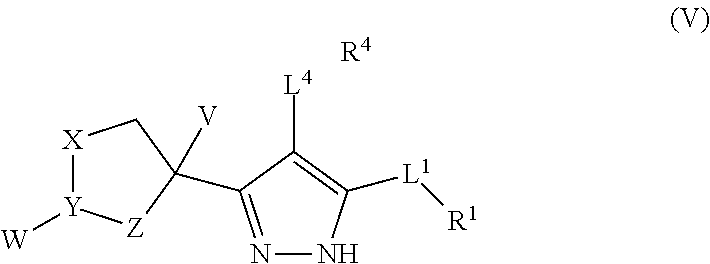
In some embodiments, the compound is a pharmaceutically acceptable salt, ester, solvate, or prodrug of a compound of Formula (V). In some embodiments, the compound is not an ester, not a solvate, and not a prodrug.
| TABLE A | |||
| Thrombin | |||
| Entry | IUPAC name | MW | Activity |
| 1 | 1,4-bis(prop-2-en-1-yl) 2-(5-[(5-chlorothiophen-2- | 550 | e |
| yl)methyl]amino-1-(2,2-dimethylpropanoyl)-1H-pyrazol- | |||
| 3-yl)piperazine-1,4-dicarboxylate | |||
| 2 | 1,4-bis(prop-2-en-1-yl) 2-(5-[(5-chlorothiophen-2- | 466 | e |
| yl)methyl]amino-1H-pyrazol-3-yl)piperazine-1,4- | |||
| dicarboxylate | |||
| 3 | 1-(3-8-azabicyclo[3.2.1]octan-3-yl-5-[(5-chlorothiophen- | 407 | a |
| 2-yl)methyl]amino-1H-pyrazol-1-yl)-2,2- | |||
| dimethylpropan-1-one | |||
| 4 | 1-(5-[(5-chlorothiophen-2-yl)methyl]amino-3-(1- | 473 | b |
| methanesulfonylazepan-4-yl)-1H-pyrazol-1-yl)-2,2- | |||
| dimethylpropan-1-one | |||
| 5 | 1-(5-[(5-chlorothiophen-2-yl)methyl]amino-3-(1- | 431 | b |
| methanesulfonylazetidin-3-yl)-1H-pyrazol-1-yl)-2,2- | |||
| dimethylpropan-1-one | |||
| 6 | 1-(5-[(5-chlorothiophen-2-yl)methyl]amino-3-(1- | 459 | b |
| methanesulfonylpiperidin-4-yl)-1H-pyrazol-1-yl)-2,2- | |||
| dimethylpropan-1-one | |||
| 7 | 1-(5-[(5-chlorothiophen-2-yl)methyl]amino-3-(1- | 475 | b |
| methanesulfonylpiperidin-4-yl)-1H-pyrazol-1-yl)-3- | |||
| hydroxy-2,2-dimethylpropan-1-one | |||
| 8 | 1-(5-[(5-chlorothiophen-2-yl)methyl]amino-3-(1- | 445 | a |
| methanesulfonylpyrrolidin-2-yl)-1H-pyrazol-1-yl)-2,2- | |||
| dimethylpropan-1-one | |||
| 9 | 1-(5-[(5-chlorothiophen-2-yl)methyl]amino-3-(1- | 445 | a |
| methanesulfonylpyrrolidin-3-yl)-1H-pyrazol-1-yl)-2,2- | |||
| dimethylpropan-1-one | |||
| 10 | 1-(5-[(5-chlorothiophen-2-yl)methyl]amino-3-(1-[6- | 540 | b |
| (trifluoromethyl)pyridin-2-yl]methylpiperidin-4-yl)-1H- | |||
| pyrazol-1-yl)-2,2-dimethylpropan-1-one | |||
| 11 | 1-(5-[(5-chlorothiophen-2-yl)methyl]amino-3-(2- | 397 | b |
| methylpyrrolidin-2-yl)-1H-pyrazol-1-yl)-3-hydroxy-2,2- | |||
| dimethylpropan-1-one; formic acid | |||
| 12 | 1-(5-[(5-chlorothiophen-2-yl)methyl]amino-3-(3- | 411 | c |
| methylpiperidin-3-yl)-1H-pyrazol-1-yl)-3-hydroxy-2,2- | |||
| dimethylpropan-1-one; formic acid | |||
| 13 | 1-(5-[(5-chlorothiophen-2-yl)methyl]amino-3-(3- | 425 | c |
| methylpiperidin-3-yl)-1H-pyrazol-1-yl)-3-methoxy-2,2- | |||
| dimethylpropan-1-one | |||
| 14 | 1-(5-[(5-chlorothiophen-2-yl)methyl]amino-3-(4- | 460 | a |
| methanesulfonylpiperazin-2-yl)-1H-pyrazol-1-yl)-2,2- | |||
| dimethylpropan-1-one | |||
| 15 | 1-(5-[(5-chlorothiophen-2-yl)methyl]amino-3-(4- | 395 | b |
| methylpiperidin-4-yl)-1H-pyrazol-1-yl)-2,2- | |||
| dimethylpropan-1-one; formic acid | |||
| 16 | 1-(5-[(5-chlorothiophen-2-yl)methyl]amino-3-(4- | 411 | c |
| methylpiperidin-4-yl)-1H-pyrazol-1-yl)-3-hydroxy-2,2- | |||
| dimethylpropan-1-one | |||
| 17 | 1-(5-[(5-chlorothiophen-2-yl)methyl]amino-3-(4- | 425 | e |
| methylpiperidin-4-yl)-1H-pyrazol-1-yl)-3-methoxy-2,2- | |||
| dimethylpropan-1-one | |||
| 18 | 1-(5-[(5-chlorothiophen-2-yl)methyl]amino-3-(oxan-4- | 382 | b |
| yl)-1H-pyrazol-1-yl)-2,2-dimethylpropan-1-one | |||
| 19 | 1-(5-[(5-chlorothiophen-2-yl)methyl]amino-3-(oxolan-2- | 368 | a |
| yl)-1H-pyrazol-1-yl)-2,2-dimethylpropan-1-one | |||
| 20 | 1-(5-[(5-chlorothiophen-2-yl)methyl]amino-3-(piperazin- | 382 | b |
| 2-yl)-1H-pyrazol-1-yl)-2,2-dimethylpropan-1-one | |||
| 21 | 1-(5-[(5-chlorothiophen-2-yl)methyl]amino-3-(piperidin- | 381 | a |
| 3-yl)-1H-pyrazol-1-yl)-2,2-dimethylpropan-1-one; | |||
| formic acid | |||
| 22 | 1-(5-[(5-chlorothiophen-2-yl)methyl]amino-3-(piperidin- | 397 | b |
| 3-yl)-1H-pyrazol-1-yl)-3-hydroxy-2,2-dimethylpropan-1- | |||
| one; formic acid | |||
| 23 | 1-(5-[(5-chlorothiophen-2-yl)methyl]amino-3-(piperidin- | 411 | b |
| 3-yl)-1H-pyrazol-1-yl)-3-methoxy-2,2-dimethylpropan- | |||
| 1-one | |||
| 24 | 1-(5-[(5-chlorothiophen-2-yl)methyl]amino-3-(piperidin- | 381 | b |
| 4-yl)-1H-pyrazol-1-yl)-2,2-dimethylpropan-1-one | |||
| 25 | 1-(5-[(5-chlorothiophen-2-yl)methyl]amino-3-(piperidin- | 397 | b |
| 4-yl)-1H-pyrazol-1-yl)-3-hydroxy-2,2-dimethylpropan-1- | |||
| one | |||
| 26 | 1-(5-[(5-chlorothiophen-2-yl)methyl]amino-3-(piperidin- | 411 | c |
| 4-yl)-1H-pyrazol-1-yl)-3-methoxy-2,2-dimethylpropan- | |||
| 1-one | |||
| 27 | 1-(5-[(5-chlorothiophen-2-yl)methyl]amino-3- | 367 | a |
| (pyrrolidin-2-yl)-1H-pyrazol-1-yl)-2,2-dimethylpropan- | |||
| 1-one | |||
| 28 | 1-(5-[(5-chlorothiophen-2-yl)methyl]amino-3- | 383 | a |
| (pyrrolidin-2-yl)-1H-pyrazol-1-yl)-3-hydroxy-2,2- | |||
| dimethylpropan-1-one | |||
| 29 | 1-(5-[(5-chlorothiophen-2-yl)methyl]amino-3- | 397 | a |
| (pyrrolidin-2-yl)-1H-pyrazol-1-yl)-3-methoxy-2,2- | |||
| dimethylpropan-1-one | |||
| 30 | 1-(5-[(5-chlorothiophen-2-yl)methyl]amino-3- | 367 | a |
| (pyrrolidin-3-yl)-1H-pyrazol-1-yl)-2,2-dimethylpropan- | |||
| 1-one | |||
| 31 | 1-(5-[(5-chlorothiophen-2-yl)methyl]amino-3-[1-(1,2,4- | 463 | a |
| oxadiazol-3-ylmethyl)piperidin-4-yl]-1H-pyrazol-1-yl)- | |||
| 2,2-dimethylpropan-1-one | |||
| 32 | 1-(5-[(5-chlorothiophen-2-yl)methyl]amino-3-[1-(1,3- | 462 | a |
| oxazol-4-ylmethyl)piperidin-4-yl]-1H-pyrazol-1-yl)-2,2- | |||
| dimethylpropan-1-one | |||
| 33 | 1-(5-[(5-chlorothiophen-2-yl)methyl]amino-3-[1-(1,3- | 462 | b |
| oxazol-5-ylmethyl)piperidin-4-yl]-1H-pyrazol-1-yl)-2,2- | |||
| dimethylpropan-1-one | |||
| 34 | 1-(5-[(5-chlorothiophen-2-yl)methyl]amino-3-[1-(1H- | 463 | c |
| 1,2,3,4-tetrazol-5-ylmethyl)piperidin-4-yl]-1H-pyrazol-1- | |||
| yl)-2,2-dimethylpropan-1-one | |||
| 35 | 1-(5-[(5-chlorothiophen-2-yl)methyl]amino-3-[1-(1H- | 462 | b |
| 1,2,3-triazol-5-ylmethyl)piperidin-4-yl]-1H-pyrazol-1- | |||
| yl)-2,2-dimethylpropan-1-one | |||
| 36 | 1-(5-[(5-chlorothiophen-2-yl)methyl]amino-3-[1-(1H- | 461 | b |
| imidazol-4-ylmethyl)piperidin-4-yl]-1H-pyrazol-1-yl)- | |||
| 2,2-dimethylpropan-1-one | |||
| 37 | 1-(5-[(5-chlorothiophen-2-yl)methyl]amino-3-[1-(2,2,2- | 463 | c |
| trifluoroethyl)piperidin-4-yl]-1H-pyrazol-1-yl)-2,2- | |||
| dimethylpropan-1-one | |||
| 38 | 1-(5-[(5-chlorothiophen-2-yl)methyl]amino-3-[1-(2,2,2- | 479 | a |
| trifluoroethyl)piperidin-4-yl]-1H-pyrazol-1-yl)-3- | |||
| hydroxy-2,2-dimethylpropan-1-one | |||
| 39 | 1-(5-[(5-chlorothiophen-2-yl)methyl]amino-3-[1-(2,2- | 465 | a |
| dimethylpropanoyl)piperidin-4-yl]-1H-pyrazol-1-yl)-2,2- | |||
| dimethylpropan-1-one | |||
| 40 | 1-(5-[(5-chlorothiophen-2-yl)methyl]amino-3-[1-(2- | 465 | a |
| cyclopropoxyethyl)piperidin-4-yl]-1H-pyrazol-1-yl)-2,2- | |||
| dimethylpropan-1-one | |||
| 41 | 1-(5-[(5-chlorothiophen-2-yl)methyl]amino-3-[1-(2- | 481 | a |
| cyclopropoxyethyl)piperidin-4-yl]-1H-pyrazol-1-yl)-3- | |||
| hydroxy-2,2-dimethylpropan-1-one | |||
| 42 | 1-(5-[(5-chlorothiophen-2-yl)methyl]amino-3-[1-(2- | 439 | b |
| methoxyethyl)piperidin-4-yl]-1H-pyrazol-1-yl)-2,2- | |||
| dimethylpropan-1-one | |||
| 43 | 1-(5-[(5-chlorothiophen-2-yl)methyl]amino-3-[1-(2- | 455 | b |
| methoxyethyl)piperidin-4-yl]-1H-pyrazol-1-yl)-3- | |||
| hydroxy-2,2-dimethylpropan-1-one | |||
| 44 | 1-(5-[(5-chlorothiophen-2-yl)methyl]amino-3-[1- | 435 | b |
| (cyclopropylmethyl)piperidin-4-yl]-1H-pyrazol-1-yl)- | |||
| 2,2-dimethylpropan-1-one | |||
| 45 | 1-(5-[(5-chlorothiophen-2-yl)methyl]amino-3-[1- | 451 | c |
| (cyclopropylmethyl)piperidin-4-yl]-1H-pyrazol-1-yl)-3- | |||
| hydroxy-2,2-dimethylpropan-1-one | |||
| 46 | 1-(5-[(5-chlorothiophen-2-yl)methyl]amino-3-[1- | 508 | a |
| (morpholine-4-carbonyl)azepan-4-yl]-1H-pyrazol-1-yl)- | |||
| 2,2-dimethylpropan-1-one | |||
| 47 | 1-(5-[(5-chlorothiophen-2-yl)methyl]amino-3-[1- | 466 | b |
| (morpholine-4-carbonyl)azetidin-3-yl]-1H-pyrazol-1-yl)- | |||
| 2,2-dimethylpropan-1-one | |||
| 48 | 1-(5-[(5-chlorothiophen-2-yl)methyl]amino-3-[1- | 494 | a |
| (morpholine-4-carbonyl)piperidin-4-yl]-1H-pyrazol-1- | |||
| yl)-2,2-dimethylpropan-1-one | |||
| 49 | 1-(5-[(5-chlorothiophen-2-yl)methyl]amino-3-[1- | 510 | a |
| (morpholine-4-carbonyl)piperidin-4-yl]-1H-pyrazol-1- | |||
| yl)-3-hydroxy-2,2-dimethylpropan-1-one | |||
| 50 | 1-(5-[(5-chlorothiophen-2-yl)methyl]amino-3-[1- | 480 | b |
| (morpholine-4-carbonyl)pyrrolidin-2-yl]-1H-pyrazol-1- | |||
| yl)-2,2-dimethylpropan-1-one | |||
| 51 | 1-(5-[(5-chlorothiophen-2-yl)methyl]amino-3-[1- | 480 | a |
| (morpholine-4-carbonyl)pyrrolidin-3-yl]-1H-pyrazol-1- | |||
| yl)-2,2-dimethylpropan-1-one | |||
| 52 | 1-(5-[(5-chlorothiophen-2-yl)methyl]amino-3-[1- | 530 | a |
| (morpholine-4-sulfonyl)piperidin-4-yl]-1H-pyrazol-1- | |||
| yl)-2,2-dimethylpropan-1-one | |||
| 53 | 1-(5-[(5-chlorothiophen-2-yl)methyl]amino-3-[1- | 546 | a |
| (morpholine-4-sulfonyl)piperidin-4-yl]-1H-pyrazol-1- | |||
| yl)-3-hydroxy-2,2-dimethylpropan-1-one | |||
| 54 | 1-(5-[(5-chlorothiophen-2-yl)methyl]amino-3-[1- | 451 | b |
| (oxetan-3-ylmethyl)piperidin-4-yl]-1H-pyrazol-1-yl)-2,2- | |||
| dimethylpropan-1-one | |||
| 55 | 1-(5-[(5-chlorothiophen-2-yl)methyl]amino-3-[1- | 467 | b |
| (oxetan-3-ylmethyl)piperidin-4-yl]-1H-pyrazol-1-yl)-3- | |||
| hydroxy-2,2-dimethylpropan-1-one | |||
| 56 | 1-(5-[(5-chlorothiophen-2-yl)methyl]amino-3-[1- | 472 | a |
| (pyridin-2-ylmethyl)piperidin-4-yl]-1H-pyrazol-1-yl)- | |||
| 2,2-dimethylpropan-1-one | |||
| 57 | 1-(5-[(5-chlorothiophen-2-yl)methyl]amino-3-[1- | 488 | a |
| (pyridin-2-ylmethyl)piperidin-4-yl]-1H-pyrazol-1-yl)-3- | |||
| hydroxy-2,2-dimethylpropan-1-one | |||
| 58 | 1-(5-[(5-chlorothiophen-2-yl)methyl]amino-3-[1- | 472 | a |
| (pyridin-3-ylmethyl)piperidin-4-yl]-1H-pyrazol-1-yl)- | |||
| 2,2-dimethylpropan-1-one | |||
| 59 | 1-(5-[(5-chlorothiophen-2-yl)methyl]amino-3-[4- | 495 | a |
| (morpholine-4-carbonyl)piperazin-2-yl]-1H-pyrazol-1- | |||
| yl)-2,2-dimethylpropan-1-one | |||
| 60 | 1-(5-[(5-chlorothiophen-2-yl)methyl]amino-3-[8- | 520 | a |
| (morpholine-4-carbonyl)-8-azabicyclo[3.2.1]octan-3-yl]- | |||
| 1H-pyrazol-1-yl)-2,2-dimethylpropan-1-one | |||
| 61 | 1-(5-[(5-chlorothiophen-2-yl)methyl]amino-3-1-[(1- | 464 | b |
| methylazetidin-3-yl)methyl]piperidin-4-yl-1H-pyrazol-1- | |||
| yl)-2,2-dimethylpropan-1-one | |||
| 62 | 1-(5-[(5-chlorothiophen-2-yl)methyl]amino-3-1-[(2- | 501 | a |
| methoxyphenyl)methyl]piperidin-4-yl-1H-pyrazol-1-yl)- | |||
| 2,2-dimethylpropan-1-one | |||
| 63 | 1-(5-[(5-chlorothiophen-2-yl)methyl]amino-3-1-[(3- | 501 | a |
| methoxyphenyl)methyl]piperidin-4-yl-1H-pyrazol-1-yl)- | |||
| 2,2-dimethylpropan-1-one | |||
| 64 | 1-(5-[(5-chlorothiophen-2-yl)methyl]amino-3-1-[(4- | 501 | c |
| methoxyphenyl)methyl]piperidin-4-yl-1H-pyrazol-1-yl)- | |||
| 2,2-dimethylpropan-1-one | |||
| 65 | 1-(5-[(5-chlorothiophen-2-yl)methyl]amino-3-1-[(6- | 486 | a |
| methylpyridin-2-yl)methyl]piperidin-4-yl-1H-pyrazol-1- | |||
| yl)-2,2-dimethylpropan-1-one; formic acid | |||
| 66 | 1-(5-[(5-chlorothiophen-2-yl)methyl]amino-3-1-[2,2,2- | 540 | a |
| trifluoro-1-(pyridin-2-yl)ethyl]piperidin-4-yl-1H- | |||
| pyrazol-1-yl)-2,2-dimethylpropan-1-one | |||
| 67 | 1-(5-[(5-chlorothiophen-2-yl)methyl]amino-3-1-[2,2,2- | 556 | a |
| trifluoro-1-(pyridin-2-yl)ethyl]piperidin-4-yl-1H- | |||
| pyrazol-1-yl)-3-hydroxy-2,2-dimethylpropan-1-one | |||
| 68 | 1-(5-[(5-chlorothiophen-2-yl)methyl]amino-3-1-[2,2- | 522 | a |
| difluoro-2-(pyridin-2-yl)ethyl]piperidin-4-yl-1H-pyrazol- | |||
| 1-yl)-2,2-dimethylpropan-1-one | |||
| 69 | 1-(5-[(5-chlorothiophen-2-yl)methyl]amino-3-1-[2,2- | 538 | a |
| difluoro-2-(pyridin-2-yl)ethyl]piperidin-4-yl-1H-pyrazol- | |||
| 1-yl)-3-hydroxy-2,2-dimethylpropan-1-one | |||
| 70 | 1-(5-[(5-chlorothiophen-2-yl)methyl]amino-3-1-[2- | 508 | a |
| (morpholin-4-yl)-2-oxoethyl]piperidin-4-yl-1H-pyrazol- | |||
| 1-yl)-2,2-dimethylpropan-1-one | |||
| 71 | 1-(5-[(5-chlorothiophen-2-yl)methyl]amino-3-1-[2- | 524 | b |
| (morpholin-4-yl)-2-oxoethyl]piperidin-4-yl-1H-pyrazol- | |||
| 1-yl)-3-hydroxy-2,2-dimethylpropan-1-one | |||
| 72 | 1-(5-[(5-chlorothiophen-2-yl)methyl]amino-3-1-[2- | 508 | a |
| (morpholin-4-yl)acetyl]piperidin-4-yl-1H-pyrazol-1-yl)- | |||
| 2,2-dimethylpropan-1-one | |||
| 73 | 1-(5-[(5-chlorothiophen-2-yl)methyl]amino-3-1-[2- | 551 | e |
| (morpholin-4-yl)acetyl]piperidin-4-yl-1H-pyrazol-1-yl)- | |||
| 2-(morpholin-4-yl)ethan-1-one | |||
| 74 | 1-(5-[(5-chlorothiophen-2-yl)methyl]amino-3-1-[2- | 524 | a |
| (morpholin-4-yl)acetyl]piperidin-4-yl-1H-pyrazol-1-yl)- | |||
| 3-hydroxy-2,2-dimethylpropan-1-one | |||
| 75 | 1-(5-[(5-chlorothiophen-2-yl)methyl]amino-3-1-[2- | 494 | a |
| (morpholin-4-yl)acetyl]pyrrolidin-2-yl-1H-pyrazol-1-yl)- | |||
| 2,2-dimethylpropan-1-one | |||
| 76 | 1-(5-[(5-chlorothiophen-2-yl)methyl]amino-3-1-[2- | 494 | a |
| (morpholin-4-yl)acetyl]pyrrolidin-3-yl-1H-pyrazol-1-yl)- | |||
| 2,2-dimethylpropan-1-one | |||
| 77 | 1-(5-[(5-chlorothiophen-2-yl)methyl]amino-3-1-[2- | 494 | b |
| (morpholin-4-yl)ethyl]piperidin-4-yl-1H-pyrazol-1-yl)- | |||
| 2,2-dimethylpropan-1-one; formic acid | |||
| 78 | 1-(5-[(5-chlorothiophen-2-yl)methyl]amino-3-1-[2- | 510 | b |
| (morpholin-4-yl)ethyl]piperidin-4-yl-1H-pyrazol-1-yl)-3- | |||
| hydroxy-2,2-dimethylpropan-1-one; formic acid | |||
| 79 | 1-(5-[(5-chlorothiophen-2-yl)methyl]amino-3-1-[2- | 486 | a |
| (pyridin-2-yl)ethyl]piperidin-4-yl-1H-pyrazol-1-yl)-2,2- | |||
| dimethylpropan-1-one | |||
| 80 | 1-(5-[(5-chlorothiophen-2-yl)methyl]amino-3-1-[2- | 502 | a |
| (pyridin-2-yl)ethyl]piperidin-4-yl-1H-pyrazol-1-yl)-3- | |||
| hydroxy-2,2-dimethylpropan-1-one | |||
| 81 | 1-(5-[(5-chlorothiophen-2-yl)methyl]amino-3-8- | 485 | a |
| methanesulfonyl-8-azabicyclo[3.2.1]octan-3-yl-1H- | |||
| pyrazol-1-yl)-2,2-dimethylpropan-1-one | |||
| 82 | 1-(5-[(5-chlorothiophen-2-yl)methyl]amino-4-fluoro-3- | 400 | a |
| (oxan-4-yl)-1H-pyrazol-1-yl)-2,2-dimethylpropan-1-one | |||
| 83 | 1-(5-[(5-chlorothiophen-2-yl)methyl]amino-4-fluoro-3- | 416 | a |
| (oxan-4-yl)-1H-pyrazol-1-yl)-3-hydroxy-2,2- | |||
| dimethylpropan-1-one | |||
| 84 | 1-(5-[(5-chlorothiophen-2-yl)methyl]amino-4-fluoro-3- | 430 | a |
| (oxan-4-yl)-1H-pyrazol-1-yl)-3-methoxy-2,2- | |||
| dimethylpropan-1-one | |||
| 85 | 1-(5-[(5-chlorothiophen-2-yl)methyl]amino-4-fluoro-3- | 399 | a |
| (piperidin-4-yl)-1H-pyrazol-1-yl)-2,2-dimethylpropan-1- | |||
| one | |||
| 86 | 1-(5-[(5-chlorothiophen-2-yl)methyl]amino-4-fluoro-3- | 415 | b |
| (piperidin-4-yl)-1H-pyrazol-1-yl)-2-methoxy-2- | |||
| methylpropan-1-one | |||
| 87 | 1-(5-[(5-chlorothiophen-2-yl)methyl]amino-4-fluoro-3- | 415 | a |
| (piperidin-4-yl)-1H-pyrazol-1-yl)-3-hydroxy-2,2- | |||
| dimethylpropan-1-one | |||
| 88 | 1-(5-[(5-chlorothiophen-2-yl)methyl]amino-4-fluoro-3- | 429 | a |
| (piperidin-4-yl)-1H-pyrazol-1-yl)-3-methoxy-2,2- | |||
| dimethylpropan-1-one | |||
| 89 | 1-(5-[(5-chlorothiophen-2-yl)methyl]amino-4-methyl-3- | 395 | c |
| (piperidin-4-yl)-1H-pyrazol-1-yl)-2,2-dimethylpropan-1- | |||
| one; formic acid | |||
| 90 | 1-[2-(5-[(5-chlorothiophen-2-yl)methyl]amino-1-(2- | 501 | b |
| methoxybenzoyl)-1H-pyrazol-3-yl)pyrrolidin-1-yl]-2,2- | |||
| dimethylpropan-1-one | |||
| 91 | 1-[2-(5-[(5-chlorothiophen-2-yl)methyl]amino-1-(2- | 487 | b |
| methoxybenzoyl)-1H-pyrazol-3-yl)pyrrolidin-1-yl]-2- | |||
| methylpropan-1-one | |||
| 92 | 1-[2-(5-[(5-chlorothiophen-2-yl)methyl]amino-1-(2- | 459 | c |
| methoxybenzoyl)-1H-pyrazol-3-yl)pyrrolidin-1-yl]ethan- | |||
| 1-one | |||
| 93 | 1-[2-(5-[(5-chlorothiophen-2-yl)methyl]amino-1H- | 410 | e |
| pyrazol-3-yl)pyrrolidin-1-yl]-2-(morpholin-4-yl)ethan-1- | |||
| one | |||
| 94 | 1-[3-(1-acetylpiperidin-4-yl)-5-[(5-chlorothiophen-2- | 423 | a |
| yl)methyl]amino-1H-pyrazol-1-yl]-2,2-dimethylpropan- | |||
| 1-one | |||
| 95 | 1-[3-(1-benzylpiperidin-4-yl)-5-[(5-chlorothiophen-2- | 471 | a |
| yl)methyl]amino-1H-pyrazol-1-yl]-2,2-dimethylpropan- | |||
| 1-one | |||
| 96 | 1-[3-(5-[(5-chlorothiophen-2-yl)methyl]amino-1-(2,2- | 437 | b |
| dimethylpropanoyl)-1H-pyrazol-3-yl)azetidin-1-yl]-2,2- | |||
| dimethylpropan-1-one | |||
| 97 | 1-[3-(5-[(5-chlorothiophen-2-yl)methyl]amino-1H- | 353 | e |
| pyrazol-3-yl)azetidin-1-yl]-2,2-dimethylpropan-1-one | |||
| 98 | 1-[3-(5-[(5-chlorothiophen-2-yl)methyl]amino-1H- | 410 | e |
| pyrazol-3-yl)pyrrolidin-1-yl]-2-(morpholin-4-yl)ethan-1- | |||
| one | |||
| 99 | 1-[4-(5-[(5-chlorothiophen-2-yl)methyl]amino-1-(2- | 515 | a |
| methoxybenzoyl)-1H-pyrazol-3-yl)piperidin-1-yl]-2,2- | |||
| dimethylpropan-1-one | |||
| 100 | 1-[4-(5-[(5-chlorothiophen-2-yl)methyl]amino-1-(2- | 473 | b |
| methoxybenzoyl)-1H-pyrazol-3-yl)piperidin-1-yl]ethan- | |||
| 1-one | |||
| 101 | 1-[4-(5-[(5-chlorothiophen-2-yl)methyl]amino-1- | 491 | a |
| (thiophene-3-carbonyl)-1H-pyrazol-3-yl)piperidin-1-yl]- | |||
| 2,2-dimethylpropan-1-one | |||
| 102 | 1-[4-(5-[(5-chlorothiophen-2-yl)methyl]amino-1- | 449 | b |
| (thiophene-3-carbonyl)-1H-pyrazol-3-yl)piperidin-1- | |||
| yl]ethan-1-one | |||
| 103 | 1-[4-(5-[(5-chlorothiophen-2-yl)methyl]amino-1H- | 424 | e |
| pyrazol-3-yl)piperidin-1-yl]-2-(morpholin-4-yl)ethan-1- | |||
| one | |||
| 104 | 1-[4-(5-[(5-chlorothiophen-2-yl)methyl]amino-4-fluoro- | 399 | d |
| 1H-pyrazol-3-yl)piperidine-1-carbonyl]cyclopropan-1-ol | |||
| 105 | 1-benzoyl-N-[(5-chlorothiophen-2-yl)methyl]-3- | 401 | b |
| (piperidin-4-yl)-1H-pyrazol-5-amine hydrochloride | |||
| 106 | 1-benzoyl-N-[(5-chlorothiophen-2-yl)methyl]-4-fluoro- | 420 | a |
| 3-(oxan-4-yl)-1H-pyrazol-5-amine | |||
| 107 | 1-3-[1-(benzenesulfonyl)piperidin-4-yl]-5-[(5- | 521 | b |
| chlorothiophen-2-yl)methyl]amino-1H-pyrazol-1-yl-2,2- | |||
| dimethylpropan-1-one | |||
| 108 | 1-3-[1-(benzenesulfonyl)piperidin-4-yl]-5-[(5- | 537 | a |
| chlorothiophen-2-yl)methyl]amino-1H-pyrazol-1-yl-3- | |||
| hydroxy-2,2-dimethylpropan-1-one | |||
| 109 | 2-[4-(5-[(5-chlorothiophen-2-yl)methyl]amino-1-(2,2- | 439 | b |
| dimethylpropanoyl)-1H-pyrazol-3-yl)piperidin-1- | |||
| yl]acetic acid | |||
| 110 | 2-[4-(5-[(5-chlorothiophen-2-yl)methyl]amino-1-(3- | 455 | b |
| hydroxy-2,2-dimethylpropanoyl)-1H-pyrazol-3- | |||
| yl)piperidin-1-yl]acetic acid | |||
| 111 | 2-[4-(5-[(5-chlorothiophen-2-yl)methyl]amino-1H- | 424 | e |
| pyrazol-3-yl)piperidin-1-yl]-1-(morpholin-4-yl)ethan-1- | |||
| one | |||
| 112 | 2-[4-(5-[(5-chlorothiophen-2-yl)methyl]amino-1H- | 355 | e |
| pyrazol-3-yl)piperidin-1-yl]acetic acid | |||
| 113 | 3-(1-benzylpiperidin-4-yl)-N-[(5-chlorothiophen-2- | 387 | e |
| yl)methyl]-1H-pyrazol-5-amine | |||
| 114 | 3-(1-benzylpyrrolidin-3-yl)-N-[(5-chlorothiophen-2- | 467 | c |
| yl)methyl]-1-(furan-3-carbonyl)-1H-pyrazol-5-amine | |||
| 115 | 3-(5-[(5-chlorothiophen-2-yl)methyl]amino-1-(2,2- | 409 | b |
| dimethylpropanoyl)-1H-pyrazol-3-yl)-3-methylpiperidin- | |||
| 2-one | |||
| 116 | 3-(5-[(5-chlorothiophen-2-yl)methyl]amino-1-(2,2- | 395 | a |
| dimethylpropanoyl)-1H-pyrazol-3-yl)-3- | |||
| methylpyrrolidin-2-one | |||
| 117 | 3-(5-[(5-chlorothiophen-2-yl)methyl]amino-1-(2- | 459 | b |
| methoxybenzoyl)-1H-pyrazol-3-yl)-3-methylpiperidin-2- | |||
| one | |||
| 118 | 3-(5-[(5-chlorothiophen-2-yl)methyl]amino-1-(2- | 445 | b |
| methoxybenzoyl)-1H-pyrazol-3-yl)-3-methylpyrrolidin- | |||
| 2-one | |||
| 119 | 3-(5-[(5-chlorothiophen-2-yl)methyl]amino-1-(3- | 425 | b |
| hydroxy-2,2-dimethylpropanoyl)-1H-pyrazol-3-yl)-3- | |||
| methylpiperidin-2-one | |||
| 120 | 3-(5-[(5-chlorothiophen-2-yl)methyl]amino-1-(3- | 439 | c |
| methoxy-2,2-dimethylpropanoyl)-1H-pyrazol-3-yl)-3- | |||
| methylpiperidin-2-one | |||
| 121 | 3-(5-[(5-chlorothiophen-2-yl)methyl]amino-1-(4- | 451 | c |
| methyloxane-4-carbonyl)-1H-pyrazol-3-yl)-3- | |||
| methylpiperidin-2-one | |||
| 122 | 3-(5-[(5-chlorothiophen-2-yl)methyl]amino-1-(4- | 437 | b |
| methyloxane-4-carbonyl)-1H-pyrazol-3-yl)-3- | |||
| methylpyrrolidin-2-one | |||
| 123 | 3-(5-[(5-chlorothiophen-2-yl)methyl]amino-1- | 435 | b |
| (thiophene-3-carbonyl)-1H-pyrazol-3-yl)-3- | |||
| methylpiperidin-2-one | |||
| 124 | 3-(5-[(5-chlorothiophen-2-yl)methyl]amino-1- | 421 | b |
| (thiophene-3-carbonyl)-1H-pyrazol-3-yl)-3- | |||
| methylpyrrolidin-2-one | |||
| 125 | 3-(azepan-4-yl)-N-[(5-chlorothiophen-2-yl)methyl]-1H- | 311 | e |
| pyrazol-5-amine | |||
| 126 | 3-(azetidin-3-yl)-N-[(5-chlorothiophen-2-yl)methyl]-1- | 431 | c |
| (2,3-dihydro-1,4-benzodioxine-5-carbonyl)-1H-pyrazol- | |||
| 5-amine; trifluoroacetic acid | |||
| 127 | 3-(azetidin-3-yl)-N-[(5-chlorothiophen-2-yl)methyl]-1- | 403 | d |
| (2-methoxybenzoyl)-1H-pyrazol-5-amine hydrochloride | |||
| 128 | 3-(azetidin-3-yl)-N-[(5-chlorothiophen-2-yl)methyl]-1- | 363 | c |
| (furan-3-carbonyl)-1H-pyrazol-5-amine; trifluoroacetic | |||
| acid | |||
| 129 | 3-(azetidin-3-yl)-N-[(5-chlorothiophen-2-yl)methyl]-1- | 379 | c |
| (thiophene-3-carbonyl)-1H-pyrazol-5-amine; | |||
| trifluoroacetic acid | |||
| 130 | 3-[1-(benzenesulfonyl)piperidin-4-yl]-N-[(5- | 437 | c |
| chlorothiophen-2-yl)methyl]-1H-pyrazol-5-amine | |||
| 131 | 3-8-azabicyclo[3.2.1]octan-3-yl-N-[(5-chlorothiophen-2- | 323 | e |
| yl)methyl]-1H-pyrazol-5-amine | |||
| 132 | 4-(5-[(5-chlorothiophen-2-yl)methyl]amino-1-(2,2- | 452 | a |
| dimethylpropanoyl)-1H-pyrazol-3-yl)-N,N- | |||
| dimethylpiperidine-1-carboxamide | |||
| 133 | 4-(5-[(5-chlorothiophen-2-yl)methyl]amino-1-(2,2- | 488 | b |
| dimethylpropanoyl)-1H-pyrazol-3-yl)-N,N- | |||
| dimethylpiperidine-1-sulfonamide | |||
| 134 | 4-(5-[(5-chlorothiophen-2-yl)methyl]amino-1-(3- | 468 | a |
| hydroxy-2,2-dimethylpropanoyl)-1H-pyrazol-3-yl)-N,N- | |||
| dimethylpiperidine-1-carboxamide | |||
| 135 | 4-(5-[(5-chlorothiophen-2-yl)methyl]amino-1-(3- | 504 | a |
| hydroxy-2,2-dimethylpropanoyl)-1H-pyrazol-3-yl)-N,N- | |||
| dimethylpiperidine-1-sulfonamide | |||
| 136 | 4-(5-[(5-chlorothiophen-2-yl)methyl]amino-1- | 439 | e |
| (dimethylcarbamoyl)-1H-pyrazol-3-yl)-N,N- | |||
| dimethylpiperidine-1-carboxamide | |||
| 137 | 4-(5-[(5-chlorothiophen-2-yl)methyl]amino-1H-pyrazol- | 368 | e |
| 3-yl)-N,N-dimethylpiperidine-1-carboxamide | |||
| 138 | 4-(5-[(5-chlorothiophen-2-yl)methyl]amino-1H-pyrazol- | 404 | e |
| 3-yl)-N,N-dimethylpiperidine-1-sulfonamide | |||
| 139 | 4-(5-[(5-chlorothiophen-2-yl)methyl]amino-3-[1- | 550 | a |
| (morpholine-4-carbonyl)piperidin-4-yl]-1H-pyrazole-1- | |||
| carbonyl)-4-methylcyclohexan-1-ol | |||
| 140 | 5-[(5-chlorothiophen-2-yl)methyl]amino-1-(2,2- | 519 | a |
| dimethylpropanoyl)-3-[1-(morpholine-4- | |||
| carbonyl)piperidin-4-yl]-1H-pyrazole-4-carbonitrile | |||
| 141 | 5-[(5-chlorothiophen-2-yl)methyl]amino-3-[1- | 435 | e |
| (morpholine-4-carbonyl)piperidin-4-yl]-1H-pyrazole-4- | |||
| carbonitrile | |||
| 142 | N-[(5-chlorothiophen-2-yl)methyl]-1-(1,4- | 549 | b |
| dimethylpiperidine-4-carbonyl)-3-[1-(morpholine-4- | |||
| carbonyl)piperidin-4-yl]-1H-pyrazol-5-amine; formic | |||
| acid | |||
| 143 | N-[(5-chlorothiophen-2-yl)methyl]-1-(2,3-dihydro-1,4- | 459 | c |
| benzodioxine-5-carbonyl)-3-(piperidin-4-yl)-1H-pyrazol- | |||
| 5-amine hydrochloride | |||
| 144 | N-[(5-chlorothiophen-2-yl)methyl]-1-(2,3-dihydro-1,4- | 445 | a |
| benzodioxine-5-carbonyl)-3-(pyrrolidin-2-yl)-1H- | |||
| pyrazol-5-amine hydrochloride | |||
| 145 | N-[(5-chlorothiophen-2-yl)methyl]-1-(2,3-dihydro-1,4- | 478 | a |
| benzodioxine-5-carbonyl)-4-fluoro-3-(oxan-4-yl)-1H- | |||
| pyrazol-5-amine | |||
| 146 | N-[(5-chlorothiophen-2-yl)methyl]-1-(2,3-dihydro-1,4- | 477 | a |
| benzodioxine-5-carbonyl)-4-fluoro-3-(piperidin-4-yl)- | |||
| 1H-pyrazol-5-amine | |||
| 147 | N-[(5-chlorothiophen-2-yl)methyl]-1-(2,4- | 461 | c |
| dimethoxybenzoyl)-3-(piperidin-4-yl)-1H-pyrazol-5- | |||
| amine | |||
| 148 | N-[(5-chlorothiophen-2-yl)methyl]-1-(2,4- | 447 | a |
| dimethoxybenzoyl)-3-(pyrrolidin-2-yl)-1H-pyrazol-5- | |||
| amine | |||
| 149 | N-[(5-chlorothiophen-2-yl)methyl]-1-(2,4- | 480 | a |
| dimethoxybenzoyl)-4-fluoro-3-(oxan-4-yl)-1H-pyrazol- | |||
| 5-amine | |||
| 150 | N-[(5-chlorothiophen-2-yl)methyl]-1-(2,4- | 479 | a |
| dimethoxybenzoyl)-4-fluoro-3-(piperidin-4-yl)-1H- | |||
| pyrazol-5-amine | |||
| 151 | N-[(5-chlorothiophen-2-yl)methyl]-1-(2,6- | 435 | c |
| dimethylcyclohexanecarbonyl)-3-(piperidin-4-yl)-1H- | |||
| pyrazol-5-amine hydrochloride | |||
| 152 | N-[(5-chlorothiophen-2-yl)methyl]-1-(2- | 431 | b |
| methoxybenzoyl)-3-(2-methylpyrrolidin-2-yl)-1H- | |||
| pyrazol-5-amine; formic acid | |||
| 153 | N-[(5-chlorothiophen-2-yl)methyl]-1-(2- | 445 | c |
| methoxybenzoyl)-3-(3-methylpiperidin-3-yl)-1H- | |||
| pyrazol-5-amine | |||
| 154 | N-[(5-chlorothiophen-2-yl)methyl]-1-(2- | 445 | c |
| methoxybenzoyl)-3-(4-methylpiperidin-4-yl)-1H- | |||
| pyrazol-5-amine | |||
| 155 | N-[(5-chlorothiophen-2-yl)methyl]-1-(2- | 432 | c |
| methoxybenzoyl)-3-(oxan-4-yl)-1H-pyrazol-5-amine | |||
| 156 | N-[(5-chlorothiophen-2-yl)methyl]-1-(2- | 418 | a |
| methoxybenzoyl)-3-(oxolan-2-yl)-1H-pyrazol-5-amine | |||
| 157 | N-[(5-chlorothiophen-2-yl)methyl]-1-(2- | 431 | b |
| methoxybenzoyl)-3-(piperidin-3-yl)-1H-pyrazol-5-amine | |||
| 158 | N-[(5-chlorothiophen-2-yl)methyl]-1-(2- | 431 | c |
| methoxybenzoyl)-3-(piperidin-4-yl)-1H-pyrazol-5-amine | |||
| hydrochloride | |||
| 159 | N-[(5-chlorothiophen-2-yl)methyl]-1-(2- | 417 | b |
| methoxybenzoyl)-3-(pyrrolidin-2-yl)-1H-pyrazol-5- | |||
| amine | |||
| 160 | N-[(5-chlorothiophen-2-yl)methyl]-1-(2- | 513 | c |
| methoxybenzoyl)-3-[1-(2,2,2-trifluoroethyl)piperidin-4- | |||
| yl]-1H-pyrazol-5-amine | |||
| 161 | N-[(5-chlorothiophen-2-yl)methyl]-1-(4-methyloxane-4- | 423 | b |
| carbonyl)-3-(2-methylpyrrolidin-2-yl)-1H-pyrazol-5- | |||
| amine | |||
| 162 | N-[(5-chlorothiophen-2-yl)methyl]-1-(4-methyloxane-4- | 437 | c |
| carbonyl)-3-(3-methylpiperidin-3-yl)-1H-pyrazol-5- | |||
| amine | |||
| 163 | N-[(5-chlorothiophen-2-yl)methyl]-1-(4-methyloxane-4- | 437 | c |
| carbonyl)-3-(4-methylpiperidin-4-yl)-1H-pyrazol-5- | |||
| amine | |||
| 164 | N-[(5-chlorothiophen-2-yl)methyl]-1-(4-methyloxane-4- | 423 | b |
| carbonyl)-3-(piperidin-3-yl)-1H-pyrazol-5-amine | |||
| 165 | N-[(5-chlorothiophen-2-yl)methyl]-1-(4-methyloxane-4- | 409 | a |
| carbonyl)-3-(pyrrolidin-2-yl)-1H-pyrazol-5-amine | |||
| 166 | N-[(5-chlorothiophen-2-yl)methyl]-1-(furan-3-carbonyl)- | 391 | b |
| 3-(piperidin-4-yl)-1H-pyrazol-5-amine hydrochloride | |||
| 167 | N-[(5-chlorothiophen-2-yl)methyl]-1-(furan-3-carbonyl)- | 377 | a |
| 3-(pyrrolidin-2-yl)-1H-pyrazol-5-amine | |||
| 168 | N-[(5-chlorothiophen-2-yl)methyl]-1-(morpholine-4- | 523 | c |
| carbonyl)-3-[1-(morpholine-4-carbonyl)piperidin-4-yl]- | |||
| 1H-pyrazol-5-amine | |||
| 169 | N-[(5-chlorothiophen-2-yl)methyl]-1- | 407 | e |
| cyclohexanecarbonyl-3-(piperidin-4-yl)-1H-pyrazol-5- | |||
| amine hydrochloride | |||
| 170 | N-[(5-chlorothiophen-2-yl)methyl]-1- | 393 | e |
| cyclopentanecarbonyl-3-(piperidin-4-yl)-1H-pyrazol-5- | |||
| amine hydrochloride | |||
| 171 | N-[(5-chlorothiophen-2-yl)methyl]-3-(1- | 389 | e |
| methanesulfonylazepan-4-yl)-1H-pyrazol-5-amine | |||
| 172 | N-[(5-chlorothiophen-2-yl)methyl]-3-(1- | 347 | e |
| methanesulfonylazetidin-3-yl)-1H-pyrazol-5-amine | |||
| 173 | N-[(5-chlorothiophen-2-yl)methyl]-3-(1- | 375 | e |
| methanesulfonylpiperidin-4-yl)-1H-pyrazol-5-amine | |||
| 174 | N-[(5-chlorothiophen-2-yl)methyl]-3-(1- | 361 | e |
| methanesulfonylpyrrolidin-2-yl)-1H-pyrazol-5-amine | |||
| 175 | N-[(5-chlorothiophen-2-yl)methyl]-3-(1- | 361 | e |
| methanesulfonylpyrrolidin-3-yl)-1H-pyrazol-5-amine | |||
| 176 | N-[(5-chlorothiophen-2-yl)methyl]-3-(1-[6- | 456 | e |
| (trifluoromethyl)pyridin-2-yl]methylpiperidin-4-yl)-1H- | |||
| pyrazol-5-amine | |||
| 177 | N-[(5-chlorothiophen-2-yl)methyl]-3-(2- | 407 | a |
| methylpyrrolidin-2-yl)-1-(thiophene-3-carbonyl)-1H- | |||
| pyrazol-5-amine; formic acid | |||
| 178 | N-[(5-chlorothiophen-2-yl)methyl]-3-(3-methylpiperidin- | 421 | b |
| 3-yl)-1-(thiophene-3-carbonyl)-1H-pyrazol-5-amine | |||
| 179 | N-[(5-chlorothiophen-2-yl)methyl]-3-(4- | 376 | e |
| methanesulfonylpiperazin-2-yl)-1H-pyrazol-5-amine | |||
| 180 | N-[(5-chlorothiophen-2-yl)methyl]-3-(4-methylpiperidin- | 421 | c |
| 4-yl)-1-(thiophene-3-carbonyl)-1H-pyrazol-5-amine | |||
| 181 | N-[(5-chlorothiophen-2-yl)methyl]-3-(oxan-4-yl)-1- | 408 | b |
| (thiophene-3-carbonyl)-1H-pyrazol-5-amine | |||
| 182 | N-[(5-chlorothiophen-2-yl)methyl]-3-(oxan-4-yl)-1H- | 298 | e |
| pyrazol-5-amine | |||
| 183 | N-[(5-chlorothiophen-2-yl)methyl]-3-(oxolan-2-yl)-1- | 394 | a |
| (thiophene-3-carbonyl)-1H-pyrazol-5-amine | |||
| 184 | N-[(5-chlorothiophen-2-yl)methyl]-3-(oxolan-2-yl)-1H- | 284 | e |
| pyrazol-5-amine | |||
| 185 | N-[(5-chlorothiophen-2-yl)methyl]-3-(piperidin-3-yl)-1- | 407 | b |
| (thiophene-3-carbonyl)-1H-pyrazol-5-amine | |||
| 186 | N-[(5-chlorothiophen-2-yl)methyl]-3-(piperidin-3-yl)- | 297 | c |
| 1H-pyrazol-5-amine | |||
| 187 | N-[(5-chlorothiophen-2-yl)methyl]-3-(piperidin-4-yl)-1- | 407 | b |
| (thiophene-3-carbonyl)-1H-pyrazol-5-amine | |||
| hydrochloride | |||
| 188 | N-[(5-chlorothiophen-2-yl)methyl]-3-(piperidin-4-yl)- | 297 | e |
| 1H-pyrazol-5-amine | |||
| 189 | N-[(5-chlorothiophen-2-yl)methyl]-3-(pyrrolidin-2-yl)- | 283 | e |
| 1H-pyrazol-5-amine | |||
| 190 | N-[(5-chlorothiophen-2-yl)methyl]-3-(pyrrolidin-3-yl)- | 283 | c |
| 1H-pyrazol-5-amine | |||
| 191 | N-[(5-chlorothiophen-2-yl)methyl]-3-[1-(1,2,4- | 379 | e |
| oxadiazol-3-ylmethyl)piperidin-4-yl]-1H-pyrazol-5- | |||
| amine | |||
| 192 | N-[(5-chlorothiophen-2-yl)methyl]-3-[1-(1,2,4- | 379 | e |
| oxadiazol-5-ylmethyl)piperidin-4-yl]-1H-pyrazol-5- | |||
| amine | |||
| 193 | N-[(5-chlorothiophen-2-yl)methyl]-3-[1-(1,3-oxazol-2- | 378 | e |
| ylmethyl)piperidin-4-yl]-1H-pyrazol-5-amine | |||
| 194 | N-[(5-chlorothiophen-2-yl)methyl]-3-[1-(1,3-oxazol-5- | 378 | e |
| ylmethyl)piperidin-4-yl]-1H-pyrazol-5-amine | |||
| 195 | N-[(5-chlorothiophen-2-yl)methyl]-3-[1-(1H-1,2,3,4- | 379 | c |
| tetrazol-5-ylmethyl)piperidin-4-yl]-1H-pyrazol-5-amine | |||
| 196 | N-[(5-chlorothiophen-2-yl)methyl]-3-[1-(1H-1,2,3- | 378 | e |
| triazol-5-ylmethyl)piperidin-4-yl]-1H-pyrazol-5-amine | |||
| 197 | N-[(5-chlorothiophen-2-yl)methyl]-3-[1-(1H-imidazol-4- | 377 | c |
| ylmethyl)piperidin-4-yl]-1H-pyrazol-5-amine | |||
| 198 | N-[(5-chlorothiophen-2-yl)methyl]-3-[1-(2,2,2- | 379 | e |
| trifluoroethyl)piperidin-4-yl]-1H-pyrazol-5-amine | |||
| 199 | N-[(5-chlorothiophen-2-yl)methyl]-3-[1-(2- | 381 | e |
| cyclopropoxyethyl)piperidin-4-yl]-1H-pyrazol-5-amine; | |||
| formic acid | |||
| 200 | N-[(5-chlorothiophen-2-yl)methyl]-3-[1-(2- | 355 | e |
| methoxyethyl)piperidin-4-yl]-1H-pyrazol-5-amine | |||
| 201 | N-[(5-chlorothiophen-2-yl)methyl]-3-[1- | 351 | e |
| (cyclopropylmethyl)piperidin-4-yl]-1H-pyrazol-5-amine | |||
| 202 | N-[(5-chlorothiophen-2-yl)methyl]-3-[1-(morpholine-4- | 424 | e |
| carbonyl)azepan-4-yl]-1H-pyrazol-5-amine | |||
| 203 | N-[(5-chlorothiophen-2-yl)methyl]-3-[1-(morpholine-4- | 410 | e |
| carbonyl)piperidin-4-yl]-1H-pyrazol-5-amine | |||
| 204 | N-[(5-chlorothiophen-2-yl)methyl]-3-[1-(morpholine-4- | 396 | e |
| carbonyl)pyrrolidin-2-yl]-1H-pyrazol-5-amine | |||
| 205 | N-[(5-chlorothiophen-2-yl)methyl]-3-[1-(morpholine-4- | 507 | a |
| carbonyl)pyrrolidin-3-yl]-1-(1,3-thiazole-4-carbonyl)- | |||
| 1H-pyrazol-5-amine | |||
| 206 | N-[(5-chlorothiophen-2-yl)methyl]-3-[1-(morpholine-4- | 396 | e |
| carbonyl)pyrrolidin-3-yl]-1H-pyrazol-5-amine | |||
| 207 | N-[(5-chlorothiophen-2-yl)methyl]-3-[1-(morpholine-4- | 446 | e |
| sulfonyl)piperidin-4-yl]-1H-pyrazol-5-amine | |||
| 208 | N-[(5-chlorothiophen-2-yl)methyl]-3-[1-(oxan-4- | 381 | e |
| yl)piperidin-4-yl]-1H-pyrazol-5-amine | |||
| 209 | N-[(5-chlorothiophen-2-yl)methyl]-3-[1-(oxetan-3- | 367 | e |
| ylmethyl)piperidin-4-yl]-1H-pyrazol-5-amine; formic | |||
| acid | |||
| 210 | N-[(5-chlorothiophen-2-yl)methyl]-3-[1-(pyridin-2- | 388 | c |
| ylmethyl)piperidin-4-yl]-1H-pyrazol-5-amine | |||
| 211 | N-[(5-chlorothiophen-2-yl)methyl]-3-[1-(pyridin-3- | 388 | e |
| ylmethyl)piperidin-4-yl]-1H-pyrazol-5-amine | |||
| 212 | N-[(5-chlorothiophen-2-yl)methyl]-3-[4-(morpholine-4- | 411 | e |
| carbonyl)piperazin-2-yl]-1H-pyrazol-5-amine | |||
| hydrochloride | |||
| 213 | N-[(5-chlorothiophen-2-yl)methyl]-3-[8-(morpholine-4- | 547 | a |
| carbonyl)-8-azabicyclo[3.2.1]octan-3-yl]-1-(1,3-thiazole- | |||
| 4-carbonyl)-1H-pyrazol-5-amine | |||
| 214 | N-[(5-chlorothiophen-2-yl)methyl]-3-[8-(morpholine-4- | 436 | e |
| carbonyl)-8-azabicyclo[3.2.1]octan-3-yl]-1H-pyrazol-5- | |||
| amine | |||
| 215 | N-[(5-chlorothiophen-2-yl)methyl]-3-1-[(1- | 380 | e |
| methylazetidin-3-yl)methyl]piperidin-4-yl-1H-pyrazol-5- | |||
| amine | |||
| 216 | N-[(5-chlorothiophen-2-yl)methyl]-3-1-[(2- | 417 | e |
| methoxyphenyl)methyl]piperidin-4-yl-1H-pyrazol-5- | |||
| amine | |||
| 217 | N-[(5-chlorothiophen-2-yl)methyl]-3-1-[(3- | 417 | c |
| methoxyphenyl)methyl]piperidin-4-yl-1H-pyrazol-5- | |||
| amine | |||
| 218 | N-[(5-chlorothiophen-2-yl)methyl]-3-1-[(4- | 527 | c |
| methoxyphenyl)methyl]piperidin-4-yl-1-(thiophene-3- | |||
| carbonyl)-1H-pyrazol-5-amine | |||
| 219 | N-[(5-chlorothiophen-2-yl)methyl]-3-1-[(4- | 417 | e |
| methoxyphenyl)methyl]piperidin-4-yl-1H-pyrazol-5- | |||
| amine | |||
| 220 | N-[(5-chlorothiophen-2-yl)methyl]-3-1-[(6- | 402 | e |
| methylpyridin-2-yl)methyl]piperidin-4-yl-1H-pyrazol-5- | |||
| amine | |||
| 221 | N-[(5-chlorothiophen-2-yl)methyl]-3-1-[2,2,2-trifluoro- | 456 | e |
| 1-(pyridin-2-yl)ethyl]piperidin-4-yl-1H-pyrazol-5-amine | |||
| 222 | N-[(5-chlorothiophen-2-yl)methyl]-3-1-[2,2-difluoro-2- | 438 | e |
| (pyridin-2-yl)ethyl]piperidin-4-yl-1H-pyrazol-5-amine | |||
| 223 | N-[(5-chlorothiophen-2-yl)methyl]-3-1-[2-(morpholin-4- | 410 | c |
| yl)ethyl]piperidin-4-yl-1H-pyrazol-5-amine | |||
| 224 | N-[(5-chlorothiophen-2-yl)methyl]-3-1-[2-(pyridin-2- | 402 | e |
| yl)ethyl]piperidin-4-yl-1H-pyrazol-5-amine | |||
| 225 | N-[(5-chlorothiophen-2-yl)methyl]-3-8-methanesulfonyl- | 512 | a |
| 8-azabicyclo[3.2.1]octan-3-yl-1-(1,3-thiazole-4- | |||
| carbonyl)-1H-pyrazol-5-amine | |||
| 226 | N-[(5-chlorothiophen-2-yl)methyl]-3-8-methanesulfonyl- | 401 | e |
| 8-azabicyclo[3.2.1]octan-3-yl-1H-pyrazol-5-amine | |||
| 227 | N-[(5-chlorothiophen-2-yl)methyl]-4-fluoro-1-(2- | 450 | a |
| methoxybenzoyl)-3-(oxan-4-yl)-1H-pyrazol-5-amine | |||
| 228 | N-[(5-chlorothiophen-2-yl)methyl]-4-fluoro-1-(2- | 449 | a |
| methoxybenzoyl)-3-(piperidin-4-yl)-1H-pyrazol-5-amine | |||
| 229 | N-[(5-chlorothiophen-2-yl)methyl]-4-fluoro-1-(4- | 442 | a |
| methyloxane-4-carbonyl)-3-(oxan-4-yl)-1H-pyrazol-5- | |||
| amine | |||
| 230 | N-[(5-chlorothiophen-2-yl)methyl]-4-fluoro-1-(furan-3- | 410 | a |
| carbonyl)-3-(oxan-4-yl)-1H-pyrazol-5-amine | |||
| 231 | N-[(5-chlorothiophen-2-yl)methyl]-4-fluoro-1-(furan-3- | 409 | a |
| carbonyl)-3-(piperidin-4-yl)-1H-pyrazol-5-amine | |||
| 232 | N-[(5-chlorothiophen-2-yl)methyl]-4-fluoro-1-[4-(2- | 494 | a |
| methoxyethoxy)benzoyl]-3-(oxan-4-yl)-1H-pyrazol-5- | |||
| amine | |||
| 233 | N-[(5-chlorothiophen-2-yl)methyl]-4-fluoro-1-[4- | 505 | a |
| (morpholin-4-yl)benzoyl]-3-(oxan-4-yl)-1H-pyrazol-5- | |||
| amine | |||
| 234 | N-[(5-chlorothiophen-2-yl)methyl]-4-fluoro-3-(oxan-4- | 426 | a |
| yl)-1-(thiophene-3-carbonyl)-1H-pyrazol-5-amine | |||
| 236 | N-[(5-chlorothiophen-2-yl)methyl]-4-methyl-3-[1-(1,3- | 422 | e |
| thiazole-4-carbonyl)piperidin-4-yl]-1H-pyrazol-5-amine | |||
| 237 | N-[(5-chlorothiophen-2-yl)methyl]-4-methyl-3-[1- | 424 | d |
| (morpholine-4-carbonyl)piperidin-4-yl]-1H-pyrazol-5- | |||
| amine | |||
| 238 | N-[(5-chlorothiophen-2-yl)methyl]-N-3-[1-(morpholine- | 595 | c |
| 4-sulfonyl)piperidin-4-yl]-1H-pyrazol-5-ylmorpholine-4- | |||
| sulfonamide | |||
| 239 | [1-(5-[(5-chlorothiophen-2-yl)methyl]amino-4-fluoro-3- | 414 | a |
| (oxan-4-yl)-1H-pyrazole-1- | |||
| carbonyl)cyclopropyl]methanol | |||
| 240 | prop-2-en-1-yl 2-(5-[(5-chlorothiophen-2- | 606 | b |
| yl)methyl]amino-1-(1,3-thiazole-4-carbonyl)-1H- | |||
| pyrazol-3-yl)-4-(morpholine-4-carbonyl)piperazine-1- | |||
| carboxylate | |||
| 241 | prop-2-en-1-yl 2-(5-[(5-chlorothiophen-2- | 620 | b |
| yl)methyl]amino-1-(1,3-thiazole-4-carbonyl)-1H- | |||
| pyrazol-3-yl)-4-[2-(morpholin-4-yl)acetyl]piperazine-1- | |||
| carboxylate | |||
| 242 | prop-2-en-1-yl 2-(5-[(5-chlorothiophen-2- | 571 | b |
| yl)methyl]amino-1-(1,3-thiazole-4-carbonyl)-1H- | |||
| pyrazol-3-yl)-4-methanesulfonylpiperazine-1- | |||
| carboxylate | |||
| 243 | prop-2-en-1-yl 2-(5-[(5-chlorothiophen-2- | 478 | a |
| yl)methyl]amino-1-(1,3-thiazole-4-carbonyl)-1H- | |||
| pyrazol-3-yl)pyrrolidine-1-carboxylate | |||
| 244 | prop-2-en-1-yl 2-(5-[(5-chlorothiophen-2- | 579 | c |
| yl)methyl]amino-1-(2,2-dimethylpropanoyl)-1H-pyrazol- | |||
| 3-yl)-4-(morpholine-4-carbonyl)piperazine-1-carboxylate | |||
| 245 | prop-2-en-1-yl 2-(5-[(5-chlorothiophen-2- | 593 | c |
| yl)methyl]amino-1-(2,2-dimethylpropanoyl)-1H-pyrazol- | |||
| 3-yl)-4-[2-(morpholin-4-yl)acetyl]piperazine-1- | |||
| carboxylate | |||
| 246 | prop-2-en-1-yl 2-(5-[(5-chlorothiophen-2- | 544 | e |
| yl)methyl]amino-1-(2,2-dimethylpropanoyl)-1H-pyrazol- | |||
| 3-yl)-4-methanesulfonylpiperazine-1-carboxylate | |||
| 247 | prop-2-en-1-yl 2-(5-[(5-chlorothiophen-2- | 451 | a |
| yl)methyl]amino-1-(2,2-dimethylpropanoyl)-1H-pyrazol- | |||
| 3-yl)pyrrolidine-1-carboxylate | |||
| 248 | prop-2-en-1-yl 2-(5-[(5-chlorothiophen-2- | 464 | e |
| yl)methyl]amino-1H-pyrazol-3-yl)-4-(2,2,2- | |||
| trifluoroethyl)piperazine-1-carboxylate | |||
| 249 | prop-2-en-1-yl 2-(5-[(5-chlorothiophen-2- | 495 | e |
| yl)methyl]amino-1H-pyrazol-3-yl)-4-(morpholine-4- | |||
| carbonyl)piperazine-1-carboxylate | |||
| 250 | prop-2-en-1-yl 2-(5-[(5-chlorothiophen-2- | 531 | e |
| yl)methyl]amino-1H-pyrazol-3-yl)-4-(morpholine-4- | |||
| sulfonyl)piperazine-1-carboxylate | |||
| 251 | prop-2-en-1-yl 2-(5-[(5-chlorothiophen-2- | 509 | e |
| yl)methyl]amino-1H-pyrazol-3-yl)-4-[2-(morpholin-4- | |||
| yl)acetyl]piperazine-1-carboxylate | |||
| 252 | prop-2-en-1-yl 2-(5-[(5-chlorothiophen-2- | 460 | e |
| yl)methyl]amino-1H-pyrazol-3-yl)-4- | |||
| methanesulfonylpiperazine-1-carboxylate | |||
| 253 | prop-2-en-1-yl 2-(5-[(5-chlorothiophen-2- | 367 | e |
| yl)methyl]amino-1H-pyrazol-3-yl)pyrrolidine-1- | |||
| carboxylate | |||
| 254 | prop-2-en-1-yl 3-(5-[(5-chlorothiophen-2- | 491 | a |
| yl)methyl]amino-1-(2,2-dimethylpropanoyl)-1H-pyrazol- | |||
| 3-yl)-8-azabicyclo[3.2.1]octane-8-carboxylate | |||
| 255 | prop-2-en-1-yl 3-(5-[(5-chlorothiophen-2- | 437 | a |
| yl)methyl]amino-1-(2,2-dimethylpropanoyl)-1H-pyrazol- | |||
| 3-yl)azetidine-1-carboxylate | |||
| 256 | prop-2-en-1-yl 3-(5-[(5-chlorothiophen-2- | 451 | a |
| yl)methyl]amino-1-(2,2-dimethylpropanoyl)-1H-pyrazol- | |||
| 3-yl)pyrrolidine-1-carboxylate | |||
| 257 | prop-2-en-1-yl 3-(5-[(5-chlorothiophen-2- | 407 | d |
| yl)methyl]amino-1H-pyrazol-3-yl)-8- | |||
| azabicyclo[3.2.1]octane-8-carboxylate | |||
| 258 | prop-2-en-1-yl 3-(5-[(5-chlorothiophen-2- | 353 | d |
| yl)methyl]amino-1H-pyrazol-3-yl)azetidine-1- | |||
| carboxylate | |||
| 259 | prop-2-en-1-yl 3-(5-[(5-chlorothiophen-2- | 367 | e |
| yl)methyl]amino-1H-pyrazol-3-yl)pyrrolidine-1- | |||
| carboxylate | |||
| 260 | prop-2-en-1-yl 4-(5-[(5-chlorothiophen-2- | 506 | a |
| yl)methyl]amino-1-(1,3-thiazole-4-carbonyl)-1H- | |||
| pyrazol-3-yl)azepane-1-carboxylate | |||
| 261 | prop-2-en-1-yl 4-(5-[(5-chlorothiophen-2- | 479 | a |
| yl)methyl]amino-1-(2,2-dimethylpropanoyl)-1H-pyrazol- | |||
| 3-yl)azepane-1-carboxylate | |||
| 262 | prop-2-en-1-yl 4-(5-[(5-chlorothiophen-2- | 465 | a |
| yl)methyl]amino-1-(2,2-dimethylpropanoyl)-1H-pyrazol- | |||
| 3-yl)piperidine-1-carboxylate | |||
| 263 | prop-2-en-1-yl 4-(5-[(5-chlorothiophen-2- | 483 | a |
| yl)methyl]amino-1-(2,2-dimethylpropanoyl)-4-fluoro- | |||
| 1H-pyrazol-3-yl)piperidine-1-carboxylate | |||
| 264 | prop-2-en-1-yl 4-(5-[(5-chlorothiophen-2- | 479 | a |
| yl)methyl]amino-1-(2,2-dimethylpropanoyl)-4-methyl- | |||
| 1H-pyrazol-3-yl)piperidine-1-carboxylate | |||
| 265 | prop-2-en-1-yl 4-(5-[(5-chlorothiophen-2- | 395 | e |
| yl)methyl]amino-1H-pyrazol-3-yl)azepane-1-carboxylate | |||
| 266 | prop-2-en-1-yl 4-(5-[(5-chlorothiophen-2- | 381 | e |
| yl)methyl]amino-1H-pyrazol-3-yl)piperidine-1- | |||
| carboxylate | |||
| 267 | prop-2-en-1-yl 4-(5-[(5-chlorothiophen-2- | 490 | a |
| yl)methyl]amino-4-cyano-1-(2,2-dimethylpropanoyl)- | |||
| 1H-pyrazol-3-yl)piperidine-1-carboxylate | |||
| 268 | prop-2-en-1-yl 4-(5-[(5-chlorothiophen-2- | 406 | c |
| yl)methyl]amino-4-cyano-1H-pyrazol-3-yl)piperidine-1- | |||
| carboxylate | |||
| 269 | prop-2-en-1-yl 4-(5-[(5-chlorothiophen-2- | 399 | e |
| yl)methyl]amino-4-fluoro-1H-pyrazol-3-yl)piperidine-1- | |||
| carboxylate | |||
| 270 | prop-2-en-1-yl 4-(5-[(5-chlorothiophen-2- | 506 | a |
| yl)methyl]amino-4-methyl-1-(1,3-thiazole-4-carbonyl)- | |||
| 1H-pyrazol-3-yl)piperidine-1-carboxylate | |||
| 271 | prop-2-en-1-yl 4-(5-[(5-chlorothiophen-2- | 395 | e |
| yl)methyl]amino-4-methyl-1H-pyrazol-3-yl)piperidine-1- | |||
| carboxylate | |||
| 272 | tert-butyl 2-(5-[(5-chlorothiophen-2-yl)methyl]amino-1- | 531 | c |
| (2-methoxybenzoyl)-1H-pyrazol-3-yl)-2- | |||
| methylpyrrolidine-1-carboxylate | |||
| 273 | tert-butyl 2-(5-[(5-chlorothiophen-2-yl)methyl]amino-1- | 517 | c |
| (2-methoxybenzoyl)-1H-pyrazol-3-yl)pyrrolidine-1- | |||
| carboxylate | |||
| 274 | tert-butyl 2-(5-[(5-chlorothiophen-2-yl)methyl]amino-1- | 497 | b |
| (3-hydroxy-2,2-dimethylpropanoyl)-1H-pyrazol-3-yl)-2- | |||
| methylpyrrolidine-1-carboxylate | |||
| 275 | tert-butyl 2-(5-[(5-chlorothiophen-2-yl)methyl]amino-1- | 523 | c |
| (4-methyloxane-4-carbonyl)-1H-pyrazol-3-yl)-2- | |||
| methylpyrrolidine-1-carboxylate | |||
| 276 | tert-butyl 2-(5-[(5-chlorothiophen-2-yl)methyl]amino-1- | 507 | e |
| (thiophene-3-carbonyl)-1H-pyrazol-3-yl)-2- | |||
| methylpyrrolidine-1-carboxylate | |||
| 277 | tert-butyl 2-(5-[(5-chlorothiophen-2-yl)methyl]amino- | 383 | e |
| 1H-pyrazol-3-yl)pyrrolidine-1-carboxylate | |||
| 278 | tert-butyl 3-(5-[(5-chlorothiophen-2-yl)methyl]amino-1- | 495 | a |
| (2,2-dimethylpropanoyl)-1H-pyrazol-3-yl)-3- | |||
| methylpiperidine-1-carboxylate | |||
| 279 | tert-butyl 3-(5-[(5-chlorothiophen-2-yl)methyl]amino-1- | 481 | a |
| (2,2-dimethylpropanoyl)-1H-pyrazol-3-yl)piperidine-1- | |||
| carboxylate | |||
| 280 | tert-butyl 3-(5-[(5-chlorothiophen-2-yl)methyl]amino-1- | 545 | a |
| (2-methoxybenzoyl)-1H-pyrazol-3-yl)-3- | |||
| methylpiperidine-1-carboxylate | |||
| 281 | tert-butyl 3-(5-[(5-chlorothiophen-2-yl)methyl]amino-1- | 531 | a |
| (2-methoxybenzoyl)-1H-pyrazol-3-yl)piperidine-1- | |||
| carboxylate | |||
| 282 | tert-butyl 3-(5-[(5-chlorothiophen-2-yl)methyl]amino-1- | 511 | a |
| (3-hydroxy-2,2-dimethylpropanoyl)-1H-pyrazol-3-yl)-3- | |||
| methylpiperidine-1-carboxylate | |||
| 283 | tert-butyl 3-(5-[(5-chlorothiophen-2-yl)methyl]amino-1- | 497 | a |
| (3-hydroxy-2,2-dimethylpropanoyl)-1H-pyrazol-3- | |||
| yl)piperidine-1-carboxylate | |||
| 284 | tert-butyl 3-(5-[(5-chlorothiophen-2-yl)methyl]amino-1- | 525 | b |
| (3-methoxy-2,2-dimethylpropanoyl)-1H-pyrazol-3-yl)-3- | |||
| methylpiperidine-1-carboxylate | |||
| 285 | tert-butyl 3-(5-[(5-chlorothiophen-2-yl)methyl]amino-1- | 511 | a |
| (3-methoxy-2,2-dimethylpropanoyl)-1H-pyrazol-3- | |||
| yl)piperidine-1-carboxylate | |||
| 286 | tert-butyl 3-(5-[(5-chlorothiophen-2-yl)methyl]amino-1- | 537 | b |
| (4-methyloxane-4-carbonyl)-l H-pyrazol-3-yl)-3- | |||
| methylpiperidine-1-carboxylate | |||
| 287 | tert-butyl 3-(5-[(5-chlorothiophen-2-yl)methyl]amino-1- | 523 | a |
| (4-methyloxane-4-carbonyl)-1H-pyrazol-3-yl)piperidine- | |||
| 1-carboxylate | |||
| 288 | tert-butyl 3-(5-[(5-chlorothiophen-2-yl)methyl]amino-1- | 521 | a |
| (thiophene-3-carbonyl)-1H-pyrazol-3-yl)-3- | |||
| methylpiperidine-1-carboxylate | |||
| 289 | tert-butyl 3-(5-[(5-chlorothiophen-2-yl)methyl]amino-1- | 507 | a |
| (thiophene-3-carbonyl)-1H-pyrazol-3-yl)piperidine-1- | |||
| carboxylate | |||
| 290 | tert-butyl 3-(5-[(5-chlorothiophen-2-yl)methyl]amino- | 397 | e |
| 1H-pyrazol-3-yl)piperidine-1-carboxylate | |||
| 291 | tert-butyl 4-(5-[(5-chlorothiophen-2-yl)methyl]amino-1- | 495 | a |
| (2,2-dimethylpropanoyl)-1H-pyrazol-3-yl)-4- | |||
| methylpiperidine-1-carboxylate | |||
| 292 | tert-butyl 4-(5-[(5-chlorothiophen-2-yl)methyl]amino-1- | 481 | a |
| (2,2-dimethylpropanoyl)-1H-pyrazol-3-yl)piperidine-1- | |||
| carboxylate | |||
| 293 | tert-butyl 4-(5-[(5-chlorothiophen-2-yl)methyl]amino-1- | 495 | b |
| (2,2-dimethylpropanoyl)-4-methyl-1H-pyrazol-3- | |||
| yl)piperidine-1-carboxylate | |||
| 294 | tert-butyl 4-(5-[(5-chlorothiophen-2-yl)methyl]amino-1- | 545 | a |
| (2-methoxybenzoyl)-1H-pyrazol-3-yl)-4- | |||
| methylpiperidine-1-carboxylate | |||
| 295 | tert-butyl 4-(5-[(5-chlorothiophen-2-yl)methyl]amino-1- | 531 | a |
| (2-methoxybenzoyl)-1H-pyrazol-3-yl)piperidine-1- | |||
| carboxylate | |||
| 296 | tert-butyl 4-(5-[(5-chlorothiophen-2-yl)methyl]amino-1- | 511 | a |
| (3-hydroxy-2,2-dimethylpropanoyl)-1H-pyrazol-3-yl)-4- | |||
| methylpiperidine-1-carboxylate | |||
| 297 | tert-butyl 4-(5-[(5-chlorothiophen-2-yl)methyl]amino-1- | 497 | a |
| (3-hydroxy-2,2-dimethylpropanoyl)-1H-pyrazol-3- | |||
| yl)piperidine-1-carboxylate | |||
| 298 | tert-butyl 4-(5-[(5-chlorothiophen-2-yl)methyl]amino-1- | 525 | a |
| (3-methoxy-2,2-dimethylpropanoyl)-1H-pyrazol-3-yl)-4- | |||
| methylpiperidine-1-carboxylate | |||
| 299 | tert-butyl 4-(5-[(5-chlorothiophen-2-yl)methyl]amino-1- | 537 | a |
| (4-methyloxane-4-carbonyl)-1H-pyrazol-3-yl)-4- | |||
| methylpiperidine-1-carboxylate | |||
| 300 | tert-butyl 4-(5-[(5-chlorothiophen-2-yl)methyl]amino-1- | 521 | a |
| (thiophene-3-carbonyl)-1H-pyrazol-3-yl)-4- | |||
| methylpiperidine-1-carboxylate | |||
| 301 | tert-butyl 4-(5-[(5-chlorothiophen-2-yl)methyl]amino-1- | 507 | a |
| (thiophene-3-carbonyl)-1H-pyrazol-3-yl)piperidine-1- | |||
| carboxylate | |||
| 302 | tert-butyl 4-(5-[(5-chlorothiophen-2-yl)methyl]amino- | 397 | e |
| 1H-pyrazol-3-yl)piperidine-1-carboxylate | |||
| 303 | tert-butyl 4-(5-[(5-chlorothiophen-2-yl)methyl]amino-4- | 411 | e |
| methyl-1H-pyrazol-3-yl)piperidine-1-carboxylate | |||
| TABLE B | |||
| KLKB1 | |||
| Entry | IUPAC name | MW | Activity |
| 1 | 1,4-bis(prop-2-en-1-yl) 2-(5-[(5-chlorothiophen-2- | 577 | c |
| yl)methyl]amino-1-(1,3-thiazole-4-carbonyl)-1H-pyrazol-3- | |||
| yl)piperazine-1,4-dicarboxylate | |||
| 2 | 1-(5-[(5-chlorothiophen-2-yl)methyl]amino-3-(piperazin-2- | 382 | c |
| yl)-1H-pyrazol-1-yl)-2,2-dimethylpropan-1-one | |||
| 3 | 1-(5-[(5-chlorothiophen-2-yl)methyl]amino-3-(piperidin-3- | 381 | c |
| yl)-1H-pyrazol-1-yl)-2,2-dimethylpropan-1-one; formic | |||
| acid | |||
| 4 | 1-(5-[(5-chlorothiophen-2-yl)methyl]amino-3-(piperidin-4- | 381 | c |
| yl)-1H-pyrazol-1-yl)-2,2-dimethylpropan-1-one | |||
| 5 | 1-(5-[(5-chlorothiophen-2-yl)methyl]amino-3-(pyrrolidin-3- | 367 | c |
| yl)-1H-pyrazol-1-yl)-2,2-dimethylpropan-1-one | |||
| 6 | 1-(5-[(5-chlorothiophen-2-yl)methyl]amino-3-[1-(1,3- | 462 | c |
| oxazol-4-ylmethyl)piperidin-4-yl]-1H-pyrazol-1-yl)-2,2- | |||
| dimethylpropan-1-one | |||
| 7 | 1-(5-[(5-chlorothiophen-2-yl)methyl]amino-3-[1-(1H- | 463 | c |
| 1,2,3,4-tetrazol-5-ylmethyl)piperidin-4-yl]-1H-pyrazol-1- | |||
| yl)-2,2-dimethylpropan-1-one | |||
| 8 | 1-(5-[(5-chlorothiophen-2-yl)methyl]amino-3-[1-(1H-1,2,3- | 462 | c |
| triazol-5-ylmethyl)piperidin-4-yl]-1H-pyrazol-1-yl)-2,2- | |||
| dimethylpropan-1-one | |||
| 9 | 1-(5-[(5-chlorothiophen-2-yl)methyl]amino-3-[1-(1H- | 461 | c |
| imidazol-4-ylmethyl)piperidin-4-yl]-1H-pyrazol-1-yl)-2,2- | |||
| dimethylpropan-1-one | |||
| 10 | 1-(5-[(5-chlorothiophen-2-yl)methyl]amino-3-[1-(2- | 465 | c |
| cyclopropoxyethyl)piperidin-4-yl]-1H-pyrazol-1-yl)-2,2- | |||
| dimethylpropan-1-one | |||
| 11 | 1-(5-[(5-chlorothiophen-2-yl)methyl]amino-3-[1-(2- | 481 | c |
| cyclopropoxyethyl)piperidin-4-yl]-1H-pyrazol-1-yl)-3- | |||
| hydroxy-2,2-dimethylpropan-1-one | |||
| 12 | 1-(5-[(5-chlorothiophen-2-yl)methyl]amino-3-[1-(2- | 439 | c |
| methoxyethyl)piperidin-4-yl]-1H-pyrazol-1-yl)-2,2- | |||
| dimethylpropan-1-one | |||
| 13 | 1-(5-[(5-chlorothiophen-2-yl)methyl]amino-3-[1- | 435 | c |
| (cyclopropylmethyl)piperidin-4-yl]-1H-pyrazol-1-yl)-2,2- | |||
| dimethylpropan-1-one | |||
| 14 | 1-(5-[(5-chlorothiophen-2-yl)methyl]amino-3-[1- | 466 | c |
| (morpholine-4-carbonyl)azetidin-3-yl]-1H-pyrazol-1-yl)- | |||
| 2,2-dimethylpropan-1-one | |||
| 15 | 1-(5-[(5-chlorothiophen-2-yl)methyl]amino-3-[1-(oxetan-3- | 451 | c |
| ylmethyl)piperidin-4-yl]-1H-pyrazol-1-yl)-2,2- | |||
| dimethylpropan-1-one | |||
| 16 | 1-(5-[(5-chlorothiophen-2-yl)methyl]amino-3-[1-(pyridin-2- | 472 | c |
| ylmethyl)piperidin-4-yl]-1H-pyrazol-1-yl)-2,2- | |||
| dimethylpropan-1-one | |||
| 17 | 1-(5-[(5-chlorothiophen-2-yl)methyl]amino-3-[1-(pyridin-3- | 472 | c |
| ylmethyl)piperidin-4-yl]-1H-pyrazol-1-yl)-2,2- | |||
| dimethylpropan-1-one | |||
| 18 | 1-(5-[(5-chlorothiophen-2-yl)methyl]amino-3-1-[(4- | 501 | c |
| methoxyphenyl)methyl]piperidin-4-yl-1H-pyrazol-1-yl)- | |||
| 2,2-dimethylpropan-1-one | |||
| 19 | 1-(5-[(5-chlorothiophen-2-yl)methyl]amino-3-1-[2- | 494 | c |
| (morpholin-4-yl)ethyl]piperidin-4-yl-1H-pyrazol-1-yl)-2,2- | |||
| dimethylpropan-1-one; formic acid | |||
| 20 | 1-(5-[(5-chlorothiophen-2-yl)methyl]amino-3-1-[2-(pyridin- | 486 | c |
| 2-yl)ethyl]piperidin-4-yl-1H-pyrazol-1-yl)-2,2- | |||
| dimethylpropan-1-one | |||
| 21 | 1-(5-[(5-chlorothiophen-2-yl)methyl]amino-4-fluoro-3- | 399 | b |
| (piperidin-4-yl)-1H-pyrazol-1-yl)-2,2-dimethylpropan-1- | |||
| one | |||
| 22 | 1-(5-[(5-chlorothiophen-2-yl)methyl]amino-4-fluoro-3- | 415 | c |
| (piperidin-4-yl)-1H-pyrazol-1-yl)-3-hydroxy-2,2- | |||
| dimethylpropan-1-one | |||
| 23 | 1-[3-(1-benzylpiperidin-4-yl)-5-[(5-chlorothiophen-2- | 471 | c |
| yl)methyl]amino-1H-pyrazol-1-yl]-2,2-dimethylpropan-1- | |||
| one | |||
| 24 | 1-[4-(5-[(5-chlorothiophen-2-yl)methyl]amino-1- | 449 | c |
| (thiophene-3-carbonyl)-1H-pyrazol-3-yl)piperidin-1- | |||
| yl]ethan-1-one | |||
| 25 | 1-benzoyl-N-[(5-chlorothiophen-2-yl)methyl]-3-(piperidin- | 401 | b |
| 4-yl)-1H-pyrazol-5-amine hydrochloride | |||
| 26 | 3-(5-[(5-chlorothiophen-2-yl)methyl]amino-1-(thiophene-3- | 435 | c |
| carbonyl)-1H-pyrazol-3-yl)-3-methylpiperidin-2-one | |||
| 27 | 3-(5-[(5-chlorothiophen-2-yl)methyl]amino-1-(thiophene-3- | 421 | c |
| carbonyl)-1H-pyrazol-3-yl)-3-methylpyrrolidin-2-one | |||
| 28 | 5-[(5-chlorothiophen-2-yl)methyl]amino-1-(2,2- | 519 | b |
| dimethylpropanoyl)-3-[1-(morpholine-4-carbonyl)piperidin- | |||
| 4-yl]-1H-pyrazole-4-carbonitrile | |||
| 29 | N-[(5-chlorothiophen-2-yl)methyl]-1-(2,3-dihydro-1,4- | 459 | c |
| benzodioxine-5-carbonyl)-3-(piperidin-4-yl)-1H-pyrazol-5- | |||
| amine hydrochloride | |||
| 30 | N-[(5-chlorothiophen-2-yl)methyl]-1-(2-methoxybenzoyl)- | 431 | c |
| 3-(piperidin-3-yl)-1H-pyrazol-5-amine | |||
| 31 | N-[(5-chlorothiophen-2-yl)methyl]-1-(2-methoxybenzoyl)- | 431 | c |
| 3-(piperidin-4-yl)-1H-pyrazol-5-amine hydrochloride | |||
| 32 | N-[(5-chlorothiophen-2-yl)methyl]-1-(4-methyloxane-4- | 423 | c |
| carbonyl)-3-(piperidin-3-yl)-1H-pyrazol-5-amine | |||
| 33 | N-[(5-chlorothiophen-2-yl)methyl]-1-(furan-3-carbonyl)-3- | 391 | c |
| (piperidin-4-yl)-1H-pyrazol-5-amine hydrochloride | |||
| 34 | N-[(5-chlorothiophen-2-yl)methyl]-3-(1- | 500 | b |
| methanesulfonylazepan-4-yl)-1-(1,3-thiazole-4-carbonyl)- | |||
| 1H-pyrazol-5-amine | |||
| 35 | N-[(5-chlorothiophen-2-yl)methyl]-3-(1- | 458 | b |
| methanesulfonylazetidin-3-yl)-1-(1,3-thiazole-4-carbonyl)- | |||
| 1H-pyrazol-5-amine | |||
| 36 | N-[(5-chlorothiophen-2-yl)methyl]-3-(1- | 472 | b |
| methanesulfonylpyrrolidin-2-yl)-1-(1,3-thiazole-4- | |||
| carbonyl)-1H-pyrazol-5-amine | |||
| 37 | N-[(5-chlorothiophen-2-yl)methyl]-3-(1- | 472 | b |
| methanesulfonylpyrrolidin-3-yl)-1-(1,3-thiazole-4- | |||
| carbonyl)-1H-pyrazol-5-amine | |||
| 38 | N-[(5-chlorothiophen-2-yl)methyl]-3-(2-methylpyrrolidin- | 407 | c |
| 2-yl)-1-(thiophene-3-carbonyl)-1H-pyrazol-5-amine; formic | |||
| acid | |||
| 39 | N-[(5-chlorothiophen-2-yl)methyl]-3-(3-methylpiperidin-3- | 421 | c |
| yl)-1-(thiophene-3-carbonyl)-1H-pyrazol-5-amine | |||
| 40 | N-[(5-chlorothiophen-2-yl)methyl]-3-(4-methylpiperidin-4- | 421 | c |
| yl)-1-(thiophene-3-carbonyl)-1H-pyrazol-5-amine | |||
| 41 | N-[(5-chlorothiophen-2-yl)methyl]-3-(oxan-4-yl)-1- | 408 | c |
| (thiophene-3-carbonyl)-1H-pyrazol-5-amine | |||
| 42 | N-[(5-chlorothiophen-2-yl)methyl]-3-(oxolan-2-yl)-1- | 394 | c |
| (thiophene-3-carbonyl)-1H-pyrazol-5-amine | |||
| 43 | N-[(5-chlorothiophen-2-yl)methyl]-3-(piperidin-3-yl)-1- | 407 | b |
| (thiophene-3-carbonyl)-1H-pyrazol-5-amine | |||
| 44 | N-[(5-chlorothiophen-2-yl)methyl]-3-(piperidin-4-yl)-1- | 407 | b |
| (thiophene-3-carbonyl)-1H-pyrazol-5-amine hydrochloride | |||
| 45 | N-[(5-chlorothiophen-2-yl)methyl]-3-[1-(morpholine-4- | 535 | b |
| carbonyl)azepan-4-yl]-1-(1,3-thiazole-4-carbonyl)-1H- | |||
| pyrazol-5-amine | |||
| 46 | N-[(5-chlorothiophen-2-yl)methyl]-3-[1-(morpholine-4- | 493 | b |
| carbonyl)azetidin-3-yl]-1-(1,3-thiazole-4-carbonyl)-1H- | |||
| pyrazol-5-amine | |||
| 47 | N-[(5-chlorothiophen-2-yl)methyl]-3-[1-(morpholine-4- | 507 | b |
| carbonyl)pyrrolidin-2-yl]-1-(1,3-thiazole-4-carbonyl)-1H- | |||
| pyrazol-5-amine | |||
| 48 | N-[(5-chlorothiophen-2-yl)methyl]-3-[1-(morpholine-4- | 507 | b |
| carbonyl)pyrrolidin-3-yl]-1-(1,3-thiazole-4-carbonyl)-1H- | |||
| pyrazol-5-amine | |||
| 49 | N-[(5-chlorothiophen-2-yl)methyl]-3-[8-(morpholine-4- | 547 | b |
| carbonyl)-8-azabicyclo[3.2.1]octan-3-yl]-1-(1,3-thiazole-4- | |||
| carbonyl)-1H-pyrazol-5-amine | |||
| 50 | N-[(5-chlorothiophen-2-yl)methyl]-3-1-[(4- | 527 | b |
| methoxyphenyl)methyl]piperidin-4-yl-1-(thiophene-3- | |||
| carbonyl)-1H-pyrazol-5-amine | |||
| 51 | N-[(5-chlorothiophen-2-yl)methyl]-3-8-methanesulfonyl-8- | 512 | c |
| azabicyclo[3.2.1]octan-3-yl-1-(1,3-thiazole-4-carbonyl)-1H- | |||
| pyrazol-5-amine | |||
| 52 | N-[(5-chlorothiophen-2-yl)methyl]-4-fluoro-1-(furan-3- | 410 | c |
| carbonyl)-3-(oxan-4-yl)-1H-pyrazol-5-amine | |||
| 53 | [1-(5-[(5-chlorothiophen-2-yl)methyl]amino-4-fluoro-3- | 414 | c |
| (oxan-4-yl)-1H-pyrazole-1-carbonyl)cyclopropyl]methanol | |||
| 54 | prop-2-en-1-yl 2-(5-[(5-chlorothiophen-2-yl)methyl]amino- | 606 | d |
| 1-(1,3-thiazole-4-carbonyl)-1H-pyrazol-3-yl)-4- | |||
| (morpholine-4-carbonyl)piperazine-1-carboxylate | |||
| 55 | prop-2-en-1-yl 2-(5-[(5-chlorothiophen-2-yl)methyl]amino- | 620 | c |
| 1-(1,3-thiazole-4-carbonyl)-1H-pyrazol-3-yl)-4-[2- | |||
| (morpholin-4-yl)acetyl]piperazine-1-carboxylate | |||
| 56 | prop-2-en-1-yl 2-(5-[(5-chlorothiophen-2-yl)methyl]amino- | 571 | b |
| 1-(1,3-thiazole-4-carbonyl)-1H-pyrazol-3-yl)-4- | |||
| methanesulfonylpiperazine-1-carboxylate | |||
| 57 | prop-2-en-1-yl 2-(5-[(5-chlorothiophen-2-yl)methyl]amino- | 478 | c |
| 1-(1,3-thiazole-4-carbonyl)-1H-pyrazol-3-yl)pyrrolidine-1- | |||
| carboxylate | |||
| 58 | prop-2-en-1-yl 3-(5-[(5-chlorothiophen-2-yl)methyl]amino- | 518 | c |
| 1-(1,3-thiazole-4-carbonyl)-1H-pyrazol-3-yl)-8- | |||
| azabicyclo[3.2.1]octane-8-carboxylate | |||
| 59 | prop-2-en-1-yl 3-(5-[(5-chlorothiophen-2-yl)methyl]amino- | 464 | b |
| 1-(1,3-thiazole-4-carbonyl)-1H-pyrazol-3-yl)azetidine-1- | |||
| carboxylate | |||
| 60 | prop-2-en-1-yl 3-(5-[(5-chlorothiophen-2-yl)methyl]amino- | 478 | b |
| 1-(1,3-thiazole-4-carbonyl)-1H-pyrazol-3-yl)pyrrolidine-1- | |||
| carboxylate | |||
| 61 | prop-2-en-1-yl 4-(5-[(5-chlorothiophen-2-yl)methyl]amino- | 506 | b |
| 1-(1,3-thiazole-4-carbonyl)-1H-pyrazol-3-yl)azepane-1- | |||
| carboxylate | |||
| 62 | prop-2-en-1-yl 4-(5-[(5-chlorothiophen-2-yl)methyl]amino- | 506 | c |
| 4-methyl-1-(1,3-thiazole-4-carbonyl)-1H-pyrazol-3- | |||
| yl)piperidine-1-carboxylate | |||
| TABLE C |
| 1-(2,2-dimethylpropanoyl)-3-[1-(2,2-dimethylpropanoyl)-4-fluoro-5-{[(4- |
| fluorophenyl)methyl]amino}-1H-pyrazol-3-yl]piperidine-2-carboxylic acid |
| 1-(2,2-dimethylpropanoyl)-4-(5-{[(4-fluorophenyl)methyl](methyl)amino}-4-methoxy- |
| 1-(1,3-thiazole-4-carbonyl)-1H-pyrazol-3-yl)-3-(trifluoromethyl)piperidin-2-one |
| 1-(2-chlorobenzoyl)-5-[(5-chlorothiophen-2-yl)methoxy]-3-[1-methanesulfony1-4- |
| (trifluoromethyl)pyrrolidin-3-yl]-1H-pyrazole |
| 1-(2-chlorobenzoyl)-5-{[(4-fluorophenyl)methyl](methyl)amino}-3-{1-[(3- |
| hydroxypyrrolidin-1-yl)sulfonyl]-6-oxo-4-(trifluoromethyl)piperidin-3-yl}-1H-pyrazole- |
| 4-carbonitrile |
| 1-(2-chlorobenzoyl)-5-{[(4-fluorophenyl)methyl]sulfanyl}-3-{4-[2-(morpholin-4-yl)-2- |
| oxoethyl]-3-(trifluoromethyl)piperazin-2-yl}-1H-pyrazole-4-carbonitrile |
| 1-(2-chlorobenzoyl)-5-{[(5-chlorothiophen-2-yl)methyl]sulfanyl}-4-fluoro-3-[3- |
| (trifluoromethyl)azetidin-2-yl]-1H-pyrazole |
| 1-(2-chlorobenzoyl)-N-[(4-fluorophenyl)methyl]-N-methyl-3-[1-(morpholine-4- |
| carbonyl)-3-(trifluoromethyl)piperazin-2-yl]-1H-pyrazol-5-amine |
| 1-(2-fluorobenzoyl)-N-[(4-fluorophenyl)methyl]-3-[3-(trifluoromethyl)azetidin-2-yl]- |
| 1H-pyrazol-5-amine |
| 1-(2-{5-[(5-chlorothiophen-2-yl)methoxy]-1-(furan-2-carbonyl)-4-methoxy-1H-pyrazol- |
| 3-yl}-3-methylpiperazin-1-yl)-2,2-dimethylpropan-1-one |
| 1-(3-{5-[(4-fluorophenyl)methoxy]-4-methyl-1-(4-methylfuran-3-carbonyl)-1H-pyrazol- |
| 3-yl}-2-(trifluoromethyl)azetidin-1-yl)-2-(morpholin-4-yl)ethan-1-one |
| 1-(3-{5-[(5-chlorothiophen-2-yl)methoxy]-1-(2-methoxybenzoyl)-4-methyl-1H-pyrazol- |
| 3-yl}-2-(trifluoromethyl)piperazin-1-yl)-2-(morpholin-4-yl)ethan-1-one |
| 1-(3-{5-[(5-chlorothiophen-2-yl)methoxy]-4-fluoro-1-(1,3-thiazole-4-carbonyl)-1H- |
| pyrazol-3-yl}-2-(trifluoromethyl)piperidin-1-yl)-2,2-dimethylpropan-1-one |
| 1-(3-{5-[(5-chlorothiophen-2-yl)methoxy]-4-methoxy-1H-pyrazol-3-yl}piperazin-1-yl)- |
| 2,2-dimethylpropan-1-one |
| 1-(5-{[(4-fluorophenyl)methyl]amino}-3-[4-(morpholine-4-carbonyl)piperazin-2-yl]- |
| 1H-pyrazol-1-yl)-2,2-dimethylpropan-1-one |
| 1-(5-{[(4-fluorophenyl)methyl]sulfanyl}-3-(1-methanesulfonyl-4-methylpiperidin-3-yl)- |
| 1H-pyrazol-1-yl)-3-methoxy-2,2-dimethylpropan-1-one |
| 1-(5-{[(4-fluorophenyl)methyl]sulfanyl}-3-[5-hydroxy-2-methyl-1-(pyrrolidine-1- |
| sulfonyl)pyrrolidin-3-yl]-4-methyl-1H-pyrazol-1-yl)-3-methoxy-2,2-dimethylpropan-1- |
| one |
| 1-(5-{[(4-fluorophenyl)methyl]sulfanyl}-4-methoxy-3-{4-methyl-1-[2-(morpholin-4- |
| yl)-2-oxoethyl]piperidin-3-yl}-1H-pyrazol-1-yl)-3-methoxy-2,2-dimethylpropan-1-one |
| 1-(5-{[(5-chlorothiophen-2-yl)methyl](methyl)amino}-3-[5-hydroxy-1-(pyrrolidine-1- |
| carbonyl)pyrrolidin-3-yl]-1H-pyrazol-1-yl)-2,2-dimethylpropan-1-one |
| 1-(5-{[(5-chlorothiophen-2-yl)methyl](methyl)amino}-3-{5-hydroxy-2-methyl-1-[2- |
| (morpholin-4-yl)-2-oxoethyl]pyrrolidin-3-yl}-4-methoxy-1H-pyrazol-1-yl)-3-hydroxy- |
| 2,2-dimethylpropan-1-one |
| 1-(5-{[(5-chlorothiophen-2-yl)methyl](methyl)amino}-4-methoxy-3-(morpholin-3-yl)- |
| 1H-pyrazol-1-yl)-2,2-dimethylpropan-1-one |
| 1-(5-{[(5-chlorothiophen-2-yl)methyl]amino}-3-[1-(morpholine-4-carbonyl)pyrrolidin- |
| 3-yl]-1H-pyrazol-1-yl)-2,2-dimethylpropan-1-one |
| 1-(5-{[(5-chlorothiophen-2-yl)methyl]amino}-3-{1-[(3-hydroxypyrrolidin-1- |
| yl)sulfonyl]-4-methylpyrrolidin-3-yl}-4-methyl-1H-pyrazol-1-yl)-3-hydroxy-2,2- |
| dimethylpropan-1-one |
| 1-(5-{[(5-chlorothiophen-2-yl)methyl]sulfanyl}-3-[1-(3-hydroxypyrrolidine-1- |
| carbonyl)-2-methylpiperidin-3-yl]-1H-pyrazol-1-yl)-3-methoxy-2,2-dimethylpropan-1- |
| one |
| 1-(5-{[4-(aminomethyl)phenyl]methoxy}-3-{3-methyl-1-[2-(morpholin-4-yl)-2- |
| oxoethyl]piperidin-4-yl}-1H-pyrazol-1-yl)-3-methoxy-2,2-dimethylpropan-1-one |
| 1-(5-{[4-(aminomethyl)phenyl]methoxy}-4-fluoro-3-[1-(3-hydroxypyrrolidine-1- |
| carbonyl)-3-methylpiperidin-4-yl]-1H-pyrazol-1-yl)-3-methoxy-2,2-dimethylpropan-1- |
| one |
| 1-(dimethylcarbamoyl)-3-(5-{[(4-fluorophenyl)methyl]amino}-1-(thiophene-3- |
| carbonyl)-1H-pyrazol-3-yl)-4-methylpiperidine-2-carboxylic acid |
| 1-(dimethylsulfamoyl)-3-(5-{[(4-fluorophenyl)methyl](methyl)amino}-1-(furan-3- |
| carbonyl)-1H-pyrazol-3-yl)-4-methylpyrrolidine-2-carboxylic acid |
| 1-(dimethylsulfamoyl)-3-{4-fluoro-5-[(4-fluorophenyl)methoxy]-1-(3-hydroxy-2,2- |
| dimethylpropanoyl)-1H-pyrazol-3-yl}-4-methylpyrrolidine-2-carboxylic acid |
| 1-({3-[5-({[4-(aminomethyl)phenyl]methyl}(methyl)amino)-1-benzoyl-4-fluoro-1H- |
| pyrazol-3-yl]-2-methylpiperidin-1-yl}sulfonyl)pyrrolidin-3-ol |
| 1-({3-[5-({[4-(aminomethyl)phenyl]methyl}amino)-1-(2-fluorobenzoyl)-4-methoxy-1H- |
| pyrazol-3-yl]-2-(trifluoromethyl)piperazin-1-yl}sulfonyl)pyrrolidin-3-ol |
| 1-[(2-{4-fluoro-5-[(4-fluorophenyl)methoxy]-1-(2-methylfuran-3-carbonyl)-1H-pyrazol- |
| 3-yl}-3-(trifluoromethyl)piperazin-1-yl)sulfonyl]pyrrolidin-3-ol |
| 1-[(3-{5-[(5-chlorothiophen-2-yl)methoxy]-4-fluoro-1-(furan-3-carbonyl)-1H-pyrazol- |
| 3-yl}-4-methylpyrrolidin-1-yl)sulfonyl]pyrrolidin-3-ol |
| 1-[2-(5-{[(4-fluorophenyl)methyl](methyl)amino}-1-(1,3-thiazole-4-carbonyl)-1H- |
| pyrazol-3-yl)-3-(trifluoromethyl)piperazin-1-yl]-2-(morpholin-4-yl)ethan-1-one |
| 1-[2-(5-{[(5-chlorothiophen-2-yl)methyl]amino}-1-(4-methylfuran-3-carbonyl)-1H- |
| pyrazol-3-yl)-3-(trifluoromethyl)azetidin-1-yl]-2,2-dimethylpropan-1-one |
| 1-[2-(5-{[(5-chlorothiophen-2-yl)methyl]amino}-1-(thiophene-3-carbonyl)-1H-pyrazol- |
| 3-yl)-3-methylpiperazin-1-yl]-2,2-dimethylpropan-1-one |
| 1-[3-(1-benzoyl-5-{[(4-fluorophenyl)methyl]amino}-4-methoxy-1H-pyrazol-3-yl)-2- |
| methylpiperidine-1-carbonyl]pyrrolidin-3-ol |
| 1-[3-(4-fluoro-5-{[(4-fluorophenyl)methyl](methyl)amino}-1-(1,3-thiazole-4-carbonyl)- |
| 1H-pyrazol-3-yl)-2-(trifluoromethyl)azetidin-1-yl]-2-(morpholin-4-yl)ethan-1-one |
| 1-[3-(5-{[(4-fluorophenyl)methyl](methyl)amino}-1-(furan-2-carbonyl)-1H-pyrazol-3- |
| yl)-4-methylpyrrolidine-1-carbonyl]pyrrolidin-3-ol |
| 1-[3-(5-{[(4-fluorophenyl)methyl](methyl)amino}-1-(furan-2-carbonyl)-4-methyl-1H- |
| pyrazol-3-yl)-4-methylpiperidin-1-yl]-2-(morpholin-4-yl)ethan-1-one |
| 1-[3-(5-{[(4-fluorophenyl)methyl] amino}-1-(4-methylfuran-3-carbonyl)-1H-pyrazol-3- |
| yl)-4-(trifluoromethyl)piperidine-1-carbonyl]pyrrolidin-3-ol |
| 1-[3-(5-{[(4-fluorophenyl)methyl]sulfanyl}-1-(furan-3-carbonyl)-4-methoxy-1H- |
| pyrazol-3-yl)-2-methylpiperazine-1-carbonyl]pyrrolidin-3-ol |
| 1-[3-(5-{[(5-chlorothiophen-2-yl)methyl](methyl)amino}-1-(4-methylfuran-3-carbonyl)- |
| 1H-pyrazol-3-yl)-2-(trifluoromethyl)piperidin-1-yl]-2,2-dimethylpropan-1-one |
| 1-[3-(5-{[(5-chlorothiophen-2-yl)methyl](methyl)amino}-4-fluoro-1-(2-methylfuran-3- |
| carbonyl)-1H-pyrazol-3-yl)-2-(trifluoromethyl)piperazin-1-yl]-2-(morpholin-4-yl)ethan- |
| 1-one |
| 1-[3-(5-{[(5-chlorothiophen-2-yl)methyl]amino}-1-(5-methylfuran-3-carbonyl)-1H- |
| pyrazol-3-yl)piperazin-1-yl]-2,2-dimethylpropan-1-one |
| 1-[3-(5-{[(5-chlorothiophen-2-yl)methyl]amino}-4-fluoro-1-(thiophene-3-carbonyl)-1H- |
| pyrazol-3-yl)-2-methylazetidine-1-carbonyl]pyrrolidin-3-ol |
| 1-[3-(5-{[(5-chlorothiophen-2-yl)methyl]amino}-4-methyl-1-(5-methylfuran-3- |
| carbonyl)-1H-pyrazol-3-yl)pyrrolidin-1-yl]-2,2-dimethylpropan-1-one |
| 1-[3-(5-{[(5-chlorothiophen-2-yl)methyl]sulfanyl}-4-methoxy-1-(2-methoxybenzoyl)- |
| 1H-pyrazol-3-yl)-2-(trifluoromethyl)pyrrolidin-1-yl]-2-(morpholin-4-yl)ethan-1-one |
| 1-[3-(5-{[4-(aminomethyl)phenyl]methoxy}-4-methoxy-1-(1,3-thiazole-4-carbonyl)- |
| 1H-pyrazol-3-yl)-4-(trifluoromethyl)piperidine-1-carbonyl]pyrrolidin-3-ol |
| 1-[4-(1-benzoyl-5-{[(4-fluorophenyl)methyl]amino}-4-methyl-1H-pyrazol-3-yl)-3- |
| methylpiperidine-1-carbonyl]pyrrolidin-3-ol |
| 1-[5-({[4-(aminomethyl)phenyl]methyl}(methyl)amino)-3-(1-methanesulfonylazetidin- |
| 2-yl)-1H-pyrazol-1-yl]-2,2-dimethylpropan-1-one |
| 1-[5-({[4-(aminomethyl)phenyl]methyl}(methyl)amino)-4-fluoro-3-{1-[2-(morpholin-4- |
| yl)-2-oxoethyl]piperazin-2-yl}-1H-pyrazol-1-yl]-2,2-dimethylpropan-1-one |
| 1-[5-({[4-(aminomethyl)phenyl]methyl}(methyl)amino)-4-methoxy-3-{4-methyl-1-[2- |
| (morpholin-4-yl)acetyl]pyrrolidin-3-yl}-1H-pyrazol-1-yl]-3-hydroxy-2,2- |
| dimethylpropan-1-one |
| 1-[5-({[4-(aminomethyl)phenyl]methyl}amino)-3-[1-(pyrrolidine-1-sulfonyl)piperidin- |
| 4-yl]-1H-pyrazol-1-yl]-2,2-dimethylpropan-1-one |
| 1-[5-({[4-(aminomethyl)phenyl]methyl}amino)-4-fluoro-3-[5-hydroxy-1-(3- |
| hydroxypyrrolidine-1-carbonyl)-2-methylpyrrolidin-3-yl]-1H-pyrazol-1-yl]-3-hydroxy- |
| 2,2-dimethylpropan-1-one |
| 1-[5-({[4-(aminomethyl)phenyl]methyl}sulfanyl)-3-(5-hydroxy-1-methanesulfonyl-2- |
| methylpyrrolidin-3-yl)-4-methyl-1H-pyrazol-1-yl]-3-methoxy-2,2-dimethylpropan-1- |
| one |
| 1-benzoyl-5-{[(4-fluorophenyl)methyl]amino}-3-(4-methyl-2-oxopyrrolidin-3-yl)-1H- |
| pyrazole-4-carbonitrile |
| 1-benzoyl-5-{[(5-chlorothiophen-2-yl)methyl](methyl)amino}-3-[1-(2,2- |
| dimethylpropanoyl)-2-methylpyrrolidin-3-yl]-1H-pyrazole-4-carbonitrile |
| 1-benzoyl-5-{[(5-chlorothiophen-2-yl)methyl]amino}-3-(4-methyloxolan-3-yl)-1H- |
| pyrazole-4-carbonitrile |
| 1-benzoyl-N-[(5-chlorothiophen-2-yl)methyl]-4-fluoro-3-(1-methanesulfonyl-4- |
| methylpiperidin-3-yl)-N-methyl-1H-pyrazol-5-amine |
| 1-{2-[1-(2-fluorobenzoyl)-5-{[(4-fluorophenyl)methyl]amino}-4-methoxy-1H-pyrazol- |
| 3-yl]-3-(trifluoromethyl)piperazine-1-carbonyl}pyrrolidin-3-ol |
| 1-{2-[5-({[4-(aminomethyl)phenyl]methyl}amino)-4-methyl-1-(5-methylfuran-3- |
| carbonyl)-1H-pyrazol-3-yl]azetidin-1-yl}-2-(morpholin-4-yl)ethan-1-one |
| 1-(2-[5-({[4-(aminomethyl)phenyl]methyl}sulfanyl)-1-(furan-3-carbonyl)-4-methoxy- |
| 1H-pyrazol-3-yl]-3-methylazetidine-1-carbonyl}pyrrolidin-3-ol |
| 1-{3-[1-(2,2-dimethylpropanoyl)-5-[(4-fluorophenyl)methoxy]-4-methyl-1H-pyrazol-3- |
| yl]azetidin-1-yl}-2,2-dimethylpropan-1-one |
| 1-{3-[1-(2-chlorobenzoyl)-5-[(5-chlorothiophen-2-yl)methoxy]-4-methoxy-1H-pyrazol- |
| 3-yl]-5-hydroxy-2-(trifluoromethyl)pyrrolidin-1-yl}-2-(morpholin-4-yl)ethan-1-one |
| 1-{3-[5-({[4-(aminomethyl)phenyl]methyl}sulfanyl)-1-(2-methoxybenzoyl)-4-methyl- |
| 1H-pyrazol-3-yl]-4-(trifluoromethyl)piperidin-1-yl}-2,2-dimethylpropan-1-one |
| 1-{4-[5-({[4-(aminomethyl)phenyl]methyl}(methyl)amino)-4-methyl-1-(2-methylfuran- |
| 3-carbonyl)-1H-pyrazol-3-yl]-3-(trifluoromethyl)piperidin-1-yl}-2,2-dimethylpropan-1- |
| one |
| 1-(4-[5-({[4-(aminomethyl)phenyl]methyl}sulfanyl)-4-fluoro-1-(1,3-thiazole-4- |
| carbonyl)-1H-pyrazol-3-yl]-3-(trifluoromethyl)piperidin-1-yl}-2-(morpholin-4-yl)ethan- |
| 1-one |
| 1-{5-[(4-fluorophenyl)methoxy]-3-(1-methanesulfonyl-2-methylazetidin-3-yl)-4- |
| methoxy-1H-pyrazol-1-yl}-3-hydroxy-2,2-dimethylpropan-1-one |
| 1-{5-[(5-chlorothiophen-2-yl)methoxy]-3-[1-(2,2-dimethylpropanoyl)-2- |
| methylpyrrolidin-3-yl]-4-methoxy-1H-pyrazol-1-yl}-3-methoxy-2,2-dimethylpropan-1- |
| one |
| 1-{[2-(5-{[(4-fluorophenyl)methyl]sulfanyl}-1-(2-methoxybenzoyl)-4-methyl-1H- |
| pyrazol-3-yl)-3-(trifluoromethyl)piperazin-1-yl]sulfonyl}pyrrolidin-3-ol |
| 1-{[3-(5-{[4-(aminomethyl)phenyl]methoxy}-1-(thiophene-2-carbonyl)-1H-pyrazol-3- |
| yl)pyrrolidin-1-yl]sulfonyl}pyrrolidin-3-ol |
| 1-{[4-(5-{[(5-chlorothiophen-2-yl)methyl]sulfanyl}-4-methoxy-1-(1,3-thiazole-4- |
| carbonyl)-1H-pyrazol-3-yl)-3-(trifluoromethyl)piperidin-1-yl]sulfonyl}pyrrolidin-3-ol |
| 2-(3-{5-[(4-fluorophenyl)methoxy]-1-(thiophene-3-carbonyl)-1H-pyrazol-3-yl}-2- |
| methylazetidin-1-yl)-1-(morpholin-4-yl)ethan-1-one |
| 2-(3-{5-[(5-chlorothiophen-2-yl)methoxy]-1-(furan-3-carbonyl)-1H-pyrazol-3-yl}-5- |
| hydroxy-2-methylpyrrolidin-1-yl)-1-(morpholin-4-yl)ethan-1-one |
| 2-(4-fluoro-5-{[(4-fluorophenyl)methyl]amino}-1-(3-hydroxy-2,2-dimethylpropanoyl)- |
| 1H-pyrazol-3-yl)-N,N,3-trimethylazetidine-1-sulfonamide |
| 2-(5-{[(4-carbamimidoylphenyl)methyl]sulfanyl}-4-methoxy-1-(thiophene-2-carbonyl)- |
| 1H-pyrazol-3-yl)-N,N-dimethyl-4-oxoazetidine-1-carboxamide |
| 2-(5-{[(4-fluorophenyl)methyl](methyl)amino}-4-methyl-1-(thiophene-2-carbonyl)-1H- |
| pyrazol-3-yl)-N,N-dimethylpiperazine-1-carboxamide |
| 2-(5-{[(4-fluorophenyl)methyl]sulfanyl}-1-(furan-2-carbonyl)-4-methyl-1H-pyrazol-3- |
| yl)-N,N,3-trimethylazetidine-1-carboxamide |
| 2-(5-{[(5-chlorothiophen-2-yl)methyl](methyl)amino}-4-cyano-1-(thiophene-3- |
| carbonyl)-1H-pyrazol-3-yl)-N,N,3-trimethylazetidine-1-carboxamide |
| 2-(5-{[(5-chlorothiophen-2-yl)methyl]sulfanyl}-1-(furan-3-carbonyl)-4-methyl-1H- |
| pyrazol-3-yl)-N,N,3-trimethylazetidine-1-sulfonamide |
| 2-[2-(4-fluoro-5-{[(4-fluorophenyl)methyl](methyl)amino}-1-(furan-2-carbonyl)-1H- |
| pyrazol-3-yl)-3-methylazetidin-1-yl]-1-(morpholin-4-yl)ethan-1-one |
| 2-[3-(1-benzoyl-5-{[(5-chlorothiophen-2-yl)methyl](methyl)amino}-1H-pyrazol-3-yl)- |
| 4-methylpiperidin-1-yl]-1-(morpholin-4-yl)ethan-1-one |
| 2-[3-(4-fluoro-5-{[(4-fluorophenyl)methyl]sulfanyl}-1-(furan-2-carbonyl)-1H-pyrazol- |
| 3-yl)-2-methylazetidin-1-yl]-1-(morpholin-4-yl)ethan-1-one |
| 2-[3-(5-{[(5-chlorothiophen-2-yl)methyl]sulfanyl}-1-(thiophene-2-carbonyl)-1H- |
| pyrazol-3-yl)pyrrolidin-1-yl]-1-(morpholin-4-yl)ethan-1-one |
| 2-[4-cyano-1-(2,2-dimethylpropanoyl)-5-[(4-fluorophenyl)methoxy]-1H-pyrazol-3-yl]- |
| N,N-dimethylpiperazine-1-sulfonamide |
| 2-[5-({[4-(aminomethyl)phenyl]methyl}amino)-1-(2-fluorobenzoyl)-1H-pyrazol-3-yl]- |
| N,N-dimethyl-4-oxo-3-(trifluoromethyl)azetidine-1-sulfonamide |
| 2-chloro-3-(5-{[(4-fluorophenyl)methyl](methyl)amino}-3-{1-[(3-hydroxypyrrolidin-1- |
| yl)sulfonyl]-5-oxopyrrolidin-3-yl}-4-methoxy-1H-pyrazole-1-carbonyl)benzoic acid |
| 2-chloro-3-(5-{[(4-fluorophenyl)methyl]sulfanyl}-3-(2-oxoazetidin-3-yl)-1H-pyrazole- |
| 1-carbonyl)benzoic acid |
| 2-chloro-3-(5-{[(4-fluorophenyl)methyl]sulfanyl}-4-methyl-3-[1-(morpholine-4- |
| carbonyl)-6-oxopiperidin-3-yl]-1H-pyrazole-1-carbonyl)benzoic acid |
| 2-chloro-3-(5-{[(5-chlorothiophen-2-yl)methyl]sulfanyl}-4-cyano-3-[1-(morpholine-4- |
| carbonyl)-2-oxopyrrolidin-3-yl]-1H-pyrazole-1-carbonyl)benzoic acid |
| 2-chloro-3-(5-{[(5-chlorothiophen-2-yl)methyl]sulfanyl}-4-methoxy-3-[4-(pyrrolidine- |
| 1-carbonyl)piperazin-2-yl]-1H-pyrazole-1-carbonyl)benzoic acid |
| 2-chloro-3-{3-[1-(2,2-dimethylpropanoyl)-2-oxoazetidin-3-yl]-5-{[(4- |
| fluorophenyl)methyl](methyl)amino}-1H-pyrazole-1-carbonyl}benzoic acid |
| 2-chloro-3-{3-[1-(2,2-dimethylpropanoyl)azetidin-3-yl]-4-fluoro-5-{[(4- |
| fluorophenyl)methyl](methyl)amino}-1H-pyrazole-1-carbonyl}benzoic acid |
| 2-chloro-3-{5-[(5-chlorothiophen-2-yl)methoxy]-3-(morpholin-3-yl)-1H-pyrazole-1- |
| carbonyl}benzoic acid |
| 2-chloro-3-{5-[(5-chlorothiophen-2-yl)methoxy]-4-fluoro-3-[5-hydroxy-1-(pyrrolidine- |
| 1-carbonyl)pyrrolidin-3-yl]-1H-pyrazole-1-carbonyl}benzoic acid |
| 2-{3-[1-(2-fluorobenzoyl)-5-[(4-fluorophenyl)methoxy]-4-methyl-1H-pyrazol-3-yl]-2- |
| (trifluoromethyl)piperazin-1-yl}-1-(morpholin-4-yl)ethan-1-one |
| 2-{4-[5-({[4-(aminomethyl)phenyl]methyl}(methyl)amino)-1-benzoyl-4-methoxy-1H- |
| pyrazol-3-yl]-3-methylpiperidin-1-yl}-1-(morpholin-4-yl)ethan-1-one |
| 3-(1-benzoyl-5-{[(4-carbamimidoylphenyl)methyl](methyl)amino}-4-methoxy-1H- |
| pyrazol-3-yl)-4-methyl-1-(morpholine-4-carbonyl)piperidine-2-carboxylic acid |
| 3-(1-benzoyl-5-{[(4-carbamimidoylphenyl)methyl]amino}-4-fluoro-1H-pyrazol-3-yl)- |
| N,N,2-trimethyl-4-oxopyrrolidine-1-carboxamide |
| 3-(1-benzoyl-5-{[(4-carbamimidoylphenyl)methyl]amino}-4-methoxy-1H-pyrazol-3- |
| yl)-N,N,4-trimethylpiperidine-1-carboxamide |
| 3-(1-benzoyl-5-{[(5-chlorothiophen-2-yl)methyl]amino}-4-methyl-1H-pyrazol-3-yl)-1- |
| (dimethylcarbamoyl)-4-methylpyrrolidine-2-carboxylic acid |
| 3-(4-cyano-5-{[(4-fluorophenyl)methyl]amino}-3-{1-[2-(morpholin-4-yl)acetyl]-5- |
| oxopyrrolidin-3-yl}-1H-pyrazole-1-carbonyl)benzoic acid |
| 3-(4-cyano-5-{[(4-fluorophenyl)methyl]sulfanyl}-1-(3-methoxy-2,2- |
| dimethylpropanoyl)-1H-pyrazol-3-yl)-N,N,2-trimethylpyrrolidine-1-carboxamide |
| 3-(4-cyano-5-{[(4-fluorophenyl)methyl]sulfanyl}-1-(furan-2-carbonyl)-1H-pyrazol-3- |
| yl)-N,N,2-trimethylpiperidine-1-sulfonamide |
| 3-(4-fluoro-5-{[(4-fluorophenyl)methyl]amino}-1-(2-methylfuran-3-carbonyl)-1H- |
| pyrazol-3-yl)-1-(3-hydroxypyrrolidine-1-carbonyl)-4-(trifluoromethyl)pyrrolidin-2-one |
| 3-(4-fluoro-5-{[(4-fluorophenyl)methyl]amino}-1-(4-methylfuran-3-carbonyl)-1H- |
| pyrazol-3-yl)-N,N-dimethyl-2-oxo-4-(trifluoromethyl)pyrrolidine-1-sulfonamide |
| 3-(5-{[(4-carbamimidoylphenyl)methyl](methyl)amino}-1-(2-fluorobenzoyl)-4- |
| methoxy-1H-pyrazol-3-yl)-N,N-dimethyl-2-(trifluoromethyl)piperidine-1-carboxamide |
| 3-(5-{[(4-carbamimidoylphenyl)methyl](methyl)amino}-1-(3-hydroxy-2,2- |
| dimethylpropanoyl)-1H-pyrazol-3-yl)-5-hydroxy-N,N,2-trimethylpyrrolidine-1- |
| carboxamide |
| 3-(5-{[(4-carbamimidoylphenyl)methyl](methyl)amino}-3-[1-(3-hydroxypyrrolidine-1- |
| carbonyl)-4-oxopyrrolidin-3-yl]-4-methoxy-1H-pyrazole-1-carbonyl)benzoic acid |
| 3-(5-{[(4-carbamimidoylphenyl)methyl](methyl)amino}-3-[1- |
| (dimethylsulfamoyl)piperidin-4-yl]-4-fluoro-1H-pyrazole-1-carbonyl)benzoic acid |
| 3-(5-{[(4-carbamimidoylphenyl)methyl](methyl)amino}-3-[1-(pyrrolidine-1- |
| carbonyl)pyrrolidin-3-yl]-1H-pyrazole-1-carbonyl)benzoic acid |
| 3-(5-{[(4-carbamimidoylphenyl)methyl](methyl)amino}-4-cyano-1-(5-methylfuran-3- |
| carbonyl)-1H-pyrazol-3-yl)-1-(pyrrolidine-1-carbonyl)piperidine-2-carboxylic acid |
| 3-(5-{[(4-carbamimidoylphenyl)methyl](methyl)amino}-4-cyano-3-[1-(pyrrolidine-1- |
| carbonyl)pyrrolidin-3-yl]-1H-pyrazole-1-carbonyl)benzoic acid |
| 3-(5-{[(4-carbamimidoylphenyl)methyl](methyl)amino}-4-methoxy-1-(2-methylfuran- |
| 3-carbonyl)-1H-pyrazol-3-yl)-1-[2-(morpholin-4-yl)acetyl]-4- |
| (trifluoromethyl)piperidine-2-carboxylic acid |
| 3-(5-{[(4-carbamimidoylphenyl)methyl](methyl)amino}-4-methyl-1-(5-methylfuran-3- |
| carbonyl)-1H-pyrazol-3-yl)-1-(pyrrolidine-1-sulfonyl)piperidine-2-carboxylic acid |
| 3-(5-{[(4-carbamimidoylphenyl)methyl](methyl)amino}-4-methyl-1-(thiophene-3- |
| carbonyl)-1H-pyrazol-3-yl)-N,N,4-trimethyl-2-oxopyrrolidine-1-carboxamide |
| 3-(5-{[(4-carbamimidoylphenyl)methyl]amino}-1-(2,2-dimethylpropanoyl)-4-fluoro- |
| 1H-pyrazol-3-yl)-1-methanesulfonylpyrrolidine-2-carboxylic acid |
| 3-(5-{[(4-carbamimidoylphenyl)methyl]amino}-1-(3-carboxybenzoyl)-1H-pyrazol-3- |
| yl)-1-[2-(morpholin-4-yl)-2-oxoethyl]pyrrolidine-2-carboxylic acid |
| 3-(5-{[(4-carbamimidoylphenyl)methyl]amino}-3-[1-(dimethylcarbamoyl)piperazin-2- |
| yl]-4-fluoro-1H-pyrazole-1-carbonyl)benzoic acid |
| 3-(5-{[(4-carbamimidoylphenyl)methyl]amino}-3-[1-(dimethylsulfamoyl)-5- |
| hydroxypyrrolidin-3-yl]-4-methyl-1H-pyrazole-1-carbonyl)benzoic acid |
| 3-(5-{[(4-carbamimidoylphenyl)methyl]amino}-3-{1-[(3-hydroxypyrrolidin-1- |
| yl)sulfonyl]-4-oxopyrrolidin-3-yl}-4-methoxy-1H-pyrazole-1-carbonyl)benzoic acid |
| 3-(5-{[(4-carbamimidoylphenyl)methyl]amino}-4-fluoro-1-(3-hydroxy-2,2- |
| dimethylpropanoyl)-1H-pyrazol-3-yl)-N,N,2-trimethylpiperazine-1-carboxamide |
| 3-(5-{[(4-carbamimidoylphenyl)methyl]amino}-4-methyl-1-(thiophene-3-carbonyl)-1H- |
| pyrazol-3-yl)-N,N,2-trimethyl-4-oxoazetidine-1-carboxamide |
| 3-(5-{[(4-carbamimidoylphenyl)methyl]sulfanyl}-4-cyano-3-(1-methanesulfonyl-4- |
| oxoazetidin-2-yl)-1H-pyrazole-1-carbonyl)-2-chlorobenzoic acid |
| 3-(5-{[(4-carbamimidoylphenyl)methyl]sulfanyl}-4-fluoro-3-[1-(morpholine-4- |
| carbonyl)pyrrolidin-3-yl]-1H-pyrazole-1-carbonyl)-2-chlorobenzoic acid |
| 3-(5-{[(4-carbamimidoylphenyl)methyl]sulfanyl}-4-methoxy-1-(1,3-thiazole-4- |
| carbonyl)-1H-pyrazol-3-yl)-N,N-dimethyl-2-(trifluoromethyl)azetidine-1-carboxamide |
| 3-(5-{[(4-carbamimidoylphenyl)methyl]sulfanyl}-4-methoxy-1H-pyrazol-3-yl)-1-[(3- |
| hydroxypyrrolidin-1-yl)sulfonyl]piperidine-2-carboxylic acid |
| 3-(5-{[(4-carbamimidoylphenyl)methyl]sulfanyl}-4-methyl-3-{1-[2-(morpholin-4- |
| yl)acetyl]-2-oxoazetidin-3-yl}-1H-pyrazole-1-carbonyl)-2-chlorobenzoic acid |
| 3-(5-{[(4-fluorophenyl)methyl](methyl)amino}-1-(2-methoxybenzoyl)-4-methyl-1H- |
| pyrazol-3-yl)-1-[(3-hydroxypyrrolidin-1-yl)sulfonyl]-4-(trifluoromethyl)piperidin-2-one |
| 3-(5-{[(4-fluorophenyl)methyl](methyl)amino}-1-(3-methoxy-2,2-dimethylpropanoyl)- |
| 4-methyl-1H-pyrazol-3-yl)-N,N,2-trimethyl-4-oxopyrrolidine-1-carboxamide |
| 3-(5-{[(4-fluorophenyl)methyl](methyl)amino}-4-methoxy-1-(2-methoxybenzoyl)-1H- |
| pyrazol-3-yl)-1-[2-(morpholin-4-yl)-2-oxoethyl]-4-(trifluoromethyl)azetidin-2-one |
| 3-(5-{[(4-fluorophenyl)methyl]amino}-1-(3-hydroxy-2,2-dimethylpropanoyl)-4- |
| methoxy-1H-pyrazol-3-yl)-1-methanesulfonyl-4-methylpyrrolidin-2-one |
| 3-(5-{[(4-fluorophenyl)methyl]amino}-4-methoxy-1-(2-methylfuran-3-carbonyl)-1H- |
| pyrazol-3-yl)-1-(pyrrolidine-1-sulfonyl)-4-(trifluoromethyl)pyrrolidin-2-one |
| 3-(5-{[(4-fluorophenyl)methyl]amino}-4-methoxy-3-{1-[2-(morpholin-4-yl)-2- |
| oxoethyl]pyrrolidin-3-yl}-1H-pyrazole-1-carbonyl)benzoic acid |
| 3-(5-{[(4-fluorophenyl)methyl]amino}-4-methyl-1-(4-methylfuran-3-carbonyl)-1H- |
| pyrazol-3-yl)-1-(3-hydroxypyrrolidine-1-carbonyl)-4-(trifluoromethyl)azetidin-2-one |
| 3-(5-{[(4-fluorophenyl)methyl]amino}-4-methyl-1-(thiophene-3-carbonyl)-1H-pyrazol- |
| 3-yl)-4-methyl-1-(morpholine-4-carbonyl)pyrrolidine-2-carboxylic acid |
| 3-(5-{[(4-fluorophenyl)methyl]sulfanyl}-1-(thiophene-2-carbonyl)-1H-pyrazol-3-yl)-1- |
| (3-hydroxypyrrolidine-1-carbonyl)piperidin-2-one |
| 3-(5-{[(4-fluorophenyl)methyl]sulfanyl}-4-methyl-1H-pyrazol-3-yl)-1-[2-(morpholin-4- |
| yl)-2-oxoethyl]pyrrolidin-2-one |
| 3-(5-{[(5-chlorothiophen-2-yl)methyl](methyl)amino}-1-(2,2-dimethylpropanoyl)-4- |
| methyl-1H-pyrazol-3-yl)pyrrolidine-2-carboxylic acid |
| 3-(5-{[(5-chlorothiophen-2-yl)methyl](methyl)amino}-1-(thiophene-3-carbonyl)-1H- |
| pyrazol-3-yl)-4-methyl-1-(pyrrolidine-1-sulfonyl)azetidin-2-one |
| 3-(5-{[(5-chlorothiophen-2-yl)methyl](methyl)amino}-3-[1-(3-hydroxypyrrolidine-1- |
| carbonyl)-5-oxopyrrolidin-3-yl]-4-methyl-1H-pyrazole-1-carbonyl)benzoic acid |
| 3-(5-{[(5-chlorothiophen-2-yl)methyl](methyl)amino}-4-cyano-3-(3-oxopiperidin-4-yl)- |
| 1H-pyrazole-1-carbonyl)benzoic acid |
| 3-(5-{[(5-chlorothiophen-2-yl)methyl](methyl)amino}-4-fluoro-1-(2-fluorobenzoyl)- |
| 1H-pyrazol-3-yl)-1-[(3-hydroxypyrrolidin-1-yl)sulfonyl]-4-(trifluoromethyl)pyrrolidin- |
| 2-one |
| 3-(5-{[(5-chlorothiophen-2-yl)methyl](methyl)amino}-4-fluoro-3-[1-(3- |
| hydroxypyrrolidine-1-carbonyl)-2-oxopiperidin-3-yl]-1H-pyrazole-1-carbonyl)benzoic |
| acid |
| 3-(5-{[(5-chlorothiophen-2-yl)methyl](methyl)amino}-4-methoxy-1-(thiophene-3- |
| carbonyl)-1H-pyrazol-3-yl)-N,N,2-trimethylpiperidine-1-sulfonamide |
| 3-(5-{[(5-chlorothiophen-2-yl)methyl](methyl)amino}-4-methyl-1-(2-methylfuran-3- |
| carbonyl)-1H-pyrazol-3-yl)-4-(trifluoromethyl)piperidine-2-carboxylic acid |
| 3-(5-{[(5-chlorothiophen-2-yl)methyl]amino}-1-(2,2-dimethylpropanoyl)-4-methoxy- |
| 1H-pyrazol-3-yl)-1-[(3-hydroxypyrrolidin-1-yl)sulfonyl]pyrrolidine-2-carboxylic acid |
| 3-(5-{[(5-chlorothiophen-2-yl)methyl]amino}-1-(2-methylfuran-3-carbonyl)-1H- |
| pyrazol-3-yl)-1-methanesulfonyl-4-(trifluoromethyl)piperidine-2-carboxylic acid |
| 3-(5-{[(5-chlorothiophen-2-yl)methyl]amino}-3-{1-[(3-hydroxypyrrolidin-1- |
| yl)sulfonyl]azetidin-3-yl}-4-methoxy-1H-pyrazole-1-carbonyl)benzoic acid |
| 3-(5-{[(5-chlorothiophen-2-yl)methyl]amino}-4-cyano-1-(2,2-dimethylpropanoyl)-1H- |
| pyrazol-3-yl)-1-(2,2-dimethylpropanoyl)pyrrolidine-2-carboxylic acid |
| 3-(5-{[(5-chlorothiophen-2-yl)methyl]amino}-4-cyano-1-(4-methylfuran-3-carbonyl)- |
| 1H-pyrazol-3-yl)-N,N-dimethyl-4-(trifluoromethyl)piperidine-1-sulfonamide |
| 3-(5-{[(5-chlorothiophen-2-yl)methyl]amino}-4-cyano-3-[1-(dimethylcarbamoyl)-4- |
| oxoazetidin-2-yl]-1H-pyrazole-1-carbonyl)benzoic acid |
| 3-(5-{[(5-chlorothiophen-2-yl)methyl]amino}-4-fluoro-1-(2-methylfuran-3-carbonyl)- |
| 1H-pyrazol-3-yl)-1-(morpholine-4-carbonyl)-4-(trifluoromethyl)piperidin-2-one |
| 3-(5-{[(5-chlorothiophen-2-yl)methyl]amino}-4-fluoro-1-(4-methylfuran-3-carbonyl)- |
| 1H-pyrazol-3-yl)-1-(2,2-dimethylpropanoyl)-4-(trifluoromethyl)piperidin-2-one |
| 3-(5-{[(5-chlorothiophen-2-yl)methyl]amino}-4-methoxy-1-(4-methylfuran-3- |
| carbonyl)-1H-pyrazol-3-yl)-1-(pyrrolidine-1-carbonyl)-4-(trifluoromethyl)azetidin-2- |
| one |
| 3-(5-{[(5-chlorothiophen-2-yl)methyl]amino}-4-methyl-3-[1-(pyrrolidine-1- |
| sulfonyl)pyrrolidin-3-yl]-1H-pyrazole-1-carbonyl)benzoic acid |
| 3-(5-{[(5-chlorothiophen-2-yl)methyl]sulfanyl}-1-(2-methoxybenzoyl)-1H-pyrazol-3- |
| yl)-1-(pyrrolidine-1-sulfonyl)-4-(trifluoromethyl)pyrrolidin-2-one |
| 3-(5-{[(5-chlorothiophen-2-yl)methyl]sulfanyl}-1-(3-methoxy-2,2-dimethylpropanoyl)- |
| 4-methyl-1H-pyrazol-3-yl)-1-[(3-hydroxypyrrolidin-1-yl)sulfonyl]-4-methylazetidin-2- |
| one |
| 3-(5-{[(5-chlorothiophen-2-yl)methyl]sulfanyl}-1-(furan-3-carbonyl)-4-methoxy-1H- |
| pyrazol-3-yl)-5-hydroxy-N,N,2-trimethylpyrrolidine-1-carboxamide |
| 3-(5-{[(5-chlorothiophen-2-yl)methyl]sulfanyl}-4-cyano-1-(furan-2-carbonyl)-1H- |
| pyrazol-3-yl)-4-methyl-1-(morpholine-4-carbonyl)pyrrolidine-2-carboxylic acid |
| 3-(5-{[(5-chlorothiophen-2-yl)methyl]sulfanyl}-4-fluoro-1-(furan-2-carbonyl)-1H- |
| pyrazol-3-yl)-N,N,4-trimethyl-2-oxopyrrolidine-1-carboxamide |
| 3-(5-{[(5-chlorothiophen-2-yl)methyl]sulfanyl}-4-fluoro-1H-pyrazol-3-yl)-1- |
| (pyrrolidine-1-sulfonyl)piperidine-2-carboxylic acid |
| 3-(5-{[4-(aminomethyl)phenyl]methoxy}-1-(2-chlorobenzoyl)-1H-pyrazol-3-yl)-1-(3- |
| hydroxypyrrolidine-1-carbonyl)-4-(trifluoromethyl)piperidine-2-carboxylic acid |
| 3-(5-{[4-(aminomethyl)phenyl]methoxy}-1-(2-chlorobenzoyl)-4-methyl-1H-pyrazol-3- |
| yl)-N,N-dimethyl-2-(trifluoromethyl)piperazine-1-sulfonamide |
| 3-(5-{[4-(aminomethyl)phenyl]methoxy}-1-(2-methoxybenzoyl)-1H-pyrazol-3-yl)-1-(3- |
| hydroxypyrrolidine-1-carbonyl)-4-(trifluoromethyl)pyrrolidin-2-one |
| 3-(5-{[4-(aminomethyl)phenyl]methoxy}-1-(3-carboxy-2-chlorobenzoyl)-4-cyano-1H- |
| pyrazol-3-yl)-1-[2-(morpholin-4-yl)acetyl]pyrrolidine-2-carboxylic acid |
| 3-(5-{[4-(aminomethyl)phenyl]methoxy}-1-(3-methoxy-2,2-dimethylpropanoyl)-4- |
| methyl-1H-pyrazol-3-yl)-4-methylpyrrolidin-2-one |
| 3-(5-{[4-(aminomethyl)phenyl]methoxy}-1-(furan-2-carbonyl)-4-methoxy-1H-pyrazol- |
| 3-yl)-1-(dimethylcarbamoyl)-4-methylpiperidine-2-carboxylic acid |
| 3-(5-{[4-(aminomethyl)phenyl]methoxy}-4-fluoro-3-(1-methanesulfonylazetidin-2-yl)- |
| 1H-pyrazole-1-carbonyl)-2-chlorobenzoic acid |
| 3-(5-{[4-(aminomethyl)phenyl]methoxy}-4-methoxy-1-(2-methoxybenzoyl)-1H- |
| pyrazol-3-yl)-N,N-dimethyl-4-(trifluoromethyl)pyrrolidine-1-carboxamide |
| 3-(5-{[4-(aminomethyl)phenyl]methoxy}-4-methoxy-1-(3-methoxy-2,2- |
| dimethylpropanoyl)-1H-pyrazol-3-yl)-4-methyl-1-[2-(morpholin-4-yl)acetyl]pyrrolidin- |
| 2-one |
| 3-(5-{[4-(aminomethyl)phenyl]methoxy}-4-methoxy-1H-pyrazol-3-yl)-1-(pyrrolidine-1- |
| sulfonyl)piperidin-2-one |
| 3-(5-{[4-(aminomethyl)phenyl]methoxy}-4-methoxy-3-[4-(morpholine-4- |
| carbonyl)piperazin-2-yl]-1H-pyrazole-1-carbonyl)-2-chlorobenzoic acid |
| 3-(5-{[4-(aminomethyl)phenyl]methoxy}-4-methyl-1-(1,3-thiazole-4-carbonyl)-1H- |
| pyrazol-3-yl)-1-methanesulfonyl-4-(trifluoromethyl)azetidin-2-one |
| 3-(5-{[4-(aminomethyl)phenyl]methoxy}-4-methyl-3-{1-[2-(morpholin-4-yl)-2- |
| oxoethyl]piperazin-2-yl}-1H-pyrazole-1-carbonyl)-2-chlorobenzoic acid |
| 3-[1-(2,2-dimethylpropanoyl)-5-[(4-fluorophenyl)methoxy]-4-methoxy-1H-pyrazol-3- |
| yl]azetidin-2-one |
| 3-[1-(2,2-dimethylpropanoyl)-5-{[(4-fluorophenyl)methyl]amino}-4-methoxy-1H- |
| pyrazol-3-yl]-1-[2-(morpholin-4-yl)acetyl]pyrrolidine-2-carboxylic acid |
| 3-[1-(2,2-dimethylpropanoyl)-5-{[(4-fluorophenyl)methyl]amino}-4-methyl-1H- |
| pyrazol-3-yl]-1-(morpholine-4-carbonyl)pyrrolidin-2-one |
| 3-[1-(2-chlorobenzoyl)-4-fluoro-5-{[(4-fluorophenyl)methyl]sulfanyl}-1H-pyrazol-3- |
| yl]-1-(pyrrolidine-1-sulfonyl)-2-(trifluoromethyl)piperidine |
| 3-[1-(2-chlorobenzoyl)-5-{[(4-fluorophenyl)methyl](methyl)amino}-4-methoxy-1H- |
| pyrazol-3-yl]-N,N-dimethyl-2-(trifluoromethyl)azetidine-1-sulfonamide |
| 3-[1-(2-chlorobenzoyl)-5-{[(4-fluorophenyl)methyl]sulfanyl}-1H-pyrazol-3-yl]-1-[(3- |
| hydroxypyrrolidin-1-yl)sulfonyl]-4-(trifluoromethyl)pyrrolidin-2-one |
| 3-[1-(2-chlorobenzoyl)-5-{[(4-fluorophenyl)methyl]sulfanyl}-4-methoxy-1H-pyrazol-3- |
| yl]-N,N-dimethyl-2-(trifluoromethyl)pyrrolidine-1-sulfonamide |
| 3-[1-(2-chlorobenzoyl)-5-{[(5-chlorothiophen-2-yl)methyl]sulfanyl}-4-cyano-1H- |
| pyrazol-3-yl]-N,N-dimethyl-2-(trifluoromethyl)piperidine-1-carboxamide |
| 3-[1-(2-chlorobenzoyl)-5-{[(5-chlorothiophen-2-yl)methyl]sulfanyl}-4-methyl-1H- |
| pyrazol-3-yl]-1-(pyrrolidine-1-carbonyl)-4-(trifluoromethyl)pyrrolidin-2-one |
| 3-[1-(3-carboxy-2-chlorobenzoyl)-4-fluoro-5-{[(4-fluorophenyl)methyl]sulfanyl}-1H- |
| pyrazol-3-yl]pyrrolidine-2-carboxylic acid |
| 3-[1-(3-carboxy-2-chlorobenzoyl)-5-[(5-chlorothiophen-2-yl)methoxy]-4-cyano-1H- |
| pyrazol-3-yl]-1-[(3-hydroxypyrrolidin-1-yl)sulfonyl]pyrrolidine-2-carboxylic acid |
| 3-[1-(3-carboxy-2-chlorobenzoyl)-5-[(5-chlorothiophen-2-yl)methoxy]-4-methyl-1H- |
| pyrazol-3-yl]-1-(2,2-dimethylpropanoyl)pyrrolidine-2-carboxylic acid |
| 3-[1-(3-carboxy-2-chlorobenzoyl)-5-{[(5-chlorothiophen-2-yl)methyl]sulfanyl}-4- |
| methyl-1H-pyrazol-3-yl]-1-(2,2-dimethylpropanoyl)piperidine-2-carboxylic acid |
| 3-[1-(3-carboxybenzoyl)-5-{[(5-chlorothiophen-2-yl)methyl]amino}-4-fluoro-1H- |
| pyrazol-3-yl]-1-(pyrrolidine-1-sulfonyl)pyrrolidine-2-carboxylic acid |
| 3-[4-cyano-1-(2-fluorobenzoyl)-5-[(4-fluorophenyl)methoxy]-1H-pyrazol-3-yl]-N,N- |
| dimethyl-2-(trifluoromethyl)pyrrolidine-1-sulfonamide |
| 3-[4-cyano-1-(2-fluorobenzoyl)-5-{[(4-fluorophenyl)methyl]amino}-1H-pyrazol-3-yl]- |
| N,N-dimethyl-2-(trifluoromethyl)piperazine-1-sulfonamide |
| 3-[4-fluoro-1-(2-fluorobenzoyl)-5-{[(4-fluorophenyl)methyl]amino}-1H-pyrazol-3-yl]- |
| 1-(pyrrolidine-1-carbonyl)-4-(trifluoromethyl)pyrrolidin-2-one |
| 3-[5-({[4-(aminomethyl)phenyl]methyl}(methyl)amino)-1-(2-fluorobenzoyl)-4- |
| methoxy-1H-pyrazol-3-yl]-1-(3-hydroxypyrrolidine-1-carbonyl)-4- |
| (trifluoromethyl)piperidine-2-carboxylic acid |
| 3-[5-({[4-(aminomethyl)phenyl]methyl}(methyl)amino)-1-(4-methylfuran-3-carbonyl)- |
| 1H-pyrazol-3-yl]-N,N-dimethyl-2-(trifluoromethyl)azetidine-1-carboxamide |
| 3-[5-({[4-(aminomethyl)phenyl]methyl}(methyl)amino)-1-(5-methylfuran-3-carbonyl)- |
| 1H-pyrazol-3-yl]-1-[(3-hydroxypyrrolidin-1-yl)sulfonyl]piperidine-2-carboxylic acid |
| 3-[5-({[4-(aminomethyl)phenyl]methyl}(methyl)amino)-3-[1-(2,2-dimethylpropanoyl)- |
| 5-hydroxypyrrolidin-3-yl]-4-methyl-1H-pyrazole-1-carbonyl]benzoic acid |
| 3-[5-({[4-(aminomethyl)phenyl]methyl}(methyl)amino)-3-{1-[(3-hydroxypyrrolidin-1- |
| yl)sulfonyl]pyrrolidin-3-yl}-4-methoxy-1H-pyrazole-1-carbonyl]benzoic acid |
| 3-[5-({[4-(aminomethyl)phenyl]methyl}(methyl)amino)-4-cyano-1-(2-methylfuran-3- |
| carbonyl)-1H-pyrazol-3-yl]-N,N-dimethyl-4-(trifluoromethyl)pyrrolidine-1- |
| carboxamide |
| 3-[5-({[4-(aminomethyl)phenyl]methyl}(methyl)amino)-4-cyano-3-[1- |
| (dimethylsulfamoyl)-4-oxopyrrolidin-3-yl]-1H-pyrazole-1-carbonyl]benzoic acid |
| 3-[5-({[4-(aminomethyl)phenyl]methyl}(methyl)amino)-4-fluoro-1-(4-methylfuran-3- |
| carbonyl)-1H-pyrazol-3-yl]-1-methanesulfonyl-4-(trifluoromethyl)azetidin-2-one |
| 3-[5-({[4-(aminomethyl)phenyl]methyl}(methyl)amino)-4-methoxy-1-(4-methylfuran-3- |
| carbonyl)-1H-pyrazol-3-yl]-1-methanesulfonyl-4-(trifluoromethyl)piperidin-2-one |
| 3-[5-({[4-(aminomethyl)phenyl]methyl}(methyl)amino)-4-methyl-1-(thiophene-3- |
| carbonyl)-1H-pyrazol-3-yl]-4-methyl-1-(morpholine-4-carbonyl)azetidin-2-one |
| 3-[5-({[4-(aminomethyl)phenyl]methyl}amino)-1-(2,2-dimethylpropanoyl)-4-fluoro- |
| 1H-pyrazol-3-yl]-N,N-dimethylpyrrolidine-1-sulfonamide |
| 3-[5-({[4-(aminomethyl)phenyl]methyl}amino)-1-(2-methylfuran-3-carbonyl)-1H- |
| pyrazol-3-yl]-1-(dimethylsulfamoyl)-4-(trifluoromethyl)piperidine-2-carboxylic acid |
| 3-[5-({[4-(aminomethyl)phenyl]methyl}amino)-1-(3-carboxybenzoyl)-4-methoxy-1H- |
| pyrazol-3-yl]-1-[2-(morpholin-4-yl)-2-oxoethyl]piperidine-2-carboxylic acid |
| 3-[5-({[4-(aminomethyl)phenyl]methyl}amino)-1-(3-hydroxy-2,2-dimethylpropanoyl)- |
| 4-methyl-1H-pyrazol-3-yl]-N,N,4-trimethyl-2-oxopiperidine-1-sulfonamide |
| 3-[5-({[4-(aminomethyl)phenyl]methyl}amino)-1-(5-methylfuran-3-carbonyl)-1H- |
| pyrazol-3-yl]-N,N-dimethyl-2-oxopiperidine-1-carboxamide |
| 3-[5-({[4-(aminomethyl)phenyl]methyl}amino)-1-benzoyl-1H-pyrazol-3-yl]-1-(3- |
| hydroxypyrrolidine-1-carbonyl)-4-methylpyrrolidine-2-carboxylic acid |
| 3-[5-({[4-(aminomethyl)phenyl]methyl}amino)-3-[1-(dimethylsulfamoyl)-3- |
| oxopiperidin-4-yl]-1H-pyrazole-1-carbonyl]benzoic acid |
| 3-[5-({[4-(aminomethyl)phenyl]methyl}amino)-4-fluoro-3-[1-(morpholine-4-carbonyl)- |
| 3-oxopiperidin-4-yl]-1H-pyrazole-1-carbonyl]benzoic acid |
| 3-[5-({[4-(aminomethyl)phenyl]methyl}amino)-4-methyl-1-(thiophene-3-carbonyl)-1H- |
| pyrazol-3-yl]-4-methylpiperidin-2-one |
| 3-[5-({[4-(aminomethyl)phenyl]methyl}sulfanyl)-1-(1,3-thiazole-4-carbonyl)-1H- |
| pyrazol-3-yl]-N,N-dimethyl-2-oxo-4-(trifluoromethyl)azetidine-1-sulfonamide |
| 3-[5-({[4-(aminomethyl)phenyl]methyl}sulfanyl)-1-(3-carboxy-2-chlorobenzoyl)-1H- |
| pyrazol-3-yl]-1-methanesulfonylpyrrolidine-2-carboxylic acid |
| 3-[5-({[4-(aminomethyl)phenyl]methyl}sulfanyl)-1-(furan-2-carbonyl)-4-methoxy-1H- |
| pyrazol-3-yl]-4-methyl-1-[2-(morpholin-4-yl)-2-oxoethyl]piperidin-2-one |
| 3-[5-({[4-(aminomethyl)phenyl]methyl}sulfanyl)-1-(furan-3-carbonyl)-1H-pyrazol-3- |
| yl]-N,N,2-trimethylpiperazine-1-carboxamide |
| 3-[5-({[4-(aminomethyl)phenyl]methyl}sulfanyl)-4-cyano-1-(3-methoxy-2,2- |
| dimethylpropanoyl)-1H-pyrazol-3-yl]-N,N,4-trimethylpiperidine-1-carboxamide |
| 3-[5-({[4-(aminomethyl)phenyl]methyl}sulfanyl)-4-cyano-1-(furan-3-carbonyl)-1H- |
| pyrazol-3-yl]-N,N,4-trimethyl-2-oxopiperidine-1-sulfonamide |
| 3-[5-({[4-(aminomethyl)phenyl]methyl}sulfanyl)-4-cyano-3-[5-oxo-1-(pyrrolidine-1- |
| sulfonyl)pyrrolidin-3-yl]-1H-pyrazole-1-carbonyl]-2-chlorobenzoic acid |
| 3-[5-({[4-(aminomethyl)phenyl]methyl}sulfanyl)-4-fluoro-1-(2-methoxybenzoyl)-1H- |
| pyrazol-3-yl]-1-(dimethylsulfamoyl)-4-(trifluoromethyl)piperidine-2-carboxylic acid |
| 3-[5-({[4-(aminomethyl)phenyl]methyl}sulfanyl)-4-fluoro-1-(3-methoxy-2,2- |
| dimethylpropanoyl)-1H-pyrazol-3-yl]-1-(3-hydroxypyrrolidine-1-carbonyl)-4- |
| methylpyrrolidine-2-carboxylic acid |
| 3-[5-({[4-(aminomethyl)phenyl]methyl}sulfanyl)-4-fluoro-1-(furan-2-carbonyl)-1H- |
| pyrazol-3-yl]-N,N,2-trimethyl-4-oxoazetidine-1-carboxamide |
| 3-[5-({[4-(aminomethyl)phenyl]methyl}sulfanyl)-4-fluoro-1H-pyrazol-3-yl]-N,N- |
| dimethyl-2-oxopiperidine-1-carboxamide |
| 3-[5-({[4-(aminomethyl)phenyl]methyl}sulfanyl)-4-fluoro-3-{1-[2-(morpholin-4- |
| yl)acetyl]-3-oxopiperidin-4-yl}-1H-pyrazole-1-carbonyl]-2-chlorobenzoic acid |
| 3-[5-({[4-(aminomethyl)phenyl]methyl}sulfanyl)-4-methoxy-1-(thiophene-2-carbonyl)- |
| 1H-pyrazol-3-yl]-1-[2-(morpholin-4-yl)-2-oxoethyl]pyrrolidine-2-carboxylic acid |
| 3-[5-({[4-(aminomethyl)phenyl]methyl}sulfanyl)-4-methoxy-3-{1-[2-(morpholin-4- |
| yl)acetyl]piperidin-3-yl}-1H-pyrazole-1-carbonyl]-2-chlorobenzoic acid |
| 3-{1-benzoyl-5-[(4-fluorophenyl)methoxy]-4-methyl-1H-pyrazol-3-yl}-N,N,2- |
| trimethylpyrrolidine-1-carboxamide |
| 3-{3-[1-(dimethylcarbamoyl)piperidin-4-yl]-5-{[(4-fluorophenyl)methyl]amino}-1H- |
| pyrazole-1-carbonyl}benzoic acid |
| 3-{3-[1-(dimethylsulfamoyl)-5-oxopyrrolidin-3-yl]-5-[(4-fluorophenyl)methoxy]-1H- |
| pyrazole-1-carbonyl}benzoic acid |
| 3-{3-[1-(dimethylsulfamoyl)-6-oxopiperidin-3-yl]-5-[(4-fluorophenyl)methoxy]-4- |
| methyl-1H-pyrazole-1-carbonyl}benzoic acid |
| 3-{4-fluoro-5-[(4-fluorophenyl)methoxy]-1-(5-methylfuran-3-carbonyl)-1H-pyrazol-3- |
| yl}-1-[2-(morpholin-4-yl)-2-oxoethyl]pyrrolidin-2-one |
| 3-{4-fluoro-5-[(4-fluorophenyl)methoxy]-3-(pyrrolidin-3-yl)-1H-pyrazole-1- |
| carbonyl}benzoic acid |
| 3-{5-[(4-carbamimidoylphenyl)methoxy]-1-(2-methoxybenzoyl)-1H-pyrazol-3-yl}-1-[2- |
| (morpholin-4-yl)acetyl]-4-(trifluoromethyl)piperidine-2-carboxylic acid |
| 3-{5-[(4-carbamimidoylphenyl)methoxy]-1-(3-methoxy-2,2-dimethylpropanoyl)-1H- |
| pyrazol-3-yl}-4-methyl-1-(morpholine-4-carbonyl)piperidine-2-carboxylic acid |
| 3-{5-[(4-carbamimidoylphenyl)methoxy]-3-[1-(dimethylsulfamoyl)pyrrolidin-3-yl]-1H- |
| pyrazole-1-carbonyl}-2-chlorobenzoic acid |
| 3-{5-[(4-carbamimidoylphenyl)methoxy]-4-cyano-1-(thiophene-2-carbonyl)-1H- |
| pyrazol-3-yl}-1-[2-(morpholin-4-yl)-2-oxoethyl]piperidine-2-carboxylic acid |
| 3-{5-[(4-carbamimidoylphenyl)methoxy]-4-cyano-3-[2-oxo-1-(pyrrolidine-1- |
| carbonyl)piperidin-3-yl]-1H-pyrazole-1-carbonyl}-2-chlorobenzoic acid |
| 3-{5-[(4-carbamimidoylphenyl)methoxy]-4-methoxy-1H-pyrazol-3-yl}-1-(pyrrolidine- |
| 1-carbonyl)piperidine-2-carboxylic acid |
| 3-{5-[(4-carbamimidoylphenyl)methoxy]-4-methoxy-3-[1-(pyrrolidine-1- |
| sulfonyl)piperidin-4-yl]-1H-pyrazole-1-carbonyl}-2-chlorobenzoic acid |
| 3-{5-[(4-fluorophenyl)methoxy]-1-(2-methylfuran-3-carbonyl)-1H-pyrazol-3-yl}-1-[2- |
| (morpholin-4-yl)-2-oxoethyl]-4-(trifluoromethyl)azetidin-2-one |
| 3-{5-[(5-chlorothiophen-2-yl)methoxy]-1-(2-methoxybenzoyl)-1H-pyrazol-3-yl}-1- |
| (morpholine-4-carbonyl)-4-(trifluoromethyl)piperidin-2-one |
| 3-{5-[(5-chlorothiophen-2-yl)methoxy]-1-(furan-2-carbonyl)-4-methyl-1H-pyrazol-3- |
| yl}-1-methanesulfonyl-2-methylpiperazine |
| 3-{5-[(5-chlorothiophen-2-yl)methoxy]-1-(furan-3-carbonyl)-4-methyl-1H-pyrazol-3- |
| yl}-2-methyl-1-(pyrrolidine-1-carbonyl)piperidine |
| 3-{5-[(5-chlorothiophen-2-yl)methoxy]-1-(thiophene-2-carbonyl)-1H-pyrazol-3-yl}-1- |
| (pyrrolidine-1-sulfonyl)pyrrolidine-2-carboxylic acid |
| 3-{5-[(5-chlorothiophen-2-yl)methoxy]-4-cyano-1-(2-methoxybenzoyl)-1H-pyrazol-3- |
| yl}-4-(trifluoromethyl)piperidine-2-carboxylic acid |
| 3-{5-[(5-chlorothiophen-2-yl)methoxy]-4-cyano-1H-pyrazol-3-yl}-1-(pyrrolidine-1- |
| carbonyl)pyrrolidine-2-carboxylic acid |
| 3-{5-[(5-chlorothiophen-2-yl)methoxy]-4-fluoro-1-(furan-2-carbonyl)-1H-pyrazol-3- |
| yl}-4-methyl-1-(pyrrolidine-1-sulfonyl)azetidin-2-one |
| 3-{5-[(5-chlorothiophen-2-yl)methoxy]-4-methoxy-1-(2-methoxybenzoyl)-1H-pyrazol- |
| 3-yl}-1-methanesulfonyl-4-(trifluoromethyl)piperidine-2-carboxylic acid |
| 3-{5-[(5-chlorothiophen-2-yl)methoxy]-4-methyl-1-(1,3-thiazole-4-carbonyl)-1H- |
| pyrazol-3-yl}-N,N-dimethyl-4-(trifluoromethyl)piperidine-1-sulfonamide |
| 4-(1-benzoyl-5-{[(5-chlorothiophen-2-yl)methyl]amino}-4-fluoro-1H-pyrazol-3-yl)-1- |
| [(3-hydroxypyrrolidin-1-yl)sulfonyl]-3-methylpiperidin-2-one |
| 4-(4-cyano-5-{[(4-fluorophenyl)methyl](methyl)amino}-1-(thiophene-2-carbonyl)-1H- |
| pyrazol-3-yl)-2-hydroxy-N,N-dimethylpyrrolidine-1-sulfonamide |
| 4-(4-fluoro-5-{[(4-fluorophenyl)methyl](methyl)amino}-1-(furan-3-carbonyl)-1H- |
| pyrazol-3-yl)-1-methanesulfonyl-5-methylpiperidin-3-one |
| 4-(4-fluoro-5-{[(4-fluorophenyl)methyl](methyl)amino}-1H-pyrazol-3-yl)-1- |
| (pyrrolidine-1-sulfonyl)piperidin-2-one |
| 4-(4-fluoro-5-{[(4-fluorophenyl)methyl]amino}-1-(5-methylfuran-3-carbonyl)-1H- |
| pyrazol-3-yl)-1-(pyrrolidine-1-carbonyl)piperidin-3-one |
| 4-(4-fluoro-5-{[(4-fluorophenyl)methyl]sulfanyl}-1-(1,3-thiazole-4-carbonyl)-1H- |
| pyrazol-3-yl)-1-(3-hydroxypyrrolidine-1-carbonyl)-3-(trifluoromethyl)azetidin-2-one |
| 4-(4-fluoro-5-{[(4-fluorophenyl)methyl]sulfanyl}-1-(furan-3-carbonyl)-1H-pyrazol-3- |
| yl)-3-methylpyrrolidin-2-one |
| 4-(4-fluoro-5-{[(4-fluorophenyl)methyl]sulfanyl}-1H-pyrazol-3-yl)-1- |
| methanesulfonylpyrrolidin-3-one |
| 4-(5-{[(4-carbamimidoylphenyl)methyl]sulfanyl}-4-cyano-1-(2-methoxybenzoyl)-1H- |
| pyrazol-3-yl)-N,N-dimethyl-2-oxo-3-(trifluoromethyl)pyrrolidine-1-carboxamide |
| 4-(5-{[(4-fluorophenyl)methyl](methyl)amino}-1-(furan-3-carbonyl)-4-methoxy-1H- |
| pyrazol-3-yl)-3-methyl-1-[2-(morpholin-4-yl)-2-oxoethyl]azetidin-2-one |
| 4-(5-{[(4-fluorophenyl)methyl](methyl)amino}-4-methoxy-1-(3-methoxy-2,2- |
| dimethylpropanoyl)-1H-pyrazol-3-yl)-3-methylpiperidin-2-one |
| 4-(5-{[(4-fluorophenyl)methyl](methyl)amino}-4-methoxy-1-(thiophene-2-carbonyl)- |
| 1H-pyrazol-3-yl)-N,N-dimethyl-2-oxopyrrolidine-1-sulfonamide |
| 4-(5-{[(4-fluorophenyl)methyl](methyl)amino}-4-methyl-1H-pyrazol-3-yl)-1-[2- |
| (morpholin-4-yl)acetyl]azetidin-2-one |
| 4-(5-{[(4-fluorophenyl)methyl]amino}-1-(3-hydroxy-2,2-dimethylpropanoyl)-1H- |
| pyrazol-3-yl)-1-[(3-hydroxypyrrolidin-1-yl)sulfonyl]-5-methylpiperidin-3-one |
| 4-(5-{[(4-fluorophenyl)methyl]sulfanyl}-1-(1,3-thiazole-4-carbonyl)-1H-pyrazol-3-yl)- |
| 1-[2-(morpholin-4-yl)-2-oxoethyl]-3-(trifluoromethyl)pyrrolidin-2-one |
| 4-(5-{[(4-fluorophenyl)methyl]sulfanyl}-4-methoxy-1H-pyrazol-3-yl)-1-(3- |
| hydroxypyrrolidine-1-carbonyl)piperidin-2-one |
| 4-(5-{[(4-fluorophenyl)methyl]sulfanyl}-4-methyl-1-(1,3-thiazole-4-carbonyl)-1H- |
| pyrazol-3-yl)-3-(trifluoromethyl)azetidin-2-one |
| 4-(5-{[(5-chlorothiophen-2-yl)methyl](methyl)amino}-1-(3-hydroxy-2,2- |
| dimethylpropanoyl)-4-methyl-1H-pyrazol-3-yl)-3-methylpyrrolidin-2-one |
| 4-(5-{[(5-chlorothiophen-2-yl)methyl](methyl)amino}-1-(5-methylfuran-3-carbonyl)- |
| 1H-pyrazol-3-yl)-1-(3-hydroxypyrrolidine-1-carbonyl)piperidin-2-one |
| 4-(5-{[(5-chlorothiophen-2-yl)methyl](methyl)amino}-4-methoxy-1-(4-methylfuran-3- |
| carbonyl)-1H-pyrazol-3-yl)-1-[2-(morpholin-4-yl)acetyl]-5-(trifluoromethyl)pyrrolidin- |
| 3-one |
| 4-(5-{[(5-chlorothiophen-2-yl)methyl](methyl)amino}-4-methoxy-1-(5-methylfuran-3- |
| carbonyl)-1H-pyrazol-3-yl)-1-[2-(morpholin-4-yl)-2-oxoethyl]pyrrolidin-3-one |
| 4-(5-{[(5-chlorothiophen-2-yl)methyl]amino}-1-(3-hydroxy-2,2-dimethylpropanoyl)- |
| 1H-pyrazol-3-yl)-3-methyl-1-(pyrrolidine-1-sulfonyl)azetidin-2-one |
| 4-(5-{[(5-chlorothiophen-2-yl)methyl]amino}-1-(3-hydroxy-2,2-dimethylpropanoyl)-4- |
| methoxy-1H-pyrazol-3-yl)-3-methyl-1-(morpholine-4-carbonyl)pyrrolidin-2-one |
| 4-(5-{[(5-chlorothiophen-2-yl)methyl]amino}-4-fluoro-1-(5-methylfuran-3-carbonyl)- |
| 1H-pyrazol-3-yl)-1-[(3-hydroxypyrrolidin-1-yl)sulfonyl]azetidin-2-one |
| 4-(5-{[(5-chlorothiophen-2-yl)methyl]amino}-4-methyl-1-(2-methylfuran-3-carbonyl)- |
| 1H-pyrazol-3-yl)-N,N-dimethyl-2-oxo-3-(trifluoromethyl)pyrrolidine-1-carboxamide |
| 4-(5-{[(5-chlorothiophen-2-yl)methyl]sulfanyl}-1-(2-methoxybenzoyl)-4-methyl-1H- |
| pyrazol-3-yl)-1-[2-(morpholin-4-yl)acetyl]-3-(trifluoromethyl)piperidin-2-one |
| 4-(5-{[(5-chlorothiophen-2-yl)methyl]sulfanyl}-1-(furan-2-carbonyl)-1H-pyrazol-3-yl)- |
| 5-methyl-1-(pyrrolidine-1-carbonyl)pyrrolidin-3-one |
| 4-(5-{[(5-chlorothiophen-2-yl)methyl]sulfanyl}-1-(furan-2-carbonyl)-4-methoxy-1H- |
| pyrazol-3-yl)-5-methylpyrrolidin-3-one |
| 4-(5-{[(5-chlorothiophen-2-yl)methyl]sulfanyl}-1H-pyrazol-3-yl)-1-(pyrrolidine-1- |
| sulfonyl)piperidin-3-one |
| 4-(5-{[(5-chlorothiophen-2-yl)methyl]sulfanyl}-3-[1-(pyrrolidine-1-carbonyl)-3- |
| (trifluoromethyl)azetidin-2-yl]-1H-pyrazole-1-carbonyl)-1,3-thiazole |
| 4-(5-{[(5-chlorothiophen-2-yl)methyl]sulfanyl}-4-fluoro-1-(3-methoxy-2,2- |
| dimethylpropanoyl)-1H-pyrazol-3-yl)-1-methanesulfonyl-3-methylpiperidin-2-one |
| 4-(5-{[(5-chlorothiophen-2-yl)methyl]sulfanyl}-4-fluoro-1-(furan-3-carbonyl)-1H- |
| pyrazol-3-yl)-1-[(3-hydroxypyrrolidin-1-yl)sulfonyl]-5-methylpiperidin-3-one |
| 4-(5-{[(5-chlorothiophen-2-yl)methyl]sulfanyl}-4-fluoro-1-(thiophene-2-carbonyl)-1H- |
| pyrazol-3-yl)-N,N-dimethylpiperidine-1-carboxamide |
| 4-(5-{[(5-chlorothiophen-2-yl)methyl]sulfanyl}-4-methoxy-1H-pyrazol-3-yl)-1- |
| (pyrrolidine-1-carbonyl)pyrrolidin-2-one |
| 4-(5-{[4-(aminomethyl)phenyl]methoxy}-1-(furan-2-carbonyl)-4-methyl-1H-pyrazol-3- |
| yl)-N,N,3-trimethyl-5-oxopiperidine-1-carboxamide |
| 4-(5-{[4-(aminomethyl)phenyl]methoxy}-1H-pyrazol-3-yl)-1-(pyrrolidine-1- |
| carbonyl)piperidin-3-one |
| 4-(5-{[4-(aminomethyl)phenyl]methoxy}-4-cyano-1-(1,3-thiazole-4-carbonyl)-1H- |
| pyrazol-3-yl)-N,N-dimethyl-2-oxo-3-(trifluoromethyl)piperidine-1-carboxamide |
| 4-(5-{[4-(aminomethyl)phenyl]methoxy}-4-fluoro-1-(furan-3-carbonyl)-1H-pyrazol-3- |
| yl)-3-methyl-1-[2-(morpholin-4-yl)-2-oxoethyl]piperidin-2-one |
| 4-(5-{[4-(aminomethyl)phenyl]methoxy}-4-methyl-1-(thiophene-2-carbonyl)-1H- |
| pyrazol-3-yl)-1-[2-(morpholin-4-yl)acetyl]pyrrolidin-2-one |
| 4-({[1-(2,2-dimethylpropanoyl)-3-[1-(2,2-dimethylpropanoyl)-2-oxoazetidin-3-yl]-4- |
| methoxy-1H-pyrazol-5-yl]amino}methyl)benzene-1-carboximidamide |
| 4-({[1-(2,2-dimethylpropanoyl)-3-[4-(pyrrolidine-1-carbonyl)piperazin-2-yl]-1H- |
| pyrazol-5-yl](methyl)amino}methyl)benzene-1-carboximidamide |
| 4-({[1-(2,2-dimethylpropanoyl)-4-fluoro-3-[1-(morpholine-4-carbonyl)-4-oxopyrrolidin- |
| 3-yl]-1H-pyrazol-5-yl](methyl)amino}methyl)benzene-1-carboximidamide |
| 4-({[1-(2,2-dimethylpropanoyl)-4-methyl-3-[2-oxo-1-(pyrrolidine-1-carbonyl)piperidin- |
| 3-yl]-1H-pyrazol-5-yl](methyl)amino}methyl)benzene-1-carboximidamide |
| 4-({[1-(2,2-dimethylpropanoyl)-4-methyl-3-{1-[2-(morpholin-4-yl)acetyl]-3- |
| oxopiperidin-4-yl}-1H-pyrazol-5-yl]amino}methyl)benzene-1-carboximidamide |
| 4-({[1-(2-chlorobenzoyl)-3-[1-(dimethylsulfamoyl)-4-oxo-3-(trifluoromethyl)azetidin-2- |
| yl]-4-methoxy-1H-pyrazol-5-yl]oxy}methyl)benzene-1-carboximidamide |
| 4-({[1-(2-chlorobenzoyl)-3-[1-(pyrrolidine-1-sulfonyl)-4-(trifluoromethyl)piperidin-3- |
| yl]-1H-pyrazol-5-yl]sulfanyl}methyl)benzene-1-carboximidamide |
| 4-({[1-(2-chlorobenzoyl)-3-{1-[(3-hydroxypyrrolidin-1-yl)sulfonyl]-3- |
| (trifluoromethyl)azetidin-2-yl}-4-methyl-1H-pyrazol-5-yl]oxy}methyl)benzene-1- |
| carboximidamide |
| 4-({[1-(2-chlorobenzoyl)-4-cyano-3-{4-[(3-hydroxypyrrolidin-1-yl)sulfonyl]-3- |
| (trifluoromethyl)piperazin-2-yl}-1H-pyrazol-5-yl]oxy}methyl)benzene-1- |
| carboximidamide |
| 4-({[1-(2-chlorobenzoyl)-4-fluoro-3-[3-(trifluoromethyl)piperazin-2-yl]-1H-pyrazol-5- |
| yl]sulfanyl}methyl)benzene-1-carboximidamide |
| 4-({[1-(2-chlorobenzoyl)-4-methyl-3-[1-(pyrrolidine-1-sulfonyl)-3- |
| (trifluoromethyl)piperazin-2-yl]-1H-pyrazol-5-yl]sulfanyl}methyl)benzene-1- |
| carboximidamide |
| 4-({[1-(2-fluorobenzoyl)-3-[4-(trifluoromethyl)oxan-3-yl]-1H-pyrazol-5- |
| yl]amino}methyl)benzene-1-carboximidamide |
| 4-({[1-(2-fluorobenzoyl)-3-{1-[(3-hydroxypyrrolidin-1-yl)sulfonyl]-6-oxo-4- |
| (trifluoromethyl)piperidin-3-yl}-4-methyl-1H-pyrazol-5-yl]amino}methyl)benzene-1- |
| carboximidamide |
| 4-({[1-(2-fluorobenzoyl)-3-{1-[2-(morpholin-4-yl)-2-oxoethyl]-2- |
| (trifluoromethyl)piperidin-3-yl}-1H-pyrazol-5-yl](methyl)amino}methyl)benzene-1- |
| carboximidamide |
| 4-({[1-(2-methoxybenzoyl)-3-[6-oxo-4-(trifluoromethyl)piperidin-3-yl]-1H-pyrazol-5- |
| yl]sulfanyl}methyl)benzene-1-carboximidamide |
| 4-({[1-(2-methylfuran-3-carbonyl)-3-[1-(pyrrolidine-1-sulfonyl)-2- |
| (trifluoromethyl)pyrrolidin-3-yl]-1H-pyrazol-5-yl]amino}methyl)benzene-1- |
| carboximidamide |
| 4-({[1-(3-hydroxy-2,2-dimethylpropanoyl)-3-(1-methanesulfonyl-4-methyl-5- |
| oxopyrrolidin-3-yl)-4-methyl-1H-pyrazol-5-yl]amino}methyl)benzene-1- |
| carboximidamide |
| 4-({[1-(3-hydroxy-2,2-dimethylpropanoyl)-3-[1-(3-hydroxypyrrolidine-1-carbonyl)-2- |
| methylpyrrolidin-3-yl]-4-methyl-1H-pyrazol-5-yl](methyl)amino}methyl)benzene-1- |
| carboximidamide |
| 4-({[1-(3-hydroxy-2,2-dimethylpropanoyl)-4-methoxy-3-[3-methyl-4-oxo-1- |
| (pyrrolidine-1-carbonyl)azetidin-2-yl]-1H-pyrazol-5-yl](methyl)amino}methyl)benzene- |
| 1-carboximidamide |
| 4-({[1-(5-methylfuran-3-carbonyl)-3-[2-oxo-1-(pyrrolidine-1-sulfonyl)piperidin-4-yl]- |
| 1H-pyrazol-5-yl]amino}methyl)benzene-1-carboximidamide |
| 4-({[1-(furan-2-carbonyl)-3-[1-(3-hydroxypyrrolidine-1-carbonyl)-2-methylazetidin-3- |
| yl]-4-methyl-1H-pyrazol-5-yl]sulfanyl}methyl)benzene-1-carboximidamide |
| 4-({[1-(furan-2-carbonyl)-3-[3-methyl-1-(pyrrolidine-1-carbonyl)piperazin-2-yl]-1H- |
| pyrazol-5-yl]oxy}methyl)benzene-1-carboximidamide |
| 4-({[1-(furan-2-carbonyl)-4-methoxy-3-[2-methyl-1-(morpholine-4-carbonyl)pyrrolidin- |
| 3-yl]-1H-pyrazol-5-yl]oxy}methyl)benzene-1-carboximidamide |
| 4-({[1-(furan-3-carbonyl)-3-[1-(3-hydroxypyrrolidine-1-carbonyl)-3-methyl-5- |
| oxopiperidin-4-yl]-4-methyl-1H-pyrazol-5-yl]oxy}methyl)benzene-1-carboximidamide |
| 4-({[1-(furan-3-carbonyl)-3-[4-methyl-1-(morpholine-4-carbonyl)-5-oxopyrrolidin-3- |
| yl]-1H-pyrazol-5-yl]sulfanyl}methyl)benzene-1-carboximidamide |
| 4-({[1-(furan-3-carbonyl)-3-[5-hydroxy-1-(3-hydroxypyrrolidine-1-carbonyl)-2- |
| methylpyrrolidin-3-yl]-1H-pyrazol-5-yl]oxy}methyl)benzene-1-carboximidamide |
| 4-({[3-(1-methanesulfonyl-3-methylpiperidin-4-yl)-1-(3-methoxy-2,2- |
| dimethylpropanoyl)-4-methyl-1H-pyrazol-5-yl]oxy}methyl)benzene-1- |
| carboximidamide |
| 4-({[3-(oxan-4-yl)-1H-pyrazol-5-yl]sulfanyl}methyl)benzene-1-carboximidamide |
| 4-({[4-cyano-1-(2,2-dimethylpropanoyl)-3-{1-[(3-hydroxypyrrolidin-1-yl)sulfonyl]-5- |
| oxopyrrolidin-3-yl}-1H-pyrazol-5-yl]amino}methyl)benzene-1-carboximidamide |
| 4-({[4-cyano-1-(2-methylfuran-3-carbonyl)-3-{1-[2-(morpholin-4-yl)acetyl]-2-oxo-3- |
| (trifluoromethyl)piperidin-4-yl}-1H-pyrazol-5-yl](methyl)amino}methyl)benzene-1- |
| carboximidamide |
| 4-({[4-cyano-1-(3-hydroxy-2,2-dimethylpropanoyl)-3-{3-methyl-1-[2-(morpholin-4-yl)- |
| 2-oxoethyl]-4-oxoazetidin-2-yl}-1H-pyrazol-5-yl]amino}methyl)benzene-1- |
| carboximidamide |
| 4-({[4-cyano-1-(3-methoxy-2,2-dimethylpropanoyl)-3-(2-methylazetidin-3-yl)-1H- |
| pyrazol-5-yl]oxy}methyl)benzene-1-carboximidamide |
| 4-({[4-cyano-1-(4-methylfuran-3-carbonyl)-3-[2-(trifluoromethyl)oxolan-3-yl]-1H- |
| pyrazol-5-yl](methyl)amino}methyl)benzene-1-carboximidamide |
| 4-({[4-cyano-1-(furan-2-carbonyl)-3-[2-methyl-1-(pyrrolidine-1-sulfonyl)azetidin-3-yl]- |
| 1H-pyrazol-5-yl]sulfanyl}methyl)benzene-1-carboximidamide |
| 4-({[4-cyano-1-(furan-3-carbonyl)-3-[1-(3-hydroxypyrrolidine-1-carbonyl)-2- |
| methylpyrrolidin-3-yl]-1H-pyrazol-5-yl]oxy}methyl)benzene-1-carboximidamide |
| 4-({[4-cyano-1-(furan-3-carbonyl)-3-{4-methyl-1-[2-(morpholin-4-yl)acetyl]pyrrolidin- |
| 3-yl}-1H-pyrazol-5-yl]sulfanyl}methyl)benzene-1-carboximidamide |
| 4-({[4-cyano-3-(3-methylpiperazin-2-yl)-1-(thiophene-3-carbonyl)-1H-pyrazol-5- |
| yl]amino}methyl)benzene-1-carboximidamide |
| 4-({[4-fluoro-1-(2-fluorobenzoyl)-3-[4-(trifluoromethyl)piperidin-3-yl]-1H-pyrazol-5- |
| yl]amino}methyl)benzene-1-carboximidamide |
| 4-({[4-fluoro-1-(2-fluorobenzoyl)-3-{1-[(3-hydroxypyrrolidin-1-yl)sulfonyl]-3- |
| (trifluoromethyl)azetidin-2-yl}-1H-pyrazol-5-yl](methyl)amino}methyl)benzene-1- |
| carboximidamide |
| 4-({[4-fluoro-1-(2-methoxybenzoyl)-3-{1-[2-(morpholin-4-yl)-2-oxoethyl]-3-oxo-5- |
| (trifluoromethyl)piperidin-4-yl}-1H-pyrazol-5-yl]oxy}methyl)benzene-1- |
| carboximidamide |
| 4-({[4-fluoro-1-(3-hydroxy-2,2-dimethylpropanoyl)-3-[1-(3-hydroxypyrrolidine-1- |
| carbonyl)-3-methyl-5-oxopiperidin-4-yl]-1H-pyrazol-5- |
| yl](methyl)amino}methyl)benzene-1-carboximidamide |
| 4-({[4-fluoro-1-(3-methoxy-2,2-dimethylpropanoyl)-3-[3-methyl-1-(morpholine-4- |
| carbonyl)-2-oxopiperidin-4-yl]-1H-pyrazol-5-yl]sulfanyl}methyl)benzene-1- |
| carboximidamide |
| 4-({[4-fluoro-1-(4-methylfuran-3-carbonyl)-3-[1-(pyrrolidine-1-carbonyl)-3- |
| (trifluoromethyl)azetidin-2-yl]-1H-pyrazol-5-yl](methyl)amino}methyl)benzene-1- |
| carboximidamide |
| 4-({[4-fluoro-1-(5-methylfuran-3-carbonyl)-3-[3-oxo-1-(pyrrolidine-1- |
| sulfonyl)piperidin-4-yl]-1H-pyrazol-5-yl](methyl)amino}methyl)benzene-1- |
| carboximidamide |
| 4-({[4-fluoro-1-(furan-2-carbonyl)-3-(4-methyl-2-oxopiperidin-3-yl)-1H-pyrazol-5- |
| yl]oxy}methyl)benzene-1-carboximidamide |
| 4-({[4-fluoro-1-(furan-3-carbonyl)-3-[3-methyl-4-oxo-1-(pyrrolidine-1- |
| sulfonyl)azetidin-2-yl]-1H-pyrazol-5-yl]sulfanyl}methyl)benzene-1-carboximidamide |
| 4-({[4-methoxy-1-(1,3-thiazole-4-carbonyl)-3-[2-(trifluoromethyl)oxolan-3-yl]-1H- |
| pyrazol-5-yl]oxy}methyl)benzene-1-carboximidamide |
| 4-({[4-methoxy-1-(2-methoxybenzoyl)-3-{1-[2-(morpholin-4-yl)-2-oxoethyl]-4- |
| (trifluoromethyl)pyrrolidin-3-yl}-1H-pyrazol-5-yl]sulfanyl}methyl)benzene-1- |
| carboximidamide |
| 4-({[4-methoxy-1-(2-methylfuran-3-carbonyl)-3-[2-(trifluoromethyl)oxetan-3-yl]-1H- |
| pyrazol-5-yl]amino}methyl)benzene-1-carboximidamide |
| 4-({[4-methoxy-1-(3-methoxy-2,2-dimethylpropanoyl)-3-(4-methyloxolan-3-yl)-1H- |
| pyrazol-5-yl]sulfanyl}methyl)benzene-1-carboximidamide |
| 4-({[4-methoxy-1-(4-methylfuran-3-carbonyl)-3-{1-[2-(morpholin-4-yl)acetyl]-3- |
| (trifluoromethyl)piperazin-2-yl}-1H-pyrazol-5-yl]amino}methyl)benzene-1- |
| carboximidamide |
| 4-({[4-methoxy-1-(5-methylfuran-3-carbonyl)-3-(piperidin-3-yl)-1H-pyrazol-5- |
| yl]amino}methyl)benzene-1-carboximidamide |
| 4-({[4-methoxy-1-(5-methylfuran-3-carbonyl)-3-{1-[2-(morpholin-4-yl)-2-oxoethyl]-6- |
| oxopiperidin-3-yl}-1H-pyrazol-5-yl](methyl)amino}methyl)benzene-1- |
| carboximidamide |
| 4-({[4-methyl-1-(4-methylfuran-3-carbonyl)-3-{1-[2-(morpholin-4-yl)acetyl]-3- |
| (trifluoromethyl)piperidin-4-yl}-1H-pyrazol-5-yl]amino}methyl)benzene-1- |
| carboximidamide |
| 4-({methyl[1-(2-methylfuran-3-carbonyl)-3-{1-[2-(morpholin-4-yl)-2-oxoethyl]-3-oxo- |
| 5-(trifluoromethyl)piperidin-4-yl}-1H-pyrazol-5-yl]amino}methyl)benzene-1- |
| carboximidamide |
| 4-({methyl[4-methyl-1-(2-methylfuran-3-carbonyl)-3-[1-(morpholine-4-carbonyl)-2- |
| (trifluoromethyl)piperidin-3-yl]-1H-pyrazol-5-yl]amino}methyl)benzene-1- |
| carboximidamide |
| 4-({methyl[4-methyl-1-(4-methylfuran-3-carbonyl)-3-[2-oxo-1-(pyrrolidine-1- |
| carbonyl)-3-(trifluoromethyl)piperidin-4-yl]-1H-pyrazol-5-yl]amino}methyl)benzene-1- |
| carboximidamide |
| 4-[({1-benzoyl-3-[2-methyl-4-oxo-1-(pyrrolidine-1-sulfonyl)pyrrolidin-3-yl]-1H- |
| pyrazol-5-yl}amino)methyl]benzene-1-carboximidamide |
| 4-[({3-[1-(2,2-dimethylpropanoyl)-2-oxo-4-(trifluoromethyl)piperidin-3-yl]-4-methyl-1- |
| (1,3-thiazole-4-carbonyl)-1H-pyrazol-5-yl}sulfanyl)methyl]benzene-1-carboximidamide |
| 4- [({3-[1-(2,2-dimethylpropanoyl)-3-(trifluoromethyl)azetidin-2-yl]-4-fluoro-1-(1,3- |
| thiazole-4-carbonyl)-1H-pyrazol-5-yl}sulfanyl)methyl]benzene-1-carboximidamide |
| 4-[({3-[1-(2,2-dimethylpropanoyl)-3-oxo-5-(trifluoromethyl)piperidin-4-yl]-1-(2- |
| methoxybenzoyl)-4-methyl-1H-pyrazol-5-yl}oxy)methyl]benzene-1-carboximidamide |
| 4-[({3-[1-(2,2-dimethylpropanoyl)-4-methyl-2-oxopyrrolidin-3-yl]-1-(furan-3- |
| carbonyl)-4-methyl-1H-pyrazol-5-yl}sulfanyl)methyl]benzene-1-carboximidamide |
| 4-[({3-[1-(2,2-dimethylpropanoyl)-4-methyl-6-oxopiperidin-3-yl]-1-(furan-3-carbonyl)- |
| 4-methoxy-1H-pyrazol-5-yl}oxy)methyl]benzene-1-carboximidamide |
| 4-[({3-[1-(2,2-dimethylpropanoyl)-5-hydroxypyrrolidin-3-yl]-4-fluoro-1-(thiophene-2- |
| carbonyl)-1H-pyrazol-5-yl}sulfanyl)methyl]benzene-1-carboximidamide |
| 4-[({3-[1-(3-hydroxypyrrolidine-1-carbonyl)-4-methylpyrrolidin-3-yl]-4-methoxy-1- |
| (thiophene-3-carbonyl)-1H-pyrazol-5-yl}amino)methyl]benzene-1-carboximidamide |
| 4-[({3-[1-(dimethylsulfamoyl)-3-methyl-2-oxopiperidin-4-yl]-1-(furan-2-carbonyl)-4- |
| methoxy-1H-pyrazol-5-yl}sulfanyl)methyl]benzene-1-carboximidamide |
| 4-[({3-[1-(dimethylsulfamoyl)-4-oxopyrrolidin-3-yl]-4-methyl-1-(thiophene-2- |
| carbonyl)-1H-pyrazol-5-yl}sulfanyl)methyl]benzene-1-carboximidamide |
| 4-[({3-[1-(dimethylsulfamoyl)piperidin-4-yl]-4-methyl-1-(thiophene-2-carbonyl)-1H- |
| pyrazol-5-yl}oxy)methyl]benzene-1-carboximidamide |
| 4-[({3-[1-(morpholine-4-carbonyl)-4-oxo-3-(trifluoromethyl)azetidin-2-yl]-1-(1,3- |
| thiazole-4-carbonyl)-1H-pyrazol-5-yl}oxy)methyl]benzene-1-carboximidamide |
| 4-[({4-cyano-3-[1-(2,2-dimethylpropanoyl)-2-oxo-3-(trifluoromethyl)piperidin-4-yl]-1- |
| (4-methylfuran-3-carbonyl)-1H-pyrazol-5-yl}amino)methyl]benzene-1- |
| carboximidamide |
| 4-[({4-cyano-3-[1-(2,2-dimethylpropanoyl)-4-(trifluoromethyl)piperidin-3-yl]-1-(2- |
| methylfuran-3-carbonyl)-1H-pyrazol-5-yl}amino)methyl]benzene-1-carboximidamide |
| 4-[({4-cyano-3-[1-(2,2-dimethylpropanoyl)-4-oxoazetidin-2-yl]-1-(5-methylfuran-3- |
| carbonyl)-1H-pyrazol-5-yl}amino)methyl]benzene-1-carboximidamide |
| 4-[({4-cyano-3-[1-(2,2-dimethylpropanoyl)pyrrolidin-3-yl]-1H-pyrazol-5- |
| yl}sulfanyl)methyl]benzene-1-carboximidamide |
| 4-[({4-cyano-3-[1-methanesulfonyl-2-oxo-4-(trifluoromethyl)piperidin-3-yl]-1-(1,3- |
| thiazole-4-carbonyl)-1H-pyrazol-5-yl}sulfanyl)methyl]benzene-1-carboximidamide |
| 4-[({4-cyano-3-[2-methyl-1-(morpholine-4-carbonyl)pyrrolidin-3-yl]-1-(thiophene-3- |
| carbonyl)-1H-pyrazol-5-yl}(methyl)amino)methyl]benzene-1-carboximidamide |
| 4-[({4-cyano-3-[2-oxo-1-(pyrrolidine-1-carbonyl)-3-(trifluoromethyl)piperidin-4-yl]-1- |
| (1,3-thiazole-4-carbonyl)-1H-pyrazol-5-yl}oxy)methyl]benzene-1-carboximidamide |
| 4-[({4-fluoro-3-[1-(pyrrolidine-1-carbonyl)pyrrolidin-3-yl]-1-(thiophene-2-carbonyl)- |
| 1H-pyrazol-5-yl}oxy)methyl]benzene-1-carboximidamide |
| 4-[({4-fluoro-3-[2-methyl-4-oxo-1-(pyrrolidine-1-carbonyl)pyrrolidin-3-yl]-1- |
| (thiophene-3-carbonyl)-1H-pyrazol-5-yl}(methyl)amino)methyl]benzene-1- |
| carboximidamide |
| 4-[({4-fluoro-3-[4-(pyrrolidine-1-sulfonyl)-3-(trifluoromethyl)piperazin-2-yl]-1-(1,3- |
| thiazole-4-carbonyl)-1H-pyrazol-5-yl}oxy)methyl]benzene-1-carboximidamide |
| 4-[3-(5-{[(5-chlorothiophen-2-yl)methyl]sulfanyl}-4-fluoro-1-(2-methoxybenzoyl)-1H- |
| pyrazol-3-yl)-2-(trifluoromethyl)piperidine-1-carbonyl]morpholine |
| 4-[5-({[4-(aminomethyl)phenyl]methyl}(methyl)amino)-1-(2,2-dimethylpropanoyl)-4- |
| methoxy-1H-pyrazol-3-yl]-1-methanesulfonylazetidin-2-one |
| 4-[5-({[4-(aminomethyl)phenyl]methyl}(methyl)amino)-1-(3-hydroxy-2,2- |
| dimethylpropanoyl)-1H-pyrazol-3-yl]-3-methyl-1-[2-(morpholin-4-yl)-2- |
| oxoethyl]piperidin-2-one |
| 4-[5-({[4-(aminomethyl)phenyl]methyl}(methyl)amino)-1-(thiophene-3-carbonyl)-1H- |
| pyrazol-3-yl]-N,N,3-trimethyl-2-oxopiperidine-1-sulfonamide |
| 4-[5-({[4-(aminomethyl)phenyl]methyl}(methyl)amino)-1-benzoyl-4-methyl-1H- |
| pyrazol-3-yl]-3-methyl-1-(morpholine-4-carbonyl)piperidin-2-one |
| 4-[5-({[4-(aminomethyl)phenyl]methyl}(methyl)amino)-4-fluoro-1-(thiophene-3- |
| carbonyl)-1H-pyrazol-3-yl]-N,N,3-trimethyl-5-oxopiperidine-1-carboxamide |
| 4-[5-({[4-(aminomethyl)phenyl]methyl}(methyl)amino)-4-methyl-1-(4-methylfuran-3- |
| carbonyl)-1H-pyrazol-3-yl]-N,N-dimethyl-2-oxo-3-(trifluoromethyl)piperidine-1- |
| carboxamide |
| 4-[5-({[4-(aminomethyl)phenyl]methyl}(methyl)amino)-4-methyl-1-(5-methylfuran-3- |
| carbonyl)-1H-pyrazol-3-yl]pyrrolidin-2-ol |
| 4-[5-({[4-(aminomethyl)phenyl]methyl}amino)-1-(2,2-dimethylpropanoyl)-4-methyl- |
| 1H-pyrazol-3-yl]-1-(pyrrolidine-1-sulfonyl)pyrrolidin-2-one |
| 4-[5-({[4-(aminomethyl)phenyl]methyl}amino)-1-benzoyl-4-fluoro-1H-pyrazol-3-yl]-1- |
| methanesulfonyl-5-methylpyrrolidin-2-ol |
| 4-[5-({[4-(aminomethyl)phenyl]methyl}amino)-4-fluoro-1-(2-fluorobenzoyl)-1H- |
| pyrazol-3-yl]-1-(2,2-dimethylpropanoyl)-3-(trifluoromethyl)pyrrolidin-2-one |
| 4-[5-({[4-(aminomethyl)phenyl]methyl}amino)-4-fluoro-1-(4-methylfuran-3-carbonyl)- |
| 1H-pyrazol-3-yl]-1-(morpholine-4-carbonyl)-3-(trifluoromethyl)azetidin-2-one |
| 4-[5-({[4-(aminomethyl)phenyl]methyl}amino)-4-methoxy-1-(5-methylfuran-3- |
| carbonyl)-1H-pyrazol-3-yl]-1-(2,2-dimethylpropanoyl)pyrrolidin-3-one |
| 4-[5-({[4-(aminomethyl)phenyl]methyl}amino)-4-methoxy-1-(thiophene-3-carbonyl)- |
| 1H-pyrazol-3-yl]-1-[(3-hydroxypyrrolidin-1-yl)sulfonyl]-5-methylpyrrolidin-2-ol |
| 4-[5-({[4-(aminomethyl)phenyl]methyl}sulfanyl)-1-(2-chlorobenzoyl)-4-methyl-1H- |
| pyrazol-3-yl]-1-(2,2-dimethylpropanoyl)-3-(trifluoromethyl)pyrrolidin-2-one |
| 4-[5-({[4-(aminomethyl)phenyl]methyl}sulfanyl)-1-(furan-2-carbonyl)-1H-pyrazol-3- |
| yl]-1-[(3-hydroxypyrrolidin-1-yl)sulfonyl]-5-methylpyrrolidin-2-ol |
| 4-[5-({[4-(aminomethyl)phenyl]methyl}sulfanyl)-1H-pyrazol-3-yl]-1-(2,2- |
| dimethylpropanoyl)pyrrolidin-3-one |
| 4-[5-({[4-(aminomethyl)phenyl]methyl}sulfanyl)-4-methoxy-1-(3-methoxy-2,2- |
| dimethylpropanoyl)-1H-pyrazol-3-yl]-5-methyl-1-(pyrrolidine-1-sulfonyl)pyrrolidin-3- |
| one |
| 4-[5-({[4-(aminomethyl)phenyl]methyl}sulfanyl)-4-methyl-1-(thiophene-2-carbonyl)- |
| 1H-pyrazol-3-yl]-1-(morpholine-4-carbonyl)piperidin-3-one |
| 4-[5-({[4-(aminomethyl)phenyl]methyl}sulfanyl)-4-methyl-1H-pyrazol-3-yl]-1-(2,2- |
| dimethylpropanoyl)azetidin-2-one |
| 4-fluoro-N-[(4-fluorophenyl)methyl]-1-(2-methoxybenzoyl)-N-methyl-3-[1- |
| (pyrrolidine-1-sulfonyl)-2-(trifluoromethyl)pyrrolidin-3-yl]-1H-pyrazol-5-amine |
| 4-{1-benzoyl-4-fluoro-5-[(4-fluorophenyl)methoxy]-1H-pyrazol-3-yl}-5-methyl-1- |
| (pyrrolidine-1-sulfonyl)pyrrolidin-2-ol |
| 4-{1-benzoyl-5-[(4-fluorophenyl)methoxy]-1H-pyrazol-3-yl}-3-methylpiperidin-2-one |
| 4-{2-[4-fluoro-1-(2-fluorobenzoyl)-5-[(4-fluorophenyl)methoxy]-1H-pyrazol-3-yl]-3- |
| (trifluoromethyl)piperazine-1-carbonyl}morpholine |
| 4-{3-[1-(2-chlorobenzoyl)-5-[(5-chlorothiophen-2-yl)methoxy]-4-fluoro-1H-pyrazol-3- |
| yl]-4-(trifluoromethyl)piperidine-1-carbonyl}morpholine |
| 4-{5-[(4-fluorophenyl)methoxy]-1-(3-hydroxy-2,2-dimethylpropanoyl)-4-methyl-1H- |
| pyrazol-3-yl}-1-methanesulfonyl-5-methylpiperidin-3-one |
| 4-{5-[(4-fluorophenyl)methoxy]-1-(4-methylfuran-3-carbonyl)-1H-pyrazol-3-yl}-1-(3- |
| hydroxypyrrolidine-1-carbonyl)-3-(trifluoromethyl)azetidin-2-one |
| 4-{5-[(4-fluorophenyl)methoxy]-1-(5-methylfuran-3-carbonyl)-1H-pyrazol-3-yl}-1- |
| methanesulfonylpyrrolidin-3-one |
| 4-{5-[(4-fluorophenyl)methoxy]-4-methoxy-1-(4-methylfuran-3-carbonyl)-1H-pyrazol- |
| 3-yl}-1-[2-(morpholin-4-yl)-2-oxoethyl]-3-(trifluoromethyl)pyrrolidin-2-one |
| 4-{5-[(4-fluorophenyl)methoxy]-4-methoxy-1-(5-methylfuran-3-carbonyl)-1H-pyrazol- |
| 3-yl}piperidine |
| 4-{5-[(5-chlorothiophen-2-yl)methoxy]-1-(3-methoxy-2,2-dimethylpropanoyl)-1H- |
| pyrazol-3-yl}-1-[(3-hydroxypyrrolidin-1-yl)sulfonyl]-3-methylpiperidin-2-one |
| 4-{5-[(5-chlorothiophen-2-yl)methoxy]-4-methoxy-1-(thiophene-2-carbonyl)-1H- |
| pyrazol-3-yl}piperidin-3-one |
| 4-{[(1-benzoyl-3-{1-[(3-hydroxypyrrolidin-1-yl)sulfonyl]-4-methylpiperidin-3-yl}-1H- |
| pyrazol-5-yl)(methyl)amino]methyl}benzene-1-carboximidamide |
| 4-{[(1-benzoyl-4-cyano-3-{1-[(3-hydroxypyrrolidin-1-yl)sulfonyl]-2-methyl-4- |
| oxoazetidin-3-yl}-1H-pyrazol-5-yl)(methyl)amino]methyl}benzene-1-carboximidamide |
| 4-{[(3-{1-[(3-hydroxypyrrolidin-1-yl)sulfonyl]-2-methylpiperidin-3-yl}-1-(3-methoxy- |
| 2,2-dimethylpropanoyl)-1H-pyrazol-5-yl)sulfanyl]methyl}benzene-1-carboximidamide |
| 4-{[(3-{1-[(3-hydroxypyrrolidin-1-yl)sulfonyl]-3-(trifluoromethyl)piperidin-4-yl}-1-(4- |
| methylfuran-3-carbonyl)-1H-pyrazol-5-yl)(methyl)amino]methyl}benzene-1- |
| carboximidamide |
| 4-{[(3-{1-[(3-hydroxypyrrolidin-1-yl)sulfonyl]-4-oxoazetidin-2-yl}-4-methyl-1H- |
| pyrazol-5-yl)sulfanyl]methyl}benzene-1-carboximidamide |
| 4-{[(3-{1-[(3-hydroxypyrrolidin-1-yl)sulfonyl]azetidin-3-yl}-1-(thiophene-2-carbonyl)- |
| 1H-pyrazol-5-yl)sulfanyl]methyl}benzene-1-carboximidamide |
| 4-{[(3-{1-[2-(morpholin-4-yl)-2-oxoethyl]-6-oxopiperidin-3-yl}-1H-pyrazol-5- |
| yl)oxy]methyl}benzene-1-carboximidamide |
| 4-{[(3-{3-methyl-1-[2-(morpholin-4-yl)-2-oxoethyl]azetidin-2-yl}-1-(thiophene-3- |
| carbonyl)-1H-pyrazol-5-yl)amino]methyl}benzene-1-carboximidamide |
| 4-{[(4-fluoro-3-{1-[(3-hydroxypyrrolidin-1-yl)sulfonyl]-2-oxo-4- |
| (trifluoromethyl)piperidin-3-yl}-1-(2-methylfuran-3-carbonyl)-1H-pyrazol-5- |
| yl)amino]methyl}benzene-1-carboximidamide |
| 4-{[(4-fluoro-3-{1-[(3-hydroxypyrrolidin-1-yl)sulfonyl]-4-methylpiperidin-3-yl}-1-(3- |
| methoxy-2,2-dimethylpropanoyl)-1H-pyrazol-5-yl)oxy]methyl}benzene-1- |
| carboximidamide |
| 4-{[(4-fluoro-3-{1-[2-(morpholin-4-yl)acetyl]azetidin-2-yl}-1H-pyrazol-5- |
| yl)oxy]methyl}benzene-1-carboximidamide |
| 4-{[(4-methyl-3-{1-[2-(morpholin-4-yl)acetyl]-2-oxopiperidin-3-yl}-1H-pyrazol-5- |
| yl)oxy]methyl}benzene-1-carboximidamide |
| 5-(1-benzoyl-5-{[(5-chlorothiophen-2-yl)methyl](methyl)amino}-4-methyl-1H-pyrazol- |
| 3-yl)-4-methyl-1-(pyrrolidine-1-carbonyl)piperidin-2-one |
| 5-(4-cyano-5-{[(4-fluorophenyl)methyl]sulfanyl}-1-(thiophene-2-carbonyl)-1H-pyrazol- |
| 3-yl)-N,N-dimethyl-2-oxopiperidine-1-sulfonamide |
| 5-(4-fluoro-5-{[(4-fluorophenyl)methyl]amino}-1-(thiophene-3-carbonyl)-1H-pyrazol- |
| 3-yl)-1-methanesulfonyl-4-methylpiperidin-2-one |
| 5-(5-{[(4-fluorophenyl)methyl]sulfanyl}-4-methoxy-1-(thiophene-2-carbonyl)-1H- |
| pyrazol-3-yl)-1-(pyrrolidine-1-sulfonyl)piperidin-2-one |
| 5-(5-{[(5-chlorothiophen-2-yl)methyl](methyl)amino}-4-cyano-1-(3-hydroxy-2,2- |
| dimethylpropanoyl)-1H-pyrazol-3-yl)-N,N,4-trimethyl-2-oxopiperidine-1-carboxamide |
| 5-(5-{[4-(aminomethyl)phenyl]methoxy}-1-(furan-2-carbonyl)-1H-pyrazol-3-yl)-1- |
| methanesulfonyl-4-methylpiperidin-2-one |
| 5-({[4-(aminomethyl)phenyl]methyl}(methyl)amino)-1-(2-fluorobenzoyl)-3-[1- |
| (pyrrolidine-1-sulfonyl)-3-(trifluoromethyl)piperazin-2-yl]-1H-pyrazole-4-carbonitrile |
| 5-({[4-(aminomethyl)phenyl]methyl}(methyl)amino)-1-(5-methylfuran-3-carbonyl)-3- |
| [2-oxo-1-(pyrrolidine-1-sulfonyl)piperidin-3-yl]-1H-pyrazole-4-carbonitrile |
| 5-({[4-(aminomethyl)phenyl]methyl}(methyl)amino)-1-benzoyl-3-{4-methyl-1-[2- |
| (morpholin-4-yl)acetyl]-2-oxopyrrolidin-3-yl}-1H-pyrazole-4-carbonitrile |
| 5-({[4-(aminomethyl)phenyl]methyl}(methyl)amino)-3-[1-(2,2-dimethylpropanoyl)-4- |
| methyl-2-oxopyrrolidin-3-yl]-1-(3-hydroxy-2,2-dimethylpropanoyl)-1H-pyrazole-4- |
| carbonitrile |
| 5-({[4-(aminomethyl)phenyl]methyl}amino)-1-(2,2-dimethylpropanoyl)-3-{1-[2- |
| (morpholin-4-yl)acetyl]piperidin-3-yl}-1H-pyrazole-4-carbonitrile |
| 5-({[4-(aminomethyl)phenyl]methyl}amino)-1-(4-methylfuran-3-carbonyl)-3-[1- |
| (morpholine-4-carbonyl)-3-(trifluoromethyl)piperidin-4-yl]-1H-pyrazole-4-carbonitrile |
| 5-({[4-(aminomethyl)phenyl]methyl}amino)-1-(5-methylfuran-3-carbonyl)-3-{1-[2- |
| (morpholin-4-yl)acetyl]-2-oxopiperidin-3-yl}-1H-pyrazole-4-carbonitrile |
| 5-({[4-(aminomethyl)phenyl]methyl}amino)-1-benzoyl-3-(1-methanesulfonyl-3- |
| methylpiperidin-4-yl)-1H-pyrazole-4-carbonitrile |
| 5-({[4-(aminomethyl)phenyl]methyl}amino)-3-[1-(2,2-dimethylpropanoyl)-3-oxo-5- |
| (trifluoromethyl)piperidin-4-yl]-1-(2-methylfuran-3-carbonyl)-1H-pyrazole-4- |
| carbonitrile |
| 5-({[4-(aminomethyl)phenyl]methyl}amino)-3-{4-methyl-1-[2-(morpholin-4-yl)-2- |
| oxoethyl]-2-oxopiperidin-3-yl}-1-(thiophene-3-carbonyl)-1H-pyrazole-4-carbonitrile |
| 5-({[4-(aminomethyl)phenyl]methyl}sulfanyl)-1-(2-chlorobenzoyl)-3-[1-(pyrrolidine-1- |
| carbonyl)-3-(trifluoromethyl)piperidin-4-yl]-1H-pyrazole-4-carbonitrile |
| 5-({[4-(aminomethyl)phenyl]methyl}sulfanyl)-1-(2-methoxybenzoyl)-3-[2- |
| (trifluoromethyl)oxetan-3-yl]-1H-pyrazole-4-carbonitrile |
| 5-({[4-(aminomethyl)phenyl]methyl}sulfanyl)-3-{1-[(3-hydroxypyrrolidin-1- |
| yl)sulfonyl]-4-oxopyrrolidin-3-yl}-1-(thiophene-2-carbonyl)-1H-pyrazole-4-carbonitrile |
| 5-[(4-fluorophenyl)methoxy]-1-(3-hydroxy-2,2-dimethylpropanoyl)-3-[4-(3- |
| hydroxypyrrolidine-1-carbonyl)-3-methylpiperazin-2-yl]-1H-pyrazole-4-carbonitrile |
| 5-[(4-fluorophenyl)methoxy]-1-(4-methylfuran-3-carbonyl)-3-[1-(morpholine-4- |
| carbonyl)-3-(trifluoromethyl)azetidin-2-yl]-1H-pyrazole-4-carbonitrile |
| 5-[(4-fluorophenyl)methoxy]-1-(5-methylfuran-3-carbonyl)-3-{1-[2-(morpholin-4- |
| yl)acetyl]-4-oxoazetidin-2-yl}-1H-pyrazole-4-carbonitrile |
| 5-[(4-fluorophenyl)methoxy]-3-{4-methyl-1-[2-(morpholin-4-yl)acetyl]piperidin-3-yl}- |
| 1-(thiophene-3-carbonyl)-1H-pyrazole-4-carbonitrile |
| 5-[(4-fluorophenyl)methoxy]-4-methoxy-1-(2-methylfuran-3-carbonyl)-3-[2- |
| (trifluoromethyl)oxan-3-yl]-1H-pyrazole |
| 5-[(4-fluorophenyl)methoxy]-4-methoxy-3-[3-methyl-1-(pyrrolidine-1- |
| sulfonyl)azetidin-2-yl]-1-(thiophene-3-carbonyl)-1H-pyrazole |
| 5-[(5-chlorothiophen-2-yl)methoxy]-1-(3-methoxy-2,2-dimethylpropanoyl)-3-[4- |
| methyl-6-oxo-1-(pyrrolidine-1-carbonyl)piperidin-3-yl]-1H-pyrazole-4-carbonitrile |
| 5-[(5-chlorothiophen-2-yl)methoxy]-1-(furan-2-carbonyl)-3-[4-methyl-1-(pyrrolidine-1- |
| carbonyl)piperidin-3-yl]-1H-pyrazole-4-carbonitrile |
| 5-[(5-chlorothiophen-2-yl)methoxy]-3-[1-(3-hydroxypyrrolidine-1-carbonyl)-5- |
| oxopyrrolidin-3-yl]-1-(thiophene-2-carbonyl)-1H-pyrazole-4-carbonitrile |
| 5-[(5-chlorothiophen-2-yl)methoxy]-3-[2-oxo-1-(pyrrolidine-1-carbonyl)-4- |
| (trifluoromethyl)azetidin-3-yl]-1-(1,3-thiazole-4-carbonyl)-1H-pyrazole-4-carbonitrile |
| 5- [(5-chlorothiophen-2-yl)methoxy]-4-fluoro-3-[1-(pyrrolidine-1-sulfonyl)pyrrolidin-3- |
| yl]-1-(thiophene-2-carbonyl)-1H-pyrazole |
| 5-[(5-chlorothiophen-2-yl)methoxy]-4-methyl-3-(pyrrolidin-3-yl)-1H-pyrazole |
| 5-[5-({[4-(aminomethyl)phenyl]methyl}(methyl)amino)-4-fluoro-1-(2-methylfuran-3- |
| carbonyl)-1H-pyrazol-3-yl]-4-(trifluoromethyl)piperidin-2-one |
| 5-[5-({[4-(aminomethyl)phenyl]methyl}amino)-1-(3-hydroxy-2,2-dimethylpropanoyl)- |
| 1H-pyrazol-3-yl]-1-(2,2-dimethylpropanoyl)-4-methylpiperidin-2-one |
| 5-{1-benzoyl-5-[(4-fluorophenyl)methoxy]-4-methoxy-1H-pyrazol-3-yl}-1-(3- |
| hydroxypyrrolidine-1-carbonyl)-4-methylpiperidin-2-one |
| 5-{[(4-fluorophenyl)methyl](methyl)amino}-1-(2-methoxybenzoyl)-3-[2- |
| (trifluoromethyl)oxan-3-yl]-1H-pyrazole-4-carbonitrile |
| 5-{[(4-fluorophenyl)methyl](methyl)amino}-1-(furan-3-carbonyl)-3-(1- |
| methanesulfonyl-4-methyl-5-oxopyrrolidin-3-yl)-1H-pyrazole-4-carbonitrile |
| 5-{[(4-fluorophenyl)methyl](methyl)amino}-3-(piperidin-4-yl)-1H-pyrazole-4- |
| carbonitrile |
| 5-{[(4-fluorophenyl)methyl](methyl)amino}-3-[1-(3-hydroxypyrrolidine-1-carbonyl)-4- |
| methyl-6-oxopiperidin-3-yl]-1-(3-methoxy-2,2-dimethylpropanoyl)-1H-pyrazole-4- |
| carbonitrile |
| 5-{[(4-fluorophenyl)methyl]amino}-1-(2-methylfuran-3-carbonyl)-3-{1-[2-(morpholin- |
| 4-yl)acetyl]-2-(trifluoromethyl)pyrrolidin-3-yl}-1H-pyrazole-4-carbonitrile |
| 5-{[(4-fluorophenyl)methyl]amino}-1-(5-methylfuran-3-carbonyl)-3-[5-oxo-1- |
| (pyrrolidine-1-carbonyl)pyrrolidin-3-yl]-1H-pyrazole-4-carbonitrile |
| 5-{[(4-fluorophenyl)methyl]amino}-3-(2-methyl-4-oxopyrrolidin-3-yl)-1-(thiophene-3- |
| carbonyl)-1H-pyrazole-4-carbonitrile |
| 5-{[(4-fluorophenyl)methyl]sulfanyl}-1-(2-methoxybenzoyl)-3-{1-[2-(morpholin-4- |
| yl)acetyl]-6-oxo-4-(trifluoromethyl)piperidin-3-yl}-1H-pyrazole-4-carbonitrile |
| 5-{[(4-fluorophenyl)methyl]sulfanyl}-1-(furan-3-carbonyl)-3-(1-methanesulfonyl-2- |
| methylazetidin-3-yl)-1H-pyrazole |
| 5-{[(4-fluorophenyl)methyl]sulfanyl}-3-{1-[2-(morpholin-4-yl)-2-oxoethyl]-4- |
| oxopyrrolidin-3-yl}-1H-pyrazole-4-carbonitrile |
| 5-{[(4-fluorophenyl)methyl]sulfanyl}-3-{1-[2-(morpholin-4-yl)acetyl]-4-oxo-2- |
| (trifluoromethyl)pyrrolidin-3-yl}-1-(1,3-thiazole-4-carbonyl)-1H-pyrazole-4-carbonitrile |
| 5-{[(4-fluorophenyl)methyl]sulfanyl}-4-methoxy-1-(2-methoxybenzoyl)-3-[3- |
| (trifluoromethyl)oxetan-2-yl]-1H-pyrazole |
| 5-{[(5-chlorothiophen-2-yl)methyl](methyl)amino}-1-(2,2-dimethylpropanoyl)-3-[1- |
| (morpholine-4-carbonyl)-6-oxopiperidin-3-yl]-1H-pyrazole-4-carbonitrile |
| 5-{[(5-chlorothiophen-2-yl)methyl](methyl)amino}-1-(2-fluorobenzoyl)-3-{5-hydroxy- |
| 1-[2-(morpholin-4-yl)acetyl]-2-(trifluoromethyl)pyrrolidin-3-yl}-1H-pyrazole-4- |
| carbonitrile |
| 5-{[(5-chlorothiophen-2-yl)methyl](methyl)amino}-1-(4-methylfuran-3-carbonyl)-3-[4- |
| oxo-3-(trifluoromethyl)azetidin-2-yl]-1H-pyrazole-4-carbonitrile |
| 5-{[(5-chlorothiophen-2-yl)methyl]amino}-1-(2-fluorobenzoyl)-3-[5-hydroxy-1- |
| (morpholine-4-carbonyl)-2-(trifluoromethyl)pyrrolidin-3-yl]-1H-pyrazole-4-carbonitrile |
| 5-{[(5-chlorothiophen-2-yl)methyl]amino}-1-(2-methylfuran-3-carbonyl)-3-{1-[2- |
| (morpholin-4-yl)-2-oxoethyl]-4-(trifluoromethyl)pyrrolidin-3-yl}-1H-pyrazole-4- |
| carbonitrile |
| 5-{[(5-chlorothiophen-2-yl)methyl]amino}-1-(3-hydroxy-2,2-dimethylpropanoyl)-3-[2- |
| methyl-1-(pyrrolidine-1-carbonyl)piperidin-3-yl]-1H-pyrazole-4-carbonitrile |
| 5-{[(5-chlorothiophen-2-yl)methyl]sulfanyl}-1-(furan-3-carbonyl)-3-[3-methyl-4-oxo-1- |
| (pyrrolidine-1-carbonyl)azetidin-2-yl]-1H-pyrazole-4-carbonitrile |
| 5-{[(5-chlorothiophen-2-yl)methyl]sulfanyl}-3-[1-(3-hydroxypyrrolidine-1-carbonyl)-2- |
| oxo-4-(trifluoromethyl)azetidin-3-yl]-1-(1,3-thiazole-4-carbonyl)-1H-pyrazole-4- |
| carbonitrile |
| 5-{[(5-chlorothiophen-2-yl)methyl]sulfanyl}-3-[1-(3-hydroxypyrrolidine-1-carbonyl)-4- |
| oxopyrrolidin-3-yl]-1-(thiophene-2-carbonyl)-1H-pyrazole-4-carbonitrile |
| 5-{[(5-chlorothiophen-2-yl)methyl]sulfanyl}-4-methyl-3-[1-(pyrrolidine-1- |
| carbonyl)pyrrolidin-3-yl]-1-(thiophene-2-carbonyl)-1H-pyrazole |
| 5-{[4-(aminomethyl)phenyl]methoxy}-1-(2-chlorobenzoyl)-3-[1-(3-hydroxypyrrolidine- |
| 1-carbonyl)-3-(trifluoromethyl)piperazin-2-yl]-1H-pyrazole-4-carbonitrile |
| 5-{[4-(aminomethyl)phenyl]methoxy}-1-(furan-2-carbonyl)-3-[2-methyl-1- |
| (morpholine-4-carbonyl)-4-oxoazetidin-3-yl]-1H-pyrazole-4-carbonitrile |
| 5-{[4-(aminomethyl)phenyl]methoxy}-1-(furan-3-carbonyl)-3-(1-methanesulfonyl-4- |
| methyl-2-oxopyrrolidin-3-yl)-1H-pyrazole-4-carbonitrile |
| 5-{[4-(aminomethyl)phenyl]methoxy}-3-(5-hydroxypyrrolidin-3-yl)-1H-pyrazole-4- |
| carbonitrile |
| N-[(4-fluorophenyl)methyl]-3-[1-methanesulfonyl-2-(trifluoromethyl)piperidin-3-yl]-4- |
| methyl-1-(2-methylfuran-3-carbonyl)-1H-pyrazol-5-amine |
| N-[(4-fluorophenyl)methyl]-4-methyl-1-(5-methylfuran-3-carbonyl)-3-(morpholin-2- |
| yl)-1H-pyrazol-5-amine |
| N-[(4-fluorophenyl)methyl]-N,4-dimethyl-3-[1-(morpholine-4-carbonyl)-3- |
| (trifluoromethyl)azetidin-2-yl]-1-(1,3-thiazole-4-carbonyl)-1H-pyrazol-5-amine |
| N-[(4-fluorophenyl)methyl]-N-methyl-3-(pyrrolidin-3-yl)-1-(thiophene-2-carbonyl)-1H- |
| pyrazol-5-amine |
| N-[(5-chlorothiophen-2-yl)methyl]-1-(2-fluorobenzoyl)-3-[1-methanesulfonyl-4- |
| (trifluoromethyl)pyrrolidin-3-yl]-4-methoxy-N-methyl-1H-pyrazol-5-amine |
| N-[(5-chlorothiophen-2-yl)methyl]-1-(2-fluorobenzoyl)-4-methoxy-3-[1-(pyrrolidine-1- |
| sulfonyl)-4-(trifluoromethyl)piperidin-3-yl]-1H-pyrazol-5-amine |
| N-[(5-chlorothiophen-2-yl)methyl]-1-(2-fluorobenzoyl)-4-methyl-3-[1-(morpholine-4- |
| carbonyl)-4-(trifluoromethyl)piperidin-3-yl]-1H-pyrazol-5-amine |
| N-[(5-chlorothiophen-2-yl)methyl]-1-(2-fluorobenzoyl)-N,4-dimethyl-3-[1-(pyrrolidine- |
| 1-sulfonyl)-2-(trifluoromethyl)piperidin-3-yl]-1H-pyrazol-5-amine |
| N-[(5-chlorothiophen-2-yl)methyl]-4-fluoro-3-(4-methanesulfonyl-3-methylpiperazin-2- |
| yl)-N-methyl-1-(thiophene-3-carbonyl)-1H-pyrazol-5-amine |
| N-[(5-chlorothiophen-2-yl)methyl]-4-fluoro-N-methyl-1-(5-methylfuran-3-carbonyl)-3- |
| (pyrrolidin-3-yl)-1H-pyrazol-5-amine |
| N-[(5-chlorothiophen-2-yl)methyl]-4-methoxy-3-[4-methyl-1-(pyrrolidine-1- |
| carbonyl)piperidin-3-yl]-1-(thiophene-3-carbonyl)-1H-pyrazol-5-amine |
| N-[(5-chlorothiophen-2-yl)methyl]-4-methyl-3-[2-methyl-1-(pyrrolidine-1- |
| sulfonyl)azetidin-3-yl]-1-(thiophene-3-carbonyl)-1H-pyrazol-5-amine |
| N-[(5-chlorothiophen-2-yl)methyl]-N-methyl-1-(2-methylfuran-3-carbonyl)-3-[3- |
| (trifluoromethyl)oxetan-2-yl]-1H-pyrazol-5-amine |
| N-{[4-(aminomethyl)phenyl]methyl}-1-(2-fluorobenzoyl)-3-[1-methanesulfonyl-2- |
| (trifluoromethyl)pyrrolidin-3-yl]-N-methyl-1H-pyrazol-5-amine |
| N-{[4-(aminomethyl)phenyl]methyl}-1-(2-fluorobenzoyl)-4-methyl-3-[1-(pyrrolidine-1- |
| carbonyl)-3-(trifluoromethyl)piperidin-4-yl]-1H-pyrazol-5-amine |
| N-{[4-(aminomethyl)phenyl]methyl}-1-(2-fluorobenzoyl)-N,4-dimethyl-3-[3- |
| (trifluoromethyl)piperazin-2-yl]-1H-pyrazol-5-amine |
| N-{[4-(aminomethyl)phenyl]methyl}-1-benzoyl-4-methoxy-3-(2-methylazetidin-3-yl)- |
| 1H-pyrazol-5-amine |
| N-{[4-(aminomethyl)phenyl]methyl}-4-fluoro-N-methyl-1-(5-methylfuran-3-carbonyl)- |
| 3-(oxan-4-yl)-1H-pyrazol-5-amine |
| N-{[4-(aminomethyl)phenyl]methyl}-4-methoxy-1-(2-methylfuran-3-carbonyl)-3-[1- |
| (morpholine-4-carbonyl)-2-(trifluoromethyl)azetidin-3-yl]-1H-pyrazol-5-amine |
| N-{[4-(aminomethyl)phenyl]methyl}-4-methyl-1-(4-methylfuran-3-carbonyl)-3-[4- |
| (pyrrolidine-1-sulfonyl)-3-(trifluoromethyl)piperazin-2-yl]-1H-pyrazol-5-amine |
| [4-({[1-(2-chlorobenzoyl)-3-[4-(trifluoromethyl)piperidin-3-yl]-1H-pyrazol-5- |
| yl]sulfanyl}methyl)phenyl]methanamine |
| [4-({[1-(2-chlorobenzoyl)-4-fluoro-3-[1-methanesulfonyl-2-(trifluoromethyl)pyrrolidin- |
| 3-yl]-1H-pyrazol-5-yl]oxy}methyl)phenyl]methanamine |
| [4-({[1-(2-chlorobenzoyl)-4-methoxy-3-[4-(trifluoromethyl)oxan-3-yl]-1H-pyrazol-5- |
| yl]sulfanyl}methyl)phenyl]methanamine |
| [4-({[1-(2-methoxybenzoyl)-3-[1-(morpholine-4-carbonyl)-2-(trifluoromethyl)azetidin- |
| 3-yl]-1H-pyrazol-5-yl]sulfanyl}methyl)phenyl]methanamine |
| [4-({[1-(furan-2-carbonyl)-4-methyl-3-(3-methylpiperazin-2-yl)-1H-pyrazol-5- |
| yl]sulfanyl}methyl)phenyl]methanamine |
| [4-({[1-(furan-3-carbonyl)-4-methyl-3-[2-methyl-1-(pyrrolidine-1-carbonyl)azeti din-3- |
| yl]-1H-pyrazol-5-yl]oxy}methyl)phenyl]methanamine |
| [4-({[4-fluoro-3-(1-methanesulfonylpiperazin-2-yl)-1-(thiophene-2-carbonyl)-1H- |
| pyrazol-5-yl]oxy}methyl)phenyl]methanamine |
| [4-({[4-fluoro-3-(morpholin-2-yl)-1H-pyrazol-5-yl]oxy}methyl)phenyl]methanamine |
| {4-[({4-fluoro-3-[1-methanesulfonyl-2-(trifluoromethyl)piperidin-3-yl]-1-(2- |
| methoxybenzoyl)-1H-pyrazol-5-yl}oxy)methyl]phenyl}methanamine |
| {4-[({4-methoxy-3-[1-(morpholine-4-carbonyl)-3-(trifluoromethyl)piperidin-4-yl]-1- |
| (1,3-thiazole-4-carbonyl)-1H-pyrazol-5-yl}sulfanyl)methyl]phenyl}methanamine |
| N-[(5-chlorothiophen-2-yl)methyl]-3-(piperazin-2-yl)-1H-pyrazol-5-amine |
| 1-(5-{[(5-chlorothiophen-2-yl)methyl]amino}-3-{4-[2-(morpholin-4- |
| yl)acetyl]piperazin-2-yl}-1H-pyrazol-1-yl)-2,2-dimethylpropan-1-one |
| 1-[3-(5-{[(5-chlorothiophen-2-yl)methyl]amino}-1H-pyrazol-3-yl)piperazin-1-yl]-2- |
| (morpholin-4-yl)ethan-1-one |
| 1-(5-{[(5-chlorothiophen-2-yl)methyl]amino}-3-[4-(morpholine-4-sulfonyl)piperazin-2- |
| yl]-1H-pyrazol-1-yl)-2,2-dimethylpropan-1-one |
| 1-(5-{[(5-chlorothiophen-2-yl)methyl]amino}-3-[4-(2,2,2-trifluoroethyl)piperazin-2-yl]- |
| 1H-pyrazol-1-yl)-2,2-dimethylpropan-1-one |
| N-[(5-chlorothiophen-2-yl)methyl]-3-(pyrrolidin-2-yl)-1-(1,3-thiazole-4-carbonyl)-1H- |
| pyrazol-5-amine |
| 1-[2-(5-{[(5-chlorothiophen-2-yl)methyl]amino}-1-(1,3-thiazole-4-carbonyl)-1H- |
| pyrazol-3-yl)pyrrolidin-1-yl]-2-(morpholin-4-yl)ethan-1-one |
| N-[(5-chlorothiophen-2-yl)methyl]-3-(pyrrolidin-3-yl)-1-(1,3-thiazole-4-carbonyl)-1H- |
| pyrazol-5-amine |
| 1-[3-(5-{[(5-chlorothiophen-2-yl)methyl]amino}-1-(1,3-thiazole-4-carbonyl)-1H- |
| pyrazol-3-yl)pyrrolidin-1-yl]-2-(morpholin-4-yl)ethan-1-one |
| N-[(5-chlorothiophen-2-yl)methyl]-3-(piperazin-2-yl)-1-(1,3-thiazole-4-carbonyl)-1H- |
| pyrazol-5-amine |
| 1-[3-(5-{[(5-chlorothiophen-2-yl)methyl]amino}-1-(1,3-thiazole-4-carbonyl)-1H- |
| pyrazol-3-yl)piperazin-1-yl]-2-(morpholin-4-yl)ethan-1-one |
| N-[(5-chlorothiophen-2-yl)methyl]-3-(4-methanesulfonylpiperazin-2-yl)-1-(1,3-thiazole- |
| 4-carbonyl)-1H-pyrazol-5-amine |
| N-[(5-chlorothiophen-2-yl)methyl]-3-[4-(morpholine-4-carbonyl)piperazin-2-yl]-1-(1,3- |
| thiazole-4-carbonyl)-1H-pyrazol-5-amine |
| 1-[3-(azepan-4-yl)-5-{[(5-chlorothiophen-2-yl)methyl]amino}-1H-pyrazol-1-yl]-2,2- |
| dimethylpropan-1-one |
| 3-(azepan-4-yl)-N-[(5-chlorothiophen-2-yl)methyl]-1-(1,3-thiazole-4-carbonyl)-1H- |
| pyrazol-5-amine |
| 1-[3-(azetidin-3-yl)-5-{[(5-chlorothiophen-2-yl)methyl]amino}-1H-pyrazol-1-yl]-2,2- |
| dimethylpropan-1-one |
| N-[(5-chlorothiophen-2-yl)methyl]-3-[1-(morpholine-4-carbonyl)azetidin-3-yl]-1H- |
| pyrazol-5-amine |
| 3-(azetidin-3-yl)-N-[(5-chlorothiophen-2-yl)methyl]-1-(1,3-thiazole-4-carbonyl)-1H- |
| pyrazol-5-amine |
| 3-[1-(2-chlorobenzoyl)-5-{[(5-chlorothiophen-2-yl)methyl]amino}-1H-pyrazol-3-yl]- |
| N,N-dimethylpyrrolidine-1-sulfonamide |
| 1-(2-chlorobenzoyl)-N-[(5-chlorothiophen-2-yl)methyl]-3-[1-(pyrrolidine-1- |
| sulfonyl)pyrrolidin-3-yl]-1H-pyrazol-5-amine |
| 1-(2-chlorobenzoyl)-N-[(5-chlorothiophen-2-yl)methyl]-3-[1-(piperazine-1- |
| sulfonyl)pyrrolidin-3-yl]-1H-pyrazol-5-amine |
| 1-(2-chlorobenzoyl)-N-[(5-chlorothiophen-2-yl)methyl]-3-[1-(piperazine-1- |
| carbonyl)pyrrolidin-3-yl]-1H-pyrazol-5-amine |
| 3-[1-(2-chlorobenzoyl)-5-{[(5-chlorothiophen-2-yl)methyl]amino}-1H-pyrazol-3-yl]- |
| N,N-dimethylazetidine-1-sulfonamide |
| 1-(2-chlorobenzoyl)-N-[(5-chlorothiophen-2-yl)methyl]-3-[1-(pyrrolidine-1- |
| sulfonyl)azetidin-3-yl]-1H-pyrazol-5-amine |
| 1-(2-chlorobenzoyl)-N-[(5-chlorothiophen-2-yl)methyl]-3-[1-(piperazine-1- |
| sulfonyl)azetidin-3-yl]-1H-pyrazol-5-amine |
| 1-(2-chlorobenzoyl)-N-[(5-chlorothiophen-2-yl)methyl]-3-[1-(piperazine-1- |
| carbonyl)azetidin-3-yl]-1H-pyrazol-5-amine |
| 1-(5-{[(5-chlorothiophen-2-yl)methyl]amino}-3-[4-(2-cyclopropoxyethyl)piperazin-2- |
| yl]-1H-pyrazol-1-yl)-2,2-dimethylpropan-1-one |
| 4-[3-(5-{[(5-chlorothiophen-2-yl)methyl]amino}-1-(2,2-dimethylpropanoyl)-1H- |
| pyrazol-3-yl)piperazine-1-carbonyl]morpholine-3-carboxylic acid |
| 1-(5-{[(5-chlorothiophen-2-yl)methyl]amino}-3-[4-(3-methylmorpholine-4- |
| carbonyl)piperazin-2-yl]-1H-pyrazol-1-yl)-2,2-dimethylpropan-1-one |
| 1-(5-{[(5-chlorothiophen-2-yl)methyl]amino}-3-[4-(3,5-dimethylmorpholine-4- |
| carbonyl)piperazin-2-yl]-1H-pyrazol-1-yl)-2,2-dimethylpropan-1-one |
| 1-(5-{[(5-chlorothiophen-2-yl)methyl]amino}-3-{4-[2-(morpholin-4-yl)-2- |
| oxoethyl]piperazin-2-yl}-1H-pyrazol-1-yl)-2,2-dimethylpropan-1-one |
| 1-(5-{[(5-chlorothiophen-2-yl)methyl]amino}-3-{4-[2-(morpholin-4-yl)ethyl]piperazin- |
| 2-yl}-1H-pyrazol-1-yl)-2,2-dimethylpropan-1-one |
| 4-{2-[3-(5-{[(5-chlorothiophen-2-yl)methyl]amino}-1-(2,2-dimethylpropanoyl)-1H- |
| pyrazol-3-yl)piperazin-1-yl]ethyl}morpholine-3-carboxylic acid |
| 1-(5-{[(5-chlorothiophen-2-yl)methyl]amino}-3-{4-[4-(hydroxymethyl)-1,3-oxazol-2- |
| yl]piperazin-2-yl}-1H-pyrazol-1-yl)-2,2-dimethylpropan-1-one |
| 1-(5-{[(5-chlorothiophen-2-yl)methyl]amino}-3-(4-{[4-(hydroxymethyl)-1,3-oxazol-2- |
| yl]methyl}piperazin-2-yl)-1H-pyrazol-1-yl)-2,2-dimethylpropan-1-one |
| 2-[3-(5-{[(5-chlorothiophen-2-yl)methyl]amino}-1-(2,2-dimethylpropanoyl)-1H- |
| pyrazol-3-yl)piperazin-1-yl]acetic acid |
| TABLE D | ||
| Chymotrypsin | Factor XIa | |
| Table, Entry or IUPAC name | Inhibition | Inhibition |
| A, 24 | d | d |
| A, 25 | c | d |
| A, 26 | e | d |
| A, 37 | e | e |
| A, 56 | e | (no data) |
| A, 57 | d | (no data) |
| A, 291 | d | e |
| A, 292 | e | e |
| N-[(5-chlorothiophen-2-yl)methyl]- | a | c |
| 1-(2-methoxybenzoyl)-3-phenyl- | ||
| 1H-1,2,4-triazol-5-amine | ||
| N-[(5-chlorothiophen-2-yl)methyl]- | b | c |
| 1-(2-methoxybenzoyl)-3-(pyridin- | ||
| 2-yl)-1H-pyrazol-5-amine | ||


To a solution of diisopropylamine (6.55 g, 64.7 mmol, 2.1 eq) in cold THF (−78° C., 80 mL) was added n-butyllithium (4.04 g, 63.1 mmol, 2.05 eq), and then stirred for 1 hour at 0° C. The reaction mixture was then cooled to −78° C. and to it was then added 1-(tert-butyl)-3-methylpiperidine-1,3-dicarboxylate (7.5 g, 30.8 mmol, 1 eq). The mixture was stirred for 1 hour, and to it was added methyl iodide (13.12 g, 97.4 mmol, 3.0 eq). The reaction mixture was warmed to room temperature overnight. It was monitored by TLC and LC-MS. After completion, the reaction mixture was quenched with ammonium chloride and extracted with ethyl acetate (2×150 mL). The combined organic phases were washed with water and brine, then dried over sodium sulfate and concentrated under reduced pressure. The residue was purified by flash chromatography using silica gel (60-120 mesh size), eluting with 5-10% ethyl acetate in n-hexane to give product (Intermediate 1, 4.8 g, yield: 60.5%) m/z 202 [M−56]+ 1H NMR (400 MHz, CDCl3) δ 3.87 (d, J=13.3 Hz, 1H), 3.70 (s, 3H), 3.46 (s, 1H), 3.27 (d, J=5.9 Hz, 1H), 3.15 (d, J=13.3 Hz, 1H), 2.04 (dd, J=12.7, 6.2 Hz, 1H), 1.58 (s, 1H), 1.49 (m, 11H), 1.18 (s, 3H) ppm.

To a cold solution (−78° C.) of acetonitrile (1.67 g, 40.8 mmol, 1.5 eq) in tetrahydrofuran (70 mL) was added n-BuLi (23% in hexane, 2.61 g, 40.8 mmol, 1.5 eq) under inert N2 atmosphere over a period of 20 minutes. After completion of addition, the reaction was stirred for another 60 minutes. To the cold (−78° C.) mixture was then added Intermediate 1 (7.0 g, 27.2 mmol, 1.0 eq) in portions, and the reaction mixture was stirred for 3 hours. The reaction mixture was quenched with saturated ammonium chloride solution and the product was extracted with ethyl acetate. The organic phase was dried with sodium sulfate and concentrated under reduced pressure. The residue was purified by column chromatography using silica gel (60-120 mesh size) eluting with 10-40% ethyl acetate in n-hexane, yielding product tert-butyl 3-(2-cyanoacetyl)-3-methylpiperidine-1-carboxylate (Intermediate 2; 4.775 g, yield: 65.9%) m/z 211.0 [M−56]+ 1H NMR (400 MHz, DMSO) δ 4.26 (q, J=20.1 Hz, 2H), 3.74 (d, J=12.6 Hz, 1H), 3.38-3.32 (m, 1H), 3.21-3.06 (m, 2H), 1.94-1.77 (m, 1H), 1.56-1.31 (m, 12H), 1.06 (s, 3H) ppm.

To a solution of tert-butyl 3-(2-cyanoacetyl)-3-methylpiperidine-1-carboxylate (Intermediate 2, 9.5 g, 35 mmol, 1.0 eq) in acetic acid (0.2 mL) and isopropanol (80 mL) was added hydrazine monohydrate (2.67 g, 53 mmol, 1.5 eq) dropwise. The reaction mixture was stirred at 60° C. for 3 hours. The reaction mixture was monitored by LC-MS, and on completion was concentrated under reduced pressure. The residue was purified by column chromatography using silica gel (60-120 mesh), eluting with 5-10% methanol in dichloromethane to yield tert-butyl 3-(5-amino-1H-pyrazol-3-yl)-3-methylpiperidine-1-carboxylate (Compound 1; 9.005 g, yield: 90.0%) m/z 225.05 [M−56]+ 1H NMR (400 MHz, DMSO) δ 11.26 (s, 1H), 4.62 (s, 2H), 3.38 (d, J=22.7 Hz, 2H), 3.32 (d, J=12.2 Hz, 1H), 3.16 (d, J=12.5 Hz, 1H), 1.58-1.43 (m, 2H), 1.38 (d, J=9.7 Hz, 11H), 1.09 (d, J=8.6 Hz, 3H) ppm.

To a cold solution (0° C.) of tert-butyl 3-(5-amino-1H-pyrazol-3-yl)-3-methylpiperidine-1-carboxylate (Compound 1, 9.0 g, 32.1 mmol, 1.0 eq) and 5-chlorothiophene-2-carbaldehyde (5.64 g, 38.5 mmol, 1.2 eq) in methanol (100 mL) was added acetic acid (1.92 g, 32.1 mmol, 1.0 eq). After stirring for 3 hours, sodium cyanoborohydride (4.03 g, 64.2 mmol, 2.0 eq) was added. The reaction mixture was warmed to room temperature overnight and monitored by TLC. The reaction mixture was poured into water (200 mL) and extracted with ethyl acetate (2×150 mL). The combined organic phases were washed with water, brine, dried over sodium sulfate, filtered and concentrated under reduced pressure. The residue was purified by flash chromatography using silica gel (60-120 mesh size), eluting with 10-40% ethyl acetate in n-hexane yielding tert-butyl 3-(5-(((5-chlorothiophen-2-yl)methyl)amino)-1H-pyrazol-3-yl)-3-methylpiperidine-1-carboxylate (Compound 2, 7.0 g, yield: 53.0%) m/z 411.40 [M+1]+ 1H NMR (400 MHz, DMSO) δ 6.92 (d, J=3.7 Hz, 1H), 6.84 (s, 1H), 5.67 (s, 1H), 5.35 (s, 1H), 4.28 (d, J=5.5 Hz, 2H), 3.44-3.34 (m, 2H), 3.29-3.26 (m, 2H), 1.90 (s, 1H), 1.54-1.43 (m, 3H), 1.39 (s, 9H), 1.12 (s, 3H) ppm.

To a solution of pivalic acid (0.373 g, 3.65 mmol, 1.5 eq) in cold (0° C.) THF (15 mL) under a nitrogen atmosphere was added 1-(3-dimethylaminopropyl)-3-ethylcarbodiimide hydrochloride (EDCI.HCl, 0.701 g, 3.65 mmol, 1.5 eq) and triethylamine (0.74 g, 7.31 mmol, 3.0 eq). The reaction mixture was stirred for 30 minutes, and to it was added hydroxybenzotriazole (HOBt, 0.065 g, 0.48 mmol, 0.2 eq), followed by tert-butyl 3-(5-(((5-chlorothiophen-2-yl)methyl)amino)-1H-pyrazol-3-yl)-3-methylpiperidine-1-carboxylate (Compound 2, 1.0 g, 3.43 mmol, 1.0 eq). The mixture was stirred overnight at room temperature. The reaction was monitored by LC-MS, and after completion was poured into water (20 mL), extracted with ethyl acetate (2×20 mL), washed with water, brine, dried over sodium sulfate, filtered and evaporated under reduced pressure. The residue was purified by flash chromatography using silica gel (60-120 mesh size), eluting with 0-20% ethyl acetate in n-hexane, yielding tert-butyl 3-(5-(((5-chlorothiophen-2-yl)methyl)amino)-1-pivaloyl-1H-pyrazol-3-yl)-3-methylpiperidine-1-carboxylate (Compound 3, 0.500 g, yield: 41.4%) m/z 494.88 [M+1]+ 1H NMR (400 MHz, DMSO) δ 7.63 (d, J=5.6 Hz, 1H), 6.97 (s, 2H), 5.47 (s, 1H), 4.41 (s, 2H), 3.44 (d, J=45.8 Hz, 2H), 3.24 (s, 2H), 1.94 (s, 1H), 1.50 (d, J=47.4 Hz, 3H), 1.40 (s, 9H), 1.34 (s, 9H), 1.12 (s, 3H) ppm.

To a cold solution (0° C.) of 3-hydroxy-2,2-dimethylpropanoic acid (0.576 g, 4.85 mmol, 2.0 eq) in THF (25 mL) was added 1-propanephosphonic anhydride (T3P, 1.551 g, 4.85 mmol, 2.0 eq), followed by diisopropylethylamine (DIPEA, 0.986 g, 9.75 mmol, 4.0 eq) under nitrogen. The reaction mixture was stirred for 1 hour, and to it was added tert-butyl 3-(5-(((5-chlorothiophen-2-yl)methyl)amino)-1H-pyrazol-3-yl)-3-methylpiperidine-1-carboxylate (Compound 2, 1.0 g, 3.43 mmol, 1.0 eq). The reaction was stirred for 48 hours and monitored by TLC. After reaction completion, the mixture was poured into water (50 mL), extracted with ethyl acetate (2×20 mL), washed with water and then brine, then dried over sodium sulfate, filtered and evaporated under reduced pressure. The residue was purified by flash chromatography using silica gel (60-120 mesh size) eluting with 10-20% ethyl acetate in n-hexane, yielding tert-butyl 3-(5-(((5-chlorothiophen-2-yl)methyl)amino)-1-(3-hydroxy-2,2-dimethylpropanoyl)-1H-pyrazol-3-yl)-3-methylpiperidine-1-carboxylate (Compound 4, 0.410 g, yield: 32.9%) m/z 511.8 [M+1]+ 1H NMR (400 MHz, DMSO) δ 7.63 (s, 1H), 6.92 (d, J=37.7 Hz, 2H), 5.46 (s, 1H), 4.83 (t, J=5.3 Hz, 1H), 4.41 (s, 2H), 3.87 (s, 2H), 3.42 (s, 2H), 3.19 (d, J=5.2 Hz, 2H), 1.91 (s, 1H), 1.55 (s, 2H), 1.36 (s, 3H), 1.30 (s, 6H), 1.12 (s, 3H) ppm.

To a cold (0° C.) solution of tert-butyl 3-(5-(((5-chlorothiophen-2-yl)methyl)amino)-1-(3-hydroxy-2,2-dimethylpropanoyl)-1H-pyrazol-3-yl)-3-methylpiperidine-1-carboxylate (Compound 4, 0.4 g, 0.78 mmol, 1.0 eq) in ethyl acetate (600 mL) was added iodotrimethylsilane (0.5 mL) dropwise. The reaction mixture was allowed to room temperature and stirred for 30 hours. The reaction was monitored by LC-MS and TLC. After completion, the reaction mixture was washed with sodium bicarbonate solution (20%, 150 mL), water (150 mL), followed by brine (150 mL). The organic layer was dried over sodium sulfate and concentrated under reduced pressure. The residue was purified by preparative HPLC using ammonia-water as mobile phase, yielding 1-(5-(((5-chlorothiophen-2-yl)methyl)amino)-3-(3-methylpiperidin-3-yl)-1H-pyrazol-1-yl)-3-hydroxy-2,2-dimethylpropan-1-one (Compound 5, 0.030 g, yield: 9.3%) m/z 410.90 [M+1]+ 1H NMR (400 MHz, DMSO) δ 7.71 (s, 1H), 7.00 (s, 2H), 5.57 (s, 1H), 4.89-4.75 (m, 1H), 4.44 (s, 2H), 3.85 (s, 2H), 2.89 (s, 4H), 2.02-1.99 (m, 1H), 1.62 (s, 3H), 1.32 (s, 6H), 1.19 (s, 3H) ppm.

To a cold solution (0° C.) of 3-methoxy-2,2-dimethylpropanoic acid (0.483 g, 3.65 mmol, 1.5 eq) in THF (15 mL) was added 1-(3-dimethylaminopropyl)-3-ethylcarbodiimide hydrochloride (EDCI.HCl, (0.701 g, 3.65 mmol, 1.5 eq) and then triethylamine (TEA, 0.74 g, 7.31 mmol, 3.0 eq) under nitrogen. After stirring for 30 minutes, to the mixture was then added hydroxybenzotriazole (HOBt, 0.065 g, 0.48 mmol, 0.2 eq), followed by tert-butyl 3-(5-(((5-chlorothiophen-2-yl)methyl)amino)-1H-pyrazol-3-yl)-3-methylpiperidine-1-carboxylate (Compound 2, 1.0 g, 3.43 mmol, 1.0 eq). The reaction mixture was monitored by LC-MS, and stirred for 72 hours at room temperature. After completion the reaction mixture was poured into water (20 mL) and extracted with ethyl acetate (2×20 mL). The combined organic phases were washed with water, brine, then dried over sodium sulfate, filtered and evaporated under reduced pressure. The residue was purified by flash chromatography using silica gel (60-120 mesh size), eluting with 0-20% ethyl acetate in n-hexane, to yield tert-butyl 3-(5-(((5-chlorothiophen-2-yl)methyl)amino)-1-(3-methoxy-2,2-dimethylpropanoyl)-1H-pyrazol-3-yl)-3-methylpiperidine-1-carboxylate (Compound 6, 0.625 g, yield: 48.9%) m/z 524.93 [M+1]+ 1H NMR (400 MHz, DMSO) δ 7.60 (t, J=5.6 Hz, 1H), 6.97 (s, 2H), 5.47 (s, 1H), 4.41 (s, 2H), 3.84 (s, 2H), 3.52 (d, J=13.0 Hz, 1H), 3.24 (s, 3H), 3.13 (s, 3H), 1.95 (s, 1H), 1.57 (s, 3H), 1.35 (d, J=4.6 Hz, 6H), 1.33 (s, 9H), 1.13 (s, 3H) ppm.

To a cold solution (0° C.) of tert-butyl 3-(5-(((5-chlorothiophen-2-yl)methyl)amino)-1-(3-methoxy-2,2-dimethylpropanoyl)-1H-pyrazol-3-yl)-3-methylpiperidine-1-carboxylate (Compound 6, 0.4 g (0.76 mmol, 1.0 eq) in dichloromethane (300 mL) was added a solution of trifluoroacetic acid (TFA, 2.5 mL) in dichloromethane (6 mL). The reaction was monitored by LC-MS and TLC, and after completion (12 hours) the reaction mixture was washed with 20% sodium bicarbonate (200 mL), water (200 mL) and brine (200 mL). The organic layer was dried over sodium sulfate and concentrated under reduced pressure. The residue was purified by preparative HPLC using ammonia-water as mobile phase to yield 1-(5-(((5-chlorothiophen-2-yl)methyl)amino)-3-(3-methylpiperidin-3-yl)-1H-pyrazol-1-yl)-3-methoxy-2,2-dimethylpropan-1-one (Compound 7, 0.22 g, yield: 83.4%) m/z 425.36 [M+1]+ 1H NMR (400 MHz, DMSO) δ 8.27 (s, 1H), 7.63 (d, J=6.2 Hz, 1H), 6.98 (q, J=3.8 Hz, 2H), 5.52 (s, 1H), 4.42 (d, J=6.3 Hz, 2H), 3.82 (dd, J=20.7, 8.4 Hz, 4H), 3.14 (s, 4H), 2.86-2.61 (m, 3H), 1.98 (s, 2H), 1.41 (t, J=44.2 Hz, 6H), 1.16 (s, 3H) ppm.

To a cooled solution (0° C.) of 2-methoxybenzoic acid (0.278 g, 1.82 mmol, 1.5 eq) in THF (12 mL) was added 1-(3-dimethylaminopropyl)-3-ethylcarbodiimide hydrochloride (EDCI.HCl, 0.351 g, 1.82 mmol, 1.5 eq) and then triethylamine (TEA, 0.369 g, 3.65 mmol, 3.0 eq) under nitrogen. After stirring for 30 minutes, hydroxybenzotriazole (HOBt, 0.032 g, 0.24 mmol, 0.2 eq) and then tert-butyl 3-(5-(((5-chlorothiophen-2-yl)methyl)amino)-1H-pyrazol-3-yl)-3-methylpiperidine-1-carboxylate (Compound 2, 0.5 g, 1.21 mmol, 1.0 eq) were added. The reaction was monitored by LC-MS, and after stirring overnight the reaction mixture was poured into water (20 mL) and extracted with ethyl acetate (2×20 mL). The combined organic phases were washed with water, brine, dried over sodium sulfate, filtered and evaporated under reduced pressure. The residue was purified by flash chromatography using silica gel (60-120 mesh size), eluting with 0-20% ethyl acetate in n-hexane, to yield tert-butyl 3-(5-(((5-chlorothiophen-2-yl)methyl)amino)-1-(2-methoxybenzoyl)-1H-pyrazol-3-yl)-3-methylpiperidine-1-carboxylate (Compound 8, 0.25 g, yield: 46%) m/z 545.49 [M+1] 1H NMR (400 MHz, DMSO) δ 7.60 (t, J=6.2 Hz, 1H), 7.47 (dt, J=35.7, 14.2 Hz, 1H), 7.38 (dd, J=7.5, 1.6 Hz, 1H), 7.13 (d, J=8.4 Hz, 1H), 7.05-6.98 (m, 3H), 6.50-6.50 (m, 1H), 5.55 (s, 2H), 4.43 (d, J=38.0 Hz, 2H), 3.73 (s, 3H), 3.48-3.11 (m, 4H), 1.73 (s, 1H), 1.60-1.06 (m, 13H), 1.03 (s, 3H) ppm.

To a cooled solution (0° C.) of tert-butyl 3-(5-(((5-chlorothiophen-2-yl)methyl)amino)-1-(2-methoxybenzoyl)-1H-pyrazol-3-yl)-3-methylpiperidine-1-carboxylate (Compound 8, 0.4 g, 0.73 mmol, 1.0 eq) in dichloromethane (250 mL) was added a solution of TFA (2.5 mL) in DCM (10 mL) dropwise. The reaction was monitored by LC-MS and TLC, and after stirring at 0° C. for 12 hours, the mixture was washed with 20% sodium bicarbonate (200 mL), water (200 mL) and then brine (200 mL). The organic layer was dried over sodium sulfate, filtered and evaporated under reduced pressure. The residue was purified by preparative HPLC eluting with ammonia-water as mobile phase, yielding product (5-(((5-chlorothiophen-2-yl)methyl)amino)-3-(3-methylpiperidin-3-yl)-1H-pyrazol-1-yl)(2-methoxyphenyl)methanone (Compound 9, 0.08 g, yield: 24%) m/z 444.81 [M+1]+ 1H NMR (400 MHz, DMSO) δ 7.71 (t, J=6.4 Hz, 1H), 7.50 (dd, J=11.4, 4.4 Hz, 1H), 7.44 (dd, J=7.5, 1.6 Hz, 1H), 7.14 (d, J=8.2 Hz, 1H), 7.02 (dd, J=12.5, 4.5 Hz, 3H), 5.64 (s, 1H), 4.49 (d, J=6.3 Hz, 2H), 3.07 (d, J=13.1 Hz, 1H), 2.81 (s, 1H), 2.69 (d, J=12.1 Hz, 2H), 1.85 (s, 1H), 1.49 (d, J=11.6 Hz, 3H), 1.09 (s, 3H) ppm.

To a cooled solution (0° C.) of thiophene-3-carboxylic acid (0.374 g, 2.9 mmol, 1.5 eq) in THF (20 mL) was added 1-(3-dimethylaminopropyl)-3-ethylcarbodiimide hydrochloride (EDCI.HCl, 0.561 g, 2.9 mmol, 1.5 eq) and triethylamine (0.591 g, 5.8 mmol, 3.0 eq) under nitrogen. The reaction mixture was stirred for 30 minutes, and to it was added hydroxybenzotriazole (HOBt, 0.052 g, 0.39 mmol, 0.2 eq) followed by tert-butyl 3-(5-(((5-chlorothiophen-2-yl)methyl)amino)-1H-pyrazol-3-yl)-3-methylpiperidine-1-carboxylate (compound 2, 0.8 g, 1.9 mmol, 1.0 eq). The reaction was monitored by LC-MS, and after stirring overnight at room temperature the reaction mixture was poured into water (20 mL) and extracted with ethyl acetate (2×20 mL). The combined organic phases were washed with water and then brine, dried over sodium sulfate, filtered and evaporated under reduced pressure. The residue was purified by flash chromatography using silica gel (60-120 mesh size) eluting with 0-20% ethyl acetate in n-hexane, yielding product tert-butyl 3-(5-(((5-chlorothiophen-2-yl)methyl)amino)-1-(thiophene-3-carbonyl)-1H-pyrazol-3-yl)-3-methylpiperidine-1-carboxylate (compound 10, 0.4 g, yield: 49%) m/z 521.77 [M+1]+ 1H NMR (400 MHz, DMSO) δ 8.95 (d, J=58.3 Hz, 1H), 7.78 (dd, J=12.2, 5.9 Hz, 2H), 7.66 (d, J=3.0 Hz, 1H), 6.99 (dd, J=11.6, 3.7 Hz, 2H), 5.61 (s, 1H), 4.49 (s, 2H), 3.70-3.53 (m, 1H), 3.29-3.15 (m, 3H), 1.98 (s, 1H), 1.59 (d, J=14.8 Hz, 3H), 1.33 (s, 9H), 1.16 (s, 3H) ppm.

To a cooled solution (0° C.) of tert-butyl 3-(5-(((5-chlorothiophen-2-yl)methyl)amino)-1-(thiophene-3-carbonyl)-1H-pyrazol-3-yl)-3-methylpiperidine-1-carboxylate (Compound 10, 0.4 g, 0.76 mmol, 1.0 eq) in dichloromethane (250 mL) was added a solution of TFA (2.5 mL) in DCM (10 mL) dropwise. The reaction was monitored by LC-MS and TLC, and after stirring at 12 hours at 0° C. the solution was washed with sodium bicarbonate (20%, 200 mL), water (200 mL) and brine (200 mL). The organic layer was dried over sodium sulfate, filtered and evaporated under reduced pressure. The residue was concentrated and purified by preparative HPLC, eluting with ammonia-water as the mobile phase, yielding desired product (5-(((5-chlorothiophen-2-yl)methyl)amino)-3-(3-methylpiperidin-3-yl)-1H-pyrazol-1-yl)(thiophen-3-yl)methanone (Compound 11, 0.075 g, yield: 23%) m/z 420.80 [M+1]+ 1H NMR (400 MHz, DMSO) δ 8.90 (d, J=1.8 Hz, 1H), 8.31 (s, 1H), 7.85-7.77 (m, 2H), 7.66 (dd, J=5.1, 3.0 Hz, 1H), 7.01 (t, J=7.5 Hz, 1H), 6.98 (d, J=3.7 Hz, 1H), 5.68 (s, 1H), 4.50 (d, J=6.2 Hz, 2H), 3.34 (d, J=12.3 Hz, 1H), 2.81 (d, J=12.0 Hz, 3H), 2.00 (s, 1H), 1.60 (d, J=8.9 Hz, 2H), 1.48 (s, 1H), 1.19 (d, J=12.7 Hz, 3H) ppm.

To a cooled solution (0° C.) of 4-methyltetrahydro-2H-pyran-4-carboxylic acid (0.527 g, 3.6 mmol, 1.5 eq) in THF (20 mL) was added 1-(3-dimethylaminopropyl)-3-ethylcarbodiimide hydrochloride (EDCI.HCl, 0.701 g, 3.6 mmol, 1.5 eq) and triethylamine (0.74 g, 7.3 mmol, 3.0 eq) under nitrogen. After stirring for 30 minutes at 0° C., to the reaction mixture was added hydroxybenzotriazole (HOBt, 0.065 g, 4.8 mmol, 0.2 eq) followed by tert-butyl 3-(5-(((5-chlorothiophen-2-yl)methyl)amino)-1H-pyrazol-3-yl)-3-methylpiperidine-1-carboxylate (Compound 2, 1.0 g, 2.4 mmol, 1.0 eq). The reaction mixture was stirred for 48 hours at room temperature, and monitored by LC-MS. The solution was poured into water (20 mL) and extracted with ethyl acetate (2×20 mL). The combined organic phases were washed with water, brine, and then dried over sodium sulfate, filtered and evaporated under reduced pressure. The residue was purified by flash chromatography using silica gel (60-120 mesh size), eluting with 0-20% ethyl acetate in n-hexane, yielding tert-butyl 3-(5-(((5-chlorothiophen-2-yl)methyl)amino)-1-(4-methyltetrahydro-2H-pyran-4-carbonyl)-1H-pyrazol-3-yl)-3-methylpiperidine-1-carboxylate (Compound 12, 0.610 g, yield: 47%) m/z 536.89 [M+1]+ 1H NMR (400 MHz, DMSO) δ 7.67 (s, 1H), 6.97 (s, 2H), 5.48 (s, 1H), 4.42 (s, 2H), 3.67 (s, 2H), 3.47 (s, 3H), 3.22 (s, 1H), 2.34 (s, 2H), 1.91 (s, 1H), 1.71 (s, 2H), 1.51 (s, 5H), 1.33 (s, 9H), 1.11 (s, 3H) ppm.

To a cooled solution (0° C.) of tert-butyl 3-(5-(((5-chlorothiophen-2-yl)methyl)amino)-1-(4-methyltetrahydro-2H-pyran-4-carbonyl)-1H-pyrazol-3-yl)-3-methylpiperidine-1-carboxylate (Compound 12, 0.4 g, 0.74 mmol, 1.0 eq) in dichloromethane (300 mL) was added a solution of TFA (2.5 mL) in dichloromethane (6 mL) dropwise. The reaction was monitored by LC-MS and TLC, and after stirring at 0° C. for 12 hours the reaction mixture was washed with sodium bicarbonate (20%, 200 mL), water (200 mL) and brine (200 mL). The organic layer was dried over sodium sulfate, filtered and evaporated under reduced pressure. The residue was purified by preparative HPLC using ammonia-water as mobile phase, yielding (5-(((5-chlorothiophen-2-yl)methyl)amino)-3-(3-methylpiperidin-3-yl)-1H-pyrazol-1-yl)(4-methyltetrahydro-2H-pyran-4-yl)methanone (Compound 13, 0.09 g, yield: 28%) m/z 436.81 [M+1]+ 1H NMR (400 MHz, DMSO) δ 8.29 (s, 1H), 7.67 (s, 1H), 6.99 (d, J=5.4 Hz, 2H), 5.53 (s, 1H), 4.44 (d, J=6.2 Hz, 2H), 3.69 (s, 2H), 3.48 (s, 2H), 3.10 (s, 1H), 2.72 (s, 2H), 2.34 (s, 2H), 1.94 (s, 1H), 1.70 (s, 2H), 1.52 (s, 5H), 1.14 (s, 3H) ppm.

To a cooled solution (−78° C.) of acetonitrile (3.86 mL, 69.8 mmol, 1.7 eq) in tetrahydrofuran (150 mL) was added n-BuLi (2.5M in hexane, 27.9 mL, 69.8 mmol, 1.7 eq) dropwise over a period of 30 minutes, followed by stirring at −78° C. for a further 30 minutes. To this was then added 1-(tert-butyl) 4-methyl piperidine-1,4-dicarboxylate (10.0 g, 41.1 mmol, 1.0 eq) portionwise, and the mixture stirred at −78° C. for a further 3 hours. The reaction mixture was quenched with saturated aqueous ammonium chloride, then extracted with ethyl acetate. The organic phase were dried (sodium sulfate), filtered and evaporated to an oil, used without further purification (Intermediate 3, 9.28 g, yield: 89%) m/z 252.15.

To a solution of tert-butyl 4-(2-cyanoacetyl)piperidine-1-carboxylate) (Intermediate 3, 7.0 g, 27.6 mmol, 1.0 eq) in isopropanol (210 mL) was added hydrazine monohydrate (1.65 mL, 33.2 mmol, 1.2 eq) dropwise, followed by the addition of acetic acid (1.65 mL, 27.6 mmol, 1.0 eq). The reaction mixture was stirred at 85° C. for 4-5 hours. After completion, the reaction mixture was evaporated under reduced pressure. The residue was purified by column chromatography using silica gel (60-120 mesh), eluting with 10-15% methanol in dichloromethane to yield tert-butyl 4-(5-amino-1H-pyrazol-3-yl)piperidine-1-carboxylate (Compound 14, 6.2 g, yield: 84%) m/z 266.17. 1H NMR (DMSO-d6, 400 MHz) δ 5.182 (1H, s), 3.935-3.965 (2H, d), 3.172 (2H, s), 2.791 (1H, m), 1.747-1.802 (2H, d), 1.424 (9H, s), 1.361-1.402 (2H, d), 1.341-1.351 (1H, d) ppm.

To a solution of tert-butyl 4-(5-amino-1H-pyrazol-3-yl)piperidine-1-carboxylate (Compound 14, 3.0 g, 11.3 mmol, 1.0 eq) in methanol (30 mL) was added acetic acid (0.67 mL, 11.3 mmol, 1.0 eq), followed by 5-chlorothiophene-2-carbaldehyde (1.81 g, 12.4 mmol, 1.1 eq) portionwise. The reaction was stirred for 2 hours at room temperature. To the reaction mixture was then added sodium cyanoborohydride (1.42 g, 22.6 mmol, 1.5 eq) portionwise over a period of 45 minutes. The reaction mixture was stirred for a further 3 hours. After reaction completion, the reaction mixture was concentrated under reduced pressure, and the residue was poured into stirred ice cold water and extracted with ethyl acetate. The organic layer was dried over sodium sulfate, filtered and evaporated under reduced pressure. The residue was purified by column chromatography using neutral silica gel, eluting with 5-10% methanol in dichloromethane, yielding tert-butyl 4-(5-(((5-chlorothiophen-2-yl)methyl)amino)-1H-pyrazol-3-yl)piperidine-1-carboxylate (Compound 15, 3.0 g, yield: 68%) m/z[M+H]+ 396.14 1H NMR (DMSO-d6, 400 MHz) δ 11.34 (1H, s), 6.87-6.94 (1H, q), 6.834-6.843 (1H, q), 5.68 (1H, s), 4.275-4.288 (1H, s), 3.945-3.975 (2H, d), 2.786-2.796 (2H, d), 2.623-2.681 (1H, d), 1.725-1.995 (2H, d), 1.402-1.559 (12H, m) ppm.

To a cooled solution (0° C.) of pivalic acid (0.19 g, 1.9 mmol, 1.5 eq) in THF (10 mL) was added diisopropylethylamine (DIPEA, 0.24 mL, 1.4 mmol, 1.5 eq) and then 1-(3-dimethylaminopropyl)-3-ethylcarbodiimide hydrochloride (EDCI.HCl, 0.365 g, 1.9 mmol, 1.5 eq). After stirring for a further 20 minutes, to the reaction mixture was added tert-butyl 4-(5-(((5-chlorothiophen-2-yl)methyl)amino)-1H-pyrazol-3-yl)piperidine-1-carboxylate (Compound 15, 0.5 g, 1.3 mmol, 1.0 eq), followed by hydroxybenzotriazole (HOBt, 0.035 g, 0.25 mmol, 0.2 eq). The reaction was stirred for 16 hours at room temperature. After completion, the reaction mixture was diluted with stirred ice cold water, and the product was extracted with ethyl acetate. The organic layer was dried over sodium sulfate, filtered and evaporated under reduced pressure. The residue was purified by column chromatography using silica gel (60-120 mesh, pre-rinsed with triethylamine) eluting with 20-40% ethyl acetate in hexane to yield tert-butyl 4-(5-(((5-chlorothiophen-2-yl)methyl)amino)-1-pivaloyl-1H-pyrazol-3-yl)piperidine-1-carboxylate (Compound 16, 0.5 g, yield: 83%) m/z[M+H]+ 480.20 1H NMR (DMSO-d6, 400 MHz) δ 7.691-7.66 (1H, t), 6.957-6.984 (2H, t), 5.415 (1H, s), 4.4-4.416 (2H, d), 3.916-3.948 (2H, d), 2.867 (2H, s), 2.624-2.681 (2H, m), 1.818-1.852 (2H, d), 1.402-1.484 (16H, s) ppm.

To a cooled solution (0° C.) of tert-butyl 4-(5-(((5-chlorothiophen-2-yl)methyl)amino)-1-pivaloyl-1H-pyrazol-3-yl)piperidine-1-carboxylate (Compound 16, 0.5 g, 1.0 mmol, 1.0 eq) in ethyl acetate was added iodotrimethylsilane (0.148 g, 1.0 mmol, 1.0 eq) diluted in ethyl acetate dropwise. The reaction was stirred for 15 minutes with the temperature below 10° C. After reaction completion, the mixture was diluted with sodium bicarbonate solution under stirring and extracted with ethyl acetate. The organic layer was dried over sodium sulfate, filtered and concentrated under reduced pressure. The residue was purified by preparative HPLC method to yield 1-(5-(((5-chlorothiophen-2-yl)methyl)amino)-3-(piperidin-4-yl)-1H-pyrazol-1-yl)ethan-1-one (Compound 17, 0.042 g, yield: 10%) m/z[M+H]+ 380.14 1H NMR (DMSO-d6, 400 MHz) δ 8.473 (1H, s), 8.189 (1H, s), 7.733-7.764 (1H, t), 6.945-6.971 (2H, s), 5.39 (1H, d), 4.421-4.436 (2H, d), 3.289-3.344 (2H, d), 2.985-3.035 (2H, d), 2.896-2.736 (1H, m), 2.029-2.057 (2H, d), 1.715-1.782 (2H, d), 1.366-1.413 (9H, s) 1.247-1.127 (1H, m) ppm.

To a cooled solution (0° C.) of ethyl piperidine-4-carboxylate (10.0 g, 64.1 mmol, 1.0 eq) and triethylamine (6.4 g, 64.1 mmol, 1.0 eq) in dichloromethane (300 mL) was added allyl chloroformate (7.7 g, 64.1 mmol, 1.0 eq) dropwise. The reaction was stirred at room temperature for 16 hours. After completion, the mixture was diluted with ice cold water under stirring and extracted with dichloromethane (3×100 ml). The combined organic layers were dried over sodium sulfate, filtered and concentrated under reduced pressure. The residue was purified by column chromatography using silica gel (60-120 mesh) to furnish 1-allyl 4-ethyl piperidine-1,4-dicarboxylate (10.0 g, yield: 89%) m/z 241.13 1H NMR (400 MHz, CDCl3) δ 5.96-5.81 (m, 1H), 5.32-5.10 (m, 2H), 4.53 (dt, J=5.5, 1.4 Hz, 2H), 4.16-4.05 (m, 2H), 4.06-3.93 (m, 2H), 2.88 (s, 2H), 2.42 (tt, J=10.9, 3.9 Hz, 1H), 1.82 (dd, J=24.3, 8.9 Hz, 2H), 1.60 (dtd, J=13.6, 11.2, 4.3 Hz, 2H), 1.21 (t, J=7.1 Hz, 3H) ppm.

To a cooled solution (−78° C.) of acetonitrile (3.9 mL, 70.5 mmol, 1.7 eq) in tetrahydrofuran (150 mL) was added n-BuLi (2.5 M in hexane, 28.2 mL, 70.5 mmol, 1.7 eq) dropwise over a period of 30 minutes, followed by another period of stirring for 30 minutes. To this mixture, 1-allyl 4-ethyl piperidine-1,4-dicarboxylate (Intermediate 4, 10.0 g, 41.5 mmol, 1.0 eq) was added portionwise, and the reaction mixture maintained at −78° C. for 3 hours. The reaction was quenched with the addition of saturated aqueous ammonium chloride, and the product was extracted with ethyl acetate. After drying (sodium sulfate), the product was stirred in ethyl acetate/hexane mixture and then dried in vacuum to yield allyl 4-(2-cyanoacetyl)piperidine-1-carboxylate (Intermediate 5, 9.8 g, yield: 99%) m/z 236.12 1H NMR (400 MHz, CDCl3) δ 5.95 (ddd, J=22.7, 10.8, 5.6 Hz, 1H), 5.27 (ddd, J=13.8, 11.7, 1.4 Hz, 2H), 4.60 (d, J=5.5 Hz, 2H), 4.22 (s, 2H), 3.56 (s, 2H), 2.92 (s, 2H), 2.77 (tt, J=11.3, 3.7 Hz, 1H), 1.92 (d, J=11.4 Hz, 2H), 1.68-1.54 (m, 2H) ppm.

To a solution of allyl 4-(2-cyanoacetyl) piperidine-1-carboxylate (Intermediate 5, 9.5 g, 40.1 mmol, 1.0 eq) in isopropanol (285 mL) was added hydrazine monohydrate (2.0 mL, 40.1 mmol, 1.0 eq) dropwise, followed by acetic acid (2.88 mL, 48.1 mmol, 1.2 eq). The reaction was stirred at room temperature for 3-4 hours. After completion, the reaction mixture was concentrated under reduced pressure, and the residue was purified by column chromatography using silica gel (60-120 mesh), eluting with 10-15% methanol in dichloromethane to yield allyl 4-(5-amino-1H-pyrazol-3-yl)piperidine-1-carboxylate (Compound 18, 7.0 g, yield: 70%) m/z 250.14. 1H NMR (400 MHz, DMSO) δ 11.84-10.78 (m, 1H), 5.94 (ddd, J=22.4, 10.5, 5.2 Hz, 1H), 5.28 (d, J=17.3 Hz, 1H), 5.19 (d, J=6.0 Hz, 2H), 4.53 (d, J=5.1 Hz, 2H), 4.01 (d, J=13.1 Hz, 2H), 3.17 (s, 2H), 2.89 (s, 2H), 2.62 (dd, J=34.1, 22.6 Hz, 1H), 1.82 (d, J=12.7 Hz, 2H), 1.52-1.21 (m, 2H) ppm.

To a cooled solution (0° C.) of allyl 4-(5-amino-1H-pyrazol-3-yl)piperidine-1-carboxylate (Compound 18, 7.0 g, 28 mmol, 1.0 eq) in MeOH (140 mL) was added acetic acid (2.52 mL, 42 mmol, 1.5 eq), followed by 5-chlorothiophene-2-carbaldehyde (4.9 g, 33.6 mmol, 1.2 eq) portionwise. The reaction was stirred for 4-5 hours at room temperature. To this was then added sodium cyanoborohydride (3.5 g, 56 mmol, 2.0 eq) portionwise over a period of 45 minutes, and the reaction mixture was stirred for a further 4-5 hours. After completion of reaction, the reaction mixture was concentrated under reduced pressure, and the residual mass was poured into ice cold water under stirring. The produce was then extracted with ethyl acetate, and the organic layer was dried over sodium sulfate, filtered and concentrated under reduced pressure. The residue was purified by column chromatography using neutral silica gel, eluting with 2-4% methanol in dichloromethane to give pure allyl 4-(5-(((5-chlorothiophen-2-yl)methyl)amino)-1H-pyrazol-3-yl)piperidine-1-carboxylate (Compound 19, 4.5 g, yield: 45%) m/z[M+H]+ 380.11 1H NMR (400 MHz, DMSO) δ 11.41 (s, 1H), 6.88 (dd, J=30.0, 3.7 Hz, 2H), 5.94 (ddd, J=22.4, 10.5, 5.2 Hz, 1H), 5.68 (d, J=6.2 Hz, 1H), 5.28 (dd, J=16.4, 2.5 Hz, 2H), 5.19 (dd, J=10.5, 1.5 Hz, 1H), 4.60-4.46 (m, 2H), 4.28 (d, J=6.1 Hz, 2H), 4.12 (d, J=4.8 Hz, 1H), 4.02 (d, J=13.2 Hz, 2H), 3.17 (d, J=4.0 Hz, 2H), 2.90 (s, 2H), 2.69 (t, J=11.6 Hz, 1H) ppm.

To a cooled solution (0° C.) of pivalic acid (0.644 g, 6.3 mmol, 1.2 eq) in THF (10 mL) was added diisopropylethylamine (DIEA, 1.38 mL, 7.9 mmol, 1.5 eq) and then 1-(3-dimethylaminopropyl)-3-ethylcarbodiimide hydrochloride (EDCI.HCl, 1.52 g, 7.9 mmol, 1.5 eq). After stirring for 20 minutes, allyl 4-(5-(((5-chlorothiophen-2-yl)methyl)amino)-1H-pyrazol-3-yl)piperidine-1-carboxylate (Compound 19, 2.0 g, 5.3 mmol, 1.0 eq) was added, followed by hydroxybenzotriazole (HOBt, 0.142 g, 1.05 mmol, 0.2 eq). The reaction was stirred for 16 hours at room temperature. After completion, the reaction mixture was diluted with stirred ice cold water, and then extracted with ethyl acetate. The organic layer was dried over sodium sulfate, filtered and evaporated under reduced pressure. The residue was purified by column chromatography using silica gel (60-120 mesh) pre-washed with triethylamine, and the product was eluted with 2-5% ethyl acetate in hexane to give allyl 4-(5-(((5-chlorothiophen-2-yl) methyl)amino)-1-pivaloyl-1H-pyrazol-3-yl)piperidine-1-carboxylate (Compound 20, 1.5 g, yield: 61%) m/z[M+H]+ 464.16 1H NMR (400 MHz, DMSO) δ 7.69 (t, J=6.2 Hz, 1H), 6.97 (dd, J=8.1, 3.7 Hz, 2H), 5.94 (ddd, J=22.4, 10.4, 5.2 Hz, 1H), 5.42 (s, 1H), 5.28 (dd, J=17.2, 1.5 Hz, 1H), 5.19 (d, J=10.5 Hz, 1H), 4.53 (d, J=5.1 Hz, 2H), 4.41 (d, J=6.1 Hz, 2H), 3.99 (d, J=13.2 Hz, 2H), 2.96 (s, 2H), 2.69 (t, J=11.0 Hz, 1H), 1.86 (d, J=11.1 Hz, 2H), 1.56-1.44 (m, 2H), 1.40 (s, 9H) ppm.

A solution of allyl 4-(5-(((5-chlorothiophen-2-yl)methyl)amino)-1-pivaloyl-1H-pyrazol-3-yl)piperidine-1-carboxylate (Compound 20, 0.1 g, 0.22 mmol, 1.0 eq) and zinc chloride (0.003 g, 21.6 mmol, 0.1 eq) in dichloromethane (10 mL) was degassed with a nitrogen stream for 15 minutes. To the mixture was then added tris(dibenzylideneacetone)dipalladium(0) (Pd2(dba)3, 0.0098 g, 0.011 mmol, 0.05 eq), and then solution again degassed with a nitrogen stream for 15 minutes. Poly(methylhydrosiloxane) (PMHS, 0.818 g, 0.43 mmol, 2.0 eq) was then added dropwise at room temperature, and the reaction mixture was stirred for 3-4 hours at room temperature. After completion, the reaction mixture was filtered through Celite®, and the solvent then evaporated solvent under reduced pressure. To the residue was added hexane and then acetonitrile, and the mixture then stirred for 10 minutes. The black particles were filtered, and the acetonitrile and hexane layers were separated. The acetonitrile layer was washed with hexane 3 times and the solvent evaporated. The residue was purified by preparative HPLC to yield 1-(5-(((5-chlorothiophen-2-yl)methyl)amino)-3-(piperidin-4-yl)-1H-pyrazol-1-yl)-2,2-dimethylpropan-1-one (Compound 21, 0.0375 g, yield: 32%) m/z[M+H]+ 380.14 1H NMR (400 MHz, DMSO) δ 8.36 (s, 1H), 7.72 (t, J=6.2 Hz, 1H), 6.97 (s, 2H), 5.38 (s, 1H), 4.42 (d, J=6.1 Hz, 2H), 3.21 (d, J=12.6 Hz, 2H), 2.88 (dd, J=12.2, 9.6 Hz, 2H), 2.75 (dd, J=12.9, 9.4 Hz, 1H), 1.98 (d, J=11.2 Hz, 2H), 1.76-1.61 (m, 2H), 1.41 (s, 9H) ppm.

To a cooled solution (−78° C.) of diisopropylamine (8.74 g, 86.4 mmol, 1.6 eq) in THF (200 mL) was added n-BuLi (34.5 mL, 86.4 mmol, 1.6 eq), and the mixture stirred for 1 hour at 0° C. The mixture was cooled to −78° C. and to it was added tert-butyl 2-oxopiperidine-1-carboxylate (10.0 g, 54.0 mmol, 1.0 eq). The mixture was stirred for 1 hour and methyl chloroformate (6.12 g, 64.8 mmol, 1.2 eq) was added. The reaction mixture was allowed to warm to room temperature overnight, and was monitored by TLC and LC-MS. After completion, the reaction mixture was quenched with ammonium chloride and evaporated under reduced pressure. The residue was extracted with ethyl acetate (2×150 mL), and the combined organic phases were washed with water, brine, dried over anhydrous sodium sulfate, filtered and evaporated under reduced pressure. The residue was purified by flash chromatography using silica gel (60-120 mesh) eluting with 40% ethyl acetate in n-hexane to yield 1-(tert-butyl)-3-methyl-2-oxopiperidine-1,3-dicarboxylate (Intermediate 6, 9.2 g, yield: 70%) m/z 202.13 [M−56]+; 1H NMR (400 MHz, DMSO) δ 3.70 (s, 1H), 3.62-3.50 (m, 3H), 2.10-1.89 (m, 2H), 1.88-1.72 (m, 2H), 1.42 (s, 9H) ppm.

To a cooled solution (0° C.) of 1-(tert-butyl)-3-methyl-2-oxopiperidine-1,3-dicarboxylate (Intermediate 6, 10.0 g, 38.9 mmol, 1.0 eq) in DMF (100 mL) was added potassium carbonate (27.0 g. 194 mmol, 5.0 eq), and the reaction mixture stirred for 1 hour. To the mixture was added methyl iodide (6.62 g, 46.7 mmol, 1.2 eq). The reaction mixture was allowed to come at room temperature and stirred overnight. After completion, the reaction mixture was poured into ice-cold water and filtered to yield product 1-(tert-butyl)-3-methyl-3-methyl-2-oxopiperidine-1,3-dicarboxylate (Intermediate 7, 7.91 g, yield: 75%) m/z 272.2 [M+1]+; 1H NMR (400 MHz, DMSO) δ 3.72-3.61 (m, 4H), 3.56-3.45 (m, 1H), 2.17 (d, J=8.0 Hz, 1H), 1.78 (dd, J=17.4, 12.4 Hz, 3H), 1.45 (s, 9H), 1.36 (s, 3H) ppm.

To a cooled solution (0° C.) of 1-(tert-butyl)-3-methyl-3-methyl-2-oxopiperidine-1,3-dicarboxylate (Intermediate 7, 5.0 g, 18.4 mmol, 1.0 eq) in dichloromethane (50 mL) was added trifluoroacetic acid (2.5 mL), and the reaction mixture stirred for 1 hour at 0° C. The reaction mixture was allowed to warm to room temperature overnight. After reaction completion, the reaction mixture was treated with saturated NaHCO3 and extracted with dichloromethane (2×50 mL). The combined organic layers were washed with brine, dried over anhydrous sodium sulfate and evaporated under reduced pressure to yield methyl 3-methyl-2-oxopiperidine-3-carboxylate (Intermediate 8, 2.8 g yield: 89%); m/z 173.16 [M+2]+; 1H NMR (400 MHz, DMSO) δ 7.94 (s, 1H), 3.63 (s, 3H), 3.32-3.14 (m, 2H), 2.58-2.37 (m, 2H), 2.04-1.99 (m, 2H), 1.26 (s, 3H) ppm.

To a cooled (−78° C.) solution of acetonitrile (1.0 g, 24.3 mmol, 1.6 eq) in tetrahydrofuran (30 mL) was added n-BuLi (2.5M in hexane, 9.73 mL, 24.3 mmol, 1.6 eq) dropwise over a period of 20 minutes. The reaction was stirred for another 60 minutes at −78° C. To the mixture was added methyl 3-methyl-2-oxopiperidine-3-carboxylate (Intermediate 8, 2.6 g, 15.2 mmol, 1.0 eq) portionwise, and the solution stirred at −78° C. for 3 hours. The mixture was quenched with saturated ammonium chloride solution and extracted with ethyl acetate. The organic layer was dried over anhydrous sodium sulfate, filtered and concentrated under reduced pressure. The residue was purified by column chromatography using silica gel (60-120 mesh size), eluting with 70% ethyl acetate in n-hexane, to give 3-(3-methyl-2-oxopiperidin-3-yl)-3-oxopropanenitrile (Intermediate 9, 2.41 g, yield: 88%) m/z 181.11 [M+1]+; 1H NMR (400 MHz, DMSO) δ 7.89 (s, 1H), 4.39-4.05 (m, 2H), 3.27-3.06 (m, 2H), 2.14 (ddd, J=19.7, 10.0, 5.2 Hz, 1H), 1.80-1.60 (m, 2H), 1.60-1.43 (m, 1H), 1.32 (s, 3H) ppm.

To a solution of 3-(3-methyl-2-oxopiperidin-3-yl)-3-oxopropanenitrile (Intermediate 9, 2.0 g, 11.0 mmol, 1.0 eq) in isopropanol (10 mL) and acetic acid (2.0 mL) was added hydrazine monohydrate (0.825 g, 16.5 mmol, 1.5 eq) dropwise, and the reaction then stirred at 60° C. for 3 hours. The reaction mixture was monitored by TLC and LC-MS, and after completion concentrated under reduced pressure. The residue was purified by column chromatography using silica gel (60-120 mesh), eluting with 0-5% methanol in dichloromethane to give 3-(5-amino-1H-pyrazol-3-yl)-3-methylpiperidin-2-one (Compound 22, 1.16 g, yield: 54%); m/z 195.19 [M+1]+.

To a cooled solution (0° C.) of 3-(5-amino-1H-pyrazol-3-yl)-3-methylpiperidin-2-one (Compound 22, 1.0 g, 5.15 mmol, 1.0 eq) in methanol (20 mL) was added acetic acid (0.3 g, 5.15 mmol, 1.0 eq) dropwise. To the mixture was added 5-chlorothiophene-2-carbaldehyde (0.91 g, 6.18 mmol, 1.2 eq) dropwise and the mixture was warmed to room temperature over 45 minutes. Sodium cyanoborohydride (0.644 g, 10.3 mmol, 2.0 eq) was added portionwise over a period of 15 minutes, and the reaction mixture was stirred at room temperature for 12 hours. After completion of reaction, the mixture was concentrated under reduced pressure. The residue was purified by column chromatography using silica gel (60-100 mesh), eluting with 0-5% methanol in dichloromethane to give 3-(5-(((5-chlorothiophen-2-yl)methyl)amino)-1H-pyrazol-3-yl)-3-methylpiperidin-2-one (Compound 23, 0.686 g, yield: 41%); m/z 325.25; 1H NMR (400 MHz, DMSO) δ 11.26 (s, 1H), 7.50 (s, 1H), 6.88 (dd, J=31.3, 3.6 Hz, 2H), 5.66 (s, 1H), 5.30 (s, 1H), 4.29 (d, J=6.2 Hz, 2H), 3.14 (s, 2H), 2.10 (s, 1H), 1.65 (s, 3H), 1.37 (s, 3H) ppm.

To a cooled solution (0° C.) of pivalic acid (0.188 g, 1.84 mmol, 1.5 eq) in THF (15 mL) under nitrogen was added 1-(3-dimethylaminopropyl)-3-ethylcarbodiimide hydrochloride (EDCI.HCl, 0.352 g, 1.84 mmol, 1.5 eq), followed by triethylamine (TEA, 0.373 g, 3.69 mmol, 3.0 eq). The reaction mixture was stirred for 30 minutes, then to the mixture was added hydroxybenzotriazole (HOBt, 0.033 g, 0.24 mmol, 0.2 eq), followed by 3-(5-(((5-chlorothiophen-2-yl)methyl)amino)-1H-pyrazol-3-yl)-3-methylpiperidin-2-one (Compound 23, 0.4 g, 1.23 mmol, 1.0 eq). The reaction was monitored by LC-MS, and after completion the reaction mixture was poured into water (50 mL) and extracted with ethyl acetate (3×25 mL). The combined organic phases were washed with water, brine, dried over anhydrous sodium sulfate, filtered and evaporated under reduced pressure. The residue was purified by preparative HPLC using acetonitrile-water as mobile phase to give product 3-(5-(((5-chlorothiophen-2-yl)methyl)amino)-1-pivaloyl-1H-pyrazol-3-yl)-3-methylpiperidin-2-one (Compound 24, 0.21 g, yield: 42%) m/z 408.95 [M+1]+; 1H NMR (400 MHz, DMSO) δ 7.62 (t, J=6.2 Hz, 1H), 7.53 (s, 1H), 6.96 (dd, J=12.1, 3.7 Hz, 2H), 5.42 (s, 1H), 4.41 (d, J=6.1 Hz, 2H), 3.25-3.06 (m, 2H), 2.29-2.17 (m, 1H), 1.73 (ddd, J=21.5, 11.1, 7.2 Hz, 3H), 1.41 (s, 9H), 1.37 (s, 3H) ppm.

To a cooled solution (0° C.) of 3-hydroxy-2,2-dimethylpropanoic acid (0.130 g, 1.1 mmol, 1.2 eq) in THF (10 mL) under nitrogen was added N,N,N′,N′-tetramethyl-O-(benzotriazol-1-yl)uronium tetrafluoroborate (TBTU, 0.320 g, 1.0 mmol, 1.1 eq) and diisopropylethylamine (DIEA, 0.280 g, 2.9 mmol, 3.0 eq). The reaction mixture was stirred for 30 minutes, and to it was added 3-(5-(((5-chlorothiophen-2-yl)methyl)amino)-1H-pyrazol-3-yl)-3-methylpiperidin-2-one (Compound 23, 0.3 g, 0.9 mmol, 1.0 eq). The reaction was monitored by LC-MS, and after completion the mixture was poured into water (40 mL) and extracted with ethyl acetate (3×25 mL). The combined organic phases were washed with water, brine, dried over anhydrous sodium sulfate, filtered and evaporated under reduced pressure. The residue was purified by preparative HPLC using acetonitrile-water as mobile phase to give desired product 3-(5-(((5-chlorothiophen-2-yl)methyl)amino)-1-(3-hydroxy-2,2-dimethylpropanoyl)-1H-pyrazol-3-yl)-3-methylpiperidin-2-one (Compound 25, 0.0129 g, yield: 3%) m/z 425.30 [M+1]+; 1H NMR (400 MHz, CD3CN) δ 7.48 (s, 1H), 6.88 (q, J=3.8 Hz, 2H), 6.10 (s, 1H), 5.44 (s, 1H), 4.45 (d, J=6.2 Hz, 2H), 3.89 (d, J=6.2 Hz, 2H), 3.43 (t, J=6.2 Hz, 1H), 3.27 (d, J=6.6 Hz, 2H), 2.34-2.23 (m, 1H), 1.91-1.70 (m, 3H), 1.49-1.34 (m, 3H), 1.30 (s, 6H) ppm.

To a cooled solution (0° C.) of 3-methoxy-2,2-dimethylpropanoic acid (0.134 g, 1.0 mmol, 1.1 eq) in THF (12 mL) under nitrogen was added N,N,N′,N′-tetramethyl-O-(benzotriazol-1-yl)uronium tetrafluoroborate (TBTU, 0.326 g, 1.0 mmol, 1.1 eq) and diisopropylethylamine (DIPEA, 0.280 g, 2.8 mmol, 3.0 eq). The reaction mixture was stirred for 30 minutes, and to it was added 3-(5-(((5-chlorothiophen-2-yl)methyl)amino)-1H-pyrazol-3-yl)-3-methylpiperidin-2-one (Compound 23, 0.3 g, 0.92 mmol, 1.0 eq). The reaction was monitored by LC-MS, and after completion the mixture was poured into water (30 mL) and extracted with ethyl acetate (3×25 mL). The combined organic phases were washed with water, brine, dried over anhydrous sodium sulfate, filtered and evaporated under reduced pressure. The residue was purified by preparative HPLC using acetonitrile-water as mobile phase to give 3-(5-(((5-chlorothiophen-2-yl)methyl)amino)-1-(3-methoxy-2,2-dimethylpropanoyl)-1H-pyrazol-3-yl)-3-methylpiperidin-2-one (Compound 26, 0.061 g, yield: 15%); m/z 439.21 [M+1]+; 1H NMR (400 MHz, DMSO) δ 7.59 (s, 1H), 7.54 (s, 1H), 6.96 (t, J=6.9 Hz, 2H), 5.42 (s, 1H), 4.41 (d, J=6.0 Hz, 2H), 3.83 (d, J=5.1 Hz, 2H), 3.13 (s, 3H), 2.22 (s, 1H), 1.70 (s, 3H), 1.40-1.29 (m, 6H) ppm.

To a cooled solution (0° C.) of 2-methoxybenzoic acid (0.351 g, 2.3 mmol, 1.5 eq) in THF (15 mL) under nitrogen was added 1-(3-dimethylaminopropyl)-3-ethylcarbodiimide hydrochloride (EDCI.HCl, 0.441 g, 2.3 mmol, 1.5 eq) and then triethylamine (TEA, 0.467 g, 4.6 mmol, 3.0 eq). The reaction mixture was stirred for 30 minutes, and to it was added hydroxybenzotriazole (HOBt, 0.041 g, 0.3 mmol, 0.2 eq) followed by 3-(5-(((5-chlorothiophen-2-yl)methyl)amino)-1H-pyrazol-3-yl)-3-methylpiperidin-2-one (Compound 23, 0.5 g, 1.53 mmol, 1.0 eq). The reaction was monitored by LC-MS, and after completion the reaction mixture was poured into water (5 mL) and extracted with ethyl acetate (3×25 mL). The combined organic phases were washed with water, brine, dried over anhydrous sodium sulfate, filtered and evaporated under reduced pressure. The residue was purified by preparative HPLC using ammonia-water as mobile phase to give desired product 3-(5-(((5-chlorothiophen-2-yl)methyl)amino)-1-(2-methoxybenzoyl)-1H-pyrazol-3-yl)-3-methylpiperidin-2-one (Compound 27, 0.23 g, yield: −32%); m/z 458.91 [M+1]+; 1H NMR (400 MHz, DMSO) δ 7.59 (t, J=6.0 Hz, 1H), 7.55-7.34 (m, 3H), 7.12 (d, J=8.3 Hz, 1H), 7.01 (dd, J=13.4, 5.8 Hz, 2H), 5.48 (s, 1H), 4.48 (d, J=6.0 Hz, 2H), 3.73 (s, 3H), 3.07 (s, 2H), 2.15-1.94 (m, 2H), 1.73-1.45 (m, 3H), 1.25 (s, 3H) ppm.

To a cooled solution (0° C.) of 3-thiophene carboxylic acid (0.177 g, 1.38 mmol, 1.5 eq) in THF (15 mL) under nitrogen was added 1-(3-dimethylaminopropyl)-3-ethylcarbodiimide hydrochloride (EDCI.HCl, 0.264 g, 1.38 mmol, 1.5 eq) and then triethylamine (TEA, 0.28 g, 2.77 mmol, 3.0 eq). The reaction mixture was stirred for 30 minutes, and to it was added hydroxybenzotriazole (HOBt, 0.024 g, 0.18 mmol, 0.2 eq) followed by 3-(5-(((5-chlorothiophen-2-yl)methyl)amino)-1H-pyrazol-3-yl)-3-methylpiperidin-2-one (Compound 23, 0.3 g, 0.92 mmol, 1.0 eq). The reaction was monitored by LC-MS, and after completion the reaction mixture was poured into water (30 mL) and extracted with ethyl acetate (3×25 mL). The combined organic phases were washed with water, brine, dried over anhydrous sodium sulfate, filtered and evaporated under reduced pressure. The residue was purified by preparative HPLC using ammonia-water as mobile phase to yield desired product 3-(5-(((5-chlorothiophen-2-yl)methyl)amino)-1-(thiophene-3-carbonyl)-1H-pyrazol-3-yl)-3-methylpiperidin-2-one (Compound 28, 0.12 g, yield: 30%) m/z 436.06 [M+1]+; 1H NMR (400 MHz, DMSO) δ 8.90 (d, J=2.4 Hz, 1H), 7.90-7.49 (m, 4H), 6.98 (s, 2H), 5.55 (s, 1H), 4.49 (d, J=6.2 Hz, 2H), 3.18 (s, 2H), 2.23 (d, J=10.4 Hz, 1H), 1.75 (d, J=10.8 Hz, 3H), 1.42 (s, 3H) ppm.

To a cooled solution (0° C.) of 4-methyltetrahydro-2H-pyran-4-carboxylic acid (0.2 g, 1.4 mmol, 1.5 eq) in THF (15 mL) under nitrogen was added 1-(3-dimethylaminopropyl)-3-ethylcarbodiimide hydrochloride (EDCI.HCl, 0.265 g, 1.4 mmol, 1.5 eq) and then triethylamine (TEA, 0.283 g, 2.8 mmol, 3.0 eq). The reaction mixture was stirred for 30 minutes, and to it was added hydroxybenzotriazole (HOBt, 0.025 g, 0.19 mmol, 0.2 eq) and 3-(5-(((5-chlorothiophen-2-yl)methyl)amino)-1H-pyrazol-3-yl)-3-methylpiperidin-2-one (Compound 23, 0.3 g, 0.92 mmol, 1.0 eq). The reaction was stirred for 2 days and monitored by LC-MS. After completion reaction the mixture was poured into water (40 mL) and extracted with ethyl acetate (3×25 mL). The combined organic phases were washed with water, brine, dried over anhydrous sodium sulfate, filtered and evaporated under reduced pressure. The residue was purified by preparative HPLC using acetonitrile-water as mobile phase to give desired product 3-(5-(((5-chlorothiophen-2-yl)methyl)amino)-1-(1-methylcyclohexane-1-carbonyl)-1H-pyrazol-3-yl)-3-methylpiperidin-2-one (Compound 29, 0.052 g, yield-13%) m/z 450.96 [M+2]+; 1H NMR (400 MHz, DMSO) δ 7.65 (t, J=6.3 Hz, 1H), 7.53 (s, 1H), 6.96 (dd, J=11.0, 3.7 Hz, 2H), 5.43 (s, 1H), 4.42 (d, J=6.1 Hz, 2H), 3.81-3.60 (m, 2H), 3.45 (dd, J=11.8, 8.8 Hz, 2H), 3.14 (s, 2H), 2.34 (s, 2H), 2.18 (d, J=9.3 Hz, 1H), 1.70 (d, J=8.5 Hz, 5H), 1.51 (s, 3H), 1.36 (s, 3H) ppm.

To a cooled solution (−78° C.) of diisopropylamine (8.74 g, 86.4 mmol, 1.6 eq) in anhydrous THF (200 mL) was added n-BuLi (34.5 mL, 86.4 mmol, 1.6 eq), followed by stirring at 0° C. for 1 hour. The mixture was re-cooled to −78° C. and to it was added tert-butyl-2-oxopyrrolidine-1-carboxylate (10.0 g, 54 mmol, 1.0 eq) portionwise, stirred for 1 hour and to it added methyl chloroformate (6.12 g, 64.8 mmol, 1.2 eq). The reaction mixture was allowed to come at room temperature and stirred overnight. It was monitored by TLC and LC-MS. After completion, the reaction mixture was quenched with ammonium chloride and evaporated to a residue, which was extracted with ethyl acetate (2×150 mL). The combined organic phases were washed with water, brine, dried over anhydrous sodium sulfate, filtered and evaporated under reduced pressure. The residue was purified by flash chromatography using silica gel (60-120 mesh) eluting with 40% ethyl acetate in n-hexane to give 1-(tert-butyl) 3-methyl 2-oxopyrrolidine-1,3-dicarboxylate (Intermediate 10, 9.46 g, yield: 45%) m/z 188.17 [M−56]+; 1H NMR (400 MHz, CDCl3) δ 3.90 (ddd, J=10.8, 8.5, 5.4 Hz, 1H), 3.81 (s, 3H), 3.73 (ddd, J=10.8, 8.1, 6.6 Hz, 1H), 3.62-3.52 (m, 1H), 2.50-2.34 (m, 1H), 2.25 (dddd, J=13.3, 9.1, 8.1, 5.4 Hz, 1H), 1.55 (s, 9H) ppm.

To a cooled solution (0° C.) of 1-(tert-butyl)-3-methyl-2-oxopyrrolidine-1,3-dicarboxylate (Intermediate 10, 10.0 g, 41.1 mmol, 1.0 eq) in DMF (100 mL) was added potassium carbonate (28.4 g, 205.5 mmol, 5.0 eq). After stirring for 1 hour at 0° C., methyl iodide (7.02 g, 49.3 mmol, 1.2 eq) was added. The reaction mixture was allowed to come at room temperature and stirred overnight. It was monitored by TLC and LC-MS. After completion, the reaction mixture was poured into ice-cooled water and filtered to yield 1-(tert-butyl)-3-methyl 3-methyl-2-oxopyrrolidine-1,3-dicarboxylate (Intermediate 11, 7.3 g, yield: 69%) m/z 202.13 [M−56]+ 1H NMR (400 MHz, CDCl3) δ 1H NMR (400 MHz, CDCl3) δ 3.78 (d, J=6.0 Hz, 5H), 2.54 (ddd, J=13.0, 7.4, 4.3 Hz, 1H), 1.91 (dt, J=13.1, 8.2 Hz, 1H), 1.54 (d, J=11.7 Hz, 9H), 1.49 (d, J=11.6 Hz, 3H) ppm.

To a cooled solution (0° C.) of 1-(tert-butyl)-3-methyl-3-methyl-2-oxopiperidine-1,3-dicarboxylate (Intermediate 11, 5.0 g, 19.4 mmol, 1.0 eq.) in dichloromethane (50 mL) was added trifluoroacetic acid (2.5 mL). After stirring for 1 hour, the mixture was allowed to come to room temperature overnight. It was monitored by TLC and LC-MS. After completion, the reaction mixture was treated with saturated solution of NaHCO3 and extracted with dichloromethane (2×50 mL). The combined organic layers were washed with brine, dried over anhydrous sodium sulfate, filtered and concentrated to give methyl 3-methyl-2-oxopyrrolidine-3-carboxylate (Intermediate 12, 2.26 g, yield: 74%) m/z 158.04 [M+1]+ 1H NMR (400 MHz, DMSO) δ 1H NMR (400 MHz, DMSO) δ 7.94 (s, 1H), 3.63 (s, 3H), 3.32-3.14 (m, 2H), 2.58-2.37 (m, 1H), 2.04-1.86 (m, 1H), 1.26 (s, 3H) ppm.

To a cooled solution (−78° C.) of acetonitrile (1.2 g, 26.5 mmol, 1.6 eq) in anhydrous tetrahydrofuran (30 mL) was added n-BuLi (2.5M in hexane, 10.6 mL, 26.5 mmol, 1.6 eq) dropwise over a period of 20 minutes. After stirring for 1 hour, methyl-3-methyl-2-oxopyrrolidine-3-carboxylate (Intermediate 12, 2.6 g, 16.5 mmol, 1.0 eq) was added portionwise, and the reaction mixture stirred at −78° C. for 3 hours. The reaction was quenched with saturated ammonium chloride solution and product was extracted with ethyl acetate. The organic layer was dried over anhydrous sodium sulfate, filtered and concentrated under reduced pressure. The residue was purified by column chromatography using silica gel (60-120 mesh size), eluting with 70% ethyl acetate in n-hexane to give desired product 3-(3-methyl-2-oxopyrrolidin-3-yl)-3-oxopropanenitrile (Intermediate 13, 2.17 g, yield: 79%) m/z 167.1 [M+1]+; 1H NMR (400 MHz, DMSO) δ 8.09 (s, 1H), 4.27 (q, J=20.3 Hz, 2H), 3.35 (s, 3H), 3.20 (dd, J=13.0, 5.6 Hz, 2H), 1.81 (ddd, J=13.1, 7.7, 5.6 Hz, 1H), 1.35-1.20 (m, 1H) ppm.

To a solution of 3-(3-methyl-2-oxopyrrolidin-3-yl)-3-oxopropanenitrile (Intermediate 13, 0.5 g, 3.0 mmol, 1.0 eq) in isopropanol (10 mL) and acetic acid (2.0 mL) was added hydrazine monohydrate (0.25 g, 4.5 mmol, 1.5 eq) dropwise. The reaction was stirred at 60° C. for 3 hours and monitored by TLC and LC-MS. After completion the reaction mixture was concentrated under reduced pressure to obtain a residue, which was purified by column chromatography using silica gel (60-120 mesh). Product was eluted with 0-5% methanol in dichloromethane to give 3-(5-amino-1H-pyrazol-3-yl)-3-methylpyrrolidin-2-one (Compound 30, 0.435 g, yield: 80%) m/z 181.19 [M+1]+.

To a cooled solution (0° C.) of 3-(5-amino-1H-pyrazol-3-yl)-3-methylpyrrolidin-2-one (Compound 30, 1.0 g, 5.5 mmol, 1.0 eq) in methanol (20 mL) was added acetic acid (0.3 g, 5.5 mmol, 1.0 eq) dropwise, followed by 5-chlorothiophene-2-carbaldehyde (0.92 g, 6.6 mmol, 1.2 eq). The reaction was stirred for 30-45 minutes at room temperature. Sodium cyanoborohydride (0.65 g, 11.0 mmol, 2.0 eq) was then added portionwise over a period of 15 minutes. The reaction was stirred at room temperature for 12 hours. After completion of reaction, the reaction mixture was concentrated under reduced pressure. The residue was purified by column chromatography using silica gel (60-100 mesh, eluting with 0-5% methanol in dichloromethane to give 3-(5-(((5-chlorothiophen-2-yl)methyl)amino)-1H-pyrazol-3-yl)-3-methylpyrrolidin-2-one (Compound 31, 0.21 g, yield: 12%) m/z 311.3 [M+1]+; 1H NMR (400 MHz, DMSO) δ 11.43 (s, 1H), 7.70 (s, 1H), 6.89 (dd, J=29.1, 3.5 Hz, 2H), 5.77 (s, 1H), 5.35 (s, 1H), 4.29 (s, 2H), 3.20 (t, J=6.5 Hz, 2H), 2.33 (s, 1H), 2.01 (d, J=11.9 Hz, 1H), 1.32 (s, 3H) ppm.

To a cooled solution (0° C.) of pivalic acid (0.147 g, 1.45 mmol, 1.5 eq) in THF (15 mL) was added 1-(3-dimethylaminopropyl)-3-ethylcarbodiimide hydrochloride (EDCI.HCl, 0.276 g, 1.45 mmol, 1.5 eq) followed by triethylamine (TEA, 0.4 mL, 2.89 mmol, 3.0 eq). After stirring for 30 minutes, hydroxybenzotriazole (HOBt, 0.026 g, 0.2 mmol, 0.2 eq) and 3-(5-(((5-chlorothiophen-2-yl) methyl)amino)-1H-pyrazol-3-yl)-3-methylpyrrolidin-2-one (Compound 31, 0.3 g, 0.96 mmol, 1.0 eq) were then added. The reaction was monitored by LC-MS, and after completion the reaction mixture was poured into water (50 mL) and extracted with ethyl acetate (3×25 mL). The combined organic phases were washed with water, brine, dried over anhydrous sodium sulfate, filtered and evaporated under reduced pressure. The residue was purified by preparative HPLC using acetonitrile-water as mobile phase to give 3-(5-(((5-chlorothiophen-2-yl)methyl)amino)-1-pivaloyl-1H-pyrazol-3-yl)-3-methylpyrrolidin-2-one (Compound 32, 0.05 g, yield: 13%) m/z 395.7 [M+1]+; 1H NMR (400 MHz, DMSO) δ 7.74 (s, 1H), 7.66 (t, J=6.2 Hz, 1H), 6.97 (s, 2H), 5.43 (s, 1H), 4.43 (d, J=6.2 Hz, 2H), 3.30-3.18 (m, 2H), 2.54 (s, 1H), 2.00 (dt, J=12.6, 7.7 Hz, 1H), 1.41 (s, 9H), 1.34 (s, 3H) ppm.

To a cooled solution (0° C.) of 2-methoxybenzoic acid (0.219 g, 1.45 mmol, 1.5 eq) in THF (15 mL) was added 1-(3-dimethylaminopropyl)-3-ethylcarbodiimide hydrochloride (EDCI.HCl, 0.276 g, 1.45 mmol, 1.5 eq) followed by triethylamine (TEA, 0.4 mL, 2.89 mmol, 3.0 eq). After stirring for 30 minutes, hydroxybenzotriazole (HOBt, 0.026 g, 0.19 mmol, 0.2 eq) and 3-(5-(((5-chlorothiophen-2-yl)methyl)amino)-1H-pyrazol-3-yl)-3-methylpyrrolidin-2-one (Compound 31, 0.3 g, 0.96 mmol, 1.0 eq) were added. The reaction was monitored by LC-MS, and after completion the mixture was poured into water (40 mL) and extracted with ethyl acetate (3×25 mL). The combined organic phases were washed with water, brine, dried over anhydrous sodium sulfate, filtered and evaporated under reduced pressure. The residue was purified by preparative HPLC using acetonitrile-water as mobile phase to give 3-(5-(((5-chlorothiophen-2-yl)methyl)amino)-1-(2-methoxybenzoyl)-1H-pyrazol-3-yl)-3-methylpyrrolidin-2-one (Compound 33, 0.05 g, yield: 12%) m/z 447.18; 1H NMR (400 MHz, DMSO) δ 7.70-7.58 (m, 2H), 7.55-7.44 (m, 1H), 7.38 (dd, J=7.5, 1.7 Hz, 1H), 7.13 (d, J=8.2 Hz, 1H), 7.09-6.95 (m, 3H), 5.51 (s, 1H), 4.49 (d, J=6.2 Hz, 2H), 3.74 (s, 3H), 3.18-3.00 (m, 2H), 2.35 (ddd, J=12.0, 7.1, 4.7 Hz, 1H), 1.84 (dt, J=12.5, 7.5 Hz, 1H), 1.27-1.18 (m, 3H) ppm.


To a cold solution (0° C.) of 4-methyltetrahydro-2H-pyran-4-carboxylic acid (0.184 g, 1.45 mmol, 1.5 eq) in THF (15 mL) was added 1-(3-dimethylaminopropyl)-3-ethylcarbodiimide hydrochloride (EDCI.HCl, 0.276 g, 1.45 mmol, 1.5 eq), followed by triethylamine (TEA, 0.3 g, 2.9 mmol, 3.0 eq) under nitrogen. After stirring for 30 minutes, hydroxybenzotriazole (HOBt, 0.026 g, 0.19 mmol, 0.2 eq) was added, followed by 3-(5-(((5-chlorothiophen-2-yl) methyl) amino)-1H-pyrazol-3-yl)-3-methylpyrrolidin-2-one (Compound 31, 0.3 g, 0.96 mmol, 1.0 eq). The reaction was stirred for 2 days and monitored by LC-MS, and after completion the reaction mixture was poured into water (40 mL) and extracted with ethyl acetate (3×25 mL). The combined organic phases were washed with water, brine, dried over anhydrous sodium sulfate, filtered and evaporated under reduced pressure. The residue was purified by preparative HPLC using acetonitrile-water as mobile phase to give 3-(5-(((5-chlorothiophen-2-yl)methyl)amino)-1-(4-methyltetrahydro-2H-pyran-4-carbonyl)-1H-pyrazol-3-yl)-3-methylpyrrolidin-2-one (Compound 35, 0.05 g, yield: 12%) m/z 437.39 [M+1]+; 1H NMR (400 MHz, DMSO) δ 7.71 (dd, J=15.0, 8.8 Hz, 2H), 6.96 (d, J=4.3 Hz, 2H), 5.44 (s, 1H), 4.44 (d, J=6.2 Hz, 2H), 3.69 (d, J=11.6 Hz, 2H), 3.48 (t, J=8.6 Hz, 2H), 3.24 (dd, J=9.2, 5.0 Hz, 2H), 2.35 (d, J=6.8 Hz, 3H), 1.99 (dt, J=12.5, 7.5 Hz, 1H), 1.69 (s, 2H), 1.52 (s, 3H), 1.33 (s, 3H) ppm.

To a stirred solution of (+/−)-piperazine-2-carboxylic acid dihydrochloride (25 g, 123.2 mmol) in water (200 mL) at room temperature was added aqueous sodium hydroxide (2.5M, 200 mL) followed by copper sulfate pentahydrate (CuSO4.5H2O solution, 15.88 g, 61.5 mmol in 100 mL H2O) dropwise. The mixture was cooled to 0° C., and to it was added solid sodium bicarbonate (12.5 g, 148.8 mmol). After stirring at 0° C. for 15 minutes, a solution of CBZ-Cl in 1,4-dioxane was added. The reaction mixture was stirred at room temperature for 16 hours. (NOTE: The pH was maintained >7 throughout the reaction). The volatiles were evaporated under reduced pressure to afford 4-(benzyloxycarbonyl)piperazine-2-carboxylic acid (Intermediate 14, 45 g, crude) as a blue color copper complex solid. It was considered for the next step without any purification; TLC: 5% MeOH in dichloromethane, Rf: 0.4.

To a stirred solution of 4-(benzyloxycarbonyl)piperazine-2-carboxylic acid-copper complex (Intermediate 15, 40 g, 122.6 mmol) in water (200 mL) was added ethylenediamine tetraacetic acid (EDTA, 20 g, 61.4 mmol in 200 mL water), and the mixture was heated to 100° C. for 16 hours. The reaction mixture was concentrated under reduced pressure to afford the crude 4-(benzyloxycarbonyl)piperazine-2-carboxylic acid (Intermediate 15, 30 g) as blue color solid which was taken forward to the next step without further purification; TLC System: 5% MeOH in dichloromethane Rf: 0.2.

To a cooled solution (0° C.) of 4-(benzyloxycarbonyl)piperazine-2-carboxylic acid (Intermediate 15, 48 g, 181.8 mmol) in water (10 volumes, 480 mL) was added solid NaHCO3 (45.8 g, 545.4 mmol) followed by di-tert-butyl dicarbonate ((Boc)2O, 109 mL, 490.9 mmol). The reaction mixture was stirred at room temperature for 17 hours. After cooling to room temperature it was extracted into EtOAc (4×100 mL). The combined organic layers were dried over sodium sulfate, filtered and concentrated under reduced pressure. The residue was purified by silica gel column chromatography (100-200 mesh), eluting with 50% EtOAc/n-hexane, to afford 4-(benzyloxycarbonyl)-1-(tert-butoxycarbonyl)piperazine-2-carboxylic acid (Intermediate 16, 25 g, yield: 55%) as an off-white solid; TLC: 5% Methanol-dichloromethane, Rf: 0.3.

To a cooled solution (0° C.) of 4-(benzyloxycarbonyl)-1-(tert-butoxycarbonyl)piperazine-2-carboxylic acid (Intermediate 16, 20 g, 54.9 mmol) in dry DMF (200 mL) was added cesium carbonate (Cs2CO3, 35.8 g, 109.9 mmol) followed by methyl iodide (10.26 mL, 164.83 mmol). The reaction mixture was stirred at room temperature for 4 hours. After cooling to 0° C. the mixture was quenched with ice-cold water (90 mL), and extracted with EtOAc (2×100 mL). The combined organic layers were dried over sodium sulfate, filtered and concentrated under reduced pressure. The residue was purified by silica gel column chromatography (100-200 mesh), eluting with 20% EtOAc/n-hexane, to afford 4-benzyl 1-tert-butyl 2-methyl piperazine-1,2,4-tricarboxylate (Intermediate 17, 25 g, yield-55%) as an off-white solid. TLC: 30% ethyl acetate in hexane. Rf: 0.5.

To a stirred solution of 4-benzyl 1-tert-butyl 2-methyl piperazine-1,2,4-tricarboxylate (Intermediate 17, 10 g, 26.5 mmol) in MeOH (100 mL) in a steel vessel was added 10% Pd/C (30% w/w, 3.0 g), and the mixture stirred under 50 psi hydrogen pressure at room temperature for 5 hours. The reaction mixture was filtered through a Celite pad and the volatiles were concentrated under reduced pressure to afford 1-tert-butyl 2-methyl piperazine-1,2-dicarboxylate (Intermediate 18, 5.6 g, yield: 88%) as a light yellow liquid; TLC: 5% Methanol-dichloromethane. Rf-0.3.

To a cooled solution (0° C.) of 1-tert-butyl 2-methyl piperazine-1,2-dicarboxylate (Intermediate 18, 3.5 g, 14.3 mmol) in dry dichloromethane (70 mL) was added triethylamine (TEA, 5 mL, 35.9 mmol) followed by morpholine-4-carbonyl chloride (3.35 mL, 28.7 mmol). The reaction mixture was stirred at room temperature for 3 hours. To the mixture was added ice-cold water (20 mL), then it was extracted into EtOAc (2×50 mL). The combined organic layers were dried over sodium sulfate, filtered and concentrated under reduced pressure. The crude residue was purified by flash chromatography using 30% EtOAc/n-hexane to afford 1-tert-butyl 2-methyl 4-(morpholine-4-carbonyl)piperazine-1,2-dicarboxylate (Intermediate 19, 3.6 g, yield: 72%) as an off white solid; TLC: 50% ethyl acetate in hexane. Rf-0.5.

To a cooled solution (0° C.) of 1-tert-butyl-2-methyl-4-(morpholine-4-carbonyl)piperazine-1,2-dicarboxylate (Intermediate 19, 1.0 g, 2.8 mmol) in 1,4-dioxane (10 mL) was added HCl (4M in dioxane, 10 mL), and the mixture was then stirred at room temperature for 5 hours. The reaction mixture was concentrated and triturated with diethyl ether to afford methyl 4-(morpholine-4-carbonyl)piperazine-2-carboxylate hydrochloride salt (Intermediate 20, 800 mg, yield: 86%) as an off white solid; TLC: 5% Methanol-dichloromethane. Rf-0.3.

To a cooled (0° C.) stirred solution of methyl 4-(morpholine-4-carbonyl)piperazine-2-carboxylate (Intermediate 20, 8.2 g, 28.0 mmol) in H2O (300 mL) at 0° C. was added solid NaHCO3 (7.05 g, 83.2 mmol), followed by allyl chloroformate (8 mL, 30.8 mmol) in THF (50 mL). After stirring at room temperature for 16 hours, ice-cold water (100 mL) was added to the reaction mixture and extracted into EtOAc (2×100 mL). The combined organic layers were dried over sodium sulfate, filtered and concentrated under reduced pressure. The residue was purified by silica gel column chromatography (100-200 mesh), eluting with 40-50% EtOAc/n-hexane to afford 1-allyl 2-methyl 4-(morpholine-4-carbonyl)piperazine-1,2-dicarboxylate (Intermediate 21, 7.2 g, yield: 84%) as a pale yellow color liquid; TLC System: 5% Methanol-dichloromethane Rf-0.6.

To a cooled solution (−78° C.) of acetonitrile (4.04 mL, 77 mmol) in dry THF (120 mL) was added n-BuLi (2.5M in hexane, 26 mL, 65 mmol). After stirring at −78° C. for 30 minutes, to the mixture was added a solution of 1-allyl-2-methyl-4-(morpholine-4-carbonyl)piperazine-1,2-dicarboxylate (Intermediate 21, 7.5 g, 22 mmol) in dry THF (30 mL). The mixture was stirred at −78° C. for a further 30 minutes. The reaction mixture was quenched with saturated NH4Cl solution (80 mL) and extracted into EtOAc (2×120 mL). The combined organic layers were dried over sodium sulfate, filtered and concentrated under reduced pressure. The residue was purified by silica gel column chromatography (100-200 mesh), eluting with 50% EtOAc/n-hexane, to afford allyl-2-(2-cyanoacetyl)-4-(morpholine-4-carbonyl)piperazine-1-carboxylate (Intermediate 22, 6.5 g, yield-85%) as a light yellow liquid; TLC System: 5% Methanol-dichloromethane Rf-0.5.

To a solution of allyl 2-(2-cyanoacetyl)-4-(morpholine-4-carbonyl)piperazine-1-carboxylate (Intermediate 22, 6.5 g, 18.6 mmol) in ethanol (65 mL) was added N2H4 (1.1 mL, 22.3 mmol) and the reaction mixture was heated to 80° C. for 5 hours. The reaction mixture was cooled to room temperature, the volatiles were evaporated and the resultant residue was purified by silica gel column chromatography (100-200 mesh), eluting with 3% methanol-dichloromethane, to afford allyl-2-(5-amino-1H-pyrazol-3-yl)-4-(morpholine-4-carbonyl)piperazine-1-carboxylate (Compound 36, 4.5 g, yield: 67%) as a pale yellow color semi solid; TLC System: 5% Methanol-dichloromethane Rf-0.3; m/z 365.28 [M+1]+ 1H NMR (400 MHz, DMSO) δ 11.2 (s, 1H), 5.9 (m, 1H), 5.0-5.3 (m, 4H), 4.8 (br s, 2H), 4.6 (br s, 2H), 3.85 (m, 2H), 3.4-3.6 (m, 4H), 3.0-3.2 (m, 6H), 2.8 (m, 1H) ppm.

To a cooled solution (0° C.) of allyl 2-(5-amino-1H-pyrazol-3-yl)-4-(morpholine-4-carbonyl)piperazine-1-carboxylate (Compound 36, 3.5 g, 9.6 mmol) in dry MeOH (70 mL) was added 5-chlorothiophene-2-carbaldehyde (2.1 mL, 19.2 mmol), AcOH (0.2 mL) and 4 Å powdered molecular sieves. The reaction mixture was stirred at room temperature for 1 hour. (Formation of imine was observed as a less polar spot by TLC). To the reaction mixture was added sodium cyanoborohydride (NaCNBH3 0.73 g, 11.5 mmol) portionwise, and the mixture stirred at room temperature for 1 hour. To the mixture was then added ice-cold water (50 mL), then filtered through a Celite pad and the filtrate was extracted into EtOAc (4×100 mL). The combined organic layers were dried over sodium sulfate, filtered and concentrated under reduced pressure. The residue was purified by silica gel column chromatography (100-200 mesh), eluting with 3% MeOH-DCM, to afford the desired product (1.95 g, yield: 41%) as a light yellow liquid which was used in the next step. A sample (120 mg) was further purified by preparative HPLC to afford allyl 2-(5-((5-chlorothiophen-2-yl)methylamino)-1H-pyrazol-3-yl)-4-(morpholine-4-carbonyl)piperazine-1-carboxylate (Compound 37; 55 mg) as a gummy liquid. 1H NMR (400 MHz, DMSO-d6) δ=11.55-11.41 (br s, 1H), 6.96-6.77 (m, 2H), 6.15-5.71 (m, 2H), 5.41-4.97 (m, 4H), 4.56 (br s, 2H), 4.27 (br s, 2H), 3.83 (br t, J=12.5 Hz, 2H), 3.67-3.32 (m, 5H), 3.25-2.85 (m, 6H), 2.81-2.64 (m, 1H); TLC System: 5% Methanol-dichloromethane Rf-0.5.

To a cooled solution (0° C.) of allyl 2-(5-((5-chlorothiophen-2-yl)methylamino)-1H-pyrazol-3-yl)-4-(morpholine-4-carbonyl)piperazine-1-carboxylate (Compound 37, 1.0 g, 2.0 mmol) in dry dichloromethane (20 mL) was added triethylamine (TEA, 0.4 mL, 3.0 mmol), followed by trimethylacetyl chloride (0.23 mL, 1.8 mmol). The mixture was stirred at room temperature for 4 hours, and then quenched with water (25 mL). This was extracted into dichloromethane (3×40 mL). The combined organic layers were dried over sodium sulfate, filtered and concentrated under reduced pressure. The residue was purified by silica gel column chromatography (100-200 mesh), eluting with 20% EtOAc/n-hexane, to afford allyl 2-(5-((5-chlorothiophen-2-yl)methylamino)-1-pivaloyl-1H-pyrazol-3-yl)-4-(morpholine-4-carbonyl)piperazine-1-carboxylate (Compound 38, 600 mg, yield: 69%) as a pale yellow solid. 1H NMR (400 MHz, DMSO-d6) δ=7.71 (t, J=6.1 Hz, 1H), 6.97-6.91 (m, 2H), 5.87 (br s, 1H), 5.37 (s, 1H), 5.14 (br s, 1H), 5.05 (br d, J=2.0 Hz, 1H), 4.53 (br s, 2H), 4.40 (d, J=6.4 Hz, 2H), 3.94-3.79 (m, 2H), 3.60-3.36 (m, 6H), 3.22-3.15 (m, 1H), 3.19 (br dd, J=4.4, 13.2 Hz, 2H), 2.93-2.78 (m, 3H), 1.35 (s, 9H) ppm; TLC System: 30% ethyl acetate in hexane Rf-0.5.

A stirred solution of allyl 2-(5-((5-chlorothiophen-2-yl)methylamino)-1-pivaloyl-1H-pyrazol-3-yl)-4-(morpholine-4-carbonyl)piperazine-1-carboxylate (Compound 38, 500 mg, 0.86 mmol) in dichloromethane (10 mL) was degassed with a stream of argon for 15 minutes, then to the solution was added tetrakis(triphenylphosphine)palladium(0) (Pd(PPh3)4, 100 mg, 0.087 mmol) followed by phenylsilane (PhSiH3, 0.64 mL, 5.2 mmol). The reaction mixture was stirred at room temperature for 45 minutes, then filtered through a pad of Celite pad and evaporated. The crude residue was purified by CombiFlash® chromatography eluting with 4% MeOH-dichloromethane to afford 1-(5-((5-chlorothiophen-2-yl)methylamino)-3-(4-(morpholine-4-carbonyl)piperazin-2-yl)-1H-pyrazol-1-yl)-2,2-dimethylpropan-1-one (Compound 39, 130 mg, yield: 31%) as an off-white solid. 1H NMR (400 MHz, DMSO-d6) δ=7.72 (t, J=6.4 Hz, 1H), 6.98-6.94 (m, 2H), 5.47 (s, 1H), 4.42 (d, J=6.4 Hz, 2H), 3.67 (br d, J=12.7 Hz, 1H), 3.61-3.53 (m, 5H), 3.43 (br d, J=11.7 Hz, 1H), 3.11 (dd, J=3.7, 5.1 Hz, 4H), 2.92-2.63 (m, 5H), 1.41 (s, 9H) ppm; TLC System: 5% Methanol-dichloromethane Rf-0.5.

To a cooled (0° C.) solution of 1-(5-((5-chlorothiophen-2-yl)methylamino)-3-(4-(morpholine-4-carbonyl)piperazin-2-yl)-1H-pyrazol-1-yl)-2,2-dimethylpropan-1-one (Compound 39, 100 mg, 0.2 mmol) in 1,4-dioxane (10 mL) was added HCl (10 mL in dioxane), and the reaction was then stirred at room temperature for 5 hours. The reaction mixture was concentrated under reduced pressure and triturated with diethyl ether to afford 100 mg of a semi-pure sample. This was purified by preparative HPLC to afford (3-(5-((5-chlorothiophen-2-yl)methylamino)-1H-pyrazol-3-yl)piperazin-1-yl)(morpholino)methanone hydrochloride (Compound 40, 28 mg, yield: 34%) as an off-white solid 1H NMR (400 MHz, DMSO-d6) δ=12.02 (br s, 1H), 11.61 (br s, 1H), 9.06 (s, 2H), 6.92 (br d, J=13.7 Hz, 2H), 6.39 (br s, 1H), 5.81 (br s, 1H), 5.53 (br s, 1H), 4.32 (br d, J=5.9 Hz, 2H), 4.17 (br s, 1H), 3.95-3.40 (m, 6H), 3.27-2.57 (m, 8H) ppm; TLC System: 10% Methanol-dichloromethane Rf-0.5.

To a cooled solution (0° C.) of allyl 2-(5-((5-chlorothiophen-2-yl)methylamino)-1H-pyrazol-3-yl)-4-(morpholine-4-carbonyl)piperazine-1-carboxylate (Compound 40, 2.0 g, 4 mmol) in dry dichloromethane (20 mL) was added triethylamine (TEA, 1.1 mL, 8.1 mmol) followed by 1,3-thiazole-4-carbonyl chloride (896 mg, 1.8 mmol). After stirring at room temperature for 4 hours, the reaction mixture was combined with water (25 mL) and extracted into dichloromethane (3×40 mL). The combined organic layers were dried over sodium sulfate, filtered and concentrated under reduced pressure. The residue was purified by silica gel column chromatography (100-200 mesh), eluting with 20% EtOAc/n-hexane, to afford allyl 2-(5-((5-chlorothiophen-2-yl)methylamino)-1-(thiazole-4-carbonyl)-1H-pyrazol-3-yl)-4-(morpholine-4-carbonyl)piperazine-1-carboxylate (Compound 41, 600 mg, yield: 69%) as a light yellow liquid. 300 mg of this sample was further purified by preparative HPLC to give pure compound as a light yellow solid. 1H NMR (400 MHz, DMSO-d6) δ=9.22 (d, J=2.0 Hz, 1H), 8.98 (d, J=2.0 Hz, 1H), 7.87 (br t, J=6.1 Hz, 1H), 6.96 (s, 2H), 5.88 (br s, 1H), 5.48 (s, 1H), 5.12 (br d, J=2.4 Hz, 3H), 4.59-4.48 (m, 4H), 4.02 (br d, J=13.7 Hz, 1H), 3.84 (br d, J=12.7 Hz, 1H), 3.56 (br d, J=13.2 Hz, 1H), 3.39 (br d, J=2.9 Hz, 2H), 3.33 (br s, 2H), 3.23-3.18 (m, 2H), 3.06-2.99 (m, 2H), 2.90-2.81 (m, 3H) ppm; TLC System: 10% Methanol-dichloromethane Rf-0.5.

To a cold solution (−78° C.) of benzyl 4-oxopiperidine-1-carboxylate (20 g, 8.6 mmol) in diethyl ether (Et2O, 250 mL) was added ethyl diazoacetate (11.6 mL, 11.1 mmol), followed by boron trifluoride diethyl etherate (BF3OEt2, 10.7 mL, 8.6 mmol). The reaction mixture was allowed to stir at −78° C. for 1 h, then stirred at room temperature for 1 hour, then was quenched with saturated K2CO3. The solution was stirred until nitrogen evolution ceased, then extracted with EtOAc (300 mL). The combined organic layer was dried over sodium sulfate, filtered and concentrated under reduced pressure to obtain 1-benzyl 4-ethyl 5-oxoazepane-1,4-dicarboxylate (Intermediate 23, 26 g) as a yellow liquid. The crude compound was taken forward to the next step without further purification. MS (ESI): m/z 320.1 [M+H]+; TLC System: 20% ethyl acetate in hexane. Rf-0.3.

To a cold solution (0° C.) of 1-benzyl 4-ethyl 5-oxoazepane-1,4-dicarboxylate (Intermediate 23, 26 g, 81.5 mmol) in EtOH (250 ml) was added sodium borohydride (NaBH4, 3 g, 81.5 mmol) portionwise. After 10 minutes the reaction was raised to room temperature and stirred for a further 30 minutes. The reaction was concentrated and was diluted with EtOAc (350 mL) and washed with water (2×150 ml), dried over Na2SO4, filtered and concentrated at reduced pressure. The residue was purified by silica gel (100-200 mesh) eluting with 20% EtOAc in hexane to give 1-benzyl 4-ethyl 5-hydroxyazepane-1,4-dicarboxylate (Intermediate 24, 12 g, 46%) as a colorless oil MS (ESI): m/z 321.96 ([M+H]+); TLC System: 50% ethyl acetate in hexane. Rf-0.3.

To a stirred solution of 1-benzyl 4-ethyl-5-hydroxyazepane-1,4-dicarboxylate (Intermediate 24, 12 g, 37.3 mmol) in THF (270 mL) was added methanesulfonyl chloride (MsCl, 7.1 mL, 93.4 mmol) and triethylamine (TEA, 15.5 mL, 112.1 mmol) in two portions, and the mixture stirred for 12 hours. The mixture was then concentrated under reduced pressure, diluted with EtOAc (300 mL) washed with saturated aqueous NaHCO3 (2×100 mL), dried (Na2SO4), filtered and concentrated under reduced pressure. The residue was dissolved in THF (270 mL), and to it was added 1,8-diazabicycloundec-7-ene (DBU, 8.4 mL, 56.3 mmol), and the resulting mixture was heated at 80° C. for 1 hour. The reaction was then concentrated, diluted with EtOAc (300 mL), washed with saturated aqueous NaHCO3 (3×80 mL) and water (200 mL), dried (Na2SO4), filtered and concentrated under reduced pressure. The residue was purified by silica gel chromatography (100-200 mesh) eluting with 20% EtOAc in hexane to give 1-benzyl 4-ethyl 2,3-dihydro-1H-azepine-1,4(6H,7H)-dicarboxylate (Intermediate 25, 10.5 g, 92%) as a colorless oil; MS (ESI): m/z 304 ([M+H]+); TLC System: 20% ethyl acetate in hexane. Rf-0.9.

A suspension of 1-benzyl 4-ethyl 2,3-dihydro-1H-azepine-1,4(6H,7H)-dicarboxylate (Intermediate 25, 10.5 g, 34.6 mmol) and 20% Pd/C (2.1 g) in ethanol and ethyl acetate (1:1, 200 mL) was stirred under 80 psi hydrogen atmosphere for 12 hours. The mixture was then filtered on a pad of Celite and the Celite bed was washed with methanol (2×50 mL). The combined organic layers were concentrated to give crude ethyl azepane-4-carboxylate (Intermediate 26, 5.6 g, 94%) as a yellow oil; TLC System: 10% MeOH in dichloromethane. Rf-0.1.

To a cooled solution (0° C.) of ethyl azepane-4-carboxylate (Intermediate 26, 5.6 g, 32.9 mmol) in dichloromethane (100 mL) was added triethylamine (TEA, 13.7 mL, 98.8 mmol) followed by allyl chloroformate (7 mL, 65.8 mmol), and the mixture was then stirred at room temperature for 12 hours. The reaction mixture was quenched with water (100 mL) and extracted into dichloromethane (2×200 mL). The combined organic layers were dried over sodium sulfate, filtered and concentrated under reduced pressure. The residue was purified by silica gel column chromatography (100-200 mesh), eluting with 20% EtOAc/n-hexane, to afford 1-allyl 4-ethyl azepane-1,4-dicarboxylate (Intermediate 27, 6.5 g, 77%) as a colorless liquid; MS (ESI): m/z 256.59 [M+H]+; TLC System: 20% ethyl acetate in hexane. Rf0.7.

To a cooled solution (−78° C.) of acetonitrile (1.2 mL, 23.5 mmol) in dry THF (30 mL) was added n-BuLi in THF (2.5M, 9.4 mL, 23.5 mmol). After stirring for 30 minutes, a solution of 1-allyl 4-ethyl azepane-1,4-dicarboxylate (Intermediate 27, 5 g, 19.6 mmol) in dry THF (10 mL) was added. The reaction mixture was stirred at −78° C. for 1 hour, then quenched with saturated NH4Cl solution (10 mL) and extracted into EtOAc (2×120 mL). The combined organic layer was dried over sodium sulfate, filtered and concentrated under reduced pressure. The residue was purified by silica gel column chromatography (100-200 mesh), eluting with 50% EtOAc/n-hexane, to afford allyl 4-(2-cyanoacetyl)azepane-1-carboxylate (Intermediate 28, 3.1 g, 63%) as a light yellow liquid. MS (ESI): m/z 251.55 [M+H]+; TLC System: 50% ethyl acetate in hexane Rf-0.5.

To a stirred solution of allyl 4-(2-cyanoacetyl)azepane-1-carboxylate (Intermediate 28, 3.1 g, 12.4 mmol) in ethanol (30 mL) was added hydrazine hydrate (N2H4.H2O, 0.74 mL, 14.8 mmol), and the reaction mixture was then heated to 80° C. for 5 hours. The reaction mixture was cooled to room temperature and the volatiles were evaporated. The residue was purified by silica gel column chromatography (100-200 mesh), eluting with 5% MeOH-dichloromethane, to afford allyl 4-(5-amino-1H-pyrazol-3-yl)azepane-1-carboxylate (Compound 42, 2.8 g, 87%) as an orange liquid. MS (ESI): m/z 265.13 [M+H]+; TLC System: 10% Methanol-dichloromethane. Rf-0.3.

To a cold solution (0° C.) of allyl 4-(5-amino-1H-pyrazol-3-yl)azepane-1-carboxylate (Compound 42, 2.8 g, 10.6 mmol) in dry MeOH (28 mL) was added 5-chlorothiophene-2-carbaldehyde (1.2 mL, 12.6 mmol), AcOH (0.6 mL) and then 4 Å powdered molecular sieves (1.6 g). The reaction mixture was stirred at room temperature for 1 hour. (The formation of imine was observed as a less polar spot on TLC). To this was then added sodium cyanoborohydride (NaCNBH3, 0.8 g, 12.6 mmol) portionwise at 0° C., and stirring was continued at room temperature for 2 hours. The reaction mixture was quenched with ice-cold water (50 mL), filtered through a Celite pad and the filtrate was extracted into EtOAc (4×100 mL). The combined organic layers were dried over sodium sulfate, filtered and concentrated under reduced pressure. The residue was purified by silica gel column chromatography (100-200 mesh), eluting with 60% EtOAc/n-hexane, to afford desired product (2.5 g, 60%) as a light yellow liquid. A portion (200 mg) of semi-pure sample was further purified by preparative HPLC to afford allyl 4-(5-((5-chlorothiophen-2-yl)methylamino)-1H-pyrazol-3-yl)azepane-1-carboxylate (Compound 43, 110 mg) as a gum. MS (ESI): m/z 395.05 [M+H]+. 1H NMR (300 MHz, DMSO-d6): δ 11.23 (s, 1H), 6.89-6.91 (d, J=6.0 Hz, 1H), 6.83 (d, J=3.0 Hz, 1H), 5.89-5.91 (m, 1H), 5.62 (brs, 1H), 5.16-5.29 (m, 3H), 4.54 (d, J=6.0 Hz, 2H), 4.27 (d, J=6.1 Hz, 2H), 3.23-3.61 (m, 4H), 2.63 (t, J=9.0 Hz, 1H), 1.83-1.97 (m, 4H), 1.70-1.97 (m, 2H) ppm; TLC System: Ethyl acetate. Rf-0.5.

To a cooled solution (0° C.) of allyl 4-(5-((5-chlorothiophen-2-yl)methylamino)-1H-pyrazol-3-yl)azepane-1-carboxylate (Compound 43, 2.5 g, 6.3 mmol) in dry dichloromethane (100 mL) was added triethylamine (TEA, 1.3 mL, 9.5 mmol) followed by trimethylacetyl chloride (0.7 mL, 5.7 mmol). After stirring at room temperature for 4 hours, the reaction mixture was diluted with water (25 mL) and extracted into dichloromethane (3×40 mL). The combined organic layers were dried over sodium sulfate, filtered and concentrated under reduced pressure. The residue was purified by silica gel column chromatography (100-200 mesh), eluting with 10% EtOAc/n-hexane, to afford desired product allyl 4-(5-((5-chlorothiophen-2-yl)methylamino)-1-pivaloyl-1H-pyrazol-3-yl)azepane-1-carboxylate (Compound 44, 1.8 g, 60%) as a colorless liquid. MS (ESI): m/z 479.26 [M+H]+. 1H NMR (400 MHz, DMSO-d6): δ 7.63 (t, J=6.0 Hz, 1H), 6.95 (s, 2H), 5.88-5.96 (m, 1H), 5.37 (d, J=3.2 Hz, 1H), 5.14-5.28 (m, 2H), 4.53 (d, J=5.2 Hz, 2H), 4.40 (d, J=6.0 Hz, 2H), 3.28-3.61 (m, 4H), 2.64-2.61 (m, 1H), 1.84-1.88 (m, 4H), 1.54-1.72 (m, 2H), 1.39 (s, 9H).

A stirred solution of allyl 4-(5-((5-chlorothiophen-2-yl)methylamino)-1-pivaloyl-1H-pyrazol-3-yl)azepane-1-carboxylate (Compound 44, 400 mg, 0.8 mmol) in dichloromethane (30 mL) was degassed with stream of argon for 15 minutes, then to it was added phenylsilane (PhSiH3, 0.6 mL, 4.8 mmol) followed by tetrakis(triphenylphosphine)palladium(0) (Pd(PPh3)4, 93 mg, 0.08 mmol). The reaction mixture was stirred at room temperature for 45 minutes, then the mixture was filtered through a Celite pad and then evaporated. The crude residue was purified by flash chromatography using 30% MeOH-DCM to afford the semi-pure 1-(3-(azepan-4-yl)-5-((5-chlorothiophen-2-yl)methylamino)-1H-pyrazol-1-yl)-2,2-dimethylpropan-1-one (Compound 45, 200 mg; 94% by LCMS). MS (ESI) m/z 395.19 [M+H]+, 1H NMR (300 MHz, DMSO-d6) δ 7.62 (t, J=6.0 Hz, 1H), 6.96 (s, 2H), 5.34 (s, 1H), 4.40 (d, J=5.7 Hz, 2H), 3.18-2.68 (m, 6H), 2.05-1.62 (m, 6H), 1.38 (s, 9H) ppm; TLC System: 20% MeOH-dichloromethane, Rf-0.2.

To a cold solution (0° C.) of 1-(3-(azepan-4-yl)-5-((5-chlorothiophen-2-yl)methylamino)-1H-pyrazol-1-yl)-2,2-dimethylpropan-1-one (Compound 45, 317 mg, 0.8 mmol) in dry dichloromethane (50 mL) was added triethylamine (TEA, 0.28 mL, 2 mmol) followed by morpholine carbamyl chloride (0.14 mL, 1.2 mmol). The mixture was stirred at room temperature for 3 hours. The reaction mixture was diluted with water (20 mL) and extracted into dichloromethane (2×20 mL). The combined organic layers were dried over sodium sulfate, filtered and concentrated under reduced pressure. The residue was purified by CombiFlash, eluting with 30% EtOAc/n-hexane, to afford 1-(5-((5-chlorothiophen-2-yl)methylamino)-3-(1-(morpholine-4-carbonyl)azepan-4-yl)-1H-pyrazol-1-yl)-2,2-dimethylpropan-1-one (Compound 46, 140 mg, 34%) as an off-white semi-solid; MS (ESI): m/z 508.28 [M+H]+. 1H NMR (400 MHz, DMSO-d6): δ 7.63 (t, J=6.4 Hz, 1H), 6.95 (s, 2H), 5.36 (s, 1H), 4.40 (d, J=6.0 Hz, 2H), 3.57-3.55 (m, 4H), 3.51-3.41 (m, 2H), 3.31-3.21 (m, 2H), 3.06-2.98 (m, 4H), 2.64-2.62 (m, 1H), 2.00-1.83 (m, 5H), 1.81-1.51 (m, 1H), 1.39 (s, 9H) ppm; TLC System: 50% ethyl acetate in hexane. Rf-0.5.

To a stirred solution of 1-(5-((5-chlorothiophen-2-yl)methylamino)-3-(1-(morpholine-4-carbonyl)azepan-4-yl)-1H-pyrazol-1-yl)-2,2-dimethylpropan-1-one (Compound 46, 200 mg, 0.39 mmol) in methanol (5 mL) was added sodium bicarbonate (NaHCO3, 100 mg, 1.1 mmol). The reaction mixture was stirred at 50° C. for 3 hours. The reaction mixture was cooled to room temperature and the volatiles were evaporated and the resultant residue was diluted with EtOAc (20 mL) and washed with water (2×10 mL). The organic layer was dried over sodium sulfate, filtered and concentrated under reduced pressure. The resulting solid was triturated with diethyl ether and pentane and dried under high vacuum for 1 hour affording (4-(5-((5-chlorothiophen-2-yl)methylamino)-1H-pyrazol-3-yl)azepan-1-yl)(morpholino)methanone (Compound 47, 150 mg, 90%) as an off-white solid. LCMS: m/z 424.24 [M+H]+; 1H-NMR (400 MHz, DMSO-d6) δ 11.21 (s, 1H), 6.90-6.82 (dd, J=10.0, 3.2 Hz, 2H), 5.58 (brs, 1H), 5.25 (s, 1H), 4.27 (d, J=5.6 Hz, 2H), 3.57-3.53 (m, 4H), 3.50-3.42 (m, 2H), 3.27-3.17 (m, 2H), 3.08-2.98 (m, 4H), 2.66-2.62 (m, 1H), 1.69-1.92 (m, 5H), 1.46-1.49 (m, 1H) ppm; TLC System: 50% ethyl acetate in hexane. Rf-0.2.

To a cooled solution (0° C.) of (4-(5-((5-chlorothiophen-2-yl)methylamino)-1H-pyrazol-3-yl)azepan-1-yl)(morpholino)methanone (Compound 47, 187 mg, 0.44 mmol) in dry dichloromethane (10 mL) was added triethylamine (TEA, 1.84 mL, 1.32 mmol) followed by thiazole-4-carbonyl chloride (78 mg, 0.53 mmol). The mixture was stirred at room temperature for 3 hours. The reaction mixture was diluted with water (15 mL) and extracted into dichloromethane (3×40 mL). The combined organic layers were dried over sodium sulfate, filtered and concentrated under reduced pressure. The residue was purified by CombiFlash, eluting with 60% EtOAc/n-hexane, to afford (4-(5-((5-chlorothiophen-2-yl)methylamino)-1-(thiazole-4-carbonyl)-1H-pyrazol-3-yl)azepan-1-yl)(morpholino)methanone (Compound 48, 60 mg, 25%) as a yellow solid. MS (ESI): m/z 535.21 [M+H]+; 1H NMR (400 MHz, DMSO-d6) δ 9.19 (d, J=1.2 Hz, 1H), 9.03 (d, J=1.2 Hz, 1H), 7.77 (t, J=6.4 Hz, 1H), 6.98 (dd, J=9.2, 3.2 Hz, 2H), 5.52 (s, 1H), 4.50 (d, J=6.4 Hz, 2H), 3.56-3.42 (m, 6H), 3.31-3.21 (m, 2H), 3.06-2.96 (m, 4H), 2.68-2.64 (m, 1H), 2.04-1.85 (m, 4H), 1.72-1.67 (m, 1H), 1.60-1.59 (m, 1H) ppm; TLC System: 80% ethyl acetate in hexane. Rf-0.7.

To a stirred solution of allyl 4-(3-amino-cyanoacetyl)piperidine-1-carboxylate (Intermediate 5, 2.5 g, 10.6 mmol) in ethanol (30 mL) was added trichloroacetonitrile (2.1 mL, 21.2 mmol) and triethylamine (TEA, 0.2 mL). The reaction mixture was stirred at room temperature for 2 hours. The volatiles were evaporated and the resultant residue was purified by silica gel column chromatography (100-200 mesh), eluting with 50% EtOAc/n-hexane, to afford the desired product (Z)-allyl 4-(3-amino-4,4,4-trichloro-2-cyanobut-2-enoyl)piperidine-1-carboxylate (Intermediate 29, 3.2 g, 80%) as a brown liquid. MS (ESI): m/z 380.13 [M+H]+; TLC System: 30% Ethyl acetate in hexane Rf-0.5.

To a stirred solution of (Z)-allyl 4-(3-amino-4,4,4-trichloro-2-cyanobut-2-enoyl)piperidine-1-carboxylate (Intermediate 29, 3.2 g, 8.4 mmol) in toluene (30 mL) was added N2H4 (1M in THF) (16.8 mL, 16.8 mmol) and the reaction mixture was heated to 100° C. for 15 hours. The reaction mixture was cooled to room temperature, the volatiles were evaporated and the resultant residue was purified by silica gel column chromatography (100-200 mesh), eluting with 5% MeOH-dichloromethane, to afford the desired product allyl 4-(5-amino-4-cyano-1H-pyrazol-3-yl)piperidine-1-carboxylate (Compound 49, 1.4 g, 61%) as an off-white solid. MS (ESI): m/z 275.13 [M+H]+. TLC System: 10% Methanol-dichloromethane. Rf-0.3.

To a cold solution (0° C.) of allyl 4-(5-amino-4-cyano-1H-pyrazol-3-yl)piperidine-1-carboxylate (Compound 49, 3.2 g, 11.6 mmol) in dry MeOH (30 mL) was added 5-chlorothiophene-2-carbaldehyde (1.8 mL, 14 mmol), AcOH (2 mL) and powdered 4 Å molecular sieves (1.6 g). The reaction mixture was stirred at room temperature for 1 hour. Formation of imine was observed as a less polar spot on TLC. To the mixture was then added sodium cyanoborohydride (NaCNBH3, 1.08 g, 17.5 mmol) portionwise at 0° C. and the reaction was stirred at room temperature for 2 hours. The reaction mixture was quenched with ice-cold water (50 mL), filtered through a Celite pad and the Celite bed was rinsed several times with EtOAc. The two layers were separated and the aqueous layer was extracted into EtOAc (4×100 mL). The combined organic layers were dried over sodium sulfate, filtered and concentrated under reduced pressure. The residue was purified by silica gel column chromatography (100-200 mesh), eluting with 60% EtOAc/n-hexane, to afford desired product (2.5 g, 60%) as a light yellow liquid. A portion of the sample (200 mg) was further purified by preparative HPLC to afford allyl 4-(5-((5-chlorothiophen-2-yl)methylamino)-4-cyano-1H-pyrazol-3-yl)piperidine-1-carboxylate (Compound 50, 110 mg) as a gummy liquid. MS (ESI): m/z 405.05 [M+H]+; 1H NMR (300 MHz, CDCl3) δ 6.81-6.74 (m, 2H), 5.98-5.89 (m, 1H), 5.32-5.21 (m, 2H), 4.60 (d, J 8.0 Hz, 2H), 4.52 (s, 2H), 4.48-4.42 (br s, 1H), 4.40-4.24 (m, 2H), 3.00-2.84 (m, 3H), 2.04-1.96 (m, 2H), 1.76-1.67 (m, 2H) ppm; TLC System: 80% Ethyl acetate in hexane Rf-0.4.

To a cooled solution (0° C.) of compound 50 (2.1 g, 5.2 mmol) in dry dichloromethane (100 mL) was added triethylamine (2.2 mL, 15.5 mmol) followed by pivaloyl chloride 5 (0.66 mL, 6.2 mmol), and the mixture was stirred at room temperature for 4 hours. The reaction mixture was diluted with water (25 mL) and extracted into dichloromethane (3×40 mL). The combined organic layers were dried over sodium sulfate, filtered and concentrated under reduced pressure. The residue was purified by silica gel column chromatography (100-200 mesh), eluting with 10% EtOAc/n-hexane, to afford desired product (1.8 g, 72%) as a colorless liquid. A 200 mg portion of sample was further purified by preparative HPLC to afford allyl 4-(5-((5-chlorothiophen-2-yl)methylamino)-4-cyano-1-pivaloyl-1H-pyrazol-3-yl)piperidine-1-carboxylate (Compound 51, 104 mg/99%) as a gummy liquid. MS (ESI): m/z 479.26 [M+H]+. 1H NMR (400 MHz, CDCl3) δ 8.44 (t, J 5.6 Hz, 1H), 6.90 (d, J 4.0 Hz, 1H), 6.80 (d, J 4.0 Hz, 1H), 6.00-5.91 (m, 1H), 5.33-5.20 (m, 2H), 4.85 (d, J 4.0 Hz, 2H), 4.61 (d, J 4.0 Hz, 2H), 4.30-4.14 (m, 2H), 3.04-2.90 (m, 2H), 2.89-2.81 (m, 1H), 2.01 (d, J 10.8 Hz, 2H), 1.73 (d, J 10.8 Hz, 2H), 1.42 (s, 9H); TLC System: 20% ethyl acetate in hexane. Rf-0.5.

A stirred solution of Compound 51 (250 mg, 0.51 mmol) in dichloromethane (10 mL) was degassed with a stream of argon for 15 minutes, then to it was added phenylsilane (PhSiH3, 0.19 mL, 1.53 mmol) followed by tetrakis(triphenylphosphine)palladium(0) (Pd(PPh3)4, 58 mg, 0.05 mmol). The reaction mixture was stirred at room temperature for 45 minutes, then filtered through a Celite pad and the filtrate was evaporated. The residue was purified by flash chromatography using 30% MeOH-dichloromethane to afford the semi-pure desired product 1-(3-(piperdine-4-yl)-5-((5-chlorothiophen-2-yl)methylamino)-4-cyano-1H-pyrazol-1-yl)-2,2-dimethylpropan-1-one (Compound 52, 280 mg/74% by LCMS), used directly for the next reaction without further purification; TLC System: 20% MeOH-dichloromethane, Rf-0.2.

To a cooled solution (0° C.) of 1-(3-(piperdine-4-yl)-5-((5-chlorothiophen-2-yl)methylamino)-4-cyano-1H-pyrazol-1-yl)-2,2-dimethylpropan-1-one (Compound 52, 280 mg, 0.69 mmol) in dry dichloromethane (50 mL) was added triethylamine (TEA, 0.28 mL, 2.1 mmol), followed by morpholine carbamyl chloride (0.12 mg, 0.83 mmol). The mixture was stirred at room temperature for 3 hours. The reaction mixture was diluted with water (20 mL) and extracted into dichloromethane (2×20 mL). The combined organic layers were dried over sodium sulfate, filtered and concentrated under reduced pressure. The residue was purified by CombiFlash, eluting with 30% EtOAc/n-hexane followed by preparative HPLC to afford desired product 1-(5-((5-chlorothiophen-2-yl)methylamino)-3-(1-(morpholine-4-carbonyl)piperdine-4-yl)-4-cyano-1H-pyrazol-1-yl)-2,2-dimethylpropan-1-one (Compound 53, 140 mg, 34%) as an off-white semi-solid. MS (ESI): m/z 508.28 [M+H]+. 1H NMR (400 MHz, CDCl3) δ 8.45 (t, J=6.0 Hz, 1H), 6.90 (d, J=4.0 Hz, 1H), 6.80 (d, J=4.0 Hz, 1H), 4.85 (d, J=6.0 Hz, 2H), 3.80 (d, J=13.2 Hz, 2H), 3.71-3.68 (m, 4H), 3.28-3.25 (m, 4H), 2.97-2.90 (m, 2H), 2.87-2.81 (m, 1H), 2.04-2.00 (m, 2H), 1.80-1.71 (m, 2H), 1.42 (s, 9H) ppm; TLC System: 50% ethyl acetate in hexane. Rf-0.5.

To a cooled solution (−40° C.) of propionitrile (5.8 mL, 74.7 mmol) in dry THF (120 mL) was added lithium hexamethylsilazide (LHMDS, 1M in THF, 99 mL, 99.6 mmol). After stirring at −40° C. for 15 minutes, a solution of 1-allyl-4-ethyl piperidine-1,4-dicarboxylate (Intermediate 5, 12 g, 49.8 mmol) in dry THF (30 mL) was added and the reaction mixture was stirred at the same temperature for 30 minutes. The reaction mixture was quenched with saturated NH4Cl solution (80 mL) and extracted with EtOAc (2×120 mL). The combined organic layers were dried over sodium sulfate, filtered and concentrated under reduced pressure. The residue was purified by silica gel column chromatography (100-200 mesh), eluting with 50% EtOAc/n-hexane, to afford allyl 4-(2-cyanopropanoyl)piperidine-1-carboxylate (Intermediate 31, 9 g, yield: 72%) as a light yellow liquid. m/z 250.87 [M+H]+; TLC System: 30% ethyl acetate in hexane Rf-0.5.

To a stirred solution of allyl 4-(2-cyanopropanoyl)piperidine-1-carboxylate (Intermediate 31, 9 g, 36 mmol) in ethanol (90 mL) was added N2H4 (1.6 mL, 32.4 mmol) and the reaction mixture was heated to 70° C. for 5 hours. The reaction mixture was cooled to room temperature, the volatiles were evaporated and the resultant residue was purified by silica gel column chromatography (100-200 mesh), eluting with 3% MeOH-dichloromethane, to afford allyl 4-(5-amino-4-methyl-1H-pyrazol-3-yl)piperidine-1-carboxylate (Compound 54, 8 g, yield: 84%) colorless liquid. m/z 265.13 [M+H]+; TLC System: 5% Methanol-dichloromethane. Rf-0.5.


To a cooled solution (0° C.) of allyl 4-(5-((5-chlorothiophen-2-yl)methylamino)-4-methyl-1H-pyrazol-3-yl)piperidine-1-carboxylate (Compound 55, 1.9 g, 4.8 mmol) in dry dichloromethane (20 mL) was added trimethylacetyl chloride (0.57 mL, 4.3 mmol), followed by triethylamine (TEA, 1 mL, 7.2 mmol), and the mixture was stirred at room temperature for 4 hours. The reaction mixture was combined with water (25 mL) and extracted with dichloromethane (3×40 mL). The combined organic layers were dried over sodium sulfate, filtered and concentrated under reduced pressure. The residue was purified by silica gel column chromatography (100-200 mesh), eluting with 20% EtOAc/n-hexane, to afford desired product (1.3 g, yield-69%) as a light yellow liquid. A portion (300 mg) of semi-pure sample was further purified by preparative HPLC to afford allyl 4-(5-((5-chlorothiophen-2-yl)methylamino)-4-methyl-1-pivaloyl-1H-pyrazol-3-yl)piperidine-1-carboxylate (Compound 56, 70 mg) as a light yellow liquid. m/z 479.23 [M+H]+ 1H NMR (400 MHz, CDCl3) δ=7.26 (s, 1H), 6.74 (d, J=3.9 Hz, 1H), 6.69 (d, J=3.4 Hz, 1H), 6.02-5.91 (m, 1H), 5.32 (dd, J=1.5, 17.1 Hz, 1H), 5.22 (dd, J=1.2, 10.5 Hz, 1H), 4.61 (br d, J=5.4 Hz, 2H), 4.51 (br d, J=5.4 Hz, 2H), 4.20 (br d, J=10.8 Hz, 2H), 2.98 (br t, J=10.8 Hz, 2H), 2.68 (tt, J=3.7, 10.8 Hz, 1H), 2.01-1.97 (m, 3H), 1.86 (br d, J=11.2 Hz, 2H), 1.78-1.69 (m, 2H), 1.43 (s, 9H) ppm; TLC System: 50% ethyl acetate in hexane. Rf-0.5.

A stirred solution of allyl 4-(5-((5-chlorothiophen-2-yl)methylamino)-4-methyl-1-pivaloyl-1H-pyrazol-3-yl)piperidine-1-carboxylate (Compound 56, 1 g, 2.1 mmol) in dichloromethane (10 mL) was degassed with a stream of argon for 15 minutes, then to the solution was added tetrakis(triphenylphosphine)palladium(0) (Pd(PPh3)4, 240 mg, 0.21 mmol), followed by phenylsilane (PhSiH3, 1.6 mL, 12.5 mmol). The reaction mixture was stirred at room temperature for 45 minutes, then filtered through a Celite pad and the filtrate was evaporated. The crude residue was purified by flash chromatography eluting with 4% MeOH-dichloromethane to afford the semi-pure desired product (600 mg (91% by LCMS), yield: 72%). A portion (130 mg) of the semi-pure sample was purified by preparative HPLC to afford 1-(5-((5-chlorothiophen-2-yl)methylamino)-4-methyl-3-(piperidin-4-yl)-1H-pyrazol-1-yl)-2,2-dimethylpropan-1-one (Compound 57, 40 mg) as an off-white solid. m/z 395.19 [M+H]+, 1H NMR (400 MHz, DMSO-d6) δ=8.37 (br s, 1H), 7.26 (br t, J=7.1 Hz, 1H), 6.96 (d, J=3.9 Hz, 1H), 6.82 (d, J=3.9 Hz, 1H), 4.55 (d, J=6.8 Hz, 2H), 3.16 (br d, J=12.2 Hz, 2H), 2.86-2.72 (m, 3H), 1.92 (s, 3H), 1.83 (br d, J=12.7 Hz, 2H), 1.67 (q, J=10.9 Hz, 2H), 1.38 (s, 9H) ppm; TLC System: 10% MeOH-dichloromethane, Rf-0.5.

To a solution of 1-(5-((5-chlorothiophen-2-yl)methylamino)-3-(1-(morpholine-4-carbonyl)piperdine-4-yl)-4-cyano-1H-pyrazol-1-yl)-2,2-dimethylpropan-1-one (Compound 53, 350 mg, 0.67 mmol) in methanol (15 mL) was added sodium bicarbonate (NaHCO3, 113 mg, 1.3 mmol). The reaction mixture was stirred at 50° C. for 3 hours. The reaction mixture was cooled to room temperature, the volatiles were evaporated and the resultant residue was diluted with EtOAc (20 mL) and washed with water (2×10 mL). The organic layer was dried over sodium sulfate, filtered and concentrated under reduced pressure. The solid obtained was triturated with diethyl ether and pentane and dried under high vacuum for 1 h to afford 5-((5-chlorothiophen-2-yl)methylamino)-3-(1-(morpholine-4-carbonyl)piperidin-4-yl)-1H-pyrazole-4-carbonitrile (Compound 58, 250 mg, 90%) as an off-white solid. m/z 424.24 [M+H]+; 1H-NMR (400 MHz, DMSO-d6, mixture of rotamers) δ 12.30 (s, 0.7H), 12.12 (s, 0.3H), 7.45 (br s, 0.3H), 7.00-6.80 (m, 2H), 6.60 (t, J=5.2 Hz, 0.7H), 4.48-4.32 (m, 2H), 3.74-3.62 (m, 2H), 3.56 (br s, 4H), 3.11 (br s, 4H), 2.93-2.66 (3H), 1.86-1.78 (m, 2H), 1.70-1.52 (m, 2H) ppm; TLC System: 50% ethyl acetate in hexane. Rf-0.2.

To a cooled solution (0° C.) of dl-1-tert-butyl-3-methylpyrrolidine-1,3-dicarboxylate (12 g, 52.4 mmol) in 1,4-dioxane (30 mL) was added 4M HCl in dioxane (24 mL). The solution was allowed to warm to room temperature for 4 hours. The reaction mixture was concentrated under reduced pressure to obtain dl-methyl pyrrolidine-3-carboxylate hydrochloride (8.6 g, yield: 100%). It was used ‘as is’ for the next step without any purification.

To a cooled solution (0° C.) of dl-methylpyrrolidine-3-carboxylate hydrochloride (Intermediate 32, 14.4 g, 87.3 mmol) in THF (150 mL) was added pyridine (28.1 mL, 349.3 mmol) and 4-(dimethylamino)pyridine (DMAP, 1.07 g, 8.7 mmol), followed by allyl chloroformate (18.5 mL, 174.7 mmol). After warming to room temperature for 16 hours, to the reaction mixture was added water (100 mL) and then extracted into dichloromethane (2×100 mL). The combined organic layers were dried over sodium sulfate, filtered and concentrated under reduced pressure. The residue was purified by silica gel column chromatography (100-200 mesh), eluted with 20-25% EtOAc/n-hexanes, to obtain dl-1-allyl-3-methylpyrrolidine-1,3-dicarboxylate (Intermediate 33, 15 g, yield: 80%) as a colorless liquid. m/z 214.07 [M+H]+; TLC System: 50% ethyl acetate in hexane Rf-0.5.

To a cooled solution (−78° C.) of acetonitrile (5.5 mL, 105.6 mmol) in dry THF (25 mL) was added n-butyllithium (2.5 M in n-hexane, 42.2 mL, 105.6 mmol). After stirring for 45 minutes, a solution of dl-1-allyl-3-methylpyrrolidine-1,3-dicarboxylate (Intermediate 33, 15 g, 70.4 mmol) in dry THF (30 mL) was added and stirred at −78° C. for 30 minutes. The reaction mixture was quenched with saturated NH4Cl solution (50 mL) and extracted into EtOAc (2×100 mL). The combined organic layers were dried over sodium sulfate, filtered and concentrated under reduced pressure. The residue was purified by silica gel column chromatography (100-200 mesh), eluting with 30-35% EtOAc/n-hexane, to afford dl-allyl-3-(2-cyanoacetyl)pyrrolidine-1-carboxylate (Intermediate 34, 11 g, yield: 70%) as a light yellow liquid; TLC System: 50% ethyl acetate in hexane Rf-0.2.

To a stirred solution of dl-allyl-3-(2-cyanoacetyl)pyrrolidine-1-carboxylate (Intermediate 34, 15 g, 67.6 mmol) in ethanol (150 mL) was added hydrazine monohydrate (2.9 mL, 60.8 mmol), and then the reaction mixture was heated to 70° C. for 5 hours. The mixture was cooled to room temperature, the volatiles were evaporated and the resultant residue was purified by silica gel column chromatography (100-200 mesh), eluting with 3% methanol-dichloromethane, to afford dl-allyl-3-(5-amino-1H-pyrazol-3-yl)pyrrolidine-1-carboxylate (Compound 59, 12 g, yield: 75%) as a colorless liquid. m/z 237.54 [M+H]+; TLC System: 5% methanol in dichloromethane Rf-0.3.

To a cooled solution (0° C.) of dl-allyl-3-(5-amino-1H-pyrazol-3-yl)pyrrolidine-1-carboxylate (Compound 59, 3 g, 12.7 mmol) in dry MeOH (30 mL) was added 5-chlorothiophene-2-carbaldehyde (2.7 mL, 25.4 mmol), AcOH (0.1 mL) and powdered 4 Å molecular sieves. The reaction mixture was stirred at room temperature for 1 hour (formation of imine was observed as a less polar spot on TLC). Sodium cyanoborohydride (NaCNBH3, 1.18 g, 19.1 mmol) was added portionwise. After the reaction mixture was stirred at room temperature for 2 hours, ice-cold water (30 mL) was added, the mixture filtered through a Celite pad and the filtrate was extracted into EtOAc (3×50 mL). The combined organic layers were dried over sodium sulfate, filtered and concentrated under reduced pressure. The residue was purified by Reveleris C-18 reverse phase column using 35%-40% acetonitrile in aqueous formic acid (0.1%) to obtain dl-allyl-3-(5-((5-chlorothiophen-2-yl)methylamino)-1H-pyrazol-3-yl)pyrrolidine-1-carboxylate (Compound 60, 1.6 g, yield: 34%) as an off-white solid. m/z 367.10 [M+H]+; 1H NMR (400 MHz, DMSO-d6) δ 11.43 (br s, 1H), 6.91 (d, J=3.9 Hz, 1H), 6.84 (br s, 1H), 5.98-5.88 (m, 1H), 5.67 (br s, 1H, exchangeable), 5.37-5.24 (m, 2H), 5.18 (br d, J=10.3 Hz, 1H), 4.52 (td, J=1.5, 3.3 Hz, 2H), 4.28 (d, J=6.4 Hz, 2H), 3.67 (br s, 1H), 3.49-3.35 (m, 2H), 3.30-3.21 (m, 2H), 2.16 (br s, 1H), 1.99-1.85 (m, 1H) ppm; TLC System: 10% methanol in dichloromethane Rf-0.4.

To a cooled solution (0° C.) of dl-allyl 3-(5-((5-chlorothiophen-2-yl)methylamino)-1H-pyrazol-3-yl)pyrrolidine-1-carboxylate (Compound 60, 900 mg, 2.45 mmol) in dry dichloromethane (10 mL) was added trimethylacetyl chloride (0.27 mL, 2.2 mmol) followed by triethylamine (TEA, 0.51 mL, 3.7 mmol). After stirring at room 5 temperature for 3 hours, the reaction mixture was diluted with water (25 mL) and extracted into dichloromethane (3×40 mL). The combined organic layers were dried over sodium sulfate, filtered and concentrated under reduced pressure. The residue was purified by silica gel column chromatography (100-200 mesh), eluting with 10% EtOAc/n-hexane, yielding dl-allyl 3-(5-((5-chlorothiophen-2-yl)methylamino)-1-pivaloyl-1H-pyrazol-3-yl)pyrrolidine-1-carboxylate (Compound 61, 450 mg, yield: 40%) as a colorless gummy liquid. m/z 451.47 [M+H]+. 1H NMR (400 MHz, DMSO-d6) δ 7.69 (t, J=6.4 Hz, 1H), 6.98-6.94 (m, 2H), 5.97-5.86 (m, 1H), 5.44 (s, 1H), 5.27 (dd, J=1.5, 17.1 Hz, 1H), 5.17 (dd, J=1.7, 10.5 Hz, 1H), 4.51 (br d, J=5.4 Hz, 2H), 4.41 (d, J=6.4 Hz, 2H), 3.65-3.55 (m, 1H), 3.53-3.37 (m, 3H), 3.36-3.33 (m, 1H), 2.24-2.12 (m, 1H), 2.03-1.94 (m, 1H), 1.39 (s, 9H) ppm; TLC System: 50% ethyl acetate in hexane Rf-0.7.

To an ice-cold solution of dl-allyl-3-(5-((5-chlorothiophen-2-yl)methylamino)-1H-pyrazol-3-yl)pyrrolidine-1-carboxylate (Compound 60, 300 mg, 0.8 mmol) in dry dichloromethane (10 mL) was added 1,3-thiazole-4-carbonyl chloride (158 mg, 1.1 mmol) followed by triethylamine (TEA, 0.28 mL, 2.0 mmol). After stirring at 0° C. for 2 hours, ice-cold water (15 mL) was added and extracted into dichloromethane (3×20 mL). The combined organic layers were dried over sodium sulfate, filtered and concentrated under reduced pressure. The residue was purified by flash silica gel column chromatography (100-200 mesh), eluting using 2-4% MeOH-dichloromethane, to obtain semi-pure product (270 mg, yield: 69%). It was further purified by preparative HPLC to give dl-allyl 3-(5-((5-chlorothiophen-2-yl)methylamino)-1-(thiazole-4-carbonyl)-1H-pyrazol-3-yl)pyrrolidine-1-carboxylate (Compound 62, 62 mg) as a pale yellow solid. m/z 478.17 [M+H]+. 1H NMR (400 MHz, CDCl3) δ 9.12 (d, J=8.8 Hz, 1H), 8.88 (s, 1H), 7.70 (t, J=5.6 Hz, 1H), 6.82-6.76 (m, 2H), 6.00-5.90 (m, 1H), 5.35-5.26 (m, 2H), 5.21 (dd, J=1.2, 10.5 Hz, 1H), 4.62 (d, J=5.4 Hz, 2H), 4.47 (d, J=5.9 Hz, 2H), 3.86-3.76 (m, 1H), 3.68-3.50 (m, 3H), 3.36 (td, J=7.0, 13.5 Hz, 1H), 2.28 (br s, 1H), 2.10 (dt, J=4.2, 8.2 Hz, 1H) ppm; TLC System: 5% Methanol-dichloromethane. Rf-0.6.

A stirred solution of allyl-3-(5-((5-chlorothiophen-2-yl)methylamino)-1-pivaloyl-1H-pyrazol-3-yl)pyrrolidine-1-carboxylate (Compound 61, 1.5 g, 3.3 mmol) in dry dichloromethane (30 mL) was degassed with a stream of argon for 15 minutes., then to it was added tetrakis(triphenylphosphine)palladium(0) (Pd(PPh3)4, 385 mg, 0.33 mmol) followed by phenylsilane (PhSiH3, 1.2 mL, 10 mmol). The reaction mixture was stirred at room temperature for 45 minutes. The reaction mixture was filtered through a Celite pad and the filtrate was evaporated. The crude residue was purified by combi-flash silica chromatography using 4% MeOH-dichloromethane afforded 1-(5-((5-chlorothiophen-2-yl)methylamino)-3-(pyrrolidin-3-yl)-1H-pyrazol-1-yl)-2,2-dimethylpropan-1-one (Compound 63, 1.1 g, yield: 91%) as an off-white solid. m/z 367.26 [M+H]+, 1H NMR (400 MHz, DMSO-d6) δ=9.11 (br s, 2H, exchangeable), 7.78 (br t, J=6.1 Hz, 1H, exchangeable), 7.02-6.95 (m, 2H), 5.50 (s, 1H), 4.42 (br d, J=5.9 Hz, 2H), 3.57-3.34 (m, 2H), 3.32-3.16 (m, 3H), 2.34-2.20 (m, 1H), 2.05-1.90 (m, 1H), 1.41 (s, 9H) ppm; TLC System: 10% methanol in dichloromethane Rf-0.1.

To a cooled solution (at 0° C.) of dl-1-(5-((5-chlorothiophen-2-yl)methylamino)-3-(pyrrolidin-3-yl)-1H-pyrazol-1-yl)-2,2-dimethylpropan-1-one (Compound 63, 450 mg, 1.2 mmol) in dry dichloromethane (10 mL) was added morpholine-4-carbonyl chloride (366 mg, 2.45 mmol) followed by triethylamine (0.31 mL, 3.0 mmol). After the mixture was stirred at room temperature for 2 hours, to the mixture was added ice-cold water (10 mL). The mixture was extracted into dichloromethane (2×15 mL), and the combined organic layers were dried over sodium sulfate, filtered and concentrated under reduced pressure. The residue was purified by silica gel column chromatography (100-200 mesh), eluting with 50% EtOAc-hexanes, to afford the desired product (370 mg, yield: 62%) as a light yellow semi solid. A portion (160 mg) of semi-pure material (85% by LCMS) was further purified by preparative HPLC to obtain dl-1-(5-((5-chlorothiophen-2-yl)methylamino)-3-(1-(morpholine-4-carbonyl)pyrrolidin-3-yl)-1H-pyrazol-1-yl)-2,2-dimethylpropan-1-one (Compound 64, 60 mg) as an off-white solid. m/z 480.16 [M+H]+. 1H NMR (400 MHz, DMSO-d6) δ 7.70 (t, J=6.1 Hz, 1H, exchangeable), 6.96 (s, 2H), 5.42 (s, 1H), 4.41 (d, J=6.4 Hz, 2H), 3.58-3.47 (m, 6H), 3.36 (d, J=3.9 Hz, 2H), 3.24-3.19 (m, 1H), 3.15-3.10 (m, 4H), 2.11 (dd, J=6.1, 12.5 Hz, 1H), 1.97-1.89 (m, 1H), 1.39 (s, 9H) ppm; TLC System: 70% ethyl acetate in n-hexane—Rf-0.6.

To a solution of dl-1-(5-((5-chlorothiophen-2-yl)methylamino)-3-(1-(morpholine-4-carbonyl)pyrrolidin-3-yl)-1H-pyrazol-1-yl)-2,2-dimethylpropan-1-one (Compound 64, 500 mg, 1.0 mmol) in methanol (10 mL) was added sodium bicarbonate (438 mg, 5.2 mmol) at room temperature. The mixture was then stirred at 50° C. for 4 hours. The reaction mixture was cooled back to room temperature, water (20 mL) was added and then extracted into dichloromethane (3×20 mL). The combined organic layers were dried over sodium sulfate, filtered and concentrated under reduced pressure. The residue was partially purified by silica gel column chromatography (100-200 mesh), eluting with 5-7% methanol in dichloromethane, to obtain desired product (300 mg, yield: 72%) as a light yellow semi solid. A portion (150 mg, 72% by LCMS) of semi-pure material was further purified by preparative HPLC purification to yield dl-(3-(5-((5-chlorothiophen-2-yl)methylamino)-1H-pyrazol-3-yl)pyrrolidin-1-yl)(morpholino)methanone (Compound 65, 62 mg) as an off-white solid. m/z 396.21 [M+H]+. 1H NMR (400 MHz, DMSO-d6) δ 11.42 (br s, 1H, exchangeable), 6.91 (d, J=3.4 Hz, 1H), 6.83 (br s, 1H), 5.67 (br s, 1H, exchangeable), 5.35 (br s, 1H), 4.28 (d, J=5.9 Hz, 2H), 3.56 (td, J=3.8, 5.6 Hz, 5H), 3.37 (td, J=3.7, 7.7 Hz, 2H), 3.21-3.07 (m, 6H), 2.12 (br s, 1H), 1.84 (dd, J=8.6, 12.0 Hz, 1H) ppm; TLC System: 10% methanol in dichloromethane—Rf-0.3.

To a cooled solution (0° C.) of dl-(3-(5-((5-chlorothiophen-2-yl)methylamino)-1H-pyrazol-3-yl)pyrrolidin-1-yl)(morpholino)methanone (Compound 65, 150 mg, 0.37 mmol) in dry dichloromethane (10 mL) was added 1,3-thiazole-4-carbonyl chloride (73 mg, 0.5 mmol), followed by triethylamine (TEA, 0.13 mL, 0.9 mmol) and the mixture was stirred at 0° C. for 2 hours. Ice-cold water (10 mL) was added to the reaction mixture, and then extracted into dichloromethane (2×15 mL). The combined organic layers were dried over sodium sulfate, filtered and concentrated under reduced pressure. The crude residue was initially purified by flash chromatography using 4-5% MeOH— dichloromethane to give the desired product (146 mg, yield: 76%) as a light yellow semi solid. It was further purified by preparative HPLC to afford dl-(3-(5-((5-chlorothiophen-2-yl)methylamino)-1-(thiazole-4-carbonyl)-1H-pyrazol-3-yl)pyrrolidin-1-yl)(morpholino)methanone (Compound 66, 55 mg) as a pale yellow solid. m/z: 507.22 [M+H]+. 1H NMR (400 MHz, CDCl3) δ 9.13 (d, J=2.4 Hz, 1H), 8.88 (d, J=2.0 Hz, 1H), 7.70 (t, J=5.9 Hz, 1H, exchangeable), 6.82-6.77 (m, 2H), 5.28 (s, 1H), 4.47 (d, J=5.4 Hz, 2H), 3.73-3.67 (m, 5H), 3.62-3.53 (m, 3H), 3.36-3.28 (m, 5H), 2.27-2.22 (m, 1H), 2.10-2.03 (m, 1H) ppm; TLC System: 10% Methanol-dichloromethane. Rf-0.6.

To a cold solution (0° C.) of dl-1-(5-((5-chlorothiophen-2-yl)methylamino)-3-(pyrrolidin-3-yl)-1H-pyrazol-1-yl)-2,2-dimethylpropan-1-one (Compound 63, 650 mg, 1.77 mmol) in dry dichloromethane (20 mL) was added methanesulfonyl chloride (304.4 mg, 2.65 mmol) followed by triethylamine (TEA, 0.62 mL, 4.42 mmol). The mixture was stirred at room temperature for 2 hours. The reaction mixture was quenched with NaHCO3 solution (10 mL) and extracted into dichloromethane (3×20 mL). The residue was purified by silica gel column chromatography (100-200 mesh), eluting with 20-25% ethyl acetate in n-hexane, to obtain the desired product (550 mg, yield: 69%). A portion of the sample (170 mg) was further purified by preparative HPLC to afford dl-1-(5-((5-chlorothiophen-2-yl)methylamino)-3-(1-(methyl sulfonyl)pyrrolidin-3-yl)-1H-pyrazol-1-yl)-2,2-dimethylpropan-1-one (Compound 67, 60 mg) as a pale yellow liquid. m/z 445.20 [M+H]+. 1H NMR (400 MHz, CDCl3) δ 7.50 (t, J=5.4 Hz, 1H, exchangeable), 6.89-6.62 (m, 2H), 5.16 (s, 1H), 4.36 (d, J=5.9 Hz, 2H), 3.73 (dd, J=7.3, 9.8 Hz, 1H), 3.61-3.42 (m, 3H), 3.40-3.28 (m, 1H), 2.80 (s, 3H), 2.39-2.10 (m, 2H), 1.45 (s, 9H) ppm; TLC System: 30% ethyl acetate in n-hexane—Rf-0.6.

To a cooled solution (0° C.) of dl-1-(5-((5-chlorothiophen-2-yl)methylamino)-3-(1-(methyl sulfonyl)pyrrolidin-3-yl)-1H-pyrazol-1-yl)-2,2-dimethylpropan-1-one (Compound 67, 380 mg, 0.86 mmol) in dry methanol (10 mL) was added sodium bicarbonate (431.2 mg, 5.13 mmol) and the mixture was stirred at 70° C. for 4 hours. The reaction mixture was cooled to room temperature, then added water (20 mL) and extracted into dichloromethane (3×20 mL). The residue was purified by silica gel column chromatography (100-200 mesh), eluting with 5-7% methanol in dichloromethane, to obtain the desired compound (300 mg, yield: 72%) as a light yellow semi-solid. Preparative HPLC purification of a portion of this material (130 mg; 89% of LCMS purity) yielded dl-N-((5-chlorothiophen-2-yl)methyl)-3-(1-(methylsulfonyl)pyrrolidin-3-yl)-1H-pyrazol-5-amine (Compound 68, 30 mg) as a white solid. m/z 360.8 [M+H]+. 1H NMR (400 MHz, DMSO-d6) δ 11.44 (br s, 1H, exchangeable), 6.94-6.82 (m, 2H), 5.69 (br s, 1H, exchangeable), 5.41 (br s, 1H), 4.29 (d, J=6.4 Hz, 2H), 3.59 (br d, J=4.4 Hz, 1H), 3.36 (br d, J=6.8 Hz, 2H), 3.28 (br s, 1H), 3.15 (br s, 1H), 2.88 (br s, 3H), 2.20 (br s, 1H), 2.01-1.89 (m, 1H) ppm; TLC System: 5% methanol in dichloromethane—Rf-0.3.

To a cooled solution (0° C.) of dl-N-((5-chlorothiophen-2-yl)methyl)-3-(1-(methylsulfonyl)pyrrolidin-3-yl)-1H-pyrazol-5-amine (Compound 68, 170 mg, 0.47 mmol) in dry dichloromethane (10 mL) was added 1,3-thiazole-4-carbonyl chloride (83.4 mg, 0.56 mmol) followed by triethylamine (TEA, 0.13 mL, 0.94 mmol). After stirring the mixture at room temperature for 2 hours, the reaction mixture was quenched with NaHCO3 solution (10 mL) and extracted into dichloromethane (3×20 mL). The combined organic extracts were dried over sodium sulfate, filtered and concentrated under reduced pressure to afford the crude product (200 mg, yield-89%) as a light yellow semi-solid. Preparative HPLC purification of a portion of the material (200 mg, 87% LCMS purity) yielded dl-(5-((5-chlorothiophen-2-yl)methylamino)-3-(1-(methylsulfonyl)pyrrolidin-3-yl)-1H-pyrazol-1-yl)(thiazol-4-yl)methanone (Compound 69, 65 mg) as a pale yellow solid. m/z 472.10 [M+H]+. 1H NMR (400 MHz, DMSO-d6) δ 9.20 (d, J=1.5 Hz, 1H), 9.04 (d, J=1.5 Hz, 1H), 7.85 (t, J=6.4 Hz, 1H, exchangeable), 7.03-7.00 (d, 1H), 6.97 (d, J=3.9 Hz, 1H), 5.64 (s, 1H), 4.51 (d, J=5.9 Hz, 2H), 3.66-3.59 (m, 1H), 3.42-3.33 (m, 4H), 2.87 (s, 3H), 2.29-2.20 (m, 1H), 2.12-2.02 (m, 1H) ppm; TLC System: 5% methanol in dichloromethane—Rf-0.6.

To a solution of 1-(3-(azepan-4-yl)-5-((5-chlorothiophen-2-yl)methylamino)-1H-pyrazol-1-yl)-2,2-dimethylpropan-1-one (Compound 45, 100 mg, 0.25 mmol) in methanol (5 mL) was added NaHCO3 (63 mg, 0.76 mmol). The reaction mixture was stirred at 50° C. for 3 hours. The reaction mixture was cooled to room temperature, the volatiles were evaporated under reduced pressure and the resultant residue was diluted with 30% iPrOH—CHCl3 (20 mL) and washed with water (2×10 mL). The organic layer was dried over sodium sulfate, filtered and concentrated under reduced pressure. The resulting residue (70 mg) was purified by preparative HPLC to afford 3-(azepan-4-yl)-N-((5-chlorothiophen-2-yl)methyl)-1H-pyrazol-5-amine (Compound 70, 15 mg, yield: 19%) as a brown solid. MS: m/z 311.15 [M+H]+. 1H NMR (400 MHz, DMSO-d6): δ 11.24 (s, 1H), 6.90 (d, J 3.6 Hz, 1H), 6.83 (d, J 4.0 Hz, 1H), 5.60-5.57 (m, 1H), 5.24 (s, 1H), 4.27 (d, J 6.0 Hz, 2H), 3.97-3.18 (m, 2H), 2.86-2.64 (m, 4H), 1.90-1.80 (m, 2H), 1.71-1.47 (m, 4H) ppm; TLC System: 10% ethyl acetate in hexane. Rf-0.1.

To a cooled solution (0° C.) of 1-(3-(azepan-4-yl)-5-((5-chlorothiophen-2-yl)methylamino)-1H-pyrazol-1-yl)-2,2-dimethylpropan-1-one (Compound 45, 280 mg, 0.71 mmol) in dry dichloromethane (10 mL) was added triethylamine (TEA, 0.25 mL, 1.77 mmol), followed by methanesulfonyl chloride (MsCl, 0.082 mL, 1.06 mmol). After the reaction was stirred at room temperature for 2 hours, the mixture was diluted with water (10 mL) and extracted into dichloromethane (2×20 mL). The combined organic layer was dried over sodium sulfate, filtered and concentrated under reduced pressure. The residue was purified by CombiFlash, eluting with 10% EtOAc/n-hexane, to afford desired product 1-(5-((5-chlorothiophen-2-yl)methylamino)-3-(1-(methylsulfonyl)azepan-4-yl)-1H-pyrazol-1-yl)-2,2-dimethylpropan-1-one (Compound 71, 100 mg, yield: 40%) as an off-white solid. MS (ESI): m/z 473.08 [M+H]+. 1H NMR (300 MHz, DMSO-d6) δ 7.65 (t, J 6.3 Hz, 1H), 6.96 (s, 2H), 5.39 (s, 1H), 4.41 (d, J 6.0 Hz, 2H), 3.49-3.34 (m, 2H), 3.32-3.17 (m, 2H), 2.97 (s, 3H), 2.72-2.50 (m, 1H), 2.07-1.60 (m, 6H), 1.40 (s, 9H) ppm; TLC System: 50% ethyl acetate in hexane. Rf-0.7.

To a stirred solution of 1-(5-((5-chlorothiophen-2-yl)methylamino)-3-(1-(methyl sulfonyl)azepan-4-yl)-1H-pyrazol-1-yl)-2,2-dimethylpropan-1-one (Compound 71, 80 mg, 0.17 mmol) in methanol (5 mL) was added NaHCO3 (37 mg, 0.51 mmol). The reaction mixture was stirred at 50° C. for 3 hours. The reaction mixture was cooled to room temperature, the volatiles were evaporated and the resultant residue was diluted with EtOAc (20 mL) and washed with water (2×10 mL). The organic layer was dried over sodium sulfate, filtered and concentrated under reduced pressure. The resulting solid was triturated with diethyl ether and pentane and dried under reduced pressure for 1 hour to afford N-((5-chlorothiophen-2-yl)methyl)-3-(1-(methylsulfonyl)azepan-4-yl)-1H-pyrazol-5-amine (Compound 72, 55 mg, yield: 84%) as an off-white solid. MS (ESI): m/z 389.15 [M+H]+. 1H NMR (400 MHz, DMSO-d6) δ 11.24 (s, 1H), 6.90-6.83 (m, 2H), 5.60 (br s, 1H), 5.28 (s, 1H), 4.28 (s, 2H), 3.42-3.31 (m, 2H), 3.26-3.14 (m, 2H), 2.87 (s, 3H), 2.80-2.70 (m, 1H), 2.04-1.60 (m, 3H), 1.72-1.62 (m, 3H) ppm; TLC System: 70% ethyl acetate in hexane. Rf-0.2.

To a cooled solution (0° C.) of N-((5-chlorothiophen-2-yl)methyl)-3-(1-(methylsulfonyl)azepan-4-yl)-1H-pyrazol-5-amine (Compound 72, 110 mg, 0.28 mmol) in dry dichloromethane (10 mL) was added triethylamine (TEA, 0.12 mL, 0.85 mmol) followed by thiazole-4-carbonyl chloride (54 mg, 0.36 mmol). After the mixture was stirred at room temperature for 3 hours, the reaction mixture was diluted with water (10 mL) and extracted into dichloromethane (3×10 mL). The combined organic layers were dried over sodium sulfate, filtered and concentrated under reduced pressure. The residue was purified by CombiFlash, eluting with 50% EtOAc/n-hexane, to afford (5-((5-chlorothiophen-2-yl)methylamino)-3-(1-(methylsulfonyl)azepan-4-yl)-1H-pyrazol-1-yl)(thiazol-4-yl)methanone (Compound 73, 60 mg, yield: 41%) as an off-white solid. MS (ESI): m/z 500.13 [M+H]+. 1H NMR (400 MHz, DMSO-d6) δ 9.18 (s, 1H), 9.03 (s, 1H), 7.78 (br s, 1H), 6.98 (d, J=12.8 Hz, 2H), 5.55 (s, 1H), 4.50 (d, J=5.2 Hz, 2H), 3.47-3.39 (m, 2H), 3.24-3.22 (m, 2H), 2.88 (s, 3H), 2.75 (br s, 1H), 2.07-1.67 (m, 6H) ppm; TLC System: 80% ethyl acetate in hexane. Rf-0.7.

To a cooled solution (0° C.) of allyl 4-(5-((5-chlorothiophen-2-yl)methylamino)-1H-pyrazol-3-yl)azepane-1-carboxylate (Compound 43, 250 mg, 0.634 mmol) in dry dichloromethane (10 mL) was added triethylamine (TEA, 0.26 mL, 1.9 mmol) followed by thiazole-4-carbonyl chloride (112 mg, 0.76 mmol). After the mixture was stirred at room temperature for 3 hours, the reaction mixture was diluted with water (10 mL) and extracted into dichloromethane (3×10 mL). The combined organic layers were dried over sodium sulfate, filtered and concentrated under reduced pressure. The residue was purified by CombiFlash, eluting with 30% EtOAc/n-hexane, then trituration with diethyl ether and pentane, to afford allyl 4-(5-((5-chlorothiophen-2-yl)methylamino)-1-(thiazole-4-carbonyl)-1H-pyrazol-3-yl)azepane-1-carboxylate (Compound 74, 180 mg, yield: 61%) as a yellow solid. m/z 506.13 [M+H]+. 1H NMR (400 MHz, DMSO-d6): δ 9.18 (d, J=1.6 Hz, 1H), 9.02-9.01 (m, 1H), 7.77 (t, J=6.0 Hz, 1H), 7.00 (d, J=4.0 Hz, 1H), 6.97 (d, J=3.6 Hz, 1H), 5.93-5.92 (m, 1H), 5.53 (d, J=2.8 Hz, 1H), 5.28-5.23 (m, 1H), 5.18-5.15 (m, 1H), 4.53-4.48 (m, 4H), 3.64-3.58 (m, 1H), 3.48-3.31 (m, 3H), 2.68-2.64 (m, 1H), 2.04-1.86 (m, 3H), 1.76-1.54 (m, 3H) ppm; TLC System: 50% ethyl acetate in hexane. Rf-0.8.

To a cooled solution (−78° C.) of tert-butyl-3-oxo-8-azabicyclo[3.2.1]octane-8-carboxylate (30 g, 133.3 mmol) in dry THF (300 mL) was added LiHMDS (lithium hexamethyldisilazide, 1M in THF, 146 mL, 146.7 mmol). After stirring for 30 minutes, a solution of N-phenyl-bis(trifluoromethanesulfonimide) (PhNTf2, 52 g, 146.7 mmol) in dry THF (30 mL) was added and the mixture stirred at room temperature for 5 hours. The reaction mixture was quenched with saturated ammonium chloride solution (80 mL), and extracted with EtOAc (2×300 mL). The combined organic layers were dried over sodium sulfate, filtered and concentrated under reduced pressure. The residue was purified by silica gel column chromatography (100-200 mesh), eluting with 3-5% EtOAc/n-hexane, to afford tert-butyl-3-(trifluoromethylsulfonyloxy)-8-azabicyclo[3.2.1]oct-3-ene-8-carboxylate (Intermediate 35, 40 g, yield: 84%) as a pale yellow liquid; TLC System: 20% ethyl acetate in hexane. Rf-0.5.

To a stirred solution of tert-butyl-3-(trifluoromethylsulfonyloxy)-8-azabicyclo[3.2.1]oct-3-ene-8-carboxylate (Intermediate 35, 21 g, 58.8 mmol) in 1,4-dioxane:water (5:1, 125 mL) in a sealed tube was added molybdenum hexacarbonyl (Mo(CO)6, 7.7 g, 29.4 mmol), 4-dimethylaminopyridine (DMAP, 14.3 g, 117.6 mmol), and N,N-diisopropylethylamine (DIEA, 25 mL, 141.2 mmol). After degassing with a stream of argon for 15 minutes, palladium acetate (Pd(OAc)2, 1.3 g, 5.9 mmol) was added, followed by 1,1′-bis(diphenylphosphino)ferrocene (dppf, 3.3 g, 5.9 mmol). The reaction mixture was stirred at 120° C. for 5 hours. The reaction mixture was filtered through a Celite pad and poured into aqueous sodium bicarbonate (60 mL) and extracted with EtOAc (200 mL). The aqueous layer was acidified with HCl (2N, to pH=2) and extracted with EtOAc (2×200 mL). The combined organic layers were dried over sodium sulfate, filtered and concentrated under reduced pressure to afford 8-(tert-butoxycarbonyl)-8-azabicyclo[3.2.1]oct-3-ene-3-carboxylic acid (Intermediate 36, 14 g, yield: 94%) as a light brown liquid; TLC System: 50% ethyl acetate in hexane. Rf-0.2.

To a cooled solution (0° C.) of 8-(tert-butoxycarbonyl)-8-azabicyclo[3.2.1]oct-3-ene-3-carboxylic acid (Intermediate 36, 14 g, 55.3 mmol) in acetonitrile (105 mL) was added cesium carbonate (36 g, 110.7 mmol). After stirring for 15 minutes, iodomethane (MeI, 14 mL, 221.3 mmol) was added and then stirred at room temperature for 16 hours. After cooling to 0° C. it was quenched with ice cold water (50 mL), and extracted with EtOAc (2×150 mL). The combined organic layers were dried over sodium sulfate, filtered and concentrated under reduced pressure. The residue was purified by silica gel column chromatography (100-200 mesh), eluting with 5-10% EtOAc/n-hexane, to afford 8-tert-butyl-3-methyl 8-azabicyclo[3.2.1]oct-3-ene-3,8-dicarboxylate (Intermediate 37, 11.8 g, yield: 80%) as an off-white solid; TLC System: 50% ethyl acetate in hexane. Rf-0.6.

To a solution of 8-tert-butyl-3-methyl-8-azabicyclo[3.2.1]oct-3-ene-3,8-dicarboxylate (Intermediate 37, 11.8 g, 44.2 mmol) in MeOH (120 mL) in a steel vessel was added 10% Pd/C (2.7 g), and stirred under 80 psi hydrogen pressure at room temperature for 16 hours. The reaction mixture was filtered through a Celite pad, and the volatiles were concentrated under reduced pressure to give 8-tert-butyl-3-methyl-8-azabicyclo[3.2.1]octane-3,8-dicarboxylate (Intermediate 38, 11 g, yield: 92%) as a white solid; TLC System: 10% ethyl acetate in hexane. Rf-0.5.

To a cooled solution (0° C.) of 8-tert-butyl-3-methyl-8-azabicyclo[3.2.1]octane-3,8-dicarboxylate (Intermediate 38, 11 g, 40.9 mmol) in 1,4-dioxane (33 mL) was added HCl (4M in 1,4-dioxane, 66 mL) at 0° C. and then warmed to room temperature for 3 hours. The reaction mixture was concentrated and triturated with diethyl ether to afford methyl 8-azabicyclo[3.2.1]octane-3-carboxylate hydrochloride (Intermediate 39, 8 g, yield: 95%) as a white solid; TLC System: 50% ethyl acetate in hexane. Rf-0.1.

To a cooled (0° C.) solution of 8-azabicyclo[3.2.1]octane-3-carboxylate hydrochloride (Intermediate 39, 10 g, 48.8 mmol) in water (130 mL) was added sodium bicarbonate (12.3 g, 146.3 mmol), followed by a solution of allyl chloroformate (5.7 mL, 53.7 mmol) in THF (60 mL). After stirring at room temperature for 16 hours, ice-cold water (100 mL) was added and then extracted into EtOAc (2×150 mL). The combined organic layers were dried over sodium sulfate, filtered and concentrated under reduced pressure. The residue was purified by silica gel column chromatography (100-200 mesh), eluting with 15% EtOAc/n-hexane, to give 8-allyl-3-methyl-8-azabicyclo[3.2.1]octane-3,8-dicarboxylate (Intermediate 40, 8 g, yield: 64%) as a colorless liquid; TLC System: 5% Methanol-dichloromethane. Rf-0.5.

To a cooled solution (−78° C.) of acetonitrile (4.1 mL, 79.1 mmol) in dry THF (50 mL) was added n-BuLi (2.5M in hexane, 28 mL, 69.2 mmol). After stirring for 1 hour, a solution of 8-allyl-3-methyl-8-azabicyclo[3.2.1]octane-3,8-dicarboxylate (Intermediate 40, 5 g, 19.8 mmol) in dry THF (10 mL) was added and then stirred at −78° C. for 2 hours. The reaction mixture was quenched with saturated NH4Cl solution (80 mL) and extracted into EtOAc (2×100 mL). The combined organic layers were dried over sodium sulfate, filtered and concentrated under reduced pressure. The residue was purified by silica gel column chromatography (100-200 mesh), eluting with 25% EtOAc/n-hexane, to give allyl 3-(2-cyanoacetyl)-8-azabicyclo[3.2.1]octane-8-carboxylate (Intermediate 41, 2.7 g, yield: 52%) as a light yellow liquid; TLC System: 50% ethyl acetate in hexane. Rf-0.3.

To a stirred solution of allyl-3-(2-cyanoacetyl)-8-azabicyclo[3.2.1]octane-8-carboxylate (Intermediate 41, 6 g, 22.9 mmol) in ethanol (60 mL) was added hydrazine (1 mL, 20.6 mmol), and the reaction mixture was heated to 75° C. for 3 hours. The reaction mixture was cooled to room temperature, the volatiles were evaporated and the resultant residue was purified by silica gel column chromatography (100-200 mesh), eluting with 2-3% MeOH-dichloromethane, to give allyl-3-(5-amino-1H-pyrazol-3-yl)-8-azabicyclo[3.2.1]octane-8-carboxylate (Compound 74, 4 g, yield: 63%) as a pale yellow color semi-solid; TLC System: 5% Methanol-dichloromethane Rf-0.2.

To a cooled solution (0° C.) of allyl-3-(5-amino-1H-pyrazol-3-yl)-8-azabicyclo[3.2.1]octane-8-carboxylate (Compound 74, 3.2 g, 11.6 mmol) in dry MeOH (35 mL) was added 5-chlorothiophene-2-carbaldehyde (2.6 mL, 23.18 mmol), followed by AcOH (0.2 mL), and then powdered 4 Å molecular sieves. The reaction mixture was stirred at room temperature for 1 hour (formation of imine was observed as a less polar spot by TLC). To this was added sodium cyanoborohydride (NaCNBH3, 575 mg, 9.3 mmol) portionwise, and the mixture was stirred at room temperature for 2 hours. To the mixture was added ice-cold water (50 mL), then filtered through a Celite pad, and the filtrate was extracted with EtOAc (4×100 mL). The combined organic layers were dried over sodium sulfate, filtered and concentrated under reduced pressure. The residue was purified by silica gel column chromatography (100-200 mesh), eluting with 2-5% MeOH-dichloromethane, to afford desired product (2.1 g, yield: 44%) as a light yellow solid. A portion (170 mg of semi-pure sample) was further purified by preparative HPLC to afford allyl 3-(5-((5-chlorothiophen-2-yl)methylamino)-1H-pyrazol-3-yl)-8-azabicyclo[3.2.1]octane-8-carboxylate (Compound 75, 50 mg) as an off white solid. m/z 407.27 [M+H]+. 1H NMR (300 MHz, DMSO-d6) δ=11.28 (s, 1H, exchangeable), 6.90 (d, J=4.0 Hz, 1H), 6.82 (d, J=3.7 Hz, 1H), 5.93 (tdd, J=5.3, 10.4, 17.2 Hz, 1H), 5.61 (br s, 1H, exchangeable), 5.33-5.14 (m, 3H), 4.54 (br d, J=4.4 Hz, 2H), 4.31-4.15 (m, 4H), 3.11 (br s, 1H), 1.92 (br s, 2H), 1.82-1.57 (m, 6H) ppm; TLC System: 5% Methanol-dichloromethane Rf-0.4.

To a cooled solution (0° C.) of allyl 3-(5-((5-chlorothiophen-2-yl)methylamino)-1H-pyrazol-3-yl)-8-azabicyclo[3.2.1]octane-8-carboxylate (Compound 75, 1 g, 2.5 mmol) in dry dichloromethane (15 mL) was added triethylamine (TEA, 0.52 mL, 3.7 mmol) followed by trimethylacetyl chloride (0.27 mL, 2.2 mmol). After stirring at room temperature for 2 hours, the reaction mixture was added to water (25 mL) and extracted into dichloromethane (2×40 mL). The combined organic layers were dried over sodium sulfate, filtered and concentrated under reduced pressure. The residue was purified by silica gel column chromatography (100-200 mesh), eluting with 1-2% MeOH-dichloromethane, to give the desired product (900 mg, yield: 75%) as a light yellow liquid. A portion (250 mg) of semi-pure material was further purified by preparative HPLC to give allyl 3-(5-((5-chlorothiophen-2-yl)methylamino)-1-pivaloyl-1H-pyrazol-3-yl)-8-azabicyclo[3.2.1]octane-8-carboxylate (Compound 76, 60 mg) as a white solid. m/z 491.21 [M+H]+. 1H NMR (400 MHz, DMSO-d6) δ=7.65 (t, J=6.4 Hz, 1H, exchangeable), 6.97-6.93 (m, 2H), 5.97-5.86 (m, 1H), 5.33 (s, 1H), 5.26 (dd, J=1.5, 17.1 Hz, 1H), 5.16 (dd, J=1.5, 10.3 Hz, 1H), 4.61-4.47 (m, 2H), 4.40 (d, J=5.9 Hz, 2H), 4.21 (br s, 2H), 3.11-3.01 (m, 1H), 1.93 (br s, 2H), 1.83-1.65 (m, 6H), 1.39 (s, 9H) ppm; TLC System: 5% Methanol-dichloromethane Rf-0.7.

A stirred solution of allyl 3-(5-((5-chlorothiophen-2-yl)methylamino)-1-pivaloyl-1H-pyrazol-3-yl)-8-azabicyclo[3.2.1]octane-8-carboxylate (Compound 76, 500 mg, 1 mmol) in dichloromethane (10 mL) was degassed with a stream of argon for 15 minutes, then to the solution was added tetrakis(triphenylphosphine)palladium(0) (Pd(PPh3)4, 70 mg, 0.06 mmol) followed by phenylsilane (PhSiH3, 0.5 mL, 4.1 mmol). After stirring for 45 minutes, the reaction mixture was filtered through a Celite pad and the filtrate evaporated. The crude residue was purified by silica gel column chromatography eluting with 5-10% MeOH-dichloromethane to give 1-(3-(8-azabicyclo[3.2.1]octan-3-yl)-5-((5-chlorothiophen-2-yl)methylamino)-1H-pyrazol-1-yl)-2,2-dimethylpropan-1-one (60 mg) as an off-white solid. m/z 407.24 [M+H]+. 1H NMR (400 MHz, DMSO-d6) δ=8.89 (br s, 2H, exchangeable), 7.72 (t, J=6.1 Hz, 1H), 6.98-6.93 (m, 2H), 5.36 (s, 1H), 4.41 (d, J=6.4 Hz, 2H), 4.00 (br s, 2H), 3.00 (tt, J=5.9, 11.5 Hz, 1H), 2.03-1.86 (m, 8H), 1.41 (s, 9H) ppm; TLC System: 10% Methanol-dichloromethane Rf-0.2.

A solution of allyl-3-(5-((5-chlorothiophen-2-yl)methylamino)-1H-pyrazol-3-yl)-8-azabicyclo[3.2.1]octane-8-carboxylate (Compound 75, 250 mg, 0.6 mmol) in dry dichloromethane (10 mL) was degassed with a stream of argon for 15 minutes, then to the solution was added tetrakis(triphenylphosphine)palladium(0) (Pd(PPh3)4, 42 mg, 0.03 mmol) followed by phenylsilane (PhSiH3, 0.3 mL, 2.5 mmol). After stirring at room temperature for 45 minutes, the reaction mixture was filtered through a Celite pad and the filtrate was evaporated. The crude residue was purified by silica gel column chromatography using 10% MeOH-dichloromethane to give the desired product (150 mg, yield: 75%) as a light brown solid. It was further purified by preparative HPLC to give 3-(8-azabicyclo[3.2.1]octan-3-yl)-N-((5-chlorothiophen-2-yl)methyl)-1H-pyrazol-5-amine (25 mg) as a light yellow solid as the formic acid salt; m/z 323.23 [M+H]+. 1H NMR (400 MHz, DMSO-d6) δ=12.89-8.82 (m, 3H, exchangeable), 8.40 (br s, 1H), 6.91 (d, J=3.9 Hz, 1H), 6.83 (d, J=3.4 Hz, 1H), 5.71 (br s, 1H), 5.25 (s, 1H), 4.28 (br s, 2H), 3.79 (br s, 2H), 2.97 (ddd, J=5.9, 10.9, 17.0 Hz, 1H), 1.95-1.74 (m, 8H) ppm; TLC System: 10% Methanol-dichloromethane Rf-0.1.

To a cooled solution (0° C.) of allyl-3-(5-((5-chlorothiophen-2-yl)methylamino)-1H-pyrazol-3-yl)-8-azabicyclo[3.2.1]octane-8-carboxylate (Compound 75, 300 mg, 0.73 mmol) in dry dichloromethane (15 mL) was added triethylamine (TEA, 0.26 mL, 1.84 mmol), then 1,3-thiazole-4-carbonyl chloride (218 mg, 1.47 mmol). After stirring at room temperature for 2 hours, this was added to ice-cold water (10 mL) and extracted into dichloromethane (2×20 mL). The combined organic layers were dried over sodium sulfate, filtered and concentrated under reduced pressure. The residue was purified by flash chromatography using 1-2% MeOH-dichloromethane to give the desired product (300 mg, yield: 78%) as a light brown liquid. A portion was further purified by preparative HPLC to give allyl-3-(5-((5-chlorothiophen-2-yl)methylamino)-1-(thiazole-4-carbonyl)-1H-pyrazol-3-yl)-8-azabicyclo[3.2.1]octane-8-carboxylate (Compound 79, 75 mg) as pale yellow solid. m/z 518.18 [M+H]+. 1H NMR (400 MHz, DMSO-d6) δ=9.19 (d, J=2.0 Hz, 1H), 9.02 (d, J=2.0 Hz, 1H), 7.79 (t, J=6.4 Hz, 1H), 7.00-6.95 (m, 2H), 5.93 (tdd, J=5.3, 10.4, 17.2 Hz, 1H), 5.50 (s, 1H), 5.27 (dd, J=1.5, 17.1 Hz, 1H), 5.16 (dd, J=1.5, 10.3 Hz, 1H), 4.57-4.47 (m, 4H), 4.23 (br s, 2H), 3.16-3.08 (m, 1H), 1.96-1.66 (m, 8H) ppm; TLC System: 5% Methanol-dichloromethane. Rf-0.7.

To a cooled solution (0° C.) of 1-(3-(8-azabicyclo[3.2.1]octan-3-yl)-5-((5-chlorothiophen-2-yl)methylamino)-1H-pyrazol-1-yl)-2,2-dimethylpropan-1-one (Compound 77, 350 mg, 0.86 mmol) in dry dichloromethane (10 mL) was added triethylamine (TEA, 0.3 mL, 2.15 mmol) and then morpholine-4-carbonyl chloride (0.2 mL, 1.72 mmol). After stirring at room temperature for 2 hours, ice-cold water (5 mL) was added, and washed with dichloromethane (2×20 mL). The combined organic layers were dried with sodium sulfate, filtered and concentrated under reduced pressure. The residue was purified by flash chromatography using 1-2% MeOH-dichloromethane, to give the desired semi-pure product (320 mg, yield: 71%) as a light brown liquid. A portion (120 mg) was further purified by preparative HPLC to afford 1-(5-((5-chlorothiophen-2-yl)methylamino)-3-(8-(morpholine-4-carbonyl)-8-azabicyclo[3.2.1]octan-3-yl)-1H-pyrazol-1-yl)-2,2-dimethylpropan-1-one (Compound 80, 60 mg) as an off white solid. m/z 520.25 [M+H]+. 1H NMR (400 MHz, DMSO-d6) δ=7.65 (t, J=6.1 Hz, 1H, exchangeable), 6.97-6.93 (m, 2H), 5.35 (s, 1H), 4.40 (d, J=6.4 Hz, 2H), 4.03 (br s, 2H), 3.58-3.52 (m, 4H), 3.25-3.18 (m, 4H), 2.93 (tt, J=5.7, 11.7 Hz, 1H), 1.85-1.66 (m, 8H), 1.39 (s, 9H) ppm; TLC System: 5% Methanol-dichloromethane. Rf-0.6.

To a solution of 1-(5-((5-chlorothiophen-2-yl)methylamino)-3-(8-(morpholine-4-carbonyl)-8-azabicyclo[3.2.1]octan-3-yl)-1H-pyrazol-1-yl)-2,2-dimethylpropan-1-one (Compound 80, 140 mg, 0.26 mmol) in methanol (5 mL) at room temperature was added sodium bicarbonate (113 mg, 1.34 mmol). After stirring at 50° C. for 4 hours, the reaction mixture was concentrated and washed with dichloromethane (2×15 mL). The combined organic layers were dried with sodium sulfate, filtered and concentrated under reduced pressure. The residue was purified by preparative HPLC to give (3-(5-((5-chlorothiophen-2-yl)methylamino)-1H-pyrazol-3-yl)-8-azabicyclo[3.2.1]octan-8-yl)(morpholino)methanone (Compound 81, 30 mg) as an off-white solid. m/z 436.22 [M+H]+. 1H NMR (400 MHz, DMSO-d6) δ=11.25 (s, 1H), 6.90 (d, J=3.4 Hz, 1H), 6.82 (br d, J=2.9 Hz, 1H), 5.59 (br s, 1H, exchangeable), 5.26 (br s, 1H), 4.27 (d, J=6.4 Hz, 2H), 4.01 (br s, 2H), 3.59-3.52 (m, 4H), 3.27-3.19 (m, 4H), 2.99 (br s, 1H), 1.84-1.64 (m, 8H) ppm; TLC System: 5% Methanol-dichloromethane. Rf-0.2.

To a cooled solution (0° C.) of (3-(5-((5-chlorothiophen-2-yl)methylamino)-1H-pyrazol-3-yl)-8-azabicyclo[3.2.1]octan-8-yl)(morpholino)methanone (Compound 81, 175 mg, 0.4 mmol) in dry dichloromethane (10 mL) was added triethylamine (TEA, 0.14 mL, 1 mmol), followed by 1,3-thiazole-4-carbonyl chloride (119 mg, 0.8 mmol). After stirring at room temperature for 2 hours, ice-cold water (5 mL) was added, and then washed with dichloromethane (2×15 mL). The combined organic layers were dried over sodium sulfate, filtered and concentrated under reduced pressure. The residue was purified by flash column chromatography, eluting with 1-2% MeOH-dichloromethane, to give the desired product (165 mg, yield: 75%) as a light brown liquid. It was further purified by preparative HPLC to give (3-(5-((5-chlorothiophen-2-yl)methylamino)-1-(thiazole-4-carbonyl)-1H-pyrazol-3-yl)-8-azabicyclo[3.2.1]octan-8-yl)(morpholino)methanone (Compound 82, 55 mg) as an off-white solid. m/z 547.23 [M+H]+. 1H NMR (400 MHz, DMSO-d6) δ=9.19 (d, J=2.0 Hz, 1H), 9.04 (d, J=2.0 Hz, 1H), 7.78 (br t, J=6.4 Hz, 1H, exchangeable), 6.98 (q, J=3.9 Hz, 2H), 5.52 (s, 1H), 4.50 (br d, J=5.9 Hz, 2H), 4.04 (br s, 2H), 3.58-3.53 (m, 4H), 3.25-3.21 (m, 4H), 2.98 (br dd, J=5.9, 11.7 Hz, 1H), 1.86-1.69 (m, 8H) ppm; TLC System: 5% Methanol-dichloromethane. Rf-0.5.
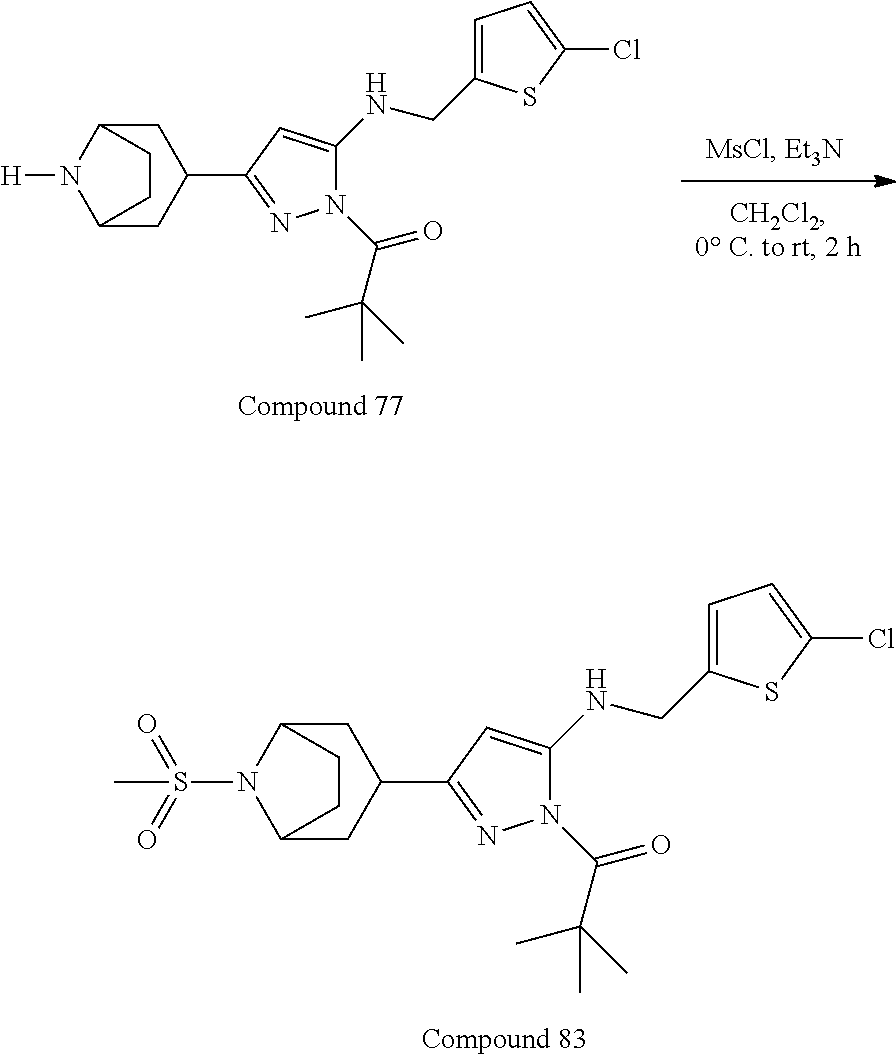
To a cooled solution (0° C.) of 1-(3-(8-azabicyclo[3.2.1]octan-3-yl)-5-((5-chlorothiophen-2-yl)methylamino)-1H-pyrazol-1-yl)-2,2-dimethylpropan-1-one (Compound 77, 350 mg, 0.86 mmol) in dry dichloromethane (10 mL) was added triethylamine (TEA, 0.3 mL, 2.15 mmol) followed by methanesulfonyl chloride (0.1 mL, 1.3 mmol). After stirring at room temperature for 2 hours, ice-cold water (5 mL) was added, and washed with dichloromethane (2×20 mL). The combined organic layers were dried over sodium sulfate, filtered and concentrated under reduced pressure. The residue was purified by flash column chromatography using 1% MeOH— dichloromethane, to give 1-(5-((5-chlorothiophen-2-yl)methylamino)-3-(8-(methylsulfonyl)-8-azabicyclo[3.2.1]octan-3-yl)-1H-pyrazol-1-yl)-2,2-dimethylpropan-1-one (Compound 83, 310 mg, yield: 74%) as an off white solid. m/z 485.15 [M+H]+. 1H NMR (400 MHz, DMSO-d6) δ=7.67 (br t, J=6.1 Hz, 1H, exchangeable), 6.96 (s, 2H), 5.36 (s, 1H), 4.41 (d, J=5.9 Hz, 2H), 4.18 (br s, 2H), 3.00-2.90 (m, 4H), 2.05-1.96 (m, 2H), 1.89-1.69 (m, 6H), 1.40 (s, 9H) ppm; TLC System: 5% Methanol-dichloromethane. Rf-0.6.

To a stirred solution of 1-(5-((5-chlorothiophen-2-yl)methylamino)-3-(8-(methylsulfonyl)-8-azabicyclo[3.2.1]octan-3-yl)-1H-pyrazol-1-yl)-2,2-dimethylpropan-1-one (Compound 83, 145 mg, 0.3 mmol) in methanol (5 mL) at room temperature was added sodium bicarbonate (126 mg, 1.5 mmol). After stirring at 50° C. for 4 hours, the reaction mixture was concentrated and extracted into dichloromethane (2×15 mL). The combined organic layers were dried over sodium sulfate, filtered and concentrated under reduced pressure. The residue was purified by preparative HPLC to give N-((5-chlorothiophen-2-yl)methyl)-3-(8-(methylsulfonyl)-8-azabicyclo[3.2.1]octan-3-yl)-1H-pyrazol-5-amine (Compound 84, 25 mg) as an off-white solid. m/z 401.20 [M+H]+. 1H NMR (400 MHz, DMSO-d6) δ=11.28 (s, 1H), 6.90 (d, J=3.9 Hz, 1H), 6.83 (br d, J=3.4 Hz, 1H), 5.62 (br s, 1H, exchangeable), 5.27 (br s, 1H), 4.27 (d, J=6.4 Hz, 2H), 4.16 (br s, 2H), 2.94 (s, 4H), 2.05-1.97 (m, 2H), 1.86-1.74 (m, 4H), 1.73-1.64 (m, 2H) ppm; TLC System: 5% Methanol-dichloromethane. Rf-0.2.

To a cooled solution (0° C.) of N-((5-chlorothiophen-2-yl)methyl)-3-(8-(methylsulfonyl)-8-azabicyclo[3.2.1]octan-3-yl)-1H-pyrazol-5-amine (Compound 84, 170 mg, 0.42 mmol) in dry dichloromethane (10 mL) was added triethylamine (TEA, 0.15 mL, 1.06 mmol) and then 1,3-thiazole-4-carbonyl chloride (125 mg, 0.85 mmol). After stirring at room temperature for 2 hours, ice-cold water (5 mL) was added and then washed with dichloromethane (2×15 mL). The combined organic layers were dried over sodium sulfate, filtered and concentrated under reduced pressure. The residue was purified by flash column chromatography, eluting with 1-2% MeOH-dichloromethane, to give the desired product (170 mg, yield: 78%) as a light brown liquid. It was purified further by preparative HPLC to give the 50 mg of pure (5-((5-chlorothiophen-2-yl)methylamino)-3-(8-(methyl sulfonyl)-8-azabicyclo[3.2.1]octan-3-yl)-1H-pyrazol-1-yl)(thiazol-4-yl)methanone (Compound 85, 50 mg) as a pale yellow solid. m/z 512.14 [M+H]+. 1H NMR (400 MHz, DMSO-d6) δ=9.19 (s, 1H), 9.04 (s, 1H), 7.80 (br s, 1H), 7.19 (br s, 1H), 7.05-6.93 (m, 2H), 5.54 (s, 1H), 4.50 (br d, J=5.4 Hz, 2H), 4.19 (br s, 2H), 3.07-2.90 (m, 4H), 2.01 (br s, 2H), 1.92-1.73 (m, 6H) ppm; TLC System: 5% Methanol-dichloromethane. Rf-0.5.

To a cooled solution (0° C.) of methyl azetidine-3-carboxylate hydrochloride (10 g, 66 mmol) in THF/H2O (3:6, 100 mL) was added sodium bicarbonate (16.6 g, 198 mmol) portionwise, followed by allyl chloroformate (7.73 mL, 72.6 mmol). After stirring at room temperature for 5 hours, the mixture was extracted into EtOAc (3×100 mL). The combined organic layers were dried over sodium sulfate, filtered and concentrated under reduced pressure. The residue was purified by silica gel column chromatography (100-200 mesh), eluting with 2% MeOH/dichloromethane, to give 1-allyl 3-methyl azetidine-1,3-dicarboxylate (Intermediate 42, 11 g, yield: 83%) as a colorless syrup. m/z 200.03 [M+H]+; TLC System: 5% Methanol-dichloromethane; Rf-0.7.

To a cooled solution (−78° C.) of acetonitrile (3.1 mL, 60.3 mmol) in dry THF (60 mL) was added n-BuLi (2.5M in THF, 24.1 mL, 60.3 mmol) then stirred for 1 hour, and then to it added a solution of 1-allyl-3-methyl azetidine-1,3-dicarboxylate (Intermediate 42, 10 g, 50.3 mmol) in dry THF (20 mL). After stirring at −78° C. for 1 hour, the mixture was quenched with saturated NH4Cl solution (20 mL) and extracted into EtOAc (2×120 mL). The combined organic layers were dried over sodium sulfate, filtered and concentrated under reduced pressure. The residue was purified by silica gel column chromatography (100-200 mesh), eluting with 50% EtOAc/n-hexane, to afford desired allyl 3-(2-cyanoacetyl)azetidine-1-carboxylate (Intermediate 43, 5.1 g, 49%) as a light yellow liquid; TLC System: 60% ethyl acetate in hexane. Rf-0.3.

To a solution of allyl 3-(2-cyanoacetyl)azetidine-1-carboxylate (Intermediate 43, 5 g, 24 mmol) in ethanol (30 mL) was added hydrazine hydrate (N2H4.H2O, 1.2 mL, 24 mmol) and the reaction mixture was then heated to 80° C. for 5 hours. The reaction mixture was cooled to room temperature and the volatiles were evaporated. The residue was purified by silica gel column chromatography (100-200 mesh), eluting with 4% MeOH-dichloromethane, to afford allyl 3-(5-amino-1H-pyrazol-3-yl)azetidine-1-carboxylate (Compound 86, 3.6 g, 68%) as an orange liquid; m/z 223.11 [M+H]+; TLC System: 5% Methanol-dichloromethane. Rf-0.3.

To a cooled solution (0° C.) of allyl 3-(5-amino-1H-pyrazol-3-yl)azetidine-1-carboxylate (Compound 86, 3.5 g, 15.8 mmol) in dry EtOH (40 mL) was added 5-chlorothiophene-2-carbaldehyde (1.9 mL, 18.9 mmol), acetic acid (0.5 mL) and then powdered 4 Å molecular sieves (1 g). The reaction mixture was stirred at room temperature for 1 hour. (Formation of imine was observed as a less polar spot on TLC). To the mixture was then added sodium cyanoborohydride (1.19 g, 18.9 mmol) portionwise and stirring continued at room temperature for 2 hours. The reaction mixture was quenched with ice-cold water (50 mL), filtered through a Celite pad and the filtrate was extracted into EtOAc (3×100 mL). The combined organic layers were dried over sodium sulfate, filtered and concentrated under reduced pressure. The residue was purified by silica gel column chromatography (100-200 mesh), eluting with 5% MeOH/dichloromethane, to afford allyl 3-(5-((5-chlorothiophen-2-yl)methylamino)-1H-pyrazol-3-yl)azetidine-1-carboxylate (Compound 87, 3.2 g, 58%) as a light yellow gummy liquid; m/z 353.17 [M+H]+. 1H NMR (400 MHz, DMSO-d6) δ 11.54 (br s, 1H), 6.97-6.79 (m, 2H), 5.98-5.84 (m, 1H), 5.73 (br s, 1H), 5.47 (br s, 1H), 5.28 (dd, J=1.5, 17.1 Hz, 1H), 5.19 (dd, J=1.2, 10.5 Hz, 1H), 4.50 (d, J=5.4 Hz, 2H), 4.36-4.10 (m, 4H), 3.97-3.64 (m, 3H) ppm; TLC System: 5% Methanol in dichloromethane Rf-0.4.

To a cooled solution (0° C.) of allyl 3-(5-((5-chlorothiophen-2-yl)methylamino)-1H-pyrazol-3-yl)azetidine-1-carboxylate (Compound 87, 3 g, 8.5 mmol) in dry dichloromethane (45 mL) was added triethylamine (TEA, 1.84 mL, 12.8 mmol), followed by trimethylacetyl chloride (1.0 mL, 8.5 mmol). After stirring at room temperature for 2 hours, the reaction mixture was diluted with water (50 mL) and extracted into dichloromethane (3×50 mL). The combined organic layers were dried over sodium sulfate, filtered and concentrated under reduced pressure. The residue was purified by silica gel column chromatography (100-200 mesh), eluting with 15% EtOAc/hexanes, to afford allyl 3-(5-((5-chlorothiophen-2-yl)methylamino)-1-pivaloyl-1H-pyrazol-3-yl)azetidine-1-carboxylate (Compound 88, 1.9 g, 51%) as a colorless liquid. MS (ESI): m/z 437.44 [M+H]+. 1H NMR (400 MHz, DMSO-d6) δ 7.75 (t, J=6.1 Hz, 1H), 6.96 (q, J=3.4 Hz, 2H), 5.90 (tdd, J=5.3, 10.4, 17.1 Hz, 1H), 5.52 (s, 1H), 5.31-5.23 (m, 1H), 5.18 (dd, J=1.5, 10.8 Hz, 1H), 4.53-4.47 (m, 2H), 4.43 (d, J=5.9 Hz, 2H), 4.24 (br s, 2H), 3.96 (br s, 2H), 3.70 (tt, J=5.9, 8.8 Hz, 1H), 1.41 (s, 9H) ppm; TLC System: 30% Ethyl acetate in hexane. Rf-0.6.

A cooled solution (0° C.) of allyl 3-(5-((5-chlorothiophen-2-yl)methylamino)-1-pivaloyl-1H-pyrazol-3-yl)azetidine-1-carboxylate (Compound 88, 600 mg, 1.4 mmol) in dichloromethane (30 mL) was degassed with a stream of argon for 15 minutes, then to it was added phenylsilane (PhSiH3, 0.5 mL, 4.1 mmol), followed by tetrakis(triphenylphosphine)palladium(0) (Pd(PPh3)4, 79.4 mg, 0.068 mmol). The reaction mixture was stirred at room temperature for 3 hours. After complete consumption of starting material (monitored by TLC), the mixture was re-cooled to 0° C., and to it added triethylamine (TEA, 0.39 mL, 2.75 mmol), followed by morpholine-4-carbamyl chloride (0.16 mL, 1.4 mmol) and the mixture was stirred at room temperature for 3 hours. The reaction mixture was diluted with water (20 mL) and extracted into dichloromethane (2×20 mL). The combined organic layers were dried over sodium sulfate, filtered and concentrated under reduced pressure. The residue was purified by Combi-Flash column chromatography, eluting with 2% MeOH/dichloromethane, to give 1-(5-((5-chlorothiophen-2-yl)methylamino)-3-(1-(morpholine-4-carbonyl)azetidin-3-yl)-1H-pyrazol-1-yl)-2,2-dimethylpropan-1-one (Compound 89, 200 mg, 31% over two steps) as an off-white solid. MS (ESI) m/z 466.49 [M+H]+. 1H NMR (400 MHz, DMSO-d6) δ 7.75 (t, J=6.1 Hz, 1H), 6.96 (s, 2H), 5.47 (s, 1H), 4.43 (d, J=5.9 Hz, 2H), 4.20 (t, J=8.3 Hz, 2H), 3.94 (dd, J=6.1, 7.6 Hz, 2H), 3.64 (ddd, J=6.4, 8.7, 14.8 Hz, 1H), 3.57-3.45 (m, 4H), 3.25-3.14 (m, 4H), 1.40 (s, 9H) ppm; TLC System: 5% Methanol in dichloromethane Rf-0.6.

To a solution of 1-(5-((5-chlorothiophen-2-yl)methylamino)-3-(1-(morpholine-4-carbonyl)azetidin-3-yl)-1H-pyrazol-1-yl)-2,2-dimethylpropan-1-one (Compound 89, 200 mg, 0.43 mmol) in methanol (5 mL) was added sodium bicarbonate (NaHCO3, 108 mg, 1.3 mmol). After stirring the reaction mixture at 50° C. for 4 hours, the reaction mixture was cooled to room temperature, the volatiles were evaporated and the resultant residue was diluted with EtOAc (20 mL) and washed with water (2×10 mL). The organic layers were dried over sodium sulfate, filtered and concentrated under reduced pressure. The resulting solid was triturated with diethyl ether and n-pentane and dried under high vacuum for 1 hour to afford (3-(5-((5-chlorothiophen-2-yl)methylamino)-1H-pyrazol-3-yl)azetidin-1-yl)(morpholino)methanone (Compound 90, 150 mg, 92%) as a pale yellow gummy solid; TLC System: 5% Methanol in dichloromethane Rf-0.3.

To a cooled solution (0° C.) of (3-(5-((5-chlorothiophen-2-yl)methylamino)-1H-pyrazol-3-yl)azetidin-1-yl)(morpholino)methanone (Compound 90, 120 mg, 0.31 mmol) in dry dichloromethane (5 mL) was added triethylamine (TEA, 0.09 mL, 0.63 mmol), followed by thiazole-4-carbonyl chloride (51 mg, 0.35 mmol). After stirring at room temperature for 3 hours, the reaction mixture was diluted with water (10 mL) and extracted into dichloromethane (3×20 mL). The combined organic layers were dried over sodium sulfate, filtered and concentrated under reduced pressure. The residue was purified by Combi Flash column chromatography, eluting with 20% acetone/dichloromethane, to give (3-(5-((5-chlorothiophen-2-yl)methylamino)-1-(thiazole-4-carbonyl)-1H-pyrazol-3-yl)azetidin-1-yl)(morpholino)methanone (Compound 91, 50 mg, 32%) as a pale yellow solid. m/z 493.16 [M+H]+. 1H NMR (400 MHz, DMSO-d6) δ 9.20 (d, J=1.5 Hz, 1H), 9.04 (s, 1H), 7.87 (t, J=6.1 Hz, 1H), 6.99 (dd, J=3.4, 13.2 Hz, 2H), 5.65 (s, 1H), 4.53 (d, J=6.4 Hz, 2H), 4.22 (t, J=8.6 Hz, 2H), 3.98 (t, J=6.8 Hz, 2H), 3.75-3.64 (m, 1H), 3.59-3.49 (m, 4H), 3.26-3.17 (m, 4H) ppm; TLC System: 30% acetone in dichloromethane Rf-0.6.

A cooled solution (0° C.) of allyl 3-(5-((5-chlorothiophen-2-yl)methylamino)-1-pivaloyl-1H-pyrazol-3-yl)azetidine-1-carboxylate (Compound 88, 100 mg, 0.23 mmol) in dichloromethane (10 ml) was degassed with a stream of argon for 15 minutes, then to it was added phenylsilane (PhSiH3, 0.075 ml, 0.69 mmol) followed by tetrakis(triphenylphosphine)palladium(0) (Pd(PPh3)4, 13 mg, 0.01 mmol). The reaction mixture was stirred at room temperature for 3 hours, then filtered through a Celite pad and the filtrate was evaporated. The residue was purified by flash chromatography, eluting with 4% MeOH-dichloromethane to give 1-(3-(5-((5-chlorothiophen-2-yl)methylamino)-1H-pyrazol-3-yl)azetidin-1-yl)-2,2-dimethylpropan-1-one (Compound 92, 30 mg, 37%) as a pale yellow gummy liquid. MS (ESI) m/z 353.27 [M+H]+; 1H NMR (400 MHz, DMSO-d6) δ 11.54 (s, 1H), 7.01-6.70 (m, 2H), 5.71 (br s, 1H), 5.48 (s, 1H), 4.65 (s, 1H), 4.40-3.97 (m, 4H), 3.71 (s, 2H), 1.30-0.83 (s, 9H) ppm; TLC System: 5% MeOH in dichloromethane, Rf-0.4.

A cooled solution (0° C.) of allyl 3-(5-((5-chlorothiophen-2-yl)methylamino)-1-pivaloyl-1H-pyrazol-3-yl)azetidine-1-carboxylate (Compound 88, 200 mg, 0.46 mmol) in dichloromethane (15 ml) was degassed with a stream of argon for 15 minutes, then to it was added phenylsilane (PhSiH3, 0.16 mL, 1.38 mmol) followed by tetrakis(triphenylphosphine)palladium(0) (Pd(PPh3)4, 26 mg, 0.02 mmol). The reaction mixture was stirred at room temperature for 3 hours. After complete consumption of starting material (monitored by TLC), the mixture was cooled to 0° C. and to it added triethylamine (TEA, 0.16 mL, 1.1 mmol) followed by pivaloyl chloride (0.06 ml, 0.46 mmol). After stirring at room temperature for 2 hours, the reaction mixture was diluted with water (10 mL) and extracted into dichloromethane (3×15 mL). The combined organic layers were dried over sodium sulfate, filtered and concentrated under reduced pressure. The residue was purified by Combi-Flash column chromatography, eluting with 20% EtOAc/hexane, to afford 1-(3-(5-((5-chlorothiophen-2-yl)methylamino)-1-pivaloyl-1H-pyrazol-3-yl)azetidin-1-yl)-2,2-dimethylpropan-1-one (Compound 93, 40 mg, 20%; over two steps) as a pale yellow gummy material. m/z: 437.21 [M+H]+. 1H NMR (400 MHz, DMSO-d6) δ 7.72 (t, J=6.4 Hz, 1H), 6.94-6.90 (m, 2H), 5.44 (s, 1H), 4.63 (s, 1H), 4.43-4.28 (m, 3H), 4.10 (s, 1H), 3.79 (s, 1H), 3.63-3.58 (m, 1H), 1.37 (s, 9H), 1.07 (s, 9H) ppm; TLC System: 30% Ethyl acetate in Hexane, Rf-0.4.

A cooled solution (0° C.) of allyl 3-(5-((5-chlorothiophen-2-yl)methylamino)-1-pivaloyl-1H-pyrazol-3-yl)azetidine-1-carboxylate (Compound 88, 550 mg, 1.3 mmol) in dichloromethane (25 mL) was degassed with a stream of argon for 15 minutes, then to it was added phenylsilane (PhSiH3, 0.46 ml, 3.8 mmol) followed by tetrakis(triphenylphosphine)palladium(0) (Pd(PPh3)4, 72 mg, 0.06 mmol). The reaction mixture was stirred at room temperature for 3 hours. After complete consumption of starting material (monitored by TLC), the mixture was cooled to 0° C. and to it added triethylamine (TEA, 0.35 mL, 2.52 mmol), followed by methanesulfonyl chloride (MsCl, 0.1 mL, 1.3 mmol). The mixture was stirred at room temperature for 2 hours. The reaction mixture was diluted with water (20 mL) and extracted into dichloromethane (3×20 mL). The combined organic layers were dried over sodium sulfate, filtered and concentrated under reduced pressure. The residue was purified by Combi-Flash column chromatography, eluting with 70% dichloromethane/hexane, to afford 1-(5-((5-chlorothiophen-2-yl)methylamino)-3-(1-(methyl sulfonyl)azetidin-3-yl)-1H-pyrazol-1-yl)-2,2-dimethylpropan-1-one (Compound 94, 160 mg, 29% over two steps) as an off-white solid; m/z 431.17 [M+H]+; 1H NMR (400 MHz, DMSO-d6) δ 7.78 (t, J=6.1 Hz, 1H), 7.01-6.93 (m, 2H), 5.51 (s, 1H), 4.44 (d, J=6.4 Hz, 2H), 4.18-4.08 (m, 2H), 3.96 (t, J=7.6 Hz, 2H), 3.78-3.65 (m, 1H), 3.02 (s, 3H), 1.42 (s, 9H) ppm; TLC System: dichloromethane Rf-0.4.

To a solution of 1-(5-((5-chlorothiophen-2-yl)methylamino)-3-(1-(methyl sulfonyl)azetidin-3-yl)-1H-pyrazol-1-yl)-2,2-dimethylpropan-1-one (Compound 94, 140 mg, 0.33 mmol) in methanol (5 mL) was added sodium bicarbonate (NaHCO3, 82 mg, 0.98 mmol) and the reaction mixture was stirred at room temperature for 4 hours. The volatiles were evaporated and the resultant residue was diluted with EtOAc (20 mL) and washed with water (2×10 mL). The organic layer was dried over sodium sulfate, filtered and concentrated under reduced pressure. The residue was triturated with diethyl ether and n-pentane and dried under high vacuum to afford N-((5-chlorothiophen-2-yl)methyl)-3-(1-(methylsulfonyl)azetidin-3-yl)-1H-pyrazol-5-amine (Compound 95, 90 mg, 80%) as a pale yellow solid; m/z 347.19 [M+H]+; 1H NMR (400 MHz, DMSO-d6) δ 11.54 (br s, 1H), 6.96-6.78 (m, 2H), 5.85-5.44 (m, 2H), 4.30 (d, J=6.4 Hz, 2H), 4.10 (t, J=7.8 Hz, 2H), 3.87 (t, J=7.3 Hz, 2H), 3.73 (br s, 1H), 3.03 (s, 3H) ppm; TLC System: 5% Methanol in dichloromethane, Rf-0.4.

To a cooled solution (0° C.) of N-((5-chlorothiophen-2-yl)methyl)-3-(1-(methylsulfonyl)azetidin-3-yl)-1H-pyrazol-5-amine (Compound 95, 70 mg, 0.202 mmol) in dry dichloromethane (4 mL) was added triethylamine (TEA, 0.07 mL, 0.51 mmol), followed by thiazole-4-carbonyl chloride (32.7 mg, 0.22 mmol). The mixture was then stirred at room temperature for 3 hours. The reaction mixture was diluted with water (10 mL) and extracted into dichloromethane (3×15 mL). The combined organic layers were dried over sodium sulfate, filtered and concentrated under reduced pressure. The resultant residue was purified by Combi-Flash column chromatography, eluting with 5% acetone/dichloromethane, to afford (5-((5-chlorothiophen-2-yl)methylamino)-3-(1-(methylsulfonyl)azetidin-3-yl)-1H-pyrazol-1-yl)(thiazol-4-yl)methanone (Compound 96, 50 mg, 54%) as a pale yellow solid; m/z 458.14 [M+H]+; 1H NMR (400 MHz, DMSO-d6) δ 9.20 (d, J=2.0 Hz, 1H), 9.08 (d, J=2.0 Hz, 1H), 7.91 (t, J=6.1 Hz, 1H), 7.07-6.85 (m, 2H), 5.66 (s, 1H), 4.53 (d, J=5.9 Hz, 2H), 4.21-4.11 (m, 2H), 4.02 (t, J=7.3 Hz, 2H), 3.83-3.72 (m, 1H), 3.03 (s, 3H) ppm; TLC System: 10% Acetone in dichloromethane, Rf-0.5.

To a cooled solution (0° C.) of allyl 3-(5-((5-chlorothiophen-2-yl)methylamino)-1H-pyrazol-3-yl)azetidine-1-carboxylate (Compound 87, 100 mg, 0.28 mmol) in dry dichloromethane (5 mL) was added triethylamine (TEA, 0.1 mL, 0.71 mmol), followed by thiazole-4-carbonyl chloride (41.8 mg, 0.28 mmol). The mixture was stirred at room temperature for 3 hours. The reaction mixture was diluted with water (10 mL) and extracted into dichloromethane (3×15 mL). The combined organic layers were dried over sodium sulfate, filtered and concentrated under reduced pressure. The residue was purified by Combi-Flash column chromatography, eluting with 2% MeOH/dichloromethane, to afford allyl 3-(5-((5-chlorothiophen-2-yl)methylamino)-1-(thiazole-4-carbonyl)-1H-pyrazol-3-yl)azetidine-1-carboxylate (Compound 97, 60 mg, 45%) as a pale yellow solid; m/z 464.15 [M+H]+. 1H NMR (400 MHz, DMSO-d6) δ 9.20 (d, J=1.5 Hz, 1H), 9.03 (d, J=2.0 Hz, 1H), 7.88 (t, J=6.4 Hz, 1H), 7.02 (d, J=3.4 Hz, 1H), 6.97 (d, J=3.9 Hz, 1H), 5.98-5.84 (m, 1H), 5.70 (s, 1H), 5.27 (dd, J=1.7, 17.4 Hz, 1H), 5.18 (dd, J=1.5, 10.3 Hz, 1H), 4.51 (dd, J=5.9, 10.3 Hz, 4H), 4.25 (br s, 2H), 4.00 (br s, 2H), 3.76 (tt, J=6.2, 8.7 Hz, 1H) ppm; TLC System: 5% MeOH in dichloromethane, Rf-0.6.

To a cooled solution (0° C.) of 1-(tert-butoxycarbonyl)pyrrolidine-2-carboxylic acid (20 g, 92.9 mmol) in dry dimethylformamide (DMF, 100 mL) was added cesium carbonate (Cs2CO3, 103 g, 316 mmol) followed by iodomethane (MeI, 12 mL, 186 mmol). After stirring at room temperature for 16 hours, water (100 mL) was added and extracted into EtOAc (2×100 mL). The combined organic layers were dried over sodium sulfate, filtered and concentrated under reduced pressure. The residue was purified by silica gel column chromatography (100-200 mesh), eluting with 10-15% EtOAc/n-hexanes, to obtain 1-tert-butyl-2-methyl pyrrolidine-1,2-dicarboxylate (Intermediate 44, 19 g, yield: 90%) as a pale yellow liquid; TLC System: 20% ethyl acetate in hexane Rf-0.5.

To a cooled solution (0° C.) of 1-tert-butyl-2-methyl pyrrolidine-1,2-dicarboxylate (Intermediate 44, 19 g, 83 mmol) in 1,4-dioxane (120 mL) was added HCl (4M in 1,4-dioxane, 95 mL) and the reaction was then stirred at room temperature for 5 hours. The reaction mixture was concentrated under reduced pressure and triturated with diethyl ether to afford methyl pyrrolidine-2-carboxylate hydrochloride (Intermediate 45, 12 g, yield-88%) as a white solid.

To a cooled solution (0° C.) of methylpyrrolidine-2-carboxylate hydrochloride (Intermediate 45, 12 g, 72.7 mmol) in THF (150 mL) was added pyridine (23.5 mL, 290.9 mmol), then 4-(dimethylamino)pyridine (DMAP, 889 mg, 7.3 mmol), followed by allyl chloroformate (15.5 mL, 145.4 mmol). The reaction mixture was stirred at room temperature for 16 hours, then water (100 mL) was added and extracted into dichloromethane (2×100 mL). The combined organic layers were dried over sodium sulfate, filtered and concentrated under reduced pressure. The residue was purified by silica gel column chromatography (100-200 mesh), eluting with 10-15% EtOAc/n-hexanes, to obtain 1-allyl-2-methyl pyrrolidine-1,2-dicarboxylate (Intermediate 46, 13 g, yield: 80%) as a colorless liquid. m/z 236.00 [M+Na]+; TLC System: 20% ethyl acetate in hexane Rf-0.5.

To a cold solution (−78° C.) of acetonitrile (1.8 mL, 35.2 mmol) in dry THF (50 mL) was added n-butyllithium (2.5M in n-hexane, 14 mL, 35.2 mmol). After stirring at −78° C. for 45 minutes, a solution of 1-allyl-2-methyl pyrrolidine-1,2-dicarboxylate (Intermediate 46, 5 g, 23.5 mmol) in dry THF (10 mL) was added and the reaction stirred at −78° C. for 1 hour. The reaction mixture was quenched with saturated NH4Cl solution (20 mL) and extracted into EtOAc (2×50 mL). The combined organic layers were dried over sodium sulfate, filtered and concentrated under reduced pressure. The residue was purified by silica gel column chromatography (100-200 mesh), eluting with 20-25% EtOAc/n-hexane, to give allyl-2-(2-cyanoacetyl)pyrrolidine-1-carboxylate (Intermediate 47, 4.3 g, yield: 82%) as a brown color liquid: TLC System: 50% ethyl acetate in hexane Rf-0.2.

To a stirred solution of allyl-2-(2-cyanoacetyl)pyrrolidine-1-carboxylate (Intermediate 47, 4.3 g, 19.4 mmol) in ethanol (40 mL) was added hydrazine monohydrate (0.85 mL, 17.4 mmol). The reaction mixture was then heated to 70° C. for 5 hours. The reaction mixture was then cooled to room temperature and the volatiles were evaporated. The resultant residue was purified by silica gel column chromatography (100-200 mesh), eluting with 3% MeOH-dichloromethane, to give allyl-2-(5-amino-1H-pyrazol-3-yl)pyrrolidine-1-carboxylate (Compound 98, 4 g, yield: 87%) as a colorless liquid. m/z 237.14 [M+H]+; TLC System: 5% methanol in dichloromethane Rf-0.3.

To a cooled solution (0° C.) of allyl-2-(5-amino-1H-pyrazol-3-yl)pyrrolidine-1-carboxylate (Compound 98, 4 g, 16.9 mmol) in dry MeOH (70 mL) was added 5-chlorothiophene-2-carbaldehyde (3.9 mL, 33.9 mmol) and acetic acid (0.1 mL), followed by powdered 4 Å molecular sieves. The reaction mixture was stirred at room temperature for 1 hour (the formation of imine was observed as a less polar spot on TLC). After cooling the reaction mixture back to 0° C., sodium cyanoborohydride (NaCNBH3, 1.52 g, 8.5 mmol) was added portionwise. The mixture was then stirred at room temperature for 2 hours. The reaction mixture was quenched with ice-cold water (30 mL), filtered through a Celite pad and the filtrate was extracted into EtOAc (3×50 mL). The combined organic layers were dried over sodium sulfate, filtered and concentrated under reduced pressure. The residue was purified by preparative HPLC using a Reveleris C-18 reverse phase column, eluting with 35-40% acetonitrile in aqueous formic acid (0.1%), to obtain the required compound (3 g, yield: 45%). A portion (100 mg) of this was further purified by preparative HPLC purification to give allyl-2-(5-((5-chlorothiophen-2-yl)methylamino)-1H-pyrazol-3-yl)pyrrolidine-1-carboxylate (Compound 99, 50 mg) as a pale yellow gummy liquid. m/z 367.07 [M+H]+. 1H NMR (300 MHz, DMSO-d6) δ 11.39 (br s, 1H, exchangeable), 7.02-6.92 (m, 1H), 6.83 (br d, J=3.7 Hz, 1H, exchangeable), 6.09-5.47 (m, 2H), 5.38-4.97 (m, 3H), 4.81 (br s, 1H), 4.47 (br d, J=15.0 Hz, 2H), 4.28 (d, J=6.2 Hz, 2H), 3.48 (br s, 2H), 2.08 (br d, J=6.2 Hz, 1H), 1.95-1.58 (m, 3H) ppm; TLC System: 5% methanol in dichloromethane Rf-0.4.

To a cooled solution (0° C.) of allyl-2-(5-((5-chlorothiophen-2-yl)methylamino)-1H-pyrazol-3-yl)pyrrolidine-1-carboxylate (Compound 99, 3.5 g, 9.6 mmol) in dry dichloromethane (50 mL) was added trimethylacetyl chloride (1.1 mL, 8.6 mmol) followed by triethylamine (TEA, 1.9 mL, 14.3 mmol). After stirring at room temperature for 2 hours, water (25 mL) was added and the mixture was extracted into dichloromethane (3×40 mL). The combined organic layers were dried over sodium sulfate, filtered and concentrated under reduced pressure. The residue was purified by silica gel column chromatography (100-200 mesh), eluting with 10% EtOAc/n-hexane, to afford the desired compound (3 g, yield: 69%) as a pale yellow gummy liquid. A portion (120 mg) was further purified by preparative HPLC purification to afford allyl-2-(5-((5-chlorothiophen-2-yl)methylamino)-1-pivaloyl-1H-pyrazol-3-yl)pyrrolidine-1-carboxylate (Compound 100, 50 mg) as a pale yellow gummy liquid; m/z 451.17 [M+H]+. 1H NMR (400 MHz, CDCl3) δ 7.49-7.31 (m, 1H), 6.83-6.66 (m, 2H), 6.07-5.74 (m, 1H), 5.38-5.26 (m, 1H), 5.24-5.06 (m, 2H), 4.98-4.77 (m, 1H), 4.64-4.46 (m, 2H), 4.34 (d, J=5.9 Hz, 2H), 3.67-3.41 (m, 2H), 2.27-1.80 (m, 4H), 1.44 (s, 9H) ppm; TLC System: 50% ethyl acetate in hexane Rf-0.7.

A stirred solution of allyl-2-(5-((5-chlorothiophen-2-yl)methylamino)-1-pivaloyl-1H-pyrazol-3-yl)pyrrolidine-1-carboxylate (Compound 100, 1.5 g, 3.3 mmol) in dichloromethane (30 mL) was degassed with a stream of argon for 15 minutes., then to the mixture was added tetrakis(triphenylphosphine)palladium(0) (Pd(PPh3)4, 193 mg, 0.16 mmol) followed by phenylsilane (PhSiH3, 1.2 mL, 10 mmol). The reaction mixture was stirred at room temperature for 45 minutes, then was filtered through a Celite pad and the filtrate was evaporated. The crude residue was purified by combi-flash silica chromatography eluting with 4% MeOH— dichloromethane to afford 1-(5-((5-chlorothiophen-2-yl)methylamino)-3-(pyrrolidin-3-yl)-1H-pyrazol-1-yl)-2,2-dimethylpropan-1-one (Compound 101, 1 g, yield: 81%) as a pale yellow gummy liquid. m/z 367.26 [M+H]+, 1H NMR (300 MHz, DMSO-d6) δ 7.72 (br t, J=6.1 Hz, 1H, exchangeable), 6.96 (s, 2H), 5.44 (s, 1H), 4.42 (br d, J=6.2 Hz, 2H), 4.05 (br t, J=6.6 Hz, 1H), 3.11-2.82 (m, 2H), 2.13-1.95 (m, 1H), 1.87-1.65 (m, 3H), 1.41 (s, 9H) ppm; TLC System: 10% methanol in dichloromethane Rf-0.3

To a cooled solution (0° C.) of 1-(5-((5-chlorothiophen-2-yl)methylamino)-3-(pyrrolidin-2-yl)-1H-pyrazol-1-yl)-2,2-dimethylpropan-1-one (Compound 101, 200 mg, 1.2 mmol) in dry dichloromethane (10 mL) was added 4-morpholineacetic acid chloride (94 mg, 0.66 mmol) followed by triethylamine (TEA, 0.22 mL, 1.6 mmol). After stirring at room temperature for 2 hours, ice-cold water (10 mL) was added, then washed with dichloromethane (2×15 mL). The combined organic layers were dried over sodium sulfate, filtered and concentrated under reduced pressure. The residue was purified by silica gel column chromatography (100-200 mesh), eluting with 50% EtOAc-hexanes, to give the desired product (120 mg, yield: 81%) as a light yellow semi-solid. A portion (160 mg) of this material (85% by LCMS) was purified by preparative HPLC to give 1-(5-((5-chlorothiophen-2-yl)methylamino)-3-(1-(2-morpholinoacetyl)pyrrolidin-2-yl)-1H-pyrazol-1-yl)-2,2-dimethylpropan-1-one (Compound 102, 60 mg) as an off-white gummy semi solid; m/z 494.22 [M+H]+. 1H NMR (400 MHz, DMSO-d6) δ 7.49 (br s, 1H), 6.90 (s, 2H), 5.34 (br s, 1H), 5.10 (br s, 2H), 4.42 (br s, 2H), 3.49 (br s, 8H), 2.98 (s, 2H), 2.48 (br s, 3H), 1.94 (br s, 2H), 1.39 (s, 9H) ppm; TLC System: 70% ethyl acetate in n-hexane—Rf-0.6.

To a room temperature solution of 1-(5-((5-chlorothiophen-2-yl)methylamino)-3-(1-(2-morpholinoacetyl)pyrrolidin-2-yl)-1H-pyrazol-1-yl)-2,2-dimethylpropan-1-one (Compound 102, 230 mg, 0.54 mmol) in methanol (10 mL) was added sodium bicarbonate (NaHCO3, 230 mg, 2.7 mmol). The mixture was stirred at 50° C. for 4 hours, then cooled back to room temperature, water (20 mL) was added and washed with dichloromethane (3×20 mL). The combined organic phases were dried with sodium sulfate, filtered and evaporated under reduced pressure. The residue was purified by silica gel column chromatography (100-200 mesh), eluting with 5-7% methanol in dichloromethane to afford the desired product (130 mg, yield: 67%). A portion (130 mg, 72% by LCMS) of this material was further purified by preparative HPLC to afford 1-(2-(5-((5-chlorothiophen-2-yl)methylamino)-1H-pyrazol-3-yl)pyrrolidin-1-yl)-2-morpholinoethanone (Compound 103, 25 mg) as a pale yellow solid; m/z 410.15 [M+H]+. 1H NMR (400 MHz, DMSO-d6) δ 11.84-10.62 (m, 1H, exchangeable), 7.46-5.87 (m, 2H), 5.27 (br s, 2H), 5.04 (br s, 1H), 4.29 (br d, J=6.6 Hz, 2H), 3.53 (br s, 6H), 3.07 (br d, J=6.6 Hz, 1H), 2.97-2.71 (m, 1H), 2.48 (br d, J=1.5 Hz, 4H), 2.07 (br s, 1H), 1.85 (br s, 3H) ppm; TLC System: 10% methanol in dichloromethane—Rf-0.3.

To a cold solution (0° C.) of 1-(5-((5-chlorothiophen-2-yl)methylamino)-3-(pyrrolidin-2-yl)-1H-pyrazol-1-yl)-2,2-dimethylpropan-1-one (Compound 101, 700 mg, 1.9 mmol) in dry dichloromethane (20 mL) was added methanesulfonyl chloride (MsCl, 0.22 mL, 2.8 mmol) followed by triethylamine (TEA, 0.6 mL, 4.4 mmol). After the mixture was stirred at room temperature for 1 hour, ice-cold water (20 mL) was added and extracted into dichloromethane (3×20 mL). The combined organic phases were dried with sodium sulfate, filtered and evaporated under reduced pressure. The residue was purified by silica gel column chromatography (100-200 mesh), eluting with 20-25% ethyl acetate in n-hexane, to give the desired product (550 mg, yield: 64%). A portion (170 mg) was further purified by preparative HPLC chromatography to yield 1-(5-((5-chlorothiophen-2-yl)methylamino)-3-(1-(methyl sulfonyl)pyrrolidin-2-yl)-1H-pyrazol-1-yl)-2,2-dimethylpropan-1-one (Compound 104, 50 mg) as a pale yellow gummy liquid; m/z 445.17 [M+H]+; 1H NMR (400 MHz, CDCl3) δ 7.52-7.35 (m, 1H, exchangeable), 6.91-6.61 (m, 2H), 5.37 (s, 1H), 4.83 (dd, J=2.7, 7.1 Hz, 1H), 4.37 (d, J=5.9 Hz, 2H), 3.63-3.36 (m, 2H), 2.75 (s, 3H), 2.33-1.89 (m, 4H), 1.45 (s, 9H) ppm; TLC System: 5% methanol in dichloromethane—Rf-0.6.

To a cooled solution (0° C.) of 1-(5-((5-chlorothiophen-2-yl)methylamino)-3-(1-(methylsulfonyl)pyrrolidin-2-yl)-1H-pyrazol-1-yl)-2,2-dimethylpropan-1-one (Compound 104, 200 mg, 0.45 mmol) in dry methanol (10 mL) was added sodium bicarbonate (189 mg, 2.25 mmol). After warming the mixture at 50° C. for 4 hours, the reaction mixture was cooled to room temperature, water (15 mL) was added and extracted into dichloromethane (3×20 mL). The combined organic phases were dried with sodium sulfate, filtered and evaporated under reduced pressure. The residue was purified by silica gel column chromatography (100-200 mesh), eluting with 5-7% methanol in dichloromethane, to give the required semi-pure compound (145 mg, yield: 89%) as an off-white solid. A portion (130 mg of 89% of LCMS purity) was further purified by preparative HPLC to yield N-((5-chlorothiophen-2-yl)methyl)-3-(1-(methylsulfonyl)pyrrolidin-2-yl)-1H-pyrazol-5-amine (Compound 105, 50 mg) as a white solid; m/z 361.16 [M+H]+; 1H NMR (400 MHz, DMSO-d6) δ 11.52-11.30 (m, 1H, exchangeable), 6.99-6.80 (m, 2H), 5.68 (br s, 1H, exchangeable), 5.41 (br s, 1H), 4.74 (br s, 1H), 4.29 (d, J=6.4 Hz, 2H), 3.46-3.24 (m, 2H), 2.84 (br s, 3H), 2.21-2.06 (m, 1H), 1.89 (br d, J=5.4 Hz, 3H) ppm; TLC System: 5% methanol in dichloromethane—Rf-0.3.

To a cooled solution (0° C.) of N-((5-chlorothiophen-2-yl)methyl)-3-(1-(methylsulfonyl)pyrrolidin-2-yl)-1H-pyrazol-5-amine (Compound 105, 200 mg, 0.56 mmol) in dry dichloromethane (10 mL) was added 1,3-thiazole-4-carbonyl chloride (148 mg, 1.11 mmol) followed by triethylamine (TEA, 0.18 mL, 1.4 mmol). After stirring at room temperature for 2 hours, the reaction mixture was quenched with NaHCO3 solution (10 mL) and extracted into dichloromethane (3×20 mL). The combined organic phases were dried over sodium sulfate and concentrated under reduced pressure to afford the desired compound (150 mg, yield: 57%) as a light yellow semi-solid. A portion (100 mg with 87% LCMS purity) was further purified by preparative HPLC chromatography to yield (5-((5-chlorothiophen-2-yl)methylamino)-3-(1-(methylsulfonyl)pyrrolidin-2-yl)-1H-pyrazol-1-yl)(thiazol-4-yl)methanone (Compound 106, 40 mg) as an off-white solid. m/z 472.10 [M+H]+. 1H NMR (400 MHz, CDCl3) δ 9.13 (d, J=2.0 Hz, 1H), 8.88 (d, J=2.0 Hz, 1H), 7.65 (br t, J=5.6 Hz, 1H, exchangeable), 6.89-6.69 (m, 2H), 5.44 (s, 1H), 4.88 (dd, J=3.2, 8.1 Hz, 1H), 4.49 (d, J=5.9 Hz, 2H), 3.66-3.39 (m, 2H), 2.78 (s, 3H), 2.37-2.16 (m, 2H), 2.14-1.95 (m, 2H) ppm; TLC System: 5% methanol in dichloromethane —Rf-0.5.

To a cooled solution (0° C.) of 1-(5-((5-chlorothiophen-2-yl)methylamino)-3-(pyrrolidin-2-yl)-1H-pyrazol-1-yl)-2,2-dimethylpropan-1-one (Compound 101, 320 mg, 0.87 mmol) in dry dichloromethane (10 mL) was added morpholine-4-carbonyl chloride (0.2 mL, 1.7 mmol) followed by triethylamine (TEA, 0.29 mL, 2.1 mmol). After stirring at room temperature for 1 hour, ice-cold water (10 mL) was added and then extracted into dichloromethane (2×15 mL). The combined organic layers were dried over sodium sulfate, filtered and concentrated under reduced pressure. The residue was purified by silica gel column chromatography (100-200 mesh), eluting with 50% EtOAc-hexanes, to give the desired product (170 mg, yield: 40%) as a light yellow semi-solid. A portion (160 mg, 85% by LCMS) was purified by preparative HPLC to obtain 1-(5-((5-chlorothiophen-2-yl)methylamino)-3-(1-(morpholine-4-carbonyl)pyrrolidin-2-yl)-1H-pyrazol-1-yl)-2,2-dimethylpropan-1-one (Compound 107, 45 mg) as a pale yellow gummy liquid; m/z 480.25 [M+H]+. 1H NMR (400 MHz, CDCl3) δ 7.40 (br t, J=5.6 Hz, 1H, exchangeable), 6.79-6.71 (m, 2H), 5.17 (s, 1H), 5.04 (t, J=6.8 Hz, 1H), 4.34 (d, J=5.4 Hz, 2H), 3.71-3.58 (m, 4H), 3.57-3.41 (m, 2H), 3.36 (ddd, J=3.4, 6.4, 13.2 Hz, 2H), 3.20 (ddd, J=2.9, 6.4, 13.2 Hz, 2H), 2.32-2.19 (m, 1H), 2.06-1.79 (m, 3H), 1.45 (s, 9H) ppm; TLC System: 5% Methanol-dichloromethane. Rf-0.5.
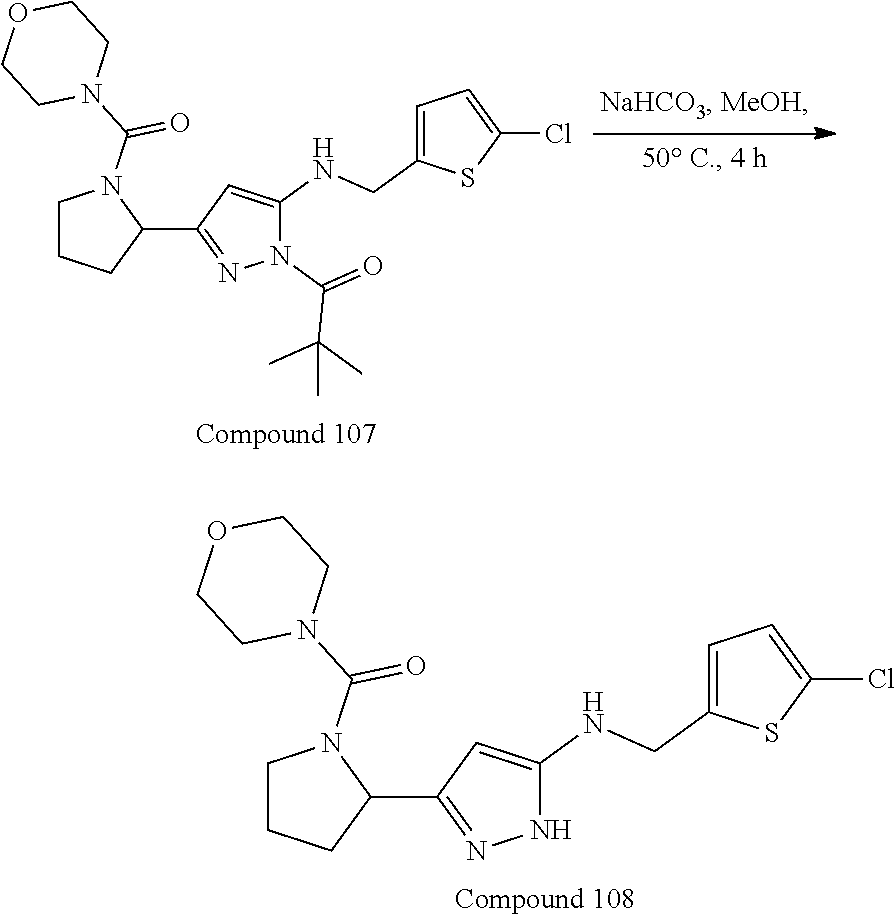
To a room temperature solution of 1-(5-((5-chlorothiophen-2-yl)methylamino)-3-(1-(morpholine-4-carbonyl)pyrrolidin-2-yl)-1H-pyrazol-1-yl)-2,2-dimethylpropan-1-one (Compound 107, 200 mg, 0.42 mmol) in methanol (10 mL) was added sodium bicarbonate (176 mg, 2.1 mmol), followed by heating of the mixture to 50° C. for 4 hours. The reaction mixture was cooled to room temperature, water (20 mL) was added and extracted into dichloromethane (3×20 mL). The residue was purified by silica gel column chromatography (100-200 mesh), eluting with 5-7% methanol in dichloromethane, to give the desired product (100 mg, yield: 65%) as a light yellow semi-solid. A portion (150 mg, 70% by LCMS) of material was further purified by preparative HPLC chromatography to give (2-(5-((5-chlorothiophen-2-yl)methylamino)-1H-pyrazol-3-yl)pyrrolidin-1-yl)(morpholino)methanone (Compound 108, 30 mg) as an off white solid. m/z 396.21 [M+H]+. 1H NMR (400 MHz, CDCl3) 10.04 (br s, 1H, exchangeable), 6.83-6.56 (m, 2H), 5.47 (s, 1H), 5.05 (dd, J=6.8, 9.3 Hz, 1H), 4.42 (br d, J=4.9 Hz, 2H), 3.95 (br s, 1H, exchangeable), 3.76-3.51 (m, 4H), 3.50-3.31 (m, 4H), 3.20 (ddd, J=2.9, 6.4, 13.2 Hz, 2H), 2.51-2.15 (m, 1H), 2.10-1.95 (m, 2H), 1.93-1.73 (m, 1H) ppm; TLC System: 5% methanol in dichloromethane—Rf-0.3.

To a cooled (0° C.) solution of (2-(5-((5-chlorothiophen-2-yl)methylamino)-1H-pyrazol-3-yl)pyrrolidin-1-yl)(morpholino)methanone (Compound 108, 260 mg, 0.66 mmol) in dry dichloromethane (15 mL) was added 1,3-thiazole-4-carbonyl chloride (194 mg, 1.3 mmol) followed by triethylamine (TEA, 0.22 mL, 0.94 mmol) and the mixture was stirred at 0° C. for a further 2 hours. To this was then added ice-cold water (15 mL) and the mixture was washed with dichloromethane (2×15 mL). The combined organic layers were dried over sodium sulfate, filtered and concentrated under reduced pressure. The residue was purified by flash chromatography, eluting with 5-10% THF-EtOAc, to yield ((2-(5-((5-chlorothiophen-2-yl)methylamino)-1-(thiazole-4-carbonyl)-1H-pyrazol-3-yl)pyrrolidin-1-yl)(morpholino)methanone (Compound 109, 75 mg) as a pale yellow solid. m/z: 507.22 [M+H]+. 1H NMR (400 MHz, CDCl3) δ=9.18 (d, J=2.0 Hz, 1H), 8.87 (d, J=2.0 Hz, 1H), 7.64 (t, J=6 Hz, 1H, exchangeable), 6.95-6.65 (m, 2H), 5.27 (s, 1H), 5.07 (t, J=7.2 Hz, 1H), 4.46 (d, J=5.9 Hz, 2H), 3.73-3.46 (m, 6H), 3.38 (ddd, J=2.9, 6.4, 13.2 Hz, 2H), 3.20 (ddd, J=2.9, 6.4, 13.2 Hz, 2H), 2.43-2.25 (m, 1H), 2.10-1.79 (m, 3H) ppm; TLC System: 10% THF-EtOAc. Rf-0.5.

Ethyl piperidine-4-carboxylate (1.0 g, 6.4 mmol, 1.0 eq) was dissolved in anhydrous acetonitrile (25.0 mL), followed by the addition of cesium carbonate (4.15 g, 12.7 mmol, 2.0 eq) and the reaction mixture was stirred at room temperature for 30 minutes. Then, the reaction was cooled to 0° C. and 4-(2-chloroethyl)morpholine hydrochloride (1.42 g, 7.6 mmol, 1.2 eq) was added. The mixture was slowly brought to ambient temperature and stirred at 80° C. for 12 hours. After completion of the reaction, as monitored by TLC and LC-MS, the reaction mixture was diluted with cold water (10 mL) and extracted with ethyl acetate (3×20 mL). The organic layer was washed with water and concentrated under reduced pressure to obtain yellow residue, which was purified by column chromatography (silica; 100-200 mesh) eluting with 45% ethyl acetate in hexane to obtain ethyl 1-(2-morpholinoethyl)piperidine-4-carboxylate (Intermediate 48, 1.07 g, yield: 62%).

In an inert atmosphere with N2 gas flow, acetonitrile (1.14 g, 27.8 mmol, 1.5 eq) was added in tetrahydrofuran (30.0 mL) and cooled to −78° C. To this was added n-BuLi (2.5M in n-hexane, 1.77 mL, 27.8 mmol, 1.5 eq) dropwise over a period of 1 hour and the reaction was stirred for another 60 minutes. Ethyl-1-(2-morpholinoethyl)piperidine-4-carboxylate (Intermediate 48, 5.0 g, 18.5 mmol, 1.0 eq) was added in portions to the reaction mixture and stirred at −78° C. for 3 hours. The reaction was quenched with saturated ammonium chloride solution and product was extracted with ethyl acetate (3×20 mL). The organic layer was dried over anhydrous sodium sulfate and concentrated under reduced pressure to obtain a residue which was washed with ethyl acetate and used ‘as is’ for the next step ((3-(1-(2-morpholinoethyl)piperidin-4-yl)-3-oxopropanenitrile, Intermediate 49, 4.5 g, yield: 92%) m/z 266.03;

To a solution of 3-(1-(2-morpholinoethyl)piperidin-4-yl)-3-oxopropanenitrile (Intermediate 49, 4.5 g, 17.1 mmol, 1.0 eq) in isopropanol (50 mL) and acetic acid (1.02 g) was added hydrazine monohydrate (0.9 g, 18.2 mmol, 1.1 eq) dropwise, and the reaction was stirred at 80° C. for 5 hours. The reaction mixture was monitored by TLC and LC-MS, and after completion the reaction mixture was concentrated under reduced pressure to obtain a residue, which was purified by column chromatography using silica gel (100-200 mesh). The product was eluted with 10% methanol in dichloromethane to give 3-(1-(2-morpholinoethyl)piperidin-4-yl)-1H-pyrazol-5-amine (Compound 110, 4.0 g, yield: 83%) m/z 280.13 [M+1]+.

To a cooled solution (0° C.) of 3-(1-(2-morpholinoethyl)piperidin-4-yl)-1H-pyrazol-5-amine (Compound 110, 2.0 g, 7.2 mmol, 1.0 eq.) in MeOH (40.0 mL) and glacial acetic acid (0.431 g) was added 5-chlorothiophene-2-carbaldehyde (1.265 g, 8.6 mmol, 1.2 eq) dropwise. The reaction mixture was slowly brought to ambient temperature and then stirred for one day. After completion, as monitored by TLC and LC-MS, the mixture was cooled back to 0° C. and sodium cyanoborohydride (0.68 g, 10.7 mmol, 1.5 eq.) was added. The mixture was stirred at room temperature for 4 hours. The reaction mixture was concentrated under reduced pressure to obtain a yellow residue which was diluted with cold water (20 mL), extracted with ethyl acetate (3×20 mL) and purified by column chromatography (60-120 mesh) eluting with 6% MeOH in dichloromethane as mobile phase, to give N-((5-chlorothiophen-2-yl)methyl)-3-(1-(2-morpholinoethyl)piperidin-4-yl)-1H-pyrazol-5-amine (Compound 111, 0.60 g, yield: 20%); m/z 412.00 [M+2]+ 1H NMR (400 MHz, DMSO) δ 11.33 (s, 1H), 6.91 (d, J=2.9 Hz, 1H), 6.84 (s, 1H), 5.67 (s, 1H), 5.28 (s, 1H), 4.28 (d, J=5.4 Hz, 2H), 3.56 (s, 5H), 2.98 (s, 2H), 2.42 (d, J=24.9 Hz, 7H), 2.10 (s, 2H), 1.81 (s, 2H), 1.58 (s, 2H) ppm.

To a solution of pivalic acid (49.0 mg, 0.49 mmol, 1.0 eq) in THF (10.0 mL) was added DIEA (130 mg, 1.0 mmol, 2.0 eq), HOBt (66.0 mg, 0.49 mmol, 1.0 eq.) and EDCI-HCl (143 mg, 0.75 mmol, 1.5 eq.), and the reaction mixture stirred at room temperature for 30 minutes. Then, N-((5-chlorothiophen-2-yl)methyl)-3-(1-(2-morpholinoethyl)piperidin-4-yl)-1H-pyrazol-5-amine (Compound 111, 200 mg, 0.49 mmol, 1.0 eq.) was added to reaction mixture and allowed to stir room temperature for another 12 hours. After completion, the reaction mixture was concentrated, poured in ice-cold water and extracted with ethyl acetate (3×50 mL). The combined organic layers were concentrated under reduced pressure to give a residue which was purified by preparative HPLC using 100% MeCN and 0.1% formic acid in water to give 1-(5-(((5-chlorothiophen-2-yl)methyl)amino)-3-(1-(2-morpholinoethyl) piperidin-4-yl)-1H-pyrazol-1-yl)-2,2-dimethylpropan-1-one (Compound 112, 60.0 mg, yield: 25%) m/z 495.53 [M+1]+; 1H NMR (400 MHz, DMSO) δ 8.20 (s, 1H), 7.67 (t, J=6.2 Hz, 1H), 7.07-6.86 (m, 2H), 5.39 (s, 1H), 4.41 (d, J=6.0 Hz, 2H), 3.62-3.51 (m, 4H), 2.93 (d, J=11.7 Hz, 2H), 2.50-2.31 (m, 9H), 2.10 (dd, J=13.3, 7.1 Hz, 2H), 1.83 (d, J=12.3 Hz, 2H), 1.66-1.53 (m, 2H), 1.40 (s, 9H), 1.35 (s, 1H) ppm.

To a solution of hydroxypivalic acid (60.0 mg, 0.49 mmol, 1.0 eq.) in THF (10 mL) was added DIPEA (130.0 mg, 0.98 mmol, 2.0 eq.), HOBt (66.0 mg, 0.49 mmol, 1.0 eq.) and then EDCI-HCl (143.0 mg, 0.75 mmol, 1.5 eq.). The mixture was stirred at room temperature for 30 minutes. To it was added N-((5-chlorothiophen-2-yl)methyl)-3-(1-(2-morpholinoethyl)piperidin-4-yl)-1H-pyrazol-5-amine (Compound 111, 200.0 mg, 0.49 mmol, 1.0 eq.) and the mixture allowed to stir at room temperature for another 12 hours. After completion, the reaction mixture was concentrated and poured on to ice-cold water and extracted with ethyl acetate (3×50 mL). The combined organic layers were concentrated under reduced pressure to give a residue, which was purified by preparative HPLC using 100% MeCN and 0.1% formic acid in water to give 1-(5-(((5-chlorothiophen-2-yl)methyl)amino)-3-(1-(2-morpholinoethyl)piperidin-4-yl)-1H-pyrazol-1-yl)-3-hydroxy-2,2-dimethylpropan-1-one (Compound 113, 55.0 mg, yield: 22%) m/z 510.78 [M+1]+; 1H NMR (400 MHz, DMSO) δ 8.21 (s, 1H), 7.67 (t, J=6.2 Hz, 1H), 6.97 (q, J=3.8 Hz, 2H), 5.38 (s, 1H), 4.40 (d, J=6.2 Hz, 2H), 3.86 (s, 2H), 3.59-3.53 (m, 4H), 2.95 (d, J=11.2 Hz, 2H), 2.43 (d, J=6.7 Hz, 3H), 2.38 (s, 4H), 2.12 (t, J=11.1 Hz, 2H), 1.83 (d, J=11.8 Hz, 2H), 1.67-1.51 (m, 2H), 1.30 (s, 6H), 1.03 (s, 1H) ppm.

To a cooled solution (0° C.) of ethyl piperidine-4-carboxylate (0.2 g, 1.3 mmol, 1.0 eq) in dichloromethane (2.0 mL) was added triethylamine (TEA, 0.34 mL, 2.6 mmol, 2.0 eq.), followed by chloroacetyl chloride (0.13 mL, 1.5 mmol, 1.2 eq.) dropwise. It was then stirred at room temperature for 6 hours. The reaction was monitored by TLC and LCMS, and after completion the reaction mixture was diluted with cold water (10 mL), and product was extracted using dichloromethane (2×10 mL). The organic layers were dried over sodium sulfate and evaporated under vacuum to obtain a residue, was purified by column chromatography, eluting with 3% methanol in dichloromethane, to give ethyl 1-(2-chloroacetyl)piperidine-4-carboxylate (Intermediate 50, 210 mg, yield: 70%) m/z 234.21 [M+H]+ 1H NMR (400 MHz, CDCl3) δ 4.39-4.32 (m, 1H), 4.17 (q, J=7.1 Hz, 2H), 4.09 (d, J=1.4 Hz, 2H), 3.85 (d, J=13.6 Hz, 1H), 3.22 (tt, J=16.0, 7.9 Hz, 1H), 2.99-2.86 (m, 1H), 2.58 (tt, J=10.5, 4.0 Hz, 1H), 2.05-1.94 (m, 1H), 1.87-1.76 (m, 1H), 1.69 (dt, J=11.0, 5.3 Hz, 2H), 1.28 (t, J=7.1 Hz, 3H) ppm.

To a solution of morpholine (0.08 mL, 1.0 mmol, 1.2 eq.) in acetonitrile (2.0 mL) was added potassium carbonate (0.355 g, 2.4 mmol, 3.0 eq.) and stirred at room temperature for 10-15 minutes. To the mixture was added a solution of ethyl-1-(2-chloroacetyl)piperidine-4-carboxylate (Intermediate 50, 0.2 g, 0.8 mmol, 1.0 eq.) in acetonitrile (2.0 mL) and then stirred at room temperature for 14 hours. After completion of reaction, as monitored on TLC and LCMS, the reaction mixture was diluted with ethyl acetate (20 mL) and washed with water (50 mL). The organic layers were dried over sodium sulfate and evaporated under vacuum to obtain a crude product. This was purified by column chromatography through silica (60-120 Mesh), eluting with 4% methanol in dichloromethane to give ethyl-1-(2-morpholinoacetyl)piperidine-4-carboxylate (Intermediate 51, 0.141 g, yield: 69%) m/z 285.42 [M+H]+ 1H NMR (400 MHz, DMSO) δ 4.19 (d, J=13.1 Hz, 1H), 4.11-4.02 (m, 2H), 3.97 (d, J=13.7 Hz, 1H), 3.60-3.50 (m, 4H), 3.21 (d, J=13.3 Hz, 1H), 3.07 (dd, J=21.2, 12.3 Hz, 2H), 2.76-2.65 (m, 1H), 2.59 (tt, J=11.0, 3.9 Hz, 1H), 2.41-2.33 (m, 4H), 1.83 (t, J=12.5 Hz, 2H), 1.54 (ddd, J=24.5, 11.5, 4.0 Hz, 1H), 1.35 (dt, J=11.3, 7.5 Hz, 1H), 1.22-1.15 (m, 3H) ppm.

In an inert atmosphere with N2 gas flow, acetonitrile (0.12 mL, 2.9 mmol, 1.7 eq) was added to THF (7.5 mL) and cooled to −78° C. n-BuLi (2.5M in n-hexane, 1.2 mL, 2.9 mmol, 1.7 eq) was added dropwise over a period of 20 minutes, and the reaction was stirred for another 60 minutes. Ethyl-1-(2-morpholinoacetyl)piperidine-4-carboxylate (Intermediate 51, 0.5 g, 1.7 mmol, 1.0 eq) was added in one portion to the reaction mixture and the temperature maintained at −78° C. for 1 hour, and then stirred at room temperature for 14 hours. The reaction was quenched with saturated ammonium chloride solution, and product was extracted with ethyl acetate (3×20 mL). The organic layer was dried over anhydrous sodium sulfate and concentrated under reduced pressure to obtain a crude product which was washed with ethyl acetate and used for the next step. 3-(1-(2-morpholinoacetyl) piperidin-4-yl)-3-oxopropanenitrile (Intermediate 52, 0.294 g, yield: 60%) m/z 280.44 [M+H]+ 1H NMR (400 MHz, DMSO) δ 4.39-4.25 (m, 1H), 4.07-3.97 (m, 2H), 3.60-3.52 (m, 4H), 3.20-3.12 (m, 1H), 3.02 (d, J=13.4 Hz, 2H), 2.91-2.83 (m, 1H), 2.37 (s, 4H), 1.99 (s, 2H), 1.51 (d, J=15.6 Hz, 1H), 1.45-1.36 (m, 1H), 1.17 (t, J=7.1 Hz, 2H) ppm.

To a solution of 3-(1-(2-morpholinoacetyl)piperidin-4-yl)-3-oxopropanenitrile (Intermediate 52, 0.29 g, 1 mmol, 1.0 eq) in isopropanol (9.0 mL) and acetic acid (0.6 mL) was added hydrazine monohydrate (0.5 mL, 1.0 mmol, 1.0 eq) dropwise, and the reaction was stirred at 80° C. for 12 hours. The reaction mixture was monitored by TLC and LC-MS, and after completion the mixture was concentrated under reduced pressure to obtain a crude residue. This was purified by column chromatography using silica gel (100-200 mesh), eluting with 8% methanol in dichloromethane to give 1-(4-(5-amino-1H-pyrazol-3-yl)piperidin-1-yl)-2-morpholinoethan-1-one (Compound 114, 0.164 g, yield: 54%) m/z 294.03 [M+1]+ 1H NMR (400 MHz, DMSO) δ 5.17 (s, 1H), 4.34 (d, J=13.1 Hz, 1H), 4.10-4.01 (m, 1H), 3.56 (s, 4H), 3.30-3.22 (m, 1H), 3.05 (t, J=14.3 Hz, 2H), 2.73-2.54 (m, 2H), 2.51 (s, 2H), 2.36 (d, J=19.7 Hz, 3H), 1.89 (d, J=15.2 Hz, 2H), 1.84 (t, J=13.0 Hz, 2H), 1.50 (dd, J=22.8, 10.4 Hz, 1H), 1.37-1.19 (m, 1H) ppm.

To a cooled solution (0° C.) of 1-(4-(5-amino-1H-pyrazol-3-yl)piperidin-1-yl)-2-morpholinoethan-1-one (Compound 114, 1.5 g, 5.0 mmol, 1.0 eq) in methanol (30 mL) was added glacial acetic acid (0.33 mL) and then 5-chlorothiophene-2-carbaldehyde (0.75 g, 5.0 mmol, 1.0 eq) dropwise. The reaction mixture was stirred at room temperature for 16 hours. After completion, as monitored by TLC and LC-MS, the mixture was cooled back to 0° C. and then sodium cyanoborohydride (0.63 g, 10.0 mmol, 2.0 eq) was added and stirred at room temperature for 14 hours. The reaction mixture was slowly concentrated under reduced pressure to obtain a yellow residue, and then diluted with ethyl acetate (100 mL) and then washed with water (25 mL). After drying with sodium sulfate, and filtration, the organic phase was concentrated under reduced pressure to give a residue which was purified by column chromatography (60-120 mesh), eluting with 5% methanol in dichloromethane to give 1-(4-(5-(((5-chlorothiophen-2-yl)methyl)amino)-1H-pyrazol-3-yl)piperidin-1-yl)-2-morpholinoethan-1-one (Compound 115, 0.75 g, yield: 60%); m/z 424.67 [M+1]+ 1H NMR (400 MHz, DMSO) δ 11.41 (s, 1H), 6.88 (dd, J=29.5, 3.7 Hz, 2H), 5.69 (t, J=6.1 Hz, 1H), 5.28 (s, 1H), 4.32 (dd, J=27.0, 9.8 Hz, 2H), 4.09 (dd, J=21.6, 9.2 Hz, 1H), 3.65-3.52 (m, 4H), 3.28-3.10 (m, 1H), 3.04 (d, J=13.2 Hz, 2H), 2.76 (d, J=11.6 Hz, 1H), 2.62 (dd, J=25.3, 12.3 Hz, 2H), 2.36 (d, J=22.6 Hz, 4H), 1.87 (dd, J=23.9, 12.8 Hz, 2H), 1.51 (dd, J=21.4, 12.1 Hz, 1H), 1.40-1.24 (m, 1H) ppm.

To a solution of pivalic acid (0.10 g, 1.0 mmol, 1.1 eq.) in THF (2.5 mL) was added DIEA (0.21 mL, 1.2 mmol, 1.5 eq), HOBt (0.021 g, 0.16 mmol, 0.2 eq) and then EDCI.HCl (0.23 g, 1.2 mmol, 1.5 eq), and the mixture stirred at room temperature for 30 minutes. Then, 1-(4-(5-(((5-chlorothiophen-2-yl)methyl)amino)-1H-pyrazol-3-yl)piperidin-1-yl)-2-morpholinoethan-1-one (Compound 115, 0.35 g, 0.8 mmol, 1.0 eq) was added to the mixture and allowed to stir at room temperature for 14 hours. After completion, the reaction mixture was concentrated and poured in to ice-cold water (5.0 mL) and extracted with ethyl acetate (3×10 mL). The combined organic layers were concentrated under reduced pressure to give a residue which was purified by column chromatography (100-200 mesh), eluting with 50% ethyl acetate in hexane, to give 1-(5-(((5-chlorothiophen-2-yl)methyl)amino)-3-(1-(2-morpholinoacetyl)piperidin-4-yl)-1H-pyrazol-1-yl)-2,2-dimethylpropan-1-one (Compound 116, 46 mg, yield: 11%) m/z 509.03 [M+H]+; 1H NMR (400 MHz, DMSO) δ 7.69 (t, J=6.2 Hz, 1H), 6.96 (t, J=3.6 Hz, 2H), 5.39 (s, 1H), 4.41 (d, J=6.4 Hz, 2H), 4.29 (d, J=14.3 Hz, 1H), 4.03 (d, J=12.2 Hz, 1H), 3.56 (s, 4H), 3.25 (d, J=13.2 Hz, 1H), 3.10 (d, J=11.6 Hz, 1H), 3.04 (d, J=13.3 Hz, 1H), 2.70 (d, J=22.7 Hz, 3H), 2.39 (s, 3H), 1.88 (s, 2H), 1.61 (s, 2H), 1.40 (s, 9H) ppm.

To a solution of hydroxypivalic acid (0.1 g, 0.9 mmol, 1.0 eq) in THF (6.0 mL) was added DIEA (0.18 mL, 1.0 mmol, 1.5 eq), HOBt (0.018 g, 0.14 mmol, 0.2 eq) and then EDCI.HCl (0.13 g, 1.0 mmol, 1.5 eq), and the mixture stirred at room temperature for 30 minutes. To the mixture was then added 1-(4-(5-(((5-chlorothiophen-2-yl)methyl)amino)-1H-pyrazol-3-yl)piperidin-1-yl)-2-morpholinoethan-1-one (Compound 115, 0.30 g, 0.7 mmol, 1.0 eq) and the reaction 5 mixture was stirred at room temperature for 16 hours. After completion, the reaction mixture was concentrated and poured into ice-cold water (5.0 mL) and extracted with ethyl acetate (3×10 mL). The combined organic layers were concentrated under reduced pressure to give a residue, which was purified by preparative HPLC using 100% MeCN and water as mobile phase, to give 1-(5-(((5-chlorothiophen-2-yl)methyl)amino)-3-(1-(2-morpholinoacetyl)piperidin-4-yl)-1H-pyrazol-1-yl)-3-hydroxy-2,2-dimethylpropan-1-one (Compound 117, 38.0 mg, yield: 10%) m/z 524.83 [M+H]+; 1HNMR (400 MHz, DMSO) δ 7.69 (t, J=6.0 Hz, 1H), 6.96 (q, J=3.7 Hz, 2H), 5.39 (s, 1H), 4.83 (t, J=5.4 Hz, 1H), 4.41 (d, J=6.1 Hz, 2H), 4.28 (d, J=12.3 Hz, 1H), 4.03 (d, J=13.0 Hz, 1H), 3.86 (d, J=5.5 Hz, 2H), 3.56 (s, 4H), 3.24 (d, J=13.3 Hz, 1H), 3.18-3.01 (m, 2H), 2.73 (dd, J=23.5, 12.4 Hz, 2H), 2.36 (d, J=22.9 Hz, 4H), 1.87 (s, 2H), 1.60 (d, J=12.5 Hz, 1H), 1.37 (d, J=11.6 Hz, 1H), 1.31 (s, 6H) ppm.
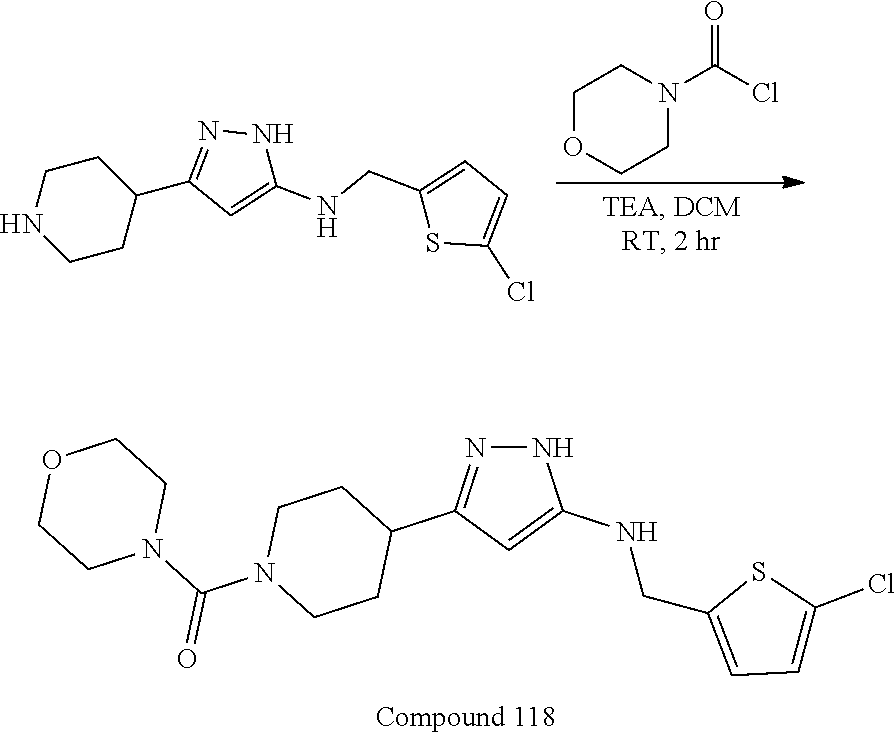
To a cooled solution (0° C.) of N-((5-chlorothiophen-2-yl)methyl)-3-(piperidin-4-yl)-1H-pyrazol-5-amine (0.5 g, 1.7 mmol, 1.0 eq) in dichloromethane (10 mL) was added triethylamine (TEA, 0.26 g, 2.6 mmol, 1.5 eq) and stirred for 10-15 minutes. Then, morpholine-4-carbonyl chloride (0.25 g, 1.7 mmol, 1.0 eq) was added and stirred at room temperature for 2 hours. The reaction was monitored by TLC and LC-MS. After completion, solvent was evaporated to give a residue which was purified by column chromatography using silica gel (60-120 mesh) eluting with 5% methanol in dichloromethane to give (4-(5-(((5-chlorothiophen-2-yl)methyl)amino)-1H-pyrazol-3-yl)piperidin-1-yl)(morpholino)methanone (Compound 118, 0.24 g, yield: 34%); m/z 410.37 [M+1]+ 1H NMR (400 MHz, DMSO) δ 11.34 (s, 1H), 6.91 (d, J=3.7 Hz, 1H), 6.84 (d, J=3.3 Hz, 1H), 5.66 (s, 1H), 5.29 (s, 1H), 4.28 (d, J=6.1 Hz, 2H), 3.62 (d, J=13.1 Hz, 2H), 3.57 (dd, J=13.4, 9.1 Hz, 4H), 3.18-3.01 (m, 4H), 2.80 (t, J=11.7 Hz, 2H), 2.66 (s, 1H), 1.81 (d, J=11.0 Hz, 2H), 1.53-1.32 (m, 2H) ppm.

To a cooled solution (0° C.) of 4-hydroxy-1-methylcyclohexane-1-carboxylic acid (0.15 g, 0.95 mmol, 1.3 eq) in THF (5.0 mL) was added TBTU (0.35 g, 1.1 mmol, 1.5 eq) and DIEA (0.38 mL, 2.2 mmol, 3.0 eq) under nitrogen. The reaction mixture was stirred for 30 minutes, and to it was added (4-(5-(((5-chlorothiophen-2-yl)methyl)amino)-1-(4-hydroxy-1-methylcyclohexane-1-carbonyl)-1H-pyrazol-3-yl)piperidin-1-yl)(morpholino)methanone (Compound 118, 0.298 g, 0.73 mmol, 1.0 eq) and then the mixture was stirred at room temperature for 14 hours. The reaction was monitored by LC-MS, and after completion the mixture was concentrated to give a residue, which was purified by preparative HPLC using 0.1% formic acid in water-acetonitrile as mobile phase to give (4-(5-(((5-chlorothiophen-2-yl)methyl)amino)-1-(4-hydroxy-1-methyl cyclohexane-1-carbonyl)-1H-pyrazol-3-yl)piperidin-1-yl)(morpholino)methanone (Compound 119, 0.053 g, yield: 10%); m/z 550.68 [M+1]+ 1H NMR (400 MHz, DMSO) δ 7.68 (s, 1H), 6.95 (s, 2H), 5.39 (s, 1H), 4.40 (t, 1H), 4.40 (d, 2H), 3.52 (d, J=29.7 Hz, 6H), 3.11 (m, 4H), 2.84 (m, 2H), 2.58 (m, 1H), 2.53 (m, 3H), 1.98 (d, J=36.1 Hz, 2H), 1.84 (m, 3H), 1.54 (d, J=30.8 Hz, 2H), 1.42 (m, 6H) ppm.

To a cooled solution (0° C.) of N-((5-chlorothiophen-2-yl)methyl)-3-(piperidin-4-yl)-1H-pyrazol-5-amine (0.1 g, 2.4 mmol, 1 eq) in acetonitrile (10 mL) was added 2-chloro-1-morpholinoethan-1-one (1.23 mL, 2.4 mmol, 1.0 eq) and then potassium carbonate (0.102 g, 7.2 mmol, 3.0 eq.). The reaction mixture was stirred at room temperature for 12 hours. The progress of reaction was monitored by TLC. The reaction mixture was diluted with water (10 mL), extracted with dichloromethane (2×10 mL), and the combined organic phases were dried over anhydrous sodium sulfate and concentrated to give crude product. This residue was purified by Combi-flash chromatography, eluting with 6% methanol in dichloromethane, to give 2-(4-(5-(((5-chlorothiophen-2-yl)methyl)amino)-1H-pyrazol-3-yl)piperidine-1-yl)-1-morpholinoethan-1-one (Compound 120, 0.60 g, yield: 57%) m/z 424.42[M+1]+, 1H NMR (400 MHz, DMSO) δ 11.29 (s, 1H), 6.91 (d, J=3.7 Hz, 1H), 6.84 (d, J=3.6 Hz, 1H), 5.62 (s, 1H), 5.28 (s, 1H), 4.29 (d, J=6.2 Hz, 2H), 3.50-3.56 (m, 4H), 3.40-3.43 (m, 4H), 3.14 (s, 2H), 2.84 (d, J=11.3 Hz, 2H), 2.44 (s, 1H), 2.07 (t, J=10.7 Hz, 2H), 1.81 (d, J=11.3 Hz, 2H), 1.53 (dd, J=21.3, 11.9 Hz, 2H) ppm;

To a cooled solution (0° C.) of 2-(4-(5-(((5-chlorothiophen-2-yl) methyl) amino)-1H-pyrazol-3-yl) piperidin-1-yl)-1-morpholinoethan-1-one (Compound 120, 0.15 g, 3.5 mmol, 1.0 eq) in dichloromethane (10 mL) was added triethylamine (TEA, 0.11 g, 11 mmol, 3 eq) followed by pivaloyl chloride (0.042 g, 3.5 mmol, 1 eq). The reaction mixture was stirred at room temperature for 14 hours. After completion, the mixture was concentrated under reduced pressure to give a crude residue. This was purified by column chromatography, eluting with 60% ethyl acetate in hexane, to give 1-(5-(((5-chlorothiophen-2-yl)methyl)amino)-3-(1-(2-morpholino-2-oxoethyl) piperidin-4-yl)-1H-pyrazol-1-yl)-2,2-dimethylpropan-1-one (Compound 121, 0.15 g, yield: 83%) m/z 508.48[M+1]+, 1H NMR (400 MHz, DMSO) δ 7.68 (d, J=6.3 Hz, 1H), 6.96 (d, J=3.8 Hz, 2H), 5.39 (s, 1H), 4.41 (d, J=5.9 Hz, 2H), 3.50-3.55 (m, 5H), 3.41 (d, J=11.7 Hz, 2H), 3.13 (s, 2H), 2.83 (d, J=10.6 Hz, 2H), 2.38 (d, J=34.4 Hz, 1H), 2.09 (t, J=10.9 Hz, 2H), 1.84 (d, J=11.3 Hz, 2H), 1.56 (d, J=9.2 Hz, 2H), 1.40 (s, 9H), 1.11 (s, 1H) ppm.

To a solution of hydroxypivalic acid (92 mg, 0.78 mmol, 1.0 eq) in acetonitrile (10 mL) was added DIEA (301 mg, 2.3 mmol, 3.0 eq) and then TBTU (375 mg, 0.78 mmol, 1.0 eq), and then the mixture stirred at room temperature for 30 minutes. To this was added 2-(4-(5-(((5-chlorothiophen-2-yl)methyl)amino)-1H-pyrazol-3-yl)piperidin-1-yl)-1-morpholinoethan-1-one (Compound 120, 0.33 g, 0.78 mmol, 1.0 eq) and the reaction was stirred at room temperature for 12 hours. After completion, the mixture was concentrated under reduced pressure to give a crude product, which was purified by preparative HPLC using 100% MeCN and 0.1% formic acid in water, to give 1-(5-(((5-chlorothiophen-2-yl)methyl)amino)-3-(1-(2-morpholino-2-oxoethyl) piperidin-4-yl)-1H-pyrazol-1-yl)-3-hydroxy-2,2-dimethylpropan-1-one (Compound 122, 50 mg, yield: 12%) m/z 524.63 [M+1]+; 1H NMR (400 MHz, DMSO) δ 7.74 (d, J=6.1 Hz, 1H), 6.97 (s, 2H), 5.39 (s, 1H), 4.85 (t, J=5.4 Hz, 1H), 4.42 (d, J=6.2 Hz, 2H), 4.30-4.06 (m, 1H), 3.87 (d, J=5.4 Hz, 2H), 3.66-3.54 (m, 4H), 3.50 (s, 2H), 3.38 (d, J=17.7 Hz, 2H), 3.03 (s, 2H), 2.68 (s, 2H), 2.38-1.74 (m, 6H), 1.32 (s, 6H) ppm.

To a cooled solution (0° C.) of N-((5-chlorothiophen-2-yl)methyl)-3-(piperidin-4-yl)-1H-pyrazol-5-amine (0.1 g, 0.24 mmol, 1.0 eq) in dichloromethane (4 mL) was added triethylamine (TEA, 0.1 g, 0.98 mmol, 4.0 eq). After stirring for 15 minutes, methanesulfonyl chloride (MsCl, 0.025 g, 0.22 mmol, 0.9 eq) was added. The reaction mixture was stirred for 4 hours at room temperature and monitored by TLC and LC-MS. After completion of reaction, the reaction mixture was poured into water (10 mL) and extracted with ethyl acetate (2×10 mL). The combined organic phases were washed with water, brine, and dried over sodium sulfate to give a residue, which was purified by preparative HPLC using water-acetonitrile as mobile phase to give N-((5-chlorothiophen-2-yl)methyl)-3-(1-(methylsulfonyl)piperidin-4-yl)-1H-pyrazol-5-amine (Compound 123, 0.05 g, yield: 40%) m/z 375.31 [M+1]+ 1347 1H NMR (400 MHz, DMSO) δ 11.39 (s, 1H), 6.97-6.81 (m, 2H), 5.73 (d, J=32.5 Hz, 1H), 5.32 (s, 1H), 4.29 (d, J=6.0 Hz, 2H), 3.57 (d, J=12.6 Hz, 2H), 2.87 (s, 3H), 2.78 (t, J=11.0 Hz, 2H), 2.61 (s, 1H), 1.93 (d, J=13.0 Hz, 2H), 1.66-1.52 (m, 2H) ppm.

To a cooled solution (0° C.) of pivalic acid (0.098 g, 0.96 mmol, 1.5 eq) in THF (8 mL) was EDCI.HCl (0.18 g, 0.96 mmol, 1.5 eq) and then triethylamine (TEA, 0.194 g, 1.92 mmol, 3.0 eq.). The reaction mixture was stirred for 30 minutes, then to it was added HOBt (0.017 g, 0.13 mmol, 0.2 eq) and N-((5-chlorothiophen-2-yl)methyl)-3-(1-(methylsulfonyl)piperidin-4-yl)-1H-pyrazol-5-amine (Compound 123, 0.24 g, 0.64 mmol, 1 eq). The reaction mixture was stirred at room temperature overnight. After completion (as monitored by LC-MS), the reaction mixture was poured into water (15 mL) and extracted with ethyl acetate (2×15 mL). The combined organic phases were washed with water, brine, and dried over sodium sulfate to give a crude compound. This was purified by preparative HPLC using water-acetonitrile as the mobile phase to give 1-(5-(((5-chlorothiophen-2-yl)methyl)amino)-3-(1-(methylsulfonyl)piperidin-4-yl)-1H-pyrazol-1-yl)-2,2-dimethylpropan-1-one (Compound 124, 0.035 g, yield: 11%) m/z 459.43[M+]+ 1H NMR (400 MHz, DMSO) δ 7.70 (t, J=6.2 Hz, 1H), 7.04-6.92 (m, 2H), 5.46 (d, J=13.5 Hz, 1H), 4.42 (d, J=6.1 Hz, 2H), 3.57 (d, J=11.8 Hz, 2H), 2.99-2.73 (m, 5H), 2.60 (dd, J=24.9, 13.6 Hz, 1H), 1.98 (d, J=10.9 Hz, 2H), 1.62 (td, J=15.1, 3.7 Hz, 2H), 1.51-1.35 (m, 9H) ppm.

To a solution of hydroxypivalic acid (0.119 g, 1.1 mmol, 1.5 eq.) in THF (8 mL) was added propylphosphonic anhydride (T3P in 50% solution in ethyl acetate, 0.318 g, 1.0 mmol, 1.5 eq), DIEA (0.20 g, 2 mmol, 3 eq) and then N-((5-chlorothiophen-2-yl)methyl)-3-(1-(methylsulfonyl)piperidin-4-yl)-1H-pyrazol-5-amine (Compound 123, 0.25 g, 0.66 mmol, 1 eq). The reaction mixture was stirred at room temperature overnight. After reaction completion (as monitored by LC-MS), the mixture was poured into water (20 mL) and extracted with ethyl acetate (2×30 mL). The combined organic phases were washed with water, brine, and dried over sodium sulfate to give a residue, which was purified by preparative HPLC using water-acetonitrile as mobile phase, to give 1-(5-(((5-chlorothiophen-2-yl)methyl)amino)-3-(1-(methylsulfonyl)piperidin-4-yl)-1H-pyrazol-1-yl)-3-hydroxy-2,2-dimethylpropan-1-one Compound 125, 0.051 g, yield: 16%) m/z 475.43 [M+]+ 1H NMR (400 MHz, DMSO) δ 7.70 (d, J=6.0 Hz, 1H), 6.97 (t, J=4.0 Hz, 2H), 5.43 (s, 1H), 4.83 (s, 1H), 4.41 (d, J=6.4 Hz, 2H), 3.87 (d, J=5.1 Hz, 2H), 3.56 (d, J=11.2 Hz, 2H), 3.12-2.74 (m, 5H), 2.64 (d, J=27.0 Hz, 2H), 1.97 (d, J=12.0 Hz, 2H), 1.62 (d, J=9.3 Hz, 2H), 1.27 (d, J=28.3 Hz, 6H) ppm.

To a cooled solution (0° C.) of N-((5-chlorothiophen-2-yl)methyl)-3-(piperidin-4-yl)-1H-pyrazol-5-amine (0.1 g, 0.24 mmol, 1.0 eq) in dichloromethane (4 mL) was added triethylamine (TEA, 0.1 g, 1.0 mmol, 4.0 eq). After stirring for 15 minutes, benzenesulphonyl chloride (0.039 g, 0.22 mmol, 0.9 eq) was added. The reaction mixture was stirred at room temperature overnight. The reaction was monitored by TLC and LC-MS. After completion of reaction, the reaction mixture was poured into water (10 mL) and extracted with ethyl acetate (2×10 mL). The combined organic phases were washed with water, brine, and dried over sodium sulfate to give a crude compound. This was purified by preparative HPLC using water-acetonitrile as mobile phase to give N-((5-chlorothiophen-2-yl)methyl)-3-(1-(phenylsulfonyl)piperidin-4-yl)-1H-pyrazol-5-amine (Compound 126, 0.045 g, yield: 31%) m/z 437.2 [M+1]+ 1H NMR (400 MHz, DMSO) δ 11.33 (s, 1H), 8.30-7.26 (m, 5H), 7.08-6.63 (m, 2H), 5.68 (s, 1H), 5.24 (s, 1H), 4.26 (d, J=6.2 Hz, 2H), 3.65 (d, J=11.1 Hz, 2H), 2.32 (t, J=11.2 Hz, 2H), 1.89 (d, J=11.4 Hz, 2H), 1.72-1.38 (m, 2H) ppm.

To a cooled solution (0° C.) of pivalic acid (0.080 g, 0.78 mmol, 1.5 eq) in THF (8 mL) was added EDCI.HCl (0.15 g, 0.78 mmol, 1.5 eq) and triethylamine (TEA, 0.16 g, 1.6 mmol, 3.0 eq). The reaction mixture was stirred for 30 minutes, then HOBt (0.014 g, 0.1 mmol, 0.2 eq) and N-((5-chlorothiophen-2-yl)methyl)-3-(1-(phenylsulfonyl)piperidin-4-yl)-1H-pyrazol-5-amine (Compound 126, 0.23 g. 0.5 mmol, 1 eq) were added. The reaction mixture was stirred at room temperature overnight. After completion (as monitored by LC-MS), the reaction mixture was poured into water (15 mL), extracted with ethyl acetate (2×20 mL), and the combined organic phase then washed with water, brine, dried over sodium sulfate, filtered and evaporated under reduced pressure to give a residue. This was purified by preparative HPLC using water-acetonitrile as mobile phase to give 1-(5-(((5-chlorothiophen-2-yl)methyl)amino)-3-(1-(phenylsulfonyl)piperidin-4-yl)-1H-pyrazol-1-yl)-2,2-dimethylpropan-1-one (Compound 127, 0.056 g, yield: 20%) m/z 521.48 [M+]+ 1H NMR (400 MHz, DMSO) δ 7.83-7.51 (m, 6H), 6.95 (s, 2H), 5.34 (s, 1H), 4.38 (d, J=6.2 Hz, 2H), 3.55 (d, J=12.0 Hz, 2H), 1.91 (d, J=10.6 Hz, 2H), 1.58 (dt, J=34.4, 17.4 Hz, 2H), 1.34 (s, 9H) ppm.

To a solution of hydroxypivalic acid (0.102 g, 0.85 mmol, 1.5 eq) in THF (6 mL) was added propylphosphonic anhydride (T3P in 50% solution in ethyl acetate, 0.273 g, 0.85 mmol, 1.5 eq), DIEA (0.173 g, 1.7 mmol, 3 eq) followed by N-((5-chlorothiophen-2-yl)methyl)-3-(1-(phenylsulfonyl)piperidin-4-yl)-1H-pyrazol-5-amine (Compound 126, 0.27 g, 0.57 mmol, 1 eq). The reaction mixture was stirred at room temperature overnight. After completion (as monitored by LC-MS), the mixture was poured into water (20 mL) and extracted with ethyl acetate (2×25 mL). The combined organic phases were washed with water, brine, and dried over sodium sulfate, then filtered and evaporated under reduced pressure to give a residue. This was purified by preparative HPLC using water-acetonitrile as mobile phase to give 1-(5-(((5-chlorothiophen-2-yl)methyl)amino)-3-(1-(phenylsulfonyl)piperidin-4-yl)-1H-pyrazol-1-yl)-3-hydroxy-2,2-dimethylpropan-1-one (Compound 128, 0.054 g, yield: 16%) m/z 537.54 [M+]+ 1H NMR (400 MHz, DMSO) δ 7.70 (ddd, J=29.6, 11.6, 7.1 Hz, 5H), 6.95 (s, 2H), 5.33 (s, 1H), 4.79 (t, J=5.3 Hz, 1H), 4.38 (d, J=6.2 Hz, 2H), 3.81 (d, J=5.2 Hz, 2H), 3.59 (d, J=11.7 Hz, 2H), 1.91 (d, J=10.8 Hz, 2H), 1.59 (dd, J=21.2, 10.6 Hz, 2H), 1.25 (s, 6H) ppm.

To a cooled solution (0° C.) of N-((5-chlorothiophen-2-yl)methyl)-3-(piperidin-4-yl)-1H-pyrazol-5-amine (0.8 g, 2.7 mmol, 1.0 eq) in dichloromethane (10 mL) was added triethylamine (TEA, 1.36 g, 13.5 mmol, 5.0 eq). After stirring for 10-15 minutes, to the mixture was added N,N-dimethylcarbamoyl chloride (0.22 g, 2.7 mmol, 1.0 eq) and the mixture stirred at room temperature for 2 hours. The reaction was monitored by TLC and LC-MS. After completion, solvent was evaporated to give a residue, which was purified by column chromatography using silica gel (100-200 mesh), eluting with 5% methanol in dichloromethane as mobile phase, to give 4-(5-(((5-chlorothiophen-2-yl)methyl)amino)-1H-pyrazol-3-yl)-N,N-dimethylpiperidine-1-carboxamide, (Compound 129, 0.3 g, yield: 30%); m/z 368.31[M+1]+; 1H NMR (400 MHz, DMSO) δ 11.37 (s, 1H), 6.92 (d, J=3.7 Hz, 1H), 6.84 (d, J=3.6 Hz, 1H), 5.70 (s, 1H), 5.29 (s, 1H), 4.28 (s, 2H), 3.56 (d, J=13.1 Hz, 2H), 3.35 (s, 2H), 3.15-3.02 (m, 1H), 2.80-2.67 (m, 8H), 2.62 (d, J=11.8 Hz, 1H), 1.81 (d, J=11.6 Hz, 2H), 1.48 (dt, J=12.1, 8.9 Hz, 2H), 1.18 (t, J=7.3 Hz, 1H) ppm.

To a solution of pivalic acid (50 mg, 0.49 mmol, 1.0 eq) in THF (10 mL) were added DIEA (100 mg, 0.6 mmol, 1.5 eq), HOBt (11 mg, 0.08 mmol, 0.2 eq) and finally EDCI.HCl (118 mg, 0.6 mmol, 1.5 eq). The solution was stirred at room temperature for 30 minutes. Then was added 4-(5-(((5-chlorothiophen-2-yl)methyl)amino)-1H-pyrazol-3-yl)-N,N-dimethylpiperidine-1-carboxamide (Compound 129, 150 mg, 0.41 mmol, 1.0 eq) and the solution was stirred at room temperature for another 12 hours. After completion, reaction mixture was concentrated and poured into ice-cold water and extracted with ethyl acetate (3×50 mL). The combined organic layers were concentrated under reduced pressure to give a residue. This was purified by preparative HPLC using 100% acetonitrile and 0.1% formic acid in water to give 4-(5-(((5-chlorothiophen-2-yl)methyl)amino)-1-pivaloyl-1H-pyrazol-3-yl)-N,N-dimethylpiperidine-1-carboxamide (Compound 130, 52 mg, yield: 28%) m/z 454.38 [M+1]+; 1H NMR (400 MHz, DMSO) δ 7.68 (t, J=6.3 Hz, 1H), 6.96 (t, J=3.0 Hz, 2H), 5.41 (s, 1H), 4.41 (d, J=6.1 Hz, 2H), 3.54 (d, J=13.2 Hz, 2H), 2.79 (t, J=11.4 Hz, 2H), 2.73 (s, 6H), 2.62 (d, J=11.3 Hz, 1H), 1.85 (d, J=11.0 Hz, 2H), 1.52 (dd, J=21.3, 11.6 Hz, 2H), 1.41 (s, 9H) ppm.

To a solution of hydroxypivalic acid (154 mg, 1.3 mmol, 1.0 eq) in THF (10 mL) was added DIEA (280 mg, 1.6 mmol, 1.5 eq), HOBt (29 mg, 0.22 mmol, 0.2 eq) and finally EDCI.HCl (315 mg, 1.6 mmol, 1.5 eq). After stirring at room temperature for minutes, 4-(5-(((5-chlorothiophen-2-yl)methyl)amino)-1H-pyrazol-3-yl)-N,N-dimethylpiperidine-1-carboxamide (Compound 129, 400 mg, 1.1 mmol, 1.0 eq) was added and the reaction mixture was stirred at room temperature for another 12 hours. After completion, the reaction mixture was concentrated under reduced pressure, poured into ice-cold water and extracted with ethyl acetate (3×50 mL). The combined organic layers were concentrated under reduced pressure to give a residue, which was purified by preparative HPLC using 100% acetonitrile and 0.1% formic acid in water to give 4-(5-(((5-chlorothiophen-2-yl)methyl)amino)-1-(3-hydroxy-2,2-dimethylpropanoyl)-1H-pyrazol-3-yl)-N,N-dimethylpiperidine-1-carboxamide (Compound 131, 56 mg, yield: 11%) m/z 468.63 [M+1]+; 1H NMR (400 MHz, DMSO) δ 7.68 (t, J=6.2 Hz, 1H), 6.97 (q, J=3.8 Hz, 2H), 5.40 (s, 1H), 4.83 (t, J=5.3 Hz, 1H), 4.41 (d, J=6.1 Hz, 2H), 3.87 (d, J=5.2 Hz, 2H), 3.55 (d, J=13.0 Hz, 2H), 2.80 (t, J=11.4 Hz, 2H), 2.73 (s, 6H), 2.63 (t, J=11.3 Hz, 1H), 1.85 (d, J=11.3 Hz, 2H), 1.51 (dt, J=15.0, 7.7 Hz, 2H), 1.31 (s, 6H) ppm.

To a cooled solution (0° C.) of N-((5-chlorothiophen-2-yl)methyl)-3-(piperidin-4-yl)-1H-pyrazol-5-amine (100 mg, 2.7 mmol, 1.0 eq) in dichloromethane (10 mL) was added triethylamine (TEA, 200 mg, 1.6 mmol, 6.0 eq). After for 10-15 minutes, N,N-dimethylcarbamic chloride (87 mg, 0.82 mmol, 3.0 eq) was added and the mixture stirred at room temperature for 16 hours. The reaction was monitored by TLC and LC-MS. After completion, solvent was evaporated to give a residue which was purified by column chromatography using silica gel (60-120 mesh), eluting with 5% methanol in dichloromethane to give 4-(5-(((5-chlorothiophen-2-yl)methyl)amino)-1-(dimethylcarbamoyl)-1H-pyrazol-3-yl)-N,N-dimethylpiperidine-1-carboxamide (Compound 132, 0.65 g, yield: 41%); m/z 439.57 [M+1]+; 1H NMR (400 MHz, DMSO) δ 7.00-6.91 (m, 2H), 6.75 (t, J=6.0 Hz, 1H), 5.40 (s, 1H), 4.36 (d, J=6.0 Hz, 2H), 3.54 (d, J=13.2 Hz, 2H), 2.98 (d, J=66.8 Hz, 6H), 2.78 (d, J=12.1 Hz, 2H), 2.72 (s, 6H), 2.64-2.53 (m, 1H), 1.80 (d, J=10.9 Hz, 2H), 1.59-1.40 (m, 2H) ppm.

To a cooled solution (0° C.) of ethyl piperidine-4-carboxylate (0.93 g, 5.9 mmol, 3.0 eq) in 1,2-dichloroethane (50 mL) was added acetic acid (0.12 g, 2 mmol, 1.0 eq) and tetrahydro-4H-pyran-4-one (0.2 g, 2 mmol, 1 eq). After stirring for 1 hour at room temperature, sodium triacetoxyborohydride (NaBH(OAc)3, 0.63 g, 3 mmol, 1.5 eq.) was added and the mixture stirred at room temperature for another 12 hours. The progress of reaction was monitored by TLC. The reaction mixture was added to water (20 mL), extracted with dichloromethane (3×30 mL), the combined organic layers were dried over anhydrous sodium sulfate, filtered and evaporated under reduced pressure. The crude product was purified by column chromatography (100-200 mesh) eluting with 3% methanol in dichloromethane to give ethyl 1-(tetrahydro-2H-pyran-4-yl)piperidine-4-carboxylate (Intermediate 53, 0.13 g, yield: 42%); 1H NMR (400 MHz, CDCl3) δ 4.15 (q, J=7.1 Hz, 2H), 4.05 (dd, J=11.3, 4.3 Hz, 2H), 3.45-3.32 (m, 2H), 3.08-2.96 (m, 2H), 2.68 (s, 1H), 2.41 (dd, J=12.2, 7.1 Hz, 3H), 2.06 (d, J=11.2 Hz, 2H), 1.95-1.80 (m, 4H), 1.67 (ddd, J=24.4, 12.2, 4.4 Hz, 2H), 1.26 (t, J=7.1 Hz, 3H) ppm.

To a cooled solution (−78° C.) of acetonitrile (0.97 g, 24 mmol, 1.5 eq) in THF (50 mL) was added n-BuLi (2.5M in n-hexane, 9.5 mL, 2.4 mmol, 1.5 eq) dropwise over a period of 20 minutes. After stirring for 60 minutes at −78° C., ethyl 1-(tetrahydro-2H-pyran-4-yl)piperidine-4-carboxylate (Intermediate 53, 3.8 g, 15.7 mmol, 1.0 eq) was added in one portion. The mixture was then warmed to room temperature over 3 hours. The reaction was quenched with saturated ammonium chloride solution and product was extracted with ethyl acetate (3×20 mL). The combined organic layers were dried over anhydrous sodium sulfate, filtered and concentrated under reduced pressure to obtain a crude product. This was washed with ethyl acetate to yield 3-oxo-3-(1-(tetrahydro-2H-pyran-4-yl)piperidin-4-yl)propanenitrile (Intermediate 54, 1.5 g, yield: 40%) and used ‘as is’ for the next step; m/z 237.04 [M+H]+; 1H NMR (400 MHz, DMSO) δ 4.16 (s, 2H), 3.88 (d, J=11.0 Hz, 2H), 3.25 (t, J=11.0 Hz, 2H), 2.91 (d, J=11.4 Hz, 2H), 2.45 (s, 1H), 2.14 (d, J=10.7 Hz, 2H), 1.81 (d, J=11.9 Hz, 3H), 1.65 (d, J=12.0 Hz, 2H), 1.49-1.33 (m, 4H) ppm.

To a solution of 3-oxo-3-(1-(tetrahydro-2H-pyran-4-yl)piperidin-4-yl)propanenitrile (Intermediate 54, 1.3 g, 5.7 mmol, 1.0 eq) in isopropanol (15 mL) and acetic acid (0.34 g, 5.7 mmol, 1.0 eq) was added hydrazine monohydrate (0.31 g, 6.2 mmol, 1.1 eq) dropwise. The reaction mixture was stirred at 80° C. for 12 hours. The reaction mixture was monitored by TLC and LC-MS, and after completion the reaction mixture was concentrated to obtain a crude product. This was purified by column chromatography using silica gel (60-120 mesh), eluting with 10% methanol in dichloromethane to give 3-(1-(tetrahydro-2H-pyran-4-yl)piperidin-4-yl)-1H-pyrazol-5-amine (Compound 132, 1.3 g, yield: 95%) m/z 251.14 [M+1]+1H NMR (400 MHz, DMSO) δ 8.95 (s, 1H), 5.18 (s, 1H), 3.88 (dd, J=10.8, 3.6 Hz, 2H), 3.26 (t, J=11.1 Hz, 2H), 3.17 (s, 2H), 2.90 (d, J=11.4 Hz, 2H), 2.40 (dd, J=21.3, 11.5 Hz, 2H), 2.15 (t, J=10.6 Hz, 2H), 1.80 (d, J=12.4 Hz, 2H), 1.71-1.60 (m, 2H), 1.57-1.33 (m, 4H) ppm.

To a cooled solution (0° C.) of 3-(1-(tetrahydro-2H-pyran-4-yl)piperidin-4-yl)-1H-pyrazol-5-amine (Compound 132, 1.7 g, 6.8 mmol, 1.0 eq) in anhydrous methanol (30 mL) was added glacial acetic acid (0.41 g, 6.8 mmol, 1.0 eq) and then 5-chlorothiophene-2-carbaldehyde (1.19 g, 8.2 mmol, 1.2 eq) dropwise. The reaction mixture was slowly brought to room temperature and then stirred for 1 hour. After completion, as monitored by TLC and LC-MS, the mixture was cooled back to 0° C. add to it was added sodium cyanoborohydride (2.16 g, 10 mmol, 1.5 eq). The mixture was stirred at room temperature for 4 hours. The reaction monitored by TLC. The reaction mixture was slowly concentrated under reduced pressure to obtain a yellow residue, which was diluted with ethyl acetate (100 mL) and washed with water (3×25 mL). The organic layer was dried with sodium sulfate, filtered and concentrated under reduced pressure to give a residue, which was purified by column chromatography (silica gel, 60-120 mesh) eluting with 5% methanol in dichloromethane to give N-((5-chlorothiophen-2-yl)methyl)-3-(1-(tetrahydro-2H-pyran-4-yl)piperidin-4-yl)-1H-pyrazol-5-amine (Compound 133, 0.5 g, yield: 19%); m/z 381.36[M+1]+; 1H NMR (400 MHz, DMSO) δ 11.33 (s, 1H), 6.99-6.90 (m, 1H), 6.84 (d, J=3.5 Hz, 1H), 5.66 (s, 1H), 5.28 (s, 1H), 4.28 (d, J=6.2 Hz, 2H), 3.90 (d, J=7.4 Hz, 2H), 3.33-3.22 (m, 4H), 2.98 (s, 2H), 2.31-2.08 (m, 2H), 2.02-1.64 (m, 4H), 1.49 (s, 4H) ppm.

To a solution of pivalic acid (44.7 mg, 0.44 mmol, 1.2 eq) in THF (3 mL) was added DIEA (0.09 mL, 0.55 mmol, 1.5 eq), HOBt (9.8 mg, 0.07 mmol, 0.2 eq.) and then EDCI.HCl (106 mg, 0.55 mmol, 1.5 eq). After stirring for 30 minutes, (4-(5-(((5-chlorothiophen-2-yl)methyl)amino)-1H-pyrazol-3-yl)piperidin-1-yl)(morpholino)methanone (Compound 118, 150 mg, 0.37 mmol, 1.0 eq) was added and the reaction mixture was allowed to stir at room temperature for another 16 hours. After completion, the mixture was concentrated and poured into ice-cold water and extracted with dichloromethane (3×50 mL). The combined organic layers were dried with sodium sulfate, dried and evaporated under reduced pressure. The residue was purified by preparative HPLC using 100% acetonitrile and 0.1% formic acid in water to give 1-(5-(((5-chlorothiophen-2-yl)methyl)amino)-3-(1-(morpholine-4-carbonyl)piperidin-4-yl)-1H-pyrazol-1-yl)-2,2-dimethylpropan-1-one (Compound 134, 53.3 mg, yield-29%) m/z 494.48 [M+1]+; 1H NMR (400 MHz, DMSO) δ 7.69 (d, J=6.1 Hz, 1H), 6.97 (s, 2H), 5.41 (s, 1H), 4.41 (d, J=6.1 Hz, 2H), 3.61 (d, J=13.2 Hz, 2H), 3.60-3.53 (m, 4H), 3.12 (d, J=4.6 Hz, 4H), 2.86 (t, J=11.7 Hz, 2H), 2.66 (d, J=11.7 Hz, 1H), 1.85 (d, J=10.9 Hz, 2H), 1.57-1.44 (m, 2H), 1.40 (s, 9H) ppm.

To a solution of hydroxypivalic acid (138 mg, 1.2 mmol, 1.2 eq) in THF (8 mL) was added DIEA (0.25 mL, 1.46 mmol, 1.5 eq), HOBt (26 mg. 0.2 mmol, 0.2 eq) and then EDCI.HCl (282 mg, 1.5 mmol, 1.5 eq). After stirring for another 30 minutes, (4-(5-(((5-chlorothiophen-2-yl)methyl)amino)-1H-pyrazol-3-yl)piperidin-1-yl)(morpholino)methanone (Compound 118, 400 mg, 0.98 mmol, 1.0 eq) was added and the mixture allowed to stir at room temperature for 16 hours. After completion, the reaction mixture was concentrated, poured into ice-cold water and extracted with ethyl acetate (3×50 mL). The combined organic layers were concentrated under reduced pressure to give a residue which was purified by preparative HPLC using 100% acetonitrile and 100% water to give 1-(5-(((5-chlorothiophen-2-yl)methyl)amino)-3-(1-(morpholine-4-carbonyl)piperidin-4-yl)-1H-pyrazol-1-yl)-3-hydroxy-2,2-dimethylpropan-1-one (Compound 135, 58 mg, yield: 12%) m/z 510.53 [M+1]+; 1H NMR (400 MHz, DMSO) δ 7.68 (t, J=6.2 Hz, 1H), 6.96 (d, J=3.8 Hz, 2H), 5.40 (s, 1H), 4.83 (t, J=5.4 Hz, 1H), 4.41 (d, J=6.1 Hz, 2H), 3.87 (d, J=5.3 Hz, 2H), 3.61 (d, J=13.5 Hz, 2H), 3.59-3.53 (m, 4H), 3.15-3.08 (m, 4H), 2.86 (t, J=11.6 Hz, 2H), 2.66 (d, J=11.5 Hz, 1H), 1.85 (d, J=10.6 Hz, 2H), 1.50 (dd, J=21.0, 11.8 Hz, 2H), 1.31 (s, 6H) ppm.

To a cooled solution (0° C.) of N-((5-chlorothiophen-2-yl)methyl)-3-(piperidin-4-yl)-1H-pyrazol-5-amine (0.1 g, 0.24 mmol, 1.0 eq) in dichloromethane (2 mL) was added triethylamine (TEA, 0.2 mL, 1.46 mmol, 6.0 eq). After stirring for 15 minutes, morpholine-4-carbonyl chloride (0.1 g, 0.73 mmol, 3.0 eq) was added and the reaction stirred at room temperature for 16 hours. The reaction was monitored by TLC and LC-MS. After completion, solvent was evaporated to give a residue which was purified by preparative HPLC using 100% acetonitrile and 100% water to give (4-(5-(((5-chlorothiophen-2-yl)methyl)amino)-1-(morpholine-4-carbonyl)-1H-pyrazol-3-yl)piperidin-1-yl)(morpholino)methanone (Compound 136, 15 mg, yield: 2%) m/z 523.63 [M+1]+; 1H NMR (400 MHz, DMSO) δ 6.99-6.93 (m, 2H), 6.85 (t, J=6.2 Hz, 1H), 5.42 (s, 1H), 4.37 (d, J=6.1 Hz, 2H), 3.74-3.54 (m, 14H), 3.15-3.07 (m, 4H), 2.82 (t, J=11.5 Hz, 2H), 2.60 (t, J=11.5 Hz, 1H), 1.80 (d, J=10.9 Hz, 2H), 1.48 (dd, J=21.0, 11.9 Hz, 2H) ppm.

To a cooled solution (0° C.) of N-((5-chlorothiophen-2-yl)methyl)-3-(piperidin-4-yl)-1H-pyrazol-5-amine (0.7 g, 2.4 mmol, 1.0 eq) in dichloromethane (10 mL) was added triethylamine (TEA, 1.2 g. 12 mmol, 5 eq), followed by dimethylsulfamoyl chloride (0.34 g, 2.3 mmol, 1.0 eq). The mixture was stirred at room temperature for 3 hours. The progress of reaction was monitored by TLC. The reaction mixture was added to cold water (10 mL), extracted with dichloromethane (3×25 mL), and the combined organic layers were dried over anhydrous sodium sulfate, filtered and concentrated to give a crude product. This was purified by column chromatography on silica gel (60-120 mesh size) with 45% ethyl acetate in n-hexane to give 4-(5-(((5-chlorothiophen-2-yl)methyl)amino)-1H-pyrazol-3-yl)-N,N-dimethylpiperidine-1-sulfonamide (Compound 137, 0.62 g, yield: 65%) m/z 404.30[M+H]+ 1H NMR (DMSO-d6, 400 MHz, 12092) δ: 11.36 (s, 1H), 7.03-6.76 (m, 2H), 5.65 (s, 1H), 5.31 (s, 1H), 4.29 (d, J=6.3 Hz, 2H), 3.58 (d, J=12.5 Hz, 2H), 2.90 (td, J=12.3, 2.3 Hz, 2H), 2.76 (d, J=5.7 Hz, 6H), 2.64 (s, 1H), 1.89 (d, J=11.2 Hz, 2H), 1.54 (qd, J=12.6, 4.0 Hz, 2H) ppm.

To a cooled solution (0° C.) of pivalic acid (0.085 g, 0.85 mmol, 1.5 eq) in acetonitrile (12 mL) was added EDCI.HCl (0.16 g, 0.85 mmol, 1.5 eq.), HOBt (0.022 g, 0.17 mmol, 0.3 eq) and DIEA (0.23 mL, 1.7 mmol, 3.0 eq). After stirring for 30 minutes, 4-(5-(((5-chlorothiophen-2-yl)methyl)amino)-1H-pyrazol-3-yl)-N,N-dimethylpiperidine-1-sulfonamide (Compound 137, 0.27 g, 0.56 mmol, 1.0 eq), was added and the mixture stirred at room temperature for 16 hours. The reaction was monitored by LC-MS, and after completion of reaction the reaction mixture was added to water (10 mL), extracted with ethyl acetate (3×20 mL), dried with sodium sulfate, filtered and concentrated to give crude product. The residue was purified by Combi-flash chromatography, eluting with 30% ethyl acetate in n-hexane to give 4-(5-(((5-chlorothiophen-2-yl)methyl)amino)-1-pivaloyl-1H-pyrazol-3-yl)-N,N-dimethylpiperidine-1-sulfonamide (Compound 138, 0.09 g, yield: 28%) m/z 488.53 [M+H]+ 1H NMR (DMSO-d6, 400 MHz, 12445) δ: 7.69 (t, J 6.2 Hz, 1H), 6.97 (q, J 3.7 Hz, 2H), 5.42 (s, 1H), 4.42 (d, J 6.1 Hz, 2H), 3.57 (d, J=12.3 Hz, 2H), 2.95 (t, J 10.9 Hz, 2H), 2.75 (s, 6H), 2.69-2.59 (m, 1H), 2.01-1.89 (m, 2H), 1.58 (td, J=15.2, 3.7 Hz, 2H), 1.41 (s, 9H) ppm.

To a cooled solution (0° C.) of 3-hydroxy-2,2-dimethylpropanoic acid (Compound 137, 0.15 g, 1.3 mmol, 1.5 eq) in acetonitrile (12 mL) was added N,N,N′,N′-tetramethyl-O-(benzotriazol-1-yl)uronium tetrafluoroborate (TBTU, 0.42 g, 1.3 mmol, 1.5 eq) and then (diisopropyl)ethylamine (DIEA, 0.24 mL, 2.6 mmol, 3.0 eq). After stirring for 30 minutes, to the mixture was added 4-(5-(((5-chlorothiophen-2-yl)methyl)amino)-1-(3-hydroxy-2,2-dimethylpropanoyl)-1H-pyrazol-3-yl)-N,N-dimethylpiperidine-1-sulfonamide (Compound 137, 0.35 g, 0.9 mmol, 1.0 eq), and the mixture stirred at room temperature for 12 hours. The reaction progress was monitored by TLC. After completion, the mixture was poured into water (10 mL) and extracted with ethyl acetate (3×20 mL). The combined organic phases were dried over sodium sulfate, filtered and evaporated to a residue. The crude compound was purified by preparative HPLC eluting with water and acetonitrile as mobile phase on a Sunfire C18, 5 micron column. The purified fractions were lyophilized to give 4-(5-(((5-chlorothiophen-2-yl)methyl)amino)-1-(3-hydroxy-2,2-dimethylpropanoyl)-1H-pyrazol-3-yl)-N,N-dimethylpiperidine-1-sulfonamide (Compound 139, 0.05 g, yield: 11%) m/z 504.48 [M+H]+ 1H NMR (DMSO-d6, 400 MHz, 13050) δ: 7.69 (t, J=6.1 Hz, 1H), 6.97 (d, J=2.3 Hz, 2H), 5.41 (s, 1H), 4.84 (t, J=5.3 Hz, 1H), 4.41 (d, J=6.0 Hz, 2H), 3.87 (d, J=5.3 Hz, 2H), 3.57 (d, J=12.1 Hz, 2H), 2.95 (t, J=10.9 Hz, 2H), 2.75 (s, 6H), 2.62 (dd, J=22.7, 11.4 Hz, 1H), 1.92 (d, J=11.5 Hz, 2H), 1.57 (dd, J=21.0, 11.1 Hz, 2H), 1.31 (s, 6H) ppm.

To a solution of N-((5-chlorothiophen-2-yl)methyl)-3-(piperidin-4-yl)-1H-pyrazol-5-amine (1.0 g, 2.5 mmol, 1.0 eq) in acetonitrile (15 mL) was added potassium carbonate (2.0 g, 14.7 mmol, 6.0 eq). After stirring the reaction mixture at room temperature for 30 minutes, 2-cyclopropoxyethyl trifluoromethanesulfonate (0.576 g, 2.5 mmol, 1 eq) was added and the reaction mixture was allowed to stir at room temperature for 16 hours. After completion (as monitored by LC-MS), the reaction mixture was concentrated to give a crude product which was purified by preparative HPLC using water-acetonitrile as mobile phase to give N-((5-chlorothiophen-2-yl)methyl)-3-(1-(2-cyclopropoxyethyl)piperidin-4-yl)-1H-pyrazol-5-amine (Compound 140, 0.61 g, yield: 65%) m/z 381.56[M+1]+ 1H NMR (400 MHz, DMSO) δ 11.65 (s, 1H), 6.97-6.81 (m, 2H), 5.80 (s, 1H), 5.35 (d, J=39.2 Hz, 1H), 4.29 (d, J=6.0 Hz, 2H), 3.74 (s, 2H), 3.41-3.31 (m, 5H), 3.23 (s, 2H), 2.98 (s, 1H), 2.08-2.01 (m, 2H), 1.78 (s, 2H), 0.60-0.42 (m, 4H) ppm.

To a cooled solution (0° C.) of pivalic acid (0.2 g, 0.64 mmol, 1.2 eq) in THF (6 mL) was added EDCI.HCl (0.15 g, 0.78 mmol, 1.5 eq) and triethylamine (TEA, 0.16 g, 1.6 mmol, 3.0 eq). After stirring for 30 minutes, HOBt (0.014 g, 0.1 mmol, 0.2 eq) and N-((5-chlorothiophen-2-yl)methyl)-3-(1-(2-cyclopropoxyethyl) piperidin-4-yl)-1H-pyrazol-5-amine (Compound 140, 0.2 g, 0.52 mmol, 1 eq) were added. The reaction mixture was stirred at room temperature for 16 hours. After completion (as monitored by LC-MS), the reaction mixture was poured to water (15 mL) and extracted with ethyl acetate (2×15 mL). The combined organic phases were washed with water, brine, dried over sodium sulfate, filtered and evaporated. The residue was purified by preparative HPLC using water-acetonitrile as mobile phase to give 1-(5-(((5-chlorothiophen-2-yl)methyl)amino)-3-(1-(2-cyclopropoxyethyl)piperidin-4-yl)-1H-pyrazol-1-yl)-2,2-dimethyl propan-1-one (Compound 141, 0.06 g, yield: 25%) m/z 465.02 [M+H]+ 1H NMR (400 MHz, DMSO) δ 7.64 (t, J=6.1 Hz, 1H), 6.96 (q, J=3.8 Hz, 2H), 5.37 (s, 1H), 4.40 (d, J=6.2 Hz, 2H), 3.52 (t, J=6.0 Hz, 2H), 3.26 (ddd, J=9.1, 5.9, 3.2 Hz, 1H), 2.85 (d, J=11.6 Hz, 2H), 2.45-2.31 (m, 3H), 2.13-1.95 (m, 3H), 1.79 (d, J=10.6 Hz, 2H), 1.56 (dd, J=21.1, 11.8 Hz, 2H), 1.39 (s, 9H), 0.46-0.33 (m, 4H) ppm.

To a solution of hydroxypivalic acid (0.093 g, 0.78 mmol, 1.5 eq) in THF (6 mL) were added propylphosphonic anhydride (T3P in 50% solution in ethyl acetate, 0.25 g, 0.8 mmol, 1.5 eq), DIEA (0.2 g, 1.6 mmol, 3 eq), followed by N-((5-chlorothiophen-2-yl)methyl)-3-(1-(2-cyclopropoxyethyl)piperidin-4-yl)-1H-pyrazol-5-amine (Compound 140, 0.2 g, 0.5 mmol, 1.0 eq). The reaction mixture was stirred at room temperature for 16 hours. After completion (as monitored by LC-MS), the reaction mixture was poured into water (10 mL) and extracted with ethyl acetate (2×25 mL). The combined organic phases were washed with water, brine, dried over sodium sulfate, filtered and evaporated under reduced pressure. The residue was purified by preparative HPLC using water-acetonitrile as mobile phase to give 1-(5-(((5-chlorothiophen-2-yl)methyl)amino)-3-(1-(2-cyclopropoxyethyl) piperidin-4-yl)-1H-pyrazol-1-yl)-3-hydroxy-2,2-dimethylpropan-1-one (Compound 142, 0.032 g, yield: 12%) m/z 481.1 [M+H]+ 1H NMR (400 MHz, DMSO) δ 7.65 (d, J=6.2 Hz, 1H), 6.96 (t, J=3.4 Hz, 2H), 5.38 (s, 1H), 4.82 (t, J=5.2 Hz, 1H), 4.40 (d, J=6.2 Hz, 2H), 3.86 (d, J=5.3 Hz, 2H), 3.52 (t, J=5.9 Hz, 2H), 3.26 (d, J=3.2 Hz, 1H), 2.87 (d, J=11.1 Hz, 2H), 2.40 (dd, J=28.5, 14.2 Hz, 3H), 2.04 (dd, J=22.2, 11.0 Hz, 3H), 1.78 (s, 2H), 1.56 (d, J=9.6 Hz, 2H), 1.30 (s, 6H), 0.51-0.28 (m, 4H) ppm.

To a solution of N-((5-chlorothiophen-2-yl)methyl)-3-(piperidin-4-yl)-1H-pyrazol-5-amine (1.0 g, 3.4 mmol, 1.0 eq) in acetonitrile (15 mL) was added potassium carbonate (K2CO3, 3.26 g, 23.7 mmol, 7 eq), followed by 2,2-difluoro-2-(pyridin-2-yl)ethyl trifluoromethanesulfonate (1.1 g, 3.7 mmol, 1.1 eq). The mixture was stirred at 80° C. for 12 hours. The progress of reaction was monitored by LC-MS. The reaction mixture was diluted with water (50 mL), extracted with dichloromethane (3×80 mL), and the combined organic phases were dried over anhydrous sodium sulfate, filtered and concentrated to give crude product. This was purified by column chromatography, eluting with 2% methanol in dichloromethane to give N-((5-chlorothiophen-2-yl)methyl)-3-(1-(2,2-difluoro-2-(pyridin-2-yl)ethyl)piperidin-4-yl)-1H-pyrazol-5-amine (Compound 143, 0.4 g, 27%)1H NMR (400 MHz, DMSO) δ 11.26 (s, 1H), 8.68 (d, J=3.9 Hz, 1H), 7.98 (t, J=7.7 Hz, 1H), 7.70 (d, J=7.7 Hz, 1H), 7.59-7.49 (m, 1H), 6.90 (d, J=3.7 Hz, 1H), 6.82 (d, J=3.6 Hz, 1H), 5.62 (s, 1H), 5.23 (s, 1H), 4.26 (d, J=6.1 Hz, 2H), 3.21 (t, J=14.8 Hz, 2H), 2.81 (d, J=11.7 Hz, 2H), 2.32 (dd, J=29.7, 18.6 Hz, 3H), 1.78-1.62 (m, 2H), 1.39 (dd, J=21.2, 12.6 Hz, 2H) ppm.

To a cooled solution (0° C.) of pivalic acid (77 mg, 0.76 mmol, 1.1 eq) in THF (10 mL) was added DIPEA (221 mg, 1.7 mmol, 2.5 eq), HOBt (46 mg, 0.34 mmol, 0.5 eq) and then EDCI.HCl (197 mg, 1.0 mmol, 1.5 eq). After stirring at 0° C. for 30 minutes, to the mixture was added N-((5-chlorothiophen-2-yl)methyl)-3-(1-(2,2-difluoro-2-(pyridin-2-yl)ethyl)piperidin-4-yl)-1H-pyrazol-5-amine (Compound 143, 300 mg, 0.7 mmol, 1.0 eq), and the mixture allowed to stir at room temperature for 12 hours. After completion, the reaction mixture was concentrated and poured into ice-cold water and extracted with ethyl acetate (3×50 mL). The combined organic layers were dried over sodium sulfate, filtered and concentrated on reduced pressure. The residue was purified by preparative HPLC using acetonitrile/water to give 1-(5-(((5-chlorothiophen-2-yl)methyl)amino)-3-(1-(2,2-difluoro-2-(pyridin-2-yl)ethyl)piperidin-4-yl)-1H-pyrazol-1-yl)-2,2-dimethylpropan-1-one (Compound 144, 74.5 mg, yield: 17%) m/z 522.10 [M+1]+; 1H NMR (400 MHz, DMSO) δ 8.68 (d, J=4.8 Hz, 1H), 7.98 (t, J=7.8 Hz, 1H), 7.70 (d, J=7.8 Hz, 1H), 7.64 (t, J=6.4 Hz, 1H), 7.56-7.49 (m, 1H), 6.95 (d, J=3.8 Hz, 2H), 5.36 (s, 1H), 4.39 (d, J=6.2 Hz, 2H), 3.21 (t, J=14.8 Hz, 2H), 2.81 (d, J=11.5 Hz, 2H), 2.33 (t, J=11.5 Hz, 4H), 1.72 (d, J=12.2 Hz, 2H), 1.51-1.40 (m, 2H), 1.38 (s, 9H) ppm.

To a cooled solution (0° C.) of hydroxypivalic acid (89 mg, 0.76 mmol, 1.1 eq) in THF (10 mL) was added DIPEA (221 mg, 1.7 mmol, 2.5 eq), HOBt (46 mg, 0.34 mmol, 0.5 eq) and then EDCI.HCl (197 mg, 1.0 mmol, 1.5 eq). After stirring at 0° C. for 30 minutes, to the mixture was added N-((5-chlorothiophen-2-yl)methyl)-3-(1-(2,2-difluoro-2-(pyridin-2-yl)ethyl)piperidin-4-yl)-1H-pyrazol-5-amine (Compound 143, 300 mg, 0.68 mmol, 1.0 eq) and the mixture stirred at room temperature for another 12 hours. After completion, the reaction mixture was concentrated, poured into ice-cold water and extracted with ethyl acetate (3×50 mL). The combined organic layers were concentrated under reduced pressure. The residue was purified by preparative HPLC using 100% acetonitrile and 100% water to give 1-(5-(((5-chlorothiophen-2-yl)methyl)amino)-3-(1-(2,2-difluoro-2-(pyridin-2-yl)ethyl)piperidin-4-yl)-1H-pyrazol-1-yl)-3-hydroxy-2,2-dimethylpropan-1-one (Compound 145, 76 mg, yield: 21%) m/z 540.63 [M+1]+; 1H NMR (400 MHz, DMSO) δ 8.68 (d, J=4.4 Hz, 1H), 7.97 (td, J=7.8, 1.7 Hz, 1H), 7.71 (s, 1H), 7.63 (d, J=6.3 Hz, 1H), 7.54 (dd, J=7.4, 4.8 Hz, 1H), 7.03-6.89 (m, 2H), 5.35 (s, 1H), 4.81 (t, J=5.4 Hz, 1H), 4.39 (d, J=6.2 Hz, 2H), 3.84 (d, J=5.4 Hz, 2H), 3.21 (t, J=14.8 Hz, 2H), 2.82 (d, J=11.5 Hz, 2H), 2.34 (dd, J=23.2, 11.6 Hz, 4H), 1.72 (d, J=11.4 Hz, 2H), 1.50-1.35 (m, 2H), 1.29 (s, 6H) ppm.

To a cooled (0° C.) solution of cyclohexanecarboxylic acid (181 mg, 1.51 mmol) in dichloromethane (10 mL) under nitrogen was added 1-(3-dimethylaminopropyl)-3-ethylcarbodiimide hydrochloride (EDCI.HCl, 361 mg, 1.89 mmol), followed by hydroxybenzotriazole (HOBt, 511 mg, 3.78 mmol). The reaction mixture was stirred for 10 minutes, then to the mixture was added diisopropylethylamine (DIEA, 0.64 mL, 3.78 mmol), followed by tert-butyl 4-(5-(((5-chlorothiophen-2-yl)methyl)amino)-1H-pyrazol-3-yl)piperidine-1-carboxylate (Compound 15, 500 mg, 1.26 mmol). The reaction was monitored by LC-MS, and after 16 hr at room temperature the reaction mixture was poured into water (50 mL) and extracted with dichloromethane (2×25 mL). The combined organic phases were dried over anhydrous sodium sulfate, filtered and evaporated under reduced pressure. The residue was purified by silica gel column chromatography (100-200 mesh), eluting with 30% ethyl acetate/petroleum ether, to afford product tert-butyl 4-(5-(((5-chlorothiophen-2-yl)methyl)amino)-1-(cyclohexanecarbonyl)-1H-pyrazol-3-yl)piperidine-1-carboxylate (Compound 146, 487 mg, yield: 60%) m/z 508.16 [M+1]+; TLC System: 50% Ethyl acetate in hexane. 5 Rf-0.7.

To a cooled (0° C.) solution of tert-butyl 4-(5-(((5-chlorothiophen-2-yl)methyl)amino)-1-(cyclohexanecarbonyl)-1H-pyrazol-3-yl)piperidine-1-carboxylate (200 mg, 0.39 mmol) in diethyl ether (2 mL) was added a solution of hydrogen chloride (1M) in diethyl ether (2 mL). The reaction mixture was stirred for 2 hr, and then evaporated under reduced pressure, triturated with diethyl ether and acetone to afford product (5-(((5-chlorothiophen-2-yl)methyl)amino)-3-(piperidin-4-yl)-1H-pyrazol-1-yl)(cyclohexyl)methanone hydrochloride (Compound 147, 100 mg, yield: 64%) as an off white solid. m/z 407.27 [(M−HCl)+1]+; 1H NMR (400 MHz, DMSO-d6) δ 8.70 (br s, 1H), 8.35 (br s, 1H), 7.65-7.63 (m, 1H), 6.95 (s, 2H), 5.39 (s, 1H), 4.43-4.41 (m, 2H), 3.40-3.26 (m, 3H), 2.98-2.77 (m, 3H), 2.01-1.67 (m, 8H), 1.41-1.24 (m, 4H); TLC System: 10% Methanol in dichloromethane. Rf-0.15.

To a cooled (0° C.) solution of cyclopentanecarboxylic acid (172 mg, 1.51 mmol) in dichloromethane (10 mL) under nitrogen was added 1-(3-dimethylaminopropyl)-3-ethylcarbodiimide hydrochloride (EDCI.HCl, 361 mg, 1.89 mmol), followed by hydroxybenzotriazole (HOBt, 511 mg, 3.78 mmol). The reaction mixture was stirred for 10 minutes, then to the mixture was added diisopropylethylamine (DIEA, 0.64 mL, 3.78 mmol), followed by tert-butyl 4-(5-(((5-chlorothiophen-2-yl)methyl)amino)-1H-pyrazol-3-yl)piperidine-1-carboxylate (Compound 15, 500 mg, 1.26 mmol). The reaction was monitored by LC-MS, and after 16 hr at room temperature the reaction mixture was poured into water (50 mL) and extracted with dichloromethane (2×25 mL). The combined organic phases were dried over anhydrous sodium sulfate, filtered and evaporated under reduced pressure. The residue was purified by silica gel column chromatography (100-200 mesh), eluting with 30% ethyl acetate/petroleum ether, to afford product tert-butyl 4-(5-(((5-chlorothiophen-2-yl)methyl)amino)-1-(cyclopentanecarbonyl)-1H-pyrazol-3-yl)piperidine-1-carboxylate (Compound 148, 323 mg, yield: 52%) m/z 494.16 [M+1]+; TLC System: 50% Ethyl acetate in hexane. Rf-0.7.

To a cooled (0° C.) solution of tert-butyl 4-(5-(((5-chlorothiophen-2-yl)methyl)amino)-1-(cyclopentanecarbonyl)-1H-pyrazol-3-yl)piperidine-1-carboxylate (200 mg, 0.40 mmol) in diethyl ether (2 mL) was added a solution of hydrogen chloride (1M) in diethyl ether (2 mL). The reaction mixture was stirred for 2 hr, and then evaporated under reduced pressure, triturated with diethyl ether and acetone to afford product (5-(((5-chlorothiophen-2-yl)methyl)amino)-3-(piperidin-4-yl)-1H-pyrazol-1-yl)(cyclopentyl)methanone (Compound 149, 60 mg, yield: 38%) as an off white solid. m/z 393.25 [(M−HCl)+1]+; 1H NMR (400 MHz, DMSO-d6) δ 8.70 (br s, 1H), 8.35 (br s, 1H), 7.65-7.63 (m, 1H), 6.95 (s, 2H), 5.39 (s, 1H), 4.43-4.41 (m, 2H), 3.40-3.26 (m, 3H), 2.98-2.77 (m, 3H), 2.01-1.67 (m, 8H), 1.41-1.24 (m, 4H); TLC System: 10% Methanol in dichloromethane. Rf-0.15.

To a cooled (0° C.) solution of benzoic acid (184 mg, 1.51 mmol) in dichloromethane (10 mL) under nitrogen was added 1-(3-dimethylaminopropyl)-3-ethylcarbodiimide hydrochloride (EDCI.HCl, 361 mg, 1.89 mmol), followed by hydroxybenzotriazole (HOBt, 511 mg, 3.78 mmol). The reaction mixture was stirred for 10 minutes, then to the mixture was added diisopropylethylamine (DIEA, 0.64 mL, 3.78 mmol), followed by tert-butyl 4-(5-(((5-chlorothiophen-2-yl)methyl)amino)-1H-pyrazol-3-yl)piperidine-1-carboxylate (Compound 15, 500 mg, 1.26 mmol). The reaction was monitored by LC-MS, and after 16 hr at room temperature the reaction mixture was poured into water (50 mL) and extracted with dichloromethane (2×25 mL). The combined organic phases were dried over anhydrous sodium sulfate, filtered and evaporated under reduced pressure. The residue was purified by silica gel column chromatography (100-200 mesh), eluting with 30% ethyl acetate/petroleum ether, to afford product tert-butyl 4-(1-benzoyl-5-(((5-chlorothiophen-2-yl)methyl)amino)-1H-pyrazol-3-yl)piperidine-1-carboxylate (Compound 150, 487 mg, yield: 60%) m/z 502.16 [M+1]+; TLC System: 50% Ethyl acetate in hexane. Rf-0.6.

To a cooled (0° C.) solution of tert-butyl 4-(1-benzoyl-5-(((5-chlorothiophen-2-yl)methyl)amino)-1H-pyrazol-3-yl)piperidine-1-carboxylate (200 mg, 0.40 mmol) in ethyl acetate (3 mL) was added a solution of hydrogen chloride (1M) in ethyl acetate (3 mL). The reaction mixture was stirred for 6 hr, and then evaporated under reduced pressure, triturated with diethyl ether and acetone. The residue was recrystallized in isopropyl alcohol to afford product (5-(((5-chlorothiophen-2-yl)methyl)amino)-3-(piperidin-4-yl)-1H-pyrazol-1-yl)(phenyl)methanone hydrochloride (Compound 151, 40 mg, yield: 25%) as an off white solid. m/z 401.26 [(M−HCl)+1]+; 1H NMR (400 MHz, DMSO-d6) δ 8.79 (br s, 1H), 8.48 (br s, 1H), 7.97-7.94 (m, 2H), 7.81-7.79 (m, 1H), 7.64-6.97 (s, 3H), 5.51 (s, 1H), 4.51-4.49 (m, 2H), 3.31-3.23 (m, 2H), 2.99-2.77 (m, 3H), 2.02-1.96 (m, 2H), 1.78-1.66 (m, 2H); TLC System: 10% Methanol in dichloromethane. Rf-0.15.

To a cooled (0° C.) solution of 2,3-dihydrobenzo[b][1,4]dioxine-5-carboxylic acid (273 mg, 1.51 mmol) in dichloromethane (10 mL) under nitrogen was added 1-(3-dimethylaminopropyl)-3-ethylcarbodiimide hydrochloride (EDCI.HCl, 361 mg, 1.89 mmol), followed by hydroxybenzotriazole (HOBt, 511 mg, 3.78 mmol). The reaction mixture was stirred for 10 minutes, then to the mixture was added diisopropylethylamine (DIEA, 0.64 mL, 3.78 mmol), followed by tert-butyl 4-(5-(((5-chlorothiophen-2-yl)methyl)amino)-1H-pyrazol-3-yl)piperidine-1-carboxylate (Compound 15, 500 mg, 1.26 mmol). The reaction was monitored by LC-MS, and after 16 hr at room temperature the reaction mixture was poured into water (50 mL) and extracted with dichloromethane (2×25 mL). The combined organic phases were dried over anhydrous sodium sulfate, filtered and evaporated under reduced pressure. The residue was purified by silica gel column chromatography (100-200 mesh), eluting with 30% ethyl acetate/petroleum ether, to afford product tert-butyl 4-(5-(((5-chlorothiophen-2-yl)methyl)amino)-1-(2,3-dihydrobenzo[b][1,4]dioxine-5-carbonyl)-1H-pyrazol-3-yl)piperidine-1-carboxylate (Compound 152, 318 mg, yield: 45%) m/z 560.16 [M+1]+; TLC System: 50% Ethyl acetate in hexane. Rf-0.6.

To a cooled (0° C.) solution of tert-butyl 4-(5-(((5-chlorothiophen-2-yl)methyl)amino)-1-(2,3-dihydrobenzo[b][1,4]dioxine-5-carbonyl)-1H-pyrazol-3-yl)piperidine-1-carboxylate (250 mg, 0.45 mmol) in ethyl acetate (3 mL) was added a solution of hydrogen chloride (1M) in ethyl acetate (3 mL). The reaction mixture was stirred for 7 hr, and then evaporated under reduced pressure, triturated with diethyl ether and acetone. The residue was recrystallized in isopropyl alcohol to afford product (5-(((5-chlorothiophen-2-yl)methyl)amino)-3-(piperidin-4-yl)-1H-pyrazol-1-yl)(2,3-dihydrobenzo[b][1,4]dioxin-5-yl)methanone hydrochloride (Compound 153, 150 mg, yield: 67%) as an off white solid. m/z 401.26 [(M−HCl)+1]+; 1H NMR (400 MHz, DMSO-d6) δ 8.79 (br s, 1H), 8.48 (br s, 1H), 7.97-7.94 (m, 2H), 7.81-7.79 (m, 1H), 7.04-6.97 (m, 5H), 5.51 (s, 1H), 4.51-4.49 (m, 2H), 3.31-3.23 (m, 2H), 2.99-2.77 (m, 3H), 2.02-1.96 (m, 2H), 1.78-1.66 (m, 2H); TLC System: 5% Methanol in dichloromethane. Rf-0.1.

To a cooled (0° C.) solution of furan-3-carboxylic acid (169 mg, 1.51 mmol) in dichloromethane (10 mL) under nitrogen was added 1-(3-dimethylaminopropyl)-3-ethylcarbodiimide hydrochloride (EDCI.HCl, 361 mg, 1.89 mmol), followed by hydroxybenzotriazole (HOBt, 511 mg, 3.78 mmol). The reaction mixture was stirred for 10 minutes, then to the mixture was added diisopropylethylamine (DIEA, 0.64 mL, 3.78 mmol), followed by tert-butyl 4-(5-(((5-chlorothiophen-2-yl)methyl)amino)-1H-pyrazol-3-yl)piperidine-1-carboxylate (Compound 15, 500 mg, 1.26 mmol). The reaction was monitored by LC-MS, and after 16 hr at room temperature the reaction mixture was poured into water (50 mL) and extracted with dichloromethane (2×25 mL). The combined organic phases were dried over anhydrous sodium sulfate, filtered and evaporated under reduced pressure. The residue was purified by silica gel column chromatography (100-200 mesh), eluting with 30% ethyl acetate/petroleum ether, to afford product tert-butyl 4-(5-(((5-chlorothiophen-2-yl)methyl)amino)-1-(furan-3-carbonyl)-1H-pyrazol-3-yl)piperidine-1-carboxylate (Compound 154, 235 mg, yield: 38%) m/z 492.16 [M+1]+; TLC System: 50% Ethyl acetate in hexane. Rf-0.6.
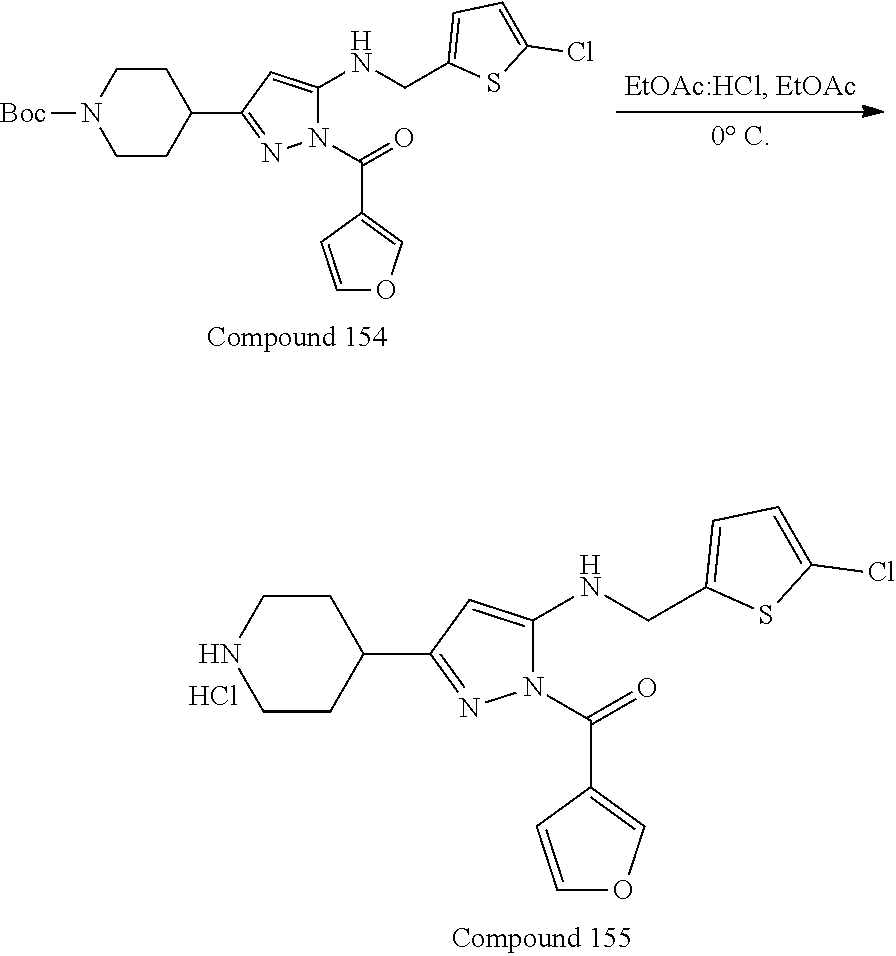
To a cooled (0° C.) solution of tert-butyl 4-(5-(((5-chlorothiophen-2-yl)methyl)amino)-1-(furan-3-carbonyl)-1H-pyrazol-3-yl)piperidine-1-carboxylate (100 mg, 0.20 mmol) in ethyl acetate (3 mL) was added a solution of hydrogen chloride (1M) in ethyl acetate (4 mL). The reaction mixture was stirred for 6 hr, and then evaporated under reduced pressure, triturated with diethyl ether and acetone. The residue was recrystallized in isopropyl alcohol to afford product (5-(((5-chlorothiophen-2-yl)methyl)amino)-3-(piperidin-4-yl)-1H-pyrazol-1-yl)(furan-3-yl)methanone hydrochloride (Compound 155, 30 mg, yield: 34%) as an off white solid. m/z 391.28 [(M−HCl)+1]+; 1H NMR (400 MHz, DMSO-d6) δ 8.82 (br s, 1H), 8.75 (s, 1H), 8.52 (br s, 1H), 7.86-7.84 (m, 1H), 7.82-7.77 (m, 1H), 7.04-6.95 (m, 3H), 5.50 (s, 1H), 4.50-4.48 (m, 2H), 3.33-3.27 (m, 2H), 2.99-2.85 (m, 3H), 2.11-2.07 (m, 2H), 1.81-1.77 (m, 2H); TLC System: 5% Methanol in dichloromethane. Rf-0.1.

To a cooled (0° C.) solution of 2,4-dimethoxybenzoic acid (274 mg, 1.51 mmol) in dichloromethane (10 mL) under nitrogen was added 1-(3-dimethylaminopropyl)-3-ethylcarbodiimide hydrochloride (EDCI.HCl, 361 mg, 1.89 mmol), followed by hydroxybenzotriazole (HOBt, 511 mg, 3.78 mmol). The reaction mixture was stirred for 10 minutes, then to the mixture was added diisopropylethylamine (DIEA, 0.64 mL, 3.78 mmol), followed by tert-butyl 4-(5-(((5-chlorothiophen-2-yl)methyl)amino)-1H-pyrazol-3-yl)piperidine-1-carboxylate (Compound 15, 500 mg, 1.26 mmol). The reaction was monitored by LC-MS, and after 16 hr at room temperature the reaction mixture was poured into water (50 mL) and extracted with dichloromethane (2×25 mL). The combined organic phases were dried over anhydrous sodium sulfate, filtered and evaporated under reduced pressure. The residue was purified by silica gel column chromatography (100-200 mesh), eluting with 30% ethyl acetate/petroleum ether, to afford product tert-butyl 4-(5-(((5-chlorothiophen-2-yl)methyl)amino)-1-(2,4-dimethoxybenzoyl)-1H-pyrazol-3-yl)piperidine-1-carboxylate (Compound 156, 324 mg, yield: 45%) m/z 562.16 [M+1]+; TLC System: 50% Ethyl acetate in hexane. Rf-0.6.

To a cooled (−78° C.) solution of tert-butyl 4-(5-(((5-chlorothiophen-2-yl)methyl)amino)-1-(2,4-dimethoxybenzoyl)-1H-pyrazol-3-yl)piperidine-1-carboxylate (250 mg, 0.45 mmol) in diethyl ether (3 mL) was added a solution of hydrogen chloride (1M) in diethyl ether (3 mL). The reaction mixture was stirred for 1 hr, and then evaporated under reduced pressure, triturated with diethyl ether and acetone. The residue was recrystallized in isopropyl alcohol to afford product (5-(((5-chlorothiophen-2-yl)methyl)amino)-3-(piperidin-4-yl)-1H-pyrazol-1-yl)(2,4-dimethoxyphenyl)methanone hydrochloride (Compound 157, 10 mg, yield: 4%) as an off white solid. m/z 461.26 [(M−HCl)+1]+; 1H NMR (400 MHzCDCl3) δ 7.45-7.43 (m, 2H), 6.81-6.76 (m, 2H), 6.53-6.50 (m, 2H), 5.23 (s, 1H), 4.42-4.41 (m, 2H), 3.85 (s, 3H), 3.80 (s, 3H), 3.37-3.33 (m, 2H), 2.99-2.75 (m, 3H), 2.07-2.05 (m, 2H), 1.95-1.92 (m, 2H); TLC System: 5% Methanol in dichloromethane. Rf-0.1.

To a cooled (0° C.) solution of 2,6-dimethylcyclohexane-1-carboxylic acid (235 mg, 1.51 mmol) in dichloromethane (10 mL) under nitrogen was added 1-(3-dimethylaminopropyl)-3-ethylcarbodiimide hydrochloride (EDCI.HCl, 361 mg, 1.89 mmol), followed by hydroxybenzotriazole (HOBt, 511 mg, 3.78 mmol). The reaction mixture was stirred for 10 minutes, then to the mixture was added diisopropylethylamine (DIEA, 0.64 mL, 3.78 mmol), followed by tert-butyl 4-(5-(((5-chlorothiophen-2-yl)methyl)amino)-1H-pyrazol-3-yl)piperidine-1-carboxylate (Compound 15, 500 mg, 1.26 mmol). The reaction was monitored by LC-MS, and after 16 hr at room temperature the reaction mixture was poured into water (50 mL) and extracted with dichloromethane (2×25 mL). The combined organic phases were dried over anhydrous sodium sulfate, filtered and evaporated under reduced pressure. The residue was purified by silica gel column chromatography (100-200 mesh), eluting with 30% ethyl acetate/petroleum ether, to afford product tert-butyl 4-(5-(((5-chlorothiophen-2-yl)methyl)amino)-1-(2,6-dimethylcyclohexane-1-carbonyl)-1H-pyrazol-3-yl)piperidine-1-carboxylate (Compound 158, 371 mg, yield: 55%) m/z 536.16 [M+1]+; TLC System: 50% Ethyl acetate in hexane. Rf-0.8.
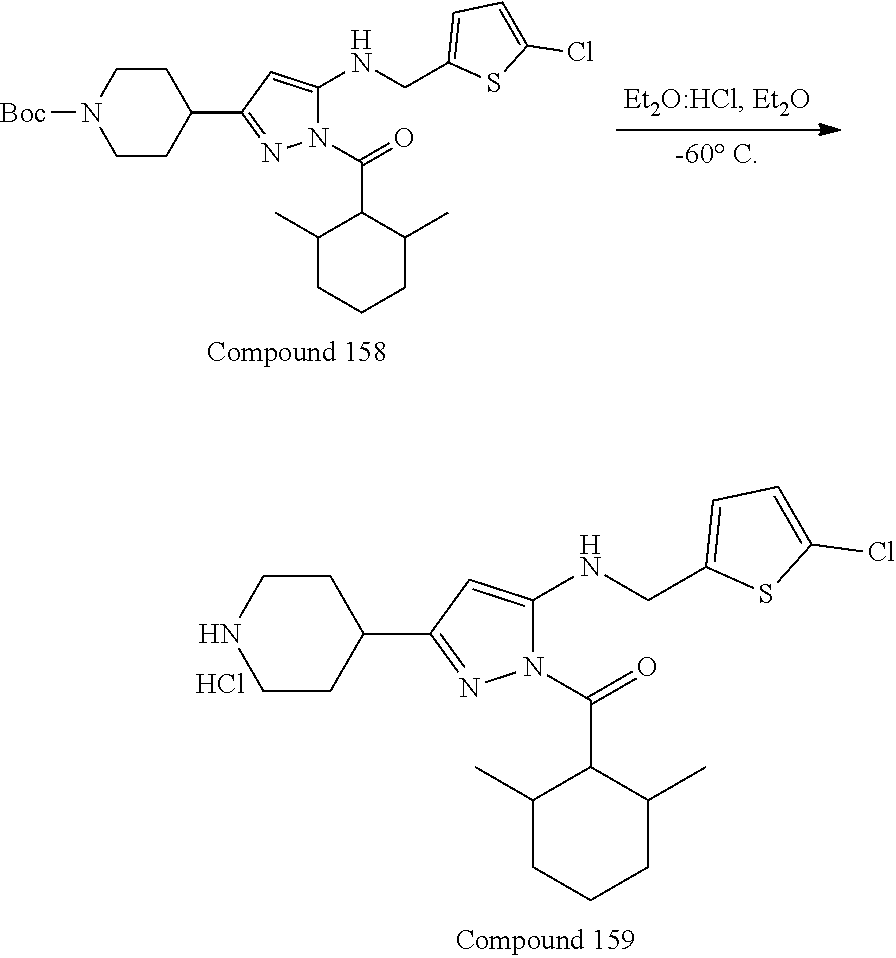
To a cooled (−60° C.) solution of tert-butyl 4-(5-(((5-chlorothiophen-2-yl)methyl)amino)-1-(2,6-dimethylcyclohexane-1-carbonyl)-1H-pyrazol-3-yl)piperidine-1-carboxylate (15 mg, 0.03 mmol) in diethyl ether (3 mL) was added a solution of hydrogen chloride (1M) in diethyl ether (0.5 mL). The reaction mixture was stirred for 1 hr, and then evaporated under reduced pressure, triturated with diethyl ether and acetone to afford product (5-(((5-chlorothiophen-2-yl)methyl)amino)-3-(piperidin-4-yl)-1H-pyrazol-1-yl)(2,6-dimethylcyclohexyl)methanone hydrochloride (Compound 159, 10 mg, yield: 71%) as an off white solid. m/z 435.34 [(M−HCl)+1]+; 1H NMR (400 MHz, DMSO-d6) δ 8.66 (br s, 1H), 8.38 (br s, 1H), 7.72-7.69 (m, 1H), 6.96-6.94 (m, 2H), 5.40 (s, 1H), 4.44-4.43 (m, 2H), 3.40-3.26 (m, 3H), 3.00-2.77 (m, 3H), 2.32-2.28 (m, 1H), 2.01-1.87 (m, 3H), 1.75-1.65 (m, 3H), 1.61-1.42 (m, 4H), 0.82 (s, 3H), 0.81 (s, 3H); TLC System: 10% Methanol in dichloromethane. Rf-0.15.

To a cooled (0° C.) solution of tert-butyl 4-(5-(((5-chlorothiophen-2-yl)methyl)amino)-1H-pyrazol-3-yl)piperidine-1-carboxylate (3 g, 7.5 mmol) in diethyl ether (20 mL) was added a solution of hydrogen chloride (1M) in diethyl ether (20 mL). The reaction mixture was stirred for 2 hr, and then evaporated under reduced pressure, triturated with diethyl ether and acetone to afford product N-((5-chlorothiophen-2-yl)methyl)-3-(piperidin-4-yl)-1H-pyrazol-5-amine hydrochloride (Compound 160, 2.8 g, yield: 91%) as an off white solid. m/z 297.21 ((M−HCl)+1]+; TLC System: 10% Methanol in chloroform. Rf-0.1.

To a cooled (0° C.) solution of N-((5-chlorothiophen-2-yl)methyl)-3-(piperidin-4-yl)-1H-pyrazol-5-amine hydrochloride (2.8 g, 3.01 mmol) in dioxane (70 mL) was added a solution of sodium carbonate (0.63 g, 6.02 mmol) in water (42 mL), followed by Fmoc succinimide (0.81 g, 2.4 mmol). The reaction mixture was stirred for 2 hr and allowed to reach room temperature, then poured into water (100 mL) and extracted with ethyl acetate (2×50 mL). The combined organic phases were dried over anhydrous sodium sulfate, filtered and evaporated under reduced pressure. The residue was purified by silica gel column chromatography (100-200 mesh), eluting with ethyl acetate, to afford product (9H-fluoren-9-yl)methyl 4-(5-(((5-chlorothiophen-2-yl)methyl)amino)-1H-pyrazol-3-yl)piperidine-1-carboxylate (Compound 161, 1.2 g, yield: 76%) as an off white fluffy solid. m/z 505.3 [M+1]+; TLC System: 10% Methanol in dichloromethane. Rf-0.5.

To a solution of (9H-fluoren-9-yl)methyl 4-(5-(((5-chlorothiophen-2-yl)methyl)amino)-1H-pyrazol-3-yl)piperidine-1-carboxylate (Compound 161, 300 mg, 0.48 mmol) and 3-methoxy-2,2-dimethylpropanoic acid (76 mg, 0.58 mmol) in chloroform (5 mL) under nitrogen at room temperature, was added O-(Benzotriazol-1-yl)-N,N,N′,N′-tetramethyluronium tetrafluoroborate (TBTU, 171 mg, 0.53 mmol), followed by triethylamine (TEA, 0.1 mL, 0.72 mmol). The reaction mixture was stirred at room temperature for 4 hr, diluted with water (50 mL) and extracted with dichloromethane (2×25 mL). The combined organic phases were dried over anhydrous sodium sulfate, filtered and evaporated under reduced pressure. The residue was purified by silica gel column chromatography (100-200 mesh), eluting with 20% ethyl acetate/petroleum ether, to afford (9H-fluoren-9-yl)methyl 4-(5-(((5-chlorothiophen-2-yl)methyl)amino)-1-(3-methoxy-2,2-dimethylpropanoyl)-1H-pyrazol-3-yl)piperidine-1-carboxylate (Compound 162, 300 mg, yield: 82%). m/z 605.19 [M+1]+; TLC System: 10% Methanol in dichloromethane. Rf-0.9.

To a solution of (9H-fluoren-9-yl)methyl 4-(5-(((5-chlorothiophen-2-yl)methyl)amino)-1-(3-methoxy-2,2-dimethylpropanoyl)-1H-pyrazol-3-yl)piperidine-1-carboxylate (200 mg, 0.31 mmol) in tetrahydrofurane (2 mL) was added piperidine (0.8 mL). The reaction mixture was stirred for 30 min, and then evaporated under reduced pressure. The residue was purified by silica gel column chromatography (100-200 mesh), eluting with 10% methanol/dichloromethane, to afford product 1-(5-(((5-chlorothiophen-2-yl)methyl)amino)-3-(piperidin-4-yl)-1H-pyrazol-1-yl)-3-methoxy-2,2-dimethylpropan-1-one (Compound 163, 40 mg, yield: 31%) as an off white solid. m/z 411.22 [(M+1]+; 1H NMR (400 MHz, CDCl3) δ 9.80 (br s, 1H), 8.38 (br s, 1H), 7.49 (s, 1H), 6.75 (s, 2H), 5.14 (s, 1H), 4.35-4.34 (m, 2H), 3.50-3.47 (m, 2H), 3.27 (s, 3H), 3.10-3.07 (m, 2H), 2.86 (br s, 1H), 2.21-2.00 (m, 4H), 1.41 (s, 6H); TLC System: 10% Methanol in dichloromethane. Rf-0.15.

To a solution of (9H-fluoren-9-yl)methyl 4-(5-(((5-chlorothiophen-2-yl)methyl)amino)-1H-pyrazol-3-yl)piperidine-1-carboxylate (Compound 161, 300 mg, 0.48 mmol) and 3-hydroxy-2,2-dimethylpropanoic acid (59 mg, 0.58 mmol) in chloroform (5 mL) under nitrogen at room temperature, was added O-(Benzotriazol-1-yl)-N,N,N′,N′-tetramethyluronium tetrafluoroborate (TBTU, 171 mg, 0.53 mmol), followed by triethylamine (TEA, 0.1 mL, 0.72 mmol). The reaction mixture was stirred at room temperature for 4 hr, diluted with water (50 mL) and extracted with dichloromethane (2×25 mL). The combined organic phases were dried over anhydrous sodium sulfate, filtered and evaporated under reduced pressure. The residue was purified by silica gel column chromatography (100-200 mesh), eluting with 20% ethyl acetate/petroleum ether, to afford (9H-fluoren-9-yl)methyl 4-(5-(((5-chlorothiophen-2-yl)methyl)amino)-1-(3-hydroxy-2,2-dimethylpropanoyl)-1H-pyrazol-3-yl)piperidine-1-carboxylate (Compound 164, 250 mg, yield: 71%). m/z 620.19 [M+1]+; TLC System: 10% Methanol in dichloromethane. Rf-0.85.

To a solution of (9H-fluoren-9-yl)methyl 4-(5-(((5-chlorothiophen-2-yl)methyl)amino)-1-(3-hydroxy-2,2-dimethylpropanoyl)-1H-pyrazol-3-yl)piperidine-1-carboxylate (250 mg, 0.31 mmol) in tetrahydrofurane (10 mL) was added piperidine (1 mL). The reaction mixture was stirred for 30 min, and then evaporated under reduced pressure. The residue was purified by silica gel column chromatography (100-200 mesh), eluting with 10% methanol/dichloromethane, to afford product 1-(5-(((5-chlorothiophen-2-yl)methyl)amino)-3-(piperidin-4-yl)-1H-pyrazol-1-yl)-3-hydroxy-2,2-dimethylpropan-1-one (Compound 165, 60 mg, yield: 48%) as an off white solid. m/z 397.31 [(M+1]+; 1H NMR (400 MHz, CDCl3) δ 9.82 (br s, 1H), 7.49-7.47 (m, 1H), 6.77-6.76 (m, 2H), 5.21 (s, 1H), 4.38-4.36 (m, 2H), 4.00 (br s, 1H), 3.78 (s, 2H), 3.51-3.48 (m, 2H), 3.07-3.02 (m, 2H), 2.87-2.82 (m, 1H), 2.23-2.12 (m, 4H), 1.43 (s, 6H); TLC System: 10% Methanol in dichloromethane. Rf-0.15.

m/z 531.30 [M+H]+. 1H NMR (400 MHz, CDCl3) δ 7.4 (m, 3H), 7.0 (m, 2H), 6.8 (m, 2H), 5.2 (s, 1H), 4.4 (m, 2H), 4.1 (m, 2H), 3.8 (s, 3H), 2.8 (m, 2H), 2.6 (m, 2H), 1.8 (m, 2H), 1.4 (s, 9H).

m/z 431.25 [M+H]+. 1H NMR (400 MHz, DMSO-d6) δ 8.2-8.8 (br m, 3H), 7.7 (m, 1H), 7.5 (m, 1H), 7.4 (m, 1H), 7.1 (m, 1H), 7.0 (m, 3H), 5.4 (s, 1H), 4.5 (m, 2H), 3.7 (s, 3H), 3.2 (m, 2H), 2.9 (m, 2H), 2.7 (m, 2H), 1.9 (m, 2H), 1.6 (m, 2H).

m/z 473.27 [M+H]+. 1H NMR (400 MHz, CDCl3) δ 7.4 (m, 3H), 7.0 (m, 2H), 6.8 (m, 2H), 5.2 (s, 1H), 4.5 (m, 1H), 4.4 (m, 2H), 3.8 (s, 3H), 3.8 (m, 1H), 3.1 (m, 1H), 2.7 (m, 2H), 2.1 (s, 3H), 1.8 (m, 2H), 1.5 (m, 1H).

m/z 515.24 [M+H]+. 1H NMR (400 MHz, CDCl3) δ 7.5 (m, 3H), 7.0 (m, 2H), 6.8 (m, 2H), 5.2 (s, 1H), 4.4 (m, 1H), 4.3 (m, 2H), 3.8 (s, 3H), 2.9 (m, 2H), 2.7 (m, 1H), 1.9 (m, 2H), 1.6 (m, 1H), 1.5 (m, 1H), 1.3 (s, 9H).

m/z 507.24 [M+H]+. 1H NMR (400 MHz, CDCl3) δ 8.9 (s, 1H), 7.9 (m, 1H), 7.6 (m, 1H), 7.3 (m, 1H), 6.8 (m, 2H), 5.3 (s, 1H), 4.4 (m, 2H), 4.2 (br s, 2H), 2.9 (m, 2H), 2.7 (m, 1H), 1.9 (m, 2H), 1.6 (m, 2H), 1.4 (s, 9H).

m/z 407.14 [M+H]+. 1H NMR (400 MHz, DMSO-d6) δ 8.9 (s, 1H), 8.6 (br s, 1H), 8.3 (br s, 1H), 7.9 (m, 1H), 7.8 (m, 1H), 7.6 (m, 1H), 7.0 (m, 2H), 5.5 (s, 1H), 4.5 (m, 2H), 3.2 (m, 2H), 3.0 (m, 2H), 2.8 (m, 1H), 2.1 (m, 2H), 1.8 (m, 2H).

m/z 449.16 [M+H]+. 1H NMR (400 MHz, CDCl3) δ 8.9 (s, 1H), 7.9 (m, 1H), 7.6 (m, 1H), 7.3 (m, 1H), 6.8 (m, 2H), 5.2 (s, 1H), 4.6 (m, 1H), 4.4 (m, 2H), 3.9 (m, 1H), 3.2 (m, 1H), 2.7-2.9 (m, 2H), 2.1 (s, 3H), 2.0 (m, 2H), 1.7 (m, 3H).

m/z 491.18 [M+H]+. 1H NMR (400 MHz, CDCl3) δ 8.9 (s, 1H), 7.9 (m, 1H), 7.6 (m, 1H), 7.3 (m, 1H), 6.8 (m, 2H), 5.2 (s, 1H), 4.4-4.5 (m, 4H), 3.0 (m, 2H), 2.8 (m, 1H), 2.0 (m, 2H), 1.7 (m, 2H), 1.3 (s, 9H).

m/z 481.33 [M+H]+. 1H NMR (400 MHz, DMSO-d6) δ 7.7 (m, 1H), 7.0 (m, 2H), 5.4 (s, 1H), 4.4 (m, 2H), 3.9 (m, 2H), 2.8-2.9 (br s, 2H), 2.7 (m, 1H), 1.8 (m, 2H), 1.4 (m, 18H).

m/z 423.26 [M+H]+. 1H NMR (400 MHz, CDCl3) δ 7.5 (m, 1H), 6.8 (m, 2H), 5.1 (s, 1H), 4.5 (m, 1H), 4.4 (m, 2H), 3.8 (m, 1H), 3.2 (m, 1H), 2.7-2.9 (m, 2H), 2.1 (s, 3H), 2.0 (m, 2H), 1.6 (m, 2H), 1.4 (s, 9H).

m/z 465.34 [M+H]+. 1H NMR (400 MHz, CDCl3) δ 7.5 (m, 1H), 6.8 (m, 2H), 5.1 (s, 1H), 4.3-4.4 (m, 4H), 3.0 (m, 2H), 2.8 (m, 1H), 2.0 (m, 2H), 1.6 (m, 2H), 1.5 (s, 9H), 1.3 (s, 9H).
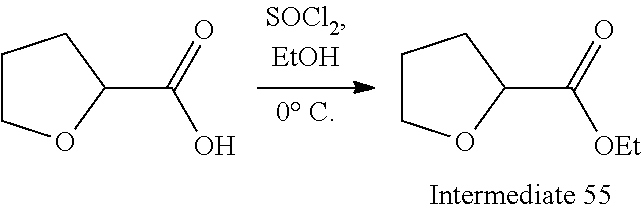
To a cooled solution (0° C.) of tetrahydrofuran-2-carboxylic acid (5.8 g, 43 mmol) in Ethanol (40 mL) was added thionyl chloride (9.6 mL, 129 mmol). After stirring at this temperature for 2 hours, the mixture was concentrated under reduced pressure. The mixture was diluted with water (20 mL) and extracted into Diethyl ether (3×100 mL). The combined organic layers were dried over sodium sulfate, filtered and concentrated under reduced pressure to give ethyl tetrahydrofuran-2-carboxylate (Intermediate 55, 6 g, yield: 96%) as an oily residue that was used without further purification into the next step. m/z 145.03 [M+H]+; TLC System: 10% Methanol-dichloromethane; Rf-0.6.

To a cooled (0° C.) solution of ethyl tetrahydrofuran-2-carboxylate (Intermediate 55, 6 g, 41.66 mmol in THF (100 mL), dry acetonitrile (3.4 mL, 83.33 mmol) was added. After 10 min, LHDMS (1M in THF, 13.9 g, 83.3 mmol) was added. After stirring at 0° C. for 2 hours, the mixture was quenched with saturated citric acid solution until pH=5 and extracted into Ethyl acetate (3×200 mL). The combined organic layers were dried over sodium sulfate, filtered and concentrated under reduced pressure to give 3-oxo-3-(tetrahydrofuran-2-yl)propanenitrile (Intermediate 56, 7.5 g, yield: 99%) as an oily residue that was used without further purification into the next step. m/z 140.02 [M+H]+; TLC System: 10% Methanol-dichloromethane; Rf-0.4.

To a solution of 3-oxo-3-(tetrahydrofuran-2-yl)propanenitrile (Intermediate 56, 7.5 g, 53.95 mmol) in ethanol (90 mL) was added hydrazine hydrate (N2H4.H2O, 4.04 mL, 24 mmol) and the reaction mixture was then heated to 90° C. for 5 hours. The reaction mixture was cooled to room temperature and the volatiles were evaporated. The residue was purified by neutral alumina column chromatography (100-300 mesh), eluting with 2% MeOH-dichloromethane, to afford 3-(tetrahydrofuran-2-yl)-1H-pyrazol-5-amine (Compound 177, 2 g, 24%) as an orange liquid; m/z 154.13 [M+H]+; TLC System: 5% Methanol-dichloromethane. Rf-0.5.

To a cooled solution (0° C.) of 3-(tetrahydrofuran-2-yl)-1H-pyrazol-5-amine (Compound 177, 2 g, 13.1 mmol) in dry DMF (20 mL) was added 5-chlorothiophene-2-carbaldehyde (1.97 mL, 19.6 mmol) and acetic acid (2 mL). The reaction mixture was stirred at room temperature for 2 hours. (Formation of imine was observed as a less polar spot on TLC). The reaction mixture was cooled (0° C.) and sodium cyanoborohydride (1.64 g, 26.1 mmol) was added portionwise and a catalytic amount of acetic acid. After 2 hours, the reaction mixture was quenched with ice-cold water (50 mL), and extracted into Ethyl acetate (3×100 mL). The combined organic layers were washed with saturated NaHCO3 (2×50 mL), water (2×50 mL) and brine (2×50 mL) and dried over sodium sulfate, filtered and concentrated under reduced pressure. The residue was purified by silica gel column chromatography (100-200 mesh), eluting with 10% diethyl ether/dichloromethane, to afford N-((5-chlorothiophen-2-yl)methyl)-3-(tetrahydrofuran-2-yl)-1H-pyrazol-5-amine (Compound 178, 650 mg, 6.2%) as a light yellow gummy liquid; m/z 284.13 [M+H]+. 1H NMR (400 MHz, DMSO-d6) δ 11.50 (br s, 1H), 6.91-6.84 (m, 2H), 5.74 (br s, 1H), 5.37 (s, 1H), 4.70 (s, 2H), 4.29 (br s, 2H), 3.84-3.79 (m, 1H), 3.71-3.66 (m, 1H), 2.13-2.11 (m, 1H), 1.91-1.79 (m, 3H) ppm; TLC System: 50% Ethyl acetate in hexane Rf-0.5.

To a cooled solution (0° C.) of N-((5-chlorothiophen-2-yl)methyl)-3-(tetrahydrofuran-2-yl)-1H-pyrazol-5-amine (Compound 178, 200 mg, 0.70 mmol) in dry dichloromethane (8 mL) was added triethylamine (TEA, 0.10 mL, 0.7 mmol), followed by trimethylacetyl chloride (0.06 mL, 0.56 mmol). After stirring at room temperature for 2 hours, the reaction mixture was diluted with water (50 mL) and extracted into dichloromethane (2×25 mL). The combined organic layers were washed with saturated NaHCO3 (2×10 mL) and water (2×10 mL) and dried over sodium sulfate, filtered and concentrated under reduced pressure. The residue was purified by preparative silica gel TLC (100-200 mesh), eluting with 15% Ethyl acetate/hexanes, to afford 1-(5-(((5-chlorothiophen-2-yl)methyl)amino)-3-(tetrahydrofuran-2-yl)-1H-pyrazol-1-yl)-2,2-dimethylpropan-1-one (Compound 179, 35 mg, 14%) as a colorless liquid. MS (ESI): m/z 368.2 [M+H]+. 1H NMR (400 MHz, DMSO-d6) δ 7.71 (s, 1H), 6.96 (s, 2H), 5.41 (s, 1H), 4.66 (s, 1H), 4.43 (s, 3H), 3.82-3.80 (m, 1H), 3.73-3.71 (m, 1H), 2.12-2.11 (m, 1H), 1.94-1.89 (m, 3H) ppm; TLC System: 30% Ethyl acetate in hexane. Rf-0.6.

To a cooled (0° C.) solution of thiophene-3-carboxylic acid (95 mg, 0.84 mmol) in dichloromethane (10 mL) under nitrogen was added 1-(3-dimethylaminopropyl)-3-ethylcarbodiimide hydrochloride (EDCI.HCl, 201 mg, 1.05 mmol), followed by hydroxybenzotriazole (HOBt, 283 mg, 2.1 mmol). The reaction mixture was stirred for 10 minutes, then to the mixture was added diisopropylethylamine (DIEA, 0.48 mL, 2.8 mmol), followed by N-((5-chlorothiophen-2-yl)methyl)-3-(tetrahydrofuran-2-yl)-1H-pyrazol-5-amine (Compound 178, 200 mg, 0.7 mmol). The reaction was monitored by LC-MS, and after 16 hr at room temperature the reaction mixture was poured into water (50 mL) and extracted with dichloromethane (2×25 mL). The combined organic phases were dried over anhydrous sodium sulfate, filtered and evaporated under reduced pressure. The residue was purified by preparative HPLC using acetonitrile-water as mobile phase to give product (5-(((5-chlorothiophen-2-yl)methyl)amino)-3-(tetrahydrofuran-2-yl)-1H-pyrazol-1-yl)(thiophen-3-yl)methanone (Compound 180, 38 mg, yield: 15%) m/z 394.16 [M+1]+; 1H NMR (400 MHz, DMSO) δ 8.87 (s, 1H), 7.84-7.83 (m, 1H), 7.81-7.77 (m, 1H), 7.66-7.64 (m, 1H), 7.00-6.96 (m, 2H), 5.54 (s, 1H), 4.73-4.70 (m, 1H), 4.51 (s, 2H), 3.88-3.83 (m, 1H), 3.77-3.72 (m, 1H), 2.21-2.14 (m, 1H), 1.99-1.87 (m, 3H) ppm; TLC System: 50% Ethyl acetate in hexane. Rf-0.6.

To a cooled (0° C.) solution of 2-methoxybenzoic acid (127 mg, 0.84 mmol) in dichloromethane (10 mL) under nitrogen was added 1-(3-dimethylaminopropyl)-3-ethylcarbodiimide hydrochloride (EDCI.HCl, 201 mg, 1.05 mmol), followed by hydroxybenzotriazole (HOBt, 283 mg, 2.1 mmol). The reaction mixture was stirred for 10 minutes, then to the mixture was added diisopropylethylamine (DIEA, 0.48 mL, 2.8 mmol), followed by N-((5-chlorothiophen-2-yl)methyl)-3-(tetrahydrofuran-2-yl)-1H-pyrazol-5-amine (Compound 178, 200 mg, 0.7 mmol). The reaction was monitored by LC-MS, and after 16 hr at room temperature the reaction mixture was poured into water (50 mL) and extracted with dichloromethane (2×25 mL). The combined organic phases were dried over anhydrous sodium sulfate, filtered and evaporated under reduced pressure. The residue was purified by preparative HPLC using acetonitrile-water as mobile phase to give product (5-(((5-chlorothiophen-2-yl)methyl)amino)-3-(tetrahydrofuran-2-yl)-1H-pyrazol-1-yl)(2-methoxyphenyl)methanone (Compound 181, 32 mg, yield: 11%) m/z 394.16 [M+1]+; 1H NMR (400 MHz, DMSO) δ 7.71-7.68 (m, 1H), 7.49-7.45 (m, 1H), 7.36-7.34 (m, 1H), 7.14-7.12 (m, 2H), 7.03-6.98 (m, 3H), 5.49 (s, 1H), 4.50-4.46 (m, 3H), 3.83-3.77 (m, 1H), 3.73 (s, 3H), 3.69-3.64 (m, 1H), 2.06-2.02 (m, 1H), 1.88-1.68 (m, 3H); TLC System: 50% Ethyl acetate in hexane. Rf-0.6.

To a cooled solution (0° C.) of tetrahydro-2H-pyran-4-carboxylic acid (10 g, 76 mmol) in Ethanol (100 mL) was added thionyl chloride (17.1 mL, 230 mmol). After stirring at this temperature for 3 hours, the mixture was concentrated under reduced pressure. The mixture was diluted with saturated NaHCO3 (20 mL) and extracted into Diethyl ether (3×100 mL). The combined organic layers were dried over sodium sulfate, filtered and concentrated under reduced pressure to give ethyl tetrahydro-2H-pyran-4-carboxylate (Intermediate 57, 11 g, yield: 91%) as an oily residue that was used without further purification into the next step. m/z 145.03 [M+H]+; TLC System: 30% Ethyl acetate in hexane; Rf-0.7.

To a cooled (0° C.) solution of ethyl tetrahydro-2H-pyran-4-carboxylate (Intermediate 57, 3 g, 18.98 mmol) in THF (50 mL), dry acetonitrile (1.5 mL, 37.97 mmol) was added. After 10 min, LHDMS (1M in THF, 63.4 g, 37.9 mmol) was added. After stirring at 0° C. for 2 hours, the mixture was quenched with saturated citric acid solution until pH=5 and extracted into Ethyl acetate (3×100 mL). The combined organic layers were dried over sodium sulfate, filtered and concentrated under reduced pressure to give 3-oxo-3-(tetrahydro-2H-pyran-4-yl)propanenitrile (Intermediate 58, 3.3 g, yield: 99%) as an oily residue that was used without further purification into the next step. m/z 153.12 [M+H]+; TLC System: 50% Ethyl acetate in hexane; Rf-0.2.

To a solution of 3-oxo-3-(tetrahydro-2H-pyran-4-yl)propanenitrile (Intermediate 58, 3.3 g, 21.5 mmol) in ethanol (90 mL) was added hydrazine hydrate (N2H4.H2O, 1.56 mL, 32.3 mmol) and the reaction mixture was then heated to 90° C. for 5 hours. The reaction mixture was cooled to room temperature and the volatiles were evaporated. The residue was purified by neutral alumina column chromatography (100-300 mesh), eluting with 2% MeOH-dichloromethane, to afford 3-(tetrahydro-2H-pyran-4-yl)-1H-pyrazol-5-amine (Compound 182, 1.7 g, 47%) as an orange liquid; m/z 168.15 [M+H]+; TLC System: 10% Methanol-dichloromethane. Rf-0.3.

To a cooled solution (0° C.) of 3-(tetrahydro-2H-pyran-4-yl)-1H-pyrazol-5-amine (Compound 182, 2.1 g, 12.5 mmol) in dry DMF (20 mL) was added 5-chlorothiophene-2-carbaldehyde (1.96 mL, 18.8 mmol) and acetic acid (2 mL). The reaction mixture was stirred at room temperature for 2 hours. (Formation of imine was observed as a less polar spot on TLC). The reaction mixture was cooled (0° C.) and sodium cyanoborohydride (2.58 g, 25.1 mmol) was added portionwise and a catalytic amount of acetic acid. After 2 hours, the reaction mixture was quenched with ice-cold water (25 mL), and extracted into Ethyl acetate (3×50 mL). The combined organic layers were washed with saturated NaHCO3 (2×50 mL), water (2×50 mL) and brine (2×50 mL) and dried over sodium sulfate, filtered and concentrated under reduced pressure. The residue was purified by silica gel column chromatography (100-200 mesh), eluting with 10% diethyl ether/dichloromethane, to afford N-((5-chlorothiophen-2-yl)methyl)-3-(tetrahydro-2H-pyran-4-yl)-1H-pyrazol-5-amine (Compound 183, 600 mg, 16%) as a light yellow gummy liquid; m/z 298.19 [M+H]+. 1H NMR (400 MHz, DMSO-d6) δ 11.50 (br s, 1H), 6.90 (s, 1H), 6.83 (s, 1H), 5.69 (br s, 1H), 5.29 (s, 1H), 4.28 (s, 2H), 3.88-3.84 (m, 2H), 3.39-3.34 (m, 3H), 2.76-2.68 (m, 1H), 1.76-1.72 (m, 2H), 1.60-1.50 (m, 2H) ppm; TLC System: 50% Ethyl acetate in hexane Rf-0.5.

To a cooled solution (0° C.) of N-((5-chlorothiophen-2-yl)methyl)-3-(tetrahydro-2H-pyran-4-yl)-1H-pyrazol-5-amine (Compound 183, 100 mg, 0.33 mmol) in dry dichloromethane (8 mL) was added triethylamine (TEA, 0.06 mL, 0.7 mmol), followed by trimethylacetyl chloride (0.03 mL, 0.26 mmol). After stirring at room temperature for 3 hours, the reaction mixture was diluted with water (50 mL) and extracted into dichloromethane (2×25 mL). The combined organic layers were washed with saturated NaHCO3 (2×10 mL) and water (2×10 mL) and dried over sodium sulfate, filtered and concentrated under reduced pressure. The residue was purified by preparative silica gel TLC (100-200 mesh), eluting with 15% Ethyl acetate/hexanes, to afford 1-(5-(((5-chlorothiophen-2-yl)methyl)amino)-3-(tetrahydrofuran-2-yl)-1H-pyrazol-1-yl)-2,2-dimethylpropan-1-one (Compound 184, 15 mg, 11%) as a colorless liquid. MS (ESI): m/z 382.2 [M+H]+. 1H NMR (400 MHz, DMSO-d6) δ 7.69-7.66 (m, 1H), 6.96 (s, 2H), 5.40 (s, 1H), 4.41 (s, 1H), 4.43 (s, 3H), 3.88-3.85 (m, 2H), 3.43-3.34 (m, 2H), 2.74-2.67 (m, 1H), 1.79-1.76 (m, 2H), 1.64-1.54 (m, 2H), 1.40 (s, 9H) ppm; TLC System: 50% Ethyl acetate in hexane. Rf-0.7.

To a cooled (0° C.) solution of thiophene-3-carboxylic acid (103 mg, 0.80 mmol) in dichloromethane (10 mL) under nitrogen was added 1-(3-dimethylaminopropyl)-3-ethylcarbodiimide hydrochloride (EDCI.HCl, 192 mg, 1.00 mmol), followed by hydroxybenzotriazole (HOBt, 271 mg, 2.01 mmol). The reaction mixture was stirred for 10 minutes, then to the mixture was added diisopropylethylamine (DIEA, 0.46 mL, 2.68 mmol), followed by N-((5-chlorothiophen-2-yl)methyl)-3-(tetrahydro-2H-pyran-4-yl)-1H-pyrazol-5-amine (Compound 183, 200 mg, 0.67 mmol). The reaction was monitored by LC-MS, and after 16 hr at room temperature the reaction mixture was poured into water (50 mL) and extracted with dichloromethane (2×25 mL). The combined organic phases were dried over anhydrous sodium sulfate, filtered and evaporated under reduced pressure. The residue was purified by preparative HPLC using acetonitrile-water as mobile phase to give product (5-(((5-chlorothiophen-2-yl)methyl)amino)-3-(tetrahydrofuran-2-yl)-1H-pyrazol-1-yl)(thiophen-3-yl)methanone (Compound 185, 30 mg, yield: 11%) m/z 408.23 [M+1]+; 1H NMR (400 MHz, DMSO) δ 8.90 (s, 1H), 7.81-7.78 (m, 2H), 7.65-7.63 (m, 1H), 7.01-6.96 (m, 2H), 5.54 (s, 1H), 4.49-4.47 (m, 2H), 3.91-3.88 (m, 2H), 3.44-3.41 (m, 2H), 2.80-2.67 (m, 1H), 1.83-1.79 (m, 2H), 1.68-1.58 (m, 2H) ppm; TLC System: 50% Ethyl acetate in hexane. Rf-0.5.

To a cooled (0° C.) solution of 2-methoxybenzoic acid (91 mg, 0.60 mmol) in dichloromethane (10 mL) under nitrogen was added 1-(3-dimethylaminopropyl)-3-ethylcarbodiimide hydrochloride (EDCI.HCl, 144 mg, 0.75 mmol), followed by hydroxybenzotriazole (HOBt, 202 mg, 1.5 mmol). The reaction mixture was stirred for 10 minutes, then to the mixture was added diisopropylethylamine (DIEA, 0.34 mL, 1.5 mmol), followed by N-((5-chlorothiophen-2-yl)methyl)-3-(tetrahydro-2H-pyran-4-yl)-1H-pyrazol-5-amine (Compound 183, 150 mg, 0.50 mmol). The reaction was monitored by LC-MS, and after 16 hr at room temperature the reaction mixture was poured into water (50 mL) and extracted with dichloromethane (2×25 mL). The combined organic phases were dried over anhydrous sodium sulfate, filtered and evaporated under reduced pressure. The residue was purified by preparative HPLC using acetonitrile-water as mobile phase to give product (5-(((5-chlorothiophen-2-yl)methyl)amino)-3-(tetrahydrofuran-2-yl)-1H-pyrazol-1-yl)(2-methoxyphenyl)methanone (Compound 186, 25 mg, yield: 12%) m/z 432.27 [M+1]+; 1H NMR (400 MHz, DMSO) δ 7.67-7.64 (m, 1H), 7.49-7.44 (m, 1H), 7.36-7.33 (m, 1H), 7.13-7.11 (m, 2H), 7.03-6.98 (m, 3H), 5.50 (s, 1H), 4.48-4.47 (m, 2H), 3.82-3.74 (m, 2H), 3.73 (s, 3H), 3.34-3.28 (m, 1H), 2.55-2.49 (m, 1H), 1.61-1.44 (m, 4H); TLC System: 30% Ethyl acetate in hexane. Rf-0.5.

To a cooled (−20° C.) solution of 1-(tert-butyl) 2-ethyl pyrrolidine-1,2-dicarboxylate (15 g, 61.7 mmol) in THF (150 mL), dry acetonitrile (2.5 mL, 61.7 mmol) was added. After 10 min, LHDMS (1M in THF, 15 g, 92.5 mmol) was added. After stirring at 0° C. for 2 hours, the mixture was quenched with saturated citric acid solution until pH=5 and extracted into Ethyl acetate (3×100 mL). The combined organic layers were dried over sodium sulfate, filtered and concentrated under reduced pressure to give tert-butyl 2-(2-cyanoacetyl)pyrrolidine-1-carboxylate (Intermediate 59, 15 g, yield: 99%) as an oily residue that was used without further purification into the next step. m/z 238.12 [M+H]+; TLC System: 50% Ethyl acetate in petroleum ether; Rf-0.3.

To a solution of tert-butyl 2-(2-cyanoacetyl)pyrrolidine-1-carboxylate (Intermediate 59, 15 g, 61.7 mmol) in ethanol (300 mL) was added hydrazine hydrate (N2H4.H2O, 4.68 mL, 32.3 mmol) and the reaction mixture was then heated to 80° C. for 16 hours. The reaction mixture was cooled to room temperature and the volatiles were evaporated. The residue was purified by neutral alumina column chromatography (100-300 mesh), eluting with 3% MeOH-dichloromethane, to afford tert-butyl 2-(5-amino-1H-pyrazol-3-yl)pyrrolidine-1-carboxylate (Compound 187, 5 g, 32%) as a light brown solid; m/z 252.15 [M+H]+; TLC System: 5% Methanol-dichloromethane. Rf-0.2.

To a cooled solution (0° C.) of tert-butyl 2-(5-amino-1H-pyrazol-3-yl)pyrrolidine-1-carboxylate (Compound 187, 5 g, 19.8 mmol) in dry DMF (10 mL) was added 5-chlorothiophene-2-carbaldehyde (2.75 mL, 25.8 mmol) and acetic acid (1 mL). The reaction mixture was stirred at room temperature for 2 hours. (Formation of imine was observed as a less polar spot on TLC). The reaction mixture was cooled (0° C.) and sodium cyanoborohydride (2.58 g, 25.1 mmol) was added portionwise and a catalytic amount of acetic acid. After 2 hours, the reaction mixture was quenched with ice-cold water (25 mL), and extracted into Ethyl acetate (3×50 mL). The combined organic layers were washed with brine (2×50 mL) and dried over sodium sulfate, filtered and concentrated under reduced pressure. The residue was purified by silica gel column chromatography (100-200 mesh), eluting with 1% dichloromethane/MeOH, to afford tert-butyl 2-(5-(((5-chlorothiophen-2-yl)methyl)amino)-1H-pyrazol-3-yl)pyrrolidine-1-carboxylate (Compound 188, 2.2 g, 27%) as a reddish brown solid; m/z 383.29 [M+H]+. 1H NMR (400 MHz, DMSO-d6) δ 11.34 (br s, 1H), 6.89 (s, 1H), 6.82 (s, 1H), 5.63 (br s, 1H), 5.24 (s, 1H), 4.29-4.27 (m, 2H), 3.38-3.24 (m, 2H), 2.1 (br s, 1H), 1.84 (br s, 3H), 1.38-1.22 (br m, 9H) ppm; TLC System: 5% Methanol-dichloromethane Rf-0.5.

To a cooled (0° C.) solution of 2-methoxybenzoic acid (1 g, 6.59 mmol) in dichloromethane (20 mL) under nitrogen was added 1-(3-dimethylaminopropyl)-3-ethylcarbodiimide hydrochloride (EDCI.HCl, 2.1 g, 10.99 mmol), followed by hydroxybenzotriazole (HOBt, 742 mg, 5.49 mmol). The reaction mixture was stirred for 10 minutes, cooled (0° C.) and then to the mixture was added diisopropylethylamine (DIEA, 2.8 mL, 16.49 mmol), followed by tert-butyl 2-(5-(((5-chlorothiophen-2-yl)methyl)amino)-1H-pyrazol-3-yl)pyrrolidine-1-carboxylate (Compound 188, 2.1 g, 5.49 mmol). The reaction was monitored by LC-MS, and after 16 hr at room temperature the reaction mixture was poured into water (50 mL) and extracted with dichloromethane (2×25 mL). The combined organic phases were dried over anhydrous sodium sulfate, filtered and evaporated under reduced pressure. The residue was purified by silica gel column chromatography (100-200 mesh), eluting with 30% ethyl acetate/petroleum ether, to afford tert-butyl 2-(5-(((5-chlorothiophen-2-yl)methyl)amino)-1-(2-methoxybenzoyl)-1H-pyrazol-3-yl)pyrrolidine-1-carboxylate (Compound 189, 1.5 g, yield: 53%) as an off white solid. m/z 417.37 [M+1]+; 1H NMR (400 MHz, CDCl3) δ 7.47-7.40 (m, 3H), 7.02-6.96 (m, 2H), 6.82-6.77 (m, 2H), 5.34 (s, 1H), 4.45-4.43 (m, 2H), 4.03-3.99 (m, 1H), 3.81 (s, 3H), 3.06-3.02 (m, 1H), 2.93-2.87 (m, 1H), 2.08-2.03 (m, 1H), 1.87-1.72 (m, 3H); TLC System: 70% Ethyl acetate in petroleum ether. Rf-0.8.

To a cooled (−10° C.) solution of tert-butyl 2-(5-(((5-chlorothiophen-2-yl)methyl)amino)-1-(2-methoxybenzoyl)-1H-pyrazol-3-yl)pyrrolidine-1-carboxylate (500 mg, 0.96 mmol) in ethyl acetate (10 mL) was added a solution of hydrogen chloride (1M) in ethyl acetate (2 mL). The reaction mixture was stirred for 1 hr, and then evaporated under reduced pressure to give product (5-(((5-chlorothiophen-2-yl)methyl)amino)-3-(pyrrolidin-2-yl)-1H-pyrazol-1-yl)(2-methoxyphenyl)methanone hydrochloride (Compound 190, 350 mg, yield: 74%) as an off white solid. m/z 417.37 [(M−HCl)+1]+; 1H NMR (400 MHz, CDCl3) δ 7.47-7.40 (m, 3H), 7.02-6.96 (m, 2H), 6.82-6.77 (m, 2H), 5.34 (s, 1H), 4.45-4.43 (m, 2H), 4.03-3.99 (m, 1H), 3.81 (s, 3H), 3.06-3.02 (m, 1H), 2.93-2.87 (m, 1H), 2.08-2.03 (m, 1H), 1.87-1.72 (m, 3H); TLC System: 70% Ethyl acetate in petroleum ether. Rf-0.8.

To a cooled (0° C.) solution of (5-(((5-chlorothiophen-2-yl)methyl)amino)-3-(pyrrolidin-2-yl)-1H-pyrazol-1-yl)(2-methoxyphenyl)methanone hydrochloride (170 mg, 0.39 mmol) in dichloromethane (10 mL) was added triethylamine (0.1 mL, 0.74 mmol) followed by pivaloyl chloride (36 mg, 0.29 mmol). The reaction mixture was stirred for 4 hr at room temperature, and then was poured into water (50 mL) and extracted with dichloromethane (2×25 mL). The combined organic phases were washed with brine (2×25 mL), dried over anhydrous sodium sulfate, filtered and evaporated under reduced pressure. The residue was purified by silica gel column chromatography (100-200 mesh), eluting with 50% ethyl acetate/petroleum ether, to afford product 1-(2-(5-(((5-chlorothiophen-2-yl)methyl)amino)-1-(2-methoxybenzoyl)-1H-pyrazol-3-yl)pyrrolidin-1-yl)-2,2-dimethylpropan-1-one (Compound 191, 80 mg, yield: 43%) as an off white solid. m/z 501.29 [M+1]+; 1H NMR (400 MHz, CDCl3) δ 7.41-7.32 (m, 3H), 6.99-6.93 (m, 2H), 6.80-6.76 (m, 2H), 5.18 (s, 1H), 5.17-5.13 (m, 1H), 4.42-4.40 (m, 2H), 3.80 (s, 3H), 3.62 (s, 2H), 1.96-1.87 (m, 4H), 1.56 (s, 9H); TLC System: 5% Methanol in chloroform. Rf-0.6.

To a cooled (0° C.) solution of (5-(((5-chlorothiophen-2-yl)methyl)amino)-3-(pyrrolidin-2-yl)-1H-pyrazol-1-yl)(2-methoxyphenyl)methanone hydrochloride (150 mg, 0.33 mmol) in dichloromethane (15 mL) was added triethylamine (0.09 mL, 0.66 mmol) followed by isobutyryl chloride (35 mg, 0.33 mmol). The reaction mixture was stirred for 4 hr at room temperature, and then was poured into water (50 mL) and extracted with dichloromethane (2×25 mL). The combined organic phases were washed with brine (2×25 mL), dried over anhydrous sodium sulfate, filtered and evaporated under reduced pressure. The residue was purified by silica gel column chromatography (100-200 mesh), eluting with 60% ethyl acetate/petroleum ether, to afford product 1-(2-(5-(((5-chlorothiophen-2-yl)methyl)amino)-1-(2-methoxybenzoyl)-1H-pyrazol-3-yl)pyrrolidin-1-yl)-2-methylpropan-1-one (Compound 192, 90 mg, yield: 56%) as an off white solid. m/z 487.35 [M+1]+; 1H NMR (400 MHz, CDCl3) δ rotamers 7.49-7.32 (m, 3H), 7.04-6.91 (m, 2H), 6.79-6.75 (m, 2H), 5.16 (s, 1H), 4.80-4.78 (m, 1H), 4.42-4.39 (m, 2H), 3.80 (s, 3H), 3.62-3.48 (m, 2H), 2.63-2.53 (m, 1H), 2.02-1.86 (m, 4H), 1.09-0.86 (m, 6H); TLC System: 5% Methanol in chloroform. Rf-0.5.

To a cooled (0° C.) solution of (5-(((5-chlorothiophen-2-yl)methyl)amino)-3-(pyrrolidin-2-yl)-1H-pyrazol-1-yl)(2-methoxyphenyl)methanone hydrochloride (130 mg, 0.28 mmol) in dichloromethane (15 mL) was added triethylamine (0.08 mL, 0.57 mmol) followed by acetyl chloride (22 mg, 0.28 mmol). The reaction mixture was stirred for 4 hr at room temperature, and then was poured into water (50 mL) and extracted with dichloromethane (2×25 mL). The combined organic phases were washed with brine (2×25 mL), dried over anhydrous sodium sulfate, filtered and evaporated under reduced pressure. The residue was purified by silica gel column chromatography (100-200 mesh), eluting with 1% Methanol/dichloromethane, to afford product 1-(2-(5-(((5-chlorothiophen-2-yl)methyl)amino)-1-(2-methoxybenzoyl)-1H-pyrazol-3-yl)pyrrolidin-1-yl)ethan-1-one (Compound 193, 15 mg, yield: 12%) as a colorless gummy liquid. m/z 459.27 [M+1]+; 1H NMR (400 MHz, CDCl3) δ rotamers 7.52-7.28 (m, 3H), 7.04-6.94 (m, 2H), 6.82-6.77 (m, 2H), 5.31-5.06 (m, 2H), 4.79-4.76 (m, 1H), 4.48-4.38 (m, 2H), 3.81 (s, 3H), 3.62-3.48 (m, 2H), 2.29-2.01 (m, 1H), 1.99-1.86 (m, 6H); TLC System: 5% Methanol in chloroform. Rf-0.2.

To a cooled (0° C.) solution of 2,3-dihydrobenzo[b][1,4]dioxine-5-carboxylic acid (282 mg, 1.57 mmol) in dichloromethane (15 mL) under nitrogen was added 1-(3-dimethylaminopropyl)-3-ethylcarbodiimide hydrochloride (EDCI.HCl, 191 mg, 3.91 mmol), followed by hydroxybenzotriazole (HOBt, 135 mg, 1.3 mmol). The reaction mixture was stirred for 10 minutes, then to the mixture was added diisopropylethylamine (DIEA, 0.69 mL, 3.91 mmol), followed by tert-butyl 2-(5-(((5-chlorothiophen-2-yl)methyl)amino)-1H-pyrazol-3-yl)pyrrolidine-1-carboxylate (Compound 188, 500 mg, 1.30 mmol). The reaction was monitored by LC-MS, and after 16 hr at room temperature the reaction mixture was poured into water (50 mL) and extracted with dichloromethane (2×25 mL). The combined organic phases were dried over anhydrous sodium sulfate, filtered and evaporated under reduced pressure. The residue was purified by silica gel column chromatography (100-200 mesh), eluting with 25% Ethyl acetate/Petroleum ether, to afford product tert-butyl 2-(5-(((5-chlorothiophen-2-yl)methyl)amino)-1-(2,3-dihydrobenzo[b][1,4]dioxine-5-carbonyl)-1H-pyrazol-3-yl)pyrrolidine-1-carboxylate (Compound 194, 200 mg, yield: 32%) m/z 545.16 [M+1]+; TLC System: 70% Ethyl acetate in petroleum ether. Rf-0.7.

To a cooled (0° C.) solution of tert-butyl 2-(5-(((5-chlorothiophen-2-yl)methyl)amino)-1-(2,3-dihydrobenzo[b][1,4]dioxine-5-carbonyl)-1H-pyrazol-3-yl)pyrrolidine-1-carboxylate (200 mg, 0.96 mmol) in diethyl ether (2 mL) was added a solution of hydrogen chloride (1M) in diethyl ether (2 mL). The reaction mixture was stirred for 2 hr, and then evaporated under reduced pressure, triturated with diethyl ether and acetone to afford product (5-(((5-chlorothiophen-2-yl)methyl)amino)-3-(pyrrolidin-2-yl)-1H-pyrazol-1-yl)(2,3-dihydrobenzo[b][1,4]dioxin-5-yl)methanone hydrochloride (Compound 195, 50 mg, yield: 15%) as an off white solid. m/z 445.19 [(M−HCl)+1]+; 1H NMR (400 MHz, DMSO-d6) δ 9.85 (br s, 1H), 8.95 (br s, 1H), 7.86 (s, 1H), 7.03-6.88 (m, 5H), 5.78-5.74 (m, 1H), 4.51-4.49 (m, 1H), 4.41 (s, 1H), 4.27-4.21 (m, 4H), 3.17 (s, 1H), 2.24-2.18 (m, 1H), 1.98-1.88 (m, 3H); TLC System: 10% Methanol in dichloromethane. Rf-0.25.

To a cooled (0° C.) solution of furane-3-carboxylic acid (175 mg, 1.57 mmol) in dichloromethane (15 mL) under nitrogen was added 1-(3-dimethylaminopropyl)-3-ethylcarbodiimide hydrochloride (EDCI.HCl, 191 mg, 3.91 mmol), followed by hydroxybenzotriazole (HOBt, 135 mg, 1.3 mmol). The reaction mixture was stirred for 10 minutes, then to the mixture was added diisopropylethylamine (DIEA, 0.69 mL, 3.91 mmol), followed by tert-butyl 2-(5-(((5-chlorothiophen-2-yl)methyl)amino)-1H-pyrazol-3-yl)pyrrolidine-1-carboxylate Compound 188, 500 mg, 1.30 mmol). The reaction was monitored by LC-MS, and after 16 hr at room temperature at room temperature the reaction mixture was poured into water (50 mL) and extracted with dichloromethane (2×25 mL). The combined organic phases were dried over anhydrous sodium sulfate, filtered and evaporated under reduced pressure. The residue was purified by silica gel column chromatography (100-200 mesh), eluting with 15% Ethyl acetate/Petroleum ether, to afford product tert-butyl 2-(5-(((5-chlorothiophen-2-yl)methyl)amino)-1-(furan-3-carbonyl)-1H-pyrazol-3-yl)pyrrolidine-1-carboxylate (Compound 196, 280 mg, yield: 45%) m/z 477.16 [M+1]+; TLC System: 70% Ethyl acetate in petroleum ether. Rf-0.75.

To a cooled (−30° C.) solution of tert-butyl 2-(5-(((5-chlorothiophen-2-yl)methyl)amino)-1-(furan-3-carbonyl)-1H-pyrazol-3-yl)pyrrolidine-1-carboxylate (100 mg, 0.20 mmol) in dioxane (3 mL) was added a solution of hydrogen chloride (1M) in diethyl ether (2 mL). The reaction mixture was stirred for 2 hr, and then evaporated under reduced pressure. The mixture was washed with n-pentane, diethyl ether and n-pentane to afford product (5-(((5-chlorothiophen-2-yl)methyl)amino)-3-(pyrrolidin-2-yl)-1H-pyrazol-1-yl)(furan-3-yl)methanone hydrochloride (Compound 197, 30 mg, yield: 38%) as an off white solid. m/z 377.21 [(M−HCl)+1]+; 1H NMR (400 MHz, DMSO-d6) δ 9.64 (br s, 1H), 8.95 (br s, 1H), 9.01 (s, 1H), 8.99 (s, 1H), 8.00-7.98 (m, 1H), 7.88 (s, 1H), 7.06 (s, 1H), 6.99-6.97 (m, 2H), 5.69 (s, 1H), 4.69-4.51 (m, 3H), 3.32-3.29 (m, 2H), 2.39-2.33 (m, 1H), 1.96-1.92 (m, 3H); TLC System: 10% Methanol in chloroform. Rf-0.1.

To a cooled (0° C.) solution of tert-butyl 2-(5-(((5-chlorothiophen-2-yl)methyl)amino)-1H-pyrazol-3-yl)pyrrolidine-1-carboxylate (200 mg, 0.52 mmol) in dioxane (5 mL) was added a solution of hydrogen chloride (1M) in dioxane (5 mL). The reaction mixture was stirred for 8 hr at room temperature, and then evaporated under reduced pressure. The mixture was diluted with saturated NaHCO3 (20 mL) and extracted into ethyl acetate (3×50 mL). The combined organic layers were washed with brine (50 mL), dried over sodium sulfate, filtered and concentrated under reduced pressure. The residue was purified by silica gel column chromatography (100-200 mesh), eluting with 5% Methanol/dichloromethane, to afford product N-((5-chlorothiophen-2-yl)methyl)-3-(pyrrolidin-2-yl)-1H-pyrazol-5-amine (Compound 198, 130 mg, yield: 91%) as an off white solid. m/z 283.21 (M+1]+; TLC System: 10% Methanol in chloroform. Rf-0.2.

To a cooled (0° C.) solution of N-((5-chlorothiophen-2-yl)methyl)-3-(pyrrolidin-2-yl)-1H-pyrazol-5-amine hydrochloride (3.5 g, 11.0 mmol) in dichloromethane (20 mL) was added triethylamine (0.72 mL, 16.5 mmol) followed by Fmoc chloride (3.13 g, 12.1 mmol). The reaction mixture was stirred for 2 hr, and then was poured into water (50 mL) and extracted with dichloromethane (2×25 mL). The combined organic phases were dried over anhydrous sodium sulfate, filtered and evaporated under reduced pressure. The residue was purified by silica gel column chromatography (100-200 mesh), eluting with 5% Methanol/dichloromethane, to afford product (9H-fluoren-9-yl)methyl-2-(5-(((5-chlorothiophen-2-yl)methyl)amino)-1H-pyrazol-3-yl)pyrrolidine-1-carboxylate (Compound 199, 3.5 g, yield: 63%) as an off white fluffy solid. m/z 505.3 [M+1]+; TLC System: 10% Methanol in chloroform. Rf-0.4.

To a solution of tert-butyl 2-(5-(((5-chlorothiophen-2-yl)methyl)amino)-1H-pyrazol-3-yl)pyrrolidine-1-carboxylate (Compound 199, 500 mg, 0.99 mmol) and 3-methoxy-2,2-dimethylpropanoic acid (180 mg, 1.18 mmol) in dichloromethane (5 mL) under nitrogen at room temperature, was added 1-[Bis(dimethylamino)methylene]-1H-1,2,3-triazolo[4,5-b]pyridinium 3-oxid hexafluorophosphate (HATU, 564 mg, 1.48 mmol), followed by diisopropylethylamine (DIEA, 0.32 mL, 1.48 mmol). The reaction 5 mixture was stirred at room temperature for 16 hr, diluted with water (50 mL) and extracted with dichloromethane (2×25 mL). The combined organic phases were dried over anhydrous sodium sulfate, filtered and evaporated under reduced pressure. The residue was purified by preparative HPLC using acetonitrile-water as mobile phase to give product (9H-fluoren-9-yl)methyl 2-(5-(((5-chlorothiophen-2-yl)methyl)amino)-1-(2,4-dimethoxybenzoyl)-1H-pyrazol-3-yl)pyrrolidine-1-carboxylate (Compound 200, 140 mg, yield: 21%). m/z 669.19 [M+1]+; TLC System: 10% Acetone in dichloromethane. Rf-0.85.

To a solution of (9H-fluoren-9-yl)methyl 2-(5-(((5-chlorothiophen-2-yl)methyl)amino)-1-(2,4-dimethoxybenzoyl)-1H-pyrazol-3-yl)pyrrolidine-1-carboxylate (140 mg, 0.20 mmol) in dimethylformamide (2 mL) was added diisopropylethylamine (DIEA, 142 mg, 1.70 mmol). The reaction mixture was stirred for 2 hr, and then evaporated under reduced pressure. The mixture was diluted with water and extracted with ethyl acetate. The combined organic phases were dried over anhydrous sodium sulfate, filtered and evaporated under reduced pressure. The residue was purified by silica gel column chromatography (100-200 mesh), eluting with 5% Methanol/dichloromethane, to afford product (5-(((5-chlorothiophen-2-yl)methyl)amino)-3-(pyrrolidin-2-yl)-1H-pyrazol-1-yl)(2,4-dimethoxyphenyl)methanone (Compound 201, 45 mg, yield: 48%) as gummy liquid. m/z 447.24 [(M+1]+; 1H NMR (400 MHz, DMSO-d6) δ 9.64 (br s, 1H), 8.95 (br s, 1H), 9.11 (s, 1H), 7.84-7.81 (m, 1H), 7.39-7.37 (m, 1H), 7.02-6.98 (m, 2H), 6.67 (s, 1H), 6.60-6.57 (m, 1H), 5.72 (s, 1H), 4.50-4.37 (m, 3H), 3.83 (s, 3H), 3.74 (m, 3H), 3.19-3.14 (m, 2H), 2.22-2.17 (m, 1H), 1.96-1.88 (m, 3H); TLC System: 10% Methanol in chloroform. Rf-0.3.

To a solution of tert-butyl 2-(5-(((5-chlorothiophen-2-yl)methyl)amino)-1H-pyrazol-3-yl)pyrrolidine-1-carboxylate (Compound 199, 500 mg, 0.99 mmol) and pivalic acid (121 mg, 1.18 mmol) in dichloromethane (5 mL) under nitrogen at room temperature, was added 1-[Bis(dimethylamino)methylene]-1H-1,2,3-triazolo[4,5-b]pyridinium 3-oxid hexafluorophosphate (HATU, 564 mg, 1.48 mmol), followed by diisopropylethylamine (DIEA, 0.32 mL, 1.48 mmol). The reaction mixture was stirred at room temperature for 16 hr, diluted with water (50 mL) and extracted with dichloromethane (2×25 mL). The combined organic phases were dried over anhydrous sodium sulfate, filtered and evaporated under reduced pressure. The residue was purified by preparative HPLC using acetonitrile-water as mobile phase to give product (9H-fluoren-9-yl)methyl 2-(5-(((5-chlorothiophen-2-yl)methyl)amino)-1-pivaloyl-1H-pyrazol-3-yl)pyrrolidine-1-carboxylate (Compound 202, 200 mg, yield: 35%). m/z 590.19 [M+1]+; TLC System: 10% Acetone in dichloromethane. Rf-0.8.

To a solution of (9H-fluoren-9-yl)methyl 2-(5-(((5-chlorothiophen-2-yl)methyl)amino)-1-pivaloyl-1H-pyrazol-3-yl)pyrrolidine-1-carboxylate (100 mg, 0.17 mmol) in methanol (2 mL) was added sodium bicarbonate (142 mg, 1.70 mmol). The reaction mixture was stirred for 16 hr, and then evaporated under reduced pressure. The mixture was diluted with water and extracted with ethyl acetate. The combined organic phases were dried over anhydrous sodium sulfate, filtered and evaporated under reduced pressure. The residue was purified by silica gel column chromatography (100-200 mesh), eluting with 8% Methanol/dichloromethane, to afford product 1-(5-(((5-chlorothiophen-2-yl)methyl)amino)-3-(pyrrolidin-2-yl)-1H-pyrazol-1-yl)-2,2-dimethylpropan-1-one (Compound 203, 35 mg, yield: 56%) as a gummy liquid. m/z 367.23 [(M+1]+; 1H NMR (400 MHz, DMSO-d6) δ 7.72-7.62 (m, 1H), 6.99 (s, 1H), 5.4 (s, 1H), 4.45-4.38 (m, 2H), 3.93-3.82 (m, 1H), 2.85-2.97 (m, 2H), 1.98-1.88 (m, 1H), 1.78-1.62 (m, 3H), 1.42 (s, 9H); TLC System: 10% Methanol in chloroform. Rf-0.35.

To a solution of (9H-fluoren-9-yl)methyl 2-(5-(((5-chlorothiophen-2-yl)methyl)amino)-1H-pyrazol-3-yl)pyrrolidine-1-carboxylate (Compound 199, 500 mg, 0.99 mmol) and 3-hydroxy-2,2-dimethylpropanoic acid (146 mg, 1.2 mmol) in chloroform (25 mL) under nitrogen at room temperature, was added O-(Benzotriazol-1-yl)-N,N,N′,N′-tetramethyluronium tetrafluoroborate (TBTU, 365 mg, 1.1 mmol), followed by diisopropylethylamine (DIEA, 0.3 mL, 7.4 mmol). The reaction mixture was stirred at room temperature for 4 hr, diluted with water (50 mL) and extracted with chloroform (2×25 mL). The combined organic phases were dried over anhydrous sodium sulfate, filtered and evaporated under reduced pressure. The residue was purified by preparative HPLC using acetonitrile-water as mobile phase to give product (9H-fluoren-9-yl)methyl 2-(5-(((5-chlorothiophen-2-yl)methyl)amino)-1-(3-hydroxy-2,2-dimethylpropanoyl)-1H-pyrazol-3-yl)pyrrolidine-1-carboxylate (Compound 204, 250 mg, yield: 42%). m/z 605.19 [M+1]+; TLC System: 10% Methanol in dichloromethane. Rf-0.9.

To a solution of (9H-fluoren-9-yl)methyl 2-(5-(((5-chlorothiophen-2-yl)methyl)amino)-1-(3-hydroxy-2,2-dimethylpropanoyl)-1H-pyrazol-3-yl)pyrrolidine-1-carboxylate (100 mg, 0.16 mmol) in methanol (2 mL) was added sodium bicarbonate (139 mg, 1.65 mmol). The reaction mixture was stirred for 16 hr, and then evaporated under reduced pressure. The mixture was diluted with water and extracted with ethyl acetate. The combined organic phases were dried over anhydrous sodium sulfate, filtered and evaporated under reduced pressure. The residue was purified by silica gel column chromatography (100-200 mesh), eluting with 5% Methanol/dichloromethane, to afford product 1-(5-(((5-chlorothiophen-2-yl)methyl)amino)-3-(pyrrolidin-2-yl)-1H-pyrazol-1-yl)-3-hydroxy-2,2-dimethylpropan-1-one (Compound 205, 15 mg, yield: 24%) as a semi solid. m/z 383.23 [(M+1]+; 1H NMR (400 MHz, DMSO-d6) δ 7.72-7.62 (m, 1H), 6.99 (s, 1H), 5.4 (s, 1H), 4.84-4.83 (m, 1H), 4.45-4.38 (m, 2H), 3.93-3.82 (m, 1H), 2.85-2.97 (m, 2H), 2.78-2.81 (m, 1H), 1.98-1.88 (m, 1H), 1.78-1.62 (m, 3H), 1.42 (s, 6H); TLC System: 5% Methanol in chloroform. Rf-0.3.

To a solution of (9H-fluoren-9-yl)methyl 2-(5-(((5-chlorothiophen-2-yl)methyl)amino)-1H-pyrazol-3-yl)pyrrolidine-1-carboxylate (Compound 199, 500 mg, 0.99 mmol) and 4-methyltetrahydro-2H-pyran-4-carboxylic acid (143 mg, 0.99 mmol) in dichloromethane (5 mL) under nitrogen at room temperature, was added 1-[Bis(dimethylamino)methylene]-1H-1,2,3-triazolo[4,5-b]pyridinium 3-oxid hexafluorophosphate (HATU, 564 mg, 1.48 mmol), followed by diisopropylethylamine (DIEA, 0.32 mL, 1.48 mmol). The reaction mixture was stirred at room temperature for 16 hr, diluted with water (50 mL) and extracted with dichloromethane (2×25 mL). The combined organic phases were dried over anhydrous sodium sulfate, filtered and evaporated under reduced pressure. The residue was purified by preparative HPLC using acetonitrile-water as mobile phase to give product (9H-fluoren-9-yl)methyl 2-(5-(((5-chlorothiophen-2-yl)methyl)amino)-1-(4-methyltetrahydro-2H-pyran-4-carbonyl)-1H-pyrazol-3-yl)pyrrolidine-1-carboxylate (Compound 206, 110 mg, yield: 18%). m/z 632.19 [M+1]+; TLC System: 10% Acetone in dichloromethane. Rf-0.9.

To a solution of (9H-fluoren-9-yl)methyl 2-(5-(((5-chlorothiophen-2-yl)methyl)amino)-1-(4-methyltetrahydro-2H-pyran-4-carbonyl)-1H-pyrazol-3-yl)pyrrolidine-1-carboxylate (100 mg, 0.16 mmol) in methanol (2 mL) was added sodium bicarbonate (139 mg, 1.65 mmol). The reaction mixture was stirred for 16 hr, and then evaporated under reduced pressure. The mixture was diluted with water and extracted with ethyl acetate. The combined organic phases were dried over anhydrous sodium sulfate, filtered and evaporated under reduced pressure. The residue was purified by silica gel column chromatography (100-200 mesh), eluting with 5% Methanol/dichloromethane, to afford product (5-(((5-chlorothiophen-2-yl)methyl)amino)-3-(pyrrolidin-2-yl)-1H-pyrazol-1-yl)(4-methyltetrahydro-2H-pyran-4-yl)methanone (Compound 207, 15 mg, yield: 24%) as a semi solid. m/z 410.31 [(M+1]+; 1H NMR (400 MHz, DMSO-d6) δ 8.81 (br s, 1H), 7.85 (br s, 1H), 6.96 (s, 2H), 5.60 (s, 1H), 4.54-4.43 (m, 2H), 3.78 (br s, 2H), 3.45 (br s, 2H), 3.22 (br s, 2H), 2.43-2.21 (br s, 3H), 1.98-1.89 (m, 3H), 1.75 (br s, 2H), 1.54-1.50 (m, 3H); TLC System: 10% Methanol in chloroform. Rf-0.35.

To a cooled (0° C.) solution of 3-methoxy-2,2-dimethylpropanoic acid (200 mg, 1.57 mmol) in dichloromethane (15 mL) under nitrogen was added 1-(3-dimethylaminopropyl)-3-ethylcarbodiimide hydrochloride (EDCI.HCl, 191 mg, 3.91 mmol), followed by hydroxybenzotriazole (HOBt, 135 mg, 1.3 mmol). The reaction mixture was stirred for 10 minutes, then to the mixture was added diisopropylethylamine (DIEA, 0.69 mL, 3.91 mmol), followed by (9H-fluoren-9-yl)methyl 2-(5-(((5-chlorothiophen-2-yl)methyl)amino)-1H-pyrazol-3-yl)pyrrolidine-1-carboxylate (Compound 199, 500 mg, 1.30 mmol). The reaction was monitored by LC-MS, and after 16 hr at room temperature the reaction mixture was poured into water (50 mL) and extracted with dichloromethane (2×25 mL). The combined organic phases were dried over anhydrous sodium sulfate, filtered and evaporated under reduced pressure. The residue was purified by silica gel column chromatography (100-200 mesh), eluting with 20% Ethyl acetate/Petroleum ether, to afford product (9H-fluoren-9-yl)methyl 2-(5-(((5-chlorothiophen-2-yl)methyl)amino)-1-(3-methoxy-2,2-dimethylpropanoyl)-1H-pyrazol-3-yl)pyrrolidine-1-carboxylate (Compound 208, 200 mg, yield: 31%) m/z 497.26 [M+1]+; TLC System: 70% Ethyl acetate in petroleum ether. Rf-0.7.

To a solution of (9H-fluoren-9-yl)methyl 2-(5-(((5-chlorothiophen-2-yl)methyl)amino)-1-(3-methoxy-2,2-dimethylpropanoyl)-1H-pyrazol-3-yl)pyrrolidine-1-carboxylate (180 mg, 0.29 mmol) in methanol (2 mL) was added sodium bicarbonate (200 mg, 2.91 mmol). The reaction mixture was stirred for 16 hr, and then evaporated under reduced pressure. The mixture was diluted with water and extracted with ethyl acetate. The combined organic phases were dried over anhydrous sodium sulfate, filtered and evaporated under reduced pressure. The residue was purified by silica gel column chromatography (100-200 mesh), eluting with 8% Methanol/dichloromethane, to afford product 1-(5-(((5-chlorothiophen-2-yl)methyl)amino)-3-(pyrrolidin-2-yl)-1H-pyrazol-1-yl)-3-methoxy-2,2-dimethylpropan-1-one (Compound 209, 15 mg, yield: 24%) as a semi solid. m/z 397.25 [(M+1]+; 1H NMR (400 MHz, CDCl3) δ 7.51-7.50 (m, 1H), 6.80-6.79 (m, 1H), 6.76-6.75 (m, 1H), 5.42 (s, 1H), 4.64-4.61 (m, 1H), 4.36-4.35 (m, 2H), 3.79 (s, 2H), 3.41-3.40 (m, 1H), 3.27 (s, 3H), 2.37-2.32 (m, 1H), 2.17-1.97 (m, 4H), 1.42 (s, 6H); TLC System: 10% Methanol in chloroform. Rf-0.2.

To a cooled solution (0° C.) of azetidine-3-carboxylic acid (50 g, 494 mmol) in Ethanol (500 mL) was added thionyl chloride (110 mL, 1483 mmol) dropwise. After stirring at this temperature for 2 hours, the mixture was concentrated under reduced pressure. The mixture was co-distilled with benzene (3×50 mL) and concentrated under reduced pressure to give ethyl azetidine-3-carboxylate hydrochloride (Intermediate 60, 70 g, yield: 96%) as a gummy liquid that was used without further purification into the next step. m/z 130.03 [(M−HCl)+1]+; TLC System: 10% Methanol-chloroform; Rf-0.6.

To a cooled solution (0° C.) of ethyl azetidine-3-carboxylate hydrochloride (70 g, 424 mmol) in dichloromethane (700 mL) was added triethylamine (119 mL, 848 mmol) dropwise over 30 min, followed by di-tert butyl dicarbonate (111 g, 509 mmol). After stirring at this temperature for 3 hours, the mixture was concentrated under reduced pressure. The mixture was diluted with water (20 mL) and extracted into dichloromethane (3×100 mL). The combined organic layers were washed with brine (2×10 mL), dried over sodium sulfate, filtered and concentrated under reduced pressure to give 1-(tert-butyl) 3-ethyl azetidine-1,3-dicarboxylate (Intermediate 61, 40 g, yield: 42%) as an oily residue that was used without further purification into the next step. m/z 230.23 [M+H]+; TLC System: 10% Methanol-dichloromethane; Rf-0.7.

To a cooled (0° C.) solution of 1-(tert-butyl) 3-ethyl azetidine-1,3-dicarboxylate (Intermediate 61, 1 g, 4.36 mmol in THF (50 mL), dry acetonitrile (0.32 mL, 8.7 mmol) was added. After 10 min, LHDMS (1M in THF, 8.7 mL, 8.7 mmol) was added. After stirring at 0° C. for 2 hours, the mixture was quenched with saturated citric acid solution until pH=5 and extracted into Ethyl acetate (3×50 mL). The combined organic layers were dried over sodium sulfate, filtered and concentrated under reduced pressure to give tert-butyl 3-(2-cyanoacetyl)azetidine-1-carboxylate (Intermediate 62, 1.2 g, yield: 99%) as an oily residue that was used without further purification into the next step. m/z 225.02 [M+H]+; TLC System: 10% Methanol-dichloromethane; Rf-0.5.

To a solution of tert-butyl 3-(2-cyanoacetyl)azetidine-1-carboxylate (Intermediate 62, 1.2 g, 5.35 mmol) in ethanol (12 mL) was added hydrazine hydrate (N2H4.H2O, 1.34 mL, 8.0 mmol) and the reaction mixture was then heated to 90° C. for 5 hours. The reaction mixture was cooled to room temperature and the volatiles were evaporated. The residue was purified by neutral alumina column chromatography (100-300 mesh), eluting with 2% MeOH-dichloromethane, to afford tert-butyl 3-(5-amino-1H-pyrazol-3-yl)azetidine-1-carboxylate (Compound 210, 600 mg, 47%) as an off white solid; m/z 239.13 [M+H]+; TLC System: 10% Methanol-dichloromethane. Rf-0.4.

To a cooled solution (0° C.) of tert-butyl 3-(5-amino-1H-pyrazol-3-yl)azetidine-1-carboxylate (Compound 210, 11 g, 46.2 mmol) in dry DMF (40 mL) was added 5-chlorothiophene-2-carbaldehyde (7.12 mL, 69.3 mmol) and acetic acid (12 mL). The reaction mixture was stirred at room temperature for 2 hours. (Formation of imine was observed as a less polar spot on TLC). The reaction mixture was cooled (0° C.) and sodium cyanoborohydride (6.18 g, 92.4 mmol) was added portionwise and a catalytic amount of acetic acid. After 2 hours, the reaction mixture was quenched with ice-cold water (50 mL), and extracted into Ethyl acetate (3×100 mL). The combined organic layers were washed with saturated NaHCO3 (2×50 mL), water (2×50 mL) and brine (2×50 mL) and dried over sodium sulfate, filtered and concentrated under reduced pressure. The residue was purified by silica gel column chromatography (100-200 mesh), eluting with 2% methanol/dichloromethane, to afford tert-butyl 3-(5-(((5-chlorothiophen-2-yl)methyl)amino)-1H-pyrazol-3-yl)azetidine-1-carboxylate (Compound 211, 7 g, 41%); m/z 368.13 [M+H]+; TLC System: 10% Methanol in dichloromethane Rf-0.5.

To a cooled (0° C.) solution of furan-3-carboxylic acid (182 mg, 1.63 mmol) in dichloromethane (10 mL) under nitrogen was added 1-(3-dimethylaminopropyl)-3-ethylcarbodiimide hydrochloride (EDCI.HCl, 388 mg, 2.0 mmol), followed by hydroxybenzotriazole (HOBt, 135 mg, 4 mmol). The reaction mixture was stirred for 10 minutes, cooled (0° C.) and then to the mixture was added diisopropylethylamine (DIEA, 0.9 mL, 5.4 mmol), followed by tert-butyl 3-(5-(((5-chlorothiophen-2-yl)methyl)amino)-1H-pyrazol-3-yl)azetidine-1-carboxylate (Compound 211, 500 mg, 1.35 mmol). The reaction was monitored by LC-MS, and after 16 hr at room temperature the reaction mixture was poured into water (25 mL) and extracted with dichloromethane (2×10 mL). The combined organic phases were dried over anhydrous sodium sulfate, filtered and evaporated under reduced pressure. The residue was purified by silica gel column chromatography (100-200 mesh), eluting with 10% ethyl acetate/hexane, to afford tert-butyl 3-(5-(((5-chlorothiophen-2-yl)methyl)amino)-1-(furan-3-carbonyl)-1H-pyrazol-3-yl)azetidine-1-carboxylate (Compound 212, 230 mg, yield: 35%) as an off white solid. m/z 463.37 [M+1]+; TLC System: 30% Ethyl acetate in hexane. Rf-0.5.

To a cooled (−10° C.) solution of tert-butyl 3-(5-(((5-chlorothiophen-2-yl)methyl)amino)-1-(furan-3-carbonyl)-1H-pyrazol-3-yl)azetidine-1-carboxylate (230 mg, 0.49 mmol) in ethyl acetate (5 mL) was added a solution of hydrogen chloride (1M) in ethyl acetate (8 mL). The reaction mixture was stirred for 2 hr, and then evaporated under reduced pressure, triturated with diethyl ether and acetone and the residue was purified by preparative HPLC using acetonitrile-water-TFA as mobile phase to give product (3-(azetidin-3-yl)-5-(((5-chlorothiophen-2-yl)methyl)amino)-1H-pyrazol-1-yl)(furan-3-yl)methanone 2,2,2-trifluoroacetate (Compound 213, 10 mg, yield: 8%) as an off white solid. m/z 363.14 [(M-TFA)+1]+; 1H NMR (400 MHz, DMSO-d6) δ 8.94 (s, 1H), 8.74 (br s, 1H), 7.96-7.92 (m, 1H), 7.89-7.88 (m, 1H), 7.07 (s, 1H), 6.98-6.96 (m, 2H), 5.58 (s, 1H), 4.50-4.49 (m, 2H), 4.26-4.22 (m, 2H), 4.13-3.95 (m, 3H); TLC System: 10% Ethyl acetate in petroleum ether. Rf-0.1.

To a cooled (0° C.) solution of thiophene-3-carboxylic acid (208 mg, 1.63 mmol) in dichloromethane (10 mL) under nitrogen was added 1-(3-dimethylaminopropyl)-3-ethylcarbodiimide hydrochloride (EDCI.HCl, 388 mg, 2.0 mmol), followed by hydroxybenzotriazole (HOBt, 135 mg, 4 mmol). The reaction mixture was stirred for 10 minutes, cooled (0° C.) and then to the mixture was added diisopropylethylamine (DIEA, 0.9 mL, 5.4 mmol), followed by tert-butyl 3-(5-(((5-chlorothiophen-2-yl)methyl)amino)-1H-pyrazol-3-yl)azetidine-1-carboxylate (Compound 211, 500 mg, 1.35 mmol). The reaction was monitored by LC-MS, and after 16 hr at room temperature the reaction mixture was poured into water (25 mL) and extracted with dichloromethane (2×10 mL). The combined organic phases were dried over anhydrous sodium sulfate, filtered and evaporated under reduced pressure. The residue was purified by silica gel column chromatography (100-200 mesh), eluting with 10% ethyl acetate/hexane, to afford tert-butyl 3-(5-(((5-chlorothiophen-2-yl)methyl)amino)-1-(thiophene-3-carbonyl)-1H-pyrazol-3-yl)azetidine-1-carboxylate (Compound 214, 230 mg, yield: 36%) as an off white solid. m/z 479.37 [M+1]+; TLC System: 30% Ethyl acetate in hexane. Rf-0.5.

To a cooled (−10° C.) solution of tert-butyl 3-(5-(((5-chlorothiophen-2-yl)methyl)amino)-1-(thiophene-3-carbonyl)-1H-pyrazol-3-yl)azetidine-1-carboxylate (230 mg, 0.48 mmol) in ethyl acetate (5 mL) was added a solution of hydrogen chloride (1M) in ethyl acetate (8 mL). The reaction mixture was stirred for 2 hr, and then evaporated under reduced pressure, triturated with diethyl ether and acetone and the residue was purified by preparative HPLC using acetonitrile-water-TFA as mobile phase to give product (3-(azetidin-3-yl)-5-(((5-chlorothiophen-2-yl)methyl)amino)-1H-pyrazol-1-yl)(thiophene-3-yl)methanone 2,2,2-trifluoroacetate (Compound 215, 10 mg, yield: 7%) as an off white solid. m/z 379.13 [(M-TFA)+1]+; 1H NMR (400 MHz, DMSO-d6) δ 9.01 (s, 1H), 9.00 (br s, 1H), 7.98-7.94 (m, 1H), 7.81-7.79 (m, 1H), 7.68-7.67 (m, 1H), 7.09-6.97 (m, 2H), 5.63 (s, 1H), 4.51-4.49 (m, 2H), 4.26-4.21 (m, 2H), 4.12-3.93 (m, 3H); TLC System: 10% Ethyl acetate in petroleum ether. Rf-0.1.

To a cooled (0° C.) solution of 2-methoxybenzoic acid (247 mg, 1.63 mmol) in dichloromethane (10 mL) under nitrogen was added 1-(3-dimethylaminopropyl)-3-ethylcarbodiimide hydrochloride (EDCI.HCl, 388 mg, 2.0 mmol), followed by hydroxybenzotriazole (HOBt, 135 mg, 4 mmol). The reaction mixture was stirred for 10 minutes, cooled (0° C.) and then to the mixture was added diisopropylethylamine (DIEA, 0.9 mL, 5.4 mmol), followed by tert-butyl 3-(5-(((5-chlorothiophen-2-yl)methyl)amino)-1H-pyrazol-3-yl)azetidine-1-carboxylate (Compound 211, 500 mg, 1.35 mmol). The reaction was monitored by LC-MS, and after 16 hr at room temperature the reaction mixture was poured into water (25 mL) and extracted with dichloromethane (2×10 mL). The combined organic phases were dried over anhydrous sodium sulfate, filtered and evaporated under reduced pressure. The residue was purified by silica gel column chromatography (100-200 mesh), eluting with 10% ethyl acetate/hexane, to afford tert-butyl 3-(5-(((5-chlorothiophen-2-yl)methyl)amino)-1-(2-methoxybenzoyl)-1H-pyrazol-3-yl)azetidine-1-carboxylate (Compound 216, 150 mg, yield: 25%) as an off white solid. m/z 503.37 [M+1]+; TLC System: 30% Ethyl acetate in hexane. Rf-0.5.

To a cooled (−10° C.) solution of tert-butyl 3-(5-(((5-chlorothiophen-2-yl)methyl)amino)-1-(2-methoxybenzoyl)-1H-pyrazol-3-yl)azetidine-1-carboxylate (150 mg, 0.29 mmol) in ethyl acetate (5 mL) was added a solution of hydrogen chloride (1M) in ethyl acetate (8 mL). The reaction mixture was stirred for 2 hr, and then evaporated under reduced pressure, triturated with diethyl ether and acetone and the residue was purified by preparative HPLC using acetonitrile-water as mobile phase to give product (3-(azetidin-3-yl)-5-(((5-chlorothiophen-2-yl)methyl)amino)-1H-pyrazol-1-yl)(2-methoxyphenyl)methanone hydrochloride (Compound 217, 8 mg, yield: 5%) as an off white solid. m/z 403.24 [(M−HCl)+1]+; 1H NMR (400 MHz, CDCl3) δ 7.51-7.38 (m, 3H), 7.06-6.94 (m, 2H), 6.86 (s, 1H), 6.78 (s, 1H), 5.51 (s, 1H), 4.46-4.43 (m, 2H), 4.25-4.16 (m, 4H), 3.82 (s, 3H), 3.81-3.76 (m, 1H); TLC System: 50% Ethyl acetate in petroleum ether. R-0.1.

To a cooled (0° C.) solution of 2-methoxybenzoic acid (293 mg, 1.63 mmol) in dichloromethane (10 mL) under nitrogen was added 1-(3-dimethylaminopropyl)-3-ethylcarbodiimide hydrochloride (EDCI.HCl, 388 mg, 2.0 mmol), followed by hydroxybenzotriazole (HOBt, 135 mg, 4 mmol). The reaction mixture was stirred for 10 minutes, cooled (0° C.) and then to the mixture was added diisopropylethylamine (DIEA, 0.9 mL, 5.4 mmol), followed by tert-butyl 3-(5-(((5-chlorothiophen-2-yl)methyl)amino)-1H-pyrazol-3-yl)azetidine-1-carboxylate (Compound 211, 500 mg, 1.35 mmol). The reaction was monitored by LC-MS, and after 16 hr at room temperature the reaction mixture was poured into water (25 mL) and extracted with dichloromethane (2×10 mL). The combined organic phases were dried over anhydrous sodium sulfate, filtered and evaporated under reduced pressure. The residue was purified by silica gel column chromatography (100-200 mesh), eluting with 10% ethyl acetate/hexane, to afford tert-butyl 3-(5-(((5-chlorothiophen-2-yl)methyl)amino)-1-(2-methoxybenzoyl)-1H-pyrazol-3-yl)azetidine-1-carboxylate (Compound 218, 100 mg, yield: 18%) as an off white solid. m/z 531.37 [M+1]+; TLC System: 30% Ethyl acetate in hexane. Rf-0.5.

To a cooled (−10° C.) solution of tert-butyl 3-(5-(((5-chlorothiophen-2-yl)methyl)amino)-1-(2-methoxybenzoyl)-1H-pyrazol-3-yl)azetidine-1-carboxylate (100 mg, 0.19 mmol) in ethyl acetate (5 mL) was added a solution of hydrogen chloride (1M) in ethyl acetate (8 mL). The reaction mixture was stirred for 2 hr, and then evaporated under reduced pressure, triturated with diethyl ether and acetone and the residue was purified by preparative HPLC using acetonitrile-water-TFA as mobile phase to give product (3-(azetidin-3-yl)-5-(((5-chlorothiophen-2-yl)methyl)amino)-1H-pyrazol-1-yl)(2-methoxyphenyl)methanone 2,2,2-trifluoroacetate (Compound 219, 2 mg, yield: 2%) as an oily liquid. m/z 431.2 [(M-TFA)+1]+; 1H NMR (400 MHz, DMSO-d6) δ 7.84-7.81 (m, 1H), 7.02-6.87 (m, 5H), 5.63 (s, 1H), 4.50-4.49 (m, 4H), 4.14-4.09 (m, 2H), 3.94-3.85 (m, 2H); TLC System: 50% Ethyl acetate in petroleum ether. Rf-0.1.
Claims (37)

Priority Applications (1)
| Application Number | Priority Date | Filing Date | Title |
|---|---|---|---|
| US15/553,540 US10532995B2 (en) | 2015-02-27 | 2016-02-29 | Substituted pyrazole compounds as serine protease inhibitors |
Applications Claiming Priority (3)
| Application Number | Priority Date | Filing Date | Title |
|---|---|---|---|
| US201562126424P | 2015-02-27 | 2015-02-27 | |
| US15/553,540 US10532995B2 (en) | 2015-02-27 | 2016-02-29 | Substituted pyrazole compounds as serine protease inhibitors |
| PCT/US2016/020116 WO2016138532A1 (en) | 2015-02-27 | 2016-02-29 | Substituted pyrazole compounds as serine protease inhibitors |
Related Parent Applications (1)
| Application Number | Title | Priority Date | Filing Date |
|---|---|---|---|
| PCT/US2016/020116 A-371-Of-International WO2016138532A1 (en) | 2015-02-27 | 2016-02-29 | Substituted pyrazole compounds as serine protease inhibitors |
Related Child Applications (1)
| Application Number | Title | Priority Date | Filing Date |
|---|---|---|---|
| US16/696,817 Division US20200109132A1 (en) | 2015-02-27 | 2019-11-26 | Substituted pyrazole compounds as serine protease inhibitors |
Publications (2)
| Publication Number | Publication Date |
|---|---|
| US20180237421A1 US20180237421A1 (en) | 2018-08-23 |
| US10532995B2 true US10532995B2 (en) | 2020-01-14 |
Family
ID=56789853
Family Applications (2)
| Application Number | Title | Priority Date | Filing Date |
|---|---|---|---|
| US15/553,540 Active US10532995B2 (en) | 2015-02-27 | 2016-02-29 | Substituted pyrazole compounds as serine protease inhibitors |
| US16/696,817 Abandoned US20200109132A1 (en) | 2015-02-27 | 2019-11-26 | Substituted pyrazole compounds as serine protease inhibitors |
Family Applications After (1)
| Application Number | Title | Priority Date | Filing Date |
|---|---|---|---|
| US16/696,817 Abandoned US20200109132A1 (en) | 2015-02-27 | 2019-11-26 | Substituted pyrazole compounds as serine protease inhibitors |
Country Status (23)
| Country | Link |
|---|---|
| US (2) | US10532995B2 (en) |
| EP (1) | EP3261639B1 (en) |
| JP (4) | JP2018506563A (en) |
| KR (1) | KR102824411B1 (en) |
| CN (1) | CN107405333A (en) |
| AU (2) | AU2016224974B2 (en) |
| BR (1) | BR112017018092A2 (en) |
| CA (1) | CA2977993A1 (en) |
| DK (1) | DK3261639T3 (en) |
| ES (1) | ES2931460T3 (en) |
| HK (1) | HK1246164A1 (en) |
| HR (1) | HRP20221287T1 (en) |
| HU (1) | HUE060104T2 (en) |
| IL (1) | IL253876A0 (en) |
| LT (1) | LT3261639T (en) |
| MX (1) | MX383930B (en) |
| PL (1) | PL3261639T3 (en) |
| PT (1) | PT3261639T (en) |
| RU (1) | RU2017131562A (en) |
| SG (2) | SG11201706411YA (en) |
| SI (1) | SI3261639T1 (en) |
| WO (1) | WO2016138532A1 (en) |
| ZA (1) | ZA201705749B (en) |
Families Citing this family (16)
| Publication number | Priority date | Publication date | Assignee | Title |
|---|---|---|---|---|
| TWI636047B (en) | 2013-08-14 | 2018-09-21 | 英商卡爾維斯塔製藥有限公司 | Heterocyclic derivatives |
| GB201421083D0 (en) | 2014-11-27 | 2015-01-14 | Kalvista Pharmaceuticals Ltd | Enzyme inhibitors |
| GB201421085D0 (en) | 2014-11-27 | 2015-01-14 | Kalvista Pharmaceuticals Ltd | New enzyme inhibitors |
| AU2016224974B2 (en) * | 2015-02-27 | 2019-09-26 | Verseon Corporation | Substituted pyrazole compounds as serine protease inhibitors |
| PL3355890T3 (en) | 2015-10-01 | 2022-02-21 | Biocryst Pharmaceuticals, Inc. | Human plasma kallikrein inhibitors |
| WO2017207983A1 (en) | 2016-05-31 | 2017-12-07 | Kalvista Pharmaceuticals Limited | Pyrazole derivatives as plasma kallikrein inhibitors |
| GB201609607D0 (en) | 2016-06-01 | 2016-07-13 | Kalvista Pharmaceuticals Ltd | Polymorphs of N-(3-Fluoro-4-methoxypyridin-2-yl)methyl)-3-(methoxymethyl)-1-({4-((2-oxopy ridin-1-yl)methyl)phenyl}methyl)pyrazole-4-carboxamide and salts |
| GB201609603D0 (en) | 2016-06-01 | 2016-07-13 | Kalvista Pharmaceuticals Ltd | Polymorphs of N-[(6-cyano-2-fluoro-3-methoxyphenyl)Methyl]-3-(methoxymethyl)-1-({4-[(2-ox opyridin-1-YL)Methyl]phenyl}methyl)pyrazole-4-carboxamide |
| EP3661922B1 (en) * | 2017-08-04 | 2024-10-23 | Takeda Pharmaceutical Company Limited | Inhibitors of plasma kallikrein and uses thereof |
| GB201719881D0 (en) | 2017-11-29 | 2018-01-10 | Kalvista Pharmaceuticals Ltd | Solid forms of plasma kallikrein inhibitor and salts thereof |
| JP7078722B2 (en) | 2017-11-29 | 2022-05-31 | カルビスタ・ファーマシューティカルズ・リミテッド | Dosage form containing plasma kallikrein inhibitor |
| HU231206B1 (en) | 2017-12-15 | 2021-10-28 | Richter Gedeon Nyrt. | Triazolobenzazepines |
| SG11202011298YA (en) * | 2018-05-16 | 2020-12-30 | Infex Therapeutics Ltd | Antibacterial compounds |
| EP3886854A4 (en) | 2018-11-30 | 2022-07-06 | Nuvation Bio Inc. | PYRROLE AND PYRAZOLE COMPOUNDS AND METHODS OF USE THEREOF |
| WO2021028645A1 (en) | 2019-08-09 | 2021-02-18 | Kalvista Pharmaceuticals Limited | Plasma kallikrein inhibitors |
| US20250177502A1 (en) * | 2022-01-13 | 2025-06-05 | Children's Hospital Medical Center | Thrombin and fibrinogen as targets for atopic dermatitis diagnosis and treatment |
Citations (120)
| Publication number | Priority date | Publication date | Assignee | Title |
|---|---|---|---|---|
| US3250761A (en) | 1962-01-23 | 1966-05-10 | Ciba Geigy Corp | New sulfonamides |
| JPS50117936A (en) | 1974-03-01 | 1975-09-16 | ||
| US3926999A (en) | 1972-01-15 | 1975-12-16 | Merck Patent Gmbh | 4-(Phenyl)-piperazino halo alkenones and alkanones |
| US4160452A (en) | 1977-04-07 | 1979-07-10 | Alza Corporation | Osmotic system having laminated wall comprising semipermeable lamina and microporous lamina |
| US4256108A (en) | 1977-04-07 | 1981-03-17 | Alza Corporation | Microporous-semipermeable laminated osmotic system |
| US4265874A (en) | 1980-04-25 | 1981-05-05 | Alza Corporation | Method of delivering drug with aid of effervescent activity generated in environment of use |
| EP0246888A2 (en) | 1986-05-23 | 1987-11-25 | Smithkline Beecham Corporation | Dopamine-beta-hydroxylase inhibitors |
| US4861760A (en) | 1985-10-03 | 1989-08-29 | Merck & Co., Inc. | Ophthalmological composition of the type which undergoes liquid-gel phase transition |
| JPH01226815A (en) | 1988-03-07 | 1989-09-11 | Mitsui Toatsu Chem Inc | Remedy for cerebrovascular disorder composed mainly of pyrazoles |
| US4911920A (en) | 1986-07-30 | 1990-03-27 | Alcon Laboratories, Inc. | Sustained release, comfort formulation for glaucoma therapy |
| JPH02300173A (en) | 1988-09-07 | 1990-12-12 | Nippon Nohyaku Co Ltd | 3 or 5-phenylpyrazoles or salts thereof and herbicide |
| US5212162A (en) | 1991-03-27 | 1993-05-18 | Alcon Laboratories, Inc. | Use of combinations gelling polysaccharides and finely divided drug carrier substrates in topical ophthalmic compositions |
| US5403841A (en) | 1991-01-15 | 1995-04-04 | Alcon Laboratories, Inc. | Use of carrageenans in topical ophthalmic compositions |
| US5466823A (en) | 1993-11-30 | 1995-11-14 | G.D. Searle & Co. | Substituted pyrazolyl benzenesulfonamides |
| WO1996005309A2 (en) | 1994-08-17 | 1996-02-22 | The Rockefeller University | Modulators of body weight, corresponding nucleic acids and proteins, and diagnostic and therapeutic uses thereof |
| WO1996014843A2 (en) | 1994-11-10 | 1996-05-23 | Cor Therapeutics, Inc. | Pharmaceutical pyrazole compositions useful as inhibitors of protein kinases |
| US5547978A (en) | 1993-01-15 | 1996-08-20 | Meiji Seika Kaisha, Ltd. | Derivatives of pyrrolidin-2-ylcarbonylheterocyclic compounds |
| JPH0959113A (en) | 1995-08-12 | 1997-03-04 | Nippon Nohyaku Co Ltd | Composition for controlling plant growth and method of using the same |
| US5739083A (en) | 1995-10-13 | 1998-04-14 | Otsuka Kagaku Kabushiki Kaisha | Pyrazole derivatives and insecticidal compositions containing the derivative as active component |
| WO1998018792A1 (en) | 1996-10-28 | 1998-05-07 | Merck Sharp & Dohme Limited | THIENYLCYCLOHEXANONE DERIVATIVES AS LIGANDS OF THE GABAA α5 RECEPTOR SUBTYPE |
| US5753688A (en) | 1993-11-30 | 1998-05-19 | Talley; John J. | Substituted pyrazolyl benzenesulfonamides for the treatment of gastrointestinal conditions |
| WO1998025930A2 (en) | 1996-12-13 | 1998-06-18 | F. Hoffmann-La Roche Ag | Use of bi- and tricyclic pyridone derivatives against alzheimer's disease |
| WO1998028269A1 (en) | 1996-12-23 | 1998-07-02 | Du Pont Pharmaceuticals Company | NITROGEN CONTAINING HETEROAROMATICS AS FACTOR Xa INHIBITORS |
| EP0854723A1 (en) | 1995-09-29 | 1998-07-29 | G.D. SEARLE & CO. | Substituted pyrazolyl benzenesulfonamides for use in veterinary therapies as antiinflammatory agents |
| US5792761A (en) | 1996-08-12 | 1998-08-11 | Merck & Co., Inc. | Thrombin inhibitors |
| WO1998042698A1 (en) | 1997-03-21 | 1998-10-01 | Novartis Ag | Pyrazole derivatives as herbicides |
| US5902852A (en) | 1995-02-10 | 1999-05-11 | The Goodyear Tire & Rubber Company | Asphalt cement modification |
| WO2000009500A2 (en) | 1998-08-11 | 2000-02-24 | Nihon Bayer Agrochem K.K. | Nematicidal pyrazoles |
| WO2000041716A1 (en) | 1999-01-13 | 2000-07-20 | Astrazeneca Ab | New use of melagatran |
| US6114358A (en) | 1996-08-14 | 2000-09-05 | Basf Aktiengesellschaft | Thrombin inhibitors |
| WO2000071536A1 (en) | 1999-05-20 | 2000-11-30 | E.I. Du Pont De Nemours And Company | Heteroaryloxypyrimidine insecticides and acaricides |
| WO2001012189A1 (en) | 1999-08-12 | 2001-02-22 | Pharmacia Italia S.P.A. | 3(5)-amino-pyrazole derivatives, process for their preparation and their use as antitumor agents |
| WO2001019798A2 (en) | 1999-09-17 | 2001-03-22 | Cor Therapeutics Inc. | INHIBITORS OF FACTOR Xa |
| WO2001040223A2 (en) | 1999-12-02 | 2001-06-07 | Novartis Ag | Aminoheterocyclylamides as pesticides and antiparasitic agents |
| WO2002000651A2 (en) | 2000-06-27 | 2002-01-03 | Bristol-Myers Squibb Pharma Company | Factor xa inhibitors |
| US20020091116A1 (en) | 1999-09-17 | 2002-07-11 | Bing-Yan Zhu | Inhibitors of factor Xa |
| WO2002092573A2 (en) | 2001-05-16 | 2002-11-21 | Vertex Pharmaceuticals Incorporated | Heterocyclic substituted pyrazoles as inhibitors of src and other protein kinases |
| WO2003048155A1 (en) | 2001-12-04 | 2003-06-12 | University Of Ljubljana | Thrombin inhibitors |
| US6589997B2 (en) | 2001-06-29 | 2003-07-08 | North Shore-Long Island Jewish Health System | Small-molecule modulators of hepatocyte growth factor/scatter factor activities |
| WO2003062206A2 (en) | 2002-01-23 | 2003-07-31 | Arena Pharmaceuticals, Inc. | Small molecule modulators of the 5-ht2a serotonin receptor useful for the prophylaxis and treatment of disorders related thereto |
| WO2003061682A1 (en) | 2002-01-23 | 2003-07-31 | Astrazeneca Ab | The use of melagatran for the manufacture of a medicament for the treatment of type 1 diabetes mellitus |
| JP2003313103A (en) | 2002-02-20 | 2003-11-06 | Sankyo Agro Kk | Pesticides containing 4-acylaminopyrazole derivatives as active ingredients |
| WO2004000785A2 (en) | 2002-06-19 | 2003-12-31 | Smithkline Beecham Corporation | Phenyloxyalkanonic acid derivatives as hppar activators |
| RU2221808C2 (en) | 1998-12-29 | 2004-01-20 | Эл Джи Лайф Саенсиз Лтд. | Thrombin inhibitors |
| WO2004035564A1 (en) | 2002-10-17 | 2004-04-29 | Syngenta Participations Ag | Pyridine derivatives useful as herbicides |
| US20040132726A1 (en) | 2002-08-09 | 2004-07-08 | Astrazeneca Ab And Nps Pharmaceuticals, Inc. | New compounds |
| WO2004058722A1 (en) | 2002-12-24 | 2004-07-15 | Arena Pharmaceuticals, Inc. | Diarylamine and arylheteroarylamine pyrazole derivatives as modulators of 5ht2a |
| WO2004058721A2 (en) | 2002-12-21 | 2004-07-15 | Angion Biomedica Corp. | Pyrazole derivatives modulators of hepatocyte growth factor (scatter factor) activity |
| WO2004060890A1 (en) | 2002-12-27 | 2004-07-22 | Amgen Inc. | 2-oxopyridin-3-yl thia (di) azole derivates for use in the treatment of cell proliferation and apoptosis related diseases |
| JP2004231528A (en) | 2003-01-28 | 2004-08-19 | Sankyo Agro Kk | Amide derivatives |
| WO2004089911A1 (en) | 2003-04-10 | 2004-10-21 | Merck Sharp & Dohme Limited | Pyrazole derivatives as gamma-secretase inhibitors useful in the treatment of alzheimer’s disease |
| WO2004098589A1 (en) | 2003-05-02 | 2004-11-18 | Elan Pharmaceuticals, Inc. | 4- bromo - 5 - (2- chloro - benzoylamino) - 1h - pyrazole - 3 - carboxylic acid amide derivatives and related compounds as bradykinin b1 receptor antagonists for the treatment of inflammatory diseases |
| WO2004101555A1 (en) | 2003-05-19 | 2004-11-25 | Sanofi-Aventis Deutschland Gmbh | TRIAZOLE-DERIVATIVES AS FACTOR Xa INHIBITORS |
| US20050009827A1 (en) | 2003-05-19 | 2005-01-13 | Aventis Pharma Deutschland Gmbh | Triazole-derivatives as factor Xa inhibitors |
| WO2005023761A2 (en) | 2003-09-11 | 2005-03-17 | Kemia, Inc. | Cytokine inhibitors |
| US20050065144A1 (en) | 2003-09-08 | 2005-03-24 | Syrrx, Inc. | Dipeptidyl peptidase inhibitors |
| US20050203127A1 (en) | 2002-06-28 | 2005-09-15 | Bertram Cezanne | 2-(Phenyl)-2h-pyrazole-3-carboxylic acid-n-4-(thioxo-heterocyclyl)-phenyl-amide derivatives and corresponding imino-heterocyclyl derivatives and relates compounds for use as inhibitors of the coagulation factors xa and/or viia for treating thromboses |
| US6962905B1 (en) | 1999-04-21 | 2005-11-08 | Astrazeneca Ab | Pharmaceutical formulation comprising a low molecular weight thrombin inhibitor and its prodrug |
| JP2006511608A (en) | 2002-12-23 | 2006-04-06 | サノフィ−アベンティス・ドイチュラント・ゲゼルシャフト・ミット・ベシュレンクテル・ハフツング | Pyrazole derivatives as factor Xa inhibitors |
| WO2006074445A2 (en) | 2005-01-10 | 2006-07-13 | Alexandros Makriyannis | Novel heteropyrrole analogs acting on cannabiniod receptors |
| WO2006108643A2 (en) | 2005-04-14 | 2006-10-19 | Novartis Ag | Organic compounds |
| JP2007506741A (en) | 2003-09-23 | 2007-03-22 | メルク エンド カムパニー インコーポレーテッド | Pyrazole modulators of metabotropic glutamate receptors |
| JP2007511485A (en) | 2003-11-17 | 2007-05-10 | スミスクライン ビーチャム コーポレーション | Substituted pyrazoles as PPAR agonists |
| WO2007067836A2 (en) | 2005-12-05 | 2007-06-14 | Boehringer Ingelheim International Gmbh | Substituted pyrazole compounds useful as soluble epoxide hydrolase inhibitors |
| JP2007530459A (en) | 2004-03-26 | 2007-11-01 | メシルジーン、インコーポレイテッド | Inhibitors of histone deacetylase |
| WO2007129052A1 (en) | 2006-05-03 | 2007-11-15 | Astrazeneca Ab | Pyrazole derivatives and their use as pi3k inhibitors |
| WO2007146712A2 (en) | 2006-06-09 | 2007-12-21 | Kemia, Inc. | Therapy using cytokine inhibitors |
| WO2008009638A2 (en) | 2006-07-17 | 2008-01-24 | Boehringer Ingelheim International Gmbh | New indications for direct thrombin inhibitors in the cardiovascular field |
| WO2008016883A2 (en) | 2006-07-31 | 2008-02-07 | Activesite Pharmaceuticals, Inc. | Inhibitors of plasma kallikrein |
| WO2008064265A2 (en) | 2006-11-22 | 2008-05-29 | Plexxikon, Inc. | Compounds modulating c-fms and/or c-kit activity and uses therefor |
| WO2008062739A1 (en) | 2006-11-20 | 2008-05-29 | Japan Tobacco Inc. | Pyrazoles and use thereof as drugs |
| WO2008061796A2 (en) | 2006-11-24 | 2008-05-29 | Ac Immune Sa | Compounds for the treatment of diseases associated with amyloid or amyloid-like proteins |
| WO2008079277A1 (en) | 2006-12-22 | 2008-07-03 | Millennium Pharmaceuticals, Inc. | Certain pyrazoline derivatives with kinase inhibitory activity |
| US20080188527A1 (en) | 2003-12-23 | 2008-08-07 | Cashman John R | Synthetic Compounds and Derivatives as Modulators of Smoking or Nicotine Ingestion and Lung Cancer |
| WO2008105383A1 (en) | 2007-02-26 | 2008-09-04 | Toray Industries, Inc. | Pyrazole derivative and use thereof for medical purposes |
| US7429604B2 (en) | 2004-06-15 | 2008-09-30 | Bristol Myers Squibb Company | Six-membered heterocycles useful as serine protease inhibitors |
| US20080269293A1 (en) | 2006-08-25 | 2008-10-30 | Pfizer Inc. | Pyrazole derivatives as anti-platelet and anti-thrombotic agents |
| US20080275070A1 (en) | 2005-05-26 | 2008-11-06 | Shenyang Research Institute Of Chemical Industry | Aryl Ether Compounds and Their Preparation and Use Thereof |
| WO2009010560A1 (en) | 2007-07-19 | 2009-01-22 | Smithkline Beecham Corporation | Pyrazole derivatives and use thereof as inhibitors of stearoyl-coa desaturase |
| WO2009041447A1 (en) | 2007-09-28 | 2009-04-02 | Takeda Pharmaceutical Company Limited | 5-membered heterocyclic compound |
| US20090105253A1 (en) | 2005-04-06 | 2009-04-23 | Keiji Kubo | Triazole Derivative and Use Thereof |
| US20090163545A1 (en) | 2007-12-21 | 2009-06-25 | University Of Rochester | Method For Altering The Lifespan Of Eukaryotic Organisms |
| WO2009097141A1 (en) | 2008-01-31 | 2009-08-06 | Joslin Diabetes Center | Methods for treatment of kallikrein-related disorders |
| WO2009100438A2 (en) | 2008-02-07 | 2009-08-13 | Massachusetts Eye & Ear Infirmary | Compounds that enhance atoh-1 expression |
| WO2009140621A2 (en) | 2008-05-15 | 2009-11-19 | Duke University | Compositions and methods relating to heat shock transcription factor activating compounds and targets thereof |
| JP2009543818A (en) | 2006-07-14 | 2009-12-10 | バイエル・ヘルスケア・アクチェンゲゼルシャフト | Substituted indazoles |
| WO2010005580A2 (en) | 2008-07-10 | 2010-01-14 | Angion Biomedica Corp. | Methods and compositions of small molecule modulators of hepatocyte growth factor (scatter factor) activity |
| US20100016320A1 (en) | 2003-05-01 | 2010-01-21 | Bristol-Myers Squibb Company | Aryl-substituted pyrazole-amide compounds useful as kinase inhibitors |
| WO2010020601A1 (en) | 2008-08-19 | 2010-02-25 | Boehringer Ingelheim International Gmbh | Dabigatran in tumour therapy |
| WO2010020602A1 (en) | 2008-08-19 | 2010-02-25 | Boehringer Ingelheim International Gmbh | Dabigatran for percutaneous interventional cardiac catheterisation |
| WO2010020600A1 (en) | 2008-08-19 | 2010-02-25 | Boehringer Ingelheim International Gmbh | Use of dabigatranetexilate for treating patients with pulmonary hypertension |
| US20100130474A1 (en) | 2008-07-16 | 2010-05-27 | Wyeth | Alpha7 nicotinic acetylcholine receptor inhibitors |
| CN101851207A (en) | 2010-06-11 | 2010-10-06 | 扬州康伊尔医药科技有限公司 | Antiviral compound intermediate 1-acyl-pyrazol-3-carboxylic acid and preparation method thereof |
| WO2010127855A1 (en) | 2009-05-07 | 2010-11-11 | Grünenthal GmbH | Substituted aromatic carboxamide and urea derivatives as vanilloid receptor ligands |
| US20110071182A1 (en) | 2007-02-07 | 2011-03-24 | Smithkline Beecham Corporation | Inhibitors of AKT Activity |
| US20110071289A1 (en) | 2007-08-06 | 2011-03-24 | Dainippon Sumitomo Pharma Co., Ltd. | Aminopyrazole amide derivative |
| JP2011520967A (en) | 2008-05-19 | 2011-07-21 | シェーリング コーポレイション | Heterocyclic compounds as factor IXA inhibitors |
| JP2011529944A (en) | 2008-08-07 | 2011-12-15 | ノバルティス アーゲー | Cyclohexylamide derivatives and their use as CRF-1 receptor antagonists |
| JP2011530548A (en) | 2008-08-14 | 2011-12-22 | バイエル・クロップサイエンス・アーゲー | Insecticidal 4-phenyl-1H-pyrazoles |
| WO2011163518A1 (en) | 2010-06-24 | 2011-12-29 | Gilead Sciences, Inc. | Pyrazolo [1, 5 -a] pyrimidines as antiviral agents |
| WO2012020820A1 (en) | 2010-08-11 | 2012-02-16 | 大正製薬株式会社 | Heteroaryl-pyrazole derivative |
| US20120110702A1 (en) | 2010-11-03 | 2012-05-03 | Yap Maurice C H | Pesticidal Compositions and Processes Related Thereto |
| WO2012065019A2 (en) | 2010-11-12 | 2012-05-18 | Exelixis, Inc. | Pyridopyrimidinone inhibitors of p13k alpha |
| US8188045B2 (en) | 2004-09-27 | 2012-05-29 | Dyax Corp. | Kallikrein inhibitors and anti-thrombolytic agents and uses thereof |
| WO2012129258A1 (en) | 2011-03-22 | 2012-09-27 | Merck Sharp & Dohme Corp. | Amidopyrazole inhibitors of interleukin receptor-associated kinases |
| US20120264798A1 (en) | 2011-04-13 | 2012-10-18 | Activesite Pharmaceuticals, Inc. | Prodrugs of inhibitors of plasma kallikrein |
| WO2012154880A1 (en) | 2011-05-09 | 2012-11-15 | Proteostasis Therapeutics, Inc. | Proteostasis regulators for treating cystic fibrosis and other protein misfolding diseases |
| WO2012158957A2 (en) | 2011-05-17 | 2012-11-22 | Plexxikon Inc. | Kinase modulation and indications therefor |
| US20130040950A1 (en) | 2010-03-30 | 2013-02-14 | Verseon Corporation | Multisubstituted aromatic compounds as inhibitors of thrombin |
| WO2013039985A2 (en) | 2011-09-12 | 2013-03-21 | The Johns Hopkins University | Serine protease inhibitors |
| WO2013049591A2 (en) | 2011-09-29 | 2013-04-04 | Verseon Corporation | Dual inhibitor compounds and methods of use thereof |
| WO2013101830A1 (en) | 2011-12-27 | 2013-07-04 | Ironwood Pharmaceuticals, Inc. | 2 - benzyl, 3 - (pyrimidin- 2 -yl) substituted pyrazoles useful as sgc stimulators |
| WO2013111108A1 (en) | 2012-01-27 | 2013-08-01 | Novartis Ag | 5-membered heteroarylcarboxamide derivatives as plasma kallikrein inhibitors |
| WO2013187462A1 (en) | 2012-06-14 | 2013-12-19 | 第一三共株式会社 | Piperidinylpyrazolopyridine derivative |
| WO2014111496A1 (en) | 2013-01-18 | 2014-07-24 | F. Hoffmann-La Roche Ag | 3-substituted pyrazoles and use as dlk inhibitors |
| WO2014145986A1 (en) | 2013-03-15 | 2014-09-18 | Verseon, Inc. | Multisubstituted aromatic compounds as serine protease inhibitors |
| WO2014149139A2 (en) | 2013-03-15 | 2014-09-25 | Verseon, Inc. | Halogenopyrazoles as inhibitors of thrombin |
| WO2015087995A1 (en) | 2013-12-13 | 2015-06-18 | 第一三共株式会社 | Cycloalkyl or heterocyclyl pyrazolopyridine derivative |
| WO2015118342A1 (en) | 2014-02-06 | 2015-08-13 | Heptares Therapeutics Limited | Bicyclic aza compounds as muscarinic m1 receptor agonists. |
| WO2017072020A1 (en) | 2015-10-27 | 2017-05-04 | Boehringer Ingelheim International Gmbh | Heteroarylcarboxamide derivatives as plasma kallikrein inhibitors |
Family Cites Families (4)
| Publication number | Priority date | Publication date | Assignee | Title |
|---|---|---|---|---|
| MX2008016523A (en) * | 2006-06-30 | 2009-01-19 | Astrazeneca Ab | Pyrimidine derivatives useful in the treatment of cancer. |
| US20090011833A1 (en) * | 2007-07-03 | 2009-01-08 | Seelig Jerald C | Descending Qualification Community Game |
| MX2014002208A (en) * | 2011-08-25 | 2014-05-28 | Hoffmann La Roche | Serine/threonine pak1 inhibitors. |
| AU2016224974B2 (en) * | 2015-02-27 | 2019-09-26 | Verseon Corporation | Substituted pyrazole compounds as serine protease inhibitors |
-
2016
- 2016-02-29 AU AU2016224974A patent/AU2016224974B2/en active Active
- 2016-02-29 PT PT167565530T patent/PT3261639T/en unknown
- 2016-02-29 LT LTEPPCT/US2016/020116T patent/LT3261639T/en unknown
- 2016-02-29 BR BR112017018092A patent/BR112017018092A2/en not_active Application Discontinuation
- 2016-02-29 KR KR1020177025488A patent/KR102824411B1/en active Active
- 2016-02-29 HR HRP20221287TT patent/HRP20221287T1/en unknown
- 2016-02-29 WO PCT/US2016/020116 patent/WO2016138532A1/en not_active Ceased
- 2016-02-29 ES ES16756553T patent/ES2931460T3/en active Active
- 2016-02-29 DK DK16756553.0T patent/DK3261639T3/en active
- 2016-02-29 EP EP16756553.0A patent/EP3261639B1/en active Active
- 2016-02-29 MX MX2017011000A patent/MX383930B/en unknown
- 2016-02-29 SI SI201631632T patent/SI3261639T1/en unknown
- 2016-02-29 HK HK18105646.7A patent/HK1246164A1/en unknown
- 2016-02-29 CA CA2977993A patent/CA2977993A1/en active Pending
- 2016-02-29 JP JP2017545289A patent/JP2018506563A/en active Pending
- 2016-02-29 SG SG11201706411YA patent/SG11201706411YA/en unknown
- 2016-02-29 US US15/553,540 patent/US10532995B2/en active Active
- 2016-02-29 PL PL16756553.0T patent/PL3261639T3/en unknown
- 2016-02-29 HU HUE16756553A patent/HUE060104T2/en unknown
- 2016-02-29 RU RU2017131562A patent/RU2017131562A/en not_active Application Discontinuation
- 2016-02-29 CN CN201680011748.9A patent/CN107405333A/en active Pending
- 2016-02-29 SG SG10201907699YA patent/SG10201907699YA/en unknown
-
2017
- 2017-08-07 IL IL253876A patent/IL253876A0/en active IP Right Grant
- 2017-08-23 ZA ZA2017/05749A patent/ZA201705749B/en unknown
-
2019
- 2019-11-26 US US16/696,817 patent/US20200109132A1/en not_active Abandoned
-
2020
- 2020-01-02 AU AU2020200016A patent/AU2020200016A1/en not_active Abandoned
- 2020-10-23 JP JP2020177836A patent/JP2021020939A/en active Pending
-
2023
- 2023-01-05 JP JP2023000535A patent/JP2023040150A/en active Pending
-
2025
- 2025-03-11 JP JP2025038259A patent/JP2025090726A/en active Pending
Patent Citations (132)
| Publication number | Priority date | Publication date | Assignee | Title |
|---|---|---|---|---|
| US3250761A (en) | 1962-01-23 | 1966-05-10 | Ciba Geigy Corp | New sulfonamides |
| US3926999A (en) | 1972-01-15 | 1975-12-16 | Merck Patent Gmbh | 4-(Phenyl)-piperazino halo alkenones and alkanones |
| JPS50117936A (en) | 1974-03-01 | 1975-09-16 | ||
| US4008249A (en) | 1974-03-01 | 1977-02-15 | Basf Aktiengesellschaft | Substituted pyrazoles |
| US4160452A (en) | 1977-04-07 | 1979-07-10 | Alza Corporation | Osmotic system having laminated wall comprising semipermeable lamina and microporous lamina |
| US4256108A (en) | 1977-04-07 | 1981-03-17 | Alza Corporation | Microporous-semipermeable laminated osmotic system |
| US4265874A (en) | 1980-04-25 | 1981-05-05 | Alza Corporation | Method of delivering drug with aid of effervescent activity generated in environment of use |
| US4861760A (en) | 1985-10-03 | 1989-08-29 | Merck & Co., Inc. | Ophthalmological composition of the type which undergoes liquid-gel phase transition |
| EP0246888A2 (en) | 1986-05-23 | 1987-11-25 | Smithkline Beecham Corporation | Dopamine-beta-hydroxylase inhibitors |
| US4911920A (en) | 1986-07-30 | 1990-03-27 | Alcon Laboratories, Inc. | Sustained release, comfort formulation for glaucoma therapy |
| JPH01226815A (en) | 1988-03-07 | 1989-09-11 | Mitsui Toatsu Chem Inc | Remedy for cerebrovascular disorder composed mainly of pyrazoles |
| JPH02300173A (en) | 1988-09-07 | 1990-12-12 | Nippon Nohyaku Co Ltd | 3 or 5-phenylpyrazoles or salts thereof and herbicide |
| US5403841A (en) | 1991-01-15 | 1995-04-04 | Alcon Laboratories, Inc. | Use of carrageenans in topical ophthalmic compositions |
| US5212162A (en) | 1991-03-27 | 1993-05-18 | Alcon Laboratories, Inc. | Use of combinations gelling polysaccharides and finely divided drug carrier substrates in topical ophthalmic compositions |
| US5547978A (en) | 1993-01-15 | 1996-08-20 | Meiji Seika Kaisha, Ltd. | Derivatives of pyrrolidin-2-ylcarbonylheterocyclic compounds |
| US5466823A (en) | 1993-11-30 | 1995-11-14 | G.D. Searle & Co. | Substituted pyrazolyl benzenesulfonamides |
| US5753688A (en) | 1993-11-30 | 1998-05-19 | Talley; John J. | Substituted pyrazolyl benzenesulfonamides for the treatment of gastrointestinal conditions |
| WO1996005309A2 (en) | 1994-08-17 | 1996-02-22 | The Rockefeller University | Modulators of body weight, corresponding nucleic acids and proteins, and diagnostic and therapeutic uses thereof |
| JPH10509708A (en) | 1994-11-10 | 1998-09-22 | コア セラピューティクス,インコーポレイティド | Pharmaceutical pyrazole compositions useful as inhibitors of protein kinases |
| WO1996014843A2 (en) | 1994-11-10 | 1996-05-23 | Cor Therapeutics, Inc. | Pharmaceutical pyrazole compositions useful as inhibitors of protein kinases |
| US5916908A (en) | 1994-11-10 | 1999-06-29 | Cor Therapeutics, Inc. | Pharmaceutical pyrazole compositions useful as inhibitors of protein kinases |
| EP0788358B1 (en) | 1994-11-10 | 2004-03-31 | Millennium Pharmaceuticals, Inc. | Use of pyrazole compounds for the treatment of glomerulonephritis, cancer, atherosclerosis or restenosis |
| US5902852A (en) | 1995-02-10 | 1999-05-11 | The Goodyear Tire & Rubber Company | Asphalt cement modification |
| JPH0959113A (en) | 1995-08-12 | 1997-03-04 | Nippon Nohyaku Co Ltd | Composition for controlling plant growth and method of using the same |
| EP0854723A1 (en) | 1995-09-29 | 1998-07-29 | G.D. SEARLE & CO. | Substituted pyrazolyl benzenesulfonamides for use in veterinary therapies as antiinflammatory agents |
| US5739083A (en) | 1995-10-13 | 1998-04-14 | Otsuka Kagaku Kabushiki Kaisha | Pyrazole derivatives and insecticidal compositions containing the derivative as active component |
| US5792761A (en) | 1996-08-12 | 1998-08-11 | Merck & Co., Inc. | Thrombin inhibitors |
| US6114358A (en) | 1996-08-14 | 2000-09-05 | Basf Aktiengesellschaft | Thrombin inhibitors |
| WO1998018792A1 (en) | 1996-10-28 | 1998-05-07 | Merck Sharp & Dohme Limited | THIENYLCYCLOHEXANONE DERIVATIVES AS LIGANDS OF THE GABAA α5 RECEPTOR SUBTYPE |
| WO1998025930A2 (en) | 1996-12-13 | 1998-06-18 | F. Hoffmann-La Roche Ag | Use of bi- and tricyclic pyridone derivatives against alzheimer's disease |
| WO1998028269A1 (en) | 1996-12-23 | 1998-07-02 | Du Pont Pharmaceuticals Company | NITROGEN CONTAINING HETEROAROMATICS AS FACTOR Xa INHIBITORS |
| WO1998042698A1 (en) | 1997-03-21 | 1998-10-01 | Novartis Ag | Pyrazole derivatives as herbicides |
| US20020055639A1 (en) | 1997-03-21 | 2002-05-09 | Kurt Nebel | Pyrazole derivatives as herbicides |
| WO2000009500A2 (en) | 1998-08-11 | 2000-02-24 | Nihon Bayer Agrochem K.K. | Nematicidal pyrazoles |
| RU2221808C2 (en) | 1998-12-29 | 2004-01-20 | Эл Джи Лайф Саенсиз Лтд. | Thrombin inhibitors |
| WO2000041716A1 (en) | 1999-01-13 | 2000-07-20 | Astrazeneca Ab | New use of melagatran |
| US6962905B1 (en) | 1999-04-21 | 2005-11-08 | Astrazeneca Ab | Pharmaceutical formulation comprising a low molecular weight thrombin inhibitor and its prodrug |
| WO2000071536A1 (en) | 1999-05-20 | 2000-11-30 | E.I. Du Pont De Nemours And Company | Heteroaryloxypyrimidine insecticides and acaricides |
| WO2001012189A1 (en) | 1999-08-12 | 2001-02-22 | Pharmacia Italia S.P.A. | 3(5)-amino-pyrazole derivatives, process for their preparation and their use as antitumor agents |
| WO2001019798A2 (en) | 1999-09-17 | 2001-03-22 | Cor Therapeutics Inc. | INHIBITORS OF FACTOR Xa |
| US20020091116A1 (en) | 1999-09-17 | 2002-07-11 | Bing-Yan Zhu | Inhibitors of factor Xa |
| WO2001040223A2 (en) | 1999-12-02 | 2001-06-07 | Novartis Ag | Aminoheterocyclylamides as pesticides and antiparasitic agents |
| WO2002000651A2 (en) | 2000-06-27 | 2002-01-03 | Bristol-Myers Squibb Pharma Company | Factor xa inhibitors |
| US20030144309A1 (en) | 2001-05-16 | 2003-07-31 | Young Choon-Moon | Inhibitors of Src and other protein kinases |
| WO2002092573A2 (en) | 2001-05-16 | 2002-11-21 | Vertex Pharmaceuticals Incorporated | Heterocyclic substituted pyrazoles as inhibitors of src and other protein kinases |
| US6589997B2 (en) | 2001-06-29 | 2003-07-08 | North Shore-Long Island Jewish Health System | Small-molecule modulators of hepatocyte growth factor/scatter factor activities |
| WO2003048155A1 (en) | 2001-12-04 | 2003-06-12 | University Of Ljubljana | Thrombin inhibitors |
| WO2003061682A1 (en) | 2002-01-23 | 2003-07-31 | Astrazeneca Ab | The use of melagatran for the manufacture of a medicament for the treatment of type 1 diabetes mellitus |
| WO2003062206A2 (en) | 2002-01-23 | 2003-07-31 | Arena Pharmaceuticals, Inc. | Small molecule modulators of the 5-ht2a serotonin receptor useful for the prophylaxis and treatment of disorders related thereto |
| JP2003313103A (en) | 2002-02-20 | 2003-11-06 | Sankyo Agro Kk | Pesticides containing 4-acylaminopyrazole derivatives as active ingredients |
| WO2004000785A2 (en) | 2002-06-19 | 2003-12-31 | Smithkline Beecham Corporation | Phenyloxyalkanonic acid derivatives as hppar activators |
| US20050203127A1 (en) | 2002-06-28 | 2005-09-15 | Bertram Cezanne | 2-(Phenyl)-2h-pyrazole-3-carboxylic acid-n-4-(thioxo-heterocyclyl)-phenyl-amide derivatives and corresponding imino-heterocyclyl derivatives and relates compounds for use as inhibitors of the coagulation factors xa and/or viia for treating thromboses |
| US20040132726A1 (en) | 2002-08-09 | 2004-07-08 | Astrazeneca Ab And Nps Pharmaceuticals, Inc. | New compounds |
| JP2006506340A (en) | 2002-08-09 | 2006-02-23 | アストラゼネカ アクチボラグ | Oxadiazole as a modulator of metabotropic glutamate receptor 5 |
| WO2004035564A1 (en) | 2002-10-17 | 2004-04-29 | Syngenta Participations Ag | Pyridine derivatives useful as herbicides |
| WO2004058721A2 (en) | 2002-12-21 | 2004-07-15 | Angion Biomedica Corp. | Pyrazole derivatives modulators of hepatocyte growth factor (scatter factor) activity |
| JP2006511608A (en) | 2002-12-23 | 2006-04-06 | サノフィ−アベンティス・ドイチュラント・ゲゼルシャフト・ミット・ベシュレンクテル・ハフツング | Pyrazole derivatives as factor Xa inhibitors |
| WO2004058722A1 (en) | 2002-12-24 | 2004-07-15 | Arena Pharmaceuticals, Inc. | Diarylamine and arylheteroarylamine pyrazole derivatives as modulators of 5ht2a |
| WO2004060890A1 (en) | 2002-12-27 | 2004-07-22 | Amgen Inc. | 2-oxopyridin-3-yl thia (di) azole derivates for use in the treatment of cell proliferation and apoptosis related diseases |
| JP2004231528A (en) | 2003-01-28 | 2004-08-19 | Sankyo Agro Kk | Amide derivatives |
| WO2004089911A1 (en) | 2003-04-10 | 2004-10-21 | Merck Sharp & Dohme Limited | Pyrazole derivatives as gamma-secretase inhibitors useful in the treatment of alzheimer’s disease |
| US20100016320A1 (en) | 2003-05-01 | 2010-01-21 | Bristol-Myers Squibb Company | Aryl-substituted pyrazole-amide compounds useful as kinase inhibitors |
| WO2004098589A1 (en) | 2003-05-02 | 2004-11-18 | Elan Pharmaceuticals, Inc. | 4- bromo - 5 - (2- chloro - benzoylamino) - 1h - pyrazole - 3 - carboxylic acid amide derivatives and related compounds as bradykinin b1 receptor antagonists for the treatment of inflammatory diseases |
| WO2004101555A1 (en) | 2003-05-19 | 2004-11-25 | Sanofi-Aventis Deutschland Gmbh | TRIAZOLE-DERIVATIVES AS FACTOR Xa INHIBITORS |
| US20050009827A1 (en) | 2003-05-19 | 2005-01-13 | Aventis Pharma Deutschland Gmbh | Triazole-derivatives as factor Xa inhibitors |
| US20050065144A1 (en) | 2003-09-08 | 2005-03-24 | Syrrx, Inc. | Dipeptidyl peptidase inhibitors |
| JP2007513058A (en) | 2003-09-08 | 2007-05-24 | 武田薬品工業株式会社 | Dipeptidyl peptidase inhibitor |
| WO2005023761A2 (en) | 2003-09-11 | 2005-03-17 | Kemia, Inc. | Cytokine inhibitors |
| JP2007506741A (en) | 2003-09-23 | 2007-03-22 | メルク エンド カムパニー インコーポレーテッド | Pyrazole modulators of metabotropic glutamate receptors |
| JP2007511485A (en) | 2003-11-17 | 2007-05-10 | スミスクライン ビーチャム コーポレーション | Substituted pyrazoles as PPAR agonists |
| US20080188527A1 (en) | 2003-12-23 | 2008-08-07 | Cashman John R | Synthetic Compounds and Derivatives as Modulators of Smoking or Nicotine Ingestion and Lung Cancer |
| JP2007530459A (en) | 2004-03-26 | 2007-11-01 | メシルジーン、インコーポレイテッド | Inhibitors of histone deacetylase |
| US7429604B2 (en) | 2004-06-15 | 2008-09-30 | Bristol Myers Squibb Company | Six-membered heterocycles useful as serine protease inhibitors |
| US8188045B2 (en) | 2004-09-27 | 2012-05-29 | Dyax Corp. | Kallikrein inhibitors and anti-thrombolytic agents and uses thereof |
| WO2006074445A2 (en) | 2005-01-10 | 2006-07-13 | Alexandros Makriyannis | Novel heteropyrrole analogs acting on cannabiniod receptors |
| US20090105253A1 (en) | 2005-04-06 | 2009-04-23 | Keiji Kubo | Triazole Derivative and Use Thereof |
| WO2006108643A2 (en) | 2005-04-14 | 2006-10-19 | Novartis Ag | Organic compounds |
| US20080275070A1 (en) | 2005-05-26 | 2008-11-06 | Shenyang Research Institute Of Chemical Industry | Aryl Ether Compounds and Their Preparation and Use Thereof |
| WO2007067836A2 (en) | 2005-12-05 | 2007-06-14 | Boehringer Ingelheim International Gmbh | Substituted pyrazole compounds useful as soluble epoxide hydrolase inhibitors |
| WO2007129052A1 (en) | 2006-05-03 | 2007-11-15 | Astrazeneca Ab | Pyrazole derivatives and their use as pi3k inhibitors |
| WO2007146712A2 (en) | 2006-06-09 | 2007-12-21 | Kemia, Inc. | Therapy using cytokine inhibitors |
| JP2009543818A (en) | 2006-07-14 | 2009-12-10 | バイエル・ヘルスケア・アクチェンゲゼルシャフト | Substituted indazoles |
| WO2008009638A2 (en) | 2006-07-17 | 2008-01-24 | Boehringer Ingelheim International Gmbh | New indications for direct thrombin inhibitors in the cardiovascular field |
| WO2008016883A2 (en) | 2006-07-31 | 2008-02-07 | Activesite Pharmaceuticals, Inc. | Inhibitors of plasma kallikrein |
| US7625944B2 (en) | 2006-07-31 | 2009-12-01 | Activesite Pharmaceuticals, Inc. | Inhibitors of plasma kallikrein |
| US20080269293A1 (en) | 2006-08-25 | 2008-10-30 | Pfizer Inc. | Pyrazole derivatives as anti-platelet and anti-thrombotic agents |
| WO2008062739A1 (en) | 2006-11-20 | 2008-05-29 | Japan Tobacco Inc. | Pyrazoles and use thereof as drugs |
| WO2008064265A2 (en) | 2006-11-22 | 2008-05-29 | Plexxikon, Inc. | Compounds modulating c-fms and/or c-kit activity and uses therefor |
| WO2008061796A3 (en) | 2006-11-24 | 2009-07-23 | Ac Immune Sa | Compounds for the treatment of diseases associated with amyloid or amyloid-like proteins |
| WO2008061796A2 (en) | 2006-11-24 | 2008-05-29 | Ac Immune Sa | Compounds for the treatment of diseases associated with amyloid or amyloid-like proteins |
| WO2008079277A1 (en) | 2006-12-22 | 2008-07-03 | Millennium Pharmaceuticals, Inc. | Certain pyrazoline derivatives with kinase inhibitory activity |
| US20110071182A1 (en) | 2007-02-07 | 2011-03-24 | Smithkline Beecham Corporation | Inhibitors of AKT Activity |
| WO2008105383A1 (en) | 2007-02-26 | 2008-09-04 | Toray Industries, Inc. | Pyrazole derivative and use thereof for medical purposes |
| WO2009010560A1 (en) | 2007-07-19 | 2009-01-22 | Smithkline Beecham Corporation | Pyrazole derivatives and use thereof as inhibitors of stearoyl-coa desaturase |
| US20110071289A1 (en) | 2007-08-06 | 2011-03-24 | Dainippon Sumitomo Pharma Co., Ltd. | Aminopyrazole amide derivative |
| US20100210696A1 (en) | 2007-09-28 | 2010-08-19 | Takeda Pharmaceutical Company Limited | 5-membered heterocyclic compound |
| WO2009041447A1 (en) | 2007-09-28 | 2009-04-02 | Takeda Pharmaceutical Company Limited | 5-membered heterocyclic compound |
| US20090163545A1 (en) | 2007-12-21 | 2009-06-25 | University Of Rochester | Method For Altering The Lifespan Of Eukaryotic Organisms |
| WO2009097141A1 (en) | 2008-01-31 | 2009-08-06 | Joslin Diabetes Center | Methods for treatment of kallikrein-related disorders |
| WO2009100438A2 (en) | 2008-02-07 | 2009-08-13 | Massachusetts Eye & Ear Infirmary | Compounds that enhance atoh-1 expression |
| WO2009140621A2 (en) | 2008-05-15 | 2009-11-19 | Duke University | Compositions and methods relating to heat shock transcription factor activating compounds and targets thereof |
| JP2011520967A (en) | 2008-05-19 | 2011-07-21 | シェーリング コーポレイション | Heterocyclic compounds as factor IXA inhibitors |
| WO2010005580A2 (en) | 2008-07-10 | 2010-01-14 | Angion Biomedica Corp. | Methods and compositions of small molecule modulators of hepatocyte growth factor (scatter factor) activity |
| US20100130474A1 (en) | 2008-07-16 | 2010-05-27 | Wyeth | Alpha7 nicotinic acetylcholine receptor inhibitors |
| JP2011529944A (en) | 2008-08-07 | 2011-12-15 | ノバルティス アーゲー | Cyclohexylamide derivatives and their use as CRF-1 receptor antagonists |
| JP2011530548A (en) | 2008-08-14 | 2011-12-22 | バイエル・クロップサイエンス・アーゲー | Insecticidal 4-phenyl-1H-pyrazoles |
| WO2010020602A1 (en) | 2008-08-19 | 2010-02-25 | Boehringer Ingelheim International Gmbh | Dabigatran for percutaneous interventional cardiac catheterisation |
| WO2010020600A1 (en) | 2008-08-19 | 2010-02-25 | Boehringer Ingelheim International Gmbh | Use of dabigatranetexilate for treating patients with pulmonary hypertension |
| WO2010020601A1 (en) | 2008-08-19 | 2010-02-25 | Boehringer Ingelheim International Gmbh | Dabigatran in tumour therapy |
| WO2010127855A1 (en) | 2009-05-07 | 2010-11-11 | Grünenthal GmbH | Substituted aromatic carboxamide and urea derivatives as vanilloid receptor ligands |
| US20130040950A1 (en) | 2010-03-30 | 2013-02-14 | Verseon Corporation | Multisubstituted aromatic compounds as inhibitors of thrombin |
| CN101851207A (en) | 2010-06-11 | 2010-10-06 | 扬州康伊尔医药科技有限公司 | Antiviral compound intermediate 1-acyl-pyrazol-3-carboxylic acid and preparation method thereof |
| WO2011163518A1 (en) | 2010-06-24 | 2011-12-29 | Gilead Sciences, Inc. | Pyrazolo [1, 5 -a] pyrimidines as antiviral agents |
| WO2012020820A1 (en) | 2010-08-11 | 2012-02-16 | 大正製薬株式会社 | Heteroaryl-pyrazole derivative |
| US20120110702A1 (en) | 2010-11-03 | 2012-05-03 | Yap Maurice C H | Pesticidal Compositions and Processes Related Thereto |
| WO2012065019A2 (en) | 2010-11-12 | 2012-05-18 | Exelixis, Inc. | Pyridopyrimidinone inhibitors of p13k alpha |
| WO2012129258A1 (en) | 2011-03-22 | 2012-09-27 | Merck Sharp & Dohme Corp. | Amidopyrazole inhibitors of interleukin receptor-associated kinases |
| US20120264798A1 (en) | 2011-04-13 | 2012-10-18 | Activesite Pharmaceuticals, Inc. | Prodrugs of inhibitors of plasma kallikrein |
| WO2012154880A1 (en) | 2011-05-09 | 2012-11-15 | Proteostasis Therapeutics, Inc. | Proteostasis regulators for treating cystic fibrosis and other protein misfolding diseases |
| WO2012158957A2 (en) | 2011-05-17 | 2012-11-22 | Plexxikon Inc. | Kinase modulation and indications therefor |
| WO2013039985A2 (en) | 2011-09-12 | 2013-03-21 | The Johns Hopkins University | Serine protease inhibitors |
| US9371307B2 (en) | 2011-09-12 | 2016-06-21 | The Johns Hopkins University | Serine protease inhibitors |
| WO2013049591A2 (en) | 2011-09-29 | 2013-04-04 | Verseon Corporation | Dual inhibitor compounds and methods of use thereof |
| WO2013101830A1 (en) | 2011-12-27 | 2013-07-04 | Ironwood Pharmaceuticals, Inc. | 2 - benzyl, 3 - (pyrimidin- 2 -yl) substituted pyrazoles useful as sgc stimulators |
| WO2013111108A1 (en) | 2012-01-27 | 2013-08-01 | Novartis Ag | 5-membered heteroarylcarboxamide derivatives as plasma kallikrein inhibitors |
| WO2013187462A1 (en) | 2012-06-14 | 2013-12-19 | 第一三共株式会社 | Piperidinylpyrazolopyridine derivative |
| WO2014111496A1 (en) | 2013-01-18 | 2014-07-24 | F. Hoffmann-La Roche Ag | 3-substituted pyrazoles and use as dlk inhibitors |
| WO2014145986A1 (en) | 2013-03-15 | 2014-09-18 | Verseon, Inc. | Multisubstituted aromatic compounds as serine protease inhibitors |
| WO2014149139A2 (en) | 2013-03-15 | 2014-09-25 | Verseon, Inc. | Halogenopyrazoles as inhibitors of thrombin |
| WO2015087995A1 (en) | 2013-12-13 | 2015-06-18 | 第一三共株式会社 | Cycloalkyl or heterocyclyl pyrazolopyridine derivative |
| WO2015118342A1 (en) | 2014-02-06 | 2015-08-13 | Heptares Therapeutics Limited | Bicyclic aza compounds as muscarinic m1 receptor agonists. |
| WO2017072020A1 (en) | 2015-10-27 | 2017-05-04 | Boehringer Ingelheim International Gmbh | Heteroarylcarboxamide derivatives as plasma kallikrein inhibitors |
Non-Patent Citations (154)
| Title |
|---|
| "Medication Guide: PRADAXA (pra dax' a) (dabigatran etexilate mesylate) capsules," Boehringer Ingelheim Pharmaceuticals, Inc., copyright 2010, FDA approval Sep. 20, 2010, four pages. |
| Abdel-Salam et al., "A study of unfractionated and low molecular weight heparins in a model of cholestatic liver injury in the rat," Pharmacological Research 51(1):59-67, Jan. 2005. |
| Abe et al., "Low molecular weight heparin prevents hepatic fibrogenesis caused by carbon tetrachloride in the rat," Journal of Hepatology, 46(2):286-294, Feb. 2007. |
| Akerblom et al., "Nitrofuryltriazole derivatives as potential urinary tract antibacterial agents," Journal of Medicinal Chemistry, 16(4). pp. 312-319. Apr. 1973. |
| Akiyama et al., "Thrombin accumulation in brains of patients with Alzheimer's disease," Neuroscience Letters 146 (2):152-154, Nov. 9, 1992. |
| Akl et al., "Parenteral anticoagulation may prolong the survival of patients with limited small cell lung cancer: a Cochrane systematic review," Journal of Experimental & Clinical Cancer Research 27(4), May 15, 2008, 10 pages. |
| Albers et al., "Ximelagatran vs warfarin for stroke prevention in patients with nonvalvular atrial fibrillation: a randomized trial," JAMA 293(6):690-8, Feb. 2005. |
| Albert-Weißenberger et al., "Ischemic stroke and traumatic brain injury: The role of the kallikrein-kinin system," Progress in Neurobiology 101-102:65-82, Feb.-Mar. 2013. |
| Altinbas et al., "A randomized clinical trial of combination chemotherapy with and without low-molecular-weight heparin in small cell lung cancer," Journal of Thrombosis and Haemostasis 2(8):1266-1271, Aug. 2004. |
| Assy et al., "The beneficial effect of aspirin and enoxaparin on fibrosis progression and regenerative activity in a rat model of cirrhosis," Digestive Diseases and Sciences 52(5):1187-1193, May 2007. |
| Bader, "Kallikrein-Kinin System in Neovascularization," Arteriosclerosis, Thombosis, and Vascular Biology 29(5):617-619, May 2009. |
| Becker et al., "Why Do So Many Drugs for Alzheimer's Disease Fail in Development? Time for New Methods and New Practices?" Journal of Alzheimer's Disease 15(2):303-325, Oct. 2008. |
| Beilin et al., "Increased Thrombin Inhibition in Experimental Automimmune Encephalomyelitis," Journal of Neuroscience Research 79(3):351-359, published online Dec. 16, 2004, print publication Feb. 1, 2005. |
| Berge et al., "Pharmaceutical Salts," Journal of Pharmaceutical Sciences 66(1):1-19, Jan. 1977. |
| Bird et al., "Effects of plasma kallikrein deficiency on haemostasis and thrombosis in mice: Murine Ortholog of the Fletcher Trait," Thrombosis and Haemostasis, 107(6):1141-1150, Jun. 2012. |
| Bogatkevich et al., "Dabigatran, a direct thrombin inhibitor, demonstrates antifibrotic effects on lung fibroblasts," Arthritis & Rheumatism 60(11):3455-3464, published ahead of print Oct. 29, 2009, print publication Nov. 2009. |
| Brent et al., "Fomepizole for the treatment of ethylene glycol poisoning," The New England Journal of Medicine, 340(11). pp. 832-838. Mar. 18, 1999. |
| Brown, "A New Era of Anticoagulation: Factor Xa and Direct Thrombin Inhibitors," U.S. Pharmacist 32(3):HS-35-H-48, Mar. 21, 2007, 25 pages. |
| Calabresi et al., "Section IX Chemotherapy of Neoplastic Diseases Introduction," Goodman & Gilman's The Pharmacological Basis of Therapeutics Tenth Edition: 1381-1388, 2001. |
| Caliendo et al., "Kallikrein Protease Activated Receptor (PAR) Axis: An Attractive Target for Drug Development," Journal of Medicinal Chemistry 55(15):6669-6686, May 18, 2012. |
| Calvaruso et al., "Cogaulation and fibrosis in chronic liver disease," Gut 57(12):1722-1727, Dec. 2008. |
| Chambers et al., "Coagulation cascade proteases and tissue fibrosis," Biochemical Society Transactions 30(2):194-200, Apr. 2002. |
| Chambers et al., "Procoagulant signalling mechanisms in lung inflammation and fibrosis: novel opportunities for pharmacological intervention?" British Journal of Pharmacology 153(S1):S367-S378, published ahead of print Jan. 28, 2008, print publication Mar. 2008. |
| Chang et al., "Synthesis and structure-activity relationships of quaternary ammonium cephalosporins with 3-pyrazolylpyridinium derivatives," Bioorganic & Medicinal Chemistry Letters, 10(11). pp. 1211-1214. Jun. 5, 2000. |
| Chang et al., "Synthesis and structure-activity relationships of quaternary ammonium cephalosporins with 3-pyrazolylpyridinium derivatives," Bioorganic & Medicinal Chemistry Letters, 10(11). pp. 1211-1214. Jun. 5, 2000. |
| Chelmicka-Szorc et al., "Partial suppression of experimental allergic encephalomyelitis with heparin," Archives of Neurology 27(2):153-158, Aug. 1972. |
| Chen et al., "Interaction of Novel Positive Allosteric Modulators of Metabotropic Glutamate Receptor 5 with the Negative Allosteric Antagonist Site is Required for Potentiation of Receptor Responses," Molecular Pharmacology, 71(5). pp. 1389-1398. May 2007. Published ahead of print Feb. 15, 2007. |
| Cherton et al., "Réactivitédu nucléophile azoture vis-à-vis de cations hétérocycliques aromatiques. VIII. Réarrangement de ß-tétrazolo-trans-benzalacétophénones," Canadian Journal of Chemistry, 63(10). pp. 2601-2607. Oct. 1985. |
| Cipens et al., "Aminoguanidine derivatives and their transformations. V. Alkyl- and arylamino substituted 1,2,4-triazoles and," Proceedings of the Academy of Science of Latvian SSR, Chemistry Series, 2. pp. 255-261. 1962. Accessed through CAPLUS. Database accession No. 1963:469125. |
| Colman et al., "The plasma kallikrein-kinin system in sepsis, inflammatory arthritis, and enterocolitis," Clinical Reviews in Allergy and Immunology 16(4):365-384, Dec. 1998. |
| Connolly et al., "Dabigatran versus warfarin in patients with atrial fibrillation," New England Journal of Medicine 361(12):1139-51, Sep. 17, 2009. |
| Database Registry Chemical Abstracts Service, Columbus, Ohio, Accession No. RN 1323438-99-8, Entered STN: Aug. 25, 2011. |
| Database Registry Chemical Abstracts Service, Columbus, Ohio, Accession No. RN 188918-54-9, Entered STN: May 9, 1997. |
| Database Registry Chemical Abstracts Service, Columbus, Ohio, Accession No. RN 67897-88-5, Entered STN: Nov. 16, 1984. |
| Defeo et al., "Dabigatran etexilate blocks breast cancer progression in vitro and in a 4T1 breast cancer tumor model in mice," Thrombosis Research, 125, Supplement 2, S188, Apr. 2010. |
| Defeo et al., "Use of dabigatran etexilate to reduce breast cancer progression," Cancer Biology & Therapy, 10(10):1001-1008, Nov. 15, 2010. |
| Deng et al., "Development of an oxazolopyridine series of dual thrombin/factor Xa inhibitors via structure-guided lead optimization," Bioorganic & Medicinal Chemistry Letters, 15(20). pp. 4411-4416. Oct. 15, 2005. |
| Diener et al., "Stroke prevention using the oral direct thrombin inhibitor ximelagatran in patients with non-valvular atrial fibrillation. Pooled analysis from the SPORTIF III and V studies," Cerebrovascular Diseases 21(4):279-293, Mar. 2006. |
| Dubau et al., "Malonylierungsreaktionen an 4-monosubstituierten Pyrazolidin-3,5-dionen," Chemische Berichte, 108(7). pp. 2189-2201. Jul. 1975. |
| Duplantier et al., "A role for thrombin in liver fibrosis," Gut, 53(11):1682-1687, Nov. 2004. |
| Dzygiel et al., "Synthesis, Structure and Properties of N-Acetylated Derivatives of Methyl 5-Amino-1H-[1,2,4] triazole-3-carboxylate," Chemical and Pharaceutical Bulletin, 52(2). pp. 192-198. Feb. 1, 2004. |
| Eliel et al., Stereochemistry of Organic Compounds, Chapter 1. pp. 1-16. Wiley. Sep. 1994. |
| Eriksson et al., "A Dose-ranging Study of the Oral Direct Thrombin Inhibitor, Ximelagatran, and Its Subcutaneous Form, Melagatran, Compared with Dalteparin in the Prophylaxis of Thromboembolism after Hip or Knee Replacement: METHRO I," Thrombosis and Haemostasis 87(2):231-237, Feb. 2002. |
| Eriksson et al., "Dabigatran etexilate versus enoxaparin for prevention of venous thromboembolism after total hip replacement: a randomised, double-blind, non-inferiority trial," The Lancet 370(9591):949-56, Sep. 21, 2007. |
| Eriksson et al., "Direct thrombin inhibitor melagatran followed by oral ximelagatran in comparison with enoxaparin for prevention of venous thromboembolism after total hip or knee replacement." Thrombosis and Haemostasis, 89(2):288-296. Feb. 2003. |
| Eriksson et al., "Oral dabigatran etexilate vs. subcutaneous enoxaparin for the prevention of venous thromboembolism after total knee replacement: the RE-MODEL randomized trial," Journal of Thrombosis and Haemostasis 5(11):2178-85, Nov. 1, 2007. |
| Eriksson et al., "Oral dabigatran versus enoxaparin for thromboprophylaxis after primary total hip arthroplasty (RE-NOVATE II)," Thrombosis and Haemostasis 105(4):721-729, Apr. 2011. |
| Eriksson et al., "The direct thrombin inhibitor melagatran followed by oral ximelagatran compared with enoxaparin for the prevention of venous thromboembolism after total hip or knee replacement: the EXPRESS study," Journal of Thrombosis and Haemostasis, 1(12):2490-6, Dec. 1, 2003. |
| Falanga et al., "Effect of anticoagulant drugs in cancer," Current Opinion in Pulmonary Medicine, 11(5):403-407, Sep. 2005. |
| Farghaly et al., "Synthesis of some new azoles with antiviral protential," ARKIVOC XI. pp. 76-90. 2006. |
| Favreau et al., "Anti-thrombin therapy during warm ischemia and cold preservation prevents chronic kidney graft fibrosis in a DCD model," American Journal of Transplantation 10(1):30-39, published ahead of print Dec. 2, 2009, print publication Jan. 2010. |
| Feener et al., "Plasma Kallikrein and Diabetic Macular Edema," Current Diabetes Reports, 10(4):270-275, published ahead of print Jun. 10, 2010, print publication Aug. 1, 2010. |
| Feener et al., "Plasma Kallikrein Kinin System and Diabetic Retinopathy," Biological Chemistry 394(3):319-328, published online Feb. 2, 2013, print publication Mar. 1, 2013. |
| Ferrera, "VEGF: an update on biological and therapeutic aspects," Current Opinion in Biotechnology 11(6):617-624, Dec. 1, 2000. |
| Fiessinger et al., "Ximelagatran vs low-molecular-weight heparin and warfarin for the treatment of deep vein thrombosis: a randomized trial," JAMA 293(6):681-9, Feb. 9, 2005. |
| Francis et al., "Comparison of ximelagatran with warfarin for the prevention of venous thromboembolism after total knee replacement," New England Journal of Medicine, 349(18):1703-12, Oct. 30, 2001. |
| Francis et al., "Ximelagatran versus warfarin for the prevention of venous thromboembolism after total knee arthroplasty. A randomized, double-blind trial." Annals of Internal Medicine, 137(8):648-655. Oct. 15, 2002. |
| Freitas et al., "Isomannide derivatives as new class of inhibitors for human kallikrein 7," Bioorganic & Medicinal Chemistry Letters 22(19):6072-6075, Oct. 1, 2012. |
| Galanud et al., "The history and historical treatments of deep vein thrombosis," Journal of Thrombosis and Heamostasis 11(3):402-411, Mar. 13, 2011. |
| Garcia et al., "The role of thrombin and protease-activated receptors in pain mechanisms," Thrombosis and Haemostasis 103(6):1145-1151, published ahead of print Apr. 29, 2010, print publication Jun. 2010. |
| Gasparini et al., "Peripheral markers in testing pathophysiological hypotheses and diagnosing Alzheimer's disease," The FASEB Journal 12(1):17-34, Jan. 1998. |
| Giardino, E. C., et al., "Cooperative antithrombotic effect from the simultaneous inhibition of thrombin and factor Xa", Blood Coagulation and Fibrinolysis, 21(2). pp. 128-134. Mar. 2010. |
| Ginsberg et al., "Oral Thrombin Inhibitor Dabigatran Etexilate vs North American Enoxaparin Regimen for Prevention of Venous Thromboembolism After Knee Arthroplasty Surgery," The Journal of Arthroplasty 24(1):1-9, Jan. 2009. |
| Goding, "Monoclonal Antibodies: Prinicples and Practice," Academic Press, p. 104, copyright 1986. |
| Greicius et al., "Presenile dementia syndromes: an update on taxonomy and diagnosis," Journal of Neurology, Neurosurgery, and Psychiatry 72(6):691-700, Jun. 2002. |
| Gross et al., "New anticoagulants for treatment of venous thromboembolism," Arteriosclerosis, Thrombosis, and Vascular Biology 28(3):380-386, Mar. 2008. |
| Hallet, "Acute Peripheral Arterial Occulusion," Merck Manual, Professional/Cardiovascular Disorders/Peripheral Arterial Disorders, two pages, May 2014. |
| Han et al., "Proteomic analysis of active multiple sclerosis lesions reveals therapeutic targets," Nature 451(7182):1076-1081, published ahead of print Feb. 17, 2008, print publication Feb. 28, 2008. |
| Hankey et al, "Antithrombotic Drugs for Patients with Ischaemic Stroke and Transient Ischaemic Attack to Prevent Recurrent Major Vascular Events," The Lancet Neurology 9(3):273-284, Mar. 2010. |
| Heit et al., "Comparison of the Oral Direct Thrombin Inhibitor Ximelagatran With Enoxaparin as Prophylaxis Against Venous Thromboembolism After Total Knee Replacement: A Phase 2 Dose-Finding Study," Archives of Internal Medicine 161(18): 2215-2221, Oct. 8, 2001. |
| Herrera et al., "Regio- and Stereoselectivity of Captodative Olefins in 1,3-Dipolar Cycloadditions. A DFT/HSAB Theory Rationale for the Observed Regiochemistry of Nitrones," The Journal of Organic Chemistry, 66(4). pp. 1252-1263. Feb. 9, 2001. Published ahead of print Jan. 27, 2001. |
| Hettiarachchi et al., "Do Heparins Do More Than Just Treat Thrombosis? The Influence of Heparins on Cancer Spread," Thrombosis and Haemostasis, 82(2):947-952, Aug. 1, 1999. |
| Hirsh et al., "New anticoagulants," Blood, 105(2):453-463, published ahead of print Jun. 10, 2004, print publication Jan. 2005. |
| Howell et al., "Direct thrombin inhibition reduces lung collagen, accumulation, and connective tissue growth factor mRNA levels in bleomycin-induced pulmonary fibrosis.," American Journal of Pathology 159(4):1383-1395, Oct. 2001. |
| Hu et al., "Role of endogenous thrombin in tumor implantation, seeding, and spontaneous metastasis," Blood, 104(9):2746-2751, Nov. 1, 2004. |
| Hua et al., "Systemic use of argatroban reduces tumor mass, attenuates neurological deficits and prolongs survival time in rat glioma models," Acta Neurochirurgica Supplement, 95:403-406, date of conference Aug. 2004, print publication 2005. |
| Hua et al., "The role of thrombin in gliomas," Journal of Thrombosis and Haemostasis, 3(9):1917-1923, published ahead of print Jun. 24, 2005, print publication Sep. 2005. |
| Hughes, "First oral warfarin alternative approved in the US," Nature Reviews Drug Discovery, 9(12):903-906, published ahead of print Oct. 29, 2010, print publication Dec. 2010. |
| Inaba et al., "Suppression of experimental autoimmune encephalomyelitis by dermatan sulfate," Cellular Immunology 198(2):96-102, Dec. 15, 1999. |
| International Search Report and Written Opinion dated Dec. 18, 2015, International Patent Application PCT/US2015/050809, filed Sep. 17, 2015. |
| International Search Report and Written Opinion dated Jul. 17, 2014, International Patent Application No. PCT/US2014/030853, filed Mar. 17, 2014. |
| International Search Report and Written Opinion dated May 17, 2016 in International Patent Application No. PCT/US2016/20116, filed Feb. 29, 2016. |
| Kaiser et al., "Synthetic and recombinant antithrombin drugs," Expert Opinion on Investigational Drugs 7(6):963-985, Jun. 1, 1998. |
| Kakkar et al., "Low Molecular Weight Heparin, Therapy With Dalteparin, and Survival in Advanced Cancer: The Fragmin Advanced Malignancy Outcome Study (FAMOUS)," Journal of Clinical Oncology 22(10):1944-1948, May 15, 2004. |
| Kantlehner et al., "Orthoamide, XXXII. Umsetzungen von tert-Butoxy-N,N,N′,N′-tetramethylmethandiamin mit NH-und CH-aciden Verbindungen," Liebigs Annalen der Chemie, 1980(3). pp. 372-388. Mar. 1980. |
| Katritzky et al. "Selective Reactivity of sp3 and sp2 Carbanions of 1-Substituted 1,2,4-Triazoles. A Comparative Approach," Journal of Organic Chemsitry, 63(13). pp. 4323-4331. Jun. 5, 1998. |
| Keel et al., "Pathophysiology of polytrauma," Injury, 36(6):691-709, Jun. 2005. |
| Klerk et al., "The Effect of Low Molecular Weight Heparin on Survival in Patients With Advanced Malignancy," Journal of Clinical Oncology, 23(10):2130-2135, Apr. 1, 2005. |
| Kokolis et al., "Anticoagulation strategies for patients undergoing percutaneous coronary intervention: unfractionated heparin, low-molecular-weight heparins, and direct thrombin inhibitors." Progress in Cardiovascular Disease 46(6):506-523, May-Jun. 2004. |
| Kolte et al., "PF-04886847 (an Inhibitor of Plasma Kallikrein) Attenuates Inflammatory Mediators and Activation of Blood Coagulation in Rat Model of Lipopolysaccharide (LPS)—Induced Sepsis," Cardiovascular & Hematological Agents in Medicinal Chemistry 10(2):154-66, Feb. 2012. |
| Kranjc et al., "Dual Inhibitors of the Blood Coagulation Enzymes" Current Medicinal Chemistry, 11(19). pp. 2535-2547. Oct. 2004. |
| Kumar et al., "Efficient Routes to Pyrazolo[3,4-b]indoles and Pyrazolo[1,5-a]benzimidazoles via Palladium- and Copper-Catalyzed Intramolecular C-C and C-N Bond Formation", The Journal of Organic Chemistry, 74(18). pp. 7046-7051. Sep. 18, 2009. Published ahead of print Aug. 11, 2009. |
| Kumar, A. et al., "Synthesis of some newer 2-substituted-5-methoxyindolyl pyrazolines as potent anti-inflammatory and analgesic agents," Organic Chemistry: An Indian Journal 5(1):73-79, Mar. 2009. |
| Labanauskas et al., "Synthesis of 3-(3,4-Dimethoxyphenyl)-1H-1,2,4,-Triazole-5-Thiol and 2-Amino-5-(3,4-Dimethoxypheny)-1,3,4-Thiadiazole Derivatives Exhibiting Anti-Inflammatory Activity," Die Pharmazie, 56(8). pp. 617-619. Aug. 2001. |
| Langer et al., "New methods of drug delivery," Science, 249(4976). pp. 1527-1533. Sep. 28, 1990. |
| Lee et al., "Randomized comparison of low molecular weight heparin and coumarin derivatives on the survival of patients with cancer and venous thromboembolism," Journal of Clinical Oncology, 23(10):2123-2129, Apr. 1, 2005. |
| Lehman et al., "Bivalirudin in percutaneous coronary intervention," Vascular Health and Risk Management 2(4):357-363, Dec. 2006. |
| Lewis et al., "Argatroban anticoagulation during percutaneous coronary intervention in patients with heparin-induced thrombocytopenia." Catheterization & Cardiovascular Interventions 57(2):177-184, published ahead of print Sep. 30, 2002, print publication Oct. 2002. |
| Lloyd et al., "Benzopyran sulfonamides as Kv1.5 potassium channel blockers," Bioorganic & Medicinal Chemistry Letters, 17(12). pp. 3271-3275. Jun. 15, 2007. |
| Lopez et al., "Transdifferentiated retinal pigment epithelial cells are immunoreactive for vascular endothelial growth factor in surgically excised age-related macular degeneration-related choroidal neovascular membranes," Investigative Ophthalmology & Visual Science 37(5):855-868, Apr. 1996. |
| Lottenberg et al., "The action of thrombin on peptide p-Nitroanilide substrates: Substrate selectivity and examination of hydrolysis under different reaction condtions," Biochimica et Biophysica Acta (BBA)—Protein Structure and Molecular Enzymology, 742(3). pp. 539-557. Feb. 15, 1983. |
| Luo et al., "The Role of Thrombin and Thrombin Receptors in the Brain," Chapter 8 in Thrombin: Physiology and Disease, XII. Maragoudakis et al. (eds.). pp. 133-159. 2009. |
| Mehta et al., "An update on recent patents on thrombin inhibitors (2010-2013)," Expert Opinion on Therapeutic Patents 24(1):47-67, published online Oct. 8, 2013, print publication Jan. 1, 2014. |
| Miller Keane et al., Miller-Keane Encyclopedia & Dictionary of Medicine, Nursing & Allied Health, 5th Ed. pp. 1651 and 1708. O'Toole (ed.). W.B. Saunders, Philadephia, PA. 1992. |
| Miura "Transactivation of KDR/Flk-1 by the B2 receptor induces tube formation in human coronary endothelial cells," Hypertension 41(5):1118-1123, published ahead of print Mar. 24, 2003. |
| Montoya et al., "Regioselective formation of N-alkyl-3,5-pyrazole derived ligands. A synthetic and computational study," Tetrahedron, 61(52). pp. 12377-12385. Dec. 26, 2005. |
| Moreau et al., "The kallikrein-kinin system: current and future pharmacological targets," Journal of Pharmacological Sciences 99(1):6-38, Sep. 22, 2005. |
| Narita et al., "Protease-activated receptor-1 and platelet-derived growth factor in spinal cord neurons are implicated in neuropathic pain after nerve injury," The Journal of Neuroscience 25(43):10000-10009, Oct. 26, 2005. |
| Nieman et al., "Oral thrombostatin FM19 inhibits prostate cancer," Thrombosis and Haemostasis, 104(5):1044-1048, published ahead of print Sep. 30, 2010, print publication Nov. 2010. |
| Nieman et al., "Thrombostatin FM compounds: direct thrombin inhibitors—mechanism of action in vitro and in vivo," Journal of Thrombosis and Haemostasis, 6(5):837-845, published ahead of print Feb. 26, 2008, print publication May 2008. |
| Olsson et al., "Stroke prevention with the oral direct thrombin inhibitor ximelagatran compared with warfarin in patients with non-valvular atrial fibrillation (SPORTIF III): randomised controlled trial.," Lancet, 362(9397): 1691-1698, Nov. 22, 2003. |
| Pinto et al., "Discovery of 1-[3-(Aminomethyl)phenyl]-N-[3-fluoro-2′-(methylsulfonyl)- [1,1′-biphenyl]-4-yl]-3-(trifluoromethyl)-1H-pyrazole-5-carboxamide (DPC423), a Highly Potent, Selective, and Orally Bioavailable Inhibitor of Blood Coagulation Factor Xa," Journal of Medicinal Chemistry, 44(4). pp. 566-578. Jan. 24, 2001. |
| Prezelj et al., "Recent Advances in Serine Protease Inhibitors as Anticoagulant Agents," Current Pharmaceutical Design, 13(3):287-312, Jan. 2007. |
| Ramalakshmi et al., "Synthesis, Characterization and Biological Screening of Some Novel 1,3,5 Trisubstituted 2-Pyrazolines," Rasayan Journal of Chemistry 2(2):393-396, Apr. 2009. |
| Reiter et al., "On Triazoles. VI. The acylation of 5-amino-1,2,4-triazoles," Journal of Heterocyclic Chemistry, 24(1). pp. 127-142. Jan. 1987. |
| Rennéet al., "Plasma kallikrein: Novel functions for an old protease," Thrombosis and Haemostasis 107(6):1012-1013, Jun. 2012. |
| Saalfrank et al., "Geminale Vinyldiazide, VI. 4,5-Dihydro-1H-tetrazol-5-ylidene aus 3,3-Diazido-2-cyanacrylsäureestern und Hydrazinen, Hydraziden sowie O-substituierten Hydroxylaminen," Chemische Berichte, 122(3). pp. 519-522. Mar. 1989. |
| Schepetkin et al., "N-Benzoylpyrazoles Are Novel Small-Molecule Inhibitors of Human Neutrophil Elastase," Journal of Medicinal Chemistry, 50(20). pp. 4928-4938. Oct. 4, 2007. Published ahead of print Sep. 12, 2007. |
| Schmidt et al., "Thrombin Inhibitors Reduce Intrapulmonary Accumulation of Fibrinogen and Procoagulant Activity of Bronchoalveolar Lavage Fluid During Acute Lung Injury Induced by Pulmonary Overdistention in Newborn Piglets1," Pediatnc Research 39(5):798-804, May 1, 1996. |
| Schmitt et al., "The kallikreins: old proteases with new clinical potentials," Thrombosis and Haemostasis, 110(3):396-398, Sep. 1, 2013. |
| Schneider et al., "Critical role of kallikrein in hereditary angioedema pathogenesis: a clinical trial of ecallantide, a novel kallikrein inhibitor," Journal of Allergy and Clinical Immunology 120(2):416-422, Aug. 2007. |
| Schulman et al., "Dabigatran versus warfarin in the treatment of acute venous thromboembolism," New England Journal of Medicine 361(24):2342-52, Dec. 10, 2009. |
| Silver et al., "Dabigatran Etexilate, an Oral Direct Thrombin Inhibitor, Represses Fibrotic Changes in a Murine Model of Pulmonary Fibrosis." American Journal of Respiratory and Critical Care Medicine 181:A6780, May 2010. |
| Simiti et al., "Kondensation von 3-Merkapto-5-phenyl-1,2,4-triazole mit Monochloracetaldehyd," Archiv Der Pharmazie, 320(1). pp. 528-534. Jan. 1, 1987. |
| Smorenburg et al., "The effects of unfractionated heparin on survival in patients with malignancy—a systematic review," Thrombosis and Haemostasis 82(6):1600-1604, Dec. 1, 1999. |
| Sotiropoulou et al., "Targeting the kallikrein-related peptidases for drug development," Trends in Pharmacological Sciences 33(12):623-634, Dec. 2012. |
| Stella, "Prodrugs: An Overview and Definition." Pro-drugs as Novel Drug Delivery Systems, vol. 14, Chapter 1. 115 pages. American Chemical Society. Jun. 1, 1975. |
| STN International File caplus [Online], AN 2007:157737, DN 147: 385893, SO: Zhurnal Organichnoi ta Farmatsevtichnoi Kimii 2006, 4(1), p. 32-37, CAS registration No. RN:882238-17-7, 882238-21-3, 882238-25-7, 882239-13-6, 882239-17-0, 882239-21-6. |
| STN International File Registry [Online]. CAS registration No. RN: 1189909-54-3, 1007171-70-1, 956442-20-9, 956441-56-8, 956375-74-9, 882239-05-6. |
| STN International Registry File [Online] May 14, 2008, CAS Registration No. RN 1020709-18-5. |
| Surmont et al., "Synthesis of 3-Amino-4-fluoropyrazoles," The Journal of Organic Chemistry 76(10):4105-4111, Apr. 29, 2011. |
| Syed et al., "Wet AMD market," Nature Reviews Drug Discovery 11:827-828, Nov. 2012. |
| Telander, "Inflammation and age-related macular degeneration (AMD)," Seminars in Ophthalmology 26(3):192-197, published online May 24, 2011. |
| The National Formulary, 14th Ed. American Pharmaceutical Association. Washington, D.C. pp. 1-5. Jul. 1, 1975. |
| The National Formulary, 14th Ed. American Pharmaceutical Association. Washington, D.C. pp. 6-19. Jul. 1, 1975. |
| Tripathy et al., "Thrombin, a mediator of cerebrovascular inflammation in AD and hypoxia," Frontiers in Aging Neuroscience 5(19):1-9, May 9, 2013. |
| Van Noorden et al., "Experimental and clinical effects of anticoagulants on cancer progression," Thrombosis Search, 125 Supplment 2:S77-S79, Apr. 2010. |
| Varnes et al., "Design, structure-activity relationship, and pharmacokinetic profile of pyrazole-based indoline factor Xa inhibitors," Bioorganic & Medicinal Chemistry Letters 17(1):6481-6488, available online Oct. 1, 2007, print publication Dec. 2007. |
| Varnes et al., "Structure-activity relationship and pharmacokinetic profile of 5-ketopyrazole factor Xa inhibitors," Bioorganic & Medicinal Chemistry Letters 18(2):749-754, available online Nov. 17, 2007, print publication Jan. 15, 2008. |
| Vaughan et al., "Protease nexin-1, a potent thrombin inhibitor, is reduced around cerebral blood vessels in Alzheimer's disease," Brain Research 668(1-2):160-170, Dec. 30, 1994. |
| Wåhlander et al., "Pharmacokinetics, pharmacodynamics and clinical effects of the oral direct thrombin inhibitor ximelagatran in acute treatment of patients with pulmonary embolism and deep vein thrombosis," Thrombosis Research 107(3-4):93-99, Aug. 15, 2002. |
| Wang et al., "Synthesis and biological activity of 1-[2-(2,4-dichlorophenoxyl)acetyl]-5-amino-IH-pyrazole derivatives," Youji Huaxue (Chinese Journal of Organic Chemistry) 24(7):797-801, Jul. 1, 2004. |
| Wardakhan et al., "Synthesis of novel pyrazole, coumarin, and pyridazine derivatives evaluated as potential antimicrobial and antifungal agents," Journal of the Chilean Chemical Society, 52(2). pp. 1145-1149. Jun. 2007. |
| Weitz et al., "Direct Thrombin Inhibitors in Acute Coronary Syndromes: Present and Future," Circulation 105(8):1004-1011, Feb. 26, 2002. |
| Wiedermann et al., "The anti-inflammatory actions of antithrombin—a review," Acta Medica Austriaca 29(3):89-92, Jul. 29, 2002. |
| Wieland et al., "Approaches in anticoagulation: rationales for target positiong," Current Opinion in Investigational Drugs 4(3):264-271, Mar. 2003. |
| Wolfram et al., "Update on Pharmacologic Approaches to Prevent Thromboembolism in Atrial Fibrillation: Are Thrombin and Factor Xa Inhibitors the Ultimate Answer?," Current Vascular Pharmacology 9(3):350-357, May 2011. |
| Wong et al., "Nonpeptide Factor Xa Inhibitors III: Effects of DPC423, an Orally-Active Pyrazole Antithrombotic Agent, on Arterial Thrombosis in Rabbits." The Journal of Pharmacolor and Experimental Therapeutics, 303(3). pp. 993-1000. Dec. 1, 2002. |
| Xiong et al., "Discovery and Structure-Activity Relationship of 3-Methoxy- N -(3-(1-methyl-1 H -pyrazol -5-y-l)-4-(2-morpholinoethoxy)pheny1)benzamide (APD791): A Highly Selective 5-Hydroxytryptamine 2A Receptor Inverse Agonist for the Treatment of Arterial Thrombosis," Journal of Medicinal Chemistry 53(11):4412-4421, Jun. 10, 2010, ISSN: 0022-2623, DOI: 10.1021/jm100044a. |
| Yin et al., "Brain endothelial cells synthesize neurotoxic thrombin in Alzheimer's disease," The American Journal of Pathology 176(4):1600-1606, Apr. 2010. |
| Young et al., "Selective and dual action orally active inhibitors of thrombin and factor Xa" Bioorganic & Medicinal Chemistry Letters, 17(10). pp. 2927-2930. May 15, 2007. |
| Young et al., "Selective and dual action orally active inhibitors of thrombin and factor Xa" Bioorganic & Medicinal Chemistry Letters, 17(10). pp. 2927-2930. May 15, 2007. |
| Yu et al., "Synthesis and biological activities of 5-substituted benzamide triazole," Journal of Central China Normal University, Natural Sciences Edition, 37(4). pp. 503-505. 2003. Accessed from Database CAPLUS. Database accession No. 2004:240714. |
| Zacharski et al., "Heparin as an anticancer therapeutic," Expert Opinion on Investigational Drugs, 17(7):1029-1037, Jun. 12, 2008. |
Also Published As
Similar Documents
| Publication | Publication Date | Title |
|---|---|---|
| US20200109132A1 (en) | Substituted pyrazole compounds as serine protease inhibitors | |
| US10251872B2 (en) | Multisubstituted aromatic compounds as serine protease inhibitors | |
| US10189810B2 (en) | Pyrazolyl-substituted pyridone compounds as serine protease inhibitors | |
| US20160251341A1 (en) | Substituted triazole compounds as serine protease inhibitors | |
| US20180186751A1 (en) | Halogenopyrazoles as inhibitors of thrombin | |
| HK1214142B (en) | Multisubstituted aromatic compounds as serine protease inhibitors |
Legal Events
| Date | Code | Title | Description |
|---|---|---|---|
| FEPP | Fee payment procedure |
Free format text: ENTITY STATUS SET TO SMALL (ORIGINAL EVENT CODE: SMAL); ENTITY STATUS OF PATENT OWNER: SMALL ENTITY |
|
| STPP | Information on status: patent application and granting procedure in general |
Free format text: NON FINAL ACTION MAILED |
|
| STPP | Information on status: patent application and granting procedure in general |
Free format text: FINAL REJECTION MAILED |
|
| STPP | Information on status: patent application and granting procedure in general |
Free format text: RESPONSE AFTER FINAL ACTION FORWARDED TO EXAMINER |
|
| STPP | Information on status: patent application and granting procedure in general |
Free format text: NOTICE OF ALLOWANCE MAILED -- APPLICATION RECEIVED IN OFFICE OF PUBLICATIONS |
|
| STPP | Information on status: patent application and granting procedure in general |
Free format text: NOTICE OF ALLOWANCE MAILED -- APPLICATION RECEIVED IN OFFICE OF PUBLICATIONS |
|
| AS | Assignment |
Owner name: VERSEON CORPORATION, CALIFORNIA Free format text: ASSIGNMENT OF ASSIGNORS INTEREST;ASSIGNORS:SHORT, KEVIN MICHAEL;KITA, DAVID;ESTIARTE-MARTINEZ, MARIA DE LOS ANGELES;AND OTHERS;REEL/FRAME:051117/0785 Effective date: 20160229 |
|
| STPP | Information on status: patent application and granting procedure in general |
Free format text: PUBLICATIONS -- ISSUE FEE PAYMENT VERIFIED |
|
| STCF | Information on status: patent grant |
Free format text: PATENTED CASE |
|
| AS | Assignment |
Owner name: VERSEON INTERNATIONAL CORPORATION, DELAWARE Free format text: ASSIGNMENT OF ASSIGNORS INTEREST;ASSIGNOR:VERSEON CORPORATION;REEL/FRAME:054145/0363 Effective date: 20201021 |
|
| MAFP | Maintenance fee payment |
Free format text: PAYMENT OF MAINTENANCE FEE, 4TH YR, SMALL ENTITY (ORIGINAL EVENT CODE: M2551); ENTITY STATUS OF PATENT OWNER: SMALL ENTITY Year of fee payment: 4 |