US10464252B2 - Systems for making continuous folded and creased waistbands and collar stands - Google Patents

Systems for making continuous folded and creased waistbands and collar stands Download PDF

Info

Publication number
US10464252B2
US10464252B2 US15/835,369 US201715835369A US10464252B2 US 10464252 B2 US10464252 B2 US 10464252B2 US 201715835369 A US201715835369 A US 201715835369A US 10464252 B2 US10464252 B2 US 10464252B2
Authority
US
United States
Prior art keywords
substrate
continuous
fusible
combination
blends
Prior art date
Legal status (The legal status is an assumption and is not a legal conclusion. Google has not performed a legal analysis and makes no representation as to the accuracy of the status listed.)
Expired - Fee Related, expires
Application number
US15/835,369
Other versions
US20180104887A1 (en
Inventor
Herman Sydney Roup
Current Assignee (The listed assignees may be inaccurate. Google has not performed a legal analysis and makes no representation or warranty as to the accuracy of the list.)
Talon Technologies Inc
Original Assignee
Talon Technologies Inc
Priority date (The priority date is an assumption and is not a legal conclusion. Google has not performed a legal analysis and makes no representation as to the accuracy of the date listed.)
Filing date
Publication date
Application filed by Talon Technologies Inc filed Critical Talon Technologies Inc
Priority to US15/835,369 priority Critical patent/US10464252B2/en
Publication of US20180104887A1 publication Critical patent/US20180104887A1/en
Assigned to TALON TECHNOLOGIES, INC. reassignment TALON TECHNOLOGIES, INC. ASSIGNMENT OF ASSIGNORS INTEREST (SEE DOCUMENT FOR DETAILS). Assignors: ROUP, HERMAN S.
Priority to US16/673,654 priority patent/US20200114567A1/en
Application granted granted Critical
Publication of US10464252B2 publication Critical patent/US10464252B2/en
Expired - Fee Related legal-status Critical Current
Adjusted expiration legal-status Critical

Links

Images

Classifications

    • BPERFORMING OPERATIONS; TRANSPORTING
    • B29WORKING OF PLASTICS; WORKING OF SUBSTANCES IN A PLASTIC STATE IN GENERAL
    • B29CSHAPING OR JOINING OF PLASTICS; SHAPING OF MATERIAL IN A PLASTIC STATE, NOT OTHERWISE PROVIDED FOR; AFTER-TREATMENT OF THE SHAPED PRODUCTS, e.g. REPAIRING
    • B29C53/00Shaping by bending, folding, twisting, straightening or flattening; Apparatus therefor
    • B29C53/36Bending and joining, e.g. for making hollow articles
    • AHUMAN NECESSITIES
    • A41WEARING APPAREL
    • A41DOUTERWEAR; PROTECTIVE GARMENTS; ACCESSORIES
    • A41D27/00Details of garments or of their making
    • A41D27/02Linings
    • A41D27/06Stiffening-pieces
    • AHUMAN NECESSITIES
    • A41WEARING APPAREL
    • A41DOUTERWEAR; PROTECTIVE GARMENTS; ACCESSORIES
    • A41D27/00Details of garments or of their making
    • A41D27/24Hems; Seams
    • A41D27/245Hems; Seams made by welding or gluing
    • AHUMAN NECESSITIES
    • A41WEARING APPAREL
    • A41FGARMENT FASTENINGS; SUSPENDERS
    • A41F9/00Belts, girdles, or waistbands for trousers or skirts
    • A41F9/02Expansible or adjustable belts or girdles ; Adjustable fasteners comprising a track and a slide member
    • BPERFORMING OPERATIONS; TRANSPORTING
    • B29WORKING OF PLASTICS; WORKING OF SUBSTANCES IN A PLASTIC STATE IN GENERAL
    • B29CSHAPING OR JOINING OF PLASTICS; SHAPING OF MATERIAL IN A PLASTIC STATE, NOT OTHERWISE PROVIDED FOR; AFTER-TREATMENT OF THE SHAPED PRODUCTS, e.g. REPAIRING
    • B29C53/00Shaping by bending, folding, twisting, straightening or flattening; Apparatus therefor
    • B29C53/36Bending and joining, e.g. for making hollow articles
    • B29C2053/362Bending and joining, e.g. for making hollow articles for making hems
    • BPERFORMING OPERATIONS; TRANSPORTING
    • B29WORKING OF PLASTICS; WORKING OF SUBSTANCES IN A PLASTIC STATE IN GENERAL
    • B29CSHAPING OR JOINING OF PLASTICS; SHAPING OF MATERIAL IN A PLASTIC STATE, NOT OTHERWISE PROVIDED FOR; AFTER-TREATMENT OF THE SHAPED PRODUCTS, e.g. REPAIRING
    • B29C53/00Shaping by bending, folding, twisting, straightening or flattening; Apparatus therefor
    • B29C53/36Bending and joining, e.g. for making hollow articles
    • B29C2053/362Bending and joining, e.g. for making hollow articles for making hems
    • B29C2053/367Bending and joining, e.g. for making hollow articles for making hems provided with a strip

Definitions

  • This invention relates to garment and garment manufacture, and, more particularly to waistbands and collar stands for garments and methods and devices for their manufacture.
  • waistbands Many garments such as pants, dresses, skirts, and the like include waistbands, and shirt's use collar stands.
  • waistbands There are many types of waistbands, including one-piece, waistbands with inners and waistbands with curtains.
  • one-piece waistbands for use on garments were made by first cutting each waistband to the desired length, then folding the waistband across a central axis thereof to create a crease, and then pressing the crease down with a hand iron. The two edges were then each also folded in and pressed, and then, in some cases, the seams were sewn along the two outer edges. Then the one side was used to attach the waistband to the pant or skirt, the other side was tucked in and stitched down when closing the waistband.
  • An object of this invention is to create waistbands and collar stands with consistent quality, and without wasting excess fabric, and in such a way that they can be efficiently attached to garments.
  • FIGS. 1A-1D are a top views of two substrates in various stages of forming waistbands or collar stands according to embodiments hereof;
  • FIGS. 2A, 2B, and 2C are side views of the substrates of FIGS. 1A-1C , respectively, according to embodiments hereof;
  • FIGS. 2D-2F are side views of a substrate according to embodiments hereof;
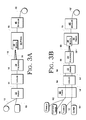
  • FIGS. 3A-3D depict systems for manufacture of waistbands or collar stands according to embodiments hereof;
  • FIGS. 4A-4B are flowcharts of processes for manufacture of waistbands or collar stands according to embodiments hereof;
  • FIG. 5 is a top view of a waistband according to embodiments hereof;
  • FIGS. 6A-6N depict an exemplary folder for manufacture of waistbands or collar stands according to embodiments hereof.
  • FIGS. 7A-7C depict exemplary guides used in the systems of FIGS. 3A-3B .
  • Waistbands according to embodiments hereof are described with reference to FIGS. 1A to 1D and 2A, 2B-1, 2B-2, and 2C .
  • FIGS. 1A to 1D show a top view of only a portion of a continuous waistband.
  • a waistband stream is formed from two substrates or materials that are processed as described herein.
  • the first substrate 10 is the outer material of the waistband to be manufactured.
  • the first substrate 10 may be provided as a continuous piece of material (e.g., from a spool) or it may be formed by joining pre-cut waistbands together, end-to-end (thereby to form a continuous piece of material).
  • the latter approach is preferable when color matching of waistbands to garment is desired, as the individual pre-cut waistbands can be cut from the same material as the rest of the garment. This latter approach lends itself to a system in which waistbands are processed in smaller batches (e.g., 10-20 at a time), although it can be used for larger batches.
  • the first substrate may comprise rigid fabric, or stretch fabric, or fabric cut on the bias.
  • the first substrate may comprise: denim, cotton, cotton blends, wool, wool blends, polyester, polyester blends, spandex, spandex blends, polyester viscose, linen and linen blends.
  • the fusible substrate 12 is a fusible material that is applied to the inside of the waistband.
  • fusible is sometimes used herein to refer to the fusible material. It should be appreciated that the words “first” and “second” are used herein to distinguish or identify the materials or substrates, and not to show a serial or numerical limitation.
  • the inner material of second substrate 12 comprises a fusible substrate and is provided, in part, to provide and/or maintain an elastic memory of the form and the shape of the waistband.
  • the waistbands are to be made from denim, then the outer material or first substrate 10 will comprise denim, and the inner material or fusible substrate 12 will be an appropriate material that will fuse to the denim under appropriate fusing conditions (i.e., pressure, speed, and temperature conditions).
  • appropriate fusing conditions i.e., pressure, speed, and temperature conditions.
  • the waistbands manufactured by the processes described herein may use any materials, and invention is not limited by any examples given. It should further be appreciated that those of ordinary skill in the art of garment manufacturing will know and understand, upon reading this description, which materials can be used together and what the fusing requirements are for various combinations of first and second substrates.
  • the fusible substrate 12 is positioned on top of the first substrate 10 .
  • the first substrate 10 before being folded, has a width W 1
  • the fusible substrate 12 has a width W 2 .
  • FIGS. 1A to 1C and 2A, 2B-1, 2B-2, and 2C are merely descriptive aids.
  • the fusible substrate 12 is positioned between dashed lines A-A and B-B, preferably centered along the dashed line M-M that denotes a center axis of the first substrate 10 .
  • the fusible substrate 12 may be positioned off-center with respect to the first substrate 10 for certain waistband designs, and that these designs are contemplated herein.
  • the distance from the edge of the fusible substrate along line A-A to the edge X-X of first substrate 10 is referred to as W 3
  • W 4 distance from the edge of the fusible substrate along the line B-B to the edge Y-Y of first substrate 10
  • the fusible substrate 12 may be positioned substantially in the center of the first substrate 10 (i.e., substantially along a central axis of the first substrate 10 ), or it may be positioned off center.
  • the values of W 3 and W 4 may by substantially equal (when the fusible 12 is centered along the transverse axis of the first substrate 10 , or they may be unequal (when the fusible 12 is off center), as shown, e.g., in FIG. 1D .
  • the fusible 12 may be positioned so that there is no substrate 10 exposed on one or both sides.
  • the fusible 12 may be positioned on the substrate 10 with only 1 ⁇ 8 inch of the edge on one side.
  • dashed lines A-A and B-B denote two fold lines. In the drawings these lines are shown on the edges of the fusible 12 .
  • a portion 10 - 1 of the first substrate 10 is folded over the fold line A-A, and a second portion 10 - 2 the first substrate 10 is folded over the fold line B-B.
  • the distance between the fold lines A-A and B-B is essentially the width of the fusible 12 .
  • the width of the first portion of the first substrate 10 that will be folded over the fold line A-A is substantially W 3
  • the width of the portion of the second portion of the first substrate 10 that will be folded over the fold line B-B is substantially W 4 .
  • the fold line A-A corresponds substantially to an edge A-A of the fusible substrate 12 . It should be appreciated that in less preferred embodiments the fold line A-A may be away from the edge of the fusible substrate 12 . Similarly, while the other fold line is shown to correspond substantially to the edge B-B of the fusible substrate 12 , in some less preferred embodiments the other fold line B-B may be away from the edge of the fusible substrate 12 .
  • FIG. 2A shows a cross-sectional view of the materials in FIG. 1A , with the fusible substrate 12 positioned on top of the first substrate 10 .
  • FIGS. 1B and 2B show a continuous waistband being formed according to embodiments hereof, and in which a first portion 10 - 1 of the first substrate 10 has been folded over fold line A-A, and a second portion 10 - 2 of the first substrate 10 has been folded over fold line B-B.
  • FIG. 2B shows an exemplary cross-sectional view of the continuous waistband being formed in FIG. 1B .
  • the fold line A-A corresponds substantially to a first edge of the fusible substrate 12
  • the fold line B-B corresponds substantially to a second edge of the fusible substrate 12 .
  • a portion 12 ′ of the fusible substrate 12 may remain uncovered.
  • center fold line M′-M′ in FIG. 1B may not correspond to the center line M-M in FIG. 1A , depending on the symmetry of the fold lines A-A and B-B with respect to the line M-M, and the distances W 3 and W 4 .
  • FIG. 1C shows a continuous waistband formed when the materials shown in FIG. 1B are folded substantially over the fold line M′-M′, which is preferably a centerline of the combined substrates after the two side portions have been folded over the fold lines A-A and B-B.
  • FIG. 2C shows a cross-sectional view of the waistband being formed after the folds shown in FIG. 1C . It should be appreciated that, as with all of the drawings herein, FIG. 2C is not drawn to scale and that relative positions and sizes of the substrates are merely exemplary. It should be appreciated that, in addition to the drawings not being to scale, the folds of actual substrates or materials will not be rectangular, and the rectangular folding is shown in the drawings to aid in this description.
  • the substrates of FIG. 1B and FIG. 2B are folded over a substantially central fold line M′-M′ to form a folded waistband having width W 7 .
  • a substantially central fold line M′-M′ to form a folded waistband having width W 7 .
  • the thickness and type of each of the substrates will determine the thickness of the folds and how much material needs to be included in each substrate to accommodate the various folds.
  • the fusible substrate 12 may comprise adhesive or the like so that it may be fused with the first substrate 10 under appropriate fusing conditions. In some embodiments the fusible substrate 12 has less adhesive or fiber or fabric yarns along the fold line M′-M′ in order to aid with the folding.
  • FIGS. 1A-1C the folding of the first substrate 10 and the fusible substrate 12 is shown in three distinct drawings ( FIGS. 1A-1C , and corresponding FIGS. 2A-2C ), it should be appreciated that the folds may be achieved simultaneously, e.g., using a folder shown in FIGS. 6A-6N ).
  • FIG. 3A depicts an exemplary system 30 for manufacture of continuous waistbands according to embodiments hereof.
  • fusible substrate 10 and first substrate 12 are fed into a fuser (or fusing press) 32 .
  • the fusible substrate 12 is positioned on top of the first substrate 10 as shown, e.g., in FIGS. 1A and 2A .
  • a guide mechanism e.g., as shown in FIGS. 7A-7C ) may be positioned in front of fusing press 32 in order to position the fusible substrate 12 on the first substrate 10 exactly where needed
  • the first substrate 10 and the fusible substrate 12 may be provided on spools or troughs or the like which are positioned to feed appropriate amounts of the substrates 10 and 12 into the fuser 32 substantially tension free.
  • the spools may be positioned such that the fusible substrate 12 is appropriately located on top of the first substrate 10 .
  • the fuser 32 fuses the first and second substrates together under conditions (e.g., at temperature, pressure, and speed) appropriate for the materials being used. Those of ordinary skill in the art will know and understand what settings to use for the fuser 32 based on the materials being used for the first substrate 10 and the fusible substrate 12 .
  • the output of the fuser 32 is a fused combination 14 of the first substrate 10 and the fusible substrate 12 , e.g., as shown in FIGS. 1A and 2A .
  • the output 14 of fuser 32 is preferably cooled (e.g., in troughs or by spacing between equipment components) and then provided to one or more folders 34 in order to achieve the folds, e.g., as described above with reference to FIGS. 1A to 1C and 2A, 2B, and 2C (over fold lines A-A, B-B, and M′-M′).
  • the folds may be achieved simultaneously with a single folder that folds the two side portions first and then does the fold over the M′-M′ line (e.g., as shown in FIGS. 6A-6N ). It should be appreciated, however, that the folds may be achieved with two or three distinct folding mechanisms (which collectively form folder(s) 34 ). In some cases only one or two folds may be needed, in which case an appropriate folder mechanism will be used.
  • the output 16 of folder(s) 34 is the continuous waistband shown in FIGS. 1C and 2C .
  • This output 16 is fed into a second fuser (fusing press) 36 (denoted “Press” in the drawing) pressing/creasing the folded fused materials (first substrate 10 fused with fusible substrate 12 ).
  • Press 36 presses the folded substrates to help production of a continuous folded and/or creased waistband.
  • the waistband 18 produced by press 36 may then be collected, for example, by a spooler 40 onto spools 42 or may be cut to measurement.
  • the spooled continuous waistband 18 may then be cut to appropriate length for use on a garment.
  • Fuser 32 may be a Reliant M60 (made by Reliant Machinery Ltd., United Kingdom) or the like, and press 36 may be a Reliant M45 or the like.
  • the output 14 of the fuser 32 may be hot and should therefore preferably be cooled before being fed into folder(s) 34 . Cooling bins or the like may be provided in order to cool the fused output 14 .
  • the output 16 of folder(s) 34 is a folded, fused substrate to be fed into the press 36 .
  • the folder 34 preferably feeds directly into the mouth 38 of the press 36 , with little or no gap between them.
  • the folder preferably has an extended output portion ( 35 in FIG. 3A, 35 ′ in FIG. 3B , and as shown, e.g., in FIGS. 6A-6N ) that can feed directly (or substantially directly) into the mouth 38 of press 36 . In one example, as shown in FIGS.
  • a portion 34 , 34 ′ of the folder 34 extends 8-10 inches (which may be referred to herein as a Roup extension). It should be appreciated that a Roup extension may be shorter than 8 inches or longer than 10 inches.
  • one or more standalone folders may be used with a separate flat guide (e.g., 8-10 inches long) in front of it to feed the output of the folder(s) directly into the mouth of the press. The flat guide should control the output of the folder to prevent it from unfolding.
  • the extended output portion 35 , 35 ′ of the folder(s) 34 , 34 ′ may be fully or partially integrated into and be part of the folders(s) 34 , 34 ′ or it may be a separate component.
  • FIG. 4A is a flowchart of an exemplary process for manufacture of continuous waistbands or collar stands according to embodiments hereof, using, e.g., the system shown in FIG. 3A .
  • the fusible substrate 12 fuse material
  • the first substrate 10 e.g., waistband material
  • the result of the overlay is the fusible substrate 12 being positioned on top of the first substrate 10 , e.g., as shown in FIGS. 1A and 2A .
  • the two substrates 10 and 12 are fused (at S 44 ).
  • the fusing (at S 44 ) may be done by fuser (fusing press) 32 , e.g., by being fused together under appropriate conditions (e.g., under appropriate pressure, speed, and temperature).
  • the fused substrates (denoted 14 exiting fuser 32 in FIG. 3A ) are then cooled (if needed—not shown in the flow chart) and then folded (at S 46 ).
  • the folding may be done by folder(s) 34 (e.g. the folder shown in FIGS.
  • the result of the folding may correspond to the three-way folding described above with reference to FIGS. 1A to 1C and 2A to 2C .
  • the folding may result in a one-fold waistband or a two-fold waistband.
  • the folded substrates are pressed/creased (at S 48 ).
  • the pressing/creasing in S 48 may be done by press 36 , e.g., by being pressed together under appropriate conditions (e.g., under appropriate pressure, speed, and temperature).
  • the fused three-way folded, pressed and creased substrates may then be collected and/or spooled (at S 50 ).
  • the continuous tri-folded and pressed waistbands are rolled into 10 or 20 waistband lengths which may then be taken to a production floor where they are fitted overhead or under a waistband machine (that pull the bands as needed) as the operator attaches the waistband onto the pants.
  • a spool of continuous waistbands means that, in use, only the first waistband needs to be fed into the waistband machine, the rest of the waistband will follow as needed.
  • the waistbands being produced will include curtains or inners.
  • the fuser 32 ′ in addition to the first substrate 10 and the fusible substrate 12 , the fuser 32 ′ also takes in a second substrate 60 (for the curtain or inner) and a second fusible substrate 62 .
  • the output of the fuser 32 ′ is first stream 14 ′ formed from the first substrate 10 being fused/pressed with the first fusible 12 , and a second stream 64 formed from the second substrate 60 being fused/pressed with the first fusible 62 .
  • joiner 33 may be a sewing machine or the like and may require human operation.
  • FIG. 4B is a flowchart of an exemplary process for manufacture of continuous waistbands or collar stands according to embodiments hereof, using, e.g., the system shown in FIG. 3B .
  • First (at S 70 ) and outer and an inner or curtain are formed.
  • the outer ( 14 ′ in FIG. 3B ) is formed in the same manner as the combination 14 in FIG. 3A .
  • the inner or curtain may be formed in a similar manner (at S 72 , S 74 ).
  • the outer 14 ′ and inner or curtain 64 are then joined (at S 78 ), folded (at S 80 ), and pressed/creased (at S 82 ).
  • the folding (at S 80 ) may result in one, two, three, or more folds.
  • the combined folded, pressed outer and inner (or outer and curtain) may then be collected (e.g., spooled) (at S 84 ).
  • fuser 32 ( FIG. 3A ) may be omitted (as shown, e.g., in FIG. 3C ). If a single substrate is used for the outer 10 in the embodiment of FIG. 3B , then that substrate need not be processed by fuser 32 ′, and it may be fed directly into joiner 33 (as shown, e.g., in FIG. 3D ).
  • FIG. 5 is a top view of a continuous waistband 18 according to embodiments hereof, produced by the system 30 and process(es) described above.
  • the continuous waistband 14 shown in FIG. 5 may be further processed to include seams, e.g., seam 50 , as seen, e.g., on some jeans.
  • the first substrate may be or comprise, without limitation, a material selected from the group comprising: denim, cotton (e.g., 100% cotton or cotton blends), wool (e.g. 100% wool or wool blends), polyester, polyester blends, spandex (elastane), spandex blend, polyester viscose (e.g., polyester and Rayon or some fabric made from regenerated cellulose fiber), linen or linen blends.
  • a cotton blend may be, e.g., a 65/35 cotton polyester blend or a 50/50 cotton polyester blend.
  • a polyester blend may be, e.g., a 98/2 polyester cotton blend or a 97/3 polyester cotton blend.
  • the first substrate 10 is denim and the fusible substrate 12 is a 84 mm fusible substrate, and the fuser 32 is set to 180° C., speed at 5 Meters/Minute and pressure at 5 bars.
  • the first substrate 10 is 100% cotton and the fusible substrate 12 is a 80 mm fusible substrate, and the fuser is set to 160° C., at 4 Meters/Minute with the pressure at 4 bars.
  • the first substrate 10 is denim and the fusible substrate 12 is a 47 mm fusible substrate, and the fuser 32 is set to 180° C., speed at 5 Meters/Minute and pressure at 5 bars.
  • the first substrate 10 is 100% wool and the fusible substrate 12 is a 45 mm fusible substrate, and the fuser 32 is set to 160° C., speed at 4 Meters/Minute and pressure at 4 bars.
  • fusible substrate Although some of the examples and processes shown about use fusible substrate, it should be appreciated that a fusible substrate is not required in all embodiments, and that waistbands and collar stands may be made without a fusible substrate.
  • the fabric for the waistband may be or include spandex (sometimes referred to as “elastane,” e.g., LycraTM or some such material comprising an elastic polyurethane fiber or fabric) so that it will be able to stretch by itself.
  • spandex sometimes referred to as “elastane,” e.g., LycraTM or some such material comprising an elastic polyurethane fiber or fabric
  • the fabric used to make the waistband (or collar stand) may be cut on a bias in order to impart a degree of mechanical stretch to the fabric, with or without the use of a fusible.
  • waistband may only require one or two folds, and these may accommodated by different folders.
  • process may operate without any user intervention.
  • process includes some human intervention (e.g., a step is performed by or with the assistance of a human).
  • portion means some or all. So, for example, “A portion of X” may include some of “X” or all of “X”. In the context of a conversation, the term “portion” means some or all of the conversation.
  • the phrase “at least some” means “one or more,” and includes the case of only one.
  • the phrase “at least some ABCs” means “one or more ABCs”, and includes the case of only one ABC.
  • the phrase “using” means “using at least,” and is not exclusive. Thus, e.g., the phrase “using X” means “using at least X.” Unless specifically stated by use of the word “only”, the phrase “using X” does not mean “using only X.”
  • the phrase “distinct” means “at least partially distinct.” Unless specifically stated, distinct does not mean fully distinct. Thus, e.g., the phrase, “X is distinct from Y” means that “X is at least partially distinct from Y,” and does not mean that “X is fully distinct from Y.” Thus, as used herein, including in the claims, the phrase “X is distinct from Y” means that X differs from Y in at least some way.

Landscapes

  • Engineering & Computer Science (AREA)
  • Textile Engineering (AREA)
  • Mechanical Engineering (AREA)
  • Treatment Of Fiber Materials (AREA)

Abstract

A system for producing a continuous stream of elements of garments stream includes: a first fusing press to fuse the combination at a first temperature to form a first fused combination from a combination formed by a continuous fusible substrate on a continuous first substrate; at least one folder positioned to take the first fused combination from the first fusing press and to form a folded fused combination; and a second fusing press positioned to take the folded fused combination from the at least one folder and to form the continuous stream of elements of garments by pressing the folded fused combination at a second temperature. The second temperature is lower than the first temperature, and the continuous stream of elements of garments comprises multiple individual elements of multiple garments.

Description

RELATED APPLICATIONS
This application is a division of U.S. patent application Ser. No. 14/497,308, filed, Sep. 25, 2014, now U.S. Pat. No. 9,840,037, titled “Continuous Folded and Creased Waistband, Collar Stand, and Methods and Systems for Making Same,” which claims priority to U.S. Provisional Application No. 61/897,930, filed Oct. 31, 2013, the entire contents of both of which are hereby fully incorporated herein by reference for all purposes.
COPYRIGHT STATEMENT
This patent document contains material subject to copyright protection. The copyright owner has no objection to the reproduction of this patent document or any related materials in the files of the United States Patent and Trademark Office, but otherwise reserves all copyrights whatsoever.
BACKGROUND OF THE INVENTION Field of the Invention
This invention relates to garment and garment manufacture, and, more particularly to waistbands and collar stands for garments and methods and devices for their manufacture.
BACKGROUND AND OVERVIEW
Many garments such as pants, dresses, skirts, and the like include waistbands, and shirt's use collar stands. There are many types of waistbands, including one-piece, waistbands with inners and waistbands with curtains. Traditionally, one-piece waistbands for use on garments were made by first cutting each waistband to the desired length, then folding the waistband across a central axis thereof to create a crease, and then pressing the crease down with a hand iron. The two edges were then each also folded in and pressed, and then, in some cases, the seams were sewn along the two outer edges. Then the one side was used to attach the waistband to the pant or skirt, the other side was tucked in and stitched down when closing the waistband.
This process was problematic in that often the creases were uneven and resulted in imperfect waistbands that may have frayed out and/or may not have aligned properly with the garment. Additionally, cutting each waistband individually, and then folding and pressing it increased the time taken to make each garment.
An object of this invention is to create waistbands and collar stands with consistent quality, and without wasting excess fabric, and in such a way that they can be efficiently attached to garments.
BRIEF DESCRIPTION OF THE DRAWINGS
Various other objects, features and attendant advantages of the present invention will become fully appreciated as the same becomes better understood when considered in conjunction with the accompanying drawings, in which like reference characters designate the same or similar parts throughout the several views, and wherein:
FIGS. 1A-1D are a top views of two substrates in various stages of forming waistbands or collar stands according to embodiments hereof;
FIGS. 2A, 2B, and 2C are side views of the substrates of FIGS. 1A-1C, respectively, according to embodiments hereof;
FIGS. 2D-2F are side views of a substrate according to embodiments hereof;
FIGS. 3A-3D depict systems for manufacture of waistbands or collar stands according to embodiments hereof;
FIGS. 4A-4B are flowcharts of processes for manufacture of waistbands or collar stands according to embodiments hereof;
FIG. 5 is a top view of a waistband according to embodiments hereof;
FIGS. 6A-6N depict an exemplary folder for manufacture of waistbands or collar stands according to embodiments hereof; and
FIGS. 7A-7C depict exemplary guides used in the systems of FIGS. 3A-3B.
DETAILED DESCRIPTION OF THE PRESENTLY PREFERRED EXEMPLARY EMBODIMENTS
Waistbands according to embodiments hereof are described with reference to FIGS. 1A to 1D and 2A, 2B-1, 2B-2, and 2C.
The following description refers to the manufacture of waistbands. It should be appreciated that the same processes and systems may be used for collar stands and other rectangular pieces.
In the following description a continuous waistband stream may be formed which may then be stored and then later cut to required lengths as needed. It should be appreciated that FIGS. 1A to 1D show a top view of only a portion of a continuous waistband.
A waistband stream is formed from two substrates or materials that are processed as described herein. The first substrate 10 is the outer material of the waistband to be manufactured. The first substrate 10 may be provided as a continuous piece of material (e.g., from a spool) or it may be formed by joining pre-cut waistbands together, end-to-end (thereby to form a continuous piece of material). The latter approach is preferable when color matching of waistbands to garment is desired, as the individual pre-cut waistbands can be cut from the same material as the rest of the garment. This latter approach lends itself to a system in which waistbands are processed in smaller batches (e.g., 10-20 at a time), although it can be used for larger batches. Although the process is described here using two substrates, it should be appreciated that a single substrate—a regular fabric—could be used alone, e.g., as shown in FIGS. 2D-2F. The first substrate may comprise rigid fabric, or stretch fabric, or fabric cut on the bias. In some cases the first substrate may comprise: denim, cotton, cotton blends, wool, wool blends, polyester, polyester blends, spandex, spandex blends, polyester viscose, linen and linen blends.
The fusible substrate 12 is a fusible material that is applied to the inside of the waistband. The term “fusible” is sometimes used herein to refer to the fusible material. It should be appreciated that the words “first” and “second” are used herein to distinguish or identify the materials or substrates, and not to show a serial or numerical limitation.
Preferably the inner material of second substrate 12 comprises a fusible substrate and is provided, in part, to provide and/or maintain an elastic memory of the form and the shape of the waistband.
For example, if the waistbands are to be made from denim, then the outer material or first substrate 10 will comprise denim, and the inner material or fusible substrate 12 will be an appropriate material that will fuse to the denim under appropriate fusing conditions (i.e., pressure, speed, and temperature conditions). It should be appreciated that the waistbands manufactured by the processes described herein may use any materials, and invention is not limited by any examples given. It should further be appreciated that those of ordinary skill in the art of garment manufacturing will know and understand, upon reading this description, which materials can be used together and what the fusing requirements are for various combinations of first and second substrates.
In order to manufacture a continuous waistband according to embodiments hereof, and as shown, e.g., in FIG. 1A, the fusible substrate 12 is positioned on top of the first substrate 10. As shown in the drawing in FIG. 1A, the first substrate 10, before being folded, has a width W1, and the fusible substrate 12 has a width W2.
Various dashed and dotted lines are used in FIGS. 1A to 1C and 2A, 2B-1, 2B-2, and 2C to aid in this description. It should be appreciated that these lines are merely descriptive aids.
Thus, as shown in FIG. 1A, the fusible substrate 12 is positioned between dashed lines A-A and B-B, preferably centered along the dashed line M-M that denotes a center axis of the first substrate 10.
It should be appreciated, however, that the fusible substrate 12 may be positioned off-center with respect to the first substrate 10 for certain waistband designs, and that these designs are contemplated herein.
For the purposes of this discussion, the distance from the edge of the fusible substrate along line A-A to the edge X-X of first substrate 10 is referred to as W3, and distance from the edge of the fusible substrate along the line B-B to the edge Y-Y of first substrate 10 is referred to as W4.
The fusible substrate 12 may be positioned substantially in the center of the first substrate 10 (i.e., substantially along a central axis of the first substrate 10), or it may be positioned off center. In other words, the values of W3 and W4 may by substantially equal (when the fusible 12 is centered along the transverse axis of the first substrate 10, or they may be unequal (when the fusible 12 is off center), as shown, e.g., in FIG. 1D. In some cases the fusible 12 may be positioned so that there is no substrate 10 exposed on one or both sides. For example, the fusible 12 may be positioned on the substrate 10 with only ⅛ inch of the edge on one side.
Those of ordinary skill in the art of garment manufacturing will know and the dimensions needed for various types and styles of waistbands or collar stands.
In FIG. 1A the dashed lines A-A and B-B denote two fold lines. In the drawings these lines are shown on the edges of the fusible 12.
As will be explained below, in forming a continuous waistband according to embodiments hereof, a portion 10-1 of the first substrate 10 is folded over the fold line A-A, and a second portion 10-2 the first substrate 10 is folded over the fold line B-B. The distance between the fold lines A-A and B-B is essentially the width of the fusible 12. The width of the first portion of the first substrate 10 that will be folded over the fold line A-A is substantially W3, and the width of the portion of the second portion of the first substrate 10 that will be folded over the fold line B-B is substantially W4.
As shown in the drawings, the fold line A-A corresponds substantially to an edge A-A of the fusible substrate 12. It should be appreciated that in less preferred embodiments the fold line A-A may be away from the edge of the fusible substrate 12. Similarly, while the other fold line is shown to correspond substantially to the edge B-B of the fusible substrate 12, in some less preferred embodiments the other fold line B-B may be away from the edge of the fusible substrate 12.
FIG. 2A shows a cross-sectional view of the materials in FIG. 1A, with the fusible substrate 12 positioned on top of the first substrate 10.
FIGS. 1B and 2B show a continuous waistband being formed according to embodiments hereof, and in which a first portion 10-1 of the first substrate 10 has been folded over fold line A-A, and a second portion 10-2 of the first substrate 10 has been folded over fold line B-B.
FIG. 2B shows an exemplary cross-sectional view of the continuous waistband being formed in FIG. 1B. In the exemplary embodiment in FIG. 2B the fold line A-A corresponds substantially to a first edge of the fusible substrate 12, and the fold line B-B corresponds substantially to a second edge of the fusible substrate 12.
After the first and second side portions 10-1 and 10-2 of the first substrate 10 have been folded over fold lines A-A and B-B, respectively, a portion 12′ of the fusible substrate 12 may remain uncovered.
It should be appreciated that the center fold line M′-M′ in FIG. 1B may not correspond to the center line M-M in FIG. 1A, depending on the symmetry of the fold lines A-A and B-B with respect to the line M-M, and the distances W3 and W4.
FIG. 1C shows a continuous waistband formed when the materials shown in FIG. 1B are folded substantially over the fold line M′-M′, which is preferably a centerline of the combined substrates after the two side portions have been folded over the fold lines A-A and B-B.
FIG. 2C shows a cross-sectional view of the waistband being formed after the folds shown in FIG. 1C. It should be appreciated that, as with all of the drawings herein, FIG. 2C is not drawn to scale and that relative positions and sizes of the substrates are merely exemplary. It should be appreciated that, in addition to the drawings not being to scale, the folds of actual substrates or materials will not be rectangular, and the rectangular folding is shown in the drawings to aid in this description.
As shown in FIG. 2C, the substrates of FIG. 1B and FIG. 2B are folded over a substantially central fold line M′-M′ to form a folded waistband having width W7. Those of ordinary skill in the art will appreciate and understand, upon reading this description, how to select various fold widths in order to achieve a waistband having a width W7. As noted above, the thickness and type of each of the substrates will determine the thickness of the folds and how much material needs to be included in each substrate to accommodate the various folds. Similarly, those of ordinary skill in the art will appreciate and understand, upon reading this description, how large each folded portion of the first substrate 10 needs to be in order to sufficiently overlap fusible substrate 12 when the first and second side portions of the first substrate 10 are folded over fold lines A-A and B-B, respectively.
The fusible substrate 12 may comprise adhesive or the like so that it may be fused with the first substrate 10 under appropriate fusing conditions. In some embodiments the fusible substrate 12 has less adhesive or fiber or fabric yarns along the fold line M′-M′ in order to aid with the folding.
Although the folding of the first substrate 10 and the fusible substrate 12 is shown in three distinct drawings (FIGS. 1A-1C, and corresponding FIGS. 2A-2C), it should be appreciated that the folds may be achieved simultaneously, e.g., using a folder shown in FIGS. 6A-6N).
FIG. 3A depicts an exemplary system 30 for manufacture of continuous waistbands according to embodiments hereof. As shown in the drawing in FIG. 3A, fusible substrate 10 and first substrate 12 are fed into a fuser (or fusing press) 32. Before entry to the fuser 32, the fusible substrate 12 is positioned on top of the first substrate 10 as shown, e.g., in FIGS. 1A and 2A. A guide mechanism (e.g., as shown in FIGS. 7A-7C) may be positioned in front of fusing press 32 in order to position the fusible substrate 12 on the first substrate 10 exactly where needed
The first substrate 10 and the fusible substrate 12 may be provided on spools or troughs or the like which are positioned to feed appropriate amounts of the substrates 10 and 12 into the fuser 32 substantially tension free. The spools may be positioned such that the fusible substrate 12 is appropriately located on top of the first substrate 10.
The fuser 32 fuses the first and second substrates together under conditions (e.g., at temperature, pressure, and speed) appropriate for the materials being used. Those of ordinary skill in the art will know and understand what settings to use for the fuser 32 based on the materials being used for the first substrate 10 and the fusible substrate 12. The output of the fuser 32 is a fused combination 14 of the first substrate 10 and the fusible substrate 12, e.g., as shown in FIGS. 1A and 2A.
The output 14 of fuser 32 is preferably cooled (e.g., in troughs or by spacing between equipment components) and then provided to one or more folders 34 in order to achieve the folds, e.g., as described above with reference to FIGS. 1A to 1C and 2A, 2B, and 2C (over fold lines A-A, B-B, and M′-M′). The folds may be achieved simultaneously with a single folder that folds the two side portions first and then does the fold over the M′-M′ line (e.g., as shown in FIGS. 6A-6N). It should be appreciated, however, that the folds may be achieved with two or three distinct folding mechanisms (which collectively form folder(s) 34). In some cases only one or two folds may be needed, in which case an appropriate folder mechanism will be used.
The output 16 of folder(s) 34 is the continuous waistband shown in FIGS. 1C and 2C. This output 16 is fed into a second fuser (fusing press) 36 (denoted “Press” in the drawing) pressing/creasing the folded fused materials (first substrate 10 fused with fusible substrate 12). Press 36 presses the folded substrates to help production of a continuous folded and/or creased waistband. As the press 36 does not need to fuse the substrates, it may operate at a lower temperature than fuser 32. The waistband 18 produced by press 36 may then be collected, for example, by a spooler 40 onto spools 42 or may be cut to measurement.
The spooled continuous waistband 18 may then be cut to appropriate length for use on a garment.
Fuser 32 may be a Reliant M60 (made by Reliant Machinery Ltd., United Kingdom) or the like, and press 36 may be a Reliant M45 or the like.
It should be appreciated that the output 14 of the fuser 32 may be hot and should therefore preferably be cooled before being fed into folder(s) 34. Cooling bins or the like may be provided in order to cool the fused output 14.
The output 16 of folder(s) 34 is a folded, fused substrate to be fed into the press 36. In order to prevent the output 16 of the folder(s) 34 from unfolding before being pressed, the folder 34 preferably feeds directly into the mouth 38 of the press 36, with little or no gap between them. In order to achieve this, the folder preferably has an extended output portion (35 in FIG. 3A, 35′ in FIG. 3B, and as shown, e.g., in FIGS. 6A-6N) that can feed directly (or substantially directly) into the mouth 38 of press 36. In one example, as shown in FIGS. 6A-6N, a portion 34, 34′ of the folder 34 extends 8-10 inches (which may be referred to herein as a Roup extension). It should be appreciated that a Roup extension may be shorter than 8 inches or longer than 10 inches. In some embodiments one or more standalone folders may be used with a separate flat guide (e.g., 8-10 inches long) in front of it to feed the output of the folder(s) directly into the mouth of the press. The flat guide should control the output of the folder to prevent it from unfolding. The extended output portion 35, 35′ of the folder(s) 34, 34′ may be fully or partially integrated into and be part of the folders(s) 34, 34′ or it may be a separate component.
FIG. 4A is a flowchart of an exemplary process for manufacture of continuous waistbands or collar stands according to embodiments hereof, using, e.g., the system shown in FIG. 3A. As shown in FIG. 4A, the fusible substrate 12 (fuse material) is overlaid (at S42) onto the first substrate 10 (e.g., waistband material). This corresponds, e.g., to the merging of the two substrates 10 and 12 prior to entering the fuser 32 in FIG. 3A. The result of the overlay (in S42) is the fusible substrate 12 being positioned on top of the first substrate 10, e.g., as shown in FIGS. 1A and 2A.
Next, the two substrates 10 and 12 are fused (at S44). Using the exemplary system shown in FIG. 3A, the fusing (at S44) may be done by fuser (fusing press) 32, e.g., by being fused together under appropriate conditions (e.g., under appropriate pressure, speed, and temperature). The fused substrates (denoted 14 exiting fuser 32 in FIG. 3A) are then cooled (if needed—not shown in the flow chart) and then folded (at S46). In the exemplary system of FIG. 3A, the folding may be done by folder(s) 34 (e.g. the folder shown in FIGS. 6A-6N), and the result of the folding may correspond to the three-way folding described above with reference to FIGS. 1A to 1C and 2A to 2C. In some embodiments the folding may result in a one-fold waistband or a two-fold waistband.
Next, the folded substrates are pressed/creased (at S48). In the exemplary system of FIG. 3A, the pressing/creasing (in S48) may be done by press 36, e.g., by being pressed together under appropriate conditions (e.g., under appropriate pressure, speed, and temperature).
The fused three-way folded, pressed and creased substrates may then be collected and/or spooled (at S50).
In some preferred embodiments, the continuous tri-folded and pressed waistbands are rolled into 10 or 20 waistband lengths which may then be taken to a production floor where they are fitted overhead or under a waistband machine (that pull the bands as needed) as the operator attaches the waistband onto the pants. It should be appreciated that the use of a spool of continuous waistbands means that, in use, only the first waistband needs to be fed into the waistband machine, the rest of the waistband will follow as needed.
In some cases the waistbands being produced will include curtains or inners. In these case, as shown, e.g., in FIG. 3B, in addition to the first substrate 10 and the fusible substrate 12, the fuser 32′ also takes in a second substrate 60 (for the curtain or inner) and a second fusible substrate 62. The output of the fuser 32′ is first stream 14′ formed from the first substrate 10 being fused/pressed with the first fusible 12, and a second stream 64 formed from the second substrate 60 being fused/pressed with the first fusible 62. These two streams are the allowed to cool, as needed, and then joined (by joiner 33) to form a combined stream 66 (with the curtain or inner joined to the combined first substrate 10 and fusible substrate 12. The combined stream 66 is then fed into folder 34′, folded as required, and then the folded stream 68 is fed substantially directly into the mouth 38′ of the press 36′. The output 70 of the press 36′ may then be collected and spooled (by spooler 40′ on spool 42′).
It should be understood that the joiner 33 may be a sewing machine or the like and may require human operation.
FIG. 4B is a flowchart of an exemplary process for manufacture of continuous waistbands or collar stands according to embodiments hereof, using, e.g., the system shown in FIG. 3B. First (at S70) and outer and an inner or curtain are formed. The outer (14′ in FIG. 3B) is formed in the same manner as the combination 14 in FIG. 3A. The inner or curtain may be formed in a similar manner (at S72, S74). The outer 14′ and inner or curtain 64 are then joined (at S78), folded (at S80), and pressed/creased (at S82). As noted, the folding (at S80) may result in one, two, three, or more folds. The combined folded, pressed outer and inner (or outer and curtain) may then be collected (e.g., spooled) (at S84).
Those of ordinary skill in the art will realize and appreciate, upon reading this description, that when a single substrate is used, without a fusible substrate, then the fuser 32 (FIG. 3A) may be omitted (as shown, e.g., in FIG. 3C). If a single substrate is used for the outer 10 in the embodiment of FIG. 3B, then that substrate need not be processed by fuser 32′, and it may be fed directly into joiner 33 (as shown, e.g., in FIG. 3D).
FIG. 5 is a top view of a continuous waistband 18 according to embodiments hereof, produced by the system 30 and process(es) described above. The continuous waistband 14 shown in FIG. 5 may be further processed to include seams, e.g., seam 50, as seen, e.g., on some jeans.
The first substrate may be or comprise, without limitation, a material selected from the group comprising: denim, cotton (e.g., 100% cotton or cotton blends), wool (e.g. 100% wool or wool blends), polyester, polyester blends, spandex (elastane), spandex blend, polyester viscose (e.g., polyester and Rayon or some fabric made from regenerated cellulose fiber), linen or linen blends. A cotton blend may be, e.g., a 65/35 cotton polyester blend or a 50/50 cotton polyester blend. A polyester blend may be, e.g., a 98/2 polyester cotton blend or a 97/3 polyester cotton blend. Those of ordinary skill in the art will realize and appreciate, upon reading this description, that different and or other materials and blends may be used, and the examples of materials listed here are not intended to limit the scope of this invention in any way.
EXAMPLES Example 1
In one example, the first substrate 10 is denim and the fusible substrate 12 is a 84 mm fusible substrate, and the fuser 32 is set to 180° C., speed at 5 Meters/Minute and pressure at 5 bars.
Example 2
In another example, the first substrate 10 is 100% cotton and the fusible substrate 12 is a 80 mm fusible substrate, and the fuser is set to 160° C., at 4 Meters/Minute with the pressure at 4 bars.
Example 3
In another example, the first substrate 10 is denim and the fusible substrate 12 is a 47 mm fusible substrate, and the fuser 32 is set to 180° C., speed at 5 Meters/Minute and pressure at 5 bars.
Example 4
In another example, the first substrate 10 is 100% wool and the fusible substrate 12 is a 45 mm fusible substrate, and the fuser 32 is set to 160° C., speed at 4 Meters/Minute and pressure at 4 bars.
Thus are described continuous folded waistbands and collar stands, and methods and system for making same.
Although some of the examples and processes shown about use fusible substrate, it should be appreciated that a fusible substrate is not required in all embodiments, and that waistbands and collar stands may be made without a fusible substrate.
In some embodiments the fabric for the waistband (or collar stand) may be or include spandex (sometimes referred to as “elastane,” e.g., Lycra™ or some such material comprising an elastic polyurethane fiber or fabric) so that it will be able to stretch by itself.
In some embodiments the fabric used to make the waistband (or collar stand) may be cut on a bias in order to impart a degree of mechanical stretch to the fabric, with or without the use of a fusible.
The systems and processes described remove the complexities, inaccuracies and waste of manual products.
While the above example all show three-way folds, some waistband may only require one or two folds, and these may accommodated by different folders.
Where a process is described herein, those of ordinary skill in the art will appreciate that the process may operate without any user intervention. In another embodiment, the process includes some human intervention (e.g., a step is performed by or with the assistance of a human).
As used in this description, the term “portion” means some or all. So, for example, “A portion of X” may include some of “X” or all of “X”. In the context of a conversation, the term “portion” means some or all of the conversation.
As used herein, including in the claims, the phrase “at least some” means “one or more,” and includes the case of only one. Thus, e.g., the phrase “at least some ABCs” means “one or more ABCs”, and includes the case of only one ABC.
As used herein, including in the claims, the phrase “using” means “using at least,” and is not exclusive. Thus, e.g., the phrase “using X” means “using at least X.” Unless specifically stated by use of the word “only”, the phrase “using X” does not mean “using only X.”
In general, as used herein, including in the claims, unless the word “only” is specifically used in a phrase, it should not be read into that phrase.
As used herein, including in the claims, the phrase “distinct” means “at least partially distinct.” Unless specifically stated, distinct does not mean fully distinct. Thus, e.g., the phrase, “X is distinct from Y” means that “X is at least partially distinct from Y,” and does not mean that “X is fully distinct from Y.” Thus, as used herein, including in the claims, the phrase “X is distinct from Y” means that X differs from Y in at least some way.
It should be appreciated that the words “first” and “second” in the description and claims are used to distinguish or identify, and not to show a serial or numerical limitation. Similarly, the use of letter or numerical labels (such as “(a)”, “(b)”, and the like) are used to help distinguish and/or identify, and not to show any serial or numerical limitation or ordering.
While the invention has been described in connection with what is presently considered to be the most practical and preferred embodiments, it is to be understood that the invention is not to be limited to the disclosed embodiment, but on the contrary, is intended to cover various modifications and equivalent arrangements included within the spirit and scope of the appended claims.

Claims (30)

I claim:
1. A system for producing a continuous stream of elements of garments stream, the system comprising:
(a) a first fusing press constructed and adapted to fuse a combination at a first temperature to form a first fused combination, said combination formed by a continuous fusible substrate on a continuous first substrate;
(b) at least one folder positioned to take said first fused combination from said first fusing press and to form a folded fused combination; and
(c) a second fusing press positioned to take said folded fused combination from said at least one folder and to form said continuous stream of elements of garments by pressing said folded fused combination at a second temperature, wherein said second temperature is lower than said first temperature, and
wherein said continuous stream of elements of garments comprises multiple individual elements of multiple garments.
2. The system of claim 1, wherein said at least one folder comprises a three-way folder.
3. The system of claim 1, wherein said fusible substrate is positioned substantially along a central axis of said first substrate to form said combination input into said first fusing press.
4. The system of claim 1, wherein the at least one folder forms three folds in said first pressed combination.
5. The system of claim 4 wherein said three folds comprise:
a first side fold,
a second side fold, and
a center fold.
6. The system of claim 5, wherein said first side fold is formed by the at least one folder folding a first portion of said continuous first substrate over at least some of said continuous fusible substrate.
7. The system of claim 6, wherein said second side fold is formed by the at least one folder folding a second portion of said continuous first substrate over at least some of said continuous fusible substrate.
8. The system of claim 7, wherein said center fold is formed by the at least one folder folding said first pressed combination after said first side fold and said second side fold have been made.
9. The system of claim 4 wherein said folds are formed simultaneously.
10. The system of claim 1, wherein said system is constructed and adapted to use, as said first substrate, a material selected from the group comprising: denim, cotton, cotton blends, wool, wool blends, polyester, polyester blends, spandex, spandex blend, polyester viscose, linen, and linen blend.
11. The system of claim 1, wherein said system is constructed and adapted to use, as said fusible substrate, a second material selected from the group comprising: 84 mm fusible substrates, 45 mm fusible substrates, 47 mm fusible substrates, and 80 mm fusible substrates.
12. The system of claim 1, further comprising:
(d) a spooler, positioned to spool portions of said continuous stream of elements of garments.
13. The system of claim 12, wherein said system is constructed and adapted to spool, as said portions, sufficient continuous elements stream for at least ten individual elements of garments.
14. The system of claim 13, wherein said system is constructed and adapted to spool, as said portions, sufficient continuous elements in said stream for at least twenty individual elements of garments.
15. The system of claim 1, wherein said system is constructed and adapted to spool, as the elements of garments, elements selected from: waistbands and collar stands.
16. A system for producing a continuous stream of elements of garments, the system comprising:
(a) a first heated press constructed and adapted to fuse, at a first temperature, a continuous first substrate and a continuous first fusible substrate to form a first fused combination;
(b) a joiner constructed and adapted to join said first fused combination with at least a continuous second substrate to form a joined combination;
(c) at least one folder positioned to take said joined combination from said joiner and to form a folded joined combination;
(d) a second heated press positioned to take said folded joined combination from said at least one folder and to form said continuous stream of elements of garments by pressing said folded joined combination at a second temperature, wherein said second temperature is lower than said first temperature,
wherein said continuous stream comprises multiple individual elements of multiple garments.
17. The system of claim 16, further comprising:
(e) a spooler, positioned to spool portions of said continuous stream of elements of garments.
18. The system of claim 16, wherein a continuous second fusible substrate is positioned on said continuous second substrate prior to said joiner forming said folded joined combination.
19. The system of claim 16, wherein said system is constructed and adapted to use, as said first substrate, a first material selected from the group comprising: denim, cotton, cotton blends, wool, wool blends, polyester, polyester blends, spandex, spandex blends, polyester viscose, linen, and linen blends.
20. The system of claim 16, wherein said system is constructed and adapted to use, as said first fusible substrate, a second material selected from the group comprising: 84 mm fusible substrates, 45 mm fusible substrates, 47 mm fusible substrates, and 80 mm fusible substrates.
21. The system of claim 16, wherein said system is constructed and adapted to use, as said second substrate, a third material selected from the group comprising: denim, cotton, cotton blends, wool, wool blends, polyester, polyester blends, spandex, spandex blends, polyester viscose, linen, and linen blends.
22. The system of claim 16, wherein said system is constructed and adapted to produce the elements of garments selected from: waistbands and collar stands.
23. A system for producing a continuous stream of elements of garments, the system comprising:
(a) a first press constructed and adapted to fuse, at a first temperature,
(i) a continuous first substrate and a continuous first fusible substrate to form a first fused combination; and
(ii) a continuous second substrate and a continuous second fusible substrate to form a second fused combination;
(b) a joiner constructed and adapted to join said first fused combination and said second fused combination to form a joined combination;
(c) at least one folder positioned to take said joined combination from said joiner and to form a folded joined combination;
(d) a second press positioned to take said folded joined combination from said at least one folder and to form said continuous stream of elements of garments by pressing said folded joined combination at a second temperature, wherein said second temperature is lower than said first temperature,
wherein said continuous stream comprises multiple individual elements of multiple garments.
24. The system of claim 23, further comprising:
(e) a spooler, positioned to spool portions of said continuous stream of elements of garments.
25. The system of claim 23, wherein a continuous second fusible substrate is positioned on said continuous second substrate prior to said joiner forming said folded joined combination.
26. The system of claim 23, wherein said system is constructed and adapted to use, as said first substrate, a first material selected from the group comprising: denim, cotton, cotton blends, wool, wool blends, polyester, polyester blends, spandex, spandex blends, polyester viscose, linen and linen blends.
27. The system of claim 23, wherein said system is constructed and adapted to use, as said first fusible substrate, a second material selected from the group comprising: 84 mm fusible substrates, 45 mm fusible substrates, 47 mm fusible substrates, and 80 mm fusible substrates.
28. The system of claim 23, wherein said system is constructed and adapted to use, as said second substrate, a third material selected from the group comprising: denim, cotton, cotton blends, wool, wool blends, polyester, polyester blends, spandex, spandex blends, polyester viscose, linen and linen blends.
29. The system of claim 23, wherein the first press simultaneously fuses:
(i) the continuous first substrate and the continuous first fusible substrate to form the first fused combination; and
(ii) the continuous second substrate and the continuous second fusible substrate to form the second fused combination.
30. The system of claim 23, wherein said system is constructed and adapted to produce the elements of garments selected from: waistbands and collar stands.
US15/835,369 2013-10-31 2017-12-07 Systems for making continuous folded and creased waistbands and collar stands Expired - Fee Related US10464252B2 (en)

Priority Applications (2)

Application Number Priority Date Filing Date Title
US15/835,369 US10464252B2 (en) 2013-10-31 2017-12-07 Systems for making continuous folded and creased waistbands and collar stands
US16/673,654 US20200114567A1 (en) 2013-10-31 2019-11-04 Continuous folded and creased waistband, collar stand, and systems for making same

Applications Claiming Priority (3)

Application Number Priority Date Filing Date Title
US201361897930P 2013-10-31 2013-10-31
US14/497,308 US9840037B2 (en) 2013-10-31 2014-09-25 Method of making continuous folded and creased waistband and collar stand
US15/835,369 US10464252B2 (en) 2013-10-31 2017-12-07 Systems for making continuous folded and creased waistbands and collar stands

Related Parent Applications (1)

Application Number Title Priority Date Filing Date
US14/497,308 Division US9840037B2 (en) 2013-10-31 2014-09-25 Method of making continuous folded and creased waistband and collar stand

Related Child Applications (1)

Application Number Title Priority Date Filing Date
US16/673,654 Division US20200114567A1 (en) 2013-10-31 2019-11-04 Continuous folded and creased waistband, collar stand, and systems for making same

Publications (2)

Publication Number Publication Date
US20180104887A1 US20180104887A1 (en) 2018-04-19
US10464252B2 true US10464252B2 (en) 2019-11-05

Family

ID=52993774

Family Applications (3)

Application Number Title Priority Date Filing Date
US14/497,308 Expired - Fee Related US9840037B2 (en) 2013-10-31 2014-09-25 Method of making continuous folded and creased waistband and collar stand
US15/835,369 Expired - Fee Related US10464252B2 (en) 2013-10-31 2017-12-07 Systems for making continuous folded and creased waistbands and collar stands
US16/673,654 Abandoned US20200114567A1 (en) 2013-10-31 2019-11-04 Continuous folded and creased waistband, collar stand, and systems for making same

Family Applications Before (1)

Application Number Title Priority Date Filing Date
US14/497,308 Expired - Fee Related US9840037B2 (en) 2013-10-31 2014-09-25 Method of making continuous folded and creased waistband and collar stand

Family Applications After (1)

Application Number Title Priority Date Filing Date
US16/673,654 Abandoned US20200114567A1 (en) 2013-10-31 2019-11-04 Continuous folded and creased waistband, collar stand, and systems for making same

Country Status (7)

Country Link
US (3) US9840037B2 (en)
EP (1) EP3062648A4 (en)
JP (1) JP6456369B2 (en)
CN (1) CN105764369B (en)
AU (1) AU2014342919B2 (en)
CA (1) CA2926936C (en)
WO (1) WO2015065630A1 (en)

Cited By (4)

* Cited by examiner, † Cited by third party
Publication number Priority date Publication date Assignee Title
US10828864B2 (en) 2018-12-05 2020-11-10 Talon Technologies, Inc. Absorbent, wicking, expandable bandrolls, and waistbands and garments with same
US11154096B2 (en) 2018-03-12 2021-10-26 Talon Technologies, Inc. Expandable and flexible garment yoke and garment with same
US11363860B2 (en) 2019-11-23 2022-06-21 Talon Technologies, Inc. Waterproof curved zippers
US11445787B2 (en) 2019-11-23 2022-09-20 Talon Technologies, Inc. Methods of making curved zippers

Families Citing this family (8)

* Cited by examiner, † Cited by third party
Publication number Priority date Publication date Assignee Title
US9840037B2 (en) 2013-10-31 2017-12-12 Talon Technologies, Inc. Method of making continuous folded and creased waistband and collar stand
US9756879B2 (en) * 2016-02-29 2017-09-12 Talon Technologies, Inc. Expandable and flexible shirt collar stand and shirt with same
US10220601B2 (en) 2016-03-01 2019-03-05 Talon Technologies, Inc. Multi-feed system
CN106343646B (en) * 2016-08-31 2018-09-07 邦威防护科技股份有限公司 Clothes jacket bottom horn mouth fixture for forming
CN106617440B (en) * 2016-12-23 2018-01-26 蔡昊雨 A kind of full-automatic underpants folding and ironing machine
EP3511446B1 (en) * 2018-01-15 2024-11-27 Lenzing Aktiengesellschaft Moulded article comprising cellulose incorporated into elastane and method of manufacturing
WO2020044319A1 (en) * 2018-09-01 2020-03-05 Talon Technologies, Inc. Rigid collar stand and garment with same
KR102213456B1 (en) * 2020-07-17 2021-02-05 한제헌 Apparatus for continuous production of band member for clothes with built-in core material

Citations (27)

* Cited by examiner, † Cited by third party
Publication number Priority date Publication date Assignee Title
US2319809A (en) 1939-12-22 1943-05-25 Sylvania Ind Corp Process for making and treating textiles and the products produced
US2573773A (en) 1948-11-12 1951-11-06 Cincinnati Ind Inc Expansible cloth and method of making it
US3100925A (en) 1960-12-02 1963-08-20 Du Pont Apparatus for compressional finishing of fabrics
US3290209A (en) 1963-07-15 1966-12-06 Billeruds Ab Apparatus for compacting a paper web
US3382552A (en) 1965-03-24 1968-05-14 Deering Milliken Res Corp Process to compact fabric
US3504712A (en) 1964-11-24 1970-04-07 Deering Milliken Res Corp Woven stretch fabric
US3562817A (en) 1969-08-21 1971-02-16 Oxford Industries Method of making waistbands
US3570085A (en) 1968-10-15 1971-03-16 Grace W R & Co Method of forming a reinforced fabric by a compressive shrinking operation
US3589030A (en) 1969-10-15 1971-06-29 Cluett Peabody & Co Inc Apparatus for advancing fabric tape around a heated dryer drum
US3655474A (en) 1969-09-19 1972-04-11 Fabric Research Lab Method of producing shrink-stabilized composite fabrics
US3723217A (en) 1969-07-11 1973-03-27 Collins & Aikman Corp Method of producing bonded textile fabrics with improved dimensional stability
US3723993A (en) 1971-12-02 1973-04-03 Jaymor Ruby Inc Trousers waistband structure
US3822335A (en) 1972-10-18 1974-07-02 E Cohen Method of making a cast guide for folding flexible sheets
US3867248A (en) 1969-10-06 1975-02-18 Collins & Aikman Corp Compacted composite fabrics using thermoplastic adhesives
GB1408777A (en) 1971-10-29 1975-10-08 Cohen E Device for folding a flexible strip
GB1445391A (en) 1973-04-02 1976-08-11 Automatic Braiding Co Manufacture of garments
US4007835A (en) 1975-02-28 1977-02-15 Pellon Corporation Fuse and fold fabric
US4033783A (en) 1975-06-23 1977-07-05 General Refractories Company Method for making lime-silica insulation from perlite
US4051215A (en) 1975-02-24 1977-09-27 Unitika Kabushiki Kaisha Process for imparting elasticity to woven textile fabrics
GB1574661A (en) 1976-03-25 1980-09-10 Centrala Ind Confectiilor Bucu Laminating method and apparatus therefor
EP0945535A2 (en) 1998-03-26 1999-09-29 Robert William Arthur Dagg Improved elastic material and curved garment elements and method and apparatus for their manufacture
US5987721A (en) 1993-05-21 1999-11-23 Morris; David Eric Imparting stretch to fabrics
US20040019955A1 (en) 1998-04-15 2004-02-05 Paul Morris Interlining material, process of manufacturing
US20070044902A1 (en) * 2005-08-29 2007-03-01 Macpi - Pressing Division S.P.A. Apparatus for hemming tridimensional textile fabric articles of manufacture and method therefor
US7678220B2 (en) * 2006-09-28 2010-03-16 Clover Group International Limited Method of making a bonded hem using an elastic strip with a raised fleece surface
CA2926936A1 (en) 2013-10-31 2015-05-07 Talon Technologies, Inc. Continuous folded and creased waistband, collar stand, and methods and systems for making same
JP2016521624A (en) 2013-06-13 2016-07-25 インフォーカス,インコーポレイテッド Inserter for tubular medical implant device

Family Cites Families (9)

* Cited by examiner, † Cited by third party
Publication number Priority date Publication date Assignee Title
US4217435A (en) * 1976-12-02 1980-08-12 Eastman Kodak Company Adhesive composition
CH654164GA3 (en) * 1979-07-31 1986-02-14
US4576997A (en) * 1984-09-14 1986-03-18 Eastman Kodak Company Adhesive blends
FR2755832B1 (en) * 1996-11-18 1999-01-15 Picardie Lainiere TEXTILE SUPPORT FOR SHIRT COLLAR OR THE LIKE
ATE541543T1 (en) * 1999-12-21 2012-02-15 Procter & Gamble MULTI-LAYER WEB COMPRISING AN APERIFIED LAYER AND METHOD FOR PRODUCING THE SAME
CN101484296B (en) * 2006-07-13 2012-10-03 Sca卫生用品公司 A seam joining together at least web materials
US9009866B2 (en) * 2012-06-04 2015-04-21 Erica Blakely Convertible garment cuff
CN113186623A (en) * 2013-05-29 2021-07-30 英威达技术有限公司 Fusible bicomponent spandex
US10220601B2 (en) * 2016-03-01 2019-03-05 Talon Technologies, Inc. Multi-feed system

Patent Citations (29)

* Cited by examiner, † Cited by third party
Publication number Priority date Publication date Assignee Title
US2319809A (en) 1939-12-22 1943-05-25 Sylvania Ind Corp Process for making and treating textiles and the products produced
US2573773A (en) 1948-11-12 1951-11-06 Cincinnati Ind Inc Expansible cloth and method of making it
US3100925A (en) 1960-12-02 1963-08-20 Du Pont Apparatus for compressional finishing of fabrics
US3290209A (en) 1963-07-15 1966-12-06 Billeruds Ab Apparatus for compacting a paper web
US3504712A (en) 1964-11-24 1970-04-07 Deering Milliken Res Corp Woven stretch fabric
US3382552A (en) 1965-03-24 1968-05-14 Deering Milliken Res Corp Process to compact fabric
US3570085A (en) 1968-10-15 1971-03-16 Grace W R & Co Method of forming a reinforced fabric by a compressive shrinking operation
US3723217A (en) 1969-07-11 1973-03-27 Collins & Aikman Corp Method of producing bonded textile fabrics with improved dimensional stability
US3562817A (en) 1969-08-21 1971-02-16 Oxford Industries Method of making waistbands
US3655474A (en) 1969-09-19 1972-04-11 Fabric Research Lab Method of producing shrink-stabilized composite fabrics
US3867248A (en) 1969-10-06 1975-02-18 Collins & Aikman Corp Compacted composite fabrics using thermoplastic adhesives
US3589030A (en) 1969-10-15 1971-06-29 Cluett Peabody & Co Inc Apparatus for advancing fabric tape around a heated dryer drum
GB1408777A (en) 1971-10-29 1975-10-08 Cohen E Device for folding a flexible strip
US3723993A (en) 1971-12-02 1973-04-03 Jaymor Ruby Inc Trousers waistband structure
US3822335A (en) 1972-10-18 1974-07-02 E Cohen Method of making a cast guide for folding flexible sheets
GB1445391A (en) 1973-04-02 1976-08-11 Automatic Braiding Co Manufacture of garments
US4051215A (en) 1975-02-24 1977-09-27 Unitika Kabushiki Kaisha Process for imparting elasticity to woven textile fabrics
US4007835A (en) 1975-02-28 1977-02-15 Pellon Corporation Fuse and fold fabric
US4033783A (en) 1975-06-23 1977-07-05 General Refractories Company Method for making lime-silica insulation from perlite
GB1574661A (en) 1976-03-25 1980-09-10 Centrala Ind Confectiilor Bucu Laminating method and apparatus therefor
US5987721A (en) 1993-05-21 1999-11-23 Morris; David Eric Imparting stretch to fabrics
EP0945535A2 (en) 1998-03-26 1999-09-29 Robert William Arthur Dagg Improved elastic material and curved garment elements and method and apparatus for their manufacture
US20040019955A1 (en) 1998-04-15 2004-02-05 Paul Morris Interlining material, process of manufacturing
US20070044902A1 (en) * 2005-08-29 2007-03-01 Macpi - Pressing Division S.P.A. Apparatus for hemming tridimensional textile fabric articles of manufacture and method therefor
US7678220B2 (en) * 2006-09-28 2010-03-16 Clover Group International Limited Method of making a bonded hem using an elastic strip with a raised fleece surface
JP2016521624A (en) 2013-06-13 2016-07-25 インフォーカス,インコーポレイテッド Inserter for tubular medical implant device
CA2926936A1 (en) 2013-10-31 2015-05-07 Talon Technologies, Inc. Continuous folded and creased waistband, collar stand, and methods and systems for making same
AU2014342919A1 (en) 2013-10-31 2016-04-28 Talon Technologies, Inc. Continuous folded and creased waistband, collar stand, and methods and systems for making same
US9840037B2 (en) 2013-10-31 2017-12-12 Talon Technologies, Inc. Method of making continuous folded and creased waistband and collar stand

Non-Patent Citations (7)

* Cited by examiner, † Cited by third party
Title
Chinese Patent Office (State Intellectual Property Office for Peoples Republic of China), First Office Action, dated May 27, 2017 for Chinese Patent Application No. CN 201480059583.3 (Chinese with English translation).
Chinese Patent Office (State Intellectual Property Office for Peoples Republic of China), Search Report, dated May 27, 2017 for Chinese Patent Application No. CN 201480059583.3 (Chinese with English translation).
EPO Extended Search Report and Opinion for EP 14 858 495.6, dated Oct. 4, 2016 [6 pgs.].
PCT/US14/57890 filed on Sep. 26, 2014, Continuous Folded Waistbands, Collar Stands, and Methods and Systems for Making Same.
U.S. Appl. No. 14/497,308, filed Sep. 25, 2014.
WIPO, PCT/US14/57890, International Search Report, dated Jan. 2, 2015.
WIPO, PCT/US14/57890, Written Opinion of the International Searching Authority, dated Jan. 2, 2015.

Cited By (11)

* Cited by examiner, † Cited by third party
Publication number Priority date Publication date Assignee Title
US11154096B2 (en) 2018-03-12 2021-10-26 Talon Technologies, Inc. Expandable and flexible garment yoke and garment with same
US11606982B2 (en) 2018-03-12 2023-03-21 Talon Technologies, Inc. Expandable and flexible garment yoke and garment with same
US10828864B2 (en) 2018-12-05 2020-11-10 Talon Technologies, Inc. Absorbent, wicking, expandable bandrolls, and waistbands and garments with same
US11034130B2 (en) 2018-12-05 2021-06-15 Talon Technologies, Inc. Absorbent, wicking, expandable bandrolls, and waistbands and garments with same
US11318713B2 (en) 2018-12-05 2022-05-03 Talon Technologies, Inc. Garments with absorbent, wicking, and expandable bandrolls
US11345120B2 (en) 2018-12-05 2022-05-31 Talon Technologies, Inc. Waistbands having absorbent, wicking, expandable bandrolls and garments with same
US11707916B2 (en) 2018-12-05 2023-07-25 Talon Technologies, Inc. Waistbands having absorbent, wicking, expandable bandrolls and garments with same
US11363860B2 (en) 2019-11-23 2022-06-21 Talon Technologies, Inc. Waterproof curved zippers
US11445787B2 (en) 2019-11-23 2022-09-20 Talon Technologies, Inc. Methods of making curved zippers
US11589656B2 (en) 2019-11-23 2023-02-28 Talon Technologies, Inc. Methods of making waterproof curved zippers
US11678729B2 (en) 2019-11-23 2023-06-20 Talon Technologies, Inc. Curved zippers

Also Published As

Publication number Publication date
AU2014342919A1 (en) 2016-04-28
US20200114567A1 (en) 2020-04-16
EP3062648A1 (en) 2016-09-07
AU2014342919B2 (en) 2018-11-08
CA2926936A1 (en) 2015-05-07
EP3062648A4 (en) 2016-11-02
US9840037B2 (en) 2017-12-12
CA2926936C (en) 2021-10-26
JP2016536476A (en) 2016-11-24
JP6456369B2 (en) 2019-01-23
US20180104887A1 (en) 2018-04-19
WO2015065630A1 (en) 2015-05-07
US20150113697A1 (en) 2015-04-30
CN105764369B (en) 2019-06-04
CN105764369A (en) 2016-07-13
HK1225238A1 (en) 2017-09-08

Similar Documents

Publication Publication Date Title
US10464252B2 (en) Systems for making continuous folded and creased waistbands and collar stands
CN113163880B (en) Absorbent, wicking, expandable webbing and waistbands and garments having such webbing
US10220601B2 (en) Multi-feed system
US9775393B2 (en) Hem insert for forming a cuff in a garment, garment comprising a hem insert, and method of forming a cuff in a garment
JP2016536476A5 (en)
CN106388095B (en) A kind of seamless out pocket structure
US8578518B1 (en) Stay tuck shirt
US3696445A (en) Garment-making method
US11388934B2 (en) Rigid collar stand and garment with same
JPH0598563A (en) Processing of pleat wear
KR102342440B1 (en) Manufacturing method of korea traditional clothes skirt wearable on both sides
HK1225238B (en) Continuous folded and creased waistband, collar stand, and methods and systems for making same
US20130318689A1 (en) Iron-on cuff extenders and method of using same
US20230035991A1 (en) Cooling collar stand and garment with same
US10602789B2 (en) Techniques for matching and combining distinct fabrics into a single article of clothing
JP2015040364A (en) Method for manufacturing garment and fabric product
JP2005133264A (en) Garment free to be cut
KR101444697B1 (en) Method for manufacturing neck collar of clothing
CN206699409U (en) A kind of adjustable shirt of sleeve length
WO2022172143A1 (en) Curved expandable bandrolls, and waistbands and garments with same
US2384216A (en) Method of facing sleeves
KR20190030581A (en) Fabric made of pieces of fabric
ITMI951144A1 (en) PROCEDURE FOR MAKING EYELETS IN SHIRTS AND OTHER CLOTHING
IE950547A1 (en) Individual one-piece waistband
JP2009256845A (en) Method for producing shirt

Legal Events

Date Code Title Description
FEPP Fee payment procedure

Free format text: ENTITY STATUS SET TO UNDISCOUNTED (ORIGINAL EVENT CODE: BIG.); ENTITY STATUS OF PATENT OWNER: SMALL ENTITY

FEPP Fee payment procedure

Free format text: ENTITY STATUS SET TO SMALL (ORIGINAL EVENT CODE: SMAL); ENTITY STATUS OF PATENT OWNER: SMALL ENTITY

STPP Information on status: patent application and granting procedure in general

Free format text: DOCKETED NEW CASE - READY FOR EXAMINATION

STPP Information on status: patent application and granting procedure in general

Free format text: NON FINAL ACTION MAILED

AS Assignment

Owner name: TALON TECHNOLOGIES, INC., CALIFORNIA

Free format text: ASSIGNMENT OF ASSIGNORS INTEREST;ASSIGNOR:ROUP, HERMAN S.;REEL/FRAME:049456/0304

Effective date: 20131102

STPP Information on status: patent application and granting procedure in general

Free format text: NOTICE OF ALLOWANCE MAILED -- APPLICATION RECEIVED IN OFFICE OF PUBLICATIONS

STPP Information on status: patent application and granting procedure in general

Free format text: NOTICE OF ALLOWANCE MAILED -- APPLICATION RECEIVED IN OFFICE OF PUBLICATIONS

STPP Information on status: patent application and granting procedure in general

Free format text: PUBLICATIONS -- ISSUE FEE PAYMENT VERIFIED

STCF Information on status: patent grant

Free format text: PATENTED CASE

FEPP Fee payment procedure

Free format text: MAINTENANCE FEE REMINDER MAILED (ORIGINAL EVENT CODE: REM.); ENTITY STATUS OF PATENT OWNER: SMALL ENTITY

LAPS Lapse for failure to pay maintenance fees

Free format text: PATENT EXPIRED FOR FAILURE TO PAY MAINTENANCE FEES (ORIGINAL EVENT CODE: EXP.); ENTITY STATUS OF PATENT OWNER: SMALL ENTITY

STCH Information on status: patent discontinuation

Free format text: PATENT EXPIRED DUE TO NONPAYMENT OF MAINTENANCE FEES UNDER 37 CFR 1.362

FP Lapsed due to failure to pay maintenance fee

Effective date: 20231105