US10459615B2 - Apparatus and method for analyzing periodic motions in machinery - Google Patents
Apparatus and method for analyzing periodic motions in machinery Download PDFInfo
- Publication number
- US10459615B2 US10459615B2 US14/757,245 US201514757245A US10459615B2 US 10459615 B2 US10459615 B2 US 10459615B2 US 201514757245 A US201514757245 A US 201514757245A US 10459615 B2 US10459615 B2 US 10459615B2
- Authority
- US
- United States
- Prior art keywords
- frame
- image
- frames
- video
- pixels
- Prior art date
- Legal status (The legal status is an assumption and is not a legal conclusion. Google has not performed a legal analysis and makes no representation as to the accuracy of the status listed.)
- Active
Links
Images




Classifications
-
- G—PHYSICS
- G06—COMPUTING OR CALCULATING; COUNTING
- G06F—ELECTRIC DIGITAL DATA PROCESSING
- G06F3/00—Input arrangements for transferring data to be processed into a form capable of being handled by the computer; Output arrangements for transferring data from processing unit to output unit, e.g. interface arrangements
- G06F3/01—Input arrangements or combined input and output arrangements for interaction between user and computer
- G06F3/048—Interaction techniques based on graphical user interfaces [GUI]
- G06F3/0484—Interaction techniques based on graphical user interfaces [GUI] for the control of specific functions or operations, e.g. selecting or manipulating an object, an image or a displayed text element, setting a parameter value or selecting a range
- G06F3/04847—Interaction techniques to control parameter settings, e.g. interaction with sliders or dials
-
- G—PHYSICS
- G06—COMPUTING OR CALCULATING; COUNTING
- G06V—IMAGE OR VIDEO RECOGNITION OR UNDERSTANDING
- G06V40/00—Recognition of biometric, human-related or animal-related patterns in image or video data
- G06V40/20—Movements or behaviour, e.g. gesture recognition
-
- A—HUMAN NECESSITIES
- A61—MEDICAL OR VETERINARY SCIENCE; HYGIENE
- A61B—DIAGNOSIS; SURGERY; IDENTIFICATION
- A61B5/00—Measuring for diagnostic purposes; Identification of persons
- A61B5/0059—Measuring for diagnostic purposes; Identification of persons using light, e.g. diagnosis by transillumination, diascopy, fluorescence
- A61B5/0077—Devices for viewing the surface of the body, e.g. camera, magnifying lens
-
- A—HUMAN NECESSITIES
- A61—MEDICAL OR VETERINARY SCIENCE; HYGIENE
- A61B—DIAGNOSIS; SURGERY; IDENTIFICATION
- A61B5/00—Measuring for diagnostic purposes; Identification of persons
- A61B5/01—Measuring temperature of body parts ; Diagnostic temperature sensing, e.g. for malignant or inflamed tissue
-
- A—HUMAN NECESSITIES
- A61—MEDICAL OR VETERINARY SCIENCE; HYGIENE
- A61B—DIAGNOSIS; SURGERY; IDENTIFICATION
- A61B5/00—Measuring for diagnostic purposes; Identification of persons
- A61B5/02—Detecting, measuring or recording for evaluating the cardiovascular system, e.g. pulse, heart rate, blood pressure or blood flow
- A61B5/024—Measuring pulse rate or heart rate
-
- A—HUMAN NECESSITIES
- A61—MEDICAL OR VETERINARY SCIENCE; HYGIENE
- A61B—DIAGNOSIS; SURGERY; IDENTIFICATION
- A61B5/00—Measuring for diagnostic purposes; Identification of persons
- A61B5/08—Measuring devices for evaluating the respiratory organs
- A61B5/0816—Measuring devices for examining respiratory frequency
-
- A—HUMAN NECESSITIES
- A61—MEDICAL OR VETERINARY SCIENCE; HYGIENE
- A61B—DIAGNOSIS; SURGERY; IDENTIFICATION
- A61B5/00—Measuring for diagnostic purposes; Identification of persons
- A61B5/16—Devices for psychotechnics; Testing reaction times ; Devices for evaluating the psychological state
- A61B5/165—Evaluating the state of mind, e.g. depression, anxiety
-
- A—HUMAN NECESSITIES
- A61—MEDICAL OR VETERINARY SCIENCE; HYGIENE
- A61B—DIAGNOSIS; SURGERY; IDENTIFICATION
- A61B5/00—Measuring for diagnostic purposes; Identification of persons
- A61B5/48—Other medical applications
- A61B5/4806—Sleep evaluation
- A61B5/4815—Sleep quality
-
- A—HUMAN NECESSITIES
- A61—MEDICAL OR VETERINARY SCIENCE; HYGIENE
- A61B—DIAGNOSIS; SURGERY; IDENTIFICATION
- A61B5/00—Measuring for diagnostic purposes; Identification of persons
- A61B5/74—Details of notification to user or communication with user or patient; User input means
- A61B5/742—Details of notification to user or communication with user or patient; User input means using visual displays
- A61B5/7435—Displaying user selection data, e.g. icons in a graphical user interface
-
- G—PHYSICS
- G01—MEASURING; TESTING
- G01N—INVESTIGATING OR ANALYSING MATERIALS BY DETERMINING THEIR CHEMICAL OR PHYSICAL PROPERTIES
- G01N29/00—Investigating or analysing materials by the use of ultrasonic, sonic or infrasonic waves; Visualisation of the interior of objects by transmitting ultrasonic or sonic waves through the object
- G01N29/44—Processing the detected response signal, e.g. electronic circuits specially adapted therefor
-
- G—PHYSICS
- G06—COMPUTING OR CALCULATING; COUNTING
- G06F—ELECTRIC DIGITAL DATA PROCESSING
- G06F16/00—Information retrieval; Database structures therefor; File system structures therefor
- G06F16/70—Information retrieval; Database structures therefor; File system structures therefor of video data
- G06F16/73—Querying
- G06F16/732—Query formulation
- G06F16/7335—Graphical querying, e.g. query-by-region, query-by-sketch, query-by-trajectory, GUIs for designating a person/face/object as a query predicate
-
- G06K9/00335—
-
- G06K9/00771—
-
- G—PHYSICS
- G06—COMPUTING OR CALCULATING; COUNTING
- G06T—IMAGE DATA PROCESSING OR GENERATION, IN GENERAL
- G06T7/00—Image analysis
- G06T7/0002—Inspection of images, e.g. flaw detection
- G06T7/0012—Biomedical image inspection
- G06T7/0014—Biomedical image inspection using an image reference approach
- G06T7/0016—Biomedical image inspection using an image reference approach involving temporal comparison
-
- G—PHYSICS
- G06—COMPUTING OR CALCULATING; COUNTING
- G06T—IMAGE DATA PROCESSING OR GENERATION, IN GENERAL
- G06T7/00—Image analysis
- G06T7/10—Segmentation; Edge detection
- G06T7/11—Region-based segmentation
-
- G—PHYSICS
- G06—COMPUTING OR CALCULATING; COUNTING
- G06T—IMAGE DATA PROCESSING OR GENERATION, IN GENERAL
- G06T7/00—Image analysis
- G06T7/20—Analysis of motion
- G06T7/246—Analysis of motion using feature-based methods, e.g. the tracking of corners or segments
- G06T7/248—Analysis of motion using feature-based methods, e.g. the tracking of corners or segments involving reference images or patches
-
- G—PHYSICS
- G06—COMPUTING OR CALCULATING; COUNTING
- G06T—IMAGE DATA PROCESSING OR GENERATION, IN GENERAL
- G06T7/00—Image analysis
- G06T7/20—Analysis of motion
- G06T7/262—Analysis of motion using transform domain methods, e.g. Fourier domain methods
-
- G—PHYSICS
- G06—COMPUTING OR CALCULATING; COUNTING
- G06V—IMAGE OR VIDEO RECOGNITION OR UNDERSTANDING
- G06V20/00—Scenes; Scene-specific elements
- G06V20/50—Context or environment of the image
- G06V20/52—Surveillance or monitoring of activities, e.g. for recognising suspicious objects
-
- G—PHYSICS
- G01—MEASURING; TESTING
- G01N—INVESTIGATING OR ANALYSING MATERIALS BY DETERMINING THEIR CHEMICAL OR PHYSICAL PROPERTIES
- G01N2291/00—Indexing codes associated with group G01N29/00
- G01N2291/02—Indexing codes associated with the analysed material
- G01N2291/028—Material parameters
-
- G—PHYSICS
- G06—COMPUTING OR CALCULATING; COUNTING
- G06T—IMAGE DATA PROCESSING OR GENERATION, IN GENERAL
- G06T2200/00—Indexing scheme for image data processing or generation, in general
- G06T2200/24—Indexing scheme for image data processing or generation, in general involving graphical user interfaces [GUIs]
-
- G—PHYSICS
- G06—COMPUTING OR CALCULATING; COUNTING
- G06T—IMAGE DATA PROCESSING OR GENERATION, IN GENERAL
- G06T2207/00—Indexing scheme for image analysis or image enhancement
- G06T2207/10—Image acquisition modality
- G06T2207/10016—Video; Image sequence
-
- G—PHYSICS
- G06—COMPUTING OR CALCULATING; COUNTING
- G06T—IMAGE DATA PROCESSING OR GENERATION, IN GENERAL
- G06T2207/00—Indexing scheme for image analysis or image enhancement
- G06T2207/20—Special algorithmic details
- G06T2207/20048—Transform domain processing
- G06T2207/20056—Discrete and fast Fourier transform, [DFT, FFT]
-
- G—PHYSICS
- G06—COMPUTING OR CALCULATING; COUNTING
- G06T—IMAGE DATA PROCESSING OR GENERATION, IN GENERAL
- G06T2207/00—Indexing scheme for image analysis or image enhancement
- G06T2207/20—Special algorithmic details
- G06T2207/20212—Image combination
- G06T2207/20216—Image averaging
-
- G—PHYSICS
- G06—COMPUTING OR CALCULATING; COUNTING
- G06T—IMAGE DATA PROCESSING OR GENERATION, IN GENERAL
- G06T2207/00—Indexing scheme for image analysis or image enhancement
- G06T2207/30—Subject of image; Context of image processing
- G06T2207/30004—Biomedical image processing
-
- G—PHYSICS
- G06—COMPUTING OR CALCULATING; COUNTING
- G06T—IMAGE DATA PROCESSING OR GENERATION, IN GENERAL
- G06T2207/00—Indexing scheme for image analysis or image enhancement
- G06T2207/30—Subject of image; Context of image processing
- G06T2207/30108—Industrial image inspection
- G06T2207/30164—Workpiece; Machine component
-
- H—ELECTRICITY
- H04—ELECTRIC COMMUNICATION TECHNIQUE
- H04N—PICTORIAL COMMUNICATION, e.g. TELEVISION
- H04N7/00—Television systems
- H04N7/18—Closed-circuit television [CCTV] systems, i.e. systems in which the video signal is not broadcast
Definitions
- the invention pertains to apparatus and methods for analyzing periodic movements in machinery. More particularly, the invention pertains to a non-contacting system for analyzing vibrations and other periodic movements in machinery and process equipment for predictive maintenance and other purposes.
- vibrations of various kinds Some of which may be characteristic of normal operation and others of which may indicate off-normal conditions, unusual wear, incipient failure, or other problems.
- detection of vibrational signatures is a key element of the diagnostic process in which the goal is to identify and remedy incipient problems before a more serious event such as breakdown, failure, or service interruption occurs.
- U.S. Pat. No. 8,515,711 to Mitchell et al. proposes that wireless telemetry systems, including point sensors mounted directly on a turbine component, may provide more accurate measurement of component temperature and vibrations.
- the disclosed system may comprise a diagnostic system that combines the high fidelity data obtained by the point sensors with the broad area data associated with the same components and obtained simultaneously by surface measurement techniques. Calibration of the surface measurement techniques via point sensors located in the field of view on the same components may result in high fidelity data being obtained from a large surface area of the turbine components.
- U.S. Pat. No. 9,006,617 to Mullen describes a monitoring system for monitoring the temperature and vibration of equipment, comprising a central digital computer, a MESH communication network, a plurality of heating elements for heating the equipment, and temperature/vibration sensors adapted to measure the temperature of the equipment.
- the central computer uses the data it receives from the other elements of the monitoring system to determine when the equipment is not at the correct temperature/vibration and diagnoses the reason why.
- U.S. Pat. No. 8,924,163 to Hudson et al. discloses a vibration data collection and rotating machinery fault diagnostic instrument that includes a machine setup engine, a measurement engine, a diagnostic engine, a measurement user interface module, a machine setup user interface module, and a diagnostic user interface module.
- the means of acquiring vibration data are disclosed to be either single-axis or tri-axial accelerometers.
- U.S. Pat. No. 6,774,601 to Swartz et al. discloses a system and method for predicting mechanical failures in machinery driven by induction motors by using the motor as a diagnostic tool to detect present mechanical disturbances.
- the motor is monitored during operation to avoid down-time.
- the motor's torque fluctuations are used as an indicator of early-stage mechanical failures in the machinery.
- the motor's torque fluctuations are determined using indirect sensing techniques that are less expensive and less intrusive than previously known. More specifically, torque is derived from easily and inexpensively measurable parameters, such as motor slip and phase angle. Current operation is compared to known normal operation.
- Many industrial processes involve moving components or workpieces that may vibrate in characteristic (and possibly diagnostic) patterns, but are not amenable to physical contact. Examples include: a moving paper web, either in raw papermaking or in printing operations, moving sheet metal in rolling, heat treating, and finishing operations; moving items on a conveyor; rolling components such as individual rollers that support an elevated conveyor, moving extruded products, such as metal wire, polymer tubes, and the like. It will be appreciated that in each of these situations, important process control and/or predictive maintenance information may be found.
- Objects of the present invention include the following: providing a non-contact vibration analysis system for machinery; providing a flexible predictive maintenance tool for a manufacturing environment; providing a diagnostic tool that uses vibrations in a moving web to provide process diagnostics or controls; and, providing a video-based tool for determining periodic motions in machinery without the need for edge visualization or other specific feature analysis.
- an apparatus for analyzing periodic motions in machinery comprises:
- a method for monitoring machinery comprises:
- an apparatus for monitoring machine components comprises:
- a method for monitoring machinery comprises:
- FIG. 1 illustrates schematically the arrangement of video data into a three-dimensional array where x, y are spatial coordinates in a video image and z is time.
- FIG. 4 illustrates a summed frame of differenced frames from 20 seconds of video data. Note the method isolated motions associated with the breathing based on the selected frame number separation as indicated by the darkest pixels in the summed frame.
- FIG. 5 illustrates a simplified flow chart of the basic camera operation and analysis done in a completely automated process.
- FIG. 6 illustrates a video frame in which a small paper square having a “+” shaped fiducial mark has been attached to a speaker, which is vibrating periodically in the direction indicated by the white arrow.
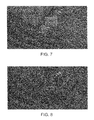
- FIG. 7 illustrates a difference image, in which the bright lines on the edges of the paper indicate motion.
- FIG. 8 illustrates another frame in the same sequence as FIG. 7 , but in this instance the motion is in the opposite direction so the bright lines are orthogonal to those in FIG. 7 .
- FIG. 9 illustrates the result when an amplification factor is applied to the difference image of FIG. 7 , which is then overlaid onto the original image.
- FIG. 10 illustrates the result when an amplification factor is applied to the difference image of FIG. 8 , which is then overlaid onto the original image.
- FIG. 11 illustrates a difference frame calculated using the mean frame rather than the median frame as the reference frame.
- FIG. 12 illustrates a difference frame calculated using a single frame from the original video file as the reference frame (i.e., the reference frame was neither a mean frame nor a median frame).
- FIG. 13A illustrates a regular or healthy respiration waveform
- FIG. 13B illustrates an irregular and transient event in an otherwise periodic motion, as detected using the present invention.
- FIGS. 14A-14D illustrate the steps in an exemplary analysis for the specific case of respiration.
- 14 A shows the result using a four-frame separation
- 14 B shows eight-frame separation
- 14 C shows nine-frame separation
- 14 D shows nine-frame separation but starting with a different initial frame.
- FIG. 15 illustrates the ability of a user to rewind the acquired data files (indicated conceptually by the large arrow) to return to a point in time at which an event occurred.
- FIG. 16 illustrates an example of a user interface implemented for mobile devices according to another aspect of the invention.
- FIG. 17 illustrates the steps in one approach for determining and displaying phase according to one aspect of the invention.
- FIGS. 18A-C illustrate the use of phase information to analyze vibrations in a bridge.
- FIG. 18A shows a video frame of a bridge after a truck (not shown) has passed over it.
- FIG. 18B shows a single phase mask at 2.25 Hz, which is the fundamental frequency of the bridge.
- FIG. 18C shows the same phase mask but multiplied by the intensity of the movement at each pixel.
- FIGS. 19A-B illustrate the use of motion amplification to visually exaggerate the apparent movement of an object.
- FIG. 19A shows a video frame of a motor that is driving a shaft and flywheel (not shown).
- FIG. 19B shows another frame in the amplified video clip, representing the point of maximum displacement relative to the frame in FIG. 19A .
- FIGS. 20A-C illustrate the conceptual basis for motion amplification.
- FIG. 20A shows 20 A shows idealized and non-ideal edges moving to the right.
- FIG. 20B shows the non-ideal edge moving to the right with amplification factors indicated.
- FIG. 20C shows the edge moving to the left with amplification factors indicated
- the invention is a non-contacting system to observe machinery components using a video camera, find areas of maximum movement and characterize the periodic behavior of those movements (e.g., amplitude, phase, and waveform).
- the data may be time-stamped and archived for later comparison to other similar equipment or to other data taken from the same component at a different time or under different conditions, to provide knowledge to a predictive maintenance system.
- the system may include a graphical user interface (GUI), which may display various parameters relating to the measured vibration data, a frame or frames from the video input file, phase masks and motion amplification, time stamps or other identifying information, and user-entered information describing relevant conditions (speed, power level, load, time of day, etc.).
- GUI graphical user interface
- the system may include an archived database, with which the user can compare historical data in order to determine trends and warnings of machine deterioration, wear of bearings and couplings, loose components, or other symptoms of the need for maintenance before a failure, shutdown, or other catastrophic event can occur.
- the invention uses several novel techniques to:
- machine As used herein, the terms “machine”, “machinery”, and “machine component” are intended to be taken in their broadest sense, to include any mechanical component that may exhibit some periodic movements. It includes, for example, motors of all kinds (electrical, internal combustion, turbines), components and linkages connected to or driven by motors; machine tools, grinding wheels and tool bits; electrical and hydraulic actuators; pumps, blowers, fans, pipes, ducts, and other fluid- or air-handling equipment; conveyors and materials or components conveyed thereon; and any parts, products, and workpieces that are moving through a production environment.
- motors of all kinds electrical, internal combustion, turbines
- machine tools grinding wheels and tool bits
- electrical and hydraulic actuators pumps, blowers, fans, pipes, ducts, and other fluid- or air-handling equipment
- conveyors and materials or components conveyed thereon and any parts, products, and workpieces that are moving through a production environment.
- Examples of the latter include paper moving through a papermaking machine or reduction line; paper or plastic sheet moving through a printing process; sheet metal being rolled, coated, treated, galvanized, hot-dipped, or otherwise handled in a continuous or semi-continuous form; wire or polymer fibers being drawn or extruded; and woven and nonwoven fabric being produced, dyed, printed on, or cut. It may also include components that are not directly driven or intended to move, but which are subject to incidental vibrational inputs, such as in a motor vehicle that are incidentally vibrated by the engine or by movement on a road.
- Vibration refers to any physical movement that may be characterized by some periodic change of position as a function of time. Vibrations may be periodic, such as, e.g., sinusoidal, symmetric sawtooth, asymmetric sawtooth, or they may be aperiodic or noisy. Vibrations may have any waveform, which may include waveforms characteristic of superimposed vibrations of different frequencies, amplitudes, and phases.
- a video signal includes multiple frames separated in time and each frame includes multiple pixels. Each pixel value in a particular frame is compared to the values of corresponding pixels in different frames of the video signal to search for periodic signals occurring at the pixel locations over time. Periodic signals are defined in time with a maximum and minimum peaks. These two locations give the maximized absolute value in the difference in two locations of the periodic signals. This fact can be exploited to filter and locate pixel locations where the periodic signal gives the largest signal to background or signal-to-noise in a scene or image sequence. In the case of human respiration we know the adult rate typically lies in the approximate range of 12-20 breaths per minute.
- a medium rate would be 16 breaths per minute or 0.27 Hz.
- a 15 fps camera that corresponds to a breath every 56.25 frames.
- a video of a person breathing may include periodic signals at certain pixels having a maximum and minimum at a difference of approximately 28 frames apart. This is the initial frame difference we use to locate the best pixels to track.
- We difference several series of images at this separation meaning the value at each pixel location in one frame is subtracted from the value at the corresponding pixel location at a second frame. Then, the second frame is differenced with a third frame and so on. For each pixel location, the absolute values of their differences are added together.
- An image sequence is obtained through a video camera and stored into memory.
- a video sequence as shown in FIG. 1 has dimensions of space in the x and y axis while having the dimension of time in the z axis and can be thought of as a 3-D data space.
- the video sequence contains a periodic or recurring motion of interest that is to be extracted from the data set. For example, a feature of interest may be occurring at a given pixel and we may be interested in monitoring that feature. We can use its temporal behavior to find and locate that pixel without any knowledge of the scene, the surrounding pixels, the spatial characteristic of the local pixels or where that pixel may be.
- An image frame is defined as an X-Y matrix.
- a video file is a set of image frames defining an X-Y-t matrix.
- the difference matrix is then summed (preferably in quadrature) to yield the total difference in pixel intensities between frames M and M+N.
- Difference matrices are calculated for various values of M and N, to find M and N that give the highest value of summed differences. Then a selected number of pixels (i,j) having the greatest difference are chosen and their intensities are tracked over time to determine the periodicity of movement.
- Video Sequence comes in at some frames per second (fps)
- the ten largest values in the array may be found and the array locations containing those values are recorded.
- the frames we add all the differenced frames from the buffered video in quadrature, meaning we square the difference values so that negative and positive differences don't cancel. Motion in opposite direction shows up in the difference frame with an opposite sign but we want that to add positively, otherwise back and forth motion can show as zero in the sum of the differenced frames. 7. From all the total frame difference arrays across all the multiples and offsets we find a selected number of pixels that have the largest values, say, the brightest 10 pixels. These pixels represent the largest periodic motions in the scene that are between the rate boundaries set in Step 3. 8. Those pixels' values are tracked over time and this will plot the motion waveform.
- the signals from the tracked pixels are not necessarily in phase. Any two signals could be 180 degrees out of phase and still provide the same information about the existence and the frequency of the same time periodic signal. For example, the signals of all pixels could be out of phase with all other signals, but still correspond to breathing of a subject. Thus the frequency of each signal would be the same.
- 9. From the motion waveform we determine the rate and phase. In terms of frame differencing this translates to the peaks in the waveform occurring every N th frame and the waveform starts at frame M. 10. From the information in Step 9 the Adaptive Array Comparison method adapts since we know where the peaks start and how many frames apart they are. 11. Now we subtract frames with a separation exactly equal to the separation between a maximum and minimum in the waveform.
- This process can be repeated based on a number of factors: a. Time—The method can reiterate every n seconds to ensure it is optimized for the existing waveform. b. When there is a large excursion in the measured waveform the process can restart as this can be due to a motion event. c. The process can restart based on a trigger from an external motion detection method. d. The process can be restarted on buffered data (the 20 seconds of previous video) when an alarm is triggered, (for example, no peaks are detected) to ensure the alarm is accurate. For example, if the waveform is accidentally lost this step could check the last 20 seconds of data to see if the waveform can be detected in another pixel or set of pixels.
- FIGS. 2 and 3 illustrate how the system selects the frame spacing by trying two different spacings and comparing the magnitude of the peak differences.
- every 8 th frame is used; this turns out to be a bad or “null” spacing, as the sum of differenced frames for a given pixel is zero.
- the spacing is changed to every 6 th frame, the sum of differenced frames for a given pixel is 30, indicating a much higher signal for this waveform that distinguishes it from the rest of the pixels.
- FIG. 4 illustrates the summed frame of differenced frames from 20 seconds of video data collected on a human subject. Note the method has successfully isolated motions associated with the breathing based on the selected frame number separation: here the darkest pixels identify the location of greatest motion found in the chest region from the up/down right/left motion of breathing as seen by the camera. These are the pixels that would then be tracked to determine the breathing waveform. It is important to emphasize that the data presentation in FIG. 4 is not an image per se, but rather simply a graphical display of the pixels (dark) that show the most movement. It is also important to emphasize that the entire process was conducted by the processor in an essentially autonomous operation.
- a user defined setting can be selected to narrow the window on which rates to look for, e.g., 60 Hz in the case of equipment running on standard AC power. It will be appreciated that narrowing the window allows the system to converge more quickly on an optimal frame rate, because this reduces the number of iterations the system has to go through, making it quicker and more accurate as the chance of error would be reduced by eliminating certain frequencies.
- Information such as a profile of a particular components characteristic vibration rate, may be stored and later retrieved so the device has a better range of expected rates to look for a priori. In this case the user selects a profile that the device has gathered over previous uses or parameters that were previously entered.
- Sections of the video scene may be selected to narrow the search. For example, if the video camera is looking at the edge of a moving paper web, the user interface might allow the user to draw a box (e.g., on a touch screen) to select only the sheet of paper, eliminating the rest of the production environment. Eliminating extraneous parts of the image from consideration will allow the calculations and optimization to proceed more quickly.
- a box e.g., on a touch screen
- the data can be used with a standard peak finding method to determine the max and mins of the waveform.
- FIG. 5 presents a simplified flow chart of the basic camera operation and analysis done in a completely automated process.
- the input video may be MPEG1 simple profile or MJPEG from, e.g., a USB webcam or similar source.
- the initial calibration subroutine using 20 s of video, locates the 5 pixels with the greatest values in difference matrix, and establishes State 0, or initial calibration.
- the waveform tracking and processing subroutine tracks pixels, continuously outputs the last N values of the pixels determined to be the greatest from the difference matrix; processing is done on waveform to determine output states. States 1-3 will be determined in this routine based on processing of the waveforms.
- An ongoing calibration subroutine is continuously looped; this uses 60 s of frames, summing the difference of frames and locating the five pixels with greatest values in difference matrix.
- Five output states are continually outputted from the subroutines through a physical channel. Off State condition may be determined by a selected trigger, implemented either in hardware or software.
- a subroutine recalibrates the location to find the best pixels. This consists of going through the process of frame differencing again and locating the 15 highest valued pixels in the summed array.
- the duration of the calibration can be programmatically controlled as well as the frame numbers to difference as a result they may vary. For example we choose to difference every 4 frames of a 16 fps camera for 40 seconds resulting in 160 differenced frames. Note this in different than the initial calibration since it is limited to 20 seconds.
- This recalibration process continually goes on in the background while the waveforms are being outputted from the pixels and the peak finding is performed.
- the mathematical techniques of the present invention derive parametric outputs whether or not an image is ever created or portrayed.
- techniques of the present invention may be used with monitors that do not display images, do not recognize objects, and do not have frequent human observation or similar participation.
- the present invention may output a commonly reported characteristic such as a breathing rate or heart pulse rate or phase or a lag interval or a dimension of a periodically moving object or a period of a motion, or a timing or a motion or other information associated with a periodic motion event without displaying an image thereof.
- the user interface may include actual video images, which may be selected to correspond to a particular point in time when an output parameter has a particular value or the waveform displays a particular feature (e.g., an episode when unusual vibrations or some instability appeared temporarily).
- video describes any data set representing a series of digital (i.e., pixelated) images of a scene, taken at fixed time intervals, so that the data represent points in X-Y-t space.
- the image may represent a pattern of reflected and/or emitted visible light, UV, IR, X-rays, gamma rays, or other electromagnetic radiation detected by a two-dimensional position-sensitive detector.
- certain standard file types have been described in some of the examples, the invention is not limited to any particular frame rate or file format.
- the invention is not limited to any particular type of image acquisition hardware; video cameras, webcams, digital cameras integral in cell phones, etc., may also be used to generate the raw data files. Alternatively, the raw video may be generated elsewhere and downloaded to the processor from a USB memory device, a CD or DVD, or via an ethernet or wireless connection.
- the digital imaging device may further include any suitable lenses or other optical components, such as telescopes, microscopes, etc., as are well known in the art.
- the invention may be used for examining periodic movement in small MEMS devices or micro-actuators, which could be observed using a video microscope for quality control or other purposes. Adapted to a telescope, the invention could be used, e.g., to study vibrations in ships, helicopters, missiles, etc.
- Techniques of the present invention may be applied to a variety of imaging modalities, including visible imaging, thermal imaging, multispectral imaging, or hyperspectral imaging. In fact these are entirely different and independent media having different sources and different mechanisms and different physical significances. However, the techniques for measuring motion remain the same for any spectral ranges. For example, the use of visible images of an object of interest overlaid (or interleaved, overlapped, interspersed, approximately synchronized, or truly simultaneous) with near or far infrared images may yield two effectively independent views of an object of interest.
- the imaging systems may have multiple inputs. These may comprise two visible cameras, an infrared imager and a visible camera, a camera and another input other than an imager such as an ultrasonic sensor or a temperature or a pulse monitor or some other combination of two or more imaging devices.
- the rate of video frame acquisition may be adjusted, e.g., to correspond with a naturally-repeating feature on the moving web, such as a printed page. In this way, every frame would capture substantially the same view, and periodic vibrations may be more easily discerned.
- the frame rate may be adjusted to correspond to the linear equivalent of one revolution of the processing rolls, so each frame represents a part of the sheet that contacted the same area on the roller.
- the inventive technique is not limited to a particular wavelength of light. Different colors are represented by different wavelengths of light, e.g. 550 nm is green. Amplitude changes that are detected by this technique can be restricted to a single wavelength of light or represent a summed intensity change over multiple wavelengths. Each wavelength can be measured independently or together (mono grayscale). The inventive technique may, for example, monitor only the green, blue or red wavelength or monitor the sum of all three.
- Electromagnetic Wavelength options are not just limited to visible wavelength of light, but can be used in the near IR, far IR, or UV.
- the technique could be extended to any sensor type that can measure changes in light levels over time whether from reflective or emissive sources. Visible light is generally although not always measured as a reflection. Thermal IR light is generally but not always an emission from the surface. The invention works regardless of whether or not the target is reflecting or emitting the light.
- the sensor type can be chosen based on the scene or target. For example, if the scene is completely dark, void of a visible light source, a thermal IR sensor may be used to monitor the changes in light levels. Also if a particular material or substance is the target and light level changes are due to a property of interest on the target another sensor type may be chosen. For example, with gas that absorbs in certain wavelengths, or more generally chemicals, a particular sensor that detects those properties may be chosen. For example, one may be interested in using the technique to find an exhaust or chemical leak in the scene based on light intensity changes from the leak specifically associated with the absorption and/or emission at certain wavelengths. Another example may be a flowing liquid that absorbs in certain colors, and that flow changes or pulsing may be indicated by intensity changes in a certain wavelength of light, then a sensor particularly sensitive to that wavelength of light might be chosen.
- the inventive technique can also be used to garner information about the type of change.
- a particular change using a thermal sensor would indicate that the temperature is changing, whereas a change in color may indicate the target is changing is absorption or emission properties.
- a change in amplitude could also be indicative in a change in position or vibration, whereas a change in position of the signal being detected from pixel to pixel in time may give information about displacement.
- a GUI may display a video frame of a component along with an IR or thermal image, either separately of as an overlay (which may be calibrated color or grayscale) for a more complete interpretation of the entire data suite.
- Ratio or comparisons of color changes or amplitudes of certain wavelength can also be used. For example, it may be useful to locate a pixel that changes in intensity from blue to red. This could be indicative of certain properties of interest. An example would be characterizing the uniformity of printing or dyeing on a paper or fabric web. Multiple sensors could be used for this technique or a single sensor with wavelength filters applied (such as a typical color camera). Certain features of interest may be indicated by relationships between multiple sensor sensitivities or wavelength of light.
- Redundant and independent inputs Multiple sensor types or wavelength detections could also provide multiple detections of the same phenomenon increasing the confidence of detection.
- the light intensity changes due to the periodic vibration of a duct may be detected with a visible or IR camera pointed at the duct wall while another sensor looks at the intensity change in thermal IR from temperature changes around an inlet or outlet of the duct. The technique is then used in both cases to strengthen the detection scheme.
- False negative findings Multiple wavelengths could be used to discern or improve findings which may be false positive and false negative findings and true positive and true negative findings. Intensity shift from multiple wavelength, red, blue, green, IR, etc. could be used in conjunction with each other to improve the signal to noise ratio and also provide multiple independent readings to increase confidence in detection.
- Measurement duration This technique could be used with signals that are repetitive but only over a short time duration, e.g., vibrations that arise in forging or stamping operations.
- the technique could be applied to shortened windows of time to catch signals that occur only for a set duration.
- signals that continually change over time but are ongoing For example, with a signal that speeds or slows, the time that is used to calibrate or search for a certain intensity change could be shortened to be less than the time change of the signal itself.
- Transient event Additionally there may be irregular or transient events in a periodic signal. This technique could be used in a short enough time window or in a sufficient sequence of waves to extract the location of a periodic signal in the presence of irregular or transient events.
- FIG. 13B shows an irregular and transient event in an otherwise periodic motion. If the sample window for the technique described here is properly placed the maximum and minimum of the periodic signal can be located. Multiple phase offset would help to address this issue by building up a pixel's sum of differences at a time that the phase offset for a starting point has brought it past the irregular or transient signal occurrence.
- Spatial proximity This technique can find multiple pixels of interest. Spatial relationships between the pixels of interest can further be exploited. For example, if a larger number of pixels of interest were selected and the vast majority of them were found to be in close proximity to each other that could indicate those pixels are related to the same physical phenomenon. Conversely, if they are spread apart and there appears to be no spatial coherence or statistical meaning among the spatial relationship or they are randomly spaced that could indicate they are not related. Furthermore, this technique could also be used to increase confidence in the signal or improve findings which may be false positive and false negative findings and true positive and true negative findings. For example, in a motor-driven pump, there are likely to be many pixels of interest found near the coupling. We could expect a certain percentage to be heavily localized.
- the confidence may be set by a weighted spatial location mean of the pixels or average separation distance, or standard deviation from the spatially averaged locations of the all pixels of interest.
- Re-calibration finding a pixel of interest. It is possible after the technique adapts to find the suitable or best separation to get the largest intensity change based on the differencing of max and min frames, a new search can be performed with that knowledge with tighter constraints to search out specifically that waveform. In that sense it is adaptive after it uses more liberal parameters to find the initial signal. It is possible that a user's information or information on a subject or phenomenon may be stored. The technique can now be used with a priori knowledge of rate, phase etc. to speed up finding the pixels of interest. For example, a user may store the profile of a particular machine or class of machines, and the technique is then used with knowledge of that data. That way, fewer cycles need to be performed and a tighter constraint can be placed on the technique to find the pixel of interest.
- Variation in the intensity of pixels may not always result from radiation emitted or reflected by a single object. For example, if something is moving and at a different temperature than the background, that object may move back and forth periodically blocking a small portion of the background. To a thermal sensor, a pixel detecting light in that region will see an increase and decrease in brightness from the object moving back and forth as the object at T 1 and then the background at a different temperature T 2 are alternately imaged by the pixel.
- Multiple cameras can be used for multiple detection schemes. They potentially could run at different rates. It is possible to temporally align frames so that certain frames occur at the same time. In this scene the resulting detection of a signal can be temporally aligned as well and correlated. Cameras could potentially be set to image the same field of view. Pixels across multiple cameras or sensors could be correlated so spatial relationships of the pixels in the image of each camera is known.
- Other sensors could be correlated to one of more cameras.
- the detected signal could potentially be correlated to another input signal as well.
- a prox probe could be used to validate or increase the confidence of a detected signal determined from a pixel of interest from the technique.
- Tachometers, accelerometers, and tonometers are all examples of types of sensors that could be used in conjunction with the inventive technique.
- These input signals could also provide frequencies or phase data to allow the system to use tighter constraints to reduce the number of iterations it goes through or immediately determine the proper phase and or frequency from which to select the differenced frames. These inputs also can be used as triggers.
- Single pixel and combination of many pixels Techniques of the present invention may be used with the smallest achievable pixel size or may be used with binned pixels where multiple neighboring pixels are collectively associated (mathematically or statistically) to create a larger virtual pixel. This technique may be done on camera or chip or done afterwards in data processing. Binning may be done horizontally, vertically, or both, and may be done proportionately in both directions or disproportionately. Collective association or binning may potentially leave out or skip individual pixels or groups of pixels. For example, one form of collective association may comprise combining a plurality of bright pixels while ignoring some of all of the pixels not determined to be “bright” or “strong” considering a characteristic of interest such as a selected frequency range or amplitude.
- Gaining confidence by eliminating false findings. It may be of interest to increase the confidence of the detection by exploring neighboring pixels. Even if those pixels were not chosen as the ones exhibiting the largest motion they can be explored to determine if at least one or more exhibit the same or strongly correlated waveforms to the pixel of interest. If a physical phenomenon that one is trying to detect is expected to be larger than one pixel, it stands to reason that neighboring pixels undergo similar behavior. Thus it will be clear that this could be used to eliminate false positives in a detection scheme.
- the inventive technique can be applied in a single pixel variant in which an optical element would be used in a multiplex mode where the optical element scans the scene and the transducer samples at each point in the scene. An image or array is created from the scanned data.
- the sampling/scanning rate is contemplated to be high enough to effectively sample the scene at a fast enough rate to see time-varying signals of interest. Once certain pixels of interest are located, the system would then need only scan those pixels until a recalibration is needed.
- the frame separations are indicative of frequencies. This comparison will allow one to compare amplitudes of signal changes for different frequencies.
- Multiple frames separation values that give information about amplitudes of a frequency of the signal can be used to construct a frequency spectrum for a single pixel or multiple pixels.
- Arrays representing subtracted frames or sums of subtracted frames at certain frame separation values may be indicative of a frequency. Those arrays may be compared to indicate information about the signals. For example, if two arrays are determined that are indicative of frequency f 1 and f 2 , we may compare those two arrays for determine the spatial distance between the phenomenon that is causing the frequencies. In this case the array may be a spatial image.
- FIGS. 14A-14D demonstrates this principle.
- FIG. 14A the separation does not align with the maximum and minimum peaks in the waveform. Aligning with the maximum and minimum peaks would give the strongest signal indicating that the right separation or rate has been found.
- FIG. 14B shows the effect of changing the separation between differenced frames to every 8 frames. One can see that this is better but not quite optimal.
- FIG. 14C shows 9 frames. To ensure that all possibilities are considered we want the option to select a range for frame separations to subtract as well as the increments in spacing. For example, we subtract from every 2 to 30 frames in increments of 4, or generally we subtract from N 1 to N n in frame separations in increments of ⁇ N.
- phase in wave mathematics plays a role in finding the correct frame.
- the Initial Calibration is the one that does all separations and all starting points.
- a recalibration (adapted from the initial calibration) uses the known values determined from an initial calibration. All of these operations are conducted by the processor in a substantially autonomous manner.
- the frames have the following values:
- pixels (1,3), (2,3), and (3,3) are selected as the largest pixels, each having a total time frame difference of 20 with a combined total of 20 for the three largest array values
- pixels (1,3), (2,2), and (2,3) are selected as having the largest values (16, 4 and 16, respectively) but the total combined value of the three pixels is only 36 as compared to 60 in the test for four time frames. So this test would indicate that a four frame difference is the best time interval and the pixels to be monitored would be 1,3 and 2,3 and 3,3. However, similar test will be run for other phases for both the four and five frame intervals. In the next test, the four frame interval will use frames 2, 6, 10, 14 and 18 and the five frame test will use frames 2, 7, 12, 17 and 22. These further tests are changing the phase of the test. Assuming the next tests produce results that have lower total than 60, the first four frame test will prevail and its “brightest” pixel locations will be chosen for monitoring.
- Adaptive Array Comparison specifically targets individual frames at particular references for the purpose of exploiting periodic signals.
- Adaptive Array Comparison adapts to the signal, learns from the signal and modifies its approach.
- Adaptive Array Comparison relates to time intervals based on signal of interest.
- Adaptive Array Comparison is an iterative process and involves comparison of the results of those iterative steps.
- Adaptive Array Comparison is a temporally based and links arrays to particular points in time.
- Adaptive Array Comparison generally involves multiple comparison of arrays over time and relies on the cumulative result.
- the user interface may be configured in a wide variety of ways, as described more fully in the following examples.
- the information might include the video, motion waveform, and a condition or quality index derived from “standard” or historical data. So the user might press a button that rewinds the waveforms and video or goes back a preselected amount of time or to a specific preselected time and plays back the waveform and video side by side to show what triggered an event or an alarm condition, thus providing a more complete understanding of the event. Because the video is time stamped, the event of interest may be correlated with factors such as power surges or dips, lightning, temperature excursions or other environmental conditions, etc. Thus, the invention allows a more holistic awareness of the situation and makes predictive maintenance correspondingly more useful and robust.
- FIG. 13A shows a healthy waveform
- FIG. 13B shows an irregular one, again taken from respiration data.
- An event is clearly seen in the middle of the irregular one.
- this event will be categorized, stored, indexed and/or reported and may contribute to the condition index.
- Templates may be prepared to help the user correlate an event to some known conditions.
- a set of templates may exist including a baseline waveform for a newly-installed motor or pump of a particular model and later measurements are correlated against that template to define changes, quantify wear and tear, and inform the maintenance decision-making process.
- the information may also be uploaded to a central database and/or provided to the maintenance professional.
- the information may also be included in a report.
- Exemplary templates may include, but are not limited to, a new machine, a worn bearing, a loose coupling, or a machine nearing its end of life.
- Events may be indexed and a single frame or video clip may be extracted that corresponded to the same time. Those compilations may be stored. One index may be targeted in particular, for example, events associated with power quality. The user may review those events to determine if an investment in power conditioning may be helpful to improve equipment life and performance.
- Events may be correlated with timing through the day/night and the same procedure as described above would allow the user to determine if particular times of day/night are correlated with better or worse equipment stability.
- the user interface may take a variety of forms, and in particular, the invention may be implemented in a mobile application, so that, for example, a service technician can view the data acquired at a work site and make a decision about whether a maintenance call is urgent or can be scheduled later.
- the technician may further have access to a database (onboard the device or on a remote server) to assist the evaluation process.
- the database may include historical or baseline data for a particular machine being examined, and may also include comparable data for similar machines previously examined in other locations.
- the technician may also upload new information to the database for later analysis and comparison.
- FIG. 16 shows a conceptual image of a potential graphical user interface (GUI) showing a vibration waveform and video in real-time from a camera where the vibration waveform would be derived from the video.
- GUI potential graphical user interface
- the camera does not have to be placed right next to the equipment.
- Applicant has discovered through experimentation that the inventive process is sufficiently robust that reliable data can be collected from an object in a random position in the frame and surrounded by various items, which may be stationary or might be moving to some degree.
- Another important advantage of the invention is that the measurement itself is not invasive or disruptive. It requires no contact with the equipment or process and no tap into the equipment's power feed.
- the invention can be used in a factory to monitor two machines simultaneously in separate cells, in a refinery to monitor multiple valves or pumps, etc.
- the information may be uploaded to the cloud or to a server for continuous monitoring or, for example, to a maintenance department or field service team.
- the application could produce fast results for a quick assessment of a situation or to prioritize various potential maintenance jobs.
- Applicants have demonstrated that currently-available mobile devices have sufficient computing power to do this.
- the method is currently running successfully on an ARM11 Raspberry Pi board, which is slower than the current iPhones and likely the 5s too.
- An early prototype ran successfully on the iPhone 5s using its internal camera.
- the invention may be configured to run on a mobile device such as a smart phone or tablet computer having a built-in camera.
- a user could carry the device from one area to the next, collecting video and running the analysis for many machines or process points in a plant environment.
- the user may acquire the video such that the image includes a fixed object or fiducial not connected to the vibrating component, thereby correcting for any shaking or instability in the handheld camera.
- the video file and analysis could be stored in the mobile device or uploaded to a central server or database.
- the mobile device might download other data from the server, such as historical data collected from the same machine or comparative data collected from similar machines.
- the video image is focused on a particular machine or component under examination
- the invention may equally well be carried out in a reversed configuration in which the video camera is rigidly mounted on the equipment or component and is focused on a convenient stationary object in the environment.
- the fixed object might be a column or other structural feature of the building, a poster or plaque affixed to a nearby wall, etc.
- the apparent motion of the fixed object will mimic the motion of the camera on the vibrating component and the video file may be analyzed in a completely analogous manner as described earlier.
- a perimeter-tracking approach may be used to prevent an unknown factor from entering the monitoring space of the individual machine or simply a general area. This can also be used for objects exiting the area. The user will be able to create a perimeter (via a user interface) around the area that he/she wants to monitor and does not want any intrusion into.
- a technique such as adaptive array comparison can be used to see if changes have occurred around the perimeter from one frame of the video to the next.
- Another technique may be comparison of frame intensity values in the area of interest. Regions can be selected and those regions summed for a total intensity level. If that intensity level changes frame to frame by a certain threshold, motion is determined to have occurred.
- Blob comparison may also be used for motion detection.
- Single pixel edge motion may be used. It will be possible to determine the perimeter with great accuracy based on movement of an edge of a single pixel or virtual pixel, which will allow for a much greater degree of accuracy compared to using conventional blob techniques.
- the area being selected does not have to be a series of large boxes as in current technology but instead can be any sort of perimeter that the user chooses to select. This could offer the ability to use a very narrow single pixel perimeter or single virtual pixel comprised of multiple pixels.
- Feature tracking may be used by locating features in the perimeter and tracking their location in the perimeter. If their centroid location changes then motion is detected. Correlation of a selected number of pixels with a feature in them can be correlated to sub-regions in successive frames to determine if the highest correlation of the original set of pixels is correlated more highly to another location other than the original location.
- the invention may be installed and used in conditions where there are multiple regions to isolate, such as a busy production line involving numerous work cells, individual robots, etc. Each area can have separate perimeter monitoring using perimeters drawn by the user via the GUI.
- the invention may further use frequency isolation and a learning algorithm to learn the likely machine vibration rate and distinguish it from outside factors that could produce a vibration or movement in the field of view of the camera. This will help distinguish movements in the field of view (such as a fan or wind blowing a curtain) from movements associated with vibrations of interest.
- Motion may be allowed inside the area of interest without alerting or affecting the monitoring of the perimeters. This would allow for an object to freely move within the area of interest, for example a welding robot, but still allow for monitoring of the perimeters.
- An object detected moving in the perimeter can be characterized by the number of regions in which its motion is detected to give an estimate of size.
- the time between detections in various blocks can give information as to speed based on the known physical projection in space of each pixel.
- the series of blocks through which the object is detected to be moving can indicate the direction of travel.
- Motion can be detected through the inventive method of array comparison of different frames. Frequencies such as fast moving objects can be filtered out by comparing frames with larger separation in time, and slower frequencies or a slower moving object can be filtered out by comparing frames with shorter separations in time.
- the invention can be used to isolate certain motions for detection or rejection.
- Using light level changes to detect motion can cause false a positive indication of motion from things that change the illumination of the scene but are not objects moving in the field, such as fans or curtains moving from air flow. Comparing different separations in frames (hence different separations in time) can eliminate these spurious indications. For example, the slow light level changes from the natural daylight cycle would not be detected if a short time separation in frames are compared.
- the invention may further include a method for determining, comparing, measuring and displaying phase, which is of particular relevance for the case of machinery.
- phase is an important characteristic of the periodicity that helps temporally describe the signal and also describe one signal relative to another and relate those signals to patterns of repetitive events such as periodic motion.
- phase information is shown and displayed in numerous ways. Information can be gathered from the time varying signal based on the phase and its relationship to other parameters.
- FIG. 17 outlines one approach for computing and displaying phase.
- phase image is binary (if the signal is at a particular phase it is white, or valued 1, and if it is not at the selected phase it is black, or 0) the phase image acts as an image mask that will only allow the intensity values to pass if it is at the selected phase. All others will be zero. If it is in phase the intensity is preserved since it is multiplied by 1. This will create a scaled image that shows only things at a given phase and what those intensities are.
- phase imaging is illustrated in FIG. 18 .
- FIG. 18A shows a single image from a video sequence of a bridge. During this sequence a vehicle passed over the bridge (not shown).
- FIG. 18B shows a single phase mask image depicting a single phase (that of the fundamental vibration of the bridge) at 2.25 Hz, the bridge fundamental frequency.
- a single phase that of the fundamental vibration of the bridge
- things moving in phase show up as white (value 1) whereas things that are out of phase show as black (value 0).
- the image is scaled such that 0 is black and 1 white.
- FIG. 18C shows an image of the phase mask seen in FIG. 18B multiplied by the intensity at each pixel of the amplitude of the 2.25 Hz signal, which relates to motion.
- the phase image is scaled with relative values.
- the image is much cleaner as small amplitudes of frequencies can be set below a threshold using the noise reduction technique.
- the phase mask image (that is composed of 1s or 0s denoting in or out of phase respectively) can be multiplied towards a calibrated frequency amplitude image or array. Then the resulting image displays only things in phase at a particular phase of interest at a given frequency and offers a calibrated value. That calibrated value may be from anything that is causing the signal levels to change. It could be temperature variation from thermal IR imagers, displacement from moving features in a visible image or even variations in absorption levels through a transmitted medium.
- phase For a measurement made with video imagery the phase may be referenced simply to the first image taken so that all phase readings are relative to the first image. However it is possible to synchronize the phase readings to another signal. This could be a trigger pulse or even a time varying optical signal in the scene of the imager.
- Exposure modes on imaging sensors are often different. Two types of modes are global and rolling shutters. Global shutters expose every pixel at the same time. Rolling shutters expose lines of the sensor at different times. In the case of a global shutter all pixels are exposed simultaneously so the phase relationship is preserved across the sensor. In the case of a rolling shutter there are variations in the timing of exposure from pixel to pixel. It is possible to realign temporal signals based on the known delay between pixels after they are read from the imaging sensor. By accounting for this offset we can preserve the relationship of phase across all pixels.
- phase information in a noise reduction manner.
- a phase image mask where the array or image is binary (1s for in phase, 0s for out of phase) one can reject all pixels out of phase at a given frequency and given phase.
- the phase mask image When exploring an image, if many pixels effectively “turn off”, it eliminates much background noise in the scene and makes detection much easier. This may be advantageous, for example, in a cluttered field or where many time-varying signals exist.
- one can reduce noise by multiplying the phase mask image by the frequency intensity image and setting an intensity threshold below which the pixel is set to 0 or not represented in the scaling.
- Phase relationship information can be exploited with the described technique to reveal physical parameters or other properties.
- traveling waves may be seen in the sequence of images created.
- Different areas of the array or frame of the same or different phase mask images may be compared to show certain areas of interest indicating anomalies, e.g., one area that is out of phase with the rest. Or, these areas could be compared to find patterns indicative of physical phenomenon.
- phase presentation as described herein is to determine and to graphically display absolute or relative timing characteristics and patterns.
- a second example is to demonstrate a modulation or a beat frequency or other characteristic which may correspond with a movement of an object of interest.
- a third example is to represent a leading or a lagging event sequence made evident mathematically or graphically using techniques described herein. Again, this leading or lagging event sequence may be related to a movement sequence of an object of interest.
- a fourth example of the present invention is to characterize highly repetitive displacement patterns such as a static or a dynamic constructive and destructive interference pattern resulting from multiple vibration wave fronts.
- the multiple fronts each typically originate from a point, line, or area of reflection, or originate from a point, line, or area vibration energy source.
- This technique may be used to discern false or positive indications. For example, a false indication may be found from a highly repetitive pattern which is more likely produced by a machine than a living being.
- Another method that can be used to further enhance the inventive technique is to amplify motion by an amplification factor.
- This factor determines the strength of the overlay of the difference image sequence on top of a static image from the original motion sequence. For example, if the factor is 1 there may be equal weight applied, whereas if the amplification factor is 30 the difference frames are increased in intensity by some factor relating to 30 in the composite image. This would allow one to determine how much of the difference sequence is present and how much the static frame is present. A factor of 0 may turn off the motion and just show the static image.
- FIG. 6 shows the original image frame of a paper square with a plus sign, attached to a speaker vibrating periodically.
- the arrow in FIG. 6 shows the motion of the paper relative to the frame imaged by the camera. This image corresponds to what is being imaged in FIGS. 7 through 12 .
- FIG. 7 shows a difference image in a sequence from the median reference frame. Notice the increased intensity change on the top and right side of the paper with the plus sign.
- FIG. 8 the increased intensity change is now on the lower and left side of the paper. This is from a frame in the same sequence at a later timestamp. Comparing FIGS. 7 and 8 indicates the motion is up and to the right and then down and to the left.
- FIGS. 9 and 10 show the same behavior except that amplification has been applied to these frames, meaning there is an overlay to the original images such as the one shown in FIG. 6 .
- the amplification factor determines the relative contribution of the original image such as FIG. 6 and the difference portion such as in FIGS. 7 and 8 . More of the spatial detail of the scene is present in FIGS. 9-10 because overlay of the original image in the original sequence contributes to the image displayed.
- FIGS. 11-12 illustrate similar results using difference frames calculated using reference frames other than the median frame.
- Amplification works by amplifying the changes in the images that are associated with motion. Often an edge or feature in an image is not ideal, i.e., the threshold or contrast change does not fall on one pixel. Although we present a non-ideal case, amplification would work equally well in an idealized scenario. This would be the case of a larger pixel or high quality optics to put the edge solely on one pixel.
- FIG. 20A shows an idealized edge at the top, transitioning from a high to low value left to right.
- the center solid line shows the non-idealized case, more commonly occurring due to irregularities at the surface of the target, degraded image quality from optics or variations resulting from a turbulent light path, to name a few.
- Also shown in the center is a dotted line indicating the motion of the edge feature moving to the right.
- FIG. 20B again shows the motion of the edge towards the right of the image. Again we see the before and after effect on the pixels in the top two rows of pixels. The bottom row of pixels shows the numerical change associated with each pixel as the edge moves right. This is the difference value of those pixels. This value is the value that gets amplified. For example if we amplify these values by a factor of 10, the +2 becomes 20, the +10 becomes 200, etc.
- FIG. 20C shows the same effect as FIG. 20B except the motion is now to the right and more of the dark side of the edge is imaged. Note the pixel intensities darken where portions of the edge are imaged and the values in the bottom portion of the figure denote the integer values of pixel changes decreasing.
- amplified differences are then used to create the amplified motion sequence. Note we may add these amplified sequences to the original video sequence to increase the effect of seeing what was in the scene before amplification or we may choose to visualize only the amplification sequence.
- this method can be further modified to create the appearance of exaggerated movement in the image, by superimposing the differenced frame onto the reference frame and using the resulting image to replace the original frame in the video.
- the first step is to choose a reference frame.
- the median works best because that is the zero value.
- the median image is created by calculating the median value of each pixel over the length of the video and using all those values to create a median image.
- every frame is compared to that reference frame to create and new set of differenced images. If the video clip is 800 images long (10 seconds at 80 fps) this will comprise 800 difference frames. These images will likely show relatively small variations in pixel intensity because that is only what has changed.
- the next step is to amplify. For example, if we want a factor of 30 amplification we multiply all the differenced frames by 30, so if one particular pixel in a difference frame has value 2 it becomes 60. This creates a new set of differenced frames that are amplified by the selected factor.
- FIG. 19 shows a visible difference, with the apparent position of the motor slightly more parallel to the ROI box in FIG. 19A , and more skewed in FIG. 19B .
- the visual result is not only striking, but in many ways completely surprising, as there are no additional steps or mathematical modifications to cause the apparent motions to be amplified.
- the process is actually targeting motions that are subpixel, in many cases much less than a pixel.
- the process for creating the amplified motion video simply alters the individual pixel, in other words a measurement from one pixel isn't directly altered or translated to a neighboring pixel to make it look like the edge moves into that pixel.
- defocusing and other issues often cause the light in about 4 pixels to be changed by an edge motion so each one of those respective pixels' motion is amplified and causes the motion effect to be present in all of them.
- Applicant speculates that one phenomenon that might be at work here is that multiple pixels are behaving in a correlated way.
- an edge or feature moves one sees the effect of motion in multiple areas and visually processes that as motion. For example with the rocking of the motor, one sees the entire side of the motor go up, so all of those pixels are working together in a correlated way to make the viewer perceive that the object is moving.
- the motion amplification process has been descried with particular reference to periodic movements, the principle may equally well be used to amplify movements associated with non-periodic and transient events. Also, the motion amplification does not have to be “played back” in the traditional video sense or in the form of a movie file per se. It can be used in an interactive piece of software enabling the user to can go backwards and forwards from frame to frame in any manner desired.
- One example would be to have a slider on the GUI, with which the user, by moving it back and forth, would control what frame is displayed.
- Thresholds and limits may be set for the entire differenced image or certain regions for a computer system to autonomously make decisions without human interaction. If certain pixels or groups of pixels behave in certain way then action by the computer can be taken without human interaction. An example of this may be intensity level changes indicative of motion in a certain direction, motion above a certain threshold, or motion of specific components being present. These are a few examples of a multitude of events triggering a reaction. Events could trigger a reaction or action in correlation to an outside event that is inputted into the system from an outside source.
- the information gathered from this system could be used to control outside systems, for example, a feedback response control, alarming system, or process control.
- outside systems for example, a feedback response control, alarming system, or process control.
- a multitude of outside systems could be integrated with the system.
- various components may exhibit motions even though they are intended to be substantially stationary.
- pipes and ducts may vibrate or move aperiodically in response to something changing inside (pressure, density, temperature, fluid cavitation, “water hammer”, etc.). Vibrations may be characteristic of other changes, such as the buildup of coke in refinery equipment, clogging or bridging in cement kilns, or sudden changes in the feed material in a mill or classifier.
- the invention could be applied to such problems in cases where experimentation can definitively calibrate particular external movements with particular internal process attributes.
- the invention is able to detect variations over time from motion across a contrast change with a high level of precision. In some cases this is sub-pixel motion. In the case where unwanted defects or non-uniformities exist, Applicants have discovered that the system may be used to detect those regions as described in the following Examples.
- an object might have a small flaw in the surface that is very difficult to see by simple visual inspection.
- the object may be vibrated at a particular frequency while a camera views its surface. That frequency would preferably be a known frequency selected to be easily detected by the camera operating at a known frame rate.
- the system would then highlight motions related to that frequency, i.e., the image of the flaw moving back and forth at the vibrating frequency imposed on the object.
- the result would be any region in the scene with a contrast change would be detected when the object is vibrated. Areas of high uniformity would go otherwise unnoticed by the system. Thresholds may be set to determine whether or not a detected signal is considered a positive detection.
- a painted object that is supposed to have a highly uniform finish would be particularly suited for this type of inspection.
- exterior components such as doors, must be inspected for irregularities in the paint job.
- An inspection system could bring the door in front of the camera. The door would then be vibrated at a convenient frequency, e.g., 10 Hz. The system then isolates the 10 Hz motion. The system analyzes the 10 Hz image looking for regions in which a detection of modulated signal exists. If the detection occurs and it is above a certain threshold the system identifies a defect.
- Aligning a shaft or other piece of equipment is a critical process that is needed from time to time or on initial installation of equipment.
- the alignment is necessary for properly maintaining function of equipment.
- a misaligned shaft can cause unnecessary wear, improper production of product and reduce equipment life.
- the inventive methods can be used to properly align equipment.
- a camera can be placed on one side of the alignment location, perhaps on one side of a coupling. The camera may look at an existing edge or perhaps a calibrated edge placed by a user. The camera can then monitor that edge and make displacement reading on the edge to determine positional changes over various operating conditions. That information can then be used to determine the proper alignment positions. In another instance a second camera may be placed on the opposite side of the alignment location so two camera look at either side of the alignment location.
- the cameras may be positioned so they can rotate with the shaft to measure different orientations. In another instance one or more cameras may be placed away from and not on the equipment to measure the displacement of the shaft from a distance in one or more directions.
- a camera may be place on one side of the shaft.
- the camera may track the position of the shaft at one location in space as the shaft rotates. This would effectively measure the shaft orbit and describe the current alignment of the shaft. These values can be used to align the shaft.
Landscapes
- Engineering & Computer Science (AREA)
- Health & Medical Sciences (AREA)
- Life Sciences & Earth Sciences (AREA)
- Physics & Mathematics (AREA)
- Theoretical Computer Science (AREA)
- General Health & Medical Sciences (AREA)
- General Physics & Mathematics (AREA)
- Pathology (AREA)
- Medical Informatics (AREA)
- Molecular Biology (AREA)
- Surgery (AREA)
- Animal Behavior & Ethology (AREA)
- Heart & Thoracic Surgery (AREA)
- Public Health (AREA)
- Veterinary Medicine (AREA)
- Biomedical Technology (AREA)
- Biophysics (AREA)
- Multimedia (AREA)
- Computer Vision & Pattern Recognition (AREA)
- Human Computer Interaction (AREA)
- General Engineering & Computer Science (AREA)
- Psychiatry (AREA)
- Mathematical Physics (AREA)
- Social Psychology (AREA)
- Cardiology (AREA)
- Physiology (AREA)
- Pulmonology (AREA)
- Databases & Information Systems (AREA)
- Data Mining & Analysis (AREA)
- Computational Linguistics (AREA)
- Signal Processing (AREA)
- Educational Technology (AREA)
- Biochemistry (AREA)
- Hospice & Palliative Care (AREA)
- Developmental Disabilities (AREA)
- Child & Adolescent Psychology (AREA)
- Chemical & Material Sciences (AREA)
- Analytical Chemistry (AREA)
- Psychology (AREA)
- Immunology (AREA)
Abstract
-
- a device for acquiring video image files;
- a data analysis system including processor and memory;
- a computer program operating in said processor to identify an area in said images where periodic movements associated with a mechanical vibration may be detected and quantified using an adaptive array comparison procedure; and,
- an interface to output said vibration information in a usable form.
Description
-
- a video acquisition device positioned at a selected distance from a machine component and having an unobstructed view of a selected portion of the component;
- a data analysis system including a processor and memory to:
- analyze the video file by an adaptive array comparison procedure,
- calculate a parameter characteristic of physical movement of the selected component as a function of time and determine the periodicity thereof,
- time-stamp the video file and the determined periodicity associated therewith; and,
- a data storage system to archive the time stamped images and the physical movement data for later retrieval.
-
- positioning a video acquisition device at a selected distance from machine component and having an unobstructed view of a selected portion of the component;
- providing a data analysis system including a processor and memory to analyze the acquired video file and calculate a parameter characteristic of a physical movement of the selected portion of the component as a function of time and determine the periodicity thereof;
- time-stamping the video file and the determined periodicity associated therewith; and,
- archiving the time stamped images and the associated physical displacement data in a data storage system for later retrieval.
-
- a device for acquiring video files;
- a data analysis system including a processor and memory;
- a computer program operating in the processor to analyze the video images, identify an area in the images where periodic movements associated with a mechanical vibration may be detected and quantified; and,
- an interface in which the quantified vibration information may be displayed as a function of time, and optionally, at least one video frame corresponding to a selected time in the information display.
-
- acquiring a video file of a selected machine component;
- providing a data analysis system including a processor and memory to analyze the acquired video file and calculate a parameter characteristic of a mechanical vibration of the selected component as a function of time and determine the periodicity thereof;
- time-stamping the video file and the determined periodicity associated therewith; and,
- providing a user interface in which the quantified vibration information may be displayed as a function of time, along with at least one video frame corresponding to a selected time in the information display.
4. We also offset these frames, say, starting with the 1st frame, then the second, etc. This allows us to find the best phase. So for example if we are subtracting every 4th frame, we first would do the 1st frame minus the 5th, the 5th minus the 9th, and so on. Then we would do the 2nd frame minus the 6th frame, then the 6th frame minus the 10th.
5. For each test, frame differencing is conducted for some number of frames. For example, 11 frames may be used and 10 frame differences will be calculated. Each frame difference will be an array of absolute value numbers with each position in the array corresponding to a pixel location.
6. After 10 frame differences are calculated the square of the frame difference arrays are added together to produce a total frame difference array. Then the total frame difference array is analyzed to find the array locations having the largest values. For example, the ten largest values in the array may be found and the array locations containing those values are recorded. When we subtract the frames we add all the differenced frames from the buffered video in quadrature, meaning we square the difference values so that negative and positive differences don't cancel. Motion in opposite direction shows up in the difference frame with an opposite sign but we want that to add positively, otherwise back and forth motion can show as zero in the sum of the differenced frames.
7. From all the total frame difference arrays across all the multiples and offsets we find a selected number of pixels that have the largest values, say, the brightest 10 pixels. These pixels represent the largest periodic motions in the scene that are between the rate boundaries set in
8. Those pixels' values are tracked over time and this will plot the motion waveform. The signals from the tracked pixels are not necessarily in phase. Any two signals could be 180 degrees out of phase and still provide the same information about the existence and the frequency of the same time periodic signal. For example, the signals of all pixels could be out of phase with all other signals, but still correspond to breathing of a subject. Thus the frequency of each signal would be the same.
9. From the motion waveform we determine the rate and phase. In terms of frame differencing this translates to the peaks in the waveform occurring every Nth frame and the waveform starts at frame M.
10. From the information in
11. Now we subtract frames with a separation exactly equal to the separation between a maximum and minimum in the waveform. We also make sure to start this process exactly on a peak or minimum. This optimizes the rate and phase to precisely select the motion waveform.
12. This process can be repeated based on a number of factors:
a. Time—The method can reiterate every n seconds to ensure it is optimized for the existing waveform.
b. When there is a large excursion in the measured waveform the process can restart as this can be due to a motion event.
c. The process can restart based on a trigger from an external motion detection method.
d. The process can be restarted on buffered data (the 20 seconds of previous video) when an alarm is triggered, (for example, no peaks are detected) to ensure the alarm is accurate. For example, if the waveform is accidentally lost this step could check the last 20 seconds of data to see if the waveform can be detected in another pixel or set of pixels.
√{square root over (([1]−[9])2)}+√{square root over (([9]−[17])2)}+√{square root over (([17]−[25])2)}+√{square root over (([25]−[33])2)}=[SUM]
| |
3 | 3 | 5 | |
0 | 0 | 5 | ||
| 3 | 3 | 5 | 0 | 1 | 5 | ||||
| 3 | 3 | 5 | 0 | 0 | 5 | ||||
| |
3 | 3 | 0 | |
0 | 0 | 5 | ||
| 3 | 2 | 0 | 0 | 1 | 5 | ||||
| 3 | 3 | 0 | 0 | 1 | 5 | ||||
| |
3 | 3 | 5 | |
0 | 0 | 5 | ||
| 3 | 3 | 5 | 0 | 1 | 5 | ||||
| 3 | 2 | 5 | 0 | 1 | 5 | ||||
| Frame 13 | 3 | 3 | 0 | |
0 | 0 | 5 | ||
| 3 | 2 | 0 | 0 | 1 | 5 | ||||
| 3 | 3 | 0 | 0 | 0 | 5 | ||||
| Frame 17 | 3 | 3 | 5 | Total Frame Dif. | 0 | 0 | 20 | ||
| 3 | 3 | 5 | 0 | 4 | 20 | ||||
| 3 | 3 | 5 | 0 | 2 | 20 | ||||
| |
3 | 3 | 4 | |
0 | 0 | 4 | ||
| 3 | 3 | 4 | 0 | 1 | 4 | ||||
| 3 | 3 | 4 | 0 | 0 | 0 | ||||
| Frame 6 | 3 | 3 | 0 | |
0 | 0 | 4 | ||
| 3 | 2 | 0 | 0 | 1 | 4 | ||||
| 3 | 3 | 0 | 0 | 1 | 0 | ||||
| Frame 11 | 3 | 3 | 4 | |
0 | 0 | 4 | ||
| 3 | 3 | 4 | 0 | 1 | 4 | ||||
| 3 | 2 | 4 | 0 | 1 | 0 | ||||
| Frame 16 | 3 | 3 | 0 | |
0 | 0 | 4 | ||
| 3 | 2 | 0 | 0 | 1 | 4 | ||||
| 3 | 3 | 0 | 0 | 0 | 0 | ||||
| Frame 21 | 3 | 3 | 4 | Total Frame Dif. | 0 | 0 | 16 | ||
| 3 | 3 | 4 | 0 | 4 | 16 | ||||
| 3 | 3 | 4 | 0 | 2 | 0 | ||||
-
- 1. A time varying signal is sampled in time with a photo detector, transducer or other suitable device. This sampling represents a time sequence with appropriate resolution to correctly sample the signal of interest.
- 2. Multiple samples can be collected simultaneously with a plurality of pixels, e.g., with a video camera where every pixel in a single frame represents a sampling at the same point in time at different spatial locations in the scene.
- 3. The resulting sequence is an array of X×Y×t where X represents a spatial dimension, Y a spatial dimension orthogonal to X, and t represents time.
- 4. FFTs are performed in the time domain along the t axis for every pixel or element in the array. The FFT then returns a frequency spectrum for each pixel along with the amplitude and phase for each frequency.
- 5. The phase information for each frequency can be displayed. For a given frequency, a phase reference such as 0° may be arbitrarily selected or may be associated with trigger, pulse, absolute reference, specific sample, or frame as may be preferred or selected.
- 6. To create a phase mask image we plot a representation of phase for a given frequency in the same pixel from which it was measured. To create a two dimensional image we first set the frequency we are interested in. For example, we may want to see the phase relationship for the 30 Hz signal. To do this we filter the image so that pixels that are in the selected phase range are white (represented numerically as 1) whereas all others are black (represented numerically as 0). The phase range may vary but for this example we will use ±5°. For example, if we select 30 Hz and 55° then the image will show white (or 1 numerically) where a signal exists that has a frequency of 30 Hz and has a phase from 50°-60°. This has the benefit of showing all elements of the scene that are in phase at the same frequency as they all appear white while the rest are black.
- 7. Taking this a step further, one can hold the frequency constant while adjusting the phase to 235° which is 180° out of phase of 55°. In mechanical systems, misalignment is typically 180° out of phase across a coupling. In this manner it is possible to look at two different phase values to see if there is a phase shift indicative of misalignment. Another example would be to look at a structure such as a bridge to see if structural elements are moving in or out of phase.
- 8. Now if one were to start at 0° and toggle to 360° one would see all the different locations of the different phases for the 30 Hz signal. They would be indicated by the fact that the pixel turns white.
- 9. This entire process can be repeated for every frequency.
Claims (10)
Priority Applications (5)
| Application Number | Priority Date | Filing Date | Title |
|---|---|---|---|
| US14/757,245 US10459615B2 (en) | 2014-12-11 | 2015-12-09 | Apparatus and method for analyzing periodic motions in machinery |
| US14/999,660 US10062411B2 (en) | 2014-12-11 | 2016-06-09 | Apparatus and method for visualizing periodic motions in mechanical components |
| US16/106,642 US10643659B1 (en) | 2014-12-11 | 2018-08-21 | Apparatus and method for visualizing periodic motions in mechanical components |
| US16/840,911 US11631432B1 (en) | 2014-12-11 | 2020-04-06 | Apparatus and method for visualizing periodic motions in mechanical components |
| US17/217,299 US12300273B2 (en) | 2014-12-11 | 2021-03-30 | Apparatus and method for visualizing periodic motions in mechanical components |
Applications Claiming Priority (9)
| Application Number | Priority Date | Filing Date | Title |
|---|---|---|---|
| US201462090729P | 2014-12-11 | 2014-12-11 | |
| US201562139127P | 2015-03-27 | 2015-03-27 | |
| US201562141940P | 2015-04-02 | 2015-04-02 | |
| US201562146744P | 2015-04-13 | 2015-04-13 | |
| US201562139110P | 2015-04-14 | 2015-04-14 | |
| US201562154011P | 2015-04-28 | 2015-04-28 | |
| US201562161228P | 2015-05-13 | 2015-05-13 | |
| US201562209979P | 2015-08-26 | 2015-08-26 | |
| US14/757,245 US10459615B2 (en) | 2014-12-11 | 2015-12-09 | Apparatus and method for analyzing periodic motions in machinery |
Related Child Applications (1)
| Application Number | Title | Priority Date | Filing Date |
|---|---|---|---|
| US14/999,660 Continuation-In-Part US10062411B2 (en) | 2014-12-11 | 2016-06-09 | Apparatus and method for visualizing periodic motions in mechanical components |
Publications (2)
| Publication Number | Publication Date |
|---|---|
| US20160217587A1 US20160217587A1 (en) | 2016-07-28 |
| US10459615B2 true US10459615B2 (en) | 2019-10-29 |
Family
ID=56108237
Family Applications (10)
| Application Number | Title | Priority Date | Filing Date |
|---|---|---|---|
| US14/757,245 Active US10459615B2 (en) | 2014-12-11 | 2015-12-09 | Apparatus and method for analyzing periodic motions in machinery |
| US14/757,259 Abandoned US20160217588A1 (en) | 2014-12-11 | 2015-12-09 | Method of Adaptive Array Comparison for the Detection and Characterization of Periodic Motion |
| US14/757,256 Active US10108325B2 (en) | 2014-12-11 | 2015-12-09 | Method of analyzing, displaying, organizing and responding to vital signals |
| US14/757,255 Active 2035-12-25 US9704266B2 (en) | 2014-12-11 | 2015-12-09 | Non-contacting monitor for bridges and civil structures |
| US15/731,350 Active US10521098B2 (en) | 2014-12-11 | 2017-05-31 | Non-contacting monitor for bridges and civil structures |
| US16/165,252 Active US10877655B1 (en) | 2014-12-11 | 2018-10-19 | Method of analyzing, displaying, organizing and responding to vital signals |
| US16/679,905 Active US10712924B2 (en) | 2014-12-11 | 2019-11-11 | Non-contacting monitor for bridges and civil structures |
| US16/925,922 Active US11275496B2 (en) | 2014-12-11 | 2020-07-10 | Non-contacting monitor for bridges and civil structures |
| US17/087,896 Active 2036-05-17 US11599256B1 (en) | 2014-12-11 | 2020-11-03 | Method of analyzing, displaying, organizing and responding to vital signals |
| US17/693,795 Active 2035-12-09 US11803297B2 (en) | 2014-12-11 | 2022-03-14 | Non-contacting monitor for bridges and civil structures |
Family Applications After (9)
| Application Number | Title | Priority Date | Filing Date |
|---|---|---|---|
| US14/757,259 Abandoned US20160217588A1 (en) | 2014-12-11 | 2015-12-09 | Method of Adaptive Array Comparison for the Detection and Characterization of Periodic Motion |
| US14/757,256 Active US10108325B2 (en) | 2014-12-11 | 2015-12-09 | Method of analyzing, displaying, organizing and responding to vital signals |
| US14/757,255 Active 2035-12-25 US9704266B2 (en) | 2014-12-11 | 2015-12-09 | Non-contacting monitor for bridges and civil structures |
| US15/731,350 Active US10521098B2 (en) | 2014-12-11 | 2017-05-31 | Non-contacting monitor for bridges and civil structures |
| US16/165,252 Active US10877655B1 (en) | 2014-12-11 | 2018-10-19 | Method of analyzing, displaying, organizing and responding to vital signals |
| US16/679,905 Active US10712924B2 (en) | 2014-12-11 | 2019-11-11 | Non-contacting monitor for bridges and civil structures |
| US16/925,922 Active US11275496B2 (en) | 2014-12-11 | 2020-07-10 | Non-contacting monitor for bridges and civil structures |
| US17/087,896 Active 2036-05-17 US11599256B1 (en) | 2014-12-11 | 2020-11-03 | Method of analyzing, displaying, organizing and responding to vital signals |
| US17/693,795 Active 2035-12-09 US11803297B2 (en) | 2014-12-11 | 2022-03-14 | Non-contacting monitor for bridges and civil structures |
Country Status (3)
| Country | Link |
|---|---|
| US (10) | US10459615B2 (en) |
| EP (1) | EP3229664A4 (en) |
| WO (1) | WO2016094749A1 (en) |
Cited By (4)
| Publication number | Priority date | Publication date | Assignee | Title |
|---|---|---|---|---|
| US11395599B2 (en) | 2016-07-16 | 2022-07-26 | Olesya Chornoguz | Methods and systems for obtaining physiologic information |
| US11412943B2 (en) | 2016-07-16 | 2022-08-16 | Olesya Chornoguz | Methods and systems for obtaining physiologic information |
| US12411485B2 (en) | 2021-01-28 | 2025-09-09 | Odysight.Ai Ltd | Systems and methods for monitoring potential failure in a bearing or a component thereof |
| US12524872B2 (en) | 2022-04-27 | 2026-01-13 | Odysight.Ai Ltd | Monitoring a mechanism or a component thereof |
Families Citing this family (133)
| Publication number | Priority date | Publication date | Assignee | Title |
|---|---|---|---|---|
| US10129658B2 (en) | 2013-07-22 | 2018-11-13 | Massachusetts Institute Of Technology | Method and apparatus for recovering audio signals from images |
| JP6318739B2 (en) * | 2014-03-17 | 2018-05-09 | コニカミノルタ株式会社 | Image processing apparatus and program |
| EP2989988B1 (en) * | 2014-08-29 | 2017-10-04 | Samsung Medison Co., Ltd. | Ultrasound image display apparatus and method of displaying ultrasound image |
| US9610042B1 (en) * | 2014-09-12 | 2017-04-04 | Iosif M. Gershteyn | Detecting a medical condition using a mobile computing device |
| EP3220731B1 (en) * | 2014-11-13 | 2022-03-09 | FUJI Corporation | Mounter and method for inspecting suction posture of electronic component using moutner |
| US10062411B2 (en) * | 2014-12-11 | 2018-08-28 | Jeffrey R. Hay | Apparatus and method for visualizing periodic motions in mechanical components |
| US12300273B2 (en) * | 2014-12-11 | 2025-05-13 | Rdi Technologies, Inc. | Apparatus and method for visualizing periodic motions in mechanical components |
| US10459615B2 (en) | 2014-12-11 | 2019-10-29 | Rdi Technologies, Inc. | Apparatus and method for analyzing periodic motions in machinery |
| GB2533817A (en) | 2015-01-05 | 2016-07-06 | Bae Systems Plc | Mobile bridge module |
| GB2533818B (en) * | 2015-01-05 | 2021-03-03 | Bae Systems Plc | Mobile bridge apparatus |
| US10354397B2 (en) | 2015-03-11 | 2019-07-16 | Massachusetts Institute Of Technology | Methods and apparatus for modeling deformations of an object |
| US10488262B2 (en) * | 2015-04-20 | 2019-11-26 | Sharp Kabushiki Kaisha | Integrated circuit and measuring device |
| US10318854B2 (en) * | 2015-05-13 | 2019-06-11 | Assa Abloy Ab | Systems and methods for protecting sensitive information stored on a mobile device |
| EP3320457B1 (en) * | 2015-07-10 | 2021-04-07 | Whether Or Knot LLC | System and method for electronic data distribution |
| US10152652B2 (en) * | 2015-09-24 | 2018-12-11 | International Business Machines Corporation | Selecting a device with visual confirmation in the internet of things |
| CN108605102B (en) * | 2015-12-09 | 2021-11-23 | 前视红外系统股份公司 | Method for improving image quality and thermal imaging device |
| EP3179440B1 (en) * | 2015-12-10 | 2018-07-11 | Airbus Defence and Space | Modular device for high-speed video vibration analysis |
| GB201601142D0 (en) | 2016-01-21 | 2016-03-09 | Oxehealth Ltd | Method and apparatus for estimating breathing rate |
| GB201601140D0 (en) | 2016-01-21 | 2016-03-09 | Oxehealth Ltd | Method and apparatus for estimating heart rate |
| GB201601143D0 (en) | 2016-01-21 | 2016-03-09 | Oxehealth Ltd | Method and apparatus for health and safety monitoring of a subject in a room |
| GB201601217D0 (en) | 2016-01-22 | 2016-03-09 | Oxehealth Ltd | Signal processing method and apparatus |
| US10037609B2 (en) * | 2016-02-01 | 2018-07-31 | Massachusetts Institute Of Technology | Video-based identification of operational mode shapes |
| CA2958010C (en) | 2016-02-19 | 2021-09-07 | Covidien Lp | System and methods for video-based monitoring of vital signs |
| KR101811378B1 (en) | 2016-03-16 | 2018-01-25 | 울산과학기술원 | Apparatus and Method for Estimating Cable Tension |
| WO2017221965A1 (en) * | 2016-06-23 | 2017-12-28 | 日本電気株式会社 | State assessing device, state assessing method, and storage medium for storing program |
| WO2018043251A1 (en) * | 2016-08-31 | 2018-03-08 | 日本電気株式会社 | Defect detecting device, defect detecting method, and computer-readable recording medium |
| US10380745B2 (en) | 2016-09-01 | 2019-08-13 | Massachusetts Institute Of Technology | Methods and devices for measuring object motion using camera images |
| US11389119B2 (en) * | 2016-09-06 | 2022-07-19 | Photorithm, Inc. | Generating a breathing alert |
| GB201615899D0 (en) | 2016-09-19 | 2016-11-02 | Oxehealth Ltd | Method and apparatus for image processing |
| JP7067479B2 (en) * | 2016-09-21 | 2022-05-16 | 日本電気株式会社 | Displacement measuring device, displacement measuring system, displacement measuring method and program |
| US20180335321A1 (en) * | 2016-10-13 | 2018-11-22 | Resource International Inc. | Data collection system and method |
| US10885349B2 (en) | 2016-11-08 | 2021-01-05 | Oxehealth Limited | Method and apparatus for image processing |
| US11844605B2 (en) | 2016-11-10 | 2023-12-19 | The Research Foundation For Suny | System, method and biomarkers for airway obstruction |
| US10463294B2 (en) * | 2016-12-29 | 2019-11-05 | Hill-Rom Services, Inc. | Video monitoring to detect sleep apnea |
| GB201706449D0 (en) | 2017-04-24 | 2017-06-07 | Oxehealth Ltd | Improvements in or realting to in vehicle monitoring |
| CN107316067B (en) * | 2017-05-27 | 2019-11-15 | 华南理工大学 | A Recognition Method of Handwritten Characters in Air Based on Inertial Sensor |
| JP6952500B2 (en) * | 2017-05-31 | 2021-10-20 | 日本光電工業株式会社 | Bio-information processing device |
| CN107330410B (en) * | 2017-07-03 | 2020-06-30 | 南京工程学院 | Anomaly detection method based on deep learning in complex environment |
| RU2673629C1 (en) * | 2017-09-22 | 2018-11-28 | Владимир Владимирович Типаев | Method of quantitative evaluation of the degree of development of defects when operating pumping units of refueling equipment of rocket and space complexes |
| EP3681394A1 (en) | 2017-11-13 | 2020-07-22 | Covidien LP | Systems and methods for video-based monitoring of a patient |
| US11519780B2 (en) * | 2017-11-14 | 2022-12-06 | Nec Corporation | Measurement system, correction processing apparatus, correction processing method, and computer-readable recording medium |
| CN108106801B (en) * | 2017-11-15 | 2021-11-05 | 温州市交通工程试验检测有限公司 | Bridge and tunnel disease non-contact detection system and detection method |
| US11714024B2 (en) * | 2017-11-30 | 2023-08-01 | University Of Kansas | Vision-based fatigue crack detection using feature tracking |
| US20190182411A1 (en) * | 2017-12-11 | 2019-06-13 | Summer Infant (Usa), Inc. | Wireless remote video monitor |
| US10621733B2 (en) * | 2017-12-31 | 2020-04-14 | Google Llc | Enhanced visualization of breathing or heartbeat of an infant or other monitored subject |
| CN108230386A (en) * | 2018-01-05 | 2018-06-29 | 湖北汽车工业学院 | A kind of image processing algorithm in automobile tube beam measurement |
| US11786202B2 (en) | 2018-01-08 | 2023-10-17 | Shenzhen Keya Medical Technology Corporation | Method, system, and medium for analyzing image sequence of periodic physiological activity |
| CN111565638B (en) | 2018-01-08 | 2023-08-15 | 柯惠有限合伙公司 | Systems and methods for video-based non-contact tidal volume monitoring |
| US10499867B2 (en) * | 2018-01-08 | 2019-12-10 | Shenzhen Keya Medical Technology Corporation | Method, storage medium, and system for analyzing image sequences of periodic physiological activities |
| CN108363977B (en) * | 2018-02-11 | 2020-08-04 | 四川虹美智能科技有限公司 | Human body prone position state identification method and device |
| DE102018103485A1 (en) | 2018-02-16 | 2019-08-22 | Prüftechnik Dieter Busch AG | Method and system for condition monitoring of a machine |
| DE102018104913A1 (en) | 2018-03-05 | 2019-09-05 | Prüftechnik Dieter Busch AG | Vibration monitoring of an object using a video camera |
| GB201803508D0 (en) | 2018-03-05 | 2018-04-18 | Oxehealth Ltd | Method and apparatus for monitoring of a human or animal subject |
| US12474231B2 (en) * | 2018-03-20 | 2025-11-18 | California Institute Of Technology | Autonomous electro-optical system to monitor in real-time the full spatial motion (rotation and displacement) of civil structures |
| US11079357B2 (en) * | 2018-03-26 | 2021-08-03 | The Boeing Company | Method and apparatus for enhanced visualization of anomalies in a structure |
| WO2019186985A1 (en) * | 2018-03-29 | 2019-10-03 | 日本電気株式会社 | Vibration measurement system, vibration measurement device, vibration measurement method, and computer-readable recording medium |
| US10861148B2 (en) * | 2018-04-30 | 2020-12-08 | General Electric Company | Systems and methods for improved component inspection |
| US10853930B2 (en) | 2018-05-31 | 2020-12-01 | Rdi Technologies, Inc. | Monitoring of objects based on frequency spectrum of motion and frequency filtering |
| JP2019215203A (en) * | 2018-06-12 | 2019-12-19 | セイコーエプソン株式会社 | Display device, display method, program, recording medium, and structure monitoring system |
| US11510584B2 (en) | 2018-06-15 | 2022-11-29 | Covidien Lp | Systems and methods for video-based patient monitoring during surgery |
| CN110765141B (en) * | 2018-07-09 | 2022-12-23 | 视联动力信息技术股份有限公司 | Processing method and system for personnel gathering plan information |
| CN109120891A (en) * | 2018-07-27 | 2019-01-01 | 中船电子科技有限公司 | A kind of customs preventive execution system and method |
| US11790511B2 (en) | 2018-07-27 | 2023-10-17 | Nec Corporation | Information processing device, system, and method |
| EP3833241A1 (en) | 2018-08-09 | 2021-06-16 | Covidien LP | Video-based patient monitoring systems and associated methods for detecting and monitoring breathing |
| JP7023817B2 (en) * | 2018-09-19 | 2022-02-22 | 本田技研工業株式会社 | Display system, display method, and program |
| WO2020066504A1 (en) * | 2018-09-27 | 2020-04-02 | パナソニックIpマネジメント株式会社 | Detection device and detection method |
| US11022561B2 (en) * | 2018-10-08 | 2021-06-01 | University Of South Carolina | Integrated and automated video/structural health monitoring system |
| US11423551B1 (en) | 2018-10-17 | 2022-08-23 | Rdi Technologies, Inc. | Enhanced presentation methods for visualizing motion of physical structures and machinery |
| US11617520B2 (en) * | 2018-12-14 | 2023-04-04 | Covidien Lp | Depth sensing visualization modes for non-contact monitoring |
| US10846530B2 (en) * | 2018-12-18 | 2020-11-24 | Bell Helicopter Textron Inc. | Hyperspectral identification of target |
| GB201900032D0 (en) | 2019-01-02 | 2019-02-13 | Oxehealth Ltd | Method and apparatus for monitoring of a human or animal subject |
| GB201900033D0 (en) * | 2019-01-02 | 2019-02-13 | Oxehealth Ltd | Mrthod and apparatus for monitoring of a human or animal subject |
| GB201900034D0 (en) * | 2019-01-02 | 2019-02-13 | Oxehealth Ltd | Method and apparatus for monitoring of a human or animal subject |
| US10977800B1 (en) | 2019-01-22 | 2021-04-13 | Rdi Technologies, Inc. | Image acquisition and detailed visual inspection of component in periodic motion |
| US11315275B2 (en) | 2019-01-28 | 2022-04-26 | Covidien Lp | Edge handling methods for associated depth sensing camera devices, systems, and methods |
| JP7067668B2 (en) * | 2019-02-26 | 2022-05-16 | 日本電気株式会社 | Displacement / weight mapping device |
| JP2020141841A (en) * | 2019-03-06 | 2020-09-10 | コニカミノルタ株式会社 | Dynamic analysis device and program |
| JP7235242B2 (en) * | 2019-04-01 | 2023-03-08 | 学校法人五島育英会 | Monitoring system and monitoring method |
| US11120273B2 (en) * | 2019-06-21 | 2021-09-14 | Gfycat, Inc. | Adaptive content classification of a video content item |
| WO2021004620A1 (en) * | 2019-07-08 | 2021-01-14 | Brainlab Ag | Computation of a breathing curve for medical applications |
| US11157741B2 (en) | 2019-08-13 | 2021-10-26 | International Business Machines Corporation | Determining the state of infrastructure in a region of interest |
| CN110478914B (en) * | 2019-08-28 | 2021-03-16 | 武汉宇宙寓言影视发展有限公司 | Control method, system and device of simulated children swinging machine |
| EP4073697A4 (en) * | 2019-12-13 | 2023-12-06 | Lindsey Firesense, LLC | SYSTEM AND METHOD FOR DEBRIS DETECTION AND INTEGRITY VALIDATION FOR PRECESSION-BASED INFRASTRUCTURE |
| CN111127436B (en) * | 2019-12-25 | 2023-10-20 | 北京深测科技有限公司 | Displacement detection early warning method for bridge |
| CN111160270B (en) * | 2019-12-31 | 2023-09-01 | 中铁大桥科学研究院有限公司 | Bridge monitoring method based on intelligent video recognition |
| US11977096B2 (en) * | 2020-01-02 | 2024-05-07 | Baker Hughes Oilfield Operations Llc | Motion, vibration and aberrant condition detection and analysis |
| US11373317B1 (en) * | 2020-01-24 | 2022-06-28 | Rdi Technologies, Inc. | Measuring the speed of rotation or reciprocation of a mechanical component using one or more cameras |
| US20230083004A1 (en) * | 2020-02-05 | 2023-03-16 | Sensima Inspection Sàrl | Method of monitoring health status of bridges in normal traffic conditions |
| US11497418B2 (en) | 2020-02-05 | 2022-11-15 | General Electric Company | System and method for neuroactivity detection in infants |
| US11244466B2 (en) * | 2020-02-27 | 2022-02-08 | Dell Products L.P. | Automated capacity management using artificial intelligence techniques |
| US11698323B2 (en) * | 2020-03-17 | 2023-07-11 | Palo Alto Research Center Incorporated | Methods and system for determining a control load using statistical analysis |
| JP2021148537A (en) | 2020-03-18 | 2021-09-27 | セイコーエプソン株式会社 | Measurement method, measurement device, measurement system and measurement program |
| JP2021147819A (en) | 2020-03-18 | 2021-09-27 | セイコーエプソン株式会社 | Measurement method, measurement device, measurement system and measurement program |
| JP7400566B2 (en) * | 2020-03-18 | 2023-12-19 | セイコーエプソン株式会社 | Measurement method, measurement device, measurement system and measurement program |
| JP7375637B2 (en) * | 2020-03-18 | 2023-11-08 | セイコーエプソン株式会社 | Measurement method, measurement device, measurement system and measurement program |
| JP7396139B2 (en) | 2020-03-18 | 2023-12-12 | セイコーエプソン株式会社 | Measurement method, measurement device, measurement system and measurement program |
| DE202020103225U1 (en) * | 2020-06-04 | 2021-09-07 | Dewertokin Gmbh | Sleeping or resting furniture with a sensor |
| US11282213B1 (en) * | 2020-06-24 | 2022-03-22 | Rdi Technologies, Inc. | Enhanced analysis techniques using composite frequency spectrum data |
| US12357194B2 (en) | 2020-07-09 | 2025-07-15 | Covidien Lp | Informative display for non-contact patient monitoring |
| TWI760813B (en) * | 2020-08-10 | 2022-04-11 | 國立臺灣科技大學 | Earthquake monitoring system and earthquake monitoring method |
| US11771406B2 (en) * | 2020-08-12 | 2023-10-03 | Apple Inc. | In-bed temperature array for menstrual cycle tracking |
| CN112069577B (en) * | 2020-08-31 | 2022-05-13 | 中铁第四勘察设计院集团有限公司 | Bridge deformation cycle amplitude determination method and device, electronic equipment and storage medium |
| US11322182B1 (en) | 2020-09-28 | 2022-05-03 | Rdi Technologies, Inc. | Enhanced visualization techniques using reconstructed time waveforms |
| CN112485030B (en) * | 2020-11-09 | 2023-03-14 | 深圳市桥博设计研究院有限公司 | Bridge structure dynamic monitoring method, system and equipment based on frequency coupling |
| USD965632S1 (en) * | 2020-11-24 | 2022-10-04 | Bookmap Ltd. | Computer display screen with an animated graphical user interface |
| US12514468B2 (en) | 2020-12-02 | 2026-01-06 | Covidien Lp | Patient position monitoring methods and systems |
| CN112834252B (en) * | 2020-12-28 | 2024-05-03 | 深圳市天健工程技术有限公司 | Bridge abnormal data trend judging method |
| US12390124B2 (en) | 2021-01-27 | 2025-08-19 | Covidien Lp | Systems and methods for non-contact respiratory monitoring |
| CN112948921B (en) * | 2021-02-02 | 2022-09-30 | 中铁大桥勘测设计院集团有限公司 | Method for determining longitudinal constraint rigidity of tower beam of three-tower cable-stayed bridge and optimizing foundation |
| US20220279123A1 (en) * | 2021-02-26 | 2022-09-01 | Xing Li | Non-contact vibration detection system and method |
| US12033315B1 (en) * | 2021-03-09 | 2024-07-09 | Bentley Systems, Incorporated | Machine vision-based techniques for non-contact structural health monitoring |
| CN113128371B (en) * | 2021-04-01 | 2023-06-23 | 中铁大桥局集团有限公司 | A bridge monitoring system and method during operation period based on automatic visual scanning |
| CN113100711B (en) * | 2021-04-08 | 2021-11-16 | 南通市妇幼保健院 | Method and system for real-time tracking of health condition of parturient |
| US12430733B2 (en) * | 2021-06-01 | 2025-09-30 | University Of Central Florida Research Foundation | Computer vision-based system and method for assessment of load distribution, load rating, and vibration serviceability of structures |
| US11961240B2 (en) * | 2021-06-11 | 2024-04-16 | Mechanical Solutions Inc. | Systems and methods for improved observation and detection using time video synchronization and synchronous time averaging |
| US12546662B2 (en) * | 2021-08-02 | 2026-02-10 | Nec Corporation | Correction apparatus, correction system, correction method, and non-transitory computer-readable medium |
| US11596315B1 (en) * | 2021-09-21 | 2023-03-07 | Google Llc | Measurement of vital signs based on images recorded by an egocentric camera |
| US12425741B2 (en) | 2021-09-24 | 2025-09-23 | Mechanical Solutions Inc. | Systems and methods for motion detection, quantification, and/or measurement with exposure correction in video-based time-series signals |
| US12490904B2 (en) | 2021-10-08 | 2025-12-09 | Covidien Lp | Enhanced image for non-contact monitoring |
| US12482557B2 (en) | 2021-12-09 | 2025-11-25 | Covidien Lp | Systems and methods for improved non-contact patient monitoring of incubated neonates |
| US12374128B2 (en) | 2021-12-21 | 2025-07-29 | Covidien Lp | Non-contact depth sensing monitoring in vehicles |
| CN114663504B (en) * | 2022-02-18 | 2022-11-22 | 深圳大学 | Multi-camera continuous vision large bridge line shape real-time measurement method and system |
| US12209960B1 (en) * | 2022-03-16 | 2025-01-28 | The United States Of America As Represented By The Secretary Of The Navy | Non-invasive tension measuring system |
| US12274545B2 (en) * | 2022-04-28 | 2025-04-15 | Gmeci, Llc | Methods and systems for detection of atelectasis in flight |
| DE202022104156U1 (en) | 2022-07-22 | 2022-08-12 | Uttaranchal University | System for monitoring the condition of a suspension bridge and for alerting |
| KR102791583B1 (en) * | 2022-10-17 | 2025-04-08 | (주)브이엠에스 | Method for detecting state of total equipment employing motion amplification and vibration and system thereof |
| US12413805B2 (en) | 2022-11-22 | 2025-09-09 | Mechanical Solutions Inc. | Systems and methods for high-rate composite video acquisition |
| EP4471389A1 (en) * | 2023-05-31 | 2024-12-04 | B&R Industrial Automation GmbH | Amplitude determination method and arrangement for vibration conveying systems |
| US20250140097A1 (en) * | 2023-10-27 | 2025-05-01 | BizzyPair LLC | Moving entity tracking system and method |
| CN117392106B (en) * | 2023-11-07 | 2024-06-25 | 中交公路长大桥建设国家工程研究中心有限公司 | Bridge vibration visual detection method and system based on visual enhancement |
| WO2025101405A1 (en) * | 2023-11-10 | 2025-05-15 | Welch Allyn, Inc. | Medical record generation for virtual nursing |
| CN118133189B (en) * | 2024-04-30 | 2024-07-16 | 长沙金码测控科技股份有限公司 | Bridge structure health state real-time monitoring method and system |
| CN118816743B (en) * | 2024-09-19 | 2024-11-26 | 四川交通职业技术学院 | A method and device for detecting deflection of large-span composite beams for high-speed bridges |
Citations (74)
| Publication number | Priority date | Publication date | Assignee | Title |
|---|---|---|---|---|
| US5517251A (en) | 1994-04-28 | 1996-05-14 | The Regents Of The University Of California | Acquisition of video images simultaneously with analog signals |
| US5666157A (en) | 1995-01-03 | 1997-09-09 | Arc Incorporated | Abnormality detection and surveillance system |
| US6028626A (en) | 1995-01-03 | 2000-02-22 | Arc Incorporated | Abnormality detection and surveillance system |
| US6295383B1 (en) | 1998-10-13 | 2001-09-25 | Contex A/S | Intensity correction in an optical scanner |
| US6422741B2 (en) | 1994-04-11 | 2002-07-23 | The Johns Hopkins University | Method for nondestructive/noncontact microwave detection of electrical and magnetic property discontinuities in materials |
| US20040032924A1 (en) | 2002-08-15 | 2004-02-19 | Judge John Joseph | Fuel assembly inspection system (FAIS) |
| US6727725B2 (en) | 2001-05-01 | 2004-04-27 | Square D Company | Motor bearing damage detection via wavelet analysis of the starting current transient |
| US20040081369A1 (en) | 2002-10-25 | 2004-04-29 | Eastman Kodak Company | Enhancing the tonal, spatial, and color characteristics of digital images using expansive and compressive tone scale functions |
| US6774601B2 (en) | 2001-06-11 | 2004-08-10 | Predictive Systems Engineering, Ltd. | System and method for predicting mechanical failures in machinery driven by an induction motor |
| US20040160336A1 (en) | 2002-10-30 | 2004-08-19 | David Hoch | Interactive system |
| US6792811B2 (en) | 2002-03-04 | 2004-09-21 | The Regents Of The University Of Michigan | Method and system for measuring vibration of an object |
| US20040184529A1 (en) | 2003-02-14 | 2004-09-23 | Canon Europa N.V. | Method and device for analyzing video sequences in a communication network |
| US20060009700A1 (en) | 2004-06-08 | 2006-01-12 | The Gov. Of The U.S.A As Represented By The Secrety Of The Dept. Of H.H.S., Centers For D.C.P. | Apparatus and method for assessing peripheral circulation to evaluate a physiological condition |
| US20060049707A1 (en) | 2004-09-08 | 2006-03-09 | Intersil Americas Inc. | Video line driver |
| US20070061043A1 (en) | 2005-09-02 | 2007-03-15 | Vladimir Ermakov | Localization and mapping system and method for a robotic device |
| US20070276270A1 (en) | 2006-05-24 | 2007-11-29 | Bao Tran | Mesh network stroke monitoring appliance |
| US20090010570A1 (en) | 2007-07-04 | 2009-01-08 | Sanyo Electric Co., Ltd. | Image Sensing Apparatus And Image File Data Structure |
| US7622715B2 (en) | 2005-04-11 | 2009-11-24 | Fluke Corporation | Method and apparatus for capturing and analyzing thermo-graphic images of a moving object |
| US20100033579A1 (en) | 2008-05-26 | 2010-02-11 | Sanyo Electric Co., Ltd. | Image Shooting Device And Image Playback Device |
| US20100042000A1 (en) | 2008-07-28 | 2010-02-18 | Thomas Schuhrke | Method for correcting the image data that represent the blood flow |
| US7672369B2 (en) | 2002-02-13 | 2010-03-02 | Reify Corporation | Method and apparatus for acquisition, compression, and characterization of spatiotemporal signals |
| US20100091181A1 (en) | 2008-10-14 | 2010-04-15 | Marshall Charles Capps | System and Method for Multistage Frame Rate Conversion |
| US7710280B2 (en) | 2006-05-12 | 2010-05-04 | Fossil Power Systems Inc. | Flame detection device and method of detecting flame |
| US20100328352A1 (en) * | 2009-06-24 | 2010-12-30 | Ariel Shamir | Multi-operator media retargeting |
| US7862188B2 (en) | 2005-07-01 | 2011-01-04 | Flir Systems, Inc. | Image detection improvement via compensatory high frequency motions of an undedicated mirror |
| US20110019027A1 (en) | 2008-03-03 | 2011-01-27 | Sanyo Electric Co., Ltd. | Imaging Device |
| US7903156B2 (en) | 2007-07-17 | 2011-03-08 | Panasonic Corporation | Image processing device, image processing method, computer program, recording medium storing the computer program, frame-to-frame motion computing method, and image processing method |
| US20110152729A1 (en) | 2009-02-03 | 2011-06-23 | Tsutomu Oohashi | Vibration generating apparatus and method introducing hypersonic effect to activate fundamental brain network and heighten aesthetic sensibility |
| US8119986B1 (en) | 2005-10-19 | 2012-02-21 | Csi Technology, Inc. | Infrared imaging for evaluating performance characteristics |
| US8149273B2 (en) | 2007-11-30 | 2012-04-03 | Fuji Xerox Co., Ltd. | System and methods for vital sign estimation from passive thermal video |
| US8170109B2 (en) | 2006-03-23 | 2012-05-01 | Nds Limited | System for analysis of motion |
| US8242445B1 (en) | 2005-09-29 | 2012-08-14 | FLIR Sysems, Inc. | Portable multi-function inspection systems and methods |
| US20120207218A1 (en) | 2011-02-16 | 2012-08-16 | Masako Asamura | Motion detection device and method, video signal processing device and method and video display device |
| US8351571B2 (en) | 2007-02-07 | 2013-01-08 | Koninklijke Philips Electronics N.V. | Motion estimation in treatment planning |
| US8374498B2 (en) | 2006-09-29 | 2013-02-12 | Microscan Systems, Inc. | Systems and/or devices for camera-based inspections |
| US20130060571A1 (en) | 2011-09-02 | 2013-03-07 | Microsoft Corporation | Integrated local and cloud based speech recognition |
| US8475390B2 (en) | 2004-10-13 | 2013-07-02 | Massachusetts Eye & Ear Infirmary | Method for assessing mechanical properties of vocal tissue |
| US8483456B2 (en) | 2007-12-19 | 2013-07-09 | Konica Minolta Medical & Graphic, Inc. | Dynamic image processing system |
| US20130176424A1 (en) | 2010-09-29 | 2013-07-11 | Entech Engineering, Inc. | Complete remote sensing bridge investigation system |
| US8502821B2 (en) | 2008-02-04 | 2013-08-06 | C Speed, Llc | System for three-dimensional rendering of electrical test and measurement signals |
| US20130201316A1 (en) | 2012-01-09 | 2013-08-08 | May Patents Ltd. | System and method for server based control |
| US8515711B2 (en) | 2010-10-21 | 2013-08-20 | Siemens Energy, Inc. | Diagnostic system and method for monitoring operating conditions of components of a turbine machine |
| US8526674B2 (en) | 2011-01-31 | 2013-09-03 | Hewlett-Packard Development Company, L.P. | Motion-based, multi-stage video segmentation with motion boundary refinement |
| US8537203B2 (en) | 2005-11-23 | 2013-09-17 | University Of Washington | Scanning beam with variable sequential framing using interrupted scanning resonance |
| US20130342691A1 (en) | 2009-06-03 | 2013-12-26 | Flir Systems, Inc. | Infant monitoring systems and methods using thermal imaging |
| US20140002667A1 (en) | 2011-03-25 | 2014-01-02 | Joseph M. Cheben | Differential Infrared Imager for Gas Plume Detection |
| US20140072229A1 (en) * | 2012-09-07 | 2014-03-13 | Massachusetts Institute Of Technology | Complex-Valued Phase-Based Eulerian Motion Modulation |
| US20140072228A1 (en) | 2012-09-07 | 2014-03-13 | Massachusetts Institute Of Technology | Complex-Valued Eulerian Motion Modulation |
| US20140072190A1 (en) * | 2012-09-07 | 2014-03-13 | Massachusetts Institute Of Technology | Linear-Based Eulerian Motion Modulation |
| US8693735B2 (en) | 2011-03-01 | 2014-04-08 | University Of Louisville Research Foundation, Inc. | System and method for precision measurement of position, motion and resonances |
| US20140112537A1 (en) | 2011-06-10 | 2014-04-24 | Flir Systems, Inc. | Systems and methods for intelligent monitoring of thoroughfares using thermal imaging |
| US8720781B2 (en) | 2005-03-11 | 2014-05-13 | Hand Held Products, Inc. | Image reader having image sensor array |
| US8731241B2 (en) | 2009-12-24 | 2014-05-20 | Infrared Integrated Systems Limited | Activity mapping system |
| US20140169763A1 (en) | 2012-12-14 | 2014-06-19 | Tektronix, Inc. | System for detecting structured artifacts in video sequences |
| US8765121B2 (en) | 2010-10-14 | 2014-07-01 | Fibrocell Technologies, Inc. | Treatment of vocal cords with autologous dermal fibroblast formulation |
| US8774280B2 (en) | 2002-07-19 | 2014-07-08 | Microsoft Corporation | Timestamp-independent motion vector prediction for predictive (P) and bidirectionally predictive (B) pictures |
| US20140205175A1 (en) | 2013-01-18 | 2014-07-24 | Xerox Corporation | Processing source video for real-time enhancement of a signal of interest |
| US8797439B1 (en) | 2011-06-22 | 2014-08-05 | Rawles Llc | High frame rate interleaved imagers |
| US8803977B2 (en) | 2009-05-15 | 2014-08-12 | Pasco Corporation | Method for detecting damage to a deck of a bridge |
| US8811708B2 (en) | 2009-04-15 | 2014-08-19 | Koninklijke Philips N.V. | Quantification of medical image data |
| US20140236036A1 (en) | 2013-02-15 | 2014-08-21 | Koninklijke Philips N.V. | Device for obtaining respiratory information of a subject |
| US8823813B2 (en) | 2011-06-06 | 2014-09-02 | Apple Inc. | Correcting rolling shutter using image stabilization |
| US8831370B2 (en) | 2011-02-10 | 2014-09-09 | Flir Systems, Inc. | Wavelength diverse scintillation reduction |
| US8874374B2 (en) | 2010-09-28 | 2014-10-28 | Darek J. Bogucki | Optical turbulence sensor |
| US8879894B2 (en) | 2009-08-28 | 2014-11-04 | Apple Inc. | Pixel analysis and frame alignment for background frames |
| US8879789B1 (en) | 2011-01-20 | 2014-11-04 | Verint Americas Inc. | Object analysis using motion history |
| US8884741B2 (en) | 2010-02-24 | 2014-11-11 | Sportvision, Inc. | Tracking system |
| US20140341470A1 (en) | 2008-05-30 | 2014-11-20 | Drs Rsta, Inc. | Method for minimizing scintillation in dynamic images |
| US8897491B2 (en) | 2011-06-06 | 2014-11-25 | Microsoft Corporation | System for finger recognition and tracking |
| US8924163B2 (en) | 2010-01-15 | 2014-12-30 | Fluke Corporation | User interface system and method for diagnosing a rotating machine condition not based upon prior measurement history |
| US9006617B2 (en) | 2007-10-01 | 2015-04-14 | Timothy Russell Mullen | Wireless electric heat trace and vibration control and monitoring system |
| US20150134545A1 (en) | 2011-05-13 | 2015-05-14 | Roads And Maritime Services | Structure Modelling and Maintenance Scheduling |
| US9075136B1 (en) | 1998-03-04 | 2015-07-07 | Gtj Ventures, Llc | Vehicle operator and/or occupant information apparatus and method |
| US20150221534A1 (en) | 2003-11-10 | 2015-08-06 | Brooks Automation, Inc. | Stacked process modules for a semiconductor handling system |
Family Cites Families (49)
| Publication number | Priority date | Publication date | Assignee | Title |
|---|---|---|---|---|
| US7088387B1 (en) | 1997-08-05 | 2006-08-08 | Mitsubishi Electric Research Laboratories, Inc. | Video recording device responsive to triggering event |
| JP3263035B2 (en) * | 1997-11-21 | 2002-03-04 | 東芝エンジニアリング株式会社 | Region of interest setting device for respiration monitoring and respiration monitoring system |
| JP3120767B2 (en) * | 1998-01-16 | 2000-12-25 | 日本電気株式会社 | Appearance inspection device, appearance inspection method, and recording medium recording appearance inspection program |
| US6937696B1 (en) * | 1998-10-23 | 2005-08-30 | Varian Medical Systems Technologies, Inc. | Method and system for predictive physiological gating |
| US6456296B1 (en) | 1999-05-28 | 2002-09-24 | Sony Corporation | Color scheme for zooming graphical user interface |
| WO2002082999A1 (en) * | 2001-04-10 | 2002-10-24 | Battelle Memorial Institute | Image analysis system and method for discriminating movements of an individual |
| DE50303023D1 (en) | 2003-01-28 | 2006-05-24 | Polytec Gmbh | Optical setup for mounting on a microscope for the measurement of periodic movements of a microstructure |
| ATE415124T1 (en) | 2003-10-10 | 2008-12-15 | Psi Heartsignals Global Ltd | QT INTERVAL MEASUREMENT ON THE ELECTROCARDIOGRAM |
| FR2880455A1 (en) | 2005-01-06 | 2006-07-07 | Thomson Licensing Sa | METHOD AND DEVICE FOR SEGMENTING AN IMAGE |
| US8755446B2 (en) | 2005-05-04 | 2014-06-17 | Intel Corporation | Varying sharpness based on motion in video sequences |
| ATE508342T1 (en) | 2006-03-23 | 2011-05-15 | Bernward Maehner | METHOD FOR THE SPATIAL MEASURING FAST MOVING OBJECTS |
| WO2008013502A1 (en) | 2006-07-25 | 2008-01-31 | National University Of Singapore | A method and system for extracting and applying colour schemes across domains |
| JP5121367B2 (en) | 2007-09-25 | 2013-01-16 | 株式会社東芝 | Apparatus, method and system for outputting video |
| US8310336B2 (en) * | 2008-10-10 | 2012-11-13 | Masimo Corporation | Systems and methods for storing, analyzing, retrieving and displaying streaming medical data |
| US8274596B2 (en) | 2008-04-30 | 2012-09-25 | Motorola Mobility Llc | Method and apparatus for motion detection in auto-focus applications |
| US20100324418A1 (en) | 2009-06-23 | 2010-12-23 | Essa El-Aklouk | Ultrasound transducer |
| US9004003B2 (en) | 2009-06-25 | 2015-04-14 | Xerox Corporation | Apparatus for applying an acoustic dampening coating to the interior of a xerographic drum |
| US8649562B2 (en) * | 2009-10-06 | 2014-02-11 | Koninklijke Philips N.V. | Method and system for processing a signal including at least a component representative of a periodic phenomenon in a living being |
| WO2012110920A2 (en) * | 2011-02-14 | 2012-08-23 | Philips Intellectual Property & Standards Gmbh | Coil arrangement for a magnetic induction impedance measurement apparatus comprising a partly compensated magnetic excitation field in the detection coil |
| GB201114406D0 (en) * | 2011-08-22 | 2011-10-05 | Isis Innovation | Remote monitoring of vital signs |
| US8523674B2 (en) | 2011-10-19 | 2013-09-03 | Brad Kaldahl | Video game controller for multiple users |
| US9479248B2 (en) | 2012-12-17 | 2016-10-25 | Ciena Corporation | Fault localization using tandem connection monitors in optical transport network |
| CN105188521A (en) * | 2013-03-14 | 2015-12-23 | 皇家飞利浦有限公司 | Device and method for obtaining vital sign information of a subject |
| US20140276104A1 (en) * | 2013-03-14 | 2014-09-18 | Nongjian Tao | System and method for non-contact monitoring of physiological parameters |
| US9339210B2 (en) * | 2013-05-08 | 2016-05-17 | Koninklijke Philips N.V. | Device for obtaining a vital sign of a subject |
| US9111479B2 (en) | 2013-06-12 | 2015-08-18 | Documill Oy | Color optimization for visual representation |
| US10638942B2 (en) * | 2013-06-26 | 2020-05-05 | Massachusetts Institute Of Technology | Pulse detection from head motions in video |
| US9481531B2 (en) | 2014-02-27 | 2016-11-01 | Rite-Hite Holding Corporation | Monitoring vehicle restraints over a continuous range of positions |
| US10278638B2 (en) * | 2014-07-21 | 2019-05-07 | Withings | System and method to monitor and assist individual's sleep |
| US20160085840A1 (en) | 2014-09-22 | 2016-03-24 | Microsoft Corporation | Universal Interaction for Capturing Content to Persistent Storage |
| US10459615B2 (en) | 2014-12-11 | 2019-10-29 | Rdi Technologies, Inc. | Apparatus and method for analyzing periodic motions in machinery |
| KR102329862B1 (en) | 2015-02-10 | 2021-11-23 | 삼성전자주식회사 | Method and electronic device for converting color of image |
| US10080528B2 (en) | 2015-05-19 | 2018-09-25 | Google Llc | Optical central venous pressure measurement |
| US10217187B2 (en) | 2015-06-05 | 2019-02-26 | Qatar Foundation For Education, Science And Immunity Development | Method for dynamic video magnification |
| US9913583B2 (en) | 2015-07-01 | 2018-03-13 | Rememdia LC | Health monitoring system using outwardly manifested micro-physiological markers |
| US20170000392A1 (en) | 2015-07-01 | 2017-01-05 | Rememdia LC | Micro-Camera Based Health Monitor |
| CA2992287C (en) | 2015-07-14 | 2023-10-03 | Technological Resources Pty. Limited | Impact detection system |
| CN108135456B (en) | 2015-10-22 | 2021-03-05 | 柯惠Lp公司 | System and method for magnifying changes in a region of interest in a surgical environment |
| WO2017079142A1 (en) | 2015-11-03 | 2017-05-11 | Fresenius Medical Care Holdings, Inc. | Method and apparatus of assessment of access flow in hemodialysis patients by video imaging processing |
| US10285636B2 (en) | 2015-11-16 | 2019-05-14 | Half Mile Technologies, Inc. | Apparatus and method for detecting bruxism |
| US10037609B2 (en) | 2016-02-01 | 2018-07-31 | Massachusetts Institute Of Technology | Video-based identification of operational mode shapes |
| US10380745B2 (en) | 2016-09-01 | 2019-08-13 | Massachusetts Institute Of Technology | Methods and devices for measuring object motion using camera images |
| US20190206068A1 (en) | 2016-10-04 | 2019-07-04 | Halliburton Energy Services, Inc. | Monitoring a subterranean formation using motion data |
| RU2019130127A (en) | 2017-02-27 | 2021-03-29 | Конинклейке Филипс Н.В. | GUIDELINES FOR VENOPUNCTION AND INTRODUCTION OF THE INTRAARTERIAL CATHETER THROUGH AMPLIFIED SIGNAL CHANGE |
| US10600183B2 (en) | 2017-03-22 | 2020-03-24 | Verily Life Sciences Llc | Detection of blood vessels |
| US10250868B1 (en) | 2017-03-29 | 2019-04-02 | Amazon Technologies, Inc. | Synchronizing data streams |
| US10852214B2 (en) | 2017-05-19 | 2020-12-01 | Nutech Ventures | Detecting faults in wind turbines |
| JP6433632B1 (en) | 2017-05-19 | 2018-12-05 | 株式会社オプティム | Computer system, subject diagnosis support method and program |
| US10853930B2 (en) | 2018-05-31 | 2020-12-01 | Rdi Technologies, Inc. | Monitoring of objects based on frequency spectrum of motion and frequency filtering |
-
2015
- 2015-12-09 US US14/757,245 patent/US10459615B2/en active Active
- 2015-12-09 US US14/757,259 patent/US20160217588A1/en not_active Abandoned
- 2015-12-09 US US14/757,256 patent/US10108325B2/en active Active
- 2015-12-09 US US14/757,255 patent/US9704266B2/en active Active
- 2015-12-11 EP EP15866480.5A patent/EP3229664A4/en not_active Withdrawn
- 2015-12-11 WO PCT/US2015/065149 patent/WO2016094749A1/en not_active Ceased
-
2017
- 2017-05-31 US US15/731,350 patent/US10521098B2/en active Active
-
2018
- 2018-10-19 US US16/165,252 patent/US10877655B1/en active Active
-
2019
- 2019-11-11 US US16/679,905 patent/US10712924B2/en active Active
-
2020
- 2020-07-10 US US16/925,922 patent/US11275496B2/en active Active
- 2020-11-03 US US17/087,896 patent/US11599256B1/en active Active
-
2022
- 2022-03-14 US US17/693,795 patent/US11803297B2/en active Active
Patent Citations (75)
| Publication number | Priority date | Publication date | Assignee | Title |
|---|---|---|---|---|
| US6422741B2 (en) | 1994-04-11 | 2002-07-23 | The Johns Hopkins University | Method for nondestructive/noncontact microwave detection of electrical and magnetic property discontinuities in materials |
| US5517251A (en) | 1994-04-28 | 1996-05-14 | The Regents Of The University Of California | Acquisition of video images simultaneously with analog signals |
| US5666157A (en) | 1995-01-03 | 1997-09-09 | Arc Incorporated | Abnormality detection and surveillance system |
| US6028626A (en) | 1995-01-03 | 2000-02-22 | Arc Incorporated | Abnormality detection and surveillance system |
| US9075136B1 (en) | 1998-03-04 | 2015-07-07 | Gtj Ventures, Llc | Vehicle operator and/or occupant information apparatus and method |
| US6295383B1 (en) | 1998-10-13 | 2001-09-25 | Contex A/S | Intensity correction in an optical scanner |
| US6727725B2 (en) | 2001-05-01 | 2004-04-27 | Square D Company | Motor bearing damage detection via wavelet analysis of the starting current transient |
| US6774601B2 (en) | 2001-06-11 | 2004-08-10 | Predictive Systems Engineering, Ltd. | System and method for predicting mechanical failures in machinery driven by an induction motor |
| US7672369B2 (en) | 2002-02-13 | 2010-03-02 | Reify Corporation | Method and apparatus for acquisition, compression, and characterization of spatiotemporal signals |
| US6792811B2 (en) | 2002-03-04 | 2004-09-21 | The Regents Of The University Of Michigan | Method and system for measuring vibration of an object |
| US8774280B2 (en) | 2002-07-19 | 2014-07-08 | Microsoft Corporation | Timestamp-independent motion vector prediction for predictive (P) and bidirectionally predictive (B) pictures |
| US20040032924A1 (en) | 2002-08-15 | 2004-02-19 | Judge John Joseph | Fuel assembly inspection system (FAIS) |
| US20040081369A1 (en) | 2002-10-25 | 2004-04-29 | Eastman Kodak Company | Enhancing the tonal, spatial, and color characteristics of digital images using expansive and compressive tone scale functions |
| US20040160336A1 (en) | 2002-10-30 | 2004-08-19 | David Hoch | Interactive system |
| US20040184529A1 (en) | 2003-02-14 | 2004-09-23 | Canon Europa N.V. | Method and device for analyzing video sequences in a communication network |
| US20150221534A1 (en) | 2003-11-10 | 2015-08-06 | Brooks Automation, Inc. | Stacked process modules for a semiconductor handling system |
| US20060009700A1 (en) | 2004-06-08 | 2006-01-12 | The Gov. Of The U.S.A As Represented By The Secrety Of The Dept. Of H.H.S., Centers For D.C.P. | Apparatus and method for assessing peripheral circulation to evaluate a physiological condition |
| US20060049707A1 (en) | 2004-09-08 | 2006-03-09 | Intersil Americas Inc. | Video line driver |
| US8475390B2 (en) | 2004-10-13 | 2013-07-02 | Massachusetts Eye & Ear Infirmary | Method for assessing mechanical properties of vocal tissue |
| US8720781B2 (en) | 2005-03-11 | 2014-05-13 | Hand Held Products, Inc. | Image reader having image sensor array |
| US7622715B2 (en) | 2005-04-11 | 2009-11-24 | Fluke Corporation | Method and apparatus for capturing and analyzing thermo-graphic images of a moving object |
| US7862188B2 (en) | 2005-07-01 | 2011-01-04 | Flir Systems, Inc. | Image detection improvement via compensatory high frequency motions of an undedicated mirror |
| US20070061043A1 (en) | 2005-09-02 | 2007-03-15 | Vladimir Ermakov | Localization and mapping system and method for a robotic device |
| US8242445B1 (en) | 2005-09-29 | 2012-08-14 | FLIR Sysems, Inc. | Portable multi-function inspection systems and methods |
| US8119986B1 (en) | 2005-10-19 | 2012-02-21 | Csi Technology, Inc. | Infrared imaging for evaluating performance characteristics |
| US8537203B2 (en) | 2005-11-23 | 2013-09-17 | University Of Washington | Scanning beam with variable sequential framing using interrupted scanning resonance |
| US8170109B2 (en) | 2006-03-23 | 2012-05-01 | Nds Limited | System for analysis of motion |
| US7710280B2 (en) | 2006-05-12 | 2010-05-04 | Fossil Power Systems Inc. | Flame detection device and method of detecting flame |
| US20070276270A1 (en) | 2006-05-24 | 2007-11-29 | Bao Tran | Mesh network stroke monitoring appliance |
| US8374498B2 (en) | 2006-09-29 | 2013-02-12 | Microscan Systems, Inc. | Systems and/or devices for camera-based inspections |
| US8351571B2 (en) | 2007-02-07 | 2013-01-08 | Koninklijke Philips Electronics N.V. | Motion estimation in treatment planning |
| US20090010570A1 (en) | 2007-07-04 | 2009-01-08 | Sanyo Electric Co., Ltd. | Image Sensing Apparatus And Image File Data Structure |
| US7903156B2 (en) | 2007-07-17 | 2011-03-08 | Panasonic Corporation | Image processing device, image processing method, computer program, recording medium storing the computer program, frame-to-frame motion computing method, and image processing method |
| US9006617B2 (en) | 2007-10-01 | 2015-04-14 | Timothy Russell Mullen | Wireless electric heat trace and vibration control and monitoring system |
| US8149273B2 (en) | 2007-11-30 | 2012-04-03 | Fuji Xerox Co., Ltd. | System and methods for vital sign estimation from passive thermal video |
| US8483456B2 (en) | 2007-12-19 | 2013-07-09 | Konica Minolta Medical & Graphic, Inc. | Dynamic image processing system |
| US8502821B2 (en) | 2008-02-04 | 2013-08-06 | C Speed, Llc | System for three-dimensional rendering of electrical test and measurement signals |
| US20110019027A1 (en) | 2008-03-03 | 2011-01-27 | Sanyo Electric Co., Ltd. | Imaging Device |
| US20100033579A1 (en) | 2008-05-26 | 2010-02-11 | Sanyo Electric Co., Ltd. | Image Shooting Device And Image Playback Device |
| US20140341470A1 (en) | 2008-05-30 | 2014-11-20 | Drs Rsta, Inc. | Method for minimizing scintillation in dynamic images |
| US20100042000A1 (en) | 2008-07-28 | 2010-02-18 | Thomas Schuhrke | Method for correcting the image data that represent the blood flow |
| US20100091181A1 (en) | 2008-10-14 | 2010-04-15 | Marshall Charles Capps | System and Method for Multistage Frame Rate Conversion |
| US20110152729A1 (en) | 2009-02-03 | 2011-06-23 | Tsutomu Oohashi | Vibration generating apparatus and method introducing hypersonic effect to activate fundamental brain network and heighten aesthetic sensibility |
| US8811708B2 (en) | 2009-04-15 | 2014-08-19 | Koninklijke Philips N.V. | Quantification of medical image data |
| US8803977B2 (en) | 2009-05-15 | 2014-08-12 | Pasco Corporation | Method for detecting damage to a deck of a bridge |
| US20130342691A1 (en) | 2009-06-03 | 2013-12-26 | Flir Systems, Inc. | Infant monitoring systems and methods using thermal imaging |
| US20100328352A1 (en) * | 2009-06-24 | 2010-12-30 | Ariel Shamir | Multi-operator media retargeting |
| US8879894B2 (en) | 2009-08-28 | 2014-11-04 | Apple Inc. | Pixel analysis and frame alignment for background frames |
| US8731241B2 (en) | 2009-12-24 | 2014-05-20 | Infrared Integrated Systems Limited | Activity mapping system |
| US8924163B2 (en) | 2010-01-15 | 2014-12-30 | Fluke Corporation | User interface system and method for diagnosing a rotating machine condition not based upon prior measurement history |
| US8884741B2 (en) | 2010-02-24 | 2014-11-11 | Sportvision, Inc. | Tracking system |
| US8874374B2 (en) | 2010-09-28 | 2014-10-28 | Darek J. Bogucki | Optical turbulence sensor |
| US20130176424A1 (en) | 2010-09-29 | 2013-07-11 | Entech Engineering, Inc. | Complete remote sensing bridge investigation system |
| US8765121B2 (en) | 2010-10-14 | 2014-07-01 | Fibrocell Technologies, Inc. | Treatment of vocal cords with autologous dermal fibroblast formulation |
| US8515711B2 (en) | 2010-10-21 | 2013-08-20 | Siemens Energy, Inc. | Diagnostic system and method for monitoring operating conditions of components of a turbine machine |
| US8879789B1 (en) | 2011-01-20 | 2014-11-04 | Verint Americas Inc. | Object analysis using motion history |
| US8526674B2 (en) | 2011-01-31 | 2013-09-03 | Hewlett-Packard Development Company, L.P. | Motion-based, multi-stage video segmentation with motion boundary refinement |
| US8831370B2 (en) | 2011-02-10 | 2014-09-09 | Flir Systems, Inc. | Wavelength diverse scintillation reduction |
| US20120207218A1 (en) | 2011-02-16 | 2012-08-16 | Masako Asamura | Motion detection device and method, video signal processing device and method and video display device |
| US8693735B2 (en) | 2011-03-01 | 2014-04-08 | University Of Louisville Research Foundation, Inc. | System and method for precision measurement of position, motion and resonances |
| US20140002667A1 (en) | 2011-03-25 | 2014-01-02 | Joseph M. Cheben | Differential Infrared Imager for Gas Plume Detection |
| US20150134545A1 (en) | 2011-05-13 | 2015-05-14 | Roads And Maritime Services | Structure Modelling and Maintenance Scheduling |
| US8897491B2 (en) | 2011-06-06 | 2014-11-25 | Microsoft Corporation | System for finger recognition and tracking |
| US8823813B2 (en) | 2011-06-06 | 2014-09-02 | Apple Inc. | Correcting rolling shutter using image stabilization |
| US20140112537A1 (en) | 2011-06-10 | 2014-04-24 | Flir Systems, Inc. | Systems and methods for intelligent monitoring of thoroughfares using thermal imaging |
| US8797439B1 (en) | 2011-06-22 | 2014-08-05 | Rawles Llc | High frame rate interleaved imagers |
| US20130060571A1 (en) | 2011-09-02 | 2013-03-07 | Microsoft Corporation | Integrated local and cloud based speech recognition |
| US20130201316A1 (en) | 2012-01-09 | 2013-08-08 | May Patents Ltd. | System and method for server based control |
| US20140072190A1 (en) * | 2012-09-07 | 2014-03-13 | Massachusetts Institute Of Technology | Linear-Based Eulerian Motion Modulation |
| US20140072228A1 (en) | 2012-09-07 | 2014-03-13 | Massachusetts Institute Of Technology | Complex-Valued Eulerian Motion Modulation |
| US20140072229A1 (en) * | 2012-09-07 | 2014-03-13 | Massachusetts Institute Of Technology | Complex-Valued Phase-Based Eulerian Motion Modulation |
| US9805475B2 (en) | 2012-09-07 | 2017-10-31 | Massachusetts Institute Of Technology | Eulerian motion modulation |
| US20140169763A1 (en) | 2012-12-14 | 2014-06-19 | Tektronix, Inc. | System for detecting structured artifacts in video sequences |
| US20140205175A1 (en) | 2013-01-18 | 2014-07-24 | Xerox Corporation | Processing source video for real-time enhancement of a signal of interest |
| US20140236036A1 (en) | 2013-02-15 | 2014-08-21 | Koninklijke Philips N.V. | Device for obtaining respiratory information of a subject |
Non-Patent Citations (10)
| Title |
|---|
| Hay, J.R. "High Dynamic Range Imaging for the Detection of Motion", pp. 18-141; dissertation University of Louisville (Kentucky); May 2011. |
| Liu et al., "Motion magnification", ACM Transactions on Graphics (TOG)-Proceedings of ACM SIGGRAPH 2005 TOG Homepage, vol. 24 Issue 3, Jul. 2005. * |
| Liu et al., "Motion magnification", ACM Transactions on Graphics (TOG)—Proceedings of ACM SIGGRAPH 2005 TOG Homepage, vol. 24 Issue 3, Jul. 2005. * |
| Liu et al., Motion Magnification, SIGGRAPH, 2005. * |
| Mazen, et al.; A vision-based approach for the direct measurement of displacements in vibrating systems; article from Smart Materials and Structures; 2003; 12; pp. 785-794; IOP Publishing LTD; UK. |
| Rubinstein et al. ("Eulerian Video Magnification (YouTube)", YouTube https://www.youtube.com/watch?v=ONZcjs1Pjmk, 2012). * |
| Rubinstein et al. ("Revealing Invisible Changes in the world (YouTube)", YouTube https://www.youtube.com/watch?v=e9ASH8IBJ2U, 2012. * |
| Wadhwa et al., "Phase-based Video Motion Processing", also see YouTube https://www.youtube.com/watch?v=W7ZQ-FG7Nvw, SIGGRAPH 2013. * |
| Wu et al., "Eulerian Video Magnification for Revealing Subtle Changes in the World", ACM Transactions on Graphics (TOG)-Proceedings of ACM SIGGRAPH 2012 TOG Homepag, evol. 31 Issue 4, Jul. 2012, Article No. 65. * |
| Wu et al., "Eulerian Video Magnification for Revealing Subtle Changes in the World", ACM Transactions on Graphics (TOG)—Proceedings of ACM SIGGRAPH 2012 TOG Homepag, evol. 31 Issue 4, Jul. 2012, Article No. 65. * |
Cited By (4)
| Publication number | Priority date | Publication date | Assignee | Title |
|---|---|---|---|---|
| US11395599B2 (en) | 2016-07-16 | 2022-07-26 | Olesya Chornoguz | Methods and systems for obtaining physiologic information |
| US11412943B2 (en) | 2016-07-16 | 2022-08-16 | Olesya Chornoguz | Methods and systems for obtaining physiologic information |
| US12411485B2 (en) | 2021-01-28 | 2025-09-09 | Odysight.Ai Ltd | Systems and methods for monitoring potential failure in a bearing or a component thereof |
| US12524872B2 (en) | 2022-04-27 | 2026-01-13 | Odysight.Ai Ltd | Monitoring a mechanism or a component thereof |
Also Published As
| Publication number | Publication date |
|---|---|
| US20160210747A1 (en) | 2016-07-21 |
| US20160171309A1 (en) | 2016-06-16 |
| WO2016094749A1 (en) | 2016-06-16 |
| US9704266B2 (en) | 2017-07-11 |
| US20220197492A1 (en) | 2022-06-23 |
| US20160217588A1 (en) | 2016-07-28 |
| EP3229664A4 (en) | 2018-06-27 |
| US11599256B1 (en) | 2023-03-07 |
| US10712924B2 (en) | 2020-07-14 |
| US20200356246A1 (en) | 2020-11-12 |
| US10108325B2 (en) | 2018-10-23 |
| US20200073545A1 (en) | 2020-03-05 |
| US20180067637A1 (en) | 2018-03-08 |
| US10521098B2 (en) | 2019-12-31 |
| US20160217587A1 (en) | 2016-07-28 |
| US11803297B2 (en) | 2023-10-31 |
| US11275496B2 (en) | 2022-03-15 |
| US10877655B1 (en) | 2020-12-29 |
| EP3229664A1 (en) | 2017-10-18 |
Similar Documents
| Publication | Publication Date | Title |
|---|---|---|
| US11631432B1 (en) | Apparatus and method for visualizing periodic motions in mechanical components | |
| US10459615B2 (en) | Apparatus and method for analyzing periodic motions in machinery | |
| US12300273B2 (en) | Apparatus and method for visualizing periodic motions in mechanical components | |
| US20250370128A1 (en) | Systems and methods for detachable and attachable acoustic imaging sensors | |
| Chen et al. | Modal identification of simple structures with high-speed video using motion magnification | |
| Chen et al. | Video camera–based vibration measurement for civil infrastructure applications | |
| US12379491B2 (en) | Multi-modal acoustic imaging tool | |
| Shang et al. | Multi-point vibration measurement and mode magnification of civil structures using video-based motion processing | |
| US10037609B2 (en) | Video-based identification of operational mode shapes | |
| Javed et al. | Vibration measurement of a rotating cylindrical structure using subpixel-based edge detection and edge tracking | |
| US11913829B2 (en) | Portable acoustic imaging tool with scanning and analysis capability | |
| CN103097879B (en) | Method and device for analyzing the optical quality of a transparent substrate | |
| EP3480625B1 (en) | Focus and/or parallax adjustment in acoustic imaging using distance information | |
| US20120243747A1 (en) | System and Method for Precision Measurement of Position, Motion and Resonances | |
| Lado-Roigé et al. | Learning-based video motion magnification approach for vibration-based damage detection | |
| Yang et al. | A novel phase-based video motion magnification method for non-contact measurement of micro-amplitude vibration | |
| Shang et al. | Multi-point vibration measurement for mode identification of bridge structures using video-based motion magnification | |
| Roy et al. | Analysing multi-point multi-frequency machine vibrations using optical sampling | |
| US9137462B2 (en) | Hough transform approach to gap measurement in blade inspection | |
| WO2018207528A1 (en) | Structure abnormality diagnosis device | |
| Silva et al. | Development of a vision system for vibration analysis | |
| Niola et al. | A study on infrared thermography processed trough the wavelet transform | |
| Misra et al. | Unobtrusive vibration sensing using optical strobing: Performance analysis | |
| US20250172583A1 (en) | Processing system, storage medium storing program, and processing method | |
| Tian et al. | Video Vibration Measurement and Composite Fault Feature Extraction of Rolling Bearings Based on Multi-Scale Spatial Filtering |
Legal Events
| Date | Code | Title | Description |
|---|---|---|---|
| AS | Assignment |
Owner name: RDI, LLC, TENNESSEE Free format text: ASSIGNMENT OF ASSIGNORS INTEREST;ASSIGNORS:HAY, JEFFREY R.;JOHNS, JENNA L.;SIGNING DATES FROM 20151202 TO 20151204;REEL/FRAME:042741/0569 |
|
| AS | Assignment |
Owner name: RDI TECHNOLOGIES, INC., TENNESSEE Free format text: MERGER;ASSIGNOR:RDI, LLC;REEL/FRAME:045807/0299 Effective date: 20161028 |
|
| STPP | Information on status: patent application and granting procedure in general |
Free format text: NON FINAL ACTION MAILED |
|
| STPP | Information on status: patent application and granting procedure in general |
Free format text: RESPONSE TO NON-FINAL OFFICE ACTION ENTERED AND FORWARDED TO EXAMINER |
|
| STPP | Information on status: patent application and granting procedure in general |
Free format text: PUBLICATIONS -- ISSUE FEE PAYMENT VERIFIED |
|
| STCF | Information on status: patent grant |
Free format text: PATENTED CASE |
|
| STPP | Information on status: patent application and granting procedure in general |
Free format text: PUBLICATIONS -- ISSUE FEE PAYMENT VERIFIED |
|
| STCF | Information on status: patent grant |
Free format text: PATENTED CASE |
|
| FEPP | Fee payment procedure |
Free format text: MAINTENANCE FEE REMINDER MAILED (ORIGINAL EVENT CODE: REM.); ENTITY STATUS OF PATENT OWNER: SMALL ENTITY |
|
| FEPP | Fee payment procedure |
Free format text: SURCHARGE FOR LATE PAYMENT, SMALL ENTITY (ORIGINAL EVENT CODE: M2554); ENTITY STATUS OF PATENT OWNER: SMALL ENTITY |
|
| MAFP | Maintenance fee payment |
Free format text: PAYMENT OF MAINTENANCE FEE, 4TH YR, SMALL ENTITY (ORIGINAL EVENT CODE: M2551); ENTITY STATUS OF PATENT OWNER: SMALL ENTITY Year of fee payment: 4 |