US10354853B2 - ICP mass spectrometer - Google Patents
ICP mass spectrometer Download PDFInfo
- Publication number
- US10354853B2 US10354853B2 US16/065,496 US201616065496A US10354853B2 US 10354853 B2 US10354853 B2 US 10354853B2 US 201616065496 A US201616065496 A US 201616065496A US 10354853 B2 US10354853 B2 US 10354853B2
- Authority
- US
- United States
- Prior art keywords
- flow passage
- gas
- valve
- purge
- high frequency
- Prior art date
- Legal status (The legal status is an assumption and is not a legal conclusion. Google has not performed a legal analysis and makes no representation as to the accuracy of the status listed.)
- Active
Links
- 238000010926 purge Methods 0.000 claims abstract description 134
- XLYOFNOQVPJJNP-UHFFFAOYSA-N water Substances O XLYOFNOQVPJJNP-UHFFFAOYSA-N 0.000 claims abstract description 37
- 238000011144 upstream manufacturing Methods 0.000 claims abstract description 22
- 238000009825 accumulation Methods 0.000 claims abstract description 19
- 238000001816 cooling Methods 0.000 claims description 57
- 239000000498 cooling water Substances 0.000 claims description 48
- 238000004458 analytical method Methods 0.000 claims description 44
- 238000006243 chemical reaction Methods 0.000 claims description 6
- 150000002500 ions Chemical class 0.000 claims description 6
- 239000002826 coolant Substances 0.000 abstract 3
- 239000007789 gas Substances 0.000 description 136
- 238000009616 inductively coupled plasma Methods 0.000 description 31
- 238000012423 maintenance Methods 0.000 description 8
- 238000005070 sampling Methods 0.000 description 7
- 230000000694 effects Effects 0.000 description 5
- 238000009833 condensation Methods 0.000 description 4
- 230000005494 condensation Effects 0.000 description 4
- 230000007423 decrease Effects 0.000 description 3
- 238000012545 processing Methods 0.000 description 3
- RYGMFSIKBFXOCR-UHFFFAOYSA-N Copper Chemical compound [Cu] RYGMFSIKBFXOCR-UHFFFAOYSA-N 0.000 description 2
- 230000002411 adverse Effects 0.000 description 2
- 230000015556 catabolic process Effects 0.000 description 2
- 229910052802 copper Inorganic materials 0.000 description 2
- 239000010949 copper Substances 0.000 description 2
- 238000005260 corrosion Methods 0.000 description 2
- 230000007797 corrosion Effects 0.000 description 2
- 238000000034 method Methods 0.000 description 2
- 239000006199 nebulizer Substances 0.000 description 2
- 230000032683 aging Effects 0.000 description 1
- 239000012159 carrier gas Substances 0.000 description 1
- 239000000470 constituent Substances 0.000 description 1
- 238000006731 degradation reaction Methods 0.000 description 1
- 238000000921 elemental analysis Methods 0.000 description 1
- 238000002474 experimental method Methods 0.000 description 1
- 238000011010 flushing procedure Methods 0.000 description 1
- 230000020169 heat generation Effects 0.000 description 1
- 238000010438 heat treatment Methods 0.000 description 1
- 230000006698 induction Effects 0.000 description 1
- 239000007788 liquid Substances 0.000 description 1
- 239000004973 liquid crystal related substance Substances 0.000 description 1
- 238000002844 melting Methods 0.000 description 1
- 230000008018 melting Effects 0.000 description 1
- 238000011160 research Methods 0.000 description 1
- 230000035945 sensitivity Effects 0.000 description 1
- 238000000926 separation method Methods 0.000 description 1
Images


Classifications
-
- H—ELECTRICITY
- H01—ELECTRIC ELEMENTS
- H01J—ELECTRIC DISCHARGE TUBES OR DISCHARGE LAMPS
- H01J49/00—Particle spectrometers or separator tubes
- H01J49/02—Details
- H01J49/04—Arrangements for introducing or extracting samples to be analysed, e.g. vacuum locks; Arrangements for external adjustment of electron- or ion-optical components
- H01J49/0422—Arrangements for introducing or extracting samples to be analysed, e.g. vacuum locks; Arrangements for external adjustment of electron- or ion-optical components for gaseous samples
-
- G—PHYSICS
- G01—MEASURING; TESTING
- G01N—INVESTIGATING OR ANALYSING MATERIALS BY DETERMINING THEIR CHEMICAL OR PHYSICAL PROPERTIES
- G01N27/00—Investigating or analysing materials by the use of electric, electrochemical, or magnetic means
- G01N27/62—Investigating or analysing materials by the use of electric, electrochemical, or magnetic means by investigating the ionisation of gases, e.g. aerosols; by investigating electric discharges, e.g. emission of cathode
-
- H—ELECTRICITY
- H01—ELECTRIC ELEMENTS
- H01J—ELECTRIC DISCHARGE TUBES OR DISCHARGE LAMPS
- H01J49/00—Particle spectrometers or separator tubes
- H01J49/02—Details
- H01J49/04—Arrangements for introducing or extracting samples to be analysed, e.g. vacuum locks; Arrangements for external adjustment of electron- or ion-optical components
- H01J49/0468—Arrangements for introducing or extracting samples to be analysed, e.g. vacuum locks; Arrangements for external adjustment of electron- or ion-optical components with means for heating or cooling the sample
-
- H—ELECTRICITY
- H01—ELECTRIC ELEMENTS
- H01J—ELECTRIC DISCHARGE TUBES OR DISCHARGE LAMPS
- H01J49/00—Particle spectrometers or separator tubes
- H01J49/02—Details
- H01J49/10—Ion sources; Ion guns
-
- H—ELECTRICITY
- H01—ELECTRIC ELEMENTS
- H01J—ELECTRIC DISCHARGE TUBES OR DISCHARGE LAMPS
- H01J49/00—Particle spectrometers or separator tubes
- H01J49/02—Details
- H01J49/10—Ion sources; Ion guns
- H01J49/105—Ion sources; Ion guns using high-frequency excitation, e.g. microwave excitation, Inductively Coupled Plasma [ICP]
Definitions
- the present invention relates to an ICP mass analysis device (also known as ICP-MS) which performs mass analysis by ionizing a sample by means high frequency inductively coupled plasma.
- ICP-MS ICP mass analysis device
- ICP mass analysis devices are widely known as analyzers capable of performing high sensitivity multi-element analysis, and are used for elemental analysis in a broad range of fields (for example, see Patent Literature 1).
- FIG. 6 illustrates the general device configuration of an ICP mass analysis device.
- ICP mass analysis device 100 mainly comprises a plasma torch 11 , a high frequency power supply 12 , a sample introduction unit 13 , a mass analysis unit 14 comprising a mass analyzer, a gas flow rate control unit 15 , and a device main body control unit 16 , which make up a device main body unit 1 .
- a cooling water system 2 and an Ar gas supply system 3 which are necessary when using the ICP mass analysis device 100 , are furthermore connected to the device main body unit 1 .
- the device main body unit 1 of the ICP mass analysis device 100 will be described in detail.
- the gas flow rate control unit 15 performs flow rate control of sample gas supplied from a nebulizer 19 , Ar gas for plasma generation supplied via gas pipe 31 from the Ar gas supply system 3 , and the like.
- the plasma torch 11 comprises a multiwall cylindrical reaction tube 17 to which plasma gas (Ar gas) and sample gas are supplied under flow rate control by the gas flow rate control unit 15 , and a high frequency coil 18 wound onto the outer circumference of the reaction tube 17 .
- the high frequency power supply 12 is connected to a high frequency coil 18 , and plasma is generated to ionize the sample gas by applying high frequency voltage to the high frequency coil 18 in a state where plasma gas and sample gas have been introduced into the plasma torch 11 .
- the sample introduction unit 13 is kept in a reduced pressure state by means of a vacuum pump (not illustrated) and is designed to draw in ions of the sample, which has been ionized by the plasma torch 11 , along the central axis of a sampling cone 13 a through a sample introduction orifice.
- the mass analysis unit 14 is maintained at a higher vacuum than the sample introduction unit 13 , and performs mass separation of the sample ions, which have been draw in from the sample introduction unit 13 , by means of a quadrupole 14 a or the like, and further performs mass analysis by means of an ion detector 14 b.
- the device main body control unit 16 is composed of a computer device comprising an input device (keyboard, mouse, etc.), display device (liquid crystal panel, etc.) and input/output interface, and performs configuration, command input and control of the various units of device main body unit 1 , and also performs processing of data detected by the ion detector 14 b.
- the reaction tube 17 of the plasma torch 11 which generates plasma is brought to a high temperature through induction heating, and in addition to that, the sample introduction unit 13 located opposite the plasma torch 11 , the high frequency coil 18 and the high frequency power supply board 12 a contained within the high frequency power supply 12 also reach a high temperature.
- cooling is required for the sample introduction unit 13 , high frequency coil 18 and high frequency power supply 12 , and cooling water is supplied from a cooling water system 2 in order to prevent corrosion and melting of the copper sampling cone 13 a of the sample introduction unit 13 and of the copper high frequency coil 18 , and to prevent breakdown due to heat generation of the high frequency power supply board 12 a contained within the high frequency power supply 12 .
- FIG. 7 is a drawing illustrating the piping system of cooling water system 2 and Ar gas supply system 3 .
- the water-cooling piping of the cooling water system 2 is connected from a chiller (water source) 20 having a circulation pump which feeds cooling water, via a flow passage 21 to a master valve V 0 .
- the downstream side of the master valve V 0 is connected to a flow passage 22 , and the flow passage 22 branches in two and is connected to a first intermediate valve V 2 and a second intermediate valve V 3 .
- a flow passage (bypass flow passage) 23 leading to the high frequency power supply 12 is connected to the first intermediate valve V 2 .
- a flow passage (high frequency power supply cooling flow passage) 24 for cooling the high frequency power supply 12 (high frequency power supply board 12 a ) is connected to the second intermediate valve V 3 .
- Flow passage (bypass flow passage) 23 and flow passage (high frequency power supply cooling flow passage) 24 are used by switching between them so as to prevent condensation from forming on the high frequency power supply 12 , and are controlled such that the flow passage 24 side is opened when the high frequency power supply is in an ON state and requires cooling, and the flow passage 23 side is opened when the high frequency power supply is in an OFF state and does not require cooling.
- This flow passage switching control is performed by the device main body control unit 16 in a manner interlocked with the turning on and off of the high frequency power supply 12 , with control being performed such that when one is opened, the other is closed, so that cooling water is always flowing.
- Flow passage 23 and flow passage 24 merge into flow passage 25 , which then again branches into two and is connected to a flow passage (sample introduction unit cooling flow passage) 26 which cools the sample introduction unit 13 and a flow passage (high frequency coil cooling flow passage) 27 which cools the high frequency coil 18 .
- sample introduction unit cooling flow passage which cools the sample introduction unit 13
- high frequency coil cooling flow passage which cools the high frequency coil 18 .
- the portions of device main body unit 1 which require cooling by the cooling water system 2 will be referred to as “cooled structures.”
- cooled structures consisting of the high frequency power supply 12 , sample introduction unit 13 and high frequency coil 18 , in the sampling cone 13 a of the sample introduction unit 13 , the orifice diameter of the central sample introduction orifice gradually widens due to aging degradation, which has an effect on analysis results, so the sampling cone 13 a is made replaceable as a consumable part.
- FIG. 8 is a simplified cross-sectional view illustrating the sample introduction unit 13 .
- the sampling cone 13 a is integrally mounted on the outer surface side of cooling jacket 13 b , and the inner surface side of the cooling jacket 13 b is removably secured across a seal (not illustrated) so as to make the interface with the sample introduction unit main body 13 c liquid-tight.
- a cooling flow passage 13 d through which cooling water flows is formed in the cooling jacket 13 b , and cooling water is supplied via a connecting flow passage 13 e provided in the sample introduction unit main body 13 c.
- the sampling cone 13 a When the sampling cone 13 a is to be replaced, the replacement is made from the cooling jacket 13 b , and thus when the cooling jacket 13 b is detached from the sample introduction unit main body 13 c , the cooling water flow passage is opened at the interface between the connecting flow passage 13 e and cooling flow passage 13 d.
- cooling jacket 13 b If the cooling jacket 13 b is to be detached in order to replace the sampling cone 13 a after cooling water has been fed into the cooling water system 2 , it is necessary to stop the supply of water by closing the master valve V 0 , and to perform purging in order to drain the residual water remaining in the various flow passages past the master valve V 0 .
- a flow passage for supplying purge gas is formed in the cooling water system 2 .
- a purge gas flow passage 32 is formed, which branches off from the middle of the Ar gas flow passage 31 of the Ar gas supply system 3 and is connected at merging point G to the flow passage 22 downstream of the master valve V 0 of the cooling water system 2 .
- a purge valve V 1 is provided in the purge gas flow passage 32 , and a check valve GV which prevents cooling water backflow is interposed.
- the master valve V 0 is closed, after which the purge valve V 1 , first intermediate valve V 2 and second intermediate valve V 3 are all opened simultaneously, residual water is drained by introducing Ar gas from purge gas flow passage 32 into flow passages 22 through 28 , and then the cooling jacket 13 b is removed.
- Similar Ar gas purging is also performed when performing maintenance operations of the cooling water system 2 besides the sample introduction unit 13 . Furthermore, a similar draining operation using Ar gas purging is performed not just during maintenance operations but also in order to prevent corrosion due to residual water when the device is stopped for a long period of time.
- Patent Literature 1 Japanese Unexamined Patent Application Publication 2014-85268
- the water cooling piping of the cooling water system 2 has a large pipe diameter and relatively low pipe resistance, so if purging with Ar gas is continued in order to drain the residual water, the amount of Ar gas consumption will become extremely high.
- the same Ar gas that is used for purging the cooling water system 2 is also used in the ICP mass analysis device 100 as the plasma gas (Ar gas), as the carrier gas for nebulizing the sample, etc., and is supplied via the Ar gas supply system 3 from an Ar gas source consisting of a single gas bottle (or liquid bottle).
- the Ar gas source is in nearly all cases used not just for a single ICP mass analysis device but is rather shared among multiple devices (other analytical devices, film growing devices, etc.).
- the Ar gas source of the Ar gas supply system 3 may be set up to supply Ar gas via an Ar gas flow passage 31 not just to the ICP mass analysis device (ICP-MS) 100 but also to a second ICP-MS 101 , another analytical device 102 , film forming device 103 , etc.
- ICP-MS ICP mass analysis device
- Ar gas supply pressure which is normally maintained by means of a regulator at 480 KPa may drop to 400 KPa or less.
- the ICP mass analysis device of the present invention made to resolve the aforementioned problem, comprises: a device main body unit which supplies Ar gas for plasma generation and sample gas, via a gas flow rate control unit which controls gas flow rate, to a reaction tube of a plasma torch, ionizes the sample gas by applying a high frequency voltage from a high frequency power supply to a high frequency coil of said plasma torch, and draws in generated sample ions through a sample introduction unit to a mass analyzer to perform mass analysis; a cooling water system in which water cooling piping is connected as a flow passage to cooled structures which require cooling, including said high frequency power supply, said high frequency coil and said sample introduction unit, and which supplies cooling water from a water source to said cooled structures; and an Ar gas supply system in which gas piping is connected as a flow passage to said gas flow rate control unit and which supplies Ar gas from an Ar gas source; wherein, in said cooling water system, there is provided a master valve (V 0 ) which is connected as a flow passage on the upstream side of said water cooling
- the valve control unit when draining of residual water of the cooling water system is to be performed for maintenance operations, etc., the valve control unit closes the master valve and places the purge valve into an open state to feed purge gas into the cooling water piping via the purge gas flow passage, at which time the valve control unit performs control whereby the intermediate valve is intermittently opened and closed.
- a pipe resistance comprising a pipe of the same diameter as or narrower diameter than the pipe diameter of the purge gas flow passage.
- the present invention by ensuring adequate time for accumulating pressure of Ar gas in accordance with the magnitude of pipe resistance in the flow passage up to the intermediate valve when the purge valve has been placed into an open state, the pressure of Ar gas accumulated upstream of the intermediate valve can be restored to about the same level as the pressure in the piping upstream of the purge valve, so even if the pipe resistance is increased, the operation of purging residual water can be effectively performed with the accumulated pressure.
- the water cooling piping of the cooling water system branches, downstream of the merging point of the purge gas flow passage, into a bypass flow passage having a first intermediate valve, and a high frequency power supply cooling flow passage to which a second intermediate valve and the high frequency power supply are connected as flow passages in series in that order;
- the sample introduction unit and the high frequency coil are connected as flow passages downstream of the bypass flow passage and the high frequency power supply cooling flow passage;
- the valve control unit when performing intermittent purge control, performs control whereby the first intermediate valve and the second intermediate valve are simultaneously placed into an open state, and the bypass flow passage and high frequency power supply cooling passage are simultaneously purged.
- valve control unit when performing intermittent purge control, performs control whereby the first intermediate valve and second intermediate valve are alternately placed into an open state one at a time, and the bypass flow passage and high frequency power supply cooling flow passage are purged one at a time.
- the flow passage of the cooling water system is connected so as to branch into a bypass flow passage and high frequency power supply cooling passage, a first intermediate valve is arranged in the bypass flow passage, and a second intermediate valve and the high frequency power supply are arranged in the high frequency power supply cooling flow passage.
- This first intermediate valve and second intermediate valve are configured such that when the high frequency power supply is off, the first intermediate valve is opened and the second intermediate valve is closed, and when the high frequency power supply is on, the first intermediate valve is closed and the second intermediate valve is opened, so that only one of the flow passages is in an open state and has cooling water flowing through it, thereby preventing the occurrence of condensation.
- the first intermediate valve and second intermediate valve that are used for switching the flow passage in interlocking fashion with the turning on and off of the high frequency power supply for the purpose of preventing condensation are also utilized for pressure accumulation for the purpose of draining residual water.
- valve control unit when the valve control unit performs intermittent purge control, control is performed whereby the first intermediate valve and second intermediate valve are simultaneously placed into an open state, and the bypass flow passage and high frequency power supply cooling flow passage are simultaneously purged.
- intermittent purge control when performing intermittent purge control, the valve control unit performs control whereby the first intermediate valve and second intermediate valve are alternately placed into an open state one at a time.
- FIG. 1 A drawing illustrating the device configuration of an ICP mass analysis device according to the present invention.
- FIG. 2 A drawing illustrating the piping system of the cooling water system and Ar gas supply system in FIG. 1 .
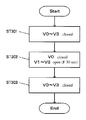
- FIG. 3 A drawing illustrating an example of operating flow of the present invention.
- FIG. 4 A drawing illustrating an example of operating flow of the present invention.
- FIG. 5 A drawing illustrating an example of operating flow for reference.
- FIG. 6 A drawing illustrating the device configuration of a conventional ICP mass analysis device
- FIG. 7 A drawing illustrating the piping system of the cooling water system and Ar gas supply system in FIG. 6 .
- FIG. 8 A simplified cross-sectional view illustrating the sample introduction unit in an ICP mass analysis device.
- FIG. 9 A drawing illustrating an example of the Ar gas supply system in an ICP mass analysis device.
- FIG. 1 is a drawing illustrating the device configuration of an ICP mass analysis device A according to the present invention
- FIG. 2 is a drawing illustrating the piping system of the cooling water system and Ar gas supply system 3 in the ICP mass analysis device A of FIG. 1 .
- constituent parts which are the same as in the conventional ICP mass analysis device 100 described in FIGS. 6 and 7 , the same reference symbols will be assigned and a portion of the description will be thus omitted.
- the device main body control unit 16 composed of a computer device as in the conventional ICP mass analysis device 100 , is provided with a valve control unit 35 which performs execution of a valve control program which implements Ar gas purging based on opening and closing of a master valve V 0 , purge valve V 1 , first intermediate valve V 2 and second intermediate valve V 3 .
- This valve control unit 35 when draining of the cooling water system 2 is to be performed, as a maintenance mode, performs intermittent purge control in which the master valve V 0 , purge valve V 1 , first intermediate valve V 2 and second intermediate valve V 3 are operated according to an operation flow as described below.
- a pipe resistance 36 which restricts inflow of gas is provided in the purge gas flow passage 32 downstream of the purge valve V 1 .
- the pipe resistance 36 is selected to have a magnitude of resistance sufficient to prevent sudden pressure fluctuation upstream of the purge valve V 1 when the purge valve V 1 is opened.
- a pipe with a narrower inside diameter of 0.5 mm is connected as a (coiled) pipe resistance 36 with a length of 1 m, thereby increasing the pipe resistance of the purge gas flow passage 32 .
- pressure accumulation time T the time required for pressure accumulation in the intermittent purge control described above
- opening time F the time required for pressure accumulation in the intermittent purge control described above
- FIG. 3 is a flow chart explaining an example of the gas purging operation flow using the valve control unit 35 of the ICP mass analysis device A.
- the parameter n which counts the number of purges is set to the initial value 0, the master valve V 0 closes, and the first intermediate valve V 2 and second intermediate valve V 3 are closed nearly simultaneously. It will be noted that the purge valve V 1 is closed to begin with (ST 101 ).
- the purge valve V 1 is opened and the open state is maintained until a preset pressure accumulation time T (10 seconds) elapses.
- a preset pressure accumulation time T 10 seconds
- the Ar gas of the purge gas flow passage 32 is accumulated until its pressure reaches the same level as the pressure upstream of the purge valve V 1 (ST 102 ).
- the first time since cooling water remains downstream of the check valve GV, by way of exception, Ar gas is accumulated in the pipe only up to the check valve GV, but in the second and subsequent pressure accumulation described below, pressure accumulation occurs also downstream of the check valve GV.
- the first intermediate valve V 2 and second intermediate valve V 3 are opened for a preset opening time F (5 seconds) to perform purging.
- the purge valve V 1 is maintained in an open state, and Ar gas which has accumulated in the purge gas flow passage 32 is released and flows downstream, draining the residual water in the downstream direction.
- the current purge count is checked on the basis of the parameter n (ST 104 ). If the purge count parameter n is less than 5, the processing of ST 102 through ST 104 is repeated.
- control proceeds to ST 105 .
- the first intermediate valve V 2 and second intermediate valve V 3 are then also closed (ST 106 ). Device operation is thereby completed.
- draining can be efficiently carried out through gas purging while reducing the consumption of Ar gas.
- FIG. 4 is a flow chart explaining another example of the gas purge operation flow using the valve control unit 35 of the ICP mass analysis device A.
- the difference from “operation flow-1” described above is that the first intermediate valve V 2 and second intermediate valve V 3 are alternately opened and closed in order to carefully purge flow passage (bypass flow passage) 23 and flow passage (high frequency power supply cooling flow passage) 24 one by one.
- the operation in this case is as follows.
- the parameter n which counts the number of purges is set to the initial value 0, the master valve V 0 closes, and the first intermediate valve V 2 and second intermediate valve V 3 are closed nearly simultaneously. It will be noted that the purge valve V 1 is closed to begin with (ST 201 ).
- the purge valve V 1 is opened and the open state is maintained until a preset pressure accumulation time T (10 seconds) elapses.
- a preset pressure accumulation time T 10 seconds
- the Ar gas of the purge gas flow passage 32 is accumulated until its pressure reaches the same level as the pressure upstream of the purge valve V 1 (ST 202 ).
- the first time since cooling water remains downstream of the check valve GV, by way of exception, Ar gas is accumulated in the pipe only up to the check valve GV, but in the second and subsequent pressure accumulation described below, pressure accumulation occurs also downstream of the check valve GV.
- the first intermediate valve V 2 is opened for a preset opening time F (5 seconds) to perform purging.
- the purge valve V 1 is maintained in an open state, while the master valve V 0 and second intermediate valve V 3 are maintained in a closed state.
- the Ar gas which has accumulated in the purge gas flow passage 32 is released and flows downstream, draining the residual water in the downstream direction.
- 1 is added to the purge count parameter n (ST 203 ).
- the first intermediate valve V 2 is closed, and the open state is maintained until a preset pressure accumulation time T (10 seconds) elapses.
- a preset pressure accumulation time T 10 seconds
- the second intermediate valve V 3 is opened for a preset opening time F (5 seconds) and purging is performed.
- the purge valve V 1 is maintained in an open state, while the master valve V 0 and first intermediate valve V 2 are maintained in a closed state.
- the Ar gas which has accumulated in the purge gas flow passage 32 is released and flows downstream, draining the residual water in the downstream direction.
- the purge count parameter n remains unchanged at this time (ST 205 ).
- the current purge count is checked on the basis of the parameter n (ST 206 ). If the purge count parameter n is less than 5, the processing of ST 202 through ST 205 is repeated.
- control proceeds to ST 207 .
- the first intermediate valve V 2 and second intermediate valve V 3 are then also closed (ST 208 ). Device operation is thereby completed.
- draining can be efficiently carried out through gas purging while reducing the consumption of Ar gas.
- the master valve V 0 closes, and the first intermediate valve V 2 and the second intermediate valve V 3 are closed nearly simultaneously. It will be noted that the purge valve V 1 is closed to begin with (ST 301 ).
- the purge valve V 1 , first intermediate valve V 2 and second intermediate valve V 3 are opened simultaneously, and the open state is maintained until a preset opening time F (for example, 30 seconds) elapses (ST 302 ).
- the master valve V 0 is maintained in a closed state.
- Ar gas flows in continuously, but the inflow of gas is restricted due to the existence of the pipe resistance 36 , so the supply pressure does not drop significantly, making it possible to prevent adverse effects due to pressure fluctuation upstream of the purge valve V 1 .
- a pipe resistance 36 was provided in the purge gas flow passage 32 to reduce pressure fluctuation on the upstream side, but if instead no pipe resistance 36 is provided and only intermittent purge control is performed using the valve control unit 35 , intermittent pressure fluctuation of upstream supply pressure will occur, but this is still effective because the magnitude of supply pressure fluctuation can be reduced as compared to the free-flowing state of the prior art.
- the present invention can be employed for ICP mass analysis devices.
Landscapes
- Chemical & Material Sciences (AREA)
- Analytical Chemistry (AREA)
- Physics & Mathematics (AREA)
- Engineering & Computer Science (AREA)
- Plasma & Fusion (AREA)
- Other Investigation Or Analysis Of Materials By Electrical Means (AREA)
- Electron Tubes For Measurement (AREA)
- Chemical Kinetics & Catalysis (AREA)
- Electrochemistry (AREA)
- Health & Medical Sciences (AREA)
- Life Sciences & Earth Sciences (AREA)
- Biochemistry (AREA)
- General Health & Medical Sciences (AREA)
- General Physics & Mathematics (AREA)
- Immunology (AREA)
- Pathology (AREA)
- Sampling And Sample Adjustment (AREA)
Abstract
Description
- A ICP mass analysis device
- 1 Device main body unit
- 2 Cooling water system
- 3 Ar gas supply system
- 11 Plasma torch
- 12 High frequency power supply
- 13 Sample introduction unit
- 14 Mass analysis unit (mass analyzer)
- 15 Gas flow rate control unit
- 16 Device main body control unit
- 18 High frequency coil
- 19 Nebulizer
- 20 Chiller (water source)
- 23 Bypass flow passage
- 24 High frequency power supply cooling flow passage
- 26 Sample introduction unit cooling flow passage
- 27 High frequency coil cooling flow passage
- 32 Purge gas flow passage
Claims (4)
Applications Claiming Priority (3)
| Application Number | Priority Date | Filing Date | Title |
|---|---|---|---|
| JP2015-251434 | 2015-12-24 | ||
| JP2015251434 | 2015-12-24 | ||
| PCT/JP2016/068762 WO2017110118A1 (en) | 2015-12-24 | 2016-06-24 | Icp mass spectrometer |
Publications (2)
| Publication Number | Publication Date |
|---|---|
| US20190013192A1 US20190013192A1 (en) | 2019-01-10 |
| US10354853B2 true US10354853B2 (en) | 2019-07-16 |
Family
ID=59089925
Family Applications (1)
| Application Number | Title | Priority Date | Filing Date |
|---|---|---|---|
| US16/065,496 Active US10354853B2 (en) | 2015-12-24 | 2016-06-24 | ICP mass spectrometer |
Country Status (5)
| Country | Link |
|---|---|
| US (1) | US10354853B2 (en) |
| EP (1) | EP3396368A4 (en) |
| JP (1) | JP6512307B2 (en) |
| CN (1) | CN108474761B (en) |
| WO (1) | WO2017110118A1 (en) |
Families Citing this family (5)
| Publication number | Priority date | Publication date | Assignee | Title |
|---|---|---|---|---|
| CN110010515A (en) * | 2018-01-05 | 2019-07-12 | 北京北方华创微电子装备有限公司 | Radio-frequency power supply cooling device and method, semiconductor processing equipment |
| CN115176153B (en) * | 2020-03-19 | 2025-03-07 | 株式会社日立高新技术 | Liquid chromatograph device and method for removing bubbles from liquid chromatograph device |
| CN112635291A (en) * | 2020-12-24 | 2021-04-09 | 北京瑞蒙特科技有限公司 | Vacuum ion trap mass spectrometer system |
| WO2023177736A1 (en) * | 2022-03-15 | 2023-09-21 | Elemental Scientific, Inc. | Atmospheric purge system and method for laser ablation sample processing |
| US20230408542A1 (en) * | 2022-06-09 | 2023-12-21 | Elemental Scientific, Inc. | Automated inline nanoparticle standard material addition |
Citations (6)
| Publication number | Priority date | Publication date | Assignee | Title |
|---|---|---|---|---|
| US5741710A (en) * | 1993-12-31 | 1998-04-21 | Ek; Paul | Reaction chamber and a method for generating a gaseous sample based on the use thereof |
| US6239038B1 (en) * | 1995-10-13 | 2001-05-29 | Ziying Wen | Method for chemical processing semiconductor wafers |
| US20050109374A1 (en) * | 2001-11-15 | 2005-05-26 | Olivier Letessier | Source liquid supply apparatus having a cleaning function |
| US20060285108A1 (en) * | 2005-06-17 | 2006-12-21 | Perkinelmer, Inc. | Optical emission device with boost device |
| US7518108B2 (en) * | 2005-11-10 | 2009-04-14 | Wisconsin Alumni Research Foundation | Electrospray ionization ion source with tunable charge reduction |
| JP2014085268A (en) | 2012-10-25 | 2014-05-12 | Shimadzu Corp | High-frequency power source for plasma, and icp emission spectroscopy apparatus using the same |
Family Cites Families (9)
| Publication number | Priority date | Publication date | Assignee | Title |
|---|---|---|---|---|
| US5383019A (en) * | 1990-03-23 | 1995-01-17 | Fisons Plc | Inductively coupled plasma spectrometers and radio-frequency power supply therefor |
| JP3123843B2 (en) * | 1992-12-17 | 2001-01-15 | 日本電子株式会社 | Sample vaporizer using plasma flame |
| EP0799408B1 (en) * | 1994-12-20 | 2003-03-19 | Varian Australia Pty. Ltd. | Spectrometer with discharge limiting means |
| US6222186B1 (en) * | 1998-06-25 | 2001-04-24 | Agilent Technologies, Inc. | Power-modulated inductively coupled plasma spectrometry |
| JP3800621B2 (en) * | 2002-01-18 | 2006-07-26 | 株式会社島津製作所 | ICP analyzer |
| CN102375022A (en) * | 2011-10-09 | 2012-03-14 | 北京纳克分析仪器有限公司 | LA-ICPMS (laser ablation inductively coupled plasma mass spectrometry) based original position statistic distribution analysis system |
| CA2884625A1 (en) * | 2012-09-14 | 2014-03-20 | Stewart Nicholson | Humidity sensing system |
| JP6096105B2 (en) * | 2013-12-20 | 2017-03-15 | 三菱日立パワーシステムズ株式会社 | Char collection system and char transport method |
| CN104602429B (en) * | 2015-01-30 | 2017-01-25 | 清华大学 | Warm plasma generator |
-
2016
- 2016-06-24 WO PCT/JP2016/068762 patent/WO2017110118A1/en not_active Ceased
- 2016-06-24 JP JP2017557724A patent/JP6512307B2/en active Active
- 2016-06-24 CN CN201680076005.XA patent/CN108474761B/en active Active
- 2016-06-24 EP EP16878021.1A patent/EP3396368A4/en not_active Withdrawn
- 2016-06-24 US US16/065,496 patent/US10354853B2/en active Active
Patent Citations (6)
| Publication number | Priority date | Publication date | Assignee | Title |
|---|---|---|---|---|
| US5741710A (en) * | 1993-12-31 | 1998-04-21 | Ek; Paul | Reaction chamber and a method for generating a gaseous sample based on the use thereof |
| US6239038B1 (en) * | 1995-10-13 | 2001-05-29 | Ziying Wen | Method for chemical processing semiconductor wafers |
| US20050109374A1 (en) * | 2001-11-15 | 2005-05-26 | Olivier Letessier | Source liquid supply apparatus having a cleaning function |
| US20060285108A1 (en) * | 2005-06-17 | 2006-12-21 | Perkinelmer, Inc. | Optical emission device with boost device |
| US7518108B2 (en) * | 2005-11-10 | 2009-04-14 | Wisconsin Alumni Research Foundation | Electrospray ionization ion source with tunable charge reduction |
| JP2014085268A (en) | 2012-10-25 | 2014-05-12 | Shimadzu Corp | High-frequency power source for plasma, and icp emission spectroscopy apparatus using the same |
Non-Patent Citations (1)
| Title |
|---|
| International Search Report for PCT/JP2016/068762 dated Aug. 16, 2016. |
Also Published As
| Publication number | Publication date |
|---|---|
| JPWO2017110118A1 (en) | 2018-09-27 |
| CN108474761A (en) | 2018-08-31 |
| US20190013192A1 (en) | 2019-01-10 |
| CN108474761B (en) | 2020-07-17 |
| JP6512307B2 (en) | 2019-05-15 |
| WO2017110118A1 (en) | 2017-06-29 |
| EP3396368A4 (en) | 2019-08-14 |
| EP3396368A1 (en) | 2018-10-31 |
Similar Documents
| Publication | Publication Date | Title |
|---|---|---|
| US10354853B2 (en) | ICP mass spectrometer | |
| JP6488294B2 (en) | Mass spectrometer inlet that allows a reduction in average flow | |
| CN105579844B (en) | Gas chromatography mass analytical equipment | |
| JP6734061B2 (en) | Plasma spectroscopy analyzer | |
| KR20170093975A (en) | System for analyzing online-transferred assay samples | |
| EP2725351A1 (en) | Liquid chromatography mass spectrometer device | |
| US20150219532A1 (en) | Sample introduction device | |
| US20180243687A1 (en) | Gas treatment system | |
| KR20080092264A (en) | Gas Supply System of Semiconductor Manufacturing Equipment | |
| EP3776628A1 (en) | Imr-ms device | |
| TWI580812B (en) | Gas transmission device and its gas shunt device test method | |
| US8063337B1 (en) | Mass spectrometry injection system and apparatus | |
| JP5304749B2 (en) | Vacuum analyzer | |
| JP2022527350A5 (en) | ||
| WO2018159066A1 (en) | Gas pressure regulator | |
| US20180228014A1 (en) | Control of power supplied to a plasma torch to compensate for changes at an electrode | |
| CN121497970B (en) | Chromatograph hydrogen closed loop circulation control device and method | |
| TWI771798B (en) | Gas supply system and gas delivery method thereof, and plasma processing device | |
| WO2019053850A1 (en) | Liquid chromatograph | |
| JP2015162671A (en) | Diluted chemical liquid supply apparatus, substrate liquid processing apparatus, and flow rate control method | |
| WO2021111593A1 (en) | Sample introduction device |
Legal Events
| Date | Code | Title | Description |
|---|---|---|---|
| AS | Assignment |
Owner name: SHIMADZU CORPORATION, JAPAN Free format text: ASSIGNMENT OF ASSIGNORS INTEREST;ASSIGNOR:TOMOHITO, NAKANO;REEL/FRAME:046180/0390 Effective date: 20180607 |
|
| FEPP | Fee payment procedure |
Free format text: ENTITY STATUS SET TO UNDISCOUNTED (ORIGINAL EVENT CODE: BIG.); ENTITY STATUS OF PATENT OWNER: LARGE ENTITY |
|
| AS | Assignment |
Owner name: SHIMADZU CORPORATION, JAPAN Free format text: CORRECTIVE ASSIGNMENT TO CORRECT THE NAME OF ASSIGNOR PREVIOUSLY RECORDED ON REEL 046180 FRAME 0390. ASSIGNOR(S) HEREBY CONFIRMS THE ASSIGNMENT OF ASSIGNORS INTEREST;ASSIGNOR:NAKANO, TOMOHITO;REEL/FRAME:046708/0830 Effective date: 20180730 |
|
| STPP | Information on status: patent application and granting procedure in general |
Free format text: NOTICE OF ALLOWANCE MAILED -- APPLICATION RECEIVED IN OFFICE OF PUBLICATIONS |
|
| STPP | Information on status: patent application and granting procedure in general |
Free format text: PUBLICATIONS -- ISSUE FEE PAYMENT VERIFIED |
|
| STCF | Information on status: patent grant |
Free format text: PATENTED CASE |
|
| MAFP | Maintenance fee payment |
Free format text: PAYMENT OF MAINTENANCE FEE, 4TH YEAR, LARGE ENTITY (ORIGINAL EVENT CODE: M1551); ENTITY STATUS OF PATENT OWNER: LARGE ENTITY Year of fee payment: 4 |