US10351537B2 - Processes for the preparation of lesinurad and intermediates thereof - Google Patents
Processes for the preparation of lesinurad and intermediates thereof Download PDFInfo
- Publication number
- US10351537B2 US10351537B2 US15/914,165 US201815914165A US10351537B2 US 10351537 B2 US10351537 B2 US 10351537B2 US 201815914165 A US201815914165 A US 201815914165A US 10351537 B2 US10351537 B2 US 10351537B2
- Authority
- US
- United States
- Prior art keywords
- compound
- formula
- group
- polyol
- solvent
- Prior art date
- Legal status (The legal status is an assumption and is not a legal conclusion. Google has not performed a legal analysis and makes no representation as to the accuracy of the status listed.)
- Active
Links
- COTUIISAXUDHPP-UHFFFAOYSA-N *.[H]C1=NN=C(SCC(=O)OC)N1C1=C2C=CC=CC2=C(C2CC2)C=C1 Chemical compound *.[H]C1=NN=C(SCC(=O)OC)N1C1=C2C=CC=CC2=C(C2CC2)C=C1 COTUIISAXUDHPP-UHFFFAOYSA-N 0.000 description 9
- OVYPPWNJXUSRPH-UHFFFAOYSA-N *.COC(=O)CSC1=NN=C(Br)N1C1=C2C=CC=CC2=C(C2CC2)C=C1 Chemical compound *.COC(=O)CSC1=NN=C(Br)N1C1=C2C=CC=CC2=C(C2CC2)C=C1 OVYPPWNJXUSRPH-UHFFFAOYSA-N 0.000 description 8
- GCLYJXZAWXKEHZ-UHFFFAOYSA-N CC(=O)CSC1=NN=C(Br)N1C1=C2C=CC=CC2=C(C2CC2)C=C1 Chemical compound CC(=O)CSC1=NN=C(Br)N1C1=C2C=CC=CC2=C(C2CC2)C=C1 GCLYJXZAWXKEHZ-UHFFFAOYSA-N 0.000 description 7
- UFYFJMMSOUURSF-UHFFFAOYSA-N [H]C1=NN=C(S)N1C1=C2C=CC=CC2=C(C2CC2)C=C1 Chemical compound [H]C1=NN=C(S)N1C1=C2C=CC=CC2=C(C2CC2)C=C1 UFYFJMMSOUURSF-UHFFFAOYSA-N 0.000 description 6
- RJUFJBKOKNCXHH-UHFFFAOYSA-N *.CCC(=O)OC Chemical compound *.CCC(=O)OC RJUFJBKOKNCXHH-UHFFFAOYSA-N 0.000 description 5
- QNUKBWIGRGLYSO-UHFFFAOYSA-N CC(=O)CCSC1=NN=C(Br)N1C1=C2C=CC=CC2=C(C2CC2)C=C1 Chemical compound CC(=O)CCSC1=NN=C(Br)N1C1=C2C=CC=CC2=C(C2CC2)C=C1 QNUKBWIGRGLYSO-UHFFFAOYSA-N 0.000 description 5
- SYYZADPDLHGWDT-UHFFFAOYSA-N [H]C1=NN=C(SCCC(C)=O)N1C1=C2C=CC=CC2=C(C2CC2)C=C1 Chemical compound [H]C1=NN=C(SCCC(C)=O)N1C1=C2C=CC=CC2=C(C2CC2)C=C1 SYYZADPDLHGWDT-UHFFFAOYSA-N 0.000 description 5
- 0 *.[1*]OC(=O)CCSC1=NN=C([H])N1C1=C2C=CC=CC2=C(C2CC2)C=C1.[H]C1=NN=C(SCC(=O)OC)N1C1=C2C=CC=CC2=C(C2CC2)C=C1 Chemical compound *.[1*]OC(=O)CCSC1=NN=C([H])N1C1=C2C=CC=CC2=C(C2CC2)C=C1.[H]C1=NN=C(SCC(=O)OC)N1C1=C2C=CC=CC2=C(C2CC2)C=C1 0.000 description 4
- ZWEHNKRNPOVVGH-UHFFFAOYSA-N CCC(C)=O Chemical compound CCC(C)=O ZWEHNKRNPOVVGH-UHFFFAOYSA-N 0.000 description 3
- DMAJCLCFJTWPDG-UHFFFAOYSA-N SC1=NN=C(Br)N1C1=C2C=CC=CC2=C(C2CC2)C=C1 Chemical compound SC1=NN=C(Br)N1C1=C2C=CC=CC2=C(C2CC2)C=C1 DMAJCLCFJTWPDG-UHFFFAOYSA-N 0.000 description 3
- XNLICIUVMPYHGG-UHFFFAOYSA-N CCCC(C)=O Chemical compound CCCC(C)=O XNLICIUVMPYHGG-UHFFFAOYSA-N 0.000 description 2
- YJSOUSIRBCNAGG-UHFFFAOYSA-N *.*.*.*.*.C.C.CC.CC.CCC(=O)OC.CCC(C)=O.COC(=O)CSC1=NN=C(Br)N1C1=C2C=CC=CC2=C(C2CC2)C=C1.O=C(O)CSC1=NN=C(Br)N1C1=C2C=CC=CC2=C(C2CC2)C=C1.[H]C1=NN=C(S)N1C1=C2C=CC=CC2=C(C2CC2)C=C1.[H]C1=NN=C(SCC(=O)OC)N1C1=C2C=CC=CC2=C(C2CC2)C=C1 Chemical compound *.*.*.*.*.C.C.CC.CC.CCC(=O)OC.CCC(C)=O.COC(=O)CSC1=NN=C(Br)N1C1=C2C=CC=CC2=C(C2CC2)C=C1.O=C(O)CSC1=NN=C(Br)N1C1=C2C=CC=CC2=C(C2CC2)C=C1.[H]C1=NN=C(S)N1C1=C2C=CC=CC2=C(C2CC2)C=C1.[H]C1=NN=C(SCC(=O)OC)N1C1=C2C=CC=CC2=C(C2CC2)C=C1 YJSOUSIRBCNAGG-UHFFFAOYSA-N 0.000 description 1
- ZYYKPNGKFSDAMZ-UHFFFAOYSA-N *.B.C.CCC(=O)OC.COC(=O)CSC1=NN=C(Br)N1C1=C2C=CC=CC2=C(C2CC2)C=C1.COC(=O)CSC1=NN=C(N)N1C1=C2C=CC=CC2=C(C2CC2)C=C1.NC1=NN=C(S)N1C1=C2C=CC=CC2=C(C2CC2)C=C1 Chemical compound *.B.C.CCC(=O)OC.COC(=O)CSC1=NN=C(Br)N1C1=C2C=CC=CC2=C(C2CC2)C=C1.COC(=O)CSC1=NN=C(N)N1C1=C2C=CC=CC2=C(C2CC2)C=C1.NC1=NN=C(S)N1C1=C2C=CC=CC2=C(C2CC2)C=C1 ZYYKPNGKFSDAMZ-UHFFFAOYSA-N 0.000 description 1
- KHDLMZTVJDJCJL-UHFFFAOYSA-N B=NS.C1CCOC1.COC(=O)CCSC1=NN=C(Br)N1C1=C2C=CC=CC2=C(C2CC2)C=C1.[H]C1=NN=C(SCCC(=O)OC)N1C1=C2C=CC=CC2=C(C2CC2)C=C1 Chemical compound B=NS.C1CCOC1.COC(=O)CCSC1=NN=C(Br)N1C1=C2C=CC=CC2=C(C2CC2)C=C1.[H]C1=NN=C(SCCC(=O)OC)N1C1=C2C=CC=CC2=C(C2CC2)C=C1 KHDLMZTVJDJCJL-UHFFFAOYSA-N 0.000 description 1
- QWOCIXNIGXHEDC-KTTJZPQESA-N C.C.CCC(=O)OC.COC(=O)CSC1=NN=C(Br)N1C1=C2C=CC=CC2=C(C2CC2)C=C1.[2HH].[H]C1=NN=C(S)N1C1=C2C=CC=CC2=C(C2CC2)C=C1.[H]C1=NN=C(SCC(=O)OC)N1C1=C2C=CC=CC2=C(C2CC2)C=C1 Chemical compound C.C.CCC(=O)OC.COC(=O)CSC1=NN=C(Br)N1C1=C2C=CC=CC2=C(C2CC2)C=C1.[2HH].[H]C1=NN=C(S)N1C1=C2C=CC=CC2=C(C2CC2)C=C1.[H]C1=NN=C(SCC(=O)OC)N1C1=C2C=CC=CC2=C(C2CC2)C=C1 QWOCIXNIGXHEDC-KTTJZPQESA-N 0.000 description 1
- OWUUSKXITGJNEA-IYQIUNIRSA-N C1CCOC1.CCC(C)OC(=O)CSC1=NN=C(Br)N1C1=CC=C(C2CC2)C2=CC=CC=C21.[2H]B([2H])C.[H]C1=NN=C(SCC(=O)OC(C)CC)N1C1=CC=C(C2CC2)C2=CC=CC=C21 Chemical compound C1CCOC1.CCC(C)OC(=O)CSC1=NN=C(Br)N1C1=CC=C(C2CC2)C2=CC=CC=C21.[2H]B([2H])C.[H]C1=NN=C(SCC(=O)OC(C)CC)N1C1=CC=C(C2CC2)C2=CC=CC=C21 OWUUSKXITGJNEA-IYQIUNIRSA-N 0.000 description 1
- QKCXHRCZGRYPTI-DCBROINNSA-N C1CCOC1.NC(=O)C1=CN=CC=C1.O=C(CSC1=NN=C(Br)N1C1=CC=C(C2CC2)C2=C1C=CC=C2)OCCOC(=O)CSC1=NN=C(Br)N1C1=C2C=CC=CC2=C(C2CC2)C=C1.O=C(O)CSC1=NN=C(Br)N1C1=C2C=CC=CC2=C(C2CC2)C=C1.O=C(O)CSC1=NN=C(Br)N1C1=C2C=CC=CC2=C(C2CC2)C=C1.[2H]B([2H])C.[H]C1=NN=C(SCC(=O)OCCOC(=O)CSC2=NN=C([H])N2C2=C3C=CC=CC3=C(C3CC3)C=C2)N1C1=CC=C(C2CC2)C2=C1C=CC=C2 Chemical compound C1CCOC1.NC(=O)C1=CN=CC=C1.O=C(CSC1=NN=C(Br)N1C1=CC=C(C2CC2)C2=C1C=CC=C2)OCCOC(=O)CSC1=NN=C(Br)N1C1=C2C=CC=CC2=C(C2CC2)C=C1.O=C(O)CSC1=NN=C(Br)N1C1=C2C=CC=CC2=C(C2CC2)C=C1.O=C(O)CSC1=NN=C(Br)N1C1=C2C=CC=CC2=C(C2CC2)C=C1.[2H]B([2H])C.[H]C1=NN=C(SCC(=O)OCCOC(=O)CSC2=NN=C([H])N2C2=C3C=CC=CC3=C(C3CC3)C=C2)N1C1=CC=C(C2CC2)C2=C1C=CC=C2 QKCXHRCZGRYPTI-DCBROINNSA-N 0.000 description 1
- KYTPZIVRPRVLAZ-KQWGCVFHSA-N C1CCOC1.O=C(CSC1=NN=C(Br)N1C1=C2C=CC=CC2=C(C2CC2)C=C1)OCC(COC(=O)CSC1=NN=C(Br)N1C1=C2C=CC=CC2=C(C2CC2)C=C1)OC(=O)CSC1=NN=C(Br)N1C1=CC=C(C2CC2)C2=C1C=CC=C2.O=C(O)CSC1=NN=C(Br)N1C1=C2C=CC=CC2=C(C2CC2)C=C1.[2H]B([2H])C.[H]C1=NN=C(SCC(=O)OC(COC(=O)CSC2=NN=C([H])N2C2=C3C=CC=CC3=C(C3CC3)C=C2)COC(=O)CSC2=NN=C([H])N2C2=C3C=CC=CC3=C(C3CC3)C=C2)N1C1=CC=C(C2CC2)C2=C1C=CC=C2 Chemical compound C1CCOC1.O=C(CSC1=NN=C(Br)N1C1=C2C=CC=CC2=C(C2CC2)C=C1)OCC(COC(=O)CSC1=NN=C(Br)N1C1=C2C=CC=CC2=C(C2CC2)C=C1)OC(=O)CSC1=NN=C(Br)N1C1=CC=C(C2CC2)C2=C1C=CC=C2.O=C(O)CSC1=NN=C(Br)N1C1=C2C=CC=CC2=C(C2CC2)C=C1.[2H]B([2H])C.[H]C1=NN=C(SCC(=O)OC(COC(=O)CSC2=NN=C([H])N2C2=C3C=CC=CC3=C(C3CC3)C=C2)COC(=O)CSC2=NN=C([H])N2C2=C3C=CC=CC3=C(C3CC3)C=C2)N1C1=CC=C(C2CC2)C2=C1C=CC=C2 KYTPZIVRPRVLAZ-KQWGCVFHSA-N 0.000 description 1
- OTMSDBZUPAUEDD-UHFFFAOYSA-N CC Chemical compound CC OTMSDBZUPAUEDD-UHFFFAOYSA-N 0.000 description 1
- JOAZLZQRDRDRPE-UHFFFAOYSA-N CC1=NN=C(SCC(=O)OCC(COC(=O)CSC2=NN=C(Br)N2C2=C3C=CC=CC3=C(C3CC3)C=C2)OC(=O)CSC2=NN=C(Br)N2C2=CC=C(C3CC3)C3=C2C=CC=C3)N1C1=C2C=CC=CC2=C(C2CC2)C=C1.O=C(CSC1=NN=C(Br)N1C1=CC=C(C2CC2)C2=C1C=CC=C2)OCCOC(=O)CSC1=NN=C(Br)N1C1=C2C=CC=CC2=C(C2CC2)C=C1 Chemical compound CC1=NN=C(SCC(=O)OCC(COC(=O)CSC2=NN=C(Br)N2C2=C3C=CC=CC3=C(C3CC3)C=C2)OC(=O)CSC2=NN=C(Br)N2C2=CC=C(C3CC3)C3=C2C=CC=C3)N1C1=C2C=CC=CC2=C(C2CC2)C=C1.O=C(CSC1=NN=C(Br)N1C1=CC=C(C2CC2)C2=C1C=CC=C2)OCCOC(=O)CSC1=NN=C(Br)N1C1=C2C=CC=CC2=C(C2CC2)C=C1 JOAZLZQRDRDRPE-UHFFFAOYSA-N 0.000 description 1
- QDRPERXXVPJFSP-UHFFFAOYSA-N CC1=NN=C([SH](C)CC(=O)OCC(COC(=O)CSC2=NN=C(Br)N2C2=C3C=CC=CC3=C(C3CC3)C=C2)OC(=O)CSC2=NN=C(Br)N2C2=CC=C(C3CC3)C3=C2C=CC=C3)N1C1=C2C=CC=CC2=C(C2CC2)C=C1.O=C(CSC1=NN=C(Br)N1C1=CC=C(C2CC2)C2=C1C=CC=C2)OCCOC(=O)CSC1=NN=C(Br)N1C1=C2C=CC=CC2=C(C2CC2)C=C1 Chemical compound CC1=NN=C([SH](C)CC(=O)OCC(COC(=O)CSC2=NN=C(Br)N2C2=C3C=CC=CC3=C(C3CC3)C=C2)OC(=O)CSC2=NN=C(Br)N2C2=CC=C(C3CC3)C3=C2C=CC=C3)N1C1=C2C=CC=CC2=C(C2CC2)C=C1.O=C(CSC1=NN=C(Br)N1C1=CC=C(C2CC2)C2=C1C=CC=C2)OCCOC(=O)CSC1=NN=C(Br)N1C1=C2C=CC=CC2=C(C2CC2)C=C1 QDRPERXXVPJFSP-UHFFFAOYSA-N 0.000 description 1
- ZHCYBPLVFCGGJX-UHFFFAOYSA-N CCC(C)O.CCC(C)OC(=O)CCl.O=C(Cl)CCl Chemical compound CCC(C)O.CCC(C)OC(=O)CCl.O=C(Cl)CCl ZHCYBPLVFCGGJX-UHFFFAOYSA-N 0.000 description 1
- WXGXIZVIVBUQTR-UHFFFAOYSA-M CCC(C)O.CCC(C)OC(=O)CCl.O=C(Cl)CCl.O=COO[Na].[H]C1=NN=C(S)N1C1=C2C=CC=CC2=C(C2CC2)C=C1.[H]C1=NN=C(SCC(=O)OC(C)CC)N1C1=C2C=CC=CC2=C(C2CC2)C=C1 Chemical compound CCC(C)O.CCC(C)OC(=O)CCl.O=C(Cl)CCl.O=COO[Na].[H]C1=NN=C(S)N1C1=C2C=CC=CC2=C(C2CC2)C=C1.[H]C1=NN=C(SCC(=O)OC(C)CC)N1C1=C2C=CC=CC2=C(C2CC2)C=C1 WXGXIZVIVBUQTR-UHFFFAOYSA-M 0.000 description 1
- AOEKJVHSEPCWGN-UHFFFAOYSA-N CCC(C)O.CCC(C)OC(=O)CSC1=NN=C(Br)N1C1=CC=C(C2CC2)C2=CC=CC=C21.O=C(O)CSC1=NN=C(Br)N1C1=C2C=CC=CC2=C(C2CC2)C=C1 Chemical compound CCC(C)O.CCC(C)OC(=O)CSC1=NN=C(Br)N1C1=CC=C(C2CC2)C2=CC=CC=C21.O=C(O)CSC1=NN=C(Br)N1C1=C2C=CC=CC2=C(C2CC2)C=C1 AOEKJVHSEPCWGN-UHFFFAOYSA-N 0.000 description 1
- ZRIJIFGUOAWHTE-DLWAKCFRSA-M CCC(C)OC(=O)CCl.O=COO[Na].[2H]CF.[H]C1=NN=C(S)N1C1=C2C=CC=CC2=C(C2CC2)C=C1.[H]C1=NN=C(SCC(=O)OC(C)CC)N1C1=CC=C(C2CC2)C2=CC=CC=C21 Chemical compound CCC(C)OC(=O)CCl.O=COO[Na].[2H]CF.[H]C1=NN=C(S)N1C1=C2C=CC=CC2=C(C2CC2)C=C1.[H]C1=NN=C(SCC(=O)OC(C)CC)N1C1=CC=C(C2CC2)C2=CC=CC=C21 ZRIJIFGUOAWHTE-DLWAKCFRSA-M 0.000 description 1
- FSSFTEHIPGIIEN-PBJKEDEQSA-N COC(=O)CCBr.[2H]CF.[H]C1=NN=C(S)N1C1=C2C=CC=CC2=C(C2CC2)C=C1.[H]C1=NN=C(SCCC(=O)OC)N1C1=C2C=CC=CC2=C(C2CC2)C=C1 Chemical compound COC(=O)CCBr.[2H]CF.[H]C1=NN=C(S)N1C1=C2C=CC=CC2=C(C2CC2)C=C1.[H]C1=NN=C(SCCC(=O)OC)N1C1=C2C=CC=CC2=C(C2CC2)C=C1 FSSFTEHIPGIIEN-PBJKEDEQSA-N 0.000 description 1
- BKMASNKXCHZLPY-UHFFFAOYSA-N COC(=O)CCSC1=NN=C(Br)N1C1=C2C=CC=CC2=C(C2CC2)C=C1.SC1=NN=C(Br)N1C1=C2C=CC=CC2=C(C2CC2)C=C1 Chemical compound COC(=O)CCSC1=NN=C(Br)N1C1=C2C=CC=CC2=C(C2CC2)C=C1.SC1=NN=C(Br)N1C1=C2C=CC=CC2=C(C2CC2)C=C1 BKMASNKXCHZLPY-UHFFFAOYSA-N 0.000 description 1
- XVPWJYYBAYFVDL-UHFFFAOYSA-N NC1=NN=C(O)N1C1=C2C=CC=CC2=C(C2CC2)C=C1.OC1=NN=CN1C1=C2C=CC=CC2=C(C2CC2)C=C1 Chemical compound NC1=NN=C(O)N1C1=C2C=CC=CC2=C(C2CC2)C=C1.OC1=NN=CN1C1=C2C=CC=CC2=C(C2CC2)C=C1 XVPWJYYBAYFVDL-UHFFFAOYSA-N 0.000 description 1
- AFPLNRIHZPZNKC-UHFFFAOYSA-N O=C(CCl)OCC(COC(=O)CCl)OC(=O)CCl.O=C(Cl)CCl.OCC(O)CO Chemical compound O=C(CCl)OCC(COC(=O)CCl)OC(=O)CCl.O=C(Cl)CCl.OCC(O)CO AFPLNRIHZPZNKC-UHFFFAOYSA-N 0.000 description 1
- VSOXOGRKJLDERV-UHFFFAOYSA-N O=C(CCl)OCC(COC(=O)CCl)OC(=O)CCl.[H]C1=NN=C(S)N1C1=C2C=CC=CC2=C(C2CC2)C=C1.[H]C1=NN=C(SCC(=O)OC(COC(=O)CSC2=NN=C([H])N2C2=C3C=CC=CC3=C(C3CC3)C=C2)COC(=O)CSC2=NN=C([H])N2C2=C3C=CC=CC3=C(C3CC3)C=C2)N1C1=CC=C(C2CC2)C2=C1C=CC=C2 Chemical compound O=C(CCl)OCC(COC(=O)CCl)OC(=O)CCl.[H]C1=NN=C(S)N1C1=C2C=CC=CC2=C(C2CC2)C=C1.[H]C1=NN=C(SCC(=O)OC(COC(=O)CSC2=NN=C([H])N2C2=C3C=CC=CC3=C(C3CC3)C=C2)COC(=O)CSC2=NN=C([H])N2C2=C3C=CC=CC3=C(C3CC3)C=C2)N1C1=CC=C(C2CC2)C2=C1C=CC=C2 VSOXOGRKJLDERV-UHFFFAOYSA-N 0.000 description 1
- PPDJYMGOTCVSRQ-UHFFFAOYSA-M O=C(CCl)OCCOC(=O)CCl.O=C(Cl)CCl.O=COO[Na].OCCO.[H]C1=NN=C(S)N1C1=C2C=CC=CC2=C(C2CC2)C=C1.[H]C1=NN=C(SCC(=O)OCCOC(=O)CSC2=NN=C([H])N2C2=C3C=CC=CC3=C(C3CC3)C=C2)N1C1=CC=C(C2CC2)C2=C1C=CC=C2 Chemical compound O=C(CCl)OCCOC(=O)CCl.O=C(Cl)CCl.O=COO[Na].OCCO.[H]C1=NN=C(S)N1C1=C2C=CC=CC2=C(C2CC2)C=C1.[H]C1=NN=C(SCC(=O)OCCOC(=O)CSC2=NN=C([H])N2C2=C3C=CC=CC3=C(C3CC3)C=C2)N1C1=CC=C(C2CC2)C2=C1C=CC=C2 PPDJYMGOTCVSRQ-UHFFFAOYSA-M 0.000 description 1
- GZZFZCIXBUMOMC-UHFFFAOYSA-N O=C(CCl)OCCOC(=O)CCl.[H]C1=NN=C(S)N1C1=C2C=CC=CC2=C(C2CC2)C=C1.[H]C1=NN=C(SCC(=O)OCCOC(=O)CSC2=NN=C([H])N2C2=C3C=CC=CC3=C(C3CC3)C=C2)N1C1=CC=C(C2CC2)C2=C1C=CC=C2 Chemical compound O=C(CCl)OCCOC(=O)CCl.[H]C1=NN=C(S)N1C1=C2C=CC=CC2=C(C2CC2)C=C1.[H]C1=NN=C(SCC(=O)OCCOC(=O)CSC2=NN=C([H])N2C2=C3C=CC=CC3=C(C3CC3)C=C2)N1C1=CC=C(C2CC2)C2=C1C=CC=C2 GZZFZCIXBUMOMC-UHFFFAOYSA-N 0.000 description 1
- BLQCHYASRUTFNU-UHFFFAOYSA-N O=C(O)CBr.O=C(O)CSC1=NN=C(Br)N1C1=C2C=CC=CC2=C(C2CC2)C=C1.SC1=NN=C(Br)N1C1=C2C=CC=CC2=C(C2CC2)C=C1 Chemical compound O=C(O)CBr.O=C(O)CSC1=NN=C(Br)N1C1=C2C=CC=CC2=C(C2CC2)C=C1.SC1=NN=C(Br)N1C1=C2C=CC=CC2=C(C2CC2)C=C1 BLQCHYASRUTFNU-UHFFFAOYSA-N 0.000 description 1
- GROZPSUXZWYLPV-UHFFFAOYSA-N [H]C1=NN=C(C)N1C1=C2C=CC=CC2=C(C2CC2)C=C1 Chemical compound [H]C1=NN=C(C)N1C1=C2C=CC=CC2=C(C2CC2)C=C1 GROZPSUXZWYLPV-UHFFFAOYSA-N 0.000 description 1
- BGZQGQWXHUODJG-UHFFFAOYSA-N [H]C1=NN=C(SCC(=O)OC(COC(=O)CSC2=NN=C([H])N2C2=C3C=CC=CC3=C(C3CC3)C=C2)COC(=O)CSC2=NN=C(C)N2C2=C3C=CC=CC3=C(C3CC3)C=C2)N1C1=CC=C(C2CC2)C2=C1C=CC=C2.[H]C1=NN=C(SCC(=O)OCCOC(=O)CSC2=NN=C([H])N2C2=C3C=CC=CC3=C(C3CC3)C=C2)N1C1=CC=C(C2CC2)C2=C1C=CC=C2 Chemical compound [H]C1=NN=C(SCC(=O)OC(COC(=O)CSC2=NN=C([H])N2C2=C3C=CC=CC3=C(C3CC3)C=C2)COC(=O)CSC2=NN=C(C)N2C2=C3C=CC=CC3=C(C3CC3)C=C2)N1C1=CC=C(C2CC2)C2=C1C=CC=C2.[H]C1=NN=C(SCC(=O)OCCOC(=O)CSC2=NN=C([H])N2C2=C3C=CC=CC3=C(C3CC3)C=C2)N1C1=CC=C(C2CC2)C2=C1C=CC=C2 BGZQGQWXHUODJG-UHFFFAOYSA-N 0.000 description 1
Classifications
-
- C—CHEMISTRY; METALLURGY
- C07—ORGANIC CHEMISTRY
- C07D—HETEROCYCLIC COMPOUNDS
- C07D249/00—Heterocyclic compounds containing five-membered rings having three nitrogen atoms as the only ring hetero atoms
- C07D249/02—Heterocyclic compounds containing five-membered rings having three nitrogen atoms as the only ring hetero atoms not condensed with other rings
- C07D249/08—1,2,4-Triazoles; Hydrogenated 1,2,4-triazoles
- C07D249/10—1,2,4-Triazoles; Hydrogenated 1,2,4-triazoles with hetero atoms or with carbon atoms having three bonds to hetero atoms with at the most one bond to halogen, e.g. ester or nitrile radicals, directly attached to ring carbon atoms
- C07D249/12—Oxygen or sulfur atoms
Definitions
- the present invention relates to processes for the preparation of Lesinurad and intermediates used in the preparation thereof.
- Lesinurad or 2-((5-bromo-4-(4-cyclopropylnaphthalen-1-yl)-4H-1,2,4-triazol-3-yl)thio)acetic acid, is marketed in the United States as ZURAMPIC®, and is indicated, in combination with a xanthine oxidase inhibitor, for the treatment of hyperuricemia associated with gout in patients who have not achieved target serum uric acid levels with a xanthine oxidase inhibitor alone.
- Lesinurad has the following structural formula:
- Lesinurad is prepared from starting material (A) by reaction with a methyl haloacetate, followed by diazotization and displacement with bromide to yield the compound of Formula (C), which is further hydrolysed to yield Lesinurad (1).
- bromination is conducted using excessive amounts of sodium nitrite, a strong oxidant, as well as a number of toxic and corrosive reagents, including tribromomethane and dichloroacetic acid.
- An alternative bromination is described in WO 2014/008295 A; however, the process uses equimolar amounts of cuprous bromide as the bromide source, which will result in higher costs when conducted on a commercial scale owing to the high cost of this reagent, as well as the waste disposal costs associated with the use of heavy metal reagents such as copper.
- Lesinurad is prepared from starting material (D) by reaction with a methyl haloacetate followed by direct bromination of the triazole (E) to yield (C), which is hydrolyzed to provide Lesinurad (1) as shown in Scheme 2.
- a similar method for preparing Lesinurad is described in WO 2014/198241 A1, wherein analogues of triazole (E) having a variety of thioglycolate ester and amide sidechains are brominated.
- thioglycolate side chain In alternative processes for the preparation of Lesinurad, such as those reported in CN 105017168 A and CN 105153056 A, installation of the thioglycolate side chain occurs by first displacing a hydroxyl or diazonium group (following diazotization of the amine) on the triazole ring of compounds (F) or (G), respectively, followed by addition of the thioglycolate side chain using methyl thioglycolate.
- methyl thioglycolate is a malodorous substance that is preferably avoided in processes conducted on an industrial scale.
- the present invention provides improved processes for the preparation of Lesinurad (1), as well as new intermediates and processes for their preparation, as depicted in Scheme 3 and Scheme 4.
- Lesinurad may be prepared by bromination of a novel intermediate, the compound of Formula (3), which is formed by attaching two or more units of the compound of Formula (5) to the compound of Formula (4), the backbone of which is derived from either a monomeric polyol or a polymeric polyol (the compound of Formula (7)), followed by hydrolysis.
- L is a linker corresponding with the backbone of either:
- the polyol by-products released by hydrolysis following the bromination step are highly water-soluble, leading to simplification of the work-up steps, in particular, the biphasic separation and work-up procedures.
- the use of insoluble polymeric polyols, including hydroxyl-functionalized gel-type and modified surface-type polymers as a backbone provides the opportunity of using solid phase synthetic methods wherein the insoluble polyol is part of a solid resin or bead.
- Lesinurad may be prepared by bromination of the compound of Formula (11), bearing a propanoate side chain for the bromination step that is then replaced with the ethanoate group of Lesinurad (1).
- the bromination of the compound of Formula (11), having an extended 3-carbon sidechain when compared to the shorter 2-carbon thioglycolate sidechain of Lesinurad (1) reduces the formation of impurities arising from the presence of a thio group in the alpha position relative to the carbonyl.
- L is a linker corresponding with the backbone of either:
- the hydrolysis of the compound of Formula (2) is conducted in the presence of base (B2).
- base (B2) is an alkali metal hydroxide, and is most preferably lithium hydroxide.
- solvent (S3) is selected from the group consisting of water and ethers. Most preferably, solvent (S3) is tetrahydrofuran.
- the compound of Formula (2) is prepared according to the process provided by the second aspect of the present invention, described below. Most preferably, when conducting the process of the invention according to this preferred embodiment, the compound of Formula (2) is not isolated between the processes of the first and second aspects of the invention.
- the compound of Formula (2) is prepared by a process comprising reacting, in the presence of a solvent (S2), a compound of Formula (3):
- L is a linker corresponding with the backbone of a monomeric polyol selected from the group consisting of ethane-1,2-diol and propane-1,2,3-triol; and z is 2 or 3.
- the brominating agent is preferably selected from the group consisting of 1,3-dibromo-5,5-dimethylhydantoin and N-bromosuccinimide. More preferably, the brominating agent is 1,3-dibromo-5,5-dimethylhydantoin.
- the solvent (S2) is selected from the group consisting of acetonitrile, N,N-dimethylformamide, ethyl acetate, isopropyl acetate, methyl t-butyl ether, tetrahydrofuran, dioxane, dichloromethane, methanol, cyclohexane and hexane.
- the compound of Formula (2) is not isolated during the preparation of Lesinurad (1).
- the compound of Formula (3) is prepared by a process comprising reaction of a compound of Formula (5):
- L is a linker corresponding with the backbone of a monomeric polyol selected from the group consisting of ethane-1,2-diol and propane-1,2,3-triol;
- G 1 is a leaving group; and
- y is 2 or 3.
- the leaving group G 1 is preferably a halide, and most preferably, chloride.
- the solvent (S1) is N,N-dimethylformamide.
- L is a linker corresponding with the backbone of:
- the brominating agent is selected from the group consisting of 1,3-dibromo-5,5-dimethylhydantoin and N-bromosuccinimide. Most preferably, the brominating agent is 1,3-dibromo-5,5-dimethylhydantoin.
- solvent (S2) is selected from the group consisting of acetonitrile, N,N-dimethylformamide, ethyl acetate, isopropyl acetate, methyl t-butyl ether, tetrahydrofuran, dioxane, dichloromethane, methanol, cyclohexane and hexane. Most preferably, solvent (S2) is tetrahydrofuran.
- the compound of Formula (3) is prepared according to the process provided by the third aspect of the present invention, described below. Most preferably, when conducting the process of the invention according to this preferred embodiment, the compound of Formula (3) is not isolated between the processes of the second and third aspects of the invention.
- L is a linker corresponding with the backbone of:
- G 1 in the compound of Formula (4) is halide or sulfonate. Most preferably, G 1 is halide.
- base (B1) is a metal bicarbonate.
- solvent (S1) is N,N-dimethylformamide.
- L is a linker corresponding with the backbone of a monomeric polyol and x is equal to z1.
- x, y and z are equal.
- x is from 2 to 6.
- z1 is less than x.
- z is less than y and y is less than x.
- L is a linker corresponding with the backbone of a monomeric polyol selected from the group consisting of C2-C10 aliphatic diols, C3-C10 aliphatic triols, C4-C20 aliphatic tetrols, saccharides and sugar alcohols.
- the monomeric polyol is preferably ethane-1,2-diol or propane-1,2,3-triol. Even more preferably, the monomeric polyol is ethane-1,2-diol, and x and Z1 are both 2.
- L is a linker corresponding with the backbone of a polyvinyl alcohol or a polyether alcohol.
- L is a polyvinyl alcohol having a mean molecular weight of from about 30 000 to about 50 000, 87-89% hydrolyzed.
- L is a linker corresponding with the backbone of a water-insoluble polymeric polyol suitable for use as a solid phase support.
- L is selected from the group consisting of hydroxymethyl polystyrene resin, hydroxyethyl polystyrene resin, hydroxybutyl polystyrene resin, 4-(hydroxymethyl)benzoylamidoethyl polystyrene resin, 4-(hydroxymethyl)phenoxymethyl polystyrene resin and hydroxyl functionalized polyethyleneglycol-polystyrene resins.
- L is a linker corresponding with the backbone of either:
- L is a linker corresponding with the backbone of a monomeric polyol and x is equal to z.
- x is from 2 to 6. More preferably, in this preferred embodiment, L is a linker corresponding with the backbone of a monomeric polyol selected from the group consisting of C2-C10 aliphatic diols, C3-C10 aliphatic triols, C4-C20 aliphatic tetrols, saccharides and sugar alcohols.
- the monomeric polyol is selected from the group consisting of ethane-1,2-diol and propane-1,2,3-triol.
- L is a linker corresponding with the backbone of a polymeric polyol and z is less than x.
- the polymeric polyol is selected from the group consisting of polyvinyl alcohols and polyether alcohols. Most preferably, the polymeric polyol is a polyvinyl alcohol having a mean molecular weight of from about 30 000 to about 50 000, 87-89% hydrolyzed. Alternatively, the polymeric polyol is an insoluble polymer suitable for use as a solid phase support containing x mean hydroxyl groups as substituents to which compounds can be directly or indirectly linked.
- the polymeric polyol is selected from the group consisting of hydroxymethyl polystyrene resin, hydroxyethyl polystyrene resin, hydroxybutyl polystyrene resin, 4-(hydroxymethyl)benzoylamidoethyl polystyrene resin, 4-(hydroxymethyl)phenoxymethyl polystyrene resin and hydroxyl functionalized polyethyleneglycol-polystyrene resins.
- L is a linker corresponding with the backbone of either:
- L is a linker corresponding with the backbone of a monomeric polyol and x is equal to z1.
- x is from 2 to 6. More preferably, in this preferred embodiment, L is a linker corresponding with the backbone of a monomeric polyol selected from the group consisting of C2-C10 aliphatic diols, C3-C10 aliphatic triols, C4-C20 aliphatic tetrols, saccharides and sugar alcohols.
- the monomeric polyol is ethane-1,2-diol or propane-1,2,3-triol.
- L is a linker corresponding with the backbone of a polymeric polyol and z1 is less than x.
- the polymeric polyol is selected from the group consisting of polyvinyl alcohols and polyether alcohols. Most preferably, the polymeric polyol is a polyvinyl alcohol having a mean molecular weight of from about 30 000 to about 50 000, 87-89% hydrolyzed. Alternatively, the polymeric polyol is an insoluble polymer suitable for use as a solid phase support containing x mean hydroxyl groups as substituents to which compounds can be directly or indirectly linked.
- the polymeric polyol is selected from the group consisting of hydroxymethyl polystyrene resin, hydroxyethyl polystyrene resin, hydroxybutyl polystyrene resin, 4-(hydroxymethyl)benzoylamidoethyl polystyrene resin, 4-(hydroxymethyl)phenoxymethyl polystyrene resin and hydroxyl functionalized polyethyleneglycol-polystyrene resins.
- R 2 is selected from the group consisting of H, an aliphatic group, a substituted aliphatic group, aryl, substituted aryl, arylalkyl, substituted arylalkyl; and G 4 is a leaving group; and
- G 4 in the compound of Formula (8) is halide or sulfonate. Most preferably, G 4 is halide.
- base (B5) is an alkali metal bicarbonate.
- solvent (S7) is selected from the group consisting of N-methyl-2-pyrolidone, N,N-dimethylacetamide, N,N-dimethylformamide, dimethyl sulfoxide, acetonitrile, tetrahydrofuran, toluene, dioxane, acetone, methyl isobutyl ketone, methyl t-butyl ether, dichloromethane and water. Most preferably, solvent (S7) is water.
- the hydrolysis of R 2 in step (ii) is conducted in the presence of a base (B6), which is an alkali metal hydroxide base, and a solvent (S8), which is selected from the group consisting of water and ethers.
- a base (B6) which is an alkali metal hydroxide base
- a solvent (S8) which is selected from the group consisting of water and ethers.
- R is selected from the group consisting of aliphatic, substituted aliphatic, aryl, substituted aryl, arylalkyl and substituted arylalkyl groups.
- base (B4) is preferably a metal hydroxide, and most preferably lithium hydroxide.
- the compound of Formula (10) is prepared by treatment, in the presence of a solvent (S5), of a compound of Formula (11):
- R 1 is selected from the group consisting of aliphatic, substituted aliphatic, aryl, substituted aryl, arylalkyl and substituted arylalkyl groups.
- the brominating agent is selected from the group consisting of 1,3-dibromo-5,5-dimethylhydantoin and N-bromosuccinimide. Most preferably, the brominating agent is N-bromosuccinimide.
- solvent (S5) is tetrahydrofuran.
- the compound of Formula (11) is prepared by reaction of a compound of Formula (5):
- R 1 is selected from the group consisting of aliphatic, substituted aliphatic, aryl, substituted aryl, arylalkyl and substituted arylalkyl groups; and G 3 is a leaving group.
- G 3 is a halide or sulfonate. Most preferably, G 3 is a halide.
- solvent (S4) is preferably selected from the group consisting of N-methyl-2-pyrolidone, N,N-dimethylacetamide, N,N-dimethylformamide, dimethyl sulfoxide, acetonitrile, tetrahydrofuran, dioxane, dichloromethane and water. Most preferably, solvent (S4) is N,N-dimethylformamide.
- base (B3) is a metal carbonate.
- base (B3) is sodium bicarbonate.
- R 1 in the compound of Formula (12) is C1-C6 alkyl
- R 2 in the compound of Formula (8) is H. More preferably, R 1 is methyl and R 2 is H.
- R 1 is selected from the group consisting of aliphatic, substituted aliphatic, aryl, substituted aryl, arylalkyl and substituted arylalkyl groups.
- R 1 in the compound of Formula (11) is C1-C6 alkyl. Most preferably, R 1 is methyl.
- R 1 is selected from the group consisting of aliphatic, substituted aliphatic, aryl, substituted aryl, arylalkyl and substituted arylalkyl groups; with the proviso that R is not ethyl.
- R 1 in the compound of Formula (10) is C1 or C3-C6 alkyl. Most preferably, R 1 is methyl.
- the present invention provides new processes for the preparation of Lesinurad, as well as new intermediates and processes for the preparation thereof, that are useful in the preparation of Lesinurad.
- the use of toxic, malodorous and/or corrosive reagents is reduced or eliminated compared to the known processes for the preparation of Lesinurad.
- the present invention provides processes for the preparation of Lesinurad that are more amendable to commercial use. Additionally, through the processes of the present invention, it is possible to use the compound of Formula (5) as the starting material, which is accessible in fewer steps compared to the corresponding compound of Formula (A).
- the processes of the invention provide simplified work-up and purification procedures where the water-soluble polyol linkers are easily removed during biphasic extractions.
- processes are provided which are amenable to solid phase synthetic approaches.
- processes also allow for simplification of the manufacturing process with respect to the handling of materials and work-up of individual steps.
- C1-Cx refers to the total number of carbon atoms in the indicated group, including substituent groups, with C1-Cx including C1-02, C1-03 . . . C1-Cx.
- a group designated as “C1-04” indicates that there are one to four carbon atoms in the moiety, i.e., groups containing 1 carbon atom, 2 carbon atoms, 3 carbon atoms or 4 carbon atoms.
- C1-C4 alkyl indicates that there are one to four carbon atoms in the alkyl group, i.e., the alkyl group is selected from among methyl, ethyl, propyl, iso-propyl, n-butyl, iso-butyl, sec-butyl, and t-butyl.
- a numerical range such as “1 to 10” refers to each integer in the given range; e.g., “1 to 10 carbon atoms” means that the group may have 1 carbon atom, 2 carbon atoms, 3 carbon atoms, 4 carbon atoms, 5 carbon atoms, 6 carbon atoms, 7 carbon atoms, 8 carbon atoms, 9 carbon atoms, or 10 carbon atoms.
- aliphatic alone or as part of another substituent, means, unless otherwise stated, a straight chain, branched chain or cyclic hydrocarbon radical, or a combination thereof, which may be fully saturated, or mono- or polyunsaturated, and can include di- and multivalent radicals, having the number of carbon atoms designated.
- saturated hydrocarbon radicals include, but are not limited to, groups such as methyl, ethyl, n-propyl, iso-propyl, n-butyl, t-butyl, iso-butyl, sec-butyl, hexanyl, 2-methyl-2-hexanyl, cyclohexyl, 1-methylcyclohexyl, cyclopropylmethyl, and isomers of, for example, n-pentyl, n-hexyl, n-heptyl, n-octyl, and the like.
- An unsaturated hydrocarbon radical is one having one or more double bonds or triple bonds.
- unsaturated hydrocarbon radicals include, but are not limited to, vinyl, 2-propenyl, crotyl, 2-isopentenyl, 2-(butadienyl), 2,4-pentadienyl, 3-(1,4-pentadienyl), ethynyl, 1-propynyl, 2-propynyl, 3-butynyl, and the higher homologs and isomers.
- alkyl alone or as part of another substituent, means, unless otherwise stated, a straight or branched chain, saturated hydrocarbon radical having the number of carbon atoms designated (e.g., C1-04 means one to four carbon atoms). When there is no indication of the number of carbon atoms in the alkyl, it is meant, unless otherwise indicated by context, that there are from 1 to 10 carbons.
- saturated hydrocarbon groups include methyl, ethyl, n-propyl, iso-propyl, n-butyl, t-butyl, iso-butyl and sec-butyl.
- aryl alone or as part of another substituent, means, unless otherwise stated, a polyunsaturated, aromatic, hydrocarbon radical which can be a single ring or multiple rings (preferably from 1 to 3 rings) which are fused together or linked covalently having the number of carbon atoms designated. When there is no indication of the number of carbon atoms in the aryl, it is meant, unless otherwise indicated by context, that there are from 6 to 18 carbons.
- aryl groups include: phenyl, 1-naphthyl, 2-naphthyl and 4-biphenyl.
- arylalkyl alone or as part of another substituent, means, unless otherwise stated, an aryl substituent as defined herein attached through an alkyl radical to the parent structure.
- arylalkyl groups include benzyl, and phenethyl.
- substituted refers to the replacement of one or more hydrogen atoms with any one of a variety of substituents.
- a substituent may be a non-hydrogen atom or multiple atoms of which at least one is a non-hydrogen atom and one or more may or may not be hydrogen atoms.
- a substituted group (e.g., substituted —CH 2 CH 3 ) may be fully substituted (e.g., —CF 2 CF 3 ), mono-substituted (e.g., —CH 2 CH 2 F) or substituted at a level anywhere in-between fully substituted and mono-substituted (e.g., —CH 2 CHF 2 , —CH 2 CF 3 , —CF 2 CH 3 , —CFHCHF 2 , etc.).
- Substituted compounds may comprise substituents selected from the group consisting of: R′′′, OR′′, NR′′R′′, SR′′, halogen, SiR′′′R′′′R′′′, OCOR′′′, COR′′, CO 2 R′′, CONR′′R′′, NR′′CO 2 R′′′, NR′′COR′′′, SOR′′′, SO 2 R′′′, CN, NO 2 and CF 3 .
- each R′′ may be selected, independently, from the group consisting of hydrogen, an aliphatic group, aryl and arylalkyl.
- each R′ may be selected, independently, from the group consisting of an aliphatic group, aryl and arylalkyl.
- substituent groups on substituted aliphatic groups include methoxy, chloro, morpholino, trialkylsilyl such as trimethylsilyl.
- substituent groups on substituted aryls include methoxy, methyl, nitro, and chloro.
- radical arylalkyl is attached to the structure in question by the alkyl group.
- polyol refers to a compound having two or more hydroxyl groups that can be used as linking sites in the processes of the present invention.
- Polymers may have a molecular weight ranging from about 1,000 to 200,000.
- wt % or “% w/w” refer to weight percent and is used to express weight solute/weight solution as a percentage.
- volumes refers to the parts of solvent or liquids by volume (mL) with respect to the weight of solute (g). For example, when a reaction is conducted using 1 g of starting material and 100 mL of solvent, it is said that 100 volumes of solvent are used.
- room temperature generally refers to a temperature of 20-25° C.
- the term “about” means “close to” and that variation from the exact value that follows the term is within amounts that a person of skill in the art would understand to be reasonable.
- a variation of ⁇ 5° C. is generally acceptable when carrying out the processes of the present invention; when used with respect to mole equivalents, a variation of ⁇ 0.1 moles is generally acceptable; and when used with respect to volumes, a variation of 10% is generally acceptable.
- Lesinurad (1) and intermediates useful in the preparation thereof may be prepared by exemplary processes as set out in Scheme 3. Exemplary reagents and conditions for these reactions are disclosed herein.
- L is a linker corresponding with the backbone of either:
- L corresponds with the backbone of a polyol bearing two or more hydroxyl substituents which react to form an ester bond with a bifunctional compound of Formula (6), the product of which is further reacted with the compound of Formula (5).
- two or more equivalents of the compound of Formula (5) are linked together with the compound of Formula (7), which serves as a protecting group for the carboxylic acid side chain that is added during the linking step before the bromination reaction.
- Hydrolysis of the ester linkage following bromination liberates Lesinurad (1) and the compound of Formula (7).
- the polyol can be recovered following the hydrolysis step and recycled for use in subsequent application of the process.
- x signifies the number of hydroxyl substituents of the polyol.
- Scheme 3 refers to x, y, z and z1 as the number of substituents present in the compounds of Formulas (7), (4), (3), and (2), respectively.
- assays can, if desired, be carried out to determine or estimate the degree of substitution in any of compounds of Formulas (2), (3), (4) or (7) so that the amount of reactants used can be adjusted accordingly.
- an assay is conducted prior to at the least the bromination of the compound of Formula (3).
- the monomeric polyol is selected from the group consisting of diols, triols, tetrols, pentols, sugar alcohols and saccharides, which are discrete compounds having two or more hydroxyl groups.
- the monomeric polyol has from 2 to 8 hydroxyl substituents.
- Diols useful as polyols in the processes of the present invention preferably have from 2 to 10 carbon atoms, more preferably from 2 to 4 carbons.
- diols are selected from the group consisting of ethanediol (ethylene glycol), propanediol (propylene glycol), butanediol, pentanediol, and hexanediol, and their isomers and higher homologs, cyclohexanediol, 2-(2-hydroxyethoxy)ethan-1-ol (diethylene glycol) and 4-oxa-2,6-heptanediol (dipropylene glycol), 4,4′-(propane-2,2-diyl)diphenol (BPA) and benzene-1,3-diol (resorcinol). More preferably, diols are selected from the group consisting of ethylene glycol and propylene glycol. Most preferably, the diol
- Triols useful as polyols in the processes of the present invention preferably have 3 to 10 carbon atoms.
- triols are selected from the group consisting of propane-1,2,3-triol (glycerol), 2-(hydroxymethyl)-2-ethylpropane-1,3-diol (TMP or trimethylolpropane), 2-(hydroxymethyl)-2-methylpropane-1,3-diol (TME or trimethylolethane), 1,2,4-butanetriol, and their isomers and higher homologs, including 1,2,6-hexanetriol and 1,2,10-decanetriol.
- triols are selected from the group consisting of glycerol, 2-(hydroxymethyl)-2-ethylpropane-1,3-diol, and 2-(hydroxymethyl)-2-methylpropane-1,3-diol. Most preferably, the triol is glycerol.
- Tetrols useful as polyols in the processes of the present invention preferably have from 4 to 20 carbon atoms.
- tetrols are selected from the group consisting of 2,2-bis(hydroxymethyl)propane-1,3-diol (pentaerythritol), butane-1,2,3,4-tetrol (erythritol) and bis(2,3-dihydroxypropyl) ether (diglycerol).
- the tetrol is erythritol.
- Pentols useful as polyols in the processes of the present invention preferably have from 4 to 20 carbon atoms.
- pentols are selected from the group consisting of xylitol, arabitol, ribitol, and 6-methoxycyclohexane-1,2,3,4,5-pentol (pinitol).
- the pentol is xylitol or pinitol.
- Sugar alcohols are preferably selected from the group consisting of inositol, mannitol, maltitol, sorbitol, and xylitol.
- Saccharides are refers to mono- or disaccharides, and are preferably selected from the group consisting of glucose, sucrose and lactose.
- the polymeric polyol is either a water-soluble polymeric polyol or a water-insoluble polymeric polyol.
- the mean molecular weight of polymeric polyols corresponds with a mean molecular weight cited by a commercial source or, when a molecular weight range is given, to the calculated mean of the range regardless of the distribution of chain lengths.
- a commercial source cites a molecular weight range of 31,000 to 50,000
- the mean molecular weight is taken to be 40,500. This number is used to calculate mean values of x, y, z and z1.
- Water-soluble polymeric polyols are hydroxyl-functionalized polymers, preferably selected from the group consisting of polyvinyl alcohols (PVA) and polyethers (i.e., diols, triols or tetrols). These polymers may have a molecular weight ranging from about 1,000 to 200,000.
- PVA polyvinyl alcohols
- polyethers i.e., diols, triols or tetrols.
- the PVA can vary by mean molecular weight and degree of saponification (i.e., hydrolysis).
- the PVA has a mean molecular weight of from about 5,000 to about 200,000, more preferably from about 20,000 to about 100,000, and most preferably from about 30,000 to about 50,000 g/mol.
- the PVA preferably has a degree of saponification greater than about 80%, more preferably greater than about 97%, and most preferably greater than about 99%.
- the polyether is preferably selected from the group consisting of polyether diols, polyether triols and polyether tetrols.
- the polyether diol is a polyethylene glycol (PEG).
- PEG polyethylene glycol
- the PEG has a mean molecular weight of 200 to 200 000. More preferably, the PEG is selected from the group consisting of PEG 200, PEG 300, PEG 400, PEG 600, PEG 1000, PEG 1500, PEG 4000, PEG 6000, and PEG 8000. Most preferably, the PEG is PEG 200.
- Water-insoluble polymers are hydroxyl-containing polymers useful as a support for solid phase chemistry.
- Preferred water-insoluble polymers are selected from gel-type polymers and modified surface-type polymers.
- Gel-type polymer refers to a polymer network that is flexible and able to accommodate substrates within the gel.
- Gel-type polymers are preferably based on polymers selected from the group consisting of lightly cross-linked (1-2% divinyl benzene) polystyrene, polyethyleneglycol-polystyrene (PEG-PS) and polyacrylate.
- the polymers based on polystyrene are hydroxyl functionalized polystyrene resins, preferably selected from the group consisting of hydroxymethyl polystyrene resin, hydroxyethyl polystyrene resin, hydroxybutyl polystyrene resin, 4-(hydroxymethyl)benzoylamidoethyl (HMBA) polystyrene resin and 4-(hydroxymethyl)phenoxymethyl polystyrene resin (Wang resin).
- HMBA 4-(hydroxymethyl)benzoylamidoethyl
- Wang resin 4-(hydroxymethyl)phenoxymethyl polystyrene resin
- the polymers based on PEG-PS are preferably selected from the group consisting of TENTAGEL® diol, 4-(hydroxymethyl)phenoxyethyl TENTAGEL® resin (Wang-type resin) and ARGOGELTM-OH resin.
- the polymers based on polyacrylate are preferably selected from the group consisting of poly (2-hydroxyethyl acrylate) (pHEA), poly (2-hydroxyethyl methacrylate) (pHEMA) and poly(l-glycerol methacrylate).
- pHEA poly (2-hydroxyethyl acrylate
- pHEMA poly (2-hydroxyethyl methacrylate
- poly(l-glycerol methacrylate) preferably, the polyacrylate has a mean molecular weight of 20,000 to 300,000.
- the polyacrylate is pHEMA.
- Modified surface-type polymer refers to a combination of a mobile polymer grafted to a rigid and inert polymer.
- the modified surface-type polymers are based on flexible polymers, preferably selected from any of the gel type resins described herein, grafted onto rigid polymers, preferably selected from the group consisting of celluloses and polyolefins.
- the rigid polymers are preferably in the form of membranes or impermeable particles such as beads, pellets and disks.
- L is a linker corresponding with the backbone of either:
- G 1 is a leaving group selected from the group consisting of halide and a sulfonate, such as methane sulfonate or toluene sulfonate.
- G 1 is halide, and more preferably, is chloride.
- G 1 and G 2 may be the same or different.
- G 2 is a leaving group selected from the group consisting of halide and OR, wherein R is selected from the group consisting of acyl, aliphatic, arylalkyl and succinimidyl.
- G 2 is a halide, and more preferably, chloride. If G 1 and G 2 are the same, preferably, G 1 and G 2 are both halide.
- an amount of x molar equivalents of the compound of Formula (6) is used.
- an excess of from about 1.1 to about 10 molar equivalents of the compound of Formula (6) may be used with respect to x, the number of hydroxyl groups present.
- the excess used is between about 1.1 and about 2.0 molar equivalents.
- any generated acid by-product is preferably neutralized by a base (B0), which may be any suitable inorganic or organic base.
- Base (B0) is preferably selected from the group consisting of tertiary amines, metal carbonates, metal bicarbonates and metal hydroxides.
- base (B0) is selected from the group consisting of sodium hydroxide, potassium hydroxide, lithium hydroxide, sodium carbonate, sodium bicarbonate, potassium carbonate, potassium bicarbonate, lithium carbonate, potassium phosphate, sodium phosphate, triethylamine, diisopropylethylamine, N,N-dimethylaniline, N,N-diethylaniline, pyridine, and mixtures thereof. More preferably, base (B0) is selected from metal carbonates and metal bicarbonates. Most preferably, base (B0) is sodium carbonate.
- the reaction of a compound of Formula (6) and a compound of Formula (7) may be conducted in the presence of a solvent (S0) or it may be conducted without using solvent (neat).
- a solvent (S0) selected from the group consisting of N-Methyl-2-pyrrolidone, dichloromethane, tetrahydrofuran, ethyl acetate, dioxane, methyl t-butyl ether and acetonitrile.
- solvent (S0) is N-Methyl-2-pyrrolidone or dichloromethane.
- the reaction of a compound of Formula (6) and a compound of Formula (7) is conducted at any suitable temperature.
- the temperature is in the range of about 20° C. to about 60° C., more preferably between about 30° C. and about 50° C.
- G 1 is a leaving group; x, y and z are each at least 2; and z ⁇ y ⁇ x.
- G 1 is a leaving group.
- the leaving group G 1 is preferably selected from the group consisting of halide and a sulfonate, such as methane sulfonate or toluene sulfonate. Most preferably, G 1 is halide.
- Base (B1) may be any suitable inorganic or organic base, and is preferably selected from the group consisting of tertiary amines, metal carbonates, metal bicarbonates and metal hydroxides.
- Base (B1) is preferably selected from the group consisting of sodium hydroxide, potassium hydroxide, lithium hydroxide, sodium carbonate, sodium bicarbonate, potassium carbonate, potassium bicarbonate, lithium carbonate, potassium phosphate, sodium phosphate, triethylamine, diisopropylethylamine, N,N-dimethylaniline, N,N-diethylaniline, pyridine, and mixtures thereof. More preferably, base (B1) is selected from the group consisting of metal carbonates and metal bicarbonates. Most preferably, base (B1) is sodium bicarbonate.
- the reaction of a compound of Formula (4) and a compound of Formula (5) is conducted in the presence of a solvent (S1).
- the solvent (S1) is selected from the group consisting of N-methyl-2-pyrolidone (NMP), N,N-dimethylacetamide (DMA), N,N-dimethylformamide, dimethyl sulfoxide (DMSO), acetonitrile, tetrahydrofuran, toluene, dioxane, acetone, methyl isobutyl ketone (MIBK), methyl t-butyl ether and water.
- solvent (S1) is N,N-dimethylformamide.
- the reaction of a compound of Formula (4) and a compound of Formula (5) is conducted at any suitable temperature.
- the temperature is in the range of about 15° C. to about 80° C., more preferably between about 20° C. and about 30° C.
- the compound of Formula (3) may react with a brominating agent to afford the compound of Formula (2), which may be further hydrolysed to Lesinurad (1), as described herein.
- This sequence may be telescoped, whereby the compounds of Formula (3) and Formula (2) are not isolated prior to isolation of Lesinurad (1).
- the compounds of Formula (3) and Formula (2) may be isolated.
- brominating agent wherein L is as defined above; z and z1 are each at least 2; and z1 ⁇ z.
- the brominating agent is preferably selected from suitable brominating agents, such as 1,3-dibromo-5,5-dimethylhydantoin (DBDMH), N-bromosuccinimide (NBS), Br 2 , BrCl/Br 2 , tetrabutylammoniumtribromide, ammonium bromide/oxone (in methanol and/or water), selenium dibromide, FeBr 3 /Br 2 , AlCl 3 /Br 2 , FeCl 3 /Br 2 , ZnCl 2 /Br 2 , 1,2-dipyridiniumtribromideethane, NBS/acid (trifluoromethanesulfonic acid and BF 3 —H 2 O), NBS/concentrated sulfuric acid, NBS/tetrabutylammonium bromide, LiBr/PhI/m-chloroperbenzoic acid/TsOH, AuCl
- the brominating agent is selected from 1,3-dibromo-5,5-dimethylhydantoin (DBDMH), N-bromosuccinimide (NBS), Br 2 , BrCl/Br 2 , tetrabutylammoniumtribromide, ammonium bromide/oxone (in methanol and/or water), 1,2-dipyridiniumtribromideethane, NBS/acid (trifluoromethanesulfonic acid and BF 3 —H 2 O), NBS/concentrated sulfuric acid, NBS/tetrabutylammonium bromide, LiBr/PhI/m-chloroperbenzoic acid/TsOH, and N,N,N′,N′-tetrabromobenzene-1,3-disulfonylamide/poly[N-bromobenzene-1,3-disulfonylamide/poly[N-bromobenzene-1,3
- brominating agent preferably an amount of at least z molar equivalents of brominating agent is used.
- an excess of brominating agent may also be used.
- the excess of brominating agent is 1.5 equivalents or less, and more preferably, 1.2 equivalents or less.
- the amount of brominating agent required will be determined by assaying the compound of Formula (3) to determine the degree of substitution (z).
- the assay is conducted by 1 H NMR, although any suitable method may be used.
- the bromination of the compound of Formula (3) is preferably conducted in the absence of light.
- the reaction may be conducted in the presence of a suitable free radical inhibitor, such as butylated hydroxytoluene (BHT), hydroquinone, tert-butyl hydroquinone, 4-methoxy phenol, benzoquinone, tert-butyl pyrocatechol and phenothiazine.
- BHT butylated hydroxytoluene
- hydroquinone hydroquinone
- tert-butyl hydroquinone 4-methoxy phenol
- benzoquinone tert-butyl pyrocatechol
- phenothiazine preferably, the inhibitor is BHT.
- Solvent (S2) is preferably selected from the group consisting of acetonitrile (ACN), N,N-dimethylformamide (DMF), ethyl acetate, isopropyl acetate, methyl t-butyl ether (MTBE), tetrahydrofuran, (2)-methyltetrahydrofuran, dioxane, dichloromethane (DCM), methanol (MeOH), toluene, cyclohexane, and hexane.
- ACN acetonitrile
- DMF N,N-dimethylformamide
- MTBE methyl t-butyl ether
- tetrahydrofuran (2)-methyltetrahydrofuran
- dioxane dioxane
- MeOH methanol
- toluene cyclohexane
- cyclohexane cyclohexane
- solvent (S2) is selected from the group consisting of tetrahydrofuran, (2)-methyltetrahydrofuran, toluene, dichloromethane and acetonitrile. Most preferably, solvent (S2) is tetrahydrofuran.
- the bromination of the compound of Formula (3) may be conducted at any suitable temperature.
- the temperature is in the range of about 20° C. to about 40° C., more preferably between about 25° C. and about 35° C.
- excess brominating agent may be quenched using any suitable quenching agent.
- suitable quenching agents include ascorbic acid and sodium thiosulfate.
- the compound of Formula (2) may be hydrolysed to Lesinurad (1) as described herein. This sequence may be telescoped, whereby the compound of Formula (2) is not isolated prior to hydrolysis to Lesinurad (1). Alternatively, the compound of Formula (2) may be isolated prior to hydrolysis to Lesinurad (1).
- Hydrolysis of the compound of Formula (2) is preferably conducted in the presence of a suitable acid or a base (B2).
- suitable acids include aqueous solutions of trifluoroacetic acid, aqueous solutions of mineral acids such as hydrogen chloride, hydrogen bromide and sulfuric acid and aqueous solutions of sulfonic acids such as methane sulfonic acid and toluene sulfonic acid.
- Suitable bases (B2) include, for example, tertiary amines, metal carbonates, metal bicarbonates and metal hydroxides.
- the base (B2) is preferably selected from the group consisting of sodium hydroxide, potassium hydroxide, lithium hydroxide, sodium carbonate, sodium bicarbonate, potassium carbonate, potassium bicarbonate, lithium carbonate, potassium phosphate, sodium phosphate, triethylamine, diisopropylethylamine, N,N-dimethylaniline, N,N-diethylaniline, pyridine, and mixtures thereof.
- the base (B2) is an alkali metal hydroxide selected from lithium hydroxide, sodium hydroxide and potassium hydroxide.
- base (B2) is lithium hydroxide.
- solvent (S3) Hydrolysis of the compound of Formula (2) is conducted in the presence of a solvent (S3).
- solvent (S1) is preferably selected from the group consisting of water and ethers such as dioxane and tetrahydrofuran (THF). Most preferably solvent (S3) is tetrahydrofuran.
- the hydrolysis of the compound of Formula (2) may be conducted at any suitable temperature.
- the temperature is in the range of about 0° C. to about 30° C., more preferably between about 0° C. and about 25° C.
- Lesinurad (1) is prepared by the following exemplary processes utilizing either the monomeric polyol ethylene glycol (Compound of Formula (7-A)) as illustrated in Scheme 5 or using the polymeric polyol polyvinyl alcohol (Compound of Formula (7-C)) as illustrated in Scheme 6.
- Lesinurad (1) and the intermediates thereof are prepared by exemplary processes as set out in Scheme 4. Exemplary reagents and conditions for these reactions are disclosed herein.
- R 1 is selected from the group consisting of an aliphatic group, a substituted aliphatic group, aryl, substituted aryl, arylalkyl and substituted arylalkyl; and R 2 is H or R 1 .
- the aliphatic group is preferably selected from the group consisting of methyl, ethyl, n-propyl, isopropyl, n-butyl, t-butyl, isobutyl, sec-butyl, 2-methyl-2-hexanyl, 1-methylcyclohexyl, cyclopropylmethyl, (cyclohexyl)methyl, isomers of n-pentyl, isomers of n-hexyl, isomers of n-heptyl, and isomers of n-octyl. More preferably, the aliphatic group is C1-C6 alkyl, and most preferably methyl.
- Substituted aliphatic group are preferably substituted with methoxy, trialkylsilyl or halide.
- the aryl group is preferably selected from the group consisting of phenyl, 1-naphthyl, 2-naphthyl and 4-biphenyl, most preferably phenyl.
- the substituted aryl group is preferably substituted with one or more substituents selected from the group consisting of R′′′, OR′′′, halogen, and NO 2 , wherein each R′′′ is methyl.
- the arylalkyl group is preferably selected from the group consisting of benzyl and phenethyl.
- Substituted arylalkyl groups are preferably substituted with one or more substituents selected from the group consisting of R′′′, OR′′′, halogen and NO 2 , wherein each R′′′ is methyl.
- R 1 is as defined above.
- G 3 is a leaving group.
- the leaving group G 3 may be selected from the group consisting of halide and a sulfonate such as methane sulfonic acid or toluene sulfonic acid.
- G 3 is bromide.
- Base (B 3 ) may be any suitable inorganic or organic base, and is preferably selected from the group consisting of tertiary amines, metal carbonates, metal bicarbonates and metal hydroxides.
- base (B3) is selected from the group consisting of sodium hydroxide, potassium hydroxide, lithium hydroxide, sodium carbonate, sodium bicarbonate, potassium carbonate, potassium bicarbonate, lithium carbonate, potassium phosphate, sodium phosphate, triethylamine, diisopropylethylamine, N,N-dimethylaniline, N,N-diethylaniline, pyridine, and mixtures thereof. Most preferably, base (B3) is sodium carbonate.
- the reaction of a compound of Formula (5) and a compound of Formula (12) is conducted in the presence of a solvent (S4).
- the solvent (S4) is selected from the group consisting of N-methyl-2-pyrolidone, N,N-dimethylacetamide, N,N-dimethylformamide, dimethyl sulfoxide, acetonitrile, tetrahydrofuran, dioxane, dichloromethane and water.
- solvent (S4) is R′, N-dimethylformarnide.
- the reaction of a compound of Formula (5) and a compound of Formula (12) is conducted at any suitable temperature.
- the temperature is in the range of about 40° C. to about 80° C., more preferably between about 50° C. and about 70° C.
- the brominating agent is preferably selected from suitable brominating agents, such as 1,3-dibromo-5,5-dimethylhydantoin (DBDMH), N-bromosuccinimide (NBS), Br 2 , BrCl/Br 2 , tetrabutylammoniumtribromide, ammonium bromide/oxone (in methanol and/or water), selenium dibromide, FeBr 3 /Br 2 , AlCl 3 /Br 2 , FeCl 3 /Br 2 , ZnCl 2 /Br 2 , 1,2-dipyridiniumtribromideethane, NBS/acid (trifluoromethanesulfonic acid and BF 3 —H 2 O), NBS/concentrated sulfuric acid, NBS/tetrabutylammonium bromide, LiBr/PhI/m-chloroperbenzoic acid/
- suitable brominating agents such as 1,3-
- the brominating agent is selected from DBDMH, NBS, Br 2 , BrCl/Br 2 , tetrabutylammoniumtribromide, ammonium bromide/oxone (in methanol and/or water), 1,2-dipyridiniumtribromideethane, NBS/acid (trifluoromethanesulfonic acid and BF 3 —H 2 O), NBS/concentrated sulfuric acid, NBS/tetrabutylammonium bromide, LiBr/PhI/m-chloroperbenzoic acid/TsOH, and N, N, N′,N′-tetrabromobenzene-1,3-disulfonylamide/poly[N-bromobenzene-1,3-disulfonylamide]. More preferably, the brominating agent is selected from DBDMH and NBS. Most preferably,
- the bromination of the compound of Formula (11) is preferably conducted in the absence of light.
- the reaction may be conducted in the presence of a suitable free radical inhibitor, such as butylated hydroxytoluene (BHT), hydroquinone, tert-butyl hydroquinone, 4-methoxy phenol, benzoquinone, tert-butyl pyrocatechol and phenothiazine.
- BHT butylated hydroxytoluene
- hydroquinone hydroquinone
- tert-butyl hydroquinone 4-methoxy phenol
- benzoquinone tert-butyl pyrocatechol
- phenothiazine preferably, the inhibitor is BHT.
- solvent (S5) is preferably selected from the group consisting of acetonitrile, N,N-dimethylformamide, ethyl acetate, isopropyl acetate, methyl t-butyl ether, tetrahydrofuran, dioxane, dichloromethane, methanol, cyclohexane and hexane. Most preferably, solvent (S5) is tetrahydrofuran.
- the bromination of the compound of Formula (11) may be conducted at any suitable temperature.
- the temperature is in the range of about 20° C. to about 40° C., more preferably between about 25° C. and about 35° C.
- excess brominating agent may be quenched using any suitable quenching agent.
- suitable quenching agents include ascorbic acid and sodium thiosulfate.
- Base (B 4 ) can be any suitable base, but is preferably a metal hydroxide. Most preferably, base (B4) is lithium hydroxide.
- the reaction of a compound of Formula (10) and base (B4) is conducted in the presence of a solvent (S6).
- the solvent (S6) is selected from the group consisting of water and ethers such as dioxane and tetrahydrofuran. Most preferably, solvent (S6) is tetrahydrofuran.
- the reaction of a compound of Formula (10) and base (B4) is conducted at any suitable temperature.
- the temperature is in the range of about 15° C. to about 30° C., more preferably between about 20° C. and about 25° C.
- G 4 is a leaving group, and R 2 is as defined above;
- G 4 is a leaving group.
- the leaving group G 4 is preferably selected from the group consisting of halide and a sulfonate, such as methane sulfonic acid or toluene sulfonic acid.
- G 4 is bromide.
- Base (B 5 ) may be any suitable inorganic or organic base, and is preferably selected from the group consisting of tertiary amines, metal carbonates, metal bicarbonates and metal hydroxides.
- base (B5) is selected from the group consisting of sodium hydroxide, potassium hydroxide, lithium hydroxide, sodium carbonate, sodium bicarbonate, potassium carbonate, potassium bicarbonate, lithium carbonate, potassium phosphate, sodium phosphate, triethylamine, diisopropylethylamine, N,N-dimethylaniline, N,N-diethylaniline, pyridine, and mixtures thereof.
- base (B5) is sodium carbonate.
- the reaction of a compound of Formula (8) and a compound of Formula (9) is conducted in the presence of a solvent (S7).
- the solvent (S7) is selected from the group consisting of N-methyl-2-pyrolidone, N,N-dimethylacetamide, N,N-dimethylformamide, dimethyl sulfoxide, acetonitrile, tetrahydrofuran, toluene, dioxane, acetone, methyl isobutyl ketone, methyl t-butyl ether, dichloromethane and water.
- solvent (S7) is water.
- the reaction of a compound of Formula (8) and a compound of Formula (9) is conducted at any suitable temperature.
- the temperature is in the range of about 40° C. to about 80° C., more preferably between about 50° C. and about 70° C.
- hydrolysis of the intermediate compound of Formula (13) to form Lesinurad (1) is performed using any suitable means of hydrolysis.
- hydrolysis is conducted in the presence of a suitable acid or a base (B6).
- Suitable acids include aqueous solutions of trifluoroacetic acid, aqueous solutions of mineral acids such as hydrogen chloride, hydrogen bromide and sulfuric acid and aqueous solutions of sulfonic acids such as methane sulfonic acid and toluene sulfonic acid.
- Suitable bases (B6) include, for example, tertiary amines, metal carbonates, metal bicarbonates and metal hydroxides.
- the base (B6) is preferably selected from the group consisting of sodium hydroxide, potassium hydroxide, lithium hydroxide, sodium carbonate, sodium bicarbonate, potassium carbonate, potassium bicarbonate, lithium carbonate, potassium phosphate, sodium phosphate, triethylamine, diisopropylethylamine, N,N-dimethylaniline, N,N-diethylaniline, pyridine, and mixtures thereof.
- the base (B6) is an alkali metal hydroxide selected from lithium hydroxide, sodium hydroxide and potassium hydroxide.
- base (B6) is lithium hydroxide.
- solvent (S8) Hydrolysis of the compound of Formula (13) to form Lesinurad (1) is conducted in the presence of a solvent (S8).
- solvent (S8) is preferably selected from the group consisting of water and ethers such as dioxane and tetrahydrofuran (THF). Most preferably solvent (S8) is tetrahydrofuran.
- Removal of R 2 may be conducted at any suitable temperature.
- the temperature is in the range of about 0° C. to about 30° C., more preferably between about 0° C. and about 25° C.
- R 1 is as defined above.
- R 1 is as defined above, with the proviso that R is not ethyl.
- Example 1 Preparation of Lesinurad (1) Using Ethylene Glycol as the Polyol Protecting Group
- reaction solution was concentrated in vacuo at 30-35° C. to 2 volumes (81 mL).
- Ethanol (363 mL) was charged to the flask and the reaction solution was again concentrated in vacuo at 30-35° C. to 2 volumes (81 mL).
- Ethanol (322 mL) and nicotinamide were charged to the flask and stirred at room temperature whereupon a thin suspension was formed.
- the reaction was heated to 72-77° C. for 4 hours, slowly cooled to room temperature over 4 hours, and then stirred at room temperature for 8 hours. The reaction was then further cooled to 0-5° C.
- Lesinurad (1) was isolated as a nicotinamide co-crystal in the present example, it should be understood that Lesinurad (1) could alternatively be isolated in any other form desired, if preferred.
- the suspension was stirred at room temperature for 1.5 hours before filtration and washing with cold (0-5° C.) water (2 ⁇ 6 mL) to provide the compound of Formula (3-A) as damp solid.
- the damp solid (8.33 g) was dissolved in dichloromethane (60 mL), and the aqueous phase was removed (3.3 mL). The organic phase was washed with water (12 mL) and brine (12 mL) before being filtered through anhydrous sodium sulfate that was then washed with tetrahydrofuran (2 ⁇ 10 mL). The resulting solution was concentrated to 10 mL, and tetrahydrofuran (20 mL) was charged. After repeating this process, the solution was concentrated to 10 mL. 1 H-NMR analysis of the concentrated THF solution showed negligible dichloromethane (molar ratio 1:0.11:0.07—THF:DCM:DMF).
- the solution of Lesinurad (1) was concentrated to 6.6 mL, diluted with ethanol (30 mL), and concentrated once again to 6.6 mL. Filtration through polyester filter paper was conducted to remove small amounts of dark solids identified in the solution. The solution was then diluted with ethanol (26.5 mL, total 9 volumes ethanol). Nicotinamide (1.10 g, 9.00 mmol, 1.1 equiv. excess based on the assay described above) was charged to the solution, which was heated to 75° C. for 4 hours before being slowly cooled to room temperature. The resulting suspension was further cooled to 0-5° C.
- the compound of Formula (4-B) (2.1 g, 6.53 mmol), the compound of Formula (5) (5.33 g, 19.92 mmol), sodium bicarbonate (2.19 g, 26.12 mmol) and N,N-dimethylformamide (10 mL) were combined in a flask and the resulting suspension was stirred at room temperature for 6 days.
- the reaction mixture (containing ⁇ 18 mol % of the compound of Formula (5) by 1 H-NMR) was then poured onto ice water (60 mL) over 10 minutes whereupon a suspension formed. The formed suspension was stirred for 30 minutes during which time the solution was warmed to room temperature.
- Lithium hydroxide (0.57 g, 23.64 mmol) was gradually charged to the mixture containing the compound of Formula (2-B) at room temperature in several portions to control the reaction temperature. After 2 hours, a second portion of lithium hydroxide (0.10 g, 3.94 mmol) was charged to the reaction to ensure basic conditions, following which the mixture was stirred at room temperature for 18 hours. After the hydrolysis was deemed complete by TLC, the tetrahydrofuran was removed in vacuo at 30-35° C. and the reaction was cooled to room temperature.
- the compound of Formula (6-A) (4.70 g, 41.62 mmol) was slowly added to control the reaction temperature, resulting in a light yellow thin suspension. The reaction was then heated to 45-50° C.
- step (c) The solution of the compound of Formula (2-C) prepared in step (c) was cooled to 10-15° C. and lithium hydroxide (0.72 g, 30.00 mmol) was charged in several portions to control the reaction temperature. Following completion of the addition, the cooling bath was removed and the mixture was stirred at room temperature for 24 hours whereupon a thick dark red solution formed and the hydrolysis was deemed complete by TLC. The tetrahydrofuran was removed in vacuo at 30-35° C. and the reaction was cooled to room temperature. Water (10 mL) was charged to the flask and the reaction was acidified to pH 2-3 using 4 wt % hydrochloric acid (16 mL, 17.87 mmol) to form a yellow solution with a gummy precipitate.
- a pressure vessel containing the compound of Formula (5) (10 g, 37.40 mmol) and methyl 3-bromopropionate (7.73 g, 44.88 mmol) in N,N-dimethylformamide (70 mL) was sealed and heated to an external temperature of 60° C. for 3 days.
- the reaction was then cooled to room temperature to allow for a sample of the reaction mixture to be taken for 1 H-NMR analysis (91% conversion).
- Methyl 3-bromopropionate (97%, 1.25 g, 7.48 mmol) was charged to the vessel and the reaction was re-sealed and heated to an external temperature of 60° C. for 24 hours. Following completion of the reaction, the reaction solution was concentrated in vacuo at 35-40° C.
- the oil was purified by silica gel column chromatography (column 27 cm ⁇ 6 cm), using a gradient system of ethyl acetate and heptanes (2 L, 40:60 ethyl acetate:heptanes; 1 L, 50:50 ethyl acetate:heptanes; 2 L, ethyl acetate) to afford the compound of Formula (11) (9.75 g; 67% yield from the compound of Formula (5)) as a dark oil.
- the reaction mixture was acidified to a pH of 2-3 using 4 wt % hydrochloric acid whereupon a white precipitate was observed.
- the precipitate was collected by filtration, washed with water (2 ⁇ 0.4 mL), and dried in vacuo at 35-40° C. to afford Lesinurad (1) as a white solid (0.19 g; 80% yield from the compound of Formula (9).
Landscapes
- Chemical & Material Sciences (AREA)
- Organic Chemistry (AREA)
- Pharmaceuticals Containing Other Organic And Inorganic Compounds (AREA)
Abstract

Description


wherein
L is a linker corresponding with the backbone of either:
-
- (a) a monomeric polyol having x hydroxyl substituents, each bonded to a different carbon atom;
- (b) a water-soluble polymeric polyol having x mean hydroxyl substituents, each bonded to a different carbon atom; or
- (c) a water-insoluble polymeric polyol suitable for use as a solid phase support having x mean hydroxyl substituents, each bonded to a different carbon atom;
wherein the hydroxyl substituents of the polyol provide the oxygen atoms in the ester connection in the compounds of Formulas (2), (3) and (4);
G1 and G2 are each independently a leaving group;
x, y, z, z and z1 are each at least 2; and
z1≤z≤y≤x.

wherein
-
- R1 is selected from the group consisting of an aliphatic group, a substituted aliphatic group, aryl, substituted aryl, arylalkyl, substituted arylalkyl;
- R2 is H or R1; and
- G3 and G4 are each independently a leaving group.

or a salt thereof, the process comprising hydrolysis, in the presence of a solvent (S3), of a compound of Formula (2):

wherein
L is a linker corresponding with the backbone of either:
-
- (a) a monomeric polyol having x hydroxyl substituents, each bonded to a different carbon atom;
- (b) a water-soluble polymeric polyol having x mean hydroxyl substituents, each bonded to a different carbon atom; or
- (c) a water-insoluble polymeric polyol suitable for use as a solid phase support having x mean hydroxyl substituents, each bonded to a different carbon atom; and
wherein the hydroxyl substituents of the polyol provide the oxygen atoms in the ester connection in the compound of Formula (2);
x and z1 are each at least 2; and
z1≤x.

with a brominating agent,
wherein
L is a linker corresponding with the backbone of a monomeric polyol selected from the group consisting of ethane-1,2-diol and propane-1,2,3-triol; and
z is 2 or 3.

in the presence of a base (B1) and a solvent (S1), with a compound of Formula (4):

wherein
L is a linker corresponding with the backbone of a monomeric polyol selected from the group consisting of ethane-1,2-diol and propane-1,2,3-triol;
G1 is a leaving group; and
y is 2 or 3.

the process comprising reacting, in the presence of a solvent (S2), a compound of Formula (3):

with a brominating agent,
wherein
L is a linker corresponding with the backbone of:
-
- (a) a monomeric polyol having x hydroxyl substituents, each bonded to a different carbon atom;
- (b) a water-soluble polymeric polyol having x mean hydroxyl substituents, each bonded to a different carbon atom; or
- (c) a water-insoluble polymeric polyol suitable for use as a solid phase support having x mean hydroxyl substituents, each bonded to a different carbon atom; and
wherein the hydroxyl substituents of the polyol provide the oxygen atoms in the ester connection in the compounds of Formula (2) and Formula (3);
x, z and z1 are each at least 2; and
z1≤z≤x.

the process comprising reaction of a compound of Formula (5):

in the presence of a base (B1) and a solvent (S1), with a compound of Formula (4):
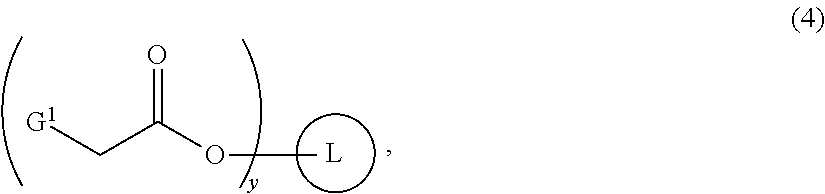
wherein
L is a linker corresponding with the backbone of:
-
- (a) a monomeric polyol having x hydroxyl substituents, each bonded to a different carbon atom;
- (b) a water-soluble polymeric polyol having x mean hydroxyl substituents, each bonded to a different carbon atom; or
- (c) a water-insoluble polymeric polyol suitable for use as a solid phase support having x mean hydroxyl substituents, each bonded to a different carbon atom; and
wherein the hydroxyl substituents of the polyol provide the oxygen atoms in the ester connection in the compounds of Formula (3) and Formula (4);
G1 is a leaving group;
x, y and z are each at least 2; and
z≤y≤x.

wherein
L is a linker corresponding with the backbone of either:
-
- (a) a monomeric polyol having x hydroxyl substituents, each bonded to a different carbon atom;
- (b) a water-soluble polymeric polyol having x mean hydroxyl substituents, each bonded to a different carbon atom; or
- (c) a water-insoluble polymeric polyol suitable for use as a solid phase support having x mean hydroxyl substituents, each bonded to a different carbon atom; and
wherein the hydroxyl substituents of the polyol provide the oxygen atoms in the ester connection in the compound of Formula (3);
x and z are each at least 2; and
z≤x.


wherein
L is a linker corresponding with the backbone of either:
-
- (a) a monomeric polyol having x hydroxyl substituents, each bonded to a different carbon atom;
- (b) a water-soluble polymeric polyol having x mean hydroxyl substituents, each bonded to a different carbon atom; or
- (c) a water-insoluble polymeric polyol suitable for use as a solid phase support having x mean hydroxyl substituents, each bonded to a different carbon atom; and
wherein the hydroxyl substituents of the polyol provide the oxygen atoms in the ester connection in the compound of Formula (2);
x and z1 are each at least 2; and
z1≤x.


or a salt thereof, the process comprising:
-
- (i) reaction of a compound of Formula (9):

in the presence of a base (B5) and a solvent (S7), with a compound of Formula (8):

wherein
R2 is selected from the group consisting of H, an aliphatic group, a substituted aliphatic group, aryl, substituted aryl, arylalkyl, substituted arylalkyl; and
G4 is a leaving group; and
-
- (ii) when R2 is not H, hydrolysis of the product formed in the reaction of the compounds of Formula (8) and Formula (9) to provide Lesinurad (1).

with a base (B4),
wherein
R is selected from the group consisting of aliphatic, substituted aliphatic, aryl, substituted aryl, arylalkyl and substituted arylalkyl groups.

with a brominating agent,
wherein
R1 is selected from the group consisting of aliphatic, substituted aliphatic, aryl, substituted aryl, arylalkyl and substituted arylalkyl groups.

in the presence of a solvent (S4), with a compound of Formula (12)

wherein
R1 is selected from the group consisting of aliphatic, substituted aliphatic, aryl, substituted aryl, arylalkyl and substituted arylalkyl groups; and
G3 is a leaving group.

wherein
R1 is selected from the group consisting of aliphatic, substituted aliphatic, aryl, substituted aryl, arylalkyl and substituted arylalkyl groups.

wherein
R1 is selected from the group consisting of aliphatic, substituted aliphatic, aryl, substituted aryl, arylalkyl and substituted arylalkyl groups;
with the proviso that R is not ethyl.
-
- (a) a monomeric polyol having x hydroxyl substituents, each bonded to a different carbon atom;
- (b) a water-soluble polymeric polyol having x mean hydroxyl substituents, each bonded to a different carbon atom; or
- (c) a water-insoluble polymeric polyol suitable for use as a solid phase support having x mean hydroxyl substituents, each bonded to a different carbon atom;
wherein the hydroxyl substituents of the polyol provide the oxygen atoms in the ester connection in the compounds of Formulas (2), (3) and (4);
G1 and G2 are each independently a leaving group;
x, y, z and z1 are each at least 2; and
z1≤z≤y≤x.

the process comprising reaction of a compound of Formula (7):

with a compound of Formula (6):

wherein
L is a linker corresponding with the backbone of either:
-
- (a) a monomeric polyol having x hydroxyl substituents, each bonded to a different carbon atom;
- (b) a water-soluble polymeric polyol having x mean hydroxyl substituents, each bonded to a different carbon atom; or
- (c) a water-insoluble polymeric polyol suitable for use as a solid phase support having x mean hydroxyl, each bonded to a different carbon atom;
wherein the hydroxyl substituents of the polyol provide the oxygen atoms in the ester connection in the compounds of Formulas (2), (3) and (4);
G1 and G2 are each independently a leaving group;
x and y are each at least 2; and
y≤x.

the process comprising reaction of a compound of Formula (5):

in the presence of a base (B1) and a solvent (51), with a compound of Formula (4)

wherein
L is as described above
G1 is a leaving group;
x, y and z are each at least 2; and
z≤y≤x.

the process comprising reacting, in the presence of a solvent (S2), a compound of Formula (3):

with a brominating agent,
wherein L is as defined above;
z and z1 are each at least 2; and
z1≤z.

or a salt thereof, the process comprising hydrolysis, in the presence of a solvent (S3), of a compound of Formula (2):

wherein L and z1 are as defined above.

wherein L and z are as defined above.

wherein
L and z1 are as defined above.


the process comprising reaction of a compound of Formula (5):

in the presence of a solvent (S4), with a compound of Formula (12)

wherein R1 is as defined above.

the process comprising treatment, in the presence of a solvent (S5), of a compound of Formula (11):

with a brominating agent,
wherein R1 is as defined above.

the process comprising reaction, in the presence of a solvent (S6), of a compound of Formula (10):

with a base (B4),
wherein R1 is as defined above.

or a salt thereof, the process comprising:
-
- (i) reaction of a compound of Formula (9):
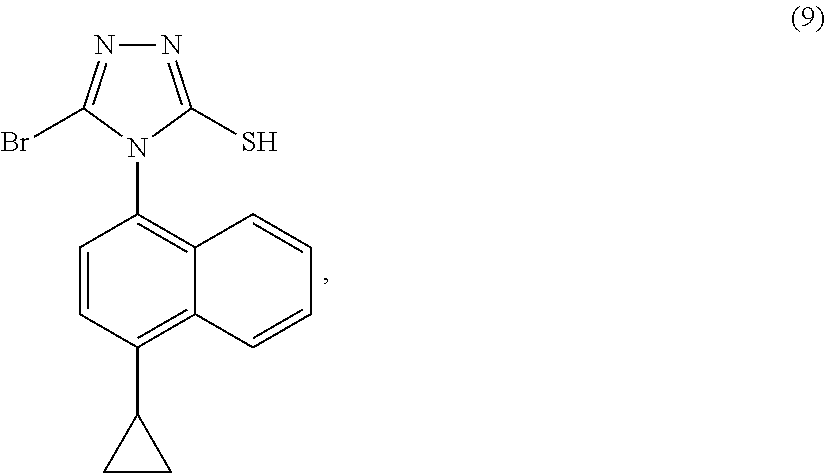
in the presence of a base (B5) and a solvent (S7), with a compound of Formula (8):

wherein G4 is a leaving group, and
R2 is as defined above; and
-
- (ii) if required when R2 is not H, hydrolysis of the compound of formula (13):

to form Lesinurad (1).

wherein R1 is as defined above.

wherein R1 is as defined above, with the proviso that R is not ethyl.


Claims (20)


Priority Applications (1)
| Application Number | Priority Date | Filing Date | Title |
|---|---|---|---|
| US15/914,165 US10351537B2 (en) | 2017-03-10 | 2018-03-07 | Processes for the preparation of lesinurad and intermediates thereof |
Applications Claiming Priority (2)
| Application Number | Priority Date | Filing Date | Title |
|---|---|---|---|
| US201762469656P | 2017-03-10 | 2017-03-10 | |
| US15/914,165 US10351537B2 (en) | 2017-03-10 | 2018-03-07 | Processes for the preparation of lesinurad and intermediates thereof |
Publications (2)
| Publication Number | Publication Date |
|---|---|
| US20180258057A1 US20180258057A1 (en) | 2018-09-13 |
| US10351537B2 true US10351537B2 (en) | 2019-07-16 |
Family
ID=63446117
Family Applications (1)
| Application Number | Title | Priority Date | Filing Date |
|---|---|---|---|
| US15/914,165 Active US10351537B2 (en) | 2017-03-10 | 2018-03-07 | Processes for the preparation of lesinurad and intermediates thereof |
Country Status (1)
| Country | Link |
|---|---|
| US (1) | US10351537B2 (en) |
Families Citing this family (2)
| Publication number | Priority date | Publication date | Assignee | Title |
|---|---|---|---|---|
| CN111116500B (en) * | 2019-12-30 | 2021-06-08 | 北京鑫开元医药科技有限公司海南分公司 | A kind of purification method of key intermediate of Recinade |
| CN111116501B (en) * | 2019-12-30 | 2021-03-12 | 北京鑫开元医药科技有限公司海南分公司 | Synthesis method of Ravinard intermediate capable of effectively reducing impurity content |
Citations (8)
| Publication number | Priority date | Publication date | Assignee | Title |
|---|---|---|---|---|
| WO2009070740A2 (en) | 2007-11-27 | 2009-06-04 | Ardea Biosciences Inc. | Novel compounds and compositions and methods of use |
| US8003681B2 (en) * | 2004-08-25 | 2011-08-23 | Ardea Biosciences, Inc. | 2-(5-bromo-4-(4-cyclopropylnaphthalen-1-yl)-4H-1,2,4-triazol-3-ylthio)acetic acid and methyl ester |
| WO2014008295A1 (en) | 2012-07-03 | 2014-01-09 | Ardea Biosciences, Inc. | Manufacture of 2- (5- bromo-4 (-cyclopropylnaphthalen-1-yl) -4h-1,2,4-triazol-3-ylthio) acetic acid |
| WO2014198241A1 (en) | 2013-06-14 | 2014-12-18 | Sunshine Lake Pharma Co., Ltd. | Thio-1,2,4-triazole derivatives and method for preparing the same |
| WO2015054960A1 (en) | 2013-10-15 | 2015-04-23 | 苏州鹏旭医药科技有限公司 | Gout drug lesinurad preparation method, and lesinurad intermediate |
| CN105017168A (en) | 2015-07-01 | 2015-11-04 | 安徽万邦医药科技有限公司 | New preparation method of [5-bromo-4-(4-cyclopropyl-naphthalene-1-yl)-4H-[1, 2, 4]triazole-3-ylsulfanyl]-methyl acetate |
| CN105153056A (en) | 2015-07-01 | 2015-12-16 | 安徽万邦医药科技有限公司 | New preparation method of [5-bromo-4-(4-cyclopropyl-naphthalene-1-yl)-4H-[1, 2, 4]triazole-3-ylthioalkyl]-methyl acetate |
| CN105566237A (en) | 2016-03-01 | 2016-05-11 | 山东大学 | Preparing method of triazole thioglycolic acid compound for curing metabolic arthritis |
-
2018
- 2018-03-07 US US15/914,165 patent/US10351537B2/en active Active
Patent Citations (10)
| Publication number | Priority date | Publication date | Assignee | Title |
|---|---|---|---|---|
| US8003681B2 (en) * | 2004-08-25 | 2011-08-23 | Ardea Biosciences, Inc. | 2-(5-bromo-4-(4-cyclopropylnaphthalen-1-yl)-4H-1,2,4-triazol-3-ylthio)acetic acid and methyl ester |
| WO2009070740A2 (en) | 2007-11-27 | 2009-06-04 | Ardea Biosciences Inc. | Novel compounds and compositions and methods of use |
| US8546437B2 (en) | 2007-11-27 | 2013-10-01 | Ardea Biosciences, Inc. | Compounds and compositions and methods of use |
| WO2014008295A1 (en) | 2012-07-03 | 2014-01-09 | Ardea Biosciences, Inc. | Manufacture of 2- (5- bromo-4 (-cyclopropylnaphthalen-1-yl) -4h-1,2,4-triazol-3-ylthio) acetic acid |
| US9296709B2 (en) | 2012-07-03 | 2016-03-29 | Ardea Biosciences, Inc. | Manufacture of 2-(5-bromo-4-(4-cyclopropylnaphthalen-1-yl)-4H-1,2,4-triazol-3-ylthio)acetic acid |
| WO2014198241A1 (en) | 2013-06-14 | 2014-12-18 | Sunshine Lake Pharma Co., Ltd. | Thio-1,2,4-triazole derivatives and method for preparing the same |
| WO2015054960A1 (en) | 2013-10-15 | 2015-04-23 | 苏州鹏旭医药科技有限公司 | Gout drug lesinurad preparation method, and lesinurad intermediate |
| CN105017168A (en) | 2015-07-01 | 2015-11-04 | 安徽万邦医药科技有限公司 | New preparation method of [5-bromo-4-(4-cyclopropyl-naphthalene-1-yl)-4H-[1, 2, 4]triazole-3-ylsulfanyl]-methyl acetate |
| CN105153056A (en) | 2015-07-01 | 2015-12-16 | 安徽万邦医药科技有限公司 | New preparation method of [5-bromo-4-(4-cyclopropyl-naphthalene-1-yl)-4H-[1, 2, 4]triazole-3-ylthioalkyl]-methyl acetate |
| CN105566237A (en) | 2016-03-01 | 2016-05-11 | 山东大学 | Preparing method of triazole thioglycolic acid compound for curing metabolic arthritis |
Also Published As
| Publication number | Publication date |
|---|---|
| US20180258057A1 (en) | 2018-09-13 |
Similar Documents
| Publication | Publication Date | Title |
|---|---|---|
| CN105263913B (en) | Thio 1,2,4 triazole derivative and preparation method thereof | |
| WO2009116657A1 (en) | Method for producing cycloalkanedicarboxylic acid monoester | |
| JP4823546B2 (en) | Method for producing (meth) acrylic acid ester derivative having isocyanate group | |
| CN102686551A (en) | Method for producing naphthenic dicarboxylic acid monoester | |
| US10125085B2 (en) | Method for producing 2-halogen-acrylic acid esters | |
| CN114085234A (en) | Process for preparing 1, 3-benzodioxole heterocycles | |
| US10633319B2 (en) | Method of producing solution composition containing monoetherified product, solution composition, and method of producing polymerizable compound | |
| US20180258057A1 (en) | Processes for the Preparation of Lesinurad and Intermediates Thereof | |
| US20120022091A1 (en) | Key intermediates for the synthesis of rosuvastatin or pharmaceutically acceptable salts thereof | |
| US11384041B2 (en) | Process for preparing an alkoxymethyl alkynyl ether compound having a terminal triple bond | |
| CZ33398A3 (en) | Process for preparing halogenated o-hydroxydiphenyl derivatives and their use | |
| US8324411B2 (en) | Process for the preparation of DIACEREIN | |
| JP5403485B2 (en) | 1,4-Dihydroanthracene-9,10-diether compound and process for producing the same | |
| JP2722673B2 (en) | Process for producing optically active acylbiphenyl derivatives | |
| CA2098366A1 (en) | Substituted (benzothiazolyl- and quinoxalyl-methoxy) phenyl-acetic acid derivatives | |
| JP3606615B2 (en) | 3,3'-diphenyl-4,4'-dihydroxybiphenyl derivative and method for producing the same | |
| JP2013139427A (en) | Method of improving and synthesizing isoquinolin-4(3h)-ones | |
| CN111918862B (en) | Process for producing mercaptophenol compound and intermediate therefor | |
| JP2007106749A (en) | Method for producing hydroquinone mono (meth) acrylate | |
| JP3118596B2 (en) | Method for producing aryldialkylthiocarbamate, 2-mercaptobenzaldehyde and 2-substituted benzo [b] thiophene | |
| WO2023037184A2 (en) | Novel process for the preparation of bilastine and intermediates thereof | |
| JP5483065B2 (en) | Epoxy acrylate having anthracene skeleton and process for producing the same | |
| JP6464659B2 (en) | (Meth) acryloyloxyadamantanecarboxylic acid compound and method for producing the same | |
| US20170305809A1 (en) | Agent for introducing protecting group for hydroxy group and/or mercapto group | |
| KR101557808B1 (en) | PROCESS FOR PRODUCING FLUOROALKYLSULFONYLAMINOETHYL α-SUBSTITUTED-ACRYLATE |
Legal Events
| Date | Code | Title | Description |
|---|---|---|---|
| FEPP | Fee payment procedure |
Free format text: ENTITY STATUS SET TO UNDISCOUNTED (ORIGINAL EVENT CODE: BIG.); ENTITY STATUS OF PATENT OWNER: LARGE ENTITY |
|
| AS | Assignment |
Owner name: APOTEX INC., CANADA Free format text: ASSIGNMENT OF ASSIGNORS INTEREST;ASSIGNORS:BODHURI, PRABHUDAS;GREEN, MELANIE R. A.;KARADEOLIAN, AVEDIS;AND OTHERS;SIGNING DATES FROM 20180309 TO 20180312;REEL/FRAME:045665/0664 |
|
| STPP | Information on status: patent application and granting procedure in general |
Free format text: NOTICE OF ALLOWANCE MAILED -- APPLICATION RECEIVED IN OFFICE OF PUBLICATIONS |
|
| STPP | Information on status: patent application and granting procedure in general |
Free format text: PUBLICATIONS -- ISSUE FEE PAYMENT VERIFIED |
|
| STCF | Information on status: patent grant |
Free format text: PATENTED CASE |
|
| MAFP | Maintenance fee payment |
Free format text: PAYMENT OF MAINTENANCE FEE, 4TH YEAR, LARGE ENTITY (ORIGINAL EVENT CODE: M1551); ENTITY STATUS OF PATENT OWNER: LARGE ENTITY Year of fee payment: 4 |
|
| AS | Assignment |
Owner name: THE BANK OF NOVA SCOTIA, CANADA Free format text: SECURITY INTEREST;ASSIGNOR:APOTEX INC.;REEL/FRAME:063364/0710 Effective date: 20230401 |