US10350313B2 - Targeting aptamer for atherosclerosis and preparation method and application thereof - Google Patents

Targeting aptamer for atherosclerosis and preparation method and application thereof Download PDF

Info

Publication number
US10350313B2
US10350313B2 US14/763,815 US201314763815A US10350313B2 US 10350313 B2 US10350313 B2 US 10350313B2 US 201314763815 A US201314763815 A US 201314763815A US 10350313 B2 US10350313 B2 US 10350313B2
Authority
US
United States
Prior art keywords
atherosclerosis
targeting
contrast agent
aptamer
ferriferrous oxide
Prior art date
Legal status (The legal status is an assumption and is not a legal conclusion. Google has not performed a legal analysis and makes no representation as to the accuracy of the status listed.)
Expired - Fee Related, expires
Application number
US14/763,815
Other versions
US20150359910A1 (en
Inventor
Pengke YAN
Current Assignee (The listed assignees may be inaccurate. Google has not performed a legal analysis and makes no representation or warranty as to the accuracy of the list.)
Guangzhou Tongpeng Zhongxu Pharmaceutical Co Ltd
Original Assignee
Guangzhou Tongpeng Zhongxu Pharmaceutical Co Ltd
Priority date (The priority date is an assumption and is not a legal conclusion. Google has not performed a legal analysis and makes no representation as to the accuracy of the date listed.)
Filing date
Publication date
Application filed by Guangzhou Tongpeng Zhongxu Pharmaceutical Co Ltd filed Critical Guangzhou Tongpeng Zhongxu Pharmaceutical Co Ltd
Assigned to GUANGZHOU TONGPENG ZHONGXU PHARMACEUTICAL CO., LTD. reassignment GUANGZHOU TONGPENG ZHONGXU PHARMACEUTICAL CO., LTD. ASSIGNMENT OF ASSIGNORS INTEREST (SEE DOCUMENT FOR DETAILS). Assignors: YAN, Pengke
Publication of US20150359910A1 publication Critical patent/US20150359910A1/en
Application granted granted Critical
Publication of US10350313B2 publication Critical patent/US10350313B2/en
Expired - Fee Related legal-status Critical Current
Adjusted expiration legal-status Critical

Links

Images

Classifications

    • AHUMAN NECESSITIES
    • A61MEDICAL OR VETERINARY SCIENCE; HYGIENE
    • A61KPREPARATIONS FOR MEDICAL, DENTAL OR TOILETRY PURPOSES
    • A61K49/00Preparations for testing in vivo
    • A61K49/06Nuclear magnetic resonance [NMR] contrast preparations; Magnetic resonance imaging [MRI] contrast preparations
    • A61K49/18Nuclear magnetic resonance [NMR] contrast preparations; Magnetic resonance imaging [MRI] contrast preparations characterised by a special physical form, e.g. emulsions, microcapsules, liposomes
    • A61K49/1818Nuclear magnetic resonance [NMR] contrast preparations; Magnetic resonance imaging [MRI] contrast preparations characterised by a special physical form, e.g. emulsions, microcapsules, liposomes particles, e.g. uncoated or non-functionalised microparticles or nanoparticles
    • A61K49/1821Nuclear magnetic resonance [NMR] contrast preparations; Magnetic resonance imaging [MRI] contrast preparations characterised by a special physical form, e.g. emulsions, microcapsules, liposomes particles, e.g. uncoated or non-functionalised microparticles or nanoparticles coated or functionalised microparticles or nanoparticles
    • A61K49/1824Nuclear magnetic resonance [NMR] contrast preparations; Magnetic resonance imaging [MRI] contrast preparations characterised by a special physical form, e.g. emulsions, microcapsules, liposomes particles, e.g. uncoated or non-functionalised microparticles or nanoparticles coated or functionalised microparticles or nanoparticles coated or functionalised nanoparticles
    • A61K49/1827Nuclear magnetic resonance [NMR] contrast preparations; Magnetic resonance imaging [MRI] contrast preparations characterised by a special physical form, e.g. emulsions, microcapsules, liposomes particles, e.g. uncoated or non-functionalised microparticles or nanoparticles coated or functionalised microparticles or nanoparticles coated or functionalised nanoparticles having a (super)(para)magnetic core, being a solid MRI-active material, e.g. magnetite, or composed of a plurality of MRI-active, organic agents, e.g. Gd-chelates, or nuclei, e.g. Eu3+, encapsulated or entrapped in the core of the coated or functionalised nanoparticle
    • A61K49/1833Nuclear magnetic resonance [NMR] contrast preparations; Magnetic resonance imaging [MRI] contrast preparations characterised by a special physical form, e.g. emulsions, microcapsules, liposomes particles, e.g. uncoated or non-functionalised microparticles or nanoparticles coated or functionalised microparticles or nanoparticles coated or functionalised nanoparticles having a (super)(para)magnetic core, being a solid MRI-active material, e.g. magnetite, or composed of a plurality of MRI-active, organic agents, e.g. Gd-chelates, or nuclei, e.g. Eu3+, encapsulated or entrapped in the core of the coated or functionalised nanoparticle having a (super)(para)magnetic core coated or functionalised with a small organic molecule
    • A61K49/1848Nuclear magnetic resonance [NMR] contrast preparations; Magnetic resonance imaging [MRI] contrast preparations characterised by a special physical form, e.g. emulsions, microcapsules, liposomes particles, e.g. uncoated or non-functionalised microparticles or nanoparticles coated or functionalised microparticles or nanoparticles coated or functionalised nanoparticles having a (super)(para)magnetic core, being a solid MRI-active material, e.g. magnetite, or composed of a plurality of MRI-active, organic agents, e.g. Gd-chelates, or nuclei, e.g. Eu3+, encapsulated or entrapped in the core of the coated or functionalised nanoparticle having a (super)(para)magnetic core coated or functionalised with a small organic molecule the small organic molecule being a silane
    • AHUMAN NECESSITIES
    • A61MEDICAL OR VETERINARY SCIENCE; HYGIENE
    • A61KPREPARATIONS FOR MEDICAL, DENTAL OR TOILETRY PURPOSES
    • A61K49/00Preparations for testing in vivo
    • A61K49/06Nuclear magnetic resonance [NMR] contrast preparations; Magnetic resonance imaging [MRI] contrast preparations
    • A61K49/08Nuclear magnetic resonance [NMR] contrast preparations; Magnetic resonance imaging [MRI] contrast preparations characterised by the carrier
    • A61K49/085Nuclear magnetic resonance [NMR] contrast preparations; Magnetic resonance imaging [MRI] contrast preparations characterised by the carrier conjugated systems
    • AHUMAN NECESSITIES
    • A61MEDICAL OR VETERINARY SCIENCE; HYGIENE
    • A61KPREPARATIONS FOR MEDICAL, DENTAL OR TOILETRY PURPOSES
    • A61K49/00Preparations for testing in vivo
    • A61K49/06Nuclear magnetic resonance [NMR] contrast preparations; Magnetic resonance imaging [MRI] contrast preparations
    • A61K49/18Nuclear magnetic resonance [NMR] contrast preparations; Magnetic resonance imaging [MRI] contrast preparations characterised by a special physical form, e.g. emulsions, microcapsules, liposomes
    • A61K49/1818Nuclear magnetic resonance [NMR] contrast preparations; Magnetic resonance imaging [MRI] contrast preparations characterised by a special physical form, e.g. emulsions, microcapsules, liposomes particles, e.g. uncoated or non-functionalised microparticles or nanoparticles
    • A61K49/1821Nuclear magnetic resonance [NMR] contrast preparations; Magnetic resonance imaging [MRI] contrast preparations characterised by a special physical form, e.g. emulsions, microcapsules, liposomes particles, e.g. uncoated or non-functionalised microparticles or nanoparticles coated or functionalised microparticles or nanoparticles
    • A61K49/1824Nuclear magnetic resonance [NMR] contrast preparations; Magnetic resonance imaging [MRI] contrast preparations characterised by a special physical form, e.g. emulsions, microcapsules, liposomes particles, e.g. uncoated or non-functionalised microparticles or nanoparticles coated or functionalised microparticles or nanoparticles coated or functionalised nanoparticles
    • A61K49/1827Nuclear magnetic resonance [NMR] contrast preparations; Magnetic resonance imaging [MRI] contrast preparations characterised by a special physical form, e.g. emulsions, microcapsules, liposomes particles, e.g. uncoated or non-functionalised microparticles or nanoparticles coated or functionalised microparticles or nanoparticles coated or functionalised nanoparticles having a (super)(para)magnetic core, being a solid MRI-active material, e.g. magnetite, or composed of a plurality of MRI-active, organic agents, e.g. Gd-chelates, or nuclei, e.g. Eu3+, encapsulated or entrapped in the core of the coated or functionalised nanoparticle
    • A61K49/1851Nuclear magnetic resonance [NMR] contrast preparations; Magnetic resonance imaging [MRI] contrast preparations characterised by a special physical form, e.g. emulsions, microcapsules, liposomes particles, e.g. uncoated or non-functionalised microparticles or nanoparticles coated or functionalised microparticles or nanoparticles coated or functionalised nanoparticles having a (super)(para)magnetic core, being a solid MRI-active material, e.g. magnetite, or composed of a plurality of MRI-active, organic agents, e.g. Gd-chelates, or nuclei, e.g. Eu3+, encapsulated or entrapped in the core of the coated or functionalised nanoparticle having a (super)(para)magnetic core coated or functionalised with an organic macromolecular compound, i.e. oligomeric, polymeric, dendrimeric organic molecule
    • AHUMAN NECESSITIES
    • A61MEDICAL OR VETERINARY SCIENCE; HYGIENE
    • A61KPREPARATIONS FOR MEDICAL, DENTAL OR TOILETRY PURPOSES
    • A61K49/00Preparations for testing in vivo
    • A61K49/06Nuclear magnetic resonance [NMR] contrast preparations; Magnetic resonance imaging [MRI] contrast preparations
    • A61K49/18Nuclear magnetic resonance [NMR] contrast preparations; Magnetic resonance imaging [MRI] contrast preparations characterised by a special physical form, e.g. emulsions, microcapsules, liposomes
    • A61K49/1818Nuclear magnetic resonance [NMR] contrast preparations; Magnetic resonance imaging [MRI] contrast preparations characterised by a special physical form, e.g. emulsions, microcapsules, liposomes particles, e.g. uncoated or non-functionalised microparticles or nanoparticles
    • A61K49/1821Nuclear magnetic resonance [NMR] contrast preparations; Magnetic resonance imaging [MRI] contrast preparations characterised by a special physical form, e.g. emulsions, microcapsules, liposomes particles, e.g. uncoated or non-functionalised microparticles or nanoparticles coated or functionalised microparticles or nanoparticles
    • A61K49/1824Nuclear magnetic resonance [NMR] contrast preparations; Magnetic resonance imaging [MRI] contrast preparations characterised by a special physical form, e.g. emulsions, microcapsules, liposomes particles, e.g. uncoated or non-functionalised microparticles or nanoparticles coated or functionalised microparticles or nanoparticles coated or functionalised nanoparticles
    • A61K49/1827Nuclear magnetic resonance [NMR] contrast preparations; Magnetic resonance imaging [MRI] contrast preparations characterised by a special physical form, e.g. emulsions, microcapsules, liposomes particles, e.g. uncoated or non-functionalised microparticles or nanoparticles coated or functionalised microparticles or nanoparticles coated or functionalised nanoparticles having a (super)(para)magnetic core, being a solid MRI-active material, e.g. magnetite, or composed of a plurality of MRI-active, organic agents, e.g. Gd-chelates, or nuclei, e.g. Eu3+, encapsulated or entrapped in the core of the coated or functionalised nanoparticle
    • A61K49/1851Nuclear magnetic resonance [NMR] contrast preparations; Magnetic resonance imaging [MRI] contrast preparations characterised by a special physical form, e.g. emulsions, microcapsules, liposomes particles, e.g. uncoated or non-functionalised microparticles or nanoparticles coated or functionalised microparticles or nanoparticles coated or functionalised nanoparticles having a (super)(para)magnetic core, being a solid MRI-active material, e.g. magnetite, or composed of a plurality of MRI-active, organic agents, e.g. Gd-chelates, or nuclei, e.g. Eu3+, encapsulated or entrapped in the core of the coated or functionalised nanoparticle having a (super)(para)magnetic core coated or functionalised with an organic macromolecular compound, i.e. oligomeric, polymeric, dendrimeric organic molecule
    • A61K49/1857Nuclear magnetic resonance [NMR] contrast preparations; Magnetic resonance imaging [MRI] contrast preparations characterised by a special physical form, e.g. emulsions, microcapsules, liposomes particles, e.g. uncoated or non-functionalised microparticles or nanoparticles coated or functionalised microparticles or nanoparticles coated or functionalised nanoparticles having a (super)(para)magnetic core, being a solid MRI-active material, e.g. magnetite, or composed of a plurality of MRI-active, organic agents, e.g. Gd-chelates, or nuclei, e.g. Eu3+, encapsulated or entrapped in the core of the coated or functionalised nanoparticle having a (super)(para)magnetic core coated or functionalised with an organic macromolecular compound, i.e. oligomeric, polymeric, dendrimeric organic molecule the organic macromolecular compound being obtained otherwise than by reactions only involving carbon-to-carbon unsaturated bonds, e.g. PLGA
    • CCHEMISTRY; METALLURGY
    • C12BIOCHEMISTRY; BEER; SPIRITS; WINE; VINEGAR; MICROBIOLOGY; ENZYMOLOGY; MUTATION OR GENETIC ENGINEERING
    • C12NMICROORGANISMS OR ENZYMES; COMPOSITIONS THEREOF; PROPAGATING, PRESERVING, OR MAINTAINING MICROORGANISMS; MUTATION OR GENETIC ENGINEERING; CULTURE MEDIA
    • C12N15/00Mutation or genetic engineering; DNA or RNA concerning genetic engineering, vectors, e.g. plasmids, or their isolation, preparation or purification; Use of hosts therefor
    • C12N15/09Recombinant DNA-technology
    • C12N15/11DNA or RNA fragments; Modified forms thereof; Non-coding nucleic acids having a biological activity
    • C12N15/115Aptamers, i.e. nucleic acids binding a target molecule specifically and with high affinity without hybridising therewith ; Nucleic acids binding to non-nucleic acids, e.g. aptamers
    • CCHEMISTRY; METALLURGY
    • C12BIOCHEMISTRY; BEER; SPIRITS; WINE; VINEGAR; MICROBIOLOGY; ENZYMOLOGY; MUTATION OR GENETIC ENGINEERING
    • C12NMICROORGANISMS OR ENZYMES; COMPOSITIONS THEREOF; PROPAGATING, PRESERVING, OR MAINTAINING MICROORGANISMS; MUTATION OR GENETIC ENGINEERING; CULTURE MEDIA
    • C12N2310/00Structure or type of the nucleic acid
    • C12N2310/10Type of nucleic acid
    • C12N2310/16Aptamers
    • GPHYSICS
    • G01MEASURING; TESTING
    • G01RMEASURING ELECTRIC VARIABLES; MEASURING MAGNETIC VARIABLES
    • G01R33/00Arrangements or instruments for measuring magnetic variables
    • G01R33/20Arrangements or instruments for measuring magnetic variables involving magnetic resonance
    • G01R33/44Arrangements or instruments for measuring magnetic variables involving magnetic resonance using nuclear magnetic resonance [NMR]
    • G01R33/48NMR imaging systems
    • G01R33/54Signal processing systems, e.g. using pulse sequences ; Generation or control of pulse sequences; Operator console
    • G01R33/56Image enhancement or correction, e.g. subtraction or averaging techniques, e.g. improvement of signal-to-noise ratio and resolution
    • G01R33/5601Image enhancement or correction, e.g. subtraction or averaging techniques, e.g. improvement of signal-to-noise ratio and resolution involving use of a contrast agent for contrast manipulation, e.g. a paramagnetic, super-paramagnetic, ferromagnetic or hyperpolarised contrast agent

Definitions

  • the invention relates to a reagent for a magnetic resonance diagnosis, in particular to a targeting aptamer for atherosclerosis and preparation method and application thereof.
  • AS World Health Organization
  • AS The appearance and development of AS is a chronic and progressive process, typical AS conditions can be seen in young adults, but it is not easily to be detected, and serious clinical manifestations always appears a dozen years or several decades latter. Early diagnosis and intervention are crucially important to the disease development and prognosis of AS patients.
  • invasive diagnostic technologies now they are considered as “gold standard” for diagnosing AS, and comprise intravascular ultrasound, digital angiography, and angioscopy, all of them are invasive diagnostic technologies, wherein a catheter has to be inserted for forming images, their operations are complex, and they have a certain dangerousness and complications;
  • noninvasive AS diagnostic technologies comprise 1) multi-slice helical CT, which can obtain 256 slices simultaneously in less than 25 ms, and can provide an intact coronary angiography within 15 s. Its limitations are that in order to ensure image quality, the heart rate has to be decreased, and the spatial resolution is not high, limited by the time resolution, partial volume effect affects its density measurement, and at noncalcified plaques, especially at places with non-significant stenosis, plaques and blood vessel walls cannot be distinguished; 2) CT angiography, when being, used for AS diagnosis, the display of lesion areas is interfered by skeletal images, removing skeletal images by post processing consumes a long time and the effect is not good.
  • Magnetic resonance angiography is a noninvasive diagnostic technology used for diagnosis of blood vessel diseases in magnetic resonance imaging (MRI); the technology can display the stenosis degree by blood flow imaging, and avoid the disadvantages such as using a nephrotoxic contrast agent and ionizing radiation and the like in CT blood vessel image technology.
  • MRI black blood technique an imaging technique for observing blood vessel walls by means of the blood flow darkening
  • initial data such as the existences, sizes and morphologies etc. of plaques at a high resolution and repeatability, so as to indicate that using MRI for evaluating blood vessel walls is feasible.
  • Ultra-small superparamagnetic iron oxide is constituted by a single crystal core consisting of Fe 3 O 4 or Fe 2 O 3 and an outer layer coating.
  • USPIO particles After entering into an applied magnetic field, USPIO particles are distributed unevenly, which makes a non-uniform local magnetic field, generates a magnetizing effect, thus accelerates T 2 relaxation of proton dephasing, decreases signals of the tissue where they locates, but their influence to T 1 relaxation is relatively small, thus making them have properties of a relatively good negative contrast agent.
  • the half life of USPIO is long, R 1 /R 2 of USPIO is appropriate, and USPIO is low-osmotic in normal blood vessels, so USPIO can perform a first pass imaging and a high resolution scanning in the balanced phase. USPIO can be recognized and swallowed by macrophagocytes in AS plaques, so they can mark AS plaques. Schmitz et al.
  • USPIO is swallowed by macrophagocytes in the body, and it can be detected that the focal signal ratio in the inflammatory areas of AS plaques decreases.
  • the positive rate of iron microparticle histological examination in plaques significantly rises as the dosage increases, and USPIO mainly deposits on unstable plaques, and can be effectively imaged in MRI.
  • USPIO as the contrast agent in MRA for observing renal artery and coronary artery, as a result, they found that the imaging effect of the contrast agent for distal blood vessels and their branches is significant.
  • USPIO mainly are uptaken by Reticuloendothelial system (RES); USPIO has some targeting effect for AS blood vessels but the requirement of clinical diagnosis is difficult to achieve. Therefore, how to realize the targeting enrichment of USPIO in AS blood vessels, it is an important research direction for improving the accuracy rate in MRI diagnosis of AS.
  • RES Reticuloendothelial system
  • the purpose of the present invention is providing a targeting aptamer for atherosclerosis, which is used for a MRI targeting nano-contrast agent for atherosclerosis, only specifically binds macrophage-derived foam cells, binds avascular tissues with AS lesion with a high specificity, thus improving the targeting effect of the MRI targeting nano-contrast agent for atherosclerosis.
  • the second purpose of the present invention is providing a method for preparing the targeting aptamer for atherosclerosis.
  • the third purpose of the present invention is using the above-motioned targeting aptamer for atherosclerosis in an MRI targeting nano-contrast agent for atherosclerosis.
  • the fourth purpose of the present invention is providing an MRI targeting nano-contrast agent for atherosclerosis, improving the diagnosis effect for atherosclerosis, and lowering the toxic and side effect for normal tissues.
  • the fifth purpose of the present invention is providing a method for preparing an MRI targeting nano-contrast agent for atherosclerosis.
  • the targeting aptamer for atherosclerosis is a targeting aptamer fragment for atherosclerosis obtained through screening of macrophage-derived foam cells together with reverse screening of smooth muscle cells, endothelial cells, and THP-1 cells using a SELEX method.
  • a nucleotide sequence of said targeting aptamer fragment for atherosclerosis is SEQ ID No:1.
  • the nucleotide sequence of said targeting aptamer fragment for atherosclerosis is a sequence which has at least 80% homology with SEQ ID No:2.
  • the nucleotide sequence of said targeting aptamer fragment for atherosclerosis is SEQ ID No:2.
  • a method for preparing the targeting aptamer for atherosclerosis comprising the following steps using the SELEX method:
  • the oligonucleotide aptamer is obtained using screening of macrophage-derived foam cells together with reverse screening of smooth muscle cells, endothelial cells, and THP-1 cells;
  • the oligonucleotide aptamer screened in step 3) is subject to a PCR amplification, the product of the PCR amplification, after purification, is ligated to a pGEM-T vector, then is introduced into competent cells, white colonies are picked out using a blue-white spot screen plate and put into LB liquid medium containing 2 ml ampicillin for culturing, performing a PCR identification, sequencing, observing same by a fluorescence microscope, and picking out a specific aptamer;
  • step 1) the method for establishing the macrophage-derived foam cell model is: culturing THP-1 cells in a cell culture plate, incubating same with 100 nmol/L PMA for 60-84 hours, inducing same to differentiate into macrophages, then incubating same in 80mg/L oxLDL for 60-84 hours, inducing same to foam cells.
  • the method for constructing a FITC marked random ssDNA library is constructing a random ssDNA library with a length of 81 nt using a biological method, the ssDNA library being as the nucleotide sequence of SEQ ID No:1, both ends of the sequence of SEQ ID No:1 are fixed sequences, 35 nucleotides in the middle is a random sequence designing an upstream primer SEQ ID No:3 and a downstream primer SEQ ID No:4, wherein the upstream primer is marked with FITC and the downstream primer is marked with Biotin, the random ssDNA library is subject to a PCR amplification, the PRC product is dissolved in PBS solution after agarose electrophoresis, gel cutting and recovery, binding same with streptavidin magnesphere via a chain with Biotin, performing degeneration, eluting the chain with FITC marker from the streptavidin magnesphere, neutralizing same with hydrochloric acid, precipitating
  • the PCR amplification system is; ssDNA template 0.1 ug, 10 ⁇ PCR buffer 10 ul, MgCl 2 2 ul, dNTPs 1 ul, the upstream primer represented by SEQ ID No:3 50 pmol, the downstream primer represented by SEQ ID No:4 50 pmol, Taq enzyme 2U, supplementing deionized water to 100 ul;
  • the amplification condition is: pre-degeneration at 94° C. for 3 minutes, degeneration at 94° C. for 40 seconds, annealing at 72° C. for 1 minute, extension at 72° C. for 1 minute, finally, extension at 72° C. for 7 minutes again.
  • the method for preparing the targeting aptamer for atherosclerosis of the present invention further comprises in the reaction of step 4), adding yeast tRNA as a competitive conjugate, and performing a cycle of reverse screening after each cycle of screening.
  • a MRI targeting nano-contrast agent for atherosclerosis comprising the above-mentioned targeting aptamer for atherosclerosis and vector which connected to the targeting aptamer for atherosclerosis.
  • said vector can be selected from glucan coated Fe 3 O 4 , chitosan coated Fe 3 O 4 or silane coated Fe 3 O 4 nanoparticle vectors.
  • said vector is a silane coated Fe 3 O 4 nanoparticle vector; said targeting aptamer for atherosclerosis is covalently connected to the silane in said vector via. glutaral as a bridge.
  • the mass ratio of said vector and the targeting aptamer is (5-10):1.
  • the ratio of the total mass of the ferriferrous oxide nanoparticles and the mass of the silane is 1:(3-8).
  • the mean particle size of the ferriferous oxide nanoparticles is 10-15 nanometer and the total particle size of the silane coated ferriferrous oxide nanoparticles is 30-100 nanometer.
  • the magnetic parameters of the MRI targeting nano-contrast agent for atherosclerosis of the present invention are T 2 relaxation rate of 0.2842 ⁇ 10 6 mol ⁇ 1 ⁇ s ⁇ 1 , and the mass saturated magnetization intensity of 108 emu ⁇ g ⁇ 1 Fe.
  • the silane used in the present invention is 3 -aminopropylethoxysilane.
  • a method for preparing the MRI targeting nano-contrast agent for atherosclerosis comprises following steps:
  • step 2) synthesis of a contrast agent: washing the silane coated ferriferrous oxide nanoparticle vector obtained from step 1) with water and an alcohol alternately, dissolving the above-mentioned targeting aptamer and silane coated ferriferrous oxide nanoparticle vector in PBS solutions respectively, then adding the PBS solution of the targeting aptamer for atherosclerosis into the PBS solution of the silane coated ferriferrous oxide nanoparticle vector, and adding a glutaral, placing same on a shaking table for vibration; separating products with a magnet, removing the supernatant, and washing same with the PBS solution.
  • step 1) is carried out according to following steps:
  • ferriferrous oxide a) preparation of ferriferrous oxide: mixing ferric trichloride and ferrous sulfate at a molar ratio of (1.5-2.5):1, the temperature is set at 27-35° C. when refluxing, slowly dropwise adding ammonia water during the refluxing to pH>9, after curing for 20-40 minutes, raising the temperature to 60° C., continuously refluxing same for 0.5-1.5 hours, then separating out ferriferous oxide with a magnet, and washing same with deionized water and anhydrous ethanol, each 2-4 times, to obtain ferriferrous oxide;
  • the pH of the PBS solution used in step 2) is 7.4.
  • the frequency of said shaking table is 100 r/min
  • the temperature is 25° C.
  • the vibration time is 0.5-1.5 hours.
  • the beneficial effects of the present invention are: the targeting aptamer for atherosclerosis of the present invention only specifically binds macrophage-derived foam cells, and does not binds macrophages, normal smooth muscle cells, endothelial cells, fat cells, and liver cells etc; the in vivo binding experiments using apolipoprotein E gene knockout mice and New Zealand rabbit high-fat feeding AS model show that the aptamer can bind to vascular tissues with AS lesion with a high specificity.
  • the MRI targeting nano-contrast agent for atherosclerosis of the present invention can distribute to living atherosclerosis plaques in a large amount, this increases the target/nontarget ratio; furthermore, the magnetic resonance images have the advantages of a longer imaging time window, a high spatial and time resolutions, and a good contrast etc., scanning an animal into which the contrast agent of the present invention is introduced results a magnetic resonance image having a clear anatomic structure, high signal noise ratio and good contrast, not only the sizes and sites of atherosclerosis plaques, the anatomical relationship thereof with the surrounding structure and the change of signal strength can be seen, but also the imaging effect of the present invention in different stages of atherosclerosis disease can be seen.
  • the atherosclerosis site and the plaque sizes can be detected using the MRI targeting nano-contrast agent for atherosclerosis of the present invention, and the disease stages also can be further indicated, therefore the early specific diagnosis of atherosclerosis can be realized.
  • FIG. 1 is the polyacrylamide gel electrophoresis photo of the contrast agent of the present invention: 1: 100 bp Mark; 2: 5′-NH 2 -targeting aptamer; 3-6: the final product of 0.1, 0.2, 0.5, 1 mL 3-aminoproppyltriethoxysilane coated Fe 3 O 4 coupling with 33 ⁇ g 5′-NH 2 -targeting aptamer; 7: 3-aminopropyltriethoxysilane coated Fe 3 O 4 ;
  • FIG. 2 is the transmission electron microscope photo in the detection method using the contrast agent of the present invention
  • FIG. 3 is the relaxation rate profile of the silane coated ferriferrous oxide nanoparticle vector of the present invention.
  • FIG. 4 is the magnetization curve of the silane coated ferriferrous oxide nanoparticle vector of the present invention.
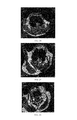
  • FIGS. 5-7 respectively are the 7T MRI photos of AS mouse group 30 min, 45 min and 120 min after being injected the contrast agent of the present invention; in FIG. 5 , where the white arrow points is AS lesion area; in FIG. 6 , where the white arrow points is multiple spot signal absent of AS lesion area; in FIG. 7 , where the white arrow points is signal recover of AS lesion area;
  • FIGS. 8-10 respectively are the 7T MRI photos of AS mouse group 30 min, 45 min and 120 min after being injected magnetic ferriferrous oxide nanoparticles; in FIG. 8 , where the white arrow points is AS lesion area; in FIG. 9 , the AS lesion signal does not change at which the white arrow points, in FIG. 10 , the AS lesion signal does not change at which the white arrow points;
  • FIGS. 11-13 respectively are the 7T MRI photos of normal mouse group 30 mm, 45 min and 120 min after being injected the contrast agent of the present invention; in FIG. 11 , where the white arrow points is normal artery; in FIG. 12 , where the white arrow points is normal artery, no signal changes; in FIG. 13 , where the white arrow points is normal artery, no signal changes;
  • FIGS. 14-16 respectively are the 7T MRI photos of normal mouse group 30 mM, 45 min and 120 min after being injected magnetic ferriferrous oxide nanoparticles; in FIG. 14 , where the white arrow points is normal artery; in FIG. 15 , where the white arrow points is normal artery, no signal changes; in FIG. 16 , where the white arrow points is normal artery, no signal changes;
  • FIGS. 17-20 respectively are the 3.0T MRI photos of AS New Zealand rabbit group 0 h, 1 h, 2 h, 3 h after being injected the contrast agent of the present invention; in FIG. 17 , where the white arrow points is AS lesion area; in FIG. 18 , where the white arrow points, the AS lesion area signal gradually disappear, the vascular wall is unclear; in FIG. 19 , where the white arrow points is signal spotted absent of AS lesion area; in FIG. 20 , where the white arrow points is signal recover of AS lesion area;
  • FIGS. 21-24 respectively are the 3.0T MRI photos of AS New Zealand rabbit group 0 h, 1 h, 2 h, 3 h after being injected magnetic ferriferrous oxide nanoparticles; in FIG. 21 , where the white arrow points is AS lesion area; in FIG. 22 , where the white arrow points is AS lesion area, no signal changes; in FIG. 23 , where the white arrow points is AS lesion area, no signal changes; in FIG. 24 , where the white arrow points is AS lesion area, no signal changes;
  • FIGS. 25-28 respectively are the 3.0 T MRI photos of normal New Zealand rabbit group 0 h, 1 h, 2 h, 3 h after being injected the contrast agent of the present invention; in FIG. 25 , where the white arrow points is normal blood vessel; in FIG. 26 , where the white arrow points is normal blood vessel, no signal changes; in FIG. 27 , where the white arrow points is normal blood vessel, no signal changes; in FIG. 28 , where the white arrow points is normal blood vessel, no signal changes;
  • FIGS. 29-32 respectively are the 3.0 T MRI photos of normal New Zealand rabbit group 0 h, 1 h, 2 h, 3 h after being injected magnetic ferriferrous oxide nanoparticles; in FIG. 29 , where the white arrow points is normal blood vessel; in FIG. 30 , where the white arrow points is normal blood vessel, no signal changes; in FIG. 31 , where the white arrow points is normal blood vessel, no signal changes; in FIG. 32 , where the white arrow points is normal blood vessel, no signal changes.
  • a targeting aptamer for atherosclerosis the preparation method thereof is:
  • endothelial cells rapidly tearing down the inner layer and middle layer of the medial membrane, cutting same into 1 mm wide small strips, steeping same in PBS solution containing blood serum, and planting the cut small tissue blocks on the culture bottle wall, putting same in an incubator at 37° C. for about 2 h, taking out the culture bottle, adding a culture solution containing 20% fetal calf serum, then putting same back to the incubator for stationary culture for 4 days, after the cells overspread the bottom, performing digestion passage using 0.25% trypsin, once every 2-3 days, culturing the cells in a 6 well plate before the experiments;
  • culturing endothelial cell line culturing endothelial cell line using high sugar DMEM medium containing 15% new-born calf serum in a CO 2 incubator with 5% CO 2 and saturated humidity at 37°C. Performing digestion passage using 0.25% trypsin, once every 2-3 days, culturing the cells in a 6 well plate before the experiments;
  • culturing THP-1 cells culturing THP-1 cell line using RPMI1640 medium containing 10% new-born calf serum in a CO 2 incubator with 5% CO 2 and saturated humidity at 37° C.; Performing passage using a direct separating bottle method, once every 2-3 days, culturing the cells in a 6 well plate before the experiments;
  • FITC marked random ssDNA library constructing a random ssDNA library with a length of 81 nt using a biological method, the ssDNA library being as the nucleotide sequence of SEQ ID No:1, both ends of the sequence of SEQ ID No:1 are fixed sequences, 35 nucleotides in the middle is a random sequence; designing an upstream primer SEQ ID No:3 and a downstream primer SEQ ID No:4, wherein the upstream primer is marked with FITC and the downstream primer is marked with Biotin, the random ssDNA library is subject to a PCR amplification, the PCR amplification system is: ssDNA template 0.1 ug, 10 ⁇ PCR buffer 10 ul, MgCl 2 2 ul, dNTPs 1 ul, the upstream primer represented by SEQ ID No:3 50 pmol, the downstream primer represented by SEQ ID No:4 50 pmol, Taq enzyme 2U, supplementing deionized water to 100 ul
  • 1 ⁇ binding Buffer in sequence, into the six well plate in which about 1 ⁇ 10 6 smooth muscle cells and macrophages are cultured, incubating same for 30 minutes respectively, then transferring the supernatant into a six well plate in which about 1 ⁇ 10 6 foam cells are cultured, incubating same for 30 minutes, removing the supernatant, washing same with 37° C. washing butler 6 times, washing off ssDNA which does not bind foam cells, then adding 800 ul eluant, performing heat denaturation at 80° C.
  • a silane coated ferriferrous oxide nanoparticle vector mixing ferric trichloride and ferrous sulfate at a molar ratio of 2:1, using nitrogen for protection, the temperature is set at 30° C. when refluxing, slowly dropwise adding ammonia water during the refluxing to pH>9, after curing for 30 minutes, raising the temperature to 60° C., continuously refluxing for 1 hour, then separating out ferriferrous oxide with a magnet, and washing same with deionized water and anhydrous ethanol in sequence, each 3 times, to obtain ferriferrous oxide; adding 3-aminopropylethoxysilane into deionized water, stirring same under room temperature, dropwise adding glacial acetic acid, adjusting pH to pH ⁇ 5; placing alcohol washed Fe 3 O 4 in a flask, adding anhydrous ethanol, then adding 3-aminopropylethoxysilane at pH ⁇ 5 (wherein the mass ratio of 3-aminopropylethoxysilane and Fe 3
  • FIG. 1 Polyacrylamide gel electrophoresis analysis of the contrast agent of the present invention: in FIG. 1 , 1: 100 bp Mark; 2: 5′-NH 2 -targeting aptamer; 3-6: the final products of 0.1, 0.2, 0.5, 1 mL 3-aminopropyltriethoxysilane coated Fe 3 O 4 coupling with 33 ⁇ g 5′-NH 2 -targeting aptamer; 7: 3-aminopropyltriethoxysilane coated Fe 3 O 4 ; the results of FIG. 1 show that the slime coated ferriferrous oxide nanoparticle vector in the contrast agent of the present invention can effectively connect to the targeting aptamer for atherosclerosis.
  • the contrast agent of the present invention is detected by a vibration sample magnetometer and magnetic resonance, the detection result show that the saturated magnetization intensity of the vector is 108 emu ⁇ g ⁇ 1 Fe, the relaxation rate is 0.2842 ⁇ 10 6 mol ⁇ 1 ⁇ s ⁇ 1 .
  • the magnetization curve is a single curve passing through the origin point, indicating that the contrast agent of the present invention has superparamagnetism.
  • FIGS. 5-16 Respectively injecting the targeting nano-contrast agent for atherosclerosis and magnetic ferriferrous oxide nanoparticles to AS mouse soup and normal mouse group for magnetic resonance imaging in vivo, the results are in FIGS. 5-16 .
  • the results of FIGS. 5-16 show that in AS mouse group, at 30 minutes after injecting the targeting nano-contrast agent for atherosclerosis, the signal strength of AS lesion area shows decreasing trend, the vascular walls are not smooth, showing multiple spot signal defects at 45 minutes, the signal strength decreases to the lowest, after that the signal begin to enhance, until after 2 hours, the signal strength recovers to almost the same as that before the injection.
  • the signal strength of blood vessel walls has no significant change all the time.
  • FIGS. 17-32 show that in AS New Zealand rabbit group, at 1 hour after injecting the target nano-contrast agent for atherosclerosis, the signal strength of AS lesion area shows decreasing trend, the vascular walls are not smooth, showing spotted signal defects, at 2 hours, the signal strength decreases to the lowest, after that the signal begin to enhance, until after 3 hours, the signal strength recovers to almost the same as that before the injection.
  • the signal strength of blood vessel walls has no significant change all the time.

Landscapes

  • Health & Medical Sciences (AREA)
  • Chemical & Material Sciences (AREA)
  • Engineering & Computer Science (AREA)
  • Nanotechnology (AREA)
  • Life Sciences & Earth Sciences (AREA)
  • Nuclear Medicine, Radiotherapy & Molecular Imaging (AREA)
  • General Health & Medical Sciences (AREA)
  • Molecular Biology (AREA)
  • Genetics & Genomics (AREA)
  • Radiology & Medical Imaging (AREA)
  • Epidemiology (AREA)
  • Animal Behavior & Ethology (AREA)
  • Public Health (AREA)
  • Veterinary Medicine (AREA)
  • Biomedical Technology (AREA)
  • Bioinformatics & Cheminformatics (AREA)
  • Zoology (AREA)
  • Organic Chemistry (AREA)
  • Biotechnology (AREA)
  • General Engineering & Computer Science (AREA)
  • Immunology (AREA)
  • Wood Science & Technology (AREA)
  • Biochemistry (AREA)
  • Physics & Mathematics (AREA)
  • Plant Pathology (AREA)
  • Biophysics (AREA)
  • Microbiology (AREA)
  • Medicines Containing Antibodies Or Antigens For Use As Internal Diagnostic Agents (AREA)
  • Pharmaceuticals Containing Other Organic And Inorganic Compounds (AREA)

Abstract

Disclosed are a targeting aptamer for atherosclerosis and a preparation method and application thereof. The targeting aptamer is a targeting aptamer fragment for atherosclerosis obtained through screening of macrophage-derived foam cells together with reverse screening of smooth muscle cells, endothelial cells, and THP-1 cells using a SELEX method; and the use of the targeting aptamer in preparation of an MRI targeting nano-contrast agent for atherosclerosis allows the specific binding of the MRI targeting nano-contrast agent for atherosclerosis only with the macrophage-derived foam cells, and allows high specific binding thereof with vascular tissues with AS lesion, this improving targeting effect of the MRI targeting nano-contrast agent for atherosclerosis and realizing early specific diagnosis of arterial sclerosis.

Description

CROSS REFERENCE TO RELATED APPLICATIONS
This application is the national phase entry of International Application No. PCT/CN2013/001248, filed on Oct. 14, 2013, which is based upon and claims priority to Chinese Patent Application No. 201310237217.X, filed on Jun. 14, 2013, the entire contents of which are incorporated herein by reference.
TECHNICAL FIELD
The invention relates to a reagent for a magnetic resonance diagnosis, in particular to a targeting aptamer for atherosclerosis and preparation method and application thereof.
BACKGROUND
According to the report of World Health Organization (WHO), the number of people died from atherosclerosis (AS) accounts for 52% of the number of people died from all diseases, which is far more than the number of people died from tumours that is the second cause of death (24%) and atherosclerosis has become the first killer threatening human's health. AS mainly involves large and medium scale muscle tension type arteries, wherein thickening of the arterial wall and luminal stenosis are main basis of clinical imaging diagnosis. However, recent studies indicate that the occurrence of clinical events caused by AS, such as acute coronary syndrome, always has no significant relevance with the arterial stenosis caused by AS. The appearance and development of AS is a chronic and progressive process, typical AS conditions can be seen in young adults, but it is not easily to be detected, and serious clinical manifestations always appears a dozen years or several decades latter. Early diagnosis and intervention are crucially important to the disease development and prognosis of AS patients.
Current AS imaging diagnostic technologies are classified into two categories:
1. invasive diagnostic technologies: now they are considered as “gold standard” for diagnosing AS, and comprise intravascular ultrasound, digital angiography, and angioscopy, all of them are invasive diagnostic technologies, wherein a catheter has to be inserted for forming images, their operations are complex, and they have a certain dangerousness and complications;
2. noninvasive AS diagnostic technologies comprise 1) multi-slice helical CT, which can obtain 256 slices simultaneously in less than 25 ms, and can provide an intact coronary angiography within 15 s. Its limitations are that in order to ensure image quality, the heart rate has to be decreased, and the spatial resolution is not high, limited by the time resolution, partial volume effect affects its density measurement, and at noncalcified plaques, especially at places with non-significant stenosis, plaques and blood vessel walls cannot be distinguished; 2) CT angiography, when being, used for AS diagnosis, the display of lesion areas is interfered by skeletal images, removing skeletal images by post processing consumes a long time and the effect is not good.
Magnetic resonance angiography (MRA) is a noninvasive diagnostic technology used for diagnosis of blood vessel diseases in magnetic resonance imaging (MRI); the technology can display the stenosis degree by blood flow imaging, and avoid the disadvantages such as using a nephrotoxic contrast agent and ionizing radiation and the like in CT blood vessel image technology. MRI black blood technique (an imaging technique for observing blood vessel walls by means of the blood flow darkening) can accurately describe initial data, such as the existences, sizes and morphologies etc. of plaques at a high resolution and repeatability, so as to indicate that using MRI for evaluating blood vessel walls is feasible. MRI is suitable for all blood vessel areas, but now mainly used for peripheral angiography, there still are some challenges in the examination of coronary artery diseases, this is mainly because that the diameter of coronary artery is small, the direction thereof is bend, MRI is easily affected by respiration and heart rate, the scanning time is too long and the spatial resolution is low. During MRI imaging for coronary arteriosclerosis, the current bottleneck problem is how to improve the resolution of magnetic resonance images. Ultra-small superparamagnetic iron oxide (USPIO) is constituted by a single crystal core consisting of Fe3O4 or Fe2O3 and an outer layer coating. After entering into an applied magnetic field, USPIO particles are distributed unevenly, which makes a non-uniform local magnetic field, generates a magnetizing effect, thus accelerates T2 relaxation of proton dephasing, decreases signals of the tissue where they locates, but their influence to T1 relaxation is relatively small, thus making them have properties of a relatively good negative contrast agent. The half life of USPIO is long, R1/R2 of USPIO is appropriate, and USPIO is low-osmotic in normal blood vessels, so USPIO can perform a first pass imaging and a high resolution scanning in the balanced phase. USPIO can be recognized and swallowed by macrophagocytes in AS plaques, so they can mark AS plaques. Schmitz et al. found that in a part of tumour patients of lymph node mapping, USPIO is swallowed by macrophagocytes in the body, and it can be detected that the focal signal ratio in the inflammatory areas of AS plaques decreases. In animal models, it is demonstrated that the positive rate of iron microparticle histological examination in plaques significantly rises as the dosage increases, and USPIO mainly deposits on unstable plaques, and can be effectively imaged in MRI. Researchers have used USPIO as the contrast agent in MRA for observing renal artery and coronary artery, as a result, they found that the imaging effect of the contrast agent for distal blood vessels and their branches is significant.
However, since there is no targeting guidance, after injected into the body, USPIO mainly are uptaken by Reticuloendothelial system (RES); USPIO has some targeting effect for AS blood vessels but the requirement of clinical diagnosis is difficult to achieve. Therefore, how to realize the targeting enrichment of USPIO in AS blood vessels, it is an important research direction for improving the accuracy rate in MRI diagnosis of AS.
SUMMARY
In order to overcome the deficiency of prior art, the purpose of the present invention is providing a targeting aptamer for atherosclerosis, Which is used for a MRI targeting nano-contrast agent for atherosclerosis, only specifically binds macrophage-derived foam cells, binds avascular tissues with AS lesion with a high specificity, thus improving the targeting effect of the MRI targeting nano-contrast agent for atherosclerosis.
The second purpose of the present invention is providing a method for preparing the targeting aptamer for atherosclerosis.
The third purpose of the present invention is using the above-motioned targeting aptamer for atherosclerosis in an MRI targeting nano-contrast agent for atherosclerosis.
The fourth purpose of the present invention is providing an MRI targeting nano-contrast agent for atherosclerosis, improving the diagnosis effect for atherosclerosis, and lowering the toxic and side effect for normal tissues.
The fifth purpose of the present invention is providing a method for preparing an MRI targeting nano-contrast agent for atherosclerosis.
In order to solve the above-mentioned problems, the technical solution used by the present invention is as follows:
a targeting aptamer for atherosclerosis, characterized in that: the targeting aptamer for atherosclerosis is a targeting aptamer fragment for atherosclerosis obtained through screening of macrophage-derived foam cells together with reverse screening of smooth muscle cells, endothelial cells, and THP-1 cells using a SELEX method.
In order to improve the specificity of the targeting aptamer for atherosclerosis, as a preferred solution, a nucleotide sequence of said targeting aptamer fragment for atherosclerosis is SEQ ID No:1.
In order to further improve the specificity of the targeting aptamer for atherosclerosis, as a preferred solution, the nucleotide sequence of said targeting aptamer fragment for atherosclerosis is a sequence which has at least 80% homology with SEQ ID No:2.
In order to further improve the specificity of the targeting aptamer for atherosclerosis, as a preferred solution, the nucleotide sequence of said targeting aptamer fragment for atherosclerosis is SEQ ID No:2.
A method for preparing the targeting aptamer for atherosclerosis, comprising the following steps using the SELEX method:
1) establish a macrophage-derived foam cell model;
2) constructing a FITC marked random ssDNA library:
3) screening an oligonucleotide aptamer of macrophage-derived foam cells by SELEX: the oligonucleotide aptamer is obtained using screening of macrophage-derived foam cells together with reverse screening of smooth muscle cells, endothelial cells, and THP-1 cells;
4) cloning and sequencing: the oligonucleotide aptamer screened in step 3) is subject to a PCR amplification, the product of the PCR amplification, after purification, is ligated to a pGEM-T vector, then is introduced into competent cells, white colonies are picked out using a blue-white spot screen plate and put into LB liquid medium containing 2 ml ampicillin for culturing, performing a PCR identification, sequencing, observing same by a fluorescence microscope, and picking out a specific aptamer;
5) identification of specific binding between the aptamer and foam cells: adding DPBS solution of above-mentioned specific aptamer and yeast tRNA into THP-1 cells, smooth muscle cells, and macrophage-derived foam cells respectively, incubating same at 37° C. in an incubator for 30 minutes, washing same after removing supernatant, observing under a fluorescence microscope, and obtaining the targeting aptamer fragment for atherosclerosis.
In the above-mentioned preparation method, in step 1), the method for establishing the macrophage-derived foam cell model is: culturing THP-1 cells in a cell culture plate, incubating same with 100 nmol/L PMA for 60-84 hours, inducing same to differentiate into macrophages, then incubating same in 80mg/L oxLDL for 60-84 hours, inducing same to foam cells.
In the above-mentioned preparation method, the method for constructing a FITC marked random ssDNA library is constructing a random ssDNA library with a length of 81 nt using a biological method, the ssDNA library being as the nucleotide sequence of SEQ ID No:1, both ends of the sequence of SEQ ID No:1 are fixed sequences, 35 nucleotides in the middle is a random sequence designing an upstream primer SEQ ID No:3 and a downstream primer SEQ ID No:4, wherein the upstream primer is marked with FITC and the downstream primer is marked with Biotin, the random ssDNA library is subject to a PCR amplification, the PRC product is dissolved in PBS solution after agarose electrophoresis, gel cutting and recovery, binding same with streptavidin magnesphere via a chain with Biotin, performing degeneration, eluting the chain with FITC marker from the streptavidin magnesphere, neutralizing same with hydrochloric acid, precipitating over night, dissolving the precipitate in DPBS solution after centrifugation and drying, and the FITC marked random ssDNA library is obtained.
In the above-mentioned preparation method, during constructing the FITC marked random ssDNA library, the PCR amplification system is; ssDNA template 0.1 ug, 10×PCR buffer 10 ul, MgCl 2 2 ul, dNTPs 1 ul, the upstream primer represented by SEQ ID No:3 50 pmol, the downstream primer represented by SEQ ID No:4 50 pmol, Taq enzyme 2U, supplementing deionized water to 100 ul; the amplification condition is: pre-degeneration at 94° C. for 3 minutes, degeneration at 94° C. for 40 seconds, annealing at 72° C. for 1 minute, extension at 72° C. for 1 minute, finally, extension at 72° C. for 7 minutes again.
As an embodiment of the present invention, the method for preparing the targeting aptamer for atherosclerosis of the present invention further comprises in the reaction of step 4), adding yeast tRNA as a competitive conjugate, and performing a cycle of reverse screening after each cycle of screening.
The use of the targeting aptamer for atherosclerosis of the present invention in the preparation of a MRI targeting nano-contrast agent for atherosclerosis.
A MRI targeting nano-contrast agent for atherosclerosis, comprising the above-mentioned targeting aptamer for atherosclerosis and vector which connected to the targeting aptamer for atherosclerosis.
In the MRI, targeting nano-contrast agent for atherosclerosis, said vector can be selected from glucan coated Fe3O4, chitosan coated Fe3O4 or silane coated Fe3O4 nanoparticle vectors. In a preferred solution of the present invention, said vector is a silane coated Fe3O4 nanoparticle vector; said targeting aptamer for atherosclerosis is covalently connected to the silane in said vector via. glutaral as a bridge.
In the above-mentioned solution, the mass ratio of said vector and the targeting aptamer is (5-10):1. In said vector, the ratio of the total mass of the ferriferrous oxide nanoparticles and the mass of the silane is 1:(3-8).
The mean particle size of the ferriferous oxide nanoparticles is 10-15 nanometer and the total particle size of the silane coated ferriferrous oxide nanoparticles is 30-100 nanometer.
The magnetic parameters of the MRI targeting nano-contrast agent for atherosclerosis of the present invention are T2 relaxation rate of 0.2842×10⁶ mol−1·s−1, and the mass saturated magnetization intensity of 108 emu·g−1 Fe.
In order to realize the preferred solution, the silane used in the present invention is 3 -aminopropylethoxysilane.
A method for preparing the MRI targeting nano-contrast agent for atherosclerosis, the method comprises following steps:
1) preparation of a silane coated ferriferous oxide nanoparticle vector: using ferric chloride and ferrous sulfate as raw materials, refluxing same under a nitrogen atmosphere, after the end of the refluxing, separating out ferriferrous oxide by using a magnet, and refluxing the ferriferrous oxide with silane after the end of the reaction, obtaining the silane coated ferriferrous oxide nanoparticle vector by a separation using a magnet;
2) synthesis of a contrast agent: washing the silane coated ferriferrous oxide nanoparticle vector obtained from step 1) with water and an alcohol alternately, dissolving the above-mentioned targeting aptamer and silane coated ferriferrous oxide nanoparticle vector in PBS solutions respectively, then adding the PBS solution of the targeting aptamer for atherosclerosis into the PBS solution of the silane coated ferriferrous oxide nanoparticle vector, and adding a glutaral, placing same on a shaking table for vibration; separating products with a magnet, removing the supernatant, and washing same with the PBS solution.
In the above-mentioned preparation method, step 1) is carried out according to following steps:
a) preparation of ferriferrous oxide: mixing ferric trichloride and ferrous sulfate at a molar ratio of (1.5-2.5):1, the temperature is set at 27-35° C. when refluxing, slowly dropwise adding ammonia water during the refluxing to pH>9, after curing for 20-40 minutes, raising the temperature to 60° C., continuously refluxing same for 0.5-1.5 hours, then separating out ferriferous oxide with a magnet, and washing same with deionized water and anhydrous ethanol, each 2-4 times, to obtain ferriferrous oxide;
b) preliminary treatment of silane, adding silane into deionized water and stirring same, and dropwise adding glacial acetic acid, adjusting pH to 4-6;
c) coating: adding anhydrous ethanol to the ferriferrous oxide of step a), then adding the silane solution of step b), condensation and reflux, stirring same for 3-6 hours at 55-65° C., stopping the heating, further stirring same down to room temperature, taking the reaction liquid, separating same with a magnet, removing the supernatant, adding deionized water and anhydrous ethanol for washing in sequence, each repeating 2-4 times.
The pH of the PBS solution used in step 2) is 7.4.
In the step 2), the frequency of said shaking table is 100 r/min, the temperature is 25° C., and the vibration time is 0.5-1.5 hours.
Compared with prior art, the beneficial effects of the present invention are: the targeting aptamer for atherosclerosis of the present invention only specifically binds macrophage-derived foam cells, and does not binds macrophages, normal smooth muscle cells, endothelial cells, fat cells, and liver cells etc; the in vivo binding experiments using apolipoprotein E gene knockout mice and New Zealand rabbit high-fat feeding AS model show that the aptamer can bind to vascular tissues with AS lesion with a high specificity. The MRI targeting nano-contrast agent for atherosclerosis of the present invention can distribute to living atherosclerosis plaques in a large amount, this increases the target/nontarget ratio; furthermore, the magnetic resonance images have the advantages of a longer imaging time window, a high spatial and time resolutions, and a good contrast etc., scanning an animal into which the contrast agent of the present invention is introduced results a magnetic resonance image having a clear anatomic structure, high signal noise ratio and good contrast, not only the sizes and sites of atherosclerosis plaques, the anatomical relationship thereof with the surrounding structure and the change of signal strength can be seen, but also the imaging effect of the present invention in different stages of atherosclerosis disease can be seen. The atherosclerosis site and the plaque sizes can be detected using the MRI targeting nano-contrast agent for atherosclerosis of the present invention, and the disease stages also can be further indicated, therefore the early specific diagnosis of atherosclerosis can be realized.
Hereafter the present invention is further described in detail combined with drawings and particular embodiments.
BRIEF DESCRIPTION OF THE DRAWINGS
FIG. 1 is the polyacrylamide gel electrophoresis photo of the contrast agent of the present invention: 1: 100 bp Mark; 2: 5′-NH2-targeting aptamer; 3-6: the final product of 0.1, 0.2, 0.5, 1 mL 3-aminoproppyltriethoxysilane coated Fe3O4 coupling with 33 μg 5′-NH2-targeting aptamer; 7: 3-aminopropyltriethoxysilane coated Fe3O4;
FIG. 2 is the transmission electron microscope photo in the detection method using the contrast agent of the present invention;
FIG. 3 is the relaxation rate profile of the silane coated ferriferrous oxide nanoparticle vector of the present invention;
FIG. 4 is the magnetization curve of the silane coated ferriferrous oxide nanoparticle vector of the present invention;
FIGS. 5-7 respectively are the 7T MRI photos of AS mouse group 30 min, 45 min and 120 min after being injected the contrast agent of the present invention; in FIG. 5, where the white arrow points is AS lesion area; in FIG. 6, where the white arrow points is multiple spot signal absent of AS lesion area; in FIG. 7, where the white arrow points is signal recover of AS lesion area;
FIGS. 8-10 respectively are the 7T MRI photos of AS mouse group 30 min, 45 min and 120 min after being injected magnetic ferriferrous oxide nanoparticles; in FIG. 8, where the white arrow points is AS lesion area; in FIG. 9, the AS lesion signal does not change at which the white arrow points, in FIG. 10, the AS lesion signal does not change at which the white arrow points;
FIGS. 11-13 respectively are the 7T MRI photos of normal mouse group 30 mm, 45 min and 120 min after being injected the contrast agent of the present invention; in FIG. 11, where the white arrow points is normal artery; in FIG. 12, where the white arrow points is normal artery, no signal changes; in FIG. 13, where the white arrow points is normal artery, no signal changes;
FIGS. 14-16 respectively are the 7T MRI photos of normal mouse group 30 mM, 45 min and 120 min after being injected magnetic ferriferrous oxide nanoparticles; in FIG. 14, where the white arrow points is normal artery; in FIG. 15, where the white arrow points is normal artery, no signal changes; in FIG. 16, where the white arrow points is normal artery, no signal changes;
FIGS. 17-20 respectively are the 3.0T MRI photos of AS New Zealand rabbit group 0 h, 1 h, 2 h, 3 h after being injected the contrast agent of the present invention; in FIG. 17, where the white arrow points is AS lesion area; in FIG. 18, where the white arrow points, the AS lesion area signal gradually disappear, the vascular wall is unclear; in FIG. 19, where the white arrow points is signal spotted absent of AS lesion area; in FIG. 20, where the white arrow points is signal recover of AS lesion area;
FIGS. 21-24 respectively are the 3.0T MRI photos of AS New Zealand rabbit group 0 h, 1 h, 2 h, 3 h after being injected magnetic ferriferrous oxide nanoparticles; in FIG. 21, where the white arrow points is AS lesion area; in FIG. 22, where the white arrow points is AS lesion area, no signal changes; in FIG. 23, where the white arrow points is AS lesion area, no signal changes; in FIG. 24, where the white arrow points is AS lesion area, no signal changes;
FIGS. 25-28 respectively are the 3.0 T MRI photos of normal New Zealand rabbit group 0 h, 1 h, 2 h, 3 h after being injected the contrast agent of the present invention; in FIG. 25, where the white arrow points is normal blood vessel; in FIG. 26, where the white arrow points is normal blood vessel, no signal changes; in FIG. 27, where the white arrow points is normal blood vessel, no signal changes; in FIG. 28, where the white arrow points is normal blood vessel, no signal changes;
FIGS. 29-32 respectively are the 3.0 T MRI photos of normal New Zealand rabbit group 0 h, 1 h, 2 h, 3 h after being injected magnetic ferriferrous oxide nanoparticles; in FIG. 29, where the white arrow points is normal blood vessel; in FIG. 30, where the white arrow points is normal blood vessel, no signal changes; in FIG. 31, where the white arrow points is normal blood vessel, no signal changes; in FIG. 32, where the white arrow points is normal blood vessel, no signal changes.
DETAILED DESCRIPTION OF THE EMBODIMENTS Example 1
A targeting aptamer for atherosclerosis, the preparation method thereof is:
1) culturing smooth muscle cells: SD rats, either gender, the body weight is 150-200 g, age is 4-8 weeks: after intraperitoneal anesthesia, taking out thoracic aorta segment by sterile operation, placing same in a plate containing PBS solution for rinsing 3 times, after rinsing the clots clean, stripping the fibrofatty layer of the adventitia, then cutting the blood vessel open in longitudinal direction, striking off intima, i.e. endothelial cells, rapidly tearing down the inner layer and middle layer of the medial membrane, cutting same into 1 mm wide small strips, steeping same in PBS solution containing blood serum, and planting the cut small tissue blocks on the culture bottle wall, putting same in an incubator at 37° C. for about 2 h, taking out the culture bottle, adding a culture solution containing 20% fetal calf serum, then putting same back to the incubator for stationary culture for 4 days, after the cells overspread the bottom, performing digestion passage using 0.25% trypsin, once every 2-3 days, culturing the cells in a 6 well plate before the experiments;
2) culturing endothelial cell line: culturing endothelial cell line using high sugar DMEM medium containing 15% new-born calf serum in a CO2 incubator with 5% CO2 and saturated humidity at 37°C. Performing digestion passage using 0.25% trypsin, once every 2-3 days, culturing the cells in a 6 well plate before the experiments;
3) culturing THP-1 cells: culturing THP-1 cell line using RPMI1640 medium containing 10% new-born calf serum in a CO2 incubator with 5% CO2 and saturated humidity at 37° C.; Performing passage using a direct separating bottle method, once every 2-3 days, culturing the cells in a 6 well plate before the experiments;
4) establishing a macrophage-derived foam cell model: culturing above-mentioned THP-1 cells in 6 well plate using RPMI1640 medium containing 10% new-born calf serum in an incubator with 5% CO2 at 37° C., before each experiment, using 100 nmol/L PMA to incubate the cells for 72 hours, inducing same to differentiate into macrophages, then incubating same in 80 mg/L oxLDL for 72 hours, and inducing same into foam cells;
5) constructing an FITC marked random ssDNA library: constructing a random ssDNA library with a length of 81 nt using a biological method, the ssDNA library being as the nucleotide sequence of SEQ ID No:1, both ends of the sequence of SEQ ID No:1 are fixed sequences, 35 nucleotides in the middle is a random sequence; designing an upstream primer SEQ ID No:3 and a downstream primer SEQ ID No:4, wherein the upstream primer is marked with FITC and the downstream primer is marked with Biotin, the random ssDNA library is subject to a PCR amplification, the PCR amplification system is: ssDNA template 0.1 ug, 10×PCR buffer 10 ul, MgCl 2 2 ul, dNTPs 1 ul, the upstream primer represented by SEQ ID No:3 50 pmol, the downstream primer represented by SEQ ID No:4 50 pmol, Taq enzyme 2U, supplementing deionized water to 100 ul; the amplification condition is: pre-degeneration at 94° C. for 3 minutes, degeneration at 94° C. for 40 seconds, annealing at 72° C. for 1 minute, extension at 72° C. for 1 minute, finally, extension at 72° C. for 7 minutes; the PRC product is dissolved in PBS solution after agarose electrophoresis, gel cutting and recovery, binding same with streptavidin magnesphere via a chain with Biotin; washing same with PBS solution 3 times, performing degeneration using 0.15 mol/L NaOH at 37° C. for 15 minutes, eluting the other chain with FITC marker from streptavidin magnesphere neutralizing same with a little hydrochloric acid, adding 2 volumes of anhydrous ethanol, precipitating same in a −80° C. refrigerator for 3 hours of over night, centrifuging same at 12000 rpm for 30 minutes, removing the supernatant, washing same with 70% ethanol once, dissolving same in DPBS solution after drying in the air, determining the ssDNA concentration using an ultraviolet spectrophotometer, and using same in the next cycle of screening;
6) screening an oligonucleotide aptamer of macrophage-derived foam cells by SELEX: adding about 800 pmol random ssDNA library into a microcentrifuge tube, performing degeneration at 80° C. for 10 minutes, then placing same on ice for annealing 10 minutes. Washing with 37° C. washing buffer 6 times before screening of smooth muscle cells, macrophages, and macrophage-derived foam cells. Adding the library and 2 ml 37° C. 1×binding Buffer, in sequence, into the six well plate in which about 1×10⁶ smooth muscle cells and macrophages are cultured, incubating same for 30 minutes respectively, then transferring the supernatant into a six well plate in which about 1×10⁶ foam cells are cultured, incubating same for 30 minutes, removing the supernatant, washing same with 37° C. washing butler 6 times, washing off ssDNA which does not bind foam cells, then adding 800 ul eluant, performing heat denaturation at 80° C. for 10 minutes, taking the supernatant and centrifuging same at 800 rpm for 5 minutes, discarding the small amount of precipitate of the lower layer, adding 2 volumes of pre-cooled anhydrous ethanol, precipitating same in a −80° C. refrigerator for 3 hours or overnight, centrifuging same at 12000 rpm for 30 minutes, washing same with 70% ethanol once, drying same in the air, dissolving same in a small amount of TE or sterile water, determining the ssDNA concentration using an ultraviolet spectrophotometer, PCR amplifying same with TFITC and Biotin marked primers to double marked dsDNA for the next cycle of screening; repeating the above-mentioned steps, screening for 18 cycles repeatedly, all the screening process is in a darkroom or under a dark condition; after performing each cycle of screening, performing a reverse screening to remove the ssDNA ingredients binding the six well plate, smooth muscle cells and macrophages; in order to enhance the specificity of the screening, adding yeast tRNA into the reaction as a competitive conjugate; after performing each cycle of screening, performing a reverse screening to remove the ssDNA ingredients binding the six well plate, smooth muscle cells and macrophages;
7) cloning and sequencing: after 18 cycles of SELEX screening, PCR amplifying ssDNA with upstream primer SEQ ID No:3 and upstream primer SEQ ID No:4using the amplification product for 2% agarose electrophoresis, cutting the target band on a UV transmission reflectometer, cutting same up and putting into a centrifugal column of a high performance DNA purification and recovery kit, the centrifugal column is put into a 1.5 ml EP tube, centrifuging at 12000 rpm for 1 minute, discarding the centrifugal column, adding 1110 volume of 3 mol/L NaAC (pH 5.2) and 2 volumes of pre-cooled anhydrous ethanol into the EP tube, mixing same evenly on a vortex, putting same in a −80° C. refrigerator for 3 hours or overnight, ligating same with pGEM-T vector, then placing same on ice, picking a small amount of bacterium liquid with an inoculating loop and inoculating same on a LB plate without antibiotics, culturing same in an incubator at 37° C. overnight, after monoclonal colonies appear, picking a clone with an inoculating loop and putting same in a tube containing 2 ml LB medium, shaking the tube in a constant temperature vibrator at 37° C. and 150 rpm overnight, taking 0.5 ml bacterium liquid and adding same in a 250 ml conical flask containing 50 ml LB medium, putting the conical flask in a constant temperature vibrator and shaking at 37° C. and 150 rpm until the absorbance value at 600 nm of the bacterium liquid being about 0.35, placing the bacterium liquid on ice for 10 minutes, centrifuge same in a 50 ml centrifuge tube at 4000 rpm for 5 minutes, removing the supernatant and sucking the residual liquid dry, adding 16 ml solution A, gently resuspending the lower layer cells and placing same on ice for 15 minutes, centrifuging same at 4° C. and 4000 rpm for 5 minutes, collecting the cells, adding 4 ml solution A and gently resuspending the cells, subpackaging the cells at 200 ul/tube, storing same at −70° C. and making same into competent cells, placing 200 ul competent cells on ice for thawing, and then adding 2 ul ligation product, gently mixing the mixture evenly, placing same on ice for 20 minutes, heat shocking same in 42° C. water bath for 90 seconds, placing same on ice for 2 minutes. adding 500 ul 37° C. preheated LB medium without antibiotics, vibrating and culturing same at 37° C. and 150 rpm for 1.5 hours, taking 200 ul bacterium liquid, evenly coating same on a prepared blue-white spot screen plate with a spreader, culturing same at 37° C. for 16-18 hours, placing the plate with colonies in a 4° C. refrigerator for 2 hour, making the blue-white spots develop fully, randomly picking 45 white colonies, putting same into LB liquid medium containing 2 ml ampicillin, after shaking same in a constant temperature vibrator at 37° C. and 150 rpm overnight, taking 5 ul bacterium liquid for each clone for performing a PCR identification; observing by means of a fluorescence microscope, picking out a specific monoclone; sequencing the pickied specific aptamer;
8) identification of specific binding between the aptamer and macrophage-derived foam cells: respectively washing 1×10⁶ THP-1 macrophages and smooth muscle cells, and 1×10⁶ macrophage-derived foam cells which are cultured in a six well plate with 37° C. PBS three times, then adding 37° C. DPBS solution containing 200 pmol FITC marked aptamer and 1 ug yeast tRNA, incubating same at 37° C. in an incubator for 30 minutes, washing same with 37° C. PBS three times after removing supernatant, observing and shooting same by means of a fluorescence microscope, and the targeting aptamer fragment for atherosclerosis is obtained.
Specific Detection of Targeting Aptamer for Atherosclerosis
1) Manufacture of Atherosclerosis paraffin sections
Bleeding an atherosclerosis model rabbit to death, taking out the aorta from ascending aorta to the arterial branch of arteria iliaca communis, washing out blood with PBS, fixing same with 10% formalin, performing conventional dehydration, imbedding same with paraffin, serial sectioning same with a Leitz1560 section cutter.
2) Observing the binding between the aptamer and atherosclerosis plaques
taking an artery section having plaques and a normal artery section, conventional dewaxing same with xylene to water, dropwise adding 3% hydrogen peroxide, keeping same under room temperature for 5-10 minutes to inactivate endogenous enzymes, washing same with distilled water 3 times. Steeping the sections in 0.01 M citrate buffer (pH 6.0), heating same to boiling with an electric oven or microwave oven, after 5-10 minutes, repeating 1-2 times to repair antigens. After cool down, washing with PBS (pH 7.2-7.6) 1-2 times. Dropwise adding 50 pmol FITC marked targeting aptamer for atherosclerosis of the present invention and 1 ug pmol yeast tRNA, incubating same in an incubator at 37° C. for 30 minutes, washing same with deionized water once for 5 minutes, than washing same with PBS 2 times, each time 5 minutes, observing and shooting the binding between the aptamer and atherosclerosis plaques or normal artery by means of a fluorescence microscope.
The results show that all the targeting aptamers for atherosclerosis prepared by the present invention specifically bind macrophage-derived foam cells, but almost never bind THP-1 macrophages, blood vessel smooth muscle cells, and endothelial cells.
Application Example 1
Preparing a MRI targeting nano-contrast agent for atherosclerosis using the targeting aptamer for atherosclerosis of example 1, the particular steps are:
a) preparation of a silane coated ferriferrous oxide nanoparticle vector: mixing ferric trichloride and ferrous sulfate at a molar ratio of 2:1, using nitrogen for protection, the temperature is set at 30° C. when refluxing, slowly dropwise adding ammonia water during the refluxing to pH>9, after curing for 30 minutes, raising the temperature to 60° C., continuously refluxing for 1 hour, then separating out ferriferrous oxide with a magnet, and washing same with deionized water and anhydrous ethanol in sequence, each 3 times, to obtain ferriferrous oxide; adding 3-aminopropylethoxysilane into deionized water, stirring same under room temperature, dropwise adding glacial acetic acid, adjusting pH to pH≈5; placing alcohol washed Fe3O4 in a flask, adding anhydrous ethanol, then adding 3-aminopropylethoxysilane at pH≈5 (wherein the mass ratio of 3-aminopropylethoxysilane and Fe3O4 is 5:1), using nitrogen for protection, reflux condensation, stirring same at 60° C. for 5 hours, stop heating, further stirring same to room temperature, taking the reaction liquid, performing separation with a magnet, removing the supernatant, washing same with deionized water and anhydrous ethanol in sequence, each 3 times, and the silane coated ferriferrous oxide nanoparticle vector is obtained;
b) synthesis of a contrast agent: washing the silane coated ferriferrous oxide nanoparticle vector obtained from step a) with water and an alcohol alternately, finally dissolving same in PBS solutions at pH=7.4; then adding the PBS solution at pH=7.4 to dissolve the targeting aptamer for atherosclerosis represented by SEQ ID No:2, and adding the above-mentioned vector solution, and finally adding a glutaral, placing same on a shaking table for vibration at 100 r/min and 25° C.; for 1 hour; separating products with a magnet, removing the supernatant, and washing the products with the PBS solution, repeating 3 times.
Application Example 2
Preparing a MRI targeting nano-contrast agent for atherosclerosis using the targeting aptamer for atherosclerosis represented by SEQ ID No:2, the particular steps are:
1) preparation of a slime coated ferriferrous oxide nanoparticle vector: mixing ferric trichloride and ferrous sulfate at a molar ratio of 1.5:1, using nitrogen for protection, the temperature is set at 27° C. when refluxing, slowly dropwise adding ammonia water during the refluxing to pH>9, after curing for 40 minutes, raising the temperature to 60° C., continuously refluxing for 1.5 hour, then separating out ferriferrous oxide with a magnet, and washing same with deionized water and anhydrous ethanol in sequence, each 2 times, to obtain ferriferous oxide; adding 3-aminopropylethoxysilane into deionized water, stifling same under room temperature, dropwise adding glacial acetic acid, adjusting pH to pH≈5; placing alcohol washed Fe3O4 in a flask, adding anhydrous ethanol, then adding 3-aminopropylethoxysilane at pH≈5 (wherein the mass ratio of 3-aminopropylethoxysilane and Fe3O4 is 3:1), using nitrogen for protection, reflux condensation, stirring same at 60° C. for 3 hours, stop heating, further stirring same to room temperature, taking the reaction liquid, performing separation with a magnet removing the supernatant, washing same with deionized water and anhydrous ethanol in sequence, each 2 times, and the silane coated ferriferrous oxide nanoparticle vector is obtained;
2) synthesis of a contrast agent: washing the slime coated ferriferrous oxide nanoparticle vector obtained from step 1) with water and an alcohol alternately, finally dissolving same in PBS solutions at pH=7.4; then adding the PBS solution at pH=7.4 to dissolve the targeting aptamer for atherosclerosis represented by SEQ ID No.:2, and adding the above-mentioned vector solution, and filially adding a glutaral, placing same on a shaking table for vibration at 100 r/min and 25° C. for 1 hour; separating products with a magnet, removing the supernatant, and washing the products with the PBS solution, repeating 3 times.
Application Example 3
Preparing a MRI targeting nano-contrast agent for atherosclerosis using the targeting aptamer for atherosclerosis represented by SEQ. ID No:2, the particular steps are:
1) preparation of a silane coated ferriferrous oxide nanoparticle vector: mixing ferric trichloride and sulphates of iron at a molar ratio of 2.5:1, using nitrogen for protection, the temperature is set at 35° C. when refluxing, slowly dropwise adding ammonia water during the refluxing to pH>9, after curing for 20 minutes, raising the temperature to 60° C. continuously refluxing for 1.5 hour, then separating out ferriferrous oxide with a magnet, and washing same with deionized water and anhydrous ethanol in sequence, each 4 times, to obtain ferriferrous oxide; adding 3-aminopropylethoxysilane into deionized water, stirring same under room temperature, dropwise adding glacial acetic acid, adjusting pH to pH≈5: placing alcohol washed Fe3O4 in a flask, adding anhydrous ethanol, then adding 3-aminopropylethoxysilane at pH≈5 (wherein the mass ratio of 3-aminopropylethoxysilane and Fe3O4 is 8:1), using nitrogen for protection, reflux condensation, stirring same at 65° C. for 6 hours, stop heating, further stirring same to room temperature, taking the reaction liquid performing separation with a magnet, removing the supernatant, washing same with deionized water and anhydrous ethanol in sequence, each 4 times, and the silane coated ferriferrous oxide nanoparticle vector is obtained;
2) synthesis of a contrast agent: washing the silane coated ferriferrous oxide nanoparticle vector obtained from step 1) with water and an alcohol alternately, finally dissolving same in PBS solutions at pH=7.4; then adding the PBS solution at pH=7.4 to dissolve the targeting aptamer for atherosclerosis represented by SEQ. ID No:2, and adding the above-mentioned vector solution, and finally adding a glutaral, placing same on a shaking table for vibration at 100 r/min and 25° C. for 1 hour; separating products with a magnet, removing the supernatant, and washing the products with the PBS solution, repeating 3 times.
1. Detection of Biological and Physical Properties of MRI Targeting Nano-contrast Agent for Atherosclerosis
Polyacrylamide gel electrophoresis analysis of the contrast agent of the present invention: in FIG. 1, 1: 100 bp Mark; 2: 5′-NH2-targeting aptamer; 3-6: the final products of 0.1, 0.2, 0.5, 1 mL 3-aminopropyltriethoxysilane coated Fe3O4 coupling with 33 μg 5′-NH2-targeting aptamer; 7: 3-aminopropyltriethoxysilane coated Fe3O4; the results of FIG. 1 show that the slime coated ferriferrous oxide nanoparticle vector in the contrast agent of the present invention can effectively connect to the targeting aptamer for atherosclerosis.
2. Detection of Magnetic Properties
The contrast agent of the present invention is detected by a vibration sample magnetometer and magnetic resonance, the detection result show that the saturated magnetization intensity of the vector is 108 emu·g−1 Fe, the relaxation rate is 0.2842×10⁶ mol−1·s−1. The magnetization curve is a single curve passing through the origin point, indicating that the contrast agent of the present invention has superparamagnetism.
3. Magnetic Resonance Living Imaging of MRI Targeting Nano-contrast Agent for Atherosclerosis
Respectively injecting the targeting nano-contrast agent for atherosclerosis and magnetic ferriferrous oxide nanoparticles to AS mouse soup and normal mouse group for magnetic resonance imaging in vivo, the results are in FIGS. 5-16. The results of FIGS. 5-16 show that in AS mouse group, at 30 minutes after injecting the targeting nano-contrast agent for atherosclerosis, the signal strength of AS lesion area shows decreasing trend, the vascular walls are not smooth, showing multiple spot signal defects at 45 minutes, the signal strength decreases to the lowest, after that the signal begin to enhance, until after 2 hours, the signal strength recovers to almost the same as that before the injection. In the normal animal group, after injecting the targeting nano-contrast agent for atherosclerosis, the signal strength of blood vessel walls has no significant change all the time.
Respectively injecting the targeting nano-contrast agent for atherosclerosis and magnetic ferriferrous oxide nanoparticles to AS New Zealand rabbit group and normal New Zealand rabbit group for magnetic resonance imaging in no the results are in FIGS. 17-32. FIGS. 17-32 show that in AS New Zealand rabbit group, at 1 hour after injecting the target nano-contrast agent for atherosclerosis, the signal strength of AS lesion area shows decreasing trend, the vascular walls are not smooth, showing spotted signal defects, at 2 hours, the signal strength decreases to the lowest, after that the signal begin to enhance, until after 3 hours, the signal strength recovers to almost the same as that before the injection. In the normal New Zealand rabbit group, the signal strength of blood vessel walls has no significant change all the time.
Above-mentioned embodiments only are preferred embodiments of the present invention, they cannot limit the scope of protection of the present invention, furthermore, all the non-substantial modifications and substitutions made by a person skilled in the art based on the present invention belong the scope of protection of the present invention.

Claims (11)

What is claimed is:
1. A MRI targeting nano-contrast agent for atherosclerosis, comprising: a targeting aptamer for atherosclerosis and a vector connected to the targeting aptamer for atherosclerosis, wherein the targeting aptamer for atherosclerosis is a targeting aptamer fragment for atherosclerosis obtained through screening of macrophage-derived foam cells together with reverse screening of smooth muscle cells, endothelial cells, and THP-1 cells using a SELEX method; wherein the targeting aptamer is SEQ ID No: 1 or SEQ ID No: 2.
2. The MRI targeting nano-contrast agent for atherosclerosis according to claim 1, wherein the vector is a silane coated ferriferrous oxide nanoparticle vector; the targeting aptamer for atherosclerosis is covalently connected to a silane in the vector via glutaral as a bridge.
3. The MRI targeting nano-contrast agent for atherosclerosis according to claim 1, wherein a mass ratio of the vector and the targeting aptamer for atherosclerosis is (5-10):1.
4. The MRI targeting nano-contrast agent for atherosclerosis according to claim 2, wherein a ratio of a total mass of a plurality of ferriferrous oxide nanoparticles to a mass of the silane is 1:(3-8) in the vector.
5. The MRI targeting nano-contrast agent for atherosclerosis according to claim 4, wherein a mean particle size of the plurality of ferriferrous oxide nanoparticles is 10-15 nanometer and a total particle size of the silane coated ferriferrous oxide nanoparticle vector is 30-100 nanometer.
6. The MRI targeting nano-contrast agent for atherosclerosis according to claim 2, wherein a plurality of magnetic parameters thereof are: a T2 relaxation rate of 0.2842×10⁶ mol−1·s−1, and a mass saturated magnetization intensity of 108 emu·g−1 Fe.
7. The MRI targeting nano-contrast agent for atherosclerosis according to claim 2, wherein the silane is a 3-aminopropylethoxysilane.
8. A method for preparing a MRI targeting nano-contrast agent for atherosclerosis,
wherein the MRI targeting nano-contrast agent for atherosclerosis comprises a targeting aptamer for atherosclerosis and a vector connected to the targeting aptamer for atherosclerosis, wherein the targeting aptamer for atherosclerosis is a targeting aptamer fragment for atherosclerosis obtained through screening of macrophage-derived foam cells together with reverse screening of smooth muscle cells, endothelial cells, and THP-1 cells using a SELEX method; wherein the targeting aptamer is SEQ ID No: 1 or SEQ ID No: 2;
wherein the vector is a silane coated ferriferrous oxide nanoparticle vector; the targeting aptamer for atherosclerosis is covalently connected to the silane in the vector via glutaral as a bridge;
wherein the method comprises the following steps:
1) preparing the silane coated ferriferrous oxide nanoparticle vector: using ferric chloride and ferrous sulfate as raw materials, refluxing the ferric chloride and ferrous sulfate under a nitrogen atmosphere, after refluxing, separating out ferriferrous oxide using a magnet, and refluxing the ferriferrous oxide with silane, after the reaction, obtaining a silane coated ferriferrous oxide nanoparticle vector by a separation using the magnet;
2) synthesizing of a contrast agent: washing the silane coated ferriferrous oxide nanoparticle vector obtained in step 1) with water and an alcohol alternately, dissolving a targeting aptamer and the silane coated ferriferrous oxide nanoparticle vector in at least one PBS solutions respectively, then adding the PBS solution of the targeting aptamer for atherosclerosis into the PBS solution of the silane coated ferriferrous oxide nanoparticle vector, and adding a glutaral, placing on a shaking table for vibration; separating a product with a magnet, removing the supernatant, and washing with the PBS solution.
9. The method for preparing the MRI targeting nano-contrast agent for atherosclerosis according to claim 8, wherein the step 1) is carried out according to the flowing steps:
a) preparing ferriferrous oxide: mixing ferric trichloride and ferrous sulfate at a molar ratio of (1.5-2.5):1, the temperature is set at 27-35° C. when refluxing, slowly dropwise adding ammonia water during the refluxing to pH>9, after curing for 20-40 minutes, raising the temperature to 60° C., continuously refluxing for 0.5-1.5 hours, then separating out ferriferrous oxide with the magnet, and washing with deionized water and anhydrous ethanol for 2-4 times respectively, to obtain ferriferrous oxide;
b) preliminary treating of the silane, adding the silane into deionized water and stirring, and dropwise adding glacial acetic acid, adjusting pH to 4-6;
c) coating: adding anhydrous ethanol to the ferriferrous oxide, then adding the silane solution, condensation and reflux, stirring for 3-6 hours at 55-65° C., stopping the heating, further stirring down to room temperature, taking the reaction liquid, separating using a magnet, removing the supernatant, washing with deionized water and then anhydrous ethanol for 2-4 times respectively.
10. The method for preparing the MRI targeting nano-contrast agent for atherosclerosis according to claim 8, wherein in the step 2), the pH of the employed PBS solution is 7.4.
11. The method for preparing the MRI targeting nano-contrast agent for atherosclerosis according to claim 10, wherein in the step 2), a rotating speed of the shaking table is 100 r/min, the temperature is 25° C., and a vibration time is 0.5-1.5 hours.
US14/763,815 2013-06-14 2013-10-14 Targeting aptamer for atherosclerosis and preparation method and application thereof Expired - Fee Related US10350313B2 (en)

Applications Claiming Priority (4)

Application Number Priority Date Filing Date Title
CN201310237217.XA CN103290019B (en) 2013-06-14 2013-06-14 Atherosclerosis targeting aptamer as well as preparation method and application thereof
CN201310237217 2013-06-14
CN201310237217.X 2013-06-14
PCT/CN2013/001248 WO2014198010A1 (en) 2013-06-14 2013-10-14 Targeting aptamer for atherosclerosis and preparation method and application thereof

Publications (2)

Publication Number Publication Date
US20150359910A1 US20150359910A1 (en) 2015-12-17
US10350313B2 true US10350313B2 (en) 2019-07-16

Family

ID=49091550

Family Applications (1)

Application Number Title Priority Date Filing Date
US14/763,815 Expired - Fee Related US10350313B2 (en) 2013-06-14 2013-10-14 Targeting aptamer for atherosclerosis and preparation method and application thereof

Country Status (5)

Country Link
US (1) US10350313B2 (en)
EP (1) EP3009512B1 (en)
CN (1) CN103290019B (en)
AU (1) AU2013392536B2 (en)
WO (1) WO2014198010A1 (en)

Families Citing this family (9)

* Cited by examiner, † Cited by third party
Publication number Priority date Publication date Assignee Title
CN103290019B (en) * 2013-06-14 2014-03-12 严鹏科 Atherosclerosis targeting aptamer as well as preparation method and application thereof
CN103627701B (en) * 2013-12-04 2015-07-15 武汉大学 Screening of aptamers specially targeting gastric cancer cells and aptamers obtained after screening
CN104974998A (en) * 2014-04-11 2015-10-14 中国中医科学院中医临床基础医学研究所 DNA double-chain separation method used for aptamer screening, aptamer screening method and new aptamer
CN104789570B (en) * 2015-03-20 2018-07-06 中国科学院南海海洋研究所 A kind of DNA aptamers for being used to detect grouper irido virus infection and its screening technique and application
CN104789696B (en) * 2015-03-20 2017-07-11 中国科学院南海海洋研究所 A kind of DNA aptamers and its screening technique and application for being used to detect grouper irido virus infection
JP2019531706A (en) * 2016-08-12 2019-11-07 インブイティ・インコーポレイテッドInvuity, Inc. Tissue-specific markers for tissue localization and visualization before and during surgery
CN112137961A (en) * 2020-09-30 2020-12-29 严鹏科 Rapamycin composition and preparation method thereof
CN114874972B (en) * 2022-04-19 2023-05-09 四川大学 A kind of in vitro foam cell model and its construction method
CN115369070A (en) * 2022-09-05 2022-11-22 西南交通大学 In vitro atherosclerotic plaque model, preparation method and application

Citations (3)

* Cited by examiner, † Cited by third party
Publication number Priority date Publication date Assignee Title
US7727969B2 (en) * 2003-06-06 2010-06-01 Massachusetts Institute Of Technology Controlled release nanoparticle having bound oligonucleotide for targeted delivery
US20110021970A1 (en) * 2007-11-06 2011-01-27 Duke University Non-invasive energy upconversion methods and systems for in-situ photobiomodulation
US20110110867A1 (en) * 2008-06-21 2011-05-12 Korea Research Institute Of Bioscience And Biotechnology Multimodal imaging method using nano-emulsion comprising optical nano-particles and perfluorocarbons

Family Cites Families (8)

* Cited by examiner, † Cited by third party
Publication number Priority date Publication date Assignee Title
US6229002B1 (en) * 1995-06-07 2001-05-08 Nexstar Pharmaceuticlas, Inc. Platelet derived growth factor (PDGF) nucleic acid ligand complexes
US20120107229A1 (en) * 2009-04-15 2012-05-03 Xuefei Huang Novel nano-probes for molecular imaging and targeted therapy of diseases
GB201102189D0 (en) * 2011-02-08 2011-03-23 King S College London Materials and methods relating to cardiovascular imaging
US20140161733A1 (en) * 2011-03-30 2014-06-12 Luna Innovations Incorporated Biomarker-targeting contrast agents and their use in magnetic resonance imaging for detection of atherosclerotic plaque
CN102552944B (en) * 2012-01-18 2013-03-27 中南大学 Nasopharyngeal carcinoma targeted magnetic resonance contrast agent and preparation method thereof
CN102580120B (en) * 2012-03-21 2014-04-02 海南医学院附属医院 Targeted magnetic resonance imaging (MRI) contrast agent and preparation method thereof
CN102772808B (en) * 2012-07-02 2017-03-01 重庆医科大学 A kind of multi-modality imaging microbubble construction, Preparation method and use
CN103290019B (en) * 2013-06-14 2014-03-12 严鹏科 Atherosclerosis targeting aptamer as well as preparation method and application thereof

Patent Citations (3)

* Cited by examiner, † Cited by third party
Publication number Priority date Publication date Assignee Title
US7727969B2 (en) * 2003-06-06 2010-06-01 Massachusetts Institute Of Technology Controlled release nanoparticle having bound oligonucleotide for targeted delivery
US20110021970A1 (en) * 2007-11-06 2011-01-27 Duke University Non-invasive energy upconversion methods and systems for in-situ photobiomodulation
US20110110867A1 (en) * 2008-06-21 2011-05-12 Korea Research Institute Of Bioscience And Biotechnology Multimodal imaging method using nano-emulsion comprising optical nano-particles and perfluorocarbons

Also Published As

Publication number Publication date
AU2013392536A1 (en) 2016-01-28
EP3009512A1 (en) 2016-04-20
CN103290019B (en) 2014-03-12
EP3009512A4 (en) 2017-02-22
CN103290019A (en) 2013-09-11
AU2013392536B2 (en) 2018-02-01
US20150359910A1 (en) 2015-12-17
EP3009512B1 (en) 2020-05-13
WO2014198010A1 (en) 2014-12-18

Similar Documents

Publication Publication Date Title
US10350313B2 (en) Targeting aptamer for atherosclerosis and preparation method and application thereof
Luo et al. Human bone marrow mesenchymal stem cell-derived extracellular vesicles inhibit shoulder stiffness via let-7a/Tgfbr1 axis
Zhang et al. Noninvasive monitoring of orthotopic glioblastoma therapy response using RGD-conjugated iron oxide nanoparticles
CN103446597B (en) For the preparation method of atherosclerosis vulnerable plaque MRI/PET bimodal molecular imaging image probe
CN103055329B (en) Manufacturing method of targeted magnetic nanometer probe for early diagnosis of atherosclerosis vulnerable plaques
CN101365495B (en) Compositions containing magnetic iron oxide particles and use of said compositions in magnetic particle imaging
Sun et al. Targeted trapping of endogenous endothelial progenitor cells for myocardial ischemic injury repair through neutrophil-mediated SPIO nanoparticle-conjugated CD34 antibody delivery and imaging
CN105833299A (en) Preparation method of MRI/optical bimodal nanoprobe for atherosclerotic vulnerable plaque diagnosis
CA2869698A1 (en) Magnetic nanoparticle dispersion, its preparation and diagnostic and therapeutic use
CN101378785A (en) Compositions comprising magnetic iron oxide particles and use thereof in medical imaging
CN108949750A (en) Extract the method and kit of faeces DNA
CN108265055B (en) DNA nucleic acid aptamer that specifically binds to human breast cancer cell MCF-7 and its application
TW200928353A (en) Imaging nucleic acid binding proteins
CN107192821A (en) A kind of modified latex immunoturbidimetry for improving helicobacter pylori pathogenicity bacterial strain Antibody positive rate determines kit
CN102234679B (en) Preparation method of tumor detection nanoprobe
Liu et al. iRGD-targeted biosynthetic nanobubbles for ultrasound molecular imaging of osteosarcoma
Meng et al. Aminopeptidase N (CD13) targeted MR and NIRF dual-modal imaging of ovarian tumor xenograft
CN112062843B (en) Human anti-atherosclerosis single chain antibody and its application
CN101347625B (en) Nuclear magnetic resonance thrombus targeting contrast agent and preparation method thereof
CN102091027B (en) Method for preparing antitumor small interfering RNA carrying magnetic nano probe
Goldhaber et al. DEEP VEIN THROMBOSIS, PULMONARY EMBOLISM
CN106282194B (en) Human breast cancer cell line specific nucleic acid aptamer and its application in the preparation of preparations for detection, diagnosis and treatment of human breast cancer
CN113337511A (en) Aptamer QQ-4 targeting human highly invasive choroidal melanoma and application
CN113373154A (en) Aptamer PZ-1 targeting human highly invasive choroidal melanoma and application
CN106967154A (en) The screening technique of human colon cancer cell specific binding polypeptide and its application

Legal Events

Date Code Title Description
AS Assignment

Owner name: GUANGZHOU TONGPENG ZHONGXU PHARMACEUTICAL CO., LTD

Free format text: ASSIGNMENT OF ASSIGNORS INTEREST;ASSIGNOR:YAN, PENGKE;REEL/FRAME:036191/0649

Effective date: 20150629

STPP Information on status: patent application and granting procedure in general

Free format text: NOTICE OF ALLOWANCE MAILED -- APPLICATION RECEIVED IN OFFICE OF PUBLICATIONS

STPP Information on status: patent application and granting procedure in general

Free format text: PUBLICATIONS -- ISSUE FEE PAYMENT VERIFIED

STCF Information on status: patent grant

Free format text: PATENTED CASE

FEPP Fee payment procedure

Free format text: MAINTENANCE FEE REMINDER MAILED (ORIGINAL EVENT CODE: REM.); ENTITY STATUS OF PATENT OWNER: SMALL ENTITY

LAPS Lapse for failure to pay maintenance fees

Free format text: PATENT EXPIRED FOR FAILURE TO PAY MAINTENANCE FEES (ORIGINAL EVENT CODE: EXP.); ENTITY STATUS OF PATENT OWNER: SMALL ENTITY

STCH Information on status: patent discontinuation

Free format text: PATENT EXPIRED DUE TO NONPAYMENT OF MAINTENANCE FEES UNDER 37 CFR 1.362

FP Lapsed due to failure to pay maintenance fee

Effective date: 20230716