US10287435B2 - Preparation of Pigment Red 149 - Google Patents
Preparation of Pigment Red 149 Download PDFInfo
- Publication number
- US10287435B2 US10287435B2 US12/527,706 US52770608A US10287435B2 US 10287435 B2 US10287435 B2 US 10287435B2 US 52770608 A US52770608 A US 52770608A US 10287435 B2 US10287435 B2 US 10287435B2
- Authority
- US
- United States
- Prior art keywords
- reaction
- primary amine
- dicarboximide
- perylene
- perylenebis
- Prior art date
- Legal status (The legal status is an assumption and is not a legal conclusion. Google has not performed a legal analysis and makes no representation as to the accuracy of the status listed.)
- Active, expires
Links
- 239000000049 pigment Substances 0.000 title claims abstract description 27
- 238000002360 preparation method Methods 0.000 title claims description 4
- MKARNSWMMBGSHX-UHFFFAOYSA-N 3,5-dimethylaniline Chemical compound CC1=CC(C)=CC(N)=C1 MKARNSWMMBGSHX-UHFFFAOYSA-N 0.000 claims abstract description 29
- 238000006243 chemical reaction Methods 0.000 claims abstract description 26
- 150000003141 primary amines Chemical class 0.000 claims abstract description 16
- 239000013078 crystal Substances 0.000 claims abstract description 15
- 239000012431 aqueous reaction media Substances 0.000 claims abstract description 14
- 239000000203 mixture Substances 0.000 claims abstract description 14
- 150000003335 secondary amines Chemical class 0.000 claims abstract description 13
- WLLGXSLBOPFWQV-UHFFFAOYSA-N MGK 264 Chemical compound C1=CC2CC1C1C2C(=O)N(CC(CC)CCCC)C1=O WLLGXSLBOPFWQV-UHFFFAOYSA-N 0.000 claims abstract description 12
- 229910052757 nitrogen Inorganic materials 0.000 claims abstract description 12
- CLYVDMAATCIVBF-UHFFFAOYSA-N pigment red 224 Chemical compound C=12C3=CC=C(C(OC4=O)=O)C2=C4C=CC=1C1=CC=C2C(=O)OC(=O)C4=CC=C3C1=C42 CLYVDMAATCIVBF-UHFFFAOYSA-N 0.000 claims abstract description 10
- 150000003512 tertiary amines Chemical class 0.000 claims abstract description 10
- 238000004519 manufacturing process Methods 0.000 claims abstract description 9
- 239000003054 catalyst Substances 0.000 claims abstract description 7
- 238000000034 method Methods 0.000 claims description 18
- 239000007795 chemical reaction product Substances 0.000 claims description 7
- 239000003960 organic solvent Substances 0.000 claims description 7
- GLUUGHFHXGJENI-UHFFFAOYSA-N Piperazine Chemical compound C1CNCCN1 GLUUGHFHXGJENI-UHFFFAOYSA-N 0.000 claims description 6
- RAXXELZNTBOGNW-UHFFFAOYSA-N imidazole Natural products C1=CNC=N1 RAXXELZNTBOGNW-UHFFFAOYSA-N 0.000 claims description 6
- 239000012043 crude product Substances 0.000 claims description 4
- WFCSWCVEJLETKA-UHFFFAOYSA-N 2-piperazin-1-ylethanol Chemical compound OCCN1CCNCC1 WFCSWCVEJLETKA-UHFFFAOYSA-N 0.000 claims description 3
- ZBCBWPMODOFKDW-UHFFFAOYSA-N diethanolamine Chemical compound OCCNCCO ZBCBWPMODOFKDW-UHFFFAOYSA-N 0.000 claims description 3
- 239000002245 particle Substances 0.000 claims description 3
- 239000011541 reaction mixture Substances 0.000 claims description 3
- 239000002904 solvent Substances 0.000 claims description 3
- WGCYRFWNGRMRJA-UHFFFAOYSA-N 1-ethylpiperazine Chemical compound CCN1CCNCC1 WGCYRFWNGRMRJA-UHFFFAOYSA-N 0.000 claims description 2
- XTUVJUMINZSXGF-UHFFFAOYSA-N N-methylcyclohexylamine Chemical compound CNC1CCCCC1 XTUVJUMINZSXGF-UHFFFAOYSA-N 0.000 claims description 2
- PAMIQIKDUOTOBW-UHFFFAOYSA-N N-methylcyclohexylamine Natural products CN1CCCCC1 PAMIQIKDUOTOBW-UHFFFAOYSA-N 0.000 claims description 2
- GTDPSWPPOUPBNX-UHFFFAOYSA-N ac1mqpva Chemical compound CC12C(=O)OC(=O)C1(C)C1(C)C2(C)C(=O)OC1=O GTDPSWPPOUPBNX-UHFFFAOYSA-N 0.000 claims description 2
- 238000009837 dry grinding Methods 0.000 claims description 2
- 238000001953 recrystallisation Methods 0.000 claims description 2
- 238000001238 wet grinding Methods 0.000 claims description 2
- MCTWTZJPVLRJOU-UHFFFAOYSA-N 1-methyl-1H-imidazole Chemical compound CN1C=CN=C1 MCTWTZJPVLRJOU-UHFFFAOYSA-N 0.000 claims 1
- 239000006227 byproduct Substances 0.000 claims 1
- 238000000746 purification Methods 0.000 claims 1
- 239000012736 aqueous medium Substances 0.000 abstract description 2
- 125000002080 perylenyl group Chemical group C1(=CC=C2C=CC=C3C4=CC=CC5=CC=CC(C1=C23)=C45)* 0.000 abstract 1
- CSHWQDPOILHKBI-UHFFFAOYSA-N peryrene Natural products C1=CC(C2=CC=CC=3C2=C2C=CC=3)=C3C2=CC=CC3=C1 CSHWQDPOILHKBI-UHFFFAOYSA-N 0.000 abstract 1
- QTBSBXVTEAMEQO-UHFFFAOYSA-N Acetic acid Chemical compound CC(O)=O QTBSBXVTEAMEQO-UHFFFAOYSA-N 0.000 description 9
- XLYOFNOQVPJJNP-UHFFFAOYSA-N water Substances O XLYOFNOQVPJJNP-UHFFFAOYSA-N 0.000 description 7
- VEXZGXHMUGYJMC-UHFFFAOYSA-N Hydrochloric acid Chemical compound Cl VEXZGXHMUGYJMC-UHFFFAOYSA-N 0.000 description 6
- ZMXDDKWLCZADIW-UHFFFAOYSA-N N,N-Dimethylformamide Chemical compound CN(C)C=O ZMXDDKWLCZADIW-UHFFFAOYSA-N 0.000 description 6
- FAPWRFPIFSIZLT-UHFFFAOYSA-M Sodium chloride Chemical compound [Na+].[Cl-] FAPWRFPIFSIZLT-UHFFFAOYSA-M 0.000 description 6
- KWYUFKZDYYNOTN-UHFFFAOYSA-M Potassium hydroxide Chemical compound [OH-].[K+] KWYUFKZDYYNOTN-UHFFFAOYSA-M 0.000 description 4
- SMWDFEZZVXVKRB-UHFFFAOYSA-N Quinoline Chemical compound N1=CC=CC2=CC=CC=C21 SMWDFEZZVXVKRB-UHFFFAOYSA-N 0.000 description 4
- 150000004982 aromatic amines Chemical class 0.000 description 4
- 238000001914 filtration Methods 0.000 description 4
- 229920001684 low density polyethylene Polymers 0.000 description 4
- 239000004702 low-density polyethylene Substances 0.000 description 4
- LQNUZADURLCDLV-UHFFFAOYSA-N nitrobenzene Chemical compound [O-][N+](=O)C1=CC=CC=C1 LQNUZADURLCDLV-UHFFFAOYSA-N 0.000 description 4
- FVDOBFPYBSDRKH-UHFFFAOYSA-N perylene-3,4,9,10-tetracarboxylic acid Chemical compound C=12C3=CC=C(C(O)=O)C2=C(C(O)=O)C=CC=1C1=CC=C(C(O)=O)C2=C1C3=CC=C2C(=O)O FVDOBFPYBSDRKH-UHFFFAOYSA-N 0.000 description 4
- 239000000047 product Substances 0.000 description 4
- HEMHJVSKTPXQMS-UHFFFAOYSA-M Sodium hydroxide Chemical compound [OH-].[Na+] HEMHJVSKTPXQMS-UHFFFAOYSA-M 0.000 description 3
- YXFVVABEGXRONW-UHFFFAOYSA-N Toluene Chemical compound CC1=CC=CC=C1 YXFVVABEGXRONW-UHFFFAOYSA-N 0.000 description 3
- 125000000217 alkyl group Chemical group 0.000 description 3
- 230000000052 comparative effect Effects 0.000 description 3
- 125000005265 dialkylamine group Chemical group 0.000 description 3
- 238000010790 dilution Methods 0.000 description 3
- 239000012895 dilution Substances 0.000 description 3
- 239000011780 sodium chloride Substances 0.000 description 3
- 239000000243 solution Substances 0.000 description 3
- 239000004094 surface-active agent Substances 0.000 description 3
- RFFLAFLAYFXFSW-UHFFFAOYSA-N 1,2-dichlorobenzene Chemical compound ClC1=CC=CC=C1Cl RFFLAFLAYFXFSW-UHFFFAOYSA-N 0.000 description 2
- RXYPXQSKLGGKOL-UHFFFAOYSA-N 1,4-dimethylpiperazine Chemical compound CN1CCN(C)CC1 RXYPXQSKLGGKOL-UHFFFAOYSA-N 0.000 description 2
- YIWUKEYIRIRTPP-UHFFFAOYSA-N 2-ethylhexan-1-ol Chemical compound CCCCC(CC)CO YIWUKEYIRIRTPP-UHFFFAOYSA-N 0.000 description 2
- NAZODJSYHDYJGP-UHFFFAOYSA-N 7,18-bis[2,6-di(propan-2-yl)phenyl]-7,18-diazaheptacyclo[14.6.2.22,5.03,12.04,9.013,23.020,24]hexacosa-1(23),2,4,9,11,13,15,20(24),21,25-decaene-6,8,17,19-tetrone Chemical compound CC(C)C1=CC=CC(C(C)C)=C1N(C(=O)C=1C2=C3C4=CC=1)C(=O)C2=CC=C3C(C=C1)=C2C4=CC=C3C(=O)N(C=4C(=CC=CC=4C(C)C)C(C)C)C(=O)C1=C23 NAZODJSYHDYJGP-UHFFFAOYSA-N 0.000 description 2
- ZHNUHDYFZUAESO-UHFFFAOYSA-N Formamide Chemical compound NC=O ZHNUHDYFZUAESO-UHFFFAOYSA-N 0.000 description 2
- UFWIBTONFRDIAS-UHFFFAOYSA-N Naphthalene Chemical compound C1=CC=CC2=CC=CC=C21 UFWIBTONFRDIAS-UHFFFAOYSA-N 0.000 description 2
- 150000001298 alcohols Chemical class 0.000 description 2
- 125000003118 aryl group Chemical group 0.000 description 2
- 125000004432 carbon atom Chemical group C* 0.000 description 2
- MVPPADPHJFYWMZ-UHFFFAOYSA-N chlorobenzene Chemical compound ClC1=CC=CC=C1 MVPPADPHJFYWMZ-UHFFFAOYSA-N 0.000 description 2
- 239000003085 diluting agent Substances 0.000 description 2
- 238000007046 ethoxylation reaction Methods 0.000 description 2
- -1 heterocyclic secondary Chemical class 0.000 description 2
- 239000003701 inert diluent Substances 0.000 description 2
- 230000007935 neutral effect Effects 0.000 description 2
- SMUQFGGVLNAIOZ-UHFFFAOYSA-N quinaldine Chemical compound C1=CC=CC2=NC(C)=CC=C21 SMUQFGGVLNAIOZ-UHFFFAOYSA-N 0.000 description 2
- CDBYLPFSWZWCQE-UHFFFAOYSA-L sodium carbonate Substances [Na+].[Na+].[O-]C([O-])=O CDBYLPFSWZWCQE-UHFFFAOYSA-L 0.000 description 2
- JIAARYAFYJHUJI-UHFFFAOYSA-L zinc dichloride Chemical compound [Cl-].[Cl-].[Zn+2] JIAARYAFYJHUJI-UHFFFAOYSA-L 0.000 description 2
- RELMFMZEBKVZJC-UHFFFAOYSA-N 1,2,3-trichlorobenzene Chemical compound ClC1=CC=CC(Cl)=C1Cl RELMFMZEBKVZJC-UHFFFAOYSA-N 0.000 description 1
- CDULGHZNHURECF-UHFFFAOYSA-N 2,3-dimethylaniline 2,4-dimethylaniline 2,5-dimethylaniline 2,6-dimethylaniline 3,4-dimethylaniline 3,5-dimethylaniline Chemical group CC1=CC=C(N)C(C)=C1.CC1=CC=C(C)C(N)=C1.CC1=CC(C)=CC(N)=C1.CC1=CC=C(N)C=C1C.CC1=CC=CC(N)=C1C.CC1=CC=CC(C)=C1N CDULGHZNHURECF-UHFFFAOYSA-N 0.000 description 1
- KWVPRPSXBZNOHS-UHFFFAOYSA-N 2,4,6-Trimethylaniline Chemical compound CC1=CC(C)=C(N)C(C)=C1 KWVPRPSXBZNOHS-UHFFFAOYSA-N 0.000 description 1
- UQRLKWGPEVNVHT-UHFFFAOYSA-N 3,5-dichloroaniline Chemical compound NC1=CC(Cl)=CC(Cl)=C1 UQRLKWGPEVNVHT-UHFFFAOYSA-N 0.000 description 1
- IMPPGHMHELILKG-UHFFFAOYSA-N 4-ethoxyaniline Chemical compound CCOC1=CC=C(N)C=C1 IMPPGHMHELILKG-UHFFFAOYSA-N 0.000 description 1
- 125000002373 5 membered heterocyclic group Chemical group 0.000 description 1
- 125000004070 6 membered heterocyclic group Chemical group 0.000 description 1
- PONZBUKBFVIXOD-UHFFFAOYSA-N 9,10-dicarbamoylperylene-3,4-dicarboxylic acid Chemical class C=12C3=CC=C(C(O)=O)C2=C(C(O)=O)C=CC=1C1=CC=C(C(O)=N)C2=C1C3=CC=C2C(=N)O PONZBUKBFVIXOD-UHFFFAOYSA-N 0.000 description 1
- LUQGKMDKQQWQHY-UHFFFAOYSA-N CC1=CC(C)=CC(N2C(=O)C3=C4C5=C(C=C3)C3=C6C7=C(C=C3)C(=O)OC(=O)/C7=C/C=C6/C5=C/C=C\4C2=O)=C1 Chemical compound CC1=CC(C)=CC(N2C(=O)C3=C4C5=C(C=C3)C3=C6C7=C(C=C3)C(=O)OC(=O)/C7=C/C=C6/C5=C/C=C\4C2=O)=C1 LUQGKMDKQQWQHY-UHFFFAOYSA-N 0.000 description 1
- FDEFUEBLLAIKOJ-UHFFFAOYSA-N CC1=CC(C)=CC(N2C(=O)C3=CC=C4C5=C3/C(=C\C=C5\C3=C\C=C5\C(=O)N(C6=CC(C)=CC(C)=C6)C(=O)C6=C5C3C4C=C6)C2=O)=C1 Chemical compound CC1=CC(C)=CC(N2C(=O)C3=CC=C4C5=C3/C(=C\C=C5\C3=C\C=C5\C(=O)N(C6=CC(C)=CC(C)=C6)C(=O)C6=C5C3C4C=C6)C2=O)=C1 FDEFUEBLLAIKOJ-UHFFFAOYSA-N 0.000 description 1
- LFQSCWFLJHTTHZ-UHFFFAOYSA-N Ethanol Chemical compound CCO LFQSCWFLJHTTHZ-UHFFFAOYSA-N 0.000 description 1
- SECXISVLQFMRJM-UHFFFAOYSA-N N-Methylpyrrolidone Chemical compound CN1CCCC1=O SECXISVLQFMRJM-UHFFFAOYSA-N 0.000 description 1
- 239000004952 Polyamide Substances 0.000 description 1
- 239000004743 Polypropylene Substances 0.000 description 1
- PMZURENOXWZQFD-UHFFFAOYSA-L Sodium Sulfate Chemical compound [Na+].[Na+].[O-]S([O-])(=O)=O PMZURENOXWZQFD-UHFFFAOYSA-L 0.000 description 1
- 229910000831 Steel Inorganic materials 0.000 description 1
- ZOIORXHNWRGPMV-UHFFFAOYSA-N acetic acid;zinc Chemical compound [Zn].CC(O)=O.CC(O)=O ZOIORXHNWRGPMV-UHFFFAOYSA-N 0.000 description 1
- 230000002378 acidificating effect Effects 0.000 description 1
- 230000010933 acylation Effects 0.000 description 1
- 238000005917 acylation reaction Methods 0.000 description 1
- 125000001931 aliphatic group Chemical group 0.000 description 1
- 125000003545 alkoxy group Chemical group 0.000 description 1
- 125000003282 alkyl amino group Chemical group 0.000 description 1
- 150000001412 amines Chemical class 0.000 description 1
- 239000007864 aqueous solution Substances 0.000 description 1
- 125000003710 aryl alkyl group Chemical group 0.000 description 1
- 238000009835 boiling Methods 0.000 description 1
- 150000001732 carboxylic acid derivatives Chemical class 0.000 description 1
- 239000003795 chemical substances by application Substances 0.000 description 1
- 238000000576 coating method Methods 0.000 description 1
- 239000003086 colorant Substances 0.000 description 1
- 238000005260 corrosion Methods 0.000 description 1
- 230000007797 corrosion Effects 0.000 description 1
- 125000000753 cycloalkyl group Chemical group 0.000 description 1
- XEKOWRVHYACXOJ-UHFFFAOYSA-N ethyl acetate Substances CCOC(C)=O XEKOWRVHYACXOJ-UHFFFAOYSA-N 0.000 description 1
- 238000007730 finishing process Methods 0.000 description 1
- 238000000227 grinding Methods 0.000 description 1
- 229920001903 high density polyethylene Polymers 0.000 description 1
- 239000004700 high-density polyethylene Substances 0.000 description 1
- 125000002887 hydroxy group Chemical group [H]O* 0.000 description 1
- 238000010348 incorporation Methods 0.000 description 1
- 239000012442 inert solvent Substances 0.000 description 1
- 239000000463 material Substances 0.000 description 1
- 239000012452 mother liquor Substances 0.000 description 1
- 125000004433 nitrogen atom Chemical group N* 0.000 description 1
- 239000003791 organic solvent mixture Substances 0.000 description 1
- BHAAPTBBJKJZER-UHFFFAOYSA-N p-anisidine Chemical compound COC1=CC=C(N)C=C1 BHAAPTBBJKJZER-UHFFFAOYSA-N 0.000 description 1
- KJOLVZJFMDVPGB-UHFFFAOYSA-N perylenediimide Chemical compound C=12C3=CC=C(C(NC4=O)=O)C2=C4C=CC=1C1=CC=C2C(=O)NC(=O)C4=CC=C3C1=C42 KJOLVZJFMDVPGB-UHFFFAOYSA-N 0.000 description 1
- 239000004033 plastic Substances 0.000 description 1
- 229920003023 plastic Polymers 0.000 description 1
- 229920002647 polyamide Polymers 0.000 description 1
- 229920001155 polypropylene Polymers 0.000 description 1
- 239000004800 polyvinyl chloride Substances 0.000 description 1
- 229920000915 polyvinyl chloride Polymers 0.000 description 1
- 230000001376 precipitating effect Effects 0.000 description 1
- 239000012429 reaction media Substances 0.000 description 1
- 230000035484 reaction time Effects 0.000 description 1
- 238000010517 secondary reaction Methods 0.000 description 1
- 229910000029 sodium carbonate Inorganic materials 0.000 description 1
- 229910052938 sodium sulfate Inorganic materials 0.000 description 1
- 235000011152 sodium sulphate Nutrition 0.000 description 1
- 239000010959 steel Substances 0.000 description 1
- 238000006467 substitution reaction Methods 0.000 description 1
- QAOWNCQODCNURD-UHFFFAOYSA-N sulfuric acid Substances OS(O)(=O)=O QAOWNCQODCNURD-UHFFFAOYSA-N 0.000 description 1
- 238000005406 washing Methods 0.000 description 1
- 239000004246 zinc acetate Substances 0.000 description 1
- 239000011592 zinc chloride Substances 0.000 description 1
- 235000005074 zinc chloride Nutrition 0.000 description 1
Classifications
-
- C—CHEMISTRY; METALLURGY
- C09—DYES; PAINTS; POLISHES; NATURAL RESINS; ADHESIVES; COMPOSITIONS NOT OTHERWISE PROVIDED FOR; APPLICATIONS OF MATERIALS NOT OTHERWISE PROVIDED FOR
- C09B—ORGANIC DYES OR CLOSELY-RELATED COMPOUNDS FOR PRODUCING DYES, e.g. PIGMENTS; MORDANTS; LAKES
- C09B5/00—Dyes with an anthracene nucleus condensed with one or more heterocyclic rings with or without carbocyclic rings
- C09B5/62—Cyclic imides or amidines of peri-dicarboxylic acids of the anthracene, benzanthrene, or perylene series
-
- C—CHEMISTRY; METALLURGY
- C09—DYES; PAINTS; POLISHES; NATURAL RESINS; ADHESIVES; COMPOSITIONS NOT OTHERWISE PROVIDED FOR; APPLICATIONS OF MATERIALS NOT OTHERWISE PROVIDED FOR
- C09B—ORGANIC DYES OR CLOSELY-RELATED COMPOUNDS FOR PRODUCING DYES, e.g. PIGMENTS; MORDANTS; LAKES
- C09B67/00—Influencing the physical, e.g. the dyeing or printing properties of dyestuffs without chemical reactions, e.g. by treating with solvents grinding or grinding assistants, coating of pigments or dyes; Process features in the making of dyestuff preparations; Dyestuff preparations of a special physical nature, e.g. tablets, films
- C09B67/0001—Post-treatment of organic pigments or dyes
- C09B67/0002—Grinding; Milling with solid grinding or milling assistants
-
- C—CHEMISTRY; METALLURGY
- C09—DYES; PAINTS; POLISHES; NATURAL RESINS; ADHESIVES; COMPOSITIONS NOT OTHERWISE PROVIDED FOR; APPLICATIONS OF MATERIALS NOT OTHERWISE PROVIDED FOR
- C09B—ORGANIC DYES OR CLOSELY-RELATED COMPOUNDS FOR PRODUCING DYES, e.g. PIGMENTS; MORDANTS; LAKES
- C09B67/00—Influencing the physical, e.g. the dyeing or printing properties of dyestuffs without chemical reactions, e.g. by treating with solvents grinding or grinding assistants, coating of pigments or dyes; Process features in the making of dyestuff preparations; Dyestuff preparations of a special physical nature, e.g. tablets, films
- C09B67/0001—Post-treatment of organic pigments or dyes
- C09B67/002—Influencing the physical properties by treatment with an amine
-
- C—CHEMISTRY; METALLURGY
- C09—DYES; PAINTS; POLISHES; NATURAL RESINS; ADHESIVES; COMPOSITIONS NOT OTHERWISE PROVIDED FOR; APPLICATIONS OF MATERIALS NOT OTHERWISE PROVIDED FOR
- C09B—ORGANIC DYES OR CLOSELY-RELATED COMPOUNDS FOR PRODUCING DYES, e.g. PIGMENTS; MORDANTS; LAKES
- C09B67/00—Influencing the physical, e.g. the dyeing or printing properties of dyestuffs without chemical reactions, e.g. by treating with solvents grinding or grinding assistants, coating of pigments or dyes; Process features in the making of dyestuff preparations; Dyestuff preparations of a special physical nature, e.g. tablets, films
- C09B67/0001—Post-treatment of organic pigments or dyes
- C09B67/0022—Wet grinding of pigments
-
- C—CHEMISTRY; METALLURGY
- C09—DYES; PAINTS; POLISHES; NATURAL RESINS; ADHESIVES; COMPOSITIONS NOT OTHERWISE PROVIDED FOR; APPLICATIONS OF MATERIALS NOT OTHERWISE PROVIDED FOR
- C09B—ORGANIC DYES OR CLOSELY-RELATED COMPOUNDS FOR PRODUCING DYES, e.g. PIGMENTS; MORDANTS; LAKES
- C09B67/00—Influencing the physical, e.g. the dyeing or printing properties of dyestuffs without chemical reactions, e.g. by treating with solvents grinding or grinding assistants, coating of pigments or dyes; Process features in the making of dyestuff preparations; Dyestuff preparations of a special physical nature, e.g. tablets, films
- C09B67/0025—Crystal modifications; Special X-ray patterns
Definitions
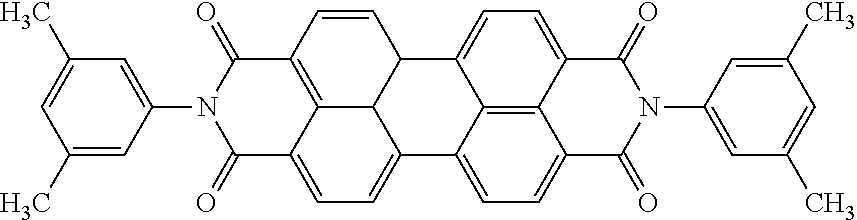
- Pigment Red 149 has the following formula:
- the O-semicondensate has the following formula:
- DE-A 1 807 729 discloses the reaction of perylenetetracarboxylic acid or anhydride with 3,5-dichloroaniline in the presence of condensation-accelerating agents, such as zinc chloride, zinc acetate or hydrochloric acid, in solvent or diluent media such as quinoline, quinaldine, naphthalene or trichlorobenzene.
- condensation-accelerating agents such as zinc chloride, zinc acetate or hydrochloric acid
- solvent or diluent media such as quinoline, quinaldine, naphthalene or trichlorobenzene.
- the dye is isolated from the reaction mixture by filtration, if appropriate after dilution of the reaction mixture with inert solvents such as alcohols, formamide, dimethylformamide, toluene, chlorobenzene or nitrobenzene, and subsequent washing with organic solvents and water.
- the dye is decocted with dilute aqueous sodium hydroxide solution. Subsequently, the dye is converted into a useful pigmentary crystal form by dissolving in concentrated sulfuric acid and precipitating by dilution with water.
- DE-A 2 210 170 discloses a corresponding process wherein perylene-3,4,9,10-tetracarboxylic acid is reacted with 2,4,6-trimethylaniline.
- EP-A 0 198 369 discloses a process for preparing arylimides of perylene-3,4,9,10-tetracarboxylic acid wherein perylene-3,4,9,10-tetracarboxylic dianhydride (perylenebisanhydride) is reacted with a primary arylamine in the presence of a dialkylamine as catalyst.
- the reaction can take place in the presence of inert diluents, such as dimethylformamide, N-methylpyrrolidone, o-dichlorobenzene, nitrobenzene, quinoline or 2-ethylhexanol.
- the reaction is carried out without further diluent in the relevant mixture of arylamine and dialkylamine.
- the reaction product can be removed, if appropriate after dilution with a low-boiling alcohol, by filtration.
- the mixture of excess arylamine and dialkylamine and, if appropriate, the inert diluent is distillatively removed after quantitative conversion, so that the reaction product remains behind as a dry residue.
- CN-A 1310203 discloses a process for preparing perylenetetracarboxylic diimide pigments wherein perylenebisanhydride and primary amine is reacted in aqueous solution at a pH of 3 to 5 in the presence of an organic carboxylic acid having 1 to 5 carbon atoms.
- the crude pigment is subsequently subjected to an aftertreatment (finishing).
- finishing the crude pigment is ball milled in the presence of a grinding assistant such as sodium chloride, sodium sulfate and sodium carbonate, an organic solvent and 1% to 5% by weight, based on the weight of the crude pigment, of a perylenetetracarboxylic diimide derivative.
- a post-finishing treatment is carried out in an aqueous medium in the presence of a surfactant.
- perylenebisanhydride is dissolved in 10% KOH solution, and 3,5-dimethylaniline and acetic acid are added to the solution.
- the reaction product is filtered off and washed neutral with water.
- the dried crude pigment is subsequently ball milled with sodium chloride, a small amount of N,N′-di-n-butylperylenebis(dicarboximide) and a xylene-ethyl acetate mixture.
- the mixture is finally transferred into a 2% by weight aqueous hydrochloric acid comprising 1% of a surfactant mixture, boiled, the pigment is filtered off, washed neutral with water, dried and comminuted.
- this object is achieved by a process for preparing N,N′-di(3′,5′-dimethylphenyl) perylenebis(dicarboximide) by reaction of perylene-3,4,9,10-tetracarbcoxylic dianhydride (perylenebisanhydride) with 3,5-dimethylaniline in the presence of a secondary or tertiary amine as catalyst, which comprises effecting the reaction in an aqueous reaction medium and in the presence of added seed crystals of N,N′-di(3′,5′-dimethylphenyl)perylenebis(dicarboximide). More particularly, the aqueous reaction medium comprises no further organic solvents at all.
- inert, water-miscible organic solvents for example up to 10% by weight, can be present, however.
- surface-active agents for example the ethoxylation products of long-chain alcohols or the ethoxylation products of alkylphenols, can optionally be added.
- the reaction is preferably carried out in a purely aqueous reaction medium comprising essentially no further organic solvents.
- Useful catalysts include aliphatic, cycloaliphatic, arylaliphatic or heterocyclic secondary or tertiary amines.
- useful secondary amines have the formula R′R′′NH, where R′ and R′′ may be the same or different and may each be a straight-chain or branched alkyl or cycloalkyl of 1 to 6 carbon atoms, with or without hydroxyl, alkoxy, alkyl, alkylamino or aryl substitution, or where R′ and R′′ combine with the nitrogen atom to form a 5- or 6-membered heterocyclic ring which can be substituted if appropriate (in the case of tertiary amines) by alkyl, aralkyl or aryl groups.
- Useful tertiary amines generally comprise 3 of the radicals mentioned.
- Preferred secondary or tertiary amines are piperazine, N-(2-hydroxyethyl)piperazine, diethanolamine, N,N′-dimethylpiperazine, N-ethylpiperazine, N-methylcyclohexylamine, imidazole and N-methyimidazole.
- the reaction is carried out in the presence of seed crystals of C.I. Pigment Red 149.
- the amount of seed crystals added is in the range from 1% to 25% by weight and preferably in the range from 5% to 10% by weight, based on the reaction product.
- the seed crystals added can come from one of the preceding charges.
- the reaction is generally carried out at a temperature of 120 to 190° C. and a pressure of 2 to 13 bar.
- the reaction time is generally in the range from 5 to 40 hours.
- the molar ratio of 3,5-dimethylaniline to perylenebisanhydride is generally in the range from 1.8:1 to 4:1 and preferably in the range from 2:1 to 3:1.
- the molar ratio of secondary or tertiary amine to perylenebisanhydride is generally in the range from 0.5:1 to 2:1 and preferably in the range from 0.8:1 to 1.4:1. Excess 3,5-dimethylaniline can be distilled off after the reaction has ended.
- the reaction product, C.I. Pigment Red 149 is generally covered by filtration.
- the mother liquor comprising the secondary or tertiary amine can subsequently be reused as reaction medium to synthesize further Pigment Red 149.
- up to 10% by weight and preferably up to 5% by weight, for example 0.5 to 5% by weight, of the 3,5-xylidine can be replaced by some other primary amine in the preparation process described in order that pigments having modified properties may be obtained.
- Useful further primary amines include for example 4-methoxyaniline and 4-ethoxyaniline.
- the process of the present invention provides Pigment Red 149 in the alpha form. Generally, it comprises less than 5% by weight and preferably less than 1.5% by weight of the monoimide.
- Filtration preferably provides the product in the form of a 30-50% by weight press cake.
- the coarsely crystalline pigment is generally converted into a suitable particle size by means of customary fine division and finishing processes before its use in coatings and plastics. Generally, one dry- or wet-grinding operation will be sufficient for this purpose, if appropriate with subsequent controlled recrystallization from solvents, for example water or aqueous-organic solvent mixtures. This converts the Pigment Red 149 to particles having a size of generally ⁇ 0.2 ⁇ m.
- the pigment provides strong reds of high cleanness of hue and good thermal stability when used for coloration of macromolecular material, for example PVC, LDPE, HDPE, polypropylene or polyamide.
- the batch is filtered and washed colorless.
- the yield of Pigment Red 149 is 311 g, corresponding to 96.4% of theory.
- the crude product thus obtained comprises 97.5% by weight of the perylenediimide and 1.4% by weight of the monoimide (O-semicondensate).
- the product is present in the alpha form.
- the pigment obtained provides a very strong color when judged in accordance with DIN EN 139900-3 on incorporation in LDPE (Low Density Polyethylene) and provides colorations having high cleanness of hue coupled with good thermal stability.
- Example 1 is repeated except that 66 g of N-(2-hydroxyethyl)piperazine, corresponding to 0.51 mol, are used as secondary amine.
- the yield of crude product is 304 g, corresponding to 94.2% of theory.
- Example 1 is repeated except that 100 parts by weight of 80% pure diethanolamine, corresponding to 0.76 mol, are used as secondary amine.
- the yield of crude product is 313 g, corresponding to 97.0% of theory.
Landscapes
- Chemical & Material Sciences (AREA)
- Organic Chemistry (AREA)
- Chemical Kinetics & Catalysis (AREA)
- Nitrogen Condensed Heterocyclic Rings (AREA)
- Engineering & Computer Science (AREA)
- Materials Engineering (AREA)
- Low-Molecular Organic Synthesis Reactions Using Catalysts (AREA)
- Optical Filters (AREA)
Abstract
Description

| TABLE |
| Coloristics in LDPE white reduction |
| Color strength in % | Hue dH* | Chroma dC* | ||
| Example 1 | 100 | 0 | 0 |
| Comparative | 82 | 0.7 | −1.7 |
| example | |||
| *dH and dC = hue difference and chroma difference, respectively, between comparative example and inventive example after color strength equalization in accordance with DIN 6174 | |||
Claims (14)
Applications Claiming Priority (4)
| Application Number | Priority Date | Filing Date | Title |
|---|---|---|---|
| EP07102654 | 2007-02-19 | ||
| EP07102654 | 2007-02-19 | ||
| EP07102654.6 | 2007-02-19 | ||
| PCT/EP2008/051932 WO2008101895A2 (en) | 2007-02-19 | 2008-02-18 | Method for producing the pigment red 149 |
Publications (2)
| Publication Number | Publication Date |
|---|---|
| US20100063288A1 US20100063288A1 (en) | 2010-03-11 |
| US10287435B2 true US10287435B2 (en) | 2019-05-14 |
Family
ID=39592817
Family Applications (1)
| Application Number | Title | Priority Date | Filing Date |
|---|---|---|---|
| US12/527,706 Active 2032-06-26 US10287435B2 (en) | 2007-02-19 | 2008-02-18 | Preparation of Pigment Red 149 |
Country Status (7)
| Country | Link |
|---|---|
| US (1) | US10287435B2 (en) |
| EP (1) | EP2113012B1 (en) |
| JP (1) | JP5447837B2 (en) |
| KR (1) | KR101494476B1 (en) |
| CN (1) | CN101636454B (en) |
| ES (1) | ES2390187T3 (en) |
| WO (1) | WO2008101895A2 (en) |
Families Citing this family (1)
| Publication number | Priority date | Publication date | Assignee | Title |
|---|---|---|---|---|
| CN105694531B (en) * | 2016-03-25 | 2017-10-27 | 电子科技大学 | Yi Zhong perylene pigment preparation methods |
Citations (13)
| Publication number | Priority date | Publication date | Assignee | Title |
|---|---|---|---|---|
| DE1807729A1 (en) | 1968-11-08 | 1970-06-18 | Basf Ag | Perylene tetracarboxylic acid diimide dye |
| DE2210170A1 (en) | 1972-03-03 | 1973-09-06 | Basf Ag | Fluorescent pigment dye - of the perylene tetracarboxylic acid diimide series,for use in plastics |
| JPS57149358A (en) | 1981-03-13 | 1982-09-14 | Dainippon Ink & Chem Inc | Production of epsilon type copper phthalocyanine |
| EP0198369A2 (en) | 1985-04-15 | 1986-10-22 | Hoechst Aktiengesellschaft | Process for the preparation of perylene-3,4,9,10-tetracarboxylic-acid aryl imides |
| EP0657436A2 (en) | 1993-11-12 | 1995-06-14 | Ciba-Geigy Ag | Process for the preparation of perylene-3,4-dicarboxylic acid derivatives, the compounds prepared according to this process and their use |
| US5626662A (en) * | 1994-04-21 | 1997-05-06 | Hoechst Aktiengesellschaft | Fine division in the preparation of organic pigments |
| CN1310203A (en) | 2001-02-20 | 2001-08-29 | 华东理工大学 | Synthesis of perylene pigment |
| EP1130065A2 (en) | 2000-02-04 | 2001-09-05 | Dainichiseika Color & Chemicals Mfg. Co. Ltd. | Pigment compositions, production process thereof; colorants; and colored articles |
| EP1188800A1 (en) | 2000-09-15 | 2002-03-20 | Clariant GmbH | New crystal modifications of a yellow disazo colorant and a process for their production |
| US6391104B1 (en) * | 2000-12-01 | 2002-05-21 | Bayer Corporation | Perylene pigment compositions |
| US20030152500A1 (en) * | 2001-10-17 | 2003-08-14 | Dalziel Sean Mark | Rotor-stator apparatus and process for the formation of particles |
| EP1528084A1 (en) | 2000-07-04 | 2005-05-04 | Clariant GmbH | Gamma crystalline modification of C.I. Pigment Yellow 191 and manufacturing process thereof |
| US20070020409A1 (en) | 2005-07-19 | 2007-01-25 | Lanxess Deutschland Gmbh | Process for preparing metal compounds of an azo compound in the presence of seed crystals |
Family Cites Families (2)
| Publication number | Priority date | Publication date | Assignee | Title |
|---|---|---|---|---|
| JPS517025A (en) * | 1974-07-09 | 1976-01-21 | Mitsubishi Chem Ind | Beetaa ketsushosoperirenganryono seizoho |
| CN1303160C (en) * | 2005-02-24 | 2007-03-07 | 天津理工大学 | Process for catalytic preparation of perylenes pigment crudes by fatty alcohols in water intermediate |
-
2008
- 2008-02-18 US US12/527,706 patent/US10287435B2/en active Active
- 2008-02-18 EP EP08716906A patent/EP2113012B1/en active Active
- 2008-02-18 CN CN200880005434.3A patent/CN101636454B/en active Active
- 2008-02-18 JP JP2009550273A patent/JP5447837B2/en active Active
- 2008-02-18 WO PCT/EP2008/051932 patent/WO2008101895A2/en not_active Ceased
- 2008-02-18 KR KR20097018109A patent/KR101494476B1/en active Active
- 2008-02-18 ES ES08716906T patent/ES2390187T3/en active Active
Patent Citations (18)
| Publication number | Priority date | Publication date | Assignee | Title |
|---|---|---|---|---|
| DE1807729A1 (en) | 1968-11-08 | 1970-06-18 | Basf Ag | Perylene tetracarboxylic acid diimide dye |
| DE2210170A1 (en) | 1972-03-03 | 1973-09-06 | Basf Ag | Fluorescent pigment dye - of the perylene tetracarboxylic acid diimide series,for use in plastics |
| JPS57149358A (en) | 1981-03-13 | 1982-09-14 | Dainippon Ink & Chem Inc | Production of epsilon type copper phthalocyanine |
| EP0198369A2 (en) | 1985-04-15 | 1986-10-22 | Hoechst Aktiengesellschaft | Process for the preparation of perylene-3,4,9,10-tetracarboxylic-acid aryl imides |
| US4831140A (en) * | 1985-04-15 | 1989-05-16 | Hoechst Aktiengesellschaft | Process for the preparation of arylimides of perylene-3,4,9,10-tetracarboxylic acid |
| US5650513A (en) | 1993-11-12 | 1997-07-22 | Ciba-Geigy Corporation | Process for preparing perylene-3,4-dicarboxylic acid derivatives, the derivatives thus prepared and their use |
| EP0657436A2 (en) | 1993-11-12 | 1995-06-14 | Ciba-Geigy Ag | Process for the preparation of perylene-3,4-dicarboxylic acid derivatives, the compounds prepared according to this process and their use |
| US5626662A (en) * | 1994-04-21 | 1997-05-06 | Hoechst Aktiengesellschaft | Fine division in the preparation of organic pigments |
| EP1130065A2 (en) | 2000-02-04 | 2001-09-05 | Dainichiseika Color & Chemicals Mfg. Co. Ltd. | Pigment compositions, production process thereof; colorants; and colored articles |
| US20010047740A1 (en) | 2000-02-04 | 2001-12-06 | Dainichiseika Color & Chemicals Mfg. Co., Ltd. | Pigment compositions, production process thereof, colorants, and colored articles |
| EP1528084A1 (en) | 2000-07-04 | 2005-05-04 | Clariant GmbH | Gamma crystalline modification of C.I. Pigment Yellow 191 and manufacturing process thereof |
| EP1188800A1 (en) | 2000-09-15 | 2002-03-20 | Clariant GmbH | New crystal modifications of a yellow disazo colorant and a process for their production |
| US20020065402A1 (en) | 2000-09-15 | 2002-05-30 | Clariant Gmbh | New crystal polymorphs of a yellow disazo colorant, and their preparation |
| US6391104B1 (en) * | 2000-12-01 | 2002-05-21 | Bayer Corporation | Perylene pigment compositions |
| CN1310203A (en) | 2001-02-20 | 2001-08-29 | 华东理工大学 | Synthesis of perylene pigment |
| US20030152500A1 (en) * | 2001-10-17 | 2003-08-14 | Dalziel Sean Mark | Rotor-stator apparatus and process for the formation of particles |
| US20070020409A1 (en) | 2005-07-19 | 2007-01-25 | Lanxess Deutschland Gmbh | Process for preparing metal compounds of an azo compound in the presence of seed crystals |
| DE102005033580A1 (en) | 2005-07-19 | 2007-01-25 | Lanxess Deutschland Gmbh | Process for the preparation of metal compounds of an azo compound in the presence of seed crystals |
Non-Patent Citations (7)
| Title |
|---|
| Frank Wurthner "Preparation and Characterization of Regioisomerically Pure 1,7-Disubstituted Perylene Bisimide Dyes" J. Org. Chem. 2004, 69, 7933-7939. * |
| Herbst "Industrial Organic Pigments Production, Properties, Applications" Third, Completely Revised Edition Wiley-VCH: Weinheim 2004, pp. 474-477. * |
| Nagao Bull. Chem. Soc. Jpn. 1981, 54, 1191-1194. * |
| Paul et. al. "Organic crystallization processes" Powder Technology 150 (2005) 133-143. * |
| Segev "Environmental Impact of Flame Retardants (Persistence and Biodegradability)" International Journal of Environmental Research and Public Health Jun. 2009, 478-491. * |
| Wescott "Donor-sigma-Acceptor Molecules Incorporating a Nonadecyl-Swallowtailed Perylenediimide Acceptor" J. Org. Chem. 2005, 70, 8956-8962. * |
| Wolska "Soluble Polycyclic Dyes" Dyes, Auxiliary Products 2002, 46, 15-26 (English translation attached). * |
Also Published As
| Publication number | Publication date |
|---|---|
| WO2008101895A3 (en) | 2009-09-17 |
| US20100063288A1 (en) | 2010-03-11 |
| ES2390187T3 (en) | 2012-11-07 |
| CN101636454B (en) | 2014-05-21 |
| EP2113012B1 (en) | 2012-08-29 |
| CN101636454A (en) | 2010-01-27 |
| KR101494476B1 (en) | 2015-02-17 |
| JP5447837B2 (en) | 2014-03-19 |
| EP2113012A2 (en) | 2009-11-04 |
| KR20100014880A (en) | 2010-02-11 |
| JP2010519241A (en) | 2010-06-03 |
| WO2008101895A2 (en) | 2008-08-28 |
Similar Documents
| Publication | Publication Date | Title |
|---|---|---|
| KR100218024B1 (en) | Inner salts of perylene compounds, process for their preparation and their use | |
| EP1646691B2 (en) | Quinacridone pigment compositions comprising unsymmetrically substituted components | |
| CA1073880A (en) | PROCESS FOR THE PREPARATION OF EASILY DISPERSIBLE PHTHALOCYANINE PIGMENTS OF THE .beta.-MODIFICATION | |
| CA2141725A1 (en) | Process for the preparation of quinacridone pigments | |
| US5989333A (en) | Mixed crystal pigments of the quinacridone series | |
| WO2020045200A1 (en) | Alkylene compound, quinophthalone compound, and quinophthalone mixture | |
| US5071483A (en) | Process for the preparation of pigment preparations of the anthanthrone series | |
| US3836379A (en) | Quinacridone pigment mixtures and process for preparing them | |
| US6521756B2 (en) | Process for preparing perylene-3,4,9,10-tetracarboxylic diimide in transparent pigment form | |
| US20100063288A1 (en) | Preparation of pigment red 149 | |
| US5393339A (en) | Preparation of phthalocyanine pigments | |
| US7161007B2 (en) | Oxidation process for preparing quinacridone pigments | |
| US4286094A (en) | Preparation of a pigmentary form of perylene-3,4,9,10-tetracarboxylic acid diimide | |
| US3697526A (en) | Crystalline perylenetetracarboxylic acid dibenzoylhydrazide | |
| DE102015211828A1 (en) | Naphthol AS pigment mixtures | |
| US6403797B1 (en) | Process for the preparation of perylene pigments | |
| US8329369B2 (en) | Method for the production of pure C.I. pigment orange 74 | |
| US10519315B2 (en) | Quinacridone pigment and a process for preparation thereof | |
| US5035747A (en) | Mixed crystal pigments of the anthanthrone series, and preparation and use thereof | |
| US3749726A (en) | Linear alkyl-amido trans-quinacridone pigments | |
| EP0959106B1 (en) | Heterocyclic-substituted quinacridone pigments | |
| US7795433B2 (en) | Methods for preparing perylene/perinone pigments | |
| US6649758B2 (en) | Preparation of trans-thiazineindigo pigments | |
| US4327024A (en) | Iminoisoindolinone pigments, process for their production and use thereof | |
| DE1569607B1 (en) | Triphendioxazine dyes, their production and use |
Legal Events
| Date | Code | Title | Description |
|---|---|---|---|
| AS | Assignment |
Owner name: BASF SE,GERMANY Free format text: ASSIGNMENT OF ASSIGNORS INTEREST;ASSIGNORS:KOWARSCH, HEINRICH;HETZENEGGER, JOSEF;STOHR, ANDREAS;AND OTHERS;SIGNING DATES FROM 20080403 TO 20080703;REEL/FRAME:023130/0793 Owner name: BASF SE, GERMANY Free format text: ASSIGNMENT OF ASSIGNORS INTEREST;ASSIGNORS:KOWARSCH, HEINRICH;HETZENEGGER, JOSEF;STOHR, ANDREAS;AND OTHERS;SIGNING DATES FROM 20080403 TO 20080703;REEL/FRAME:023130/0793 |
|
| STPP | Information on status: patent application and granting procedure in general |
Free format text: PUBLICATIONS -- ISSUE FEE PAYMENT VERIFIED |
|
| STCF | Information on status: patent grant |
Free format text: PATENTED CASE |
|
| CC | Certificate of correction | ||
| MAFP | Maintenance fee payment |
Free format text: PAYMENT OF MAINTENANCE FEE, 4TH YEAR, LARGE ENTITY (ORIGINAL EVENT CODE: M1551); ENTITY STATUS OF PATENT OWNER: LARGE ENTITY Year of fee payment: 4 |
|
| AS | Assignment |
Owner name: SUN CHEMICAL B.V., NETHERLANDS Free format text: NUNC PRO TUNC ASSIGNMENT;ASSIGNOR:BASF SE;REEL/FRAME:064191/0229 Effective date: 20230223 |