US10270401B2 - Two-stage electromagnetic induction transformer - Google Patents
Two-stage electromagnetic induction transformer Download PDFInfo
- Publication number
- US10270401B2 US10270401B2 US14/886,109 US201514886109A US10270401B2 US 10270401 B2 US10270401 B2 US 10270401B2 US 201514886109 A US201514886109 A US 201514886109A US 10270401 B2 US10270401 B2 US 10270401B2
- Authority
- US
- United States
- Prior art keywords
- winding
- amplifier
- transformer
- impedance matching
- sections
- Prior art date
- Legal status (The legal status is an assumption and is not a legal conclusion. Google has not performed a legal analysis and makes no representation as to the accuracy of the status listed.)
- Active, expires
Links
- 230000005674 electromagnetic induction Effects 0.000 title claims abstract description 33
- 238000004804 winding Methods 0.000 claims abstract description 414
- 239000004020 conductor Substances 0.000 claims description 20
- 239000003990 capacitor Substances 0.000 claims description 7
- 230000003247 decreasing effect Effects 0.000 claims description 4
- 238000010586 diagram Methods 0.000 description 22
- 238000003780 insertion Methods 0.000 description 4
- 230000037431 insertion Effects 0.000 description 4
- 238000002955 isolation Methods 0.000 description 3
- 238000000034 method Methods 0.000 description 3
- 230000004907 flux Effects 0.000 description 2
- 230000004075 alteration Effects 0.000 description 1
- 238000012986 modification Methods 0.000 description 1
- 230000004048 modification Effects 0.000 description 1
- 239000004065 semiconductor Substances 0.000 description 1
Images




Classifications
-
- H—ELECTRICITY
- H03—ELECTRONIC CIRCUITRY
- H03F—AMPLIFIERS
- H03F1/00—Details of amplifiers with only discharge tubes, only semiconductor devices or only unspecified devices as amplifying elements
- H03F1/56—Modifications of input or output impedances, not otherwise provided for
- H03F1/565—Modifications of input or output impedances, not otherwise provided for using inductive elements
-
- H—ELECTRICITY
- H01—ELECTRIC ELEMENTS
- H01F—MAGNETS; INDUCTANCES; TRANSFORMERS; SELECTION OF MATERIALS FOR THEIR MAGNETIC PROPERTIES
- H01F27/00—Details of transformers or inductances, in general
- H01F27/28—Coils; Windings; Conductive connections
- H01F27/2804—Printed windings
-
- H—ELECTRICITY
- H03—ELECTRONIC CIRCUITRY
- H03F—AMPLIFIERS
- H03F3/00—Amplifiers with only discharge tubes or only semiconductor devices as amplifying elements
- H03F3/189—High-frequency amplifiers, e.g. radio frequency amplifiers
- H03F3/19—High-frequency amplifiers, e.g. radio frequency amplifiers with semiconductor devices only
- H03F3/195—High-frequency amplifiers, e.g. radio frequency amplifiers with semiconductor devices only in integrated circuits
-
- H—ELECTRICITY
- H03—ELECTRONIC CIRCUITRY
- H03F—AMPLIFIERS
- H03F3/00—Amplifiers with only discharge tubes or only semiconductor devices as amplifying elements
- H03F3/20—Power amplifiers, e.g. Class B amplifiers, Class C amplifiers
- H03F3/21—Power amplifiers, e.g. Class B amplifiers, Class C amplifiers with semiconductor devices only
- H03F3/211—Power amplifiers, e.g. Class B amplifiers, Class C amplifiers with semiconductor devices only using a combination of several amplifiers
-
- H—ELECTRICITY
- H03—ELECTRONIC CIRCUITRY
- H03F—AMPLIFIERS
- H03F3/00—Amplifiers with only discharge tubes or only semiconductor devices as amplifying elements
- H03F3/45—Differential amplifiers
- H03F3/45071—Differential amplifiers with semiconductor devices only
- H03F3/45076—Differential amplifiers with semiconductor devices only characterised by the way of implementation of the active amplifying circuit in the differential amplifier
- H03F3/45475—Differential amplifiers with semiconductor devices only characterised by the way of implementation of the active amplifying circuit in the differential amplifier using IC blocks as the active amplifying circuit
-
- H—ELECTRICITY
- H01—ELECTRIC ELEMENTS
- H01F—MAGNETS; INDUCTANCES; TRANSFORMERS; SELECTION OF MATERIALS FOR THEIR MAGNETIC PROPERTIES
- H01F19/00—Fixed transformers or mutual inductances of the signal type
- H01F19/04—Transformers or mutual inductances suitable for handling frequencies considerably beyond the audio range
- H01F19/08—Transformers having magnetic bias, e.g. for handling pulses
- H01F2019/085—Transformer for galvanic isolation
-
- H—ELECTRICITY
- H01—ELECTRIC ELEMENTS
- H01F—MAGNETS; INDUCTANCES; TRANSFORMERS; SELECTION OF MATERIALS FOR THEIR MAGNETIC PROPERTIES
- H01F27/00—Details of transformers or inductances, in general
- H01F27/28—Coils; Windings; Conductive connections
- H01F27/2804—Printed windings
- H01F2027/2809—Printed windings on stacked layers
-
- H—ELECTRICITY
- H03—ELECTRONIC CIRCUITRY
- H03F—AMPLIFIERS
- H03F2200/00—Indexing scheme relating to amplifiers
- H03F2200/387—A circuit being added at the output of an amplifier to adapt the output impedance of the amplifier
-
- H—ELECTRICITY
- H03—ELECTRONIC CIRCUITRY
- H03F—AMPLIFIERS
- H03F2200/00—Indexing scheme relating to amplifiers
- H03F2200/451—Indexing scheme relating to amplifiers the amplifier being a radio frequency amplifier
-
- H—ELECTRICITY
- H03—ELECTRONIC CIRCUITRY
- H03F—AMPLIFIERS
- H03F2200/00—Indexing scheme relating to amplifiers
- H03F2200/537—A transformer being used as coupling element between two amplifying stages
-
- H—ELECTRICITY
- H03—ELECTRONIC CIRCUITRY
- H03F—AMPLIFIERS
- H03F2200/00—Indexing scheme relating to amplifiers
- H03F2200/541—Transformer coupled at the output of an amplifier
-
- H—ELECTRICITY
- H03—ELECTRONIC CIRCUITRY
- H03F—AMPLIFIERS
- H03F2203/00—Indexing scheme relating to amplifiers with only discharge tubes or only semiconductor devices as amplifying elements covered by H03F3/00
- H03F2203/45—Indexing scheme relating to differential amplifiers
- H03F2203/45731—Indexing scheme relating to differential amplifiers the LC comprising a transformer
Definitions
- Taiwan Patent Application No. 103136202 filed on Oct. 20, 2014
- Taiwan Patent Application No. 104114108 filed on May 4, 2015 including the specifications, drawings and abstracts are incorporated herein by reference in its entirety.
- the technical field relates to a transformer, and more particularly, to a two-stage electromagnetic induction transformer.
- Transformers have been popularly used in many electric or power apparatuses to pull up/down voltages or provide impedance matching.
- the impedance matching would be adjusted according to equipment requirement (e.g. gain, efficiency, power, signal-to-noise ratio (SNR), etc.).
- SNR signal-to-noise ratio
- an impedance ratio of the transformer may be adjusted, such that the output impedance of the signal source would match the impedance of the load circuit.
- Macphail disclosed “Switched impedance transformer for semiconductor circuits” in U.S. Pat. No. 7,616,934.
- Lee et al. disclosed “Systems and methods for a SPDT switch or SPMT switch with transformer” in U.S. Pat. No. 8,044,540.
- An embodiment of the present invention provides a transformer.
- the transformer comprises a first winding, a second winding and a third winding.
- the first winding is configured to receive a first input signal to generate a first signal.
- the second winding is magnetically coupled to the first winding and configured to generate a second signal through electromagnetic induction with the first winding or by receiving a second input signal.
- the third winding is magnetically coupled to the second winding, magnetically isolated from the first winding, and configured to electromagnetically induct with the second winding and output an output signal.
- the second winding is positioned between the first winding and the third winding, the first winding is positioned adjacent to the second winding, and the second winding is positioned adjacent to the third winding.
- the transformer comprises a first winding, a second winding, a third winding, a fourth winding and a fifth winding.
- the fifth winding has a first part and a second part serially connected to the first part.
- the first part is magnetically coupled to the second winding and magnetically isolated from the first winding
- the second part is magnetically coupled to the fourth winding and magnetically isolated from the third winding.
- the second winding is posited between the first winding and the first part, the first winding is posited adjacent to the second winding, and the second winding is posited adjacent to the first part.
- the fourth winding is posited between the third winding and the second part, the third winding is posited adjacent to the fourth winding, and the fourth winding is posited adjacent to the second part.
- FIG. 1 is a circuit diagram of radio frequency amplifier according to an embodiment of the present invention.
- FIG. 2 is a layout diagram of a transformer according to an embodiment of the present invention.
- FIG. 3 is a layout diagram of a winding W 1 , a winding W 2 and a first part L 1 shown in FIG. 2 .
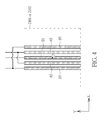
- FIG. 4 is an enlarged view of the windings W 1 and W 2 and the first part L 1 of the transformer located within an area shown in FIG. 3 .
- FIG. 5 is a layout diagram of the winding W 1 , the winding W 2 and the first part L 1 of another transformer according to another embodiment of the present invention.
- FIG. 6 is an exploded diagram of the winding W 1 , the winding W 2 and the first part L 1 of a transformer according to another embodiment of the present invention.
- FIG. 7 is a schematic diagram of conductors M 1 and M 2 and a winding W 2 of the transformer shown in FIG. 6 .
- FIG. 8 is an exploded diagram of the winding W 1 , the winding W 2 and the first part L 1 of a transformer according to another embodiment of the present invention.
- FIG. 9 is a schematic diagram of conductor M 1 and M 2 of a winding W 2 of the transformer shown in FIG. 8 .
- FIG. 10 is a circuit diagram of radio frequency amplifier according to another embodiment of the present invention.
- FIG. 11 is a layout diagram of a transformer according to another embodiment of the present invention.
- FIG. 12 is an enlarged view of the windings W 1 , W 2 and W 3 of the transformer located within an area shown in FIG. 11 .
- FIG. 1 is a circuit diagram of radio frequency (RF) amplifier 100 according to an embodiment of the present invention.
- the RF amplifier 100 is coupled to a load circuit 200 and comprises four amplifiers 110 - 140 and a transformer 10 .
- the transformer 10 comprises windings W 1 to W 5 .
- the winding W 5 comprise a first part L 1 and a second part L 2 .
- the first part L 1 and the second part L 2 are connected in serial.
- the winding W 1 is configured to receive an input signal IN 1 and generate a signal S 1 .
- the winding W 2 is magnetically coupled to the winding W 1 and is configured to generate a signal S 2 through electromagnetic induction with the winding W 1 and/or by receiving an input signal IN 2 .
- the winding W 3 is configured to receive an input signal IN 3 and generate a signal S 3 .
- the winding W 4 is magnetically coupled to the winding W 3 and is configured to generate a signal S 4 through electromagnetic induction with the winding W 3 and/or by receiving an input signal IN 4 .
- the first part L 1 is magnetically coupled to the winding W 2 and magnetically isolated from the winding W 1
- the second part L 2 is magnetically coupled to the winding W 4 and magnetically isolated from the winding W 3 .
- the first part L 1 and the second part L 2 of the fifth winding W 5 are configured to generate a signal S 5 respectively through electromagnetic induction with the winding W 2 and the winding W 4 , and to output an output signal S OUT from an end P 11 of the second part L 2 .
- the winding W 2 is positioned between the winding W 1 and the first part L 1
- the winding W 4 is positioned between the winding W 3 and the second part L 2 .
- the winding W 1 is positioned adjacent to the winding W 2
- the winding W 2 is positioned adjacent to the first part L 1
- the winding W 3 is positioned adjacent to the winding W 4
- the winding W 4 is positioned adjacent to the part second L 2 .
- the winding W 1 when the input signal IN 1 is inputted to the winding W 1 , the winding W 1 generates the signal S 1 .
- the signal S 2 generated by the winding W 2 may be resulted from inputting the input signal IN 2 to the winding W 2 , electromagnetic induction with the first winding W 1 , or both inputting the input signal IN 2 to the winding W 2 and the electromagnetic induction with the first winding W 1 .
- the winding W 3 when the input signal IN 3 is inputted to the winding W 3 , the winding W 3 generates the signal S 3 .
- the signal S 4 generated by the winding W 4 may be resulted from inputting the input signal IN 4 to the winding W 4 , electromagnetic induction with the first winding W 3 or both inputting the input signal IN 4 to the winding W 4 and the electromagnetic induction with the first winding W 3 .
- the amplifiers 110 , 120 , 130 and/or 140 may be high-frequency amplifiers or power amplifiers in view of their functions. In view of the numbers of input/output ends of the amplifiers 110 to 140 , the amplifiers 110 , 120 , 130 and/or 140 may be single-ended amplifiers or differential amplifiers. However, the present invention is not limited thereto. In the embodiment, the amplifiers 110 to 140 are differential amplifiers. Input ends of the amplifiers 110 , 120 , 130 and 140 are coupled to a signal sources O 1 , O 2 , O 3 and O 4 respectively.
- the amplifiers 110 , 120 , 130 and 140 respectively amplify signals outputted from the signal sources O 1 , O 2 , O 3 and O 4 to output the input signals IN 1 , IN 2 , IN 3 and IN 4 according to enable signals En 1 , En 2 , En 3 and En 4 .
- Output end T 1 , T 3 , T 5 and T 7 of the amplifiers 110 , 120 , 130 and 140 are respectively coupled to ends P 1 , P 3 , P 5 and P 7 of the windings W 1 , W 2 , W 3 and W 4 , and the input signals IN 1 , IN 2 , IN 3 and IN 4 are respectively inputted to the windings W 1 , W 2 , W 3 and W 4 through the ends P 1 , P 3 , P 5 and P 7 of the windings W 1 , W 2 , W 3 and W 4 .
- the amplifiers 110 , 120 , 130 and 140 respectively further comprise output ends T 2 , T 4 , T 6 and T 8 respectively, which are coupled to the ends P 2 , P 4 , P 6 and P 8 of the windings W 1 , W 2 , W 3 and W 4 .
- the amplifier 110 is activated by an enable signal En 1 so as to output the input signal IN 1 to the winding W 1 .
- the amplifier 120 is activated by an enable signal En 2 so as to output the input signal IN 2 to the winding W 2 ;
- the amplifier 130 is activated by an enable signal En 3 so as to output the input signal IN 3 to the winding W 3 ;
- the amplifier 140 is activated by an enable signal En 4 so as to output the input signal IN 4 to the winding W 4 .
- the enable signals En 1 , En 2 , En 3 and En 4 may be the power supply signals of the amplifiers 110 , 120 , 130 and 140 , control signals of a bias circuit, system voltages (VDD or VCC) of the radio frequency amplifier 110 or bias voltages of the radio frequency amplifier 100 .
- the impedance matching of the radio frequency amplifier 100 could be adjusted by enabling/disabling the amplifiers 110 , 120 , 130 and/or 140 .
- the impedance matching provided by the transformer 10 could be switched among a first impedance matching, a second impedance matching, a third impedance matching and a fourth impedance matching based on the enable signals En 1 , En 2 , En 3 and En 4 .
- the transformer 10 provides the first impedance matching.
- the transformer 10 when the amplifier 100 is enabled and the amplifiers 120 , 130 and 140 are disabled, the transformer 10 provides the first impedance matching by performing a two-stage electromagnetic induction which comprises the electromagnetic induction between the windings W 1 and W 2 resulted from inputting the signal IN 1 and the electromagnetic induction between the winding W 2 and the first part L 1 which results in the generation of the signal S 5 .
- the transformer 10 when the input signals IN 1 and IN 3 are inputted, and the input signals IN 2 and IN 4 are not inputted, the transformer 10 provides the second impedance matching. That is, when the amplifiers 100 and 130 are enabled and the amplifiers 120 and 140 are disabled, the transformer 10 provides the second impedance matching.
- the transformer 10 when one of the input signals IN 2 and IN 4 is inputted, and the input signals IN 1 and IN 3 and another of the input signals IN 2 and IN 4 are not inputted, the transformer 10 provides the third impedance matching. For example, when the amplifier 120 is enabled and the amplifiers 110 , 130 and 140 are disabled, the transformer 10 provides the third impedance matching by performing electromagnetic induction between the winding W 2 and the first part L 1 to generate which results in the generation of the signal S 5 . In addition, when the input signals IN 2 and IN 4 are inputted, and the input signals IN 1 and IN 3 are not inputted, the transformer 10 provides the fourth impedance matching. That is, when the amplifiers 120 and 140 are enabled and the amplifiers 100 and 130 are disabled, the transformer 10 provides the fourth impedance matching.
- the transformer 10 may provide a fifth impedance matching by enabling the amplifiers 110 , 120 , 130 and 140 . Accordingly, the impedance matching provided by the transformer 10 could be switched among the first impedance matching, the second impedance matching, the third impedance matching, the fourth impedance matching and the fifth impedance matching.
- the transformer ratios of the windings W 1 W 2 and the first part L 1 is 4:2:1
- the transformer ratios of the windings W 3 -W 4 and the second part L 2 is 4:2:1
- the inductances of the windings W 1 and W 3 are the same
- the inductances of the windings W 2 and W 4 are the same
- the inductances of the first part L 1 and the second part L 2 are the same
- the fourth impedance matching is equal to
- the typical value of the fifth impedance matching is less than or equal to the fourth impedance matching, the fourth impedance matching is less than or equal to the third impedance matching, the third impedance matching is less than or equal to the second impedance matching, and the second impedance matching is less than or equal to the first impedance matching.
- the transformer 10 may provide the first impedance matching by inputting the input signal IN 1 to the winding W 1 , such that the load impedance of the output signal S OUT matches the input signal IN 1 .
- the transformer 10 may provide the second impedance matching by inputting the input signals IN 1 and IN 2 to the windings W 1 and W 3 such that the load impedance of the output signal S OUT matches the input signals IN 1 and IN 3 .
- the transformer 10 may provide the third impedance matching by inputting the input signal IN 2 to the winding W 2 , such that the load impedance of the output signal S OUT matches the input signal IN 2 .
- the transformer 10 may provide the fourth impedance matching by inputting the input signals IN 2 and IN 4 to the windings W 2 and W 4 , such that the load impedance of the output signal S OUT matches the input signals IN 2 and IN 4 .
- the impedance matching provided by the transformer 10 would be switched among the first impedance matching, the second impedance matching, the third impedance matching and the fourth impedance matching.
- the transformer 10 provides the first impedance matching when the input signal IN 1 is inputted and the input signals IN 2 , IN 3 and IN 4 are not inputted.
- the transformer 10 provides the second impedance matching when the input signals IN 1 and IN 3 are inputted and the input signals IN 2 and IN 4 are not inputted.
- the transformer 10 provides the third impedance matching when the input signal IN 2 is inputted and the input signals IN 1 , IN 3 and IN 4 are not inputted.
- the transformer 10 provides the fourth impedance matching when the input signals IN 2 and IN 4 are inputted and the input signals IN 1 and IN 3 are not inputted. Moreover, when the input signals IN 1 , In 2 , IN 3 and IN 4 are respectively inputted to the windings W 1 , W 2 , W 3 and W 4 of the transformer 10 , the transformer 10 provides the fifth impedance matching.
- the output power of the RF amplifier 100 could be adjusted according to the enable signals En 1 , En 2 , En 3 and En 4 .
- the output power of the RF amplifier 100 is equal to PW 1 when the amplifier 100 is enabled and the amplifiers 120 , 130 and 140 are disabled, that the output power of the RF amplifier 100 is equal to PW 2 when the amplifiers 100 and 130 are enabled and the amplifiers 120 and 140 are disabled, that the output power of the RF amplifier 100 is equal to PW 3 when the amplifier 120 is enabled and the amplifiers 110 , 130 and 140 are disabled, and that the output power of the RF amplifier 100 is equal to PW 4 when the amplifiers 120 and 140 are enabled and the amplifiers 100 and 130 are disabled.
- the output power of the amplifier 120 is greater than that of the amplifier 110
- the output power of the amplifier 140 is greater than that of the amplifier 130
- PW 4 >PW 3 >PW 2 >PW 1 and the output power of the RF amplifier 100 is substantially equal to (PW 2 +PW 4 ) when all of the amplifiers 110 , 120 , 130 and 140 are enabled and the energy losses are ignored. Therefore, the output power of the RF amplifier 100 could be switched to 0, PW 1 , PW 2 , PW 3 , PW 4 or (PW 2 +PW 4 ) according to the enable signals En 1 , En 2 , En 3 and En 4 . Accordingly, various demands for the output power of the RF amplifier 100 would be satisfied.
- the winding W 1 has an equivalent inductance I 1
- the winding W 2 has an equivalent inductance I 2
- the first part L 1 has an equivalent inductance I 5 .
- the equivalent inductances I 1 , I 2 and I 5 are sequentially increasing or decreasing, and such relationships among the equivalent inductances I 1 , I 2 and I 5 may be determined according to the practical demands of the application of the circuit (e.g. gain, efficiency, power, SNR, etc.). In other words, relationships among the equivalent inductances I 1 , I 2 and I 5 may be I 1 >I 2 >I 5 or I 1 ⁇ I 2 ⁇ I 5 .
- the equivalent inductances I 1 , I 2 and I 5 would be determined by adjusting the turns or widths of the windings W 1 , W 2 and the first part L 1 . Take adjusting the turns of the windings W 1 , W 2 and the first part L 1 for example, if I 1 >I 2 >I 5 , a number of turns of the winding W 1 is greater than a number of turns of the winding W 2 , and the number of turns of the winding W 2 is greater than a number of turns of the first part L 1 .
- the widths of the windings W 1 , W 2 and the first part L 1 for example, if I 1 >I 2 >I 5 , the width of the winding W 1 is less than the width of the winding W 2 , and the width of the winding W 2 is less than the width of the first part L 1 .
- the winding W 3 has an equivalent inductance I 3
- the winding W 4 has an equivalent inductance I 5
- the second part L 2 has an equivalent inductance I 6 .
- the equivalent inductances I 3 , I 4 and I 6 may be sequentially increasing or decreasing.
- relationships among the equivalent inductances I 3 , I 4 and I 6 may be I 3 >I 4 >I 6 or I 3 ⁇ I 4 ⁇ I 6 .
- the equivalent inductances I 3 , I 4 and I 6 would be determined by adjusting the turns or widths of the windings W 3 -W 4 and the first part L 2 .
- I 1 ⁇ I 2 ⁇ I 5 , I 3 ⁇ I 4 ⁇ I 6 the output power of the amplifier 120 is less than the output power of the amplifier 110
- the output power of the amplifier 140 is less than the output power of the amplifier 130 .
- the ratios of I 1 :I 2 :I 5 are 1:2:4 and the ratios of I 3 :I 4 :I 6 are 1:2:4
- the transformer ratios of the windings W 1 , W 2 and first part L 1 would be 1:2:4 and the transformer ratios of the windings W 3 , W 4 and second part L 2 would be also 1:2:4.
- the load impedance of the load circuit 200 is 400 ⁇
- the first impedance matching is equal to
- the second impedance matching is less than or equal to the first impedance matching
- the first impedance matching is less than or equal to the fourth impedance matching
- the fourth impedance matching is less than or equal to the third impedance matching.
- the output power of the amplifier 120 is greater than the output power of the amplifier 110
- the output power of the amplifier 140 is greater than the output power of the amplifier 130 , such that I 1 >I 2 >I 5 and I 3 >I 4 >I 6
- the transformer 10 Since the transformer 10 outputs the signal S 5 by performing the two-stage electromagnetic induction by the windings W 1 , W 2 , W 3 , W 4 and W 5 , as compared to a prior art transformer which performs single-stage electromagnetic induction, the transformer 10 of an embodiment of the present invention has a smaller constant quality factor circle (constant Q circle), the transformer 10 and the RF amplifier 100 have a greater bandwidth and a less insertion loss. Moreover, the transformer 10 would have a smaller compact area in a condition that the transformer ratios are the same.
- the RF amplifier 100 is used as a transmitter in a radio frequency (RF) device, and the input signals IN 1 , IN 2 , IN 3 , IN 4 and IN 4 may be different RF signals.
- the enable signals En 1 , En 2 , En 3 and En 4 the output power of the transmitter of the RF device could be switched among various output powers and the impedance matching of the RF amplifier 100 could be adjusted simultaneously.
- a capacitor C 1 may be added and coupled between two output ends T 3 and T 4 of the amplifier 120
- a capacitor C 2 may be added and coupled between two output ends T 7 and T 8 of the amplifier 140 .
- the required equivalent inductance of each winding could be reduced by connecting the capacitor C 1 with the windings W 1 , W 2 and the first part L 1 in parallel and connecting the capacitor C 2 with the windings W 3 , W 4 and the second part L 2 .
- the windings W 1 and W 2 are substantially completely magnetically coupled, the winding W 2 and the first part L 1 are substantially completely magnetically coupled, and the first part L 1 is substantially completely magnetically isolated from the winding W 1 .
- FIG. 2 is a layout diagram of a transformer 10 according to an embodiment of the present invention.
- FIG. 3 is a layout diagram of the windings W 1 , W 2 and the first part L 1 shown in FIG. 2 .
- FIG. 2 is a layout diagram of a transformer 10 according to an embodiment of the present invention.
- FIG. 4 is an enlarged view of the windings W 1 , W 2 and the first part L 1 of the transformer 10 located within an area 2101 or 2102 shown in FIG. 3 .
- the descriptions of the layouts of the winding W 1 , the winding W 2 and the first part L 1 could be used to explain the layouts of the winding W 3 the winding W 4 and the second part L 2 .
- the reference plane is XY plane formed by X axis and Y axis, and a section B 1 of the winding W 1 , a plurality of sections B 2 of the winding W 2 and a plurality of sections B 5 of the first part L 1 are positioned within each area 2101 or 2102 on XY plane.
- the section B 1 , the sections B 2 and the sections B 5 are parallel within the area 2101 or 2102 .
- the sections B 2 are positioned adjacent to two sides of the section B 1 and adjacent inner sides of the sections B 5 .
- the windings W 1 , W 2 and the first part L 1 are substantially completely magnetically coupled, the winding W 2 and the first part L 1 are substantially completely magnetically coupled, and the first part L 1 is substantially completely magnetically isolated from the winding W 1 by the winding W 2 .
- the windings W 1 , W 2 and the first part L 1 form an inner ring 240 and an outer ring 250 .
- the inner ring 240 is formed within a plurality of areas 2101
- the outer ring is formed within a plurality of areas 2102 .
- the geometry centers of the windings W 1 , W 2 and the first part L 1 i.e.
- a section B 3 of the winding W 3 a plurality of sections B 4 of the winding W 4 and a plurality of sections BE of the second part L 2 are positioned within each area 2101 or 2102 on XY plane, and the layouts of the sections B 3 , B 4 and BE are almost symmetrical with the layouts of the sections B 1 , B 2 and B 5 . Therefore, detail descriptions of the sections B 3 , B 4 and BE are omitted for the sake of simplification.
- the sections of the windings W 1 , W 2 and the first part L 1 within the areas 2103 and 2104 are formed on different planes.
- the sections B 2 of the winding W 2 within the areas 2103 and 2104 stretch over the sections B 1 of the winding W 1
- the sections B 5 of the first part L 1 within the areas 2103 and 2104 stretch over the sections B 2 of the winding W 2 .
- the two sections B 2 of the winding W 2 within the area 2103 are interlaced and not contact to each other so as to connect the sections B 2 located at the inner ring 240 and the outer ring 250 .
- the two sections B 1 of the winding W 1 within the area 2104 are interlaced and not contact to each other so as to connect the sections B 1 located at the inner ring 240 and the outer ring 250 .
- the two sections B 5 of the first part L 1 within the area 2104 are interlaced and not contact to each other so as to connect the sections B 3 located at the inner ring 240 and the outer ring 250 .
- the sections B 2 of the winding W 2 within the area 2013 may completely overlap the entire area 2103 so as to isolate the sections B 1 within the area 2103 from the sections B 5 within the area 2103 .
- the windings W 1 , W 2 and the first part L 1 are respectively formed by the sections B 1 , B 2 and B 5 within a single area 2101 or 2102 as shown in FIG. 3 .
- the geometry center of the section B 1 , the geometry center of the sections B 2 and the geometry center of the sections B 5 are a point O′ on the XY plane, or the geometry center of the section B 1 , the geometry center of the sections B 2 and the geometry center of the sections B 3 almost coincide with each other.
- FIG. 5 is a layout diagram of the winding W 1 , the winding W 2 and the first part L 1 of another transformer according to another embodiment of the present invention. As compared to FIG. 3 , the positions of the winding W 1 and the first part L 1 are switched in FIG. 5 .
- FIG. 6 is an exploded diagram of the winding W 1 , the winding W 2 and the first part L 1 of a transformer according to another embodiment of the present invention.
- FIG. 7 is a schematic diagram of conductors M 1 and M 2 and the winding W 2 of the transformer shown in FIG. 6 .
- the ends P 9 and P 10 of the first part L 1 in FIG. 6 may be corresponded to the ends P 9 and P 10 of the first part L 1 in FIG. 1 .
- the windings W 1 , W 2 and the first part L 1 are positioned on three different parallel planes.
- the three parallel planes on which the W 1 , W 2 and the first part L 1 are positioned are parallel with the XY plane, and the coordinates of the three parallel planes on the Z axis are different.
- the conductors M 1 and M 2 and the winding W 2 are positioned on the same plane, the conductor M 1 is positioned adjacent to an outer side of the winding W 2 and substantially surrounds the winding W 2 , and the conductor M 2 is positioned adjacent to an inner side of the winding W 2 .
- the conductors M 1 and M 2 are grounded to provide a better magnetic isolation between the winding W 1 and the first part L 1 .
- FIG. 7 the conductors M 1 and M 2 and the winding W 2 are positioned on the same plane, the conductor M 1 is positioned adjacent to an outer side of the winding W 2 and substantially surrounds the winding W 2 , and the conductor M 2 is positioned adjacent to an inner side of the winding W 2 .
- the conductors M 1 and M 2 are
- the corner-points a 1 , b 1 , c 1 and d 1 of the winding W 1 respectively align with the corner-points a 2 , b 2 , c 2 and d 2 of the winding W 2 and the corner-points a 3 , b 3 , c 3 and d 3 of the first part L 1 . If the plane on which the winding W 2 is positioned is regarded as the reference plane, projected geometry centers of the winding W 1 and the first part L 1 on the reference plane would be or almost coincide with the center of the area surrounded by the winding W 2 (i.e. the geometry center of the winding W 2 ).
- the windings W 1 , W 2 and the first part L 1 are electrically disconnected. In another embodiment of the present invention, the windings W 1 , W 2 and the first part L 1 are grounded or coupled to a power supply. Moreover, the widths of the windings W 1 , W 2 and the first part L 1 may be the same, and the two ends P 1 and P 2 of the winding W 1 , the two ends P 3 and P 4 of the winding W 2 and the two ends P 5 and P 6 of the first part L 1 are respectively poisoned on three different sides of the transformer 10 .
- the windings W 1 and W 2 are substantially completely magnetically coupled, the winding W 2 and the first part L 1 are substantially completely magnetically coupled, and the first part L 1 is substantially completely magnetically isolated from the winding W 1 by the winding W 2 .
- FIG. 8 is an exploded diagram of the winding W 1 , the winding W 2 and the first part L 1 of a transformer according to another embodiment of the present invention.
- FIG. 9 is a schematic diagram of conductor M 1 and M 2 of a winding W 2 of the transformer shown in FIG. 8 .
- the difference between the transformers in FIGS. 8 and 6 is the structure of the conductor(s) M 2 .
- the transformer 10 comprises a plurality of bar-shaped conductors M 2 .
- the conductors M 2 are separated and parallel substantially.
- the purpose of positing the conductors M 2 is to avoid increasing of the quality factor (i.e. Q factor) of the transformer 10 due to the eddy current of the transformer 10 .
- the embodiments of the present invention provide transformers, and each of the transformers has a first part magnetically isolated from a first winding by a second winding. Moreover, the transformer outputs a third signal by performing a two-stage electromagnetic induction by the winding W 1 , the winding W 2 and the first part L 1 .
- the transformer of the present invention has a smaller constant quality factor circle (constant Q circle). Accordingly, as compared to the prior art transformer, the transformer and the RF amplifier of the present invention have a greater bandwidth and a less insertion loss. In a condition that the transformer according to the present invention has the same transformer ratios as the prior, the transformer of the present invention has a smaller compact area. Moreover, the RF amplifier of the present invention would obtain optimum impedance matchings for different output powers.
- FIG. 10 is a circuit diagram of radio frequency amplifier 1100 according to another embodiment of the present invention.
- the RF amplifier 1100 is coupled to a load circuit 1130 and comprises two amplifiers 1110 and 1120 and a transformer 1010 .
- the transformer 1010 comprises three windings W 11 , W 12 and W 13 .
- the winding W 11 is configured to receive an input signal IN 11 and generate a signal S 11 .
- the winding W 12 is magnetically coupled to the winding W 11 and is configured to generate a signal S 12 through electromagnetic induction with the first winding W 11 and/or by receiving another input signal IN 12 .
- the winding W 13 is magnetically coupled to the winding W 12 and magnetically isolated from the winding W 11 .
- the winding W 13 is configured to generate a signal S 13 and output a signal S OUT through electromagnetic induction with the second winding W 12 .
- the winding W 12 is positioned between the windings W 11 and W 13 .
- the winding W 11 is positioned adjacent to the winding W 12
- the winding W 12 is positioned adjacent to the winding W 13 .
- the winding W 11 when the input signal IN 11 is inputted to the winding W 11 , the winding W 11 generates the signal S 11 .
- the signal S 12 generated by the winding W 12 may be resulted from inputting the input signal IN 12 to the winding W 12 , electromagnetic induction with the first winding W 11 , or both inputting the input signal IN 2 to the winding W 12 and the electromagnetic induction with the first winding W 11 .
- the amplifiers 1110 and/or 1120 may be high-frequency amplifiers or power amplifiers in view of their functions. In view of the numbers of input/output ends of the amplifiers 1110 and 1120 , the amplifiers 1110 and/or 1120 may be single-ended amplifiers or differential amplifiers. However, the present invention is not limited thereto. In the embodiment, the amplifiers 1110 and 1120 are differential amplifiers. An input end of the amplifier 1110 is coupled to a signal source O 11 , and an input end of the amplifier 1120 is coupled to a signal source O 12 . The amplifiers 1110 and 1120 respectively amplify signals outputted from the signal sources O 11 and O 12 to output the input signals IN 11 and IN 12 according to enable signals En 11 and En 12 .
- An output end T 11 of the amplifier 1110 is coupled to an end P 101 of the winding W 11 , and the input signal IN 11 is output from the amplifier 1110 to the end P 101 of the winding W 11 .
- An output end T 13 of the amplifier 1120 is coupled to an end P 103 of the winding W 12 , and the input signal IN 12 is output from the amplifier 1120 to the end P 103 of the winding W 12 .
- the amplifiers 1110 and 1120 further comprise output ends T 12 and T 14 respectively, which are coupled to the ends P 102 and P 104 of the windings W 11 and W 12 .
- the amplifier 1110 is activated by an enable signal En 11 so as to output the input signal IN 11 to the winding W 11 .
- the amplifier 1120 is activated by an enable signal En 12 so as to output the input signal IN 12 to the winding W 12 .
- the enable signals En 11 and En 12 may be the power supply signals of the amplifiers 1110 and 1120 , control signals of a bias circuit, system voltages (VDD or VCC) of the radio frequency amplifier 1110 or bias voltages of the radio frequency amplifier 1110 .
- the impedance matching of the radio frequency amplifier 1110 could be adjusted by enabling/disabling the amplifiers 1110 and/or 1120 .
- the impedance matching provided by the transformer 1010 could be switched between a first impedance matching and a second impedance matching based on the enable signals En 1 and En 2 .
- the transformer 1010 provides the first impedance matching by performing a two-stage electromagnetic induction which comprises the electromagnetic induction between the windings W 1 and W 2 resulted from inputting the signal IN 1 and the electromagnetic induction between the windings W 2 and W 3 which results in the generation of the signal S 3 .
- the transformer 1010 When the amplifier 1110 is disabled and the amplifier 1120 is enabled, the transformer 1010 provides the second impedance matching. Moreover, the amplifiers 1110 and 1120 may be enabled simultaneously, such that the impedance matching provided by the transformer 1010 is a third impedance matching. Accordingly, the impedance matching provided by the transformer 1010 is switched among the first impedance matching, the second impedance matching and the third impedance matching.
- the transformer ratios of the windings W 11 , W 12 and W 13 is 1:2:4, the load impedance of the load circuit 1130 is 50 ⁇ . Therefore, the first impedance matching is equal to
- the second impedance matching is greater than the first impedance matching, and the third impedance matching is less than the first impedance matching and the second impedance matching.
- the second impedance matching is less than the first impedance matching, and the third impedance matching is less than the first impedance matching and the second impedance matching.
- the transformer 1010 may provide the first impedance matching by inputting the input signal IN 11 to the winding W 11 , such that the load impedance of the output signal SOUT matches the input signal IN 11 .
- the transformer 1010 may provide the second impedance matching by inputting the input signal IN 12 to the winding W 12 , such that the load impedance of the output signal SOUT matches the input signal IN 12 .
- the impedance matching provided by the transformer 1010 would be switched between the first impedance matching and the second impedance matching.
- the transformer 1010 provides the first impedance matching when the input signal IN 11 is inputted and the input signal IN 12 is not inputted.
- the transformer 1010 provides the second impedance matching when the input signal IN 11 is not inputted and the input signal IN 12 is inputted.
- the transformer 1010 provides the third impedance matching.
- the output power of the RF amplifier 1100 could be adjusted according to the enable signals En 11 and En 12 .
- the output power of the RF amplifier 1100 is equal to PW 11 when the amplifier 1110 is enabled and the amplifier 1120 is disabled, and if the output power of the RF amplifier 1100 is equal to PW 12 when the amplifier 1110 is disabled and the amplifier 1120 is enabled, then the output power of the RF amplifier 1100 is substantially equal to (PW 11 +PW 12 ) when both of the amplifiers 1110 and 1120 are enabled and the energy losses are ignored. Therefore, the output power of the RF amplifier 1100 could be switched to 0, PW 11 , PW 12 or (PW 11 +PW 12 ) according to the enable signals En 11 and En 12 . Accordingly, various demands for the output power of the RF amplifier 1100 would be satisfied.
- the winding W 11 has an equivalent inductance I 11
- the winding W 2 has an equivalent inductance I 12
- the winding W 3 has an equivalent inductance I 13 .
- the equivalent inductances I 11 , I 12 and I 13 are sequentially increasing or decreasing, and such relationships among the equivalent inductances I 11 , I 12 and I 13 may be determined according to the practical demands of the application of the circuit (e.g. gain, efficiency, power, SNR, etc.). In other words, relationships among the equivalent inductances I 11 , I 12 and I 13 may be I 11 >I 12 >I 13 or I 11 ⁇ I 12 ⁇ I 13 .
- the equivalent inductances I 11 , I 12 and I 13 would be determined by adjusting the turns or widths of the windings W 11 , W 12 and W 13 . Take adjusting the turns of the windings W 11 , W 12 and W 13 for example, if I 11 >I 12 >I 13 , a number of turns of the winding W 11 is greater than a number of turns of the winding W 12 , and the number of turns of the winding W 12 is greater than a number of turns of the winding W 13 .
- I 11 ⁇ I 12 ⁇ I 13 and the output power of the amplifier 1120 is less than the output power of the amplifier 1110 .
- the ratios of I 11 :I 12 :I 13 are 1:2:4, then the transformer ratios of the windings W 1 , W 2 and W 3 would be also 1:2:4. Therefore, the second impedance matching would be greater than the first impedance matching, and the typical value of the third impedance matching would be less than the first impedance matching and the second impedance matching. Accordingly, a greater output power has a less impedance matching.
- I 11 >I 12 >I 13 and the output power of the amplifier 1120 is greater than the output power of the amplifier 1110 .
- the transformer 1010 outputs the signal S 13 by performing the two-stage electromagnetic induction by the windings W 1 , W 2 and W 3 as compared to a prior art transformer which performs single-stage electromagnetic induction, the transformer 1010 of the present invention has a smaller constant quality factor circle (constant Q circle), the transformer 1010 and the RF amplifier 1100 have a greater bandwidth and a less insertion loss. Moreover, the transformer 1010 would have a smaller compact area in a condition that the transformer ratios are the same.
- the RF amplifier 1100 is used as a transmitter in a radio frequency (RF) device, and the input signals IN 11 and IN 12 are two different RF signals.
- the enable signals En 11 and En 12 the output power of the transmitter of the RF device could be switched among various output powers and the impedance matching of the RF amplifier 1100 could be adjusted simultaneously.
- the amplifier 1120 is a differential amplifier
- a capacitor C may be added and coupled between two output ends T 13 and T 14 of the amplifier 1120 .
- the required equivalent inductances of the windings W 11 , W 12 and W 13 could be reduced by connecting a plurality of the capacitors C with the windings W 11 , W 12 and W 13 in parallel.
- the windings W 11 and W 12 are substantially completely magnetically coupled, the windings W 12 and W 13 are substantially completely magnetically coupled, and the winding W 13 is substantially completely magnetically isolated from the winding W 11 .
- the distance between the windings W 11 and W 13 is not too great, such that the windings W 11 and W 13 would be substantially completely magnetically coupled if the winding W 12 is not provided to supply magnetic isolation between the windings W 11 and W 13 .
- FIG. 11 is a layout diagram of a transformer 1010 according to an embodiment of the present invention.
- the reference plane is XY plane formed by X axis and Y axis, and a section B 11 of the winding W 11 , a plurality of sections B 12 of the winding W 12 and a plurality of sections B 13 of the winding W 13 are positioned within each area 2101 or 2102 on XY plane.
- the section B 11 , the sections B 12 and the sections B 13 are parallel within the area 2101 or 2102 .
- the sections B 12 are positioned adjacent to two sides of the section B 11 and adjacent inner sides of the sections B 13 .
- the windings W 11 and W 12 are substantially completely magnetically coupled, the windings W 12 and W 13 are substantially completely magnetically coupled, and the winding W 13 is substantially completely magnetically isolated from the winding W 11 by the winding W 12 .
- the windings W 11 W 12 and W 13 from an inner ring 240 and an outer ring 250 .
- the inner ring 240 is formed within a plurality of areas 2101
- the outer ring is formed within a plurality of areas 2102 .
- the geometry centers of the windings W 11 , W 12 and W 13 i.e.
- the centers of the areas surrounded by the windings W 11 , W 12 and W 13 ) are a point O on the XY plane or almost coincide with each other.
- the sections of the windings W 11 , W 12 and W 13 within the areas 2103 and 2104 are formed on different planes.
- the sections B 12 of the winding W 12 within the areas 2103 and 2104 stretch over the sections B 11 of the winding W 11 and the sections B 13 of the winding W 13 within the areas 2103 and 2104 stretch over the sections B 12 of the winding W 12 .
- the two sections B 12 of the winding W 12 within the area 2103 are interlaced and not contact to each other so as to connect the sections B 12 within the inner ring 240 and the outer ring 250 .
- the two sections B 11 of the winding W 11 within the area 2104 are interlaced and not contact to each other so as to connect the sections B 11 within the inner ring 240 and the outer ring 250 .
- the two sections B 13 of the winding W 13 within the area 2104 are interlaced and not contact to each other so as to connect the sections B 13 within the inner ring 240 and the outer ring 250 .
- the sections B 12 of the winding W 12 within the area 2013 completely overlap the entire area 2103 so as to isolate the sections B 11 within the area 2103 from the sections B 13 within the area 2103 .
- the windings W 11 , W 12 and W 13 are respectively formed by the sections B 11 , B 12 and B 13 within a single area 2101 or 2102 as shown in FIG. 12 .
- the geometry center of the section B 11 , the geometry center of the sections B 12 and the geometry center of the sections B 13 are a point O′ on the XY plane or almost coincide with each other.
- FIG. 12 is an enlarged view of the windings W 11 , W 12 and W 13 located within an area 2101 or 2102 shown in FIG. 11 .
- FIG. 12 is similar with FIG. 4 .
- FIG. 12 could be obtained by replacing the sections B 1 , B 2 and B 5 of FIG. 4 by sections B 11 , B 12 and B 13 respectively.
- an exploded diagram of another transformer 1010 could be referred the descriptions of FIG. 6 and obtained by replacing the winding W 1 , the winding W 2 , the first part L 1 , the ends P 1 to P 4 and P 9 to P 10 of FIG. 6 by the winding W 11 , the winding W 12 the winding W 13 , and the ends P 101 to P 106 respectively.
- diagrams of another transformer 1010 could be referred the descriptions of FIGS. 7-9 and obtained by replacing the winding W 1 , the winding W 2 , the first part L 1 , the ends P 1 to P 4 and P 9 to P 10 of FIGS. 7-9 by the winding W 11 the winding W 12 the winding W 13 , and the ends P 101 to P 106 respectively.
- the embodiments of the present invention provide transformers, and each of the transformers has a third winding magnetically isolated from a first winding by a second winding. Moreover, the transformer outputs a third signal by performing a two-stage electromagnetic induction by the first winding, the second winding and the third winding.
- the transformer of the present invention has a smaller constant quality factor circle (constant Q circle). Accordingly, as compared to the prior art transformer, the transformer and the RF amplifier of the present invention have a greater bandwidth and a less insertion loss. In a condition that the transformer according to the present invention has the same transformer ratios as the prior, the transformer of the present invention has a smaller compact area. Moreover, the RF amplifier of the present invention would obtain optimum impedance matchings for different output powers.
Landscapes
- Engineering & Computer Science (AREA)
- Power Engineering (AREA)
- Microelectronics & Electronic Packaging (AREA)
- Coils Or Transformers For Communication (AREA)
- Amplifiers (AREA)
Abstract
A transformer has a first winding, a second winding and a third winding. The first winding is configured to receive a first signal. The second winding is magnetically coupled to the first winding and configured to generate a second signal through electromagnetic induction with the first winding, or by receiving a second input signal. The third winding is magnetically coupled to the second winding, magnetically isolated from the first winding, and configured to generate a third signal through electromagnetic induction with the second winding. The second winding is posited between the first winding and the third winding. The first winding is posited adjacent to the second winding, and the second winding is posited adjacent to the third winding.
Description
The disclosures of Taiwan Patent Application No. 103136202 filed on Oct. 20, 2014 and Taiwan Patent Application No. 104114108 filed on May 4, 2015 including the specifications, drawings and abstracts are incorporated herein by reference in its entirety.
The technical field relates to a transformer, and more particularly, to a two-stage electromagnetic induction transformer.
Transformers have been popularly used in many electric or power apparatuses to pull up/down voltages or provide impedance matching. Basically, the impedance matching would be adjusted according to equipment requirement (e.g. gain, efficiency, power, signal-to-noise ratio (SNR), etc.). For instance, in order to optimize the power delivered from a signal source to a load circuit, an impedance ratio of the transformer may be adjusted, such that the output impedance of the signal source would match the impedance of the load circuit.
In the field of impedance matching, a lot of techniques have been disclosed. For example, Macphail disclosed “Switched impedance transformer for semiconductor circuits” in U.S. Pat. No. 7,616,934. Lee et al. disclosed “Systems and methods for a SPDT switch or SPMT switch with transformer” in U.S. Pat. No. 8,044,540.
An embodiment of the present invention provides a transformer. The transformer comprises a first winding, a second winding and a third winding. The first winding is configured to receive a first input signal to generate a first signal. The second winding is magnetically coupled to the first winding and configured to generate a second signal through electromagnetic induction with the first winding or by receiving a second input signal. The third winding is magnetically coupled to the second winding, magnetically isolated from the first winding, and configured to electromagnetically induct with the second winding and output an output signal. The second winding is positioned between the first winding and the third winding, the first winding is positioned adjacent to the second winding, and the second winding is positioned adjacent to the third winding.
Another embodiment of the present invention provides a transformer. The transformer comprises a first winding, a second winding, a third winding, a fourth winding and a fifth winding. The fifth winding has a first part and a second part serially connected to the first part. The first part is magnetically coupled to the second winding and magnetically isolated from the first winding, and the second part is magnetically coupled to the fourth winding and magnetically isolated from the third winding. The second winding is posited between the first winding and the first part, the first winding is posited adjacent to the second winding, and the second winding is posited adjacent to the first part. The fourth winding is posited between the third winding and the second part, the third winding is posited adjacent to the fourth winding, and the fourth winding is posited adjacent to the second part.
Below, exemplary embodiments will be described in detail with reference to accompanying drawings so as to be easily realized by a person having ordinary knowledge in the art. The inventive concept may be embodied in various forms without being limited to the exemplary embodiments set forth herein. Descriptions of well-known parts are omitted for clarity, and like reference numerals refer to like elements throughout.
Please refer to FIG. 1 . FIG. 1 is a circuit diagram of radio frequency (RF) amplifier 100 according to an embodiment of the present invention. The RF amplifier 100 is coupled to a load circuit 200 and comprises four amplifiers 110-140 and a transformer 10. The transformer 10 comprises windings W1 to W5. The winding W5 comprise a first part L1 and a second part L2. The first part L1 and the second part L2 are connected in serial. The winding W1 is configured to receive an input signal IN1 and generate a signal S1. The winding W2 is magnetically coupled to the winding W1 and is configured to generate a signal S2 through electromagnetic induction with the winding W1 and/or by receiving an input signal IN2. The winding W3 is configured to receive an input signal IN3 and generate a signal S3. The winding W4 is magnetically coupled to the winding W3 and is configured to generate a signal S4 through electromagnetic induction with the winding W3 and/or by receiving an input signal IN4. The first part L1 is magnetically coupled to the winding W2 and magnetically isolated from the winding W1, and the second part L2 is magnetically coupled to the winding W4 and magnetically isolated from the winding W3. The first part L1 and the second part L2 of the fifth winding W5 are configured to generate a signal S5 respectively through electromagnetic induction with the winding W2 and the winding W4, and to output an output signal SOUT from an end P11 of the second part L2. The winding W2 is positioned between the winding W1 and the first part L1, and the winding W4 is positioned between the winding W3 and the second part L2. The winding W1 is positioned adjacent to the winding W2, the winding W2 is positioned adjacent to the first part L1, the winding W3 is positioned adjacent to the winding W4, and the winding W4 is positioned adjacent to the part second L2. In the below description, it would explain how to electromagnetically isolate the first part L1 from the winding W1 and how to electromagnetically isolate the second part L1 from the winding W3. Moreover, when the input signal IN1 is inputted to the winding W1, the winding W1 generates the signal S1. The signal S2 generated by the winding W2 may be resulted from inputting the input signal IN2 to the winding W2, electromagnetic induction with the first winding W1, or both inputting the input signal IN2 to the winding W2 and the electromagnetic induction with the first winding W1. Similarly, when the input signal IN3 is inputted to the winding W3, the winding W3 generates the signal S3. The signal S4 generated by the winding W4 may be resulted from inputting the input signal IN4 to the winding W4, electromagnetic induction with the first winding W3 or both inputting the input signal IN4 to the winding W4 and the electromagnetic induction with the first winding W3.
The amplifiers 110, 120, 130 and/or 140 may be high-frequency amplifiers or power amplifiers in view of their functions. In view of the numbers of input/output ends of the amplifiers 110 to 140, the amplifiers 110, 120, 130 and/or 140 may be single-ended amplifiers or differential amplifiers. However, the present invention is not limited thereto. In the embodiment, the amplifiers 110 to 140 are differential amplifiers. Input ends of the amplifiers 110, 120, 130 and 140 are coupled to a signal sources O1, O2, O3 and O4 respectively. The amplifiers 110, 120, 130 and 140 respectively amplify signals outputted from the signal sources O1, O2, O3 and O4 to output the input signals IN1, IN2, IN3 and IN4 according to enable signals En1, En2, En3 and En4. Output end T1, T3, T5 and T7 of the amplifiers 110, 120, 130 and 140 are respectively coupled to ends P1, P3, P5 and P7 of the windings W1, W2, W3 and W4, and the input signals IN1, IN2, IN3 and IN4 are respectively inputted to the windings W1, W2, W3 and W4 through the ends P1, P3, P5 and P7 of the windings W1, W2, W3 and W4. Moreover, the amplifiers 110, 120, 130 and 140 respectively further comprise output ends T2, T4, T6 and T8 respectively, which are coupled to the ends P2, P4, P6 and P8 of the windings W1, W2, W3 and W4.
In the embodiment, the amplifier 110 is activated by an enable signal En1 so as to output the input signal IN1 to the winding W1. Similarly, the amplifier 120 is activated by an enable signal En2 so as to output the input signal IN2 to the winding W2; the amplifier 130 is activated by an enable signal En3 so as to output the input signal IN3 to the winding W3; and the amplifier 140 is activated by an enable signal En4 so as to output the input signal IN4 to the winding W4. It is noted that the power of the signal S2 generated by the winding W2 would be changed when the amplifier 120 is activated by an enable signal En2, and that the power of the signal S4 generated by the winding W4 would be changed when the amplifier 140 is activated by an enable signal En4. The enable signals En1, En2, En3 and En4 may be the power supply signals of the amplifiers 110, 120, 130 and 140, control signals of a bias circuit, system voltages (VDD or VCC) of the radio frequency amplifier 110 or bias voltages of the radio frequency amplifier 100.
Moreover, the impedance matching of the radio frequency amplifier 100 could be adjusted by enabling/disabling the amplifiers 110, 120, 130 and/or 140. In detail, the impedance matching provided by the transformer 10 could be switched among a first impedance matching, a second impedance matching, a third impedance matching and a fourth impedance matching based on the enable signals En1, En2, En3 and En4. When one of the input signals IN1 and IN3 is inputted, and the input signals IN2 and IN4 and another of the input signals IN1 and IN3 are not inputted, the transformer 10 provides the first impedance matching. For example, when the amplifier 100 is enabled and the amplifiers 120, 130 and 140 are disabled, the transformer 10 provides the first impedance matching by performing a two-stage electromagnetic induction which comprises the electromagnetic induction between the windings W1 and W2 resulted from inputting the signal IN1 and the electromagnetic induction between the winding W2 and the first part L1 which results in the generation of the signal S5. Moreover, when the input signals IN1 and IN3 are inputted, and the input signals IN2 and IN4 are not inputted, the transformer 10 provides the second impedance matching. That is, when the amplifiers 100 and 130 are enabled and the amplifiers 120 and 140 are disabled, the transformer 10 provides the second impedance matching. Further, when one of the input signals IN2 and IN4 is inputted, and the input signals IN1 and IN3 and another of the input signals IN2 and IN4 are not inputted, the transformer 10 provides the third impedance matching. For example, when the amplifier 120 is enabled and the amplifiers 110, 130 and 140 are disabled, the transformer 10 provides the third impedance matching by performing electromagnetic induction between the winding W2 and the first part L1 to generate which results in the generation of the signal S5. In addition, when the input signals IN2 and IN4 are inputted, and the input signals IN1 and IN3 are not inputted, the transformer 10 provides the fourth impedance matching. That is, when the amplifiers 120 and 140 are enabled and the amplifiers 100 and 130 are disabled, the transformer 10 provides the fourth impedance matching. Furthermore, the transformer 10 may provide a fifth impedance matching by enabling the amplifiers 110, 120, 130 and 140. Accordingly, the impedance matching provided by the transformer 10 could be switched among the first impedance matching, the second impedance matching, the third impedance matching, the fourth impedance matching and the fifth impedance matching.
In an embodiment the transformer ratios of the windings W1 W2 and the first part L1 is 4:2:1, the transformer ratios of the windings W3-W4 and the second part L2 is 4:2:1, the inductances of the windings W1 and W3 are the same, the inductances of the windings W2 and W4 are the same, the inductances of the first part L1 and the second part L2 are the same, and the load impedance of the load circuit 200 is 50Ω. Therefore, the first impedance matching is equal to 50×4=200Ω, the second impedance matching is equal to
the third impedance matching is equal to 50×2=100Ω, the fourth impedance matching is equal to
and a typical value (i.e., an equivalent value which is regarded that the second impedance matching and the fourth impedance matching are connected in parallel) of fifth impedance matching is equal to
Thus, the typical value of the fifth impedance matching is less than or equal to the fourth impedance matching, the fourth impedance matching is less than or equal to the third impedance matching, the third impedance matching is less than or equal to the second impedance matching, and the second impedance matching is less than or equal to the first impedance matching.
Moreover, the operation of inputting the input signal IN1 to the winding W1 is performed according to the enable signal En1, the operation of inputting the input signal IN2 to the winding W2 is performed according to the enable signal En2, the operation of inputting the input signal IN3 to the winding W3 is performed according to the enable signal En3, and the operation of inputting the input signal IN4 to the winding W4 is performed according to the enable signal En4. Therefore, the transformer 10 may provide the first impedance matching by inputting the input signal IN1 to the winding W1, such that the load impedance of the output signal SOUT matches the input signal IN1. Moreover, the transformer 10 may provide the second impedance matching by inputting the input signals IN1 and IN2 to the windings W1 and W3 such that the load impedance of the output signal SOUT matches the input signals IN1 and IN3. In addition, the transformer 10 may provide the third impedance matching by inputting the input signal IN2 to the winding W2, such that the load impedance of the output signal SOUT matches the input signal IN2. Further, the transformer 10 may provide the fourth impedance matching by inputting the input signals IN2 and IN4 to the windings W2 and W4, such that the load impedance of the output signal SOUT matches the input signals IN2 and IN4. Therefore, by inputting the input signals IN1, IN2, IN3 and/or IN4, the impedance matching provided by the transformer 10 would be switched among the first impedance matching, the second impedance matching, the third impedance matching and the fourth impedance matching. Wherein, the transformer 10 provides the first impedance matching when the input signal IN1 is inputted and the input signals IN2, IN3 and IN4 are not inputted. The transformer 10 provides the second impedance matching when the input signals IN1 and IN3 are inputted and the input signals IN2 and IN4 are not inputted. The transformer 10 provides the third impedance matching when the input signal IN2 is inputted and the input signals IN1, IN3 and IN4 are not inputted. The transformer 10 provides the fourth impedance matching when the input signals IN2 and IN4 are inputted and the input signals IN1 and IN3 are not inputted. Moreover, when the input signals IN1, In2, IN3 and IN4 are respectively inputted to the windings W1, W2, W3 and W4 of the transformer 10, the transformer 10 provides the fifth impedance matching.
Moreover, the output power of the RF amplifier 100 could be adjusted according to the enable signals En1, En2, En3 and En4. In an embodiment of the present invention, it is supposed that the output power of the RF amplifier 100 is equal to PW1 when the amplifier 100 is enabled and the amplifiers 120, 130 and 140 are disabled, that the output power of the RF amplifier 100 is equal to PW2 when the amplifiers 100 and 130 are enabled and the amplifiers 120 and 140 are disabled, that the output power of the RF amplifier 100 is equal to PW3 when the amplifier 120 is enabled and the amplifiers 110, 130 and 140 are disabled, and that the output power of the RF amplifier 100 is equal to PW4 when the amplifiers 120 and 140 are enabled and the amplifiers 100 and 130 are disabled. In the embodiment, the output power of the amplifier 120 is greater than that of the amplifier 110, and the output power of the amplifier 140 is greater than that of the amplifier 130, then PW4>PW3>PW2>PW1 and the output power of the RF amplifier 100 is substantially equal to (PW2+PW4) when all of the amplifiers 110, 120, 130 and 140 are enabled and the energy losses are ignored. Therefore, the output power of the RF amplifier 100 could be switched to 0, PW1, PW2, PW3, PW4 or (PW2+PW4) according to the enable signals En1, En2, En3 and En4. Accordingly, various demands for the output power of the RF amplifier 100 would be satisfied.
In an embodiment of the present invention, it is supposed that the winding W1 has an equivalent inductance I1, the winding W2 has an equivalent inductance I2 and the first part L1 has an equivalent inductance I5. The equivalent inductances I1, I2 and I5 are sequentially increasing or decreasing, and such relationships among the equivalent inductances I1, I2 and I5 may be determined according to the practical demands of the application of the circuit (e.g. gain, efficiency, power, SNR, etc.). In other words, relationships among the equivalent inductances I1, I2 and I5 may be I1>I2>I5 or I1<I2<I5. The equivalent inductances I1, I2 and I5 would be determined by adjusting the turns or widths of the windings W1, W2 and the first part L1. Take adjusting the turns of the windings W1, W2 and the first part L1 for example, if I1>I2>I5, a number of turns of the winding W1 is greater than a number of turns of the winding W2, and the number of turns of the winding W2 is greater than a number of turns of the first part L1. Take adjusting the widths of the windings W1, W2 and the first part L1 for example, if I1>I2>I5, the width of the winding W1 is less than the width of the winding W2, and the width of the winding W2 is less than the width of the first part L1. Similarly, it is supposed that the winding W3 has an equivalent inductance I3, the winding W4 has an equivalent inductance I5 and the second part L2 has an equivalent inductance I6. The equivalent inductances I3, I4 and I6 may be sequentially increasing or decreasing. In other words, relationships among the equivalent inductances I3, I4 and I6 may be I3>I4>I6 or I3<I4<I6. The equivalent inductances I3, I4 and I6 would be determined by adjusting the turns or widths of the windings W3-W4 and the first part L2.
In an embodiment of the present invention, I1<I2<I5, I3<I4<I6, the output power of the amplifier 120 is less than the output power of the amplifier 110, and the output power of the amplifier 140 is less than the output power of the amplifier 130. For example, if the ratios of I1:I2:I5 are 1:2:4 and the ratios of I3:I4:I6 are 1:2:4, then the transformer ratios of the windings W1, W2 and first part L1 would be 1:2:4 and the transformer ratios of the windings W3, W4 and second part L2 would be also 1:2:4. If the load impedance of the load circuit 200 is 400Ω, the first impedance matching is equal to
the second impedance matching is equal to
the third impedance matching is equal to
and the fourth impedance matching is equal to
Thus, the second impedance matching is less than or equal to the first impedance matching, the first impedance matching is less than or equal to the fourth impedance matching, and the fourth impedance matching is less than or equal to the third impedance matching. In another embodiment of the present invention, the output power of the
Since the transformer 10 outputs the signal S5 by performing the two-stage electromagnetic induction by the windings W1, W2, W3, W4 and W5, as compared to a prior art transformer which performs single-stage electromagnetic induction, the transformer 10 of an embodiment of the present invention has a smaller constant quality factor circle (constant Q circle), the transformer 10 and the RF amplifier 100 have a greater bandwidth and a less insertion loss. Moreover, the transformer 10 would have a smaller compact area in a condition that the transformer ratios are the same.
In an embodiment of the present invention, the RF amplifier 100 is used as a transmitter in a radio frequency (RF) device, and the input signals IN1, IN2, IN3, IN4 and IN4 may be different RF signals. According to the enable signals En1, En2, En3 and En4, the output power of the transmitter of the RF device could be switched among various output powers and the impedance matching of the RF amplifier 100 could be adjusted simultaneously.
Moreover, if the amplifiers 120 and 140 are differential amplifiers, a capacitor C1 may be added and coupled between two output ends T3 and T4 of the amplifier 120, and a capacitor C2 may be added and coupled between two output ends T7 and T8 of the amplifier 140. In the condition that the impedance matchings to which the RF amplifier 100 could be switched are fixed, the required equivalent inductance of each winding could be reduced by connecting the capacitor C1 with the windings W1, W2 and the first part L1 in parallel and connecting the capacitor C2 with the windings W3, W4 and the second part L2.
In a preferred embodiment of the present invention, if few flux loss resulted from routing the windings is ignored, the windings W1 and W2 are substantially completely magnetically coupled, the winding W2 and the first part L1 are substantially completely magnetically coupled, and the first part L1 is substantially completely magnetically isolated from the winding W1. In an embodiment of the present invention, a distance between the winding W1 and the first part L1 exits and is not too great, such that the winding W1 and the first part L1 would be substantially completely magnetically coupled if the winding W2 is not provided to supply magnetic isolation between the winding W1 and the first part L1. Moreover, the plane on which the windings W1, W2 and the first part L1 are positioned is parallel with a reference plane or coincides with the reference plane, and geometry centers of the three windings W1, W2 and the first part L1 projected on the reference plane substantially coincide with each other. A plurality of embodiments of the present invention would be set forth in the below description. Please refer to FIGS. 2, 3 and 4 . FIG. 2 is a layout diagram of a transformer 10 according to an embodiment of the present invention. FIG. 3 is a layout diagram of the windings W1, W2 and the first part L1 shown in FIG. 2 . FIG. 4 is an enlarged view of the windings W1, W2 and the first part L1 of the transformer 10 located within an area 2101 or 2102 shown in FIG. 3 . In the embodiment, because layouts of the winding W1, the winding W2 and the first part L1 are almost symmetrical with the layouts of the winding W3, the winding W4 and the second part L2, the descriptions of the layouts of the winding W1, the winding W2 and the first part L1 could be used to explain the layouts of the winding W3 the winding W4 and the second part L2.
In the embodiment of FIGS. 2-4 , the reference plane is XY plane formed by X axis and Y axis, and a section B1 of the winding W1, a plurality of sections B2 of the winding W2 and a plurality of sections B5 of the first part L1 are positioned within each area 2101 or 2102 on XY plane. The section B1, the sections B2 and the sections B5 are parallel within the area 2101 or 2102. Moreover, the sections B2 are positioned adjacent to two sides of the section B1 and adjacent inner sides of the sections B5. Due to the foresaid positing of the windings W1, W2 and the first part L1, the windings W1 and W2 are substantially completely magnetically coupled, the winding W2 and the first part L1 are substantially completely magnetically coupled, and the first part L1 is substantially completely magnetically isolated from the winding W1 by the winding W2. Moreover, the windings W1, W2 and the first part L1 form an inner ring 240 and an outer ring 250. The inner ring 240 is formed within a plurality of areas 2101, and the outer ring is formed within a plurality of areas 2102. The geometry centers of the windings W1, W2 and the first part L1 (i.e. the centers of the areas surrounded by the windings W1, W2 and the first part L1) are a point O on the XY plane, or the geometry centers of the windings W1, W2 and the first part L1 almost coincide with each other. Similarly, a section B3 of the winding W3 a plurality of sections B4 of the winding W4 and a plurality of sections BE of the second part L2 are positioned within each area 2101 or 2102 on XY plane, and the layouts of the sections B3, B4 and BE are almost symmetrical with the layouts of the sections B1, B2 and B5. Therefore, detail descriptions of the sections B3, B4 and BE are omitted for the sake of simplification.
Moreover, the sections of the windings W1, W2 and the first part L1 within the areas 2103 and 2104 are formed on different planes. The sections B2 of the winding W2 within the areas 2103 and 2104 stretch over the sections B1 of the winding W1, and the sections B5 of the first part L1 within the areas 2103 and 2104 stretch over the sections B2 of the winding W2. The two sections B2 of the winding W2 within the area 2103 are interlaced and not contact to each other so as to connect the sections B2 located at the inner ring 240 and the outer ring 250. The two sections B1 of the winding W1 within the area 2104 are interlaced and not contact to each other so as to connect the sections B1 located at the inner ring 240 and the outer ring 250. The two sections B5 of the first part L1 within the area 2104 are interlaced and not contact to each other so as to connect the sections B3 located at the inner ring 240 and the outer ring 250. In an embodiment of the present invention, the sections B2 of the winding W2 within the area 2013 may completely overlap the entire area 2103 so as to isolate the sections B1 within the area 2103 from the sections B5 within the area 2103. In an embodiment of the present invention, the windings W1, W2 and the first part L1 are respectively formed by the sections B1, B2 and B5 within a single area 2101 or 2102 as shown in FIG. 3 . The geometry center of the section B1, the geometry center of the sections B2 and the geometry center of the sections B5 are a point O′ on the XY plane, or the geometry center of the section B1, the geometry center of the sections B2 and the geometry center of the sections B3 almost coincide with each other.
Please refer to FIG. 5 . FIG. 5 is a layout diagram of the winding W1, the winding W2 and the first part L1 of another transformer according to another embodiment of the present invention. As compared to FIG. 3 , the positions of the winding W1 and the first part L1 are switched in FIG. 5 .
Please refer to FIGS. 6 and 7 . FIG. 6 is an exploded diagram of the winding W1, the winding W2 and the first part L1 of a transformer according to another embodiment of the present invention. FIG. 7 is a schematic diagram of conductors M1 and M2 and the winding W2 of the transformer shown in FIG. 6 . The ends P9 and P10 of the first part L1 in FIG. 6 may be corresponded to the ends P9 and P10 of the first part L1 in FIG. 1 . In the embodiment, the windings W1, W2 and the first part L1 are positioned on three different parallel planes. In detail, the three parallel planes on which the W1, W2 and the first part L1 are positioned are parallel with the XY plane, and the coordinates of the three parallel planes on the Z axis are different. Moreover, as shown in FIG. 7 , the conductors M1 and M2 and the winding W2 are positioned on the same plane, the conductor M1 is positioned adjacent to an outer side of the winding W2 and substantially surrounds the winding W2, and the conductor M2 is positioned adjacent to an inner side of the winding W2. In an embodiment of the present invention, the conductors M1 and M2 are grounded to provide a better magnetic isolation between the winding W1 and the first part L1. Moreover, as shown in FIG. 6 , the corner-points a1, b1, c1 and d1 of the winding W1 respectively align with the corner-points a2, b2, c2 and d2 of the winding W2 and the corner-points a3, b3, c3 and d3 of the first part L1. If the plane on which the winding W2 is positioned is regarded as the reference plane, projected geometry centers of the winding W1 and the first part L1 on the reference plane would be or almost coincide with the center of the area surrounded by the winding W2 (i.e. the geometry center of the winding W2). In an embodiment of the present invention, the windings W1, W2 and the first part L1 are electrically disconnected. In another embodiment of the present invention, the windings W1, W2 and the first part L1 are grounded or coupled to a power supply. Moreover, the widths of the windings W1, W2 and the first part L1 may be the same, and the two ends P1 and P2 of the winding W1, the two ends P3 and P4 of the winding W2 and the two ends P5 and P6 of the first part L1 are respectively poisoned on three different sides of the transformer 10. Due to the foresaid positing of the windings W1, W2 and the first part L1, the windings W1 and W2 are substantially completely magnetically coupled, the winding W2 and the first part L1 are substantially completely magnetically coupled, and the first part L1 is substantially completely magnetically isolated from the winding W1 by the winding W2.
Please refer FIGS. 8 and 9 . FIG. 8 is an exploded diagram of the winding W1, the winding W2 and the first part L1 of a transformer according to another embodiment of the present invention. FIG. 9 is a schematic diagram of conductor M1 and M2 of a winding W2 of the transformer shown in FIG. 8 . The difference between the transformers in FIGS. 8 and 6 is the structure of the conductor(s) M2. As shown in FIG. 9 , the transformer 10 comprises a plurality of bar-shaped conductors M2. The conductors M2 are separated and parallel substantially. The purpose of positing the conductors M2 is to avoid increasing of the quality factor (i.e. Q factor) of the transformer 10 due to the eddy current of the transformer 10.
In summary, the embodiments of the present invention provide transformers, and each of the transformers has a first part magnetically isolated from a first winding by a second winding. Moreover, the transformer outputs a third signal by performing a two-stage electromagnetic induction by the winding W1, the winding W2 and the first part L1. As compared to a prior art transformer which performs single-stage electromagnetic induction, the transformer of the present invention has a smaller constant quality factor circle (constant Q circle). Accordingly, as compared to the prior art transformer, the transformer and the RF amplifier of the present invention have a greater bandwidth and a less insertion loss. In a condition that the transformer according to the present invention has the same transformer ratios as the prior, the transformer of the present invention has a smaller compact area. Moreover, the RF amplifier of the present invention would obtain optimum impedance matchings for different output powers.
Please refer FIG. 10 . FIG. 10 is a circuit diagram of radio frequency amplifier 1100 according to another embodiment of the present invention. The RF amplifier 1100 is coupled to a load circuit 1130 and comprises two amplifiers 1110 and 1120 and a transformer 1010. The transformer 1010 comprises three windings W11, W12 and W13. The winding W11 is configured to receive an input signal IN11 and generate a signal S11. The winding W12 is magnetically coupled to the winding W11 and is configured to generate a signal S12 through electromagnetic induction with the first winding W11 and/or by receiving another input signal IN12. The winding W13 is magnetically coupled to the winding W12 and magnetically isolated from the winding W11. The winding W13 is configured to generate a signal S13 and output a signal SOUT through electromagnetic induction with the second winding W12. The winding W12 is positioned between the windings W11 and W13. The winding W11 is positioned adjacent to the winding W12, and the winding W12 is positioned adjacent to the winding W13. In the below description, it would explain how to electromagnetically isolate the winding W13 from the winding W11. Moreover, when the input signal IN11 is inputted to the winding W11, the winding W11 generates the signal S11. The signal S12 generated by the winding W12 may be resulted from inputting the input signal IN12 to the winding W12, electromagnetic induction with the first winding W11, or both inputting the input signal IN2 to the winding W12 and the electromagnetic induction with the first winding W11.
The amplifiers 1110 and/or 1120 may be high-frequency amplifiers or power amplifiers in view of their functions. In view of the numbers of input/output ends of the amplifiers 1110 and 1120, the amplifiers 1110 and/or 1120 may be single-ended amplifiers or differential amplifiers. However, the present invention is not limited thereto. In the embodiment, the amplifiers 1110 and 1120 are differential amplifiers. An input end of the amplifier 1110 is coupled to a signal source O11, and an input end of the amplifier 1120 is coupled to a signal source O12. The amplifiers 1110 and 1120 respectively amplify signals outputted from the signal sources O11 and O12 to output the input signals IN11 and IN12 according to enable signals En11 and En12. An output end T11 of the amplifier 1110 is coupled to an end P101 of the winding W11, and the input signal IN11 is output from the amplifier 1110 to the end P101 of the winding W11. An output end T13 of the amplifier 1120 is coupled to an end P103 of the winding W12, and the input signal IN12 is output from the amplifier 1120 to the end P103 of the winding W12 Moreover, the amplifiers 1110 and 1120 further comprise output ends T12 and T14 respectively, which are coupled to the ends P102 and P104 of the windings W11 and W12.
In the embodiment, the amplifier 1110 is activated by an enable signal En11 so as to output the input signal IN11 to the winding W11. Similarly, the amplifier 1120 is activated by an enable signal En12 so as to output the input signal IN12 to the winding W12. It is noted that the power of the signal S12 generated by the winding W12 would be changed when the amplifier 1120 is activated by an enable signal En12. The enable signals En11 and En12 may be the power supply signals of the amplifiers 1110 and 1120, control signals of a bias circuit, system voltages (VDD or VCC) of the radio frequency amplifier 1110 or bias voltages of the radio frequency amplifier 1110.
Moreover, the impedance matching of the radio frequency amplifier 1110 could be adjusted by enabling/disabling the amplifiers 1110 and/or 1120. In detail, the impedance matching provided by the transformer 1010 could be switched between a first impedance matching and a second impedance matching based on the enable signals En1 and En2. When the amplifier 1110 is enabled and the amplifier 1120 is disabled, the transformer 1010 provides the first impedance matching by performing a two-stage electromagnetic induction which comprises the electromagnetic induction between the windings W1 and W2 resulted from inputting the signal IN1 and the electromagnetic induction between the windings W2 and W3 which results in the generation of the signal S3. When the amplifier 1110 is disabled and the amplifier 1120 is enabled, the transformer 1010 provides the second impedance matching. Moreover, the amplifiers 1110 and 1120 may be enabled simultaneously, such that the impedance matching provided by the transformer 1010 is a third impedance matching. Accordingly, the impedance matching provided by the transformer 1010 is switched among the first impedance matching, the second impedance matching and the third impedance matching. In an embodiment the transformer ratios of the windings W11, W12 and W13 is 1:2:4, the load impedance of the load circuit 1130 is 50Ω. Therefore, the first impedance matching is equal to
the second impedance matching is equal to
and a typical value (i.e. equivalent value) of third impedance matching is equal to
Thus, the second impedance matching is greater than the first impedance matching, and the third impedance matching is less than the first impedance matching and the second impedance matching. In another embodiment of the present invention, the second impedance matching is less than the first impedance matching, and the third impedance matching is less than the first impedance matching and the second impedance matching.
Moreover, the operation of inputting the input signal IN11 to the winding W11 is performed according to the enable signal En11, and the operation of inputting the input signal IN12 to the winding W12 is performed according to the enable signal En12. The transformer 1010 may provide the first impedance matching by inputting the input signal IN11 to the winding W11, such that the load impedance of the output signal SOUT matches the input signal IN11. Moreover, the transformer 1010 may provide the second impedance matching by inputting the input signal IN12 to the winding W12, such that the load impedance of the output signal SOUT matches the input signal IN12. Therefore, by inputting the input signal IN11 or IN12, the impedance matching provided by the transformer 1010 would be switched between the first impedance matching and the second impedance matching. Wherein, the transformer 1010 provides the first impedance matching when the input signal IN11 is inputted and the input signal IN12 is not inputted. The transformer 1010 provides the second impedance matching when the input signal IN11 is not inputted and the input signal IN12 is inputted. Moreover, when both of the input signals IN11 and IN12 are inputted, the transformer 1010 provides the third impedance matching.
Moreover, the output power of the RF amplifier 1100 could be adjusted according to the enable signals En11 and En12. In other words, if the output power of the RF amplifier 1100 is equal to PW11 when the amplifier 1110 is enabled and the amplifier 1120 is disabled, and if the output power of the RF amplifier 1100 is equal to PW12 when the amplifier 1110 is disabled and the amplifier 1120 is enabled, then the output power of the RF amplifier 1100 is substantially equal to (PW11+PW12) when both of the amplifiers 1110 and 1120 are enabled and the energy losses are ignored. Therefore, the output power of the RF amplifier 1100 could be switched to 0, PW11, PW12 or (PW11+PW12) according to the enable signals En11 and En12. Accordingly, various demands for the output power of the RF amplifier 1100 would be satisfied.
In an embodiment of the present invention, it is supposed that the winding W11 has an equivalent inductance I11, the winding W2 has an equivalent inductance I12 and the winding W3 has an equivalent inductance I13. The equivalent inductances I11, I12 and I13 are sequentially increasing or decreasing, and such relationships among the equivalent inductances I11, I12 and I13 may be determined according to the practical demands of the application of the circuit (e.g. gain, efficiency, power, SNR, etc.). In other words, relationships among the equivalent inductances I11, I12 and I13 may be I11>I12>I13 or I11<I12<I13. The equivalent inductances I11, I12 and I13 would be determined by adjusting the turns or widths of the windings W11, W12 and W13. Take adjusting the turns of the windings W11, W12 and W13 for example, if I11>I12>I13, a number of turns of the winding W11 is greater than a number of turns of the winding W12, and the number of turns of the winding W12 is greater than a number of turns of the winding W13. Take adjusting the widths of the windings W11, W12 and W13 for example, if I11>I12>I13, the width of the winding W11 is less than the width of the winding W12 and the width of the winding W12 is less than the width of the winding W13.
In an embodiment of the present invention, I11<I12<I13 and the output power of the amplifier 1120 is less than the output power of the amplifier 1110. For example, if the ratios of I11:I12:I13 are 1:2:4, then the transformer ratios of the windings W1, W2 and W3 would be also 1:2:4. Therefore, the second impedance matching would be greater than the first impedance matching, and the typical value of the third impedance matching would be less than the first impedance matching and the second impedance matching. Accordingly, a greater output power has a less impedance matching. In another embodiment of the present invention, I11>I12>I13 and the output power of the amplifier 1120 is greater than the output power of the amplifier 1110. Since the transformer 1010 outputs the signal S13 by performing the two-stage electromagnetic induction by the windings W1, W2 and W3 as compared to a prior art transformer which performs single-stage electromagnetic induction, the transformer 1010 of the present invention has a smaller constant quality factor circle (constant Q circle), the transformer 1010 and the RF amplifier 1100 have a greater bandwidth and a less insertion loss. Moreover, the transformer 1010 would have a smaller compact area in a condition that the transformer ratios are the same.
In an embodiment of the present invention, the RF amplifier 1100 is used as a transmitter in a radio frequency (RF) device, and the input signals IN11 and IN12 are two different RF signals. According to the enable signals En11 and En12, the output power of the transmitter of the RF device could be switched among various output powers and the impedance matching of the RF amplifier 1100 could be adjusted simultaneously.
Moreover, if the amplifier 1120 is a differential amplifier, a capacitor C may be added and coupled between two output ends T13 and T14 of the amplifier 1120. In the condition that the impedance matchings to which the RF amplifier 1100 could be switched are fixed, the required equivalent inductances of the windings W11, W12 and W13 could be reduced by connecting a plurality of the capacitors C with the windings W11, W12 and W13 in parallel.
In a preferred embodiment of the present invention, if few flux loss resulted from routing the windings is ignored, the windings W11 and W12 are substantially completely magnetically coupled, the windings W12 and W13 are substantially completely magnetically coupled, and the winding W13 is substantially completely magnetically isolated from the winding W11. In an embodiment of the present invention, the distance between the windings W11 and W13 is not too great, such that the windings W11 and W13 would be substantially completely magnetically coupled if the winding W12 is not provided to supply magnetic isolation between the windings W11 and W13. Moreover, the plane on which the windings W11, W12 and W13 are positioned is parallel with a reference plane or coincides with the reference plane, and geometry centers of the three windings W11, W12 and W13 projected on the reference plane substantially coincide with each other. A plurality of embodiments of the present invention would be set forth in the below description. Please refer to FIG. 11 . FIG. 11 is a layout diagram of a transformer 1010 according to an embodiment of the present invention. In the embodiment, the reference plane is XY plane formed by X axis and Y axis, and a section B11 of the winding W11, a plurality of sections B12 of the winding W12 and a plurality of sections B13 of the winding W13 are positioned within each area 2101 or 2102 on XY plane. The section B11, the sections B12 and the sections B13 are parallel within the area 2101 or 2102. Moreover, the sections B12 are positioned adjacent to two sides of the section B11 and adjacent inner sides of the sections B13. Due to the foresaid positing of the windings W11, W12 and W13, the windings W11 and W12 are substantially completely magnetically coupled, the windings W12 and W13 are substantially completely magnetically coupled, and the winding W13 is substantially completely magnetically isolated from the winding W11 by the winding W12. Moreover, the windings W11 W12 and W13 from an inner ring 240 and an outer ring 250. The inner ring 240 is formed within a plurality of areas 2101, and the outer ring is formed within a plurality of areas 2102. The geometry centers of the windings W11, W12 and W13 (i.e. the centers of the areas surrounded by the windings W11, W12 and W13) are a point O on the XY plane or almost coincide with each other. Moreover, the sections of the windings W11, W12 and W13 within the areas 2103 and 2104 are formed on different planes. The sections B12 of the winding W12 within the areas 2103 and 2104 stretch over the sections B11 of the winding W11 and the sections B13 of the winding W13 within the areas 2103 and 2104 stretch over the sections B12 of the winding W12. The two sections B12 of the winding W12 within the area 2103 are interlaced and not contact to each other so as to connect the sections B12 within the inner ring 240 and the outer ring 250. The two sections B11 of the winding W11 within the area 2104 are interlaced and not contact to each other so as to connect the sections B11 within the inner ring 240 and the outer ring 250. The two sections B13 of the winding W13 within the area 2104 are interlaced and not contact to each other so as to connect the sections B13 within the inner ring 240 and the outer ring 250. In an embodiment of the present invention, the sections B12 of the winding W12 within the area 2013 completely overlap the entire area 2103 so as to isolate the sections B11 within the area 2103 from the sections B13 within the area 2103. In an embodiment of the present invention, the windings W11, W12 and W13 are respectively formed by the sections B11, B12 and B13 within a single area 2101 or 2102 as shown in FIG. 12 . The geometry center of the section B11, the geometry center of the sections B12 and the geometry center of the sections B13 are a point O′ on the XY plane or almost coincide with each other. FIG. 12 is an enlarged view of the windings W11, W12 and W13 located within an area 2101 or 2102 shown in FIG. 11 . FIG. 12 is similar with FIG. 4 . FIG. 12 could be obtained by replacing the sections B1, B2 and B5 of FIG. 4 by sections B11, B12 and B13 respectively.
In an embodiment of the present invention, an exploded diagram of another transformer 1010 could be referred the descriptions of FIG. 6 and obtained by replacing the winding W1, the winding W2, the first part L1, the ends P1 to P4 and P9 to P10 of FIG. 6 by the winding W11, the winding W12 the winding W13, and the ends P101 to P106 respectively.
In an embodiment of the present invention, diagrams of another transformer 1010 could be referred the descriptions of FIGS. 7-9 and obtained by replacing the winding W1, the winding W2, the first part L1, the ends P1 to P4 and P9 to P10 of FIGS. 7-9 by the winding W11 the winding W12 the winding W13, and the ends P101 to P106 respectively.
In summary, the embodiments of the present invention provide transformers, and each of the transformers has a third winding magnetically isolated from a first winding by a second winding. Moreover, the transformer outputs a third signal by performing a two-stage electromagnetic induction by the first winding, the second winding and the third winding. As compared to a prior art transformer which performs single-stage electromagnetic induction, the transformer of the present invention has a smaller constant quality factor circle (constant Q circle). Accordingly, as compared to the prior art transformer, the transformer and the RF amplifier of the present invention have a greater bandwidth and a less insertion loss. In a condition that the transformer according to the present invention has the same transformer ratios as the prior, the transformer of the present invention has a smaller compact area. Moreover, the RF amplifier of the present invention would obtain optimum impedance matchings for different output powers.
Those skilled in the art will readily observe that numerous modifications and alterations of the device and method may be made while retaining the teachings of the invention. Accordingly, the above disclosure should be construed as limited only by the metes and bounds of the appended claims.
Claims (11)
1. A transformer, comprising:
a first winding, configured to receive a first input signal to generate a first signal;
a second winding, magnetically coupled to the first winding, and having a first end and a second end, the first end being coupled to a first output end of a first amplifier to receive a second input signal from the first amplifier, and the second end being coupled to a second output end of the first amplifier, wherein the second winding generates a second signal through electromagnetic induction with the first winding and through receiving of the second input signal; and
a third winding, magnetically coupled to the second winding, magnetically isolated from the first winding, and configured to electromagnetically induct with the second winding and output an output signal;
wherein the second winding is positioned between the first winding and the third winding, the first winding is positioned adjacent to the second winding, and the second winding is positioned adjacent to the third winding;
wherein an output end of a second amplifier is coupled to an end of the first winding, and the second amplifier operates according to a first enable signal so as to output the first input signal to the first winding;
wherein the first amplifier operates according to a second enable signal so as to output the second input signal to the second winding;
wherein a first equivalent inductance of the first winding is greater than a second equivalent inductance of the second winding, the second equivalent inductance of the second winding is greater than a third equivalent inductance of the third winding, and an output power of the first amplifier is greater than an output power of the second amplifier;
wherein when the second amplifier is enabled and the first amplifier is disabled, the transformer provides a first impedance matching;
wherein when the second amplifier is disabled and the first amplifier is enabled, the transformer provides a second impedance matching;
wherein when the first amplifier and the second amplifier are enabled simultaneously, the transformer provides a third impedance matching; and
wherein the second impedance matching is less than the first impedance matching, and the third impedance matching is less than the first impedance matching and the second impedance matching.
2. The transformer of claim 1 , wherein the third winding is magnetically isolated from the first winding by the second winding.
3. The transformer of claim 1 , wherein the first winding has a first equivalent inductance, the second winding has a second equivalent inductance, the third winding has a third equivalent inductance, and the first equivalent inductance, the second equivalent inductance and the third equivalent inductance are sequentially increasing or decreasing.
4. The transformer of claim 1 further comprising a capacitor coupled between the first end and the second end of the second winding.
5. The transformer of claim 1 , wherein sections of the first winding, sections of the second winding and sections of the third winding are positioned on the same plane, and the sections of the third winding are magnetically isolated from the sections of the first winding by the sections of the second winding.
6. The transformer of claim 5 , wherein the plane comprises at least an area, and a first section of the first winding, a plurality of second sections of the second winding and a plurality of third sections of the third winding are positioned within the area of the same plane, the first section, the second sections and the third sections are parallel, and the second sections are positioned adjacent to two sides of the first section and adjacent inner sides of the third sections.
7. The transformer of claim 5 , wherein the plane comprises at least an area, and a plurality of first sections of the first winding, a plurality of second sections of the second winding and a third section of the third winding are positioned within the area of the same plane, the first sections, the second sections and the third section are parallel, and the second sections are positioned adjacent to two sides of the third section and adjacent inner sides of the first sections.
8. The transformer of claim 1 , wherein the first winding, the second winding and the third winding are positioned on three different parallel planes, and the third winding is magnetically isolated from the first winding by at least a conductor.
9. The transformer of claim 8 , wherein the second winding and the at least a conductor are positioned on the same plane, and the at least a conductor is grounded.
10. The transformer of claim 9 , wherein the at least a conductor comprises a first conductor and a second conductor, the first conductor is positioned adjacent to an outer side of the second winding, and the second conductor is positioned adjacent to an inner side of the second winding.
11. A transformer, comprising:
a first winding, configured to receive a first input signal to generate a first signal;
a second winding, magnetically coupled to the first winding, and having a first end and a second end, the first end being coupled to a first output end of a first amplifier to receive a second input signal from the first amplifier, and the second end being coupled to a second output end of the first amplifier, wherein the second winding generates a second signal through electromagnetic induction with the first winding and through receiving of the second input signal; and
a third winding, magnetically coupled to the second winding, magnetically isolated from the first winding, and configured to electromagnetically induct with the second winding and output an output signal;
wherein the second winding is positioned between the first winding and the third winding, the first winding is positioned adjacent to the second winding, and the second winding is positioned adjacent to the third winding;
wherein an output end of a second amplifier is coupled to an end of the first winding, and the second amplifier operates according to a first enable signal so as to output the first input signal to the first winding;
wherein the first amplifier operates according to a second enable signal so as to output the second input signal to the second winding;
wherein a first equivalent inductance of the first winding is less than a second equivalent inductance of the second winding, the second equivalent inductance of the second winding is less than a third equivalent inductance of the third winding, and an output power of the first amplifier is less than an output power of the second amplifier;
wherein when the second amplifier is enabled and the first amplifier is disabled, the transformer provides a first impedance matching;
wherein when the second amplifier is disabled and the first amplifier is enabled, the transformer provides a second impedance matching;
wherein when the first amplifier and the second amplifier are enabled simultaneously, the transformer provides a third impedance matching; and
wherein the second impedance matching is greater than the first impedance matching, and the third impedance matching is less than the first impedance matching and the second impedance matching.
Priority Applications (1)
| Application Number | Priority Date | Filing Date | Title |
|---|---|---|---|
| US16/264,701 US10411657B2 (en) | 2014-10-20 | 2019-02-01 | Two-stage electromagnetic induction transformer |
Applications Claiming Priority (6)
| Application Number | Priority Date | Filing Date | Title |
|---|---|---|---|
| TW103136202 | 2014-10-20 | ||
| TW103136202A TWI532064B (en) | 2014-10-20 | 2014-10-20 | Transformer, radio frequency signal amplifier and method for providing impedance matching using said transformer |
| TW103136202A | 2014-10-20 | ||
| TW104114108A TWI591957B (en) | 2015-05-04 | 2015-05-04 | Transformer, radio frequency signal amplifier and method for providing impedance matching using said transformer |
| TW104114108A | 2015-05-04 | ||
| TW104114108 | 2015-05-04 |
Related Child Applications (1)
| Application Number | Title | Priority Date | Filing Date |
|---|---|---|---|
| US16/264,701 Division US10411657B2 (en) | 2014-10-20 | 2019-02-01 | Two-stage electromagnetic induction transformer |
Publications (2)
| Publication Number | Publication Date |
|---|---|
| US20160112015A1 US20160112015A1 (en) | 2016-04-21 |
| US10270401B2 true US10270401B2 (en) | 2019-04-23 |
Family
ID=55749864
Family Applications (2)
| Application Number | Title | Priority Date | Filing Date |
|---|---|---|---|
| US14/886,109 Active 2036-10-02 US10270401B2 (en) | 2014-10-20 | 2015-10-19 | Two-stage electromagnetic induction transformer |
| US16/264,701 Active US10411657B2 (en) | 2014-10-20 | 2019-02-01 | Two-stage electromagnetic induction transformer |
Family Applications After (1)
| Application Number | Title | Priority Date | Filing Date |
|---|---|---|---|
| US16/264,701 Active US10411657B2 (en) | 2014-10-20 | 2019-02-01 | Two-stage electromagnetic induction transformer |
Country Status (1)
| Country | Link |
|---|---|
| US (2) | US10270401B2 (en) |
Cited By (1)
| Publication number | Priority date | Publication date | Assignee | Title |
|---|---|---|---|---|
| US20190189342A1 (en) * | 2017-12-20 | 2019-06-20 | National Chung Shan Institute Of Science And Technology | Variable inductor and integrated circuit using the variable inductor |
Families Citing this family (4)
| Publication number | Priority date | Publication date | Assignee | Title |
|---|---|---|---|---|
| GB201705913D0 (en) * | 2017-04-12 | 2017-05-24 | Novelda As | Filter |
| TWI659437B (en) * | 2018-06-22 | 2019-05-11 | 瑞昱半導體股份有限公司 | Transformer device |
| EP4708678A3 (en) * | 2021-04-02 | 2026-04-22 | Sehat Sutardja | Low noise amplifier incorporating sutardja transformer |
| US20250175133A1 (en) * | 2023-11-27 | 2025-05-29 | Qualcomm Incorporated | Power amplifier with ruggedness and linearity improvement |
Citations (29)
| Publication number | Priority date | Publication date | Assignee | Title |
|---|---|---|---|---|
| JPS4848136U (en) | 1971-10-08 | 1973-06-23 | ||
| US5264810A (en) * | 1992-10-16 | 1993-11-23 | Rockwell International Corporation | Signal power combiner and divider |
| US5331271A (en) | 1991-02-13 | 1994-07-19 | U.S. Philips Corporation | Compensation scheme for reducing effective transformer leakage inductance |
| US5898251A (en) * | 1995-08-18 | 1999-04-27 | Kabushiki Kaisha Toshiba | Method of making armature winding of double-layer concentric-wound or lap-winding type for dynamoelectric machine |
| WO2001078091A1 (en) | 2000-04-06 | 2001-10-18 | Aria Corporation | Miniaturized ac/dc power supply and battery charger |
| TW516213B (en) | 2000-08-04 | 2003-01-01 | Infineon Technologies Ag | Integrated electronic circuit having at least two inductors and method for producing it |
| TW200511620A (en) | 2003-07-22 | 2005-03-16 | Minghao Mary Zhang | Center-tap transformers in integrated circuits |
| US20080197963A1 (en) | 2007-02-15 | 2008-08-21 | Sony Corporation | Balun transformer, mounting structure of balun transformer, and electronic apparatus having built-in mounting structure |
| TWI300575B (en) | 2003-11-18 | 2008-09-01 | Via Tech Inc | Coplanar transformer |
| US7545059B2 (en) | 1997-10-23 | 2009-06-09 | Analog Devices, Inc. | Chip-scale coils and isolators based thereon |
| CN101488729A (en) | 2008-01-03 | 2009-07-22 | 佐治亚科技研究公司 | Multi-segment primary and multi-turn secondary transformer for power amplifier systems |
| US7616934B2 (en) | 2006-12-11 | 2009-11-10 | Sige Semiconductor (Europe) Limited | Switched impedance transformer for semiconductor circuits |
| US7728661B2 (en) * | 2008-05-05 | 2010-06-01 | Javelin Semiconductor, Inc. | Controlling power with an output network |
| CN101753108A (en) | 2008-12-16 | 2010-06-23 | 株式会社瑞萨科技 | Power amplifier having transformer |
| US7755452B2 (en) * | 2007-02-27 | 2010-07-13 | Coherent, Inc. | Power combiner |
| US7894223B2 (en) | 2005-03-22 | 2011-02-22 | Oki Power Tech Co., Ltd. | Switching power supply circuit |
| CN101996753A (en) | 2009-08-12 | 2011-03-30 | 联发科技股份有限公司 | Transformer-based circuit |
| US20110222443A1 (en) | 2010-03-12 | 2011-09-15 | Rf Micro Devices, Inc. | Lte-advanced (4g) front end radio architecture |
| US8044540B2 (en) | 2009-09-23 | 2011-10-25 | Georgia Tech Research Corporation | Systems and methods for a SPDT switch or SPMT switch with transformer |
| US20110316624A1 (en) * | 2010-06-28 | 2011-12-29 | Eric Kimball | Transformer Structures For A Power Amplifier (PA) |
| US20120146741A1 (en) | 2010-12-09 | 2012-06-14 | Taiwan Semiconductor Manufacturing Co., Ltd. | Transformer with bypass capacitor |
| CN102868419A (en) | 2011-07-05 | 2013-01-09 | 联发科技股份有限公司 | Transceiver and integrated circuit |
| TW201342402A (en) | 2012-04-06 | 2013-10-16 | Realtek Semiconductor Corp | On-chip transformer having multiple windings |
| TW201342818A (en) | 2012-04-06 | 2013-10-16 | Realtek Semiconductor Corp | Transceiver having an on-chip co-transformer |
| CN103377809A (en) | 2012-04-25 | 2013-10-30 | 瑞昱半导体股份有限公司 | Crystal-carrying type multi-winding transformer |
| CN203406835U (en) | 2013-09-02 | 2014-01-22 | 武汉芯泰科技有限公司 | Power amplification device |
| US8674764B2 (en) | 2011-09-06 | 2014-03-18 | Renesas Electronics Corporation | High-frequency power amplifying device |
| TW201430874A (en) | 2013-01-25 | 2014-08-01 | Univ Nat Chunghsing | Structure, manufacture procedure, and coupling method for variable inductor |
| US20150302976A1 (en) * | 2014-04-17 | 2015-10-22 | Qualcomm Incorporated | Effective magnetic shield for on-chip inductive structures |
Family Cites Families (7)
| Publication number | Priority date | Publication date | Assignee | Title |
|---|---|---|---|---|
| JPH11124276A (en) * | 1997-10-23 | 1999-05-11 | Mitsubishi Materials Corp | Winding method of bonding wire for semiconductor device |
| JP4124814B2 (en) * | 2004-12-06 | 2008-07-23 | 株式会社デンソー | Input / output isolated DC-DC converter |
| US8666340B2 (en) * | 2009-03-03 | 2014-03-04 | Broadcom Corporation | Method and system for on-chip impedance control to impedance match a configurable front end |
| US8116700B2 (en) * | 2009-11-16 | 2012-02-14 | Javelin Semiconductor, Inc. | Reducing common mode effects in an output stage |
| KR101119279B1 (en) * | 2010-03-04 | 2012-03-20 | 삼성전기주식회사 | Power Amplifier |
| US9312820B2 (en) * | 2012-09-23 | 2016-04-12 | Dsp Group Ltd. | CMOS based TX/RX switch |
| US9306503B2 (en) * | 2014-01-27 | 2016-04-05 | Intel Corporation | Systems and methods for combining power through a transformer |
-
2015
- 2015-10-19 US US14/886,109 patent/US10270401B2/en active Active
-
2019
- 2019-02-01 US US16/264,701 patent/US10411657B2/en active Active
Patent Citations (29)
| Publication number | Priority date | Publication date | Assignee | Title |
|---|---|---|---|---|
| JPS4848136U (en) | 1971-10-08 | 1973-06-23 | ||
| US5331271A (en) | 1991-02-13 | 1994-07-19 | U.S. Philips Corporation | Compensation scheme for reducing effective transformer leakage inductance |
| US5264810A (en) * | 1992-10-16 | 1993-11-23 | Rockwell International Corporation | Signal power combiner and divider |
| US5898251A (en) * | 1995-08-18 | 1999-04-27 | Kabushiki Kaisha Toshiba | Method of making armature winding of double-layer concentric-wound or lap-winding type for dynamoelectric machine |
| US7545059B2 (en) | 1997-10-23 | 2009-06-09 | Analog Devices, Inc. | Chip-scale coils and isolators based thereon |
| WO2001078091A1 (en) | 2000-04-06 | 2001-10-18 | Aria Corporation | Miniaturized ac/dc power supply and battery charger |
| TW516213B (en) | 2000-08-04 | 2003-01-01 | Infineon Technologies Ag | Integrated electronic circuit having at least two inductors and method for producing it |
| TW200511620A (en) | 2003-07-22 | 2005-03-16 | Minghao Mary Zhang | Center-tap transformers in integrated circuits |
| TWI300575B (en) | 2003-11-18 | 2008-09-01 | Via Tech Inc | Coplanar transformer |
| US7894223B2 (en) | 2005-03-22 | 2011-02-22 | Oki Power Tech Co., Ltd. | Switching power supply circuit |
| US7616934B2 (en) | 2006-12-11 | 2009-11-10 | Sige Semiconductor (Europe) Limited | Switched impedance transformer for semiconductor circuits |
| US20080197963A1 (en) | 2007-02-15 | 2008-08-21 | Sony Corporation | Balun transformer, mounting structure of balun transformer, and electronic apparatus having built-in mounting structure |
| US7755452B2 (en) * | 2007-02-27 | 2010-07-13 | Coherent, Inc. | Power combiner |
| CN101488729A (en) | 2008-01-03 | 2009-07-22 | 佐治亚科技研究公司 | Multi-segment primary and multi-turn secondary transformer for power amplifier systems |
| US7728661B2 (en) * | 2008-05-05 | 2010-06-01 | Javelin Semiconductor, Inc. | Controlling power with an output network |
| CN101753108A (en) | 2008-12-16 | 2010-06-23 | 株式会社瑞萨科技 | Power amplifier having transformer |
| CN101996753A (en) | 2009-08-12 | 2011-03-30 | 联发科技股份有限公司 | Transformer-based circuit |
| US8044540B2 (en) | 2009-09-23 | 2011-10-25 | Georgia Tech Research Corporation | Systems and methods for a SPDT switch or SPMT switch with transformer |
| US20110222443A1 (en) | 2010-03-12 | 2011-09-15 | Rf Micro Devices, Inc. | Lte-advanced (4g) front end radio architecture |
| US20110316624A1 (en) * | 2010-06-28 | 2011-12-29 | Eric Kimball | Transformer Structures For A Power Amplifier (PA) |
| US20120146741A1 (en) | 2010-12-09 | 2012-06-14 | Taiwan Semiconductor Manufacturing Co., Ltd. | Transformer with bypass capacitor |
| CN102868419A (en) | 2011-07-05 | 2013-01-09 | 联发科技股份有限公司 | Transceiver and integrated circuit |
| US8674764B2 (en) | 2011-09-06 | 2014-03-18 | Renesas Electronics Corporation | High-frequency power amplifying device |
| TW201342402A (en) | 2012-04-06 | 2013-10-16 | Realtek Semiconductor Corp | On-chip transformer having multiple windings |
| TW201342818A (en) | 2012-04-06 | 2013-10-16 | Realtek Semiconductor Corp | Transceiver having an on-chip co-transformer |
| CN103377809A (en) | 2012-04-25 | 2013-10-30 | 瑞昱半导体股份有限公司 | Crystal-carrying type multi-winding transformer |
| TW201430874A (en) | 2013-01-25 | 2014-08-01 | Univ Nat Chunghsing | Structure, manufacture procedure, and coupling method for variable inductor |
| CN203406835U (en) | 2013-09-02 | 2014-01-22 | 武汉芯泰科技有限公司 | Power amplification device |
| US20150302976A1 (en) * | 2014-04-17 | 2015-10-22 | Qualcomm Incorporated | Effective magnetic shield for on-chip inductive structures |
Non-Patent Citations (1)
| Title |
|---|
| English translation of JP11124276. * |
Cited By (1)
| Publication number | Priority date | Publication date | Assignee | Title |
|---|---|---|---|---|
| US20190189342A1 (en) * | 2017-12-20 | 2019-06-20 | National Chung Shan Institute Of Science And Technology | Variable inductor and integrated circuit using the variable inductor |
Also Published As
| Publication number | Publication date |
|---|---|
| US20190165743A1 (en) | 2019-05-30 |
| US20160112015A1 (en) | 2016-04-21 |
| US10411657B2 (en) | 2019-09-10 |
Similar Documents
| Publication | Publication Date | Title |
|---|---|---|
| US10411657B2 (en) | Two-stage electromagnetic induction transformer | |
| US10447230B2 (en) | Transformer of the balanced-unbalanced type | |
| US8797135B2 (en) | Transformer power combiner having a plurality of current combiners coupled in series and a voltage combiner coupled to a series connection of the current combiners | |
| US8031003B2 (en) | Solid-state RF power amplifier for radio transmitters | |
| US7675365B2 (en) | Systems and methods for power amplifiers with voltage boosting multi-primary transformers | |
| US7683718B2 (en) | Solid-state RF power amplifier for radio transmitters | |
| US9209760B2 (en) | High-frequency, broadband amplifier circuit | |
| CN105551777B (en) | There are two types of the transformers of transformation ratio for tool | |
| US20220052657A1 (en) | Rf power amplifier with balun transformer | |
| US8994488B2 (en) | Transformer power splitter having primary winding conductors magnetically coupled to secondary winding conductors and configured in topology including series connection and parallel connection | |
| US8145160B2 (en) | Tx module for wireless communication | |
| US20070069717A1 (en) | Self-shielded electronic components | |
| US8884698B2 (en) | Transformer and CMOS power amplifier including the same | |
| TWI591957B (en) | Transformer, radio frequency signal amplifier and method for providing impedance matching using said transformer | |
| US20260058617A1 (en) | Low noise amplifier incorporating sutardja transformer | |
| US8779826B1 (en) | Power splitter and combiner | |
| EP2820440B1 (en) | Apparatus and method for amplifying a radio-frequency signal | |
| WO2016202370A1 (en) | A radio frequency transformer for transforming an input radio frequency signal into an output radio frequency signal | |
| TW200926582A (en) | Differential amplifier with single ended output | |
| TWI532064B (en) | Transformer, radio frequency signal amplifier and method for providing impedance matching using said transformer | |
| US20250029775A1 (en) | Interleaved coupled inductors transformer | |
| CN121643652A (en) | Noise Cancellation Amplifier | |
| CA2521878A1 (en) | Self shielded electronic components |
Legal Events
| Date | Code | Title | Description |
|---|---|---|---|
| AS | Assignment |
Owner name: RICHWAVE TECHNOLOGY CORP., TAIWAN Free format text: ASSIGNMENT OF ASSIGNORS INTEREST;ASSIGNORS:CHEN, CHIH-SHENG;CHEN, CHANG-YI;SIGNING DATES FROM 20151016 TO 20151019;REEL/FRAME:036816/0254 |
|
| STPP | Information on status: patent application and granting procedure in general |
Free format text: PUBLICATIONS -- ISSUE FEE PAYMENT VERIFIED |
|
| STCF | Information on status: patent grant |
Free format text: PATENTED CASE |
|
| MAFP | Maintenance fee payment |
Free format text: PAYMENT OF MAINTENANCE FEE, 4TH YR, SMALL ENTITY (ORIGINAL EVENT CODE: M2551); ENTITY STATUS OF PATENT OWNER: SMALL ENTITY Year of fee payment: 4 |