US10256008B2 - Electrical apparatus for the generation, transmission, distribution and/or usage of electrical energy and method for recovering a substance from an insulation medium of such an apparatus - Google Patents
Electrical apparatus for the generation, transmission, distribution and/or usage of electrical energy and method for recovering a substance from an insulation medium of such an apparatus Download PDFInfo
- Publication number
- US10256008B2 US10256008B2 US15/356,991 US201615356991A US10256008B2 US 10256008 B2 US10256008 B2 US 10256008B2 US 201615356991 A US201615356991 A US 201615356991A US 10256008 B2 US10256008 B2 US 10256008B2
- Authority
- US
- United States
- Prior art keywords
- organofluorine compound
- electrical apparatus
- gas mixture
- insulation
- initial gas
- Prior art date
- Legal status (The legal status is an assumption and is not a legal conclusion. Google has not performed a legal analysis and makes no representation as to the accuracy of the status listed.)
- Active, expires
Links
Images


Classifications
-
- H—ELECTRICITY
- H01—ELECTRIC ELEMENTS
- H01B—CABLES; CONDUCTORS; INSULATORS; SELECTION OF MATERIALS FOR THEIR CONDUCTIVE, INSULATING OR DIELECTRIC PROPERTIES
- H01B3/00—Insulators or insulating bodies characterised by the insulating materials; Selection of materials for their insulating or dielectric properties
- H01B3/18—Insulators or insulating bodies characterised by the insulating materials; Selection of materials for their insulating or dielectric properties mainly consisting of organic substances
- H01B3/20—Insulators or insulating bodies characterised by the insulating materials; Selection of materials for their insulating or dielectric properties mainly consisting of organic substances liquids, e.g. oils
- H01B3/24—Insulators or insulating bodies characterised by the insulating materials; Selection of materials for their insulating or dielectric properties mainly consisting of organic substances liquids, e.g. oils containing halogen in the molecules, e.g. halogenated oils
-
- B—PERFORMING OPERATIONS; TRANSPORTING
- B01—PHYSICAL OR CHEMICAL PROCESSES OR APPARATUS IN GENERAL
- B01D—SEPARATION
- B01D5/00—Condensation of vapours; Recovering volatile solvents by condensation
- B01D5/0057—Condensation of vapours; Recovering volatile solvents by condensation in combination with other processes
- B01D5/0069—Condensation of vapours; Recovering volatile solvents by condensation in combination with other processes with degasification or deaeration
-
- B—PERFORMING OPERATIONS; TRANSPORTING
- B01—PHYSICAL OR CHEMICAL PROCESSES OR APPARATUS IN GENERAL
- B01D—SEPARATION
- B01D53/00—Separation of gases or vapours; Recovering vapours of volatile solvents from gases; Chemical or biological purification of waste gases, e.g. engine exhaust gases, smoke, fumes, flue gases, aerosols
- B01D53/002—Separation of gases or vapours; Recovering vapours of volatile solvents from gases; Chemical or biological purification of waste gases, e.g. engine exhaust gases, smoke, fumes, flue gases, aerosols by condensation
-
- B—PERFORMING OPERATIONS; TRANSPORTING
- B01—PHYSICAL OR CHEMICAL PROCESSES OR APPARATUS IN GENERAL
- B01D—SEPARATION
- B01D7/00—Sublimation
- B01D7/02—Crystallisation directly from the vapour phase
-
- H—ELECTRICITY
- H01—ELECTRIC ELEMENTS
- H01B—CABLES; CONDUCTORS; INSULATORS; SELECTION OF MATERIALS FOR THEIR CONDUCTIVE, INSULATING OR DIELECTRIC PROPERTIES
- H01B3/00—Insulators or insulating bodies characterised by the insulating materials; Selection of materials for their insulating or dielectric properties
- H01B3/18—Insulators or insulating bodies characterised by the insulating materials; Selection of materials for their insulating or dielectric properties mainly consisting of organic substances
- H01B3/56—Insulators or insulating bodies characterised by the insulating materials; Selection of materials for their insulating or dielectric properties mainly consisting of organic substances gases
-
- H—ELECTRICITY
- H01—ELECTRIC ELEMENTS
- H01H—ELECTRIC SWITCHES; RELAYS; SELECTORS; EMERGENCY PROTECTIVE DEVICES
- H01H33/00—High-tension or heavy-current switches with arc-extinguishing or arc-preventing means
- H01H33/02—Details
- H01H33/53—Cases; Reservoirs, tanks, piping or valves, for arc-extinguishing fluid; Accessories therefor, e.g. safety arrangements, pressure relief devices
- H01H33/56—Gas reservoirs
-
- H—ELECTRICITY
- H01—ELECTRIC ELEMENTS
- H01H—ELECTRIC SWITCHES; RELAYS; SELECTORS; EMERGENCY PROTECTIVE DEVICES
- H01H33/00—High-tension or heavy-current switches with arc-extinguishing or arc-preventing means
- H01H33/60—Switches wherein the means for extinguishing or preventing the arc do not include separate means for obtaining or increasing flow of arc-extinguishing fluid
- H01H33/64—Switches wherein the means for extinguishing or preventing the arc do not include separate means for obtaining or increasing flow of arc-extinguishing fluid wherein the break is in gas
-
- B—PERFORMING OPERATIONS; TRANSPORTING
- B01—PHYSICAL OR CHEMICAL PROCESSES OR APPARATUS IN GENERAL
- B01D—SEPARATION
- B01D2257/00—Components to be removed
- B01D2257/20—Halogens or halogen compounds
- B01D2257/206—Organic halogen compounds
- B01D2257/2066—Fluorine
-
- B—PERFORMING OPERATIONS; TRANSPORTING
- B01—PHYSICAL OR CHEMICAL PROCESSES OR APPARATUS IN GENERAL
- B01D—SEPARATION
- B01D2258/00—Sources of waste gases
- B01D2258/02—Other waste gases
-
- B—PERFORMING OPERATIONS; TRANSPORTING
- B01—PHYSICAL OR CHEMICAL PROCESSES OR APPARATUS IN GENERAL
- B01D—SEPARATION
- B01D7/00—Sublimation
-
- H—ELECTRICITY
- H01—ELECTRIC ELEMENTS
- H01H—ELECTRIC SWITCHES; RELAYS; SELECTORS; EMERGENCY PROTECTIVE DEVICES
- H01H33/00—High-tension or heavy-current switches with arc-extinguishing or arc-preventing means
- H01H33/02—Details
- H01H33/53—Cases; Reservoirs, tanks, piping or valves, for arc-extinguishing fluid; Accessories therefor, e.g. safety arrangements, pressure relief devices
- H01H33/56—Gas reservoirs
- H01H2033/566—Avoiding the use of SF6
-
- H—ELECTRICITY
- H02—GENERATION; CONVERSION OR DISTRIBUTION OF ELECTRIC POWER
- H02B—BOARDS, SUBSTATIONS OR SWITCHING ARRANGEMENTS FOR THE SUPPLY OR DISTRIBUTION OF ELECTRIC POWER
- H02B13/00—Arrangement of switchgear in which switches are enclosed in, or structurally associated with, a casing, e.g. cubicle
- H02B13/02—Arrangement of switchgear in which switches are enclosed in, or structurally associated with, a casing, e.g. cubicle with metal casing
- H02B13/035—Gas-insulated switchgear
- H02B13/055—Features relating to the gas
Definitions
- the present invention relates to an electrical apparatus for the generation, transmission, distribution and/or usage of electrical energy as well as to a method for recovering a substance from an insulation medium of such an apparatus.
- Dielectric insulation media in liquid or gaseous state are conventionally applied for the insulation of an electrical component in a wide variety of apparatuses, such as for example switchgears, gas-insulated substations (GIS), gas-insulated lines (GIL), or transformers.
- GIS gas-insulated substations
- GIL gas-insulated lines
- the electrical component is arranged in a gas-tight housing, the interior of which defines an insulating space, said insulation space comprising an insulation gas and separating and electrically insulating the housing from the electrical component.
- the insulating gas further functions as an arc extinction gas.
- WO-A-2010/142346 discloses a dielectric insulation medium comprising a fluoroketone having from 4 to 12 carbon atoms.
- a dielectric insulation medium of particular relevance is further disclosed in WO 2012/080246, relating to a medium comprising a dielectric insulation gas, which comprises a fluoroketone containing exactly 5 carbon atoms in a mixture with a dielectric insulation gas component different from said fluoroketone.
- WO-A-2012/080222 discloses a dielectric insulation medium comprising a hydrofluoromonoether.
- Both groups of compounds have been shown to have high insulation capabilities, in particular a high dielectric strength, as well as high arc extinction capabilities. At the same time, they have a very low Global Warming Potential (GWP) and very low toxicity. The combination of these characteristics renders these organofluorine compounds highly suitable as a substitute for SF 6 (sulphur hexafluoride), which is commonly used as a dielectric insulation medium, but which is known to have a high GWP.
- SF 6 sulfur hexafluoride
- organofluorine compounds can be subject to decomposition. Different to SF 6 the decomposed organofluorine compounds usually do not recombine.
- WO 2014/053661 suggests an apparatus for the generation, the distribution and/or the usage of electrical energy comprising a molecular sieve arranged such as to come into contact with the insulation gas, the molecular sieve having an average pore size greater than the molecular size of at least one decomposition product of the organofluorine compound generated during operation of the apparatus.
- decommissioning and maintenance activities e.g. refurbishment after a heavy short circuit event
- the problem to be solved by the present invention is, thus, to provide an electrical apparatus using an insulation medium comprising an organofluorine compound, said apparatus allowing to minimize the amount of organofluorine compound to be used and at the same time, the present invention shall allow for a safe overall operability, and in particular for a safe evacuation operation.
- the present invention relates to an electrical apparatus for the generation, transmission, distribution and/or usage of electrical energy
- the electrical apparatus comprising a housing enclosing an electrical apparatus interior space, at least a portion of the electrical apparatus interior space comprising at least one insulation space, in which an electrical component is arranged and which contains an insulation medium surrounding the electrical component.
- the insulation medium comprises an organofluorine compound and at least one further component in gaseous phase.
- the apparatus further comprises a gas flow generating device designed to generate a flow of an initial gas mixture through an outlet opening arranged in the housing out of the insulation space, the initial gas mixture containing the organofluorine compound and at least one further component of the insulation medium.
- a substance recovery device Downstream of the outlet opening, a substance recovery device is arranged, the substance recovery device comprising a separator for separating the organofluorine compound from the at least one remaining component of the initial gas mixture.
- the separator is or comprises a liquefaction device adapted for or having means for liquefying and/or a solidification device adapted for or having means for solidifying the organofluorine compound.
- the present invention allows the organofluorine compound to be recycled into the insulation space, which is not only highly advantageous from an economic point of view. Since disposal of the organofluorine compound can be omitted, the present invention also brings an ecological benefit.
- recovery is according to the invention obtained by liquefaction and/or solidification of the organofluorine compound. Since separation by liquefaction is in most cases simpler to perform than by solidification, use of a liquefaction device is the preferred embodiment.
- the terms “liquefying” or “liquefaction” as used in the context of the present invention are to be interpreted as a phase transition of the respective substance, particularly the gaseous organofluorine compound, to the liquid phase.
- the terms “solidifying” or “solidification” as used in the context of the present invention are to be interpreted as a phase transition of the respective substance, particularly the gaseous organofluorine compound, to the solid phase.
- phase separation is achieved by the liquefaction and/or solidification, which in most cases allows the substances of the respective phases to be separated from each other mechanically.
- the separator used according to the present invention generally functions in manner to allow the liquid or solid organofluorine compound obtained to flow or fall down, thus allowing consolidating and collecting the liquid or solid organofluorine compound.
- the separator is thus in any respect different from a filter through which the insulation gas is pumped and which requires that the organofluorine compound remains in gaseous phase.
- a high yield recovery can be achieved in a very simple, fast and economic manner by cooling and/or pressurization of the initial gas mixture. Recovery is particularly straightforward in embodiments in which the difference in the dew point of the organofluorine compound and the further component, particularly the background gas or background gas component, is pronounced.
- the separator can be or can comprise for example a snow-gun, a cyclone separator, a centrifuge drum or a knitmesh (or wire-mesh) separator.
- the separator comprises a liquefaction device or solidification device.
- the separator comprises a liquefaction device for generating droplets, whereas if a snow-gun is used, the separator comprises a solidification device for generating solid crystalline particles.
- the present invention further allows evacuation of the insulation space by means of a pump without facing the problem of liquefaction in the pressurization zone of the pump.
- replacement of the insulation medium can be carried out in a very safe manner.
- initial gas mixture as used in the context of the present invention is to be interpreted broadly and encompasses any possible gas mixture containing the organofluorine compound and at least one further component of the insulation medium.
- the initial gas mixture is at least essentially identical to the insulation medium.
- the term “insulation medium” relates to the insulation medium to be replaced, i.e. the insulation medium (or its composition) present in the insulation space at the time directly prior to refurbishment.
- This insulation medium has in comparison to the insulation medium used for filling the insulation space a lower amount of organofluorine compound and a higher amount of decomposition products.
- the composition of the insulation medium can change over time, specifically due to the mentioned decomposition phenomena. For example, partial decomposition of the organofluorine compound can occur during a switching operation of a switching component.
- the initial gas mixture comprises apart from the organofluorine compound a background gas and at least one decomposition product.
- the term “initial gas mixture” can also relate to the insulation medium used for filling the insulation space, i.e. the fresh mixture, provided that it contains apart from the organofluorine compound a further component, typically a background gas.
- the fresh mixture is typically devoid of any decomposition products.
- the liquefaction device is specifically adapted for liquefying and/or the solidification device is specifically adapted for solidifying the organofluorine compound only.
- the gas mixture passes in the liquefaction and/or solidification device several cooling and/or pressurization steps, each one for removing at least one further component of the gas mixture. In this manner, e.g. decomposition products with relative high dew points can separately be removed from the gas mixture and, in the following, can be conveyed to separate processing and/or disposal steps.
- the liquefaction device and/or the solidification device is or comprises a cooler for cooling the initial gas mixture down to a temperature below the dew point of the organofluorine compound.
- the liquefaction device and/or the solidification device can be or can comprise a compressor for liquefying the organofluorine compound by a pressure increase.
- the outlet opening opens into a primary gas channel which fluidly connects the insulation space with the substance recovery device.
- the substance recovery device can be arranged directly adjacent to the housing in a manner that the outlet opening opens directly into the substance recovery device.
- the substance recovery device further comprises an organoflourine compound collecting device for collecting the organofluorine compound separated by the separator.
- the substance recovery device comprises at least one organofluorine compound reservoir tank for storing the organofluorine compound separated by the separator.
- the organofluorine compound is collected, e.g. by means of a vessel into which the liquid organofluorine compound falls or flows, and is ultimately directed to the organofluorine compound reservoir tank in which the organofluorine compound is held under storage conditions. From there, it can be reintroduced into the insulation space when refilling is necessary.
- the apparatus further comprises a filter arranged between the outlet opening and the substance recovery device and designed such to remove solid or liquid impurities from the flow of the initial mixture.
- This filter can be attributed to the primary gas channel, e.g. by arranging it in the primary channel, thus forcing the whole amount of the initial gas mixture to pass the filter.
- a by-pass channel to the primary channel can be provided with the filter being arranged in the by-pass channel, thus only forcing a part of the initial gas mixture to pass the filter.
- the apparatus further comprises an organofluorine compound recycling channel leading from the substance recovery device to an organofluorine compound inlet opening arranged in the housing and designed such to reintroduce the organofluorine compound into the insulation space.
- organofluorine compound recycling channel leads from the organofluorine compound reservoir tank to the organofluorine compound inlet opening.
- an organofluorine compound treatment device upstream of the organofluorine compound inlet opening an organofluorine compound treatment device can be arranged, in particular for removing impurities from the organofluorine compound to be reintroduced into the insulation space.
- This organofluorine compound treatment device can be attributed to the organofluorine compound recycling channel.
- it can also be a component of the organofluorine compound reservoir tank or can be arranged upstream of the organofluorine reservoir tank, if such a tank is present.
- the gas stream generating device is a pump, more particularly a suction pump arranged downstream of the substance recovery device.
- the suction pump can further function as a compressor for compressing the at least one remaining component of the initial gas mixture, as discussed in more detail below.
- the pump is designed such to purge the insulation space, thereby forcing the initial gas mixture out of the insulation space.
- This pump can be identical to the suction pump mentioned above.
- both the pump inlet as well as the pump outlet are connected to the insulation space, such that a flow of gas from the insulation space to the pump is generated on the suction side and a flow of gas from the pump to the insulation space is generated on the discharge side of the pump.
- At least one secondary gas channel branches off from the separator of the substance recovery device, the secondary gas channel being adapted for guiding the at least one remaining component of the initial gas mixture without the organofluorine compound. It is thereby particularly preferred that the secondary gas channel leads to a secondary reservoir tank for storing the at least one remaining component of the initial gas mixture. Forcing the gas through the secondary gas channel can be achieved by means of a pump, in particular by means of the suction pump described above.
- the pump further functions as a compressor, thus allowing compressing of the gas until liquefaction of at least some of the remaining components, if desired.
- the secondary gas channel and optionally the secondary reservoir tank, is fluidly connected to a gas inlet opening arranged in the housing.
- a gas inlet opening arranged in the housing.
- This gas inlet opening can either be the primary gas inlet opening mentioned above.
- a gas component mixing unit is arranged upstream of the primary gas inlet opening for mixing the (recovered) organofluorine compound and the (recovered) remaining compound and, optionally further supplementing the mixture, to obtain the desired gas composition to be introduced into the insulation space.
- the gas inlet opening can be a separate, secondary inlet opening for reintroducing the at least one remaining component of the initial gas mixture separately into the insulation space.
- a secondary treatment device is arranged, in particular for purifying the at least one remaining component of the initial gas mixture.
- the organofluorine compound is selected from the group consisting of: fluoroethers, in particular hydrofluoromonoethers, fluoroketones, fluoroolefins, in particular hydrofluoroolefins, and mixtures thereof, since these classes of compounds have been found to have very high insulation capabilities, in particular a high dielectric strength (or breakdown field strength) and at the same time a low GWP and low toxicity.
- the invention encompasses both embodiments in which the respective insulation medium comprises either one of a fluoroether, in particular a hydrofluoromonoether, a fluoroketone and a fluoroolefin, in particular a hydrofluoroolefin, as well as embodiments in which it comprises a mixture of at least two of these compounds.
- the insulation space comprises a background gas, in particular selected from the group consisting of: air, an air component, nitrogen, oxygen, carbon dioxide, a nitrogen oxide and mixtures thereof.
- a background gas in particular selected from the group consisting of: air, an air component, nitrogen, oxygen, carbon dioxide, a nitrogen oxide and mixtures thereof.
- fluoroether as used in the context of the present invention encompasses both perfluoroethers, i.e. fully fluorinated ethers, and hydrofluoroethers, i.e. ethers that are only partially fluorinated.
- fluoroether further encompasses saturated compounds as well as unsaturated compounds, i.e. compounds including double and/or triple bonds between carbon atoms.
- the at least partially fluorinated alkyl chains attached to the oxygen atom of the fluoroether can, independently of each other, be linear or branched.
- fluoroether further encompasses both non-cyclic and cyclic ethers.
- the two alkyl chains attached to the oxygen atom can optionally form a ring.
- the term encompasses fluorooxiranes.
- the organofluorine compound according to the present invention is a perfluorooxirane or a hydrofluorooxirane, more specifically a perfluorooxirane or hydrofluorooxirane comprising from three to fifteen carbon atoms.
- the respective insulation medium comprises a hydrofluoromonoether containing at least three carbon atoms.
- these hydrofluoromonoethers are chemically and thermally stable up to temperatures above 140° C. They are further non-toxic or have a low toxicity level. In addition, they are non-corrosive and non-explosive.
- hydrofluoromonoether refers to a compound having one and only one ether group, said ether group linking two alkyl groups, which can be, independently from each other, linear or branched, and which can optionally form a ring.
- the compound is thus in clear contrast to the compounds disclosed in e.g. U.S. Pat. No. 7,128,133, which relates to the use of compounds containing two ether groups, i.e. hydrofluorodiethers, in heat-transfer fluids.
- hydrofluoromonoether as used herein is further to be understood such that the monoether is partially hydrogenated and partially fluorinated. It is further to be understood such that it may comprise a mixture of differently structured hydrofluoromonoethers.
- the term “structurally different” shall broadly encompass any difference in sum formula or structural formula of the hydrofluoromonoether.
- hydrofluoromonoethers containing at least three carbon atoms have been found to have a relatively high dielectric strength.
- the ratio of the dielectric strength of the hydrofluoromonoethers according to the present invention to the dielectric strength of SF 6 is greater than about 0.4.
- the GWP of the hydrofluoromonoethers is low.
- the GWP is less than 1,000 over 100 years, more specifically less than 700 over 100 years.
- the hydrofluoromonoethers mentioned herein have a relatively low atmospheric lifetime and in addition are devoid of halogen atoms that play a role in the ozone destruction catalytic cycle, namely Cl, Br or I. Their Ozone Depletion Potential (ODP) is zero, which is very favourable from an environmental perspective.
- hydrofluoromonoether containing at least three carbon atoms and thus having a relatively high boiling point of more than ⁇ 20° C. is based on the finding that a higher boiling point of the hydrofluoromonoether generally goes along with a higher dielectric strength.
- the hydrofluoromonoether contains exactly three or four or five or six carbon atoms, in particular exactly three or four carbon atoms, most preferably exactly three carbon atoms. More particularly, the hydrofluoromonoether is thus at least one compound selected from the group consisting of the compounds defined by the following structural formulae in which a part of the hydrogen atoms is each substituted by a fluorine atom:
- the ratio of the number of fluorine atoms to the total number of fluorine and hydrogen atoms, here briefly called “F-rate”, of the hydrofluoromonoether is at least 5:8. It has been found that compounds falling within this definition are generally non-flammable and thus result in an insulation medium complying with highest safety requirements. Thus, safety requirements of the electrical insulator and the method of its production can readily be fulfilled by using a corresponding hydrofluoromonoether.
- the ratio of the number of fluorine atoms to the number of carbon atoms ranges from 1.5:1 to 2:1.
- Such compounds generally have a GWP of less than 1,000 over 100 years and are thus very environment-friendly. It is particularly preferred that the hydrofluoromonoether has a GWP of less than 700 over 100 years.
- exactly one of c and f in the general structure (O) is 0.
- the corresponding grouping of fluorines on one side of the ether linkage, with the other side remaining unsubstituted, is called “segregation”. Segregation has been found to reduce the boiling point compared to unsegregated compounds of the same chain length.
- the hydrofluoromonoether is selected from the group consisting of pentafluoro-ethyl-methyl ether (CH 3 —O—CF 2 CF 3 ) and 2,2,2-trifluoroethyl-trifluoromethyl ether (CF 3 —O—CH 2 CF 3 ).
- Pentafluoro-ethyl-methyl ether has a boiling point of +5.25° C. and a GWP of 697 over 100 years, the F-rate being 0.625, while 2,2,2-trifluoroethyl-trifluoromethyl ether has a boiling point of +11° C. and a GWP of 487 over 100 years, the F-rate being 0.75. They both have an ODP of 0 and are thus environmentally fully acceptable.
- pentafluoro-ethyl-methyl ether has been found to be thermally stable at a temperature of 175° C. for 30 days and therefore to be fully suitable for the operational conditions given in the apparatus. Since thermal stability studies of hydrofluoromonoethers of higher molecular weight have shown that ethers containing fully hydrogenated methyl or ethyl groups have a lower thermal stability compared to those having partially hydrogenated groups, it can be assumed that the thermal stability of 2,2,2-trifluoroethyl-trifluoromethyl ether is even higher.
- hydrofluoromonoethers and in particular pentafluoroethyl-methyl ether as well as 2,2,2-trifluoroethyl-trifluoromethyl ether, have a lethal concentration LC 50 of higher than 10,000 ppm, rendering them suitable also from a toxicological point of view.
- hydrofluoromonoethers mentioned have a higher dielectric strength than air.
- pentafluoro-ethyl-methyl ether at 1 bar has a dielectric strength about 2.4 times higher than that of air at 1 bar.
- the hydrofluoromonoethers mentioned are normally in the gaseous state at operational conditions.
- a dielectric insulation medium in which every component is in the gaseous state at operational conditions of the apparatus can be achieved, which is advantageous.
- the respective insulation medium comprises a fluoroketone containing from four to twelve carbon atoms.
- fluoroketone as used in this application shall be interpreted broadly and shall encompass both perfluoroketones and hydrofluoroketones, and shall further encompass both saturated compounds and unsaturated compounds, i.e. compounds including double and/or triple bonds between carbon atoms.
- the at least partially fluorinated alkyl chain of the fluoroketones can be linear or branched, or can form a ring, which optionally is substituted by one or more alkyl groups.
- the fluoroketone is a perfluoroketone.
- the fluoroketone has a branched alkyl chain, in particular an at least partially fluorinated alkyl chain.
- the fluoroketone is a fully saturated compound.
- the insulation medium according to the present invention can comprise a fluoroketone having from 4 to 12 carbon atoms, the at least partially fluorinated alkyl chain of the fluoroketone forming a ring, which is optionally substituted by one or more alkyl groups.
- the insulation medium comprises a fluoroketone containing exactly five or exactly six carbon atoms or mixtures thereof.
- fluoroketones containing five or six carbon atoms have the advantage of a relatively low boiling point, allowing to avoid liquefaction under operational conditions. Nevertheless, the boiling point of this fluoroketone is still high enough to allow liquefaction by means of the liquefaction device of the present invention.
- the fluoroketone is at least one compound selected from the group consisting of the compounds defined by the following structural formulae in which at least one hydrogen atom is substituted with a fluorine atom:
- Fluoroketones containing five or more carbon atoms are further advantageous, because they are generally non-toxic with outstanding margins for human safety. This is in contrast to fluoroketones having less than four carbon atoms, such as hexafluoroacetone (or hexafluoropropanone), which are toxic and very reactive.
- fluoroketones containing exactly five carbon atoms herein briefly named fluoroketones a
- fluoroketones containing exactly six carbon atoms are thermally stable up to 500° C.
- the dielectric insulation medium according to the present invention in particular comprising a fluoroketone having exactly 5 carbon atoms, can further comprise a background gas, in particular selected from the group consisting of: air, air component, nitrogen, oxygen, carbon dioxide, a nitrogen oxide (including but not limited to NO 2 , NO, N 2 O), and mixtures thereof.
- a background gas in particular selected from the group consisting of: air, air component, nitrogen, oxygen, carbon dioxide, a nitrogen oxide (including but not limited to NO 2 , NO, N 2 O), and mixtures thereof.
- the fluoroketones in particular fluoroketones a), having a branched alkyl chain are preferred, because their boiling points are lower than the boiling points of the corresponding compounds (i.e. compounds with same molecular formula) having a straight alkyl chain.
- the fluoroketone a) is a perfluoroketone, in particular has the molecular formula C 5 F 10 O, i.e. is fully saturated without double or triple bonds between carbon atoms.
- the fluoroketone a) may preferably be selected from the group consisting of 1,1,1,3,4,4,4-heptafluoro-3-(trifluoromethyl)butan-2-one (also named decafluoro-2-methylbutan-3-one), 1,1,1,3,3,4,4,5,5,5-decafluoropentan-2-one, 1,1,1,2,2,4,4,5,5,5-decafluoropentan-3-one and octafluorocylcopentanone, and most preferably is 1,1,1,3,4,4,4-heptafluoro-3-(trifluoromethyl)butan-2-one.
- C5-ketone 1,1,1,3,4,4,4-heptafluoro-3-(trifluoromethyl)butan-2-one, here briefly called “C5-ketone”, with molecular formula CF 3 C(O)CF(CF 3 ) 2 or C 5 F 10 O, has been found to be particularly preferred for high and medium voltage insulation applications, because it has the advantages of high dielectric insulation performance, in particular in mixtures with a dielectric carrier gas, has very low GWP and has a low boiling point. It has an ODP of 0 and is practically non-toxic.
- even higher insulation capabilities can be achieved by combining the mixture of different fluoroketone components.
- a fluoroketone containing exactly five carbon atoms, as described above and here briefly called fluoroketone a), and a fluoroketone containing exactly six carbon atoms or exactly seven carbon atoms, here briefly named fluoroketone c) can favourably be part of the dielectric insulation at the same time.
- an insulation medium can be achieved having more than one fluoroketone, each contributing by itself to the dielectric strength of the insulation medium.
- the further fluoroketone c) is at least one compound selected from the group consisting of the compounds defined by the following structural formulae in which at least one hydrogen atom is substituted with a fluorine atom:
- any fluoroketone having exactly 6 carbon atoms in which the at least partially fluorinated alkyl chain of the fluoroketone forms a ring, which is substituted by one or more alkyl groups (IIh); and/or is at least one compound selected from the group consisting of the compounds defined by the following structural formulae in which at least one hydrogen atom is substituted with a fluorine atom:
- dodecafluorocycloheptanone as well as any fluoroketone having exactly 7 carbon atoms, in which the at least partially fluorinated alkyl chain of the fluoroketone forms a ring, which is substituted by one or more alkyl groups (IIIo).
- the present invention encompasses each compound or each combination of compounds selected from the group consisting of the compounds according to structural formulae (Ia) to (Ii), (IIa) to (IIh), (IIIa) to (IIIo), and mixtures thereof.
- the dielectric insulation medium according to the present invention can comprise a fluoroketone having exactly 6 carbon atoms, in which the at least partially fluorinated alkyl chain of the fluoroketone forms a ring, optionally substituted by one or more alkyl groups.
- such dielectric insulation medium can comprise a background gas, in particular selected from the group consisting of: air, air component, nitrogen, oxygen, carbon dioxide, a nitrogen oxide (including but not limited to NO 2 , NO, N 2 O), and mixtures thereof.
- an electrical apparatus comprising such a dielectric insulation medium is disclosed.
- the dielectric insulation medium according to the present invention can comprise a fluoroketone having exactly 7 carbon atoms, in which the at least partially fluorinated alkyl chain of the fluoroketone forms a ring, optionally substituted by one or more alkyl groups.
- such dielectric insulation medium can comprise a background gas, in particular selected from the group consisting of: air, air component, nitrogen, oxygen, carbon dioxide, a nitrogen oxide (including but not limited to NO 2 , NO, N 2 O), and mixtures thereof.
- an electrical apparatus comprising such a dielectric insulation fluid is disclosed.
- the present invention encompasses any dielectric insulation medium comprising each compound or each combination of compounds selected from the group consisting of the compounds according to structural formulae (Ia) to (Ii), (IIa) to (IIg), (IIIa) to (IIIn), and mixtures thereof, and with the dielectric insulation medium further comprising a background gas, in particular selected from the group consisting of: air, air component, nitrogen, oxygen, carbon dioxide, a nitrogen oxide (including but not limited to NO 2 , NO, N 2 O), and mixtures thereof.
- a background gas in particular selected from the group consisting of: air, air component, nitrogen, oxygen, carbon dioxide, a nitrogen oxide (including but not limited to NO 2 , NO, N 2 O), and mixtures thereof.
- an electrical apparatus comprising such a dielectric insulation medium is disclosed.
- fluoroketone c a fluoroketone containing exactly six carbon atoms (falling under the designation “fluoroketone c)” mentioned above) may be preferred for the respective insulation space compartment; such a fluoroketone is non-toxic, with outstanding margins for human safety.
- fluoroketone c alike fluoroketone a), is a perfluoroketone, and/or has a branched alkyl chain, in particular an at least partially fluorinated alkyl chain, and/or the fluoroketone c) contains fully saturated compounds.
- the fluoroketone c) has the molecular formula C F F 12 O, i.e. is fully saturated without double or triple bonds between carbon atoms.
- the fluoroketone c) can be selected from the group consisting of 1,1,1,2,4,4,5,5,5-nonafluoro-2-(trifluoromethyl)pentan-3-one (also named dodecafluoro-2-methylpentan-3-one), 1,1,1,3,3,4,5,5,5-nonafluoro-4-(trifluoromethyl)pentan-2-one (also named dodecafluoro-4-methylpentan-2-one), 1,1,1,3,4,4,5,5,5-nonafluoro-3-(trifluoromethyl)pentan-2-one (also named dodecafluoro-3-methylpentan-2-one), 1,1,1,4,4,4-hexafluoro-3,3-bis(trifluoromethyl)butan-2-one (also named dodecafluoro-3,3-(dimethyl)butan-2-one), dodecafluorohexan-2-one, dodecafluorohexan-3-one and decaflu
- C6-ketone 1,1,1,2,4,4,5,5,5-Nonafluoro-4-(trifluoromethyl)pentan-3-one
- C6-ketone has been found to be particularly preferred for high voltage insulation applications because of its high insulating properties and its extremely low GWP.
- the environmental impact is much lower than when using SFE, and at the same time outstanding margins for human safety are achieved.
- the organofluorine compound can also be a fluoroolefin, in particular a hydrofluoroolefin. More particularly, the fluoroolefin or hydrofluorolefin contains exactly three carbon atoms.
- the hydrofluoroolefin is thus selected from the group consisting of: 1,1,1,2-tetrafluoropropene (HFO-1234yf), 1,2,3,3-tetrafluoro-2-propene (HFO1234 yc), 1,1,3,3-tetrafluoro-2-propene (HFO-1234zc), 1,1,1,3-tetrafluoro-2-propene (HFO-1234ze), 1,1,2,3-tetrafluoro-2-propene (HFO-1234ye), 1,1,1,2,3-pentafluoropropene (HFO-1225ye), 1,1,2,3,3-pentafluoropropene (HFO-1225yc), 1,1,1,3,3-pentafluoropropene (HFO-1225zc), (Z)1,1,1,3-tetrafluoropropene (HFO-1234zeZ), (Z)1,1,2,3-tetrafluoro-2-propene (HFO-1234
- the organofluorine compound can also be a fluoronitrile, in particular a perfluoronitrile.
- the organofluorine compound can be a fluoronitrile, specifically a perfluoronitrile, containing two carbon atoms, and/or three carbon atoms, and/or four carbon atoms.
- the fluoronitrile can be a perfluoroalkylnitrile, specifically perfluoroacetonitrile, perfluoropropionitrile (C 2 F 5 CN) and/or perfluorobutyronitrile (C 3 F 7 CN).
- the fluoronitrile can be perfluoroisobutyronitrile (according to the formula (CF 3 ) 2 CFCN) and/or perfluoro-2-methoxypropanenitrile (according to formula CF 3 CF(OCF 3 )CN).
- perfluoroisobutyronitrile is particularly preferred due to its low toxicity.
- the organofluorine compound can be selected from the group consisting of: a fluoroether, an oxirane, a fluoroamine, a fluoroketone, a fluoroolefin, a fluoronitrile, and mixtures and/or decomposition products thereof.
- a fluoroether an oxirane, a fluoroamine, a fluoroketone, a fluoroolefin, a fluoronitrile, and mixtures and/or decomposition products thereof.
- fluoroether “oxirane”, “fluoroamine”, “fluoroketone”, “fluoroolefin”, and “fluoronitrile” refer to at least partially fluorinated compounds.
- fluoroether encompasses both fluoropolyethers (e.g.
- fluoromonoethers as well as both hydrofluoroethers and perfluoroethers
- oxirane encompasses both hydrofluorooxiranes and perfluorooxiranes
- fluoroamine encompasses both hydrofluoroamines and perfluoroamines
- fluoroketone encompasses both hydrofluoroketones and perfluoroketones
- fluoroolefin encompasses both hydrofluoroolefins and perfluoroolefins
- fluoronitrile encompasses both hydroflucronitriles and perfluoronitriles. It can thereby be preferred that the fluoroether, the oxirane, the fluoroamine, the fluoroketone and the fluoronitrile are fully fluorinated, i.e. perfluorinated.
- the dielectric insulation medium can further comprise a background gas or carrier gas different from the organofluorine compound (in particular different from the fluoroether, the oxirane, the fluoroamine, the fluoroketone, the fluoroolefin and the fluoronitrile) and can in embodiments be selected from the group consisting of: air, N 2 , O 2 , CO 2 , a noble gas, H 2 ; NO 2 , NO, N 2 O; fluorocarbons and in particular perfluorocarbons, such as CF 4 ; CF 3 I, SF 6 ; and mixtures thereof.
- a background gas or carrier gas different from the organofluorine compound (in particular different from the fluoroether, the oxirane, the fluoroamine, the fluoroketone, the fluoroolefin and the fluoronitrile) and can in embodiments be selected from the group consisting of: air, N 2 , O 2 , CO 2 , a noble gas, H 2
- the electrical apparatus is selected from the group consisting of: a switchgear, in particular a gas-insulated switchgear (GIS), or a part and/or component thereof, a busbar, a bushing, a cable, a gas-insulated cable, a cable joint, a gas-insulated line (GIL), a transformer, a current transformer, a voltage transformer, a surge arrester, an earthing switch, a disconnector, a combined disconnector and earthing switch, a load-break switch, a circuit breaker, any type of gas-insulated switch, a high voltage apparatus, a medium voltage apparatus, a low voltage apparatus, a direct-current apparatus, an air-insulated insulator, a gas-insulated metal-encapsulated insulator, sensors, a capacitor, an inductance, a resistor, a current limiter, a high voltage switch, a gas circuit breaker, a vacuum circuit breaker, a generator circuit breaker, a medium voltage switch, a ring main unit,
- GIS gas-
- the present invention further relates to a method for recovering a substance from an insulation medium of an electrical apparatus for the generation, transmission, distribution and/or usage of electrical energy, the insulation medium comprising an organofluorine compound and at least one further component.
- the method comprises the steps of:
- the organofluorine compound can be recycled into the insulation space, which is highly advantageous from both an economic as well as an ecological point of view.
- the method of the present invention further allows evacuation of the insulation space by means of a pump, in particular a suction pump, without facing the problem of liquefaction in the pressurization zone of the pump. This is achieved by simply arranging the pump downstream of the substance recovery device, as discussed above. Thus, replacement of the insulation medium can be carried out in a very safe manner.
- steps a) to c) are subsequent steps. It is further preferred that in step b), only the organofluorine compound is liquefied and/or solidified.
- the initial gas mixture is preferably cooled below the dew point of the organofluorine compound for liquefying and/or solidifying the organofluorine compound according to step b).
- the initial gas mixture is preferably purified from liquid and/or solid impurities by a filter before being conveyed to the substance recovery device according to step a).
- a filter preferably purified from liquid and/or solid impurities by a filter before being conveyed to the substance recovery device according to step a.
- the method preferably comprises the further step of:
- step c) or optionally after step d the method comprises the further step of:
- step c) or optionally after step d) or e), the further step of:
- the initial gas mixture is preferably conveyed by means of a suction pump. Alternatively or additionally, it can further be conveyed by purging the insulation space, thereby forcing the initial gas mixture out of the insulation space.
- the pump used for purging the insulation space can be identical to the suction pump mentioned above, in which case both the pump inlet as well as the pump outlet are connected to the insulation space, such that a flow of gas from the insulation space to the pump is generated on the suction side and a flow of gas from the pump to the insulation space is generated on the discharge side of the pump.
- the at least one remaining component of the initial gas mixture is preferably conveyed to a secondary reservoir tank for being stored therein.
- the at least one remaining component of the initial gas mixture is reintroduced into the insulation space, and, according to a particularly preferred embodiment, is purified before being reintroduced into the insulation space.
- FIG. 1 showing schematically an electrical apparatus comprising a substance recovery device according to the present invention.
- FIG. 1 shows the electrical apparatus 10 of the present invention comprising a housing 12 enclosing an electrical apparatus interior space.
- the electrical apparatus interior space forms or comprises an insulation space 16 , in which an electrical component 14 is arranged.
- the electrical component 14 can for example be connected to respective conductors 18 a , 18 b which are insulated from the material of the housing 12 by means of respective bushings.
- the electrical component 14 is surrounded by an insulation medium 22 which comprises an organofluorine compound and a background gas and hence separates and electrically insulates the housing 12 from the electrical component 14 .
- the apparatus 10 further comprises a gas flow generating device 24 designed to generate a flow of an initial gas mixture through an outlet opening 26 arranged in the housing 12 out of the insulation space 16 .
- the gas flow generating device 24 is in the form of a suction pump 241 .
- the initial gas mixture contains the organofluorine compound and at least one further component.
- This further component can in particular be the background gas or a background gas component, but can also be a decomposition product generated from the organofluorine compound.
- the outlet opening 26 opens out into a primary gas channel 28 which fluidly connects the insulation space 16 with a substance recovery device 30 .
- a filter 32 can be arranged, which is designed such to remove solid or liquid impurities from the flow of the initial mixture prior to entering the substance recovery device 30 .
- the substance recovery device 30 comprises a separator 34 for separating—or, in general throughout this disclosure, comprises a separator 34 having means for separating or being designed to separate—the organofluorine compound from the at least one remaining component of the initial gas mixture.
- the separator 34 comprises in the embodiment shown a liquefaction device 36 adapted for liquefying the organofluorine compound.
- the liquefaction device 36 is in the form of a cooler 361 for cooling the initial gas mixture below the dew point of the organofluorine compound.
- the liquefaction device can also be or comprise a compressor for liquefying the organofluorine compound by a pressure increase.
- the apparatus can further comprise an organofluorine compound collecting device 38 .
- the organofluorine compound collecting device 38 can e.g. be in the form of a funnel 381 , as schematically indicated in FIG. 1 , and leads in the embodiment shown to an organofluorine compound reservoir tank 40 for storing the organofluorine compound.
- the organoflourine compound collecting device 38 is arranged below the separator 34 to allow the liquefied organofluorine compound to flow downward or the solidified organofluorine compound to fall downward into the organoflourine compound collecting device 38 .
- an organofluorine compound recycling channel 42 leads to an organofluorine compound inlet opening 44 arranged in the housing 12 and designed such to reintroduce the organofluorine compound into the insulation space 16 .
- a secondary gas channel 46 branches off.
- the suction pump 241 which is arranged downstream of the substance recovery device 30 , the at least one remaining component of the initial gas mixture without the organofluorine compound is guided through the secondary gas channel 46 and is led to a secondary reservoir tank 48 for storing the at least one remaining component of the initial gas mixture.
- the suction pump 241 also functions as a compressor for compressing the remaining components.
- the secondary reservoir tank 48 is fluidly connected to a gas inlet opening 50 arranged in the housing 12 for reintroducing the at least one remaining component of the initial gas mixture into the insulation space 16 .
- the gas inlet opening 50 is in the form of a secondary gas inlet 501 opening separate from the organofluorine compound inlet opening 44 .
Landscapes
- Chemical & Material Sciences (AREA)
- Physics & Mathematics (AREA)
- Spectroscopy & Molecular Physics (AREA)
- Oil, Petroleum & Natural Gas (AREA)
- Chemical Kinetics & Catalysis (AREA)
- Engineering & Computer Science (AREA)
- Power Engineering (AREA)
- Analytical Chemistry (AREA)
- General Chemical & Material Sciences (AREA)
- Crystallography & Structural Chemistry (AREA)
- Organic Insulating Materials (AREA)
- Separation By Low-Temperature Treatments (AREA)
Abstract
Description


CaHbFc—O—CdHeFf (O)
wherein a and d independently are an integer from 1 to 3 with a+d=3 or 4 or 5 or 6, in particular 3 or 4, b and c independently are an integer from 0 to 11, in particular 0 to 7, with b+c=2a+1, and e and f independently are an integer from 0 to 11, in particular 0 to 7, with e+f=2d+1, with further at least one of b and e being 1 or greater and at least one of c and f being 1 or greater.


as well as any fluoroketone having exactly 6 carbon atoms, in which the at least partially fluorinated alkyl chain of the fluoroketone forms a ring, which is substituted by one or more alkyl groups (IIh);
and/or is at least one compound selected from the group consisting of the compounds defined by the following structural formulae in which at least one hydrogen atom is substituted with a fluorine atom:

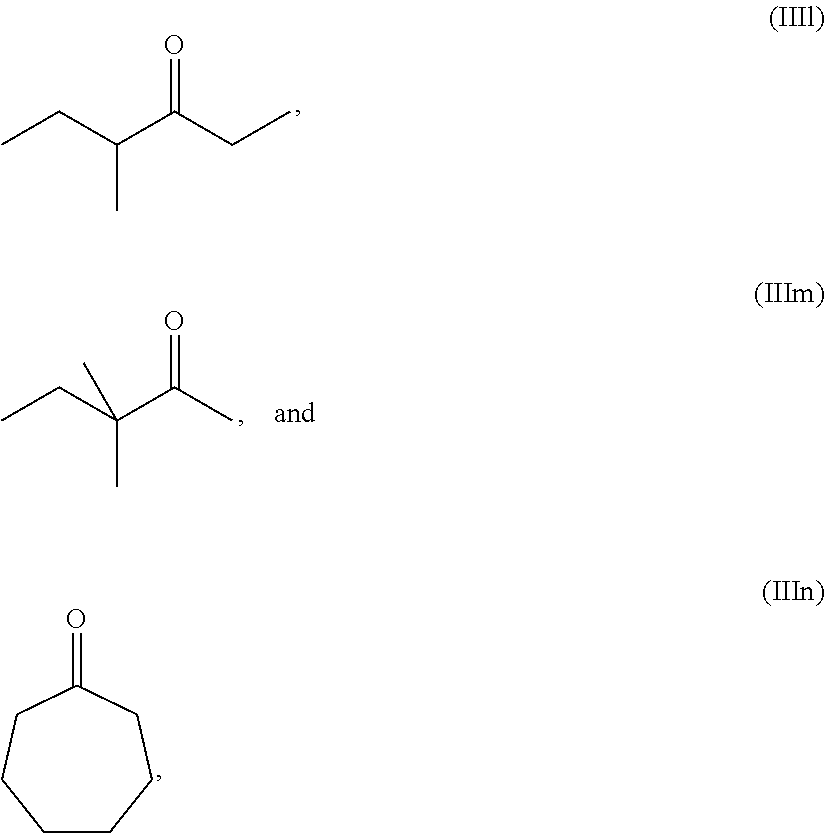
in particular dodecafluorocycloheptanone,
as well as any fluoroketone having exactly 7 carbon atoms, in which the at least partially fluorinated alkyl chain of the fluoroketone forms a ring, which is substituted by one or more alkyl groups (IIIo).

- a) conveying an initial gas mixture containing the organofluorine compound and at least one further component of the insulation medium out of the insulation space into a substance recovery device,
- b) liquefying and/or solidifying the organofluorine compound in the substance recovery device, and
- c) separating the liquefied and/or solidified organofluorine compound from the at least one remaining component of the initial gas mixture.
- d) collecting the condensed organofluorine compound by an organofluorine compound collecting device.
- e) conveying the organfluorine compound to an organofluorine compound reservoir tank for being stored therein.
- f) reintroducing the organofluorine compound into the insulation space,
which contributes to the economic and ecologic benefits of the present invention.
- 10 electrical apparatus
- 12 housing
- 14 electrical component
- 16 insulation space
- 18 a, 18 b conductors
- 22 insulation medium
- 24; 241 gas flow generating device
- 241 pump, suction pump
- 26 outlet opening
- 28 primary gas channel
- 30 substance recovery device
- 32 filter
- 34 separator
- 36; 361 liquefaction device
- 361 cooler
- 38; 381 organofluorine compound collecting device
- 381 funnel
- 40 organofluorine compound reservoir tank
- 42 organofluorine compound recycling channel
- 44 organofluorine compound inlet opening
- 46 secondary gas channel
- 48 secondary reservoir tank
- 50; 501 gas inlet opening for reintroducing the at least one remaining component; secondary gas inlet opening.
Claims (41)
Applications Claiming Priority (4)
| Application Number | Priority Date | Filing Date | Title |
|---|---|---|---|
| EPPCT/EP2014/06030 | 2014-05-20 | ||
| WOPCT/EP2014/060300 | 2014-05-20 | ||
| EP2014060300 | 2014-05-20 | ||
| PCT/EP2015/060994 WO2015177149A1 (en) | 2014-05-20 | 2015-05-19 | Electrical apparatus for the generation, transmission, distribution and/or usage of electrical energy and method for recovering a substance from an insulation medium of such an apparatus |
Related Parent Applications (1)
| Application Number | Title | Priority Date | Filing Date |
|---|---|---|---|
| PCT/EP2015/060994 Continuation WO2015177149A1 (en) | 2014-05-20 | 2015-05-19 | Electrical apparatus for the generation, transmission, distribution and/or usage of electrical energy and method for recovering a substance from an insulation medium of such an apparatus |
Publications (2)
| Publication Number | Publication Date |
|---|---|
| US20170069407A1 US20170069407A1 (en) | 2017-03-09 |
| US10256008B2 true US10256008B2 (en) | 2019-04-09 |
Family
ID=50842238
Family Applications (1)
| Application Number | Title | Priority Date | Filing Date |
|---|---|---|---|
| US15/356,991 Active 2035-10-04 US10256008B2 (en) | 2014-05-20 | 2016-11-21 | Electrical apparatus for the generation, transmission, distribution and/or usage of electrical energy and method for recovering a substance from an insulation medium of such an apparatus |
Country Status (7)
| Country | Link |
|---|---|
| US (1) | US10256008B2 (en) |
| EP (1) | EP3146531B2 (en) |
| CN (1) | CN106537705B (en) |
| AU (1) | AU2015261942A1 (en) |
| CA (1) | CA2949581A1 (en) |
| MX (1) | MX2016014972A (en) |
| WO (1) | WO2015177149A1 (en) |
Cited By (3)
| Publication number | Priority date | Publication date | Assignee | Title |
|---|---|---|---|---|
| CN111077391A (en) * | 2019-12-20 | 2020-04-28 | 中国能源建设集团江苏省电力设计院有限公司 | A real-time monitoring system for GIL lines |
| US20220367134A1 (en) * | 2019-06-21 | 2022-11-17 | Hitachi Energy Switzerland Ag | Dielectric-insulation or arc-extinction fluid |
| US20230223224A1 (en) * | 2020-06-11 | 2023-07-13 | General Electric Technology Gmbh | Gas-insulated electrical apparatus comprising carbon dioxide, heptafluoroisobutyronitrile and a high content of oxygen |
Families Citing this family (12)
| Publication number | Priority date | Publication date | Assignee | Title |
|---|---|---|---|---|
| CN104662617A (en) * | 2012-04-04 | 2015-05-27 | 3M创新有限公司 | Fluorinated nitriles as dielectric gases |
| HRP20200089T1 (en) | 2015-08-19 | 2020-04-03 | Abb Schweiz Ag | METHOD FOR RECOVERY OF AT LEAST ONE SUBSTANCE FROM THE INSULATION MEDIA OF ELECTRICAL APPARATUS FOR PRODUCTION, TRANSMISSION, DISTRIBUTION AND / OR USE OF ELECTRICITY |
| DK3465717T3 (en) * | 2016-06-03 | 2020-10-26 | Abb Schweiz Ag | GAS INSULATED LOW OR MEDIUM VOLTAGE LOAD SWITCH |
| DE102017220570A1 (en) * | 2017-11-17 | 2019-05-23 | Siemens Aktiengesellschaft | Insulation medium for an electric power transmission device |
| WO2019106840A1 (en) * | 2017-12-01 | 2019-06-06 | 株式会社 東芝 | Gas circuit breaker |
| FR3079359B1 (en) * | 2018-03-22 | 2020-10-09 | Arkema France | USE OF 1-CHLORO-2,3,3,3-TETRAFLUOROPROPENE FOR INSULATING OR EXTINGUISHING ELECTRIC ARCS |
| EP3546055B1 (en) * | 2018-03-28 | 2021-01-13 | ABB Schweiz AG | Method and system for decomposing a fluoroketone into disposable decomposition products |
| DE102018212581A1 (en) * | 2018-07-27 | 2020-01-30 | Siemens Aktiengesellschaft | Electrical switching device |
| CN111745351B (en) * | 2020-06-15 | 2021-09-17 | 中国长江电力股份有限公司 | 500kV welding type GIL equipment tapping overhauling construction method |
| EP4304759A4 (en) * | 2021-03-12 | 2025-01-15 | 3M Innovative Properties Company | FLUORINATED FLUID CONDITIONING SYSTEM |
| US20230368938A1 (en) * | 2022-04-28 | 2023-11-16 | Eaton Intelligent Power Limited | Gas mixture including a fluorinated nitrile for gas-insulated switchgear |
| CN118904008A (en) * | 2024-10-08 | 2024-11-08 | 北京九章环境工程股份有限公司 | Process method for recycling organic solvent at low temperature and low energy consumption |
Citations (11)
| Publication number | Priority date | Publication date | Assignee | Title |
|---|---|---|---|---|
| WO2010142346A1 (en) | 2009-06-12 | 2010-12-16 | Abb Technology Ag | Dielectric insulation medium |
| WO2012080246A1 (en) | 2010-12-14 | 2012-06-21 | Abb Technology Ag | Dielectric insulation medium |
| WO2012080222A1 (en) | 2010-12-14 | 2012-06-21 | Abb Research Ltd | Dielectric insulation medium |
| US20130277438A1 (en) * | 2011-12-13 | 2013-10-24 | Peter Terwiesch | Converter Building |
| WO2014053661A1 (en) | 2012-10-05 | 2014-04-10 | Abb Technology Ag | Apparatus containing a dielectric insulation gas comprising an organofluorine compound |
| US20160043533A1 (en) * | 2013-04-22 | 2016-02-11 | Abb Technology Ag | Process For Providing A Contamination-Reducing Component To An Electrical Apparatus |
| US20170148563A1 (en) * | 2014-07-10 | 2017-05-25 | Abb Schweiz Ag | Electrical device comprising a gas-insulated apparatus, in particular a gas-insulated transformer or reactor |
| US20170162349A1 (en) * | 2014-07-08 | 2017-06-08 | Alstom Technology Ltd. | Self-blast circuit breaker using the two-phase state of a gas to improve the cut-off properties |
| US20170213673A1 (en) * | 2014-07-25 | 2017-07-27 | Abb Schweiz Ag | Refill-container for replenishing and/or reconditioning an insulation fluid contained in an insulation space of an electrical apparatus |
| US20170317475A1 (en) * | 2015-01-14 | 2017-11-02 | Abb Schweiz Ag | Method for determining a property of a fluid component of a fluid present in a compartment of an electrical apparatus |
| US20180005727A1 (en) * | 2015-01-13 | 2018-01-04 | Abb Schweiz Ag | Apparatus containing a dielectric insulation gas comprising an organofluorine compound |
Family Cites Families (21)
| Publication number | Priority date | Publication date | Assignee | Title |
|---|---|---|---|---|
| FR1265731A (en) | 1960-08-23 | 1961-06-30 | Thomson Houston Comp Francaise | Improvements to the insulation of high voltage equipment |
| JP3237514B2 (en) | 1996-04-23 | 2001-12-10 | 三菱電機株式会社 | Sulfur hexafluoride gas recovery and regeneration device and mobile recovery and regeneration device |
| JPH10230124A (en) | 1997-02-21 | 1998-09-02 | Toshiba Corp | SF6 gas recovery and purification equipment |
| JP3356965B2 (en) | 1997-06-20 | 2002-12-16 | 株式会社日立製作所 | SF6 gas recovery / purification processing apparatus and method |
| JP2000102123A (en) † | 1998-09-25 | 2000-04-07 | Mitsubishi Electric Corp | Condensable gas recovery device |
| JP2000274938A (en) | 1999-03-23 | 2000-10-06 | Toshiba Corp | Gas recovery equipment |
| JP2000288331A (en) | 1999-04-02 | 2000-10-17 | Mitsubishi Electric Corp | Condensable gas recovery device for recovering condensable gas from mixed gas and condensable gas recovery method using the same |
| JP2001103626A (en) | 1999-09-30 | 2001-04-13 | Toshiba Corp | Gas recovery equipment |
| JP4357046B2 (en) | 1999-10-01 | 2009-11-04 | 株式会社東芝 | Gas recovery device |
| JP2001143580A (en) | 1999-11-10 | 2001-05-25 | Toshiba Corp | Gas separation and recovery equipment |
| JP2001283692A (en) | 2000-03-30 | 2001-10-12 | Toshiba Corp | SF6 gas separation and recovery device |
| JP4405039B2 (en) | 2000-04-28 | 2010-01-27 | 株式会社東芝 | Gas recovery device and gas recovery method |
| JP2001334117A (en) | 2000-05-26 | 2001-12-04 | Mitsubishi Electric Corp | Mixed gas recovery method and apparatus |
| US7128133B2 (en) | 2003-12-16 | 2006-10-31 | 3M Innovative Properties Company | Hydrofluoroether as a heat-transfer fluid |
| US7807074B2 (en) | 2006-12-12 | 2010-10-05 | Honeywell International Inc. | Gaseous dielectrics with low global warming potentials |
| DE202009009305U1 (en) | 2009-06-17 | 2009-11-05 | Ormazabal Gmbh | Switching device for medium, high or very high voltage with a filling medium |
| FR2965120B1 (en) | 2010-09-22 | 2012-10-12 | Areva T & D Sas | APPARATUS FOR BREAKING A MEDIUM OR HIGH VOLTAGE ELECTRIC CURRENT AND METHOD FOR MANUFACTURING THE SAME |
| CA2821158A1 (en) * | 2010-12-16 | 2012-06-21 | Abb Technology Ag | Dielectric insulation medium |
| FR2975836B1 (en) | 2011-05-24 | 2014-07-04 | Schneider Electric Ind Sas | ELECTRICAL GAS-INSULATING APPARATUS HAVING MEANS FOR CONTROLLING GAS PRESSURE |
| CN104662617A (en) | 2012-04-04 | 2015-05-27 | 3M创新有限公司 | Fluorinated nitriles as dielectric gases |
| DE202014003243U1 (en) | 2014-04-15 | 2014-05-14 | Abb Technology Ag | Device for the generation, distribution and / or use of electrical energy or a component of such a connection |
-
2015
- 2015-05-19 AU AU2015261942A patent/AU2015261942A1/en not_active Abandoned
- 2015-05-19 WO PCT/EP2015/060994 patent/WO2015177149A1/en not_active Ceased
- 2015-05-19 CA CA2949581A patent/CA2949581A1/en not_active Abandoned
- 2015-05-19 CN CN201580025971.4A patent/CN106537705B/en active Active
- 2015-05-19 EP EP15723932.8A patent/EP3146531B2/en active Active
- 2015-05-19 MX MX2016014972A patent/MX2016014972A/en unknown
-
2016
- 2016-11-21 US US15/356,991 patent/US10256008B2/en active Active
Patent Citations (12)
| Publication number | Priority date | Publication date | Assignee | Title |
|---|---|---|---|---|
| WO2010142346A1 (en) | 2009-06-12 | 2010-12-16 | Abb Technology Ag | Dielectric insulation medium |
| WO2010142353A1 (en) | 2009-06-12 | 2010-12-16 | Abb Technology Ag | Encapsulated switchgear |
| WO2012080246A1 (en) | 2010-12-14 | 2012-06-21 | Abb Technology Ag | Dielectric insulation medium |
| WO2012080222A1 (en) | 2010-12-14 | 2012-06-21 | Abb Research Ltd | Dielectric insulation medium |
| US20130277438A1 (en) * | 2011-12-13 | 2013-10-24 | Peter Terwiesch | Converter Building |
| WO2014053661A1 (en) | 2012-10-05 | 2014-04-10 | Abb Technology Ag | Apparatus containing a dielectric insulation gas comprising an organofluorine compound |
| US20160043533A1 (en) * | 2013-04-22 | 2016-02-11 | Abb Technology Ag | Process For Providing A Contamination-Reducing Component To An Electrical Apparatus |
| US20170162349A1 (en) * | 2014-07-08 | 2017-06-08 | Alstom Technology Ltd. | Self-blast circuit breaker using the two-phase state of a gas to improve the cut-off properties |
| US20170148563A1 (en) * | 2014-07-10 | 2017-05-25 | Abb Schweiz Ag | Electrical device comprising a gas-insulated apparatus, in particular a gas-insulated transformer or reactor |
| US20170213673A1 (en) * | 2014-07-25 | 2017-07-27 | Abb Schweiz Ag | Refill-container for replenishing and/or reconditioning an insulation fluid contained in an insulation space of an electrical apparatus |
| US20180005727A1 (en) * | 2015-01-13 | 2018-01-04 | Abb Schweiz Ag | Apparatus containing a dielectric insulation gas comprising an organofluorine compound |
| US20170317475A1 (en) * | 2015-01-14 | 2017-11-02 | Abb Schweiz Ag | Method for determining a property of a fluid component of a fluid present in a compartment of an electrical apparatus |
Non-Patent Citations (2)
| Title |
|---|
| European Patent Office, International Search Report & Written Opinion issued in corresponding Application No. PCT/EP2014/060300, dated Jan. 15, 2015, 6 pp. |
| European Patent Office, International Search Report & Written Opinion issued in corresponding Application No. PCT/EP2015/060994, dated Aug. 4, 2015, 8 pp. |
Cited By (5)
| Publication number | Priority date | Publication date | Assignee | Title |
|---|---|---|---|---|
| US20220367134A1 (en) * | 2019-06-21 | 2022-11-17 | Hitachi Energy Switzerland Ag | Dielectric-insulation or arc-extinction fluid |
| US11978600B2 (en) * | 2019-06-21 | 2024-05-07 | Hitachi Energy Ltd | Dielectric-insulation or arc-extinction fluid |
| CN111077391A (en) * | 2019-12-20 | 2020-04-28 | 中国能源建设集团江苏省电力设计院有限公司 | A real-time monitoring system for GIL lines |
| US20230223224A1 (en) * | 2020-06-11 | 2023-07-13 | General Electric Technology Gmbh | Gas-insulated electrical apparatus comprising carbon dioxide, heptafluoroisobutyronitrile and a high content of oxygen |
| US12176162B2 (en) * | 2020-06-11 | 2024-12-24 | Ge Infrastructure Technology Llc | Gas-insulated electrical apparatus comprising carbon dioxide, heptafluoroisobutyronitrile and a high content of oxygen |
Also Published As
| Publication number | Publication date |
|---|---|
| AU2015261942A1 (en) | 2017-01-12 |
| US20170069407A1 (en) | 2017-03-09 |
| EP3146531A1 (en) | 2017-03-29 |
| MX2016014972A (en) | 2017-05-12 |
| EP3146531B2 (en) | 2023-02-01 |
| CA2949581A1 (en) | 2015-11-26 |
| CN106537705A (en) | 2017-03-22 |
| CN106537705B (en) | 2019-05-21 |
| WO2015177149A1 (en) | 2015-11-26 |
| EP3146531B1 (en) | 2018-03-21 |
Similar Documents
| Publication | Publication Date | Title |
|---|---|---|
| US10256008B2 (en) | Electrical apparatus for the generation, transmission, distribution and/or usage of electrical energy and method for recovering a substance from an insulation medium of such an apparatus | |
| EP3338285B1 (en) | Method for reclaiming at least one substance from an insulation medium of an electrical apparatus for the generation, transmission, distribution and/or usage of electrical energy | |
| KR102242307B1 (en) | Water and contamination absorber for c02 insulated electrical apparatus for the generation, transmission, distribution and/or usage of electrical energy | |
| EP2652751B1 (en) | Dielectric insulation medium | |
| US9491877B2 (en) | Use of a mixture comprising a hydrofluoroolefin as a medium-voltage arc-extinguishing and/or insulating gas and medium-voltage electrical device comprising same | |
| EP2936504B1 (en) | A method for dielectrically insulating active electric parts | |
| WO2014122814A1 (en) | Arc-extinguishing insulating material molding and gas circuit breaker using same | |
| CN109196600B (en) | Use of linear octafluorobutene as a dielectric compound in environmentally safe dielectric insulating or arc extinguishing fluids | |
| CN114072881B (en) | Dielectric insulation or arc suppression fluid | |
| Knobloch | The comparison of arc-extinguishing capability of sulfur hexafluoride (SF6) with alternative gases in high-voltage circuit-breakers | |
| EP3546055B1 (en) | Method and system for decomposing a fluoroketone into disposable decomposition products | |
| CN116097374A (en) | Method for rebuilding medium-voltage or high-voltage electrical equipment | |
| EP3384508B1 (en) | Methods for dielectrically insulating electrical active parts | |
| EP3384505B1 (en) | Methods for dielectrically insulating electrical active parts | |
| US20180108452A1 (en) | Methods for dielectrically insulating electrical active parts | |
| EP3384506B1 (en) | Methods for dielectrically insulating electrical active parts | |
| WO2015086067A1 (en) | Vacuum circuit breaker | |
| HK1190496B (en) | Dielectric insulation medium |
Legal Events
| Date | Code | Title | Description |
|---|---|---|---|
| AS | Assignment |
Owner name: ABB SCHWEIZ AG, SWITZERLAND Free format text: ASSIGNMENT OF ASSIGNORS INTEREST;ASSIGNORS:JOHNSON, CHARLES;BOESCH, DANIEL;FLOREZ, JAVIER MANTILLA;AND OTHERS;SIGNING DATES FROM 20161201 TO 20170110;REEL/FRAME:041476/0983 |
|
| STCF | Information on status: patent grant |
Free format text: PATENTED CASE |
|
| AS | Assignment |
Owner name: ABB POWER GRIDS SWITZERLAND AG, SWITZERLAND Free format text: ASSIGNMENT OF ASSIGNORS INTEREST;ASSIGNOR:ABB SCHWEIZ AG;REEL/FRAME:052916/0001 Effective date: 20191025 |
|
| AS | Assignment |
Owner name: HITACHI ENERGY SWITZERLAND AG, SWITZERLAND Free format text: CHANGE OF NAME;ASSIGNOR:ABB POWER GRIDS SWITZERLAND AG;REEL/FRAME:058666/0540 Effective date: 20211006 |
|
| MAFP | Maintenance fee payment |
Free format text: PAYMENT OF MAINTENANCE FEE, 4TH YEAR, LARGE ENTITY (ORIGINAL EVENT CODE: M1551); ENTITY STATUS OF PATENT OWNER: LARGE ENTITY Year of fee payment: 4 |
|
| AS | Assignment |
Owner name: HITACHI ENERGY LTD, SWITZERLAND Free format text: MERGER;ASSIGNOR:HITACHI ENERGY SWITZERLAND AG;REEL/FRAME:065549/0576 Effective date: 20231002 |