US10229981B2 - Gate-all-around (GAA) transistor with stacked nanowires on locally isolated substrate - Google Patents
Gate-all-around (GAA) transistor with stacked nanowires on locally isolated substrate Download PDFInfo
- Publication number
- US10229981B2 US10229981B2 US15/335,281 US201615335281A US10229981B2 US 10229981 B2 US10229981 B2 US 10229981B2 US 201615335281 A US201615335281 A US 201615335281A US 10229981 B2 US10229981 B2 US 10229981B2
- Authority
- US
- United States
- Prior art keywords
- semiconductor
- disposed
- channel region
- layer
- gate
- Prior art date
- Legal status (The legal status is an assumption and is not a legal conclusion. Google has not performed a legal analysis and makes no representation as to the accuracy of the status listed.)
- Active
Links
Images




Classifications
-
- H01L29/42392—
-
- H—ELECTRICITY
- H10—SEMICONDUCTOR DEVICES; ELECTRIC SOLID-STATE DEVICES NOT OTHERWISE PROVIDED FOR
- H10D—INORGANIC ELECTRIC SEMICONDUCTOR DEVICES
- H10D30/00—Field-effect transistors [FET]
- H10D30/60—Insulated-gate field-effect transistors [IGFET]
-
- H—ELECTRICITY
- H10—SEMICONDUCTOR DEVICES; ELECTRIC SOLID-STATE DEVICES NOT OTHERWISE PROVIDED FOR
- H10D—INORGANIC ELECTRIC SEMICONDUCTOR DEVICES
- H10D30/00—Field-effect transistors [FET]
- H10D30/60—Insulated-gate field-effect transistors [IGFET]
- H10D30/67—Thin-film transistors [TFT]
- H10D30/6729—Thin-film transistors [TFT] characterised by the electrodes
- H10D30/673—Thin-film transistors [TFT] characterised by the electrodes characterised by the shapes, relative sizes or dispositions of the gate electrodes
- H10D30/6735—Thin-film transistors [TFT] characterised by the electrodes characterised by the shapes, relative sizes or dispositions of the gate electrodes having gates fully surrounding the channels, e.g. gate-all-around
-
- B—PERFORMING OPERATIONS; TRANSPORTING
- B82—NANOTECHNOLOGY
- B82Y—SPECIFIC USES OR APPLICATIONS OF NANOSTRUCTURES; MEASUREMENT OR ANALYSIS OF NANOSTRUCTURES; MANUFACTURE OR TREATMENT OF NANOSTRUCTURES
- B82Y10/00—Nanotechnology for information processing, storage or transmission, e.g. quantum computing or single electron logic
-
- H—ELECTRICITY
- H01—ELECTRIC ELEMENTS
- H01L—SEMICONDUCTOR DEVICES NOT COVERED BY CLASS H10
- H01L21/00—Processes or apparatus adapted for the manufacture or treatment of semiconductor or solid state devices or of parts thereof
- H01L21/02—Manufacture or treatment of semiconductor devices or of parts thereof
- H01L21/04—Manufacture or treatment of semiconductor devices or of parts thereof the devices having potential barriers, e.g. a PN junction, depletion layer or carrier concentration layer
- H01L21/18—Manufacture or treatment of semiconductor devices or of parts thereof the devices having potential barriers, e.g. a PN junction, depletion layer or carrier concentration layer the devices having semiconductor bodies comprising elements of Group IV of the Periodic Table or AIIIBV compounds with or without impurities, e.g. doping materials
- H01L21/30—Treatment of semiconductor bodies using processes or apparatus not provided for in groups H01L21/20 - H01L21/26
- H01L21/302—Treatment of semiconductor bodies using processes or apparatus not provided for in groups H01L21/20 - H01L21/26 to change their surface-physical characteristics or shape, e.g. etching, polishing, cutting
- H01L21/306—Chemical or electrical treatment, e.g. electrolytic etching
- H01L21/30604—Chemical etching
-
- H01L21/845—
-
- H01L29/0649—
-
- H01L29/0673—
-
- H01L29/0847—
-
- H01L29/401—
-
- H01L29/41725—
-
- H01L29/42356—
-
- H01L29/66439—
-
- H01L29/66545—
-
- H01L29/775—
-
- H01L29/7848—
-
- H01L29/785—
-
- H01L29/78696—
-
- H—ELECTRICITY
- H10—SEMICONDUCTOR DEVICES; ELECTRIC SOLID-STATE DEVICES NOT OTHERWISE PROVIDED FOR
- H10D—INORGANIC ELECTRIC SEMICONDUCTOR DEVICES
- H10D30/00—Field-effect transistors [FET]
- H10D30/01—Manufacture or treatment
- H10D30/014—Manufacture or treatment of FETs having zero-dimensional [0D] or one-dimensional [1D] channels, e.g. quantum wire FETs, single-electron transistors [SET] or Coulomb blockade transistors
-
- H—ELECTRICITY
- H10—SEMICONDUCTOR DEVICES; ELECTRIC SOLID-STATE DEVICES NOT OTHERWISE PROVIDED FOR
- H10D—INORGANIC ELECTRIC SEMICONDUCTOR DEVICES
- H10D30/00—Field-effect transistors [FET]
- H10D30/40—FETs having zero-dimensional [0D], one-dimensional [1D] or two-dimensional [2D] charge carrier gas channels
- H10D30/43—FETs having zero-dimensional [0D], one-dimensional [1D] or two-dimensional [2D] charge carrier gas channels having 1D charge carrier gas channels, e.g. quantum wire FETs or transistors having 1D quantum-confined channels
-
- H—ELECTRICITY
- H10—SEMICONDUCTOR DEVICES; ELECTRIC SOLID-STATE DEVICES NOT OTHERWISE PROVIDED FOR
- H10D—INORGANIC ELECTRIC SEMICONDUCTOR DEVICES
- H10D30/00—Field-effect transistors [FET]
- H10D30/60—Insulated-gate field-effect transistors [IGFET]
- H10D30/62—Fin field-effect transistors [FinFET]
-
- H—ELECTRICITY
- H10—SEMICONDUCTOR DEVICES; ELECTRIC SOLID-STATE DEVICES NOT OTHERWISE PROVIDED FOR
- H10D—INORGANIC ELECTRIC SEMICONDUCTOR DEVICES
- H10D30/00—Field-effect transistors [FET]
- H10D30/60—Insulated-gate field-effect transistors [IGFET]
- H10D30/67—Thin-film transistors [TFT]
- H10D30/6757—Thin-film transistors [TFT] characterised by the structure of the channel, e.g. transverse or longitudinal shape or doping profile
-
- H—ELECTRICITY
- H10—SEMICONDUCTOR DEVICES; ELECTRIC SOLID-STATE DEVICES NOT OTHERWISE PROVIDED FOR
- H10D—INORGANIC ELECTRIC SEMICONDUCTOR DEVICES
- H10D30/00—Field-effect transistors [FET]
- H10D30/60—Insulated-gate field-effect transistors [IGFET]
- H10D30/791—Arrangements for exerting mechanical stress on the crystal lattice of the channel regions
- H10D30/797—Arrangements for exerting mechanical stress on the crystal lattice of the channel regions being in source or drain regions, e.g. SiGe source or drain
-
- H—ELECTRICITY
- H10—SEMICONDUCTOR DEVICES; ELECTRIC SOLID-STATE DEVICES NOT OTHERWISE PROVIDED FOR
- H10D—INORGANIC ELECTRIC SEMICONDUCTOR DEVICES
- H10D62/00—Semiconductor bodies, or regions thereof, of devices having potential barriers
- H10D62/10—Shapes, relative sizes or dispositions of the regions of the semiconductor bodies; Shapes of the semiconductor bodies
- H10D62/113—Isolations within a component, i.e. internal isolations
- H10D62/115—Dielectric isolations, e.g. air gaps
-
- H—ELECTRICITY
- H10—SEMICONDUCTOR DEVICES; ELECTRIC SOLID-STATE DEVICES NOT OTHERWISE PROVIDED FOR
- H10D—INORGANIC ELECTRIC SEMICONDUCTOR DEVICES
- H10D62/00—Semiconductor bodies, or regions thereof, of devices having potential barriers
- H10D62/10—Shapes, relative sizes or dispositions of the regions of the semiconductor bodies; Shapes of the semiconductor bodies
- H10D62/117—Shapes of semiconductor bodies
- H10D62/118—Nanostructure semiconductor bodies
- H10D62/119—Nanowire, nanosheet or nanotube semiconductor bodies
- H10D62/121—Nanowire, nanosheet or nanotube semiconductor bodies oriented parallel to substrates
-
- H—ELECTRICITY
- H10—SEMICONDUCTOR DEVICES; ELECTRIC SOLID-STATE DEVICES NOT OTHERWISE PROVIDED FOR
- H10D—INORGANIC ELECTRIC SEMICONDUCTOR DEVICES
- H10D62/00—Semiconductor bodies, or regions thereof, of devices having potential barriers
- H10D62/10—Shapes, relative sizes or dispositions of the regions of the semiconductor bodies; Shapes of the semiconductor bodies
- H10D62/13—Semiconductor regions connected to electrodes carrying current to be rectified, amplified or switched, e.g. source or drain regions
- H10D62/149—Source or drain regions of field-effect devices
- H10D62/151—Source or drain regions of field-effect devices of IGFETs
-
- H—ELECTRICITY
- H10—SEMICONDUCTOR DEVICES; ELECTRIC SOLID-STATE DEVICES NOT OTHERWISE PROVIDED FOR
- H10D—INORGANIC ELECTRIC SEMICONDUCTOR DEVICES
- H10D62/00—Semiconductor bodies, or regions thereof, of devices having potential barriers
- H10D62/10—Shapes, relative sizes or dispositions of the regions of the semiconductor bodies; Shapes of the semiconductor bodies
- H10D62/17—Semiconductor regions connected to electrodes not carrying current to be rectified, amplified or switched, e.g. channel regions
- H10D62/351—Substrate regions of field-effect devices
- H10D62/357—Substrate regions of field-effect devices of FETs
- H10D62/364—Substrate regions of field-effect devices of FETs of IGFETs
-
- H—ELECTRICITY
- H10—SEMICONDUCTOR DEVICES; ELECTRIC SOLID-STATE DEVICES NOT OTHERWISE PROVIDED FOR
- H10D—INORGANIC ELECTRIC SEMICONDUCTOR DEVICES
- H10D64/00—Electrodes of devices having potential barriers
- H10D64/01—Manufacture or treatment
-
- H—ELECTRICITY
- H10—SEMICONDUCTOR DEVICES; ELECTRIC SOLID-STATE DEVICES NOT OTHERWISE PROVIDED FOR
- H10D—INORGANIC ELECTRIC SEMICONDUCTOR DEVICES
- H10D64/00—Electrodes of devices having potential barriers
- H10D64/01—Manufacture or treatment
- H10D64/017—Manufacture or treatment using dummy gates in processes wherein at least parts of the final gates are self-aligned to the dummy gates, i.e. replacement gate processes
-
- H—ELECTRICITY
- H10—SEMICONDUCTOR DEVICES; ELECTRIC SOLID-STATE DEVICES NOT OTHERWISE PROVIDED FOR
- H10D—INORGANIC ELECTRIC SEMICONDUCTOR DEVICES
- H10D64/00—Electrodes of devices having potential barriers
- H10D64/20—Electrodes characterised by their shapes, relative sizes or dispositions
- H10D64/23—Electrodes carrying the current to be rectified, amplified, oscillated or switched, e.g. sources, drains, anodes or cathodes
- H10D64/251—Source or drain electrodes for field-effect devices
-
- H—ELECTRICITY
- H10—SEMICONDUCTOR DEVICES; ELECTRIC SOLID-STATE DEVICES NOT OTHERWISE PROVIDED FOR
- H10D—INORGANIC ELECTRIC SEMICONDUCTOR DEVICES
- H10D64/00—Electrodes of devices having potential barriers
- H10D64/20—Electrodes characterised by their shapes, relative sizes or dispositions
- H10D64/27—Electrodes not carrying the current to be rectified, amplified, oscillated or switched, e.g. gates
- H10D64/311—Gate electrodes for field-effect devices
- H10D64/411—Gate electrodes for field-effect devices for FETs
- H10D64/511—Gate electrodes for field-effect devices for FETs for IGFETs
- H10D64/512—Disposition of the gate electrodes, e.g. buried gates
-
- H—ELECTRICITY
- H10—SEMICONDUCTOR DEVICES; ELECTRIC SOLID-STATE DEVICES NOT OTHERWISE PROVIDED FOR
- H10D—INORGANIC ELECTRIC SEMICONDUCTOR DEVICES
- H10D86/00—Integrated devices formed in or on insulating or conducting substrates, e.g. formed in silicon-on-insulator [SOI] substrates or on stainless steel or glass substrates
- H10D86/01—Manufacture or treatment
- H10D86/011—Manufacture or treatment comprising FinFETs
-
- H10P50/642—
-
- H10W10/011—
-
- H10W10/10—
Definitions
- Embodiments of the invention are in the field of semiconductor devices and, in particular, strained gate-all-around semiconductor devices formed on globally or locally isolated substrates.
- tri-gate transistors In the manufacture of integrated circuit devices, multi-gate transistors, such as tri-gate transistors, have become more prevalent as device dimensions continue to scale down.
- tri-gate transistors In conventional processes, tri-gate transistors are generally fabricated on either bulk silicon substrates or silicon-on-insulator substrates. In some instances, bulk silicon substrates are preferred due to their lower cost and because they enable a less complicated tri-gate fabrication process. In other instances, silicon-on-insulator substrates are preferred because of the improved short-channel behavior of tri-gate transistors.
- Silicon-on-insulator substrates formed either by global isolation or local isolation, may also be used to fabricate gate-all-around devices. Many different techniques have been attempted to fabricate such three-dimensional isolated channel devices. However, significant improvements are still needed in the area of isolation formation for such semiconductor devices.
- FIGS. 1A and 1B illustrate cross-sectional views of various operations in a method of fabricating a semiconductor device.
- FIGS. 2A-2C illustrate cross-sectional views of various operations in a method of fabricating a semiconductor device, in accordance with an embodiment of the present invention.
- FIG. 3A illustrates a three-dimensional cross-sectional view of a nanowire-based semiconductor structure, in accordance with an embodiment of the present invention.
- FIG. 3B illustrates a cross-sectional channel view of the nanowire-based semiconductor structure of FIG. 3A , as taken along the a-a′ axis, in accordance with an embodiment of the present invention.
- FIG. 3C illustrates a cross-sectional spacer view of the nanowire-based semiconductor structure of FIG. 3A , as taken along the b-b′ axis, in accordance with an embodiment of the present invention.
- FIGS. 4A-4J illustrate cross-sectional views of various operations in a method of fabricating a semiconductor device, in accordance with an embodiment of the present invention.
- FIGS. 5A-5J illustrate cross-sectional views of various operations in another method of fabricating a semiconductor device, in accordance with an embodiment of the present invention.
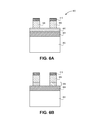
- FIGS. 6A-6G illustrate cross-sectional views of various operations in another method of fabricating a semiconductor device, in accordance with an embodiment of the present invention.
- FIG. 7 illustrates a computing device in accordance with one implementation of an embodiment of the invention.
- an undercut control layer may be used to integrate strain in under fin oxidation (UFO) or silicon-on-insulator (SOI) or silicon germanium-on-insulator (SiGeOI) FIN formation to enable, e.g., enhanced channel strain formation.
- UFO-based structures may be referred to as locally isolated from an underlying substrate, while SOI-based structures may be referred to as globally isolated from an underlying substrate.
- Embodiments of the present invention may be suitable for both such locally and globally isolated structures.
- an epitaxial seeding layer is retained for epitaxial structure formation. The epitaxial seeding layer may be retained or later removed in subsequent process operations.
- solutions described herein may be suitable for straining a partially or entirely isolated device.
- the isolation may be achieved or may be a result of global isolation (SOI) or local isolation (UFO) where, in either case, an intervening insulating layer is disposed between a channel region an underlying bulk semiconductor substrate.
- the intervening dielectric layer may be fabricated by, e.g., under fin oxidation (UFO), buried oxide formation (BOX), or replacement dielectrics, or may included in a starting substrate.
- one or more embodiments of the present invention are directed to integrating gate-all-around devices.
- high performance, low leakage transistor technology approaches are described herein.
- Difficulty in increasing electron and hole mobility simultaneously when the same channel material is used for both the NMOS and PMOS is also addressed herein.
- Device performance may be enhanced using strain solutions, higher mobility channel approaches, or higher mobility channel orientations.
- an undoped silicon (Si) material channel is provided for a FIN structure.
- the Si FIN is formed on an SiO 2 -based substrate to take advantage of a fully undoped channel (e.g., with no subFIN leakage) and minimized gate induced drain leakage (GIDL) or junction leakage.
- GIDL gate induced drain leakage
- Si cannot typically be grown epitaxially on a SiO 2 buried layer.
- Conventional approaches to integrating epitaxial channel straining regions may include performing a shallow undercut to leave a thin Si layer (or other epitaxial nucleation layer) disposed over a local or global buried oxide in order to enable epitaxial stressor nucleation. Such an approach may not be optimal since any capacity for induced strain will likely be reduced considering the S/D epitaxial volume is limited. Also, with such a controlled undercut technique may not permit integration of epitaxial material to grow in a tip region of a fabricated device which otherwise brings straining features very close to a channel region for maximum the stress transfer.
- FIGS. 1A and 1B illustrate cross-sectional views of various operations in a method of fabricating a semiconductor device.
- a semiconductor structure 100 includes a semiconductor body 106 , such as a silicon layer, disposed on an insulating layer 104 , such as global or local insulating layer, on a substrate 102 , such as a bulk silicon substrate.
- a gate electrode 108 such as a polysilicon placeholder gate electrode with hardmask 110 and spacers 112 , is disposed above the semiconductor body 106 .
- exposed portions of the semiconductor body 106 are recessed to form recessed regions 114 .
- the recessed regions 114 reduce the thickness of the semiconductor body 106 , but do not expose the underlying insulating layer 104 .
- the recessed regions 114 provide a location for epitaxial nucleation for, e.g., subsequent source and drain stressor formation.
- silicon germanium (SiGe) may subsequently be grown on recessed portions 114 of the semiconductor body 106 in order to provide stress to the channel region of the semiconductor body 106 under the gate electrode 108 .
- one or more embodiments are directed to enabling integration of strain on UFO/SiGeOI FINs by the implementation of an etch stop layer (e.g., where the SiGe is buried) that is sacrificial and may subsequently be removed to provide a gate-all-around or/and contact-all-around structure.
- an etch stop layer e.g., where the SiGe is buried
- the deposition of a sacrificial undercut etch stop layer or sacrificial top layer buffer and its removal in the channel and or S/D regions is described in greater detail below.
- FIGS. 2A-2C illustrate cross-sectional views of various operations in a method of fabricating a semiconductor device, in accordance with an embodiment of the present invention.
- a semiconductor structure 200 includes a semiconductor body 206 , such as a silicon layer, disposed on an undercut etch stop layer 205 , such as a silicon germanium etch stop layer.
- the undercut etch stop layer 205 is disposed on insulating layer 204 , such as global or local insulating layer, on a substrate 202 , such as a bulk silicon substrate.
- a gate electrode 208 such as a polysilicon placeholder gate electrode with hardmask 210 and spacers 212 , is disposed above the semiconductor body 206 .
- exposed portions of the semiconductor body 206 are removed to expose portions 214 of the undercut etch stop layer 205 .
- the portions 214 of the undercut etch stop layer 205 inhibit exposure of the underlying insulating layer 204 .
- an extent 215 of undercut underneath the gate electrode 208 may be achieved since an overetch process may be used to remove portions of the semiconductor body 206 .
- the portions 214 of the undercut etch stop layer 205 also provide a location for epitaxial nucleation for, e.g., subsequent source and drain stressor formation.
- epitaxial regions 216 such as silicon germanium (SiGe) epitaxial regions may subsequently be grown on portions 214 of the undercut etch stop layer 205 , adjacent to the remaining portion of the semiconductor body 206 , as depicted in FIG. 2C .
- the epitaxial regions 216 may be incorporated to provide stress to the channel region of the semiconductor body 206 under the gate electrode 208 .
- FIGS. 2A-2C illustrate the concepts involved in one or more embodiments of the present invention
- more elaborate approaches may also be used to fabricate semiconductor devices that benefit from the use of an undercut etch stop layer.
- an intervening insulating layer e.g., layer 204
- a semiconductor body layer e.g., layer 206
- an intervening insulating layer is formed subsequent to semiconductor body formation.
- a gate electrode or placeholder electrode is formed prior to recessing of the semiconductor body layer.
- a gate electrode is fabricated following recessing of a semiconductor body layer, enabling formation of gate-all-around semiconductor devices.
- undercut processing may be engineered to maximize volume and under the gate (XUD) control.
- An optimum available strain may as such be transferable to the corresponding channel region.
- a structure that integrates strained Si FIN on a UFO or SiGeOI substrate is thus achievable.
- One or more of the process flows described herein, or the resulting structures and devices may be applicable to tri-gate and/or FIN-FET transistors for, e.g., 14 nanometer and smaller process nodes.
- Embodiments of the invention may involve depositing a Si FIN on a SiGe sacrificial buffer layer and subsequently selectively removing the SiGe buffer layer to ultimately provide a Si FIN gate-all-around or contact-all-around structure.
- FIG. 3A illustrates a three-dimensional cross-sectional view of a nanowire-based semiconductor structure, in accordance with an embodiment of the present invention.
- FIG. 3B illustrates a cross-sectional channel view of the nanowire-based semiconductor structure of FIG. 3A , as taken along the a-a′ axis.
- FIG. 3C illustrates a cross-sectional spacer view of the nanowire-based semiconductor structure of FIG. 3A , as taken along the b-b′ axis.
- a semiconductor device 300 includes one or more vertically stacked nanowires ( 304 set) disposed above a substrate 302 .
- Embodiments herein are targeted at both single wire devices and multiple wire devices.
- a three nanowire-based devices having nanowires 304 A, 304 B and 304 C is shown for illustrative purposes.
- nanowire 304 A is used as an example where description is focused on only one of the nanowires. It is to be understood that where attributes of one nanowire are described, embodiments based on a plurality of nanowires may have the same attributes for each of the nanowires.
- Each of the nanowires 304 includes a channel region 306 disposed in the nanowire.
- the channel region 306 has a length (L).
- the channel region also has a perimeter orthogonal to the length (L).
- a gate electrode stack 308 surrounds the entire perimeter of each of the channel regions 306 of nanowires 304 C and 304 B.
- an etch stop semiconductor layer 390 portion (described in greater detail below) is not present under the channel region 306 of nanowire 304 A, and the device 300 is thus a gate-all-around device with respect to the first nanowire 304 A.
- the etch stop semiconductor layer 390 portion is present under the channel region 306 of nanowire 304 A, and the device 300 is thus not a gate-all-around device with respect to the first nanowire 304 A.
- the gate electrode stack 308 includes a gate electrode along with a gate dielectric layer disposed between the channel region 306 and the gate electrode (not shown).
- each of the nanowires 304 also includes source and drain regions 310 and 312 disposed in the nanowire on either side of the channel region 306 .
- a pair of contacts 314 is disposed over the source/drain regions 310 / 312 .
- pair of contacts 314 is disposed over the source/drain regions 310 / 312 .
- an etch stop semiconductor layer 390 portion (described in greater detail below) is not present under the source or drain region 310 or 312 of nanowire 304 A, and the device 300 is thus a contact-all-around device with respect to the first nanowire 304 A.
- the etch stop semiconductor layer 390 portion is present under the source or drain region 310 or 312 of nanowire 304 A, and the device 300 is thus not a contact-all-around device with respect to the first nanowire 304 A.
- the semiconductor device 300 further includes a pair of spacers 316 .
- the spacers 316 are disposed between the gate electrode stack 308 and the pair of contacts 314 .
- the channel regions and the source/drain regions are, in at least several embodiments, made to be discrete. However, not all regions of the nanowires 304 need be, or even can be made to be discrete.
- nanowires 304 A- 304 C are not discrete at the location under spacers 316 .
- the stack of nanowires 304 A- 304 C have intervening semiconductor material 318 there between, such as silicon germanium intervening between silicon nanowires, or vice versa.
- the bottom nanowire 304 A is still in contact with an etch stop semiconductor layer 390 portion.
- a portion of the plurality of vertically stacked nanowires under one or both of the spacers is non-discrete.
- the etch stop semiconductor layer 390 may be a layer (or remnants thereof) such as the etch stop layer 205 described in association with FIGS. 2A-2C .
- the etch stop semiconductor layer 390 is composed of silicon germanium and the overlying nanowire 304 A is composed of (or at least is initially composed of) silicon.
- the etch stop semiconductor layer 390 is composed of silicon and the overlying nanowire 304 A is composed of (or at least is initially composed of) silicon germanium.
- portions of the semiconductor layer 390 are removed under the channel region of nanowire 304 A and a gate-all-around structure may be formed.
- portions of the semiconductor layer 390 are removed under the source and drain regions of nanowire 304 A and a contact-all-around structure may be formed. In an embodiment, portions of the semiconductor layer 390 are removed under the channel and the source and drain regions of nanowire 304 A and both a gate-all-around structure and a contact-all-around structure may be formed.
- the etch stop semiconductor layer 390 may be a layer (or remnants thereof) may be used to seed growth of epitaxial regions thereon. For example, the etch stop semiconductor layer 390 , at some point, may be used to grow epitaxial straining source and drain regions.
- the one or more nanowires 304 A- 304 C of the semiconductor device 300 are uniaxially strained nanowires.
- a semiconductor device may be fabricated from a single uniaxially strained nanowire (e.g., 304 A) or from a plurality of vertically stacked uniaxially strained nanowires ( 304 A- 304 C), as depicted in FIG. 3A .
- the uniaxially strained nanowire or plurality of nanowires may be uniaxially strained with tensile strain or with compressive strain.
- a compressively uniaxially strained nanowire has a channel region composed of silicon.
- the corresponding compressively uniaxially straining source and drain regions are composed of silicon germanium (Si x Ge y , where 0 ⁇ x ⁇ 100, and 0 ⁇ y ⁇ 100).
- a tensilely uniaxially strained nanowire has a channel region composed of silicon germanium (Si x Ge y , where 0 ⁇ x ⁇ 100, and 0 ⁇ y ⁇ 100).
- the corresponding tensilely uniaxially straining source and drain regions are composed of silicon.
- a PMOS semiconductor device is fabricated from a nanowire having the uniaxial compressive strain.
- an NMOS semiconductor device is fabricated from a nanowire having the uniaxial tensile strain.
- the semiconductor device 300 further includes a dielectric layer 330 disposed between a bulk substrate 302 and the nanowires 304 A- 304 C.
- the dielectric layer 330 is effectively continuous across a substrate 302 and is a global insulating layer.
- the dielectric layer 330 is composed of a dielectric material such as, but not limited to, silicon dioxide, silicon oxy-nitride or silicon nitride.
- the nanowires 304 A- 304 C are isolated from a bulk substrate 302 by an isolation pedestal, e.g., they are locally isolated.
- the isolation pedestal may be composed of a material suitable to electrically isolate at least a portion, if not all, of the nanowire 304 A from the bulk substrate 302 .
- the isolation pedestal is composed of a dielectric material such as, but not limited to, silicon dioxide, silicon oxy-nitride or silicon nitride.
- the isolation pedestal is composed of an oxide of the semiconductor material of the bulk substrate 302 .
- the term “isolation pedestal” is used to covey a discrete isolation structure formed at a given time, e.g., a discrete structure formed only under a channel region, or a pair of discrete structures formed only under a pair of source and drain regions, or a discrete structure formed under a channel region as well as under a pair of source and drain regions.
- the term “isolation pedestal” is used to covey a combination of isolation structures formed at different times, e.g., a discrete structure formed under a channel region in combination with a pair of discrete structures formed, at a different time, under a pair of source and drain regions.
- Bulk substrate 302 may be composed of a semiconductor material that can withstand a manufacturing process.
- bulk substrate 302 is composed of a crystalline silicon, silicon/germanium or germanium layer doped with a charge carrier, such as but not limited to phosphorus, arsenic, boron or a combination thereof.
- the concentration of silicon atoms in bulk substrate 302 is greater than 97%.
- bulk substrate 302 is composed of an epitaxial layer grown atop a distinct crystalline substrate, e.g. a silicon epitaxial layer grown atop a boron-doped bulk silicon mono-crystalline substrate.
- Bulk substrate 302 may alternatively be composed of a group III-V material.
- bulk substrate 302 is composed of a III-V material such as, but not limited to, gallium nitride, gallium phosphide, gallium arsenide, indium phosphide, indium antimonide, indium gallium arsenide, aluminum gallium arsenide, indium gallium phosphide, or a combination thereof.
- bulk substrate 302 is composed of a III-V material and the charge-carrier dopant impurity atoms are ones such as, but not limited to, carbon, silicon, germanium, oxygen, sulfur, selenium or tellurium.
- bulk substrate 302 is undoped or only lightly doped.
- the gate electrode of gate electrode stack 308 is composed of a metal gate and the gate dielectric layer is composed of a high-K material.
- the gate dielectric layer is composed of a material such as, but not limited to, hafnium oxide, hafnium oxy-nitride, hafnium silicate, lanthanum oxide, zirconium oxide, zirconium silicate, tantalum oxide, barium strontium titanate, barium titanate, strontium titanate, yttrium oxide, aluminum oxide, lead scandium tantalum oxide, lead zinc niobate, or a combination thereof.
- a portion of gate dielectric layer may include a layer of native oxide formed from the outer few layers of the semiconductor nanowires 304 A- 304 C.
- the gate dielectric layer is composed of a top high-k portion and a lower portion composed of an oxide of a semiconductor material.
- the gate dielectric layer is composed of a top portion of hafnium oxide and a bottom portion of silicon dioxide or silicon oxy-nitride.
- the gate electrode is composed of a metal layer such as, but not limited to, metal nitrides, metal carbides, metal silicides, metal aluminides, hafnium, zirconium, titanium, tantalum, aluminum, ruthenium, palladium, platinum, cobalt, nickel or conductive metal oxides.
- the gate electrode is composed of a non-workfunction-setting fill material formed above a metal workfunction-setting layer.
- the contacts 314 are, in an embodiment, fabricated from a metal species.
- the metal species may be a pure metal, such as nickel or cobalt, or may be an alloy such as a metal-metal alloy or a metal-semiconductor alloy (e.g., such as a silicide material).
- spacers 316 are composed of an insulative dielectric material such as, but not limited to, silicon dioxide, silicon oxy-nitride or silicon nitride.
- Semiconductor device 300 may be any semiconductor device incorporating a gate, one or more channel regions and one or more pairs of source/drain regions.
- semiconductor device 300 is one such as, but not limited to, a MOS-FET, a memory transistor, or a Microelectromechanical System (MEMS).
- MEMS Microelectromechanical System
- semiconductor device 300 is a three-dimensional MOS-FET and is a stand-alone device or is one device in a plurality of nested devices.
- both N- and P-channel transistors may be fabricated on a single substrate to form a CMOS integrated circuit.
- CMOS architecture may also be formed to include both NMOS and PMOS channel devices disposed on or above the same substrate.
- a plurality of such NMOS devices may be fabricated to have different semiconductor body heights and/or may be isolated from or coupled to an underlying bulk substrate.
- a plurality of such PMOS devices may be fabricated to have different semiconductor body heights and/or may be isolated from or coupled to an underlying bulk substrate.
- additional processing not shown may include processing operations such as back-end interconnect formation and semiconductor die packaging.
- a CMOS architecture may also be formed to include both NMOS and PMOS nanowire-based devices disposed on or above the same substrate.
- Nanowire/nanoribbon structure may be formed by selective etching of sacrificial layers from multilayer epitaxial stacks. The epitaxial layers may be used as a channel or may be selectively removed to form a gap for all-around gate structure.
- the isolation layer under epitaxial wires may provide electrical isolation and form a bottom gap for all-around gate.
- the simplest CMOS integration scheme employs N/P MOS channels fabricated with the same material. The process is simpler to fabricate in that it employs a single selective etch. However, as described throughout herein, strain technology may be required to boost device performance.
- NMOS when silicon was used for channel material, PMOS is enhanced by compressive stress and NMOS is enhanced by a tensile stress along channel direction to enhance carrier mobility.
- the unique features of a starting material stack are exploited to integrate different NMOS and PMOS channel materials which are optimized for higher mobility.
- a sacrificial layer of an NMOS device is used as a PMOS channel and a sacrificial layer of a PMOS device is used as an NMOS channel. Since the sacrificial layer may be removed during processing, independent choice of channel materials and optimization is made possible.
- One or more embodiments of the present invention are directed to a plurality of semiconductor devices having three-dimensional bodies or active regions (e.g., fins) formed from a bulk substrate, such as a bulk single crystalline silicon substrate.
- a bulk substrate such as a bulk single crystalline silicon substrate.
- One or more of the plurality of devices is subsequently subjected to an under fin oxidation (UFO, described in greater detail below) process to isolate, or at least restrict, the device from the underlying bulk substrate.
- UFO under fin oxidation
- one or more embodiments include fabrication processes using a selective (versus global) UFO process to provide selective substrate isolation for targeted devices.
- other embodiments are directed to a plurality of semiconductor devices having three-dimensional bodies or active regions formed on a globally insulating substrate.
- FIGS. 4A-4J illustrate cross-sectional views of various operations in a method of fabricating a semiconductor device, in accordance with an embodiment of the present invention.
- a starting semiconductor structure 400 includes semiconductor bodies 406 , such as silicon fins, disposed on an undercut etch stop layer 405 , such as a silicon germanium etch stop layer.
- the undercut etch stop layer 405 is disposed on a substrate 402 , such as a bulk silicon substrate.
- a hardmask layer 410 such as a silicon nitride hardmask layer, is disposed on the semiconductor bodies 406 .
- Spacers 412 such as silicon nitride spacers are formed along the sidewalls of the semiconductor bodies 406 , as depicted in FIG. 4B , e.g., by conformal layer deposition and etch back.
- exposed portions of the substrate 402 are removed to provide semiconductor pedestals 420 underneath the semiconductor bodies 406 .
- the semiconductor pedestals 420 may be formed selectively without impacting the semiconductor bodies 406 .
- the semiconductor pedestals 420 are then oxidized to form isolation pedestals 422 , as depicted in FIG. 4D .
- Oxidation may also occur in the top portion of the remaining substrate 402 and, possibly, somewhat in the etch stop layer 405 , as is also depicted in FIG. 4D .
- a Si Ge layer 405 is used at least a portion remains unoxidized, protecting semiconductor bodies 406 from oxidation.
- the spacers and hardmask are removed to leave isolation pedestals 422 , etch stop layer 405 and semiconductor bodies 406 remaining. Focusing the remainder of the description on only one semiconductor body 406 , a dielectric pattern 430 may be formed to surround the semiconductor body 406 and isolation pedestal 422 , as depicted in FIG. 4F , e.g., an inter-layer dielectric (ILD) pattern.
- ILD inter-layer dielectric
- portions of the etch stop layer 405 are selectively removed to provide an entirely exposed portion 432 of the semiconductor body 406 above isolation pedestal 422 .
- the portion of the etch stop layer 405 under the channel region of the semiconductor body 406 is removed, e.g., to ultimately enable formation of a gate-all-around structure.
- the portions of the etch stop layer 405 under the source/drain regions of the semiconductor body 406 are removed, e.g., to ultimately enable formation of a contact-all-around structure.
- a gate stack 440 is formed within the structure of FIG. 4G to provide a gate-all-around structure 440 , as depicted in FIG. 4H .
- the gate stack 440 includes a gate dielectric layer 442 and a gate electrode 444 material surrounding the channel region 432 of the semiconductor body 406 .
- FIG. 4H also depicts, as dashed lines, an embodiment including additional nanowires 406 ′ stacked above semiconductor body 406 , with an additional gate stack portion 444 ′ around the additional nanowires 406 ′.
- FIG. 4E and 4I note that FIG. 41 is a view taken perpendicularly from FIG. 4H )
- epitaxial source and drain regions 460 are formed.
- source and drain regions of the semiconductor body 406 are removed, using corresponding portion of the etch stop layer 405 for selective etching, and epitaxial source and drain regions are formed. Subsequently, as depicted in FIG.
- the gate stack 440 may be replaced with a permanent gate stack 470 , such as a high-k metal gate stack.
- FIGS. 4F-4I different combinations of the operations shown in FIGS. 4F-4I may be selected for processing.
- the source and drain regions of semiconductor body 406 need not be replaced with epitaxial regions.
- the portions of the etch stop layer under regions 460 need not be removed.
- artifacts from processing may remain.
- regions 405 A of the etch stop layer 405 may remain underneath gate electrode spacers 465 .
- FIGS. 4A-4J illustrate an exemplary process flow in which a sacrificial SiGe layer is used at the bottom of a fin structure only.
- the exposed portions of the semiconductor pedestals 420 are oxidized to form the isolation pedestals 422 by “under fin oxidation” (UFO).
- UFO under fin oxidation
- the use of spacers may be required if a same or like material is being oxidized, and may even be included if non-like materials are used.
- an oxidizing atmosphere or an adjacent oxidizing material may be used for UFO.
- oxygen implant is used.
- a portion of a material is recessed prior to UFO which may reduce the extent of so-called birds-beak formation during oxidation.
- the oxidation may be performed directly, by recessing first, or by oxygen implant, or a combination thereof.
- a material at the bottom of the fin e.g., a material that has been previously deposited on the silicon wafer before an additional fin material deposition, such as silicon germanium on a silicon substrate
- a dielectric material such as silicon dioxide or silicon nitride.
- the location where reoxidation or material replacement is performed can vary.
- the reoxidation or material removal is carried out post gate etch, post spacer etch, at an undercut location, at a replacement gate operation, or at a through contact operation, or a combination thereof.
- a portion of the silicon germanium etch stop layer 405 is etched selectively with a wet etch that selectively removes the silicon germanium etch stop layer 405 portion while not etching the silicon body 406 .
- Etch chemistries such as carboxylic acid/nitric acid/HF chemistry, and citric acid/nitric acid/HF, for example, may be utilized to selectively etch the silicon germanium.
- a silicon etch stop layer is used below a silicon germanium body.
- Etch chemistries such as aqueous hydroxide chemistries, including ammonium hydroxide and potassium hydroxide, for example, may be utilized to selectively etch the silicon.
- a silicon layer may be removed from a silicon germanium fin-type structure or a silicon germanium layer may be removed from a silicon fin-type structure.
- gate stack structures may be fabricated by a replacement gate process.
- dummy gate material such as polysilicon or silicon nitride pillar material, may be removed and replaced with permanent gate electrode material.
- a permanent gate dielectric layer is also formed in this process, as opposed to being carried through from earlier processing.
- dummy gates are removed by a dry etch or wet etch process.
- dummy gates are composed of polycrystalline silicon or amorphous silicon and are removed with a dry etch process comprising SF 6 .
- dummy gates are composed of polycrystalline silicon or amorphous silicon and are removed with a wet etch process comprising aqueous NH 4 OH or tetramethylammonium hydroxide. In one embodiment, dummy gates are composed of silicon nitride and are removed with a wet etch including aqueous phosphoric acid.
- FIGS. 5A-5J illustrate cross-sectional views of various operations in another method of fabricating a semiconductor device, in accordance with an embodiment of the present invention.
- a starting semiconductor structure 500 includes semiconductor bodies 506 , such as silicon fins, disposed on an undercut etch stop layer 505 A, such as a silicon germanium etch stop layer.
- the undercut etch stop layer 505 A is disposed on a substrate 502 , such as a bulk silicon substrate.
- a second etch stop layer 505 B such as a second silicon germanium etch stop layer, is disposed on the semiconductor bodies 506 .
- a hardmask layer 510 such as a silicon nitride hardmask layer, is disposed on the second etch stop layer 505 B.
- Spacers 512 such as silicon nitride spacers are formed along the sidewalls of the semiconductor bodies 506 , as depicted in FIG. 5B , e.g., by conformal layer deposition and etch back.
- exposed portions of the substrate 502 are removed to provide semiconductor pedestals 520 underneath the semiconductor bodies 506 .
- the semiconductor pedestals 520 may be formed selectively without impacting the semiconductor bodies 506 .
- the semiconductor pedestals 520 are then oxidized to form isolation pedestals 522 , as depicted in FIG. 5D . Oxidation may also occur in the top portion of the remaining substrate 502 and, possibly, somewhat in the etch stop layer 505 A, as is also depicted in FIG. 5D .
- a SiGe layer 505 A is used at least a portion remains unoxidized, protecting semiconductor bodies 506 from oxidation. Referring to FIG.
- a dielectric pattern 530 may be formed to surround the semiconductor body 506 and isolation pedestal 522 , as depicted in FIG. 5F , e.g., an inter-layer dielectric (ILD) pattern.
- ILD inter-layer dielectric
- the portions of the etch stop layers 505 A and 505 B under and above the channel region of the semiconductor body 506 are removed, e.g., to ultimately enable formation of a gate-all-around structure.
- the portions of the etch stop layers 505 A and 505 B under and above the source/drain regions of the semiconductor body 506 are removed, e.g., to ultimately enable formation of a contact-all-around structure.
- a gate stack 540 is formed within the structure of FIG. 5G to provide a gate-all-around structure 550 , as depicted in FIG. 5H .
- the gate stack 540 includes a gate dielectric layer 542 and a gate electrode 544 material surrounding the channel region 532 of the semiconductor body 506 .
- FIGS. 5E and 5I before or after the gate formation, epitaxial source and drain regions 560 are formed.
- source and drain regions of the semiconductor body 506 are removed, using corresponding portion of the etch stop layer 505 A for selective etching, and epitaxial source and drain regions are formed.
- the portions of the etch stop layer 505 A under the epitaxial source and drain 560 are removed to enable a contact-all-around structure.
- the gate stack 540 is not permanent, the gate stack may be replaced with a permanent gate stack 570 , such as a high-k metal gate stack.
- FIGS. 5F-5I different combinations of the operations shown in FIGS. 5F-5I may be selected for processing.
- the source and drain regions of semiconductor body 506 need not be replaced with epitaxial regions.
- the portions of the etch stop layer under regions 560 need not be removed.
- artifacts from processing may remain.
- regions 505 A′ and 505 B′ of the etch stop layers 505 A and 505 B, respectively, may remain underneath gate electrode spacers 565 .
- FIGS. 5A-5J illustrate an exemplary process flow in which a sacrificial SiGe layer is used at the bottom and the top of a fin structure.
- FIGS. 6A-6G illustrate cross-sectional views of various operations in another method of fabricating a semiconductor device, in accordance with an embodiment of the present invention.
- a starting semiconductor structure 600 includes semiconductor bodies 606 , such as silicon fins, disposed on an undercut etch stop layer 605 , such as a silicon germanium etch stop layer.
- the undercut etch stop layer 605 is disposed on an insulating layer 604 , such as a buried SiO 2 layer of a silicon-on-insulator (SOI) substrate.
- SOI silicon-on-insulator
- the insulating layer 604 is disposed on a substrate 602 , such as a silicon substrate.
- a hardmask layer 610 such as a silicon nitride hardmask layer, is disposed on the semiconductor bodies 606 .
- the undercut etch stop layer 605 is patterned to expose insulating layer 604 , as depicted in FIG. 6B , e.g., by a dry etch process. Focusing the remainder of the description on only one semiconductor body 606 , the hardmask 610 is removed and a dielectric pattern 630 is formed to surround the semiconductor body 606 and undercut etch stop layer 605 , as depicted in FIG. 6C , e.g., an inter-layer dielectric (ILD) pattern.
- ILD inter-layer dielectric
- source and drain undercut e.g., as described in association with FIGS. 2A-2C
- a replacement gate process may also be performed at, prior to or after, this stage.
- FIG. 6D the bottom sacrificial layer (and top if present, such as described in association with FIGS. 5A-5J ) is removed.
- a gate dielectric layer 642 and metal gate electrode 644 may be formed, as depicted in FIG. 6E .
- FIGS. 6F and 6G (latter is repeat of FIG. 6E ), respectively, a comparison between the FIN cut 680 and poly cut 690 views is provided. In the former view, the possibility to fabricate a trench contact wrap-around is available in the source and drain regions.
- wire structures such as those described in association with FIGS. 3A-3C ) may also be fabricated in association with the fin structures described and illustrated in FIGS. 4A-4J, 5A-5 -J and 6 A- 6 G above.
- One or more embodiments described herein can be implemented improve performance on, e.g., 14 nanometer and smaller node products and reduce standby leakage. Standby leakage reduction may be particularly important for system-on-chip (SOC) products with extremely stringent standby power requirements. Furthermore, other or the same embodiments may take advantage of higher mobility properties of strained channel engineering using SiGe or Ge as S/D stressors as an example. Also, the gate-all-around and/or contact-all-around structures are expected to improve short channel performance and transistor contact resistance.
- One or more embodiments of the present invention are directed at improving the channel mobility for NMOS or PMOS transistors, or both. Mobility may be improved using strain, e.g., in the channel region. Thus, one or more approaches described herein provide the appropriate strain in the channel regions for both NMOS and PMOS transistors. In an embodiment, strained NMOS and PMOS gate-all-around devices are provided.
- one or more embodiments of the present invention include compressive strain for improved hole mobility for PMOS nanowire-based devices and tensile strain for improved electron mobility for NMOS nanowire-based devices.
- strained silicon and strained silicon germanium devices are formed from such layers in order to improve or maximize device performance.
- NMOS and PMOS uniaxially strained nanowire or nanoribbon devices are fabricated on or above a common substrate by one or more approaches described above.
- the PMOS transistors may include SiGe having uniaxial compressive strain along the current flow direction, while the NMOS transistors may include silicon having uniaxial tensile strain along the current flow direction.
- FIG. 7 illustrates a computing device 700 in accordance with one implementation of the invention.
- the computing device 700 houses a board 702 .
- the board 702 may include a number of components, including but not limited to a processor 704 and at least one communication chip 706 .
- the processor 704 is physically and electrically coupled to the board 702 .
- the at least one communication chip 706 is also physically and electrically coupled to the board 702 .
- the communication chip 706 is part of the processor 704 .
- computing device 700 may include other components that may or may not be physically and electrically coupled to the board 702 .
- these other components include, but are not limited to, volatile memory (e.g., DRAM), non-volatile memory (e.g., ROM), flash memory, a graphics processor, a digital signal processor, a crypto processor, a chipset, an antenna, a display, a touchscreen display, a touchscreen controller, a battery, an audio codec, a video codec, a power amplifier, a global positioning system (GPS) device, a compass, an accelerometer, a gyroscope, a speaker, a camera, and a mass storage device (such as hard disk drive, compact disk (CD), digital versatile disk (DVD), and so forth).
- volatile memory e.g., DRAM
- non-volatile memory e.g., ROM
- flash memory e.g., a graphics processor, a digital signal processor, a crypto processor, a chipset, an
- the communication chip 706 enables wireless communications for the transfer of data to and from the computing device 700 .
- wireless and its derivatives may be used to describe circuits, devices, systems, methods, techniques, communications channels, etc., that may communicate data through the use of modulated electromagnetic radiation through a non-solid medium. The term does not imply that the associated devices do not contain any wires, although in some embodiments they might not.
- the communication chip 706 may implement any of a number of wireless standards or protocols, including but not limited to Wi-Fi (IEEE 802.11 family), WiMAX (IEEE 802.16 family), IEEE 802.20, long term evolution (LTE), Ev-DO, HSPA+, HSDPA+, HSUPA+, EDGE, GSM, GPRS, CDMA, TDMA, DECT, Bluetooth, derivatives thereof, as well as any other wireless protocols that are designated as 3G, 4G, 5G, and beyond.
- the computing device 700 may include a plurality of communication chips 706 .
- a first communication chip 706 may be dedicated to shorter range wireless communications such as Wi-Fi and Bluetooth and a second communication chip 706 may be dedicated to longer range wireless communications such as GPS, EDGE, GPRS, CDMA, WiMAX, LTE, Ev-DO, and others.
- the processor 704 of the computing device 700 includes an integrated circuit die packaged within the processor 704 .
- the integrated circuit die of the processor includes one or more devices, such as MOS-FET transistors built in accordance with implementations of the invention.
- the term “processor” may refer to any device or portion of a device that processes electronic data from registers and/or memory to transform that electronic data into other electronic data that may be stored in registers and/or memory.
- the communication chip 706 also includes an integrated circuit die packaged within the communication chip 706 .
- the integrated circuit die of the communication chip includes one or more devices, such as MOS-FET transistors built in accordance with implementations of the invention.
- another component housed within the computing device 700 may contain an integrated circuit die that includes one or more devices, such as MOS-FET transistors built in accordance with implementations of the invention.
- the computing device 700 may be a laptop, a netbook, a notebook, an ultrabook, a smartphone, a tablet, a personal digital assistant (PDA), an ultra mobile PC, a mobile phone, a desktop computer, a server, a printer, a scanner, a monitor, a set-top box, an entertainment control unit, a digital camera, a portable music player, or a digital video recorder.
- the computing device 700 may be any other electronic device that processes data.
- embodiments of the present invention include strained gate-all-around semiconductor devices formed on globally or locally isolated substrates.
- a semiconductor device in an embodiment, includes a semiconductor substrate.
- An insulating structure is disposed above the semiconductor substrate.
- a three-dimensional channel region is disposed above the insulating structure.
- Source and drain regions are disposed on either side of the three-dimensional channel region and on an epitaxial seed layer.
- the epitaxial seed layer is composed of a semiconductor material different from the three-dimensional channel region and disposed on the insulating structure.
- a gate electrode stack surrounds the three-dimensional channel region with a portion disposed on the insulating structure and laterally adjacent to the epitaxial seed layer.
- the insulating structure is a global insulating layer.
- the insulating structure includes one or more isolation pedestals.
- the three-dimensional channel region is composed of silicon
- the epitaxial seed layer is composed of silicon germanium
- the source and drain regions are composed of silicon germanium and provide a uniaxial stress to the three-dimensional channel region.
- the semiconductor structure further includes a pair of insulating spacers.
- One spacer is disposed between the gate electrode and the source region.
- the other spacer is disposed between the gate electrode and the drain region.
- the epitaxial seed layer extends underneath each of the pair of spacers.
- the semiconductor structure further includes a pair of conducting contacts.
- One contact is disposed on and partially surrounds the source region.
- the other contact is disposed on and partially surrounds the drain region.
- the semiconductor structure further includes one or more nanowires disposed in a vertical arrangement above the three-dimensional channel region.
- the gate electrode stack surrounds a channel region of each of the one or more nanowires.
- the gate electrode stack is composed of a high-k gate dielectric layer and a metal gate electrode.
- a semiconductor device in an embodiment, includes a semiconductor substrate.
- An insulating structure is disposed above the semiconductor substrate.
- a three-dimensional channel region is disposed on an epitaxial seed layer disposed on the insulating structure.
- the epitaxial seed layer is composed of a semiconductor material different from the three-dimensional channel region.
- a gate electrode stack partially surrounds the three-dimensional channel region.
- Source and drain regions are disposed on either side of the three-dimensional channel region and above the insulating structure.
- a pair of conducting contacts is included, one contact disposed on and surrounding the source region, and the other contact disposed on and surrounding the drain region. A portion of each of the pair of contacts is disposed on the insulating structure and laterally adjacent to the epitaxial seed layer.
- the insulating structure includes a global insulating layer.
- the insulating structure includes one or more isolation pedestals.
- the three-dimensional channel region is composed of silicon
- the epitaxial seed layer is composed of silicon germanium
- the source and drain regions are composed of silicon germanium and provide a uniaxial stress to the three-dimensional channel region.
- the semiconductor structure further includes a pair of insulating spacers.
- One spacer is disposed between the gate electrode and the source region.
- the other spacer is disposed between the gate electrode and the drain region.
- the epitaxial seed layer extends underneath each of the pair of spacers.
- the semiconductor structure further includes one or more nanowires disposed in a vertical arrangement above the three-dimensional channel region.
- the gate electrode stack surrounds a channel region of each of the one or more nanowires.
- the gate electrode stack includes a high-k gate dielectric layer and a metal gate electrode.
- a semiconductor device in an embodiment, includes a semiconductor substrate.
- An insulating structure is disposed above the semiconductor substrate.
- a three-dimensional channel region is disposed above the insulating structure.
- a gate electrode stack surrounds the three-dimensional channel region with a portion disposed on the insulating structure.
- Source and drain regions are disposed on either side of the three-dimensional channel region and above the insulating structure.
- a pair of conducting contacts is included, one contact disposed on and surrounding the source region, and the other contact disposed on and surrounding the drain region. A portion of each of the pair of contacts is disposed on the insulating structure.
- a pair of insulating spacers is included, one spacer disposed between the gate electrode and the source region, and the other spacer disposed between the gate electrode and the drain region.
- a remnant of an epitaxial seed layer is disposed underneath each of the pair of spacers and laterally adjacent to a portion of the gate electrode stack and a portion of each of the conducting contacts.
- the remnant of the epitaxial seed layer is composed of a semiconductor material different from the three-dimensional channel region.
- the insulating structure includes a global insulating layer.
- the insulating structure includes one or more isolation pedestals.
- the three-dimensional channel region is composed of silicon, and the remnant of the epitaxial seed layer is composed of silicon germanium.
- the source and drain regions are composed of silicon germanium and provide a uniaxial stress to the three-dimensional channel region.
- the semiconductor structure further includes one or more nanowires disposed in a vertical arrangement above the three-dimensional channel region.
- the gate electrode stack surrounds a channel region of each of the one or more nanowires.
- the gate electrode stack includes a high-k gate dielectric layer and a metal gate electrode.
- a method of fabricating a semiconductor device includes forming a three-dimensional semiconductor structure on an epitaxial seed layer disposed above a semiconductor substrate.
- the epitaxial seed layer is composed of a semiconductor material different from the three-dimensional semiconductor structure.
- the three-dimensional semiconductor structure is etched to provide a three-dimensional channel region and to expose portions of the epitaxial seed layer on either side of the three-dimensional channel region.
- Source and drain regions are formed on either side of the three-dimensional channel region and on an epitaxial seed layer.
- the three-dimensional channel region and the source and drain regions are insulated from the semiconductor substrate.
- a portion of the epitaxial seed layer is removed.
- a gate electrode stack is formed at least partially surrounding the three-dimensional channel region.
- a pair of conducting contacts is formed, one contact at least partially surrounding the source region, and the other contact at least partially surrounding the drain region.
- insulating the three-dimensional channel region and the source and drain regions includes providing a global insulating layer on the semiconductor substrate.
- insulating the three-dimensional channel region and the source and drain regions includes forming one or more isolation pedestals.
- forming the gate electrode stack includes using a replacement gate process.
- removing the portion of the epitaxial seed layer includes removing a portion between the three-dimensional channel region and the semiconductor substrate.
- the gate electrode stack surrounds the three-dimensional channel region.
- removing the portion of the epitaxial seed layer includes removing a portion between the source and drain regions and the semiconductor substrate.
- the one contact surrounds the source region and the other contact surrounds the drain region.
Landscapes
- Engineering & Computer Science (AREA)
- Chemical & Material Sciences (AREA)
- Nanotechnology (AREA)
- Physics & Mathematics (AREA)
- Mathematical Physics (AREA)
- Theoretical Computer Science (AREA)
- Crystallography & Structural Chemistry (AREA)
- Insulated Gate Type Field-Effect Transistor (AREA)
- Manufacturing & Machinery (AREA)
- General Chemical & Material Sciences (AREA)
- Chemical Kinetics & Catalysis (AREA)
- Condensed Matter Physics & Semiconductors (AREA)
- General Physics & Mathematics (AREA)
- Computer Hardware Design (AREA)
- Microelectronics & Electronic Packaging (AREA)
- Power Engineering (AREA)
- Thin Film Transistor (AREA)
- Recrystallisation Techniques (AREA)
Abstract
Strained gate-all-around semiconductor devices formed on globally or locally isolated substrates are described. For example, a semiconductor device includes a semiconductor substrate. An insulating structure is disposed above the semiconductor substrate. A three-dimensional channel region is disposed above the insulating structure. Source and drain regions are disposed on either side of the three-dimensional channel region and on an epitaxial seed layer. The epitaxial seed layer is composed of a semiconductor material different from the three-dimensional channel region and disposed on the insulating structure. A gate electrode stack surrounds the three-dimensional channel region with a portion disposed on the insulating structure and laterally adjacent to the epitaxial seed layer.
Description
This application is a continuation of U.S. patent application Ser. No. 14/266,643, filed on Apr. 30, 2014, which is a divisional of U.S. patent application Ser. No. 13/629,135, filed on Sep. 27, 2012, now U.S. Pat. No. 8,735,869, issued on May 27, 2014, the entire contents of which are hereby incorporated by reference herein.
Embodiments of the invention are in the field of semiconductor devices and, in particular, strained gate-all-around semiconductor devices formed on globally or locally isolated substrates.
For the past several decades, the scaling of features in integrated circuits has been a driving force behind an ever-growing semiconductor industry. Scaling to smaller and smaller features enables increased densities of functional units on the limited real estate of semiconductor chips. For example, shrinking transistor size allows for the incorporation of an increased number of memory devices on a chip, lending to the fabrication of products with increased capacity. The drive for ever-more capacity, however, is not without issue. The necessity to optimize the performance of each device becomes increasingly significant.
In the manufacture of integrated circuit devices, multi-gate transistors, such as tri-gate transistors, have become more prevalent as device dimensions continue to scale down. In conventional processes, tri-gate transistors are generally fabricated on either bulk silicon substrates or silicon-on-insulator substrates. In some instances, bulk silicon substrates are preferred due to their lower cost and because they enable a less complicated tri-gate fabrication process. In other instances, silicon-on-insulator substrates are preferred because of the improved short-channel behavior of tri-gate transistors.
Silicon-on-insulator substrates, formed either by global isolation or local isolation, may also be used to fabricate gate-all-around devices. Many different techniques have been attempted to fabricate such three-dimensional isolated channel devices. However, significant improvements are still needed in the area of isolation formation for such semiconductor devices.
In another aspect, many different techniques have been attempted to improve the mobility of transistors. However, significant improvements are still needed in the area of electron and/or hole mobility improvement for semiconductor devices.
Strained gate-all-around semiconductor devices formed on globally or locally isolated substrates are described. In the following description, numerous specific details are set forth, such as specific integration and material regimes, in order to provide a thorough understanding of embodiments of the present invention. It will be apparent to one skilled in the art that embodiments of the present invention may be practiced without these specific details. In other instances, well-known features, such as integrated circuit design layouts, are not described in detail in order to not unnecessarily obscure embodiments of the present invention. Furthermore, it is to be understood that the various embodiments shown in the Figures are illustrative representations and are not necessarily drawn to scale.
One or more embodiments of the present invention are directed to the use of or inclusion of an undercut (UC) control layer during semiconductor device fabrication. For example, an undercut control layer may be used to integrate strain in under fin oxidation (UFO) or silicon-on-insulator (SOI) or silicon germanium-on-insulator (SiGeOI) FIN formation to enable, e.g., enhanced channel strain formation. UFO-based structures may be referred to as locally isolated from an underlying substrate, while SOI-based structures may be referred to as globally isolated from an underlying substrate. Embodiments of the present invention may be suitable for both such locally and globally isolated structures. In one or more specific embodiment, an epitaxial seeding layer is retained for epitaxial structure formation. The epitaxial seeding layer may be retained or later removed in subsequent process operations.
In general, solutions described herein may be suitable for straining a partially or entirely isolated device. The isolation may be achieved or may be a result of global isolation (SOI) or local isolation (UFO) where, in either case, an intervening insulating layer is disposed between a channel region an underlying bulk semiconductor substrate. The intervening dielectric layer may be fabricated by, e.g., under fin oxidation (UFO), buried oxide formation (BOX), or replacement dielectrics, or may included in a starting substrate.
Perhaps more specifically, one or more embodiments of the present invention are directed to integrating gate-all-around devices. As such, high performance, low leakage transistor technology approaches are described herein. Difficulty in increasing electron and hole mobility simultaneously when the same channel material is used for both the NMOS and PMOS is also addressed herein. Device performance may be enhanced using strain solutions, higher mobility channel approaches, or higher mobility channel orientations.
Approaches described herein may be used to address issues of carrier mobility in channel materials of semiconductor devices. For example, in an embodiment, an undoped silicon (Si) material channel is provided for a FIN structure. The Si FIN is formed on an SiO2-based substrate to take advantage of a fully undoped channel (e.g., with no subFIN leakage) and minimized gate induced drain leakage (GIDL) or junction leakage. However, Si cannot typically be grown epitaxially on a SiO2 buried layer. Furthermore, if a UFO technique is used to form an oxide layer under the FIN or if an SOI wafer is used, then integration of source or drain (S/D) stressors to transfer the strain to the channel region (such as epitaxial SiGe used to strain a silicon channel region) may be complicated. For example, an undercut process (e.g., removal of starting S/D material) may be inhibited by the restriction of not being able to expose the SiO2 buried layer (or UFO or SiGeOI) since the epitaxially grown stressor may not nucleate and grow on top of the oxide. As such, integrating a maximum available S/D induced strain on an isolated FIN with a buried oxide may be very challenging.
Conventional approaches to integrating epitaxial channel straining regions may include performing a shallow undercut to leave a thin Si layer (or other epitaxial nucleation layer) disposed over a local or global buried oxide in order to enable epitaxial stressor nucleation. Such an approach may not be optimal since any capacity for induced strain will likely be reduced considering the S/D epitaxial volume is limited. Also, with such a controlled undercut technique may not permit integration of epitaxial material to grow in a tip region of a fabricated device which otherwise brings straining features very close to a channel region for maximum the stress transfer.
To exemplify the above identified issues with conventional approaches, FIGS. 1A and 1B illustrate cross-sectional views of various operations in a method of fabricating a semiconductor device. Referring to FIG. 1A , a semiconductor structure 100 includes a semiconductor body 106, such as a silicon layer, disposed on an insulating layer 104, such as global or local insulating layer, on a substrate 102, such as a bulk silicon substrate. A gate electrode 108, such as a polysilicon placeholder gate electrode with hardmask 110 and spacers 112, is disposed above the semiconductor body 106. Referring to FIG. 1B , exposed portions of the semiconductor body 106 are recessed to form recessed regions 114. The recessed regions 114 reduce the thickness of the semiconductor body 106, but do not expose the underlying insulating layer 104. The recessed regions 114 provide a location for epitaxial nucleation for, e.g., subsequent source and drain stressor formation. For example, silicon germanium (SiGe) may subsequently be grown on recessed portions 114 of the semiconductor body 106 in order to provide stress to the channel region of the semiconductor body 106 under the gate electrode 108.
However, referring again to FIG. 1B , since a portion of the semiconductor body must be preserved in regions 114 in order to provide a nucleation site (which is not otherwise provided by insulating layer 104) only a shallow recess may be achieved. Additionally, there is little to no undercut of the portion of the semiconductor body 106 under the gate electrode 108 that would otherwise permit formation of epitaxial regions in closer proximity to the active channel region of semiconductor body 106. As such, the shallow recessing and minimal undercut may hinder the extent of allowed epitaxial volume under the gate electrode 108, possibly limiting the amount of stress transferred to the channel region.
As such, one or more embodiments are directed to enabling integration of strain on UFO/SiGeOI FINs by the implementation of an etch stop layer (e.g., where the SiGe is buried) that is sacrificial and may subsequently be removed to provide a gate-all-around or/and contact-all-around structure. The deposition of a sacrificial undercut etch stop layer or sacrificial top layer buffer and its removal in the channel and or S/D regions is described in greater detail below.
To exemplify the above solutions, FIGS. 2A-2C illustrate cross-sectional views of various operations in a method of fabricating a semiconductor device, in accordance with an embodiment of the present invention. Referring to FIG. 2A , a semiconductor structure 200 includes a semiconductor body 206, such as a silicon layer, disposed on an undercut etch stop layer 205, such as a silicon germanium etch stop layer. The undercut etch stop layer 205 is disposed on insulating layer 204, such as global or local insulating layer, on a substrate 202, such as a bulk silicon substrate. A gate electrode 208, such as a polysilicon placeholder gate electrode with hardmask 210 and spacers 212, is disposed above the semiconductor body 206. Referring to FIG. 2B , exposed portions of the semiconductor body 206 are removed to expose portions 214 of the undercut etch stop layer 205. The portions 214 of the undercut etch stop layer 205 inhibit exposure of the underlying insulating layer 204. Furthermore, an extent 215 of undercut underneath the gate electrode 208 may be achieved since an overetch process may be used to remove portions of the semiconductor body 206.
The portions 214 of the undercut etch stop layer 205 also provide a location for epitaxial nucleation for, e.g., subsequent source and drain stressor formation. For example, epitaxial regions 216 such as silicon germanium (SiGe) epitaxial regions may subsequently be grown on portions 214 of the undercut etch stop layer 205, adjacent to the remaining portion of the semiconductor body 206, as depicted in FIG. 2C . The epitaxial regions 216 may be incorporated to provide stress to the channel region of the semiconductor body 206 under the gate electrode 208.
Although FIGS. 2A-2C illustrate the concepts involved in one or more embodiments of the present invention, more elaborate approaches may also be used to fabricate semiconductor devices that benefit from the use of an undercut etch stop layer. For example, in FIGS. 2A-2C , an intervening insulating layer (e.g., layer 204) has already been formed (as is also the case for the process scheme described in association with FIGS. 6A-6G below) prior to formation of a semiconductor body layer (e.g., layer 206). In other embodiments, such as the case for the process schemes described in association with FIGS. 4A-4J and 5A-5J below, an intervening insulating layer is formed subsequent to semiconductor body formation. Furthermore, in FIGS. 2A-2C , a gate electrode or placeholder electrode is formed prior to recessing of the semiconductor body layer. However, in other embodiments, such as the case for the process schemes described in association with FIGS. 4A-4J, 5A-5J and 6A-6G below, a gate electrode is fabricated following recessing of a semiconductor body layer, enabling formation of gate-all-around semiconductor devices.
Referring again to FIGS. 2A-2C , by using a buried semiconductor layer as an etch stop, then undercut processing may be engineered to maximize volume and under the gate (XUD) control. An optimum available strain may as such be transferable to the corresponding channel region. In one such embodiment, a structure that integrates strained Si FIN on a UFO or SiGeOI substrate is thus achievable. One or more of the process flows described herein, or the resulting structures and devices may be applicable to tri-gate and/or FIN-FET transistors for, e.g., 14 nanometer and smaller process nodes. Embodiments of the invention may involve depositing a Si FIN on a SiGe sacrificial buffer layer and subsequently selectively removing the SiGe buffer layer to ultimately provide a Si FIN gate-all-around or contact-all-around structure.
In another aspect, the approach described in association with FIGS. 2A-2C may be used in a more complex integration scheme to fabricate nanowire-based devices. For example, FIG. 3A illustrates a three-dimensional cross-sectional view of a nanowire-based semiconductor structure, in accordance with an embodiment of the present invention. FIG. 3B illustrates a cross-sectional channel view of the nanowire-based semiconductor structure of FIG. 3A , as taken along the a-a′ axis. FIG. 3C illustrates a cross-sectional spacer view of the nanowire-based semiconductor structure of FIG. 3A , as taken along the b-b′ axis.
Referring to FIG. 3A , a semiconductor device 300 includes one or more vertically stacked nanowires (304 set) disposed above a substrate 302. Embodiments herein are targeted at both single wire devices and multiple wire devices. As an example, a three nanowire-based devices having nanowires 304A, 304B and 304C is shown for illustrative purposes. For convenience of description, nanowire 304A is used as an example where description is focused on only one of the nanowires. It is to be understood that where attributes of one nanowire are described, embodiments based on a plurality of nanowires may have the same attributes for each of the nanowires.
Each of the nanowires 304 includes a channel region 306 disposed in the nanowire. The channel region 306 has a length (L). Referring to FIG. 3B , the channel region also has a perimeter orthogonal to the length (L). Referring to both FIGS. 3A and 3B , a gate electrode stack 308 surrounds the entire perimeter of each of the channel regions 306 of nanowires 304C and 304B. In one embodiment, an etch stop semiconductor layer 390 portion (described in greater detail below) is not present under the channel region 306 of nanowire 304A, and the device 300 is thus a gate-all-around device with respect to the first nanowire 304A. In another embodiment, however, the etch stop semiconductor layer 390 portion is present under the channel region 306 of nanowire 304A, and the device 300 is thus not a gate-all-around device with respect to the first nanowire 304A. The gate electrode stack 308 includes a gate electrode along with a gate dielectric layer disposed between the channel region 306 and the gate electrode (not shown).
Referring again to FIG. 3A , each of the nanowires 304 also includes source and drain regions 310 and 312 disposed in the nanowire on either side of the channel region 306. A pair of contacts 314 is disposed over the source/drain regions 310/312. Referring to both FIGS. 3A and 3B , pair of contacts 314 is disposed over the source/drain regions 310/312. In one embodiment, an etch stop semiconductor layer 390 portion (described in greater detail below) is not present under the source or drain region 310 or 312 of nanowire 304A, and the device 300 is thus a contact-all-around device with respect to the first nanowire 304A. In another embodiment, however, the etch stop semiconductor layer 390 portion is present under the source or drain region 310 or 312 of nanowire 304A, and the device 300 is thus not a contact-all-around device with respect to the first nanowire 304A.
Referring again to FIG. 3A , in an embodiment, the semiconductor device 300 further includes a pair of spacers 316. The spacers 316 are disposed between the gate electrode stack 308 and the pair of contacts 314. As described above, the channel regions and the source/drain regions are, in at least several embodiments, made to be discrete. However, not all regions of the nanowires 304 need be, or even can be made to be discrete. For example, referring to FIG. 3C , nanowires 304A-304C are not discrete at the location under spacers 316. In one embodiment, the stack of nanowires 304A-304C have intervening semiconductor material 318 there between, such as silicon germanium intervening between silicon nanowires, or vice versa. In one embodiment, the bottom nanowire 304A is still in contact with an etch stop semiconductor layer 390 portion. Thus, in an embodiment, a portion of the plurality of vertically stacked nanowires under one or both of the spacers is non-discrete.
The etch stop semiconductor layer 390 may be a layer (or remnants thereof) such as the etch stop layer 205 described in association with FIGS. 2A-2C . In one embodiment, the etch stop semiconductor layer 390 is composed of silicon germanium and the overlying nanowire 304A is composed of (or at least is initially composed of) silicon. In another embodiment, the etch stop semiconductor layer 390 is composed of silicon and the overlying nanowire 304A is composed of (or at least is initially composed of) silicon germanium. In an embodiment, portions of the semiconductor layer 390 are removed under the channel region of nanowire 304A and a gate-all-around structure may be formed. In an embodiment, portions of the semiconductor layer 390 are removed under the source and drain regions of nanowire 304A and a contact-all-around structure may be formed. In an embodiment, portions of the semiconductor layer 390 are removed under the channel and the source and drain regions of nanowire 304A and both a gate-all-around structure and a contact-all-around structure may be formed. The etch stop semiconductor layer 390 may be a layer (or remnants thereof) may be used to seed growth of epitaxial regions thereon. For example, the etch stop semiconductor layer 390, at some point, may be used to grow epitaxial straining source and drain regions.
Thus, in accordance with an embodiment of the present invention, the one or more nanowires 304A-304C of the semiconductor device 300 are uniaxially strained nanowires. Thus, a semiconductor device may be fabricated from a single uniaxially strained nanowire (e.g., 304A) or from a plurality of vertically stacked uniaxially strained nanowires (304A-304C), as depicted in FIG. 3A . The uniaxially strained nanowire or plurality of nanowires may be uniaxially strained with tensile strain or with compressive strain. In an embodiment, a compressively uniaxially strained nanowire has a channel region composed of silicon. The corresponding compressively uniaxially straining source and drain regions are composed of silicon germanium (SixGey, where 0<x<100, and 0<y<100). In another embodiment, a tensilely uniaxially strained nanowire has a channel region composed of silicon germanium (SixGey, where 0<x<100, and 0<y<100). The corresponding tensilely uniaxially straining source and drain regions are composed of silicon. In an embodiment, a PMOS semiconductor device is fabricated from a nanowire having the uniaxial compressive strain. In an embodiment, an NMOS semiconductor device is fabricated from a nanowire having the uniaxial tensile strain.
Referring to FIGS. 3A-3C , the semiconductor device 300 further includes a dielectric layer 330 disposed between a bulk substrate 302 and the nanowires 304A-304C. In an embodiment, the dielectric layer 330 is effectively continuous across a substrate 302 and is a global insulating layer. In one embodiment, the dielectric layer 330 is composed of a dielectric material such as, but not limited to, silicon dioxide, silicon oxy-nitride or silicon nitride. In another embodiment, the nanowires 304A-304C are isolated from a bulk substrate 302 by an isolation pedestal, e.g., they are locally isolated. The isolation pedestal may be composed of a material suitable to electrically isolate at least a portion, if not all, of the nanowire 304A from the bulk substrate 302. For example, in one embodiment, the isolation pedestal is composed of a dielectric material such as, but not limited to, silicon dioxide, silicon oxy-nitride or silicon nitride. In an embodiment, the isolation pedestal is composed of an oxide of the semiconductor material of the bulk substrate 302.
In an embodiment, the term “isolation pedestal” is used to covey a discrete isolation structure formed at a given time, e.g., a discrete structure formed only under a channel region, or a pair of discrete structures formed only under a pair of source and drain regions, or a discrete structure formed under a channel region as well as under a pair of source and drain regions. In another embodiment, the term “isolation pedestal” is used to covey a combination of isolation structures formed at different times, e.g., a discrete structure formed under a channel region in combination with a pair of discrete structures formed, at a different time, under a pair of source and drain regions.
In an embodiment, the gate electrode of gate electrode stack 308 is composed of a metal gate and the gate dielectric layer is composed of a high-K material. For example, in one embodiment, the gate dielectric layer is composed of a material such as, but not limited to, hafnium oxide, hafnium oxy-nitride, hafnium silicate, lanthanum oxide, zirconium oxide, zirconium silicate, tantalum oxide, barium strontium titanate, barium titanate, strontium titanate, yttrium oxide, aluminum oxide, lead scandium tantalum oxide, lead zinc niobate, or a combination thereof. Furthermore, a portion of gate dielectric layer may include a layer of native oxide formed from the outer few layers of the semiconductor nanowires 304A-304C. In an embodiment, the gate dielectric layer is composed of a top high-k portion and a lower portion composed of an oxide of a semiconductor material. In one embodiment, the gate dielectric layer is composed of a top portion of hafnium oxide and a bottom portion of silicon dioxide or silicon oxy-nitride.
In one embodiment, the gate electrode is composed of a metal layer such as, but not limited to, metal nitrides, metal carbides, metal silicides, metal aluminides, hafnium, zirconium, titanium, tantalum, aluminum, ruthenium, palladium, platinum, cobalt, nickel or conductive metal oxides. In a specific embodiment, the gate electrode is composed of a non-workfunction-setting fill material formed above a metal workfunction-setting layer.
The contacts 314 are, in an embodiment, fabricated from a metal species. The metal species may be a pure metal, such as nickel or cobalt, or may be an alloy such as a metal-metal alloy or a metal-semiconductor alloy (e.g., such as a silicide material). In an embodiment, spacers 316 are composed of an insulative dielectric material such as, but not limited to, silicon dioxide, silicon oxy-nitride or silicon nitride.
Although the device 300 described above is for a single device, e.g., an NMOS or a PMOS device, a CMOS architecture may also be formed to include both NMOS and PMOS channel devices disposed on or above the same substrate. A plurality of such NMOS devices, however, may be fabricated to have different semiconductor body heights and/or may be isolated from or coupled to an underlying bulk substrate. Likewise, a plurality of such PMOS devices may be fabricated to have different semiconductor body heights and/or may be isolated from or coupled to an underlying bulk substrate. Furthermore, additional processing not shown may include processing operations such as back-end interconnect formation and semiconductor die packaging.
A CMOS architecture may also be formed to include both NMOS and PMOS nanowire-based devices disposed on or above the same substrate. Nanowire/nanoribbon structure may be formed by selective etching of sacrificial layers from multilayer epitaxial stacks. The epitaxial layers may be used as a channel or may be selectively removed to form a gap for all-around gate structure. The isolation layer under epitaxial wires may provide electrical isolation and form a bottom gap for all-around gate. The simplest CMOS integration scheme employs N/P MOS channels fabricated with the same material. The process is simpler to fabricate in that it employs a single selective etch. However, as described throughout herein, strain technology may be required to boost device performance. For example, when silicon was used for channel material, PMOS is enhanced by compressive stress and NMOS is enhanced by a tensile stress along channel direction to enhance carrier mobility. In accordance with an embodiment of the present invention, the unique features of a starting material stack are exploited to integrate different NMOS and PMOS channel materials which are optimized for higher mobility. For example, in one embodiment, a sacrificial layer of an NMOS device is used as a PMOS channel and a sacrificial layer of a PMOS device is used as an NMOS channel. Since the sacrificial layer may be removed during processing, independent choice of channel materials and optimization is made possible.
More generally, focusing on a gate-all-around aspect of embodiments of the present invention, different approaches are available to provide a gate surrounding a channel region or a contact surrounding a source/drain region, or both. One or more embodiments of the present invention are directed to a plurality of semiconductor devices having three-dimensional bodies or active regions (e.g., fins) formed from a bulk substrate, such as a bulk single crystalline silicon substrate. One or more of the plurality of devices is subsequently subjected to an under fin oxidation (UFO, described in greater detail below) process to isolate, or at least restrict, the device from the underlying bulk substrate. Accordingly, one or more embodiments include fabrication processes using a selective (versus global) UFO process to provide selective substrate isolation for targeted devices. However, other embodiments are directed to a plurality of semiconductor devices having three-dimensional bodies or active regions formed on a globally insulating substrate.
In a first example utilizing a UFO approach, FIGS. 4A-4J illustrate cross-sectional views of various operations in a method of fabricating a semiconductor device, in accordance with an embodiment of the present invention. Referring to FIG. 4A , a starting semiconductor structure 400 includes semiconductor bodies 406, such as silicon fins, disposed on an undercut etch stop layer 405, such as a silicon germanium etch stop layer. The undercut etch stop layer 405 is disposed on a substrate 402, such as a bulk silicon substrate. A hardmask layer 410, such as a silicon nitride hardmask layer, is disposed on the semiconductor bodies 406. Spacers 412, such as silicon nitride spacers are formed along the sidewalls of the semiconductor bodies 406, as depicted in FIG. 4B , e.g., by conformal layer deposition and etch back. Referring to FIG. 4C , exposed portions of the substrate 402 are removed to provide semiconductor pedestals 420 underneath the semiconductor bodies 406. For example, in the case that the semiconductor bodies 406 are protected by silicon nitride hardmask and spacers and by a silicon germanium etch stop layer, the semiconductor pedestals 420 may be formed selectively without impacting the semiconductor bodies 406. The semiconductor pedestals 420 are then oxidized to form isolation pedestals 422, as depicted in FIG. 4D . Oxidation may also occur in the top portion of the remaining substrate 402 and, possibly, somewhat in the etch stop layer 405, as is also depicted in FIG. 4D . However, where a Si Ge layer 405 is used at least a portion remains unoxidized, protecting semiconductor bodies 406 from oxidation. Referring to FIG. 4E , the spacers and hardmask are removed to leave isolation pedestals 422, etch stop layer 405 and semiconductor bodies 406 remaining. Focusing the remainder of the description on only one semiconductor body 406, a dielectric pattern 430 may be formed to surround the semiconductor body 406 and isolation pedestal 422, as depicted in FIG. 4F , e.g., an inter-layer dielectric (ILD) pattern. Referring to FIG. 4G , portions of the etch stop layer 405 are selectively removed to provide an entirely exposed portion 432 of the semiconductor body 406 above isolation pedestal 422. For example, in one embodiment, the portion of the etch stop layer 405 under the channel region of the semiconductor body 406 is removed, e.g., to ultimately enable formation of a gate-all-around structure. In another embodiment, the portions of the etch stop layer 405 under the source/drain regions of the semiconductor body 406 are removed, e.g., to ultimately enable formation of a contact-all-around structure. In another embodiment, at different stages in a process flow, the portion of the etch stop layer 405 under the channel region of the semiconductor body 406 is removed and the portions of the etch stop layer 405 under the source/drain regions of the semiconductor body 406 are removed, e.g., to ultimately enable formation of a gate-all-around and a contact-all-around structure. Using the first case as an example, a gate stack 440 is formed within the structure of FIG. 4G to provide a gate-all-around structure 440, as depicted in FIG. 4H . The gate stack 440 includes a gate dielectric layer 442 and a gate electrode 444 material surrounding the channel region 432 of the semiconductor body 406. FIG. 4H also depicts, as dashed lines, an embodiment including additional nanowires 406′ stacked above semiconductor body 406, with an additional gate stack portion 444′ around the additional nanowires 406′. Referring to FIG. 4E and 4I (note that FIG. 41 is a view taken perpendicularly from FIG. 4H ), before or after the gate formation, epitaxial source and drain regions 460 are formed. In one such embodiment, source and drain regions of the semiconductor body 406 are removed, using corresponding portion of the etch stop layer 405 for selective etching, and epitaxial source and drain regions are formed. Subsequently, as depicted in FIG. 41 , the portions of the etch stop layer 405 under the epitaxial source and drain 460 are removed to enable a contact-all-around structure. Referring to FIG. 4J , in the case that the gate stack 440 is not permanent, the gate stack may be replaced with a permanent gate stack 470, such as a high-k metal gate stack.
It is to be understood that following FIG. 4E above, different combinations of the operations shown in FIGS. 4F-4I may be selected for processing. For example, the source and drain regions of semiconductor body 406 need not be replaced with epitaxial regions. Also, the portions of the etch stop layer under regions 460 need not be removed. Additionally, referring to FIG. 4I as an example, artifacts from processing may remain. As an example, regions 405A of the etch stop layer 405 may remain underneath gate electrode spacers 465. Overall, in a general embodiment however, FIGS. 4A-4J illustrate an exemplary process flow in which a sacrificial SiGe layer is used at the bottom of a fin structure only.
Referring again to FIG. 4D , in an embodiment, the exposed portions of the semiconductor pedestals 420 are oxidized to form the isolation pedestals 422 by “under fin oxidation” (UFO). In an embodiment, the use of spacers may be required if a same or like material is being oxidized, and may even be included if non-like materials are used. In an embodiment, an oxidizing atmosphere or an adjacent oxidizing material may be used for UFO. However, in another embodiment, oxygen implant is used. In some embodiments, a portion of a material is recessed prior to UFO which may reduce the extent of so-called birds-beak formation during oxidation. Thus, the oxidation may be performed directly, by recessing first, or by oxygen implant, or a combination thereof. In another embodiment, in place of UFO, selective removal of a material at the bottom of the fin (e.g., a material that has been previously deposited on the silicon wafer before an additional fin material deposition, such as silicon germanium on a silicon substrate) is performed and replaced with a dielectric material, such as silicon dioxide or silicon nitride. In either the UFO case or the selective material removal case, the location where reoxidation or material replacement is performed can vary. For example, in one such embodiment, the reoxidation or material removal is carried out post gate etch, post spacer etch, at an undercut location, at a replacement gate operation, or at a through contact operation, or a combination thereof.
Referring again to FIG. 4G , in an embodiment, a portion of the silicon germanium etch stop layer 405 is etched selectively with a wet etch that selectively removes the silicon germanium etch stop layer 405 portion while not etching the silicon body 406. Etch chemistries such as carboxylic acid/nitric acid/HF chemistry, and citric acid/nitric acid/HF, for example, may be utilized to selectively etch the silicon germanium. In another embodiment, a silicon etch stop layer is used below a silicon germanium body. Etch chemistries such as aqueous hydroxide chemistries, including ammonium hydroxide and potassium hydroxide, for example, may be utilized to selectively etch the silicon. Thus, either a silicon layer may be removed from a silicon germanium fin-type structure or a silicon germanium layer may be removed from a silicon fin-type structure.
Referring again to FIGS. 4F-4J , gate stack structures may be fabricated by a replacement gate process. In such a scheme, dummy gate material such as polysilicon or silicon nitride pillar material, may be removed and replaced with permanent gate electrode material. In one such embodiment, a permanent gate dielectric layer is also formed in this process, as opposed to being carried through from earlier processing. In an embodiment, dummy gates are removed by a dry etch or wet etch process. In one embodiment, dummy gates are composed of polycrystalline silicon or amorphous silicon and are removed with a dry etch process comprising SF6. In another embodiment, dummy gates are composed of polycrystalline silicon or amorphous silicon and are removed with a wet etch process comprising aqueous NH4OH or tetramethylammonium hydroxide. In one embodiment, dummy gates are composed of silicon nitride and are removed with a wet etch including aqueous phosphoric acid.
In a second example utilizing a UFO approach, FIGS. 5A-5J illustrate cross-sectional views of various operations in another method of fabricating a semiconductor device, in accordance with an embodiment of the present invention. Referring to FIG. 5A , a starting semiconductor structure 500 includes semiconductor bodies 506, such as silicon fins, disposed on an undercut etch stop layer 505A, such as a silicon germanium etch stop layer. The undercut etch stop layer 505A is disposed on a substrate 502, such as a bulk silicon substrate. A second etch stop layer 505B, such as a second silicon germanium etch stop layer, is disposed on the semiconductor bodies 506. A hardmask layer 510, such as a silicon nitride hardmask layer, is disposed on the second etch stop layer 505B. Spacers 512, such as silicon nitride spacers are formed along the sidewalls of the semiconductor bodies 506, as depicted in FIG. 5B , e.g., by conformal layer deposition and etch back. Referring to FIG. 5C , exposed portions of the substrate 502 are removed to provide semiconductor pedestals 520 underneath the semiconductor bodies 506. For example, in the case that the semiconductor bodies 506 are protected by silicon nitride hardmask and spacers and by a silicon germanium etch stop layer 505A, the semiconductor pedestals 520 may be formed selectively without impacting the semiconductor bodies 506. The semiconductor pedestals 520 are then oxidized to form isolation pedestals 522, as depicted in FIG. 5D . Oxidation may also occur in the top portion of the remaining substrate 502 and, possibly, somewhat in the etch stop layer 505A, as is also depicted in FIG. 5D . However, where a SiGe layer 505A is used at least a portion remains unoxidized, protecting semiconductor bodies 506 from oxidation. Referring to FIG. 5E , the spacers and hardmask are removed to leave isolation pedestals 522, etch stop layers 505A and 505B and semiconductor bodies 506 remaining. Focusing the remainder of the description on only one semiconductor body 506, a dielectric pattern 530 may be formed to surround the semiconductor body 506 and isolation pedestal 522, as depicted in FIG. 5F , e.g., an inter-layer dielectric (ILD) pattern. Referring to FIG. 5G , portions of the etch stop layers 505A and 505B are selectively removed to provide an entirely exposed portion 532 of the semiconductor body 506 above isolation pedestal 522. For example, in one embodiment, the portions of the etch stop layers 505A and 505B under and above the channel region of the semiconductor body 506 are removed, e.g., to ultimately enable formation of a gate-all-around structure. In another embodiment, the portions of the etch stop layers 505A and 505B under and above the source/drain regions of the semiconductor body 506 are removed, e.g., to ultimately enable formation of a contact-all-around structure. In another embodiment, at different stages in a process flow, the portion of the etch stop layers 505A and 505B under and above the channel region of the semiconductor body 506 are removed and the portions of the etch stop layers 505A and 505B under and above the source/drain regions of the semiconductor body 506 are removed, e.g., to ultimately enable formation of a gate-all-around and a contact-all-around structure. Using the first case as an example, a gate stack 540 is formed within the structure of FIG. 5G to provide a gate-all-around structure 550, as depicted in FIG. 5H . The gate stack 540 includes a gate dielectric layer 542 and a gate electrode 544 material surrounding the channel region 532 of the semiconductor body 506. Referring to FIGS. 5E and 5I (note that FIG. 5I is a view taken perpendicularly from FIG. 5H ), before or after the gate formation, epitaxial source and drain regions 560 are formed. In one such embodiment, source and drain regions of the semiconductor body 506 are removed, using corresponding portion of the etch stop layer 505A for selective etching, and epitaxial source and drain regions are formed. Subsequently, as depicted in FIG. 5I , the portions of the etch stop layer 505A under the epitaxial source and drain 560 are removed to enable a contact-all-around structure. Referring to FIG. 5J , in the case that the gate stack 540 is not permanent, the gate stack may be replaced with a permanent gate stack 570, such as a high-k metal gate stack.
It is to be understood that following FIG. 5E above, different combinations of the operations shown in FIGS. 5F-5I may be selected for processing. For example, the source and drain regions of semiconductor body 506 need not be replaced with epitaxial regions. Also, the portions of the etch stop layer under regions 560 need not be removed. Additionally, referring to FIG. 5I as an example, artifacts from processing may remain. As an example, regions 505A′ and 505B′ of the etch stop layers 505A and 505B, respectively, may remain underneath gate electrode spacers 565. Overall, in a general embodiment however, FIGS. 5A-5J illustrate an exemplary process flow in which a sacrificial SiGe layer is used at the bottom and the top of a fin structure.
In an example utilizing already-formed buried oxide approach, FIGS. 6A-6G illustrate cross-sectional views of various operations in another method of fabricating a semiconductor device, in accordance with an embodiment of the present invention. Referring to FIG. 6A , a starting semiconductor structure 600 includes semiconductor bodies 606, such as silicon fins, disposed on an undercut etch stop layer 605, such as a silicon germanium etch stop layer. The undercut etch stop layer 605 is disposed on an insulating layer 604, such as a buried SiO2 layer of a silicon-on-insulator (SOI) substrate. The insulating layer 604 is disposed on a substrate 602, such as a silicon substrate. A hardmask layer 610, such as a silicon nitride hardmask layer, is disposed on the semiconductor bodies 606. The undercut etch stop layer 605 is patterned to expose insulating layer 604, as depicted in FIG. 6B , e.g., by a dry etch process. Focusing the remainder of the description on only one semiconductor body 606, the hardmask 610 is removed and a dielectric pattern 630 is formed to surround the semiconductor body 606 and undercut etch stop layer 605, as depicted in FIG. 6C , e.g., an inter-layer dielectric (ILD) pattern. Although not depicted in FIG. 6C , source and drain undercut (e.g., as described in association with FIGS. 2A-2C ) and a replacement gate process may also be performed at, prior to or after, this stage. Referring to FIG. 6D , the bottom sacrificial layer (and top if present, such as described in association with FIGS. 5A-5J ) is removed. Then, a gate dielectric layer 642 and metal gate electrode 644 may be formed, as depicted in FIG. 6E . Referring to FIGS. 6F and 6G (latter is repeat of FIG. 6E ), respectively, a comparison between the FIN cut 680 and poly cut 690 views is provided. In the former view, the possibility to fabricate a trench contact wrap-around is available in the source and drain regions.
It is to be understood that additional wire structures (such as those described in association with FIGS. 3A-3C ) may also be fabricated in association with the fin structures described and illustrated in FIGS. 4A-4J, 5A-5 -J and 6A-6G above.
One or more embodiments described herein can be implemented improve performance on, e.g., 14 nanometer and smaller node products and reduce standby leakage. Standby leakage reduction may be particularly important for system-on-chip (SOC) products with extremely stringent standby power requirements. Furthermore, other or the same embodiments may take advantage of higher mobility properties of strained channel engineering using SiGe or Ge as S/D stressors as an example. Also, the gate-all-around and/or contact-all-around structures are expected to improve short channel performance and transistor contact resistance.
One or more embodiments of the present invention are directed at improving the channel mobility for NMOS or PMOS transistors, or both. Mobility may be improved using strain, e.g., in the channel region. Thus, one or more approaches described herein provide the appropriate strain in the channel regions for both NMOS and PMOS transistors. In an embodiment, strained NMOS and PMOS gate-all-around devices are provided.
More specifically, one or more embodiments of the present invention include compressive strain for improved hole mobility for PMOS nanowire-based devices and tensile strain for improved electron mobility for NMOS nanowire-based devices. In an embodiment, strained silicon and strained silicon germanium devices are formed from such layers in order to improve or maximize device performance. In an embodiment, NMOS and PMOS uniaxially strained nanowire or nanoribbon devices are fabricated on or above a common substrate by one or more approaches described above. The PMOS transistors may include SiGe having uniaxial compressive strain along the current flow direction, while the NMOS transistors may include silicon having uniaxial tensile strain along the current flow direction.
Depending on its applications, computing device 700 may include other components that may or may not be physically and electrically coupled to the board 702. These other components include, but are not limited to, volatile memory (e.g., DRAM), non-volatile memory (e.g., ROM), flash memory, a graphics processor, a digital signal processor, a crypto processor, a chipset, an antenna, a display, a touchscreen display, a touchscreen controller, a battery, an audio codec, a video codec, a power amplifier, a global positioning system (GPS) device, a compass, an accelerometer, a gyroscope, a speaker, a camera, and a mass storage device (such as hard disk drive, compact disk (CD), digital versatile disk (DVD), and so forth).
The communication chip 706 enables wireless communications for the transfer of data to and from the computing device 700. The term “wireless” and its derivatives may be used to describe circuits, devices, systems, methods, techniques, communications channels, etc., that may communicate data through the use of modulated electromagnetic radiation through a non-solid medium. The term does not imply that the associated devices do not contain any wires, although in some embodiments they might not. The communication chip 706 may implement any of a number of wireless standards or protocols, including but not limited to Wi-Fi (IEEE 802.11 family), WiMAX (IEEE 802.16 family), IEEE 802.20, long term evolution (LTE), Ev-DO, HSPA+, HSDPA+, HSUPA+, EDGE, GSM, GPRS, CDMA, TDMA, DECT, Bluetooth, derivatives thereof, as well as any other wireless protocols that are designated as 3G, 4G, 5G, and beyond. The computing device 700 may include a plurality of communication chips 706. For instance, a first communication chip 706 may be dedicated to shorter range wireless communications such as Wi-Fi and Bluetooth and a second communication chip 706 may be dedicated to longer range wireless communications such as GPS, EDGE, GPRS, CDMA, WiMAX, LTE, Ev-DO, and others.
The processor 704 of the computing device 700 includes an integrated circuit die packaged within the processor 704. In some implementations of the invention, the integrated circuit die of the processor includes one or more devices, such as MOS-FET transistors built in accordance with implementations of the invention. The term “processor” may refer to any device or portion of a device that processes electronic data from registers and/or memory to transform that electronic data into other electronic data that may be stored in registers and/or memory.
The communication chip 706 also includes an integrated circuit die packaged within the communication chip 706. In accordance with another implementation of the invention, the integrated circuit die of the communication chip includes one or more devices, such as MOS-FET transistors built in accordance with implementations of the invention.
In further implementations, another component housed within the computing device 700 may contain an integrated circuit die that includes one or more devices, such as MOS-FET transistors built in accordance with implementations of the invention.
In various implementations, the computing device 700 may be a laptop, a netbook, a notebook, an ultrabook, a smartphone, a tablet, a personal digital assistant (PDA), an ultra mobile PC, a mobile phone, a desktop computer, a server, a printer, a scanner, a monitor, a set-top box, an entertainment control unit, a digital camera, a portable music player, or a digital video recorder. In further implementations, the computing device 700 may be any other electronic device that processes data.
Thus, embodiments of the present invention include strained gate-all-around semiconductor devices formed on globally or locally isolated substrates.
In an embodiment, a semiconductor device includes a semiconductor substrate. An insulating structure is disposed above the semiconductor substrate. A three-dimensional channel region is disposed above the insulating structure. Source and drain regions are disposed on either side of the three-dimensional channel region and on an epitaxial seed layer. The epitaxial seed layer is composed of a semiconductor material different from the three-dimensional channel region and disposed on the insulating structure. A gate electrode stack surrounds the three-dimensional channel region with a portion disposed on the insulating structure and laterally adjacent to the epitaxial seed layer.
In one embodiment, the insulating structure is a global insulating layer.
In one embodiment, the insulating structure includes one or more isolation pedestals.
In one embodiment, the three-dimensional channel region is composed of silicon, and the epitaxial seed layer is composed of silicon germanium.
In one embodiment, the source and drain regions are composed of silicon germanium and provide a uniaxial stress to the three-dimensional channel region.
In one embodiment, the semiconductor structure further includes a pair of insulating spacers. One spacer is disposed between the gate electrode and the source region. The other spacer is disposed between the gate electrode and the drain region. The epitaxial seed layer extends underneath each of the pair of spacers.
In one embodiment, the semiconductor structure further includes a pair of conducting contacts. One contact is disposed on and partially surrounds the source region. The other contact is disposed on and partially surrounds the drain region.
In one embodiment, the semiconductor structure further includes one or more nanowires disposed in a vertical arrangement above the three-dimensional channel region. The gate electrode stack surrounds a channel region of each of the one or more nanowires. In one embodiment, the gate electrode stack is composed of a high-k gate dielectric layer and a metal gate electrode.
In an embodiment, a semiconductor device includes a semiconductor substrate. An insulating structure is disposed above the semiconductor substrate. A three-dimensional channel region is disposed on an epitaxial seed layer disposed on the insulating structure. The epitaxial seed layer is composed of a semiconductor material different from the three-dimensional channel region. A gate electrode stack partially surrounds the three-dimensional channel region. Source and drain regions are disposed on either side of the three-dimensional channel region and above the insulating structure. A pair of conducting contacts is included, one contact disposed on and surrounding the source region, and the other contact disposed on and surrounding the drain region. A portion of each of the pair of contacts is disposed on the insulating structure and laterally adjacent to the epitaxial seed layer.
In one embodiment, the insulating structure includes a global insulating layer.
In one embodiment, the insulating structure includes one or more isolation pedestals.
In one embodiment, the three-dimensional channel region is composed of silicon, and the epitaxial seed layer is composed of silicon germanium.
In one embodiment, the source and drain regions are composed of silicon germanium and provide a uniaxial stress to the three-dimensional channel region.
In one embodiment, the semiconductor structure further includes a pair of insulating spacers. One spacer is disposed between the gate electrode and the source region. The other spacer is disposed between the gate electrode and the drain region. The epitaxial seed layer extends underneath each of the pair of spacers.
In one embodiment, the semiconductor structure further includes one or more nanowires disposed in a vertical arrangement above the three-dimensional channel region. The gate electrode stack surrounds a channel region of each of the one or more nanowires.
In one embodiment, the gate electrode stack includes a high-k gate dielectric layer and a metal gate electrode.
In an embodiment, a semiconductor device includes a semiconductor substrate. An insulating structure is disposed above the semiconductor substrate. A three-dimensional channel region is disposed above the insulating structure. A gate electrode stack surrounds the three-dimensional channel region with a portion disposed on the insulating structure. Source and drain regions are disposed on either side of the three-dimensional channel region and above the insulating structure. A pair of conducting contacts is included, one contact disposed on and surrounding the source region, and the other contact disposed on and surrounding the drain region. A portion of each of the pair of contacts is disposed on the insulating structure. A pair of insulating spacers is included, one spacer disposed between the gate electrode and the source region, and the other spacer disposed between the gate electrode and the drain region. A remnant of an epitaxial seed layer is disposed underneath each of the pair of spacers and laterally adjacent to a portion of the gate electrode stack and a portion of each of the conducting contacts. The remnant of the epitaxial seed layer is composed of a semiconductor material different from the three-dimensional channel region.
In one embodiment, the insulating structure includes a global insulating layer.
In one embodiment, the insulating structure includes one or more isolation pedestals.
In one embodiment, the three-dimensional channel region is composed of silicon, and the remnant of the epitaxial seed layer is composed of silicon germanium.
In one embodiment, the source and drain regions are composed of silicon germanium and provide a uniaxial stress to the three-dimensional channel region.
In one embodiment, the semiconductor structure further includes one or more nanowires disposed in a vertical arrangement above the three-dimensional channel region. The gate electrode stack surrounds a channel region of each of the one or more nanowires.
In one embodiment, the gate electrode stack includes a high-k gate dielectric layer and a metal gate electrode.
In an embodiment, a method of fabricating a semiconductor device includes forming a three-dimensional semiconductor structure on an epitaxial seed layer disposed above a semiconductor substrate. The epitaxial seed layer is composed of a semiconductor material different from the three-dimensional semiconductor structure. The three-dimensional semiconductor structure is etched to provide a three-dimensional channel region and to expose portions of the epitaxial seed layer on either side of the three-dimensional channel region. Source and drain regions are formed on either side of the three-dimensional channel region and on an epitaxial seed layer. The three-dimensional channel region and the source and drain regions are insulated from the semiconductor substrate. Subsequently, a portion of the epitaxial seed layer is removed. A gate electrode stack is formed at least partially surrounding the three-dimensional channel region. A pair of conducting contacts is formed, one contact at least partially surrounding the source region, and the other contact at least partially surrounding the drain region.
In one embodiment, insulating the three-dimensional channel region and the source and drain regions includes providing a global insulating layer on the semiconductor substrate.
In one embodiment, insulating the three-dimensional channel region and the source and drain regions includes forming one or more isolation pedestals.
In one embodiment, forming the gate electrode stack includes using a replacement gate process.
In one embodiment, removing the portion of the epitaxial seed layer includes removing a portion between the three-dimensional channel region and the semiconductor substrate. The gate electrode stack surrounds the three-dimensional channel region.
In one embodiment, removing the portion of the epitaxial seed layer includes removing a portion between the source and drain regions and the semiconductor substrate. The one contact surrounds the source region and the other contact surrounds the drain region.
Claims (3)
1. A semiconductor device, comprising:
a semiconductor substrate;
an isolation pedestal disposed above the semiconductor substrate, the isolation pedestal having a unitary body with a non-planar uppermost surface;
a three-dimensional channel region disposed above the isolation pedestal;
one or more nanowires disposed in a vertical arrangement above the three-dimensional channel region;
a gate electrode stack at least partially surrounding the three-dimensional channel region, wherein the gate electrode stack further surrounds a channel region of each of the one or more nanowires;
source and drain regions disposed on either side of the three-dimensional channel region and above the isolation pedestal; and
a pair of conducting contacts, one contact disposed on and surrounding the source region, and the other contact disposed on and surrounding the drain region, wherein a portion of each of the pair of contacts is disposed on the non-planar uppermost surface of the isolation pedestal.
2. The semiconductor device of claim 1 , wherein the three-dimensional channel region is disposed on an epitaxial seed layer disposed on the non-planar uppermost surface of the isolation pedestal, the epitaxial seed layer comprising a semiconductor material different from the three-dimensional channel region, and wherein the gate electrode stack only partially surrounds the three-dimensional channel region.
3. The semiconductor device of claim 2 , further comprising:
a pair of insulating spacers, one spacer disposed between the gate electrode stack and the source region, and the other spacer disposed between the gate electrode stack and the drain region, wherein the epitaxial seed layer extends underneath each of the pair of spacers.
Priority Applications (2)
| Application Number | Priority Date | Filing Date | Title |
|---|---|---|---|
| US15/335,281 US10229981B2 (en) | 2012-09-27 | 2016-10-26 | Gate-all-around (GAA) transistor with stacked nanowires on locally isolated substrate |
| US16/254,489 US10847631B2 (en) | 2012-09-27 | 2019-01-22 | Gate-all-around (GAA) transistors with nanowires on an isolation pedestal |
Applications Claiming Priority (3)
| Application Number | Priority Date | Filing Date | Title |
|---|---|---|---|
| US13/629,135 US8735869B2 (en) | 2012-09-27 | 2012-09-27 | Strained gate-all-around semiconductor devices formed on globally or locally isolated substrates |
| US14/266,643 US9484272B2 (en) | 2012-09-27 | 2014-04-30 | Methods for fabricating strained gate-all-around semiconductor devices by fin oxidation using an undercut etch-stop layer |
| US15/335,281 US10229981B2 (en) | 2012-09-27 | 2016-10-26 | Gate-all-around (GAA) transistor with stacked nanowires on locally isolated substrate |
Related Parent Applications (1)
| Application Number | Title | Priority Date | Filing Date |
|---|---|---|---|
| US14/266,643 Continuation US9484272B2 (en) | 2012-09-27 | 2014-04-30 | Methods for fabricating strained gate-all-around semiconductor devices by fin oxidation using an undercut etch-stop layer |
Related Child Applications (1)
| Application Number | Title | Priority Date | Filing Date |
|---|---|---|---|
| US16/254,489 Division US10847631B2 (en) | 2012-09-27 | 2019-01-22 | Gate-all-around (GAA) transistors with nanowires on an isolation pedestal |
Publications (2)
| Publication Number | Publication Date |
|---|---|
| US20170047416A1 US20170047416A1 (en) | 2017-02-16 |
| US10229981B2 true US10229981B2 (en) | 2019-03-12 |
Family
ID=50338010
Family Applications (4)
| Application Number | Title | Priority Date | Filing Date |
|---|---|---|---|
| US13/629,135 Active US8735869B2 (en) | 2012-09-27 | 2012-09-27 | Strained gate-all-around semiconductor devices formed on globally or locally isolated substrates |
| US14/266,643 Expired - Fee Related US9484272B2 (en) | 2012-09-27 | 2014-04-30 | Methods for fabricating strained gate-all-around semiconductor devices by fin oxidation using an undercut etch-stop layer |
| US15/335,281 Active US10229981B2 (en) | 2012-09-27 | 2016-10-26 | Gate-all-around (GAA) transistor with stacked nanowires on locally isolated substrate |
| US16/254,489 Active 2032-10-23 US10847631B2 (en) | 2012-09-27 | 2019-01-22 | Gate-all-around (GAA) transistors with nanowires on an isolation pedestal |
Family Applications Before (2)
| Application Number | Title | Priority Date | Filing Date |
|---|---|---|---|
| US13/629,135 Active US8735869B2 (en) | 2012-09-27 | 2012-09-27 | Strained gate-all-around semiconductor devices formed on globally or locally isolated substrates |
| US14/266,643 Expired - Fee Related US9484272B2 (en) | 2012-09-27 | 2014-04-30 | Methods for fabricating strained gate-all-around semiconductor devices by fin oxidation using an undercut etch-stop layer |
Family Applications After (1)
| Application Number | Title | Priority Date | Filing Date |
|---|---|---|---|
| US16/254,489 Active 2032-10-23 US10847631B2 (en) | 2012-09-27 | 2019-01-22 | Gate-all-around (GAA) transistors with nanowires on an isolation pedestal |
Country Status (6)
| Country | Link |
|---|---|
| US (4) | US8735869B2 (en) |
| EP (1) | EP2901486B1 (en) |
| KR (2) | KR101701465B1 (en) |
| CN (1) | CN104584223B (en) |
| TW (3) | TWI502746B (en) |
| WO (1) | WO2014051728A2 (en) |
Cited By (1)
| Publication number | Priority date | Publication date | Assignee | Title |
|---|---|---|---|---|
| US12199143B2 (en) | 2019-12-26 | 2025-01-14 | Intel Corporation | Gate-all-around integrated circuit structures having removed substrate |
Families Citing this family (49)
| Publication number | Priority date | Publication date | Assignee | Title |
|---|---|---|---|---|
| US8735869B2 (en) | 2012-09-27 | 2014-05-27 | Intel Corporation | Strained gate-all-around semiconductor devices formed on globally or locally isolated substrates |
| US9231055B2 (en) * | 2013-08-19 | 2016-01-05 | SK Hynix Inc. | Semiconductor device having fin gate, resistive memory device including the same, and method of manufacturing the same |
| KR20150020845A (en) * | 2013-08-19 | 2015-02-27 | 에스케이하이닉스 주식회사 | Semiconductor Device Having a Vertical Channel, Variable Resistive Memory Device Including the Same and Method of Manufacturing The Same |
| CN106170867B (en) | 2014-03-28 | 2020-02-14 | 英特尔公司 | Selectively regrown top contact for vertical type semiconductor devices |
| US9202920B1 (en) * | 2014-07-31 | 2015-12-01 | Stmicroelectronics, Inc. | Methods for forming vertical and sharp junctions in finFET structures |
| US9343529B2 (en) * | 2014-09-05 | 2016-05-17 | International Business Machines Corporation | Method of formation of germanium nanowires on bulk substrates |
| EP3016143B1 (en) * | 2014-10-31 | 2023-09-06 | IMEC vzw | A method for forming a transistor structure comprising a fin-shaped channel structure |
| US9543323B2 (en) * | 2015-01-13 | 2017-01-10 | International Business Machines Corporation | Strain release in PFET regions |
| US9496185B2 (en) | 2015-03-27 | 2016-11-15 | International Business Machines Corporation | Dual channel finFET with relaxed pFET region |
| TWI826223B (en) * | 2015-05-11 | 2023-12-11 | 美商應用材料股份有限公司 | Horizontal gate all around and finfet device isolation |
| US10573719B2 (en) | 2015-05-11 | 2020-02-25 | Applied Materials, Inc. | Horizontal gate all around device isolation |
| US9362361B1 (en) | 2015-05-18 | 2016-06-07 | Globalfoundries Inc. | Methods of forming elastically relaxed SiGe virtual substrates on bulk silicon |
| US9324617B1 (en) * | 2015-05-18 | 2016-04-26 | Globalfoundries Inc. | Methods of forming elastically relaxed SiGe virtual substrates on bulk silicon |
| US9972711B2 (en) * | 2015-06-03 | 2018-05-15 | International Business Machines Corporation | Reduced resistance short-channel InGaAs planar MOSFET |
| US10297448B2 (en) * | 2015-11-30 | 2019-05-21 | International Business Machines Corporation | SiGe fins formed on a substrate |
| US10157992B2 (en) * | 2015-12-28 | 2018-12-18 | Qualcomm Incorporated | Nanowire device with reduced parasitics |
| KR102493128B1 (en) * | 2016-04-12 | 2023-01-31 | 삼성디스플레이 주식회사 | Thin film transistor substrate, display device comprising the same, method for manufacturing thin film transistor substrate |
| US9904758B2 (en) | 2016-05-18 | 2018-02-27 | Samsung Electronics Co., Ltd. | Using deep sub-micron stress effects and proximity effects to create a high performance standard cell |
| US9691851B1 (en) | 2016-06-10 | 2017-06-27 | Taiwan Semiconductor Manufacturing Co., Ltd. | Semiconductor device and manufacturing method thereof |
| WO2018118007A1 (en) * | 2016-12-19 | 2018-06-28 | Intel Corporation | Condensation for strain control |
| US10622352B2 (en) | 2017-01-25 | 2020-04-14 | International Business Machines Corporation | Fin cut to prevent replacement gate collapse on STI |
| US10103241B2 (en) | 2017-03-07 | 2018-10-16 | Nxp Usa, Inc. | Multigate transistor |
| CN107068764B (en) * | 2017-05-08 | 2020-02-18 | 上海华力微电子有限公司 | Preparation method of semiconductor device |
| US10636796B2 (en) | 2017-08-02 | 2020-04-28 | Winbond Electronics Corp. | Dynamic random access memory and method of fabricating the same |
| CN107644809A (en) * | 2017-08-17 | 2018-01-30 | 北京工业职业技术学院 | The grid preparation method and grid of fin formula field effect transistor |
| CN109427779B (en) * | 2017-08-22 | 2021-07-13 | 中芯国际集成电路制造(上海)有限公司 | Semiconductor structure and method of forming the same |
| US10170304B1 (en) | 2017-10-25 | 2019-01-01 | Globalfoundries Inc. | Self-aligned nanotube structures |
| US11411095B2 (en) * | 2017-11-30 | 2022-08-09 | Intel Corporation | Epitaxial source or drain structures for advanced integrated circuit structure fabrication |
| US10374089B2 (en) * | 2017-12-22 | 2019-08-06 | International Business Machines Corporation | Tensile strain in NFET channel |
| EP3738151A4 (en) * | 2018-01-12 | 2021-08-11 | INTEL Corporation | SOURCE CONTACT AND CHANNEL INTERFACE FOR REDUCING BODY CHARGE THROUGH BAND-TO-BAND TUNNELING |
| CN110310893A (en) * | 2018-03-20 | 2019-10-08 | 中芯国际集成电路制造(上海)有限公司 | Manufacturing method of semiconductor device, semiconductor device and electronic device |
| US10461154B1 (en) * | 2018-06-21 | 2019-10-29 | International Business Machines Corporation | Bottom isolation for nanosheet transistors on bulk substrate |
| US11233152B2 (en) | 2018-06-25 | 2022-01-25 | Intel Corporation | Self-aligned gate endcap (SAGE) architectures with gate-all-around devices |
| US11430868B2 (en) * | 2018-06-27 | 2022-08-30 | Intel Corporation | Buried etch-stop layer to help control transistor source/drain depth |
| US10672795B2 (en) | 2018-06-27 | 2020-06-02 | Taiwan Semiconductor Manufacturing Co., Ltd. | Bulk semiconductor substrate configured to exhibit semiconductor-on-insulator behavior |
| US10332881B1 (en) * | 2018-08-17 | 2019-06-25 | Qualcomm Incorporated | Integrating a gate-all-around (GAA) field-effect transistor(s) (FET(S)) and a finFET(s) on a common substrate of a semiconductor die |
| US11398474B2 (en) | 2018-09-18 | 2022-07-26 | Intel Corporation | Neighboring gate-all-around integrated circuit structures having disjoined epitaxial source or drain regions |
| US11527612B2 (en) * | 2018-09-28 | 2022-12-13 | Intel Corporation | Gate-all-around integrated circuit structures having vertically discrete source or drain structures |
| US12057491B2 (en) * | 2019-01-03 | 2024-08-06 | Intel Corporation | Self-aligned gate endcap (SAGE) architectures with gate-all-around devices above insulator substrates |
| KR102816381B1 (en) | 2019-05-24 | 2025-06-05 | 삼성전자주식회사 | Semiconductor device including barrier layer between active region and semiconducotr layer |
| KR102759937B1 (en) | 2019-05-28 | 2025-02-03 | 삼성전자주식회사 | Semiconductor device and method of fabricating the same |
| US11165032B2 (en) * | 2019-09-05 | 2021-11-02 | Taiwan Semiconductor Manufacturing Co., Ltd. | Field effect transistor using carbon nanotubes |
| US11177366B2 (en) | 2020-01-13 | 2021-11-16 | International Business Machines Corporation | Gate induced drain leakage reduction in FinFETs |
| US12224349B2 (en) | 2020-05-07 | 2025-02-11 | Intel Corporation | Self-aligned gate endcap (SAGE) architectures with vertical sidewalls |
| CN111613536A (en) * | 2020-05-29 | 2020-09-01 | 上海华力集成电路制造有限公司 | A fin-type semiconductor device and its manufacturing method |
| KR102879038B1 (en) | 2021-03-09 | 2025-10-29 | 삼성전자주식회사 | Integrated circuit device |
| US12426314B2 (en) | 2021-08-31 | 2025-09-23 | International Business Machines Corporation | Strain generation and anchoring in gate-all-around field effect transistors |
| CN113948518A (en) * | 2021-09-18 | 2022-01-18 | 上海华力集成电路制造有限公司 | Method for simultaneously improving performance of PMOS and NMOS |
| CN115206804A (en) * | 2022-05-26 | 2022-10-18 | 复旦大学 | Ring gate field effect transistor, preparation method of bottom dielectric isolation of ring gate field effect transistor and electronic equipment |
Citations (27)
| Publication number | Priority date | Publication date | Assignee | Title |
|---|---|---|---|---|
| US20030178617A1 (en) | 2002-03-20 | 2003-09-25 | International Business Machines Corporation | Self-aligned nanotube field effect transistor and method of fabricating same |
| US6855606B2 (en) | 2003-02-20 | 2005-02-15 | Taiwan Semiconductor Manufacturing Company, Ltd. | Semiconductor nano-rod devices |
| US20050077510A1 (en) | 2003-10-14 | 2005-04-14 | International Business Machines Corporation | Structure for and method of fabricating a high-mobility field-effect transistor |
| US20050142766A1 (en) | 2003-07-28 | 2005-06-30 | Hareland Scott A. | Method of fabricating an ultra-narrow channel semiconductor device |
| US20060214156A1 (en) | 2004-10-12 | 2006-09-28 | Nanosys, Inc. | Fully integrated organic layered processes for making plastic electronics based on conductive polymers and semiconductor nanowires |
| US20080020537A1 (en) * | 2004-09-07 | 2008-01-24 | Samsung Electronics Co., Ltd. | Method of fabricating field effect transistor (FET) having wire channels |
| US20080017934A1 (en) * | 2006-05-18 | 2008-01-24 | Samsung Electronic Co., Ltd. | Wire-type semiconductor devices and methods of fabricating the same |
| US20080142785A1 (en) | 2006-06-09 | 2008-06-19 | Suman Datta | Strain-inducing semiconductor regions |
| US20080272366A1 (en) * | 2007-05-03 | 2008-11-06 | Moon Chang-Wook | Field effect transistor having germanium nanorod and method of manufacturing the same |
| US20090061568A1 (en) | 2007-09-05 | 2009-03-05 | International Business Machines Corporation | Techniques for Fabricating Nanowire Field-Effect Transistors |
| CN101399207A (en) | 2007-09-24 | 2009-04-01 | 国际商业机器公司 | Manufacturing method for vertical nano-wire fet device and fet device manufactured thereby |
| US20090090934A1 (en) | 2007-10-05 | 2009-04-09 | Tsutomu Tezuka | Field Effect Transistor and Method for Manufacturing the Same |
| US20100025658A1 (en) | 2008-07-29 | 2010-02-04 | Alan Colli | Lithographic process using a nanowire mask, and nanoscale devices fabricated using the process |
| US20100068862A1 (en) | 2005-03-24 | 2010-03-18 | Samsung Electronics Co., Ltd. | Semiconductor device having a round-shaped nano-wire transistor channel and method of manufacturing same |
| US20100164102A1 (en) | 2008-12-30 | 2010-07-01 | Willy Rachmady | Isolated germanium nanowire on silicon fin |
| US20100297816A1 (en) | 2009-02-17 | 2010-11-25 | International Business Machines Corporation | Nanowire mesh device and method of fabricating same |
| US20110012090A1 (en) | 2007-12-07 | 2011-01-20 | Agency For Science, Technology And Research | Silicon-germanium nanowire structure and a method of forming the same |
| US20110133166A1 (en) | 2009-12-04 | 2011-06-09 | International Business Machines Corporation | Nanowire fet having induced radial strain |
| US20110133165A1 (en) | 2009-12-04 | 2011-06-09 | International Business Machines Corporation | Self-aligned contacts for nanowire field effect transistors |
| US20110272673A1 (en) * | 2010-05-10 | 2011-11-10 | International Business Machines Corporation | Directionally etched nanowire field effect transistors |
| US20120138886A1 (en) | 2010-12-01 | 2012-06-07 | Kuhn Kelin J | Silicon and silicon germanium nanowire structures |
| US20130320455A1 (en) | 2011-12-20 | 2013-12-05 | Annalisa Cappellani | Semiconductor device with isolated body portion |
| US20140015056A1 (en) | 2012-07-10 | 2014-01-16 | Ssu-I Fu | Multi-gate mosfet and process thereof |
| US20140061862A1 (en) * | 2012-08-29 | 2014-03-06 | International Business Machines Corporation | Semiconductor fin on local oxide |
| US8735869B2 (en) * | 2012-09-27 | 2014-05-27 | Intel Corporation | Strained gate-all-around semiconductor devices formed on globally or locally isolated substrates |
| US20140332861A1 (en) | 2013-05-10 | 2014-11-13 | International Business Machines Corporation | Fin structure with varying isolation thickness |
| US9041106B2 (en) * | 2012-09-27 | 2015-05-26 | Intel Corporation | Three-dimensional germanium-based semiconductor devices formed on globally or locally isolated substrates |
Family Cites Families (11)
| Publication number | Priority date | Publication date | Assignee | Title |
|---|---|---|---|---|
| KR100585157B1 (en) * | 2004-09-07 | 2006-05-30 | 삼성전자주식회사 | Morse transistors having a plurality of wire bridge channels and manufacturing method thereof |
| KR100763542B1 (en) * | 2006-10-30 | 2007-10-05 | 삼성전자주식회사 | Method for manufacturing a semiconductor device comprising a multi-channel MOS transistor |
| JP2008205191A (en) | 2007-02-20 | 2008-09-04 | Toshiba Corp | Nonvolatile semiconductor memory device and nonvolatile semiconductor memory device |
| US9029834B2 (en) * | 2010-07-06 | 2015-05-12 | International Business Machines Corporation | Process for forming a surrounding gate for a nanowire using a sacrificial patternable dielectric |
| FR2962943B1 (en) * | 2010-07-26 | 2013-04-12 | Renault Sa | DEVICE FOR REMOVABLE FASTENING OF A BATTERY OF A MOTOR VEHICLE. |
| DE112011105926T5 (en) * | 2011-12-09 | 2014-09-18 | Intel Corporation | Load compensation in transistors |
| KR101824971B1 (en) * | 2011-12-23 | 2018-02-05 | 인텔 코포레이션 | Semiconductor structures having modulated nanowire counts and methods for fabricating the same |
| WO2013095656A1 (en) * | 2011-12-23 | 2013-06-27 | Intel Corporation | Common-substrate semiconductor devices having nanowires or semiconductor bodies with differing material orientation or composition |
| DE112011105995B4 (en) * | 2011-12-23 | 2020-08-06 | Intel Corporation | Manufacturing process for a non-planar all-round gate circuit |
| WO2013101004A1 (en) * | 2011-12-28 | 2013-07-04 | Intel Corporation | Contact techniques and configurations for reducing parasitic resistance in nanowire transistors |
| WO2013101230A1 (en) * | 2011-12-30 | 2013-07-04 | Intel Corporation | Variable gate width for gate all-around transistors |
-
2012
- 2012-09-27 US US13/629,135 patent/US8735869B2/en active Active
-
2013
- 2013-06-11 KR KR1020157002565A patent/KR101701465B1/en not_active Expired - Fee Related
- 2013-06-11 EP EP13840833.1A patent/EP2901486B1/en active Active
- 2013-06-11 KR KR1020177002248A patent/KR101952047B1/en active Active
- 2013-06-11 WO PCT/US2013/045217 patent/WO2014051728A2/en not_active Ceased
- 2013-06-11 CN CN201380044198.7A patent/CN104584223B/en active Active
- 2013-09-10 TW TW102132572A patent/TWI502746B/en not_active IP Right Cessation
- 2013-09-10 TW TW105136468A patent/TWI610447B/en active
- 2013-09-10 TW TW104123785A patent/TWI567991B/en not_active IP Right Cessation
-
2014
- 2014-04-30 US US14/266,643 patent/US9484272B2/en not_active Expired - Fee Related
-
2016
- 2016-10-26 US US15/335,281 patent/US10229981B2/en active Active
-
2019
- 2019-01-22 US US16/254,489 patent/US10847631B2/en active Active
Patent Citations (31)
| Publication number | Priority date | Publication date | Assignee | Title |
|---|---|---|---|---|
| CA2479024A1 (en) | 2002-03-20 | 2003-10-02 | International Business Machines Corporation | Self-aligned nanotube field effect transistor and method of fabricating same |
| US20030178617A1 (en) | 2002-03-20 | 2003-09-25 | International Business Machines Corporation | Self-aligned nanotube field effect transistor and method of fabricating same |
| US6855606B2 (en) | 2003-02-20 | 2005-02-15 | Taiwan Semiconductor Manufacturing Company, Ltd. | Semiconductor nano-rod devices |
| US20050142766A1 (en) | 2003-07-28 | 2005-06-30 | Hareland Scott A. | Method of fabricating an ultra-narrow channel semiconductor device |
| US20050077510A1 (en) | 2003-10-14 | 2005-04-14 | International Business Machines Corporation | Structure for and method of fabricating a high-mobility field-effect transistor |
| US20080020537A1 (en) * | 2004-09-07 | 2008-01-24 | Samsung Electronics Co., Ltd. | Method of fabricating field effect transistor (FET) having wire channels |
| US20060214156A1 (en) | 2004-10-12 | 2006-09-28 | Nanosys, Inc. | Fully integrated organic layered processes for making plastic electronics based on conductive polymers and semiconductor nanowires |
| US20100068862A1 (en) | 2005-03-24 | 2010-03-18 | Samsung Electronics Co., Ltd. | Semiconductor device having a round-shaped nano-wire transistor channel and method of manufacturing same |
| US20080017934A1 (en) * | 2006-05-18 | 2008-01-24 | Samsung Electronic Co., Ltd. | Wire-type semiconductor devices and methods of fabricating the same |
| US20080142785A1 (en) | 2006-06-09 | 2008-06-19 | Suman Datta | Strain-inducing semiconductor regions |
| US20080272366A1 (en) * | 2007-05-03 | 2008-11-06 | Moon Chang-Wook | Field effect transistor having germanium nanorod and method of manufacturing the same |
| US20090061568A1 (en) | 2007-09-05 | 2009-03-05 | International Business Machines Corporation | Techniques for Fabricating Nanowire Field-Effect Transistors |
| CN101399207A (en) | 2007-09-24 | 2009-04-01 | 国际商业机器公司 | Manufacturing method for vertical nano-wire fet device and fet device manufactured thereby |
| US20110108803A1 (en) | 2007-09-24 | 2011-05-12 | International Business Machines Corporation | Vertical nanowire fet devices |
| US20090090934A1 (en) | 2007-10-05 | 2009-04-09 | Tsutomu Tezuka | Field Effect Transistor and Method for Manufacturing the Same |
| US20110012090A1 (en) | 2007-12-07 | 2011-01-20 | Agency For Science, Technology And Research | Silicon-germanium nanowire structure and a method of forming the same |
| US20100025658A1 (en) | 2008-07-29 | 2010-02-04 | Alan Colli | Lithographic process using a nanowire mask, and nanoscale devices fabricated using the process |
| US20100164102A1 (en) | 2008-12-30 | 2010-07-01 | Willy Rachmady | Isolated germanium nanowire on silicon fin |
| US20100297816A1 (en) | 2009-02-17 | 2010-11-25 | International Business Machines Corporation | Nanowire mesh device and method of fabricating same |
| US20110133166A1 (en) | 2009-12-04 | 2011-06-09 | International Business Machines Corporation | Nanowire fet having induced radial strain |
| US20110133165A1 (en) | 2009-12-04 | 2011-06-09 | International Business Machines Corporation | Self-aligned contacts for nanowire field effect transistors |
| US20110272673A1 (en) * | 2010-05-10 | 2011-11-10 | International Business Machines Corporation | Directionally etched nanowire field effect transistors |
| WO2011141193A1 (en) | 2010-05-10 | 2011-11-17 | International Business Machines Corporation | Directionally etched nanowire field effect transistors |
| US20120138886A1 (en) | 2010-12-01 | 2012-06-07 | Kuhn Kelin J | Silicon and silicon germanium nanowire structures |
| US20130320455A1 (en) | 2011-12-20 | 2013-12-05 | Annalisa Cappellani | Semiconductor device with isolated body portion |
| US20140015056A1 (en) | 2012-07-10 | 2014-01-16 | Ssu-I Fu | Multi-gate mosfet and process thereof |
| US20140061862A1 (en) * | 2012-08-29 | 2014-03-06 | International Business Machines Corporation | Semiconductor fin on local oxide |
| US8735869B2 (en) * | 2012-09-27 | 2014-05-27 | Intel Corporation | Strained gate-all-around semiconductor devices formed on globally or locally isolated substrates |
| US9041106B2 (en) * | 2012-09-27 | 2015-05-26 | Intel Corporation | Three-dimensional germanium-based semiconductor devices formed on globally or locally isolated substrates |
| US20150255280A1 (en) | 2012-09-27 | 2015-09-10 | Annalisa Cappellani | Three-dimensional germanium-based semiconductor devices formed on globally or locally isolated substrates |
| US20140332861A1 (en) | 2013-05-10 | 2014-11-13 | International Business Machines Corporation | Fin structure with varying isolation thickness |
Non-Patent Citations (12)
| Title |
|---|
| Extended European Search Report from European Patent Application No. EP 13 84 0833 dated Apr. 19, 2016, 10 pgs. |
| Final Office Action from U.S. Appl. No. 14/266,643 dated Aug. 21, 2015, 13 pgs. |
| International Preliminary Report on Patentability from PCT/US2013/045217 dated Apr. 9, 2015, 11 pgs. |
| International Search Report and Written Opinion from PCT/US2013/045217 dated Jul. 11, 2014, 14 pgs. |
| Non-Final Office Action from U.S. Appl. No. 13/629,135 dated Sep. 6, 2013, 16 pgs. |
| Non-Final Office Action from U.S. Appl. No. 14/266,643 dated Apr. 3, 2015, 11 pgs. |
| Notice of Final Rejection from Korean Patent Application No. 10-2015-7002565 dated Sep. 6, 2016, 3 pgs. |
| Notice of Preliminary Rejection from Korean Patent Application No. 10-2015-7002565 dated Mar. 17, 2016, 5 pgs. |
| Office Action and Search Report from Taiwan Patent Application No. 102132572 dated Feb. 9, 2015, 9 pgs. |
| Office Action and Search Report from Taiwan Patent Application No. 105136468 dated May 12, 2017, 7 pgs. |
| Office Action for Korean Patent Application No. 10-2017-7002248, dated Jun. 21, 2018, 8 pages. |
| Office Action from Taiwan Patent Application No. 104123785 dated May 17, 2016, 7 pgs. |
Cited By (1)
| Publication number | Priority date | Publication date | Assignee | Title |
|---|---|---|---|---|
| US12199143B2 (en) | 2019-12-26 | 2025-01-14 | Intel Corporation | Gate-all-around integrated circuit structures having removed substrate |
Also Published As
| Publication number | Publication date |
|---|---|
| EP2901486A2 (en) | 2015-08-05 |
| WO2014051728A2 (en) | 2014-04-03 |
| TWI567991B (en) | 2017-01-21 |
| US8735869B2 (en) | 2014-05-27 |
| US20190157411A1 (en) | 2019-05-23 |
| EP2901486B1 (en) | 2020-04-15 |
| CN104584223B (en) | 2018-06-19 |
| WO2014051728A3 (en) | 2014-09-12 |
| EP2901486A4 (en) | 2016-05-18 |
| TW201427008A (en) | 2014-07-01 |
| KR20170013410A (en) | 2017-02-06 |
| KR101701465B1 (en) | 2017-02-03 |
| US20160284605A9 (en) | 2016-09-29 |
| TWI610447B (en) | 2018-01-01 |
| US20170047416A1 (en) | 2017-02-16 |
| KR101952047B1 (en) | 2019-02-25 |
| TW201608725A (en) | 2016-03-01 |
| US9484272B2 (en) | 2016-11-01 |
| CN104584223A (en) | 2015-04-29 |
| TWI502746B (en) | 2015-10-01 |
| KR20150034225A (en) | 2015-04-02 |
| US10847631B2 (en) | 2020-11-24 |
| US20140084342A1 (en) | 2014-03-27 |
| TW201707213A (en) | 2017-02-16 |
| US20150318219A1 (en) | 2015-11-05 |
Similar Documents
| Publication | Publication Date | Title |
|---|---|---|
| US10847631B2 (en) | Gate-all-around (GAA) transistors with nanowires on an isolation pedestal | |
| US10074573B2 (en) | CMOS nanowire structure | |
| US9691843B2 (en) | Common-substrate semiconductor devices having nanowires or semiconductor bodies with differing material orientation or composition | |
| US9905650B2 (en) | Uniaxially strained nanowire structure | |
| US9472399B2 (en) | Three-dimensional germanium-based semiconductor devices formed on globally or locally isolated substrates |
Legal Events
| Date | Code | Title | Description |
|---|---|---|---|
| STCF | Information on status: patent grant |
Free format text: PATENTED CASE |
|
| MAFP | Maintenance fee payment |
Free format text: PAYMENT OF MAINTENANCE FEE, 4TH YEAR, LARGE ENTITY (ORIGINAL EVENT CODE: M1551); ENTITY STATUS OF PATENT OWNER: LARGE ENTITY Year of fee payment: 4 |