US10178875B2 - Methods of modifying or imparting taste using organic compounds - Google Patents
Methods of modifying or imparting taste using organic compounds Download PDFInfo
- Publication number
- US10178875B2 US10178875B2 US14/901,279 US201414901279A US10178875B2 US 10178875 B2 US10178875 B2 US 10178875B2 US 201414901279 A US201414901279 A US 201414901279A US 10178875 B2 US10178875 B2 US 10178875B2
- Authority
- US
- United States
- Prior art keywords
- ethyl
- alkyl
- ppm
- formula
- compound
- Prior art date
- Legal status (The legal status is an assumption and is not a legal conclusion. Google has not performed a legal analysis and makes no representation as to the accuracy of the status listed.)
- Active, expires
Links
- 0 *CCCC1=CC=CC=N1 Chemical compound *CCCC1=CC=CC=N1 0.000 description 19
- VWKCUVQFZMDHBH-UHFFFAOYSA-N C1=CC=C(SCCC2=CC=CC=N2)C=C1 Chemical compound C1=CC=C(SCCC2=CC=CC=N2)C=C1 VWKCUVQFZMDHBH-UHFFFAOYSA-N 0.000 description 2
- UQOUQPUYOMYVFZ-UHFFFAOYSA-N BrC1=NC=CC=C1.BrCC1=NC=CC=C1.C1=CC=C(CCSC2=NC=CC=C2)C=C1.C1=CC=C(CSCC2=NC=CC=C2)C=C1.C1=CC=C(SCCC2=CC=CC=N2)C=C1.C=CC1=CC=CC=N1.CC.CC.CC.SC1=CC=CC=C1.SCC1=CC=CC=C1.SCCC1=CC=CC=C1 Chemical compound BrC1=NC=CC=C1.BrCC1=NC=CC=C1.C1=CC=C(CCSC2=NC=CC=C2)C=C1.C1=CC=C(CSCC2=NC=CC=C2)C=C1.C1=CC=C(SCCC2=CC=CC=N2)C=C1.C=CC1=CC=CC=N1.CC.CC.CC.SC1=CC=CC=C1.SCC1=CC=CC=C1.SCCC1=CC=CC=C1 UQOUQPUYOMYVFZ-UHFFFAOYSA-N 0.000 description 1
- HJFVLTIFNZIVAA-UHFFFAOYSA-N C1=CC=C(CSCCC2=NC=CC=C2)C=C1 Chemical compound C1=CC=C(CSCCC2=NC=CC=C2)C=C1 HJFVLTIFNZIVAA-UHFFFAOYSA-N 0.000 description 1
- MYIGRVCRZSDVJF-UHFFFAOYSA-N CC1=CC(SCCC2=NC=CC=C2)=CC=C1.Cl Chemical compound CC1=CC(SCCC2=NC=CC=C2)=CC=C1.Cl MYIGRVCRZSDVJF-UHFFFAOYSA-N 0.000 description 1
- ZACPEFYIRBPILY-UHFFFAOYSA-N CC1=CC=C(SCCC2=CC=CC=N2)C=C1.Cl Chemical compound CC1=CC=C(SCCC2=CC=CC=N2)C=C1.Cl ZACPEFYIRBPILY-UHFFFAOYSA-N 0.000 description 1
- KRBJHAGNVRQLCA-UHFFFAOYSA-N CC1=CC=CC=C1SCCC1=NC=CC=C1.Cl Chemical compound CC1=CC=CC=C1SCCC1=NC=CC=C1.Cl KRBJHAGNVRQLCA-UHFFFAOYSA-N 0.000 description 1
- RWWCDFFVWVWJCA-UHFFFAOYSA-N COC(=O)C1=C(SCCC2=NC=CC=C2)C=CC=C1.Cl Chemical compound COC(=O)C1=C(SCCC2=NC=CC=C2)C=CC=C1.Cl RWWCDFFVWVWJCA-UHFFFAOYSA-N 0.000 description 1
- BCDAEYQVGAKBBR-UHFFFAOYSA-N COC(=O)C1=CC=C(SCCC2=CC=CC=N2)C=C1.Cl Chemical compound COC(=O)C1=CC=C(SCCC2=CC=CC=N2)C=C1.Cl BCDAEYQVGAKBBR-UHFFFAOYSA-N 0.000 description 1
- VVTILBWUZUCSMO-UHFFFAOYSA-N COC1=CC(SCCC2=NC=CC=C2)=CC=C1 Chemical compound COC1=CC(SCCC2=NC=CC=C2)=CC=C1 VVTILBWUZUCSMO-UHFFFAOYSA-N 0.000 description 1
- IHSRDLHKENMGPJ-UHFFFAOYSA-N COC1=CC=C(SCCC2=NC=CC=C2)C=C1.Cl Chemical compound COC1=CC=C(SCCC2=NC=CC=C2)C=C1.Cl IHSRDLHKENMGPJ-UHFFFAOYSA-N 0.000 description 1
- FCOGOLHKPBHIKI-UHFFFAOYSA-N OC1=CC(SCCC2=NC=CC=C2)=CC=C1 Chemical compound OC1=CC(SCCC2=NC=CC=C2)=CC=C1 FCOGOLHKPBHIKI-UHFFFAOYSA-N 0.000 description 1
- WKKPEQSCIPXSTQ-UHFFFAOYSA-N OC1=CC=C(SCCC2=NC=CC=C2)C=C1 Chemical compound OC1=CC=C(SCCC2=NC=CC=C2)C=C1 WKKPEQSCIPXSTQ-UHFFFAOYSA-N 0.000 description 1
- NHCJYTNWCHUHKD-UHFFFAOYSA-N OC1=CC=CC=C1SCCC1=NC=CC=C1 Chemical compound OC1=CC=CC=C1SCCC1=NC=CC=C1 NHCJYTNWCHUHKD-UHFFFAOYSA-N 0.000 description 1
Classifications
-
- A—HUMAN NECESSITIES
- A23—FOODS OR FOODSTUFFS; TREATMENT THEREOF, NOT COVERED BY OTHER CLASSES
- A23L—FOODS, FOODSTUFFS OR NON-ALCOHOLIC BEVERAGES, NOT OTHERWISE PROVIDED FOR; PREPARATION OR TREATMENT THEREOF
- A23L27/00—Spices; Flavouring agents or condiments; Artificial sweetening agents; Table salts; Dietetic salt substitutes; Preparation or treatment thereof
- A23L27/20—Synthetic spices, flavouring agents or condiments
- A23L27/205—Heterocyclic compounds
- A23L27/2054—Heterocyclic compounds having nitrogen as the only hetero atom
-
- A—HUMAN NECESSITIES
- A23—FOODS OR FOODSTUFFS; TREATMENT THEREOF, NOT COVERED BY OTHER CLASSES
- A23L—FOODS, FOODSTUFFS OR NON-ALCOHOLIC BEVERAGES, NOT OTHERWISE PROVIDED FOR; PREPARATION OR TREATMENT THEREOF
- A23L27/00—Spices; Flavouring agents or condiments; Artificial sweetening agents; Table salts; Dietetic salt substitutes; Preparation or treatment thereof
- A23L27/20—Synthetic spices, flavouring agents or condiments
- A23L27/205—Heterocyclic compounds
- A23L27/2056—Heterocyclic compounds having at least two different hetero atoms, at least one being a nitrogen atom
-
- C—CHEMISTRY; METALLURGY
- C07—ORGANIC CHEMISTRY
- C07D—HETEROCYCLIC COMPOUNDS
- C07D213/00—Heterocyclic compounds containing six-membered rings, not condensed with other rings, with one nitrogen atom as the only ring hetero atom and three or more double bonds between ring members or between ring members and non-ring members
- C07D213/02—Heterocyclic compounds containing six-membered rings, not condensed with other rings, with one nitrogen atom as the only ring hetero atom and three or more double bonds between ring members or between ring members and non-ring members having three double bonds between ring members or between ring members and non-ring members
- C07D213/04—Heterocyclic compounds containing six-membered rings, not condensed with other rings, with one nitrogen atom as the only ring hetero atom and three or more double bonds between ring members or between ring members and non-ring members having three double bonds between ring members or between ring members and non-ring members having no bond between the ring nitrogen atom and a non-ring member or having only hydrogen or carbon atoms directly attached to the ring nitrogen atom
- C07D213/24—Heterocyclic compounds containing six-membered rings, not condensed with other rings, with one nitrogen atom as the only ring hetero atom and three or more double bonds between ring members or between ring members and non-ring members having three double bonds between ring members or between ring members and non-ring members having no bond between the ring nitrogen atom and a non-ring member or having only hydrogen or carbon atoms directly attached to the ring nitrogen atom with substituted hydrocarbon radicals attached to ring carbon atoms
- C07D213/28—Radicals substituted by singly-bound oxygen or sulphur atoms
-
- C—CHEMISTRY; METALLURGY
- C07—ORGANIC CHEMISTRY
- C07D—HETEROCYCLIC COMPOUNDS
- C07D213/00—Heterocyclic compounds containing six-membered rings, not condensed with other rings, with one nitrogen atom as the only ring hetero atom and three or more double bonds between ring members or between ring members and non-ring members
- C07D213/02—Heterocyclic compounds containing six-membered rings, not condensed with other rings, with one nitrogen atom as the only ring hetero atom and three or more double bonds between ring members or between ring members and non-ring members having three double bonds between ring members or between ring members and non-ring members
- C07D213/04—Heterocyclic compounds containing six-membered rings, not condensed with other rings, with one nitrogen atom as the only ring hetero atom and three or more double bonds between ring members or between ring members and non-ring members having three double bonds between ring members or between ring members and non-ring members having no bond between the ring nitrogen atom and a non-ring member or having only hydrogen or carbon atoms directly attached to the ring nitrogen atom
- C07D213/24—Heterocyclic compounds containing six-membered rings, not condensed with other rings, with one nitrogen atom as the only ring hetero atom and three or more double bonds between ring members or between ring members and non-ring members having three double bonds between ring members or between ring members and non-ring members having no bond between the ring nitrogen atom and a non-ring member or having only hydrogen or carbon atoms directly attached to the ring nitrogen atom with substituted hydrocarbon radicals attached to ring carbon atoms
- C07D213/28—Radicals substituted by singly-bound oxygen or sulphur atoms
- C07D213/32—Sulfur atoms
-
- A—HUMAN NECESSITIES
- A23—FOODS OR FOODSTUFFS; TREATMENT THEREOF, NOT COVERED BY OTHER CLASSES
- A23V—INDEXING SCHEME RELATING TO FOODS, FOODSTUFFS OR NON-ALCOHOLIC BEVERAGES AND LACTIC OR PROPIONIC ACID BACTERIA USED IN FOODSTUFFS OR FOOD PREPARATION
- A23V2002/00—Food compositions, function of food ingredients or processes for food or foodstuffs
Definitions
- This disclosure relates to the use of compounds that can impart or modify umami taste in comestible products.
- Umami taste is an important flavour sensation. Accordingly, in the flavour industry there is a constant demand for compounds that impart or modify it.
- Such compounds extend a flavourist's palette and result in greater product diversity for consumers. Furthermore, such compounds may replace, or reduce reliance, on compounds conventionally used to impart or modify these tastes e.g. monosodium glutamate (MSG), the use of which may be undesirable.
- MSG monosodium glutamate
- certain compounds may be used to impart to, or modify in, a flavour composition or comestible product, umami taste.
- flavour composition or comestible product comprising the addition to said flavour composition or comestible product of at least one compound of formula (I)
- one of X 1 , X 2 , or X 3 is selected from the group consisting of S, N and O and the remaining two are CH 2 ; and A is selected from
- R 1 , R 2 , R 3 , R 4 R 5 , R 6 are independently selected from the group consisting of H, methyl, ethyl, propyl, OH, OMe, OEt, COOH, COOR 7 , in which R 7 is selected from linear or branched C 1 -C 7 alkyl, and CONR 8 R 9 , in which R 8 and R 9 are independently selected from hydrogen and straight or branched C 1 -C 4 alkyl; or any two adjacent substituents R 2 -R 6 together form a ring of or 6 members; and n is 1 or 0.
- Me represents —CH 3
- Et represents —C 2 CH 3 .
- one of X 1 , X 2 , or X 3 is S and the remaining two are CH 2 .
- X 1 is S and X 2
- X 3 are CH 2 .
- X 2 is S and X 1 , and X 3 are CH 2 .
- A is
- R 1 , R 2 , R 3 , R 4 R 5 , R 6 are independently selected from the group consisting of H, methyl, ethyl, propyl, OH, OMe, OEt, COOH, COOR 7 , in which R 7 is selected from linear or branched C 1 -C 7 alkyl, and CONR 8 R 9 , in which R 8 and R 9 are independently selected from hydrogen and straight or branched C 1 -C 4 alkyl; or any two adjacent substituents R 2 -R 6 together form a ring of 5 or 6 members; and n is 1 or 0.
- X 1 is S and X 2
- X 3 are CH 2
- A is
- R 1 , R 2 , R 3 , R 4 R 5 , R 6 are independently selected from the group consisting of H, methyl, ethyl, propyl, OH, OMe, OEt, COOH, and COOR 7 , in which R 7 is selected from linear or branched C 1 -C 7 alkyl, and n is 0.
- the compound of formula (I) is selected from the group consisting of:
- a compound of formula I may be used in the form as shown above, or in its ionic form with or without a counter-ion (in the form of its salt), for example it may be used in the form of its sodium, potassium, calcium, ammonium, chloride, hydrochloride, sulphate, phosphate, carbonate, or similar physiologically-acceptable counter-ion salt.
- the compound of formula (I) is a salt.
- the compound of formula (I) is in the form of the hydrochloride salt.
- the compounds of formula (1) may be prepared by methods well known to the art.
- the compounds of formula (I) may be prepared in one step by reacting an appropriately ortho-substituted nitrogen-bearing heterocycle and an appropriately substituted phenylthiol; as shown in the following reaction schemes:
- reaction conditions that is, the choice of solvent, temperature, pH and the like, appropriate for affecting the chemical syntheses described above are well known in the art and require no further elaboration here. Particular reaction conditions are set forth in the examples below.
- X 1 and X 2 are CH 2
- X 3 is sulfur
- A is a mono-substituted phenyl, the substituent being selected from CH 3 , OH, OCH 3 COOH, COOR 7 , in which R 7 is selected from linear or branched C 1 -C 7 alkyl, and CONR 7 R 8 , in which R 8 and R 9 are independently selected from hydrogen and straight or branched C 1 -C 4 alkyl.
- the compounds of formula (I) may impart, or modify one or more other olfactory, gustatory or trigeminal flavour sensations e.g. aroma, taste and mouth feel.
- the compound of formula (I), as defined herein may be used to impart to, or modify in, a flavour composition or comestible product, salt taste, fruity, green, green pepper, tomato and/or bell pepper aroma, and/or kokumi sensation.
- a method of imparting to, or modifying in, a flavour composition or comestible product, salt taste comprising the addition to said flavour composition or comestible product of at least one compound of formula (I) as defined herein.
- a method of imparting to, or modifying in, a flavour composition or comestible product, a fruity, green, green pepper, tomato and/or bell pepper aroma comprising the addition to said flavour composition or comestible product of at least one compound of formula (I) as defined herein.
- a method of imparting to, or modifying in, a flavour composition or comestible product, the kokumi sensation comprising the addition to said flavour composition or comestible product of at least one compound of formula (I) as defined herein.
- Kiokumi sensation is a term used in the flavour industry to describe characteristics such as salivating, continuity, mouthfulness, richness and thickness.
- modify refers to the ability of a compound of formula (I) to alter the perception of one or more olfactory, gustatory, or trigeminal flavour sensation e.g. aroma, taste and/or mouthfeel.
- the compounds of formula (I) may alter the perception of one or more olfactory, gustatory, or trigeminal flavour sensation temporally, or by altering the quality or intensity for example by enhancing, strengthening, softening or sharpening.
- the temporal profile of a taste or flavour includes three aspects, the very first taste or flavour sensation (“initial impact”), the medium taste or flavour sensation (“body”), and the time period during which taste or flavour lasts or lingers (“lingering period”).
- initial impact lasts from 0 to 5 seconds
- body lasts between 5 to 20 seconds
- lingering period lasts from 20 seconds onwards.
- the compounds of formula (I) may be added into a composition in neat form, or they may first be modified, for example they may be entrapped or encapsulated with an entrapment or encapsulation material such as for example polymers, capsules, microcapsules, nanocapsules, liposomes, precursors, film formers, absorbents such as for example by using carbon or zeolites, cyclic oligosaccharides and mixtures thereof, or they may be chemically bound to substrates which are adapted to release the compounds of formula (I) upon application of an exogenous stimulus such as light, enzymes, or the like.
- the compounds of formula (I) may be modified in order to achieve a desired technical effect such as to achieve stability or to effect controlled release.
- flavour composition or comestible product comprising at least one compound of formula I as defined herein.
- a compound of formula (I) may be the sole flavouring component in a flavour composition or comestible product or, a compound of formula (I) may be used in conjunction with other compounds of formula (I) and/or additional flavour ingredients.
- Additional flavour ingredients may be selected from natural flavours, artificial flavours, spices, seasonings, and the like, synthetic flavour oils and flavouring aromatics and/or oils, oleoresins, essences, distillates, and extracts derived from plants, leaves, flowers, fruits, and so forth, Generally, any flavouring or food additive such as those described in Chemicals Used in Food Processing, publication 1274, pages 63-258, by the National Academy of Sciences, can be used.
- umami flavour-conferring and -enhancing compounds include those described in EP 1642886, WO 2005/015158, EP 1312268, WO 2003/088768, EP 1291342 and WO 2006/003107.
- a compound of formula (I) can additionally be used in flavour compositions or comestible products, as described hereinabove, in conjunction with one or more ingredients or excipients conventionally used in flavour compositions or comestible products, for example carrier materials and other auxiliary agents commonly used in the art.
- Suitable excipients for flavour compositions and comestible products are well known in the art and include, for example, without limitation, solvents (including water, alcohol, ethanol, oils, fats, vegetable oil, and miglyol), binders, diluents, disintegranting agents, lubricants, flavouring agents, coloring agents, preservatives, antioxidants, emulsifiers, stabilisers, flavour-enhancers, anti-caking agents, and the like.
- flavour compositions and comestible products examples include “Perfume and Flavour Materials of Natural Origin”, S. Arctander, Ed., Elizabeth, N.J., 1960; in “Perfume and Flavour Chemicals”, S. Arctander, Ed., Vol. I & II, Allured Publishing Corporation, Carol Stream, USA, 1994; in “Flavourings”, E. Ziegler and H. Ziegler (ed.), Wiley-VCH Weinheim, 1998, and “CTFA Cosmetic Ingredient Handbook”, J. M. Nikitakis (ed.), 1st ed., The Cosmetic, Toiletry and Fragrance Association, Inc., Washington, 1988.
- flavour compositions and comestible products are described in standard texts, such as “Handbook of Industrial Chemical Additives”, ed. M. and I. Ash, 2 nd Ed., (Synapse 2000).
- the compounds of formula (I) may be used in a flavour composition at a concentration of up to 100% by weight of the flavour ingredients. However, more commonly compounds of formula (I) will be used with additional flavour ingredients at a concentration of 0.01% to 99.9% by weight of the flavour components of the flavour composition.
- concentration in which a compounds of formula (I) may be added to comestible products may vary within wide limits and depend, inter alia, on the nature of the comestible product, on the effect desired, the purpose of adding compounds of formula (I) to a comestible product, for example imparting or enhancing a umami taste, and on the nature and quantity of any other components of the consumable product.
- Non-limiting exemplary concentrations of compounds of formula (I), in ppm by weight based on the weight of the comestible product may be: 500 ppm to 0.01 ppm, more particularly 250 ppm to 0.01 ppm, still more particularly 100 ppm to 1 ppm.
- a compound of formula (I), or flavour compositions comprising at least one compound of formula (I), may be added to comestible products by using conventional techniques to directly admix said compounds or compositions into the comestible product.
- flavour compositions and comestible products enables the levels of other umami taste-imparting or modifying ingredients e.g. MSG and ribonucleotides such as disodium inosinate, and disodium guanylate (typically added to MSG as enhancers at low MSG levels), ordinarily present in flavour compositions and comestible products, to be reduced.
- MSG and ribonucleotides such as disodium inosinate, and disodium guanylate (typically added to MSG as enhancers at low MSG levels), ordinarily present in flavour compositions and comestible products, to be reduced.
- MSG in such amounts such that, when a flavour composition is added to a comestible product, the MSG is present in amounts of between about 200 to 500 ppm.
- the amount of MSG is usually a lower amount in the range of about 100 to 200 ppm.
- the proportion may be from about 5 to ppm.
- Compounds of formula (I) may be used to reduce up to 99.9% of the MSG or ribonucleotides in a flavour composition or comestible product. However, more commonly compounds of formula (I) will be used to reduce 10-35%, 10-25%, of the MSG, or ribonucleotides in a flavour composition or comestible product.
- composition refers to any composition that is put in the mouth and consumed, or that is placed in the mouth to achieve an effect before being discarded.
- component base is meant all the ingredients that make up a comestible product, apart from the compounds of formula (I). All of the standard ingredients known to the art may be employed in art-recognised quantities and the person skilled in the art will either know what can be used in every situation, or can find this by routine, non-inventive experimentation.
- anti-caking agents include, but are not limited to, anti-caking agents, anti-foaming agents, anti-oxidants, binders, colourants, diluents, disintegrants, emulsifiers, encapsulating agents or formulations, enzymes, fats, flavour-enhancers, flavouring agents, gums, lubricants, polysaccharides, preservatives, proteins, solubilisers, solvents, stabilisers, sugar-derivatives, surfactants, sweetening agents, vitamins, waxes, and the like.
- Solvents which may be used are known to those skilled in the art and include e.g. ethanol, ethylene glycol, propylene glycol, glycerine and triacetin.
- Encapsulants and gums include maltodextrin, gum arabic, alginates, gelatine, modified starch, and polysaccharides.
- additives, excipients, carriers, diluents or solvents for flavour or fragrance compounds may be found e.g. in “Perfume and Flavour Materials of Natural Origin”, S. Arctander, Ed., Elizabeth, N.J., 1960; in “Perfume and Flavour Chemicals”, S. Arctander, Ed., Vol. I & II, Allured Publishing Corporation, Carol Stream, USA, 1994; in “Flavourings”, E. Ziegler and H. Ziegler (ed.), Wiley-VCH Weinheim, 1998, and “CTFA Cosmetic Ingredient Handbook”, J. M. Nikitakis (ed.), 1st ed., The Cosmetic, Toiletry and Fragrance Association, Inc., Washington, 1988.
- the compounds of formula (I) can be added to all manner of comestible products.
- Examples include, but are not limited to, foodstuffs of all kinds, confectionery products, baked products, sweet products, savory products, dairy products, beverages and oral care products.
- Exemplary foodstuffs include, but are not limited to, chilled snacks, sweet and savory snacks, fruit snacks, chips/crisps, extruded snacks, tortilla/corn chips, popcorn, pretzels, nuts, other sweet and savory snacks, snack bars, granola bars, breakfast bars, energy bars, fruit bars, other snack bars, meal replacement products, slimming products, convalescence drinks, ready meals, canned ready meals, frozen ready meals, dried ready meals, chilled ready meals, dinner mixes, frozen pizza, chilled pizza, soup, canned soup, dehydrated soup, instant soup, chilled soup, uht soup, frozen soup, pasta, canned pasta, dried pasta, chilled/fresh pasta, noodles, plain noodles, instant noodles, cups/bowl instant noodles, pouch instant noodles, chilled noodles, snack noodles, dried food, dessert mixes, sauces, dressings and condiments, herbs and spices, spreads, jams and preserves, honey, chocolate spreads, nut-based spreads, and yeast-based spreads.
- Exemplary confectionery products include, but are not limited to, chewing gum (which includes sugarized gum, sugar-free gum, functional gum and bubble gum), centerfill confections, chocolate and other chocolate confectionery, medicated confectionery, lozenges, tablets, pastilles, mints, standard mints, power mints, chewy candies, hard candies, boiled candies, breath and other oral care films or strips, candy canes, lollipops, gummies, jellies, fudge, caramel, hard and soft panned goods, toffee, taffy, liquorice, gelatin candies, gum drops, jelly beans, nougats, fondants, combinations of one or more of the above, and edible compositions incorporating one or more of the above.
- chewing gum which includes sugarized gum, sugar-free gum, functional gum and bubble gum
- centerfill confections chocolate and other chocolate confectionery
- medicated confectionery lozenges
- tablets pastilles, mints, standard mints, power mints
- chewy candies hard candies, boiled candies, breath and other
- Exemplary baked products include, but are not limited to, alfajores, bread, packaged/industrial bread, unpackaged/artisanal bread, pastries, cakes, packaged/industrial cakes, unpackaged/artisanal cakes, cookies, chocolate coated biscuits, sandwich biscuits, filled biscuits, savory biscuits and crackers, and bread substitutes.
- Exemplary sweet products include, but are not limited to, breakfast cereals, ready-to-eat (“rte”) cereals, family breakfast cereals, flakes, muesli, other rte cereals, children's breakfast cereals, and hot cereals.
- rte ready-to-eat
- Exemplary dairy products include, but are not limited to, ice cream, impulse ice cream, single portion dairy ice cream, single portion water ice cream, multi-pack dairy ice cream, multi-pack water ice cream, take-home ice cream, take-home dairy ice cream, ice cream desserts, bulk ice cream, take-home water ice cream, frozen yoghurt, artisanal ice cream, dairy products, milk, fresh/pasteurized milk, full fat fresh/pasteurized milk, semi skimmed fresh/pasteurized milk, long-life/uht milk, full fat long life/uht milk, semi skimmed long life/uht milk, fat-free long life/uht milk, goat milk, condensed/evaporated milk, plain condensed/evaporated milk, flavoured, functional and other condensed milk, flavoured milk drinks, dairy only flavoured milk drinks, flavoured milk drinks with fruit juice, soy milk, sour milk drinks, fermented dairy drinks, coffee whiteners, powder milk, flavour
- Exemplary beverages include, but are not limited to, flavoured water, soft drinks, fruit drinks, coffee-based drinks, tea-based drinks, juice-based drinks (includes fruit and vegetable), milk-based drinks, gel drinks, carbonated or non-carbonated drinks, powdered drinks, alcoholic or non-alcoholic drinks.
- Methyl 4-mercaptobenzoate (1 g, 5.94 mmol) was added to a 20 ml vial followed by Water (2.62 ml) and 2-vinylpyridine (0.641 ml, 5.94 mmol). The mixture was stirred overnight. The next day, the reaction mixture was diluted with ethyl acetate (10 ml) and passed through a Chem Elut extraction cartridge (Varian). The cartridge was washed several times with EtOAc. The dried theyl acetate and rinsings were collected in a 100 ml round bottom flask. The solvent was concentrated producing a crude cream colored solid.
- a TLC on silica gel using 50:50 hexane:EtOAc showed a single spot with an Rf of ⁇ 0.8.
- the solid was dissolved in dichloromethane and chromatographed on SiO 2 using a gradient of 100% hexane to 50:50 hexane:EtOAc.
- the product containing fractions were concentrated and the purified product was dissolved in ether and HCl gas was bubbled through. This generated a white, sticky oil that solidified into a white solid, when the vial was scratched with a spatula.
- the white solid was dried overnight at 40° C.
- the crude oil was dissolved in dichloromethane and chromatographed on SiO 2 using a gradient of 100% hexane to 80:20 hexane:EtOAc providing the desired product (1.07 g, 78% yield) as a white solid.
- the crude oil was dissolved in dichloromethane and chromatographed on SiO 2 using a gradient of 100% hexane to 80:20 hexane:EtOAc providing the desired product (1.15 g, 84% yield) as a white solid.
- the crude oil was dissolved in dichloromethane and chromatographed on SiO 2 using a gradient of 100% hexane to 80:20 hexane:EtOAc providing the desired product (1.14 g, 78% yield) as a clear oil.
- Methyl 2-mercaptobenzoate (0.999 g, 5.94 mmol) was added to Water (2.62 ml) followed by 2-vinylpyridine (0.641 ml, 5.94 mmol) and the mixture was stirred overnight. The next day, the reaction mixture was diluted with ethyl acetate (10 ml) and passed through a Chem Elut extraction cartridge (Varian). The cartridge was washed several times with EtOAc and the dried reaction and rinsings were collected in a 100 ml round bottom flask. The solvent was concentrated producing a crude oil.
- the crude oil was dissolved in dichloromethane and chromatographed on SiO 2 using a gradient of 100% hexane to 50:50 hexane:EtOAc.
- the resulting product was dissolved in ether and treated with HCl gas. This produced, after scratching with a spatula and vacuum oven drying at 40° C., the desired product as a white solid (1.45 g, 79% yield).
- the crude oil was dissolved in dichloromethane and chromatographed on SiO 2 using a gradient of 100% hexane to 80:20 hexane:EtOAc providing the desired product (0.82 g, 60% yield) as a clear oil.
- Phenylmethanethiol (0.697 ml, 5.94 mmol) was added to Water (2.62 ml) followed by 2-vinylpyridine (0.641 ml, 5.94 mmol) and the mixture was stirred overnight. The next day, the reaction mixture was diluted with ethyl acetate (10 ml) and passed through a Chem Elut extraction cartridge (Varian). The cartridge was washed several times with EtOAc and the dried reaction and rinsings were collected in a 100 ml round bottom flask. The solvent was concentrated producing a crude oil.
- the crude oil was dissolved in dichloromethane and chromatographed on SiO 2 using a gradient of 100% hexane to 80:20 hexane:EtOAc providing the desired product (0.76 g, 56% yield) as a clear oil.
- a one percent cut of each compound of Examples 1-13 was prepared first.
- the hydrochloride salts were cut directly into water, while the free base examples were cut into ethanol.
- 100 ml of a 1 ppm, 10 ppm and 20 ppm solution were prepared.
- the 1 ppm standards were prepared by addition of 0.0126 ml (cut in ethanol) or 0.01 ml (cut in water) to an amber bottle followed by dilution to 100 g total sample weight using water.
- the 10 and 20 ppm solutions were prepared similarly, but using 0.126 ml ethanol/0.1 ml water or 0.252 ml ethanol/0.2 ml water of the 1% cuts respectively.
- the samples were evaluated by a panel of trained tasters. The data from these taste sessions are presented in Table I.
- Umami evaluations were done in dry noodle seasoning, chicken broth, retorted chicken broth, cheese sauce and salted potato chip applications. Each application was prepared using MSG, the experimental umami tastant and a blank which contained neither MSG nor the experimental umami tastant. Next, using a bench-top tasting panel (consisting of 7 to 14 panelists), panelists were asked to record the sensory attribute differences between the control (blank), the MSG application and the application containing the experimental umami tastant. These sensory attributes include umami, saltiness, bitterness, off-notes, mouth feel attribute, lingering attribute and flavor profile differences.
- Turmeric was plated on salt and chicken fat and blended well. Next, the remaining ingredients were added and mixed until well blended. A concentration of 2.5% of the resulting mixture in hot water (82° C. (180° F.)) generated the noodle seasoning broth.
- the panelists ranked the umami strength of the chicken broth samples as follows: MSG>Example 1>Blank Chicken Broth. Some panelists noted a green pepper/chili off-note attribute in the Example 1 containing sample.
- One percent salt was added to a standard unsalted potato chip.
- the panelists ranked the umami strength of the potato chip samples as follows: MSG>3 ppm Example 1>1 ppm Example 1>Blank Salted Chips. Some panelists noted a peppery attribute in the Example 1 containing samples.
- Chicken broth was prepared as previously described in example 15. Compounds from Examples 3, 9, 10 and 13 were added to the chicken broth in the concentrations described below and placed in a hot water bath (150° F.) for 4 hours prior to taste evaluation.
- the panelists ranked the umami strength of the Bain marie chicken broth samples as follows: MSG>2 ppm example 9>3 ppm Example 10 4 ppm Example 13>Blank chicken broth>3 ppm Example 3.
- Example 10 was described as having mid/late umami along with a slight bitterness and off notes.
- Example 9 was described as providing a boost in saltiness along with a strong, full umami taste profile.
- the potato chips were prepared as previously described in example 19 and spiked with compounds from Examples 3, 9, 10 and 13 as described below.
Landscapes
- Chemical & Material Sciences (AREA)
- Organic Chemistry (AREA)
- Health & Medical Sciences (AREA)
- Nutrition Science (AREA)
- Life Sciences & Earth Sciences (AREA)
- Engineering & Computer Science (AREA)
- Food Science & Technology (AREA)
- Polymers & Plastics (AREA)
- Seasonings (AREA)
- General Preparation And Processing Of Foods (AREA)
Abstract
A method of imparting to, or modifying in, a comestible product, umami taste, including the addition to a comestible product base of at least one compound of formula (I)

wherein one of X1, X2, or X3 is selected from the group consisting of S, N and O and the remaining two are CH2; and A is selected from

in which R1, R2, R3, R4 R5, R6 are independently selected from the group consisting of H, methyl, ethyl, propyl, OH, OMe, OEt, COOH, COOR7, in which R7 is selected from linear or branched C1-C7 alkyl, and CONR8R9, in which R8 and R9 are independently selected from hydrogen and straight or branched C1-C4 alkyl; or any two adjacent substituents R2-R6 together form a ring of 5 or 6 members; and n is 1 or 0.
Description
This application is a national stage application of International Application No. PCT/EP2014/063962, filed 1 Jul. 2014, which claims priority from U.S. Provisional Patent Application No. 61/841,602, filed 1 Jul. 2013, which applications are incorporated herein by reference.
This disclosure relates to the use of compounds that can impart or modify umami taste in comestible products.
Umami taste is an important flavour sensation. Accordingly, in the flavour industry there is a constant demand for compounds that impart or modify it.
Such compounds extend a flavourist's palette and result in greater product diversity for consumers. Furthermore, such compounds may replace, or reduce reliance, on compounds conventionally used to impart or modify these tastes e.g. monosodium glutamate (MSG), the use of which may be undesirable.
It has now been found that certain compounds), as defined herein, may be used to impart to, or modify in, a flavour composition or comestible product, umami taste.
There is therefore provided a method of imparting to, or modifying in, a flavour composition or comestible product, umami taste, comprising the addition to said flavour composition or comestible product of at least one compound of formula (I)

wherein:
one of X1, X2, or X3 is selected from the group consisting of S, N and O and the remaining two are CH2; and A is selected from

in which R1, R2, R3, R4 R5, R6 are independently selected from the group consisting of H, methyl, ethyl, propyl, OH, OMe, OEt, COOH, COOR7, in which R7 is selected from linear or branched C1-C7 alkyl, and CONR8R9, in which R8 and R9 are independently selected from hydrogen and straight or branched C1-C4 alkyl; or any two adjacent substituents R2-R6 together form a ring of or 6 members; and n is 1 or 0. The abbreviation Me represents —CH3; Et represents —C2CH3.
In a particular embodiment, one of X1, X2, or X3 is S and the remaining two are CH2.
In a further particular embodiment, X1 is S and X2, and X3 are CH2.
In a further particular embodiment, X2 is S and X1, and X3 are CH2.
In a further particular embodiment, A is

in which R1, R2, R3, R4 R5, R6 are independently selected from the group consisting of H, methyl, ethyl, propyl, OH, OMe, OEt, COOH, COOR7, in which R7 is selected from linear or branched C1-C7 alkyl, and CONR8R9, in which R8 and R9 are independently selected from hydrogen and straight or branched C1-C4 alkyl; or any two adjacent substituents R2-R6 together form a ring of 5 or 6 members; and n is 1 or 0.
In a further particular embodiment, X1 is S and X2, and X3 are CH2, and A is

in which R1, R2, R3, R4 R5, R6 are independently selected from the group consisting of H, methyl, ethyl, propyl, OH, OMe, OEt, COOH, and COOR7, in which R7 is selected from linear or branched C1-C7 alkyl, and n is 0.
In a further particular embodiment, the compound of formula (I) is selected from the group consisting of:
2-(2-(Phenylthio)ethyl)pyridine, 2-(2-(Phenylthio)ethyl)pyridine hydrochloride, Methyl 4-((2-(pyridin-2-yl)ethyl)thio)benzoate hydrochloride, 2-(2-(p-tolylthio)ethyl)pyridine hydrochloride, 2-(2-(o-tolylthio)ethyl)pyridine hydrochloride, 4-((2-(pyridin-2-yl)ethyl)thio)phenol, 2-((2-(pyridin-2-yl)ethyl)thio)phenol, 2-(2-((3-methoxyphenyl)thio)ethyl)pyridine, Methyl 2-((2-(pyridin-2-yl)ethyl)thio)benzoate hydrochloride, 3-((2-(pyridin-2-yl)ethyl)thio)phenol, 2-(2-(benzylthio)ethyl)pyridine, 2-(2-(m-Tolylthio)ethyl)pyridine hydrochloride, and 2-(2-((4-Methoxyphenyl)thio)ethyl)pyridine hydrochloride.
A compound of formula I may be used in the form as shown above, or in its ionic form with or without a counter-ion (in the form of its salt), for example it may be used in the form of its sodium, potassium, calcium, ammonium, chloride, hydrochloride, sulphate, phosphate, carbonate, or similar physiologically-acceptable counter-ion salt.
In a further particular embodiment, the compound of formula (I) is a salt.
In a further particular embodiment, the compound of formula (I) is in the form of the hydrochloride salt.
The compounds of formula (1) may be prepared by methods well known to the art.
In particular, the compounds of formula (I) may be prepared in one step by reacting an appropriately ortho-substituted nitrogen-bearing heterocycle and an appropriately substituted phenylthiol; as shown in the following reaction schemes:

Other examples of suitable generally-applicable methods are described in, for example, Profft in Monatsberichte der Deutschen Akademie der Wissentschaften zu Berlin, 1 (1959), No. 11, 694-6, Profft in Wissentschaftliche Zeitschrift der Technischen Hochschule für Chemie “Carl Schorlemmer” Leuna-Merseburg (1960) 101-2, Bentley et al in WO 2011/138266 and Tagaki et al in JP 2000-351767.
Further details of suitable synthesis routes to the compounds of formula (I) are set forth in the examples, described below.
The reaction conditions, that is, the choice of solvent, temperature, pH and the like, appropriate for affecting the chemical syntheses described above are well known in the art and require no further elaboration here. Particular reaction conditions are set forth in the examples below.
Some of the compounds prepared as hereinabove described are novel compounds. There is therefore also provided a compound of the formula I, or the hydrochloride salt thereof, in which X1 and X2 are CH2, X3 is sulfur and A is a mono-substituted phenyl, the substituent being selected from CH3, OH, OCH3 COOH, COOR7, in which R7 is selected from linear or branched C1-C7 alkyl, and CONR7R8, in which R8 and R9 are independently selected from hydrogen and straight or branched C1-C4 alkyl.
It has also been found that the compounds of formula (I) may impart, or modify one or more other olfactory, gustatory or trigeminal flavour sensations e.g. aroma, taste and mouth feel.
In particular it has been found that the compound of formula (I), as defined herein, may be used to impart to, or modify in, a flavour composition or comestible product, salt taste, fruity, green, green pepper, tomato and/or bell pepper aroma, and/or kokumi sensation.
In an particular embodiment, there is provided a method of imparting to, or modifying in, a flavour composition or comestible product, salt taste, comprising the addition to said flavour composition or comestible product of at least one compound of formula (I) as defined herein.
In a further particular embodiment, there is provided a method of imparting to, or modifying in, a flavour composition or comestible product, a fruity, green, green pepper, tomato and/or bell pepper aroma, comprising the addition to said flavour composition or comestible product of at least one compound of formula (I) as defined herein.
In a further particular embodiment, there is provided a method of imparting to, or modifying in, a flavour composition or comestible product, the kokumi sensation, comprising the addition to said flavour composition or comestible product of at least one compound of formula (I) as defined herein.
The term “Kokumi sensation” is a term used in the flavour industry to describe characteristics such as salivating, continuity, mouthfulness, richness and thickness.
The term “modify” as used herein refers to the ability of a compound of formula (I) to alter the perception of one or more olfactory, gustatory, or trigeminal flavour sensation e.g. aroma, taste and/or mouthfeel.
The compounds of formula (I) may alter the perception of one or more olfactory, gustatory, or trigeminal flavour sensation temporally, or by altering the quality or intensity for example by enhancing, strengthening, softening or sharpening.
The temporal profile of a taste or flavour includes three aspects, the very first taste or flavour sensation (“initial impact”), the medium taste or flavour sensation (“body”), and the time period during which taste or flavour lasts or lingers (“lingering period”). Typically the ‘initial impact’ lasts from 0 to 5 seconds, the ‘body’ lasts between 5 to 20 seconds, and the ‘lingering period’ lasts from 20 seconds onwards.
The compounds of formula (I) may be added into a composition in neat form, or they may first be modified, for example they may be entrapped or encapsulated with an entrapment or encapsulation material such as for example polymers, capsules, microcapsules, nanocapsules, liposomes, precursors, film formers, absorbents such as for example by using carbon or zeolites, cyclic oligosaccharides and mixtures thereof, or they may be chemically bound to substrates which are adapted to release the compounds of formula (I) upon application of an exogenous stimulus such as light, enzymes, or the like. The compounds of formula (I) may be modified in order to achieve a desired technical effect such as to achieve stability or to effect controlled release.
In a further particular embodiment, there is provided a flavour composition or comestible product comprising at least one compound of formula I as defined herein.
A compound of formula (I) may be the sole flavouring component in a flavour composition or comestible product or, a compound of formula (I) may be used in conjunction with other compounds of formula (I) and/or additional flavour ingredients.
Additional flavour ingredients may be selected from natural flavours, artificial flavours, spices, seasonings, and the like, synthetic flavour oils and flavouring aromatics and/or oils, oleoresins, essences, distillates, and extracts derived from plants, leaves, flowers, fruits, and so forth, Generally, any flavouring or food additive such as those described in Chemicals Used in Food Processing, publication 1274, pages 63-258, by the National Academy of Sciences, can be used.
Particular examples of other umami compounds that may be employed as additional flavour ingredients include the compounds described in International Publication No. WO12011/004016. Other non-limiting examples of umami flavour-conferring and -enhancing compounds include those described in EP 1642886, WO 2005/015158, EP 1312268, WO 2003/088768, EP 1291342 and WO 2006/003107.
A compound of formula (I) can additionally be used in flavour compositions or comestible products, as described hereinabove, in conjunction with one or more ingredients or excipients conventionally used in flavour compositions or comestible products, for example carrier materials and other auxiliary agents commonly used in the art. Suitable excipients for flavour compositions and comestible products are well known in the art and include, for example, without limitation, solvents (including water, alcohol, ethanol, oils, fats, vegetable oil, and miglyol), binders, diluents, disintegranting agents, lubricants, flavouring agents, coloring agents, preservatives, antioxidants, emulsifiers, stabilisers, flavour-enhancers, anti-caking agents, and the like.
Examples of such carriers or diluents for flavour compositions and comestible products may be found in for example, “Perfume and Flavour Materials of Natural Origin”, S. Arctander, Ed., Elizabeth, N.J., 1960; in “Perfume and Flavour Chemicals”, S. Arctander, Ed., Vol. I & II, Allured Publishing Corporation, Carol Stream, USA, 1994; in “Flavourings”, E. Ziegler and H. Ziegler (ed.), Wiley-VCH Weinheim, 1998, and “CTFA Cosmetic Ingredient Handbook”, J. M. Nikitakis (ed.), 1st ed., The Cosmetic, Toiletry and Fragrance Association, Inc., Washington, 1988.
Other suitable and desirable ingredients of flavour compositions and comestible products are described in standard texts, such as “Handbook of Industrial Chemical Additives”, ed. M. and I. Ash, 2nd Ed., (Synapse 2000).
The compounds of formula (I) may be used in a flavour composition at a concentration of up to 100% by weight of the flavour ingredients. However, more commonly compounds of formula (I) will be used with additional flavour ingredients at a concentration of 0.01% to 99.9% by weight of the flavour components of the flavour composition.
The concentration in which a compounds of formula (I) may be added to comestible products may vary within wide limits and depend, inter alia, on the nature of the comestible product, on the effect desired, the purpose of adding compounds of formula (I) to a comestible product, for example imparting or enhancing a umami taste, and on the nature and quantity of any other components of the consumable product.
Non-limiting exemplary concentrations of compounds of formula (I), in ppm by weight based on the weight of the comestible product, may be: 500 ppm to 0.01 ppm, more particularly 250 ppm to 0.01 ppm, still more particularly 100 ppm to 1 ppm.
A compound of formula (I), or flavour compositions comprising at least one compound of formula (I), may be added to comestible products by using conventional techniques to directly admix said compounds or compositions into the comestible product.
The use of the compounds of formula (I) in flavour compositions and comestible products enables the levels of other umami taste-imparting or modifying ingredients e.g. MSG and ribonucleotides such as disodium inosinate, and disodium guanylate (typically added to MSG as enhancers at low MSG levels), ordinarily present in flavour compositions and comestible products, to be reduced.
It is customary to employ MSG in such amounts such that, when a flavour composition is added to a comestible product, the MSG is present in amounts of between about 200 to 500 ppm. In reduced MSG comestible products, the amount of MSG is usually a lower amount in the range of about 100 to 200 ppm. In the case of ribonucleotides, the proportion may be from about 5 to ppm.
Compounds of formula (I) may be used to reduce up to 99.9% of the MSG or ribonucleotides in a flavour composition or comestible product. However, more commonly compounds of formula (I) will be used to reduce 10-35%, 10-25%, of the MSG, or ribonucleotides in a flavour composition or comestible product.
The term “comestible product(s)” refers to any composition that is put in the mouth and consumed, or that is placed in the mouth to achieve an effect before being discarded. By “comestible product base” is meant all the ingredients that make up a comestible product, apart from the compounds of formula (I). All of the standard ingredients known to the art may be employed in art-recognised quantities and the person skilled in the art will either know what can be used in every situation, or can find this by routine, non-inventive experimentation. These include, but are not limited to, anti-caking agents, anti-foaming agents, anti-oxidants, binders, colourants, diluents, disintegrants, emulsifiers, encapsulating agents or formulations, enzymes, fats, flavour-enhancers, flavouring agents, gums, lubricants, polysaccharides, preservatives, proteins, solubilisers, solvents, stabilisers, sugar-derivatives, surfactants, sweetening agents, vitamins, waxes, and the like. Solvents which may be used are known to those skilled in the art and include e.g. ethanol, ethylene glycol, propylene glycol, glycerine and triacetin. Encapsulants and gums include maltodextrin, gum arabic, alginates, gelatine, modified starch, and polysaccharides. Examples of additives, excipients, carriers, diluents or solvents for flavour or fragrance compounds may be found e.g. in “Perfume and Flavour Materials of Natural Origin”, S. Arctander, Ed., Elizabeth, N.J., 1960; in “Perfume and Flavour Chemicals”, S. Arctander, Ed., Vol. I & II, Allured Publishing Corporation, Carol Stream, USA, 1994; in “Flavourings”, E. Ziegler and H. Ziegler (ed.), Wiley-VCH Weinheim, 1998, and “CTFA Cosmetic Ingredient Handbook”, J. M. Nikitakis (ed.), 1st ed., The Cosmetic, Toiletry and Fragrance Association, Inc., Washington, 1988.
The compounds of formula (I) can be added to all manner of comestible products.
Examples include, but are not limited to, foodstuffs of all kinds, confectionery products, baked products, sweet products, savory products, dairy products, beverages and oral care products.
Exemplary foodstuffs include, but are not limited to, chilled snacks, sweet and savory snacks, fruit snacks, chips/crisps, extruded snacks, tortilla/corn chips, popcorn, pretzels, nuts, other sweet and savory snacks, snack bars, granola bars, breakfast bars, energy bars, fruit bars, other snack bars, meal replacement products, slimming products, convalescence drinks, ready meals, canned ready meals, frozen ready meals, dried ready meals, chilled ready meals, dinner mixes, frozen pizza, chilled pizza, soup, canned soup, dehydrated soup, instant soup, chilled soup, uht soup, frozen soup, pasta, canned pasta, dried pasta, chilled/fresh pasta, noodles, plain noodles, instant noodles, cups/bowl instant noodles, pouch instant noodles, chilled noodles, snack noodles, dried food, dessert mixes, sauces, dressings and condiments, herbs and spices, spreads, jams and preserves, honey, chocolate spreads, nut-based spreads, and yeast-based spreads.
Exemplary confectionery products include, but are not limited to, chewing gum (which includes sugarized gum, sugar-free gum, functional gum and bubble gum), centerfill confections, chocolate and other chocolate confectionery, medicated confectionery, lozenges, tablets, pastilles, mints, standard mints, power mints, chewy candies, hard candies, boiled candies, breath and other oral care films or strips, candy canes, lollipops, gummies, jellies, fudge, caramel, hard and soft panned goods, toffee, taffy, liquorice, gelatin candies, gum drops, jelly beans, nougats, fondants, combinations of one or more of the above, and edible compositions incorporating one or more of the above.
Exemplary baked products include, but are not limited to, alfajores, bread, packaged/industrial bread, unpackaged/artisanal bread, pastries, cakes, packaged/industrial cakes, unpackaged/artisanal cakes, cookies, chocolate coated biscuits, sandwich biscuits, filled biscuits, savory biscuits and crackers, and bread substitutes.
Exemplary sweet products include, but are not limited to, breakfast cereals, ready-to-eat (“rte”) cereals, family breakfast cereals, flakes, muesli, other rte cereals, children's breakfast cereals, and hot cereals.
Exemplary savory products include, but are not limited to, salty snacks (potato chips, crisps, nuts, tortilla-tostada, pretzels, cheese snacks, corn snacks, potato-snacks, ready-to-eat popcorn, microwaveable popcorn, pork rinds, nuts, crackers, cracker snacks, breakfast cereals, meats, aspic, cured meats (ham, bacon), luncheon/breakfast meats (hotdogs, cold cuts, sausage), tomato products, margarine, peanut butter, soup (clear, canned, cream, instant, UHT), canned vegetables, and pasta sauces.
Exemplary dairy products include, but are not limited to, ice cream, impulse ice cream, single portion dairy ice cream, single portion water ice cream, multi-pack dairy ice cream, multi-pack water ice cream, take-home ice cream, take-home dairy ice cream, ice cream desserts, bulk ice cream, take-home water ice cream, frozen yoghurt, artisanal ice cream, dairy products, milk, fresh/pasteurized milk, full fat fresh/pasteurized milk, semi skimmed fresh/pasteurized milk, long-life/uht milk, full fat long life/uht milk, semi skimmed long life/uht milk, fat-free long life/uht milk, goat milk, condensed/evaporated milk, plain condensed/evaporated milk, flavoured, functional and other condensed milk, flavoured milk drinks, dairy only flavoured milk drinks, flavoured milk drinks with fruit juice, soy milk, sour milk drinks, fermented dairy drinks, coffee whiteners, powder milk, flavoured powder milk drinks, cream, yoghurt, plain/natural yoghurt, flavoured yoghurt, fruited yoghurt, probiotic yoghurt, drinking yoghurt, regular drinking yoghurt, probiotic drinking yoghurt, chilled and shelf-stable desserts, dairy-based desserts, and soy-based desserts.
Exemplary beverages include, but are not limited to, flavoured water, soft drinks, fruit drinks, coffee-based drinks, tea-based drinks, juice-based drinks (includes fruit and vegetable), milk-based drinks, gel drinks, carbonated or non-carbonated drinks, powdered drinks, alcoholic or non-alcoholic drinks.
There now follows a series of non-limiting illustrative examples.

Benzenethiol (4.66 ml, 45.4 mmol) was added to Water (20 ml) followed by 2-vinylpyridine (4.89 ml, 45.4 mmol) and the contents were stirred overnight at room temperature (rt). The next day the product was extracted with ethyl acetate (100 ml). The organic layer was dried (Na2SO4), filtered and concentrated providing an oil. The crude oil was purified by column chromatography on SiO2 using a gradient of 100% hexane to 50:50 hexane:EtOAc providing the desired 2-(2-(phenylthio)ethyl)pyridine (8.2 g, 84% yield) as a clear oil. 1H NMR (300 MHz, d6-DMSO, ppm) δ 3.019 (t, J=7 Hz, 2H), 3.34 (t, J=7 Hz, 2H), 7.08-7.40 (m, 7H), 7.66-7.71 (m, 1H), 8.49-8.51 (m, 1H); 13C NMR (75 MHz, d6-DMSO, ppm) δ 31.5, 36.8, 121.6, 123.1, 125.6, 128.0, 129.0, 136.1, 136.4, 149.0, 159.2; GC/MS calculated for C13H13NS 215, observed 215.

A portion of 2-(2-(phenylthio)ethyl)pyridine from example 1 was dissolved in ether and treated with HCl gas resulting in a sticky oil. Scratching the walls of the vial with a metal spatula induced crystallization providing the desired 2-(2-(phenylthio)ethyl)-pyridine hydrochloride as a white solid. The ether was removed by filtration and the white solid was dried overnight in a vacuum oven at 40° C. 1H NMR (300 MHz, d6-DMSO, ppm) δ 3.38 (t, J=7 Hz, 2H), 3.50-3.55 (m, 2H), 7.16-7.22 (m, 1H), 7.27-7.39 (m, 4H), 7.84-7.89 (m, 1H), 7.96 (d, J=8 Hz, 1H), 8.75-8.78 (m, 1H); 13C NMR (75 MHz, d6-DMSO, ppm) δ 30.7, 32.6, 124.9, 126.0, 127.3, 128.4, 129.1, 134.9, 141.5, 145.2, 154.6.

Methyl 4-mercaptobenzoate (1 g, 5.94 mmol) was added to a 20 ml vial followed by Water (2.62 ml) and 2-vinylpyridine (0.641 ml, 5.94 mmol). The mixture was stirred overnight. The next day, the reaction mixture was diluted with ethyl acetate (10 ml) and passed through a Chem Elut extraction cartridge (Varian). The cartridge was washed several times with EtOAc. The dried theyl acetate and rinsings were collected in a 100 ml round bottom flask. The solvent was concentrated producing a crude cream colored solid. A TLC on silica gel using 50:50 hexane:EtOAc showed a single spot with an Rf of ˜0.8. The solid was dissolved in dichloromethane and chromatographed on SiO2 using a gradient of 100% hexane to 50:50 hexane:EtOAc. The product containing fractions were concentrated and the purified product was dissolved in ether and HCl gas was bubbled through. This generated a white, sticky oil that solidified into a white solid, when the vial was scratched with a spatula. The white solid was dried overnight at 40° C. in a vacuum oven providing the desired methyl 4-((2-(pyridin-2-yl)ethyl)thio)benzoate hydrochloride as a white solid (1.53 g, 83% yield). 1H NMR (300 MHz, d6-DMSO, ppm) δ 3.43 (t, J=7 Hz, 2H), 3.62 (t, J=7 Hz, 2H), 3.83 (s, 3H), 7.47-7.51 (m, 2H), 7.83-7.91 (m, 3H), 8.00 (d, J=8 Hz, 1H), 8.47 (td, J1=8 Hz, J2=2 Hz, 1H), 8.78-8.80 (m, 1H); 13C NMR (75 MHz, d6-DMSO, ppm) δ 29.4, 32.3, 52.0, 125.0, 126.3, 126.5, 127.3, 129.6, 141.6, 142.5, 145.3, 154.4, 165.8; GC/MS (Free base) calculated for C15H15NO2S 273, observed 273.

4-Methylbenzenethiol (0.738 g, 5.94 mmol) was added to a 20 ml vial followed by Water (2.62 ml) and 2-vinylpyridine (0.641 ml, 5.94 mmol). The mixture was stirred overnight. The next day, the reaction mixture was diluted with ethyl acetate (10 ml) and passed through a Chem Elut extraction cartridge (Varian). The cartridge was washed several times with EtOAc and the dried reaction and rinsings were collected in a 100 ml round bottom flask. The solvent was concentrated producing a crude cream colored solid. A TLC on silica gel using 50:50 hexane:EtOAc showed a single spot with an Rf of ˜0.8. The solid was dissolved in dichloromethane and chromatographed on SiO2 using a gradient of 100% hexane to 50:50 hexane:EtOAc. The resulting product was dissolved in ether and treated with HCl gas. This produced, after scratching with a spatula and vacuum oven drying at 40° C., the desired 2-(2-(p-tolylthio)-ethyl)pyridine hydrochloride as a white solid (1.26 g, 80% yield). 1H NMR (300 MHz, d6-DMSO, ppm) δ 2.26 (s, 3H), 3.30-3.35 (m, 2H), 3.44-3.49 (m, 2H), 7.11-7.14 (m, 2H), 7.26-7.30 (m, 2H), 7.84-7.89 (m, 1H), 7.93 (d, J=8 Hz, 1H), 8.44 (td, J1=8 Hz, J2=2 Hz, 1H), 8.74-8.77 (m, 1H); 13C NMR (75 MHz, d6-DMSO, ppm) δ 20.5, 31.4, 32.8, 124.9, 127.3, 129.3, 129.8, 131.1, 135.8, 141.6, 145.2, 154.7; GC/MS (Free base) calculated for C14H15NS 229, observed 229.

2-Methylbenzenethiol (1 g, 8.05 mmol) was added to a 20 ml vial followed by Water (3.5 ml) and 2-vinylpyridine (0.846 g, 8.05 mmol). The mixture was stirred overnight. The next day, the reaction mixture was diluted with ethyl acetate (10 ml) and passed through a Chem Elut extraction cartridge (Varian). The cartridge was washed several times with EtOAc and the dried reaction and rinsings were collected in a 100 ml round bottom flask. The solvent was concentrated producing a crude cream colored solid. A TLC on silica gel using 50:50 hexane:EtOAc showed a single spot with an Rf of ˜0.8. The solid was dissolved in dichloromethane and chromatographed on SiO2 using a gradient of 100% hexane to 50:50 hexane:EtOAc. The resulting product was dissolved in ether and treated with HCl gas. This produced, after scratching with a spatula and vacuum oven drying at 40° C., the desired 2-(2-(p-tolylthio)-ethyl)pyridine hydrochloride as a white solid (1.19 g, 56% yield). 1H NMR (300 MHz, d6-DMSO, ppm) δ 2.24 (s, 3H), 3.34-3.40 (m, 2H), 3.47-3.53 (m, 2H), 7.09-7.14 (m, 1H), 7.17-7.21 (m, 2H), 7.40-7.43 (m, 1H), 7.81-7.86 (m, 1H), 7.93 (d, J=8 Hz, 1H), 8.41 (td, J1=8 Hz, J2=2 Hz, 1H), 8.75-8.78 (m, 1H); 13C NMR (75 MHz, d6-DMSO, ppm) δ 19.8, 30.2, 32.8, 124.7, 125.7, 126.6, 126.9, 127.5, 130.1, 134.3, 136.4, 142.1, 144.6, 155.0; GC/MS (Free base) calculated for C14H15NS 229, observed 229.

4-Mercaptophenol (0.749 g, 5.94 mmol) was added to Water (2.62 ml) followed by 2-vinylpyridine (0.641 ml, 5.94 mmol) and the mixture was stirred overnight. The next day, the reaction mixture was diluted with ethyl acetate (10 ml) and passed through a Chem Elut extraction cartridge (Varian). The cartridge was washed several times with EtOAc and the dried reaction and rinsings were collected in a 100 ml round bottom flask. The solvent was concentrated producing a crude oil. The crude oil was dissolved in dichloromethane and chromatographed on SiO2 using a gradient of 100% hexane to 80:20 hexane:EtOAc providing the desired product (1.07 g, 78% yield) as a white solid. 1H NMR (300 MHz, d6-DMSO, ppm) δ 2.92 (t, J=7 Hz, 2H), 3.13-3.36 (m, 2H), 6.73-6.78 (m, 2H), 7.18-7.27 (m, 4H), 7.68 (td, J1=8 Hz, J2=2 Hz, 1H), 8.46-8.48 (m, 1H), 9.57 (s, 1H); 13C NMR (75 MHz, d6-DMSO, ppm) δ 34.3, 37.2, 116.1, 121.5, 123.1, 123.4, 133.0, 136.4, 149.0, 156.8, 159.4; GC/MS calculated for C13H13NOS 231, observed 231.

2-Mercaptophenol (0.749 g, 5.94 mmol) was added to Water (2.62 ml) followed by 2-vinylpyridine (0.641 ml, 5.94 mmol) and the mixture was stirred overnight. The next day, the reaction mixture was diluted with ethyl acetate (10 ml) and passed through a Chem Elut extraction cartridge (Varian). The cartridge was washed several times with EtOAc and the dried reaction and rinsings were collected in a 100 ml round bottom flask. The solvent was concentrated producing a crude oil. The crude oil was dissolved in dichloromethane and chromatographed on SiO2 using a gradient of 100% hexane to 80:20 hexane:EtOAc providing the desired product (1.15 g, 84% yield) as a white solid. 1H NMR (300 MHz, d6-DMSO, ppm) δ 2.98 (t, J=7 Hz, 2H), 3.19-3.25 (m, 2H), 6.77-6.85 (m, 2H), 7.03-7.08 (m, 1H), 7.20-7.30 (m, 3H), 7.71 (td, J1=8 Hz, J2=2 Hz, 1H), 8.49-8.51 (m, 1H), 9.83 (s, 1H); 13C NMR (75 MHz, d6-DMSO, ppm) 30.7, 36.8, 115.0, 119.6, 121.58, 121.6, 123.1, 127.1, 129.6, 136.5, 148.9, 155.5, 159.4; GC/MS calculated for C13H13NOS 231, observed 231.

3-Methoxybenzenethiol (0.833 g, 5.94 mmol) was added to Water (2.62 ml) followed by 2-vinylpyridine (0.641 ml, 5.94 mmol) and the mixture was stirred overnight. The next day, the reaction mixture was diluted with ethyl acetate (10 ml) and passed through a Chem Elut extraction cartridge (Varian). The cartridge was washed several times with EtOAc and the dried reaction and rinsings were collected in a 100 ml round bottom flask. The solvent was concentrated producing a crude oil. The crude oil was dissolved in dichloromethane and chromatographed on SiO2 using a gradient of 100% hexane to 80:20 hexane:EtOAc providing the desired product (1.14 g, 78% yield) as a clear oil. 1H NMR (300 MHz, d6-DMSO, ppm) δ 3.03 (t, J=7 Hz, 2H), 3.32-3.37 (m, 2H), 3.75 (s, 3H), 6.75 (ddd, J1=8 Hz, J2=2 Hz, 1 Hz, 1H), 6.87-6.92 (m, 2H), 7.20-7.30 (m, 3H), 7.70 (ddd, J1=8 Hz, J2=2 Hz, 1H), 8.49-8.51 (m, 1H); 13C NMR (75 MHz, d6-DMSO, ppm) 31.3, 36.8, 55.1, 111.4, 113.0, 119.9, 121.6, 123.1, 129.9, 136.4, 137.5, 149.0, 159.2, 159.6; GC/MS calculated for C14H15NOS 245, observed 245.

Methyl 2-mercaptobenzoate (0.999 g, 5.94 mmol) was added to Water (2.62 ml) followed by 2-vinylpyridine (0.641 ml, 5.94 mmol) and the mixture was stirred overnight. The next day, the reaction mixture was diluted with ethyl acetate (10 ml) and passed through a Chem Elut extraction cartridge (Varian). The cartridge was washed several times with EtOAc and the dried reaction and rinsings were collected in a 100 ml round bottom flask. The solvent was concentrated producing a crude oil. The crude oil was dissolved in dichloromethane and chromatographed on SiO2 using a gradient of 100% hexane to 50:50 hexane:EtOAc. The resulting product was dissolved in ether and treated with HCl gas. This produced, after scratching with a spatula and vacuum oven drying at 40° C., the desired product as a white solid (1.45 g, 79% yield). 1H NMR (300 MHz, d6-DMSO, ppm) δ 3.41-3.56 (m, 4H), 3.82 (s, 3H), 7.25-7.31 (m, 1H), 7.55-7.66 (m, 2H), 7.86-7.93 (m, 2H), 8.03 (d, J=8 Hz, 1H), 8.50 (ddd, J1=8 Hz, J2=2 Hz, 1H), 8.80-8.82 (m, 1H); 13C NMR (75 MHz, d6-DMSO, ppm) δ 29.6, 31.8, 52.1, 124.5, 125.0, 126.3, 127.3, 127.6, 130.7, 132.8, 139.2, 141.5, 145.5, 154.6, 166.0; GC/MS (Free base) calculated for C15H15NO2S 273, observed 273.

3-mercaptophenol (0.749 g, 5.94 mmol) was added to Water (2.62 ml) followed by 2-vinylpyridine (0.641 ml, 5.94 mmol) and the mixture was stirred overnight. The next day, the reaction mixture was diluted with ethyl acetate (10 ml) and passed through a Chem Elut extraction cartridge (Varian). The cartridge was washed several times with EtOAc and the dried reaction and rinsings were collected in a 100 ml round bottom flask. The solvent was concentrated producing a crude oil. The crude oil was dissolved in dichloromethane and chromatographed on SiO2 using a gradient of 100% hexane to 80:20 hexane:EtOAc providing the desired product (0.82 g, 60% yield) as a clear oil.
1H NMR (300 MHz, d6-DMSO, ppm) δ 3.02 (t, J=7 Hz, 2H), 3.27-3.32 (m, 2H), 6.57-6.61 (m, 1H), 6.74-6.77 (m, 2H), 7.08-7.14 (m, 1H), 7.19-7.29 (m, 2H), 7.70 (ddd, J1=8 Hz, J2=2 Hz, 1H), 8.49-8.51 (m, 1H), 9.53 (s, 1H); 13C NMR (75 MHz, d6-DMSO, ppm) δ 31.4, 36.8, 112.8, 114.5, 118.5, 121.6, 123.1, 129.9, 136.4, 137.0, 149.0, 157.8, 159.2; GC/MS calculated for C13H13NOS 231, observed 231.

Phenylmethanethiol (0.697 ml, 5.94 mmol) was added to Water (2.62 ml) followed by 2-vinylpyridine (0.641 ml, 5.94 mmol) and the mixture was stirred overnight. The next day, the reaction mixture was diluted with ethyl acetate (10 ml) and passed through a Chem Elut extraction cartridge (Varian). The cartridge was washed several times with EtOAc and the dried reaction and rinsings were collected in a 100 ml round bottom flask. The solvent was concentrated producing a crude oil. The crude oil was dissolved in dichloromethane and chromatographed on SiO2 using a gradient of 100% hexane to 80:20 hexane:EtOAc providing the desired product (0.76 g, 56% yield) as a clear oil.
1H NMR (300 MHz, d6-DMSO, ppm) δ 2.73-2.79 (m, 2H), 2.96 (t, J=7 Hz, 2H), 3.74 (s, 2H), 7.18-7.28 (m, 3H), 7.29-7.32 (m, 4H), 7.68 (ddd, J1=8 Hz, J2=2 Hz, 1H), 8.46-8.49 (m, 1H); 13C NMR (75 MHz, d6-DMSO, ppm) δ 30.2, 35.0, 37.2, 121.5, 123.0, 126.7, 128.3, 128.8, 136.3, 138.6, 149.0, 159.7; GC/MS calculated for C14H15NS 229, observed 229.

3-Methylbenzenethiol (0.707 ml, 5.94 mmol) was added to water (2.62 ml) followed by 2-vinylpyridine (0.641 ml, 5.94 mmol) and the mixture was stirred overnight. The next day, the reaction mixture was diluted with ethyl acetate (10 ml) and passed through a Chem Elut extraction cartridge (Varian). The cartridge was washed several times with EtOAc and the dried reaction and rinsings were collected in a 100 ml round bottom flask. The solvent was concentrated producing a crude oil. The crude oil was dissolved in dichloromethane and chromatographed on SiO2 using a gradient of 100% hexane to 50:50 hexane:EtOAc. The resulting product was dissolved in ether and treated with HCl gas. This produced, after scratching with a spatula and vacuum oven drying at 40° C., the desired product as a white solid (0.93 g, 59% yield). 1H NMR (300 MHz, d6-DMSO, ppm) δ 2.27 (s, 3H), 3.35-3.40 (m, 2H), 3.49-3.54 (m, 2H), 6.97-7.01 (m, 1H), 7.13-7.21 (m, 3H), 7.87 (ddd, J1=7 Hz, J2=6 Hz, J3=1 Hz, 1H), 7.96 (d, J=8 Hz, 1H), 8.46 (ddd, J1=8 Hz, J2=1 Hz, 1H), 8.75-8.77 (m, 1H); 13C NMR (75 MHz, d6-DMSO, ppm) δ 20.8, 30.7, 32.7, 125.0, 125.5, 126.8, 127.4, 128.9, 134.6, 138.5, 141.4, 145.4, 154.5; GC/MS (Free base) calculated for C14H15NS 229, observed 229.

4-Methoxybenzenethiol (0.833 g, 5.94 mmol) was added to Water (2.62 ml) followed by 2-vinylpyridine (0.641 ml, 5.94 mmol) and the mixture was stirred overnight. The next day, the reaction mixture was diluted with ethyl acetate (10 ml) and passed through a Chem Elut extraction cartridge (Varian). The cartridge was washed several times with EtOAc and the dried reaction and rinsings were collected in a 100 ml round bottom flask. The solvent was concentrated producing a crude oil. The crude oil was dissolved in dichloromethane and chromatographed on SiO2 using a gradient of 100% hexane to 50:50 hexane:EtOAc. The resulting product was dissolved in ether and treated with HCl gas. This produced, after scratching with a spatula and vacuum oven drying at 40° C., the desired product as a white solid (0.64 g, 38% yield). 1H NMR (300 MHz, d6-DMSO, ppm) δ 3.29-3.34 (m, 2H), 3.38-3.43 (m, 2H), 3.73 (s, 3H), 6.86-6.91 (m, 2H), 7.32-7.37 (m, 2H), 7.85-7.90 (m, 1H), 7.94 (d, J=8 Hz, 1H), 8.46 (ddd, J1=8 Hz, J2=1 Hz, 1H), 8.75-8.76 (m, 1H); 13C NMR (75 MHz, d6-DMSO, ppm) δ 32.7, 32.9, 55.2, 114.8, 124.6, 125.0, 127.4, 132.5, 141.3, 145.4, 154.6, 158.5; GC/MS (Free base) calculated for C14H15NOS 245, observed 245.
A one percent cut of each compound of Examples 1-13 was prepared first. The hydrochloride salts were cut directly into water, while the free base examples were cut into ethanol. Next, 100 ml of a 1 ppm, 10 ppm and 20 ppm solution were prepared. The 1 ppm standards were prepared by addition of 0.0126 ml (cut in ethanol) or 0.01 ml (cut in water) to an amber bottle followed by dilution to 100 g total sample weight using water. The 10 and 20 ppm solutions were prepared similarly, but using 0.126 ml ethanol/0.1 ml water or 0.252 ml ethanol/0.2 ml water of the 1% cuts respectively. Next, the samples were evaluated by a panel of trained tasters. The data from these taste sessions are presented in Table I.
| TABLE I |
| Taste evaluation in water |
| Conc. | |||
| Ex. | (ppm) | taste | aroma |
| 1 | 1 | weak to moderate umami | green |
| 1 | 10 | moderate umami, very weak: bitter, very weak | green |
| astringent, salty | |||
| 1 | 20 | strong umami, very weak bitter, weak metallic | Green, tomato, bell |
| pepper | |||
| 2 | 1 | weak umami, very weak astringent | green |
| 2 | 10 | moderate umami, very weak: salty, bitter, | green |
| metallic, astringent | |||
| 2 | 20 | moderate umami, weak: salty, bitter, astringent | green |
| 3 | 1 | weak to moderate umami, very weak: bitter, | |
| metallic, astringent | |||
| 3 | 10 | moderate umami, weak: bitter, metallic, | bloody metallic |
| astringent, | |||
| 3 | 20 | moderate to strong umami, weak: bitter, | bloody metallic |
| metallic | |||
| 4 | 1 | very weak: umami, bitter, astringent | |
| 4 | 10 | weak: umami, bitter, astringent, very weak | green |
| metallic | |||
| 4 | 20 | Weak: umami, bitter, metallic, sour, astringent | green |
| 5 | 1 | weak bitter, astringent, very weak metallic | green pepper |
| 5 | 10 | weak umami, very weak bitter | green pepper |
| 5 | 20 | weak umami, very weak: bitter, astringent | green pepper |
| 6 | 1 | very weak: umami, astringent | green |
| 6 | 10 | weak: umami, bitter, astringent, very weak | Green, fruity |
| metallic | |||
| 6 | 20 | weak: umami, bitter, astringent, very weak | Green, fruity |
| metallic | |||
| 7 | 1 | very weak: umami, salty, weak bitter | Green pepper |
| 7 | 10 | weak to moderate umami, weak: bitter, metallic, | Green pepper |
| very weak salty, | |||
| 7 | 20 | Weak to moderate umami, weak bitter, very | Green pepper |
| weak salty, metallic, astringent | |||
| 8 | 1 | very weak metallic, weak astringent | Green pepper, beany |
| 8 | 10 | weak: umami, astringent, very weak: bitter, | Green pepper |
| metallic, | |||
| 8 | 20 | weak: umami, very weak: bitter, metallic | Green pepper |
| 9 | 1 | weak: umami, astringent, very weak: salty, | |
| bitter | |||
| 9 | 10 | moderate umami,, weak: salty, astringent, very | |
| weak: bitter, metallic | |||
| 9 | 20 | moderate umami, weak: salty, astringent, | |
| tingling, very weak: salivating, metallic | |||
| 10 | 1 | very weak bitter | green |
| 10 | 10 | weak: umami, metallic, very weak: bitter, | |
| astringent | |||
| 10 | 20 | weak: umami, astringent, bitter, very weak: | vegetable |
| salty, metallic | |||
| 11 | 1 | weak umami, very weak astringent | phenolic |
| 11 | 10 | weak umami, very weak astringent | Phenolic, spicy |
| 11 | 20 | moderate to strong umami, very weak bitter, | Phenolic, spicy |
| weak astringent | |||
| 12 | 1 | weak: umami, astringent, very weak salty | |
| 12 | 10 | moderate umami, weak: salty, astringent | |
| 12 | 20 | moderate to strong umami, weak: salty, | |
| astringent | |||
| 13 | 1 | Weak umami, very weak bitter, astringent | |
| 13 | 10 | Moderate to strong umami, very weak: bitter, | |
| salty | |||
| 13 | 20 | Strong umami, very weak bitter | pyrazine |
Umami evaluations were done in dry noodle seasoning, chicken broth, retorted chicken broth, cheese sauce and salted potato chip applications. Each application was prepared using MSG, the experimental umami tastant and a blank which contained neither MSG nor the experimental umami tastant. Next, using a bench-top tasting panel (consisting of 7 to 14 panelists), panelists were asked to record the sensory attribute differences between the control (blank), the MSG application and the application containing the experimental umami tastant. These sensory attributes include umami, saltiness, bitterness, off-notes, mouth feel attribute, lingering attribute and flavor profile differences.
Noodle Seasoning Broth
| Ingredient | % | ||
| Salt | 51.28 | ||
| Sugar | 11.49 | ||
| Citric acid | 0.1 | ||
| Palm fat | 1.54 | ||
| Turmeric powder | 0.21 | ||
| Whey powder | 15.38 | ||
| Maltodextrin (DE10) | 20.0 | ||
| TOTAL | 100 | ||
Turmeric was plated on salt and palm fat and blended well. Next, the remaining ingredients were added and mixed until well blended. A concentration of 1.5% of the resulting mixture in hot water generated the noodle seasoning broth.
The following three samples were tasted and compared.
| Ingredient | % (by weight) | ||
| Noodle Seasoning Broth | 100 | ||
| MSG | 0.1 | ||
| Noodle Seasoning Broth | Balance to 100 | ||
| Example 1 | 0.0001 | ||
| Noodle Seasoning Broth | Balance to 100 | ||
Sensory Findings:
The panelists ranked the umami strength of the noodle seasoning broth samples as follows: MSG>Example 1>Blank Noodle Seasoning. Some panelists noted a green pepper attribute in the Example 1 containing sample.
Number of panelists: 11
Number of panelists who noted green pepper offnote: 2
| Amount - | Amount - | ||||
| Name | base | tasting sample | |||
| Chicken Fat | 10.12 | g | 0.25 | g | |
| Salt | 18.21 | g | 0.50 | g | |
| Onion powder | 0.81 | g | 0.02 | g | |
| Ground turmeric | 0.04 | g | 0.001 | g | |
| Chicken broth powder | 60.7 | g | 1.50 | g | |
| Chicken broth powder | 10.1 | g | 0.25 | g |
| Water | — | 97.479 | g | ||
Turmeric was plated on salt and chicken fat and blended well. Next, the remaining ingredients were added and mixed until well blended. A concentration of 2.5% of the resulting mixture in hot water (82° C. (180° F.)) generated the noodle seasoning broth.
| Ingredient | % (by weight) | ||
| Chicken Broth | 100 | ||
| MSG | 0.1 | ||
| Chicken Broth | Balance to 100 | ||
| Example 1 | 0.0002 | ||
| Chicken Broth | Balance to 100 | ||
Sensory Findings:
The panelists ranked the umami strength of the chicken broth samples as follows: MSG>Example 1>Blank Chicken Broth. Some panelists noted a green pepper/chili off-note attribute in the Example 1 containing sample.
Number of panelists: 11
Number of panelists who noted green pepper offnote: 3
The chicken broth generated in Example 16 was transferred to a can and sealed. Prior to sealing one batch was treated with the compound of Example 1 (0.0002% by weight) and the other batch was canned without the ingredient generating a blank control sample. After sealing the cans, they were heated to 121° C. (250° F.) (under pressure) for 25 minutes, cooled to room temperature and then stored in the refrigerator for two weeks. Prior to tasting, the cans were opened and reheated to 65.5° C. (150° F.).
| Ingredient | % (by weight) | ||
| Retorted Chicken Broth | 100 | ||
| Example 1 | 0.0002 | ||
| Retorted Chicken Broth | Balance to 100 | ||
Sensory Findings:
The panelists thought that the retorted chicken broth sample containing example 1 had more umami than the control but had pepper off-notes.
Number of panelists: 10
Number of panelists who noted green pepper offnote: 4
| Formula Weight | |||
| Ingredients | grams | lbs | % | ||
| Maltodextrin | 31.08 | 0.07 | 31.08% | ||
| MF Starch | 16.00 | 0.04 | 16.00% | ||
| Cheese Powder | 19.00 | 0.04 | 19.00% | ||
| Nonfat dry milk | 12.00 | 0.03 | 12.00% | ||
| powder | |||||
| Shortening Powder | 8.00 | 0.02 | 8.00% | ||
| Whey, Sweet | 6.00 | 0.01 | 6.00% | ||
| Salt, Fine | 2.70 | 0.01 | 2.70% | ||
| Cream Powder | 3.00 | 0.01 | 3.00% | ||
| Sodium Phosphate | 1.00 | 0.00 | 1.00% | ||
| KCL | 0.72 | 0.00 | 0.72% | ||
| Annatto, LQ | 0.20 | 0.00 | 0.20% | ||
| Citric Acid | 0.20 | 0.00 | 0.20% | ||
| Lactic Acid | 0.10 | 0.00 | 0.10% | ||
| TOTALS | 100.00 | 0.22 | 100.00% | ||
Annatto was plated on a mixture of salt, citric acid and lactic acid and blended well. Next, the remaining ingredients were added and mixed until well blended. The dry sauce mix was added to water to a concentration of 18% and cooked to boiling (100° C. (212° F.)).
| Ingredient | % (by weight) | ||
| Cheese Sauce | 100 | ||
| MSG | 0.1 | ||
| Cheese Sauce | Balance to 100 | ||
| Example 1 | 0.00025 | ||
| Cheese Sauce | Balance to 100 | ||
Sensory Findings:
The panelists ranked the umami strength of the cheese sauce samples as follows: MSG>Example 1>Blank Cheese Sauce. Some panelists noted a green pepper attribute in the Example 1 containing sample.
Number of panelists: 14
Number of panelists who noted green pepper offnote: 4
One percent salt was added to a standard unsalted potato chip.
| Ingredient | % (by weight) | ||
| 1% salted potato chips | 100 | ||
| MSG | 0.2 | ||
| 1% salted potato chips | Balance to 100 | ||
| Example 1 | 0.0001 | ||
| 1% salted potato chips | Balance to 100 | ||
| Example 1 | 0.0003 | ||
| 1% salted potato chips | Balance to 100 | ||
Sensory Findings:
The panelists ranked the umami strength of the potato chip samples as follows: MSG>3 ppm Example 1>1 ppm Example 1>Blank Salted Chips. Some panelists noted a peppery attribute in the Example 1 containing samples.
Number of panelists: 14
Number of panelists who noted green pepper offnote: 2
The procedure for the preparation of the retorted chicken broth is the same as in example 16. Compounds from Examples 3, 9, 10 and 13 were spiked individually into the chicken broth generating six samples, as described below.
| Ingredient | % (by weight) | ||
| Chicken Broth | 100 | ||
| MSG | 0.20 | ||
| Chicken Broth | Balance to 100 | ||
| Example 3 | 4 ppm | ||
| Chicken Broth | Balance to 100 | ||
| Example 13 | 3 ppm | ||
| Chicken Broth | Balance to 100 | ||
| Example 10 | 4 ppm | ||
| Chicken Broth | Balance to 100 | ||
| Example 9 | 3 ppm | ||
| Chicken Broth | Balance to 100 | ||
Sensory Findings:
The panelists ranked the umami strength of the chicken broth retort samples as follows: MSG>3 ppm example 9>3 ppm Example 13>4 ppm Example 3>Blank retorted chicken broth>4 ppm Example 10. Some panelists noted a sweeter flavor profile with a build up of umami character for example 3. Example 13 had a slightly sweet/slightly bitter profile. Example 10 had a green pepper aroma and was slightly bitter. Example 9 possessed a sweet, full umami profile.
Number of panelists: 9
Chicken broth was prepared as previously described in example 15. Compounds from Examples 3, 9, 10 and 13 were added to the chicken broth in the concentrations described below and placed in a hot water bath (150° F.) for 4 hours prior to taste evaluation.
| Ingredient | % (by weight) | ||
| Chicken Broth | 100 | ||
| MSG | 0.20 | ||
| Chicken Broth | Balance to 100 | ||
| Example 3 | 3 ppm | ||
| Chicken Broth | Balance to 100 | ||
| Example 13 | 2 ppm | ||
| Chicken Broth | Balance to 100 | ||
| Example 10 | 3 ppm | ||
| Chicken Broth | Balance to 100 | ||
| Example 9 | 2 ppm | ||
| Chicken Broth | Balance to 100 | ||
Sensory Findings:
The panelists ranked the umami strength of the Bain marie chicken broth samples as follows: MSG>2 ppm example 9>3 ppm Example 10=4 ppm Example 13>Blank chicken broth>3 ppm Example 3. Some panelists noted a bitter, limited umami flavor profile for example 3 in this application, while example 13 was described as mid/late umami with some late onset bitterness. Example 10 was described as having mid/late umami along with a slight bitterness and off notes. Example 9 was described as providing a boost in saltiness along with a strong, full umami taste profile.
Number of panelists: 7
The potato chips were prepared as previously described in example 19 and spiked with compounds from Examples 3, 9, 10 and 13 as described below.
| Ingredient | % (by weight) | ||
| 1% salted potato chips | 100 | ||
| MSG | 0.2 | ||
| 1% salted potato chips | Balance to 100 | ||
| Example 3 | 10 ppm | ||
| 1% salted potato chips | Balance to 100 | ||
| Example 13 | 10 ppm | ||
| 1% salted potato chips | Balance to 100 | ||
| Example 10 | 6 ppm | ||
| 1% salted potato chips | Balance to 100 | ||
| Example 9 | 10 ppm | ||
| 1% salted potato chips | Balance to 100 | ||
Sensory Findings:
The panelists ranked the umami strength of the potato chip samples as follows: 10 ppm Example 3>10 ppm Example 9>MSG>10 ppm Example 13>blank>6 ppm Example 10. Some panelists noted a slight to moderate level of umami along with strong salty profile for example 3. A good, salty, umami profile was described for example 13. Example 10 was described as having a nice salty, slight umami profile along with a slight offnote. Example 9 was described as better mouthfeel, slight to moderate umami with an overall clean profile.
Number of panelists: 9
Although the embodiments have been described in detail through the above description and the preceding examples, these examples are for the purpose of illustration only and it is understood that variations and modifications can be made by one skilled in the art without departing from the spirit and the scope of the disclosure. It should be understood that the embodiments described above are not only in the alternative, but can be combined.
Claims (16)
1. A method of imparting to, or modifying in, a comestible product, umami taste comprising
the addition to a comestible product base of at least one compound of formula (I)

wherein one of X1, X2, or X3 is selected from the group consisting of S, N and O and the remaining two are CH2; and A is selected from

in which R2, R3, R4, R5, R6 are independently selected from the group consisting of H, methyl, ethyl, propyl, OH, OMe, OEt, COOH, COOR7, in which R7 is selected from linear C1-C7 alkyl, branched C3-C7 alkyl, and CONR8R9, in which R8 and R9 are independently selected from hydrogen, straight C1-C4 alkyl, and branched C3-C4 alkyl; or any two adjacent substituents R2-R6 together form a ring of 5 or 6 members; and n is 1 or 0.
2. The method according to claim 1 , in which one of X1, X2, or X3 is S and the remaining two are CH2.
3. The method according to claim 1 , in which X1 is S, and, X2 and X3 are CH2.
4. The method according to claim 1 , in which X2 is S, and, X1 and X3 are CH2.
5. The method according to claim 1 , in which A is

in which R2, R3, R4, R5, R6 are independently selected from the group consisting of H, methyl, ethyl, propyl, OH, OMe, OEt, COOH, COOR7, in which R7 is selected from linear C1-C7 alkyl, branched C3-C7 alkyl, and CONR8R9, in which R8 and R9 are independently selected from hydrogen, straight C1-C4 alkyl, and branched C3-C4 alkyl; or any two adjacent substituents R2-R6 together form a ring of 5 or 6 members; and n is 1 or 0.
6. The method according to claim 1 , in which X1 is S, and, X2 and X3 are CH2, and A is
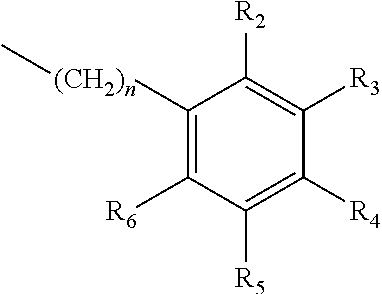
in which R2, R3, R4, R5, R6 are independently selected from the group consisting of H, methyl, ethyl, propyl, OH, OMe, OEt, COOH, and COOR7, in which R7 is selected from linear C1-C7 alkyl and branched C3-C7 alkyl, and n is 0.
7. The method according to claim 1 , in which the compound of formula (I) is selected from the group consisting of: 2-(2-(Phenylthio)ethyl)pyridine, 2-(2-(Phenylthio)ethyl)pyridine hydrochloride, Methyl 4-((2-(pyridin-2-yl)ethyl)thio) benzoate hydrochloride, 2-(2-(p-tolylthio)ethyl)pyridine hydrochloride, 2-(2-(o-tolylthio) ethyl)pyridine hydrochloride, 4-((2-(pyridin-2-yl)ethyl)thio)phenol, 2-((2-(pyridin-2-yl) ethyl)thio)phenol, 2-(2-((3-methoxyphenyl)thio)ethyl)pyridine, Methyl 2-((2-(pyridin-2-yl)ethyl)thio)benzoate hydrochloride, 3-((2-(pyridin-2-yl)ethyl)thio)phenol, 2-(2-(benzylthio)ethyl)pyridine, 2-(2-(m-Tolylthio)ethyl)pyridine hydrochloride, and 2-(2-((4-Methoxyphenyl)-thio)ethyl)pyridine hydrochloride.
8. The method according to claim 1 , in which the compound of formula (I) is a salt.
9. The method according to claim 8 , in which the compound of formula (I) is in the form of hydrochloride salt.
10. A method of imparting to, or modifying in, a flavour composition or comestible product, salt taste, comprising the addition to said flavour composition or comestible product of at least one compound of formula (I)

wherein one of X1, X2, or X3 is selected from the group consisting of S, N and O and the remaining two are CH2; and A is selected from

in which R2, R3, R4, R5, R6 are independently selected from the group consisting of H, methyl, ethyl, propyl, OH, OMe, OEt, COOH, COOR7, in which R7 is selected from linear C1-C7 alkyl, branched C3-C7 alkyl, and CONR8R9, in which R8 and R9 are independently selected from hydrogen, straight C1-C4 alkyl, and branched C3-C4 alkyl; or any two adjacent substituents R2-R6 together form a ring of 5 or 6 members; and n is 1 or 0.
11. A method of imparting to, or modifying in, a flavour composition or comestible product, a fruity, green, green pepper, tomato and/or bell pepper aroma, comprising the addition to said flavour composition or comestible product of at least one compound of formula (I)

wherein one of X1, X2, or X3 is selected from the group consisting of S, N and O and the remaining two are CH2; and A is selected from

in which R2, R3, R4 R5, R6 are independently selected from the group consisting of H, methyl, ethyl, propyl, OH, OMe, OEt, COOH, COOR7, in which R7 is selected from linear C1-C7 alkyl, branched C3-C7 alkyl, and CONR8R9, in which R8 and R9 are independently selected from hydrogen, straight C1-C4 alkyl, and branched C3-C4 alkyl; or any two adjacent substituents R2-R6 together form a ring of 5 or 6 members; and n is 1 or 0.
12. A method of imparting to, or modifying in, a flavour composition or comestible product, a kokumi sensation, comprising the addition to said flavour composition or comestible product of at least one compound of formula (I)

wherein one of X1, X2, or X3 is selected from the group consisting of S, N and O and the remaining two are CH2; and A is selected from

in which R2, R3, R4 R5, R6 are independently selected from the group consisting of H, methyl, ethyl, propyl, OH, OMe, OEt, COOH, COOR7, in which R7 is selected from linear C1-C7 alkyl, branched C3-C7 alkyl, and CONR8R9, in which R8 and R9 are independently selected from hydrogen, straight C3-C7 alkyl, and branched C3-C4 alkyl; or any two adjacent substituents R2-R6 together form a ring of 5 or 6 members; and n is 1 or 0.
13. The method according to claim 1 , in which the at least one compound of formula (I) is added in a concentration of from 0.01 ppm to 500 ppm by weight based on the weight of the comestible product.
14. The method according to claim 10 , in which the at least one compound of formula (I) is added in a concentration of from 0.01 ppm to 500 ppm by weight based on the weight of the comestible product, or at a concentration of 0.01% to 99.9% by weight of flavour components of the flavour composition.
15. The method according to claim 11 , in which the at least one compound of formula (I) is added in a concentration of from 0.01 ppm to 500 ppm by weight based on the weight of the comestible product, or at a concentration of 0.01% to 99.9% by weight of flavour components of the flavour composition.
16. The method according to claim 12 , in which the at least one compound of formula (I) is added in a concentration of from 0.01 ppm to 500 ppm by weight based on the weight of the comestible product, or at a concentration of 0.01% to 99.9% by weight of flavour components of the flavour composition.
Priority Applications (1)
| Application Number | Priority Date | Filing Date | Title |
|---|---|---|---|
| US14/901,279 US10178875B2 (en) | 2013-07-01 | 2014-07-01 | Methods of modifying or imparting taste using organic compounds |
Applications Claiming Priority (3)
| Application Number | Priority Date | Filing Date | Title |
|---|---|---|---|
| US201361841602P | 2013-07-01 | 2013-07-01 | |
| US14/901,279 US10178875B2 (en) | 2013-07-01 | 2014-07-01 | Methods of modifying or imparting taste using organic compounds |
| PCT/EP2014/063962 WO2015000900A2 (en) | 2013-07-01 | 2014-07-01 | Organic compounds |
Publications (2)
| Publication Number | Publication Date |
|---|---|
| US20160366922A1 US20160366922A1 (en) | 2016-12-22 |
| US10178875B2 true US10178875B2 (en) | 2019-01-15 |
Family
ID=51033217
Family Applications (1)
| Application Number | Title | Priority Date | Filing Date |
|---|---|---|---|
| US14/901,279 Active 2035-05-12 US10178875B2 (en) | 2013-07-01 | 2014-07-01 | Methods of modifying or imparting taste using organic compounds |
Country Status (3)
| Country | Link |
|---|---|
| US (1) | US10178875B2 (en) |
| EP (1) | EP3019034B1 (en) |
| WO (1) | WO2015000900A2 (en) |
Cited By (1)
| Publication number | Priority date | Publication date | Assignee | Title |
|---|---|---|---|---|
| US20180072670A1 (en) * | 2015-04-15 | 2018-03-15 | T. Hasegawa Co., Ltd. | Flavor modulator having pyridine derivative or salt thereof as active ingredient |
Families Citing this family (3)
| Publication number | Priority date | Publication date | Assignee | Title |
|---|---|---|---|---|
| JP5805902B1 (en) * | 2015-04-15 | 2015-11-10 | 長谷川香料株式会社 | Flavor modulator |
| JP6352227B2 (en) * | 2015-09-15 | 2018-07-04 | 長谷川香料株式会社 | Emulsified composition and powder composition containing 2- (3-benzyloxypropyl) pyridine |
| JP6436890B2 (en) * | 2015-10-20 | 2018-12-12 | 長谷川香料株式会社 | Flavor modulator containing pyridine derivative as active ingredient |
Citations (20)
| Publication number | Priority date | Publication date | Assignee | Title |
|---|---|---|---|---|
| US2615892A (en) | 1946-06-24 | 1952-10-28 | Wingfoot Corp | Pyridyl amines |
| US3226394A (en) | 1964-06-16 | 1965-12-28 | Shulton Inc | Pyridylethylated anthranilamides and derivatives thereof |
| US3574221A (en) | 1966-05-28 | 1971-04-06 | Egyt Gyogyszervegyeszeti Gyar | Derivatives of aminoalkyl pyridines |
| DE2316881A1 (en) | 1972-04-04 | 1973-10-11 | Beecham Group Ltd | BIOLOGICALLY ACTIVE COMPOUNDS, THE PROCESS FOR THEIR PRODUCTION AND MEDICINAL PREPARATIONS CONTAINING THESE COMPOUNDS |
| JP2000351767A (en) | 1999-06-08 | 2000-12-19 | Sankyo Co Ltd | Production of thioether and thiol |
| EP1291342A1 (en) | 2001-09-06 | 2003-03-12 | Societe Des Produits Nestle S.A. | Pyridinium-betain compounds as taste enhancer |
| EP1312268A1 (en) | 2001-11-19 | 2003-05-21 | Société des Produits Nestlé S.A. | Flavouring compositions |
| WO2003088768A1 (en) | 2002-04-22 | 2003-10-30 | Societe Des Produits Nestle S.A. | Flavouring compositions containing n-acetylglysine |
| WO2005015158A2 (en) | 2003-08-06 | 2005-02-17 | Senomyx Inc. | T1r hetero-oligomeric taste receptors, cell lines that express said receptors, and taste compounds |
| WO2006003107A1 (en) | 2004-06-30 | 2006-01-12 | Symrise Gmbh & Co. Kg | Use of malic acid glucosides as flavouring substances |
| US20060068071A1 (en) | 2004-09-10 | 2006-03-30 | Dewis Mark L | Saturated and unsaturated N-alkamides exhibiting taste and flavor enhancement effect in flavor compositions |
| US20060263411A1 (en) | 2005-02-04 | 2006-11-23 | Catherine Tachdjian | Compounds comprising linked heteroaryl moieties and their use as novel umami flavor modifiers, tastants and taste enhancers for comestible compositions |
| WO2009122319A2 (en) | 2008-04-04 | 2009-10-08 | Firmenich Sa | Taste modifying product |
| WO2009122316A2 (en) | 2008-03-31 | 2009-10-08 | Rafael Advanced Defense Systems Ltd. | Methods for transferring points of interest between images with non-parallel viewing directions |
| WO2010111713A2 (en) | 2009-03-27 | 2010-09-30 | Zacharon Pharmaceuticals, Inc. | N-linked glycan biosynthesis modulators |
| WO2011004016A1 (en) | 2009-07-10 | 2011-01-13 | Givaudan Sa | Pyridine derivatives with umami flavour |
| US20110020518A1 (en) | 2008-04-04 | 2011-01-27 | Estelle Delort | Taste modifying product |
| WO2011138266A1 (en) | 2010-05-03 | 2011-11-10 | Evotec Ag | Indolizine and imidazopyridine derivatives as orexin receptor antagonists |
| WO2013041599A1 (en) | 2011-09-21 | 2013-03-28 | Givaudan Sa | Pyridine derivates and their use as umami tastants |
| US20150084112A1 (en) | 2010-12-31 | 2015-03-26 | WaferTech,LLC | Split gate flash cell semiconductor device |
-
2014
- 2014-07-01 EP EP14734162.2A patent/EP3019034B1/en active Active
- 2014-07-01 US US14/901,279 patent/US10178875B2/en active Active
- 2014-07-01 WO PCT/EP2014/063962 patent/WO2015000900A2/en not_active Ceased
Patent Citations (45)
| Publication number | Priority date | Publication date | Assignee | Title |
|---|---|---|---|---|
| US2615892A (en) | 1946-06-24 | 1952-10-28 | Wingfoot Corp | Pyridyl amines |
| US3226394A (en) | 1964-06-16 | 1965-12-28 | Shulton Inc | Pyridylethylated anthranilamides and derivatives thereof |
| US3574221A (en) | 1966-05-28 | 1971-04-06 | Egyt Gyogyszervegyeszeti Gyar | Derivatives of aminoalkyl pyridines |
| DE2316881A1 (en) | 1972-04-04 | 1973-10-11 | Beecham Group Ltd | BIOLOGICALLY ACTIVE COMPOUNDS, THE PROCESS FOR THEIR PRODUCTION AND MEDICINAL PREPARATIONS CONTAINING THESE COMPOUNDS |
| GB1437781A (en) | 1972-04-04 | 1976-06-03 | Beecham Group Ltd | Pyridine derivatives having hypoglycaemic activity |
| JP2000351767A (en) | 1999-06-08 | 2000-12-19 | Sankyo Co Ltd | Production of thioether and thiol |
| EP1291342A1 (en) | 2001-09-06 | 2003-03-12 | Societe Des Produits Nestle S.A. | Pyridinium-betain compounds as taste enhancer |
| EP1312268A1 (en) | 2001-11-19 | 2003-05-21 | Société des Produits Nestlé S.A. | Flavouring compositions |
| WO2003088768A1 (en) | 2002-04-22 | 2003-10-30 | Societe Des Produits Nestle S.A. | Flavouring compositions containing n-acetylglysine |
| US9091686B2 (en) | 2003-08-06 | 2015-07-28 | Senomyx, Inc. | Chimeric T1R taste receptor polypeptides and nucleic acid sequences encoding and cell lines that express said chimeric T1R polypeptides |
| US20090111834A1 (en) | 2003-08-06 | 2009-04-30 | Catherine Tachdjian | Novel flavors, flavor modifiers, tastants, taste enhancers, umami or sweet tastants, and/or enhancers and use thereof |
| WO2005015158A2 (en) | 2003-08-06 | 2005-02-17 | Senomyx Inc. | T1r hetero-oligomeric taste receptors, cell lines that express said receptors, and taste compounds |
| US7888470B2 (en) | 2003-08-06 | 2011-02-15 | Senomyx, Inc. | Chimeric T1R taste receptor polypeptides and nucleic acid sequences encoding and cell lines that express said chimeric T1R polypeptides |
| US20150093339A1 (en) | 2003-08-06 | 2015-04-02 | Senomyx, Inc. | Novel flavors, flavor modifiers, tastants, taste enhancers, umami or sweet tastants, and/or enhancers and use thereof |
| US8895050B2 (en) | 2003-08-06 | 2014-11-25 | Senomyx, Inc. | Flavors, flavor modifiers, tastants, taste enhancers, umami or sweet tastants, and/or enhancers and use thereof |
| US20070104709A1 (en) | 2003-08-06 | 2007-05-10 | Xiaodong Li | T1r hetero-oligomeric taste receptors, cell lines that express said receptors, and taste compounds |
| US20080085994A1 (en) | 2003-08-06 | 2008-04-10 | Xiaodong Li | T1R hetero-oligomeric taste receptors, cell lines that express said receptors, and taste compounds |
| US7476399B2 (en) | 2003-08-06 | 2009-01-13 | Senomyx Inc. | Flavors, flavor modifiers, tastants, taste enhancers, umami or sweet tastants, and/or enhancers and use thereof |
| US20050084506A1 (en) | 2003-08-06 | 2005-04-21 | Catherine Tachdjian | Novel flavors, flavor modifiers, tastants, taste enhancers, umami or sweet tastants, and/or enhancers and use thereof |
| US8735081B2 (en) | 2003-08-06 | 2014-05-27 | Senomyx, Inc. | T1R hetero-oligomeric taste receptors, cell lines that express said receptors, and taste compounds |
| US20130336892A1 (en) | 2003-08-06 | 2013-12-19 | Senomyx, Inc. | Chimeric t1r taste receptor polypeptides and nucleic acid sequences encoding and cell lines that express said chimeric t1r polypeptides |
| US8404455B2 (en) | 2003-08-06 | 2013-03-26 | Senomyx, Inc. | Chimeric T1R taste receptor polypeptides and nucleic acid sequences encoding and cell lines that express said chimeric T1R polypeptides |
| US20130030059A1 (en) | 2003-08-06 | 2013-01-31 | Xiaodong Li | T1r hetero-oligomeric taste receptors, cell lines that express said receptors, and taste compounds |
| US20120201763A1 (en) | 2003-08-06 | 2012-08-09 | Senomyx, Inc. | Novel flavors, flavor modifiers, tastants, taste enhancers, umami or sweet tastants, and/or enhancers and use thereof |
| US8124121B2 (en) | 2003-08-06 | 2012-02-28 | Senomyx, Inc. | Flavors, flavor modifiers, tastants, taste enhancers, umami or sweet tastants, and/or enhancers and use thereof |
| US20110294981A1 (en) | 2003-08-06 | 2011-12-01 | Xiaodong Li | Chimeric t1r taste receptor polypeptides and nucleic acid sequences encoding and cell lines that express said chimeric t1r polypeptides |
| WO2006003107A1 (en) | 2004-06-30 | 2006-01-12 | Symrise Gmbh & Co. Kg | Use of malic acid glucosides as flavouring substances |
| US7541055B2 (en) | 2004-09-10 | 2009-06-02 | International Flavors & Fragrances Inc. | Saturated and unsaturated N-alkamides exhibiting taste and flavor enhancement effect in flavor compositions |
| EP1642886A2 (en) | 2004-09-10 | 2006-04-05 | INTERNATIONAL FLAVORS & FRAGRANCES, INC. | Saturated and unsaturated N-Alkamides exhibiting taste and flavor enhancement effect in flavor compositions |
| US20060068071A1 (en) | 2004-09-10 | 2006-03-30 | Dewis Mark L | Saturated and unsaturated N-alkamides exhibiting taste and flavor enhancement effect in flavor compositions |
| US20060263411A1 (en) | 2005-02-04 | 2006-11-23 | Catherine Tachdjian | Compounds comprising linked heteroaryl moieties and their use as novel umami flavor modifiers, tastants and taste enhancers for comestible compositions |
| WO2009122316A2 (en) | 2008-03-31 | 2009-10-08 | Rafael Advanced Defense Systems Ltd. | Methods for transferring points of interest between images with non-parallel viewing directions |
| US20110020517A1 (en) | 2008-04-04 | 2011-01-27 | Mark Rubin | Taste modifying product |
| US20110020518A1 (en) | 2008-04-04 | 2011-01-27 | Estelle Delort | Taste modifying product |
| WO2009122319A2 (en) | 2008-04-04 | 2009-10-08 | Firmenich Sa | Taste modifying product |
| US20120100609A1 (en) | 2009-03-27 | 2012-04-26 | Crawford Brett E | N-linked glycan biosynthesis modulators |
| WO2010111713A2 (en) | 2009-03-27 | 2010-09-30 | Zacharon Pharmaceuticals, Inc. | N-linked glycan biosynthesis modulators |
| US9173424B2 (en) | 2009-07-10 | 2015-11-03 | Givaudan S.A. | Pyridine derivatives with umami flavour |
| US20140295045A1 (en) | 2009-07-10 | 2014-10-02 | Givaudan S.A. | Pyridine Derivatives With Umami Flavour |
| WO2011004016A1 (en) | 2009-07-10 | 2011-01-13 | Givaudan Sa | Pyridine derivatives with umami flavour |
| US20120121783A1 (en) | 2009-07-10 | 2012-05-17 | Yili Wang | Pyridine Derivatives With Umami Flavour |
| WO2011138266A1 (en) | 2010-05-03 | 2011-11-10 | Evotec Ag | Indolizine and imidazopyridine derivatives as orexin receptor antagonists |
| US20150084112A1 (en) | 2010-12-31 | 2015-03-26 | WaferTech,LLC | Split gate flash cell semiconductor device |
| WO2013041599A1 (en) | 2011-09-21 | 2013-03-28 | Givaudan Sa | Pyridine derivates and their use as umami tastants |
| US20140342073A1 (en) | 2011-09-21 | 2014-11-20 | Givaudan S.A. | Pyridine derivates and their use as umami tastants |
Non-Patent Citations (13)
| Title |
|---|
| Chemcats Accession No. 0072332306, Ryan Scientific Intermediate and Building Block Compounds, Publication Apr. 23, 2013, CAS Registry No. 1183541-70-9. |
| Chemcats Accession No. 0090404185, Ambinter Stock Screening Collection, Publication Jan. 1, 2013, CAS Registry No. 298217-38-6. |
| GB1313696.5—British Search Report, dated Jan. 24, 2014. |
| Lambrecht, et al., "Synthesis of Substituted Ethenylpryazines and Dialkylpridines and Their Sensory Properties", Flavor and Fragrance Journal, Apr. 4, 1997, pp. 439-442, vol. 12, John Wiley & Sons Ltd. |
| Office Action dated Jan. 25, 2018, for European patent application No. 14 734 162.2-1106. |
| Office Action dated Mar. 14, 2017, for European patent application No. 14 734 162.2-1358. |
| PCT/EP2014/063962—International Preliminary Report on Patentability, dated Jan. 5, 2016. |
| PCT/EP2014/063962—International Search Report, dated Mar. 10, 2015. |
| PCT/EP2014/063962—International Written Opinion, dated Mar. 10, 2015. |
| Profft, "Addition of Thiophenols and Thioether Ketones to 2-Vinylpyridine", Chemishe Technik, 1955, pp. 577-579, vol. 7, Leipzig, Germany. (CAS Abstract). |
| Profft, "Über die Darstellung von Thienyl-2.2′-äthylpyridyl-sulfiden", Institut für Organische Chemie der Technischen Hochschule für Chemie Leuna-Merseburg, 1959, pp. 694-696. |
| Profft, "Über die Darstellung von Thienyl-2.2′-äthylpyridyl-sulfiden", Wissenschaftliche Aeitschrift der Technischen Hochschule für Chemie Leuna-Merseburg, 1960, pp. 101-102. |
| Watanabe, et al., "Intramolecular Assistance of Electron Transfer from Heteroatom Compounds. Electrochemical oxidation of 2-(2-pyridyl)ethyl-substituted ethers, sulfides, and selenides", Bulletin of the Chemical Society of Japan, 2000, pp. 243-247, vol. 73, Issue 1. (CAS Abstract). |
Cited By (4)
| Publication number | Priority date | Publication date | Assignee | Title |
|---|---|---|---|---|
| US20180072670A1 (en) * | 2015-04-15 | 2018-03-15 | T. Hasegawa Co., Ltd. | Flavor modulator having pyridine derivative or salt thereof as active ingredient |
| US20190389801A1 (en) * | 2015-04-15 | 2019-12-26 | T. Hasegawa Co., Ltd. | Flavor modulator having pyridine derivative or salt thereof as active ingredient |
| US10882823B2 (en) | 2015-04-15 | 2021-01-05 | T. Hasegawa Co., Ltd. | Flavor modulator having pyridine derivative or salt thereof as active ingredient |
| US10894772B2 (en) * | 2015-04-15 | 2021-01-19 | T. Hasegawa Co., Ltd. | Flavor modulator having pyridine derivative or salt thereof as active ingredient |
Also Published As
| Publication number | Publication date |
|---|---|
| WO2015000900A2 (en) | 2015-01-08 |
| EP3019034B1 (en) | 2018-10-31 |
| US20160366922A1 (en) | 2016-12-22 |
| WO2015000900A3 (en) | 2015-04-30 |
| EP3019034A2 (en) | 2016-05-18 |
Similar Documents
| Publication | Publication Date | Title |
|---|---|---|
| KR102045592B1 (en) | N-acyl proline derivatives as food flavouring compounds | |
| JP6860487B2 (en) | Matcha flavor improver | |
| EP2731453A1 (en) | Flavour modifying compounds | |
| EP2254891A2 (en) | Isosorbide derivatives and their use as flavor modifiers, tastants, and taste enhancers | |
| EP3019034B1 (en) | Organic compounds | |
| JP2009545628A5 (en) | ||
| JP7846273B2 (en) | Flavor-modifying ingredients | |
| EP3057449B1 (en) | Organic compounds | |
| CN103814012B (en) | Pyridine derivate and the purposes as delicate flavour tastant thereof | |
| US4557941A (en) | Flavoring with mercapto-C2 -C3 -alkanoic acid esters | |
| SG182515A1 (en) | Oxalamide derivative as umami flavouring agent | |
| EP2506722B1 (en) | 2-methoxy-5-(phenoxymethyl)phenol | |
| US4263331A (en) | Flavoring with mixture of 2,5-dimethyl-3-acetyl-furan and 3,5-di-(2-methylpropyl)-1,2,4-trithiolane | |
| US4634595A (en) | Thioalkanoic acid esters of phenylalkanols | |
| US4701548A (en) | Thioalkanoic acid esters of phenylalkanols | |
| US20120263848A1 (en) | Organic Compounds | |
| US4472446A (en) | Uses of methyl(methylthioalkyl)-1,3-dithiolanes in augmenting or enhancing the aroma or taste of foodstuffs | |
| US11197491B2 (en) | Method for producing unsaturated decanals | |
| US4515967A (en) | Methyl(methylthioalkyl)-1,3-dithiolanes | |
| EP3057447B1 (en) | Organic compounds having taste-modifying properties | |
| US20120230924A1 (en) | Indoline Derivatives And Their Use As Flavouring Agents | |
| CN105792670A (en) | Organic compounds |
Legal Events
| Date | Code | Title | Description |
|---|---|---|---|
| AS | Assignment |
Owner name: GIVAUDAN S.A., SWITZERLAND Free format text: ASSIGNMENT OF ASSIGNORS INTEREST;ASSIGNOR:BOM, DAVID C.;REEL/FRAME:038072/0192 Effective date: 20160322 |
|
| STCF | Information on status: patent grant |
Free format text: PATENTED CASE |
|
| MAFP | Maintenance fee payment |
Free format text: PAYMENT OF MAINTENANCE FEE, 4TH YEAR, LARGE ENTITY (ORIGINAL EVENT CODE: M1551); ENTITY STATUS OF PATENT OWNER: LARGE ENTITY Year of fee payment: 4 |