US10167377B2 - Phosphorus containing epoxy compounds and compositions therefrom - Google Patents
Phosphorus containing epoxy compounds and compositions therefrom Download PDFInfo
- Publication number
- US10167377B2 US10167377B2 US14/160,963 US201414160963A US10167377B2 US 10167377 B2 US10167377 B2 US 10167377B2 US 201414160963 A US201414160963 A US 201414160963A US 10167377 B2 US10167377 B2 US 10167377B2
- Authority
- US
- United States
- Prior art keywords
- substituted
- phosphonate
- epoxy resins
- composition
- compound
- Prior art date
- Legal status (The legal status is an assumption and is not a legal conclusion. Google has not performed a legal analysis and makes no representation as to the accuracy of the status listed.)
- Expired - Fee Related, expires
Links
- 0 *P(=O)(O[Y])OCOCC1CO1 Chemical compound *P(=O)(O[Y])OCOCC1CO1 0.000 description 15
- ISNNXHQBIBWQHG-UHFFFAOYSA-N CC.CC.CC.O=P(OC1=CC=CC=C1)(OC1=CC=CC=C1)OC1=CC=CC=C1 Chemical compound CC.CC.CC.O=P(OC1=CC=CC=C1)(OC1=CC=CC=C1)OC1=CC=CC=C1 ISNNXHQBIBWQHG-UHFFFAOYSA-N 0.000 description 1
- RBACIKXCRWGCBB-UHFFFAOYSA-N CCC1CO1 Chemical compound CCC1CO1 RBACIKXCRWGCBB-UHFFFAOYSA-N 0.000 description 1
Classifications
-
- C—CHEMISTRY; METALLURGY
- C08—ORGANIC MACROMOLECULAR COMPOUNDS; THEIR PREPARATION OR CHEMICAL WORKING-UP; COMPOSITIONS BASED THEREON
- C08K—Use of inorganic or non-macromolecular organic substances as compounding ingredients
- C08K5/00—Use of organic ingredients
- C08K5/04—Oxygen-containing compounds
- C08K5/10—Esters; Ether-esters
- C08K5/11—Esters; Ether-esters of acyclic polycarboxylic acids
-
- C—CHEMISTRY; METALLURGY
- C08—ORGANIC MACROMOLECULAR COMPOUNDS; THEIR PREPARATION OR CHEMICAL WORKING-UP; COMPOSITIONS BASED THEREON
- C08G—MACROMOLECULAR COMPOUNDS OBTAINED OTHERWISE THAN BY REACTIONS ONLY INVOLVING UNSATURATED CARBON-TO-CARBON BONDS
- C08G59/00—Polycondensates containing more than one epoxy group per molecule; Macromolecules obtained by polymerising compounds containing more than one epoxy group per molecule using curing agents or catalysts which react with the epoxy groups
- C08G59/18—Macromolecules obtained by polymerising compounds containing more than one epoxy group per molecule using curing agents or catalysts which react with the epoxy groups ; e.g. general methods of curing
- C08G59/20—Macromolecules obtained by polymerising compounds containing more than one epoxy group per molecule using curing agents or catalysts which react with the epoxy groups ; e.g. general methods of curing characterised by the epoxy compounds used
- C08G59/22—Di-epoxy compounds
- C08G59/30—Di-epoxy compounds containing atoms other than carbon, hydrogen, oxygen and nitrogen
- C08G59/304—Di-epoxy compounds containing atoms other than carbon, hydrogen, oxygen and nitrogen containing phosphorus
-
- C—CHEMISTRY; METALLURGY
- C08—ORGANIC MACROMOLECULAR COMPOUNDS; THEIR PREPARATION OR CHEMICAL WORKING-UP; COMPOSITIONS BASED THEREON
- C08G—MACROMOLECULAR COMPOUNDS OBTAINED OTHERWISE THAN BY REACTIONS ONLY INVOLVING UNSATURATED CARBON-TO-CARBON BONDS
- C08G65/00—Macromolecular compounds obtained by reactions forming an ether link in the main chain of the macromolecule
- C08G65/02—Macromolecular compounds obtained by reactions forming an ether link in the main chain of the macromolecule from cyclic ethers by opening of the heterocyclic ring
- C08G65/04—Macromolecular compounds obtained by reactions forming an ether link in the main chain of the macromolecule from cyclic ethers by opening of the heterocyclic ring from cyclic ethers only
- C08G65/22—Cyclic ethers having at least one atom other than carbon and hydrogen outside the ring
-
- C—CHEMISTRY; METALLURGY
- C08—ORGANIC MACROMOLECULAR COMPOUNDS; THEIR PREPARATION OR CHEMICAL WORKING-UP; COMPOSITIONS BASED THEREON
- C08K—Use of inorganic or non-macromolecular organic substances as compounding ingredients
- C08K5/00—Use of organic ingredients
- C08K5/04—Oxygen-containing compounds
- C08K5/06—Ethers; Acetals; Ketals; Ortho-esters
-
- C—CHEMISTRY; METALLURGY
- C08—ORGANIC MACROMOLECULAR COMPOUNDS; THEIR PREPARATION OR CHEMICAL WORKING-UP; COMPOSITIONS BASED THEREON
- C08K—Use of inorganic or non-macromolecular organic substances as compounding ingredients
- C08K5/00—Use of organic ingredients
- C08K5/49—Phosphorus-containing compounds
- C08K5/51—Phosphorus bound to oxygen
- C08K5/53—Phosphorus bound to oxygen bound to oxygen and to carbon only
- C08K5/5317—Phosphonic compounds, e.g. R—P(:O)(OR')2
- C08K5/5333—Esters of phosphonic acids
- C08K5/5373—Esters of phosphonic acids containing heterocyclic rings not representing cyclic esters of phosphonic acids
-
- C—CHEMISTRY; METALLURGY
- C08—ORGANIC MACROMOLECULAR COMPOUNDS; THEIR PREPARATION OR CHEMICAL WORKING-UP; COMPOSITIONS BASED THEREON
- C08L—COMPOSITIONS OF MACROMOLECULAR COMPOUNDS
- C08L23/00—Compositions of homopolymers or copolymers of unsaturated aliphatic hydrocarbons having only one carbon-to-carbon double bond; Compositions of derivatives of such polymers
- C08L23/26—Compositions of homopolymers or copolymers of unsaturated aliphatic hydrocarbons having only one carbon-to-carbon double bond; Compositions of derivatives of such polymers modified by chemical after-treatment
- C08L23/28—Compositions of homopolymers or copolymers of unsaturated aliphatic hydrocarbons having only one carbon-to-carbon double bond; Compositions of derivatives of such polymers modified by chemical after-treatment by reaction with halogens or halogen-containing compounds
-
- C—CHEMISTRY; METALLURGY
- C08—ORGANIC MACROMOLECULAR COMPOUNDS; THEIR PREPARATION OR CHEMICAL WORKING-UP; COMPOSITIONS BASED THEREON
- C08L—COMPOSITIONS OF MACROMOLECULAR COMPOUNDS
- C08L63/00—Compositions of epoxy resins; Compositions of derivatives of epoxy resins
-
- Y—GENERAL TAGGING OF NEW TECHNOLOGICAL DEVELOPMENTS; GENERAL TAGGING OF CROSS-SECTIONAL TECHNOLOGIES SPANNING OVER SEVERAL SECTIONS OF THE IPC; TECHNICAL SUBJECTS COVERED BY FORMER USPC CROSS-REFERENCE ART COLLECTIONS [XRACs] AND DIGESTS
- Y10—TECHNICAL SUBJECTS COVERED BY FORMER USPC
- Y10T—TECHNICAL SUBJECTS COVERED BY FORMER US CLASSIFICATION
- Y10T428/00—Stock material or miscellaneous articles
- Y10T428/249921—Web or sheet containing structurally defined element or component
- Y10T428/249953—Composite having voids in a component [e.g., porous, cellular, etc.]
- Y10T428/249987—With nonvoid component of specified composition
- Y10T428/249991—Synthetic resin or natural rubbers
-
- Y—GENERAL TAGGING OF NEW TECHNOLOGICAL DEVELOPMENTS; GENERAL TAGGING OF CROSS-SECTIONAL TECHNOLOGIES SPANNING OVER SEVERAL SECTIONS OF THE IPC; TECHNICAL SUBJECTS COVERED BY FORMER USPC CROSS-REFERENCE ART COLLECTIONS [XRACs] AND DIGESTS
- Y10—TECHNICAL SUBJECTS COVERED BY FORMER USPC
- Y10T—TECHNICAL SUBJECTS COVERED BY FORMER US CLASSIFICATION
- Y10T428/00—Stock material or miscellaneous articles
- Y10T428/31504—Composite [nonstructural laminate]
- Y10T428/31511—Of epoxy ether
-
- Y—GENERAL TAGGING OF NEW TECHNOLOGICAL DEVELOPMENTS; GENERAL TAGGING OF CROSS-SECTIONAL TECHNOLOGIES SPANNING OVER SEVERAL SECTIONS OF THE IPC; TECHNICAL SUBJECTS COVERED BY FORMER USPC CROSS-REFERENCE ART COLLECTIONS [XRACs] AND DIGESTS
- Y10—TECHNICAL SUBJECTS COVERED BY FORMER USPC
- Y10T—TECHNICAL SUBJECTS COVERED BY FORMER US CLASSIFICATION
- Y10T428/00—Stock material or miscellaneous articles
- Y10T428/31504—Composite [nonstructural laminate]
- Y10T428/31511—Of epoxy ether
- Y10T428/31525—Next to glass or quartz
-
- Y—GENERAL TAGGING OF NEW TECHNOLOGICAL DEVELOPMENTS; GENERAL TAGGING OF CROSS-SECTIONAL TECHNOLOGIES SPANNING OVER SEVERAL SECTIONS OF THE IPC; TECHNICAL SUBJECTS COVERED BY FORMER USPC CROSS-REFERENCE ART COLLECTIONS [XRACs] AND DIGESTS
- Y10—TECHNICAL SUBJECTS COVERED BY FORMER USPC
- Y10T—TECHNICAL SUBJECTS COVERED BY FORMER US CLASSIFICATION
- Y10T428/00—Stock material or miscellaneous articles
- Y10T428/31504—Composite [nonstructural laminate]
- Y10T428/31511—Of epoxy ether
- Y10T428/31529—Next to metal
-
- Y—GENERAL TAGGING OF NEW TECHNOLOGICAL DEVELOPMENTS; GENERAL TAGGING OF CROSS-SECTIONAL TECHNOLOGIES SPANNING OVER SEVERAL SECTIONS OF THE IPC; TECHNICAL SUBJECTS COVERED BY FORMER USPC CROSS-REFERENCE ART COLLECTIONS [XRACs] AND DIGESTS
- Y10—TECHNICAL SUBJECTS COVERED BY FORMER USPC
- Y10T—TECHNICAL SUBJECTS COVERED BY FORMER US CLASSIFICATION
- Y10T442/00—Fabric [woven, knitted, or nonwoven textile or cloth, etc.]
- Y10T442/20—Coated or impregnated woven, knit, or nonwoven fabric which is not [a] associated with another preformed layer or fiber layer or, [b] with respect to woven and knit, characterized, respectively, by a particular or differential weave or knit, wherein the coating or impregnation is neither a foamed material nor a free metal or alloy layer
- Y10T442/2631—Coating or impregnation provides heat or fire protection
- Y10T442/2672—Phosphorus containing
-
- Y—GENERAL TAGGING OF NEW TECHNOLOGICAL DEVELOPMENTS; GENERAL TAGGING OF CROSS-SECTIONAL TECHNOLOGIES SPANNING OVER SEVERAL SECTIONS OF THE IPC; TECHNICAL SUBJECTS COVERED BY FORMER USPC CROSS-REFERENCE ART COLLECTIONS [XRACs] AND DIGESTS
- Y10—TECHNICAL SUBJECTS COVERED BY FORMER USPC
- Y10T—TECHNICAL SUBJECTS COVERED BY FORMER US CLASSIFICATION
- Y10T442/00—Fabric [woven, knitted, or nonwoven textile or cloth, etc.]
- Y10T442/20—Coated or impregnated woven, knit, or nonwoven fabric which is not [a] associated with another preformed layer or fiber layer or, [b] with respect to woven and knit, characterized, respectively, by a particular or differential weave or knit, wherein the coating or impregnation is neither a foamed material nor a free metal or alloy layer
- Y10T442/2631—Coating or impregnation provides heat or fire protection
- Y10T442/2672—Phosphorus containing
- Y10T442/268—Phosphorus and nitrogen containing compound
Definitions
- Epoxy resins are among the most important industrial polymers in the world and are used in large quantities in the production of adhesives, paints and coatings, and matrix resins.
- the core substrate in the production of epoxy resins is typically 2,2-bis(4-hydroxyphenyl)isopropylidene (bisphenol A).
- bisphenol A 2,2-bis(4-hydroxyphenyl)isopropylidene
- the main monomer used in the epoxy resin industry is the diglycidyl ether of bisphenol A, (2,2-Bis(4-glycidyloxyphenyl)propane), which represents more than 75% of the resin used in industrial applications.
- the most common epoxy monomer is 2,2-Bis(4-glycidyloxyphenyl)propane, which is usually prepared from 2,2-Bis(4-hydroxyphenyl)isopropylidiene (bisphenol A) and epichlorohydrin using a strong base such as sodium hydroxide.
- Bisphenol A 2,2-Bis(4-hydroxyphenyl)isopropylidiene
- epichlorohydrin using a strong base such as sodium hydroxide.
- Alternative synthetic methods have been developed such as allylating bisphenol A followed by epoxidization.
- Processes for preparing flame retardant epoxy resin disclosed thus far are focused on the reaction of an epoxy resin with a flame-retardant additive or a curing agent or chain extender.
- An approach that produces an inherently flame retardant epoxy based monomer, oligomer, polymer, or co-polymer would be ideal.
- Phosphonate polymers, copolymers, oligomers and co-oligomers having a wide variety of chemical structures which may contain reactive end groups such as hydroxyl groups are known.
- “Substantially no” means that the subsequently described event may occur at most about less than 10% of the time or the subsequently described component may be at most about less than 10% of the total composition, in some embodiments, and in others, at most about less than 5%, and in still others at most about less than 1%.
- phenol is meant to encompass any aromatic compound with at least one associated hydroxyl substitution.
- examples of “phenols” include but are not limited to phenol, benzene diols such as hydroquinone, and any bisphenol or bisphenol containing compound.
- alkyl or “alkyl group” refers to a branched or unbranched hydrocarbon or group of 1 to 20 carbon atoms, such as but not limited to methyl, ethyl, n-propyl, isopropyl, n-butyl, isobutyl, t-butyl, octyl, decyl, tetradecyl, hexadecyl, eicosyl, tetracosyl and the like.
- Cycloalkyl or “cycloalkyl groups” are branched or unbranched hydrocarbons in which all or some of the carbons are arranged in a ring such as but not limited to cyclopentyl, cyclohexyl, methylcyclohexyl and the like.
- the term “lower alkyl” includes an alkyl group of 1 to 10 carbon atoms.
- aryl refers to monovalent aromatic hydrocarbon radicals or groups consisting of one or more fused rings in which at least one ring is aromatic.
- Aryls may include but are not limited to phenyl, napthyl, biphenyl ring systems, and the like.
- the aryl group may be unsubstituted or substituted with a variety of substituents including but not limited to alkyl, alkenyl, halide, benzylic, alkyl or aromatic ether, nitro, cyano, and the like and combinations thereof.
- alkanol or “alkanol group” refers to a compound including an alkyl of 1 to 20 carbon atoms or more having at least one hydroxyl group substituent.
- alkanols include but are not limited to methanol, ethanol, 1- and 2-propanol, 1,1-dimethylethanol, hexanol, octanol, and the like.
- Alkanol groups may be optionally substituted with substituents as described above.
- flame retardant means that the composition exhibits a limiting oxygen index (LOI) of at least 27.
- LOI limiting oxygen index
- “Flame retardant,” “flame resistant,” “fire resistant,” or “fire resistance,” may also be tested by measuring the after-burning time in accordance with the UL test (Subject 94). In this test, the tested materials are given classifications of UL-94 V-0, UL-94 V-1 and UL-94 V-2 on the basis of the results obtained with the ten test specimens. Briefly, the criteria for each of these UL-94-V-classifications are as follows:
- UL-94 V-2 the total flaming combustion for each specimen after removal of the ignition flame should not exceed 30 seconds and the total flaming combustion for 5 specimens should not exceed 250 seconds. Test specimens may release flaming particles, which ignite absorbent cotton wool.
- Fire resistance may also be tested by measuring after-burning time.
- These test methods provide a laboratory test procedure for measuring and comparing the surface flammability of materials when exposed to a prescribed level of radiant heat energy to measure the surface flammability of materials when exposed to fire. The test is conducted using small specimens that are representative, to the extent possible, of the material or assembly being evaluated. The rate at which flames travel along surfaces depends upon the physical and thermal properties of the material, product or assembly under test, the specimen mounting method and orientation, the type and level of fire or heat exposure, the availability of air, and properties of the surrounding enclosure. If different test conditions are substituted or the end-use conditions are changed, it may not always be possible by or from this test to predict changes in the fire-test-response characteristics measured. Therefore, the results are valid only for the fire test exposure conditions described in this procedure.
- Molecular weight can be determined by relative viscosity 1 and/or gel permeation chromatography (GPC). “Relative viscosity” of a polymer is measured by dissolving a known quantity of polymer in a solvent and comparing the time it takes for this solution and the neat solvent to travel through a specially designed capillary (viscometer) at a constant temperature. Relative viscosity is a measurement that is indicative of the molecular weight of a polymer. It is also well known that a reduction in relative viscosity is indicative of a reduction in molecular weight, and reduction in molecular weight causes loss of mechanical properties such as strength and toughness.
- GPC gel permeation chromatography
- GPC provides information about the molecular weight and molecular weight distribution of a polymer. It is known that the molecular weight distribution of a polymer is important to properties such as thermo-oxidative stability (due to different amount of end groups), toughness, melt flow, and fire resistance, for example, low molecular weight polymers drip more when burned.
- toughness means that the material is resistant to breaking or fracturing when stressed or impacted. There are a variety of standardized tests available to determine the toughness of a material. Generally, toughness is determined qualitatively using a film or a molded specimen.
- Embodiments of the invention are directed to the compositions including epoxy containing phosphonate monomers, polymers, copolymers, oligomers, and co-oligomers, and methods for preparing these compositions.
- Phosphonate monomers, polymers, copolymers, oligomers, and co-oligomers may be linear, branched, or hyperbranched, and the co-polymers and co-oligomers may be block or random.
- the compositions of such embodiments may include any compound having at least one phosphonate and at least one epoxy.
- the composition may be of general structure I:
- R can be C 1 to C 20 alkyl, alkenyl, or alkynyl, substituted C 1 to C 20 , alkyl, alkenyl, or alkynyl, C 3 to C 20 cycloalkyl, substituted C 3 to C 20 cycloalkyl, C 6 to C 20 aryl, or heteroaryl, or substituted C 6 to C 20 aryl or heteroaryl;
- X can be C 1 to C 20 alkylene, alkenylene, or alkynylene, substituted C 1 to C 20 , alkylene, alkenylene, or alkynylene, C 3 to C 20 cycloalkylene, substituted C 3 to C 20 cycloalkylene, C 6 to C 20 arylene or heteroarylene, or substituted C 6 to C 20 arylene or heteroarylene;
- Y can be X—OH or X—O—Z-epoxy, C 6 to C 20 arylene or heteroarylene, or substituted C 6 to C
- R can be C 1 to C 20 alkyl, alkenyl, or alkynyl, substituted C 1 to C 20 , alkyl, alkenyl, or alkynyl, C 3 to C 8 cycloalkyl, substituted C 3 to C 8 cycloalkyl, C 6 to C 20 aryl or heteroaryl, or substituted C 6 to C 20 aryl or heteroaryl, and in other embodiments, R can be C 1 to C 10 alkyl or C 6 to C 10 aryl or heteroaryl. In still other embodiments, R may be C 1 to C 5 alkyl, and in certain embodiments, R may be methyl.
- X may be a, C 6 to C 20 arylene or heteroarylene, or substituted C 6 to C 20 arylene or heteroarylene, and in particular embodiments —O—X—O— may be derived from dihydroxy compounds such as, for example, hydroquinone, resorcinol or combinations of these, biphenol such as, for example, 4,4′-biphenol, or bisphenol such as, for example, bisphenol A, bisphenol F, phenolphthalein, 4,4′-thiodiphenol, 4,4′-sulfonyldiphenol, 3,3,5-trimethylcyclohexyldiphenol, or combinations of these or substituted dihydroxy compounds.
- Z may be C 1 to C 5 alkylene, and in certain embodiments, Z may be methylene.
- Particular embodiments include monomeric units having the structures II, IIa, IIb:
- R can be C 1 to C 10 alkyl or C 6 to C 10 aryl or heteroaryl, and in certain embodiments, R can be C 1 to C 5 alkyl, or methyl.
- Other embodiments include oligomeric phosphonates and polyphosphonates having the structures III, IIIa, and IIIb:
- R can be C 1 to C 10 alkyl or C 6 to C 10 aryl or heteroaryl, and in certain embodiments, R can be C 1 to C 5 alkyl, or methyl.
- R can be C 1 to C 10 alkyl or C 6 to C 10 aryl or heteroaryl, and in certain embodiments, R can be C 1 to C 5 alkyl, or methyl.
- oligomeric phosphonates n can be from about 2 to about 10
- polyphosphonates n can be 10 or more, for example, about 10 to about 1000.
- copolymers can include randomly arranged monomeric units separately derived from phosphonate containing monomers and carbonate containing monomers.
- copolyphosphonates include those of general structure IV and V:
- Ar 1 and Ar 2 are each, independently, an aromatic group and —O—Ar 1 —O— and —O—Ar 2 —O— may be derived from a dihydroxy compound having one or more, optionally substituted aryl rings such as, but not limited to, resorcinols, hydroquinones, and bisphenols, such as bisphenol A, bisphenol F, 4,4′-biphenol, phenolphthalein, 4,4′-thiodiphenol, 4,4′-sulfonyldiphenol, 3,3,5-trimethylcyclohexyldiphenol, or combinations of these, R 1 and R 2 are aliphatic or aromatic hydrocarbons, R is a C 1-20 alkyl, C 2-20 alkene, C 2-20 alkyne, C 5-20 cycloalkyl, or C 6-20 aryl, Y is —H, —Z 1 -epoxy, Z 1 may be C 1 to C 20 alkylene, alkenylene, or al
- the monomers of the “random co-oligo(phosphonate carbonate)s” or “random co-oligo(phosphonate ester)s of various embodiments are incorporated into the polymer chain randomly, such that the oligomeric phosphonate chain can include alternating phosphonate and carbonate or ester monomers or short segments in which several phosphonate or carbonate or ester monomers are linked by an aromatic dihydroxide. The length of such segments may vary within individual random co-oligo(phosphonate carbonate)s or co-oligo(phosphonate ester).
- the Ar, Ar 1 , and Ar 2 in the Formulae IV and V may be derived from bisphenol A and R may be a methyl group providing oligomeric phosphonates having reactive end-groups including random and block co-oligo(phosphonate carbonate)s and co-oligo(phosphonate ester)s.
- Such compounds may have structures such as, but not limited to, structures of Formulae VI and VII:
- co-oligo(phosphonate ester) or co-oligo(phosphonate carbonate) may be block co-oligo(phosphonate ester) or block co-oligo(phosphonate carbonate) in which each m, n, and p is greater than about 1, and the copolymers contain distinct repeating phosphonate and carbonate blocks or phosphonate and ester blocks.
- the oligomeric co-oligo(phosphonate ester) or co-oligo(phosphonate carbonate) can be random copolymers in which each m, n, and p can vary and may be an integer from 1 to about 100, 1 to about 50, or 2 to about 20, or about 2 to about 10, where the total of m, n, and p is an integer from 1 to about 100, 1 to about 50, or 2 to about 20, or about 2 to about 10, or any integer between these ranges.
- the phosphonate and carbonate content of the oligomeric phosphonates, random or block co-oligo(phosphonate carbonate)s and co-oligo(phosphonate ester)s may vary among embodiments, and embodiments are not limited by the phosphonate and/or carbonate content or range of phosphonate and/or carbonate content.
- the co-oligo(phosphonate carbonate)s or co-oligo(phosphonate ester)s may have a phosphorus content, of from about 1% to about 12% by weight of the total oligomer, and in other embodiments, the phosphorous content may be from about 2% to about 10% by weight of the total oligomer.
- the molecular weight (weight average molecular weight as determined by gel permeation chromatography based on polystyrene calibration) range of the oligophosphonates, random or block co-oligo(phosphonate ester)s and co-oligo(phosphonate carbonate)s may be from about 500 g/mole to about 18,000 g/mole or any value within this range. In other embodiments, the molecular weight range may be from about 1,500 g/mole to about 15,000 g/mole, about 3,000 g/mole to about 10,000 g/mole, or any value within these ranges.
- the molecular weight range may be from about 700 g/mole to about 9,000 g/mole, about 1,000 g/mole to about 8,000 g/mole, about 3,000 g/mole to about 4,000 g/mole, or any value within these ranges.
- Hyperbranched oligomers or polymers of various embodiments have a highly branched structure and a high degree of functionality (i.e., chemical reactivity).
- the branched structure of such hyperbranched phosphonate containing oligomers or polymers creates a high concentration of terminal groups, one at the end of nearly every branch, that can include a reactive functional group such as hydroxyl end groups, phosphonate esters, epoxy end groups, vinyl end groups, vinyl ester end groups, isopropenyl end groups, isocyanate end groups, and the like.
- the hyperbranched phosphonate containing oligomers may have a unique combination of chemical and physical properties when compared to linear oligomeric phosphonates.
- the high degree of branching can prevent crystallization and can render chain entanglement unlikely, so the hyperbranched oligomers can exhibit solubility in organic solvents and low solution viscosity and melt viscosity especially when sheared.
- the hyperbranched oligomers can contain branches that are not perfectly (i.e., absolutely regular) arranged.
- various branches on a single hyperbranched oligomer may have different lengths, functional group composition, and the like and combinations thereof. Consequently, in some embodiments, the hyperbranched oligomers of the invention can have a broad molecular weight distribution.
- the hyperbranched oligomers of the invention may be perfectly branched, including branches that are nearly identical, and have a monodisperse molecular weight distribution.
- the degree of branching for the hyperbranched oligomers of the invention can be defined as the number average fraction of branching groups per molecule, i.e., the ratio of terminal groups plus branch monomer units to the total number of terminal groups, branch monomer units, and linear monomer units.
- the degree of branching as defined by the number average fraction of branching groups per molecule is zero, and for ideal dendrimers, the degree of branching is one.
- Hyperbranched oligomers can have a degree of branching which is intermediate between that of linear oligomers and ideal dendrimers.
- a degree of branching for hyperbranched oligomers may be from about 0.05 to about 1, about 0.25 to about 0.75, or about 0.3 to about 0.6, and in certain embodiments, the hyperbranched oligomers may have a number average fraction of branching groups about 0.5.
- the hyperbranched oligomers of the invention may be generically represented by the following structure Formula VIII: B w L-F) v VIII where B is the hyperbranched oligomer and w is the number of branches, v is an integer that is not zero, L is a linking group, and F is a reactive group and at least one F is epoxy.
- the linking group (L) can be any moiety compatible with the chemistry of the monomers for the oligophosphonate, co-oligo(phosphonate ester), or co-oligo(phosphonate carbonate) described above.
- L can be any unit derived from an aryl or heteroaryl group including single aryl groups, biaryl groups, triaryl groups, tetraaryl groups, and so on.
- L can be a covalent bond linking a functional group (F) directly to the hyperbranched oligomer, and in still other embodiments, L can be a C 1 -C 10 alkyl, C 2 -C 10 alkene, or C 2 -C 10 alkyne that may or may not be branched.
- the linking group (L) allows for attachment of one or more functional groups (F) to each branch termination of the hyperbranched oligomer.
- each branch termination may have an attached linking group
- one or more branch terminations of the hyperbranched oligomer (B) may not have an attached linking group.
- Such branch terminations without an attached linking group may terminate in a hydroxyl group or phenol group associated with the monomeric units of the hyperbranched oligomer.
- each linking group may have from 0 to 5 or more associated functional groups.
- one or more linking group of the reactive hyperbranched oligomer may have no attached functional groups, such that the branch termination associated with this linking group is substantially unreactive.
- one or more linking groups of the reactive hyperbranched oligomer may have one or more attached functional groups providing a branch termination that is potentially reactive with other monomers, oligomers, or polymers, and in still other embodiments, one or more linking groups of the reactive hyperbranched oligomer can have multiple attached functional groups.
- two of the aryl groups associated with a triaryl group may include a functional group (F) with the third aryl group attaching the linking group to the hyperbranched polymer or oligomer.
- the functional group (F) may vary among embodiments and can be any chemical moiety capable of reacting with another chemical moiety.
- Non-limiting examples of functional groups (F) include hydroxyl, carboxylic acid, amine, cyanate, isocyanate, epoxy, glycidyl ether, vinyl, and the like and combinations thereof.
- the reactive hyperbranched oligomers of the present invention are reactive with a variety of functional groups such as epoxies, anhydrides, activated halides, carboxylic acids, carboxylic esters, isocyanates, aldehydes, vinyls, acetylenes, amines, aliphatic and aromatic alcohols and silanes. These groups may be present on another monomer, oligomer, or polymer used in the preparation of a polymer composition.
- the hyberbranched oligomer portion (B) of the general structure presented above may be any phosphonate containing hyperbranched oligomer.
- such hyperbranched oligomers may include repeating units derived from diaryl alkyl- or diaryl arylphosphonates, and in certain embodiments, such hyperbranched oligomers may have a structure including units of Formula IX:
- Ar is an aromatic group and —O—Ar—O— may be derived from a compound having one or more, optionally substituted, aryl rings such as, but not limited to, resorcinols, hydroquinones, and bisphenols, such as bisphenol A, bisphenol F, and 4,4′-biphenol, phenolphthalein, 4,4′-thiodiphenol, 4,4′-sulfonyldiphenol, 3,3,5-trimethylcyclohexyldiphenol, or combinations of these, R is a C 1-20 alkyl, C 2-20 alkene, C 2-20 alkyne, C 5-20 cycloalkyl, or C 6-20 aryl, and n is an integer from 1 to about 20, 1 to about 10, or 2 to about 5, or any integer between these ranges.
- aryl rings such as, but not limited to, resorcinols, hydroquinones, and bisphenols, such as bisphenol A, bisphenol F, and 4,4′-biphenol,
- the hyperbranched oligomers (B) of such embodiments may further include units derived from branching agents or multifunctional aryl or multifunctional biaryl groups, multifunctional triaryl groups, multifunctional tetra aryl, and so on.
- the units derived from branching agents may be derived from, for example, polyfunctional acids, polyfunctional glycols, or acid/glycol hybrids.
- the hyperbranched oligomeric phosphonates may have units derived from tri or tetrahydroxy aromatic compounds or triaryl or tetraaryl phosphoric acid esters, triaryl or tetraaryl carbonate or triaryl or tetraaryl esters or combinations thereof such as, but not limited to, trimesic acid, pyromellitic acid, trimellitic anhydride, pyromellitic anhydride, trimethylolpropane, dimethyl hydroxyl terephthalate, pentaerythritol, and the like and combinations thereof.
- Such branching agents provide branch points within the hyperbranched oligomeric phosphonate.
- the branching agent may be a triaryl phosphate such as, for example, those of Formula X:
- each R 3 , R 4 , and R 5 can, independently, be a hydrogen, C 1 -C 4 alkyl of, and each of p, q, and r are independently integers of from 1 to 5.
- the number of branches (w) may be directly proportional to the number of units derived from a branching agent and may be any integer from about 2 to about 20.
- n may be an integer greater than 3, greater than 5, or greater than 10 or any value within these ranges, and in other embodiments, n may be from about 5 to about 20, about 5 to about 15, about 5 to about 10, or any value between these ranges.
- each branch (B) may have a structure of Formula XI or Formula XII:
- each Ar 3 and Ar 4 are, independently, an aromatic group and —O—Ar 3 —O— and —O—Ar 4 —O— can be derived from a dihydroxy compound having one or more, optionally substituted, aryl rings such as, but not limited to, resorcinols, hydroquinones, and bisphenols, such as bisphenol A, bisphenol F, 4,4′-biphenol, phenolphthalein, 4,4′-thiodiphenol, 4,4′-sulfonyldiphenol, 3,3,5,-trimethylcyclohexyldiphenol, or combinations of these, each L 1 and L 2 are, independently, a covalent bond or an aryl or heteroaryl group including single aryl groups, biaryl groups, triaryl groups, tetraaryl groups, and so on, R can be a C 1-20 alkyl, C 2-20 alkene, C 2-20 alkyne, C 5-20 cycloalkyl, or C 6-20 aryl,
- X may be derived from any branching agent described above, and in particular embodiments, X may be derived from triarylphosphate of Formula X as described above.
- branches having a structure of Formula XI and Formula XII may extend from the same branching agent (X).
- two or more X can be tethered together either directly or through a linker, which in some embodiments, may have the structure of the branches provided in Formula XI and Formula XII.
- two or more X may be linked as illustrated in Formula XIII, Formula XIV, or Formula XV:
- each B 1 and B 2 are, independently, branches as described above, each X 1 and X 2 are, independently, derived from branching agents as described above, each Ar 5 and Ar 6 are, independently, an aromatic group and —O—Ar 5 —O— and —O—Ar 6 —O— can be derived from a dihydroxy compound having one or more, optionally substituted, aryl rings such as, but not limited to, resorcinols, hydroquinones, and bisphenols, such as bisphenol A, bisphenol F, and 4,4′-biphenol, phenolphthalein, 4,4′-thiodiphenol, 4,4′-sulfonyldiphenol, 3,3,5-trimethylcyclohexyldiphenol or combinations of these, each R is as defined as above, and s is an integer of from 1 to about 20, 1 to about 10, or 2 to about 5, or any integer there between.
- aryl rings such as, but not limited to, resorcinols, hydroquinones, and bis
- an individual reactive hyperbranched oligomer may have a structure in which portions of the oligomer can be any of Formula I, IIa, IIIa, and IV to VII in which Y is associated with a branching agent.
- embodiments encompass reactive hyperbranched oligomers having any combination of the Formulae provided above.
- a reactive hyperbranched oligomer may be composed of substantially one or two structures of the Formulae presented above.
- a hyperbranched oligomer may be composed of two units derived from branching agents (X) linked by a structure of Formula IIa with branches of Formula IIIa, or a hyperbranched oligomer may be composed of three or four branching agents linked by structures of Formulae IIa and IIIa with branches of structure Formula VI or VII.
- branching agents X
- a hyperbranched oligomer may be composed of three or four branching agents linked by structures of Formulae IIa and IIIa with branches of structure Formula VI or VII.
- Ar is an aryl or heteroaryl group
- R is a C 1 -C 4 alkyl group or an aryl group
- R′ is an alkyl or aromatic group derived from a branching agent
- Ep is an epoxy reactive group
- the molecular weight (weight average molecular weight as determined by gel permeation chromatography based on polystyrene calibration) range of the hyperbranched oligophosphonates, hyperbranched random or block co-oligo(phosphonate ester)s, and hyperbranched co-oligo(phosphonate carbonate)s may be from about 500 g/mole to about 18,000 g/mole or any value within this range. In other embodiments, the molecular weight range may be from about 1500 g/mole to about 15,000 g/mole, about 3000 g/mole to about 10,000 g/mole, or any value within these ranges.
- the molecular weight range may be from about 700 g/mole to about 9000 g/mole, about 1000 g/mole to about 8000 g/mole, about 3000 g/mole to about 4000 g/mole, or any value within these ranges.
- the phosphonate and carbonate content of the hyperbranched oligomeric phosphonates, hyperbranched random or block co-oligo(phosphonate carbonate)s, and hyperbranched co-oligo(phosphonate ester)s may vary among embodiments, and embodiments are not limited by the phosphonate and/or carbonate content or range of phosphonate and/or carbonate content.
- the hyperbranched co-oligo(phosphonate carbonate)s or hyperbranched co-oligo(phosphonate ester)s may have a phosphorus content, of from about 2% to about 12% by weight, 2% to about 10% by weight, or less than 10% by weight of the total oligomer.
- the reactive hyperbranched oligomers of various embodiments may have greater than about 20% or greater than about 50% epoxy end groups based on the total number of branch terminations as determined by known titration methods. In certain embodiments, the reactive hyperbranched oligomers may have greater than about 75% or greater than 90% of the epoxy end groups based on the total number of branch terminations as determined by titration methods. In further embodiments, the reactive hyperbranched oligomers may have from about 40% to about 98% epoxy end groups, about 50% to about 95% epoxy end groups, or from about 60% to about 90% epoxy end groups based on the total number of branch terminations. As discussed above individual branch terminations may have more than one reactive end group. Therefore, in some embodiments, the reactive hyperbranched oligomers may have greater than 100% epoxy end groups.
- Termini that are not epoxy can be reactive or non-reactive end groups, and in certain embodiments, non-epoxy end groups may be reactive end groups.
- reactive end groups is used to describe any chemical moiety at a branch termination that is capable of reacting with another chemical moiety.
- a large number of reactive functional groups are known in the art and encompassed by the invention.
- the reactive end groups may be hydroxyl, vinyl, or isocyanate groups.
- the reactive hyperbranched oligomers or polymers of the invention may exhibit low melt viscosities when sheared as compared to linear oligomeric phosphonates.
- the reactive hyperbranched oligomers described herein can be blended with monomers, oligomers, and polymers without diminishing melt processability.
- the hyperbranched oligophosphonates of various embodiments therefore, can provide better meltability and improved processing.
- the reactive hyperbranched oligomers of the invention may be of higher molecular weight and provide greater reactivity increasing the crosslinking and improving the toughness of polymer compositions over similar compositions prepared using linear oligomeric phosphonates.
- the reactive hyperbranched oligomers of the invention may be used as reactive or non-reactive additives in thermoplastics to improve shear thinning.
- hyperbranched oligomers may be prepared that have no or very few reactive end groups that can be used to improve shear thinning without reacting, or crosslinking, the polymer to which the oligomers are added.
- the oligomeric phosphonates of various embodiments including linear and hyperbranched oligophosphonates can exhibit a high molecular weight and/or a narrow molecular weight distribution (i.e., low polydispersity).
- the oligomeric phosphonates may have a weight average molecular weight (Mw) of about 1,000 g/mole to about 18,000 g/mole as determined by ⁇ rel or GPC, and in other embodiments, the oligomeric phosphonates may have a Mw of from about 1,000 to about 15,000 g/mole as determined by ⁇ rel or GPC.
- the number average molecular weight (Mn), in such embodiments, may be from about 1,000 g/mole to about 10,000 g/mole, or from about 1,000 g/mole to about 5,000 g/mole, and in certain embodiments the Mn may be greater than about 1,200 g/mole.
- the narrow molecular weight distribution (i.e., Mw/Mn) of such oligomeric phosphonates may be from about 1 to about 7 in some embodiments and from about 1 to about 5 in other embodiments.
- the co-oligo(phosphonate carbonate)s may have a relative viscosity ( ⁇ rel ) of from about 1.01 to about 1.20.
- the relatively high molecular weight and narrow molecular weight distribution of the oligomeric phosphonates of the invention may impart a superior combination of properties.
- the oligomeric phosphonates of embodiments are extremely flame retardant and exhibit superior hydrolytic stability and can impart such characteristics on a polymer combined with the oligomeric phosphonates to produce polymer compositions such as those described below.
- the oligomeric phosphonates of embodiments generally exhibit an excellent combination of processing characteristics including, for example, good thermal and mechanical properties.
- inventions are directed to methods for making such epoxy containing phosphonate monomers, polymers, copolymers, oligomers, and co-oligomers.
- the methods may vary among embodiments and can include any number of steps that can be carried out in any order.
- the methods may include polymerizing epoxy containing monomers and phosphonate containing monomers in the presence of a sterically hindered non-nucleophilic base.
- epoxy end groups may be added to any phosphonate containing oligomer or polymer by combining the phosphonate containing oligomer or polymer, one or more epoxy containing monomer, and a sterically hindered non-nucleophilic base under conditions that allow the epoxy containing monomer to be introduced onto hydroxyl end groups on the phosphonate containing oligomer or polymer.
- the epoxy containing phosphonate monomers, polymers, copolymers, oligomers, and co-oligomers may be prepared by the reaction scheme depicted below:
- R 3 can be C 1 to C 10 alkyl or C 6 to C 10 aryl or heteroaryl
- each R 4 and R 5 can independently be a hydrogen, halogen atom, nitro group, cyano group, C 1 -C 20 alkyl group, C 4 -C 20 cycloalkyl group, or C 6 -C 20 aryl containing group
- j and k can independently be integers 1 to 4
- Z may be a bond, oxygen atom, sulfur atom, or SO 2 group for non-splittable bisphenols, and for splittable bisphenols Z may be the group, R 6 —C—R 7 , where R 6 and R 7 can independently be a hydrogen atom, lower alkyl C 1 -C 4 alkyl group, aryl and substituted aryl.
- R 6 and R 7 may combine to form a C 4 -C 20 cycloaliphatic ring which is optionally substituted by one or more C 1 -C 20 alkyl groups, aryl groups, or a combination of these; and X can be —H or
- n may be from 1 to about 1,000, and in various embodiments, n may be a single integer to signify a specific compound having a specific molecular weight, or n may be represented as a range signifying a combination of compounds of various lengths providing a molecular weight distribution.
- the sterically hindered non-nucleophilic base used in the methods of various embodiments may prevent hydrolysis of the phosphonate bond (P—O) in the oligomeric phosphonates, and co-oligomeric phosphonates, polyphosphonates, and co-polyphosphonates and other unwanted side reactions during polymerization.
- P—O phosphonate bond
- epoxy end groups on phosphonate containing compounds, oligomers, or polymers in the absence of a sterically hindered non-nucleophilic base typically results in a low molecular weight product or a product with an average molecular weight that is less than the average molecular weight for the pre-reacted phosphonate containing oligomer or polymer as a result of the hydrolysis of the phosphonate.
- the methods of embodiments described herein allow for the epoxy terminated product to have substantially the same molecular weight as the pre-reacted phosphonate containing oligomer or polymer with no or substantially no generation of lower molecular weight products or phosphonic acid end groups. Accordingly, such methods allow for the efficient, high yield synthesis of epoxy containing phosphonate monomers, polymers, copolymers, oligomers and co-oligomers.
- the sterically hindered non-nucleophilic bases may contain electron donating groups with a bulky structure that can prevent chemical reactions that are observed in related molecules without such electron donating groups.
- An “electron donating group” as used herein refers to an atom or functional group covalently attached to, or otherwise associated with, the base that donates some of its electron density via resonance or inductive electron withdrawal.
- a wide variety of sterically hindered non-nucleophilic bases are known.
- Examples include but are not limited to N,N-diisopropylethylamine, 1,8-diazabicyclo[5,4,0]undec-7-ene, 1,5-diazabicyclo[4,3,0]non-5-ene, 1,5,7-triazabicyclo[4,4,0]dec-5 ene, 1,3-bis(2,4,6-trimethylphenyl)imidazol-2-ylidene, 1,3-bis(2,6-diisopropylphenyl)imidazol-2-ylidene, 1,3-diisopropylimidazol-2-ylidene, 1,3-bis(1-adamantyl)imidazol-2-ylidene, 1,3-dicyclohexylimidazol-2-ylidene, 1-butyl-3-methylimidzol-2-ylidene, 1,3-di-tert-butylimidzolin-2-ylidene, 1,3,4-triphen
- the nucleophilic base can be added to the phosphonate containing monomer, oligomer or polymer, followed by adding the epichlorohydrin.
- the nucleophilic base can be added to a mixture of the phosphonate containing monomer, oligomer, or polymer and the epichlorohydrin, where the phosphonate containing monomer, oligomer, or polymer and epichlorohydrin have been allowed to react with each other for 10 minutes to 2 hours.
- the solvent may be a polar aprotic solvent.
- a “polar aprotic solvent” as used herein refers to a solvent that can accept hydrogen bonds but lacks an acidic hydrogen.
- Polar aprotic solvents generally, have an intermediate dielectric constant about 6 to about 50 and an intermediate polarity with a dipole moment of about 1.75 D to about 3.75 D.
- the polar aprotic solvent may be, for example, tetrahydrofuran, acetone, methyl acetate, ethyl acetate, petrol ether, dimethylsulfoxide, N,N-dimethyl formamide, and the like or combinations thereof.
- the total solids content in the reaction mixture can vary between 5 to 80%.
- the total solids content is calculated as the total weight of the phosphonate containing monomer, oligomer, or polymer, the sterically hindered nucleophilic base, and the epichlorohydrin divided by the total weight of the reaction mixture.
- the reaction may be carried out at a temperature of about 20° C. to about 180° C., or in other embodiments, about 30° C. to about 160° C.
- the reactions can be carried out at a relative humidity (RH) of 0-95%, in other embodiments from 20-80%, or in other embodiments from 30-50%.
- RH relative humidity
- the reaction time may vary among and may depend, for example, on the starting materials.
- the reaction may be carried out for from about 20 minutes to about 15 hours.
- the methods may be carried out under basic condition. For example, a pH of about 7 to 14 can be maintained throughout the reaction.
- the method may include the step of measuring the pH during the reaction and adjusting the pH to maintain a constant pH during the reaction.
- the method may include the step of terminating the reaction by adding an acid to neutralize the remaining base.
- Any acid can be used in embodiments, and in certain embodiments the acid may be a hydrochloric acid, sulfuric acid, nitric acid, phosphoric acid, phosphonic acid, and the like or combinations thereof.
- the phosphonate containing monomers, oligomers, and polymers can be derived from any source including various commercially available phosphonate containing monomers, oligomers, and polymers.
- the phosphosphonate containing monomers, oligomers and polymers may be hydroxyl containing phosphonate monomers, linear, branched and hyperbranched phosphonate polymers, copolymers, oligomers, or co-oligomers.
- Such compounds can be prepared by any method.
- a phosphodiester can be combined with an aromatic diol, such as a bisphenol, and a transesterification catalyst and heated until condensation is complete. A representation of this chemistry is shown below:
- each R 1 and R 2 can independently be a hydrogen or C 1 -C 4 alkyl; x and y are independently integers of 1 to 5; R 3 can be C 1 to C 10 alkyl or C 6 to C 10 aryl or heteroaryl.
- the phosphonic acid diaryl ester may be methylphosphonic acid diaryl ester or methyldiphenoxyphosphine oxide or diphenylmethyl phosphonate where R 3 is methyl.
- Each R 4 and R 5 can independently be a hydrogen, halogen atom, nitro group, cyano group, C 1 -C 20 alkyl group, C 4 -C 20 cycloalkyl group, or C 6 -C 20 aryl containing group; j and k can independently integers 1 to 4; and Z may be a bond, oxygen atom, sulfur atom, or SO 2 group for non-splittable bisphenols, and for splittable bisphenols Z may be the group, R 6 —C—R 7 , where R 6 and R 7 can independently be a hydrogen atom, lower alkyl C 1 -C 4 alkyl group, aryl and substituted aryl.
- R 6 and R 7 may combine to form a C 4 -C 20 cycloaliphatic ring which is optionally substituted by one or more C 1 -C 20 alkyl groups, aryl groups, or a combination of these.
- n may be from 1 to about 1000, and in various embodiments, n may be a single integer to signify a specific compound having a specific molecular weight, or n may be represented as a range signifying a combination of compounds of various lengths providing a molecular weight distribution.
- Various aromatic dihydroxy compounds or bisphenols may be used alone or in combination with one another to form hydroxyl containing phosphonate monomers, linear, branched and hyperbranched phosphonate polymers, copolymers, oligomers or co-oligomers for use in embodiments of the invention.
- one or more bisphenols may be used to prepare the hydroxyl containing phosphonate monomers, linear, branched and hyperbranched phosphonate polymers, copolymers, oligomers or co-oligomers used in the embodiments of this invention.
- bisphenols may include, but are not limited to 2,2-bis(4-hydroxyphenyl)propane (bisphenol A), 4,4′-dihydroxybiphenyl, 1,1-bis(4-hydroxyphenyl)-3,3-dimethyl-5-methyl cyclohexane (TMC bisphenol), 4,4′ dihydroxydiphenylsulfone, 4,4′-dihydroxydiphenyl ether, 4,4′-dihydroxydiphenyl sulfide, resorcinol, hydroquinone, and methylhydroquinone, 2,2-bis(4-hydroxy-3-methylphenyl)propane, 2,2-bis(3-chloro-4-hydroxyphenyl)propane, 2,2-bis(3-bromo-4-hydroxyphenyl)propane, 2,2-bis(4-hydroxy-3-isopropylphenyl)propane, 1,1-bis(4-hydroxyphenyl)cyclohexane, 1,1-bis(4-hydroxy-3-methyl
- the reaction scheme above describes synthesis of a linear hydroxyl containing phosphonate monomer, polymer, copolymer, oligomer or co-oligomer.
- Branched and hyperbranched variations of such compounds can be synthesized by introducing one or more branching agents into the reaction mixture.
- Suitable branching agents to prepare branched and hyperbranched hydroxyl containing phosphonate monomers, linear, branched and hyperbranched phosphonate polymers, copolymers, oligomers or co-oligomers are known and include a variety of phosphonate compounds with more than two phenoxy substituents, and a variety of phenol compounds with more than two phenolic groups.
- a branching agent may be produced in-situ by providing a bisphenol that is splittable such as, for example, bisphenol A.
- the concentration of hydroxy groups based on the total number of termini in the phosphonate monomers, linear, branched and hyperbranched phosphonate polymers, copolymers, oligomers or co-oligomers used in embodiments may be high. For example, they may have a percentage of the total number of termini having hydroxy end groups of from about 50% to 100%, about 85% to about 99%, or about 90% to about 98%. In other embodiments, greater than 90% of the total termini of the phosphonate monomers, linear, branched and hyperbranched phosphonate polymers, copolymers, oligomers or co-oligomers may have a hydroxyl group.
- Suitable curing agents may be any monomers, oligomers, copolymers or co-oligomers that contain one or more functional groups that react with the epoxide ring system. These functional groups may include but are not limited to amines, phenols, anhydrides, thiols, alcohols, organic carboxylic acids and salts, acyl chlorides, aldehydes, ketones, Grignard reagents, water, sodium hydroxide, inorganic acids and their salts or combinations thereof.
- the groups may be present in a terminal, pendant or backbone configuration or combinations thereof.
- catalysts and curing agents include, but are not limited to, diethylenetriamine, triethylenetetramine, poly(oxypropylenediamine), poly(oxypropylenetriamine), poly(glycolamine), aminoethylpiperazine, isophrone diamine, 1,2-diaminocyclohexane, bis(4-aminocyclohexyl)methane, 4,4′-diaminodiphenylmethane, 4,4′-diaminophenylsulfone, m-phenylenediamine, diethyltoluenediamine, m-xylenediamine, 1,3-bis(aminoethylcyclohexane), dicyandiamide, hexahydrophthalic anhydride, and the like or combinations thereof.
- compositions including at least one epoxy containing phosphonate monomer, polymer, copolymer, oligomer and co-oligomer and at least one polymer or second oligomer or monomer, and optionally at least one curing agent.
- Such compositions are referred to herein as “polymer compositions.”
- the at least one polymer or second oligomer or monomer may be any commodity or engineering plastic, and such polymer compositions can be produced by blending, mixing, or compounding the constituent polymers and oligomers.
- “Engineering plastics” as used herein include, both thermoplastics and thermosetting resins and may include, but are not limited to, polycarbonates, epoxy derived polymers, polyepoxies (e.g., polymers resulting from the reaction of one or more epoxy monomer or oligomer with one or more chain extender or curing agent such as a mono or multifunctional phenol, amine, benzoxazine, anhydride or combination thereof), benzoxazines, phenol formaldehyde derived polymers, polyacrylates, polyacrylonitriles, polyesters, such as, poly(ethylene terephthalate), poly(trimethylene terephthalate), and poly(butylene terephthalate), poly(lactic acid), unsaturated polyesters, polyamides, polystyrenes including high impact strength polystyrene, polyureas, polyurethanes, polyphosphonates, polyphosphates, poly(acrylonitrile butadiene styrene)s, block cop
- the polymer or second oligomer may, therefore, include, or partially include one or more polycarbonate, polyacrylate, polyacrylonitrile, polyester, polyamide, polystyrene, polyurethane, polyepoxy, poly(acrylonitrile butadiene styrene), polyimide, polyarylate, poly(arylene ether), polyethylene, polypropylene, polyphenylene sulfide, poly(vinyl ester), polyvinyl chloride, bismaleimide polymer, polyanhydride, liquid crystalline polymer, polyether, polyphenylene oxide, cellulose polymer, benzoxazine, a hydrolytically stable polyphosphonate, and the like and combinations of these.
- the polymer or second oligomer or monomer may contain functional groups that are capable of chemically reacting with the epoxy groups of the novel epoxy containing phosphonate monomers, polymers, copolymers, oligomers and co-oligomers of embodiments.
- the optional curing agent may include any molecule, polymer or oligomer that possesses a mono or multifunctional group capable of chemically reacting with an epoxide.
- Embodiments of the invention are directed to compositions comprising epoxy containing phosphonate monomers, polymers, copolymers, oligomers and co-oligomers and provide a method for their synthesis, for reacting them to produce polymers, and articles of manufacture therefrom with inherent fire resistance.
- the compositions comprising epoxy containing phosphonate monomers, polymers, copolymers, oligomers and co-oligomers can be used in combination with other monomers, polymers or oligomers, and optionally a curing agent, to fabricate articles of manufacture with inherent fire resistance.
- novel epoxy containing phosphonate polymers, copolymers, oligomers and co-oligomers of such embodiments may be linear or branched, and in certain embodiments, may be hyperbranched.
- concentration of reactive epoxy groups based on the total number of termini for the oligomeric or co-oligomeric phosphonates may be high.
- oligomeric phosphonates or co-oligomers may have a percentage of the total number of termini having epoxy end groups of from about 20% to 100%, about 85% to about 99%, or about 90% to about 98%. In other embodiments, greater than 90% of the total termini of the oligomeric phosphonate may have an epoxide end group.
- oligomers and co-oligomers are to be construed as referring to any type of oligomer described herein including oligophosphonates, random or block co-oligo(phosphonate ester)s, and random or block co-oligo(phosphonate carbonate)s.
- oligomers encompassed by these terms can be linear, lightly branched, indicating a relatively small number of branches, for example, 1 to about 5 branches per oligomer, or hyperbranched, indicating a relatively high number of branches, for example, greater than 5.
- Embodiments of the invention are not limited by the type of oligophosphonate, co-oligo(phosphonate ester), or co-oligo(phosphonate carbonate).
- the novel epoxy containing phosphonate monomers, polymers, copolymers, oligomers and co-oligomers can be combined with another epoxy containing resin.
- Any epoxy resin can be used in such embodiments, and in certain embodiments, the resin may contain glycidyl groups, alicyclic epoxy groups, oxirane groups, ethoxyline groups, or similar epoxy groups or combinations thereof that can react with epoxy groups associated with the epoxy containing phosphonate polymers, copolymers, oligomers and co-oligomers of this invention.
- Such epoxy resins are well known in the art and include, but are not limited to, novolac-type epoxy resin, cresol-novolac epoxy resin, triphenolalkane-type epoxy resin, aralkyl-type epoxy resin, aralkyl-type epoxy resin having a biphenyl skeleton, biphenyl-type epoxy resin, dicyclopentadiene-type epoxy resin, heterocyclic-type epoxy resin, epoxy resin containing a naphthalene ring, a bisphenol-A type epoxy compound, a bisphenol-F type epoxy compound, stilbene-type epoxy resin, trimethylol-propane type epoxy resin, terpene-modified epoxy resin, linear aliphatic epoxy resin obtained by oxidizing olefin bonds with peracetic acid or a similar peracid, alicyclic epoxy resin, or sulfur-containing epoxy resin.
- the epoxy resin may be composed of two or more epoxy resins of any of the aforementioned types.
- the epoxy resins may be aralkyl-type epoxy resins, such as epoxy resins derived from bisphenol A or 4,4′-methylene dianiline.
- the epoxy may also contain one or more additional components such as, for example, a benzoxazine compound or resin, and in some embodiments, the novel epoxy containing phosphonate monomers, polymers, copolymers, oligomers and co-oligomers may be used as epoxy modifiers, chain extenders or crosslinkers for epoxy resins, or epoxy hardeners in such epoxy resin polymer compositions.
- the polymer compositions and other formulations described here may further include additives, fillers, and fibers, such as, but not limited to, chopped or continuous glass fiber, metal fibers, aramid fibers, carbon fibers, or ceramic fibers, surfactants, organic binders, polymeric binders, crosslinking agents, diluents, coupling agents, flame retardant agents, anti-dripping agents such as fluorinated polyolefins, silicones, and, lubricants, mould release agents such as pentaerythritol tetrastearate, nucleating agents, anti-static agents such as conductive blacks, carbon nanotubes, graphite, graphene, oxidized graphene, and organic antistatics such as polyalkylene ethers, alkylsulfonates, perfluor sulfonic acid, perfluorbutane, sulfonic acid potassium salt, and polyamide-containing polymers, catalysts, colorants, inks, dyes, antioxidant
- the one or more additional components or additives may make up from about 0.001 wt. % to about 1 wt. %, about 0.005 wt. % to about 0.9 wt. %, about 0.005 wt. % to about 0.8 wt. %, about 0.04 wt. % to about 0.8 wt. %, and in particular embodiments, from about 0.04 wt. % to about 0.6 wt. % based on the total composition.
- additional components such as glass fiber, carbon fiber, organic fiber, ceramic fiber or other fillers may be provided at much higher concentrations up to 70 volume (vol.) %.
- the novel epoxy containing phosphonate monomers, polymers, copolymers, oligomers and co-oligomers and polymers therefrom, or polymer compositions may include up to about 70 vol. % glass fiber, carbon fiber, organic fiber or ceramic fiber, and in other embodiments, they may include from about 5 vol. % to about 70 vol. %, from about 10 vol. % to about 60 vol. %, or about 20 vol. % to about 50 vol. % glass fiber, carbon fiber, organic fiber or ceramic fiber.
- Polymer compositions including novel epoxy containing phosphonate monomers, polymers, copolymers, oligomers and co-oligomers and other engineering polymers and/or additional components or additives can be prepared by conventional means.
- the respective constituents can be mixed in a known manner and subjected to melt compounding and/or melt extrusion at temperatures of about 20° C. to about 400° C. in customary equipment such as internal kneaders, extruders, or twin-screw apparatuses. Mixing the individual constituents can be affected either successively or simultaneously and either at about room temperature (about 20° C.) or at higher temperature.
- the engineering plastic and/or all additional components or additives can be introduced into the novel epoxy containing phosphonate monomers, polymers, copolymers, oligomers and co-oligomers, by compounding.
- the individual constituents can be introduced separately in different stages of the preparation process into a melt. Additional additives can be introduced at any point during the mixing process.
- the form of addition of the compounds according to the invention is not limited.
- the engineering plastics and/or additional components or additives can be added as solids such as a powder, as concentrate in solution or as a liquid.
- novel epoxy containing phosphonate monomers, polymers, copolymers, oligomers and co-oligomers and polymers therefrom, as well as polymer compositions of various embodiments can be used in any application in which a flame retardant polymer is useful.
- the polymer compositions of the invention may be used as coatings on plastics, metals, glass, carbon, ceramic, or wood products which can be in a variety of forms, for example as a fiber, woven mat, nonwoven mat, cloth, broadgood, fabric, molding, laminate, foam, extruded shape or the like, and in other embodiments, the polymer compositions of the invention can be used in adhesives or to fabricate sheets, multilayer sheets, free-standing films, multi-layer films, fibers, foams, molded articles, and fiber reinforced composites. Such articles may be well-suited for applications requiring flame resistance.
- novel epoxy containing phosphonate monomers, polymers, copolymers, oligomers and co-oligomers and polymers therefrom, and polymer compositions of the invention may exhibit outstanding flame resistance and good melt processability making these materials useful in applications for the automotive, construction, and electronic sectors that require outstanding fire retardancy, high temperature performance, and melt processability.
- these articles may be well suited for a variety of applications as support parts, electrical components, electrical connectors, printed wiring laminated boards, flexible or rigid circuit boards, electrical or electromagnetic housings, electrical or electromagnetic subcomponents and components in consumer products that must meet UL or other standardized fire resistance standards and environmental standards.
- the novel epoxy containing phosphonate monomers, polymers, copolymers, oligomers and co-oligomers and polymers therefrom, and polymer compositions of the invention may be combined with other components or reinforcing materials.
- continuous or chopped glass fibers, carbon black or carbon fibers, ceramic particles or fibers, organic fibers, or other organic materials may be included in the polymers and polymer compositions of the invention.
- continuous or chopped glass fibers, carbon fibers, ceramic fibers, organic fibers, or other organic materials may be combined with the novel epoxy containing phosphonate monomers, polymers, copolymers, oligomers and co-oligomers and polymers therefrom, and polymer compositions of the invention to create a prepreg to prepare laminates.
- Such laminates may be used to fabricate components such as flexible or rigid laminated circuit boards that can be incorporated into articles of manufacture such as electronic goods such as, for example, televisions, computers, laptop computers, tablet computers, printers, cell phones, video games, DVD players, stereos and other consumer electronics.
- novel epoxy containing phosphonate monomers, polymers, copolymers, oligomers and co-oligomers and polymers therefrom, and polymer compositions of the invention are generally self-extinguishing, i.e., they stop burning when removed from a flame and any drops produced by melting in a flame stop burning are almost instantly extinguishes and do not readily propagate fire to any surrounding materials. Moreover, these polymer compositions do not evolve noticeable smoke when a flame is applied.
- Molecular weight distributions were determined by measuring 0.2% solutions of polymer or oligomer in tetrahydrofuran by gel permeation chromatography (GPC) with UV detection (at 254 nm). Calibration of the instrument was conducted with linear polystyrene (PS) standards of known molecular weights. The weight average (Mw), number average (Mn) and polydispersity (Mw/Mn), referred to as PD, were evaluated from the chromatograms by using WinGPC software.
- Epoxy groups and hydroxyl groups were detected by 1 H Nuclear Magnetic Resonance (NMR) spectroscopy using Bruker AM-300 spectrometer.
- the samples for analysis were prepared by dissolving about 10 mg of sample in about 0.7 ml of deuterated dimethylsulfoxide (DMSO-d6) solvent.
- DMSO-d6 deuterated dimethylsulfoxide
- End-group analysis was performed using a Bruker Daltonics Reflex III Matrix Assisted Laser Desorption/Ionization Time-of-Flight (MALDI-TOF) instrument.
- the samples were prepared using dithranol as the matrix material, tetrahydrofuran (THF) as the solvent, and with no exogenous metal cation.
- the end-groups were determined by analysis of the peak molar mass (m/z) distribution obtained from the spectrum of each sample.
- Hydroxyl numbers (mg KOH/g) were obtained by titration using the acetylation method.
- the oligomer sample is dissolved in the acetylating solution (acetic anhydride in dry pyridine).
- the catalyst (5% N-dimethylaminopyridine in dry pyridine) is then added and allowed to stir for 1 hour.
- Deionized water is added and stirred for half an hour, before titrating with ethanolic potassium hydroxide to the end-point (change from yellow to blue color). Thymol blue is used as the indicator.
- Epoxy values were obtained by titration using hydrobromic acid.
- 0.1 N hydrobromic acid in glacial acetic acid was used as a standard titrant.
- the epoxy sample is dissolved in 10 ml of glacial acid and is titrated by the 0.1 N hydrobromic acid solution, to a green color using two to three drops of methyl violet indicator. The solution will change from purple to dark, then light blue until obtaining the green color.
- the epoxy equivalent of epoxy resins is obtained as
- Epoxyequivalent 1000 ⁇ ⁇ Weightofsample Normalityofhydrobromicacid * volumeofhydrobromicacid
- Phosphonate oligomers with a high level of termination with bis-hydroxy end-groups were synthesized via a two-stage melt condensation process.
- the first stage was carried out in a 12 L stainless steel reactor equipped with a mechanical stirrer and two reflux columns connected in series.
- BPA 2,2-bis-(4-hydroxyphenyl) propane
- DPP diphenyl methylphosphonate
- TPPP tetraphenylphosphonium phenolate
- reaction solution was stirred and held at this temperature, and the reaction mixture appeared as a light yellow clear solution without any suspension or precipitate observed. After seven hours the reaction mixture was cooled and solvent was evaporated. The extract was washed with a mixture of water and isopropanol (3:1) and dried in the vacuum oven. GPC resulted in a Mn of 840 g/mol and a Mw of 1,800 g/mol.
- 1 H NMR (in DMSO-d6) showed a sharp peak at 9.2 ppm indicative of terminal hydroxyl groups. There was no oxirane (epoxide) peak detected in the 1 H NMR spectrum.
- reaction solution was stirred and held at this temperature, and the reaction mixture appeared as a light yellow clear solution without any suspension or precipitate observed. After seven hours the reaction mixture was cooled and solvent was evaporated. The extract was washed with the mixture of water and isopropanol (3:1) and dried in the vacuum oven. GPC resulted in a Mn of 840 g/mol and a Mw of 1,800 g/mol w.
- 1 H NMR (in DMSO-d6) showed a sharp peak at 9.2 ppm indicative of terminal hydroxyl groups. There was no oxirane (epoxy) peak detected in the 1 H NMR spectrum.
- a hydroxyl terminated phosphonate oligomer was titrated by acetic anhydride, resulted in acid number of 78 mg KOH/g.
- the phosphonate oligomer exhibited a number average molecular weight (Mn) of 840 g/mol and a weight average molecular weight (Mw) of 1,780 g/mol by GPC based on a polystyrene calibration curve.
- 1 H NMR (in DMSO-d6) showed a sharp peak at 9.2 ppm assigning terminal hydroxyl group.
- a three-necked Schlenk flask equipped with a reflux condenser and dropping funnel was charged with 10.0 g of the hydroxyl terminated phosphonate oligomer used in EXAMPLE 1 and 10 ml of dry N,N-dimethylformamide (DMF) under a nitrogen atmosphere.
- the dropping funnel was charged with 1.336 g of sodium t-butoxide dissolved in 10 ml of DMF solution.
- the mixture in the reactor was heated with stirring to 65° C. and 2.572 g (27.8 mmol) of epichlorohydrin was subsequently injected into the flask using a syringe.
- a three-necked Schlenk flask equipped with a reflux condenser and dropping funnel was charged with 10.0 g of the hydroxyl terminated phosphonate oligomer used in EXAMPLE 1 and 20 ml of dry tetrahydrofuran (THF) under a nitrogen atmosphere.
- the mixture in the reactor was heated with stirring to 60° C. and 1.20 g of sodium t-butoxide dissolved in 10 ml of THF was added to the reactor.
- 2.572 g of epichlorohydrin was subsequently injected into the flask using a syringe, and the reaction solution was stirred for seven hours. During this time, the formation of a white suspension was observed and a relative humidity of 60% was recorded.
- a three-necked Schlenk flask equipped with a reflux condenser and dropping funnel was charged with 10.0 g of the hydroxyl terminated phosphonate oligomer used in EXAMPLE 1 dissolved in 30 ml of dry tetrahydrofuran (THF) and the dropping funnel was charged with 1.726 g (or 1.72 ml) of 1,5-diazobicyclio[4,3,0]non-5-ene (13.9 mmol) under a nitrogen atmosphere.
- the mixture in the reactor was heated with stirring to 64° C. and 2.572 g (27.8 mmol) of epichlorohydrin was injected using a syringe. After maintaining the reaction mixture at 64° C.
Landscapes
- Chemical & Material Sciences (AREA)
- Organic Chemistry (AREA)
- Chemical Kinetics & Catalysis (AREA)
- Health & Medical Sciences (AREA)
- Medicinal Chemistry (AREA)
- Polymers & Plastics (AREA)
- General Chemical & Material Sciences (AREA)
- Epoxy Resins (AREA)
- Compositions Of Macromolecular Compounds (AREA)
- Life Sciences & Earth Sciences (AREA)
- Materials Engineering (AREA)
- Engineering & Computer Science (AREA)
- Wood Science & Technology (AREA)
- Reinforced Plastic Materials (AREA)
- Fireproofing Substances (AREA)
- Adhesives Or Adhesive Processes (AREA)
- Paints Or Removers (AREA)
- Biochemistry (AREA)
- General Health & Medical Sciences (AREA)
- Molecular Biology (AREA)
Abstract
Description

where R can be C1 to C20 alkyl, alkenyl, or alkynyl, substituted C1 to C20, alkyl, alkenyl, or alkynyl, C3 to C20 cycloalkyl, substituted C3 to C20 cycloalkyl, C6 to C20 aryl, or heteroaryl, or substituted C6 to C20 aryl or heteroaryl; X can be C1 to C20 alkylene, alkenylene, or alkynylene, substituted C1 to C20, alkylene, alkenylene, or alkynylene, C3 to C20 cycloalkylene, substituted C3 to C20 cycloalkylene, C6 to C20 arylene or heteroarylene, or substituted C6 to C20 arylene or heteroarylene; Y can be X—OH or X—O—Z-epoxy, C6 to C20 arylene or heteroarylene, or substituted C6 to C20 arylene or heteroarylene, carboxyl, amine, vinyl, isocyanate, and the like or combinations thereof; Z can be C1 to C20 alkylene, alkenylene, or alkynylene, substituted C1 to C20, alkylene, alkenylene, or alkynylene; and n can be an integer from 1 to 1000. In particular embodiments, R can be C1 to C20 alkyl, alkenyl, or alkynyl, substituted C1 to C20, alkyl, alkenyl, or alkynyl, C3 to C8 cycloalkyl, substituted C3 to C8 cycloalkyl, C6 to C20 aryl or heteroaryl, or substituted C6 to C20 aryl or heteroaryl, and in other embodiments, R can be C1 to C10 alkyl or C6 to C10 aryl or heteroaryl. In still other embodiments, R may be C1 to C5 alkyl, and in certain embodiments, R may be methyl. In some embodiments, X may be a, C6 to C20 arylene or heteroarylene, or substituted C6 to C20 arylene or heteroarylene, and in particular embodiments —O—X—O— may be derived from dihydroxy compounds such as, for example, hydroquinone, resorcinol or combinations of these, biphenol such as, for example, 4,4′-biphenol, or bisphenol such as, for example, bisphenol A, bisphenol F, phenolphthalein, 4,4′-thiodiphenol, 4,4′-sulfonyldiphenol, 3,3,5-trimethylcyclohexyldiphenol, or combinations of these or substituted dihydroxy compounds. In certain embodiments, Z may be C1 to C5 alkylene, and in certain embodiments, Z may be methylene.

where R can be C1 to C10 alkyl or C6 to C10 aryl or heteroaryl, and in certain embodiments, R can be C1 to C5 alkyl, or methyl. Other embodiments include oligomeric phosphonates and polyphosphonates having the structures III, IIIa, and IIIb:

where R can be C1 to C10 alkyl or C6 to C10 aryl or heteroaryl, and in certain embodiments, R can be C1 to C5 alkyl, or methyl. In embodiments describing oligomeric phosphonates n can be from about 2 to about 10, and in embodiments describing polyphosphonates n can be 10 or more, for example, about 10 to about 1000.

and combinations thereof, where Ar1 and Ar2 are each, independently, an aromatic group and —O—Ar1—O— and —O—Ar2—O— may be derived from a dihydroxy compound having one or more, optionally substituted aryl rings such as, but not limited to, resorcinols, hydroquinones, and bisphenols, such as bisphenol A, bisphenol F, 4,4′-biphenol, phenolphthalein, 4,4′-thiodiphenol, 4,4′-sulfonyldiphenol, 3,3,5-trimethylcyclohexyldiphenol, or combinations of these, R1 and R2 are aliphatic or aromatic hydrocarbons, R is a C1-20 alkyl, C2-20 alkene, C2-20 alkyne, C5-20 cycloalkyl, or C6-20 aryl, Y is —H, —Z1-epoxy, Z1 may be C1 to C20 alkylene, alkenylene, or alkynylene, substituted C1 to C20, alkylene, alkenylene, or alkynylene, and each m, n, and p can be the same or different and can, independently, be an integer from 1 to about 100, 1 to about 50, or 2 to about 20, about 1 to about 10, or any integer between these ranges. In certain embodiments, each m, n and p are about equal and generally greater than 5 or less than 15.

and combinations thereof, where each of m, n, p, Y, and R1 and R2 are defined as described above. Such co-oligo(phosphonate ester) or co-oligo(phosphonate carbonate) may be block co-oligo(phosphonate ester) or block co-oligo(phosphonate carbonate) in which each m, n, and p is greater than about 1, and the copolymers contain distinct repeating phosphonate and carbonate blocks or phosphonate and ester blocks. In other embodiments, the oligomeric co-oligo(phosphonate ester) or co-oligo(phosphonate carbonate) can be random copolymers in which each m, n, and p can vary and may be an integer from 1 to about 100, 1 to about 50, or 2 to about 20, or about 2 to about 10, where the total of m, n, and p is an integer from 1 to about 100, 1 to about 50, or 2 to about 20, or about 2 to about 10, or any integer between these ranges.
Bw

where B is the hyperbranched oligomer and w is the number of branches, v is an integer that is not zero, L is a linking group, and F is a reactive group and at least one F is epoxy.

where Ar is an aromatic group and —O—Ar—O— may be derived from a compound having one or more, optionally substituted, aryl rings such as, but not limited to, resorcinols, hydroquinones, and bisphenols, such as bisphenol A, bisphenol F, and 4,4′-biphenol, phenolphthalein, 4,4′-thiodiphenol, 4,4′-sulfonyldiphenol, 3,3,5-trimethylcyclohexyldiphenol, or combinations of these, R is a C1-20 alkyl, C2-20 alkene, C2-20 alkyne, C5-20 cycloalkyl, or C6-20 aryl, and n is an integer from 1 to about 20, 1 to about 10, or 2 to about 5, or any integer between these ranges.

where each R3, R4, and R5 can, independently, be a hydrogen, C1-C4alkyl of, and each of p, q, and r are independently integers of from 1 to 5.

here each Ar3 and Ar4 are, independently, an aromatic group and —O—Ar3—O— and —O—Ar4—O— can be derived from a dihydroxy compound having one or more, optionally substituted, aryl rings such as, but not limited to, resorcinols, hydroquinones, and bisphenols, such as bisphenol A, bisphenol F, 4,4′-biphenol, phenolphthalein, 4,4′-thiodiphenol, 4,4′-sulfonyldiphenol, 3,3,5,-trimethylcyclohexyldiphenol, or combinations of these, each L1 and L2 are, independently, a covalent bond or an aryl or heteroaryl group including single aryl groups, biaryl groups, triaryl groups, tetraaryl groups, and so on, R can be a C1-20 alkyl, C2-20 alkene, C2-20 alkyne, C5-20 cycloalkyl, or C6-20 aryl, z is an integer from 1 to about 20, 1 to about 10, or 2 to about 5, or any integer between these ranges, and each w1 and w2 are, independently, 1 to 5. F can be any reactive group described above including, but not limited to, hydroxyl, carboxylic acid, amine, cyanate, isocyanate, epoxy, glycidyl ether, vinyl, and combinations thereof, and at least one F is epoxy.

where each B1 and B2 are, independently, branches as described above, each X1 and X2 are, independently, derived from branching agents as described above, each Ar5 and Ar6 are, independently, an aromatic group and —O—Ar5—O— and —O—Ar6—O— can be derived from a dihydroxy compound having one or more, optionally substituted, aryl rings such as, but not limited to, resorcinols, hydroquinones, and bisphenols, such as bisphenol A, bisphenol F, and 4,4′-biphenol, phenolphthalein, 4,4′-thiodiphenol, 4,4′-sulfonyldiphenol, 3,3,5-trimethylcyclohexyldiphenol or combinations of these, each R is as defined as above, and s is an integer of from 1 to about 20, 1 to about 10, or 2 to about 5, or any integer there between.

where Ar is an aryl or heteroaryl group, R is a C1-C4 alkyl group or an aryl group, and R′ is an alkyl or aromatic group derived from a branching agent, and Ep is an epoxy reactive group.

where R3 can be C1 to C10 alkyl or C6 to C10 aryl or heteroaryl, each R4 and R5 can independently be a hydrogen, halogen atom, nitro group, cyano group, C1-C20 alkyl group, C4-C20 cycloalkyl group, or C6-C20 aryl containing group; j and k can independently be integers 1 to 4; and Z may be a bond, oxygen atom, sulfur atom, or SO2 group for non-splittable bisphenols, and for splittable bisphenols Z may be the group, R6—C—R7, where R6 and R7 can independently be a hydrogen atom, lower alkyl C1-C4 alkyl group, aryl and substituted aryl. In some embodiments, R6 and R7 may combine to form a C4-C20 cycloaliphatic ring which is optionally substituted by one or more C1-C20 alkyl groups, aryl groups, or a combination of these; and X can be —H or

In such embodiments, n may be from 1 to about 1,000, and in various embodiments, n may be a single integer to signify a specific compound having a specific molecular weight, or n may be represented as a range signifying a combination of compounds of various lengths providing a molecular weight distribution.
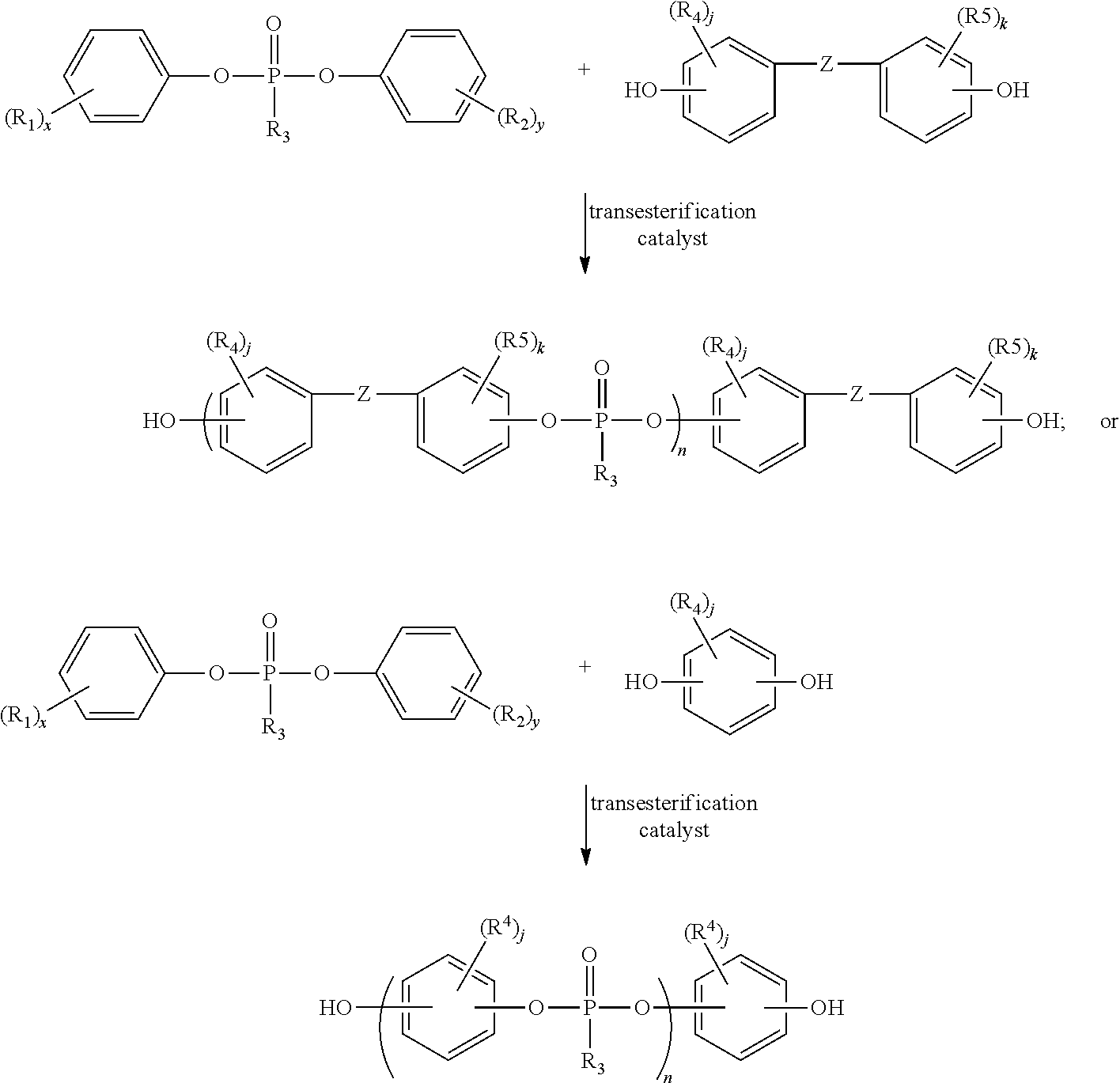
where each R1 and R2 can independently be a hydrogen or C1-C4 alkyl; x and y are independently integers of 1 to 5; R3 can be C1 to C10 alkyl or C6 to C10 aryl or heteroaryl. In some embodiments, the phosphonic acid diaryl ester may be methylphosphonic acid diaryl ester or methyldiphenoxyphosphine oxide or diphenylmethyl phosphonate where R3 is methyl. Each R4 and R5 can independently be a hydrogen, halogen atom, nitro group, cyano group, C1-C20 alkyl group, C4-C20 cycloalkyl group, or C6-C20 aryl containing group; j and k can independently integers 1 to 4; and Z may be a bond, oxygen atom, sulfur atom, or SO2 group for non-splittable bisphenols, and for splittable bisphenols Z may be the group, R6—C—R7, where R6 and R7 can independently be a hydrogen atom, lower alkyl C1-C4 alkyl group, aryl and substituted aryl. In some embodiments, R6 and R7 may combine to form a C4-C20 cycloaliphatic ring which is optionally substituted by one or more C1-C20 alkyl groups, aryl groups, or a combination of these. In such embodiments, n may be from 1 to about 1000, and in various embodiments, n may be a single integer to signify a specific compound having a specific molecular weight, or n may be represented as a range signifying a combination of compounds of various lengths providing a molecular weight distribution.
Claims (25)


Priority Applications (1)
| Application Number | Priority Date | Filing Date | Title |
|---|---|---|---|
| US14/160,963 US10167377B2 (en) | 2013-01-22 | 2014-01-22 | Phosphorus containing epoxy compounds and compositions therefrom |
Applications Claiming Priority (2)
| Application Number | Priority Date | Filing Date | Title |
|---|---|---|---|
| US201361755235P | 2013-01-22 | 2013-01-22 | |
| US14/160,963 US10167377B2 (en) | 2013-01-22 | 2014-01-22 | Phosphorus containing epoxy compounds and compositions therefrom |
Publications (2)
| Publication Number | Publication Date |
|---|---|
| US20140205832A1 US20140205832A1 (en) | 2014-07-24 |
| US10167377B2 true US10167377B2 (en) | 2019-01-01 |
Family
ID=51207920
Family Applications (1)
| Application Number | Title | Priority Date | Filing Date |
|---|---|---|---|
| US14/160,963 Expired - Fee Related US10167377B2 (en) | 2013-01-22 | 2014-01-22 | Phosphorus containing epoxy compounds and compositions therefrom |
Country Status (7)
| Country | Link |
|---|---|
| US (1) | US10167377B2 (en) |
| EP (1) | EP2948464A4 (en) |
| JP (1) | JP2016510355A (en) |
| KR (1) | KR20150108921A (en) |
| CN (1) | CN104981474A (en) |
| TW (1) | TW201439222A (en) |
| WO (1) | WO2014116669A1 (en) |
Cited By (2)
| Publication number | Priority date | Publication date | Assignee | Title |
|---|---|---|---|---|
| US20200332140A1 (en) * | 2017-12-18 | 2020-10-22 | Agfa-Gevaert Nv | Solder mask inkjet inks for manufacturing printed circuit boards |
| US11732085B2 (en) | 2019-02-15 | 2023-08-22 | Dow Global Technologies Llc | Epoxy composition |
Families Citing this family (12)
| Publication number | Priority date | Publication date | Assignee | Title |
|---|---|---|---|---|
| JP6806488B2 (en) * | 2016-07-29 | 2021-01-06 | 株式会社Adeka | A curable resin composition and an adhesive for joining structural materials using the composition. |
| CN107819156B (en) * | 2017-10-31 | 2020-04-14 | 江汉大学 | Preparation method of non-combustible solid polymer electrolyte and secondary lithium battery containing the solid polymer electrolyte |
| CN107868276B (en) * | 2017-11-29 | 2019-09-06 | 中蓝晨光化工研究设计院有限公司 | A kind of stabilizer composition for preparing polycarbonate composition |
| WO2019204713A1 (en) * | 2018-04-20 | 2019-10-24 | Frx Polymers, Inc. | High comparative tracking index, halogen-free flame-retardant thermosetting compositions |
| CN111100587A (en) * | 2019-12-31 | 2020-05-05 | 苏州桐力光电股份有限公司 | Graphene AB adhesive and preparation method thereof |
| KR102378935B1 (en) * | 2020-05-20 | 2022-03-25 | 주식회사 케이씨씨 | Epoxy fire resistant coating composition |
| EP3926024A1 (en) * | 2020-06-17 | 2021-12-22 | Clariant International Ltd | Phosphorus-containing flame retardant compounds, method for their preparation and their use and epoxy resin formulations containing these flame retardant compounds |
| CN112961362A (en) * | 2020-10-29 | 2021-06-15 | 广东广山新材料股份有限公司 | Polymeric flame retardant and preparation method and application thereof |
| KR20230045272A (en) * | 2021-09-28 | 2023-04-04 | 삼성전자주식회사 | Amine-based curing agent, and composition, semiconductor package, and electronic device including the same |
| CN114479047B (en) * | 2022-02-23 | 2023-07-18 | 浙江大学 | A kind of method for preparing polymer containing quaternary phosphonium salt by epoxy monomer and its product and application |
| WO2023176883A1 (en) | 2022-03-18 | 2023-09-21 | 東レ株式会社 | Epoxy resin composition, prepreg, and fiber-reinforced composite material |
| CN118994237A (en) * | 2023-05-19 | 2024-11-22 | 台光电子材料(昆山)有限公司 | Phosphorus-containing compound, process for producing the same, resin composition and product thereof |
Citations (190)
| Publication number | Priority date | Publication date | Assignee | Title |
|---|---|---|---|---|
| US2271610A (en) | 1938-08-31 | 1942-02-03 | Universal Oil Prod Co | Conversion of hydrocarbon oils |
| US2435252A (en) | 1944-01-01 | 1948-02-03 | Victor Chemical Works | Aryl phosphorus containing resins and the method of preparing the same |
| US2534242A (en) | 1950-12-19 | B-haloxanthine salts of z-alkyl-z | ||
| US2534252A (en) | 1947-08-12 | 1950-12-19 | Gen Tire & Rubber Co | Tube splicer |
| US2682522A (en) | 1952-09-10 | 1954-06-29 | Eastman Kodak Co | Process for preparing polymeric organo-phosphonates |
| US2716101A (en) | 1952-09-10 | 1955-08-23 | Eastman Kodak Co | Polymeric organo-phosphonates containing phosphato groups |
| US2891915A (en) | 1954-07-02 | 1959-06-23 | Du Pont | Organophosphorus polymers |
| US2925206A (en) | 1957-03-13 | 1960-02-16 | Ralph J Hancock | Egg case |
| US2925208A (en) | 1956-10-19 | 1960-02-16 | American Can Co | One-piece flat bottom paper cup |
| US3153008A (en) | 1955-07-05 | 1964-10-13 | Gen Electric | Aromatic carbonate resins and preparation thereof |
| US3271329A (en) | 1958-09-19 | 1966-09-06 | Eastman Kodak Co | Method for producing polymers derived from phosphites and glycols |
| US3326852A (en) | 1964-08-10 | 1967-06-20 | Owens Illinois Inc | Resinous polymeric phosphonates |
| US3442854A (en) | 1965-01-21 | 1969-05-06 | Bayer Ag | Quaternary ammonium phosphonium and arsonium catalysts for the production of polycarbonates by the transesterification method |
| US3450677A (en) | 1966-12-01 | 1969-06-17 | Eastman Kodak Co | Polymers derived from diamines and phosphites or phosphonites |
| US3719727A (en) | 1970-03-19 | 1973-03-06 | Toyo Boseki | Fireproof,thermoplastic polyester-polyaryl phosphonate composition |
| DE2252258A1 (en) | 1972-10-25 | 1974-05-09 | Hoechst Ag | FLAME RESISTANT THERMOPLASTIC POLYESTER |
| US3829405A (en) | 1970-06-29 | 1974-08-13 | Fiber Industries Inc | Phosphorus-containing polyesters |
| US3830771A (en) | 1970-06-29 | 1974-08-20 | Celanese Corp | Phosphorus-containing polyesters |
| US3919363A (en) | 1974-04-30 | 1975-11-11 | Nissan Chemical Ind Ltd | Process for preparing poly(sulfonyl-phenylene)phenylphosphonate |
| US3925303A (en) | 1972-06-30 | 1975-12-09 | Rhone Poulenc Sa | Flameproofing of acrylonitrile polymers and copolymers |
| US3932566A (en) | 1974-09-16 | 1976-01-13 | Celanese Corporation | Phosphonate polymers |
| US3932351A (en) | 1971-04-08 | 1976-01-13 | Monsanto Company | Method of preparing phosphorus-bromine containing fire retardant polyester fibers |
| US3940366A (en) | 1973-12-28 | 1976-02-24 | General Electric Company | Flame retardant polycarbonate composition |
| US3946093A (en) | 1974-04-27 | 1976-03-23 | Nissan Chemical Industries, Ltd. | Process for preparing polyphosphonate |
| US3945954A (en) | 1974-01-11 | 1976-03-23 | Uniroyal, Inc. | Flame retardant polyurethanes from polymeric halogenated organo phosphorous diols |
| US3948860A (en) | 1973-02-20 | 1976-04-06 | Marubishi Yuka Kogyo Kabushiki Kaisha | Process for the production of flame-retardant polyurethanes |
| DE2447727A1 (en) | 1974-10-07 | 1976-04-08 | Hoechst Ag | FLAME RESISTANT POLYAMIDE MOLDING COMPOUNDS |
| US3952072A (en) | 1973-11-14 | 1976-04-20 | Mitsubishi Gas Chemical Company, Inc. | Stabilized polyphenylene ether type resin composition |
| JPS51111869A (en) | 1975-03-27 | 1976-10-02 | Asahi Chemical Ind | Method of producing flame resisting formed polyester article |
| US4033927A (en) | 1971-11-01 | 1977-07-05 | General Electric Company | Flame retardant polyester resin compositions |
| US4035436A (en) * | 1974-11-12 | 1977-07-12 | Toagosei Chemical Industry Co., Ltd. | Adhesive compositions for metals |
| US4039512A (en) | 1975-09-15 | 1977-08-02 | Stauffer Chemical Company | Polymers of benzene phosphorus oxydichloride, 4,4'-thiodiphenol and POCl3 |
| US4046724A (en) | 1973-12-17 | 1977-09-06 | Toyo Boseki Kabushiki Kaisha | Fireproof polyester composition |
| US4048106A (en) | 1975-05-21 | 1977-09-13 | S.A. Texaco Belgium N.V. | Novel polyureas prepared by reaction of a diamine with a diisocyanate or a diisothiocyanate |
| US4064107A (en) | 1976-08-12 | 1977-12-20 | Celanese Corporation | High temperature polyurea resins |
| US4078016A (en) | 1976-05-17 | 1978-03-07 | Celanese Corporation | Halogenated aromatic polymer/metal phosphinate polymer flame retardant composition |
| US4093582A (en) | 1976-12-08 | 1978-06-06 | General Electric Company | Organo phosphorus ester plasticized polycarbonate composition |
| US4152373A (en) | 1975-09-22 | 1979-05-01 | Stauffer Chemical Company | Process for preparing diaryl methylphosphonate and derivatives thereof |
| US4180495A (en) | 1978-04-13 | 1979-12-25 | Pennwalt Corporation | Polyester resins flame retarded by poly(metal phosphinate)s |
| US4196119A (en) | 1976-04-14 | 1980-04-01 | Ciba-Geigy Corporation | Novel phenol stabilizers |
| US4205162A (en) | 1978-11-03 | 1980-05-27 | Stauffer Chemical Company | Polymer recovery process |
| US4207721A (en) | 1978-11-24 | 1980-06-17 | Standard-Knapp, Inc. | Finger assembly for case loader |
| US4223104A (en) | 1978-08-11 | 1980-09-16 | Stauffer Chemical Company | Copoly (carbonate/phosphonate) compositions |
| DE2909442A1 (en) | 1979-03-06 | 1980-09-18 | Gen Electric | FLAME-RETARDANT POLYPHENYLENE ETHER COMPOSITIONS |
| US4229552A (en) | 1977-12-06 | 1980-10-21 | Teijin Limited | Fire-retardant polyester compositions |
| DE2925206A1 (en) | 1979-06-22 | 1981-01-29 | Bayer Ag | AROMATIC POLYESTER PHOSPHONATES, METHOD FOR THE PRODUCTION THEREOF AND THEIR USE FOR THE PRODUCTION OF THERMOPLASTIC MOLDED BODIES |
| DE2925208A1 (en) | 1979-06-22 | 1981-01-29 | Bayer Ag | METHOD FOR PRODUCING AROMATIC THERMOPLASTIC POLYPHOSPHONATOCARBONATES |
| US4254177A (en) | 1979-05-07 | 1981-03-03 | W. R. Grace & Co. | Fire-retardant product and method of making |
| US4258153A (en) | 1978-03-22 | 1981-03-24 | Toray Industries, Inc. | Flame retarding polyester composition |
| US4322530A (en) | 1980-02-22 | 1982-03-30 | W. R. Grace & Co. | Alkylation of polyamines |
| US4331614A (en) | 1979-06-22 | 1982-05-25 | Bayer Aktiengesellschaft | Aromatic polyphosphonates and a process for their production |
| US4332921A (en) | 1980-01-25 | 1982-06-01 | Bayer Aktiengesellschaft | Polycarbonate/polyphosphonate thermoplastic composition |
| US4350793A (en) | 1980-01-26 | 1982-09-21 | Bayer Aktiengesellschaft | Flame-retardant composition of polyphenylene ether, polystyrene resin and polyphosphonate |
| US4374971A (en) | 1979-10-31 | 1983-02-22 | Bayer Aktiengesellschaft | Process for the preparation of thermoplastic aromatic polyphosphonates with improved thermal ageing resistance |
| US4377537A (en) | 1980-01-19 | 1983-03-22 | Bayer Aktiengesellschaft | Preparation of alkane phosphonic and phosphinic acid aryl esters |
| US4401802A (en) | 1980-01-19 | 1983-08-30 | Bayer Aktiengesellschaft | Process for the preparation of thermoplastic aromatic polyphosphonatocarbonates with improved heat-ageing resistance, and their use |
| US4403075A (en) | 1980-09-25 | 1983-09-06 | Mcdonnell Douglas Corporation | Flame resistant composition containing polymeric phosphorylated amides |
| US4408033A (en) | 1981-12-14 | 1983-10-04 | The Dow Chemical Company | Polyurethanes prepared from polyisocyanate, polyol and phosphonopolyester oligomers |
| US4412055A (en) | 1981-12-14 | 1983-10-25 | The Dow Chemical Company | Epoxy resins prepared from epihalohydrins and hydroxyl-containing phosphonopolyester oligomers |
| US4430492A (en) | 1979-08-31 | 1984-02-07 | Bayer Aktiengesellschaft | High-molecular, segmented, thermoplastically processable, aromatic polycarbonates containing co-condensed dimeric fatty acid esters, their preparation and their use |
| US4474937A (en) | 1983-10-03 | 1984-10-02 | The Dow Chemical Company | Phosphorus-modified polyestercarbonate resins |
| US4481350A (en) | 1982-03-22 | 1984-11-06 | Bayer Aktiengesellschaft | Process for the preparation of thermoplastic aromatic polyphosphonates containing small proportions of carbonate structures and product thereof |
| JPS60161993A (en) | 1984-02-01 | 1985-08-23 | Sanko Kagaku Kk | Phosphorus-containing epoxy compound and preparation thereof |
| US4564468A (en) | 1981-09-17 | 1986-01-14 | Ethyl Corporation | Flame retardant for polyurethanes |
| EP0171730A1 (en) | 1984-08-17 | 1986-02-19 | Bayer Ag | Fire-retardant moulding compositions based on polymers of styrene |
| US4580110A (en) | 1984-07-26 | 1986-04-01 | Exxon Research And Engineering Co. | Frequency modulator using material having sliding charge density waves |
| US4594404A (en) | 1984-03-20 | 1986-06-10 | Union Carbide Corporation | Polycarbonates having improved hydrolytic stability |
| JPS61134395A (en) | 1984-12-03 | 1986-06-21 | Sumitomo Chem Co Ltd | Phosphorus-containing epoxy compound and production thereof |
| US4636737A (en) | 1984-07-26 | 1987-01-13 | Exxon Research And Engineering Company | Frequency modulator and demodulator using material having sliding charge density waves |
| EP0077493B1 (en) | 1981-10-19 | 1987-03-18 | Mobay Corporation | Polysulfone-polyphosphonate molding compositions |
| US4690954A (en) | 1986-04-25 | 1987-09-01 | The Dow Chemical Company | Halogenated phosphorate ethers with flame-retardant polyurethanes |
| US4690964A (en) | 1983-01-26 | 1987-09-01 | Mobay Corporation | Thermoplastic polyurethane compositions having improved flame resistance |
| US4701554A (en) | 1983-11-25 | 1987-10-20 | Bayer Aktiengesellschaft | Process for the preparation of polyphosphonic acid amides |
| US4719279A (en) | 1985-06-07 | 1988-01-12 | Bayer Aktiengesellschaft | Process for the preparation of copolyphosphonates having high toughness |
| US4722983A (en) * | 1985-12-13 | 1988-02-02 | Ciba-Geigy Corporation | Process for the preparation of glycidyl compounds |
| US4782123A (en) | 1985-05-14 | 1988-11-01 | Bayer Aktiengesellschaft | Process for the preparation of copolyphosphonates of high notched impact strength |
| US4788259A (en) | 1986-04-22 | 1988-11-29 | Bayer Aktiengesellschaft | Flame-proof polyamides |
| US4829134A (en) * | 1987-07-24 | 1989-05-09 | Kabushiki Kaisha Toshiba | Epoxy resin composition |
| EP0383978A1 (en) | 1989-02-23 | 1990-08-29 | General Electric Company | Flame retardant polyester resins |
| US4970429A (en) | 1985-04-01 | 1990-11-13 | U.S. Philips Corp. | Picture pick-up device and television camera tube |
| US5003029A (en) | 1989-01-18 | 1991-03-26 | Nippon Ester Co., Ltd. | Flame resistant polyester from di aryl-di(hydroxyalkylene oxy)aryl phosphine oxide |
| US5034056A (en) | 1987-09-09 | 1991-07-23 | Bayer Aktiengesellschaft | Fire protectants |
| US5039775A (en) | 1987-02-18 | 1991-08-13 | Ihara Chemical Industry Co., Ltd. | Process for producing polyurea resin |
| JPH03281652A (en) | 1990-03-30 | 1991-12-12 | Mitsubishi Petrochem Co Ltd | Flame-retardant resin composition |
| US5202438A (en) | 1991-04-04 | 1993-04-13 | Elf Atochem S.A. | Process for the synthesis of melamine cyanurate |
| US5216113A (en) | 1989-10-07 | 1993-06-01 | Bayer Aktiengesellschaft | Highly branched polyphosphonates |
| US5256714A (en) | 1987-12-29 | 1993-10-26 | General Electric Company | Flame retardant polyester blends |
| EP0584567A2 (en) | 1992-08-01 | 1994-03-02 | Hoechst Aktiengesellschaft | Fire retardant polymer compositions with increased stability |
| US5319058A (en) | 1991-10-22 | 1994-06-07 | Ihara Chemical Industry Co., Ltd. | Method for the preparation of a polyurea resin |
| US5326850A (en) | 1992-03-05 | 1994-07-05 | Basf Aktiengesellschaft | Molding materials based on unsaturated copolyamides |
| US5334694A (en) | 1992-01-27 | 1994-08-02 | Hoechst Aktiengesellschaft | Aromatic copolyamides, processes for their preparation and structures formed therefrom |
| US5334692A (en) | 1990-09-06 | 1994-08-02 | Bayer Aktiengesellschaft | Highly branched polyphosphonates based on melamine |
| US5340905A (en) | 1992-11-12 | 1994-08-23 | Bayer Aktiengesellschaft | Process for the preparation of thermoplastic polycarbonates |
| US5362783A (en) | 1993-06-08 | 1994-11-08 | The Dow Chemical Company | Stabilizer composition |
| US5373082A (en) | 1992-12-01 | 1994-12-13 | Bayer Aktiengesellschaft | Process for the production of thermoplastic polycarbonates |
| US5393621A (en) | 1993-10-20 | 1995-02-28 | Valence Technology, Inc. | Fire-resistant solid polymer electrolytes |
| US5409976A (en) | 1992-04-24 | 1995-04-25 | Minnesota Mining And Manufacturing Company | Simple two-component zero-halogen flame retardant |
| EP0699708A2 (en) | 1994-08-31 | 1996-03-06 | Hoechst Aktiengesellschaft | Flame retardant polyester moulding compositions |
| US5525681A (en) | 1992-11-20 | 1996-06-11 | The Dow Chemical Company | Polyurea polymers having improved high temperature stability and method of making same |
| US5639800A (en) | 1995-04-04 | 1997-06-17 | Bayer Aktiengesellschaft | Production of flame resistant, halogen-free polyurethane/polyureas |
| US5652275A (en) | 1994-06-21 | 1997-07-29 | Bayer Aktiengesellschaft | Process for the chemical recycling of polycarbonates |
| JPH09255877A (en) | 1996-03-25 | 1997-09-30 | Toray Ind Inc | Flame retardant resin composition |
| WO1997039053A1 (en) | 1996-04-12 | 1997-10-23 | Clariant Gmbh | Synergistic flame protection agent combination for thermoplastic polymers |
| WO1997042264A1 (en) | 1996-05-08 | 1997-11-13 | T & N Technology Limited | Flame-retardant moulded component |
| JPH107766A (en) | 1996-06-24 | 1998-01-13 | Hitachi Chem Co Ltd | Method for producing phosphorus-containing epoxy compound |
| US5719200A (en) | 1994-03-25 | 1998-02-17 | Hoechst Aktiengesellschaft | Flame-resistant polyurea foam |
| US5837760A (en) | 1994-03-16 | 1998-11-17 | Elastogran Gmbh | Self-extinguishing thermoplastic polyurethanes and their preparation |
| DE19734437A1 (en) | 1997-08-08 | 1999-02-11 | Clariant Gmbh | Synergistic combination of flame retardants for polymers |
| US5919844A (en) | 1995-12-28 | 1999-07-06 | Toray Industries, Inc. | Epoxy resin composition |
| DE19737727A1 (en) | 1997-08-29 | 1999-07-08 | Clariant Gmbh | Synergistic flame retardant combination for plastics |
| US5922826A (en) | 1995-01-31 | 1999-07-13 | Idemitsu Kosan Co., Ltd. | Process for producing polycarbonate |
| WO1999046315A1 (en) | 1998-03-12 | 1999-09-16 | Bayer Aktiengesellschaft | Method for producing a liquid formulation of tetraphenylphosphonium phenolate |
| EP0962521A1 (en) | 1998-06-02 | 1999-12-08 | Ecolab Inc. | Stable solid block metal protecting warewashing detergent composition |
| US6066700A (en) | 1997-03-12 | 2000-05-23 | Bayer Aktiengesellschaft | Process for the production of polysiloxane/polycarbonate block co-condensation products |
| EP1026191A1 (en) | 1999-02-02 | 2000-08-09 | Johoku Chemical Co., Ltd. | Flame retardant compounds, process for their production and flame-retarded organic polymer materials |
| US6128214A (en) | 1999-03-29 | 2000-10-03 | Hewlett-Packard | Molecular wire crossbar memory |
| JP2000319356A (en) | 1999-04-15 | 2000-11-21 | Choshun Jinzo Jushisho Kofun Yugenkoshi | Resin composition of phosphorus-containing compound containing epoxy group and use thereof |
| US6153212A (en) | 1998-10-02 | 2000-11-28 | Guilford Pharmaceuticals Inc. | Biodegradable terephthalate polyester-poly (phosphonate) compositions, articles, and methods of using the same |
| JP2001002931A (en) | 1999-06-24 | 2001-01-09 | Toyobo Co Ltd | Flame-retardant resin composition |
| JP2001019746A (en) | 1999-07-09 | 2001-01-23 | Asahi Denka Kogyo Kk | Flame retardant epoxy resin composition |
| US6221939B1 (en) | 1998-08-31 | 2001-04-24 | General Electric Company | Flame retardant resin compositions containing phosphoramides, and method for making |
| JP2001139823A (en) | 1999-11-12 | 2001-05-22 | Polyplastics Co | Flame retardant resin composition |
| US6256767B1 (en) | 1999-03-29 | 2001-07-03 | Hewlett-Packard Company | Demultiplexer for a molecular wire crossbar network (MWCN DEMUX) |
| US6255371B1 (en) | 1999-07-22 | 2001-07-03 | Clariant Gmbh | Flame-retardant combination |
| US6288210B1 (en) | 1999-11-12 | 2001-09-11 | Virginia Tech. Intellectual Properties, Inc. | High refractive index thermoplastic polyphosphonates |
| US6291700B1 (en) | 1999-05-25 | 2001-09-18 | General Electric Company | Method for preparing sterically hindered phosphoramidates |
| US6314019B1 (en) | 1999-03-29 | 2001-11-06 | Hewlett-Packard Company | Molecular-wire crossbar interconnect (MWCI) for signal routing and communications |
| US6346574B1 (en) | 2000-06-28 | 2002-02-12 | Asahi Kasei Kabushiki Kaisha | Fire retardance-imparting additive |
| US20020040978A1 (en) | 2000-06-28 | 2002-04-11 | Sujatha Narayan | Tough, fire resistant polyurethane foam and method of manufacture thereof |
| JP2002194313A (en) * | 2000-12-22 | 2002-07-10 | Shin Etsu Chem Co Ltd | Flame retardant resin adhesive |
| US6419709B1 (en) | 1998-10-02 | 2002-07-16 | Guilford Pharmaceuticals, Inc. | Biodegradable terephthalate polyester-poly(Phosphite) compositions, articles, and methods of using the same |
| US20020115793A1 (en) | 1998-01-21 | 2002-08-22 | Gagne Michel R. | Methods of making telechelic oligomers, methods of making block copolymers, and novel block copolymers |
| US20020137874A1 (en) | 2001-03-26 | 2002-09-26 | Uwe Hucks | Process for producing oligocarbonates |
| US20020177649A1 (en) | 2000-03-22 | 2002-11-28 | Hyunkook Shin | Solutions for flash spinning of polyester |
| JP2002363259A (en) | 2001-06-04 | 2002-12-18 | Mitsubishi Gas Chem Co Inc | Flame retardant resin composition |
| US6518347B1 (en) | 2000-12-27 | 2003-02-11 | 3M Innovative Properties Company | Flame retardant carbonate polymers and use thereof |
| WO2003029258A1 (en) | 2001-10-04 | 2003-04-10 | Akzo Nobel N.V. | Oligomeric, hydroxy-terminated phosphonates |
| US20030133679A1 (en) | 2001-11-08 | 2003-07-17 | Dsm N.V. | Flame-retardant optical fiber coating composition |
| US20030149145A1 (en) | 2001-12-07 | 2003-08-07 | Matthias Bienmuller | Flameproofed molding compositions |
| US6642288B1 (en) | 1997-07-10 | 2003-11-04 | Dsm N.V. | Halogen-free flame-retardant thermoplastic polyester or polyamide composition |
| DE10317487A1 (en) | 2003-04-16 | 2004-01-22 | Ticona Gmbh | Fire retardant combination for thermoplastics, e.g. in coating materials, comprises a magnesium, calcium, aluminum or zinc salt of a phosphinic or diphosphinic acid plus another organophosphorus compound |
| JP2004044022A (en) | 2002-07-12 | 2004-02-12 | Teijin Ltd | Polyester composite fiber |
| JP2004052131A (en) | 2002-07-17 | 2004-02-19 | Teijin Ltd | Method for producing undrawn polyester yarn |
| US20040137227A1 (en) | 2001-04-16 | 2004-07-15 | Toshiyuki Masuda | Polyester fiber |
| US20040167284A1 (en) | 2003-02-24 | 2004-08-26 | Michael Vinciguerra | Branched polyphosphonates that exhibit an advantageous combination of properties, and methods related thereto |
| WO2004076537A1 (en) | 2003-02-24 | 2004-09-10 | Triton Systems, Inc. | Linear polyphosphonates and methods of making |
| US20040197301A1 (en) | 2003-02-18 | 2004-10-07 | Zhong Zhao | Hybrid polymers and methods of making the same |
| WO2004113411A1 (en) | 2003-05-22 | 2004-12-29 | Supresta Llc | Polyphosphonate flame retardant curing agent for epoxy resin |
| US6872797B2 (en) | 2001-03-01 | 2005-03-29 | Asahi Kasei Kabushiki Kaisha | Copolycarbonate diol and thermoplastic polyurethane obtained therefrom |
| US20050137300A1 (en) | 2003-12-19 | 2005-06-23 | Clariant Gmbh | Flame retardant and stabilizer combined, for polyesters and polyamides |
| US20050222370A1 (en) | 2004-04-02 | 2005-10-06 | Dieter Freitag | Crystalline polyphosphonates and methods related thereto |
| US20050245647A1 (en) | 2002-02-22 | 2005-11-03 | Kaneka Corporation | Flame-retardant polyester fiber and artificial hair comprising the same |
| US20060020064A1 (en) | 2004-07-22 | 2006-01-26 | Clariant Gmbh | Flame-retardant polymer molding compositions |
| US20060020104A1 (en) | 2004-06-04 | 2006-01-26 | Dieter Freitag | Preparation of polyphosonates via transesterification without a catalyst |
| WO2006026616A1 (en) | 2004-08-31 | 2006-03-09 | Supresta Llc | Process for preparing diaryl alkylphosphonates and oligomeric/polymeric derivatives thereof |
| US20060079612A1 (en) | 2002-04-10 | 2006-04-13 | Malisa Troutman | Flame retardant coatings |
| US20060142427A1 (en) | 2002-11-08 | 2006-06-29 | Sergei Levchik | Epoxy resin composition containing reactive flame retardant phosphonate oligomer and filler |
| CN1810813A (en) * | 2006-01-05 | 2006-08-02 | 康富春 | Phosphorus-containing bishydroxy compound, phosphorus-containing epoxy resin synthesized therewith, and their prepn process and application |
| US20060287418A1 (en) | 2004-07-22 | 2006-12-21 | Clariant Gmbh | Nanoparticulate phosphorus-containing flame retardant system |
| US7153901B2 (en) | 2003-11-21 | 2006-12-26 | Albemarle Corporation | Flame retardant, additive compositions, and flame retardant polyurethanes |
| WO2007022008A2 (en) | 2005-08-11 | 2007-02-22 | Frx Polymers, Llp | Poly (block-phosphonato-ester) and poly (block-phosphonato-carbonate) and methods of making same |
| WO2007065094A2 (en) | 2005-12-01 | 2007-06-07 | Frx Polymers, Llc | Method for the production of block copolycarbonate/phosphonates and compositions therefrom |
| US20070149663A1 (en) | 2003-02-14 | 2007-06-28 | Hans-Werner Schmidt | Resin compositions |
| US20070203275A1 (en) | 2004-03-16 | 2007-08-30 | Sumitomo Chemical Company, Limited | Organic Silicon-Based Compound And Method Of Producing The Same |
| US20070203269A1 (en) | 2005-10-17 | 2007-08-30 | Dieter Freitag | Compositions comprising polyphosphonates and additives that exhibit an advantageous combination of properties, and methods related thereto |
| US20070219295A1 (en) | 2004-05-19 | 2007-09-20 | Sergei Levchik | Polyphosphonate Flame Retardant Curing Agent For Epoxy Resin |
| WO2008011941A1 (en) | 2006-07-28 | 2008-01-31 | Dsm Ip Assets B.V. | Flame retardant thermoplastic composition |
| US20080114127A1 (en) | 2005-04-25 | 2008-05-15 | Dieter Freitag | Method for producing branched polyphosphonates with narrow molecular weight distributions |
| EP1935944A2 (en) | 2006-12-21 | 2008-06-25 | Wintech Polymer Ltd. | Flame-retardant resin composition |
| WO2009012286A1 (en) | 2007-07-16 | 2009-01-22 | Frx Polymers, Inc. | Flame retardant engineering polymer compositions |
| WO2009018336A2 (en) | 2007-07-30 | 2009-02-05 | Frx Polymers, Inc. | Insoluble and branched polyphosphonates and methods related thereto |
| US20090149582A1 (en) | 2007-12-05 | 2009-06-11 | Bayer Materialscience Ag | Self-extinguishing thermoplastic polyurethanes, their use, and processes for their preparation |
| US20090306236A1 (en) | 2008-06-04 | 2009-12-10 | Bayer Material Science Llc | Process for preparing rigid polyisocyanurate foams using natural-oil polyols |
| US20090326108A1 (en) | 2007-12-21 | 2009-12-31 | Lubrizol Advanced Materials, Inc. | Halogen-Free Flame Retardant Thermoplastic Polyurethanes |
| US20100056660A1 (en) | 2008-08-29 | 2010-03-04 | Bayer Materialscience Llc | Decorative molded foams with good fire retardant properties |
| WO2010048121A1 (en) | 2008-10-21 | 2010-04-29 | Albemarle Corporation | Mixed glycol polyphosphonate compounds |
| US20100298475A1 (en) | 2008-01-14 | 2010-11-25 | Wilson David R | Ignition resistant carbonate polymer composition containing an aromatic phosphonate |
| US7862749B2 (en) | 2004-05-28 | 2011-01-04 | Albemarle Corporation | Flame retardant polyurethanes and additives therefor |
| US20110021676A1 (en) | 2008-03-03 | 2011-01-27 | Clariant Finance (Bvi) Limited | Method for the Production of a Flame-retardant, Non-corrosive, and Easily flowable Polyamide and Polyester Molding Compounds |
| US7888534B2 (en) | 2005-10-18 | 2011-02-15 | Frx Polymers, Inc. | Diaryl alkylphosphonates and methods for preparing same |
| US7893143B2 (en) | 2006-11-30 | 2011-02-22 | Bayer Materialscience Ag | Process for the preparation of self-extinguishing thermoplastic polyurethanes |
| US7928259B2 (en) | 2008-02-12 | 2011-04-19 | Frx Polymers, Inc. | Diaryl alkylphosphonates and methods for preparing same |
| US20110237695A1 (en) | 2010-03-23 | 2011-09-29 | Clariant International Ltd. | Flame Retardant Combinations For Polyester Elastomers And Flame Retarded Extrusion Or Molding Compositions Therefrom |
| US20110263745A1 (en) | 2009-01-08 | 2011-10-27 | Frx Polymers, Inc. | Flame Retardant Combinations For Polyesters And Flame Retarded Polyester Moulding Compositions Therefrom |
| US20120121843A1 (en) | 2010-11-17 | 2012-05-17 | Frx Polymers, Inc. | Phosphonate polymers, copolymers, and their respective oligomers as flame retardants for polyester fibers |
| US20120172500A1 (en) | 2010-12-22 | 2012-07-05 | Frx Polymers, Inc. | Oligomeric phosphonates and compositions including the same |
| US20120264844A1 (en) | 2011-04-14 | 2012-10-18 | Frx Polymers, Inc. | Polyphosphonate and copolyphosphonate additive mixtures |
| US8389664B2 (en) | 2010-09-16 | 2013-03-05 | Frx Polymers, Inc. | High molecular weight, random, bisphenol based copoly(phosphonate carbonate)s |
| CN103059264A (en) | 2012-12-27 | 2013-04-24 | 北京德成嘉化工科技有限责任公司 | A phosphorus-containing diglycidyl ether, a preparation method thereof and a flame-retardant cured epoxy resin containing the same |
| US20140000751A1 (en) | 2012-06-29 | 2014-01-02 | Frx Polymers, Inc. | Polyester co-phosphonates |
Family Cites Families (1)
| Publication number | Priority date | Publication date | Assignee | Title |
|---|---|---|---|---|
| JP2002161087A (en) * | 2000-11-24 | 2002-06-04 | Noevir Co Ltd | Long-chain aliphatic diglycidyl ether and method for synthesizing the same |
-
2014
- 2014-01-22 US US14/160,963 patent/US10167377B2/en not_active Expired - Fee Related
- 2014-01-22 KR KR1020157022866A patent/KR20150108921A/en not_active Withdrawn
- 2014-01-22 TW TW103102295A patent/TW201439222A/en unknown
- 2014-01-22 WO PCT/US2014/012497 patent/WO2014116669A1/en not_active Ceased
- 2014-01-22 CN CN201480005483.2A patent/CN104981474A/en active Pending
- 2014-01-22 EP EP14743163.9A patent/EP2948464A4/en not_active Withdrawn
- 2014-01-22 JP JP2015553913A patent/JP2016510355A/en active Pending
Patent Citations (231)
| Publication number | Priority date | Publication date | Assignee | Title |
|---|---|---|---|---|
| US2534242A (en) | 1950-12-19 | B-haloxanthine salts of z-alkyl-z | ||
| US2271610A (en) | 1938-08-31 | 1942-02-03 | Universal Oil Prod Co | Conversion of hydrocarbon oils |
| US2435252A (en) | 1944-01-01 | 1948-02-03 | Victor Chemical Works | Aryl phosphorus containing resins and the method of preparing the same |
| US2534252A (en) | 1947-08-12 | 1950-12-19 | Gen Tire & Rubber Co | Tube splicer |
| US2682522A (en) | 1952-09-10 | 1954-06-29 | Eastman Kodak Co | Process for preparing polymeric organo-phosphonates |
| US2716101A (en) | 1952-09-10 | 1955-08-23 | Eastman Kodak Co | Polymeric organo-phosphonates containing phosphato groups |
| US2891915A (en) | 1954-07-02 | 1959-06-23 | Du Pont | Organophosphorus polymers |
| US3153008A (en) | 1955-07-05 | 1964-10-13 | Gen Electric | Aromatic carbonate resins and preparation thereof |
| US2925208A (en) | 1956-10-19 | 1960-02-16 | American Can Co | One-piece flat bottom paper cup |
| US2925206A (en) | 1957-03-13 | 1960-02-16 | Ralph J Hancock | Egg case |
| US3271329A (en) | 1958-09-19 | 1966-09-06 | Eastman Kodak Co | Method for producing polymers derived from phosphites and glycols |
| US3326852A (en) | 1964-08-10 | 1967-06-20 | Owens Illinois Inc | Resinous polymeric phosphonates |
| US3442854A (en) | 1965-01-21 | 1969-05-06 | Bayer Ag | Quaternary ammonium phosphonium and arsonium catalysts for the production of polycarbonates by the transesterification method |
| US3450677A (en) | 1966-12-01 | 1969-06-17 | Eastman Kodak Co | Polymers derived from diamines and phosphites or phosphonites |
| US3719727A (en) | 1970-03-19 | 1973-03-06 | Toyo Boseki | Fireproof,thermoplastic polyester-polyaryl phosphonate composition |
| US3829405A (en) | 1970-06-29 | 1974-08-13 | Fiber Industries Inc | Phosphorus-containing polyesters |
| US3830771A (en) | 1970-06-29 | 1974-08-20 | Celanese Corp | Phosphorus-containing polyesters |
| US3932351A (en) | 1971-04-08 | 1976-01-13 | Monsanto Company | Method of preparing phosphorus-bromine containing fire retardant polyester fibers |
| US4033927A (en) | 1971-11-01 | 1977-07-05 | General Electric Company | Flame retardant polyester resin compositions |
| US3925303A (en) | 1972-06-30 | 1975-12-09 | Rhone Poulenc Sa | Flameproofing of acrylonitrile polymers and copolymers |
| US3900444A (en) | 1972-10-25 | 1975-08-19 | Hoechst Ag | Flame resistant thermoplastic polyesters |
| DE2252258A1 (en) | 1972-10-25 | 1974-05-09 | Hoechst Ag | FLAME RESISTANT THERMOPLASTIC POLYESTER |
| US3948860A (en) | 1973-02-20 | 1976-04-06 | Marubishi Yuka Kogyo Kabushiki Kaisha | Process for the production of flame-retardant polyurethanes |
| US3952072A (en) | 1973-11-14 | 1976-04-20 | Mitsubishi Gas Chemical Company, Inc. | Stabilized polyphenylene ether type resin composition |
| US4046724A (en) | 1973-12-17 | 1977-09-06 | Toyo Boseki Kabushiki Kaisha | Fireproof polyester composition |
| US3940366A (en) | 1973-12-28 | 1976-02-24 | General Electric Company | Flame retardant polycarbonate composition |
| US3945954A (en) | 1974-01-11 | 1976-03-23 | Uniroyal, Inc. | Flame retardant polyurethanes from polymeric halogenated organo phosphorous diols |
| US3946093A (en) | 1974-04-27 | 1976-03-23 | Nissan Chemical Industries, Ltd. | Process for preparing polyphosphonate |
| US3919363A (en) | 1974-04-30 | 1975-11-11 | Nissan Chemical Ind Ltd | Process for preparing poly(sulfonyl-phenylene)phenylphosphonate |
| US3932566A (en) | 1974-09-16 | 1976-01-13 | Celanese Corporation | Phosphonate polymers |
| DE2447727A1 (en) | 1974-10-07 | 1976-04-08 | Hoechst Ag | FLAME RESISTANT POLYAMIDE MOLDING COMPOUNDS |
| US4036811A (en) | 1974-10-07 | 1977-07-19 | Hoechst Aktiengesellschaft | Flame retarding polyamide molding compositions |
| US4035436A (en) * | 1974-11-12 | 1977-07-12 | Toagosei Chemical Industry Co., Ltd. | Adhesive compositions for metals |
| JPS51111869A (en) | 1975-03-27 | 1976-10-02 | Asahi Chemical Ind | Method of producing flame resisting formed polyester article |
| US4048106A (en) | 1975-05-21 | 1977-09-13 | S.A. Texaco Belgium N.V. | Novel polyureas prepared by reaction of a diamine with a diisocyanate or a diisothiocyanate |
| US4039512A (en) | 1975-09-15 | 1977-08-02 | Stauffer Chemical Company | Polymers of benzene phosphorus oxydichloride, 4,4'-thiodiphenol and POCl3 |
| US4152373A (en) | 1975-09-22 | 1979-05-01 | Stauffer Chemical Company | Process for preparing diaryl methylphosphonate and derivatives thereof |
| US4196119A (en) | 1976-04-14 | 1980-04-01 | Ciba-Geigy Corporation | Novel phenol stabilizers |
| US4078016A (en) | 1976-05-17 | 1978-03-07 | Celanese Corporation | Halogenated aromatic polymer/metal phosphinate polymer flame retardant composition |
| US4064107A (en) | 1976-08-12 | 1977-12-20 | Celanese Corporation | High temperature polyurea resins |
| US4093582A (en) | 1976-12-08 | 1978-06-06 | General Electric Company | Organo phosphorus ester plasticized polycarbonate composition |
| US4229552A (en) | 1977-12-06 | 1980-10-21 | Teijin Limited | Fire-retardant polyester compositions |
| US4258153A (en) | 1978-03-22 | 1981-03-24 | Toray Industries, Inc. | Flame retarding polyester composition |
| US4180495A (en) | 1978-04-13 | 1979-12-25 | Pennwalt Corporation | Polyester resins flame retarded by poly(metal phosphinate)s |
| US4223104A (en) | 1978-08-11 | 1980-09-16 | Stauffer Chemical Company | Copoly (carbonate/phosphonate) compositions |
| US4205162A (en) | 1978-11-03 | 1980-05-27 | Stauffer Chemical Company | Polymer recovery process |
| US4207721A (en) | 1978-11-24 | 1980-06-17 | Standard-Knapp, Inc. | Finger assembly for case loader |
| DE2909442A1 (en) | 1979-03-06 | 1980-09-18 | Gen Electric | FLAME-RETARDANT POLYPHENYLENE ETHER COMPOSITIONS |
| GB2043083A (en) | 1979-03-06 | 1980-10-01 | Gen Electric | Flame retardant polyphenylene ether compositions |
| US4254177A (en) | 1979-05-07 | 1981-03-03 | W. R. Grace & Co. | Fire-retardant product and method of making |
| DE2925206A1 (en) | 1979-06-22 | 1981-01-29 | Bayer Ag | AROMATIC POLYESTER PHOSPHONATES, METHOD FOR THE PRODUCTION THEREOF AND THEIR USE FOR THE PRODUCTION OF THERMOPLASTIC MOLDED BODIES |
| DE2925208A1 (en) | 1979-06-22 | 1981-01-29 | Bayer Ag | METHOD FOR PRODUCING AROMATIC THERMOPLASTIC POLYPHOSPHONATOCARBONATES |
| US4322520A (en) | 1979-06-22 | 1982-03-30 | Bayer Aktiengesellschaft | Aromatic thermoplastic polyphosphonatocarbonate |
| US4415719A (en) | 1979-06-22 | 1983-11-15 | Bayer Aktiengesellschaft | Thermoplastic, branched aromatic polyphosphonates, and a process for their production |
| US4328174A (en) | 1979-06-22 | 1982-05-04 | Bayer Aktiengesellschaft | Aromatic polyester phosphonates |
| US4331614A (en) | 1979-06-22 | 1982-05-25 | Bayer Aktiengesellschaft | Aromatic polyphosphonates and a process for their production |
| US4762905A (en) | 1979-06-22 | 1988-08-09 | Bayer Aktiengesellschaft | Aromatic thermoplastic polyphosphonatocarbonate |
| US4430492A (en) | 1979-08-31 | 1984-02-07 | Bayer Aktiengesellschaft | High-molecular, segmented, thermoplastically processable, aromatic polycarbonates containing co-condensed dimeric fatty acid esters, their preparation and their use |
| US4374971A (en) | 1979-10-31 | 1983-02-22 | Bayer Aktiengesellschaft | Process for the preparation of thermoplastic aromatic polyphosphonates with improved thermal ageing resistance |
| US4401802A (en) | 1980-01-19 | 1983-08-30 | Bayer Aktiengesellschaft | Process for the preparation of thermoplastic aromatic polyphosphonatocarbonates with improved heat-ageing resistance, and their use |
| US4508890A (en) | 1980-01-19 | 1985-04-02 | Bayer Aktiengesellschaft | Process for the preparation of thermoplastic aromatic polyphosphonatocarbonates with improved heat-aging resistance, and their use |
| US4377537A (en) | 1980-01-19 | 1983-03-22 | Bayer Aktiengesellschaft | Preparation of alkane phosphonic and phosphinic acid aryl esters |
| US4332921A (en) | 1980-01-25 | 1982-06-01 | Bayer Aktiengesellschaft | Polycarbonate/polyphosphonate thermoplastic composition |
| US4350793A (en) | 1980-01-26 | 1982-09-21 | Bayer Aktiengesellschaft | Flame-retardant composition of polyphenylene ether, polystyrene resin and polyphosphonate |
| US4322530A (en) | 1980-02-22 | 1982-03-30 | W. R. Grace & Co. | Alkylation of polyamines |
| US4403075A (en) | 1980-09-25 | 1983-09-06 | Mcdonnell Douglas Corporation | Flame resistant composition containing polymeric phosphorylated amides |
| US4564468A (en) | 1981-09-17 | 1986-01-14 | Ethyl Corporation | Flame retardant for polyurethanes |
| EP0077493B1 (en) | 1981-10-19 | 1987-03-18 | Mobay Corporation | Polysulfone-polyphosphonate molding compositions |
| US4412055A (en) | 1981-12-14 | 1983-10-25 | The Dow Chemical Company | Epoxy resins prepared from epihalohydrins and hydroxyl-containing phosphonopolyester oligomers |
| US4408033A (en) | 1981-12-14 | 1983-10-04 | The Dow Chemical Company | Polyurethanes prepared from polyisocyanate, polyol and phosphonopolyester oligomers |
| US4481350A (en) | 1982-03-22 | 1984-11-06 | Bayer Aktiengesellschaft | Process for the preparation of thermoplastic aromatic polyphosphonates containing small proportions of carbonate structures and product thereof |
| US4690964A (en) | 1983-01-26 | 1987-09-01 | Mobay Corporation | Thermoplastic polyurethane compositions having improved flame resistance |
| US4474937A (en) | 1983-10-03 | 1984-10-02 | The Dow Chemical Company | Phosphorus-modified polyestercarbonate resins |
| US4701554A (en) | 1983-11-25 | 1987-10-20 | Bayer Aktiengesellschaft | Process for the preparation of polyphosphonic acid amides |
| JPS60161993A (en) | 1984-02-01 | 1985-08-23 | Sanko Kagaku Kk | Phosphorus-containing epoxy compound and preparation thereof |
| US4594404A (en) | 1984-03-20 | 1986-06-10 | Union Carbide Corporation | Polycarbonates having improved hydrolytic stability |
| US4636737A (en) | 1984-07-26 | 1987-01-13 | Exxon Research And Engineering Company | Frequency modulator and demodulator using material having sliding charge density waves |
| US4580110A (en) | 1984-07-26 | 1986-04-01 | Exxon Research And Engineering Co. | Frequency modulator using material having sliding charge density waves |
| US4668720A (en) | 1984-08-17 | 1987-05-26 | Bayer Aktiengesellschaft | Flame resistant moulding compounds based on styrene polymers |
| EP0171730A1 (en) | 1984-08-17 | 1986-02-19 | Bayer Ag | Fire-retardant moulding compositions based on polymers of styrene |
| JPS61134395A (en) | 1984-12-03 | 1986-06-21 | Sumitomo Chem Co Ltd | Phosphorus-containing epoxy compound and production thereof |
| US4970429A (en) | 1985-04-01 | 1990-11-13 | U.S. Philips Corp. | Picture pick-up device and television camera tube |
| US4782123A (en) | 1985-05-14 | 1988-11-01 | Bayer Aktiengesellschaft | Process for the preparation of copolyphosphonates of high notched impact strength |
| US4719279A (en) | 1985-06-07 | 1988-01-12 | Bayer Aktiengesellschaft | Process for the preparation of copolyphosphonates having high toughness |
| US4722983A (en) * | 1985-12-13 | 1988-02-02 | Ciba-Geigy Corporation | Process for the preparation of glycidyl compounds |
| US4788259A (en) | 1986-04-22 | 1988-11-29 | Bayer Aktiengesellschaft | Flame-proof polyamides |
| US4690954A (en) | 1986-04-25 | 1987-09-01 | The Dow Chemical Company | Halogenated phosphorate ethers with flame-retardant polyurethanes |
| US5039775A (en) | 1987-02-18 | 1991-08-13 | Ihara Chemical Industry Co., Ltd. | Process for producing polyurea resin |
| US5086153A (en) | 1987-02-18 | 1992-02-04 | Ihara Chemical Industry Co., Ltd. | Process for producing polyurea resin |
| US4829134A (en) * | 1987-07-24 | 1989-05-09 | Kabushiki Kaisha Toshiba | Epoxy resin composition |
| US5034056A (en) | 1987-09-09 | 1991-07-23 | Bayer Aktiengesellschaft | Fire protectants |
| US5256714A (en) | 1987-12-29 | 1993-10-26 | General Electric Company | Flame retardant polyester blends |
| US5003029A (en) | 1989-01-18 | 1991-03-26 | Nippon Ester Co., Ltd. | Flame resistant polyester from di aryl-di(hydroxyalkylene oxy)aryl phosphine oxide |
| EP0383978A1 (en) | 1989-02-23 | 1990-08-29 | General Electric Company | Flame retardant polyester resins |
| US5216113A (en) | 1989-10-07 | 1993-06-01 | Bayer Aktiengesellschaft | Highly branched polyphosphonates |
| JPH03281652A (en) | 1990-03-30 | 1991-12-12 | Mitsubishi Petrochem Co Ltd | Flame-retardant resin composition |
| US5334692A (en) | 1990-09-06 | 1994-08-02 | Bayer Aktiengesellschaft | Highly branched polyphosphonates based on melamine |
| US5202438A (en) | 1991-04-04 | 1993-04-13 | Elf Atochem S.A. | Process for the synthesis of melamine cyanurate |
| US5319058A (en) | 1991-10-22 | 1994-06-07 | Ihara Chemical Industry Co., Ltd. | Method for the preparation of a polyurea resin |
| US5334694A (en) | 1992-01-27 | 1994-08-02 | Hoechst Aktiengesellschaft | Aromatic copolyamides, processes for their preparation and structures formed therefrom |
| US5326850A (en) | 1992-03-05 | 1994-07-05 | Basf Aktiengesellschaft | Molding materials based on unsaturated copolyamides |
| US5409976A (en) | 1992-04-24 | 1995-04-25 | Minnesota Mining And Manufacturing Company | Simple two-component zero-halogen flame retardant |
| EP0584567A2 (en) | 1992-08-01 | 1994-03-02 | Hoechst Aktiengesellschaft | Fire retardant polymer compositions with increased stability |
| US5326805A (en) | 1992-08-01 | 1994-07-05 | Hoechst Aktiengesellschaft | Flame-retardant plastics molding composition of improved stability |
| US5340905A (en) | 1992-11-12 | 1994-08-23 | Bayer Aktiengesellschaft | Process for the preparation of thermoplastic polycarbonates |
| US5525681A (en) | 1992-11-20 | 1996-06-11 | The Dow Chemical Company | Polyurea polymers having improved high temperature stability and method of making same |
| US5373082A (en) | 1992-12-01 | 1994-12-13 | Bayer Aktiengesellschaft | Process for the production of thermoplastic polycarbonates |
| US5362783A (en) | 1993-06-08 | 1994-11-08 | The Dow Chemical Company | Stabilizer composition |
| US5393621A (en) | 1993-10-20 | 1995-02-28 | Valence Technology, Inc. | Fire-resistant solid polymer electrolytes |
| US5837760A (en) | 1994-03-16 | 1998-11-17 | Elastogran Gmbh | Self-extinguishing thermoplastic polyurethanes and their preparation |
| US5719200A (en) | 1994-03-25 | 1998-02-17 | Hoechst Aktiengesellschaft | Flame-resistant polyurea foam |
| US5652275A (en) | 1994-06-21 | 1997-07-29 | Bayer Aktiengesellschaft | Process for the chemical recycling of polycarbonates |
| EP0699708A2 (en) | 1994-08-31 | 1996-03-06 | Hoechst Aktiengesellschaft | Flame retardant polyester moulding compositions |
| US6013707A (en) | 1994-08-31 | 2000-01-11 | Ticona Gmbh | Flameproofed polyester molding compositions |
| US5780534A (en) | 1994-08-31 | 1998-07-14 | Ticona Gmbh | Flameproofed polyester molding composition |
| US5922826A (en) | 1995-01-31 | 1999-07-13 | Idemitsu Kosan Co., Ltd. | Process for producing polycarbonate |
| US5639800A (en) | 1995-04-04 | 1997-06-17 | Bayer Aktiengesellschaft | Production of flame resistant, halogen-free polyurethane/polyureas |
| US5919844A (en) | 1995-12-28 | 1999-07-06 | Toray Industries, Inc. | Epoxy resin composition |
| JPH09255877A (en) | 1996-03-25 | 1997-09-30 | Toray Ind Inc | Flame retardant resin composition |
| US6365071B1 (en) | 1996-04-12 | 2002-04-02 | Clariant Gmbh | Synergistic flame protection agent combination for thermoplastic polymers |
| WO1997039053A1 (en) | 1996-04-12 | 1997-10-23 | Clariant Gmbh | Synergistic flame protection agent combination for thermoplastic polymers |
| WO1997042264A1 (en) | 1996-05-08 | 1997-11-13 | T & N Technology Limited | Flame-retardant moulded component |
| US20020156160A1 (en) | 1996-05-08 | 2002-10-24 | Martin Lee Hamilton | Flame-retardant molded component |
| JPH107766A (en) | 1996-06-24 | 1998-01-13 | Hitachi Chem Co Ltd | Method for producing phosphorus-containing epoxy compound |
| US6066700A (en) | 1997-03-12 | 2000-05-23 | Bayer Aktiengesellschaft | Process for the production of polysiloxane/polycarbonate block co-condensation products |
| US6642288B1 (en) | 1997-07-10 | 2003-11-04 | Dsm N.V. | Halogen-free flame-retardant thermoplastic polyester or polyamide composition |
| DE19734437A1 (en) | 1997-08-08 | 1999-02-11 | Clariant Gmbh | Synergistic combination of flame retardants for polymers |
| US6207736B1 (en) | 1997-08-08 | 2001-03-27 | Clariant Gmbh | Synergistic flameproofing combination for polymers |
| US6509401B1 (en) | 1997-08-29 | 2003-01-21 | Clariant Gmbh | Synergistic flame retardant combination of salts of 1-hydroxy-dihydrophosphole oxides and/or 1-hydroxyphospholane oxides and nitrogen compounds for use in polymers |
| DE19737727A1 (en) | 1997-08-29 | 1999-07-08 | Clariant Gmbh | Synergistic flame retardant combination for plastics |
| US20020115793A1 (en) | 1998-01-21 | 2002-08-22 | Gagne Michel R. | Methods of making telechelic oligomers, methods of making block copolymers, and novel block copolymers |
| WO1999046315A1 (en) | 1998-03-12 | 1999-09-16 | Bayer Aktiengesellschaft | Method for producing a liquid formulation of tetraphenylphosphonium phenolate |
| US6291630B1 (en) | 1998-03-12 | 2001-09-18 | Bayer Aktiengesellschaft | Method for producing a liquid formulation of tetraphenylphosphonium phenolate |
| EP0962521A1 (en) | 1998-06-02 | 1999-12-08 | Ecolab Inc. | Stable solid block metal protecting warewashing detergent composition |
| US6221939B1 (en) | 1998-08-31 | 2001-04-24 | General Electric Company | Flame retardant resin compositions containing phosphoramides, and method for making |
| US6419709B1 (en) | 1998-10-02 | 2002-07-16 | Guilford Pharmaceuticals, Inc. | Biodegradable terephthalate polyester-poly(Phosphite) compositions, articles, and methods of using the same |
| US6153212A (en) | 1998-10-02 | 2000-11-28 | Guilford Pharmaceuticals Inc. | Biodegradable terephthalate polyester-poly (phosphonate) compositions, articles, and methods of using the same |
| EP1026191A1 (en) | 1999-02-02 | 2000-08-09 | Johoku Chemical Co., Ltd. | Flame retardant compounds, process for their production and flame-retarded organic polymer materials |
| US6314019B1 (en) | 1999-03-29 | 2001-11-06 | Hewlett-Packard Company | Molecular-wire crossbar interconnect (MWCI) for signal routing and communications |
| US6256767B1 (en) | 1999-03-29 | 2001-07-03 | Hewlett-Packard Company | Demultiplexer for a molecular wire crossbar network (MWCN DEMUX) |
| US6128214A (en) | 1999-03-29 | 2000-10-03 | Hewlett-Packard | Molecular wire crossbar memory |
| JP2000319356A (en) | 1999-04-15 | 2000-11-21 | Choshun Jinzo Jushisho Kofun Yugenkoshi | Resin composition of phosphorus-containing compound containing epoxy group and use thereof |
| US6291700B1 (en) | 1999-05-25 | 2001-09-18 | General Electric Company | Method for preparing sterically hindered phosphoramidates |
| JP2001002931A (en) | 1999-06-24 | 2001-01-09 | Toyobo Co Ltd | Flame-retardant resin composition |
| JP2001019746A (en) | 1999-07-09 | 2001-01-23 | Asahi Denka Kogyo Kk | Flame retardant epoxy resin composition |
| US6255371B1 (en) | 1999-07-22 | 2001-07-03 | Clariant Gmbh | Flame-retardant combination |
| JP2001139823A (en) | 1999-11-12 | 2001-05-22 | Polyplastics Co | Flame retardant resin composition |
| US6288210B1 (en) | 1999-11-12 | 2001-09-11 | Virginia Tech. Intellectual Properties, Inc. | High refractive index thermoplastic polyphosphonates |
| US20020177649A1 (en) | 2000-03-22 | 2002-11-28 | Hyunkook Shin | Solutions for flash spinning of polyester |
| US20020040978A1 (en) | 2000-06-28 | 2002-04-11 | Sujatha Narayan | Tough, fire resistant polyurethane foam and method of manufacture thereof |
| US6346574B1 (en) | 2000-06-28 | 2002-02-12 | Asahi Kasei Kabushiki Kaisha | Fire retardance-imparting additive |
| JP2002194313A (en) * | 2000-12-22 | 2002-07-10 | Shin Etsu Chem Co Ltd | Flame retardant resin adhesive |
| US6518347B1 (en) | 2000-12-27 | 2003-02-11 | 3M Innovative Properties Company | Flame retardant carbonate polymers and use thereof |
| US6872797B2 (en) | 2001-03-01 | 2005-03-29 | Asahi Kasei Kabushiki Kaisha | Copolycarbonate diol and thermoplastic polyurethane obtained therefrom |
| US20020137874A1 (en) | 2001-03-26 | 2002-09-26 | Uwe Hucks | Process for producing oligocarbonates |
| US20040137227A1 (en) | 2001-04-16 | 2004-07-15 | Toshiyuki Masuda | Polyester fiber |
| JP2002363259A (en) | 2001-06-04 | 2002-12-18 | Mitsubishi Gas Chem Co Inc | Flame retardant resin composition |
| US7449526B2 (en) | 2001-10-04 | 2008-11-11 | Supresta U.S. Llc | Oligomeric, hydroxy-terminated phosphonates |
| WO2003029258A1 (en) | 2001-10-04 | 2003-04-10 | Akzo Nobel N.V. | Oligomeric, hydroxy-terminated phosphonates |
| US20050020800A1 (en) | 2001-10-04 | 2005-01-27 | Levchik Sergei V | Oligomeric, hydroxy-terminated phosphonates |
| US20030133679A1 (en) | 2001-11-08 | 2003-07-17 | Dsm N.V. | Flame-retardant optical fiber coating composition |
| US20030149145A1 (en) | 2001-12-07 | 2003-08-07 | Matthias Bienmuller | Flameproofed molding compositions |
| US20050245647A1 (en) | 2002-02-22 | 2005-11-03 | Kaneka Corporation | Flame-retardant polyester fiber and artificial hair comprising the same |
| US20060079612A1 (en) | 2002-04-10 | 2006-04-13 | Malisa Troutman | Flame retardant coatings |
| JP2004044022A (en) | 2002-07-12 | 2004-02-12 | Teijin Ltd | Polyester composite fiber |
| JP2004052131A (en) | 2002-07-17 | 2004-02-19 | Teijin Ltd | Method for producing undrawn polyester yarn |
| US20060142427A1 (en) | 2002-11-08 | 2006-06-29 | Sergei Levchik | Epoxy resin composition containing reactive flame retardant phosphonate oligomer and filler |
| US20070149663A1 (en) | 2003-02-14 | 2007-06-28 | Hans-Werner Schmidt | Resin compositions |
| US20040197301A1 (en) | 2003-02-18 | 2004-10-07 | Zhong Zhao | Hybrid polymers and methods of making the same |
| CN1777632A (en) | 2003-02-24 | 2006-05-24 | 特拉通系统股份有限公司 | branched polyphosphonate |
| US20070032633A1 (en) | 2003-02-24 | 2007-02-08 | Triton Systems, Inc. | Branched polyphosphonates |
| US20040167284A1 (en) | 2003-02-24 | 2004-08-26 | Michael Vinciguerra | Branched polyphosphonates that exhibit an advantageous combination of properties, and methods related thereto |
| US6861499B2 (en) | 2003-02-24 | 2005-03-01 | Triton Systems, Inc. | Branched polyphosphonates that exhibit an advantageous combination of properties, and methods related thereto |
| US7816486B2 (en) | 2003-02-24 | 2010-10-19 | Frx Polymers, Inc. | Branched polyphosphonates |
| WO2004076537A1 (en) | 2003-02-24 | 2004-09-10 | Triton Systems, Inc. | Linear polyphosphonates and methods of making |
| WO2004076536A1 (en) | 2003-02-24 | 2004-09-10 | Triton Systems Inc. | Branched polyphosphonates |
| DE10317487A1 (en) | 2003-04-16 | 2004-01-22 | Ticona Gmbh | Fire retardant combination for thermoplastics, e.g. in coating materials, comprises a magnesium, calcium, aluminum or zinc salt of a phosphinic or diphosphinic acid plus another organophosphorus compound |
| WO2004113411A1 (en) | 2003-05-22 | 2004-12-29 | Supresta Llc | Polyphosphonate flame retardant curing agent for epoxy resin |
| JP2007502904A (en) | 2003-05-22 | 2007-02-15 | スプレスタ エルエルシー | Polyphosphonate flame retardant curing agent for polyexic resin |
| US7153901B2 (en) | 2003-11-21 | 2006-12-26 | Albemarle Corporation | Flame retardant, additive compositions, and flame retardant polyurethanes |
| US20050137300A1 (en) | 2003-12-19 | 2005-06-23 | Clariant Gmbh | Flame retardant and stabilizer combined, for polyesters and polyamides |
| US20070203275A1 (en) | 2004-03-16 | 2007-08-30 | Sumitomo Chemical Company, Limited | Organic Silicon-Based Compound And Method Of Producing The Same |
| US20050222370A1 (en) | 2004-04-02 | 2005-10-06 | Dieter Freitag | Crystalline polyphosphonates and methods related thereto |
| US20070219295A1 (en) | 2004-05-19 | 2007-09-20 | Sergei Levchik | Polyphosphonate Flame Retardant Curing Agent For Epoxy Resin |
| US7862749B2 (en) | 2004-05-28 | 2011-01-04 | Albemarle Corporation | Flame retardant polyurethanes and additives therefor |
| US20060020104A1 (en) | 2004-06-04 | 2006-01-26 | Dieter Freitag | Preparation of polyphosonates via transesterification without a catalyst |
| US20060287418A1 (en) | 2004-07-22 | 2006-12-21 | Clariant Gmbh | Nanoparticulate phosphorus-containing flame retardant system |
| US20060020064A1 (en) | 2004-07-22 | 2006-01-26 | Clariant Gmbh | Flame-retardant polymer molding compositions |
| US20080045673A1 (en) | 2004-08-31 | 2008-02-21 | Piotrowski Andrew M | Process for Preparing Diaryl Alkylphosphonates and Oligomeric/Polymeric Derivatives Thereof |
| WO2006026616A1 (en) | 2004-08-31 | 2006-03-09 | Supresta Llc | Process for preparing diaryl alkylphosphonates and oligomeric/polymeric derivatives thereof |
| US20080114127A1 (en) | 2005-04-25 | 2008-05-15 | Dieter Freitag | Method for producing branched polyphosphonates with narrow molecular weight distributions |
| WO2007022008A2 (en) | 2005-08-11 | 2007-02-22 | Frx Polymers, Llp | Poly (block-phosphonato-ester) and poly (block-phosphonato-carbonate) and methods of making same |
| US20070129511A1 (en) | 2005-08-11 | 2007-06-07 | Dieter Freitag | Poly(Block-Phosphonato-Ester) And Poly(Block-Phosphonato-Carbonate) And Methods of Making Same |
| US7645850B2 (en) | 2005-08-11 | 2010-01-12 | Frx Polymers, Inc. | Poly(block-phosphonato-ester) and poly(block-phosphonato-carbonate) and methods of making same |
| US20070203269A1 (en) | 2005-10-17 | 2007-08-30 | Dieter Freitag | Compositions comprising polyphosphonates and additives that exhibit an advantageous combination of properties, and methods related thereto |
| US8093320B2 (en) | 2005-10-17 | 2012-01-10 | Frx Polymers, Inc. | Compositions comprising polyphosphonates and additives that exhibit an advantageous combination of properties, and methods related thereto |
| US20100204354A1 (en) | 2005-10-17 | 2010-08-12 | Frx Polymers, Inc. | Compositions comprising polyphosphonates and additives that exhibit an advantageous combination of properties, and methods related thereto |
| US7666932B2 (en) | 2005-10-17 | 2010-02-23 | Frx Polymers, Inc. | Compositions comprising polyphosphonates and additives that exhibit an advantageous combination of properties, and methods related thereto |
| US7888534B2 (en) | 2005-10-18 | 2011-02-15 | Frx Polymers, Inc. | Diaryl alkylphosphonates and methods for preparing same |
| US20110039987A1 (en) | 2005-12-01 | 2011-02-17 | Frx Polymers, Inc. | Method for the production of block copolycarbonate/phosphonates and compositions therefrom |
| US20100130703A1 (en) | 2005-12-01 | 2010-05-27 | Dieter Freitag | Method for the production of block copolycarbonate/phosphonates and compositions therefrom |
| WO2007065094A2 (en) | 2005-12-01 | 2007-06-07 | Frx Polymers, Llc | Method for the production of block copolycarbonate/phosphonates and compositions therefrom |
| US7838604B2 (en) | 2005-12-01 | 2010-11-23 | Frx Polymers, Inc. | Method for the production of block copolycarbonate/phosphonates and compositions therefrom |
| CN1810813A (en) * | 2006-01-05 | 2006-08-02 | 康富春 | Phosphorus-containing bishydroxy compound, phosphorus-containing epoxy resin synthesized therewith, and their prepn process and application |
| WO2008011941A1 (en) | 2006-07-28 | 2008-01-31 | Dsm Ip Assets B.V. | Flame retardant thermoplastic composition |
| US7893143B2 (en) | 2006-11-30 | 2011-02-22 | Bayer Materialscience Ag | Process for the preparation of self-extinguishing thermoplastic polyurethanes |
| EP1935944A2 (en) | 2006-12-21 | 2008-06-25 | Wintech Polymer Ltd. | Flame-retardant resin composition |
| US20090043013A1 (en) | 2007-07-16 | 2009-02-12 | Frx Polymers, Llc | Flame retardant engineering polymer compositions |
| WO2009012286A1 (en) | 2007-07-16 | 2009-01-22 | Frx Polymers, Inc. | Flame retardant engineering polymer compositions |
| JP2010533777A (en) | 2007-07-16 | 2010-10-28 | エフアールエックス ポリマーズ、インク. | Flame retardant engineering polymer composition |
| WO2009018336A2 (en) | 2007-07-30 | 2009-02-05 | Frx Polymers, Inc. | Insoluble and branched polyphosphonates and methods related thereto |
| US20090032770A1 (en) | 2007-07-30 | 2009-02-05 | Frx Polymers, Llc | Insoluble and Branched Polyphosphonates and Methods Related Thereto |
| US20090149582A1 (en) | 2007-12-05 | 2009-06-11 | Bayer Materialscience Ag | Self-extinguishing thermoplastic polyurethanes, their use, and processes for their preparation |
| US20090326108A1 (en) | 2007-12-21 | 2009-12-31 | Lubrizol Advanced Materials, Inc. | Halogen-Free Flame Retardant Thermoplastic Polyurethanes |
| US20100298475A1 (en) | 2008-01-14 | 2010-11-25 | Wilson David R | Ignition resistant carbonate polymer composition containing an aromatic phosphonate |
| US7928259B2 (en) | 2008-02-12 | 2011-04-19 | Frx Polymers, Inc. | Diaryl alkylphosphonates and methods for preparing same |
| US20110021676A1 (en) | 2008-03-03 | 2011-01-27 | Clariant Finance (Bvi) Limited | Method for the Production of a Flame-retardant, Non-corrosive, and Easily flowable Polyamide and Polyester Molding Compounds |
| US20090306236A1 (en) | 2008-06-04 | 2009-12-10 | Bayer Material Science Llc | Process for preparing rigid polyisocyanurate foams using natural-oil polyols |
| US20100056660A1 (en) | 2008-08-29 | 2010-03-04 | Bayer Materialscience Llc | Decorative molded foams with good fire retardant properties |
| WO2010048121A1 (en) | 2008-10-21 | 2010-04-29 | Albemarle Corporation | Mixed glycol polyphosphonate compounds |
| US20110263745A1 (en) | 2009-01-08 | 2011-10-27 | Frx Polymers, Inc. | Flame Retardant Combinations For Polyesters And Flame Retarded Polyester Moulding Compositions Therefrom |
| US20110237695A1 (en) | 2010-03-23 | 2011-09-29 | Clariant International Ltd. | Flame Retardant Combinations For Polyester Elastomers And Flame Retarded Extrusion Or Molding Compositions Therefrom |
| US8389664B2 (en) | 2010-09-16 | 2013-03-05 | Frx Polymers, Inc. | High molecular weight, random, bisphenol based copoly(phosphonate carbonate)s |
| US20120121843A1 (en) | 2010-11-17 | 2012-05-17 | Frx Polymers, Inc. | Phosphonate polymers, copolymers, and their respective oligomers as flame retardants for polyester fibers |
| US8530044B2 (en) | 2010-12-22 | 2013-09-10 | Frx Polymers, Inc. | Hyperbranched oligomeric phosphonates and compositions including the same |
| US20120172500A1 (en) | 2010-12-22 | 2012-07-05 | Frx Polymers, Inc. | Oligomeric phosphonates and compositions including the same |
| US8563638B2 (en) | 2010-12-22 | 2013-10-22 | Frx Polymers, Inc. | Oligomeric phosphonates and compositions including the same |
| US8779041B2 (en) | 2010-12-22 | 2014-07-15 | Frx Polymers, Inc. | Oligomeric phosphonates and compositions including the same |
| US20120264844A1 (en) | 2011-04-14 | 2012-10-18 | Frx Polymers, Inc. | Polyphosphonate and copolyphosphonate additive mixtures |
| US20140000751A1 (en) | 2012-06-29 | 2014-01-02 | Frx Polymers, Inc. | Polyester co-phosphonates |
| CN103059264A (en) | 2012-12-27 | 2013-04-24 | 北京德成嘉化工科技有限责任公司 | A phosphorus-containing diglycidyl ether, a preparation method thereof and a flame-retardant cured epoxy resin containing the same |
Non-Patent Citations (36)
| Title |
|---|
| AddCon '95: Worldwide Activities and Polymer Modifiers conference, Paper 3, p. 6, Apr. 5-6, 1995. |
| American Society for Test Methods, Test ASTMD2863, (2006), http://www.astm.org/cgi-bin/SoftCart.exe/DATABASE.CART/REDLINEPAGES/D2863.HTM?L+mystore_ltgw1337. |
| Becker et al., Polyurethane, Plastics Handbook, vol. 7, Germany, Vienna, Carl Hanser Publishing, (1983), (TOC). |
| Bhuniya et al., "Synthesis and characterization of phosphorus containing adhesive polymers" Indian Journal of Chemical Technology, vol. 9, (2002), pp. 103-111. * |
| Billmeyer, Textbook of Polymer Science, 2nd ed., Wiley Interscience, New York, 1971, pp. 45-52. |
| Cotter et al., Engineering Plastics: A Handbook of Polyarylethers, Science Publ. S.A., Switzerland 1995 (TOC). |
| English Abstract for DE 10317487 dated Jan. 22, 2004. |
| Failla et al., Synthesis, characterization, and properties of new phosphorous-containing epoxy resins, Phosphorus, Sulfur, and Silicon and the Related Elements, (2011), 186:2189-2201. |
| Groggins, Unite Processes in Organic Synthesis, 4th ed., McGraw Hill Book Co., 1952, pp. 616-620. |
| Hagenaars et al., Characterization of Melt-Polymerized Polycarbonate: Preparative Fractionation, Branching Distribution and Simulation, Polymer, (2001), 42:7653-766. |
| Henkel, Reactor Types and Their Industrial Applications, Ullmann's Encyclopedia of Industrial Chemistry, 31:293-327 (published online 2012), Wiley-VCH Verlag GmbH Co., KGaA, Weinheim (TOC). |
| International Search Report for PCT/US2011/052005 dated Apr. 27, 2012. |
| International Search Report for PCT/US2011/060428 dated May 21, 2012. |
| International Search Report for PCT/US2011/061015 dated Jun. 29, 2012. |
| International Search Report for PCT/US2011/066828 dated Aug. 27, 2012. |
| International Search Report for PCT/US2011/066881 dated Aug. 22, 2012. |
| International Search Report for PCT/US2012/051587 dated Feb. 26, 2013. |
| International Search Report for PCT/US2012/064664 dated Mar. 27, 2013. |
| International Search Report for PCT/US2013/048892 dated Oct. 11, 2013. |
| International Search Report for PCT/US2014/012497 dated May 28, 2014. |
| Legrand et al., eds., Handbook of Polycarbonates, Marcel Dekker, Inc., New York, (2000) TOC. |
| Levchik et al., A Review of Recent Progress in Phosphorus-based Flame Retardants, Journal of Fire Sciences, (Sep. 1, 2006), 24(5):345-364. |
| Levchik et al., Overview of Recent Developments in the Flame Retardancy of Polycarbonates, Polymer International, (2005), 54(7):981-998. |
| Lexan EXL Resin Data Sheet, Sabic Innovative Plastics (2007). |
| Liping et al., Organic Phosphorus Polymeric Flame Retardants, Chemistry, (2003), 66(11):1-6 (Machine translated document). |
| Morgan, Condensation Polymers, Wiley Interscience, New York, (1965):217-223. |
| Office Action dated Sep. 4, 2012 issued in JP 2010-517127—untranslated. |
| Polymeric Materials Encyclopedia, vol. 1, Editor-in-Chief Joseph C. Salamone, pp. 316-320 by CRC Press, 1996. |
| Rakotomala et al., Recent Developments in Halogen Free Retardants for Epoxy Resins for Electrical and Electronic Applications, Materials, (Aug. 11, 2010), 3:4300-4327. |
| Schmidt et al., Aromatische Polyphosphonate: Thermoplastische Polymere von extremer Bandwidigeit, (1985), Die Angewandte Makromolekulate Chemie, 132(2165):1-18. |
| Schnell, Chemistry and Physics of Polycarbones, Polymer Review, Bd. 9, pp. 50-51, Interscience Publishers: New York, 1964. |
| Sun et al., "Synthesis and properties of a phosphorus-containing flame retardant epoxy resin based on bis-phenoxy (3-hydroxy) phenyl phosphine oxide," Polymer Degradation and Stability, vol. 92 (2007), pp. 956-961. * |
| Supplemental European Search Report for EP11839579 dated Jan. 31, 2014. |
| Supplemental European Search Report for EP11851393 dated Feb. 28, 2014. |
| Ullmann's Encyclopedia of Industrial Chemistry, Ed. Barara Elvers, vol. A21, Chapter Polyesters, pp. 227-251, (1992), VCH, Weinheim-Basel-Cambridge-New York. |
| Wilkie et al., Fundamentals of Fire Testing and What Tests Measure, Fire Retardancy of Polymeric Materials, Ch. 14, CRC Press, Boca Raton, FL, 2nd Ed., (2010) (TOC). |
Cited By (3)
| Publication number | Priority date | Publication date | Assignee | Title |
|---|---|---|---|---|
| US20200332140A1 (en) * | 2017-12-18 | 2020-10-22 | Agfa-Gevaert Nv | Solder mask inkjet inks for manufacturing printed circuit boards |
| US11492509B2 (en) * | 2017-12-18 | 2022-11-08 | Agfa-Gevaert Nv | Solder mask inkjet inks for manufacturing printed circuit boards |
| US11732085B2 (en) | 2019-02-15 | 2023-08-22 | Dow Global Technologies Llc | Epoxy composition |
Also Published As
| Publication number | Publication date |
|---|---|
| JP2016510355A (en) | 2016-04-07 |
| EP2948464A4 (en) | 2016-12-07 |
| KR20150108921A (en) | 2015-09-30 |
| CN104981474A (en) | 2015-10-14 |
| TW201439222A (en) | 2014-10-16 |
| EP2948464A1 (en) | 2015-12-02 |
| US20140205832A1 (en) | 2014-07-24 |
| WO2014116669A1 (en) | 2014-07-31 |
Similar Documents
| Publication | Publication Date | Title |
|---|---|---|
| US20140205832A1 (en) | Phosphorus containing epoxy compounds and compositions therefrom | |
| JP5819983B2 (en) | Hyperbranched phosphonic acid oligomer and composition containing the same | |
| US10077354B2 (en) | Epoxy compositions | |
| US10717931B2 (en) | Curing of epoxy resins with phosphonate oligomers | |
| WO2019204713A1 (en) | High comparative tracking index, halogen-free flame-retardant thermosetting compositions |
Legal Events
| Date | Code | Title | Description |
|---|---|---|---|
| AS | Assignment |
Owner name: FRX POLYMERS, INC., MASSACHUSETTS Free format text: ASSIGNMENT OF ASSIGNORS INTEREST;ASSIGNORS:JEONG, YOUMI;LENS, JAN-PLEUN;REEL/FRAME:032502/0951 Effective date: 20140224 |
|
| STCF | Information on status: patent grant |
Free format text: PATENTED CASE |
|
| FEPP | Fee payment procedure |
Free format text: MAINTENANCE FEE REMINDER MAILED (ORIGINAL EVENT CODE: REM.); ENTITY STATUS OF PATENT OWNER: LARGE ENTITY |
|
| LAPS | Lapse for failure to pay maintenance fees |
Free format text: PATENT EXPIRED FOR FAILURE TO PAY MAINTENANCE FEES (ORIGINAL EVENT CODE: EXP.); ENTITY STATUS OF PATENT OWNER: LARGE ENTITY |
|
| STCH | Information on status: patent discontinuation |
Free format text: PATENT EXPIRED DUE TO NONPAYMENT OF MAINTENANCE FEES UNDER 37 CFR 1.362 |
|
| FP | Lapsed due to failure to pay maintenance fee |
Effective date: 20230101 |