US10074850B2 - High-capacity negative electrode active material and lithium secondary battery including the same - Google Patents
High-capacity negative electrode active material and lithium secondary battery including the same Download PDFInfo
- Publication number
- US10074850B2 US10074850B2 US14/651,073 US201414651073A US10074850B2 US 10074850 B2 US10074850 B2 US 10074850B2 US 201414651073 A US201414651073 A US 201414651073A US 10074850 B2 US10074850 B2 US 10074850B2
- Authority
- US
- United States
- Prior art keywords
- negative electrode
- active material
- electrode active
- lithium
- alkali
- Prior art date
- Legal status (The legal status is an assumption and is not a legal conclusion. Google has not performed a legal analysis and makes no representation as to the accuracy of the status listed.)
- Active, expires
Links
Images




Classifications
-
- H—ELECTRICITY
- H01—ELECTRIC ELEMENTS
- H01M—PROCESSES OR MEANS, e.g. BATTERIES, FOR THE DIRECT CONVERSION OF CHEMICAL ENERGY INTO ELECTRICAL ENERGY
- H01M4/00—Electrodes
- H01M4/02—Electrodes composed of, or comprising, active material
- H01M4/36—Selection of substances as active materials, active masses, active liquids
- H01M4/362—Composites
- H01M4/364—Composites as mixtures
-
- H—ELECTRICITY
- H01—ELECTRIC ELEMENTS
- H01M—PROCESSES OR MEANS, e.g. BATTERIES, FOR THE DIRECT CONVERSION OF CHEMICAL ENERGY INTO ELECTRICAL ENERGY
- H01M10/00—Secondary cells; Manufacture thereof
- H01M10/05—Accumulators with non-aqueous electrolyte
- H01M10/056—Accumulators with non-aqueous electrolyte characterised by the materials used as electrolytes, e.g. mixed inorganic/organic electrolytes
- H01M10/0564—Accumulators with non-aqueous electrolyte characterised by the materials used as electrolytes, e.g. mixed inorganic/organic electrolytes the electrolyte being constituted of organic materials only
- H01M10/0566—Liquid materials
- H01M10/0569—Liquid materials characterised by the solvents
-
- H—ELECTRICITY
- H01—ELECTRIC ELEMENTS
- H01M—PROCESSES OR MEANS, e.g. BATTERIES, FOR THE DIRECT CONVERSION OF CHEMICAL ENERGY INTO ELECTRICAL ENERGY
- H01M4/00—Electrodes
- H01M4/02—Electrodes composed of, or comprising, active material
- H01M4/04—Processes of manufacture in general
- H01M4/0402—Methods of deposition of the material
- H01M4/0404—Methods of deposition of the material by coating on electrode collectors
-
- H—ELECTRICITY
- H01—ELECTRIC ELEMENTS
- H01M—PROCESSES OR MEANS, e.g. BATTERIES, FOR THE DIRECT CONVERSION OF CHEMICAL ENERGY INTO ELECTRICAL ENERGY
- H01M4/00—Electrodes
- H01M4/02—Electrodes composed of, or comprising, active material
- H01M4/13—Electrodes for accumulators with non-aqueous electrolyte, e.g. for lithium-accumulators; Processes of manufacture thereof
- H01M4/136—Electrodes based on inorganic compounds other than oxides or hydroxides, e.g. sulfides, selenides, tellurides, halogenides or LiCoFy
-
- H—ELECTRICITY
- H01—ELECTRIC ELEMENTS
- H01M—PROCESSES OR MEANS, e.g. BATTERIES, FOR THE DIRECT CONVERSION OF CHEMICAL ENERGY INTO ELECTRICAL ENERGY
- H01M4/00—Electrodes
- H01M4/02—Electrodes composed of, or comprising, active material
- H01M4/13—Electrodes for accumulators with non-aqueous electrolyte, e.g. for lithium-accumulators; Processes of manufacture thereof
- H01M4/139—Processes of manufacture
- H01M4/1397—Processes of manufacture of electrodes based on inorganic compounds other than oxides or hydroxides, e.g. sulfides, selenides, tellurides, halogenides or LiCoFy
-
- H—ELECTRICITY
- H01—ELECTRIC ELEMENTS
- H01M—PROCESSES OR MEANS, e.g. BATTERIES, FOR THE DIRECT CONVERSION OF CHEMICAL ENERGY INTO ELECTRICAL ENERGY
- H01M4/00—Electrodes
- H01M4/02—Electrodes composed of, or comprising, active material
- H01M4/36—Selection of substances as active materials, active masses, active liquids
- H01M4/48—Selection of substances as active materials, active masses, active liquids of inorganic oxides or hydroxides
- H01M4/485—Selection of substances as active materials, active masses, active liquids of inorganic oxides or hydroxides of mixed oxides or hydroxides for inserting or intercalating light metals, e.g. LiTi2O4 or LiTi2OxFy
-
- H—ELECTRICITY
- H01—ELECTRIC ELEMENTS
- H01M—PROCESSES OR MEANS, e.g. BATTERIES, FOR THE DIRECT CONVERSION OF CHEMICAL ENERGY INTO ELECTRICAL ENERGY
- H01M4/00—Electrodes
- H01M4/02—Electrodes composed of, or comprising, active material
- H01M4/36—Selection of substances as active materials, active masses, active liquids
- H01M4/58—Selection of substances as active materials, active masses, active liquids of inorganic compounds other than oxides or hydroxides, e.g. sulfides, selenides, tellurides, halogenides or LiCoFy; of polyanionic structures, e.g. phosphates, silicates or borates
- H01M4/5825—Oxygenated metallic salts or polyanionic structures, e.g. borates, phosphates, silicates, olivines
-
- H—ELECTRICITY
- H01—ELECTRIC ELEMENTS
- H01M—PROCESSES OR MEANS, e.g. BATTERIES, FOR THE DIRECT CONVERSION OF CHEMICAL ENERGY INTO ELECTRICAL ENERGY
- H01M4/00—Electrodes
- H01M4/02—Electrodes composed of, or comprising, active material
- H01M4/62—Selection of inactive substances as ingredients for active masses, e.g. binders, fillers
- H01M4/621—Binders
- H01M4/622—Binders being polymers
-
- H—ELECTRICITY
- H01—ELECTRIC ELEMENTS
- H01M—PROCESSES OR MEANS, e.g. BATTERIES, FOR THE DIRECT CONVERSION OF CHEMICAL ENERGY INTO ELECTRICAL ENERGY
- H01M4/00—Electrodes
- H01M4/02—Electrodes composed of, or comprising, active material
- H01M4/62—Selection of inactive substances as ingredients for active masses, e.g. binders, fillers
- H01M4/621—Binders
- H01M4/622—Binders being polymers
- H01M4/623—Binders being polymers fluorinated polymers
-
- H—ELECTRICITY
- H01—ELECTRIC ELEMENTS
- H01M—PROCESSES OR MEANS, e.g. BATTERIES, FOR THE DIRECT CONVERSION OF CHEMICAL ENERGY INTO ELECTRICAL ENERGY
- H01M4/00—Electrodes
- H01M4/02—Electrodes composed of, or comprising, active material
- H01M4/62—Selection of inactive substances as ingredients for active masses, e.g. binders, fillers
- H01M4/624—Electric conductive fillers
- H01M4/625—Carbon or graphite
-
- H—ELECTRICITY
- H01—ELECTRIC ELEMENTS
- H01M—PROCESSES OR MEANS, e.g. BATTERIES, FOR THE DIRECT CONVERSION OF CHEMICAL ENERGY INTO ELECTRICAL ENERGY
- H01M4/00—Electrodes
- H01M4/02—Electrodes composed of, or comprising, active material
- H01M4/64—Carriers or collectors
- H01M4/66—Selection of materials
- H01M4/661—Metal or alloys, e.g. alloy coatings
-
- H—ELECTRICITY
- H01—ELECTRIC ELEMENTS
- H01M—PROCESSES OR MEANS, e.g. BATTERIES, FOR THE DIRECT CONVERSION OF CHEMICAL ENERGY INTO ELECTRICAL ENERGY
- H01M10/00—Secondary cells; Manufacture thereof
- H01M10/05—Accumulators with non-aqueous electrolyte
- H01M10/052—Li-accumulators
-
- H—ELECTRICITY
- H01—ELECTRIC ELEMENTS
- H01M—PROCESSES OR MEANS, e.g. BATTERIES, FOR THE DIRECT CONVERSION OF CHEMICAL ENERGY INTO ELECTRICAL ENERGY
- H01M4/00—Electrodes
- H01M4/02—Electrodes composed of, or comprising, active material
- H01M4/36—Selection of substances as active materials, active masses, active liquids
- H01M4/48—Selection of substances as active materials, active masses, active liquids of inorganic oxides or hydroxides
- H01M4/50—Selection of substances as active materials, active masses, active liquids of inorganic oxides or hydroxides of manganese
- H01M4/505—Selection of substances as active materials, active masses, active liquids of inorganic oxides or hydroxides of manganese of mixed oxides or hydroxides containing manganese for inserting or intercalating light metals, e.g. LiMn2O4 or LiMn2OxFy
-
- H—ELECTRICITY
- H01—ELECTRIC ELEMENTS
- H01M—PROCESSES OR MEANS, e.g. BATTERIES, FOR THE DIRECT CONVERSION OF CHEMICAL ENERGY INTO ELECTRICAL ENERGY
- H01M4/00—Electrodes
- H01M4/02—Electrodes composed of, or comprising, active material
- H01M4/36—Selection of substances as active materials, active masses, active liquids
- H01M4/48—Selection of substances as active materials, active masses, active liquids of inorganic oxides or hydroxides
- H01M4/52—Selection of substances as active materials, active masses, active liquids of inorganic oxides or hydroxides of nickel, cobalt or iron
- H01M4/525—Selection of substances as active materials, active masses, active liquids of inorganic oxides or hydroxides of nickel, cobalt or iron of mixed oxides or hydroxides containing iron, cobalt or nickel for inserting or intercalating light metals, e.g. LiNiO2, LiCoO2 or LiCoOxFy
-
- Y—GENERAL TAGGING OF NEW TECHNOLOGICAL DEVELOPMENTS; GENERAL TAGGING OF CROSS-SECTIONAL TECHNOLOGIES SPANNING OVER SEVERAL SECTIONS OF THE IPC; TECHNICAL SUBJECTS COVERED BY FORMER USPC CROSS-REFERENCE ART COLLECTIONS [XRACs] AND DIGESTS
- Y02—TECHNOLOGIES OR APPLICATIONS FOR MITIGATION OR ADAPTATION AGAINST CLIMATE CHANGE
- Y02E—REDUCTION OF GREENHOUSE GAS [GHG] EMISSIONS, RELATED TO ENERGY GENERATION, TRANSMISSION OR DISTRIBUTION
- Y02E60/00—Enabling technologies; Technologies with a potential or indirect contribution to GHG emissions mitigation
- Y02E60/10—Energy storage using batteries
-
- Y—GENERAL TAGGING OF NEW TECHNOLOGICAL DEVELOPMENTS; GENERAL TAGGING OF CROSS-SECTIONAL TECHNOLOGIES SPANNING OVER SEVERAL SECTIONS OF THE IPC; TECHNICAL SUBJECTS COVERED BY FORMER USPC CROSS-REFERENCE ART COLLECTIONS [XRACs] AND DIGESTS
- Y10—TECHNICAL SUBJECTS COVERED BY FORMER USPC
- Y10T—TECHNICAL SUBJECTS COVERED BY FORMER US CLASSIFICATION
- Y10T428/00—Stock material or miscellaneous articles
- Y10T428/29—Coated or structually defined flake, particle, cell, strand, strand portion, rod, filament, macroscopic fiber or mass thereof
- Y10T428/2982—Particulate matter [e.g., sphere, flake, etc.]
Definitions
- the present invention relates to a high-capacity negative electrode active material and a lithium secondary battery including the same. More particularly, the present invention relates to a negative electrode active material including 50 wt % or more of alkali metavanadate based on the total weight of a negative electrode active material, wherein the alkali metavanadate has a crystalline phase or an amorphous phase and a composition of formula AVO 3 .
- lithium secondary batteries demand for lithium secondary batteries as energy sources is rapidly increasing as mobile device technology continues to develop and demand therefor continues to increase.
- EVs electric vehicles
- HEVs hybrid electric vehicles
- lithium secondary batteries used as a power source of electric vehicles (EVs) and hybrid electric vehicles (HEVs) must have high energy density and exhibit high output within short time, and must be used for 10 years or more under a severe condition that charge and discharge due to large current are repeated in a short time, stability and long-term lifespan characteristics dramatically superior to conventional small lithium secondary battery are necessarily required.
- lithium secondary batteries used as a high-capacity power storage device must have high energy density and efficiency, and long lifespan, and ignition and explosion due to system malfunction caused by high performance and high capacity are linked to big accident, it is particularly important to secure stability and reliability.
- carbon based compounds have an extremely low discharge potential, namely, approximately ⁇ 3 V, with respect to a standard hydrogen electrode potential and exhibit extremely reversible charge and discharge behavior due to uniaxial orientation of a graphene layer, and, thus, superior electrode cycle life characteristics are exhibited.
- an electrode potential may be 0 V Li/Li + , which is similar to that of pure lithium metal during charge of Li ions, higher energy is advantageously obtained when an oxide based positive electrode and a battery are constituted.
- negative electrodes composed of such carbon based compounds have problems as follows.
- a surface of a hydrophobic electrode greatly affects electrode wetting of an electrolyte solution when a battery is produced and the electrode wetting affects productivity reduction of a battery.
- transition metal oxide based negative electrode active materials composed of a transition metal are also a focus of attention. Vanadium oxides and lithium vanadate based materials as the transition metal oxide based negative electrode active materials are researched as a positive electrode material and negative electrode material of lithium secondary batteries.
- vanadium based materials researched as a positive electrode active material, there are V 2 O 5 , LiV 3 O 8 , and the like. However, the materials have too low reaction voltage to use as a positive electrode active material of lithium secondary batteries. In addition, since lithium metal is used as a negative electrode, it is difficult to use the materials as a positive electrode material of actual batteries.
- positive electrode materials a research into lithium vanadium phosphate, lithium vanadium fluoride phosphate, and the like, in which reaction voltage using inductive effects of multiple anion based materials is increased, is actively performed.
- vanadium based materials as a negative electrode active material of lithium secondary batteries using low reaction voltage of the vanadium based materials
- V 2 O 5 and LiVO 2 based materials for example, Li 1 ⁇ x VO 2 , Li 1 ⁇ x V 1+x O 2 ), LiMVO 4 , where M is Zn, Cd, Co, or Ni, MV 2 O 6+ ⁇ , where M is Fe, Mn, or Co, and the like, which may be used as a positive electrode active material.
- Li 1 ⁇ x V 1+x O 2 based materials having the same layered structure as LiCoO 2 most commonly used as a positive electrode active material expressed a capacity in a voltage section of 0.5 V lower than lithium and, thus, had operation voltage similar to a lithium secondary battery utilizing the commonly used carbon-based negative electrode active materials, when the Li 1 ⁇ x V 1+x O 2 based materials were assembled into a lithium secondary battery.
- the material has a significant limitation in that a reversible capacity thereof is approximately 200 mAh/g, much lower than a capacity of graphite.
- a low reversible capacity is considered as being caused by vanadium, which already trivalently exists in a Li 1 ⁇ x V 1+x O 2 material, stores lithium and additional reduction thereof is difficult.
- LiMVO 4 and MV 2 O 6+ ⁇ may express dramatically high capacity, when compared with the vanadium based negative electrode active materials listed above.
- a negative electrode which may be used as a high-capacity power source, having improved stability, high-output characteristics and high energy density.
- capacity and energy density of a lithium secondary battery may be increased by using an alkali metavanadate exhibiting a high capacity per unit weight at a low reaction potential, as a negative electrode material, to resolve problems of lithium secondary batteries using a metal oxide based negative electrode material, thus completing the present invention.
- the present invention aims to provide a secondary battery in which reactivity with lithium increases due to amorphization of alkali metavanadate in a first charge process by including alkali metavanadate having a specific composition as a main ingredient of a negative electrode active material and, thus, high capacity at a low reaction potential, which is not exhibited in conventional transition metal oxide based negative electrode active materials, is exhibited, and, accordingly, total voltage of a battery is increased and energy density of a battery is dramatically improved.
- a negative electrode active material including 50 wt % or more of alkali metavanadate based on the total weight of a negative electrode active material, wherein the alkali metavanadate has a composition of Formula 1 below, and a crystalline phase or an amorphous phase: AVO 3 (1)
- A is at least one alkali metal element of Li, Na, and K.
- the amorphous alkali may be a compound or mixture of AVO 3 and P 2 O 5 , wherein P 2 O 5 may be included in an amount of 1 to 30 parts by weight based on 100 parts by weight of AVO 3 .
- the amorphous alkali metavanadate may be confirmed through X-ray diffraction analysis.
- X-ray diffraction of the amorphous phase was measured from 10 degrees to 80 degrees at a scan rate of 1 degree/a minute to 16 degrees/a minute and an interval of 0.01 degrees, a ratio of signal to noise was less than 50, compared to a noise shown in a base line.
- the crystalline alkali metavanadate may be advantageously prepared without impurities but the amorphous alkali metavanadate may be advantageously and stably charged and discharged due to easy material diffusion, small volume change during charge and discharge, and the like.
- a charge voltage of the negative electrode active material may be up to less than 1.5 V with respect to reduction potential of lithium ions based on a negative electrode.
- a reversible capacity of the negative electrode active material is 400 mAh/g or more.
- a reversible capacity of the negative electrode active material represents 400 mAh/g or more.
- a reversible capacity of the negative electrode active material may be 400 mAh/g or more and one vanadium (V) element included in the negative electrode active material may reversibly store three lithium elements or more.
- the alkali metavanadate (AVO 3 ) negative electrode active material has reversible capacity reduction smaller than crystalline V 2 O 5 and vanadium at a 5+ oxidation state in an AVO 3 material, and thus may store a larger amount of lithium than LiVO 2 based materials even while having a reaction voltage near 0 V with respect to a lithium reduction potential, similarly to the LiVO 2 based materials. Accordingly, depending on material types, a capacity per unit weight of greater than 1,000 mAh/g and energy density may be accomplished.
- the alkali metavanadate based negative electrode active material is different from conventional negative electrode active materials in that the alkali metavanadate based negative electrode active material is charged while representing a smooth incline without a flat portion during discharge. Due to the characteristics of the alkali metavanadate based negative electrode active material, a ratio of voltage to remaining capacity has a linear relationship and, thus, prediction of a remaining capacity of a battery (state-of-charge estimation) may be easily and exactly predicted only with voltage of a battery.
- the alkali metavanadate is included in an amount of 50 wt % or more based on a total weight of the negative electrode active material, a desired capacity per unit weight and an energy density may not be accomplished when the amount of the alkali metavanadate is less than 50 wt %.
- the amount of the alkali metavanadate may be particularly 50 to 100 wt %, more particularly 60 to 100 wt %.
- other compounds or polymers publicly known as negative electrode active materials in the art may be included.
- Examples of the compounds or polymers include carbon such as hard carbon and graphite-based carbon; metal composite oxides such as Li x Fe 2 O 3 where 0 ⁇ x ⁇ 1, Li x WO 2 where 0 ⁇ x ⁇ 1, and Sn x Me 1 ⁇ x Me′ y O z where Me:Mn, Fe, Pb or Ge; Me′:Al, B, P, Si, Group I, Group II and Group III elements, or halogens; 0 ⁇ x ⁇ 1; 1 ⁇ y ⁇ 3; and 1 ⁇ z ⁇ 8; lithium metals; lithium alloys; silicon-based alloys; tin-based alloys; metal oxides such as SnO, SnO 2 , PbO, PbO 2 , Pb 2 O 3 , Pb 3 O 4 , Sb 2 O 3 , Sb 2 O 4 , Sb 2 O 5 , GeO, GeO 2 , Bi 2 O 3 , Bi 2 O 4 , and Bi 2 O 5 ; conductive polymers such as polyacetylene; Li—
- an average particle size of the alkali metavanadate is preferably 1 to 30 ⁇ m.
- the average particle size is preferably 5 to 20 ⁇ m.
- the present invention provides a lithium secondary battery including a negative electrode including the negative electrode active material, a positive electrode including at least one of a lithium metal oxide or lithium metal phosphate, a separator disposed between the negative electrode and the positive electrode, and electrolyte.
- the positive electrode may be manufactured by, for example, coating a mixture of the positive electrode active material, a conductive agent, and a binder on a positive electrode current collector and drying the coated positive electrode current collector.
- the mixture may further include a filler as desired.
- a lithium metal oxide of the positive electrode is LiMO 2 , where M is Co, Ni, or Mn, Li 1+x Mn 2 ⁇ x O 4+ , where 0 ⁇ x ⁇ 0.3, or LiNi 1 ⁇ x M x O 2 , where M is Co, Mn, Al, Cu, Fe, Mg, B or Ga, and 0.01 ⁇ x ⁇ 0.3, and the lithium metal phosphate is LiMPO 4 , where M is Fe, Co, Ni, or Mn, or the like.
- the lithium metal phosphate is LiFePO 4 , LiMnPO 4 , Li 3 V 2 (PO 4 ) 3 , or the like, but the present invention is not limited thereto.
- the conductive material is typically added in an amount of 1 to 30 wt % based on the total weight of the mixture including the positive electrode active material.
- the conductive material there is no particular limit as to the conductive material, so long as it does not cause chemical changes in the fabricated battery and has conductivity.
- Examples of conductive materials include graphite such as natural or artificial graphite; carbon black such as carbon black, acetylene black, Ketjen black, channel black, furnace black, lamp black, and thermal black; conductive fibers such as carbon fiber and metallic fiber; metallic powders such as carbon fluoride powder, aluminum powder, and nickel powder; conductive whiskers such as zinc oxide and potassium titanate; conductive metal oxides such as titanium oxide; and polyphenylene derivatives.
- the binder is a component assisting in binding between an electrode active material and the conductive material and in binding of the electrode active material to an electrode current collector.
- the binder is typically added in an amount of 1 to 30 wt % based on the total weight of the mixture including the positive electrode active material.
- binder examples include, without being limited to, polyvinylidene fluoride, polyvinyl alcohols, carboxymethylcellulose (CMC), starch, hydroxypropylcellulose, regenerated cellulose, polyvinyl pyrrolidone, tetrafluoroethylene, polyethylene, polypropylene, ethylene-propylene-diene terpolymer (EPDM), sulfonated EPDM, styrene butadiene rubber, fluorine rubber, and various copolymers.
- CMC carboxymethylcellulose
- EPDM ethylene-propylene-diene terpolymer
- EPDM ethylene-propylene-diene terpolymer
- EPDM ethylene-propylene-diene terpolymer
- sulfonated EPDM styrene butadiene rubber
- fluorine rubber fluorine rubber
- the filler is optionally used as a component to inhibit positive electrode expansion.
- the filler is not particularly limited so long as it is a fibrous material that does not cause chemical changes in the fabricated battery.
- examples of the filler include olefin-based polymers such as polyethylene and polypropylene; and fibrous materials such as glass fiber and carbon fiber.
- the positive electrode according to the present invention may be manufactured by coating, on a positive electrode current collector, a slurry prepared by mixing the positive electrode mixture including the above-described compounds with a solvent such as NMP or the like and drying and pressing the coated positive electrode current collector.
- the positive electrode current collector is generally fabricated to a thickness of 3 to 500 ⁇ m.
- the positive electrode current collector is not particularly limited so long as it does not cause chemical changes in the fabricated lithium secondary battery and has conductivity.
- the positive electrode current collector may be made of stainless steel, aluminum, nickel, titanium, sintered carbon, aluminum or stainless steel surface-treated with carbon, nickel, titanium, or silver, or the like.
- the positive electrode current collector may have fine irregularities at a surface thereof to increase adhesion between the positive electrode active material and the positive electrode current collector.
- the positive electrode current collector may be used in any of various forms including films, sheets, foils, nets, porous structures, foams, and non-woven fabrics.
- the present invention also provides a lithium secondary battery including the positive electrode, a negative electrode, a separator, and a lithium salt-containing non-aqueous electrolyte.
- the negative electrode may be manufactured by, for example, coating a negative electrode mixture including a negative electrode active material on a negative electrode current collector and drying the coated negative electrode current collector.
- the negative electrode mixture may further include the above-described components.
- the negative electrode may operate in a voltage section of 0 V to 3.5 V with respect to lithium.
- the negative electrode current collector is typically fabricated to a thickness of 3 to 500 ⁇ m.
- the negative electrode current collector is not particularly limited so long as it does not cause chemical changes in the fabricated battery and has high conductivity.
- the negative electrode current collector may be made of copper, stainless steel, aluminum, nickel, titanium, sintered carbon, copper or stainless steel surface-treated with carbon, nickel, titanium, or silver, and aluminum-cadmium alloys. Similar to the positive electrode current collector, the negative electrode current collector may also have fine irregularities at a surface thereof to enhance adhesion between the negative electrode current collector and the negative electrode active material and be used in various forms including films, sheets, foils, nets, porous structures, foams, and non-woven fabrics.
- the separator is disposed between the positive electrode and the negative electrode and, as the separator, an insulating thin film having high ion permeability and mechanical strength is used.
- the separator typically has a pore diameter of 0.01 to 10 ⁇ m and a thickness of 5 to 300 ⁇ m.
- sheets or non-woven fabrics made of an olefin polymer such as polypropylene, glass fibers or polyethylene, which have chemical resistance and hydrophobicity, or the like are used.
- the electrolyte may also function as a separator.
- the lithium salt-containing non-aqueous electrolyte solution is composed of an electrolyte solution and a lithium salt, and as the electrolyte solution, a non-aqueous organic solvent, organic solid electrolyte, inorganic solid electrolyte, or the like may be used.
- the non-aqueous organic solvent may be an aprotic organic solvent such as N-methyl-2-pyrrolidone, propylene carbonate, ethylene carbonate, butylene carbonate, dimethyl carbonate, diethyl carbonate, gamma-butyrolactone, 1,2-dimethoxy ethane, tetrahydrofuran, 2-methyl tetrahydrofuran, dimethylsulfoxide, 1,3-dioxolane, formamide, dimethylformamide, dioxolane, acetonitrile, nitromethane, methyl formate, methyl acetate, phosphoric acid triester, trimethoxy methane, dioxolane derivatives, sulfolane, methyl sulfolane, 1,3-dimethyl-2-imidazolidinone, propylene carbonate derivatives, tetrahydrofuran derivatives, ether, methyl propionate, ethyl propionate, or the like.
- organic solid electrolyte examples include polyethylene derivatives, polyethylene oxide derivatives, polypropylene oxide derivatives, phosphoric acid ester polymers, poly agitation lysine, polyester sulfide, polyvinyl alcohols, polyvinylidene fluoride, and polymers containing ionic dissociation groups.
- Examples of the inorganic solid electrolyte include nitrides, halides and sulfates of lithium (Li) such as Li 3 N, LiI, Li 5 NI 2 , Li 3 N—LiI—LiOH, LiSiO 4 , LiSiO 4 —LiI—LiOH, Li 2 SiS 3 , Li 4 SiO 4 , Li 4 SiO 4 —LiI—LiOH, and Li 3 PO 4 —Li 2 S—SiS 2 .
- Li lithium
- the lithium salt is a material that is readily soluble in the non-aqueous electrolyte.
- Examples thereof include LiCl, LiBr, LiI, LiClO 4 , LiBF 4 , LiB 10 Cl 10 , LiPF 6 , LiCF 3 SO 3 , LiCF 3 CO 2 , LiAsF 6 , LiSbF 6 , LiAlCl 4 , CH 3 SO 3 Li, CF 3 SO 3 Li, (CF 3 SO 2 ) 2 NLi, chloroborane lithium, lower aliphatic carboxylic acid lithium, lithium tetraphenyl borate, and imides.
- pyridine triethylphosphite, triethanolamine, cyclic ether, ethylenediamine, n-glyme, hexaphosphoric triamide, nitrobenzene derivatives, sulfur, quinone imine dyes, N-substituted oxazolidinone, N,N-substituted imidazolidine, ethylene glycol dialkyl ether, ammonium salts, pyrrole, 2-methoxy ethanol, aluminum trichloride, or the like may be added to the non-aqueous electrolyte.
- the electrolyte may further include a halogen-containing solvent such as carbon tetrachloride and ethylene trifluoride.
- the electrolyte may further include carbon dioxide gas, fluoro-ethylene carbonate (FEC), propene sultone (PRS), fluoro-propylene carbonate (FPC), or the like.
- the present invention provides a method of manufacturing an electrode using the negative electrode active material.
- the method of manufacturing an electrode includes:
- a conductive material is additionally added and mixed, wherein the conductive material may be at least one of a powder type carbon black, vapor grown carbon fiber, and graphite, and may be included in an amount of 1 to 30 parts by weight with respect to 100 parts by weight of the negative electrode active material.
- alkali metavanadate may be an AVO 3 type, where A is at least one of Li, Na, and K, and may be crystalline or amorphous.
- the dispersion is at least one of N-methylpyrrolidone (NMP), isopropyl alcohol, acetone and water, and included in an amount of 10 to 200 parts by weight with respect to 100 parts by weight of the negative electrode active material; and the binder is at least one of polytetrafluoroethylene (PTFE), polyvinylidene fluoride (PVdF), cellulose, styrene butadiene rubber (SBR), polyimides, polyacrylic acid, alkali polyacrylate, polymethyl methacrylate (PMMA), and polyacrylonitrile (PAN), and included in an amount of 3 to 50 parts by weight with respect to 100 parts by weight of the negative electrode active material.
- NMP N-methylpyrrolidone
- PVdF polyvinylidene fluoride
- SBR styrene butadiene rubber
- PAN polyacrylonitrile
- the collector for the electrode is preferably at least one of copper, aluminum, stainless, nickel, and titanium.
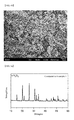
- FIG. 1 a illustrates an X-ray diffraction analysis result of a transition metal oxide obtained from Example 1 according to the present invention
- FIG. 1 b illustrates an electron microscope image of a transition metal oxide obtained from Example 1 according to the present invention
- FIG. 2 a illustrates an X-ray diffraction analysis result of a transition metal oxide obtained from Example 2 according to the present invention
- FIG. 2 b illustrates an electron microscope image of a transition metal oxide obtained from Example 2 according to the present invention
- FIG. 3 a illustrates an X-ray diffraction analysis result of a transition metal oxide obtained from Example 3 according to the present invention
- FIG. 3 b illustrates an electron microscope image of a transition metal oxide obtained from Example 3 according to the present invention
- FIG. 4 a illustrates an X-ray diffraction analysis result of a transition metal oxide obtained from Example 4 according to the present invention
- FIG. 4 b illustrates an electron microscope image of a transition metal oxide obtained from Example 4 according to the present invention
- FIG. 5 a illustrates an X-ray diffraction analysis result of a transition metal oxide according to Comparative Example 1;
- FIG. 5 b illustrates an electron microscope image of a transition metal oxide according to Comparative Example 1
- FIG. 6 illustrates a graph representing electrochemical characteristics related to lithium storage of a transition metal oxide obtained from Example 1 according to the present invention
- FIG. 7 illustrates a graph representing electrochemical characteristics related to lithium storage of a transition metal oxide obtained from Example 2 according to the present invention
- FIG. 8 illustrates a graph representing electrochemical characteristics related to lithium storage of a transition metal oxide obtained from Example 3 according to the present invention
- FIG. 9 illustrates a graph representing electrochemical characteristics related to lithium storage of a transition metal oxide obtained from Example 4 according to the present invention.
- FIG. 10 illustrates a graph representing electrochemical characteristics related to lithium storage of a transition metal oxide according to Comparative Example 1;
- FIG. 11 illustrates a graph representing lifespan characteristics when a transition metal oxide obtained from Example 1 according to the present invention is applied to a lithium battery.
- FIG. 12 illustrates an ex-situ X-ray diffraction analysis result of a transition metal oxide obtained from Example 1 according to the present invention.
- Lithium carbonate (Li 2 CO 3 ) and vanadium pentoxide (V 2 O 5 ) were mixed in a molar ratio of 1:1 in an agate mortar and thermally treated then for 4 hours at 750° C. in the atmosphere. Subsequently, the resultant mixture was cooled to room temperature and ground in an agate mortar. To uniformalize particles of the grinded powder, the powder was additionally ball-milled for 2 hours. As a result, a transition metal oxide was prepared.
- a transition metal oxide was prepared in the same manner as in Example 1, except that sodium carbonate (Na 2 CO 3 ) and vanadium pentoxide (V 2 O 5 ) were mixed in a molar ratio of 1:1.
- a transition metal oxide was prepared in the same manner as in Example 1, except that potassium carbonate (K 2 CO 3 ) and vanadium pentoxide (V 2 O 5 ) were mixed in a molar ratio of 1:1.
- a transition metal oxide was prepared in the same manner as in Example 1, except that 5 parts by weight of P 2 O 5 was added to 100 parts by weight of crystalline LiVO 3 synthesized according to Example 1 and mixed.
- DAG 87 which is natural graphite, manufactured by SODIFF (KR) was used.
- a transition metal oxide was prepared in the same manner as in Example 1, except that crystalline LiVO 3 synthesized according to Example 1 and DAG 87 according to Comparative Example 2 were mixed in a weight ratio of 1:99.
- a transition metal oxide was prepared in the same manner as in Example 1, except that crystalline LiVO 3 synthesized according to Example 1 and DAG 87 according to Comparative Example 2 were mixed in a weight ratio of 30:70.
- a transition metal oxide was prepared in the same manner as in Example 1, except that crystalline LiVO 3 synthesized according to Example 1 and DAG 87 according to Comparative Example 2 were mixed in a weight ratio of 90:10.
- a transition metal oxide was prepared in the same manner as in Example 1, except that crystalline LiVO 3 synthesized according to Example 1 and DAG 87 according to Comparative Example 2 were mixed in a weight ratio of 70:30.
- a transition metal oxide was prepared in the same manner as in Example 1, except that crystalline LiVO 3 synthesized according to Example 1 and DAG 87 according to Comparative Example 2 were mixed in a weight ratio of 50:50.
- transition metal oxides prepared according to the present invention To measure crystallization of the transition metal oxides prepared according to the present invention, X-ray diffraction analysis of the transition metal oxides according to Examples 1 to 4 and Comparative Example 1 was carried out. In addition, to confirm particle shapes of the transition metal oxides prepared according to the present invention, the transition metal oxides according to Examples 1 to 4 and Comparative Example 1 were observed with an electron microscope.
- LiVO 3 of Example 4 As illustrated in FIGS. 4 a and 4 b , in the case of LiVO 3 of Example 4, significant peaks were not observed as an X-ray diffraction result. Accordingly, it was confirmed that LiVO 3 was amorphous and several micrometers particles not having a clear shape.
- V 2 O 5 of Comparative Example 1 As illustrated in FIGS. 5 a and 5 b , in the case of V 2 O 5 of Comparative Example 1, characteristic peaks of V 2 O 5 were observed as an X-ray diffraction result. Accordingly, it was confirmed that V 2 O 5 was crystalline and several micrometers particles not having a clear shape.
- transition metal oxides prepared according to Examples 1 to 7 and Comparative Examples 1 to 4 were used alone or mixed to manufacture electrodes.
- carbon black as a conductive material carbon black as a conductive material and polyvinylidene difluoride (PvdF) as a polymer binder were used.
- PvdF polyvinylidene difluoride
- the binder a binder dissolved in N-methylpyrrolidone was used.
- the resultant mixture was coated over a copper collector and dried at 120 to remove N-methylpyrrolidone.
- the dried electrode was pressed using a roll press and then cut into a desired size. The cut electrode was dried for 12 hours or more at a 120 vacuum oven to remove water.
- a 2032 coin cell was manufactured under an argon atmosphere in a glove box.
- lithium metal foil was used as an opposite electrode and, as an electrolyte, a 1 molar mixture of LiPF 6 /ethylene carbonate (EC):dimethyl carbonate (DMC) mixed in a volume ratio of 1:2 was used.
- EC ethylene carbonate
- DMC dimethyl carbonate
- the discharge capacity means that four lithium elements per LiVO 3 molecule were reversibly charged and discharged. In addition, in a discharge process, capacity is expressed at a smooth incline state without development of a flat portion.
- Such a discharge capacity means that 3.66 lithium elements per KVO 3 were reversibly charged and discharged.
- a second cycle near 0.0 V, a long potential flat side was observed and a reversible capacity of 600 mAh/g was observed.
- smooth voltage increase and a capacity were exhibited in a section of 0 to 1.5 V.
- Such a discharge capacity means that 2.84 lithium elements per LiVO 3 were reversibly charged and discharged.
- the coin cell using the transition metal oxide prepared according to Example 1 was charged in a constant current/constant voltage manner and discharged in a constant current. Subsequently, lifespan characteristics of a battery manufactured with the corresponding material were measured.
- constant current charging the charge was performed up to a voltage section of 50 mV (vs. Li/Li + ) using a current of 100 mA/g based on the weight of active material and then constant voltage charging was performed at 50 mV.
- Constant voltage charging was stopped when an absolute size of current is less than 10 mA/g based on the weight of active material and constant current discharge was started.
- the constant current discharge was performed up to a voltage section of 3 V (vs. Li/Li + ) in which a current of 100 mA/g based on the weight of active material was used.
- a current of 50 mA/g was used in a voltage section of 0.001 to 3.0 V (vs. Li/Li + ).
- X-ray diffraction analysis was carried out by attaching an electrode to a beryllium window with a Kapton tape, after stopping charging at 1.5 V, 0.5 V, and 0.0 V when first cycle charging was performed and discharge at 3.0 V, and obtaining the electrode manufactured with the sample prepared according to Example 1 by disassembling the coin cell under an argon atmosphere in a glove box.
- Discharge capacities of the transition metal oxide prepared according to Example 1, the natural graphite negative electrode active material prepared according to Comparative Example 2, and materials of Examples 5 to 7 and Comparative Examples 3 to 4 prepared by mixing the transition metal oxide and the natural graphite negative electrode active material in a variety of weight ratios were measured at a tenth cycle in which a capacity of a battery was stabilized. Results are summarized in Table 1 below.
- a secondary battery including a negative electrode active material according to the present invention includes alkali metavanadate in an amount of 50 wt % or more based on a total weight of the negative electrode active material. Accordingly, reactivity with lithium due to amorphization of alkali metavanadate in an initial charge process is increased and, thus, high capacity at a low reaction potential, which is not expressed in conventional transition metal oxide based negative electrode active materials, is expressed. Accordingly, a secondary battery, in which total voltage of a battery may be increased and energy density of a battery may be dramatically improved, may be provided.
Landscapes
- Chemical & Material Sciences (AREA)
- General Chemical & Material Sciences (AREA)
- Chemical Kinetics & Catalysis (AREA)
- Electrochemistry (AREA)
- Engineering & Computer Science (AREA)
- Inorganic Chemistry (AREA)
- Manufacturing & Machinery (AREA)
- Materials Engineering (AREA)
- Composite Materials (AREA)
- Crystallography & Structural Chemistry (AREA)
- Physics & Mathematics (AREA)
- Condensed Matter Physics & Semiconductors (AREA)
- General Physics & Mathematics (AREA)
- Battery Electrode And Active Subsutance (AREA)
- Secondary Cells (AREA)
- Cell Electrode Carriers And Collectors (AREA)
Abstract
Description
AVO3 (1)
| TABLE 1 | |||
| Mix ratio of materials | Reversible capacity | ||
| (LiVO3:natural graphite) | per weight (mAh/g) | ||
| Example 1 | 100:0 | 803.7 |
| Example 5 | 90:10 | 746.8 |
| Example 6 | 70:30 | 642.4 |
| Example 7 | 50:50 | 557.0 |
| Comparative Example 2 | 0:100 | 334.2 |
| Comparative Example 3 | 1:99 | 336.9 |
| Comparative Example 4 | 30:70 | 475.0 |
Claims (22)
AVO3 (1)
AVO3 (1)
Applications Claiming Priority (3)
| Application Number | Priority Date | Filing Date | Title |
|---|---|---|---|
| KR1020130028309A KR101623720B1 (en) | 2013-03-15 | 2013-03-15 | Anode Active Material with High Capacity and Secondary Battery Comprising the Same |
| KR10-2013-0028309 | 2013-03-15 | ||
| PCT/KR2014/001728 WO2014142457A1 (en) | 2013-03-15 | 2014-03-03 | High-capacity cathode active material and lithium secondary battery comprising same |
Publications (2)
| Publication Number | Publication Date |
|---|---|
| US20150318541A1 US20150318541A1 (en) | 2015-11-05 |
| US10074850B2 true US10074850B2 (en) | 2018-09-11 |
Family
ID=51537054
Family Applications (1)
| Application Number | Title | Priority Date | Filing Date |
|---|---|---|---|
| US14/651,073 Active 2034-11-28 US10074850B2 (en) | 2013-03-15 | 2014-03-03 | High-capacity negative electrode active material and lithium secondary battery including the same |
Country Status (5)
| Country | Link |
|---|---|
| US (1) | US10074850B2 (en) |
| JP (1) | JP6154484B2 (en) |
| KR (1) | KR101623720B1 (en) |
| CN (1) | CN105122512B (en) |
| WO (1) | WO2014142457A1 (en) |
Families Citing this family (12)
| Publication number | Priority date | Publication date | Assignee | Title |
|---|---|---|---|---|
| JP6085370B2 (en) * | 2013-11-08 | 2017-02-22 | 株式会社日立製作所 | All solid state battery, electrode for all solid state battery and method for producing the same |
| DE112016001116T5 (en) * | 2015-03-10 | 2017-11-30 | The University Of Tokyo | ELECTROLYTE SOLUTION |
| US20170141245A1 (en) * | 2015-11-12 | 2017-05-18 | E I Du Pont De Nemours And Company | Conductive paste composition and semiconductor devices made therewith |
| JP6935926B2 (en) * | 2016-03-31 | 2021-09-15 | 公立大学法人大阪 | Amorphous oxide-based positive electrode active material, its manufacturing method and its use |
| KR101894501B1 (en) * | 2017-02-02 | 2018-10-04 | 한국과학기술연구원 | Anode material for secondary battery and secondary battery comprising the same |
| CN109360947B (en) * | 2018-08-31 | 2022-01-28 | 哈尔滨理工大学 | Preparation method of porous carbon cathode material of quasi-solid-state lithium-sulfur battery |
| JP7486761B2 (en) * | 2019-03-26 | 2024-05-20 | 宏隆 曽根 | Method for producing lithium metal composite oxide powder |
| CN111072002A (en) * | 2019-12-20 | 2020-04-28 | 大连博融新材料有限公司 | Vanadium phosphate, preparation method thereof and application thereof in lithium ion battery anode material |
| CN112420982A (en) * | 2020-11-02 | 2021-02-26 | 四川大学 | Electrode piece of perovskite vanadate blending active material |
| CN114220946A (en) * | 2021-12-13 | 2022-03-22 | 广东石油化工学院 | A kind of sodium metavanadate negative pole piece and preparation method thereof, and sodium ion battery |
| CN114604895B (en) * | 2022-04-12 | 2023-06-16 | 四川大学 | Polyoxometalate Sr 2 xV 2 O 7 H 2 O and preparation method and application thereof |
| CN120199781B (en) * | 2025-05-23 | 2025-08-12 | 安徽盟维新能源科技有限公司 | Amorphous nanocrystalline composite lithium metal negative electrode, preparation method and application |
Citations (11)
| Publication number | Priority date | Publication date | Assignee | Title |
|---|---|---|---|---|
| JPH01227357A (en) | 1988-03-07 | 1989-09-11 | Nippon Telegr & Teleph Corp <Ntt> | Lithium battery |
| JPH0729601A (en) | 1993-07-12 | 1995-01-31 | Fuji Photo Film Co Ltd | Non-aqueous secondary battery |
| JPH0729601B2 (en) * | 1988-12-20 | 1995-04-05 | 日本ケーブル株式会社 | Departing speed tuning device and starting safety device for double type single line automatic circulation type cableway |
| US5462820A (en) * | 1993-11-02 | 1995-10-31 | Fuji Photo Film Co., Ltd. | Non-aqueous battery with a block copolymer sealing member |
| JPH087886A (en) | 1994-06-21 | 1996-01-12 | Sanyo Electric Co Ltd | Nonaquoeus electrolytic secondary battery and manufacture thereof |
| JP2000063121A (en) | 1998-08-11 | 2000-02-29 | Toyota Motor Corp | Oxide-based hydrogen storage materials |
| US20040234856A1 (en) | 2003-05-22 | 2004-11-25 | Matsushita Electric Industrial Co., Ltd. | Lithium ion secondary battery |
| KR20080056637A (en) | 2006-12-18 | 2008-06-23 | 삼성에스디아이 주식회사 | Anode Material for Non-Secondary Battery and Non-Secondary Battery Using the Same |
| US20080182171A1 (en) | 2006-12-18 | 2008-07-31 | Hideaki Maeda | Composition for negative electrode of non-aqueous rechargeable battery and non-aqueous rechargeable battery prepared by using same |
| JP2011523765A (en) | 2008-05-29 | 2011-08-18 | ライデン エナジー インコーポレイテッド | Electrochemical cell containing ionic liquid electrolyte |
| KR20130010808A (en) | 2011-07-19 | 2013-01-29 | 전자부품연구원 | Negative electrode material for lithium secondary battery using lithium-vanadium complex oxide and manufacturing method thereof |
-
2013
- 2013-03-15 KR KR1020130028309A patent/KR101623720B1/en active Active
-
2014
- 2014-03-03 WO PCT/KR2014/001728 patent/WO2014142457A1/en not_active Ceased
- 2014-03-03 US US14/651,073 patent/US10074850B2/en active Active
- 2014-03-03 JP JP2015547875A patent/JP6154484B2/en active Active
- 2014-03-03 CN CN201480005844.3A patent/CN105122512B/en active Active
Patent Citations (13)
| Publication number | Priority date | Publication date | Assignee | Title |
|---|---|---|---|---|
| JPH01227357A (en) | 1988-03-07 | 1989-09-11 | Nippon Telegr & Teleph Corp <Ntt> | Lithium battery |
| JP2559055B2 (en) | 1988-03-07 | 1996-11-27 | 日本電信電話株式会社 | Lithium battery |
| JPH0729601B2 (en) * | 1988-12-20 | 1995-04-05 | 日本ケーブル株式会社 | Departing speed tuning device and starting safety device for double type single line automatic circulation type cableway |
| JPH0729601A (en) | 1993-07-12 | 1995-01-31 | Fuji Photo Film Co Ltd | Non-aqueous secondary battery |
| US5462820A (en) * | 1993-11-02 | 1995-10-31 | Fuji Photo Film Co., Ltd. | Non-aqueous battery with a block copolymer sealing member |
| JPH087886A (en) | 1994-06-21 | 1996-01-12 | Sanyo Electric Co Ltd | Nonaquoeus electrolytic secondary battery and manufacture thereof |
| JP2000063121A (en) | 1998-08-11 | 2000-02-29 | Toyota Motor Corp | Oxide-based hydrogen storage materials |
| US20040234856A1 (en) | 2003-05-22 | 2004-11-25 | Matsushita Electric Industrial Co., Ltd. | Lithium ion secondary battery |
| KR20080056637A (en) | 2006-12-18 | 2008-06-23 | 삼성에스디아이 주식회사 | Anode Material for Non-Secondary Battery and Non-Secondary Battery Using the Same |
| US20080182171A1 (en) | 2006-12-18 | 2008-07-31 | Hideaki Maeda | Composition for negative electrode of non-aqueous rechargeable battery and non-aqueous rechargeable battery prepared by using same |
| JP2011523765A (en) | 2008-05-29 | 2011-08-18 | ライデン エナジー インコーポレイテッド | Electrochemical cell containing ionic liquid electrolyte |
| US20130323571A1 (en) | 2008-05-29 | 2013-12-05 | Leyden Energy, Inc. | Electrochemical cells with ionic liquid electrolyte |
| KR20130010808A (en) | 2011-07-19 | 2013-01-29 | 전자부품연구원 | Negative electrode material for lithium secondary battery using lithium-vanadium complex oxide and manufacturing method thereof |
Non-Patent Citations (8)
| Title |
|---|
| Cheng, et al., "Carbon-Coated Li4Ti5O12 as a High Rate Electrode Material for Li-Ion Intercalation." Journal of the Electrochemical Society, 154 (7), pp. A692-A697 (2007). |
| Chinese Search Report for Application No. 20148005844.3 dated Dec. 21, 2016. |
| Choi, et al., "Electrochemical properties of lithium vanadium oxide as an anode material for lithium-ion battery." Materials Chemistry and Physics, 116 (2009), pp. 603-606. |
| International Search Report from PCT/KR2014/001728, dated Jun. 5, 2014. |
| Kim, et al, "Synthesis and characterization of MnV206 as a high capacity anode material for lithium secondary battery." Solid State Ionics 139 (2001) pp. 57-65. |
| Orsini, et al, "Chimi douce' synthesis and electrochemical properties of amorphous and crystallized LiNiVO4 vs. Li." Solid State Ionics 107 (1998), pp. 123-133. |
| Piffard, et al., "The amorphous oxides MnV2O6σ(0<σ<1) as high capacity negative electrode materials for lithium batteries." Journal of Power Sciences 68 (1997), pp. 698-703. |
| Rossignol, et al., "X-Ray Absorption Spectroscopy Study of the Structural and Electronic Changes upon Cycling of LiNiVO4 as a Battery Electrode." Journal of the Electrochemical Society, 148 (8), pp. A869-A877 (2001). |
Also Published As
| Publication number | Publication date |
|---|---|
| CN105122512A (en) | 2015-12-02 |
| JP6154484B2 (en) | 2017-06-28 |
| WO2014142457A1 (en) | 2014-09-18 |
| KR20140113210A (en) | 2014-09-24 |
| KR101623720B1 (en) | 2016-05-26 |
| CN105122512B (en) | 2018-09-28 |
| JP2016500463A (en) | 2016-01-12 |
| US20150318541A1 (en) | 2015-11-05 |
Similar Documents
| Publication | Publication Date | Title |
|---|---|---|
| EP3754761B1 (en) | Anode including graphite and silicon-based material having different diameters and lithium secondary battery including the same | |
| US9711794B2 (en) | Lithium secondary battery having anode containing aqueous binder | |
| US20150318541A1 (en) | High-capacity negative electrode active material and lithium secondary battery including the same | |
| US9905841B2 (en) | Cathode active material and lithium secondary battery including the same, and method of manufacturing cathode active material | |
| US10439208B2 (en) | Negative electrode active material for secondary batteries having improved lifespan characteristics | |
| CN106463715B (en) | Positive electrode active material and lithium secondary battery comprising same | |
| US10135095B2 (en) | Lithium secondary battery | |
| EP2874227B1 (en) | Lithium secondary battery | |
| KR20150015086A (en) | Anode Active Material with Improved Wetting Properties and Lithium Secondary Battery Having the Same | |
| US20180062173A1 (en) | Positive electrode active material for lithium secondary battery including core containing lithium cobalt oxide and shell being deficient in lithium, and method of preparing the same | |
| KR101239620B1 (en) | Positive Active Material for Secondary Battery of Improved Rate Capability | |
| KR20150015070A (en) | Lithium Secondary Battery with Improved Wetting Properties | |
| US10128540B2 (en) | Lithium secondary battery | |
| US10424781B2 (en) | Cathode active material and lithium secondary battery comprising the same | |
| US20150288032A1 (en) | Electrolyte for lithium secondary batteries and lithium secondary battery including the same | |
| EP4535453B1 (en) | Anode including graphite and silicon-based material having different diameters and lithium secondary battery including the same | |
| US9831493B2 (en) | Cathode active material and lithium secondary battery comprising the same | |
| US9660266B2 (en) | Lithium secondary battery | |
| KR101580486B1 (en) | Anode with Improved Wetting Properties and Lithium Secondary Battery Having the Same | |
| US9761864B2 (en) | Cathode active material for high voltage lithium secondary battery and lithium secondary battery including the same | |
| KR20130117953A (en) | Anode active material comprising sulfur and lithium secondary battery comprising the same | |
| KR20150014329A (en) | Anode Active Material with Improved Wetting Properties and Lithium Secondary Battery Having the Same | |
| KR20130116804A (en) | Composite anode active material and lithium secondary battery comprising the same |
Legal Events
| Date | Code | Title | Description |
|---|---|---|---|
| AS | Assignment |
Owner name: LG CHEM, LTD., KOREA, REPUBLIC OF Free format text: ASSIGNMENT OF ASSIGNORS INTEREST;ASSIGNORS:KIM, JIHYUN;LEE, JAE HYUN;CHAE, OH BYONG;AND OTHERS;SIGNING DATES FROM 20170322 TO 20170327;REEL/FRAME:042226/0772 Owner name: SNU R&DB FOUNDATION, KOREA, REPUBLIC OF Free format text: ASSIGNMENT OF ASSIGNORS INTEREST;ASSIGNORS:KIM, JIHYUN;LEE, JAE HYUN;CHAE, OH BYONG;AND OTHERS;SIGNING DATES FROM 20170322 TO 20170327;REEL/FRAME:042226/0772 |
|
| AS | Assignment |
Owner name: SEOUL NATIONAL UNIVERSITY R&DB FOUNDATION, KOREA, Free format text: CHANGE OF NAME;ASSIGNOR:SNU R&DB FOUNDATION;REEL/FRAME:042402/0625 Effective date: 20150317 |
|
| AS | Assignment |
Owner name: SEOUL NATIONAL UNIVERSITY R&DB FOUNDATION, KOREA, Free format text: CONFIRMATORY ASSIGNMENT;ASSIGNORS:KIM, JIHYUN;LEE, JAE HYUN;CHAE, OH BYONG;AND OTHERS;SIGNING DATES FROM 20170706 TO 20170714;REEL/FRAME:043243/0001 Owner name: LG CHEM, LTD., KOREA, REPUBLIC OF Free format text: CONFIRMATORY ASSIGNMENT;ASSIGNORS:KIM, JIHYUN;LEE, JAE HYUN;CHAE, OH BYONG;AND OTHERS;SIGNING DATES FROM 20170706 TO 20170714;REEL/FRAME:043243/0001 |
|
| STCF | Information on status: patent grant |
Free format text: PATENTED CASE |
|
| AS | Assignment |
Owner name: LG ENERGY SOLUTION, LTD., KOREA, REPUBLIC OF Free format text: ASSIGNMENT OF ASSIGNORS INTEREST;ASSIGNOR:LG CHEM, LTD.;REEL/FRAME:058037/0422 Effective date: 20211027 |
|
| MAFP | Maintenance fee payment |
Free format text: PAYMENT OF MAINTENANCE FEE, 4TH YEAR, LARGE ENTITY (ORIGINAL EVENT CODE: M1551); ENTITY STATUS OF PATENT OWNER: LARGE ENTITY Year of fee payment: 4 |
|
| MAFP | Maintenance fee payment |
Free format text: PAYMENT OF MAINTENANCE FEE, 8TH YEAR, LARGE ENTITY (ORIGINAL EVENT CODE: M1552); ENTITY STATUS OF PATENT OWNER: LARGE ENTITY Year of fee payment: 8 |