US10071164B2 - Estrogen-related receptor alpha based protac compounds and associated methods of use - Google Patents
Estrogen-related receptor alpha based protac compounds and associated methods of use Download PDFInfo
- Publication number
- US10071164B2 US10071164B2 US14/822,309 US201514822309A US10071164B2 US 10071164 B2 US10071164 B2 US 10071164B2 US 201514822309 A US201514822309 A US 201514822309A US 10071164 B2 US10071164 B2 US 10071164B2
- Authority
- US
- United States
- Prior art keywords
- optionally substituted
- alkyl
- group
- certain embodiments
- compound
- Prior art date
- Legal status (The legal status is an assumption and is not a legal conclusion. Google has not performed a legal analysis and makes no representation as to the accuracy of the status listed.)
- Active
Links
- 0 *[PH](=O)*CN1C(=O)C=CC1(C)C.*[PH](=O)*CN1CC[C@H](C)C1=O.CC.CC.CC(C)(C)C.CC(C)(C)N1C(=O)ccC1(C)C.CCN1CC[C@@H](C(C)(C)C)C1=O Chemical compound *[PH](=O)*CN1C(=O)C=CC1(C)C.*[PH](=O)*CN1CC[C@H](C)C1=O.CC.CC.CC(C)(C)C.CC(C)(C)N1C(=O)ccC1(C)C.CCN1CC[C@@H](C(C)(C)C)C1=O 0.000 description 8
- JXCRIGAQJDRAPB-SCCQDFCQSA-N CC(C)CCOC1=CC2=NC=CC(NC3=CC4=C(C=C3)SC=N4)=C2C=C1S(=O)(=O)C(C)(C)C.[C-]#[N+]C1=CC(C)=C(OC2=C(C)C=C(/C=C3\SC(=O)NC3=O)C=C2)C=C1 Chemical compound CC(C)CCOC1=CC2=NC=CC(NC3=CC4=C(C=C3)SC=N4)=C2C=C1S(=O)(=O)C(C)(C)C.[C-]#[N+]C1=CC(C)=C(OC2=C(C)C=C(/C=C3\SC(=O)NC3=O)C=C2)C=C1 JXCRIGAQJDRAPB-SCCQDFCQSA-N 0.000 description 3
- VIZXDTKPCYVSLL-SJORKVTESA-N CC1=C(C2=CC=C(CNC(=O)[C@@H]3C[C@@H](O)CN3C(=O)OC(C)(C)C)C=C2)SC=N1 Chemical compound CC1=C(C2=CC=C(CNC(=O)[C@@H]3C[C@@H](O)CN3C(=O)OC(C)(C)C)C=C2)SC=N1 VIZXDTKPCYVSLL-SJORKVTESA-N 0.000 description 3
- PCLKZOVKJMQHPY-UHFFFAOYSA-N C1=CC2=C(C=C1)CCC2.CC.CC.CC.CC.CC.CC.CC(C)(C)C.CC(C)(C)C.CC(C)(C)C.CC(C)(C)N1C=NC2=CC=CC=C2C1=O.CC(C)(C)N1CC2=CC=CC=C2C1=O.CC(C)(C)N1CCC2=CC=CC=C21.CN1C(=O)[SH](C)C2=CC=CC=C21.CN1CCOC2=C1C=CC=C2.C[Y]1=CN(C(C)(C)C)C(=O)C=C1 Chemical compound C1=CC2=C(C=C1)CCC2.CC.CC.CC.CC.CC.CC.CC(C)(C)C.CC(C)(C)C.CC(C)(C)C.CC(C)(C)N1C=NC2=CC=CC=C2C1=O.CC(C)(C)N1CC2=CC=CC=C2C1=O.CC(C)(C)N1CCC2=CC=CC=C21.CN1C(=O)[SH](C)C2=CC=CC=C21.CN1CCOC2=C1C=CC=C2.C[Y]1=CN(C(C)(C)C)C(=O)C=C1 PCLKZOVKJMQHPY-UHFFFAOYSA-N 0.000 description 2
- GGMGJDZIGAVTBV-VBDHRLMCSA-N C=C1C2=C(C=CC=C2)CN1[C@H](C(=O)N1C[C@H](O)C[C@H]1C(=O)NCC1=CC=C(C2=C(C)N=CS2)C=C1OCCCOCCOCCN1C(=O)S/C(=C\C2=CC(OC)=C(OC3=CC=C(C#N)C=C3C)C=C2)C1=O)C(C)C.[C-]#[N+]C1=CC(C(F)(F)F)=C(OC2=CC=C(/C=C3\SC(=O)N(CCOCCOCCOCCOCCOCCOC4=CC(C5=C(C)N=CS5)=CC=C4CNC(=O)[C@@H]4C[C@@H](O)CN4C(=O)[C@H](C(C)C)N4CC5=C(C=CC=C5)C4=C)C3=O)C=C2OC)C=C1.[C-]#[N+]C1=CC(C)=C(OC2=CC=C(/C=C3\SC(=O)N(CCOCCCOCCCOC4=CC(C5=C(C)N=CS5)=CC=C4CNC(=O)[C@@H]4C[C@@H](O)CN4C(=O)[C@H](C(C)C)N4CC5=C(C=CC=C5)C4=C)C3=O)C=C2OC)C=C1 Chemical compound C=C1C2=C(C=CC=C2)CN1[C@H](C(=O)N1C[C@H](O)C[C@H]1C(=O)NCC1=CC=C(C2=C(C)N=CS2)C=C1OCCCOCCOCCN1C(=O)S/C(=C\C2=CC(OC)=C(OC3=CC=C(C#N)C=C3C)C=C2)C1=O)C(C)C.[C-]#[N+]C1=CC(C(F)(F)F)=C(OC2=CC=C(/C=C3\SC(=O)N(CCOCCOCCOCCOCCOCCOC4=CC(C5=C(C)N=CS5)=CC=C4CNC(=O)[C@@H]4C[C@@H](O)CN4C(=O)[C@H](C(C)C)N4CC5=C(C=CC=C5)C4=C)C3=O)C=C2OC)C=C1.[C-]#[N+]C1=CC(C)=C(OC2=CC=C(/C=C3\SC(=O)N(CCOCCCOCCCOC4=CC(C5=C(C)N=CS5)=CC=C4CNC(=O)[C@@H]4C[C@@H](O)CN4C(=O)[C@H](C(C)C)N4CC5=C(C=CC=C5)C4=C)C3=O)C=C2OC)C=C1 GGMGJDZIGAVTBV-VBDHRLMCSA-N 0.000 description 2
- JULAETYRRYJIAR-NSHDSACASA-N CC(C)[C@@H](C(=O)O)N1CC2=CC=CC=C2C1=O Chemical compound CC(C)[C@@H](C(=O)O)N1CC2=CC=CC=C2C1=O JULAETYRRYJIAR-NSHDSACASA-N 0.000 description 2
- UCARQMMDJJBWTF-UHFFFAOYSA-N CC.CC(C)(C)N1CC2=C(C=CC=C2)C1=O Chemical compound CC.CC(C)(C)N1CC2=C(C=CC=C2)C1=O UCARQMMDJJBWTF-UHFFFAOYSA-N 0.000 description 2
- KNZQRBRUYSXXRG-NMVJMZGASA-N CC1=C(C2=CC(O)=C(CNC(=O)[C@@H]3C[C@@H](O)CN3C(=O)[C@@H](C(C)C)N3CC4=C(C=CC=C4)C3=O)C=C2)SC=N1 Chemical compound CC1=C(C2=CC(O)=C(CNC(=O)[C@@H]3C[C@@H](O)CN3C(=O)[C@@H](C(C)C)N3CC4=C(C=CC=C4)C3=O)C=C2)SC=N1 KNZQRBRUYSXXRG-NMVJMZGASA-N 0.000 description 2
- PCZXZPOWHWJXDZ-UHFFFAOYSA-N CC1=C(C2=CC=C(CN)C=C2)SC=N1 Chemical compound CC1=C(C2=CC=C(CN)C=C2)SC=N1 PCZXZPOWHWJXDZ-UHFFFAOYSA-N 0.000 description 2
- GXSFVVJDQVMLHM-OLZOCXBDSA-N CC1=C(C2=CC=C(CNC(=O)[C@@H]3C[C@@H](O)CN3)C(O)=C2)SC=N1.Cl Chemical compound CC1=C(C2=CC=C(CNC(=O)[C@@H]3C[C@@H](O)CN3)C(O)=C2)SC=N1.Cl GXSFVVJDQVMLHM-OLZOCXBDSA-N 0.000 description 2
- DQZGBGLZCXHVCB-KGLIPLIRSA-N CC1=C(C2=CC=C(CNC(=O)[C@@H]3C[C@@H](O)CN3)C=C2)SC=N1 Chemical compound CC1=C(C2=CC=C(CNC(=O)[C@@H]3C[C@@H](O)CN3)C=C2)SC=N1 DQZGBGLZCXHVCB-KGLIPLIRSA-N 0.000 description 2
- MGAHEKZFHDHHDA-MCVREYQFSA-N CC1=CC(/C=C2\SC(=O)N(CC3=CC=C(CC(=O)N[C@H](C(=O)N4C[C@H](C)C[C@H]4C(=O)NCC4=CC=C(C5=C(C)N=CS5)C=C4)C(C)(C)C)C=C3)C2=O)=CC=C1OC1=C(C)C=C(C#N)C=C1.COC1=C(OC2=CC=CC=C2C(F)(F)F)C=CC(/C=C2\SC(=O)N(CCOCCOCCOCC(=O)N[C@H](C(=O)N3C[C@H](O)C[C@H]3C(=O)NCC3=CC=C(C4=C(C)C=CS4)C=C3)C(C)(C)C)C2=O)=C1.[C-]#[N+]C1=CC(C)=C(OC2=CC=C(/C=C3\SC(=O)N(CC4=CC=CC(CC(=O)N[C@H](C(=O)N5C[C@H](O)C[C@H]5C(=O)NCC5=CC=C(C6=C(C)C=CS6)C=C5)C(C)(C)C)=C4)C3=O)C=C2C)C=C1.[C-]#[N+]C1=CC(C)=C(OC2=CC=C(/C=C3\SC(=O)N(CC4=CC=CC=C4CC(=O)N[C@H](C(=O)N4C[C@H](O)C[C@H]4C(=O)NCC4=CC=C(C5=C(C)C=CS5)C=C4)C(C)(C)C)C3=O)C=C2C)C=C1 Chemical compound CC1=CC(/C=C2\SC(=O)N(CC3=CC=C(CC(=O)N[C@H](C(=O)N4C[C@H](C)C[C@H]4C(=O)NCC4=CC=C(C5=C(C)N=CS5)C=C4)C(C)(C)C)C=C3)C2=O)=CC=C1OC1=C(C)C=C(C#N)C=C1.COC1=C(OC2=CC=CC=C2C(F)(F)F)C=CC(/C=C2\SC(=O)N(CCOCCOCCOCC(=O)N[C@H](C(=O)N3C[C@H](O)C[C@H]3C(=O)NCC3=CC=C(C4=C(C)C=CS4)C=C3)C(C)(C)C)C2=O)=C1.[C-]#[N+]C1=CC(C)=C(OC2=CC=C(/C=C3\SC(=O)N(CC4=CC=CC(CC(=O)N[C@H](C(=O)N5C[C@H](O)C[C@H]5C(=O)NCC5=CC=C(C6=C(C)C=CS6)C=C5)C(C)(C)C)=C4)C3=O)C=C2C)C=C1.[C-]#[N+]C1=CC(C)=C(OC2=CC=C(/C=C3\SC(=O)N(CC4=CC=CC=C4CC(=O)N[C@H](C(=O)N4C[C@H](O)C[C@H]4C(=O)NCC4=CC=C(C5=C(C)C=CS5)C=C4)C(C)(C)C)C3=O)C=C2C)C=C1 MGAHEKZFHDHHDA-MCVREYQFSA-N 0.000 description 2
- UFKPCVAJZZFPGQ-WRMNSJBPSA-N CC1=CC(/C=C2\SC(=O)N(CCOCCC(=O)N[C@H](C(=O)N3C[C@H](O)C[C@H]3C(=O)NCC3=CC=C(C4=C(C)C=CS4)C=C3)C(C)(C)C)C2=O)=CC=C1OC1=C(C)C=CC=C1 Chemical compound CC1=CC(/C=C2\SC(=O)N(CCOCCC(=O)N[C@H](C(=O)N3C[C@H](O)C[C@H]3C(=O)NCC3=CC=C(C4=C(C)C=CS4)C=C3)C(C)(C)C)C2=O)=CC=C1OC1=C(C)C=CC=C1 UFKPCVAJZZFPGQ-WRMNSJBPSA-N 0.000 description 2
- VSUIDUGFIYTIEZ-XUXYJCQPSA-N [C-]#[N+]C1=CC(C(F)(F)F)=C(OC2=CC=C(/C=C3\SC(=O)N(CCOCCC(=O)N[C@H](C(=O)N4C[C@@H](O)C[C@H]4C(=O)NCC4=CC=C(C5=C(C)C=CS5)C=C4)C(C)(C)C)C3=O)C=C2OC)C=C1.[C-]#[N+]C1=CC(C(F)(F)F)=C(OC2=CC=C(/C=C3\SC(=O)N(CCOCCOCCOCCOCCOC4=CC(C5=C(C)N=CS5)=CC=C4CNC(=O)[C@@H]4C[C@@H](O)CN4C(=O)[C@H](C(C)C)N4CC5=C(C=CC=C5)C4=C)C3=O)C=C2OC)C=C1.[C-]#[N+]C1=CC=C(OC2=CC=C(/C=C3\SC(=O)N(CCOCCOCCCCCOCCCCCOCCOCC(=O)N[C@H](C(=O)N4C[C@H](O)C[C@H]4C(=O)NCC4=CC=C(C5=C(C)C=CS5)C=C4)C(C)(C)C)C3=O)C=C2OC)C(C)=C1 Chemical compound [C-]#[N+]C1=CC(C(F)(F)F)=C(OC2=CC=C(/C=C3\SC(=O)N(CCOCCC(=O)N[C@H](C(=O)N4C[C@@H](O)C[C@H]4C(=O)NCC4=CC=C(C5=C(C)C=CS5)C=C4)C(C)(C)C)C3=O)C=C2OC)C=C1.[C-]#[N+]C1=CC(C(F)(F)F)=C(OC2=CC=C(/C=C3\SC(=O)N(CCOCCOCCOCCOCCOC4=CC(C5=C(C)N=CS5)=CC=C4CNC(=O)[C@@H]4C[C@@H](O)CN4C(=O)[C@H](C(C)C)N4CC5=C(C=CC=C5)C4=C)C3=O)C=C2OC)C=C1.[C-]#[N+]C1=CC=C(OC2=CC=C(/C=C3\SC(=O)N(CCOCCOCCCCCOCCCCCOCCOCC(=O)N[C@H](C(=O)N4C[C@H](O)C[C@H]4C(=O)NCC4=CC=C(C5=C(C)C=CS5)C=C4)C(C)(C)C)C3=O)C=C2OC)C(C)=C1 VSUIDUGFIYTIEZ-XUXYJCQPSA-N 0.000 description 2
- AOVDIYAGCUGZGG-YVLHZVERSA-N [C-]#[N+]C1=CC(C)=C(OC2=C(C)C=C(/C=C3\SC(=O)NC3=O)C=C2)C=C1 Chemical compound [C-]#[N+]C1=CC(C)=C(OC2=C(C)C=C(/C=C3\SC(=O)NC3=O)C=C2)C=C1 AOVDIYAGCUGZGG-YVLHZVERSA-N 0.000 description 2
- YTYIEYHTFXFSDX-UHFFFAOYSA-N BrCCCCOCCOCCOCCOCC1=CC=CC=C1 Chemical compound BrCCCCOCCOCCOCCOCC1=CC=CC=C1 YTYIEYHTFXFSDX-UHFFFAOYSA-N 0.000 description 1
- FQYAOYXPDSCJFQ-UHFFFAOYSA-N C.C.CC.CC.CCC1CCCN1CC Chemical compound C.C.CC.CC.CCC1CCCN1CC FQYAOYXPDSCJFQ-UHFFFAOYSA-N 0.000 description 1
- DEHMBPXQTCRWEO-UHFFFAOYSA-N C=CC1=C(C(C)C)SC=C1.CC(C)C1=C(Br)N=CS1.CC(C)C1=C(C(C)C)SC=N1.CC(C)C1=C(C2CC2)C=CS1.CC(C)C1=C(Cl)C=CS1.CC(C)C1=C(F)C=CS1.CC(C)C1=CC=CO1.CC(C)C1=CC=CS1.CC(C)C1=CC=NN1.CC(C)C1=CC=NN1C.CC(C)C1=CCN=C1.CC(C)C1=CN=CN1.CC(C)C1=CN=CN1C.CC(C)C1=CN=CO1.CC(C)C1=NCC=N1.CC1=C(C(C)C)N(C)C=N1.CC1=C(C(C)C)N=CN1C.CC1=C(C(C)C)OC=N1.CC1=C(C(C)C)SC=C1.CC1=C(C(C)C)SC=C1.CC1=CC=CC=C1C(C)C.CCC1=C(C(C)C)SC=C1 Chemical compound C=CC1=C(C(C)C)SC=C1.CC(C)C1=C(Br)N=CS1.CC(C)C1=C(C(C)C)SC=N1.CC(C)C1=C(C2CC2)C=CS1.CC(C)C1=C(Cl)C=CS1.CC(C)C1=C(F)C=CS1.CC(C)C1=CC=CO1.CC(C)C1=CC=CS1.CC(C)C1=CC=NN1.CC(C)C1=CC=NN1C.CC(C)C1=CCN=C1.CC(C)C1=CN=CN1.CC(C)C1=CN=CN1C.CC(C)C1=CN=CO1.CC(C)C1=NCC=N1.CC1=C(C(C)C)N(C)C=N1.CC1=C(C(C)C)N=CN1C.CC1=C(C(C)C)OC=N1.CC1=C(C(C)C)SC=C1.CC1=C(C(C)C)SC=C1.CC1=CC=CC=C1C(C)C.CCC1=C(C(C)C)SC=C1 DEHMBPXQTCRWEO-UHFFFAOYSA-N 0.000 description 1
- CHPMGPVLBJBUJW-LBXXIMOASA-N CC#N.CC1=C(C2=CC=C(CN)C=C2)SC=N1.CC1=C(C2=CC=C(CNC(=O)[C@@H]3C[C@@H](O)CN3C(=O)[C@@H](N)C(C)(C)C)C=C2)SC=N1.CCC1=CC=C(Br)C=C1.CCC1=CC=C(C2=C(C)N=CS2)C=C1.Cl.NClCC1=CC=C(Br)C=C1.O=C=O.[H]C1=C(C)N=CS1 Chemical compound CC#N.CC1=C(C2=CC=C(CN)C=C2)SC=N1.CC1=C(C2=CC=C(CNC(=O)[C@@H]3C[C@@H](O)CN3C(=O)[C@@H](N)C(C)(C)C)C=C2)SC=N1.CCC1=CC=C(Br)C=C1.CCC1=CC=C(C2=C(C)N=CS2)C=C1.Cl.NClCC1=CC=C(Br)C=C1.O=C=O.[H]C1=C(C)N=CS1 CHPMGPVLBJBUJW-LBXXIMOASA-N 0.000 description 1
- LTHNEGFZRVDDPD-SNWNIVBOSA-N CC(=O)C[C@H](C(=O)N1C[C@H](O)C[C@H]1C(=O)NCC1=CC=C(C2=C(C)N=CS2)C=C1)C(C)(C)C.CC1=C(C2=CC=C(CNC(=O)[C@@H]3C[C@@H](O)CC3C(=O)[C@@H](CC(=O)[C@@H]3COCCN3)C(C)(C)C)C=C2)CC=N1.CCOC1=CC(C(=O)N[C@@H](C)C(=O)N2C[C@H](O)C[C@H]2C(=O)NCC2=CC=C(C3=C(C)N=CS3)C=C2)=CC=C1.COCCC(=O)C[C@@H](C)C(=O)N1C[C@H](O)C[C@H]1C(=O)NCC1=CC=C(C2=C(C)N=CS2)C=C1 Chemical compound CC(=O)C[C@H](C(=O)N1C[C@H](O)C[C@H]1C(=O)NCC1=CC=C(C2=C(C)N=CS2)C=C1)C(C)(C)C.CC1=C(C2=CC=C(CNC(=O)[C@@H]3C[C@@H](O)CC3C(=O)[C@@H](CC(=O)[C@@H]3COCCN3)C(C)(C)C)C=C2)CC=N1.CCOC1=CC(C(=O)N[C@@H](C)C(=O)N2C[C@H](O)C[C@H]2C(=O)NCC2=CC=C(C3=C(C)N=CS3)C=C2)=CC=C1.COCCC(=O)C[C@@H](C)C(=O)N1C[C@H](O)C[C@H]1C(=O)NCC1=CC=C(C2=C(C)N=CS2)C=C1 LTHNEGFZRVDDPD-SNWNIVBOSA-N 0.000 description 1
- VPVASJSMBVWRIQ-JYDDRRCTSA-N CC(=O)C[C@H](C(=O)N1C[C@H](O)C[C@H]1C(=O)NCC1=CC=C(C2=C(C)N=CS2)C=C1)C(C)(C)C.CC1=C(C2=CC=C(CNC(=O)[C@@H]3C[C@@H](O)CN3C(=O)[C@@H](CC(=O)[C@@H]3COCCN3)C(C)(C)C)C=C2)SC=N1.CCOC1=CC(C(=O)N[C@@H](C)C(=O)N2C[C@H](O)C[C@H]2C(=O)NCC2=CC=C(C3=C(C)N=CS3)C=C2)=CC=C1.COCCC(=O)C[C@@H](C)C(=O)N1C[C@H](O)C[C@H]1C(=O)NCC1=CC=C(C2=C(C)N=CS2)C=C1 Chemical compound CC(=O)C[C@H](C(=O)N1C[C@H](O)C[C@H]1C(=O)NCC1=CC=C(C2=C(C)N=CS2)C=C1)C(C)(C)C.CC1=C(C2=CC=C(CNC(=O)[C@@H]3C[C@@H](O)CN3C(=O)[C@@H](CC(=O)[C@@H]3COCCN3)C(C)(C)C)C=C2)SC=N1.CCOC1=CC(C(=O)N[C@@H](C)C(=O)N2C[C@H](O)C[C@H]2C(=O)NCC2=CC=C(C3=C(C)N=CS3)C=C2)=CC=C1.COCCC(=O)C[C@@H](C)C(=O)N1C[C@H](O)C[C@H]1C(=O)NCC1=CC=C(C2=C(C)N=CS2)C=C1 VPVASJSMBVWRIQ-JYDDRRCTSA-N 0.000 description 1
- QCWBDTFIZYTBDY-SUWUVPNRSA-N CC(=O)O.CC1=C(C2=CC=C(CNC(=O)[C@@H]3C[C@@H](O)CN3C(=O)[C@@H](N)C(C)(C)C)C=C2)SC=N1.COC1=CC(/C=C2\SC(=O)N(CC(=O)N[C@H](C(=O)N3C[C@H](O)C[C@H]3C(=O)NCC3=CC=C(C4=C(C)N=CS4)C=C3)C(C)(C)C)C2=O)=CC=C1OC1=C(C(F)(F)F)C=C(C#N)C=C1.COC1=CC(/C=C2\SC(=O)N(CC(=O)O)C2=O)=CC=C1OC1=C(C(F)(F)F)C=C(C#N)C=C1.COC1=CC(/C=C2\SC(=O)NC2=O)=CC=C1OC1=C(C(F)(F)F)C=C(C#N)C=C1 Chemical compound CC(=O)O.CC1=C(C2=CC=C(CNC(=O)[C@@H]3C[C@@H](O)CN3C(=O)[C@@H](N)C(C)(C)C)C=C2)SC=N1.COC1=CC(/C=C2\SC(=O)N(CC(=O)N[C@H](C(=O)N3C[C@H](O)C[C@H]3C(=O)NCC3=CC=C(C4=C(C)N=CS4)C=C3)C(C)(C)C)C2=O)=CC=C1OC1=C(C(F)(F)F)C=C(C#N)C=C1.COC1=CC(/C=C2\SC(=O)N(CC(=O)O)C2=O)=CC=C1OC1=C(C(F)(F)F)C=C(C#N)C=C1.COC1=CC(/C=C2\SC(=O)NC2=O)=CC=C1OC1=C(C(F)(F)F)C=C(C#N)C=C1 QCWBDTFIZYTBDY-SUWUVPNRSA-N 0.000 description 1
- SZZIHPUJGXCJHA-UHFFFAOYSA-N CC(C)(C)C(=O)COCC1=CC=C(OC2=CC=C(C(C)(C)C)C=C2)C=C1.CC(C)(C)OCCN1C=CC(C2=CC=C(CC(=O)C(C)(C)C)C=C2)=N1 Chemical compound CC(C)(C)C(=O)COCC1=CC=C(OC2=CC=C(C(C)(C)C)C=C2)C=C1.CC(C)(C)OCCN1C=CC(C2=CC=C(CC(=O)C(C)(C)C)C=C2)=N1 SZZIHPUJGXCJHA-UHFFFAOYSA-N 0.000 description 1
- BUKNPDFAYKDMOM-KJERLJALSA-N CC(C)(C)C(=O)COCCOC1=CC=C(C2=CC=C(C(C)(C)C)C=C2)C=C1.CC(C)(C)C(=O)COCCOC1=CC=C(C2=CC=C(C(C)(C)C)C=C2)C=C1.CC(C)(C)C(=O)COCCOC1=CC=C(C2=CC=C(C(C)(C)C)C=C2)C=C1.CC(C)(C)OC1CC2(CC(OCC(=O)C(C)(C)C)C2)C1.CC(C)CCOCCCCOCC(=O)C(C)C.CC(C)CCOCCCOCC(=O)C(C)C.CC(C)CCOCCOCCC(C)C.CC(C)CCO[C@H](C)[C@@H](C)OCCC(C)C.N.N Chemical compound CC(C)(C)C(=O)COCCOC1=CC=C(C2=CC=C(C(C)(C)C)C=C2)C=C1.CC(C)(C)C(=O)COCCOC1=CC=C(C2=CC=C(C(C)(C)C)C=C2)C=C1.CC(C)(C)C(=O)COCCOC1=CC=C(C2=CC=C(C(C)(C)C)C=C2)C=C1.CC(C)(C)OC1CC2(CC(OCC(=O)C(C)(C)C)C2)C1.CC(C)CCOCCCCOCC(=O)C(C)C.CC(C)CCOCCCOCC(=O)C(C)C.CC(C)CCOCCOCCC(C)C.CC(C)CCO[C@H](C)[C@@H](C)OCCC(C)C.N.N BUKNPDFAYKDMOM-KJERLJALSA-N 0.000 description 1
- YWTARRJOIKUQKS-CABCVRRESA-N CC(C)(C)OC(=O)N1C[C@H](O)C[C@H]1C(=O)CCC1=CC=C(Br)C=C1 Chemical compound CC(C)(C)OC(=O)N1C[C@H](O)C[C@H]1C(=O)CCC1=CC=C(Br)C=C1 YWTARRJOIKUQKS-CABCVRRESA-N 0.000 description 1
- MXOVRXKXHLUUAG-UHFFFAOYSA-N CC(C)C(=O)COCCCCCN(C)C(C)C.CC(C)C(=O)COCCOCCN(C)C(C)C.CC(C)CC#CC#CCOCC(=O)C(C)C.CC(C)CC#CC#CCOCCC(=O)C(C)C.CC(C)CC#CC#CCOCCCC(=O)C(C)C.CC(C)CCCCCCOCC(=O)C(C)C.CC(C)CCCOCCCCOCC(=O)C(C)C.CC(C)CCCOCCOCC(=O)C(C)C Chemical compound CC(C)C(=O)COCCCCCN(C)C(C)C.CC(C)C(=O)COCCOCCN(C)C(C)C.CC(C)CC#CC#CCOCC(=O)C(C)C.CC(C)CC#CC#CCOCCC(=O)C(C)C.CC(C)CC#CC#CCOCCCC(=O)C(C)C.CC(C)CCCCCCOCC(=O)C(C)C.CC(C)CCCOCCCCOCC(=O)C(C)C.CC(C)CCCOCCOCC(=O)C(C)C MXOVRXKXHLUUAG-UHFFFAOYSA-N 0.000 description 1
- BHBFTPAKWPYOBN-GVYLGTKESA-N CC(C)C1=CC=C(C(=O)N[C@H]2C(C)(C)[C@H](OC3=CC=C(C#N)C(C(F)(F)F)=C3)C2(C)C)C=C1.CC(C)C1=CC=C(C(=O)N[C@H]2C(C)(C)[C@H](OC3=CC=C(C#N)C(Cl)=C3)C2(C)C)C=C1.CC(C)NC1=CC=C(C(=O)N[C@H]2C(C)(C)[C@H](OC3=CC=C(C#N)C(C(F)(F)F)=C3)C2(C)C)C=C1.CC(C)OC1=CC=C(C(=O)N[C@H]2C(C)(C)[C@H](OC3=CC=C(C#N)C(Cl)=C3)C2(C)C)C=C1 Chemical compound CC(C)C1=CC=C(C(=O)N[C@H]2C(C)(C)[C@H](OC3=CC=C(C#N)C(C(F)(F)F)=C3)C2(C)C)C=C1.CC(C)C1=CC=C(C(=O)N[C@H]2C(C)(C)[C@H](OC3=CC=C(C#N)C(Cl)=C3)C2(C)C)C=C1.CC(C)NC1=CC=C(C(=O)N[C@H]2C(C)(C)[C@H](OC3=CC=C(C#N)C(C(F)(F)F)=C3)C2(C)C)C=C1.CC(C)OC1=CC=C(C(=O)N[C@H]2C(C)(C)[C@H](OC3=CC=C(C#N)C(Cl)=C3)C2(C)C)C=C1 BHBFTPAKWPYOBN-GVYLGTKESA-N 0.000 description 1
- BUJOHAXSNVMPLW-CSYMNJNDSA-N CC(C)CCC(C)(C)CCOCCCOCC(=O)C(C)C.CC(C)CCC(O)CCOCCCOCC(=O)C(C)C.CC(C)CCCCCOCCCOCC(=O)C(C)C.CC(C)CCCCOCCCCOCC(=O)C(C)C.CC(C)CCCCOCCCOCC(=O)C(C)C.CC(C)CCOCCOCCOCC(=O)C(C)C.CC(C)CCO[C@@H](C)[C@H](C)OCCOCC(=O)C(C)C.CC(C)CCO[C@H](C)[C@@H](C)OCCOCC(=O)C(C)C Chemical compound CC(C)CCC(C)(C)CCOCCCOCC(=O)C(C)C.CC(C)CCC(O)CCOCCCOCC(=O)C(C)C.CC(C)CCCCCOCCCOCC(=O)C(C)C.CC(C)CCCCOCCCCOCC(=O)C(C)C.CC(C)CCCCOCCCOCC(=O)C(C)C.CC(C)CCOCCOCCOCC(=O)C(C)C.CC(C)CCO[C@@H](C)[C@H](C)OCCOCC(=O)C(C)C.CC(C)CCO[C@H](C)[C@@H](C)OCCOCC(=O)C(C)C BUJOHAXSNVMPLW-CSYMNJNDSA-N 0.000 description 1
- RLGDCHYZBKXRRV-UHFFFAOYSA-N CC(C)CCCCC(=O)C(C)C.CC(C)CCCCCOC(=O)C(C)C.CC(C)CCCCCOCC(=O)C(C)C.CC(C)CCCCCOCCC(=O)C(C)C.CC(C)CCCCOCC(=O)C(C)C.CC(C)CCOCC(=O)C(C)C.CC(C)CCOCCC(=O)C(C)C.CC(C)CCOCCOC(=O)C(C)C.CC(C)CCOCCOC(=O)C(C)C.CC(C)CCOCCOCC(=O)C(C)C Chemical compound CC(C)CCCCC(=O)C(C)C.CC(C)CCCCCOC(=O)C(C)C.CC(C)CCCCCOCC(=O)C(C)C.CC(C)CCCCCOCCC(=O)C(C)C.CC(C)CCCCOCC(=O)C(C)C.CC(C)CCOCC(=O)C(C)C.CC(C)CCOCCC(=O)C(C)C.CC(C)CCOCCOC(=O)C(C)C.CC(C)CCOCCOC(=O)C(C)C.CC(C)CCOCCOCC(=O)C(C)C RLGDCHYZBKXRRV-UHFFFAOYSA-N 0.000 description 1
- ZCXZPNYAXLPYNP-ZZKMMWLXSA-N CC(C)CCOC1=CC2=NC=CC(NC3=CC4=C(C=C3)SC=N4)=C2C=C1S(=O)(=O)C(C)(C)C.CC(C)NC1=CC=C(C2=CC=C(N3C(=S)N(C4=CC=C(C#N)C(C(F)(F)F)=C4)C(=O)C3(C)C)C=C2)C=C1.CC(C)OC1=CC=C(C2=CC=C(N3C(=S)N(C4=CC=C(C#N)C(C(F)(F)F)=C4)C(=O)C3(C)C)C(F)=C2)C=C1.CC(C)OC1=CC=C(C2=CC=C(N3C(=S)N(C4=CN=C(C#N)C(C(F)(F)F)=C4)C(=O)C3(C)C)C=C2)C=C1.[C-]#[N+]C1=CC(C)=C(OC2=C(C)C=C(/C=C3\SC(=O)N(C(C)C)C3=O)C=C2)C=C1 Chemical compound CC(C)CCOC1=CC2=NC=CC(NC3=CC4=C(C=C3)SC=N4)=C2C=C1S(=O)(=O)C(C)(C)C.CC(C)NC1=CC=C(C2=CC=C(N3C(=S)N(C4=CC=C(C#N)C(C(F)(F)F)=C4)C(=O)C3(C)C)C=C2)C=C1.CC(C)OC1=CC=C(C2=CC=C(N3C(=S)N(C4=CC=C(C#N)C(C(F)(F)F)=C4)C(=O)C3(C)C)C(F)=C2)C=C1.CC(C)OC1=CC=C(C2=CC=C(N3C(=S)N(C4=CN=C(C#N)C(C(F)(F)F)=C4)C(=O)C3(C)C)C=C2)C=C1.[C-]#[N+]C1=CC(C)=C(OC2=C(C)C=C(/C=C3\SC(=O)N(C(C)C)C3=O)C=C2)C=C1 ZCXZPNYAXLPYNP-ZZKMMWLXSA-N 0.000 description 1
- AXINOQQXPJDCHF-UHFFFAOYSA-N CC(C)N1C(=S)N(C2=CC=C(C#N)C(C(F)(F)F)=C2)C(=O)C1(C)C.CC(C)N1C(=S)N(C2=CN=C(C#N)C(C(F)(F)F)=C2)C(=O)C1(C)C.CC1=CC(N2C(=O)C(C)(C)N(C3=CC=C(OC(C)C)C=C3)C2=S)=CC=C1[N+](=O)[O-].[C-]#[N+]C1=CC=C(N2C(=O)C(C)(C)N(C3=CC(F)=C(OC(C)C)C=C3)C2=S)C=C1C.[C-]#[N+]C1=CC=C(N2C(=O)C(C)(C)N(C3=CC=C(OC(C)C)C=C3)C2=S)C=C1C.[C-]#[N+]C1=CC=C(N2C(=O)C(C)(C)N(C3=CC=C(OC(C)C)C=C3)C2=S)C=C1C Chemical compound CC(C)N1C(=S)N(C2=CC=C(C#N)C(C(F)(F)F)=C2)C(=O)C1(C)C.CC(C)N1C(=S)N(C2=CN=C(C#N)C(C(F)(F)F)=C2)C(=O)C1(C)C.CC1=CC(N2C(=O)C(C)(C)N(C3=CC=C(OC(C)C)C=C3)C2=S)=CC=C1[N+](=O)[O-].[C-]#[N+]C1=CC=C(N2C(=O)C(C)(C)N(C3=CC(F)=C(OC(C)C)C=C3)C2=S)C=C1C.[C-]#[N+]C1=CC=C(N2C(=O)C(C)(C)N(C3=CC=C(OC(C)C)C=C3)C2=S)C=C1C.[C-]#[N+]C1=CC=C(N2C(=O)C(C)(C)N(C3=CC=C(OC(C)C)C=C3)C2=S)C=C1C AXINOQQXPJDCHF-UHFFFAOYSA-N 0.000 description 1
- ONVYMIVQCBCGBF-VMCLCOGYSA-N CC(C)N1C=C(C(=O)N[C@H]2C(C)(C)[C@H](OC3=CC=C(C#N)C(Cl)=C3)C2(C)C)C=N1.CC(C)NC1=CC=C(C(=O)N[C@H]2C(C)(C)[C@H](OC3=CC=C(C#N)C(Cl)=C3)C2(C)C)C=C1.CC(C)NC1=CC=C(C(=O)N[C@H]2C(C)(C)[C@H](OC3=CC=C(C#N)C(Cl)=C3)C2(C)C)C=C1.CC(C)NC1=CC=C(C2=CC=C(C(=O)N[C@H]3C(C)(C)[C@H](OC4=CC=C(C#N)C(Cl)=C4)C3(C)C)C=C2)C=C1.CC(C)OC1=CC=C(C2=CC=C(C(=O)N[C@H]3C(C)(C)[C@H](OC4=CC=C(C#N)C(Cl)=C4)C3(C)C)C=C2)C=C1 Chemical compound CC(C)N1C=C(C(=O)N[C@H]2C(C)(C)[C@H](OC3=CC=C(C#N)C(Cl)=C3)C2(C)C)C=N1.CC(C)NC1=CC=C(C(=O)N[C@H]2C(C)(C)[C@H](OC3=CC=C(C#N)C(Cl)=C3)C2(C)C)C=C1.CC(C)NC1=CC=C(C(=O)N[C@H]2C(C)(C)[C@H](OC3=CC=C(C#N)C(Cl)=C3)C2(C)C)C=C1.CC(C)NC1=CC=C(C2=CC=C(C(=O)N[C@H]3C(C)(C)[C@H](OC4=CC=C(C#N)C(Cl)=C4)C3(C)C)C=C2)C=C1.CC(C)OC1=CC=C(C2=CC=C(C(=O)N[C@H]3C(C)(C)[C@H](OC4=CC=C(C#N)C(Cl)=C4)C3(C)C)C=C2)C=C1 ONVYMIVQCBCGBF-VMCLCOGYSA-N 0.000 description 1
- HZGAUTJMMYTXAZ-UHFFFAOYSA-N CC(C)N1CC2=C(C1=O)C(C#N)=CC=C2.CC(C)N1CC2=C(C1=O)C(F)=CC=C2.CC(C)N1CC2=C(C=CC=C2)C1=O.CC(C)N1CC2=C(C=CC=C2Br)C1=O.CC(C)N1CC2=C(C=CC=C2C#N)C1=O.CC(C)N1CC2=C(C=CC=C2F)C1=O.CC1=CC2=C(C=C1)C(=O)N(C(C)C)C2.CC1=CC2=C(C=C1)C(=O)N(C(C)C)C2.CC1=CC2=C(C=C1)C(=O)N(C(C)C)C2.CC1=CC2=C(C=C1)CN(C(C)C)C2=O.CC1=CC2=C(C=C1)CN(C(C)C)C2=O.CC1=CC2=C(C=C1)CN(C(C)C)C2=O.CCC#CC1=CC2=C(C=C1)C(=O)N(C(C)C)C2 Chemical compound CC(C)N1CC2=C(C1=O)C(C#N)=CC=C2.CC(C)N1CC2=C(C1=O)C(F)=CC=C2.CC(C)N1CC2=C(C=CC=C2)C1=O.CC(C)N1CC2=C(C=CC=C2Br)C1=O.CC(C)N1CC2=C(C=CC=C2C#N)C1=O.CC(C)N1CC2=C(C=CC=C2F)C1=O.CC1=CC2=C(C=C1)C(=O)N(C(C)C)C2.CC1=CC2=C(C=C1)C(=O)N(C(C)C)C2.CC1=CC2=C(C=C1)C(=O)N(C(C)C)C2.CC1=CC2=C(C=C1)CN(C(C)C)C2=O.CC1=CC2=C(C=C1)CN(C(C)C)C2=O.CC1=CC2=C(C=C1)CN(C(C)C)C2=O.CCC#CC1=CC2=C(C=C1)C(=O)N(C(C)C)C2 HZGAUTJMMYTXAZ-UHFFFAOYSA-N 0.000 description 1
- RJQROEYWDRGIOO-UHFFFAOYSA-N CC(C)N1CC2=C(C=CC=C2Cl)C1=O.CC(C)N1CC2=C(C=CC=N2)C1=O.CC1=CC2=C(C=C1)CN(C(C)C)C2=O.CCCCC1=CC2=C(C=C1)C(=O)N(C(C)C)C2.COC1=CC=CC2=C1CN(C(C)C)C2=O Chemical compound CC(C)N1CC2=C(C=CC=C2Cl)C1=O.CC(C)N1CC2=C(C=CC=N2)C1=O.CC1=CC2=C(C=C1)CN(C(C)C)C2=O.CCCCC1=CC2=C(C=C1)C(=O)N(C(C)C)C2.COC1=CC=CC2=C1CN(C(C)C)C2=O RJQROEYWDRGIOO-UHFFFAOYSA-N 0.000 description 1
- RPKYJVHPFIYJKU-WVGMBFFNSA-N CC(C)N[C@H](C(=O)N1C[C@H](O)C[C@H]1C(=O)NCC1=CC=C(C2=CC=CN2C)C=C1)C(C)(C)C.CC(C)N[C@H](C(=O)N1C[C@H](O)C[C@H]1C(=O)NCC1=CC=C(C2=CN=CS2)C=C1)C(C)(C)C.CC(C)N[C@H](C(=O)N1C[C@H](O)C[C@H]1C(=O)NCC1=CC=C(C2=CN=CS2)C=C1)C(C)C.CC1=C(C2=CC=C(CNC(=O)[C@@H]3C[C@@H](O)CN3C(=O)[C@@H](NC(C)C)C(C)(C)C)C=C2)OC=N1.CC1=C(C2=CC=C(CNC(=O)[C@@H]3C[C@@H](O)CN3C(=O)[C@@H](NC(C)C)C(C)C)C=C2)OC=N1.[C-]#[N+]C1=CC=CC2=C1C(=O)N([C@H](C(=O)N1C[C@H](O)C[C@H]1C(=O)NCC1=CC=C(C3=C(C)N=CS3)C=C1OC(C)C)C(C)C)C2 Chemical compound CC(C)N[C@H](C(=O)N1C[C@H](O)C[C@H]1C(=O)NCC1=CC=C(C2=CC=CN2C)C=C1)C(C)(C)C.CC(C)N[C@H](C(=O)N1C[C@H](O)C[C@H]1C(=O)NCC1=CC=C(C2=CN=CS2)C=C1)C(C)(C)C.CC(C)N[C@H](C(=O)N1C[C@H](O)C[C@H]1C(=O)NCC1=CC=C(C2=CN=CS2)C=C1)C(C)C.CC1=C(C2=CC=C(CNC(=O)[C@@H]3C[C@@H](O)CN3C(=O)[C@@H](NC(C)C)C(C)(C)C)C=C2)OC=N1.CC1=C(C2=CC=C(CNC(=O)[C@@H]3C[C@@H](O)CN3C(=O)[C@@H](NC(C)C)C(C)C)C=C2)OC=N1.[C-]#[N+]C1=CC=CC2=C1C(=O)N([C@H](C(=O)N1C[C@H](O)C[C@H]1C(=O)NCC1=CC=C(C3=C(C)N=CS3)C=C1OC(C)C)C(C)C)C2 RPKYJVHPFIYJKU-WVGMBFFNSA-N 0.000 description 1
- KCXPEAVIPQCKRJ-BZTRJQFQSA-N CC(C)N[C@H](C(=O)N1C[C@H](O)C[C@H]1C(=O)NCC1=CC=C(C2=CN=CO2)C=C1)C(C)(C)C.CC1=C(C2=CC=C(CNC(=O)[C@@H]3C[C@@H](O)CN3C(=O)[C@@H](NC(C)C)C(C)(C)C)C=C2)SC=N1.CC1=C(C2=CC=C(CNC(=O)[C@@H]3C[C@@H](O)CN3C(=O)[C@@H](NC(C)C)C(C)C)C=C2)SC=N1.CC1=C(C2=CC=C([C@H](C)NC(=O)[C@@H]3C[C@@H](O)CN3C(=O)[C@@H](NC(C)C)C(C)(C)C)C=C2)SC=N1.CC1=CC=C(CNC(=O)[C@@H]2C[C@@H](O)CN2C(=O)[C@@H](NC(C)C)C(C)(C)C)C=C1.CC1=CC=C(CNC(=O)[C@@H]2C[C@@H](O)CN2C(=O)[C@@H](NC(C)C)C(C)(C)C)C=C1 Chemical compound CC(C)N[C@H](C(=O)N1C[C@H](O)C[C@H]1C(=O)NCC1=CC=C(C2=CN=CO2)C=C1)C(C)(C)C.CC1=C(C2=CC=C(CNC(=O)[C@@H]3C[C@@H](O)CN3C(=O)[C@@H](NC(C)C)C(C)(C)C)C=C2)SC=N1.CC1=C(C2=CC=C(CNC(=O)[C@@H]3C[C@@H](O)CN3C(=O)[C@@H](NC(C)C)C(C)C)C=C2)SC=N1.CC1=C(C2=CC=C([C@H](C)NC(=O)[C@@H]3C[C@@H](O)CN3C(=O)[C@@H](NC(C)C)C(C)(C)C)C=C2)SC=N1.CC1=CC=C(CNC(=O)[C@@H]2C[C@@H](O)CN2C(=O)[C@@H](NC(C)C)C(C)(C)C)C=C1.CC1=CC=C(CNC(=O)[C@@H]2C[C@@H](O)CN2C(=O)[C@@H](NC(C)C)C(C)(C)C)C=C1 KCXPEAVIPQCKRJ-BZTRJQFQSA-N 0.000 description 1
- YBEBUCLKGHZTSW-XTNHOWNQSA-N CC(C)[C@@H](C(N(C[C@@H](C1)O)[C@@H]1C(NCc(ccc(-c1c(C)nc[s]1)c1)c1OCCOCCOCCOCCOCCN(C(/C(/S1)=C/c(cc2)cc(OC)c2Oc(cc2)c(C(F)(F)F)cc2C#N)=O)C1=O)=O)=O)N(Cc1ccccc11)C1=O Chemical compound CC(C)[C@@H](C(N(C[C@@H](C1)O)[C@@H]1C(NCc(ccc(-c1c(C)nc[s]1)c1)c1OCCOCCOCCOCCOCCN(C(/C(/S1)=C/c(cc2)cc(OC)c2Oc(cc2)c(C(F)(F)F)cc2C#N)=O)C1=O)=O)=O)N(Cc1ccccc11)C1=O YBEBUCLKGHZTSW-XTNHOWNQSA-N 0.000 description 1
- UETFHUKXGCCOSY-UHFFFAOYSA-N CC.CC.CCC1CCCN1CC Chemical compound CC.CC.CCC1CCCN1CC UETFHUKXGCCOSY-UHFFFAOYSA-N 0.000 description 1
- WBANYEAEOHTUID-ZSBKZHABSA-N CC1=C(C2=CC(O)=C(CNC(=O)[C@@H]3C[C@@H](O)CN3C(=O)[C@H](C(C)C)N3CC4=C(C=CC=C4)C3=O)C=C2)SC=C1.CC1=C(C2=CC=C(CNC(=O)[C@@H]3C[C@@H](O)CN3C(=O)[C@@H](C)C(C)(C)C)C=C2)SC=C1.CC1=C(C2=CC=C(CNC(=O)[C@@H]3C[C@@H](O)CN3C(=O)[C@H](C(C)C)N3CC4=CC=CC=C4C3=O)C=C2)SC=N1.CC1=C(C2=CC=C(CNC(=O)[C@@H]3C[C@@H](O)CN3C(=O)[C@H](C)NC(=O)C3(C)COC3)C=C2)SC=N1 Chemical compound CC1=C(C2=CC(O)=C(CNC(=O)[C@@H]3C[C@@H](O)CN3C(=O)[C@H](C(C)C)N3CC4=C(C=CC=C4)C3=O)C=C2)SC=C1.CC1=C(C2=CC=C(CNC(=O)[C@@H]3C[C@@H](O)CN3C(=O)[C@@H](C)C(C)(C)C)C=C2)SC=C1.CC1=C(C2=CC=C(CNC(=O)[C@@H]3C[C@@H](O)CN3C(=O)[C@H](C(C)C)N3CC4=CC=CC=C4C3=O)C=C2)SC=N1.CC1=C(C2=CC=C(CNC(=O)[C@@H]3C[C@@H](O)CN3C(=O)[C@H](C)NC(=O)C3(C)COC3)C=C2)SC=N1 WBANYEAEOHTUID-ZSBKZHABSA-N 0.000 description 1
- MMHDVKQBIHQMEE-KGJYNLELSA-N CC1=C(C2=CC(O)=C(CNC(=O)[C@@H]3C[C@@H](O)CN3C(=O)[C@H](C(C)C)N3CC4=C(C=CC=C4)C3=O)C=C2)SC=C1.CC1=C(C2=CC=C(CNC(=O)[C@@H]3C[C@@H](O)CN3C(=O)[C@@H](N)C(C)(C)C)C=C2)SC=N1.CC1=C(C2=CC=C(CNC(=O)[C@@H]3C[C@@H](O)CN3C(=O)[C@H](C(C)C)N3CC4=CC=CC=C4C3=O)C=C2)SC=N1.CC1=C(C2=CC=C(CNC(=O)[C@@H]3C[C@@H](O)CN3C(=O)[C@H](C)NC(=O)C3(C)COC3)C=C2)SC=N1 Chemical compound CC1=C(C2=CC(O)=C(CNC(=O)[C@@H]3C[C@@H](O)CN3C(=O)[C@H](C(C)C)N3CC4=C(C=CC=C4)C3=O)C=C2)SC=C1.CC1=C(C2=CC=C(CNC(=O)[C@@H]3C[C@@H](O)CN3C(=O)[C@@H](N)C(C)(C)C)C=C2)SC=N1.CC1=C(C2=CC=C(CNC(=O)[C@@H]3C[C@@H](O)CN3C(=O)[C@H](C(C)C)N3CC4=CC=CC=C4C3=O)C=C2)SC=N1.CC1=C(C2=CC=C(CNC(=O)[C@@H]3C[C@@H](O)CN3C(=O)[C@H](C)NC(=O)C3(C)COC3)C=C2)SC=N1 MMHDVKQBIHQMEE-KGJYNLELSA-N 0.000 description 1
- KNZQRBRUYSXXRG-VTZPFEBOSA-N CC1=C(C2=CC(O)=C(CNC(=O)[C@@H]3C[C@@H](O)CN3C(=O)[C@H](C(C)C)N3CC4=C(C=CC=C4)C3=O)C=C2)SC=N1 Chemical compound CC1=C(C2=CC(O)=C(CNC(=O)[C@@H]3C[C@@H](O)CN3C(=O)[C@H](C(C)C)N3CC4=C(C=CC=C4)C3=O)C=C2)SC=N1 KNZQRBRUYSXXRG-VTZPFEBOSA-N 0.000 description 1
- UJXRJYYYHRZJMK-AYBMVNPNSA-N CC1=C(C2=CC(O)=C(CNC(=O)[C@@H]3C[C@@H](O)CN3C(=O)[C@H](C(C)C)N3CC4=C(C=CC=C4)C3=O)C=C2)SC=N1.COC1=CC(/C=C2\SC(=O)N(CO)C2=O)=CC=C1OC1=C(C(F)(F)F)C=C(C#N)C=C1.COC1=CC(/C=C2\SC(=O)N(CO[C@@H]3C[C@@H](C(=O)NCC4=C(O)C=C(C5=C(C)N=CS5)C=C4)N(C(=O)[C@H](C(C)C)N4CC5=C(C=CC=C5)C4=O)C3)C2=O)=CC=C1OC1=C(C(F)(F)F)C=C(C#N)C=C1.COC1=CC(/C=C2\SC(=O)NC2=O)=CC=C1OC1=C(C(F)(F)F)C=C(C#N)C=C1 Chemical compound CC1=C(C2=CC(O)=C(CNC(=O)[C@@H]3C[C@@H](O)CN3C(=O)[C@H](C(C)C)N3CC4=C(C=CC=C4)C3=O)C=C2)SC=N1.COC1=CC(/C=C2\SC(=O)N(CO)C2=O)=CC=C1OC1=C(C(F)(F)F)C=C(C#N)C=C1.COC1=CC(/C=C2\SC(=O)N(CO[C@@H]3C[C@@H](C(=O)NCC4=C(O)C=C(C5=C(C)N=CS5)C=C4)N(C(=O)[C@H](C(C)C)N4CC5=C(C=CC=C5)C4=O)C3)C2=O)=CC=C1OC1=C(C(F)(F)F)C=C(C#N)C=C1.COC1=CC(/C=C2\SC(=O)NC2=O)=CC=C1OC1=C(C(F)(F)F)C=C(C#N)C=C1 UJXRJYYYHRZJMK-AYBMVNPNSA-N 0.000 description 1
- VCLMFUPNCBAJRW-UHFFFAOYSA-N CC1=C(C2=CC=C(C#N)C(O)=C2)SC=N1 Chemical compound CC1=C(C2=CC=C(C#N)C(O)=C2)SC=N1 VCLMFUPNCBAJRW-UHFFFAOYSA-N 0.000 description 1
- GFIMRDHAXSTHPH-ZLNRFVROSA-N CC1=C(C2=CC=C(CCC(=O)[C@@H]3C[C@@H](O)CN3C(=O)[C@@H](CC(=O)OC(C)(C)C)C(C)(C)C)C=C2)SC=N1 Chemical compound CC1=C(C2=CC=C(CCC(=O)[C@@H]3C[C@@H](O)CN3C(=O)[C@@H](CC(=O)OC(C)(C)C)C(C)(C)C)C=C2)SC=N1 GFIMRDHAXSTHPH-ZLNRFVROSA-N 0.000 description 1
- FEERNGCQHPIBTC-UHFFFAOYSA-N CC1=C(C2=CC=C(CN)C(O)=C2)SC=N1 Chemical compound CC1=C(C2=CC=C(CN)C(O)=C2)SC=N1 FEERNGCQHPIBTC-UHFFFAOYSA-N 0.000 description 1
- ZLOXMSNKPDWMEF-ZIFCJYIRSA-N CC1=C(C2=CC=C(CNC(=O)[C@@H]3C[C@@H](O)CN3C(=O)[C@@H](N)C(C)(C)C)C=C2)SC=N1.Cl Chemical compound CC1=C(C2=CC=C(CNC(=O)[C@@H]3C[C@@H](O)CN3C(=O)[C@@H](N)C(C)(C)C)C=C2)SC=N1.Cl ZLOXMSNKPDWMEF-ZIFCJYIRSA-N 0.000 description 1
- RCNAYCAVQSXFGS-GXUUAMAYSA-N CC1=C(C2=CC=C(CNC(=O)[C@@H]3C[C@@H](O)CN3C(=O)[C@@H](NC(=O)COCCOCCOCCCCCN3C(=O)S/C(=C\C4=CC(O)=C(OC5=CC=C(C#N)C=C5C(F)(F)F)C=C4)C3=O)C(C)(C)C)C=C2)SC=C1.[C-]#[N+]C1=CC(C)=C(OC2=C(OC)C=C(/C=C3\SC(=O)N(CCCCOCCCCOCCCCCCC(=O)N[C@H](C(=O)N4C[C@H](O)C[C@H]4C(=O)NCC4=CC=C(C5=C(C)C=CS5)C=C4)C(C)(C)C)C3=O)C=C2)C=C1.[C-]#[N+]C1=CC(C)=C(OC2=CC=C(/C=C3\SC(=O)N(CCOCCOCCCCOCCOCCOCC(=O)N[C@H](C(=O)N4C[C@H](O)C[C@H]4C(=O)NCC4=CC=C(C5=C(C)C=CS5)C=C4)C(C)(C)C)C3=O)C=C2C)C=C1.[C-]#[N+]C1=CC(C)=C(OC2=CC=C(/C=C3\SC(=O)N(CCOCCOCCCOCCOCCOCC(=O)N[C@H](C(=O)N4C[C@H](O)C[C@H]4C(=O)NCC4=CC=C(C5=C(C)C=CS5)C=C4)C(C)(C)C)C3=O)C=C2C)C=C1.[C-]#[N+]C1=CC(C)=C(OC2=CC=C(/C=C3\SC(=O)N(CCOCCOCCOCCOCCOCCOCC(=O)N[C@H](C(=O)N4C[C@H](O)C[C@H]4C(=O)CCC4=CC=C(C5=C(C)N=CS5)C=C4)C(C)(C)C)C3=O)C=C2C)C=C1 Chemical compound CC1=C(C2=CC=C(CNC(=O)[C@@H]3C[C@@H](O)CN3C(=O)[C@@H](NC(=O)COCCOCCOCCCCCN3C(=O)S/C(=C\C4=CC(O)=C(OC5=CC=C(C#N)C=C5C(F)(F)F)C=C4)C3=O)C(C)(C)C)C=C2)SC=C1.[C-]#[N+]C1=CC(C)=C(OC2=C(OC)C=C(/C=C3\SC(=O)N(CCCCOCCCCOCCCCCCC(=O)N[C@H](C(=O)N4C[C@H](O)C[C@H]4C(=O)NCC4=CC=C(C5=C(C)C=CS5)C=C4)C(C)(C)C)C3=O)C=C2)C=C1.[C-]#[N+]C1=CC(C)=C(OC2=CC=C(/C=C3\SC(=O)N(CCOCCOCCCCOCCOCCOCC(=O)N[C@H](C(=O)N4C[C@H](O)C[C@H]4C(=O)NCC4=CC=C(C5=C(C)C=CS5)C=C4)C(C)(C)C)C3=O)C=C2C)C=C1.[C-]#[N+]C1=CC(C)=C(OC2=CC=C(/C=C3\SC(=O)N(CCOCCOCCCOCCOCCOCC(=O)N[C@H](C(=O)N4C[C@H](O)C[C@H]4C(=O)NCC4=CC=C(C5=C(C)C=CS5)C=C4)C(C)(C)C)C3=O)C=C2C)C=C1.[C-]#[N+]C1=CC(C)=C(OC2=CC=C(/C=C3\SC(=O)N(CCOCCOCCOCCOCCOCCOCC(=O)N[C@H](C(=O)N4C[C@H](O)C[C@H]4C(=O)CCC4=CC=C(C5=C(C)N=CS5)C=C4)C(C)(C)C)C3=O)C=C2C)C=C1 RCNAYCAVQSXFGS-GXUUAMAYSA-N 0.000 description 1
- IBHOCLAWYSUEFY-HKBOAZHASA-N CC1=C(C2=CC=C(CNC(=O)[C@@H]3C[C@@H](O)CN3C(=O)[C@@H](NC(=O)OC(C)(C)C)C(C)C)C=C2)SC=N1 Chemical compound CC1=C(C2=CC=C(CNC(=O)[C@@H]3C[C@@H](O)CN3C(=O)[C@@H](NC(=O)OC(C)(C)C)C(C)C)C=C2)SC=N1 IBHOCLAWYSUEFY-HKBOAZHASA-N 0.000 description 1
- RFIUZLGZALMLJL-WBJKNQCFSA-N CC1=C(C2=CC=C(CNC(=O)[C@@H]3C[C@@H](O)CN3C(=O)[C@H](C(C)C)N3CCC4=CC=CC=C4C3=O)C(OC(C)C)=C2)SC=N1 Chemical compound CC1=C(C2=CC=C(CNC(=O)[C@@H]3C[C@@H](O)CN3C(=O)[C@H](C(C)C)N3CCC4=CC=CC=C4C3=O)C(OC(C)C)=C2)SC=N1 RFIUZLGZALMLJL-WBJKNQCFSA-N 0.000 description 1
- TYHXFZHAQGDGHC-XZIQVWDHSA-N CC1=CC(/C=C2\SC(=O)N(CC3=CC=C(CC(=O)N[C@H](C(=O)N4C[C@H](O)C[C@H]4C(=O)NCC4=CC=C(C5=C(C)N=CS5)C=C4)C(C)(C)C)C=C3)C2=O)=CC=C1OC1=C(C)C=C(C#N)C=C1 Chemical compound CC1=CC(/C=C2\SC(=O)N(CC3=CC=C(CC(=O)N[C@H](C(=O)N4C[C@H](O)C[C@H]4C(=O)NCC4=CC=C(C5=C(C)N=CS5)C=C4)C(C)(C)C)C=C3)C2=O)=CC=C1OC1=C(C)C=C(C#N)C=C1 TYHXFZHAQGDGHC-XZIQVWDHSA-N 0.000 description 1
- SHLFBBCCQKUQCE-XBLRUSPYSA-N CC1=CC(/C=C2\SC(=O)N(CCOCCC(=O)N[C@H](C(=O)N3C[C@H](O)C[C@H]3C(=O)NCC3=CC=C(C4=C(C)N=CS4)C=C3)C(C)(C)C)C2=O)=CC=C1OC1=C(C)C=CC=C1 Chemical compound CC1=CC(/C=C2\SC(=O)N(CCOCCC(=O)N[C@H](C(=O)N3C[C@H](O)C[C@H]3C(=O)NCC3=CC=C(C4=C(C)N=CS4)C=C3)C(C)(C)C)C2=O)=CC=C1OC1=C(C)C=CC=C1 SHLFBBCCQKUQCE-XBLRUSPYSA-N 0.000 description 1
- MBZBMHPPBMCXSG-UHFFFAOYSA-N CC1=CC(F)=C(C(C)C)C=C1Cl.CC1=CC=C(C(C)C)C(F)=C1Cl.CC1=CC=C(C(C)C)C=C1C.CC1=CC=C(C(C)C)C=C1C(F)(F)F.CC1=CC=C(C(C)C)C=C1C(F)(F)F.CC1=CC=C(C(C)C)C=C1Cl.CC1=CC=C(C(C)C)C=C1F.CC1=NC=C(C(C)C)C=C1C(F)(F)F.CC1=NC=C(C(C)C)C=C1Cl.COC1=CC(C(C)C)=CC=C1C Chemical compound CC1=CC(F)=C(C(C)C)C=C1Cl.CC1=CC=C(C(C)C)C(F)=C1Cl.CC1=CC=C(C(C)C)C=C1C.CC1=CC=C(C(C)C)C=C1C(F)(F)F.CC1=CC=C(C(C)C)C=C1C(F)(F)F.CC1=CC=C(C(C)C)C=C1Cl.CC1=CC=C(C(C)C)C=C1F.CC1=NC=C(C(C)C)C=C1C(F)(F)F.CC1=NC=C(C(C)C)C=C1Cl.COC1=CC(C(C)C)=CC=C1C MBZBMHPPBMCXSG-UHFFFAOYSA-N 0.000 description 1
- URFPRAHGGBYNPW-UHFFFAOYSA-N CCC1=CC=C(Br)C=C1 Chemical compound CCC1=CC=C(Br)C=C1 URFPRAHGGBYNPW-UHFFFAOYSA-N 0.000 description 1
- GRQICPJRACKBDA-UHFFFAOYSA-N CCC1=CC=C(C2=C(C)N=CS2)C=C1 Chemical compound CCC1=CC=C(C2=C(C)N=CS2)C=C1 GRQICPJRACKBDA-UHFFFAOYSA-N 0.000 description 1
- COYXDUFIEPKEGN-FRPNWESDSA-N COC1=C(OC2=C(C(F)(F)F)C=CC=C2)C=CC(/C=C2\SC(=O)CC2=O)=C1.[C-]#[N+]C1=CC(C)=C(OC2=C(C)C=C(/C=C3\SC(=O)NC3=O)C=C2)C=C1 Chemical compound COC1=C(OC2=C(C(F)(F)F)C=CC=C2)C=CC(/C=C2\SC(=O)CC2=O)=C1.[C-]#[N+]C1=CC(C)=C(OC2=C(C)C=C(/C=C3\SC(=O)NC3=O)C=C2)C=C1 COYXDUFIEPKEGN-FRPNWESDSA-N 0.000 description 1
- LXTODZICCIWDDO-RPAUMQQWSA-N COC1=C(OC2=CC=C(C#N)C=C2C(F)(F)F)C=CC(/C=C2\SC(=O)N(CCCCCOCCOCCOCC(=O)N[C@H](C(=O)N3C[C@H](O)C[C@H]3C(=O)NCC3=CC=C(C4=C(C)C=CS4)C=C3)C(C)(C)C)C2=O)=C1.[C-]#[N+]C1=CC(C)=C(OC2=C(OC)C=C(/C=C3\SC(=O)N(CCCCOCCCCOCCCCCCC(=O)N[C@H](C(=O)N4C[C@H](O)C[C@H]4C(=O)NCC4=CC=C(C5=C(C)C=CS5)C=C4)C(C)(C)C)C3=O)C=C2)C=C1.[C-]#[N+]C1=CC(C)=C(OC2=CC=C(/C=C3\SC(=O)N(CCOCCOCCCCOCCOCCOCC(=O)N[C@H](C(=O)N4C[C@H](O)CC4C(=O)NCC4=CC=C(C5=C(C)C=CS5)C=C4)C(C)(C)C)C3=O)C=C2C)C=C1.[C-]#[N+]C1=CC(C)=C(OC2=CC=C(/C=C3\SC(=O)N(CCOCCOCCCOCCOCCOCC(=O)N[C@H](C(=O)N4C[C@H](O)C[C@H]4C(=O)NCC4=CC=C(C5=C(C)C=CS5)C=C4)C(C)(C)C)C3=O)C=C2C)C=C1.[C-]#[N+]C1=CC(C)=C(OC2=CC=C(/C=C3\SC(=O)N(CCOCCOCCOCCOCCOCCOCC(=O)N[C@H](C(=O)N4C[C@H](O)CC4C(=O)CCC4=CC=C(C5=C(C)N=CS5)C=C4)C(C)(C)C)C3=O)C=C2C)C=C1 Chemical compound COC1=C(OC2=CC=C(C#N)C=C2C(F)(F)F)C=CC(/C=C2\SC(=O)N(CCCCCOCCOCCOCC(=O)N[C@H](C(=O)N3C[C@H](O)C[C@H]3C(=O)NCC3=CC=C(C4=C(C)C=CS4)C=C3)C(C)(C)C)C2=O)=C1.[C-]#[N+]C1=CC(C)=C(OC2=C(OC)C=C(/C=C3\SC(=O)N(CCCCOCCCCOCCCCCCC(=O)N[C@H](C(=O)N4C[C@H](O)C[C@H]4C(=O)NCC4=CC=C(C5=C(C)C=CS5)C=C4)C(C)(C)C)C3=O)C=C2)C=C1.[C-]#[N+]C1=CC(C)=C(OC2=CC=C(/C=C3\SC(=O)N(CCOCCOCCCCOCCOCCOCC(=O)N[C@H](C(=O)N4C[C@H](O)CC4C(=O)NCC4=CC=C(C5=C(C)C=CS5)C=C4)C(C)(C)C)C3=O)C=C2C)C=C1.[C-]#[N+]C1=CC(C)=C(OC2=CC=C(/C=C3\SC(=O)N(CCOCCOCCCOCCOCCOCC(=O)N[C@H](C(=O)N4C[C@H](O)C[C@H]4C(=O)NCC4=CC=C(C5=C(C)C=CS5)C=C4)C(C)(C)C)C3=O)C=C2C)C=C1.[C-]#[N+]C1=CC(C)=C(OC2=CC=C(/C=C3\SC(=O)N(CCOCCOCCOCCOCCOCCOCC(=O)N[C@H](C(=O)N4C[C@H](O)CC4C(=O)CCC4=CC=C(C5=C(C)N=CS5)C=C4)C(C)(C)C)C3=O)C=C2C)C=C1 LXTODZICCIWDDO-RPAUMQQWSA-N 0.000 description 1
- HSBHZZOBSUZMFI-MWRLPWOASA-N COC1=C(OC2=CC=C(C#N)C=C2C(F)(F)F)C=CC(/C=C2\SC(=O)N(CCCCOCCCCOCCCCCC(=O)NC(C(=O)N3C[C@H](O)C[C@H]3C(=O)NCC3=CC=C(C4=C(C)C=CS4)C=C3)C(C)(C)C)C2=O)=C1.[C-]#[N+]C1=CC(C(F)(F)F)=C(OC2=CC=C(/C=C3\SC(=O)N(CCOCCOCCCCCOCCOCCOCC(=O)N[C@H](C(=O)N4C[C@H](O)C[C@H]4C(=O)NCC4=CC=C(C5=C(C)C=CS5)C=C4)C(C)(C)C)C3=O)C=C2OC)C=C1.[C-]#[N+]C1=CC(C(F)(F)F)=C(OC2=CC=C(/C=C3\SC(=O)N(CCOCCOCCCCOCCCCOCCOCCOC4=CC(C5=C(C)N=CS5)=CC=C4CNC(=O)[C@@H]4C[C@@H](O)CN4C(=O)[C@H](C(C)C)N4CC5=C(C=CC=C5)C4=C)C3=O)C=C2OC)C=C1.[C-]#[N+]C1=CC(C)=C(OC2=CC=C(/C=C3\SC(=O)N(CCOCCOCCCCOCCOCCOC4=CC(C5=C(C)N=CS5)=CC=C4CNC(=O)[C@@H]4C[C@@H](O)CN4C(=O)[C@H](C(C)C)N4CC5=C(C=CC=C5)C4=C)C3=O)C=C2C)C=C1 Chemical compound COC1=C(OC2=CC=C(C#N)C=C2C(F)(F)F)C=CC(/C=C2\SC(=O)N(CCCCOCCCCOCCCCCC(=O)NC(C(=O)N3C[C@H](O)C[C@H]3C(=O)NCC3=CC=C(C4=C(C)C=CS4)C=C3)C(C)(C)C)C2=O)=C1.[C-]#[N+]C1=CC(C(F)(F)F)=C(OC2=CC=C(/C=C3\SC(=O)N(CCOCCOCCCCCOCCOCCOCC(=O)N[C@H](C(=O)N4C[C@H](O)C[C@H]4C(=O)NCC4=CC=C(C5=C(C)C=CS5)C=C4)C(C)(C)C)C3=O)C=C2OC)C=C1.[C-]#[N+]C1=CC(C(F)(F)F)=C(OC2=CC=C(/C=C3\SC(=O)N(CCOCCOCCCCOCCCCOCCOCCOC4=CC(C5=C(C)N=CS5)=CC=C4CNC(=O)[C@@H]4C[C@@H](O)CN4C(=O)[C@H](C(C)C)N4CC5=C(C=CC=C5)C4=C)C3=O)C=C2OC)C=C1.[C-]#[N+]C1=CC(C)=C(OC2=CC=C(/C=C3\SC(=O)N(CCOCCOCCCCOCCOCCOC4=CC(C5=C(C)N=CS5)=CC=C4CNC(=O)[C@@H]4C[C@@H](O)CN4C(=O)[C@H](C(C)C)N4CC5=C(C=CC=C5)C4=C)C3=O)C=C2C)C=C1 HSBHZZOBSUZMFI-MWRLPWOASA-N 0.000 description 1
- HSBHZZOBSUZMFI-USVXKVQZSA-N COC1=C(OC2=CC=C(C#N)C=C2C(F)(F)F)C=CC(/C=C2\SC(=O)N(CCCCOCCCCOCCCCCC(=O)N[C@H](C(=O)N3C[C@H](O)C[C@H]3C(=O)NCC3=CC=C(C4=C(C)C=CS4)C=C3)C(C)(C)C)C2=O)=C1.[C-]#[N+]C1=CC(C(F)(F)F)=C(OC2=CC=C(/C=C3\SC(=O)N(CCOCCOCCCCCOCCOCCOCC(=O)N[C@H](C(=O)N4C[C@H](O)C[C@H]4C(=O)NCC4=CC=C(C5=C(C)C=CS5)C=C4)C(C)(C)C)C3=O)C=C2OC)C=C1.[C-]#[N+]C1=CC(C(F)(F)F)=C(OC2=CC=C(/C=C3\SC(=O)N(CCOCCOCCCCOCCCCOCCOCCOC4=CC(C5=C(C)N=CS5)=CC=C4CNC(=O)[C@@H]4C[C@@H](O)CN4C(=O)[C@H](C(C)C)N4CC5=C(C=CC=C5)C4=C)C3=O)C=C2OC)C=C1.[C-]#[N+]C1=CC(C)=C(OC2=CC=C(/C=C3\SC(=O)N(CCOCCOCCCCOCCOCCOC4=CC(C5=C(C)N=CS5)=CC=C4CNC(=O)[C@@H]4C[C@@H](O)CN4C(=O)[C@H](C(C)C)N4CC5=C(C=CC=C5)C4=C)C3=O)C=C2C)C=C1 Chemical compound COC1=C(OC2=CC=C(C#N)C=C2C(F)(F)F)C=CC(/C=C2\SC(=O)N(CCCCOCCCCOCCCCCC(=O)N[C@H](C(=O)N3C[C@H](O)C[C@H]3C(=O)NCC3=CC=C(C4=C(C)C=CS4)C=C3)C(C)(C)C)C2=O)=C1.[C-]#[N+]C1=CC(C(F)(F)F)=C(OC2=CC=C(/C=C3\SC(=O)N(CCOCCOCCCCCOCCOCCOCC(=O)N[C@H](C(=O)N4C[C@H](O)C[C@H]4C(=O)NCC4=CC=C(C5=C(C)C=CS5)C=C4)C(C)(C)C)C3=O)C=C2OC)C=C1.[C-]#[N+]C1=CC(C(F)(F)F)=C(OC2=CC=C(/C=C3\SC(=O)N(CCOCCOCCCCOCCCCOCCOCCOC4=CC(C5=C(C)N=CS5)=CC=C4CNC(=O)[C@@H]4C[C@@H](O)CN4C(=O)[C@H](C(C)C)N4CC5=C(C=CC=C5)C4=C)C3=O)C=C2OC)C=C1.[C-]#[N+]C1=CC(C)=C(OC2=CC=C(/C=C3\SC(=O)N(CCOCCOCCCCOCCOCCOC4=CC(C5=C(C)N=CS5)=CC=C4CNC(=O)[C@@H]4C[C@@H](O)CN4C(=O)[C@H](C(C)C)N4CC5=C(C=CC=C5)C4=C)C3=O)C=C2C)C=C1 HSBHZZOBSUZMFI-USVXKVQZSA-N 0.000 description 1
- YAJGBFHGQNHRQW-LWLDEJNESA-N COC1=C(OC2=CC=C(C#N)C=C2C(F)(F)F)C=CC(/C=C2\SC(=O)N(CCCCOCCCCOCCCCCC(=O)N[C@H](C(=O)N3C[C@H](O)C[C@H]3C(=O)NCC3=CC=C(C4=C(C)N=CS4)C=C3)C(C)(C)C)C2=O)=C1 Chemical compound COC1=C(OC2=CC=C(C#N)C=C2C(F)(F)F)C=CC(/C=C2\SC(=O)N(CCCCOCCCCOCCCCCC(=O)N[C@H](C(=O)N3C[C@H](O)C[C@H]3C(=O)NCC3=CC=C(C4=C(C)N=CS4)C=C3)C(C)(C)C)C2=O)=C1 YAJGBFHGQNHRQW-LWLDEJNESA-N 0.000 description 1
- KMXXWGGEXGNYQU-ICKIXJKBSA-N COC1=C(OC2=CC=C(C#N)C=C2C(F)(F)F)C=CC(/C=C2\SC(=O)N(CCCCOCCOCCOCC(=O)N[C@H](C(=O)N3C[C@H](O)C[C@H]3C(=O)NCC3=CC=C(C4=C(C)N=CS4)C=C3)C(C)(C)C)C2=O)=C1 Chemical compound COC1=C(OC2=CC=C(C#N)C=C2C(F)(F)F)C=CC(/C=C2\SC(=O)N(CCCCOCCOCCOCC(=O)N[C@H](C(=O)N3C[C@H](O)C[C@H]3C(=O)NCC3=CC=C(C4=C(C)N=CS4)C=C3)C(C)(C)C)C2=O)=C1 KMXXWGGEXGNYQU-ICKIXJKBSA-N 0.000 description 1
- FHXNEDDHFPOSCC-YBQOVCBNSA-N COC1=C(OC2=CC=C(CN)C=C2C)C=CC(/C=C2\SC(=O)N(CCOCCOCCCOC3=CC(C4=C(C)N=CS4)=CC=C3CNC(=O)[C@@H]3C[C@@H](O)CN3C(=O)[C@H](C(C)C)N3CC4=C(C=CC=C4)C3=O)C2=O)=C1 Chemical compound COC1=C(OC2=CC=C(CN)C=C2C)C=CC(/C=C2\SC(=O)N(CCOCCOCCCOC3=CC(C4=C(C)N=CS4)=CC=C3CNC(=O)[C@@H]3C[C@@H](O)CN3C(=O)[C@H](C(C)C)N3CC4=C(C=CC=C4)C3=O)C2=O)=C1 FHXNEDDHFPOSCC-YBQOVCBNSA-N 0.000 description 1
- MXHJPJGNSMBFTL-IKRVKWKJSA-N COC1=C(OC2=CC=CC=C2C(F)(F)F)C=CC(/C=C2\SC(=O)N(CCOCCOCCOCC(=O)N[C@H](C(=O)N3C[C@H](O)C[C@H]3C(=O)NCC3=CC=C(C4=C(C)N=CS4)C=C3)C(C)(C)C)C2=O)=C1 Chemical compound COC1=C(OC2=CC=CC=C2C(F)(F)F)C=CC(/C=C2\SC(=O)N(CCOCCOCCOCC(=O)N[C@H](C(=O)N3C[C@H](O)C[C@H]3C(=O)NCC3=CC=C(C4=C(C)N=CS4)C=C3)C(C)(C)C)C2=O)=C1 MXHJPJGNSMBFTL-IKRVKWKJSA-N 0.000 description 1
- XBPWPQBDGZFHQI-ZETCQYMHSA-N C[C@@H](C(=O)O)N1CC2=CC=CC=C2C1=O Chemical compound C[C@@H](C(=O)O)N1CC2=CC=CC=C2C1=O XBPWPQBDGZFHQI-ZETCQYMHSA-N 0.000 description 1
- DZZADVUTGKGCLH-UHFFFAOYSA-N ICCCCOCCOCCOCCOCC1=CC=CC=C1 Chemical compound ICCCCOCCOCCOCCOCC1=CC=CC=C1 DZZADVUTGKGCLH-UHFFFAOYSA-N 0.000 description 1
- DFIUXCZCSFXPLC-OQEHATTMSA-N [C-]#[N+]C1=CC(C(F)(F)F)=C(OC2=CC=C(/C=C3\SC(=O)N(CCCCCOCCOCCC(=O)N[C@H](C(=O)N4CC(O)C[C@H]4C(=O)NCC4=CC=C(C5=C(C)C=CS5)C=C4)C(C)(C)C)C3=O)C=C2OC)C=C1.[C-]#[N+]C1=CC(C(F)(F)F)=C(OC2=CC=C(/C=C3\SC(=O)N(CCOCCOCCCCCOCCCCCOCCOCCOC4=CC(C5=C(C)N=CS5)=CC=C4CNC(=O)[C@@H]4C[C@@H](O)CN4C(=O)[C@H](C(C)C)N4CC5=C(C=CC=C5)C4=C)C3=O)C=C2OC)C=C1.[C-]#[N+]C1=CC(C(F)(F)F)=C(OC2=CC=C(/C=C3\SC(=O)N(CCOCCOCCCCCOCCOCCOC4=CC(C5=C(C)N=CS5)=CC=C4CNC(=O)[C@@H]4C[C@@H](O)CN4C(=O)[C@H](C(C)C)N4CC5=C(C=CC=C5)C4=C)C3=O)C=C2OC)C=C1.[C-]#[N+]C1=CC(C)=C(OC2=C(OC)C=C(/C=C3\SC(=O)N(CCCCOCCCCOCCCCOC4=CC(C5=C(C)N=CS5)=CC=C4CNC(=O)[C@@H]4C[C@@H](O)CN4C(=O)[C@H](C(C)C)N4CC5=C(C=CC=C5)C4=C)C3=O)C=C2)C=C1.[C-]#[N+]C1=CC(C)=C(OC2=CC=C(/C=C3\SC(=O)N(CCOCCOCCOCCOCCOCC(=O)N[C@H](C(=O)N4C[C@H](O)CC4C(=O)CCC4=CC=C(C5=C(C)C=CS5)C=C4)C(C)(C)C)C3=O)C=C2C)C=C1 Chemical compound [C-]#[N+]C1=CC(C(F)(F)F)=C(OC2=CC=C(/C=C3\SC(=O)N(CCCCCOCCOCCC(=O)N[C@H](C(=O)N4CC(O)C[C@H]4C(=O)NCC4=CC=C(C5=C(C)C=CS5)C=C4)C(C)(C)C)C3=O)C=C2OC)C=C1.[C-]#[N+]C1=CC(C(F)(F)F)=C(OC2=CC=C(/C=C3\SC(=O)N(CCOCCOCCCCCOCCCCCOCCOCCOC4=CC(C5=C(C)N=CS5)=CC=C4CNC(=O)[C@@H]4C[C@@H](O)CN4C(=O)[C@H](C(C)C)N4CC5=C(C=CC=C5)C4=C)C3=O)C=C2OC)C=C1.[C-]#[N+]C1=CC(C(F)(F)F)=C(OC2=CC=C(/C=C3\SC(=O)N(CCOCCOCCCCCOCCOCCOC4=CC(C5=C(C)N=CS5)=CC=C4CNC(=O)[C@@H]4C[C@@H](O)CN4C(=O)[C@H](C(C)C)N4CC5=C(C=CC=C5)C4=C)C3=O)C=C2OC)C=C1.[C-]#[N+]C1=CC(C)=C(OC2=C(OC)C=C(/C=C3\SC(=O)N(CCCCOCCCCOCCCCOC4=CC(C5=C(C)N=CS5)=CC=C4CNC(=O)[C@@H]4C[C@@H](O)CN4C(=O)[C@H](C(C)C)N4CC5=C(C=CC=C5)C4=C)C3=O)C=C2)C=C1.[C-]#[N+]C1=CC(C)=C(OC2=CC=C(/C=C3\SC(=O)N(CCOCCOCCOCCOCCOCC(=O)N[C@H](C(=O)N4C[C@H](O)CC4C(=O)CCC4=CC=C(C5=C(C)C=CS5)C=C4)C(C)(C)C)C3=O)C=C2C)C=C1 DFIUXCZCSFXPLC-OQEHATTMSA-N 0.000 description 1
- MLMSATVVZMECKP-NVHSOQKRSA-N [C-]#[N+]C1=CC(C(F)(F)F)=C(OC2=CC=C(/C=C3\SC(=O)N(CCCCCOCCOCCC(=O)N[C@H](C(=O)N4CC(O)C[C@H]4C(=O)NCC4=CC=C(C5=C(C)N=CS5)C=C4)C(C)(C)C)C3=O)C=C2OC)C=C1 Chemical compound [C-]#[N+]C1=CC(C(F)(F)F)=C(OC2=CC=C(/C=C3\SC(=O)N(CCCCCOCCOCCC(=O)N[C@H](C(=O)N4CC(O)C[C@H]4C(=O)NCC4=CC=C(C5=C(C)N=CS5)C=C4)C(C)(C)C)C3=O)C=C2OC)C=C1 MLMSATVVZMECKP-NVHSOQKRSA-N 0.000 description 1
- DFIUXCZCSFXPLC-SLCVWMCKSA-N [C-]#[N+]C1=CC(C(F)(F)F)=C(OC2=CC=C(/C=C3\SC(=O)N(CCCCCOCCOCCC(=O)N[C@H](C(=O)N4C[C@H](O)CC4C(=O)NCC4=CC=C(C5=C(C)C=CS5)C=C4)C(C)(C)C)C3=O)C=C2OC)C=C1.[C-]#[N+]C1=CC(C(F)(F)F)=C(OC2=CC=C(/C=C3\SC(=O)N(CCOCCOCCCCCOCCCCCOCCOCCOC4=CC(C5=C(C)N=CS5)=CC=C4CNC(=O)[C@@H]4C[C@@H](O)CN4C(=O)[C@H](C(C)C)N4CC5=C(C=CC=C5)C4=C)C3=O)C=C2OC)C=C1.[C-]#[N+]C1=CC(C(F)(F)F)=C(OC2=CC=C(/C=C3\SC(=O)N(CCOCCOCCCCCOCCOCCOC4=CC(C5=C(C)N=CS5)=CC=C4CNC(=O)[C@@H]4C[C@@H](O)CN4C(=O)[C@H](C(C)C)N4CC5=C(C=CC=C5)C4=C)C3=O)C=C2OC)C=C1.[C-]#[N+]C1=CC(C)=C(OC2=C(OC)C=C(/C=C3\SC(=O)N(CCCCOCCCCOCCCCOC4=CC(C5=C(C)N=CS5)=CC=C4CNC(=O)[C@@H]4C[C@@H](O)CN4C(=O)[C@H](C(C)C)N4CC5=C(C=CC=C5)C4=C)C3=O)C=C2)C=C1.[C-]#[N+]C1=CC(C)=C(OC2=CC=C(/C=C3\SC(=O)N(CCOCCOCCOCCOCCOCC(=O)N[C@H](C(=O)N4C[C@H](O)C[C@H]4C(=O)CCC4=CC=C(C5=C(C)C=CS5)C=C4)C(C)(C)C)C3=O)C=C2C)C=C1 Chemical compound [C-]#[N+]C1=CC(C(F)(F)F)=C(OC2=CC=C(/C=C3\SC(=O)N(CCCCCOCCOCCC(=O)N[C@H](C(=O)N4C[C@H](O)CC4C(=O)NCC4=CC=C(C5=C(C)C=CS5)C=C4)C(C)(C)C)C3=O)C=C2OC)C=C1.[C-]#[N+]C1=CC(C(F)(F)F)=C(OC2=CC=C(/C=C3\SC(=O)N(CCOCCOCCCCCOCCCCCOCCOCCOC4=CC(C5=C(C)N=CS5)=CC=C4CNC(=O)[C@@H]4C[C@@H](O)CN4C(=O)[C@H](C(C)C)N4CC5=C(C=CC=C5)C4=C)C3=O)C=C2OC)C=C1.[C-]#[N+]C1=CC(C(F)(F)F)=C(OC2=CC=C(/C=C3\SC(=O)N(CCOCCOCCCCCOCCOCCOC4=CC(C5=C(C)N=CS5)=CC=C4CNC(=O)[C@@H]4C[C@@H](O)CN4C(=O)[C@H](C(C)C)N4CC5=C(C=CC=C5)C4=C)C3=O)C=C2OC)C=C1.[C-]#[N+]C1=CC(C)=C(OC2=C(OC)C=C(/C=C3\SC(=O)N(CCCCOCCCCOCCCCOC4=CC(C5=C(C)N=CS5)=CC=C4CNC(=O)[C@@H]4C[C@@H](O)CN4C(=O)[C@H](C(C)C)N4CC5=C(C=CC=C5)C4=C)C3=O)C=C2)C=C1.[C-]#[N+]C1=CC(C)=C(OC2=CC=C(/C=C3\SC(=O)N(CCOCCOCCOCCOCCOCC(=O)N[C@H](C(=O)N4C[C@H](O)C[C@H]4C(=O)CCC4=CC=C(C5=C(C)C=CS5)C=C4)C(C)(C)C)C3=O)C=C2C)C=C1 DFIUXCZCSFXPLC-SLCVWMCKSA-N 0.000 description 1
- HUPDZWWVZLUVAF-ZJUOXZETSA-N [C-]#[N+]C1=CC(C(F)(F)F)=C(OC2=CC=C(/C=C3\SC(=O)N(CCOCCC(=O)N[C@H](C(=O)N4CC(O)C[C@H]4C(=O)NCC4=CC=C(C5=C(C)N=CS5)C=C4)C(C)(C)C)C3=O)C=C2OC)C=C1 Chemical compound [C-]#[N+]C1=CC(C(F)(F)F)=C(OC2=CC=C(/C=C3\SC(=O)N(CCOCCC(=O)N[C@H](C(=O)N4CC(O)C[C@H]4C(=O)NCC4=CC=C(C5=C(C)N=CS5)C=C4)C(C)(C)C)C3=O)C=C2OC)C=C1 HUPDZWWVZLUVAF-ZJUOXZETSA-N 0.000 description 1
- HUPDZWWVZLUVAF-WPVBJNDTSA-N [C-]#[N+]C1=CC(C(F)(F)F)=C(OC2=CC=C(/C=C3\SC(=O)N(CCOCCC(=O)N[C@H](C(=O)N4C[C@@H](O)C[C@H]4C(=O)NCC4=CC=C(C5=C(C)N=CS5)C=C4)C(C)(C)C)C3=O)C=C2OC)C=C1 Chemical compound [C-]#[N+]C1=CC(C(F)(F)F)=C(OC2=CC=C(/C=C3\SC(=O)N(CCOCCC(=O)N[C@H](C(=O)N4C[C@@H](O)C[C@H]4C(=O)NCC4=CC=C(C5=C(C)N=CS5)C=C4)C(C)(C)C)C3=O)C=C2OC)C=C1 HUPDZWWVZLUVAF-WPVBJNDTSA-N 0.000 description 1
- SYDRMXUNAIIIQJ-VEHZOYAXSA-N [C-]#[N+]C1=CC(C(F)(F)F)=C(OC2=CC=C(/C=C3\SC(=O)N(CCOCCOCCCCCOCCCCCOCCOCCOC4=CC(C5=C(C)N=CS5)=CC=C4CNC(=O)[C@@H]4C[C@@H](O)CN4C(=O)[C@H](C(C)C)N4CC5=C(C=CC=C5)C4=O)C3=O)C=C2OC)C=C1 Chemical compound [C-]#[N+]C1=CC(C(F)(F)F)=C(OC2=CC=C(/C=C3\SC(=O)N(CCOCCOCCCCCOCCCCCOCCOCCOC4=CC(C5=C(C)N=CS5)=CC=C4CNC(=O)[C@@H]4C[C@@H](O)CN4C(=O)[C@H](C(C)C)N4CC5=C(C=CC=C5)C4=O)C3=O)C=C2OC)C=C1 SYDRMXUNAIIIQJ-VEHZOYAXSA-N 0.000 description 1
- OVDHMVHDTNPZMX-UEVNBYQYSA-N [C-]#[N+]C1=CC(C(F)(F)F)=C(OC2=CC=C(/C=C3\SC(=O)N(CCOCCOCCCCCOCCOCCOC4=CC(C5=C(C)N=CS5)=CC=C4CNC(=O)[C@@H]4C[C@@H](O)CN4C(=O)[C@H](C(C)C)N4CC5=C(C=CC=C5)C4=O)C3=O)C=C2OC)C=C1 Chemical compound [C-]#[N+]C1=CC(C(F)(F)F)=C(OC2=CC=C(/C=C3\SC(=O)N(CCOCCOCCCCCOCCOCCOC4=CC(C5=C(C)N=CS5)=CC=C4CNC(=O)[C@@H]4C[C@@H](O)CN4C(=O)[C@H](C(C)C)N4CC5=C(C=CC=C5)C4=O)C3=O)C=C2OC)C=C1 OVDHMVHDTNPZMX-UEVNBYQYSA-N 0.000 description 1
- VJCNZUKEJCMQRY-QMKHQUSSSA-N [C-]#[N+]C1=CC(C(F)(F)F)=C(OC2=CC=C(/C=C3\SC(=O)N(CCOCCOCCCCCOCCOCCOCC(=O)N[C@H](C(=O)N4C[C@H](O)C[C@H]4C(=O)NCC4=CC=C(C5=C(C)N=CS5)C=C4)C(C)(C)C)C3=O)C=C2OC)C=C1 Chemical compound [C-]#[N+]C1=CC(C(F)(F)F)=C(OC2=CC=C(/C=C3\SC(=O)N(CCOCCOCCCCCOCCOCCOCC(=O)N[C@H](C(=O)N4C[C@H](O)C[C@H]4C(=O)NCC4=CC=C(C5=C(C)N=CS5)C=C4)C(C)(C)C)C3=O)C=C2OC)C=C1 VJCNZUKEJCMQRY-QMKHQUSSSA-N 0.000 description 1
- SLOOSRPOULVUCP-VFESAINQSA-N [C-]#[N+]C1=CC(C(F)(F)F)=C(OC2=CC=C(/C=C3\SC(=O)N(CCOCCOCCCCOCCCCOCCOCCOC4=CC(C5=C(C)N=CS5)=CC=C4CNC(=O)[C@@H]4C[C@@H](O)CN4C(=O)[C@H](C(C)C)N4CC5=C(C=CC=C5)C4=O)C3=O)C=C2OC)C=C1 Chemical compound [C-]#[N+]C1=CC(C(F)(F)F)=C(OC2=CC=C(/C=C3\SC(=O)N(CCOCCOCCCCOCCCCOCCOCCOC4=CC(C5=C(C)N=CS5)=CC=C4CNC(=O)[C@@H]4C[C@@H](O)CN4C(=O)[C@H](C(C)C)N4CC5=C(C=CC=C5)C4=O)C3=O)C=C2OC)C=C1 SLOOSRPOULVUCP-VFESAINQSA-N 0.000 description 1
- BMDHJLVUBCDQAJ-OFJRGRGMSA-N [C-]#[N+]C1=CC(C(F)(F)F)=C(OC2=CC=C(/C=C3\SC(=O)N(CCOCCOCCOCCOC4=CC(C5=C(C)N=CS5)=CC=C4CNC(=O)[C@@H]4C[C@@H](O)CN4C(=O)[C@H](C(C)C)N4CC5=C(C=CC=C5)C4=C)C3=O)C=C2OC)C=C1.[C-]#[N+]C1=CC(C(F)(F)F)=C(OC2=CC=C(/C=C3\SC(=O)N(CCOCCOCCOCCOCCC(=O)C[C@H](C(=O)N4C[C@H](O)C[C@H]4C(=O)CCC4=CC=C(C5=C(C)N=CS5)C=C4)C(C)(C)C)C3=O)C=C2OC)C=C1.[C-]#[N+]C1=CC(C)=C(OC2=CC=C(/C=C3\SC(=O)N(CCOCCOCCCOCCOCCOC4=CC(C5=C(C)N=CS5)=CC=C4CNC(=O)[C@@H]4C[C@@H](O)CN4C(=O)[C@H](C(C)C)N4CC5=C(C=CC=C5)C4=C)C3=O)C=C2C)C=C1.[C-]#[N+]C1=CC=C(OC2=CC=C(/C=C3\SC(=O)N(CCOCCOCCCCOCCCCOCCOCC(=O)N[C@H](C(=O)N4C[C@H](O)C[C@@H]4C(=O)NCC4=CC=C(C5=C(C)C=CS5)C=C4)C(C)(C)C)C3=O)C=C2OC)C(C)=C1 Chemical compound [C-]#[N+]C1=CC(C(F)(F)F)=C(OC2=CC=C(/C=C3\SC(=O)N(CCOCCOCCOCCOC4=CC(C5=C(C)N=CS5)=CC=C4CNC(=O)[C@@H]4C[C@@H](O)CN4C(=O)[C@H](C(C)C)N4CC5=C(C=CC=C5)C4=C)C3=O)C=C2OC)C=C1.[C-]#[N+]C1=CC(C(F)(F)F)=C(OC2=CC=C(/C=C3\SC(=O)N(CCOCCOCCOCCOCCC(=O)C[C@H](C(=O)N4C[C@H](O)C[C@H]4C(=O)CCC4=CC=C(C5=C(C)N=CS5)C=C4)C(C)(C)C)C3=O)C=C2OC)C=C1.[C-]#[N+]C1=CC(C)=C(OC2=CC=C(/C=C3\SC(=O)N(CCOCCOCCCOCCOCCOC4=CC(C5=C(C)N=CS5)=CC=C4CNC(=O)[C@@H]4C[C@@H](O)CN4C(=O)[C@H](C(C)C)N4CC5=C(C=CC=C5)C4=C)C3=O)C=C2C)C=C1.[C-]#[N+]C1=CC=C(OC2=CC=C(/C=C3\SC(=O)N(CCOCCOCCCCOCCCCOCCOCC(=O)N[C@H](C(=O)N4C[C@H](O)C[C@@H]4C(=O)NCC4=CC=C(C5=C(C)C=CS5)C=C4)C(C)(C)C)C3=O)C=C2OC)C(C)=C1 BMDHJLVUBCDQAJ-OFJRGRGMSA-N 0.000 description 1
- BMDHJLVUBCDQAJ-NEPVMGDJSA-N [C-]#[N+]C1=CC(C(F)(F)F)=C(OC2=CC=C(/C=C3\SC(=O)N(CCOCCOCCOCCOC4=CC(C5=C(C)N=CS5)=CC=C4CNC(=O)[C@@H]4C[C@@H](O)CN4C(=O)[C@H](C(C)C)N4CC5=C(C=CC=C5)C4=C)C3=O)C=C2OC)C=C1.[C-]#[N+]C1=CC(C(F)(F)F)=C(OC2=CC=C(/C=C3\SC(=O)N(CCOCCOCCOCCOCCC(=O)C[C@H](C(=O)N4C[C@H](O)C[C@H]4C(=O)CCC4=CC=C(C5=C(C)N=CS5)C=C4)C(C)(C)C)C3=O)C=C2OC)C=C1.[C-]#[N+]C1=CC(C)=C(OC2=CC=C(/C=C3\SC(=O)N(CCOCCOCCCOCCOCCOC4=CC(C5=C(C)N=CS5)=CC=C4CNC(=O)[C@@H]4C[C@@H](O)CN4C(=O)[C@H](C(C)C)N4CC5=C(C=CC=C5)C4=C)C3=O)C=C2C)C=C1.[C-]#[N+]C1=CC=C(OC2=CC=C(/C=C3\SC(=O)N(CCOCCOCCCCOCCCCOCCOCC(=O)N[C@H](C(=O)N4C[C@H](O)C[C@H]4C(=O)NCC4=CC=C(C5=C(C)C=CS5)C=C4)C(C)(C)C)C3=O)C=C2OC)C(C)=C1 Chemical compound [C-]#[N+]C1=CC(C(F)(F)F)=C(OC2=CC=C(/C=C3\SC(=O)N(CCOCCOCCOCCOC4=CC(C5=C(C)N=CS5)=CC=C4CNC(=O)[C@@H]4C[C@@H](O)CN4C(=O)[C@H](C(C)C)N4CC5=C(C=CC=C5)C4=C)C3=O)C=C2OC)C=C1.[C-]#[N+]C1=CC(C(F)(F)F)=C(OC2=CC=C(/C=C3\SC(=O)N(CCOCCOCCOCCOCCC(=O)C[C@H](C(=O)N4C[C@H](O)C[C@H]4C(=O)CCC4=CC=C(C5=C(C)N=CS5)C=C4)C(C)(C)C)C3=O)C=C2OC)C=C1.[C-]#[N+]C1=CC(C)=C(OC2=CC=C(/C=C3\SC(=O)N(CCOCCOCCCOCCOCCOC4=CC(C5=C(C)N=CS5)=CC=C4CNC(=O)[C@@H]4C[C@@H](O)CN4C(=O)[C@H](C(C)C)N4CC5=C(C=CC=C5)C4=C)C3=O)C=C2C)C=C1.[C-]#[N+]C1=CC=C(OC2=CC=C(/C=C3\SC(=O)N(CCOCCOCCCCOCCCCOCCOCC(=O)N[C@H](C(=O)N4C[C@H](O)C[C@H]4C(=O)NCC4=CC=C(C5=C(C)C=CS5)C=C4)C(C)(C)C)C3=O)C=C2OC)C(C)=C1 BMDHJLVUBCDQAJ-NEPVMGDJSA-N 0.000 description 1
- HBKFZDJTBFSRRA-BJMFHKLMSA-N [C-]#[N+]C1=CC(C(F)(F)F)=C(OC2=CC=C(/C=C3\SC(=O)N(CCOCCOCCOCCOC4=CC(C5=C(C)N=CS5)=CC=C4CNC(=O)[C@@H]4C[C@@H](O)CN4C(=O)[C@H](C(C)C)N4CC5=C(C=CC=C5)C4=O)C3=O)C=C2OC)C=C1 Chemical compound [C-]#[N+]C1=CC(C(F)(F)F)=C(OC2=CC=C(/C=C3\SC(=O)N(CCOCCOCCOCCOC4=CC(C5=C(C)N=CS5)=CC=C4CNC(=O)[C@@H]4C[C@@H](O)CN4C(=O)[C@H](C(C)C)N4CC5=C(C=CC=C5)C4=O)C3=O)C=C2OC)C=C1 HBKFZDJTBFSRRA-BJMFHKLMSA-N 0.000 description 1
- AEWKVKMIBVVPOX-XTNHOWNQSA-N [C-]#[N+]C1=CC(C(F)(F)F)=C(OC2=CC=C(/C=C3\SC(=O)N(CCOCCOCCOCCOCCOC4=CC(C5=C(C)N=CS5)=CC=C4CNC(=O)[C@@H]4C[C@@H](O)CN4C(=O)[C@H](C(C)C)N4CC5=C(C=CC=C5)C4=O)C3=O)C=C2OC)C=C1 Chemical compound [C-]#[N+]C1=CC(C(F)(F)F)=C(OC2=CC=C(/C=C3\SC(=O)N(CCOCCOCCOCCOCCOC4=CC(C5=C(C)N=CS5)=CC=C4CNC(=O)[C@@H]4C[C@@H](O)CN4C(=O)[C@H](C(C)C)N4CC5=C(C=CC=C5)C4=O)C3=O)C=C2OC)C=C1 AEWKVKMIBVVPOX-XTNHOWNQSA-N 0.000 description 1
- DFXILZBFUPHNLW-KCJYBGATSA-N [C-]#[N+]C1=CC(C(F)(F)F)=C(OC2=CC=C(/C=C3\SC(=O)N(CCOCCOCCOCCOCCOCCOC4=CC(C5=C(C)N=CS5)=CC=C4CNC(=O)[C@@H]4C[C@@H](O)CN4C(=O)[C@H](C(C)C)N4CC5=C(C=CC=C5)C4=O)C3=O)C=C2OC)C=C1 Chemical compound [C-]#[N+]C1=CC(C(F)(F)F)=C(OC2=CC=C(/C=C3\SC(=O)N(CCOCCOCCOCCOCCOCCOC4=CC(C5=C(C)N=CS5)=CC=C4CNC(=O)[C@@H]4C[C@@H](O)CN4C(=O)[C@H](C(C)C)N4CC5=C(C=CC=C5)C4=O)C3=O)C=C2OC)C=C1 DFXILZBFUPHNLW-KCJYBGATSA-N 0.000 description 1
- KIBZPPSKGWASLC-WAJRDASESA-N [C-]#[N+]C1=CC(C)=C(OC2=C(OC)C=C(/C=C3\SC(=O)N(CCCCOCCCCOCCCCCCC(=O)N[C@H](C(=O)N4C[C@H](O)C[C@H]4C(=O)NCC4=CC=C(C5=C(C)N=CS5)C=C4)C(C)(C)C)C3=O)C=C2)C=C1 Chemical compound [C-]#[N+]C1=CC(C)=C(OC2=C(OC)C=C(/C=C3\SC(=O)N(CCCCOCCCCOCCCCCCC(=O)N[C@H](C(=O)N4C[C@H](O)C[C@H]4C(=O)NCC4=CC=C(C5=C(C)N=CS5)C=C4)C(C)(C)C)C3=O)C=C2)C=C1 KIBZPPSKGWASLC-WAJRDASESA-N 0.000 description 1
- CBGAYVSQWBUTIH-VAZHXJEWSA-N [C-]#[N+]C1=CC(C)=C(OC2=C(OC)C=C(/C=C3\SC(=O)N(CCCCOCCCCOCCCCOC4=CC(C5=C(C)N=CS5)=CC=C4CNC(=O)[C@@H]4C[C@@H](O)CN4C(=O)[C@H](C(C)C)N4CC5=C(C=CC=C5)C4=O)C3=O)C=C2)C=C1 Chemical compound [C-]#[N+]C1=CC(C)=C(OC2=C(OC)C=C(/C=C3\SC(=O)N(CCCCOCCCCOCCCCOC4=CC(C5=C(C)N=CS5)=CC=C4CNC(=O)[C@@H]4C[C@@H](O)CN4C(=O)[C@H](C(C)C)N4CC5=C(C=CC=C5)C4=O)C3=O)C=C2)C=C1 CBGAYVSQWBUTIH-VAZHXJEWSA-N 0.000 description 1
- WDDKGCZQNGKKSL-KOJMUWFGSA-N [C-]#[N+]C1=CC(C)=C(OC2=CC=C(/C=C3\SC(=O)N(CC4=CC=CC(CC(=O)N[C@H](C(=O)N5C[C@H](O)C[C@H]5C(=O)NCC5=CC=C(C6=C(C)N=CS6)C=C5)C(C)(C)C)=C4)C3=O)C=C2C)C=C1 Chemical compound [C-]#[N+]C1=CC(C)=C(OC2=CC=C(/C=C3\SC(=O)N(CC4=CC=CC(CC(=O)N[C@H](C(=O)N5C[C@H](O)C[C@H]5C(=O)NCC5=CC=C(C6=C(C)N=CS6)C=C5)C(C)(C)C)=C4)C3=O)C=C2C)C=C1 WDDKGCZQNGKKSL-KOJMUWFGSA-N 0.000 description 1
- KTVIRCCZMFOMJC-KOJMUWFGSA-N [C-]#[N+]C1=CC(C)=C(OC2=CC=C(/C=C3\SC(=O)N(CC4=CC=CC=C4CC(=O)N[C@H](C(=O)N4C[C@H](O)C[C@H]4C(=O)NCC4=CC=C(C5=C(C)N=CS5)C=C4)C(C)(C)C)C3=O)C=C2C)C=C1 Chemical compound [C-]#[N+]C1=CC(C)=C(OC2=CC=C(/C=C3\SC(=O)N(CC4=CC=CC=C4CC(=O)N[C@H](C(=O)N4C[C@H](O)C[C@H]4C(=O)NCC4=CC=C(C5=C(C)N=CS5)C=C4)C(C)(C)C)C3=O)C=C2C)C=C1 KTVIRCCZMFOMJC-KOJMUWFGSA-N 0.000 description 1
- DHEYPJFEKFEVJG-SJQOCSAKSA-N [C-]#[N+]C1=CC(C)=C(OC2=CC=C(/C=C3\SC(=O)N(CCOCCCOCCCOC4=CC(C5=C(C)N=CS5)=CC=C4CNC(=O)[C@@H]4C[C@@H](O)CN4C(=O)[C@H](C(C)C)N4CC5=C(C=CC=C5)C4=O)C3=O)C=C2OC)C=C1 Chemical compound [C-]#[N+]C1=CC(C)=C(OC2=CC=C(/C=C3\SC(=O)N(CCOCCCOCCCOC4=CC(C5=C(C)N=CS5)=CC=C4CNC(=O)[C@@H]4C[C@@H](O)CN4C(=O)[C@H](C(C)C)N4CC5=C(C=CC=C5)C4=O)C3=O)C=C2OC)C=C1 DHEYPJFEKFEVJG-SJQOCSAKSA-N 0.000 description 1
- SBSHZFAMAVDCHX-WTLMMHJJSA-N [C-]#[N+]C1=CC(C)=C(OC2=CC=C(/C=C3\SC(=O)N(CCOCCOCCCCOCCOCCOC4=CC(C5=C(C)N=CS5)=CC=C4CNC(=O)[C@@H]4C[C@@H](O)CN4C(=O)[C@H](C(C)C)N4CC5=C(C=CC=C5)C4=O)C3=O)C=C2C)C=C1 Chemical compound [C-]#[N+]C1=CC(C)=C(OC2=CC=C(/C=C3\SC(=O)N(CCOCCOCCCCOCCOCCOC4=CC(C5=C(C)N=CS5)=CC=C4CNC(=O)[C@@H]4C[C@@H](O)CN4C(=O)[C@H](C(C)C)N4CC5=C(C=CC=C5)C4=O)C3=O)C=C2C)C=C1 SBSHZFAMAVDCHX-WTLMMHJJSA-N 0.000 description 1
- XRBPKGXNORSJHC-KBJLTGILSA-N [C-]#[N+]C1=CC(C)=C(OC2=CC=C(/C=C3\SC(=O)N(CCOCCOCCCCOCCOCCOCC(=O)N[C@H](C(=O)N4C[C@H](O)C[C@H]4C(=O)NCC4=CC=C(C5=C(C)N=CS5)C=C4)C(C)(C)C)C3=O)C=C2C)C=C1 Chemical compound [C-]#[N+]C1=CC(C)=C(OC2=CC=C(/C=C3\SC(=O)N(CCOCCOCCCCOCCOCCOCC(=O)N[C@H](C(=O)N4C[C@H](O)C[C@H]4C(=O)NCC4=CC=C(C5=C(C)N=CS5)C=C4)C(C)(C)C)C3=O)C=C2C)C=C1 XRBPKGXNORSJHC-KBJLTGILSA-N 0.000 description 1
- LEFVBGLJARYMDB-AVYJBSPSSA-N [C-]#[N+]C1=CC(C)=C(OC2=CC=C(/C=C3\SC(=O)N(CCOCCOCCCOCCOCCOC4=CC(C5=C(C)N=CS5)=CC=C4CNC(=O)[C@@H]4C[C@@H](O)CN4C(=O)[C@H](C(C)C)N4CC5=C(C=CC=C5)C4=O)C3=O)C=C2C)C=C1 Chemical compound [C-]#[N+]C1=CC(C)=C(OC2=CC=C(/C=C3\SC(=O)N(CCOCCOCCCOCCOCCOC4=CC(C5=C(C)N=CS5)=CC=C4CNC(=O)[C@@H]4C[C@@H](O)CN4C(=O)[C@H](C(C)C)N4CC5=C(C=CC=C5)C4=O)C3=O)C=C2C)C=C1 LEFVBGLJARYMDB-AVYJBSPSSA-N 0.000 description 1
- JJNITLAFVBRCLK-KNMIMTNCSA-N [C-]#[N+]C1=CC(C)=C(OC2=CC=C(/C=C3\SC(=O)N(CCOCCOCCCOCCOCCOCC(=O)N[C@H](C(=O)N4C[C@H](O)C[C@H]4C(=O)NCC4=CC=C(C5=C(C)N=CS5)C=C4)C(C)(C)C)C3=O)C=C2C)C=C1 Chemical compound [C-]#[N+]C1=CC(C)=C(OC2=CC=C(/C=C3\SC(=O)N(CCOCCOCCCOCCOCCOCC(=O)N[C@H](C(=O)N4C[C@H](O)C[C@H]4C(=O)NCC4=CC=C(C5=C(C)N=CS5)C=C4)C(C)(C)C)C3=O)C=C2C)C=C1 JJNITLAFVBRCLK-KNMIMTNCSA-N 0.000 description 1
- NIECWIWTSXNHLS-MFIYTZDJSA-N [C-]#[N+]C1=CC(C)=C(OC2=CC=C(/C=C3\SC(=O)N(CCOCCOCCOCCOCCOCC(=O)N[C@H](C(=O)N4C[C@H](O)C[C@H]4C(=O)CCC4=CC=C(C5=C(C)N=CS5)C=C4)C(C)(C)C)C3=O)C=C2C)C=C1 Chemical compound [C-]#[N+]C1=CC(C)=C(OC2=CC=C(/C=C3\SC(=O)N(CCOCCOCCOCCOCCOCC(=O)N[C@H](C(=O)N4C[C@H](O)C[C@H]4C(=O)CCC4=CC=C(C5=C(C)N=CS5)C=C4)C(C)(C)C)C3=O)C=C2C)C=C1 NIECWIWTSXNHLS-MFIYTZDJSA-N 0.000 description 1
- HTKWUPLPRGOCPM-XEALOECLSA-N [C-]#[N+]C1=CC(C)=C(OC2=CC=C(/C=C3\SC(=O)N(CCOCCOCCOCCOCCOCCOCC(=O)N[C@H](C(=O)N4C[C@H](O)C[C@H]4C(=O)CCC4=CC=C(C5=C(C)N=CS5)C=C4)C(C)(C)C)C3=O)C=C2C)C=C1 Chemical compound [C-]#[N+]C1=CC(C)=C(OC2=CC=C(/C=C3\SC(=O)N(CCOCCOCCOCCOCCOCCOCC(=O)N[C@H](C(=O)N4C[C@H](O)C[C@H]4C(=O)CCC4=CC=C(C5=C(C)N=CS5)C=C4)C(C)(C)C)C3=O)C=C2C)C=C1 HTKWUPLPRGOCPM-XEALOECLSA-N 0.000 description 1
- MELYEIGGCZFROV-UHFFFAOYSA-N [C-]#[N+]C1=CC=C(N2C(=O)C(C)(C)N(C3=CC(F)=C(C4=CC=C(OC(C)C)C=C4)C=C3)C2=S)C=C1C.[C-]#[N+]C1=CC=C(N2C(=O)C(C)(C)N(C3=CC=C(C4=CC=C(OC(C)C)C=C4)C=C3)C2=S)C=C1C.[C-]#[N+]C1=CC=C(N2C(=O)C(C)(C)N(C3=CC=C(C4CCN(C(C)C)CC4)C=C3)C2=S)C=C1C.[C-]#[N+]C1=CC=C(N2C(=O)C(C)(C)N(C3=CC=C(CCCC(=O)C(C)C)C=C3)C2=S)C=C1C.[C-]#[N+]C1=CC=C(N2C(=O)C3(CCN(C)CC3)N(C3=CC=C(OC(C)C)C=C3)C2=S)C=C1C Chemical compound [C-]#[N+]C1=CC=C(N2C(=O)C(C)(C)N(C3=CC(F)=C(C4=CC=C(OC(C)C)C=C4)C=C3)C2=S)C=C1C.[C-]#[N+]C1=CC=C(N2C(=O)C(C)(C)N(C3=CC=C(C4=CC=C(OC(C)C)C=C4)C=C3)C2=S)C=C1C.[C-]#[N+]C1=CC=C(N2C(=O)C(C)(C)N(C3=CC=C(C4CCN(C(C)C)CC4)C=C3)C2=S)C=C1C.[C-]#[N+]C1=CC=C(N2C(=O)C(C)(C)N(C3=CC=C(CCCC(=O)C(C)C)C=C3)C2=S)C=C1C.[C-]#[N+]C1=CC=C(N2C(=O)C3(CCN(C)CC3)N(C3=CC=C(OC(C)C)C=C3)C2=S)C=C1C MELYEIGGCZFROV-UHFFFAOYSA-N 0.000 description 1
- OPRZOXVZDVGPKK-UHFFFAOYSA-N [C-]#[N+]C1=CC=C(N2C(=O)C(C)(C)N(C3=CC(F)=C(OC(C)C)C(F)=C3)C2=S)C=C1C.[C-]#[N+]C1=CC=C(N2C(=O)C(C)(C)N(C3=CC(F)=C(OC(C)C)C=C3)C2=S)C=C1C.[C-]#[N+]C1=CC=C(N2C(=O)C(C)(C)N(C3=CC(F)=C(OC(C)C)C=C3)C2=S)C=C1Cl.[C-]#[N+]C1=CC=C(N2C(=O)C(C)(C)N(C3=CN=C(OC(C)C)C=C3)C2=S)C=C1C.[C-]#[N+]C1=CC=C(N2C(=O)C3(CCOCC3)N(C3=CC=C(OC(C)C)C=C3)C2=S)C=C1C.[C-]#[N+]C1=NC=C(N2C(=O)C(C)(C)N(C3=CC=C(OC(C)C)C=C3)C2=S)C=C1C Chemical compound [C-]#[N+]C1=CC=C(N2C(=O)C(C)(C)N(C3=CC(F)=C(OC(C)C)C(F)=C3)C2=S)C=C1C.[C-]#[N+]C1=CC=C(N2C(=O)C(C)(C)N(C3=CC(F)=C(OC(C)C)C=C3)C2=S)C=C1C.[C-]#[N+]C1=CC=C(N2C(=O)C(C)(C)N(C3=CC(F)=C(OC(C)C)C=C3)C2=S)C=C1Cl.[C-]#[N+]C1=CC=C(N2C(=O)C(C)(C)N(C3=CN=C(OC(C)C)C=C3)C2=S)C=C1C.[C-]#[N+]C1=CC=C(N2C(=O)C3(CCOCC3)N(C3=CC=C(OC(C)C)C=C3)C2=S)C=C1C.[C-]#[N+]C1=NC=C(N2C(=O)C(C)(C)N(C3=CC=C(OC(C)C)C=C3)C2=S)C=C1C OPRZOXVZDVGPKK-UHFFFAOYSA-N 0.000 description 1
- UOBZGAJMCBPALE-UHFFFAOYSA-N [C-]#[N+]C1=CC=C(N2C(=O)C(C)(C)N(C3=CC=C(OC(C)C)C=C3)C2=S)C=C1C.[C-]#[N+]C1=CC=C(N2C(=O)C(C)(C)N(C3=CC=C(OC(C)C)C=C3)C2=S)C=C1Cl.[C-]#[N+]C1=CC=C(N2C(=O)C(C)(C)N(C3=CC=C(OC(C)C)C=C3)C2=S)C=C1F Chemical compound [C-]#[N+]C1=CC=C(N2C(=O)C(C)(C)N(C3=CC=C(OC(C)C)C=C3)C2=S)C=C1C.[C-]#[N+]C1=CC=C(N2C(=O)C(C)(C)N(C3=CC=C(OC(C)C)C=C3)C2=S)C=C1Cl.[C-]#[N+]C1=CC=C(N2C(=O)C(C)(C)N(C3=CC=C(OC(C)C)C=C3)C2=S)C=C1F UOBZGAJMCBPALE-UHFFFAOYSA-N 0.000 description 1
- YWDZJNHWYGIQAN-IEUFMUTRSA-N [C-]#[N+]C1=CC=C(OC2=CC=C(/C=C3\SC(=O)N(CCOCCOCCCCCOCCCCCOCCOCC(=O)N[C@H](C(=O)N4C[C@H](O)C[C@H]4C(=O)NCC4=CC=C(C5=C(C)N=CS5)C=C4)C(C)(C)C)C3=O)C=C2OC)C(C)=C1 Chemical compound [C-]#[N+]C1=CC=C(OC2=CC=C(/C=C3\SC(=O)N(CCOCCOCCCCCOCCCCCOCCOCC(=O)N[C@H](C(=O)N4C[C@H](O)C[C@H]4C(=O)NCC4=CC=C(C5=C(C)N=CS5)C=C4)C(C)(C)C)C3=O)C=C2OC)C(C)=C1 YWDZJNHWYGIQAN-IEUFMUTRSA-N 0.000 description 1
- UGZQXNPEHCXHDH-XEALOECLSA-N [C-]#[N+]C1=CC=C(OC2=CC=C(/C=C3\SC(=O)N(CCOCCOCCCCOCCCCOCCOCC(=O)N[C@H](C(=O)N4C[C@H](O)C[C@H]4C(=O)NCC4=CC=C(C5=C(C)N=CS5)C=C4)C(C)(C)C)C3=O)C=C2OC)C(C)=C1 Chemical compound [C-]#[N+]C1=CC=C(OC2=CC=C(/C=C3\SC(=O)N(CCOCCOCCCCOCCCCOCCOCC(=O)N[C@H](C(=O)N4C[C@H](O)C[C@H]4C(=O)NCC4=CC=C(C5=C(C)N=CS5)C=C4)C(C)(C)C)C3=O)C=C2OC)C(C)=C1 UGZQXNPEHCXHDH-XEALOECLSA-N 0.000 description 1
Images


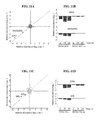


Classifications
-
- A—HUMAN NECESSITIES
- A61—MEDICAL OR VETERINARY SCIENCE; HYGIENE
- A61K—PREPARATIONS FOR MEDICAL, DENTAL OR TOILETRY PURPOSES
- A61K47/00—Medicinal preparations characterised by the non-active ingredients used, e.g. carriers or inert additives; Targeting or modifying agents chemically bound to the active ingredient
- A61K47/50—Medicinal preparations characterised by the non-active ingredients used, e.g. carriers or inert additives; Targeting or modifying agents chemically bound to the active ingredient the non-active ingredient being chemically bound to the active ingredient, e.g. polymer-drug conjugates
- A61K47/51—Medicinal preparations characterised by the non-active ingredients used, e.g. carriers or inert additives; Targeting or modifying agents chemically bound to the active ingredient the non-active ingredient being chemically bound to the active ingredient, e.g. polymer-drug conjugates the non-active ingredient being a modifying agent
- A61K47/54—Medicinal preparations characterised by the non-active ingredients used, e.g. carriers or inert additives; Targeting or modifying agents chemically bound to the active ingredient the non-active ingredient being chemically bound to the active ingredient, e.g. polymer-drug conjugates the non-active ingredient being a modifying agent the modifying agent being an organic compound
- A61K47/55—Medicinal preparations characterised by the non-active ingredients used, e.g. carriers or inert additives; Targeting or modifying agents chemically bound to the active ingredient the non-active ingredient being chemically bound to the active ingredient, e.g. polymer-drug conjugates the non-active ingredient being a modifying agent the modifying agent being an organic compound the modifying agent being also a pharmacologically or therapeutically active agent, i.e. the entire conjugate being a codrug
-
- A61K47/481—
-
- A—HUMAN NECESSITIES
- A61—MEDICAL OR VETERINARY SCIENCE; HYGIENE
- A61K—PREPARATIONS FOR MEDICAL, DENTAL OR TOILETRY PURPOSES
- A61K31/00—Medicinal preparations containing organic active ingredients
- A61K31/33—Heterocyclic compounds
- A61K31/395—Heterocyclic compounds having nitrogen as a ring hetero atom, e.g. guanethidine or rifamycins
- A61K31/41—Heterocyclic compounds having nitrogen as a ring hetero atom, e.g. guanethidine or rifamycins having five-membered rings with two or more ring hetero atoms, at least one of which being nitrogen, e.g. tetrazole
- A61K31/425—Thiazoles
- A61K31/426—1,3-Thiazoles
-
- A—HUMAN NECESSITIES
- A61—MEDICAL OR VETERINARY SCIENCE; HYGIENE
- A61K—PREPARATIONS FOR MEDICAL, DENTAL OR TOILETRY PURPOSES
- A61K31/00—Medicinal preparations containing organic active ingredients
- A61K31/33—Heterocyclic compounds
- A61K31/395—Heterocyclic compounds having nitrogen as a ring hetero atom, e.g. guanethidine or rifamycins
- A61K31/41—Heterocyclic compounds having nitrogen as a ring hetero atom, e.g. guanethidine or rifamycins having five-membered rings with two or more ring hetero atoms, at least one of which being nitrogen, e.g. tetrazole
- A61K31/425—Thiazoles
- A61K31/427—Thiazoles not condensed and containing further heterocyclic rings
-
- A—HUMAN NECESSITIES
- A61—MEDICAL OR VETERINARY SCIENCE; HYGIENE
- A61K—PREPARATIONS FOR MEDICAL, DENTAL OR TOILETRY PURPOSES
- A61K45/00—Medicinal preparations containing active ingredients not provided for in groups A61K31/00 - A61K41/00
- A61K45/06—Mixtures of active ingredients without chemical characterisation, e.g. antiphlogistics and cardiaca
-
- A61K47/48061—
-
- A—HUMAN NECESSITIES
- A61—MEDICAL OR VETERINARY SCIENCE; HYGIENE
- A61K—PREPARATIONS FOR MEDICAL, DENTAL OR TOILETRY PURPOSES
- A61K47/00—Medicinal preparations characterised by the non-active ingredients used, e.g. carriers or inert additives; Targeting or modifying agents chemically bound to the active ingredient
- A61K47/50—Medicinal preparations characterised by the non-active ingredients used, e.g. carriers or inert additives; Targeting or modifying agents chemically bound to the active ingredient the non-active ingredient being chemically bound to the active ingredient, e.g. polymer-drug conjugates
- A61K47/51—Medicinal preparations characterised by the non-active ingredients used, e.g. carriers or inert additives; Targeting or modifying agents chemically bound to the active ingredient the non-active ingredient being chemically bound to the active ingredient, e.g. polymer-drug conjugates the non-active ingredient being a modifying agent
- A61K47/54—Medicinal preparations characterised by the non-active ingredients used, e.g. carriers or inert additives; Targeting or modifying agents chemically bound to the active ingredient the non-active ingredient being chemically bound to the active ingredient, e.g. polymer-drug conjugates the non-active ingredient being a modifying agent the modifying agent being an organic compound
- A61K47/545—Heterocyclic compounds
-
- A—HUMAN NECESSITIES
- A61—MEDICAL OR VETERINARY SCIENCE; HYGIENE
- A61K—PREPARATIONS FOR MEDICAL, DENTAL OR TOILETRY PURPOSES
- A61K47/00—Medicinal preparations characterised by the non-active ingredients used, e.g. carriers or inert additives; Targeting or modifying agents chemically bound to the active ingredient
- A61K47/50—Medicinal preparations characterised by the non-active ingredients used, e.g. carriers or inert additives; Targeting or modifying agents chemically bound to the active ingredient the non-active ingredient being chemically bound to the active ingredient, e.g. polymer-drug conjugates
- A61K47/51—Medicinal preparations characterised by the non-active ingredients used, e.g. carriers or inert additives; Targeting or modifying agents chemically bound to the active ingredient the non-active ingredient being chemically bound to the active ingredient, e.g. polymer-drug conjugates the non-active ingredient being a modifying agent
- A61K47/54—Medicinal preparations characterised by the non-active ingredients used, e.g. carriers or inert additives; Targeting or modifying agents chemically bound to the active ingredient the non-active ingredient being chemically bound to the active ingredient, e.g. polymer-drug conjugates the non-active ingredient being a modifying agent the modifying agent being an organic compound
- A61K47/55—Medicinal preparations characterised by the non-active ingredients used, e.g. carriers or inert additives; Targeting or modifying agents chemically bound to the active ingredient the non-active ingredient being chemically bound to the active ingredient, e.g. polymer-drug conjugates the non-active ingredient being a modifying agent the modifying agent being an organic compound the modifying agent being also a pharmacologically or therapeutically active agent, i.e. the entire conjugate being a codrug
- A61K47/551—Medicinal preparations characterised by the non-active ingredients used, e.g. carriers or inert additives; Targeting or modifying agents chemically bound to the active ingredient the non-active ingredient being chemically bound to the active ingredient, e.g. polymer-drug conjugates the non-active ingredient being a modifying agent the modifying agent being an organic compound the modifying agent being also a pharmacologically or therapeutically active agent, i.e. the entire conjugate being a codrug one of the codrug's components being a vitamin, e.g. niacinamide, vitamin B3, cobalamin, vitamin B12, folate, vitamin A or retinoic acid
-
- C—CHEMISTRY; METALLURGY
- C07—ORGANIC CHEMISTRY
- C07K—PEPTIDES
- C07K5/00—Peptides containing up to four amino acids in a fully defined sequence; Derivatives thereof
- C07K5/04—Peptides containing up to four amino acids in a fully defined sequence; Derivatives thereof containing only normal peptide links
- C07K5/06—Dipeptides
- C07K5/06008—Dipeptides with the first amino acid being neutral
- C07K5/06017—Dipeptides with the first amino acid being neutral and aliphatic
- C07K5/06026—Dipeptides with the first amino acid being neutral and aliphatic the side chain containing 0 or 1 carbon atom, i.e. Gly or Ala
-
- C—CHEMISTRY; METALLURGY
- C07—ORGANIC CHEMISTRY
- C07K—PEPTIDES
- C07K5/00—Peptides containing up to four amino acids in a fully defined sequence; Derivatives thereof
- C07K5/04—Peptides containing up to four amino acids in a fully defined sequence; Derivatives thereof containing only normal peptide links
- C07K5/06—Dipeptides
- C07K5/06008—Dipeptides with the first amino acid being neutral
- C07K5/06017—Dipeptides with the first amino acid being neutral and aliphatic
- C07K5/06034—Dipeptides with the first amino acid being neutral and aliphatic the side chain containing 2 to 4 carbon atoms
-
- C—CHEMISTRY; METALLURGY
- C07—ORGANIC CHEMISTRY
- C07K—PEPTIDES
- C07K5/00—Peptides containing up to four amino acids in a fully defined sequence; Derivatives thereof
- C07K5/04—Peptides containing up to four amino acids in a fully defined sequence; Derivatives thereof containing only normal peptide links
- C07K5/06—Dipeptides
- C07K5/06008—Dipeptides with the first amino acid being neutral
- C07K5/06017—Dipeptides with the first amino acid being neutral and aliphatic
- C07K5/06034—Dipeptides with the first amino acid being neutral and aliphatic the side chain containing 2 to 4 carbon atoms
- C07K5/06052—Val-amino acid
-
- C—CHEMISTRY; METALLURGY
- C07—ORGANIC CHEMISTRY
- C07K—PEPTIDES
- C07K5/00—Peptides containing up to four amino acids in a fully defined sequence; Derivatives thereof
- C07K5/04—Peptides containing up to four amino acids in a fully defined sequence; Derivatives thereof containing only normal peptide links
- C07K5/08—Tripeptides
- C07K5/0821—Tripeptides with the first amino acid being heterocyclic, e.g. His, Pro, Trp
-
- A—HUMAN NECESSITIES
- A61—MEDICAL OR VETERINARY SCIENCE; HYGIENE
- A61K—PREPARATIONS FOR MEDICAL, DENTAL OR TOILETRY PURPOSES
- A61K38/00—Medicinal preparations containing peptides
Definitions
- E3 ubiquitin ligases (of which over 600 are known in humans) confer substrate specificity for ubiquitination, and therefore are more attractive therapeutic targets than general proteasome inhibitors due to their specificity for certain protein substrates.
- the development of ligands of E3 ligases has proven challenging, in part due to the fact that they must disrupt protein-protein interactions.
- recent developments have provided specific ligands that bind to these ligases. For example, since the discovery of nutlins, the first small molecule E3 ligase inhibitors, additional compounds have been reported that target E3 ligases but the field remains underdeveloped.
- VHL von Hippel-Lindau
- VCB the substrate recognition subunit of the E3 ligase complex
- the primary substrate of VHL is Hypoxia Inducible Factor 1 ⁇ (HIF-1 ⁇ ), a transcription factor that upregulates genes such as the pro-angiogenic growth factor VEGF and the red blood cell inducing cytokine erythropoietin in response to low oxygen levels.
- HIF-1 ⁇ Hypoxia Inducible Factor 1 ⁇
- VEGF the pro-angiogenic growth factor
- VEGF red blood cell inducing cytokine erythropoietin in response to low oxygen levels.
- VHL Von Hippel Lindau
- VCB an important target in cancer, chronic anemia and ischemia
- Cereblon is a protein that in humans is encoded by the CRBN gene. CRBN orthologs are highly conserved from plants to humans, which underscores its physiological importance. Cereblon forms an E3 ubiquitin ligase complex with damaged DNA binding protein 1 (DDB1), Cullin-4A (CUL4A), and regulator of cullins 1 (ROC1). This complex ubiquitinates a number of other proteins.
- DDB1 DNA binding protein 1
- CUL4A Cullin-4A
- ROC1 regulator of cullins 1
- This complex ubiquitinates a number of other proteins.
- cereblon ubquitination of target proteins results in increased levels of fibroblast growth factor 8 (FGF8) and fibroblast growth factor 10 (FGF10). FGF8 in turn regulates a number of developmental processes, such as limb and auditory vesicle formation.
- FGF8 fibroblast growth factor 8
- FGF10 fibroblast growth factor 10
- DDB1 forms a complex with DDB2 that functions as a DNA damage-binding protein.
- Increased expression of cereblon has been linked to an increase in efficacy of imide drugs in the treatment of multiple myeloma.
- RIPK2 Receptor interacting serine/threonine-protein kinase 2
- RIPK2 functions as an important mediator of innate immune signaling. Once activated, RIPK2 associates with NOD1 and NOD2 to recruit other kinases (TAK1, IKK ⁇ , IKK ⁇ , IKK ⁇ ) involved in NF- ⁇ B and MAPK activation. Dysregulation of RIPK2-dependent signaling is associated with autoinflammatory diseases including Blau syndrome and early-onset sarcoidosis.
- the present invention relates to bifunctional compounds that are useful as modulators of targeted ubiquitination, especially inhibitors of a variety of polypeptides and other proteins, which are consequently degraded and/or otherwise inhibited.
- the present invention is directed to compounds that contain on one end a VHL ligand, which binds to the VHL E3 ubiquitin ligase (defined as a ubiquitin ligand binding moiety or ULM group) and on the other end a moiety that binds a target protein (defined as a protein/polypeptide targeting moiety or PTM group), such that the target protein/polypeptide is placed in proximity to the ubiquitin ligase to effect degradation (and inhibition) of that protein.
- the present invention exhibits a broad range of pharmacological activities associated with compounds according to the present invention, consistent with the degradation/inhibition of targeted polypeptides.
- the present disclosure further provides bifunctional compounds that function to recruit endogenous proteins to an E3 Ubiquitin Ligase for degradation, and methods of using the same.
- the present disclosure provides bifunctional or proteolysis targeting chimeric (PROTAC) compounds, which find utility as modulators of targeted ubiquitination of a variety of polypeptides and other proteins, which are then degraded and/or otherwise inhibited.
- An exemplary advantage of the compounds provided herein is that a broad range of pharmacological activities is possible, consistent with the degradation/inhibition of targeted polypeptides from virtually any protein class or family.
- the description provides methods of using an effective amount of the compounds as described herein for the treatment or amelioration of a disease condition, such as cancer.
- the disclosure provides bifunctional or PROTAC compounds, which comprise an E3 Ubiquitin Ligase binding moiety (i.e., a ligand for an E3 Ubquitin Ligase or “ULM” group), and a moiety that binds a target protein (i.e., a protein/polypeptide targeting ligand or “PTM” group) such that the target protein/polypeptide is placed in proximity to the ubiquitin ligase to effect degradation (and inhibition) of that protein.
- the PTM is an estrogen-related receptor alpha (ERR ⁇ ), androgen receptor (AR), and/or RIPK2 binding moiety.
- the ULM is a VHL, cereblon, mouse double minute 2 (MDM2), and/or inhibitor of apoptosis protein (IAP) E3 ligase binding moiety.
- MDM2 mouse double minute 2
- IAP apoptosis protein
- the structure of the bifunctional compound can be depicted as PTM-ULM.
- the bifunctional compound further comprises a chemical linker (“L”).
- L a chemical linker
- PTM protein/polypeptide targeting moiety (e.g., ERR ⁇ , AR, or RIPK2 binding moiety)
- L is a linker
- ULM is a VHL, cereblon, MDM2, or IAP E3 ligase binding moiety binding moiety.
- the compounds as described herein comprise multiple ULMs, multiple PTMs, multiple chemical linkers, or any combinations thereof.
- the description provides therapeutic compositions comprising an effective amount of a compound as described herein or salt form thereof, and a pharmaceutically acceptable carrier.
- the therapeutic compositions modulate protein degradation in a patient or subject, for example, an animal such as a human, and can be used for treating or ameliorating disease states or conditions that are modulated through the degraded protein.
- the therapeutic compositions as described herein may be used to effectuate the degradation of proteins of interest for the treatment or amelioration of a disease, e.g., cancer.
- the present invention provides a method of ubiquitinating/degrading a target protein in a cell.
- the method comprises administering a bifunctional compound as described herein comprising an ULM and a PTM, in certain embodiments linked through a linker moiety, as otherwise described herein, wherein the ULM is coupled to the PTM and wherein the ULM recognizes a ubiquitin pathway protein (e.g., an ubiquitin ligase, in certain embodiments an E3 ubiquitin ligase) and the PTM recognizes the target protein such that degradation of the target protein occurs when the target protein (e.g., ERR ⁇ , AR, or RIPK2) is placed in proximity to the ubiquitin ligase, thus resulting in degradation/inhibition of the effects of the target protein and the control of protein levels.
- the target protein is ERR ⁇ .
- the control of protein levels afforded by the present invention provides treatment of a disease state or condition, which is modulated through the target protein by lowering the level of that protein in the cells of a patient.
- the description provides methods for treating or ameliorating a disease, disorder or symptom thereof in a subject or a patient, e.g., an animal such as a human, comprising administering to a subject in need thereof a composition comprising an effective amount, e.g., a therapeutically effective amount, of a compound as described herein or salt form thereof, and a pharmaceutically acceptable carrier, wherein the composition is effective for treating or ameliorating the disease or disorder or symptom thereof in the subject.
- a composition comprising an effective amount, e.g., a therapeutically effective amount, of a compound as described herein or salt form thereof, and a pharmaceutically acceptable carrier, wherein the composition is effective for treating or ameliorating the disease or disorder or symptom thereof in the subject.
- the description provides methods for identifying the effects of the degradation of proteins of interest in a biological system using compounds according to the present invention.
- the invention provides a compound of chemical structure ULM-L-PTM, the compound comprising a small molecule ubiquitin ligase binding moiety (ULM), a protein targeting moiety (PTM), and a linker (L), wherein ULM comprises a group substituted with a hydroxyl group or a functional group that can be metabolized in a subject to a hydroxyl group; L is a bond or a chemical linker; PTM is capable of binding to Estrogen Related Receptor alpha (ERR ⁇ ), wherein, upon binding of the EER ⁇ to the compound, the ERR ⁇ is ubiquitinated by an ubiquitin ligase; ULM is chemically linked to L; and L is chemically linked to PTM; or a pharmaceutically acceptable salt, enantiomer, stereoisomer, solvate, polymorph or prodrug thereof.
- ULM small molecule ubiquitin ligase binding moiety
- PTM protein targeting moiety
- L linker
- ULM comprises
- the compound is L is -A 1 . . . A q -; wherein A 1 to A q are each independently selected from the group consisting of a bond, CR L1 R L2 , O, S, S ⁇ O, S( ⁇ O) 2 , NR L3 , S( ⁇ O) 2 NR L3 , S( ⁇ O)NR L3 , C( ⁇ O)NR L3 , NR L3 C( ⁇ O)NR L4 , NR L3 S( ⁇ O) 2 NR L4 , C( ⁇ O), CR L1 ⁇ CR L2 , C ⁇ C, SiR L1 R L2 , P( ⁇ O)R L1 , P( ⁇ O)OR L1 , NR L3 C( ⁇ N—CN)NR L4 , NR L3 C( ⁇ N—CN), NR L3 C( ⁇ C—NO 2 )NR L4 , C 3-11 cycloalkyl optionally substituted with 0-6 substituents
- the compound comprises at least one selected from the group consisting of multiple ULMs, multiple PTMs, and multiple Ls.
- PTM is selected from the group consisting of
- ULM comprises ULM-a:
- X 1 , X 2 are each independently selected from the group consisting of a bond, O, NR Y3 , CR Y3 R Y4 , C ⁇ O, C ⁇ S, SO, and SO 2 ;
- R Y3 and R Y4 are each independently selected from the group consisting of H, C 1-6 alkyl, wherein the alkyl group is linear or branched, and the alkyl group is further optionally substituted by 1 or more substituents independently selected from the group consisting of halo and C 1-6 alkoxy;
- the pyrrolidine ring is optionally substituted by 1-3 R P groups, wherein each R P is independently selected from the group consisting of H, halo, hydroxy, and C 1-3 alkyl;
- W 3 is selected from the group consisting of an optionally
- ULM has the structure:
- W 3 is selected from the group consisting of optionally substituted aryl, optionally substituted heteroaryl, and
- R 9 and R 10 are each independently selected from the group consisting of hydrogen, optionally substituted alkyl, optionally substituted cycloalkyl, optionally substituted hydroxyalkyl, optionally substituted heteroaryl, and haloalkyl; or R 9 , R 10 and the carbon atom to which they are attached form an optionally substituted cycloalkyl; R 11 is selected from the group consisting of optionally substituted heterocyclic, optionally substituted alkoxy, optionally substituted heteroaryl, optionally substituted aryl,
- R 12 is selected from the group consisting of H and optionally substituted alkyl
- R 13 is selected from the group consisting of H, optionally substituted alkyl, optionally substituted alkylcarbonyl, optionally substituted (cycloalkyl)alkylcarbonyl, optionally substituted aralkylcarbonyl, optionally substituted arylcarbonyl, optionally substituted (heterocyclyl)carbonyl, and optionally substituted aralkyl
- R 14a and R 14b are each independently selected from the group consisting of H, haloalkyl, and optionally substituted alkyl
- W 5 is selected from the group consisting of phenyl and a 5-10 membered heteroaryl
- R 15 is selected from the group consisting of H, halogen, CN, OH, NO 2 , NR 14a R 14b , OR 14a , C( ⁇ O)NR 14a R 14b , NR 14a C( ⁇ O)R 14b , S(
- ULM comprises:
- R 1′ is —OH;
- R 2′ is a —NH—CH 2 -Aryl-HET;
- R 3′ is selected from the group consisting of optionally substituted alkyl, —(CH)R CR3′ —NH—C( ⁇ O)—R 3P1 and —(CH)R CR3′ —R 3P2 ;
- R CR3′ is optionally substituted C 1 -C 4 alkyl;
- R 3P1 is selected from the group consisting of optionally substituted C 1 -C 6 alkyl, optionally substituted oxetane, —(CH 2 ) n OCH 3 wherein n is 1 or 2, optionally substituted phenyl, and morpholino linked to the carbonyl at the 2- or 3-position;
- R 3P2 is selected from the group consisting of
- HET is selected from the group consisting of optionally substituted thiazole, oxazole, isoxazole and isothiazole
- R HET is selected from the group consisting of H, halo, CN, optionally substituted C 1 -C 6 alkyl, optionally substituted C 1 -C 6 alkoxy, and optionally substituted aryl
- the ULM group is covalently bonded to a linker group to which is attached a PTM group, or a pharmaceutically acceptable salt, stereoisomer, solvate or polymorph thereof.
- ULM is selected from the group consisting of:
- ULM group is covalently bonded to the L group to which is attached the PTM group, or a pharmaceutically acceptable salt, stereoisomer, solvate, polymorph or prodrug thereof.
- L is a polyethyleneglycol optionally substituted with aryl or phenyl, and having from 1 to 100 ethylene glycol units. In other embodiments, L is a polyethylene group optionally substituted with aryl or phenyl, and having from 1 to 10 ethylene glycol units.
- the compound is selected from the group consisting of:
- the invention further provides a pharmaceutical composition comprising an effective amount of at least one compound of the invention, further comprising a pharmaceutically acceptable carrier, additive or excipient, and optionally further comprising an additional bioactive agent.
- the additional bioactive agent is an anticancer agent.
- the invention further provides a method for regulating protein activity of a target protein in a subject in need thereof, the method comprising administering to the subject a therapeutically effective amount of at least one compound of the invention.
- the target protein comprises estrogen related receptor alpha (ERR- ⁇ ).
- the invention further provides a method of treating a disease state or condition in a subject in need thereof, wherein dysregulated activity of a protein is responsible for the disease state or condition, the method comprising administering to the subject an effective amount of at least one compound of the invention, wherein the compound modulates the amount or activity of the protein in the subject.
- the disease state or condition comprises cancer.
- the cancer is selected from the group consisting of squamous-cell carcinoma, basal cell carcinoma, adenocarcinoma, hepatocellular carcinomas, and renal cell carcinomas, cancer of the bladder, bowel, breast, cervix, colon, esophagus, head, kidney, liver, lung, neck, ovary, pancreas, prostate, and stomach; leukemias; benign and malignant lymphomas, particularly Burkitt's lymphoma and Non-Hodgkin's lymphoma; benign and malignant melanomas; myeloproliferative diseases; sarcomas, including Ewing's sarcoma, hemangiosarcoma, Kaposi's sarcoma, liposarcoma, myosarcomas, peripheral neuroepithelioma, synovial sarcoma, gliomas, astrocytomas, oligodendrogliomas, ependymomas,
- the cancer is selected from the group consisting of T-lineage Acute lymphoblastic Leukemia (T-ALL), T-lineage lymphoblastic Lymphoma (T-LL), Peripheral T-cell lymphoma, Adult T-cell Leukemia, Pre-B ALL, Pre-B Lymphomas, Large B-cell Lymphoma, Burkitts Lymphoma, B-cell ALL, Philadelphia chromosome positive ALL, Philadelphia chromosome positive CML, prostate cancer, Kennedy's Disease, breast cancer, Lymphoma, diabetes, diabetes mellitus type I, diabetes mellitus type II, obesity, colorectal cancer, head & neck cancer, immune system disorders, leukemia, stem cell growth, stem cell transplantation, wound healing, atherosclerosis, hepatocellular carcinoma, endometrial cancer, McCune-Albright Syndrome, adenocarcinoma, acute lymphoblastic leukemia, multiple myeloma myeloproliferative diseases, large B-cell
- T-ALL
- the invention further provides a method of degrading a target protein in a cell, the method comprising contacting the cell with an effective amount of at least one compound of the invention, wherein the compound effectuates the degradation of the target protein in the cell.
- FIG. 1A depicts HALOTAGTM protein, which is known to irreversibly bind to chloroalkanes, linked to GFP.
- FIG. 1B depicts a ligand comprising a HALOTAGTM ligand, a polyethylene glycol-containing linker, and a VHL ligand, for measuring the timecourse of HALOTAGT protein degradation.
- FIG. 2 depicts the stereochemical dependence at the 4-hydroxyl position of the ligand on the degradation of the HALOTAGTM protein.
- the (S)-isomomer was less effective at affecting HALOTAGT protein degradation than the (R)-isomer.
- FIGS. 3A-3C depict the effects of linker length and sterochemical arrangements about the ligand on HALOTAGT protein degradation.
- FIG. 4 depict the effect of VHL binding affinities (via Fluorescence Polarization (FP)) and the ligand concentration on the degradation of the HALOTAGTM-GFP protein.
- FP Fluorescence Polarization
- FIG. 5 depicts the lack of effect of
- estrogen related receptor alpha (ERR ⁇ )
- FIG. 6 depicts the PROTAC-mediated ERR ⁇ degradation employing
- FIG. 7 depicts the PROTAC-mediated EGFR and RIPK2 receptor degradation, illustrating the finding that PROTACs work on cytosolic and receptor kinases.
- FIG. 8A depicts the proposed model of PROTAC-induced degradation.
- FIG. 8B depicts the structure of PROTAC_ERR ⁇ (1) with the ERR ⁇ ligand shown in orange (left box) and the modular VHL ligand in blue (right box), with asterisks indicating stereocenter(s) whose inversion (in PROTAC_ERR ⁇ _epi) abolishes VHL binding.
- FIG. 8C depicts the structure of PROTAC_RIPK2 (3) with the RIPK2 ligand shown in green (left box) and the modular VHL ligand in blue (right box).
- FIGS. 9A-9E depict the ability of PROTACs to downregulate protein levels.
- FIG. 9A depicts downregulation of protein levels of ERR ⁇ .
- FIG. 9B depicts downregulation of protein levels of RIPK2; an observed amelioration of efficacy at higher concentrations (‘hook effect’) is consistent with a ternary complex-mediated mechanism.
- FIG. 9C illustrates that the ability of PROTACs to downregulate RIPK2 is dependent on the proteasome and the presence of the linkage between both targeting ligands.
- FIG. 9D depicts dowregulation of protein levels of RIPK2 by PROTAC_RIPK2.
- FIG. 9E depicts ability of PROTACs to downregulate proteins reversibly) protein levels reversibly.
- FIG. 10A depicts the selectivity of the VHL ligand for VHL and associated proteins.
- FIG. 10B the binding selectivity of the VHL ligand to the VHL complex.
- FIG. 10C depicts the co-immunoprecipitation of VHL and RIPK2 by PROTAC_RIPK2.
- FIG. 10D depicts the in vitro RIPK2 ubiquitination by PROTAC_RIPK2.
- FIG. 10E depicts the increase in the rate of ubiquitination with increasing PROTAC concentration.
- FIG. 10F depicts the ability of PROTACs to induce super-stoichiometric ubiquitination of RIPK2.
- FIG. 11A depicts the selectivity of PROTAC_RIPK2 for RIPK2 degradation.
- FIG. 11B depicts the quantified levels of RIPK2 and MAPKAPK3 in THP-1 cells treated with either PROTAC_RIPK2 or PROTAC_RIPK2_epi.
- FIG. 11C depicts quantified protein levels from MCF-7 cells treated for 24 h with 500 nM PROTAC_ERR ⁇ .
- FIG. 11D depicts quantified levels of ERR ⁇ and BCR from MCF-7 cells treated for the indicated times with 500 nM PROTAC_ERR ⁇ .
- FIG. 12B depicts analysis of tissues and plasma from (A) for levels of PROTAC_ERR ⁇ by LC/MS.
- FIG. 13 is a cell viability graph illustrating that PROTAC_RIPK2 is not toxic to cells.
- THP-1 cells were treated with the indicated concentration sof PROTAC_RIPK2 or PROTAC_RIPK2_epi for 16 hours, followed by a Trypan Blue assay to determine cell viability. Error bars represent mean and S.D.
- the present description relates to the discovery that an ubiquitin pathway protein ubiquitinates any target protein, once the ubiquitin pathway protein and the target protein are placed in proximity by a chimeric construct that binds the ubiquitin pathway protein (e.g., VHL, cereblon, MDM2 or IAP E3 ligase) and the target protein (e.g., estrogen related receptor alpha ( ⁇ ) or RIPK2).
- a chimeric construct that binds the ubiquitin pathway protein (e.g., VHL, cereblon, MDM2 or IAP E3 ligase) and the target protein (e.g., estrogen related receptor alpha ( ⁇ ) or RIPK2).
- the present invention provides a composition that results in the ubiquitination of a chosen target protein.
- the present invention also provides a library of compositions and the use thereof.
- compound refers to any specific chemical compound disclosed herein and includes tautomers, regioisomers, geometric isomers, and where applicable, stereoisomers, including optical isomers (enantiomers) and other stereoisomers (diastereomers) thereof, as well as pharmaceutically acceptable salts and derivatives (including prodrug forms) thereof where applicable, in context.
- compound generally refers to a single compound, but also may include other compounds such as stereoisomers, regioisomers and/or optical isomers (including racemic mixtures) as well as specific enantiomers or enantiomerically enriched mixtures of disclosed compounds.
- PROTAC refers to proteolysis targeting chimeras.
- patient and “subject” are used interchangeably throughout the specification to describe an animal, in certain embodiments a human or a domesticated animal, to whom treatment, including prophylactic treatment, with the compositions according to the present invention is provided.
- patient refers to that specific animal, including a domesticated animal such as a dog or cat or a farm animal such as a horse, cow, sheep, and so forth.
- the term patient refers to a human patient unless otherwise stated or implied from the context of the use of the term.
- VCB E3 Ubiquitin Ligase “Hippel-Lindau E3 Ubiquitin Ligase” or “Ubiquitin Ligase” is used to describe a target enzyme(s) binding site of ubiquitin ligase moieties in the bifunctional (chimeric) compounds according to the present invention.
- VCB E3 is a protein that, in combination with an E2 ubiquitin-conjugating enzyme, causes the attachment of ubiquitin to a lysine on a target protein; the E3 ubiquitin ligase targets specific protein substrates for degradation by the proteasome.
- E3 ubiquitin ligase alone or in complex with an E2 ubiquitin conjugating enzyme is responsible for the transfer of ubiquitin to targeted proteins.
- the ubiquitin ligase is involved in polyubiquitination such that a second ubiquitin is attached to the first, a third is attached to the second, and so forth.
- Polyubiquitination marks proteins for degradation by the proteasome.
- Mono-ubiquitinated proteins are not targeted to the proteasome for degradation, but may instead be altered in their cellular location or function, for example, via binding other proteins that have domains capable of binding ubiquitin.
- different lysines on ubiquitin can be targeted by an E3 to make chains. The most common lysine is Lys48 on the ubiquitin chain, which is used to make polyubiquitin, which is recognized by the proteasome.
- protein target moiety or PTM is used to describe a small molecule that binds to a target protein or other protein or polypeptide of interest and places/presents that protein or polypeptide in proximity to an ubiquitin ligase, such that degradation of the protein or polypeptide by ubiquitin ligase may occur.
- Non-limiting examples of small molecule target protein binding moieties include estrogen-related receptor alpha (ERR ⁇ ) binders, RIPK2 binders, AR binders, Hsp90 inhibitors, kinase inhibitors, MDM2 inhibitors, compounds targeting Human BET Bromodomain-containing proteins, HDAC inhibitors, human lysine methyltransferase inhibitors, angiogenesis inhibitors, immunosuppressive compounds, and compounds targeting the aryl hydrocarbon receptor (AHR), among numerous others.
- ERR ⁇ estrogen-related receptor alpha
- RIPK2 binders include AR binders, AR binders, Hsp90 inhibitors, kinase inhibitors, MDM2 inhibitors, compounds targeting Human BET Bromodomain-containing proteins, HDAC inhibitors, human lysine methyltransferase inhibitors, angiogenesis inhibitors, immunosuppressive compounds, and compounds targeting the aryl hydrocarbon receptor (AHR), among numerous others.
- AHR aryl hydrocarbon receptor
- target protein is used to describe a protein or polypeptide, which is a target for binding to a compound according to the present invention and degradation by ubiquitin ligase hereunder.
- target protein binding moieties also include pharmaceutically acceptable salts, enantiomers, solvates and polymorphs of these compositions, as well as other small molecules that may target a protein of interest. These binding moieties are linked to ULM groups through linker groups L.
- Target proteins that may be bound to the protein target moiety and degraded by the ligase to which the ubiquitin ligase binding moiety is bound include structural proteins, receptors, enzymes, cell surface proteins, proteins pertinent to the integrated function of a cell, including proteins involved in catalytic activity, aromatase activity, motor activity, helicase activity, metabolic processes (anabolism and catrabolism), antioxidant activity, proteolysis, biosynthesis, proteins with kinase activity, oxidoreductase activity, transferase activity, hydrolase activity, lyase activity, isomerase activity, ligase activity, enzyme regulator activity, signal transducer activity, structural molecule activity, binding activity (protein, lipid carbohydrate), receptor activity, cell motility, membrane fusion, cell communication, regulation of biological processes, development, cell differentiation, response to stimulus, behavioral proteins, cell adhesion proteins, proteins involved in cell death, proteins involved in transport (including protein transporter activity, nuclear transport, ion transporter activity, channel transporter activity, carrier activity,
- Proteins of interest can include proteins from eurkaryotes and prokaryotes, including microbes, viruses, fungi and parasites, including humans, microbes, viruses, fungi and parasites, among numerous others, as targets for drug therapy, other animals, including domesticated animals, microbials for the determination of targets for antibiotics and other antimicrobials and plants, and even viruses, among numerous others.
- a number of drug targets for human therapeutics represent protein targets to which protein target moiety may be bound and incorporated into compounds according to the present invention.
- proteins which may be used to restore function in numerous polygenic diseases including for example ERR ⁇ , AR, RIPK2, B7.1 and B7, TINFR1m, TNFR2, NADPH oxidase, BclIBax and other partners in the apotosis pathway, C5a receptor, HMG-CoA reductase, PDE V phosphodiesterase type, PDE IV phosphodiesterase type 4, PDE I, PDEII, PDEIII, squalene cyclase inhibitor, CXCR1, CXCR2, nitric oxide (NO) synthase, cyclo-oxygenase 1, cyclo-oxygenase 2, 5HT receptors, dopamine receptors, G Proteins, i.e., Gq, histamine receptors, 5-lipoxygenase, tryptase
- Additional protein targets include, for example, ecdysone 20-monooxygenase, ion channel of the GABA gated chloride channel, acetylcholinesterase, voltage-sensitive sodium channel protein, calcium release channel, and chloride channels. Still further target proteins include Acetyl-CoA carboxylase, adenylosuccinate synthetase, protoporphyrinogen oxidase, and enolpyruvylshikimate-phosphate synthase.
- Haloalkane dehalogenase enzymes are another target of specific compounds according to the present invention.
- Compounds according to the present invention that contain chloroalkane peptide binding moieties may be used to inhibit and/or degrade haloalkane dehalogenase enzymes used in fusion proteins or related dioagnostic proteins as described in PCT/US 2012/063401, filed Dec. 6, 2011 and published as WO 2012/078559 on Jun. 14, 2012, the contents of which are incorporated by reference herein.
- estrogen related receptor alpha (ERR ⁇ ), AR, or RIPK2)
- RRR ⁇ estrogen related receptor alpha
- AR AR
- RIPK2 RIPK2
- disease state or condition is used to describe any disease state or condition wherein protein dysregulation (i.e., the amount of protein expressed in a patient is elevated) occurs and where degradation of one or more proteins (e.g., estrogen related receptor alpha (ERR ⁇ ), AR, or RIPK2) in a patient may provide beneficial therapy or relief of symptoms to a patient in need thereof.
- protein dysregulation i.e., the amount of protein expressed in a patient is elevated
- degradation of one or more proteins e.g., estrogen related receptor alpha (ERR ⁇ ), AR, or RIPK2
- the disease state or condition may be cured.
- Disease states of conditions which may be treated using compounds according to the present invention include, for example, asthma, autoimmune diseases such as multiple sclerosis, various cancers, ciliopathies, cleft palate, diabetes, heart disease, hypertension, inflammatory bowel disease, mental retardation, mood disorder, obesity, refractive error, infertility, Angelman syndrome, Canavan disease, Coeliac disease, Charcot-Marie-Tooth disease, Cystic fibrosis, Duchenne muscular dystrophy, Haemochromatosis, Haemophilia, Klinefelter's syndrome, Neurofibromatosis, Phenylketonuria, Polycystic kidney disease, (PKD1) or 4 (PKD2) Prader-Willi syndrome, Sickle-cell disease, Tay-Sachs disease, Turner syndrome, Alzheimer's disease, Amyotrophic lateral sclerosis (Lou Gehrig's disease), Anorexia nervosa, Anxiety disorder, Atherosclerosis, Attention deficit hyperactivity disorder, Autism, Bipolar
- cancer is used throughout the specification to refer to the pathological process that results in the formation and growth of a cancerous or malignant neoplasm, i.e., abnormal tissue that grows by cellular proliferation, often more rapidly than normal and continues to grow after the stimuli that initiated the new growth cease.
- Malignant neoplasms show partial or complete lack of structural organization and functional coordination with the normal tissue and most invade surrounding tissues, metastasize to several sites, and are likely to recur after attempted removal and to cause the death of the patient unless adequately treated.
- neoplasia is used to describe all cancerous disease states and embraces or encompasses the pathological process associated with malignant hematogenous, ascitic and solid tumors.
- Exemplary cancers that may be treated by the present compounds either alone or in combination with at least one additional anti-cancer agent include squamous-cell carcinoma, basal cell carcinoma, adenocarcinoma, hepatocellular carcinomas, and renal cell carcinomas, cancer of the bladder, bowel, breast, cervix, colon, esophagus, head, kidney, liver, lung, neck, ovary, pancreas, prostate, and stomach; leukemias; benign and malignant lymphomas, particularly Burkitt's lymphoma and Non-Hodgkin's lymphoma; benign and malignant melanomas; myeloproliferative diseases; sarcomas, including Ewing's sarcoma, hemangiosarcoma, Kaposi's sarcoma, liposarcoma, myosarcomas, peripheral neuroepithelioma, synovial sarcoma, gliomas, astrocytomas, oligodendro
- Additional cancers which may be treated using compounds according to the present invention include, for example, T-lineage Acute lymphoblastic Leukemia (T-ALL), T-lineage lymphoblastic Lymphoma (T-LL), Peripheral T-cell lymphoma, Adult T-cell Leukemia, Pre-B ALL, Pre-B Lymphomas, Large B-cell Lymphoma, Burkitts Lymphoma, B-cell ALL, Philadelphia chromosome positive ALL and Philadelphia chromosome positive CML.
- T-ALL T-lineage Acute lymphoblastic Leukemia
- T-LL T-lineage lymphoblastic Lymphoma
- Peripheral T-cell lymphoma Peripheral T-cell lymphoma
- Adult T-cell Leukemia Pre-B ALL
- Pre-B Lymphomas Large B-cell Lymphoma
- Burkitts Lymphoma B-cell ALL
- Philadelphia chromosome positive ALL Philadelphia chromosome positive CML.
- bioactive agent is used to describe an agent, other than a compound according to the present invention, which is used in combination with the present compounds as an agent with biological activity to assist in effecting an intended therapy, inhibition and/or prevention/prophylaxis for which the present compounds are used.
- exemplary bioactive agents for use herein include those agents that have pharmacological activity similar to that for which the present compounds are used or administered and include for example, anti-cancer agents, antiviral agents, especially including anti-HIV agents and anti-HCV agents, antimicrobial agents, antifungal agents, and so forth.
- additional anti-cancer agent is used to describe an anti-cancer agent that be combined with compounds according to the present invention to treat cancer.
- agents include, for example, everolimus, trabectedin, abraxane, TLK 286, AV-299, DN-101, pazopanib, GSK690693, RTA 744, ON 0910.Na, AZD 6244 (ARRY-142886), AMN-107, TKI-258, GSK461364, AZD 1152, enzastaurin, vandetanib, ARQ-197, MK-0457, MLN8054, PHA-739358, R-763, AT-9263, a FLT-3 inhibitor, a VEGFR inhibitor, an EGFR TK inhibitor, an aurora kinase inhibitor, a PIK-1 modulator, a Bcl-2 inhibitor, an HDAC inhbitor, a c-MET inhibitor, a PARP inhibitor, a Cdk inhibitor, an
- pharmaceutically acceptable salt is used throughout the specification to describe, where applicable, a salt form of one or more of the compounds described herein that are presented to increase the solubility of the compound in the gastic juices of the patient's gastrointestinal tract in order to promote dissolution and the bioavailability of the compounds.
- Pharmaceutically acceptable salts include those derived from pharmaceutically acceptable inorganic or organic bases and acids, where applicable. Suitable salts include those derived from alkali metals such as potassium and sodium, alkaline earth metals such as calcium, magnesium and ammonium salts, among numerous other acids and bases well known in the pharmaceutical art. Sodium and potassium salts are particularly exemplary as neutralization salts of the phosphates according to the present invention.
- pharmaceutically acceptable derivative is used throughout the specification to describe any pharmaceutically acceptable prodrug form (such as an ester, amide other prodrug group), which, upon administration to a patient, provides directly or indirectly the present compound or an active metabolite of the present compound.
- hydrocarbyl shall mean a compound that contains carbon and hydrogen and that may be fully saturated, partially unsaturated or aromatic and includes aryl groups, alkyl groups, alkenyl groups and alkynyl groups.
- alkyl shall mean within its context a linear, branch-chained or cyclic fully saturated hydrocarbon radical or alkyl group, in certain embodiments a C 1 -C 10 , more in certain embodiments a C 1 -C 6 , alternatively a C 1 -C 3 alkyl group, which may be optionally substituted.
- alkyl groups are methyl, ethyl, n-butyl, sec-butyl, n-hexyl, n-heptyl, n-octyl, n-nonyl, n-decyl, isopropyl, 2-methylpropyl, cyclopropyl, cyclopropylmethyl, cyclobutyl, cyclopentyl, cyclopentylethyl, cyclohexylethyl and cyclohexyl, among others.
- compounds according to the present invention which may be used to covalently bind to dehalogenase enzymes.
- These compounds generally contain a side chain (often linked through a polyethylene glycol group) which terminates in an alkyl group which has a halogen substituent (often chlorine or bromine) on its distil end which results in covalent binding of the compound containing such a moiety to the protein.
- a side chain often linked through a polyethylene glycol group
- a halogen substituent often chlorine or bromine
- unsubstituted shall mean substituted only with hydrogen atoms.
- a range of carbon atoms which includes C 0 means that carbon is absent and is replaced with H.
- a range of carbon atoms that is C 0 -C 6 includes carbons atoms of 1, 2, 3, 4, 5 and 6 and for C 0 , H stands in place of carbon.
- substituted or “optionally substituted” shall mean independently (i.e., where more than substituent occurs, each substituent is independent of another substituent) one or more substituents (independently up to five substitutents, in certain embodiments up to three substituents, often 1 or 2 substituents on a moiety in a compound according to the present invention and may include substituents which themselves may be further substituted) at a carbon (or nitrogen) position anywhere on a molecule within context, and includes as substituents hydroxyl, thiol, carboxyl, cyano (C ⁇ N), nitro (NO 2 ), halogen (in certain embodiments, 1, 2 or 3 halogens, especially on an alkyl, especially a methyl group such as a trifluoromethyl), an alkyl group (in certain embodiments, C 1 -C 10 , more in certain embodiments, C 1 -C 6 ), aryl (especially phenyl and substituted phenyl for example benzyl or
- Substituents according to the present invention may include, for example —SiR 1 R 2 R 3 groups where each of R 1 and R 2 is as otherwise described herein and R 3 is H or a C 1 -C 6 alkyl group, in certain embodiments R 1 , R 2 , R 3 in this context is a C 1 -C 3 alkyl group (including an isopropyl or t-butyl group).
- Each of the above-described groups may be linked directly to the substituted moiety or alternatively, the substituent may be linked to the substituted moiety (in certain embodiments in the case of an aryl or heteroaryl moiety) through an optionally substituted —(CH 2 ) m — or alternatively an optionally substituted —(OCH 2 ) m —, —(OCH 2 CH 2 ) m — or —(CH 2 CH 2 O) m — group, which may be substituted with any one or more of the above-described substituents.
- Alkylene groups —(CH 2 ) m — or —(CH 2 ) n — groups or other chains such as ethylene glycol chains, as identified above, may be substituted anywhere on the chain.
- exemplary substitutents on alkylene groups include halogen or C 1 -C 6 (in certain embodiments C 1 -C 3 ) alkyl groups, which may be optionally substituted with 1-2 hydroxyl groups, 1-2 ether groups (O—C 1 -C 6 groups), up to three halo groups (in certain embodiments F), or a sidechain of an amino acid as otherwise described herein and optionally substituted amide (in certain embodiments carboxamide substituted as described above) or urethane groups (often with 1-2 C 0 -C 6 alkyl substitutents, which group(s) may be further substituted).
- the alkylene group (often a single methylene group) is substituted with 1-2 optionally substituted C 1 -C 6 alkyl groups, in certain embodiments C 1 -C 4 alkyl group, most often methyl or O-methyl groups or a sidechain of an amino acid as otherwise described herein.
- a moiety in a molecule may be optionally substituted with up to five substituents, in certain embodiments up to three substituents. Most often, in the present invention moieties which are substituted are substituted with 1-2 substituents.
- substituted (each substituent being independent of any other substituent) shall also mean within its context of use C 1 -C 6 alkyl, C 1 -C 6 alkoxy, halogen, amido, carboxamido, sulfone, including sulfonamide, keto, carboxy, C 1 -C 6 ester (oxyester or carbonylester), C 1 -C 6 keto, urethane —O—C(O)—NR 1 R 2 or —N(R 1 )—C(O)—O—R 1 , nitro, cyano and amine (especially including a C 1 -C 6 alkylene-NR 1 R 2 , a mono- or di-C 1 -C 6 alkyl substituted amines which may be optionally substituted with 1-2 hydroxyl groups).
- substituents include for example, —NH—, —NHC(O)—, —O—, ⁇ O, —(CH 2 ) m — (here, m and n are in context, 1, 2, 3, 4, 5 or 6), —S—, —S(O)—, SO 2 — or —NH—C(O)—NH—, —(CH 2 ) n OH, —(CH 2 ) n SH, —(CH 2 ) n COOH, C 1 -C 6 alkyl, —(CH 2 ) n O—(C 1 -C 6 alkyl), —(CH 2 ) n C(O)—(C 1 -C 6 alkyl), —(CH 2 ) n OC(O)—(C 1 -C 6 alkyl), —(CH 2 ) n C(O)O—(C 1 -C 6 alkyl), —(CH 2 ) n C(O)O—(C 1
- R 1 and R 2 are each, within context, H or a C 1 -C 6 alkyl group (which may be optionally substituted with 1-2 hydroxyl groups or up to three halogen groups, in certain embodiments fluorine).
- substituted shall also mean, within the chemical context of the compound defined and substituent used, an optionally substituted aryl or heteroaryl group or an optionally substituted heterocyclic group as otherwise described herein.
- Alkylene groups may also be substituted as otherwise disclosed herein, in certain embodiments with optionally substituted C 1 -C 6 alkyl groups (methyl, ethyl or hydroxymethyl or hydroxyethyl as examples, thus providing a chiral center), a sidechain of an amino acid group as otherwise described herein, an amido group as described hereinabove, or a urethane group O—C(O)—NR 1 R 2 group where R 1 and R 2 are as otherwise described herein, although numerous other groups may also be used as substituents.
- Various optionally substituted moieties may be substituted with 3 or more substituents, in certain embodiments no more than 3 substituents and in certain embodiments with 1 or 2 substituents.
- aryl or “aromatic”, in context, refers to a substituted (as otherwise described herein) or unsubstituted monovalent aromatic radical having a single ring (e.g., benzene, phenyl, benzyl) or condensed rings (e.g., naphthyl, anthracenyl, phenanthrenyl, and so forth) and can be bound to the compound according to the present invention at any available stable position on the ring(s) or as otherwise indicated in the chemical structure presented.
- aryl groups in context, may include heterocyclic aromatic ring systems “heteroaryl” groups having one or more nitrogen, oxygen, or sulfur atoms in the ring (monocyclic) such as imidazole, furyl, pyrrole, furanyl, thiene, thiazole, pyridine, pyrimidine, pyrazine, triazole, oxazole or fused ring systems such as indole, quinoline, indolizine, azaindolizine, benzofurazan, and so forth, among others, which may be optionally substituted as described above.
- heteroaryl having one or more nitrogen, oxygen, or sulfur atoms in the ring (monocyclic) such as imidazole, furyl, pyrrole, furanyl, thiene, thiazole, pyridine, pyrimidine, pyrazine, triazole, oxazole or fused ring systems such as indole, quinoline, indoli
- heteroaryl groups include nitrogen-containing heteroaryl groups such as pyrrole, pyridine, pyridone, pyridazine, pyrimidine, pyrazine, pyrazole, imidazole, triazole, triazine, tetrazole, indole, isoindole, indolizine, azaindolizine, purine, indazole, quinoline, dihydroquinoline, tetrahydroquinoline, isoquinoline, dihydroisoquinoline, tetrahydroisoquinoline, quinolizine, phthalazine, naphthyridine, quinoxaline, quinazoline, cinnoline, pteridine, imidazopyridine, imidazotriazine, pyrazinopyridazine, acridine, phenanthridine, carbazole, carbazoline, perimidine, phenanthroline,
- heterocycle refers to a cyclic group which contains at least one heteroatom, i.e., O, N or S, and may be aromatic (heteroaryl) or non-aromatic.
- heteroaryl moieties are subsumed under the definition of heterocycle, depending on the context of its use. Exemplary heteroaryl groups are described hereinabove.
- non-aromatic heterocyclic groups for use in the present invention include, for example, pyrrolidinyl, pyrrolinyl, piperidinyl, piperazinyl, N-methylpiperazinyl, pyrazolidinyl, imidazolidinyl, morpholinyl, tetrahydropyranyl, azetidinyl, oxetanyl, oxathiolanyl, pyridone, 2-pyrrolidone, ethyleneurea, 1,3-dioxolane, 1,3-dioxane, 1,4-dioxane, phthalimide and succinimide, among others, as described herein.
- treat refers to any action providing a benefit to a patient for which the present compounds may be administered, including the treatment of any disease state or condition which is modulated through the protein to which the present compounds bind.
- Disease states or conditions, including cancer, which may be treated using compounds according to the present invention are set forth hereinabove.
- coadministration shall mean that at least two compounds or compositions are administered to the patient at the same time, such that effective amounts or concentrations of each of the two or more compounds may be found in the patient at a given point in time.
- compounds according to the present invention may be co-administered to a patient at the same time, the term embraces both administration of two or more agents at the same time or at different times, provided that effective concentrations of all coadministered compounds or compositions are found in the subject at a given time.
- one or more of the present compounds described above are coadministered in combination with at least one additional bioactive agent, especially including an anticancer agent.
- the coadministration of compounds results in synergistic therapeutic, including anticancer therapy.
- the present invention provides a composition useful for regulating protein activity.
- the composition comprises a ubiquitin pathway protein binding moiety (in certain embodiments for a VHL, cereblon, MDM2, or IAP E3 ligase) according to a defined chemical structure and a protein targeting moiety that are linked together, in certain embodiments through a linker, wherein the ubiquitin pathway protein binding moiety recognizes an ubiquitin pathway protein and the targeting moiety recognizes a target protein [e.g., estrogen related receptor alpha (ERR ⁇ ), or RIPK2] and wherein the ubiquitin pathway protein binding moiety is coupled to the targeting moiety.
- a target protein e.g., estrogen related receptor alpha (ERR ⁇ ), or RIPK2
- the present invention provides a library of compounds.
- the library comprises more than one compound wherein each composition has a formula of A-B, wherein A is a ubiquitin pathway protein binding moiety (in certain embodiments, VHL, cereblon, MDM2, or IAP E3 ligase) and B is a protein binding member of a molecular library (e.g., ERR ⁇ , or RIPK2), wherein A is coupled (in certain embodiments, through a linker moiety) to B, and wherein the ubiquitin pathway protein binding moiety recognizes an ubiquitin pathway protein, in particular, an E3 ubiquitin ligase.
- the library contains a specific ubiquitination recognition peptide of VHL for an E3 ubiquitin ligase (ubiquitin pathway protein binding moiety as otherwise disclosed herein) with random target protein binding elements (e.g., a chemical compound library).
- E3 ubiquitin ligase ubiquitin pathway protein binding moiety as otherwise disclosed herein
- target protein binding elements e.g., a chemical compound library.
- the present invention provides a method of screening a library of the present invention to identify a compound containing a targeting moiety, which recognizes a target protein [e.g., estrogen related receptor alpha (ERR ⁇ ), or RIPK2] associated with a predetermined function of a cell.
- the method comprises incubating a cell with a pool of entities from the library; monitoring the predetermined function of the cell; identifying a pool of entities that change the predetermined function of the cell; incubating the cell with a composition from the identified pool of entities; monitoring the predetermined function of the cell; and identifying a composition that changes the predetermined function of the cell, wherein the identified composition contains a targeting moiety which recognizes a target protein associated with the predetermined function.
- a target protein e.g., estrogen related receptor alpha (ERR ⁇ ), or RIPK2
- the present invention provides a method of screening a library of the present invention to identify a composition containing a targeting moiety, which recognizes a target protein [e.g., estrogen related receptor alpha (ERR ⁇ ), or RIPK2] associated with a predetermined function of a cell.
- the method comprises incubating a cell with each composition from the library; monitoring the predetermined function of the cell; identifying a composition that changes the predetermined function of the cell; wherein the identified composition contains a targeting moiety, which recognizes a target protein associated with the predetermined function.
- a targeting moiety which recognizes a target protein [e.g., estrogen related receptor alpha (ERR ⁇ ), or RIPK2] associated with a predetermined function of a cell.
- the present invention provides a method of identifying a target protein [e.g., estrogen related receptor alpha (ERR ⁇ ), or RIPK2] associated with a predetermined function of a cell.
- the method comprises incubating a cell with a composition from the library of the present invention; monitoring the predetermined function of the cell; identifying a composition that changes the predetermined function of the cell; identifying a target protein that binds to the identified composition, wherein the target protein is associated with the predetermined function of the cell.
- a target protein e.g., estrogen related receptor alpha (ERR ⁇ ), or RIPK2
- the present invention provides a method of identifying a target protein [e.g., estrogen related receptor alpha (ERR ⁇ ), AR, or RIPK2] associated with a predetermined function of a cell.
- the method comprises incubating a cell with a pool of entities from the library of the present invention; monitoring the predetermined function of the cell; identifying a pool of entities that change the predetermined function of the cell; incubating the cell with a composition from the identified pool of entities; monitoring the predetermined function of the cell; identifying a composition that changes the predetermined function of the cell; and identifying a target protein that binds to the identified composition, wherein the target protein is associated with the predetermined function of the cell.
- a target protein e.g., estrogen related receptor alpha (ERR ⁇ ), AR, or RIPK2
- the present invention provides a method of ubiquitinating/degrading a target protein [e.g., estrogen related receptor alpha (ERR ⁇ ), or RIPK2] in a cell.
- the method comprises administering a bifunctional composition comprising an ubiquitin pathway protein binding moiety and a targeting moiety, in certain embodiments linked through a linker moiety, as otherwise described herein, wherein the ubiquitin pathway protein binding moiety is coupled to the targeting moiety and wherein the ubiquitin pathway protein binding moiety recognizes a ubiquitin pathway protein (e.g., VHL, cereblon, MDM2, or IAP E3 ligase) and the targeting moiety recognizes the target protein [e.g., estrogen related receptor alpha (ERR ⁇ ), or RIPK2] such that degradation of the target protein occurs when the target protein is placed in proximity to the ubiquitin ligase, thus resulting in degradation/inhibition of the effects of the target protein and the control of protein levels.
- the present invention is directed to a method of treating a patient in need for a disease state or condition modulated through a protein [e.g., estrogen related receptor alpha (ERR ⁇ ), or RIPK2] where the degradation of that protein produces a therapeutic effect in that patient, the method comprising administering to a patient in need an effective amount of a compound according to the present invention, optionally in combination with another bioactive agent.
- the disease state or condition may be a disease caused by a microbial agent or other exogenous agent such as a virus, bacteria, fungus, protozoa or other microbe or may be a disease state, which is caused by overexpression of a protein, which leads to a disease state and/or condition.
- the present invention is directed to a compound according to the structure L-ULM, where L is a linker group, and ULM is a ubiquitin ligase binding moiety, wherein said linker group is optionally further linked to a PTM group.
- the present invention is directed to a compound comprising a PTM group (e.g., derivatized
- ULM-L-PTM wherein: ULM is an ubiquitin ligase binding moiety (in certain embodiments a ligand), which binds an ubiquitin ligase [in certain embodiments an E3 ubiquitin ligase (e.g., VHL)]; PTM is a chemical moiety (protein targeting moiety) (e.g., derivatized
- a target protein e.g., estrogen related receptor alpha (ERR ⁇ ) or RIPK2, respectively
- polypeptide which is ubiquitinated by an ubiquitin ligase and is chemically linked directly to the ULM group or through a linker moiety L
- PTM is alternatively a ULM′ group that is also an ubiquitin ligase binding moiety, which may be the same or different than the ULM group and is linked directly to the ULM group directly or through the linker moiety
- L is a linker moiety that may be present or absent and chemically (covalently) links ULM to PTM, or a pharmaceutically acceptable salt, enantiomer, stereoisomer, solvate or polymorph thereof.
- the compounds as described herein can be chemically linked or coupled via a chemical linker (L).
- the linker group L is a group comprising one or more covalently connected structural units of A (e.g., -A 1 . . . A q -), wherein A 1 is a group coupled to at least one of a ULM, a PTM, or a combination thereof.
- a 1 links a ULM, a PTM, or a combination thereof directly to another ULM, PTM, or combination thereof.
- a 1 links a ULM, a PTM, or a combination thereof indirectly to another ULM, PTM, or combination thereof through A q .
- a 1 to A q are, each independently, a bond, CR L1 R L2 , O, S, SO, SO 2 , NR L3 , SO 2 NR L3 , SONR L3 , CONR L3 , NR L3 CONR L4 , NR L3 SO 2 NR L4 , CO, CR L1 ⁇ CR L2 , C ⁇ C, SiR L1 R L2 , P(O)R L1 , P(O)OR L1 , NR L3 C( ⁇ NCN)NR L4 , NR L3 C( ⁇ NCN), NR L3 C( ⁇ CNO 2 )NR L4 C 3-11 cycloalkyl optionally substituted with 0-6 R L1 and/or R L2 groups, C 3-11 heterocyclyl optionally substituted with 0-6 R L1 and/or R L2 groups, aryl optionally substituted with 0-6 R L1 and/or R L2 groups, heteroaryl optionally substituted with 0-6
- q is an integer greater than or equal to 0. In certain embodiments, q is an integer greater than or equal to 1.
- a q is a group that is connected to a ULM or ULM′ moiety, and A 1 and A q are connected via structural units of A (number of such structural units of A: q-2).
- a q is a group that is connected to A 1 and to a ULM or ULM′ moiety.
- the structure of the linker group L is -A 1 -, and A 1 is a group which is connected to a ULM or ULM′ moiety and a PTM moiety.
- q is an integer from 1 to 100, 1 to 90, 1 to 80, 1 to 70, 1 to 60, 1 to 50, 1 to 40, 1 to 30, 1 to 20, or 1 to 10.
- the linker (L) is selected from the group consisting of:
- the linker group is optionally substituted (poly)ethyleneglycol having between 1 and about 100 ethylene glycol units, between about 1 and about 50 ethylene glycol units, between 1 and about 25 ethylene glycol units, between about 1 and 10 ethylene glycol units, between 1 and about 8 ethylene glycol units and 1 and 6 ethylene glycol units, between 2 and 4 ethylene glycol units, or optionally substituted alkyl groups interdispersed with optionally substituted, O, N, S, P or Si atoms.
- the linker is substituted with an aryl, phenyl, benzyl, alkyl, alkylene, or heterocycle group.
- the linker may be asymmetric or symmetrical.
- the linker group may be any suitable moiety as described herein.
- the linker is a substituted or unsubstituted polyethylene glycol group ranging in size from about 1 to about 12 ethylene glycol units, between 1 and about 10 ethylene glycol units, about 2 about 6 ethylene glycol units, between about 2 and 5 ethylene glycol units, between about 2 and 4 ethylene glycol units.
- the ULM group and PTM group may be covalently linked to the linker group through any group which is appropriate and stable to the chemistry of the linker.
- the linker is independently covalently bonded to the ULM group and the PTM group in certain embodiments through an amide, ester, thioester, keto group, carbamate (urethane), carbon or ether, each of which groups may be inserted anywhere on the ULM group and PTM group to provide maximum binding of the ULM group on the ubiquitin ligase and the PTM group on the target protein to be degraded.
- the PTM group is a ULM group
- the target protein for degradation may be the ubiquitin ligase itself.
- the linker may be linked to an optionally substituted alkyl, alkylene, alkene or alkyne group, an aryl group or a heterocyclic group on the ULM and/or PTM groups.
- the ULM comprises a chemical structure selected from the group ULM-a:
- a dashed line indicates the attachment of at least one PTM, another ULM or VLM (i.e., ULM′ or VLM′), or a chemical linker moiety coupling at least one PTM, a ULM′ or VLM′ to the other end of the linker;
- X 1 , X 2 are each independently a bond, O, NR Y3 , CR Y3 R Y4 , C ⁇ O, C ⁇ S, S ⁇ O, or SO 2 ;
- R Y3 , R Y4 are each independently H, or C 1-6 alkyl (linear, branched, optionally substituted by 1 or more halo, C 1-6 alkoxyl), optionally substituted by 1-3 R P groups in the pyrrolidine moiety, wherein each R P is independently H, halo, —OH, or C 1-3 alkyl;
- W 3 is an optionally substituted -T-N(R 1a R 1b ), -T-Aryl, an optionally substituted -T-Heteroaryl, an optionally substituted -T-Heterocycle, an optionally substituted —NR 1 -T-Aryl, an optionally substituted —NR 1 -T-Heteroaryl or an optionally substituted —NR 1 -T-Heterocycle, where T is covalently bonded to X 1 ;
- each R 1 , R 1a , R 1b is independently H, or a C 1 -C 6 alkyl group (linear, branched, optionally substituted by 1 or more halo, —OH), R Y3 C ⁇ O, R Y3 C ⁇ S, R Y3 SO, R Y3 SO 2 , N(R Y3 R Y4 )C ⁇ O, N(R Y3 R Y4 )C ⁇ S, N(R Y3 R Y4 )SO, or N(R Y3 R Y4 )SO 2 ;
- T is an optionally substituted —(CH 2 ) n — group, wherein each one of the methylene groups may be optionally substituted with 1-2 substituents, in certain embodiments selected from halogen, a C 1 -C 6 alkyl group (linear, branched, optionally substituted by 1 or more halogen, —OH) or the sidechain of an amino acid as otherwise described herein, in certain embodiments methyl, which may be optionally substituted; and n is 0 to 6, in certain embodiments 0, 1, 2, or 3, in certain embodiments 0.
- T may also be a —(CH 2 O) n — group, a —(OCH 2 ) n — group, a —(CH 2 CH 2 O) n — group, a —(OCH 2 CH 2 ) n — group, each of which groups is optionally substituted; and
- W 4 is an optionally substituted —NR 1 -T-Aryl, an optionally substituted —NR 1 -T-Heteroaryl group or an optionally substituted —NR 1 -T-Heterocycle, where —NR 1 is covalently bonded to X 2 ;
- R 1 is H or CH 3 , in certain embodiments H, and
- T is an optionally substituted —(CH 2 ) n — group, wherein each one of the methylene groups may be optionally substituted with 1-2 substituents, in certain embodiments selected from halogen, an amino acid sidechain as otherwise described herein or a C 1 -C 6 alkyl group (linear, branched, optionally substituted by 1 or more halo, —OH), in certain embodiments 1-2 methyl groups, which may be optionally substituted; and n is 0 to 6, often 0, 1, 2 or 3, in certain embodiments 0 or 1.
- T may also be a —(CH 2 O) n — group, a —(OCH 2 ) n — group, a —(CH 2 CH 2 O) n — group, a —(OCH 2 CH 2 ) n — group, all of which groups are optionally substituted.
- W 3 and/or W 4 can be attached to a linker moiety as described herein.
- aryl groups for W 3 include optionally substituted phenyl or naphthyl groups, in certain embodiments phenyl groups, wherein the phenyl or naphthyl group is optionally substituted with a linker group to which is attached a PTM group (including a ULM′ group) and/or a halogen (in certain embodiments F or Cl), an amine, monoalkyl- or dialkyl amine (in certain embodiments, dimethylamine), an amido group (in certain embodiments a —(CH 2 ) m —NR 1 C(O)R 2 group where m, R 1 and R 2 are the same as for R 1 ), a halogen (often F or Cl), OH, CH 3 , CF 3 , OMe, OCF 3 , NO 2 , CN or a S(O) 2 R S group (R S is a C 1 -C 6 alkyl group, an optionally substituted aryl, heteroaryl or heterocycle
- said substituent phenyl group is an optionally substituted phenyl group (i.e., the substituent phenyl group itself is in certain embodiments substituted with at least one of F, Cl, OH, SH, COOH, CH 3 , CF 3 , OMe, OCF 3 , NO 2 , CN or a linker group to which is attached a PTM group (including a ULM′ group), wherein the substitution occurs in ortho-, meta- and/or para-positions of the phenyl ring, in certain embodiments para-), a naphthyl group, which may be optionally substituted including as described above, an optionally substituted heteroaryl (in certain embodiments an optionally substituted isoxazole including a methylsubstituted isoxazole, an optionally substituted oxazole including a methylsubstituted oxazole, an optionally substituted thiazole including a methyl substituted thiazole, an optionally substituted phen
- heteroaryl groups for W 3 include an optionally substituted quinoline (which may be attached to the pharmacophore or substituted on any carbon atom within the quinoline ring), an optionally substituted indole (including dihydroindole), an optionally substituted indolizine, an optionally substituted azaindolizine (2, 3 or 4-azaindolizine) an optionally substituted benzimidazole, benzodiazole, benzoxofuran, an optionally substituted imidazole, an optionally substituted isoxazole, an optionally substituted oxazole (in certain embodiments methyl substituted), an optionally substituted diazole, an optionally substituted triazole, a tetrazole, an optionally substituted benzofuran, an optionally substituted thiophene, an optionally substituted thiazole (in certain embodiments, methyl and/or thiol substituted), an optionally substituted isothiazole,
- S c is CHR SS NR URE , or O;
- R HET is H, CN, NO 2 , halo (in certain embodiments Cl or F), optionally substituted C 1 -C 6 alkyl (in certain embodiments substituted with 1-2 hydroxyl groups or up to three halo groups (e.g. CF 3 ), optionally substituted O(C 1 -C 6 alkyl) (in certain embodiments substituted with 1-2 hydroxyl groups or up to three halo groups) or an optionally substituted acetylenic group —C ⁇ C—R a where R a is H or a C 1 -C 6 alkyl group (in certain embodiments C 1 -C 3 alkyl);
- R SS is H, CN, NO 2 , halo (in certain embodiments F or Cl), optionally substituted C 1 -C 6 alkyl (in certain embodiments substituted with 1-2 hydroxyl groups or up to three halo groups), optionally substituted O—(C 1 -C 6 alkyl) (in certain embodiments substituted with 1-2 hydroxyl groups or up to three halo groups) or an optionally substituted —C(O)(C 1 -C 6 alkyl) (in certain embodiments substituted with 1-2 hydroxyl groups or up to three halo groups);
- R URE is H, a C 1 -C 6 alkyl (in certain embodiments H or C 1 -C 3 alkyl) or a —C(O)(C 1 -C 6 alkyl), each of which groups is optionally substituted with 1-2 hydroxyl groups or up to three halogen, in certain embodiments fluorine groups, or an optionally substituted heterocycle, for example piperidine, morpholine, pyrrolidine, tetrahydrofuran, tetrahydrothiophene, piperidine, piperazine, each of which is optionally substituted; and
- Y C is N or C—R YC , where R YC is H, OH, CN, NO 2 , halo (in certain embodiments Cl or F), optionally substituted C 1 -C 6 alkyl (in certain embodiments substituted with 1-2 hydroxyl groups or up to three halo groups (e.g. CF 3 ), optionally substituted O(C 1 -C 6 alkyl) (in certain embodiments substituted with 1-2 hydroxyl groups or up to three halo groups) or an optionally substituted acetylenic group —C ⁇ C—R a where R a is H or a C 1 -C 6 alkyl group (in certain embodiments C 1 -C 3 alkyl).
- Each of said heteroaryl groups may be optionally substituted with a linker group to which is attached a PTM group (including a ULM′ group).
- heterocycle groups for W 3 include morpholine, tetrahydroquinoline, piperidine, piperazine, pyrrollidine, tetrahydrofuran, tetrahydrothiophene, oxane and thiane, each of which groups may be optionally substituted or a group according to the chemical structure:
- R PRO is H, optionally substituted C 1 -C 6 alkyl or an optionally substituted aryl (phenyl or napthyl), heteroaryl or heterocyclic group selected from the group consisting of oxazole, isoxazole, thiazole, isothiazole, imidazole, diazole, oximidazole, pyrrole, pyrollidine, furan, dihydrofuran, tetrahydrofuran, thiene, dihydrothiene, tetrahydrothiene, pyridine, piperidine, piperazine, morpholine, quinolone, benzofuran, indole, indolizine, azaindolizine (each in certain embodiments substituted with a C 1 -C 3 alkyl group, in certain embodiments methyl or a halo group, in certain embodiments F or Cl);
- R PRO1 and R PRO2 are each independently H, an optionally substituted C 1 -C 3 alkyl group or together form a keto group, and
- each n is 0, 1, 2, 3, 4, 5, or 6 (in certain embodiments 0 or 1), wherein each of said Heterocycle groups may be optionally substituted with a linker group to which is attached a PTM group (including a ULM′ group) or a pharmaceutically acceptable salt, stereoisomer, solvate or polymorph thereof.
- W 3 substituents for use in the present invention also include specifically (and without limitation to the specific compound disclosed) the W 3 substituents that are found in the identified compounds disclosed herein (which includes the specific compounds which are disclosed in the present specification, and the figures which are attached hereto). Each of these W 3 substituents may be used in conjunction with any number of W 4 substituents, which are also disclosed herein.
- aryl groups for W 4 include optionally substituted phenyl or naphthyl groups, in certain embodiments phenyl groups, wherein the phenyl group is optionally substituted with a linker group to which is attached an PTMPTM group (including a ULM′ group), a halogen (in certain embodiments F or Cl), an amine, monoalkyl- or dialkyl amine (in certain embodiments, dimethylamine), F, Cl, OH, COOH, C 1 -C 6 alkyl, in certain embodiments CH 3 , CF 3 , OMe, OCF 3 , NO 2 , or CN group (each of which may be substituted in ortho-, meta- and/or para-positions of the phenyl ring, in certain embodiments para-), an optionally substituted phenyl group (the phenyl group itself is in certain embodiments substituted with a linker group attached to a PTM group, including a ULM′ group), and/or at
- S c is CHR SS , NR URE , or O;
- R HET is H, CN, NO 2 , halo (in certain embodiments Cl or F), optionally substituted C 1 -C 6 alkyl (in certain embodiments substituted with 1-2 hydroxyl groups or up to three halo groups (e.g. CF 3 ), optionally substituted O(C 1 -C 6 alkyl) (in certain embodiments substituted with 1-2 hydroxyl groups or up to three halo groups) or an optionally substituted acetylenic group —C ⁇ C—R a where R a is H or a C 1 -C 6 alkyl group (in certain embodiments C 1 -C 3 alkyl);
- R SS is H, CN, NO 2 , halo (in certain embodiments F or Cl), optionally substituted C 1 -C 6 alkyl (in certain embodiments substituted with 1-2 hydroxyl groups or up to three halo groups), optionally substituted O—(C 1 -C 6 alkyl) (in certain embodiments substituted with 1-2 hydroxyl groups or up to three halo groups) or an optionally substituted —C(O)(C 1 -C 6 alkyl) (in certain embodiments substituted with 1-2 hydroxyl groups or up to three halo groups);
- R URE is H, a C 1 -C 6 alkyl (in certain embodiments H or C 1 -C 3 alkyl) or a —C(O)(C 1 -C 6 alkyl) each of which groups is optionally substituted with 1-2 hydroxyl groups or up to three halogen, in certain embodiments fluorine groups, or an optionally substituted phenyl group, an optionally substituted heteroaryl, or an optionally substituted heterocycle, in certain embodiments for example piperidine, morpholine, pyrrolidine, tetrahydrofuran);
- R PRO is H, optionally substituted C 1 -C 6 alkyl or an optionally substituted aryl (phenyl or napthyl), heteroaryl or heterocyclic group selected from the group consisting of oxazole, isoxazole, thiazole, isothiazole, imidazole, diazole, oximidazole, pyrrole, pyrollidine, furan, dihydrofuran, tetrahydrofuran, thiene, dihydrothiene, tetrahydrothiene, pyridine, piperidine, piperazine, morpholine, quinoline, benzofuran, indole, indolizine, azaindolizine (each in certain embodiments substituted with a C 1 -C 3 alkyl group, in certain embodiments methyl or a halo group, in certain embodiments F or Cl);
- R PRO1 and R PRO2 are each independently H, an optionally substituted C 1 -C 3 alkyl group or together form a keto group; and each n is independently 0, 1, 2, 3, 4, 5, or 6 (in certain embodiments 0 or 1), or an optionally substituted heterocycle, in certain embodiments tetrahydrofuran, tetrahydrothiene, piperidine, piperazine or morpholine (each of which groups when substituted, are in certain embodiments substituted with a methyl or halo (F, Br, Cl), each of which groups may be optionally substituted with a linker group to which is attached a PTM
- R PRO and n are the same as above.
- heteroaryl groups for W 4 include an optionally substituted quinoline (which may be attached to the pharmacophore or substituted on any carbon atom within the quinoline ring), an optionally substituted indole, an optionally substituted indolizine, an optionally substituted azaindolizine, an optionally substituted benzofuran, including an optionally substituted benzofuran, an optionally substituted isoxazole, an optionally substituted thiazole, an optionally substituted isothiazole, an optionally substituted thiophene, an optionally substituted pyridine (2-, 3, or 4-pyridine), an optionally substituted imidazole, an optionally substituted pyrrole, an optionally substituted diazole, an optionally substituted triazole, a tetrazole, an optionally substituted oximidazole, or a group according to the chemical structure:
- S c is CHR SS , NR URE , or O;
- R HET is H, CN, NO 2 , halo (in certain embodiments Cl or F), optionally substituted C 1 -C 6 alkyl (in certain embodiments substituted with 1-2 hydroxyl groups or up to three halo groups (e.g. CF 3 ), optionally substituted O(C 1 -C 6 alkyl) (in certain embodiments substituted with 1-2 hydroxyl groups or up to three halo groups) or an optionally substituted acetylenic group —C ⁇ C—R a where R a is H or a C 1 -C 6 alkyl group (in certain embodiments C 1 -C 3 alkyl);
- R URE is H, a C 1 -C 6 alkyl (in certain embodiments H or C 1 -C 3 alkyl) or a —C(O)(C 1 -C 6 alkyl), each of which groups is optionally substituted with 1-2 hydroxyl groups or up to three halogen, in certain embodiments fluorine groups, or an optionally substituted heterocycle, for example piperidine, morpholine, pyrrolidine, tetrahydrofuran, tetrahydrothiophene, piperidine, piperazine, each of which is optionally substituted, and
- Y C is N or C—R YC , where R YC is H, OH, CN, NO 2 , halo (in certain embodiments Cl or F), optionally substituted C 1 -C 6 alkyl (in certain embodiments substituted with 1-2 hydroxyl groups or up to three halo groups (e.g.
- CF 3 optionally substituted O(C 1 -C 6 alkyl) (in certain embodiments substituted with 1-2 hydroxyl groups or up to three halo groups) or an optionally substituted acetylenic group —C ⁇ C—R a where R a is H or a C 1 -C 6 alkyl group (in certain embodiments C 1 -C 3 alkyl), each of which groups may be optionally substituted with a linker group to which is attached a PTM group (including a ULM′ group).
- heterocycle groups for W 4 include tetrahydrofuran, tetrahydrothiene, tetrahydroquinoline, piperidine, piperazine, pyrrollidine, morpholine, oxane or thiane, each of which groups may be optionally substituted, or a group according to the chemical structure:
- R PRO is H, optionally substituted C 1 -C 6 alkyl or an optionally substituted aryl, heteroaryl or heterocyclic group
- R PRO1 and R PRO2 are each independently H, an optionally substituted C 1 -C 3 alkyl group or together form a keto group
- each n is independently 0, 1, 2, 3, 4, 5, or 6 (often 0 or 1), each of which groups may be optionally substituted with a linker group to which is attached a PTM group (including a ULM′ group).
- W 4 substituents for use in the present invention also include specifically (and without limitation to the specific compound disclosed) the W 4 substituents that are found in the identified compounds disclosed herein (which includes the specific compounds which are disclosed in the present specification, and the figures which are attached hereto). Each of these W 4 substituents may be used in conjunction with any number of W 3 substituents which are also disclosed herein.
- ULM-a is optionally substituted by 1-3 R P groups in the pyrrolidine moiety, wherein each R P is independently H, halo, —OH, C 1-3 alkyl.
- the W 3 , W 4 can independently be covalently coupled to a linker that is attached one or more PTM groups.
- ULM is a group (derivatized or configured to be linked or coupled to an PTM via a linker (as indicated by the dashed line) according to the chemical structure:
- W 3 is optionally substituted aryl, optionally substituted heteroaryl, or
- each R 9 and R 10 is independently hydrogen, optionally substituted alkyl, optionally substituted cycloalkyl, optionally substituted hydroxyalkyl, optionally substituted heteroaryl, or haloalkyl; or R 9 , R 10 , and the carbon atom to which they are attached form an optionally substituted cycloalkyl;
- R 11 is optionally substituted heterocyclic, optionally substituted alkoxy, optionally substituted heteroaryl, optionally substituted aryl,
- R 12 is H or optionally substituted alkyl
- R 13 is H, optionally substituted alkyl, optionally substituted alkylcarbonyl, optionally substituted (cycloalkyl)alkylcarbonyl, optionally substituted aralkylcarbonyl, optionally substituted arylcarbonyl, optionally substituted (heterocyclyl)carbonyl, or optionally substituted aralkyl;
- R 14a and R 14b are each independently H, haloalkyl, or optionally substituted alkyl;
- W 5 is a phenyl or a 5-10 membered heteroaryl
- R 15 is H, halogen, CN, OH, NO 2 , NR 14a R 14b , OR 14a , CONR 14a R 14b , NR 14a COR 14b , SO 2 NR 14a R 14b , NR 14a SO 2 R 14b , optionally substituted alkyl, optionally substituted haloalkyl, optionally substituted haloalkoxy; aryl, heteroaryl, cycloalkyl, or cycloheteroalkyl;
- each R 16 is independently halo, optionally substituted alkyl, optionally substituted haloalkyl, hydroxy, or optionally substituted haloalkoxy;
- p 0, 1, 2, 3, or 4;
- each R 1s is independently halo, optionally substituted alkoxy, cyano, optionally substituted alkyl, haloalkyl, haloalkoxy or a linker.
- R 15 is
- R 17 is H, halo, optionally substituted C 3-6 cycloalkyl, optionally substituted C 1-6 alkyl, optionally substituted C 1-6 alkenyl, and C 1-6 haloalkyl; and Xa is S or O.
- R 17 is selected from the group consisting of methyl, ethyl, isopropyl, and cyclopropyl.
- R 15 is selected from the group consisting of:
- R 11 is selected from the group consisting of:
- the ULM (derivatized or configured to be linked or coupled to an PTM via a linker (as indicated by the dashed line)) has the structure:
- R 14a is methyl, ethyl, isopropyl, or cyclopropyl
- R 9 is H
- R 10 is isopropyl, tert-butyl, sec-butyl, cyclopentyl, or cyclohexyl;
- R 12 is H
- R 13 is H, optionally substituted alkyl, optionally substituted alkylcarbonyl, optionally substituted (cycloalkyl)alkylcarbonyl, optionally substituted aralkylcarbonyl, optionally substituted arylcarbonyl, optionally substituted (heterocyclyl)carbonyl, or optionally substituted aralkyl.
- the ULM or VLM is selected from the group consisting of:
- the PTM comprises a structure selected from, but not limited to the structures shown below, where a dashed line indicates the attachment point of linker moiety:
- W 1 is aryl or heteroaryl, independently substituted by 1 or more halo, hydroxyl, nitro, CN, C ⁇ CH, C 1-6 alkyl (linear, branched, optionally substituted by 1 or more halo, C 1-6 alkoxyl), C 1-6 alkoxyl (linear, branched, optionally substituted by 1 or more halo), C 2-6 alkenyl, C 2-6 alkynyl;
- Y 1 , Y 2 are each independently NR Y1 , O, S;
- Y 3 , Y 4 , Y 5 are each independently a bond, O, NR Y2 , CR Y1 R Y2 , C ⁇ O, C ⁇ S, S ⁇ O, or SO 2 ;
- each R Q is independently H, C 1-6 alkyl (linear, branched, optionally substituted by 1 or more halo, C 1-6 alkoxyl), or 2 R Q groups, which are taken together with the atom they are attached to, form a 3-8 membered ring system containing 0-2 heteroatoms);
- R 1 , R 2 , R a , R b , R Y1 , R Y2 are each independently H, C 1-6 alkyl (linear, branched, optionally substituted by 1 or more halo, C 1-6 alkoxyl), or R 1 and R 2 , taken together with the atom they are attached to, form a 3-8 membered ring system containing 0-2 heteroatoms;
- W 2 is a bond, C 1-6 alkyl, or aryl, or heteroaryl, each optionally substituted by 1, 2 or 3 R W2 ; and each R W2 is independently H, halo, C 1-6 alkyl (optionally substituted by 1 or more F), or OC 1-3 alkyl (optionally substituted by 1 or more —F).
- the W 2 is covalently coupled to one or more ULM or VLM groups, or a linker to which is attached one or more ULM or VLM groups as described herein.
- W 1 is N-(2-aminoethyl)-2-aminoethyl-N-(2-aminoethyl)-2-aminoethyl-N-(2-aminoethyl)-2-aminoethyl-N-(2-aminoethyl)-2-aminoethyl-N-(2-aminoethyl)-2-aminoethyl
- each R 22 is independently halo, optionally substituted alkyl, haloalkyl, cyano, or nitro; and each R 23 is independently H, halo, optionally substituted alkyl, haloalkyl, cyano, or nitro.
- W 1 is selected from the group consisting of:
- PTM is selected from the group consisting of:
- the present invention may be used to treat a number of disease states and/or conditions, including any disease state and/or condition in which proteins are dysregulated and where a patient would benefit from the degradation of proteins [e.g., estrogen related receptor alpha (ERR ⁇ ), or RIPK2].
- ERR ⁇ estrogen related receptor alpha
- RIPK2 RIPK2
- the present invention relates to pharmaceutical compositions comprising an effective amount of a compound as set forth hereinabove, in combination with a pharmaceutically acceptable carrier, additive or excipient, and optionally an additional bioactive agent.
- the present invention relates to a method for treating a disease state by degrading a protein [e.g., estrogen related receptor alpha (ERR ⁇ ), or RIPK2] or polypeptide through which a disease state or condition is modulated, comprising administering to the patient or subject an effective amount of at least one compound as described hereinabove, optionally in combination with an additional bioactive agent.
- the method according to the present invention may be used to treat a large number of disease states or conditions including cancer, by virtue of the administration of effective amounts of at least one compound described herein.
- compositions comprising combinations of an effective amount of at least one bifunctional compound according to the present invention, and one or more of the compounds otherwise described herein, all in effective amounts, in combination with a pharmaceutically effective amount of a carrier, additive or excipient, represents a further aspect of the present invention.
- the present invention includes, where applicable, the compositions comprising the pharmaceutically acceptable salts, in particular, acid or base addition salts of compounds of the present invention.
- the acids used to prepare the pharmaceutically acceptable acid addition salts of the aforementioned base compounds useful in this invention are those which form non-toxic acid addition salts, i.e., salts containing pharmacologically acceptable anions, such as the hydrochloride, hydrobromide, hydroiodide, nitrate, sulfate, bisulfate, phosphate, acid phosphate, acetate, lactate, citrate, acid citrate, tartrate, bitartrate, succinate, maleate, fumarate, gluconate, saccharate, benzoate, methanesulfonate, ethanesulfonate, benzenesulfonate, p-toluenesulfonate and pamoate [i.e., 1,1′-methylene-bis-(2-hydroxy-3 naphthoate)]
- Pharmaceutically acceptable base addition salts may also be used to produce pharmaceutically acceptable salt forms of the compounds or derivatives according to the present invention.
- the chemical bases used as reagents to prepare pharmaceutically acceptable base salts of the present compounds that are acidic in nature are those that form non-toxic base salts with such compounds.
- Such non-toxic base salts include, but are not limited to those derived from such pharmacologically acceptable cations such as alkali metal cations (e.g., potassium, sodium) and alkaline earth metal cations (e.g., calcium, zinc, magnesium), ammonium or water-soluble amine addition salts such as N-methylglucamine (meglumine), and lower alkanol-ammonium and other base salts of pharmaceutically acceptable organic amines, among others.
- alkali metal cations e.g., potassium, sodium
- alkaline earth metal cations e.g., calcium, zinc, magnesium
- ammonium or water-soluble amine addition salts such as N-methylglu
- the compounds of the present invention may, in accordance with the invention, be administered in single or divided doses by the oral, parenteral or topical routes.
- Administration of the active compound may range from continuous (intravenous drip) to several oral administrations per day (for example, Q.I.D.) and may include oral, topical, parenteral, intramuscular, intravenous, subcutaneous, transdermal (which may include a penetration enhancement agent), buccal, sublingual and suppository administration, among other routes of administration.
- Enteric coated oral tablets may also be used to enhance bioavailability of the compounds from an oral route of administration. The most effective dosage form depends upon the pharmacokinetics of the particular agent chosen as well as the severity of disease in the patient.
- compositions comprising an effective amount of compound according to the present invention, optionally in combination with a pharmaceutically acceptable carrier, additive or excipient.
- Compounds according to the present invention may be administered in immediate release, intermediate release or sustained or controlled release forms. Sustained or controlled release forms are in certain embodiments administered orally, but also in suppository and transdermal or other topical forms. Intramuscular injections in liposomal form may also be used to control or sustain the release of compound at an injection site.
- compositions of the present invention may be formulated in a conventional manner using one or more pharmaceutically acceptable carriers and may also be administered in controlled-release formulations.
- Pharmaceutically acceptable carriers that may be used in these pharmaceutical compositions include, but are not limited to, ion exchangers, alumina, aluminum stearate, lecithin, serum proteins, such as human serum albumin, buffer substances such as phosphates, glycine, sorbic acid, potassium sorbate, partial glyceride mixtures of saturated vegetable fatty acids, water, salts or electrolytes, such as prolamine sulfate, disodium hydrogen phosphate, potassium hydrogen phosphate, sodium chloride, zinc salts, colloidal silica, magnesium trisilicate, polyvinyl pyrrolidone, cellulose-based substances, polyethylene glycol, sodium carboxymethylcellulose, polyacrylates, waxes, polyethylene-polyoxypropylene-block polymers, polyethylene glycol and wool fat.
- compositions of the present invention may be administered orally, parenterally, by inhalation spray, topically, rectally, nasally, buccally, vaginally or via an implanted reservoir.
- parenteral as used herein includes subcutaneous, intravenous, intramuscular, intra-articular, intrasynovial, intrasternal, intrathecal, intrahepatic, intralesional and intracranial injection or infusion techniques.
- the compositions are administered orally, intraperitoneally or intravenously.
- Sterile injectable forms of the compositions of this invention may be aqueous or oleaginous suspension. These suspensions may be formulated according to techniques known in the art using suitable dispersing or wetting agents and suspending agents.
- the sterile injectable preparation may also be a sterile injectable solution or suspension in a non-toxic parenterally-acceptable diluent or solvent, for example as a solution in 1, 3-butanediol.
- the acceptable vehicles and solvents that may be employed are water, Ringer's solution and isotonic sodium chloride solution.
- Sterile, fixed oils are conventionally employed as a solvent or suspending medium. For this purpose, any bland fixed oil may be employed including synthetic mono- or di-glycerides.
- Fatty acids such as oleic acid and its glyceride derivatives are useful in the preparation of injectables, as are natural pharmaceutically acceptable oils, such as olive oil or castor oil, especially in their polyoxyethylated versions.
- oils such as olive oil or castor oil, especially in their polyoxyethylated versions.
- These oil solutions or suspensions may also contain a long-chain alcohol diluent or dispersant, such as Ph. Helv or similar alcohol.
- compositions of this invention may be orally administered in any orally acceptable dosage form including, but not limited to, capsules, tablets, aqueous suspensions or solutions.
- carriers which are commonly used include lactose and corn starch.
- Lubricating agents such as magnesium stearate, are also typically added.
- useful diluents include lactose and dried corn starch.
- aqueous suspensions are required for oral use, the active ingredient is combined with emulsifying and suspending agents. If desired, certain sweetening, flavoring or coloring agents may also be added.
- compositions of this invention may be administered in the form of suppositories for rectal administration.
- suppositories for rectal administration.
- a suitable non-irritating excipient which is solid at room temperature but liquid at rectal temperature and therefore will melt in the rectum to release the drug.
- suitable non-irritating excipient include cocoa butter, beeswax and polyethylene glycols.
- compositions of this invention may also be administered topically. Suitable topical formulations are readily prepared for each of these areas or organs. Topical application for the lower intestinal tract can be effected in a rectal suppository formulation (see above) or in a suitable enema formulation. Topically acceptable transdermal patches may also be used.
- the pharmaceutical compositions may be formulated in a suitable ointment containing the active component suspended or dissolved in one or more carriers.
- Carriers for topical administration of the compounds of this invention include, but are not limited to, mineral oil, liquid petrolatum, white petrolatum, propylene glycol, polyoxyethylene, polyoxypropylene compound, emulsifying wax and water.
- the compounds may be coated onto a stent to be surgically implanted into a patient in order to inhibit or reduce the likelihood of occlusion occurring in the stent in the patient.
- the pharmaceutical compositions can be formulated in a suitable lotion or cream containing the active components suspended or dissolved in one or more pharmaceutically acceptable carriers.
- suitable carriers include, but are not limited to, mineral oil, sorbitan monostearate, polysorbate 60, cetyl esters wax, cetearyl alcohol, 2-octyldodecanol, benzyl alcohol and water.
- the pharmaceutical compositions may be formulated as micronized suspensions in isotonic, pH adjusted sterile saline, or, in certain embodiments, as solutions in isotonic, pH adjusted sterile saline, either with our without a preservative such as benzylalkonium chloride.
- the pharmaceutical compositions may be formulated in an ointment such as petrolatum.
- compositions of this invention may also be administered by nasal aerosol or inhalation.
- Such compositions are prepared according to techniques well-known in the art of pharmaceutical formulation and may be prepared as solutions in saline, employing benzyl alcohol or other suitable preservatives, absorption promoters to enhance bioavailability, fluorocarbons, and/or other conventional solubilizing or dispersing agents.
- compositions should be formulated to contain between about 0.05 milligram to about 750 milligrams or more, more in certain embodiments about 1 milligram to about 600 milligrams, and even more in certain embodiments about 10 milligrams to about 500 milligrams of active ingredient, alone or in combination with at least one other compound according to the present invention.
- a specific dosage and treatment regimen for any particular patient will depend upon a variety of factors, including the activity of the specific compound employed, the age, body weight, general health, sex, diet, time of administration, rate of excretion, drug combination, and the judgment of the treating physician and the severity of the particular disease or condition being treated.
- a patient or subject in need of therapy using compounds according to the present invention can be treated by administering to the patient (subject) an effective amount of the compound according to the present invention including pharmaceutically acceptable salts, solvates or polymorphs, thereof optionally in a pharmaceutically acceptable carrier or diluent, either alone, or in combination with other known erythopoiesis stimulating agents as otherwise identified herein.
- These compounds can be administered by any appropriate route, for example, orally, parenterally, intravenously, intradermally, subcutaneously, or topically, including transdermally, in liquid, cream, gel, or solid form, or by aerosol form.
- the active compound is included in the pharmaceutically acceptable carrier or diluent in an amount sufficient to deliver to a patient a therapeutically effective amount for the desired indication, without causing serious toxic effects in the patient treated.
- An exemplary dose of the active compound for all of the herein-mentioned conditions is in the range from about 10 ng/kg to 300 mg/kg, in certain embodiments 0.1 to 100 mg/kg per day, more generally 0.5 to about 25 mg per kilogram body weight of the recipient/patient per day.
- a typical topical dosage will range from 0.01-5% wt/wt in a suitable carrier.
- the compound is conveniently administered in any suitable unit dosage form, including but not limited to one containing less than 1 mg, 1 mg to 3000 mg, in certain embodiments 5 to 500 mg of active ingredient per unit dosage form.
- An oral dosage of about 25-250 mg is often convenient.
- the active ingredient is in certain embodiments administered to achieve peak plasma concentrations of the active compound of about 0.00001-30 mM, in certain embodiments about 0.1-30 ⁇ M. This may be achieved, for example, by the intravenous injection of a solution or formulation of the active ingredient, optionally in saline, or an aqueous medium or administered as a bolus of the active ingredient. Oral administration is also appropriate to generate effective plasma concentrations of active agent.
- the concentration of active compound in the drug composition will depend on absorption, distribution, inactivation, and excretion rates of the drug as well as other factors known to those of skill in the art. It is to be noted that dosage values will also vary with the severity of the condition to be alleviated. It is to be further understood that for any particular subject, specific dosage regimens should be adjusted over time according to the individual need and the professional judgment of the person administering or supervising the administration of the compositions, and that the concentration ranges set forth herein are exemplary only and are not intended to limit the scope or practice of the claimed composition.
- the active ingredient may be administered at once, or may be divided into a number of smaller doses to be administered at varying intervals of time.
- Oral compositions will generally include an inert diluent or an edible carrier. They may be enclosed in gelatin capsules or compressed into tablets. For the purpose of oral therapeutic administration, the active compound or its prodrug derivative can be incorporated with excipients and used in the form of tablets, troches, or capsules. Pharmaceutically compatible binding agents, and/or adjuvant materials can be included as part of the composition.
- the tablets, pills, capsules, troches and the like can contain any of the following ingredients, or compounds of a similar nature: a binder such as microcrystalline cellulose, gum tragacanth or gelatin; an excipient such as starch or lactose, a dispersing agent such as alginic acid, Primogel, or corn starch; a lubricant such as magnesium stearate or Sterotes; a glidant such as colloidal silicon dioxide; a sweetening agent such as sucrose or saccharin; or a flavoring agent such as peppermint, methyl salicylate, or orange flavoring.
- a binder such as microcrystalline cellulose, gum tragacanth or gelatin
- an excipient such as starch or lactose, a dispersing agent such as alginic acid, Primogel, or corn starch
- a lubricant such as magnesium stearate or Sterotes
- a glidant such as colloidal silicon dioxide
- the active compound or pharmaceutically acceptable salt thereof can be administered as a component of an elixir, suspension, syrup, wafer, chewing gum or the like.
- a syrup may contain, in addition to the active compounds, sucrose as a sweetening agent and certain preservatives, dyes and colorings and flavors.
- the active compound or pharmaceutically acceptable salts thereof can also be mixed with other active materials that do not impair the desired action, or with materials that supplement the desired action, such as erythropoietin stimulating agents, including EPO and darbapoietin alfa, among others.
- erythropoietin stimulating agents including EPO and darbapoietin alfa
- one or more compounds according to the present invention are coadministered with another bioactive agent, such as an erythropoietin stimulating agent or a would healing agent, including an antibiotic, as otherwise described herein.
- Solutions or suspensions used for parenteral, intradermal, subcutaneous, or topical application can include the following components: a sterile diluent such as water for injection, saline solution, fixed oils, polyethylene glycols, glycerine, propylene glycol or other synthetic solvents; antibacterial agents such as benzyl alcohol or methyl parabens; antioxidants such as ascorbic acid or sodium bisulfite; chelating agents such as ethylenediaminetetraacetic acid; buffers such as acetates, citrates or phosphates and agents for the adjustment of tonicity such as sodium chloride or dextrose.
- the parental preparation can be enclosed in ampoules, disposable syringes or multiple dose vials made of glass or plastic.
- exemplary carriers are physiological saline or phosphate buffered saline (PBS).
- the active compounds are prepared with carriers that will protect the compound against rapid elimination from the body, such as a controlled release formulation, including implants and microencapsulated delivery systems.
- a controlled release formulation including implants and microencapsulated delivery systems.
- Biodegradable, biocompatible polymers can be used, such as ethylene vinyl acetate, polyanhydrides, polyglycolic acid, collagen, polyorthoesters, and polylactic acid. Methods for preparation of such formulations will be apparent to those skilled in the art.
- Liposomal suspensions may also be pharmaceutically acceptable carriers. These may be prepared according to methods known to those skilled in the art, for example, as described in U.S. Pat. No. 4,522,811 (which is incorporated herein by reference in its entirety).
- liposome formulations may be prepared by dissolving appropriate lipid(s) (such as stearoyl phosphatidyl ethanolamine, stearoyl phosphatidyl choline, arachadoyl phosphatidyl choline, and cholesterol) in an inorganic solvent that is then evaporated, leaving behind a thin film of dried lipid on the surface of the container. An aqueous solution of the active compound are then introduced into the container. The container is then swirled by hand to free lipid material from the sides of the container and to disperse lipid aggregates, thereby forming the liposomal suspension.
- appropriate lipid(s) such as stearoyl phosphatidyl ethanolamine, stearoyl phosphat
- range format is merely for convenience and brevity and should not be construed as an inflexible limitation on the scope of the invention. Accordingly, the description of a range should be considered to have specifically disclosed all the possible sub-ranges as well as individual numerical values within that range and, when appropriate, partial integers of the numerical values within ranges. For example, description of a range such as from 1 to 6 should be considered to have specifically disclosed sub-ranges such as from 1 to 3, from 1 to 4, from 1 to 5, from 2 to 4, from 2 to 6, from 3 to 6 etc., as well as individual numbers within that range, for example, 1, 2, 2.7, 3, 4, 5, 5.3, and 6. This applies regardless of the breadth of the range.
- reaction conditions including but not limited to reaction times, reaction size/volume, and experimental reagents, such as solvents, catalysts, pressures, atmospheric conditions, e.g., nitrogen atmosphere, and reducing/oxidizing agents, with art-recognized alternatives and using no more than routine experimentation, are within the scope of the present application.
- DCM dichloromethane.
- DIPEA N,N-diisopropylethylamine.
- DMF N,N-dimethylformamide.
- HATU 2-(7-aza-1H-benzotriazole-1-yl)-1,1,3,3-tetramethyluronium hexafluorophosphate.
- HPLC high-performance liquid chromatography.
- LCMS liquid chromatography-mass spectrometry. Min: minutes. RT: retention time.
- tBu tert-butoxide.
- TFA trifluoroacetic acid.
- THF tetrahydrofuran.
- an amine-functionalized derivative of the VHL ligand was immobilized on NHS-activated Sepharose 4 Fast Flow beads (Amersham Biosciences) at a ligand density of 0.5 mM. Derivatized beads were incubated overnight at room temperature in darkness on an end-over-end shaker and unreacted NHS groups were blocked by incubation with aminoethanol at room temperature on the end-over-end shaker, overnight. Beads were washed with 10 ml of DMSO and were stored in isopropanol at ⁇ 20 OC.
- beads Prior to use, beads were washed three times with 5-10 volumes of DP buffer (50 mM Tris-HCl, 0.8% (v/v) Igepal-CA630, 5% (v/v) glycerol, 150 mM NaCl, 1.5 mM MgCl2, 25 mM NaF, 1 mM sodium vanadate, 1 mM dithiothreitol, Complete EDTA-free protease inhibitor tablet (Roche), pH 7.5), collected by centrifugation for 1 min at 311 g in a Heraeus centrifuge and finally re-suspended in DP buffer to prepare a 5% beads slurry.
- DP buffer 50 mM Tris-HCl, 0.8% (v/v) Igepal-CA630, 5% (v/v) glycerol, 150 mM NaCl, 1.5 mM MgCl2, 25 mM NaF, 1 mM sodium vanadate, 1 mM dithio
- Affinity profiling assays were carried out as follows. MCF-7 lysate was diluted with DP buffer to a protein concentration of 5 mg ml ⁇ 1 and cleared by centrifugation at 145,000 g. Aliquots of cell extracts (1 ml) were incubated with test compounds (5 ⁇ M active VHL ligand, inactive VHL ligand or vehicle) for 45 min, then 35 ml derivatized Sepharose beads were added per sample and incubated on an end-over-end shaker for 1 h at 4° C. Beads were transferred to disposable columns (MoBiTec), washed with DP buffer containing 0.2% Igepal CA-630 and eluted with 50 ml 2 ⁇ SDS sample buffer. Proteins were alkylated with 200 mg/ml iodoacetamide for 30 min, partially separated on 4-12% NuPAGE (Invitrogen), and stained with colloidal Coomassie before trypsin digestion and mass spectrometric analysis.
- Human MDA-MB-231 and MCF7 cells (purchased authenticated ATCC cell lines) were cultured in complete growth medium (Dulbecco's modified Eagle's medium (DMEM)/F12 supplemented with 10% FBS; Life Technologies) and grown at 37° C. with 5% CO 2 .
- THP-1 cells (ATCC) were cultured in RPMI 1640+10% FBS and were grown at 37° C. with 5% CO 2 .
- ERR ⁇ MCF7 cells were seeded in a 24-well plate at 70% confluency, allowed to attach overnight, and incubated with the indicated compounds.
- RIPK2 5 ⁇ 10 6 cells were incubated with the indicated compounds.
- Anti-estrogen-related receptor alpha antibodies were purchased from Millipore (EPR46Y, 1:1,000 dilution) or Cell Signaling Technology (E1G1J, 1:1,000 dilution).
- Anti-RIPK2 (D10B11, 1:500 dilution)
- anti-GAPDH antibodies (D16H11, 1:2,500 dilution)
- anti-mouse IgG-HRP and anti-rabbit IgG-HRP were purchased from Cell Signaling Technology and used at 1:10,000 dilution.
- Anti-actin antibody was purchased from Abcam (ab6276, 1:2,000).
- Anti-Tubulin antibody was purchased from Sigma Aldrich (T9026, 1:5,000 dilution).
- the infrared signal was detected using an Odyssey scanner (Li-COR Biosciences) and the densitometry was performed using the Odyssey 2.1 Analyser software.
- the IRDye secondary antibodies anti-mouse (926-32212) and anti-mouse (926-68072) were purchased from Li-COR Biosciences and used at a 1:5,000 dilution.
- Statistical analysis of tissue densitometry levels were performed with GraphPad Prism software using the indicated statistical test.
- mice were housed in pathogen-free animal facilities at NELS (New Haven, Conn.). All experiments were conducted under an approved protocol.
- Female CD-1 mice were obtained from Taconic Laboratories and implanted subcutaneously with 5 ⁇ 10 6 MDA-MB-231 cells in Matrigel (Corning Life Science). After several weeks, mice bearing >100 mm 3 tumors were randomized into two unblended groups with five mice in each group. One group served as a control for dosing vehicle, while the other group was given four administrations of PROTAC_ERR ⁇ (100 mg/kg, intraperitoneal, every eight hours). Mice were sacrificed five hours after final dose. Blood was collected, processed to plasma, and flash frozen. Tissues were harvested and flash frozen for further analysis. In vivo ERR ⁇ degradation using PROTAC_ERR ⁇ was reproduced two additional times using the same number of animals, dosing scheme and regimen. Sample size was estimated based on the variation in tissue ERR ⁇ levels seen from exploratory work before study initiation.
- Frozen kidney, heart, liver, and MDA-MB-231 tumors were thawed on ice, chopped into pieces, and placed into microfuge tubes with homogenization buffer (25 mM HEPES, 50 mM NaCl, 1% NP-40, 0.1% SDS, pH 7.4; 10 ml per mg tissue). Tissues were disrupted with a Qiagen TissueLyser bead miller (5 mm stainless steel bead; 2 min, 25 Hz), and homogenates were clarified (15,000 g, 10 min, 4° C.) and transferred to new tubes.
- homogenization buffer 25 mM HEPES, 50 mM NaCl, 1% NP-40, 0.1% SDS, pH 7.4; 10 ml per mg tissue.
- the concentration of PROTAC_ERR ⁇ was determined from snap-frozen plasma or tissue samples. The concentration of PROTAC_ERR ⁇ was quantified by use of a standard curve.
- Ubiquitination reactions were performed in three stages.
- RIPK2 final 500 nM
- kinase buffer 25 mM Tris pH 7.5, 50 mM KCl, 2 mM Mg(CH 3 CO 2 ) 2 , 2 mM MnCl 2 , 2 mM DTT
- ubiquitination buffer 25 mM Tris pH 7.5, 5 mM MgCl 2 , 100 mM NaCl, 2 mM ATP, 0.1 mg/ml BSA, and 2 mM DTT
- VHL final 250 nM
- PROTACs variable concentrations
- stage three of the reaction the RIPK2-PROTAC-VHL and UbE1-Ubc4 ⁇ Ub mixtures were combined, and incubated at room temperature for various times before being quenched with Sample Buffer containing 5% b-mercaptoethanol. Ubiquitinated RIPK2 was then separated by 4-15% SDS-PAGE and imaged using a PhosphoImager Screen overnight.
- PROTAC stoichiometry After PhosphoImager analysis, the gels were silver-stained, allowing visualization of the unmodified RIPK2 band. This band, along with the upper portion of each lane, was excised and radioactivity was quantified using PerkinElmer TriCarb 2700TR Liquid Scintillation Analyzer with a 32 P efficiency of 73%. By using the specific activity on the day of analysis, this radioactivity was converted to moles of 32 P. According to a mass spectrometric analysis, autophosphorylated RIPK2 protein has five phosphorylated tryptic peptides observed after the kinase reaction, which are absent in untreated protein. Using this information, moles of 32 P were converted to moles of RIPK2, which can directly be compared to the moles of PROTAC used in each reaction.
- THP-1 cells were seeded at a concentration of 3 ⁇ 10 6 cells per well in 12 well plates in 1.5 ml growth medium (RPMI1640+10% heat-inactivated FBS).
- 500 ⁇ l of a 4 ⁇ compound solution prepared in growth medium (DMSO, RIPK2-binding ligand, active or inactive RIPK2-PROTAC) were added and the cells were treated for the indicated periods (6, 18 or 24 h) at 37° C., 5% CO 2 .
- the cells were collected into 2 ml tubes on ice, centrifuged and washed twice in cold PBS (Life Technologies). After the last washing step the supernatant was removed and the pellets were snap-frozen in liquid N 2 and stored at ⁇ 80 OC until SDS lysis.
- MCF-7 cells were plated 1 day before the experiment at a concentration of 1 ⁇ 10 6 cells per well in 6 well plates in growth medium (MEM+10% FBS+1% NEAA+sodium pyruvate) to let them recover and adhere.
- Medium was replaced with 1.5 ml fresh growth medium, and 500 ⁇ l of a 4 ⁇ compound solution prepared in growth medium (DMSO, active or inactive ERR ⁇ -PROTAC) was added and the cells were treated for the indicated time points (4, 8 or 24 h) at 37° C., 5% CO 2 . After treatment medium was removed and the cells were scraped in 1 ml ice cold PBS and collected into 1.5 ml tubes.
- THP-1 cells were harvested and lysed in lysis buffer (50 mM Tris-HCl, 5% Glycerol, 1.5 mM MgCl 2 , 150 mM NaCl, 1 mM Na 3 VO 4 , 0.008% NP40 (Igepal), with Complete EDTA-free protease inhibitor cocktail).
- Mouse anti-VHL antibody (IgG1k, BD Biosciences) was immobilized at 0.125 ⁇ g antibody per ⁇ l agarose beads (AminoLink Plus, Thermo Fisher Scientific), and separately, mouse IgG1k at 0.125 ⁇ g antibody per ⁇ l agarose beads was immobilized as control antibody.
- PROTAC_RIPK2, PROTAC_RIPK2_epi and RIPK2-binding ligand were prepared in DMSO at 200 times the final assay concentration.
- THP-1 lysate was diluted to 5 mg/ml total protein concentration with IP buffer (50 mM Tris-HCl, 5% Glycerol, 1.5 mM MgCl 2 , 150 mM NaCl, 1 mM Na 3 VO 4 , 0.008% NP40 (Igepal), Complete EDTA-free protease inhibitor cocktail tablet), and 10 mg total protein was incubated with 300 nM, 30 nM and 3 nM of PROTACs or 30 nM RIPK2-binding ligand or DMSO at 4° C.
- IP buffer 50 mM Tris-HCl, 5% Glycerol, 1.5 mM MgCl 2 , 150 mM NaCl, 1 mM Na 3 VO 4 , 0.008% NP40 (Igepal),
- Competition binding assays were performed by using a modified bead matrix. Briefly, 1 ml (5 mg protein) cell extract was pre-incubated with test compound or vehicle for 45 min at 4° C. followed by incubation with Kinobeads (Cellzome; 35 ml beads per sample) for 1 h at 4° C.
- the nonbound fraction was removed by washing the beads with DP buffer (50 mM Tris-HCl, 0.8% (v/v) Igepal-CA630, 5% (v/v) glycerol, 150 mM NaCl, 1.5 mM MgCl 2 , 25 mM NaF, 1 mM sodium vanadate, 1 mM dithiothreitol, Complete EDTA-free protease inhibitor tablet (Roche), pH 7.5). Proteins retained were eluted with 50 ml 2 ⁇ SDS sample buffer. Proteins were alkylated with 200 mg/ml iodoacetamide for 30 min, partially separated on 4-12% NuPAGE (Invitrogen), and stained with colloidal Coomassie.
- DP buffer 50 mM Tris-HCl, 0.8% (v/v) Igepal-CA630, 5% (v/v) glycerol, 150 mM NaCl, 1.5 mM MgCl 2 , 25 mM
- PROTAC_RIPK2, PROTAC_RIPK2_epi and the RIPK2-binding ligand were tested at 3, 0.75, 0.18, 0.046, 0.012, 0.0029, 0.00073, 0.00018, and 0.000046 mM.
- Labeled peptide extracts were combined to a single sample per experiment, and subjected to additional fractionation on an Ultimate3000 (Dionex, Sunnyvale, Calif.) by using reverse-phase chromatography at pH 12 [1 mm Xbridge column (Waters, Milford, Mass.)].
- Mascot 2.4 (Matrix Science, Boston, Mass.) was used for protein identification by using a 10 p.p.m. mass tolerance for peptide precursors and 20 mD (HCD) mass tolerance for fragment ions. Carbamidomethylation of cysteine residues and TMT modification of lysine residues were set as fixed modifications and methionine oxidation, and N-terminal acetylation of proteins and TMT modification of peptide N termini were set as variable modifications.
- the search database consisted of a customized version of the International Protein Index protein sequence database combined with a decoy version of this database created by using a script supplied by Matrix Science.
- Reporter ion intensities were read from raw data and multiplied with ion accumulation times (the unit is milliseconds) so as to yield a measure proportional to the number of ions; this measure is referred to as ion area.
- Spectra matching to peptides were filtered according to the following criteria: mascot ion score>15, signal-to-background of the precursor ion>4, and signal-to-interference>0.5. Fold changes were corrected for isotope purity as described and adjusted for interference caused by co-eluting nearly isobaric peaks as estimated by the signal-to-interference measure.
- Protein quantification was derived from individual spectra matching to distinct peptides by using a sum-based bootstrap algorithm; 95% confidence intervals were calculated for all protein fold changes that were quantified with more than three spectra. Protein fold changes were only reported for proteins with at least 2 quantified unique peptide matches. Dose-response curves were fitted using R (http://www dot r-project dot org/) and the drc package (http://www dot bioassay dot dk). All measured halfmaximum inhibitory concentration (IC 50 ) values were corrected for the influence of the immobilized ligand on the binding equilibrium using the Cheng-Prusoff relationship.
- Quantified proteins were divided into bins.
- the bins are constructed according to the number of quantified spectrum sequence matches. Each bin consists of at least 300 proteins. Once each bin has been completed, the remaining number of proteins is counted; if this number is below 300, the remaining proteins are added to the last completed bin.
- the statistical significance of differences in protein fold change was calculated using a z-test with a robust estimation of the standard deviation (using the 15.87, 50 and 84.13 percentiles) and calculating the P values for all measurements for a specific bin. Subsequently, an adjustment for multiple hypothesis testing was performed on the full data set by using Benjamini-Hochberg (BH) correction. Additionally proteins were filtered if the absolute log 2 fold change difference between the 2 replicate vehicle controls was >0.38. Finally, proteins were counted as regulated when they had P ⁇ 0.05 and showed a change in expression in both replicates of 50% in the same direction.
- BH Benjamini-Hochberg
- the UV detection was an averaged signal from wavelength of 210 nm to 350 nm and mass spectra were recorded on a mass spectrometer using alternate-scan positive and negative mode electrospray ionization.
- HPLC analysis was conducted on a Sunfire C18 column (150 mm ⁇ 30 mm internal diameter, 5 ⁇ m packing diameter) at ambient temperature.
- the HPLC analysis was conducted on a Sunfire C18 column (150 mm ⁇ 30 mm internal diameter, 5 ⁇ m packing diameter) at ambient temperature.
- the HPLC analysis was conducted on an XBridge C18 column (150 mm ⁇ 30 mm internal diameter, 5 ⁇ m packing diameter) at ambient temperature.
- the gradient employed was dependent upon the retention time of the particular compound undergoing purification as recorded in the analytical LCMS, and was as follows:
- the UV detection was an averaged signal from wavelength of 210 nm to 350 nm and mass spectra were recorded on a mass spectrometer using alternate-scan positive and negative mode electrospray ionization.
- the product was subjected to purification by mass-directed automated preparative HPLC (formic acid modifier) to give the intermediate boc-protected product.
- the intermediate was then dissolved in a mixture of dichloromethane (0.5 mL) and methanol (0.1 mL) and treated with 4M hydrochloric acid in 1,4-dioxane (0.25 mL, 1.0 mmol). After stirring at ambient temperature for 1 hour, the reaction mixture was evaporated to dryness and the residue triturated to a solid with dichloromethane and dried under vacuum to afford the title compound (76 mg, 82% yield).
- LCMS RT 0.58 min, ES+ve m/z 431 [M+H] + .
- ARV N000020, ARV N000200, ARV N000201, ARV N000203, ARV N000223, ARV N000224, ARV N000234, ARV N000235, ARV N000236, ARV N000244, ARV N000245, ARV N000246, ARV N000267, ARV N000381, ARV N000382, ARV N000413, ARV N000383, and ARV N000414 can be prepared according to the above Amide Coupling Route.
- Compounds ARV N000198, ARV N000199, ARV N000219, ARV N000220, ARV N000221, ARV N000222, ARV N000231, ARV N000232, ARV N000233, ARV N000265, and ARV N000266 can be prepared according to the above Amide Coupling Route.
- the following exemplary PROTAC compounds were prepared (see Table below). The exemplary compounds were also assayed for their ability to effectuate the degration of ERR ⁇ in either MCF-7 cells or ST-486 cells.
- the description provides the compounds below, including compositions comprising effective amount of a compound as listed below or a derivative, analog, or a prodrug of the same, in combination with at least one of a pharmaceutically acceptable carrier, another active agent, including a second PROTAC molecule as described herein or a combination thereof.
- the disclosure provides a method of treating a disease or condition in a subject in need thereof, comprising administering a composition comprising an effective amount of a compound listed below, wherein the composition is effective for treating or ameliorating a symptom of the disease or condition.
- ARV N000020 98.0 0.030 ARV N000198 90.0 0.20 ARV N000199 90.0 0.20 ARV N000200 80.0 2.0 ARV N000201 90.0 2.0 ARV N000203 40.0 2.0 ARV N000219 98.0 0.30 ARV N000220 85.0 0.70 ARV N000221 90.0 0.70 ARV N000222 90.0 0.20 ARV N000223 80.0 0.30 ARV N000224 90.0 0.70 ARV N000231 98.0 0.20 ARV N000232 60.0 2.0 ARV N000233 60.0 0.50 ARV N000234 98.0 0.030 ARV N000235 95.0 0.10 ARV N000236 90.0 0.70 ARV N000244 80.0 0.70 ARV N000245 40.0 1.0 ARV N000246 90.0 0.30 ARV N000265 80.0 0.20 ARV N000266 50.0 0.50 ARV N000267 80.0 0.50 ARV N000381 98.0 0.030 ARV N000382 98.0
- FIGS. 1A-1B, 2, 3A-3C and 4 illustrate the stereospecificity of the HALOTAGTM degradation as the (R)-enantiomer potently and efficaciously affected degradation while the (S)-enantiomer was inactive.
- FIGS. 3A-3C and 4 demonstrate the effect of linker composition on HALOTAGTM degradation.
- FIGS. 5-6 illustrate the ERR ⁇ inhibition activity of PROTAC compounds based on Compound 29, while FIG. 7 illustrates the effectiveness of PROTAC compounds in inhibiting RIPK2.
- FIG. 8A depicts the proposed model of PROTAC-induced degradation.
- Von Hippel-Lindau protein (VHL, gray) is an E3 ubiquitin ligase that, under normoxic conditions, functions with a cullin RING ligase (green and yellow, shown attached to VHL) to degrade HIF1 ⁇ .
- VHL Von Hippel-Lindau protein
- PLATACs recruit VHL to target proteins to induce their ubiquitination and subsequent proteasome-mediated downregulation.
- FIG. 8B depicts the structure of PROTAC_ERR ⁇ with the ERR ⁇ ligand shown in orange (left box) and the modular VHL ligand in blue (right box), with asterisks indicating stereocenter(s) whose inversion (in PROTAC_ERR ⁇ _epi) abolishes VHL binding.
- FIG. 8C depicts the structure of PROTAC_RIPK2 with the RIPK2 ligand shown in green (left box) and the modular VHL ligand in blue (right box), as in FIG. 8B .
- FIGS. 9A-9E illustrate the downregulation by PROTACs of the protein levels of their respective targets.
- FIG. 9A depicts the ability of PROTACs to downregulate ERR ⁇ protein levels.
- MCF7 cells were treated with either PROTAC_ERR ⁇ or PROTAC_ERR ⁇ _epi as indicated for 8 h before harvesting. Where indicated, cells were pretreated with 1 mM of the proteasome inhibitor epoxomicin for 1 h before the treatment. Target protein levels were subsequently detected by western blot analysis. Protein levels were normalized to tubulin and DMSO control. Unless otherwise noted, all results in this work are representative of at least three independent experiments.
- FIG. 9B depicts the ability of PROTACs to downregulate RIPK2.
- the experiments show an amelioration of efficacy at higher concentrations (‘hook effect’) consistent with a ternary complex-mediated mechanism.
- THP-1 cells were treated with the indicated amounts of RIPK2_PROTAC for 16 h and then analyzed by western blotting.
- FIG. 9C illustrates the finding that degradation by PROTACs is dependent on the proteasome and the presence of the linkage between both targeting ligands.
- THP-1 cells were treated with the indicated compounds (1 ⁇ M for epoxomicin, 30 nM for all others) for 16 h and analyzed by western blotting.
- FIG. 9D depicts the ability of PROTACs to downregulate RIPK2 by PROTAC_RIPK2.
- THP-1 cells were treated with 30 nM PROTAC_RIPK2 for the indicated times and then analyzed by western blotting.
- FIG. 9E illustrates the finding that the ability of PROTACs to downregulate proteins is reversible.
- the medium was replaced on THP-1 cells with fresh medium lacking PROTAC and the cells were washed thoroughly to remove residual PROTAC. After the indicated times, the cells were analyzed by western blotting.
- * indicates a nonspecific band observed on western blots.
- FIGS. 10A-10F illustrate the finding that PROTACs induce the catalytic ubiquitination of their target protein in a reconstituted E1-E2-VHL assay.
- FIG. 10A depicts the selectivity of the VHL ligand for VHL and associated proteins.
- the VHL ligand or inactive epimer was tethered to Sepharose beads and used to precipitate associated proteins. This was followed by washing of beads, elution of bound proteins and proteomic analysis of over 7,000 proteins.
- FIG. 10B illustrates the binding selectivity of the VHL ligand to the VHL complex.
- Active (top three graphs) or inactive (bottom three graphs) VHL ligands were immobilized onto Sepharose beads and added to MCF7 cell lysates pretreated with active (experiments 1 and 4, counting from left to right) or inactive (experiments 2 and 5) free VHL ligand or vehicle (experiments 3 and 6).
- Immobilized active VHL ligand selectively precipitated members of the VHL E3-dependent ligase complex (see experiments 3 and 6). This effect was abrogated by prior treatment with free active VHL ligand (compare experiments 1 and 3) but not with inactive, epimeric VHL ligand (se experiments 2 and 3).
- the only other protein significantly precipitated was lactotransferrin, which was associated and competed with free ligand when using both active and inactive VHL ligands.
- FIG. 10C illustrates the co-immunoprecipitation of VHL and RIPK2 by PROTAC_RIPK2.
- Cell lysates were immunoprecipitated with either IgG control (lanes 9, 10) or an anti VHL antibody (lanes 1-8) in the presence or absence of PROTAC_RIPK2 (lanes 1-3) or PROTAC_RIPK2_epi (lanes 4-6).
- the expression levels of over 7,000 proteins were quantified and normalized to the VHL precipitate without PROTAC present (lane 7).
- FIG. 10D demonstrates that PROTAC_RIPK2 mediates direct RIPK2 ubiquitination in vitro.
- RIPK2 was labeled by autophosphorylation and then incubated with the indicated concentrations of PROTAC and the reconstituted ubiquitination cascade. Samples were quenched 15 min after initiation of the reaction, and imaged by PAGE and autoradiography. RIPK2-Ubn is indicated.
- FIG. 10E illustrates the increase in the ubiquitination rate with increasing PROTAC concentration. Reactions were performed as in FIG. 10D with 50, 100 or 200 nM PROTAC_RIPK2 or PROTAC_RIPK2_epi, quenched at the indicated times and then analyzed by PAGE.
- FIG. 10F demonstrates the ability of PROTACs to induce super-stoichiometric ubiquitination of RIPK2.
- Bands corresponding to ‘Modified RIPK2’ (RIPK2 that had received any number of ubiquitins) were excised, and the number of moles of RIPK2 from two parallel experiments was determined. Abundance of modified RIPK2 (in pmol) is plotted against time for the three different reactions employing the indicated amounts of PROTAC_RIPK2.
- FIGS. 11A-11D illustrate that PROTACs are highly specific for their respective targets.
- FIG. 11A depicts the selectivity of PROTAC_RIPK2 for RIPK2 degradation.
- THP-1 cells were treated for 18 h with 30 nM PROTAC_RIPK2 in biological duplicate and protein levels quantified. Data was plotted as fold change (log 2) of replicate 1 versus replicate 2. The red diagonal line represents proteins whose changes in protein levels were reproducible between the two experiments. A total of 7,640 proteins were quantified.
- FIG. 11B illustrates the quantified levels of RIPK2 and MAPKAPK3 in THP-1 cells treated with either PROTAC_RIPK2 or PROTAC_RIPK2_epi.
- THP-1 cells were treated for the indicated times with 30 nM of either PROTAC_RIPK2 or PROTAC_RIPK2_epi as in FIG. 11A .
- FIG. 11C depicts the quantified protein levels from MCF-7 cells treated for 24 h with 500 nM PROTAC_ERR ⁇ . Data was plotted as fold change (log 2 ) of replicate 1 versus replicate 2. The red diagonal line represents proteins whose changes in protein levels were reproducible between the two experiments. A total of 7,576 proteins were quantified.
- FIG. 11D demonstrates the quantified levels of ERR ⁇ and BCR from MCF-7 cells treated for the indicated times with 500 nM PROTAC_ERR ⁇ , as in FIG. 11C .
- FIGS. 12A-12B illustrate the efficacy of PROTAC_ERR ⁇ in mice.
- FIG. 12B depicts the analysis of tissues and plasma from FIG. 12A for levels of PROTAC_ERR ⁇ by LC/MS.
- the dashed line represents the DC 50 of PROTAC_ERR ⁇ when the in vitro degradation experiment was performed in 50% mouse serum.
- Each data point represents the levels of PROTAC_ERR ⁇ from a single mouse and tissue. Data are plotted and shown as mean ⁇ s.e.m.
- FIG. 13 illustrated that exemplary PROTAC_RIPK2 is not toxic to cells.
Landscapes
- Health & Medical Sciences (AREA)
- Chemical & Material Sciences (AREA)
- General Health & Medical Sciences (AREA)
- Medicinal Chemistry (AREA)
- Life Sciences & Earth Sciences (AREA)
- Organic Chemistry (AREA)
- Public Health (AREA)
- Animal Behavior & Ethology (AREA)
- Epidemiology (AREA)
- Veterinary Medicine (AREA)
- Pharmacology & Pharmacy (AREA)
- Biochemistry (AREA)
- Biophysics (AREA)
- Genetics & Genomics (AREA)
- Molecular Biology (AREA)
- Proteomics, Peptides & Aminoacids (AREA)
- Engineering & Computer Science (AREA)
- Bioinformatics & Cheminformatics (AREA)
- Pharmaceuticals Containing Other Organic And Inorganic Compounds (AREA)
Abstract
Description

or a pharmaceutically acceptable salt, enantiomer, stereoisomer, solvate, polymorph or prodrug thereof.

wherein the dashed line indicates the attachment of at least one PTM, another ULM (ULM′), or a chemical linker moiety coupling at least one PTM or a ULM′ to the other end of the linker; X1, X2 are each independently selected from the group consisting of a bond, O, NRY3, CRY3RY4, C═O, C═S, SO, and SO2; RY3 and RY4 are each independently selected from the group consisting of H, C1-6 alkyl, wherein the alkyl group is linear or branched, and the alkyl group is further optionally substituted by 1 or more substituents independently selected from the group consisting of halo and C1-6 alkoxy; the pyrrolidine ring is optionally substituted by 1-3 RP groups, wherein each RP is independently selected from the group consisting of H, halo, hydroxy, and C1-3 alkyl; W3 is selected from the group consisting of an optionally substituted -T-N(R1aR1b), -T-aryl, optionally substituted -T-Heteroaryl, optionally substituted -T-Heterocycle, optionally substituted —NR1-T-aryl, optionally substituted —NR1-T-heteroaryl, and optionally substituted —NR1-T-heterocycle, wherein T is covalently bonded to X1; each R1, R1a, R1b is independently selected from the group consisting of H, C1-C6 alkyl, RY3C═O, RY3C═S, RY3S═O, RY3SO2, N(RY3RY4)C═O, N(RY3RY4)C═S, N(RY3RY4)S═O, and N(RY3RY4)SO2, wherein the alkyl group is linear or branched, and the alkyl group is further optionally substituted by 1 or more substituents independently selected from the group consisting of halo and C1-6 alkoxy; T is an optionally substituted —(CH2)n— group, wherein each one of the methylene groups may be optionally substituted with 1-2 substituents selected from the group consisting of halo, C1-C6 alkyl and the sidechain of an amino acid, wherein the alkyl group is linear or branched, and the alkyl group is further optionally substituted by 1 or more substituents independently selected from the group consisting of halo and hydroxy; and n is an integer ranging from 0 to 6; or a pharmaceutically acceptable salt, stereoisomer, solvate, polymorph or prodrug thereof.

wherein W3 is selected from the group consisting of optionally substituted aryl, optionally substituted heteroaryl, and
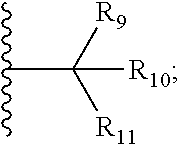
R9 and R10 are each independently selected from the group consisting of hydrogen, optionally substituted alkyl, optionally substituted cycloalkyl, optionally substituted hydroxyalkyl, optionally substituted heteroaryl, and haloalkyl; or R9, R10 and the carbon atom to which they are attached form an optionally substituted cycloalkyl; R11 is selected from the group consisting of optionally substituted heterocyclic, optionally substituted alkoxy, optionally substituted heteroaryl, optionally substituted aryl,

R12 is selected from the group consisting of H and optionally substituted alkyl; R13 is selected from the group consisting of H, optionally substituted alkyl, optionally substituted alkylcarbonyl, optionally substituted (cycloalkyl)alkylcarbonyl, optionally substituted aralkylcarbonyl, optionally substituted arylcarbonyl, optionally substituted (heterocyclyl)carbonyl, and optionally substituted aralkyl; R14a and R14b are each independently selected from the group consisting of H, haloalkyl, and optionally substituted alkyl; W5 is selected from the group consisting of phenyl and a 5-10 membered heteroaryl, R15 is selected from the group consisting of H, halogen, CN, OH, NO2, NR14aR14b, OR14a, C(═O)NR14aR14b, NR14aC(═O)R14b, S(═O)2NR14aR14b, NR14a S(═O)2R14b, optionally substituted alkyl, optionally substituted haloalkyl, optionally substituted haloalkoxy; aryl, heteroaryl, cycloalkyl, and cycloheteroalkyl; each R16 is independently selected from the group consisting of halo, optionally substituted alkyl, optionally substituted haloalkyl, hydroxy, and optionally substituted haloalkoxy; o is 0, 1, 2, 3, or 4; each R18 is independently selected from the group consisting of halo, optionally substituted alkoxy, cyano, optionally substituted alkyl, haloalkyl, haloalkoxy and a linker; and p is 0, 1, 2, 3, or 4 or a pharmaceutically acceptable salt, stereoisomer, solvate, polymorph or prodrug thereof.

wherein R1′ is —OH; R2′ is a —NH—CH2-Aryl-HET; R3′ is selected from the group consisting of optionally substituted alkyl, —(CH)RCR3′—NH—C(═O)—R3P1 and —(CH)RCR3′—R3P2; RCR3′ is optionally substituted C1-C4 alkyl; R3P1 is selected from the group consisting of optionally substituted C1-C6 alkyl, optionally substituted oxetane, —(CH2)nOCH3 wherein n is 1 or 2, optionally substituted phenyl, and morpholino linked to the carbonyl at the 2- or 3-position; R3P2 is selected from the group consisting of

and optionally substituted aryl; HET is selected from the group consisting of optionally substituted thiazole, oxazole, isoxazole and isothiazole; RHET is selected from the group consisting of H, halo, CN, optionally substituted C1-C6 alkyl, optionally substituted C1-C6 alkoxy, and optionally substituted aryl; and the ULM group is covalently bonded to a linker group to which is attached a PTM group, or a pharmaceutically acceptable salt, stereoisomer, solvate or polymorph thereof.


wherein the ULM group is covalently bonded to the L group to which is attached the PTM group, or a pharmaceutically acceptable salt, stereoisomer, solvate, polymorph or prodrug thereof.


or a pharmaceutically acceptable salt, enantiomer, diasteromer, solvate, polymorph or prodrug thereof.

on the degradation of estrogen related receptor alpha (ERRα).

as the ERRα ligand.

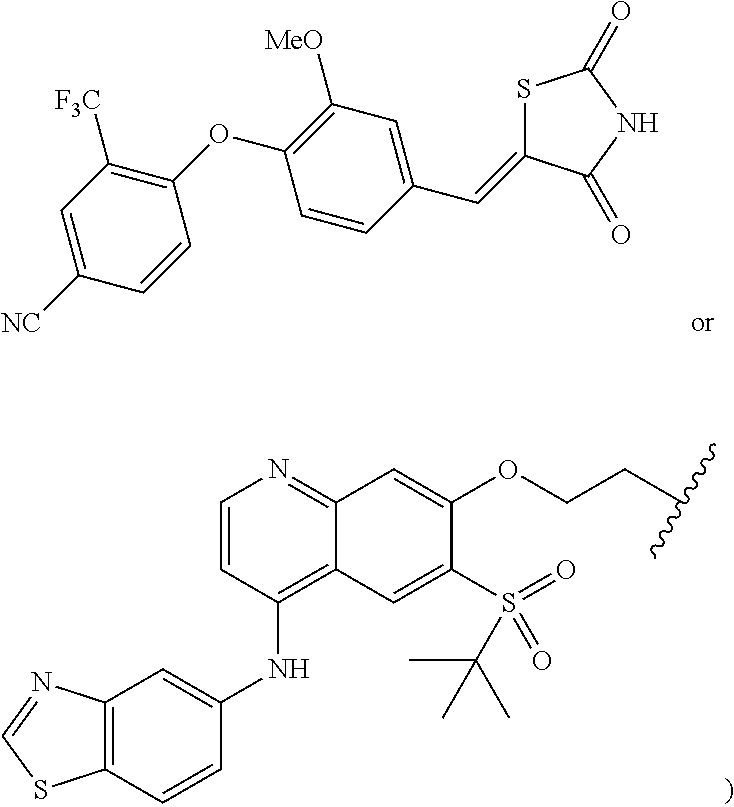
according to the general structure: ULM-L-PTM, wherein:
ULM is an ubiquitin ligase binding moiety (in certain embodiments a ligand), which binds an ubiquitin ligase [in certain embodiments an E3 ubiquitin ligase (e.g., VHL)];
PTM is a chemical moiety (protein targeting moiety) (e.g., derivatized

which binds to a target protein (e.g., estrogen related receptor alpha (ERRα) or RIPK2, respectively) or polypeptide, which is ubiquitinated by an ubiquitin ligase and is chemically linked directly to the ULM group or through a linker moiety L, or
PTM is alternatively a ULM′ group that is also an ubiquitin ligase binding moiety, which may be the same or different than the ULM group and is linked directly to the ULM group directly or through the linker moiety; and
L is a linker moiety that may be present or absent and chemically (covalently) links ULM to PTM, or a pharmaceutically acceptable salt, enantiomer, stereoisomer, solvate or polymorph thereof.


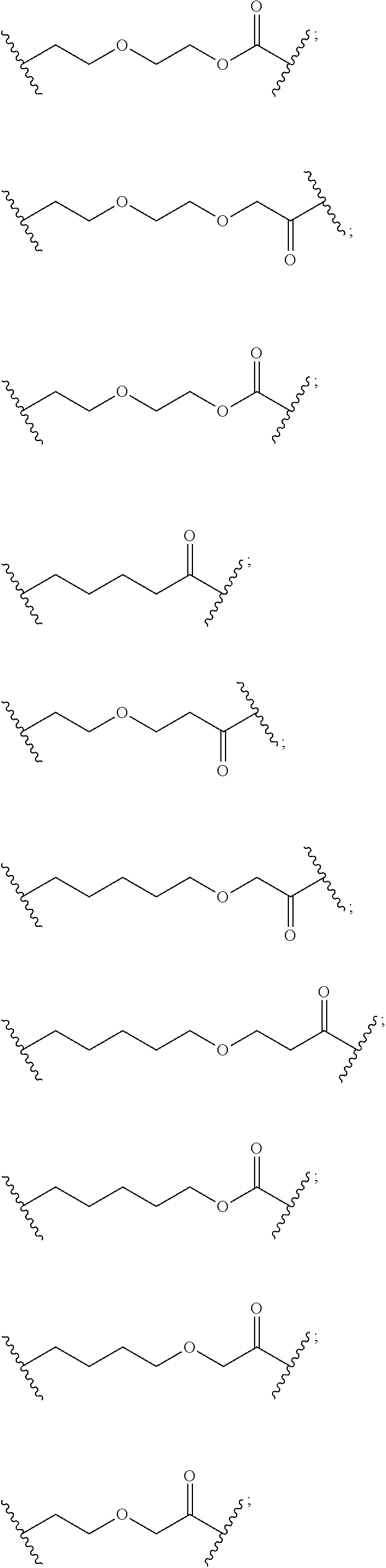


wherein a dashed line indicates the attachment of at least one PTM, another ULM or VLM (i.e., ULM′ or VLM′), or a chemical linker moiety coupling at least one PTM, a ULM′ or VLM′ to the other end of the linker;


where RPRO is H, optionally substituted C1-C6 alkyl or an optionally substituted aryl (phenyl or napthyl), heteroaryl or heterocyclic group selected from the group consisting of oxazole, isoxazole, thiazole, isothiazole, imidazole, diazole, oximidazole, pyrrole, pyrollidine, furan, dihydrofuran, tetrahydrofuran, thiene, dihydrothiene, tetrahydrothiene, pyridine, piperidine, piperazine, morpholine, quinolone, benzofuran, indole, indolizine, azaindolizine (each in certain embodiments substituted with a C1-C3 alkyl group, in certain embodiments methyl or a halo group, in certain embodiments F or Cl);

wherein Sc is CHRSS, NRURE, or O;

is a

group, where RPRO and n are the same as above.

where Sc is CHRSS, NRURE, or O;

in certain embodiments,

wherein RPRO is H, optionally substituted C1-C6 alkyl or an optionally substituted aryl, heteroaryl or heterocyclic group; RPRO1 and RPRO2 are each independently H, an optionally substituted C1-C3 alkyl group or together form a keto group; and each n is independently 0, 1, 2, 3, 4, 5, or 6 (often 0 or 1), each of which groups may be optionally substituted with a linker group to which is attached a PTM group (including a ULM′ group). In additional embodiments, W4 substituents for use in the present invention also include specifically (and without limitation to the specific compound disclosed) the W4 substituents that are found in the identified compounds disclosed herein (which includes the specific compounds which are disclosed in the present specification, and the figures which are attached hereto). Each of these W4 substituents may be used in conjunction with any number of W3 substituents which are also disclosed herein.

wherein W3 is optionally substituted aryl, optionally substituted heteroaryl, or

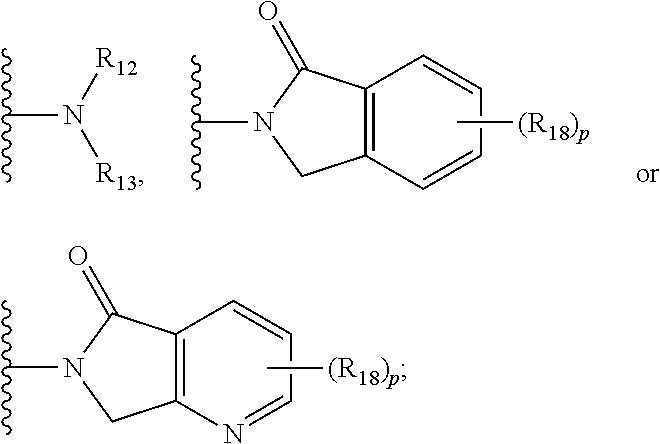

wherein R17 is H, halo, optionally substituted C3-6 cycloalkyl, optionally substituted C1-6 alkyl, optionally substituted C1-6 alkenyl, and C1-6 haloalkyl; and Xa is S or O.


wherein:


attached to the linker moiety at the position indicated.

wherein W1 is aryl or heteroaryl, independently substituted by 1 or more halo, hydroxyl, nitro, CN, C≡CH, C1-6 alkyl (linear, branched, optionally substituted by 1 or more halo, C1-6 alkoxyl), C1-6 alkoxyl (linear, branched, optionally substituted by 1 or more halo), C2-6 alkenyl, C2-6 alkynyl;


| Time | Flow Rate | ||||
| (minutes) | (mL/min) | % | % B | ||
| 0 | 1 | 97 | 3 | ||
| 1.5 | 1 | 0 | 100 | ||
| 1.9 | 1 | 0 | 100 | ||
| 2.0 | 1 | 97 | 3 | ||
| Time | Flow Rate | ||||
| (minutes) | (mL/min) | % | % B | ||
| 0 | 40 | 99 | 1 | ||
| 1 | 40 | 99 | 1 | ||
| 10 | 40 | 70 | 30 | ||
| 11 | 40 | 1 | 99 | ||
| 15 | 40 | 1 | 99 | ||
| Time | Flow Rate | ||||
| (minutes) | (mL/min) | % | % B | ||
| 0 | 40 | 85 | 15 | ||
| 1 | 40 | 85 | 15 | ||
| 10 | 40 | 45 | 55 | ||
| 11 | 40 | 1 | 99 | ||
| 15 | 40 | 1 | 99 | ||
| Time | Flow Rate | ||||
| (minutes) | (mL/min) | % | % B | ||
| 0 | 40 | 70 | 30 | ||
| 1 | 40 | 70 | 30 | ||
| 10 | 40 | 15 | 85 | ||
| 11 | 40 | 1 | 99 | ||
| 15 | 40 | 1 | 99 | ||
| Time | Flow Rate | ||||
| (minutes) | (mL/min) | % | % B | ||
| 0 | 40 | 50 | 50 | ||
| 1 | 40 | 50 | 50 | ||
| 10 | 40 | 1 | 99 | ||
| 11 | 40 | 1 | 99 | ||
| 15 | 40 | 1 | 99 | ||
| Time | Flow Rate | ||||
| (minutes) | (mL/min) | % | % B | ||
| 0 | 40 | 20 | 80 | ||
| 1 | 40 | 20 | 80 | ||
| 10 | 40 | 1 | 99 | ||
| 11 | 40 | 1 | 99 | ||
| 15 | 40 | 1 | 99 | ||


| Name | Structure | Yield | RT | [M + H]+ |
| tert-butyl ((S)-1-((2S,4R)-4- hydroxy-2-((4-(4- methylthiazol-5- yl)benzyl)carbamoyl)pyrrolidin- 1-yl)-3,3-dimethyl-1-oxobutan- 2-yl)carbamate |
 |
85% | 0.94 min | 531 |


| Name | Structure | Yield | RT | M + H]+ |
| (S)-3- methyl-2- (1-oxoiso- indolin-2- yl)butanoic acid |
 |
59% | 0.74 min | 234 |


| ID | Compound Structure | A | B | C | D |
| ARV N000020 |
 |
98.0 | 0.030 | ||
| ARV N000198 |
 |
90.0 | 0.20 | ||
| ARV N000199 |
 |
90.0 | 0.20 | ||
| ARV N000200 |
 |
80.0 | 2.0 | ||
| ARV N000201 |
 |
90.0 | 2.0 | ||
| ARV N000203 |
 |
40.0 | 2.0 | ||
| ARV N000219 |
 |
98.0 | 0.30 | ||
| ARV N000220 |
 |
85.0 | 0.70 | ||
| ARV N000221 |
 |
90.0 | 0.70 | ||
| ARV N000222 |
 |
90.0 | 0.20 | ||
| ARV N000223 |
 |
80.0 | 0.30 | ||
| ARV N000224 |
 |
90.0 | 0.70 | ||
| ARV N000231 |
 |
98.0 | 0.20 | ||
| ARV N000232 |
 |
60.0 | 2.0 | ||
| ARV N000233 |
 |
60.0 | 0.50 | ||
| ARV N000234 |
 |
98.0 | 0.030 | ||
| ARV N000235 |
 |
95.0 | 0.10 | ||
| ARV N000236 |
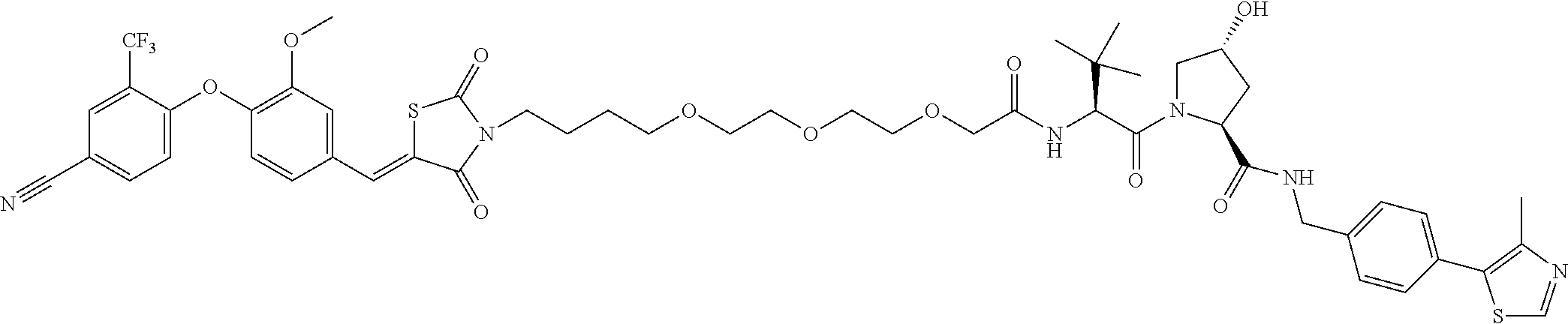 |
90.0 | 0.70 | ||
| ARV N000244 |
 |
80.0 | 0.70 | ||
| ARV N000245 |
 |
40.0 | 1.0 | ||
| ARV N000246 |
 |
90.0 | 0.30 | ||
| ARV N000265 |
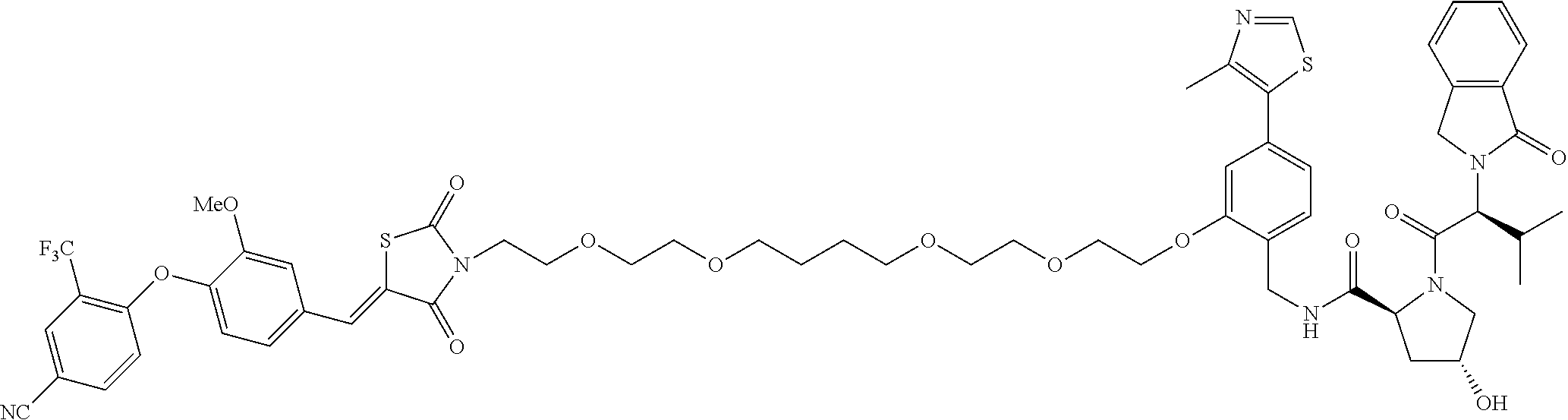 |
80.0 | 0.20 | ||
| ARV N000266 |
 |
50.0 | 0.50 | ||
| ARV N000267 |
 |
80.0 | 0.50 | ||
| ARV N000381 |
 |
98.0 | 0.030 | ||
| ARV N000382 |
 |
98.0 | 0.030 | ||
| ARV N000413 |
 |
98.0 | 0.070 | ||
| ARV N000383 |
 |
98.0 | 0.20 | ||
| ARV N000414 |
 |
98.0 | 0.070 | ||
Claims (9)
ULM-L-PTM,


Priority Applications (1)
| Application Number | Priority Date | Filing Date | Title |
|---|---|---|---|
| US14/822,309 US10071164B2 (en) | 2014-08-11 | 2015-08-10 | Estrogen-related receptor alpha based protac compounds and associated methods of use |
Applications Claiming Priority (2)
| Application Number | Priority Date | Filing Date | Title |
|---|---|---|---|
| US201462036000P | 2014-08-11 | 2014-08-11 | |
| US14/822,309 US10071164B2 (en) | 2014-08-11 | 2015-08-10 | Estrogen-related receptor alpha based protac compounds and associated methods of use |
Publications (2)
| Publication Number | Publication Date |
|---|---|
| US20160045607A1 US20160045607A1 (en) | 2016-02-18 |
| US10071164B2 true US10071164B2 (en) | 2018-09-11 |
Family
ID=54106107
Family Applications (1)
| Application Number | Title | Priority Date | Filing Date |
|---|---|---|---|
| US14/822,309 Active US10071164B2 (en) | 2014-08-11 | 2015-08-10 | Estrogen-related receptor alpha based protac compounds and associated methods of use |
Country Status (2)
| Country | Link |
|---|---|
| US (1) | US10071164B2 (en) |
| EP (1) | EP2985285A1 (en) |
Cited By (6)
| Publication number | Priority date | Publication date | Assignee | Title |
|---|---|---|---|---|
| US20140356322A1 (en) * | 2012-01-12 | 2014-12-04 | Yale University | Compounds & Methods for the Enhanced Degradation of Targeted Proteins & Other Polypeptides by an E3 Ubiquitin Ligase |
| US11883393B2 (en) | 2019-12-19 | 2024-01-30 | Arvinas Operations, Inc. | Compounds and methods for the targeted degradation of androgen receptor |
| WO2024050016A1 (en) | 2022-08-31 | 2024-03-07 | Oerth Bio Llc | Compositions and methods for targeted inhibition and degradation of proteins in an insect cell |
| US12059413B2 (en) | 2016-11-02 | 2024-08-13 | The Research Foundation For The State University Of New York | Methods of inhibiting viruses using compositions targeting TSG101-ubiquitin interaction |
| WO2025049555A1 (en) | 2023-08-31 | 2025-03-06 | Oerth Bio Llc | Compositions and methods for targeted inhibition and degradation of proteins in an insect cell |
| US12441708B2 (en) | 2017-01-31 | 2025-10-14 | Arvinas Operations, Inc. | Cereblon ligands and bifunctional compounds comprising the same |
Families Citing this family (137)
| Publication number | Priority date | Publication date | Assignee | Title |
|---|---|---|---|---|
| GB201311888D0 (en) | 2013-07-03 | 2013-08-14 | Glaxosmithkline Ip Dev Ltd | Novel compounds |
| GB201311891D0 (en) | 2013-07-03 | 2013-08-14 | Glaxosmithkline Ip Dev Ltd | Novel compound |
| US20180228907A1 (en) | 2014-04-14 | 2018-08-16 | Arvinas, Inc. | Cereblon ligands and bifunctional compounds comprising the same |
| EP3139942B1 (en) | 2014-05-05 | 2019-12-18 | Bioventures, Llc | COMPOSITIONS AND METHODS FOR INHIBITING ANTIAPOPTOTIC Bcl-2 PROTEINS AS ANTI-AGING AGENTS |
| WO2016014625A1 (en) | 2014-07-22 | 2016-01-28 | Board Of Trustees Of The University Of Arkansas | Compositions and methods for selectively depleting senescent cells |
| US9694084B2 (en) | 2014-12-23 | 2017-07-04 | Dana-Farber Cancer Institute, Inc. | Methods to induce targeted protein degradation through bifunctional molecules |
| WO2016105518A1 (en) | 2014-12-23 | 2016-06-30 | Dana-Farber Cancer Institute, Inc. | Methods to induce targeted protein degradation through bifunctional molecules |
| JP6817962B2 (en) * | 2015-01-20 | 2021-01-20 | アルビナス・オペレーションズ・インコーポレイテッドArvinas Operations, Inc. | Compounds and methods for targeted androgen receptor degradation |
| US12312316B2 (en) | 2015-01-20 | 2025-05-27 | Arvinas Operations, Inc. | Compounds and methods for the targeted degradation of androgen receptor |
| EP3270917A4 (en) * | 2015-03-18 | 2018-08-08 | Arvinas, Inc. | Compounds and methods for the enhanced degradation of targeted proteins |
| WO2016197114A1 (en) * | 2015-06-05 | 2016-12-08 | Arvinas, Inc. | Tank-binding kinase-1 protacs and associated methods of use |
| WO2017007612A1 (en) | 2015-07-07 | 2017-01-12 | Dana-Farber Cancer Institute, Inc. | Methods to induce targeted protein degradation through bifunctional molecules |
| EP3319944A4 (en) | 2015-07-10 | 2019-04-24 | Arvinas, Inc. | MDM2-BASED PROTEASE MODULATORS AND METHODS OF USE THEREOF |
| WO2017024318A1 (en) | 2015-08-06 | 2017-02-09 | Dana-Farber Cancer Institute, Inc. | Targeted protein degradation to attenuate adoptive t-cell therapy associated adverse inflammatory responses |
| US10772962B2 (en) | 2015-08-19 | 2020-09-15 | Arvinas Operations, Inc. | Compounds and methods for the targeted degradation of bromodomain-containing proteins |
| BR112018008918A8 (en) | 2015-11-02 | 2019-02-26 | Univ Yale | directed proteolysis chimera compounds and methods for their preparation and use |
| US20170281784A1 (en) * | 2016-04-05 | 2017-10-05 | Arvinas, Inc. | Protein-protein interaction inducing technology |
| CN109152933B (en) | 2016-04-21 | 2022-12-02 | 生物风险投资有限责任公司 | Compounds that induce degradation of anti-apoptotic BCL-2 family proteins and uses thereof |
| AU2017254713C1 (en) | 2016-04-22 | 2021-04-29 | Dana-Farber Cancer Institute, Inc. | Bifunctional molecules for degradation of EGFR and methods of use |
| US10865205B2 (en) * | 2016-04-22 | 2020-12-15 | Dana-Farber Cancer Institute, Inc. | Degradation of cyclin-dependent kinase 8 (CDK8) by conjugation of CDK8 inhibitors with E3 ligase ligand and methods of use |
| CA3018429A1 (en) * | 2016-04-22 | 2017-10-26 | Dana-Farber Cancer Institute, Inc. | Degradation of cyclin-dependent kinase 9 (cdk9) by conjugation of cdk9 inhibitors with e3 ligase ligand and methods of use |
| EP3454856B1 (en) | 2016-05-10 | 2024-09-11 | C4 Therapeutics, Inc. | Heterocyclic degronimers for target protein degradation |
| CN109790143A (en) | 2016-05-10 | 2019-05-21 | C4医药公司 | The C of amine connection for target protein degradation3Glutarimide degron body |
| ES2990061T3 (en) | 2016-05-10 | 2024-11-28 | C4 Therapeutics Inc | Spirocyclic degronimers for the degradation of target proteins |
| CN109641874A (en) | 2016-05-10 | 2019-04-16 | C4医药公司 | C for target protein degradation3The glutarimide degron body of carbon connection |
| CN118436801A (en) * | 2016-05-20 | 2024-08-06 | 豪夫迈·罗氏有限公司 | PROTAC antibody conjugates and methods of use thereof |
| GB201610156D0 (en) | 2016-06-10 | 2016-07-27 | Otsuka Pharma Co Ltd | Cliptac compositions |
| WO2018033135A1 (en) | 2016-08-19 | 2018-02-22 | Beigene, Ltd. | Use of a combination comprising a btk inhibitor for treating cancers |
| GB2554071A (en) | 2016-09-14 | 2018-03-28 | Univ Dundee | Small molecules |
| US20180072711A1 (en) * | 2016-09-15 | 2018-03-15 | Arvinas, Inc. | Indole derivatives as estrogen receptor degraders |
| WO2018064589A1 (en) | 2016-09-29 | 2018-04-05 | Dana-Farber Cancer Institute, Inc. | Targeted protein degradation using a mutant e3 ubiquitin ligase |
| CN110506039A (en) | 2016-10-11 | 2019-11-26 | 阿尔维纳斯股份有限公司 | Compounds and methods for targeted degradation of androgen receptor |
| MX2019005007A (en) | 2016-11-01 | 2019-07-18 | Arvinas Inc | PROTAC TARGETED AT TAU PROTEIN AND ASSOCIATED METHODS OF USE. |
| BR112019011200B1 (en) * | 2016-12-01 | 2021-12-28 | Arvinas Operations, Inc | TETRAHYDRONAPPHTALENE AND TETRAHYDROISOQUINOLINE DERIVATIVES AS ESTROGEN RECEPTOR DEGRADATORS |
| JP2020505327A (en) | 2016-12-23 | 2020-02-20 | アルビナス・オペレーションズ・インコーポレイテッドArvinas Operations, Inc. | EGFR proteolytic targeting chimeric molecules and related methods of use |
| US11173211B2 (en) | 2016-12-23 | 2021-11-16 | Arvinas Operations, Inc. | Compounds and methods for the targeted degradation of rapidly accelerated Fibrosarcoma polypeptides |
| US10806737B2 (en) | 2016-12-23 | 2020-10-20 | Arvinas Operations, Inc. | Compounds and methods for the targeted degradation of fetal liver kinase polypeptides |
| KR20250117470A (en) | 2016-12-23 | 2025-08-04 | 아비나스 오퍼레이션스, 인코포레이티드 | Compounds and methods for the targeted degradation of rapidly accelerated fibrosarcoma polypeptides |
| US11191741B2 (en) | 2016-12-24 | 2021-12-07 | Arvinas Operations, Inc. | Compounds and methods for the targeted degradation of enhancer of zeste homolog 2 polypeptide |
| BR112019015312A2 (en) * | 2017-01-26 | 2020-03-10 | Arvinas Operations, Inc. | MODULATORS OF PROTEOLYSIS BY THE ESTROGEN RECEPTOR AND ASSOCIATED METHODS OF USE |
| JP7227912B2 (en) | 2017-02-08 | 2023-02-24 | ダナ-ファーバー キャンサー インスティテュート,インコーポレイテッド | Regulation of chimeric antigen receptors |
| CN107058503A (en) * | 2017-02-15 | 2017-08-18 | 复旦大学附属华山医院北院 | Estrogen-related receptor α as the diagnostic marker of cutaneous squamous cell carcinoma purposes and its related application |
| AU2018258581A1 (en) | 2017-04-28 | 2019-11-07 | Quartz Therapeutics, Inc. | RAF-degrading conjugate compounds |
| CN110769822A (en) | 2017-06-20 | 2020-02-07 | C4医药公司 | N/O-linked degron and degron bodies for protein degradation |
| EP3645569A4 (en) | 2017-06-26 | 2021-03-24 | BeiGene, Ltd. | IMMUNOTHERAPY FOR HEPATOCELLULAR CARCINOMA |
| EP3658548A1 (en) * | 2017-07-28 | 2020-06-03 | Arvinas Operations, Inc. | Compounds and methods for the targeted degradation of androgen receptor |
| WO2019043208A1 (en) | 2017-09-04 | 2019-03-07 | F. Hoffmann-La Roche Ag | Dihydroquinolinones |
| CN118108706A (en) | 2017-09-04 | 2024-05-31 | C4医药公司 | Glutarimide |
| WO2019043217A1 (en) | 2017-09-04 | 2019-03-07 | F. Hoffmann-La Roche Ag | Dihydrobenzimidazolones |
| US11358948B2 (en) | 2017-09-22 | 2022-06-14 | Kymera Therapeutics, Inc. | CRBN ligands and uses thereof |
| WO2019060742A1 (en) | 2017-09-22 | 2019-03-28 | Kymera Therapeutics, Inc | Protein degraders and uses thereof |
| WO2019084026A1 (en) | 2017-10-24 | 2019-05-02 | Genentech, Inc. | (4-hydroxypyrrolidin-2-yl)-heterocyclic compounds and methods of use thereof |
| WO2019084030A1 (en) | 2017-10-24 | 2019-05-02 | Genentech, Inc. | (4-hydroxypyrrolidin-2-yl)-hydroxamate compounds and methods of use thereof |
| CN111372585A (en) | 2017-11-16 | 2020-07-03 | C4医药公司 | Degradants and degrons for target protein degradation |
| EP3710443A1 (en) | 2017-11-17 | 2020-09-23 | Arvinas Operations, Inc. | Compounds and methods for the targeted degradation of interleukin-1 receptor-associated kinase 4 polypeptides |
| WO2019108795A1 (en) | 2017-11-29 | 2019-06-06 | Beigene Switzerland Gmbh | Treatment of indolent or aggressive b-cell lymphomas using a combination comprising btk inhibitors |
| US10519152B2 (en) | 2017-12-21 | 2019-12-31 | Astrazeneca Ab | Compounds and their use in treating cancer |
| IL315310A (en) | 2017-12-26 | 2024-10-01 | Kymera Therapeutics Inc | IRAK joints and used in them |
| WO2019140387A1 (en) | 2018-01-12 | 2019-07-18 | Kymera Therapeutics, Inc. | Crbn ligands and uses thereof |
| WO2019140380A1 (en) | 2018-01-12 | 2019-07-18 | Kymera Therapeutics, Inc. | Protein degraders and uses thereof |
| ES3041854T3 (en) | 2018-01-22 | 2025-11-17 | Bioventures Llc | Bcl-2 proteins degraders for cancer treatment |
| WO2019148055A1 (en) | 2018-01-26 | 2019-08-01 | Yale University | Imide-based modulators of proteolysis and methods of use |
| WO2019183523A1 (en) | 2018-03-23 | 2019-09-26 | Genentech, Inc. | Hetero-bifunctional degrader compounds and their use as modulators of targeted ubiquination (vhl) |
| EP3773576A4 (en) | 2018-03-26 | 2021-12-29 | C4 Therapeutics, Inc. | Cereblon binders for the degradation of ikaros |
| US12539292B2 (en) | 2018-04-01 | 2026-02-03 | Arvinas Operations, Inc. | BRM targeting compounds and associated methods of use |
| WO2019195609A2 (en) | 2018-04-04 | 2019-10-10 | Arvinas Operations, Inc. | Modulators of proteolysis and associated methods of use |
| EP3781156A4 (en) | 2018-04-16 | 2022-05-18 | C4 Therapeutics, Inc. | SPIROCYCLIC COMPOUNDS |
| US12084423B2 (en) | 2018-05-18 | 2024-09-10 | Bioventures, Llc | Piperlongumine analogues and uses thereof |
| EP3578561A1 (en) | 2018-06-04 | 2019-12-11 | F. Hoffmann-La Roche AG | Spiro compounds |
| WO2020010227A1 (en) | 2018-07-06 | 2020-01-09 | Kymera Therapeutics, Inc. | Protein degraders and uses thereof |
| WO2020010177A1 (en) | 2018-07-06 | 2020-01-09 | Kymera Therapeutics, Inc. | Tricyclic crbn ligands and uses thereof |
| WO2020027225A1 (en) | 2018-07-31 | 2020-02-06 | ファイメクス株式会社 | Heterocyclic compound |
| JP7297053B2 (en) | 2018-08-20 | 2023-06-23 | アルビナス・オペレーションズ・インコーポレイテッド | Alpha-Synuclein Protein-Targeted Proteolysis Targeting Chimeric (PROTAC) Compounds with E3 Ubiquitin Ligase Binding Activity to Treat Neurodegenerative Diseases |
| JP7708662B2 (en) | 2018-10-24 | 2025-07-15 | エフ・ホフマン-ラ・ロシュ・アクチェンゲゼルシャフト | Conjugated chemical degraders and methods of use |
| CN111233661B (en) * | 2018-11-29 | 2023-03-31 | 暨南大学 | Compound for targeted ubiquitination degradation of ERR alpha protein and medicinal composition and application thereof |
| CA3119773A1 (en) | 2018-11-30 | 2020-06-04 | Kymera Therapeutics, Inc. | Irak degraders and uses thereof |
| CN120698983A (en) | 2018-12-20 | 2025-09-26 | C4医药公司 | Targeted protein degradation |
| ES2995214T3 (en) | 2019-03-06 | 2025-02-07 | C4 Therapeutics Inc | Heterocyclic compounds for medical treatment |
| EP3941607A1 (en) | 2019-03-21 | 2022-01-26 | Codiak BioSciences, Inc. | Process for preparing extracellular vesicles |
| US20240108747A1 (en) | 2019-03-21 | 2024-04-04 | Lonza Sales Ag | Extracellular vesicle conjugates and uses thereof |
| CN120574283A (en) | 2019-04-05 | 2025-09-02 | 凯麦拉医疗公司 | STAT degraders and their uses |
| WO2020251972A1 (en) | 2019-06-10 | 2020-12-17 | Kymera Therapeutics, Inc. | Smarca degraders and uses thereof |
| PH12022500002A1 (en) | 2019-06-28 | 2023-04-03 | Kymera Therapeutics Inc | Irak degraders and uses thereof |
| EP3999182A1 (en) | 2019-07-17 | 2022-05-25 | Arvinas Operations, Inc. | Tau-protein targeting compounds and associated methods of use |
| WO2021011868A1 (en) | 2019-07-17 | 2021-01-21 | Kymera Therapeutics, Inc. | Irak degraders and uses thereof |
| WO2021026349A1 (en) | 2019-08-08 | 2021-02-11 | Institute For Cancer Research D/B/A The Research Institute Of Fox Chase Cancer Center | Combination therapy for treatment of cancer |
| CN112390852B (en) * | 2019-08-14 | 2022-10-18 | 上海济煜医药科技有限公司 | Compound as protein degradation agent and preparation method and application thereof |
| KR20220054347A (en) | 2019-08-26 | 2022-05-02 | 아비나스 오퍼레이션스, 인코포레이티드 | Method of treating breast cancer with tetrahydronaphthalene derivatives as estrogen receptor degraders |
| CN112457366B (en) * | 2019-09-06 | 2024-03-19 | 江西济民可信集团有限公司 | Paracyclic compounds as protein degradation agents and their preparation methods and applications |
| US20220288051A1 (en) * | 2019-09-12 | 2022-09-15 | Constantine S. Mitsiades | Methods for treating cancer using serial administration of e3 ubiquitin ligase degraders |
| CA3154386A1 (en) | 2019-10-17 | 2021-04-22 | Michael Berlin | Bifunctional molecules containing an e3 ubiquitine ligase binding moiety linked to a bcl6 targeting moiety |
| EP4048301B1 (en) | 2019-10-23 | 2024-09-18 | Stichting Het Nederlands Kanker Instituut- Antoni van Leeuwenhoek Ziekenhuis | Chimeric polypeptide for regulating immune cells |
| WO2021119159A1 (en) | 2019-12-10 | 2021-06-17 | Kymera Therapeutics, Inc. | Irak degraders and uses thereof |
| EP4076524A4 (en) | 2019-12-17 | 2023-11-29 | Kymera Therapeutics, Inc. | IRAQ DEGRADATION AGENTS AND THEIR USES |
| KR20220145325A (en) | 2019-12-17 | 2022-10-28 | 카이메라 쎄라퓨틱스 인코포레이티드 | IRAK disintegrants and uses thereof |
| KR20220119415A (en) | 2019-12-20 | 2022-08-29 | 씨4 테라퓨틱스, 인코포레이티드 | Isoindolinone and indazole compounds for EGFR degradation |
| EP4081308A4 (en) | 2019-12-23 | 2024-01-24 | Kymera Therapeutics, Inc. | SMARCA DEGRADERS AND USES THEREOF |
| TW202146412A (en) | 2020-03-05 | 2021-12-16 | 美商C4醫藥公司 | Compounds for targeted degradation of brd9 |
| KR20230005160A (en) | 2020-03-19 | 2023-01-09 | 카이메라 쎄라퓨틱스 인코포레이티드 | MDM2 degraders and uses thereof |
| EP4127216A4 (en) * | 2020-03-30 | 2025-08-06 | Cedars Sinai Medical Center | RIPK2 INHIBITION FOR CANCER TREATMENT |
| US20240270780A1 (en) * | 2020-04-29 | 2024-08-15 | Tai Bi Di Pharmaceutical Technology (Shijiazhuang) Co. Ltd | Proteolysis targeting compound with tissue targeting capability and use thereof |
| CR20220630A (en) | 2020-05-09 | 2023-01-23 | Arvinas Operations Inc | METHODS FOR MANUFACTURING A BIFUNCTIONAL COMPOUND, ULTRA-PURE FORMS OF THE BIFUNCTIONAL COMPOUND, AND DOSAGE FORMS COMPRISING THE SAME |
| GB202007106D0 (en) | 2020-05-14 | 2020-07-01 | Ucl Business Plc | Cyclosporine analogues |
| WO2021237100A1 (en) | 2020-05-21 | 2021-11-25 | Codiak Biosciences, Inc. | Methods of targeting extracellular vesicles to lung |
| CN113321700B (en) * | 2020-06-02 | 2022-07-01 | 泰比瑞医药科技(石家庄)有限公司 | Bifunctional compound for degrading target protein and application thereof |
| TW202210483A (en) | 2020-06-03 | 2022-03-16 | 美商凱麥拉醫療公司 | Crystalline forms of irak degraders |
| WO2022047145A1 (en) | 2020-08-28 | 2022-03-03 | Arvinas Operations, Inc. | Rapidly accelerating fibrosarcoma protein degrading compounds and associated methods of use |
| WO2022056368A1 (en) | 2020-09-14 | 2022-03-17 | Arvinas Operations, Inc. | Crystalline forms of a compound for the targeted degradation of estrogen receptor |
| WO2022066928A2 (en) | 2020-09-23 | 2022-03-31 | Codiak Biosciences, Inc. | Process for preparing extracellular vesicles |
| KR102412352B1 (en) * | 2020-11-17 | 2022-06-23 | 충남대학교산학협력단 | Pharmaceutical Composition for Treatment of Leukemia Comprising ERR-α Antagonist |
| EP4259144A4 (en) | 2020-12-09 | 2025-08-20 | Kymera Therapeutics Inc | SMARCA DECORATORS AND USES THEREOF |
| CN116867758A (en) | 2020-12-30 | 2023-10-10 | 凯麦拉医疗公司 | IRAK degraders and their uses |
| CN116438177B (en) * | 2021-01-28 | 2025-09-16 | 江苏亚虹医药科技股份有限公司 | Targeted chimeric compounds, pharmaceutical compositions containing same, and preparation methods and uses thereof |
| CN116847848A (en) | 2021-02-10 | 2023-10-03 | 百济神州有限公司 | EGFR degraders and methods of use |
| US12171768B2 (en) | 2021-02-15 | 2024-12-24 | Kymera Therapeutics, Inc. | IRAK4 degraders and uses thereof |
| KR20230171979A (en) | 2021-04-16 | 2023-12-21 | 아비나스 오퍼레이션스, 인코포레이티드 | Modulators of BCL6 protein degradation and related methods of use |
| KR20240020735A (en) | 2021-05-07 | 2024-02-15 | 카이메라 쎄라퓨틱스 인코포레이티드 | CDK2 degraders and their uses |
| MX2023014059A (en) | 2021-06-08 | 2024-03-12 | C4 Therapeutics Inc | THERAPEUTIC FOR THE DEGRADATION OF A MUTANT SERINE/THREONINE PROTEIN KINASE. |
| CN115109047B (en) * | 2021-09-08 | 2024-02-20 | 中国科学院化学研究所 | A ferroptosis inducer designed based on PROTAC |
| WO2023056069A1 (en) | 2021-09-30 | 2023-04-06 | Angiex, Inc. | Degrader-antibody conjugates and methods of using same |
| CA3236265A1 (en) | 2021-10-29 | 2023-05-04 | William Leong | Irak4 degraders and synthesis thereof |
| KR20240128831A (en) | 2021-12-30 | 2024-08-27 | 베이진 스위찰랜드 게엠베하 | Degradation and use of Bruton's tyrosine kinase (BTK) by conjugation of an inhibitor of BTK and an E3 ligase ligand |
| CA3243560A1 (en) | 2022-01-31 | 2023-08-03 | Kymera Therapeutics, Inc. | Irak degraders and uses thereof |
| WO2024054591A1 (en) | 2022-09-07 | 2024-03-14 | Arvinas Operations, Inc. | Rapidly accelerated fibrosarcoma (raf) degrading compounds and associated methods of use |
| WO2024073507A1 (en) | 2022-09-28 | 2024-04-04 | Theseus Pharmaceuticals, Inc. | Macrocyclic compounds and uses thereof |
| EP4428134A1 (en) | 2023-03-10 | 2024-09-11 | Dark Blue Therapeutics Ltd | Protac degraders of mllt1 and/or mllt3 |
| US12448399B2 (en) | 2023-01-26 | 2025-10-21 | Arvinas Operations, Inc. | Cereblon-based KRAS degrading PROTACs and uses related thereto |
| CN117603190A (en) * | 2023-03-31 | 2024-02-27 | 福建医科大学 | A compound based on CRBN ligand-induced ubiquitination and degradation of Hsp90α, its preparation method and its use in treating cancer |
| WO2024240858A1 (en) | 2023-05-23 | 2024-11-28 | Valerio Therapeutics | Protac molecules directed against dna damage repair system and uses thereof |
| EP4720071A1 (en) | 2023-05-31 | 2026-04-08 | Beone Medicines I GmbH | Compounds for the degradation of egfr kinase |
| GB202314126D0 (en) | 2023-09-15 | 2023-11-01 | Univ Oxford Innovation Ltd | Compound and method |
| TW202535392A (en) | 2023-12-08 | 2025-09-16 | 美商亞文納營運公司 | Use of androgen receptor degrader for the treatment of spinal and bulbar muscular atrophy |
| WO2025126115A1 (en) | 2023-12-13 | 2025-06-19 | Beigene Switzerland Gmbh | Degradation of irak4 by conjugation of irak4 inhibitors with e3 ligase ligands and methods of use |
| CN118702761B (en) * | 2024-05-30 | 2025-06-06 | 潍坊医学院附属医院 | PROTAC compound based on triptolide derivative, preparation method and application |
| WO2025262297A1 (en) | 2024-06-21 | 2025-12-26 | Dark Blue Therapeutics Ltd | Protac degraders of mllt1 and/or mllt3 |
| EP4667467A1 (en) | 2024-06-21 | 2025-12-24 | Dark Blue Therapeutics Ltd | Protac degraders of mllt1 and/or mllt3 |
| EP4667466A1 (en) | 2024-06-21 | 2025-12-24 | Dark Blue Therapeutics Ltd | Protac degraders of mllt1 and/or mllt3 |
Citations (60)
| Publication number | Priority date | Publication date | Assignee | Title |
|---|---|---|---|---|
| US4522811A (en) | 1982-07-08 | 1985-06-11 | Syntex (U.S.A.) Inc. | Serial injection of muramyldipeptides and liposomes enhances the anti-infective activity of muramyldipeptides |
| US5681858A (en) | 1993-04-07 | 1997-10-28 | Pfizer Inc. | Cycloalkyl hydroxyureas |
| EP0805147A1 (en) | 1996-05-03 | 1997-11-05 | Lilly Industries Limited | Novel N-substituted alpha aminoacid amides as calcium channel modulators |
| WO2000022110A2 (en) | 1998-10-09 | 2000-04-20 | President And Fellows Of Harvard College | Targeted proteolysis by recruitment to ubiquitin protein ligases |
| WO2000050445A1 (en) | 1999-02-26 | 2000-08-31 | Oklahoma Medical Research Foundation | Novel component of von hippel-lindau tumor suppressor complex and scf ubiquitin ligase |
| WO2000066119A1 (en) | 1999-05-05 | 2000-11-09 | Merck & Co., Inc. | Novel prolines as antimicrobial agents |
| WO2001075145A2 (en) | 2000-04-03 | 2001-10-11 | Rigel Pharmaceuticals, Inc. | Ubiquitin ligase assay |
| US6306663B1 (en) | 1999-02-12 | 2001-10-23 | Proteinex, Inc. | Controlling protein levels in eucaryotic organisms |
| WO2002022577A2 (en) | 2000-09-01 | 2002-03-21 | Novartis Ag | Hydroxamate derivatives useful as deacetylase inhibitors |
| WO2002100845A1 (en) | 2001-06-11 | 2002-12-19 | Agouron Pharmaceuticals, Inc. | Hv protease inhibitors, compositions containing the same, their pharmaceutical uses and materials for their synthesis |
| US7041298B2 (en) | 2000-09-08 | 2006-05-09 | California Institute Of Technology | Proteolysis targeting chimeric pharmaceutical |
| US20060128632A1 (en) | 2002-07-02 | 2006-06-15 | Sharma Sushil K | Peptide inhibitors of smac protein binding to inhibitor of apoptosis proteins (iap) |
| WO2006069063A1 (en) | 2004-12-20 | 2006-06-29 | Genentech, Inc. | Pyrrolidine inhibitors of iap |
| WO2006113942A2 (en) | 2005-04-20 | 2006-10-26 | Schering Corporation | Method of inhibiting cathepsin activity |
| US7208157B2 (en) | 2000-09-08 | 2007-04-24 | California Institute Of Technology | Proteolysis targeting chimeric pharmaceutical |
| WO2007106670A2 (en) | 2006-03-03 | 2007-09-20 | Novartis Ag | N-formyl hydroxylamine compounds |
| WO2008011392A8 (en) | 2006-07-20 | 2008-07-24 | Pharmacopeia Inc | Proline urea ccr1 antagonists for the treatment of autoimmune diseases or inflammation |
| WO2008109731A2 (en) | 2007-03-07 | 2008-09-12 | Jassen Pharmaceutica N.V. | Substituted phenoxy n-alkylated thiazoledinedione as estrogen related receptor-alpha modulators |
| WO2008109727A1 (en) | 2007-03-07 | 2008-09-12 | Janssen Pharmaceutica N.V. | Substituted phenoxy thiazolidinediones as estrogen related receptor-alpha modulators |
| WO2008134679A1 (en) | 2007-04-30 | 2008-11-06 | Genentech, Inc. | Inhibitors of iap |
| WO2009015254A1 (en) | 2007-07-25 | 2009-01-29 | Bristol-Myers Squibb Company | Triazine kinase inhibitors |
| US20100048517A1 (en) | 2004-07-08 | 2010-02-25 | Pfizer Inc | Androgen modulators |
| US7683160B2 (en) | 2005-08-30 | 2010-03-23 | Boehringer Ingelheim International Gmbh | Glucopyranosyl-substituted benzyl-benzene derivatives, medicaments containing such compounds, their use and process for their manufacture |
| WO2010107485A1 (en) | 2009-03-17 | 2010-09-23 | The Trustees Of Columbia University In The City Of New York | E3 ligase inhibitors |
| WO2010141805A1 (en) | 2009-06-05 | 2010-12-09 | Janssen Pharmaceutica Nv | Heterocyclic amides as modulators of trpa1 |
| WO2011008260A2 (en) | 2009-07-13 | 2011-01-20 | President And Fellows Of Harvard College | Bifunctional stapled polypeptides and uses thereof |
| WO2011143660A2 (en) | 2010-05-14 | 2011-11-17 | Dana-Farber Cancer Institute, Inc. | Compositions and methods for treating leukemia |
| WO2011160016A2 (en) | 2010-06-17 | 2011-12-22 | The Trustees Of Columbia University In The City Of New York | E3 binding pockets and identification and use of e3 ligase inhibitors |
| WO2012003281A2 (en) | 2010-06-30 | 2012-01-05 | Brandeis University | Small-molecule-targeted protein degradation |
| WO2012009649A1 (en) | 2010-07-16 | 2012-01-19 | Anderson Gaweco | Mif inhibitors and their uses |
| WO2012040527A2 (en) | 2010-09-24 | 2012-03-29 | The Regents Of The University Of Michigan | Deubiquitinase inhibitors and methods for use of the same |
| WO2012054110A2 (en) | 2010-07-07 | 2012-04-26 | Ardelyx, Inc. | Compounds and methods for inhibiting phosphate transport |
| WO2012078559A2 (en) | 2010-12-07 | 2012-06-14 | Yale University | Small-molecule hydrophobic tagging of fusion proteins and induced degradation of same |
| WO2012142498A2 (en) | 2011-04-13 | 2012-10-18 | Innovimmune Biotherapeutics, Inc. | Mif inhibitors and their uses |
| WO2013106646A2 (en) | 2012-01-12 | 2013-07-18 | Yale University | Compounds and methods for the inhibition of vcb e3 ubiquitin ligase |
| WO2013106643A2 (en) | 2012-01-12 | 2013-07-18 | Yale University | Compounds & methods for the enhanced degradation of targeted proteins & other polypeptides by an e3 ubiquitin ligase |
| WO2013170147A1 (en) | 2012-05-11 | 2013-11-14 | Yale University | Compounds useful for promoting protein degradation and methods using same |
| WO2014011712A1 (en) | 2012-07-10 | 2014-01-16 | Bristol-Myers Squibb Company | Iap antagonists |
| WO2014025759A1 (en) | 2012-08-09 | 2014-02-13 | Bristol-Myers Squibb Company | Iap antagonists |
| WO2014047024A1 (en) | 2012-09-18 | 2014-03-27 | Bristol-Myers Squibb Company | Iap antagonists |
| WO2014055461A1 (en) | 2012-10-02 | 2014-04-10 | Bristol-Myers Squibb Company | Iap antagonists |
| WO2014108452A1 (en) | 2013-01-11 | 2014-07-17 | Glaxosmithkline Intellectual Property Development Limited | Proteolysis targeting chimeras (protacs) directed to the modulation of the estrogen receptor |
| WO2015000868A1 (en) | 2013-07-03 | 2015-01-08 | Glaxosmithkline Intellectual Property Development Limited | Novel compounds |
| WO2015000867A1 (en) | 2013-07-03 | 2015-01-08 | Glaxosmithkline Intellectual Property Development Limited | Benzothiophene derivatives as estrogen receptor inhibitors |
| WO2015006524A1 (en) | 2013-07-12 | 2015-01-15 | Bristol-Myers Squibb Company | Iap antagonists |
| US20150291562A1 (en) | 2014-04-14 | 2015-10-15 | Arvinas, Inc. | Imide-based modulators of proteolysis and associated methods of use |
| US20150344473A1 (en) | 2014-06-03 | 2015-12-03 | Gilead Sciences, Inc. | Tank-binding kinase inhibitor compounds |
| US20160022642A1 (en) | 2014-07-25 | 2016-01-28 | Yale University | Compounds Useful for Promoting Protein Degradation and Methods Using Same |
| US20160058872A1 (en) | 2014-04-14 | 2016-03-03 | Arvinas, Inc. | Imide-based modulators of proteolysis and associated methods of use |
| US20160214972A1 (en) | 2015-01-20 | 2016-07-28 | Arvinas, Inc. | Compounds and methods for the targeted degradation of androgen receptor |
| US20160272639A1 (en) | 2015-03-18 | 2016-09-22 | Arvinas, Inc. | Compounds and methods for the enhanced degradation of targeted proteins |
| WO2016146985A1 (en) | 2015-03-13 | 2016-09-22 | University Of Dundee | Derivatives of 1-[(cyclopentyl or 2-pyrrolidinyl)carbonylaminomethyl]-4-(1,3-thiazol-5-yl) benzene which are useful for the treatment of proliferative, autoimmune or inflammatory diseases |
| WO2016172134A2 (en) * | 2015-04-22 | 2016-10-27 | Glaxosmithkline Intellectual Property Development Limited | Novel compounds |
| WO2016197114A1 (en) | 2015-06-05 | 2016-12-08 | Arvinas, Inc. | Tank-binding kinase-1 protacs and associated methods of use |
| US20170008904A1 (en) | 2015-07-10 | 2017-01-12 | Arvinas, Inc. | Mdm2-based modulators of proteolysis and associated methods of use |
| WO2017011590A1 (en) | 2015-07-13 | 2017-01-19 | Arvinas, Inc. | Alanine-based modulators of proteolysis and associated methods of use |
| WO2017030814A1 (en) | 2015-08-19 | 2017-02-23 | Arvinas, Inc. | Compounds and methods for the targeted degradation of bromodomain-containing proteins |
| US20170121321A1 (en) | 2015-11-02 | 2017-05-04 | Yale University | Proteolysis Targeting Chimera Compounds and Methods of Preparing and Using Same |
| US20170281784A1 (en) | 2016-04-05 | 2017-10-05 | Arvinas, Inc. | Protein-protein interaction inducing technology |
| US20170327469A1 (en) | 2015-01-20 | 2017-11-16 | Arvinas, Inc. | Compounds and methods for the targeted degradation of androgen receptor |
-
2015
- 2015-08-10 US US14/822,309 patent/US10071164B2/en active Active
- 2015-08-11 EP EP15180508.2A patent/EP2985285A1/en not_active Withdrawn
Patent Citations (74)
| Publication number | Priority date | Publication date | Assignee | Title |
|---|---|---|---|---|
| US4522811A (en) | 1982-07-08 | 1985-06-11 | Syntex (U.S.A.) Inc. | Serial injection of muramyldipeptides and liposomes enhances the anti-infective activity of muramyldipeptides |
| US5681858A (en) | 1993-04-07 | 1997-10-28 | Pfizer Inc. | Cycloalkyl hydroxyureas |
| EP0805147A1 (en) | 1996-05-03 | 1997-11-05 | Lilly Industries Limited | Novel N-substituted alpha aminoacid amides as calcium channel modulators |
| WO2000022110A2 (en) | 1998-10-09 | 2000-04-20 | President And Fellows Of Harvard College | Targeted proteolysis by recruitment to ubiquitin protein ligases |
| US6306663B1 (en) | 1999-02-12 | 2001-10-23 | Proteinex, Inc. | Controlling protein levels in eucaryotic organisms |
| US7074620B2 (en) | 1999-02-12 | 2006-07-11 | Proteinix, Inc. | Controlling protein levels in eucaryotic organisms |
| US6559280B2 (en) | 1999-02-12 | 2003-05-06 | Proteinix, Inc. | Controlling protein levels in eucaryotic organisms |
| US7273920B2 (en) | 1999-02-12 | 2007-09-25 | Wellstat Biocatalysis, Llc | Controlling protein levels in eucaryotic organisms |
| WO2000050445A1 (en) | 1999-02-26 | 2000-08-31 | Oklahoma Medical Research Foundation | Novel component of von hippel-lindau tumor suppressor complex and scf ubiquitin ligase |
| WO2000066119A1 (en) | 1999-05-05 | 2000-11-09 | Merck & Co., Inc. | Novel prolines as antimicrobial agents |
| WO2001075145A2 (en) | 2000-04-03 | 2001-10-11 | Rigel Pharmaceuticals, Inc. | Ubiquitin ligase assay |
| WO2002022577A2 (en) | 2000-09-01 | 2002-03-21 | Novartis Ag | Hydroxamate derivatives useful as deacetylase inhibitors |
| US7041298B2 (en) | 2000-09-08 | 2006-05-09 | California Institute Of Technology | Proteolysis targeting chimeric pharmaceutical |
| US7208157B2 (en) | 2000-09-08 | 2007-04-24 | California Institute Of Technology | Proteolysis targeting chimeric pharmaceutical |
| WO2002100845A1 (en) | 2001-06-11 | 2002-12-19 | Agouron Pharmaceuticals, Inc. | Hv protease inhibitors, compositions containing the same, their pharmaceutical uses and materials for their synthesis |
| US20060128632A1 (en) | 2002-07-02 | 2006-06-15 | Sharma Sushil K | Peptide inhibitors of smac protein binding to inhibitor of apoptosis proteins (iap) |
| US20100048517A1 (en) | 2004-07-08 | 2010-02-25 | Pfizer Inc | Androgen modulators |
| WO2006069063A1 (en) | 2004-12-20 | 2006-06-29 | Genentech, Inc. | Pyrrolidine inhibitors of iap |
| WO2006113942A2 (en) | 2005-04-20 | 2006-10-26 | Schering Corporation | Method of inhibiting cathepsin activity |
| US7683160B2 (en) | 2005-08-30 | 2010-03-23 | Boehringer Ingelheim International Gmbh | Glucopyranosyl-substituted benzyl-benzene derivatives, medicaments containing such compounds, their use and process for their manufacture |
| WO2007106670A2 (en) | 2006-03-03 | 2007-09-20 | Novartis Ag | N-formyl hydroxylamine compounds |
| WO2008011392A8 (en) | 2006-07-20 | 2008-07-24 | Pharmacopeia Inc | Proline urea ccr1 antagonists for the treatment of autoimmune diseases or inflammation |
| WO2008109731A2 (en) | 2007-03-07 | 2008-09-12 | Jassen Pharmaceutica N.V. | Substituted phenoxy n-alkylated thiazoledinedione as estrogen related receptor-alpha modulators |
| WO2008109727A1 (en) | 2007-03-07 | 2008-09-12 | Janssen Pharmaceutica N.V. | Substituted phenoxy thiazolidinediones as estrogen related receptor-alpha modulators |
| WO2008134679A1 (en) | 2007-04-30 | 2008-11-06 | Genentech, Inc. | Inhibitors of iap |
| WO2009015254A1 (en) | 2007-07-25 | 2009-01-29 | Bristol-Myers Squibb Company | Triazine kinase inhibitors |
| WO2010107485A1 (en) | 2009-03-17 | 2010-09-23 | The Trustees Of Columbia University In The City Of New York | E3 ligase inhibitors |
| WO2010141805A1 (en) | 2009-06-05 | 2010-12-09 | Janssen Pharmaceutica Nv | Heterocyclic amides as modulators of trpa1 |
| US20120270800A1 (en) | 2009-07-13 | 2012-10-25 | President And Fellows Of Harvard College | Bifunctional stapled polypeptides and uses thereof |
| WO2011008260A2 (en) | 2009-07-13 | 2011-01-20 | President And Fellows Of Harvard College | Bifunctional stapled polypeptides and uses thereof |
| WO2011143660A2 (en) | 2010-05-14 | 2011-11-17 | Dana-Farber Cancer Institute, Inc. | Compositions and methods for treating leukemia |
| WO2011160016A2 (en) | 2010-06-17 | 2011-12-22 | The Trustees Of Columbia University In The City Of New York | E3 binding pockets and identification and use of e3 ligase inhibitors |
| WO2012003281A2 (en) | 2010-06-30 | 2012-01-05 | Brandeis University | Small-molecule-targeted protein degradation |
| WO2012054110A2 (en) | 2010-07-07 | 2012-04-26 | Ardelyx, Inc. | Compounds and methods for inhibiting phosphate transport |
| WO2012009649A1 (en) | 2010-07-16 | 2012-01-19 | Anderson Gaweco | Mif inhibitors and their uses |
| WO2012040527A2 (en) | 2010-09-24 | 2012-03-29 | The Regents Of The University Of Michigan | Deubiquitinase inhibitors and methods for use of the same |
| WO2012078559A2 (en) | 2010-12-07 | 2012-06-14 | Yale University | Small-molecule hydrophobic tagging of fusion proteins and induced degradation of same |
| US20140302523A1 (en) | 2010-12-07 | 2014-10-09 | Yale University | Small-Molecule Hydrophobic Tagging of Fusion Proteins and Induced Degradation of Same |
| US9500653B2 (en) | 2010-12-07 | 2016-11-22 | Yale University | Small-molecule hydrophobic tagging of fusion proteins and induced degradation of same |
| US9632089B2 (en) | 2010-12-07 | 2017-04-25 | Yale University | Small-molecule hydrophobic tagging of fusion proteins and induced degradation of same |
| US20170307614A1 (en) | 2010-12-07 | 2017-10-26 | Yale University | Small-Molecule Hydrophobic Tagging of Fusion Proteins and Induced Degradation of Same |
| WO2012142498A2 (en) | 2011-04-13 | 2012-10-18 | Innovimmune Biotherapeutics, Inc. | Mif inhibitors and their uses |
| WO2013106646A2 (en) | 2012-01-12 | 2013-07-18 | Yale University | Compounds and methods for the inhibition of vcb e3 ubiquitin ligase |
| WO2013106643A2 (en) | 2012-01-12 | 2013-07-18 | Yale University | Compounds & methods for the enhanced degradation of targeted proteins & other polypeptides by an e3 ubiquitin ligase |
| US20140356322A1 (en) | 2012-01-12 | 2014-12-04 | Yale University | Compounds & Methods for the Enhanced Degradation of Targeted Proteins & Other Polypeptides by an E3 Ubiquitin Ligase |
| WO2013170147A1 (en) | 2012-05-11 | 2013-11-14 | Yale University | Compounds useful for promoting protein degradation and methods using same |
| WO2014011712A1 (en) | 2012-07-10 | 2014-01-16 | Bristol-Myers Squibb Company | Iap antagonists |
| WO2014025759A1 (en) | 2012-08-09 | 2014-02-13 | Bristol-Myers Squibb Company | Iap antagonists |
| WO2014047024A1 (en) | 2012-09-18 | 2014-03-27 | Bristol-Myers Squibb Company | Iap antagonists |
| WO2014055461A1 (en) | 2012-10-02 | 2014-04-10 | Bristol-Myers Squibb Company | Iap antagonists |
| WO2014108452A1 (en) | 2013-01-11 | 2014-07-17 | Glaxosmithkline Intellectual Property Development Limited | Proteolysis targeting chimeras (protacs) directed to the modulation of the estrogen receptor |
| US20160136230A1 (en) | 2013-07-03 | 2016-05-19 | Glaxosmithkline Intellectual Property Development Limited | Novel compounds |
| WO2015000867A1 (en) | 2013-07-03 | 2015-01-08 | Glaxosmithkline Intellectual Property Development Limited | Benzothiophene derivatives as estrogen receptor inhibitors |
| WO2015000868A1 (en) | 2013-07-03 | 2015-01-08 | Glaxosmithkline Intellectual Property Development Limited | Novel compounds |
| US20160368911A1 (en) | 2013-07-03 | 2016-12-22 | Glaxosmithkline Intellectual Property Development Limited | Benzothiophene derivatives as estrogen receptor inhibitors |
| WO2015006524A1 (en) | 2013-07-12 | 2015-01-15 | Bristol-Myers Squibb Company | Iap antagonists |
| US20160058872A1 (en) | 2014-04-14 | 2016-03-03 | Arvinas, Inc. | Imide-based modulators of proteolysis and associated methods of use |
| US20150291562A1 (en) | 2014-04-14 | 2015-10-15 | Arvinas, Inc. | Imide-based modulators of proteolysis and associated methods of use |
| US20150344473A1 (en) | 2014-06-03 | 2015-12-03 | Gilead Sciences, Inc. | Tank-binding kinase inhibitor compounds |
| US20160022642A1 (en) | 2014-07-25 | 2016-01-28 | Yale University | Compounds Useful for Promoting Protein Degradation and Methods Using Same |
| US20160214972A1 (en) | 2015-01-20 | 2016-07-28 | Arvinas, Inc. | Compounds and methods for the targeted degradation of androgen receptor |
| US20170327469A1 (en) | 2015-01-20 | 2017-11-16 | Arvinas, Inc. | Compounds and methods for the targeted degradation of androgen receptor |
| WO2016146985A1 (en) | 2015-03-13 | 2016-09-22 | University Of Dundee | Derivatives of 1-[(cyclopentyl or 2-pyrrolidinyl)carbonylaminomethyl]-4-(1,3-thiazol-5-yl) benzene which are useful for the treatment of proliferative, autoimmune or inflammatory diseases |
| US20160272639A1 (en) | 2015-03-18 | 2016-09-22 | Arvinas, Inc. | Compounds and methods for the enhanced degradation of targeted proteins |
| WO2016172134A2 (en) * | 2015-04-22 | 2016-10-27 | Glaxosmithkline Intellectual Property Development Limited | Novel compounds |
| WO2016197114A1 (en) | 2015-06-05 | 2016-12-08 | Arvinas, Inc. | Tank-binding kinase-1 protacs and associated methods of use |
| US20170008904A1 (en) | 2015-07-10 | 2017-01-12 | Arvinas, Inc. | Mdm2-based modulators of proteolysis and associated methods of use |
| WO2017011590A1 (en) | 2015-07-13 | 2017-01-19 | Arvinas, Inc. | Alanine-based modulators of proteolysis and associated methods of use |
| US20170037004A1 (en) | 2015-07-13 | 2017-02-09 | Arvinas, Inc. | Alanine-based modulators of proteolysis and associated methods of use |
| WO2017030814A1 (en) | 2015-08-19 | 2017-02-23 | Arvinas, Inc. | Compounds and methods for the targeted degradation of bromodomain-containing proteins |
| US20170065719A1 (en) | 2015-08-19 | 2017-03-09 | Arvinas, Inc. | Compounds and methods for the targeted degradation of bromodomain-containing proteins |
| US20170121321A1 (en) | 2015-11-02 | 2017-05-04 | Yale University | Proteolysis Targeting Chimera Compounds and Methods of Preparing and Using Same |
| WO2017079267A1 (en) | 2015-11-02 | 2017-05-11 | Yale University | Proteolysis targeting chimera compounds and methods of preparing and using same |
| US20170281784A1 (en) | 2016-04-05 | 2017-10-05 | Arvinas, Inc. | Protein-protein interaction inducing technology |
Non-Patent Citations (52)
| Title |
|---|
| Aghajanyy, et al., "Chemical genetics screen for enhancers of rapamycin identifies a specific inhibitor of an SCF family E3 ubiquitin ligase", Nature Biotechnology 28(7), Jun. 27, 2010, 738-742. |
| Ahn, et al., HIF-1alpha peptide derivatives with modifications at the hydroxyproline residue as activators of HIF-1alpha, Bioorg Med Chem Lett. 19(15), 2009, 4403-4405. |
| Boitano, et al., "Aryl Hydrocarbon Receptor Antagonists Promote the Expansion of Human Hematopoietic Stem Cells", Science 329, Sep. 10, 2010, 1345-1348. |
| Bondenson et al. "Catalytic in vivo protein knockdown by small-molecule PROTACs" Nat. Chem. Biol. 2015, 11, 611-617 (Year: 2015). * |
| Bondeson, et al., "Catalytic in vivo protein knockdown by small-molecule PROTACs", Nat Chem Biol. 1(8), Aug. 2015, 611-617. |
| Brough, et al., "4,5-Diarylisoxazole HSP90 Chaperone Inhibitors: Potential Therapeutic Agents for the Treatment of Cancer", J Med Chem. 51(2), Jan. 24, 2008, 196-218. |
| Buckley, et al., "Small-molecule inhibitors of the interaction between the E3 ligase VHL and HIF1α", Angew Chem Int Ed Engl.51(46), Oct. 12, 2012, 11463-11467. |
| Buckley, et al., "Targeting the von Hippel-Lindau E3 ubiquitin ligase using small molecules to disrupt the VHL/HIF-1α interaction", Journal of the American Chemical Society 134(10), Feb. 27, 2012, 4465-4468. |
| Buckley, et al., HaloPROTACS: Use of Small Molecule PROTACs to Induce Degradation of HaloTag Fusion Proteins, ACS Chem BioL10(8), 2015, 1831-1837. |
| Chang, et al., "Structural basis for G9a-like protein lysine methyltransferase inhibition by BIX-01294", Nat Struct Mol Biol. 16(3), Mar. 2009, 312-317. |
| Chemical Abstract Service (CAS) STN Registry Database No. 871986-52-6 [entered STN: Jan 16, 2006]. * |
| Chung, et al., "Discovery and Characterization of Small Molecule Inhibitors of the BET Family Bromodomains", J Med Chem. 54(11), Jun. 9, 2011, 3827-3838. |
| Cyrus, et al., "Jostling for position: optimizing linker location in the design of estrogen receptor-targeting PROTACs", ChemMedChem. 5(7), Jul. 5, 2010, 979-985. |
| Cyrus, et al., Impact of linker length on the activity of PROTACs, Mol Biosyst. 7(2) ,2011, 359-364. |
| Dawson, et al., "Inhibition of BET recruitment to chromatin as an effective treatment for MLL-fusion leukaemia", Nature 478, Oct. 2, 2011, 529-533. |
| Filippakopoulos, et al., "Selective inhibition of BET bromodomains", Nature 468, Dec. 23, 2010, 1067-1073. |
| Finnin, et al., "Structures of a histone deacetylase homologue bound to the TSA and SAHA inhibitors", Nature 401, Sep. 9, 1999, 188-193. |
| Galdeano, et al., Structure-guided design and optimization of small molecules targeting the protein-protein interaction between the von Hippel-Lindau (VHL) E3 ubiquitin ligase and the hypoxia inducible factor (HIF) alpha subunit with in vitro nanomolar affinities, J Med Chem. 57(20), 2014, 8657-8663. |
| Hewings, et al., "3,5-Dimethylisoxazoles Act As Acetyllysine-mimetic Bromodomain", J Med Chem. 54(19), Oct. 13, 2011, 6761-6770. |
| Hon, et al., "Structureal basis for the recognition of hydroxyproline in HIf-1a by pVHL", Nature 417, Jun. 27, 2002, 975-978 (Abstract). |
| Jiang, et al., "Synthesis of 7alpha-substituted derivatives of 17beta-estradiol", Steroids 71(5), May 2006, 334-342 (Abstract). |
| Lee, et al., "Targeted Degradation of the Aryl Hydrocarbon Receptor by the PROTAC Approach: A Useful Chemical Genetic Tool", ChemBioChem. 8(17), Nov. 23, 2007, 2058-2062. |
| Liu, et al., "Discovery of a 2,4-diamino-7-aminoalkoxyquinazoline as a potent and selective inhibitor of histone lysine methyltransferase G9a", J Med Chem. 52(24), Dec. 24, 2009, 7950-7953. |
| Llinàs-Brunet, et al., "Discovery of a potent and selective noncovalent linear inhibitor of the hepatitis C virus NS3 protease (BI 201335)", J Med Chem. 53(17), Sep. 9, 2010, 6466-6476. |
| Lountos, et al., "Structural Characterization of Inhibitor Complexes with Checkpoint Kinase 2 (Chk2), a Drug Target for Cancer Therapy", J Struct Biol.176(3), Dec. 2011, 292-301. |
| Lu, et al., Hijacking the E3 Ubiquitin Ligase Cereblon to Efficiently Target BRD4, Chem Biol. 22(6), 2015, 755-763. |
| Mehellou, et al., "Twenty-six years of anti-HIV drug discovery: where do we stand and where do we go?", J Med Chem. 53(2), Jan. 28, 2010, 521-538. |
| Millan, et al., "Design and Synthesis of Inhaled p38 Inhibitors for the Treatment of Chronic Obstructive Pulmonary Disease", J Med Chem.54(22), Nov. 24, 2011, 7797-7814. |
| Min, et al., "Structue of an HIV-1-alpha-pVHL complex: hydroxyproline recognition in signaling", Science 296, Jun. 27, 2002, 1886-1889. |
| Min, et al., "Structue of an HIV-1-alpha—pVHL complex: hydroxyproline recognition in signaling", Science 296, Jun. 27, 2002, 1886-1889. |
| Nicodeme, et al., "Suppression of inflammation by a synthetic histone mimic", Nature 468, Dec. 23, 2010, 1119-1123. |
| Patch, et al., "Identification of diaryl ether-based ligands for estrogen-related receptor α as potential antidiabetic agents", J Med Chem. 54(3), Feb. 10, 2011, 788-808. |
| PCT International Search Report and Written Opinion for PCT/US2013/021136 dated Jun. 27, 2013. |
| Prakash, et al., "Stereoselective Nucleophilic Trifluoromethylation of N-(tert-Butylsulfinyl)imines by Using Trimethyl (trifluoromethyl)silane", Angew Chem Int Ed Engl. 40(3), Feb. 2, 2001, 589-590 (Abstract). |
| Puppala, et al., Development of an aryl hydrocarbon receptor antagonist using the proteolysis-targeting chimeric molecules approach: a potential tool for chemoprevention, Mol Pharmacol. 73(4), 2008, 1064-1071. |
| Raina, et al., PROTAC-induced BET protein degradation as a therapy for castration-resistant prostate cancer, Proc Natl Acad Sci U S A. 113(26), 2016, 7124-7129. |
| Rodriguez-Gonzalez, et al., "Targeting steroid hormone receptors for ubiquitination and degradation in breast and prostate cancer", Oncogene. 27(57), Dec. 4, 2008, 7201-7211. |
| Rusch, et al., "Identification of acyl protein thioesterases 1 and 2 as the cellular targets of the Ras-signaling modulators palmostatin B and M", Angew Chem Int Ed Engl.50(42), Oct. 10, 2011, 9838-9842. |
| Sakamoto, et al., "Development of Protacs to target cancer-promoting proteins for ubiquitination and degradation", Mol Cell Proteomics. 2(12), Dec. 2003, 1350-1358. |
| Sakamoto, et al., "Protacs: chimeric molecules that target proteins to the Skp 1 -Cullin-F box complex for ubiquitination and degradation", Proc Natl Acad Sci U S A.98(15), Jul. 17, 2001, 8554-8559. |
| Sargent, et al., "Synthesis of the cyclophane tetramethoxyturriane: a derivative of the phenolic cyclophanes of Grevillea striata R. Br.", J. Chem. Soc., Perkin Trans. 1, 1990, 129-132 (Abstract). |
| Schenkel, et al., "Discovery of Potent and Highly Selective Thienopyridine Janus Kinase 2 Inhibitors", J Med Chem.54(24), Dec. 22, 2011, 8440-8450. |
| Schneekloth, et al., "Chemical Genetic Control of Protein Levels: Selective in Vivo Targeted Degradation", J Am Chem Soc. 126(12), Mar. 31, 2004, 3748-3754. |
| Smith, et al., "Targeted Intracellular Protein Degradation Induced by a Small Molecule: En Route to Ghemical Proteomics", Bioorg Med Chem Lett. 18(22), Nov. 15, 2008, 5904-5908. |
| Valle, et al., "Tricyclic Series of Heat Shock Protein 90 (HSP90) Inhibitors Part I: Discovery of Tricyclic Imidazo[4,5-c]Pyridines as Potent Inhibitors of the HSP90 Molecular Chaperone", J Med Chem. 54(20), Oct. 27, 2011, 7206-7219. |
| Van Eis, et al., "2,6-Naphthyridines as potent and selective inhibitors of the novel protein kinase C isozymes", Bioorg Med Chem Lett.21(24), Dec. 15, 2011, 7367-7372. |
| Van Molle, et al., "Dissecting fragment-based lead discovery at the von Hippel-Lindau protein:hypoxia inducible factor 1α protein-protein interface", Chem Biol. 19(10), Oct. 26, 2012, 1300-1312. |
| Vassilev, et al., "In vivo activation of the p53 pathway by small-molecule antagonists of MDM2", Science 303, Feb. 6, 2004, 844-848. |
| Winter, et al., Drug Development. Phthalimide conjugation as a strategy for in vivo target protein degradation, Science. 348(6241), 2015, 1376-1381. |
| Wright, et al., "Structure-Activity Relationships in Purine-Based Inhibitor Binding to HSP90 Isoforms", Chem Biol. 11(6), Jun. 2004, 775-785. |
| Zengerle, et al., Selective Small Molecule Induced Degradation of the BET Bromodomain Protein BRD4, ACS Chem Biol. 10(8), 2015, 1770-1777. |
| Zhou, et al. , Discovery of a Small-Molecule Degrader of Bromodomain and Extra-Terminal (BET) Proteins with Picomolar Cellular Potencies and Capable of Achieving Tumor Regression, J Med Chem. 61(2), 2018, 462-481. |
Cited By (8)
| Publication number | Priority date | Publication date | Assignee | Title |
|---|---|---|---|---|
| US20140356322A1 (en) * | 2012-01-12 | 2014-12-04 | Yale University | Compounds & Methods for the Enhanced Degradation of Targeted Proteins & Other Polypeptides by an E3 Ubiquitin Ligase |
| US10730862B2 (en) * | 2012-01-12 | 2020-08-04 | Yale University | Compounds and methods for the enhanced degradation of targeted proteins and other polypeptides by an E3 ubiquitin ligase |
| US12059413B2 (en) | 2016-11-02 | 2024-08-13 | The Research Foundation For The State University Of New York | Methods of inhibiting viruses using compositions targeting TSG101-ubiquitin interaction |
| US12441708B2 (en) | 2017-01-31 | 2025-10-14 | Arvinas Operations, Inc. | Cereblon ligands and bifunctional compounds comprising the same |
| US11883393B2 (en) | 2019-12-19 | 2024-01-30 | Arvinas Operations, Inc. | Compounds and methods for the targeted degradation of androgen receptor |
| US12427144B2 (en) | 2019-12-19 | 2025-09-30 | Arvinas Operations, Inc. | Compounds and methods for the targeted degradation of androgen receptor |
| WO2024050016A1 (en) | 2022-08-31 | 2024-03-07 | Oerth Bio Llc | Compositions and methods for targeted inhibition and degradation of proteins in an insect cell |
| WO2025049555A1 (en) | 2023-08-31 | 2025-03-06 | Oerth Bio Llc | Compositions and methods for targeted inhibition and degradation of proteins in an insect cell |
Also Published As
| Publication number | Publication date |
|---|---|
| US20160045607A1 (en) | 2016-02-18 |
| EP2985285A1 (en) | 2016-02-17 |
Similar Documents
| Publication | Publication Date | Title |
|---|---|---|
| US10071164B2 (en) | Estrogen-related receptor alpha based protac compounds and associated methods of use | |
| US12264157B2 (en) | Compounds and methods for the enhanced degradation of targeted proteins | |
| US12171831B2 (en) | Compounds and methods for the targeted degradation of bromodomain- containing proteins | |
| US20240299366A1 (en) | Imide-based modulators of proteolysis and associated methods of use | |
| US20240317729A1 (en) | Compounds & Methods for the Enhanced Degradation of Targeted Proteins & Other Polypeptides by an E3 Ubiquitin Ligase | |
| US20240368179A1 (en) | Imide-based modulators of proteolysis and methods of use | |
| US20250313547A1 (en) | Cereblon ligands and bifunctional compounds comprising the same | |
| US20220162163A1 (en) | Alanine-based modulators of proteolysis and associated methods of use | |
| US20220127279A1 (en) | Mdm2-based modulators of proteolysis and associated methods of use | |
| US20220089570A1 (en) | Imide-based modulators of proteolysis and associated methods of use | |
| EP3302572B1 (en) | Imide-based modulators of proteolysis and associated methods of use | |
| HK40107897A (en) | Compounds and methods for the enhanced degradation of targeted proteins | |
| HK40023141A (en) | Compounds & methods for the enhanced degradation of targeted proteins & other polypeptides by an e3 ubiquitin ligase |
Legal Events
| Date | Code | Title | Description |
|---|---|---|---|
| AS | Assignment |
Owner name: NATIONAL INSTITUTES OF HEALTH (NIH), U.S. DEPT. OF Free format text: CONFIRMATORY LICENSE;ASSIGNOR:YALE UNIVERSITY;REEL/FRAME:036528/0682 Effective date: 20150901 |
|
| AS | Assignment |
Owner name: YALE UNIVERSITY, CONNECTICUT Free format text: ASSIGNMENT OF ASSIGNORS INTEREST;ASSIGNORS:CREWS, CRAIG M.;KO, EUNHWA;SIGNING DATES FROM 20151006 TO 20160107;REEL/FRAME:037839/0385 Owner name: ARVINAS, INC., CONNECTICUT Free format text: ASSIGNMENT OF ASSIGNORS INTEREST;ASSIGNORS:CREW, ANDREW;DONG, HANQING;WANG, JING;SIGNING DATES FROM 20151222 TO 20160104;REEL/FRAME:037839/0520 |
|
| STCF | Information on status: patent grant |
Free format text: PATENTED CASE |
|
| AS | Assignment |
Owner name: ARVINAS OPERATIONS, INC., CONNECTICUT Free format text: CHANGE OF NAME;ASSIGNOR:ARVINAS, INC.;REEL/FRAME:048097/0492 Effective date: 20180924 Owner name: YALE UNIVERSITY, CONNECTICUT Free format text: ASSIGNMENT OF ASSIGNORS INTEREST;ASSIGNOR:ARVINAS OPERATIONS, INC.;REEL/FRAME:048055/0179 Effective date: 20181217 |
|
| MAFP | Maintenance fee payment |
Free format text: PAYMENT OF MAINTENANCE FEE, 4TH YR, SMALL ENTITY (ORIGINAL EVENT CODE: M2551); ENTITY STATUS OF PATENT OWNER: SMALL ENTITY Year of fee payment: 4 |
|
| FEPP | Fee payment procedure |
Free format text: ENTITY STATUS SET TO UNDISCOUNTED (ORIGINAL EVENT CODE: BIG.); ENTITY STATUS OF PATENT OWNER: LARGE ENTITY |
|
| MAFP | Maintenance fee payment |
Free format text: PAYMENT OF MAINTENANCE FEE, 8TH YEAR, LARGE ENTITY (ORIGINAL EVENT CODE: M1552); ENTITY STATUS OF PATENT OWNER: LARGE ENTITY Year of fee payment: 8 |