US10023542B2 - Ibrutinib intermediate compounds, preparation methods and uses thereof - Google Patents
Ibrutinib intermediate compounds, preparation methods and uses thereof Download PDFInfo
- Publication number
- US10023542B2 US10023542B2 US15/321,750 US201515321750A US10023542B2 US 10023542 B2 US10023542 B2 US 10023542B2 US 201515321750 A US201515321750 A US 201515321750A US 10023542 B2 US10023542 B2 US 10023542B2
- Authority
- US
- United States
- Prior art keywords
- compound
- formula
- ammonia
- mmol
- added
- Prior art date
- Legal status (The legal status is an assumption and is not a legal conclusion. Google has not performed a legal analysis and makes no representation as to the accuracy of the status listed.)
- Active
Links
- CGIMEURITHUUNR-UHFFFAOYSA-N ClC1=C2C(=NC=N1)NN=C2C1=CC=C(OC2=CC=CC=C2)C=C1 Chemical compound ClC1=C2C(=NC=N1)NN=C2C1=CC=C(OC2=CC=CC=C2)C=C1 CGIMEURITHUUNR-UHFFFAOYSA-N 0.000 description 5
- NZMWOVOZYCEFNU-UHFFFAOYSA-N O=C(C1=CC=C(OC2=CC=CC=C2)C=C1)C1=C(Cl)N=CN=C1Cl Chemical compound O=C(C1=CC=C(OC2=CC=CC=C2)C=C1)C1=C(Cl)N=CN=C1Cl NZMWOVOZYCEFNU-UHFFFAOYSA-N 0.000 description 5
- ZACXYRWEZRUMFS-UHFFFAOYSA-N OC(C1=CC=C(OC2=CC=CC=C2)C=C1)C1=C(Cl)N=CN=C1Cl Chemical compound OC(C1=CC=C(OC2=CC=CC=C2)C=C1)C1=C(Cl)N=CN=C1Cl ZACXYRWEZRUMFS-UHFFFAOYSA-N 0.000 description 4
- YYVUOZULIDAKRN-UHFFFAOYSA-N NC1=C2C(=NC=N1)NN=C2C1=CC=C(OC2=CC=CC=C2)C=C1 Chemical compound NC1=C2C(=NC=N1)NN=C2C1=CC=C(OC2=CC=CC=C2)C=C1 YYVUOZULIDAKRN-UHFFFAOYSA-N 0.000 description 3
- 0 oc(C1=CC=C(OC2=CC=CC=C2)C=C1)C1=C(Cl)N=CN=C1Cl Chemical compound oc(C1=CC=C(OC2=CC=CC=C2)C=C1)C1=C(Cl)N=CN=C1Cl 0.000 description 3
- FCPSOHXOVMIXIX-UHFFFAOYSA-N O=C(C1=CC=C(OC2=CC=CC=C2)C=C1)C1=C(Cl)N=CN=C1Cl.OC(C1=CC=C(OC2=CC=CC=C2)C=C1)C1=C(Cl)N=CN=C1Cl Chemical compound O=C(C1=CC=C(OC2=CC=CC=C2)C=C1)C1=C(Cl)N=CN=C1Cl.OC(C1=CC=C(OC2=CC=CC=C2)C=C1)C1=C(Cl)N=CN=C1Cl FCPSOHXOVMIXIX-UHFFFAOYSA-N 0.000 description 2
- OZBQHDPPOIEVHO-UHFFFAOYSA-M C.C.CC.NC1=C2C(=NC=N1)NN=C2C1=CC=C(OC2=CC=CC=C2)C=C1.NC1=C2C(I)=NNC2=NC=N1.NC1=C2C=NNC2=NC=N1.OB(O)C1=CC=C(OC2=CC=CC=C2)C=C1.[V]I Chemical compound C.C.CC.NC1=C2C(=NC=N1)NN=C2C1=CC=C(OC2=CC=CC=C2)C=C1.NC1=C2C(I)=NNC2=NC=N1.NC1=C2C=NNC2=NC=N1.OB(O)C1=CC=C(OC2=CC=CC=C2)C=C1.[V]I OZBQHDPPOIEVHO-UHFFFAOYSA-M 0.000 description 1
- XYFPWWZEPKGCCK-UHFFFAOYSA-N C=CC(=O)N1CCCC(N2N=C(C3=CC=C(OC4=CC=CC=C4)C=C3)C3=C(N)N=CN=C32)C1 Chemical compound C=CC(=O)N1CCCC(N2N=C(C3=CC=C(OC4=CC=CC=C4)C=C3)C3=C(N)N=CN=C32)C1 XYFPWWZEPKGCCK-UHFFFAOYSA-N 0.000 description 1
- NTWLASVXPKLCIS-KFIDKSMJSA-M C=CC(=O)N1CCC[C@@H](N2N=C(C3=CC=C(OC4=CC=CC=C4)C=C3)C3=C(N)N=CN=C32)C1.CC(C)(C)OC(=O)N1CCC[C@@H](N2N=C(C3=CC=C(OC4=CC=CC=C4)C=C3)C3=C(N)N=CN=C32)C1.CC(C)(C)OC(=O)N1CCC[C@H](O)C1.NC1=C2C(=NC=N1)NN=C2C1=CC=C(OC2=CC=CC=C2)C=C1.[V]I Chemical compound C=CC(=O)N1CCC[C@@H](N2N=C(C3=CC=C(OC4=CC=CC=C4)C=C3)C3=C(N)N=CN=C32)C1.CC(C)(C)OC(=O)N1CCC[C@@H](N2N=C(C3=CC=C(OC4=CC=CC=C4)C=C3)C3=C(N)N=CN=C32)C1.CC(C)(C)OC(=O)N1CCC[C@H](O)C1.NC1=C2C(=NC=N1)NN=C2C1=CC=C(OC2=CC=CC=C2)C=C1.[V]I NTWLASVXPKLCIS-KFIDKSMJSA-M 0.000 description 1
- SSTNIXFHCIOCJI-UHFFFAOYSA-N CC1=CC=C(OC2=CC=CC=C2)C=C1 Chemical compound CC1=CC=C(OC2=CC=CC=C2)C=C1 SSTNIXFHCIOCJI-UHFFFAOYSA-N 0.000 description 1
- VHPNDLOLWFLAGR-UHFFFAOYSA-N CC1=CC=C(OC2=CC=CC=C2)C=C1.CC1=NC=NC(Cl)=C1C=O Chemical compound CC1=CC=C(OC2=CC=CC=C2)C=C1.CC1=NC=NC(Cl)=C1C=O VHPNDLOLWFLAGR-UHFFFAOYSA-N 0.000 description 1
- GLAYKIAGSRLPBX-UHFFFAOYSA-N CC1=CC=C(OC2=CC=CC=C2)C=C1.CC1=NC=NC(Cl)=C1C=O.OC(C1=CC=C(OC2=CC=CC=C2)C=C1)C1=C(Cl)N=CN=C1Cl Chemical compound CC1=CC=C(OC2=CC=CC=C2)C=C1.CC1=NC=NC(Cl)=C1C=O.OC(C1=CC=C(OC2=CC=CC=C2)C=C1)C1=C(Cl)N=CN=C1Cl GLAYKIAGSRLPBX-UHFFFAOYSA-N 0.000 description 1
- WDDKAFBTRKAURM-UHFFFAOYSA-M COC(C1=CC=C(OC2=CC=CC=C2)C=C1)=C(C#N)C#N.N#CC(C#N)=C(O)C1=CC=C(OC2=CC=CC=C2)C=C1.NC1=C2C(=NC=N1)NN=C2C1=CC=C(OC2=CC=CC=C2)C=C1.NC=O.O=C(Cl)C1=CC=C(OC2=CC=CC=C2)C=C1.O=C(O)C1=CC=C(OC2=CC=CC=C2)C=C1.O=S(Cl)Cl.[C-]#[N+]C1=C(N)NN=C1C1=CC=CC(OC2=CC=CC=C2)=C1.[C-]#[N+]CC#N.[V]I Chemical compound COC(C1=CC=C(OC2=CC=CC=C2)C=C1)=C(C#N)C#N.N#CC(C#N)=C(O)C1=CC=C(OC2=CC=CC=C2)C=C1.NC1=C2C(=NC=N1)NN=C2C1=CC=C(OC2=CC=CC=C2)C=C1.NC=O.O=C(Cl)C1=CC=C(OC2=CC=CC=C2)C=C1.O=C(O)C1=CC=C(OC2=CC=CC=C2)C=C1.O=S(Cl)Cl.[C-]#[N+]C1=C(N)NN=C1C1=CC=CC(OC2=CC=CC=C2)=C1.[C-]#[N+]CC#N.[V]I WDDKAFBTRKAURM-UHFFFAOYSA-M 0.000 description 1
- LJJHGGNXHHWFBO-UHFFFAOYSA-N ClC1=C2C(=NC=N1)NN=C2C1=CC=C(OC2=CC=CC=C2)C=C1.NC1=C2C(=NC=N1)NN=C2C1=CC=C(OC2=CC=CC=C2)C=C1.O=C(C1=CC=C(OC2=CC=CC=C2)C=C1)C1=C(Cl)N=CN=C1Cl Chemical compound ClC1=C2C(=NC=N1)NN=C2C1=CC=C(OC2=CC=CC=C2)C=C1.NC1=C2C(=NC=N1)NN=C2C1=CC=C(OC2=CC=CC=C2)C=C1.O=C(C1=CC=C(OC2=CC=CC=C2)C=C1)C1=C(Cl)N=CN=C1Cl LJJHGGNXHHWFBO-UHFFFAOYSA-N 0.000 description 1
- PTBUHGIAUMMTQC-UHFFFAOYSA-N ClC1=C2C(=NC=N1)NN=C2C1=CC=C(OC2=CC=CC=C2)C=C1.O=C(C1=CC=C(OC2=CC=CC=C2)C=C1)C1=C(Cl)N=CN=C1Cl Chemical compound ClC1=C2C(=NC=N1)NN=C2C1=CC=C(OC2=CC=CC=C2)C=C1.O=C(C1=CC=C(OC2=CC=CC=C2)C=C1)C1=C(Cl)N=CN=C1Cl PTBUHGIAUMMTQC-UHFFFAOYSA-N 0.000 description 1
- SJMKCUPHHZAASW-UHFFFAOYSA-N [MgH]BrC1=CC=C(OC2=CC=CC=C2)C=C1.[Zn]BrC1=CC=C(OC2=CC=CC=C2)C=C1 Chemical compound [MgH]BrC1=CC=C(OC2=CC=CC=C2)C=C1.[Zn]BrC1=CC=C(OC2=CC=CC=C2)C=C1 SJMKCUPHHZAASW-UHFFFAOYSA-N 0.000 description 1
Classifications
-
- C—CHEMISTRY; METALLURGY
- C07—ORGANIC CHEMISTRY
- C07D—HETEROCYCLIC COMPOUNDS
- C07D239/00—Heterocyclic compounds containing 1,3-diazine or hydrogenated 1,3-diazine rings
- C07D239/02—Heterocyclic compounds containing 1,3-diazine or hydrogenated 1,3-diazine rings not condensed with other rings
- C07D239/24—Heterocyclic compounds containing 1,3-diazine or hydrogenated 1,3-diazine rings not condensed with other rings having three or more double bonds between ring members or between ring members and non-ring members
- C07D239/26—Heterocyclic compounds containing 1,3-diazine or hydrogenated 1,3-diazine rings not condensed with other rings having three or more double bonds between ring members or between ring members and non-ring members with only hydrogen atoms, hydrocarbon or substituted hydrocarbon radicals, directly attached to ring carbon atoms
-
- C—CHEMISTRY; METALLURGY
- C07—ORGANIC CHEMISTRY
- C07D—HETEROCYCLIC COMPOUNDS
- C07D239/00—Heterocyclic compounds containing 1,3-diazine or hydrogenated 1,3-diazine rings
- C07D239/02—Heterocyclic compounds containing 1,3-diazine or hydrogenated 1,3-diazine rings not condensed with other rings
- C07D239/24—Heterocyclic compounds containing 1,3-diazine or hydrogenated 1,3-diazine rings not condensed with other rings having three or more double bonds between ring members or between ring members and non-ring members
- C07D239/28—Heterocyclic compounds containing 1,3-diazine or hydrogenated 1,3-diazine rings not condensed with other rings having three or more double bonds between ring members or between ring members and non-ring members with hetero atoms or with carbon atoms having three bonds to hetero atoms with at the most one bond to halogen, directly attached to ring carbon atoms
- C07D239/30—Halogen atoms or nitro radicals
-
- C—CHEMISTRY; METALLURGY
- C07—ORGANIC CHEMISTRY
- C07D—HETEROCYCLIC COMPOUNDS
- C07D487/00—Heterocyclic compounds containing nitrogen atoms as the only ring hetero atoms in the condensed system, not provided for by groups C07D451/00 - C07D477/00
- C07D487/02—Heterocyclic compounds containing nitrogen atoms as the only ring hetero atoms in the condensed system, not provided for by groups C07D451/00 - C07D477/00 in which the condensed system contains two hetero rings
- C07D487/04—Ortho-condensed systems
Definitions
- the present invention relates to the technical field of ibrutinib, particularly to the technical field of ibrutinib intermediate compounds and preparation methods thereof.
- Ibrutinib has the following structure, with a chemical name of 1-[(3R)-3-[4-Amino-3-(4-phenoxyphenyl)-1H-pyrazolo[3,4-d]pyrimidin-1-yl]piperidin-1-yl]prop-2-en-1-one
- Ibrutinib is the first in class of an oral Bruton's tyrosine kinase (BTK) inhibitor for the treatment of chronic lymphocytic leukemia (CLL) and is one of the first medicines to file for FDA approval via the new Breakthrough Therapy Designation pathway.
- BTK Bruton's tyrosine kinase
- CLL chronic lymphocytic leukemia
- Ibrutinib forms a covalent bond with a cysteine residue (Cys-481), leading to irreversible inhibition of BTK, thus effectively blocking the transfer of cancer cell from B-cell to lymphoid tissue where is benefit for the growth of tumor.
- the intermediate compound having the following structure is employed to synthesize ibrutinib.
- the compound of formula VI can be used to produce ibrutinib according to the method disclosed in America U.S. Pat. No. 7,514,444, and its synthesis route is depicted as below:
- a compound of formula A has the following structure:
- the dotted line represents a double bond or a single bond between carbon and oxygen.
- M is Li, MgX or ZnX;
- X is Br or Cl, Preferably, X is Br.
- the molar ratio of the compound of formula II to the compound of formula I is (1-2.5) to 1.
- the preferred compound of formula has the following structures:
- the compound of formula II was obtained by reacting the Mg or Zn with the compound of formula 2 in the present of initiator, the initiator is dibromoethane or I; the compound of formula II can be produced by the metal exchange reaction of the compound of formula 2 with organic metal salt, the preferred organic metal salt is isopropylmagnesium chloride or i-PrMgCl.LiCl.
- the compound of formula II can be synthesized by reacting diphenyl ether with lithium alkylide, the preferred lithium alkylide is C 1-6 lithium alkylide.
- the molar ratio of diphenyl ether to lithium alkylide is 1:(1.0-5.0).
- oxidizing agent utilized can be selected from CrO 3 , KMnO 4 , TEMPO (2,2,6,6-tetramethyl-4-piperidinooxy), TMPO (2,2,6,6-tetramethylpiperidine)/[O], DMP (Dess-Martin Periodinane), IBX (2-iodoxybenzoicacid), dimethyl sulfoxide/triethylamine/oxalyl chloride (Swern Oxidation), active MnO 2 or MnO 2 .
- [O] can be NCS (N-chlorosuccinimide), NBS (N-bromosuccinimide), NIS (N-iodosuccinimide), IBX, 1,3-dibromo-5,5-dimethyl hydantoin, hydrogen peroxide, NaClO or Ca(ClO) 2 .
- the preferred oxidizing agent can be selected from TEMPO/NBS, TEMPO/NaClO.
- the present invention provides a compound of formula V having the following structure:
- the compound of formula V is obtained by reacting the compound of formula IV with hydrazine hydrate.
- the molar ratio of the compound of formula IV to hydrazine hydrate is 1: (1.0-5.0).
- the preferred hydrazine hydrate is dissolved in water to form an aqueous solution.
- the concentration of hydrazine hydrate aqueous solution is 10-95%.
- the preferred concentration is 85%.
- the reaction further comprises the step of the addition of diisopropylethylamine.
- the preferred ammonia is ammonia aqueous solution or ammonia/organic solvent
- the organic solvent is selected from methanol, ethanol, isopropanol, tetrahydrofuran, toluene or a mixture of any two or more thereof.
- the ammonia/organic solvent can be formed by bubbling ammonia gas into organic solvent directly.
- the preferred ammonia/organic solvent is ammonia/toluene
- KBr (0.863 g, 0.725 mmol), 5 ml deionized water and magnetic stir bar were charged into a flask and then was stirred to form a clear solution.
Landscapes
- Chemical & Material Sciences (AREA)
- Organic Chemistry (AREA)
- Nitrogen Condensed Heterocyclic Rings (AREA)
- Pharmaceuticals Containing Other Organic And Inorganic Compounds (AREA)
Abstract
The present invention relates to the technical field of ibrutinib, particularly to the technical field of ibrutinib intermediate compounds and preparation methods thereof. The intermediate compounds are represented by formula A, wherein, the dotted line represents a double bond or a single bond between carbon and oxygen.

Description
This application is a national stage application based on PCT/CN2015/077039, filed on Apr. 21, 2015, which claims the priority of China Patent Application No. 201410313610.7, filed with the Patent Office of China on Jul. 3, 2014, titled “Ibrutinib intermediate compounds, preparation methods and uses thereof”, the contents of which are incorporated herein by reference in its entirety.
The present invention relates to the technical field of ibrutinib, particularly to the technical field of ibrutinib intermediate compounds and preparation methods thereof.
Ibrutinib has the following structure, with a chemical name of 1-[(3R)-3-[4-Amino-3-(4-phenoxyphenyl)-1H-pyrazolo[3,4-d]pyrimidin-1-yl]piperidin-1-yl]prop-2-en-1-one

Ibrutinib is the first in class of an oral Bruton's tyrosine kinase (BTK) inhibitor for the treatment of chronic lymphocytic leukemia (CLL) and is one of the first medicines to file for FDA approval via the new Breakthrough Therapy Designation pathway. Ibrutinib forms a covalent bond with a cysteine residue (Cys-481), leading to irreversible inhibition of BTK, thus effectively blocking the transfer of cancer cell from B-cell to lymphoid tissue where is benefit for the growth of tumor.
The intermediate compound having the following structure is employed to synthesize ibrutinib.

The compound of formula VI can be used to produce ibrutinib according to the method disclosed in America U.S. Pat. No. 7,514,444, and its synthesis route is depicted as below:

The current methods for preparing the compound of formula VI are confined to two routes published in America U.S. Pat. No. 7,514,444, which can be represented by the following two routes:
Route 1:

Route 2:

Hence, it is necessary to develop new preparation methods for the industrial production.
To provide a new method for preparing the compound of formula VI, the present invention adopts the following technical proposal:
A compound of formula A has the following structure:

Wherein, the dotted line represents a double bond or a single bond between carbon and oxygen.
The specific compound of formula A is selected from the followings:

The following compound of formula I and the compound of formula II undergo nucleophilic addition reaction to produce the compound of formula III

Wherein, M is Li, MgX or ZnX; X is Br or Cl, Preferably, X is Br.
The molar ratio of the compound of formula II to the compound of formula I is (1-2.5) to 1.
The preferred compound of formula has the following structures:

When M is MgX or ZnX, the compound of formula II was obtained by reacting the Mg or Zn with the compound of formula 2 in the present of initiator, the initiator is dibromoethane or I; the compound of formula II can be produced by the metal exchange reaction of the compound of formula 2 with organic metal salt, the preferred organic metal salt is isopropylmagnesium chloride or i-PrMgCl.LiCl.

When M is Li, the compound of formula II can be synthesized by reacting diphenyl ether with lithium alkylide, the preferred lithium alkylide is C1-6 lithium alkylide.
The molar ratio of diphenyl ether to lithium alkylide is 1:(1.0-5.0).
The compound of formula III was subjected to oxidation reaction to afford the compound of formula IV, oxidizing agent utilized can be selected from CrO3, KMnO4, TEMPO (2,2,6,6-tetramethyl-4-piperidinooxy), TMPO (2,2,6,6-tetramethylpiperidine)/[O], DMP (Dess-Martin Periodinane), IBX (2-iodoxybenzoicacid), dimethyl sulfoxide/triethylamine/oxalyl chloride (Swern Oxidation), active MnO2 or MnO2.
Wherein [O] can be NCS (N-chlorosuccinimide), NBS (N-bromosuccinimide), NIS (N-iodosuccinimide), IBX, 1,3-dibromo-5,5-dimethyl hydantoin, hydrogen peroxide, NaClO or Ca(ClO)2.
The preferred oxidizing agent can be selected from TEMPO/NBS, TEMPO/NaClO.
The present invention provides a compound of formula V having the following structure:

The compound of formula V is obtained by reacting the compound of formula IV with hydrazine hydrate.
The molar ratio of the compound of formula IV to hydrazine hydrate is 1: (1.0-5.0).
The preferred hydrazine hydrate is dissolved in water to form an aqueous solution.
The concentration of hydrazine hydrate aqueous solution is 10-95%.
The preferred concentration is 85%.
The reaction further comprises the step of the addition of diisopropylethylamine.
Further, the compound of formula V was reacted with ammonia to produce the compound of formula VI.

The preferred ammonia is ammonia aqueous solution or ammonia/organic solvent, the organic solvent is selected from methanol, ethanol, isopropanol, tetrahydrofuran, toluene or a mixture of any two or more thereof.
The ammonia/organic solvent can be formed by bubbling ammonia gas into organic solvent directly.
The preferred ammonia/organic solvent is ammonia/toluene
In order to better understand the present invention, it is illustrated in detail by the following examples. However, it should be understood that these descriptions are not to limit the claims of the present invention.

To a 250 mL flask was added magnesium wire (1.28 g, 53.5 mmol) and magnetic stir bar. The original atmosphere was displaced with N2. 4-bromodiphenyl ether (1.10 g, 4.42 mmol), 15 mL of anhydrous tetrahydrofuran were injected into the flask. A grain of iodine was added for activation under N2 flow, subsequently, a solution of 4-bromodiphenyl ether in anhydrous THF (10.00 g/35 ml) was added dropwise at 40˜45° C. After the completion of the addition, the mixture was heated under reflux for 1 h, and then cooled naturally, stored for next step. To a 250 ml reaction flask was added 4,6-dichloro-5-2-pyrimidine-carboxaldehyde (7.1 g, 40.5 mmol) and 45 ml of anhydrous THF. The original atmosphere was displaced with N2. To the mixture of 4,6-dichloro-5-2-pyrimidinecarboxaldehyde and THF was added the obtained Grignard reagent after cooling to −78° C., and the temperature was maintained at −80° C. to −75° C. After addition, it was maintained at this temperature for 30 min and then heated naturally to 20-25° C. with stirring for another 30 min. the reaction was quenched by adding dropwise 50 ml water. 100 ml DCM was added and the mixture was adjusted to pH 5-6 with concentrated hydrochloric acid. The organic layer was separated and the aqueous layer was extracted with 100 ml DCM. The combined organic layers were washed with saturated 100 ml NaHCO3 and 100 ml saturated brine successively, and dried over Na2SO4. The solvent was removed to provide 13.38 g product with a yield of 95.2%.
HNMR: δ8.78 (1H, s); 7.36 (2H, t); 7.26 (2H, d); 7.12 (1H, t); 7.02 (3H, m); 6.54 (1H, d); 3.12 (1H, d)
LC-MS(+ESI): 347.0039

To a 250 mL flask was added magnesium wire (1.28 g, 53.5 mmol) and magnetic stir bar. The original atmosphere was displaced with N2. Dibromoethane was added for activation. A solution of 4-bromodiphenyl ether (11.1 g, 44.6 mmol) and anhydrous tetrahydrofuran 50 ml were injected into the flask at 40-45° C. After addition, the mixture was heated under reflux for 1 h, cooled naturally and then stored for next step. To another 250 ml flask was added 4,6-dichloro-5-2-pyrimidinecarboxaldehyde (7.1 g, 40.5 mmol) and 45 ml THF. The original atmosphere was displaced with N2. To the 4,6-dichloro-5-pyrimidinecarboxaldehyde was added the obtained Grignard reagent after cooling to −78° C., and the temperature was maintained at −80° C. to −75° C. After addition, it was maintained at this temperature for 30 min and then heated naturally to 20-25° C. with stirring for another 30 min. the reaction was quenched by adding dropwise 50 ml water. 100 ml DCM was added and the mixture was adjusted to pH 5-6 with concentrated hydrochloric acid. The organic layer was separated and the aqueous layer was extracted with 100 ml DCM. The combined organic layers were washed with saturated 100 ml NaHCO3 and 100 ml saturated brine successively, and dried over Na2SO4. The solvent was removed to provide 12.69 g product with a yield of 90.3%.

To the solution of diphenyl ether in tetrahydrofuran (8.5 g, 50 mmol)/50 ml was added a solution of n-butyllithium in n-hexane (32 ml, 50 mmol, 1.6M) at below −75° C. under the protection of nitrogen. The reaction was stirred for 2 h, then 4,6-dichloro-5-pyrimidinecarboxaldehyde (8.8 g, 50 mmol) was added. The reaction mixture was maintained at −75° C. for 5 h. after the completion of the reaction, it was quenched with water and tetrahydrofuran. The reaction mixture was extracted with dichloromethane. The residue was purified by chromatography over silica gel to afford 14.35 g product with a yield of 82.7%.

To the solution of 4-bromophenylphenylether and tetrahydrofuran (10 g, 40.2 mmol)/50 ml was added dropwise i-PrMgCl—LiCl (41 mL, 1.1 M in THF, 45.1 mmol) at −70° C. under the protection of nitrogen. After addition, the reaction mixture was stirred at −70° C. for 4 h, then 4,6-dichloro-5-pyrimidinecarboxaldehyde was added. The reaction mixture was stirred at below −70° C. for 5 h. after the completion of the reaction, it was quenched with 50 ml of saturated aqueous ammonium chloride. The reaction mixture was extracted with dichloromethane and then the combined dichloromethane layers were concentrated. The residue was purified chromatography over silica gel to afford 11.88 g product, with a yield of 85.6%.

NaHCO3 (0.49 g, 4.62 mmol), 5 ml deionized water and magnetic stir bar were charged into a flask and then was stirred to form a clear solution. 10 ml dichloromethane, the compound of formula III (1.00 g, 2.9 mmol), TEMPO (0.0226 g, 0.15 mmol) and NBS (1.03 g, 5.79 mmol) were added at below 25° C., after addition, the mixture was stirred for 1 h. Upon completion, the layers were separated, and organic layer was purified by chromatography over silica gel to afford 0.879 g product, with a yield of 87.9%.
HNMR: δ 8.89 (1H, s); 7.78 (2H, d); 7.42 (2H, t); 7.26 (1H, t); 7.12 (2H, d); 7.03 (2H, d).
LC-MS (+ESI): 345.0193.

10 ml of dichloromethane, the compound of formula III (1.00 g, 2.9 mmol) were charged into a flask and then was stirred to form a clear solution. TEMPO (0.47 g, 3.0 mmol) was added in batches at below 25° C. After the addition, the mixture was stirred at same temperature. Upon completion, it was washed with water. The layers were separated. The solvent was removed and the resulting residue was purified by chromatography over silica gel to afford 0.72 g product, with a yield of 72.0%.

A mixture of the compound of formula III (1.5 g, 4.3 mmol), acetonitrile 50 ml and KMnO4 (4.2 g, 27 mmol) was stirred at 0-105° C. for 7 h. Upon completion, the resulting mixture was filtrated, concentrated, and then purified by chromatography over silica gel to afford a product, with a yield of 80.5%.

A mixture of the compound of formula IV (1.5 g, 4.3 mmol), anhydrous acetone 50 ml and CrO3 (1.51 g, 15.1 mmol) were stirred at 0-105° C. for 7 h. upon completion, isopropanol (5 ml) was added with stirring for 1 h. To the mixture was added 5% aqueous sodium bicarbonate (50 ml) with stirring for 5 min, was extracted with dichloromethane, concentrated and then purified by chromatography over silica gel to afford a product, with a yield of 76.2%.

KBr (0.863 g, 0.725 mmol), 5 ml deionized water and magnetic stir bar were charged into a flask and then was stirred to form a clear solution. 10 ml dichloromethane, the compound of formula III (1.00 g, 2.9 mmol), TEMPO (0.0226 g, 0.15 mmol) and NaClO (4 g, 5.8 mmol) were added at below 25° C. and stirred for 1 h. Upon completion, the layers were separated, and organic layer was purified by chromatography over silica gel to afford 0.964 g product, with a yield of 96.4%.

To a flask was added the compound of formula IV (9.50 g, 27.5 mmol), DIPEA (7.11 g, 55.1 mmol) and 180 ml THF and then cooled to 0-5° C. under the protection of N2. 1.70 g hydrazine hydrate with the concentration of 85% was added dropwise at below 5° C. After the dropping, the mixture was warmed naturally to 20-25° C. and then stirred for 4 h. Upon completion, it was purified by chromatography over silica gel to afford 8.2 g product, with a yield of 92.7%.
HNMR: δ11.8 (1H, s); 8.8 (1H, s); 7.7 (2H, d); 7.4 (2H, t); 7.2 (1H, t); 7.1 (5H, m)
LC-MS (+ESI): 323.0698
To a flask was added the compound of formula IV (9.50 g, 27.5 mmol), DIPEA (7.11 g, 55.1 mmol) and 180 ml THF and then cooled to 0-5° C. under the protection of N2. Hydrazine hydrate (1.5 g, 30 mmol) was added at below 5° C. After the addition, the mixture was warmed naturally to 20-25° C. and then stirred for 4 h. Upon completion, it was purified by chromatography over silica gel to afford 7.32 g product, with a yield of 82.7%.

To a flask was added the compound of formula IV (9.50 g, 27.5 mmol) and 180 ml THF and then cooled to 0-5° C. under the protection of N2. 1.70 g hydrazine hydrate (1.5 g, 30 mmol) with the concentration of 85% was added at below 5° C. After the addition, the mixture was warmed naturally to 20-25° C. and then stirred for 4 h. Upon completion, it was purified by chromatography over silica gel to afford 6.99 g product, with a yield of 78.9%.

To a flask was added the compound of formula IV (9.50 g, 27.5 mmol), DIPEA (7.11 g, 55.1 mmol) and 180 ml THF and then cooled to 0-5° C. under the protection of N2. 5 g hydrazine hydrate (1.5 g, 30 mmol) with the concentration of 40% was added at below 5° C. After the addition, the mixture was warmed naturally to 20-25° C. and then stirred for 4 h. Upon completion, it was purified by chromatography over silica gel to afford 7.46 g product, with a yield of 84.3%.
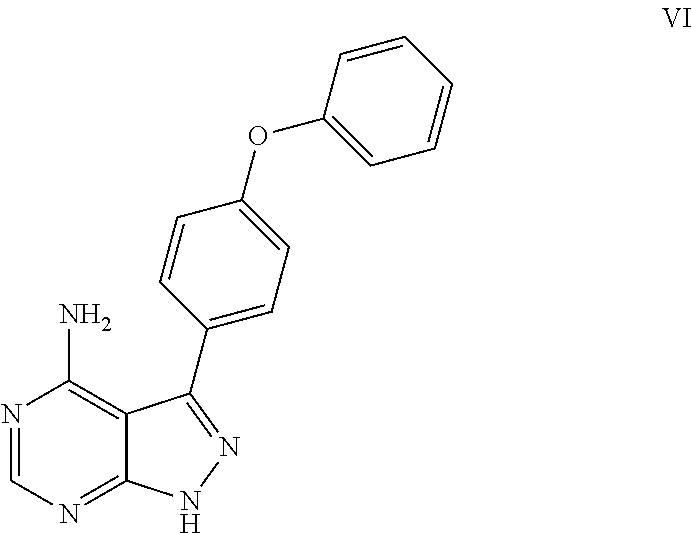
To a flask was added the compound of formula V (1.00 g, 3.1 mmol) and 10 ml of a solution of ammonia in methanol with a concentration of 10%, heated under reflux and then stirred for 12 h. Upon completion, the resulting mixture was purified by chromatography over silica gel to afford 0.89 g product, with a yield of 89.2%.
HNMR: δ 13.5 (1H, s); 8.2 (1H, s); 7.6 (2H, t); 7.4 (2H, t); 7.2 (1H, t); 7.1 (4H, m)
LC-MS (+ESI): 304.0938.
All the documents mentioned in the present invention are incorporated herein by reference, as if each of them is individually incorporated. Further, it would be appreciated that the foregoing description presents specific embodiments and generic principles of the invention. Having read the above described teaching of the invention, one skilled in the art could make various changes or modifications to the invention without departing from the spirit and scope of the invention. These equivalents would still be within the scope of the invention.
Claims (9)
1. A compound of formula A having the following structure:

wherein, the dotted line represents a double bond with structure of formula IV of the compound or a single bond between carbon and oxygen with structure of formula III of the compound.
2. A process for preparing the compound of formula III, comprising the compound of formula I and the compound of formula II undergoing nucleophilic addition reaction,

wherein, M is Li, MgX or ZnX; X is Br or Cl.
3. A process for preparing the compound of formula IV, comprising subjecting the compound of formula III to oxidation reaction,

4. The process according to claim 3 , the oxidizing agent utilized is selected from CrO3, KMnO4, TEMPO, TMPO/[O], DMP, IBX, dimethyl sulfoxide/triethylamine/oxalyl chloride, active MnO2 or MnO2, wherein [O] is NCS, NBS, NIS, IBX, 1,3-dibromo-5,5-dimethyl hydantoin, hydrogen peroxide, NaClO or Ca(ClO)2.
5. A process for preparing the compound of formula V, comprising the step of, reacting the compound of formula IV with hydrazine hydrate to afford the compound of formula V,

6. The process according to claim 5 , further comprising the step of the addition of diisopropylethylamine.
7. A process for preparing the compound of formula VI, comprising the step of, reacting the compound of formula IV with hydrazine hydrate to afford the compound of formula V, further reacted with ammonia to produce the compound of formula VI,

8. The process according to claim 7 , the ammonia is ammonia aqueous solution or ammonia/organic solvent, the organic solvent is selected from methanol, ethanol, isopropanol, tetrahydrofuran, toluene or a mixture of any two or more thereof.
9. The process according to claim 8 , the ammonia/organic solvent is ammonia/toluene.
Applications Claiming Priority (4)
| Application Number | Priority Date | Filing Date | Title |
|---|---|---|---|
| CN201410313610 | 2014-07-03 | ||
| CN201410313610.7 | 2014-07-03 | ||
| CN201410313610.7A CN105294571B (en) | 2014-07-03 | 2014-07-03 | A kind of Ibrutinib intermediate and its preparation method and use |
| PCT/CN2015/077039 WO2016000476A1 (en) | 2014-07-03 | 2015-04-21 | Ibrutinib intermediate compounds, preparation methods and uses thereof |
Publications (2)
| Publication Number | Publication Date |
|---|---|
| US20170137386A1 US20170137386A1 (en) | 2017-05-18 |
| US10023542B2 true US10023542B2 (en) | 2018-07-17 |
Family
ID=55018415
Family Applications (1)
| Application Number | Title | Priority Date | Filing Date |
|---|---|---|---|
| US15/321,750 Active US10023542B2 (en) | 2014-07-03 | 2015-04-21 | Ibrutinib intermediate compounds, preparation methods and uses thereof |
Country Status (5)
| Country | Link |
|---|---|
| US (1) | US10023542B2 (en) |
| EP (1) | EP3164389A4 (en) |
| JP (1) | JP6321889B2 (en) |
| CN (1) | CN105294571B (en) |
| WO (1) | WO2016000476A1 (en) |
Families Citing this family (2)
| Publication number | Priority date | Publication date | Assignee | Title |
|---|---|---|---|---|
| CN105294571B (en) * | 2014-07-03 | 2019-04-23 | 浙江九洲药业股份有限公司 | A kind of Ibrutinib intermediate and its preparation method and use |
| CN105622613B (en) * | 2014-11-14 | 2019-03-12 | 安礼特(上海)医药科技有限公司 | A kind of method of synthesizing ibrutinib |
Citations (8)
| Publication number | Priority date | Publication date | Assignee | Title |
|---|---|---|---|---|
| US7514444B2 (en) | 2006-09-22 | 2009-04-07 | Pharmacyclics, Inc. | Inhibitors of bruton's tyrosine kinase |
| WO2013157022A1 (en) | 2012-04-20 | 2013-10-24 | Advinus Therapeutics Limited | Substituted hetero-bicyclic compounds, compositions and medicinal applications thereof |
| CN103626774A (en) | 2013-11-20 | 2014-03-12 | 苏州明锐医药科技有限公司 | Preparation method of Ibrutinib |
| CN104844573A (en) * | 2015-04-17 | 2015-08-19 | 中国药科大学 | Miazines BTK inhibitor, preparation method and medical application thereof |
| CN105622613A (en) * | 2014-11-14 | 2016-06-01 | 奥浦顿(上海)医药科技有限公司 | Method for synthesizing ibrutinib |
| WO2016112637A1 (en) * | 2015-01-14 | 2016-07-21 | 湖北生物医药产业技术研究院有限公司 | Btk inhibitor |
| US20170137386A1 (en) * | 2014-07-03 | 2017-05-18 | Zhejiang Jiuzhou Pharma Science & Technology Co., Ltd. | Ibrutinib intermediate compounds, preparation methods and uses thereof |
| US20170327504A1 (en) * | 2014-10-30 | 2017-11-16 | Sandoz Ag | Synthesis of Substituted 1H-Pyrazolo[3,4-D]Pyrimidines |
Family Cites Families (2)
| Publication number | Priority date | Publication date | Assignee | Title |
|---|---|---|---|---|
| AU2004233828B2 (en) * | 2003-04-24 | 2009-05-28 | Merck Sharp & Dohme Corp. | Inhibitors of Akt activity |
| WO2012044993A1 (en) * | 2010-09-30 | 2012-04-05 | The United States Of America, As Represented By The Secretary, Department Of Health And Human Services | Compounds, pharmaceutical compositions, and methods of treating or preventing neurodegenerative diseases or disorders |
-
2014
- 2014-07-03 CN CN201410313610.7A patent/CN105294571B/en active Active
-
2015
- 2015-04-21 WO PCT/CN2015/077039 patent/WO2016000476A1/en not_active Ceased
- 2015-04-21 JP JP2017519761A patent/JP6321889B2/en active Active
- 2015-04-21 EP EP15814035.0A patent/EP3164389A4/en not_active Withdrawn
- 2015-04-21 US US15/321,750 patent/US10023542B2/en active Active
Patent Citations (9)
| Publication number | Priority date | Publication date | Assignee | Title |
|---|---|---|---|---|
| US7514444B2 (en) | 2006-09-22 | 2009-04-07 | Pharmacyclics, Inc. | Inhibitors of bruton's tyrosine kinase |
| WO2013157022A1 (en) | 2012-04-20 | 2013-10-24 | Advinus Therapeutics Limited | Substituted hetero-bicyclic compounds, compositions and medicinal applications thereof |
| CN103626774A (en) | 2013-11-20 | 2014-03-12 | 苏州明锐医药科技有限公司 | Preparation method of Ibrutinib |
| US20170137386A1 (en) * | 2014-07-03 | 2017-05-18 | Zhejiang Jiuzhou Pharma Science & Technology Co., Ltd. | Ibrutinib intermediate compounds, preparation methods and uses thereof |
| US20170327504A1 (en) * | 2014-10-30 | 2017-11-16 | Sandoz Ag | Synthesis of Substituted 1H-Pyrazolo[3,4-D]Pyrimidines |
| CN105622613A (en) * | 2014-11-14 | 2016-06-01 | 奥浦顿(上海)医药科技有限公司 | Method for synthesizing ibrutinib |
| WO2016112637A1 (en) * | 2015-01-14 | 2016-07-21 | 湖北生物医药产业技术研究院有限公司 | Btk inhibitor |
| US20170313683A1 (en) * | 2015-01-14 | 2017-11-02 | Hubei Bio-Pharmaceutical Industrial Technological Institute Inc. | Btk inhibitor |
| CN104844573A (en) * | 2015-04-17 | 2015-08-19 | 中国药科大学 | Miazines BTK inhibitor, preparation method and medical application thereof |
Non-Patent Citations (2)
| Title |
|---|
| CAS Abstract CN 104844573 (2015). * |
| English abstract; Chinese Application No. CN 103626774. |
Also Published As
| Publication number | Publication date |
|---|---|
| WO2016000476A1 (en) | 2016-01-07 |
| EP3164389A4 (en) | 2017-12-27 |
| US20170137386A1 (en) | 2017-05-18 |
| CN105294571B (en) | 2019-04-23 |
| CN105294571A (en) | 2016-02-03 |
| JP2017519826A (en) | 2017-07-20 |
| EP3164389A1 (en) | 2017-05-10 |
| JP6321889B2 (en) | 2018-05-09 |
Similar Documents
| Publication | Publication Date | Title |
|---|---|---|
| US10414749B2 (en) | Process for preparing 3-[(S)-7-bromo-2-((2-oxopropyl)amino)-5-pyridin-2-yl-3H-1,4-benzodiazepin-3-yl]propionic acid methyl ester | |
| CN104693114B (en) | A kind of improved preparation method of betrixaban | |
| WO2017124822A1 (en) | Method for preparing ido inhibitor epacadostat | |
| US12583879B2 (en) | Method for synthesizing C-nucleoside compound | |
| JP6707560B2 (en) | Method for producing androgen receptor antagonist and intermediate thereof | |
| JP3717177B2 (en) | Process for producing pyrazole and its derivatives | |
| WO2014017516A1 (en) | Method of producing 4-[5-(pyridin-4-yl)-1h-1,2,4-triazole-3-yl]pyridin-2-carbonitrile, and intermediary thereof | |
| US20170137386A1 (en) | Ibrutinib intermediate compounds, preparation methods and uses thereof | |
| CN105732444A (en) | Synthesis method of belinostat | |
| CN112225761A (en) | Pyrimidotriazole and synthetic method thereof | |
| CN108623602B (en) | A method of preparing and purifying ibrutinib | |
| CN111646958B (en) | A kind of preparation method of carfilzomib | |
| CN117756743A (en) | Method for preparing dibenzothiazyl-4-ketone | |
| CN116589447A (en) | A chemical-enzyme process synthesis method of efluconazole | |
| JPH11302260A (en) | Preparation of imidazol derivative | |
| JPWO2021172204A5 (en) | ||
| CN115260055B (en) | A kind of preparation method of posaconazole side chain intermediate chiral isomer | |
| JP5791498B2 (en) | Process for producing 4-chloroazetidinone compound | |
| JP7788145B2 (en) | Method for producing azanucleoside precursors | |
| Venkateswarlu Rayudu et al. | An Easy, Efficient and Improved Synthesis of Sertaconazole Nitrate | |
| CN119462661A (en) | A preparation method of AZD-8421 and its intermediates | |
| CN101712681B (en) | Chemical synthesis method of paliperidone intermediate | |
| KR100771655B1 (en) | Labeprazole and its preparation method | |
| CN102070518A (en) | Synthesis of derivatives of substituted pyridine and azaindole | |
| CN121990994A (en) | Imidazole derivative and preparation method and application thereof |
Legal Events
| Date | Code | Title | Description |
|---|---|---|---|
| STCF | Information on status: patent grant |
Free format text: PATENTED CASE |
|
| MAFP | Maintenance fee payment |
Free format text: PAYMENT OF MAINTENANCE FEE, 4TH YR, SMALL ENTITY (ORIGINAL EVENT CODE: M2551); ENTITY STATUS OF PATENT OWNER: SMALL ENTITY Year of fee payment: 4 |
|
| FEPP | Fee payment procedure |
Free format text: MAINTENANCE FEE REMINDER MAILED (ORIGINAL EVENT CODE: REM.); ENTITY STATUS OF PATENT OWNER: SMALL ENTITY |