US10014846B2 - Increasing output amplitude of a voltage-mode driver in a low supply voltage technology - Google Patents
Increasing output amplitude of a voltage-mode driver in a low supply voltage technology Download PDFInfo
- Publication number
- US10014846B2 US10014846B2 US14/336,979 US201414336979A US10014846B2 US 10014846 B2 US10014846 B2 US 10014846B2 US 201414336979 A US201414336979 A US 201414336979A US 10014846 B2 US10014846 B2 US 10014846B2
- Authority
- US
- United States
- Prior art keywords
- voltage
- mode driver
- output current
- load
- desired output
- Prior art date
- Legal status (The legal status is an assumption and is not a legal conclusion. Google has not performed a legal analysis and makes no representation as to the accuracy of the status listed.)
- Active
Links
Images




Classifications
-
- G—PHYSICS
- G06—COMPUTING OR CALCULATING; COUNTING
- G06F—ELECTRIC DIGITAL DATA PROCESSING
- G06F13/00—Interconnection of, or transfer of information or other signals between, memories, input/output devices or central processing units
- G06F13/38—Information transfer, e.g. on bus
- G06F13/382—Information transfer, e.g. on bus using universal interface adapter
- G06F13/385—Information transfer, e.g. on bus using universal interface adapter for adaptation of a particular data processing system to different peripheral devices
-
- H—ELECTRICITY
- H03—ELECTRONIC CIRCUITRY
- H03K—PULSE TECHNIQUE
- H03K3/00—Circuits for generating electric pulses; Monostable, bistable or multistable circuits
- H03K3/01—Details
- H03K3/012—Modifications of generator to improve response time or to decrease power consumption
-
- G—PHYSICS
- G06—COMPUTING OR CALCULATING; COUNTING
- G06F—ELECTRIC DIGITAL DATA PROCESSING
- G06F13/00—Interconnection of, or transfer of information or other signals between, memories, input/output devices or central processing units
- G06F13/38—Information transfer, e.g. on bus
- G06F13/40—Bus structure
- G06F13/4063—Device-to-bus coupling
- G06F13/4068—Electrical coupling
- G06F13/4072—Drivers or receivers
-
- H—ELECTRICITY
- H03—ELECTRONIC CIRCUITRY
- H03K—PULSE TECHNIQUE
- H03K19/00—Logic circuits, i.e. having at least two inputs acting on one output; Inverting circuits
- H03K19/0175—Coupling arrangements; Interface arrangements
- H03K19/017545—Coupling arrangements; Impedance matching circuits
-
- H—ELECTRICITY
- H03—ELECTRONIC CIRCUITRY
- H03M—CODING; DECODING; CODE CONVERSION IN GENERAL
- H03M9/00—Parallel/series conversion or vice versa
-
- H—ELECTRICITY
- H04—ELECTRIC COMMUNICATION TECHNIQUE
- H04L—TRANSMISSION OF DIGITAL INFORMATION, e.g. TELEGRAPHIC COMMUNICATION
- H04L25/00—Baseband systems
- H04L25/02—Details ; arrangements for supplying electrical power along data transmission lines
- H04L25/0264—Arrangements for coupling to transmission lines
- H04L25/0278—Arrangements for impedance matching
-
- H—ELECTRICITY
- H04—ELECTRIC COMMUNICATION TECHNIQUE
- H04L—TRANSMISSION OF DIGITAL INFORMATION, e.g. TELEGRAPHIC COMMUNICATION
- H04L25/00—Baseband systems
- H04L25/02—Details ; arrangements for supplying electrical power along data transmission lines
- H04L25/0264—Arrangements for coupling to transmission lines
- H04L25/028—Arrangements specific to the transmitter end
-
- H—ELECTRICITY
- H04—ELECTRIC COMMUNICATION TECHNIQUE
- H04L—TRANSMISSION OF DIGITAL INFORMATION, e.g. TELEGRAPHIC COMMUNICATION
- H04L25/00—Baseband systems
- H04L25/02—Details ; arrangements for supplying electrical power along data transmission lines
- H04L25/0264—Arrangements for coupling to transmission lines
- H04L25/028—Arrangements specific to the transmitter end
- H04L25/0282—Provision for current-mode coupling
-
- G—PHYSICS
- G06—COMPUTING OR CALCULATING; COUNTING
- G06F—ELECTRIC DIGITAL DATA PROCESSING
- G06F2213/00—Indexing scheme relating to interconnection of, or transfer of information or other signals between, memories, input/output devices or central processing units
- G06F2213/38—Universal adapter
- G06F2213/3852—Converter between protocols
Definitions
- the present description relates generally to line drivers, and more particularly, but not exclusively, to methods and apparatus for increasing output amplitude of a voltage-mode driver in a low supply-voltage technology.
- Line drivers including voltage-mode drivers are used in a number of applications such as mobile serializer-deserializer (SerDes) circuits, network switches and data center applications, and high speed PHY circuits.
- SerDes mobile serializer-deserializer
- the main function of a line driver is to transmit a signal reliably across a medium (e.g., a line such as a conductor), in the presence of attenuation and distortion.
- the required transmitted output swing specified by current standards is technology independent. With technology nodes moving to smaller feature sizes, however, nominal supply voltage is also scaled down.
- the 802.3ap standard for backplane Ethernet interface e.g., IEEE KR
- the supply voltage is approximately 800 mV.
- FIG. 1 illustrates an example of a voltage-mode driver circuit.
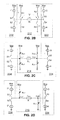
- FIGS. 2A through 2E illustrate examples of an apparatus for driving a load using a low supply voltage in accordance with one or more implementations.
- FIGS. 3A-3B illustrate examples of configurable current sources of an apparatus for driving a load using a low supply voltage in accordance with one or more implementations.
- FIG. 4 illustrates an example of a method for driving a load using a low supply voltage in accordance with one or more implementations.
- FIG. 5 illustrates an example of a communication device employing features of the subject technology for driving one more loads using a low supply voltage in accordance with one or more implementations.
- the subject technology provides methods and implementations for increasing output amplitude of a voltage-mode driver in a low supply-voltage technology.
- the disclosed technology merges a voltage-mode driver with a current driver (e.g., an H-driver) to provide a minimum differential peak-to-peak voltage across the load, as required by the current standards.
- a current driver e.g., an H-driver
- the subject technology includes a number of advantageous features, for example, reduced power consumption and chip area without sacrificing the return loss, as compared to existing solutions that, for instance, rely on voltage mode drivers with increased power supply or decreased on-chip resistors or other solutions based on H-drivers or current-mode logic (CML) drivers.
- the disclosed solution is the lowest power solution that is compliant with current standards (e.g., IEEE standards) and future process technologies.
- FIG. 1 illustrates an example of a voltage-mode driver circuit 100 for driving a load impedance.
- the voltage-mode driver circuit 100 includes resistors R 1 -R 4 and switches S 1 -S 4 and is used to drive the load resistor R L , which can be an input impedance of a device such as a serializer/deserializer (SerDes).
- the current standard e.g., an IEEE standard, such as IEEE KR
- a nominal voltage swing e.g., differential peak-to-peak voltage
- the load impedance such as a resistor R L (e.g., 100 ⁇ )
- the voltage-mode driver circuit 100 has to provide an impedance match to the load resistor R L .
- the voltage-mode driver circuit 100 operates by providing current I 1 to the load resistor R L , through termination resistors R 1 and R 4 , in a positive bit of data when switches S 1 and S 4 are closed and switches S 2 and S 3 are open, and providing current I 2 to the load resistor R L , through termination resistors R 3 and R 2 , in a negative bit of the data when switches S 3 and S 2 are closed and switches S 1 and S 4 are open.
- Existing solutions for mitigating this problem face a number of drawbacks including increased power consumption and chip area and may sacrifice an important specification such as return loss.
- the subject technology solves this problem without the above-mentions drawbacks.
- FIGS. 2A through 2E illustrate examples of an apparatus for driving a load using a low supply voltage in accordance with one or more implementations of the subject technology.
- An apparatus 200 A of FIG. 2A includes a first circuit 210 and a second circuit 220 .
- the first circuit 210 can be a voltage-mode driver circuit such as the voltage-mode driver circuit 100 of FIG. 1 .
- the second circuit 220 includes a current source arrangement.
- the first circuit 210 can provide the desired termination impedance and a first portion of a desired output current to the load resistor (e.g., R L of FIG. 1 ).
- the first circuit 210 and the second circuit 220 are powered by a low supply voltage V DD (e.g., 0.8 V) that is a nominal supply voltage associated with an employed technology node (e.g., 16 nm). With this nominal supply voltage, the first circuit 210 would be incapable of independently providing a minimum current (e.g., 10 mA) to the resistor R L (e.g., 100 ⁇ ) of FIG. 1 that can establish the nominal voltage swing (e.g., 1V) across the load resistor R L , particularly in the presence of variations, for example, of the resistance values.
- V DD low supply voltage
- V DD 0.8 V
- a nominal supply voltage associated with an employed technology node e.g. 16 nm
- the first circuit 210 would be incapable of independently providing a minimum current (e.g., 10 mA) to the resistor R L (e.g., 100 ⁇ ) of FIG. 1 that can establish the nominal voltage swing (e.g., 1V) across the load resist
- the current source arrangement 220 provides a second portion of the desired output current that can generate the predetermined voltage swing (e.g., the nominal voltage of 1V) across the 100 ⁇ load resistor R L of FIG. 1 .
- the current source arrangement 220 includes current sources I 1 -I 4 and switches S 1 -S 4 that are configurable to provide the second portion (e.g., 2 mA) of the desired output current (e.g., 5 mA) flowing in two opposing directions indicated by the curved arrows D 1 and D 2 into the load (not shown for simplicity).
- switches S 1 and S 4 are closed and switches S 2 and S 3 are open
- current sources I 1 and I 4 are active and are responsible for providing the second portion of the desired output current.
- current sources I 3 and I 2 are active and provide the second portion of the desired output current.
- the switches S 1 -S 4 are configurable to dynamically control an amount of current provided to the load.
- the first circuit 210 is implemented as the voltage-mode driver circuit 212 of FIG. 2B .
- the voltage-mode driver circuit 212 is similar to the voltage-mode driver circuit 100 of FIG. 1 , and can be implemented to provide the desired termination impedance (e.g., through R 1 and R 4 or R 3 and R 2 ) that matches resistance of the load resistor RL (e.g., 100 ⁇ ) and a fixed output voltage.
- the deficiency of the voltage-mode driver circuit 212 in providing the desired current through the load resistor R L is alleviated by the current source arrangement 222 , which is similar to the current source arrangement 220 of FIG. 2A described above.
- the first circuit 210 is realized as a constant-impedance voltage-mode driver circuit 214 of FIG. 2C .
- the constant-impedance voltage-mode driver circuit 214 includes variable resistors Rv 1 and Rv 2 that can be controlled independently to provide constant-impedance values (e.g., as viewed by a signal) between nodes Out 1 and Out 2 and the ground node, while allowing variation of the voltage amplitude (e.g., based on pre-emphasis) across the load resistor R L .
- the constant-impedance voltage-mode driver circuit 214 can be implemented to provide the desired termination impedance, while the current source arrangement 224 , which is similar to the current source arrangement 220 of FIG. 2A described above, provides the additional current through the load resistor R L that can establish the desired voltage swing across the load resistor R L (e.g., 100 ⁇ ).
- the first circuit 210 is implemented as a variable-impedance voltage-mode driver circuit 216 of FIG. 2D .
- the variable-impedance voltage-mode driver circuit 216 includes variable resistors Rv 1 and provides variable impedance and voltage amplitude values between nodes Out 1 and Out 2 and the ground node.
- the current source arrangement 226 is similar to the current source arrangement 220 of FIG. 2A described above.
- the first circuit 210 is realized as a constant-impedance voltage-mode driver circuit 218 with shunt elements, as shown in FIG. 2E .
- the shunt elements include the variable resistors Rv 1 and Rv 2 provide a constant impedance values at nodes Out 1 and Out 2 , while allowing variation of the voltage amplitude (e.g., based on pre-emphasis) across the load resistor R L .
- the constant-impedance voltage-mode driver circuit 218 is a lower power consumption implementation of the constant-impedance voltage-mode driver circuit 214 of FIG. 2C .
- the current source arrangement 228 is similar to the current source arrangement 220 of FIG. 2A described above.
- Each of the above-described voltage-mode driver circuits (e.g., 210 , 212 , 214 , 216 , and 218 ) or the current source arrangement 220 are configurable to provide a desired termination impedance and output voltage amplitude control and/or equalization control, while maintaining a predetermined range of voltage swing (e.g., based on a standard) across the load resistor R L .
- the desired termination impedance is determined based on a desired return loss and is typically within the range of 80-120 ⁇ .
- FIGS. 3A-3B illustrate examples of configurable current sources I 1 and I 2 of an apparatus for driving a load using a low supply voltage in accordance with one or more implementations of the subject technology.
- a branch 310 e.g., an upper portion of the current source arrangement 220 of FIG. 2A
- the switch S 1 can be implemented by a parallel combination 312 of a number of branches including current sources I 11 through I 1 N and switches S 11 through S 1 N.
- the switches S 11 through S 1 N can be dynamically controlled to drive desired current values to the load resistor (e.g., R L of FIG. 2B ).
- FIG. 3B shows a, a branch 314 (e.g., a lower portion of the current source arrangement 220 of FIG. 2A ) including a switch S 2 and the current source I 2 can be realized by a parallel combination 316 of a number of branches including switches S 21 through S 2 N and current sources I 21 through I 2 N.
- the switches S 21 through S 2 N can be dynamically controlled to drive desired current values to the load resistor (e.g., R L of FIG. 2B ).
- the configurable arrangements 312 and 316 allows for current sources I 1 and I 2 of any of the above-described current source arrangements (e.g., 220 of FIG. 2A ) to have equal or different current values that can be dynamically controlled.
- FIG. 4 illustrates an example of a method 400 for driving a load using a low supply voltage in accordance with one or more implementations of the subject technology.
- the blocks of the example method 400 are described herein as occurring in serial, or linearly. However, multiple blocks of the example method 400 can occur in parallel. In addition, the blocks of the example method 400 need not be performed in the order shown and/or one or more of the blocks of the example method 400 need not be performed.
- the method 400 includes providing, by using a first circuit (e.g., 210 of FIG. 2A ), a desired termination impedance (e.g., R 1 +R 4 or R 3 +R 2 of FIG. 2B ) and a first portion of a desired output current to the load (e.g., R L of FIG. 2A ) ( 410 ).
- a second portion of the desired output current is provided, by using a second circuit (e.g., 220 of FIG. 2A ), such that the desired output current generates a predetermined voltage swing across the load, while the first circuit and the second circuit are powered by the low supply voltage (e.g., V DD of FIG. 2A ) ( 420 ).
- FIG. 5 illustrates an example of a communication device 500 employing features of the subject technology for driving one more loads using a low supply voltage in accordance with one or more implementations.
- the communication device 500 includes an Ethernet switch of an Ethernet network such as a private network including a data-center network, an enterprise network, or other private networks.
- the communication device 500 includes a number of ingress (input) ports IP 1 -IPn and multiple egress (output) ports EP 1 -EPm.
- one or more of the ingress ports IP 1 -IPn can receive a data packet from another switch or and endpoint device of the network.
- the communication device 500 further includes a hardware component such as an application specific integrated circuit (ASIC) 510 (which in some embodiments can be implemented as a field-programmable logic array (FPGA)), a buffer 520 , a processor 530 , memory 540 , and a software module 550 .
- ASIC application specific integrated circuit
- FPGA field-programmable logic array
- the ASIC 510 can include suitable logic, circuitry, interfaces and/or code that can be operable to perform functionalities of a PHY circuit.
- the buffer 520 includes suitable logic, circuitry, code and/or interfaces that are operable to receive and store and/or delay a block of data for communication through one or more of the egress ports EP 1 -EPm.
- the processor 530 includes suitable logic, circuitry, and/or code that can enable processing data and/or controlling operations of the communication device 500 . In this regard, the processor 530 can be enabled to provide control signals to various other portions of the communication device 500 . The processor 530 also controls transfers of data between various portions of the communication device 500 . Additionally, the processor 530 can enable implementation of an operating system or otherwise execute code to manage operations of the communication device 500 .
- the memory 540 includes suitable logic, circuitry, and/or code that can enable storage of various types of information such as received data, generated data, code, and/or configuration information.
- the memory 540 includes, for example, RAM, ROM, flash, and/or magnetic storage. In various embodiment of the subject technology, the memory 540 may include a RAM, DRAM, SRAM, T-RAM, Z-RAM, TTRAM, or any other storage media.
- the memory 540 can include software modules 550 that when executed by a processor (e.g., processor 530 ) can perform some or all of the functionalities of the ASIC 510 .
- the software modules 550 include codes that when executed by a processor can perform functionalities such as configuration of the communication device 500 .
- the communication device 500 may be implemented in a 28 nm or smaller technology node and be powered by a low voltage supply (e.g., 0.8V).
- various chips e.g., the ASIC 510 , the processor 530 , and the memory 540 ) of the communication device 500 may be coupled to one another via lines that are driven by voltage-mode drivers of the subject technology such as the apparatuses shown in any of FIGS. 2A through 2E to provide acceptable voltage swings across input nodes of the chips.
- the communication device 500 includes one or more universal serial bus (USB) interfaces that can also be driven by the disclosed voltage-mode drivers and benefit from the advantages features of the subject technology such as low power consumption, reduced chip area, and without return loss.
- USB universal serial bus
- the phrase “at least one of” preceding a series of items, with the term “and” or “or” to separate any of the items, modifies the list as a whole, rather than each member of the list (i.e., each item).
- the phrase “at least one of” does not require selection of at least one of each item listed; rather, the phrase allows a meaning that includes at least one of any one of the items, and/or at least one of any combination of the items, and/or at least one of each of the items.
- phrases “at least one of A, B, and C” or “at least one of A, B, or C” each refer to only A, only B, or only C; any combination of A, B, and C; and/or at least one of each of A, B, and C.
- a phrase such as “an aspect” does not imply that such aspect is essential to the subject technology or that such aspect applies to all configurations of the subject technology.
- a disclosure relating to an aspect can apply to all configurations, or one or more configurations.
- An aspect can provide one or more examples of the disclosure.
- a phrase such as an “aspect” refers to one or more aspects and vice versa.
- a phrase such as an “embodiment” does not imply that such embodiment is essential to the subject technology or that such embodiment applies to all configurations of the subject technology.
- a disclosure relating to an embodiment can apply to all embodiments, or one or more embodiments.
- An embodiment can provide one or more examples of the disclosure.
- a phrase such an “embodiment” can refer to one or more embodiments and vice versa.
- a phrase such as a “configuration” does not imply that such configuration is essential to the subject technology or that such configuration applies to all configurations of the subject technology.
- a disclosure relating to a configuration can apply to all configurations, or one or more configurations.
- a configuration can provide one or more examples of the disclosure.
- a phrase such as a “configuration” can refer to one or more configurations and vice versa.
Landscapes
- Engineering & Computer Science (AREA)
- Power Engineering (AREA)
- Signal Processing (AREA)
- Computer Networks & Wireless Communication (AREA)
- Computer Hardware Design (AREA)
- General Engineering & Computer Science (AREA)
- Theoretical Computer Science (AREA)
- Physics & Mathematics (AREA)
- Mathematical Physics (AREA)
- Computing Systems (AREA)
- General Physics & Mathematics (AREA)
- Logic Circuits (AREA)
- Amplifiers (AREA)
- Dc-Dc Converters (AREA)
Abstract
Description
Claims (20)
Priority Applications (4)
| Application Number | Priority Date | Filing Date | Title |
|---|---|---|---|
| US14/336,979 US10014846B2 (en) | 2014-06-25 | 2014-07-21 | Increasing output amplitude of a voltage-mode driver in a low supply voltage technology |
| EP15169217.5A EP2961071B1 (en) | 2014-06-25 | 2015-05-26 | Apparatus and method for increasing output amplitude of a voltage-mode driver in a low supply-voltage technology |
| CN201510359484.3A CN105279120B (en) | 2014-06-25 | 2015-06-25 | Increasing Output Amplitude of Voltage Mode Drivers in Low Supply Voltage Technology |
| HK16103793.5A HK1215887A1 (en) | 2014-06-25 | 2016-04-05 | Increasing output amplitude of a voltage-mode driver in a low supply voltage technology |
Applications Claiming Priority (2)
| Application Number | Priority Date | Filing Date | Title |
|---|---|---|---|
| US201462017176P | 2014-06-25 | 2014-06-25 | |
| US14/336,979 US10014846B2 (en) | 2014-06-25 | 2014-07-21 | Increasing output amplitude of a voltage-mode driver in a low supply voltage technology |
Publications (2)
| Publication Number | Publication Date |
|---|---|
| US20150381150A1 US20150381150A1 (en) | 2015-12-31 |
| US10014846B2 true US10014846B2 (en) | 2018-07-03 |
Family
ID=53284023
Family Applications (1)
| Application Number | Title | Priority Date | Filing Date |
|---|---|---|---|
| US14/336,979 Active US10014846B2 (en) | 2014-06-25 | 2014-07-21 | Increasing output amplitude of a voltage-mode driver in a low supply voltage technology |
Country Status (4)
| Country | Link |
|---|---|
| US (1) | US10014846B2 (en) |
| EP (1) | EP2961071B1 (en) |
| CN (1) | CN105279120B (en) |
| HK (1) | HK1215887A1 (en) |
Cited By (1)
| Publication number | Priority date | Publication date | Assignee | Title |
|---|---|---|---|---|
| TWI789197B (en) * | 2022-01-03 | 2023-01-01 | 瑞昱半導體股份有限公司 | Output stage of ethernet transmitter |
Families Citing this family (3)
| Publication number | Priority date | Publication date | Assignee | Title |
|---|---|---|---|---|
| CN113315504A (en) * | 2020-02-27 | 2021-08-27 | 成都纳能微电子有限公司 | SST driving structure |
| EP4346110A1 (en) * | 2022-09-29 | 2024-04-03 | Nxp B.V. | A transmitter circuit |
| US20240291488A1 (en) * | 2023-02-27 | 2024-08-29 | Stmicroelectronics International N.V. | Voltage compensation of differential voltage swing |
Citations (20)
| Publication number | Priority date | Publication date | Assignee | Title |
|---|---|---|---|---|
| US5629641A (en) * | 1996-02-06 | 1997-05-13 | Advanced Micro Devices, Inc. | Differential CMOS current amplifier with controlled bandwidth and common mode distortion |
| US5959490A (en) * | 1997-12-10 | 1999-09-28 | Pmc-Sierra Ltd. | High speed low voltage swing receiver for mixed supply voltage interfaces |
| US6121800A (en) * | 1998-07-07 | 2000-09-19 | Lucent Technologies, Inc. | Impedance matched, voltage-mode H-bridge write drivers |
| US6252450B1 (en) * | 1999-09-09 | 2001-06-26 | Stmicroelectronics, Inc. | Circuit and method for writing to a memory disk |
| US6686772B2 (en) | 2001-11-19 | 2004-02-03 | Broadcom Corporation | Voltage mode differential driver and method |
| US6704818B1 (en) | 2000-12-29 | 2004-03-09 | Intel Corporation | Voltage-mode driver with pre-emphasis, slew-rate control and source termination |
| US20050030121A1 (en) * | 2003-07-07 | 2005-02-10 | Barrie Gilbert | Variable attenuation system having continuous input steering |
| US6856178B1 (en) * | 2003-07-31 | 2005-02-15 | Silicon Bridge, Inc. | Multi-function input/output driver |
| US20060226907A1 (en) * | 2005-04-07 | 2006-10-12 | Barrie Gilbert | Vector modulator having attenuators with continuous input steering |
| US20070002954A1 (en) | 2005-07-01 | 2007-01-04 | Cornelius William P | Hybrid voltage/current-mode transmission line driver |
| US7224135B1 (en) * | 2006-09-07 | 2007-05-29 | Acutechnology Semiconductor Inc. | Imposed current motor drive |
| US7315186B2 (en) * | 2005-06-06 | 2008-01-01 | Intel Corporation | Voltage mode driver with current mode equalization |
| US20090168854A1 (en) | 2007-12-28 | 2009-07-02 | Advanced Micro Devices | De-Emphasis Circuit for a Voltage Mode Driver Used to Communicate Via a Differential Communication Link |
| US20090203333A1 (en) * | 2008-02-13 | 2009-08-13 | Analog Devices, Inc. | High-speed data transmitters |
| US8396106B2 (en) * | 2008-04-11 | 2013-03-12 | International Business Machines Corporation | System and method for improving equalization in a high speed serdes environment |
| WO2013089773A1 (en) | 2011-12-16 | 2013-06-20 | Intel Corporation | Low voltage transmitter with variable output swing |
| US8487654B1 (en) * | 2012-02-29 | 2013-07-16 | Taiwan Semiconductor Manufacturing Co., Ltd. | Voltage mode driver with current booster (VMDCB) |
| US20130195165A1 (en) * | 2012-01-26 | 2013-08-01 | Nvidia Corporation | Ground referenced single-ended signaling |
| US8520348B2 (en) * | 2011-12-22 | 2013-08-27 | Lsi Corporation | High-swing differential driver using low-voltage transistors |
| US20150022243A1 (en) * | 2013-07-16 | 2015-01-22 | Mediatek Inc. | Driver circuit for signal transmission and control method of driver circuit |
Family Cites Families (2)
| Publication number | Priority date | Publication date | Assignee | Title |
|---|---|---|---|---|
| US6812733B1 (en) * | 2002-08-02 | 2004-11-02 | Pmc-Sierra, Inc. | High-efficiency mixed voltage/current mode output driver |
| EP2412136B1 (en) * | 2009-03-27 | 2017-03-01 | Rambus Inc. | Voltage mode transmitter equalizer |
-
2014
- 2014-07-21 US US14/336,979 patent/US10014846B2/en active Active
-
2015
- 2015-05-26 EP EP15169217.5A patent/EP2961071B1/en active Active
- 2015-06-25 CN CN201510359484.3A patent/CN105279120B/en active Active
-
2016
- 2016-04-05 HK HK16103793.5A patent/HK1215887A1/en unknown
Patent Citations (22)
| Publication number | Priority date | Publication date | Assignee | Title |
|---|---|---|---|---|
| US5629641A (en) * | 1996-02-06 | 1997-05-13 | Advanced Micro Devices, Inc. | Differential CMOS current amplifier with controlled bandwidth and common mode distortion |
| US5959490A (en) * | 1997-12-10 | 1999-09-28 | Pmc-Sierra Ltd. | High speed low voltage swing receiver for mixed supply voltage interfaces |
| US6121800A (en) * | 1998-07-07 | 2000-09-19 | Lucent Technologies, Inc. | Impedance matched, voltage-mode H-bridge write drivers |
| US6252450B1 (en) * | 1999-09-09 | 2001-06-26 | Stmicroelectronics, Inc. | Circuit and method for writing to a memory disk |
| US6704818B1 (en) | 2000-12-29 | 2004-03-09 | Intel Corporation | Voltage-mode driver with pre-emphasis, slew-rate control and source termination |
| US6686772B2 (en) | 2001-11-19 | 2004-02-03 | Broadcom Corporation | Voltage mode differential driver and method |
| US20050030121A1 (en) * | 2003-07-07 | 2005-02-10 | Barrie Gilbert | Variable attenuation system having continuous input steering |
| US6856178B1 (en) * | 2003-07-31 | 2005-02-15 | Silicon Bridge, Inc. | Multi-function input/output driver |
| US20060226907A1 (en) * | 2005-04-07 | 2006-10-12 | Barrie Gilbert | Vector modulator having attenuators with continuous input steering |
| US7315186B2 (en) * | 2005-06-06 | 2008-01-01 | Intel Corporation | Voltage mode driver with current mode equalization |
| US20070002954A1 (en) | 2005-07-01 | 2007-01-04 | Cornelius William P | Hybrid voltage/current-mode transmission line driver |
| US7224135B1 (en) * | 2006-09-07 | 2007-05-29 | Acutechnology Semiconductor Inc. | Imposed current motor drive |
| US20090168854A1 (en) | 2007-12-28 | 2009-07-02 | Advanced Micro Devices | De-Emphasis Circuit for a Voltage Mode Driver Used to Communicate Via a Differential Communication Link |
| US20090203333A1 (en) * | 2008-02-13 | 2009-08-13 | Analog Devices, Inc. | High-speed data transmitters |
| US8396106B2 (en) * | 2008-04-11 | 2013-03-12 | International Business Machines Corporation | System and method for improving equalization in a high speed serdes environment |
| WO2013089773A1 (en) | 2011-12-16 | 2013-06-20 | Intel Corporation | Low voltage transmitter with variable output swing |
| US20140055163A1 (en) * | 2011-12-16 | 2014-02-27 | Hongjiang Song | Low voltage transmitter with variable output swing |
| US8520348B2 (en) * | 2011-12-22 | 2013-08-27 | Lsi Corporation | High-swing differential driver using low-voltage transistors |
| US20130195165A1 (en) * | 2012-01-26 | 2013-08-01 | Nvidia Corporation | Ground referenced single-ended signaling |
| US8487654B1 (en) * | 2012-02-29 | 2013-07-16 | Taiwan Semiconductor Manufacturing Co., Ltd. | Voltage mode driver with current booster (VMDCB) |
| CN103294095A (en) | 2012-02-29 | 2013-09-11 | 台湾积体电路制造股份有限公司 | Voltage mode driver with current booster (VMDCB) |
| US20150022243A1 (en) * | 2013-07-16 | 2015-01-22 | Mediatek Inc. | Driver circuit for signal transmission and control method of driver circuit |
Non-Patent Citations (2)
| Title |
|---|
| Loke et al., "An 8.0-Gb/s HyperTransport Transceiver for 32-nm SOI-CMOS Server Processors," IEEE Journal of Solid-State Circuits, Nov. 2012, vol. 47, No. 11, pp. 2627-2642. |
| Song et al., "A 6-Gbit/s Hybrid Voltage-Mode Transmitter With Current-Mode Equalization in 90-nm CMOS," IEEE Transactions on Circuits and Systems II: Express Briefs, Aug. 2012, vol. 59, No. 8, pp. 491-495. |
Cited By (3)
| Publication number | Priority date | Publication date | Assignee | Title |
|---|---|---|---|---|
| TWI789197B (en) * | 2022-01-03 | 2023-01-01 | 瑞昱半導體股份有限公司 | Output stage of ethernet transmitter |
| US20230216493A1 (en) * | 2022-01-03 | 2023-07-06 | Realtek Semiconductor Corporation | Output stage of Ethernet transmitter |
| US12294361B2 (en) * | 2022-01-03 | 2025-05-06 | Realtek Semiconductor Corporation | Output stage of ethernet transmitter |
Also Published As
| Publication number | Publication date |
|---|---|
| EP2961071B1 (en) | 2022-12-14 |
| US20150381150A1 (en) | 2015-12-31 |
| EP2961071A2 (en) | 2015-12-30 |
| EP2961071A3 (en) | 2016-01-06 |
| CN105279120B (en) | 2019-06-21 |
| CN105279120A (en) | 2016-01-27 |
| HK1215887A1 (en) | 2016-09-23 |
Similar Documents
| Publication | Publication Date | Title |
|---|---|---|
| US9413381B2 (en) | High-speed, low-power reconfigurable voltage-mode DAC-driver | |
| US7639746B2 (en) | Hybrid voltage/current-mode transmission line driver | |
| KR102378304B1 (en) | Device with data receiver with real time clock decoding decision feedback equalizer | |
| US10313152B2 (en) | Transmission circuit | |
| US11483184B2 (en) | Multi pulse amplitude modulation signaling decision feedback equalizer having power differentiating modes and tap-weight re-configuration | |
| US10985759B2 (en) | Apparatuses and methods involving a segmented source-series terminated line driver | |
| CN106464298A (en) | Multi-wire signaling with matched propagation delay among wire pairs | |
| KR20140053241A (en) | Apparatuses and methods of communicating differential serial signals including charge injection | |
| TW201931139A (en) | Apparatuses and methods for power efficient driver circuits | |
| US9325316B1 (en) | Low-power high swing CML driver with independent common-mode and swing control | |
| CN111800355A (en) | Transmitters, Imaging Systems, and Communication Systems | |
| US20150381150A1 (en) | Increasing output amplitude of a voltage-mode driver in a low supply voltage technology | |
| US9246716B2 (en) | Method and apparatus for selectively terminating signals on a bidirectional bus based on bus speed | |
| JP2015035780A (en) | Signal transmission circuit and semiconductor integrated circuit | |
| US6968413B2 (en) | Method and system for configuring terminators in a serial communication system | |
| US12456977B2 (en) | Continuous time linear equalizers (CTLEs) of data interfaces | |
| US20230075962A1 (en) | Termination for Pulse Amplitude Modulation | |
| US9215104B1 (en) | Floating taps for decision feedback equalizer | |
| US8755474B2 (en) | Signal conditioning by combining precursor, main, and post cursor signals without a clock signal | |
| KR101995027B1 (en) | Low Power Transmitter without Static Current Consumption | |
| US9391618B2 (en) | High voltage fail-safe IO design using thin oxide devices | |
| KR102034221B1 (en) | Semiconductor device including receiver for differentail signal | |
| US10284398B2 (en) | Transmission device, transmission method, and communication system | |
| KR20250067497A (en) | VM Termination based driver Apparatus for PAM-3 modulater signer | |
| US8521119B2 (en) | Method and apparatus for an equalized on-die termination (ODT) circuit |
Legal Events
| Date | Code | Title | Description |
|---|---|---|---|
| AS | Assignment |
Owner name: BROADCOM CORPORATION, CALIFORNIA Free format text: ASSIGNMENT OF ASSIGNORS INTEREST;ASSIGNORS:MOMTAZ, AFSHIN;GARG, ADESH;SIGNING DATES FROM 20140710 TO 20140716;REEL/FRAME:033742/0938 |
|
| AS | Assignment |
Owner name: BANK OF AMERICA, N.A., AS COLLATERAL AGENT, NORTH CAROLINA Free format text: PATENT SECURITY AGREEMENT;ASSIGNOR:BROADCOM CORPORATION;REEL/FRAME:037806/0001 Effective date: 20160201 Owner name: BANK OF AMERICA, N.A., AS COLLATERAL AGENT, NORTH Free format text: PATENT SECURITY AGREEMENT;ASSIGNOR:BROADCOM CORPORATION;REEL/FRAME:037806/0001 Effective date: 20160201 |
|
| AS | Assignment |
Owner name: AVAGO TECHNOLOGIES GENERAL IP (SINGAPORE) PTE. LTD., SINGAPORE Free format text: ASSIGNMENT OF ASSIGNORS INTEREST;ASSIGNOR:BROADCOM CORPORATION;REEL/FRAME:041706/0001 Effective date: 20170120 Owner name: AVAGO TECHNOLOGIES GENERAL IP (SINGAPORE) PTE. LTD Free format text: ASSIGNMENT OF ASSIGNORS INTEREST;ASSIGNOR:BROADCOM CORPORATION;REEL/FRAME:041706/0001 Effective date: 20170120 |
|
| AS | Assignment |
Owner name: BROADCOM CORPORATION, CALIFORNIA Free format text: TERMINATION AND RELEASE OF SECURITY INTEREST IN PATENTS;ASSIGNOR:BANK OF AMERICA, N.A., AS COLLATERAL AGENT;REEL/FRAME:041712/0001 Effective date: 20170119 |
|
| STCF | Information on status: patent grant |
Free format text: PATENTED CASE |
|
| AS | Assignment |
Owner name: AVAGO TECHNOLOGIES INTERNATIONAL SALES PTE. LIMITE Free format text: MERGER;ASSIGNOR:AVAGO TECHNOLOGIES GENERAL IP (SINGAPORE) PTE. LTD.;REEL/FRAME:047422/0464 Effective date: 20180509 |
|
| AS | Assignment |
Owner name: AVAGO TECHNOLOGIES INTERNATIONAL SALES PTE. LIMITE Free format text: CORRECTIVE ASSIGNMENT TO CORRECT THE EXECUTION DATE PREVIOUSLY RECORDED AT REEL: 047422 FRAME: 0464. ASSIGNOR(S) HEREBY CONFIRMS THE MERGER;ASSIGNOR:AVAGO TECHNOLOGIES GENERAL IP (SINGAPORE) PTE. LTD.;REEL/FRAME:048883/0702 Effective date: 20180905 |
|
| MAFP | Maintenance fee payment |
Free format text: PAYMENT OF MAINTENANCE FEE, 4TH YEAR, LARGE ENTITY (ORIGINAL EVENT CODE: M1551); ENTITY STATUS OF PATENT OWNER: LARGE ENTITY Year of fee payment: 4 |
|
| MAFP | Maintenance fee payment |
Free format text: PAYMENT OF MAINTENANCE FEE, 8TH YEAR, LARGE ENTITY (ORIGINAL EVENT CODE: M1552); ENTITY STATUS OF PATENT OWNER: LARGE ENTITY Year of fee payment: 8 |