US10000661B2 - Nitrofunctional polyurethane dispersions for binder compositions - Google Patents
Nitrofunctional polyurethane dispersions for binder compositions Download PDFInfo
- Publication number
- US10000661B2 US10000661B2 US14/649,259 US201314649259A US10000661B2 US 10000661 B2 US10000661 B2 US 10000661B2 US 201314649259 A US201314649259 A US 201314649259A US 10000661 B2 US10000661 B2 US 10000661B2
- Authority
- US
- United States
- Prior art keywords
- coating composition
- aqueous based
- based paint
- compound
- formula
- Prior art date
- Legal status (The legal status is an assumption and is not a legal conclusion. Google has not performed a legal analysis and makes no representation as to the accuracy of the status listed.)
- Active
Links
- 0 *C([1*]C[H])([1*]C[H])[N+](=O)[O-] Chemical compound *C([1*]C[H])([1*]C[H])[N+](=O)[O-] 0.000 description 8
Classifications
-
- C—CHEMISTRY; METALLURGY
- C09—DYES; PAINTS; POLISHES; NATURAL RESINS; ADHESIVES; COMPOSITIONS NOT OTHERWISE PROVIDED FOR; APPLICATIONS OF MATERIALS NOT OTHERWISE PROVIDED FOR
- C09D—COATING COMPOSITIONS, e.g. PAINTS, VARNISHES OR LACQUERS; FILLING PASTES; CHEMICAL PAINT OR INK REMOVERS; INKS; CORRECTING FLUIDS; WOODSTAINS; PASTES OR SOLIDS FOR COLOURING OR PRINTING; USE OF MATERIALS THEREFOR
- C09D175/00—Coating compositions based on polyureas or polyurethanes; Coating compositions based on derivatives of such polymers
- C09D175/04—Polyurethanes
- C09D175/12—Polyurethanes from compounds containing nitrogen and active hydrogen, the nitrogen atom not being part of an isocyanate group
-
- C—CHEMISTRY; METALLURGY
- C08—ORGANIC MACROMOLECULAR COMPOUNDS; THEIR PREPARATION OR CHEMICAL WORKING-UP; COMPOSITIONS BASED THEREON
- C08G—MACROMOLECULAR COMPOUNDS OBTAINED OTHERWISE THAN BY REACTIONS ONLY INVOLVING UNSATURATED CARBON-TO-CARBON BONDS
- C08G18/00—Polymeric products of isocyanates or isothiocyanates
- C08G18/06—Polymeric products of isocyanates or isothiocyanates with compounds having active hydrogen
- C08G18/08—Processes
- C08G18/0804—Manufacture of polymers containing ionic or ionogenic groups
- C08G18/0819—Manufacture of polymers containing ionic or ionogenic groups containing anionic or anionogenic groups
- C08G18/0823—Manufacture of polymers containing ionic or ionogenic groups containing anionic or anionogenic groups containing carboxylate salt groups or groups forming them
-
- C—CHEMISTRY; METALLURGY
- C08—ORGANIC MACROMOLECULAR COMPOUNDS; THEIR PREPARATION OR CHEMICAL WORKING-UP; COMPOSITIONS BASED THEREON
- C08G—MACROMOLECULAR COMPOUNDS OBTAINED OTHERWISE THAN BY REACTIONS ONLY INVOLVING UNSATURATED CARBON-TO-CARBON BONDS
- C08G18/00—Polymeric products of isocyanates or isothiocyanates
- C08G18/06—Polymeric products of isocyanates or isothiocyanates with compounds having active hydrogen
- C08G18/08—Processes
- C08G18/10—Prepolymer processes involving reaction of isocyanates or isothiocyanates with compounds having active hydrogen in a first reaction step
- C08G18/12—Prepolymer processes involving reaction of isocyanates or isothiocyanates with compounds having active hydrogen in a first reaction step using two or more compounds having active hydrogen in the first polymerisation step
-
- C—CHEMISTRY; METALLURGY
- C08—ORGANIC MACROMOLECULAR COMPOUNDS; THEIR PREPARATION OR CHEMICAL WORKING-UP; COMPOSITIONS BASED THEREON
- C08G—MACROMOLECULAR COMPOUNDS OBTAINED OTHERWISE THAN BY REACTIONS ONLY INVOLVING UNSATURATED CARBON-TO-CARBON BONDS
- C08G18/00—Polymeric products of isocyanates or isothiocyanates
- C08G18/06—Polymeric products of isocyanates or isothiocyanates with compounds having active hydrogen
- C08G18/28—Polymeric products of isocyanates or isothiocyanates with compounds having active hydrogen characterised by the compounds used containing active hydrogen
- C08G18/30—Low-molecular-weight compounds
- C08G18/32—Polyhydroxy compounds; Polyamines; Hydroxyamines
- C08G18/3225—Polyamines
- C08G18/3228—Polyamines acyclic
-
- C—CHEMISTRY; METALLURGY
- C08—ORGANIC MACROMOLECULAR COMPOUNDS; THEIR PREPARATION OR CHEMICAL WORKING-UP; COMPOSITIONS BASED THEREON
- C08G—MACROMOLECULAR COMPOUNDS OBTAINED OTHERWISE THAN BY REACTIONS ONLY INVOLVING UNSATURATED CARBON-TO-CARBON BONDS
- C08G18/00—Polymeric products of isocyanates or isothiocyanates
- C08G18/06—Polymeric products of isocyanates or isothiocyanates with compounds having active hydrogen
- C08G18/28—Polymeric products of isocyanates or isothiocyanates with compounds having active hydrogen characterised by the compounds used containing active hydrogen
- C08G18/30—Low-molecular-weight compounds
- C08G18/34—Carboxylic acids; Esters thereof with monohydroxyl compounds
- C08G18/348—Hydroxycarboxylic acids
-
- C—CHEMISTRY; METALLURGY
- C08—ORGANIC MACROMOLECULAR COMPOUNDS; THEIR PREPARATION OR CHEMICAL WORKING-UP; COMPOSITIONS BASED THEREON
- C08G—MACROMOLECULAR COMPOUNDS OBTAINED OTHERWISE THAN BY REACTIONS ONLY INVOLVING UNSATURATED CARBON-TO-CARBON BONDS
- C08G18/00—Polymeric products of isocyanates or isothiocyanates
- C08G18/06—Polymeric products of isocyanates or isothiocyanates with compounds having active hydrogen
- C08G18/28—Polymeric products of isocyanates or isothiocyanates with compounds having active hydrogen characterised by the compounds used containing active hydrogen
- C08G18/30—Low-molecular-weight compounds
- C08G18/38—Low-molecular-weight compounds having heteroatoms other than oxygen
- C08G18/3819—Low-molecular-weight compounds having heteroatoms other than oxygen having nitrogen
- C08G18/384—Low-molecular-weight compounds having heteroatoms other than oxygen having nitrogen containing nitro groups
-
- C—CHEMISTRY; METALLURGY
- C08—ORGANIC MACROMOLECULAR COMPOUNDS; THEIR PREPARATION OR CHEMICAL WORKING-UP; COMPOSITIONS BASED THEREON
- C08G—MACROMOLECULAR COMPOUNDS OBTAINED OTHERWISE THAN BY REACTIONS ONLY INVOLVING UNSATURATED CARBON-TO-CARBON BONDS
- C08G18/00—Polymeric products of isocyanates or isothiocyanates
- C08G18/06—Polymeric products of isocyanates or isothiocyanates with compounds having active hydrogen
- C08G18/28—Polymeric products of isocyanates or isothiocyanates with compounds having active hydrogen characterised by the compounds used containing active hydrogen
- C08G18/40—High-molecular-weight compounds
- C08G18/42—Polycondensates having carboxylic or carbonic ester groups in the main chain
- C08G18/4236—Polycondensates having carboxylic or carbonic ester groups in the main chain containing only aliphatic groups
- C08G18/4238—Polycondensates having carboxylic or carbonic ester groups in the main chain containing only aliphatic groups derived from dicarboxylic acids and dialcohols
-
- C—CHEMISTRY; METALLURGY
- C08—ORGANIC MACROMOLECULAR COMPOUNDS; THEIR PREPARATION OR CHEMICAL WORKING-UP; COMPOSITIONS BASED THEREON
- C08G—MACROMOLECULAR COMPOUNDS OBTAINED OTHERWISE THAN BY REACTIONS ONLY INVOLVING UNSATURATED CARBON-TO-CARBON BONDS
- C08G18/00—Polymeric products of isocyanates or isothiocyanates
- C08G18/06—Polymeric products of isocyanates or isothiocyanates with compounds having active hydrogen
- C08G18/28—Polymeric products of isocyanates or isothiocyanates with compounds having active hydrogen characterised by the compounds used containing active hydrogen
- C08G18/65—Low-molecular-weight compounds having active hydrogen with high-molecular-weight compounds having active hydrogen
- C08G18/66—Compounds of groups C08G18/42, C08G18/48, or C08G18/52
- C08G18/6633—Compounds of group C08G18/42
-
- C—CHEMISTRY; METALLURGY
- C08—ORGANIC MACROMOLECULAR COMPOUNDS; THEIR PREPARATION OR CHEMICAL WORKING-UP; COMPOSITIONS BASED THEREON
- C08G—MACROMOLECULAR COMPOUNDS OBTAINED OTHERWISE THAN BY REACTIONS ONLY INVOLVING UNSATURATED CARBON-TO-CARBON BONDS
- C08G18/00—Polymeric products of isocyanates or isothiocyanates
- C08G18/06—Polymeric products of isocyanates or isothiocyanates with compounds having active hydrogen
- C08G18/70—Polymeric products of isocyanates or isothiocyanates with compounds having active hydrogen characterised by the isocyanates or isothiocyanates used
- C08G18/72—Polyisocyanates or polyisothiocyanates
- C08G18/74—Polyisocyanates or polyisothiocyanates cyclic
- C08G18/75—Polyisocyanates or polyisothiocyanates cyclic cycloaliphatic
- C08G18/758—Polyisocyanates or polyisothiocyanates cyclic cycloaliphatic containing two or more cycloaliphatic rings
-
- C—CHEMISTRY; METALLURGY
- C09—DYES; PAINTS; POLISHES; NATURAL RESINS; ADHESIVES; COMPOSITIONS NOT OTHERWISE PROVIDED FOR; APPLICATIONS OF MATERIALS NOT OTHERWISE PROVIDED FOR
- C09J—ADHESIVES; NON-MECHANICAL ASPECTS OF ADHESIVE PROCESSES IN GENERAL; ADHESIVE PROCESSES NOT PROVIDED FOR ELSEWHERE; USE OF MATERIALS AS ADHESIVES
- C09J175/00—Adhesives based on polyureas or polyurethanes; Adhesives based on derivatives of such polymers
- C09J175/04—Polyurethanes
- C09J175/12—Polyurethanes from compounds containing nitrogen and active hydrogen, the nitrogen atom not being part of an isocyanate group
-
- C—CHEMISTRY; METALLURGY
- C08—ORGANIC MACROMOLECULAR COMPOUNDS; THEIR PREPARATION OR CHEMICAL WORKING-UP; COMPOSITIONS BASED THEREON
- C08G—MACROMOLECULAR COMPOUNDS OBTAINED OTHERWISE THAN BY REACTIONS ONLY INVOLVING UNSATURATED CARBON-TO-CARBON BONDS
- C08G2170/00—Compositions for adhesives
- C08G2170/80—Compositions for aqueous adhesives
-
- C—CHEMISTRY; METALLURGY
- C08—ORGANIC MACROMOLECULAR COMPOUNDS; THEIR PREPARATION OR CHEMICAL WORKING-UP; COMPOSITIONS BASED THEREON
- C08G—MACROMOLECULAR COMPOUNDS OBTAINED OTHERWISE THAN BY REACTIONS ONLY INVOLVING UNSATURATED CARBON-TO-CARBON BONDS
- C08G2190/00—Compositions for sealing or packing joints
Definitions
- This invention relates generally to binder compositions and their use in aqueous based paints and coatings and other applications. More specifically, the invention relates to nitrofunctional polyurethanes for such use.
- Paint and coating formulations are ubiquitous in today's societies. They are used on a wide variety of surfaces, for instance, metal, wood, plastics, brick, wallboard, etc., and for many functions, such as surface protection from chemical and/or physical hazards, for decoration, and/or waterproofing.
- Paints and coatings are typically composed of a binder material, a carrier or solvent, together with various other additives.
- the other additives may include, for instance, neutralizers, antimicrobials, pigments, uv absorbers, etc.
- the binders provide a network in which the other additives are dispersed and suspended. Binders also function as the primary film forming component of the finished coating, provide integrity and adhesion for the coated film and overall protect the substrate from the external environment.
- binders there are two classes of binders: latex binders, which are used in aqueous based formulations, and alkyd-based binders, which are used in non-aqueous formulations, ultimately resulting in latex paints and coatings and alkyd paints and coatings, respectively.
- Aqueous based paints and coatings use water as the main carrier instead of an organic solvent. As a result, they are generally lower volatile organic content (VOC) materials and are therefore favored in some applications and regions where low VOC is desired or required. Aqueous based paints and coatings, however, may not provide the equivalent properties to their alkyd-based counterparts. For instance, they may not provide sufficient protection against chemical or physical hazards, or as good adhesion to the substrate. Consequently, a continuing need exists to discover ways for improving the properties of aqueous based paints and coatings.
- VOC volatile organic content
- binder compositions for use for example, in aqueous based paints and coatings that yield improved properties over known systems including, for instance, improved hardness development.
- the functionalization of polyurethanes with nitro groups improves various properties of the composition.
- the nitrofunctional polyurethane when used as a binder in an aqueous based paint or coating or other formulations, the formulation may exhibit better hardness development.
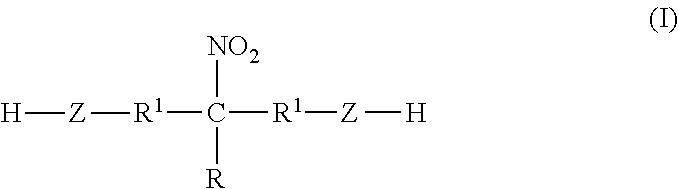
- a binder composition comprising: a polyurethane dispersion containing water and a polyurethane polymer, wherein the polyurethane polymer is prepared by reacting a nitroalcohol compound, a polyol compound, a polyisocyanate compound, and optionally chain extenders, wherein the nitroalcohol compound is of formula I:
- R is H, CH 3 , CH 3 CH 2 , or a group of formula R 1 —Z—H,
- R 1 is —(CH 2 ) x —, —CH(CH 3 )—, —CH(CH 2 CH 3 )—, or —CH(C 6 H 5 )—, wherein x is 1-6, and
- Z is O or NR 4 , wherein R 4 is H or linear or branched C 1 -C 6 alkyl.
- an aqueous based paint or coating comprising a carrier and a binder, wherein the binder is a composition as described herein.
- numeric ranges for instance as in “from 2 to 10,” are inclusive of the numbers defining the range (e.g., 2 and 10).
- ratios, percentages, parts, and the like are by weight.
- the invention provides a binder composition.
- the composition comprises a polyurethane dispersion containing water and a polyurethane polymer.
- the polyurethane polymer is prepared by reacting a nitroalcohol compound, a polyol compound, a polyisocyanate compound, and optionally chain extenders.
- the nitroalcohol compound is of formula I:
- R, R 1 , and Z are as defined above.
- R 1 in the nitroalcohol compound of formula I is CH 2 .
- Z is O.
- R is CH 3 or CH 3 CH 2 .
- R is R 1 —Z—H. In some embodiments, R 1 is CH 2 and Z is O.
- the nitroalcohol compound of formula I is 2-nitro-2-methyl-1,3-propanediol (NMPD), 2-nitro-2-ethyl-1,3-propanediol (NEPD) or tris(hydroxymethyl)nitromethane (TN).
- NMPD 2-nitro-2-methyl-1,3-propanediol
- NEPD 2-nitro-2-ethyl-1,3-propanediol
- TN tris(hydroxymethyl)nitromethane
- Polyurethane polymers useful in the practice of the present invention are prepared by the reaction of the nitroalcohol compound of formula I, a polyol, and a polyisocyanate.
- the polyisocyanate may be any known aromatic polyisocyanate, aliphatic polyisocyanate, or combinations thereof. These polyisocyanates include those containing at least about two isocyanate groups per molecule, preferably, those containing an average of from 2 to 3 isocyanate groups per molecule.
- Exemplary polyisocyanates include, but are not limited to, diphenylmethane diisocyanate (MDI), tolylene diisocyanate (TDI), 4,4′-diisocyanato dicyclohexylmethane (H12MDI), isophorone diisocyanate (IPDI), meta-tetramethylxylylene diisocyanate (TMXDI), 1,3/1,4-diisocyanatomethyl cyclohexane, and hexamethylene diisocyanate.
- MDI diphenylmethane diisocyanate
- TDI tolylene diisocyanate
- H12MDI 4,4′-diisocyanato dicyclohexylmethane
- IPDI isophorone diisocyanate
- TXDI meta-tetramethylxylylene diisocyanate
- 1,3/1,4-diisocyanatomethyl cyclohexane 1,3/1,
- Polyols useful in the present invention are compounds which contain two or more groups that are reactive with isocyanates, generally active-hydrogen groups, such as —OH, primary or secondary amines, and —SH.
- suitable polyols are generally known and are described for instance in such publications as High Polymers , Vol. XVI; “Polyurethanes, Chemistry and Technology,” by Saunders and Frisch, Interscience Publishers, New York, Vol. I, pp. 32-42, 44-54 (1962) and Vol II. Pp. 5-6, 198-199 (1964); Organic Polymer Chemistry by K. J. Saunders, Chapman and Hall, London, pp. 323-325 (1973); and Developments in Polyurethanes , Vol. I, J. M. Burst, ed., Applied Science Publishers, pp. 1-76 (1978).
- suitable polyols include polyester, polylactone, polyether, polyolefin, polycarbonate polyols, and various other polyols.
- the polyol may have a number average molecular weight of 200 to 10,000.
- the polyol has a molecular weight of from 300 to 7,500. More preferably the polyol has a number average molecular weight of from 400 to 5,000.
- the polyol will have a functionality of from 1.5 to 8.
- the polyol has a functionality of 2 to 4.
- polyols for use in the invention are polyester polyols, including for example, hydroxyl terminated linear polyesters.
- polyester polyols including for example, hydroxyl terminated linear polyesters.
- Specific examples include, without limitation, Fomrez® G24-112, a hydroxyl-terminated saturated linear polyester which is poly (ethylene/butylene adipate) glycol with 60/40 molar ratio of ethylene glycol/1,4-butanediol, available from Chemtura Corporation.
- the polyurethane polymer may also contain a hydrophilic group, which may be introduced for instance through the polyol or through co-reactants.
- hydrophilic group refers to an anionic group (for example, carboxyl group, sulfonic acid group, or phosphoric acid group), or a cationic groups (for example, tertiary amino group, or quaternary amino group), or a nonionic hydrophilic group (for example, a group composed of a repeating unit of ethylene oxide, or a group composed of a repeating unit of ethylene oxide and a repeating unit of another alkylene oxide.
- hydrophilic groups include dialkylol alkanoic acid C6 to C24, e.g.
- 2,2-dimethylol propionic acid, and 2,2-dimethylol butanoic acid sulfonic acid dio, e.g. 3-(2,3-dihydroxypropoxy)-1-propane-sulfonic acid and aminosulfonic acid, e.g. 2-aminoethanesulfonic acid; and salts thereof, for example, salts of amines such as triethylamine, alkanolamine, morpholine, and/or alkali metal salts such as sodium salt.
- the invention may include optional ingredients, such as chain extenders or crosslinkers, stabilizing agents, surfactants, solvents, catalysts, and the like.
- a chain extender is used to build the molecular weight of the polyurethane polymer by reaction of the chain extender with the isocyanate functionality in the polyurethane polymer, that is, chain extend the polyurethane polymer.
- a suitable chain extender or crosslinker is typically a low equivalent weight active hydrogen containing compound having about 2 or more active hydrogen groups per molecule. Chain extenders typically have 2 or more active hydrogen groups while crosslinkers have 3 or more active hydrogen groups.
- the active hydrogen groups can be hydroxyl, mercaptyl, or amino groups.
- An amine chain extender can be blocked, encapsulated, or otherwise rendered less reactive. Other materials, particularly water, can function to extend chain length and, therefore, can be chain extenders for purposes of the invention.
- the chain extenders may be aliphatic, cycloaliphatic, or aromatic and are exemplified by triols, tetraols, diamines, triamines, and aminoalcohols.
- Illustrative examples of amine chain extenders include N-methylethanolamine, N-methylisopropylamine, 4-aminocyclohexanol, 1,2-diaminoethane, 1,3-diaminopropane, 1,2-diaminopropane, hexamethylene diamine, methylene bis(aminocyclohexane), isophorone diamine, 1,3- or 1,4-bis(aminomethyl) cyclohexane or blends thereof, diethylenetriamine, toluene-2,4-diamine, and toluene-1,6-diamine.
- the polyurethane polymer of the invention may be prepared using general techniques that are known for making polyurethane dispersions.
- the polyol(s) and the nitroalcohol compound are mixed in a solvent (e.g., methyl ethyl ketone).
- the polyisocyanate is added, along with an optional catalyst, such as bismuth octanoate, and the mixture heated (e.g., to about 70° C.).
- an optional catalyst such as bismuth octanoate
- a weak base such as triethylamine (TEA) may be added.
- TAA triethylamine
- the polymer is then dispersed in water at the desired solids content level and optionally chain extended. Chain extension, when carried out, can be done either before or after dispersion formation.
- the solvent may be removed under vacuum.
- the diisocyanate is typically added in excess and so results in an isocyanate terminated polymer.
- the amount of NCO that should be left over when the alcohol groups are reacted can be calculated and the polymer reaction is run to this point.
- the nitroalcohol may first be reacted with the polyisocyanate to form a nitroisocyanate compound which is then reacted with the polyol.
- such nitroisocyanate compound may, for example, be of the formula II:
- W is O, CH 2 , or NR 5 , wherein R 5 is H or linear or branched C 1 -C 6 alkyl, R 2 is —(CH 2 ) y —, phenyl, tolyl, isophorone, cyclohexyl, dicyclohexylmethane, or diphenylmethane, wherein y is 1-6, R 3 is a bond, H, CH 3 , or CH 3 CH 2 , m is 0-5, and n is 2 or 3.
- Z in formula II is O, R 1 is —CH 2 —, and m is 0.
- R 3 is a bond and n is 3.
- R 3 is CH 3 CH 2 and n is 2.
- the polyurethane dispersion of the invention is useful as binder for an aqueous based paint or coating or for other formulations, such as adhesive, sealant, primer, caulk, or filler formulations.
- a paint or coating may be used to provide a protective and/or decorative barrier for a variety of surfaces, including metal, wood, plastic, brick, wallboard, etc. For instance, it may be used for bridges, floors, transportation vehicles, metal and non-metal parts, exteriors and interiors of houses, and other buildings.
- the amount of the binder in paint or coating formulation of the invention can be the amount conventionally used, which can vary widely due to the protection requirements, gloss/sheen range, and also the solids concentration, of a specific paint formulation.
- the amount of binder solids may be from about 2% to about 75%, alternatively from about 5% to about 65%, or alternatively from about 20% to about 55%, by weight based on the total weight of the formulation.
- a typical paint or coating according to the invention may comprise, in addition to the binder composition, a carrier.
- a pigment may also be included where a pigmented paint or coating is desired.
- the formulation may contain other additives commonly used in paints and coatings including, but not limited to, additional binders, a neutralizing agent, leveling agents and surfactants and wetting agents, a thickener, a rheology modifier, co-solvents such as glycols, including propylene glycol or ethylene glycol, a corrosion inhibitor, a defoamer, a co-dispersant, a biocide, a coalescing agent, and/or a colorant.
- the carrier in the paint or coating formulation is present in order to dissolve, disperse, and/or suspend the other formulation ingredients
- the carrier is usually water, although other water-based solutions such as water-alcohol mixtures and the like may be used.
- the aqueous carrier generally makes up the balance of the formulation, after all the other ingredients have been accounted for.
- Neutralizers may be included in aqueous based paints or coatings in order to neutralize residual acid moieties or to raise the pH to a desired value, sometimes between about 8 and 10.
- Suitable neutralizers are well known in the industry and include, without limitation, ammonia, 2-amino-2-methyl-1-propanol (AMP), dimethylethanolamine (DMEA), potassium hydroxide, sodium hydroxide, monoethanolamine, monoisopropanolamine, lithium carbonate, sodium carbonate, potassium carbonate, butyldiethanolamine, or diethylaminoethanol.
- Pigments may be included to provide hiding power and a desired color to the final coated material and may also be used to provide bulk to the paint or coating. While multiple pigments may be present in end-use paints or coatings, sometimes only white pigment, such as titanium oxide, perhaps in combination with extender pigments such as calcium carbonate and/or kaolin clay, is added in the early stages of the formation of the formulation. Any other desired pigments of various colors (including more white pigment) can optionally be added at the later stages of, or after, the formulation is completed.
- white pigment such as titanium oxide
- extender pigments such as calcium carbonate and/or kaolin clay
- Pigments may be organic or inorganic.
- pigments can include, but are not limited to, titanium dioxide, kaolin clay, calcined kaolin clay, carbon black, iron oxide black, iron oxide yellow, iron oxide red, iron oxide brown, organic red pigments, including quinacridone red and metallized and non-metallized azo reds (e.g., lithols, lithol rubine, toluidine red, naphthol red), phthalocyanine blue, phthalocyanine green, mono- or di-arylide yellow, benzimidazolone yellow, heterocyclic yellow, quinacridone magenta, quinacridone violet, and the like, and any combination thereof.
- quinacridone red metallized and non-metallized azo reds
- the paint and coating formulations of the invention may be manufactured by conventional paint manufacturing techniques, which are well known to those skilled in the art.
- the formulations are manufactured by a two-step process.
- a dispersion phase commonly referred to as the grind phase, is prepared by mixing the dry pigments (if present) with other grind phase components, including most other solid powder formulation materials, under constant high shear agitation to provide a high viscosity and high solids mixture.
- This part of the process is designed to effectively wet and disperse the dry materials and stabilize them in an aqueous dispersion.
- the second step of the paint manufacturing process is commonly referred to as the letdown or thindown phase, because the viscous grind is diluted with the remaining formulation components, which are generally less viscous than the grind mix.
- the binders, any predispersed pigments, and any other paint materials that only require mixing and perhaps moderate shear are incorporated during the letdown phase.
- the letdown phase may be done either by sequentially adding the letdown components into a vessel containing the grind mix, or by adding the grind mix into a vessel containing a premix of the binder resins and other letdown components, followed by sequential addition of the final letdown components. In either case, constant agitation is needed, although application of high shear is not required.
- Coatings formed from binders of the invention have been found to exhibit various favorable properties, including desirable hardness and/or chemical resistance.
- coatings that comprise binders of the invention, when applied to an aluminum substrate exhibit Konig or pendulum hardness as measured according to ASTM D4366 of at least 20 seconds, alternatively at least 23 seconds, alternatively at least 30 seconds, or alternatively at least 36 seconds, following 1 day of coating drying.
- coatings that comprise binders of the invention, when applied to an aluminum substrate exhibit Konig or pendulum hardness of at least 75 seconds, alternatively at least 100 seconds, following 7 days of coating drying.
- a polymer having the composition 44.0 H12MDI (4,4′-diisocyanato dicyclohexylmethane)/42.5 Fomrez G24-112 (polyester polyol)/3.2 NEPD (2-nitro-2-ethyl-1,3-propanediol)/4.8 DMPA (dimethylolpropionic acid)/4.6 PDA (1,2-propane diamine) is prepared as follows:
- a reactor is charged with 256.3 g Fomrez G24-112, 18.7 g NEPD, 28.5 g DMPA and 142.4 g methyl ethyl ketone (MEK) and stirred until homogeneous.
- 265.4 g H12MDI and Bismuth octanoate catalyst (0.028 g) are then added to the reactor and the mixture heated to the reaction temperature of 70° C.
- % NCO is 4.8%
- 20.2 g triethylamine (TEA) is charged to the reactor and it is allowed to mix in for 10 minutes.
- the polymer is then dispersed in water (925 g).
- the polyurethane polymer is chain extended with 1,2-PDA (26.2 g in 61.1 g water).
- the MEK solvent is removed under vacuum.
- the resulting dispersion has a solids content of 36.5% and a particle size of 43 nm.
- a polymer having the composition 44.5 H12MDI/43.0 Fomrez G24-112/3.2 Unoxol Diol/4.8 DMPA/4.6 PDA is prepared as follows:
- a reactor is charged with 256.3 g Fomrez G24-112, 18.7 g Unoxol, 28.5 g DMPA and 142.4 g methyl ethyl ketone (MEK) and stirred until homogeneous.
- 265.4 g H12MDI and Bismuth octanoate catalyst (0.028 g) are then added to the reactor and the mixture heated to the reaction temperature of 70° C.
- 20.2 g TEA is charged to the reactor and it is allowed to mix in for 10 minutes.
- the polymer is then dispersed in water (1000 g).
- the polyurethane polymer is chain extended with 1,2-PDA (26.2 g in 61.1 g water).
- the MEK solvent is removed under vacuum.
- the resulting dispersion has a solids content of 33.7% and a particle size of 42 nm.
- the minimum film forming temperature (MFFT) is measured on the neat PUDs in order to estimate the amount of coalescent for binders able to form films under practical drying conditions.
- the measured MFFTs are shown in the Table 1 below.
- One percent butyl carbitol is added to each formulation (based on solid polymer) for every two degrees Celsius of MFFT greater than negative five.
- each PUD has Byk346 (silicone surfactant) added at 0.5% based on polymer solids.
- Coatings are applied to a treated aluminum panel (Q panel Type Al-412 chromate pretreated aluminum) using a drawdown bar with a 10 mil gap to yield dry films of approximately 2 mil thickness.
- the panels are air cured and the Konig hardness and chemical resistance are measured.
- Konig or pendulum hardness is measured according to ASTM D4366 using a TQC SP0500 Pendulum Hardness Tester after 1 and 7 days of coating drying, and is reported in seconds.
- the chemical resistance is tested after allowing the coatings to cure at room temperature for 7 days. Testing is performed by putting a 23 mm diameter Whatman filter paper on the board and saturating it with the chemical. The chemical puddles are then covered with caps to prevent/limit evaporation during the test. After 1 hour the chemical and filter paper are washed off and the board is dried. All satins are graded 1-5 where 5 means no visible sign or softening of the coating and 1 means complete removal/dissolution of the film. Results are shown in Table 1.
- the nitrofunctional polyurethanes of the invention exhibit a lower MFFT than the control PUD.
- the materials of the invention also showed improved early hardness development (Konig hardness relative to the control case).
Landscapes
- Chemical & Material Sciences (AREA)
- Organic Chemistry (AREA)
- Health & Medical Sciences (AREA)
- Chemical Kinetics & Catalysis (AREA)
- Medicinal Chemistry (AREA)
- Polymers & Plastics (AREA)
- Engineering & Computer Science (AREA)
- Life Sciences & Earth Sciences (AREA)
- Materials Engineering (AREA)
- Wood Science & Technology (AREA)
- Manufacturing & Machinery (AREA)
- Polyurethanes Or Polyureas (AREA)
- Paints Or Removers (AREA)
- Adhesives Or Adhesive Processes (AREA)
- Sealing Material Composition (AREA)
- Compositions Of Macromolecular Compounds (AREA)
Abstract

Description


wherein R, R1, and Z are as defined above.

wherein W is O, CH2, or NR5, wherein R5 is H or linear or branched C1-C6 alkyl, R2 is —(CH2)y—, phenyl, tolyl, isophorone, cyclohexyl, dicyclohexylmethane, or diphenylmethane, wherein y is 1-6, R3 is a bond, H, CH3, or CH3CH2, m is 0-5, and n is 2 or 3.
| TABLE 1 | |||
| PUD 1 | PUD 2 | ||
| MFFT | 40 | >50 | ||
| Konig Hardness*(seconds) | ||||
| 1 day | 36.2 | 22.4 | ||
| 7 day | 106 | 108 | ||
| Chemical Resistance | ||||
| Water | 4.5 | 5 | ||
| Formula 409 (cleaner) | 4.5 | 5 | ||
| Acetone | 4 | 5 | ||
| 50% EtOH (ethanol) | 4 | 5 | ||
| MEK | 3 | 4.5 | ||
| IPA (isopropanol) | 4 | 4.5 | ||
Claims (22)


Priority Applications (1)
| Application Number | Priority Date | Filing Date | Title |
|---|---|---|---|
| US14/649,259 US10000661B2 (en) | 2012-12-06 | 2013-11-13 | Nitrofunctional polyurethane dispersions for binder compositions |
Applications Claiming Priority (3)
| Application Number | Priority Date | Filing Date | Title |
|---|---|---|---|
| US201261734145P | 2012-12-06 | 2012-12-06 | |
| PCT/US2013/069801 WO2014088766A2 (en) | 2012-12-06 | 2013-11-13 | Nitrofunctional polyurethane dispersions for binder compositions |
| US14/649,259 US10000661B2 (en) | 2012-12-06 | 2013-11-13 | Nitrofunctional polyurethane dispersions for binder compositions |
Publications (2)
| Publication Number | Publication Date |
|---|---|
| US20150307742A1 US20150307742A1 (en) | 2015-10-29 |
| US10000661B2 true US10000661B2 (en) | 2018-06-19 |
Family
ID=50732250
Family Applications (1)
| Application Number | Title | Priority Date | Filing Date |
|---|---|---|---|
| US14/649,259 Active US10000661B2 (en) | 2012-12-06 | 2013-11-13 | Nitrofunctional polyurethane dispersions for binder compositions |
Country Status (7)
| Country | Link |
|---|---|
| US (1) | US10000661B2 (en) |
| EP (1) | EP2928937B1 (en) |
| JP (1) | JP6239000B2 (en) |
| KR (1) | KR102138395B1 (en) |
| AR (1) | AR093817A1 (en) |
| CA (1) | CA2893629C (en) |
| WO (1) | WO2014088766A2 (en) |
Families Citing this family (1)
| Publication number | Priority date | Publication date | Assignee | Title |
|---|---|---|---|---|
| US11028217B1 (en) * | 2020-03-13 | 2021-06-08 | Biocellection Inc. | Thermoplastic polyurethane compositions comprising nitro-substituted polyester diols |
Citations (9)
| Publication number | Priority date | Publication date | Assignee | Title |
|---|---|---|---|---|
| US3375220A (en) * | 1965-08-09 | 1968-03-26 | Textron Inc | Polyurethane product |
| US4672000A (en) | 1985-05-31 | 1987-06-09 | Ashland Oil, Inc. | Vapor permeation curable coatings comprising poly(nitro alcohol) resins and multi-isocyanate curing agents |
| JPH02192013A (en) * | 1988-10-03 | 1990-07-27 | Sanyo Chem Ind Ltd | Binder and magnetic recording material |
| US20060122330A1 (en) * | 2002-09-18 | 2006-06-08 | Valspar Sourcing, Inc | Self-crosslinkable waterborne coating composition |
| US20070010612A1 (en) * | 2005-07-01 | 2007-01-11 | The Sherwin-Williams Company | Multi-Layer Coating System Including A Hydroxyl Modified Polyurethane Dispersion Binder |
| WO2009114329A2 (en) * | 2008-03-07 | 2009-09-17 | Dow Global Technologies Inc. | Polyurethanes having low levels of aldehyde emissions |
| US20090253858A1 (en) | 2006-05-18 | 2009-10-08 | Argyropoulos John N | Polyurethane-urea polymers derived from cyclohexane dimethanol |
| US20110014388A1 (en) * | 2009-07-14 | 2011-01-20 | The Sherwin-Williams Company | Ambient cure painting method with waterborne basecoat |
| US20120149841A1 (en) | 2009-08-20 | 2012-06-14 | Takeshi Yamada | Aqueous polyurethane resin dispersion and process for preparing the same |
-
2013
- 2013-11-13 EP EP13854218.8A patent/EP2928937B1/en active Active
- 2013-11-13 US US14/649,259 patent/US10000661B2/en active Active
- 2013-11-13 KR KR1020157017595A patent/KR102138395B1/en active Active
- 2013-11-13 WO PCT/US2013/069801 patent/WO2014088766A2/en not_active Ceased
- 2013-11-13 JP JP2015546487A patent/JP6239000B2/en active Active
- 2013-11-13 CA CA2893629A patent/CA2893629C/en active Active
- 2013-12-05 AR ARP130104517A patent/AR093817A1/en unknown
Patent Citations (9)
| Publication number | Priority date | Publication date | Assignee | Title |
|---|---|---|---|---|
| US3375220A (en) * | 1965-08-09 | 1968-03-26 | Textron Inc | Polyurethane product |
| US4672000A (en) | 1985-05-31 | 1987-06-09 | Ashland Oil, Inc. | Vapor permeation curable coatings comprising poly(nitro alcohol) resins and multi-isocyanate curing agents |
| JPH02192013A (en) * | 1988-10-03 | 1990-07-27 | Sanyo Chem Ind Ltd | Binder and magnetic recording material |
| US20060122330A1 (en) * | 2002-09-18 | 2006-06-08 | Valspar Sourcing, Inc | Self-crosslinkable waterborne coating composition |
| US20070010612A1 (en) * | 2005-07-01 | 2007-01-11 | The Sherwin-Williams Company | Multi-Layer Coating System Including A Hydroxyl Modified Polyurethane Dispersion Binder |
| US20090253858A1 (en) | 2006-05-18 | 2009-10-08 | Argyropoulos John N | Polyurethane-urea polymers derived from cyclohexane dimethanol |
| WO2009114329A2 (en) * | 2008-03-07 | 2009-09-17 | Dow Global Technologies Inc. | Polyurethanes having low levels of aldehyde emissions |
| US20110014388A1 (en) * | 2009-07-14 | 2011-01-20 | The Sherwin-Williams Company | Ambient cure painting method with waterborne basecoat |
| US20120149841A1 (en) | 2009-08-20 | 2012-06-14 | Takeshi Yamada | Aqueous polyurethane resin dispersion and process for preparing the same |
Non-Patent Citations (9)
| Title |
|---|
| Clariant, "Additives used in Flame Retardant Polymer Formulations: Current Practices and Trends", Workshop at NIST, Sep. 30, 2009, 28 pages. |
| Communication issued on European Application 13854218.8, dated Apr. 11, 2017. |
| Developments in Polyurethanes, vol. 1, J.M. Burst, ed., Applied Science Publishers, pp. 1-76, 1978. |
| Document N_English Translation. * |
| High Polymers, vol. XVI: "Polyurethanes, Chemistry and Technology," by Saunders and Frisch, Interscience Publishers, vol. 1, pp. 32-42, 44-54 (1962) and vol. II pp. 5-6, 198-199 (1964). |
| International Preliminary Report on Patentability for PCT/US2013/069801, dated Jun. 9, 2015. |
| International Search Report and Written Opinion for PCT/US2013/069801, dated Aug. 7, 2014. |
| Notice of Reasons for Rejection issued on Japanese Application 2015-546487, dated Jul. 10, 2017, English Translation only. |
| Organic Polymer Chemistry by K.J. Saunders, Chapman and Hall, London, pp. 323-325, 1973. |
Also Published As
| Publication number | Publication date |
|---|---|
| EP2928937A2 (en) | 2015-10-14 |
| CA2893629C (en) | 2020-09-22 |
| KR102138395B1 (en) | 2020-07-27 |
| CA2893629A1 (en) | 2014-06-12 |
| WO2014088766A3 (en) | 2014-10-23 |
| AR093817A1 (en) | 2015-06-24 |
| JP2016509076A (en) | 2016-03-24 |
| EP2928937B1 (en) | 2017-12-20 |
| JP6239000B2 (en) | 2017-11-29 |
| US20150307742A1 (en) | 2015-10-29 |
| WO2014088766A2 (en) | 2014-06-12 |
| KR20150093733A (en) | 2015-08-18 |
Similar Documents
| Publication | Publication Date | Title |
|---|---|---|
| JP5285424B2 (en) | Multilayer coating system containing hydroxyl group-modified polyurethane dispersion binder | |
| DE19812751C2 (en) | Solvent-free polyurethane dispersion | |
| EP0315006B1 (en) | Aqueous solutions or dispersions of polyurethanes, process for their preparation and use of them as coating agents or for the production of coating agents | |
| EP0872499B1 (en) | Aqueous two-component binders and their use | |
| CN101437863B (en) | Oil based aqueous polyurethane dispersion | |
| CN104395368A (en) | Coating agent with high scratch resistance | |
| JP2015218334A (en) | Reactive composition comprising polyamines and dispersion containing uretdione groups | |
| CN113508149B (en) | Blocked isocyanate, method for producing multilayer film, and multilayer film | |
| JP2006522190A (en) | Electrosterically stabilized polyurethane resin, its production and use | |
| JP5105610B2 (en) | Cationic water-based polyurethane resin composition | |
| CN106715509B (en) | Process for the production and use of aqueous polyurethane dispersions and their use in coating agents | |
| DE102005036654A1 (en) | Self-crosslinking polyurethane dispersions with uretdione structure | |
| JPWO2008108346A1 (en) | Water-based polyurethane resin composition and coating composition using the same | |
| ES2930407T3 (en) | Procedures and compositions for polyurethane dispersions through the use of solvents derived from caprolactam | |
| CN110790896A (en) | Blocked polyisocyanate and aqueous coating composition containing same | |
| CN111868133A (en) | Catalyst systems for uretdione dispersions | |
| KR101044115B1 (en) | Manufacturing method of water dispersible polyurethane resin composition for coating of automotive plastic interior materials and paint composition using the same | |
| KR20120100968A (en) | Novel 2c pur systems | |
| EP2928937B1 (en) | Nitrofunctional polyurethane dispersions for binder compositions | |
| CN114989707B (en) | Polyurea coatings | |
| TW202045572A (en) | Preparation method of waterborne polyurethane dispersion composition and waterborne polyurethane coating being free of pungent smell, healthy and environment-friendly | |
| WO2020011805A1 (en) | Radiation-curable aqueous polyurethane dispersions | |
| TWI902919B (en) | Water-dispersible polyisocyanates, waterborne polyurethane resin compositions and articles | |
| EP4688901A1 (en) | Peelable coating composition and method of preparing peelable coating | |
| JP2004027148A (en) | Polyurea resin composition, curing agent for polyurea resin, and composition set for forming polyurea resin |
Legal Events
| Date | Code | Title | Description |
|---|---|---|---|
| AS | Assignment |
Owner name: ANGUS CHEMICAL COMPANY, ILLINOIS Free format text: ASSIGNMENT OF ASSIGNORS INTEREST;ASSIGNORS:BRUTTO, PATRICK E.;GREEN, GEORGE D.;REEL/FRAME:035809/0855 Effective date: 20130401 Owner name: ROHM AND HAAS COMPANY, PENNSYLVANIA Free format text: ASSIGNMENT OF ASSIGNORS INTEREST;ASSIGNORS:FU, ZHENWEN;GREYSON, ERIC C.;HEJL, ANDREW;AND OTHERS;REEL/FRAME:035810/0791 Effective date: 20130326 Owner name: ANGUS CHEMICAL COMPANY, ILLINOIS Free format text: ASSIGNMENT OF ASSIGNORS INTEREST;ASSIGNOR:ROHM AND HAAS COMPANY;REEL/FRAME:035871/0183 Effective date: 20150202 |
|
| AS | Assignment |
Owner name: JPMORGAN CHASE BANK, N.A., AS COLLATERAL AGENT, IL Free format text: SUPPLEMENTAL SECURITY AGREEMENT;ASSIGNOR:ANGUS CHEMICAL COMPANY;REEL/FRAME:038950/0373 Effective date: 20160502 |
|
| STCF | Information on status: patent grant |
Free format text: PATENTED CASE |
|
| AS | Assignment |
Owner name: ANGUS CHEMICAL COMPANY, ILLINOIS Free format text: RELEASE BY SECURED PARTY;ASSIGNOR:JPMORGAN CHASE BANK, N.A.;REEL/FRAME:054462/0821 Effective date: 20201124 |
|
| AS | Assignment |
Owner name: JPMORGAN CHASE BANK, N.A., AS COLLATERAL AGENT, NEW YORK Free format text: PATENT SECURITY AGREEMENT (1ST LIEN);ASSIGNOR:ANGUS CHEMICAL COMPANY;REEL/FRAME:054553/0706 Effective date: 20201124 Owner name: JEFFERIES FINANCE LLC, AS COLLATERAL AGENT, NEW YORK Free format text: PATENT SECURITY AGREEMENT (2ND LIEN);ASSIGNOR:ANGUS CHEMICAL COMPANY;REEL/FRAME:054553/0719 Effective date: 20201124 |
|
| MAFP | Maintenance fee payment |
Free format text: PAYMENT OF MAINTENANCE FEE, 4TH YR, SMALL ENTITY (ORIGINAL EVENT CODE: M2551); ENTITY STATUS OF PATENT OWNER: SMALL ENTITY Year of fee payment: 4 |
|
| AS | Assignment |
Owner name: ADVANCION CORPORATION, ILLINOIS Free format text: CHANGE OF NAME;ASSIGNOR:ANGUS CHEMICAL COMPANY;REEL/FRAME:066697/0518 Effective date: 20230901 |
|
| MAFP | Maintenance fee payment |
Free format text: PAYMENT OF MAINTENANCE FEE, 8TH YR, SMALL ENTITY (ORIGINAL EVENT CODE: M2552); ENTITY STATUS OF PATENT OWNER: SMALL ENTITY Year of fee payment: 8 |