TWI700552B - Photosensitive resin composition, dry film, and printed wiring board - Google Patents
Photosensitive resin composition, dry film, and printed wiring board Download PDFInfo
- Publication number
- TWI700552B TWI700552B TW108118487A TW108118487A TWI700552B TW I700552 B TWI700552 B TW I700552B TW 108118487 A TW108118487 A TW 108118487A TW 108118487 A TW108118487 A TW 108118487A TW I700552 B TWI700552 B TW I700552B
- Authority
- TW
- Taiwan
- Prior art keywords
- group
- resin composition
- photosensitive resin
- layer
- less
- Prior art date
Links
- 239000011342 resin composition Substances 0.000 title claims abstract description 360
- VYPSYNLAJGMNEJ-UHFFFAOYSA-N Silicium dioxide Chemical compound O=[Si]=O VYPSYNLAJGMNEJ-UHFFFAOYSA-N 0.000 claims abstract description 214
- 229920005989 resin Polymers 0.000 claims abstract description 213
- 239000011347 resin Substances 0.000 claims abstract description 213
- 125000003178 carboxy group Chemical group [H]OC(*)=O 0.000 claims abstract description 180
- 239000012766 organic filler Substances 0.000 claims abstract description 125
- 150000001875 compounds Chemical class 0.000 claims abstract description 117
- 239000000377 silicon dioxide Substances 0.000 claims abstract description 90
- JYEUMXHLPRZUAT-UHFFFAOYSA-N 1,2,3-triazine Chemical compound C1=CN=NN=C1 JYEUMXHLPRZUAT-UHFFFAOYSA-N 0.000 claims abstract description 72
- 235000012239 silicon dioxide Nutrition 0.000 claims abstract description 53
- 239000003999 initiator Substances 0.000 claims abstract description 51
- 239000011164 primary particle Substances 0.000 claims abstract description 46
- 239000010410 layer Substances 0.000 claims description 271
- 239000007822 coupling agent Substances 0.000 claims description 83
- 239000004593 Epoxy Substances 0.000 claims description 67
- 239000002904 solvent Substances 0.000 claims description 43
- 125000003700 epoxy group Chemical group 0.000 claims description 37
- 239000007788 liquid Substances 0.000 claims description 34
- 239000011229 interlayer Substances 0.000 claims description 31
- 229920001971 elastomer Polymers 0.000 claims description 24
- 239000005060 rubber Substances 0.000 claims description 24
- 125000003277 amino group Chemical group 0.000 claims description 22
- 229930185605 Bisphenol Natural products 0.000 claims description 20
- 125000000524 functional group Chemical group 0.000 claims description 18
- 229910000679 solder Inorganic materials 0.000 claims description 18
- 125000003545 alkoxy group Chemical group 0.000 claims description 15
- 229920000642 polymer Polymers 0.000 claims description 14
- NIXOWILDQLNWCW-UHFFFAOYSA-N acrylic acid group Chemical group C(C=C)(=O)O NIXOWILDQLNWCW-UHFFFAOYSA-N 0.000 claims description 13
- 125000000217 alkyl group Chemical group 0.000 claims description 13
- XUIMIQQOPSSXEZ-UHFFFAOYSA-N Silicon Chemical group [Si] XUIMIQQOPSSXEZ-UHFFFAOYSA-N 0.000 claims description 12
- 150000004703 alkoxides Chemical group 0.000 claims description 12
- RTAQQCXQSZGOHL-UHFFFAOYSA-N Titanium Chemical group [Ti] RTAQQCXQSZGOHL-UHFFFAOYSA-N 0.000 claims description 11
- 125000000391 vinyl group Chemical group [H]C([*])=C([H])[H] 0.000 claims description 11
- 125000004423 acyloxy group Chemical group 0.000 claims description 9
- QCWXUUIWCKQGHC-UHFFFAOYSA-N Zirconium Chemical group [Zr] QCWXUUIWCKQGHC-UHFFFAOYSA-N 0.000 claims description 7
- 125000000101 thioether group Chemical group 0.000 claims description 7
- OKTJSMMVPCPJKN-UHFFFAOYSA-N Carbon Chemical compound [C] OKTJSMMVPCPJKN-UHFFFAOYSA-N 0.000 claims description 6
- JUJWROOIHBZHMG-UHFFFAOYSA-N Pyridine Chemical group C1=CC=NC=C1 JUJWROOIHBZHMG-UHFFFAOYSA-N 0.000 claims description 6
- IQPQWNKOIGAROB-UHFFFAOYSA-N isocyanate group Chemical group [N-]=C=O IQPQWNKOIGAROB-UHFFFAOYSA-N 0.000 claims description 6
- 125000001302 tertiary amino group Chemical group 0.000 claims description 6
- 125000003396 thiol group Chemical group [H]S* 0.000 claims description 6
- AZDRQVAHHNSJOQ-UHFFFAOYSA-N alumane Chemical group [AlH3] AZDRQVAHHNSJOQ-UHFFFAOYSA-N 0.000 claims description 5
- 229910052799 carbon Inorganic materials 0.000 claims description 5
- 125000000467 secondary amino group Chemical group [H]N([*:1])[*:2] 0.000 claims description 5
- 229910052710 silicon Inorganic materials 0.000 claims description 5
- 229920000800 acrylic rubber Polymers 0.000 claims description 3
- 125000004183 alkoxy alkyl group Chemical group 0.000 claims description 3
- 229920000058 polyacrylate Polymers 0.000 claims description 3
- 239000007800 oxidant agent Substances 0.000 abstract description 37
- 150000002927 oxygen compounds Chemical class 0.000 abstract description 22
- 230000003746 surface roughness Effects 0.000 abstract description 18
- 230000007797 corrosion Effects 0.000 abstract description 10
- 238000005260 corrosion Methods 0.000 abstract description 10
- 239000000047 product Substances 0.000 description 162
- 239000010408 film Substances 0.000 description 146
- 238000007747 plating Methods 0.000 description 84
- 238000000576 coating method Methods 0.000 description 78
- 239000002253 acid Substances 0.000 description 75
- 239000011248 coating agent Substances 0.000 description 70
- 150000001732 carboxylic acid derivatives Chemical class 0.000 description 65
- 238000000034 method Methods 0.000 description 64
- 239000003822 epoxy resin Substances 0.000 description 58
- 229920000647 polyepoxide Polymers 0.000 description 58
- 150000008065 acid anhydrides Chemical class 0.000 description 52
- 238000012360 testing method Methods 0.000 description 51
- -1 melamine compound Chemical class 0.000 description 49
- GTDPSWPPOUPBNX-UHFFFAOYSA-N ac1mqpva Chemical compound CC12C(=O)OC(=O)C1(C)C1(C)C2(C)C(=O)OC1=O GTDPSWPPOUPBNX-UHFFFAOYSA-N 0.000 description 48
- 238000007788 roughening Methods 0.000 description 41
- 239000000463 material Substances 0.000 description 39
- 239000000543 intermediate Substances 0.000 description 37
- NIXOWILDQLNWCW-UHFFFAOYSA-M Acrylate Chemical compound [O-]C(=O)C=C NIXOWILDQLNWCW-UHFFFAOYSA-M 0.000 description 34
- 125000002887 hydroxy group Chemical group [H]O* 0.000 description 34
- ZWEHNKRNPOVVGH-UHFFFAOYSA-N 2-Butanone Chemical compound CCC(C)=O ZWEHNKRNPOVVGH-UHFFFAOYSA-N 0.000 description 33
- JDSHMPZPIAZGSV-UHFFFAOYSA-N melamine Chemical compound NC1=NC(N)=NC(N)=N1 JDSHMPZPIAZGSV-UHFFFAOYSA-N 0.000 description 33
- 239000002245 particle Substances 0.000 description 32
- RYGMFSIKBFXOCR-UHFFFAOYSA-N Copper Chemical compound [Cu] RYGMFSIKBFXOCR-UHFFFAOYSA-N 0.000 description 29
- 229910052802 copper Inorganic materials 0.000 description 28
- 239000010949 copper Substances 0.000 description 28
- 239000000243 solution Substances 0.000 description 25
- 239000011162 core material Substances 0.000 description 24
- 238000006243 chemical reaction Methods 0.000 description 23
- 239000004020 conductor Substances 0.000 description 22
- 239000006185 dispersion Substances 0.000 description 22
- 230000008569 process Effects 0.000 description 21
- 238000009413 insulation Methods 0.000 description 20
- FVCSARBUZVPSQF-UHFFFAOYSA-N 5-(2,4-dioxooxolan-3-yl)-7-methyl-3a,4,5,7a-tetrahydro-2-benzofuran-1,3-dione Chemical compound C1C(C(OC2=O)=O)C2C(C)=CC1C1C(=O)COC1=O FVCSARBUZVPSQF-UHFFFAOYSA-N 0.000 description 19
- 229920003270 Cymel® Polymers 0.000 description 19
- 230000000052 comparative effect Effects 0.000 description 19
- 238000000518 rheometry Methods 0.000 description 18
- 239000003795 chemical substances by application Substances 0.000 description 17
- 238000010438 heat treatment Methods 0.000 description 17
- 239000007864 aqueous solution Substances 0.000 description 16
- 238000011161 development Methods 0.000 description 16
- 238000011156 evaluation Methods 0.000 description 16
- 229920000877 Melamine resin Polymers 0.000 description 15
- 125000000484 butyl group Chemical group [H]C([*])([H])C([H])([H])C([H])([H])C([H])([H])[H] 0.000 description 15
- 229920003986 novolac Polymers 0.000 description 14
- RIOQSEWOXXDEQQ-UHFFFAOYSA-N triphenylphosphine Chemical compound C1=CC=CC=C1P(C=1C=CC=CC=1)C1=CC=CC=C1 RIOQSEWOXXDEQQ-UHFFFAOYSA-N 0.000 description 14
- 229920000459 Nitrile rubber Polymers 0.000 description 13
- XLYOFNOQVPJJNP-UHFFFAOYSA-N water Substances O XLYOFNOQVPJJNP-UHFFFAOYSA-N 0.000 description 13
- WSFSSNUMVMOOMR-UHFFFAOYSA-N Formaldehyde Chemical compound O=C WSFSSNUMVMOOMR-UHFFFAOYSA-N 0.000 description 12
- LRHPLDYGYMQRHN-UHFFFAOYSA-N N-Butanol Chemical compound CCCCO LRHPLDYGYMQRHN-UHFFFAOYSA-N 0.000 description 12
- CDBYLPFSWZWCQE-UHFFFAOYSA-L Sodium Carbonate Chemical compound [Na+].[Na+].[O-]C([O-])=O CDBYLPFSWZWCQE-UHFFFAOYSA-L 0.000 description 12
- IISBACLAFKSPIT-UHFFFAOYSA-N bisphenol A Chemical compound C=1C=C(O)C=CC=1C(C)(C)C1=CC=C(O)C=C1 IISBACLAFKSPIT-UHFFFAOYSA-N 0.000 description 12
- 239000000178 monomer Substances 0.000 description 12
- 239000000126 substance Substances 0.000 description 12
- RWCCWEUUXYIKHB-UHFFFAOYSA-N benzophenone Chemical group C=1C=CC=CC=1C(=O)C1=CC=CC=C1 RWCCWEUUXYIKHB-UHFFFAOYSA-N 0.000 description 11
- 230000015572 biosynthetic process Effects 0.000 description 11
- 238000003786 synthesis reaction Methods 0.000 description 11
- ZUOUZKKEUPVFJK-UHFFFAOYSA-N diphenyl Chemical group C1=CC=CC=C1C1=CC=CC=C1 ZUOUZKKEUPVFJK-UHFFFAOYSA-N 0.000 description 10
- ZXEKIIBDNHEJCQ-UHFFFAOYSA-N isobutanol Chemical compound CC(C)CO ZXEKIIBDNHEJCQ-UHFFFAOYSA-N 0.000 description 10
- AUONHKJOIZSQGR-UHFFFAOYSA-N oxophosphane Chemical compound P=O AUONHKJOIZSQGR-UHFFFAOYSA-N 0.000 description 10
- 150000007519 polyprotic acids Polymers 0.000 description 10
- 239000007787 solid Substances 0.000 description 10
- 150000003512 tertiary amines Chemical class 0.000 description 10
- CERQOIWHTDAKMF-UHFFFAOYSA-N Methacrylic acid Chemical compound CC(=C)C(O)=O CERQOIWHTDAKMF-UHFFFAOYSA-N 0.000 description 9
- 229910000831 Steel Inorganic materials 0.000 description 9
- LYCAIKOWRPUZTN-UHFFFAOYSA-N ethylene glycol Natural products OCCO LYCAIKOWRPUZTN-UHFFFAOYSA-N 0.000 description 9
- 229910052751 metal Inorganic materials 0.000 description 9
- 239000010959 steel Substances 0.000 description 9
- PXHVJJICTQNCMI-UHFFFAOYSA-N Nickel Chemical compound [Ni] PXHVJJICTQNCMI-UHFFFAOYSA-N 0.000 description 8
- 239000004809 Teflon Substances 0.000 description 8
- 229920006362 Teflon® Polymers 0.000 description 8
- 125000003668 acetyloxy group Chemical group [H]C([H])([H])C(=O)O[*] 0.000 description 8
- QSHDDOUJBYECFT-UHFFFAOYSA-N mercury Chemical compound [Hg] QSHDDOUJBYECFT-UHFFFAOYSA-N 0.000 description 8
- 229910052753 mercury Inorganic materials 0.000 description 8
- 239000002184 metal Substances 0.000 description 8
- 230000001590 oxidative effect Effects 0.000 description 8
- 229920000139 polyethylene terephthalate Polymers 0.000 description 8
- 239000005020 polyethylene terephthalate Substances 0.000 description 8
- 230000009467 reduction Effects 0.000 description 8
- 239000007921 spray Substances 0.000 description 8
- SMZOUWXMTYCWNB-UHFFFAOYSA-N 2-(2-methoxy-5-methylphenyl)ethanamine Chemical compound COC1=CC=C(C)C=C1CCN SMZOUWXMTYCWNB-UHFFFAOYSA-N 0.000 description 7
- 206010034972 Photosensitivity reaction Diseases 0.000 description 7
- 125000003118 aryl group Chemical group 0.000 description 7
- BVKZGUZCCUSVTD-UHFFFAOYSA-N carbonic acid Chemical compound OC(O)=O BVKZGUZCCUSVTD-UHFFFAOYSA-N 0.000 description 7
- 239000003054 catalyst Substances 0.000 description 7
- PCHJSUWPFVWCPO-UHFFFAOYSA-N gold Chemical compound [Au] PCHJSUWPFVWCPO-UHFFFAOYSA-N 0.000 description 7
- 229910052737 gold Inorganic materials 0.000 description 7
- 239000010931 gold Substances 0.000 description 7
- 239000001257 hydrogen Substances 0.000 description 7
- 229910052739 hydrogen Inorganic materials 0.000 description 7
- 125000004435 hydrogen atom Chemical class [H]* 0.000 description 7
- 239000011256 inorganic filler Substances 0.000 description 7
- 229910003475 inorganic filler Inorganic materials 0.000 description 7
- 125000001449 isopropyl group Chemical group [H]C([H])([H])C([H])(*)C([H])([H])[H] 0.000 description 7
- 238000002844 melting Methods 0.000 description 7
- 230000008018 melting Effects 0.000 description 7
- 239000000203 mixture Substances 0.000 description 7
- 230000036211 photosensitivity Effects 0.000 description 7
- XNGIFLGASWRNHJ-UHFFFAOYSA-N phthalic acid Chemical compound OC(=O)C1=CC=CC=C1C(O)=O XNGIFLGASWRNHJ-UHFFFAOYSA-N 0.000 description 7
- 229920001187 thermosetting polymer Polymers 0.000 description 7
- 229910052719 titanium Inorganic materials 0.000 description 7
- KAKZBPTYRLMSJV-UHFFFAOYSA-N Butadiene Chemical compound C=CC=C KAKZBPTYRLMSJV-UHFFFAOYSA-N 0.000 description 6
- XEEYBQQBJWHFJM-UHFFFAOYSA-N Iron Chemical compound [Fe] XEEYBQQBJWHFJM-UHFFFAOYSA-N 0.000 description 6
- KFZMGEQAYNKOFK-UHFFFAOYSA-N Isopropanol Chemical compound CC(C)O KFZMGEQAYNKOFK-UHFFFAOYSA-N 0.000 description 6
- OFOBLEOULBTSOW-UHFFFAOYSA-N Malonic acid Chemical compound OC(=O)CC(O)=O OFOBLEOULBTSOW-UHFFFAOYSA-N 0.000 description 6
- OAICVXFJPJFONN-UHFFFAOYSA-N Phosphorus Chemical compound [P] OAICVXFJPJFONN-UHFFFAOYSA-N 0.000 description 6
- PPBRXRYQALVLMV-UHFFFAOYSA-N Styrene Chemical compound C=CC1=CC=CC=C1 PPBRXRYQALVLMV-UHFFFAOYSA-N 0.000 description 6
- 206010042674 Swelling Diseases 0.000 description 6
- YXFVVABEGXRONW-UHFFFAOYSA-N Toluene Chemical compound CC1=CC=CC=C1 YXFVVABEGXRONW-UHFFFAOYSA-N 0.000 description 6
- 125000004018 acid anhydride group Chemical group 0.000 description 6
- 150000008064 anhydrides Chemical group 0.000 description 6
- 125000004429 atom Chemical group 0.000 description 6
- 239000004305 biphenyl Substances 0.000 description 6
- 125000004432 carbon atom Chemical group C* 0.000 description 6
- 230000000694 effects Effects 0.000 description 6
- 239000010419 fine particle Substances 0.000 description 6
- 239000003112 inhibitor Substances 0.000 description 6
- 125000002496 methyl group Chemical group [H]C([H])([H])* 0.000 description 6
- 238000002156 mixing Methods 0.000 description 6
- 229910052698 phosphorus Inorganic materials 0.000 description 6
- 239000011574 phosphorus Substances 0.000 description 6
- 238000006116 polymerization reaction Methods 0.000 description 6
- 125000001436 propyl group Chemical group [H]C([*])([H])C([H])([H])C([H])([H])[H] 0.000 description 6
- 230000005855 radiation Effects 0.000 description 6
- 239000002994 raw material Substances 0.000 description 6
- 150000003335 secondary amines Chemical group 0.000 description 6
- 229910000029 sodium carbonate Inorganic materials 0.000 description 6
- 238000003860 storage Methods 0.000 description 6
- 230000008961 swelling Effects 0.000 description 6
- QTWJRLJHJPIABL-UHFFFAOYSA-N 2-methylphenol;3-methylphenol;4-methylphenol Chemical compound CC1=CC=C(O)C=C1.CC1=CC=CC(O)=C1.CC1=CC=CC=C1O QTWJRLJHJPIABL-UHFFFAOYSA-N 0.000 description 5
- MFKRHJVUCZRDTF-UHFFFAOYSA-N 3-methoxy-3-methylbutan-1-ol Chemical compound COC(C)(C)CCO MFKRHJVUCZRDTF-UHFFFAOYSA-N 0.000 description 5
- 229920000298 Cellophane Polymers 0.000 description 5
- XEKOWRVHYACXOJ-UHFFFAOYSA-N Ethyl acetate Natural products CCOC(C)=O XEKOWRVHYACXOJ-UHFFFAOYSA-N 0.000 description 5
- 239000002390 adhesive tape Substances 0.000 description 5
- 230000002776 aggregation Effects 0.000 description 5
- 239000002585 base Substances 0.000 description 5
- 235000010290 biphenyl Nutrition 0.000 description 5
- 230000005587 bubbling Effects 0.000 description 5
- 229930003836 cresol Natural products 0.000 description 5
- 238000002845 discoloration Methods 0.000 description 5
- RAXXELZNTBOGNW-UHFFFAOYSA-N imidazole Natural products C1=CNC=N1 RAXXELZNTBOGNW-UHFFFAOYSA-N 0.000 description 5
- 230000000379 polymerizing effect Effects 0.000 description 5
- 239000012286 potassium permanganate Substances 0.000 description 5
- 239000000376 reactant Substances 0.000 description 5
- RMAQACBXLXPBSY-UHFFFAOYSA-N silicic acid Chemical compound O[Si](O)(O)O RMAQACBXLXPBSY-UHFFFAOYSA-N 0.000 description 5
- 238000003756 stirring Methods 0.000 description 5
- KMOUUZVZFBCRAM-UHFFFAOYSA-N 1,2,3,6-tetrahydrophthalic anhydride Chemical compound C1C=CCC2C(=O)OC(=O)C21 KMOUUZVZFBCRAM-UHFFFAOYSA-N 0.000 description 4
- LESMLVDJJCWZAJ-UHFFFAOYSA-N 2-(diphenylphosphorylmethyl)-1,3,5-trimethylbenzene Chemical compound CC1=CC(C)=CC(C)=C1CP(=O)(C=1C=CC=CC=1)C1=CC=CC=C1 LESMLVDJJCWZAJ-UHFFFAOYSA-N 0.000 description 4
- 239000004925 Acrylic resin Substances 0.000 description 4
- 229920000178 Acrylic resin Polymers 0.000 description 4
- LFQSCWFLJHTTHZ-UHFFFAOYSA-N Ethanol Chemical compound CCO LFQSCWFLJHTTHZ-UHFFFAOYSA-N 0.000 description 4
- VZCYOOQTPOCHFL-OWOJBTEDSA-N Fumaric acid Chemical compound OC(=O)\C=C\C(O)=O VZCYOOQTPOCHFL-OWOJBTEDSA-N 0.000 description 4
- QIGBRXMKCJKVMJ-UHFFFAOYSA-N Hydroquinone Chemical compound OC1=CC=C(O)C=C1 QIGBRXMKCJKVMJ-UHFFFAOYSA-N 0.000 description 4
- CTQNGGLPUBDAKN-UHFFFAOYSA-N O-Xylene Chemical compound CC1=CC=CC=C1C CTQNGGLPUBDAKN-UHFFFAOYSA-N 0.000 description 4
- ISWSIDIOOBJBQZ-UHFFFAOYSA-N Phenol Chemical compound OC1=CC=CC=C1 ISWSIDIOOBJBQZ-UHFFFAOYSA-N 0.000 description 4
- WYURNTSHIVDZCO-UHFFFAOYSA-N Tetrahydrofuran Chemical compound C1CCOC1 WYURNTSHIVDZCO-UHFFFAOYSA-N 0.000 description 4
- ZJCCRDAZUWHFQH-UHFFFAOYSA-N Trimethylolpropane Chemical compound CCC(CO)(CO)CO ZJCCRDAZUWHFQH-UHFFFAOYSA-N 0.000 description 4
- 150000007513 acids Chemical class 0.000 description 4
- 229910052783 alkali metal Inorganic materials 0.000 description 4
- 125000004849 alkoxymethyl group Chemical group 0.000 description 4
- 150000001412 amines Chemical class 0.000 description 4
- WKDNYTOXBCRNPV-UHFFFAOYSA-N bpda Chemical compound C1=C2C(=O)OC(=O)C2=CC(C=2C=C3C(=O)OC(C3=CC=2)=O)=C1 WKDNYTOXBCRNPV-UHFFFAOYSA-N 0.000 description 4
- 229920002678 cellulose Polymers 0.000 description 4
- 239000001913 cellulose Substances 0.000 description 4
- 238000007796 conventional method Methods 0.000 description 4
- 229920001577 copolymer Polymers 0.000 description 4
- JHIVVAPYMSGYDF-UHFFFAOYSA-N cyclohexanone Chemical compound O=C1CCCCC1 JHIVVAPYMSGYDF-UHFFFAOYSA-N 0.000 description 4
- USIUVYZYUHIAEV-UHFFFAOYSA-N diphenyl ether Chemical compound C=1C=CC=CC=1OC1=CC=CC=C1 USIUVYZYUHIAEV-UHFFFAOYSA-N 0.000 description 4
- 125000001495 ethyl group Chemical group [H]C([H])([H])C([H])([H])* 0.000 description 4
- 238000005227 gel permeation chromatography Methods 0.000 description 4
- 229910052736 halogen Inorganic materials 0.000 description 4
- 150000002367 halogens Chemical class 0.000 description 4
- 238000005259 measurement Methods 0.000 description 4
- 125000000956 methoxy group Chemical group [H]C([H])([H])O* 0.000 description 4
- 125000004108 n-butyl group Chemical group [H]C([H])([H])C([H])([H])C([H])([H])C([H])([H])* 0.000 description 4
- 229910052759 nickel Inorganic materials 0.000 description 4
- 229920001610 polycaprolactone Polymers 0.000 description 4
- 239000004632 polycaprolactone Substances 0.000 description 4
- 238000012545 processing Methods 0.000 description 4
- 229910002027 silica gel Inorganic materials 0.000 description 4
- 239000000741 silica gel Substances 0.000 description 4
- 229910052708 sodium Inorganic materials 0.000 description 4
- 239000011734 sodium Substances 0.000 description 4
- 229920005792 styrene-acrylic resin Polymers 0.000 description 4
- 239000010936 titanium Substances 0.000 description 4
- VZCYOOQTPOCHFL-UHFFFAOYSA-N trans-butenedioic acid Natural products OC(=O)C=CC(O)=O VZCYOOQTPOCHFL-UHFFFAOYSA-N 0.000 description 4
- 239000008096 xylene Substances 0.000 description 4
- TXBCBTDQIULDIA-UHFFFAOYSA-N 2-[[3-hydroxy-2,2-bis(hydroxymethyl)propoxy]methyl]-2-(hydroxymethyl)propane-1,3-diol Chemical compound OCC(CO)(CO)COCC(CO)(CO)CO TXBCBTDQIULDIA-UHFFFAOYSA-N 0.000 description 3
- POAOYUHQDCAZBD-UHFFFAOYSA-N 2-butoxyethanol Chemical compound CCCCOCCO POAOYUHQDCAZBD-UHFFFAOYSA-N 0.000 description 3
- HCGFUIQPSOCUHI-UHFFFAOYSA-N 2-propan-2-yloxyethanol Chemical compound CC(C)OCCO HCGFUIQPSOCUHI-UHFFFAOYSA-N 0.000 description 3
- WMFOQBRAJBCJND-UHFFFAOYSA-M Lithium hydroxide Chemical compound [Li+].[OH-] WMFOQBRAJBCJND-UHFFFAOYSA-M 0.000 description 3
- MUBZPKHOEPUJKR-UHFFFAOYSA-N Oxalic acid Chemical compound OC(=O)C(O)=O MUBZPKHOEPUJKR-UHFFFAOYSA-N 0.000 description 3
- 229910019142 PO4 Inorganic materials 0.000 description 3
- HEMHJVSKTPXQMS-UHFFFAOYSA-M Sodium hydroxide Chemical compound [OH-].[Na+] HEMHJVSKTPXQMS-UHFFFAOYSA-M 0.000 description 3
- ZMANZCXQSJIPKH-UHFFFAOYSA-N Triethylamine Chemical compound CCN(CC)CC ZMANZCXQSJIPKH-UHFFFAOYSA-N 0.000 description 3
- GAZZTULIUXRAAI-UHFFFAOYSA-N [2,3-bis(diethylamino)phenyl]-phenylmethanone Chemical compound CCN(CC)C1=CC=CC(C(=O)C=2C=CC=CC=2)=C1N(CC)CC GAZZTULIUXRAAI-UHFFFAOYSA-N 0.000 description 3
- UMHKOAYRTRADAT-UHFFFAOYSA-N [hydroxy(octoxy)phosphoryl] octyl hydrogen phosphate Chemical compound CCCCCCCCOP(O)(=O)OP(O)(=O)OCCCCCCCC UMHKOAYRTRADAT-UHFFFAOYSA-N 0.000 description 3
- NJYZCEFQAIUHSD-UHFFFAOYSA-N acetoguanamine Chemical compound CC1=NC(N)=NC(N)=N1 NJYZCEFQAIUHSD-UHFFFAOYSA-N 0.000 description 3
- 238000007259 addition reaction Methods 0.000 description 3
- 238000004220 aggregation Methods 0.000 description 3
- 239000003963 antioxidant agent Substances 0.000 description 3
- 230000003078 antioxidant effect Effects 0.000 description 3
- 230000005540 biological transmission Effects 0.000 description 3
- 239000004841 bisphenol A epoxy resin Substances 0.000 description 3
- PXKLMJQFEQBVLD-UHFFFAOYSA-N bisphenol F Chemical compound C1=CC(O)=CC=C1CC1=CC=C(O)C=C1 PXKLMJQFEQBVLD-UHFFFAOYSA-N 0.000 description 3
- 229920002301 cellulose acetate Polymers 0.000 description 3
- 238000004132 cross linking Methods 0.000 description 3
- ILUAAIDVFMVTAU-UHFFFAOYSA-N cyclohex-4-ene-1,2-dicarboxylic acid Chemical compound OC(=O)C1CC=CCC1C(O)=O ILUAAIDVFMVTAU-UHFFFAOYSA-N 0.000 description 3
- MTHSVFCYNBDYFN-UHFFFAOYSA-N diethylene glycol Chemical group OCCOCCO MTHSVFCYNBDYFN-UHFFFAOYSA-N 0.000 description 3
- 238000010292 electrical insulation Methods 0.000 description 3
- 150000002148 esters Chemical class 0.000 description 3
- 125000001301 ethoxy group Chemical group [H]C([H])([H])C([H])([H])O* 0.000 description 3
- 238000002474 experimental method Methods 0.000 description 3
- 239000000945 filler Substances 0.000 description 3
- 125000003055 glycidyl group Chemical group C(C1CO1)* 0.000 description 3
- WGCNASOHLSPBMP-UHFFFAOYSA-N hydroxyacetaldehyde Natural products OCC=O WGCNASOHLSPBMP-UHFFFAOYSA-N 0.000 description 3
- 239000004615 ingredient Substances 0.000 description 3
- 150000002500 ions Chemical class 0.000 description 3
- 125000000959 isobutyl group Chemical group [H]C([H])([H])C([H])(C([H])([H])[H])C([H])([H])* 0.000 description 3
- 239000012948 isocyanate Substances 0.000 description 3
- 150000002576 ketones Chemical class 0.000 description 3
- 238000004898 kneading Methods 0.000 description 3
- 238000003475 lamination Methods 0.000 description 3
- 238000004519 manufacturing process Methods 0.000 description 3
- 150000007974 melamines Chemical class 0.000 description 3
- 239000012528 membrane Substances 0.000 description 3
- 239000007769 metal material Substances 0.000 description 3
- OKKJLVBELUTLKV-UHFFFAOYSA-N methanol Natural products OC OKKJLVBELUTLKV-UHFFFAOYSA-N 0.000 description 3
- 239000011859 microparticle Substances 0.000 description 3
- 238000013508 migration Methods 0.000 description 3
- 230000005012 migration Effects 0.000 description 3
- 125000004123 n-propyl group Chemical group [H]C([H])([H])C([H])([H])C([H])([H])* 0.000 description 3
- 239000003960 organic solvent Substances 0.000 description 3
- WXZMFSXDPGVJKK-UHFFFAOYSA-N pentaerythritol Chemical compound OCC(CO)(CO)CO WXZMFSXDPGVJKK-UHFFFAOYSA-N 0.000 description 3
- NBIIXXVUZAFLBC-UHFFFAOYSA-K phosphate Chemical compound [O-]P([O-])([O-])=O NBIIXXVUZAFLBC-UHFFFAOYSA-K 0.000 description 3
- 239000010452 phosphate Substances 0.000 description 3
- 238000000016 photochemical curing Methods 0.000 description 3
- 238000000206 photolithography Methods 0.000 description 3
- XNGIFLGASWRNHJ-UHFFFAOYSA-L phthalate(2-) Chemical compound [O-]C(=O)C1=CC=CC=C1C([O-])=O XNGIFLGASWRNHJ-UHFFFAOYSA-L 0.000 description 3
- 239000000049 pigment Substances 0.000 description 3
- 238000002360 preparation method Methods 0.000 description 3
- 125000002924 primary amino group Chemical group [H]N([H])* 0.000 description 3
- 125000004805 propylene group Chemical group [H]C([H])([H])C([H])([*:1])C([H])([H])[*:2] 0.000 description 3
- 230000035484 reaction time Effects 0.000 description 3
- 238000007142 ring opening reaction Methods 0.000 description 3
- 239000000758 substrate Substances 0.000 description 3
- 125000000383 tetramethylene group Chemical group [H]C([H])([*:1])C([H])([H])C([H])([H])C([H])([H])[*:2] 0.000 description 3
- 238000012719 thermal polymerization Methods 0.000 description 3
- BPSIOYPQMFLKFR-UHFFFAOYSA-N trimethoxy-[3-(oxiran-2-ylmethoxy)propyl]silane Chemical compound CO[Si](OC)(OC)CCCOCC1CO1 BPSIOYPQMFLKFR-UHFFFAOYSA-N 0.000 description 3
- 150000003672 ureas Chemical class 0.000 description 3
- LTQBNYCMVZQRSD-UHFFFAOYSA-N (4-ethenylphenyl)-trimethoxysilane Chemical compound CO[Si](OC)(OC)C1=CC=C(C=C)C=C1 LTQBNYCMVZQRSD-UHFFFAOYSA-N 0.000 description 2
- 239000012956 1-hydroxycyclohexylphenyl-ketone Substances 0.000 description 2
- ARXJGSRGQADJSQ-UHFFFAOYSA-N 1-methoxypropan-2-ol Chemical compound COCC(C)O ARXJGSRGQADJSQ-UHFFFAOYSA-N 0.000 description 2
- BSYJHYLAMMJNRC-UHFFFAOYSA-N 2,4,4-trimethylpentan-2-ol Chemical compound CC(C)(C)CC(C)(C)O BSYJHYLAMMJNRC-UHFFFAOYSA-N 0.000 description 2
- FPZWZCWUIYYYBU-UHFFFAOYSA-N 2-(2-ethoxyethoxy)ethyl acetate Chemical compound CCOCCOCCOC(C)=O FPZWZCWUIYYYBU-UHFFFAOYSA-N 0.000 description 2
- GWFCWZQFUSJPRE-UHFFFAOYSA-N 2-[2-(2-methylprop-2-enoyloxy)ethoxycarbonyl]cyclohexane-1-carboxylic acid Chemical compound CC(=C)C(=O)OCCOC(=O)C1CCCCC1C(O)=O GWFCWZQFUSJPRE-UHFFFAOYSA-N 0.000 description 2
- XMLYCEVDHLAQEL-UHFFFAOYSA-N 2-hydroxy-2-methyl-1-phenylpropan-1-one Chemical compound CC(C)(O)C(=O)C1=CC=CC=C1 XMLYCEVDHLAQEL-UHFFFAOYSA-N 0.000 description 2
- NJWGQARXZDRHCD-UHFFFAOYSA-N 2-methylanthraquinone Chemical compound C1=CC=C2C(=O)C3=CC(C)=CC=C3C(=O)C2=C1 NJWGQARXZDRHCD-UHFFFAOYSA-N 0.000 description 2
- GZVHEAJQGPRDLQ-UHFFFAOYSA-N 6-phenyl-1,3,5-triazine-2,4-diamine Chemical compound NC1=NC(N)=NC(C=2C=CC=CC=2)=N1 GZVHEAJQGPRDLQ-UHFFFAOYSA-N 0.000 description 2
- KWOLFJPFCHCOCG-UHFFFAOYSA-N Acetophenone Chemical compound CC(=O)C1=CC=CC=C1 KWOLFJPFCHCOCG-UHFFFAOYSA-N 0.000 description 2
- ATRRKUHOCOJYRX-UHFFFAOYSA-N Ammonium bicarbonate Chemical compound [NH4+].OC([O-])=O ATRRKUHOCOJYRX-UHFFFAOYSA-N 0.000 description 2
- 241000208340 Araliaceae Species 0.000 description 2
- DKPFZGUDAPQIHT-UHFFFAOYSA-N Butyl acetate Natural products CCCCOC(C)=O DKPFZGUDAPQIHT-UHFFFAOYSA-N 0.000 description 2
- 229920003275 CYMEL® 325 Polymers 0.000 description 2
- 239000004215 Carbon black (E152) Substances 0.000 description 2
- 229920002160 Celluloid Polymers 0.000 description 2
- ROSDSFDQCJNGOL-UHFFFAOYSA-N Dimethylamine Chemical compound CNC ROSDSFDQCJNGOL-UHFFFAOYSA-N 0.000 description 2
- PEDCQBHIVMGVHV-UHFFFAOYSA-N Glycerine Chemical compound OCC(O)CO PEDCQBHIVMGVHV-UHFFFAOYSA-N 0.000 description 2
- UFHFLCQGNIYNRP-UHFFFAOYSA-N Hydrogen Chemical compound [H][H] UFHFLCQGNIYNRP-UHFFFAOYSA-N 0.000 description 2
- UFWIBTONFRDIAS-UHFFFAOYSA-N Naphthalene Chemical compound C1=CC=CC2=CC=CC=C21 UFWIBTONFRDIAS-UHFFFAOYSA-N 0.000 description 2
- 235000005035 Panax pseudoginseng ssp. pseudoginseng Nutrition 0.000 description 2
- 235000003140 Panax quinquefolius Nutrition 0.000 description 2
- 239000004952 Polyamide Substances 0.000 description 2
- 239000005062 Polybutadiene Substances 0.000 description 2
- ZNRLAKOXJCIOJX-UHFFFAOYSA-N S(=O)(=O)=P=O Chemical compound S(=O)(=O)=P=O ZNRLAKOXJCIOJX-UHFFFAOYSA-N 0.000 description 2
- KKEYFWRCBNTPAC-UHFFFAOYSA-N Terephthalic acid Chemical compound OC(=O)C1=CC=C(C(O)=O)C=C1 KKEYFWRCBNTPAC-UHFFFAOYSA-N 0.000 description 2
- GWEVSGVZZGPLCZ-UHFFFAOYSA-N Titan oxide Chemical compound O=[Ti]=O GWEVSGVZZGPLCZ-UHFFFAOYSA-N 0.000 description 2
- 239000007983 Tris buffer Substances 0.000 description 2
- XLOMVQKBTHCTTD-UHFFFAOYSA-N Zinc monoxide Chemical compound [Zn]=O XLOMVQKBTHCTTD-UHFFFAOYSA-N 0.000 description 2
- JUDXBRVLWDGRBC-UHFFFAOYSA-N [2-(hydroxymethyl)-3-(2-methylprop-2-enoyloxy)-2-(2-methylprop-2-enoyloxymethyl)propyl] 2-methylprop-2-enoate Chemical compound CC(=C)C(=O)OCC(CO)(COC(=O)C(C)=C)COC(=O)C(C)=C JUDXBRVLWDGRBC-UHFFFAOYSA-N 0.000 description 2
- HVVWZTWDBSEWIH-UHFFFAOYSA-N [2-(hydroxymethyl)-3-prop-2-enoyloxy-2-(prop-2-enoyloxymethyl)propyl] prop-2-enoate Chemical compound C=CC(=O)OCC(CO)(COC(=O)C=C)COC(=O)C=C HVVWZTWDBSEWIH-UHFFFAOYSA-N 0.000 description 2
- RFSJWGCYRBTITQ-UHFFFAOYSA-N [PH2](=O)OC(C)=O Chemical compound [PH2](=O)OC(C)=O RFSJWGCYRBTITQ-UHFFFAOYSA-N 0.000 description 2
- ORILYTVJVMAKLC-UHFFFAOYSA-N adamantane Chemical compound C1C(C2)CC3CC1CC2C3 ORILYTVJVMAKLC-UHFFFAOYSA-N 0.000 description 2
- WNLRTRBMVRJNCN-UHFFFAOYSA-N adipic acid Chemical compound OC(=O)CCCCC(O)=O WNLRTRBMVRJNCN-UHFFFAOYSA-N 0.000 description 2
- 238000005054 agglomeration Methods 0.000 description 2
- 125000002723 alicyclic group Chemical group 0.000 description 2
- 125000001931 aliphatic group Chemical group 0.000 description 2
- 150000008044 alkali metal hydroxides Chemical class 0.000 description 2
- XAGFODPZIPBFFR-UHFFFAOYSA-N aluminium Chemical group [Al] XAGFODPZIPBFFR-UHFFFAOYSA-N 0.000 description 2
- 239000001099 ammonium carbonate Substances 0.000 description 2
- 238000004458 analytical method Methods 0.000 description 2
- 238000004873 anchoring Methods 0.000 description 2
- JFCQEDHGNNZCLN-UHFFFAOYSA-N anhydrous glutaric acid Natural products OC(=O)CCCC(O)=O JFCQEDHGNNZCLN-UHFFFAOYSA-N 0.000 description 2
- 125000005577 anthracene group Chemical group 0.000 description 2
- 238000000149 argon plasma sintering Methods 0.000 description 2
- 150000004945 aromatic hydrocarbons Chemical class 0.000 description 2
- TZCXTZWJZNENPQ-UHFFFAOYSA-L barium sulfate Chemical compound [Ba+2].[O-]S([O-])(=O)=O TZCXTZWJZNENPQ-UHFFFAOYSA-L 0.000 description 2
- 239000000440 bentonite Substances 0.000 description 2
- 229910000278 bentonite Inorganic materials 0.000 description 2
- SVPXDRXYRYOSEX-UHFFFAOYSA-N bentoquatam Chemical compound O.O=[Si]=O.O=[Al]O[Al]=O SVPXDRXYRYOSEX-UHFFFAOYSA-N 0.000 description 2
- ISAOCJYIOMOJEB-UHFFFAOYSA-N benzoin Chemical compound C=1C=CC=CC=1C(O)C(=O)C1=CC=CC=C1 ISAOCJYIOMOJEB-UHFFFAOYSA-N 0.000 description 2
- MQDJYUACMFCOFT-UHFFFAOYSA-N bis[2-(1-hydroxycyclohexyl)phenyl]methanone Chemical compound C=1C=CC=C(C(=O)C=2C(=CC=CC=2)C2(O)CCCCC2)C=1C1(O)CCCCC1 MQDJYUACMFCOFT-UHFFFAOYSA-N 0.000 description 2
- 239000004842 bisphenol F epoxy resin Substances 0.000 description 2
- 239000004202 carbamide Substances 0.000 description 2
- 239000007795 chemical reaction product Substances 0.000 description 2
- 238000009833 condensation Methods 0.000 description 2
- 230000005494 condensation Effects 0.000 description 2
- 239000011258 core-shell material Substances 0.000 description 2
- 230000000875 corresponding effect Effects 0.000 description 2
- LDHQCZJRKDOVOX-NSCUHMNNSA-N crotonic acid Chemical compound C\C=C\C(O)=O LDHQCZJRKDOVOX-NSCUHMNNSA-N 0.000 description 2
- 238000001723 curing Methods 0.000 description 2
- 150000007973 cyanuric acids Chemical class 0.000 description 2
- IFDVQVHZEKPUSC-UHFFFAOYSA-N cyclohex-3-ene-1,2-dicarboxylic acid Chemical compound OC(=O)C1CCC=CC1C(O)=O IFDVQVHZEKPUSC-UHFFFAOYSA-N 0.000 description 2
- 230000018044 dehydration Effects 0.000 description 2
- 238000006297 dehydration reaction Methods 0.000 description 2
- 125000006159 dianhydride group Chemical group 0.000 description 2
- WHGNXNCOTZPEEK-UHFFFAOYSA-N dimethoxy-methyl-[3-(oxiran-2-ylmethoxy)propyl]silane Chemical compound CO[Si](C)(OC)CCCOCC1CO1 WHGNXNCOTZPEEK-UHFFFAOYSA-N 0.000 description 2
- XXBDWLFCJWSEKW-UHFFFAOYSA-N dimethylbenzylamine Chemical compound CN(C)CC1=CC=CC=C1 XXBDWLFCJWSEKW-UHFFFAOYSA-N 0.000 description 2
- 238000009826 distribution Methods 0.000 description 2
- 239000003814 drug Substances 0.000 description 2
- 238000005516 engineering process Methods 0.000 description 2
- JBKVHLHDHHXQEQ-UHFFFAOYSA-N epsilon-caprolactam Chemical compound O=C1CCCCCN1 JBKVHLHDHHXQEQ-UHFFFAOYSA-N 0.000 description 2
- FWDBOZPQNFPOLF-UHFFFAOYSA-N ethenyl(triethoxy)silane Chemical compound CCO[Si](OCC)(OCC)C=C FWDBOZPQNFPOLF-UHFFFAOYSA-N 0.000 description 2
- 125000000816 ethylene group Chemical group [H]C([H])([*:1])C([H])([H])[*:2] 0.000 description 2
- 239000001530 fumaric acid Substances 0.000 description 2
- 235000008434 ginseng Nutrition 0.000 description 2
- 239000011521 glass Substances 0.000 description 2
- ZSIAUFGUXNUGDI-UHFFFAOYSA-N hexan-1-ol Chemical compound CCCCCCO ZSIAUFGUXNUGDI-UHFFFAOYSA-N 0.000 description 2
- FUZZWVXGSFPDMH-UHFFFAOYSA-N hexanoic acid Chemical compound CCCCCC(O)=O FUZZWVXGSFPDMH-UHFFFAOYSA-N 0.000 description 2
- 229930195733 hydrocarbon Natural products 0.000 description 2
- 150000002430 hydrocarbons Chemical class 0.000 description 2
- 229910052742 iron Inorganic materials 0.000 description 2
- 230000001678 irradiating effect Effects 0.000 description 2
- 150000002513 isocyanates Chemical class 0.000 description 2
- ZFSLODLOARCGLH-UHFFFAOYSA-N isocyanuric acid Chemical compound OC1=NC(O)=NC(O)=N1 ZFSLODLOARCGLH-UHFFFAOYSA-N 0.000 description 2
- QQVIHTHCMHWDBS-UHFFFAOYSA-N isophthalic acid Chemical compound OC(=O)C1=CC=CC(C(O)=O)=C1 QQVIHTHCMHWDBS-UHFFFAOYSA-N 0.000 description 2
- VZCYOOQTPOCHFL-UPHRSURJSA-N maleic acid Chemical compound OC(=O)\C=C/C(O)=O VZCYOOQTPOCHFL-UPHRSURJSA-N 0.000 description 2
- 239000011976 maleic acid Substances 0.000 description 2
- 229910001507 metal halide Inorganic materials 0.000 description 2
- 150000005309 metal halides Chemical class 0.000 description 2
- DNIAPMSPPWPWGF-UHFFFAOYSA-N monopropylene glycol Natural products CC(O)CO DNIAPMSPPWPWGF-UHFFFAOYSA-N 0.000 description 2
- 125000001624 naphthyl group Chemical group 0.000 description 2
- 229910052757 nitrogen Inorganic materials 0.000 description 2
- BDJRBEYXGGNYIS-UHFFFAOYSA-N nonanedioic acid Chemical compound OC(=O)CCCCCCCC(O)=O BDJRBEYXGGNYIS-UHFFFAOYSA-N 0.000 description 2
- 239000003973 paint Substances 0.000 description 2
- FDPIMTJIUBPUKL-UHFFFAOYSA-N pentan-3-one Chemical compound CCC(=O)CC FDPIMTJIUBPUKL-UHFFFAOYSA-N 0.000 description 2
- 125000001997 phenyl group Chemical group [H]C1=C([H])C([H])=C(*)C([H])=C1[H] 0.000 description 2
- WLJVNTCWHIRURA-UHFFFAOYSA-N pimelic acid Chemical compound OC(=O)CCCCCC(O)=O WLJVNTCWHIRURA-UHFFFAOYSA-N 0.000 description 2
- 229920002647 polyamide Polymers 0.000 description 2
- 229920002857 polybutadiene Polymers 0.000 description 2
- 125000003367 polycyclic group Chemical group 0.000 description 2
- 229920000728 polyester Polymers 0.000 description 2
- 239000004848 polyfunctional curative Substances 0.000 description 2
- BWHMMNNQKKPAPP-UHFFFAOYSA-L potassium carbonate Chemical compound [K+].[K+].[O-]C([O-])=O BWHMMNNQKKPAPP-UHFFFAOYSA-L 0.000 description 2
- 239000000843 powder Substances 0.000 description 2
- 150000003141 primary amines Chemical group 0.000 description 2
- WGYKZJWCGVVSQN-UHFFFAOYSA-N propylamine Chemical compound CCCN WGYKZJWCGVVSQN-UHFFFAOYSA-N 0.000 description 2
- UMJSCPRVCHMLSP-UHFFFAOYSA-N pyridine Natural products COC1=CC=CN=C1 UMJSCPRVCHMLSP-UHFFFAOYSA-N 0.000 description 2
- 230000009257 reactivity Effects 0.000 description 2
- 150000003839 salts Chemical class 0.000 description 2
- CXMXRPHRNRROMY-UHFFFAOYSA-N sebacic acid Chemical compound OC(=O)CCCCCCCCC(O)=O CXMXRPHRNRROMY-UHFFFAOYSA-N 0.000 description 2
- 229910000077 silane Inorganic materials 0.000 description 2
- TYFQFVWCELRYAO-UHFFFAOYSA-N suberic acid Chemical compound OC(=O)CCCCCCC(O)=O TYFQFVWCELRYAO-UHFFFAOYSA-N 0.000 description 2
- 239000004094 surface-active agent Substances 0.000 description 2
- 230000002194 synthesizing effect Effects 0.000 description 2
- YLQBMQCUIZJEEH-UHFFFAOYSA-N tetrahydrofuran Natural products C=1C=COC=1 YLQBMQCUIZJEEH-UHFFFAOYSA-N 0.000 description 2
- UFDHBDMSHIXOKF-UHFFFAOYSA-N tetrahydrophthalic acid Natural products OC(=O)C1=C(C(O)=O)CCCC1 UFDHBDMSHIXOKF-UHFFFAOYSA-N 0.000 description 2
- WGTYBPLFGIVFAS-UHFFFAOYSA-M tetramethylammonium hydroxide Chemical compound [OH-].C[N+](C)(C)C WGTYBPLFGIVFAS-UHFFFAOYSA-M 0.000 description 2
- 239000010409 thin film Substances 0.000 description 2
- OGIDPMRJRNCKJF-UHFFFAOYSA-N titanium oxide Inorganic materials [Ti]=O OGIDPMRJRNCKJF-UHFFFAOYSA-N 0.000 description 2
- LDHQCZJRKDOVOX-UHFFFAOYSA-N trans-crotonic acid Natural products CC=CC(O)=O LDHQCZJRKDOVOX-UHFFFAOYSA-N 0.000 description 2
- QQOWHRYOXYEMTL-UHFFFAOYSA-N triazin-4-amine Chemical compound N=C1C=CN=NN1 QQOWHRYOXYEMTL-UHFFFAOYSA-N 0.000 description 2
- 238000005406 washing Methods 0.000 description 2
- 229910052724 xenon Inorganic materials 0.000 description 2
- FHNFHKCVQCLJFQ-UHFFFAOYSA-N xenon atom Chemical compound [Xe] FHNFHKCVQCLJFQ-UHFFFAOYSA-N 0.000 description 2
- 229910052726 zirconium Inorganic materials 0.000 description 2
- PAPBSGBWRJIAAV-UHFFFAOYSA-N ε-Caprolactone Chemical compound O=C1CCCCCO1 PAPBSGBWRJIAAV-UHFFFAOYSA-N 0.000 description 2
- QNODIIQQMGDSEF-UHFFFAOYSA-N (1-hydroxycyclohexyl)-phenylmethanone Chemical compound C=1C=CC=CC=1C(=O)C1(O)CCCCC1 QNODIIQQMGDSEF-UHFFFAOYSA-N 0.000 description 1
- WYTZZXDRDKSJID-UHFFFAOYSA-N (3-aminopropyl)triethoxysilane Chemical compound CCO[Si](OCC)(OCC)CCCN WYTZZXDRDKSJID-UHFFFAOYSA-N 0.000 description 1
- LTVUCOSIZFEASK-MPXCPUAZSA-N (3ar,4s,7r,7as)-3a-methyl-3a,4,7,7a-tetrahydro-4,7-methano-2-benzofuran-1,3-dione Chemical compound C([C@H]1C=C2)[C@H]2[C@H]2[C@]1(C)C(=O)OC2=O LTVUCOSIZFEASK-MPXCPUAZSA-N 0.000 description 1
- MUTGBJKUEZFXGO-OLQVQODUSA-N (3as,7ar)-3a,4,5,6,7,7a-hexahydro-2-benzofuran-1,3-dione Chemical compound C1CCC[C@@H]2C(=O)OC(=O)[C@@H]21 MUTGBJKUEZFXGO-OLQVQODUSA-N 0.000 description 1
- OLQWMCSSZKNOLQ-ZXZARUISSA-N (3s)-3-[(3r)-2,5-dioxooxolan-3-yl]oxolane-2,5-dione Chemical compound O=C1OC(=O)C[C@H]1[C@@H]1C(=O)OC(=O)C1 OLQWMCSSZKNOLQ-ZXZARUISSA-N 0.000 description 1
- YKYIFUROKBDHCY-ONEGZZNKSA-N (e)-4-ethoxy-1,1,1-trifluorobut-3-en-2-one Chemical group CCO\C=C\C(=O)C(F)(F)F YKYIFUROKBDHCY-ONEGZZNKSA-N 0.000 description 1
- HSFXEOPJXMFQHG-ARJAWSKDSA-N (z)-4-[2-(2-methylprop-2-enoyloxy)ethoxy]-4-oxobut-2-enoic acid Chemical compound CC(=C)C(=O)OCCOC(=O)\C=C/C(O)=O HSFXEOPJXMFQHG-ARJAWSKDSA-N 0.000 description 1
- WBYWAXJHAXSJNI-VOTSOKGWSA-M .beta-Phenylacrylic acid Natural products [O-]C(=O)\C=C\C1=CC=CC=C1 WBYWAXJHAXSJNI-VOTSOKGWSA-M 0.000 description 1
- JJGGIYYGVKGMQZ-UHFFFAOYSA-N 1,2,4-triazole-3,4,5-triamine Chemical class NC1=NN=C(N)N1N JJGGIYYGVKGMQZ-UHFFFAOYSA-N 0.000 description 1
- HCITUYXHCZGFEO-UHFFFAOYSA-N 1,3,5-triazine-2,4,6-triamine Chemical group NC1=NC(N)=NC(N)=N1.N=C1NC(=N)NC(=N)N1 HCITUYXHCZGFEO-UHFFFAOYSA-N 0.000 description 1
- VZXTWGWHSMCWGA-UHFFFAOYSA-N 1,3,5-triazine-2,4-diamine Chemical class NC1=NC=NC(N)=N1 VZXTWGWHSMCWGA-UHFFFAOYSA-N 0.000 description 1
- HGCMSCWGVAYWHR-UHFFFAOYSA-N 1,3,5-trimethyl-2-[[phenyl-[(2,4,6-trimethylphenyl)methyl]phosphoryl]methyl]benzene Chemical compound CC1=CC(C)=CC(C)=C1CP(=O)(C=1C=CC=CC=1)CC1=C(C)C=C(C)C=C1C HGCMSCWGVAYWHR-UHFFFAOYSA-N 0.000 description 1
- FWHUTKPMCKSUCV-UHFFFAOYSA-N 1,3-dioxo-3a,4,5,6,7,7a-hexahydro-2-benzofuran-5-carboxylic acid Chemical compound C1C(C(=O)O)CCC2C(=O)OC(=O)C12 FWHUTKPMCKSUCV-UHFFFAOYSA-N 0.000 description 1
- WMWQTUBQTYZJRI-UHFFFAOYSA-N 1-(4-methoxyphenyl)-n,n-dimethylmethanamine Chemical compound COC1=CC=C(CN(C)C)C=C1 WMWQTUBQTYZJRI-UHFFFAOYSA-N 0.000 description 1
- HXKKHQJGJAFBHI-UHFFFAOYSA-N 1-aminopropan-2-ol Chemical compound CC(O)CN HXKKHQJGJAFBHI-UHFFFAOYSA-N 0.000 description 1
- RTBFRGCFXZNCOE-UHFFFAOYSA-N 1-methylsulfonylpiperidin-4-one Chemical compound CS(=O)(=O)N1CCC(=O)CC1 RTBFRGCFXZNCOE-UHFFFAOYSA-N 0.000 description 1
- ACSJXAKDVNDMME-UHFFFAOYSA-N 11-azidoundecyl(trimethoxy)silane Chemical compound CO[Si](OC)(OC)CCCCCCCCCCCN=[N+]=[N-] ACSJXAKDVNDMME-UHFFFAOYSA-N 0.000 description 1
- HECLRDQVFMWTQS-RGOKHQFPSA-N 1755-01-7 Chemical compound C1[C@H]2[C@@H]3CC=C[C@@H]3[C@@H]1C=C2 HECLRDQVFMWTQS-RGOKHQFPSA-N 0.000 description 1
- RNFJDJUURJAICM-UHFFFAOYSA-N 2,2,4,4,6,6-hexaphenoxy-1,3,5-triaza-2$l^{5},4$l^{5},6$l^{5}-triphosphacyclohexa-1,3,5-triene Chemical compound N=1P(OC=2C=CC=CC=2)(OC=2C=CC=CC=2)=NP(OC=2C=CC=CC=2)(OC=2C=CC=CC=2)=NP=1(OC=1C=CC=CC=1)OC1=CC=CC=C1 RNFJDJUURJAICM-UHFFFAOYSA-N 0.000 description 1
- GKZPEYIPJQHPNC-UHFFFAOYSA-N 2,2-bis(hydroxymethyl)propane-1,3-diol prop-2-enoic acid Chemical compound OC(=O)C=C.OC(=O)C=C.OC(=O)C=C.OC(=O)C=C.OC(=O)C=C.OC(=O)C=C.OCC(CO)(CO)CO GKZPEYIPJQHPNC-UHFFFAOYSA-N 0.000 description 1
- BRKORVYTKKLNKX-UHFFFAOYSA-N 2,4-di(propan-2-yl)thioxanthen-9-one Chemical compound C1=CC=C2C(=O)C3=CC(C(C)C)=CC(C(C)C)=C3SC2=C1 BRKORVYTKKLNKX-UHFFFAOYSA-N 0.000 description 1
- BTJPUDCSZVCXFQ-UHFFFAOYSA-N 2,4-diethylthioxanthen-9-one Chemical compound C1=CC=C2C(=O)C3=CC(CC)=CC(CC)=C3SC2=C1 BTJPUDCSZVCXFQ-UHFFFAOYSA-N 0.000 description 1
- LCHAFMWSFCONOO-UHFFFAOYSA-N 2,4-dimethylthioxanthen-9-one Chemical compound C1=CC=C2C(=O)C3=CC(C)=CC(C)=C3SC2=C1 LCHAFMWSFCONOO-UHFFFAOYSA-N 0.000 description 1
- VXQBJTKSVGFQOL-UHFFFAOYSA-N 2-(2-butoxyethoxy)ethyl acetate Chemical compound CCCCOCCOCCOC(C)=O VXQBJTKSVGFQOL-UHFFFAOYSA-N 0.000 description 1
- YIXYZTDKMQGRRN-UHFFFAOYSA-N 2-(2-prop-1-enoxyethoxycarbonyl)benzoic acid Chemical compound C(C=1C(C(=O)O)=CC=CC1)(=O)OCCOC=CC YIXYZTDKMQGRRN-UHFFFAOYSA-N 0.000 description 1
- RTOMIYMZGQUKIW-UHFFFAOYSA-N 2-(2-prop-2-enoyloxypropoxycarbonyl)benzoic acid Chemical compound C=CC(=O)OC(C)COC(=O)C1=CC=CC=C1C(O)=O RTOMIYMZGQUKIW-UHFFFAOYSA-N 0.000 description 1
- JAHNSTQSQJOJLO-UHFFFAOYSA-N 2-(3-fluorophenyl)-1h-imidazole Chemical compound FC1=CC=CC(C=2NC=CN=2)=C1 JAHNSTQSQJOJLO-UHFFFAOYSA-N 0.000 description 1
- HHOJVZAEHZGDRB-UHFFFAOYSA-N 2-(4,6-diamino-1,3,5-triazin-2-yl)ethyl 2-methylprop-2-enoate Chemical compound CC(=C)C(=O)OCCC1=NC(N)=NC(N)=N1 HHOJVZAEHZGDRB-UHFFFAOYSA-N 0.000 description 1
- FALRKNHUBBKYCC-UHFFFAOYSA-N 2-(chloromethyl)pyridine-3-carbonitrile Chemical compound ClCC1=NC=CC=C1C#N FALRKNHUBBKYCC-UHFFFAOYSA-N 0.000 description 1
- KJSGODDTWRXQRH-UHFFFAOYSA-N 2-(dimethylamino)ethyl benzoate Chemical compound CN(C)CCOC(=O)C1=CC=CC=C1 KJSGODDTWRXQRH-UHFFFAOYSA-N 0.000 description 1
- HZAXFHJVJLSVMW-UHFFFAOYSA-N 2-Aminoethan-1-ol Chemical compound NCCO HZAXFHJVJLSVMW-UHFFFAOYSA-N 0.000 description 1
- XNWFRZJHXBZDAG-UHFFFAOYSA-N 2-METHOXYETHANOL Chemical compound COCCO XNWFRZJHXBZDAG-UHFFFAOYSA-N 0.000 description 1
- FIQBJLHOPOSODG-UHFFFAOYSA-N 2-[2-(2-methylprop-2-enoyloxy)ethoxycarbonyl]benzoic acid Chemical compound CC(=C)C(=O)OCCOC(=O)C1=CC=CC=C1C(O)=O FIQBJLHOPOSODG-UHFFFAOYSA-N 0.000 description 1
- JQIJFFQEWULAIL-UHFFFAOYSA-N 2-[2-(2-methylprop-2-enoyloxy)propoxycarbonyl]benzoic acid Chemical compound CC(=C)C(=O)OC(C)COC(=O)C1=CC=CC=C1C(O)=O JQIJFFQEWULAIL-UHFFFAOYSA-N 0.000 description 1
- SAFFSEYSJOXUCD-UHFFFAOYSA-N 2-[[(2,6-dimethoxyphenyl)methyl-(2,4,4-trimethylpentyl)phosphoryl]methyl]-1,3-dimethoxybenzene Chemical compound COC1=CC=CC(OC)=C1CP(=O)(CC(C)CC(C)(C)C)CC1=C(OC)C=CC=C1OC SAFFSEYSJOXUCD-UHFFFAOYSA-N 0.000 description 1
- NTZGMWMYSDLSLS-UHFFFAOYSA-N 2-[[(2,6-dimethoxyphenyl)methyl-phenylphosphoryl]methyl]-1,3-dimethoxybenzene Chemical compound COC1=C(CP(C2=CC=CC=C2)(CC2=C(C=CC=C2OC)OC)=O)C(=CC=C1)OC NTZGMWMYSDLSLS-UHFFFAOYSA-N 0.000 description 1
- HDDQXUDCEIMISH-UHFFFAOYSA-N 2-[[4-[1,2,2-tris[4-(oxiran-2-ylmethoxy)phenyl]ethyl]phenoxy]methyl]oxirane Chemical compound C1OC1COC(C=C1)=CC=C1C(C=1C=CC(OCC2OC2)=CC=1)C(C=1C=CC(OCC2OC2)=CC=1)C(C=C1)=CC=C1OCC1CO1 HDDQXUDCEIMISH-UHFFFAOYSA-N 0.000 description 1
- PQAMFDRRWURCFQ-UHFFFAOYSA-N 2-ethyl-1h-imidazole Chemical compound CCC1=NC=CN1 PQAMFDRRWURCFQ-UHFFFAOYSA-N 0.000 description 1
- PCKZAVNWRLEHIP-UHFFFAOYSA-N 2-hydroxy-1-[4-[[4-(2-hydroxy-2-methylpropanoyl)phenyl]methyl]phenyl]-2-methylpropan-1-one Chemical compound C1=CC(C(=O)C(C)(O)C)=CC=C1CC1=CC=C(C(=O)C(C)(C)O)C=C1 PCKZAVNWRLEHIP-UHFFFAOYSA-N 0.000 description 1
- 125000000954 2-hydroxyethyl group Chemical group [H]C([*])([H])C([H])([H])O[H] 0.000 description 1
- LXBGSDVWAMZHDD-UHFFFAOYSA-N 2-methyl-1h-imidazole Chemical compound CC1=NC=CN1 LXBGSDVWAMZHDD-UHFFFAOYSA-N 0.000 description 1
- ODGCZQFTJDEYNI-UHFFFAOYSA-N 2-methylcyclohex-3-ene-1,2-dicarboxylic acid Chemical compound OC(=O)C1(C)C=CCCC1C(O)=O ODGCZQFTJDEYNI-UHFFFAOYSA-N 0.000 description 1
- ZCUJYXPAKHMBAZ-UHFFFAOYSA-N 2-phenyl-1h-imidazole Chemical compound C1=CNC(C=2C=CC=CC=2)=N1 ZCUJYXPAKHMBAZ-UHFFFAOYSA-N 0.000 description 1
- SEILKFZTLVMHRR-UHFFFAOYSA-N 2-phosphonooxyethyl 2-methylprop-2-enoate Chemical compound CC(=C)C(=O)OCCOP(O)(O)=O SEILKFZTLVMHRR-UHFFFAOYSA-N 0.000 description 1
- KTALPKYXQZGAEG-UHFFFAOYSA-N 2-propan-2-ylthioxanthen-9-one Chemical compound C1=CC=C2C(=O)C3=CC(C(C)C)=CC=C3SC2=C1 KTALPKYXQZGAEG-UHFFFAOYSA-N 0.000 description 1
- UIDDPPKZYZTEGS-UHFFFAOYSA-N 3-(2-ethyl-4-methylimidazol-1-yl)propanenitrile Chemical compound CCC1=NC(C)=CN1CCC#N UIDDPPKZYZTEGS-UHFFFAOYSA-N 0.000 description 1
- BVYPJEBKDLFIDL-UHFFFAOYSA-N 3-(2-phenylimidazol-1-yl)propanenitrile Chemical compound N#CCCN1C=CN=C1C1=CC=CC=C1 BVYPJEBKDLFIDL-UHFFFAOYSA-N 0.000 description 1
- HXLAEGYMDGUSBD-UHFFFAOYSA-N 3-[diethoxy(methyl)silyl]propan-1-amine Chemical compound CCO[Si](C)(OCC)CCCN HXLAEGYMDGUSBD-UHFFFAOYSA-N 0.000 description 1
- ZYAASQNKCWTPKI-UHFFFAOYSA-N 3-[dimethoxy(methyl)silyl]propan-1-amine Chemical compound CO[Si](C)(OC)CCCN ZYAASQNKCWTPKI-UHFFFAOYSA-N 0.000 description 1
- IKYAJDOSWUATPI-UHFFFAOYSA-N 3-[dimethoxy(methyl)silyl]propane-1-thiol Chemical compound CO[Si](C)(OC)CCCS IKYAJDOSWUATPI-UHFFFAOYSA-N 0.000 description 1
- LZMNXXQIQIHFGC-UHFFFAOYSA-N 3-[dimethoxy(methyl)silyl]propyl 2-methylprop-2-enoate Chemical compound CO[Si](C)(OC)CCCOC(=O)C(C)=C LZMNXXQIQIHFGC-UHFFFAOYSA-N 0.000 description 1
- JYLNVJYYQQXNEK-UHFFFAOYSA-N 3-amino-2-(4-chlorophenyl)-1-propanesulfonic acid Chemical compound OS(=O)(=O)CC(CN)C1=CC=C(Cl)C=C1 JYLNVJYYQQXNEK-UHFFFAOYSA-N 0.000 description 1
- BJEMXPVDXFSROA-UHFFFAOYSA-N 3-butylbenzene-1,2-diol Chemical group CCCCC1=CC=CC(O)=C1O BJEMXPVDXFSROA-UHFFFAOYSA-N 0.000 description 1
- KSCAZPYHLGGNPZ-UHFFFAOYSA-N 3-chloropropyl(triethoxy)silane Chemical compound CCO[Si](OCC)(OCC)CCCCl KSCAZPYHLGGNPZ-UHFFFAOYSA-N 0.000 description 1
- OXYZDRAJMHGSMW-UHFFFAOYSA-N 3-chloropropyl(trimethoxy)silane Chemical compound CO[Si](OC)(OC)CCCCl OXYZDRAJMHGSMW-UHFFFAOYSA-N 0.000 description 1
- KEZMLECYELSZDC-UHFFFAOYSA-N 3-chloropropyl-diethoxy-methylsilane Chemical compound CCO[Si](C)(OCC)CCCCl KEZMLECYELSZDC-UHFFFAOYSA-N 0.000 description 1
- KNTKCYKJRSMRMZ-UHFFFAOYSA-N 3-chloropropyl-dimethoxy-methylsilane Chemical compound CO[Si](C)(OC)CCCCl KNTKCYKJRSMRMZ-UHFFFAOYSA-N 0.000 description 1
- RDNPPYMJRALIIH-UHFFFAOYSA-N 3-methylcyclohex-3-ene-1,1,2,2-tetracarboxylic acid Chemical compound CC1=CCCC(C(O)=O)(C(O)=O)C1(C(O)=O)C(O)=O RDNPPYMJRALIIH-UHFFFAOYSA-N 0.000 description 1
- AYKYXWQEBUNJCN-UHFFFAOYSA-N 3-methylfuran-2,5-dione Chemical compound CC1=CC(=O)OC1=O AYKYXWQEBUNJCN-UHFFFAOYSA-N 0.000 description 1
- OFNISBHGPNMTMS-UHFFFAOYSA-N 3-methylideneoxolane-2,5-dione Chemical compound C=C1CC(=O)OC1=O OFNISBHGPNMTMS-UHFFFAOYSA-N 0.000 description 1
- DFATXMYLKPCSCX-UHFFFAOYSA-N 3-methylsuccinic anhydride Chemical compound CC1CC(=O)OC1=O DFATXMYLKPCSCX-UHFFFAOYSA-N 0.000 description 1
- CYUZOYPRAQASLN-UHFFFAOYSA-N 3-prop-2-enoyloxypropanoic acid Chemical compound OC(=O)CCOC(=O)C=C CYUZOYPRAQASLN-UHFFFAOYSA-N 0.000 description 1
- DCQBZYNUSLHVJC-UHFFFAOYSA-N 3-triethoxysilylpropane-1-thiol Chemical compound CCO[Si](OCC)(OCC)CCCS DCQBZYNUSLHVJC-UHFFFAOYSA-N 0.000 description 1
- GBQYMXVQHATSCC-UHFFFAOYSA-N 3-triethoxysilylpropanenitrile Chemical compound CCO[Si](OCC)(OCC)CCC#N GBQYMXVQHATSCC-UHFFFAOYSA-N 0.000 description 1
- URDOJQUSEUXVRP-UHFFFAOYSA-N 3-triethoxysilylpropyl 2-methylprop-2-enoate Chemical compound CCO[Si](OCC)(OCC)CCCOC(=O)C(C)=C URDOJQUSEUXVRP-UHFFFAOYSA-N 0.000 description 1
- SJECZPVISLOESU-UHFFFAOYSA-N 3-trimethoxysilylpropan-1-amine Chemical compound CO[Si](OC)(OC)CCCN SJECZPVISLOESU-UHFFFAOYSA-N 0.000 description 1
- XDLMVUHYZWKMMD-UHFFFAOYSA-N 3-trimethoxysilylpropyl 2-methylprop-2-enoate Chemical compound CO[Si](OC)(OC)CCCOC(=O)C(C)=C XDLMVUHYZWKMMD-UHFFFAOYSA-N 0.000 description 1
- VPWNQTHUCYMVMZ-UHFFFAOYSA-N 4,4'-sulfonyldiphenol Chemical compound C1=CC(O)=CC=C1S(=O)(=O)C1=CC=C(O)C=C1 VPWNQTHUCYMVMZ-UHFFFAOYSA-N 0.000 description 1
- UDGNCGOMVIKQOW-UHFFFAOYSA-N 4-[(dimethylamino)methyl]-n,n-dimethylaniline Chemical compound CN(C)CC1=CC=C(N(C)C)C=C1 UDGNCGOMVIKQOW-UHFFFAOYSA-N 0.000 description 1
- ZEWLHMQYEZXSBH-UHFFFAOYSA-N 4-[2-(2-methylprop-2-enoyloxy)ethoxy]-4-oxobutanoic acid Chemical compound CC(=C)C(=O)OCCOC(=O)CCC(O)=O ZEWLHMQYEZXSBH-UHFFFAOYSA-N 0.000 description 1
- XCGKPXUJHRZWBX-UHFFFAOYSA-N 4-oxo-4-(2-prop-1-enoxyethoxy)butanoic acid Chemical compound C(=CC)OCCOC(CCC(=O)O)=O XCGKPXUJHRZWBX-UHFFFAOYSA-N 0.000 description 1
- IKVYHNPVKUNCJM-UHFFFAOYSA-N 4-propan-2-ylthioxanthen-9-one Chemical compound S1C2=CC=CC=C2C(=O)C2=C1C(C(C)C)=CC=C2 IKVYHNPVKUNCJM-UHFFFAOYSA-N 0.000 description 1
- XHLKOHSAWQPOFO-UHFFFAOYSA-N 5-phenyl-1h-imidazole Chemical compound N1C=NC=C1C1=CC=CC=C1 XHLKOHSAWQPOFO-UHFFFAOYSA-N 0.000 description 1
- ULKLGIFJWFIQFF-UHFFFAOYSA-N 5K8XI641G3 Chemical compound CCC1=NC=C(C)N1 ULKLGIFJWFIQFF-UHFFFAOYSA-N 0.000 description 1
- MWSKJDNQKGCKPA-UHFFFAOYSA-N 6-methyl-3a,4,5,7a-tetrahydro-2-benzofuran-1,3-dione Chemical compound C1CC(C)=CC2C(=O)OC(=O)C12 MWSKJDNQKGCKPA-UHFFFAOYSA-N 0.000 description 1
- CFNMUZCFSDMZPQ-GHXNOFRVSA-N 7-[(z)-3-methyl-4-(4-methyl-5-oxo-2h-furan-2-yl)but-2-enoxy]chromen-2-one Chemical compound C=1C=C2C=CC(=O)OC2=CC=1OC/C=C(/C)CC1OC(=O)C(C)=C1 CFNMUZCFSDMZPQ-GHXNOFRVSA-N 0.000 description 1
- GJCOSYZMQJWQCA-UHFFFAOYSA-N 9H-xanthene Chemical compound C1=CC=C2CC3=CC=CC=C3OC2=C1 GJCOSYZMQJWQCA-UHFFFAOYSA-N 0.000 description 1
- QTBSBXVTEAMEQO-UHFFFAOYSA-M Acetate Chemical compound CC([O-])=O QTBSBXVTEAMEQO-UHFFFAOYSA-M 0.000 description 1
- NLHHRLWOUZZQLW-UHFFFAOYSA-N Acrylonitrile Chemical compound C=CC#N NLHHRLWOUZZQLW-UHFFFAOYSA-N 0.000 description 1
- OSDWBNJEKMUWAV-UHFFFAOYSA-N Allyl chloride Chemical compound ClCC=C OSDWBNJEKMUWAV-UHFFFAOYSA-N 0.000 description 1
- 239000005995 Aluminium silicate Substances 0.000 description 1
- 229910000013 Ammonium bicarbonate Inorganic materials 0.000 description 1
- VHUUQVKOLVNVRT-UHFFFAOYSA-N Ammonium hydroxide Chemical compound [NH4+].[OH-] VHUUQVKOLVNVRT-UHFFFAOYSA-N 0.000 description 1
- CCQCDODEXHWCTL-UHFFFAOYSA-N C(C)(C)[Ti](CCCCCCCCCCCCCCCCCC)(CCCCCCCCCCCCCCCCCC)CCCCCCCCCCCCCCCCCC Chemical compound C(C)(C)[Ti](CCCCCCCCCCCCCCCCCC)(CCCCCCCCCCCCCCCCCC)CCCCCCCCCCCCCCCCCC CCQCDODEXHWCTL-UHFFFAOYSA-N 0.000 description 1
- OTYISYOQEWQZCT-UHFFFAOYSA-N C(C)O[SiH2]OCC.CC1=CC=CC=C1 Chemical compound C(C)O[SiH2]OCC.CC1=CC=CC=C1 OTYISYOQEWQZCT-UHFFFAOYSA-N 0.000 description 1
- YLTFPPUKTOIQBM-UHFFFAOYSA-N CC1=CC(C)=C(CCCP(C2=CC=CC=C2)(O)=O)C(C)=C1 Chemical compound CC1=CC(C)=C(CCCP(C2=CC=CC=C2)(O)=O)C(C)=C1 YLTFPPUKTOIQBM-UHFFFAOYSA-N 0.000 description 1
- WUDZDEXALDLPTD-UHFFFAOYSA-N CC=COCCOC(=O)C1C=CCCC1C(=O)O Chemical compound CC=COCCOC(=O)C1C=CCCC1C(=O)O WUDZDEXALDLPTD-UHFFFAOYSA-N 0.000 description 1
- GQFJTRQGIZDXNZ-UHFFFAOYSA-N COC1=C(CP(C2=C(C=CC(=C2)C)C)(CC2=C(C=CC=C2OC)OC)=O)C(=CC=C1)OC Chemical compound COC1=C(CP(C2=C(C=CC(=C2)C)C)(CC2=C(C=CC=C2OC)OC)=O)C(=CC=C1)OC GQFJTRQGIZDXNZ-UHFFFAOYSA-N 0.000 description 1
- WBYWAXJHAXSJNI-SREVYHEPSA-N Cinnamic acid Chemical compound OC(=O)\C=C/C1=CC=CC=C1 WBYWAXJHAXSJNI-SREVYHEPSA-N 0.000 description 1
- LCMRPCFGPKXTMI-UHFFFAOYSA-N ClC1=C(CP(C2=C(C=CC(=C2)C)C)(CC2=C(C=CC=C2Cl)Cl)=O)C(=CC=C1)Cl Chemical compound ClC1=C(CP(C2=C(C=CC(=C2)C)C)(CC2=C(C=CC=C2Cl)Cl)=O)C(=CC=C1)Cl LCMRPCFGPKXTMI-UHFFFAOYSA-N 0.000 description 1
- APSRPASMXAUOEX-UHFFFAOYSA-N ClC1=C(CP(C2=CC=CC3=CC=CC=C23)(CC2=C(C=CC=C2Cl)Cl)=O)C(=CC=C1)Cl Chemical compound ClC1=C(CP(C2=CC=CC3=CC=CC=C23)(CC2=C(C=CC=C2Cl)Cl)=O)C(=CC=C1)Cl APSRPASMXAUOEX-UHFFFAOYSA-N 0.000 description 1
- CQUIEGHLYARWMI-UHFFFAOYSA-N ClC1=C(CP(C2=CC=CC=C2)(CC2=C(C=CC=C2Cl)Cl)=O)C(=CC=C1)Cl Chemical compound ClC1=C(CP(C2=CC=CC=C2)(CC2=C(C=CC=C2Cl)Cl)=O)C(=CC=C1)Cl CQUIEGHLYARWMI-UHFFFAOYSA-N 0.000 description 1
- 229940126062 Compound A Drugs 0.000 description 1
- 239000004641 Diallyl-phthalate Substances 0.000 description 1
- RWSOTUBLDIXVET-UHFFFAOYSA-N Dihydrogen sulfide Chemical class S RWSOTUBLDIXVET-UHFFFAOYSA-N 0.000 description 1
- JOYRKODLDBILNP-UHFFFAOYSA-N Ethyl urethane Chemical compound CCOC(N)=O JOYRKODLDBILNP-UHFFFAOYSA-N 0.000 description 1
- NLDMNSXOCDLTTB-UHFFFAOYSA-N Heterophylliin A Natural products O1C2COC(=O)C3=CC(O)=C(O)C(O)=C3C3=C(O)C(O)=C(O)C=C3C(=O)OC2C(OC(=O)C=2C=C(O)C(O)=C(O)C=2)C(O)C1OC(=O)C1=CC(O)=C(O)C(O)=C1 NLDMNSXOCDLTTB-UHFFFAOYSA-N 0.000 description 1
- 239000005057 Hexamethylene diisocyanate Substances 0.000 description 1
- 239000005058 Isophorone diisocyanate Substances 0.000 description 1
- 239000002841 Lewis acid Substances 0.000 description 1
- OFOBLEOULBTSOW-UHFFFAOYSA-L Malonate Chemical compound [O-]C(=O)CC([O-])=O OFOBLEOULBTSOW-UHFFFAOYSA-L 0.000 description 1
- CERQOIWHTDAKMF-UHFFFAOYSA-M Methacrylate Chemical compound CC(=C)C([O-])=O CERQOIWHTDAKMF-UHFFFAOYSA-M 0.000 description 1
- VVQNEPGJFQJSBK-UHFFFAOYSA-N Methyl methacrylate Chemical compound COC(=O)C(C)=C VVQNEPGJFQJSBK-UHFFFAOYSA-N 0.000 description 1
- RJCRNRWHQVXFHP-UHFFFAOYSA-N N=C=O.N=C=O.C1COCCN1 Chemical compound N=C=O.N=C=O.C1COCCN1 RJCRNRWHQVXFHP-UHFFFAOYSA-N 0.000 description 1
- CBENFWSGALASAD-UHFFFAOYSA-N Ozone Chemical compound [O-][O+]=O CBENFWSGALASAD-UHFFFAOYSA-N 0.000 description 1
- OFSAUHSCHWRZKM-UHFFFAOYSA-N Padimate A Chemical compound CC(C)CCOC(=O)C1=CC=C(N(C)C)C=C1 OFSAUHSCHWRZKM-UHFFFAOYSA-N 0.000 description 1
- LGRFSURHDFAFJT-UHFFFAOYSA-N Phthalic anhydride Natural products C1=CC=C2C(=O)OC(=O)C2=C1 LGRFSURHDFAFJT-UHFFFAOYSA-N 0.000 description 1
- 229920002319 Poly(methyl acrylate) Polymers 0.000 description 1
- 239000004698 Polyethylene Substances 0.000 description 1
- 239000004793 Polystyrene Substances 0.000 description 1
- BLRPTPMANUNPDV-UHFFFAOYSA-N Silane Chemical compound [SiH4] BLRPTPMANUNPDV-UHFFFAOYSA-N 0.000 description 1
- 239000006087 Silane Coupling Agent Substances 0.000 description 1
- BQCADISMDOOEFD-UHFFFAOYSA-N Silver Chemical compound [Ag] BQCADISMDOOEFD-UHFFFAOYSA-N 0.000 description 1
- UIIMBOGNXHQVGW-DEQYMQKBSA-M Sodium bicarbonate-14C Chemical compound [Na+].O[14C]([O-])=O UIIMBOGNXHQVGW-DEQYMQKBSA-M 0.000 description 1
- 244000028419 Styrax benzoin Species 0.000 description 1
- 235000000126 Styrax benzoin Nutrition 0.000 description 1
- KDYFGRWQOYBRFD-UHFFFAOYSA-N Succinic acid Natural products OC(=O)CCC(O)=O KDYFGRWQOYBRFD-UHFFFAOYSA-N 0.000 description 1
- NINIDFKCEFEMDL-UHFFFAOYSA-N Sulfur Chemical group [S] NINIDFKCEFEMDL-UHFFFAOYSA-N 0.000 description 1
- UCKMPCXJQFINFW-UHFFFAOYSA-N Sulphide Chemical compound [S-2] UCKMPCXJQFINFW-UHFFFAOYSA-N 0.000 description 1
- 235000008411 Sumatra benzointree Nutrition 0.000 description 1
- BOTDANWDWHJENH-UHFFFAOYSA-N Tetraethyl orthosilicate Chemical compound CCO[Si](OCC)(OCC)OCC BOTDANWDWHJENH-UHFFFAOYSA-N 0.000 description 1
- GSEJCLTVZPLZKY-UHFFFAOYSA-N Triethanolamine Chemical compound OCCN(CCO)CCO GSEJCLTVZPLZKY-UHFFFAOYSA-N 0.000 description 1
- SLINHMUFWFWBMU-UHFFFAOYSA-N Triisopropanolamine Chemical compound CC(O)CN(CC(C)O)CC(C)O SLINHMUFWFWBMU-UHFFFAOYSA-N 0.000 description 1
- XSQUKJJJFZCRTK-UHFFFAOYSA-N Urea Chemical compound NC(N)=O XSQUKJJJFZCRTK-UHFFFAOYSA-N 0.000 description 1
- 229920001807 Urea-formaldehyde Polymers 0.000 description 1
- BGYHLZZASRKEJE-UHFFFAOYSA-N [3-[3-(3,5-ditert-butyl-4-hydroxyphenyl)propanoyloxy]-2,2-bis[3-(3,5-ditert-butyl-4-hydroxyphenyl)propanoyloxymethyl]propyl] 3-(3,5-ditert-butyl-4-hydroxyphenyl)propanoate Chemical compound CC(C)(C)C1=C(O)C(C(C)(C)C)=CC(CCC(=O)OCC(COC(=O)CCC=2C=C(C(O)=C(C=2)C(C)(C)C)C(C)(C)C)(COC(=O)CCC=2C=C(C(O)=C(C=2)C(C)(C)C)C(C)(C)C)COC(=O)CCC=2C=C(C(O)=C(C=2)C(C)(C)C)C(C)(C)C)=C1 BGYHLZZASRKEJE-UHFFFAOYSA-N 0.000 description 1
- MPIAGWXWVAHQBB-UHFFFAOYSA-N [3-prop-2-enoyloxy-2-[[3-prop-2-enoyloxy-2,2-bis(prop-2-enoyloxymethyl)propoxy]methyl]-2-(prop-2-enoyloxymethyl)propyl] prop-2-enoate Chemical compound C=CC(=O)OCC(COC(=O)C=C)(COC(=O)C=C)COCC(COC(=O)C=C)(COC(=O)C=C)COC(=O)C=C MPIAGWXWVAHQBB-UHFFFAOYSA-N 0.000 description 1
- IQLQVSNNDGLBKR-UHFFFAOYSA-N [PH3]=O.ClC1=C(CC2=C(C=CC(=C2)CCC)CC2=C(C=CC=C2Cl)Cl)C(=CC=C1)Cl Chemical compound [PH3]=O.ClC1=C(CC2=C(C=CC(=C2)CCC)CC2=C(C=CC=C2Cl)Cl)C(=CC=C1)Cl IQLQVSNNDGLBKR-UHFFFAOYSA-N 0.000 description 1
- BFXRJTDKPLPXSK-UHFFFAOYSA-N [SiH4].CO[Si](CCCS)(OC)OC Chemical compound [SiH4].CO[Si](CCCS)(OC)OC BFXRJTDKPLPXSK-UHFFFAOYSA-N 0.000 description 1
- 230000002159 abnormal effect Effects 0.000 description 1
- 230000005856 abnormality Effects 0.000 description 1
- VEBCLRKUSAGCDF-UHFFFAOYSA-N ac1mi23b Chemical compound C1C2C3C(COC(=O)C=C)CCC3C1C(COC(=O)C=C)C2 VEBCLRKUSAGCDF-UHFFFAOYSA-N 0.000 description 1
- 150000001242 acetic acid derivatives Chemical class 0.000 description 1
- CSCPPACGZOOCGX-UHFFFAOYSA-N acetone Substances CC(C)=O CSCPPACGZOOCGX-UHFFFAOYSA-N 0.000 description 1
- 150000008062 acetophenones Chemical class 0.000 description 1
- 238000002479 acid--base titration Methods 0.000 description 1
- 150000001252 acrylic acid derivatives Chemical class 0.000 description 1
- 230000009471 action Effects 0.000 description 1
- 239000000654 additive Substances 0.000 description 1
- 230000000996 additive effect Effects 0.000 description 1
- 239000001361 adipic acid Substances 0.000 description 1
- 235000011037 adipic acid Nutrition 0.000 description 1
- 230000002411 adverse Effects 0.000 description 1
- 150000001340 alkali metals Chemical class 0.000 description 1
- 239000012670 alkaline solution Substances 0.000 description 1
- 229920000180 alkyd Polymers 0.000 description 1
- 150000005215 alkyl ethers Chemical class 0.000 description 1
- 229910052782 aluminium Inorganic materials 0.000 description 1
- WNROFYMDJYEPJX-UHFFFAOYSA-K aluminium hydroxide Chemical compound [OH-].[OH-].[OH-].[Al+3] WNROFYMDJYEPJX-UHFFFAOYSA-K 0.000 description 1
- 229910000147 aluminium phosphate Inorganic materials 0.000 description 1
- 235000012211 aluminium silicate Nutrition 0.000 description 1
- JDTOQFDAOQMMBK-UHFFFAOYSA-K aluminum;2-ethylbutanoate Chemical compound [Al+3].CCC(CC)C([O-])=O.CCC(CC)C([O-])=O.CCC(CC)C([O-])=O JDTOQFDAOQMMBK-UHFFFAOYSA-K 0.000 description 1
- JNDMLEXHDPKVFC-UHFFFAOYSA-N aluminum;oxygen(2-);yttrium(3+) Chemical compound [O-2].[O-2].[O-2].[Al+3].[Y+3] JNDMLEXHDPKVFC-UHFFFAOYSA-N 0.000 description 1
- 235000012538 ammonium bicarbonate Nutrition 0.000 description 1
- 235000012501 ammonium carbonate Nutrition 0.000 description 1
- 239000000908 ammonium hydroxide Substances 0.000 description 1
- NEHMKBQYUWJMIP-UHFFFAOYSA-N anhydrous methyl chloride Natural products ClC NEHMKBQYUWJMIP-UHFFFAOYSA-N 0.000 description 1
- 150000004056 anthraquinones Chemical class 0.000 description 1
- IDVDAZFXGGNIDQ-UHFFFAOYSA-N benzo[e][2]benzofuran-1,3-dione Chemical compound C1=CC2=CC=CC=C2C2=C1C(=O)OC2=O IDVDAZFXGGNIDQ-UHFFFAOYSA-N 0.000 description 1
- 229960002130 benzoin Drugs 0.000 description 1
- 239000012965 benzophenone Substances 0.000 description 1
- 150000008366 benzophenones Chemical class 0.000 description 1
- CPLASELWOOUNGW-UHFFFAOYSA-N benzyl(triethoxy)silane Chemical compound CCO[Si](OCC)(OCC)CC1=CC=CC=C1 CPLASELWOOUNGW-UHFFFAOYSA-N 0.000 description 1
- KXHPPCXNWTUNSB-UHFFFAOYSA-M benzyl(trimethyl)azanium;chloride Chemical compound [Cl-].C[N+](C)(C)CC1=CC=CC=C1 KXHPPCXNWTUNSB-UHFFFAOYSA-M 0.000 description 1
- 230000001588 bifunctional effect Effects 0.000 description 1
- QUDWYFHPNIMBFC-UHFFFAOYSA-N bis(prop-2-enyl) benzene-1,2-dicarboxylate Chemical compound C=CCOC(=O)C1=CC=CC=C1C(=O)OCC=C QUDWYFHPNIMBFC-UHFFFAOYSA-N 0.000 description 1
- 238000007664 blowing Methods 0.000 description 1
- BSDOQSMQCZQLDV-UHFFFAOYSA-N butan-1-olate;zirconium(4+) Chemical compound [Zr+4].CCCC[O-].CCCC[O-].CCCC[O-].CCCC[O-] BSDOQSMQCZQLDV-UHFFFAOYSA-N 0.000 description 1
- KDYFGRWQOYBRFD-NUQCWPJISA-N butanedioic acid Chemical compound O[14C](=O)CC[14C](O)=O KDYFGRWQOYBRFD-NUQCWPJISA-N 0.000 description 1
- JHIWVOJDXOSYLW-UHFFFAOYSA-N butyl 2,2-difluorocyclopropane-1-carboxylate Chemical compound CCCCOC(=O)C1CC1(F)F JHIWVOJDXOSYLW-UHFFFAOYSA-N 0.000 description 1
- 239000000298 carbocyanine Substances 0.000 description 1
- 239000002041 carbon nanotube Substances 0.000 description 1
- 229910021393 carbon nanotube Inorganic materials 0.000 description 1
- 239000004359 castor oil Substances 0.000 description 1
- 235000019438 castor oil Nutrition 0.000 description 1
- ZDOBWJOCPDIBRZ-UHFFFAOYSA-N chloromethyl(triethoxy)silane Chemical compound CCO[Si](CCl)(OCC)OCC ZDOBWJOCPDIBRZ-UHFFFAOYSA-N 0.000 description 1
- HXSMWNNIAZLICP-UHFFFAOYSA-N chloromethyl(trimethoxy)silane silane Chemical compound [SiH4].ClC[Si](OC)(OC)OC HXSMWNNIAZLICP-UHFFFAOYSA-N 0.000 description 1
- 229930016911 cinnamic acid Natural products 0.000 description 1
- 235000013985 cinnamic acid Nutrition 0.000 description 1
- 239000004927 clay Substances 0.000 description 1
- 239000003086 colorant Substances 0.000 description 1
- 229940125904 compound 1 Drugs 0.000 description 1
- 229940125782 compound 2 Drugs 0.000 description 1
- 229940126214 compound 3 Drugs 0.000 description 1
- 229940125898 compound 5 Drugs 0.000 description 1
- 239000012141 concentrate Substances 0.000 description 1
- 230000001276 controlling effect Effects 0.000 description 1
- 238000001816 cooling Methods 0.000 description 1
- 239000013256 coordination polymer Substances 0.000 description 1
- 239000011889 copper foil Substances 0.000 description 1
- 230000002596 correlated effect Effects 0.000 description 1
- AFYCEAFSNDLKSX-UHFFFAOYSA-N coumarin 460 Chemical compound CC1=CC(=O)OC2=CC(N(CC)CC)=CC=C21 AFYCEAFSNDLKSX-UHFFFAOYSA-N 0.000 description 1
- 238000005336 cracking Methods 0.000 description 1
- 239000013078 crystal Substances 0.000 description 1
- 238000002425 crystallisation Methods 0.000 description 1
- 230000008025 crystallization Effects 0.000 description 1
- 238000007766 curtain coating Methods 0.000 description 1
- MEWFSXFFGFDHGV-UHFFFAOYSA-N cyclohexyl(trimethoxy)silane Chemical compound CO[Si](OC)(OC)C1CCCCC1 MEWFSXFFGFDHGV-UHFFFAOYSA-N 0.000 description 1
- 239000013530 defoamer Substances 0.000 description 1
- ZBCBWPMODOFKDW-UHFFFAOYSA-N diethanolamine Chemical compound OCCNCCO ZBCBWPMODOFKDW-UHFFFAOYSA-N 0.000 description 1
- OTARVPUIYXHRRB-UHFFFAOYSA-N diethoxy-methyl-[3-(oxiran-2-ylmethoxy)propyl]silane Chemical compound CCO[Si](C)(OCC)CCCOCC1CO1 OTARVPUIYXHRRB-UHFFFAOYSA-N 0.000 description 1
- HPNMFZURTQLUMO-UHFFFAOYSA-N diethylamine Chemical compound CCNCC HPNMFZURTQLUMO-UHFFFAOYSA-N 0.000 description 1
- LVTYICIALWPMFW-UHFFFAOYSA-N diisopropanolamine Chemical compound CC(O)CNCC(C)O LVTYICIALWPMFW-UHFFFAOYSA-N 0.000 description 1
- 229940043276 diisopropanolamine Drugs 0.000 description 1
- 239000003085 diluting agent Substances 0.000 description 1
- ASMQGLCHMVWBQR-UHFFFAOYSA-M diphenyl phosphate Chemical compound C=1C=CC=CC=1OP(=O)([O-])OC1=CC=CC=C1 ASMQGLCHMVWBQR-UHFFFAOYSA-M 0.000 description 1
- 238000007598 dipping method Methods 0.000 description 1
- 239000002270 dispersing agent Substances 0.000 description 1
- SCPWMSBAGXEGPW-UHFFFAOYSA-N dodecyl(trimethoxy)silane Chemical compound CCCCCCCCCCCC[Si](OC)(OC)OC SCPWMSBAGXEGPW-UHFFFAOYSA-N 0.000 description 1
- 238000002296 dynamic light scattering Methods 0.000 description 1
- 239000003792 electrolyte Substances 0.000 description 1
- RPHYLOMQFAGWCD-UHFFFAOYSA-N ethane;phenol Chemical compound CC.OC1=CC=CC=C1 RPHYLOMQFAGWCD-UHFFFAOYSA-N 0.000 description 1
- NKSJNEHGWDZZQF-UHFFFAOYSA-N ethenyl(trimethoxy)silane Chemical compound CO[Si](OC)(OC)C=C NKSJNEHGWDZZQF-UHFFFAOYSA-N 0.000 description 1
- MBGQQKKTDDNCSG-UHFFFAOYSA-N ethenyl-diethoxy-methylsilane Chemical compound CCO[Si](C)(C=C)OCC MBGQQKKTDDNCSG-UHFFFAOYSA-N 0.000 description 1
- SSTAXLJQSRFHMB-UHFFFAOYSA-N ethyl 1,4-dimethylcyclohexa-2,4-diene-1-carboxylate Chemical compound CCOC(=O)C1(C)CC=C(C)C=C1 SSTAXLJQSRFHMB-UHFFFAOYSA-N 0.000 description 1
- SBRXLTRZCJVAPH-UHFFFAOYSA-N ethyl(trimethoxy)silane Chemical compound CC[Si](OC)(OC)OC SBRXLTRZCJVAPH-UHFFFAOYSA-N 0.000 description 1
- GBASTSRAHRGUAB-UHFFFAOYSA-N ethylenetetracarboxylic dianhydride Chemical compound O=C1OC(=O)C2=C1C(=O)OC2=O GBASTSRAHRGUAB-UHFFFAOYSA-N 0.000 description 1
- OAWGCMHNUBGEPR-UHFFFAOYSA-N ethylidenetitanium Chemical compound CC=[Ti] OAWGCMHNUBGEPR-UHFFFAOYSA-N 0.000 description 1
- 230000002349 favourable effect Effects 0.000 description 1
- 239000003063 flame retardant Substances 0.000 description 1
- 238000005187 foaming Methods 0.000 description 1
- IVJISJACKSSFGE-UHFFFAOYSA-N formaldehyde;1,3,5-triazine-2,4,6-triamine Chemical class O=C.NC1=NC(N)=NC(N)=N1 IVJISJACKSSFGE-UHFFFAOYSA-N 0.000 description 1
- MSYLJRIXVZCQHW-UHFFFAOYSA-N formaldehyde;6-phenyl-1,3,5-triazine-2,4-diamine Chemical compound O=C.NC1=NC(N)=NC(C=2C=CC=CC=2)=N1 MSYLJRIXVZCQHW-UHFFFAOYSA-N 0.000 description 1
- ANSXAPJVJOKRDJ-UHFFFAOYSA-N furo[3,4-f][2]benzofuran-1,3,5,7-tetrone Chemical compound C1=C2C(=O)OC(=O)C2=CC2=C1C(=O)OC2=O ANSXAPJVJOKRDJ-UHFFFAOYSA-N 0.000 description 1
- 238000001879 gelation Methods 0.000 description 1
- 238000007429 general method Methods 0.000 description 1
- 235000011187 glycerol Nutrition 0.000 description 1
- ZEMPKEQAKRGZGQ-XOQCFJPHSA-N glycerol triricinoleate Natural products CCCCCC[C@@H](O)CC=CCCCCCCCC(=O)OC[C@@H](COC(=O)CCCCCCCC=CC[C@@H](O)CCCCCC)OC(=O)CCCCCCCC=CC[C@H](O)CCCCCC ZEMPKEQAKRGZGQ-XOQCFJPHSA-N 0.000 description 1
- 235000019382 gum benzoic Nutrition 0.000 description 1
- LNEPOXFFQSENCJ-UHFFFAOYSA-N haloperidol Chemical compound C1CC(O)(C=2C=CC(Cl)=CC=2)CCN1CCCC(=O)C1=CC=C(F)C=C1 LNEPOXFFQSENCJ-UHFFFAOYSA-N 0.000 description 1
- RSKGMYDENCAJEN-UHFFFAOYSA-N hexadecyl(trimethoxy)silane Chemical compound CCCCCCCCCCCCCCCC[Si](OC)(OC)OC RSKGMYDENCAJEN-UHFFFAOYSA-N 0.000 description 1
- RRAMGCGOFNQTLD-UHFFFAOYSA-N hexamethylene diisocyanate Chemical compound O=C=NCCCCCCN=C=O RRAMGCGOFNQTLD-UHFFFAOYSA-N 0.000 description 1
- VLKZOEOYAKHREP-UHFFFAOYSA-N hexane Substances CCCCCC VLKZOEOYAKHREP-UHFFFAOYSA-N 0.000 description 1
- 125000004051 hexyl group Chemical group [H]C([H])([H])C([H])([H])C([H])([H])C([H])([H])C([H])([H])C([H])([H])* 0.000 description 1
- CZWLNMOIEMTDJY-UHFFFAOYSA-N hexyl(trimethoxy)silane Chemical compound CCCCCC[Si](OC)(OC)OC CZWLNMOIEMTDJY-UHFFFAOYSA-N 0.000 description 1
- ZHIBQGJKHVBLJJ-UHFFFAOYSA-N histamine phosphate Chemical compound OP(O)(O)=O.OP(O)(O)=O.NCCC1=CNC=N1 ZHIBQGJKHVBLJJ-UHFFFAOYSA-N 0.000 description 1
- 150000002429 hydrazines Chemical class 0.000 description 1
- 150000002460 imidazoles Chemical class 0.000 description 1
- 230000006872 improvement Effects 0.000 description 1
- 239000011810 insulating material Substances 0.000 description 1
- 229940079865 intestinal antiinfectives imidazole derivative Drugs 0.000 description 1
- NIMLQBUJDJZYEJ-UHFFFAOYSA-N isophorone diisocyanate Chemical compound CC1(C)CC(N=C=O)CC(C)(CN=C=O)C1 NIMLQBUJDJZYEJ-UHFFFAOYSA-N 0.000 description 1
- NLYAJNPCOHFWQQ-UHFFFAOYSA-N kaolin Chemical compound O.O.O=[Al]O[Si](=O)O[Si](=O)O[Al]=O NLYAJNPCOHFWQQ-UHFFFAOYSA-N 0.000 description 1
- 238000010030 laminating Methods 0.000 description 1
- QDLAGTHXVHQKRE-UHFFFAOYSA-N lichenxanthone Natural products COC1=CC(O)=C2C(=O)C3=C(C)C=C(OC)C=C3OC2=C1 QDLAGTHXVHQKRE-UHFFFAOYSA-N 0.000 description 1
- VTHJTEIRLNZDEV-UHFFFAOYSA-L magnesium dihydroxide Chemical compound [OH-].[OH-].[Mg+2] VTHJTEIRLNZDEV-UHFFFAOYSA-L 0.000 description 1
- 239000000347 magnesium hydroxide Substances 0.000 description 1
- 229910001862 magnesium hydroxide Inorganic materials 0.000 description 1
- FPYJFEHAWHCUMM-UHFFFAOYSA-N maleic anhydride Chemical compound O=C1OC(=O)C=C1 FPYJFEHAWHCUMM-UHFFFAOYSA-N 0.000 description 1
- WSFSSNUMVMOOMR-NJFSPNSNSA-N methanone Chemical group O=[14CH2] WSFSSNUMVMOOMR-NJFSPNSNSA-N 0.000 description 1
- 229940050176 methyl chloride Drugs 0.000 description 1
- WBYWAXJHAXSJNI-UHFFFAOYSA-N methyl p-hydroxycinnamate Natural products OC(=O)C=CC1=CC=CC=C1 WBYWAXJHAXSJNI-UHFFFAOYSA-N 0.000 description 1
- YLHXLHGIAMFFBU-UHFFFAOYSA-N methyl phenylglyoxalate Chemical compound COC(=O)C(=O)C1=CC=CC=C1 YLHXLHGIAMFFBU-UHFFFAOYSA-N 0.000 description 1
- LVHBHZANLOWSRM-UHFFFAOYSA-N methylenebutanedioic acid Natural products OC(=O)CC(=C)C(O)=O LVHBHZANLOWSRM-UHFFFAOYSA-N 0.000 description 1
- VYKXQOYUCMREIS-UHFFFAOYSA-N methylhexahydrophthalic anhydride Chemical compound C1CCCC2C(=O)OC(=O)C21C VYKXQOYUCMREIS-UHFFFAOYSA-N 0.000 description 1
- BFXIKLCIZHOAAZ-UHFFFAOYSA-N methyltrimethoxysilane Chemical compound CO[Si](C)(OC)OC BFXIKLCIZHOAAZ-UHFFFAOYSA-N 0.000 description 1
- 239000012046 mixed solvent Substances 0.000 description 1
- 230000004048 modification Effects 0.000 description 1
- 238000012986 modification Methods 0.000 description 1
- INJVFBCDVXYHGQ-UHFFFAOYSA-N n'-(3-triethoxysilylpropyl)ethane-1,2-diamine Chemical compound CCO[Si](OCC)(OCC)CCCNCCN INJVFBCDVXYHGQ-UHFFFAOYSA-N 0.000 description 1
- PHQOGHDTIVQXHL-UHFFFAOYSA-N n'-(3-trimethoxysilylpropyl)ethane-1,2-diamine Chemical compound CO[Si](OC)(OC)CCCNCCN PHQOGHDTIVQXHL-UHFFFAOYSA-N 0.000 description 1
- MQWFLKHKWJMCEN-UHFFFAOYSA-N n'-[3-[dimethoxy(methyl)silyl]propyl]ethane-1,2-diamine Chemical compound CO[Si](C)(OC)CCCNCCN MQWFLKHKWJMCEN-UHFFFAOYSA-N 0.000 description 1
- JAOPKYRWYXCGOQ-UHFFFAOYSA-N n,n-dimethyl-1-(4-methylphenyl)methanamine Chemical compound CN(C)CC1=CC=C(C)C=C1 JAOPKYRWYXCGOQ-UHFFFAOYSA-N 0.000 description 1
- QIOYHIUHPGORLS-UHFFFAOYSA-N n,n-dimethyl-3-trimethoxysilylpropan-1-amine Chemical compound CO[Si](OC)(OC)CCCN(C)C QIOYHIUHPGORLS-UHFFFAOYSA-N 0.000 description 1
- KBJFYLLAMSZSOG-UHFFFAOYSA-N n-(3-trimethoxysilylpropyl)aniline Chemical compound CO[Si](OC)(OC)CCCNC1=CC=CC=C1 KBJFYLLAMSZSOG-UHFFFAOYSA-N 0.000 description 1
- YTVNOVQHSGMMOV-UHFFFAOYSA-N naphthalenetetracarboxylic dianhydride Chemical compound C1=CC(C(=O)OC2=O)=C3C2=CC=C2C(=O)OC(=O)C1=C32 YTVNOVQHSGMMOV-UHFFFAOYSA-N 0.000 description 1
- 230000003472 neutralizing effect Effects 0.000 description 1
- 239000004843 novolac epoxy resin Substances 0.000 description 1
- SLYCYWCVSGPDFR-UHFFFAOYSA-N octadecyltrimethoxysilane Chemical compound CCCCCCCCCCCCCCCCCC[Si](OC)(OC)OC SLYCYWCVSGPDFR-UHFFFAOYSA-N 0.000 description 1
- OTLDLKLSNZMTTA-UHFFFAOYSA-N octahydro-1h-4,7-methanoindene-1,5-diyldimethanol Chemical compound C1C2C3C(CO)CCC3C1C(CO)C2 OTLDLKLSNZMTTA-UHFFFAOYSA-N 0.000 description 1
- MSRJTTSHWYDFIU-UHFFFAOYSA-N octyltriethoxysilane Chemical compound CCCCCCCC[Si](OCC)(OCC)OCC MSRJTTSHWYDFIU-UHFFFAOYSA-N 0.000 description 1
- 230000008520 organization Effects 0.000 description 1
- 235000006408 oxalic acid Nutrition 0.000 description 1
- MPQXHAGKBWFSNV-UHFFFAOYSA-N oxidophosphanium Chemical compound [PH3]=O MPQXHAGKBWFSNV-UHFFFAOYSA-N 0.000 description 1
- 150000002923 oximes Chemical class 0.000 description 1
- RPQRDASANLAFCM-UHFFFAOYSA-N oxiran-2-ylmethyl prop-2-enoate Chemical class C=CC(=O)OCC1CO1 RPQRDASANLAFCM-UHFFFAOYSA-N 0.000 description 1
- NWVVVBRKAWDGAB-UHFFFAOYSA-N p-methoxyphenol Chemical compound COC1=CC=C(O)C=C1 NWVVVBRKAWDGAB-UHFFFAOYSA-N 0.000 description 1
- NFHFRUOZVGFOOS-UHFFFAOYSA-N palladium;triphenylphosphane Chemical compound [Pd].C1=CC=CC=C1P(C=1C=CC=CC=1)C1=CC=CC=C1.C1=CC=CC=C1P(C=1C=CC=CC=1)C1=CC=CC=C1.C1=CC=CC=C1P(C=1C=CC=CC=1)C1=CC=CC=C1.C1=CC=CC=C1P(C=1C=CC=CC=1)C1=CC=CC=C1 NFHFRUOZVGFOOS-UHFFFAOYSA-N 0.000 description 1
- 239000003208 petroleum Substances 0.000 description 1
- 150000002989 phenols Chemical class 0.000 description 1
- 239000013034 phenoxy resin Substances 0.000 description 1
- 229920006287 phenoxy resin Polymers 0.000 description 1
- NBIIXXVUZAFLBC-UHFFFAOYSA-N phosphoric acid Substances OP(O)(O)=O NBIIXXVUZAFLBC-UHFFFAOYSA-N 0.000 description 1
- 150000003018 phosphorus compounds Chemical class 0.000 description 1
- 230000000704 physical effect Effects 0.000 description 1
- QWYZFXLSWMXLDM-UHFFFAOYSA-M pinacyanol iodide Chemical compound [I-].C1=CC2=CC=CC=C2N(CC)C1=CC=CC1=CC=C(C=CC=C2)C2=[N+]1CC QWYZFXLSWMXLDM-UHFFFAOYSA-M 0.000 description 1
- 238000009832 plasma treatment Methods 0.000 description 1
- 229920000573 polyethylene Polymers 0.000 description 1
- 239000003505 polymerization initiator Substances 0.000 description 1
- 229920001451 polypropylene glycol Polymers 0.000 description 1
- 229920001296 polysiloxane Polymers 0.000 description 1
- 229920002223 polystyrene Polymers 0.000 description 1
- 229920002635 polyurethane Polymers 0.000 description 1
- 239000004814 polyurethane Substances 0.000 description 1
- 239000011736 potassium bicarbonate Substances 0.000 description 1
- 229910000028 potassium bicarbonate Inorganic materials 0.000 description 1
- 235000015497 potassium bicarbonate Nutrition 0.000 description 1
- 229910000027 potassium carbonate Inorganic materials 0.000 description 1
- 235000011181 potassium carbonates Nutrition 0.000 description 1
- TYJJADVDDVDEDZ-UHFFFAOYSA-M potassium hydrogencarbonate Chemical compound [K+].OC([O-])=O TYJJADVDDVDEDZ-UHFFFAOYSA-M 0.000 description 1
- 229910001950 potassium oxide Inorganic materials 0.000 description 1
- XPGAWFIWCWKDDL-UHFFFAOYSA-N propan-1-olate;zirconium(4+) Chemical compound [Zr+4].CCC[O-].CCC[O-].CCC[O-].CCC[O-] XPGAWFIWCWKDDL-UHFFFAOYSA-N 0.000 description 1
- QQONPFPTGQHPMA-UHFFFAOYSA-N propylene Natural products CC=C QQONPFPTGQHPMA-UHFFFAOYSA-N 0.000 description 1
- LLHKCFNBLRBOGN-UHFFFAOYSA-N propylene glycol methyl ether acetate Chemical compound COCC(C)OC(C)=O LLHKCFNBLRBOGN-UHFFFAOYSA-N 0.000 description 1
- 238000001953 recrystallisation Methods 0.000 description 1
- 238000010992 reflux Methods 0.000 description 1
- 238000011160 research Methods 0.000 description 1
- 239000004576 sand Substances 0.000 description 1
- 229920006395 saturated elastomer Polymers 0.000 description 1
- 238000007650 screen-printing Methods 0.000 description 1
- 150000003333 secondary alcohols Chemical class 0.000 description 1
- 239000011163 secondary particle Substances 0.000 description 1
- 239000004065 semiconductor Substances 0.000 description 1
- 239000010703 silicon Substances 0.000 description 1
- 229910052814 silicon oxide Inorganic materials 0.000 description 1
- 229920002050 silicone resin Polymers 0.000 description 1
- 229910052709 silver Inorganic materials 0.000 description 1
- 239000004332 silver Substances 0.000 description 1
- 235000017550 sodium carbonate Nutrition 0.000 description 1
- 235000011121 sodium hydroxide Nutrition 0.000 description 1
- NTHWMYGWWRZVTN-UHFFFAOYSA-N sodium silicate Chemical compound [Na+].[Na+].[O-][Si]([O-])=O NTHWMYGWWRZVTN-UHFFFAOYSA-N 0.000 description 1
- 239000011973 solid acid Substances 0.000 description 1
- 241000894007 species Species 0.000 description 1
- 238000004528 spin coating Methods 0.000 description 1
- 238000005507 spraying Methods 0.000 description 1
- PJANXHGTPQOBST-UHFFFAOYSA-N stilbene Chemical group C=1C=CC=CC=1C=CC1=CC=CC=C1 PJANXHGTPQOBST-UHFFFAOYSA-N 0.000 description 1
- 229940014800 succinic anhydride Drugs 0.000 description 1
- 150000005846 sugar alcohols Polymers 0.000 description 1
- 230000001629 suppression Effects 0.000 description 1
- 239000000454 talc Substances 0.000 description 1
- 229910052623 talc Inorganic materials 0.000 description 1
- 125000006158 tetracarboxylic acid group Chemical group 0.000 description 1
- 150000000000 tetracarboxylic acids Chemical class 0.000 description 1
- LFQCEHFDDXELDD-UHFFFAOYSA-N tetramethyl orthosilicate Chemical compound CO[Si](OC)(OC)OC LFQCEHFDDXELDD-UHFFFAOYSA-N 0.000 description 1
- 238000001029 thermal curing Methods 0.000 description 1
- 230000000930 thermomechanical effect Effects 0.000 description 1
- 229920002803 thermoplastic polyurethane Polymers 0.000 description 1
- 150000003568 thioethers Chemical class 0.000 description 1
- 239000013008 thixotropic agent Substances 0.000 description 1
- DVKJHBMWWAPEIU-UHFFFAOYSA-N toluene 2,4-diisocyanate Chemical compound CC1=CC=C(N=C=O)C=C1N=C=O DVKJHBMWWAPEIU-UHFFFAOYSA-N 0.000 description 1
- DENFJSAFJTVPJR-UHFFFAOYSA-N triethoxy(ethyl)silane Chemical compound CCO[Si](CC)(OCC)OCC DENFJSAFJTVPJR-UHFFFAOYSA-N 0.000 description 1
- CPUDPFPXCZDNGI-UHFFFAOYSA-N triethoxy(methyl)silane Chemical compound CCO[Si](C)(OCC)OCC CPUDPFPXCZDNGI-UHFFFAOYSA-N 0.000 description 1
- FZMJEGJVKFTGMU-UHFFFAOYSA-N triethoxy(octadecyl)silane Chemical compound CCCCCCCCCCCCCCCCCC[Si](OCC)(OCC)OCC FZMJEGJVKFTGMU-UHFFFAOYSA-N 0.000 description 1
- JCVQKRGIASEUKR-UHFFFAOYSA-N triethoxy(phenyl)silane Chemical compound CCO[Si](OCC)(OCC)C1=CC=CC=C1 JCVQKRGIASEUKR-UHFFFAOYSA-N 0.000 description 1
- UMFJXASDGBJDEB-UHFFFAOYSA-N triethoxy(prop-2-enyl)silane Chemical compound CCO[Si](CC=C)(OCC)OCC UMFJXASDGBJDEB-UHFFFAOYSA-N 0.000 description 1
- NBXZNTLFQLUFES-UHFFFAOYSA-N triethoxy(propyl)silane Chemical compound CCC[Si](OCC)(OCC)OCC NBXZNTLFQLUFES-UHFFFAOYSA-N 0.000 description 1
- JXUKBNICSRJFAP-UHFFFAOYSA-N triethoxy-[3-(oxiran-2-ylmethoxy)propyl]silane Chemical compound CCO[Si](OCC)(OCC)CCCOCC1CO1 JXUKBNICSRJFAP-UHFFFAOYSA-N 0.000 description 1
- ZMANZCXQSJIPKH-UHFFFAOYSA-O triethylammonium ion Chemical compound CC[NH+](CC)CC ZMANZCXQSJIPKH-UHFFFAOYSA-O 0.000 description 1
- JLGNHOJUQFHYEZ-UHFFFAOYSA-N trimethoxy(3,3,3-trifluoropropyl)silane Chemical compound CO[Si](OC)(OC)CCC(F)(F)F JLGNHOJUQFHYEZ-UHFFFAOYSA-N 0.000 description 1
- IWZLBIVZPIDURM-UHFFFAOYSA-N trimethoxy(3-prop-1-enoxypropyl)silane Chemical compound CO[Si](OC)(OC)CCCOC=CC IWZLBIVZPIDURM-UHFFFAOYSA-N 0.000 description 1
- ZSOVVFMGSCDMIF-UHFFFAOYSA-N trimethoxy(naphthalen-1-yl)silane Chemical compound C1=CC=C2C([Si](OC)(OC)OC)=CC=CC2=C1 ZSOVVFMGSCDMIF-UHFFFAOYSA-N 0.000 description 1
- NMEPHPOFYLLFTK-UHFFFAOYSA-N trimethoxy(octyl)silane Chemical compound CCCCCCCC[Si](OC)(OC)OC NMEPHPOFYLLFTK-UHFFFAOYSA-N 0.000 description 1
- ZNOCGWVLWPVKAO-UHFFFAOYSA-N trimethoxy(phenyl)silane Chemical compound CO[Si](OC)(OC)C1=CC=CC=C1 ZNOCGWVLWPVKAO-UHFFFAOYSA-N 0.000 description 1
- LFRDHGNFBLIJIY-UHFFFAOYSA-N trimethoxy(prop-2-enyl)silane Chemical compound CO[Si](OC)(OC)CC=C LFRDHGNFBLIJIY-UHFFFAOYSA-N 0.000 description 1
- HQYALQRYBUJWDH-UHFFFAOYSA-N trimethoxy(propyl)silane Chemical compound CCC[Si](OC)(OC)OC HQYALQRYBUJWDH-UHFFFAOYSA-N 0.000 description 1
- XFFHTZIRHGKTBQ-UHFFFAOYSA-N trimethoxy-(2,3,4,5,6-pentafluorophenyl)silane Chemical compound CO[Si](OC)(OC)C1=C(F)C(F)=C(F)C(F)=C1F XFFHTZIRHGKTBQ-UHFFFAOYSA-N 0.000 description 1
- XQEGZYAXBCFSBS-UHFFFAOYSA-N trimethoxy-(4-methylphenyl)silane Chemical compound CO[Si](OC)(OC)C1=CC=C(C)C=C1 XQEGZYAXBCFSBS-UHFFFAOYSA-N 0.000 description 1
- OPIXAGPRZGMNHK-UHFFFAOYSA-N trimethoxy-[11-(2,3,4,5,6-pentafluorophenoxy)undecyl]silane Chemical compound CO[Si](OC)(OC)CCCCCCCCCCCOC1=C(F)C(F)=C(F)C(F)=C1F OPIXAGPRZGMNHK-UHFFFAOYSA-N 0.000 description 1
- 239000002699 waste material Substances 0.000 description 1
- 239000001993 wax Substances 0.000 description 1
- 230000002087 whitening effect Effects 0.000 description 1
- JNELGWHKGNBSMD-UHFFFAOYSA-N xanthone powder Natural products C1=CC=C2C(=O)C3=CC=CC=C3OC2=C1 JNELGWHKGNBSMD-UHFFFAOYSA-N 0.000 description 1
- 150000007964 xanthones Chemical class 0.000 description 1
- 229910019901 yttrium aluminum garnet Inorganic materials 0.000 description 1
- 239000011787 zinc oxide Substances 0.000 description 1
Images

Classifications
-
- G—PHYSICS
- G03—PHOTOGRAPHY; CINEMATOGRAPHY; ANALOGOUS TECHNIQUES USING WAVES OTHER THAN OPTICAL WAVES; ELECTROGRAPHY; HOLOGRAPHY
- G03F—PHOTOMECHANICAL PRODUCTION OF TEXTURED OR PATTERNED SURFACES, e.g. FOR PRINTING, FOR PROCESSING OF SEMICONDUCTOR DEVICES; MATERIALS THEREFOR; ORIGINALS THEREFOR; APPARATUS SPECIALLY ADAPTED THEREFOR
- G03F7/00—Photomechanical, e.g. photolithographic, production of textured or patterned surfaces, e.g. printing surfaces; Materials therefor, e.g. comprising photoresists; Apparatus specially adapted therefor
- G03F7/004—Photosensitive materials
-
- G—PHYSICS
- G03—PHOTOGRAPHY; CINEMATOGRAPHY; ANALOGOUS TECHNIQUES USING WAVES OTHER THAN OPTICAL WAVES; ELECTROGRAPHY; HOLOGRAPHY
- G03F—PHOTOMECHANICAL PRODUCTION OF TEXTURED OR PATTERNED SURFACES, e.g. FOR PRINTING, FOR PROCESSING OF SEMICONDUCTOR DEVICES; MATERIALS THEREFOR; ORIGINALS THEREFOR; APPARATUS SPECIALLY ADAPTED THEREFOR
- G03F7/00—Photomechanical, e.g. photolithographic, production of textured or patterned surfaces, e.g. printing surfaces; Materials therefor, e.g. comprising photoresists; Apparatus specially adapted therefor
- G03F7/004—Photosensitive materials
- G03F7/027—Non-macromolecular photopolymerisable compounds having carbon-to-carbon double bonds, e.g. ethylenic compounds
-
- G—PHYSICS
- G03—PHOTOGRAPHY; CINEMATOGRAPHY; ANALOGOUS TECHNIQUES USING WAVES OTHER THAN OPTICAL WAVES; ELECTROGRAPHY; HOLOGRAPHY
- G03F—PHOTOMECHANICAL PRODUCTION OF TEXTURED OR PATTERNED SURFACES, e.g. FOR PRINTING, FOR PROCESSING OF SEMICONDUCTOR DEVICES; MATERIALS THEREFOR; ORIGINALS THEREFOR; APPARATUS SPECIALLY ADAPTED THEREFOR
- G03F7/00—Photomechanical, e.g. photolithographic, production of textured or patterned surfaces, e.g. printing surfaces; Materials therefor, e.g. comprising photoresists; Apparatus specially adapted therefor
- G03F7/004—Photosensitive materials
- G03F7/075—Silicon-containing compounds
-
- H—ELECTRICITY
- H05—ELECTRIC TECHNIQUES NOT OTHERWISE PROVIDED FOR
- H05K—PRINTED CIRCUITS; CASINGS OR CONSTRUCTIONAL DETAILS OF ELECTRIC APPARATUS; MANUFACTURE OF ASSEMBLAGES OF ELECTRICAL COMPONENTS
- H05K1/00—Printed circuits
- H05K1/02—Details
- H05K1/03—Use of materials for the substrate
-
- H—ELECTRICITY
- H05—ELECTRIC TECHNIQUES NOT OTHERWISE PROVIDED FOR
- H05K—PRINTED CIRCUITS; CASINGS OR CONSTRUCTIONAL DETAILS OF ELECTRIC APPARATUS; MANUFACTURE OF ASSEMBLAGES OF ELECTRICAL COMPONENTS
- H05K3/00—Apparatus or processes for manufacturing printed circuits
- H05K3/22—Secondary treatment of printed circuits
- H05K3/28—Applying non-metallic protective coatings
-
- H—ELECTRICITY
- H05—ELECTRIC TECHNIQUES NOT OTHERWISE PROVIDED FOR
- H05K—PRINTED CIRCUITS; CASINGS OR CONSTRUCTIONAL DETAILS OF ELECTRIC APPARATUS; MANUFACTURE OF ASSEMBLAGES OF ELECTRICAL COMPONENTS
- H05K3/00—Apparatus or processes for manufacturing printed circuits
- H05K3/22—Secondary treatment of printed circuits
- H05K3/28—Applying non-metallic protective coatings
- H05K3/285—Permanent coating compositions
Landscapes
- Physics & Mathematics (AREA)
- Engineering & Computer Science (AREA)
- General Physics & Mathematics (AREA)
- Microelectronics & Electronic Packaging (AREA)
- Manufacturing & Machinery (AREA)
- Spectroscopy & Molecular Physics (AREA)
- Materials For Photolithography (AREA)
Abstract
本發明提供一種感光性樹脂組成物,其藉由進行硬化會成為硬化物,並且當利用氧化劑來處理該硬化物的表面時能夠抑制硬化物層的腐蝕,從而降低過剩的表面粗糙且能夠抑制表面變得不均勻的情況。本發明的感光性樹脂組成物,含有:含羧基樹脂(A);不飽和化合物(B),其在一分子中具有至少1個乙烯性不飽和鍵;光聚合起始劑(C);環氧化合物(D);有機填料(E);二氧化矽(F);及,三氮雜苯樹脂(G);並且,二氧化矽(F)的平均一次粒徑是1nm以上且150nm以下。The present invention provides a photosensitive resin composition that becomes a cured product by curing, and can inhibit corrosion of the cured product layer when the surface of the cured product is treated with an oxidizing agent, thereby reducing excessive surface roughness and suppressing the surface The situation becomes uneven. The photosensitive resin composition of the present invention contains: a carboxyl group-containing resin (A); an unsaturated compound (B) having at least one ethylenically unsaturated bond in one molecule; a photopolymerization initiator (C); a ring Oxygen compound (D); organic filler (E); silicon dioxide (F); and triazine resin (G); and the average primary particle size of silicon dioxide (F) is 1 nm or more and 150 nm or less.
Description
本發明關於下述技術:一種感光性樹脂組成物;一種乾膜,其含有該感光性樹脂組成物;一種印刷線路板,其具備層間絕緣層,該層間絕緣層包含該感光性樹脂組成物的硬化物;及,一種印刷線路板,其具備阻焊劑層,該阻焊劑層包含該感光性樹脂組成物的硬化物。The present invention relates to the following technologies: a photosensitive resin composition; a dry film containing the photosensitive resin composition; a printed wiring board provided with an interlayer insulating layer, the interlayer insulating layer containing the photosensitive resin composition A cured product; and, a printed wiring board provided with a solder resist layer containing a cured product of the photosensitive resin composition.
以往,為了形成印刷線路板的電絕緣性層,使用了含有含羧基樹脂之感光性樹脂組成物,該電絕緣性層是阻焊劑層、抗鍍層(plating resist layer)、抗蝕劑層、層間絕緣層等。當將鍍覆層形成在由這樣的感光性樹脂組成物的硬化物所構成之層(以下,亦稱為硬化物層)上時,在鍍覆處理的前步驟中,有時會利用氧化劑將硬化物層的表面進行粗糙面化處理(以下,亦稱為粗糙化處理),該氧化劑例如含有過錳酸鉀。此時,硬化物層的表面有時會被上述的氧化劑過度地腐蝕,而造成硬化物層的厚度變薄的情況。 [先前技術文獻] (專利文獻)In the past, in order to form an electrical insulating layer of a printed wiring board, a photosensitive resin composition containing a carboxyl group-containing resin was used. The electrical insulating layer is a solder resist layer, a plating resist layer, a resist layer, and an interlayer. Insulation layer, etc. When a plating layer is formed on a layer composed of a cured product of such a photosensitive resin composition (hereinafter, also referred to as a cured product layer), an oxidizing agent may be used in the previous step of the plating process The surface of the hardened material layer is subjected to roughening treatment (hereinafter also referred to as roughening treatment), and the oxidizing agent contains potassium permanganate, for example. At this time, the surface of the hardened material layer may be excessively corroded by the above-mentioned oxidizing agent, and the thickness of the hardened material layer may become thin. [Prior Technical Literature] (Patent Document)
專利文獻1(國際公開第2017/125966號)中,提案有一種方法,其藉由在感光性樹脂組成物中調配有機填料與三聚氰胺,在對其硬化物層的表面進行上述的粗糙化處理時,就能夠抑制硬化物層被過度地腐蝕。若對專利文獻1的感光性樹脂組成物的硬化物層實行粗糙化處理,便能夠抑制硬化物層的厚度過度的減少。Patent Document 1 (International Publication No. 2017/125966) proposes a method of mixing organic fillers and melamine in a photosensitive resin composition, and performing the above-mentioned roughening treatment on the surface of the hardened layer , It can prevent the hardened layer from being excessively corroded. If the hardened layer of the photosensitive resin composition of Patent Document 1 is roughened, it is possible to suppress an excessive reduction in the thickness of the hardened layer.
然而,專利文獻1的感光性樹脂組成物中,在利用氧化劑對其硬化物層進行粗糙化時,會在硬化物層的表面上部分地產生較大的坑洞,因此,硬化物層的表面會有變得不均勻的情況。However, in the photosensitive resin composition of Patent Document 1, when the cured product layer is roughened with an oxidizing agent, large pits are partially formed on the surface of the cured product layer. Therefore, the surface of the cured product layer It may become uneven.
本發明的目的在於提供一種感光性樹脂組成物,其藉由進行硬化會成為硬化物,並且當利用氧化劑來處理該硬化物的表面時能夠抑制硬化物層的腐蝕,從而降低過剩的表面粗糙且能夠抑制表面變得不均勻的情況。The object of the present invention is to provide a photosensitive resin composition that becomes a cured product by curing, and can inhibit corrosion of the cured product layer when the surface of the cured product is treated with an oxidizing agent, thereby reducing excess surface roughness and It can prevent the surface from becoming uneven.
本發明的其他目的在於提供以下技術:一種乾膜,其含有前述感光性樹脂組成物;一種印刷線路板,其具備層間絕緣層,該層間絕緣層包含前述感光性樹脂組成物的硬化物;及,一種印刷線路板,其具備阻焊劑層,該阻焊劑層包含前述感光性樹脂組成物的硬化物。Another object of the present invention is to provide the following technologies: a dry film containing the aforementioned photosensitive resin composition; a printed wiring board comprising an interlayer insulating layer containing a cured product of the aforementioned photosensitive resin composition; and , A printed wiring board provided with a solder resist layer containing a cured product of the aforementioned photosensitive resin composition.
本發明的一態樣中的感光性樹脂組成物,含有:含羧基樹脂(A);不飽和化合物(B),其在一分子中具有至少1個乙烯性不飽和鍵;光聚合起始劑(C);環氧化合物(D);有機填料(E);二氧化矽(F);及,三氮雜苯樹脂(G);並且,前述二氧化矽(F)的平均一次粒徑是1nm以上且150nm以下。The photosensitive resin composition in one aspect of the present invention contains: a carboxyl group-containing resin (A); an unsaturated compound (B) having at least one ethylenically unsaturated bond in one molecule; and a photopolymerization initiator (C); epoxy compound (D); organic filler (E); silicon dioxide (F); and, triazine resin (G); and the average primary particle size of the aforementioned silicon dioxide (F) is 1nm or more and 150nm or less.
本發明的一態樣中的乾膜含有前述感光性樹脂組成物。The dry film in one aspect of the present invention contains the aforementioned photosensitive resin composition.
本發明的一態樣中的印刷線路板具備層間絕緣層,該層間絕緣層包含前述感光性樹脂組成物的硬化物。The printed wiring board in one aspect of the present invention includes an interlayer insulating layer, and the interlayer insulating layer includes a cured product of the photosensitive resin composition.
本發明的一態樣中的印刷線路板具備阻焊劑層,該阻焊劑層包含前述感光性樹脂組成物的硬化物。The printed wiring board in one aspect of the present invention includes a solder resist layer containing a cured product of the photosensitive resin composition.
以下,說明用以實施本發明的形態。再者,在以下的說明中,所謂「(甲基)丙烯酸」,意指「丙烯酸」與「甲基丙烯酸」中的至少一者。例如,(甲基)丙烯酸酯,意指丙烯酸酯與甲基丙烯酸酯中的至少一者。Hereinafter, a mode for implementing the present invention will be described. In addition, in the following description, "(meth)acrylic acid" means at least one of "acrylic acid" and "methacrylic acid". For example, (meth)acrylate means at least one of acrylate and methacrylate.
當要製作具備有包含感光性樹脂組成物的硬化物之層(以下,亦稱為硬化物層)之印刷線路板時,在對硬化物層施行鍍覆處理前,利用含有過錳酸鉀之氧化劑等(以下,若沒有特別說明,僅稱為氧化劑)將硬化物層的表面進行粗糙化處理時,謀求以下特性:可抑制硬化物層的厚度過度地減少、硬化物層的表面能夠不被過度地粗糙化、及硬化物層的表面可大致作成均勻等。When a printed circuit board with a hardened layer containing a photosensitive resin composition (hereinafter also referred to as hardened layer) is to be produced, the hardened layer is coated with potassium permanganate before plating. When the surface of the hardened material layer is roughened by an oxidant or the like (hereinafter, unless otherwise specified, it is only called an oxidant), the following characteristics are achieved: the thickness of the hardened material layer can be prevented from being excessively reduced, and the surface of the hardened material layer can be protected from being Excessive roughening and the surface of the hardened layer can be made roughly uniform.
當在含有含羧基樹脂之感光性樹脂組成物的硬化物層上形成鍍覆層時,如同上述,在鍍覆處理前,有時會利用氧化劑使硬化物層的表面粗糙化。此時,硬化物層的表面會由於氧化劑的作用,被過度地腐蝕而造成硬化物層的厚度(硬化物層的膜厚)變薄或在硬化物層表面上產生裂縫、或者硬化物層的表面粗糙度(Ra)變得過大這樣的問題。When a plating layer is formed on a cured layer of a photosensitive resin composition containing a carboxyl group-containing resin, as described above, an oxidizing agent may be used to roughen the surface of the cured layer before the plating process. At this time, the surface of the hardened layer will be excessively corroded due to the action of the oxidant, causing the thickness of the hardened layer (the film thickness of the hardened layer) to become thin or cracks on the surface of the hardened layer, or the hardened layer The surface roughness (Ra) becomes too large.
另一方面,藉由在含有含羧基樹脂之感光性樹脂組成物中調配三聚氰胺及包含三聚氰胺衍生物之三聚氰胺化合物,便可期待耐粗糙化性的提升,具體而言,例如在將硬化物層的表面進行粗糙化時,可期待此時的除膠渣處理中對於氧化劑的耐腐蝕性等的提升。並且,若在鍍覆處理的前步驟中利用上述氧化物來使感光性樹脂組成物的硬化層的表面進行粗糙化,便能夠抑制其膜厚的減少。然而,已知當感光性樹脂組成物含有三聚氰胺或三聚氰胺衍生物時,若將該硬化物進行粗糙化會在表面上產生較大的坑洞。因此,已知經粗糙化的硬化物層表面容易變得不均勻,並且鍍覆處理後的剝離強度會降低。因此,已知鍍覆層與硬化物層的密合性會降低。On the other hand, by blending melamine and a melamine compound containing a melamine derivative in a photosensitive resin composition containing a carboxyl group-containing resin, it can be expected that the roughening resistance will be improved. Specifically, for example, in the hardened layer When the surface is roughened, it is expected that the corrosion resistance to oxidizing agents will be improved in the desmear treatment at this time. In addition, if the above-mentioned oxide is used to roughen the surface of the hardened layer of the photosensitive resin composition in the previous step of the plating process, it is possible to suppress the decrease in the film thickness. However, it is known that when the photosensitive resin composition contains melamine or a melamine derivative, if the hardened product is roughened, large pits are formed on the surface. Therefore, it is known that the surface of the roughened hardened material layer tends to become uneven, and the peel strength after plating treatment is reduced. Therefore, it is known that the adhesion between the plating layer and the hardened layer is reduced.
又,近年來針對電腦或行動電話等電子機器等謀求可對應於高速化、高頻化。因此,針對被構裝在高頻基板上且由感光性樹脂組成物所形成的印刷線路板,亦要求提升低熱膨脹係數化(低CTE化)和低介電損耗正切化等的高頻特性。In addition, in recent years, electronic devices such as computers and mobile phones have been sought to cope with higher speeds and higher frequencies. Therefore, it is also required to improve high-frequency characteristics such as low thermal expansion coefficient (lower CTE) and low dielectric loss tangent for printed wiring boards that are mounted on high-frequency substrates and formed of photosensitive resin compositions.
有鑑於上述特點,針對感光性樹脂組成物,發明人致力於研究由該感光性樹脂組成物所形成之硬化物層的以下特性:抑制利用氧化劑進行粗糙化處理時的腐蝕、降低過剩的表面粗糙及降低硬化物層的表面不均勻度,並進一步使硬化物層可對應於高頻基板。並且,發明人努力研究的結果,發現一種感光性樹脂組成物的組合,進而完成本發明,該感光性樹脂組成物的硬化層,能夠達到抑制氧化劑造成的腐蝕、降低過剩的表面粗糙及降低表面的不均勻度,且能夠實現優異的高頻特性。In view of the above characteristics, the inventors have devoted themselves to the study of the photosensitive resin composition for the following characteristics of the cured layer formed by the photosensitive resin composition: suppression of corrosion during roughening treatment with an oxidizing agent, and reduction of excessive surface roughness And reduce the surface unevenness of the hardened layer, and further make the hardened layer correspond to the high-frequency substrate. In addition, as a result of diligent research, the inventor found a photosensitive resin composition combination, and completed the present invention. The hardened layer of the photosensitive resin composition can suppress corrosion caused by oxidants, reduce excessive surface roughness, and reduce surface The degree of unevenness, and can achieve excellent high-frequency characteristics.
本實施形態中的感光性樹脂組成物,含有:含羧基樹脂(A);不飽和化合物(B),其在一分子中具有至少1個乙烯性不飽和鍵;光聚合起始劑(C);環氧化合物(D);有機填料(E);二氧化矽(F);及,三氮雜苯樹脂(G)。二氧化矽(F)的平均一次粒徑是1nm以上且150nm以下。The photosensitive resin composition in this embodiment contains: a carboxyl group-containing resin (A); an unsaturated compound (B) having at least one ethylenically unsaturated bond in one molecule; and a photopolymerization initiator (C) ; Epoxy compound (D); organic filler (E); silicon dioxide (F); and, triazine resin (G). The average primary particle size of silicon dioxide (F) is 1 nm or more and 150 nm or less.
本發明的感光性樹脂組成物具有上述特性的理由,仍不清楚,但是被認為是因為有機填料(E)、二氧化矽(F)及三氮雜苯樹脂(G)在感光性樹脂組成物中會如以下方式進行作用所致。The reason why the photosensitive resin composition of the present invention has the above characteristics is still unclear, but it is considered that the organic filler (E), silica (F) and triazine resin (G) are in the photosensitive resin composition. The Central Committee will act as follows.
藉由感光性樹脂組成物含有有機填料(E),因為硬化物層的內部變得可含有被均勻地分散的有機填料(E),所以在利用氧化劑將硬化物層的表面進行粗糙化的階段中,位於硬化物層的表面附近的有機填料(E)在將硬化物層表面進行粗糙化的階段會變得容易被改質。藉此,認為有機填料(E)會變得容易自硬化物層被去除,並且能夠對硬化物層的表面賦予粗糙面。By containing the organic filler (E) in the photosensitive resin composition, the inside of the cured product layer can contain the organic filler (E) evenly dispersed. Therefore, the surface of the cured product layer is roughened with an oxidizing agent. Among them, the organic filler (E) located in the vicinity of the surface of the cured product layer becomes easy to be modified when the surface of the cured product layer is roughened. Thereby, it is considered that the organic filler (E) becomes easy to be removed from the hardened material layer, and can give a rough surface to the surface of the hardened material layer.
又,認為在感光性樹脂組成物中,藉由含有平均粒徑為1nm以上且150nm以下的二氧化矽(F),二氧化矽(F)能夠使得氧化劑對硬化物層穩定且容易地進行作用。因此,該硬化物層可抑制膜厚的過度減少,並且包含該感光性樹脂組成物的硬化層,能夠維持良好的膜厚。進一步,在將該硬化物層進行粗糙化處理之後,能夠使硬化物層的表面粗糙度(Ra)不易變得過大。亦即,感光性樹脂組成物可形成粗糙化處理後的粗糙性低的硬化物。藉此,具備該硬化物層之印刷線路板,可具有優異的高頻特性。又,即便當感光性樹脂組成物含有上述的有機填料(E)時,仍可藉由含有二氧化矽(F),來抑制解析性降低的情況。In addition, it is believed that the photosensitive resin composition contains silicon dioxide (F) with an average particle diameter of 1 nm or more and 150 nm or less, and the silicon dioxide (F) can stably and easily act on the cured layer by the oxidizing agent. . Therefore, the cured layer can suppress an excessive decrease in the film thickness, and the cured layer containing the photosensitive resin composition can maintain a good film thickness. Furthermore, after the hardened material layer is roughened, the surface roughness (Ra) of the hardened material layer can be prevented from becoming too large. That is, the photosensitive resin composition can form a cured product with low roughness after the roughening treatment. Thereby, the printed wiring board provided with the cured layer can have excellent high frequency characteristics. In addition, even when the photosensitive resin composition contains the above-mentioned organic filler (E), by containing silicon dioxide (F), it is possible to suppress the decrease in resolution.
又,感光性樹脂組成物藉由含有二氧化矽(F),能夠降低感光性樹脂組成物的硬化物的熱膨脹係數(CTE:Coefficient of Thermal Expansion)。因此,感光性樹脂組成物的硬化物層,即便由於熱而被施加應力也不易翹曲,並且耐冷熱循環破裂性亦優異,故能夠被使用在經薄型化而成的印刷線路板。又,感光性樹脂組成物藉由含有二氧化矽(F),可降低感光性樹脂組成物的硬化物的介電損耗正切。因此,能夠提升印刷線路板的高頻傳輸功能,該印刷線路板具備有由感光性樹脂組成物的硬化物所構成之層。In addition, by containing silicon dioxide (F), the photosensitive resin composition can reduce the coefficient of thermal expansion (CTE: Coefficient of Thermal Expansion) of the cured product of the photosensitive resin composition. Therefore, the cured layer of the photosensitive resin composition is less likely to warp even if stress is applied due to heat, and has excellent resistance to cracking due to cold and heat cycles, and therefore can be used for thinned printed wiring boards. In addition, by containing silicon dioxide (F), the photosensitive resin composition can reduce the dielectric loss tangent of the cured product of the photosensitive resin composition. Therefore, it is possible to improve the high frequency transmission function of a printed wiring board provided with a layer made of a cured product of a photosensitive resin composition.
並且,若感光性樹脂組成物進一步含有三氮雜苯樹脂(G),即便在利用氧化劑將硬化物層進行粗糙化時,仍能夠使硬化物層不易被腐蝕。因此,藉由感光性樹脂組成物含有三氮雜苯樹脂(G),在將感光性樹脂組成物的硬化物的表面進行粗糙化處理時,能夠抑制硬化物層的厚度過度的減少。又,在粗糙化後的硬化物層的表面上,難以產生部分且較大的坑洞,因此可抑制粗糙化後的表面變得不均勻的情況。因此,即便在硬化物層的粗糙化處理後施行鍍覆處理,三氮雜苯樹脂(G)仍能夠對於提升硬化物層與由銅或金等所構成之鍍覆層的密合性有所貢獻。In addition, if the photosensitive resin composition further contains triazine resin (G), even when the cured product layer is roughened with an oxidizing agent, the cured product layer can be made less likely to be corroded. Therefore, when the photosensitive resin composition contains the triazine resin (G), when the surface of the cured product of the photosensitive resin composition is roughened, it is possible to suppress an excessive decrease in the thickness of the cured product layer. In addition, it is difficult to generate partial and large pits on the surface of the hardened material layer after roughening, so that it is possible to prevent the roughened surface from becoming uneven. Therefore, even if the plating treatment is performed after the roughening of the hardened layer, the triazine resin (G) can still improve the adhesion between the hardened layer and the plating layer made of copper or gold. contribution.
如同上述,本實施形態在利用氧化劑處理硬化物層的表面來進行粗糙化時,能夠抑制由於氧化劑所造成的硬化物的過度腐蝕,並且能夠使硬化物層的表面粗糙度(Ra)不易變得過大,且能夠抑制處理後的表面變得不均勻的情況。又,當在表面經粗糙化的硬化物層上形成鍍覆層時,能夠實現提升硬化物層與鍍覆層的密合性。As described above, when the surface of the hardened layer is treated with an oxidizing agent to roughen the surface of the hardened layer in this embodiment, excessive corrosion of the hardened layer caused by the oxidant can be suppressed, and the surface roughness (Ra) of the hardened layer can be made difficult to become It is too large and can prevent the surface after treatment from becoming uneven. In addition, when the plating layer is formed on the hardened layer whose surface is roughened, it is possible to improve the adhesion between the hardened layer and the plating layer.
進一步,尤其是本實施形態藉由感光性樹脂組成物含有二氧化矽(F)和三氮雜苯樹脂(G),由該感光性樹脂組成物所構成之硬化物層,能夠實現低CTE化和低介電損耗正切化。因此,本實施形態的感光性樹脂組成物能夠具有優異的高頻特性。Furthermore, especially in this embodiment, the photosensitive resin composition contains silicon dioxide (F) and triazine resin (G), and the cured product layer composed of the photosensitive resin composition can achieve low CTE. And low dielectric loss tangent. Therefore, the photosensitive resin composition of this embodiment can have excellent high frequency characteristics.
詳細地說明構成本實施形態中的感光性樹脂組成物的各成分。Each component constituting the photosensitive resin composition in this embodiment will be described in detail.
含羧基樹脂(A),較佳是包含具有乙烯性不飽和基且具有羧基之含羧基樹脂。藉由含羧基樹脂(A)具有乙烯性不飽和基,含有含羧基樹脂(A)之感光性樹脂組成物會具有光反應性。因此,含羧基樹脂(A),能夠對感光性樹脂組成物賦予感光性,具體而言能夠賦予紫外線硬化性。The carboxyl group-containing resin (A) preferably contains a carboxyl group-containing resin having an ethylenically unsaturated group and a carboxyl group. Since the carboxyl group-containing resin (A) has an ethylenically unsaturated group, the photosensitive resin composition containing the carboxyl group-containing resin (A) has photoreactivity. Therefore, the carboxyl group-containing resin (A) can impart photosensitivity to the photosensitive resin composition, specifically, can impart ultraviolet curability.
含羧基樹脂(A),較佳是包含具有芳香環之含羧基樹脂。藉由含羧基樹脂(A)包含芳香環,能夠對含有含羧基樹脂(A)之感光性樹脂組成物的硬化物賦予高耐熱性和高絕緣可靠性。含羧基樹脂(A)更佳是包含具有多環芳香環之含羧基樹脂,該多環芳香環是聯苯骨架、萘骨架、茀骨架及蒽骨架中的任一種。藉由含羧基樹脂(A)包含聯苯骨架、萘骨架、茀骨架及蒽骨架中的任一多環芳香環,便能夠對含有含羧基樹脂(A)之感光性樹脂組成物的硬化物賦予更高的耐熱性和絕緣可靠性。含羧基樹脂(A)進一步較佳是包含具有雙酚茀骨架之含羧基樹脂。藉由含羧基樹脂(A)包含雙酚茀骨架,便能夠對含有含羧基樹脂(A)之感光性樹脂組成物的硬化物賦予進一步更高的耐熱性和絕緣可靠性。The carboxyl group-containing resin (A) preferably contains a carboxyl group-containing resin having an aromatic ring. Since the carboxyl group-containing resin (A) contains an aromatic ring, it is possible to impart high heat resistance and high insulation reliability to the cured product of the photosensitive resin composition containing the carboxyl group-containing resin (A). The carboxyl group-containing resin (A) more preferably includes a carboxyl group-containing resin having a polycyclic aromatic ring which is any one of a biphenyl skeleton, a naphthalene skeleton, a stilbene skeleton, and an anthracene skeleton. The carboxyl group-containing resin (A) contains any polycyclic aromatic ring among biphenyl skeleton, naphthalene skeleton, sulphur skeleton and anthracene skeleton, so that the cured product of the photosensitive resin composition containing carboxyl group-containing resin (A) can be given Higher heat resistance and insulation reliability. The carboxyl group-containing resin (A) further preferably contains a carboxyl group-containing resin having a bisphenol sulfide skeleton. When the carboxyl group-containing resin (A) contains the bisphenol sulfonate skeleton, it is possible to impart higher heat resistance and insulation reliability to the cured product of the photosensitive resin composition containing the carboxyl group-containing resin (A).
含羧基樹脂(A),較佳是含有如下述說明的具有雙酚茀骨架之含羧基樹脂(A1)。含羧基樹脂(A1),例如是下述中間體與酸酐(a3)的反應物,該中間體是環氧化合物(a1)與羧酸(a2)的反應物,該環氧化合物(a1)具有由下述式(1)表示的雙酚茀骨架,該羧酸(a2)包含含不飽和基羧酸(a2-1)。在式(1)中,R1 ~R8 各自獨立地是氫、碳數1以上且5以下的烷基或鹵素。含羧基樹脂(A1),是藉由下述方式來合成:使具有由下述式(1)表示的雙酚茀骨架(S1)之環氧化合物(a1)、與包含含不飽和基羧酸(a2-1)之羧酸(a2)進行反應,並使藉此所獲得的中間體與酸酐(a3)進行反應而得。The carboxyl group-containing resin (A) preferably contains a carboxyl group-containing resin (A1) having a bisphenol phenol skeleton as described below. The carboxyl group-containing resin (A1) is, for example, the reactant of the following intermediate and acid anhydride (a3), the intermediate is the reactant of epoxy compound (a1) and carboxylic acid (a2), and the epoxy compound (a1) has The bisphenol sulfonate skeleton represented by the following formula (1), the carboxylic acid (a2) contains an unsaturated group-containing carboxylic acid (a2-1). In the formula (1), R 1 to R 8 are each independently hydrogen, an alkyl group having 1 to 5 carbon atoms, or halogen. The carboxyl group-containing resin (A1) is synthesized by the following method: an epoxy compound (a1) having a bisphenol sulfide skeleton (S1) represented by the following formula (1) and an epoxy compound containing an unsaturated group-containing carboxylic acid It is obtained by reacting the carboxylic acid (a2) of (a2-1), and reacting the intermediate obtained thereby with the acid anhydride (a3).
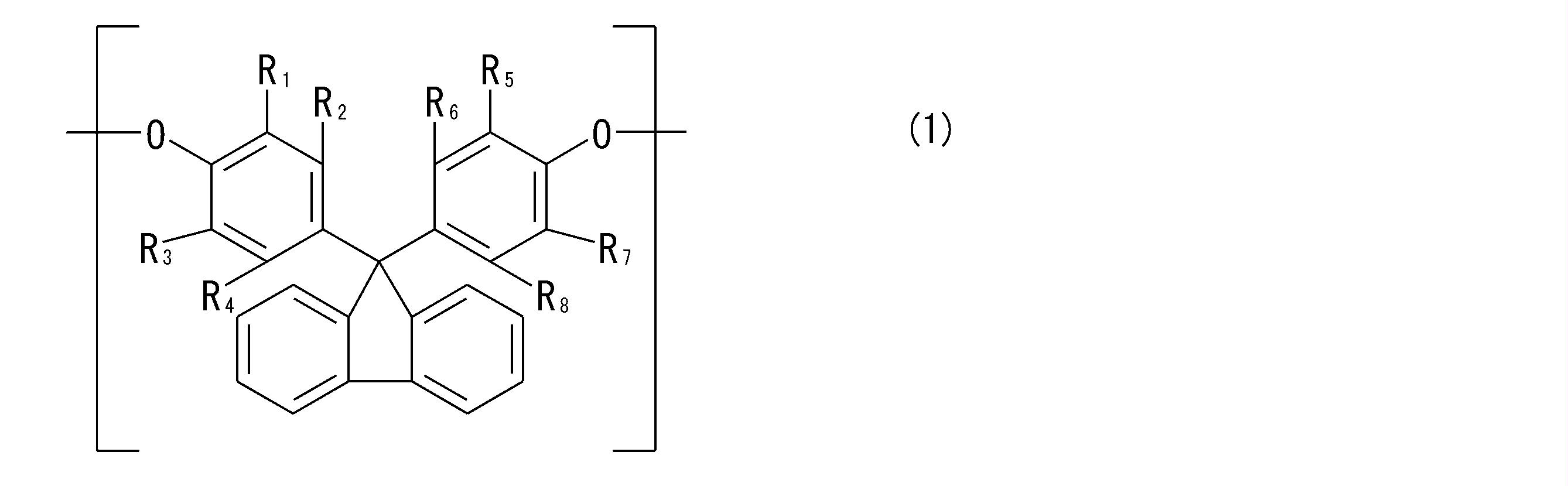
式(1)中,R1 ~R8 各自獨立地是氫、碳數1以上且5以下的烷基或鹵素。亦即,在式(1)中的各個R1 ~R8 ,可以是氫,亦可以是碳數1以上且5以下的烷基或鹵素。這是因為下述緣故所致:芳香環中的氫即便被低分子量的烷基或鹵素取代,仍不會對含羧基樹脂(A1)的物性造成不良的影響,並且有時反而會有提升包含含羧基樹脂(A1)之感光性樹脂組成物的硬化物的耐熱性、或難燃性的情況。In formula (1), R 1 to R 8 are each independently hydrogen, an alkyl group having 1 to 5 carbon atoms, or halogen. That is, each of R 1 to R 8 in the formula (1) may be hydrogen, or may be an alkyl group having 1 to 5 carbon atoms or halogen. This is due to the following reasons: even if the hydrogen in the aromatic ring is substituted by a low molecular weight alkyl or halogen, it will not adversely affect the physical properties of the carboxyl group-containing resin (A1), and sometimes it may be improved. In the case of the heat resistance or flame retardancy of the cured product of the photosensitive resin composition of the carboxyl group-containing resin (A1).
當含羧基樹脂(A1)具有由式(1)表示的雙酚茀骨架時,含羧基樹脂(A1)較佳是具有至少1個烷基。此時,能夠使包含感光性樹脂組成物的硬化物之硬化物層的介電損耗正切進一步降低。例如,式(1)中,較佳是R1 ~R8 至少1個是碳數1以上且5以下的烷基。When the carboxyl group-containing resin (A1) has a bisphenol sulfide skeleton represented by formula (1), the carboxyl group-containing resin (A1) preferably has at least one alkyl group. In this case, the dielectric loss tangent of the cured product layer including the cured product of the photosensitive resin composition can be further reduced. For example, in formula (1), it is preferable that at least one of R 1 to R 8 is an alkyl group having 1 to 5 carbon atoms.
藉由含羧基樹脂(A1)具有源自環氧化合物(a1)且由式(1)表示的雙酚茀骨架,能夠賦予感光性樹脂組成物的硬化物高耐熱性和高絕緣可靠性。又,藉由含羧基樹脂(A1)具有源自酸酐(a3)的羧基,能夠賦予感光性樹脂組成物優異的顯影性。進一步,藉由感光性樹脂組成物含有環氧樹脂,能夠賦予感光性樹脂組成物熱硬化性。When the carboxyl group-containing resin (A1) has a bisphenol sulfonate skeleton derived from the epoxy compound (a1) and represented by the formula (1), it is possible to impart high heat resistance and high insulation reliability to the cured product of the photosensitive resin composition. Moreover, when the carboxyl group-containing resin (A1) has a carboxyl group derived from the acid anhydride (a3), it is possible to impart excellent developability to the photosensitive resin composition. Furthermore, when the photosensitive resin composition contains an epoxy resin, thermosetting properties can be imparted to the photosensitive resin composition.
含羧基樹脂(A1)例如能夠藉由下述說明的方式進行操作而合成。為了合成含羧基樹脂(A1),首先,藉由使環氧化合物(a1)的環氧基(參照式(2))的至少一部分、與包含含不飽和基羧酸(a2-1)之羧酸(a2)進行反應,來合成中間體。中間體的合成,被定義為第一反應。中間體具有表示於下述式(3)的結構(S3),該結構(S3)是藉由環氧基與羧酸(a2)的開環加成反應所產生。亦即,中間體在結構(S3)中具有二級羥基,該二級羥基是藉由環氧基與羧酸(a2)的開環加成反應所產生。在式(3)中,A是羧酸殘基。該A包含含不飽和基羧酸殘基。The carboxyl group-containing resin (A1) can be synthesized, for example, by the method described below. In order to synthesize the carboxyl group-containing resin (A1), first, at least a part of the epoxy group (see formula (2)) of the epoxy compound (a1) is combined with the carboxyl group containing the unsaturated group-containing carboxylic acid (a2-1) The acid (a2) reacts to synthesize an intermediate. The synthesis of intermediates is defined as the first reaction. The intermediate has a structure (S3) represented by the following formula (3), and the structure (S3) is produced by a ring-opening addition reaction of an epoxy group and a carboxylic acid (a2). That is, the intermediate has a secondary hydroxyl group in the structure (S3), and the secondary hydroxyl group is generated by the ring-opening addition reaction of the epoxy group and the carboxylic acid (a2). In formula (3), A is a carboxylic acid residue. The A contains an unsaturated group-containing carboxylic acid residue.


繼而,使中間體中的二級羥基與酸酐(a3)進行反應。藉此,便能夠合成含羧基樹脂(A1)。中間體與酸酐(a3)的反應,被定義為第二反應。酸酐(a3)可包含酸一酐或酸二酐。所謂酸一酐,是具有一個酸酐基之化合物,其是在一分子內的2個羧基經脫水縮合而成。所謂酸二酐,是具有兩個酸酐基之化合物,其是在一分子內的4個羧基經脫水縮合而成。Then, the secondary hydroxyl group in the intermediate is reacted with acid anhydride (a3). Thereby, the carboxyl group-containing resin (A1) can be synthesized. The reaction of the intermediate and acid anhydride (a3) is defined as the second reaction. The acid anhydride (a3) may include acid monoanhydride or acid dianhydride. The so-called acid mono-anhydride is a compound with one acid anhydride group, which is formed by dehydration and condensation of two carboxyl groups in one molecule. The so-called acid dianhydride is a compound with two acid anhydride groups, which is formed by dehydration and condensation of 4 carboxyl groups in one molecule.
酸酐(a3)可包含酸二酐(a3-2)和酸一酐(a3-1)中的至少一種。當酸酐(a3)含有酸一酐(a3-1)時,含羧基樹脂(A1)具有由式(1)表示的雙酚茀骨架(S1)、與表示於下述式(4)的結構(S4)。The acid anhydride (a3) may include at least one of acid dianhydride (a3-2) and acid monoanhydride (a3-1). When the acid anhydride (a3) contains the acid monoanhydride (a3-1), the carboxyl group-containing resin (A1) has a bisphenol sulfide skeleton (S1) represented by the formula (1) and a structure represented by the following formula (4) ( S4).
結構(S4),藉由中間體的結構(S3)中的二級羥基、與酸一酐(a3-1)中的酸酐基進行反應而產生。在式(4)中,A是羧酸殘基,B是酸一酐殘基。該A包含含不飽和基羧酸殘基。The structure (S4) is produced by reacting the secondary hydroxyl group in the intermediate structure (S3) with the acid anhydride group in the acid monoanhydride (a3-1). In formula (4), A is a carboxylic acid residue, and B is an acid monoanhydride residue. The A contains an unsaturated group-containing carboxylic acid residue.
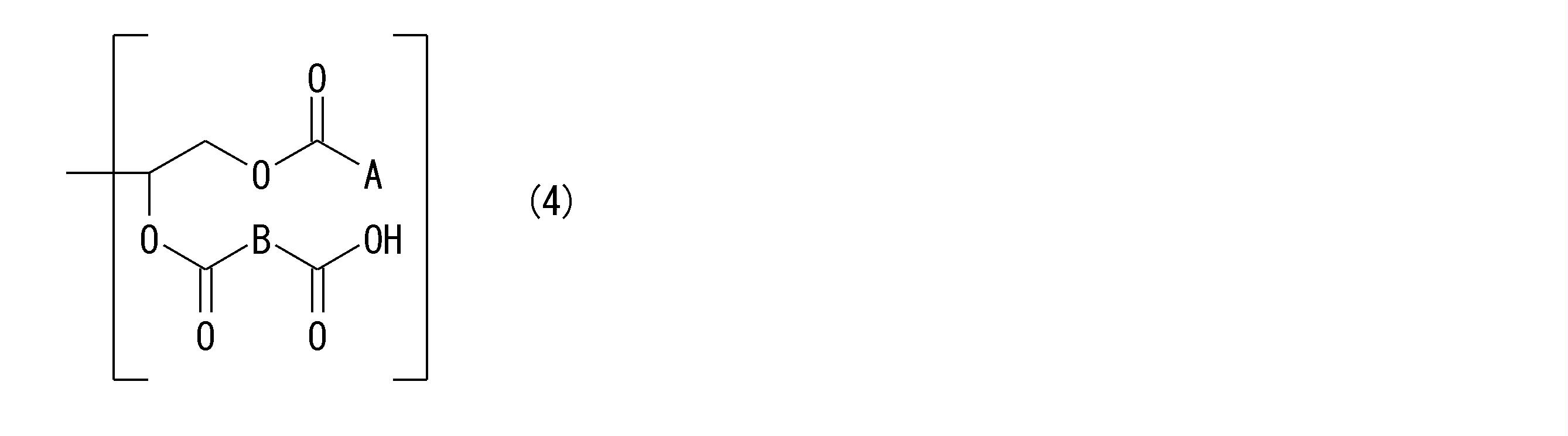
當酸酐(a3)包含酸二酐(a3-2)時,含羧基樹脂(A1)具有表示於式(1)的雙酚茀骨架(S1)、與表示於下述式(5)的結構(S5)。When the acid anhydride (a3) contains the acid dianhydride (a3-2), the carboxyl group-containing resin (A1) has a bisphenol phenol skeleton (S1) represented by the formula (1) and a structure represented by the following formula (5) ( S5).
結構(S5),藉由酸二酐(a3-2)中的兩個酸酐基、與中間體中的兩個二級羥基分別進行反應而產生。亦即,結構(S5),是藉由酸二酐(a3-2)將兩個二級羥基的羥基彼此交聯而產生。再者,可能是下述情況:一個中間體的分子中存在有兩個二級羥基彼此被交聯;及,分別存在於兩個中間體的分子中的兩個二級羧基彼此被交聯。若在分別存在於兩個中間體的分子中的兩個二級羥基彼此被交聯,分子量會增加。在式(5)中,A是羧酸殘基,D是酸二酐殘基。該A包含含不飽和基羧酸殘基。Structure (S5) is produced by reacting two acid anhydride groups in acid dianhydride (a3-2) with two secondary hydroxyl groups in the intermediate respectively. That is, structure (S5) is produced by cross-linking the hydroxyl groups of two secondary hydroxyl groups with acid dianhydride (a3-2). Furthermore, it may be the case that there are two secondary hydroxyl groups in the molecule of one intermediate being cross-linked with each other; and the two secondary carboxyl groups respectively existing in the molecules of the two intermediates are cross-linked with each other. If the two secondary hydroxyl groups in the molecules of the two intermediates are cross-linked with each other, the molecular weight will increase. In formula (5), A is a carboxylic acid residue, and D is an acid dianhydride residue. The A contains an unsaturated group-containing carboxylic acid residue.
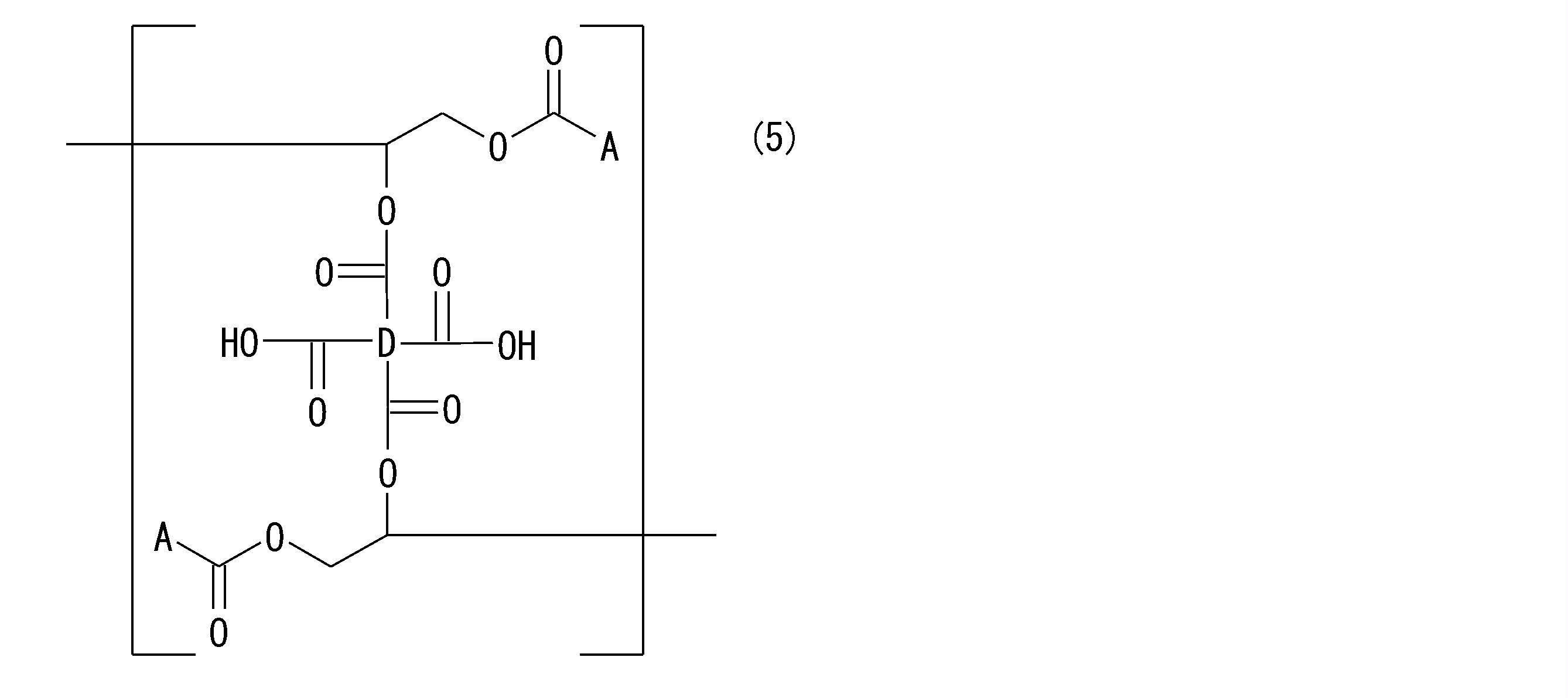
使中間體中的二級羥基與酸酐(a3)反應便能夠獲得含羧基樹脂(A1)。當酸酐(a3)含有酸二酐(a3-2)和酸一酐(a3-1)時,可使中間體中的一部分的二級羥基與酸二酐(a3-2)進行反應,並使中間體中的另一部分的二級羥基與酸一酐(a3-1)進行反應。藉此,便能夠合成含羧基樹脂(A1)。此時,含羧基樹脂(A1)具有雙酚茀骨架(S1)、結構(S4)及結構(S5)。The carboxyl group-containing resin (A1) can be obtained by reacting the secondary hydroxyl group in the intermediate with the acid anhydride (a3). When the acid anhydride (a3) contains acid dianhydride (a3-2) and acid monoanhydride (a3-1), a part of the secondary hydroxyl group in the intermediate can be reacted with acid dianhydride (a3-2) and make Another part of the secondary hydroxyl group in the intermediate reacts with acid monoanhydride (a3-1). Thereby, the carboxyl group-containing resin (A1) can be synthesized. At this time, the carboxyl group-containing resin (A1) has a bisphenol sulfide skeleton (S1), a structure (S4), and a structure (S5).
含羧基樹脂(A1),可進一步具有由下述式(6)表示的結構(S6)。結構(S6),是藉由酸二酐(a3-2)中的兩個酸酐基之中的僅只一個與中間體中的二級羥基進行反應而產生。在式(6)中,A是羧酸殘基,D是酸二酐殘基。該A包含含不飽和基羧酸殘基。The carboxyl group-containing resin (A1) may further have a structure (S6) represented by the following formula (6). Structure (S6) is produced by reacting only one of the two anhydride groups in the acid dianhydride (a3-2) with the secondary hydroxyl group in the intermediate. In formula (6), A is a carboxylic acid residue, and D is an acid dianhydride residue. The A contains an unsaturated group-containing carboxylic acid residue.
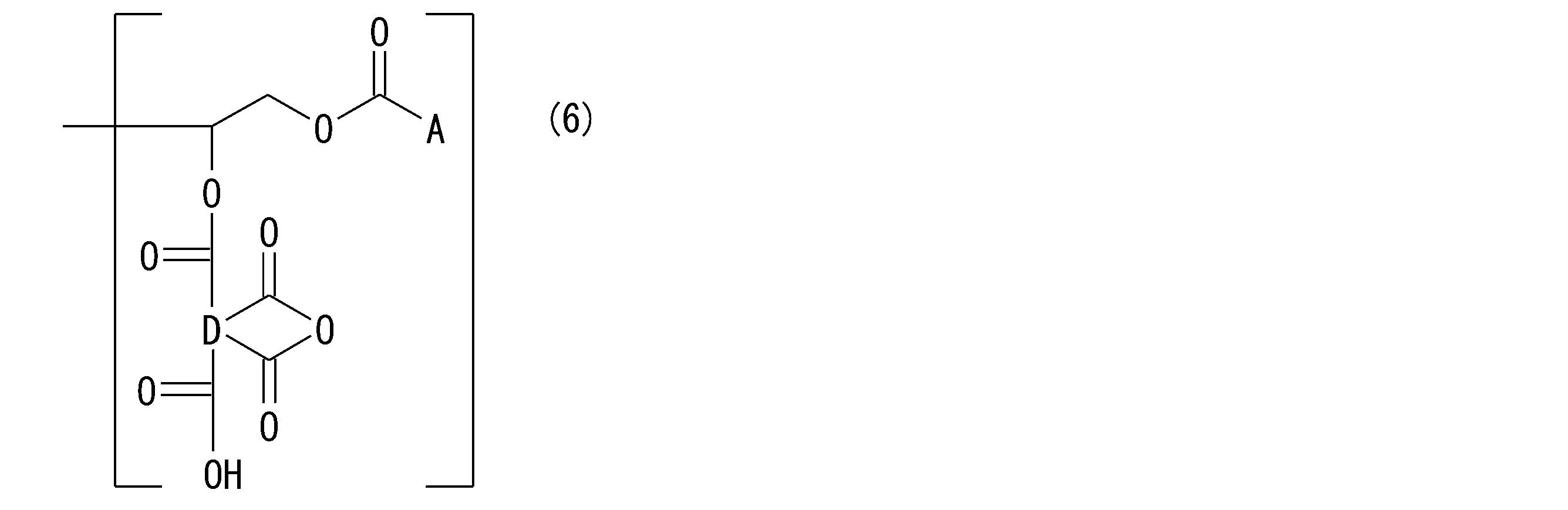
合成中間體時,當環氧化合物(a1)中的一部分的環氧基未經反應而仍殘存時,含羧基樹脂(A1)可具有表示於式(2)的結構(S2),亦即可具有環氧基。又,當中間體中的一部分的結構(S3)未經反應而仍殘存時,含羧基樹脂(A1)亦可具有結構(S3)。When an intermediate is synthesized, when a part of the epoxy group in the epoxy compound (a1) remains unreacted, the carboxyl group-containing resin (A1) may have the structure (S2) represented by the formula (2), that is, With epoxy group. In addition, when a part of the structure (S3) in the intermediate remains unreacted, the carboxyl group-containing resin (A1) may have the structure (S3).
當酸酐(a3)含有酸二酐(a3-2)時,藉由將合成含羧基樹脂(A1)時的反應條件進行最佳化,可降低含羧基樹脂(A1)中的結構(S2)和結構(S6)的數量,或者可使結構(S2)和結構(S6)自含羧基樹脂(A1)中大致消失。When the acid anhydride (a3) contains the acid dianhydride (a3-2), by optimizing the reaction conditions when synthesizing the carboxyl-containing resin (A1), the structure (S2) and the carboxyl-containing resin (A1) can be reduced. The number of the structure (S6) may make the structure (S2) and the structure (S6) almost disappear from the carboxyl group-containing resin (A1).
如同上述,含羧基樹脂(A1)具有雙酚茀骨架(S1),並且能夠是下述情況:當酸酐(a3)含有酸一酐(a3-1)時具有結構(S4);當酸酐(a3)含有酸二酐(a3-2)時具有結構(S5)。進一步,當酸酐(a3)含有酸一酐(a3-1)時,含羧基樹脂(A1),會有具有結構(S2)與結構(S3)中的至少一種的情況。又,當酸酐(a3)含有酸二酐(a3-2)時,含羧基樹脂(A1),會有具有結構(S2)與結構(S6)中的至少一種的情況。又,進一步,當酸酐(a3)含有酸一酐(a3-1)與酸二酐(a3-2)時,含羧基樹脂(A1),會有具有結構(S2)、結構(S3)、及結構(S6)中的至少一種的情況。As mentioned above, the carboxyl group-containing resin (A1) has a bisphenol sulfide skeleton (S1), and can be the following: when the acid anhydride (a3) contains the acid monoanhydride (a3-1), it has the structure (S4); when the acid anhydride (a3) ) It has structure (S5) when it contains acid dianhydride (a3-2). Furthermore, when the acid anhydride (a3) contains the acid monoanhydride (a3-1), the carboxyl group-containing resin (A1) may have at least one of the structure (S2) and the structure (S3). In addition, when the acid anhydride (a3) contains the acid dianhydride (a3-2), the carboxyl group-containing resin (A1) may have at least one of the structure (S2) and the structure (S6). Furthermore, when the acid anhydride (a3) contains acid monoanhydride (a3-1) and acid dianhydride (a3-2), the carboxyl group-containing resin (A1) will have structure (S2), structure (S3), and At least one of the structures (S6).
又,當環氧化合物(a1)本身具有二級羥基時,亦即,例如當在後述的式(7)中,n=1以上時,含羧基樹脂(A1),會有亦具有藉由環氧化合物(a1)中的二級羥基與酸酐(a3)進行反應所產生的結構的情況。Furthermore, when the epoxy compound (a1) itself has a secondary hydroxyl group, that is, for example, when n=1 or more in the formula (7) described later, the carboxyl group-containing resin (A1) may or may have a ring The case of the structure produced by the reaction between the secondary hydroxyl group in the oxygen compound (a1) and the acid anhydride (a3).
再者,上述含羧基樹脂(A1)的結構能夠基於技術常識來合理地類推,並且就現實而言,無法藉由分析來特定含羧基樹脂(A1)的結構。其理由如下。當環氧化合物(a1)本身具有二級羥基時(例如,當在後述的式(7)中,n為1以上時),會因為環氧化合物(a1)中的二級羥基的數量而使含羧基樹脂(A1)的結構產生巨大的變化。又,當中間體與酸二酐(a3-2)進行反應時,如同上述,可能產生下述情況:存在於一個中間體的分子中的兩個二級羥基彼此以酸二酐(a3-2)進行交聯;及,分別存在於兩個中間體的分子中的兩個二級羧基彼此以酸二酐(a3-2)進行交聯。因此,最終所獲得的含羧基樹脂(A1)會包含結構互為不同的複數個分子,從而即便分析含羧基樹脂(A1)仍無法特定其結構。Furthermore, the structure of the above-mentioned carboxyl group-containing resin (A1) can be reasonably deduced based on technical common sense, and in reality, the structure of the carboxyl group-containing resin (A1) cannot be specified by analysis. The reason is as follows. When the epoxy compound (a1) itself has a secondary hydroxyl group (for example, when n is 1 or more in the formula (7) described later), the number of secondary hydroxyl groups in the epoxy compound (a1) The structure of the carboxyl group-containing resin (A1) has changed dramatically. In addition, when the intermediate reacts with acid dianhydride (a3-2), as described above, the following situation may occur: two secondary hydroxyl groups existing in the molecule of an intermediate react with acid dianhydride (a3-2 ) For crosslinking; and, the two secondary carboxyl groups respectively existing in the molecules of the two intermediates are crosslinked with acid dianhydride (a3-2). Therefore, the finally obtained carboxyl group-containing resin (A1) contains a plurality of molecules whose structures are different from each other, so even if the carboxyl group-containing resin (A1) is analyzed, its structure cannot be specified.
因為含羧基樹脂(A1)具有源自含不飽和基羧酸(a2-1)的乙烯性不飽和基,所以具有光反應性。因此,含羧基樹脂(A1),能夠對感光性樹脂組成物賦予感光性(具體而言是紫外線硬化性)。又,因為含羧基樹脂(A1)具有源自酸酐(a3)的羧基,所以能夠賦予感光性樹脂組成物藉由鹼性水溶液所產生的顯影性,該鹼性水溶液含有鹼金屬鹽和鹼金屬氫氧化物中的至少一種。進一步,當酸酐(a3)含有酸二酐(a3-2)時,含羧基樹脂(A1)的分子量會與藉由酸二酐(a3-2)所產生的交聯的數量呈正相關。因此,可獲得酸價與分子量被適度地調整的含羧基樹脂(A1)。當酸酐(a3)含有酸二酐(a3-2)和酸一酐(a3-1)時,藉由控制酸二酐(a3-2)和酸一酐(a3-1)的量、及酸一酐(a3-1)相對於酸二酐(a3-2)的量,可容易地獲得期望的分子量和酸價的含羧基樹脂(A1)。Since the carboxyl group-containing resin (A1) has an ethylenically unsaturated group derived from the unsaturated group-containing carboxylic acid (a2-1), it has photoreactivity. Therefore, the carboxyl group-containing resin (A1) can impart photosensitivity (specifically, ultraviolet curability) to the photosensitive resin composition. In addition, since the carboxyl group-containing resin (A1) has a carboxyl group derived from the acid anhydride (a3), it can impart developability to the photosensitive resin composition by an alkaline aqueous solution containing an alkali metal salt and an alkali metal hydrogen. At least one of oxides. Furthermore, when the acid anhydride (a3) contains the acid dianhydride (a3-2), the molecular weight of the carboxyl group-containing resin (A1) will be positively correlated with the number of crosslinks produced by the acid dianhydride (a3-2). Therefore, a carboxyl group-containing resin (A1) whose acid value and molecular weight are appropriately adjusted can be obtained. When the acid anhydride (a3) contains acid dianhydride (a3-2) and acid monoanhydride (a3-1), by controlling the amount of acid dianhydride (a3-2) and acid monoanhydride (a3-1), and the acid The amount of the monoanhydride (a3-1) relative to the acid dianhydride (a3-2) can easily obtain the carboxyl group-containing resin (A1) of the desired molecular weight and acid value.
含羧基樹脂(A1)的重量平均分子量較佳是700以上且10000以下。若重量平均分子量是700,可進一步抑制由感光性樹脂組成物所形成的覆膜的黏性,並進一步提升硬化物的絕緣可靠性和耐鍍覆性。又,若重量平均分子量是10000以下,尤其可提升感光性樹脂組成物藉由鹼性水溶液所產生的顯影性。重量平均分子量進一步較佳是900以上且8000以下,特別較佳是1000以上且5000以下。The weight average molecular weight of the carboxyl group-containing resin (A1) is preferably 700 or more and 10,000 or less. If the weight average molecular weight is 700, the viscosity of the film formed from the photosensitive resin composition can be further suppressed, and the insulation reliability and plating resistance of the cured product can be further improved. In addition, if the weight average molecular weight is 10,000 or less, the developability of the photosensitive resin composition by the alkaline aqueous solution can be particularly improved. The weight average molecular weight is more preferably 900 or more and 8000 or less, particularly preferably 1000 or more and 5000 or less.
含羧基樹脂(A1)的固體成分酸價較佳是60mg KOH/g以上且140mg KOH/g以下。此時,尤其可提升感光性樹脂組成物的顯影性。固體成分酸價,更佳是80mg KOH/g以上且135mg KOH/g以下,進一步較佳是90mg KOH/g以上且130mg KOH/g以下。The solid acid value of the carboxyl group-containing resin (A1) is preferably 60 mg KOH/g or more and 140 mg KOH/g or less. In this case, especially the developability of the photosensitive resin composition can be improved. The solid content acid value is more preferably 80 mg KOH/g or more and 135 mg KOH/g or less, and still more preferably 90 mg KOH/g or more and 130 mg KOH/g or less.
含羧基樹脂(A1)的多分散性較佳是1.0以上且4.8以下。此時,能夠一邊確保由感光性樹脂組成物所形成的硬化物的良好的絕緣可靠性和耐鍍覆性(例如,無電解鎳/金鍍覆處理時的耐白化性),一邊賦予感光性樹脂組成物優異的顯影性。含羧基樹脂(A1)的多分散性更佳是1.1以上且4.0以下,進一步較佳是1.2以上且2.8以下。再者,多分散性是含羧基樹脂(A1)的重量平均分子量(Mw)相對於數量平均分子量(Mn)的比值(Mw/Mn)。The polydispersity of the carboxyl group-containing resin (A1) is preferably 1.0 or more and 4.8 or less. In this case, it is possible to impart photosensitivity while ensuring good insulation reliability and plating resistance (for example, whitening resistance during electroless nickel/gold plating treatment) of the cured product formed of the photosensitive resin composition The resin composition has excellent developability. The polydispersity of the carboxyl group-containing resin (A1) is more preferably 1.1 or more and 4.0 or less, and still more preferably 1.2 or more and 2.8 or less. Furthermore, the polydispersity is the ratio (Mw/Mn) of the weight average molecular weight (Mw) of the carboxyl group-containing resin (A1) to the number average molecular weight (Mn).
含羧基樹脂(A1)的重量平均分子量(Mw),可從藉由膠透層析術(Gel Permeation Chromatography,GPC)的分子量測定結果來算出。利用膠透層析術的分子量測定,例如能夠利用以下的條件來實行。
GPC裝置:昭和電工公司製造的SHODEX SYSTEM 11;
管柱:SHODEX KF-800P、KF-005、KF-003、KF-001的四支串聯;
流動相:四氫呋喃(THF);
流量:1 mL/分鐘;
管柱溫度:45℃;
偵測器:折射率(RI);
換算:聚苯乙烯。The weight average molecular weight (Mw) of the carboxyl group-containing resin (A1) can be calculated from the results of molecular weight measurement by Gel Permeation Chromatography (GPC). The molecular weight measurement by gel permeation chromatography can be performed under the following conditions, for example.
GPC device:
詳細地說明含羧基樹脂(A1)的原料、及合成含羧基樹脂(A1)時的反應條件。The raw materials of the carboxyl group-containing resin (A1) and the reaction conditions when synthesizing the carboxyl group-containing resin (A1) are explained in detail.
環氧化合物(a1),例如具有表示於下述式(7)的結構(S7)。式(7)中的n,例如是0以上且20以下的數。為了將含羧基樹脂(A1)的分子量作成適當的值,n的平均特佳是0以上且1以下。若n的平均在0以上且1以下的範圍內,尤其在酸酐(a3)含有酸二酐(a3-2)時,會變得可容易地控制由於酸二酐(a3-2)的加成所造成的分子量的過度增加。The epoxy compound (a1) has a structure (S7) represented by the following formula (7), for example. N in formula (7) is, for example, a number of 0 or more and 20 or less. In order to make the molecular weight of the carboxyl group-containing resin (A1) an appropriate value, the average of n is particularly preferably 0 or more and 1 or less. If the average of n is in the range of 0 or more and 1 or less, especially when the acid anhydride (a3) contains the acid dianhydride (a3-2), it becomes easy to control the addition of the acid dianhydride (a3-2) The resulting excessive increase in molecular weight.
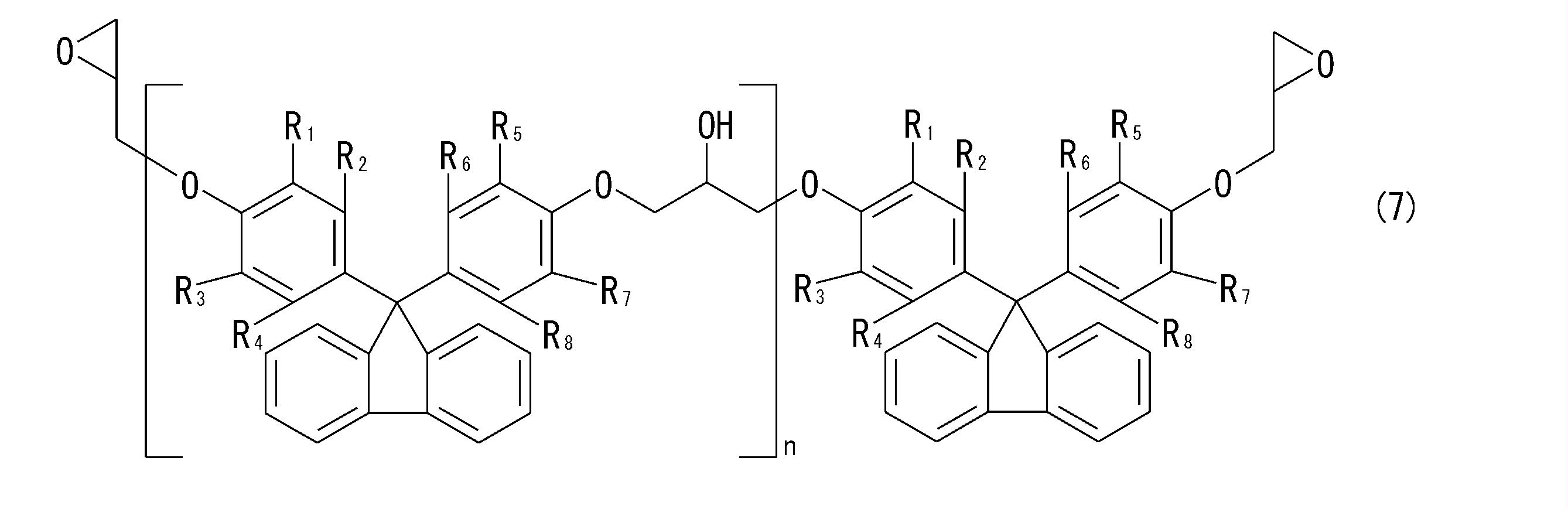
羧酸(a2)包含含不飽和基羧酸(a2-1)。羧酸(a2)可僅包含含不飽和基羧酸(a2-1)。或者,羧酸(a2)可包含:含不飽和基羧酸(a2-1)、及含不飽和基羧酸(a2-1)以外的羧酸。The carboxylic acid (a2) includes an unsaturated group-containing carboxylic acid (a2-1). The carboxylic acid (a2) may contain only the unsaturated group-containing carboxylic acid (a2-1). Alternatively, the carboxylic acid (a2) may include an unsaturated group-containing carboxylic acid (a2-1) and a carboxylic acid other than the unsaturated group-containing carboxylic acid (a2-1).
含不飽和基羧酸(a2-1),能夠含有例如:在一分子中僅具有1個乙烯性不飽和基之化合物。更具體而言,含不飽和基羧酸(a2-1),能夠含有例如選自由下述化合物所組成之群組中的至少一種:丙烯酸、甲基丙烯酸、ω-羧基-聚己內酯(n≒2)單丙烯酸酯、巴豆酸、肉桂酸、琥珀酸2-丙烯醯氧基乙酯、琥珀酸2-甲基丙烯醯氧基乙酯、鄰苯二甲酸2-丙烯醯氧基乙酯、鄰苯二甲酸2-甲基丙烯醯氧基乙酯、鄰苯二甲酸2-丙烯醯氧基丙酯、鄰苯二甲酸2-甲基丙烯醯氧基丙酯、馬來酸2-丙烯醯氧基乙酯、馬來酸2-甲基丙烯醯氧基乙酯、丙烯酸β-羧乙酯、四氫鄰苯二甲酸2-丙烯醯氧基乙酯、四氫鄰苯二甲酸2-甲基丙烯醯氧基乙酯、六氫鄰苯二甲酸2-丙烯醯氧基乙酯、及六氫鄰苯二甲酸2-甲基丙烯醯氧基乙酯。較佳是含不飽和基羧酸(a2-1)含有丙烯酸。The unsaturated group-containing carboxylic acid (a2-1) can contain, for example, a compound having only one ethylenically unsaturated group in one molecule. More specifically, the unsaturated group-containing carboxylic acid (a2-1) can contain, for example, at least one selected from the group consisting of acrylic acid, methacrylic acid, and ω-carboxy-polycaprolactone ( n≒2) Monoacrylate, crotonic acid, cinnamic acid, 2-propenoxyethyl succinate, 2-methacryloxyethyl succinate, 2-propenoxyethyl phthalate , 2-methacryloxyethyl phthalate, 2-acryloxypropyl phthalate, 2-methacryloxypropyl phthalate, 2-propylene maleate Acetyloxyethyl, 2-methacryloxyethyl maleate, β-carboxyethyl acrylate, 2-propenoxyethyl tetrahydrophthalate, 2-methacryloxyethyl tetrahydrophthalate Methacryloxyethyl, 2-methacryloxyethyl hexahydrophthalate, and 2-methacryloxyethyl hexahydrophthalate. It is preferable that the unsaturated group-containing carboxylic acid (a2-1) contains acrylic acid.
羧酸(a2)可包含多元酸(a2-2)。多元酸(a2-2)是在1分子內的2個以上的氫原子能夠被金屬原子取代的酸。多元酸(a2-2)較佳是具有2個以上的羧基。此時,環氧化合物(a1)會與含不飽和基羧酸(a2-1)及多元酸(a2-2)雙方進行反應。多元酸(a2-2)將存在於2個環氧化合物(a1)的分子中的環氧基進行交聯,藉此來獲得分子量的增加。藉此,能夠進一步控制由感光性樹脂組成物所形成的覆膜的黏性,並進一步提升硬化物的絕緣可靠性和耐鍍覆性。The carboxylic acid (a2) may include a polybasic acid (a2-2). The polybasic acid (a2-2) is an acid in which two or more hydrogen atoms in one molecule can be replaced by metal atoms. The polybasic acid (a2-2) preferably has two or more carboxyl groups. At this time, the epoxy compound (a1) reacts with both the unsaturated group-containing carboxylic acid (a2-1) and the polybasic acid (a2-2). The polybasic acid (a2-2) crosslinks the epoxy groups existing in the molecules of the two epoxy compounds (a1), thereby obtaining an increase in molecular weight. Thereby, the viscosity of the coating film formed of the photosensitive resin composition can be further controlled, and the insulation reliability and plating resistance of the cured product can be further improved.
多元酸(a2-2)較佳是包含二羧酸。多元酸(a2-2)例如能夠含有選自由下述化合物所組成之群組中的一種以上:4-環己烯-1,2-二甲酸、草酸、丙二酸、琥珀酸、戊二酸、己二酸、庚二酸、辛二酸、壬二酸、癸二酸、馬來酸、富馬酸、鄰苯二甲酸、間苯二甲酸、對苯二甲酸。較佳是:多元酸(a2-2)含有4-環己烯-1,2-二甲酸。The polybasic acid (a2-2) preferably contains a dicarboxylic acid. The polybasic acid (a2-2) can contain, for example, one or more selected from the group consisting of the following compounds: 4-cyclohexene-1,2-dicarboxylic acid, oxalic acid, malonic acid, succinic acid, and glutaric acid , Adipic acid, pimelic acid, suberic acid, azelaic acid, sebacic acid, maleic acid, fumaric acid, phthalic acid, isophthalic acid, terephthalic acid. Preferably, the polybasic acid (a2-2) contains 4-cyclohexene-1,2-dicarboxylic acid.
當使環氧化合物(a1)與羧酸(a2)進行反應時,能夠採用習知的方法。例如:在環氧化合物(a1)的溶劑溶液中加入羧酸(a2),進一步依據需要來加入熱聚合抑制劑和觸媒並攪拌混合,藉此獲得反應性溶液。藉由慣用方法而在較佳為60℃以上且150℃以下、特佳為80℃以上且120℃以下的溫度使該反應性溶液進行反應,便能夠獲得中間體。此時的溶劑,能夠含有例如選自由下述成分所組成之群組中的至少一種:甲基乙基酮、環己酮等的酮類;甲苯、二甲苯等的芳香族烴類;乙酸乙酯、乙酸丁酯、賽璐蘇乙酸酯、丁基賽璐蘇乙酸酯、卡必醇乙酸酯、丁基卡必醇乙酸酯、丙二醇單甲基醚乙酸酯等的乙酸酯類;及,二烷二醇醚類。熱聚合抑制劑含有例如:氫醌及氫醌單甲基醚之中的至少一種。觸媒能夠含有例如選自由下述成分所組成之群組中的至少一種:苯甲基二甲基胺、三乙胺等的三級胺類;氯化三甲基苯甲銨、氯化甲基三乙銨等的四級銨鹽類;三苯膦;及,三苯䏲。When the epoxy compound (a1) and the carboxylic acid (a2) are reacted, a conventional method can be used. For example, the carboxylic acid (a2) is added to the solvent solution of the epoxy compound (a1), and the thermal polymerization inhibitor and the catalyst are further added as necessary and stirred and mixed to obtain a reactive solution. The reactive solution can be reacted at a temperature of preferably 60°C or higher and 150°C or lower, particularly preferably 80°C or higher and 120°C or lower, by a conventional method, to obtain an intermediate. The solvent at this time may contain, for example, at least one selected from the group consisting of the following components: ketones such as methyl ethyl ketone and cyclohexanone; aromatic hydrocarbons such as toluene and xylene; ethyl acetate Ester, butyl acetate, cellulose acetate, butyl cellulose acetate, carbitol acetate, butyl carbitol acetate, propylene glycol monomethyl ether acetate, etc. Class; and, dialkyl glycol ethers. The thermal polymerization inhibitor contains, for example, at least one of hydroquinone and hydroquinone monomethyl ether. The catalyst can contain, for example, at least one selected from the group consisting of the following components: tertiary amines such as benzyldimethylamine and triethylamine; trimethylbenzylammonium chloride, methyl chloride Quaternary ammonium salts such as triethylammonium; triphenylphosphine; and, triphenylphosphine.
觸媒尤其較佳是含有三苯膦。亦即,較佳是:在三苯膦存在下使環氧化合物(a1)與羧酸(a2)進行反應。此時,尤其可促進環氧化合物(a1)中的環氧基與羧酸(a2)的開環加成反應,而能夠達成95%以上、或97%以上、或大致100%的反應率(轉化率)。因此,能夠以高產率獲得具有結構(S3)之中間體。又,可在包含感光性樹脂組成物的硬化物之層中抑制離子遷移的發生,而進一步提升該層的絕緣可靠性。The catalyst particularly preferably contains triphenylphosphine. That is, it is preferable to react the epoxy compound (a1) and the carboxylic acid (a2) in the presence of triphenylphosphine. In this case, the ring-opening addition reaction of the epoxy group in the epoxy compound (a1) and the carboxylic acid (a2) can be promoted, and a reaction rate of 95% or more, 97% or more, or approximately 100% can be achieved ( Conversion rates). Therefore, the intermediate having structure (S3) can be obtained in high yield. In addition, the occurrence of ion migration can be suppressed in the layer containing the cured product of the photosensitive resin composition, and the insulation reliability of the layer can be further improved.
使環氧化合物(a1)與羧酸(a2)進行反應時,相對於環氧化合物(a1)的1莫耳的環氧基,羧酸(a2)的量較佳是0.5莫耳以上且1.2莫耳以下。此時,能夠獲得具有優異的感光性和穩定性之感光性樹脂組成物。從相同的觀點來看,相對於環氧化合物(a1)的1莫耳的環氧基,含不飽和基羧酸(a2-1)的量較佳是在0.5莫耳以上且1.2 莫耳以下,更佳是0.8莫耳以上且1.2莫耳以下。或者,當羧酸(a2)包含含不飽和基羧酸(a2-1)以外的羧酸時,相對於環氧化合物(a1)的1莫耳的環氧基,含不飽和基羧酸(a2-1)的量可以是0.5莫耳以上且0.95莫耳以下。又,當羧酸(a2)包含多元酸(a2-2)時,相對於環氧化合物(a1)的1莫耳的環氧基,多元酸(a2-2)的量較佳是0.025莫耳以上且0.25莫耳以下。此時,可獲得具有優異的感光性及穩定性之感光性樹脂組成物。When the epoxy compound (a1) is reacted with the carboxylic acid (a2), the amount of the carboxylic acid (a2) is preferably 0.5 mol or more and 1.2 per mol of epoxy group of the epoxy compound (a1) Mole or less. In this case, a photosensitive resin composition having excellent photosensitivity and stability can be obtained. From the same viewpoint, the amount of the unsaturated group-containing carboxylic acid (a2-1) is preferably 0.5 mol or more and 1.2 mol or less relative to 1 mol of epoxy group of the epoxy compound (a1) , More preferably 0.8 mol or more and 1.2 mol or less. Alternatively, when the carboxylic acid (a2) contains a carboxylic acid other than the unsaturated group-containing carboxylic acid (a2-1), the unsaturated group-containing carboxylic acid ( The amount of a2-1) may be 0.5 mol or more and 0.95 mol or less. In addition, when the carboxylic acid (a2) contains the polybasic acid (a2-2), the amount of the polybasic acid (a2-2) is preferably 0.025 mol relative to 1 mol of epoxy group of the epoxy compound (a1) Above and below 0.25 mol. In this case, a photosensitive resin composition having excellent photosensitivity and stability can be obtained.
如此地操作所獲得的中間體,具備利用環氧化合物(a1)的環氧基與羧酸(a2)的羧基的反應所產生的羥基。The intermediate obtained in this way has a hydroxyl group generated by the reaction of the epoxy group of the epoxy compound (a1) and the carboxyl group of the carboxylic acid (a2).
酸一酐(a3-1)是具有1個酸酐基之化合物。酸一酐(a3-1)能夠含有二羧酸的酸酐。酸一酐(a3-1)能夠含有例如選自由下述化合物所組成之群組中的至少一種:鄰苯二甲酸酐、1,2,3,6-四氫鄰苯二甲酸酐、甲基四氫鄰苯二甲酸酐、甲基納迪克酸酐、六氫鄰苯二甲酸酐、甲基六氫鄰苯二甲酸酐、琥珀酸酐、甲基琥珀酸酐、馬來酸酐、檸康酸酐、戊二酸酐、環己烷1,2,4-三甲酸-1,2-酐及伊康酸酐。尤其,酸一酐(a3-1) 較佳是含有1,2,3,6-四氫鄰苯二甲酸酐。亦即,酸酐(a3)較佳是含有1,2,3,6-四氫鄰苯二甲酸酐。亦即,含羧基樹脂(A1)較佳是具有結構(S4),並且式(4)中的B包含1,2,3,6-四氫鄰苯二甲酸殘基。此時,能夠一邊確保感光性樹脂組成物的良好的顯影性,一邊進一步抑制由感光性樹脂組成物所形成的覆膜的黏性,並進一步提升硬化物的絕緣可靠性和耐鍍覆性。相對於酸一酐(a3-1)整體,1,2,3,6-四氫鄰苯二甲酸酐的量較佳是20莫耳%以上且100莫耳%以下,更佳是在40莫耳%以上且100莫耳%以下,但並未限定於該範圍內。Acid monoanhydride (a3-1) is a compound having one acid anhydride group. The acid monoanhydride (a3-1) can contain an acid anhydride of dicarboxylic acid. The acid monoanhydride (a3-1) can contain, for example, at least one selected from the group consisting of the following compounds: phthalic anhydride, 1,2,3,6-tetrahydrophthalic anhydride, methyl Tetrahydrophthalic anhydride, methylnadic anhydride, hexahydrophthalic anhydride, methylhexahydrophthalic anhydride, succinic anhydride, methylsuccinic anhydride, maleic anhydride, citraconic anhydride, glutaric acid Acid anhydride,
酸二酐(a3-2)是具有2個酸酐基之化合物。酸二酐(a3-2)能夠含有四羧酸之酸酐。酸二酐(a3-2),能夠含有例如選自由下述化合物所組成之群組中的至少一種:1,2,4,5-苯四羧酸二酐、二苯基酮四羧酸二酐、甲基環己烯四羧酸二酐、四羧酸二酐、萘-1,4,5,8-四羧酸二酐、伸乙基四羧酸二酐、9,9’-雙(3,4-二羧苯) 茀二酐、丙三醇雙偏苯三酸酐單乙酯(glycerine bisanhydrotrimellitate monoacetate)、乙二醇雙偏苯三酸酐、3,3’,4,4’-二苯碸四羧酸二酐、1,3,3a,4,5,9b-六氫-5(四氫-2,5-二氧-3-喃基)萘并-[1,2-c] 呋喃-1,3-二酮、1,2,3,4-丁烷四羧酸二酐及3,3’,4,4’-聯苯四羧酸二酐。尤其,酸二酐(a3-2)較佳是含有3,3’,4,4’-聯苯四羧酸二酐。亦即,較佳是式(5)和式(6)中的D包含3,3’,4,4’-聯苯四羧酸二酐殘基。此時,能夠一邊確保感光性樹脂組成物的良好的顯影性,一邊進一步抑制由感光性樹脂組成物所形成的覆膜的黏性,並進一步提升硬化物的絕緣可靠性和耐鍍覆性。相對於酸二酐(a3-2)整體,3,3’,4,4’-聯苯四羧酸二酐的量較佳是20莫耳%以上且100莫耳%以下,更佳是40莫耳%以上且100莫耳%以下,但並未限定於該範圍內。Acid dianhydride (a3-2) is a compound having two acid anhydride groups. The acid dianhydride (a3-2) can contain an anhydride of tetracarboxylic acid. The acid dianhydride (a3-2) can contain, for example, at least one selected from the group consisting of the following compounds: 1,2,4,5-benzenetetracarboxylic dianhydride, diphenyl ketone tetracarboxylic acid two Anhydride, methylcyclohexenetetracarboxylic dianhydride, tetracarboxylic dianhydride, naphthalene-1,4,5,8-tetracarboxylic dianhydride, ethylenetetracarboxylic dianhydride, 9,9'-bis (3,4-Dicarboxybenzene) dianhydride, glycerine bisanhydrotrimellitate monoacetate, ethylene glycol bistrimellitic anhydride, 3,3',4,4'-diphenyl tetracarboxylic acid Anhydride, 1,3,3a,4,5,9b-hexahydro-5(tetrahydro-2,5-dioxo-3-yl)naphtho-[1,2-c]furan-1,3- Dione, 1,2,3,4-butanetetracarboxylic dianhydride and 3,3',4,4'-biphenyltetracarboxylic dianhydride. In particular, the acid dianhydride (a3-2) preferably contains 3,3',4,4'-biphenyltetracarboxylic dianhydride. That is, it is preferable that D in formula (5) and formula (6) contains a 3,3',4,4'-biphenyltetracarboxylic dianhydride residue. At this time, while ensuring good developability of the photosensitive resin composition, the viscosity of the coating film formed of the photosensitive resin composition can be further suppressed, and the insulation reliability and plating resistance of the cured product can be further improved. Relative to the whole acid dianhydride (a3-2), the amount of 3,3',4,4'-biphenyltetracarboxylic dianhydride is preferably 20 mol% or more and 100 mol% or less, more preferably 40 Mole% or more and 100 mole% or less are not limited to this range.
為了使中間體與酸酐(a3)進行反應,可採用習知的方法。例如,將酸酐(a3)添加至中間體的溶劑溶液中,進一步依據需要加入熱聚合抑制劑和觸媒並進行攪拌來混合,藉此而獲得反應性溶液。依據通常的方法,在更佳為60℃以上且150℃以下、特佳為80℃以上且120℃以下的溫度,使該反應性溶液反應,藉此便可獲得含羧基樹脂(A1)。作為溶劑、觸媒及聚合抑制劑,能夠使用適當的成分,並能夠直接使用被用於中間體的合成時的溶劑、觸媒及聚合抑制劑。In order to react the intermediate and acid anhydride (a3), a conventional method can be used. For example, the acid anhydride (a3) is added to the solvent solution of the intermediate, and if necessary, a thermal polymerization inhibitor and a catalyst are further added and stirred and mixed, thereby obtaining a reactive solution. According to a general method, the reactive solution is reacted at a temperature of more preferably 60°C or higher and 150°C or lower, and particularly preferably 80°C or higher and 120°C or lower, thereby obtaining the carboxyl group-containing resin (A1). As the solvent, catalyst, and polymerization inhibitor, appropriate components can be used, and the solvent, catalyst, and polymerization inhibitor used in the synthesis of the intermediate can be directly used.
觸媒尤其較佳是含有三苯膦。亦即,較佳是在三苯膦存在下使中間體與酸酐(a3)進行反應。此時,尤其可促進中間體中的二級羥基與酸酐(a3)的反應,而能夠達成90%以上、95%以上、97%以上或大致100%的反應率(轉換率)。因此,能夠以高產率獲得具有結構(S4)和結構(S5)中的至少其中一結構之含羧基樹脂(A1)。又,可抑制在包含感光性樹脂組成物的硬化物之層中發生離子遷移,而進一步提升該層的絕緣可靠性。The catalyst particularly preferably contains triphenylphosphine. That is, it is preferable to react the intermediate and acid anhydride (a3) in the presence of triphenylphosphine. In this case, the reaction between the secondary hydroxyl group in the intermediate and the acid anhydride (a3) can be promoted in particular, and a reaction rate (conversion rate) of 90% or more, 95% or more, 97% or more, or approximately 100% can be achieved. Therefore, the carboxyl group-containing resin (A1) having at least one of the structure (S4) and the structure (S5) can be obtained with high yield. In addition, ion migration can be suppressed in the layer containing the cured product of the photosensitive resin composition, and the insulation reliability of the layer can be further improved.
當酸酐(a3)含有酸二酐(a3-2)與酸一酐(a3-1)時,相對於環氧化合物(a1)的1莫耳的環氧基,酸二酐(a3-2)的量較佳是0.05莫耳以上且0.24莫耳以下。又,相對於環氧化合物(a1)的1莫耳的環氧基,酸一酐(a3-1)的量較佳是0.3莫耳以上且0.7莫耳以下。此時,可容易獲得酸價與分子量經適度調整的含羧基樹脂(A1)。When the acid anhydride (a3) contains acid dianhydride (a3-2) and acid monoanhydride (a3-1), the acid dianhydride (a3-2) corresponds to 1 mole of epoxy group of the epoxy compound (a1) The amount is preferably 0.05 mol or more and 0.24 mol or less. In addition, the amount of the acid monoanhydride (a3-1) is preferably 0.3 mol or more and 0.7 mol or less with respect to 1 mol of epoxy groups of the epoxy compound (a1). In this case, the carboxyl group-containing resin (A1) whose acid value and molecular weight are appropriately adjusted can be easily obtained.
較佳是在空氣起泡下使中間體與酸酐(a3)進行反應。此時,可抑制所產生的含羧基樹脂(A1)分子量過度地變大,藉此尤其能夠提升感光性樹脂組成物藉由鹼性水溶液所產生的顯影性。It is preferable to react the intermediate and acid anhydride (a3) under air bubbling. In this case, it is possible to prevent the molecular weight of the carboxyl group-containing resin (A1) produced from increasing excessively, and thereby it is possible to particularly improve the developability of the photosensitive resin composition by the alkaline aqueous solution.
含羧基樹脂(A),可以僅含有含羧基樹脂(A1)或僅含有含羧基樹脂(A1)以外的含羧基樹脂,亦可含有含羧基樹脂(A1)與含羧基樹脂(A1)以外的含羧基樹脂。含羧基樹脂(A1)以外的含羧基樹脂,包含不具有雙酚茀骨架之含羧基樹脂(以下,亦稱為含羧基樹脂(A2))。The carboxyl-containing resin (A) may contain only the carboxyl-containing resin (A1) or only the carboxyl-containing resin other than the carboxyl-containing resin (A1), and may also contain carboxyl-containing resin (A1) and carboxyl-containing resin (A1). Carboxyl resin. The carboxyl group-containing resins other than the carboxyl group-containing resin (A1) include a carboxyl group-containing resin that does not have a bisphenol sulfonate skeleton (hereinafter, also referred to as carboxyl group-containing resin (A2)).
含羧基樹脂(A2),例如能夠含有具有羧基但不具有光聚合性之化合物(以下,亦稱為(A2-1)成分)。(A2-1)成分,例如含有乙烯性不飽和單體之聚合物,該乙烯性不飽和單體包含具有羧基之乙烯性不飽和化合物。具有羧基之乙烯性不飽和化合物,能夠含有丙烯酸、甲基丙烯酸、ω-羧基-聚己內酯(n≒2)單丙烯酸酯等的化合物。具有羧基之乙烯性不飽和化合物,亦能夠含有季戊四醇三丙烯酸酯、季戊四醇三甲基丙烯酸酯等與二元酸酐之反應物。乙烯性不飽和單體,可以進一步包含不具有羧基之乙烯性不飽和單體,該不具有羧基之乙烯性不飽和單體是鄰苯二甲酸2-(甲基)丙烯醯氧基乙酯、鄰苯二甲酸2-(甲基)丙烯醯氧基乙基-2-羥乙酯、直鏈或分支的脂肪族或脂環族(其中,環中可部分地具有不飽和鍵)的(甲基)丙烯酸酯等。The carboxyl group-containing resin (A2) can contain, for example, a compound having a carboxyl group but not having photopolymerization properties (hereinafter, also referred to as (A2-1) component). The component (A2-1) is, for example, a polymer containing an ethylenically unsaturated monomer containing an ethylenically unsaturated compound having a carboxyl group. The ethylenically unsaturated compound having a carboxyl group can contain compounds such as acrylic acid, methacrylic acid, and ω-carboxy-polycaprolactone (n≒2) monoacrylate. The ethylenically unsaturated compound having a carboxyl group can also contain reactants of pentaerythritol triacrylate, pentaerythritol trimethacrylate, etc. and dibasic acid anhydride. The ethylenically unsaturated monomer may further include an ethylenically unsaturated monomer that does not have a carboxyl group. The ethylenically unsaturated monomer that does not have a carboxyl group is 2-(meth)propylene oxyethyl phthalate, 2-(meth)propenyloxyethyl-2-hydroxyethyl phthalate, linear or branched aliphatic or cycloaliphatic (wherein the ring may partially have unsaturated bonds) (formaldehyde Base) acrylate and the like.
含羧基樹脂(A2),亦可含有具有羧基和乙烯性不飽和基之化合物(以下,亦稱為(A2-2)成分)。又,含羧基樹脂(A2)亦可以僅含有(A2-2)成分。(A2-2)成分,例如含有一種樹脂(稱為第一樹脂(x)),該樹脂是中間體、與選自由多元羧酸及其酸酐的群組中的至少一種化合物(x3)之反應物,該中間體是環氧化合物(x1)與乙烯性不飽和化合物(x2)之反應物,該環氧化合物(x1)在一分子中具有2個以上的環氧基。第一樹脂(x),例如可以使化合物(x3)加成在中間體來獲得,該中間體是使環氧化合物(x1)中的環氧基與乙烯性不飽和化合物(x2)中的羧基進行反應所獲得。環氧化合物(x1)能夠含有甲酚酚醛清漆型環氧樹脂、苯酚酚醛清漆型環氧樹脂、聯苯酚醛清漆型環氧樹脂等的適當的環氧化合物。尤其,環氧化合物(x1)較佳是含有選自由聯苯酚醛清漆型環氧樹脂化合物、甲酚酚醛清漆型環氧化合物的群組中的至少一種化合物。環氧化合物(x1)可以僅含有聯苯酚醛清漆型化合物、或亦可以僅含有甲酚酚醛清漆型環氧化合物。此時,因為環氧化合物(x1)的主鏈上包含有芳香環,所以感光性樹脂組成物的硬化物,例如能夠降低由於含有過錳酸鉀等之氧化劑所造成的顯著地被腐蝕的程度。環氧化合物(x1)可含有乙烯性不飽和化合物(z)的聚合物。乙烯性不飽和化合物(z)例如含有(甲基)丙烯酸縮水甘油酯等的具有環氧基之化合物(z1)、或進一步含有鄰苯二甲酸2-(甲基)丙烯醯氧基乙酯等不具有環氧基之化合物(z2)。乙烯性不飽和化合物(x2)較佳是含有丙烯酸和甲基丙烯酸中的至少一種。化合物(x3)含有例如:選自由多元羧酸及該等多元羧酸的酸酐所組成之群組中的一種以上的化合物,該多元羧酸為鄰苯二甲酸、四氫鄰苯二甲酸、甲基四氫鄰苯二甲酸等。尤其,化合物(x3)較佳是含有選自鄰苯二甲酸、四氫鄰苯二甲酸、甲基四氫鄰苯二甲酸的群組中的至少一種多元羧酸。The carboxyl group-containing resin (A2) may also contain a compound having a carboxyl group and an ethylenically unsaturated group (hereinafter, also referred to as (A2-2) component). In addition, the carboxyl group-containing resin (A2) may contain only the component (A2-2). The component (A2-2), for example, contains a resin (referred to as the first resin (x)) which is an intermediate and reacts with at least one compound (x3) selected from the group of polycarboxylic acids and their anhydrides The intermediate is a reaction product of an epoxy compound (x1) and an ethylenically unsaturated compound (x2), and the epoxy compound (x1) has two or more epoxy groups in one molecule. The first resin (x) can be obtained, for example, by adding compound (x3) to an intermediate, which is obtained by combining the epoxy group in the epoxy compound (x1) and the carboxyl group in the ethylenically unsaturated compound (x2) Obtained by reaction. The epoxy compound (x1) can contain an appropriate epoxy compound such as a cresol novolak type epoxy resin, a phenol novolak type epoxy resin, and a biphenol novolak type epoxy resin. In particular, the epoxy compound (x1) preferably contains at least one compound selected from the group of a biphenol novolak type epoxy resin compound and a cresol novolak type epoxy compound. The epoxy compound (x1) may contain only a biphenol novolac type compound, or may contain only a cresol novolak type epoxy compound. At this time, because the epoxy compound (x1) contains an aromatic ring in the main chain, the cured product of the photosensitive resin composition, for example, can reduce the degree of significant corrosion caused by an oxidizing agent such as potassium permanganate. . The epoxy compound (x1) may contain a polymer of the ethylenically unsaturated compound (z). The ethylenically unsaturated compound (z) contains, for example, a compound (z1) having an epoxy group such as glycidyl (meth)acrylate, or further contains 2-(meth)acryloyloxyethyl phthalate, etc. Compound without epoxy group (z2). The ethylenically unsaturated compound (x2) preferably contains at least one of acrylic acid and methacrylic acid. The compound (x3) contains, for example, one or more compounds selected from the group consisting of polycarboxylic acids and anhydrides of these polycarboxylic acids, and the polycarboxylic acids are phthalic acid, tetrahydrophthalic acid, methane Tetrahydrophthalic acid and so on. In particular, the compound (x3) preferably contains at least one polycarboxylic acid selected from the group of phthalic acid, tetrahydrophthalic acid, and methyltetrahydrophthalic acid.
(A2-2)成分亦可含有一種樹脂(稱為第二樹脂(y)),該樹脂是乙烯性不飽和單體的聚合物與具有環氧基之乙烯性不飽和化合物之反應物,該乙烯性不飽和單體含有具有羧基之乙烯性不飽和化合物。乙烯性不飽和單體可以進一步含有不具有羧基之乙烯性不飽和化合物。第二樹脂(y),是藉由使具有環氧基之乙烯性不飽和化合物在聚合物中的一部分的羧基上進行反應而得。乙烯性不飽和單體可以進一步含有不具有羧基之乙烯性不飽和化合物。具有羧基之乙烯性不飽和化合物,含有例如丙烯酸、甲基丙烯酸、ω-羧基-聚己內酯(n≒2)單丙烯酸酯、季戊四醇三丙烯酸酯、季戊四醇三甲基丙烯酸酯等的化合物。不具有羧基之乙烯性不飽和化合物,含有例如鄰苯二甲酸2-(甲基)丙烯醯氧基乙酯、鄰苯二甲酸2-(甲基)丙烯醯氧基乙基-2-羥乙酯、直鏈或分支的脂肪族或脂環族(其中,環中可部分地具有不飽和鍵)的(甲基)丙烯酸酯等化合物。具有環氧基之乙烯性不飽和化合物,較佳是含有(甲基)丙烯酸縮水甘油酯。The component (A2-2) may also contain a resin (called the second resin (y)), which is a reaction product of a polymer of an ethylenically unsaturated monomer and an ethylenically unsaturated compound having an epoxy group. The ethylenically unsaturated monomer contains an ethylenically unsaturated compound having a carboxyl group. The ethylenically unsaturated monomer may further contain an ethylenically unsaturated compound that does not have a carboxyl group. The second resin (y) is obtained by reacting a part of the carboxyl groups in the polymer with an ethylenically unsaturated compound having an epoxy group. The ethylenically unsaturated monomer may further contain an ethylenically unsaturated compound that does not have a carboxyl group. The ethylenically unsaturated compound having a carboxyl group includes compounds such as acrylic acid, methacrylic acid, ω-carboxy-polycaprolactone (n≒2) monoacrylate, pentaerythritol triacrylate, and pentaerythritol trimethacrylate. An ethylenically unsaturated compound that does not have a carboxyl group, including, for example, 2-(meth)acryloyloxyethyl phthalate, 2-(meth)acryloyloxyethyl-2-hydroxyethyl phthalate Compounds such as esters, linear or branched aliphatic or alicyclic (wherein, the ring may partially have unsaturated bonds) (meth)acrylates. The ethylenically unsaturated compound having an epoxy group preferably contains glycidyl (meth)acrylate.
含羧基樹脂(A),可以僅含有含羧基樹脂(A1),可以僅含有含羧基樹脂(A2)、或含有含羧基樹脂(A1)與含羧基樹脂(A2)。含羧基樹脂(A)較佳是含有30質量%以上的含羧基樹脂(A1),更佳是含有50質量%以上,進一步較佳是含有60質量%以上,更進一步較佳是含有100質量%。此時,尤其能夠使感光性樹脂組成物的硬化物的耐熱性和絕緣可靠性提升。又,能夠充分地降低由感光性樹脂組成物所形成的覆膜的黏性。進一步,能夠確保感光性樹脂組成物藉由鹼性水溶液所產生的顯影性。The carboxyl group-containing resin (A) may contain only the carboxyl group-containing resin (A1), only the carboxyl group-containing resin (A2), or the carboxyl group-containing resin (A1) and the carboxyl group-containing resin (A2). The carboxyl-containing resin (A) preferably contains 30% by mass or more of the carboxyl-containing resin (A1), more preferably 50% by mass or more, still more preferably 60% by mass or more, and still more preferably 100% by mass . In this case, in particular, the heat resistance and insulation reliability of the cured product of the photosensitive resin composition can be improved. In addition, the viscosity of the coating film formed of the photosensitive resin composition can be sufficiently reduced. Furthermore, it is possible to ensure the developability of the photosensitive resin composition by the alkaline aqueous solution.
不飽和化合物(B)能夠賦予感光性樹脂組成物光硬化性。不飽和化合物(B)能夠含有例如選自由單官能(甲基)丙烯酸酯及多官能(甲基)丙烯酸酯所組成之群組中的至少一種化合物,該單官能(甲基)丙烯酸酯是(甲基)丙烯酸2-羥乙酯等,該多官能(甲基)丙烯酸酯是二乙二醇二(甲基)丙烯酸酯、三羥甲基丙烷二(甲基)丙烯酸酯、三羥甲基丙烷三(甲基)丙烯酸酯、季戊四醇三(甲基)丙烯酸酯、季戊四醇四(甲基)丙烯酸酯、二季戊四醇五(甲基)丙烯酸酯、二季戊四醇六(甲基)丙烯酸酯、ε-己內酯改質二季戊四醇六丙烯酸酯、三環癸烷二甲醇二(甲基)丙烯酸酯等。The unsaturated compound (B) can impart photocurability to the photosensitive resin composition. The unsaturated compound (B) can contain, for example, at least one compound selected from the group consisting of monofunctional (meth)acrylate and polyfunctional (meth)acrylate, and the monofunctional (meth)acrylate is ( 2-hydroxyethyl meth)acrylate, etc. The multifunctional (meth)acrylate is diethylene glycol di(meth)acrylate, trimethylolpropane di(meth)acrylate, trimethylol Propane tri(meth)acrylate, pentaerythritol tri(meth)acrylate, pentaerythritol tetra(meth)acrylate, dipentaerythritol penta(meth)acrylate, dipentaerythritol hexa(meth)acrylate, ε-hexane Lactone is used to modify dipentaerythritol hexaacrylate, tricyclodecane dimethanol di(meth)acrylate, etc.
尤其,不飽和化合物(B)較佳是含有三官能化合物,也就是在一分子中具有3個不飽和鍵之化合物。此時,可提升將由感光性樹脂組成物所形成的覆膜進行曝光及顯影時的解析性,並且尤其可提升感光性樹脂組成物藉由鹼性水溶液所產生的顯影性。三官能化合物,能夠含有例如選自由下述化合物所組成之群組中的至少一種:三羥甲基丙烷三(甲基)丙烯酸酯、EO改質三羥甲基丙烷三(甲基)丙烯酸酯、季戊四醇三(甲基)丙烯酸酯、乙氧化異三聚氰酸三(甲基)丙烯酸酯及ε-己內酯改質參-(2-丙烯氧基乙基)三聚異氰酸酯及三(甲基)丙烯酸乙氧化縮水甘油酯。In particular, the unsaturated compound (B) preferably contains a trifunctional compound, that is, a compound having 3 unsaturated bonds in one molecule. In this case, the resolution at the time of exposing and developing the coating film formed of the photosensitive resin composition can be improved, and especially the developability of the photosensitive resin composition by the alkaline aqueous solution can be improved. The trifunctional compound can contain, for example, at least one selected from the group consisting of the following compounds: trimethylolpropane tri(meth)acrylate, EO modified trimethylolpropane tri(meth)acrylate , Pentaerythritol tris(meth)acrylate, ethoxylated isocyanuric acid tri(meth)acrylate and ε-caprolactone modified ginseng-(2-propenoxyethyl) trimeric isocyanate and tris(meth) Base) ethoxylated glycidyl acrylate.
不飽和化合物(B)較佳是含有含磷化合物(含磷不飽和化合物)。此時,可提升感光性樹脂組成物的硬化物的難燃性。含磷不飽和化合物能夠含有例如選自由以下化合物所組成之群組中的至少一種:酸式磷酸2-甲基丙烯醯氧基乙酯(作為具體例是共榮社化學股份有限公司製的型號LIGHT ESTER P-1M、及LIGHT ESTER P-2M)、酸式磷酸2-丙烯醯氧基乙酯(作為具體例是共榮社化學股份有限公司製的型號LIGHT ACRYLATE P-1A)、磷酸二苯基-2-甲基丙烯醯氧基乙酯(作為具體例是大八工業股份有限公司製的型號MR-260)、以及昭和高分子股份有限公司製的HFA系列(作為具體例是二季戊四醇六丙烯酸酯與HCA(9,10-二氫-9-氧雜-10-磷雜菲-10-氧化物)的加成反應物亦即型號HFA-6003及HFA-6007;己內酯改質二季戊四醇六丙烯酸酯與HCA(9,10-二氫-9-氧雜-10-磷雜菲-10-氧化物)的加成反應物亦即型號HFA-3003及HFA-6127等)。The unsaturated compound (B) preferably contains a phosphorus-containing compound (a phosphorus-containing unsaturated compound). In this case, the flame retardancy of the cured product of the photosensitive resin composition can be improved. The phosphorus-containing unsaturated compound can contain, for example, at least one selected from the group consisting of the following compounds: 2-methacryloxyethyl acid phosphate (a specific example is a model manufactured by Kyoeisha Chemical Co., Ltd. LIGHT ESTER P-1M, and LIGHT ESTER P-2M), 2-propenoxyethyl acid phosphate (a specific example is the model LIGHT ACRYLATE P-1A manufactured by Kyoeisha Chemical Co., Ltd.), diphenyl phosphate 2-methacrylic acid oxyethyl ester (as a specific example, model MR-260 manufactured by Dahachi Industry Co., Ltd.), and HFA series manufactured by Showa Polymer Co., Ltd. (as a specific example, dipentaerythritol six The addition reactants of acrylate and HCA (9,10-dihydro-9-oxa-10-phosphaphenanthrene-10-oxide), namely models HFA-6003 and HFA-6007; two modified caprolactone The addition reactants of pentaerythritol hexaacrylate and HCA (9,10-dihydro-9-oxa-10-phosphaphenanthrene-10-oxide) are models HFA-3003 and HFA-6127, etc.).
不飽和化合物(B)亦可含有預聚物。預聚物能夠含有例如:使具有乙烯性不飽和鍵之單體進行聚合後再將乙烯性不飽和基進行加成而得的預聚物;及,由寡聚(甲基)丙烯酸酯預聚物類所組成之群組中的至少一種化合物。寡聚(甲基)丙烯酸酯預聚物類,能夠含有例如選自由下述成分所組成之群組中的至少一種:(甲基)丙烯酸環氧酯、聚酯(甲基)丙烯酸酯、胺酯(urethane)(甲基)丙烯酸酯、醇酸(alkyd)樹脂(甲基)丙烯酸酯、矽氧樹脂(甲基)丙烯酸酯、及螺烷烴(spirane)樹脂(甲基)丙烯酸酯。The unsaturated compound (B) may also contain a prepolymer. The prepolymer can contain, for example, a prepolymer obtained by polymerizing a monomer having an ethylenically unsaturated bond and then adding an ethylenically unsaturated group; and, prepolymerized from an oligomeric (meth)acrylate At least one compound in the group consisting of species. The oligo(meth)acrylate prepolymers can contain, for example, at least one selected from the group consisting of the following components: epoxy (meth)acrylate, polyester (meth)acrylate, amine Urethane (meth)acrylate, alkyd resin (meth)acrylate, silicone resin (meth)acrylate, and spirane resin (meth)acrylate.
光聚合起始劑(C),含有例如醯基氧化膦系光聚合起始劑(C1)。亦即,感光性樹脂組成物含有例如醯基氧化膦系光聚合起始劑(C1)。此時,當利用紫外線對感光性樹脂組成物進行曝光時能夠對感光性樹脂組成物賦予高感光性。此外,能夠在包含感光性樹脂組成物的硬化物之層中抑制離子遷移的發生,而更加提升該層的絕緣可靠性。The photopolymerization initiator (C) contains, for example, an oxyphosphine oxide-based photopolymerization initiator (C1). That is, the photosensitive resin composition contains, for example, an oxyphosphine oxide-based photopolymerization initiator (C1). At this time, when the photosensitive resin composition is exposed with ultraviolet rays, high photosensitivity can be imparted to the photosensitive resin composition. In addition, the occurrence of ion migration can be suppressed in the layer containing the cured product of the photosensitive resin composition, and the insulation reliability of the layer can be further improved.
又,醯基氧化膦系光聚合起始劑(C1)不易妨礙硬化物的電絕緣性。因此,藉由將感光性樹脂組成物進行曝光來硬化,便可獲得電絕緣性優異的硬化物,並且該硬化物例如適合作成阻焊劑層、抗鍍層、抗蝕劑層、層間絕緣層。In addition, the acetoxyphosphine oxide-based photopolymerization initiator (C1) hardly interferes with the electrical insulation of the cured product. Therefore, by exposing and curing the photosensitive resin composition, a cured product excellent in electrical insulation can be obtained, and the cured product is suitable for use as a solder resist layer, a plating resist layer, a resist layer, and an interlayer insulating layer, for example.
醯基氧化膦系光聚合起始劑(C1),能夠含有例如選自由下述成分所組成之群組中的至少一種:2,4,6-三甲基苯甲醯基二苯基氧化膦、2,4,6-三甲基苯甲醯基乙基苯基次膦酸酯等單醯基氧化膦系光聚合起始劑;以及,雙(2,6-二氯苯甲醯基)苯基氧化膦、雙(2,6-二氯苯甲醯基)-2,5-二甲基苯基氧化膦、雙(2,6-二氯苯甲醯基)-4-丙基苯基氧化膦、雙(2,6-二氯苯甲醯基)-1-萘基氧化膦、雙(2,6-二甲氧基苯甲醯基)苯基氧化膦、雙(2,6-二甲氧基苯甲醯基)-2,4,4-三甲基戊基氧化膦、雙(2,6-二甲氧基苯甲醯基)-2,5-二甲基苯基氧化膦、雙(2,4,6-三甲基苯甲醯基)苯基氧化膦、(2,5,6-三甲基苯甲醯基)-2,4,4-三甲基戊基氧化膦等的雙醯基氧化膦系光聚合起始劑。尤其,醯基氧化膦系光聚合起始劑(C1)較佳是含有2,4,6-三甲基苯甲醯基二苯基氧化膦,且醯基氧化膦系光聚合起始劑(C1)僅包含2,4,6-三甲基苯甲醯基二苯基氧化膦亦較佳。The phosphine oxide-based photopolymerization initiator (C1) can contain, for example, at least one selected from the group consisting of the following components: 2,4,6-trimethylbenzyldiphenylphosphine oxide , 2,4,6-trimethylbenzylethylphenylphosphinate and other monophosphine oxide-based photopolymerization initiators; and, bis(2,6-dichlorobenzyl) Phenylphosphine oxide, bis(2,6-dichlorobenzyl)-2,5-dimethylphenylphosphine oxide, bis(2,6-dichlorobenzyl)-4-propylbenzene Phosphine oxide, bis(2,6-dichlorobenzyl)-1-naphthylphosphine oxide, bis(2,6-dimethoxybenzyl)phenyl phosphine oxide, bis(2,6 -Dimethoxybenzyl)-2,4,4-trimethylpentylphosphine oxide, bis(2,6-dimethoxybenzyl)-2,5-dimethylphenyl Phosphine oxide, bis(2,4,6-trimethylbenzyl)phenyl phosphine oxide, (2,5,6-trimethylbenzyl)-2,4,4-trimethylpentan Bis-aminophosphine oxide-based photopolymerization initiators such as phosphine oxide. In particular, it is preferable that the acylphosphine oxide-based photopolymerization initiator (C1) contains 2,4,6-trimethylbenzyldiphenyl phosphine oxide, and the acylphosphine oxide-based photopolymerization initiator ( C1) It is also preferable to include only 2,4,6-trimethylbenzyl diphenyl phosphine oxide.
光聚合起始劑(C),較佳是除了醯基氧化膦系光聚合起始劑(C1)以外,也含有羥基酮系光聚合起始劑(C2)。亦即,感光性樹脂組成物較佳是含有羥基酮系光聚合起始劑(C2)。此時,相較於不含羥基酮系光聚合起始劑(C2)的情形,能夠對感光性樹脂組成物賦予更高的感光性。藉此,當對由感光性樹脂組成物所形成的塗膜照射紫外線來進行硬化時,能夠使塗膜自其表面至深部皆充分地硬化。作為羥基酮系光聚合起始劑(C2),可列舉例如:1-羥基環己基苯基酮、苯乙醛酸甲酯、1-[4-(2-羥基乙氧基)苯基]-2-羥基-2-甲基-1-丙-1-酮、2-羥基-1-{4-[4-(2-羥基-2-甲基丙醯基)苯甲基]苯基}-2-甲基丙-1-酮、及2-羥基-2-甲基-1-苯基丙-1-酮。The photopolymerization initiator (C) preferably contains a hydroxyketone-based photopolymerization initiator (C2) in addition to the acetoxyphosphine oxide-based photopolymerization initiator (C1). That is, the photosensitive resin composition preferably contains a hydroxyketone-based photopolymerization initiator (C2). In this case, compared to the case where the hydroxyketone-based photopolymerization initiator (C2) is not contained, higher photosensitivity can be imparted to the photosensitive resin composition. With this, when the coating film formed of the photosensitive resin composition is irradiated with ultraviolet rays to be cured, the coating film can be sufficiently cured from the surface to the deep portion. Examples of the hydroxyketone-based photopolymerization initiator (C2) include 1-hydroxycyclohexyl phenyl ketone, methyl phenylglyoxylate, 1-[4-(2-hydroxyethoxy)phenyl]- 2-hydroxy-2-methyl-1-prop-1-one, 2-hydroxy-1-{4-[4-(2-hydroxy-2-methylpropanyl)benzyl]phenyl}- 2-Methylpropan-1-one, and 2-hydroxy-2-methyl-1-phenylpropan-1-one.
醯基氧化膦系光聚合起始劑(C1)與羥基酮系光聚合起始劑(C2)的質量比,較佳是在1:0.01~1:10的範圍內。此時,能夠平衡性良好地提升由感光性樹脂組成物所形成的塗膜的表面附近的硬化性及深部的硬化性。此處,由於感光性樹脂組成物含有有機填料(E),有機填料(E)在曝光時有時會在感光性樹脂組成物內造成光散射。此時,可能會產生無法藉由感光性樹脂組成物獲得良好的顯影性的問題。從這樣的觀點來看,為了獲得使解析性提升而顯影性良好的感光性樹脂組成物,醯基氧化膦系光聚合起始劑(C1)與羥基酮系光聚合起始劑(C2)的質量比,特佳是在1:0.01~1:1的範圍內。The mass ratio of the phosphine oxide-based photopolymerization initiator (C1) to the hydroxyketone-based photopolymerization initiator (C2) is preferably in the range of 1:0.01 to 1:10. In this case, the curability near the surface of the coating film formed of the photosensitive resin composition and the curability in the deep part can be improved in a balanced manner. Here, since the photosensitive resin composition contains the organic filler (E), the organic filler (E) may cause light scattering in the photosensitive resin composition during exposure. In this case, there may be a problem that good developability cannot be obtained from the photosensitive resin composition. From this point of view, in order to obtain a photosensitive resin composition with improved resolution and good developability, the combination of the phosphine oxide-based photopolymerization initiator (C1) and the hydroxyketone-based photopolymerization initiator (C2) The quality ratio is particularly preferably in the range of 1:0.01 to 1:1.
光聚合起始劑(C)較佳是含有具有二苯基酮骨架之光聚合起始劑(C3)。亦即,感光性樹脂組成物較佳是含有醯基氧化膦系光聚合起始劑(C1)及具有二苯基酮骨架之光聚合起始劑(C3)、或是含有醯基氧化膦系光聚合起始劑(C1)、羥基酮系光聚合起始劑(C2)及具有二苯基酮骨架之光聚合起始劑(C3)。此時,對由感光性樹脂組成物所形成的塗膜的部分地進行曝光再進行顯影時,因為可抑制未曝光的部分的硬化,解析性會變得特別高。因此,能夠在感光性樹脂組成物的硬化物形成非常微細的圖案。尤其,當自感光性樹脂組成物製作多層印刷線路板的層間絕緣層並且以光微影法來於此層間絕緣層中設置用於貫穿孔的直徑小的孔時(參照第1圖),能夠精密且容易地形成直徑小的孔。具有二苯基酮骨架之光聚合起始劑(C3)可列舉例如雙(二乙胺基)二苯基酮。The photopolymerization initiator (C) preferably contains a photopolymerization initiator (C3) having a benzophenone skeleton. That is, it is preferable that the photosensitive resin composition contains an sulfonyl phosphine oxide-based photopolymerization initiator (C1) and a photopolymerization initiator (C3) having a diphenyl ketone skeleton, or it preferably contains an sulfonyl phosphine oxide based photopolymerization initiator (C1). The photopolymerization initiator (C1), the hydroxyketone-based photopolymerization initiator (C2), and the photopolymerization initiator (C3) having a benzophenone skeleton. At this time, when the part of the coating film formed of the photosensitive resin composition is exposed and then developed, the unexposed part can be suppressed from hardening, and the resolution becomes particularly high. Therefore, it is possible to form a very fine pattern on the cured product of the photosensitive resin composition. In particular, when an interlayer insulating layer of a multilayer printed wiring board is made from a photosensitive resin composition and a small diameter hole for a through hole is provided in the interlayer insulating layer by photolithography (refer to Figure 1), it can A small diameter hole can be formed precisely and easily. Examples of the photopolymerization initiator (C3) having a benzophenone skeleton include bis(diethylamino)benzophenone.
相對於醯基氧化膦系光聚合起始劑(C1),具有二苯基酮骨架之光聚合起始劑(C3)的量較佳是0.5質量以上且20質量%以下。若相對於醯基氧化膦系光聚合起始劑(C1),具有二苯基酮骨架之光聚合起始劑(C3)的量是0.5質量%以上,解析性會變得特別高。又,若相對於醯基氧化膦系光聚合起始劑(C1),具有二苯基酮骨架之光聚合起始劑(C3)的量是20質量%以下,具有二苯基酮骨架之光聚合起始劑(C3)不易妨礙感光性樹脂組成物的硬化物的電絕緣性。從同樣的觀點來看,相對於醯基氧化膦系光聚合起始劑(C1),雙(二乙胺基)二苯基酮的量較佳是0.5質量%以上且20質量%以下。此處,由於感光性樹脂組成物含有有機填料(E),有機填料(E)在曝光時有時會在感光性樹脂組成物內造成光散射。此時,可能會產生無法藉由感光性樹脂組成物獲得良好的顯影性的問題。從這樣的觀點來看,為了獲得解析性良好的感光性樹脂組成物,相對於醯基氧化膦系光聚合起始劑(C1),具有二苯基酮骨架之光聚合起始劑(C3)的量特佳是在1質量%以上且18質量%以下。從同樣的觀點來看,相對於醯基氧化膦系光聚合起始劑(C1),雙(二乙胺基)二苯基酮的量特佳是在1質量%以上且18質量%以下。The amount of the photopolymerization initiator (C3) having a benzophenone skeleton is preferably 0.5 mass% or more and 20 mass% or less relative to the phosphine oxide-based photopolymerization initiator (C1). If the amount of the photopolymerization initiator (C3) having a diphenyl ketone skeleton is 0.5% by mass or more relative to the phosphine oxide-based photopolymerization initiator (C1), the resolution becomes particularly high. In addition, if the amount of the photopolymerization initiator (C3) having a diphenylketone skeleton is 20% by mass or less relative to the phosphine oxide-based photopolymerization initiator (C1), the light having a diphenylketone skeleton The polymerization initiator (C3) does not easily hinder the electrical insulation of the cured product of the photosensitive resin composition. From the same viewpoint, the amount of bis(diethylamino)benzophenone relative to the phosphine oxide-based photopolymerization initiator (C1) is preferably 0.5% by mass or more and 20% by mass or less. Here, since the photosensitive resin composition contains the organic filler (E), the organic filler (E) may cause light scattering in the photosensitive resin composition during exposure. In this case, there may be a problem that good developability cannot be obtained from the photosensitive resin composition. From such a point of view, in order to obtain a photosensitive resin composition with good resolution, a photopolymerization initiator (C3) having a benzophenone skeleton relative to the phosphine oxide-based photopolymerization initiator (C1) It is particularly preferable that the amount is 1% by mass or more and 18% by mass or less. From the same viewpoint, the amount of bis(diethylamino)benzophenone is particularly preferably 1% by mass or more and 18% by mass or less relative to the phosphine oxide-based photopolymerization initiator (C1).
感光性樹脂組成物,可以進一步含有習知的光聚合促進劑、敏化劑等。例如,感光性樹脂組成物能夠含有選自由下述成分所組成之群組中的至少一種:1,2-辛二酮1-[4-(苯硫)-2-(O-苯甲醯肟)]、乙酮1[9-乙基-6-(2-甲基苯甲醯基)-9H-咔唑-3-基]-1-(O-乙醯肟)等的肟酯類;安息香及其烷基醚類;苯乙酮、苯甲基二甲基縮酮等的苯乙酮類;2-甲基蒽醌等的蒽醌類;2,4-二甲基噻噸酮、2,4-二乙基噻噸酮、2-異丙基噻噸酮、4-異丙基噻噸酮、2,4-二異丙基噻噸酮等的噻噸酮(thioxanthone)類;二苯基酮、4-苯甲醯基-4’-甲基二苯基硫醚等的二苯基酮類;2,4-二異丙基呫噸酮等的呫噸酮(xanthone)類;以及,2-羥基-2-甲基-1-苯基丙-1-酮等的α-羥基酮類;2-甲基-1-[4-(甲硫基)苯基]-2-嗎啉基-1-丙酮等的含氮原子之化合物。感光性樹脂組成物可含有:光聚合起始劑(C);以及,對二甲基苯甲酸乙酯、對二甲胺基苯甲酸異戊酯、苯甲酸2-二甲胺基乙酯等的三級胺系等的習知的光聚合促進劑和敏化劑等。感光性樹脂組成物,可依據需要來含有用於可見光曝光的光聚合起始劑及用於近紅外線曝光的光聚合起始劑之中的至少一種。感光性樹脂組成物可含有:光聚合起始劑(C);以及,雷射曝光法用敏化劑亦即7-二乙胺基-4-甲基香豆素等的香豆素衍生物、羰花青(carbocyanine)色素系、呫噸色素系等的敏化劑。The photosensitive resin composition may further contain a conventional photopolymerization accelerator, sensitizer, etc. For example, the photosensitive resin composition can contain at least one selected from the group consisting of the following components: 1,2-octanedione 1-[4-(phenylsulfide)-2-(O-benzophenoxime) )], ethyl ketone 1[9-ethyl-6-(2-methylbenzyl)-9H-carbazol-3-yl]-1-(O-acetoxime) and other oxime esters; Benzoin and its alkyl ethers; acetophenones such as acetophenone and benzyl dimethyl ketal; anthraquinones such as 2-methylanthraquinone; 2,4-dimethylthioxanthone, Thioxanthones such as 2,4-diethylthioxanthone, 2-isopropylthioxanthone, 4-isopropylthioxanthone, 2,4-diisopropylthioxanthone, etc.; Diphenyl ketones such as benzophenone and 4-benzyl-4'-methyldiphenyl sulfide; xanthones such as 2,4-diisopropyl xanthone ; And, α-hydroxy ketones such as 2-hydroxy-2-methyl-1-phenylpropan-1-one; 2-methyl-1-[4-(methylthio)phenyl]-2- Nitrogen-containing compounds such as morpholinyl-1-acetone. The photosensitive resin composition may contain: a photopolymerization initiator (C); and, ethyl p-dimethylbenzoate, isoamyl p-dimethylaminobenzoate, 2-dimethylaminoethyl benzoate, etc. Known photopolymerization accelerators and sensitizers such as tertiary amines. The photosensitive resin composition may contain at least one of a photopolymerization initiator for visible light exposure and a photopolymerization initiator for near infrared exposure as necessary. The photosensitive resin composition may contain: a photopolymerization initiator (C); and, a sensitizer for laser exposure, that is, a coumarin derivative such as 7-diethylamino-4-methylcoumarin , Carbocyanine pigment series, xanthene pigment series and other sensitizers.
環氧化合物(D)能夠對感光性樹脂組成物賦予熱硬化性。環氧化合物(D)較佳是含有結晶性環氧樹脂(D1)。此時,能夠使感光性樹脂組成物的顯影性提升。進一步,當後述的有機填料(E)含有有機填料(E1)時,有機填料(E1)中的羧基可使結晶性環氧樹脂(D1)的相溶性提升。藉此,能夠防止感光性樹脂組成物中的結晶性環氧樹脂(D1)的再結晶化。又,環氧化合物(D)可進一步含有非晶性環氧樹脂(D2)。此處,「結晶性環氧樹脂」是具有熔點的環氧樹脂,「非晶性環氧樹脂」是不具熔點的環氧樹脂。The epoxy compound (D) can impart thermosetting properties to the photosensitive resin composition. The epoxy compound (D) preferably contains a crystalline epoxy resin (D1). In this case, the developability of the photosensitive resin composition can be improved. Furthermore, when the organic filler (E) described later contains the organic filler (E1), the carboxyl group in the organic filler (E1) can improve the compatibility of the crystalline epoxy resin (D1). This can prevent recrystallization of the crystalline epoxy resin (D1) in the photosensitive resin composition. In addition, the epoxy compound (D) may further contain an amorphous epoxy resin (D2). Here, "crystalline epoxy resin" is an epoxy resin having a melting point, and "amorphous epoxy resin" is an epoxy resin having no melting point.
結晶性環氧樹脂(D1),較佳是含有例如選自由下述成分所組成之群組中選出的一種以上:1,3,5-參(2,3-環氧基丙基)-1,3,5-三氮雜苯-2,4,6(1H,3H,5H)-三酮、氫醌型結晶性環氧樹脂(作為具體例是新日鐵住金化學股份有限公司製的商品名YDC-1312)、聯苯型結晶性環氧樹脂(作為具體例是三菱化學股份有限公司製的商品名YX-4000)、二苯基醚型結晶性環氧樹脂(作為具體例是新日鐵住金化學股份有限公司製的型號YSLV-80DE)、雙酚型結晶性環氧樹脂(作為具體例是新日鐵住金化學股份有限公司製的商品名YSLV-80XY)、肆酚乙烷型結晶性環氧樹脂(作為具體例是日本化藥股份有限公司製的型號GTR-1800)、雙酚茀型結晶性環氧樹脂(作為具體例是具有結構(S7)之環氧樹脂)。The crystalline epoxy resin (D1) preferably contains, for example, one or more selected from the group consisting of the following components: 1,3,5-gin(2,3-epoxypropyl)-1 ,3,5-Triazabenzene-2,4,6(1H,3H,5H)-trione, hydroquinone type crystalline epoxy resin (as a specific example, it is a product manufactured by Nippon Steel & Sumikin Chemical Co., Ltd. Name YDC-1312), biphenyl type crystalline epoxy resin (as a specific example is the trade name YX-4000 manufactured by Mitsubishi Chemical Co., Ltd.), diphenyl ether type crystalline epoxy resin (as a specific example is New Japan Model YSLV-80DE manufactured by Iron & Sumikin Chemical Co., Ltd.), bisphenol-type crystalline epoxy resin (as a specific example, product name YSLV-80XY manufactured by Nippon Steel & Sumikin Chemical Co., Ltd.), phenol ethane type crystal Epoxy resin (as a specific example, model GTR-1800 manufactured by Nippon Kayaku Co., Ltd.), and bisphenol pyridine type crystalline epoxy resin (as a specific example, an epoxy resin having structure (S7)).
結晶性環氧樹脂(D1),較佳是在1分子中具有2個環氧基。此時,能夠使硬化物在反覆的溫度變化中不容易產生裂縫。The crystalline epoxy resin (D1) preferably has two epoxy groups in one molecule. At this time, the hardened product can be made less likely to crack due to repeated temperature changes.
結晶性環氧樹脂(D1),較佳是具有150~300 g/eq的環氧當量。該環氧當量是含有1g當量(克當量)的環氧基之結晶性環氧樹脂(D1)的克重量。結晶性環氧樹脂(D1)具有熔點。作為結晶性環氧樹脂(D1)的熔點,可列舉例如:70℃以上且180℃以下。The crystalline epoxy resin (D1) preferably has an epoxy equivalent of 150 to 300 g/eq. The epoxy equivalent is the gram weight of the crystalline epoxy resin (D1) containing 1 g equivalent (gram equivalent) of epoxy groups. The crystalline epoxy resin (D1) has a melting point. As the melting point of the crystalline epoxy resin (D1), for example, 70°C or more and 180°C or less can be cited.
尤其,環氧化合物(D)較佳是含有熔點110℃以下的結晶性環氧樹脂(D1-1)。此時,尤其可提升感光性樹脂組成物藉由鹼性水溶液所產生的顯影性。熔點110℃以下的結晶性環氧樹脂(D1-1),能夠含有例如選自由下述成分所組成之群組中的至少一種:聯苯型環氧樹脂(作為具體例是三菱化學股份有限公司製造的型號YX-4000)、聯苯醚型環氧樹脂(作為具體例是新日鐵住金化學股份有限公司製造的型號YSLV-80DE)、及雙酚型環氧樹脂(作為具體例是新日鐵住金化學股份有限公司製造的型號YSLV-80XY)、雙酚茀型結晶性環氧樹脂(作為具體例是具有結構(S7)之環氧樹脂)。In particular, the epoxy compound (D) preferably contains a crystalline epoxy resin (D1-1) having a melting point of 110°C or less. In this case, especially the developability of the photosensitive resin composition by the alkaline aqueous solution can be improved. The crystalline epoxy resin (D1-1) having a melting point of 110°C or less can contain, for example, at least one selected from the group consisting of the following components: biphenyl type epoxy resin (as a specific example, Mitsubishi Chemical Co., Ltd. The manufactured model YX-4000), the diphenyl ether type epoxy resin (as a specific example is the model YSLV-80DE manufactured by Nippon Steel & Sumikin Chemical Co., Ltd.), and the bisphenol type epoxy resin (as a specific example is Nippon Steel) Model YSLV-80XY manufactured by Iron & Steel Chemical Co., Ltd., bisphenol pyridine type crystalline epoxy resin (a specific example is an epoxy resin having a structure (S7)).
非晶性環氧樹脂(D2),較佳是含有例如選自由下述成分所組成之群組中的至少一種:苯酚酚醛清漆型環氧樹脂(作為具體例是DIC股份有限公司製造的型號EPICLON N-775)、甲酚酚醛清漆型環氧樹脂(作為具體例是DIC股份有限公司製造的型號EPICLON N-695)、雙酚A酚醛清漆型環氧樹脂(作為具體例是DIC股份有限公司製造的型號EPICLON N-865)、雙酚A型環氧樹脂(作為具體例是三菱化學股份有限公司製造的型號jER1001)、雙酚F型環氧樹脂(作為具體例是三菱化學股份有限公司製造的型號jER4004P)、雙酚S型環氧樹脂(作為具體例是DIC股份有限公司製造的型號EPICLON EXA-1514)、雙酚AD型環氧樹脂、聯苯酚醛清漆型環氧樹脂(作為具體例是日本化藥股份有限公司製造的型號NC-3000)、氫化雙酚A型環氧樹脂(作為具體例是新日鐵住金化學股份有限公司製造的型號ST-4000D)、萘型環氧樹脂(作為具體例是DIC股份有限公司製造的型號EPICLON HP-4032、EPICLON HP-4700、EPICLON HP-4770)、三級丁基兒茶酚型環氧樹脂(作為具體例是DIC股份有限公司製造的型號EPICLON HP-820)、雙環戊二烯型環氧樹脂(作為具體例是DIC股份有限公司製造的型號EPICLON HP-7200)、金剛烷型環氧樹脂(作為具體例是出光興產股份有限公司製造的型號ADAMANTATE X-E-201)、特殊二官能型環氧樹脂(作為具體例是三菱化學股份有限公司製造的型號YL7175-500及YL7175-1000;DIC股份有限公司製造的型號EPICLON TSR-960、EPICLON TER-601、EPICLON TSR-250-80BX、EPICLON 1650-75MPX、EPICLON EXA-4850、EPICLON EXA-4816、EPICLON EXA-4822、及EPICLON EXA-9726;新日鐵住金化學股份有限公司製造的型號YSLV-120TE)、橡膠狀核殼聚合物改質雙酚A型環氧樹脂(作為具體例是KANEKA股份有限公司製造的型號MX-156)、橡膠狀核殼聚合物改質雙酚F型環氧樹脂(作為具體例是KANEKA股份有限公司製造的型號MX-136)及含橡膠粒子之雙酚F型環氧樹脂(作為具體例是KANEKA股份有限公司製造的型號MX-130)。The amorphous epoxy resin (D2) preferably contains, for example, at least one selected from the group consisting of the following components: phenol novolac type epoxy resin (as a specific example, the model EPICLON manufactured by DIC Co., Ltd.) N-775), cresol novolac type epoxy resin (as a specific example, model EPICLON N-695 manufactured by DIC Co., Ltd.), bisphenol A novolac type epoxy resin (as a specific example, DIC Co., Ltd. product Model EPICLON N-865), bisphenol A type epoxy resin (as a specific example, model jER1001 manufactured by Mitsubishi Chemical Co., Ltd.), and bisphenol F type epoxy resin (as a specific example, manufactured by Mitsubishi Chemical Co., Ltd. Model jER4004P), bisphenol S type epoxy resin (as a specific example is the model EPICLON EXA-1514 manufactured by DIC Co., Ltd.), bisphenol AD type epoxy resin, and biphenol novolac type epoxy resin (as a specific example is Model NC-3000 manufactured by Nippon Kayaku Co., Ltd., hydrogenated bisphenol A epoxy resin (as a specific example, model ST-4000D manufactured by Nippon Steel & Sumikin Chemical Co., Ltd.), naphthalene epoxy resin (as Specific examples are the model EPICLON HP-4032, EPICLON HP-4700, EPICLON HP-4770 manufactured by DIC Co., Ltd., and the tertiary butylcatechol type epoxy resin (as a specific example, the model EPICLON manufactured by DIC Co., Ltd. HP-820), dicyclopentadiene type epoxy resin (as a specific example, the model EPICLON HP-7200 manufactured by DIC Co., Ltd.), adamantane type epoxy resin (as a specific example, manufactured by Idemitsu Kosan Co., Ltd. Model ADAMANTATE XE-201), special bifunctional epoxy resin (as specific examples are models YL7175-500 and YL7175-1000 manufactured by Mitsubishi Chemical Co., Ltd.; models EPICLON TSR-960 and EPICLON TER- manufactured by DIC Co., Ltd.) 601, EPICLON TSR-250-80BX, EPICLON 1650-75MPX, EPICLON EXA-4850, EPICLON EXA-4816, EPICLON EXA-4822, and EPICLON EXA-9726; model YSLV-120TE manufactured by Nippon Steel & Sumikin Chemical Co., Ltd.) , Rubber-like core-shell polymer modified bisphenol A epoxy resin (as a specific example, model MX-156 manufactured by KANEKA Co., Ltd.), rubber-like core-shell polymer modified bisphenol F epoxy resin (as Specific examples are model MX-136 manufactured by KANEKA Co., Ltd. and bisphenol F epoxy resin containing rubber particles (as a specific example, KANEKA Co., Ltd. Model MX-130 manufactured).
環氧化合物(D)可含有含磷環氧樹脂。此時,感光性樹脂組成物的硬化物的難燃性會提升。含磷環氧樹脂可被包含在結晶性環氧樹脂(D1)中、或被包含在非晶性環氧樹脂(D2)中。含磷環氧樹脂可列舉例如:磷酸改質雙酚F型環氧樹脂(作為具體例是DIC股份有限公司製造的型號EPICLON EXA-9726、及EPICLON EXA-9710)、新日鐵住金化學股份有限公司製造的型號Epotohto FX-305等。The epoxy compound (D) may contain a phosphorus-containing epoxy resin. In this case, the flame retardancy of the cured product of the photosensitive resin composition is improved. The phosphorus-containing epoxy resin may be contained in the crystalline epoxy resin (D1), or may be contained in the amorphous epoxy resin (D2). Phosphorus-containing epoxy resins include, for example, phosphoric acid modified bisphenol F type epoxy resin (specific examples are EPICLON EXA-9726 and EPICLON EXA-9710 manufactured by DIC Co., Ltd.), Nippon Steel & Sumikin Chemical Co., Ltd. The company's model Epotohto FX-305, etc.
有機填料(E)能夠對感光性樹脂組成物賦予流變性。又,有機填料(E)對於使感光性樹脂組成物的硬化物進行粗糙化後的硬化物層、與由銅或金等所構成之鍍覆層的密合性提升有所貢獻。有機填料(E)特佳是具有羧基。亦即,有機填料(E1)特佳是含有具有羧基之有機填料(E1)。有機填料(E1)的羧基之中,部分的羧基可暴露於有機填料(E1)的表面。此時,能夠使得使感光性樹脂組成物的硬化物進行粗糙化後的硬化物層與鍍覆層的密合性提升。The organic filler (E) can impart rheology to the photosensitive resin composition. In addition, the organic filler (E) contributes to the improvement of the adhesion between the cured product layer after roughening the cured product of the photosensitive resin composition and the plating layer composed of copper, gold, or the like. The organic filler (E) particularly preferably has a carboxyl group. That is, the organic filler (E1) particularly preferably contains an organic filler (E1) having a carboxyl group. Among the carboxyl groups of the organic filler (E1), part of the carboxyl groups may be exposed on the surface of the organic filler (E1). In this case, it is possible to improve the adhesion between the cured product layer after roughening the cured product of the photosensitive resin composition and the plating layer.
有機填料(E)較佳是亦具有羥基。此時,亦能夠使得使感光性樹脂組成物的硬化物進行粗糙化後的硬化物層與鍍覆層的密合性提升。The organic filler (E) preferably also has a hydroxyl group. At this time, it is also possible to improve the adhesion between the cured product layer after roughening the cured product of the photosensitive resin composition and the plating layer.
有機填料(E1)在感光性樹脂組成物中具有高相溶性,並且能夠對感光性樹脂組成物賦予更強的流變性。感光性樹脂組成物藉由含有具有羧基之有機填料(E1),能夠使感光性樹脂組成物的顯影性提升。又,感光性樹脂組成物藉由含有有機填料(E1),能夠降低起因於感光性樹脂組成物的流動性所造成的硬化物層的不均勻性。藉此,便能夠使硬化物層的厚度容易變得均勻。此時,感光性樹脂組成物可以不含有流變控制劑。The organic filler (E1) has high compatibility in the photosensitive resin composition and can impart stronger rheology to the photosensitive resin composition. The photosensitive resin composition can improve the developability of the photosensitive resin composition by containing an organic filler (E1) having a carboxyl group. Furthermore, by containing the organic filler (E1), the photosensitive resin composition can reduce the unevenness of the cured product layer due to the fluidity of the photosensitive resin composition. Thereby, the thickness of the hardened material layer can be easily made uniform. At this time, the photosensitive resin composition may not contain a rheology control agent.
有機填料(E1)的羧基,藉由使羧酸單體進行聚合或交聯,便能夠可形成為其產物中的側鏈,該羧酸單體例如是丙烯酸、甲基丙烯酸、巴豆酸、馬來酸、富馬酸、伊康酸等。羧酸單體具有羧基與聚合性不飽和雙鍵。有機填料(E1)能夠提高感光性樹脂組成物的流變性,所以可使感光性樹脂組成物的穩定性(尤其是保存穩定性)提升。進一步,有機填料(E1)因為具有羧基,故能夠使含有感光性樹脂組成物之硬化物的顯影性提升,並且能夠使結晶性環氧化合物的相溶性提升而防止在感光性樹脂組成物中的結晶化。有機填料(E1)的羧基含量例如較佳是有機填料(E1)的酸價以由酸-鹼滴定所獲得的酸價計為1mg KOH/g以上且60mg KOH/g以下。若酸價小於1mg KOH/g,則會有感光性樹脂組成物的穩定性及硬化物的顯影性降低的疑慮。若酸價大於60mg KOH/g,則會有硬化物的耐濕可靠性降低的疑慮。有機填料(E1)的酸價更佳為3mg KOH/g以上且40mg KOH/g以下。The carboxyl group of the organic filler (E1) can be formed as a side chain in the product by polymerizing or cross-linking a carboxylic acid monomer, such as acrylic acid, methacrylic acid, crotonic acid, horse Lyric acid, fumaric acid, itaconic acid, etc The carboxylic acid monomer has a carboxyl group and a polymerizable unsaturated double bond. The organic filler (E1) can improve the rheology of the photosensitive resin composition, and therefore can improve the stability (in particular, storage stability) of the photosensitive resin composition. Furthermore, since the organic filler (E1) has a carboxyl group, it can improve the developability of the cured product containing the photosensitive resin composition, and can also improve the compatibility of the crystalline epoxy compound to prevent the photosensitive resin composition. Crystallization. The carboxyl group content of the organic filler (E1) is preferably, for example, that the acid value of the organic filler (E1) is 1 mg KOH/g or more and 60 mg KOH/g or less in terms of the acid value obtained by acid-base titration. If the acid value is less than 1 mg KOH/g, the stability of the photosensitive resin composition and the developability of the cured product may decrease. If the acid value is greater than 60 mg KOH/g, there is a concern that the moisture resistance reliability of the cured product will decrease. The acid value of the organic filler (E1) is more preferably 3 mg KOH/g or more and 40 mg KOH/g or less.
有機填料(E)可包含具有羧基之有機填料(E1)與具有羥基之有機填料兩者。The organic filler (E) may include both the organic filler (E1) having a carboxyl group and the organic filler having a hydroxyl group.
有機填料(E1)較佳是亦具有羥基。亦即,有機填料(E1),更佳是亦具有羧基和羥基。在該羥基中,部分的羥基可暴露於有機填料(E1)的表面。如此,藉由有機填料(E1)具有羥基,便能夠進一步提升感光性樹脂組成物中的有機填料(E1)的分散性。The organic filler (E1) preferably also has a hydroxyl group. That is, the organic filler (E1) more preferably also has a carboxyl group and a hydroxyl group. Among the hydroxyl groups, part of the hydroxyl groups may be exposed on the surface of the organic filler (E1). In this way, since the organic filler (E1) has a hydroxyl group, the dispersibility of the organic filler (E1) in the photosensitive resin composition can be further improved.
有機填料(E1)的平均一次粒徑較佳是1μm以下。藉由有機填料(E1)的平均一次粒徑設為1μm以下,可效率良好地提高感光性樹脂組成物的流變性。因此,感光性樹脂組成物的穩定性會進一步提升。又,藉由有機填料(E1)的平均一次粒徑設為1μm以下,能夠使被形成在硬化物上的粗糙面的粗糙度變得細緻。藉此,伴隨硬化物的表面積增加會使錨定效果變大,而能夠使粗糙面與前述鍍覆層的密合性提升。有機填料(E1)的平均一次粒徑的下限沒有特別限定,例如較佳是0.001μm以上。再者,有機填料(E)的平均一次粒徑是使用雷射繞射式粒度分布測定裝置來以D50 的形式測定。有機填料(E)的平均一次粒徑更佳是0.4μm以下,進一步較佳是0.1μm以下。此時,能夠使被形成在硬化物上的粗糙面的粗糙度變得特別細緻。再加上能夠在感光性樹脂組成物中抑制曝光時的散射,藉此,能夠使感光性樹脂組成物的解析性進一步提升。The average primary particle diameter of the organic filler (E1) is preferably 1 μm or less. By setting the average primary particle size of the organic filler (E1) to 1 μm or less, the rheology of the photosensitive resin composition can be efficiently improved. Therefore, the stability of the photosensitive resin composition is further improved. In addition, by setting the average primary particle size of the organic filler (E1) to 1 μm or less, the roughness of the rough surface formed on the cured product can be made fine. This increases the anchoring effect as the surface area of the hardened product increases, and it is possible to improve the adhesion between the rough surface and the plating layer. The lower limit of the average primary particle diameter of the organic filler (E1) is not particularly limited, but for example, it is preferably 0.001 μm or more. Further, the average organic filler (E) is a primary particle diameter D 50 determined as the distribution measurement apparatus using a laser diffraction type particle size. The average primary particle size of the organic filler (E) is more preferably 0.4 μm or less, and still more preferably 0.1 μm or less. At this time, the roughness of the rough surface formed on the hardened product can be made particularly fine. In addition, it is possible to suppress scattering during exposure in the photosensitive resin composition, whereby the resolution of the photosensitive resin composition can be further improved.
有機填料(E1),在感光性樹脂組成物中較佳是以最大粒徑小於1.0μm的方式進行分散,更佳是以小於0.5μm的方式進行分散。最大粒徑例如是藉由雷射繞射式粒度分布測定裝置進行測定。或者,最大粒徑可利用穿透型電子顯微鏡(TEM)觀察硬化物來測定。有機填料(E1)有時會在感光性樹脂組成物中凝集(例如會形成二次粒子),此時,最大粒徑意指凝集後的粒子尺寸。若在分散狀態時的有機填料(E1)的最大粒徑在前述範圍內,便能夠使被形成在硬化物上的粗糙面的粗糙度變得更加細緻。再加上可在感光性樹脂組成物中抑制曝光時的散射,藉此,感光性樹脂組成物的解析性會進一步提升。又,感光性樹脂組成物的穩定性會提升。特佳是有機填料(E1)的平均一次粒徑是0.1μm以下,並且有機填料(E1)是以0.5μm以下的粒徑的方式進行分散。再者,當發生粒子的凝集時,最大粒徑通常會大於平均一次粒徑。The organic filler (E1) is preferably dispersed in the photosensitive resin composition so that the maximum particle size is less than 1.0 μm, and more preferably is dispersed so that it is less than 0.5 μm. The maximum particle size is measured by, for example, a laser diffraction type particle size distribution measuring device. Alternatively, the maximum particle size can be measured by observing the cured product with a transmission electron microscope (TEM). The organic filler (E1) may agglomerate in the photosensitive resin composition (for example, form secondary particles). In this case, the maximum particle size means the particle size after agglomeration. If the maximum particle size of the organic filler (E1) in the dispersed state is within the aforementioned range, the roughness of the rough surface formed on the hardened product can be made finer. In addition, it is possible to suppress the scattering during exposure in the photosensitive resin composition, thereby further improving the resolution of the photosensitive resin composition. In addition, the stability of the photosensitive resin composition is improved. It is particularly preferable that the average primary particle size of the organic filler (E1) is 0.1 μm or less, and the organic filler (E1) is dispersed so as to have a particle size of 0.5 μm or less. Furthermore, when agglomeration of particles occurs, the maximum particle size is usually greater than the average primary particle size.
有機填料(E1)較佳是包含橡膠成分。又,有機填料(E1)較佳是僅包含橡膠成分。橡膠成分能夠對感光性樹脂組成物的硬化物賦予柔軟性。橡膠成分能藉由樹脂來構成。橡膠成分較佳是包含選自由交聯丙烯酸系橡膠、交聯NBR、交聯MBS及交聯SBR所組成之群組中的至少一種聚合物。此時,橡膠成分能夠對感光性樹脂組成物的硬化物賦予優異的柔軟性。進一步,能夠對硬化物層的表面賦予更加適當的粗糙面。此處,橡膠成分包含交聯結構,其是使構成上述的聚合物的單體進行共聚合時所形成。NBR一般而言為丁二烯與丙烯腈的共聚物,而被分類為腈類橡膠。MBS一般而言為由甲基丙烯酸甲酯、丁二烯、苯乙烯3種成分所構成之共聚物,而被分類為丁二烯系橡膠。SBR一般而言為苯乙烯與丁二烯的共聚物,而被分類為苯乙烯橡膠。作為有機填料(E1)的具體例,可舉例如:JSR股份有限公司製造的型號XER-91-MEK、JSR股份有限公司製造的型號XER-32-MEK、JSR股份有限公司製造的型號XSK-500等。該等有機填料(E1)中,XER-91-MEK是平均一次粒徑為0.07μm且具有羧基之交聯橡膠(NBR),是以該交聯橡膠的含有比例為15重量%的甲基乙基酮分散液的形式來提供,其酸價是10.0mg KOH/g。XER-32-MEK是以相對於分散液總量含量為17重量%的方式,使羧基改質氫化腈橡膠的聚合物(線狀粒子)分散於甲基乙基酮中而成的分散液。又,XSK-500是平均一次粒徑為0.07μm且具有羧基和羥基之交聯橡膠(SBR),是以該交聯橡膠的含有比例為15重量%的甲基乙基酮分散液的形式來提供。如此,有機填料(E)能夠以分散液來調配於感光性樹脂組成物中。亦即,橡膠成分能夠以分散液來調配於感光性樹脂組成物中。又,作為有機填料(E)的具體例,除了上述以外還可舉例如:JSR股份有限公司製造的型號XER-92等。The organic filler (E1) preferably contains a rubber component. In addition, the organic filler (E1) preferably contains only a rubber component. The rubber component can impart flexibility to the cured product of the photosensitive resin composition. The rubber component can be composed of resin. The rubber component preferably includes at least one polymer selected from the group consisting of cross-linked acrylic rubber, cross-linked NBR, cross-linked MBS, and cross-linked SBR. In this case, the rubber component can impart excellent flexibility to the cured product of the photosensitive resin composition. Furthermore, it is possible to provide a more appropriate rough surface to the surface of the hardened material layer. Here, the rubber component includes a cross-linked structure, which is formed when the monomers constituting the above-mentioned polymer are copolymerized. NBR is generally a copolymer of butadiene and acrylonitrile, and is classified as a nitrile rubber. MBS is generally a copolymer composed of three components: methyl methacrylate, butadiene, and styrene, and is classified as a butadiene rubber. SBR is generally a copolymer of styrene and butadiene, and is classified as styrene rubber. Specific examples of organic fillers (E1) include model XER-91-MEK manufactured by JSR Co., Ltd., model XER-32-MEK manufactured by JSR Co., Ltd., and model XSK-500 manufactured by JSR Co., Ltd. Wait. Among these organic fillers (E1), XER-91-MEK is a cross-linked rubber (NBR) with an average primary particle diameter of 0.07 μm and a carboxyl group, and the cross-linked rubber contains 15% by weight methyl ethyl The base ketone is provided in the form of a dispersion, and its acid value is 10.0 mg KOH/g. XER-32-MEK is a dispersion in which a polymer (linear particles) of carboxyl modified hydrogenated nitrile rubber is dispersed in methyl ethyl ketone so that the content of the total amount of the dispersion is 17% by weight. In addition, XSK-500 is a cross-linked rubber (SBR) with an average primary particle size of 0.07 μm and having carboxyl and hydroxyl groups. It is in the form of a methyl ethyl ketone dispersion containing 15% by weight of the cross-linked rubber. provide. In this way, the organic filler (E) can be blended in the photosensitive resin composition as a dispersion liquid. That is, the rubber component can be blended in the photosensitive resin composition as a dispersion liquid. In addition, as a specific example of the organic filler (E), in addition to the above, for example, model XER-92 manufactured by JSR Co., Ltd. can be cited.
有機填料(E)可含有橡膠成分以外的粒子成分。此時,有機填料(E)能夠含有選自由具有羧基之丙烯酸系樹脂微粒子、及具有羧基之纖維素微粒子所組成之群組中的至少一種粒子成分。具有羧基之丙烯酸系樹脂微粒子,能夠含有選自由非交聯苯乙烯-丙烯酸系樹脂微粒子及交聯苯乙烯-丙烯酸系樹脂微粒子所組成之群組中的至少一種粒子成分。作為非交聯苯乙烯-丙烯酸系樹脂微粒子的具體例,可列舉例如:Nippon paint Industrial Coatings股份有限公司製造的型號FS-201(平均一次粒徑為0.5μm)。作為交聯苯乙烯-丙烯酸系樹脂微粒子的具體例,可列舉例如:Nippon paint Industrial Coatings股份有限公司製造的型號MG-351(平均一次粒徑為1.0μm)及型號BGK-001(平均一次粒徑為1.0μm)。又,有機填料(E)可含有選自上述橡膠成分、丙烯酸系樹脂微粒子及纖維素微粒子的粒子成分以外的粒子成分。此時,有機填料(E)能夠含有具有羧基之粒子成分。亦即,該具有羧基之粒子成分可與選自橡膠成分、丙烯酸系樹脂微粒子及纖維素微粒子的粒子成分不同。The organic filler (E) may contain particle components other than the rubber component. At this time, the organic filler (E) can contain at least one particle component selected from the group consisting of acrylic resin fine particles having a carboxyl group and cellulose fine particles having a carboxyl group. The acrylic resin microparticles having a carboxyl group can contain at least one particle component selected from the group consisting of non-crosslinked styrene-acrylic resin microparticles and crosslinked styrene-acrylic resin microparticles. As a specific example of the non-crosslinked styrene-acrylic resin fine particles, for example, model FS-201 (average primary particle size of 0.5 μm) manufactured by Nippon Paint Industrial Coatings Co., Ltd. can be cited. As a specific example of the crosslinked styrene-acrylic resin fine particles, for example, Nippon Paint Industrial Coatings Co., Ltd. model MG-351 (average primary particle diameter of 1.0 μm) and model BGK-001 (average primary particle diameter) Is 1.0μm). In addition, the organic filler (E) may contain a particle component other than the particle component selected from the rubber component, acrylic resin fine particles, and cellulose fine particles. At this time, the organic filler (E) can contain a particle component having a carboxyl group. That is, the component of the particles having a carboxyl group may be different from the component of particles selected from the group consisting of rubber components, acrylic resin particles, and cellulose particles.
有機填料(E),可以進一步包含上述所說明的有機填料(E1)以外的有機填料。有機填料(E1)以外的有機填料,可以不具有羧基。有機填料(E1)以外的有機填料,平均一次粒徑可以大於1μm。其中,從效率良好地獲得流變性的觀點、對硬化物賦予粗糙面的觀點、及使感光性樹脂組成物的解析性提升的觀點來看,感光性樹脂組成物較佳是不包含有機填料(E1)以外的有機填料。The organic filler (E) may further contain organic fillers other than the organic filler (E1) described above. Organic fillers other than the organic filler (E1) may not have a carboxyl group. For organic fillers other than organic fillers (E1), the average primary particle size may be greater than 1 μm. Among them, from the viewpoint of efficiently obtaining rheological properties, the viewpoint of imparting a rough surface to the cured product, and the viewpoint of improving the resolution of the photosensitive resin composition, the photosensitive resin composition preferably does not contain an organic filler ( Organic fillers other than E1).
有機填料(E),可以僅含有有機填料(E1)、或可含有有機填料(E1)與有機填料(E1)以外的有機填料。有機填料(E),較佳是含有30質量%以上的有機填料(E1),更佳是含有50質量%以上,進一步較佳是含有100質量%。此時,感光性樹脂組成物的穩定性會進一步提升。又,此時,對感光性樹脂組成物的硬化物賦予粗糙面會變得更加容易。藉此,能夠使硬化物層與鍍覆層的密合性進一步提升。The organic filler (E) may contain only the organic filler (E1), or may contain organic fillers other than the organic filler (E1) and the organic filler (E1). The organic filler (E) preferably contains 30% by mass or more of the organic filler (E1), more preferably 50% by mass or more, and still more preferably 100% by mass. In this case, the stability of the photosensitive resin composition is further improved. In addition, at this time, it becomes easier to give a rough surface to the cured product of the photosensitive resin composition. Thereby, the adhesion between the hardened material layer and the plating layer can be further improved.
二氧化矽(F),如同上述,其平均一次粒徑是1nm以上且150nm以下。此時,當對包含感光性樹脂組成物的硬化物之硬化物層的表面進行粗糙化處理時,硬化物層的表面粗糙度(Ra)能夠不易變得過大。又,此時,繼而在對粗糙化後的硬化物層實行鍍覆處理時,其硬化物層與鍍覆層能夠達到良好的密合性。二氧化矽(F)的平均一次粒徑更佳是5nm以上且120nm以下,進一步較佳是20nm以上且85nm以下,特佳是25nm以上且65nm以下。再者,二氧化矽(F)的平均一次粒徑,例如可使用動態光散射法所測定的結果來算出。Silica (F), as described above, has an average primary particle size of 1 nm or more and 150 nm or less. At this time, when the surface of the cured product layer including the cured product of the photosensitive resin composition is roughened, the surface roughness (Ra) of the cured product layer can hardly become too large. Also, at this time, when the roughened hardened layer is subsequently plated, the hardened layer and the plated layer can achieve good adhesion. The average primary particle diameter of the silicon dioxide (F) is more preferably 5 nm or more and 120 nm or less, still more preferably 20 nm or more and 85 nm or less, and particularly preferably 25 nm or more and 65 nm or less. In addition, the average primary particle diameter of silicon dioxide (F) can be calculated using, for example, the result of measurement by a dynamic light scattering method.
只要二氧化矽(F)整體的平均一次粒徑是1nm以上且150nm以下,二氧化矽(F)可包含兩種以上的具有不同平均一次粒徑之二氧化矽。亦即,二氧化矽(F)較佳是包含第1二氧化矽(F1)與第2二氧化矽(F2),該第2二氧化矽(F2)的平均一次粒徑與該第1二氧化矽(F1)的平均一次粒徑不同。此時,包含感光性樹脂組成物之硬化物層的解析性會提升,並且包含感光性樹脂組成物之硬化物層,能夠將經粗糙化處理後的表面作成更加良好的表面粗糙度(Ra),並且其在經鍍覆處理後能夠與鍍覆層具有更加良好的密合性。又,此時,能夠使包含感光性樹脂組成物的硬化物之硬化物層的熱膨脹係數進一步降低,並且可進一步使介電損耗正切降低。As long as the average primary particle size of the entire silicon dioxide (F) is 1 nm or more and 150 nm or less, the silicon dioxide (F) may contain two or more types of silicon dioxide with different average primary particle diameters. That is, the silicon dioxide (F) preferably includes the first silicon dioxide (F1) and the second silicon dioxide (F2), and the average primary particle size of the second silicon dioxide (F2) is equal to that of the first silicon dioxide (F2). The average primary particle size of silica (F1) is different. At this time, the resolution of the cured product layer containing the photosensitive resin composition will be improved, and the cured product layer containing the photosensitive resin composition can make the surface roughened with better surface roughness (Ra) And it can have better adhesion with the plating layer after plating treatment. In addition, at this time, the thermal expansion coefficient of the cured product layer including the cured product of the photosensitive resin composition can be further reduced, and the dielectric loss tangent can be further reduced.
較佳是:第1二氧化矽(F1)的平均一次粒徑是20nm以上且100nm以下,並且第2二氧化矽(F2)的平均粒徑是1nm以上且小於20nm。此時,包含感光性樹脂組成物之硬化物層,能夠將經粗糙化處理後的表面作成特別良好的表面粗糙度(Ra),並且能夠使包含感光性樹脂組成物之硬化物層的解析性進一步提升。第1二氧化矽(F1)的平均一次粒徑更佳是20nm以上且小於70nm,進一步較佳是30nm以上且60nm以下。第2二氧化矽(F2)的平均一次粒徑可依據第1二氧化矽(F1)的平均一次粒徑來適當地調整,例如當第1二氧化矽(F1)的平均一次粒徑是20nm以上且100nm時,第2二氧化矽(F2)的平均一次粒徑更佳是1nm以上且15nm以下,進一步較佳是10nm以上且15nm以下。第1二氧化矽(F1)與第2二氧化矽(F2)的質量比,較佳是20:80~80:20。此時,能夠使包含感光性樹脂組成物的硬化物之硬化物層的熱膨脹係數進一步降低,並且可進一步使介電損耗正切降低。Preferably, the average primary particle size of the first silicon dioxide (F1) is 20 nm or more and 100 nm or less, and the average particle size of the second silicon dioxide (F2) is 1 nm or more and less than 20 nm. At this time, the hardened layer containing the photosensitive resin composition can make the surface roughened to have particularly good surface roughness (Ra), and the hardened layer containing the photosensitive resin composition can be resolved Further improve. The average primary particle diameter of the first silicon dioxide (F1) is more preferably 20 nm or more and less than 70 nm, and still more preferably 30 nm or more and 60 nm or less. The average primary particle size of the second silica (F2) can be adjusted appropriately according to the average primary particle size of the first silica (F1). For example, when the average primary particle size of the first silica (F1) is 20nm When it is above and 100 nm, the average primary particle size of the second silicon dioxide (F2) is more preferably 1 nm or more and 15 nm or less, and still more preferably 10 nm or more and 15 nm or less. The mass ratio of the first silicon dioxide (F1) to the second silicon dioxide (F2) is preferably 20:80 to 80:20. In this case, the thermal expansion coefficient of the cured product layer including the cured product of the photosensitive resin composition can be further reduced, and the dielectric loss tangent can be further reduced.
二氧化矽(F),較佳是包含源自矽溶膠的二氧化矽粒子。此時,能夠提升感光性樹脂組成物的透明性。因此,二氧化矽(F)對於提升感光性樹脂組成物的硬化物的解析性會有貢獻。矽溶膠的例子,包含球狀矽溶膠和鏈狀矽溶膠。作為矽溶膠的具體例,可列舉:日產化學工業股份有限公司製造的有機矽溶膠型號MA-ST-M、MA-ST-L、IPA-ST、IPA-ST-ZL、IPA-ST-UP、EG-ST、NPC-ST-30、PGM-ST、DMAC-ST、MEK-ST-40、MIBK-ST、MIBK-ST-L、CHO-ST-M、EAC-ST、TOL-ST、MEK-AC-4130Y、MEK-AC-5140Z、PGM-AC-2140Y、PGM-AC-4130Y、MIBK-AC-2140Z、MIKB-SD-L、MEK-EC-6150P、MEK-EC-7150P、EP-F2130Y、EP-F6140P、EP-F7150P、PMA-ST、MEK-EC-2130Y、MEK-AC-2140Z、MEK-ST-L、MEK-ST-ZL、MEK-ST-UP;Hanse-Chemie公司製造的NANOCRYL型號XP0396、XP0596、XP0733、XP0746、XP0765、XP0768、XP0953、XP0954、XP1045;Hanse-Chemie公司製造的NANOPOX型號XP0516、XP0525、XP0314等。Silicon dioxide (F) preferably contains silicon dioxide particles derived from silica sol. In this case, the transparency of the photosensitive resin composition can be improved. Therefore, silicon dioxide (F) contributes to improving the resolution of the cured product of the photosensitive resin composition. Examples of silica sol include spherical silica sol and chain silica sol. Specific examples of silica sol include: Nissan Chemical Industry Co., Ltd. models MA-ST-M, MA-ST-L, IPA-ST, IPA-ST-ZL, IPA-ST-UP, EG-ST, NPC-ST-30, PGM-ST, DMAC-ST, MEK-ST-40, MIBK-ST, MIBK-ST-L, CHO-ST-M, EAC-ST, TOL-ST, MEK- AC-4130Y, MEK-AC-5140Z, PGM-AC-2140Y, PGM-AC-4130Y, MIBK-AC-2140Z, MIKB-SD-L, MEK-EC-6150P, MEK-EC-7150P, EP-F2130Y, EP-F6140P, EP-F7150P, PMA-ST, MEK-EC-2130Y, MEK-AC-2140Z, MEK-ST-L, MEK-ST-ZL, MEK-ST-UP; NANOCRYL model manufactured by Hanse-Chemie XP0396, XP0596, XP0733, XP0746, XP0765, XP0768, XP0953, XP0954, XP1045; NANOPOX models XP0516, XP0525, XP0314 manufactured by Hanse-Chemie, etc.
如此,因為二氧化矽(F)包含感光性樹脂組成物的硬化物之硬化物層在粗糙化處理後的硬化物層的表面粗糙度(Ra)不會變得過大,所以感光性樹脂組成物能夠以在粗糙化處理後的表面具有微細且均勻的凹凸的方式來形成硬化物。因此,藉由含有二氧化矽(F),能夠使包含感光性樹脂組成物的硬化物之硬化物層的熱膨脹係數降低。又,本實施形態,可使包含感光性樹脂組成物的硬化物之硬化物層的介電損耗正切降低。因此,可使具備由感光性樹脂組成物的硬化物所構成之層之印刷線路板的高頻傳輸功能提升。從而,具備該硬化物層之印刷線路板,可具有優異的高頻特性。In this way, the surface roughness (Ra) of the cured product layer of the cured product of the silicon dioxide (F) containing the photosensitive resin composition does not become too large after the roughening treatment, so the photosensitive resin composition The hardened product can be formed to have fine and uniform unevenness on the surface after the roughening treatment. Therefore, by containing silicon dioxide (F), the thermal expansion coefficient of the cured product layer including the cured product of the photosensitive resin composition can be reduced. In addition, in this embodiment, the dielectric loss tangent of the cured product layer including the cured product of the photosensitive resin composition can be reduced. Therefore, the high-frequency transmission function of the printed wiring board provided with the layer composed of the cured product of the photosensitive resin composition can be improved. Therefore, the printed wiring board provided with the cured layer can have excellent high frequency characteristics.
本實施形態中的三氮雜苯樹脂(G),是一種縮合物、或將該縮合物聚合所獲得的熱硬化性樹脂,該縮合物是由具有1個以上的三氮雜苯骨架且具有胺基之胺基三氮雜苯與甲醛所縮合而成,並且,三氮雜苯樹脂(G)具有至少1個三氮雜苯骨架且具有鍵結在該三氮雜苯骨架上的胺基。The triazine resin (G) in this embodiment is a condensate, or a thermosetting resin obtained by polymerizing the condensate, and the condensate is composed of having one or more triazine skeletons and having Amino triazabenzene and formaldehyde are condensed, and the triazabenzene resin (G) has at least one triazabenzene skeleton and has an amine group bonded to the triazabenzene skeleton .
三氮雜苯樹脂(G)較佳是滿足下述之中的至少一條件:在25℃時是液狀狀態;及,感光性樹脂組成物含有溶劑(I),且在25℃時三氮雜苯樹脂(G)會溶解於溶劑(I)中。此時,三氮雜苯樹脂(G)可以僅滿足在25℃時是液狀狀態,亦可以僅滿足感光性樹脂組成物含有溶劑(I),且在25℃時三氮雜苯樹脂(G)會溶解於溶劑(I)中。或者,三氮雜苯樹脂(G)可滿足兩種條件:在25℃時是液狀狀態;及,感光性樹脂組成物含有溶劑(I),且在25℃時三氮雜苯樹脂(G)會溶解於溶劑(I)中。三氮雜苯樹脂(G),藉由滿足上述任一條件,當調整感光性樹脂組成物時,能夠以液狀狀態或溶液狀態來調整三氮雜苯樹脂(G)。並且,三氮雜苯樹脂(G)能夠在感光性樹脂組成物中具有高分散性。The triazine resin (G) preferably satisfies at least one of the following conditions: it is in a liquid state at 25°C; and the photosensitive resin composition contains the solvent (I), and the triazine resin composition at 25°C The heterophenyl resin (G) will dissolve in the solvent (I). At this time, the triazine resin (G) may only satisfy the requirement that it is in a liquid state at 25°C, or it may only satisfy that the photosensitive resin composition contains the solvent (I) and that the triazine resin (G ) Will dissolve in solvent (I). Alternatively, the triazine resin (G) can satisfy two conditions: it is in a liquid state at 25°C; and the photosensitive resin composition contains the solvent (I), and the triazine resin (G) at 25°C ) Will dissolve in solvent (I). The triazine resin (G) can adjust the triazine resin (G) in a liquid state or in a solution state when the photosensitive resin composition is adjusted by satisfying any of the above conditions. In addition, the triazine resin (G) can have high dispersibility in the photosensitive resin composition.
尤其,只要三氮雜苯樹脂(G)在25℃時是液狀狀態,在感光性樹脂組成物中三氮雜苯樹脂(G)會具有特別高的分散性。此時,藉由感光性樹脂組成物的分散性優異而塗佈性會變得良好,便能夠降低感光性樹脂組成物的硬化物產生不均勻的情況。因此,即便對感光性樹脂組成物在粗糙化後的硬化物層的表面賦予粗糙面,仍能夠維持其表面的均勻性。藉此,便能夠使硬化物層、由銅或金等所構成之鍍覆層的密合性提升。進一步,因為感光性樹脂組成物含有三氮雜苯樹脂(G),所以即便在利用氧化劑將感光性樹脂組成物的硬化層進行粗糙化時,仍能夠降低硬化物層被腐蝕的程度。因此,在鍍覆處理前將硬化物層的表面進行粗糙化時,能夠使硬化物層的厚度不易變薄。本實施形態中,因為感光性樹脂組成物一併含有二氧化矽(F)和三氮雜苯樹脂(G),所以在對感光性樹脂組成物的硬化物層進行粗糙化處理時,可顯著地產生上述效果。In particular, as long as the triazine resin (G) is in a liquid state at 25° C., the triazine resin (G) will have particularly high dispersibility in the photosensitive resin composition. In this case, since the photosensitive resin composition has excellent dispersibility and coatability becomes good, it is possible to reduce the occurrence of unevenness in the cured product of the photosensitive resin composition. Therefore, even if the photosensitive resin composition is roughened on the surface of the cured product layer after roughening, the uniformity of the surface can be maintained. Thereby, it is possible to improve the adhesion of the hardened layer and the plating layer composed of copper or gold. Furthermore, since the photosensitive resin composition contains the triazine resin (G), even when the hardened layer of the photosensitive resin composition is roughened with an oxidizing agent, the degree of corrosion of the hardened layer can be reduced. Therefore, when the surface of the hardened material layer is roughened before the plating process, the thickness of the hardened material layer can be made not easily thin. In this embodiment, the photosensitive resin composition contains both silicon dioxide (F) and triazine resin (G). Therefore, the hardened layer of the photosensitive resin composition can be significantly roughened To produce the above effect.
本實施形態中,感光性樹脂組成物可含有溶劑(I),當三氮雜苯樹脂(G)在25℃時是液狀狀態時,感光性樹脂組成物可以不含溶劑(I)。其中,從感光性樹脂組成物的液狀化或清漆化、黏度調整、塗佈性的調整、成膜性的調整等的觀點來看,即便當三氮雜苯樹脂(G)在25℃時是液狀狀態時,較佳仍是含有溶劑(I)。當含有溶劑(I)時,即便當三氮雜苯樹脂(G)在25℃時為液狀狀態時,仍能夠在25℃時溶解於溶劑(I)。In this embodiment, the photosensitive resin composition may contain the solvent (I), and when the triazine resin (G) is in a liquid state at 25°C, the photosensitive resin composition may not contain the solvent (I). Among them, from the viewpoints of liquefaction or varnishing of the photosensitive resin composition, adjustment of viscosity, adjustment of coating properties, adjustment of film forming properties, etc., even when the triazine resin (G) is at 25°C When it is in a liquid state, it is preferable to still contain the solvent (I). When the solvent (I) is contained, even when the triazine resin (G) is in a liquid state at 25°C, it can be dissolved in the solvent (I) at 25°C.
溶劑(I),可含有例如選自由下述化合物所組成之群組中的至少一種:水;直鏈、分支、2級或多元的醇類,其是乙醇、異丁醇、1-丁醇、異丙醇、己醇、乙二醇、3-甲基-3-甲氧基丁醇等;甲基乙基酮、環己酮等的酮類;甲苯、二甲苯等的芳香族烴類;SWASOL系列(丸善石油化學公司製造)、Solvesso系列(ExxonMobil Chemical公司製造)等的石油系芳香族系混合溶劑;賽璐蘇、丁基賽璐蘇等的賽璐蘇類;卡必醇、丁基卡必醇等的卡必醇類;乙二醇單異丙基醚、乙二醇單丁基醚、丙二醇甲基醚等的烷二醇烷基醚類;二丙二醇甲基醚等的聚丙二醇烷基醚類;乙酸乙酯、乙酸丁酯、賽璐蘇乙酸酯、卡必醇乙酸酯等的乙酸酯類;及,二烷二醇醚類。The solvent (I) may contain, for example, at least one selected from the group consisting of the following compounds: water; linear, branched, secondary or polyhydric alcohols, which are ethanol, isobutanol, 1-butanol , Isopropanol, hexanol, ethylene glycol, 3-methyl-3-methoxybutanol, etc.; ketones such as methyl ethyl ketone and cyclohexanone; aromatic hydrocarbons such as toluene and xylene ; SWASOL series (manufactured by Maruzen Petrochemical Co., Ltd.), Solvesso series (manufactured by ExxonMobil Chemical Co., Ltd.) and other petroleum-based aromatic mixed solvents; celluloid such as celluloid and butyl cellulose; carbitol, butylene Carbitols such as base carbitol; Alkyl glycol alkyl ethers such as ethylene glycol monoisopropyl ether, ethylene glycol monobutyl ether, and propylene glycol methyl ether; Polypropylene glycol methyl ether, etc. Propylene glycol alkyl ethers; acetates such as ethyl acetate, butyl acetate, cellulose acetate, and carbitol acetate; and dialkyl glycol ethers.
當感光性樹脂組成物含有溶劑(I)時,三氮雜苯樹脂(G)在25℃時,較佳是對選自由下述溶劑所組成之群組中的至少一種具有溶解性:異丁醇、1-丁醇、異丙醇、乙二醇單異丙基醚、3-甲基-3-甲氧基丁醇、乙二醇單丁基醚、二甲苯及水。換句話說,溶劑(I)較佳是包含選自由異丁醇、1-丁醇、異丙醇、乙二醇單異丙基醚、3-甲基-3-甲氧基丁醇、乙二醇單丁基醚、二甲苯及水所組成之群組中的至少一種。此時,能夠以三氮雜苯樹脂(G)對溶劑(I)具有溶解性的方式來選擇感光樹脂組成物中的溶劑。三氮雜苯樹脂(G)對於溶劑的溶解性,例如相對於100質量份的異丁醇或1-丁醇,只要確認到在80℃時三氮雜苯樹脂(G)可溶解70質量份以上,並且在25℃時可維持溶液狀態即可。又,三氮雜苯樹脂(G)在25℃是否可溶解於溶劑(I),例如在調配感光性樹脂組成物時,以與在感光性樹脂組成物中的質量比相同的質量比來將溶劑(I)與三氮雜苯樹脂(G)混合,藉此便能夠確認。When the photosensitive resin composition contains the solvent (I), the triazine resin (G) preferably has solubility for at least one selected from the group consisting of the following solvents at 25°C: Alcohol, 1-butanol, isopropanol, ethylene glycol monoisopropyl ether, 3-methyl-3-methoxybutanol, ethylene glycol monobutyl ether, xylene and water. In other words, the solvent (I) preferably contains selected from isobutanol, 1-butanol, isopropanol, ethylene glycol monoisopropyl ether, 3-methyl-3-methoxybutanol, ethyl At least one of the group consisting of glycol monobutyl ether, xylene and water. At this time, the solvent in the photosensitive resin composition can be selected so that the triazine resin (G) has solubility in the solvent (I). The solubility of the triazine resin (G) in solvents, for example, relative to 100 parts by mass of isobutanol or 1-butanol, as long as it is confirmed that the triazine resin (G) can dissolve 70 parts by mass at 80°C Above, and the solution state can be maintained at 25°C. In addition, whether the triazine resin (G) is soluble in the solvent (I) at 25°C, for example, when preparing the photosensitive resin composition, use the same mass ratio as that in the photosensitive resin composition. The solvent (I) is mixed with the triazine resin (G) to confirm it.
三氮雜苯樹脂(G),如上所述,是一種縮合物、或將該縮合物聚合所獲得的熱硬化性樹脂,該縮合物是由具有1個以上的三氮雜苯骨架且具有胺基之胺基三氮雜苯與甲醛所縮合而成。因此,三氮雜苯樹脂(G),具有至少1個三氮雜苯骨架,且具有至少1個鍵結在該三氮雜苯骨架上的胺基。胺基可以是一級胺基、二級胺基及三級胺基中的任一者。尤其,胺基較佳是二級胺基或三級胺基,並且較佳是不為一級胺基。亦即,三氮雜苯樹脂(G)較佳是不具有一級胺基。在一個三氮雜苯骨架中,能夠鍵結1個以上~3個以下的胺基,但是鍵結在三氮雜苯骨架上的胺基,可以僅包含二級胺基,亦可以僅包含三級胺基、或可包含二級胺基與三級胺基兩者。The triazine resin (G), as described above, is a condensate or a thermosetting resin obtained by polymerizing the condensate, and the condensate is composed of one or more triazine skeletons and an amine Aminotriazine and formaldehyde are condensed. Therefore, the triazine resin (G) has at least one triazabenzene skeleton and at least one amine group bonded to the triazine skeleton. The amino group may be any one of a primary amino group, a secondary amino group, and a tertiary amino group. In particular, the amine group is preferably a secondary amine group or a tertiary amine group, and preferably not a primary amine group. In other words, the triazine resin (G) preferably does not have a primary amino group. In a triazine skeleton, more than one to three amine groups can be bonded, but the amine group bonded to the triazine skeleton may contain only secondary amine groups or only three amine groups. The secondary amine group may include both a secondary amine group and a tertiary amine group.
三氮雜苯樹脂(G)例如是:縮合物,其是三聚氰胺(1,3,5-三氮雜苯-2,4,6-三胺)與甲醛之縮合物,三聚氰胺是鍵結在三氮雜苯骨架上的3個胺基皆為一級胺基者;或,將該縮合物聚合所獲得的熱硬化性樹脂。此時,三氮雜苯樹脂(G)包含例如:三聚氰胺所具有的各一級胺基中的至少1個氫原子被羥甲基化而成的羥甲基化合物、或該羥甲基化合物中的羥基進一步被烷氧化而成的化合物。Triazine resin (G) is, for example, a condensate, which is a condensate of melamine (1,3,5-triazabenzene-2,4,6-triamine) and formaldehyde, and melamine is bonded to three The three amine groups on the azabenzene skeleton are all primary amine groups; or, a thermosetting resin obtained by polymerizing the condensate. In this case, the triazine resin (G) contains, for example, a methylol compound in which at least one hydrogen atom in each primary amino group of melamine is methylolated, or a methylol compound in the methylol compound The hydroxyl group is further alkoxylated to form a compound.
三氮雜苯樹脂(G),較佳是具有選自由N-羥甲基(-N(CH2 OH)H基)及N-烷氧基烷基(-N(R9 OR10 )H基)所組成之群組中的至少一種來作為二級胺基。此時,即便利用氧化劑來處理硬化物層的表面來進行粗糙化,仍能夠維持其表面的均勻性,並且能夠使硬化物層與鍍覆層的密合性更加提升。上述的R9 ,例如是直鏈狀或分支狀的烴,具體而言,R9 例如是:甲烯基、伸乙基、伸丙基或伸丁基。又,R10 例如是碳數1以上且4以下的烷基,具體而言,R10 例如是:甲基、乙基、丙基或丁基。丙基是1-丙基或2-丙基(異丙基),丁基是正丁基、二級丁基、異丁基或三級丁基。二級胺基更佳是選自由N-羥甲基、N-烷氧基甲基所組成之群組中的至少一種胺基。The triazine resin (G) preferably has a group selected from N-hydroxymethyl (-N(CH 2 OH)H group) and N-alkoxyalkyl (-N(R 9 OR 10 )H group). At least one of the group consisting of) is used as the secondary amine group. At this time, even if the surface of the hardened layer is treated with an oxidizing agent for roughening, the uniformity of the surface can be maintained, and the adhesion between the hardened layer and the plating layer can be further improved. The above-mentioned R 9 is , for example, a linear or branched hydrocarbon. Specifically, R 9 is, for example, a methylenyl group, an ethylene group, a propylene group, or a butylene group. In addition, R 10 is, for example, an alkyl group having a carbon number of 1 or more and 4 or less. Specifically, R 10 is, for example, a methyl group, an ethyl group, a propyl group, or a butyl group. Propyl is 1-propyl or 2-propyl (isopropyl), and butyl is n-butyl, secondary butyl, isobutyl or tertiary butyl. The secondary amino group is more preferably at least one amino group selected from the group consisting of N-methylol and N-alkoxymethyl.
又,三氮雜苯樹脂(G),較佳是具有選自由N,N-二羥甲基(-N(CH2 OH)2 基)、N-羥甲基-N-烷氧基烷基(-N(CH2 OH)(R11 OR12 )基)、N,N-雙(烷氧基烷)基(-N(R11 OR12 )2 基、-N(R11 OR12 )(R13 OR14 )基、及-N(R13 OR14 )2 基)所組成之群組中的至少一種來作為三級胺基。此時,即便利用氧化劑來處理硬化物層的表面來進行粗糙化,亦能夠維持其表面的均勻性,並且能夠使硬化物層與鍍覆層的密合性提升。上述R11 和R13 例如各自獨立地是直鏈狀或分支狀的烴,具體而言,R11 和R13 例如是:甲烯基、伸乙基、伸丙基或伸丁基。又,R12 和R14 例如各自獨立地是碳數1以上且4以下的烷基,具體而言,R12 和R14 例如各自獨立地是:甲基、乙基、丙基或丁基。丙基是1-丙基或2-丙基(異丙基),丁基是正丁基、二級丁基、異丁基或三級丁基。In addition, the triazine resin (G) preferably has one selected from the group consisting of N,N-dimethylol (-N(CH 2 OH) 2 group), N-hydroxymethyl-N-alkoxyalkyl (-N(CH 2 OH)(R 11 OR 12 ) group), N,N-bis(alkoxyalkyl) group (-N(R 11 OR 12 ) 2 group, -N(R 11 OR 12 )( At least one of the group consisting of R 13 OR 14 ) group and -N (R 13 OR 14 ) 2 group) is used as a tertiary amine group. At this time, even if the surface of the hardened material layer is treated with an oxidizing agent for roughening, the uniformity of the surface can be maintained and the adhesion between the hardened material layer and the plating layer can be improved. The above-mentioned R 11 and R 13 are, for example, each independently a linear or branched hydrocarbon. Specifically, R 11 and R 13 are, for example, a methylenyl group, an ethylene group, a propylene group, or a butylene group. In addition, R 12 and R 14 are, for example, each independently an alkyl group having a carbon number of 1 or more and 4 or less. Specifically, R 12 and R 14 are each independently, for example, a methyl group, an ethyl group, a propyl group, or a butyl group. Propyl is 1-propyl or 2-propyl (isopropyl), and butyl is n-butyl, secondary butyl, isobutyl or tertiary butyl.
三級胺基更佳是選自由N,N-二羥甲基、N-羥甲基-N-烷氧基甲基及N,N-雙(烷氧基甲)基所組成之群組中的至少一種基團。N,N-雙(烷氧基甲)基的例子,包含:-N(CH2 OCH3 )2 、-N(CH2 OBu)2 、及-N(CH2 OCH3 )(CH2 OBu)(Bu表示丁基)。The tertiary amine group is more preferably selected from the group consisting of N,N-dimethylol, N-hydroxymethyl-N-alkoxymethyl and N,N-bis(alkoxymethyl) groups Of at least one group. Examples of N,N-bis(alkoxymethyl) groups include: -N(CH 2 OCH 3 ) 2 , -N(CH 2 OBu) 2 , and -N(CH 2 OCH 3 )(CH 2 OBu) (Bu stands for butyl).
鍵結在三氮雜苯骨架上的三級胺基,進一步較佳是N,N-雙(烷氧基甲)基或N-羥甲基-N-烷氧基甲基。此處,N,N-雙(烷氧基甲)基是-N(CH2 OR12 )2 基、-N(CH2 OR12 )(CH2 OR14 )基、或-N(CH2 OR14 )2 基,N-羥甲基-N-烷氧基甲基是(-N(CH2 OH)(CH2 OR12 )基。又,與上述相同,R12 和R14 較佳是各自獨立地是碳數1以上且4以下的烷基。具體而言,R12 和R14 較佳是例如各自獨立地是甲基、乙基、丙基或丁基。丙基是1-丙基或2-丙基(異丙基),丁基是正丁基、二級丁基、異丁基或三級丁基。此時,即便對粗糙化後的硬化物層的表面賦予粗糙面,仍能夠維持其表面的更高的均勻性,並且能夠使硬化物層與鍍覆層的密合性進一步提升。The tertiary amine group bonded to the triazine skeleton is more preferably N,N-bis(alkoxymethyl) group or N-hydroxymethyl-N-alkoxymethyl group. Here, the N,N-bis(alkoxymethyl) group is -N(CH 2 OR 12 ) 2 group, -N(CH 2 OR 12 )(CH 2 OR 14 ) group, or -N(CH 2 OR 14 ) 2 group, N-hydroxymethyl-N-alkoxymethyl is a (-N(CH 2 OH)(CH 2 OR 12 ) group. Also, the same as above, R 12 and R 14 are preferably each Independently is an alkyl group having a carbon number of 1 or more and 4 or less. Specifically, R 12 and R 14 are preferably, for example, independently methyl, ethyl, propyl or butyl. Propyl is 1-propyl Or 2-propyl (isopropyl), butyl is n-butyl, secondary butyl, isobutyl or tertiary butyl. In this case, even if the surface of the roughened hardened layer is given a rough surface, The higher uniformity of the surface can be maintained, and the adhesion between the hardened layer and the plating layer can be further improved.
作為三氮雜苯樹脂(G)的具體的產品,可列舉例如:日本氫特工業(Cytec Industries Japan)股份有限公司製造的製品名CYMEL 300、CYMEL 301、CYMEL 303、CYMEL 350、CYMEL 370、CYMEL 771、CYMEL 325、CYMEL 327、CYMEL 703、CYMEL 712、MYCOAT 715、CYMEL 701、CYMEL 267、CYMEL 285、CYMEL 232、CYMEL 235、CYMEL 236、CYMEL 238、CYMEL 211、CYMEL254、CYMEL 204、MYCOAT 212、CYMEL 202、CYMEL 207、MYCOAT 506、MYCOAT 508、CYMEL1123、MYCOAT 102、MYCOAT 105、MYCOAT 106、MYCOAT 1128;DIC股份有限公司製造的製品名AMIDIR J-820-60、AMIDIR L-109-65、AMIDIR L-117-60、AMIDIR L-127-60、AMIDIR 13-548、AMIDIR G-821-60、AMIDIR L-110-60、AMIDIR L-125-60、AMIDIR L-166-60B、AMIDIR L-105-60、AMIDIR S-695、AMIDIR S-683-IM、AMIDIR TD-126及AMIDIR 15-594;及,三和化學股份有限公司製造的製品名MW-30MLF、MW-30M、MW-30LF、MW-30、MW-22、MS-11、MW-12LF、MS-001、MZ-351、MX-730、MX-750、MX-706、MX-035、MX-45、MX-410、BL-60及BX-4000等。Specific products of the triazine resin (G) include, for example, the product names CYMEL 300, CYMEL 301, CYMEL 303, CYMEL 350, CYMEL 370, CYMEL manufactured by Cytec Industries Japan Co., Ltd. 771, CYMEL 325, CYMEL 327, CYMEL 703, CYMEL 712, MYCOAT 715, CYMEL 701, CYMEL 267, CYMEL 285, CYMEL 232, CYMEL 235, CYMEL 236, CYMEL 238, CYMEL 204, MYCOEL 212, MYCOEL 212 202, CYMEL 207, MYCOAT 506, MYCOAT 508, CYMEL1123, MYCOAT 102, MYCOAT 105, MYCOAT 106, MYCOAT 1128; product names manufactured by DIC Co., Ltd. are AMIDIR J-820-60, AMIDIR L-109-65, AMIDIR L- 117-60, AMIDIR L-127-60, AMIDIR 13-548, AMIDIR G-821-60, AMIDIR L-110-60, AMIDIR L-125-60, AMIDIR L-166-60B, AMIDIR L-105-60 , AMIDIR S-695, AMIDIR S-683-IM, AMIDIR TD-126 and AMIDIR 15-594; and, product names manufactured by Sanhe Chemical Co., Ltd. MW-30MLF, MW-30M, MW-30LF, MW-30 , MW-22, MS-11, MW-12LF, MS-001, MZ-351, MX-730, MX-750, MX-706, MX-035, MX-45, MX-410, BL-60 and BX -4000 etc.
三氮雜苯樹脂(G)的數量平均分子量較佳是170以上且10000以下,更佳是180以上且5000以下,進一步較佳是200以上且3000以下。The number average molecular weight of the triazine resin (G) is preferably 170 or more and 10,000 or less, more preferably 180 or more and 5000 or less, and still more preferably 200 or more and 3000 or less.
又,若感光性樹脂組成物含有三氮雜苯樹脂(G),例如當在被設置於鍍覆層或芯材上的導體線路之上形成硬化物層時,被分散於感光性樹脂組成物中的三氮雜苯樹脂(G)可在與硬化物層的接觸面中的金屬元素形成配位鍵結。因此,能夠使感光性樹脂組成物的硬化物層與鍍覆層的密合性進一步提升。作為金屬元素,可列舉例如:金、銀、銅、鎳。In addition, if the photosensitive resin composition contains triazine resin (G), for example, when a hardened layer is formed on the conductive line provided on the plating layer or the core material, it is dispersed in the photosensitive resin composition The triazine resin (G) in the metal can form a coordinate bond with the metal element in the contact surface with the hardened layer. Therefore, it is possible to further improve the adhesion between the cured product layer of the photosensitive resin composition and the plating layer. Examples of metal elements include gold, silver, copper, and nickel.
本實施形態中,感光性樹脂組成物可不包含三氮雜苯樹脂(G)以外的三氮雜苯樹脂,但是仍能夠在不脫離本發明的效果的範圍內含有三氮雜苯樹脂(G)以外的三氮雜苯樹脂。三氮雜苯樹脂(G)以外的三氮雜苯樹脂的例子包含三聚氰胺衍生物及三聚氰二胺(guanamine)衍生物,該等三氮雜苯樹脂不滿足下述二個條件:在25℃時是液狀狀態;及,感光性樹脂組成物含有溶劑(I),且在25℃時對於感光性樹脂組成物中的溶劑(I)具有溶解性。In this embodiment, the photosensitive resin composition may not contain triazabenzene resins other than triazine resin (G), but it can still contain triazabenzene resin (G) within a range that does not deviate from the effects of the present invention. Other than triazine resin. Examples of triazabenzene resins other than triazine resin (G) include melamine derivatives and guanamine derivatives. These triazine resins do not satisfy the following two conditions: It is a liquid state at °C; and the photosensitive resin composition contains the solvent (I) and has solubility in the solvent (I) in the photosensitive resin composition at 25°C.
感光性樹脂組成物較佳是進一步含有耦合劑(H)。耦合劑(H)包含耦合劑(H1),耦合劑(H1)含有選自由矽原子、鋁原子、鈦原子及鋯原子所組成之群組中的至少一種原子。耦合劑(H1)進一步具有2個以上選自由烷氧基、醯氧基及醇鹽基所組成之群組中的官能基。亦即,感光性樹脂組成物較佳是進一步含有耦合劑(H),耦合劑(H)含有耦合劑(H1),耦合劑(H1)含有選自由矽原子、鋁原子、鈦原子及鋯原子所組成之群組中的至少一種原子,且具有2個以上選自由烷氧基、醯氧基及醇鹽基所組成之群組中的官能基。耦合劑(H1)藉由會與含羧基樹脂(A)中的羧基進行反應而相互作用。又,當含羧基樹脂(A)具有羥基時,耦合劑(H1)亦會與含羧基樹脂(A)中的羥基反應進行反應而相互作用。當有機填料(E)具有羧基時,例如有機填料(E)含有有機填料(E1)時,耦合劑(H1)會與有機填料(E1)的羧基進行反應而相互作用。當有機填料(E)含有羥基時,例如當有機填料(E)含有有機填料(E1)且有機填料(E1)具有羥基時,耦合劑(H1)亦會與有機填料(E)的羥基反應進行反應而相互作用。又,耦合劑(H1)會與二氧化矽(F)進行相互作用。如此,因為耦合劑(H1)會與含羧基樹脂(A)、有機填料(E)及二氧化矽(F)各自進行相互作用,所以能夠使感光性樹脂組成物中的有機填料(E)與二氧化矽(F)的分散性提升。藉此,可使感光性樹脂組成物的流變性及穩定性(尤其是保存穩定性)提升。The photosensitive resin composition preferably further contains a coupling agent (H). The coupling agent (H) includes the coupling agent (H1), and the coupling agent (H1) contains at least one atom selected from the group consisting of silicon atoms, aluminum atoms, titanium atoms, and zirconium atoms. The coupling agent (H1) further has two or more functional groups selected from the group consisting of an alkoxy group, an acyloxy group, and an alkoxide group. That is, the photosensitive resin composition preferably further contains a coupling agent (H), the coupling agent (H) contains a coupling agent (H1), and the coupling agent (H1) contains a silicon atom, an aluminum atom, a titanium atom, and a zirconium atom. At least one atom in the formed group has two or more functional groups selected from the group consisting of an alkoxy group, an acyloxy group, and an alkoxide group. The coupling agent (H1) interacts by reacting with the carboxyl group in the carboxyl group-containing resin (A). In addition, when the carboxyl group-containing resin (A) has a hydroxyl group, the coupling agent (H1) also reacts with the hydroxyl group in the carboxyl group-containing resin (A) to react and interact. When the organic filler (E) has a carboxyl group, for example, when the organic filler (E) contains an organic filler (E1), the coupling agent (H1) will react with the carboxyl group of the organic filler (E1) to interact. When the organic filler (E) contains a hydroxyl group, for example, when the organic filler (E) contains an organic filler (E1) and the organic filler (E1) has a hydroxyl group, the coupling agent (H1) will also react with the hydroxyl group of the organic filler (E) React and interact. In addition, the coupling agent (H1) interacts with silica (F). In this way, since the coupling agent (H1) interacts with the carboxyl group-containing resin (A), the organic filler (E) and the silica (F), respectively, the organic filler (E) in the photosensitive resin composition can be combined with The dispersion of silica (F) is improved. Thereby, the rheology and stability (especially storage stability) of the photosensitive resin composition can be improved.
耦合劑(H1)可以具有2個以上的烷氧基,可以具有2個以上的醯氧基,亦可以具有2個以上的醇鹽基。又,耦合劑(H1)可以具有2個以上選自由烷氧基、醯氧基及醇鹽基所組成之群組中的不同的官能基。選自由烷氧基、醯氧基及醇鹽基所組成之群組中的官能基,較佳是直接鍵結在選自矽原子、鋁原子、鈦原子及鋯原子中的至少1個原子上。The coupling agent (H1) may have two or more alkoxy groups, may have two or more alkoxy groups, or may have two or more alkoxide groups. In addition, the coupling agent (H1) may have two or more different functional groups selected from the group consisting of an alkoxy group, an acetoxy group, and an alkoxide group. The functional group selected from the group consisting of alkoxy group, acyloxy group and alkoxide group is preferably directly bonded to at least one atom selected from silicon atom, aluminum atom, titanium atom and zirconium atom .
耦合劑(H1)特佳是含有矽原子。藉由耦合劑(H1)含有矽原子,可效率良好地提高感光性樹脂組成物中的有機填料(E1)的分散性。因此,可進一步提升感光性樹脂組成物的流變性和穩定性。耦合劑(H1),例如可以是矽烷耦合劑。具體而言作為耦合劑(H1)可列舉:四乙氧基矽烷、四甲氧基矽烷、乙烯基三甲氧基矽烷、乙烯基三乙氧基矽烷、乙烯基甲基二乙氧基矽烷、乙烯基甲基二甲氧基矽烷、2-(3,4-環氧環己基)乙基三甲氧基矽烷、3-縮水甘油氧基丙基甲基二甲氧基矽烷、3-縮水甘油氧基丙基三甲氧基矽烷、3-縮水甘油氧基丙基甲基二乙氧基矽烷、3-縮水甘油氧基丙基三乙氧基矽烷、3-縮水甘油氧基丙基甲基二甲氧基矽烷、對苯乙烯基三甲氧基矽烷、N-2-(胺乙基)-3-胺丙基甲基二甲氧基矽烷、N-2-(胺乙基)-3-胺丙基三甲氧基矽烷、3-胺丙基甲基二甲氧基矽烷、3-胺丙基甲基二乙氧基矽烷、3-胺丙基三甲氧基矽烷、3-胺丙基三乙氧基矽烷、3-(2-胺乙基胺基)丙基三乙氧基矽烷、N,N-二甲基-3-(三甲氧基矽烷基)丙胺、3-三乙氧基矽烷基-N-(1,3-二甲基亞丁基)丙胺、N-苯基-3-胺丙基三甲氧基矽烷、3-巰基丙基甲基二甲氧基矽烷、3-巰基丙基三甲氧基矽烷、3-巰基丙基三乙氧基矽烷、3-甲基丙烯氧基丙基甲基二甲氧基矽烷、3-甲基丙烯氧基丙基三甲氧基矽烷、3-甲基丙烯氧基丙基甲基二乙氧基矽烷、3-甲基丙烯氧基丙基三乙氧基矽烷、烯丙基三乙氧基矽烷、烯丙基三甲氧基矽烷、烯丙基氯二甲基矽烷、3-氯丙基三甲氧基矽烷、3-氯丙基三乙氧基矽烷、3-氯丙基二甲氧基甲基矽烷、氯甲基三乙氧基矽烷、氯甲基三甲氧基矽烷、3-氯丙基甲基二乙氧基矽烷、3-異氰酸酯丙基三乙氧基矽烷、3-丙烯氧基丙基三甲氧基矽烷、雙(三乙氧基矽烷丙基)四硫醚、環己基三甲氧基矽烷、甲基三乙氧基矽烷、甲基三甲氧基矽烷、乙基三乙氧基矽烷、乙基三甲氧基矽烷、己基三甲氧基矽烷、己基三乙氧基矽烷、十六烷基三甲氧基矽烷、十八烷基三乙氧基矽烷、十八烷基三甲氧基矽烷、正辛基三乙氧基矽烷、正辛基三甲氧基矽烷、十二烷基三乙氧基矽烷、十二烷基三甲氧基矽烷、丙基三甲氧基矽烷、丙基三乙氧基矽烷、苯甲基三乙氧基矽烷、甲苯基二甲氧基矽烷、甲苯基二乙氧基矽烷、苯基三乙氧基矽烷、苯基三甲氧基矽烷、對甲苯基三甲氧基矽烷、4-乙烯基苯基三甲氧基矽烷、1-萘基三甲氧基矽烷、3,3,3-三氟丙基三甲氧基矽烷、11-五氟苯氧基十一烷基三甲氧基矽烷、五氟苯基三甲氧基矽烷、11-疊氮基十一烷基三甲氧基矽烷、2-氰乙基三乙氧基矽烷、及乙烯基三乙醯氧基矽烷等。The coupling agent (H1) particularly preferably contains silicon atoms. When the coupling agent (H1) contains silicon atoms, the dispersibility of the organic filler (E1) in the photosensitive resin composition can be efficiently improved. Therefore, the rheology and stability of the photosensitive resin composition can be further improved. The coupling agent (H1) may be, for example, a silane coupling agent. Specifically, as the coupling agent (H1), tetraethoxysilane, tetramethoxysilane, vinyltrimethoxysilane, vinyltriethoxysilane, vinylmethyldiethoxysilane, ethylene 2-(3,4-epoxycyclohexyl)ethyl trimethoxysilane, 3-glycidoxypropylmethyldimethoxysilane, 3-glycidoxy Propyl trimethoxy silane, 3-glycidoxy propyl methyl diethoxy silane, 3-glycidoxy propyl triethoxy silane, 3-glycidoxy propyl methyl dimethoxy Silane, p-styryltrimethoxysilane, N-2-(aminoethyl)-3-aminopropylmethyldimethoxysilane, N-2-(aminoethyl)-3-aminopropyl Trimethoxysilane, 3-aminopropylmethyldimethoxysilane, 3-aminopropylmethyldiethoxysilane, 3-aminopropyltrimethoxysilane, 3-aminopropyltriethoxy Silane, 3-(2-aminoethylamino)propyltriethoxysilane, N,N-dimethyl-3-(trimethoxysilyl)propylamine, 3-triethoxysilyl-N -(1,3-Dimethylbutylene)propylamine, N-phenyl-3-aminopropyltrimethoxysilane, 3-mercaptopropylmethyldimethoxysilane, 3-mercaptopropyltrimethoxysilane Silane, 3-mercaptopropyltriethoxysilane, 3-methacryloxypropylmethyldimethoxysilane, 3-methacryloxypropyltrimethoxysilane, 3-methacryloxy Alkyl propyl methyl diethoxy silane, 3-methacryloxy propyl triethoxy silane, allyl triethoxy silane, allyl trimethoxy silane, allyl chloride dimethyl Silane, 3-chloropropyltrimethoxysilane, 3-chloropropyltriethoxysilane, 3-chloropropyldimethoxymethylsilane, chloromethyltriethoxysilane, chloromethyltrimethoxysilane Silane, 3-chloropropylmethyl diethoxysilane, 3-isocyanatepropyltriethoxysilane, 3-propenoxypropyltrimethoxysilane, bis(triethoxysilanepropyl) tetra Thioether, Cyclohexyl Trimethoxy Silane, Methyl Triethoxy Silane, Methyl Trimethoxy Silane, Ethyl Triethoxy Silane, Ethyl Trimethoxy Silane, Hexyl Trimethoxy Silane, Hexyl Triethoxy Base silane, hexadecyl trimethoxy silane, octadecyl triethoxy silane, octadecyl trimethoxy silane, n-octyl triethoxy silane, n-octyl trimethoxy silane, twelve Alkyltriethoxysilane, dodecyltrimethoxysilane, propyltrimethoxysilane, propyltriethoxysilane, benzyltriethoxysilane, tolyldimethoxysilane, toluene Diethoxysilane, phenyltriethoxysilane, phenyltrimethoxysilane, p-tolyltrimethoxysilane, 4-vinylphenyltrimethoxysilane, 1-naphthyltrimethoxysilane, 3,3,3-Trifluoropropyltrimethoxysilane, 11-pentafluorophenoxyundecyltrimethoxysilane, pentafluorophenyltrimethoxysilane, 11-azidoundecyltrimethyl Oxysilane, 2-cyanoethyltriethoxysilane, and vinyl triethoxysilane, etc.
當耦合劑(H1)含有鋁原子時,作為耦合劑(H1)可列舉例如:二異丙酸乙醯基烷氧基鋁、乙醯乙酸單乙酯二異丙氧基鋁、及參(乙醯乙酸乙酯)鋁等。When the coupling agent (H1) contains aluminum atoms, as the coupling agent (H1), for example, aluminum acetyl alkoxy diisopropylate, aluminum diisopropoxide monoethyl acetate, and ginseng (ethyl Ethyl acetate) aluminum and the like.
當耦合劑(H1)含有鈦原子時,作為耦合劑(H1)可列舉例如:異丙基三硬脂醯基鈦、異丙基參(焦磷酸二辛酯)鈦、四辛基雙(磷酸二(十三烷酯))鈦、肆(2,2-二烯丙氧基甲基-1-丁基)磷酸雙(二(十三烷酯))鈦、雙(焦磷酸二辛酯)氧基乙酸鈦、及雙(焦磷酸二辛酯)伸乙基鈦等。When the coupling agent (H1) contains a titanium atom, examples of the coupling agent (H1) include: isopropyl tristearyl titanium, isopropyl ginseng (dioctyl pyrophosphate) titanium, tetraoctyl bis (phosphoric acid) Di(tridecyl ester)) titanium, tetrakis (2,2-diallyloxymethyl-1-butyl) phosphate bis(di(tridecyl ester)) titanium, bis(dioctyl pyrophosphate) Titanium oxyacetate, and bis(dioctyl pyrophosphate) ethylidene titanium, etc.
當耦合劑(H1)含有鋯原子時,作為耦合劑(H1)可列舉例如:四正丙醇鋯、及四正丁醇鋯。When the coupling agent (H1) contains zirconium atoms, examples of the coupling agent (H1) include zirconium tetra-n-propoxide and zirconium tetra-n-butoxide.
耦合劑(H1),較佳是含有選自甲氧基、乙氧基及乙醯氧基中的官能基。甲氧基、乙氧基被分類為烷氧基。又,乙醯氧基被分類為醯氧基。耦合劑(H1)可以僅含有甲氧基,可以僅含有乙氧基,亦可以僅含有醯氧基。又,耦合劑(H1)可含有選自甲氧基、乙氧基及乙醯氧基中的不同官能基。耦合劑(H1)藉由含有選自甲氧基、乙氧基及乙醯氧基中的官能基,會提升有機填料(E1)與耦合劑(H1)的反應性,而使感光性樹脂組成物中的有機填料(E1)變得更不容易發生凝集。因此,感光性樹脂組成物的流變性和穩定性會進一步提升。又,感光性樹脂組成物可獲得良好的解析性。The coupling agent (H1) preferably contains a functional group selected from the group consisting of methoxy group, ethoxy group and acetoxy group. Methoxy and ethoxy are classified as alkoxy. In addition, acetoxy groups are classified as acetoxy groups. The coupling agent (H1) may contain only a methoxy group, may contain only an ethoxy group, or may contain only an acetoxy group. In addition, the coupling agent (H1) may contain different functional groups selected from the group consisting of methoxy, ethoxy and acetoxy. The coupling agent (H1) contains functional groups selected from the group consisting of methoxy, ethoxy and acetoxy groups, which will increase the reactivity of the organic filler (E1) and coupling agent (H1) to make photosensitive resins The organic filler (E1) in the product becomes less prone to aggregation. Therefore, the rheology and stability of the photosensitive resin composition are further improved. In addition, the photosensitive resin composition can obtain good resolution.
耦合劑(H1)較佳是含有2~4個選自烷氧基、醯氧基及醇鹽基中的官能基。耦合劑(H1)可含有2~4個烷氧基,可含有2~4個醯氧基,可含有2~4個醇鹽基。例如,耦合劑(H1)可含有2~4個甲氧基,可含有2~4個乙氧基,可含有2~4個乙醯氧基。又,耦合劑(H1)可含有2~4個選自烷氧基、醯氧基及醇鹽基中的不同的官能基。耦合劑(H1)藉由含有2~4個選自烷氧基、醯氧基及醇鹽基中的官能基,能夠抑制由於有機填料(E)與耦合劑(H1)的反應所造成的過剩的交聯反應,而能夠使感光性樹脂組成物中的有機填料(E)的分散性提升並同時抑制凝膠化。The coupling agent (H1) preferably contains 2 to 4 functional groups selected from the group consisting of alkoxy groups, acyloxy groups and alkoxide groups. The coupling agent (H1) can contain 2 to 4 alkoxy groups, can contain 2 to 4 alkoxy groups, and can contain 2 to 4 alkoxide groups. For example, the coupling agent (H1) can contain 2 to 4 methoxy groups, can contain 2 to 4 ethoxy groups, and can contain 2 to 4 acetoxy groups. In addition, the coupling agent (H1) may contain 2 to 4 different functional groups selected from the group consisting of alkoxy groups, acyloxy groups, and alkoxide groups. The coupling agent (H1) contains 2 to 4 functional groups selected from the group consisting of alkoxy groups, acyloxy groups and alkoxide groups, which can suppress the excess caused by the reaction of the organic filler (E) and the coupling agent (H1) It is possible to improve the dispersibility of the organic filler (E) in the photosensitive resin composition while suppressing gelation.
耦合劑(H1),較佳是具有選自由胺基、環氧基、乙烯基、(甲基)丙烯酸基、巰基、異氰酸酯基及硫醚基所組成之群組中的至少一種官能基。耦合劑(H1)藉由含有選自由胺基、環氧基、乙烯基、(甲基)丙烯酸基、巰基、異氰酸酯基及硫醚基中的至少一種官能基,而能夠與有機填料(E1)中所包含的羧基進行反應,而進一步效率良好地提高感光性樹脂組成物中的有機填料(E1)的分散性。因此,感光性樹脂組成物的流變性、穩定性(尤其是保存穩定性)及解析性會進一步提升。The coupling agent (H1) preferably has at least one functional group selected from the group consisting of an amino group, an epoxy group, a vinyl group, a (meth)acrylic group, a mercapto group, an isocyanate group, and a thioether group. The coupling agent (H1) can interact with the organic filler (E1) by containing at least one functional group selected from the group consisting of amino groups, epoxy groups, vinyl groups, (meth)acrylic groups, mercapto groups, isocyanate groups, and thioether groups. The carboxyl group contained in it reacts, and the dispersibility of the organic filler (E1) in the photosensitive resin composition is further improved efficiently. Therefore, the rheology, stability (especially storage stability), and resolution of the photosensitive resin composition will be further improved.
當耦合劑(H1)含有胺基時,胺基例如可導入胺烷基。又,當耦合劑(H1)含有環氧基時,環氧基例如可導入縮水甘油氧基。當耦合劑(H1)含有乙烯基時,乙烯基例如可直接鍵結在矽原子。耦合劑(H1)藉由具有胺基、環氧基或乙烯基,可提高與有機填料(E)的反應性,而進一步效率良好地提高感光性樹脂組成物中的有機填料(E)的分散性。耦合劑(H1)較佳是具有環氧基或乙烯基。藉由耦合劑(H1)具有環氧基或乙烯基,感光性樹脂組成物的線間絕緣性會提高,而穩定性會進一步提升。When the coupling agent (H1) contains an amine group, the amine group may be introduced, for example, an amine alkyl group. In addition, when the coupling agent (H1) contains an epoxy group, the epoxy group may be introduced, for example, a glycidyl group. When the coupling agent (H1) contains a vinyl group, the vinyl group may be directly bonded to a silicon atom, for example. The coupling agent (H1) has an amine group, an epoxy group or a vinyl group, which can increase the reactivity with the organic filler (E), and further efficiently improve the dispersion of the organic filler (E) in the photosensitive resin composition Sex. The coupling agent (H1) preferably has an epoxy group or a vinyl group. When the coupling agent (H1) has an epoxy group or a vinyl group, the line-to-line insulation of the photosensitive resin composition is improved, and the stability is further improved.
耦合劑(H),可進一步包含耦合劑(H1)以外的耦合劑。耦合劑(H1)以外的耦合劑,可不含有選自由矽原子、鋁原子、鈦原子及鋯原子所組成之群組中的至少一種原子。耦合劑(H1)以外的耦合劑,可不具有2個以上選自烷氧基、醯氧基及醇鹽基中的官能基。其中,從效率良好地獲得有機填料(E)的分散性的觀點、以及使感光性樹脂組成物的流變性及穩定性提升的觀點來看,感光性樹脂組成物可不含耦合劑(H1)以外的耦合劑。The coupling agent (H) may further include coupling agents other than the coupling agent (H1). Coupling agents other than coupling agent (H1) may not contain at least one atom selected from the group consisting of silicon atoms, aluminum atoms, titanium atoms and zirconium atoms. The coupling agent other than the coupling agent (H1) may not have two or more functional groups selected from the group consisting of alkoxy groups, acyloxy groups, and alkoxide groups. Among them, from the viewpoint of efficiently obtaining the dispersibility of the organic filler (E) and the viewpoint of improving the rheology and stability of the photosensitive resin composition, the photosensitive resin composition may not contain any coupling agent (H1) other than Of couplant.
耦合劑(H)可以僅包含耦合劑(H1)、或可含有耦合劑(H1)與耦合劑(H1)以外的耦合劑。耦合劑(H)較佳是含有30質量%以上的耦合劑(H1),更佳是含有50質量%以上,進一步較佳是含有100質量%。此時,尤其能夠使感光性樹脂組成物中的有機填料(E)的分散性提升。The coupling agent (H) may contain only the coupling agent (H1), or may contain the coupling agent (H1) and a coupling agent other than the coupling agent (H1). The coupling agent (H) preferably contains 30% by mass or more of the coupling agent (H1), more preferably 50% by mass or more, and still more preferably 100% by mass. In this case, in particular, the dispersibility of the organic filler (E) in the photosensitive resin composition can be improved.
感光性樹脂組成物中的成分的量,能夠以感光性樹脂組成物具有光硬化性並且能夠以鹼性溶液進行顯影的方式來適當調整。The amount of the components in the photosensitive resin composition can be appropriately adjusted so that the photosensitive resin composition has photocuring properties and can be developed with an alkaline solution.
相對於感光性樹脂組成物的固體成分量,含羧基樹脂(A)的量較佳是5質量%以上且85質量%以下,更佳是10質量%以上且75質量%以下,進一步較佳是20質量%以上且50質量%以下。又,相對於感光性樹脂組成物的固體成分量,含羧基樹脂(A1)的量較佳是5質量%以上且85質量%以下,更佳是10質量%以上且75質量%以下,進一步較佳是20質量%以上且50質量%以下。The amount of the carboxyl group-containing resin (A) relative to the solid content of the photosensitive resin composition is preferably 5% by mass or more and 85% by mass or less, more preferably 10% by mass or more and 75% by mass or less, and still more preferably 20% by mass or more and 50% by mass or less. In addition, the amount of the carboxyl group-containing resin (A1) relative to the solid content of the photosensitive resin composition is preferably 5% by mass or more and 85% by mass or less, more preferably 10% by mass or more and 75% by mass or less, and more Preferably, it is 20% by mass or more and 50% by mass or less.
相對於含羧基樹脂(A),不飽和化合物(B)的量較佳是1質量%以上且50質量%以下,更佳是10質量%以上且45質量%以下,進一步較佳是在21質量%以上且40質量%以下的範圍內。The amount of the unsaturated compound (B) relative to the carboxyl group-containing resin (A) is preferably 1% by mass or more and 50% by mass or less, more preferably 10% by mass or more and 45% by mass or less, and still more preferably 21% by mass % Or more and 40% by mass or less.
相對於含羧基樹脂(A),光聚合起始劑(C)的量較佳是0.1質量%以上且30質量%以下,更佳是1質量%以上且25質量%以下。The amount of the photopolymerization initiator (C) relative to the carboxyl group-containing resin (A) is preferably 0.1% by mass or more and 30% by mass or less, more preferably 1% by mass or more and 25% by mass or less.
有關環氧化合物(D)的量,相對於含羧基樹脂(A)所包含的1當量的羧基,環氧化合物(D)所包含的環氧基的當量合計較佳是0.7以上且2.5以下,更佳是0.7以上且2.3以下,進一步較佳是0.7以上且2.0以下。又,相對於含羧基樹脂(A)所包含的1當量的羧基,結晶性環氧樹脂(D1)所包含的環氧基的當量合計較佳是0.1以上且2.0以下,更佳是0.2以上且1.9以下,進一步較佳是0.3以上且1.5以下。或者,相對於含羧基樹脂(A)所包含的1當量的羧基,結晶性環氧樹脂(D1)所包含的環氧基的當量合計可以是0.7以上且2.5以下。Regarding the amount of the epoxy compound (D), the total equivalent of epoxy groups contained in the epoxy compound (D) is preferably 0.7 or more and 2.5 or less with respect to 1 equivalent of the carboxyl group contained in the carboxyl group-containing resin (A), It is more preferably 0.7 or more and 2.3 or less, and still more preferably 0.7 or more and 2.0 or less. In addition, the total equivalent of epoxy groups contained in the crystalline epoxy resin (D1) is preferably 0.1 or more and 2.0 or less, and more preferably 0.2 or more and the total equivalent of the epoxy groups contained in the carboxyl group-containing resin (A) is 1 equivalent of carboxyl groups. 1.9 or less, more preferably 0.3 or more and 1.5 or less. Alternatively, the total equivalent of epoxy groups contained in the crystalline epoxy resin (D1) may be 0.7 or more and 2.5 or less with respect to 1 equivalent of carboxyl groups contained in the carboxyl group-containing resin (A).
有機填料(E)相對於含羧基樹脂(A)的含量,較佳是1質量%以上且60質量%以下。藉由有機填料(E)的含量設在該範圍內,感光性樹脂組成物的流變性會提高,而穩定性會提升。又,能夠將感光性樹脂組成物的硬化物的表面進行適度地粗糙化。藉此,能夠提升硬化物的粗糙面與鍍覆層的密合性。有機填料(E)相對於含羧基樹脂(A)的含量,更佳是5質量%以上且30質量%以下,進一步較佳是10質量%以上且17質量%以下。當含有有機填料(E1)時,有機填料(E1)相對於感光性樹脂組成物的固體成分含量的含量,較佳是1質量%以上且60質量%以下。若在該範圍內,便能夠對由感光性樹脂組成物所構成之硬化物賦予解析性,進一步,當在對在該硬化物中已賦予粗糙面的硬化物層實施鍍覆處理而形成鍍覆層時,能夠使其硬化物層與鍍覆層的密合性進一步提升。有機填料(E1)的含量更佳是3質量%以上且30質量%以下,進一步較佳是5質量%以下且20質量%以下,特佳是10質量%以上且17質量%以下。相對於含羧基樹脂(A),橡膠成分的含量較佳是1質量%以上且60質量%以下,更佳是5質量%以上且20質量%以下,進一步較佳是10質量%以上且17質量%以下。The content of the organic filler (E) relative to the carboxyl group-containing resin (A) is preferably 1% by mass or more and 60% by mass or less. By setting the content of the organic filler (E) within this range, the rheology of the photosensitive resin composition is improved, and the stability is improved. In addition, the surface of the cured product of the photosensitive resin composition can be appropriately roughened. This can improve the adhesion between the rough surface of the hardened product and the plating layer. The content of the organic filler (E) relative to the carboxyl group-containing resin (A) is more preferably 5% by mass or more and 30% by mass or less, and still more preferably 10% by mass or more and 17% by mass or less. When the organic filler (E1) is contained, the content of the organic filler (E1) relative to the solid content of the photosensitive resin composition is preferably 1% by mass or more and 60% by mass or less. If it is within this range, it is possible to impart analytical properties to the cured product composed of the photosensitive resin composition, and further, when the cured product layer that has been roughened in the cured product is subjected to plating treatment to form a plating When layering, the adhesion between the hardened layer and the plating layer can be further improved. The content of the organic filler (E1) is more preferably 3% by mass or more and 30% by mass or less, still more preferably 5% by mass or less and 20% by mass or less, and particularly preferably 10% by mass or more and 17% by mass or less. The content of the rubber component relative to the carboxyl group-containing resin (A) is preferably 1% by mass or more and 60% by mass or less, more preferably 5% by mass or more and 20% by mass or less, and still more preferably 10% by mass or more and 17% by mass %the following.
二氧化矽(F)相對於含羧基樹脂(A)的含量,較佳是5質量%以上且300質量%以下。若在該範圍內,在對包含感光性樹脂組成物的硬化物之硬化物層進行粗糙化處理時能夠進一步抑制其膜厚過度地減少,並能夠使表面粗糙度不易變得過大。又,此時,能夠使硬化物層的熱膨脹係數和介電損耗正切進一步降低。二氧化矽(F)相對於含羧基樹脂(A)的含量,更佳是10質量%以上且200質量%以下,進一步較佳是30質量%以上且170質量%以下,特佳是70質量%以上且130質量%以下。The content of silicon dioxide (F) relative to the carboxyl group-containing resin (A) is preferably 5% by mass or more and 300% by mass or less. Within this range, when the cured product layer including the cured product of the photosensitive resin composition is subjected to roughening treatment, the film thickness can be further suppressed from being excessively reduced, and the surface roughness can be prevented from becoming too large. In addition, at this time, the thermal expansion coefficient and the dielectric loss tangent of the cured material layer can be further reduced. The content of silicon dioxide (F) relative to the carboxyl group-containing resin (A) is more preferably 10% by mass or more and 200% by mass or less, still more preferably 30% by mass or more and 170% by mass or less, particularly preferably 70% by mass Above and 130% by mass or less.
三氮雜苯樹脂(G)相對於含羧基樹脂(A)的含量,較佳是0.5質量%以上且20質量%以下。若在該範圍內,當將粗糙面賦予在感光性樹脂組成物的硬化物上時,能夠進一步抑制此時的硬化物層的厚度減少的情況,並能夠進一步抑制粗糙化處理後的表面變得不均勻的情況。又,若在該範圍內,能夠維持由感光性樹脂組成物所構成的硬化物的解析性。進一步,當對在該硬化物中已賦予粗糙面的硬化物層實施鍍覆處理而形成鍍覆層時,能夠使其硬化物層與鍍覆層的密合性更加提升。三氮雜苯樹脂(G)的含量更佳是1質量%以上且18質量%以下,進一步較佳是1.5質量%以上且15質量%以下,特佳是2質量%以上且12質量%以下。The content of the triazine resin (G) relative to the carboxyl group-containing resin (A) is preferably 0.5% by mass or more and 20% by mass or less. Within this range, when a rough surface is imparted to the cured product of the photosensitive resin composition, the reduction in the thickness of the cured product layer at this time can be further suppressed, and the surface after the roughening treatment can be further suppressed from becoming Uneven situation. Moreover, if it is within this range, the resolution of the cured product made of the photosensitive resin composition can be maintained. Furthermore, when the hardened material layer to which the roughened surface has been provided in the hardened material is plated to form a plated layer, the adhesion between the hardened material layer and the plated layer can be further improved. The content of the triazine resin (G) is more preferably 1% by mass or more and 18% by mass or less, still more preferably 1.5% by mass or more and 15% by mass or less, and particularly preferably 2% by mass or more and 12% by mass or less.
當感光性樹脂組成物含有耦合劑(H)時,當將含羧基樹脂(A)的含量設為100質量份時,耦合劑(H)的含量較佳是0.01質量份以上且7質量份以下。藉由耦合劑(H)的含量設在該範圍內,可防止感光性樹脂組成物中的二氧化矽(F)和有機填料(E)的凝集,而分散性會提升。當將二氧化矽(F)和有機填料(E)的合計量設為100質量份時,耦合劑(H)的含量更佳是0.05質量份以上且5質量份以下。又,將含羧基樹脂(A)的含量設為100質量份時,耦合劑(H1)的含量較佳是0.01質量份以上且7質量份以下。藉由耦合劑(H1)的含量設在該範圍內,可效率良好地防止感光性樹脂組成物中的二氧化矽(F)和有機填料(E1)的凝集,而分散性會有效地提升。當將二氧化矽(F)和有機填料(E1)的合計量設為100質量份時,耦合劑(H1)的含量更佳是0.05質量份以上且5質量份以下。When the photosensitive resin composition contains the coupling agent (H), when the content of the carboxyl group-containing resin (A) is 100 parts by mass, the content of the coupling agent (H) is preferably 0.01 parts by mass or more and 7 parts by mass or less . By setting the content of the coupling agent (H) within this range, aggregation of the silica (F) and the organic filler (E) in the photosensitive resin composition can be prevented, and the dispersibility can be improved. When the total amount of the silica (F) and the organic filler (E) is 100 parts by mass, the content of the coupling agent (H) is more preferably 0.05 parts by mass or more and 5 parts by mass or less. Moreover, when the content of the carboxyl group-containing resin (A) is 100 parts by mass, the content of the coupling agent (H1) is preferably 0.01 parts by mass or more and 7 parts by mass or less. By setting the content of the coupling agent (H1) within this range, the aggregation of the silica (F) and the organic filler (E1) in the photosensitive resin composition can be efficiently prevented, and the dispersibility can be effectively improved. When the total amount of the silica (F) and the organic filler (E1) is 100 parts by mass, the content of the coupling agent (H1) is more preferably 0.05 parts by mass or more and 5 parts by mass or less.
當感光性樹脂組成物含有溶劑(I)時,溶劑(I)的量可依據三氮雜苯樹脂(G)的特性來適當調整。例如,能夠以當將由感光性樹脂組成物所形成的塗膜乾燥時使快速地溶劑(I)揮發不見,亦即使溶劑(I)不殘留在乾燥膜中的方式來調整。相對於感光性樹脂組成物整體,溶劑(I)的量較佳是在大於0質量%且99.5質量%以下的範圍內,更佳是在15質量%以上且60質量%以下的範圍內。再者,有機溶劑的適合的比例,會因為感光性樹脂組成物的調整方法、塗佈方法等而不同,所以較佳是依據其調整方法、塗佈方法等來適當調整為適當比例。再者,在本實施形態中,所謂的固體成分量,是指自感光性樹脂組成物去除溶劑等的揮發性成分後的總成分的合計量。When the photosensitive resin composition contains the solvent (I), the amount of the solvent (I) can be appropriately adjusted according to the characteristics of the triazine resin (G). For example, it can be adjusted so that the solvent (I) is quickly volatilized when the coating film formed of the photosensitive resin composition is dried, even if the solvent (I) does not remain in the dried film. The amount of the solvent (I) relative to the entire photosensitive resin composition is preferably in the range of more than 0% by mass and 99.5% by mass or less, and more preferably in the range of 15% by mass or more and 60% by mass or less. Furthermore, the appropriate ratio of the organic solvent differs depending on the adjustment method, coating method, etc. of the photosensitive resin composition, so it is preferable to appropriately adjust the appropriate ratio according to the adjustment method, coating method, etc. In addition, in the present embodiment, the so-called solid content refers to the total amount of total components obtained by removing volatile components such as solvents from the photosensitive resin composition.
在不妨礙本實施形態的效果的範圍內,感光性樹脂組成物可以進一步含有上述成分以外的成分。The photosensitive resin composition may further contain components other than the above-mentioned components as long as the effects of the present embodiment are not hindered.
感光性樹脂組成物可含有選自由下述樹脂所組成之群組中的至少一種:甲苯二異氰酸酯系、嗎啉二異氰酸酯系、異佛酮二異氰酸酯系、及六亞甲基二異氰酸酯系等的經封端的異氰酸酯,該等是經以己內醯胺、肟(oxime)、丙二酸酯等封端而成者;丁基化尿素樹脂;前述以外的各種熱硬化性樹脂;紫外線硬化性環氧基(甲基)丙烯酸酯;使(甲基)丙烯酸加成在雙酚A型、苯酚酚醛清漆型、甲酚酚醛清漆型、脂環型等的環氧樹脂上而得的樹脂;及,鄰苯二甲酸二烯丙酯樹脂、苯氧樹脂、胺酯樹脂、氟樹脂等的高分子化合物。The photosensitive resin composition may contain at least one selected from the group consisting of the following resins: toluene diisocyanate, morpholine diisocyanate, isophorone diisocyanate, and hexamethylene diisocyanate, etc. Blocked isocyanates, which are those blocked with caprolactam, oxime, malonate, etc.; butylated urea resin; various thermosetting resins other than the foregoing; ultraviolet curable ring Oxy (meth)acrylate; resin obtained by adding (meth)acrylic acid to epoxy resin of bisphenol A type, phenol novolak type, cresol novolak type, alicyclic type, etc.; and, High-molecular compounds such as diallyl phthalate resin, phenoxy resin, urethane resin, and fluororesin.
感光性樹脂組成物可含有硬化劑,該硬化劑是用以使環氧化合物(D)硬化。硬化劑能夠含有例如選自由下述成分所組成之群組中的至少一種:咪唑、2-甲基咪唑、2-乙基咪唑、2-乙基-4-甲基咪唑、2-苯基咪唑、4-苯基咪唑、1-氰乙基-2-苯基咪唑、1-(2-氰乙基)-2-乙基-4-甲基咪唑等的咪唑衍生物;二氰二胺、苯甲基二甲胺、4-(二甲胺基)-N,N-二甲基苯甲胺、4-甲氧基-N,N-二甲基苯甲胺、4-甲基-N,N-二甲基苯甲胺等的胺化合物;己二醯肼、癸二醯肼等的醯肼化合物;三苯膦等的磷化合物;酸酐;苯酚;硫醇;路易斯酸胺錯合物;及,鎓鹽。該等成分的市售物可舉例如:四國化成股份有限公司製的2MZ-A、2MZ-OK、2PHZ、2P4BHZ、2P4MHZ(皆為咪唑系化合物的商品名);San-Apro股份有限公司製的U-CAT3503N、U-CAT3502T(皆為二甲胺的封端異氰酸酯化合物的商品名);DBU、DBN、U-CATSA102、U-CAT5002(皆為二環式脒(amidine)化合物及其鹽)。The photosensitive resin composition may contain a hardener for hardening the epoxy compound (D). The hardener can contain, for example, at least one selected from the group consisting of imidazole, 2-methylimidazole, 2-ethylimidazole, 2-ethyl-4-methylimidazole, 2-phenylimidazole , 4-phenylimidazole, 1-cyanoethyl-2-phenylimidazole, 1-(2-cyanoethyl)-2-ethyl-4-methylimidazole and other imidazole derivatives; dicyandiamine, Benzyl dimethylamine, 4-(dimethylamino)-N,N-dimethylbenzylamine, 4-methoxy-N,N-dimethylbenzylamine, 4-methyl-N , N-dimethylbenzylamine and other amine compounds; hydrazine compounds such as hexadihydrazine and sebacadiazine; phosphorus compounds such as triphenylphosphine; acid anhydrides; phenols; mercaptans; Lewis acid amine complexes ; And, onium salt. Commercial products of these components include, for example: 2MZ-A, 2MZ-OK, 2PHZ, 2P4BHZ, 2P4MHZ manufactured by Shikoku Chemical Co., Ltd. (all are the trade names of imidazole compounds); manufactured by San-Apro Co., Ltd. U-CAT3503N, U-CAT3502T (both are the trade names of blocked isocyanate compounds of dimethylamine); DBU, DBN, U-CATSA102, U-CAT5002 (both are bicyclic amidine compounds and their salts) .
感光性樹脂組成物,進一步可含有上述二氧化矽(F)以外的無機填料。二氧化矽(F)以外的無機填料,可包含平均一次粒徑不為1nm以上且150nm以下的範圍內的二氧化矽填料,亦可包含二氧化矽填料以外的無機填料。二氧化矽填料以外的無機填料的粒子,包含硫酸鋇、奈米碳管、滑石、皂土、氫氧化鋁、氫氧化鎂、及氧化鈦。例如,當感光性樹脂組成物含有氧化鈦、氧化鋅等的白色材料時,能夠使感光性樹脂組成物及其硬化物白色化。但是,從感光性樹脂組成物的硬化物層在粗糙化處理後獲得良好的表面粗糙度(Ra)的觀點來看,可不含有二氧化矽(F)以外的無機填料。當感光性樹脂組成物含有二氧化矽(F)與二氧化矽(F)以外的無機填料時,相對於二氧化矽(F)與二氧化矽(F)以外的無機填料的合計含量,二氧化矽(F)的含量較佳是30質量%以上,更佳是50質量%以上,進一步較佳是80質量%以上,特佳是90質量%以上。The photosensitive resin composition may further contain inorganic fillers other than the aforementioned silica (F). Inorganic fillers other than silica (F) may include silica fillers having an average primary particle diameter of not less than 1 nm and 150 nm or less, or may include inorganic fillers other than silica fillers. Particles of inorganic fillers other than silica fillers include barium sulfate, carbon nanotubes, talc, bentonite, aluminum hydroxide, magnesium hydroxide, and titanium oxide. For example, when the photosensitive resin composition contains a white material such as titanium oxide and zinc oxide, the photosensitive resin composition and its cured product can be whitened. However, from the viewpoint that the cured product layer of the photosensitive resin composition obtains a good surface roughness (Ra) after the roughening treatment, it is not necessary to contain inorganic fillers other than silica (F). When the photosensitive resin composition contains inorganic fillers other than silica (F) and silica (F), relative to the total content of inorganic fillers other than silica (F) and silica (F), two The content of silicon oxide (F) is preferably 30% by mass or more, more preferably 50% by mass or more, still more preferably 80% by mass or more, and particularly preferably 90% by mass or more.
感光性樹脂組成物可含有三氮雜苯樹脂(G)以外的密合性賦予劑。作為密合性賦予劑可列舉例如:乙胍嗪(acetoguanamine,2,4-二胺基-6-甲基-1,3,5-三氮雜苯)和苯胍嗪(benzoguanamine,2,4-二胺基-6-苯基-1,3,5-三氮雜苯)等的胍嗪衍生物;及,2,4-二胺基-6-甲基丙烯醯氧基乙基-s-三氮雜苯、2-乙烯基-4,6-二胺基-s-三氮雜苯、2-乙烯基-4,6-二胺基-s-三氮雜苯‧異氰脲酸加成物、2,4-二胺基-6-甲基丙烯醯氧基乙基-s-三氮雜苯‧異氰脲酸加成物等的s-三氮雜苯衍生物。The photosensitive resin composition may contain an adhesiveness imparting agent other than the triazine resin (G). As the adhesion imparting agent, for example, acetoguanamine (acetoguanamine, 2,4-diamino-6-methyl-1,3,5-triazabenzene) and benzoguanamine (2,4 -Diamino-6-phenyl-1,3,5-triazine) and other guanazine derivatives; and, 2,4-diamino-6-methacryloxyethyl-s -Triazine, 2-vinyl-4,6-diamino-s-triazabenzene, 2-vinyl-4,6-diamino-s-triazabenzene‧Isocyanuric acid S-triazabenzene derivatives such as adducts, 2,4-diamino-6-methacryloxyethyl-s-triazabenzene‧isocyanuric acid adducts, etc.
感光性樹脂組成物可在不妨礙本發明的效果的範圍內含有三聚氰胺,但是較佳是不含有三聚氰胺。再者,當含有三聚氰胺時,將含羧基樹脂(A)的含量設為100質量份時,三聚氰胺的含量較佳是0.1質量%以上且6質量%以下。The photosensitive resin composition may contain melamine within a range that does not hinder the effects of the present invention, but it is preferable not to contain melamine. Furthermore, when melamine is contained, when the content of the carboxyl group-containing resin (A) is 100 parts by mass, the content of melamine is preferably from 0.1% by mass to 6% by mass.
感光性樹脂組成物可含有流變控制劑。藉由流變控制劑,感光性樹脂組成物的黏性會變得適當。作為流變控制劑,可列舉例如:尿素改質中極性聚醯胺(BIGCHEMI JAPAN股份有限公司製造的型號BYK-430、BYK-431)、聚羥基羧酸醯胺(BIGCHEMI JAPAN股份有限公司製造的型號BYK-405)、改質尿素(BIGCHEMI JAPAN股份有限公司製造的型號BYK-410、BYK-411、BYK-420)、高分子尿素衍生物(BIGCHEMI JAPAN股份有限公司製造的型號BYK-415)、尿素改質胺酯(BIGCHEMI JAPAN股份有限公司製造的型號BYK-425)、聚胺酯(BIGCHEMI JAPAN股份有限公司製造的型號BYK-428)、蓖麻油蠟、聚乙烯蠟、聚醯胺蠟、皂土、高嶺土、黏土。其中,感光性樹脂組成物藉由有機填料(E1)可獲得更加適當化的黏性。因此,感光性樹脂組成物可以不含有流變控制劑。The photosensitive resin composition may contain a rheology control agent. With the rheology control agent, the viscosity of the photosensitive resin composition becomes appropriate. Rheology control agents include, for example, polar polyamides (models BYK-430 and BYK-431 manufactured by BIGCHEMI JAPAN Co., Ltd.) and polyhydroxy carboxylic acid amides (manufactured by BIGCHEMI JAPAN Co., Ltd.) in urea modification. Model BYK-405), modified urea (model BYK-410, BYK-411, BYK-420 manufactured by BIGCHEMI JAPAN Co., Ltd.), polymer urea derivative (model BYK-415 manufactured by BIGCHEMI JAPAN Co., Ltd.), Urea modified urethane (model BYK-425 manufactured by BIGCHEMI JAPAN Co., Ltd.), polyurethane (model BYK-428 manufactured by BIGCHEMI JAPAN Co., Ltd.), castor oil wax, polyethylene wax, polyamide wax, bentonite, Kaolin, clay. Among them, the photosensitive resin composition can obtain more appropriate viscosity through the organic filler (E1). Therefore, the photosensitive resin composition need not contain a rheology control agent.
感光性樹脂組成物可含有選自由下述成分所組成之群組中的至少一種:硬化促進劑;著色劑;矽氧、丙烯酸酯等的共聚物;塗平(leveling)劑;觸變劑;聚合抑制劑;防光暈劑;阻燃劑;消泡劑;抗氧化劑;界面活性劑;顏料;及,高分子分散劑。The photosensitive resin composition may contain at least one selected from the group consisting of the following components: hardening accelerator; coloring agent; copolymer of silicone, acrylate, etc.; leveling agent; thixotropic agent; Polymerization inhibitor; antihalation agent; flame retardant; defoamer; antioxidant; surfactant; pigment; and, polymer dispersant.
為了調製本實施形態的感光性樹脂組成物,例如混合感光性樹脂組成物的原料,並藉由例如使用三輥研磨機、球磨機、砂磨機等的習知揉合方法來揉合,便能夠調製感光性樹脂組成物。當原料中含有液狀的成分、黏度低的成分等時,可藉由下述方式調製感光性樹脂組成物:將原料中的除了液狀的成分、黏度低的成分以外的部分揉合來調製成混合物後,在所獲得的混合物中加入液狀的成分、黏度低的成分並混合。當感光性樹脂組成物包含溶劑(I)時,首先可將部分或全部的溶劑(I)的與三氮雜苯樹脂(G)混合後再與其餘原料進行混合。又,當使用有機填料(E)的分散液和二氧化矽(F)的分散液等的分散液時,可藉由在分散液中混合有機填料(E)或二氧化矽(F)以外的上述原料成分,來調整感光性樹脂組成物。In order to prepare the photosensitive resin composition of this embodiment, for example, the raw materials of the photosensitive resin composition are mixed and kneaded by a conventional kneading method using, for example, a three-roll mill, a ball mill, or a sand mill. Prepare a photosensitive resin composition. When the raw material contains liquid components, low-viscosity components, etc., the photosensitive resin composition can be prepared by kneading the raw materials except for the liquid components and low-viscosity components. After the mixture is formed, a liquid component and a low-viscosity component are added to the obtained mixture and mixed. When the photosensitive resin composition contains the solvent (I), first, part or all of the solvent (I) can be mixed with the triazine resin (G) and then mixed with the remaining raw materials. In addition, when a dispersion liquid such as a dispersion liquid of an organic filler (E) and a dispersion liquid of silica (F) is used, the dispersion liquid can be mixed with other than the organic filler (E) or silica (F) The above-mentioned raw material components are used to adjust the photosensitive resin composition.
考慮保存穩定性等,可藉由混合部分的感光性樹脂組成物的成分來調製第一劑,並藉由混合其餘成分來調製成第二劑。亦即,感光性樹脂組成物可具備第一劑與第二劑。此時,例如感光性樹脂組成物的成分中,可以藉由預先使不飽和化合物(B)、部分的溶劑(I)及熱硬化性成分混合並分散來調製第一劑,並藉由使感光性樹脂組成物的成分中的其餘部分混合並分散來調製第二劑。此時,適時地混合需要量的第一劑與第二劑來調製混合液,並且使該混合液硬化便能夠獲得硬化物。In consideration of storage stability, etc., the first agent can be prepared by mixing part of the components of the photosensitive resin composition, and the second agent can be prepared by mixing the remaining components. That is, the photosensitive resin composition may include a first agent and a second agent. At this time, for example, among the components of the photosensitive resin composition, the first agent can be prepared by mixing and dispersing the unsaturated compound (B), a part of the solvent (I), and the thermosetting component in advance. The rest of the components of the resin composition are mixed and dispersed to prepare the second agent. At this time, a required amount of the first agent and the second agent are mixed in a timely manner to prepare a mixed liquid, and the mixed liquid is hardened to obtain a hardened product.
本實施形態中的感光性樹脂組成物,適於印刷線路板用的電絕緣性材料。感光性樹脂組成物尤其適於電絕緣性層的材料,該電絕緣性層是阻焊劑層、抗鍍層、抗蝕劑層、層間絕緣層等。The photosensitive resin composition in this embodiment is suitable for electrical insulating materials for printed wiring boards. The photosensitive resin composition is particularly suitable as a material for an electrically insulating layer, such as a solder resist layer, a plating resist layer, a resist layer, an interlayer insulating layer, and the like.
本實施形態中的感光性樹脂組成物,較佳是即便是厚度25μm的覆膜,仍具有能夠以碳酸鈉水溶液進行顯影這樣的性質。此時,因為能夠利用光微影法由感光性樹脂組成物來製作充分厚的電絕緣性的層,故能夠將感光性樹脂組成物廣泛地應用於用以製作印刷線路板中的層間絕緣層、阻焊劑層等。理所當然,亦能夠由感光性樹脂組成物來製作厚度薄於25μm的電絕緣性的層。The photosensitive resin composition in the present embodiment preferably has a property that it can be developed with an aqueous sodium carbonate solution even if it is a film having a thickness of 25 μm. At this time, since a sufficiently thick electrically insulating layer can be made from the photosensitive resin composition by photolithography, the photosensitive resin composition can be widely used to make interlayer insulating layers in printed wiring boards , Solder resist layer, etc. Of course, it is also possible to produce an electrically insulating layer with a thickness of less than 25 μm from the photosensitive resin composition.
厚度25μm的覆膜是否能夠以碳酸鈉水溶液進行顯影,能夠利用以下的方法來確認。藉由在適當的基材上塗佈感光性樹脂組成物來形成濕潤塗膜,將該濕潤塗膜在80℃中加熱40分鐘,藉此形成厚度25μm的覆膜。以負型遮罩直接緊貼在該覆膜上的狀態,在500mJ/cm2 的條件下對覆膜照射紫外線來實行曝光,該負型遮罩具有紫外線可穿透的曝光部與可遮蔽紫外線的非曝光部。曝光後,以0.2MPa的噴射壓力對覆膜噴射30℃的1%Na2 CO3 水溶液90秒鐘,再以0.2MPa的噴射壓力實行噴射純水90秒鐘的處理。在該處理後觀察覆膜的結果,當確認到對應於覆膜中的非曝光部的部分被去除而無法辨識到殘渣時,便判斷為厚度25μm的覆膜能夠以碳酸鈉水溶液進行顯影。再者,針對其他厚度(例如30μm)的覆膜,亦能夠同樣地確認是否能夠以碳酸鈉水溶液進行顯影。Whether or not a film with a thickness of 25 μm can be developed with an aqueous sodium carbonate solution can be confirmed by the following method. The photosensitive resin composition is coated on an appropriate substrate to form a wet coating film, and the wet coating film is heated at 80° C. for 40 minutes to form a coating film with a thickness of 25 μm. Directly against negative-type mask on the coating state, at 500mJ / cm 2 of the film irradiated with ultraviolet rays to carry out exposure, the exposed portion having a negative mask with a UV ultraviolet light shielding penetrable The non-exposure part. After the exposure, a 30°C 1% Na 2 CO 3 aqueous solution was sprayed on the film at a spray pressure of 0.2 MPa for 90 seconds, and then pure water was sprayed at a spray pressure of 0.2 MPa for 90 seconds. As a result of observing the coating film after this treatment, when it was confirmed that the portion corresponding to the non-exposed part of the coating film was removed and the residue could not be recognized, it was determined that the coating film with a thickness of 25 μm could be developed with sodium carbonate aqueous solution. In addition, it is possible to confirm whether or not it can be developed with a sodium carbonate aqueous solution in the same way for coatings with other thicknesses (for example, 30 μm).
以下,參照第1圖A~第1圖E,針對製造本實施形態中的印刷線路板的方法的一例進行說明,該印刷線路板具備有由感光性樹脂組成物所形成的層間絕緣層。本方法中,是利用光微影法來於層間絕緣層中形成貫穿孔。Hereinafter, referring to FIGS. 1A to 1E, an example of a method of manufacturing a printed wiring board in this embodiment is described, and the printed wiring board is provided with an interlayer insulating layer formed of a photosensitive resin composition. In this method, photolithography is used to form through holes in the interlayer insulating layer.
首先,準備如第1圖A所示的芯材1。芯材1具備例如至少一絕緣層2與至少一導體線路3。以下,將被設置在芯材1的其中一面上的導體線路3稱為第一導體線路3。如第1圖B所示,在芯材1的其中一面上由感光性樹脂組成物形成覆膜4。覆膜4的形成方法,例如有塗佈法與乾膜法。First, the core material 1 shown in Fig. 1A is prepared. The core material 1 includes, for example, at least one insulating
塗佈法,例如將感光性樹脂組成物塗佈在芯材1上來形成濕潤塗膜。感光性樹脂組成物的塗佈方法可選自由習知的方法所組成之群組,例如:浸漬法、噴霧法、旋轉塗佈法、輥塗佈法、簾幕塗佈法、及網版印刷法。繼而,為了使感光性樹脂組成物中的有機溶劑揮發,能夠在例如60~120℃的範圍內的溫度下使濕潤塗膜乾燥,藉此獲得覆膜4。In the coating method, for example, a photosensitive resin composition is coated on the core material 1 to form a wet coating film. The coating method of the photosensitive resin composition can be selected from the group consisting of known methods, such as dipping, spraying, spin coating, roll coating, curtain coating, and screen printing law. Then, in order to volatilize the organic solvent in the photosensitive resin composition, the wet coating film can be dried at the temperature in the range of 60-120 degreeC, for example, and the
乾膜法,首先將感光性樹脂組成物塗佈於聚酯等製成的適當的支撐體上後再進行乾燥,藉此在支撐體上形成感光性樹脂組成物的乾燥物也就是乾膜。藉此,獲得一種積層體(附有支撐體之乾膜),其具備:乾膜;及,支撐體,其是用以支撐乾膜。將該積層體中的乾膜重疊在芯材1後,對乾膜與芯材1施加壓力,繼而自乾膜將支撐體剝離,藉此將乾膜自支撐體上轉印至芯材1上。藉此,於芯材1上設置由乾膜所構成之覆膜4。In the dry film method, the photosensitive resin composition is first coated on an appropriate support made of polyester or the like and then dried to form a dry film of the photosensitive resin composition on the support. Thereby, a laminated body (dry film with a support body) is obtained, which includes: a dry film; and a support body for supporting the dry film. After overlaying the dry film in the laminate on the core material 1, pressure is applied to the dry film and the core material 1, and then the support is peeled off from the dry film, thereby transferring the dry film from the support to the core material 1 . Thereby, the
藉由將覆膜4進行曝光,而像第1圖C所示地這樣將覆膜4部分地進行硬化。為了作成上述形態,例如將負型遮罩緊貼在覆膜4後,對覆膜4照射紫外線。負型遮罩具備:使紫外線可穿透的曝光部、及遮蔽紫外線的非曝光部,並且非曝光部是設置於與貫穿孔10的位置相符的位置。負型遮罩例如是:遮罩薄膜、乾板等光掩膜(photo tool)。紫外線的光源是例如選自由下述光源所組成的群組:化學燈、低壓水銀燈、中壓水銀燈、高壓水銀燈、超高壓水銀燈、氙氣燈、金屬鹵化物燈、發光二極體(LED)、釔鋁石榴石雷射(YAG)、g射線(436 nm)、h射線(405 nm)、i射線(365 nm);及, g射線、h射線及i射線中的兩種以上的組合。紫外線的光源並未限定於該等例子,只要是能夠照射來使感光性樹脂組成物硬化的紫外線的光源即可。By exposing the
再者,曝光方法,可採用使用負型遮罩的方法以外的方法。例如:以直接描繪法來對覆膜4進行曝光,該直接描繪法是將從光源發出的紫外線僅照射在覆膜4上的要曝光的部分。適用於直接描繪法的光源例如可選自由下述光源所組成之群組:化學燈、低壓水銀燈、中壓水銀燈、高壓水銀燈、超高壓水銀燈、氙氣燈、金屬鹵化物燈、LED、YAG、g射線(436 nm)、h射線(405 nm)、i射線(365 nm);及,g射線、h射線及i射線中的兩種以上的組合。紫外線的光源並未限定於該等例子,只要是能夠照射可使感光性樹脂組成物硬化的紫外線的光源即可。Furthermore, as the exposure method, a method other than the method using a negative mask may be used. For example, the
又,乾膜法中,可將積層體中的乾膜重疊在芯材1後,在不將支撐體剝離的情形下透過支撐體來對由乾膜所構成之覆膜4照射紫外線,來對覆膜4進行曝光,繼而在進行顯影處理前將支撐體從覆膜4剝離。In addition, in the dry film method, after the dry film in the laminate is stacked on the core material 1, ultraviolet rays can be irradiated to the
繼而,藉由對覆膜4實施顯影處理,將第1圖C所示的覆膜4的未曝光的部分5去除,藉此,如第1圖D所示的這樣在要形成貫穿孔10的位置設置孔6。顯影處理能夠依據感光性樹脂組成物的組成來使用適當的顯影液。顯影液例如是:含有鹼金屬鹽及鹼金屬氫氧化物中的至少一種之鹼性水溶液、或有機胺。鹼性水溶液更具體而言含有例如選自由下述成分所組成之群組中的至少一種:碳酸鈉、碳酸鉀、碳酸銨、碳酸氫鈉、碳酸氫鉀、碳酸氫銨、氫氧化鈉、氫氧化鉀、氫氧化銨、氫氧化四甲銨、及氫氧化鋰。鹼性水溶液中的溶劑可僅為水、或為水與低級醇等的親水性有機溶劑之混合物。有機胺含有例如選自由下述成分所組成之群組中的至少一種:單乙醇胺、二乙醇胺、三乙醇胺、單異丙醇胺、二異丙醇胺及三異丙醇胺。Then, by performing development processing on the
顯影液較佳為含有鹼金屬鹽及鹼金屬氫氧化物中的至少一種之鹼性水溶液,特佳為碳酸鈉水溶液。此時,能夠達成提升操作環境及減輕廢棄物處理的負擔。The developer is preferably an alkaline aqueous solution containing at least one of an alkali metal salt and an alkali metal hydroxide, and particularly preferably an aqueous sodium carbonate solution. At this time, it is possible to improve the operating environment and reduce the burden of waste disposal.
繼而,藉由加熱覆膜4而使其硬化。加熱的條件例如是:加熱溫度在120~200℃的範圍內,加熱時間在30~120分鐘的範圍內。若如此操作來使覆膜4硬化,能夠提升層間絕緣層7的強度、硬度、耐化學藥品性等的性能。Then, the
依據需要,可在加熱前及加熱後之中的任一方或雙方對覆膜4進一步照射紫外線。此時,能夠使覆膜4的光硬化更進一步進行。According to needs, the
層間絕緣膜7的厚度無特別限定,可在3μm以上且50μm以下的範圍內。又,為了確保高絕緣性,較佳是5μm以上且50μm以下,更佳是在10~50μm的範圍內。The thickness of the
藉由以上操作,在芯材1上設置由感光性樹脂組成物的硬化物所構成之層間絕緣層7。能夠利用添加法(additive process)等的習知方法,在該層間絕緣層7上設置第二導體線路8及孔鍍覆9。藉此,如第1圖E所示的這樣獲得印刷線路板11,印刷線路板11具備:第一導體線路3;第二導體線路8;層間絕緣層7,其介於第一導體線路3與第二導體線路8之間;及,貫穿孔10,其是用以將第一導體線路3與第二導體線路8電性連接。再者,第1圖E中,孔鍍覆9具有將孔6的內面覆蓋的筒狀的形狀,但亦可將孔鍍覆9填充在孔6的內側整體中。Through the above operations, the
又,在設置如第1圖E這樣的孔鍍覆9之前,能夠對孔6的內側的面的整體與層間絕緣層7的部分的外表面進行粗糙化。如此操作,藉由將層間絕緣層7的部分的外表面、孔6的內側的面進行粗糙化,便能夠提升芯材1與孔鍍覆9的密合性。Furthermore, before the hole plating 9 as shown in FIG. 1E is provided, the entire inner surface of the
為了將層間絕緣層7的部分的外表面、孔6的內側的面進行粗糙化,能夠實施與使用氧化劑之一般性的除膠渣處理相同的步驟。例如,使氧化劑接觸於層間絕緣層7的外表面來對層間絕緣層7賦予粗糙面。但是並未限定於該方法,亦能夠適當地採用電漿處理、UV處理或臭氧處理等的對硬化物賦予粗糙面的方法。In order to roughen the outer surface of the part of the interlayer insulating
氧化劑可以是能夠購買用來作為除膠渣液的氧化劑。例如,可藉由市售的除膠渣用膨潤液與除膠渣液來構成氧化劑。如此的氧化劑,例如能夠含有選自由過錳酸鈉和過錳酸鉀所組成之群組中的至少一種過錳酸鹽。The oxidizing agent may be an oxidizing agent that can be purchased as a scum removal liquid. For example, the oxidizing agent can be constituted by a commercially available swelling liquid for desmearing and a desmearing liquid. Such an oxidizing agent, for example, can contain at least one permanganate selected from the group consisting of sodium permanganate and potassium permanganate.
為了設置孔鍍覆9,能夠對經粗糙化的部分的外表面與孔6的內側的面實施無電解金屬鍍覆處理,來形成初期線路。之後,利用電解金屬鍍覆處理來使電解質鍍覆液中的金屬於初期線路上析出,藉此便能夠形成孔鍍覆9。In order to provide the hole plating 9, the outer surface of the roughened portion and the inner surface of the
針對製造本實施形態中的印刷線路板的方法的一例進行說明,該印刷線路板具備有藉由本實施形態的由感光性樹脂組成物所形成的阻焊劑層。An example of the method of manufacturing the printed wiring board in this embodiment is described, and the printed wiring board is provided with a solder resist layer formed of the photosensitive resin composition of this embodiment.
首先,準備芯材。芯材例如具備:至少一絕緣層與至少一導體線路。在芯材的設置有導體線路的面上,由感光性樹脂組成物來形成覆膜。作為覆膜的形成方法,可列舉塗佈法與乾膜法。作為塗佈法與乾膜法,能夠採用與上述形成層間絕緣層時相同的方法。藉由將覆膜曝光便能夠使其部分地硬化。曝光方法亦能夠採用與上述形成層間絕緣層時相同的方法。繼而,藉由對覆膜實施顯影處理,來去除覆膜的未曝光的部分,藉此,使覆膜經曝光的部分殘留在芯材上。繼而,藉由將芯材上的覆膜加熱來進行熱硬化。顯影方法和加熱方法亦能夠採用與上述形成層間絕緣層時相同的方法。依據需要,可在加熱前及加熱後之中的任一方或雙方對覆膜進一步照射紫外線。此時,能夠使覆膜的光硬化更進一步進行。First, prepare the core material. The core material includes, for example, at least one insulating layer and at least one conductor line. On the surface of the core material on which the conductor lines are provided, a coating film is formed from the photosensitive resin composition. As a method of forming the coating film, a coating method and a dry film method can be cited. As the coating method and the dry film method, the same method as when forming the interlayer insulating layer described above can be adopted. The film can be partially hardened by exposing it to light. The exposure method can also be the same method as when forming the interlayer insulating layer described above. Then, by performing development processing on the coating film, the unexposed part of the coating film is removed, thereby leaving the exposed part of the coating film on the core material. Then, the coating film on the core material is heated to perform thermal curing. The developing method and the heating method can also be the same methods as when forming the interlayer insulating layer described above. According to needs, the coating film can be further irradiated with ultraviolet rays either or both before and after heating. At this time, the photocuring of the coating film can be further advanced.
阻焊劑層的厚度沒有特別限定,可以是3μm以上且50μm以下。The thickness of the solder resist layer is not particularly limited, and may be 3 μm or more and 50 μm or less.
藉由以上操作,可在芯材上設置由感光性樹脂組成物的硬化物所構成之阻焊劑層。藉此,可獲得一種印刷線路板,其具備:芯材,其具備絕緣層與位於絕緣層上的導體線路;及,阻焊劑層,其部分地包覆芯材中的設置有導體線路的面。再者,阻焊劑層可以與前述層間絕緣層同樣地設置有粗糙面。藉此,能夠使阻焊劑層與構成導體線路和焊球等的金屬材料的密合性提升。Through the above operations, a solder resist layer composed of a cured product of the photosensitive resin composition can be provided on the core material. Thereby, a printed wiring board can be obtained, including: a core material having an insulating layer and a conductor line on the insulating layer; and, a solder resist layer that partially covers the surface of the core material on which the conductor line is provided . In addition, the solder resist layer may be provided with a rough surface similarly to the aforementioned interlayer insulating layer. Thereby, it is possible to improve the adhesion between the solder resist layer and the metal material constituting the conductor line, the solder ball, and the like.
本實施形態的感光性樹脂組成物,能夠由其乾燥物也就是乾膜、或由感光性樹脂組成物的塗膜來特別良好地形成阻焊劑層和層間絕緣層等的電絕緣性層。即便在對該電絕緣性層賦予了粗糙面的情況下,仍能夠提升電絕緣性層與金屬材料的密合性。又,本實施形態的感光性樹脂組成物,由其硬化物所形成的層能夠實現低CTE化和低介電損耗正切化。因此,本實施形態的感光性樹脂組成物能夠適合用於電子構件、半導體材料等的被要求有高頻特性的材料中。 [實施例]The photosensitive resin composition of this embodiment can form an electrical insulating layer such as a solder resist layer and an interlayer insulating layer particularly well from a dry film, which is a dried product thereof, or a coating film of the photosensitive resin composition. Even when a rough surface is provided to the electrically insulating layer, the adhesion between the electrically insulating layer and the metal material can be improved. In addition, in the photosensitive resin composition of the present embodiment, the layer formed of the cured product can achieve low CTE and low dielectric loss tangent. Therefore, the photosensitive resin composition of this embodiment can be suitably used for materials requiring high frequency characteristics, such as electronic components and semiconductor materials. [Example]
以下,提及本發明的具體實施例。但是本發明並不僅限於該等實施例。Hereinafter, specific embodiments of the present invention are mentioned. However, the present invention is not limited to these embodiments.
(1)含羧基樹脂的合成 (1-1)合成例A-1~合成例A-2及合成例B-1~合成例B-3 在安裝有回流冷卻器、溫度計、空氣噴吹管及攪拌機之四頸燒瓶內,加入表1中表示於「第一反應」欄的成分,藉由在空氣起泡下攪拌該等成分來調製成混合物。將該混合物在燒瓶內一面在空氣起泡下攪拌,一面以表示於「反應條件」欄的反應溫度和反應時間的條件進行加熱。藉此,調製中間體的溶液。 繼而,在燒瓶內的中間體的溶液中倒入表示於表1的「第二反應」欄的成分,一面在空氣起泡下攪拌,一面以表示於「反應條件(1)」欄的反應溫度和反應時間的條件進行加熱。繼而,除了合成例B-1~合成例B-3以外,一面在空氣起泡下攪拌,一面以表示於「反應條件(2)」欄的反應溫度和反應時間的條件進行加熱。藉此獲得含羧基樹脂的65質量%溶液。含羧基樹脂的多分散性(其中,不包含合成例B-1~合成例B-3的含羧基樹脂)、重量平均分子量及酸價如同表1中所示。成分間的莫耳比亦表示於表1。(1) Synthesis of carboxyl-containing resin (1-1) Synthesis Example A-1~ Synthesis Example A-2 and Synthesis Example B-1~ Synthesis Example B-3 In a four-necked flask equipped with a reflux cooler, a thermometer, an air blowing tube and a stirrer, add the ingredients shown in the "first reaction" column in Table 1, and stir these ingredients under air bubbling to prepare a mixture . While stirring this mixture in the flask under air bubbling, it was heated under the conditions of the reaction temperature and the reaction time shown in the "reaction conditions" column. In this way, a solution of the intermediate is prepared. Then, pour the ingredients shown in the "Second Reaction" column of Table 1 into the solution of the intermediate in the flask, and while stirring under air bubbling, the reaction temperature shown in the "Reaction Conditions (1)" column And the reaction time. Next, except for Synthesis Example B-1 to Synthesis Example B-3, while stirring under air bubbling, heating was performed under the conditions of the reaction temperature and reaction time shown in the "Reaction Conditions (2)" column. Thus, a 65% by mass solution of the carboxyl group-containing resin was obtained. The polydispersity of the carboxyl group-containing resin (excluding the carboxyl group-containing resins of Synthesis Example B-1 to Synthesis Example B-3), weight average molecular weight, and acid value are as shown in Table 1. The molar ratio between the components is also shown in Table 1.
再者,表(1)中的(a1)欄所示的成分的詳情如同下述。 ‧環氧化合物1:一種雙酚茀型環氧化合物,其由式(7)所示,且式(7)中的R1 ~R8 皆為氫原子,環氧當量為250 g/eq。 ‧環氧化合物2:一種雙酚茀型環氧化合物,其由式(7)所示,且式(7)中的R1 和R5 皆為甲基、R2 ~R4 和R6 ~R8 皆為氫,環氧當量為279 g/eq。In addition, the details of the components shown in the column (a1) in Table (1) are as follows. ‧Epoxy compound 1: A bisphenol phenolic epoxy compound represented by formula (7), and R 1 to R 8 in formula (7) are all hydrogen atoms, and the epoxy equivalent is 250 g/eq. ‧Epoxy compound 2: A bisphenol phenolic epoxy compound represented by formula (7), and R 1 and R 5 in formula (7) are both methyl, R 2 ~R 4 and R 6 ~ R 8 is all hydrogen, and the epoxy equivalent is 279 g/eq.
又,表1中的(g1)欄所示的成分的詳情如同下述。 ‧環氧化合物3:聯苯酚醛清漆型環氧樹脂(日本化藥股份有限公司製造的製品名NC-3000-H,環氧當量288 g/eq)。 ‧環氧化合物4:甲醛酚醛清漆型環氧樹脂(新日鐵住金化學股份有限公司製造,型號YDC-700-5,環氧當量203 g/eq)。 ‧環氧化合物5:雙酚A型環氧樹脂(三菱化學股份有限公司製造,型號jER1001,環氧當量472 g/eq)。In addition, the details of the components shown in the column (g1) in Table 1 are as follows. ‧Epoxy compound 3: Biphenol novolac type epoxy resin (product name NC-3000-H manufactured by Nippon Kayaku Co., Ltd., epoxy equivalent 288 g/eq). ‧Epoxy compound 4: Formaldehyde novolac epoxy resin (manufactured by Nippon Steel & Sumikin Chemical Co., Ltd., model YDC-700-5, epoxy equivalent 203 g/eq). ‧Epoxy compound 5: Bisphenol A epoxy resin (manufactured by Mitsubishi Chemical Corporation, model jER1001, epoxy equivalent 472 g/eq).
又,表1中的(a2)或(g2)欄所示的成分的詳情如下所述。 ‧ω-羧基-聚己內酯(n≒2)單丙烯酸酯:東亞合成股份有限公司製造,商品名Aronix M-5300(數量平均分子量290)。In addition, the details of the components shown in the column (a2) or (g2) in Table 1 are as follows. ‧Ω-carboxy-polycaprolactone (n≒2) monoacrylate: manufactured by Toagosei Co., Ltd., trade name Aronix M-5300 (number average molecular weight 290).
[表1]
[實施例1~16、比較例1~8]
將一部分的表示於後述的表2~4的成分利用三輥研磨機揉合後,將表示於後述的表2~4的全部成分與依據需要作為稀釋劑的甲基乙基酮加入燒瓶內,藉由攪拌並混合,以成為用以形成塗膜的適當的黏度的方式來調整組成物。藉此獲得感光性樹脂組成物。製作感光性樹脂組成物時,當使用三聚氰胺(比較例2)的情況,在感光性樹脂組成物中使其均勻地分散。再者,表2~表4所示的成分的詳情如下所述。又,在表2~表4中表示成分的量的數值,只要沒有特別說明即為固體成分量。
‧不飽和化合物A:三環癸烷二甲醇二丙烯酸酯。
‧不飽和化合物B:ε-己內酯改質二季戊四醇六丙烯酸酯(日本化藥股份有限公司製造,型號KAYARAD DPCA-20)
‧光聚合起始劑A:2,4,6-三甲基苯甲醯基二苯基氧化膦(BASF公司製造,型號Irgacure TPO)。
‧光聚合起始劑B:1-羥基環己基苯基酮(BASF公司製造,型號Irgacure 184)
‧光聚合起始劑C:4,4’-雙(二乙胺) 二苯基酮。
‧環氧化合物:聯苯型結晶性環氧樹脂(三菱化學股份有限公司製造的品名YX-4000,熔點105℃,環氧當量187 g/eq)。
‧有機填料A的分散液:以相對於分散液總量的含量為15重量%的方式,使平均一次粒徑0.07μm的交聯橡膠(NBR)分散於甲基乙基酮中而成的分散液(JSR股份有限公司製造,型號XER-91-MEK,酸價10.0 mg KOH/g)。
‧有機填料B的分散液:以相對於分散液總量的含量為15重量%的方式,使平均一次粒徑0.07μm的交聯橡膠(SBR)分散於甲基乙基酮中而成的分散液(JSR股份有限公司製造,型號XSK-500)。
‧馬來酸改質聚丁二烯:Sartomer公司製造的型號Ricon 130 MA 8。
‧二氧化矽A的分散液:以固體成分為30重量%的方式,使粒徑為10~15nm的二氧化矽A分散至甲基乙基酮中而成的二氧化矽凝膠(日產化學工業股份有限公司製造,型號MEK-EC-2130Y)。
‧二氧化矽B的分散液:以固體成分為50重量%的方式,使粒徑為30~40nm的二氧化矽B分散至甲基乙基酮中而成的二氧化矽凝膠(日產化學工業股份有限公司製造,型號MEK-EC-6150P)。
‧二氧化矽C的分散液:以固體成分為50重量%的方式,使粒徑為50~60nm的二氧化矽C分散至甲基乙基酮中而成的二氧化矽凝膠(日產化學工業股份有限公司製造,型號MEK-EC-7150P)。
‧二氧化矽D的分散液:以固體成分為30重量%的方式,使粒徑為70~100nm的二氧化矽D分散至甲基乙基酮中而成的二氧化矽凝膠(日產化學工業股份有限公司製造,型號MEK-ST-ZL)。
‧二氧化矽E的分散液:平均一次粒徑為1.0μm的二氧化矽粉末(龍森股份有限公司製造,型號Crystalite 5X)。
‧三氮雜苯樹脂A:具有N-(CH2
OR)(CH2
OR’)基(R和R’各自獨立地是甲基或正丁基)之甲基化/丁基化三聚氰胺甲醛樹脂(日本氫特工業股份有限公司製造,品名CYMEL 235,數量平均分子量630,聚合度1.4,在25℃時為液狀狀態)。
‧三氮雜苯樹脂B:具有N-(CH2
OCH3
)基之醯亞胺基型三聚氰胺甲醛樹脂的異丁醇溶液(不揮發成分80%,日本氫特工業股份有限公司製造,品名CYMEL325,數量平均分子量1000,聚合度2.3,在25℃時為溶液狀態,溶劑是異丁醇)。
‧三氮雜苯樹脂C:具有N-(CH2
OCH3
)H基之醯亞胺基型苯胍胺甲醛樹脂的3-甲基-3甲氧基丁醇溶液(不揮發成分80%,日本氫特工業股份有限公司製造,品名MYCOAT 105,聚合度1.32,在25℃時為溶液狀態,溶劑是3-甲基-3甲氧基丁醇)。
‧三聚氰胺:日產化學工業股份有限公司製造,微粉三聚氰胺,在感光性樹脂組成物中以平均粒徑為8μm進行分散。
‧耦合劑:3-縮水甘油氧基丙基三甲氧基矽烷(GP-TMS)
‧抗氧化劑:受阻酚系抗氧化劑(BASF公司製造,型號IRGANOX 1010)。
‧界面活性劑:DIC股份有限公司製造,型號MEGAFAC F-477。[Examples 1 to 16, Comparative Examples 1 to 8] After kneading a part of the components shown in Tables 2 to 4 described below with a three-roll mill, all the components shown in Tables 2 to 4 described below were combined as needed Methyl ethyl ketone as a diluent is added to the flask, and the composition is adjusted so as to have an appropriate viscosity for forming a coating film by stirring and mixing. Thus, a photosensitive resin composition is obtained. When producing the photosensitive resin composition, when melamine (Comparative Example 2) is used, it is uniformly dispersed in the photosensitive resin composition. In addition, the details of the components shown in Table 2 to Table 4 are as follows. In addition, the numerical values of the amounts of components shown in Tables 2 to 4 are the amounts of solids unless otherwise specified. ‧Unsaturated compound A: Tricyclodecane dimethanol diacrylate. ‧Unsaturated compound B: ε-caprolactone modified dipentaerythritol hexaacrylate (manufactured by Nippon Kayaku Co., Ltd., model KAYARAD DPCA-20) ‧Photopolymerization initiator A: 2,4,6-trimethyl Benzyl diphenyl phosphine oxide (manufactured by BASF, model Irgacure TPO). ‧Photopolymerization initiator B: 1-hydroxycyclohexyl phenyl ketone (manufactured by BASF, model Irgacure 184) ‧Photopolymerization initiator C: 4,4'-bis(diethylamine) diphenyl ketone. ‧Epoxy compound: Biphenyl type crystalline epoxy resin (product name YX-4000 manufactured by Mitsubishi Chemical Corporation, melting point 105°C, epoxy equivalent 187 g/eq). ‧Dispersion of organic filler A: a dispersion obtained by dispersing cross-linked rubber (NBR) with an average primary particle diameter of 0.07μm in methyl ethyl ketone at a content of 15% by weight relative to the total amount of the dispersion Liquid (manufactured by JSR Co., Ltd., model XER-91-MEK, acid value 10.0 mg KOH/g). ‧Organic filler B dispersion: A crosslinked rubber (SBR) with an average primary particle size of 0.07μm is dispersed in methyl ethyl ketone at a content of 15% by weight relative to the total amount of the dispersion Liquid (manufactured by JSR Co., Ltd., model XSK-500). ‧Maleic acid modified polybutadiene: model Ricon 130
(1-2)試驗片的製作 針對各實施例和比較例的感光性樹脂組成物,利用下述方式製作其用以實行下述(2)評價實驗中的「(2-1)~(2-9)」的實驗片。 利用塗佈機將感光性樹脂組成物塗佈在聚對苯二甲酸乙二酯製的薄膜上後,藉由在95℃加熱25分鐘來使其乾燥,藉此在薄膜上形成厚度25μm的乾膜。 準備具備厚度17.5μm的銅箔之玻璃環氧基附銅積層板(FR-4型)。利用減成法(subtractive method),在該玻璃環氧基附銅積層板上形成線幅/間距為30μm/30μm的梳型電極來作為導體線路,藉此獲得印刷線路板(芯材)。利用蝕刻劑(MEC股份有限公司製造的型號CZ-8101)將該印刷線路板的導體線路中的厚度1μm左右的表面溶解而去除,藉此將導體線路進行粗糙化。利用真空疊層機將上述乾膜加熱並疊層在該印刷線路板的其中一面的整面上。加熱疊層的條件設為0.5MPa、80℃、1分鐘。藉此,在印刷線路板上形成由上述乾膜所構成之覆膜。在負型遮罩直接緊貼在該覆膜的狀態下,以250mJ/cm2 的條件對覆膜照射紫外線,該負型遮罩具有包含直徑100μm、70μm、50μm及30μm的圓形形狀之圖案且具有非曝光部。對曝光後的覆膜實施顯影處理。 當進行顯影處理時,以0.2MPa噴射壓力對覆膜噴射30℃的1%Na2 CO3 水溶液90秒鐘。繼而,以0.2MPa的噴射壓力對覆膜噴射純水90秒鐘。藉此,去除覆膜中未經曝光的部分,而在覆膜上形成孔。 再者,在曝光後且顯影之前,將聚對苯二甲酸乙二酯製的薄膜自乾膜(覆膜)剝離。 繼而,將覆膜在180℃加熱120分鐘。藉此,在印刷線路板(芯材)上形成由感光性樹脂組成物的硬化物(亦可稱為乾膜的硬化物)所構成之層。藉此來獲得試驗片。(1-2) Preparation of test piece The photosensitive resin composition of each Example and Comparative Example was prepared in the following manner to carry out the following (2) evaluation experiment "(2-1)~(2) -9)" experimental film. After coating the photosensitive resin composition on a polyethylene terephthalate film with a coater, it was dried by heating at 95°C for 25 minutes to form a dry film with a thickness of 25 μm on the film. membrane. Prepare a glass epoxy-based copper-clad laminate (FR-4 type) with a copper foil with a thickness of 17.5 μm. Using a subtractive method, comb-shaped electrodes with a wire width/pitch of 30 μm/30 μm were formed on the glass epoxy-based copper-clad laminate as conductor lines to obtain a printed wiring board (core material). An etchant (model CZ-8101 manufactured by MEC Co., Ltd.) is used to dissolve and remove the surface of the conductor line of the printed wiring board with a thickness of about 1 μm, thereby roughening the conductor line. The above-mentioned dry film is heated and laminated on the entire surface of one side of the printed wiring board by a vacuum laminator. The conditions for heating the lamination were 0.5 MPa, 80°C, and 1 minute. Thereby, a coating film composed of the above-mentioned dry film is formed on the printed wiring board. With the negative mask directly attached to the film, ultraviolet rays are irradiated to the film at 250 mJ/cm 2. The negative mask has a circular pattern with diameters of 100 μm, 70 μm, 50 μm, and 30 μm. And has a non-exposure part. The film after exposure is developed. When performing the development process, a 1% Na 2 CO 3 aqueous solution at 30° C. was sprayed on the coating film at a spray pressure of 0.2 MPa for 90 seconds. Then, pure water was sprayed to the coating film at a spray pressure of 0.2 MPa for 90 seconds. Thereby, the unexposed part of the coating film is removed, and a hole is formed in the coating film. In addition, after exposure and before development, the polyethylene terephthalate film was peeled from the dry film (coating film). Then, the coating film was heated at 180°C for 120 minutes. Thereby, a layer composed of a cured product of the photosensitive resin composition (also referred to as a cured product of a dry film) is formed on the printed wiring board (core material). In this way, a test piece was obtained.
(1-3)試驗片的製作2
針對各實施例和比較例的感光性樹脂組成物,利用下述方式製作其用以實行下述(2)評價實驗中的「(2-10)」的實驗片。
利用塗佈機將感光性樹脂組成物塗佈在聚對苯二甲酸乙二酯製的薄膜上後,藉由在95℃加熱25分鐘來使其乾燥,藉此在薄膜上形成厚度30μm的乾膜。利用真空疊層機,將此乾膜進行加熱並疊層於鐵氟龍(Teflon,註冊商標)製的薄膜其中一面的整面上。加熱疊層的條件是0.5MPa、80℃、1分鐘。藉此,在鐵氟龍(註冊商標)製的薄膜上形成由乾膜所構成之膜厚為30μm的覆膜。以具有3mm×15mm的長方形形狀的曝光部之遮罩直接緊貼在該覆膜上的狀態下,隔著遮罩以250mJ/cm2
的條件自聚對苯二甲酸乙二酯製的薄膜上方對該覆膜照射紫外線。再者,在曝光後且顯影之前,將聚對苯二甲酸乙二酯製的薄膜自乾膜(覆膜)剝離。對曝光後的覆膜施行顯影處理。當進行顯影處理時,以0.2MPa噴射壓力對覆膜噴射30℃的1%Na2
CO3
水溶液90秒鐘。繼而,以0.2MPa的噴射壓力對覆膜噴射純水90秒鐘來進行洗淨。繼而,在180℃將覆膜加熱120分鐘。藉此,在鐵氟龍(註冊商標)製的薄膜上形成感光性樹脂組成物的硬化物(乾膜的硬化物)。將該硬化物自鐵氟龍(註冊商標)製的薄膜剝離,而獲得試驗片。(1-3) Preparation of
(1-4)試驗片的製作3
針對各實施例和比較例的感光性樹脂組成物,利用下述方式製作其用以實行下述(2)評價實驗中的「(2-11)和(2-12)」的實驗片。
利用塗佈機將感光性樹脂組成物塗佈在聚對苯二甲酸乙二酯製的薄膜上後,藉由在95℃加熱25分鐘來使其乾燥,藉此在薄膜上形成厚度50μm的乾膜。利用真空疊層機,將此乾膜進行加熱並疊層於鐵氟龍(註冊商標)製的薄膜其中一面的整面上。加熱疊層的條件是0.5MPa、80℃、1分鐘。藉此,在鐵氟龍(註冊商標)製的薄膜上形成由乾膜所構成之膜厚為50μm的覆膜。以具有3mm×85mm的長方形形狀的曝光部之遮罩直接緊貼在該覆膜上的狀態下,隔著遮罩以250mJ/cm2
的條件自聚對苯二甲酸乙二酯製的薄膜上方對該覆膜照射紫外線。再者,在曝光後且顯影之前,將聚對苯二甲酸乙二酯製的薄膜自乾膜(覆膜)剝離。對曝光後的覆膜施行顯影處理。當進行顯影處理時,以0.2MPa噴射壓力對覆膜噴射30℃的1%Na2
CO3
水溶液90秒鐘。繼而,以0.2MPa的噴射壓力對覆膜噴射純水90秒鐘來進行洗淨。繼而,在180℃將覆膜加熱120分鐘。藉此,在鐵氟龍(註冊商標)製的薄膜上形成感光性樹脂組成物的硬化物(乾膜的硬化物)。將該硬化物自鐵氟龍(註冊商標)製的薄膜剝離,而獲得試驗片。(1-4) Preparation of
(2)評價試驗 依據下述步驟來評價由上述(1-2)所製成的實施例1~16和比較例1~8的各試驗片。將其結果表示於下述表2~4。再者,下述(2-1)~(2-8)是對具有由厚度25μm的乾膜所形成的覆膜之試驗片或各試驗片實施特定的處理來進行評價。又,比較例7因為在下述(2-1)顯影性的評價為D,所以並未實行(2-2)之後的評價。(2) Evaluation test The test pieces of Examples 1 to 16 and Comparative Examples 1 to 8 prepared in (1-2) above were evaluated according to the following procedure. The results are shown in Tables 2 to 4 below. In addition, the following (2-1) to (2-8) are evaluated by subjecting a test piece or each test piece having a coating film formed of a dry film with a thickness of 25 μm to a specific treatment. In addition, in Comparative Example 7, since the following (2-1) developability evaluation was D, the evaluation after (2-2) was not performed.
(2-1)顯影性 針對各實施例和比較例的試驗片,觀察上述的顯影處理後和後述的除膠渣處理後的印刷線路板的非曝光部,並依據下述方式來評估其結果。再者,除膠渣處理是依據後述的「(2-6)耐粗糙化性」的評價試驗的方法來實施處理。 A:除了直徑小於100μm的開口部,未經曝光的覆膜在顯影處理後和除膠渣處理後全部都被去除。 B:直徑100μm的開口部雖然在顯影後仍發現殘渣,但在除膠渣處理後未發現殘渣。 C:直徑100μm的開口部和一部分的線路圖案的未曝光部在顯影處理後仍發現殘渣,但在除膠渣處理後未發現殘渣。 D:一部分的未經曝光的覆膜即便在除膠渣處理後仍殘留在印刷線路板上。(2-1)Developability Regarding the test pieces of the respective Examples and Comparative Examples, the non-exposed portions of the printed wiring boards after the above-mentioned development treatment and after the desmear treatment described below were observed, and the results were evaluated in the following manner. In addition, the desmear treatment is performed according to the method of the evaluation test of "(2-6) Roughening resistance" described later. A: Except for the opening with a diameter of less than 100 μm, all the unexposed films are removed after the development process and the desmear process. B: Although residues were found in the openings with a diameter of 100 μm after development, no residues were found after the desmear treatment. C: The opening part with a diameter of 100 μm and the unexposed part of a part of the circuit pattern still found residue after the development process, but no residue was found after the desmear process. D: A part of the unexposed film remains on the printed circuit board even after the scum removal treatment.
(2-2)解析性 針對各實施例和比較例的試驗片,觀察在除膠渣處理後由硬化物所構成之層所形成的直徑30μm、50μm及70μm的開口部的孔,並依據下述方式評估其結果。再者,除膠渣處理與上述(2-1)相同,是依據後述的「(2-6)耐粗糙化性」的評價試驗的方法來實施處理。 A:在直徑30μm的圓形形狀之圖案處有開口。 B:雖然在直徑50μm的圓形形狀之圖案處有開口,但是在直徑30μm的圓形形狀之圖案處沒有開口。 C:雖然在直徑70μm的圓形形狀之圖案處有開口,但是在直徑50μm的圓形形狀之圖案處沒有開口。 D:在直徑70μm的圓形形狀之圖案處沒有開口。(2-2) Analytical With respect to the test pieces of the respective Examples and Comparative Examples, the openings of 30 μm, 50 μm, and 70 μm in diameter formed by the hardened layer after the desmear treatment were observed, and the results were evaluated in the following manner. In addition, the desmear treatment is the same as the above-mentioned (2-1), and is performed according to the method of the evaluation test of "(2-6) Roughening resistance" described later. A: There are openings in the circular pattern with a diameter of 30 μm. B: Although there are openings in the circular pattern with a diameter of 50 μm, there are no openings in the circular pattern with a diameter of 30 μm. C: Although there are openings in the circular pattern with a diameter of 70 μm, there are no openings in the circular pattern with a diameter of 50 μm. D: There is no opening in the circular pattern with a diameter of 70 μm.
(2-3) 耐鍍覆性 在各實施例和比較例的試驗片的導體線路中的被暴露在外的部分上,使用市售的無電解鎳鍍覆浴來形成鎳鍍覆層後,使用市售的無電解金鍍覆浴來形成金鍍覆層。以目視觀察由硬化物所構成之層和金屬層。又,對由硬化物所構成之層實行賽璐玢黏著膠帶剝離試驗。依照下述方式來評估其結果。 A:沒有確認到由硬化物所構成之層和金屬層的外觀發生異常,並且由硬化物所構成之層沒有產生由於賽璐玢黏著膠帶剝離試驗所造成的剝離。 B:確認到由硬化物所構成之層發生變色,但是由硬化物所構成之層沒有產生由於賽璐玢黏著膠帶剝離試驗所造成的剝離。 C:雖然確認到由硬化物所構成之層上有大範圍的變色,但是由硬化物所構成之層沒有產生由於賽璐玢黏著膠帶剝離試驗所造成的剝離。 D:確認到由硬化物所構成之層發生突起,並且由硬化物所構成之層產生由於賽璐玢黏著膠帶剝離試驗所造成的剝離。(2-3) Plating resistance On the exposed portions of the conductor lines of the test pieces of each of the examples and comparative examples, a commercially available electroless nickel plating bath was used to form a nickel plating layer, and then a commercially available electroless gold plating bath was used To form a gold plating layer. Visually observe the layer composed of the hardened material and the metal layer. In addition, the cellophane adhesive tape peeling test was performed on the layer composed of the hardened material. Evaluate the results in the following way. A: No abnormal appearance of the layer composed of the hardened material and the metal layer was confirmed, and the layer composed of the hardened material did not peel off due to the peeling test of the cellophane adhesive tape. B: Discoloration of the layer composed of the cured product was confirmed, but the layer composed of the cured product did not peel off due to the cellophane adhesive tape peeling test. C: Although a wide range of discoloration was confirmed on the layer composed of the cured product, the layer composed of the cured product did not peel off due to the cellophane adhesive tape peeling test. D: It is confirmed that the layer composed of the cured product is protruding, and the layer composed of the cured product is peeled off by the cellophane adhesive tape peeling test.
(2-4)絕緣性 對各實施例和比較例的試驗片中的導體線路(梳型電極)一邊施加DC30V的偏壓,一邊將印刷線路板暴露在121℃、97%R.H.(相對溼度)的試驗環境下100小時。在該試驗環境下,經時地測定在該環境中的由硬化物所構成之層的梳型電極間的電阻值,並依據以下的評價基準來評估其結果。 A:從開始試驗時到經過200小時的期間,電阻值一直維持在106 Ω以上。 B:從開始試驗時到經過150小時的期間,電阻值一直維持在106 Ω以上,但是從開始試驗時到經過200小時之前,電阻值變得小於106 Ω。 C:從開始試驗時到經過100小時的期間,電阻值一直維持在106 Ω以上,但是從開始試驗時到經過150小時之前,電阻值變得小於106 Ω。 D:從開始試驗時到經過100小時之前,電阻值變得小於106 Ω。(2-4) Insulation. While applying a DC30V bias to the conductor lines (comb-shaped electrodes) in the test specimens of each example and comparative example, the printed circuit board was exposed to 121°C and 97%RH (relative humidity) 100 hours in the test environment. In this test environment, the resistance value between comb-shaped electrodes of the layer composed of the hardened material in the environment was measured over time, and the result was evaluated based on the following evaluation criteria. A: From the beginning of the test until 200 hours have passed, the resistance value has been maintained at 10 6 Ω or more. B: The resistance value was maintained at 10 6 Ω or more from the start of the test to the lapse of 150 hours, but the resistance value became less than 10 6 Ω from the start of the test until 200 hours had passed. C: The resistance value was maintained at 10 6 Ω or more from the start of the test to the elapse of 100 hours, but the resistance value became less than 10 6 Ω from the start of the test to 150 hours before the elapse of time. D: The resistance value became less than 10 6 Ω from the time the test was started to before 100 hours passed.
(2-5)PCT(壓力鍋試驗,Pressure Cooker Test) 將各實施例和比較例的試驗片放置在121℃、100R.H.的環境下100小時後,依據下述的評價基準來評價由硬化物所構成之層的外觀。 A:在由硬化物所構成之層上沒有發現異常。 B:在由硬化物所構成之層上發現到些微的變色。 C:在由硬化物所構成之層上發現到大範圍的變色。 D:在由硬化物所構成之層上發現到大範圍的變色並且有一部分產生膨脹。(2-5) PCT (Pressure Cooker Test) After the test pieces of the respective Examples and Comparative Examples were left in an environment of 121°C and 100 R.H. for 100 hours, the appearance of the layer composed of the cured product was evaluated based on the following evaluation criteria. A: No abnormality was found on the layer composed of the hardened material. B: A slight discoloration was observed on the layer composed of the hardened material. C: A wide range of discoloration is observed on the layer composed of the hardened material. D: A wide range of discoloration and swelling were observed in the layer composed of the hardened material.
(2-6)耐粗糙化性 (粗糙化後的硬化物層的厚度的評價) 針對各實施例和比較例的試驗片,在鍍覆處理的前步驟中,以基於一般性的除膠渣處理之下述步驟,使由硬化物所構成之層的外表面進行粗糙化。使用市售膨潤處理液(ATOTECH Japan股份有限公司製,Swelling Dip Securiganth P)來作為除膠渣用膨潤液,在60℃對由硬化物所構成之層的外表面進行膨潤處理5分鐘,而使硬化物的表面膨潤。並且,對經膨潤後的表面進行熱水洗。繼而,使用含有過錳酸鉀的市售氧化劑(ATOTECH Japan股份有限公司製,Concentrate Compact CP)來作為除膠渣液,在80℃對由硬化物所構成之層的表面進行粗糙化處理10分鐘,而對經熱水洗的表面進行粗糙化。對如此粗糙化後的硬化物表面進行熱水洗,並進一步在40℃中使用中和液(ATOTECH Japan股份有限公司製,Reduction Solution Securiganth P)來處理在硬化物表面的殘渣5分鐘,藉此來去除殘渣。並且,將中和後的硬化物表面進行水洗。經過如此操作,測定被賦予有粗糙面之由感光性樹脂組成物的硬化物所構成之層的厚度,並依據以下的評價基準來評價硬化物對於除膠渣液的耐粗糙化性。 A:由於粗糙化所造成的厚度減少小於2.5μm。 B:由於粗糙化所造成的厚度減少是2.5μm以上且小於3.5μm。 C:由於粗糙化所造成的厚度減少是3.5μm以上且小於4.5μm。 C:由於粗糙化所造成的厚度減少是4.5μm以上。(2-6) Roughening resistance (Evaluation of the thickness of the hardened layer after roughening) Regarding the test pieces of the respective examples and comparative examples, in the pre-plating process, the outer surface of the layer composed of the hardened material was roughened by the following process based on the general desmear process. A commercially available swelling solution (manufactured by ATOTECH Japan Co., Ltd., Swelling Dip Securiganth P) was used as the swelling solution for removing scum, and the outer surface of the layer composed of the hardened substance was subjected to swelling treatment at 60°C for 5 minutes to make The surface of the hardened product swells. In addition, the swelled surface is washed with hot water. Next, a commercially available oxidizer (manufactured by ATOTECH Japan Co., Ltd., Concentrate Compact CP) containing potassium permanganate was used as the scum removal solution, and the surface of the hardened layer was roughened at 80°C for 10 minutes , And roughen the surface washed by hot water. The surface of the hardened product roughened in this way is washed with hot water, and the residue on the surface of the hardened product is treated with a neutralizing solution (Reduction Solution Securiganth P, manufactured by ATOTECH Japan Co., Ltd.) at 40°C for 5 minutes. Remove the residue. In addition, the surface of the neutralized hardened product is washed with water. In this way, the thickness of the layer made of the cured product of the photosensitive resin composition to which the rough surface was provided was measured, and the roughening resistance of the cured product to the desmear liquid was evaluated based on the following evaluation criteria. A: The thickness reduction due to roughening is less than 2.5 μm. B: The thickness reduction due to roughening is 2.5 μm or more and less than 3.5 μm. C: The thickness reduction due to roughening is 3.5 μm or more and less than 4.5 μm. C: The thickness reduction due to roughening is 4.5 μm or more.
(2-7)粗糙化表面粗糙度(Ra) 針對各實施例和比較例的試驗片,藉由上述(2-6)的方法,利用雷射顯微鏡並依據日本工業規格JIS B0601,來測定被賦予有粗糙面之感光性樹脂組成物的硬化物層的表面的算術平均粗糙度(Ra)。並依據以下的評價基準來評估其結果。 A:Ra大於0μm且小於0.30μm。 B:Ra是0.30μm以上且小於0.35μm。 C:Ra是0.35μm以上且小於0.40μm。 D:Ra是0.40μm以上。(2-7) Roughened surface roughness (Ra) Regarding the test pieces of each of the Examples and Comparative Examples, the cured product of the photosensitive resin composition provided with a rough surface was measured by the method (2-6) above, using a laser microscope and in accordance with the Japanese Industrial Standards JIS B0601 The arithmetic mean roughness (Ra) of the surface of the layer. And evaluate the results based on the following evaluation criteria. A: Ra is greater than 0 μm and less than 0.30 μm. B: Ra is 0.30 μm or more and less than 0.35 μm. C: Ra is 0.35 μm or more and less than 0.40 μm. D: Ra is 0.40 μm or more.
(2-8)粗糙化穩定性(粗糙化後的硬化物層的表面的評價) 針對各實施例和比較例的試驗片,藉由上述(2-6)的方法,觀察被賦予有粗糙面之感光性樹脂組成物的硬化物層的表面,並依據以下的評價基準來評價。 A:成為均勻的粗糙化表面。 B:雖然成為稍微不均勻的粗糙化表面,但是表面上並未發現裂縫。 C:雖然在表面上發現了些微的裂縫,但是在其他部分仍成為均勻的粗糙化表面。 D:成為不均勻的粗糙化表面、或在表面上產生大範圍的裂縫。(2-8) Roughening stability (evaluation of the surface of the hardened layer after roughening) With respect to the test pieces of the respective Examples and Comparative Examples, the surface of the hardened layer of the photosensitive resin composition to which the rough surface was provided was observed by the method (2-6) described above, and evaluated based on the following evaluation criteria. A: It becomes a uniform roughened surface. B: Although it becomes a slightly uneven roughened surface, no cracks are found on the surface. C: Although a slight crack was found on the surface, it became a uniformly roughened surface in other parts. D: Uneven roughened surface, or large-scale cracks on the surface.
(2-9) 銅鍍覆層的密合性 針對各實施例和比較例的試驗片,依據上述(2-6)的方法在由硬化物所構成之層上賦予粗糙面後,使用市售的液體藥劑並利用無電解銅鍍覆處理在試驗片的粗糙面上形成初期線路。將設置有該初期線路之試驗片在150℃加熱1小時。繼而,藉由電解銅鍍覆處理,以2A/dm2 的電流密度自市售的液體藥劑中直接析出厚度33μm的銅,繼而將析出有銅之試驗片在180℃中加熱30分鐘,而形成銅鍍覆層。依據以下的評價基準來評價如此操作所形成的銅鍍覆層與試驗片中的硬化物的密合性。 此處,當經無電解銅鍍覆處理後和經電解銅鍍覆處理後的試驗片兩者在加熱時沒有確認到起泡時,依據下述的步驟來評價銅鍍覆層與硬化物的密合強度。密合強度是依據日本工業規格JIS C6481來測定。再者,為了確認銅鍍覆層的密合穩定性,實行4次試驗。 A:經無電解銅鍍覆處理後者在加熱時沒有確認到起泡,且經電解銅鍍覆處理後者在加熱時亦沒有確認到起泡。並且,在4次的試驗中,銅的密合強度皆為0.40kN/m以上。又,剝離強度的最大值與最小值的差值小於0.20kN/m。 B:經無電解銅鍍覆處理後者在加熱時沒有確認到起泡,且經電解銅鍍覆處理後者在加熱時亦沒有確認到起泡。並且,在4次的試驗的任一試驗中,銅的密合強度雖然是0.30kN/m以上但小於0.4kN/m。又,剝離強度的最大值與最小值的差值小於0.20kN/m。 C:經無電解銅鍍覆處理後者在加熱時沒有確認到起泡,且經電解銅鍍覆處理後者在加熱時亦沒有確認到起泡。但是,在4次的試驗中,銅的密合強度有小於0.3kN/m的情況。又,剝離強度的最大值與最小值的差值小於0.2kN/m。 D:經無電解銅鍍覆處理後者在加熱時、或經電解銅鍍覆處理後者在加熱時確認到起泡。又,雖然經無電解銅鍍覆處理後者在加熱時、或經電解銅鍍覆處理後者在加熱時沒有確認到起泡,但是剝離強度的最大值與最小值的差值是0.2kN/m以上。(2-9) Adhesiveness of the copper plating layer For the test pieces of each of the examples and comparative examples, a layer made of hardened material was provided with a rough surface according to the method (2-6) above, and then a commercially available one was used The liquid medicament is used for electroless copper plating to form the initial circuit on the rough surface of the test piece. The test piece provided with the initial circuit was heated at 150°C for 1 hour. Then, by electrolytic copper plating treatment at a current density of 2A / dm 2 from a commercially available liquid medicament directly deposited copper thickness of 33μm, then the precipitated copper test piece was heated at 180 ℃ 30 minutes to form a Copper plating. The adhesion between the copper plating layer formed in this way and the cured product in the test piece was evaluated based on the following evaluation criteria. Here, when both the electroless copper plating treatment and the electrolytic copper plating treatment of the test piece are not confirmed to be blistered when heated, the copper plating layer and the hardened product are evaluated according to the following procedure Adhesion strength. The adhesion strength is measured in accordance with the Japanese Industrial Standards JIS C6481. Furthermore, in order to confirm the adhesion stability of the copper plating layer, 4 tests were performed. A: After the electroless copper plating treatment, the latter did not confirm blistering when heated, and after the electrolytic copper plating treatment, the latter did not confirm blistering when heated. In addition, in the 4 tests, the adhesion strength of copper was 0.40 kN/m or more. In addition, the difference between the maximum value and the minimum value of the peel strength is less than 0.20 kN/m. B: After the electroless copper plating treatment, the latter did not confirm blistering when heated, and after the electrolytic copper plating treatment, the latter did not confirm blistering when heated. In addition, in any of the four tests, the adhesion strength of copper was 0.30 kN/m or more but less than 0.4 kN/m. In addition, the difference between the maximum value and the minimum value of the peel strength is less than 0.20 kN/m. C: After the electroless copper plating treatment, the latter did not confirm blistering during heating, and the latter was subjected to the electrolytic copper plating treatment, and no blistering was confirmed during heating. However, in the 4 tests, the adhesion strength of copper may be less than 0.3 kN/m. In addition, the difference between the maximum value and the minimum value of the peel strength is less than 0.2 kN/m. D: Foaming is confirmed when the latter is heated by electroless copper plating treatment, or when the latter is heated by electrolytic copper plating treatment. In addition, although no blistering was observed in the electroless copper plating process or the electrolytic copper plating process in the latter heating process, the difference between the maximum and minimum peel strength was 0.2kN/m or more .
(2-10)熱膨脹係數 針對由上述(1-3)製成的實施例1~16和比較例1~8的各個試驗片,使用熱機械分析(TMA)試驗裝置(Rigaku股份有限公司製,Thermoplus EVOII TMA8310)並依據日本工業規格JIS K7197,在溫度範圍25~250℃、升溫冷卻速度10℃/分鐘、載重5g的條件下測定第2次循環的30~150℃時的試驗片的熱膨脹係數(CTE)。依據下述方式評估其結果。 A:CTE未達40ppm/℃。 B:CTE為40ppm/℃以上且小於50ppm/℃。 C:CTE為50ppm/℃以上且小於60ppm/℃。 D:CTE為60ppm/℃以上。(2-10) Thermal expansion coefficient For each of the test pieces of Examples 1 to 16 and Comparative Examples 1 to 8 made by the above (1-3), a thermomechanical analysis (TMA) test device (manufactured by Rigaku Co., Ltd., Thermoplus EVOII TMA8310) was used in accordance with Japan The industrial standard JIS K7197 measures the coefficient of thermal expansion (CTE) of a test piece at 30 to 150°C in the second cycle under the conditions of a temperature range of 25 to 250°C, a heating and cooling rate of 10°C/min, and a load of 5g. Evaluate the results according to the following methods. A: CTE is less than 40ppm/℃. B: CTE is 40 ppm/°C or more and less than 50 ppm/°C. C: CTE is 50 ppm/°C or more and less than 60 ppm/°C. D: CTE is 60 ppm/°C or more.
(2-11)相對介電常數 針對由上述(1-4)製成的實施例1~16和比較例1~8的各個試驗片,使用介電常數測定裝置(AET股份有限公司製,ADMS01O)並依據日本工業規格JIS C2565,藉由空洞共振器法以頻率1 GHz來測定試驗片的相對介電常數。依據下述方式評估其結果。 A:相對介電常數小於3.0。 B:相對介電常數是3.0以上且小於3.4。 C:相對介電常數是3.4以上且小於3.8。 D:相對介電常數是3.8以上。(2-11) Relative permittivity For each test piece of Examples 1 to 16 and Comparative Examples 1 to 8 made by the above (1-4), a dielectric constant measuring device (manufactured by AET Co., Ltd., ADMS01O) was used and conformed to Japanese Industrial Standards JIS C2565, The relative permittivity of the test piece was measured by the cavity resonator method at a frequency of 1 GHz. Evaluate the results according to the following methods. A: The relative dielectric constant is less than 3.0. B: The relative dielectric constant is 3.0 or more and less than 3.4. C: The relative dielectric constant is 3.4 or more and less than 3.8. D: The relative dielectric constant is 3.8 or more.
(2-12)介電損耗正切 與上述(2-11)同樣地,針對由上述(1-4)製成的實施例1~16和比較例1~8的各個試驗片,使用介電常數測定裝置(AET股份有限公司製,ADMS01O) 並依據日本工業規格JIS C2565,藉由空洞共振器法以頻率1 GHz來測定試驗片的介電損耗正切。依據下述方式評估其結果。 A:tanδ小於0.014。 B:tanδ是0.014以上且小於0.018。 C:tanδ是0.018以上且小於0.022。 D:tanδ是0.022以上。(2-12) Dielectric loss tangent In the same manner as in (2-11) above, the dielectric constant measuring device (manufactured by AET Co., Ltd.) was used for each test piece of Examples 1 to 16 and Comparative Examples 1 to 8 prepared in (1-4). ADMS01O) and in accordance with the Japanese Industrial Standards JIS C2565, the dielectric loss tangent of the test piece is measured by the cavity resonator method at a frequency of 1 GHz. Evaluate the results according to the following methods. A: tanδ is less than 0.014. B: tanδ is 0.014 or more and less than 0.018. C: tanδ is 0.018 or more and less than 0.022. D: tanδ is 0.022 or more.
[表2]
[表3]
[表4]
(總結) 由以上可明顯得知,本發明中的第一態樣的感光性樹脂組成物,含有:含羧基樹脂(A);不飽和化合物(B),其在一分子中具有至少1個乙烯性不飽和鍵;光聚合起始劑(C);環氧化合物(D);有機填料(E);二氧化矽(F);及,三氮雜苯樹脂(G);並且,二氧化矽(F)的平均一次粒徑是1nm以上且150nm以下。(to sum up) From the above, it is obvious that the photosensitive resin composition of the first aspect of the present invention contains: carboxyl group-containing resin (A); unsaturated compound (B), which has at least one ethylenic compound in one molecule Saturated bond; photopolymerization initiator (C); epoxy compound (D); organic filler (E); silicon dioxide (F); and, triazine resin (G); and, silicon dioxide (F) The average primary particle size of) is 1 nm or more and 150 nm or less.
根據第一態樣,在利用氧化劑處理硬化物層的表面來進行粗糙化時,能夠抑制由於氧化劑所造成的硬化物的過度腐蝕,並且能夠使硬化物層的表面粗糙度(Ra)不易變得過大,且能夠抑制處理後的表面變得不均勻的情況。又,當在表面已粗糙化的硬化物層上形成鍍覆層時,能夠實現提升硬化物層與鍍覆層的密合性。進一步,尤其若感光性樹脂組成物含有二氧化矽(F)和三氮雜苯樹脂(G),由該感光性樹脂組成物所構成之硬化物層,能夠實現低CTE化及低介電損耗正切化。因此,感光性樹脂組成物能夠具有優異的高頻特性。According to the first aspect, when the surface of the hardened layer is treated with an oxidant for roughening, excessive corrosion of the hardened layer caused by the oxidant can be suppressed, and the surface roughness (Ra) of the hardened layer can be made difficult to become It is too large and can prevent the surface after treatment from becoming uneven. In addition, when the plating layer is formed on the hardened layer whose surface has been roughened, the adhesion between the hardened layer and the plating layer can be improved. Furthermore, especially if the photosensitive resin composition contains silicon dioxide (F) and triazine resin (G), a cured layer composed of the photosensitive resin composition can achieve low CTE and low dielectric loss Tangent. Therefore, the photosensitive resin composition can have excellent high frequency characteristics.
第二態樣的感光性樹脂組成物,是針對第一態樣,其中,二氧化矽(F)包含第1二氧化矽(F1)與第2二氧化矽(F2),該第2二氧化矽(F2)的平均一次粒徑與該第1二氧化矽(F1)的平均一次粒徑不同。The photosensitive resin composition of the second aspect is for the first aspect, wherein the silicon dioxide (F) includes a first silicon dioxide (F1) and a second silicon dioxide (F2), and the second silicon dioxide (F2) The average primary particle size of silicon (F2) is different from the average primary particle size of the first silicon dioxide (F1).
根據第二態樣,感光性樹脂組成物的硬化物層的解析性會提升,並且包含感光性樹脂組成物之硬化物層,能夠將粗糙化處理時的表面作成更加良好的表面粗糙度(Ra),並且其在鍍覆處理時能夠與鍍覆層具有更加良好的密合性。又,此時,能夠使包含感光性樹脂組成物的硬化物之硬化物層的熱膨脹係數進一步降低,並且可進一步使介電損耗正切降低。According to the second aspect, the resolution of the cured layer of the photosensitive resin composition is improved, and the cured layer containing the photosensitive resin composition can make the surface during the roughening treatment more favorable surface roughness (Ra ), and it can have better adhesion with the plating layer during the plating process. In addition, at this time, the thermal expansion coefficient of the cured product layer including the cured product of the photosensitive resin composition can be further reduced, and the dielectric loss tangent can be further reduced.
第三態樣的感光性樹脂組成物,是針對第二態樣,其中,第1二氧化矽(F1)的平均一次粒徑是20nm以上且100nm以下,第2二氧化矽(F2)的平均一次粒徑是1nm以上且小於20nm。The photosensitive resin composition of the third aspect is for the second aspect, wherein the average primary particle diameter of the first silica (F1) is 20nm or more and 100nm or less, and the average of the second silica (F2) The primary particle size is 1 nm or more and less than 20 nm.
根據第三態樣,感光性樹脂組成物的硬化物層,能夠將粗糙化處理時的表面作成特別良好的表面粗糙度(Ra),並且能夠使包含感光性樹脂組成物之硬化物層的解析性進一步提升。According to the third aspect, the cured product layer of the photosensitive resin composition can make the surface during the roughening treatment to have particularly good surface roughness (Ra), and the cured product layer containing the photosensitive resin composition can be analyzed Sex is further improved.
第四態樣的感光性樹脂組成物,是針對第一態樣~第三態樣中的任一態樣,其中,三氮雜苯樹脂(G)滿足下述之中的至少一條件:在25℃時是液狀狀態;及,感光性樹脂組成物含有溶劑(I),且在25℃時三氮雜苯樹脂(G)會溶解於溶劑(I)中。The photosensitive resin composition of the fourth aspect is for any one of the first aspect to the third aspect, wherein the triazine resin (G) satisfies at least one of the following conditions: It is in a liquid state at 25°C; and the photosensitive resin composition contains the solvent (I), and the triazine resin (G) is dissolved in the solvent (I) at 25°C.
根據第四態樣,當調整感光性樹脂組成物時,能夠以液狀狀態或溶液狀態來調整三氮雜苯樹脂(G)。並且,三氮雜苯樹脂(G)能夠在感光性樹脂組成物中具有高分散性。According to the fourth aspect, when the photosensitive resin composition is adjusted, the triazine resin (G) can be adjusted in a liquid state or a solution state. In addition, the triazine resin (G) can have high dispersibility in the photosensitive resin composition.
第五態樣的感光性樹脂組成物,是針對第一態樣~第三態樣中的任一態樣,其中,三氮雜苯樹脂(G)具有至少1個三氮雜苯骨架,且具有至少1個鍵結在三氮雜苯骨架上的胺基,並且,胺基是二級胺基或三級胺基。The photosensitive resin composition of the fifth aspect is for any one of the first aspect to the third aspect, wherein the triazine resin (G) has at least one triazabenzene skeleton, and It has at least one amine group bonded to the triazine skeleton, and the amine group is a secondary amine group or a tertiary amine group.
根據第五態樣,即便利用氧化劑處理感光性樹脂組成物的硬化物層的表面來進行粗糙化,仍能夠維持其表面的均勻性,並且能夠使硬化物層與鍍覆層的密合性更加提升。According to the fifth aspect, even if the surface of the cured layer of the photosensitive resin composition is treated with an oxidizing agent for roughening, the uniformity of the surface can be maintained, and the adhesion between the cured layer and the plating layer can be improved. Promote.
第六態樣的感光性樹脂組成物,是針對第五態樣,其中,二級胺基是N-羥甲基或N-烷氧基烷基,三級胺基是N,N-二羥甲基、N-羥甲基-N-烷氧基烷基或N,N-雙(烷氧基烷)基。The photosensitive resin composition of the sixth aspect is for the fifth aspect, wherein the secondary amino group is N-methylol or N-alkoxyalkyl, and the tertiary amino group is N,N-dihydroxyl Methyl, N-hydroxymethyl-N-alkoxyalkyl or N,N-bis(alkoxyalkyl) group.
根據第六態樣,即便利用氧化劑處理感光性樹脂組成物的硬化物層的表面來進行粗糙化,仍能夠維持其表面的均勻性,並且能夠使硬化物層與鍍覆層的密合性進一步提升。According to the sixth aspect, even if the surface of the cured layer of the photosensitive resin composition is treated with an oxidizing agent for roughening, the uniformity of the surface can be maintained, and the adhesion between the cured layer and the plating layer can be improved. Promote.
第七態樣的感光性樹脂組成物,是針對第五態樣中,三級胺基是選自由-N(CH2 OR12 )2 基、-N(CH2 OR12 )(CH2 OR14 )基、-N(CH2 OR14 )2 基及-N(CH2 OH)(CH2 OR12 )基所組成之群組中的至少一種基團,並且,R12 和R14 各自獨立地是碳數1以上且4以下的烷基。The photosensitive resin composition of the seventh aspect is for the fifth aspect, the tertiary amine group is selected from -N(CH 2 OR 12 ) 2 group, -N(CH 2 OR 12 )(CH 2 OR 14 ) Group, -N(CH 2 OR 14 ) 2 group and -N(CH 2 OH)(CH 2 OR 12 ) group consisting of at least one group, and R 12 and R 14 are each independently It is an alkyl group having 1 to 4 carbon atoms.
根據第七態樣,即便利用氧化劑處理感光性樹脂組成物的硬化物層的表面來進行粗糙化,仍能夠維持其表面的均勻性,並且能夠使硬化物層與鍍覆層的密合性進一步提升。According to the seventh aspect, even if the surface of the cured layer of the photosensitive resin composition is treated with an oxidizing agent for roughening, the uniformity of the surface can be maintained, and the adhesion between the cured layer and the plating layer can be improved. Promote.
第八態樣的感光性樹脂組成物,是針對第六態樣,其中,三級胺基是選自由-N(CH2 OR12 )2 基、-N(CH2 OR12 )(CH2 OR14 )基、-N(CH2 OR14 )2 基及-N(CH2 OH)(CH2 OR12 )基所組成之群組中的至少一種基團,並且,R12 和R14 各自獨立地是碳數1以上且4以下的烷基。The photosensitive resin composition of the eighth aspect is for the sixth aspect, wherein the tertiary amine group is selected from -N(CH 2 OR 12 ) 2 group, -N(CH 2 OR 12 )(CH 2 OR 14 ) group, -N(CH 2 OR 14 ) 2 group and -N(CH 2 OH)(CH 2 OR 12 ) group consisting of at least one group, and R 12 and R 14 are each independent The ground is an alkyl group having 1 to 4 carbon atoms.
根據第八態樣,即便利用氧化劑處理感光性樹脂組成物的硬化物層的表面來進行粗糙化,仍能夠維持其表面的均勻性,並且能夠使硬化物層與鍍覆層的密合性進一步提升。According to the eighth aspect, even if the surface of the cured layer of the photosensitive resin composition is treated with an oxidizing agent for roughening, the uniformity of the surface can be maintained, and the adhesion between the cured layer and the plating layer can be improved. Promote.
第九態樣的感光性樹脂組成物,是針對第一態樣~第三態樣中的任一態樣,其中,有機填料(E)的平均一次粒徑是1μm以下。The photosensitive resin composition of the ninth aspect is for any one of the first aspect to the third aspect, wherein the average primary particle size of the organic filler (E) is 1 μm or less.
根據第九態樣,可效率良好地提高感光性樹脂組成物的流變性。因此,感光性樹脂組成物的穩定性會進一步地提升。又,此時,能夠使被形成在硬化物上的粗糙面的粗糙度變得細緻。藉此,伴隨硬化物的表面積增加會使錨定效果變大,而能夠使粗糙面與前述鍍覆層的密合性提升。According to the ninth aspect, the rheology of the photosensitive resin composition can be efficiently improved. Therefore, the stability of the photosensitive resin composition is further improved. In addition, at this time, the roughness of the rough surface formed on the cured product can be made finer. This increases the anchoring effect as the surface area of the hardened product increases, and it is possible to improve the adhesion between the rough surface and the plating layer.
第十態樣的感光性樹脂組成物,是針對第一態樣~第三態樣中的任一態樣中,有機填料(E)包含橡膠成分。The photosensitive resin composition of the tenth aspect refers to any one of the first aspect to the third aspect in which the organic filler (E) contains a rubber component.
根據第十態樣,能夠使感光性樹脂組成物的硬化物具有優異的柔軟性。進一步,能夠對含有感光性樹脂組成物之硬化物層的表面賦予更適當的粗糙面。According to the tenth aspect, the cured product of the photosensitive resin composition can be made to have excellent flexibility. Furthermore, it is possible to provide a more appropriate rough surface to the surface of the cured product layer containing the photosensitive resin composition.
第十一態樣的感光性樹脂組成物,是針對第十態樣,其中,橡膠成分含有選自由交聯丙烯酸系橡膠、交聯NBR、交聯MBS及交聯SBR所組成之群組中的至少一種聚合物。The photosensitive resin composition of the eleventh aspect is for the tenth aspect, wherein the rubber component contains selected from the group consisting of cross-linked acrylic rubber, cross-linked NBR, cross-linked MBS, and cross-linked SBR At least one polymer.
根據第十一態樣,感光性樹脂組成物的硬化物,能夠具有進一步優異的柔軟性。According to the eleventh aspect, the cured product of the photosensitive resin composition can have more excellent flexibility.
第十二態樣的感光性樹脂組成物,是針對第一態樣~第三態樣中的任一態樣,其中,進一步含有耦合劑(H),該耦合劑(H)包含耦合劑(H1),該耦合劑(H1)具有選自由矽原子、鋁原子、鈦原子及鋯原子所組成之群組中的至少一種原子,並且進一步具有2個以上選自由烷氧基、醯氧基及醇鹽基所組成之群組中的官能基。The photosensitive resin composition of the twelfth aspect is for any one of the first aspect to the third aspect, and further contains a coupling agent (H), and the coupling agent (H) contains a coupling agent ( H1), the coupling agent (H1) has at least one atom selected from the group consisting of silicon atoms, aluminum atoms, titanium atoms and zirconium atoms, and further has two or more selected from alkoxy groups, acyloxy groups and A functional group in the group consisting of alkoxide groups.
根據第十二態樣,能夠使感光性樹脂組成物中的有機填料(E)與二氧化矽(F)的分散性提升。藉此,可使感光性樹脂組成物的流變性、穩定性(尤其是保存穩定性)提升。According to the twelfth aspect, the dispersibility of the organic filler (E) and silicon dioxide (F) in the photosensitive resin composition can be improved. Thereby, the rheology and stability (especially storage stability) of the photosensitive resin composition can be improved.
第十三態樣的感光性樹脂組成物,是針對第十二態樣,其中,耦合劑(H1)具有矽原子。The photosensitive resin composition of the thirteenth aspect is for the twelfth aspect, wherein the coupling agent (H1) has silicon atoms.
根據第十三態樣,能夠使感光性樹脂組成物的流變性和穩定性、尤其是保存穩定性提升。According to the thirteenth aspect, the rheology and stability of the photosensitive resin composition, especially the storage stability can be improved.
第十四態樣的感光性樹脂組成物,是針對第十三態樣中,耦合劑(H1)進一步具有選自由胺基、環氧基、乙烯基、(甲基)丙烯酸基、巰基、異氰酸酯基及硫醚基所組成之群組中的至少一種官能基。The photosensitive resin composition of the fourteenth aspect is for the thirteenth aspect, wherein the coupling agent (H1) further has an amino group, an epoxy group, a vinyl group, a (meth)acrylic group, a mercapto group, and an isocyanate group. At least one functional group in the group consisting of a sulfide group and a thioether group.
根據第十四態樣,能夠更加效率良好地提升感光性樹脂組成物中的有機填料(E1)的分散性。According to the fourteenth aspect, the dispersibility of the organic filler (E1) in the photosensitive resin composition can be improved more efficiently.
第十五態樣的感光性樹脂組成物,是針對第十三態樣,其中,耦合劑(H1)進一步具有選自由胺基、環氧基、乙烯基、(甲基)丙烯酸基、巰基、異氰酸酯基及硫醚基所組成之群組中的至少一種官能基。The photosensitive resin composition of the fifteenth aspect is for the thirteenth aspect, wherein the coupling agent (H1) further has an amino group, an epoxy group, a vinyl group, a (meth)acrylic group, a mercapto group, At least one functional group in the group consisting of isocyanate group and thioether group.
根據第十五態樣,能夠更加效率良好地提升感光性樹脂組成物中的有機填料(E1)的分散性。According to the fifteenth aspect, the dispersibility of the organic filler (E1) in the photosensitive resin composition can be improved more efficiently.
第十六態樣的感光性樹脂組成物,是針對第一態樣~第三態樣中的任一態樣,其中,含羧基樹脂(A)包含具有雙酚茀骨架之含羧基樹脂。The photosensitive resin composition of the sixteenth aspect is for any one of the first aspect to the third aspect, wherein the carboxyl group-containing resin (A) includes a carboxyl group-containing resin having a bisphenol phenol skeleton.
根據第十六態樣,能夠對感光性樹脂組成物的硬化物賦予進一步高的耐熱性和絕緣可靠性。According to the sixteenth aspect, it is possible to impart higher heat resistance and insulation reliability to the cured product of the photosensitive resin composition.
第十七態樣的乾膜,其含有第一態樣~第十六態樣中的任一態樣所述之感光性樹脂組成物。The dry film of the seventeenth aspect contains the photosensitive resin composition described in any one of the first aspect to the sixteenth aspect.
根據第十七態樣,在利用氧化劑處理硬化物層的表面來進行粗糙化時,能夠抑制由於氧化劑所造成的硬化物的過度腐蝕,並且能夠使硬化物層的表面粗糙度(Ra)不易變得過大,且能夠抑制處理後的表面變得不均勻的情況。According to the seventeenth aspect, when the surface of the hardened layer is treated with an oxidant for roughening, excessive corrosion of the hardened layer caused by the oxidant can be suppressed, and the surface roughness (Ra) of the hardened layer can be made not easily changed If it is too large, the surface after the treatment can be prevented from becoming uneven.
第十八態樣的印刷線路板具備層間絕緣層,該層間絕緣層包含第一態樣~第十六態樣中的任一態樣所述之感光性樹脂組成物的硬化物。The printed wiring board of the eighteenth aspect includes an interlayer insulating layer including the cured product of the photosensitive resin composition described in any one of the first aspect to the sixteenth aspect.
根據第十八態樣,即便將粗糙面賦予在電絕緣性層上,仍能夠使電絕緣性層與金屬材料的密合性提升。According to the eighteenth aspect, even if a rough surface is provided on the electrically insulating layer, the adhesion between the electrically insulating layer and the metal material can be improved.
第十九態樣的印刷線路板具備阻焊劑層,該阻焊劑層包含第一態樣~第十六態樣中的任一態樣所述之感光性樹脂組成物的硬化物。The printed wiring board of the nineteenth aspect includes a solder resist layer containing the cured product of the photosensitive resin composition described in any one of the first aspect to the sixteenth aspect.
根據第十九態樣,能夠使由硬化物所形成之阻焊劑層的高頻特性提升,該高頻特性是低CTE化和低介電損耗正切化等。According to the nineteenth aspect, it is possible to improve the high-frequency characteristics of the solder resist layer formed of the hardened material, and the high-frequency characteristics are low CTE and low dielectric loss tangent.
1‧‧‧芯材
2‧‧‧絕緣層
3‧‧‧第一導體線路
4‧‧‧覆膜
5‧‧‧覆膜的未曝光的部分
6‧‧‧孔
7‧‧‧層間絕緣膜
8‧‧‧第二導體線路
9‧‧‧孔鍍覆
10‧‧‧貫穿孔
1‧‧‧
第1圖A~第1圖E是顯示製造本發明的一實施形態中的多層印刷線路板的步驟的剖面圖。Figs. 1A to E are cross-sectional views showing steps of manufacturing a multilayer printed wiring board in one embodiment of the present invention.
國內寄存資訊 (請依寄存機構、日期、號碼順序註記) 無Domestic hosting information (please note in the order of hosting organization, date and number) no
國外寄存資訊 (請依寄存國家、機構、日期、號碼順序註記) 無Foreign hosting information (please note in the order of hosting country, institution, date and number) no
Claims (19)
Applications Claiming Priority (2)
| Application Number | Priority Date | Filing Date | Title |
|---|---|---|---|
| JP2018106470 | 2018-06-01 | ||
| JP2018-106470 | 2018-06-01 |
Publications (2)
| Publication Number | Publication Date |
|---|---|
| TW202004343A TW202004343A (en) | 2020-01-16 |
| TWI700552B true TWI700552B (en) | 2020-08-01 |
Family
ID=68698165
Family Applications (1)
| Application Number | Title | Priority Date | Filing Date |
|---|---|---|---|
| TW108118487A TWI700552B (en) | 2018-06-01 | 2019-05-29 | Photosensitive resin composition, dry film, and printed wiring board |
Country Status (5)
| Country | Link |
|---|---|
| JP (1) | JP7240009B2 (en) |
| KR (1) | KR102400879B1 (en) |
| CN (1) | CN111095102A (en) |
| TW (1) | TWI700552B (en) |
| WO (1) | WO2019230616A1 (en) |
Cited By (1)
| Publication number | Priority date | Publication date | Assignee | Title |
|---|---|---|---|---|
| TWI936144B (en) | 2021-01-08 | 2026-08-21 | 日商互應化學工業股份有限公司 | Photosensitive resin composition, dry film, cured product and printed wiring board |
Families Citing this family (11)
| Publication number | Priority date | Publication date | Assignee | Title |
|---|---|---|---|---|
| JP7542325B2 (en) * | 2020-03-25 | 2024-08-30 | 太陽ホールディングス株式会社 | CURABLE RESIN COMPOSITION, DRY FILM, CURED PRODUCT, AND ELECTRONIC COMPONENT |
| JP7748697B2 (en) * | 2021-01-08 | 2025-10-03 | 互応化学工業株式会社 | Photosensitive resin composition, dry film, cured product, and printed wiring board |
| JP7405803B2 (en) * | 2021-08-27 | 2023-12-26 | 株式会社タムラ製作所 | Photosensitive resin composition, photocured product of the photosensitive resin composition, and printed wiring board coated with the photosensitive resin composition |
| WO2023139682A1 (en) * | 2022-01-19 | 2023-07-27 | 株式会社レゾナック | Photosensitive resin composition, photosensitive element, printed wiring board, and method for manufacturing printed wiring board |
| JP7830975B2 (en) * | 2022-02-07 | 2026-03-17 | 味の素株式会社 | Photosensitive resin composition |
| JP7902766B2 (en) * | 2023-02-22 | 2026-08-10 | Agc株式会社 | Photosensitive resin composition and electronic component device |
| JP2024126438A (en) * | 2023-03-07 | 2024-09-20 | 日東電工株式会社 | Polyimide precursor composition, polyimide resin, wiring circuit board, and electronic device |
| WO2025205453A1 (en) * | 2024-03-29 | 2025-10-02 | 太陽ホールディングス株式会社 | Photosensitive resin composition, dry film, cured product, and printed circuit board |
| JP2026094068A (en) * | 2024-11-28 | 2026-06-09 | 太陽ホールディングス株式会社 | Curable resin compositions, dry films, cured products, and printed circuit boards |
| KR102897288B1 (en) * | 2025-03-11 | 2025-12-08 | 동우 화인켐 주식회사 | Transparent display panel, display device comprising the same, and manufacturing method for the same |
| KR102897006B1 (en) * | 2025-03-11 | 2025-12-08 | 동우 화인켐 주식회사 | transparent display PANEL, DISPLAY DEVICE COMPRISING THE SAME, AND MANUFACTURING METHOD FOR THE SAME |
Citations (4)
| Publication number | Priority date | Publication date | Assignee | Title |
|---|---|---|---|---|
| TW201423264A (en) * | 2012-09-28 | 2014-06-16 | Taiyo Ink Mfg Co Ltd | Photocurable resin composition, printed wiring board, and method for producing photocurable resin composition |
| US20140168919A1 (en) * | 2011-08-23 | 2014-06-19 | Dexerials Corporation | Anisotropic conductive film, anisotropic conductive film production method, connecting method, and bonded structure |
| TW201727373A (en) * | 2016-01-19 | 2017-08-01 | 互應化學工業股份有限公司 | Photo-sensitive resin composition, dry film, and printed wiring board |
| WO2017170781A1 (en) * | 2016-03-30 | 2017-10-05 | 旭化成株式会社 | Resin composite film including cellulose microfiber layer |
Family Cites Families (7)
| Publication number | Priority date | Publication date | Assignee | Title |
|---|---|---|---|---|
| CN106415393B (en) * | 2014-01-24 | 2020-04-07 | 东丽株式会社 | Negative photosensitive resin composition, cured film obtained by curing the same, method for producing the same, optical device having the same, and back-illuminated CMOS image sensor |
| JP5835416B2 (en) * | 2014-06-25 | 2015-12-24 | 日立化成株式会社 | Photosensitive resin composition, photosensitive film, and method for forming resist pattern |
| JP6391121B2 (en) * | 2016-01-20 | 2018-09-19 | 互応化学工業株式会社 | Photosensitive resin composition, dry film, printed wiring board, and method for producing photosensitive resin composition |
| WO2017056901A1 (en) * | 2015-09-29 | 2017-04-06 | 富士フイルム株式会社 | Composition, cured film, pattern, pattern manufacturing method, optical sensor, and imaging element |
| JP6204518B2 (en) * | 2016-03-08 | 2017-09-27 | 互応化学工業株式会社 | Photosensitive resin composition, dry film, and printed wiring board |
| JPWO2018043260A1 (en) * | 2016-08-31 | 2019-02-21 | 富士フイルム株式会社 | Curable composition, lithographic printing plate precursor, and method for preparing lithographic printing plate |
| JP6478351B2 (en) * | 2017-08-29 | 2019-03-06 | 互応化学工業株式会社 | Photosensitive resin composition, dry film, printed wiring board, and method for producing printed wiring board |
-
2019
- 2019-05-27 KR KR1020207004018A patent/KR102400879B1/en active Active
- 2019-05-27 WO PCT/JP2019/020791 patent/WO2019230616A1/en not_active Ceased
- 2019-05-27 JP JP2020522164A patent/JP7240009B2/en active Active
- 2019-05-27 CN CN201980004178.4A patent/CN111095102A/en active Pending
- 2019-05-29 TW TW108118487A patent/TWI700552B/en active
Patent Citations (4)
| Publication number | Priority date | Publication date | Assignee | Title |
|---|---|---|---|---|
| US20140168919A1 (en) * | 2011-08-23 | 2014-06-19 | Dexerials Corporation | Anisotropic conductive film, anisotropic conductive film production method, connecting method, and bonded structure |
| TW201423264A (en) * | 2012-09-28 | 2014-06-16 | Taiyo Ink Mfg Co Ltd | Photocurable resin composition, printed wiring board, and method for producing photocurable resin composition |
| TW201727373A (en) * | 2016-01-19 | 2017-08-01 | 互應化學工業股份有限公司 | Photo-sensitive resin composition, dry film, and printed wiring board |
| WO2017170781A1 (en) * | 2016-03-30 | 2017-10-05 | 旭化成株式会社 | Resin composite film including cellulose microfiber layer |
Cited By (1)
| Publication number | Priority date | Publication date | Assignee | Title |
|---|---|---|---|---|
| TWI936144B (en) | 2021-01-08 | 2026-08-21 | 日商互應化學工業股份有限公司 | Photosensitive resin composition, dry film, cured product and printed wiring board |
Also Published As
| Publication number | Publication date |
|---|---|
| JP7240009B2 (en) | 2023-03-15 |
| TW202004343A (en) | 2020-01-16 |
| JPWO2019230616A1 (en) | 2020-12-17 |
| KR102400879B1 (en) | 2022-05-20 |
| KR20200028438A (en) | 2020-03-16 |
| CN111095102A (en) | 2020-05-01 |
| WO2019230616A1 (en) | 2019-12-05 |
Similar Documents
| Publication | Publication Date | Title |
|---|---|---|
| JP7240009B2 (en) | Photosensitive resin composition, dry film, and printed wiring board | |
| TWI727175B (en) | Photosensitive resin composition, dry film, and printed wiring board | |
| TWI653506B (en) | Photo-sensitive resin composition, dry film, and printed wiring board | |
| JP6391121B2 (en) | Photosensitive resin composition, dry film, printed wiring board, and method for producing photosensitive resin composition | |
| CN114755886A (en) | Photosensitive resin composition, dry film, cured product and printed wiring board | |
| JP6478351B2 (en) | Photosensitive resin composition, dry film, printed wiring board, and method for producing printed wiring board | |
| TWI656403B (en) | Photo-sensitive resin composition, dry film, and printed wiring board (1) | |
| JP6204518B2 (en) | Photosensitive resin composition, dry film, and printed wiring board | |
| TWI722308B (en) | Manufacturing method of multi-layered printed wiring board and multi-layered printed wiring board | |
| TWI784125B (en) | Photosensitive resin composition, dry film, and printed wiring board | |
| TWI807464B (en) | Printed wiring board and manufacturing method of printed wiring board | |
| JP6272372B2 (en) | Photosensitive resin composition, dry film, and printed wiring board | |
| TWI830081B (en) | Method for producing interlayer insulating film and interlayer insulating film | |
| CN121925596A (en) | Photosensitive resin composition, dry film, cured product, and printed wiring board |