TW202317618A - Novel anti-cd276 antibodies and the uses thereof - Google Patents
Novel anti-cd276 antibodies and the uses thereof Download PDFInfo
- Publication number
- TW202317618A TW202317618A TW111117711A TW111117711A TW202317618A TW 202317618 A TW202317618 A TW 202317618A TW 111117711 A TW111117711 A TW 111117711A TW 111117711 A TW111117711 A TW 111117711A TW 202317618 A TW202317618 A TW 202317618A
- Authority
- TW
- Taiwan
- Prior art keywords
- seq
- variable region
- chain variable
- cdr sequences
- heavy chain
- Prior art date
Links
Images


Landscapes
- Peptides Or Proteins (AREA)
- Medicines Containing Antibodies Or Antigens For Use As Internal Diagnostic Agents (AREA)
- Pharmaceuticals Containing Other Organic And Inorganic Compounds (AREA)
Abstract
Description
本公開一般係關於新型抗CD276抗體。The present disclosure generally relates to novel anti-CD276 antibodies.
B7-H3 (CD276,Uniprot中之人類胺基酸序列ID:Q5ZPR3,以及小鼠胺基酸序列ID:Q8VE98)為B7及CD28家族中新發現之重要免疫檢查點成員,為根據其胞外域以兩種亞型中之一種存在之I型跨膜共刺激分子。在小鼠中,胞外域由一對免疫球蛋白可變(IgV)樣及免疫球蛋白恆定(IgC)樣域組成,而在人類中,由於外顯子重複,胞外域由一對(2Ig-B7-H3)或兩對相同之域(4Ig-B7-H3)組成。B7-H3 mRNA廣泛分佈於大多數組織中;相比之下,因為B7-H3蛋白質受微小RNA之轉錄後調節,所以它在正常組織中之表現極有限。然而,B7-H3蛋白質在許多不同的癌症類型(所有癌症之60%)上以高頻率表現(「B7-H3:對基於抗體之免疫療法有吸引力之目標(B7-H3: an attractive target for antibody-based immunotherapy)」.《臨床癌症研究(Clinical Cancer Research: clincanres)》.2584.2020)。B7-H3 (CD276, human amino acid sequence ID in Uniprot: Q5ZPR3, and mouse amino acid sequence ID: Q8VE98) is a newly discovered important immune checkpoint member in the B7 and CD28 families, and is based on its extracellular domain and Type I transmembrane co-stimulatory molecule present in one of two isoforms. In mice, the ectodomain consists of a pair of immunoglobulin variable (IgV)-like and immunoglobulin constant (IgC)-like domains, whereas in humans, due to exon duplication, the ectodomain consists of a pair of (2Ig- B7-H3) or two pairs of identical domains (4Ig-B7-H3). B7-H3 mRNA is widely distributed in most tissues; in contrast, B7-H3 protein has very limited expression in normal tissues because it is post-transcriptionally regulated by microRNAs. However, the B7-H3 protein is expressed at high frequency in many different cancer types (60% of all cancers) (“B7-H3: an attractive target for antibody-based immunotherapy (B7-H3: an attractive target for Antibody-based immunotherapy). "Clinical Cancer Research: clincanres". 2584.2020).
B7-H3之作用一直備受爭議。它被分類為用於抑制腫瘤抗原特異性免疫反應之T細胞活化之共刺激分子,或被分類為非免疫作用,諸如促進遷移、腫瘤生長、侵襲、轉移、惡性階段、復發率、血管生成、化療耐藥性、上皮-間質轉化及影響腫瘤細胞代謝。據報道,B7-H3受體為髓樣細胞(TREM)樣轉錄物2 (TLT-2,或TREML2)上表現之觸發受體,其結合B7-H3,特別為共刺激CD8 T細胞之活化。據報道,B7-H3亦藉由連接未知受體而成為NK細胞及成骨細胞之抑制劑。(「B7-H3之對比作用(The contrasting role of B7-H3)」,《美國國家科學院院刊(PNAS)》,2008年7月29日, 105 (30) 10277-10278)。用單株抗體阻斷B7-H3之治療為用於癌症治療之主要免疫治療策略。The role of B7-H3 has been controversial. It is classified as a co-stimulatory molecule for the suppression of T cell activation of tumor antigen-specific immune responses, or as a non-immune effect such as promotion of migration, tumor growth, invasion, metastasis, malignant stage, recurrence rate, angiogenesis, Chemotherapy resistance, epithelial-mesenchymal transition, and effects on tumor cell metabolism. The B7-H3 receptor has been reported to be a triggering receptor expressed on myeloid cell (TREM)-like transcript 2 (TLT-2, or TREML2), which binds B7-H3, specifically to costimulate the activation of CD8 T cells. According to reports, B7-H3 also acts as an inhibitor of NK cells and osteoblasts by linking to unknown receptors. (“The contrasting role of B7-H3”, Proceedings of the National Academy of Sciences of the United States of America (PNAS), July 29, 2008, 105 (30) 10277-10278). Therapy blocking B7-H3 with monoclonal antibodies is a major immunotherapeutic strategy for cancer treatment.
基於抑制性免疫檢查點阻斷(CTLA-4、PD-1及PD-L1)之臨床成功,抗CD276 mAb似乎為值得開發之有前景之治療策略。由於CD276在實體瘤上之選擇性表現,一些團隊已經產生抗CD276抗體,諸如依諾妥珠單抗(enoblituzumab)(MGA271)、奧博妥單抗(omburtamab)、MGD009、MGC018、DS-7300a及CAR T細胞(「B7-H3:對基於抗體之免疫療法有吸引力之目標」,《臨床癌症研究》.2584.2020),並在體外及體內觀測到腫瘤生長抑制。據報道,CD276亦在血液腫瘤細胞中表現(參見Wei Zhang等人,「淋巴瘤中之B7家族成員:用於腫瘤免疫療法之有前景之新目標?(B7 Family Members in Lymphoma: Promising Novel Targets for Tumor Immunotherapy?)」,《腫瘤學前沿(Front. Oncol.)》,2021年3月31日),表明CD276亦可為治療血液學癌症之潛在目標。Based on the clinical success of inhibitory immune checkpoint blockade (CTLA-4, PD-1 and PD-L1), anti-CD276 mAb appears to be a promising therapeutic strategy worth developing. Due to the selective expression of CD276 on solid tumors, several groups have generated anti-CD276 antibodies such as enoblituzumab (MGA271), omburtamab, MGD009, MGC018, DS-7300a and CAR T cells ("B7-H3: an attractive target for antibody-based immunotherapy", "Clinical Cancer Research". 2584.2020), and tumor growth inhibition was observed in vitro and in vivo. CD276 has also been reported to be expressed in hematological tumor cells (see Wei Zhang et al., "B7 Family Members in Lymphoma: Promising Novel Targets for Tumor Immunotherapy?), "Front. Oncol., March 31, 2021), suggesting that CD276 may also be a potential target for the treatment of hematological cancers.
儘管開發了靶向CD276之療法,但對新型抗CD276抗體仍有顯著需求。Despite the development of therapies targeting CD276, there remains a significant need for novel anti-CD276 antibodies.
在整個本公開中,冠詞「一(a/an)」及「該」在本文中用於指一個(種)或多於一個(種)(亦即,至少一個(種))該冠詞之語法物件。舉例而言,「一種抗體」意指一種抗體或多於一種抗體。Throughout this disclosure, the articles "a (a/an)" and "the" are used herein to refer to one or more than one (ie, at least one) of the grammar of the article object. By way of example, "an antibody" means one antibody or more than one antibody.
本公開提供新型抗CD276抗體分子、其胺基酸及核苷酸序列及其用途。The present disclosure provides novel anti-CD276 antibody molecules, their amino acid and nucleotide sequences, and uses thereof.
在一個態樣,本公開提供了一種分離之抗體或其抗原結合片段,其包含1、2或3個選自由以下組成之群的重鏈互補決定區(CDR)序列:SEQ ID NO: 1-3、9-11、17-19、25-27、33-35、41-43、49-51、57-59、65-67、73-75、81-83、89-91、97-99、105-107、113-115、121-123、129-131、137-139、145-147、153-155、161-163、169-171、177-179、185-187、193-195、201-203、209-211、217-219、225-227、233-235、241-243、249-251、257-259、265-267、273-275、281-283、289-291、297-299、305-307、313-315、321-323、329-331及337-339,及/或1、2或3個選自由以下組成之群的輕鏈CDR序列:SEQ ID NO: 4-6、12-14、20-22、28-30、36-38、44-46、52-54、60-62、68-70、76-78、84-86、92-94、100-102、108-110、116-118、124-126、132-134、140-142、148-150、156-158、164-166、172-174、180-181、188-190、196-198、204-206、212-214、220-222、228-230、236-238、244-246、252-254、260-262、268-270、276-278、284-286、292-294、300-302、308-310、316-318、324-326、332-334及340-342。In one aspect, the present disclosure provides an isolated antibody or antigen-binding fragment thereof comprising 1, 2 or 3 heavy chain complementarity determining region (CDR) sequences selected from the group consisting of: SEQ ID NO: 1- 3, 9-11, 17-19, 25-27, 33-35, 41-43, 49-51, 57-59, 65-67, 73-75, 81-83, 89-91, 97-99, 105-107, 113-115, 121-123, 129-131, 137-139, 145-147, 153-155, 161-163, 169-171, 177-179, 185-187, 193-195, 201- 203, 209-211, 217-219, 225-227, 233-235, 241-243, 249-251, 257-259, 265-267, 273-275, 281-283, 289-291, 297-299, 305-307, 313-315, 321-323, 329-331 and 337-339, and/or 1, 2 or 3 light chain CDR sequences selected from the group consisting of: SEQ ID NO: 4-6, 12 -14, 20-22, 28-30, 36-38, 44-46, 52-54, 60-62, 68-70, 76-78, 84-86, 92-94, 100-102, 108-110 , 116-118, 124-126, 132-134, 140-142, 148-150, 156-158, 164-166, 172-174, 180-181, 188-190, 196-198, 204-206, 212 -214, 220-222, 228-230, 236-238, 244-246, 252-254, 260-262, 268-270, 276-278, 284-286, 292-294, 300-302, 308-310 , 316-318, 324-326, 332-334, and 340-342.
在一些實施例中,本文提供之抗體或其抗原結合片段包含選自由以下組成之群的重鏈可變區: a)重鏈可變區,其包含選自SEQ ID NO: 1-3之1、2或3個CDR序列; b)重鏈可變區,其包含選自SEQ ID NO: 9-11之1、2或3個CDR序列; c)重鏈可變區,其包含選自SEQ ID NO: 17-19之1、2或3個CDR序列; d)重鏈可變區,其包含選自SEQ ID NO: 25-27之1、2或3個CDR序列; e)重鏈可變區,其包含選自SEQ ID NO: 33-35之1、2或3個CDR序列; f)重鏈可變區,其包含選自SEQ ID NO: 41-43之1、2或3個CDR序列; g)重鏈可變區,其包含選自SEQ ID NO: 49-51之1、2或3個CDR序列; h)重鏈可變區,其包含選自SEQ ID NO: 57-59之1、2或3個CDR序列; i)重鏈可變區,其包含選自SEQ ID NO: 65-67之1、2或3個CDR序列; j)重鏈可變區,其包含選自SEQ ID NO: 73-75之1、2或3個CDR序列; k)重鏈可變區,其包含選自SEQ ID NO: 81-83之1、2或3個CDR序列; l)重鏈可變區,其包含選自SEQ ID NO: 89-91之1、2或3個CDR序列; m)重鏈可變區,其包含選自SEQ ID NO: 97-99之1、2或3個CDR序列; n)重鏈可變區,其包含選自SEQ ID NO: 105-107之1、2或3個CDR序列; o)重鏈可變區,其包含選自SEQ ID NO: 113-115之1、2或3個CDR序列; p)重鏈可變區,其包含選自SEQ ID NO: 121-123之1、2或3個CDR序列; q)重鏈可變區,其包含選自SEQ ID NO: 129-131之1、2或3個CDR序列; r)重鏈可變區,其包含選自SEQ ID NO: 137-139之1、2或3個CDR序列; s)重鏈可變區,其包含選自SEQ ID NO: 145-147之1、2或3個CDR序列; t)重鏈可變區,其包含選自SEQ ID NO: 153-155之1、2或3個CDR序列; u)重鏈可變區,其包含選自SEQ ID NO: 161-163之1、2或3個CDR序列; v)重鏈可變區,其包含選自SEQ ID NO: 169-171之1、2或3個CDR序列; w)重鏈可變區,其包含選自SEQ ID NO: 177-179之1、2或3個CDR序列; x)重鏈可變區,其包含選自SEQ ID NO: 185-187之1、2或3個CDR序列; y)重鏈可變區,其包含選自SEQ ID NO: 193-195之1、2或3個CDR序列; z)重鏈可變區,其包含選自SEQ ID NO: 201-203之1、2或3個CDR序列; aa)重鏈可變區,其包含選自SEQ ID NO: 209-211之1、2或3個CDR序列; bb)重鏈可變區,其包含選自SEQ ID NO: 217-219之1、2或3個CDR序列; cc)重鏈可變區,其包含選自SEQ ID NO: 225-227之1、2或3個CDR序列; dd)重鏈可變區,其包含選自SEQ ID NO: 233-235之1、2或3個CDR序列; ee)重鏈可變區,其包含選自SEQ ID NO: 241-243之1、2或3個CDR序列; ff)重鏈可變區,其包含選自SEQ ID NO: 249-251之1、2或3個CDR序列; gg)重鏈可變區,其包含選自SEQ ID NO: 257-259之1、2或3個CDR序列; hh)重鏈可變區,其包含選自SEQ ID NO: 265-267之1、2或3個CDR序列; ii)重鏈可變區,其包含選自SEQ ID NO: 273-275之1、2或3個CDR序列; jj)重鏈可變區,其包含選自SEQ ID NO: 281-283之1、2或3個CDR序列; kk)重鏈可變區,其包含選自SEQ ID NO: 289-291之1、2或3個CDR序列; ll)重鏈可變區,其包含選自SEQ ID NO: 297-299之1、2或3個CDR序列; mm)重鏈可變區,其包含選自SEQ ID NO: 305-307之1、2或3個CDR序列; nn)重鏈可變區,其包含選自SEQ ID NO: 313-315之1、2或3個CDR序列; oo)重鏈可變區,其包含選自SEQ ID NO: 321-323之1、2或3個CDR序列; pp)重鏈可變區,其包含選自SEQ ID NO: 329-331之1、2或3個CDR序列;及 qq)重鏈可變區,其包含選自SEQ ID NO: 337-339之1、2或3個CDR序列。 In some embodiments, an antibody or antigen-binding fragment thereof provided herein comprises a heavy chain variable region selected from the group consisting of: A) a heavy chain variable region comprising 1, 2 or 3 CDR sequences selected from SEQ ID NO: 1-3; B) a heavy chain variable region comprising 1, 2 or 3 CDR sequences selected from SEQ ID NO: 9-11; c) a heavy chain variable region comprising 1, 2 or 3 CDR sequences selected from SEQ ID NO: 17-19; d) a heavy chain variable region comprising 1, 2 or 3 CDR sequences selected from SEQ ID NO: 25-27; E) a heavy chain variable region comprising 1, 2 or 3 CDR sequences selected from SEQ ID NO: 33-35; F) a heavy chain variable region comprising 1, 2 or 3 CDR sequences selected from SEQ ID NO: 41-43; G) a heavy chain variable region comprising 1, 2 or 3 CDR sequences selected from SEQ ID NO: 49-51; h) a heavy chain variable region comprising 1, 2 or 3 CDR sequences selected from SEQ ID NO: 57-59; i) a heavy chain variable region comprising 1, 2 or 3 CDR sequences selected from SEQ ID NO: 65-67; j) a heavy chain variable region comprising 1, 2 or 3 CDR sequences selected from SEQ ID NO: 73-75; k) a heavy chain variable region comprising 1, 2 or 3 CDR sequences selected from SEQ ID NO: 81-83; 1) a heavy chain variable region comprising 1, 2 or 3 CDR sequences selected from SEQ ID NO: 89-91; m) a heavy chain variable region comprising 1, 2 or 3 CDR sequences selected from SEQ ID NO: 97-99; n) a heavy chain variable region comprising 1, 2 or 3 CDR sequences selected from SEQ ID NO: 105-107; o) a heavy chain variable region comprising 1, 2 or 3 CDR sequences selected from SEQ ID NO: 113-115; p) a heavy chain variable region comprising 1, 2 or 3 CDR sequences selected from SEQ ID NO: 121-123; q) a heavy chain variable region comprising 1, 2 or 3 CDR sequences selected from SEQ ID NO: 129-131; r) a heavy chain variable region comprising 1, 2 or 3 CDR sequences selected from SEQ ID NO: 137-139; s) a heavy chain variable region comprising 1, 2 or 3 CDR sequences selected from SEQ ID NO: 145-147; t) a heavy chain variable region comprising 1, 2 or 3 CDR sequences selected from SEQ ID NO: 153-155; U) a heavy chain variable region comprising 1, 2 or 3 CDR sequences selected from SEQ ID NO: 161-163; v) a heavy chain variable region comprising 1, 2 or 3 CDR sequences selected from SEQ ID NO: 169-171; W) a heavy chain variable region comprising 1, 2 or 3 CDR sequences selected from SEQ ID NO: 177-179; x) a heavy chain variable region comprising 1, 2 or 3 CDR sequences selected from SEQ ID NO: 185-187; y) a heavy chain variable region comprising 1, 2 or 3 CDR sequences selected from SEQ ID NO: 193-195; z) a heavy chain variable region comprising 1, 2 or 3 CDR sequences selected from SEQ ID NO: 201-203; aa) a heavy chain variable region comprising 1, 2 or 3 CDR sequences selected from SEQ ID NO: 209-211; bb) heavy chain variable region comprising 1, 2 or 3 CDR sequences selected from SEQ ID NO: 217-219; cc) heavy chain variable region comprising 1, 2 or 3 CDR sequences selected from SEQ ID NO: 225-227; dd) heavy chain variable region comprising 1, 2 or 3 CDR sequences selected from SEQ ID NO: 233-235; ee) a heavy chain variable region comprising 1, 2 or 3 CDR sequences selected from SEQ ID NO: 241-243; ff) heavy chain variable region comprising 1, 2 or 3 CDR sequences selected from SEQ ID NO: 249-251; gg) heavy chain variable region comprising 1, 2 or 3 CDR sequences selected from SEQ ID NO: 257-259; hh) a heavy chain variable region comprising 1, 2 or 3 CDR sequences selected from SEQ ID NO: 265-267; ii) a heavy chain variable region comprising 1, 2 or 3 CDR sequences selected from SEQ ID NO: 273-275; jj) a heavy chain variable region comprising 1, 2 or 3 CDR sequences selected from SEQ ID NO: 281-283; kk) heavy chain variable region comprising 1, 2 or 3 CDR sequences selected from SEQ ID NO: 289-291; 11) a heavy chain variable region comprising 1, 2 or 3 CDR sequences selected from SEQ ID NO: 297-299; mm) heavy chain variable region comprising 1, 2 or 3 CDR sequences selected from SEQ ID NO: 305-307; nn) a heavy chain variable region comprising 1, 2 or 3 CDR sequences selected from SEQ ID NO: 313-315; oo) heavy chain variable region comprising 1, 2 or 3 CDR sequences selected from SEQ ID NO: 321-323; pp) heavy chain variable region comprising 1, 2 or 3 CDR sequences selected from SEQ ID NO: 329-331; and qq) Heavy chain variable region comprising 1, 2 or 3 CDR sequences selected from SEQ ID NO: 337-339.
在一些實施例中,本文提供之抗體或其抗原結合片段包含選自由以下組成之群的輕鏈可變區: a)輕鏈可變區,其包含選自SEQ ID NO: 4-6之1、2或3個CDR序列; b)輕鏈可變區,其包含選自SEQ ID NO: 12-14之1、2或3個CDR序列; c)輕鏈可變區,其包含選自SEQ ID NO: 20-22之1、2或3個CDR序列; d)輕鏈可變區,其包含選自SEQ ID NO: 28-30之1、2或3個CDR序列; e)輕鏈可變區,其包含選自SEQ ID NO: 36-38之1、2或3個CDR序列; f)輕鏈可變區,其包含選自SEQ ID NO: 44-46之1、2或3個CDR序列; g)輕鏈可變區,其包含選自SEQ ID NO: 52-54之1、2或3個CDR序列; h)輕鏈可變區,其包含選自SEQ ID NO: 60-62之1、2或3個CDR序列; i)輕鏈可變區,其包含選自SEQ ID NO: 68-70之1、2或3個CDR序列; j)輕鏈可變區,其包含選自SEQ ID NO: 76-78之1、2或3個CDR序列; k)輕鏈可變區,其包含選自SEQ ID NO: 84-86之1、2或3個CDR序列; l)輕鏈可變區,其包含選自SEQ ID NO: 92-94之1、2或3個CDR序列; m)輕鏈可變區,其包含選自SEQ ID NO: 100-102、108-110之1、2或3個CDR序列; n)輕鏈可變區,其包含選自SEQ ID NO: 108-110之1、2或3個CDR序列; o)輕鏈可變區,其包含選自SEQ ID NO: 116-118之1、2或3個CDR序列; p)輕鏈可變區,其包含選自SEQ ID NO: 124-126之1、2或3個CDR序列; q)輕鏈可變區,其包含選自SEQ ID NO: 132-134之1、2或3個CDR序列; r)輕鏈可變區,其包含選自SEQ ID NO: 140-142之1、2或3個CDR序列; s)輕鏈可變區,其包含選自SEQ ID NO: 148-150之1、2或3個CDR序列; t)輕鏈可變區,其包含選自SEQ ID NO: 156-158之1、2或3個CDR序列; u)輕鏈可變區,其包含選自SEQ ID NO: 164-166之1、2或3個CDR序列; v)輕鏈可變區,其包含選自SEQ ID NO: 172-174之1、2或3個CDR序列; w)輕鏈可變區,其包含選自SEQ ID NO: 180-181之1、2或3個CDR序列; x)輕鏈可變區,其包含選自SEQ ID NO: 188-190之1、2或3個CDR序列; y)輕鏈可變區,其包含選自SEQ ID NO: 196-198之1、2或3個CDR序列; z)輕鏈可變區,其包含選自SEQ ID NO: 204-206之1、2或3個CDR序列; aa)輕鏈可變區,其包含選自SEQ ID NO: 212-214之1、2或3個CDR序列; bb)輕鏈可變區,其包含選自SEQ ID NO: 220-222之1、2或3個CDR序列; cc)輕鏈可變區,其包含選自SEQ ID NO: 228-230之1、2或3個CDR序列; dd)輕鏈可變區,其包含選自SEQ ID NO: 236-238之1、2或3個CDR序列; ee)輕鏈可變區,其包含選自SEQ ID NO: 244-246之1、2或3個CDR序列; ff)輕鏈可變區,其包含選自SEQ ID NO: 252-254之1、2或3個CDR序列; gg)輕鏈可變區,其包含選自SEQ ID NO: 260-262之1、2或3個CDR序列; hh)輕鏈可變區,其包含選自SEQ ID NO: 268-270之1、2或3個CDR序列; ii)輕鏈可變區,其包含選自SEQ ID NO: 276-278之1、2或3個CDR序列; jj)輕鏈可變區,其包含選自SEQ ID NO: 284-286之1、2或3個CDR序列; kk)輕鏈可變區,其包含選自SEQ ID NO: 292-294之1、2或3個CDR序列; ll)輕鏈可變區,其包含選自SEQ ID NO: 300-302之1、2或3個CDR序列; mm)輕鏈可變區,其包含選自SEQ ID NO: 308-310之1、2或3個CDR序列; nn)輕鏈可變區,其包含選自SEQ ID NO: 316-318之1、2或3個CDR序列; oo)輕鏈可變區,其包含選自SEQ ID NO: 324-326之1、2或3個CDR序列; pp)輕鏈可變區,其包含選自SEQ ID NO: 332-334之1、2或3個CDR序列;及 qq)輕鏈可變區,其包含選自SEQ ID NO: 340-342之1、2或3個CDR序列。 In some embodiments, an antibody or antigen-binding fragment thereof provided herein comprises a light chain variable region selected from the group consisting of: A) a light chain variable region comprising 1, 2 or 3 CDR sequences selected from SEQ ID NO: 4-6; B) a light chain variable region comprising 1, 2 or 3 CDR sequences selected from SEQ ID NO: 12-14; c) a light chain variable region comprising 1, 2 or 3 CDR sequences selected from SEQ ID NO: 20-22; d) a light chain variable region comprising 1, 2 or 3 CDR sequences selected from SEQ ID NO: 28-30; E) a light chain variable region comprising 1, 2 or 3 CDR sequences selected from SEQ ID NO: 36-38; F) a light chain variable region comprising 1, 2 or 3 CDR sequences selected from SEQ ID NO: 44-46; G) a light chain variable region comprising 1, 2 or 3 CDR sequences selected from SEQ ID NO: 52-54; h) a light chain variable region comprising 1, 2 or 3 CDR sequences selected from SEQ ID NO: 60-62; i) a light chain variable region comprising 1, 2 or 3 CDR sequences selected from SEQ ID NO: 68-70; j) a light chain variable region comprising 1, 2 or 3 CDR sequences selected from SEQ ID NO: 76-78; k) a light chain variable region comprising 1, 2 or 3 CDR sequences selected from SEQ ID NO: 84-86; 1) a light chain variable region comprising 1, 2 or 3 CDR sequences selected from SEQ ID NO: 92-94; m) a light chain variable region comprising 1, 2 or 3 CDR sequences selected from SEQ ID NO: 100-102, 108-110; n) a light chain variable region comprising 1, 2 or 3 CDR sequences selected from SEQ ID NO: 108-110; o) a light chain variable region comprising 1, 2 or 3 CDR sequences selected from SEQ ID NO: 116-118; p) a light chain variable region comprising 1, 2 or 3 CDR sequences selected from SEQ ID NO: 124-126; q) a light chain variable region comprising 1, 2 or 3 CDR sequences selected from SEQ ID NO: 132-134; r) a light chain variable region comprising 1, 2 or 3 CDR sequences selected from SEQ ID NO: 140-142; s) a light chain variable region comprising 1, 2 or 3 CDR sequences selected from SEQ ID NO: 148-150; t) a light chain variable region comprising 1, 2 or 3 CDR sequences selected from SEQ ID NO: 156-158; u) a light chain variable region comprising 1, 2 or 3 CDR sequences selected from SEQ ID NO: 164-166; v) a light chain variable region comprising 1, 2 or 3 CDR sequences selected from SEQ ID NO: 172-174; W) a light chain variable region comprising 1, 2 or 3 CDR sequences selected from SEQ ID NO: 180-181; x) a light chain variable region comprising 1, 2 or 3 CDR sequences selected from SEQ ID NO: 188-190; y) a light chain variable region comprising 1, 2 or 3 CDR sequences selected from SEQ ID NO: 196-198; Z) a light chain variable region comprising 1, 2 or 3 CDR sequences selected from SEQ ID NO: 204-206; aa) a light chain variable region comprising 1, 2 or 3 CDR sequences selected from SEQ ID NO: 212-214; bb) light chain variable region comprising 1, 2 or 3 CDR sequences selected from SEQ ID NO: 220-222; cc) light chain variable region comprising 1, 2 or 3 CDR sequences selected from SEQ ID NO: 228-230; dd) a light chain variable region comprising 1, 2 or 3 CDR sequences selected from SEQ ID NO: 236-238; ee) a light chain variable region comprising 1, 2 or 3 CDR sequences selected from SEQ ID NO: 244-246; ff) a light chain variable region comprising 1, 2 or 3 CDR sequences selected from SEQ ID NO: 252-254; gg) light chain variable region comprising 1, 2 or 3 CDR sequences selected from SEQ ID NO: 260-262; hh) light chain variable region comprising 1, 2 or 3 CDR sequences selected from SEQ ID NO: 268-270; ii) a light chain variable region comprising 1, 2 or 3 CDR sequences selected from SEQ ID NO: 276-278; jj) a light chain variable region comprising 1, 2 or 3 CDR sequences selected from SEQ ID NO: 284-286; kk) light chain variable region comprising 1, 2 or 3 CDR sequences selected from SEQ ID NO: 292-294; 11) a light chain variable region comprising 1, 2 or 3 CDR sequences selected from SEQ ID NO: 300-302; mm) light chain variable region comprising 1, 2 or 3 CDR sequences selected from SEQ ID NO: 308-310; nn) light chain variable region comprising 1, 2 or 3 CDR sequences selected from SEQ ID NO: 316-318; oo) light chain variable region comprising 1, 2 or 3 CDR sequences selected from SEQ ID NO: 324-326; pp) light chain variable region comprising 1, 2 or 3 CDR sequences selected from SEQ ID NO: 332-334; and qq) A light chain variable region comprising 1, 2 or 3 CDR sequences selected from SEQ ID NO: 340-342.
在一些實施例中,本文提供之抗體或其抗原結合片段包含: a)重鏈可變區,其包含選自SEQ ID NO: 1、SEQ ID NO: 2及SEQ ID NO: 3之1、2或3個CDR序列;及輕鏈可變區,其包含選自SEQ ID NO: 4、SEQ ID NO: 5及SEQ ID NO: 6之1、2或3個CDR序列; b)重鏈可變區,其包含選自SEQ ID NO: 9、SEQ ID NO: 10及SEQ ID NO: 11之1、2或3個CDR序列;及輕鏈可變區,其包含選自SEQ ID NO: 12、SEQ ID NO: 13及SEQ ID NO: 14之1、2或3個CDR序列; c)重鏈可變區,其包含選自SEQ ID NO: 17、SEQ ID NO: 18及SEQ ID NO: 19之1、2或3個CDR序列;及輕鏈可變區,其包含選自SEQ ID NO: 20、SEQ ID NO: 21及SEQ ID NO: 22之1、2或3個CDR序列; d)重鏈可變區,其包含選自SEQ ID NO: 25、SEQ ID NO: 26及SEQ ID NO: 27之1、2或3個CDR序列;及輕鏈可變區,其包含選自SEQ ID NO: 28、SEQ ID NO: 29及SEQ ID NO: 30之1、2或3個CDR序列; e)重鏈可變區,其包含選自SEQ ID NO: 33、SEQ ID NO: 34及SEQ ID NO: 35之1、2或3個CDR序列;及輕鏈可變區,其包含選自SEQ ID NO: 36、SEQ ID NO: 37及SEQ ID NO: 38之1、2或3個CDR序列; f)重鏈可變區,其包含選自SEQ ID NO: 41、SEQ ID NO: 42及SEQ ID NO: 43之1、2或3個CDR序列;及輕鏈可變區,其包含選自SEQ ID NO: 44、SEQ ID NO: 45及SEQ ID NO: 46之1、2或3個CDR序列; g)重鏈可變區,其包含選自SEQ ID NO: 49、SEQ ID NO: 50及SEQ ID NO: 51之1、2或3個CDR序列;及輕鏈可變區,其包含選自SEQ ID NO: 52、SEQ ID NO: 53及SEQ ID NO: 54之1、2或3個CDR序列; h)重鏈可變區,其包含選自SEQ ID NO: 57、SEQ ID NO: 58及SEQ ID NO: 59之1、2或3個CDR序列;及輕鏈可變區,其包含選自SEQ ID NO: 60、SEQ ID NO: 61及SEQ ID NO: 62之1、2或3個CDR序列; i)重鏈可變區,其包含選自SEQ ID NO: 65、SEQ ID NO: 66及SEQ ID NO: 67之1、2或3個CDR序列;及κ輕鏈可變區,其包含選自SEQ ID NO: 68、SEQ ID NO: 69及SEQ ID NO: 70之1、2或3個CDR序列; j)重鏈可變區,其包含選自SEQ ID NO: 73、SEQ ID NO: 74及SEQ ID NO: 75之1、2或3個CDR序列;及κ輕鏈可變區,其包含選自SEQ ID NO: 76、SEQ ID NO: 77及SEQ ID NO: 78之1、2或3個CDR序列; k)重鏈可變區,其包含選自SEQ ID NO: 81、SEQ ID NO: 82及SEQ ID NO: 83之1、2或3個CDR序列;及κ輕鏈可變區,其包含選自SEQ ID NO: 84、SEQ ID NO: 85及SEQ ID NO: 86之1、2或3個CDR序列; l)重鏈可變區,其包含選自SEQ ID NO: 89、SEQ ID NO: 90及SEQ ID NO: 91之1、2或3個CDR序列;及輕鏈可變區,其包含選自SEQ ID NO: 92、SEQ ID NO: 93及SEQ ID NO: 94之1、2或3個CDR序列; m)重鏈可變區,其包含選自SEQ ID NO: 97、SEQ ID NO: 98及SEQ ID NO: 99之1、2或3個CDR序列;及輕鏈可變區,其包含選自SEQ ID NO: 100、SEQ ID NO: 101及SEQ ID NO: 102之1、2或3個CDR序列; n)重鏈可變區,其包含選自SEQ ID NO: 105、SEQ ID NO: 106及SEQ ID NO: 107之1、2或3個CDR序列;及輕鏈可變區,其包含選自SEQ ID NO: 108、SEQ ID NO: 109及SEQ ID NO: 110之1、2或3個CDR序列; o)重鏈可變區,其包含選自SEQ ID NO: 113、SEQ ID NO: 114及SEQ ID NO: 115之1、2或3個CDR序列;及輕鏈可變區,其包含選自SEQ ID NO: 116、SEQ ID NO: 117及SEQ ID NO: 118之1、2或3個CDR序列; p)重鏈可變區,其包含選自SEQ ID NO: 121、SEQ ID NO: 122及SEQ ID NO: 123之1、2或3個CDR序列;及輕鏈可變區,其包含選自SEQ ID NO: 124、SEQ ID NO: 125及SEQ ID NO: 126之1、2或3個CDR序列; q)重鏈可變區,其包含選自SEQ ID NO: 129、SEQ ID NO: 130及SEQ ID NO: 131之1、2或3個CDR序列;及輕鏈可變區,其包含選自SEQ ID NO: 132、SEQ ID NO: 133及SEQ ID NO: 134之1、2或3個CDR序列; r)重鏈可變區,其包含選自SEQ ID NO: 137、SEQ ID NO: 138及SEQ ID NO: 139之1、2或3個CDR序列;及輕鏈可變區,其包含選自SEQ ID NO: 140、SEQ ID NO: 141及SEQ ID NO: 142之1、2或3個CDR序列; s)重鏈可變區,其包含選自SEQ ID NO: 145、SEQ ID NO: 146及SEQ ID NO: 147之1、2或3個CDR序列;及輕鏈可變區,其包含選自SEQ ID NO: 148、SEQ ID NO: 149及SEQ ID NO: 150之1、2或3個CDR序列; t)重鏈可變區,其包含選自SEQ ID NO: 153、SEQ ID NO: 154及SEQ ID NO: 155之1、2或3個CDR序列;及κ輕鏈可變區,其包含選自SEQ ID NO: 156、SEQ ID NO: 157及SEQ ID NO: 158之1、2或3個CDR序列; u)重鏈可變區,其包含選自SEQ ID NO: 161、SEQ ID NO: 162及SEQ ID NO: 163之1、2或3個CDR序列;及κ輕鏈可變區,其包含選自SEQ ID NO: 164、SEQ ID NO: 165及SEQ ID NO: 166之1、2或3個CDR序列; v)重鏈可變區,其包含選自SEQ ID NO: 169、SEQ ID NO: 170及SEQ ID NO: 171之1、2或3個CDR序列;及κ輕鏈可變區,其包含選自SEQ ID NO: 172、SEQ ID NO: 173及SEQ ID NO: 174之1、2或3個CDR序列; w)重鏈可變區,其包含選自SEQ ID NO: 177、SEQ ID NO: 178及SEQ ID NO: 179之1、2或3個CDR序列;及輕鏈可變區,其包含選自SEQ ID NO: 180、SEQ ID NO: 181及SEQ ID NO: 182之1、2或3個CDR序列; x)重鏈可變區,其包含選自SEQ ID NO: 185、SEQ ID NO: 186及SEQ ID NO: 187之1、2或3個CDR序列;及輕鏈可變區,其包含選自SEQ ID NO: 188、SEQ ID NO: 189及SEQ ID NO: 190之1、2或3個CDR序列; y)重鏈可變區,其包含選自SEQ ID NO: 193、SEQ ID NO: 194及SEQ ID NO: 195之1、2或3個CDR序列;及輕鏈可變區,其包含選自SEQ ID NO: 196、SEQ ID NO: 197及SEQ ID NO: 198之1、2或3個CDR序列; z)重鏈可變區,其包含選自SEQ ID NO: 201、SEQ ID NO: 202及SEQ ID NO: 203之1、2或3個CDR序列;及輕鏈可變區,其包含選自SEQ ID NO: 204、SEQ ID NO: 205及SEQ ID NO: 206之1、2或3個CDR序列; aa)重鏈可變區,其包含選自SEQ ID NO: 209、SEQ ID NO: 210及SEQ ID NO: 211之1、2或3個CDR序列;及輕鏈可變區,其包含選自SEQ ID NO: 212、SEQ ID NO: 213及SEQ ID NO: 214之1、2或3個CDR序列; bb)重鏈可變區,其包含選自SEQ ID NO: 217、SEQ ID NO: 218及SEQ ID NO: 219之1、2或3個CDR序列;及輕鏈可變區,其包含選自SEQ ID NO: 220、SEQ ID NO: 221及SEQ ID NO: 222之1、2或3個CDR序列; cc)重鏈可變區,其包含選自SEQ ID NO: 225、SEQ ID NO: 226及SEQ ID NO: 227之1、2或3個CDR序列;及輕鏈可變區,其包含選自SEQ ID NO: 228、SEQ ID NO: 229及SEQ ID NO: 230之1、2或3個CDR序列; dd)重鏈可變區,其包含選自SEQ ID NO: 233、SEQ ID NO: 234及SEQ ID NO: 235之1、2或3個CDR序列;及輕鏈可變區,其包含選自SEQ ID NO: 236、SEQ ID NO: 237及SEQ ID NO: 238之1、2或3個CDR序列; ee)重鏈可變區,其包含選自SEQ ID NO: 241、SEQ ID NO: 242及SEQ ID NO: 243之1、2或3個CDR序列;及κ輕鏈可變區,其包含選自SEQ ID NO: 244、SEQ ID NO: 245及SEQ ID NO: 246之1、2或3個CDR序列; ff)重鏈可變區,其包含選自SEQ ID NO: 249、SEQ ID NO: 250及SEQ ID NO: 251之1、2或3個CDR序列;及κ輕鏈可變區,其包含選自SEQ ID NO: 252、SEQ ID NO: 253及SEQ ID NO: 254之1、2或3個CDR序列; gg)重鏈可變區,其包含選自SEQ ID NO: 257、SEQ ID NO: 258及SEQ ID NO: 259之1、2或3個CDR序列;及κ輕鏈可變區,其包含選自SEQ ID NO: 260、SEQ ID NO: 261及SEQ ID NO: 262之1、2或3個CDR序列; hh)重鏈可變區,其包含選自SEQ ID NO: 265、SEQ ID NO: 266及SEQ ID NO: 267之1、2或3個CDR序列;及輕鏈可變區,其包含選自SEQ ID NO: 268、SEQ ID NO: 269及SEQ ID NO: 270之1、2或3個CDR序列; ii)重鏈可變區,其包含選自SEQ ID NO: 273、SEQ ID NO: 274及SEQ ID NO: 275之1、2或3個CDR序列;及輕鏈可變區,其包含選自SEQ ID NO: 276、SEQ ID NO: 277及SEQ ID NO: 278之1、2或3個CDR序列; jj)重鏈可變區,其包含選自SEQ ID NO: 281、SEQ ID NO: 282及SEQ ID NO: 283之1、2或3個CDR序列;及輕鏈可變區,其包含選自SEQ ID NO: 284、SEQ ID NO: 285及SEQ ID NO: 286之1、2或3個CDR序列; kk)重鏈可變區,其包含選自SEQ ID NO: 289、SEQ ID NO: 290及SEQ ID NO: 291之1、2或3個CDR序列;及輕鏈可變區,其包含選自SEQ ID NO: 292、SEQ ID NO: 293及SEQ ID NO: 294之1、2或3個CDR序列; ll)重鏈可變區,其包含選自SEQ ID NO: 297、SEQ ID NO: 298及SEQ ID NO: 299之1、2或3個CDR序列;及輕鏈可變區,其包含選自SEQ ID NO: 300、SEQ ID NO: 301及SEQ ID NO: 302之1、2或3個CDR序列; mm)重鏈可變區,其包含選自SEQ ID NO: 305、SEQ ID NO: 306及SEQ ID NO: 307之1、2或3個CDR序列;及輕鏈可變區,其包含選自SEQ ID NO: 308、SEQ ID NO: 309及SEQ ID NO: 310之1、2或3個CDR序列; nn)重鏈可變區,其包含選自SEQ ID NO: 313、SEQ ID NO: 314及SEQ ID NO: 315之1、2或3個CDR序列;及輕鏈可變區,其包含選自SEQ ID NO: 316、SEQ ID NO: 317及SEQ ID NO: 318之1、2或3個CDR序列; oo)重鏈可變區,其包含選自SEQ ID NO: 321、SEQ ID NO: 322及SEQ ID NO: 323之1、2或3個CDR序列;及輕鏈可變區,其包含選自SEQ ID NO: 324、SEQ ID NO: 325及SEQ ID NO: 326之1、2或3個CDR序列; pp)重鏈可變區,其包含選自SEQ ID NO: 329、SEQ ID NO: 330及SEQ ID NO: 331之1、2或3個CDR序列;及κ輕鏈可變區,其包含選自SEQ ID NO: 332、SEQ ID NO: 333及SEQ ID NO: 334之1、2或3個CDR序列;或 qq)重鏈可變區,其包含選自SEQ ID NO: 337、SEQ ID NO: 338及SEQ ID NO: 339之1、2或3個CDR序列;及κ輕鏈可變區,其包含選自SEQ ID NO: 340、SEQ ID NO: 341及SEQ ID NO: 342之1、2或3個CDR序列。 In some embodiments, an antibody or antigen-binding fragment thereof provided herein comprises: A) a heavy chain variable region comprising 1, 2 or 3 CDR sequences selected from SEQ ID NO: 1, SEQ ID NO: 2 and SEQ ID NO: 3; and a light chain variable region comprising a sequence selected from 1, 2 or 3 CDR sequences of SEQ ID NO: 4, SEQ ID NO: 5 and SEQ ID NO: 6; b) a heavy chain variable region comprising 1, 2 or 3 CDR sequences selected from SEQ ID NO: 9, SEQ ID NO: 10 and SEQ ID NO: 11; and a light chain variable region comprising a sequence selected from 1, 2 or 3 CDR sequences of SEQ ID NO: 12, SEQ ID NO: 13 and SEQ ID NO: 14; c) a heavy chain variable region comprising 1, 2 or 3 CDR sequences selected from SEQ ID NO: 17, SEQ ID NO: 18 and SEQ ID NO: 19; and a light chain variable region comprising a sequence selected from 1, 2 or 3 CDR sequences of SEQ ID NO: 20, SEQ ID NO: 21 and SEQ ID NO: 22; d) a heavy chain variable region comprising 1, 2 or 3 CDR sequences selected from SEQ ID NO: 25, SEQ ID NO: 26 and SEQ ID NO: 27; and a light chain variable region comprising a sequence selected from 1, 2 or 3 CDR sequences of SEQ ID NO: 28, SEQ ID NO: 29 and SEQ ID NO: 30; E) a heavy chain variable region comprising 1, 2 or 3 CDR sequences selected from SEQ ID NO: 33, SEQ ID NO: 34 and SEQ ID NO: 35; and a light chain variable region comprising a sequence selected from 1, 2 or 3 CDR sequences of SEQ ID NO: 36, SEQ ID NO: 37 and SEQ ID NO: 38; f) a heavy chain variable region comprising 1, 2 or 3 CDR sequences selected from SEQ ID NO: 41, SEQ ID NO: 42 and SEQ ID NO: 43; and a light chain variable region comprising a sequence selected from 1, 2 or 3 CDR sequences of SEQ ID NO: 44, SEQ ID NO: 45 and SEQ ID NO: 46; G) a heavy chain variable region comprising 1, 2 or 3 CDR sequences selected from SEQ ID NO: 49, SEQ ID NO: 50 and SEQ ID NO: 51; and a light chain variable region comprising a sequence selected from 1, 2 or 3 CDR sequences of SEQ ID NO: 52, SEQ ID NO: 53 and SEQ ID NO: 54; h) a heavy chain variable region comprising 1, 2 or 3 CDR sequences selected from SEQ ID NO: 57, SEQ ID NO: 58 and SEQ ID NO: 59; and a light chain variable region comprising a sequence selected from 1, 2 or 3 CDR sequences of SEQ ID NO: 60, SEQ ID NO: 61 and SEQ ID NO: 62; i) a heavy chain variable region comprising 1, 2 or 3 CDR sequences selected from SEQ ID NO: 65, SEQ ID NO: 66 and SEQ ID NO: 67; and a kappa light chain variable region comprising a selected 1, 2 or 3 CDR sequences from SEQ ID NO: 68, SEQ ID NO: 69 and SEQ ID NO: 70; j) a heavy chain variable region comprising 1, 2 or 3 CDR sequences selected from SEQ ID NO: 73, SEQ ID NO: 74 and SEQ ID NO: 75; and a kappa light chain variable region comprising selected 1, 2 or 3 CDR sequences from SEQ ID NO: 76, SEQ ID NO: 77 and SEQ ID NO: 78; k) a heavy chain variable region comprising 1, 2 or 3 CDR sequences selected from SEQ ID NO: 81, SEQ ID NO: 82 and SEQ ID NO: 83; and a kappa light chain variable region comprising a selected 1, 2 or 3 CDR sequences from SEQ ID NO: 84, SEQ ID NO: 85 and SEQ ID NO: 86; 1) a heavy chain variable region comprising 1, 2 or 3 CDR sequences selected from SEQ ID NO: 89, SEQ ID NO: 90 and SEQ ID NO: 91; and a light chain variable region comprising a sequence selected from 1, 2 or 3 CDR sequences of SEQ ID NO: 92, SEQ ID NO: 93 and SEQ ID NO: 94; m) a heavy chain variable region comprising 1, 2 or 3 CDR sequences selected from SEQ ID NO: 97, SEQ ID NO: 98 and SEQ ID NO: 99; and a light chain variable region comprising a sequence selected from 1, 2 or 3 CDR sequences of SEQ ID NO: 100, SEQ ID NO: 101 and SEQ ID NO: 102; n) a heavy chain variable region comprising 1, 2 or 3 CDR sequences selected from SEQ ID NO: 105, SEQ ID NO: 106 and SEQ ID NO: 107; and a light chain variable region comprising a sequence selected from 1, 2 or 3 CDR sequences of SEQ ID NO: 108, SEQ ID NO: 109 and SEQ ID NO: 110; o) a heavy chain variable region comprising 1, 2 or 3 CDR sequences selected from SEQ ID NO: 113, SEQ ID NO: 114 and SEQ ID NO: 115; and a light chain variable region comprising a sequence selected from 1, 2 or 3 CDR sequences of SEQ ID NO: 116, SEQ ID NO: 117 and SEQ ID NO: 118; p) a heavy chain variable region comprising 1, 2 or 3 CDR sequences selected from SEQ ID NO: 121, SEQ ID NO: 122 and SEQ ID NO: 123; and a light chain variable region comprising a sequence selected from 1, 2 or 3 CDR sequences of SEQ ID NO: 124, SEQ ID NO: 125 and SEQ ID NO: 126; q) a heavy chain variable region comprising 1, 2 or 3 CDR sequences selected from SEQ ID NO: 129, SEQ ID NO: 130 and SEQ ID NO: 131; and a light chain variable region comprising a sequence selected from 1, 2 or 3 CDR sequences of SEQ ID NO: 132, SEQ ID NO: 133 and SEQ ID NO: 134; r) heavy chain variable region comprising 1, 2 or 3 CDR sequences selected from SEQ ID NO: 137, SEQ ID NO: 138 and SEQ ID NO: 139; and light chain variable region comprising selected from 1, 2 or 3 CDR sequences of SEQ ID NO: 140, SEQ ID NO: 141 and SEQ ID NO: 142; s) a heavy chain variable region comprising 1, 2 or 3 CDR sequences selected from SEQ ID NO: 145, SEQ ID NO: 146 and SEQ ID NO: 147; and a light chain variable region comprising a sequence selected from 1, 2 or 3 CDR sequences of SEQ ID NO: 148, SEQ ID NO: 149 and SEQ ID NO: 150; t) a heavy chain variable region comprising 1, 2 or 3 CDR sequences selected from SEQ ID NO: 153, SEQ ID NO: 154 and SEQ ID NO: 155; and a kappa light chain variable region comprising selected 1, 2 or 3 CDR sequences from SEQ ID NO: 156, SEQ ID NO: 157 and SEQ ID NO: 158; u) a heavy chain variable region comprising 1, 2 or 3 CDR sequences selected from SEQ ID NO: 161, SEQ ID NO: 162 and SEQ ID NO: 163; and a kappa light chain variable region comprising a selected 1, 2 or 3 CDR sequences from SEQ ID NO: 164, SEQ ID NO: 165 and SEQ ID NO: 166; v) a heavy chain variable region comprising 1, 2 or 3 CDR sequences selected from SEQ ID NO: 169, SEQ ID NO: 170 and SEQ ID NO: 171; and a kappa light chain variable region comprising a selected 1, 2 or 3 CDR sequences from SEQ ID NO: 172, SEQ ID NO: 173 and SEQ ID NO: 174; W) heavy chain variable region, which comprises 1, 2 or 3 CDR sequences selected from SEQ ID NO: 177, SEQ ID NO: 178 and SEQ ID NO: 179; and light chain variable region, which comprises selected from 1, 2 or 3 CDR sequences of SEQ ID NO: 180, SEQ ID NO: 181 and SEQ ID NO: 182; x) a heavy chain variable region comprising 1, 2 or 3 CDR sequences selected from SEQ ID NO: 185, SEQ ID NO: 186 and SEQ ID NO: 187; and a light chain variable region comprising a sequence selected from 1, 2 or 3 CDR sequences of SEQ ID NO: 188, SEQ ID NO: 189 and SEQ ID NO: 190; y) a heavy chain variable region comprising 1, 2 or 3 CDR sequences selected from SEQ ID NO: 193, SEQ ID NO: 194 and SEQ ID NO: 195; and a light chain variable region comprising a sequence selected from 1, 2 or 3 CDR sequences of SEQ ID NO: 196, SEQ ID NO: 197 and SEQ ID NO: 198; z) a heavy chain variable region comprising 1, 2 or 3 CDR sequences selected from SEQ ID NO: 201, SEQ ID NO: 202 and SEQ ID NO: 203; and a light chain variable region comprising a sequence selected from 1, 2 or 3 CDR sequences of SEQ ID NO: 204, SEQ ID NO: 205 and SEQ ID NO: 206; aa) a heavy chain variable region comprising 1, 2 or 3 CDR sequences selected from SEQ ID NO: 209, SEQ ID NO: 210 and SEQ ID NO: 211; and a light chain variable region comprising a sequence selected from 1, 2 or 3 CDR sequences of SEQ ID NO: 212, SEQ ID NO: 213 and SEQ ID NO: 214; bb) heavy chain variable region comprising 1, 2 or 3 CDR sequences selected from SEQ ID NO: 217, SEQ ID NO: 218 and SEQ ID NO: 219; and light chain variable region comprising selected from 1, 2 or 3 CDR sequences of SEQ ID NO: 220, SEQ ID NO: 221 and SEQ ID NO: 222; cc) heavy chain variable region comprising 1, 2 or 3 CDR sequences selected from SEQ ID NO: 225, SEQ ID NO: 226 and SEQ ID NO: 227; and light chain variable region comprising selected from 1, 2 or 3 CDR sequences of SEQ ID NO: 228, SEQ ID NO: 229 and SEQ ID NO: 230; dd) a heavy chain variable region comprising 1, 2 or 3 CDR sequences selected from SEQ ID NO: 233, SEQ ID NO: 234 and SEQ ID NO: 235; and a light chain variable region comprising a sequence selected from 1, 2 or 3 CDR sequences of SEQ ID NO: 236, SEQ ID NO: 237 and SEQ ID NO: 238; ee) a heavy chain variable region comprising 1, 2 or 3 CDR sequences selected from SEQ ID NO: 241, SEQ ID NO: 242 and SEQ ID NO: 243; and a kappa light chain variable region comprising a selected 1, 2 or 3 CDR sequences from SEQ ID NO: 244, SEQ ID NO: 245 and SEQ ID NO: 246; ff) a heavy chain variable region comprising 1, 2 or 3 CDR sequences selected from SEQ ID NO: 249, SEQ ID NO: 250 and SEQ ID NO: 251; and a kappa light chain variable region comprising a selected 1, 2 or 3 CDR sequences from SEQ ID NO: 252, SEQ ID NO: 253 and SEQ ID NO: 254; gg) heavy chain variable region comprising 1, 2 or 3 CDR sequences selected from SEQ ID NO: 257, SEQ ID NO: 258 and SEQ ID NO: 259; and kappa light chain variable region comprising selected 1, 2 or 3 CDR sequences from SEQ ID NO: 260, SEQ ID NO: 261 and SEQ ID NO: 262; hh) a heavy chain variable region comprising 1, 2 or 3 CDR sequences selected from SEQ ID NO: 265, SEQ ID NO: 266 and SEQ ID NO: 267; and a light chain variable region comprising a sequence selected from 1, 2 or 3 CDR sequences of SEQ ID NO: 268, SEQ ID NO: 269 and SEQ ID NO: 270; ii) a heavy chain variable region comprising 1, 2 or 3 CDR sequences selected from SEQ ID NO: 273, SEQ ID NO: 274 and SEQ ID NO: 275; and a light chain variable region comprising a sequence selected from 1, 2 or 3 CDR sequences of SEQ ID NO: 276, SEQ ID NO: 277 and SEQ ID NO: 278; jj) heavy chain variable region, which comprises 1, 2 or 3 CDR sequences selected from SEQ ID NO: 281, SEQ ID NO: 282 and SEQ ID NO: 283; and light chain variable region, which comprises selected from 1, 2 or 3 CDR sequences of SEQ ID NO: 284, SEQ ID NO: 285 and SEQ ID NO: 286; kk) a heavy chain variable region comprising 1, 2 or 3 CDR sequences selected from SEQ ID NO: 289, SEQ ID NO: 290 and SEQ ID NO: 291; and a light chain variable region comprising a sequence selected from 1, 2 or 3 CDR sequences of SEQ ID NO: 292, SEQ ID NO: 293 and SEQ ID NO: 294; 11) a heavy chain variable region comprising 1, 2 or 3 CDR sequences selected from SEQ ID NO: 297, SEQ ID NO: 298 and SEQ ID NO: 299; and a light chain variable region comprising a sequence selected from 1, 2 or 3 CDR sequences of SEQ ID NO: 300, SEQ ID NO: 301 and SEQ ID NO: 302; mm) heavy chain variable region comprising 1, 2 or 3 CDR sequences selected from SEQ ID NO: 305, SEQ ID NO: 306 and SEQ ID NO: 307; and light chain variable region comprising selected from 1, 2 or 3 CDR sequences of SEQ ID NO: 308, SEQ ID NO: 309 and SEQ ID NO: 310; nn) a heavy chain variable region comprising 1, 2 or 3 CDR sequences selected from SEQ ID NO: 313, SEQ ID NO: 314 and SEQ ID NO: 315; and a light chain variable region comprising a sequence selected from 1, 2 or 3 CDR sequences of SEQ ID NO: 316, SEQ ID NO: 317 and SEQ ID NO: 318; oo) heavy chain variable region, which comprises 1, 2 or 3 CDR sequences selected from SEQ ID NO: 321, SEQ ID NO: 322 and SEQ ID NO: 323; and light chain variable region, which comprises selected from 1, 2 or 3 CDR sequences of SEQ ID NO: 324, SEQ ID NO: 325 and SEQ ID NO: 326; pp) heavy chain variable region comprising 1, 2 or 3 CDR sequences selected from SEQ ID NO: 329, SEQ ID NO: 330 and SEQ ID NO: 331; and kappa light chain variable region comprising selected 1, 2 or 3 CDR sequences from SEQ ID NO: 332, SEQ ID NO: 333 and SEQ ID NO: 334; or qq) a heavy chain variable region comprising 1, 2 or 3 CDR sequences selected from SEQ ID NO: 337, SEQ ID NO: 338 and SEQ ID NO: 339; and a kappa light chain variable region comprising a selected 1, 2 or 3 CDR sequences from SEQ ID NO: 340, SEQ ID NO: 341 and SEQ ID NO: 342.
在一些實施例中,本文提供之抗體或其抗原結合片段包含重鏈可變區,該重鏈可變區選自由以下組成之群的序列以及與其具有至少80% (例如,至少85%、88%、90%、91%、92%、93%、94%、95%、96%、97%、98%、99%)序列同源性之同源序列:SEQ ID NO: 7、SEQ ID NO: 15、SEQ ID NO: 23、SEQ ID NO: 31、SEQ ID NO: 39、SEQ ID NO: 47、SEQ ID NO: 55、SEQ ID NO: 63、SEQ ID NO: 71、SEQ ID NO: 79、SEQ ID NO: 87、SEQ ID NO: 95、SEQ ID NO: 103、SEQ ID NO: 111、SEQ ID NO: 119、SEQ ID NO: 127、SEQ ID NO: 135、SEQ ID NO: 143、SEQ ID NO: 151、SEQ ID NO: 159、SEQ ID NO: 167、SEQ ID NO: 175、SEQ ID NO: 183、SEQ ID NO: 191、SEQ ID NO: 199、SEQ ID NO: 207、SEQ ID NO: 215、SEQ ID NO: 223、SEQ ID NO: 231、SEQ ID NO: 239、SEQ ID NO: 247、SEQ ID NO: 255、SEQ ID NO: 263、SEQ ID NO: 271、SEQ ID NO: 279、SEQ ID NO: 287、SEQ ID NO: 295、SEQ ID NO: 303、SEQ ID NO: 311、SEQ ID NO: 319、SEQ ID NO: 327、SEQ ID NO: 335及SEQ ID NO: 343。In some embodiments, an antibody or antigen-binding fragment thereof provided herein comprises a heavy chain variable region selected from a sequence consisting of and at least 80% (e.g., at least 85%, 88% %, 90%, 91%, 92%, 93%, 94%, 95%, 96%, 97%, 98%, 99%) sequence homology of the homologous sequence: SEQ ID NO: 7, SEQ ID NO : 15, SEQ ID NO: 23, SEQ ID NO: 31, SEQ ID NO: 39, SEQ ID NO: 47, SEQ ID NO: 55, SEQ ID NO: 63, SEQ ID NO: 71, SEQ ID NO: 79 , SEQ ID NO: 87, SEQ ID NO: 95, SEQ ID NO: 103, SEQ ID NO: 111, SEQ ID NO: 119, SEQ ID NO: 127, SEQ ID NO: 135, SEQ ID NO: 143, SEQ ID NO: 143, SEQ ID NO: ID NO: 151, SEQ ID NO: 159, SEQ ID NO: 167, SEQ ID NO: 175, SEQ ID NO: 183, SEQ ID NO: 191, SEQ ID NO: 199, SEQ ID NO: 207, SEQ ID NO : 215, SEQ ID NO: 223, SEQ ID NO: 231, SEQ ID NO: 239, SEQ ID NO: 247, SEQ ID NO: 255, SEQ ID NO: 263, SEQ ID NO: 271, SEQ ID NO: 279 , SEQ ID NO: 287, SEQ ID NO: 295, SEQ ID NO: 303, SEQ ID NO: 311, SEQ ID NO: 319, SEQ ID NO: 327, SEQ ID NO: 335 and SEQ ID NO: 343.
在一些實施例中,本文提供之抗體或其抗原結合片段包含輕鏈可變區,該輕鏈可變區選自由以下組成之群的序列以及與其具有至少80% (例如,至少85%、88%、90%、91%、92%、93%、94%、95%、96%、97%、98%、99%)序列同源性之同源序列:SEQ ID NO: 8、SEQ ID NO: 16、SEQ ID NO: 24、SEQ ID NO: 32、SEQ ID NO: 40、SEQ ID NO: 48、SEQ ID NO: 56、SEQ ID NO: 64、SEQ ID NO: 72、SEQ ID NO: 80、SEQ ID NO: 88、SEQ ID NO: 96、SEQ ID NO: 104、SEQ ID NO: 112、SEQ ID NO: 120、SEQ ID NO: 128、SEQ ID NO: 136、SEQ ID NO: 144、SEQ ID NO: 152、SEQ ID NO: 160、SEQ ID NO: 168、SEQ ID NO: 176、SEQ ID NO: 184、SEQ ID NO: 192、SEQ ID NO: 200、SEQ ID NO: 208、SEQ ID NO: 216、SEQ ID NO: 224、SEQ ID NO: 232、SEQ ID NO: 240、SEQ ID NO: 248、SEQ ID NO: 256、SEQ ID NO: 264、SEQ ID NO: 272、SEQ ID NO: 280、SEQ ID NO: 288、SEQ ID NO: 296、SEQ ID NO: 304、SEQ ID NO: 312、SEQ ID NO: 320、SEQ ID NO: 328、SEQ ID NO: 336及SEQ ID NO: 344。In some embodiments, an antibody or antigen-binding fragment thereof provided herein comprises a light chain variable region selected from a sequence consisting of and at least 80% (e.g., at least 85%, 88% %, 90%, 91%, 92%, 93%, 94%, 95%, 96%, 97%, 98%, 99%) sequence homology of the homologous sequence: SEQ ID NO: 8, SEQ ID NO : 16, SEQ ID NO: 24, SEQ ID NO: 32, SEQ ID NO: 40, SEQ ID NO: 48, SEQ ID NO: 56, SEQ ID NO: 64, SEQ ID NO: 72, SEQ ID NO: 80 , SEQ ID NO: 88, SEQ ID NO: 96, SEQ ID NO: 104, SEQ ID NO: 112, SEQ ID NO: 120, SEQ ID NO: 128, SEQ ID NO: 136, SEQ ID NO: 144, SEQ ID NO: 144, SEQ ID NO: ID NO: 152, SEQ ID NO: 160, SEQ ID NO: 168, SEQ ID NO: 176, SEQ ID NO: 184, SEQ ID NO: 192, SEQ ID NO: 200, SEQ ID NO: 208, SEQ ID NO : 216, SEQ ID NO: 224, SEQ ID NO: 232, SEQ ID NO: 240, SEQ ID NO: 248, SEQ ID NO: 256, SEQ ID NO: 264, SEQ ID NO: 272, SEQ ID NO: 280 , SEQ ID NO: 288, SEQ ID NO: 296, SEQ ID NO: 304, SEQ ID NO: 312, SEQ ID NO: 320, SEQ ID NO: 328, SEQ ID NO: 336 and SEQ ID NO: 344.
在一些實施例中,本文提供之抗體或其抗原結合片段包含: a)包含SEQ ID NO: 7之重鏈可變區及包含SEQ ID NO: 8之輕鏈可變區; b)包含SEQ ID NO: 15之重鏈可變區及包含SEQ ID NO: 16之輕鏈可變區; c)包含SEQ ID NO: 23之重鏈可變區及包含SEQ ID NO: 24之輕鏈可變區; d)包含SEQ ID NO: 31之重鏈可變區及包含SEQ ID NO: 32之輕鏈可變區; e)包含SEQ ID NO: 39之重鏈可變區及包含SEQ ID NO: 40之輕鏈可變區; f)包含SEQ ID NO: 47之重鏈可變區及包含SEQ ID NO: 48之輕鏈可變區; g)包含SEQ ID NO: 55之重鏈可變區及包含SEQ ID NO: 56之輕鏈可變區; h)包含SEQ ID NO: 63之重鏈可變區及包含SEQ ID NO: 64之輕鏈可變區; i)包含SEQ ID NO: 71之重鏈可變區及包含SEQ ID NO: 72之輕鏈可變區; j)包含SEQ ID NO: 79之重鏈可變區及包含SEQ ID NO: 80之輕鏈可變區; k)包含SEQ ID NO: 87之重鏈可變區及包含SEQ ID NO: 88之輕鏈可變區; l)包含SEQ ID NO: 95之重鏈可變區及包含SEQ ID NO: 96之輕鏈可變區; m)包含SEQ ID NO: 103之重鏈可變區及包含SEQ ID NO: 104之輕鏈可變區; n)包含SEQ ID NO: 111之重鏈可變區及包含SEQ ID NO: 112之輕鏈可變區; o)包含SEQ ID NO: 119之重鏈可變區及包含SEQ ID NO: 120之輕鏈可變區; p)包含SEQ ID NO: 127之重鏈可變區及包含SEQ ID NO: 128之輕鏈可變區; q)包含SEQ ID NO: 135之重鏈可變區及包含SEQ ID NO: 136之輕鏈可變區; r)包含SEQ ID NO: 143之重鏈可變區及包含SEQ ID NO: 144之輕鏈可變區; s)包含SEQ ID NO: 151之重鏈可變區及包含SEQ ID NO: 152之輕鏈可變區; t)包含SEQ ID NO: 159之重鏈可變區及包含SEQ ID NO: 160之輕鏈可變區; u)包含SEQ ID NO: 167之重鏈可變區及包含SEQ ID NO: 168之輕鏈可變區; v)包含SEQ ID NO: 175之重鏈可變區及包含SEQ ID NO: 176之輕鏈可變區; w)包含SEQ ID NO: 183之重鏈可變區及包含SEQ ID NO: 184之輕鏈可變區; x)包含SEQ ID NO: 191之重鏈可變區及包含SEQ ID NO: 192之輕鏈可變區; y)包含SEQ ID NO: 199之重鏈可變區及包含SEQ ID NO: 200之輕鏈可變區; z)包含SEQ ID NO: 207之重鏈可變區及包含SEQ ID NO: 208之輕鏈可變區; aa)包含SEQ ID NO: 215之重鏈可變區及包含SEQ ID NO: 216之輕鏈可變區; bb)包含SEQ ID NO: 223之重鏈可變區及包含SEQ ID NO: 224之輕鏈可變區; cc)包含SEQ ID NO: 231之重鏈可變區及包含SEQ ID NO: 232之輕鏈可變區; dd)包含SEQ ID NO: 239之重鏈可變區及包含SEQ ID NO: 240之輕鏈可變區; ee)包含SEQ ID NO: 247之重鏈可變區及包含SEQ ID NO: 248之輕鏈可變區; ff)包含SEQ ID NO: 255之重鏈可變區及包含SEQ ID NO: 256之輕鏈可變區; gg)包含SEQ ID NO: 263之重鏈可變區及包含SEQ ID NO: 264之輕鏈可變區; hh)包含SEQ ID NO: 271之重鏈可變區及包含SEQ ID NO: 272之輕鏈可變區; ii)包含SEQ ID NO: 279之重鏈可變區及包含SEQ ID NO: 280之輕鏈可變區; jj)包含SEQ ID NO: 287之重鏈可變區及包含SEQ ID NO: 288之輕鏈可變區; kk)包含SEQ ID NO: 295之重鏈可變區及包含SEQ ID NO: 296之輕鏈可變區; ll)包含SEQ ID NO: 303之重鏈可變區及包含SEQ ID NO: 304之輕鏈可變區; mm)包含SEQ ID NO: 311之重鏈可變區及包含SEQ ID NO: 312之輕鏈可變區; nn)包含SEQ ID NO: 319之重鏈可變區及包含SEQ ID NO: 320之輕鏈可變區; oo)包含SEQ ID NO: 327之重鏈可變區及包含SEQ ID NO: 328之輕鏈可變區; pp)包含SEQ ID NO: 335之重鏈可變區及包含SEQ ID NO: 336之輕鏈可變區;或 qq)包含SEQ ID NO: 343之重鏈可變區及包含SEQ ID NO: 344之輕鏈可變區。 In some embodiments, an antibody or antigen-binding fragment thereof provided herein comprises: a) a heavy chain variable region comprising SEQ ID NO: 7 and a light chain variable region comprising SEQ ID NO: 8; b) a heavy chain variable region comprising SEQ ID NO: 15 and a light chain variable region comprising SEQ ID NO: 16; c) a heavy chain variable region comprising SEQ ID NO: 23 and a light chain variable region comprising SEQ ID NO: 24; d) a heavy chain variable region comprising SEQ ID NO: 31 and a light chain variable region comprising SEQ ID NO: 32; e) a heavy chain variable region comprising SEQ ID NO: 39 and a light chain variable region comprising SEQ ID NO: 40; f) a heavy chain variable region comprising SEQ ID NO: 47 and a light chain variable region comprising SEQ ID NO: 48; g) a heavy chain variable region comprising SEQ ID NO: 55 and a light chain variable region comprising SEQ ID NO: 56; h) a heavy chain variable region comprising SEQ ID NO: 63 and a light chain variable region comprising SEQ ID NO: 64; i) a heavy chain variable region comprising SEQ ID NO: 71 and a light chain variable region comprising SEQ ID NO: 72; j) a heavy chain variable region comprising SEQ ID NO: 79 and a light chain variable region comprising SEQ ID NO: 80; k) a heavy chain variable region comprising SEQ ID NO: 87 and a light chain variable region comprising SEQ ID NO: 88; 1) a heavy chain variable region comprising SEQ ID NO: 95 and a light chain variable region comprising SEQ ID NO: 96; m) a heavy chain variable region comprising SEQ ID NO: 103 and a light chain variable region comprising SEQ ID NO: 104; n) a heavy chain variable region comprising SEQ ID NO: 111 and a light chain variable region comprising SEQ ID NO: 112; o) a heavy chain variable region comprising SEQ ID NO: 119 and a light chain variable region comprising SEQ ID NO: 120; p) a heavy chain variable region comprising SEQ ID NO: 127 and a light chain variable region comprising SEQ ID NO: 128; q) a heavy chain variable region comprising SEQ ID NO: 135 and a light chain variable region comprising SEQ ID NO: 136; r) a heavy chain variable region comprising SEQ ID NO: 143 and a light chain variable region comprising SEQ ID NO: 144; s) a heavy chain variable region comprising SEQ ID NO: 151 and a light chain variable region comprising SEQ ID NO: 152; t) a heavy chain variable region comprising SEQ ID NO: 159 and a light chain variable region comprising SEQ ID NO: 160; u) a heavy chain variable region comprising SEQ ID NO: 167 and a light chain variable region comprising SEQ ID NO: 168; v) a heavy chain variable region comprising SEQ ID NO: 175 and a light chain variable region comprising SEQ ID NO: 176; w) a heavy chain variable region comprising SEQ ID NO: 183 and a light chain variable region comprising SEQ ID NO: 184; x) a heavy chain variable region comprising SEQ ID NO: 191 and a light chain variable region comprising SEQ ID NO: 192; y) a heavy chain variable region comprising SEQ ID NO: 199 and a light chain variable region comprising SEQ ID NO: 200; z) a heavy chain variable region comprising SEQ ID NO: 207 and a light chain variable region comprising SEQ ID NO: 208; aa) a heavy chain variable region comprising SEQ ID NO: 215 and a light chain variable region comprising SEQ ID NO: 216; bb) a heavy chain variable region comprising SEQ ID NO: 223 and a light chain variable region comprising SEQ ID NO: 224; cc) a heavy chain variable region comprising SEQ ID NO: 231 and a light chain variable region comprising SEQ ID NO: 232; dd) a heavy chain variable region comprising SEQ ID NO: 239 and a light chain variable region comprising SEQ ID NO: 240; ee) a heavy chain variable region comprising SEQ ID NO: 247 and a light chain variable region comprising SEQ ID NO: 248; ff) a heavy chain variable region comprising SEQ ID NO: 255 and a light chain variable region comprising SEQ ID NO: 256; gg) a heavy chain variable region comprising SEQ ID NO: 263 and a light chain variable region comprising SEQ ID NO: 264; hh) a heavy chain variable region comprising SEQ ID NO: 271 and a light chain variable region comprising SEQ ID NO: 272; ii) a heavy chain variable region comprising SEQ ID NO: 279 and a light chain variable region comprising SEQ ID NO: 280; jj) a heavy chain variable region comprising SEQ ID NO: 287 and a light chain variable region comprising SEQ ID NO: 288; kk) a heavy chain variable region comprising SEQ ID NO: 295 and a light chain variable region comprising SEQ ID NO: 296; 11) a heavy chain variable region comprising SEQ ID NO: 303 and a light chain variable region comprising SEQ ID NO: 304; mm) comprising a heavy chain variable region of SEQ ID NO: 311 and a light chain variable region comprising SEQ ID NO: 312; nn) a heavy chain variable region comprising SEQ ID NO: 319 and a light chain variable region comprising SEQ ID NO: 320; oo) a heavy chain variable region comprising SEQ ID NO: 327 and a light chain variable region comprising SEQ ID NO: 328; pp) a heavy chain variable region comprising SEQ ID NO: 335 and a light chain variable region comprising SEQ ID NO: 336; or qq) A heavy chain variable region comprising SEQ ID NO: 343 and a light chain variable region comprising SEQ ID NO: 344.
在一些實施例中,本文提供之抗體或其抗原結合片段進一步包含一或多個胺基酸殘基取代或修飾,但仍保持對人類CD276之特異性結合親和力。In some embodiments, the antibodies or antigen-binding fragments thereof provided herein further comprise one or more amino acid residue substitutions or modifications while maintaining specific binding affinity for human CD276.
在一些實施例中,該取代在一或多個CDR序列中,及/或在一或多個VH或VL序列中但不在任何CDR序列中。In some embodiments, the substitution is in one or more CDR sequences, and/or in one or more VH or VL sequences but not in any CDR sequences.
在一些實施例中,本文提供之抗體或其抗原結合片段進一步包含免疫球蛋白恆定區,視情況人類Ig之恆定區,或視情況人類IgG之恆定區。In some embodiments, the antibodies provided herein, or antigen-binding fragments thereof, further comprise an immunoglobulin constant region, optionally a human Ig constant region, or optionally a human IgG constant region.
在一些實施例中,該恆定區包含人類IgG1、IgG2、IgG3或IgG4之恆定區。In some embodiments, the constant region comprises a human IgGl, IgG2, IgG3 or IgG4 constant region.
在一些實施例中,本文提供之抗體或其抗原結合片段為嵌合的或人源化的。In some embodiments, the antibodies or antigen-binding fragments thereof provided herein are chimeric or humanized.
在一些實施例中,本文提供之抗體或其抗原結合片段為雙抗體(diabody)、Fab、Fab'、F(ab') 2、Fd、Fv片段、二硫鍵穩定之Fv片段(dsFv)、(dsFv) 2、雙特異性dsFv (dsFv-dsFv')、二硫鍵穩定之雙抗體(ds diabody)、單鏈抗體分子(scFv)、scFv二聚體(二價雙抗體)、多特異性抗體、駱駝化單域抗體、奈米抗體、域抗體及二價域抗體。 In some embodiments, the antibodies or antigen-binding fragments thereof provided herein are diabodies, Fab, Fab', F(ab') 2 , Fd, Fv fragments, disulfide bond-stabilized Fv fragments (dsFv), (dsFv) 2 , bispecific dsFv (dsFv-dsFv'), disulfide bond-stabilized diabody (ds diabody), single-chain antibody molecule (scFv), scFv dimer (bivalent diabody), multispecific Antibodies, camelized single domain antibodies, nanobodies, domain antibodies and bivalent domain antibodies.
在一些實施例中,該抗體或其抗原結合片段為雙特異性的。In some embodiments, the antibody or antigen-binding fragment thereof is bispecific.
在一些實施例中,該抗體或其抗原結合片段能夠特異性地結合CD276之第一及第二表位,或能夠特異性地結合CD276及第二抗原。In some embodiments, the antibody or antigen-binding fragment thereof is capable of specifically binding the first and second epitopes of CD276, or is capable of specifically binding CD276 and the second antigen.
在一些實施例中,該抗體或其抗原結合片段藉由scFv與CD276結合並藉由Fab與該第二抗原結合。在一些實施例中,其中結合CD276之scFv可操作地連接於在結合該第二抗原之Fab之後的重鏈恆定區之C末端。在一些實施例中,該抗體包括具有下式之重鏈:VH (抗第二抗原)-CH1-鉸鏈區-CH2-CH3-間隔子-scFv (抗CD276),其與具有下式之輕鏈相結合:VL (抗第二抗原)-CL。In some embodiments, the antibody or antigen-binding fragment thereof binds to CD276 via scFv and binds to the second antigen via Fab. In some embodiments, wherein the scFv that binds CD276 is operably linked to the C-terminus of the heavy chain constant region following the Fab that binds the second antigen. In some embodiments, the antibody comprises a heavy chain having the formula: VH (anti-second antigen)-CH1-hinge-CH2-CH3-spacer-scFv (anti-CD276), combined with a light chain having the formula Combination: VL (anti-second antigen)-CL.
在一些實施例中,該抗體或其抗原結合片段藉由Fab與CD276結合並藉由scFv與該第二抗原結合。在一些實施例中,其中結合該第二抗原之scFv可操作地連接於在結合CD276之Fab之後的重鏈恆定區之C末端。在一些實施例中,該抗體包括具有下式之重鏈:VH (抗CD276)-CH1-鉸鏈區-CH2-CH3-間隔子-scFv (抗第二抗原),其與具有下式之輕鏈相結合:VL (抗CD276)-CL。In some embodiments, the antibody or antigen-binding fragment thereof binds to CD276 via a Fab and binds to the second antigen via a scFv. In some embodiments, wherein the scFv that binds the second antigen is operably linked to the C-terminus of the heavy chain constant region following the CD276-binding Fab. In some embodiments, the antibody comprises a heavy chain having the formula: VH (anti-CD276)-CH1-hinge-CH2-CH3-spacer-scFv (anti-second antigen), which is combined with a light chain having the formula Combination: VL (anti-CD276)-CL.
在一些實施例中,該第二抗原為免疫相關目標,視情況其選自由以下組成之群:PD-L1、PD-L2、PD-1、CTLA-4、TIM-3、LAG3、CD160、2B4、TGF β、VISTA、BTLA、TIGIT、LAIR1、OX40、CD2、CD27、ICAM-1、NKG2C、SLAMF7、NKp80、CD160、B7-H4、LFA-1、ICOS、4-1BB、GITR、CD30、CD39、CD73、CD40、BAFFR、HVEM、CD7、LIGHT、IL-2、IL-15、CD3、CD16、SIRPα、唾液酸結合性免疫球蛋白樣凝集素10 (Siglec 10)、LILRB2、Clever-1、Macro、LILRB4、唾液酸結合性免疫球蛋白樣凝集素15 (Siglec 15)、CSF1R、PSGL-1、VSIG-4、B2M及CD83。In some embodiments, the second antigen is an immune-related target, optionally selected from the group consisting of: PD-L1, PD-L2, PD-1, CTLA-4, TIM-3, LAG3, CD160, 2B4 , TGF β, VISTA, BTLA, TIGIT, LAIR1, OX40, CD2, CD27, ICAM-1, NKG2C, SLAMF7, NKp80, CD160, B7-H4, LFA-1, ICOS, 4-1BB, GITR, CD30, CD39, CD73, CD40, BAFFR, HVEM, CD7, LIGHT, IL-2, IL-15, CD3, CD16, SIRPα, sialic acid-binding immunoglobulin-like lectin 10 (Siglec 10), LILRB2, Clever-1, Macro, LILRB4, sialic acid-binding immunoglobulin-like lectin 15 (Siglec 15), CSF1R, PSGL-1, VSIG-4, B2M, and CD83.
在一些實施例中,該免疫相關目標為PD-L1。In some embodiments, the immune-related target is PD-L1.
在一些實施例中,該抗體或其抗原結合片段包括具有下式之重鏈:VH (抗PD-L1)-CH1-鉸鏈區-CH2-CH3-間隔子-scFv (抗CD276),其與具有下式之輕鏈相結合:VL (抗PD-L1)-CL。In some embodiments, the antibody or antigen-binding fragment thereof comprises a heavy chain having the formula: VH (anti-PD-L1)-CH1-hinge-CH2-CH3-spacer-scFv (anti-CD276), which is associated with The light chain of the following formula is combined: VL (anti-PD-L1)-CL.
在一些實施例中,該抗體或其抗原結合片段包括具有下式之重鏈:VH (抗CD276)-CH1-鉸鏈區-CH2-CH3-間隔子-scFv (抗PD-L1),其與具有下式之輕鏈相結合:VL (抗CD276)-CL。In some embodiments, the antibody or antigen-binding fragment thereof comprises a heavy chain having the following formula: VH (anti-CD276)-CH1-hinge-CH2-CH3-spacer-scFv (anti-PD-L1), which is associated with The light chain of the following formula is combined: VL (anti-CD276)-CL.
在一些實施例中,該第二抗原包括腫瘤抗原。In some embodiments, the second antigen comprises a tumor antigen.
在一些實施例中,該腫瘤抗原包括CA-125、神經節苷脂G(D2)、G(M2)及G(D3)、CD19、CD20、CD24、CD33、CD47、CD52、Ep-CAM、CEA、CLDN18.2、蛙皮素樣肽、PSA、HER2/neu、表皮生長因子受體(EGFR)、erbB2、erbB3/HER3、erbB4、CD44v6、CD44v9、Ki-67、癌相關黏蛋白、VEGF、VEGFRs (如VEGFR3)、雌激素受體、Lewis-Y抗原、TGFβ1、IGF-1受體、EGFα、c-Kit受體,轉鐵蛋白受體、IL-2R、CDH6、CEA、FOLR1、TROP2、PTK7、SLITRK6、CD142、連接蛋白-4、ROR1、ROR2、CD142,CD123、CD22、CD79b、DLL3、SLC家族或CO17-1A。In some embodiments, the tumor antigens include CA-125, gangliosides G(D2), G(M2) and G(D3), CD19, CD20, CD24, CD33, CD47, CD52, Ep-CAM, CEA , CLDN18.2, bombesin-like peptide, PSA, HER2/neu, epidermal growth factor receptor (EGFR), erbB2, erbB3/HER3, erbB4, CD44v6, CD44v9, Ki-67, cancer-associated mucin, VEGF, VEGFRs (such as VEGFR3), estrogen receptor, Lewis-Y antigen, TGFβ1, IGF-1 receptor, EGFα, c-Kit receptor, transferrin receptor, IL-2R, CDH6, CEA, FOLR1, TROP2, PTK7 , SLITRK6, CD142, Connexin-4, ROR1, ROR2, CD142, CD123, CD22, CD79b, DLL3, SLC family, or CO17-1A.
在一些實施例中,該抗體或抗原結合片段與一或多種共軛物連接。在一些實施例中,共軛物直接或經由連接子共價連接。在一些實施例中,共軛物包含清除調節劑、化學治療劑、毒素、放射性同位素、鑭系元素、發光標記、螢光標記、酶-受質標記、DNA烷基化劑、拓樸異構酶抑制劑、微管蛋白結合劑或其他抗癌藥物。In some embodiments, the antibody or antigen-binding fragment is linked to one or more conjugates. In some embodiments, the conjugates are covalently linked directly or via a linker. In some embodiments, the conjugates comprise clearance modulators, chemotherapeutic agents, toxins, radioisotopes, lanthanides, luminescent labels, fluorescent labels, enzyme-substrate labels, DNA alkylating agents, topoisomers Enzyme inhibitors, tubulin-binding agents, or other anticancer drugs.
在一些實施例中,抗體或抗原結合片段能夠特異性結合CD276。在一些實施例中,CD276源自人類。在一些實施例中,CD276為重組CD276或在細胞表面表現之CD276。In some embodiments, the antibody or antigen-binding fragment is capable of specifically binding CD276. In some embodiments, CD276 is of human origin. In some embodiments, CD276 is recombinant CD276 or CD276 expressed on the cell surface.
在一個態樣中,本公開提供一種抗體或其抗原結合片段,其與本文提供之抗體或其抗原結合片段競爭相同表位。In one aspect, the disclosure provides an antibody or antigen-binding fragment thereof that competes for the same epitope as an antibody or antigen-binding fragment thereof provided herein.
在一個態樣中,本公開提供一種醫藥組合物,其包含本文提供之抗體或其抗原結合片段,及醫藥學上可接受之載劑。In one aspect, the present disclosure provides a pharmaceutical composition comprising an antibody or antigen-binding fragment thereof provided herein, and a pharmaceutically acceptable carrier.
在一些實施例中,本文提供之醫藥組合物進一步包含第二治療劑。In some embodiments, the pharmaceutical compositions provided herein further comprise a second therapeutic agent.
在一些實施例中,該第二治療劑為針對一或多種免疫抑制分子之拮抗劑。In some embodiments, the second therapeutic agent is an antagonist to one or more immunosuppressive molecules.
在一些實施例中,該第二治療劑為PD-L1拮抗劑。In some embodiments, the second therapeutic agent is a PD-L1 antagonist.
在一些實施例中,該PD-L1拮抗劑為PD-L1抗體或其抗原結合片段。In some embodiments, the PD-L1 antagonist is a PD-L1 antibody or an antigen-binding fragment thereof.
在一個態樣中,本公開提供一種分離之多核苷酸,其編碼本文提供之抗體或其抗原結合片段。In one aspect, the present disclosure provides an isolated polynucleotide encoding an antibody provided herein, or an antigen-binding fragment thereof.
在一個態樣中,本公開提供一種載體,其包含本文提供之分離的多核苷酸。In one aspect, the present disclosure provides a vector comprising an isolated polynucleotide provided herein.
在一個態樣中,本公開提供一種宿主細胞,其包含本文提供之載體。In one aspect, the present disclosure provides a host cell comprising a vector provided herein.
在一個態樣中,本公開提供一種表現本文提供之抗體或其抗原結合片段的方法,其包含在表現本文提供之載體之條件下培養本文提供之宿主細胞。In one aspect, the present disclosure provides a method of expressing an antibody provided herein, or antigen-binding fragment thereof, comprising culturing a host cell provided herein under conditions expressing a vector provided herein.
在一個態樣,本公開提供一種治療將受益於調節CD276活性之受試者之疾病或病症的方法,其包含向受試者投與治療有效量之本文提供之抗體或其抗原結合片段或者本文提供之醫藥組合物。In one aspect, the present disclosure provides a method of treating a disease or disorder in a subject that would benefit from modulating CD276 activity comprising administering to the subject a therapeutically effective amount of an antibody or antigen-binding fragment thereof provided herein or an antibody provided herein. A pharmaceutical composition provided.
在一些實施例中,該疾病或病症為CD276相關疾病或病症。In some embodiments, the disease or disorder is a CD276-related disease or disorder.
在一些實施例中,該疾病或病症為癌症、適應性免疫疾病、自身免疫疾病、發炎性疾病或感染性疾病。In some embodiments, the disease or disorder is cancer, an adaptive immune disease, an autoimmune disease, an inflammatory disease, or an infectious disease.
在一些實施例中,該癌症為腎上腺腫瘤、AIDS相關癌症、腺泡軟組織肉瘤、星形細胞腫瘤、膀胱癌、骨癌、腦及脊髓癌、轉移性腦瘤、乳癌、頸動脈體瘤、子宮頸癌、軟骨肉瘤、脊索瘤、嫌色細胞腎細胞癌、透明細胞癌、結腸癌、結腸直腸癌、皮膚良性纖維組織細胞瘤、促結締組織增生性小圓細胞瘤、室管膜瘤、尤因瘤、骨外黏液樣軟骨肉瘤、骨纖維發育不全、骨纖維異常增殖症、膽囊癌或膽管癌、胃癌(gastric cancer)、妊娠滋養細胞疾病、生殖細胞瘤、頭頸癌、肝細胞癌、胰島細胞瘤、卡波西肉瘤、腎癌、白血病、脂肪瘤/良性脂肪瘤樣腫瘤、脂肪肉瘤/惡性脂肪瘤樣腫瘤、肝癌、淋巴瘤、肺癌、髓母細胞瘤、黑色素瘤、腦膜瘤、多樣內分泌瘤、多發性骨髓瘤、骨髓增生異常症候群、成神經細胞瘤、神經內分泌腫瘤、卵巢癌、胰臟癌、甲狀腺乳頭狀癌、甲狀旁腺腫瘤、兒科癌症、外周神經鞘腫瘤、嗜鉻細胞瘤、垂體瘤、前列腺癌、後葡萄膜黑色素瘤、罕見之血液病症、腎轉移癌、橫紋肌樣瘤、橫紋肌肉瘤、肉瘤、皮膚癌、軟組織肉瘤、鱗狀細胞癌、胃癌(stomach cancer)、滑膜肉瘤、睾丸癌、胸腺癌、胸腺瘤、甲狀腺轉移癌及子宮癌,視情況,其中該癌症為化學抵抗性的。In some embodiments, the cancer is an adrenal tumor, AIDS-related cancer, acinar soft tissue sarcoma, astrocytic tumor, bladder cancer, bone cancer, brain and spinal cord cancer, metastatic brain tumor, breast cancer, carotid body tumor, Cervical cancer, chondrosarcoma, chordoma, chromophobe renal cell carcinoma, clear cell carcinoma, colon cancer, colorectal cancer, benign fibrous histiocytoma of the skin, desmoplastic small round cell tumor, ependymoma, especially Tumor, extraskeletal myxoid chondrosarcoma, fibrous dysplasia, fibrous dysplasia, gallbladder or cholangiocarcinoma, gastric cancer, gestational trophoblastic disease, germ cell tumor, head and neck cancer, hepatocellular carcinoma, pancreatic islet Cytoma, Kaposi's sarcoma, kidney cancer, leukemia, lipoma/benign lipomatoid tumor, liposarcoma/malignant lipomatoid tumor, liver cancer, lymphoma, lung cancer, medulloblastoma, melanoma, meningioma, various Endocrine tumors, multiple myeloma, myelodysplastic syndrome, neuroblastoma, neuroendocrine tumors, ovarian cancer, pancreatic cancer, papillary thyroid carcinoma, parathyroid tumors, pediatric cancers, peripheral nerve sheath tumors, chromaffin tumors Cytoma, pituitary tumor, prostate cancer, posterior uveal melanoma, rare blood disorders, kidney metastases, rhabdoid tumor, rhabdomyosarcoma, sarcoma, skin cancer, soft tissue sarcoma, squamous cell carcinoma, gastric cancer, Synovial sarcoma, testicular carcinoma, thymus carcinoma, thymoma, thyroid metastases, and uterine carcinoma, where the cancer is chemoresistant, as appropriate.
在一些實施例中,該疾病或病症係選自由以下組成之群的血液學癌症:B細胞淋巴瘤,諸如霍奇金淋巴瘤、非霍奇金淋巴瘤(NHL)、急性淋巴細胞性白血病(ALL)、急性髓性白血病(AML)、慢性淋巴細胞性白血病(CLL)、慢性髓性白血病(CML)、多發性骨髓瘤(MM)、彌漫性大B細胞淋巴瘤(DLBCL)、邊緣區B細胞淋巴瘤(MZL)、套細胞淋巴瘤(MCL)、里克特症候群(Richter's syndrome)、伯基特淋巴瘤或濾泡性淋巴瘤。In some embodiments, the disease or disorder is a hematological cancer selected from the group consisting of: B-cell lymphoma, such as Hodgkin's lymphoma, non-Hodgkin's lymphoma (NHL), acute lymphoblastic leukemia ( ALL), acute myeloid leukemia (AML), chronic lymphocytic leukemia (CLL), chronic myeloid leukemia (CML), multiple myeloma (MM), diffuse large B-cell lymphoma (DLBCL), marginal zone B Cell lymphoma (MZL), mantle cell lymphoma (MCL), Richter's syndrome, Burkitt lymphoma, or follicular lymphoma.
在一些實施例中,該受試者為人類。In some embodiments, the subject is a human.
在一些實施例中,本文提供之方法包含向受試者投與治療有效量之一或多種治療劑。在一些實施例中,該治療劑為化療劑、放射治療劑、激素治療劑、毒素或免疫治療劑。In some embodiments, the methods provided herein comprise administering to a subject a therapeutically effective amount of one or more therapeutic agents. In some embodiments, the therapeutic agent is a chemotherapeutic, radiotherapeutic, hormonal therapeutic, toxin, or immunotherapeutic.
在一些實施例中,該第二治療劑為PD-L1拮抗劑。In some embodiments, the second therapeutic agent is a PD-L1 antagonist.
在一些實施例中,該PD-L1拮抗劑為抗PD-L1抗體或其抗原結合片段。In some embodiments, the PD-L1 antagonist is an anti-PD-L1 antibody or antigen-binding fragment thereof.
在一些實施例中,該投與係經口、經鼻、靜脈內、皮下、舌下或肌肉內投與。In some embodiments, the administration is oral, nasal, intravenous, subcutaneous, sublingual, or intramuscular.
在一些實施例中,該方法進一步包含施與一或多種選自由以下組成之群的額外癌症療法:化學療法、免疫療法、放射療法、激素療法及手術。In some embodiments, the method further comprises administering one or more additional cancer therapies selected from the group consisting of chemotherapy, immunotherapy, radiation therapy, hormone therapy, and surgery.
在一個態樣,本公開提供一種調節表現CD276之細胞中之CD276活性的方法,其包含將表現CD276之細胞暴露於本文提供之抗體或其抗原結合片段。In one aspect, the present disclosure provides a method of modulating CD276 activity in a CD276-expressing cell comprising exposing the CD276-expressing cell to an antibody or antigen-binding fragment thereof provided herein.
在一個態樣,本公開提供一種偵測樣品中CD276之存在或量之方法,其包含將樣品與本文提供之抗體或其抗原結合片段接觸,並確定樣品中CD276之存在或量。In one aspect, the present disclosure provides a method of detecting the presence or amount of CD276 in a sample comprising contacting the sample with an antibody or antigen-binding fragment thereof provided herein, and determining the presence or amount of CD276 in the sample.
在一個態樣,本公開提供一種在受試者中診斷CD276相關疾病或病症之方法,其包含:a)自受試者中獲得樣品;b)將自受試者獲得之樣品與本文提供之抗體或其抗原結合片段接觸;c)確定樣品中CD276之存在或量;及d)將受試者中CD276之存在或量與CD276相關疾病或病症之存在或狀態相關聯。In one aspect, the present disclosure provides a method of diagnosing a CD276-associated disease or disorder in a subject, comprising: a) obtaining a sample from the subject; b) combining the sample obtained from the subject with the contacting an antibody or antigen-binding fragment thereof; c) determining the presence or amount of CD276 in a sample; and d) correlating the presence or amount of CD276 in a subject with the presence or state of a CD276-associated disease or disorder.
在一個態樣,本公開提供本文提供之抗體或其抗原結合片段在生產用於治療受試者之CD276相關疾病或病症之藥物中的用途。In one aspect, the present disclosure provides a use of an antibody provided herein, or an antigen-binding fragment thereof, in the manufacture of a medicament for treating a CD276-associated disease or disorder in a subject.
在一些實施例中,該藥物進一步包含第二治療劑。在一些實施例中,該第二治療劑為化療劑、放射治療劑、激素治療劑、毒素或免疫治療劑。In some embodiments, the medicament further comprises a second therapeutic agent. In some embodiments, the second therapeutic agent is a chemotherapeutic, radiotherapeutic, hormonal therapeutic, toxin, or immunotherapeutic.
在一些實施例中,該第二治療劑為PD-L1拮抗劑。在一些實施例中,該PD-L1拮抗劑為抗PD-L1抗體或其抗原結合片段。In some embodiments, the second therapeutic agent is a PD-L1 antagonist. In some embodiments, the PD-L1 antagonist is an anti-PD-L1 antibody or antigen-binding fragment thereof.
在一個態樣,本公開提供本文提供之抗體或其抗原結合片段在生產用於診斷CD276相關疾病或病症之診斷試劑中的用途。In one aspect, the present disclosure provides the use of an antibody provided herein, or an antigen-binding fragment thereof, in the manufacture of a diagnostic reagent for the diagnosis of a CD276-associated disease or disorder.
在一個態樣,本公開提供一種包含本文提供之抗體或其抗原結合片段之套組,其用於偵測CD276 (視情況為重組CD276)在細胞表面表現之CD276或表現CD276之細胞。In one aspect, the present disclosure provides a kit comprising an antibody provided herein, or an antigen-binding fragment thereof, for detecting CD276 (optionally recombinant CD276) expressed on the cell surface of CD276 or cells expressing CD276.
在一個態樣,本公開提供一種嵌合抗原受體(CAR),其包含抗原結合域、跨膜域、共刺激傳訊區及TCR傳訊域,其中該抗原結合域特異性結合CD276並包含本文提供之抗原結合片段。在一些實施例中,抗原結合片段為Fab或scFv。In one aspect, the present disclosure provides a chimeric antigen receptor (CAR) comprising an antigen binding domain, a transmembrane domain, a co-stimulatory signaling domain, and a TCR signaling domain, wherein the antigen binding domain specifically binds CD276 and comprises the antigen-binding fragments. In some embodiments, the antigen-binding fragment is a Fab or scFv.
在一些實施例中,本文提供之CAR為雙特異性的。In some embodiments, the CARs provided herein are bispecific.
在一些實施例中,該CAR能夠進一步特異性結合不同於CD276之第二抗原,或CD276上之第二表位。在一些實施例中,該第二抗原為腫瘤抗原。In some embodiments, the CAR can further specifically bind a second antigen different from CD276, or a second epitope on CD276. In some embodiments, the second antigen is a tumor antigen.
在一些實施例中,該TCR傳訊域選自由以下組成之群:CD3ζ、FccRIγ、CD27、CD28、CD137、CD134、MyD88、CD40、CD278、TLR之胞內訊號區序列,或其組合。In some embodiments, the TCR signaling domain is selected from the group consisting of CD3ζ, FccRIγ, CD27, CD28, CD137, CD134, MyD88, CD40, CD278, intracellular signaling region sequences of TLRs, or combinations thereof.
在一些實施例中,跨膜區包含CD3、CD4、CD8或CD28之跨膜區。In some embodiments, the transmembrane region comprises the transmembrane region of CD3, CD4, CD8 or CD28.
在一個態樣中,本公開提供一種編碼本文提供之嵌合抗原受體(CAR)之核酸序列。在一個態樣中,本公開提供一種包含本文提供之核酸序列之細胞。在一個態樣中,本公開提供一種細胞,其被基因修飾以表現本文提供之CAR。在一些實施例中,該細胞為免疫細胞,視情況,其中該免疫細胞為T淋巴細胞、NK細胞、單核球、巨噬細胞或NKT淋巴細胞。In one aspect, the present disclosure provides a nucleic acid sequence encoding a chimeric antigen receptor (CAR) provided herein. In one aspect, the present disclosure provides a cell comprising a nucleic acid sequence provided herein. In one aspect, the present disclosure provides a cell that has been genetically modified to express a CAR provided herein. In some embodiments, the cells are immune cells, optionally, wherein the immune cells are T lymphocytes, NK cells, monocytes, macrophages or NKT lymphocytes.
在一個態樣中,本公開提供一種包含本文提供之核酸序列之載體。In one aspect, the present disclosure provides a vector comprising a nucleic acid sequence provided herein.
在一個態樣,本公開提供一種在哺乳動物中刺激針對表現CD276之細胞或組織之T細胞介導之免疫反應的方法,該方法包含向哺乳動物投與有效量之經基因修飾以表現本文提供之CAR之細胞。In one aspect, the present disclosure provides a method of stimulating a T cell-mediated immune response in a mammal against cells or tissues expressing CD276, the method comprising administering to the mammal an effective amount of a gene modified to express the CD276 expression provided herein. CAR cells.
在一個態樣,本公開提供一種治療患有CD276相關疾病或病症之哺乳動物的方法,其包含向哺乳動物投與有效量之本文提供之細胞,從而治療哺乳動物。在一些實施例中,細胞為自體T細胞。In one aspect, the present disclosure provides a method of treating a mammal suffering from a CD276-associated disease or disorder comprising administering to the mammal an effective amount of a cell provided herein, thereby treating the mammal. In some embodiments, the cells are autologous T cells.
在一些實施例中,該CD276相關疾病或病症為癌症。In some embodiments, the CD276-associated disease or disorder is cancer.
在一些實施例中,該哺乳動物為人類受試者。In some embodiments, the mammal is a human subject.
在一個態樣,本公開提供經基因修飾以表現本文提供之CAR之細胞在生產用於在哺乳動物中刺激針對表現CD276之細胞或組織的T細胞介導之免疫反應之藥物中的用途。In one aspect, the present disclosure provides the use of a cell genetically modified to express a CAR provided herein in the manufacture of a medicament for stimulating a T cell-mediated immune response against a CD276 expressing cell or tissue in a mammal.
在一個態樣,本公開提供本文提供之細胞在生產用於治療患有CD276相關疾病或病症之哺乳動物之藥物中的用途。In one aspect, the present disclosure provides the use of the cells provided herein in the manufacture of a medicament for the treatment of a mammal suffering from a CD276-associated disease or disorder.
以下對本公開之描述僅旨在說明本公開之各種實施例。因此,所討論之具體修改不應理解為對本公開之範圍之限制。對本領域之技術人員將顯而易見的為,可在不脫離本公開範圍之情況下作出各種等效物、變化及修改,並且應理解,此等等效實施例將包括在本文中。本文引用之所有參考文獻,包括出版物、專利及專利申請,均以全文引用之方式併入本文中。The following description of the present disclosure is only intended to illustrate various embodiments of the present disclosure. Therefore, the specific modifications discussed should not be construed as limitations on the scope of the present disclosure. It will be apparent to those skilled in the art that various equivalents, changes and modifications can be made without departing from the scope of the present disclosure, and it is to be understood that such equivalent embodiments are to be included herein. All references cited herein, including publications, patents, and patent applications, are hereby incorporated by reference in their entirety.
定義如本文所用,術語「抗體」包括結合特定抗原之任何免疫球蛋白、單株抗體、多株抗體、多價抗體、二價抗體、單價抗體、多特異性抗體或雙特異性抗體。天然完整抗體包括兩條重(H)鏈及兩條輕(L)鏈。哺乳動物之重鏈被分類為α、δ、ε、γ及μ,每條重鏈由可變區(V H)及第一、第二及第三恆定區(分別為C H1、C H2、C H3)組成;哺乳動物之輕鏈被分類為λ或κ,而每條輕鏈由可變區(V L)及恆定區組成。抗體呈「Y」形,其中Y之主幹由經由二硫鍵合結合在一起的兩條重鏈之第二及第三恆定區組成。Y之各臂包括與單條輕鏈之可變區及恆定區結合之單條重鏈之可變區及第一恆定區。輕鏈及重鏈之可變區負責抗原結合。兩條鏈之可變區一般含有三個高度可變之環,稱為互補決定區(CDR)(輕鏈CDR包括LCDR1、LCDR2及LCDR3,重鏈CDR包括HCDR1、HCDR2、HCDR3)。本文公開之抗體及抗原結合域之CDR邊界可藉由如下慣例定義或標識:Kabat、IMGT、AbM、Chothia或Al-Lazikani (Al-Lazikani, B.、Chothia, C.、Lesk, A. M. 《分子生物學雜誌(J. Mol. Biol.)》, 273(4), 927 (1997);Chothia, C.等人, 《分子生物學雜誌》12月5日;186(3):651-63 (1985);Chothia, C.及Lesk, A.M., 《分子生物學雜誌》, 196,901 (1987);N. R. Whitelegg等人, 《蛋白質工程(Protein Engineering)》第13(12)卷, 819-824 (2000);Chothia, C.等人, 《自然(Nature)》12月21日至28日; 342(6252):877-83 (1989);Kabat E.A.等人, 美國國立衛生研究院(National Institutes of Health),馬里蘭州貝塞斯達(Bethesda, Md.). (1991);Marie-Paule Lefranc等人, 《發育及比較免疫學(Developmental and Comparative Immunology)》, 27: 55-77 (2003);Marie-Paule Lefranc等人, 《免疫組學研究(Immunome Research)》, 1(3), (2005);Marie-Paule Lefranc, 《B細胞之分子生物學(Molecular Biology of B cells)》(第二版)第26章, 481-514, (2015)。三個CDR插入於稱為框架區(FR)之側翼調控區之間,框架區比CDR更高度保守,並形成支撐高變環之支架。重鏈及輕鏈之恆定區不參與抗原結合,但表現出各種效應功能。基於抗體重鏈恆定區之胺基酸序列,將抗體分類。抗體之五種主要類別或同種型為IgA、IgD、IgE、IgG及IgM,其特徵在於分別存在α、δ、ε、γ及μ重鏈。將若干主要抗體類別劃分為子類,諸如IgG1 (γ1重鏈)、IgG2 (γ2重鏈)、IgG3 (γ3重鏈)、IgG4 (γ4重鏈)、IgA1 (α1重鏈)或IgA2 (α2重鏈)。 Definitions As used herein, the term "antibody" includes any immunoglobulin, monoclonal antibody, polyclonal antibody, multivalent antibody, bivalent antibody, monovalent antibody, multispecific antibody, or bispecific antibody that binds a specific antigen. Natural intact antibodies include two heavy (H) chains and two light (L) chains. Mammalian heavy chains are classified into α, δ, ε, γ, and μ, and each heavy chain consists of a variable region (V H ) and first, second, and third constant regions (respectively CH1 , CH2 , CH3 ); mammalian light chains are classified as λ or κ, and each light chain consists of a variable region (V L ) and a constant region. Antibodies have a "Y" shape, where the backbone of the Y consists of the second and third constant regions of the two heavy chains held together by disulfide bonds. Each arm of Y includes the variable and first constant regions of a single heavy chain joined to the variable and constant regions of a single light chain. The variable regions of the light and heavy chains are responsible for antigen binding. The variable regions of the two chains generally contain three highly variable loops called complementarity determining regions (CDRs) (light chain CDRs include LCDR1, LCDR2, and LCDR3, and heavy chain CDRs include HCDR1, HCDR2, and HCDR3). The CDR boundaries of the antibodies and antigen binding domains disclosed herein can be defined or identified by the conventions of: Kabat, IMGT, AbM, Chothia, or Al-Lazikani (Al-Lazikani, B., Chothia, C., Lesk, AM Molecular Biology J. Mol. Biol., 273(4), 927 (1997); Chothia, C. et al., J. Molecular Biology Dec. 5; 186(3):651-63 (1985 ); Chothia, C. and Lesk, AM, Journal of Molecular Biology, 196, 901 (1987); NR Whitelegg et al., Protein Engineering Vol. 13(12), 819-824 (2000); Chothia, C. et al., Nature Dec 21-28; 342(6252):877-83 (1989); Kabat EA et al., National Institutes of Health, Bethesda, Md. (1991); Marie-Paule Lefranc et al., Developmental and Comparative Immunology, 27: 55-77 (2003); Marie-Paule Lefranc et al., Immunome Research, 1(3), (2005); Marie-Paule Lefranc, Molecular Biology of B cells (2nd ed.) Chapter 26, 481-514, (2015).Three CDRs are inserted between flanking regulatory regions called framework regions (FRs), which are more highly conserved than CDRs and form a scaffold to support hypervariable loops. Heavy chain and The constant region of the light chain is not involved in antigen binding, but exhibits various effector functions. Antibodies are classified based on the amino acid sequence of the constant region of the heavy chain of the antibody. The five main classes or isotypes of antibodies are IgA, IgD, IgE, IgG and IgM, which are characterized by the presence of α, δ, ε, γ, and μ heavy chains, respectively. Several major antibody classes are divided into subclasses, such as IgG1 (γ1 heavy chain), IgG2 (γ2 heavy chain), IgG3 (γ3 heavy chain ), IgG4 (γ4 heavy chain), IgA1 (α1 heavy chain) or IgA2 (α2 heavy chain).
如本文所用,術語「抗體分子」係指包含至少一個抗體片段(諸如CDR,及/或可變區序列)之抗原結合蛋白或多肽。抗體分子包括例如單株抗體、抗體片段或域、包含抗體片段或域之融合蛋白質、包含抗體片段或域之多肽複合物等。As used herein, the term "antibody molecule" refers to an antigen binding protein or polypeptide comprising at least one antibody fragment (such as a CDR, and/or variable region sequence). Antibody molecules include, for example, monoclonal antibodies, antibody fragments or domains, fusion proteins comprising antibody fragments or domains, polypeptide complexes comprising antibody fragments or domains, and the like.
如本文所用,術語「抗原結合域」(例如,CD276結合域)係指由包含一或多個CDR之抗體部分形成之抗體片段,或與抗原結合但不包含完整天然抗體結構之任何其他抗體片段。抗原結合域之實例包括但不限於雙抗體(diabody)、Fab、Fab'、F(ab') 2、Fv片段、二硫鍵穩定之Fv片段(dsFv)、(dsFv) 2、雙特異性dsFv (dsFv-dsFv')、二硫鍵穩定之雙抗體(ds diabody)、單鏈抗體分子(scFv)、scFv二聚體(二價雙抗體)、雙特異性抗體、多特異性抗體、駱駝化單域抗體、奈米抗體、域抗體及二價域抗體。抗原結合域能夠結合親本抗體結合之相同抗原。在某些實施例中,抗原結合域可包含一或多個來自特定人類抗體之CDR,該抗體被移植至來自一或多個不同人類抗體之框架區。抗原結合域之更多型式及詳細型式描述於Spiess等人, 2015及Brinkman等人, 《單抗( mAbs)》, 9(2), 第182-212頁(2017)中,該文獻以全文引用之方式併入本文中。 As used herein, the term "antigen binding domain" (e.g., CD276 binding domain) refers to an antibody fragment formed from an antibody portion comprising one or more CDRs, or any other antibody fragment that binds to an antigen but does not comprise a complete native antibody structure . Examples of antigen binding domains include, but are not limited to, diabodies, Fab, Fab', F(ab') 2 , Fv fragments, disulfide bond stabilized Fv fragments (dsFv), (dsFv) 2 , bispecific dsFv (dsFv-dsFv'), disulfide bond stabilized diabody (ds diabody), single chain antibody molecule (scFv), scFv dimer (bivalent diabody), bispecific antibody, multispecific antibody, camelization Single domain antibodies, nanobodies, domain antibodies and bivalent domain antibodies. The antigen binding domain is capable of binding the same antigen that the parent antibody binds. In certain embodiments, an antigen binding domain may comprise one or more CDRs from a particular human antibody grafted to a framework region from one or more different human antibodies. More and detailed formats of antigen binding domains are described in Spiess et al., 2015 and Brinkman et al., Monoclonal Antibodies ( mAbs ), 9(2), pp. 182-212 (2017), which are cited in their entirety way incorporated into this article.
關於抗體之「Fab」係指由單條輕鏈(可變區及恆定區)藉由二硫鍵與單條重鏈之可變區及第一恆定區結合組成之抗體部分。"Fab" in reference to an antibody refers to the portion of an antibody consisting of a single light chain (variable and constant regions) joined by disulfide bonds to the variable and first constant regions of a single heavy chain.
「Fab'」係指包括鉸鏈區一部分之Fab片段。"Fab'" refers to a Fab fragment that includes a portion of the hinge region.
「F(ab') 2」係指Fab'之二聚體。 "F(ab') 2 " refers to the dimer of Fab'.
關於抗體之「困難片段(fragment difficult;Fd)」係指可與輕鏈組合以形成Fab之重鏈片段之胺基末端半部。舉例而言,Fd片段可由VH及CH1域組成。A "fragment difficult (Fd)" in reference to an antibody refers to the amino-terminal half of the heavy chain fragment that can combine with the light chain to form a Fab. For example, an Fd fragment can consist of VH and CH1 domains.
關於抗體之「Fv」係指帶有完整抗原結合位點之抗體之最小片段。Fv片段由單條輕鏈之可變區與單條重鏈之可變區結合組成。已提供許多Fv設計,包括dsFv,其中藉由引入二硫鍵增強兩個域之間之締合;並且可使用肽連接子將兩個域結合在一起作為單一多肽來形成scFv。亦已經產生了含有與相應免疫球蛋白重鏈或輕鏈之可變域及恆定域相關之重或輕免疫球蛋白鏈之可變域之Fv構築體。Fv亦已被多聚化以形成雙抗體及三抗體(trabodies)(Maynard等人,《生物醫學工程年度回顧(Annu Rev Biomed Eng)》 2 339-376(2000))。"Fv" in reference to an antibody refers to the smallest fragment of an antibody that bears an intact antigen combining site. The Fv fragment consists of the variable region of a single light chain combined with the variable region of a single heavy chain. A number of Fv designs have been provided, including dsFv, in which the association between the two domains is enhanced by the introduction of a disulfide bond; and a peptide linker can be used to bind the two domains together as a single polypeptide to form a scFv. Fv constructs containing the variable domain of a heavy or light immunoglobulin chain relative to the variable and constant domains of the corresponding immunoglobulin heavy or light chain have also been generated. Fv have also been multimerized to form diabodies and trabodies (Maynard et al., Annu
「單鏈Fv抗體」或「scFv」係指由直接相連或經由肽連接子序列相連之輕鏈可變區及重鏈可變區組成之工程抗體(Huston JS 等人《美國國家科學院院刊(Proc Natl Acad Sci USA)》, 85:5879 (1988))。 "Single-chain Fv antibody" or "scFv" refers to an engineered antibody consisting of a light chain variable region and a heavy chain variable region linked directly or via a peptide linker sequence (Huston JS et al. Proceedings of the National Academy of Sciences USA ( Proc Natl Acad Sci USA), 85:5879 (1988)).
「dsFv」係指二硫鍵穩定化Fv片段,其中在單條輕鏈之可變區與單條重鏈之可變區之間之鍵聯為二硫鍵。在一些實施例中,「(dsFv) 2」或「(dsFv-dsFv')」包含三個肽鏈:由肽連接子(例如,長的柔性連接子)連接之兩個V H部分,並經由二硫鍵分別與兩個V L部分結合。在一些實施例中,dsFv-dsFv'為雙特異性的,其中每個二硫鍵配對之重鏈及輕鏈具有不同的抗原特異性。 "dsFv" refers to a disulfide bond stabilized Fv fragment in which the linkage between the variable region of a single light chain and the variable region of a single heavy chain is a disulfide bond. In some embodiments, "(dsFv) 2 " or "(dsFv-dsFv')" comprises three peptide chains: two VH moieties linked by a peptide linker (eg, a long flexible linker), and linked via Disulfide bonds bind the two VL segments separately. In some embodiments, the dsFv-dsFv' is bispecific, wherein each disulfide paired heavy and light chain has a different antigen specificity.
關於抗體之「Fc」係指由第一重鏈之第二及第三恆定區經由二硫鍵合與第二重鏈之第二及第三恆定區結合組成之抗體部分。抗體之Fc部分負責各種效應功能,諸如抗體依賴之細胞介導之細胞毒性作用(ADCC)及補體依賴之細胞毒性(CDC),但不在抗原結合中起作用。"Fc" in reference to an antibody refers to that portion of an antibody consisting of the second and third constant regions of a first heavy chain joined to the second and third constant regions of a second heavy chain via disulfide bonding. The Fc portion of an antibody is responsible for various effector functions, such as antibody-dependent cell-mediated cytotoxicity (ADCC) and complement-dependent cytotoxicity (CDC), but does not play a role in antigen binding.
「駱駝化單域抗體」、「重鏈抗體」或「HCAb」係指含有兩個V
H域且不含輕鏈之抗體(Riechmann L.及Muyldermans S., 《免疫學方法雜誌(J Immunol Methods)》. 12月10日; 231(1-2):25-38 (1999);Muyldermans S., 《生物技術雜誌(J Biotechnol)》. 6月; 74(4):277-302 (2001);WO94/04678;WO94/25591;美國專利第6,005,079號)。重鏈抗體最初源自
駱駝科(
Camelidae)(駱駝、單峰駱駝及羊駝)。儘管缺乏輕鏈,但駱駝化抗體具有真實之抗原結合庫(Hamers-Casterman C.
等人, 《自然》. 6月3日; 363(6428):446-8 (1993);Nguyen VK.
等人「駱駝科之重鏈抗體;一個演化創新案例(Heavy-chain antibodies in Camelidae; a case of evolutionary innovation)」, 《免疫基因學(Immunogenetics)》. 4月;54(1):39-47 (2002);Nguyen VK.
等人《免疫學(Immunology)》. 5月;109(1):93-101 (2003))。重鏈抗體之可變域(VHH域)代表由適應性免疫反應產生之最小已知抗原結合單位(Koch-Nolte F.
等人, 《美國實驗生物學聯合會會刊(FASEB J)》. 11月;21(13):3490-8. 電子出版2007年6月15日(2007))。
"Camelized single domain antibody", "heavy chain antibody" or "HCAb" refers to an antibody containing two VH domains and no light chain (Riechmann L. and Muyldermans S., J Immunol Methods )". Dec. 10; 231(1-2):25-38 (1999); Muyldermans S., "J Biotechnol". Jun; 74(4):277-302 (2001) ; WO94/04678; WO94/25591; US Patent No. 6,005,079). Heavy chain antibodies were originally derived from the family Camelidae (camel, dromedary, and alpaca). Despite the lack of light chains, camelized antibodies have a true antigen-binding repertoire (Hamers-Casterman C. et al. , Nature.
「奈米抗體」係指由來自重鏈抗體之VHH域及兩個恆定域CH2及CH3組成之抗體片段。"Nanobody" refers to an antibody fragment consisting of a VHH domain from a heavy chain antibody and two constant domains, CH2 and CH3.
「Diabodies」或「dAbs」包括具有兩個抗原結合位點之小抗體片段,其中該片段包含連接至同一多肽鏈(V
H-V
L或V
L-V
H)中之V
L域之V
H域(參見Holliger P.等,《美國國家科學院院刊(Proc Natl Acad Sci USA)》,7月15日;90(14):6444-8(1993);EP404097;WO93/11161)。藉由使用太短而不能在同一條鏈上之兩個域之間配對之連接子,域被迫與另一條鏈之互補域配對,從而產生兩個抗原結合位點。抗原結合位點可靶向相同或不同的抗原(或表位)。
"Diabodies" or "dAbs" include small antibody fragments with two antigen combining sites, wherein the fragments comprise a VH linked to a VL domain in the same polypeptide chain ( VH - VL or VL - VH ) domain (see Holliger P. et al., Proc Natl Acad Sci USA,
在某些實施例中,「雙特異性ds雙抗體(bispecific ds diabody)」係針對兩種不同抗原(或表位)之雙抗體。In certain embodiments, a "bispecific ds diabody" is a diabody directed against two different antigens (or epitopes).
在某些實施例中,「scFv二聚體」為二價雙抗體或二價單鏈抗體(BsFv),其包含與另一個V H-V L部分二聚之V H-V L(藉由肽連接子連接),使得一個部分之V H與另一部分之V L協調,並形成兩個結合位點,可靶向相同抗原(或表位)或不同抗原(或表位)。 In certain embodiments, a "scFv dimer" is a bivalent diabody or a bivalent single chain antibody (BsFv) comprising a VH - VL dimerized with another VH - VL moiety (by Peptide linker connection), so that the VH of one part is coordinated with the VL of the other part and forms two binding sites that can target the same antigen (or epitope) or different antigens (or epitopes).
在其他實施例中,「scFv二聚體」為包含V H1-V L2(藉由肽連接子連接)及V L1-V H2(亦藉由肽連接子連接)之雙特異性雙抗體,使得V H1及V L1與V H2及V L2相協調,每個配位對具有不同的抗原特異性。 In other embodiments, a "scFv dimer" is a bispecific diabody comprising V H1 -V L2 (linked by a peptide linker) and V L1 -V H2 (also linked by a peptide linker), such that V H1 and V L1 coordinate with V H2 and V L2 , and each ligand pair has a different antigen specificity.
「域抗體」係指僅含有重鏈可變區或輕鏈可變區之抗體片段。在某些情況下,兩個或更多個V H域用肽連接子共價接合,產生二價或多價域抗體。二價域抗體之兩個V H域可靶向相同或不同的抗原。 "Domain antibody" refers to an antibody fragment that contains only the variable region of the heavy chain or the variable region of the light chain. In certain instances, two or more VH domains are covalently joined using a peptide linker, resulting in a bivalent or multivalent domain antibody. The two VH domains of a bivalent domain antibody can target the same or different antigens.
如本文所用,術語「嵌合」意指重鏈及/或輕鏈之一部分源自一個物種且重鏈及/或輕鏈之其餘部分源自不同物種之抗體或抗原結合域。在一示意性實例中,嵌合抗體可包括源自人類之恆定區及源自諸如小鼠之非人類動物之可變區。在一些實施例中,非人類動物為哺乳動物,例如小鼠、大鼠、兔、山羊、綿羊、豚鼠或倉鼠。As used herein, the term "chimeric" means that a portion of a heavy chain and/or light chain is derived from one species and the remainder of the heavy chain and/or light chain is derived from an antibody or antigen binding domain of a different species. In one illustrative example, a chimeric antibody can include constant regions derived from a human and variable regions derived from a non-human animal such as a mouse. In some embodiments, the non-human animal is a mammal, such as a mouse, rat, rabbit, goat, sheep, guinea pig, or hamster.
如本文所用,術語「人源化」意指抗體或抗原結合域包含源自非人類動物之CDR、源自人類之FR區及(在適用時)源自人類之恆定區。As used herein, the term "humanized" means that an antibody or antigen binding domain comprises CDRs derived from a non-human animal, FR regions derived from a human, and, where applicable, constant regions derived from a human.
術語「可操作地連接(operably link或operably linked)」係指兩個或更多個所關注之生物序列在存在或不存在間隔子或連接子或間插序列之情況下之並接,使得它們處於允許它們以預期方式起作用之關係中。當用於多肽時,其意指多肽序列以允許連接之產物具有預期之生物學功能之方式連接。例如,抗體可變區可以可操作地連接於恆定區,以提供具有抗原結合活性之穩定產物。對於另一實例,抗原結合域可以可操作地連接於其間具有間插序列之另一抗原結合域,且此間插序列可為間隔子或可包含長得多的序列,諸如抗體之恆定區。該術語亦可用於多核苷酸。例如,當編碼多肽之多核苷酸與調節序列(例如,啟動子、增強子、沉默子序列等)可操作地連接時,旨在意指多核苷酸序列以允許多肽自多核苷酸可調型表現之方式連接。The term "operably linked or operably linked" refers to the joining of two or more biological sequences of interest, with or without the presence of spacers or linkers or intervening sequences, such that they are in in a relationship that allows them to function in the intended manner. When applied to polypeptides, it means that the polypeptide sequences are linked in a manner that allows the product of the linkage to have the desired biological function. For example, antibody variable regions can be operably linked to constant regions to provide a stable product with antigen binding activity. For another example, an antigen binding domain may be operably linked to another antigen binding domain with an intervening sequence therebetween, and this intervening sequence may be a spacer or may comprise a much longer sequence, such as the constant region of an antibody. The term also applies to polynucleotides. For example, when a polynucleotide encoding a polypeptide is operably linked to regulatory sequences (e.g., promoters, enhancers, silencer sequences, etc.), it is intended to mean that the polynucleotide sequence allows for regulated expression of the polypeptide from the polynucleotide way to connect.
術語「融合」或「融合之」在用於胺基酸序列(例如,肽、多肽或蛋白質)時係指兩個或更多個胺基酸序列之組合,例如藉由化學鍵合或重組方式,形成非天然存在之單一胺基酸序列。融合胺基酸序列可藉由兩個編碼多核苷酸序列之基因重組產生,並且可以藉由將含有重組多核苷酸之構築體引入至宿主細胞中之方法表現。The terms "fused" or "fused" when applied to amino acid sequences (e.g., peptides, polypeptides or proteins) refer to the combination of two or more amino acid sequences, e.g. by chemical bonding or recombinant means, Forms a non-naturally occurring single amino acid sequence. The fusion amino acid sequence can be produced by genetic recombination of two coding polynucleotide sequences, and can be expressed by introducing a construct containing the recombinant polynucleotide into a host cell.
如本文所用,「抗原」係指可刺激細胞培養物或動物中之抗體或T細胞反應之產生之化合物、組合物、肽、多肽、蛋白質或物質,包括添加至細胞培養物(例如,雜交瘤)中或注射或吸收至動物中之組合物(例如,包括癌症特異性蛋白質之組合物)。抗原與特異性體液或細胞免疫(諸如,抗體)之產物反應,該產物包括由異源抗原誘導之產物。As used herein, "antigen" refers to a compound, composition, peptide, polypeptide, protein or substance that stimulates the production of antibody or T cell responses in cell culture or in animals, including addition to cell culture (e.g., hybridoma ) or a composition injected or absorbed into an animal (eg, a composition comprising a cancer-specific protein). Antigens react with the products of specific humoral or cellular immunity, such as antibodies, including those induced by heterologous antigens.
如本文所用,術語「CD276蛋白質」或「B7-H3蛋白質」旨在涵蓋任何形式之CD276,例如,1)天然未加工之CD276分子,「全長」CD276鏈或CD276之天然存在之變體,包括,例如,剪接變體或對偶基因變體;2)細胞中加工產生之任何形式之CD276;或3)藉由重組方法產生之CD276亞單位之全長、片段(例如,截短形式、胞外/跨膜域)或修飾形式(例如,突變形式、糖基化/聚乙二醇化、組胺酸標籤/免疫螢光融合形式)。As used herein, the term "CD276 protein" or "B7-H3 protein" is intended to encompass any form of CD276, for example, 1) a natural unprocessed CD276 molecule, a "full length" CD276 chain or naturally occurring variants of CD276, including , for example, splice variants or allele variants; 2) any form of CD276 processed in the cell; or 3) full-length, fragments (e.g., truncated forms, extracellular/ transmembrane domain) or modified forms (eg, mutant forms, glycosylation/pegylation, histidine tag/immunofluorescent fusion forms).
術語「抗CD276抗體」、「抗CD276結合域」或「CD276結合域」係指能夠特異性結合CD276 (例如,人類、猴或小鼠CD276)之抗體或抗原結合域。The term "anti-CD276 antibody", "anti-CD276 binding domain" or "CD276 binding domain" refers to an antibody or antigen binding domain capable of specifically binding CD276 (eg, human, monkey or mouse CD276).
如本文所用,術語「特異性結合(specific binding或specifically binds)」係指兩個分子之間,諸如例如抗體與抗原之間之非隨機結合反應。As used herein, the term "specific binding (or specifically binds)" refers to a non-random binding reaction between two molecules, such as, for example, an antibody and an antigen.
抗體與在細胞表面表現之重組CD276或CD276之結合亦可用「半最大有效濃度」(EC 50)值來表示,該值係指觀測到抗體最大效果(例如,結合或抑制等)之50%時之抗體濃度。EC 50值可藉由本領域已知之方法來量測,例如,夾心分析,諸如ELISA、蛋白質印跡法、流式細胞術分析及其他結合分析。在某些實施例中,本文提供之抗體及其片段藉由流式細胞術分析以不超過0.05 nM、不超過0.06 nM、不超過0.07 nM、不超過0.08 nM、不超過0.09 nM、不超過0.1 nM、不超過0.2 nM、不超過0.3 nM、不超過0.4 nM、不超過0.5 nM、不超過0.6 nM、不超過0.7 nM、不超過0.8 nM、不超過0.9 nM、不超過1 nM、不超過1.5 nM、不超過2 nM、不超過2.5 nM、不超過3.5 nM、不超過3 nM、不超過4 nM、不超過4.5 nM、不超過5 nM、不超過6 nM、不超過7 nM、不超過8 nM、不超過9 nM或不超過10 nM之EC 50(亦即50%結合濃度)特異性結合重組人類CD276。 The binding of antibody to recombinant CD276 or CD276 expressed on the cell surface can also be expressed by the "half-maximal effective concentration" (EC 50 ) value, which refers to the time when 50% of the maximum effect of the antibody (for example, binding or inhibition, etc.) is observed the antibody concentration. EC50 values can be measured by methods known in the art, eg, sandwich assays such as ELISA, Western blot, flow cytometry analysis and other binding assays. In certain embodiments, the antibodies and fragments thereof provided herein are analyzed by flow cytometry with no more than 0.05 nM, no more than 0.06 nM, no more than 0.07 nM, no more than 0.08 nM, no more than 0.09 nM, no more than 0.1 nM, not more than 0.2 nM, not more than 0.3 nM, not more than 0.4 nM, not more than 0.5 nM, not more than 0.6 nM, not more than 0.7 nM, not more than 0.8 nM, not more than 0.9 nM, not more than 1 nM, not more than 1.5 nM, not more than 2 nM, not more than 2.5 nM, not more than 3.5 nM, not more than 3 nM, not more than 4 nM, not more than 4.5 nM, not more than 5 nM, not more than 6 nM, not more than 7 nM, not more than 8 An EC 50 (ie, 50% binding concentration) of nM, not more than 9 nM or not more than 10 nM specifically binds to recombinant human CD276.
如本文所用,「阻斷結合」或「競爭相同表位」之能力係指抗體或抗原結合域抑制兩個分子(例如,人類CD276及其結合配體,例如TLT-2)之間之相互結合作用至任何可偵測程度之能力。在某些實施例中,阻斷兩個分子之間結合之抗體或抗原結合域抑制兩個分子之間之相互結合作用至少85%,或至少90%。在某些實施例中,該抑制可大於85%,或者大於90%。As used herein, the ability to "block binding" or "compete for the same epitope" refers to the ability of an antibody or antigen binding domain to inhibit the mutual binding between two molecules (e.g., human CD276 and its binding partner, such as TLT-2) Ability to act to any detectable extent. In certain embodiments, an antibody or antigen binding domain that blocks binding between two molecules inhibits the binding interaction between the two molecules by at least 85%, or at least 90%. In certain embodiments, the inhibition may be greater than 85%, or greater than 90%.
如本文所用,術語「表位」係指抗體所結合之抗原上特定之一組原子或胺基酸。表位可由連續胺基酸(亦稱為線性或連續表位)或藉由蛋白質之三級摺疊並列之非相鄰胺基酸(亦稱為構型或構象表位)形成。由連續胺基酸形成之表位通常沿著蛋白質上之一級胺基酸殘基線性排列,且連續胺基酸之小區段可自與主要組織相容性複合物(MHC)分子之抗原結合中消化或在暴露於變性溶劑時保持,而由三級摺疊形成之表位通常在用變性溶劑處理時丟失。在獨特之空間構象中,表位通常包括至少3個並且更常見地至少5個、約7個或約8-10個胺基酸。若兩種抗體展現針對抗原之競爭性結合,則其可結合該抗原內之相同或緊密相關之表位。例如,若抗體或抗原結合域阻斷參考抗體與抗原之結合至少85%,或至少90%,或至少95%,則該抗體或抗原結合域可視為與參考抗體結合相同/密切相關之表位。As used herein, the term "epitope" refers to a specific group of atoms or amino acids on an antigen to which an antibody binds. Epitopes can be formed from contiguous amino acids (also known as linear or continuous epitopes) or non-contiguous amino acids juxtaposed by the tertiary folding of the protein (also known as conformational or conformational epitopes). Epitopes formed by contiguous amino acids are usually arranged linearly along the primary amino acid residues on a protein, and small stretches of contiguous amino acids can result from antigen binding to major histocompatibility complex (MHC) molecules Digestion or retention upon exposure to denaturing solvents, whereas epitopes formed by tertiary folding are usually lost upon treatment with denaturing solvents. An epitope typically includes at least 3 and more usually at least 5, about 7, or about 8-10 amino acids in a unique spatial conformation. If two antibodies exhibit competitive binding for an antigen, they may bind the same or closely related epitopes within that antigen. For example, an antibody or antigen binding domain may be considered to bind the same/closely related epitope as a reference antibody if it blocks the binding of the reference antibody to the antigen by at least 85%, or at least 90%, or at least 95%. .
關於胺基酸序列之「保守取代」係指用具有類似生理化學特性之側鏈之不同胺基酸殘基置換胺基酸殘基。例如,保守取代可在具有疏水側鏈之胺基酸殘基(例如,Met、Ala、Val、Leu及Ile)之間、在具有中性親水側鏈之殘基(例如,Cys、Ser、Thr、Asn及Gln)之間、在具有酸性側鏈之殘基(例如,Asp、Glu)之間、在具有鹼性側鏈之胺基酸(例如,His、Lys及Arg)之間,或者在具有芳香側鏈之殘基(例如,Trp、Tyr及Phe)之間進行。如本領域中已知,保守取代通常不會引起蛋白質構象結構之顯著變化,並且因此可保留蛋白質之生物活性。"Conservative substitution" with respect to an amino acid sequence refers to the replacement of an amino acid residue with a different amino acid residue with a side chain having similar physiochemical properties. For example, conservative substitutions may be between amino acid residues with hydrophobic side chains (e.g., Met, Ala, Val, Leu, and Ile), between residues with neutral hydrophilic side chains (e.g., Cys, Ser, Thr , Asn, and Gln), between residues with acidic side chains (e.g., Asp, Glu), between amino acids with basic side chains (e.g., His, Lys, and Arg), or between Between residues with aromatic side chains (eg, Trp, Tyr, and Phe). As is known in the art, conservative substitutions generally do not cause significant changes in the conformational structure of a protein, and thus preserve the biological activity of the protein.
如本文所用,術語「同源物」及「同源之」為可互換的,並且係指當最佳比對時,與另一序列具有至少80% (例如,至少85%、88%、90%、91%、92%、93%、94%、95%、96%、97%、98%、99%)序列同源性之核酸序列(或其互補鏈)或胺基酸序列。As used herein, the terms "homologue" and "homologous" are interchangeable and refer to a sequence that, when optimally aligned, shares at least 80% (e.g., at least 85%, 88%, 90%) with another sequence. %, 91%, 92%, 93%, 94%, 95%, 96%, 97%, 98%, 99%) sequence homology of nucleic acid sequence (or its complementary strand) or amino acid sequence.
與胺基酸序列(或核酸序列)有關之「序列一致性百分比(%)」定義為在比對候選序列與參考序列並在必要時,引入空位以使一致胺基酸(或核酸)達至最大數量之後,該候選序列中與該參照序列中之胺基酸(或核酸)殘基一致之胺基酸(或核酸)殘基之百分比。胺基酸殘基之保守取代可視為或可不視為相同殘基。可進行比對來實現確定胺基酸(或核酸)序列同源性百分比之目的,例如,使用公眾可獲得之工具諸如BLASTN、BLASTp (可在美國國家生物技術資訊中心(NCBI)之網站上獲得,亦可參見Altschul S.F.等人, 《分子生物學雜誌》, 215:403-410 (1990);Stephen F.等人, 《核酸研究(Nucleic Acids Res.)》, 25:3389-3402 (1997))、ClustalW2 (可在歐洲生物資訊學研究所之網站上獲得,亦可參見Higgins D.G.等人, 《酶學方法(Methods in Enzymology)》, 266:383-402 (1996);Larkin M.A.等人, 《生物資訊學(Bioinformatics)》(英國牛津), 23(21): 2947-8 (2007)),以及ALIGN或Megalign(DNASTAR)軟體。本領域技術人員可使用該工具提供之預設參數,或可自定義適於比對之參數,諸如例如藉由選擇合適演算法進行。The "sequence identity percentage (%)" related to amino acid sequence (or nucleic acid sequence) is defined as comparing the candidate sequence with the reference sequence and, if necessary, introducing gaps so that the consistent amino acid (or nucleic acid) reaches After the maximum number, the percentage of amino acid (or nucleic acid) residues in the candidate sequence that are identical to amino acid (or nucleic acid) residues in the reference sequence. Conservative substitutions of amino acid residues may or may not be considered to be the same residue. Alignments can be performed for the purpose of determining percent amino acid (or nucleic acid) sequence identity, for example, using publicly available tools such as BLASTN, BLASTp (available at the website of the National Center for Biotechnology Information (NCBI) , see also Altschul S.F. et al., Journal of Molecular Biology, 215:403-410 (1990); Stephen F. et al., Nucleic Acids Res., 25:3389-3402 (1997) ), ClustalW2 (available on the website of the European Institute of Bioinformatics, see also Higgins D.G. et al., "Methods in Enzymology", 266:383-402 (1996); Larkin M.A. et al., "Bioinformatics" (Oxford, UK), 23(21): 2947-8 (2007)), and ALIGN or Megalign (DNASTAR) software. Those skilled in the art can use the preset parameters provided by the tool, or can customize parameters suitable for the comparison, such as, for example, by selecting a suitable algorithm.
如本文所用,「效應功能」係指由抗體之Fc區與其效應物,諸如C1複合物、Fc受體及效應細胞(例如,巨噬細胞)結合引起之生物活性。示例性效應功能包括:由抗體與C1複合物上之C1q之相互作用誘導之補體依賴之細胞毒性(CDC);由抗體之Fc區與效應細胞上之Fc受體結合誘導之抗體依賴之細胞介導之細胞毒性作用(ADCC);及由抗體之Fc區與吞噬作用結合誘導之抗體依賴之細胞吞噬作用(ADCP)。已經確定的為,與Fc-CH2域中保守之雙觸角聚糖相關之特定聚糖結構可強烈影響與介導ADCC及ADCP之FcyRs以及與導致CDC之初始結合事件Clq結合之相互作用(參見Reusch D、Tejada ML.「作為關鍵品質屬性之治療性抗體之Fc聚糖(Fc glycans of therapeutic antibodies as critical quality attributes)」,《糖生物學(Glycobiology)》2015; 25: 1325-34)。As used herein, "effector function" refers to the biological activity resulting from the binding of the Fc region of an antibody to its effectors, such as the Cl complex, Fc receptors, and effector cells (eg, macrophages). Exemplary effector functions include: complement-dependent cytotoxicity (CDC) induced by the interaction of the antibody with C1q on the C1 complex; antibody-dependent cytotoxicity induced by binding of the Fc region of the antibody to Fc receptors on effector cells; Induced cytotoxicity (ADCC); and antibody-dependent cellular phagocytosis (ADCP) induced by binding of the Fc region of the antibody to phagocytosis. It has been established that specific glycan structures associated with the conserved biantennary glycans in the Fc-CH2 domain can strongly influence interactions with FcyRs that mediate ADCC and ADCP, as well as binding of Clq, the initial binding event leading to CDC (see Reusch D. Tejada ML. "Fc glycans of therapeutic antibodies as critical quality attributes", Glycobiology 2015; 25: 1325-34).
如本文所用,病症之「治療(treating或treatment)」包括預防或減輕病症,減緩病症之發作或發展速率,降低罹患病症之風險,預防或延遲與病症相關之症狀之發展,減少或結束與病症相關之症狀,產生病症之完全或部分消退,治癒病症或其某一組合。As used herein, "treating or treatment" of a condition includes preventing or alleviating a condition, slowing the onset or rate of progression of a condition, reducing the risk of developing a condition, preventing or delaying the development of symptoms associated with a condition, reducing or ending the Associated symptoms, complete or partial resolution of the disorder, cure of the disorder or some combination thereof.
如本文所用,術語「受試者」或「個體」或「動物」或「患者」係指需要診斷、預後、改善、預防及/或治療疾病或障礙之人類或非人類動物,包括哺乳動物或靈長類動物。哺乳動物受試者包括人類、猴、家畜、農場動物及動物園、運動或寵物動物,諸如狗、貓、豚鼠、兔、大鼠、小鼠、馬、豬、牛、熊等。As used herein, the term "subject" or "individual" or "animal" or "patient" refers to a human or non-human animal, including a mammal or Primates. Mammalian subjects include humans, monkeys, livestock, farm animals and zoo, sport or pet animals such as dogs, cats, guinea pigs, rabbits, rats, mice, horses, pigs, cows, bears and the like.
如本文所用,術語「載體」係指編碼蛋白質之多核苷酸可以可操作地插入其中從而導致該蛋白質之表現之媒劑。載體可用於轉化、轉導或轉染宿主細胞,以使其攜帶之基因元件在宿主胞內表現。載體之實例包括質體;噬菌粒;黏粒;人工染色體,諸如酵母人工染色體(YAC)、細菌人工染色體(BAC)或P1衍生之人工染色體(PAC);噬菌體,諸如λ噬菌體或M13噬菌體;及動物病毒。用作載體之動物病毒之類別包括逆轉錄病毒(包括慢病毒)、腺病毒、腺相關病毒、疱疹病毒(例如,單純疱疹病毒)、痘病毒、桿狀病毒、乳頭瘤病毒及乳多空病毒(例如,SV40)。載體可含有多種用於控制表現之元件,包括啟動子序列、轉錄起始序列、增強子序列、可選擇元件及報導基因。另外,載體可含有複製起點。載體亦可包括有助於其進入細胞之材料,包括但不限於病毒粒子、脂質體或蛋白質包衣。載體可為表現載體或選殖載體。As used herein, the term "vector" refers to a vehicle into which a polynucleotide encoding a protein can be operably inserted, resulting in expression of the protein. Vectors can be used to transform, transduce or transfect host cells, so that the genetic elements carried by them can be expressed in the host cells. Examples of vectors include plastids; phagemids; cosmids; artificial chromosomes, such as yeast artificial chromosomes (YACs), bacterial artificial chromosomes (BACs) or P1-derived artificial chromosomes (PACs); bacteriophages, such as lambda phage or M13 phage; and animal viruses. Classes of animal viruses used as vectors include retroviruses (including lentiviruses), adenoviruses, adeno-associated viruses, herpesviruses (eg, herpes simplex virus), poxviruses, baculoviruses, papillomaviruses, and papovaviruses (eg, SV40). The vector may contain a variety of elements for controlling expression, including promoter sequences, transcription initiation sequences, enhancer sequences, selectable elements, and reporter genes. In addition, the vector may contain an origin of replication. A vector may also include materials that facilitate its entry into cells, including, but not limited to, virions, liposomes, or protein coatings. A vector can be an expression vector or a cloning vector.
如本文所用,片語「宿主細胞」係指已引入外源多核苷酸及/或載體之細胞。As used herein, the phrase "host cell" refers to a cell into which exogenous polynucleotides and/or vectors have been introduced.
如本文所用,「CD276相關」疾病或病症係指由CD276之表現或活性增加或降低而引起的、加劇的或以其他方式與之相關的任何疾病或病症。在一些實施例中,CD276相關病症為免疫相關障礙,諸如例如,癌症、自身免疫性疾病、發炎性疾病或感染性疾病。As used herein, a "CD276-associated" disease or disorder refers to any disease or disorder caused by, exacerbated by, or otherwise associated with increased or decreased expression or activity of CD276. In some embodiments, the CD276-associated disorder is an immune-related disorder such as, for example, cancer, an autoimmune disease, an inflammatory disease, or an infectious disease.
如本文所用,「癌症」係指特徵在於惡性細胞生長或贅瘤、異常增殖、浸潤或轉移之任何醫學病症,並且包括實體腫瘤及非實體癌症(惡性血液病),諸如白血病。如本文所用,「實體瘤」係指腫瘤細胞及/或惡性細胞之實體塊。癌症或腫瘤之實例包括腎上腺腫瘤、AIDS相關癌症、腺泡狀軟組織肉瘤、星形細胞腫瘤、膀胱癌、骨癌、腦及脊髓癌、轉移性腦瘤、乳癌、頸動脈體瘤、子宮頸癌、軟骨肉瘤、脊索瘤、嫌色細胞腎細胞癌、透明細胞癌、結腸癌、結腸直腸癌、皮膚良性纖維組織細胞瘤、促結締組織增生性小圓細胞瘤、室管膜瘤、尤因瘤、骨外黏液樣軟骨肉瘤、骨纖維發育不全、骨纖維異常增殖症、膽囊癌或膽管癌、胃癌(gastric cancer)、妊娠滋養細胞疾病、生殖細胞瘤、頭頸癌、肝細胞癌、胰島細胞瘤、卡波西肉瘤、腎癌、白血病、脂肪瘤/良性脂肪瘤樣腫瘤、脂肪肉瘤/惡性脂肪瘤樣腫瘤、肝癌、淋巴瘤、肺癌、髓母細胞瘤、黑色素瘤、腦膜瘤、多樣內分泌瘤、多發性骨髓瘤、骨髓增生異常症候群、成神經細胞瘤、神經內分泌腫瘤、卵巢癌、胰臟癌、甲狀腺乳頭狀癌、甲狀旁腺腫瘤、兒科癌症、外周神經鞘腫瘤、嗜鉻細胞瘤、垂體瘤、前列腺癌、後葡萄膜黑色素瘤、罕見之血液病症、腎轉移癌、橫紋肌樣瘤、橫紋肌肉瘤、肉瘤、皮膚癌、軟組織肉瘤、鱗狀細胞癌、胃癌(stomach cancer)、滑膜肉瘤、睾丸癌、胸腺癌、胸腺瘤、甲狀腺轉移癌及子宮癌。As used herein, "cancer" refers to any medical condition characterized by malignant cell growth or neoplasia, abnormal proliferation, invasion or metastasis, and includes solid tumors and non-solid cancers (hematologic malignancies), such as leukemias. As used herein, "solid tumor" refers to a solid mass of tumor cells and/or malignant cells. Examples of cancers or tumors include adrenal tumors, AIDS-related cancers, alveolar soft tissue sarcoma, astrocytic tumors, bladder cancer, bone cancer, brain and spinal cord cancer, metastatic brain tumors, breast cancer, carotid body tumors, cervical cancer , chondrosarcoma, chordoma, chromophobe renal cell carcinoma, clear cell carcinoma, colon cancer, colorectal cancer, benign fibrous histiocytoma of the skin, desmoplastic small round cell tumor, ependymoma, Ewing tumor , extraskeletal myxoid chondrosarcoma, fibrous dysplasia, fibrous dysplasia, gallbladder or cholangiocarcinoma, gastric cancer, gestational trophoblastic disease, germ cell tumor, head and neck cancer, hepatocellular carcinoma, islet cell tumor , Kaposi's sarcoma, renal cancer, leukemia, lipoma/benign lipomatoid tumor, liposarcoma/malignant lipomatoid tumor, liver cancer, lymphoma, lung cancer, medulloblastoma, melanoma, meningioma, diverse endocrine tumors , multiple myeloma, myelodysplastic syndrome, neuroblastoma, neuroendocrine tumors, ovarian cancer, pancreatic cancer, papillary thyroid cancer, parathyroid tumors, pediatric cancers, peripheral nerve sheath tumors, pheochromocytoma , pituitary tumor, prostate cancer, posterior uveal melanoma, rare blood disorders, renal metastases, rhabdoid tumor, rhabdomyosarcoma, sarcoma, skin cancer, soft tissue sarcoma, squamous cell carcinoma, gastric cancer, synovium Sarcoma, testicular cancer, thymus cancer, thymoma, thyroid metastases and uterine cancer.
在某些實施例中,血液惡性腫瘤包括B細胞淋巴瘤、視情況霍奇金淋巴瘤、非霍奇金淋巴瘤(NHL)、急性淋巴細胞性白血病(ALL)、急性髓性白血病(AML)、慢性淋巴細胞性白血病(CLL)、慢性髓性白血病(CML)、多發性骨髓瘤(MM)、彌漫性大B細胞淋巴瘤(DLBCL)、邊緣區B細胞淋巴瘤(MZL)、套細胞淋巴瘤(MCL)、里克特症候群、伯基特淋巴瘤或濾泡性淋巴瘤。In certain embodiments, hematological malignancies include B-cell lymphoma, optionally Hodgkin's lymphoma, non-Hodgkin's lymphoma (NHL), acute lymphoblastic leukemia (ALL), acute myeloid leukemia (AML) , chronic lymphocytic leukemia (CLL), chronic myelogenous leukemia (CML), multiple myeloma (MM), diffuse large B-cell lymphoma (DLBCL), marginal zone B-cell lymphoma (MZL), mantle cell lymphoma Lymphoma (MCL), Likert syndrome, Burkitt lymphoma, or follicular lymphoma.
在某些實施例中,癌症選自胃癌、乳癌、頭頸癌、胰臟癌及結腸癌。在某些實施例中,癌症選自淋巴瘤、霍奇金淋巴瘤、非霍奇金淋巴瘤及B細胞淋巴瘤。In certain embodiments, the cancer is selected from gastric cancer, breast cancer, head and neck cancer, pancreatic cancer, and colon cancer. In certain embodiments, the cancer is selected from lymphoma, Hodgkin's lymphoma, non-Hodgkin's lymphoma, and B-cell lymphoma.
在某些實施例中,癌症具有化療耐藥性。如本文所用,術語「化療耐藥性癌症」係指不對化學療法之效應起反應之一種癌症。例如,已回應於化學療法或不同化學療法之組合突然開始生長之癌症可被稱為化療耐藥性癌症。In certain embodiments, the cancer is chemotherapy resistant. As used herein, the term "chemoresistant cancer" refers to a cancer that does not respond to the effects of chemotherapy. For example, a cancer that has suddenly started growing in response to chemotherapy or a combination of different chemotherapy can be referred to as a chemotherapy-resistant cancer.
術語「醫藥學上可接受之」表示指定之載劑、媒劑、稀釋劑、賦形劑及/或鹽通常與構成製劑之其他成分在化學上及/或實體上相容,並與接受者在生理上相容。The term "pharmaceutically acceptable" means that the specified carrier, vehicle, diluent, excipient and/or salt is generally chemically and/or physically compatible with the other ingredients making up the formulation and is compatible with the recipient Physiologically compatible.
抗 CD276 抗體本公開提供抗CD276抗體及其抗原結合片段,其包含抗CD276抗體9-E8-F9-C10、10-G6-C4-B2、18-F9-D8-G7、9-G2-H6-E4、20-F8-B5-G2、30-C7-C11-D4、23-F10-G4-F11、6-H11-G5-D8、27-E7-D8-C7、30-E2-G7-G7、5-D1-G6-D9、3-C2-C3-E7、11-G10-B4-B11、16-C6-F7-F5、22-E11-C3-F2、24-C10-F9-G7、25-C8-D7-C5、4-D5-B9-B11、10-B9-D10-A12、15-G1-D1-E3、8-B4-F5-E11、6-F3-G2-G1、9-B9-H11-G7、9-G12-D6-A11、13-A8-C4-G1、15-C8-B5-G7、28-G2-E6-B10、3-G7-D8-D3、14-E7-G9-D4、20-C5-D7-D3、8-C3-E3-F3、2-A7-B10-A3、26-D2-D6-B12、11-C12-F4-F6、16-G3-D10-C10、27-F8-E10-E11、7-E1-F8-F6、25-D3-G4-C6、13-E4-G9-A4、20-A2-D10-G8、3-F2-E7-F9、6-D8-E7-A11及21-B3-B1-H5之一或多個(例如,1個、2個、3個、4個、5個或6個) CDR序列。在某些實施例中,本文提供之抗CD276抗體及其抗原結合片段能夠特異性結合CD276。視情況,CD276源自人類、猴或小鼠。在某些實施例中,CD276為重組CD276或在細胞表面表現之CD276。 Anti -CD276 Antibodies The present disclosure provides anti-CD276 antibodies and antigen-binding fragments thereof comprising anti-CD276 antibodies 9-E8-F9-C10, 10-G6-C4-B2, 18-F9-D8-G7, 9-G2-H6- E4, 20-F8-B5-G2, 30-C7-C11-D4, 23-F10-G4-F11, 6-H11-G5-D8, 27-E7-D8-C7, 30-E2-G7-G7, 5-D1-G6-D9, 3-C2-C3-E7, 11-G10-B4-B11, 16-C6-F7-F5, 22-E11-C3-F2, 24-C10-F9-G7, 25- C8-D7-C5, 4-D5-B9-B11, 10-B9-D10-A12, 15-G1-D1-E3, 8-B4-F5-E11, 6-F3-G2-G1, 9-B9- H11-G7, 9-G12-D6-A11, 13-A8-C4-G1, 15-C8-B5-G7, 28-G2-E6-B10, 3-G7-D8-D3, 14-E7-G9- D4, 20-C5-D7-D3, 8-C3-E3-F3, 2-A7-B10-A3, 26-D2-D6-B12, 11-C12-F4-F6, 16-G3-D10-C10, 27-F8-E10-E11, 7-E1-F8-F6, 25-D3-G4-C6, 13-E4-G9-A4, 20-A2-D10-G8, 3-F2-E7-F9, 6- One or more (eg, 1, 2, 3, 4, 5 or 6) CDR sequences of D8-E7-A11 and 21-B3-B1-H5. In certain embodiments, the anti-CD276 antibodies and antigen-binding fragments thereof provided herein are capable of specifically binding CD276. CD276 is optionally derived from human, monkey or mouse. In certain embodiments, CD276 is recombinant CD276 or CD276 expressed on the cell surface.
本文提供之所有抗CD276抗體及其抗原結合片段均為小鼠單株抗體。表1示出此43種抗CD276抗體根據IMGT編號系統之CDR序列。下文亦提供重鏈及輕鏈可變區序列。All anti-CD276 antibodies and antigen-binding fragments thereof provided herein are mouse monoclonal antibodies. Table 1 shows the CDR sequences of these 43 anti-CD276 antibodies according to the IMGT numbering system. The heavy and light chain variable region sequences are also provided below.
表 1. 抗 CD276 抗體之 CDR 序列
表 2. 抗 CD276 抗體之可變區序列
在某些實施例中,本文提供之抗CD276抗體及抗原結合片段包含抗CD276抗體9-E8-F9-C10、10-G6-C4-B2、18-F9-D8-G7、9-G2-H6-E4、20-F8-B5-G2、30-C7-C11-D4、23-F10-G4-F11、6-H11-G5-D8、27-E7-D8-C7、30-E2-G7-G7、5-D1-G6-D9、3-C2-C3-E7、11-G10-B4-B11、16-C6-F7-F5、22-E11-C3-F2、24-C10-F9-G7、25-C8-D7-C5、4-D5-B9-B11、10-B9-D10-A12、15-G1-D1-E3、8-B4-F5-E11、6-F3-G2-G1、9-B9-H11-G7、9-G12-D6-A11、13-A8-C4-G1、15-C8-B5-G7、28-G2-E6-B10、3-G7-D8-D3、14-E7-G9-D4、20-C5-D7-D3、8-C3-E3-F3、2-A7-B10-A3、26-D2-D6-B12、11-C12-F4-F6、16-G3-D10-C10、27-F8-E10-E11、7-E1-F8-F6、25-D3-G4-C6、13-E4-G9-A4、20-A2-D10-G8、3-F2-E7-F9、6-D8-E7-A11及21-B3-B1-H5之一的重鏈CDR3序列。在某些實施例中,本文提供之抗CD276抗體及抗原結合片段包含選自由以下組成之群的重鏈CDR3序列:SEQ ID NO: 3、11、19、27、35、43、51、59、67、75、83、91、99、107、115、123、131、139、147、155、163、171、179、187、195、203、211、219、227、235、243、251、259、267、275、283、291、299、307、315、323、331及339。重鏈CDR3區位於抗原結合位點之中心,因此認為其與抗原接觸最多,並為抗體與抗原之親和力提供最多的自由能。還認為重鏈CDR3為迄今為止藉由多個多樣化機制在長度、胺基酸組成及構象態樣最多樣的抗原結合位點之CDR (Tonegawa S.《自然》。302:575-81)。重鏈CDR3之多樣性足以產生大多數抗體特異性(Xu JL、Davis MM.《免疫(Immunity.)》。13:37-45)以及期望之抗原結合親和力(Schier R等《分子生物學雜誌》。263:551-67)。 In certain embodiments, the anti-CD276 antibodies and antigen-binding fragments provided herein comprise anti-CD276 antibodies 9-E8-F9-C10, 10-G6-C4-B2, 18-F9-D8-G7, 9-G2-H6 -E4, 20-F8-B5-G2, 30-C7-C11-D4, 23-F10-G4-F11, 6-H11-G5-D8, 27-E7-D8-C7, 30-E2-G7-G7 , 5-D1-G6-D9, 3-C2-C3-E7, 11-G10-B4-B11, 16-C6-F7-F5, 22-E11-C3-F2, 24-C10-F9-G7, 25 -C8-D7-C5, 4-D5-B9-B11, 10-B9-D10-A12, 15-G1-D1-E3, 8-B4-F5-E11, 6-F3-G2-G1, 9-B9 -H11-G7, 9-G12-D6-A11, 13-A8-C4-G1, 15-C8-B5-G7, 28-G2-E6-B10, 3-G7-D8-D3, 14-E7-G9 -D4, 20-C5-D7-D3, 8-C3-E3-F3, 2-A7-B10-A3, 26-D2-D6-B12, 11-C12-F4-F6, 16-G3-D10-C10 , 27-F8-E10-E11, 7-E1-F8-F6, 25-D3-G4-C6, 13-E4-G9-A4, 20-A2-D10-G8, 3-F2-E7-F9, 6 - the heavy chain CDR3 sequence of one of D8-E7-A11 and 21-B3-B1-H5. In certain embodiments, the anti-CD276 antibodies and antigen-binding fragments provided herein comprise a heavy chain CDR3 sequence selected from the group consisting of SEQ ID NO: 3, 11, 19, 27, 35, 43, 51, 59, 67, 75, 83, 91, 99, 107, 115, 123, 131, 139, 147, 155, 163, 171, 179, 187, 195, 203, 211, 219, 227, 235, 243, 251, 259, 267, 275, 283, 291, 299, 307, 315, 323, 331 and 339. The heavy chain CDR3 region is located in the center of the antigen-binding site and is therefore considered to have the most contact with the antigen and provides the most free energy for the affinity of the antibody to the antigen. The heavy chain CDR3 is also considered to be the most diverse antigen binding site CDR to date in length, amino acid composition and conformational profile by multiple diversification mechanisms (Tonegawa S. Nature. 302:575-81). The diversity of heavy chain CDR3s is sufficient to generate most antibody specificities (Xu JL, Davis MM. Immunity. 13:37-45) and desired antigen binding affinities (Schier R et al. J. Molecular Biology .263:551-67).
在某些實施例中,本文提供之抗體及/或其抗原結合片段包含合適之框架區(FR)序列,只要抗體及/或其抗原結合片段能夠特異性結合CD276。表1中提供之CDR序列為自小鼠抗體中獲得的,但可使用本領域已知之合適方法,諸如重組技術,將其移植至諸如小鼠、人類、大鼠、兔等之任何合適物種之任何合適FR序列中。In certain embodiments, the antibodies and/or antigen-binding fragments thereof provided herein comprise suitable framework region (FR) sequences, so long as the antibodies and/or antigen-binding fragments thereof are capable of specifically binding to CD276. The CDR sequences provided in Table 1 were obtained from mouse antibodies, but may be grafted into any suitable species such as mouse, human, rat, rabbit, etc. using suitable methods known in the art, such as recombinant techniques. In any suitable FR sequence.
在某些實施例中,本文提供之抗體及/或其抗原結合片段為人源化的。人源化抗體或抗原結合片段在其降低人類之免疫原性態樣為合乎需要的。人源化抗體在其可變區中為嵌合的,因為非人類CDR序列被移植至人或基本上人FR序列。基本上可藉由用人類免疫球蛋白基因中相應之人類CDR基因取代非人類(如鼠類) CDR基因來進行抗體或抗原結合片段之人源化(參見,例如,Jones等人(1986)《自然》321:522-525; Riechmann等人(1988)《自然》332:323-327; Verhoeyen等人(1988)《科學(Science)》239:1534-1536)。In certain embodiments, the antibodies and/or antigen-binding fragments thereof provided herein are humanized. Humanized antibodies or antigen-binding fragments are desirable in that they reduce the immunogenicity profile in humans. Humanized antibodies are chimeric in their variable regions in that non-human CDR sequences are grafted to human or substantially human FR sequences. Humanization of antibodies or antigen-binding fragments can be performed essentially by replacing non-human (e.g., murine) CDR genes with the corresponding human CDR genes of human immunoglobulin genes (see, e.g., Jones et al. (1986) " Nature 321:522-525; Riechmann et al. (1988) Nature 332:323-327; Verhoeyen et al. (1988) Science 239:1534-1536).
可使用本領域中已知之方法選擇合適之人重鏈及輕鏈可變域以實現此目的。在一個說明性實例中,可使用「最佳擬合(best-fit)」之方法,其中非人類(例如,嚙齒動物)抗體可變域序列為對照已知人類可變域序列之資料庫進行篩選或搜尋(BLAST),並且最接近非人類查詢序列之人類序列被找至並用作移植非人類CDR序列之人類支架(參見,例如,Sims等人,(1993)《免疫學雜誌(J. Immunol.)》151:2296;Chothia等人(1987)《分子生物學雜誌》196:901)。可替代地,源自所有人類抗體共有序列之框架可用於非人類CDR之移植(參見,例如,Carter等人(1992)《美國國家科學院院刊》,89:4285;Presta等人(1993)《免疫學雜誌》,151:2623)。在某些實施例中,本文提供之人源化抗體或抗原結合片段基本上由除非人類CDR序列之外之所有人類序列構成。在一些實施例中,可變區FR及恆定區若存在則完全或基本上來自人類免疫球蛋白序列。人類FR序列及人類恆定區序列可源自不同的人類免疫球蛋白基因,例如FR序列源自一種人類抗體,且恆定區源自另一人類抗體。Suitable human heavy and light chain variable domains can be selected for this purpose using methods known in the art. In one illustrative example, a "best-fit" approach can be used, wherein non-human (eg, rodent) antibody variable domain sequences are compared against a database of known human variable domain sequences Screening or searching (BLAST), and human sequences closest to the non-human query sequence are found and used as human scaffolds for grafting non-human CDR sequences (see, e.g., Sims et al., (1993) J. Immunol. .)" 151:2296; Chothia et al. (1987) J Mol Biol 196:901). Alternatively, frameworks derived from the consensus sequences of all human antibodies can be used for grafting of non-human CDRs (see, e.g., Carter et al. (1992) Proceedings of the National Academy of Sciences USA 89:4285; Presta et al. (1993) Journal of Immunology, 151:2623). In certain embodiments, the humanized antibodies or antigen-binding fragments provided herein consist essentially of all human sequences except human CDR sequences. In some embodiments, the variable FR and constant regions, if present, are derived entirely or substantially from human immunoglobulin sequences. Human FR sequences and human constant region sequences may be derived from different human immunoglobulin genes, eg, FR sequences from one human antibody and constant regions from another human antibody.
在某些實施例中,本文提供之抗CD276抗體及其片段進一步包含免疫球蛋白恆定區。在一些實施例中,免疫球蛋白恆定區包含重鏈及/或輕鏈恆定區。重鏈恆定區包含CH1、鉸鏈及/或CH2-CH3區。在某些實施例中,重鏈恆定區包含Fc區。在某些實施例中,輕鏈恆定區包含Cκ或Cλ。In certain embodiments, the anti-CD276 antibodies and fragments thereof provided herein further comprise an immunoglobulin constant region. In some embodiments, the immunoglobulin constant regions comprise heavy and/or light chain constant regions. The heavy chain constant region comprises CH1, hinge and/or CH2-CH3 regions. In certain embodiments, the heavy chain constant region comprises an Fc region. In certain embodiments, the light chain constant region comprises CK or Cλ.
在一些實施例中,本文提供之抗CD276抗體及其抗原結合片段具有免疫球蛋白(Ig)、視情況人類Ig、視情況人類IgG之恆定區。在一些實施例中,本文提供之抗CD276抗體及其抗原結合片段包含人類IgG1、IgG2、IgG3或IgG4之恆定區。In some embodiments, the anti-CD276 antibodies and antigen-binding fragments thereof provided herein have a constant region of an immunoglobulin (Ig), optionally a human Ig, optionally a human IgG. In some embodiments, the anti-CD276 antibodies and antigen-binding fragments thereof provided herein comprise a constant region of human IgGl, IgG2, IgG3, or IgG4.
人類IgG同種型(成熟丙種球蛋白G類抗體之亞類;IgG1、IgG2、IgG3及IgG4)表現出不同的募集效應功能之能力。例如,ADCC由IgG1及IgG3促進,ADCP由IgG1、IgG2、IgG3及IgG4促進,CDC由IgG1及IgG3促進。此類效應功能之同種型特異性結合係基於不同免疫細胞上Fc受體之選擇性及結合C1q之能力,從而激活膜攻擊複合物(MAC)之裝配。在各種同種型中,IgG1及IgG3對Fcγ受體(包括FcγRI、FcγRIIa/b/c及FcγRIIIa/b)之相對親和力較高。然而,除了FcγRIIa H131多態性之外,IgG2對Fcγ之親和力相當低,並且IgG4僅對FcγRI具有可量測之親和力。Human IgG isotypes (subclasses of mature gamma globulin class G antibodies; IgGl, IgG2, IgG3, and IgG4) exhibit distinct abilities to recruit effector functions. For example, ADCC is promoted by IgG1 and IgG3, ADCP is promoted by IgG1, IgG2, IgG3 and IgG4, and CDC is promoted by IgG1 and IgG3. Isotype-specific binding of such effector functions is based on the selectivity of Fc receptors on different immune cells and the ability to bind C1q, thereby activating the assembly of the membrane attack complex (MAC). Among the various isotypes, IgGl and IgG3 have higher relative affinity for Fcγ receptors, including FcγRI, FcγRIIa/b/c, and FcγRIIIa/b. However, apart from the FcyRIIa H131 polymorphism, IgG2 has rather low affinity for Fcy and IgG4 has only measurable affinity for FcyRI.
在某些實施例中,本文提供之抗CD276抗體及其抗原結合片段包含人類IgG1同種型之恆定區,其可誘導ADCC、CDC或ADCP,或者IgG4或IgG2同種型之恆定區,其具有降低或耗盡之效應功能。諸如ADCC及CDC之效應功能可導致對表現CD276之細胞之細胞毒性。可藉由各種分析,諸如Fc受體結合分析、C1q結合分析及細胞裂解分析,評估效應功能。In certain embodiments, the anti-CD276 antibodies and antigen-binding fragments thereof provided herein comprise a constant region of a human IgG1 isotype, which induces ADCC, CDC, or ADCP, or a constant region of an IgG4 or IgG2 isotype, which has reduced or Exhaustion effect function. Effector functions such as ADCC and CDC can result in cytotoxicity to cells expressing CD276. Effector function can be assessed by various assays, such as Fc receptor binding assays, CIq binding assays, and cell lysis assays.
在某些實施例中,本文提供之抗CD276抗體及其抗原結合片段包含小鼠IgG2同種型之恆定區,其可誘導ADCC、CDC或ADCP。In certain embodiments, the anti-CD276 antibodies and antigen-binding fragments thereof provided herein comprise a constant region of a mouse IgG2 isotype that induces ADCC, CDC, or ADCP.
抗體變體本公開還涵蓋本文提供之抗體及/或其抗原結合片段之各種變體。在某些實施例中,本公開涵蓋本文提供之示例性抗體的各種類型之變體,亦即具有選自由以下組成之群的重鏈CDR3序列之抗體:SEQ ID NO: 3、11、19、27、35、43、51、59、67、75、83、91、99、107、115、123、131、139、147、155、163、171、179、187、195、203、211、219、227、235、243、251、259、267、275、283、291、299、307、315、323、331或339。 Antibody Variants The present disclosure also encompasses various variants of the antibodies and/or antigen-binding fragments thereof provided herein. In certain embodiments, the present disclosure encompasses various types of variants of the exemplary antibodies provided herein, ie, antibodies having a heavy chain CDR3 sequence selected from the group consisting of SEQ ID NO: 3, 11, 19, 27, 35, 43, 51, 59, 67, 75, 83, 91, 99, 107, 115, 123, 131, 139, 147, 155, 163, 171, 179, 187, 195, 203, 211, 219, 227, 235, 243, 251, 259, 267, 275, 283, 291, 299, 307, 315, 323, 331, or 339.
在某些實施例中,抗體變體包含表1中提供之一或多個CDR序列、一或多個FR序列、表2中提供之重鏈或輕鏈可變區序列及/或恆定區(例如,Fc區)中之一或多個修飾或取代。此類變體保留了對其親本抗體之CD276的特異性結合親和力,但具有一或多種由修飾或取代賦予之期望性質。例如,抗體變體可具有改善之抗原結合親和力、改善之糖基化模式、降低之糖基化風險、降低之脫胺基作用、降低之或耗盡之效應功能、改善之FcRn受體結合、增加之藥代動力學半衰期、pH敏感性及/或與共軛之相容性(例如,一或多個引入之半胱胺酸殘基)。In certain embodiments, the antibody variant comprises one or more of the CDR sequences provided in Table 1, one or more of the FR sequences, the heavy or light chain variable region sequences and/or the constant regions provided in Table 2 ( For example, one or more modifications or substitutions in the Fc region). Such variants retain the specific binding affinity for CD276 of their parent antibody, but possess one or more desired properties conferred by the modification or substitution. For example, antibody variants may have improved antigen binding affinity, improved glycosylation pattern, reduced risk of glycosylation, reduced deamination, reduced or depleted effector functions, improved FcRn receptor binding, Increased pharmacokinetic half-life, pH sensitivity and/or compatibility with conjugation (eg, one or more introduced cysteine residues).
可使用本領域中已知之方法,例如「丙胺酸掃描誘變」(參見例如Cunningham及Wells (1989)《科學》, 244:1081-1085)來篩選親本抗體序列以識別合適之或較佳之殘基以進行修飾或取代。簡而言之,目標殘基(例如,帶電荷之殘基,諸如Arg、Asp、His、Lys及Glu)可被鑑定並被中性或帶負電荷之胺基酸(例如,丙胺酸或聚丙胺酸)所置換,並且產生經修飾之抗體並針對所關注之性質進行篩選。若在特定胺基酸位置之取代顯示出所關注之功能變化,則該位置可被識別為進行修飾或取代之潛在殘基。潛在之殘基可藉由用不同類型之殘基(例如,半胱胺酸殘基、帶正電荷之殘基等)取代來進一步評估。Parental antibody sequences can be screened to identify suitable or preferred residues using methods known in the art, such as "alanine scanning mutagenesis" (see, e.g., Cunningham and Wells (1989) Science, 244:1081-1085). group for modification or substitution. Briefly, residues of interest (e.g., charged residues such as Arg, Asp, His, Lys, and Glu) can be identified and neutralized or negatively charged amino acids (e.g., alanine or poly alanine), and modified antibodies were generated and screened for properties of interest. If a substitution at a particular amino acid position shows a change in function of interest, that position can be identified as a potential residue for modification or substitution. Potential residues can be further evaluated by substitution with different types of residues (eg, cysteine residues, positively charged residues, etc.).
親和力變體親和力變體可含有表1中提供之一或多個CDR序列、一或多個FR序列或表2中提供之重鏈或輕鏈可變區序列中之修飾或取代。親和力變體保留對親本抗體之CD276之特異性結合親和力,或者甚至具有與親本抗體相比改善之CD276特異性結合親和力。在某些實施例中,CDR序列、FR序列或可變區序列中之取代中之至少一個(或全部)包含保守取代。 Affinity Variants Affinity variants may contain modifications or substitutions in one or more of the CDR sequences provided in Table 1, one or more of the FR sequences, or the heavy or light chain variable region sequences provided in Table 2. Affinity variants retain the CD276-specific binding affinity of the parent antibody, or even have improved CD276-specific binding affinity compared to the parent antibody. In certain embodiments, at least one (or all) of the substitutions in the CDR sequences, FR sequences, or variable region sequences comprise conservative substitutions.
本領域技術人員將理解,在表1提供之CDR序列及FR序列中,一或多個胺基酸殘基可被取代,但所得抗體或抗原結合片段仍保留對CD276之結合親和力,或者甚至具有改善之結合親和力。此項技術中已知之各種方法可用於實現此目的。例如,抗體變體(諸如Fab或scFv變體)之文庫可用噬菌體展示技術產生及表現,然後篩選與人類CD276之結合親和力。又例如,電腦軟體可用於虛擬類比抗體與人類CD276之結合,並鑑定抗體上形成結合界面之胺基酸殘基。此類殘基可避免進行取代以便防止結合親和力之降低,或作為取代之目標以實現較強結合。Those skilled in the art will understand that in the CDR sequences and FR sequences provided in Table 1, one or more amino acid residues may be substituted and the resulting antibody or antigen-binding fragment still retains binding affinity for CD276, or even has Improved binding affinity. Various methods known in the art can be used for this purpose. For example, libraries of antibody variants (such as Fab or scFv variants) can be generated and displayed using phage display technology, and then screened for binding affinity to human CD276. As another example, computer software can be used to virtually simulate the binding of an antibody to human CD276, and identify the amino acid residues on the antibody that form the binding interface. Such residues can be avoided for substitution to prevent loss of binding affinity, or targeted for substitution to achieve greater binding.
在某些實施例中,本文提供之人源化抗體或抗原結合片段包含一或多個CDR序列及/或一或多個FR序列中之一或多個胺基酸殘基取代。在某些實施例中,親和力變體總共在CDR序列及/或FR序列中包含不超過10個、9個、8個、7個、6個、5個、4個、3個、2個或1個取代。In certain embodiments, the humanized antibodies or antigen-binding fragments provided herein comprise substitutions of one or more amino acid residues in one or more CDR sequences and/or one or more FR sequences. In certain embodiments, the affinity variants comprise no more than 10, 9, 8, 7, 6, 5, 4, 3, 2, or 1 replacement.
在某些實施例中,抗CD276抗體及其抗原結合片段包含1個、2個或3個CDR序列,其與表1中列出之序列具有至少80% (例如,至少85%、88%、90%、91%、92%、93%、94%、95%、96%、97%、98%、99%)之序列同源性,同時保持與其親本抗體相似或甚至更高位準之對CD276之結合親和力。In certain embodiments, anti-CD276 antibodies and antigen-binding fragments thereof comprise 1, 2, or 3 CDR sequences that are at least 80% (e.g., at least 85%, 88%, 90%, 91%, 92%, 93%, 94%, 95%, 96%, 97%, 98%, 99%) sequence homology, while maintaining a similar or even higher alignment with its parental antibody Binding affinity for CD276.
在某些實施例中,抗CD276抗體及其抗原結合片段包含一或多個可變區序列,其與表1中列出之序列具有至少80% (例如,至少85%、88%、90%、91%、92%、93%、94%、95%、96%、97%、98%、99%)之序列同源性,同時保持與其親本抗體相似或甚至更高位準之對CD276之結合親和力。在一些實施例中,在選自表1中列出之序列之序列中,總共有1至10個胺基酸被取代、插入或缺失。在一些實施例中,取代、插入或缺失發生在CDR之外的區域(亦即,在FR中)。In certain embodiments, anti-CD276 antibodies and antigen-binding fragments thereof comprise one or more variable region sequences that are at least 80% (e.g., at least 85%, 88%, 90% identical) to the sequences listed in Table 1 , 91%, 92%, 93%, 94%, 95%, 96%, 97%, 98%, 99%) sequence homology, while maintaining a similar or even higher level to CD276 of its parental antibody binding affinity. In some embodiments, a total of 1 to 10 amino acids are substituted, inserted or deleted in a sequence selected from the sequences listed in Table 1. In some embodiments, substitutions, insertions or deletions occur in regions outside of the CDRs (ie, in FRs).
糖基化變體本文提供之抗CD276抗體及抗原結合片段亦涵蓋糖基化變體,其可被獲得以增加或減少抗體或其抗原結合片段之糖基化程度。 Glycosylation Variations The anti-CD276 antibodies and antigen-binding fragments provided herein also encompass glycosylation variants, which can be obtained to increase or decrease the degree of glycosylation of the antibody or antigen-binding fragment thereof.
抗體或其抗原結合片段可包含一或多個胺基酸殘基,其側鏈上可連接碳水化合物部分(例如,寡糖結構)。抗體之糖基化通常為N-連接型或O-連接型。N-連接型係指碳水化合物部分與天冬醯胺殘基(例如,三肽序列,諸如天冬醯胺-X-絲胺酸及天冬醯胺-X-蘇胺酸中之天冬醯胺殘基,其中X為除脯胺酸外之任何胺基酸)之側鏈之連接。O-連接型糖基化係指糖N-乙醯基半乳糖胺、半乳糖或木糖中之一種與羥基胺基酸之連接,最常見地與絲胺酸或蘇胺酸之連接。原生糖基化位點之移除可方便地實現,例如藉由改變胺基酸序列以使得上文所描述之三肽序列中之一個(對於N-連接型糖基化位點)或序列中存在之絲胺酸或蘇胺酸殘基(對於O-連接型糖基化位點)被取代來實現。可以類似方式,藉由引入此類三肽序列或絲胺酸或蘇胺酸殘基來產生新之糖基化位點。An antibody or antigen-binding fragment thereof may comprise one or more amino acid residues to which carbohydrate moieties (eg, oligosaccharide structures) may be attached to the side chains. Glycosylation of antibodies is typically either N-linked or O-linked. N-linked refers to carbohydrate moieties with asparagine residues (e.g., asparagine in tripeptide sequences such as asparagine-X-serine and asparagine-X-threonine). Amine residue, wherein X is the linkage of the side chain of any amino acid except proline. O-linked glycosylation refers to the attachment of one of the sugars N-acetylgalactosamine, galactose, or xylose to a hydroxylamine acid, most commonly serine or threonine. Removal of native glycosylation sites can be conveniently accomplished, for example, by altering the amino acid sequence so that one of the tripeptide sequences described above (for N-linked glycosylation sites) or in the sequence This is achieved by substitution of existing serine or threonine residues (for O-linked glycosylation sites). New glycosylation sites can be created in a similar manner by introducing such tripeptide sequences or serine or threonine residues.
半胱胺酸工程化之變體本文提供之抗CD276抗體及抗原結合片段亦涵蓋半胱胺酸工程化之變體,其包含一或多個引入之游離半胱胺酸胺基酸殘基。 Cysteine Engineered Variants The anti-CD276 antibodies and antigen-binding fragments provided herein also encompass cysteine engineered variants comprising one or more introduced free cysteine amino acid residues.
游離半胱胺酸殘基不為二硫橋鍵之一部分。半胱胺酸工程化之變體可用於在工程化之半胱胺酸位點處,藉由例如順丁烯二醯亞胺或鹵代乙醯基與尤其例如細胞毒性及/或成像化合物、標記或放射性同位素結合。用於工程化抗體或抗原結合片段以引入游離半胱胺酸殘基之方法為本領域已知的,參見,例如WO2006/034488。Free cysteine residues are not part of disulfide bridges. Variants of cysteine engineering can be used at the site of the engineered cysteine by, for example, maleimide or haloacetyl with, inter alia, cytotoxic and/or imaging compounds, labeling or radioisotope conjugation. Methods for engineering antibodies or antigen-binding fragments to introduce free cysteine residues are known in the art, see eg WO2006/034488.
Fc 變體本文提供之抗CD276抗體及抗原結合片段亦涵蓋Fc變體,其在其Fc區及/或鉸鏈區包含一或多個胺基酸殘基修飾或取代。 Fc Variants The anti-CD276 antibodies and antigen-binding fragments provided herein also encompass Fc variants comprising one or more amino acid residue modifications or substitutions in their Fc region and/or hinge region.
在某些實施例中,抗CD276抗體或抗原結合片段包含一或多個胺基酸取代,其改善與新生兒Fc受體(FcRn)之pH依賴性結合。此類變體可具有延長的藥物動力學半衰期,因為其在酸性pH下與FcRn結合,使其避免在溶酶體中降解,並且接著轉位並自細胞釋放出來。工程化抗體及其抗原結合片段以提高與FcRn之結合親和力的方法為本領域眾所周知的,參見,例如,Vaughn, D.等人,《結構(Structure)》,6(1):63-73,1998;Kontermann, R.等人,《抗體工程(Antibody Engineering)》,第1卷,第27章:《工程化Fc區以改善PK(Engineering of the Fc region for improved PK)》,由斯普林格出版社(Springer)出版,2010;Yeung, Y.等人,《癌症研究(Cancer Research)》,70:3269-3277 (2010);及Hinton, P.等人,《免疫學雜誌》,176:346-356 (2006)。In certain embodiments, the anti-CD276 antibody or antigen-binding fragment comprises one or more amino acid substitutions that improve pH-dependent binding to neonatal Fc receptor (FcRn). Such variants may have an extended pharmacokinetic half-life because it binds to FcRn at acidic pH, protecting it from degradation in lysosomes, and is then translocated and released from the cell. Methods for engineering antibodies and antigen-binding fragments thereof to increase binding affinity to FcRn are well known in the art, see, e.g., Vaughn, D. et al., Structure, 6(1):63-73, 1998; Kontermann, R. et al., Antibody Engineering, Vol. 1, Chapter 27: Engineering of the Fc region for improved PK (Engineering of the Fc region for improved PK), by Spring Published by Springer, 2010; Yeung, Y. et al., Cancer Research, 70:3269-3277 (2010); and Hinton, P. et al., Journal of Immunology, 176 : 346-356 (2006).
在某些實施例中,抗CD276抗體或抗原結合片段包含一或多個改變抗體依賴之細胞毒性(ADCC)之胺基酸取代。在Fc區之CH2域處之某些胺基酸殘基可經取代以提供增強之ADCC活性。可替代地或另外地,可改變抗體上之碳水化合物結構以增強ADCC活性。藉由抗體工程化來改變ADCC活性之方法在本領域已有描述,參見,例如Shields RL.等人,《生物化學雜誌(J Biol Chem.)》2001,276(9):6591-604;Idusogie EE.等人,《免疫學雜誌》2000,164(8):4178-84;Steurer W.等人,《免疫學雜誌》1995,155(3):1165-74;Idusogie EE.等人,《免疫學雜誌》2001,166(4):2571-5;Lazar GA.等人, 《美國國家科學院院刊》,2006,103(11):4005-4010;Ryan MC.等人,《分子癌症治療(Mol.Cancer Ther.)》,2007,6:3009-3018;Richards JO.等人,《分子癌症治療》2008,7(8):2517-27;Shields R. L.等人,《生物化學雜誌》,2002,277:26733-26740;Shinkawa T.等人,《生物化學雜誌》, 2003, 278:3466-3473。In certain embodiments, the anti-CD276 antibody or antigen-binding fragment comprises one or more amino acid substitutions that alter antibody-dependent cellular cytotoxicity (ADCC). Certain amino acid residues at the CH2 domain of the Fc region may be substituted to provide enhanced ADCC activity. Alternatively or additionally, the carbohydrate structure on the antibody can be altered to enhance ADCC activity. Methods for altering ADCC activity by antibody engineering have been described in the art, see, eg, Shields RL. et al., J Biol Chem. 2001, 276(9):6591-604; Idusogie EE. et al., "Journal of Immunology" 2000, 164(8):4178-84; Steurer W. et al., "Journal of Immunology" 1995, 155(3):1165-74; Idusogie EE. et al., " Journal of Immunology, 2001, 166(4):2571-5; Lazar GA. et al., Proceedings of the National Academy of Sciences, 2006, 103(11):4005-4010; Ryan MC. et al., Molecular Cancer Therapy (Mol. Cancer Ther.), 2007, 6:3009-3018; Richards JO. et al., Molecular Cancer Therapy, 2008, 7(8):2517-27; Shields R. L. et al., Journal of Biochemistry, 2002, 277:26733-26740; Shinkawa T. et al., Journal of Biochemistry, 2003, 278:3466-3473.
在某些實施例中,抗CD276抗體或抗原結合片段包含一或多個胺基酸取代,其改變補體依賴之細胞毒性(CDC),例如,藉由改善或減少C1q結合及/或CDC (參見,例如,WO99/51642;Duncan及Winter《自然》322:738-40 (1988);美國專利第5,648,260號、美國專利號第5,624,821號);及關於Fc區變體之其他實例之WO94/29351)。In certain embodiments, the anti-CD276 antibody or antigen-binding fragment comprises one or more amino acid substitutions that alter complement-dependent cytotoxicity (CDC), for example, by improving or reducing C1q binding and/or CDC (see , eg, WO99/51642; Duncan and Winter Nature 322:738-40 (1988); US Patent No. 5,648,260, US Patent No. 5,624,821); and WO94/29351 for other examples of Fc region variants) .
在某些實施例中,抗CD276抗體或其抗原結合片段在Fc區之界面中包含一或多個胺基酸取代以方便及/或促進異二聚化。此等修飾包含將突起引入至第一Fc多肽中及將空腔引入至第二Fc多肽中,其中突起可定位在空腔中以便促進第一Fc多肽及第二Fc多肽之相互作用以形成雜二聚體或複合物。產生具有此等修飾之抗體之方法為本領域已知的,例如,如美國專利第5,731,168號所描述。In certain embodiments, the anti-CD276 antibody or antigen-binding fragment thereof comprises one or more amino acid substitutions in the interface of the Fc region to facilitate and/or promote heterodimerization. Such modifications include introducing a protrusion into the first Fc polypeptide and a cavity into the second Fc polypeptide, wherein the protrusion can be positioned in the cavity so as to facilitate the interaction of the first Fc polypeptide and the second Fc polypeptide to form a hybrid dimers or complexes. Methods of producing antibodies with such modifications are known in the art, eg, as described in US Patent No. 5,731,168.
抗原結合片段本文亦提供抗CD276抗原結合片段。各種類型之抗原結合片段為本領域已知的,並且可基於本文提供之抗CD276抗體來開發,包括,例如,其CDR及FR序列顯示在表1中之示例性抗體及其不同變體(諸如親和力變體、糖基化變體、Fc變體、半胱胺酸工程化之變體等)。 Antigen-Binding Fragments Also provided herein are anti-CD276 antigen-binding fragments. Various types of antigen-binding fragments are known in the art and can be developed based on the anti-CD276 antibodies provided herein, including, for example, the exemplary antibodies whose CDR and FR sequences are shown in Table 1 and different variants thereof (such as Affinity variants, glycosylation variants, Fc variants, cysteine engineered variants, etc.).
在某些實施例中,本文提供之抗CD276抗原結合片段為駱駝化單域抗體、雙抗體、單鏈Fv片段(scFv)、scFv二聚體、BsFv、dsFv、(dsFv) 2、dsFv-dsFv'、Fv片段、Fab、Fab'、F(ab')2、雙特異性抗體、ds雙抗體、奈米抗體、域抗體、單域抗體或二價域抗體。 In certain embodiments, the anti-CD276 antigen-binding fragments provided herein are camelized single domain antibodies, diabodies, single chain Fv fragments (scFv), scFv dimers, BsFv, dsFv, (dsFv) 2 , dsFv-dsFv ', Fv fragment, Fab, Fab', F(ab')2, bispecific antibody, ds diabody, nanobody, domain antibody, single domain antibody or bivalent domain antibody.
各種技術可用於產生此類抗原結合片段。說明性方法包括,完整抗體之酶消化(參見,例如,Morimoto等人,《生物化學及生物實體方法雜誌(Journal of Biochemical and Biophysical Methods)》24:107-117 (1992);及Brennan等人,《科學》,229:81 (1985)),藉由諸如大腸桿菌之宿主細胞之重組表現(例如,對於Fab、Fv及ScFv抗體片段),自如上所討論之噬菌體展示文庫中篩選(例如,對於ScFv),及兩個Fab'-SH片段之化學偶聯以形成F(ab') 2片段(Carter等人,《生物/技術(Bio/Technology)》10:163-167 (1992))。生產抗體片段之其他技術對熟練之自業者來說將為顯而易見的。 Various techniques are available for generating such antigen-binding fragments. Illustrative methods include enzymatic digestion of intact antibodies (see, e.g., Morimoto et al., Journal of Biochemical and Biophysical Methods 24:107-117 (1992); and Brennan et al., Science, 229:81 (1985)), by recombinant expression in host cells such as E. coli (for example, for Fab, Fv and ScFv antibody fragments), screening from phage display libraries as discussed above (for example, for ScFv), and chemical coupling of two Fab'-SH fragments to form an F(ab') 2 fragment (Carter et al., Bio/Technology 10:163-167 (1992)). Other techniques for producing antibody fragments will be apparent to the skilled practitioner.
在某些實施例中,抗原結合片段為scFv。scFv之產生描述於,例如,WO 93/16185;美國專利第5,571,894號;及第5,587,458號。scFv可在胺基或羧基末端與效應蛋白融合以提供融合蛋白質(參見,例如,《抗體工程》,由Borrebaeck編輯)。In certain embodiments, the antigen-binding fragment is a scFv. The production of scFv is described, eg, in WO 93/16185; US Patent No. 5,571,894; and US Patent No. 5,587,458. The scFv can be fused to an effector protein at the amine or carboxyl terminus to provide a fusion protein (see, eg, Antibody Engineering, edited by Borrebaeck).
雙特異性抗體、多特異性抗體在某些實施例中,本文提供之抗體或其抗原結合片段為二價、四價、六價或多價的。在某些實施例中,本文提供之抗體及/或其抗原結合片段為單特異性的或雙特異性的。 Bispecific Antibodies, Multispecific Antibodies In certain embodiments, the antibodies or antigen-binding fragments thereof provided herein are bivalent, tetravalent, hexavalent, or multivalent. In certain embodiments, the antibodies and/or antigen-binding fragments thereof provided herein are monospecific or bispecific.
本文使用之術語「價」係指給定分子中存在特定數量之抗原結合位點。因此,術語「二價」、「四價」及「六價」分別表示在抗原結合分子中存在兩個結合位點、四個結合位點及六個結合位點。若兩個結合位點都用於同一抗原或同一表位之特異性結合,則二價分子可為單特異性的。類似地,三價分子可為雙特異性的,例如,當兩個結合位點對第一抗原(或表位)為單特異性的並且第三個結合位點對第二抗原(或表位)特異性時。The term "valence" as used herein refers to the presence of a specific number of antigen binding sites in a given molecule. Thus, the terms "bivalent", "tetravalent" and "hexavalent" indicate the presence of two binding sites, four binding sites and six binding sites, respectively, in the antigen-binding molecule. A bivalent molecule can be monospecific if both binding sites are used for specific binding of the same antigen or the same epitope. Similarly, a trivalent molecule may be bispecific, for example, when two binding sites are monospecific for a first antigen (or epitope) and a third binding site is for a second antigen (or epitope). ) specificity.
在某些實施例中,本文提供之抗體或其抗原結合片段可為單特異性的,但可為二價、三價或四價的,具有至少兩個對相同抗原或表位特異之結合位點。在某些實施例中,此提供了比單價對應物更強之與抗原或表位之結合。在某些實施例中,在二價抗原結合部分中,結合位點之第一價及結合位點之第二價在結構上相同(亦即,具有相同之序列),或在結構上不同(亦即,儘管具有相同之特異性,但具有不同的序列)。In certain embodiments, the antibodies or antigen-binding fragments thereof provided herein may be monospecific, but may be bivalent, trivalent or tetravalent, having at least two binding sites specific for the same antigen or epitope point. In certain embodiments, this provides stronger binding to the antigen or epitope than the monovalent counterpart. In certain embodiments, in a bivalent antigen binding moiety, the first valence of the binding site and the second valency of the binding site are structurally the same (i.e., have the same sequence), or are structurally different ( That is, have different sequences despite having the same specificity).
在某些實施例中,本文提供之抗體或其抗原結合片段為雙特異性的。在一些實施例中,本文提供之雙特異性抗體及其抗原結合片段結合CD276之第一及第二表位,其中該CD276之第一及第二表位不同。In certain embodiments, the antibodies or antigen-binding fragments thereof provided herein are bispecific. In some embodiments, the bispecific antibodies and antigen-binding fragments thereof provided herein bind first and second epitopes of CD276, wherein the first and second epitopes of CD276 are different.
在一些實施例中,本文提供之雙特異性抗體或其抗原結合片段結合CD276之第一表位及CD276以外之抗原之第二表位。In some embodiments, a bispecific antibody provided herein, or an antigen-binding fragment thereof, binds a first epitope of CD276 and a second epitope of an antigen other than CD276.
本文提供之雙特異性抗體分子可為本領域已知之任何合適之雙特異性的形式。本領域已知參考雙特異性的抗體形式之實例包括但不限於:(i)具有對稱Fc之雙特異性抗體、(ii)具有不對稱Fc之雙特異性抗體、(iii)有額外之抗原結合部分之習知抗體、(iv)雙特異性抗體片段、(v)有額外之抗原結合部分之習知抗體片段、(vi)附加有人類白蛋白或人類白蛋白結合肽之雙特異性抗體。The bispecific antibody molecules provided herein may be in any suitable bispecific format known in the art. Examples of antibody formats known in the art to refer to bispecifics include, but are not limited to: (i) bispecific antibodies with symmetric Fc, (ii) bispecific antibodies with asymmetric Fc, (iii) with additional antigens Conventional antibody binding portion, (iv) bispecific antibody fragment, (v) conventional antibody fragment with additional antigen binding portion, (vi) bispecific antibody appended with human albumin or human albumin binding peptide .
雙特異性IgG樣抗體(BsIgG)對於每個抗原為單價的,其可藉由在單個宿主細胞中共表現兩條輕鏈及兩條重鏈來產生。藉由在輕鏈或重鏈之胺基或羧基末端附加額外之抗原結合單元,設計附加IgG以形成雙特異性IgG。額外之抗原結合單元可為單域抗體(未配對之VL或VH),例如DVD-Ig、成對之抗體可變域(例如Fv或scFv)或工程化之蛋白支架。Bispecific IgG-like antibodies (BsIgG) are monovalent for each antigen and can be produced by co-expressing two light chains and two heavy chains in a single host cell. Additional IgGs are designed to form bispecific IgGs by appending additional antigen-binding units at the amine or carboxyl termini of the light or heavy chains. Additional antigen binding units can be single domain antibodies (unpaired VL or VH), eg DVD-Ig, paired antibody variable domains (eg Fv or scFv), or engineered protein scaffolds.
雙特異性抗體片段為衍生自抗體但缺乏部分或全部抗體恆定域之抗原結合片段。此雙特異性抗體片段之實例包括例如單域抗體、Fv、Fab及雙抗體等。Bispecific antibody fragments are antigen-binding fragments derived from antibodies that lack some or all of the antibody constant domains. Examples of such bispecific antibody fragments include, for example, single domain antibodies, Fv, Fab, and diabodies, among others.
在某些實施例中,本文提供之雙特異性抗體分子基於「完整」抗體之形式,如完整IgG或IgG樣分子,以及小重組形式,如串聯單鏈可變片段分子(taFv)、ScFv、雙抗體(Db)、單鏈雙抗體(scDb)及此等抗體之各種其他衍生物(參見Byrne H.等(2013)《生物技術趨勢(Trends Biotech)》,31(11):621-632所描述的雙特異性抗體形式)。雙特異性抗體之實例基於包括但不限於四聚體、化學偶聯Fab (片段抗原結合)及BiTE (雙特異性T細胞結合)之形式。In certain embodiments, the bispecific antibody molecules provided herein are based on "whole" antibody formats, such as intact IgG or IgG-like molecules, as well as small recombinant forms, such as tandem single chain variable fragment molecules (taFv), ScFv, Diabodies (Db), single-chain diabodies (scDb) and various other derivatives of these antibodies (see Byrne H. et al. (2013) Trends Biotech, 31(11):621-632 described bispecific antibody formats). Examples of bispecific antibodies are based on formats including but not limited to tetramers, chemically conjugated Fab (fragment antigen binding) and BiTE (bispecific T cell binding).
在某些實施例中,本文提供之雙特異性抗體分子為雙特異性形式,選自包括Triomab;雜交瘤(四價體瘤);多特異性抗鹽平台(Pieris);雙抗體;單鏈雙抗體;串聯單鏈Fv片段;TandAbs;三特異性抗體(Affimed);Darts (雙親和重定位;宏觀基因學(Macrogenics));雙特異性Xmab (Xencor);雙特異性T細胞結合物(Bites;Amgen;55kDa);三體(Triplebodies);三抗體(Fab-scFv)融合蛋白質(CreativeBiolabs)多功能重組抗體衍生物;Duobody平台(Genmab);停靠鎖定(dock and lock)平台;杵-臼結構(KIH)平台;人源化雙特異性IgG抗體(REGN1979)(Regeneron);Mab2雙特異性抗體(F-Star);DVD-Ig (雙可變域免疫球蛋白)(Abbvie);κ-λ體;TBTI(四價雙特異性串聯Ig);及CrossMab。In certain embodiments, the bispecific antibody molecule provided herein is a bispecific format selected from the group consisting of Triomab; hybridoma (quadroma); multispecific anti-salt platform (Pieris); diabodies; Diabodies; tandem single-chain Fv fragments; TandAbs; trispecific antibodies (Affimed); Darts (dual affinity retargeting; Macrogenics); bispecific Xmab (Xencor); Bites; Amgen; 55kDa); Triplebodies; Tribody (Fab-scFv) fusion protein (CreativeBiolabs) multifunctional recombinant antibody derivative; Duobody platform (Genmab); dock and lock platform; pestle-hole Structural (KIH) platform; humanized bispecific IgG antibody (REGN1979) (Regeneron); Mab2 bispecific antibody (F-Star); DVD-Ig (double variable domain immunoglobulin) (Abbvie); Lambda bodies; TBTI (tetravalent bispecific tandem Ig); and CrossMab.
在某些實施例中,本文提供之雙特異性抗體分子為雙特異性形式,選自包括CrossMab;DAF (二合一);DAF (四合一);DutaMab;DT-IgG;共有LC之杵-臼結構;杵-臼結構組件;電荷對;Fab臂交換;SEED體(SEEDbody);Triomab;LUZ-Y;Fcab;κ-λ體;及垂直Fab之BsIgG。有關雙特異性抗體形式之詳細描述,請參見Spiess C.、Zhai Q.及Carter P.J.(2015)《分子免疫(Molecular Immunology)》 67:95-106,該文獻藉由引用全文併入本文。In certain embodiments, the bispecific antibody molecules provided herein are in a bispecific format selected from the group consisting of CrossMab; DAF (two in one); DAF (four in one); DutaMab; DT-IgG; - Hole structure; Knob-hole structure assembly; Charge pair; Fab arm exchange; SEED body (SEED body); Triomab; LUZ-Y; Fcab; For a detailed description of bispecific antibody formats, please refer to Spiess C., Zhai Q., and Carter P.J. (2015) Molecular Immunology 67:95-106, which is hereby incorporated by reference in its entirety.
在某些實施例中,本文提供之雙特異性抗體分子為雙特異性形式,其選自具有額外抗原結合部分之IgG附加抗體,該額外抗原結合部分包括DVD-IgG;IgG(H)-scFv;scFv-(H)IgG;IgG(L)-scFv;scFv-(L)IgG;IgG(L,H)-Fv;IgG(H)-V;V(H)-IgG;IgG(L)-V;V(L)-IgG;KIH-IgG-scFab;2scFv-IgG;IgG-2scFv;scFv4-Ig;scFv4-Ig;Zybody;及DVI IgG (四合一)(參見前文引文)。In certain embodiments, the bispecific antibody molecules provided herein are in a bispecific format selected from the group consisting of IgG appended antibodies with additional antigen binding moieties comprising DVD-IgG; IgG(H)-scFv IgG(L)-scFv; scFv-(L)IgG; IgG(L,H)-Fv; IgG(H)-V; V(H)-IgG; IgG(L)- V; V(L)-IgG; KIH-IgG-scFab; 2scFv-IgG; IgG-2scFv; scFv4-Ig; scFv4-Ig;
在某些實施例中,本文提供之雙特異性抗體分子之形式選自包含奈米體(Nanobody);奈米體-HAS;BiTE;雙抗體(Diabody);DART;TandAb;sc雙抗體;sc-雙抗體-CH3;Diabody-CH3;三體(Triple Body);微抗體(Miniantibody);微體(Minibody);TriBi微體;scFv-CH3-KIH;Fab-scFv;scFv-CH-CL-scFv;F(ab') 2;F(ab') 2-scFv 2;scFv-KIH;Fab-scFv-Fc;四價HCAb;sc雙抗體-Fc;雙抗體-Fc;串聯scFv-Fc;及內體(Intrabody)之雙特異性抗體片段(參見前文引文)。 In certain embodiments, the format of the bispecific antibody molecule provided herein is selected from the group consisting of Nanobody; Nanobody-HSA; BiTE; Diabody; DART; TandAb; sc diabody; sc -Diabody-CH3; Diabody-CH3; Triple Body; Miniantibody; Minibody; TriBi Microbody; scFv-CH3-KIH; Fab-scFv; scFv-CH-CL-scFv ; F(ab') 2 ; F(ab') 2 -scFv 2 ; scFv-KIH; Fab-scFv-Fc; Tetravalent HCAb; sc Diabody-Fc; Diabody-Fc; Tandem scFv-Fc; Intrabody bispecific antibody fragments (see above citation).
在某些實施例中,本文提供之雙特異性抗體分子之雙特異性形式為如停靠鎖定(Dock and Lock);ImmTAC;HAS體(HSAbody);sc雙抗體-HAS;及串聯scFv-毒素之雙特異性結構(參見前文引文)。In certain embodiments, bispecific formats of the bispecific antibody molecules provided herein are such as Dock and Lock; ImmTAC; HSAbody; sc diabody-HSA; and tandem scFv-toxin. Bispecific constructs (see supra citation).
在某些實施例中,本文提供之雙特異性抗體分子基於選自包括IgG-IgG;Cov-X-體(Cov-X-Body);及scFv1-PEG-scFv 2之雙特異性抗體共軛物之形式(參見前文引文)。 In certain embodiments, the bispecific antibody molecules provided herein are based on bispecific antibody conjugates selected from the group consisting of IgG-IgG; Cov-X-body (Cov-X-Body); and scFv1-PEG- scFv2 . The form of things (see above citation).
在某些實施例中,第二抗原結合域可操作地連接至CD276結合域之N末端或C末端。在某些實施例中,CD276結合域可操作地連接至第二抗原結合域之N末端或C末端。In certain embodiments, the second antigen binding domain is operably linked to the N-terminus or C-terminus of the CD276 binding domain. In certain embodiments, the CD276 binding domain is operably linked to the N-terminus or C-terminus of the second antigen binding domain.
可操作之連接可為直接化學鍵連接或藉由間隔子或藉由間插序列之間接連接。本文使用之術語「間隔子」係指具有1、2、3、4或5個胺基酸殘基,或長度為5至15、20、30、50或更多個胺基酸殘基之人工胺基酸序列,其藉由肽鍵連接,並用於連接一或多個結合域,如scFv及Fab或IgG。該間隔子可與scFv中之肽連接子相同或不同。在某些實施例中,該間隔子包括SEQ ID NO: 350、352、353及354之1個、2個、3個、4個或更多個順序或串聯重複。在某些實施例中,該間隔子包括GGGGSGGGGSGGGGS (SEQ ID NO:350)。在某些實施例中,該間隔子包括GGGGS (SEQ ID NO:352)、GGGGSGGGGS (SEQ ID NO:353)或GGGGSGGGGSGGGGSGGGGS (SEQ IDNO:354)。如本文所用之間插序列可為位於CD276結合域及第二抗原結合域之間之任何胺基酸序列,只要CD276結合域與第二抗原結合域都能夠與其各自之抗原結合。在說明性示例中,間插序列可包括重鏈恆定區或輕鏈恆定區。Operable linkages may be direct chemical linkages or indirect linkages via spacers or via intervening sequences. The term "spacer" as used herein refers to an artificial spacer having 1, 2, 3, 4 or 5 amino acid residues, or a length of 5 to 15, 20, 30, 50 or more amino acid residues. Amino acid sequences, linked by peptide bonds, and used to link one or more binding domains, such as scFv and Fab or IgG. This spacer can be the same as or different from the peptide linker in the scFv. In certain embodiments, the spacer comprises 1, 2, 3, 4 or more sequential or tandem repeats of SEQ ID NO: 350, 352, 353 and 354. In certain embodiments, the spacer comprises GGGGSGGGGSGGGGS (SEQ ID NO: 350). In certain embodiments, the spacer comprises GGGGS (SEQ ID NO:352), GGGGSGGGGS (SEQ ID NO:353) or GGGGSGGGGSGGGGSGGGGS (SEQ ID NO:354). As used herein, the intervening sequence can be any amino acid sequence located between the CD276 binding domain and the second antigen binding domain, as long as both the CD276 binding domain and the second antigen binding domain are capable of binding to their respective antigens. In illustrative examples, the intervening sequence can include a heavy chain constant region or a light chain constant region.
在某些實施例中,第二抗原結合域包括scFv並且CD276結合域包括Fab或IgG。在某些實施例中,第二抗原結合單鏈抗體可以可操作地連接於CD276結合Fab或IgG之重鏈之N末端或C末端(例如,CD276連接Fab之後的重鏈恆定區之C末端),或連接至CD276結合Fab或IgG之輕鏈之N端或C末端,或其任何組合,反之亦然。In certain embodiments, the second antigen binding domain comprises a scFv and the CD276 binding domain comprises a Fab or IgG. In certain embodiments, the second antigen-binding single chain antibody can be operably linked to the N-terminus or C-terminus of the heavy chain of the CD276-binding Fab or IgG (e.g., the C-terminus of the heavy chain constant region after CD276 is linked to the Fab) , or linked to the N-terminus or C-terminus of the light chain of CD276-binding Fab or IgG, or any combination thereof, and vice versa.
在說明性示例中,雙特異性抗體分子可包括VH (抗CD276)-CH1-鉸鏈-CH2-CH3-間隔子-第二抗原結合scFv或第二抗原結合scFv-間隔子-VH (抗CD276)-CH1-鉸接-CH2-CH3形式之重鏈,以及VL (抗-CD276)-CL形式之輕鏈。如本文所用,VH (抗CD276)及VL (抗-CD276),分別指CD276結合域之重鏈及輕鏈可變域;第二抗原結合scFv係指第二抗原結合域之scFv,CL係指輕鏈恆定區;以及CH1-鉸鏈-CH2-CH3共同為重鏈恆定區。In an illustrative example, a bispecific antibody molecule may comprise VH(anti-CD276)-CH1-hinge-CH2-CH3-spacer-second antigen-binding scFv or second antigen-binding scFv-spacer-VH(anti-CD276) -CH1-hinge-CH2-CH3 form of heavy chain, and VL (anti-CD276)-CL form of light chain. As used herein, VH (anti-CD276) and VL (anti-CD276), refer to the heavy chain and light chain variable domains of the CD276 binding domain, respectively; the second antigen-binding scFv refers to the scFv of the second antigen-binding domain, and CL refers to The light chain constant region; and CH1-hinge-CH2-CH3 are collectively the heavy chain constant region.
在另一個說明性實例中,雙特異性抗體分子可包含形式為第二抗原結合scFv-間隔子-VL (抗CD276)-CL或VL (抗CD276)-CL-間隔子-第二抗原結合scFv之輕鏈,以及同理地形式為VH (抗-CD276)-CH1-鉸鏈區-CH2-CH3之重鏈。In another illustrative example, the bispecific antibody molecule may comprise a second antigen binding scFv-spacer-VL(anti-CD276)-CL or VL(anti-CD276)-CL-spacer-second antigen binding scFv The light chain, and similarly the heavy chain in the form of VH (anti-CD276)-CH1-hinge-CH2-CH3.
在某些實施例中,CD276結合域包含scFv,第二抗原結合域包括Fab或IgG。在某些實施例中,CD276結合域scFv可以可操作地連接至第二抗原結合Fab或IgG之重鏈之N末端或C末端(例如,CD277結合Fab之後的重鏈恆定區之C末端),或連接至第二抗原結合Fab或IgG之輕鏈之N端或C末端,或其任何組合,反之亦然。In certain embodiments, the CD276 binding domain comprises a scFv and the second antigen binding domain comprises a Fab or IgG. In certain embodiments, the CD276 binding domain scFv can be operably linked to the N-terminus or C-terminus of the heavy chain of a second antigen-binding Fab or IgG (e.g., the C-terminus of the heavy chain constant region following CD277 binding to the Fab), Or linked to the N- or C-terminus of the light chain of a second antigen-binding Fab or IgG, or any combination thereof, and vice versa.
在一個說明性實例中,雙特異性抗體分子可包含重鏈,其形式為:第二抗原結合VH-CH1-鉸鏈區-CH2-CH3-間隔子-scFv (抗-CD276)或scFv (抗CD276)-間隔子-第二抗原結合VH-CH1-鉸鏈區-CH2-CH3,以及同理地輕鏈,其形式為:第二抗原結合VL-CL。在另一個說明性實例中,雙特異性抗體分子可包含輕鏈,其形式為:scFv (抗CD276)-間隔子-第二抗原結合VL-CL或第二抗原結合VL-CL-間隔子-scFv (抗CD276),以及同理地重鏈:第二抗原結合VH-CH1-鉸鏈區-CH2-CH3。In an illustrative example, the bispecific antibody molecule may comprise a heavy chain in the form of: Second Antigen Binding VH-CH1-Hinge-CH2-CH3-Spacer-scFv (anti-CD276) or scFv (anti-CD276 )-spacer-second antigen binding VH-CH1-hinge region-CH2-CH3, and likewise light chain in the form: second antigen binding VL-CL. In another illustrative example, the bispecific antibody molecule may comprise a light chain in the form of: scFv (anti-CD276)-spacer-second antigen binding VL-CL or second antigen binding VL-CL-spacer- scFv (anti-CD276), and similarly heavy chain: Second antigen binding VH-CH1-hinge-CH2-CH3.
在本文提供之雙特異性抗體分子中,第二抗原結合域可為單價的(亦即,一個scFv或Fab)或多價的(例如,一個以上之scFv及Fab),及/或CD276結合域可為單價或多價。In the bispecific antibody molecules provided herein, the second antigen binding domain can be monovalent (i.e., one scFv or Fab) or multivalent (e.g., more than one scFv and Fab), and/or a CD276 binding domain Can be monovalent or polyvalent.
在某些實施例中,第二抗原為免疫相關目標,視情況係選自:PD-L1、PD-L2、PD-1、CLTA-4、TIM-3、LAG3、CD160、2B4、TGFβ、VISTA、BTLA、TIGIT、LAIR1、OX40、CD2、CD27、ICAM-1、NKG2C、SLAMF7、NKp80、CD160,B7-H4、LFA-1、ICOS、4-1BB、GITR、CD30、CD39、CD73、CD40、BAFFR、HVEM、CD7、LIGHT、IL-2、IL-15、CD3、CD16、SIRPα、唾液酸結合性免疫球蛋白樣凝集素10 (Siglec 10)、LILRB2、Clever-1、Macro、LILRB4、唾液酸結合性免疫球蛋白樣凝集素15 (Siglec 15)、CSF1R、PSGL-1、VSIG-4、B2M及CD83。In certain embodiments, the second antigen is an immune-related target, optionally selected from the group consisting of: PD-L1, PD-L2, PD-1, CLTA-4, TIM-3, LAG3, CD160, 2B4, TGFβ, VISTA , BTLA, TIGIT, LAIR1, OX40, CD2, CD27, ICAM-1, NKG2C, SLAMF7, NKp80, CD160, B7-H4, LFA-1, ICOS, 4-1BB, GITR, CD30, CD39, CD73, CD40, BAFFR , HVEM, CD7, LIGHT, IL-2, IL-15, CD3, CD16, SIRPα, sialic acid binding immunoglobulin-like lectin 10 (Siglec 10), LILRB2, Clever-1, Macro, LILRB4, sialic acid binding Sexual immunoglobulin-like lectin 15 (Siglec 15), CSF1R, PSGL-1, VSIG-4, B2M and CD83.
在某些實施例中,第二抗原為PD-L1。在某些實施例中,CD276結合scFv可操作地連接於PD-L1結合Fab之後的重鏈恆定區之C末端。In certain embodiments, the second antigen is PD-L1. In certain embodiments, the CD276 binding scFv is operably linked to the C-terminus of the heavy chain constant region following the PD-L1 binding Fab.
在某些實施例中,抗體或其抗原結合片段包含VH (抗PD-L1)-CH1-鉸鏈區-CH2-CH3-間隔子-scFv (抗CD276)之形式之重鏈,其與VL (抗PD-L1)-CL之形式之輕鏈相結合。In certain embodiments, the antibody or antigen-binding fragment thereof comprises a heavy chain in the form of a VH (anti-PD-L1)-CH1-hinge-CH2-CH3-spacer-scFv (anti-CD276), which is combined with a VL (anti-CD276) light chain in the form of PD-L1)-CL.
在某些實施例中,PD-L1結合Fab為衍生自YN035 (來自WO2019196309A1)之Fab,其包含SEQ ID NO: 345所示之重鏈可變區之胺基酸序列及SEQ ID NO:346所示之輕鏈可變區之胺基酸序列。PD-L1-結合Fab之重鏈及輕鏈可變域分別可操作地連接於小鼠IgG2a之重鏈及輕鏈恆定區從而產生包含SEQ ID NO: 347之重鏈及SEQ ID NO: 348之輕鏈的嵌合抗PD-L1 mAb (小鼠IgG2a)。
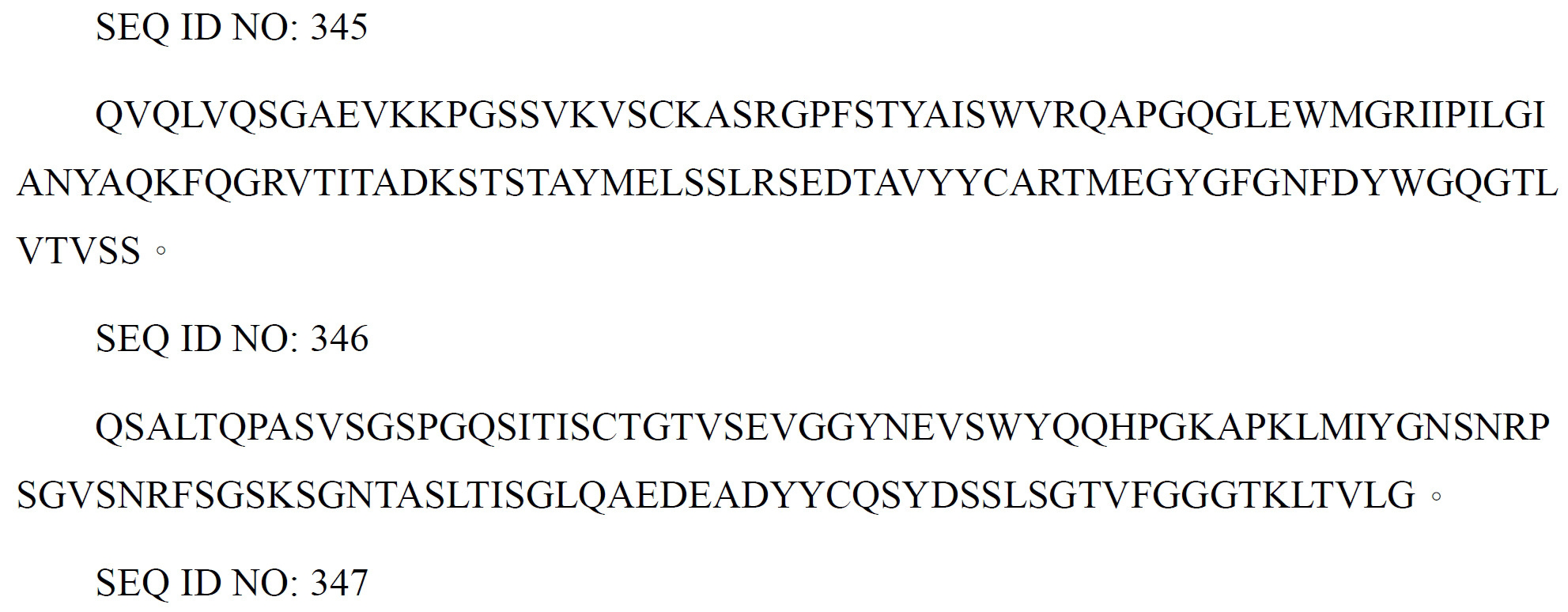
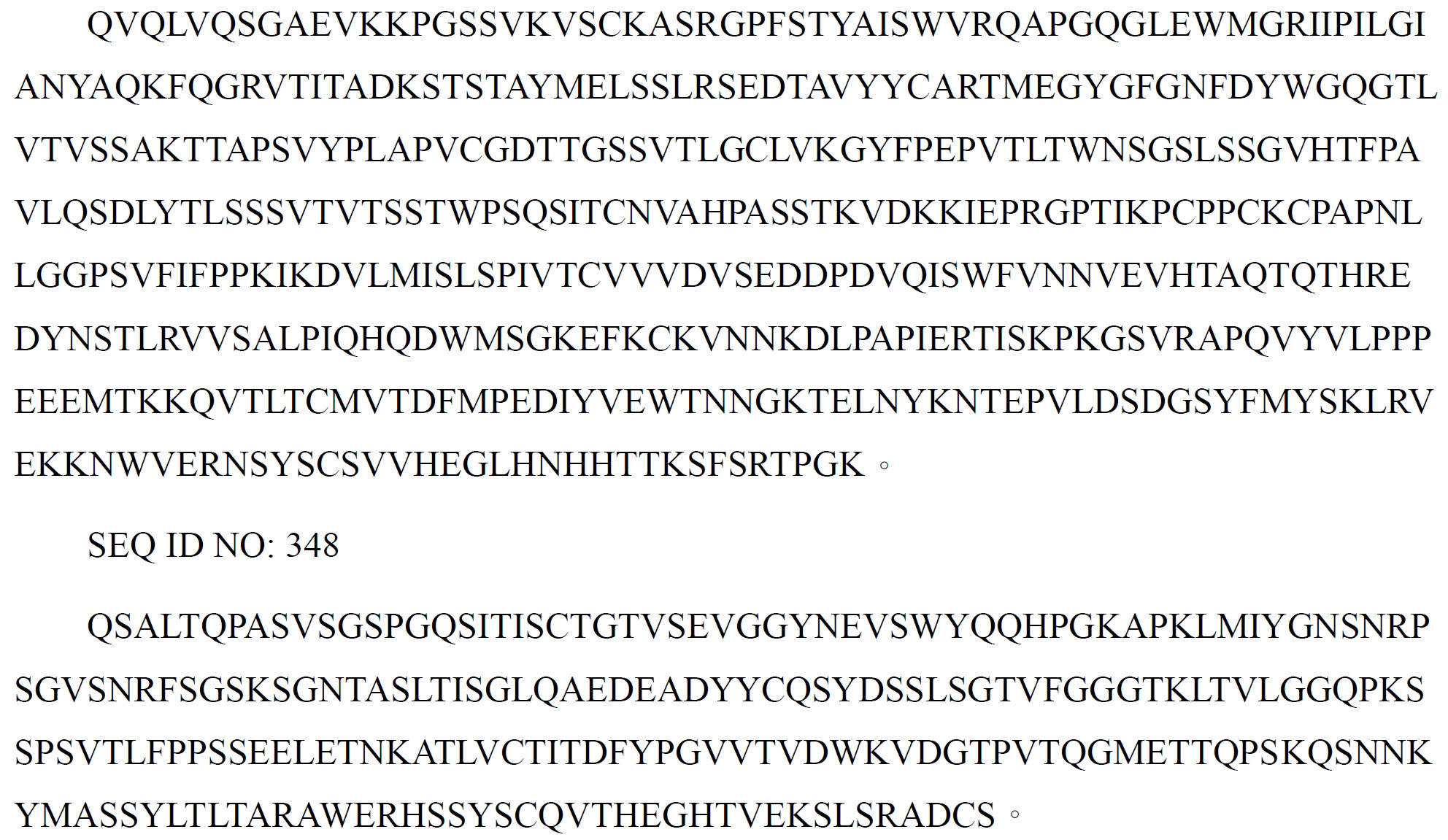
在某些實施例中,CD276結合scFv為衍生自6-D8-E7-A11之scFv,包括重鏈可變區及輕鏈可變區,其可操作地藉由間隔子SEQ ID NO: 351 (ASTGGGGSGGGGSGGGGS)或SEQ ID NO: 350 (GGGGSGGGGSGGGGS)連接,並且該scFv具有胺基酸序列SEQ ID NO: 355:
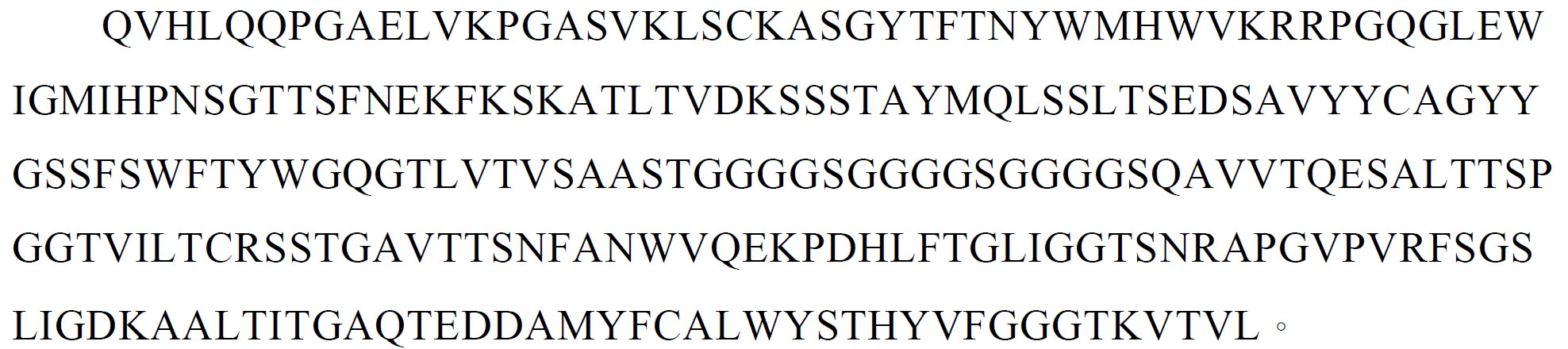
在某些實施例中,抗PD-L1單抗(小鼠IgG2a)及兩種CD276結合scFv以IgG(H)scFv之形式形成雙特異性抗體。CD276結合scFv之重鏈可變區之N端分別藉由間隔子SEQ ID NO: 350 (GGGGSGGGGSGGGGS)可操作地連接於抗PD-L1 mAb (小鼠IgG2a)之重鏈之C末端。IgG(H)scFv之重鏈具有胺基酸序列SEQ ID NO: 349:

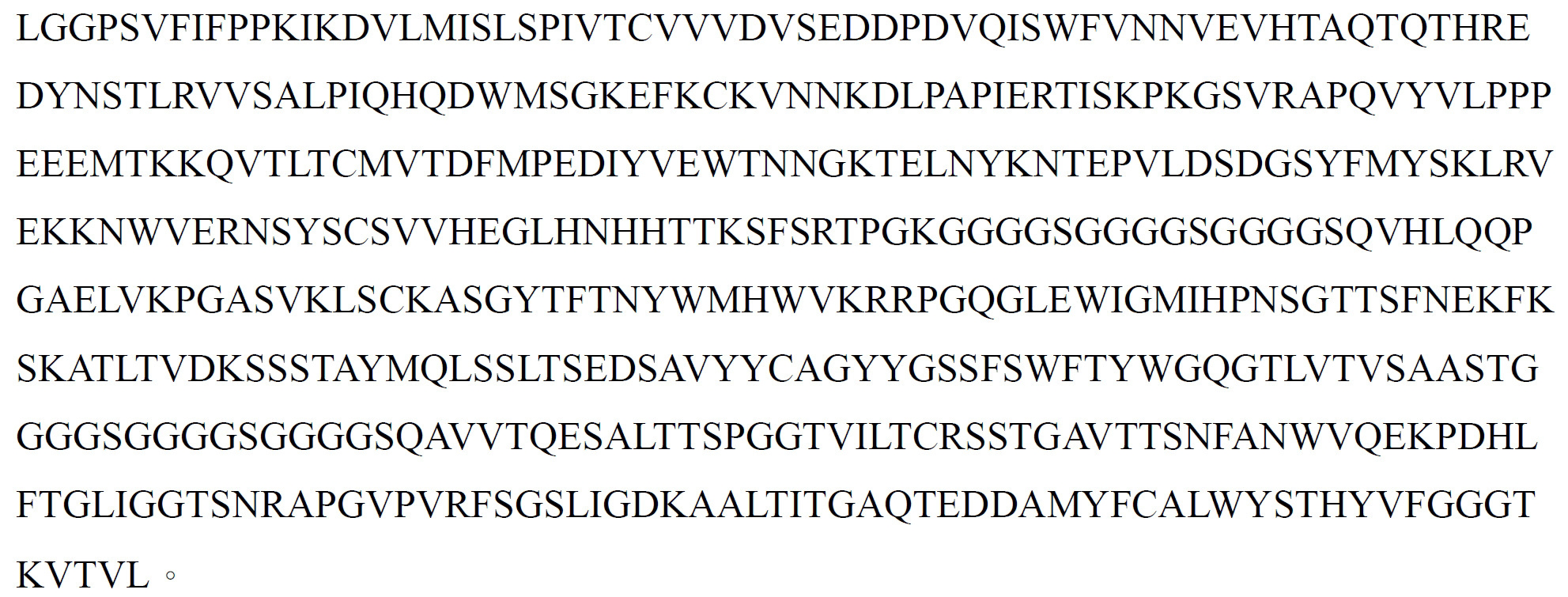
在某些實施例中,第二抗原為腫瘤相關抗原或其表位。術語「腫瘤相關抗原」與術語「腫瘤抗原」互換使用,係指存在於或可存在於腫瘤細胞表面且位於腫瘤細胞上或腫瘤胞內之抗原。在一些實施例中,腫瘤相關抗原可僅由腫瘤細胞呈遞,而不為由正常細胞(亦即非腫瘤細胞)呈遞。在一些其他實施例中,腫瘤相關抗原可僅在腫瘤細胞上表現,或者與非腫瘤細胞相比可具有腫瘤特異性突變。在一些其他實施例中,腫瘤相關抗原可在腫瘤細胞及非腫瘤細胞中發現,但當與非腫瘤細胞相比時,腫瘤相關抗原在腫瘤細胞上過度表現,或者由於腫瘤組織與非腫瘤組織相比結構較不緊湊,因此可在腫瘤組織中結合至抗體。In certain embodiments, the second antigen is a tumor-associated antigen or an epitope thereof. The term "tumor-associated antigen" is used interchangeably with the term "tumor antigen" and refers to an antigen that is present or may be present on the surface of a tumor cell and is located on or within a tumor cell. In some embodiments, tumor-associated antigens may be presented only by tumor cells and not by normal cells (ie, non-tumor cells). In some other embodiments, tumor-associated antigens may be expressed only on tumor cells, or may have tumor-specific mutations compared to non-tumor cells. In some other embodiments, tumor-associated antigens can be found on tumor cells as well as non-tumor cells, but tumor-associated antigens are overrepresented on tumor cells when compared to non-tumor cells, or due to tumor tissue being compared to non-tumor tissue. It is less compact than its structure, so it can bind to antibodies in tumor tissue.
在一些實施例中,腫瘤抗原選自由以下組成之群:CA-125、神經節苷脂G(D2)、G(M2)及G(D3)、CD19、CD20、CD24、CD33、CD47、CD52、Ep-CAM、CEA、CLDN18.2、蛙皮素樣肽、PSA、HER2/neu、表皮生長因子受體(EGFR)、erbB2、erbB3/HER3、erbB4、CD44v6、CD44v9、Ki-67、癌相關黏蛋白、VEGF、VEGFR(例如VEGFR3)、雌激素受體、Lewis-Y抗原、TGFβ1、IGF-1受體、EGFα、c-Kit受體、轉鐵蛋白受體、IL-2R、CDH6、CEA、FOLR1、TROP2、PTK7、SLITRK6、CD142、連接蛋白-4、ROR1、ROR2、CD142及CD123、CD22、CD79b、DLL3、SLC家族或CO17-1A。In some embodiments, the tumor antigen is selected from the group consisting of: CA-125, gangliosides G(D2), G(M2) and G(D3), CD19, CD20, CD24, CD33, CD47, CD52, Ep-CAM, CEA, CLDN18.2, bombesin-like peptide, PSA, HER2/neu, epidermal growth factor receptor (EGFR), erbB2, erbB3/HER3, erbB4, CD44v6, CD44v9, Ki-67, cancer-associated mucin protein, VEGF, VEGFR (eg VEGFR3), estrogen receptor, Lewis-Y antigen, TGFβ1, IGF-1 receptor, EGFα, c-Kit receptor, transferrin receptor, IL-2R, CDH6, CEA, FOLR1, TROP2, PTK7, SLITRK6, CD142, Connexin-4, ROR1, ROR2, CD142 and CD123, CD22, CD79b, DLL3, SLC family or CO17-1A.
腫瘤相關抗原之其他示例性實例為CD10、CD21、CD22、CD25、CD30、CD34、CD37、CD38、CD123、GPRC5D、CD44v6、CD45、CD133、Fms樣酪胺酸激酶3 (FLT-3、CD135)、硫酸軟骨素蛋白多糖4 (CSPG4、黑色素瘤相關硫酸軟骨蛋白多糖)、Her2、Her3、IGFR、IL3R、纖維母細胞激活蛋白(FAP)、CDCP1、Derlin1、腱蛋白(Tenascin)、frizzled 1-10、血管抗原VEGFR2 (KDR/FLK1)、VEGFR3 (FLT4、CD309)、PDGFRα (CD140a)、PDGFRβ (CD140b)、內皮膠質蛋白(Endoglin)、CLEC14、CLEC12a、Tem1-8及Tie2。進一步之實例可包括A33、CAMPATH-1 (CDw52)、癌胚抗原(CEA)、羧酸酐酶IX (MN/CA IX)、de2-7、EGFRvIII、EpCAM、葉酸結合蛋白、G250、c-Kit (CD117)、CSF1R (CD115)、HLA-DR、IL-2受體、IL3R、MCSP(黑色素瘤相關細胞表面硫酸軟骨素蛋白聚糖)、Muc-1、前列腺特異性膜抗原(PSMA)、前列腺幹細胞抗原(PSCA)、前列腺特異性抗原(PSA)及TAG-72。Other illustrative examples of tumor-associated antigens are CD10, CD21, CD22, CD25, CD30, CD34, CD37, CD38, CD123, GPRC5D, CD44v6, CD45, CD133, Fms-like tyrosine kinase 3 (FLT-3, CD135), Chondroitin Sulfate Proteoglycan 4 (CSPG4, Melanoma-Associated Chondroitin Sulfate Proteoglycan), Her2, Her3, IGFR, IL3R, Fibroblast Activating Protein (FAP), CDCP1, Derlin1, Tenascin, Frizzled 1-10, Vascular antigens VEGFR2 (KDR/FLK1), VEGFR3 (FLT4, CD309), PDGFRα (CD140a), PDGFRβ (CD140b), Endothelial glial protein (Endoglin), CLEC14, CLEC12a, Tem1-8 and Tie2. Further examples may include A33, CAMPATH-1 (CDw52), Carcinoembryonic Antigen (CEA), Carboxylic Anhydrase IX (MN/CA IX), de2-7, EGFRvIII, EpCAM, Folate Binding Protein, G250, c-Kit ( CD117), CSF1R (CD115), HLA-DR, IL-2 receptor, IL3R, MCSP (melanoma-associated cell surface chondroitin sulfate proteoglycan), Muc-1, prostate-specific membrane antigen (PSMA), prostate stem cells Antigen (PSCA), Prostate Specific Antigen (PSA) and TAG-72.
本文提供之雙特異性抗體及抗原結合片段可以用本領域已知之任何合適方法製備。在傳統方法中,具有不同抗原特異性的兩個免疫球蛋白重鏈-輕鏈對可在宿主細胞中共表現,以重組方式產生雙特異性抗體(例如,參見Milstein及Cuello,《自然(Nature)》,305:537(1983)),隨後藉由親和層析純化。The bispecific antibodies and antigen-binding fragments provided herein can be prepared by any suitable method known in the art. In traditional approaches, two immunoglobulin heavy chain-light chain pairs with different antigenic specificities can be co-expressed in host cells to recombinantly produce bispecific antibodies (see, for example, Milstein and Cuello, Nature. », 305:537 (1983)), followed by purification by affinity chromatography.
亦可使用重組方法,其中編碼兩種特異性的抗體重鏈可變域之序列分別與免疫球蛋白恆定域序列融合,然後插入至表現載體中,該表現載體與用於輕鏈序列之表現載體共轉染至合適之宿主細胞,用於重組表現雙特異性抗體(參見例如WO 94/04690;Suresh等人,Methods in Enzymology,121:210(1986))。類似地,scFv二聚體亦可自宿主細胞重組構築及表現(參見例如Gruber等人,J.Immunol.,152:5368(1994))。Recombinant methods can also be used in which the sequences encoding the variable domains of the antibody heavy chains of the two specificities are separately fused to immunoglobulin constant domain sequences and then inserted into an expression vector that is identical to the expression vector for the light chain sequences Co-transfection into suitable host cells is used for recombinant expression of bispecific antibodies (see eg WO 94/04690; Suresh et al., Methods in Enzymology, 121:210 (1986)). Similarly, scFv dimers can also be recombinantly constructed and expressed from host cells (see, eg, Gruber et al., J. Immunol., 152:5368 (1994)).
在另一種方法中,來自Fos及Jun蛋白之亮胺酸拉鏈肽可藉由基因融合連接至兩種不同抗體之Fab'部分。連接之抗體在鉸鏈區被還原為四個半抗體(亦即單體),然後再氧化形成異二聚體(Kostelny等人,《免疫學雜誌(J.Immunol.)》,148(5):1547-1553(1992))。In another approach, leucine zipper peptides from the Fos and Jun proteins can be linked to the Fab' portions of two different antibodies by gene fusion. Linked antibodies are reduced at the hinge region to four half-antibodies (i.e., monomers), which are then reoxidized to form heterodimers (Kostelny et al., J. Immunol., 148(5): 1547-1553 (1992)).
兩個抗原結合域亦可偶聯或交聯以形成雙特異性抗體或抗原結合片段。例如,一種抗體可偶聯至生物素,而另一種抗體則可偶聯至抗生物素,生物素及抗生物素之間之強締合將使兩種抗體複合在一起,形成雙特異性抗體(例如,參見美國專利號4676980;WO91/00360、WO92/00373及EP03089)。另一個實例為,如美國專利第4676980號中所公開的,此兩種抗體或抗原結合片段可藉由本領域已知之習知方法交聯。Two antigen-binding domains can also be coupled or cross-linked to form a bispecific antibody or antigen-binding fragment. For example, one antibody can be conjugated to biotin and another antibody can be conjugated to anti-biotin, and the strong association between biotin and anti-biotin will allow the two antibodies to complex together to form a bispecific antibody (See eg US Patent No. 4676980; WO91/00360, WO92/00373 and EP03089). As another example, as disclosed in US Pat. No. 4,676,980, the two antibodies or antigen-binding fragments can be cross-linked by conventional methods known in the art.
雙特異性抗原結合片段可由雙特異性抗體產生,例如藉由蛋白水解切割或化學連接。例如,可製備抗體之抗原結合片段(例如Fab')並將其轉化為Fab'-硫醇衍生物,然後與具有不同抗原特異性的另一種轉化之Fab'衍生物混合並反應,以形成雙特異性抗原結合片段(參見,例如,Brennan等人,《科學(Science)》,229:81(1985))。Bispecific antigen-binding fragments can be generated from bispecific antibodies, eg, by proteolytic cleavage or chemical linkage. For example, an antigen-binding fragment of an antibody (e.g., a Fab') can be prepared and converted into a Fab'-thiol derivative, which is then mixed and reacted with another converted Fab' derivative having a different antigen specificity to form a bis-thiol derivative. Specific antigen-binding fragments (see, eg, Brennan et al., Science 229:81 (1985)).
在某些實施例中,雙特異性抗體或抗原結合片段可在界面處工程化,從而可形成杵-臼結構,以促進兩個不同抗原結合位點之異源二聚化。如本文所用之「杵-臼結構」係指兩種多肽(例如CH3域)之間之相互作用,其中一種多肽由於存在具有大側鏈之胺基酸殘基(例如酪胺酸或色胺酸)而具有突起(亦即「杵」),而另一種多肽由於具有小之側鏈胺基酸殘基(例如丙胺酸或蘇胺酸)而具有空腔(亦即「臼」),其中突起可定位在空腔中,以促進兩種多肽之相互作用,形成異二聚體或複合物。利用杵-臼結構生成多肽之方法在本領域為已知的,例如,如美國專利第5731168號中所描述的。In certain embodiments, bispecific antibodies or antigen-binding fragments can be engineered at the interface so that a knob-and-hole structure can be formed to facilitate heterodimerization of two different antigen-binding sites. "Knob-hole structure" as used herein refers to the interaction between two polypeptides (e.g. CH3 domains), one of which is due to the presence of amino acid residues with large side chains (e.g. tyrosine or tryptophan). ) with protrusions (i.e. "knobs"), while another polypeptide has cavities (i.e. "holes") due to small side chain amino acid residues (e.g. alanine or threonine) in which the protrusions Can be positioned in the cavity to facilitate the interaction of two polypeptides to form a heterodimer or complex. Methods for generating polypeptides using a knob-and-hole structure are known in the art, eg, as described in US Patent No. 5,731,168.
共軛物在一些實施例中,抗CD276抗體及其抗原結合片段與一或多種共軛物連接,視情況,其中共軛物直接或經由連接子共價連接。共軛物為可附接至抗體或其抗原結合片段之非蛋白質部分。預期多種共軛物可與本文提供之抗體或抗原結合片段連接(參見,例如,《共軛物疫苗(Conjugate Vaccines)》,《對微生物學及免疫學之貢獻(Contributions to Microbiology and Immunology)》,J. M. Cruse及R. E. Lewis, Jr.(編輯),Carger出版社,紐約,(1989))。此等共軛物可藉由共價結合、親和力結合、嵌入、配位結合、複合、締合、共混或添加等方法與抗體或抗原結合片段連接。在一些實施例中,共軛物包含清除調節劑、化學治療劑、毒素、放射性同位素、鑭系元素、發光標記、螢光標記、酶-受質標記、DNA烷基化劑、拓樸異構酶抑制劑、微管蛋白結合劑或其他抗癌藥物。 Conjugates In some embodiments, anti-CD276 antibodies and antigen-binding fragments thereof are linked to one or more conjugates, where the conjugates are covalently linked directly or via a linker, as appropriate. Conjugates are non-protein moieties that can be attached to antibodies or antigen-binding fragments thereof. It is contemplated that a variety of conjugates can be attached to the antibodies or antigen-binding fragments provided herein (see, e.g., Conjugate Vaccines, Contributions to Microbiology and Immunology, pp. JM Cruse and RE Lewis, Jr. (eds.), Carger Press, New York, (1989)). These conjugates can be linked to the antibody or antigen-binding fragment by methods such as covalent bonding, affinity bonding, intercalation, coordination bonding, complexation, association, blending, or addition. In some embodiments, the conjugates comprise clearance modulators, chemotherapeutic agents, toxins, radioisotopes, lanthanides, luminescent labels, fluorescent labels, enzyme-substrate labels, DNA alkylating agents, topoisomers Enzyme inhibitors, tubulin-binding agents, or other anticancer drugs.
在某些實施例中,本文所公開之抗體及抗原結合片段可被工程化以在表位結合部分之外含有特異性位點,該位點可用於與一或多個共軛物結合。例如,此類位點可包括一或多個反應性胺基酸殘基,諸如,例如半胱胺酸或組胺酸殘基,以方便與共軛物之共價連接。In certain embodiments, the antibodies and antigen-binding fragments disclosed herein can be engineered to contain specific sites outside of the epitope-binding portion that can be used to bind one or more conjugates. For example, such sites may include one or more reactive amino acid residues, such as, for example, cysteine or histidine residues, to facilitate covalent attachment to the conjugate.
在某些實施例中,抗體可間接或藉由另一共軛物連接至共軛物。例如,抗體或抗原結合片段可與生物素結合,接著間接與第二共軛物結合,該第二共軛物與抗生物素蛋白結合。共軛物可為毒素(例如,化學治療劑)、可偵測標記(例如,放射性同位素、鑭系元素、發光標記、螢光標記或酶-受質標記)。In certain embodiments, the antibody can be linked to the conjugate either indirectly or via another conjugate. For example, an antibody or antigen-binding fragment can be conjugated to biotin, followed indirectly by a second conjugate that is conjugated to avidin. Conjugates can be toxins (eg, chemotherapeutic agents), detectable labels (eg, radioisotopes, lanthanides, luminescent labels, fluorescent labels, or enzyme-substrate labels).
「毒素」可為對細胞有害或可破壞或殺死細胞之任何藥劑。毒素之實例包括但不限於紫杉醇(taxol)、細胞鬆弛素B (cytochalasin B)、短桿菌肽D (gramicidin D)、溴化乙錠、吐根素(emetine)、絲裂黴素(mitomycin)、依託泊苷(etoposide)、特諾波賽(tenoposide)、長春新鹼(vincristine)、長春鹼(vinblastine)、秋水仙鹼(colchicin)、小紅莓(doxorubicin)、道諾黴素(daunorubicin)、二羥基炭疽菌素二酮(dihydroxy anthracin dione)、米托蒽醌(mitoxantrone)、光神黴素(mithramycin)、放線菌素D (actinomycin D)、1-去氫睪固酮、糖皮質激素、普魯卡因(procaine)、丁卡因(tetracaine)、利多卡因(lidocaine)、普萘洛爾(propranolol)、嘌呤黴素(puromycin)及其類似物、抗代謝物(例如,甲氨蝶呤(methotrexate)、6-巰基嘌呤、6-硫鳥嘌呤、阿糖胞苷(cytarabine)、5-氟尿嘧啶達卡巴嗪(5-fluorouracil decarbazine))、烷基化劑(例如,氮芥(mechlorethamine)、噻替派苯丁酸氮芥(thioepa chlorambucil)、美法侖(melphalan)、卡莫司汀(carmustine)(BSNU)及洛莫司汀(lomustine)(CCNU)、環硫磷醯胺(cyclothosphamide)、白消安(busulfan)、二溴甘露醇、鏈佐黴素(streptozotocin)、絲裂黴素C (mitomycin C)及順-二氯二胺鉑(II)(DDP),順鉑(cisplatin))、蒽環黴素(anthracyclines)(例如,道諾黴素(以前為柔紅黴素(daunomycin))及阿黴素(doxorubicin))、抗生素(例如,更生黴素(dactinomycin)(以前為放線菌素(actinomycin))、博萊黴素(bleomycin)、光神黴素及安麴黴素(anthramycin)(AMC))及抗有絲分裂劑(例如長春新鹼及長春鹼)。A "toxin" can be any agent that is harmful to cells or that can damage or kill cells. Examples of toxins include, but are not limited to, taxol, cytochalasin B, gramicidin D, ethidium bromide, emetine, mitomycin, Etoposide, tenoposide, vincristine, vinblastine, colchicin, doxorubicin, daunorubicin, Dihydroxy anthracin dione (dihydroxy anthracin dione), mitoxantrone (mitoxantrone), mithramycin (mithramycin), actinomycin D (actinomycin D), 1-dehydrotestosterone, glucocorticoids, Procaine, tetracaine, lidocaine, propranolol, puromycin and their analogs, antimetabolites (e.g., methotrexate ( methotrexate), 6-mercaptopurine, 6-thioguanine, cytarabine, 5-fluorouracil decarbazine), alkylating agents (e.g., mechlorethamine, thiophene Thioepa chlorambucil, melphalan, carmustine (BSNU) and lomustine (CCNU), cyclothiosphamide, Busulfan, dibromomannitol, streptozotocin, mitomycin C and cis-dichlorodiammine platinum (II) (DDP), cisplatin (cisplatin) , anthracyclines (e.g., daunomycin (formerly daunomycin) and doxorubicin), antibiotics (e.g., dactinomycin (formerly actinomycin Actinomycin), bleomycin, mithramycin, and anthramycin (AMC)) and antimitotic agents (such as vincristine and vinblastine).
可偵測標記之實例可包括螢光標記(例如,螢光素、羅丹明、丹磺醯、藻紅蛋白或德克薩斯紅)、酶受質標記(例如,辣根過氧化物酶、鹼性磷酸酶、螢光素酶(luceriferase)、葡糖澱粉酶、溶菌酶、糖氧化酶或β-D-半乳糖苷酶)、放射性同位素(例如 123I、 124I、 125I、 131I、 35S、 3H、 111In、 112In、 14C、 64Cu、 67Cu、 86Y、 88Y、 90Y、 177Lu、 211At、 186Re、 188Re、 153Sm、 212Bi及 32P,其他鑭系元素,冷光標記)、發色團部分、地高辛、生物素/親和素、DNA分子或偵測用金。 Examples of detectable labels may include fluorescent labels (e.g., luciferin, rhodamine, dansyl, phycoerythrin, or Texas Red), enzyme substrate labels (e.g., horseradish peroxidase, alkaline phosphatase, luciferase (luceriferase), glucoamylase, lysozyme, sugar oxidase or β-D-galactosidase), radioactive isotopes (such as 123 I, 124 I, 125 I, 131 I , 35 S, 3 H, 111 In, 112 In, 14 C, 64 Cu, 67 Cu, 86 Y, 88 Y , 90 Y, 177 Lu, 211 At, 186 Re, 188 Re, 153 Sm, 212 Bi and 32 P, other lanthanides, luminescent labels), chromophore moieties, digoxin, biotin/avidin, DNA molecules or gold for detection.
在某些實施例中,共軛物可為有助於增加抗體之半衰期之藥代動力學修飾部分。說明性實例包括水溶性聚合物,諸如PEG、羧甲基纖維素、葡聚糖、聚乙烯醇、聚乙烯吡咯啶酮、乙二醇/丙二醇之共聚物等。聚合物可具有任何分子量,且可為支化或非支化的。與抗體附接之聚合物之數目可變化,並且若附接超過一個聚合物,則其可為相同或不同的分子。In certain embodiments, the conjugate can be a pharmacokinetic modifying moiety that helps increase the half-life of the antibody. Illustrative examples include water soluble polymers such as PEG, carboxymethylcellulose, dextran, polyvinyl alcohol, polyvinylpyrrolidone, copolymers of ethylene glycol/propylene glycol, and the like. The polymers can be of any molecular weight and can be branched or unbranched. The number of polymers attached to the antibody can vary, and if more than one polymer is attached, they can be the same or different molecules.
在某些實施例中,共軛物可為純化部分,諸如磁珠。In certain embodiments, the conjugates can be purification moieties, such as magnetic beads.
在某些實施例中,本文提供之抗體及/或其抗原結合片段用於共軛物之基底。In certain embodiments, antibodies and/or antigen-binding fragments thereof provided herein are used as substrates for conjugates.
多核苷酸及重組方法本發明提供編碼抗CD276抗體及其抗原結合片段之分離的多核苷酸。編碼單株抗體之DNA很容易使用習知程式(例如,藉由使用能夠與編碼抗體之重鏈及輕鏈之基因特異性結合的寡核苷酸探針)分離並且定序。編碼DNA亦可藉由合成方法獲得。 Polynucleotides and Recombinant Methods The present invention provides isolated polynucleotides encoding anti-CD276 antibodies and antigen-binding fragments thereof. DNA encoding the monoclonal antibody is readily isolated and sequenced using conventional procedures (eg, by using oligonucleotide probes that are capable of binding specifically to genes encoding the heavy and light chains of the antibody). Coding DNA can also be obtained by synthetic methods.
使用本領域已知之重組技術,可將編碼抗CD276抗體及其抗原結合片段之分離的多核苷酸插入至載體中用於進一步選殖(擴增DNA)或表現。許多載體為可供使用的。載體組分一般包括但不限於以下一或多種:訊號序列、複製起點、一或多種標記基因、增強子元件、啟動子(例如,SV40、CMV、EF-1α)及轉錄終止序列。Using recombinant techniques known in the art, the isolated polynucleotides encoding anti-CD276 antibodies and antigen-binding fragments thereof can be inserted into vectors for further cloning (amplification of DNA) or expression. Many vectors are available. Vector components generally include, but are not limited to, one or more of the following: a signal sequence, an origin of replication, one or more marker genes, an enhancer element, a promoter (eg, SV40, CMV, EF-1α), and a transcription termination sequence.
在一些實施例中,載體系統包括哺乳動物、細菌、酵母系統等,且包含質體,諸如但不限於pALTER、pBAD、pcDNA、pCal、pL、pET、pGEMEX、pGEX、pCI、pCMV、pEGFP、pEGFT、pSV2、pFUSE、pVITRO、pVIVO、pMAL、pMD18-T、pMONO、pSELECT、pUNO、pDUO、Psg5L、pBABE、pWPXL、pBI、p15TV-L、pPro18、pTD、pRS420、pLexA、pACT2.2等,及其他實驗載體及市售載體。合適之載體可包括質體或病毒載體(例如,複製缺陷逆轉錄病毒、腺病毒及腺相關病毒)。In some embodiments, vector systems include mammalian, bacterial, yeast systems, etc., and comprise plastids, such as but not limited to pALTER, pBAD, pcDNA, pCal, pL, pET, pGEMEX, pGEX, pCI, pCMV, pEGFP, pEGFT , pSV2, pFUSE, pVITRO, pVIVO, pMAL, pMD18-T, pMONO, pSELECT, pUNO, pDUO, Psg5L, pBABE, pWPXL, pBI, p15TV-L, pPro18, pTD, pRS420, pLexA, pACT2.2, etc., and others Experimental carrier and commercial carrier. Suitable vectors may include plastids or viral vectors (eg, replication defective retroviruses, adenoviruses, and adeno-associated viruses).
可將包含編碼抗體或抗原結合片段之多核苷酸序列之載體引入至宿主細胞中用於選殖或基因表現。用於選殖或表現本文載體中之DNA之適合宿主細胞為上述原核生物、酵母或更高等真核生物細胞。適用於此目的之原核生物包括真細菌,諸如革蘭氏陰性或革蘭氏陽性生物體,例如腸桿菌科(諸如埃希氏菌),如大腸桿菌、腸桿菌、歐文氏菌、克雷伯氏菌、變形桿菌、沙門氏菌(如鼠傷寒沙門氏菌、沙雷氏菌(如黏質沙雷氏菌)及志賀氏菌),以及桿菌(諸如枯草芽孢桿菌及地衣芽孢桿菌、假單胞菌(諸如銅綠假單胞菌)及鏈黴菌)。Vectors comprising polynucleotide sequences encoding antibodies or antigen-binding fragments can be introduced into host cells for cloning or gene expression. Suitable host cells for the selection or expression of the DNA in the vectors herein are prokaryotic, yeast or higher eukaryotic cells as described above. Prokaryotes suitable for this purpose include eubacteria, such as Gram-negative or Gram-positive organisms, for example Enterobacteriaceae (such as Escherichia), such as Escherichia coli, Enterobacter, Erwinia, Klebsiella Salmonella, Proteus, Salmonella (such as Salmonella typhimurium, Serratia (such as Serratia marcescens) and Shigella), and bacilli (such as Bacillus subtilis and Bacillus licheniformis, Pseudomonas (such as Pseudomonas aeruginosa) and Streptomyces).
除了原核生物,諸如絲狀真菌或酵母之真核微生物亦為抗CD276抗體編碼載體之合適選殖或表現宿主。釀酒酵母,或普通麵包酵母,為低等真核宿主微生物中最常用的。然而,許多其他之屬、種及品系在本文中為普遍可用及有用的,諸如粟酒裂殖酵母;克魯維酵母屬宿主,諸如例如乳酸克魯維酵母、脆壁克魯維酵母(K. fragilis)(ATCC 12,424)、保加利亞克魯維酵母(K. bulgaricus)(ATCC 16,045)、威克克魯維酵母(K. wickeramii)(ATCC 24,178)、克魯雄酵母(K. waltii)(ATCC 56,500)、果蠅克魯維酵母(K. drosophilarum)(ATCC 36,906)、耐熱克魯維酵母(K. thermotolerans)及馬克斯克魯維酵母(K. marxianus);耶氏酵母屬(EP 402,226);畢赤酵母(EP 183,070);假絲酵母屬;瑞氏木黴(Trichoderma reesia)(EP 244,234);粗糙脈孢菌;許旺酵母屬,諸如西方許旺酵母(Schwanniomyces occidentalis);以及絲狀真菌,諸如例如脈孢菌屬、青黴屬、彎頸黴屬及麴黴屬宿主,諸如構巢麴黴及黑麴黴。In addition to prokaryotes, eukaryotic microorganisms such as filamentous fungi or yeast are suitable selection or expression hosts for anti-CD276 antibody-encoding vectors. Saccharomyces cerevisiae, or common baker's yeast, is the most commonly used of lower eukaryotic host microorganisms. However, many other genera, species and strains are generally available and useful herein, such as Schizosaccharomyces pombe; Kluyveromyces hosts, such as, for example, Kluyveromyces lactis, Kluyveromyces fragilis (K fragilis) (ATCC 12,424), K. bulgaricus (ATCC 16,045), K. wickeramii (ATCC 24,178), K. waltii (ATCC 56,500), K. drosophilarum (ATCC 36,906), K. thermotolerans and K. marxianus; Yarrowia (EP 402,226); Pichia pastoris (EP 183,070); Candida sp.; Trichoderma reesia (EP 244,234); Neurospora crassa; Schwanniomyces such as Schwanniomyces occidentalis; and filamentous fungi , such as, for example, Neurospora, Penicillium, Curvularia, and Aspergillus hosts, such as Aspergillus nidulans and Aspergillus niger.
合適之表現在此提供之糖基化抗體或抗原片段之宿主細胞源自多細胞生物體。無脊椎動物細胞之實例包括植物及昆蟲細胞。已經鑑定出多種桿狀病毒株及變體以及來自如下宿主之相應容許之昆蟲宿主細胞:草地貪夜蛾(Spodoptera frugiperda)(毛蟲)、埃及伊蚊(Aedes aegypti)(蚊子)、白紋伊蚊(Aedes albopictus)(蚊子)、黑腹果蠅(Drosophila melanogaster)(果蠅)及家蠶(Bombyx mori)。多種用於轉染之病毒株為可公開獲得的,例如苜蓿銀紋夜蛾(Autographa californica) NPV之L-1變體及家蠶NPV之Bm-5病毒株,並且此類病毒可根據本發明用作本文中之病毒,尤其為用於轉染草地貪夜蛾細胞。棉花、玉米、馬鈴薯、大豆、矮牽牛、番茄及菸草之植物細胞培養物亦可用作宿主。Suitable host cells expressing the glycosylated antibodies or antigen fragments provided herein are derived from multicellular organisms. Examples of invertebrate cells include plant and insect cells. A number of baculovirus strains and variants have been identified and corresponding permissive insect host cells from the following hosts: Spodoptera frugiperda (caterpillar), Aedes aegypti (mosquito), Aedes albopictus (Aedes albopictus) (mosquito), Drosophila melanogaster (fruit fly) and silkworm (Bombyx mori). A variety of virus strains for transfection are publicly available, such as the L-1 variant of Autographa californica NPV and the Bm-5 strain of Bombyx mori NPV, and such viruses can be used according to the present invention The virus used herein is especially for transfecting Spodoptera frugiperda cells. Plant cell cultures of cotton, corn, potato, soybean, petunia, tomato, and tobacco can also be used as hosts.
然而,人們對脊椎動物細胞之興趣最大,脊椎動物細胞之培養繁殖(組織培養)已成為習知程式。有用之哺乳動物宿主細胞株之實例為SV40轉化之猴腎CV1細胞株(COS-7,ATCC CRL 1651);人類胚腎細胞株(「293或293細胞次選殖用於在懸浮培養物中生長(293 or 293 cells subcloned for growth in suspension culture)」,Graham等人,《普通病毒學雜誌(J. Gen Virol.)》36:59 (1977));幼倉鼠腎細胞(BHK,ATCC CCL 10);中國倉鼠卵巢細胞/-DHFR(CHO,Urlaub等人,《美國國家科學院院刊》77:4216 (1980));小鼠支援細胞(TM4,Mather,《生殖生物學(Biol. Reprod.)》23:243-251(1980));猴腎細胞(CV1,ATCC CCL 70);非洲綠猴腎細胞(VERO-76,ATCC CRL-1587);人類子宮頸癌細胞(HELA,ATCC CCL 2);犬腎細胞(MDCK,ATCC CCL 34);水牛大鼠(buffalo rat)肝細胞(BRL 3A,ATCC CRL 1442);人類肺細胞(W138,ATCC CCL 75);人類肝細胞(Hep G2,HB 8065);小鼠乳腺腫瘤(MMT 060562,ATCC CCL51);TRI細胞(Mather等人,《紐約科學院年刊(Annals N.Y. Acad. Sci.)》383:44-68 (1982));MRC 5細胞;FS4細胞;及人類肝癌細胞株(Hep G2)。However, the greatest interest has been in vertebrate cells, and the culture propagation (tissue culture) of vertebrate cells has become a routine procedure. Examples of useful mammalian host cell lines are the SV40-transformed monkey kidney CV1 cell line (COS-7, ATCC CRL 1651); (293 or 293 cells subcloned for growth in suspension culture), Graham et al., J. Gen Virol. 36:59 (1977)); baby hamster kidney cells (BHK, ATCC CCL 10) ; Chinese hamster ovary cells/-DHFR (CHO, Urlaub et al., "Proceedings of the National Academy of Sciences of the United States of America" 77:4216 (1980)); mouse supporting cells (TM4, Mather, "Biol. Reprod.") 23:243-251 (1980)); monkey kidney cells (CV1, ATCC CCL 70); vero cells (VERO-76, ATCC CRL-1587); human cervical cancer cells (HELA, ATCC CCL 2); Canine kidney cells (MDCK, ATCC CCL 34); buffalo rat (buffalo rat) hepatocytes (BRL 3A, ATCC CRL 1442); human lung cells (W138, ATCC CCL 75); human hepatocytes (Hep G2, HB 8065) ; mouse mammary tumor (MMT 060562, ATCC CCL51); TRI cells (Mather et al., Annals N.Y. Acad. Sci. 383:44-68 (1982)); MRC 5 cells; FS4 cells; and human hepatoma cell line (Hep G2).
用上述表現或選殖載體轉化宿主細胞以產生抗CD276抗體,並在習知營養培養基中培養,該培養基經適當修飾以誘導啟動子、選擇轉化子或擴增編碼期望序列之基因。在另一實施例中,抗體可藉由本領域中已知之同源重組產生。Host cells are transformed with the expression or cloning vectors described above to produce anti-CD276 antibodies and cultured in conventional nutrient media modified as appropriate to induce promoters, select transformants, or amplify genes encoding desired sequences. In another embodiment, antibodies can be produced by homologous recombination known in the art.
用於產生本文提供之抗體或抗原結合片段之宿主細胞可在各種培養基中培養。市售培養基諸如Ham F10 (Sigma)、最小必需培養基(MEM)、(Sigma)、RPMI-1640 (Sigma)及杜爾貝科氏改良伊格爾培養基(DMEM)、(Sigma)適用於培養宿主細胞。此外,在Ham等人,《酶學方法(Meth. Enz.)》58:44 (1979),Barnes等人,《分析生物化學(Anal. Biochem.)》102:255 (1980),美國專利第4,767,704號;第4,657,866號;第4,927,762號;第4,560,655號;或第5,122,469號;WO 90/03430;WO 87/00195;或美國再公佈專利第30,985號中描述之任何培養基可用作宿主細胞之培養基。此等培養基中之任一種都可視需要補充激素及/或其他生長因子(諸如胰島素、轉鐵蛋白或表皮生長因子)、鹽(諸如氯化鈉、鈣鹽、鎂鹽及磷酸鹽)、緩衝劑(諸如HEPES)、核苷酸(諸如腺苷及胸苷)、抗生素(諸如GENTAMYCIN TM藥物)、微量元素(定義為通常以微莫耳範圍內之最終濃度存在之無機化合物)及葡萄糖或等效能量源。亦可包括本領域技術人員已知之適當濃度之其他必要之補充劑。培養條件(諸如溫度、pH等)為先前與所選之用於表現之宿主細胞一起使用之彼等條件,並且對於普通技術人員而言將為顯而易見的。 Host cells used to produce the antibodies or antigen-binding fragments provided herein can be cultured in a variety of media. Commercially available media such as Ham F10 (Sigma), Minimal Essential Medium (MEM), (Sigma), RPMI-1640 (Sigma), and Dulbecco's Modified Eagle's Medium (DMEM), (Sigma) are suitable for culturing host cells . Furthermore, in Ham et al., "Meth. Enz." 58:44 (1979), Barnes et al., "Anal. Biochem." 102:255 (1980), U.S. Patent No. No. 4,767,704; No. 4,657,866; No. 4,927,762; No. 4,560,655; or No. 5,122,469; WO 90/03430; WO 87/00195; . Any of these media may optionally be supplemented with hormones and/or other growth factors (such as insulin, transferrin, or epidermal growth factor), salts (such as sodium chloride, calcium, magnesium, and phosphate), buffers (such as HEPES), nucleotides (such as adenosine and thymidine), antibiotics (such as GENTAMYCIN TM drugs), trace elements (defined as inorganic compounds usually present in final concentrations in the micromolar range), and glucose or equivalent quantity source. Other necessary supplements may also be included at appropriate concentrations known to those skilled in the art. Culture conditions (such as temperature, pH, etc.) are those previously used with the host cells selected for expression and will be apparent to those of ordinary skill.
當使用重組技術時,抗體可在胞內、在周質空間中產生,或直接分泌至培養基中。若在胞內產生抗體,則作為第一步驟,例如藉由離心或超過濾移除宿主細胞或裂解片段之微粒碎片。Carter等人, 《生物技術(Bio/Technology)》10:163-167 (1992)描述了一種用於分離分泌至大腸桿菌之周質空間之抗體的程式。簡而言之,將細胞糊狀物在乙酸鈉(pH 3.5)、EDTA及苯甲基磺醯氟(PMSF)之存在下經約30分鐘解凍。細胞碎片可藉由離心移除。在抗體分泌至培養基中之情況下,來自此類表現系統之上清液一般首先使用市售之蛋白質濃縮過濾器,例如Amicon或Millipore Pellicon超濾裝置進行濃縮。蛋白酶抑制劑諸如PMSF可包括在任何前述步驟中,以抑制蛋白水解,並且可包括抗生素以防止外來污染物之生長。When recombinant techniques are used, antibodies can be produced intracellularly, in the periplasmic space, or secreted directly into the culture medium. If the antibody is produced intracellularly, as a first step, particulate debris of host cells or lysed fragments are removed, eg, by centrifugation or ultrafiltration. Carter et al., Bio/Technology 10:163-167 (1992) describe a procedure for isolating antibodies secreted into the periplasmic space of E. coli. Briefly, cell pastes were thawed in the presence of sodium acetate (pH 3.5), EDTA and phenylmethylsulfonyl fluoride (PMSF) for about 30 minutes. Cell debris can be removed by centrifugation. In the case of antibody secretion into culture medium, supernatants from such expression systems are typically first concentrated using commercially available protein concentration filters such as Amicon or Millipore Pellicon ultrafiltration units. Protease inhibitors such as PMSF may be included in any of the foregoing steps to inhibit proteolysis, and antibiotics may be included to prevent the growth of adventitious contaminants.
自細胞中製備之抗CD276抗體及其抗原結合片段可使用,例如,羥基磷灰石層析、凝膠電泳、透析、DEAE-纖維素離子交換層析、硫酸銨沈澱、鹽析及親和層析來純化,其中親和層析為較佳的純化技術。Anti-CD276 antibodies and antigen-binding fragments thereof prepared from cells can be used, for example, by hydroxylapatite chromatography, gel electrophoresis, dialysis, DEAE-cellulose ion exchange chromatography, ammonium sulfate precipitation, salting out, and affinity chromatography For purification, affinity chromatography is the preferred purification technique.
在某些實施例中,固定在固相上之蛋白質A用於進行抗體及其抗原結合片段之免疫親和純化。蛋白質A作為親和配體之適合性取決於抗體中存在之任何免疫球蛋白Fc域之種類及同種型。蛋白質A可用於純化基於人類γ1、γ2或γ4重鏈之抗體(Lindmark等人,《免疫學方法雜誌》62:1-13(1983))。蛋白G推薦用於所有小鼠同種型及人類γ3 (Guss等人,《歐洲分子生物學組織會刊(EMBO J.)》5:1567-1575 (1986))。親和配體所附接之基質最通常為瓊脂糖,但亦可使用其他基質。機械穩定性基質(諸如受控孔玻璃或聚(苯乙烯二乙烯基)苯)比瓊脂糖具有更快之流速及更短之處理時間。當抗體包含CH3域時,Bakerbond ABX.TM樹脂(J. T. Baker,新澤西州菲利普斯堡(Phillipsburg, N.J.))可用於純化。用於蛋白質純化之其他技術,諸如離子交換柱上分級分離、乙醇沈澱、反相HPLC、二氧化矽上之層析、肝素SEPHAROSE
TM上之層析、陰離子或陽離子交換樹脂(諸如聚天冬胺酸柱)上之層析、層析焦聚、SDS-PAGE以及硫酸銨沈澱亦為可用的,取決於待回收之抗體。
In certain embodiments, Protein A immobilized on a solid phase is used for immunoaffinity purification of antibodies and antigen-binding fragments thereof. The suitability of protein A as an affinity ligand depends on the species and isotype of any immunoglobulin Fc domain present in the antibody. Protein A can be used to purify
在任何初步純化步驟之後,可對包含所關注抗體及污染物之混合物進行低pH疏水相互作用層析,使用pH在約2.5-4.5之間之溶離緩衝液,較佳在低鹽濃度(例如,約0-0.25 M鹽)下進行。Following any initial purification steps, the mixture comprising the antibody of interest and the contaminant can be subjected to low pH hydrophobic interaction chromatography using an elution buffer at a pH between about 2.5-4.5, preferably at a low salt concentration (e.g., about 0-0.25 M salt).
CAR在另一個態樣,本公開亦提供一種嵌合抗原受體(CAR),其包含抗原結合域、跨膜域、共刺激傳訊區及TCR傳訊域,其中抗原結合域特異性結合CD276並包含本文提供之抗原結合片段。在某些實施例中,抗原結合片段為Fab或scFv。在某些實施例中,本文提供之CAR為雙特異性的。CAR能夠進一步特異性結合不同於CD276之第二抗原,或CD276上之第二表位。在某些實施例中,第二抗原為腫瘤抗原、腫瘤相關抗原或如上所描述的免疫相關目標。TCR傳訊域可選自由以下組成之群:CD3ζ、FccRIγ、CD27、CD28、CD137、CD134、MyD88、CD40、CD278、TLR或其組合之胞內訊號區序列。跨膜區可包含CD3、CD4、CD8或CD28之跨膜區。在某些實施例中,第二抗原為免疫抑制分子,諸如PD-L1、SIRPα、CD47或B2M。 In another aspect of CAR , the present disclosure also provides a chimeric antigen receptor (CAR), which comprises an antigen binding domain, a transmembrane domain, a co-stimulatory signaling domain, and a TCR signaling domain, wherein the antigen binding domain specifically binds to CD276 and comprises Antigen-binding fragments provided herein. In certain embodiments, the antigen-binding fragment is a Fab or scFv. In certain embodiments, the CARs provided herein are bispecific. CAR can further specifically bind a second antigen different from CD276, or a second epitope on CD276. In certain embodiments, the second antigen is a tumor antigen, a tumor-associated antigen, or an immune-related target as described above. The TCR signaling domain can be selected from the group consisting of the intracellular signaling region sequences of CD3ζ, FccRIγ, CD27, CD28, CD137, CD134, MyD88, CD40, CD278, TLR, or combinations thereof. The transmembrane region may comprise the transmembrane region of CD3, CD4, CD8 or CD28. In certain embodiments, the second antigen is an immunosuppressive molecule, such as PD-L1, SIRPα, CD47, or B2M.
在另一態樣中,本公開亦提供編碼如上文所提及之CAR之核酸序列以及包含此類核酸序列之細胞或載體或被基因修飾以表現本文提供之CAR之細胞。該細胞為免疫細胞,視情況,其中免疫細胞為T淋巴細胞、NK細胞、單核球、巨噬細胞或NKT淋巴細胞。In another aspect, the present disclosure also provides nucleic acid sequences encoding CARs as mentioned above and cells or vectors comprising such nucleic acid sequences or cells genetically modified to express the CARs provided herein. The cells are immune cells, where the immune cells are T lymphocytes, NK cells, monocytes, macrophages or NKT lymphocytes as appropriate.
醫藥組合物本公開進一步提供包含抗CD276抗體或其抗原結合片段以及一或多種醫藥學上可接受之載劑的醫藥組合物。 Pharmaceutical Compositions The present disclosure further provides pharmaceutical compositions comprising an anti-CD276 antibody or antigen-binding fragment thereof and one or more pharmaceutically acceptable carriers.
用於本文所公開之醫藥組合物之醫藥學上可接受之載劑可包括例如醫藥學上可接受之液體、凝膠或固體載劑、水性媒劑、非水性媒劑、抗微生物劑、等滲劑、緩衝劑、抗氧化劑、麻醉劑、懸浮/分散劑、螯合(sequestering或chelating)劑、稀釋劑、佐劑、賦形劑或無毒輔助物質、本領域中已知之其他組分或其各種組合。Pharmaceutically acceptable carriers used in the pharmaceutical compositions disclosed herein may include, for example, pharmaceutically acceptable liquid, gel, or solid carriers, aqueous vehicles, non-aqueous vehicles, antimicrobial agents, etc. Osmotic agents, buffers, antioxidants, anesthetics, suspending/dispersing agents, sequestering or chelating agents, diluents, adjuvants, excipients or non-toxic auxiliary substances, other components known in the art, or various combination.
合適之組分可包括例如抗氧化劑、填充劑、黏合劑、崩解劑、緩衝劑、防腐劑、潤滑劑、調味劑、增稠劑、著色劑、乳化劑或穩定劑,諸如糖及環糊精。合適之抗氧化劑可包括例如甲硫胺酸、抗壞血酸、EDTA、硫代硫酸鈉、鉑、過氧化氫酶、檸檬酸、半胱胺酸、硫代甘油、巰基乙酸、硫代山梨糖醇、丁基化羥基苯甲醚、丁基化羥基甲苯及/或沒食子酸丙酯。如本文所公開,在包含如本文提供之抗體或抗原結合片段及共軛物之組合物中包括一或多種抗氧化劑(諸如甲硫胺酸),降低抗體或抗原結合片段之氧化。此氧化減少將防止或減少結合親和力之損失,由此提高抗體穩定性並使儲存壽命最大化。因此,在某些實施例中,提供了包括一或多種如本文所公開之抗體或其抗原結合片段及一或多種抗氧化劑(諸如甲硫胺酸)之組合物。進一步提供藉由將如本文提供之抗體或抗原結合片段與一或多種抗氧化劑(諸如甲硫胺酸)混合來防止其氧化、延長其保質期及/或提高其有效性之方法。Suitable components may include, for example, antioxidants, fillers, binders, disintegrants, buffers, preservatives, lubricants, flavoring agents, thickeners, colorants, emulsifiers or stabilizers, such as sugars and cyclopaste Refined. Suitable antioxidants may include, for example, methionine, ascorbic acid, EDTA, sodium thiosulfate, platinum, catalase, citric acid, cysteine, thioglycerol, thioglycolic acid, thiosorbitol, butyl Butylated hydroxyanisole, butylated hydroxytoluene and/or propyl gallate. As disclosed herein, the inclusion of one or more antioxidants, such as methionine, in compositions comprising the antibodies or antigen-binding fragments and conjugates as provided herein reduces oxidation of the antibodies or antigen-binding fragments. This reduction in oxidation will prevent or reduce loss of binding affinity, thereby improving antibody stability and maximizing shelf life. Accordingly, in certain embodiments, compositions comprising one or more antibodies or antigen-binding fragments thereof as disclosed herein and one or more antioxidants, such as methionine, are provided. Further provided are methods of preventing oxidation, extending shelf life, and/or increasing effectiveness of an antibody or antigen-binding fragment as provided herein by admixing it with one or more antioxidants, such as methionine.
為了進一步說明,醫藥學上可接受之載劑可包括,例如,水性媒劑(諸如氯化鈉注射液、林格注射液、等滲葡萄糖注射液、無菌注射用水或葡萄糖及乳酸林格注射液)、非水媒劑(諸如植物源不揮發油、棉籽油、玉米油、芝麻油或花生油)、抑菌或抑真菌濃度之抗微生物劑、等滲劑(諸如氯化鈉或葡萄糖)、緩衝劑(諸如磷酸鹽或檸檬酸鹽緩衝劑)、抗氧化劑(諸如硫酸氫鈉)、局部麻醉劑(諸如鹽酸普魯卡因)、助懸劑及分散劑(諸如羧甲基纖維素鈉、羥丙基甲基纖維素或聚乙烯吡咯啶酮)、乳化劑(諸如聚山梨醇酯80 (TWEEN-80))、螯合劑(諸如EDTA (乙二胺四乙酸))或EGTA (乙二醇四乙酸)、乙醇、聚乙二醇、丙二醇、氫氧化鈉、鹽酸、檸檬酸或乳酸。用作載劑之抗微生物劑可添加至多劑量容器中之醫藥組合物中,該抗微生物劑包括苯酚或甲酚、汞劑、苯甲醇、氯丁醇、對羥基苯甲酸甲酯及對羥基苯甲酸丙酯、硫柳汞、苯紮氯銨及苄索氯銨。合適之賦形劑可包括例如水、生理鹽水、右旋糖、甘油或乙醇。合適之無毒輔助物質可包括例如潤濕劑或乳化劑、pH緩衝劑、穩定劑、溶解性增強劑或諸如乙酸鈉、脫水山梨糖醇單月桂酸酯、三乙醇胺油酸酯或環糊精之試劑。To further illustrate, pharmaceutically acceptable carriers may include, for example, aqueous vehicles such as Sodium Chloride Injection, Ringer's Injection, Isotonic Dextrose Injection, Sterile Water for Injection, or Dextrose and Lactated Ringer's Injection ), non-aqueous vehicles (such as plant-derived fixed oils, cottonseed oil, corn oil, sesame oil, or peanut oil), antimicrobial agents at bacteriostatic or fungistatic concentrations, isotonic agents (such as sodium chloride or glucose), buffers ( buffers such as phosphate or citrate), antioxidants (such as sodium bisulfate), local anesthetics (such as procaine hydrochloride), suspending and dispersing agents (such as sodium carboxymethylcellulose, hypromellose cellulose or polyvinylpyrrolidone), emulsifiers such as polysorbate 80 (TWEEN-80), chelating agents such as EDTA (ethylenediaminetetraacetic acid) or EGTA (ethyleneglycoltetraacetic acid), Alcohol, polyethylene glycol, propylene glycol, sodium hydroxide, hydrochloric acid, citric acid, or lactic acid. Antimicrobial agents used as carriers, including phenol or cresol, amalgam, benzyl alcohol, chlorobutanol, methylparaben, and p-hydroxybenzene, can be added to pharmaceutical compositions in multidose containers. Propyl formate, thimerosal, benzalkonium chloride, and benzethonium chloride. Suitable excipients may include, for example, water, saline, dextrose, glycerol or ethanol. Suitable non-toxic auxiliary substances may include, for example, wetting or emulsifying agents, pH buffering agents, stabilizing agents, solubility enhancing agents or compounds such as sodium acetate, sorbitan monolaurate, triethanolamine oleate or cyclodextrins. reagent.
醫藥組合物可為液體溶液、懸浮液、乳液、丸劑、膠囊、錠劑、持續釋放製劑或散劑。口服製劑可包括標準載劑,諸如藥用級甘露糖醇、乳糖、澱粉、硬脂酸鎂、聚乙烯吡咯啶酮、糖精鈉、纖維素、碳酸鎂等。Pharmaceutical compositions can be liquid solutions, suspensions, emulsions, pills, capsules, lozenges, sustained release formulations or powders. Oral formulations can include standard carriers such as pharmaceutical grades of mannitol, lactose, starch, magnesium stearate, polyvinylpyrrolidone, sodium saccharine, cellulose, magnesium carbonate, and the like.
在某些實施例中,醫藥組合物被配製成可注射組合物。可注射之醫藥組合物可以任何習知形式製備,諸如例如液體溶液、懸浮液、乳液或適合產生液體溶液、懸浮液或乳液之固體形式。注射用製劑可包括準備好用於注射之無菌及/或無熱原質溶液;準備好臨在使用之前與溶劑組合之無菌乾燥可溶性產品,諸如凍乾粉末,包括皮下注射錠劑;準備好用於注射之無菌懸浮液;準備好臨在使用之前與媒劑組合之無菌乾燥不溶性產品;及無菌及/或無熱原質乳液。溶液可為水性或非水性的。In certain embodiments, pharmaceutical compositions are formulated as injectable compositions. Injectable pharmaceutical compositions can be prepared in any conventional form, such as, for example, liquid solutions, suspensions, emulsions or solid forms suitable for giving liquid solutions, suspensions or emulsions. Preparations for injection may include sterile and/or pyrogen-free solutions ready for injection; sterile dry soluble products, such as lyophilized powders, including hypodermic lozenges, ready to be combined with a solvent just before use; Sterile suspensions for injection; sterile dry insoluble products ready to be combined with a vehicle just before use; and sterile and/or pyrogen-free emulsions. Solutions can be aqueous or non-aqueous.
在某些實施例中,單位劑量之腸胃外製劑被包裝在安瓿、小瓶或帶針頭之注射器中。所有用於腸胃外投與之製劑都應該為無菌且無熱原質的,正如本領域中已知及實踐之那樣。In certain embodiments, unit dose parenteral formulations are packaged in ampoules, vials, or syringes with needles. All preparations for parenteral administration should be sterile and pyrogen-free, as known and practiced in the art.
在某些實施例中,藉由將如本文所公開之抗體或抗原結合片段溶解在合適之溶劑中來製備無菌凍乾粉末。溶劑可含有提高粉末或由粉末製備之復原溶液之穩定性或其他藥理學組分之賦形劑。可使用之賦形劑包括但不限於水、右旋糖、山梨醇、果糖、玉米糖漿、木糖醇、甘油、葡萄糖、蔗糖或其他合適之試劑。溶劑可含有緩衝劑,諸如檸檬酸鹽、磷酸鈉或磷酸鉀或本領域技術人員已知之其他此類緩衝劑,在一個實施例中,pH約為中性。隨後無菌過濾溶液,接著在本領域技術人員已知之標準條件下凍乾,得至所需製劑。在一個實施例中,將所得溶液分配至小瓶中以凍乾。每個小瓶可含有單劑量或多劑量之抗CD276抗體或其抗原結合片段或其組合物。小瓶灌裝量可略超出一個劑量或一組劑量之所需量(例如,約10%),以便準確提取樣品及準確給藥。可將凍乾粉儲存在適宜條件下,諸如約4℃至室溫下。In certain embodiments, sterile lyophilized powders are prepared by dissolving an antibody or antigen-binding fragment as disclosed herein in a suitable solvent. The solvent may contain excipients that increase the stability of the powder or reconstituted solutions prepared from the powder, or other pharmacological components. Excipients that may be used include, but are not limited to, water, dextrose, sorbitol, fructose, corn syrup, xylitol, glycerol, glucose, sucrose, or other suitable agents. The solvent may contain a buffer such as citrate, sodium or potassium phosphate or other such buffers known to those skilled in the art, and in one embodiment the pH is about neutral. Subsequent sterile filtration of the solution followed by lyophilization under standard conditions known to those skilled in the art yields the desired formulation. In one embodiment, the resulting solution is dispensed into vials for lyophilization. Each vial can contain a single dose or multiple doses of an anti-CD276 antibody or antigen-binding fragment thereof or a composition thereof. Vials can be filled slightly more than needed for a dose or set of doses (eg, about 10%) to allow for accurate sampling and accurate dosing. The lyophilized powder can be stored under suitable conditions, such as about 4°C to room temperature.
用注射用水重構凍乾粉提供了用於腸胃外投與之製劑。在一個實施例中,為了重構,將無菌及/或無熱原質水或其他合適之液體載劑添加至凍乾粉中。精確量取決於給定之所選療法,並且可憑經驗確定。Reconstitution of the lyophilized powder with water for injection provides a formulation for parenteral administration. In one embodiment, sterile and/or pyrogen-free water or other suitable liquid carrier is added to the lyophilized powder for reconstitution. The precise amount depends on a given chosen therapy and can be determined empirically.
使用方法本公開亦提供治療方法,其包含:向有需要之受試者投與治療有效量之如本文提供之抗體或其抗原結合片段,從而治療或預防CD276相關疾病或病症。在一些實施例中,CD276相關疾病或病症為癌症、自身免疫性疾病、發炎性疾病、適應性免疫疾病或感染性疾病。 Methods of Use The present disclosure also provides methods of treatment comprising: administering to a subject in need thereof a therapeutically effective amount of an antibody as provided herein or an antigen-binding fragment thereof, thereby treating or preventing a CD276-associated disease or disorder. In some embodiments, the CD276-associated disease or disorder is cancer, an autoimmune disease, an inflammatory disease, an adaptive immune disease, or an infectious disease.
癌症之實例包括但不限於非小細胞肺癌(鱗狀/非鱗狀)、小細胞肺癌、腎細胞癌、結腸直腸癌、結腸癌、卵巢癌、乳癌(包括基底乳癌、導管癌及小葉乳癌)、胰臟癌、胃癌、膀胱癌、食道癌、間皮瘤、黑色素瘤、頭頸癌、甲狀腺癌、肉瘤、前列腺癌、膠質母細胞瘤、子宮頸癌、胸腺癌、黑色素瘤、骨髓瘤、蕈樣真菌病、默克爾細胞癌、肝細胞癌(HCC)、纖維肉瘤、黏液肉瘤、脂肪肉瘤、軟骨肉瘤、成骨肉瘤及其他肉瘤、滑膜瘤、間皮瘤、尤因瘤、平滑肌肉瘤、橫紋肌肉瘤、淋巴惡性腫瘤、基底細胞癌、腺癌、汗腺癌、甲狀腺髓樣癌、甲狀腺乳頭狀癌、嗜鉻細胞瘤、皮脂腺癌、乳頭狀癌、乳頭狀腺癌、髓樣癌、支氣管癌、肝癌、膽管癌、絨毛膜癌、維爾姆斯瘤、子宮頸癌、睾丸腫瘤、精原細胞瘤、經典霍奇金淋巴瘤(CHL)、原發性縱隔大B細胞淋巴瘤、富含T細胞/組織細胞之B細胞淋巴瘤、急性淋巴細胞性白血病、急性髓細胞白血病、急性髓性白血病、慢性髓細胞(粒細胞)白血病、慢性髓性白血病、慢性淋巴細胞性白血病、真性紅細胞增多症、肥大細胞來源之腫瘤、EBV陽性及陰性PTLD及彌漫性大B細胞淋巴瘤(DLBCL)、漿母細胞性淋巴瘤、結外NK/T細胞淋巴瘤、鼻咽癌、HHV8相關之原發性滲出性淋巴瘤、非霍奇金淋巴瘤、多發性骨髓瘤、瓦登斯特陸巨球蛋白血症、重鏈疾病、骨髓增生異常症候群、毛細胞白血病及骨髓發育不良、原發性CNS淋巴瘤、脊柱軸腫瘤、腦幹神經膠質瘤、星形細胞瘤、髓母細胞瘤、顱咽管瘤、室管膜瘤、松果體瘤、血管母細胞瘤、聽神經瘤、少突膠質細胞瘤、腦膜瘤、黑色素瘤、成神經細胞瘤及視網膜母細胞瘤。Examples of cancers include, but are not limited to, non-small cell lung cancer (squamous/non-squamous), small cell lung cancer, renal cell carcinoma, colorectal cancer, colon cancer, ovarian cancer, breast cancer (including basal, ductal, and lobular breast cancers) , pancreatic cancer, gastric cancer, bladder cancer, esophageal cancer, mesothelioma, melanoma, head and neck cancer, thyroid cancer, sarcoma, prostate cancer, glioblastoma, cervical cancer, thymus cancer, melanoma, myeloma, mushroom mycoses, Merkel cell carcinoma, hepatocellular carcinoma (HCC), fibrosarcoma, myxosarcoma, liposarcoma, chondrosarcoma, osteosarcoma and other sarcomas, synovial tumors, mesothelioma, Ewing tumors, leiomyosarcoma, Rhabdomyosarcoma, lymphoid malignancy, basal cell carcinoma, adenocarcinoma, sweat gland carcinoma, medullary thyroid carcinoma, papillary thyroid carcinoma, pheochromocytoma, sebaceous gland carcinoma, papillary carcinoma, papillary adenocarcinoma, medullary carcinoma, bronchial carcinoma , liver cancer, cholangiocarcinoma, choriocarcinoma, Wilms tumor, cervical cancer, testicular tumor, seminoma, classical Hodgkin lymphoma (CHL), primary mediastinal large B-cell lymphoma, T-rich B-cell lymphoma, acute lymphocytic leukemia, acute myeloid leukemia, acute myeloid leukemia, chronic myeloid (granulocytic) leukemia, chronic myeloid leukemia, chronic lymphocytic leukemia, polycythemia vera , Mast cell-derived tumors, EBV-positive and negative PTLD and diffuse large B-cell lymphoma (DLBCL), plasmablastic lymphoma, extranodal NK/T-cell lymphoma, nasopharyngeal carcinoma, HHV8-related primary Exudative lymphoma, non-Hodgkin's lymphoma, multiple myeloma, Waldenstrom's macroglobulinemia, heavy chain disease, myelodysplastic syndrome, hairy cell leukemia and myelodysplasia, primary CNS lymphoma, Spinal axis tumors, brainstem gliomas, astrocytomas, medulloblastomas, craniopharyngiomas, ependymomas, pineal tumors, hemangioblastomas, acoustic neuromas, oligodendrogliomas, meninges tumors, melanoma, neuroblastoma, and retinoblastoma.
在某些實施例中,該癌症為腎上腺腫瘤、AIDS相關癌症、腺泡軟組織肉瘤、星形細胞腫瘤、膀胱癌、骨癌、腦及脊髓癌、轉移性腦瘤、乳癌、頸動脈體瘤、子宮頸癌、軟骨肉瘤、脊索瘤、嫌色細胞腎細胞癌、透明細胞癌、結腸癌、結腸直腸癌、皮膚良性纖維組織細胞瘤、促結締組織增生性小圓細胞瘤、室管膜瘤、尤因瘤、骨外黏液樣軟骨肉瘤、骨纖維發育不全、骨纖維異常增殖症、膽囊癌或膽管癌、胃癌(gastric cancer)、妊娠滋養細胞疾病、生殖細胞瘤、頭頸癌、肝細胞癌、胰島細胞瘤、卡波西肉瘤、腎癌、白血病、脂肪瘤/良性脂肪瘤樣腫瘤、脂肪肉瘤/惡性脂肪瘤樣腫瘤、肝癌、淋巴瘤、肺癌、髓母細胞瘤、黑色素瘤、腦膜瘤、多樣內分泌瘤、多發性骨髓瘤、骨髓增生異常症候群、成神經細胞瘤、神經內分泌腫瘤、卵巢癌、胰臟癌、甲狀腺乳頭狀癌、甲狀旁腺腫瘤、兒科癌症、外周神經鞘腫瘤、嗜鉻細胞瘤、垂體瘤、前列腺癌、後葡萄膜黑色素瘤、罕見之血液病症、腎轉移癌、橫紋肌樣瘤、橫紋肌肉瘤、肉瘤、皮膚癌、軟組織肉瘤、鱗狀細胞癌、胃癌(stomach cancer)、滑膜肉瘤、睾丸癌、胸腺癌、胸腺瘤、甲狀腺轉移癌及子宮癌。在某些實施例中,癌症具有化療耐藥性。In certain embodiments, the cancer is an adrenal tumor, AIDS-related cancer, acinar soft tissue sarcoma, astrocytic tumor, bladder cancer, bone cancer, brain and spinal cord cancer, metastatic brain tumor, breast cancer, carotid body tumor, Cervical cancer, chondrosarcoma, chordoma, chromophobe renal cell carcinoma, clear cell carcinoma, colon cancer, colorectal cancer, benign fibrous histiocytoma of the skin, desmoplastic small round cell tumor, ependymoma, Ewing tumor, extraskeletal myxoid chondrosarcoma, fibrous dysplasia, fibrous dysplasia, gallbladder or bile duct cancer, gastric cancer, gestational trophoblastic disease, germ cell tumor, head and neck cancer, hepatocellular carcinoma, Islet cell tumor, Kaposi's sarcoma, kidney cancer, leukemia, lipoma/benign lipomatoid tumor, liposarcoma/malignant lipomatoid tumor, liver cancer, lymphoma, lung cancer, medulloblastoma, melanoma, meningioma, Diverse endocrine tumors, multiple myeloma, myelodysplastic syndrome, neuroblastoma, neuroendocrine tumors, ovarian cancer, pancreatic cancer, papillary thyroid cancer, parathyroid tumors, pediatric cancers, peripheral nerve sheath tumors, phagocytosis Chromocytoma, pituitary tumor, prostate cancer, posterior uveal melanoma, rare blood disorders, kidney metastases, rhabdoid tumor, rhabdomyosarcoma, sarcoma, skin cancer, soft tissue sarcoma, squamous cell carcinoma, gastric cancer , synovial sarcoma, testicular cancer, thymic carcinoma, thymoma, thyroid metastases and uterine cancer. In certain embodiments, the cancer is chemotherapy resistant.
在某些實施例中,疾病或病症係選自B細胞淋巴瘤之血液癌。B細胞淋巴瘤之實例包括但不限於霍奇金淋巴瘤、非霍奇金淋巴瘤(NHL)、急性淋巴細胞性白血病(ALL)、急性髓性白血病(AML)、慢性淋巴細胞性白血病(CLL)、慢性髓性白血病(CML)、多發性骨髓瘤(MM)、彌漫性大B細胞淋巴瘤(DLBCL)、邊緣區B細胞淋巴瘤(MZL)、套細胞淋巴瘤(MCL)、里克特症候群(Richter's syndrome)、伯基特淋巴瘤或濾泡性淋巴瘤。In certain embodiments, the disease or condition is a blood cancer selected from B cell lymphoma. Examples of B-cell lymphomas include, but are not limited to, Hodgkin's lymphoma, non-Hodgkin's lymphoma (NHL), acute lymphoblastic leukemia (ALL), acute myeloid leukemia (AML), chronic lymphocytic leukemia (CLL ), chronic myeloid leukemia (CML), multiple myeloma (MM), diffuse large B-cell lymphoma (DLBCL), marginal zone B-cell lymphoma (MZL), mantle cell lymphoma (MCL), Richter Richter's syndrome, Burkitt lymphoma, or follicular lymphoma.
自身免疫性疾病包括但不限於獲得性免疫缺陷症候群(AIDS,其為具有自身免疫性組分之病毒性疾病)、斑禿、強直性脊柱炎、抗磷脂症候群、自身免疫性阿狄森氏病、自身免疫性溶血性貧血、自身免疫性肝炎、自身免疫性內耳疾病(AIED)、自身免疫性淋巴增生症候群(ALPS)、自身免疫性血小板減少性紫癜(ATP)、白塞氏病、心肌病、口炎性腹瀉-疱疹樣皮炎;慢性疲勞免疫功能障礙症候群(CFIDS)、慢性炎性脫髓鞘性多發性神經病(CIPD)、瘢痕性天疱瘡、冷凝集素病、肢端硬皮症候群、克羅恩病、德戈病(Degos' disease)、幼年型皮肌炎、盤狀狼瘡、原發性混合冷球蛋白血症、纖維肌痛-纖維肌炎、格雷夫斯病、格林-巴利症候群、橋本甲狀腺炎、特發性肺纖維化、特發性血小板減少性紫癜(ITP)、IgA腎病、胰島素依賴性糖尿病、幼年型慢性關節炎(斯蒂爾病)、幼年型類風濕性關節炎、美尼爾氏病、混合性結締組織病、多發性硬化、重症肌無力、惡性貧血、結節性多動脈炎、多軟骨炎、多腺性症候群、風濕性多肌痛、多肌炎及皮肌炎、原發性無丙種球蛋白血症、原發性膽汁性肝硬化、銀屑病、銀屑病性關節炎、雷諾現象、賴特症候群、風濕熱、類風濕性關節炎、結節病、硬皮病(進行性系統性硬化(PSS),亦稱為系統性硬化(SS))、乾燥症候群、僵體症候群、系統性紅斑狼瘡、大動脈炎、顳動脈炎/巨細胞動脈炎、潰瘍性結腸炎、葡萄膜炎、白癜風及韋格納肉芽腫。Autoimmune diseases include, but are not limited to, Acquired Immunodeficiency Syndrome (AIDS, which is a viral disease with an autoimmune component), Alopecia areata, Ankylosing Spondylitis, Antiphospholipid Syndrome, Autoimmune Addison's Disease, Autoimmune hemolytic anemia, autoimmune hepatitis, autoimmune inner ear disease (AIED), autoimmune lymphoproliferative syndrome (ALPS), autoimmune thrombocytopenic purpura (ATP), Behcet's disease, cardiomyopathy, Sprue-dermatitis herpetiformis; chronic fatigue immune dysfunction syndrome (CFIDS), chronic inflammatory demyelinating polyneuropathy (CIPD), pemphigus cicatris, cold agglutinin disease, acroderma syndrome, gram Rohn's disease, Degos' disease, juvenile dermatomyositis, discoid lupus, primary mixed cryoglobulinemia, fibromyalgia-fibromyalgia, Graves' disease, Guillain-Barre syndrome, Hashimoto's thyroiditis, idiopathic pulmonary fibrosis, idiopathic thrombocytopenic purpura (ITP), IgA nephropathy, insulin-dependent diabetes, juvenile chronic arthritis (Still's disease), juvenile rheumatoid arthritis Meniere's disease, mixed connective tissue disease, multiple sclerosis, myasthenia gravis, pernicious anemia, polyarteritis nodosa, polychondritis, polyglandular syndrome, polymyalgia rheumatica, polymyositis and Dermatomyositis, primary agammaglobulinemia, primary biliary cirrhosis, psoriasis, psoriatic arthritis, Raynaud's phenomenon, Reiter's syndrome, rheumatic fever, rheumatoid arthritis, nodules disease, scleroderma (progressive systemic sclerosis (PSS), also known as systemic sclerosis (SS)), Sjögren syndrome, rigid syndrome, systemic lupus erythematosus, Takayasu arteritis, temporal arteritis/giant cell arteritis, Ulcerative colitis, uveitis, vitiligo, and Wegener's granulomatosis.
發炎性疾病包括例如慢性及急性發炎性疾病。發炎性疾病之實例包括阿茲海默病、哮喘、特應性過敏、過敏、動脈粥樣硬化、支氣管哮喘、濕疹、腎小球腎炎、移植物抗宿主病、溶血性貧血、骨關節炎、膿毒症、中風、組織及器官移植、血管炎、糖尿病性視網膜病及呼吸機誘導之肺損傷。在一些實施例中,CD276相關病症為發炎性疾病,諸如系統性紅斑狼瘡(SLE)、腸黏膜炎症、與結腸炎相關之消耗性疾病、多發性硬化、病毒感染、類風濕性關節炎、骨關節炎、克羅恩病及炎性腸病、銀屑病、系統性硬皮病、自身免疫性糖尿病等。Inflammatory diseases include, for example, chronic and acute inflammatory diseases. Examples of inflammatory diseases include Alzheimer's disease, asthma, atopic allergy, allergies, atherosclerosis, bronchial asthma, eczema, glomerulonephritis, graft versus host disease, hemolytic anemia, osteoarthritis , sepsis, stroke, tissue and organ transplantation, vasculitis, diabetic retinopathy and ventilator-induced lung injury. In some embodiments, the CD276-associated disorder is an inflammatory disease, such as systemic lupus erythematosus (SLE), intestinal mucosal inflammation, wasting disease associated with colitis, multiple sclerosis, viral infection, rheumatoid arthritis, bone Arthritis, Crohn's disease and inflammatory bowel disease, psoriasis, systemic scleroderma, autoimmune diabetes, etc.
感染性疾病包括但不限於真菌感染、寄生蟲/原蟲感染或慢性病毒感染,例如瘧疾、粗球孢子菌病(coccidioiodmycosis immitis)、組織胞漿菌病、甲真菌病(onychomycosis)、曲黴菌病(aspergilosis)、芽生菌病、白色念珠菌病(candidiasis albicans)、副球孢子菌病(paracoccidioiomycosis)、微孢子蟲病(microsporidiosis)、棘阿米巴角膜炎(Acanthamoeba keratitis)、阿米巴症(Amoebiasis)、蛔蟲病(Ascariasis)、焦蟲病(Babesiosis)、小袋蟲病(Balantidiasis)、貝蛔蟲病(Baylisascariasis)、恰加斯氏病(Chagas disease)、支睾吸蟲病(Clonorchiasis)、錐蠅屬(Cochliomyia)、隱孢子蟲病(Cryptosporidiosis)、裂頭絛蟲病(Diphyllobothriasis)、麥地那龍線蟲病(Dracunculiasis)、包蟲病(Echinococcosis)、象皮病(Elephantiasis)、蟯蟲病(Enterobiasis)、肝片吸蟲病(Fascioliasis)、薑片蟲病(Fasciolopsiasis)、絲蟲病(Filariasis)、賈第鞭毛蟲病(Giardiasis)、顎口線蟲病(Gnathostomiasis)、膜殼絛蟲病(Hymenolepiasis)、等孢球蟲病(Isosporiasis)、片山熱(Katayama fever)、利什曼體病(Leishmaniasis)、萊姆病(Lyme disease)、後殖吸蟲病(Metagonimiasis)、蠅蛆病(Myiasis)、盤尾線蟲病(Onchocerciasis)、虱病(Pediculosis)、疥瘡、血吸蟲病、睡眠病(Sleeping sickness)、類圓線蟲病(Strongyloidiasis)、絛蟲病(Taeniasis)、弓蛔蟲病(Toxocariasis)、弓形蟲病(Toxoplasmosis)、旋毛蟲病(Trichinosis)、鞭蟲病(Trichuriasis)、錐蟲病(Trypanosomiasis)、蠕蟲感染、乙型肝炎(HBV)感染、丙型肝炎(HCV)感染、疱疹病毒、埃-巴二氏病毒(Epstein-Barr virus)、HIV、巨細胞病毒、單純疱疹病毒I型、單純疱疹病毒II型、人類乳頭瘤病毒、腺病毒、人類免疫缺乏病毒I、人類免疫缺乏病毒II、卡-韋二氏肉瘤相關之傳染性疱疹病毒(Kaposi West sarcoma associated herpes virus epidemics)、細環病毒(thin ring virus/Torquetenovirus)、人類T淋巴細胞病毒I、人類T淋巴細胞病毒II、水痘帶狀疱疹、JC病毒或BK病毒。Infectious diseases include but are not limited to fungal infections, parasitic/protozoal infections, or chronic viral infections such as malaria, coccidioiodmycosis immitis, histoplasmosis, onychomycosis, aspergillosis (aspergilosis), blastomycosis, candidiasis albicans, paracoccidioiomycosis, microsporidiosis, Acanthamoeba keratitis, amoebiasis ( Amoebiasis), Ascariasis, Babesiosis, Balantidiasis, Baylisascariasis, Chagas disease, Clonorchiasis, Trypanosomiasis Cochliomyia, Cryptosporidiosis, Diphyllobothriasis, Dracunculiasis, Echinococcosis, Elephantiasis, Enterobiasis , Fascioliasis, Fasciolopsiasis, Filariasis, Giardiasis, Gnathostomiasis, Hymenolepiasis, Isosporiasis, Katayama fever, Leishmaniasis, Lyme disease, Metagonimiasis, Myiasis, disc Onchocerciasis, Pediculosis, Scabies, Schistosomiasis, Sleeping sickness, Strongyloidiasis, Taeniasis, Toxocariasis, Toxoplasmosis ( Toxoplasmosis), Trichinosis, Trichuriasis, Trypanosomiasis, Helminth Infection, Hepatitis B (HBV) Infection, Hepatitis C (HCV) Infection, Herpes Virus, Epstein-Barr Epstein-Barr virus, HIV, cytomegalovirus, herpes simplex virus type I, herpes simplex virus type II, human papillomavirus, adenovirus, human immunodeficiency virus I, human immunodeficiency virus II, card- Kaposi West sarcoma associated herpes virus epidemics, thin ring virus/Torquetenovirus, human T lymphocyte virus I, human T lymphocyte virus II, varicella zoster, JC virus or BK virus.
在某些實施例中,受試者為人類。In certain embodiments, the subject is a human.
在另一態樣,提供治療將受益於調節CD276活性之受試者之疾病或病症的方法,其包含向有需要之受試者投與治療有效量之如本文提供之抗體或其抗原結合片段。如本文所用,術語「疾病或病症」可與術語「CD276相關疾病或病症」互換使用。In another aspect, there is provided a method of treating a disease or disorder in a subject that would benefit from modulating CD276 activity comprising administering to a subject in need thereof a therapeutically effective amount of an antibody or antigen-binding fragment thereof as provided herein . As used herein, the term "disease or disorder" is used interchangeably with the term "CD276-associated disease or disorder".
如本文提供之抗體或其抗原結合片段之治療有效量將取決於本領域已知之各種因素,諸如例如體重、年齡、既往病史、當前藥物治療、受試者之健康狀況以及交叉反應、過敏、敏感及不良副作用之可能性,以及投與途徑及疾病發展之程度。如由此等及其他情況或要求所指示,本領域一般技術人員(例如,醫生或獸醫)可按比例減少或增加劑量。A therapeutically effective amount of an antibody or antigen-binding fragment thereof as provided herein will depend on various factors known in the art, such as, for example, body weight, age, past medical history, current drug therapy, health status of the subject, and cross-reactivity, allergies, sensitivities and the possibility of adverse side effects, as well as the route of administration and the degree of disease development. Dosages may be proportionally reduced or increased by one of ordinary skill in the art (eg, physician or veterinarian) as these and other circumstances or requirements dictate.
在某些實施例中,本文提供之抗體或其抗原結合片段可以約0.01 mg/kg至約100 mg/kg之治療有效劑量(例如,約0.01 mg/kg、約0.5 mg/kg、約1 mg/kg、約2 mg/kg、約3 mg/kg、約5 mg/kg、約10 mg/kg、約15 mg/kg、約20 mg/kg、約25 mg/kg、約30 mg/kg、約35 mg/kg、約40 mg/kg、約45 mg/kg、約50 mg/kg、約55 mg/kg、約60 mg/kg、約65 mg/kg、約70 mg/kg、約75 mg/kg、約80 mg/kg、約85 mg/kg、約90 mg/kg、約95 mg/kg或約100 mg/kg)投與。在此等實施例中之某些中,抗體或其抗原結合片段以約50 mg/kg或以下之劑量投與,在此等實施例中之某些中,劑量為10 mg/kg或以下、5 mg/kg或以下、3 mg/kg或以下、1 mg/kg或以下、0.5 mg/kg或以下、或0.1 mg/kg或以下。在某些實施例中,投與劑量可在治療過程中改變。例如,在某些實施例中,初始投與劑量可高於後續投與劑量。在某些實施例中,取決於受試者之反應,投與劑量可在治療過程中改變。In certain embodiments, an antibody or antigen-binding fragment thereof provided herein can be administered at a therapeutically effective dose of about 0.01 mg/kg to about 100 mg/kg (e.g., about 0.01 mg/kg, about 0.5 mg/kg, about 1 mg /kg, about 2 mg/kg, about 3 mg/kg, about 5 mg/kg, about 10 mg/kg, about 15 mg/kg, about 20 mg/kg, about 25 mg/kg, about 30 mg/kg , about 35 mg/kg, about 40 mg/kg, about 45 mg/kg, about 50 mg/kg, about 55 mg/kg, about 60 mg/kg, about 65 mg/kg, about 70 mg/kg, about 75 mg/kg, about 80 mg/kg, about 85 mg/kg, about 90 mg/kg, about 95 mg/kg, or about 100 mg/kg). In some of these embodiments, the antibody or antigen-binding fragment thereof is administered at a dose of about 50 mg/kg or less, in some of these embodiments, the dose is 10 mg/kg or less, 5 mg/kg or less, 3 mg/kg or less, 1 mg/kg or less, 0.5 mg/kg or less, or 0.1 mg/kg or less. In certain embodiments, the dosage administered may vary during the course of treatment. For example, in certain embodiments, the dose administered initially may be higher than the dose administered subsequently. In certain embodiments, the dosage administered may vary during the course of treatment, depending on the subject's response.
可調整劑量方案以提供最佳之期望反應(例如,治療反應)。例如,可投與單次劑量,或可隨時間推移投與若干分次劑量。Dosage regimens may be adjusted to provide the optimum desired response (eg, a therapeutic response). For example, a single dose may be administered, or several divided doses may be administered over time.
本文公開之抗體及其抗原結合片段可藉由本領域已知之任何途徑投與,諸如例如腸胃外(例如,皮下、腹膜內、靜脈內,包括靜脈輸注、肌內或皮內注射)或非腸胃外(例如,口服、鼻內、眼內、舌下、直腸或局部)途徑。The antibodies and antigen-binding fragments thereof disclosed herein can be administered by any route known in the art, such as, for example, parenteral (e.g., subcutaneous, intraperitoneal, intravenous, including intravenous infusion, intramuscular, or intradermal injection) or non-parenteral (eg, oral, intranasal, intraocular, sublingual, rectal, or topical) routes.
在一些實施例中,本文所公開之抗體或其抗原結合片段可單獨投與或與一或多種額外治療手段或藥劑組合投與。在一些實施例中,本文公開之抗體或其抗原結合片段可單獨投與或與第二種治療劑組合投與。例如,本文公開之抗體或其抗原結合片段可與第二種治療劑,例如化療劑或抗癌藥物組合投與。在某些實施例中,本文公開之抗體或其抗原結合片段可與一或多種免疫抑制分子之拮抗劑組合投與,該免疫抑制分子例如CD24、CD47、SIRPα、PD-L1或主要組織相容性I類複合物(B2M)之β-2微球蛋白亞單位。如本文所用,術語「拮抗劑」可指任何小分子、小或微RNA、或抗體或其抗原結合片段,其阻斷或抑制CD24、CD47、SIRPα、PD-L1或B2M與其各自結合配偶體之結合,從而防止引發免疫抑制訊號。在某些實施例中,本文公開之抗體或其抗原結合片段與PD-L1拮抗劑諸如抗PD-L1抗體或其抗原結合片段組合投與。In some embodiments, an antibody or antigen-binding fragment thereof disclosed herein may be administered alone or in combination with one or more additional therapeutic means or agents. In some embodiments, an antibody or antigen-binding fragment thereof disclosed herein may be administered alone or in combination with a second therapeutic agent. For example, an antibody or antigen-binding fragment thereof disclosed herein can be administered in combination with a second therapeutic agent, such as a chemotherapeutic or anticancer drug. In certain embodiments, an antibody or antigen-binding fragment thereof disclosed herein may be administered in combination with an antagonist of one or more immunosuppressive molecules, such as CD24, CD47, SIRPα, PD-L1, or major histocompatibility Beta-2 microglobulin subunit of sex class I complex (B2M). As used herein, the term "antagonist" may refer to any small molecule, small or microRNA, or antibody or antigen-binding fragment thereof that blocks or inhibits the interaction of CD24, CD47, SIRPα, PD-L1 or B2M with their respective binding partners binding, thereby preventing the initiation of immunosuppressive signals. In certain embodiments, an antibody or antigen-binding fragment thereof disclosed herein is administered in combination with a PD-L1 antagonist, such as an anti-PD-L1 antibody or antigen-binding fragment thereof.
術語「抗PD-L1抗體」可指任何已知抗PD-L1抗體或其抗原結合片段,包括但不限於WO2019196309A1中公開之YN035及WO2010077634A1中公開之MPDL3280A。The term "anti-PD-L1 antibody" may refer to any known anti-PD-L1 antibody or antigen-binding fragment thereof, including but not limited to YN035 disclosed in WO2019196309A1 and MPDL3280A disclosed in WO2010077634A1.
在此等實施例中之某些中,與一或多種額外治療劑組合投與之本文公開之抗體或其抗原結合片段可與一或多種額外治療劑同時投與,並且在此等實施例中之某些中,抗體或其抗原結合片段及額外治療劑可作為同一醫藥組合物之一部分投與。然而,與另一種治療劑「組合」投與之抗體或其抗原結合片段不為必須與該藥劑同時或在相同之組合物中投與。在另一種藥劑之前或之後投與之抗體或其抗原結合片段被認為與該藥劑「組合」投與,如本文中所使用之片語,亦即使抗體或其抗原結合片段及第二藥劑為經由不同途徑投與的。如有可能,與本發明公開之抗體或其抗原結合片段組合投與之額外治療劑根據額外治療劑產品資訊表中列出之時間表投與,或根據《醫師案頭參考2003(Physicians' Desk Reference 2003)》(醫師案頭參考,第57版;Medical Economics Company;ISBN:1563634457;第57版(2002年11月))或本領域眾所周知之方案投與。In certain of these embodiments, an antibody or antigen-binding fragment thereof disclosed herein that is administered in combination with one or more additional therapeutic agents may be administered concurrently with the one or more additional therapeutic agents, and in these embodiments In some, the antibody or antigen-binding fragment thereof and the additional therapeutic agent can be administered as part of the same pharmaceutical composition. However, an antibody or antigen-binding fragment thereof administered "in combination" with another therapeutic agent need not necessarily be administered at the same time or in the same composition as that agent. An antibody or antigen-binding fragment thereof administered before or after another agent is considered to be administered "in combination" with that agent, as that phrase is used herein, even if the antibody or antigen-binding fragment thereof and the second agent are administered via invested in different ways. When possible, additional therapeutic agents administered in combination with an antibody or antigen-binding fragment thereof disclosed herein are administered according to the schedule listed in the Additional Therapeutic Agent Product Information Sheet, or according to Physicians' Desk Reference 2003 (Physicians' Desk Reference 2003). 2003)" (Physician's Desk Reference, 57th Edition; Medical Economics Company; ISBN: 1563634457; 57th Edition (November 2002)) or regimen administration as is well known in the art.
在一些實施例中,本公開提供偵測樣品中CD276之存在或量之方法,其包含將樣品與抗體或其抗原結合片段接觸,並確定樣品中CD276之存在或量。In some embodiments, the present disclosure provides methods of detecting the presence or amount of CD276 in a sample comprising contacting the sample with an antibody or antigen-binding fragment thereof, and determining the presence or amount of CD276 in the sample.
在一些實施例中,本公開提供在受試者中診斷CD276相關疾病或病症之方法,其包含:a)自受試者中獲得樣品;b)將自受試者獲得之樣品與本文提供之抗體或其抗原結合片段接觸;c)確定樣品中CD276之存在或量;及d)將受試者中CD276之存在與CD276相關疾病或病症相關聯。In some embodiments, the present disclosure provides methods for diagnosing a CD276-associated disease or disorder in a subject, comprising: a) obtaining a sample from the subject; b) combining the sample obtained from the subject with the contacting an antibody or antigen-binding fragment thereof; c) determining the presence or amount of CD276 in a sample; and d) correlating the presence of CD276 in a subject with a CD276-associated disease or disorder.
在一些實施例中,本公開亦提供本文提供之抗體或其抗原結合片段在生產用於治療受試者之CD276相關疾病或病症之藥物、在生產用於製造診斷CD276相關疾病或病症之診斷試劑中的用途。In some embodiments, the disclosure also provides that the antibody or antigen-binding fragment thereof provided herein is used in the manufacture of a medicament for treating a CD276-associated disease or disorder in a subject, and in the manufacture of a diagnostic reagent for diagnosing a CD276-associated disease or disorder. use in .
在另一個態樣,本公開亦提供一種調節表現CD276之細胞中之CD276活性的方法,其包含將表現CD276之細胞暴露於本文提供之抗體或其抗原結合片段。In another aspect, the present disclosure also provides a method of modulating CD276 activity in a CD276-expressing cell comprising exposing the CD276-expressing cell to an antibody or antigen-binding fragment thereof provided herein.
在另一個態樣,本公開亦提供一種偵測樣品中CD276之存在或量之方法,其包含將樣品與本文提供之抗體或其抗原結合片段接觸,並確定樣品中CD276之存在或量。In another aspect, the present disclosure also provides a method of detecting the presence or amount of CD276 in a sample, comprising contacting the sample with an antibody or antigen-binding fragment thereof provided herein, and determining the presence or amount of CD276 in the sample.
在另一個態樣,本公開亦提供一種在受試者中診斷CD276相關疾病或病症之方法,其包含:a)自受試者中獲得樣品;b)將自受試者獲得之樣品與本文提供之抗體或其抗原結合片段接觸;c)確定樣品中CD276之存在或量;及d)將受試者中CD276之存在或量與CD276相關疾病或病症之存在或狀態相關聯。In another aspect, the present disclosure also provides a method for diagnosing a CD276-associated disease or disorder in a subject, comprising: a) obtaining a sample from the subject; b) combining the sample obtained from the subject with the method herein contacting the provided antibody or antigen-binding fragment thereof; c) determining the presence or amount of CD276 in the sample; and d) correlating the presence or amount of CD276 in the subject with the presence or state of a CD276-associated disease or disorder.
在另一個態樣,本公開亦提供本文提供之抗體或其抗原結合片段在生產用於治療受試者之CD276相關疾病或病症之藥物中的用途。該藥物亦可包含第二治療劑,例如PD-L1拮抗劑,視情況,其中該PD-L1拮抗劑為抗PD-L1抗體或其抗原結合片段。In another aspect, the present disclosure also provides a use of an antibody provided herein, or an antigen-binding fragment thereof, in the manufacture of a medicament for treating a CD276-associated disease or disorder in a subject. The medicament may also comprise a second therapeutic agent, such as a PD-L1 antagonist, optionally, wherein the PD-L1 antagonist is an anti-PD-L1 antibody or an antigen-binding fragment thereof.
在另一個態樣,本公開亦提供本文提供之抗體或其抗原結合片段在生產用於診斷CD276相關疾病或病症之診斷試劑中的用途。In another aspect, the present disclosure also provides a use of an antibody provided herein or an antigen-binding fragment thereof in the manufacture of a diagnostic reagent for diagnosing a CD276-related disease or disorder.
在另一個態樣,本公開亦提供一種包含本文提供之抗體或其抗原結合片段之套組,其用於偵測CD276、視情況重組CD276、在細胞表面表現之CD276或表現CD276之細胞。如本文所用,術語「重組」係指使用一或多種分子生物學技術人工操控一或多種生物分子,諸如多核苷酸或多肽分子以使此類生物分子成為除其自然狀態以外之某物。In another aspect, the present disclosure also provides a kit comprising the antibodies provided herein, or antigen-binding fragments thereof, for detecting CD276, optionally recombinant CD276, CD276 expressed on the cell surface, or cells expressing CD276. As used herein, the term "recombinant" refers to the artificial manipulation of one or more biomolecules, such as polynucleotide or polypeptide molecules, using one or more molecular biology techniques such that such biomolecules become something other than their natural state.
在另一個態樣,本公開亦提供了一種在哺乳動物中刺激針對CD276表現細胞或組織之T細胞介導免疫反應之方法,該方法包含向哺乳動物投與有效量之經基因修飾以表現CAR之細胞,其中該細胞包含抗原結合域、跨膜域、共刺激傳訊區及TCR傳訊域,其中抗原結合域特異性地結合CD276並包含本文提供之抗原結合片段。在某些實施例中,抗原結合片段為Fab或scFv。在某些實施例中,本文提供之CAR為雙特異性的。CAR能夠進一步特異性結合不同於CD276之第二抗原,或CD276上之第二表位。在某些實施例中,第二抗原為如上提至之腫瘤抗原。TCR傳訊域可選自由以下組成之群:CD3ζ、FccRIγ、CD27、CD28、CD137、CD134、MyD88、CD40、CD278、TLR或其組合之胞內訊號區序列。跨膜區可包含CD3、CD4、CD8或CD28之跨膜區。在某些實施例中,第二抗原為免疫抑制分子,例如PD-L1、SIRPα、CD24、CD47或B2M。In another aspect, the present disclosure also provides a method of stimulating a T cell-mediated immune response against CD276 expressing cells or tissues in a mammal, the method comprising administering to the mammal an effective amount of a gene modified to express CAR A cell comprising an antigen-binding domain, a transmembrane domain, a co-stimulatory signaling domain, and a TCR signaling domain, wherein the antigen-binding domain specifically binds to CD276 and comprises an antigen-binding fragment provided herein. In certain embodiments, the antigen-binding fragment is a Fab or scFv. In certain embodiments, the CARs provided herein are bispecific. CAR can further specifically bind a second antigen different from CD276, or a second epitope on CD276. In certain embodiments, the second antigen is a tumor antigen as mentioned above. The TCR signaling domain can be selected from the group consisting of intracellular signaling region sequences of CD3ζ, FccRIγ, CD27, CD28, CD137, CD134, MyD88, CD40, CD278, TLR, or combinations thereof. The transmembrane region may comprise the transmembrane region of CD3, CD4, CD8 or CD28. In certain embodiments, the second antigen is an immunosuppressive molecule, such as PD-L1, SIRPα, CD24, CD47, or B2M.
在另一個態樣,本公開亦提供了用於治療患有CD276相關疾病或病症哺乳動物之方法,包含向哺乳動物投與有效量之細胞(例如自體T細胞),該細胞經基因修飾以表現本文提供之CAR,從而治療哺乳動物。在某些實施例中,CD276相關疾病或病症為癌症。在某些實施例中,哺乳動物為人類受試者。In another aspect, the present disclosure also provides a method for treating a mammal suffering from a CD276-associated disease or disorder, comprising administering to the mammal an effective amount of cells (such as autologous T cells) that have been genetically modified to A CAR provided herein is expressed to treat a mammal. In certain embodiments, the CD276-associated disease or disorder is cancer. In certain embodiments, the mammal is a human subject.
提供以下實例係為了更好地說明所要求之發明,而不應理解為限制本發明之範圍。下面描述之所有具體組合物、材料及方法全部或部分地落入本發明之範圍內。此等特定組合物、材料及方法並不旨在限制本發明,而係僅說明落入本發明範圍內之特定實施例。本領域之技術人員可開發出等效之組合物、材料及方法,而無需行使發明能力且不脫離本發明之範圍。應理解,可在本文所描述的程式中進行許多變化,同時仍保持在本發明之範圍內。本發明人之意圖是此等變化都包括在本發明之範圍內。 The following examples are provided to better illustrate the claimed invention and should not be construed as limiting the scope of the invention. All specific compositions, materials and methods described below fall within the scope of the present invention in whole or in part. Such specific compositions, materials and methods are not intended to limit the invention, but are merely illustrative of specific embodiments falling within the scope of the invention. Those skilled in the art may develop equivalent compositions, materials and methods without exercising inventive ability and without departing from the scope of the present invention. It should be understood that many changes may be made in the procedures described herein while remaining within the scope of the invention. It is the intention of the inventors that such variations are included within the scope of the present invention.
實例 實例 1 :雜交瘤之發展 1. 方法 1.1 免疫及血清效價分析 1.1.1 免疫原及免疫策略細胞免疫
將過度表現人類CD276蛋白質(UniProt ID:Q5ZPR3,亦即,CHO-S-hCD276)或小鼠CD276蛋白質(UniProt ID:Q8VE98,亦即,CHO-S-hCD276)之CHO-S細胞用作免疫原。
EXAMPLES Example 1 : Development of
蛋白免疫
重組人類CD276蛋白質(SEQ ID NO:357):重組人類CD276蛋白質藉由用腸激酶消化人類CD276蛋白質來製備,並且人類CD276之胞外域與6xHis標籤及DDDDK (SEQ ID NO:356)相融合。
重組人類CD276蛋白質(SEQ ID NO:357):
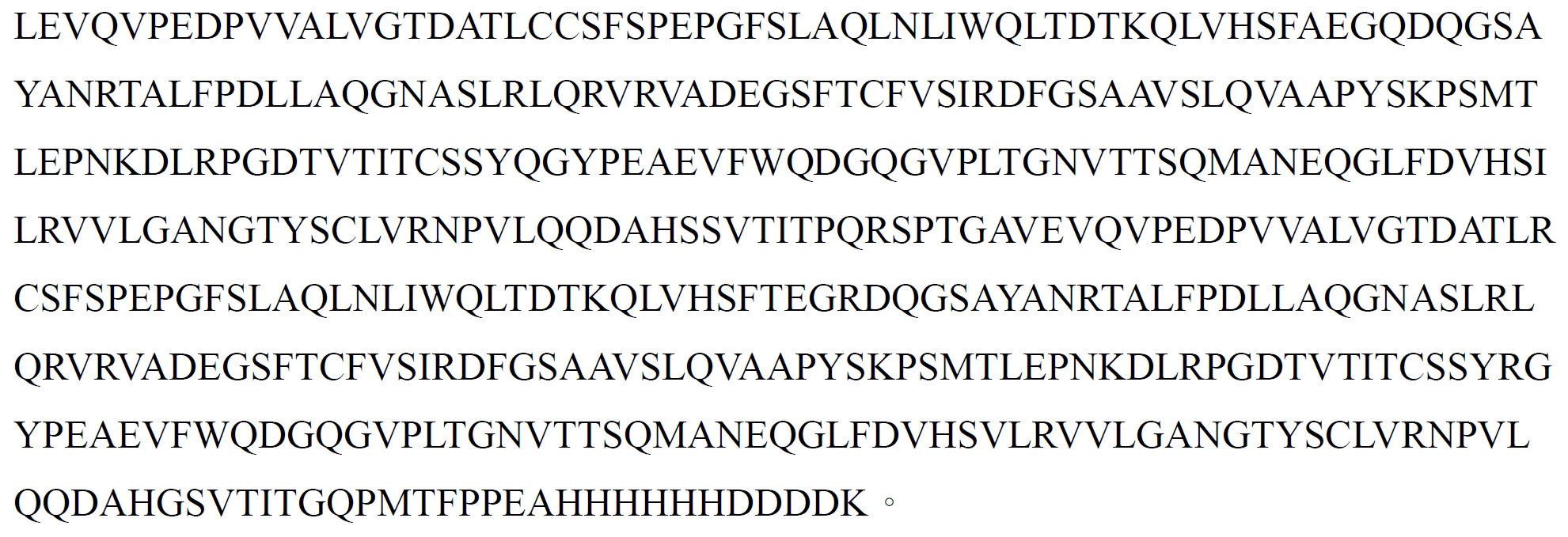
如下所示對Balb/c及SJL小鼠進行免疫。初次免疫後進行數次加強免疫,直至動物產生適於雜交瘤發展之令人滿意的抗血清滴度。
1.1.21.1.2
免疫時間表Immunization schedule
免疫時間表Immunization schedule
((
第No.
11
組Group
))
1.1.3 測試出血抗血清分析 篩選-藉由使用FACS對穩定過度表現人類及/或小鼠CD276 (CHO-S-hCD276及/或CHO-S-mCD276)之CHO-S細胞株進行測試,進行測試出血並進行評價。 1.1.3 Test bleeding antiserum analysis and screening - by using FACS to test CHO-S cell lines that stably overexpress human and/or mouse CD276 (CHO-S-hCD276 and/or CHO-S-mCD276), carry out Test for bleeding and evaluate.
篩選-使用重組人類CD276蛋白質之胞外域,藉由使用Elisa進行測試,進行測試出血並進行評價。 Screening - Using the ectodomain of the recombinant human CD276 protein, a test bleed was performed and evaluated by using an Elisa.
1.2 雜交瘤之產生及篩選 1.2.1 細胞融合及篩選 融合-針對免疫反應最好之小鼠進行脾細胞融合,如藉由測試出血FACS所確定。使用最佳化電融合方案將來自脾及淋巴結之淋巴細胞融合至Sp2/0細胞株。進行多次融合以確保細胞融合成功。 1.2 Generation and Screening of Hybridomas 1.2.1 Cell Fusion and Screening Fusion - Splenocyte fusion was performed on mice with the best immune response, as determined by FACS testing for bleeding. Lymphocytes from the spleen and lymph nodes were fused to the Sp2/0 cell line using an optimized electrofusion protocol. Perform multiple fusions to ensure successful cell fusion.
篩選及擴增-將融合體(每孔2×10 4至10 5)放入一疊96孔板中。監測板之生長並每週進料。在10-14天內,使用FACS及/或其他可行之分析諸如Elisa,藉由初步篩選分析來篩選細胞生長之孔。對每種靶向抗原進行多次融合並進行篩選。將顯示出與CHO-S-CD276陽性結合及來自初步篩選之陽性Elisa訊號之陽性親代選殖擴增至24孔板中用於二次篩選。 Screening and Amplification - Fusions (2 x 10⁴ to 105 per well) were placed in a stack of 96 well plates. Plates were monitored for growth and fed weekly. Within 10-14 days, screen wells for cell growth by a primary screening assay using FACS and/or other available assays such as Elisa. Multiple fusions were performed and screened for each targeted antigen. Positive parental colonies showing positive binding to CHO-S-CD276 and positive Elisa signal from primary screening were amplified into 24-well plates for secondary screening.
額外抗體篩選-在初步篩選之後,藉由下文之雜交瘤篩選漏斗中描述之分析再次篩選擴增至24孔板中之陽性親本選殖。 Additional Antibody Screening - Following initial screening, positive parental colonies amplified into 24-well plates were screened again by the assay described in the Hybridoma Screening Funnel below.
選擇所關注之雜交瘤繼續進行次選殖。Select the hybridomas of interest to proceed with secondary selection.
1.2.2 雜交瘤次選殖、篩選及冷凍保存 次選殖-然後藉由多輪有限稀釋或單細胞分選對來自上述篩選漏斗之具有所需反應性及同種型之親本雜交瘤進行次選殖,直至獲得單株。 1.2.2 Hybridoma subcloning, screening and cryopreservation Subcloning - Parental hybridomas from the above screening funnel with desired reactivity and isotype are then subpopulated by multiple rounds of limiting dilution or single cell sorting Breed until a single plant is obtained.
篩選及擴增-藉由基於蛋白質或細胞之Elisa篩選次選殖板,將具有良好結合能力之次選殖擴增至24孔用於確認測試。FACS分析證實了此等次選殖之特異性及交叉反應性。簡而言之,將親代CHO-S細胞、CHO-S-hCD276、穩定過度表現食蟹猴CD276之CHO-S細胞株、穩定過度表現小鼠CD276之CHO-K1 S細胞株分別與每個次選殖產生之抗體一起孵育。螢光染料共軛之二級抗體用於偵測初級抗體與細胞之結合。藉由FACS分析量測中值螢光強度。 Screening and Amplification - Screen subculture plates with protein or cell-based Elisa and expand subcultures with good binding capacity to 24 wells for confirmatory testing. FACS analysis confirmed the specificity and cross-reactivity of these subclones. In brief, parental CHO-S cells, CHO-S-hCD276, CHO-S cell lines stably overexpressing cynomolgus monkey CD276, and CHO-K1 S cell lines stably overexpressing mouse CD276 were combined with each Antibodies produced by subselection were incubated together. Fluorescent dye-conjugated secondary antibodies were used to detect the binding of the primary antibody to the cells. Median fluorescence intensity was measured by FACS analysis.
冷凍保存-對所需次選殖細胞株進行定序,並進一步擴展至培養瓶中進行冷凍保存。最初以0.5-13.0 x10 6細胞/瓶、每個細胞株4-6小瓶進行冷凍保存。若需要,為選擇之最有價值細胞株建立主細胞庫及工作細胞庫。 Cryopreservation - Sequence the desired sub-selected cell lines and further expand into culture flasks for cryopreservation. Cryopreserve initially at 0.5-13.0 x10⁶ cells/vial, 4-6 vials per cell line. If necessary, establish a master cell bank and a working cell bank for the selected most valuable cell lines.
2. 結果吾等發現了43種具有獨特序列之抗體,其顯示出與穩定過度表現人類CD276蛋白質之CHO-S細胞(CHO-S-hCD276)之陽性結合,但不與親代CHO-S細胞結合,表明此等抗體為人類CD276識別抗體。其中42種抗體能與食蟹猴CD276蛋白質結合,11種抗體能與小鼠CD276蛋白質結合。藉由FACS偵測之小鼠抗體染色CHO-S、CHO-S-hCD276、CHO-S-mCD276、CHO-S-食蟹猴CD276 (CHO-S-cynoCD276)之MFI在下表中總結(表3)。
表 3. 與不同細胞株結合之抗體之 MFI
實例 2 :抗體表徵:親和力 1. 方法 1.1 對 SKOV3 癌細胞株之基於細胞之結合親和力選擇表3中31種小鼠抗體之序列來產生及生產人類IgG1嵌合抗體。此等抗體及基準抗體依諾妥珠單抗(Enoblituzumab)(參見US8802091,MGA271,特別為具有命名為hBRCA84D-2之構築體)及MGC018 (一種抗體-藥物共軛物,其中mAb MGA017 (人類IgG1)經由可裂解之連接子與前藥seco-DUocarmycin hydroxyBenzamide azaindole (DUBA)共軛,該前藥為一種烷化劑,可破壞分裂及非分裂細胞中之DNA,從而導致細胞死亡)與人類患者來源之卵巢癌細胞株SKOV3之結合親和力藉由FACS分析確定。
Example 2 : Antibody Characterization:
FACs分析之方案描述如下:
1. 用胰蛋白酶(1X)消化細胞;將收穫之細胞以300 g離心3分鐘,棄去上清液。
2. 藉由以300 g離心3分鐘,用FACS緩衝液洗滌細胞2次,棄去上清液。
3. 重懸細胞,並將2*10
5個細胞/孔接種至50 µl FACS緩衝液中之分析板中,然後加入50 ul第一抗體(第一抗體終濃度:5.00、1.67、0.56、0.19、0.06、0.02、0.01、0.00 µg/ml或20.00、6.67、2.22、0.74、0.25、0.08、0.03、0.00 µg/ml)。在4℃孵育1小時。
4. 使用步驟2中之條件洗滌細胞兩次。用100 µl/孔稀釋之第2抗體重懸細胞,在4℃黑暗環境下孵育1小時。
5. 使用步驟2中之條件洗滌細胞兩次。用100 µl/孔FACS緩衝液重懸細胞。將細胞保持在黑暗中進行FACS分析。
The protocol for FACs analysis is described as follows: 1. Digest the cells with trypsin (1X); centrifuge the harvested cells at 300 g for 3 minutes, and discard the supernatant. 2. Wash the cells twice with FACS buffer by centrifugation at 300 g for 3 minutes and discard the supernatant. 3. Resuspend the cells, inoculate 2*10 5 cells/well into an analysis plate in 50 µl FACS buffer, and then add 50 ul of primary antibody (final concentration of primary antibody: 5.00, 1.67, 0.56, 0.19 , 0.06, 0.02, 0.01, 0.00 µg/ml or 20.00, 6.67, 2.22, 0.74, 0.25, 0.08, 0.03, 0.00 µg/ml). Incubate for 1 hour at 4°C. 4. Wash the cells twice using the conditions in
所選抗體對SKOV3之結合親和力高於、低於或相當於基準抗體依諾妥珠單抗(見表6及圖1)。
表 4. 嵌合抗體對 SKOV3 之結合親和力
2. 使用 Biacore(ChemPartner) 進行之基於蛋白質之親和力測試測試條件: 分析物:B7H3 運行緩衝液:HBS-EP +流速:30 µL/min 捕獲:Abs,10 µL/min,60秒 注射連續稀釋之B7H3 接觸時間:180秒 解離時間:400秒 再生:pH 1.5 Gly,30 µL/min,30秒 方法:使用捕獲之多循環動力學/親和力 機器型號:Biacore 8K(GE) 分析溫度:25℃ 2. Protein-based affinity test using Biacore (ChemPartner) Test conditions: Analyte: B7H3 Running buffer: HBS-EP + Flow rate: 30 µL/min Capture: Abs, 10 µL/min, 60-second injection serial dilution B7H3 Contact time: 180 seconds Dissociation time: 400 seconds Regeneration: pH 1.5 Gly, 30 µL/min, 30 seconds Method: Use captured multi-cycle kinetics/affinity Machine model: Biacore 8K(GE) Analysis temperature: 25℃
表surface
55
示出Shows
Biacore (ChemPartner)Biacore (ChemPartner)
測得之嵌合抗體對chimeric antibody pair
hB7H3wxya
之結合親和力binding affinity
3. B7H3 在幾種癌細胞株中之表現模式用6-D8-E7-A11藉由FACS偵測B7H3表現。發現B7H3在諸如BxPC3 (胰腺)、MCF7 (乳腺)、Dentroit562 (頭頸)、RKO (結腸)及SUN620 (胃)之幾種癌細胞株上之高表現位準(見圖2)。 3. The expression pattern of B7H3 in several cancer cell lines 6-D8-E7-A11 was used to detect the expression of B7H3 by FACS. High expression levels of B7H3 were found on several cancer cell lines such as BxPC3 (pancreas), MCF7 (breast), Dentroit562 (head and neck), RKO (colon) and SUN620 (stomach) (see Figure 2).
實例 3 :抗體表徵: ADCC 1. 方法為確定抗CD276抗體之ADCC,將1×10
5個/孔SKOV3接種至96孔平底無菌板上,然後加入2×10
4個Jurkat-NFAT-螢光素酶-CD16作為效應細胞。之後,將連續稀釋之抗體加入至每個孔中,並將平板在37℃、5% CO
2下孵育18小時。最後,偵測螢光素酶活性以評估抗體之ADCC活性。
Example 3 : Antibody Characterization:
2. 結果吾等所有之抗體在SKOV3細胞(一種人卵巢癌細胞株)上顯示出有效之ADCC效應。與基準抗體依諾妥珠單抗相比,一些抗體顯示出較低或相當之EC
50(表6及圖3),表明其在介導SKOV3細胞上之ADCC效應態樣比依諾妥珠單抗(MGA271)更有效。
表 6. 抗體誘導 SKOV3 上 ADCC 效應之 EC
50
實例 4 :抗體表徵: CDC 1. 方法為確定抗CD276抗體之CDC,將CHO-S-hCD276細胞以4E5個細胞/mL重懸於細胞培養基中,然後以50 μL/孔加入至96孔不透明壁板中。用完全F-12K培養基稀釋抗CD276抗體,並以50 μL/孔之量加入至96孔不透明壁板。用細胞培養基稀釋人血清補體,並以50 μL/孔之量加入至相同之板中。混合物在37℃之CO
2培養箱中孵育2小時。以50 μL/孔之量加入用於確定細胞毒性之CellTiter-Glo試劑,混合物在室溫下孵育10分鐘。記錄在酶標儀上活細胞之發光訊號。
Example 4 : Antibody Characterization:
2. 結果與基準抗體依諾妥珠單抗(MGA271)相比,所有抗CD276抗體均顯示出對CHO-S-hCD276細胞之有效CDC作用及較低之EC
50(見表7及圖4)。
表 7. 抗體誘導 CDC 效應之最大 CHO-S-hCD276 殺傷百分率及 EC
50
實例 5 :抗體表徵:間接 ADC 細胞毒性 1. 方法Fab-ZAP為山羊抗人單價抗體(二抗)及核糖體失活蛋白皂草素(saporin)之化學共軛物。Fab-ZAP用於確定抗體之內化能力。在此分析中,將80 μL SKOV-3細胞以2000細胞/孔之量鋪在96孔板中,並在37℃下孵育一夜。然後以40 μL/孔之量加入抗CD276抗體。以4 0μL/孔之量加入人類Fab-ZAP稀釋液,並在37℃之CO
2培養箱中孵育96小時。以100 μL/孔之量加入用於確定細胞毒性之CellTiter-Glo試劑,並在室溫下孵育10分鐘。記錄在酶標儀上活細胞之發光訊號。
Example 5 : Antibody Characterization:
2. 結果所有抗CD276抗體對SKOV3細胞顯示出有效之間接ADC效應,與基準抗體MGC018相比,IC
50較低或相當(表8,圖5),表明其為製造ADC之潛在候選物。
表 8.ADC 對 SKOV3 間接細胞毒性之 IC
50
實例 6 :抗體在雌性 C57BL/6 小鼠中治療皮下 MC-38-hCD276 鼠結腸癌之體內有效性 1. 研究設計與方法構築並表現了幾種具有小鼠IgG2a Fc之單株抗體,用於體內有效性研究。還使用mAb 6-D8-E7-A11及PD-L1 mAb (上海原能細胞醫療技術有限公司;參見WO2019196309A1,YN035)與小鼠IgG2a以IgG(H)scFv之形式構築了雙特異性抗體,命名為Bs-6-D7-E7.A11小鼠IgG2a。將抗B7H3 scFv VH之N末端及(GGGGS)
3-VL連接於PD-L1抗體之Fc區之C末端。
1. MC-38-hCD276 (B7H3)腫瘤細胞用補充有10%胎牛血清之DMEM培養基在37℃及5% CO
2之空氣環境下進行體外維持。在接種腫瘤之前,收穫處於指數生長期之細胞,並藉由細胞計數器進行定量。
2. 每隻小鼠在右後肋區域皮下接種0.1 ml PBS中之MC-38-hCD276 (B7H3)腫瘤細胞(1×10^6),用於腫瘤發育。隨機化之日期表示為第0天,自第0天開始給藥。
3. 當平均腫瘤大小達至約50-60 mm
3時,將開始隨機化。本研究納入60隻小鼠。所有動物隨機分配至7個研究組。根據隨機區組設計進行隨機化。
4. 使用測徑器每週兩次在二維方向上量測腫瘤體積,體積以mm
3計,使用式V =(L×W×W)/2,其中V為腫瘤體積,L為腫瘤長度(最長的腫瘤尺寸),W為腫瘤寬度(最長腫瘤尺寸,垂直於L)。給藥以及腫瘤及體重量測均在層流櫃中進行(見表9,圖6)。
5. 阿特珠單抗(Atezolizumab,一種抗PD-L1抗體,亦稱為Tecentriq或MPDL3280A,參見WO2010077634A1)及Antengene-084M (用小鼠IgG2a構築之MGA271之Fab序列(參見US8802091B))用作對照。
表 9. 體內有效性試驗之研究設計
2. 結果如圖6所示,一些抗CD276抗體顯示出強效之體內有效性。特別地,25-C8-D7-C5小鼠IgG2a及Bs-6-D8-E7-A11小鼠IgG2a顯示出比Antengene-084M小鼠IgG2a更高之腫瘤抑制。 2. Results As shown in Figure 6, some anti-CD276 antibodies showed strong in vivo effectiveness. In particular, 25-C8-D7-C5 mouse IgG2a and Bs-6-D8-E7-A11 mouse IgG2a showed higher tumor suppression than Antengene-084M mouse IgG2a.
圖式僅出於說明之目的而非限制。The drawings are for purposes of illustration only and not limitation.
圖1示出藉由FAC分析量測之本文提供之抗CD276抗體對SKOV3細胞之結合親和力。Figure 1 shows the binding affinity of anti-CD276 antibodies provided herein to SKOV3 cells measured by FAC analysis.
圖2A至圖2E示出藉由FAC分析量測之6-D8-E7-A11與若干個表現B7H3之癌細胞株之結合。Figures 2A-2E show binding of 6-D8-E7-A11 to several B7H3-expressing cancer cell lines measured by FAC analysis.
圖3A至圖3C示出本文提供之抗CD276抗體對SKOV3細胞之ADCC效應。3A to 3C show the ADCC effect of anti-CD276 antibodies provided herein on SKOV3 cells.
圖4A及圖4B示出本文提供之抗CD276抗體對CHO-S-hCD276細胞之CDC效應。4A and 4B show the CDC effect of the anti-CD276 antibodies provided herein on CHO-S-hCD276 cells.
圖5A至圖5E示出本文提供之抗CD276抗體對SKOV3細胞之間接ADC細胞毒性作用。Figures 5A to 5E show the indirect ADC cytotoxic effect of anti-CD276 antibodies provided herein on SKOV3 cells.
圖6示出本文提供之抗CD276抗體在用MC-38-hCD276 (B7H3)腫瘤細胞接種之小鼠模型中抑制腫瘤生長之體內有效性。Figure 6 shows the in vivo effectiveness of anti-CD276 antibodies provided herein to inhibit tumor growth in a mouse model inoculated with MC-38-hCD276 (B7H3) tumor cells.
Claims (72)
Applications Claiming Priority (2)
| Application Number | Priority Date | Filing Date | Title |
|---|---|---|---|
| WOPCT/CN2021/093157 | 2021-05-11 | ||
| CN2021093157 | 2021-05-11 |
Publications (1)
| Publication Number | Publication Date |
|---|---|
| TW202317618A true TW202317618A (en) | 2023-05-01 |
Family
ID=87378759
Family Applications (1)
| Application Number | Title | Priority Date | Filing Date |
|---|---|---|---|
| TW111117711A TW202317618A (en) | 2021-05-11 | 2022-05-11 | Novel anti-cd276 antibodies and the uses thereof |
Country Status (1)
| Country | Link |
|---|---|
| TW (1) | TW202317618A (en) |
-
2022
- 2022-05-11 TW TW111117711A patent/TW202317618A/en unknown
Similar Documents
| Publication | Publication Date | Title |
|---|---|---|
| US12485298B2 (en) | Anti-CD3epsilon antibodies | |
| US20240052052A1 (en) | Novel anti-cd24 antibodies | |
| WO2019179391A1 (en) | Novel bispecific pd-1/ctla-4 antibody molecules | |
| US20240400689A1 (en) | Novel anti-cd276 antibodies and the uses thereof | |
| TW202233673A (en) | Fusions with cd8 antigen binding molecules for modulating immune cell function | |
| KR20230110546A (en) | bifunctional molecule | |
| WO2020192709A1 (en) | Novel bispecific polypeptide complexes | |
| WO2019179422A1 (en) | Novel bispecific pd-1/lag-3 antibody molecules | |
| WO2019179421A1 (en) | Novel bispecific pd-1/ctla-4 antibody molecules | |
| US12486325B2 (en) | Anti-CD3epsilon antibodies | |
| WO2024099295A9 (en) | Novel multi-specific antibodies and uses thereof | |
| TW202342514A (en) | Novel anti-cd276 antibodies and the uses thereof | |
| EA052500B1 (en) | New antibodies against CD24 | |
| EA051839B1 (en) | NEW ANTIBODIES TO CD276 AND THEIR APPLICATIONS |