RU2777090C1 - Method for obtaining an anti-fretting coating - Google Patents
Method for obtaining an anti-fretting coating Download PDFInfo
- Publication number
- RU2777090C1 RU2777090C1 RU2022106397A RU2022106397A RU2777090C1 RU 2777090 C1 RU2777090 C1 RU 2777090C1 RU 2022106397 A RU2022106397 A RU 2022106397A RU 2022106397 A RU2022106397 A RU 2022106397A RU 2777090 C1 RU2777090 C1 RU 2777090C1
- Authority
- RU
- Russia
- Prior art keywords
- product
- conductive material
- carried out
- titanium alloy
- negative potential
- Prior art date
Links
- 238000000576 coating method Methods 0.000 title claims abstract description 39
- 239000011248 coating agent Substances 0.000 title claims abstract description 29
- 238000000034 method Methods 0.000 title claims abstract description 25
- 239000004020 conductor Substances 0.000 claims abstract description 35
- 229910001069 Ti alloy Inorganic materials 0.000 claims abstract description 23
- 150000002500 ions Chemical class 0.000 claims abstract description 21
- 238000012545 processing Methods 0.000 claims abstract description 14
- IJGRMHOSHXDMSA-UHFFFAOYSA-N Atomic nitrogen Chemical compound N#N IJGRMHOSHXDMSA-UHFFFAOYSA-N 0.000 claims abstract description 13
- 238000009825 accumulation Methods 0.000 claims abstract description 13
- 238000009792 diffusion process Methods 0.000 claims abstract description 13
- 239000007787 solid Substances 0.000 claims abstract description 10
- 239000000314 lubricant Substances 0.000 claims abstract description 9
- 239000000463 material Substances 0.000 claims abstract description 9
- 238000002360 preparation method Methods 0.000 claims abstract description 8
- 238000010438 heat treatment Methods 0.000 claims abstract description 7
- 239000012495 reaction gas Substances 0.000 claims abstract description 7
- 229910052757 nitrogen Inorganic materials 0.000 claims abstract description 6
- 238000004381 surface treatment Methods 0.000 claims abstract description 6
- -1 and at even stages Inorganic materials 0.000 claims abstract description 5
- 229910052804 chromium Inorganic materials 0.000 claims abstract description 5
- 239000011651 chromium Substances 0.000 claims abstract description 5
- 229910052782 aluminium Inorganic materials 0.000 claims abstract description 4
- 238000009434 installation Methods 0.000 claims abstract description 4
- 229910052720 vanadium Inorganic materials 0.000 claims abstract description 4
- VYZAMTAEIAYCRO-UHFFFAOYSA-N Chromium Chemical compound [Cr] VYZAMTAEIAYCRO-UHFFFAOYSA-N 0.000 claims abstract description 3
- XAGFODPZIPBFFR-UHFFFAOYSA-N aluminium Chemical compound [Al] XAGFODPZIPBFFR-UHFFFAOYSA-N 0.000 claims abstract description 3
- 239000011261 inert gas Substances 0.000 claims abstract description 3
- 238000007750 plasma spraying Methods 0.000 claims abstract description 3
- 230000015572 biosynthetic process Effects 0.000 claims description 13
- 238000004140 cleaning Methods 0.000 claims description 8
- 230000005284 excitation Effects 0.000 claims description 3
- 238000010849 ion bombardment Methods 0.000 claims description 3
- 238000005516 engineering process Methods 0.000 abstract description 3
- 239000000126 substance Substances 0.000 abstract 1
- 239000000956 alloy Substances 0.000 description 8
- XKRFYHLGVUSROY-UHFFFAOYSA-N argon Substances [Ar] XKRFYHLGVUSROY-UHFFFAOYSA-N 0.000 description 8
- 230000008569 process Effects 0.000 description 8
- 229910045601 alloy Inorganic materials 0.000 description 7
- 229910052786 argon Inorganic materials 0.000 description 6
- 239000007789 gas Substances 0.000 description 6
- 238000000151 deposition Methods 0.000 description 5
- 230000008021 deposition Effects 0.000 description 5
- 239000000203 mixture Substances 0.000 description 5
- QCWXUUIWCKQGHC-UHFFFAOYSA-N Zirconium Chemical compound [Zr] QCWXUUIWCKQGHC-UHFFFAOYSA-N 0.000 description 4
- 229910052751 metal Inorganic materials 0.000 description 4
- 239000002184 metal Substances 0.000 description 4
- 229910052726 zirconium Inorganic materials 0.000 description 4
- 239000002131 composite material Substances 0.000 description 3
- 230000007797 corrosion Effects 0.000 description 3
- 238000005260 corrosion Methods 0.000 description 3
- CWQXQMHSOZUFJS-UHFFFAOYSA-N molybdenum disulfide Chemical compound S=[Mo]=S CWQXQMHSOZUFJS-UHFFFAOYSA-N 0.000 description 3
- 229910052982 molybdenum disulfide Inorganic materials 0.000 description 3
- 230000007935 neutral effect Effects 0.000 description 3
- 150000004767 nitrides Chemical class 0.000 description 3
- 238000012360 testing method Methods 0.000 description 3
- OKTJSMMVPCPJKN-UHFFFAOYSA-N Carbon Chemical compound [C] OKTJSMMVPCPJKN-UHFFFAOYSA-N 0.000 description 2
- PXHVJJICTQNCMI-UHFFFAOYSA-N Nickel Chemical compound [Ni] PXHVJJICTQNCMI-UHFFFAOYSA-N 0.000 description 2
- 229910000831 Steel Inorganic materials 0.000 description 2
- RTAQQCXQSZGOHL-UHFFFAOYSA-N Titanium Chemical compound [Ti] RTAQQCXQSZGOHL-UHFFFAOYSA-N 0.000 description 2
- 238000006243 chemical reaction Methods 0.000 description 2
- 239000008199 coating composition Substances 0.000 description 2
- 230000006378 damage Effects 0.000 description 2
- 238000005137 deposition process Methods 0.000 description 2
- 238000011161 development Methods 0.000 description 2
- 230000003993 interaction Effects 0.000 description 2
- 229910052742 iron Inorganic materials 0.000 description 2
- 230000001105 regulatory effect Effects 0.000 description 2
- 238000004544 sputter deposition Methods 0.000 description 2
- 239000010959 steel Substances 0.000 description 2
- 239000000758 substrate Substances 0.000 description 2
- 239000010936 titanium Substances 0.000 description 2
- 229910052719 titanium Inorganic materials 0.000 description 2
- 230000004584 weight gain Effects 0.000 description 2
- 235000019786 weight gain Nutrition 0.000 description 2
- 229910052582 BN Inorganic materials 0.000 description 1
- ZOXJGFHDIHLPTG-UHFFFAOYSA-N Boron Chemical compound [B] ZOXJGFHDIHLPTG-UHFFFAOYSA-N 0.000 description 1
- PZNSFCLAULLKQX-UHFFFAOYSA-N Boron nitride Chemical compound N#B PZNSFCLAULLKQX-UHFFFAOYSA-N 0.000 description 1
- 229910000531 Co alloy Inorganic materials 0.000 description 1
- 229910017767 Cu—Al Inorganic materials 0.000 description 1
- 239000004593 Epoxy Substances 0.000 description 1
- 108090000192 Methionyl aminopeptidases Proteins 0.000 description 1
- 102100021118 Microtubule-associated protein 2 Human genes 0.000 description 1
- 229910000990 Ni alloy Inorganic materials 0.000 description 1
- NRTOMJZYCJJWKI-UHFFFAOYSA-N Titanium nitride Chemical compound [Ti]#N NRTOMJZYCJJWKI-UHFFFAOYSA-N 0.000 description 1
- 238000005270 abrasive blasting Methods 0.000 description 1
- 230000009471 action Effects 0.000 description 1
- 230000004913 activation Effects 0.000 description 1
- 229910052796 boron Inorganic materials 0.000 description 1
- 229910052799 carbon Inorganic materials 0.000 description 1
- 230000008859 change Effects 0.000 description 1
- 239000000356 contaminant Substances 0.000 description 1
- 230000007547 defect Effects 0.000 description 1
- 238000005238 degreasing Methods 0.000 description 1
- 229910001873 dinitrogen Inorganic materials 0.000 description 1
- 229910002804 graphite Inorganic materials 0.000 description 1
- 239000010439 graphite Substances 0.000 description 1
- 230000000977 initiatory effect Effects 0.000 description 1
- 238000005468 ion implantation Methods 0.000 description 1
- 230000001050 lubricating effect Effects 0.000 description 1
- 238000001755 magnetron sputter deposition Methods 0.000 description 1
- 238000004519 manufacturing process Methods 0.000 description 1
- 230000013011 mating Effects 0.000 description 1
- 238000005259 measurement Methods 0.000 description 1
- 150000001247 metal acetylides Chemical class 0.000 description 1
- 150000002739 metals Chemical class 0.000 description 1
- 229910052759 nickel Inorganic materials 0.000 description 1
- 230000010355 oscillation Effects 0.000 description 1
- 230000003647 oxidation Effects 0.000 description 1
- 238000007254 oxidation reaction Methods 0.000 description 1
- 230000001590 oxidative effect Effects 0.000 description 1
- 239000002245 particle Substances 0.000 description 1
- 230000000737 periodic effect Effects 0.000 description 1
- 238000005240 physical vapour deposition Methods 0.000 description 1
- 238000004886 process control Methods 0.000 description 1
- 238000000992 sputter etching Methods 0.000 description 1
- 229910052723 transition metal Inorganic materials 0.000 description 1
- 150000003624 transition metals Chemical class 0.000 description 1
- ITRNXVSDJBHYNJ-UHFFFAOYSA-N tungsten disulfide Chemical compound S=[W]=S ITRNXVSDJBHYNJ-UHFFFAOYSA-N 0.000 description 1
- 239000002966 varnish Substances 0.000 description 1
- ZVWKZXLXHLZXLS-UHFFFAOYSA-N zirconium nitride Chemical compound [Zr]#N ZVWKZXLXHLZXLS-UHFFFAOYSA-N 0.000 description 1
Abstract
Description
Изобретение относится к технологиям нанесения ионно-плазменных покрытий и может быть использовано для обработки поверхности металлических изделий авиационной промышленности, обеспечивая защиту от фреттинга замков лопаток вентилятора и компрессора из титановых сплавов.The invention relates to technologies for applying ion-plasma coatings and can be used for surface treatment of metal products of the aviation industry, providing protection against fretting of locks of fan blades and compressors made of titanium alloys.
По различным оценкам подавляющее большинство усталостных разрушений ответственных узлов и деталей ГТД связано с повреждениями контактных поверхностей. Наиболее частой причиной зарождения большинства усталостных дефектов, приводящих к разрушению, является фреттинг. Под общим термином фреттинг принято понимать развитие следующих процессов: фреттинг-износ, фреттинг-коррозия и фреттинг-усталость. Особенно высокую актуальность вопросы защиты от фреттинга приобретают для деталей компрессора ГТД, что объясняется задачами минимизации размеров и веса деталей при одновременном повышении нагрузок. Проблема фреттинга еще более критична в случаях, когда для изготовления лопаток компрессора применяют титановые сплавы, которые, в силу своих физико-химических особенностей, имеют большую склонность к фреттингу по сравнению со сталями и никелевыми сплавами.According to various estimates, the vast majority of fatigue failures of critical components and parts of gas turbine engines are associated with damage to the contact surfaces. Fretting is the most common cause of the initiation of most fatigue defects leading to failure. The general term fretting is commonly understood as the development of the following processes: fretting wear, fretting corrosion and fretting fatigue. The issues of protection against fretting are especially relevant for GTE compressor parts, which is explained by the tasks of minimizing the size and weight of parts while increasing loads. The problem of fretting is even more critical in cases where titanium alloys are used for the manufacture of compressor blades, which, due to their physicochemical characteristics, are more prone to fretting than steels and nickel alloys.
Одним из способов борьбы с фреттингом является нанесение покрытий, которые должны снизить интенсивность образования продуктов износа под воздействием окислительной среды, а также должны иметь способность к многократному деформированию без значительного разрушения под действием контактных и сдвиговых сил.One of the ways to combat fretting is the application of coatings, which should reduce the intensity of the formation of wear products under the influence of an oxidizing environment, and should also be able to deform repeatedly without significant destruction under the action of contact and shear forces.
Из уровня техники известна разработка Московского авиационного института (МАИ) в которой рассматривается способ формирования композитных твердых смазочных покрытий на рабочих поверхностях узлов трения, работающих в экстремальных условиях эксплуатации: при высоких контактных давлениях, в криогенной среде и в вакууме, при фреттинг-коррозии. Способ включает предварительную абразивно-струйную обработку поверхности, очистку поверхности ионным травлением и нанесения покрытия. Покрытие наносят распылением мозаичной мишени в виде диска, выполненного из титана с равномерно распределенными в нем вставками из свинца, в магнетронной распылительной системе в реактивной среде газов - аргона и азота. При следующем соотношении компонентов: нитрид титана - 90-95%, свинец- 5-10% (RU 2416675, опубл. 20.04.2011 г., С23С 14/35).From the prior art, the development of the Moscow Aviation Institute (MAI) is known, which considers a method for the formation of composite solid lubricating coatings on the working surfaces of friction units operating under extreme operating conditions: at high contact pressures, in a cryogenic environment and in vacuum, with fretting corrosion. The method includes preliminary abrasive blasting of the surface, surface cleaning by ion etching and coating. The coating is applied by sputtering a mosaic target in the form of a disk made of titanium with lead inserts evenly distributed in it, in a magnetron sputtering system in a reactive gas environment - argon and nitrogen. With the following ratio of components: titanium nitride - 90-95%, lead - 5-10% (RU 2416675, publ. 20.04.2011, C23C 14/35).
Недостатками этого способа являются высокая трудоемкость по формированию композиционной мишени и низкая скорость осаждения (магнетрон), ограниченность рабочих температур покрытий.The disadvantages of this method are the high complexity of forming a composite target and low deposition rate (magnetron), the limited operating temperatures of the coatings.
Из патента DE 19858913 (опубл. 21.06.2000 г., С23С 14/16) известно покрытие толщиной 20-50 мкм для мест крепления лопаток турбин к диску, защищающего от высокотемпературной фреттинг-коррозии. Состав покрытия: Cu-Al сплав с включением Cr и Fe (4-8%вес. Al, 2-5% Cr, 0-3.5% Fe, ост Cu). Подложкой для покрытия могут быть детали из титановых, никелевых, кобальтовых сплавов, или сталей. Покрытие наносится способом PVD, преимущественно катодным напылением.From the patent DE 19858913 (publ. 21.06.2000, C23C 14/16) a coating with a thickness of 20-50 μm is known for the attachment points of turbine blades to the disk, which protects against high-temperature fretting corrosion. Coating composition: Cu-Al alloy with inclusion of Cr and Fe (4-8 wt.% Al, 2-5% Cr, 0-3.5% Fe, rest Cu). The substrate for coating can be parts made of titanium, nickel, cobalt alloys, or steels. The coating is applied by the PVD method, mainly by cathode sputtering.
Недостатком предложенного способа является ограниченность рабочих температур покрытия.The disadvantage of the proposed method is the limited operating temperatures of the coating.
В патенте RU 2161661, (опубл. 10.01.2001 г., С23С 14/06) описывается способ, включающий ионную очистку поверхности подложки, нанесение не менее чем трехслойного покрытия, первый слой получают в разряде нейтрального газа из одного или смеси переходных металлов 4А-6А групп, второй - осаждением указанных металлов в смеси нейтрального и реакционных газов, а третий слой - осаждением в смеси нейтральных и реакционных газов нитридов, или карбидов, или боридов или их смесей, толщины слоев находятся в соотношении (0,02-5,0):(0,04-10):(0,1-12,5) мкм, причем один или несколько слоев подвергают ионной имплантации аргоном, азотом, углеродом или бором в процессе осаждения или после окончания процесса осаждения, после нанесения покрытия проводят виброобработку микрошариками.Patent RU 2161661 (publ. 01/10/2001, C23C 14/06) describes a method that includes ionic cleaning of the substrate surface, deposition of at least a three-layer coating, the first layer is obtained in a neutral gas discharge from one or a mixture of transition metals 4A- 6A groups, the second - by deposition of these metals in a mixture of neutral and reaction gases, and the third layer - by deposition in a mixture of neutral and reaction gases of nitrides, or carbides, or borides, or mixtures thereof, the layer thicknesses are in the ratio (0.02-5.0 ):(0.04-10):(0.1-12.5) µm, moreover, one or more layers are subjected to ion implantation with argon, nitrogen, carbon or boron during the deposition process or after the deposition process is completed, after the coating is applied, vibration treatment is carried out microballoons.
Недостатками данного способа являются неоднородность при обработке защищаемой поверхности детали микрошарика, создавая макрорельеф, по формированию композиционной мишени и низкая скорость осаждения (магнетрон), ограниченность рабочих температур покрытия.The disadvantages of this method are the heterogeneity in the processing of the protected surface of the microballoon part, creating a macrorelief, in the formation of a composite target and a low deposition rate (magnetron), limited operating temperatures of the coating.
Наиболее близким аналогом, взятым за прототип, является способ обработки поверхности металлического изделия, включающий предварительную подготовку поверхности изделия, размещение в зоне обработки изделия и токопроводящего материала, создание вакуума в зоне обработки, подачу отрицательного потенциала на изделие и отдельно на токопроводящий материал, возбуждение на токопроводящем материале вакуумной дуги, горящей в парах этого материала с образованием плазмы, бомбардировку, очистку и нагрев поверхности изделия ионами токопроводящего материала, накопление и диффузию ионов токопроводящего материала на поверхности изделия при температуре поверхности изделия ниже температуры разупрочнения материала изделия, с образованием покрытия, где в качестве токопроводящего материала используют цирконий или сплав на основе циркония, а накопление и диффузию ионов токопроводящего материала на поверхности изделия проводят при отрицательном потенциале на изделии 150-400 В в среде реакционного газа (RU 2308537 опубл. 20.10.2007 г., С23С 14/34).The closest analogue, taken as a prototype, is a method for processing the surface of a metal product, including preliminary preparation of the surface of the product, placing the product and conductive material in the processing zone, creating a vacuum in the processing zone, applying a negative potential to the product and separately to the conductive material, excitation on the conductive material of a vacuum arc burning in the vapors of this material with the formation of plasma, bombardment, cleaning and heating of the surface of the product with ions of conductive material, accumulation and diffusion of ions of conductive material on the surface of the product at a surface temperature of the product below the softening temperature of the material of the product, with the formation of a coating, where as zirconium or an alloy based on zirconium is used, and the accumulation and diffusion of ions of the conductive material on the surface of the product is carried out at a negative potential on the product of 150-400 V in a reaction gas medium (RU 23085 37 publ. October 20, 2007, С23С 14/34).
Недостатком способа-прототипа является то, что в качестве токопроводящего материала используется только один цирконий или сплав на основе циркония, что не позволяет получать покрытие состоящее из нескольких слоев. Нитрид циркония, образующийся на поверхности во время бомбардировки изделия ионами токопроводящего материала, не способен работать при высоких температурах, в связи с чем получаемое покрытие имеет низкую фреттингостойкость при температурах свыше 400°С.The disadvantage of the prototype method is that only one zirconium or an alloy based on zirconium is used as a conductive material, which does not allow to obtain a coating consisting of several layers. Zirconium nitride, which is formed on the surface during the bombardment of the product with ions of a conductive material, is not able to work at high temperatures, and therefore the resulting coating has low fretting resistance at temperatures above 400°C.
Технический результат заявленного изобретения заключается в повышении фреттингостойкости металлического изделия из титанового сплава при температуре 500°С при сохранении его жаростойкости.The technical result of the claimed invention is to increase the fretting resistance of a titanium alloy metal product at a temperature of 500°C while maintaining its heat resistance.
Для достижения поставленного технического результата предложен способ обработки поверхности изделия из титанового сплава, включающий предварительную подготовку поверхности изделия, размещение изделия и токопроводящего материала в зоне обработки, расположенной в рабочей камере установки для ионно-плазменного напыления, создание вакуума в зоне обработки, окончательную подготовку поверхности изделия бомбардировкой ионами инертного газа, подачу отрицательного потенциала на изделие и отдельно на токопроводящий материал, возбуждение на токопроводящем материале вакуумной дуги, горящей в парах этого материала с образованием плазмы, очистку поверхности изделия бомбардировкой ионами токопроводящего материала, накопление и диффузию ионов токопроводящего материала на поверхности изделия при отрицательном потенциале на изделии в среде реакционного газа при температуре поверхности изделия ниже температуры разупрочнения материала изделия, с образованием покрытия и финишную обработку поверхности изделия, при этом в зоне обработки изделия размещают токопроводящий материал из титанового сплава, легированного алюминием и хромом, и далее осуществляют процесс постадийного накопления и диффузии ионов токопроводящего материала на поверхности изделия при отрицательном потенциале на изделии, причем на нечетных стадиях процесса накопление и диффузию проводят при давлении в рабочей камере ≤0,13 Па и отрицательном потенциале на изделии от 10 до 15 В, а на четных стадиях процесса в рабочую камеру подают реакционный газ азот до давления от 0,13 до 0,4 Па при отрицательном потенциале на изделии от 95 до 105 В, при этом финишную обработку поверхности изделия проводят путем нанесения на нее твердой смазки с последующей термической обработкой.To achieve the stated technical result, a method for surface treatment of a titanium alloy product is proposed, including preliminary preparation of the product surface, placement of the product and conductive material in the processing zone located in the working chamber of the ion-plasma spraying installation, creating a vacuum in the processing zone, final preparation of the product surface bombardment with inert gas ions, applying a negative potential to the product and separately to the conductive material, excitation on the conductive material of a vacuum arc burning in the vapors of this material with the formation of plasma, cleaning the surface of the product by bombarding the ions of the conductive material, accumulation and diffusion of ions of the conductive material on the surface of the product at negative potential on the product in the reaction gas medium at the surface temperature of the product below the softening temperature of the material of the product, with the formation of a coating and finishing the surface of the product at the same time, a conductive material made of a titanium alloy alloyed with aluminum and chromium is placed in the processing zone of the product, and then the process of step-by-step accumulation and diffusion of ions of the conductive material on the surface of the product is carried out at a negative potential on the product, and at odd stages of the process, accumulation and diffusion are carried out at pressure in the working chamber ≤0.13 Pa and a negative potential on the product from 10 to 15 V, and at even stages of the process, nitrogen reaction gas is supplied to the working chamber to a pressure of 0.13 to 0.4 Pa at a negative potential on the product from 95 up to 105 V, while finishing the surface of the product is carried out by applying a solid lubricant to it, followed by heat treatment.
Формирование слоистой структуры из конденсированного слоя токопроводящего материала и нитрида этого материала предназначено для демпфирования сдвиговых напряжений при контактном взаимодействии в паре трения, возникающих во время работы изделия, а также для исключения взаимодействия титанового сплава с контактирующим материалом, что положительно влияет на усталостную прочность титанового сплава.The formation of a layered structure from a condensed layer of a conductive material and the nitride of this material is designed to damp shear stresses during contact interaction in a friction pair that occur during operation of the product, as well as to exclude the interaction of the titanium alloy with the contacting material, which positively affects the fatigue strength of the titanium alloy.
Чередование режимов давления и отрицательного потенциала на изделии из титанового сплава во время многостадийной обработки его поверхности обеспечивает формирование на ней слоистой структуры с чередованием твердых и мягких слоев, которая, не снижая усталостной прочности покрытия, повышает его фреттингостойкость за счет нивелирования сдвиговых напряжений в зоне контакта.The alternation of pressure and negative potential modes on a titanium alloy product during multi-stage surface treatment ensures the formation of a layered structure on it with alternation of hard and soft layers, which, without reducing the fatigue strength of the coating, increases its fretting resistance due to the leveling of shear stresses in the contact zone.
Наличие газа азота в рабочей камере в процессе накопления и диффузии ионов способствует формированию нитридов, отличающихся повышенной твердостью и износостойкостью.The presence of nitrogen gas in the working chamber during the accumulation and diffusion of ions contributes to the formation of nitrides, which are characterized by increased hardness and wear resistance.
Процесс ионной бомбардировки обеспечивает очистку и активацию поверхности изделия ионами токопроводящего материала.The process of ion bombardment provides cleaning and activation of the surface of the product with ions of conductive material.
Финишная обработка представляет собой нанесение на поверхность изделия твердой смазки с последующей термической обработкой поверхности. Твердая смазка может представлять собой частицы дисульфида молибдена или графита или дисульфида вольфрама или гексагонального нитрида бора в эпоксидном лаке.Finishing is the application of a solid lubricant to the surface of the product, followed by heat treatment of the surface. The solid lubricant may be particles of molybdenum disulfide or graphite or tungsten disulfide or hexagonal boron nitride in an epoxy varnish.
Таким образом, комплексная обработка изделия из титанового сплава предложенным способом обеспечивает повышение фреттингостойкости изделия при температуре 500°С при сохранении его жаростойкости.Thus, the complex processing of a titanium alloy product by the proposed method provides an increase in the fretting resistance of the product at a temperature of 500°C while maintaining its heat resistance.
Пример осуществления.Implementation example.
Для нанесения антифреттингового покрытия на поверхность образцов, выполненных из титановых сплавов ВТ6, ВТ8, ВТ8М-1, проводили предварительную подготовку поверхности образцов (удаление загрязнений и обезжиривание). Затем проводили виброполировку поверхности образцов в лотковом вибраторе в течение 5 ч, что позволяет получить подготовленную поверхность перед нанесением антифреттингового покрытия с шероховатостью Ra<0,5 мкм.To apply an antifretting coating on the surface of samples made of titanium alloys VT6, VT8, VT8M-1, preliminary surface preparation of the samples was carried out (removal of contaminants and degreasing). Then, the surface of the samples was vibrated in a tray vibrator for 5 hours, which makes it possible to obtain a prepared surface before applying an anti-fretting coating with a roughness of Ra<0.5 μm.
Нанесение антифреттингового покрытия на поверхность образцов проводили на промышленных ионно-плазменных установках МАП-2 и МАП-3 с автоматической системой управления технологическим процессом, имеющей газоразрядный источник ионов аргона ЕхН типа с током до 200 мА и напряжением до 3 кВ, вакуумно-дуговой генератор плазмы токопроводящего материала с током до 450 А, систему для подачи в вакуумный объем реакционного газа и регулирования его давления, систему для подачи и регулирования напряжения на обрабатываемые образцы в диапазоне от 1 до 900 В, а также планетарный привод вращения на 24 позиции для размещения обрабатываемых образцов. Затем в зоне обработки размещали изделие и токопроводящий материал - сплав системы TiAlCr. В зоне обработки создавали вакуум при давлении Р≤0,13 Па. Для активации поверхности и дегазации вакуумной камеры опускали газоразрядный источник ионов аргона в зону обработки изделия и начинали процесс ионной очистки поверхности изделия бомбардировкой ионами инертного газа аргона с энергией 0,5-3 кВ. Процесс проводили в течение 20-30 минут. После его завершения из зоны обработки изделия удаляли газоразрядный источник ионов аргона и подавали отрицательный потенциал на токопроводящий материал ϕ1=-(80-150) В и отдельно на образец напряжение смещение ϕ2=-(250-350) В. Затем путем разрыва токового контакта на токопроводящем материале возбуждали вакуумную дугу, горящую в парах этого материала с образованием плазмы материала сплава системы TiAlCr. Процесс ионной бомбардировки, очистки и ионного нагрева поверхности изделия проводили при ϕ2=- (250-350) В и токе вакуумной дуги от 350 А до 450 А в течение от 2 до 7 мин. Затем проводили накопление и диффузию ионов токопроводящего материала на поверхности изделия при отрицательном потенциале на изделии от 1 до 150 В при давлении от 0,13 Па до 0,4 Па с периодической подачей реакционного газа азота при температуре поверхности изделия до 380°С, что ниже температуры их разупрочнения на 20°С.The application of an antifretting coating on the surface of the samples was carried out on industrial ion-plasma installations MAP-2 and MAP-3 with an automatic process control system, which has a gas-discharge source of argon ions of the ExH type with a current of up to 200 mA and a voltage of up to 3 kV, a vacuum-arc plasma generator conductive material with a current of up to 450 A, a system for supplying reaction gas into a vacuum volume and regulating its pressure, a system for supplying and regulating voltage to processed samples in the range from 1 to 900 V, as well as a 24-position planetary rotation drive for placing processed samples . Then, the product and the conductive material - an alloy of the TiAlCr system - were placed in the processing zone. A vacuum was created in the treatment zone at a pressure P≤0.13 Pa. To activate the surface and degas the vacuum chamber, a gas-discharge source of argon ions was lowered into the processing zone of the product and the process of ion cleaning of the surface of the product was started by bombarding with ions of inert argon gas with an energy of 0.5-3 kV. The process was carried out for 20-30 minutes. After its completion, a gas-discharge source of argon ions was removed from the product processing zone and a negative potential was applied to the conductive material ϕ 1 = -(80-150) V and, separately, to the sample, the bias voltage ϕ 2 = -(250-350) V. Then, by breaking the current contact on a conductive material, a vacuum arc was excited, burning in the vapors of this material with the formation of a plasma of the alloy material of the TiAlCr system. The process of ion bombardment, cleaning and ion heating of the product surface was carried out at ϕ 2 = - (250-350) V and a vacuum arc current from 350 A to 450 A for 2 to 7 minutes. Then, the accumulation and diffusion of ions of the conductive material on the surface of the product was carried out at a negative potential on the product from 1 to 150 V at a pressure of 0.13 Pa to 0.4 Pa with periodic supply of nitrogen reaction gas at a surface temperature of the product up to 380°C, which is lower their softening temperature by 20°C.
После накопления и диффузии ионов токопроводящего материала проводили финишную обработку поверхности образцов путем формирования твердосмазочного слоя, содержащего твердую смазку типа дисульфида молибдена с последующей термической обработкой при температуре от 195 до 205°С в течение времени от 55 до 65 мин.After the accumulation and diffusion of ions of the conductive material, the surface of the samples was finished by forming a solid lubricant layer containing a solid lubricant such as molybdenum disulfide, followed by heat treatment at a temperature of 195 to 205°C for a time of 55 to 65 min.
Для подтверждения полученного результата были проведены испытания на фреттинг-износ и жаростойкость.Fretting wear and heat resistance tests were carried out to confirm the result.
После нанесения были проведены испытания полученного антифреттингового покрытия на фреттинг-износ на трибометре CETR UMT-ЗМТ с использованием привода R33HE350 для возвратно-поступательного движения при температурах 20°С.After application, the resulting anti-fretting coating was tested for fretting wear on a CETR UMT-ZMT tribometer using an R33HE350 drive for reciprocating motion at temperatures of 20°C.
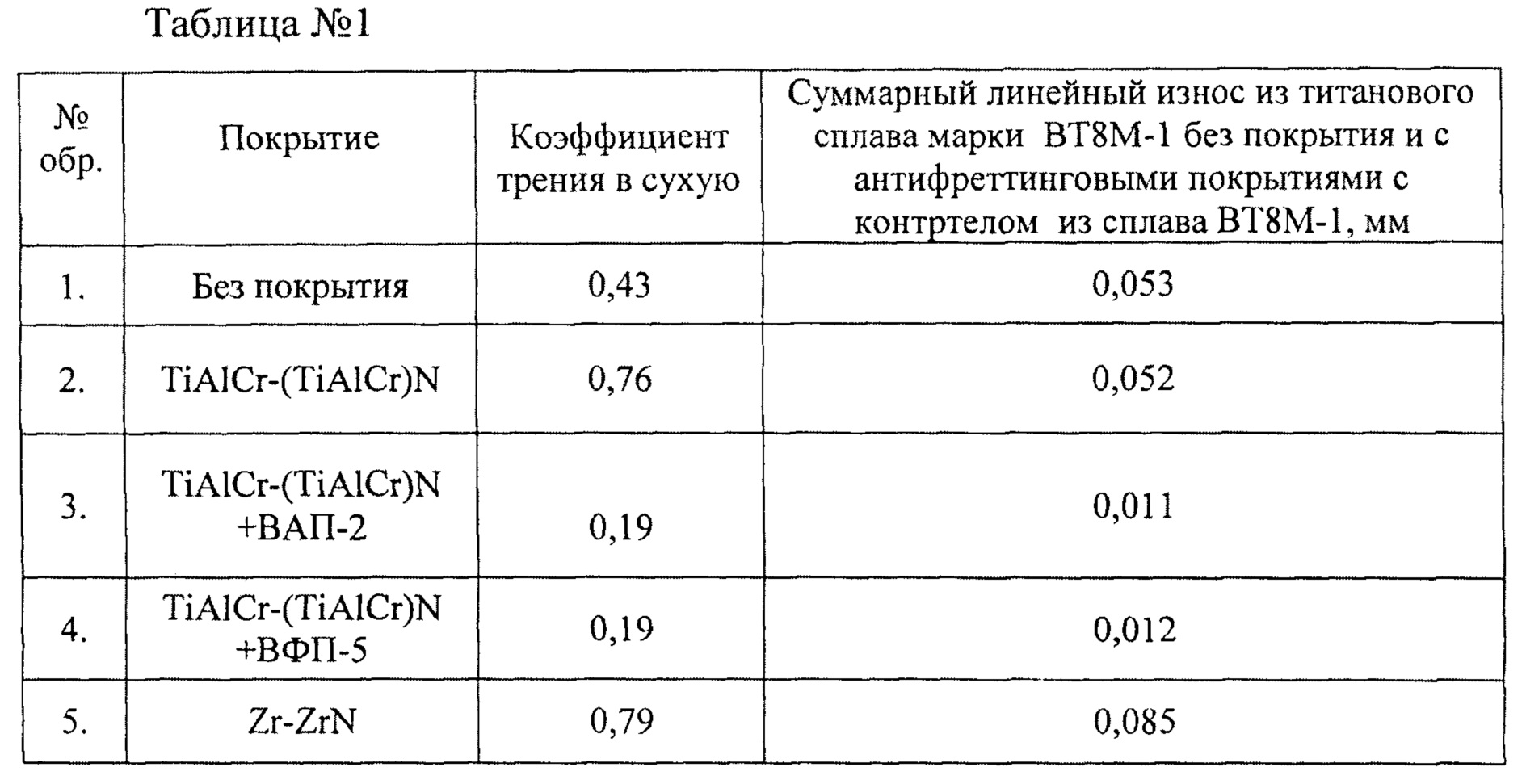
Результаты испытаний на фреттинг-износ опытной партии образцов из титанового сплава марки ВТ8М-1 без покрытия и с антифреттинговыми покрытиями с контртелом из сплава ВТ8М-1 с окончанием в виде полусферы радиусом 1,5 мм при нагрузке - 0,4 Н, давлении в зоне контакта 490 МПа, с частотой колебаний 13 Гц при температурах 20°С приведены в таблице №1.The results of testing for fretting wear of an experimental batch of samples made of titanium alloy grade VT8M-1 without coating and with anti-fretting coatings with a counterbody made of VT8M-1 alloy with a hemisphere ending with a radius of 1.5 mm at a load of 0.4 N, pressure in the zone contact 490 MPa, with an oscillation frequency of 13 Hz at temperatures of 20 ° C are given in table No. 1.
Как видно из таблицы №1, нанесение антифреттингового покрытия по предложенному способу повышает фреттингостойкость композиции сплав-покрытие, снижая при этом суммарный линейный износ образца из сплава ВТ8М-1 при взаимодействии с контртелом из того же сплава при температуре 20°С. Применение финишной обработки поверхности образцов путем формирования твердосмазочного слоя, содержащего твердую смазку типа дисульфида молибдена снижает суммарный износ пары трения за счет взаимного проскальзывания сопрягающихся поверхностей, тем самым снижая коэффициент трения при взаимодействии с контртелом из титанового сплава.As can be seen from table No. 1, the application of an anti-fretting coating according to the proposed method increases the fretting resistance of the alloy-coating composition, while reducing the total linear wear of the sample from the VT8M-1 alloy when interacting with a counterbody from the same alloy at a temperature of 20°C. The use of finishing surface treatment of samples by forming a solid lubricant layer containing a solid lubricant such as molybdenum disulfide reduces the total wear of a friction pair due to mutual slipping of mating surfaces, thereby reducing the friction coefficient when interacting with a titanium alloy counterbody.
Для исследования стойкости композиции «сплав-покрытие» к высокотемпературному окислению проведены испытания на жаростойкость образцов из титанового сплава ВТ8М-1 с антифреттинговыми покрытиями при температуре 500°С на базе 100 часов в атмосферной печи LE 14/11 фирмы «Naberhterm».To study the resistance of the “alloy-coating” composition to high-temperature oxidation, tests were carried out for heat resistance of samples made of titanium alloy VT8M-1 with anti-fretting coatings at a temperature of 500°C on the basis of 100 hours in an atmospheric furnace LE 14/11 by Naberhterm.
Контроль изменения массы образцов-свидетелей проводили гравиметрическим методом на аналитических весах HTR-220CE, с диапазоном измерения от 0,0001 до 220 г.The control of changes in the weight of witness samples was carried out by the gravimetric method on an HTR-220CE analytical balance, with a measurement range from 0.0001 to 220 g.
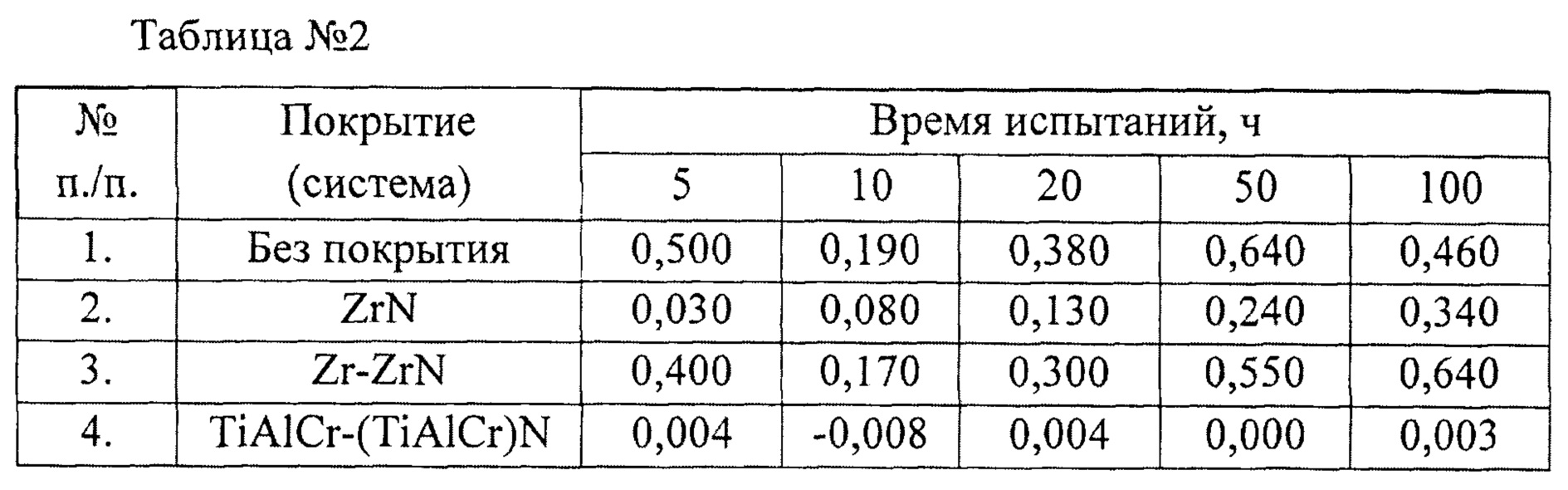
Данные по удельному изменению массы (г/м2) образцов из титанового сплава ВТ8М-1 с антифреттинговыми покрытиями при температуре 500°С на базе 100 часов представлены в таблице №2.Data on the specific weight change (g/m 2 ) of samples of titanium alloy VT8M-1 with anti-fretting coatings at a temperature of 500°C on the basis of 100 hours are presented in table No. 2.
Установлено, что жаростойкость покрытия системы TiAlCr-(TiAlCr)N, нанесенного с помощью заявленного способа, выше, чем покрытий систем ZrN (привес массы 0,34 г/м2) и слоистого покрытия системы Zr-ZrN (привес массы 0,64 г/м).It has been established that the heat resistance of the coating of the TiAlCr-(TiAlCr)N system applied using the claimed method is higher than that of the coatings of the ZrN systems (weight gain 0.34 g/m 2 ) and the layered coating of the Zr-ZrN system (weight gain 0.64 g /m).
Claims (1)
Publications (1)
| Publication Number | Publication Date |
|---|---|
| RU2777090C1 true RU2777090C1 (en) | 2022-08-01 |
Family
ID=
Cited By (1)
| Publication number | Priority date | Publication date | Assignee | Title |
|---|---|---|---|---|
| RU2845075C1 (en) * | 2024-07-29 | 2025-08-13 | Публичное Акционерное Общество "Одк-Сатурн" | Powder mixture for anti-fretting coating and method of manufacturing thereof |
Citations (5)
| Publication number | Priority date | Publication date | Assignee | Title |
|---|---|---|---|---|
| US6387543B1 (en) * | 1998-12-19 | 2002-05-14 | Mtu Aero Engines Gmbh | Protecting layer |
| RU2283894C2 (en) * | 2005-01-13 | 2006-09-20 | Федеральное государственное унитарное предприятие "Всероссийский научно-исследовательский институт авиационных материалов" (ФГУП "ВИАМ") | Method of treatment of surface of metal article |
| RU2308537C1 (en) * | 2006-03-14 | 2007-10-20 | Федеральное государственное унитарное предприятие "Всероссийский научно-исследовательский институт авиационных материалов" (ФГУП "ВИАМ") | Method of working surface of metallic article |
| RU2340704C2 (en) * | 2007-02-01 | 2008-12-10 | Федеральное государственное унитарное предприятие "Всероссийский научно-исследовательский институт авиационных материалов" (ФГУП "ВИАМ") | Method for fabricated metallic product surface treatment |
| RU2349681C2 (en) * | 2007-04-16 | 2009-03-20 | Федеральное государственное унитарное предприятие "Всероссийский научно-исследовательский институт авиационных материалов" (ФГУП "ВИАМ") | Composition for receiving of coating |
Patent Citations (6)
| Publication number | Priority date | Publication date | Assignee | Title |
|---|---|---|---|---|
| US6387543B1 (en) * | 1998-12-19 | 2002-05-14 | Mtu Aero Engines Gmbh | Protecting layer |
| DE59906099D1 (en) * | 1998-12-19 | 2003-07-31 | Mtu Aero Engines Gmbh | PROTECTIVE COATING |
| RU2283894C2 (en) * | 2005-01-13 | 2006-09-20 | Федеральное государственное унитарное предприятие "Всероссийский научно-исследовательский институт авиационных материалов" (ФГУП "ВИАМ") | Method of treatment of surface of metal article |
| RU2308537C1 (en) * | 2006-03-14 | 2007-10-20 | Федеральное государственное унитарное предприятие "Всероссийский научно-исследовательский институт авиационных материалов" (ФГУП "ВИАМ") | Method of working surface of metallic article |
| RU2340704C2 (en) * | 2007-02-01 | 2008-12-10 | Федеральное государственное унитарное предприятие "Всероссийский научно-исследовательский институт авиационных материалов" (ФГУП "ВИАМ") | Method for fabricated metallic product surface treatment |
| RU2349681C2 (en) * | 2007-04-16 | 2009-03-20 | Федеральное государственное унитарное предприятие "Всероссийский научно-исследовательский институт авиационных материалов" (ФГУП "ВИАМ") | Composition for receiving of coating |
Cited By (1)
| Publication number | Priority date | Publication date | Assignee | Title |
|---|---|---|---|---|
| RU2845075C1 (en) * | 2024-07-29 | 2025-08-13 | Публичное Акционерное Общество "Одк-Сатурн" | Powder mixture for anti-fretting coating and method of manufacturing thereof |
Similar Documents
| Publication | Publication Date | Title |
|---|---|---|
| JP5319295B2 (en) | Chromium nitride ion plating film, method for producing the same, and piston ring for internal combustion engine | |
| Nie et al. | Deposition of duplex Al2O3/DLC coatings on Al alloys for tribological applications using a combined micro-arc oxidation and plasma-immersion ion implantation technique | |
| EP0731190B1 (en) | Process for the formation of carbon coatings | |
| US20100297440A1 (en) | Method for the Application of a High-Strength-Coating to Workpieces and/or Materials | |
| US20240093344A1 (en) | Hard carbon coatings with improved adhesion strength by means of hipims and method thereof | |
| GB2458518A (en) | An aerospace bearing | |
| JPH01139754A (en) | Abrasion resistant coated article | |
| Sharipov et al. | Increasing the resistance of the cutting tool during heat treatment and coating | |
| JPH0931628A (en) | Sliding member and its production | |
| Ramalingam | Tribological characteristics of thin films and applications of thin film technology for friction and wear reduction | |
| Sugahara et al. | Creep behavior evaluation and characterization of SiC film with Cr interlayer deposited by HiPIMS in Ti-6Al-4V alloy | |
| Sagalovych et al. | Vacuum-plasma protective coating for turbines blades. | |
| RU2502828C1 (en) | Application of antifriction wear-proof coat on titanium, alloys | |
| CN116635652A (en) | CrN film and sliding member | |
| Sagalovych et al. | AVINIT VACUUM-PLASMA TECHNOLOGIES IN TRANSPORT MACHINE BUILDING. | |
| RU2603414C1 (en) | Method of producing anti-fretting coating | |
| RU2846991C1 (en) | Method of multilayer composite coating producing on metal cutting tool | |
| RU2570274C1 (en) | Method of production of wear-resistant high-temperature coating | |
| JP3452664B2 (en) | Sliding member and manufacturing method thereof | |
| JP2002371348A (en) | Method for improving fatigue characteristics of titanium alloy component, and titanium alloy component therewith | |
| CN115595532B (en) | A multi-layer hard coating and its preparation method and application | |
| Sagalovych et al. | The Vacuum-plasma Nanotechnologies Avinit | |
| RU2856522C1 (en) | Method for obtaining wear-resistant antifriction coating from high-entropy alloy | |
| RU2769799C1 (en) | Method of protecting blades of a gas turbine engine from titanium alloys with an ultrafine-grained structure from dust abrasive erosion | |
| CN114737158B (en) | Preparation method of high-entropy alloy coating for surface strengthening of working machine |