RU2777071C1 - Method for obtaining zirconium by electrolysis of molten salts - Google Patents
Method for obtaining zirconium by electrolysis of molten salts Download PDFInfo
- Publication number
- RU2777071C1 RU2777071C1 RU2022100537A RU2022100537A RU2777071C1 RU 2777071 C1 RU2777071 C1 RU 2777071C1 RU 2022100537 A RU2022100537 A RU 2022100537A RU 2022100537 A RU2022100537 A RU 2022100537A RU 2777071 C1 RU2777071 C1 RU 2777071C1
- Authority
- RU
- Russia
- Prior art keywords
- zirconium
- electrolysis
- zro
- cathode
- molten
- Prior art date
Links
- 229910052726 zirconium Inorganic materials 0.000 title claims abstract description 57
- QCWXUUIWCKQGHC-UHFFFAOYSA-N Zirconium Chemical compound [Zr] QCWXUUIWCKQGHC-UHFFFAOYSA-N 0.000 title claims abstract description 52
- 238000005868 electrolysis reaction Methods 0.000 title claims abstract description 37
- 150000003839 salts Chemical class 0.000 title claims abstract description 28
- 238000000034 method Methods 0.000 title claims abstract description 24
- 239000000203 mixture Substances 0.000 claims abstract description 23
- OKTJSMMVPCPJKN-UHFFFAOYSA-N Carbon Chemical compound [C] OKTJSMMVPCPJKN-UHFFFAOYSA-N 0.000 claims abstract description 15
- 229910002804 graphite Inorganic materials 0.000 claims abstract description 14
- 239000010439 graphite Substances 0.000 claims abstract description 14
- XAGFODPZIPBFFR-UHFFFAOYSA-N aluminium Chemical compound [Al] XAGFODPZIPBFFR-UHFFFAOYSA-N 0.000 claims abstract description 13
- 238000004519 manufacturing process Methods 0.000 claims abstract description 13
- 229910052782 aluminium Inorganic materials 0.000 claims abstract description 12
- 229910016569 AlF 3 Inorganic materials 0.000 claims description 10
- 238000005272 metallurgy Methods 0.000 abstract description 5
- 238000000926 separation method Methods 0.000 abstract description 4
- 239000000126 substance Substances 0.000 abstract description 2
- MCMNRKCIXSYSNV-UHFFFAOYSA-N Zirconium dioxide Chemical compound O=[Zr]=O MCMNRKCIXSYSNV-UHFFFAOYSA-N 0.000 abstract 4
- KLZUFWVZNOTSEM-UHFFFAOYSA-K Aluminium flouride Chemical compound F[Al](F)F KLZUFWVZNOTSEM-UHFFFAOYSA-K 0.000 abstract 2
- -1 zirconium ions Chemical class 0.000 description 7
- 229910045601 alloy Inorganic materials 0.000 description 5
- 239000000956 alloy Substances 0.000 description 5
- 230000015572 biosynthetic process Effects 0.000 description 3
- ODINCKMPIJJUCX-UHFFFAOYSA-N calcium oxide Inorganic materials [Ca]=O ODINCKMPIJJUCX-UHFFFAOYSA-N 0.000 description 3
- 239000000292 calcium oxide Substances 0.000 description 3
- 229910052799 carbon Inorganic materials 0.000 description 3
- 239000012141 concentrate Substances 0.000 description 3
- 238000009792 diffusion process Methods 0.000 description 3
- 239000000463 material Substances 0.000 description 3
- 239000000155 melt Substances 0.000 description 3
- 239000002244 precipitate Substances 0.000 description 3
- 229910018580 Al—Zr Inorganic materials 0.000 description 2
- 229910007926 ZrCl Inorganic materials 0.000 description 2
- 238000004458 analytical method Methods 0.000 description 2
- 229910002091 carbon monoxide Inorganic materials 0.000 description 2
- 239000000446 fuel Substances 0.000 description 2
- 239000007789 gas Substances 0.000 description 2
- 230000003287 optical effect Effects 0.000 description 2
- 239000000047 product Substances 0.000 description 2
- 239000007790 solid phase Substances 0.000 description 2
- 238000004876 x-ray fluorescence Methods 0.000 description 2
- FYYHWMGAXLPEAU-UHFFFAOYSA-N Magnesium Chemical compound [Mg] FYYHWMGAXLPEAU-UHFFFAOYSA-N 0.000 description 1
- 229910020018 Nb Zr Inorganic materials 0.000 description 1
- 229910000831 Steel Inorganic materials 0.000 description 1
- 238000002441 X-ray diffraction Methods 0.000 description 1
- 238000004125 X-ray microanalysis Methods 0.000 description 1
- PNEYBMLMFCGWSK-UHFFFAOYSA-N aluminium oxide Inorganic materials [O-2].[O-2].[O-2].[Al+3].[Al+3] PNEYBMLMFCGWSK-UHFFFAOYSA-N 0.000 description 1
- UHTBGZCYOATXPS-UHFFFAOYSA-M aluminum;oxygen(2-);fluoride Chemical compound [O-2].[F-].[Al+3] UHTBGZCYOATXPS-UHFFFAOYSA-M 0.000 description 1
- 230000000712 assembly Effects 0.000 description 1
- 238000000429 assembly Methods 0.000 description 1
- QVGXLLKOCUKJST-UHFFFAOYSA-N atomic oxygen Chemical compound [O] QVGXLLKOCUKJST-UHFFFAOYSA-N 0.000 description 1
- BRPQOXSCLDDYGP-UHFFFAOYSA-N calcium oxide Chemical compound [O-2].[Ca+2] BRPQOXSCLDDYGP-UHFFFAOYSA-N 0.000 description 1
- 238000003486 chemical etching Methods 0.000 description 1
- 239000003153 chemical reaction reagent Substances 0.000 description 1
- 238000005660 chlorination reaction Methods 0.000 description 1
- 239000002131 composite material Substances 0.000 description 1
- 238000004320 controlled atmosphere Methods 0.000 description 1
- 230000003247 decreasing effect Effects 0.000 description 1
- 238000004090 dissolution Methods 0.000 description 1
- 239000003814 drug Substances 0.000 description 1
- 238000000605 extraction Methods 0.000 description 1
- GPGMRSSBVJNWRA-UHFFFAOYSA-N hydrochloride hydrofluoride Chemical compound F.Cl GPGMRSSBVJNWRA-UHFFFAOYSA-N 0.000 description 1
- 239000011261 inert gas Substances 0.000 description 1
- 229910000765 intermetallic Inorganic materials 0.000 description 1
- 229910001338 liquidmetal Inorganic materials 0.000 description 1
- 230000007774 longterm Effects 0.000 description 1
- 229910052749 magnesium Inorganic materials 0.000 description 1
- 239000011777 magnesium Substances 0.000 description 1
- 238000002844 melting Methods 0.000 description 1
- 230000008018 melting Effects 0.000 description 1
- 229910052751 metal Inorganic materials 0.000 description 1
- 239000002184 metal Substances 0.000 description 1
- 238000004452 microanalysis Methods 0.000 description 1
- 238000001000 micrograph Methods 0.000 description 1
- 229910052760 oxygen Inorganic materials 0.000 description 1
- 239000001301 oxygen Substances 0.000 description 1
- 239000012071 phase Substances 0.000 description 1
- 239000011148 porous material Substances 0.000 description 1
- 239000010970 precious metal Substances 0.000 description 1
- 238000002360 preparation method Methods 0.000 description 1
- 238000011084 recovery Methods 0.000 description 1
- 230000008929 regeneration Effects 0.000 description 1
- 238000011069 regeneration method Methods 0.000 description 1
- 238000004626 scanning electron microscopy Methods 0.000 description 1
- 239000007787 solid Substances 0.000 description 1
- 239000010959 steel Substances 0.000 description 1
- 238000003786 synthesis reaction Methods 0.000 description 1
- 238000005292 vacuum distillation Methods 0.000 description 1
- 150000003754 zirconium Chemical class 0.000 description 1
Images
Abstract
Description
Изобретение относится к металлургии, в частности к получению циркония из его оксида электролизом расплавленных солей.The invention relates to metallurgy, in particular to the production of zirconium from its oxide by electrolysis of molten salts.
Металлический цирконий, его сплавы и лигатуры широко используется в металлургии для изготовления сплавов, в ядерной энергетике для изготовления тепловыделяющих элементов, тепловыделяющих сборок и других конструкций ядерных реакторов, в пиротехнике (факелы, осветительные ракеты, осветительные бомбы, фотоавиабомбы), в энергетике в виде сверхпроводящего сплава Nb-Zr, в медицине в качестве биоинертного материала, а также в качестве конструкционного материала. Нередко цирконий применяют как заменитель благородных металлов.Metallic zirconium, its alloys and ligatures are widely used in metallurgy for the manufacture of alloys, in nuclear power engineering for the manufacture of fuel elements, fuel assemblies and other structures of nuclear reactors, in pyrotechnics (torches, flares, lighting bombs, photo-air bombs), in energy in the form of a superconducting Nb-Zr alloy, in medicine as a bioinert material, and also as a structural material. Zirconium is often used as a substitute for precious metals.
В промышленности исходным сырьем для производства циркония являются циркониевые концентраты с массовым содержанием ZrO2 не менее 60-65%, получаемые обогащением циркониевых руд. Далее путем хлорирования таких концентратов при 900-1000°С в присутствии углерода ZrO2 переводят в ZrCl4, который, в свою очередь, восстанавливают металлическим магнием до циркония в виде циркониевой губки чистотой 98-99 мас. %. Также в промышленности реализован электролитический способ получения циркония чистотой 99.8-99.9 мас. %, включающий электролиз хлоридно-фторидного расплава с добавкой K2ZrF6 при температуре от 670 до 780°С и катодном выходе по току до 80%. Оба варианта получения циркония подразумевают ряд предварительных трудоемких операций по переводу циркония из ZrO2 в соль (ZrCl4 или K2ZrF6), а также использование контролируемой атмосферы, что в конечном итоге сказывается на высокой стоимости циркония. Наиболее дешевыми представляются способы получения циркония из ZrO2 в одну стадию, однако все предложенные способы предполагают получение циркониевого концентрата с высоким содержанием ZrO2.In industry, the feedstock for the production of zirconium are zirconium concentrates with a mass content of ZrO 2 not less than 60-65% obtained by enrichment of zirconium ores. Further, by chlorination of such concentrates at 900-1000°C in the presence of carbon, ZrO 2 is converted into ZrCl 4 , which, in turn, is reduced by metallic magnesium to zirconium in the form of a zirconium sponge with a purity of 98-99 wt. %. Also in industry, an electrolytic method for obtaining zirconium with a purity of 99.8-99.9 wt. %, including the electrolysis of the chloride-fluoride melt with the addition of K 2 ZrF 6 at a temperature of 670 to 780°C and a cathode current efficiency of up to 80%. Both options for obtaining zirconium imply a number of preliminary labor-intensive operations for converting zirconium from ZrO 2 into salt (ZrCl 4 or K 2 ZrF 6 ), as well as the use of a controlled atmosphere, which ultimately affects the high cost of zirconium. The cheapest methods for obtaining zirconium from ZrO 2 in one stage, however, all the proposed methods involve the production of zirconium concentrate with a high content of ZrO 2 .
Известен способ получения циркония, включающий восстановление ZrO2 до металлического циркония при электролизе расплавленной соли CaCl2-СаО при температуре 900°С [K.S. Mohandas, D.J. Fray, Metallurgical and Materials Transactions B, 2009, V. 40, P. 685]. При электролизе предварительно спрессованные таблетки ZrO2, находящиеся в контакте с катодом, подвергаются восстановлению до металлического циркония, а на графитовом аноде при этом выделяется СО и СО2. Степень восстановления ZrO2 до циркония составляет 90-95%, и в результате электролиза катодный продукт представлен смесью металлического циркония с ZrO2 и CaZrO3. Помимо этого в порах этой смеси остаются следы CaCl2-СаО.A known method for producing zirconium, including the reduction of ZrO 2 to metallic zirconium by electrolysis of the molten salt CaCl 2 -CaO at a temperature of 900°C [KS Mohandas, DJ Fray, Metallurgical and Materials Transactions B, 2009, V. 40, P. 685]. During electrolysis, pre-compressed ZrO 2 tablets in contact with the cathode are reduced to metallic zirconium, and CO and CO 2 are released on the graphite anode. The degree of reduction of ZrO 2 to zirconium is 90-95%, and as a result of electrolysis, the cathode product is represented by a mixture of metallic zirconium with ZrO 2 and CaZrO 3 . In addition, traces of CaCl 2 -CaO remain in the pores of this mixture.
Недостатками способа являются использование гигроскопичного CaCl2, необходимость ведения электролиза и всех вспомогательных операций в атмосфере инертного газа, необходимость последующего отделения циркония от ZrO2 и CaZrO3 и низкая производительность, которая будет лимитироваться встречными потоками в твердом ZrO2: электронами от катода к ионам циркония и оксидом кальция из восстанавливаемого ZrO2 в расплавленную соль.The disadvantages of the method are the use of hygroscopic CaCl 2 , the need for electrolysis and all auxiliary operations in an inert gas atmosphere, the need for subsequent separation of zirconium from ZrO 2 and CaZrO 3 and low productivity, which will be limited by counter flows in solid ZrO 2 : electrons from the cathode to zirconium ions and calcium oxide from the recovered ZrO 2 to the molten salt.
Ряд из этих недостатков исключает способ получения циркония, включающий электролиз расплава NaCl-KCl-K2ZrF6 с использованием графитового катода и композитного оксикарбидного анода ZrCxOy при температуре 750-800°С [О. Takeda, K. Suda, X. Lu, Н. Zhu, Journal of Sustainable Metallurgy, 2018, V. 4, P. 506]. При электролизе анод ZrCxOy электрохимически окисляется с образованием газа СО и растворенных ионов циркония в расплаве, которые восстанавливаются до циркония на катоде. Несмотря на возможность ведения электролиза в открытой атмосфере, способ предполагает ряд сложных операций по изготовлению оксикарбидного анода, при этом производительность способа представляется низкой, поскольку будет лимитироваться твердофазной диффузией ионов циркония в теле анода. Помимо оксикарбидного анода предлагается использовать оксикарбонитридный анод ZrCxOyNz, при этом электролитический способ получения циркония из него будет обладать аналогичными недостатками.A number of these disadvantages eliminates the method of obtaining zirconium, including the electrolysis of the melt NaCl-KCl-K 2 ZrF 6 using a graphite cathode and a composite oxycarbide anode ZrC x O y at a temperature of 750-800°C [O. Takeda, K. Suda, X. Lu, N. Zhu, Journal of Sustainable Metallurgy, 2018, V. 4, P. 506]. During electrolysis, the ZrC x O y anode is electrochemically oxidized to form CO gas and dissolved zirconium ions in the melt, which are reduced to zirconium at the cathode. Despite the possibility of conducting electrolysis in an open atmosphere, the method involves a number of complex operations for the manufacture of an oxycarbide anode, while the productivity of the method seems to be low, since it will be limited by solid-phase diffusion of zirconium ions in the anode body. In addition to the oxycarbide anode, it is proposed to use the oxycarbonitride ZrC x O y N z anode, while the electrolytic method for obtaining zirconium from it will have similar disadvantages.
Известен также способ получения циркония электролизом расплавленных солей, включающий восстановление растворенного в расплавленной соли ZrO2 в процессе электролиза, при этом в качестве расплавленной соли используют смесь KF-NaF-AlF3 [A. Filatov et al. Synthesis of Al-Zr master alloys via the electrolysis of KF-NaF-AlF3-ZrO2 melts, Journal of The Electrochemical Society, 2018, V. 165(2), Е28-Е34]. В известном способе электролиз расплавленной соли KF-NaF-AlF3 с растворенным в ней ZrO2 ведут в гальваностатическом режиме с использованием жидкометаллического алюминиевого катода, при этом наряду с электролитическим восстановлением растворенного в расплавленной соли ZrO2 параллельно протекает его алюминотермическое восстановление. Продуктами как электролитического, так и алюминотермического восстановления ZrO2 являются металлический цирконий и его интерметаллидные соединения с алюминием (AlxZry), растворенные в алюминии и в совокупности с последним представляющие собой лигатуру Al-Zr с содержанием циркония до 15 мас. %. Извлечение чистого циркония из данной лигатуры представляется крайне энергозатратным и неэффективным, при этом должно осуществляться в отдельном реакторе.There is also known a method for producing zirconium by electrolysis of molten salts, including the recovery of ZrO 2 dissolved in the molten salt during electrolysis, while the mixture of KF-NaF-AlF 3 is used as the molten salt [A. Filatov et al. Synthesis of Al-Zr master alloys via the electrolysis of KF-NaF-AlF 3 -ZrO 2 melts, Journal of The Electrochemical Society, 2018, V. 165(2), E28-E34]. In a known method, the electrolysis of the molten salt KF-NaF-AlF 3 with ZrO 2 dissolved in it is carried out in a galvanostatic mode using a liquid metal aluminum cathode, while along with the electrolytic reduction of ZrO 2 dissolved in the molten salt, its aluminothermic reduction proceeds in parallel. The products of both electrolytic and aluminothermic reduction of ZrO 2 are metallic zirconium and its intermetallic compounds with aluminum (Al x Zr y ), dissolved in aluminum and, together with the latter, representing an Al-Zr ligature with a zirconium content of up to 15 wt. %. The extraction of pure zirconium from this master alloy seems to be extremely energy-consuming and inefficient, while it must be carried out in a separate reactor.
Задачей изобретения является упрощение и повышение производительности электролитического получения циркония из его оксида в расплавленных солях.The objective of the invention is to simplify and increase the productivity of the electrolytic production of zirconium from its oxide in molten salts.
Для этого предлагается способ получения циркония электролизом расплавленных солей, включающий восстановление ZrO2 до металлического циркония в процессе электролиза расплавленных солей при температуре от 650 до 850°С, при этом в качестве расплавленной соли используют смесь солей (мас. %) (20-60)KF-(до 47.5)NaF-(30-50)AlF3-(0.5-2.5)ZrO2, электролиз ведут в атмосфере воздуха при потенциале катода на 0.05 В положительнее потенциала алюминиевого электрода сравнения, а в качестве катода используют графит.For this, a method is proposed for obtaining zirconium by electrolysis of molten salts, including the reduction of ZrO 2 to metallic zirconium in the process of electrolysis of molten salts at a temperature of 650 to 850 ° C, while a mixture of salts (wt.%) (20-60) is used as the molten salt KF-(up to 47.5)NaF-(30-50)AlF 3 -(0.5-2.5)ZrO 2 , electrolysis is carried out in air at a cathode potential 0.05 V more positive than the potential of the aluminum reference electrode, and graphite is used as a cathode.
Сущность способа заключается в том, что ZrO2 растворяется в расплавленной смеси KF-NaF-AlF3 с образованием оксидно-фторидных и фторидных ионов циркония, при этом указанный состав смеси (мас. %) (20-60)KF-(до 47.5)NaF-(30-50)AlF3-(0.5-2.5)ZrO2 позволяет осуществлять способ получения циркония при температуре от 650 до 850°С в атмосфере воздуха. При электролизе полученной смеси ионы циркония электролитически восстанавливаются на графитовом катоде с образованием металлического циркония. Наряду с этим, на катоде возможен параллельный процесс электровосстановления оксидно-фторидных и фторидных ионов алюминия до металлического алюминия, однако ведение электролиза в потенциостатическом режиме при потенциале катода на 0.05 В положительнее потенциала алюминиевого электрода позволяет максимально исключить этот побочный процесс. На аноде при электролизе выделяется смесь газов СО-СО2, что дополнительно обеспечивает возможность ведения длительного электролиза расплавленной смеси KF-NaF-AlF3-ZrO2 и исключает необходимость регенерации смеси после электролиза.The essence of the method lies in the fact that ZrO 2 is dissolved in a molten mixture of KF-NaF-AlF 3 with the formation of oxide-fluoride and fluoride zirconium ions, while the specified composition of the mixture (wt.%) (20-60)KF-(up to 47.5) NaF-(30-50)AlF 3 -(0.5-2.5)ZrO 2 allows the method of obtaining zirconium at a temperature of 650 to 850°C in air. During electrolysis of the resulting mixture, zirconium ions are electrolytically reduced on a graphite cathode with the formation of metallic zirconium. Along with this, a parallel process of electrical reduction of aluminum oxide-fluoride and fluoride ions to metallic aluminum is possible on the cathode, however, conducting electrolysis in a potentiostatic mode at a cathode potential 0.05 V more positive than the potential of the aluminum electrode makes it possible to exclude this side process as much as possible. At the anode during electrolysis, a mixture of CO-CO 2 gases is released, which additionally makes it possible to conduct long-term electrolysis of the molten mixture of KF-NaF-AlF 3 -ZrO 2 and eliminates the need for regeneration of the mixture after electrolysis.
Благодаря относительно высокой растворимости и скорости растворения ZrO2 в расплавленной смеси KF-NaF-AlF3-ZrO2 процесс восстановления оксида до металлического циркония лимитируется диффузией оксидно-фторидных и фторидных ионов циркония к графитовому катоду, скорость которой на порядки превышает скорость твердофазной диффузии в известных способах.Due to the relatively high solubility and dissolution rate of ZrO 2 in the molten KF-NaF-AlF 3 -ZrO 2 mixture, the process of oxide reduction to metallic zirconium is limited by the diffusion of oxide-fluoride and fluoride zirconium ions to the graphite cathode, the rate of which is orders of magnitude higher than the rate of solid-phase diffusion in known ways.
Более того, заявленный способ исключает необходимость прессования ZrO2 в таблетки, либо изготовление оксикарбидного или оксикарбонитридного анода, что существенно упрощает осуществление способа. По окончании электролиза содержание растворенных в расплавленной смеси KF-NaF-AlF3 оксидов может быть сокращено до минимума, что существенно сократит содержание кислорода в катодном осадке и упростит последующее отделение металлического циркония от остатков солей и невосстановленных оксидов.Moreover, the claimed method eliminates the need to press ZrO 2 into tablets, or to manufacture an oxycarbide or oxycarbonitride anode, which greatly simplifies the implementation of the method. Upon completion of electrolysis, the content of oxides dissolved in the molten KF-NaF-AlF 3 mixture can be reduced to a minimum, which will significantly reduce the oxygen content in the cathode deposit and simplify the subsequent separation of metallic zirconium from salt residues and unreduced oxides.
Технический результат, достигаемый заявленным способом, заключается в повышении скорости получения циркония, исключении ряда операций по подготовке ZrO2 перед электролитическим восстановлением, а также упрощении отделения полученного циркония от остатков соли и невосстановленных оксидов. Кроме того, возможность ведения электролиза в атмосфере воздуха упрощает конструкцию электролизера и контроль электролиза.The technical result achieved by the claimed method is to increase the rate of zirconium production, exclude a number of operations for the preparation of ZrO 2 before electrolytic reduction, and also simplify the separation of the resulting zirconium from salt residues and unreduced oxides. In addition, the possibility of conducting electrolysis in an air atmosphere simplifies the design of the cell and the control of electrolysis.
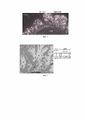
Изобретение иллюстрируется фигурами, где на фиг. 1 представлена оптическая фотография осадка циркония на графитовом катоде; на фиг. 2 -микрофотография осадка циркония на графитовом катоде с указанием содержания элементов в разных точках осадка.The invention is illustrated by figures, where in Fig. 1 shows an optical photograph of a zirconium deposit on a graphite cathode; in fig. 2 - microphotograph of the zirconium deposit on the graphite cathode indicating the content of elements at different points of the deposit.
Экспериментальную реализацию осуществляли в лабораторном электролизере, изготовленном из плотного графитового тигля, размещенного в алундовом контейнере. В графитовый тигель электролизера загружали 600 г смеси (мас. %) 60KF-38AlF3-2ZrO2 (все реагенты квалификации ХЧ, ОАО «Вектон», Россия) и электролизер вместе с указанной смесью помещали в печи сопротивления и нагревали до температуры 790°C. После плавления в расплавленную смесь погружали графитовый катод в виде цилиндра и алюминиевый электрод сравнения; функцию анода при электролизе выполнял графитовый тигель электролизера, подвод тока к которому осуществляли через дно тигля при помощи стального стержня.The experimental implementation was carried out in a laboratory cell made of a dense graphite crucible placed in an alundum container. 600 g of a mixture (wt %) of 60KF-38AlF 3 -2ZrO 2 (all chemical grade reagents, JSC Vekton, Russia) were loaded into the graphite crucible of the electrolytic cell, and the cell together with the indicated mixture was placed in a resistance furnace and heated to a temperature of 790°C . After melting, a graphite cathode in the form of a cylinder and an aluminum reference electrode were immersed in the molten mixture; The function of the anode during electrolysis was performed by the graphite crucible of the electrolyzer, the current supply to which was carried out through the bottom of the crucible using a steel rod.
Электролиз вели при потенциале графитового катода на 0.05 В положительнее потенциала алюминиевого электрода с использованием потенциостата/гальваностата AutoLab 302N (Нидерланды), при этом катодная плотность тока постепенно снизилась с 0.15 до 0.05 А/см2 за 2 часа электролиза. По окончании электролиза катод с осадком извлекли из расплавленной смеси, а саму смесь слили в изложницу. После достижения комнатной температуры часть катодного осадка была механически счищена с катода для выполнения рентгенофлюоресцентного анализа осадка. Из остальной части был изготовлен образец поперечного среза осадка непосредственно на катоде с целью его анализа методом сканирующей электронной микроскопии и микрорентгеноструктурного анализа. По данным рентгенофлюоресцентного анализа катодный осадок был на 24 мас. % представлен металлическим цирконием в смеси с солями KAlF4 и K3AlF6. Из оптической фотографии, приведенной на фиг. 1, видно, что осадок представлен включениями металлической фазы, на 98.5-99.5 мас. % представленной цирконием по данным микрорентгеноструктурного анализа (фиг. 2). Полученный цирконий может быть легко отделен от остатков соли и оксида, например, путем вакуумной дистилляции или химического травления.Electrolysis was carried out at a potential of the graphite cathode 0.05 V more positive than the potential of the aluminum electrode using an AutoLab 302N potentiostat/galvanostat (Netherlands), while the cathode current density gradually decreased from 0.15 to 0.05 A/cm2 over 2 hours of electrolysis. Upon completion of the electrolysis, the cathode with the precipitate was removed from the molten mixture, and the mixture itself was poured into the mold. After reaching room temperature, part of the cathode deposit was mechanically removed from the cathode to perform X-ray fluorescence analysis of the deposit. From the rest, a sample of a cross section of the deposit was made directly on the cathode in order to analyze it by scanning electron microscopy and X-ray diffraction microanalysis. According to X-ray fluorescence analysis, the cathode deposit was 24 wt. % is represented by metallic zirconium mixed with KAlF 4 and K 3 AlF 6 salts. From the optical photograph shown in Fig. 1, it can be seen that the precipitate is represented by inclusions of the metal phase, 98.5–99.5 wt. % represented by zirconium according to X-ray microanalysis (Fig. 2). The resulting zirconium can be easily separated from salt and oxide residues, for example by vacuum distillation or chemical etching.
Аналогичный осадок, содержащий 99.0-99.5 мас. % циркония и не выше 0.6 мас. %) алюминия был получен при осуществлении способа в смеси (мас. %) 49.5KF-50AlF3-0.5ZrO2 при температуре 650°С, в смеси (мас. %) 40KF-10NaF-48AlF3-2ZrO2 при температуре 800°С и в смеси 20KF-47.5NaF-30AlF3-2.5ZrO2 при температуре 850°С.A similar precipitate containing 99.0-99.5 wt. % zirconium and not more than 0.6 wt. %) of aluminum was obtained by implementing the method in a mixture (wt.%) 49.5KF-50AlF 3 -0.5ZrO 2 at a temperature of 650 ° C, in a mixture (wt.%) 40KF-10NaF-48AlF 3 -2ZrO 2 at a temperature of 800 ° C and in a mixture of 20KF-47.5NaF-30AlF 3 -2.5ZrO 2 at a temperature of 850°C.
Таким образом, в результате электролиза на катоде был достоверно получен металлический цирконий с примесью алюминия до 0.6 мас. % при использовании в качестве источника циркония его оксида.Thus, as a result of electrolysis on the cathode, metallic zirconium with an admixture of aluminum up to 0.6 wt % was reliably obtained. % when using its oxide as a source of zirconium.
Claims (1)
Publications (1)
| Publication Number | Publication Date |
|---|---|
| RU2777071C1 true RU2777071C1 (en) | 2022-08-01 |
Family
ID=
Cited By (1)
| Publication number | Priority date | Publication date | Assignee | Title |
|---|---|---|---|---|
| CN117247058A (en) * | 2023-07-31 | 2023-12-19 | 东北大学 | A method for dissolving and separating lithium battery black powder |
Citations (5)
| Publication number | Priority date | Publication date | Assignee | Title |
|---|---|---|---|---|
| SU994585A1 (en) * | 1981-04-13 | 1983-02-07 | Кировский Политехнический Институт | Process for producing zirconium |
| RU2257426C1 (en) * | 2003-11-06 | 2005-07-27 | Открытое акционерное общество "Чепецкий механический завод" (ОАО ЧМЗ) | Zirconium production process |
| JP2010013668A (en) * | 2008-06-30 | 2010-01-21 | Toshiba Corp | Method for producing metallic zirconium |
| RU2516170C2 (en) * | 2012-06-05 | 2014-05-20 | Открытое акционерное общество "Высокотехнологический научно-исследовательский институт неорганических материалов имени академика А.А. Бочвара" | Method to produce zirconium by electrolysis from melted salts |
| CN104109884A (en) * | 2014-07-18 | 2014-10-22 | 中信锦州金属股份有限公司 | Method for preparing metal zirconium powder with molten salt electrolysis method |
Patent Citations (5)
| Publication number | Priority date | Publication date | Assignee | Title |
|---|---|---|---|---|
| SU994585A1 (en) * | 1981-04-13 | 1983-02-07 | Кировский Политехнический Институт | Process for producing zirconium |
| RU2257426C1 (en) * | 2003-11-06 | 2005-07-27 | Открытое акционерное общество "Чепецкий механический завод" (ОАО ЧМЗ) | Zirconium production process |
| JP2010013668A (en) * | 2008-06-30 | 2010-01-21 | Toshiba Corp | Method for producing metallic zirconium |
| RU2516170C2 (en) * | 2012-06-05 | 2014-05-20 | Открытое акционерное общество "Высокотехнологический научно-исследовательский институт неорганических материалов имени академика А.А. Бочвара" | Method to produce zirconium by electrolysis from melted salts |
| CN104109884A (en) * | 2014-07-18 | 2014-10-22 | 中信锦州金属股份有限公司 | Method for preparing metal zirconium powder with molten salt electrolysis method |
Non-Patent Citations (1)
| Title |
|---|
| FILATOV A.A. et al., Synthesis of Al-Zr Master Alloys via the Electrolysis of KF-NaF-AlF3-ZrO2 Melts. Journal of The Electrochemical Society, 165 (2) E28-E34 (2018), Published January 10, 2018. * |
Cited By (1)
| Publication number | Priority date | Publication date | Assignee | Title |
|---|---|---|---|---|
| CN117247058A (en) * | 2023-07-31 | 2023-12-19 | 东北大学 | A method for dissolving and separating lithium battery black powder |
Similar Documents
| Publication | Publication Date | Title |
|---|---|---|
| Fray et al. | Reduction of titanium and other metal oxides using electrodeoxidation | |
| Yan et al. | Production of niobium powder by direct electrochemical reduction of solid Nb2O5 in a eutectic CaCl2-NaCl melt | |
| US11261532B2 (en) | Method and apparatus for electrolytic reduction of a feedstock comprising oxygen and a first metal | |
| CN100415940C (en) | Method for producing pure titanium by anodic electrolysis of titanium monoxide/titanium carbide soluble solid solution | |
| Mishra et al. | Molten salt applications in materials processing | |
| US7790014B2 (en) | Removal of substances from metal and semi-metal compounds | |
| Suzdaltsev et al. | Extraction of scandium and zirconium from their oxides during the electrolysis of oxide–fluoride melts | |
| CA2703400C (en) | Production of tungsten and tungsten alloys from tungsten bearing compounds by electrochemical methods | |
| US12529157B2 (en) | Method of aluminum-scandium alloy production | |
| Guo et al. | Molten salt electrolysis of spent nickel-based superalloys with liquid cathode for the selective separation of nickel | |
| JP2021515851A5 (en) | ||
| Zhang et al. | Progress in research and application of molten salt electrolysis for titanium extraction | |
| Zhang et al. | Clean separation of vanadium from NaVO3 in NaF-KF-AlF3 molten salt by electrochemical reduction | |
| Filatov et al. | Extraction of zirconium from its oxide during electrolysis of the KF–AlF3–Al2O3–ZrO2 melts | |
| JPH0688280A (en) | Electrolytic method for producing alloy of rare earth and other metal | |
| RU2716727C1 (en) | Electrolytic method of producing aluminum ligatures from oxide material | |
| WO2012143719A2 (en) | Methods and apparatus for the production of metal | |
| RU2658556C1 (en) | Method for obtaining aluminum-zirconium ligatures | |
| EP1483431B1 (en) | Minimising carbon transfer in an electrolytic cell | |
| Withers et al. | Recent improvements for electrowinning titanium metal from composite anodes | |
| WO2019040016A2 (en) | Production method for scandium metal and al-sc alloys via electrolysis of fluorinated scandium salts obtained by the calcination of scandium compound in the form of (nh 4)2nascf6 | |
| Hu et al. | Advanced extractive electrometallurgy | |
| Nair et al. | Production of tantalum metal by the aluminothermic reduction of tantalum pentoxide | |
| RU2819114C1 (en) | Method for electrolytic production of aluminum alloys with yttrium using oxygen-releasing anode | |
| Kim et al. | Molten Salt-Based Carbon-Neutral Critical Metal Smelting Process From Oxide Feedstocks |