RU2687503C1 - Method of determining elastic and dissipative characteristics of composite material - Google Patents
Method of determining elastic and dissipative characteristics of composite material Download PDFInfo
- Publication number
- RU2687503C1 RU2687503C1 RU2018130542A RU2018130542A RU2687503C1 RU 2687503 C1 RU2687503 C1 RU 2687503C1 RU 2018130542 A RU2018130542 A RU 2018130542A RU 2018130542 A RU2018130542 A RU 2018130542A RU 2687503 C1 RU2687503 C1 RU 2687503C1
- Authority
- RU
- Russia
- Prior art keywords
- pcm
- polymer composite
- moduli
- values
- bending
- Prior art date
Links
- 238000000034 method Methods 0.000 title claims abstract description 35
- 239000002131 composite material Substances 0.000 title claims abstract description 18
- 239000012779 reinforcing material Substances 0.000 claims abstract description 19
- 230000010355 oscillation Effects 0.000 claims abstract description 16
- 239000011229 interlayer Substances 0.000 claims abstract description 13
- 238000005452 bending Methods 0.000 claims abstract description 12
- 229920000642 polymer Polymers 0.000 claims abstract description 11
- 230000002787 reinforcement Effects 0.000 claims abstract description 10
- 238000012545 processing Methods 0.000 claims abstract description 3
- 239000000463 material Substances 0.000 abstract description 11
- 238000005259 measurement Methods 0.000 abstract description 4
- 230000001066 destructive effect Effects 0.000 abstract description 2
- 230000000694 effects Effects 0.000 abstract description 2
- 230000000704 physical effect Effects 0.000 abstract description 2
- 239000000126 substance Substances 0.000 abstract 1
- 239000011152 fibreglass Substances 0.000 description 3
- 238000013459 approach Methods 0.000 description 2
- 230000014509 gene expression Effects 0.000 description 2
- 239000010410 layer Substances 0.000 description 2
- 239000012783 reinforcing fiber Substances 0.000 description 2
- 230000003068 static effect Effects 0.000 description 2
- 238000012360 testing method Methods 0.000 description 2
- 241000272525 Anas platyrhynchos Species 0.000 description 1
- OKTJSMMVPCPJKN-UHFFFAOYSA-N Carbon Chemical compound [C] OKTJSMMVPCPJKN-UHFFFAOYSA-N 0.000 description 1
- 230000001133 acceleration Effects 0.000 description 1
- 229910052799 carbon Inorganic materials 0.000 description 1
- 238000004891 communication Methods 0.000 description 1
- 238000010276 construction Methods 0.000 description 1
- 238000013461 design Methods 0.000 description 1
- 238000010586 diagram Methods 0.000 description 1
- 238000006073 displacement reaction Methods 0.000 description 1
- 230000005284 excitation Effects 0.000 description 1
- 238000013178 mathematical model Methods 0.000 description 1
- 239000004033 plastic Substances 0.000 description 1
- 229920003023 plastic Polymers 0.000 description 1
Images
Classifications
-
- G—PHYSICS
- G01—MEASURING; TESTING
- G01N—INVESTIGATING OR ANALYSING MATERIALS BY DETERMINING THEIR CHEMICAL OR PHYSICAL PROPERTIES
- G01N3/00—Investigating strength properties of solid materials by application of mechanical stress
- G01N3/32—Investigating strength properties of solid materials by application of mechanical stress by applying repeated or pulsating forces
- G01N3/34—Investigating strength properties of solid materials by application of mechanical stress by applying repeated or pulsating forces generated by mechanical means, e.g. hammer blows
Landscapes
- Physics & Mathematics (AREA)
- Health & Medical Sciences (AREA)
- Life Sciences & Earth Sciences (AREA)
- Chemical & Material Sciences (AREA)
- Analytical Chemistry (AREA)
- Biochemistry (AREA)
- General Health & Medical Sciences (AREA)
- General Physics & Mathematics (AREA)
- Immunology (AREA)
- Pathology (AREA)
- Investigating Strength Of Materials By Application Of Mechanical Stress (AREA)
Abstract
Description
Настоящее изобретение относится к области измерения, в части определения физических свойств материалов, и может быть использовано преимущественно для определения упругих и диссипативных постоянных полимерных композиционных материалов (ПКМ) неразрушающим способом в любых отраслях промышленности.The present invention relates to the field of measurement, in terms of determining the physical properties of materials, and can be used primarily to determine the elastic and dissipative permanent polymer composite materials (PCM) in a non-destructive way in any industry.
Динамическое поведение ПКМ, характеризующихся анизотропией упругих и диссипативных характеристик в плоскости укладки армирующих материалов, привлекает внимание исследователей в связи с возрастающим применением в конструкциях, испытывающих вибрационные воздействия. Поскольку реакция таких конструкций на действие вибрации зависит, главным образом, от жесткостных и диссипативных свойств, то оптимальное конструирование состоит в варьировании этих свойств с целью достижения соответствия тем или иным критериям качества, например, минимизации смещений, запасенной энергии и т.д. Подбор упругих и диссипативных характеристик конструкций может осуществляться посредством варьирования ориентацией и последовательностью укладки слоев армирующего материала по толщине композита. Такая задача может быть решена на основе методов механики слоистых композитов при наличии полного набора упругих и диссипативных характеристик всех компонуемых монослоев ПКМ.The dynamic behavior of PCM, characterized by anisotropy of elastic and dissipative characteristics in the plane of laying reinforcing materials, attracts the attention of researchers in connection with the increasing use in structures that are experiencing vibration effects. Since the response of such structures to the action of vibration depends mainly on the stiffness and dissipative properties, the optimal design consists in varying these properties in order to achieve compliance with one or another quality criteria, for example, minimizing displacements, stored energy, etc. The selection of elastic and dissipative characteristics of structures can be carried out by varying the orientation and sequence of laying the layers of reinforcing material through the thickness of the composite. Such a problem can be solved on the basis of the mechanics of layered composites with the full set of elastic and dissipative characteristics of all composable PCM monolayers.
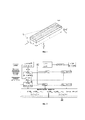
Учитывая, что практически все конструкции из ПКМ являются тонкостенными (в этом случае свойства материалов реализуются наилучшим образом), в теории слоистых композитов, как правило, пренебрегают поперечными нормальными напряжениями (σ33=0, см. фиг. 1, где представлена геометрия стержня, вырезанного из пластины ортотропного материала под углом θ к направлению оси симметрии 3).Considering that almost all PCM structures are thin-walled (in this case, the material properties are best implemented), in the theory of layered composites, as a rule, transverse normal stresses are neglected (σ 33 = 0, see Fig. 1, which shows the geometry of the rod, cut out of a plate of orthotropic material at an angle θ to the direction of the axis of symmetry 3).
Таким образом, для описания динамического поведения конструкций из ортотропного ПКМ с армирующими волокнами, расположенными параллельно его срединной плоскости, необходимо знать численные значения главных комплексных динамических модулей упругости E11, Е22, комплексных динамических модулей сдвига G12, G13, G23 и коэффициента Пуассона ν12:Thus, to describe the dynamic behavior of structures made of orthotropic PCM with reinforcing fibers arranged parallel to its middle plane, it is necessary to know the numerical values of the main complex dynamic elastic moduli E 11 , E 22 , the complex dynamic shear moduli G 12 , G 13 , G 23 and the coefficient Poisson ν 12 :
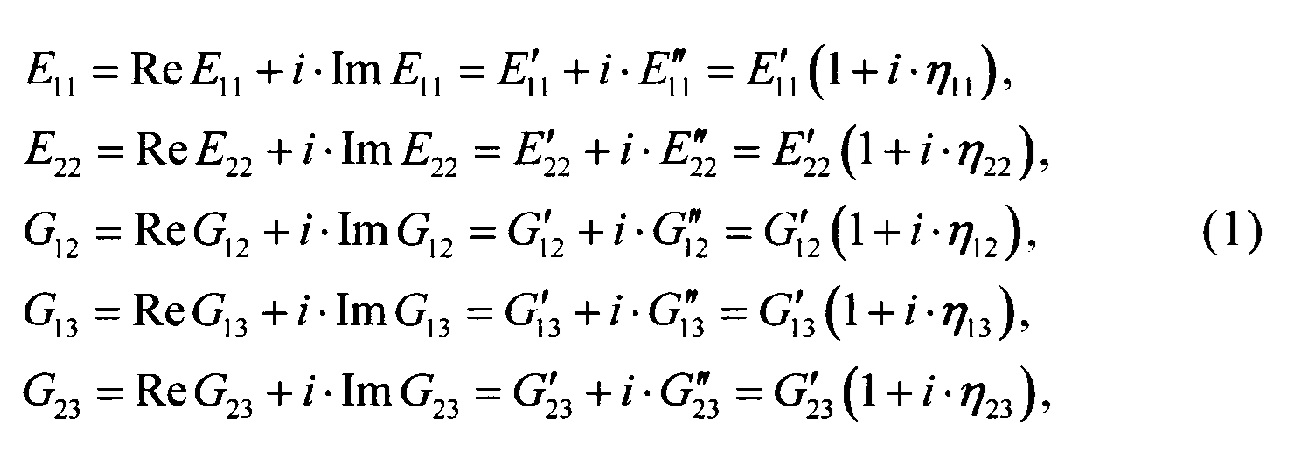
гдеWhere
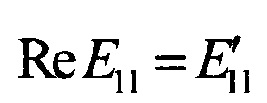
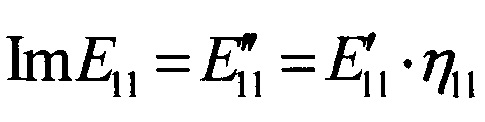
η11 - коэффициент механических потерь при изгибе образца в направлении основы армирующего материала (θ=0°);η 11 is the coefficient of mechanical losses in the bending of the sample in the direction of the base of the reinforcing material (θ = 0 °);

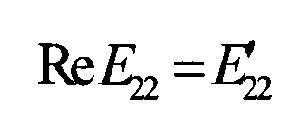

η22 - коэффициент механических потерь при изгибе образца в направлении утка армирующего материала (θ=90°);η 22 is the coefficient of mechanical loss in bending the specimen in the weft direction of the reinforcing material (θ = 90 °);


η12 - коэффициент механических потерь при сдвиге ПКМ в плоскости армирования;η 12 is the mechanical loss factor for the PCM shift in the reinforcement plane;
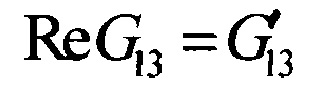
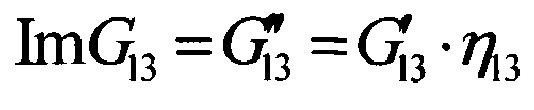
η13 - коэффициент механических потерь при межслойном сдвиге ПКМ в направлении основы армирующего материала (θ=0°);η 13 is the coefficient of mechanical losses in the interlayer shift of PCM in the direction of the base of the reinforcing material (θ = 0 °);
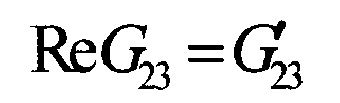

η23 - коэффициент механических потерь при межслойном сдвиге ПКМ в направлении утка армирующего материала (θ=90°).η 23 is the coefficient of mechanical losses in the interlaminar shift of PCM in the direction of the weft of the reinforcing material (θ = 90 °).
Известен способ определения упругих свойств ПКМ [Патент на изобретение RU 2517989 С1, Опубликовано: 10.06.2014 Бюл. №16]. Способ заключается в возбуждении колебаний образца ПКМ в виде прямоугольной пластины со свободными краями и определении ее частот и форм собственных колебаний. Упругие характеристики ПКМ определяются путем перебора значений модулей упругости, модулей сдвига и коэффициентов Пуассона, подставляя их в математическую модель пластины и сравнивая каждый раз вычисленную частоту колебаний для каждой формы колебаний с частотами и формами колебаний, полученными экспериментально. В итоге определяются девять упругих постоянных. Недостатком указанного способа является высокая трудоемкость, а также необходимость определять большое кол-во собственных частот и форм колебаний образцов с высокой точностью. Кроме того, указанный способ имеет узкую область применения, а именно не позволяет определять диссипативные характеристики ПКМ.There is a method of determining the elastic properties of PCM [Patent for invention RU 2517989 C1, Published: 06/10/2014 Byul. No. 16]. The method consists in exciting oscillations of a PCM sample in the form of a rectangular plate with free edges and determining its frequencies and natural oscillation shapes. The elastic PCM characteristics are determined by iterating the elastic moduli, shear moduli, and Poisson’s ratios, substituting them into a mathematical model of the plate and comparing each time the calculated oscillation frequency for each waveform with the frequencies and waveforms obtained experimentally. As a result, nine elastic constants are determined. The disadvantage of this method is the high complexity, as well as the need to determine a large number of natural frequencies and modes of oscillation of samples with high accuracy. In addition, this method has a narrow scope, and it does not allow to determine the dissipative characteristics of the PCM.
Известен также способ определения механических свойств материалов [ASTM Standard Е1876-01, Standard test method for dynamic Young's modulus, shearmodulus, and Poisson's ratio by impulse excitation of vibration, Book of Standards, Volume 03]. Способ заключается в возбуждении колебаний образца материалов и определении, как правило, его собственных частот первого тона колебаний. Полученные собственные частоты подставляются в частотное уравнение, из которого, определяют упругие постоянные. Образцы, как правило, имеют простую геометрическую форму в виде балок. Данный способ может быть использован для изотропных материалов, но неприемлем для образцов ортотропных ПКМ. Кроме того, указанный способ имеет узкую область применения, а именно не позволяет определять диссипативные характеристики ПКМ.There is also known a method for determining the mechanical properties of materials [ASTM Standard Е1876-01, Standard for modulation, shearmodulus, and Poisson's Book of Standards, Volume 03]. The method consists in exciting oscillations of a sample of materials and determining, as a rule, its own frequencies of the first tone of oscillations. The resulting natural frequencies are substituted into the frequency equation, from which, determine the elastic constants. Samples, as a rule, have a simple geometric shape in the form of beams. This method can be used for isotropic materials, but is unacceptable for orthotropic PCM samples. In addition, this method has a narrow scope, and it does not allow to determine the dissipative characteristics of the PCM.
Известен также способ определения механических свойств материалов [ГОСТ 23813-79 «Стеклопластики конструкционные для судостроения. Метод определения модуля упругости»]. Указанный подход основан на экспериментальном определении изгибных собственных частот призматических образцов с углами вырезки θ=0,90°. Способ дает возможность определять только главные динамические модули упругости ReE11, ReE22 и имеет узкую область применения, а именно не позволяет определять диссипативные характеристики ПКМ.There is also known a method for determining the mechanical properties of materials [GOST 23813-79 "Structural glass reinforced plastics for shipbuilding. Method of determining the modulus of elasticity "]. This approach is based on the experimental determination of flexural natural frequencies of prismatic samples with cutting angles θ = 0.90 °. The method makes it possible to determine only the main dynamic elastic moduli of ReE 11 , ReE 22 and has a narrow scope, in particular, it does not allow the determination of dissipative characteristics of PCM.
Наиболее близким к предлагаемому техническому решению является способ [ГОСТ 23814-79 «Стеклопластики конструкционные для судостроения. Метод определения модулей сдвига»]. Указанный подход основан на экспериментальном определении крутильных собственных частот призматических образцов в виде безопорных балок с углами вырезки θ=0, 90° с высотой сечения а и 2а. При определении модулей сдвига ReG12, ReG13, ReG23 используются зависимости, связывающие частоты собственных крутильных колебаний ортотропного стержня с модулями сдвига. Для нахождения этих зависимостей решается статическая задача о кручении ортотропного прямоугольного стержня, которая сводится к интегрированию уравнения Пуассона. Указанный метод не обеспечивает точного определения упругих характеристик. Кроме того, указанный способ имеет узкую область применения, а именно не позволяет определять диссипативные характеристики ПКМ.The closest to the proposed technical solution is the method [GOST 23814-79 "Fiberglass construction for shipbuilding. Method for determining the shear moduli "]. This approach is based on the experimental determination of torsional natural frequencies of prismatic samples in the form of unsupported beams with cutting angles θ = 0, 90 ° with a section height a and 2 a . When determining the shear moduli ReG 12 , ReG 13 , ReG 23 , dependences are used that relate the frequencies of the natural torsional vibrations of an orthotropic rod to the shear moduli. To find these dependencies, the static problem of the torsion of an orthotropic rectangular rod is solved, which reduces to integrating the Poisson equation. The specified method does not provide an accurate determination of the elastic characteristics. In addition, this method has a narrow scope, and it does not allow to determine the dissipative characteristics of the PCM.
Техническим результатом настоящего изобретения является возможность определения комплексных модулей упругости Е11, E22 и сдвига G12, G13, G23, необходимых для полного описания динамического поведения тонкостенных конструкций, включающие в себя жесткостные и диссипативные характеристики ортотропного ПКМ, имеющие высокую точностью и достоверность.The technical result of the present invention is the ability to determine the complex moduli of elasticity E 11 , E 22 and the shear G 12 , G 13 , G 23 necessary for a complete description of the dynamic behavior of thin-walled structures, including the stiffness and dissipative characteristics of orthotropic PCM, which have high accuracy and reliability .
Технический результат достигается следующим образом. Способ определения упругих и диссипативных характеристик композиционного материала, заключающийся в обработке экспериментальных значений собственных частот и соответствующих этим частотам коэффициентов механических потерь низших тонов изгибных и крутильных колебаний безопорных балок, вырезанных из пластины ортотропного полимерного композиционного материала под углом 0, 45, 90°. В способе реализована возможность определять диссипативные характеристики полимерных композиционных материалов, при этом используется в своей основе процедура последовательных приближений, в соответствии с которой начальные значения динамических модулей упругости в направлении основы и утка армирующего материала, модуля сдвига в плоскости армирования и межслойных модулей сдвига в направлении основы и утка, определенными при помощи собственных частот первого тона изгибных и крутильных колебаний, а также соответствующим им коэффициентов потерь, уточняются при помощи зависимостей, основанных на теории колебаний балки Тимошенко, используя значения собственных частот и соответствующих коэффициентов потерь изгибных колебаний безопорных балок полимерных композиционных материалов более высоких тонов.The technical result is achieved as follows. The method of determining the elastic and dissipative characteristics of a composite material, which consists in processing the experimental values of the natural frequencies and the corresponding mechanical loss coefficients of the lower tones of the flexural and torsional vibrations of the supportless beams cut from an orthotropic polymer composite plate at an angle of 0, 45, 90 °. The method realizes the ability to determine the dissipative characteristics of polymeric composite materials, using basically the procedure of successive approximations, according to which the initial values of the dynamic elastic moduli in the direction of the warp and weft of the reinforcing material, shear modulus in the plane of the reinforcement and interlayer shear moduli and weft, determined using the natural frequencies of the first tone of the bending and torsional vibrations, as well as the corresponding coefficient ENTOV losses refined using dependency based on the theory of Timoshenko beam vibrations using the values of natural frequencies and the corresponding coefficients of loss of flexural vibrations unsupported beams polymer composites of higher tones.
Количество образцов равно трем.The number of samples is three.
Указанные существенные признаки способа обеспечивают решение поставленной задачи с достижением заявленного технического результата. Блок-схема итерационной процедуры уточнения вещественных и мнимых частей комплексных модулей упругости и сдвига, раскрывающая сущность изобретения приведена на фиг. 2.These essential features of the method provide a solution to the problem with the achievement of the stated technical result. The block diagram of the iterative procedure for the refinement of the real and imaginary parts of the complex modules of elasticity and shear, revealing the essence of the invention is shown in FIG. 2
На фиг. 2 показано, что на первом шаге по первой собственной частоте ƒ1И(θ) изгибных колебаний, а также соответствующем коэффициенте потерь η1И(θ) определяются начальные значения динамических модулей упругости Е'(θ) стержневых образцов ПКМ (θ=0, 45, 90°). Далее при помощи коэффициента Пуассона ν12, а также полученных комплексных модулей упругости E11=E(0°), E(45°), E22=E(90°) определяется начальное значение комплексного модуля сдвига в плоскости укладки слоев армирующих волокон G12. При помощи зависимостей, связывающих частоты собственных крутильный колебаний ƒ1К(θ), а также соответствующих коэффициентов потерь η1К(θ) образцов ПКМ (θ=0°, 90°) с модулями сдвига, определяются начальные значения комплексных модулей межслойного сдвига G13, G23. На следующем шаге начальные значения E11=Е(0°), E(45°), Е22=E(90°) уточняются с учетом известных G13, G23 по значениям собственных частот ƒ2И(θ), ƒ3И(θ) и соответствующих коэффициентов потерь η2И(θ), η3И(θ) второго и третьего тонов изгибных колебаний. Указанная процедура повторяется до тех пор, пока две следующие друг за другом последовательности вещественных и мнимых частей комплексных модулей упругости и комплексных модулей сдвига не станут практически неизменны.FIG. 2 shows that, at the first step, the initial values of the dynamic elastic moduli E '(θ) of the PCM core samples (θ = 0, 45) determine the initial values of the first bend eigenfrequency ƒ 1И (θ) of flexural vibrations, as well as the corresponding loss coefficient η 1И (θ) 90 °). Next, using the Poisson's ratio ν 12 , as well as the obtained complex elastic moduli E 11 = E (0 °), E (45 °), E 22 = E (90 °), the initial value of the complex shear modulus in the plane of the reinforcing fiber layers G is determined 12 With the help of dependencies connecting the frequencies of natural torsional vibrations ƒ 1К (θ), as well as the corresponding loss coefficients η 1К (θ) of PCM samples (θ = 0 °, 90 °) with shear moduli, the initial values of the complex interlayer shear moduli G 13 are determined, G 23 . In the next step, the initial values of E 11 = E (0 °), E (45 °), E 22 = E (90 °) are refined taking into account the known G 13 , G 23 according to the values of natural frequencies ƒ 2И (θ), ƒ 3И ( θ) and the corresponding loss coefficients η 2И (θ), η 3И (θ) of the second and third tones of flexural vibrations. This procedure is repeated until the two successive sequences of real and imaginary parts of the complex elastic moduli and complex shear moduli become practically unchanged.
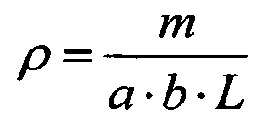
Способ определения модулей упругости и диссипативных характеристик ПКМ осуществляется следующим образом. Из исследуемого материала под углом θ=0, 45, 90° к направлению основного армирования материала вырезают балки постоянного по длине поперечного сечения с размерами L×a×b (см. рис. 1). С целью минимизации экспериментальных погрешностей рекомендуется использовать образцы со следующими геометрическими характеристиками для углепластиков: 1.5≤a/b≤3, L/a≥30 и для стеклопластиков 1/3≤a/b≤2/3, L/a≥15. Перед началом испытаний производят измерения длины, ширины, высоты сечения образцов, а также их массы. Производят возбуждения колебаний образцов ПКМ импульсной силой и определяют их частотные характеристики. По полученным частотным характеристикам путем анализа форм колебаний определяются собственные частоты первых трех тонов ƒ1И(θ), ƒ2И(θ), ƒ3И(θ) изгибных колебаний образцов ПКМ, вырезанных под углами θ=0, 45, 90° и первого тона крутильных ƒ1К(θ) колебаний образцов, вырезанных под углами θ=0,90°, а также соответствующие этим частотам коэффициенты потерь η1И(θ), η2И(θ), η3И(θ), η1К(θ) (см. формулу 3).The method of determining the elastic modulus and dissipative characteristics of the PCM is as follows. Beams of constant length along the cross section with dimensions L × a × b are cut out of the material under study at an angle θ = 0, 45, 90 ° to the direction of the main reinforcement of the material (see Fig. 1). In order to minimize experimental errors, it is recommended to use samples with the following geometrical characteristics for carbon plastics: 1.5≤a / b≤3, L / a≥30 and for glass-reinforced

где ƒ0 - резонансная частота; ƒ2, ƒ1 - частоты, соответствующие уровню 0.707 от максимальной амплитуды виброускорений на резонансной частоте.where ƒ 0 is the resonant frequency; ƒ 2 , ƒ 1 - frequencies corresponding to the level of 0.707 of the maximum amplitude of vibration accelerations at the resonant frequency.
Начальные значения вещественных частей комплексных модулей упругости ReE(θ) в направлениях θ=0, 45, 90° (ReE(0°)=ReE11, ReE(45°)=E'(45°), ReE(90°)=ReE22) определяются по полученным из эксперимента величинам резонансных частот 1-го тона изгибных колебаний образцов ПКМ ƒ1И(θ) по формуле:The initial values of the real parts of the complex elastic moduli ReE (θ) in the directions θ = 0, 45, 90 ° (ReE (0 °) = ReE 11 , ReE (45 °) = E '(45 °), ReE (90 °) = ReE 22 ) are determined from the experimentally obtained values of the resonance frequencies of the 1st tone of flexural oscillations of PCM ƒ 1I (θ) samples using the formula:

Начальные значения коэффициентов механических потерь η(θ) при изгибе образцов в направлениях θ=0, 45, 90° определяются по формуле (3) как наименьшая из экспериментально определенных величин коэффициентов механических потерь, соответствующих двум первым резонансным частотам изгибных колебаний образцов ПКМ.The initial values of the mechanical loss coefficients η (θ) during bending of the samples in the directions θ = 0, 45, 90 ° are determined by the formula (3) as the smallest of the experimentally determined values of the mechanical loss coefficients corresponding to the two first resonant frequencies of bending oscillations of PCM samples.
Начальное значение комплексного модуля сдвига в плоскости армирования G12 вычисляется из соотношения:The initial value of the complex shear modulus in the reinforcement plane G 12 is calculated from the relationship:

где E(45°)=E'(45°)(1+i⋅η(45°)), ν12 - коэффициент Пуассона, определяемый из статических испытаний на одноосное растяжение.where E (45 °) = E '(45 °) (1 + i⋅η (45 °)), ν 12 - Poisson's ratio, determined from static tests for uniaxial tension.
Значения комплексной крутильной жесткости С(θ) образцов, вырезанных в направлениях θ=0,90°, определяются по полученным из эксперимента величинам собственных частот 1-ого тона крутильных колебаний ƒ1К(θ) образцов ПКМ, а также соответствующим им коэффициентам механических потерь η1К(θ), по формуле:The values of complex torsional rigidity C (θ) of samples cut in the directions θ = 0.90 ° are determined from the experimentally obtained values of the eigenfrequencies of the 1st tone of torsional vibrations ƒ 1К (θ) of PCM samples and the corresponding mechanical loss coefficients η 1K (θ), according to the formula:

гдеWhere

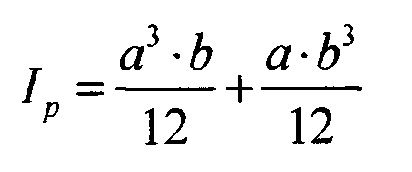

η1К(θ) - коэффициент механических потерь при кручении образца ПКМ вычисляемый по формуле (3).η 1К (θ) is the coefficient of mechanical losses during the torsion of the PCM sample calculated by the formula (3).
По вычисленным начальным значениям комплексного модуля сдвига G12 в плоскости армирования и комплексной крутильной жесткости С(θ) образцов ПКМ, вырезанных в направлениях θ=0,90° определяются начальные значения комплексных модулей межслойного сдвига G13, G23 в направлениях основы и утка армирующего материала из соотношений:Based on the calculated initial values of the complex shear modulus G 12 in the plane of reinforcement and complex torsional rigidity C (θ) of PCM samples cut in the directions θ = 0.90 °, the initial values of the complex interlayer shear modules G 13 and G 23 are determined in the directions of the warp and weft of the reinforcing material from ratios:

где z0, z90 определяются из решения задачи минимизации |Ψ(z)| →min выражения:where z 0 , z 90 are determined by solving the minimization problem | Ψ (z) | → min expressions:

При численной реализации задачи минимизации рекомендуется использовать алгоритм №178 прямого поиска точки минимума [5], для которого требуются лишь начальное приближение к искомому решению Z и значения функции Ψ(z) в соответствующих точках. В качестве начального приближения берется точка:In the numerical implementation of the minimization problem, it is recommended to use the algorithm No. 178 of direct search for the minimum point [5], which requires only an initial approximation to the desired solution Z and the values of the function Ψ (z) at the corresponding points. The point is taken as the initial approximation:
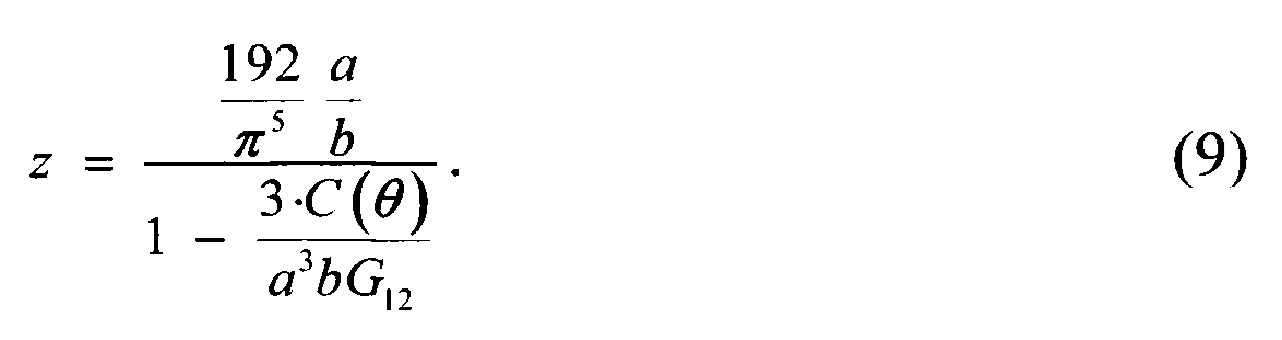
Начальное значение комплексного модуля межслойного сдвига G(45°) по вычисленным начальным значениям комплексных модулей межслойного сдвига G13, G23 определяется из соотношения:The initial value of the complex interlayer shear modulus G (45 °) from the calculated initial values of the complex interlayer shear moduli G 13 , G 23 is determined from the relation:

Полученные начальные значения комплексных модулей упругости E11=E(0°), E(45°), Е22=E(90°) и комплексных модулей сдвига G12, G13, G23 подвергаются итерационной процедуре уточнения (см. фиг. 2).The obtained initial values of complex elastic moduli E 11 = E (0 °), E (45 °), E 22 = E (90 °) and complex shear moduli G 12 , G 13 , G 23 are subjected to an iterative refinement procedure (see FIG. 2).
Уточнение начальных значений ReE(θ)=E'(θ) и ImE(θ)=Е''(θ) θ=0, 45, 90° выполняется на основе теории затухающих колебаний балки Тимошенко. Для этого используются экспериментально определенные величины собственных частот изгибных колебаний второго ƒ2И(θ) и третьего ƒ3И(θ) тонов, а также соответствующие этим частотам величины коэффициентов механических потерь η2И(θ), η3И(θ).The refinement of the initial values ReE (θ) = E '(θ) and ImE (θ) = E''(θ) θ = 0, 45, 90 ° is performed on the basis of the theory of damped oscillations of Timoshenko's beam. For this purpose, the experimentally determined values of the natural frequencies of the flexural oscillation ƒ 2I second (θ) and third ƒ 3I (θ) tones, and corresponding to these frequency values of the coefficients 2I mechanical loss η (θ), 3I η (θ).
Уточненные комплексные модули упругости определяются из решения задачи минимизации ⎪Ψ(Eii, Gij)⎪→min выражения:Refined complex elastic moduli are determined by solving the minimization problem ⎪Ψ (E ii , G ij ) ⎪ → min of the expression:

гдеWhere
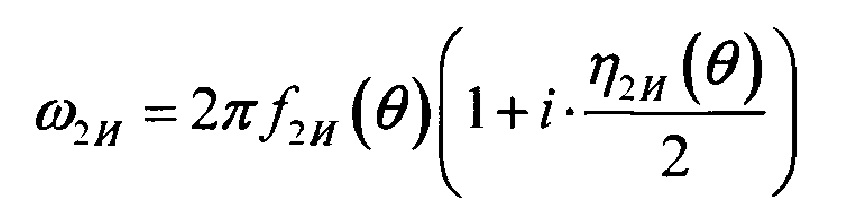
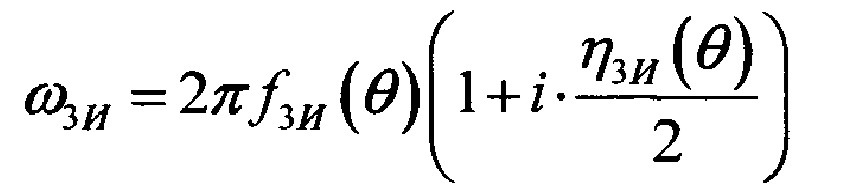
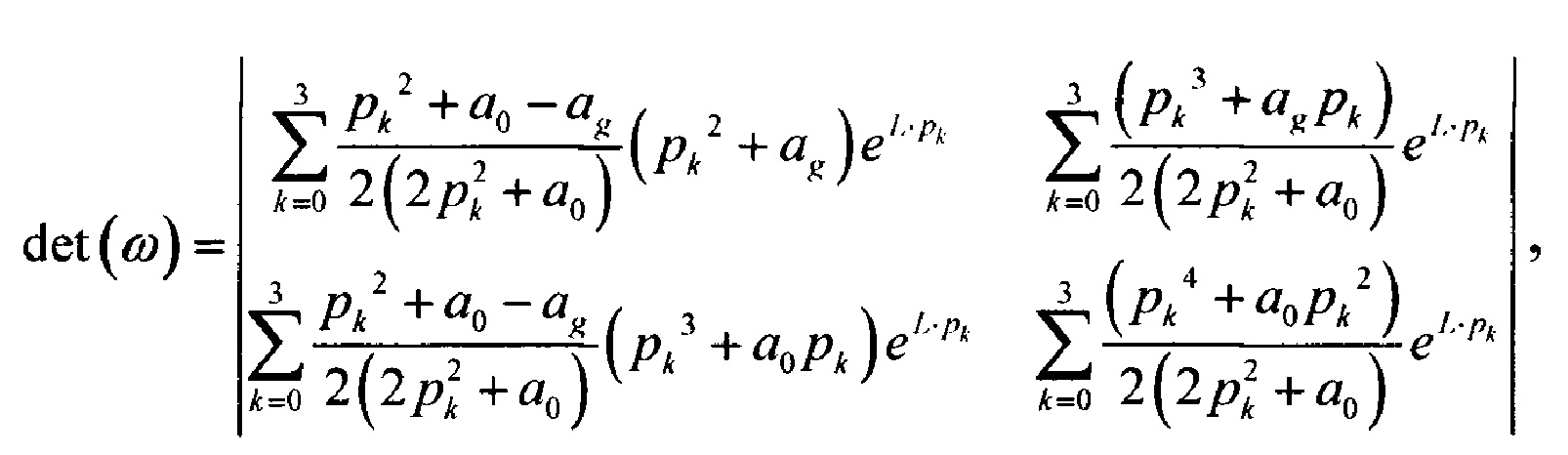
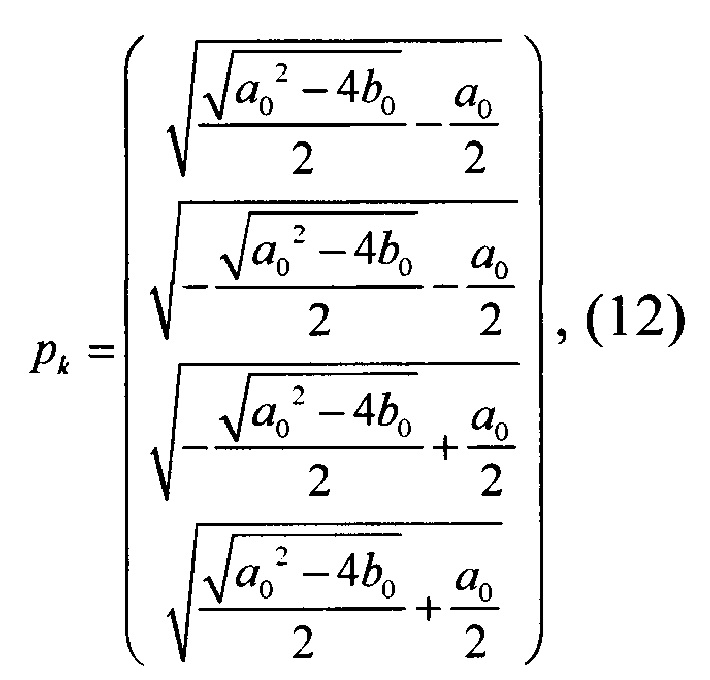
где 
При численной реализации задачи минимизации рекомендуется воспользоваться процедурой прямого поиска точки глобального минимума [Библиотека алгоритмов 1516 - 2006 // Под ред. Агеева М.И. М.: Радио и связь. 1981, 184 с.] функции (11).In the numerical implementation of the minimization problem, it is recommended to use the procedure of direct search for a global minimum point [Algorithm Library 1516 - 2006 // Ed. Ageeva M.I. M .: Radio and communication. 1981, 184 s.] Functions (11).
Уточненные значения ReE(θ)=Е'(θ) и ImE(θ)=Е''(θ) θ=0, 45, 90° влекут за собой новые значения вещественной 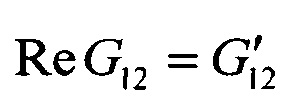
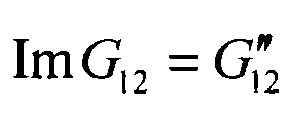
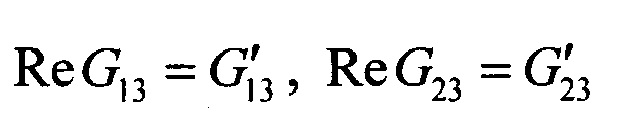

Указанная процедура повторяется до тех пор, пока две следующие друг за другом последовательности вещественных и мнимых частей комплексных модулей упругости Е11=E(0°), E(45°), Е22=E(90°) и комплексных модулей сдвига G12, G13, G23 не станут практически неизменны (рекомендуемое отличие 1%).This procedure is repeated until two successive sequences of real and imaginary parts of complex elastic moduli are E 11 = E (0 °), E (45 °), E 22 = E (90 °) and complex shear moduli G 12 , G 13 , G 23 will not become almost unchanged (the recommended difference is 1%).
Таким образом, предложенный способ определения упругих и диссипативных характеристик полимерного композиционного материала дает возможность определять диссипативные свойства, а также позволяет повысить точность и достоверность определения жесткостных постоянных ортотропного ПКМ.Thus, the proposed method for determining the elastic and dissipative characteristics of a polymer composite material makes it possible to determine dissipative properties, as well as to improve the accuracy and reliability of the determination of rigid constants of orthotropic PCM.
Claims (2)
Priority Applications (1)
| Application Number | Priority Date | Filing Date | Title |
|---|---|---|---|
| RU2018130542A RU2687503C1 (en) | 2018-08-22 | 2018-08-22 | Method of determining elastic and dissipative characteristics of composite material |
Applications Claiming Priority (1)
| Application Number | Priority Date | Filing Date | Title |
|---|---|---|---|
| RU2018130542A RU2687503C1 (en) | 2018-08-22 | 2018-08-22 | Method of determining elastic and dissipative characteristics of composite material |
Publications (1)
| Publication Number | Publication Date |
|---|---|
| RU2687503C1 true RU2687503C1 (en) | 2019-05-14 |
Family
ID=66578728
Family Applications (1)
| Application Number | Title | Priority Date | Filing Date |
|---|---|---|---|
| RU2018130542A RU2687503C1 (en) | 2018-08-22 | 2018-08-22 | Method of determining elastic and dissipative characteristics of composite material |
Country Status (1)
| Country | Link |
|---|---|
| RU (1) | RU2687503C1 (en) |
Citations (5)
| Publication number | Priority date | Publication date | Assignee | Title |
|---|---|---|---|---|
| SU697874A1 (en) * | 1978-04-10 | 1979-11-15 | Предприятие П/Я А-1944 | Method of determining shear modulus of orthotropic materials |
| US4321981A (en) * | 1980-02-11 | 1982-03-30 | Conoco, Inc. | Combination shear wave and compressional wave seismic energy vibrator |
| SU983508A1 (en) * | 1981-06-11 | 1982-12-23 | Предприятие П/Я А-1944 | Orthotrope material dynamic rigidity modulus and dynamic modulus of elasticity determination method |
| SU1366912A1 (en) * | 1984-12-29 | 1988-01-15 | Серпуховское высшее военное командно-инженерное училище ракетных войск им.Ленинского комсомола | Method of determining physico-mechanical characteristics of orthotropic materials |
| RU2517989C1 (en) * | 2012-12-05 | 2014-06-10 | Федеральное государственное унитарное предприятие "Центральный институт авиационного моторостроения им. П.И. Баранова" | Method for determination of composite material properties |
-
2018
- 2018-08-22 RU RU2018130542A patent/RU2687503C1/en active
Patent Citations (5)
| Publication number | Priority date | Publication date | Assignee | Title |
|---|---|---|---|---|
| SU697874A1 (en) * | 1978-04-10 | 1979-11-15 | Предприятие П/Я А-1944 | Method of determining shear modulus of orthotropic materials |
| US4321981A (en) * | 1980-02-11 | 1982-03-30 | Conoco, Inc. | Combination shear wave and compressional wave seismic energy vibrator |
| SU983508A1 (en) * | 1981-06-11 | 1982-12-23 | Предприятие П/Я А-1944 | Orthotrope material dynamic rigidity modulus and dynamic modulus of elasticity determination method |
| SU1366912A1 (en) * | 1984-12-29 | 1988-01-15 | Серпуховское высшее военное командно-инженерное училище ракетных войск им.Ленинского комсомола | Method of determining physico-mechanical characteristics of orthotropic materials |
| RU2517989C1 (en) * | 2012-12-05 | 2014-06-10 | Федеральное государственное унитарное предприятие "Центральный институт авиационного моторостроения им. П.И. Баранова" | Method for determination of composite material properties |
Similar Documents
| Publication | Publication Date | Title |
|---|---|---|
| Berthelot et al. | Damping analysis of unidirectional glass and Kevlar fibre composites | |
| Araújo et al. | Characterization of material parameters of composite plate specimens using optimization and experimental vibrational data | |
| Araujo et al. | Combined numerical–experimental model for the identification of mechanical properties of laminated structures | |
| Maheri et al. | Vibration damping in sandwich panels | |
| Wojtczak et al. | Damage imaging algorithm for non-destructive inspection of CFRP/steel adhesive joints based on ultrasonic guided wave propagation | |
| Essassi et al. | Dynamic characterization of a bio-based sandwich with auxetic core: Experimental and numerical study | |
| Sol et al. | Identification of the viscoelastic material properties of orthotropic plates using a mixed numerical/experimental technique | |
| Berthelot et al. | Damping analysis of unidirectional glass fiber composites with interleaved viscoelastic layers: experimental investigation and discussion | |
| Ben et al. | Damping measurement in composite materials using combined finite element and frequency response method | |
| RU2687503C1 (en) | Method of determining elastic and dissipative characteristics of composite material | |
| Bert et al. | Evaluation of experimental methods for determining dynamic stiffness and damping of composite materials | |
| Ayorinde et al. | On the elastic characterization of composite plates with vibration data | |
| RU2517989C1 (en) | Method for determination of composite material properties | |
| Nikhamkin et al. | Degradation of elastic characteristics of the CFRP used in the design of a gas turbine engine as a result of high-cycle fatigue damage | |
| Jalili et al. | A comparative study on viscoelastic properties of polymeric composites measured by a longitudinal free vibration non-destructive test and dynamic mechanical thermal analysis | |
| Hammami et al. | Vibration behavior of composite material with two overlapping delaminations | |
| Gibson | Vibration-test methods for dynamic-mechanical-property characterization | |
| Wesolowski et al. | Characterisation of elastic properties of laminated composites by non-destructive techniques | |
| Ragavan et al. | Evaluation and modeling the static and free vibrational behaviours of AA3003/CFRP honeycomb sandwich structures | |
| Kulhavy et al. | Possibilities of the additional damping of unidirectional fiber composites by implementation of viscoelastic neoprene and rubber layers | |
| Kwon et al. | Cyclic Loading on Composite Beams with Fluid–Structure Interaction | |
| Dudek | Determination of the complex modulus of viscoelastic two-layer composite beams | |
| Turvey et al. | Free vibration of clamped pultruded GRP circular plates with central circular cut-outs | |
| Sol et al. | Impulse excitation technique for the determination of elastic engineering constants of CFRP composites | |
| Gibson | Elastic and dissipative properties of fiber-reinforced composite materials in flexural vibration. |