RU2685503C1 - Method of producing carbamide-formaldehyde concentrate - Google Patents
Method of producing carbamide-formaldehyde concentrate Download PDFInfo
- Publication number
- RU2685503C1 RU2685503C1 RU2018135839A RU2018135839A RU2685503C1 RU 2685503 C1 RU2685503 C1 RU 2685503C1 RU 2018135839 A RU2018135839 A RU 2018135839A RU 2018135839 A RU2018135839 A RU 2018135839A RU 2685503 C1 RU2685503 C1 RU 2685503C1
- Authority
- RU
- Russia
- Prior art keywords
- formaldehyde
- urea
- methanol
- carbamide
- concentrate
- Prior art date
Links
- WSFSSNUMVMOOMR-UHFFFAOYSA-N formaldehyde Substances O=C WSFSSNUMVMOOMR-UHFFFAOYSA-N 0.000 title claims abstract description 64
- 239000012141 concentrate Substances 0.000 title claims abstract description 20
- 238000000034 method Methods 0.000 title claims abstract description 14
- OKKJLVBELUTLKV-UHFFFAOYSA-N Methanol Chemical compound OC OKKJLVBELUTLKV-UHFFFAOYSA-N 0.000 claims abstract description 51
- XSQUKJJJFZCRTK-UHFFFAOYSA-N Urea Chemical compound NC(N)=O XSQUKJJJFZCRTK-UHFFFAOYSA-N 0.000 claims abstract description 49
- 239000004202 carbamide Substances 0.000 claims abstract description 25
- XLYOFNOQVPJJNP-UHFFFAOYSA-N water Substances O XLYOFNOQVPJJNP-UHFFFAOYSA-N 0.000 claims abstract description 10
- 239000003054 catalyst Substances 0.000 claims abstract description 8
- 238000003860 storage Methods 0.000 claims abstract description 6
- DSMZRNNAYQIMOM-UHFFFAOYSA-N iron molybdenum Chemical compound [Fe].[Fe].[Mo] DSMZRNNAYQIMOM-UHFFFAOYSA-N 0.000 claims abstract description 5
- 238000003973 irrigation Methods 0.000 claims abstract description 4
- 230000002262 irrigation Effects 0.000 claims abstract description 4
- 230000007935 neutral effect Effects 0.000 claims abstract description 4
- 238000011084 recovery Methods 0.000 claims abstract description 3
- 229920001807 Urea-formaldehyde Polymers 0.000 claims description 15
- ODGAOXROABLFNM-UHFFFAOYSA-N polynoxylin Chemical compound O=C.NC(N)=O ODGAOXROABLFNM-UHFFFAOYSA-N 0.000 claims description 13
- 239000000203 mixture Substances 0.000 claims description 12
- 239000007864 aqueous solution Substances 0.000 claims description 9
- WSFSSNUMVMOOMR-NJFSPNSNSA-N methanone Chemical compound O=[14CH2] WSFSSNUMVMOOMR-NJFSPNSNSA-N 0.000 claims description 7
- 238000005839 oxidative dehydrogenation reaction Methods 0.000 claims description 7
- DBQZBEMSTAEOOT-UHFFFAOYSA-M lithium azane bromide Chemical compound N.[Br-].[Li+] DBQZBEMSTAEOOT-UHFFFAOYSA-M 0.000 claims description 2
- 230000003647 oxidation Effects 0.000 claims description 2
- 238000007254 oxidation reaction Methods 0.000 claims description 2
- 235000013877 carbamide Nutrition 0.000 abstract description 24
- QGZKDVFQNNGYKY-UHFFFAOYSA-N Ammonia Chemical compound N QGZKDVFQNNGYKY-UHFFFAOYSA-N 0.000 abstract description 6
- 229910021529 ammonia Inorganic materials 0.000 abstract description 3
- 230000000694 effects Effects 0.000 abstract description 3
- 239000002351 wastewater Substances 0.000 abstract description 3
- 238000006243 chemical reaction Methods 0.000 abstract 1
- 230000003750 conditioning effect Effects 0.000 abstract 1
- 238000001816 cooling Methods 0.000 abstract 1
- 230000018044 dehydration Effects 0.000 abstract 1
- 238000006297 dehydration reaction Methods 0.000 abstract 1
- MGJURKDLIJVDEO-UHFFFAOYSA-N formaldehyde;hydrate Chemical compound O.O=C MGJURKDLIJVDEO-UHFFFAOYSA-N 0.000 abstract 1
- 230000001590 oxidative effect Effects 0.000 abstract 1
- 238000005057 refrigeration Methods 0.000 abstract 1
- 239000000126 substance Substances 0.000 abstract 1
- HEMHJVSKTPXQMS-UHFFFAOYSA-M Sodium hydroxide Chemical compound [OH-].[Na+] HEMHJVSKTPXQMS-UHFFFAOYSA-M 0.000 description 12
- 239000000243 solution Substances 0.000 description 11
- 238000010521 absorption reaction Methods 0.000 description 10
- 239000007789 gas Substances 0.000 description 8
- 238000004519 manufacturing process Methods 0.000 description 5
- 230000015572 biosynthetic process Effects 0.000 description 4
- 235000011121 sodium hydroxide Nutrition 0.000 description 4
- 239000006096 absorbing agent Substances 0.000 description 3
- 239000000654 additive Substances 0.000 description 3
- 230000000996 additive effect Effects 0.000 description 3
- -1 ammonia bromine-lithium Chemical compound 0.000 description 3
- 239000002918 waste heat Substances 0.000 description 3
- QMNWYGTWTXOQTP-UHFFFAOYSA-N 1h-triazin-6-one Chemical class O=C1C=CN=NN1 QMNWYGTWTXOQTP-UHFFFAOYSA-N 0.000 description 2
- IJGRMHOSHXDMSA-UHFFFAOYSA-N Atomic nitrogen Chemical compound N#N IJGRMHOSHXDMSA-UHFFFAOYSA-N 0.000 description 2
- LCGLNKUTAGEVQW-UHFFFAOYSA-N Dimethyl ether Chemical compound COC LCGLNKUTAGEVQW-UHFFFAOYSA-N 0.000 description 2
- 229910001309 Ferromolybdenum Inorganic materials 0.000 description 2
- 239000003513 alkali Substances 0.000 description 2
- 150000001412 amines Chemical class 0.000 description 2
- 238000004364 calculation method Methods 0.000 description 2
- 239000003795 chemical substances by application Substances 0.000 description 2
- 238000010586 diagram Methods 0.000 description 2
- 230000007613 environmental effect Effects 0.000 description 2
- BDAGIHXWWSANSR-UHFFFAOYSA-N methanoic acid Natural products OC=O BDAGIHXWWSANSR-UHFFFAOYSA-N 0.000 description 2
- 229920005989 resin Polymers 0.000 description 2
- 239000011347 resin Substances 0.000 description 2
- 238000003786 synthesis reaction Methods 0.000 description 2
- OSWFIVFLDKOXQC-UHFFFAOYSA-N 4-(3-methoxyphenyl)aniline Chemical compound COC1=CC=CC(C=2C=CC(N)=CC=2)=C1 OSWFIVFLDKOXQC-UHFFFAOYSA-N 0.000 description 1
- RWSOTUBLDIXVET-UHFFFAOYSA-N Dihydrogen sulfide Chemical compound S RWSOTUBLDIXVET-UHFFFAOYSA-N 0.000 description 1
- 239000004280 Sodium formate Substances 0.000 description 1
- 238000006423 Tishchenko reaction Methods 0.000 description 1
- 239000000853 adhesive Substances 0.000 description 1
- 238000004026 adhesive bonding Methods 0.000 description 1
- 230000001070 adhesive effect Effects 0.000 description 1
- 150000008044 alkali metal hydroxides Chemical class 0.000 description 1
- QVGXLLKOCUKJST-UHFFFAOYSA-N atomic oxygen Chemical compound [O] QVGXLLKOCUKJST-UHFFFAOYSA-N 0.000 description 1
- OHJMTUPIZMNBFR-UHFFFAOYSA-N biuret Chemical compound NC(=O)NC(N)=O OHJMTUPIZMNBFR-UHFFFAOYSA-N 0.000 description 1
- 230000003197 catalytic effect Effects 0.000 description 1
- 230000000052 comparative effect Effects 0.000 description 1
- 238000005516 engineering process Methods 0.000 description 1
- 239000003063 flame retardant Substances 0.000 description 1
- 235000019253 formic acid Nutrition 0.000 description 1
- 229910000037 hydrogen sulfide Inorganic materials 0.000 description 1
- 238000009434 installation Methods 0.000 description 1
- 239000003621 irrigation water Substances 0.000 description 1
- 239000007788 liquid Substances 0.000 description 1
- 229910052757 nitrogen Inorganic materials 0.000 description 1
- 239000003921 oil Substances 0.000 description 1
- 239000001301 oxygen Substances 0.000 description 1
- 229910052760 oxygen Inorganic materials 0.000 description 1
- 230000002028 premature Effects 0.000 description 1
- 238000002360 preparation method Methods 0.000 description 1
- 239000002994 raw material Substances 0.000 description 1
- 230000009257 reactivity Effects 0.000 description 1
- 238000004064 recycling Methods 0.000 description 1
- 238000010992 reflux Methods 0.000 description 1
- HLBBKKJFGFRGMU-UHFFFAOYSA-M sodium formate Chemical compound [Na+].[O-]C=O HLBBKKJFGFRGMU-UHFFFAOYSA-M 0.000 description 1
- 235000019254 sodium formate Nutrition 0.000 description 1
- 229910001220 stainless steel Inorganic materials 0.000 description 1
- 239000010935 stainless steel Substances 0.000 description 1
- 238000004448 titration Methods 0.000 description 1
- 231100000331 toxic Toxicity 0.000 description 1
- 230000002588 toxic effect Effects 0.000 description 1
- 230000001131 transforming effect Effects 0.000 description 1
- 239000003643 water by type Substances 0.000 description 1
- 239000002023 wood Substances 0.000 description 1
Images
Classifications
-
- C—CHEMISTRY; METALLURGY
- C08—ORGANIC MACROMOLECULAR COMPOUNDS; THEIR PREPARATION OR CHEMICAL WORKING-UP; COMPOSITIONS BASED THEREON
- C08G—MACROMOLECULAR COMPOUNDS OBTAINED OTHERWISE THAN BY REACTIONS ONLY INVOLVING UNSATURATED CARBON-TO-CARBON BONDS
- C08G12/00—Condensation polymers of aldehydes or ketones with only compounds containing hydrogen attached to nitrogen
- C08G12/02—Condensation polymers of aldehydes or ketones with only compounds containing hydrogen attached to nitrogen of aldehydes
- C08G12/04—Condensation polymers of aldehydes or ketones with only compounds containing hydrogen attached to nitrogen of aldehydes with acyclic or carbocyclic compounds
- C08G12/10—Condensation polymers of aldehydes or ketones with only compounds containing hydrogen attached to nitrogen of aldehydes with acyclic or carbocyclic compounds with acyclic compounds having the moiety X=C(—N<)2 in which X is O, S or —N
- C08G12/12—Ureas; Thioureas
-
- C—CHEMISTRY; METALLURGY
- C09—DYES; PAINTS; POLISHES; NATURAL RESINS; ADHESIVES; COMPOSITIONS NOT OTHERWISE PROVIDED FOR; APPLICATIONS OF MATERIALS NOT OTHERWISE PROVIDED FOR
- C09J—ADHESIVES; NON-MECHANICAL ASPECTS OF ADHESIVE PROCESSES IN GENERAL; ADHESIVE PROCESSES NOT PROVIDED FOR ELSEWHERE; USE OF MATERIALS AS ADHESIVES
- C09J161/00—Adhesives based on condensation polymers of aldehydes or ketones; Adhesives based on derivatives of such polymers
- C09J161/20—Condensation polymers of aldehydes or ketones with only compounds containing hydrogen attached to nitrogen
- C09J161/22—Condensation polymers of aldehydes or ketones with only compounds containing hydrogen attached to nitrogen of aldehydes with acyclic or carbocyclic compounds
- C09J161/24—Condensation polymers of aldehydes or ketones with only compounds containing hydrogen attached to nitrogen of aldehydes with acyclic or carbocyclic compounds with urea or thiourea
-
- Y—GENERAL TAGGING OF NEW TECHNOLOGICAL DEVELOPMENTS; GENERAL TAGGING OF CROSS-SECTIONAL TECHNOLOGIES SPANNING OVER SEVERAL SECTIONS OF THE IPC; TECHNICAL SUBJECTS COVERED BY FORMER USPC CROSS-REFERENCE ART COLLECTIONS [XRACs] AND DIGESTS
- Y02—TECHNOLOGIES OR APPLICATIONS FOR MITIGATION OR ADAPTATION AGAINST CLIMATE CHANGE
- Y02P—CLIMATE CHANGE MITIGATION TECHNOLOGIES IN THE PRODUCTION OR PROCESSING OF GOODS
- Y02P20/00—Technologies relating to chemical industry
- Y02P20/10—Process efficiency
Landscapes
- Chemical & Material Sciences (AREA)
- Organic Chemistry (AREA)
- Health & Medical Sciences (AREA)
- Chemical Kinetics & Catalysis (AREA)
- Medicinal Chemistry (AREA)
- Polymers & Plastics (AREA)
- Organic Low-Molecular-Weight Compounds And Preparation Thereof (AREA)
Abstract
Description
Изобретение относится к способам получения карбамидоформальдегидного концентрата с улучшенными свойствами и фракционным составом, применяемого в качестве сырья в производстве высококачественных малотоксичных смол, используемых для склеивания древесины, при получении ДСП, ДВП и МДФ класса эмиссии Е-0 по формальдегиду, при синтезе антипиренов, в производстве поглотителей сероводорода в нефтях, а также в роли антислеживающей добавки к карбамиду и других целей.The invention relates to methods for producing urea-formaldehyde concentrate with improved properties and fractional composition used as a raw material in the production of high-quality low-toxic resins used for gluing wood, upon receipt of particleboard E-0 formaldehyde, in the synthesis of fire retardants, in production hydrogen sulfide scavengers in oils, as well as an anti-caking agent for carbamide and other purposes.
Интерес к данному продукту обусловлен возросшими требованиями к охране окружающей среды на предприятиях деревообработки, производящих карбамидоформальдегидные смолы. По указанной причине наиболее перспективными являются технологические процессы, предусматривающие применение карбамидоформальдегидного концентрата с суммарным содержанием карбамида и формальдегида около 85% мас. (КФК-85). Его применение позволяет исключить образование более 200 тысяч тн/год высокотоксичных надсмольных вод, формирующихся на стадии получения клеевых композиций с использованием метанолсодержащего формалина [см. С.В. Афанасьев, С.В. Махлай. Карбамидоформальдегидный концентрат. Технология. Переработка. Монография. Под ред. д.т.н. Афанасьева С.В. Самара. Изд. Сам. научного центра РАН. 2012. - 298 с.].Interest in this product is due to the increased requirements for environmental protection in woodworking enterprises producing urea-formaldehyde resins. For this reason, the most promising are technological processes involving the use of urea-formaldehyde concentrate with a total content of urea and formaldehyde of about 85% wt. (KFK-85). Its use allows to exclude the formation of more than 200 thousand tons / year of highly toxic supra-resin waters, which are formed at the stage of obtaining adhesive compositions using methanol-containing formalin [see S.V. Afanasyev, S.V. Makhlay. Urea-formaldehyde concentrate. Technology. Recycling. Monograph. Ed. Doctor of Technical Sciences Afanasyev S.V. Samara. Ed. Himself. Scientific Center of RAS. 2012. - 298 p.].
Известен [RU №2142964, кл. C08G 12/12] способ получения карбамидоформальдегидного концентрата, включающий окислительное дегидрирование метанола на железомолибденовом катализаторе в реакторе трубчатого или полочного типа и стадию хемосорбции формальдегидсодержащего газа в трехсекционной колонне 50-65%-ным водным раствором карбамида с добавкой 0,05-2,0 мас. % амина, подаваемого на одну из тарелок абсорбционной колонны одновременно с раствором щелочи 12-24%-ной концентрации и поддержание на нижней и средней секциях колонны мольного соотношения формальдегид: карбамид 4,2-6,2 и 2,2-4,4 и рН 7,5-9,3 и 7,4-9,4, соответственно.Known [RU # 21292964, cl. C08G 12/12] method for producing urea-formaldehyde concentrate, including oxidative dehydrogenation of methanol on an iron-molybdenum catalyst in a tubular or shelf-type reactor and a stage of chemisorption of formaldehyde-containing gas in a three-section column with a 50-65% aqueous solution of urea with an additive of 0.05% and 2.0% . % amine supplied to one of the plates of the absorption column simultaneously with a solution of alkali 12-24% concentration and maintaining a formaldehyde: urea molar ratio of 4.2-6.2 and 2.2-4.4 and pH 7.5-9.3 and 7.4-9.4, respectively.
Варьирование содержания уроновых и триазиноновых производных в готовом продукте достигается изменением значений рН среды, содержания аминного компонента в растворе карбамида на нижней и средней секциях абсорбционной колонны.Varying the content of uronic and triazinone derivatives in the finished product is achieved by varying the pH values of the medium and the content of the amine component in the urea solution in the lower and middle sections of the absorption column.
К недостаткам рассматриваемого способа могут быть отнесены значительные колебания рН по секциям колонны, обусловленные изменением активности и селективности железомолибденового катализатора, режимов ведения процесса абсорбции, нестабильностью качества применяемого карбамида по буферной емкости.The disadvantages of this method can be attributed to significant fluctuations in pH in sections of the column, due to changes in the activity and selectivity of the iron-molybdenum catalyst, modes of the absorption process, instability of the quality of urea used in the buffer tank.
Известен метод получения карбамидоформальдегидного концентрата определенного состава [RU №2196147, кл. C08G 12/12] хемосорбцией формальдегидсодержащих газов, полученных окислительным дегидрированием метанола на железомолибденовом катализаторе, 50-65%-ным водным раствором карбамида, содержащим 0,05-2,0 мас. % аммиака на 100 мас. % карбамида, в трехсекционной колонне (абсорбере) до получения карбамидоформальдегидного концентрата с регулируемым содержанием уроновых и триазиноновых производных, которое достигается варьированием концентрации аммиака в растворе карбамида, мольного соотношения формальдегида и карбамида на средней и нижней секциях колонны, причем значения рН на заданном уровне поддерживают введением в раствор карбамида 0,05-0,5 мас. % буферной добавки на 100 мас. % карбамида.A known method of obtaining urea-formaldehyde concentrate of a certain composition [RU No. 2196147, cl. C08G 12/12] chemisorption of formaldehyde-containing gases obtained by the oxidative dehydrogenation of methanol on an iron-molybdenum catalyst, 50-65% aqueous solution of urea, containing 0.05-2.0 wt. % ammonia per 100 wt. % urea, in a three-section column (absorber) to obtain a urea-formaldehyde concentrate with adjustable content of uronic and triazinone derivatives, which is achieved by varying the concentration of ammonia in the urea solution, the molar ratio of formaldehyde and urea in the middle and lower sections of the column, the pH values at a given level supported by the introduction in a solution of urea 0.05-0.5 wt. % buffer additive per 100 wt. % urea
К недостаткам данного способа следует отнести невысокую суммарную концентрацию карбамида и формальдегида в производимом продукте (менее 80 мас. %) и его повышенную буферную емкость (более 20) из-за применения на стадии хемосорбции буферной добавки. Последнее обстоятельство негативно отражается на реакционной способности формальдегидного концентрата при синтезе карбамидоформальдегидных смол.The disadvantages of this method include the low total concentration of urea and formaldehyde in the product being produced (less than 80 wt.%) And its increased buffer capacity (more than 20) due to the use of a buffer additive at the chemisorption stage. The latter circumstance negatively affects the reactivity of the formaldehyde concentrate in the synthesis of urea-formaldehyde resins.
Наиболее близким по технической сущности является изобретение [RU №2331654, кл. C08G 12/12, C08L 61/24], предусматривающее хемосорбцию формальдегида, образующегося при окислительном дегидрировании метанола на железомолибденовом катализаторе в реакторе трубчатого или полочного типа 50-65%-ным водным раствором карбамида в нейтральной или слабощелочной среде в трехсекционной колонне с одновременным концентрированием продукта, причем удаление лишней воды достигается потоком формальдегидсодержащего абгаза из верха абсорбера, а регулирование буферной емкости осуществляется подачей раствора щелочного агента в нижнюю и тарельчатую секции, а также в куб абсорбционной колонны.The closest in technical essence is the invention [RU No. 2331654, cl. C08G 12/12, C08L 61/24], which provides for the chemisorption of formaldehyde, which is formed by the oxidative dehydrogenation of methanol on a ferro-molybdenum catalyst in a tubular or shelf-type reactor with a 50-65% aqueous solution of urea in a neutral or weakly alkaline medium in a three-section column with a simultaneous blend, with a single section, with a single section, with a single section, with a single concentrate , moreover, the removal of excess water is achieved by the flow of formaldehyde-containing abgas from the top of the absorber, and the regulation of the buffer tank is carried out by feeding a solution of an alkaline agent to the bottom and plate atuyu section, as well as cubic absorption column.
В указанном способе роль регулятора буферной емкости выполняет формиат натрия, образующийся в результате протекания реакции Канницаро - Тищенко на нижней и средней секциях и в кубе абсорбционной колонны, катализируемой гидроокисями щелочных металлов (NaOH, КОН) и Са(ОН)2.In this method, sodium formate, which is formed as a result of the Cannicaro-Tishchenko reaction, performs the role of regulator of the buffer capacity in the lower and middle sections and in the cube of the absorption column catalyzed by alkali metal hydroxides (NaOH, KOH) and Ca (OH) 2 .
2 CH2O+H2O → СН3ОН+НСООН2 CH 2 O + H 2 O → CH 3 OH + HCOO
НСООН+МеОН → МеОСОН+H2ONSON + MeON → MeOSON + H 2 O
К его недостаткам можно отнести образование значительных количеств сточных вод, загрязненных метанолом и формальдегидом, сбрасываемых с санитарной зоны абсорбера вследствие высокой температуры орошающей воды, повышенное содержание воды в абгазе, направляемом с потоком спирто-воздушной смеси в каталитический реактор, а также безвозвратные потери пара с котла-утилизатора с давлением 1,2 МПа путем его трансформации в конденсат. Согласно проведенным исследованиям увеличение содержание влаги в абгазе связано с высокой температурой воды, используемой для орошения верхней секции колонны (до 38°С в летнее время). Именно это обстоятельство способствует преждевременной потери активности катализатора и постепенному росту расходных норм метанола на тонну готовой продукции.Its disadvantages include the formation of significant amounts of wastewater contaminated with methanol and formaldehyde, discharged from the sanitary zone of the absorber due to the high temperature of the irrigation water, the high water content in the abgas, sent with a stream of alcohol-air mixture to the catalytic reactor, as well as irretrievable loss of steam waste heat boiler with a pressure of 1.2 MPa by transforming it into condensate. According to the research done, an increase in the moisture content of abgas is due to the high temperature of the water used to irrigate the upper section of the column (up to 38 ° C in the summer). This circumstance contributes to the premature loss of catalyst activity and the gradual growth of the consumption norms of methanol per tonne of finished products.
Технической задачей изобретения является оптимизация схемы получения карбамидоформальдегидного концентрата КФК-85 с целью повышения качества продукта и улучшения экологических показателей производства.An object of the invention is to optimize the scheme for obtaining urea-formaldehyde concentrate KFK-85 in order to improve the quality of the product and improve the environmental performance of production.
Поставленная задача достигается тем, что в технологическую схему установки включена аммиачная бромистолитиевая машина (АБХМ), работающая на паре котла-утилизатора, причем ее холод расходуется для получения захоложенной деминерализованной воды, подаваемой на орошение абгаза, и снижения температуры товарного карбамидоформальдегидного концентрата до 23-25°С с целью стабилизации его рН при храненииThe task is achieved by the fact that an ammonia bromine-lithium machine (ABCM) operating on a steam recovery boiler is included in the technological scheme of the installation, and its cold is consumed to produce cooled demineralized water supplied to the irrigation of the exhaust gas and reduce the temperature of the carbamide-formaldehyde concentrate to 23-25 ° C in order to stabilize its pH during storage
Сущностью предлагаемого технического решения является способ получения КФК-85, включающий хемосорбцию формальдегида, образующегося при окислительном дегидрировании метанола на железомолибденовом катализаторе в реакторе трубчатого или полочного типа, 50-65%-ным водным раствором карбамида в нейтральной или слабощелочной среде в трехсекционной колонне с одновременным удалением загрязненной метанолом и формальдегидом воды из ее верхней секции, причем орошение потока абгаза в ней производится захоложенной деминерализованной водой с температурой 18-22°С, полученной на аммиачной бромистолитиевой холодильной машине путем подачи на нее пара давлением до 1,2 МПа с котла утилизатора экзотермической реакции окисления метанола в формальдегид с одновременным использованием вырабатываемого ею холода для кондиционирования товарного карбамидоформальдегидного концентрата до температуры 23-25°С с целью стабилизации его рН при хранении.The essence of the proposed technical solution is a method for producing CFC-85, which includes chemisorption of formaldehyde, which is formed during the oxidative dehydrogenation of methanol on a ferro-molybdenum catalyst in a tubular or shelf-type reactor, with a 50-65% aqueous solution of urea in a neutral or weakly alkaline medium in a three-section column with a combined or molten solution. water polluted with methanol and formaldehyde from its upper section, and the reflux gas in it is irrigated with cooled, demineralized water at a rate of 18–22 ° C, obtained on an ammonia bromine-lithium chiller by supplying steam to it with pressure up to 1.2 MPa from the waste heat boiler for exothermic oxidation of methanol to formaldehyde while simultaneously using the cold produced by it to condition commercial urea-formaldehyde concentrate to a temperature of 23-25 ° C in order to stabilize its pH during storage.
Изобретение иллюстрируется примерами, полученными на абсорбционной колонне вертикального цилиндрического типа, имеющей кубовую часть, нижнюю и среднюю секции, тарельчатую часть и верхнюю (санитарную) зону. С целью повышения эффективности массообмена нижняя, средняя и верхняя секции заполнены кольцами Рашига из нержавеющей стали.The invention is illustrated by examples obtained on an absorption column of a vertical cylindrical type, having a cubic part, a lower and a middle section, a tray part and an upper (sanitary) zone. In order to increase the efficiency of mass transfer, the lower, middle and upper sections are filled with Raschig stainless steel rings.
Формальдегидсодержащий газ, поступающий на хемосорбцию из реактора окислительного дегидрирования метанола, имел состав, об. %:The formaldehyde-containing gas supplied to chemisorption from the oxidative dehydrogenation reactor of methanol had a composition, about. %:
Используемый карбамид соответствовал требованиям ГОСТ 2081 марки Б, содержание биурета в нем не превышало 1,2 мас. %.The carbamide used complied with the requirements of GOST 2081 Grade B, the biuret content in it did not exceed 1.2 wt. %
Буферная емкость карбамида, оцениваемая по объему 0,5 N раствора HCl. пошедшего на титрование 75 см3 1%-ного водного раствора мочевины, варьировала от 1,7 до 2,0.The buffer capacity of urea, estimated by the volume of 0.5 N HCl solution. followed by titration of 75
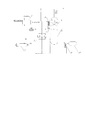
На фиг. показана принципиальная технологическая схема санитарной зоны 6 абсорбционной колонны 5 в комбинации с аммиачной бромисто-литиевой холодильной машиной 2. Вышедший из реактора формальдегидсодержащий газ (на схеме не указан) отдает часть тепла котлу-утилизатору 1. Образовавшийся пар подается на аммиачную бромистолитиевую машину. Полученная на ней вода с пониженной температурой с помощью блока насосов 3 направляется на пластинчатые теплообменники 4 и 8 для охлаждения орошающей тарелки жидкости и карбамидоформальдегидного концентрата, отгружаемого на склад 9. Для поддержания нужной концентрации КФК-85 часть жидкости с помощью насоса 7 выводится с санитарной зоны и используется на узле приготовления раствора карбамида.FIG. a schematic flow diagram of the sanitary zone 6 of the
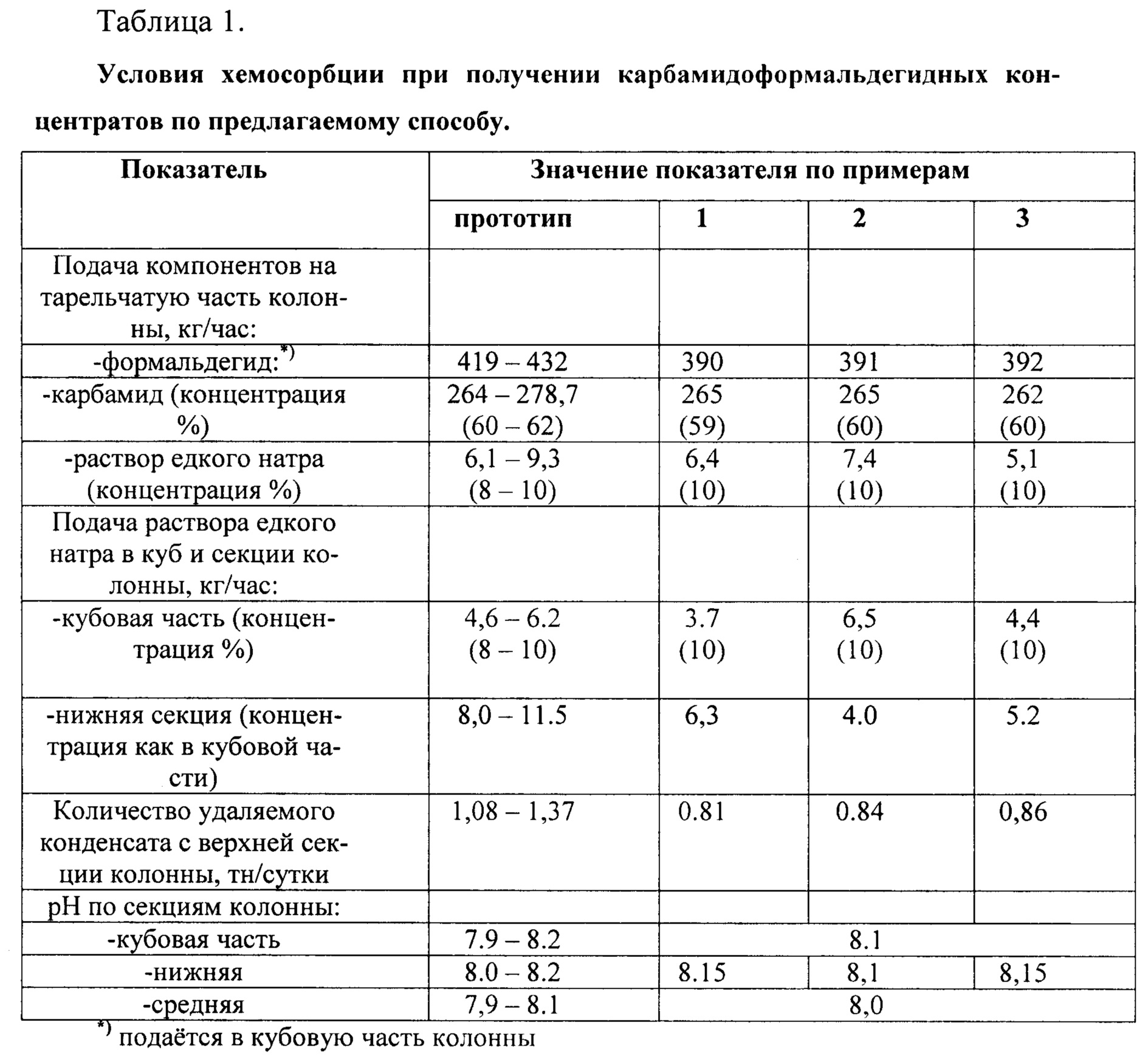
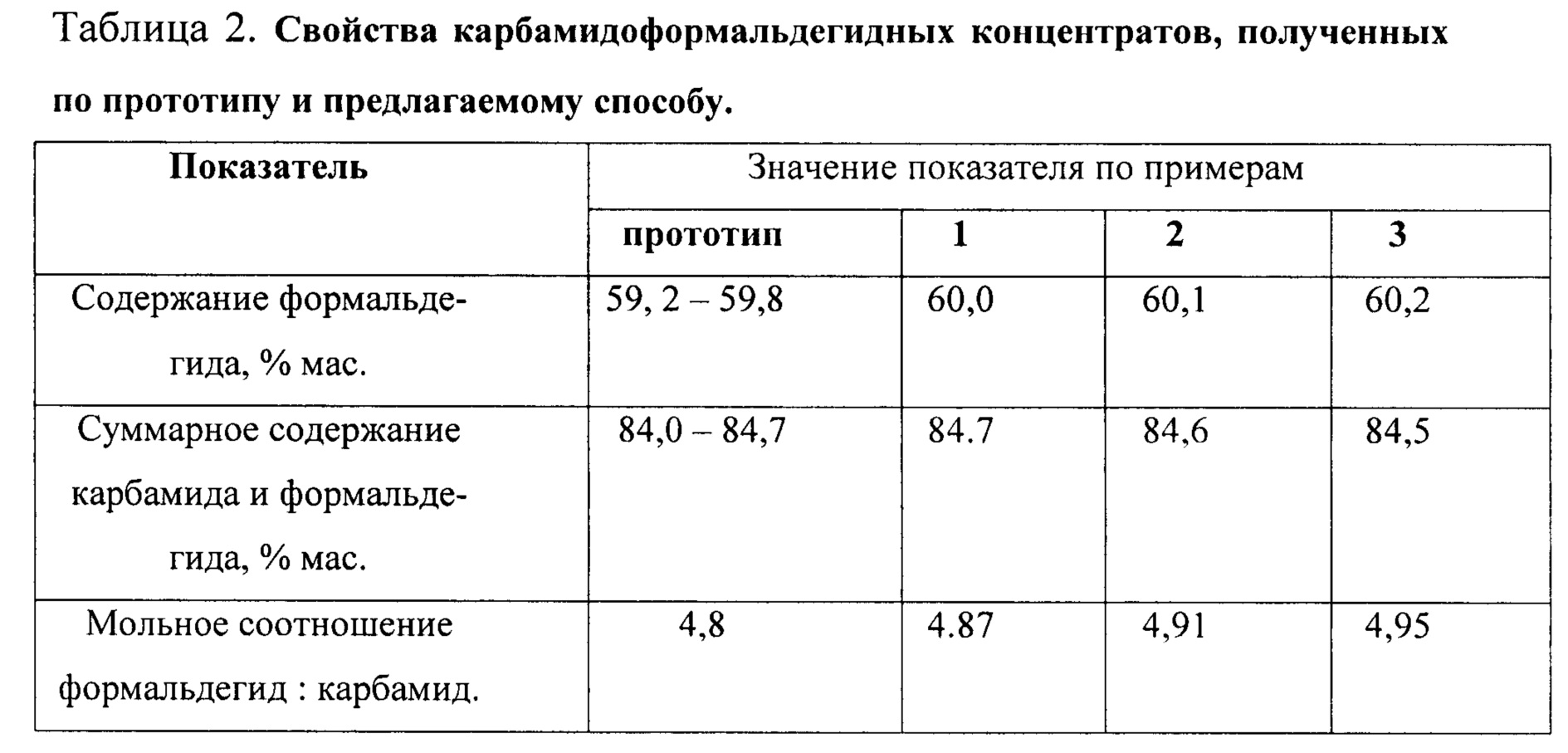
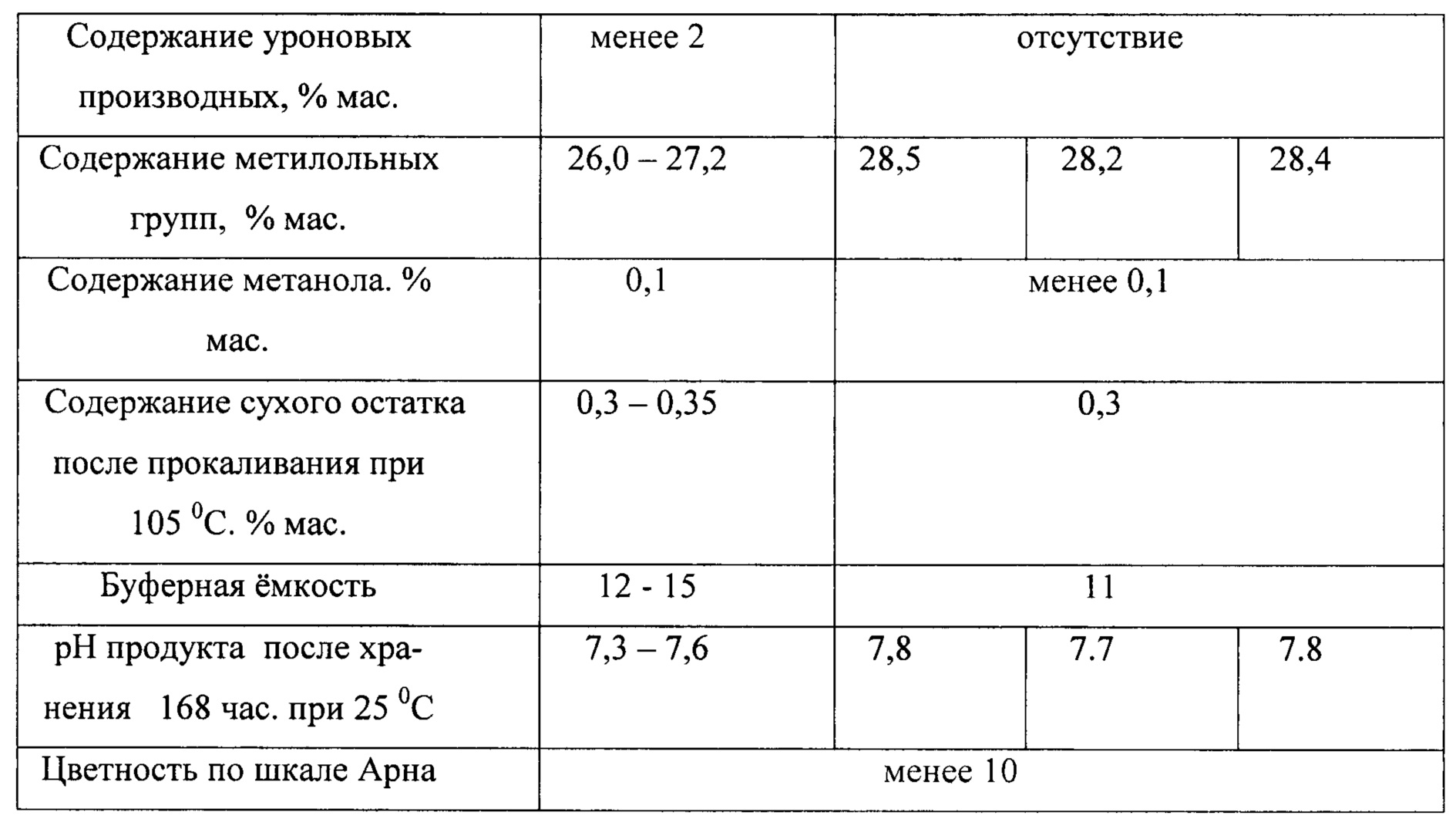
Сравнительная характеристика карбамидоформальдегидных концентратов, изготовленных по примерам осуществления предлагаемого способа и известному методу, представлена в таблицах 1 и 2.Comparative characteristics of urea-formaldehyde concentrates, made according to the examples of the proposed method and the known method, are presented in Tables 1 and 2.
Пример 1.Example 1
Формальдегидсодержащий газ с температурой 185°С, полученный в реакторе окислительного дегидрирования метанола, непрерывно подают в нижнюю секцию абсорбционной колонны в количестве 390 кг/ч. в расчете на формальдегид, а в тарельчатую часть - 265 кг/ч. 59%-ного водного раствора карбамида с температурой 58-60°С.Formaldehyde-containing gas with a temperature of 185 ° C, obtained in the oxidative dehydrogenation reactor of methanol, is continuously fed to the lower section of the absorption column in the amount of 390 kg / h. in the calculation of formaldehyde, and in the plate part - 265 kg / h. 59% aqueous solution of urea with a temperature of 58-60 ° C.
Параллельно в куб, нижнюю секцию и тарельчатую зону колонны дозируют 10%-ный раствор едкого натра в количествах 3,7; 6,3 и 6,4 кг/ч., соответственно. Подачу водных растворов карбамида и щелочи регулируют таким образом, чтобы мольное соотношение и рН в кубовой части, нижней и средней секциях колонны поддерживались на уровнях, приведенных в таблице 1.In parallel, a 10% solution of caustic soda in quantities of 3.7 is metered into the cube, the lower section and the plate zone of the column; 6.3 and 6.4 kg / h, respectively. The flow of aqueous solutions of urea and alkali is adjusted so that the molar ratio and pH in the bottom, bottom and middle sections of the column are maintained at the levels given in table 1.
Пример 2,Example 2
Условия аналогичны примеру 1.Conditions are similar to example 1.
Количества дозируемого едкого натра в куб, нижнюю секцию и тарельчатую часть абсорбционной колонны составили 6,5; 4,0 и 7,4 кг/ч., соответственно.The amounts of metered sodium hydroxide per cube, the lower section and the plate part of the absorption column were 6.5; 4.0 and 7.4 kg / h, respectively.
Пример 3.Example 3
Формальдегидсодержащий газ с температурой 180°С непрерывно подают в нижнюю секцию абсорбционной колонны в количестве 392 кг/ч. в расчете на формальдегид, а в тарельчатую часть - 262 кг 1 ч. 60%-ного водного раствора карбамида.Formaldehyde-containing gas with a temperature of 180 ° C is continuously fed to the lower section of the absorption column in the amount of 392 kg / h. in the calculation of formaldehyde, and in the plate part - 262
Подача 10%-ного едкого натра в куб, нижнюю секцию и тарельчатую часть колонны составили 4,4; 5,2 и 5,1 кг/ч, соответственно.The supply of 10% caustic soda to the cube, the lower section and the plate part of the column was 4.4; 5.2 and 5.1 kg / h, respectively.
Из описания изобретения и таблиц видно, что по заявленному техническому решению удается получать карбамидоформальдегидный концентрат с суммарным содержанием карбамида и формальдегида не менее 84,5% мас. с более высокой стабильностью при хранении, пониженной буферной емкостью и меньшим количеством образующихся сточных вод.From the description of the invention and the tables it is clear that according to the claimed technical solution it is possible to obtain a urea-formaldehyde concentrate with a total content of urea and formaldehyde of at least 84.5% by weight. with higher storage stability, lower buffer capacity and fewer generated wastewater.
Claims (1)
Priority Applications (1)
| Application Number | Priority Date | Filing Date | Title |
|---|---|---|---|
| RU2018135839A RU2685503C1 (en) | 2018-10-09 | 2018-10-09 | Method of producing carbamide-formaldehyde concentrate |
Applications Claiming Priority (1)
| Application Number | Priority Date | Filing Date | Title |
|---|---|---|---|
| RU2018135839A RU2685503C1 (en) | 2018-10-09 | 2018-10-09 | Method of producing carbamide-formaldehyde concentrate |
Publications (1)
| Publication Number | Publication Date |
|---|---|
| RU2685503C1 true RU2685503C1 (en) | 2019-04-19 |
Family
ID=66168533
Family Applications (1)
| Application Number | Title | Priority Date | Filing Date |
|---|---|---|---|
| RU2018135839A RU2685503C1 (en) | 2018-10-09 | 2018-10-09 | Method of producing carbamide-formaldehyde concentrate |
Country Status (1)
| Country | Link |
|---|---|
| RU (1) | RU2685503C1 (en) |
Cited By (1)
| Publication number | Priority date | Publication date | Assignee | Title |
|---|---|---|---|---|
| CN108689817A (en) * | 2018-08-01 | 2018-10-23 | 江苏道尔顿石化科技有限公司 | A kind of device and method of iron molybdenum method production formaldehyde coproduction UFC |
Citations (5)
| Publication number | Priority date | Publication date | Assignee | Title |
|---|---|---|---|---|
| US3970625A (en) * | 1973-03-14 | 1976-07-20 | Allied Chemical Corporation | Production of urea-formaldehyde concentrates |
| RU2196147C2 (en) * | 2001-01-25 | 2003-01-10 | ЗАО "Корпорация Тольяттиазот" | Method for production of urea-formaldehyde concentrate |
| RU2331654C1 (en) * | 2007-02-15 | 2008-08-20 | ОАО "Тольяттиазот" | Method of obtaining carbamide-formaldehyde concentrate |
| RU2418008C1 (en) * | 2009-10-09 | 2011-05-10 | Открытое акционерное общество "Тольяттиазот" | Method of producing carbamide-formaldehyde concentrate |
| RU2481359C1 (en) * | 2012-02-28 | 2013-05-10 | Открытое акционерное общество "Тольяттиазот" | Method of producing carbamide-formaldehyde concentrate |
-
2018
- 2018-10-09 RU RU2018135839A patent/RU2685503C1/en active
Patent Citations (5)
| Publication number | Priority date | Publication date | Assignee | Title |
|---|---|---|---|---|
| US3970625A (en) * | 1973-03-14 | 1976-07-20 | Allied Chemical Corporation | Production of urea-formaldehyde concentrates |
| RU2196147C2 (en) * | 2001-01-25 | 2003-01-10 | ЗАО "Корпорация Тольяттиазот" | Method for production of urea-formaldehyde concentrate |
| RU2331654C1 (en) * | 2007-02-15 | 2008-08-20 | ОАО "Тольяттиазот" | Method of obtaining carbamide-formaldehyde concentrate |
| RU2418008C1 (en) * | 2009-10-09 | 2011-05-10 | Открытое акционерное общество "Тольяттиазот" | Method of producing carbamide-formaldehyde concentrate |
| RU2481359C1 (en) * | 2012-02-28 | 2013-05-10 | Открытое акционерное общество "Тольяттиазот" | Method of producing carbamide-formaldehyde concentrate |
Cited By (1)
| Publication number | Priority date | Publication date | Assignee | Title |
|---|---|---|---|---|
| CN108689817A (en) * | 2018-08-01 | 2018-10-23 | 江苏道尔顿石化科技有限公司 | A kind of device and method of iron molybdenum method production formaldehyde coproduction UFC |
Similar Documents
| Publication | Publication Date | Title |
|---|---|---|
| US2673221A (en) | Process of producing ethyl alcohol by hydration of ethylene | |
| NO144263B (en) | PROCEDURE FOR PREPARING ETHYLENE - BY PROPYLEN CARBONATE | |
| BR112013000301B1 (en) | PROCESS FOR PREPARING ETHANOL AND HIGHER ALCOHOLS | |
| CN108821997A (en) | A kind of preparation method of adiponitrile and products thereof | |
| CN103936033B (en) | The method that heat is reclaimed from the ammonia desorber of Andrussow techniques | |
| US3867442A (en) | Process for preparing urea | |
| RU2685503C1 (en) | Method of producing carbamide-formaldehyde concentrate | |
| DK147496B (en) | INTEGRATED AMMONIAK URINATE PROCEDURE FOR THE MANUFACTURING OF URINE | |
| WO2005066110A1 (en) | Combined production of dialkyl carbonate and diol | |
| US4594457A (en) | Process for producing aqueous formaldehyde solution | |
| JPS6049626B2 (en) | Formamide manufacturing method | |
| US20040127745A1 (en) | Production of potassium formate | |
| RU2331654C1 (en) | Method of obtaining carbamide-formaldehyde concentrate | |
| CN101624355A (en) | Medium-pressure recovery process of low steam/carbon ratio-three-section adsorption-evaporative ammonia-cooling carbamide production | |
| CN102516029B (en) | Method for synthesising methanol by complete cycle of carbon monoxide, carbon dioxide and hydrogen | |
| JP4304446B2 (en) | Method for producing dialkyl oxalate | |
| US20040175316A1 (en) | Remediation process and apparatus | |
| RU2418008C1 (en) | Method of producing carbamide-formaldehyde concentrate | |
| CN107445809B (en) | A device and method for producing concentrated formaldehyde | |
| RU2481359C1 (en) | Method of producing carbamide-formaldehyde concentrate | |
| RU2142964C1 (en) | Method of preparing carbamido-formaldehyde concentrate | |
| JP2004323371A (en) | Method for producing dialkyl carbonate | |
| CN103420397B (en) | Ammonia and dimethyl ether process for separation and purification and system | |
| CN100513374C (en) | Method for preparing dimethyl ether by dehydration of methanol | |
| US4990685A (en) | Process for the preparation of aqueous formaldehyde solutions |