RU2634373C1 - Method for enhancing level of work capacity of laboratory animals in experiment - Google Patents
Method for enhancing level of work capacity of laboratory animals in experiment Download PDFInfo
- Publication number
- RU2634373C1 RU2634373C1 RU2016126276A RU2016126276A RU2634373C1 RU 2634373 C1 RU2634373 C1 RU 2634373C1 RU 2016126276 A RU2016126276 A RU 2016126276A RU 2016126276 A RU2016126276 A RU 2016126276A RU 2634373 C1 RU2634373 C1 RU 2634373C1
- Authority
- RU
- Russia
- Prior art keywords
- experiment
- animals
- per
- laboratory animals
- creatine monohydrate
- Prior art date
Links
- 241001465754 Metazoa Species 0.000 title claims abstract description 18
- 238000002474 experimental method Methods 0.000 title claims abstract description 9
- 238000010171 animal model Methods 0.000 title claims abstract description 8
- 238000000034 method Methods 0.000 title claims description 6
- 230000002708 enhancing effect Effects 0.000 title 1
- MEJYXFHCRXAUIL-UHFFFAOYSA-N 2-[carbamimidoyl(methyl)amino]acetic acid;hydrate Chemical compound O.NC(=N)N(C)CC(O)=O MEJYXFHCRXAUIL-UHFFFAOYSA-N 0.000 claims abstract description 15
- 229960004826 creatine monohydrate Drugs 0.000 claims abstract description 15
- XLYOFNOQVPJJNP-UHFFFAOYSA-N water Chemical compound O XLYOFNOQVPJJNP-UHFFFAOYSA-N 0.000 claims abstract description 10
- 235000012907 honey Nutrition 0.000 claims abstract description 8
- 238000012360 testing method Methods 0.000 claims abstract description 8
- 239000012153 distilled water Substances 0.000 claims abstract description 7
- 230000037396 body weight Effects 0.000 claims abstract description 4
- 239000003814 drug Substances 0.000 claims abstract description 3
- 229940079593 drug Drugs 0.000 claims 1
- 230000000694 effects Effects 0.000 abstract description 3
- 239000000126 substance Substances 0.000 abstract 1
- 241000700157 Rattus norvegicus Species 0.000 description 3
- 235000009508 confectionery Nutrition 0.000 description 3
- 238000001802 infusion Methods 0.000 description 3
- 230000014759 maintenance of location Effects 0.000 description 3
- 241000700159 Rattus Species 0.000 description 2
- 238000001990 intravenous administration Methods 0.000 description 2
- 238000005303 weighing Methods 0.000 description 2
- 235000018185 Betula X alpestris Nutrition 0.000 description 1
- 235000018212 Betula X uliginosa Nutrition 0.000 description 1
- 206010020751 Hypersensitivity Diseases 0.000 description 1
- 235000003805 Musa ABB Group Nutrition 0.000 description 1
- 240000008790 Musa x paradisiaca Species 0.000 description 1
- 235000015266 Plantago major Nutrition 0.000 description 1
- 244000274883 Urtica dioica Species 0.000 description 1
- 235000009108 Urtica dioica Nutrition 0.000 description 1
- 238000009835 boiling Methods 0.000 description 1
- 230000003247 decreasing effect Effects 0.000 description 1
- AEKLPNAELPOQBI-RHLRHBBGSA-L disodium butanedioate (2R,3R,4R,5S)-6-(methylamino)hexane-1,2,3,4,5-pentol Chemical compound [Na+].C(CCC(=O)[O-])(=O)[O-].CNC[C@H](O)[C@@H](O)[C@H](O)[C@H](O)CO.[Na+] AEKLPNAELPOQBI-RHLRHBBGSA-L 0.000 description 1
- 238000005259 measurement Methods 0.000 description 1
- 238000002360 preparation method Methods 0.000 description 1
- 239000003223 protective agent Substances 0.000 description 1
Classifications
-
- A—HUMAN NECESSITIES
- A61—MEDICAL OR VETERINARY SCIENCE; HYGIENE
- A61K—PREPARATIONS FOR MEDICAL, DENTAL OR TOILETRY PURPOSES
- A61K31/00—Medicinal preparations containing organic active ingredients
- A61K31/185—Acids; Anhydrides, halides or salts thereof, e.g. sulfur acids, imidic, hydrazonic or hydroximic acids
- A61K31/19—Carboxylic acids, e.g. valproic acid
- A61K31/195—Carboxylic acids, e.g. valproic acid having an amino group
-
- G—PHYSICS
- G09—EDUCATION; CRYPTOGRAPHY; DISPLAY; ADVERTISING; SEALS
- G09B—EDUCATIONAL OR DEMONSTRATION APPLIANCES; APPLIANCES FOR TEACHING, OR COMMUNICATING WITH, THE BLIND, DEAF OR MUTE; MODELS; PLANETARIA; GLOBES; MAPS; DIAGRAMS
- G09B23/00—Models for scientific, medical, or mathematical purposes, e.g. full-sized devices for demonstration purposes
- G09B23/28—Models for scientific, medical, or mathematical purposes, e.g. full-sized devices for demonstration purposes for medicine
Landscapes
- Medicinal Preparation (AREA)
- Pharmaceuticals Containing Other Organic And Inorganic Compounds (AREA)
- Acyclic And Carbocyclic Compounds In Medicinal Compositions (AREA)
Abstract
Description
Изобретение относится к медицине и биологии, а именно к экспериментальной фармакологии.The invention relates to medicine and biology, namely to experimental pharmacology.
Известен способ повышения уровня работоспособности у лабораторных животных в условиях ультрафиолетового облучения, основанный на использовании настоя на основе сбора из листьев крапивы, березы и подорожника, взятых в соотношении 1:1:1, полученный настаиванием 8 г сбора на 200 мл кипящей воды, настой вводят животным за 20 минут до воздействия ультрафиолетовых лучей перорально, при этом введение настоя осуществляют ежедневно из расчета 5 мл/кг массы в течение 28 дней (патент №2454240 от 27.06.2012 г.).There is a method of increasing the working capacity of laboratory animals under ultraviolet irradiation, based on the use of infusion based on a collection of nettle, birch and plantain leaves taken in a ratio of 1: 1: 1, obtained by infusing 8 g of collection per 200 ml of boiling water, the infusion is administered animals orally 20 minutes before exposure to ultraviolet rays, while the introduction of the infusion is carried out daily at the rate of 5 ml / kg weight for 28 days (patent No. 2454240 from 06/27/2012).
Недостатками данного способа являются сложность воспроизводства (необходимо проводить фитосбор в определенное время года, в местах удаленных от городов), полученные результаты не стабильны.The disadvantages of this method are the difficulty of reproduction (it is necessary to carry out phyto-collection at a certain time of the year, in places remote from cities), the results are not stable.
Из известных технических решений наиболее близким по назначению и технической сущности к заявленному объекту является способ повышения уровня работоспособности у лабораторных животных в эксперименте (патент №2335021 от 27.09.2008 г.), основанный на введении внутривенно реамберина в дозе 10 мг/кг веса животного в утренние часы за 40 минут до проведения тестов Порсолта и вертикального экрана-сетки. Недостатки этого способа заключаются в сложности применения ввиду внутривенного введения, наблюдаются частые аллергические реакции.Of the known technical solutions, the closest in purpose and technical nature to the claimed object is a way to increase the level of performance in laboratory animals in the experiment (patent No. 2335021 dated 09/27/2008), based on the introduction of intravenous reamberin at a dose of 10 mg / kg of animal weight in morning hours 40 minutes before the Porsolt tests and the vertical grid screen. The disadvantages of this method are the complexity of the application due to intravenous administration, frequent allergic reactions are observed.
Цель изобретения - расширение арсенала средств актопротекторного действия на лабораторных животных в эксперименте и минимизация боли и страданий при этом.The purpose of the invention is the expansion of the arsenal of means of act-protective action on laboratory animals in the experiment and the minimization of pain and suffering at the same time.
Поставленная цель достигается применением в качестве актопротекторного средства креатин моногидрата, что ведет к повышению уровня работоспособности у лабораторных животных, находящихся в эксперименте, с проведением теста Порсолта (время иммобильности) [1] и замера времени удержания на вертикальном экране-сетке [2]. Работа выполнена в соответствии с «Правилами проведения лабораторной практики в Российской Федерации» (Приказ Министерства здравоохранения РФ №267 от 19.06.2003).This goal is achieved by using creatine monohydrate as an act protective agent, which leads to an increase in the level of performance in laboratory animals in the experiment with the Porsolt test (immobility time) [1] and measurement of the retention time on a vertical grid screen [2]. This work was carried out in accordance with the “Rules for Laboratory Practice in the Russian Federation” (Order of the Ministry of Health of the Russian Federation No. 267 of 06/19/2003).
Осуществление изобретения достигается следующим образом: раствор, содержащий 4 г креатин моногидрата, 5 г меда на 100 мл дистиллированной воды, давали животным (крысам самцам линии Вистар массой тела 200-220 г) перорально с помощью пипетки добровольно в дозе 5 мл/кг массы за час до проведения тестов Порсолта и на вертикальном экране-сетке. Благодаря наличию меда раствор приобретает сладкий и приятный вкус, что облегчает задачу потребления раствора животными без малейшего принуждения (добровольно). Контрольной группой служили животные, получавшие сладкую воду (мед и дистиллированная вода) в аналогичном объеме, аналогичным способом.The implementation of the invention is achieved as follows: a solution containing 4 g of creatine monohydrate, 5 g of honey per 100 ml of distilled water was given to animals (male Wistar rats weighing 200-220 g) orally with a pipette voluntarily at a dose of 5 ml / kg weight per an hour before the Porsolt tests and on a vertical grid screen. Thanks to the presence of honey, the solution acquires a sweet and pleasant taste, which facilitates the task of consuming the solution by animals without the slightest coercion (voluntarily). The control group was animals that received sweet water (honey and distilled water) in the same volume, in a similar way.
Приготовление раствора на основе креатин моногидрата: 5 грамм меда растворяли в 100 мл дистиллированной воды, затем добавляли 4 г креатин моногидрата и размешивали до полного растворения креатин моногидрата.Preparation of a solution based on creatine monohydrate: 5 grams of honey was dissolved in 100 ml of distilled water, then 4 g of creatine monohydrate was added and the creatine monohydrate was completely dissolved.
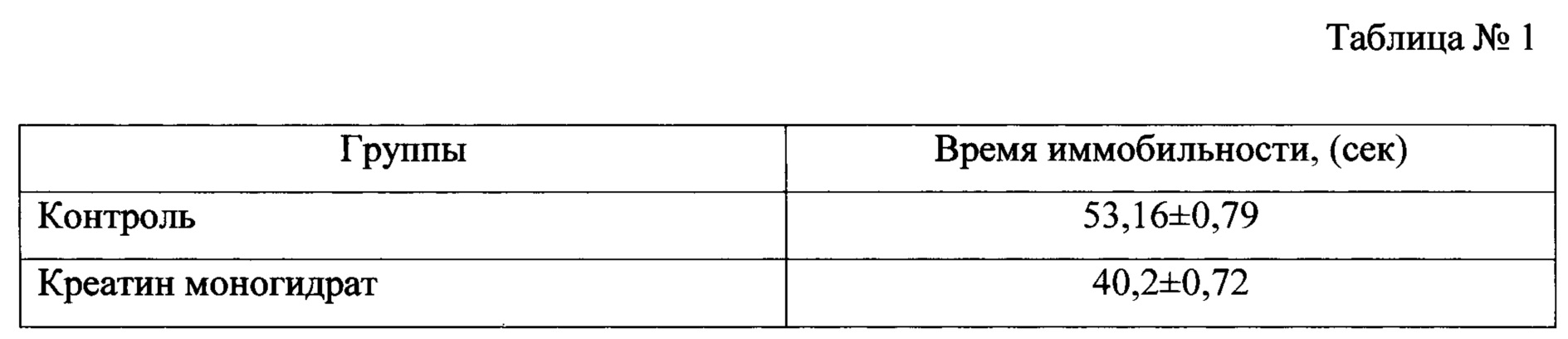
Проведенные нами опыты показали достоверно (р<0,001) снижение показателя иммобильности у животных, получавших креатин моногидрат, в тесте Порсолта, в сравнении с показателями контрольной группы.Our experiments showed a significant (p <0.001) decrease in immobility in animals treated with creatine monohydrate in the Porsolt test, compared with the control group.
Таблица 1 иллюстрирует, что время иммобильности животных в тесте Порсолта в опытной группе при применении креатин моногидрата снижается в сравнении с контрольной группой, получавшей сладкую воду, что свидетельствует о повышении работоспособности.Table 1 illustrates that the time of animal immobility in the Porsolt test in the experimental group when using creatine monohydrate is reduced in comparison with the control group receiving sweet water, which indicates an increase in performance.
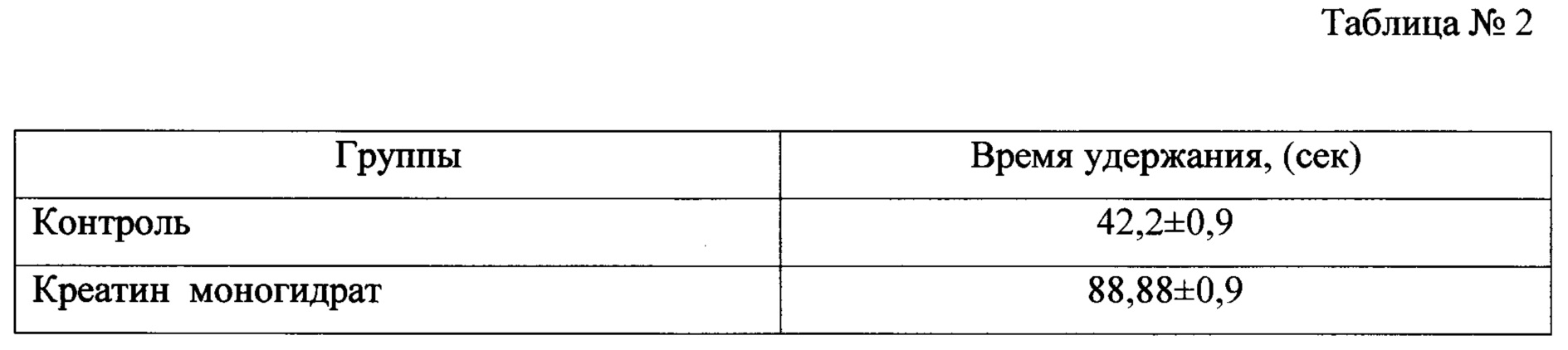
В опытах с применением креатин моногидрата у животных увеличился показатель времени удержания на вертикальном экране-сетке в сравнении с контрольной группой, не получающей креатин моногидрат, что свидетельствует об актопротекторном действии предложенного способа.In experiments using creatine monohydrate in animals, the retention time on the vertical screen-grid increased in comparison with the control group not receiving creatine monohydrate, which indicates the actoprotective effect of the proposed method.
Пример 1Example 1
В опыте на лабораторных крысах линии Вистар массой тела 200-220 г в качестве средства, повышающего уровень работоспособности, крысам за час до проведения теста Порсолта перорально добровольно давали раствор, содержащий 4 г креатин моногидрата, 5 г меда на 100 мл дистиллированной воды, в дозе 5 мл на 1 кг массы тела. Показатель иммобильности у подопытных животных, получавших предложенное средство, достоверно (р<0,001) снизился на 24% (таблица 1) в сравнении с контрольной группой. Данный опыт подтверждает актопротекторное действие креатин моногидрата.In the experiment on laboratory Wistar rats weighing 200-220 g as a means of increasing the level of performance, the rats an hour before the Porsolt test were orally given a solution containing 4 g of creatine monohydrate, 5 g of honey per 100 ml of distilled water, in a dose 5 ml per 1 kg of body weight. The immobility rate in experimental animals receiving the proposed tool significantly (p <0.001) decreased by 24% (table 1) compared with the control group. This experience confirms the actoprotective effect of creatine monohydrate.
Пример 2Example 2
При исследовании действия раствора креатин моногидрата, содержащего 4 г креатин моногидрата, 5 г меда на 100 мл дистиллированной воды ,в дозе 5 мл на 1 кг массы тела на крысах линии Вистар на вертикальном экране-сетке, выявлено увеличение уровня работоспособности животных, о чем свидетельствует увеличение достоверно (р<0,001) времени удержания крыс в 2,1 раза в сравнении с контрольной группой (таблица 2).When studying the action of a creatine monohydrate solution containing 4 g of creatine monohydrate, 5 g of honey per 100 ml of distilled water, at a dose of 5 ml per 1 kg of body weight in Wistar rats on a vertical screen-grid, an increase in the level of animal performance was revealed, as evidenced by a significant increase (p <0.001) in rat retention time by 2.1 times in comparison with the control group (table 2).
Источники информацииInformation sources
1. Lippa A.S., Nash Р.А., Greenblatt E.N. Pre-clinical neuropsychopharmacological testing procedures for anxiolytic drugs: In: Industrial Pharmacology (V. III, Anxiolytics), Eds S. Fielding, H. Lai, Futura Publishing Company, New York, 1979, P. 41-66.1. Lippa A.S., Nash R.A., Greenblatt E.N. Pre-clinical neuropsychopharmacological testing procedures for anxiolytic drugs: In: Industrial Pharmacology (V. III, Anxiolytics), Eds S. Fielding, H. Lai, Futura Publishing Company, New York, 1979, P. 41-66.
2. Porsolt R.D., McArthur R.A., Lenegre A. Psychotropic screening procedures: In: Methods in Behavioral Pharmacology, Ed. F. van Haaren, Elsevier, New York, 1993, P. 23-51.2. Porsolt R. D., McArthur R. A., Lenegre A. Psychotropic screening procedures: In: Methods in Behavioral Pharmacology, Ed. F. van Haaren, Elsevier, New York, 1993, P. 23-51.
Claims (1)
Priority Applications (1)
| Application Number | Priority Date | Filing Date | Title |
|---|---|---|---|
| RU2016126276A RU2634373C1 (en) | 2016-06-29 | 2016-06-29 | Method for enhancing level of work capacity of laboratory animals in experiment |
Applications Claiming Priority (1)
| Application Number | Priority Date | Filing Date | Title |
|---|---|---|---|
| RU2016126276A RU2634373C1 (en) | 2016-06-29 | 2016-06-29 | Method for enhancing level of work capacity of laboratory animals in experiment |
Publications (1)
| Publication Number | Publication Date |
|---|---|
| RU2634373C1 true RU2634373C1 (en) | 2017-10-26 |
Family
ID=60153851
Family Applications (1)
| Application Number | Title | Priority Date | Filing Date |
|---|---|---|---|
| RU2016126276A RU2634373C1 (en) | 2016-06-29 | 2016-06-29 | Method for enhancing level of work capacity of laboratory animals in experiment |
Country Status (1)
| Country | Link |
|---|---|
| RU (1) | RU2634373C1 (en) |
Citations (4)
| Publication number | Priority date | Publication date | Assignee | Title |
|---|---|---|---|---|
| RU2180560C2 (en) * | 1996-05-02 | 2002-03-20 | Мерк Патент Гмбх | Method to improve the taste of solid preparations, composition and solid preparation of improved taste |
| RU2335021C2 (en) * | 2006-10-06 | 2008-09-27 | Государственное Образовательное Учреждение Высшего Профессионального Образования Амурская Государственная Медицинская Академия Росздрава | Method for enhancing level of work capacity of laboratory animals in experiment |
| RU2371175C2 (en) * | 2007-09-14 | 2009-10-27 | Государственное Образовательное Учреждение Высшего Профессионального Образования Амурская Государственная Медицинская Академия Росздрава | Method of work efficiency level increase for laboratory animals in experiment |
| CN104489811A (en) * | 2014-12-15 | 2015-04-08 | 北京康比特体育科技股份有限公司 | Composition with muscle gain function and sports drink thereof |
-
2016
- 2016-06-29 RU RU2016126276A patent/RU2634373C1/en not_active IP Right Cessation
Patent Citations (4)
| Publication number | Priority date | Publication date | Assignee | Title |
|---|---|---|---|---|
| RU2180560C2 (en) * | 1996-05-02 | 2002-03-20 | Мерк Патент Гмбх | Method to improve the taste of solid preparations, composition and solid preparation of improved taste |
| RU2335021C2 (en) * | 2006-10-06 | 2008-09-27 | Государственное Образовательное Учреждение Высшего Профессионального Образования Амурская Государственная Медицинская Академия Росздрава | Method for enhancing level of work capacity of laboratory animals in experiment |
| RU2371175C2 (en) * | 2007-09-14 | 2009-10-27 | Государственное Образовательное Учреждение Высшего Профессионального Образования Амурская Государственная Медицинская Академия Росздрава | Method of work efficiency level increase for laboratory animals in experiment |
| CN104489811A (en) * | 2014-12-15 | 2015-04-08 | 北京康比特体育科技股份有限公司 | Composition with muscle gain function and sports drink thereof |
Non-Patent Citations (1)
| Title |
|---|
| Как повысить выносливость с помощью препаратов 2 декабря 2014 http://www.sportobzor.ru/sportivnaya-medicina/kak-povysit-vynoslivost-s-pomoschyu-preparatov.html. OZKAN O et al. Effect of systemic creatine monohydrate supplementation on denervated muscle during reinnervation: experimental study in the rat. J Reconstr Microsurg. 2005 Nov;21(8):573-9. * |
Similar Documents
| Publication | Publication Date | Title |
|---|---|---|
| Walczak-Nowicka et al. | Sodium benzoate—Harmfulness and potential use in therapies for disorders related to the nervous system: A review | |
| Abdel-Daim et al. | Ethanolic extract of Moringa oleifera leaves influences NF-κB signaling pathway to restore kidney tissue from cobalt-mediated oxidative injury and inflammation in rats | |
| Yamamoto et al. | Autopsy report for a caffeine intoxication case and review of the current literature | |
| Wang et al. | The role of autophagy in lupus nephritis | |
| Xu et al. | Peimine, a main active ingredient of Fritillaria, exhibits anti-inflammatory and pain suppression properties at the cellular level | |
| López-García et al. | Macrophage activation by ursolic and oleanolic acids during mycobacterial infection | |
| Wu et al. | The Tibetan medicine Zuotai differs from HgCl2 and MeHg in producing liver injury in mice | |
| Li et al. | Therapeutic effect of 7, 3′-dimethoxy hesperetin on adjuvant arthritis in rats through inhibiting JAK2-STAT3 signal pathway | |
| Mallick et al. | Neem leaf glycoprotein is nontoxic to physiological functions of Swiss mice and Sprague Dawley rats: histological, biochemical and immunological perspectives | |
| Mohanraj et al. | The mycobacterial adjuvant analogue TDB attenuates neuroinflammation via Mincle-independent PLC-γ1/PKC/ERK signaling and microglial polarization | |
| Chen et al. | Schisandrin B inhibits Th1/Th17 differentiation and promotes regulatory T cell expansion in mouse lymphocytes | |
| Robinson et al. | Anti-inflammatory effects of serotonin receptor and transient receptor potential channel ligands in human small intestinal epithelial cells | |
| Pham et al. | Lipopolysaccharide challenge reveals hypothalamic-pituitary-adrenal axis dysfunction in murine systemic lupus erythematosus | |
| Kim et al. | Taurine chloramine modulates the expression of adipokines through inhibition of the STAT-3 signaling pathway in differentiated human adipocytes | |
| Sreelatha et al. | Neuroprotective properties of rutin hydrate against scopolamine-induced deficits in BDNF/TrkB/ERK/CREB/Bcl2 pathways | |
| Yayeh et al. | Phellinus baumii ethyl acetate extract alleviated collagen type II induced arthritis in DBA/1 mice | |
| WO2005068491A1 (en) | Antitumoral and antiviral peptides | |
| Kanadi et al. | Acute toxicity studies and Phytochemical constituents of different solvents extracts of Carica papaya seeds | |
| Fayaz Ahmad et al. | Modulation of Th1 cytokines and inflammatory mediators by Euphorbia hirta in animal model of adjuvant-induced arthritis | |
| Mohammed et al. | Effect of Bee venom on gene expression of HSP70 and IL-1β in male rats induced by arthritis in comparison with Prednisolone drug | |
| RU2674033C1 (en) | Method for obtaining a substance from the gonad mussels of mytilus galloprovincialis, which has antitumor activity | |
| Lucas et al. | Ceylon cinnamon and its major compound Cinnamaldehyde can limit overshooting inflammatory signaling and angiogenesis in vitro: implications for COVID-19 treatment | |
| RU2657819C1 (en) | Means of immunomodulating activity | |
| Hasan | The effect of crude alcoholic extract of Withania somnifera leaves in experimentally induced arthritis in mice | |
| CN107056878A (en) | One D pyranoid ring pregnane glycoside compounds and its application |
Legal Events
| Date | Code | Title | Description |
|---|---|---|---|
| MM4A | The patent is invalid due to non-payment of fees |
Effective date: 20180630 |