RU2610503C1 - Fibre-optic guides polyimide coating and preparation method thereof - Google Patents
Fibre-optic guides polyimide coating and preparation method thereof Download PDFInfo
- Publication number
- RU2610503C1 RU2610503C1 RU2015145094A RU2015145094A RU2610503C1 RU 2610503 C1 RU2610503 C1 RU 2610503C1 RU 2015145094 A RU2015145094 A RU 2015145094A RU 2015145094 A RU2015145094 A RU 2015145094A RU 2610503 C1 RU2610503 C1 RU 2610503C1
- Authority
- RU
- Russia
- Prior art keywords
- coating
- polyimide
- solution
- fiber
- coatings
- Prior art date
Links
Images
Classifications
-
- C—CHEMISTRY; METALLURGY
- C09—DYES; PAINTS; POLISHES; NATURAL RESINS; ADHESIVES; COMPOSITIONS NOT OTHERWISE PROVIDED FOR; APPLICATIONS OF MATERIALS NOT OTHERWISE PROVIDED FOR
- C09D—COATING COMPOSITIONS, e.g. PAINTS, VARNISHES OR LACQUERS; FILLING PASTES; CHEMICAL PAINT OR INK REMOVERS; INKS; CORRECTING FLUIDS; WOODSTAINS; PASTES OR SOLIDS FOR COLOURING OR PRINTING; USE OF MATERIALS THEREFOR
- C09D133/00—Coating compositions based on homopolymers or copolymers of compounds having one or more unsaturated aliphatic radicals, each having only one carbon-to-carbon double bond, and at least one being terminated by only one carboxyl radical, or of salts, anhydrides, esters, amides, imides, or nitriles thereof; Coating compositions based on derivatives of such polymers
- C09D133/24—Homopolymers or copolymers of amides or imides
-
- C—CHEMISTRY; METALLURGY
- C03—GLASS; MINERAL OR SLAG WOOL
- C03C—CHEMICAL COMPOSITION OF GLASSES, GLAZES OR VITREOUS ENAMELS; SURFACE TREATMENT OF GLASS; SURFACE TREATMENT OF FIBRES OR FILAMENTS MADE FROM GLASS, MINERALS OR SLAGS; JOINING GLASS TO GLASS OR OTHER MATERIALS
- C03C25/00—Surface treatment of fibres or filaments made from glass, minerals or slags
- C03C25/10—Coating
- C03C25/12—General methods of coating; Devices therefor
- C03C25/16—Dipping
-
- C—CHEMISTRY; METALLURGY
- C03—GLASS; MINERAL OR SLAG WOOL
- C03C—CHEMICAL COMPOSITION OF GLASSES, GLAZES OR VITREOUS ENAMELS; SURFACE TREATMENT OF GLASS; SURFACE TREATMENT OF FIBRES OR FILAMENTS MADE FROM GLASS, MINERALS OR SLAGS; JOINING GLASS TO GLASS OR OTHER MATERIALS
- C03C25/00—Surface treatment of fibres or filaments made from glass, minerals or slags
- C03C25/10—Coating
- C03C25/24—Coatings containing organic materials
- C03C25/26—Macromolecular compounds or prepolymers
- C03C25/32—Macromolecular compounds or prepolymers obtained otherwise than by reactions involving only carbon-to-carbon unsaturated bonds
-
- C—CHEMISTRY; METALLURGY
- C08—ORGANIC MACROMOLECULAR COMPOUNDS; THEIR PREPARATION OR CHEMICAL WORKING-UP; COMPOSITIONS BASED THEREON
- C08G—MACROMOLECULAR COMPOUNDS OBTAINED OTHERWISE THAN BY REACTIONS ONLY INVOLVING UNSATURATED CARBON-TO-CARBON BONDS
- C08G73/00—Macromolecular compounds obtained by reactions forming a linkage containing nitrogen with or without oxygen or carbon in the main chain of the macromolecule, not provided for in groups C08G12/00 - C08G71/00
- C08G73/06—Polycondensates having nitrogen-containing heterocyclic rings in the main chain of the macromolecule
- C08G73/10—Polyimides; Polyester-imides; Polyamide-imides; Polyamide acids or similar polyimide precursors
-
- G—PHYSICS
- G02—OPTICS
- G02B—OPTICAL ELEMENTS, SYSTEMS OR APPARATUS
- G02B6/00—Light guides; Structural details of arrangements comprising light guides and other optical elements, e.g. couplings
- G02B6/02—Optical fibres with cladding with or without a coating
Landscapes
- Chemical & Material Sciences (AREA)
- Life Sciences & Earth Sciences (AREA)
- Organic Chemistry (AREA)
- Chemical Kinetics & Catalysis (AREA)
- Materials Engineering (AREA)
- Engineering & Computer Science (AREA)
- Geochemistry & Mineralogy (AREA)
- Physics & Mathematics (AREA)
- General Life Sciences & Earth Sciences (AREA)
- General Chemical & Material Sciences (AREA)
- Polymers & Plastics (AREA)
- Health & Medical Sciences (AREA)
- Wood Science & Technology (AREA)
- Medicinal Chemistry (AREA)
- General Physics & Mathematics (AREA)
- Optics & Photonics (AREA)
- Macromolecular Compounds Obtained By Forming Nitrogen-Containing Linkages In General (AREA)
- Surface Treatment Of Glass Fibres Or Filaments (AREA)
Abstract
Description
Изобретение относится к волоконной оптике, а именно к защитным термостойким полиимидным покрытиям волоконного световода и способу их изготовления. Покрытие формируется путем протягивания световода через раствор полиимида (ПИ) в органическом растворителе и последующего удаления растворителя термообработкой.The invention relates to fiber optics, and in particular to protective heat-resistant polyimide coatings of a fiber waveguide and a method for their manufacture. The coating is formed by pulling the fiber through a solution of polyimide (PI) in an organic solvent and subsequent removal of the solvent by heat treatment.
Изобретение наиболее эффективно может быть использовано при изготовлении оптических волокон для применения в авиакосмической отрасли, нефтегазовой и автомобильной промышленности, энергетике и медицине [A.A. Stolov, et al. Optical fibers with polyimide coatings for medical applications // SPIE: Design and Quality for Biomedical Technologies V (2012)].The invention can most effectively be used in the manufacture of optical fibers for use in the aerospace industry, oil and gas and automotive industries, energy and medicine [A.A. Stolov, et al. Optical fibers with polyimide coatings for medical applications // SPIE: Design and Quality for Biomedical Technologies V (2012)].
В настоящее время полиимиды широко применяются в качестве покрытий световодов, работоспособных в критических температурных условиях. Световоды с полиимидными покрытиями успешно используются как при высоких (до 460°C), так и при низких температурах (до -196°C).Currently, polyimides are widely used as coatings for optical fibers operating in critical temperature conditions. Optical fibers with polyimide coatings are successfully used both at high (up to 460 ° C) and at low temperatures (up to -196 ° C).
Необходимо, чтобы полимерное покрытие световода обеспечивало его защиту от механических воздействий и влаги, что реализуется за счет его удовлетворительной адгезии к стеклу и достаточной толщины (5-15 мкм). Широко распространенные ПИ, например Kapton, Upilex, не обладают хорошей адгезией к стеклу. Для устранения этого недостатка используют различные технологические приемы, например применяют промоутеры адгезии (аппреты) или вводят в структуру полимера функциональные группы, способствующие адгезии.It is necessary that the polymer coating of the fiber provide its protection against mechanical stress and moisture, which is realized due to its satisfactory adhesion to the glass and a sufficient thickness (5-15 microns). Widespread PIs, for example Kapton, Upilex, do not have good adhesion to glass. To eliminate this drawback, various technological methods are used, for example, adhesion promoters (sizing agents) are used or functional groups promoting adhesion are introduced into the polymer structure.
Известны покрытия из блочных сополимеров - полиимид-блок-полисилоксанов, предложенные компанией Corning Incorporated (патент Канады СА 1325316 С, 1993). Сочетание таких блоков в структуре полимеров способствует получению покрытий световодов с хорошей адгезией, эластичностью и термостойкостью, но введение силоксановых фрагментов значительно снижает теплостойкость ПИ-покрытий, что существенно ограничивает области практического использования силоксансодержащих полиимидов.Known coatings from block copolymers - polyimide-block-polysiloxanes, proposed by Corning Incorporated (Canadian patent CA 1325316 C, 1993). The combination of such blocks in the polymer structure contributes to obtaining coatings of optical fibers with good adhesion, elasticity, and heat resistance, but the introduction of siloxane fragments significantly reduces the heat resistance of PI coatings, which significantly limits the field of practical use of siloxane-containing polyimides.
Известны полиимидные фотосшиваемые покрытия, созданные компанией Amoco Corporation, где в макромолекулы ПИ включены фоточувствительные фрагменты, например бензофеноновые, антрахиноновые, тиоксантоновые (патент Японии JP 3024008 В2, 2000). Аналогичный подход с включением в ПИ производных 1,4-дигидропиридина применен для создания светоиндуцированного самоорганизующегося волновода [К. Mune et al. New fabrication method of self-written waveguide by using photosensitive polyimide // Journal of photopolymer science and technology, vol. 17, no. 2, p. 189-193 (2004)]. Одним из недостатков фотосшиваемых покрытий, как и многих других нерастворимых ПИ-покрытий, является трудность их удаления, поскольку снятие части покрытия необходимо во многих случаях применения волоконных световодов, например при их соединении.Known polyimide crosslinkable coatings created by Amoco Corporation, where photosensitive fragments, for example benzophenone, anthraquinone, thioxantone, are included in PI macromolecules (Japanese patent JP 3024008 B2, 2000). A similar approach with the inclusion of 1,4-dihydropyridine derivatives in PI is used to create a light-induced self-organizing waveguide [K. Mune et al. New fabrication method of self-written waveguide by using photosensitive polyimide // Journal of photopolymer science and technology, vol. 17, no. 2, p. 189-193 (2004)]. One of the drawbacks of photocopyable coatings, as well as many other insoluble PI coatings, is the difficulty of their removal, since part of the coating is removed in many cases when fiber optic fibers are used, for example, when they are connected.
Компанией Galileo Corporation получено ПИ-покрытие (WO 9736837 А1, 1997; патент РФ №2169713, 1997) на основе продуктов взаимодействия 2,2-бис-[4'-(4ʺ-аминофенокси)фенил]гексафторпропана и диангидрида 2,2-бис-[4'-(3ʺ,4ʺ-дикарбоксифенокси)фенил]гексафторпропанаGalileo Corporation obtained a PI coating (WO 9736837 A1, 1997; RF patent No. 2169713, 1997) based on the reaction products of 2,2-bis- [4 '- (4ʺ-aminophenoxy) phenyl] hexafluoropropane and 2,2-bis dianhydride - [4 '- (3ʺ, 4ʺ-dicarboxyphenoxy) phenyl] hexafluoropropane

Покрытие из такого фторированного полиимидоэфира можно легко удалить с волокна путем выдержки в обычном широко применяемом и недорогом растворителе, например ацетоне, метиленхлориде и т.п.The coating of such a fluorinated polyimido ester can be easily removed from the fiber by exposure to a conventional, widely used and inexpensive solvent, for example acetone, methylene chloride and the like.
Известно, что компания Prysmian Group проводит активный поиск новых структур полиимидов, обеспечивающих хорошие термические показатели и устойчивость к возможным повреждениям. В 2012 г. компания представила результаты термических, механических, адгезионных и других сравнительных тестов, которые показали значительную устойчивость новых ПИ-покрытий на воздухе при 300 и 350°C, превосходящую показатели существующих аналогов почти в 2 раза, однако при этом конкретные структуры полимеров не были раскрыты [B.J. Overton et al. An optical fiber with advanced polyimide coating // Proceedings of the 61-st International Wire & Cable Symposium, p. 321-328 (2012)].It is known that the company Prysmian Group is actively seeking new structures of polyimides that provide good thermal performance and resistance to possible damage. In 2012, the company presented the results of thermal, mechanical, adhesive and other comparative tests, which showed significant stability of the new PI coatings in air at 300 and 350 ° C, almost twice as much as the performance of existing analogues, however, the specific polymer structures were not were disclosed [BJ Overton et al. An optical fiber with advanced polyimide coating // Proceedings of the 61-st International Wire & Cable Symposium, p. 321-328 (2012)].
В последние годы все большее внимание уделяется разработке многослойных полимерных покрытий световодов, базирующихся на ПИ. Известно двухслойное ПИ-покрытие, состоящее из полиимидов различного строения (патент США US 9063268, 2015). Первичный слой покрытия образован из полимера на основе диангидрида 3,3',4,4'-бензофенонтетракарбоновой кислоты, 4,4'-диаминодифенилоксида и/или м-фенилендиамина, а вторичный слой сформирован из полимера на основе диангидрида 3,3',4,4'-дифенилтетракарбоновой кислоты и n-фенилендиамина. При этом внешняя часть ПИ-покрытия характеризуется значительно большей термической стабильностью и меньшим водопоглощением по сравнению с внутренней.In recent years, increasing attention has been paid to the development of multilayer polymer coatings of optical fibers based on PI. Known two-layer PI coating, consisting of polyimides of various structures (US patent US 9063268, 2015). The primary coating layer is formed from a polymer based on 3.3 ', 4,4'-benzophenone tetracarboxylic acid dianhydride, 4,4'-diaminodiphenyl oxide and / or m-phenylenediamine, and the secondary layer is formed from a polymer based on 3.3', 4 dianhydride , 4'-diphenyltetracarboxylic acid and n-phenylenediamine. In this case, the outer part of the PI coating is characterized by much greater thermal stability and less water absorption compared to the inside.
Известны технические решения, опровергающие необходимость хорошей адгезии покрытия к световоду. Например, предложено (US 20050135763 А1, 2003) использовать первичное полимерное покрытие с плохой адгезией к стеклу (фторполимеры, полиолефины), на которое наносят вторичный слой термостойкого ПИ-покрытия. Такое решение позволяет легко механически удалять покрытие, а основным его недостатком является использование значительно менее термостойкого первичного покрытия световода по сравнению с полиимидной составляющей.Known technical solutions that refute the need for good adhesion of the coating to the fiber. For example, it was proposed (US 20050135763 A1, 2003) to use a primary polymer coating with poor adhesion to glass (fluoropolymers, polyolefins), on which a secondary layer of heat-resistant PI coating is applied. This solution allows you to easily mechanically remove the coating, and its main disadvantage is the use of a significantly less heat-resistant primary coating of the fiber in comparison with the polyimide component.
Известны трехслойные термостойкие и гидролитически стабильные покрытия, запатентованные Sumitimo Electric Industries, Ltd. (патент США №6711335 В1, 1999). Первый слой таких покрытий состоит из ПИ, второй - из полисилоксана, а третий - из гидролитически стабильных полиамидоимида, полиэфиркетона, полиэфирсульфона, фторопластов и др.Three-layer heat-resistant and hydrolytically stable coatings are known, patented by Sumitimo Electric Industries, Ltd. (US patent No. 6711335 B1, 1999). The first layer of such coatings consists of PI, the second of polysiloxane, and the third of hydrolytically stable polyamidoimide, polyethereketone, polyethersulfone, fluoroplastics, etc.
Известны покрытия на основе полимерных композитов с углеродными нанотрубками (УНТ) (патент США №8218930 В2), созданные для обеспечения более высокой степени защиты оптического волокна, увеличения его надежности, износостойкости и долговечности. В патенте описан ряд применимых полимерных матриц, включая полиимидную. Введение нанотрубок в полимерную составляющую повышает термические и механические показатели, придает дополнительную защиту от проникновения кислорода и влаги за счет их гидрофобности. Предполагается, что введение электропроводящих УНТ позволит также решить проблему пробоя изоляционного полимерного покрытия в результате накопления статического заряда, обнаруженную при проведении исследований на Международной космической станции.Known coatings based on polymer composites with carbon nanotubes (CNTs) (US patent No. 8218930 B2), designed to provide a higher degree of protection of the optical fiber, increase its reliability, wear resistance and durability. The patent describes a number of applicable polymer matrices, including polyimide. The introduction of nanotubes into the polymer component increases thermal and mechanical properties, gives additional protection against the penetration of oxygen and moisture due to their hydrophobicity. It is assumed that the introduction of electrically conductive CNTs will also solve the problem of breakdown of the insulating polymer coating as a result of the accumulation of static charge, discovered during research at the International Space Station.
Наиболее близким аналогом заявляемого покрытия является вышеупомянутое термостойкое полиимидное покрытие на основе 2,2-бис-[(4'-(4ʺ-аминофенокси)фенил]гексафторпропана и диангидрида 2,2-бис-[(4'-(3ʺ,4ʺ-дикарбоксифенокси)фенил)]гексафторпропана (US 5714196 А, 1996; патент РФ №2169713, 1997), которое растворимо в широком круге органических растворителей и может быть легко снято с волокна. Это покрытие было выбрано в качестве прототипа.The closest analogue of the claimed coating is the aforementioned heat-resistant polyimide coating based on 2,2-bis - [(4 '- (4ʺ-aminophenoxy) phenyl] hexafluoropropane and 2,2-bis - dianhydride [(4' - (3ʺ, 4ʺ-dicarboxyphenoxy ) phenyl)] hexafluoropropane (US 5714196 A, 1996; RF patent No. 2169713, 1997), which is soluble in a wide range of organic solvents and can be easily removed from the fiber. This coating was chosen as a prototype.
Недостатки покрытий в значительной степени определяются особенностями способов их получения. Во всех известных способах изготовления полиимидных покрытий световодов используются не полиимиды, а другие полимеры - предшественники полиимидов - полиамидокислоты (ПАК), которые подвергают имидизации в процессе получения покрытия. Из-за неполной имидизации ПАК получаемые покрытия содержат нециклизованные амидокислотные фрагменты, которые ухудшают качество покрытий.The disadvantages of coatings are largely determined by the features of the methods for their preparation. In all known methods for the manufacture of polyimide coatings of optical fibers, polyimides are not used, but other polymers — precursors of polyimides — polyamide acids (PAAs), which are imidized during coating production. Due to incomplete imidization of PAA, the resulting coatings contain uncyclized amido acid fragments that degrade the quality of the coatings.
Все известные способы изготовления полиимидных покрытий (патент Канады СА 1325316 С, 1993; патент Японии JP 3024008 В2; патент США US 9063268, 2015 и др.) включают нанесение на волоконный световод раствора соответствующей полиамидокислоты (ПАК) и последующую ее имидизацию при нагревании с одновременным удалением растворителя и воды. Как правило, в промышленности имидизацию (циклизацию) пленок ПАК осуществляют при высоких температурах (150-350°C) в течение продолжительного времени (до нескольких часов), тогда как покрытие световода должно сформироваться за несколько секунд. Поэтому не прекращается поиск оптимальных технологических параметров изготовления термостойких полиимидных покрытий световодов с необходимыми эксплуатационными характеристиками.All known methods for the manufacture of polyimide coatings (Canadian patent CA 1325316 C, 1993; Japanese patent JP 3024008 B2; US patent US 9063268, 2015 and others) include applying a solution of the corresponding polyamide acid (PAA) to the fiber and then imidizing it while heating while removal of solvent and water. As a rule, in industry, imidization (cyclization) of PAA films is carried out at high temperatures (150-350 ° C) for a long time (up to several hours), while the fiber coating should form in a few seconds. Therefore, the search for optimal technological parameters for the manufacture of heat-resistant polyimide coatings of optical fibers with the required performance characteristics does not stop.
В патенте США (US 6711335 В1, 1999) рассматривается широко известная проблема циклизации ПАК до полиимида. Методом ИК-спектроскопии была установлена степень имидизации, составляющая около 30%. В силу гидролитической нестабильности полиамидокислот срок службы изделий с такой невысокой степенью имидизации невелик, особенно в предполагаемых для эксплуатации световодов условиях высокой влажности и температуры - на атомных электростанциях и нефтяных скважинах.US Pat. No. 6,711,335 B1, 1999 discusses the widely known problem of cyclization of PAA to polyimide. Using IR spectroscopy, an imidization degree of about 30% was established. Due to the hydrolytic instability of polyamido acids, the service life of products with such a low degree of imidization is small, especially in the conditions of high humidity and temperature expected for the operation of optical fibers - at nuclear power plants and oil wells.
Показано также, что неполная имидизация полиамидокислоты приводит к значительному ухудшению механических свойств световодов во времени [B.J. Overton et al. An optical fiber with advanced polyimide coating //Proceedings of the 61st International wire & cable symposium, p. 321-328 (2012)].It was also shown that incomplete imidization of polyamic acid leads to a significant deterioration in the mechanical properties of optical fibers over time [BJ Overton et al. An optical fiber with advanced polyimide coating // Proceedings of the 61 st International wire & cable symposium, p. 321-328 (2012)].
Известен способ формирования двухслойного полиимидного покрытия (патент США US 9063268, 2015), который состоит в том, что сначала на поверхность световода наносят сополиамидокислотный предшественник на основе диангидрида 3,3',4,4'-бензофенонтетракарбоновой кислоты, 4,4'-диаминодифенилоксида и/или м-фенилендиамина, содержащий аппрет. Затем формируют второй слой из ПАК на основе диангидрида 3,3',4,4'-дифенилтетракарбоновой кислоты и n-фенилендиамина (в отсутствие аппрета).A known method of forming a two-layer polyimide coating (US patent US 9063268, 2015), which consists in first applying a copolyamidic acid precursor based on 3.3 ', 4,4'-benzophenone tetracarboxylic acid, 4,4'-diaminodiphenyl oxide and / or m-phenylenediamine containing a sizing. Then a second layer of PAA is formed based on 3,3 ′, 4,4′-diphenyltetracarboxylic acid dianhydride and n-phenylenediamine (in the absence of a sizing).
Наиболее близким к заявляемому способу аналогом является способ получения растворимого полиимидного покрытия на основе 2,2-бис-(4'-(4ʺ-аминофенокси)фенил)гексафторпропана и диангидрида 2,2-бис-(4'-(3ʺ,4ʺ-дикарбоксифенокси)фенил)гексафторпропана (заявка на патент США US 5714196 А, 1996; патент РФ №2169713, 1997). Указанный способ получения оптического волокна с легкоснимаемым полиимидным покрытием включает операции получения волокна и формирование покрытия путем протягивания волокна через раствор полиамидокислоты, имидизацию ПАК и отверждение покрытия при нагревании.The closest analogue to the claimed method is a method for producing a soluble polyimide coating based on 2,2-bis- (4 '- (4ʺ-aminophenoxy) phenyl) hexafluoropropane and 2,2-bis- (4' - (3ʺ, 4ʺ-dicarboxyphenoxy dianhydride) ) phenyl) hexafluoropropane (application for US patent US 5714196 A, 1996; RF patent No. 2169713, 1997). The method for producing an optical fiber with an easily removable polyimide coating includes the steps of producing a fiber and forming a coating by pulling the fiber through a polyamic acid solution, imidizing PAA and curing the coating by heating.
Недостатками способа-прототипа являются необходимость использования нестабильного раствора полиамидокислоты, который следует хранить при -20°C и ниже, необходимость многократного нанесения раствора полимера для достижения требуемой толщины покрытия.The disadvantages of the prototype method are the need to use an unstable solution of polyamido acid, which should be stored at -20 ° C and below, the need for multiple application of a polymer solution to achieve the desired coating thickness.
Основной отличительной особенностью способа-прототипа, как и всех известных способов-аналогов, является использование полиамидокислотного предшественника, а не готового полиимида. Поэтому после нанесения раствора ПАК на волоконный световод требуется длительная стадия имидизации (циклизации) ПАК при высокой температуре. Для получения слоев покрытия нужной толщины необходимо использовать несколько последовательных нанесений.The main distinguishing feature of the prototype method, like all known analogue methods, is the use of a polyamic acid precursor, rather than a finished polyimide. Therefore, after applying the PAA solution to the fiber, a long stage of imidization (cyclization) of PAA at a high temperature is required. To obtain the coating layers of the desired thickness, it is necessary to use several successive applications.
Кроме того, существенным недостатком известных способов получения ПИ-покрытий, использующих ПАК, является термическая нестабильность ПАК (данные компании HD Microsystems (США) - основного производителя ПАК), поэтому необходимо обеспечивать пониженную температуру при их транспортировке и хранении.In addition, a significant drawback of the known methods for producing PI coatings using PAA is the thermal instability of PAA (data from HD Microsystems (USA), the main producer of PAA), therefore, it is necessary to provide a low temperature during their transportation and storage.
Таким образом, применяемые до настоящего времени способы изготовления полиимидных покрытий волоконных световодов из соответствующего полиамидокислотного предшественника (ПАК) имеют ряд существенных недостатков, с ними связаны определенные технологические проблемы, которые могут быть решены заявляемым изобретением.Thus, the currently used methods for the manufacture of polyimide coatings of optical fibers from the corresponding polyamide-acid precursor (PAA) have a number of significant drawbacks, they are associated with certain technological problems that can be solved by the claimed invention.
Задачей изобретения является создание растворимых полиимидных покрытий волоконных световодов и разработка способа их изготовления непосредственно из полиимидов.The objective of the invention is the creation of soluble polyimide coatings of optical fibers and the development of a method for their manufacture directly from polyimides.
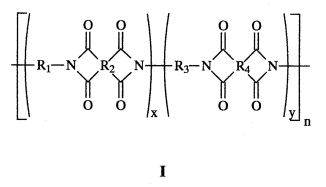
Задача решается заявляемыми растворимыми полиимидными покрытиями, получаемыми из гомо- и сополиимидов общей формулы IThe problem is solved by the claimed soluble polyimide coatings obtained from homo- and copolyimides of the general formula I
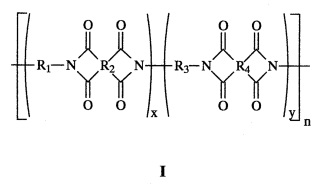
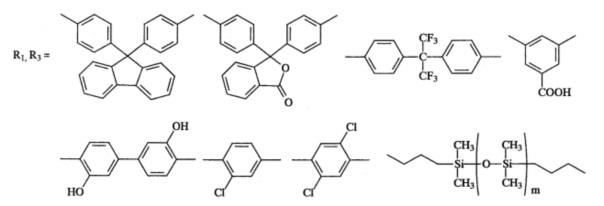
гдеWhere
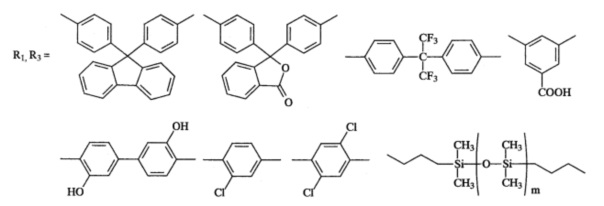

а также способом их получения, включающим вытягивание световода из заготовки, протягивание его через фильеру, содержащую раствор полимера для образования покрытия, и удаление растворителя при нагревании, причем в качестве полимера для образования покрытия используют полиимид формулы I, а растворитель удаляют нагреванием в печи при 50-350°C. Для приготовления раствора полиимида используют апротонные растворители, выбранные из группы, включающей N-метил-2-пирролидон, N,N-диметилформамид, N,N-диметилацетамид, кетоны и хлорированные углеводороды. Используемый раствор полиимида формулы I может дополнительно содержать аппрет.as well as a method for their preparation, including pulling a fiber from a preform, pulling it through a die containing a polymer solution to form a coating, and removing the solvent by heating, using a polyimide of formula I as a polymer to form a coating, and the solvent is removed by heating in an oven at 50 -350 ° C. Aprotic solvents selected from the group consisting of N-methyl-2-pyrrolidone, N, N-dimethylformamide, N, N-dimethylacetamide, ketones and chlorinated hydrocarbons are used to prepare the polyimide solution. The polyimide solution of formula I used may further comprise a sizing agent.
Заявляемые покрытия имеют высокие эксплуатационные характеристики. Как правило, теплостойкость (Тс) всех рассматриваемых полиимидов превышает 300°C, а их термостойкость составляет более 500°C, что делает возможным использование ПИ покрытий на их основе в экстремальных условиях (от -196 до 350°C).The inventive coatings have high performance. As a rule, the heat resistance (T c ) of all considered polyimides exceeds 300 ° C, and their heat resistance is more than 500 ° C, which makes it possible to use PI coatings based on them under extreme conditions (from -196 to 350 ° C).
Покрытия световодов, изготовляемые из готовых гомо- и сополиимидов формулы I, не содержат дефектных нециклизованных амидокислотных фрагментов, которые содержатся в покрытиях, полученных способами с применением ПАК.Fiber optic coatings made from ready-made homo- and copolyimides of the formula I do not contain defective non-cyclized amido-acid fragments contained in coatings obtained by PAA methods.
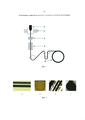
Способ изготовления покрытий из полиимидов формулы I осуществляют путем нанесения раствора соответствующего полиимида на поверхность вытянутого из заготовки световода и последующего удаления растворителя (фиг. 1).A method of manufacturing coatings of polyimides of the formula I is carried out by applying a solution of the corresponding polyimide on the surface of the fiber drawn from the preform and then removing the solvent (Fig. 1).
Результатом предлагаемого изобретения является разработка термостойких растворимых покрытий световодов на основе сополиимидов и повышение технологичности способа их изготовления. Возможно использование широкого круга кардовых и других гомо- и сополиимидов строения I для их непосредственного использования в изготовлении покрытий световодов.The result of the invention is the development of heat-resistant soluble coatings of optical fibers based on copolyimides and increase the manufacturability of the method of their manufacture. It is possible to use a wide range of carded and other homo- and copolyimides of structure I for their direct use in the manufacture of coatings of optical fibers.
Для приготовления наносимых на световод растворов гомо- и сополиимидов применяют амидные растворители (N-метил-2-пирролидон, N,N-диметилформамид, N,N-диметилацетамид), кетоны (циклогексанон), хлорированные углеводороды (хлороформ, хлористый метилен).Amide solvents (N-methyl-2-pyrrolidone, N, N-dimethylformamide, N, N-dimethylacetamide), ketones (cyclohexanone), chlorinated hydrocarbons (chloroform, methylene chloride) are used to prepare solutions of homo- and copolyimides applied to the fiber.
Растворимость применяемых гомо- и сополимидов в широком круге органических растворителей достигается кардовыми, например флуореновыми или фталидными, гексафторпропилиденовыми, НООС-, НО-, Cl- и другими группами.The solubility of the homo- and copolymers used in a wide range of organic solvents is achieved by carded, for example, fluorene or phthalide, hexafluoropropylidene, НООС-, НО-, Cl- and other groups.
В частности, из раствора в циклогексаноне с добавлением 2 масс. % 3-аминопропилтриэтоксисилана (аппрета) успешно изготовлено и протестировано покрытие на основе сополиимида следующего строения:In particular, from a solution in cyclohexanone with the addition of 2 mass. % 3-aminopropyltriethoxysilane (sizing) successfully manufactured and tested a coating based on copolyimide of the following structure:
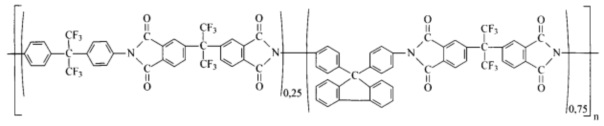
[(С.Л. Семенов и др. Высокотемпературное полиимидное покрытие для волоконных световодов. Квантовая электроника, 45, №4, с. 330 (2015)]. Прочность световода с покрытием из такого сополиимида уменьшалась не более чем на 10% при выдержке в течение 30 с, 1 и 24 ч при 430, 350 и 300°C соответственно.[(S.L.Semenov et al. High-temperature polyimide coating for fiber fibers. Quantum Electronics, 45, No. 4, p. 330 (2015)]. The strength of a fiber with a coating of such copolyimide decreased by no more than 10% upon exposure to for 30 s, 1 and 24 hours at 430, 350 and 300 ° C, respectively.
Изменение структуры сомономеров, используемых в синтезе сополиимидов, позволяет значительно варьировать термические, механические и адгезионные свойства покрытий. Так, введение боковых гидроксильных и карбоксильных групп в макромолекулы ПИ способствует улучшению прочности связи формирующейся пленки с поверхностью оптического волокна и устраняет необходимость добавления аппрета.Changing the structure of comonomers used in the synthesis of copolyimides allows one to significantly vary the thermal, mechanical, and adhesive properties of coatings. Thus, the introduction of lateral hydroxyl and carboxyl groups into PI macromolecules improves the bond strength of the forming film with the surface of the optical fiber and eliminates the need to add a size.
Раствор сополиимида готовят растворением ранее синтезированного полиимида в подобранном растворителе или используют раствор синтезированного полиимида без выделения (in situ), если поликонденсацию осуществляли, например, в N-метил-2-пирролидоне. Во всех случаях осуществляют разбавление раствора до вязкости 2400-18000 мПа×с. Установлено, что в данном диапазоне вязкости образуется гладкое равномерное покрытие на световоде диаметром ~ 150 мкм, демонстрируемое на представленных фотографиях (фиг. 2, а и б). При более низких или высоких значениях возрастает вероятность образования дефектных областей, например "бус" и "гребешков" (фиг. 2, в и г). При этом вязкость раствора полиимида зависит главным образом от трех параметров: молекулярной массы полиимида, природы растворителя и температуры. В заявляемом способе применимы полиимиды с широким диапазоном молекулярных масс (от 30000 до 150000). Одним из главных требований к полиимидам является способность образовывать прочные пленки.The copolyimide solution is prepared by dissolving the previously synthesized polyimide in a suitable solvent or using the synthesized polyimide solution without isolation (in situ) if the polycondensation was carried out, for example, in N-methyl-2-pyrrolidone. In all cases, the solution is diluted to a viscosity of 2400-18000 MPa × s. It was found that in this viscosity range a smooth uniform coating forms on the fiber with a diameter of ~ 150 μm, shown in the photographs presented (Fig. 2, a and b). At lower or higher values, the likelihood of formation of defective areas, for example, “beads” and “scallops” (Fig. 2, c and d) increases. The viscosity of the polyimide solution mainly depends on three parameters: the molecular weight of the polyimide, the nature of the solvent, and temperature. In the inventive method, polyimides with a wide range of molecular weights (from 30,000 to 150,000) are applicable. One of the main requirements for polyimides is the ability to form durable films.
На фиг. 1 показана установка для изготовления световода с полимерным покрытием, где 1 - заготовка, 2 - печь, 3 - фильера, 4 - печь, 5 - катушка.In FIG. 1 shows an installation for the manufacture of a fiber with a polymer coating, where 1 is a workpiece, 2 is a furnace, 3 is a die, 4 is a furnace, 5 is a coil.
Предлагаемый способ исключает применение предшественника (ПАК) и необходимую последующую циклизацию, сопровождающуюся выделением воды. Кроме того, достоинством заявляемого способа является его совместимость с существующими технологическими установками (фиг. 1).The proposed method eliminates the use of a precursor (PAA) and the necessary subsequent cyclization, accompanied by the release of water. In addition, the advantage of the proposed method is its compatibility with existing technological installations (Fig. 1).
Как правило, в случае традиционного способа нанесения покрытия с использованием ПАК (предшественника полиимида) толщина полимерного покрытия при однократном протягивании составляет порядка 1-2 мкм, что обусловливается необходимостью достижения наиболее полной степени циклизации ПАК и образования бездефектного покрытия. Это делает необходимым многократное нанесение ПАК на световод до достижения 5-15-микрометровой толщины конечного полиимидного покрытия, что значительно усложняет технологический процесс.As a rule, in the case of the traditional coating method using PAA (polyimide precursor), the thickness of the polymer coating with a single pull is about 1-2 μm, which is due to the need to achieve the most complete degree of cyclization of PAA and the formation of a defect-free coating. This makes it necessary to repeatedly apply PAA to the fiber to reach a 5-15 micrometer thickness of the final polyimide coating, which greatly complicates the process.
Новизна заявляемого способа состоит в том, что исключается стадия циклизации ПАК и выделение вследствие этого воды. Это делает возможным изготовление покрытия с большей толщиной за 1 нанос (5 мкм и более). Данный факт наглядно демонстрирует преимущество заявляемого способа, в котором для формирования покрытия используются растворимые полиимиды, а не их химические предшественники - ПАК. Применение готового полиимида позволяет упростить технологию и сократить время получения покрытия. При нагревании в печи 4 осуществляется лишь удаление растворителя из полимерного раствора, нанесенного на поверхность световода (фиг. 1).The novelty of the proposed method consists in the fact that eliminates the stage of cyclization of the PAA and the allocation of water as a result. This makes it possible to produce a coating with a greater thickness in 1 nanosecond (5 μm or more). This fact clearly demonstrates the advantage of the proposed method, in which soluble polyimides are used to form the coating, and not their chemical precursors - PAA. The use of ready-made polyimide allows you to simplify the technology and reduce the time to obtain coverage. When heated in the furnace 4, only the solvent is removed from the polymer solution deposited on the surface of the fiber (Fig. 1).
Изобретение иллюстрируется приведенными ниже примерами и фигурами 1 и 2.The invention is illustrated by the following examples and figures 1 and 2.
Общая методика изготовления полиимидного покрытияGeneral procedure for the manufacture of polyimide coatings
Сополиимид получают одно- или двухстадийным способом [Виноградова С.В. и др. Кардовые полигетероарилены. Синтез, свойства и своеобразие // Успехи химии, 65, №3, 266 (1996)]. После чего, как правило, полиимид выделяют, очищают и сушат. ПИ растворяют в подобранном растворителе до достижения вязкости раствора 2400-18000 мПа×с. При использовании N-метил-2-пирролидона для синтеза ПИ возможно исключение стадии выделения полимера. При этом полученный в ходе синтеза полимерный раствор разбавляют до требуемой вязкости и наносят на световод.Copolyimide is obtained in one or two stages [Vinogradova C.V. and other Cardiovascular polyheteroarylenes. Synthesis, properties and originality // Uspekhi Khimii, 65, No. 3, 266 (1996)]. After which, as a rule, the polyimide is isolated, purified and dried. PI is dissolved in the selected solvent until a solution viscosity of 2400-18000 mPa × s is reached. When using N-methyl-2-pyrrolidone for the synthesis of PI, it is possible to exclude the stage of polymer isolation. In this case, the polymer solution obtained during the synthesis is diluted to the required viscosity and applied to the fiber.
В некоторых случаях после приготовления ПИ-раствора в него, в зависимости от строения ПИ, добавляют 1-2 масс. % аппрета (от массы полимера), раствор перемешивают, фильтруют и помещают в фильеру.In some cases, after the preparation of the PI solution, 1-2 masses are added to it, depending on the structure of the PI. % sizing (based on polymer weight), the solution is mixed, filtered and placed in a die.
На установке для изготовления световода с полимерным покрытием (фиг. 1) из заготовки 1, разогретой в печи 2, вытягивают волокно диаметром порядка 150 мкм и протягивают через фильеру 3 диаметром отверстия 200 мкм, содержащую раствор соответствующего ПИ. Затем световод с нанесенным раствором попадает в печь 4, где происходит удаление растворителя в течение 3-8 с. Температурный режим в печи (50-350°C) зависит от температуры кипения используемого растворителя и его подбирают таким образом, чтобы обеспечить наиболее полное удаление растворителя. Затем световод с готовым полиимидным покрытием наматывают на катушку 5 (фиг. 1), скорость вращения которой определяет диаметр оптического волокна, толщину наносимого покрытия и время сушки.At the installation for the manufacture of a fiber with a polymer coating (Fig. 1), from a
Разница между диаметром отверстия фильеры и диаметром вытягиваемого световода определяет толщину наносимого слоя раствора полиимида. Толщина изготавливаемого слоя полиимидного покрытия световода за 1 цикл нанесения раствора достигает 5-15 мкм.The difference between the diameter of the hole of the die and the diameter of the drawn fiber determines the thickness of the applied layer of the polyimide solution. The thickness of the manufactured layer of the polyimide coating of the fiber for 1 cycle of application of the solution reaches 5-15 microns.
Пример 1Example 1
Покрытие из полиимида на основе диангидрида 3,3',4,4'-тетракарбоксидифенилоксида и 9,9-бис-(4'-аминофенил)флуорена:3.3 ', 4,4'-tetracarboxydiphenyl oxide and 9,9-bis (4'-aminophenyl) fluorene polyimide coating:
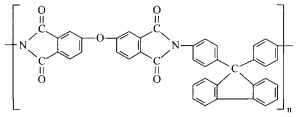
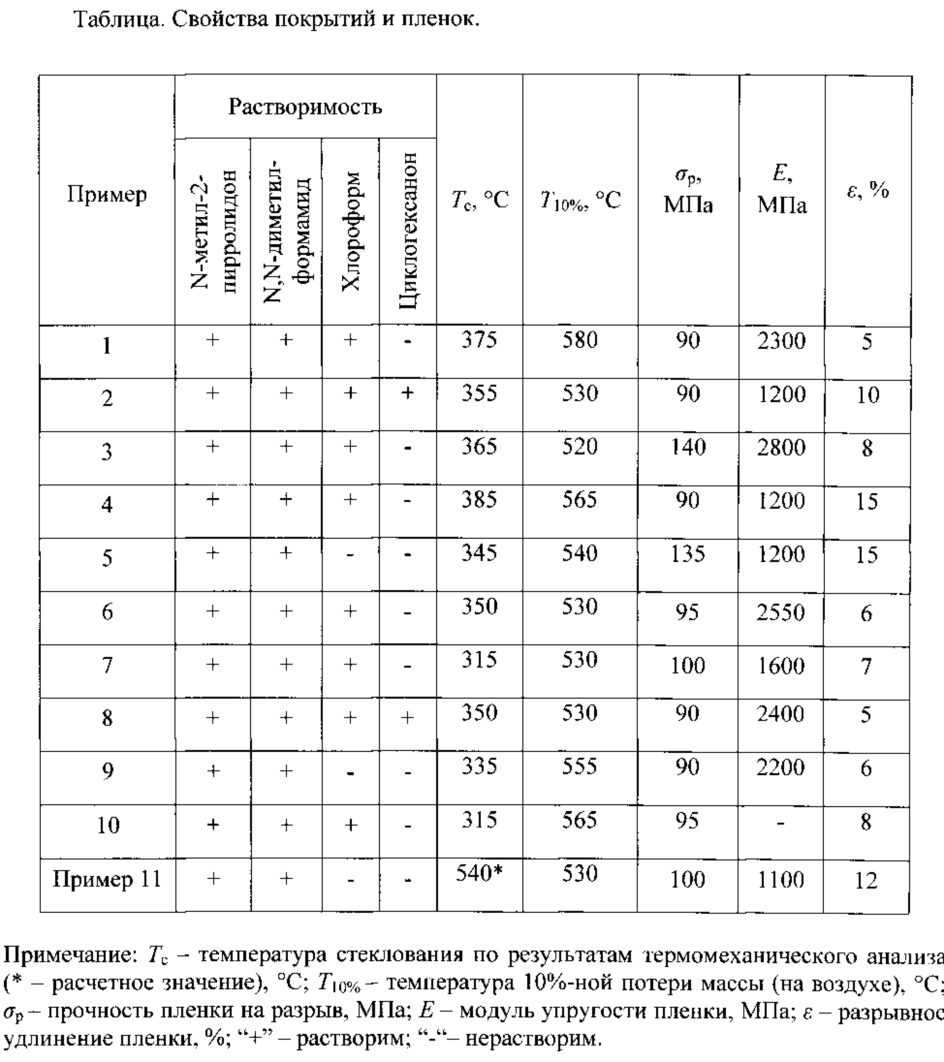
Покрытие из полимера представленного строения имеет температуру стеклования порядка 375°C и температуру 10%-ной потери массы на воздухе около 580°C. Пленочные образцы полимера демонстрируют разрывную прочность порядка 90 МПа, модуль упругости 2300 МПа и относительное удлинение около 5% (таблица).The polymer coating of the present structure has a glass transition temperature of about 375 ° C and a temperature of 10% weight loss in air of about 580 ° C. Film polymer samples exhibit tensile strength of the order of 90 MPa, an elastic modulus of 2300 MPa, and an elongation of about 5% (table).
Световод с покрытием из указанного полиимида устойчив к значительным термическим воздействиям: выдерживание в течение 24 ч при 300°C приводит к 5%-ной потере прочности, при 350°C - 30%-ной.A fiber with a coating of the specified polyimide is resistant to significant thermal effects: holding for 24 hours at 300 ° C leads to a 5% loss of strength, at 350 ° C - 30%.
Из предварительно синтезированного, выделенного и очищенного ПИ готовят 15-20% раствор в N-метил-2-пирролидоне, соответствующий требуемому диапазону вязкости. Добавляют 2 масс. % 3-аминопропилтриэтоксисилана в расчете на полимер, перемешивают, фильтруют и заливают в фильеру, через которую протягивают световод согласно общей методике. Температура в печи, где происходит удаление растворителя, составляет 250-350°C.A 15-20% solution in N-methyl-2-pyrrolidone corresponding to the required viscosity range is prepared from pre-synthesized, isolated and purified PI. Add 2 mass. % 3-aminopropyltriethoxysilane per polymer, is mixed, filtered and poured into a die through which the optical fiber is pulled according to the general procedure. The temperature in the furnace where the solvent is removed is 250-350 ° C.
Пример 2Example 2
Покрытие из сополиимида на основе диангидрида 2,2-бис-(3',4'-дикарбоксифенил)-1,1,1,3,3,3-гексафторпропана, 9,9-бис-(4'-аминофенил)флуорена и 2,2-бис-(4'-аминофенил)-1,1,1,3,3,3-гексафторпропана, содержащего кардовые и гексафторпропилиденовые группы:Coating from copolyimide based on 2,2-bis- (3 ', 4'-dicarboxyphenyl) -1,1,1,3,3,3-hexafluoropropane, 9,9-bis (4'-aminophenyl) fluorene dianhydride and 2,2-bis- (4'-aminophenyl) -1,1,1,3,3,3-hexafluoropropane containing carbo and hexafluoropropylidene groups:

Покрытие имеет температуру стеклования порядка 355°C и температуру 10%-ной потери массы на воздухе около 530°C. Разрывная прочность пленочных образцов порядка 90 МПа, модуль упругости 1200 МПа при относительном удлинении 10% (таблица). Прочность световода с покрытием из такого сополиимида уменьшается не более чем на 10% при выдержке в течение 30 с, 1 и 24 ч при 430, 350 и 300°C соответственно.The coating has a glass transition temperature of about 355 ° C and a temperature of 10% weight loss in air of about 530 ° C. The tensile strength of film samples is about 90 MPa, the modulus of elasticity is 1200 MPa with a relative elongation of 10% (table). The strength of a fiber coated with such a copolyimide decreases by no more than 10% upon exposure for 30 s, 1 and 24 hours at 430, 350 and 300 ° C, respectively.
Покрытие изготавливают из раствора ПИ в циклогексаноне с добавлением 2 масс. % 3-аминопропилтриэтоксисилана. Температура в печи 150-250°C.The coating is made from a solution of PI in cyclohexanone with the addition of 2 mass. % 3-aminopropyltriethoxysilane. The temperature in the oven is 150-250 ° C.
Пример 3Example 3
Покрытие из сополиимида на основе диангидрида 3,3',4,4'-тетракарбоксидифенилоксида, 9,9-бис-(4'-аминофенил)флуорена и 3,3'-диокси-4,4'-диаминодифенила, макромолекулы которого содержат боковые гидроксильные группы, улучшающие сцепление покрытия со световодом и устраняющие необходимость использования аппрета:Coating from copolyimide based on 3,3 ', 4,4'-tetracarboxydiphenyl oxide dianhydride, 9,9-bis- (4'-aminophenyl) fluorene and 3,3'-dioxo-4,4'-diaminodiphenyl, whose macromolecules contain side hydroxyl groups that improve the adhesion of the coating to the fiber and eliminate the need for a sizing:
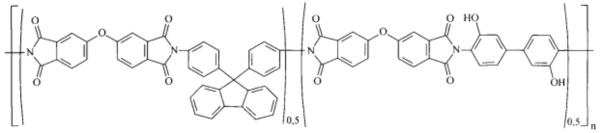
Покрытие характеризуется температурой стеклования порядка 365°C и температурой 10%-ной потери массы на воздухе около 520°C. Пленки из указанного сополиимида имеют высокие показатели разрывной прочности порядка 140 МПа, модуль упругости 2800 МПа и относительное удлинение около 8% (таблица). Прочность световода с покрытием, полученным из указанного полиимида, при термообработке сопоставима с прочностью световода, описанного в примере 1. Покрытие изготавливают из раствора ПИ в N-метил-2-пирролидоне в отсутствие аппрета. Температура в печи 250-350°C.The coating is characterized by a glass transition temperature of about 365 ° C and a temperature of 10% weight loss in air of about 520 ° C. Films from this copolyimide have high tensile strengths of the order of 140 MPa, an elastic modulus of 2800 MPa and an elongation of about 8% (table). The strength of the fiber with a coating obtained from the specified polyimide during heat treatment is comparable to the strength of the fiber described in example 1. The coating is made from a solution of PI in N-methyl-2-pyrrolidone in the absence of a size. The temperature in the oven is 250-350 ° C.
Пример 4Example 4
Покрытие из сополиимида на основе диангидридов 3,3',4,4'-тетракарбоксидифенила, 3,3',4,4'-тетракарбоксидифенилоксида и 9,9-бис-(4'-аминофенил)флуорена:Coating from copolyimide based on 3,3 ', 4,4'-tetracarboxydiphenyl, 3,3', 4,4'-tetracarboxydiphenyl oxide and 9,9-bis- (4'-aminophenyl) fluorene co-polyimide:
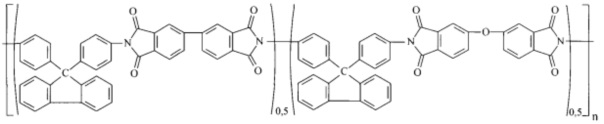
Покрытие из полимера представленного строения имеет температуру стеклования порядка 385°C и температуру 10%-ной потери массы на воздухе около 565°C. Пленочные образцы полимера демонстрируют разрывную прочность порядка 90 МПа, модуль упругости 1200 МПа и относительное удлинение около 15% (таблица).The polymer coating of the present structure has a glass transition temperature of about 385 ° C and a temperature of 10% weight loss in air of about 565 ° C. Film polymer samples demonstrate tensile strength of the order of 90 MPa, an elastic modulus of 1200 MPa, and an elongation of about 15% (table).
Световоды с покрытием из указанного полиимида устойчивы к значительным термическим воздействиям. Свойства такого рода световодов аналогичны описанным в примере 1.Optical fibers coated with the specified polyimide are resistant to significant thermal effects. The properties of such fibers are similar to those described in example 1.
Из предварительно синтезированного, выделенного и очищенного сополиимида готовят 15-20% раствор в N-метил-2-пирролидоне, соответствующий требуемому диапазону вязкости, и добавляют 2 масс. % 3-аминопропилтриэтоксисилана в расчете на полимер. Раствор заливают в фильеру, через которую протягивают световод согласно общей методике. Температура в печи составляет 250-350°C.From a pre-synthesized, isolated and purified copolyimide, a 15-20% solution in N-methyl-2-pyrrolidone corresponding to the desired viscosity range is prepared, and 2 masses are added. % 3-aminopropyltriethoxysilane based on the polymer. The solution is poured into a die through which a fiber is pulled according to a general procedure. The temperature in the oven is 250-350 ° C.
Пример 5Example 5
Покрытие из сополиимида на основе диангидрида 3,3',4,4'-тетракарбоксидифенилоксида, 9,9-бис-(4'-аминофенил)флуорена и 3,5-диаминобензойной кислоты, макромолекулы которого содержат боковые карбоксильные группы, улучшающие сцепление покрытия со световодом и устраняющие необходимость использования аппрета:Coating from copolyimide based on dianhydride 3.3 ', 4,4'-tetracarboxydiphenyl oxide, 9,9-bis- (4'-aminophenyl) fluorene and 3,5-diaminobenzoic acid, the macromolecules of which contain side carboxyl groups that improve the adhesion of the coating to optical fiber and eliminating the need for a sizing:
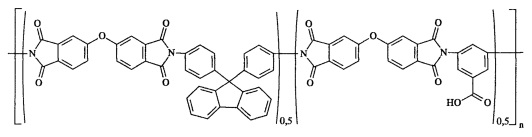
Покрытие характеризуется температурой стеклования порядка 345°C и температурой 10%-ной потери массы на воздухе около 540°C. Пленки из указанного сополиимида имеют высокие показатели разрывной прочности порядка 135 МПа, модуль упругости 1200 МПа и относительное удлинение около 15% (таблица). Прочность световода с покрытием из такого сополиимида уменьшается на 10% при выдержке в течение 72 ч при 250 и 300°C.The coating is characterized by a glass transition temperature of about 345 ° C and a temperature of 10% weight loss in air of about 540 ° C. Films from this copolyimide have high tensile strengths of the order of 135 MPa, an elastic modulus of 1200 MPa and an elongation of about 15% (table). The strength of a fiber coated with such a copolyimide is reduced by 10% when held for 72 hours at 250 and 300 ° C.
Покрытие изготавливают из раствора ПИ в N-метил-2-пирролидоне в отсутствие аппрета. Температура в печи 250-350°C.The coating is made from a solution of PI in N-methyl-2-pyrrolidone in the absence of a sizing. The temperature in the oven is 250-350 ° C.
Пример 6Example 6
Покрытие из сополиимида на основе диангидрида 2,2-бис-(3',4'-дикарбоксифенил)-1,1,1,3,3,3-гексафторпропана, 9,9-бис-(4'-аминофенил)флуорена и α,ω-ди(3-аминопропил)олигодиметилсилоксана:Coating from copolyimide based on 2,2-bis- (3 ', 4'-dicarboxyphenyl) -1,1,1,3,3,3-hexafluoropropane, 9,9-bis (4'-aminophenyl) fluorene dianhydride and α, ω-di (3-aminopropyl) oligodimethylsiloxane:

где m=99.where m = 99.
Покрытие из полимера представленного строения имеет температуру стеклования порядка 350°C и температуру 10%-ной потери массы на воздухе около 530°C. Пленочные образцы полимера демонстрируют разрывную прочность порядка 95 МПа, модуль упругости 2550 МПа и относительное удлинение около 6% (таблица). Прочность световода с покрытием, полученным из указанного сополиимида, до и после термообработки сопоставима с прочностью световода, описанного в примере 2.The polymer coating of the present structure has a glass transition temperature of about 350 ° C and a temperature of 10% weight loss in air of about 530 ° C. Film polymer samples exhibit tensile strength of the order of 95 MPa, an elastic modulus of 2550 MPa, and an elongation of about 6% (table). The strength of the fiber with a coating obtained from the specified copolyimide, before and after heat treatment is comparable with the strength of the fiber described in example 2.
Покрытие изготавливают из раствора ПИ в N-метил-2-пирролидоне с добавлением 2 масс. % 3-аминопропилтриэтоксисилана. Температура в печи 250-350°C.The coating is made from a solution of PI in N-methyl-2-pyrrolidone with the addition of 2 mass. % 3-aminopropyltriethoxysilane. The temperature in the oven is 250-350 ° C.
Пример 7Example 7
Покрытие из полиимида на основе диангидрида 2,2-бис-(3',4'-дикарбоксифенил)-1,1,1,3,3,3-гексафторпропана и 2-хлор-1,4-диаминобензола:2,2-bis- (3 ', 4'-dicarboxyphenyl) -1,1,1,3,3,3-hexafluoropropane and 2-chloro-1,4-diaminobenzene-based polyimide coating based on dianhydride:
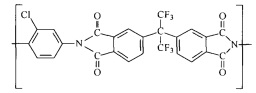
Покрытие из полимера представленного строения имеет температуру стеклования порядка 315°C и температуру 10%-ной потери массы на воздухе около 530°C. Пленочные образцы полимера демонстрируют разрывную прочность порядка 100 МПа, модуль упругости 1600 МПа и относительное удлинение около 7% (таблица). Прочность световода с покрытием, полученным из указанного сополиимида, до и после термообработки сопоставима с прочностью световода, описанного в примере 2.The polymer coating of the present structure has a glass transition temperature of about 315 ° C and a temperature of 10% weight loss in air of about 530 ° C. Film polymer samples demonstrate tensile strength of the order of 100 MPa, an elastic modulus of 1600 MPa and an elongation of about 7% (table). The strength of the fiber with a coating obtained from the specified copolyimide, before and after heat treatment is comparable with the strength of the fiber described in example 2.
Покрытие изготавливают из раствора ПИ в N-метил-2-пирролидоне с добавлением 2 масс. % 3-аминопропилтриэтоксисилана. Температура в печи 250-350°C.The coating is made from a solution of PI in N-methyl-2-pyrrolidone with the addition of 2 mass. % 3-aminopropyltriethoxysilane. The temperature in the oven is 250-350 ° C.
Пример 8Example 8
Покрытие из сополиимида на основе диангидрида 2,2-бис-(3',4'-дикарбоксифенил)-1,1,1,3,3,3-гексафторпропана, 9,9-бис-(4'-аминофенил)флуорена и 2,5-дихлор-1,4-диаминобензола:Coating from copolyimide based on 2,2-bis- (3 ', 4'-dicarboxyphenyl) -1,1,1,3,3,3-hexafluoropropane, 9,9-bis (4'-aminophenyl) fluorene dianhydride and 2,5-dichloro-1,4-diaminobenzene:
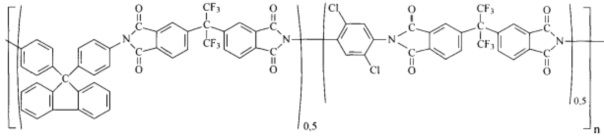
Покрытие из полимера представленного строения имеет температуру стеклования порядка 350°C и температуру 10%-ной потери массы на воздухе около 530°C. Пленочные образцы полимера демонстрируют разрывную прочность порядка 90 МПа, модуль упругости 2400 МПа и относительное удлинение около 5% (таблица). Прочность световода с покрытием, полученным из указанного сополиимида, до и после термообработки сопоставима с прочностью световода, описанного в примере 2.The polymer coating of the present structure has a glass transition temperature of about 350 ° C and a temperature of 10% weight loss in air of about 530 ° C. Film polymer samples exhibit tensile strength of the order of 90 MPa, elastic modulus of 2400 MPa, and elongation of about 5% (table). The strength of the fiber with a coating obtained from the specified copolyimide, before and after heat treatment is comparable with the strength of the fiber described in example 2.
Покрытие изготавливают из раствора ПИ в N-метил-2-пирролидоне с добавлением 2 масс. % 3-аминопропилтриэтоксисилана. Температура в печи 250-350°C.The coating is made from a solution of PI in N-methyl-2-pyrrolidone with the addition of 2 mass. % 3-aminopropyltriethoxysilane. The temperature in the oven is 250-350 ° C.
Пример 9Example 9
Покрытие из сополиимида на основе диангидрида 3,3',4,4'-тетракарбоксидифенилоксида, 9,9-бис-(4'-аминофенил)флуорена и 2-хлор-1,4-диаминобензола:Coating from copolyimide based on
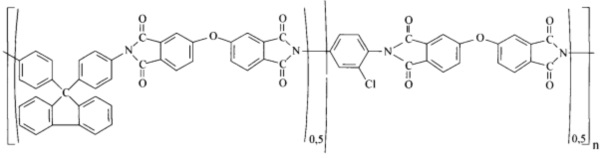
Покрытие из полимера представленного строения имеет температуру стеклования порядка 335°C и температуру 10%-ной потери массы на воздухе около 555°C. Пленочные образцы полимера демонстрируют разрывную прочность порядка 90 МПа, модуль упругости 2200 МПа и относительное удлинение около 6% (таблица). Прочность световода с покрытием, полученным из указанного сополиимида, до и после термообработки сопоставима с прочностью световода, описанного в примере 1.The polymer coating of the present structure has a glass transition temperature of about 335 ° C. and a temperature of 10% weight loss in air of about 555 ° C. Film polymer samples exhibit tensile strength of the order of 90 MPa, an elastic modulus of 2200 MPa, and an elongation of about 6% (table). The strength of the fiber with a coating obtained from the specified copolyimide, before and after heat treatment is comparable with the strength of the fiber described in example 1.
Покрытие изготавливают из раствора ПИ в N-метил-2-пирролидоне с добавлением 2 масс. % 3-аминопропилтриэтоксисилана. Температура в печи 250-350°C.The coating is made from a solution of PI in N-methyl-2-pyrrolidone with the addition of 2 mass. % 3-aminopropyltriethoxysilane. The temperature in the oven is 250-350 ° C.
Пример 10Example 10
Покрытие из сополиимида на основе диангидрида 3,3',4,4'-тетракарбоксидифенилоксида, 9,9-бис-(4'-аминофенил)флуорена и 2,5-дихлор-1,4-диаминобензола:Coating from copolyimide based on
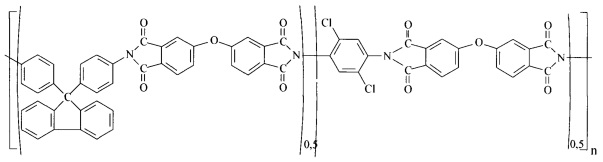
Покрытие из полимера представленного строения имеет температуру стеклования порядка 315°C и температуру 10%-ной потери массы на воздухе около 565°C. Пленочные образцы полимера демонстрируют разрывную прочность порядка 95 МПа и относительное удлинение около 8% (таблица). Прочность световода с покрытием, полученным из указанного сополиимида, до и после термообработки сопоставима с прочностью световода, описанного в примере 1.The polymer coating of the present structure has a glass transition temperature of about 315 ° C and a temperature of 10% weight loss in air of about 565 ° C. Film polymer samples demonstrate tensile strength of the order of 95 MPa and an elongation of about 8% (table). The strength of the fiber with a coating obtained from the specified copolyimide, before and after heat treatment is comparable with the strength of the fiber described in example 1.
Покрытие изготавливают из раствора ПИ в N-метил-2-пирролидоне с добавлением 2 масс. % 3-аминопропилтриэтоксисилана. Температура в печи 250-350°C.The coating is made from a solution of PI in N-methyl-2-pyrrolidone with the addition of 2 mass. % 3-aminopropyltriethoxysilane. The temperature in the oven is 250-350 ° C.
Пример 11Example 11
Покрытие из полиимида на основе диангидрида 1,4,5,8-нафталинтетракарбоновой кислоты и 3,3-бис-(4'-аминофенил)фталида, содержащего гидролитически более стабильные шестичленные имидные циклы:Coating of polyimide based on 1,4,5,8-naphthalene-tetracarboxylic acid dianhydride and 3,3-bis- (4'-aminophenyl) phthalide containing hydrolytically more stable six-membered imide rings:
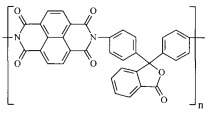
Покрытие из полимера представленного строения не размягчается до начала разложения (температура 10%-ной потери массы на воздухе около 530°C). Расчетное значение температуры стеклования составляет около 540°C. Пленочные образцы полимера демонстрируют разрывную прочность порядка 100 МПа, модуль упругости 1100 МПа и относительное удлинение около 12% (таблица). Прочность световода с покрытием, полученным из указанного сополиимида, до и после термообработки сопоставима с прочностью световода, описанного в примере 1.The polymer coating of the present structure does not soften before decomposition begins (temperature of 10% mass loss in air is about 530 ° C). The estimated glass transition temperature is around 540 ° C. Film polymer samples demonstrate tensile strength of the order of 100 MPa, elastic modulus of 1100 MPa and elongation of about 12% (table). The strength of the fiber with a coating obtained from the specified copolyimide, before and after heat treatment is comparable with the strength of the fiber described in example 1.
Покрытие изготавливают из раствора ПИ в N-метил-2-пирролидоне с добавлением 2 масс. % 3-аминопропилтриэтоксисилана. Температура в печи 250-350°C.The coating is made from a solution of PI in N-methyl-2-pyrrolidone with the addition of 2 mass. % 3-aminopropyltriethoxysilane. The temperature in the oven is 250-350 ° C.
Пример 12Example 12
Изготовление покрытия из полиимида, представленного в примере 1, осуществляют аналогично, но для приготовления раствора полиимида используют N,N-диметилформамид, а температура в печи составляет 200-300°C. Свойства покрытия аналогичны свойствам покрытия, описанного в примере 1 (см. таблицу).The manufacture of the coating from the polyimide shown in Example 1 is carried out similarly, but N, N-dimethylformamide is used to prepare the polyimide solution, and the oven temperature is 200-300 ° C. The properties of the coating are similar to the properties of the coating described in example 1 (see table).
Пример 13Example 13
Изготовление покрытия из полиимида, представленного в примере 1, осуществляют аналогично, но для приготовления раствора полиимида используют N,N-диметилацетамид, а температура в печи составляет 200-300°C. Свойства покрытия аналогичны свойствам покрытия, описанного в примере 1 (см. таблицу).The manufacture of the polyimide coating described in Example 1 is carried out similarly, but N, N-dimethylacetamide is used to prepare the polyimide solution, and the oven temperature is 200-300 ° C. The properties of the coating are similar to the properties of the coating described in example 1 (see table).
Пример 14Example 14
Изготовление покрытия из сополиимида, представленного в примере 2, осуществляют аналогично, но для приготовления раствора сополиимида используют хлороформ, а температура в печи составляет 50-150°C. Свойства покрытия аналогичны свойствам покрытия, описанного в примере 2 (см. таблицу).The production of the copolyimide coating presented in Example 2 is carried out similarly, but chloroform is used to prepare the copolyimide solution, and the oven temperature is 50-150 ° C. The properties of the coating are similar to the properties of the coating described in example 2 (see table).
Пример 15Example 15
Синтез полиимида, используемого в примере 1, осуществляют в N-метил-2-пирролидоне. Полученный в результате синтеза раствор разбавляют до требуемой вязкости и используют без выделения полимера (in situ) в соответствии с общей методикой, описанной в примере 1. Свойства покрытия аналогичны свойствам покрытия, описанного в примере 1 (см. таблицу).The synthesis of the polyimide used in example 1 is carried out in N-methyl-2-pyrrolidone. The resulting synthesis solution is diluted to the desired viscosity and used without isolation of the polymer (in situ) in accordance with the General procedure described in example 1. The properties of the coating are similar to the properties of the coating described in example 1 (see table).
Технический результат - новые термостойкие растворимые покрытия волоконных световодов на основе гомо- и сополиимидов, удобный способ их изготовления, обеспечивающий упрощение существующей технологии получения растворимых полиимидных покрытий световодов, повышение долговечности полиимидных покрытий и стабильности их характеристик.EFFECT: new heat-resistant soluble coatings of optical fibers based on homo- and copolyimides, a convenient method for their manufacture, which simplifies the existing technology for producing soluble polyimide coatings of optical fibers, increases the durability of polyimide coatings and the stability of their characteristics.
Заявляемое изобретение дает возможность изготавливать полиимидные покрытия волоконных световодов из кардовых, фторсодержащих и других гомо- и сополиимидов с варьируемыми в широком диапазоне свойствами: термостойкостью, растворимостью, адгезией к световоду и т.д.The claimed invention makes it possible to produce polyimide coatings of optical fibers from carded, fluorine-containing and other homo- and copolyimides with properties that vary in a wide range of properties: heat resistance, solubility, adhesion to the fiber, etc.
Важнейшей отличительной особенностью предлагаемых покрытий световодов по сравнению с применяемыми и описанными ранее является использование готовых полиимидов, а не их предшественников - полиамидокислот, что обусловливает отсутствие нециклизованных амидокислотных фрагментов в конечном покрытии. Это обеспечивает значительную стабильность свойств подобных покрытий и увеличивает срок их службы.The most important distinguishing feature of the proposed coatings of optical fibers in comparison with those used and described earlier is the use of ready-made polyimides, and not their precursors - polyamic acids, which leads to the absence of uncyclic amide-acid fragments in the final coating. This provides significant stability properties of such coatings and increases their service life.
Заявляемый способ изготовления растворимых покрытий световодов из полиимидов имеет следующие технологические преимущества, по сравнению с известными способами, в которых используют не готовые полиимиды, а их полиамидокислотные предшественники:The inventive method for the manufacture of soluble coatings of optical fibers from polyimides has the following technological advantages, in comparison with known methods that use not prepared polyimides, but their polyamic acid precursors:
- для изготовления покрытий используются стабильные полиимиды, а не их нестабильные предшественники (ПАК), которые требуют особых условий транспортировки и хранения раствора (около -20°C);- for the manufacture of coatings, stable polyimides are used, and not their unstable precursors (PAA), which require special conditions for transportation and storage of the solution (about -20 ° C);
- исключается стадия высокотемпературной циклизации ПАК до ПИ, что обеспечивает сокращение времени и энергозатрат на изготовление покрытия;- eliminates the stage of high-temperature cyclization of PAA to PI, which reduces the time and energy consumption for the manufacture of coatings;
- после нанесения раствора полиимида на световод для формирования конечного покрытия требуется только удаление растворителя при нагревании;- after applying a solution of polyimide on the fiber for the formation of the final coating requires only the removal of the solvent by heating;
- требуемая толщина покрытия в 5-15 мкм может быть достигнута в результате однократного нанесения покрытия, тогда как в случае использования полиамидокислотного предшественника такой результат достигается только после многократного повторения процесса;- the required coating thickness of 5-15 μm can be achieved as a result of a single coating, whereas in the case of using a polyamic acid precursor, this result is achieved only after repeated repetition of the process;
- возможность использования широкого круга органических растворителей с различными температурами кипения.- the possibility of using a wide range of organic solvents with different boiling points.
Claims (8)

Priority Applications (1)
| Application Number | Priority Date | Filing Date | Title |
|---|---|---|---|
| RU2015145094A RU2610503C1 (en) | 2015-10-21 | 2015-10-21 | Fibre-optic guides polyimide coating and preparation method thereof |
Applications Claiming Priority (1)
| Application Number | Priority Date | Filing Date | Title |
|---|---|---|---|
| RU2015145094A RU2610503C1 (en) | 2015-10-21 | 2015-10-21 | Fibre-optic guides polyimide coating and preparation method thereof |
Publications (1)
| Publication Number | Publication Date |
|---|---|
| RU2610503C1 true RU2610503C1 (en) | 2017-02-13 |
Family
ID=58458519
Family Applications (1)
| Application Number | Title | Priority Date | Filing Date |
|---|---|---|---|
| RU2015145094A RU2610503C1 (en) | 2015-10-21 | 2015-10-21 | Fibre-optic guides polyimide coating and preparation method thereof |
Country Status (1)
| Country | Link |
|---|---|
| RU (1) | RU2610503C1 (en) |
Cited By (2)
| Publication number | Priority date | Publication date | Assignee | Title |
|---|---|---|---|---|
| RU2751883C1 (en) * | 2020-12-16 | 2021-07-19 | Федеральное государственное бюджетное образовательное учреждение высшего образования "Волгоградский государственный технический университет" (ВолгГТУ) | Polyimides and copolyimides as dielectric materials |
| RU2782438C1 (en) * | 2021-12-17 | 2022-10-27 | Федеральное государственное бюджетное учреждение науки Институт элементоорганических соединений им. А.Н. Несмеянова Российской академии наук (ИНЭОС РАН) | Coatings of fiber from aromatic polyamidoimides and their manufacturing method |
Citations (4)
| Publication number | Priority date | Publication date | Assignee | Title |
|---|---|---|---|---|
| SU410057A1 (en) * | 1971-11-11 | 1974-01-05 | ||
| SU671323A1 (en) * | 1976-07-22 | 1981-06-30 | Институт химических наук АН Казахской ССР | Method of preparing soluble polyimides |
| RU2169713C2 (en) * | 1996-03-29 | 2001-06-27 | Галилео Корпорейшн | Method of molding removeable polyimide coating for optical fiber |
| US9063268B2 (en) * | 2010-02-24 | 2015-06-23 | Corning Incorporated | Dual coated optical fibers and methods for forming the same |
-
2015
- 2015-10-21 RU RU2015145094A patent/RU2610503C1/en active
Patent Citations (4)
| Publication number | Priority date | Publication date | Assignee | Title |
|---|---|---|---|---|
| SU410057A1 (en) * | 1971-11-11 | 1974-01-05 | ||
| SU671323A1 (en) * | 1976-07-22 | 1981-06-30 | Институт химических наук АН Казахской ССР | Method of preparing soluble polyimides |
| RU2169713C2 (en) * | 1996-03-29 | 2001-06-27 | Галилео Корпорейшн | Method of molding removeable polyimide coating for optical fiber |
| US9063268B2 (en) * | 2010-02-24 | 2015-06-23 | Corning Incorporated | Dual coated optical fibers and methods for forming the same |
Cited By (5)
| Publication number | Priority date | Publication date | Assignee | Title |
|---|---|---|---|---|
| RU2751883C1 (en) * | 2020-12-16 | 2021-07-19 | Федеральное государственное бюджетное образовательное учреждение высшего образования "Волгоградский государственный технический университет" (ВолгГТУ) | Polyimides and copolyimides as dielectric materials |
| RU2782438C1 (en) * | 2021-12-17 | 2022-10-27 | Федеральное государственное бюджетное учреждение науки Институт элементоорганических соединений им. А.Н. Несмеянова Российской академии наук (ИНЭОС РАН) | Coatings of fiber from aromatic polyamidoimides and their manufacturing method |
| RU2791384C1 (en) * | 2021-12-29 | 2023-03-07 | Федеральное государственное бюджетное учреждение науки Институт элементоорганических соединений им. А.Н. Несмеянова Российской академии наук (ИНЭОС РАН) | Heat-resistant protective coatings from polyimides based on 3,5-diaminobenzoic acid |
| RU2788166C1 (en) * | 2022-06-29 | 2023-01-17 | Федеральное государственное бюджетное образовательное учреждение высшего образования "Волгоградский государственный технический университет" (ВолгГТУ) | Optically transparent adamantane-containing polyimides and copolyimides based on 5,5'-(1,1,1,3,3,3-hexafluoropropane-2,2-diyl)bis(2-benzofuran-1,3-dione) with a low dielectric permanent |
| RU2861364C1 (en) * | 2024-11-08 | 2026-05-05 | Федеральное государственное бюджетное учреждение науки Институт элементоорганических соединений им. А.Н. Несмеянова Российской академии наук (ИНЭОС РАН) | Photopolymerisable composition based on di(meth)acrylate and fluorinated cardo polyimide |
Similar Documents
| Publication | Publication Date | Title |
|---|---|---|
| JP7037534B2 (en) | Polyimide film with voids and its manufacturing method | |
| CN110268004B (en) | Polyamide-imide film | |
| JP4189569B2 (en) | Carbon film manufacturing method | |
| TWI732745B (en) | Heat-resistant non-woven fabric, its manufacturing method and its application | |
| CN102766919B (en) | Preparation method of polyimide fibers | |
| CN102770387A (en) | Dual coated optical fibers and methods for forming the same | |
| CN101473080A (en) | Polyimide nonwoven fabric and method for producing same | |
| JP5423400B2 (en) | Solvent resistant asymmetric hollow fiber gas separation membrane and method for producing the same | |
| JPH06511222A (en) | Glass fiber coated with photocurable polyimide | |
| JP2009149787A (en) | Fluorescent material | |
| KR100686568B1 (en) | Cured Fluorenyl Polyimide | |
| Sapozhnikov et al. | H ighly Heat-Resistant Polymeric Coatings of Optical Fibers | |
| CN118835349A (en) | Gradient pore structure polyimide aerogel fiber with porous core layer-compact skin layer and preparation method thereof | |
| JP5086764B2 (en) | Non-thermoplastic nonwoven fabric and use thereof, and method for producing the non-thermoplastic nonwoven fabric. | |
| CN111153597A (en) | optical fiber | |
| JPWO2000076931A1 (en) | Heat-resistant optical fiber core | |
| WO2000076931A1 (en) | Heat resistant optical fiber core | |
| CN118852621B (en) | Polyimide compound, medical polyimide catheter, and preparation method and application thereof | |
| JP2003103738A (en) | Multilayer polyimide film, polyimide laminate and polymer optical waveguide | |
| JPH04235034A (en) | Polyimide multilayer film and preparation thereof | |
| JP5358903B2 (en) | Asymmetric hollow fiber gas separation membrane, gas separation method, and gas separation membrane module | |
| CN118725297A (en) | Polyamic acid, polyamide-imide and their applications | |
| JPS62263228A (en) | Polyimide tubular body | |
| RU2782438C1 (en) | Coatings of fiber from aromatic polyamidoimides and their manufacturing method | |
| RU2791384C1 (en) | Heat-resistant protective coatings from polyimides based on 3,5-diaminobenzoic acid |
Legal Events
| Date | Code | Title | Description |
|---|---|---|---|
| PC43 | Official registration of the transfer of the exclusive right without contract for inventions |
Effective date: 20201127 |