RU2609373C2 - Application of tralopyril against teredo navalis - Google Patents
Application of tralopyril against teredo navalis Download PDFInfo
- Publication number
- RU2609373C2 RU2609373C2 RU2014140333A RU2014140333A RU2609373C2 RU 2609373 C2 RU2609373 C2 RU 2609373C2 RU 2014140333 A RU2014140333 A RU 2014140333A RU 2014140333 A RU2014140333 A RU 2014140333A RU 2609373 C2 RU2609373 C2 RU 2609373C2
- Authority
- RU
- Russia
- Prior art keywords
- tralopyril
- wood
- biocidal composition
- composition containing
- biocidal
- Prior art date
Links
- XNFIRYXKTXAHAC-UHFFFAOYSA-N tralopyril Chemical compound BrC1=C(C(F)(F)F)NC(C=2C=CC(Cl)=CC=2)=C1C#N XNFIRYXKTXAHAC-UHFFFAOYSA-N 0.000 title claims abstract description 38
- 241000065698 Teredo navalis Species 0.000 title abstract description 16
- 239000002023 wood Substances 0.000 claims abstract description 60
- 239000000203 mixture Substances 0.000 claims abstract description 49
- 230000003115 biocidal effect Effects 0.000 claims abstract description 31
- 238000000034 method Methods 0.000 claims abstract description 27
- OKKJLVBELUTLKV-UHFFFAOYSA-N Methanol Chemical group OC OKKJLVBELUTLKV-UHFFFAOYSA-N 0.000 claims description 15
- LFQSCWFLJHTTHZ-UHFFFAOYSA-N Ethanol Chemical compound CCO LFQSCWFLJHTTHZ-UHFFFAOYSA-N 0.000 claims description 9
- 239000002904 solvent Substances 0.000 claims description 9
- 239000004495 emulsifiable concentrate Substances 0.000 claims description 8
- 238000012545 processing Methods 0.000 claims description 7
- 239000004550 soluble concentrate Substances 0.000 claims description 7
- 238000002791 soaking Methods 0.000 claims description 5
- CTQNGGLPUBDAKN-UHFFFAOYSA-N O-Xylene Chemical compound CC1=CC=CC=C1C CTQNGGLPUBDAKN-UHFFFAOYSA-N 0.000 claims description 4
- 239000008096 xylene Substances 0.000 claims description 4
- 230000000694 effects Effects 0.000 abstract description 3
- 239000000126 substance Substances 0.000 abstract description 2
- 230000006378 damage Effects 0.000 description 15
- 241000261585 Hadrobregmus pertinax Species 0.000 description 9
- 241000237852 Mollusca Species 0.000 description 7
- 238000005470 impregnation Methods 0.000 description 7
- XLYOFNOQVPJJNP-UHFFFAOYSA-N water Substances O XLYOFNOQVPJJNP-UHFFFAOYSA-N 0.000 description 7
- XEKOWRVHYACXOJ-UHFFFAOYSA-N Ethyl acetate Chemical compound CCOC(C)=O XEKOWRVHYACXOJ-UHFFFAOYSA-N 0.000 description 6
- KWOLFJPFCHCOCG-UHFFFAOYSA-N Acetophenone Chemical compound CC(=O)C1=CC=CC=C1 KWOLFJPFCHCOCG-UHFFFAOYSA-N 0.000 description 5
- 241000337552 Limnoria Species 0.000 description 5
- 239000003995 emulsifying agent Substances 0.000 description 5
- 238000007654 immersion Methods 0.000 description 5
- 239000000463 material Substances 0.000 description 5
- 239000013535 sea water Substances 0.000 description 5
- 239000000243 solution Substances 0.000 description 5
- 241000196381 Teredinidae Species 0.000 description 4
- 241000065695 Teredo Species 0.000 description 4
- ZWEHNKRNPOVVGH-UHFFFAOYSA-N 2-Butanone Chemical compound CCC(C)=O ZWEHNKRNPOVVGH-UHFFFAOYSA-N 0.000 description 3
- CSCPPACGZOOCGX-UHFFFAOYSA-N Acetone Chemical compound CC(C)=O CSCPPACGZOOCGX-UHFFFAOYSA-N 0.000 description 3
- WEVYAHXRMPXWCK-UHFFFAOYSA-N Acetonitrile Chemical compound CC#N WEVYAHXRMPXWCK-UHFFFAOYSA-N 0.000 description 3
- UHOVQNZJYSORNB-UHFFFAOYSA-N Benzene Chemical compound C1=CC=CC=C1 UHOVQNZJYSORNB-UHFFFAOYSA-N 0.000 description 3
- LYCAIKOWRPUZTN-UHFFFAOYSA-N Ethylene glycol Chemical compound OCCO LYCAIKOWRPUZTN-UHFFFAOYSA-N 0.000 description 3
- ZMXDDKWLCZADIW-UHFFFAOYSA-N N,N-Dimethylformamide Chemical compound CN(C)C=O ZMXDDKWLCZADIW-UHFFFAOYSA-N 0.000 description 3
- DNIAPMSPPWPWGF-UHFFFAOYSA-N Propylene glycol Chemical compound CC(O)CO DNIAPMSPPWPWGF-UHFFFAOYSA-N 0.000 description 3
- YXFVVABEGXRONW-UHFFFAOYSA-N Toluene Chemical compound CC1=CC=CC=C1 YXFVVABEGXRONW-UHFFFAOYSA-N 0.000 description 3
- 239000003139 biocide Substances 0.000 description 3
- 210000004027 cell Anatomy 0.000 description 3
- MTHSVFCYNBDYFN-UHFFFAOYSA-N diethylene glycol Chemical compound OCCOCCO MTHSVFCYNBDYFN-UHFFFAOYSA-N 0.000 description 3
- -1 for example Substances 0.000 description 3
- VLKZOEOYAKHREP-UHFFFAOYSA-N n-Hexane Chemical compound CCCCCC VLKZOEOYAKHREP-UHFFFAOYSA-N 0.000 description 3
- 239000003755 preservative agent Substances 0.000 description 3
- 241000894007 species Species 0.000 description 3
- QPUYECUOLPXSFR-UHFFFAOYSA-N 1-methylnaphthalene Chemical compound C1=CC=C2C(C)=CC=CC2=C1 QPUYECUOLPXSFR-UHFFFAOYSA-N 0.000 description 2
- HEDRZPFGACZZDS-UHFFFAOYSA-N Chloroform Chemical compound ClC(Cl)Cl HEDRZPFGACZZDS-UHFFFAOYSA-N 0.000 description 2
- PEDCQBHIVMGVHV-UHFFFAOYSA-N Glycerine Chemical compound OCC(O)CO PEDCQBHIVMGVHV-UHFFFAOYSA-N 0.000 description 2
- 241001465754 Metazoa Species 0.000 description 2
- 241000500029 Nototeredo norvagica Species 0.000 description 2
- 235000008331 Pinus X rigitaeda Nutrition 0.000 description 2
- 235000011613 Pinus brutia Nutrition 0.000 description 2
- 241000018646 Pinus brutia Species 0.000 description 2
- 235000008582 Pinus sylvestris Nutrition 0.000 description 2
- 241000218626 Pinus sylvestris Species 0.000 description 2
- 241001207610 Psiloteredo Species 0.000 description 2
- WYURNTSHIVDZCO-UHFFFAOYSA-N Tetrahydrofuran Chemical compound C1CCOC1 WYURNTSHIVDZCO-UHFFFAOYSA-N 0.000 description 2
- 241000844983 Xylophaga dorsalis Species 0.000 description 2
- 238000010521 absorption reaction Methods 0.000 description 2
- 239000004480 active ingredient Substances 0.000 description 2
- 150000001298 alcohols Chemical class 0.000 description 2
- 150000001408 amides Chemical class 0.000 description 2
- 238000005253 cladding Methods 0.000 description 2
- 239000002131 composite material Substances 0.000 description 2
- 239000012141 concentrate Substances 0.000 description 2
- 238000005553 drilling Methods 0.000 description 2
- 150000002148 esters Chemical class 0.000 description 2
- 238000002474 experimental method Methods 0.000 description 2
- 150000002576 ketones Chemical class 0.000 description 2
- 239000007788 liquid Substances 0.000 description 2
- 230000009526 moderate injury Effects 0.000 description 2
- 239000003960 organic solvent Substances 0.000 description 2
- 238000012360 testing method Methods 0.000 description 2
- VZGDMQKNWNREIO-UHFFFAOYSA-N tetrachloromethane Chemical compound ClC(Cl)(Cl)Cl VZGDMQKNWNREIO-UHFFFAOYSA-N 0.000 description 2
- RYHBNJHYFVUHQT-UHFFFAOYSA-N 1,4-Dioxane Chemical compound C1COCCO1 RYHBNJHYFVUHQT-UHFFFAOYSA-N 0.000 description 1
- WHRZCXAVMTUTDD-UHFFFAOYSA-N 1h-furo[2,3-d]pyrimidin-2-one Chemical compound N1C(=O)N=C2OC=CC2=C1 WHRZCXAVMTUTDD-UHFFFAOYSA-N 0.000 description 1
- ZNQVEEAIQZEUHB-UHFFFAOYSA-N 2-ethoxyethanol Chemical compound CCOCCO ZNQVEEAIQZEUHB-UHFFFAOYSA-N 0.000 description 1
- DKPFZGUDAPQIHT-UHFFFAOYSA-N Butyl acetate Natural products CCCCOC(C)=O DKPFZGUDAPQIHT-UHFFFAOYSA-N 0.000 description 1
- 235000008733 Citrus aurantifolia Nutrition 0.000 description 1
- RYGMFSIKBFXOCR-UHFFFAOYSA-N Copper Chemical compound [Cu] RYGMFSIKBFXOCR-UHFFFAOYSA-N 0.000 description 1
- 241000238424 Crustacea Species 0.000 description 1
- 241000238631 Hexapoda Species 0.000 description 1
- 235000006173 Larrea tridentata Nutrition 0.000 description 1
- 244000073231 Larrea tridentata Species 0.000 description 1
- 241000337544 Limnoriidae Species 0.000 description 1
- 239000004677 Nylon Substances 0.000 description 1
- 241000512286 Pholadidae Species 0.000 description 1
- 235000011941 Tilia x europaea Nutrition 0.000 description 1
- 229920001587 Wood-plastic composite Polymers 0.000 description 1
- 239000000654 additive Substances 0.000 description 1
- 230000002411 adverse Effects 0.000 description 1
- 150000001338 aliphatic hydrocarbons Chemical class 0.000 description 1
- 230000003373 anti-fouling effect Effects 0.000 description 1
- 150000004945 aromatic hydrocarbons Chemical class 0.000 description 1
- QVGXLLKOCUKJST-UHFFFAOYSA-N atomic oxygen Chemical compound [O] QVGXLLKOCUKJST-UHFFFAOYSA-N 0.000 description 1
- 210000002421 cell wall Anatomy 0.000 description 1
- 150000008280 chlorinated hydrocarbons Chemical class 0.000 description 1
- 239000004567 concrete Substances 0.000 description 1
- 229910052802 copper Inorganic materials 0.000 description 1
- 239000010949 copper Substances 0.000 description 1
- 229940030341 copper arsenate Drugs 0.000 description 1
- RKYSWCFUYJGIQA-UHFFFAOYSA-H copper(ii) arsenate Chemical compound [Cu+2].[Cu+2].[Cu+2].[O-][As]([O-])([O-])=O.[O-][As]([O-])([O-])=O RKYSWCFUYJGIQA-UHFFFAOYSA-H 0.000 description 1
- 229960002126 creosote Drugs 0.000 description 1
- 230000007547 defect Effects 0.000 description 1
- SBZXBUIDTXKZTM-UHFFFAOYSA-N diglyme Chemical compound COCCOCCOC SBZXBUIDTXKZTM-UHFFFAOYSA-N 0.000 description 1
- 238000007865 diluting Methods 0.000 description 1
- 239000012895 dilution Substances 0.000 description 1
- 238000010790 dilution Methods 0.000 description 1
- 239000003623 enhancer Substances 0.000 description 1
- 150000002170 ethers Chemical class 0.000 description 1
- 230000003203 everyday effect Effects 0.000 description 1
- 238000009472 formulation Methods 0.000 description 1
- 235000011187 glycerol Nutrition 0.000 description 1
- 150000002314 glycerols Chemical class 0.000 description 1
- 150000008282 halocarbons Chemical class 0.000 description 1
- FUZZWVXGSFPDMH-UHFFFAOYSA-N hexanoic acid Chemical compound CCCCCC(O)=O FUZZWVXGSFPDMH-UHFFFAOYSA-N 0.000 description 1
- 229930195733 hydrocarbon Natural products 0.000 description 1
- 150000002430 hydrocarbons Chemical class 0.000 description 1
- 208000015181 infectious disease Diseases 0.000 description 1
- 238000009434 installation Methods 0.000 description 1
- 239000003350 kerosene Substances 0.000 description 1
- 239000004571 lime Substances 0.000 description 1
- 230000014759 maintenance of location Effects 0.000 description 1
- 150000002825 nitriles Chemical class 0.000 description 1
- 229920001778 nylon Polymers 0.000 description 1
- 229910052760 oxygen Inorganic materials 0.000 description 1
- 239000001301 oxygen Substances 0.000 description 1
- 230000002085 persistent effect Effects 0.000 description 1
- 239000010665 pine oil Substances 0.000 description 1
- 239000011120 plywood Substances 0.000 description 1
- 238000011160 research Methods 0.000 description 1
- 230000000717 retained effect Effects 0.000 description 1
- 238000007789 sealing Methods 0.000 description 1
- 239000010865 sewage Substances 0.000 description 1
- 239000003381 stabilizer Substances 0.000 description 1
- 239000004546 suspension concentrate Substances 0.000 description 1
- 239000012085 test solution Substances 0.000 description 1
- YLQBMQCUIZJEEH-UHFFFAOYSA-N tetrahydrofuran Natural products C=1C=COC=1 YLQBMQCUIZJEEH-UHFFFAOYSA-N 0.000 description 1
- 239000011155 wood-plastic composite Substances 0.000 description 1
Images


Classifications
-
- A—HUMAN NECESSITIES
- A01—AGRICULTURE; FORESTRY; ANIMAL HUSBANDRY; HUNTING; TRAPPING; FISHING
- A01N—PRESERVATION OF BODIES OF HUMANS OR ANIMALS OR PLANTS OR PARTS THEREOF; BIOCIDES, e.g. AS DISINFECTANTS, AS PESTICIDES OR AS HERBICIDES; PEST REPELLANTS OR ATTRACTANTS; PLANT GROWTH REGULATORS
- A01N43/00—Biocides, pest repellants or attractants, or plant growth regulators containing heterocyclic compounds
- A01N43/34—Biocides, pest repellants or attractants, or plant growth regulators containing heterocyclic compounds having rings with one nitrogen atom as the only ring hetero atom
- A01N43/36—Biocides, pest repellants or attractants, or plant growth regulators containing heterocyclic compounds having rings with one nitrogen atom as the only ring hetero atom five-membered rings
-
- A—HUMAN NECESSITIES
- A01—AGRICULTURE; FORESTRY; ANIMAL HUSBANDRY; HUNTING; TRAPPING; FISHING
- A01M—CATCHING, TRAPPING OR SCARING OF ANIMALS; APPARATUS FOR THE DESTRUCTION OF NOXIOUS ANIMALS OR NOXIOUS PLANTS
- A01M99/00—Subject matter not provided for in other groups of this subclass
-
- A—HUMAN NECESSITIES
- A01—AGRICULTURE; FORESTRY; ANIMAL HUSBANDRY; HUNTING; TRAPPING; FISHING
- A01N—PRESERVATION OF BODIES OF HUMANS OR ANIMALS OR PLANTS OR PARTS THEREOF; BIOCIDES, e.g. AS DISINFECTANTS, AS PESTICIDES OR AS HERBICIDES; PEST REPELLANTS OR ATTRACTANTS; PLANT GROWTH REGULATORS
- A01N25/00—Biocides, pest repellants or attractants, or plant growth regulators, characterised by their forms, or by their non-active ingredients or by their methods of application, e.g. seed treatment or sequential application; Substances for reducing the noxious effect of the active ingredients to organisms other than pests
- A01N25/02—Biocides, pest repellants or attractants, or plant growth regulators, characterised by their forms, or by their non-active ingredients or by their methods of application, e.g. seed treatment or sequential application; Substances for reducing the noxious effect of the active ingredients to organisms other than pests containing liquids as carriers, diluents or solvents
-
- B—PERFORMING OPERATIONS; TRANSPORTING
- B27—WORKING OR PRESERVING WOOD OR SIMILAR MATERIAL; NAILING OR STAPLING MACHINES IN GENERAL
- B27K—PROCESSES, APPARATUS OR SELECTION OF SUBSTANCES FOR IMPREGNATING, STAINING, DYEING, BLEACHING OF WOOD OR SIMILAR MATERIALS, OR TREATING OF WOOD OR SIMILAR MATERIALS WITH PERMEANT LIQUIDS, NOT OTHERWISE PROVIDED FOR; CHEMICAL OR PHYSICAL TREATMENT OF CORK, CANE, REED, STRAW OR SIMILAR MATERIALS
- B27K3/00—Impregnating wood, e.g. impregnation pretreatment, for example puncturing; Wood impregnation aids not directly involved in the impregnation process
- B27K3/34—Organic impregnating agents
-
- B—PERFORMING OPERATIONS; TRANSPORTING
- B27—WORKING OR PRESERVING WOOD OR SIMILAR MATERIAL; NAILING OR STAPLING MACHINES IN GENERAL
- B27K—PROCESSES, APPARATUS OR SELECTION OF SUBSTANCES FOR IMPREGNATING, STAINING, DYEING, BLEACHING OF WOOD OR SIMILAR MATERIALS, OR TREATING OF WOOD OR SIMILAR MATERIALS WITH PERMEANT LIQUIDS, NOT OTHERWISE PROVIDED FOR; CHEMICAL OR PHYSICAL TREATMENT OF CORK, CANE, REED, STRAW OR SIMILAR MATERIALS
- B27K3/00—Impregnating wood, e.g. impregnation pretreatment, for example puncturing; Wood impregnation aids not directly involved in the impregnation process
- B27K3/34—Organic impregnating agents
- B27K3/343—Heterocyclic compounds
-
- B—PERFORMING OPERATIONS; TRANSPORTING
- B27—WORKING OR PRESERVING WOOD OR SIMILAR MATERIAL; NAILING OR STAPLING MACHINES IN GENERAL
- B27K—PROCESSES, APPARATUS OR SELECTION OF SUBSTANCES FOR IMPREGNATING, STAINING, DYEING, BLEACHING OF WOOD OR SIMILAR MATERIALS, OR TREATING OF WOOD OR SIMILAR MATERIALS WITH PERMEANT LIQUIDS, NOT OTHERWISE PROVIDED FOR; CHEMICAL OR PHYSICAL TREATMENT OF CORK, CANE, REED, STRAW OR SIMILAR MATERIALS
- B27K3/00—Impregnating wood, e.g. impregnation pretreatment, for example puncturing; Wood impregnation aids not directly involved in the impregnation process
- B27K3/34—Organic impregnating agents
- B27K3/38—Aromatic compounds
- B27K3/40—Aromatic compounds halogenated
-
- A—HUMAN NECESSITIES
- A01—AGRICULTURE; FORESTRY; ANIMAL HUSBANDRY; HUNTING; TRAPPING; FISHING
- A01M—CATCHING, TRAPPING OR SCARING OF ANIMALS; APPARATUS FOR THE DESTRUCTION OF NOXIOUS ANIMALS OR NOXIOUS PLANTS
- A01M2200/00—Kind of animal
Landscapes
- Life Sciences & Earth Sciences (AREA)
- Engineering & Computer Science (AREA)
- Wood Science & Technology (AREA)
- Environmental Sciences (AREA)
- Zoology (AREA)
- Pest Control & Pesticides (AREA)
- General Health & Medical Sciences (AREA)
- Health & Medical Sciences (AREA)
- Dentistry (AREA)
- Plant Pathology (AREA)
- Agronomy & Crop Science (AREA)
- Forests & Forestry (AREA)
- Toxicology (AREA)
- Insects & Arthropods (AREA)
- Agricultural Chemicals And Associated Chemicals (AREA)
- Chemical And Physical Treatments For Wood And The Like (AREA)
Abstract
Description
[0001] Настоящее изобретение относится к способу снижения или предупреждения нападения морских древоточцев на древесину, расположенную в морской среде, который отличается пропитыванием указанной древесины биоцидной композицией, содержащей тралопирил.[0001] The present invention relates to a method for reducing or preventing an attack by marine woodworms on wood located in a marine environment, which is characterized by impregnating said wood with a biocidal composition containing tralopyril.
[0002] Морские древоточцы, также называемые корабельными червями, вовсе не являются червями, а группой необыкновенно длинных червеобразных солоноводных двустворчатых моллюсков, раковина которых покрывает только небольшую часть переднего конца животного, которые известны тем, что они вбуравливаются в деревянные конструкции, которые погружены в морскую воду, такие как пирсы, доки и деревянные судна. В случае заражения деревянной конструкции корабельным червем может быть делом нескольких месяцев перед тем, как целостность конструкции становится поврежденной до такой степени, что потребуется полная замена указанной деревянной конструкции. Морские древоточцы принадлежат к нескольким родам, из которых наиболее широко упоминаемым является Teredo. Самым хорошо известным видом является Teredo navalis (Mollusca, Teredinidae).[0002] Sea woodworms, also called shipworms, are not worms at all, but a group of unusually long worm-shaped salt-water bivalve mollusks, the shell of which covers only a small part of the front end of the animal, which are known for drilling into wooden structures that are immersed in the sea water such as piers, docks and wooden boats. In the case of infection of a wooden structure with a shipworm, it can be a matter of several months before the integrity of the structure becomes damaged to such an extent that a complete replacement of the specified wooden structure will be required. Sea woodworms belong to several genera, of which Teredo is the most widely mentioned. The best known species is Teredo navalis (Mollusca, Teredinidae).
[0003] Нападение корабельного червя зачастую имеет вид лишь маленьких отверстий, в которых скрылись личинки. Личинка вбуравливается в деревянную конструкцию и выстилает проход тонким слоем извести. Взрослый корабельный червь может достигать 60 см в длину и 0,8 см в диаметре. Морские древоточцы в значительной степени повреждают деревянные корпусы и морские свайные сооружения, и они являлись объектом многих исследований с целью нахождения способов предотвращения их нападений. Со второй половины 18-го столетия и впоследствии в качестве способа предупреждения повреждения морскими древоточцами использовали медную обшивку на деревянных суднах.[0003] The attack of a shipworm often has the appearance of only small holes in which the larvae hid. The larva is crammed into a wooden structure and lines the passage with a thin layer of lime. An adult shipworm can reach 60 cm in length and 0.8 cm in diameter. Marine woodworms heavily damage wooden hulls and offshore pile structures, and they have been the subject of many studies with the goal of finding ways to prevent their attacks. From the second half of the 18th century and subsequently, copper cladding on wooden ships was used as a way to prevent damage by marine woodworms.
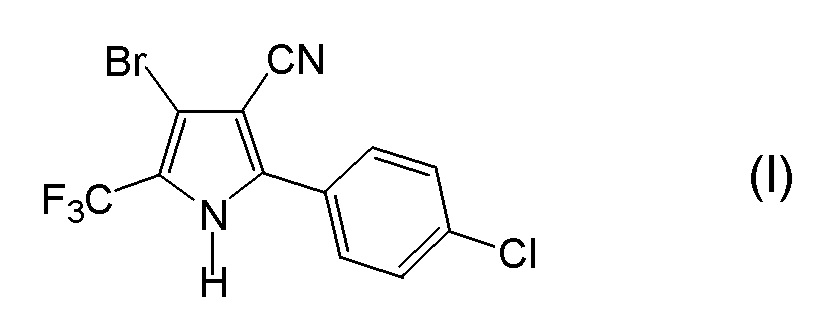
[0004] Тралопирил или 4-бром-2-(4-хлорфенил)-5-(трифторметил)-1H-пиррол-3-карбонитрил раскрыт в EP-0312723 для борьбы с моллюсками. Указанное соединение может быть представлено формулой[0004] Thralopiril or 4-bromo-2- (4-chlorophenyl) -5- (trifluoromethyl) -1H-pyrrole-3-carbonitrile is disclosed in EP-0312723 for mollusk control. The specified connection can be represented by the formula
[0005] В EP-0746979 описано применение тралопирила в композициях, предохраняющих от биологического обрастания, которые наносят на подводные поверхности для того, чтобы предупредить прикрепление организмов, участвующих в обрастании, к указанным подводным поверхностям.[0005] EP-0746979 describes the use of tralopyril in anti-fouling compositions that are applied to underwater surfaces in order to prevent the attachment of organisms involved in fouling to these underwater surfaces.
[0006] В настоящий момент было обнаружено, что нападение морских древоточцев на древесину, расположенную в морской среде, можно значительно снизить или даже предупредить с помощью пропитывания указанной древесины биоцидной композицией, содержащей тралопирил, с получением концентрации тралопирила, сохраняющегося в указанной древесине, при значении по меньшей мере 1000 г/м3 (= 1 мг/см3).[0006] It has now been found that the attack of wood borers on wood located in the marine environment can be significantly reduced or even prevented by soaking said wood with a biocidal composition containing tralopyril to obtain a concentration of tralopyril remaining in said wood at a value at least 1000 g / m 3 (= 1 mg / cm 3 ).
[0007] При добавлении дополнительных биоцидов, обладающих биоцидной активностью против морских древоточцев, к биоцидным композициям согласно настоящему изобретению для снижения или предупреждения нападения морских древоточцев на древесину, расположенную в морской среде, будет достаточно более низкой концентрации тралопирила, чем по меньшей мере 1000 г/м3, в пропитанной древесине. Например, концентрация тралопирила, сохраняющегося в пропитанной древесине, может составлять всего лишь от 100 до 200 г/м3 при применении дополнительных биоцидов, таких как креозот или CCA (хромированный арсенат меди).[0007] When additional biocides having biocidal activity against marine woodworms are added to the biocidal compositions of the present invention, a lower concentration of tralopyril will be sufficiently lower than at least 1000 g to reduce or prevent the attack of marine woodworms on wood located in the marine environment. m 3 in impregnated wood. For example, the concentration of tralopyril stored in the impregnated wood can be as low as 100 to 200 g / m 3 with additional biocides, such as creosote or CCA (chromed copper arsenate).
[0008] Морские древоточцы принадлежат к нескольким родам, из которых наиболее широко упоминаемым является Teredo. Самым хорошо известным видом Teredo является Teredo navalis. Другие виды морских точильщиков представляют собой, например, Xylophaga dorsalis (Mollusca, Pholadidae), Psiloteredo megotara (Mollusca, Teredinidae), Nototeredo norvagica (Mollusca, Teredinidae) и Limnoria lignorum (Crustacea, Limnoriidae) (т.е. “сверлянка”).[0008] Marine woodworms belong to several genera, of which Teredo is the most widely mentioned. The best known species of Teredo is Teredo navalis. Other types of marine grinders are, for example, Xylophaga dorsalis (Mollusca, Pholadidae), Psiloteredo megotara (Mollusca, Teredinidae), Nototeredo norvagica (Mollusca, Teredinidae) and Limnoria lignorum (Crustacea, Limnoriidae) (ie.
[0009] Используемые в настоящем документе "древесина", "древесный материал" и "древесные изделия" будут означать все формы древесины, например цельную древесину (такую как лесоматериалы или пиломатериалы в форме бревен, брусьев, обшивочных досок, листовых материалов и бордсов), деревянные композитные материалы (такие как фанера, слоистые пиломатериалы и древесно-пластиковые композитные материалы), а также все изделия, сделанные из древесины и деревянных композитных материалов (такие как корпус судна, портовые сооружения, сухие доки, пирсы, шлюзовые ворота, плотины, причальные мачты, деревянные опоры, мосты, подпорные стенки и т.п.).[0009] As used herein, "wood", "wood material" and "wood products" will mean all forms of wood, for example whole wood (such as lumber or lumber in the form of logs, beams, claddings, sheeting, boards and boards), wooden composite materials (such as plywood, laminated lumber and wood-plastic composite materials), as well as all products made from wood and wooden composite materials (such as the hull, port facilities, dry docks, piers, sewage zovye gates, dams, mooring masts, timber supports, bridges, retaining walls, etc.).
[0010] Биоцидные композиции, применяемые для пропитывания древесины, содержат тралопирил и среду-носитель. В частности, предполагается, что готовые к применению композиции для пропитывания древесины согласно настоящему изобретению содержат тралопирил в количестве не менее 0,01 вес.% от общего веса композиции. В частности, такие готовые к применению композиции содержат тралопирил в количестве от 0,01 вес.% до 10 вес.% от общего веса композиции. Другие диапазоны концентрации для биоцидных композиций, содержащих тралопирил, представляют собой от 0,01 вес.% до 1 вес.% и от 0,1 вес.% до 1,0 вес.% от общего веса композиции. Во многих случаях биоцидные композиции для непосредственного применения можно получать из концентрированных композиций, таких как, например, эмульгируемые концентраты, суспензионные концентраты или растворимые концентраты. После разбавления органическими средами предполагается, что такие концентраты охватываются выражением "композиция", используемым в определениях в настоящем изобретении. Концентрация тралопирила в таких концентрированных композициях может достигать не более 50 вес.%, и данные концентраты разбавляют перед применением с получением концентрации тралопирила, как указано выше, для готовых к применению композиций.[0010] The biocidal compositions used to impregnate wood contain tralopyril and a carrier medium. In particular, it is contemplated that ready-to-use wood impregnation compositions of the present invention contain tralopyril in an amount of at least 0.01% by weight of the total weight of the composition. In particular, such ready-to-use compositions contain tralopyril in an amount of from 0.01 wt.% To 10 wt.% Of the total weight of the composition. Other concentration ranges for biocidal compositions containing thralopiril are from 0.01 wt.% To 1 wt.% And from 0.1 wt.% To 1.0 wt.% Of the total weight of the composition. In many cases, biocidal compositions for direct use can be obtained from concentrated compositions, such as, for example, emulsifiable concentrates, suspension concentrates or soluble concentrates. After dilution with organic media, it is contemplated that such concentrates are encompassed by the phrase “composition” as used in the definitions of the present invention. The concentration of tralopyril in such concentrated compositions can reach no more than 50 wt.%, And these concentrates are diluted before use to obtain a concentration of tralopyril, as described above, for ready-to-use compositions.
[0011] Пригодные среды-носители для биоцидных композиций представляют собой любую жидкость, которая не оказывает отрицательного воздействия на активные ингредиенты, например спирты (например, метиловый спирт, этиловый спирт, этиленгликоль, пропиленгликоль, диэтиленгликоль, глицерин и т.д.), кетоны (например, ацетон, метилэтилкетон, ацетофенон и т.д.), простые эфиры (например, диоксан, тетрагидрофуран, целлозольв, диэтиленгликольдиметиловый эфир и т.д.), алифатические углеводороды (например, гексан, керосин и т.д.), ароматические углеводороды (например, бензол, толуол, ксилол, сольвент-нафта, метилнафталин и т.д.), галогензамещенные углеводороды (например, хлороформ, четыреххлористый углерод и т.д.), амиды кислот (например, диметилформамид и т.д.), сложные эфиры (например, метиловый эфир уксусной кислоты, этиловый эфир уксусной кислоты, бутиловый эфир уксусной кислоты, сложный эфир жирной кислоты и глицерина и т.д.) и нитрилы (например, ацетонитрил и т.д.). Стандартными растворителями являются метанол, этанол или ксилол. Данные растворители можно применять либо по отдельности, либо в комбинации из двух или более видов.[0011] Suitable carrier media for biocidal compositions are any liquid that does not adversely affect active ingredients, for example alcohols (eg, methyl alcohol, ethanol, ethylene glycol, propylene glycol, diethylene glycol, glycerin, etc.), ketones (e.g. acetone, methyl ethyl ketone, acetophenone, etc.), ethers (e.g. dioxane, tetrahydrofuran, cellosolve, diethylene glycol dimethyl ether, etc.), aliphatic hydrocarbons (e.g. hexane, kerosene, etc.), aromatic hydrocarbons (on for example, benzene, toluene, xylene, solvent naphtha, methylnaphthalene, etc.), halogenated hydrocarbons (e.g. chloroform, carbon tetrachloride, etc.), acid amides (e.g. dimethylformamide, etc.), complex esters (e.g., ethyl acetate, ethyl acetate, butyl acetate, glycerol esters, etc.) and nitriles (e.g. acetonitrile, etc.). Standard solvents are methanol, ethanol or xylene. These solvents can be used either individually or in combination of two or more kinds.
[0012] Эмульгируемые концентраты биоцидных композиций для применения согласно настоящему изобретению также можно получать после разбавления комбинации тралопирила по меньшей мере пригодным органическим растворителем (т.е. жидким носителем) с последующим добавлением по меньшей мере растворимого в растворителе эмульгирующего средства. Растворители, пригодные для данного типа составов, как правило, являются не смешиваемыми с водой и принадлежат к растворителям класса углеводородов, хлорзамещенных углеводородов, кетонов, сложных эфиров, спиртов и амидов, и они могут быть выбраны должным образом специалистом в области техники исходя из растворимости тралопирила. Эмульгируемые концентраты обычно содержат, кроме органического растворителя(ей), от приблизительно 0,5 до 50% по весу комбинации активных ингредиентов, от приблизительно 2 до 20% эмульгирующего средства(средств) и до 20% других добавок, таких как стабилизаторы.[0012] Emulsifiable concentrates of biocidal compositions for use according to the present invention can also be obtained after diluting the combination of tralopiril with at least a suitable organic solvent (ie, a liquid carrier) followed by adding at least a solvent-soluble emulsifying agent. Solvents suitable for this type of formulation are generally water immiscible and belong to the class of hydrocarbons, chlorinated hydrocarbons, ketones, esters, alcohols and amides, and they can be properly selected by a person skilled in the art based on the solubility of tralopyril . Emulsifiable concentrates usually contain, in addition to the organic solvent (s), from about 0.5 to 50% by weight of the combination of active ingredients, from about 2 to 20% of emulsifying agent (s) and up to 20% of other additives, such as stabilizers.
[0013] Для того чтобы снизить нападение морских древоточцев на древесину, расположенную в морской среде, указанную древесину пропитывают биоцидной композицией, содержащей тралопирил. Такую пропитку применяют с помощью нескольких различных способов, таких как, например, с помощью обработки древесины в закрытой системе высокого давления или вакуумной системе. Пропитку можно также осуществлять путем применения пульсирующего давления или нескольких последовательных циклов вакуумметрического давления. Другим способом пропитки является погружение или вымачивание древесины в биоцидной композиции по настоящему изобретению.[0013] In order to reduce the attack of marine wood borers on wood located in the marine environment, said wood is impregnated with a biocidal composition containing tralopyril. Such impregnation is applied using several different methods, such as, for example, by treating wood in a closed high pressure system or a vacuum system. The impregnation can also be carried out by applying pulsating pressure or several successive cycles of vacuum pressure. Another method of impregnation is by immersion or soaking of wood in the biocidal composition of the present invention.
[0014] Примером закрытой системы высокого давления является “способ полного поглощения”, также называемый “способ Бетелла”, который представляет собой способ пропитывания древесины консервантами, разработанный в 19-м столетии американским изобретателем Джоном Бетеллом. Он включает герметизацию древесины в камере высокого давления и применение вакуума для удаления воздуха и влаги из клеток древесины. Затем древесину обрабатывают под давлением консервантами для того, чтобы пропитать клетку древесины полностью (т.е. клеточную стенку, а также полость или внутреннюю часть клетки) веществами, которые придают, например, устойчивость к гниению, огнеупорность, устойчивость к насекомым и сверлящим древесину морским животным.[0014] An example of a closed high-pressure system is the “Absorption Method”, also called the “Betell Method”, which is a method of impregnating wood with preservatives, developed in the 19th century by American inventor John Betell. It includes sealing the wood in a high pressure chamber and applying a vacuum to remove air and moisture from the wood cells. Then, the wood is treated under pressure with preservatives in order to completely impregnate the wood cell (i.e. the cell wall, as well as the cavity or the inside of the cell) with substances that give, for example, resistance to decay, fire resistance, resistance to insects and marine drilling wood. to animals.
[0015] Другой пример закрытой системы высокого давления представляет собой так называемый “способ Рюпинга”, при котором древесину помещают в пропиточный котел под повышенное давление с последующим введением биоцидной композиции и снижением давления.[0015] Another example of a closed high-pressure system is the so-called “Ruping method”, in which the wood is placed in an impregnation boiler under increased pressure, followed by the introduction of the biocidal composition and pressure reduction.
[0016] Для получения концентрации сохраняющегося тралопирила в древесине, составляющей по меньшей мере 1000 г/м3 (= 1 мг/см3), путем пропитывания указанной древесины биоцидной композицией, содержащей тралопирил, может быть необходимо повторять способ пропитывания несколько раз, пока не будет достигнута необходимая концентрация сохраняющегося тралопирила.[0016] In order to obtain a concentration of retained tralopyril in wood of at least 1000 g / m 3 (= 1 mg / cm 3 ) by soaking said wood with a biocidal composition containing tralopyril, it may be necessary to repeat the method of soaking several times until the required concentration of persisting tralopiril will be achieved.
Экспериментальная частьexperimental part
Эксперимент 1: опыт согласно EN 275 в условиях морской средыExperiment 1: experience according to EN 275 in marine environments
Эффективность снижения присутствия морских древоточцев в древесине, расположенной в морской среде, определяли с использованием руководства и рекомендаций, изложенных в EN 275: 1992 - Антисептики для древесины. Определение эффективности защиты от морских древоточцев.The effectiveness of reducing the presence of marine woodworms in wood located in the marine environment was determined using the guidelines and recommendations set out in EN 275: 1992 - Wood preservatives. Determination of the effectiveness of protection against marine wood borers.
Древесный материалWood material
Древесный материал, применяемый как для контрольных групп (необработанные), так и для тестовых групп, представлял собой заболонь древесины сосны обыкновенной (Pinus sylvestris L.). Размер образцов древесины составлял 25×70×200 мм и все экземпляры сосны представляли собой исключительно заболонь древесины и не имели дефектов.The wood material used both for the control groups (untreated) and for the test groups was the sapwood of ordinary pine (Pinus sylvestris L.). The size of the wood samples was 25 × 70 × 200 mm, and all pine specimens were exclusively sapwood and had no defects.
ПропитываниеImpregnation
Пропитывание по способу полного поглощения:Impregnation by the method of complete absorption:
- помещают экземпляры в сосуды для обработки (например, эксикатор);- place the specimens in the vessels for processing (for example, desiccator);
- создают разрежение до достижения 7 гПа и удерживают указанное разрежение в течение 15 минут;- create a vacuum until 7 hPa is reached and hold the specified vacuum for 15 minutes;
- заливают экземпляры под разрежением раствором для обработки до тех пор, пока экземпляры не становятся полностью погруженными;- fill the specimens under vacuum with a processing solution until the specimens become completely submerged;
- снижают разрежение и убеждаются, что образцы остаются полностью погруженными, в то время как раствор для обработки воздействует на экземпляры при атмосферном давлении;- reduce the vacuum and make sure that the samples remain completely submerged, while the processing solution affects the specimens at atmospheric pressure;
- оставляют экземпляры в течение дополнительных 2 часов погруженными в раствор для обработки;- leave specimens for an additional 2 hours immersed in the solution for processing;
- затем вынимают экземпляры из раствора для обработки, дают стечь раствору в течение нескольких минут и помещают экземпляры в емкость на инертные опоры;- then remove the specimens from the solution for processing, allow the solution to drain for several minutes and place the specimens in a container on inert supports;
- выдерживают экземпляры в закрытой емкости в течение 3 дней (на протяжении выходных) для закрепления, затем открывают крышку, каждый день увеличивая степень открытия, и полностью снимают ее через 4 дня;- maintain specimens in a closed container for 3 days (during the weekend) for fixing, then open the lid, increasing the degree of opening every day, and completely remove it after 4 days;
- высушивают экземпляры в открытой емкости при комнатной температуре в течение дополнительных 3 дней.- dry the specimens in an open container at room temperature for an additional 3 days.
Тестовый раствор:Test solution:
1a) водорастворимый состав (эмульгируемый концентрат)1a) water soluble composition (emulsifiable concentrate)
1b) состав на основе растворителя1b) solvent based composition
Тралопирил, растворенный в метаноле (1600 ppm и 400 ppm).Tralopiril dissolved in methanol (1600 ppm and 400 ppm).
Среднее удержание:Average retention:
1a) водорастворимый состав: 228 г и 846 г а.и./м3 1a) water soluble composition: 228 g and 846 g ai / m 3
1b) состав на основе растворителя: 1087 г а.и./м3 1b) solvent-based composition: 1087 g ai / m 3
Название и расположение опытной площадкиName and location of the test site
Бухта (Gullmar fjord) за переделами морской научно-исследовательской станции Кристинеберг, 100 км на север от Гетеборга, Швеция.Cove (Gullmar fjord) outside the Kristineberg Marine Research Station, 100 km north of Gothenburg, Sweden.
Характеристики площадкиSite Characteristics
Температура и соленость воды: Температура варьировалась в пределах 18-22°C летом и -1,5°C в середине зимы. Соленость варьировалась от 26 г/кг до 34 г/кг. Хороший уровень кислорода благодаря сильному течению воды.Temperature and salinity of water: The temperature ranged between 18-22 ° C in the summer and -1.5 ° C in the middle of winter. Salinity ranged from 26 g / kg to 34 g / kg. Good oxygen levels due to the strong flow of water.
Активность сверлильщика: активность сверлильщика наблюдалась круглый год. Наиболее активный вид сверлильщиков Teredo navalis активен на протяжении 11 месяцев из 12. Критерий повреждения в результате нападения Teredo (туннели покрывают более 50% площади экземпляра, как видно на рентгенограмме) часто выполнялся уже в течение 6 месяцев у необработанных контрольных экземпляров. Наибольшая продолжительность жизни "службы" необработанных контрольных образцов составляла приблизительно 1,5 года, после чего образцы часто разбивались на куски осенними штормами.Driller Activity: Driller activity has been observed year-round. The most active type of drill, Teredo navalis, has been active for 11 months out of 12. The criterion for damage resulting from the Teredo attack (tunnels cover more than 50% of the specimen area, as seen in the radiograph) has often been performed for 6 months in untreated control specimens. The longest lifespan of the “service” of untreated control samples was approximately 1.5 years, after which the samples were often broken into pieces by autumn storms.
Условия установкиInstallation conditions
Экземпляры подвешивали на нейлоновых струнах (диаметр = 24 мм) двух лестницеподобных приспособлений, размещенных на морском дне на глубине 6±0,4 м при отливе. Опытные приспособления имели тяжелые бетонные основания, и каждое приспособление удерживалось вертикально буем 50 см в диаметре. Благодаря такому размещению экземпляры располагались на глубине, которая варьировалась от 4 м до 6,5 м ниже уровня воды во время периода проведения эксперимента.The specimens were suspended on nylon strings (diameter = 24 mm) of two ladder-like devices placed on the seabed at a depth of 6 ± 0.4 m at low tide. The experimental fixtures had heavy concrete foundations, and each fixture was held vertically by a buoy of 50 cm in diameter. Due to this arrangement, the specimens were located at a depth that varied from 4 m to 6.5 m below the water level during the period of the experiment.
Присутствующие виды морских точильщиковPresent types of marine grinders
Сверлянки: Limnoria lignorum (присутствуют, но не очень активны).Drills: Limnoria lignorum (present, but not very active).
Моллюски (особенности перечислены для фактической опытной площадки):Mollusks (features are listed for the actual pilot site):
Teredo navalis (наиболее часто встречающийся вид) достигает 7 см в длину за один сезон роста (11 месяцев);Teredo navalis (the most common species) reaches 7 cm in length in one growth season (11 months);
Nototeredo norvagica (редкий) достигает 10 см в длину за один сезон роста;Nototeredo norvagica (rare) reaches 10 cm in length in one growing season;
Psiloteredo megotara (редкий) достигает 20 см за один сезон роста (5-6 месяцев);Psiloteredo megotara (rare) reaches 20 cm in one growth season (5-6 months);
Xylophaga dorsalis (главным образом на больших глубинах), 3 см за один сезон роста.Xylophaga dorsalis (mainly at great depths), 3 cm in one growing season.
Оценивание нападения древоточцаWoodwalker Attack Assessment
Контрольные образцы были серьезно повреждены морским древоточцем Teredo navalis в течение одного года погружения в морскую воду и некоторые образцы были уничтожены на втором году (отмеченные ‘-‘ в таблице 1).Control samples were severely damaged by the Teredo navalis marine wood borer during one year of immersion in sea water, and some samples were destroyed in the second year (marked ‘-‘ in table 1).
Образцы древесины, пропитанные тралопирилом, который сохранялся в образцах древесины в концентрации 228 г/м3, показали в среднем умеренное повреждение морским древоточцем Teredo navalis в течение одного года погружения в морскую воду и полное разрушение после второго года.Wood samples impregnated with tralopyril, which was stored in the wood samples at a concentration of 228 g / m 3 , showed on average moderate damage by the Teredo navalis marine wood borer during one year of immersion in sea water and complete destruction after the second year.
Образцы древесины, пропитанные тралопирилом, который сохранялся в образцах древесины в концентрации 846 г/м3, показали в среднем незначительное повреждение морским древоточцем Teredo navalis в течение одного года погружения в морскую воду и умеренное повреждение после второго года.Wood samples impregnated with tralopyril, which was stored in wood samples at a concentration of 846 g / m 3 , showed, on average, minor damage by the Teredo navalis marine wood borer during one year of immersion in sea water and moderate damage after the second year.
Образцы древесины, пропитанные тралопирилом, который сохранялся в образцах древесины в концентрации 1087 г/м3, показали отсутствие повреждения морским древоточцем Teredo navalis в течение одного года погружения в морскую воду и в среднем лишь незначительное повреждение на втором году.Wood samples impregnated with tralopyril, which was stored in wood samples at a concentration of 1087 g / m 3 , showed no damage to the Teredo navalis marine wood borer during one year of immersion in sea water and, on average, only minor damage in the second year.
Описание графических материаловDescription of graphic materials
Фиг.1: Рентгенограммы контролей через 1 год.Figure 1: Radiographs of the controls after 1 year.
Фиг.2: Рентгенограммы образцов пропитанной тралопирилом древесины через 1 и 2 года.Figure 2: Radiographs of samples impregnated with tralopyril wood after 1 and 2 years.
Claims (17)
Applications Claiming Priority (3)
| Application Number | Priority Date | Filing Date | Title |
|---|---|---|---|
| US201261607764P | 2012-03-07 | 2012-03-07 | |
| US61/607,764 | 2012-03-07 | ||
| PCT/EP2013/054472 WO2013131940A1 (en) | 2012-03-07 | 2013-03-06 | Use of tralopyril against marine woodborers |
Publications (2)
| Publication Number | Publication Date |
|---|---|
| RU2014140333A RU2014140333A (en) | 2016-04-27 |
| RU2609373C2 true RU2609373C2 (en) | 2017-02-01 |
Family
ID=47827212
Family Applications (1)
| Application Number | Title | Priority Date | Filing Date |
|---|---|---|---|
| RU2014140333A RU2609373C2 (en) | 2012-03-07 | 2013-03-06 | Application of tralopyril against teredo navalis |
Country Status (14)
| Country | Link |
|---|---|
| US (1) | US20150086719A1 (en) |
| EP (1) | EP2822385B1 (en) |
| JP (1) | JP6342340B2 (en) |
| CN (1) | CN104159447B (en) |
| AU (1) | AU2013229511B2 (en) |
| CA (1) | CA2863779A1 (en) |
| CL (1) | CL2014002345A1 (en) |
| DK (1) | DK2822385T3 (en) |
| ES (1) | ES2644266T3 (en) |
| IN (1) | IN2014MN01968A (en) |
| NO (1) | NO2864574T3 (en) |
| NZ (1) | NZ628968A (en) |
| RU (1) | RU2609373C2 (en) |
| WO (1) | WO2013131940A1 (en) |
Families Citing this family (5)
| Publication number | Priority date | Publication date | Assignee | Title |
|---|---|---|---|---|
| CN104397033A (en) * | 2014-12-10 | 2015-03-11 | 海南大学 | Drug for controlling sphaeromas, shipworms and other boring marine organisms and using method of drug |
| US10829649B2 (en) | 2018-04-20 | 2020-11-10 | Redjak, L.L.C. | Methods and coatings for protecting surfaces from bio-fouling species |
| US10519327B2 (en) | 2018-04-20 | 2019-12-31 | Redjak, L.L.C. | Methods and coatings for protecting surfaces from bio-fouling species |
| US10689527B2 (en) | 2018-04-20 | 2020-06-23 | Redjak, L.L.C | Methods and coatings for protecting surfaces from bio-fouling species |
| US20260041092A1 (en) | 2022-09-01 | 2026-02-12 | I-Tech Ab | Composition Protecting Wood Against Marine Woodborers |
Citations (4)
| Publication number | Priority date | Publication date | Assignee | Title |
|---|---|---|---|---|
| SU272524A1 (en) * | ||||
| SU148203A1 (en) * | 1958-04-30 | 1961-11-30 | И.В. Киркилевский | The way to protect the wood from the tree borers |
| EP0312723A2 (en) * | 1987-10-23 | 1989-04-26 | American Cyanamid Company | Method of and bait compositions for controlling mollusks |
| WO2002083381A2 (en) * | 2001-04-11 | 2002-10-24 | University Of Delaware | Method and compositions for inhibiting cellulolytic symbionts |
Family Cites Families (11)
| Publication number | Priority date | Publication date | Assignee | Title |
|---|---|---|---|---|
| US3279984A (en) * | 1963-05-08 | 1966-10-18 | Dow Chemical Co | Methods and compositions comprising 1-bromo-3-nitrobenzene for controlling marine organisms |
| JPS6052726B2 (en) * | 1979-06-19 | 1985-11-21 | 株式会社片山化学工業研究所 | Sea breath clinging organism control agent |
| DE3516695A1 (en) * | 1985-05-09 | 1986-11-13 | Schering AG, 1000 Berlin und 4709 Bergkamen | BIOCID TRIBUTYL TIN COMPOUNDS |
| US5932520A (en) * | 1995-05-23 | 1999-08-03 | American Cyanamid Company | Use of pyrrole compounds as antifouling agents |
| CR5809A (en) * | 1997-08-08 | 2003-10-01 | American Cyanamid Co | ARILPIRROLES FOR THE PROTECTION OF THE ATTACK OF WOOD INSECTS, WOOD PRODUCTS AND WOODEN STRUCTURES |
| AU7200300A (en) * | 1999-12-16 | 2001-06-21 | Rohm And Haas Company | 5-carboxanilido-haloalkylthiazoles as antimicrobial and marine antifouling agents |
| DK1446011T3 (en) * | 2001-11-08 | 2009-04-27 | Janssen Pharmaceutica Nv | Synergistic antifouling compositions comprising 4-bromo-2- (4-chlorophenyl) -5- (trifluoromethyl) -1H-pyrrole-3-carbonitrile |
| DE10301805A1 (en) * | 2003-01-20 | 2004-07-29 | Bayer Cropscience Ag | New 3-phenyl-2,4-dioxo-pyrrolidine or tetrahydrofuran derivatives, useful as herbicides, insecticides, acaricides and nematocides for protection of plants or animals |
| NZ594345A (en) * | 2006-02-01 | 2012-10-26 | Janssen Pharmaceutica Nv | Combinations of 4-bromo-2-(4-chlorophenyl)-5-(trifluoromethyl)-1H-pyrrole-3-carbonitrile (tralopyril) and zineb |
| WO2009139729A1 (en) * | 2008-05-16 | 2009-11-19 | National University Of Singapore | Antifouling compounds and use thereof |
| JP5433017B2 (en) * | 2008-12-11 | 2014-03-05 | ジヤンセン・フアーマシユーチカ・ナームローゼ・フエンノートシヤツプ | Antifouling combination comprising 4-bromo-2- (4-chlorophenyl) -5- (trifluoromethyl) -1H-pyrrole-3-carbonitrile |
-
2013
- 2013-03-06 EP EP13707638.6A patent/EP2822385B1/en active Active
- 2013-03-06 DK DK13707638.6T patent/DK2822385T3/en active
- 2013-03-06 US US14/382,703 patent/US20150086719A1/en not_active Abandoned
- 2013-03-06 WO PCT/EP2013/054472 patent/WO2013131940A1/en not_active Ceased
- 2013-03-06 JP JP2014560350A patent/JP6342340B2/en active Active
- 2013-03-06 RU RU2014140333A patent/RU2609373C2/en active
- 2013-03-06 ES ES13707638.6T patent/ES2644266T3/en active Active
- 2013-03-06 AU AU2013229511A patent/AU2013229511B2/en active Active
- 2013-03-06 NZ NZ628968A patent/NZ628968A/en unknown
- 2013-03-06 CA CA2863779A patent/CA2863779A1/en not_active Abandoned
- 2013-03-06 CN CN201380013015.5A patent/CN104159447B/en active Active
- 2013-03-06 IN IN1968MUN2014 patent/IN2014MN01968A/en unknown
- 2013-06-12 NO NO13806260A patent/NO2864574T3/no unknown
-
2014
- 2014-09-04 CL CL2014002345A patent/CL2014002345A1/en unknown
Patent Citations (4)
| Publication number | Priority date | Publication date | Assignee | Title |
|---|---|---|---|---|
| SU272524A1 (en) * | ||||
| SU148203A1 (en) * | 1958-04-30 | 1961-11-30 | И.В. Киркилевский | The way to protect the wood from the tree borers |
| EP0312723A2 (en) * | 1987-10-23 | 1989-04-26 | American Cyanamid Company | Method of and bait compositions for controlling mollusks |
| WO2002083381A2 (en) * | 2001-04-11 | 2002-10-24 | University Of Delaware | Method and compositions for inhibiting cellulolytic symbionts |
Also Published As
| Publication number | Publication date |
|---|---|
| CL2014002345A1 (en) | 2015-01-16 |
| RU2014140333A (en) | 2016-04-27 |
| WO2013131940A1 (en) | 2013-09-12 |
| EP2822385A1 (en) | 2015-01-14 |
| ES2644266T3 (en) | 2017-11-28 |
| EP2822385B1 (en) | 2017-07-26 |
| CN104159447B (en) | 2016-05-18 |
| CN104159447A (en) | 2014-11-19 |
| NZ628968A (en) | 2016-05-27 |
| NO2864574T3 (en) | 2018-01-06 |
| JP2015509518A (en) | 2015-03-30 |
| DK2822385T3 (en) | 2017-10-30 |
| JP6342340B2 (en) | 2018-06-13 |
| IN2014MN01968A (en) | 2015-07-03 |
| US20150086719A1 (en) | 2015-03-26 |
| AU2013229511A1 (en) | 2014-08-21 |
| CA2863779A1 (en) | 2013-09-12 |
| AU2013229511B2 (en) | 2016-04-14 |
Similar Documents
| Publication | Publication Date | Title |
|---|---|---|
| Morrell | Protection of wood-based materials | |
| EP2822385B1 (en) | Use of tralopyril against marine woodborers | |
| NO169399B (en) | DEVICE FOR DRILLING HOLES IN GROUND GROUPS | |
| WO2009030433A2 (en) | Use of biocide compositions for wood preservation | |
| US10201160B2 (en) | Antimicrobial composition for protecting wood | |
| US4085251A (en) | High retention wood preservative composition | |
| US4143010A (en) | High retention wood preservative composition | |
| US10779538B2 (en) | Antimicrobial composition for protecting wood | |
| Brown et al. | Assessment of effects of chromated copper arsenate (CCA)—treated timber on nontarget epibiota by investigation of fouling community development at seven European sites | |
| Cookson et al. | Recent marine wood preservation research in Australia | |
| US3265567A (en) | Methods and compositions for control of marine organisms | |
| Rosenbusch et al. | A laboratory assessment of the natural durability of the lesser-utilised species Corynanthe pachyceras Welw. and Glyphaea brevis (Sprengel) Monachino against the marine wood borer Limnoria quadripunctata Holthius | |
| US3279984A (en) | Methods and compositions comprising 1-bromo-3-nitrobenzene for controlling marine organisms | |
| US4029818A (en) | Process for inhibiting the deterioration of wood due to marine boring organisms via the use of dibutylbenzylphenol | |
| US20260041092A1 (en) | Composition Protecting Wood Against Marine Woodborers | |
| Cookson et al. | 6. Biodeterioration of Wood | |
| Muslich et al. | Durabilty of 25 local specific wood species from java preserved with CCB against marine borers attack | |
| Cookson et al. | Ten year marine borer exposure trial of chlorothalonil and emulsified preservatives in Australia | |
| Westin¹ et al. | Marine Borer Resistance of MMF and DMDHEU Modified Wood–Results from up to 22 years of Field Exposure | |
| Hassan | I want to use timber-what should I know about Hazard Classes? | |
| Borges et al. | Laboratory and field tests of anti-marine borer potential of wood modified with dimethyloldihydroxyethylenurea (DMDHEU) and phosphobutane tricarboxylic acid (PBTC) | |
| Muslich et al. | The possibility of using timber from plantation forest treated with plastic and CCB for marine construction | |
| NO137158B (en) | USE OF N, N-DIMETHYL-S-TERT-BUTYL SULPHENYL-DITIOCARBAMATE AS A MEASURE TO AVOID ATTACK BY SEA PEST, S} AS P {LEORM | |
| Kobir | Marine borer of timber and its prevention | |
| Mahoni et al. | THE RESISTANCE OF MAHOGANY (Swietenia macrophylla King.) WOOD AGAINST MARINE BORERS |