RU2503103C1 - Method of making absorbent coating - Google Patents
Method of making absorbent coating Download PDFInfo
- Publication number
- RU2503103C1 RU2503103C1 RU2012157898/04A RU2012157898A RU2503103C1 RU 2503103 C1 RU2503103 C1 RU 2503103C1 RU 2012157898/04 A RU2012157898/04 A RU 2012157898/04A RU 2012157898 A RU2012157898 A RU 2012157898A RU 2503103 C1 RU2503103 C1 RU 2503103C1
- Authority
- RU
- Russia
- Prior art keywords
- layer
- carbon nanotubes
- polyimide
- dispersion
- coating
- Prior art date
Links
- 238000000576 coating method Methods 0.000 title claims abstract description 21
- 239000011248 coating agent Substances 0.000 title claims abstract description 18
- 238000004519 manufacturing process Methods 0.000 title claims abstract description 11
- 230000002745 absorbent Effects 0.000 title claims abstract description 7
- 239000002250 absorbent Substances 0.000 title claims abstract description 7
- OKTJSMMVPCPJKN-UHFFFAOYSA-N Carbon Chemical compound [C] OKTJSMMVPCPJKN-UHFFFAOYSA-N 0.000 claims abstract description 36
- 239000010410 layer Substances 0.000 claims abstract description 35
- 239000002041 carbon nanotube Substances 0.000 claims abstract description 29
- 229910021393 carbon nanotube Inorganic materials 0.000 claims abstract description 29
- 239000004642 Polyimide Substances 0.000 claims abstract description 23
- 229920001721 polyimide Polymers 0.000 claims abstract description 23
- ZMXDDKWLCZADIW-UHFFFAOYSA-N Vilsmeier-Haack reagent Natural products CN(C)C=O ZMXDDKWLCZADIW-UHFFFAOYSA-N 0.000 claims abstract description 14
- 239000006185 dispersion Substances 0.000 claims abstract description 11
- 239000002798 polar solvent Substances 0.000 claims abstract description 11
- 238000001035 drying Methods 0.000 claims abstract description 9
- 239000002344 surface layer Substances 0.000 claims abstract description 7
- HQVNEWCFYHHQES-UHFFFAOYSA-N silicon nitride Chemical compound N12[Si]34N5[Si]62N3[Si]51N64 HQVNEWCFYHHQES-UHFFFAOYSA-N 0.000 claims abstract description 6
- HLBLWEWZXPIGSM-UHFFFAOYSA-N 4-Aminophenyl ether Chemical compound C1=CC(N)=CC=C1OC1=CC=C(N)C=C1 HLBLWEWZXPIGSM-UHFFFAOYSA-N 0.000 claims abstract description 5
- 229910052581 Si3N4 Inorganic materials 0.000 claims abstract description 5
- 239000012790 adhesive layer Substances 0.000 claims abstract description 5
- FXHOOIRPVKKKFG-UHFFFAOYSA-N N,N-Dimethylacetamide Chemical compound CN(C)C(C)=O FXHOOIRPVKKKFG-UHFFFAOYSA-N 0.000 claims abstract description 4
- 238000005234 chemical deposition Methods 0.000 claims abstract description 4
- 230000003014 reinforcing effect Effects 0.000 claims abstract description 4
- 238000005119 centrifugation Methods 0.000 claims description 6
- 230000002262 irrigation Effects 0.000 claims description 5
- 238000003973 irrigation Methods 0.000 claims description 5
- GTDPSWPPOUPBNX-UHFFFAOYSA-N ac1mqpva Chemical compound CC12C(=O)OC(=O)C1(C)C1(C)C2(C)C(=O)OC1=O GTDPSWPPOUPBNX-UHFFFAOYSA-N 0.000 claims description 4
- 230000005855 radiation Effects 0.000 abstract description 12
- 238000010521 absorption reaction Methods 0.000 abstract description 11
- 238000000034 method Methods 0.000 abstract description 10
- 239000000126 substance Substances 0.000 abstract description 3
- 238000009736 wetting Methods 0.000 abstract 2
- VLDPXPPHXDGHEW-UHFFFAOYSA-N 1-chloro-2-dichlorophosphoryloxybenzene Chemical compound ClC1=CC=CC=C1OP(Cl)(Cl)=O VLDPXPPHXDGHEW-UHFFFAOYSA-N 0.000 abstract 1
- 229940113088 dimethylacetamide Drugs 0.000 abstract 1
- 230000000694 effects Effects 0.000 abstract 1
- 239000000203 mixture Substances 0.000 description 18
- ATJFFYVFTNAWJD-UHFFFAOYSA-N Tin Chemical compound [Sn] ATJFFYVFTNAWJD-UHFFFAOYSA-N 0.000 description 4
- 239000010439 graphite Substances 0.000 description 4
- 229910002804 graphite Inorganic materials 0.000 description 4
- 239000008199 coating composition Substances 0.000 description 3
- 239000004615 ingredient Substances 0.000 description 3
- 239000002071 nanotube Substances 0.000 description 3
- 229920002037 poly(vinyl butyral) polymer Polymers 0.000 description 3
- 238000001228 spectrum Methods 0.000 description 3
- 239000004215 Carbon black (E152) Substances 0.000 description 2
- 239000004593 Epoxy Substances 0.000 description 2
- 229910052787 antimony Inorganic materials 0.000 description 2
- WATWJIUSRGPENY-UHFFFAOYSA-N antimony atom Chemical compound [Sb] WATWJIUSRGPENY-UHFFFAOYSA-N 0.000 description 2
- 239000006229 carbon black Substances 0.000 description 2
- 230000005670 electromagnetic radiation Effects 0.000 description 2
- 239000000945 filler Substances 0.000 description 2
- 229930195733 hydrocarbon Natural products 0.000 description 2
- 150000002430 hydrocarbons Chemical class 0.000 description 2
- 229920002681 hypalon Polymers 0.000 description 2
- 229910052738 indium Inorganic materials 0.000 description 2
- APFVFJFRJDLVQX-UHFFFAOYSA-N indium atom Chemical compound [In] APFVFJFRJDLVQX-UHFFFAOYSA-N 0.000 description 2
- 229910052746 lanthanum Inorganic materials 0.000 description 2
- FZLIPJUXYLNCLC-UHFFFAOYSA-N lanthanum atom Chemical compound [La] FZLIPJUXYLNCLC-UHFFFAOYSA-N 0.000 description 2
- 239000003973 paint Substances 0.000 description 2
- 229920005596 polymer binder Polymers 0.000 description 2
- 239000002491 polymer binding agent Substances 0.000 description 2
- 239000002904 solvent Substances 0.000 description 2
- WYTZZXDRDKSJID-UHFFFAOYSA-N (3-aminopropyl)triethoxysilane Chemical compound CCO[Si](OCC)(OCC)CCCN WYTZZXDRDKSJID-UHFFFAOYSA-N 0.000 description 1
- 229920000049 Carbon (fiber) Polymers 0.000 description 1
- 239000004433 Thermoplastic polyurethane Substances 0.000 description 1
- 238000000862 absorption spectrum Methods 0.000 description 1
- 230000005540 biological transmission Effects 0.000 description 1
- 229910052799 carbon Inorganic materials 0.000 description 1
- 239000004917 carbon fiber Substances 0.000 description 1
- 239000011231 conductive filler Substances 0.000 description 1
- 239000003822 epoxy resin Substances 0.000 description 1
- 239000000835 fiber Substances 0.000 description 1
- 239000011152 fibreglass Substances 0.000 description 1
- 150000002605 large molecules Chemical class 0.000 description 1
- 239000007788 liquid Substances 0.000 description 1
- 229910052751 metal Inorganic materials 0.000 description 1
- 239000002184 metal Substances 0.000 description 1
- VNWKTOKETHGBQD-UHFFFAOYSA-N methane Chemical compound C VNWKTOKETHGBQD-UHFFFAOYSA-N 0.000 description 1
- 230000003287 optical effect Effects 0.000 description 1
- 239000002245 particle Substances 0.000 description 1
- 230000000704 physical effect Effects 0.000 description 1
- 239000004014 plasticizer Substances 0.000 description 1
- 229920000647 polyepoxide Polymers 0.000 description 1
- 239000004848 polyfunctional curative Substances 0.000 description 1
- 229920005989 resin Polymers 0.000 description 1
- 239000011347 resin Substances 0.000 description 1
- 229910052710 silicon Inorganic materials 0.000 description 1
- 239000010703 silicon Substances 0.000 description 1
- 229920002803 thermoplastic polyurethane Polymers 0.000 description 1
- 238000000411 transmission spectrum Methods 0.000 description 1
- 238000002834 transmittance Methods 0.000 description 1
- 239000002966 varnish Substances 0.000 description 1
Images
Landscapes
- Paints Or Removers (AREA)
Abstract
Description
Область техникиTechnical field
Изобретение относится к методам изготовления многофункциональных покрытий, обеспечивающих поглощение в инфракрасном диапазоне длин волн. Изобретение применяется для создания эталонов абсолютно черного тела в имитаторах излучения для аппаратуры дистанционного зондирования земли со стабильными характеристиками,The invention relates to methods for manufacturing multifunctional coatings providing absorption in the infrared wavelength range. The invention is used to create standards of a completely black body in radiation simulators for equipment for remote sensing of the earth with stable characteristics,
Из уровня техники известен способ изготовления покрытия (см. патент Российской Федерации на изобретение RU 2215764, опубл. 10.11.2003) на основе композиции, включающей полимерное связующее и наполнитель. В качестве полимерного связующего она содержит (19-21)%-ный раствор хлорсульфированного полиэтилена в углеводородном растворителе, а в качестве наполнителя смесь сажи и графита при следующем соотношении компонентов, мас.%: (19-21)%-ный раствор хлорсульфированного полиэтилена в углеводородном растворителе 63,0-69,2, сажа 10,0-12,0, графит 20,8-25,0.The prior art method for the manufacture of coatings (see patent of the Russian Federation for the invention RU 2215764, publ. 10.11.2003) based on a composition comprising a polymer binder and filler. As a polymer binder, it contains a (19-21)% solution of chlorosulfonated polyethylene in a hydrocarbon solvent, and as a filler a mixture of carbon black and graphite in the following ratio of components, wt.%: (19-21)% solution of chlorosulfonated polyethylene in hydrocarbon solvent 63.0-69.2, carbon black 10.0-12.0, graphite 20.8-25.0.
Недостатком известного технического решения является низкая воспроизводимость технологического процесса из-за сложности состава покрытия и может иметь неоднородные свойства из-за трудности равномерного введения ингредиентов в основу. Кроме того, композиция имеет ограниченную область применения вследствие невозможности работать в широком температурном диапазоне от минус 196°C до плюс 400°C (рабочий диапазон температур покрытия от минус 40°C до плюс 140°C). Известное покрытие экранирует электромагнитные излучения в радиолокационном, оптическом и лазерном диапазонах длин волн, однако, не обеспечивает приемлемые величины поглощения, а также не обеспечивает поглощения в ИК-областях спектра.A disadvantage of the known technical solution is the low reproducibility of the technological process due to the complexity of the coating composition and may have heterogeneous properties due to the difficulty of uniformly introducing the ingredients into the base. In addition, the composition has a limited scope due to the inability to work in a wide temperature range from minus 196 ° C to plus 400 ° C (operating temperature range of the coating from minus 40 ° C to plus 140 ° C). The known coating shields electromagnetic radiation in the radar, optical and laser wavelength ranges, however, does not provide acceptable absorption values, and also does not provide absorption in the infrared regions of the spectrum.
Из уровня техники известен способ изготовления многофункционального покрытия для экранирования электромагнитного излучения (см. патент Российской Федерации на изобретение RU 2420549, опубл. 10.06.2011). Изобретение относится к методам получения лакокрасочных материалов, предназначенных для нанесения покрытий, отличающимся физическими свойствами, а более конкретно к краскам, поглощающим излучения. По химическому составу соответствует группе изобретений, в которых решение технической задачи осуществляется за счет использования неорганических или низкомолекулярных органических веществ в качестве компонентов композиций на основе высокомолекулярных соединений, причем этими компонентами являются углерод в форме графита и волокна. Композиция содержит два жидких компонента, соединяемых перед нанесением композиции на поверхность изделия. Первый компонент - отвердитель эпоксидной смолы, а второй - композиция на основе эпоксидной смолы, содержащая (мас.%) два дисперсных электропроводящих наполнителя различных по форме частиц (графит 50-70 и углеродное волокно 1-5), пластификатор 0,2-1, термопластичный полиуретан 0,2-1, эпоксидную смолу - остальное до 100. Изобретение позволяет уменьшить СВЧ излучение в 19-25 раз.The prior art method of manufacturing a multifunctional coating for shielding electromagnetic radiation (see the patent of the Russian Federation for the invention RU 2420549, publ. 06/10/2011). The invention relates to methods for producing paints and varnishes intended for coating, characterized by physical properties, and more particularly to paints that absorb radiation. The chemical composition corresponds to a group of inventions in which the technical problem is solved by using inorganic or low molecular weight organic substances as components of compositions based on high molecular weight compounds, and these components are carbon in the form of graphite and fiber. The composition contains two liquid components that are connected before applying the composition to the surface of the product. The first component is an epoxy hardener, and the second is an epoxy-based composition containing (wt.%) Two dispersed electrically conductive fillers of various particle shapes (graphite 50-70 and carbon fiber 1-5), plasticizer 0.2-1, thermoplastic polyurethane 0.2-1, epoxy resin - the rest is up to 100. The invention allows to reduce microwave radiation by 19-25 times.
Недостатком известного технического решения является низкая воспроизводимость технологического процесса из-за сложности состава покрытия и может иметь неоднородные свойства из-за трудности равномерного введения ингредиентов в основу. Кроме того, композиция имеет ограниченную область применения вследствие невозможности работать в широком температурном диапазоне от минус 196°C до плюс 400°C (известная композиция может работать в температурном диапазоне только от минус 120°C до плюс 200°C).A disadvantage of the known technical solution is the low reproducibility of the technological process due to the complexity of the coating composition and may have heterogeneous properties due to the difficulty of uniformly introducing the ingredients into the base. In addition, the composition has a limited scope due to the inability to work in a wide temperature range from minus 196 ° C to plus 400 ° C (the known composition can work in the temperature range only from minus 120 ° C to plus 200 ° C).
Из уровня техники известен способ изготовления поливинилбутирального покрытия, предназначенного для поглощения инфракрасного излучения (см. патент Российской Федерации на изобретение RU 2294944, опубл. 10.12.2004). Поливинилбутиральное покрытие состоит из перерабатываемой в расплаве поливинилбутиральной смолы, содержащей для поглощения инфракрасного излучения диспергированные в ней гексаборид лантана в количестве от 0,005 до 0,1 мас.% в расчете на массу композиции, или смесь гексаборида лантана в количестве от 0,001 до 0,1 мас.% в расчете на массу композиции, и по меньшей мере одного компонента, выбранного из смешанного оксида индия и олова и смешанного оксида сурьмы и олова, причем смешанный оксид индия и олова и/или указанный смешанный оксид сурьмы и олова присутствуют в указанной смеси в количестве от 0,05 до 2,0 мас.% в расчете на массу композиции.The prior art method for the manufacture of polyvinyl butyral coatings designed to absorb infrared radiation (see patent of the Russian Federation for the invention RU 2294944, publ. 10.12.2004). The polyvinyl butyral coating consists of a melt-processed polyvinyl butyral resin containing, for absorption of infrared radiation, lanthanum hexaboride dispersed in it in an amount of from 0.005 to 0.1 wt.% Based on the weight of the composition, or a mixture of lanthanum hexaboride in an amount of from 0.001 to 0.1 wt. .% based on the weight of the composition, and at least one component selected from a mixed oxide of indium and tin and a mixed oxide of antimony and tin, and the mixed oxide of indium and tin and / or the specified mixed oxide of antimony and tin and are present in the mixture in an amount of from 0.05 to 2.0 wt.% based on the weight of the composition.
Недостатком известной композиции является низкая воспроизводимость технологического процесса из-за сложности состава покрытия, которая может иметь неоднородные свойства из-за трудности равномерного введения ингредиентов в основу. Кроме того, ограниченная область применения композиции вследствие невозможности работать в широком температурном диапазоне от минус 196°C до плюс 400°C (известная композиция может работать в температурном диапазоне только от минус 70°C до плюс 120°C).A disadvantage of the known composition is the low reproducibility of the process due to the complexity of the coating composition, which may have heterogeneous properties due to the difficulty of uniformly introducing the ingredients into the base. In addition, the limited scope of the composition due to the inability to work in a wide temperature range from minus 196 ° C to plus 400 ° C (the known composition can work in the temperature range only from minus 70 ° C to plus 120 ° C).
Раскрытие изобретенияDisclosure of invention
Техническим результатом заявленного изобретения является создание воспроизводимого и стабильного во времени процесса изготовления покрытия с высокой поглощающей способностью инфракрасного (ИК) излучения, работающего в широком диапазоне температур от минус 196°C до плюс 400°C, нанесение которого на разного рода конструкции (стеклопластиковые, металлические, и др.) позволяет достичь значительного поглощения ИК излучения - до 98% в широком частотном спектре с длиной волны от 1 до 50 мкм,.The technical result of the claimed invention is the creation of a reproducible and time-stable coating manufacturing process with a high absorption capacity of infrared (IR) radiation, operating in a wide temperature range from minus 196 ° C to plus 400 ° C, the application of which on various kinds of structures (fiberglass, metal , etc.) allows to achieve significant absorption of infrared radiation - up to 98% in a wide frequency spectrum with a wavelength of 1 to 50 microns.
Технический результат заявленного изобретения достигается тем, что на пластине-носителе последовательно формируют:The technical result of the claimed invention is achieved by the fact that on the carrier plate are sequentially formed:
- адгезионный слой;- adhesive layer;
- полиимидный слой с углеродными нанотрубками из раствора пиромилитового диангидрида и оксидианилина в полярном растворителе методом центрифугирования или полива с последующей сушкой;- a polyimide layer with carbon nanotubes from a solution of pyromilite dianhydride and oxydianiline in a polar solvent by centrifugation or irrigation followed by drying;
- на высушенном полиимидном слое с углеродными нанотрубками формируют методом центрифугирования или полива слой из дисперсии углеродных нанотрубок в полярном растворителе (диметилформамиде или диметилацетамиде), который растворяет приповерхностный слой полиимида и углеродные нанотрубки частично внедряются в растворенный слой;- on a dried polyimide layer with carbon nanotubes, a layer is formed by centrifugation or irrigation of a dispersion of carbon nanotubes in a polar solvent (dimethylformamide or dimethylacetamide), which dissolves the surface layer of polyimide and carbon nanotubes partially penetrate into the dissolved layer;
- проводят сушку и термоимидизацию полиимидного слоя с углеродными нанотрубками и с углеродными нанотрубками из дисперсии, внедренными частично в растворенный приповерхностный слой полиимида;- carry out the drying and thermal imidization of the polyimide layer with carbon nanotubes and carbon nanotubes from the dispersion, partially embedded in the dissolved surface layer of polyimide;
- на поверхности слоя из углеродных нанотрубок из дисперсии, внедренных частично в растворенный приповерхностный слой полиимида и выступающих из него, прошедшего термоимидизацию, формируют упрочняющий и поглощающий слой из нитрида кремния методом плазмохимического осаждения.- on the surface of a layer of carbon nanotubes from a dispersion embedded partially in a dissolved surface layer of polyimide and protruding from it after thermal imidization, a reinforcing and absorbing layer of silicon nitride is formed by plasma chemical deposition.
Краткое описание чертежейBrief Description of the Drawings
Признаки и сущность заявленного изобретения поясняются в последующем детальном описании, иллюстрируемом чертежами, где показано следующее.The features and essence of the claimed invention are explained in the following detailed description, illustrated by the drawings, which show the following.
На фиг.1(а-е) - пример изготовления поглощающего покрытия, где обозначено следующее:Figure 1 (a-e) is an example of the manufacture of an absorbent coating, where the following is indicated:
1 - пластина - носитель;1 - plate - carrier;
2 - адгезионный слой;2 - adhesive layer;
3 - полиимидный слой с углеродными нанотрубками, выполненный из раствора пиромилитового диангидрида и оксидианилина в полярном растворителе с последующей сушкой;3 - a polyimide layer with carbon nanotubes, made of a solution of pyromilite dianhydride and oxydianiline in a polar solvent, followed by drying;
4 - слой из дисперсии углеродных нанотрубок в полярном растворителе (диметилформамид, диметилацетамид);4 - a layer of a dispersion of carbon nanotubes in a polar solvent (dimethylformamide, dimethylacetamide);
5 - приповерхностный слой в полиимидном слое с углеродными нанотрубками, растворенный полярным растворителем из дисперсии с углеродными нанотрубками;5 - a surface layer in a polyimide layer with carbon nanotubes, dissolved by a polar solvent from a dispersion with carbon nanotubes;
6 - слой углеродных нанотрубок, частично внедренных и выступающих из полиимидного слоя с углеродными нанотрубками после термоимидизации;6 - a layer of carbon nanotubes partially embedded and protruding from the polyimide layer with carbon nanotubes after thermal imidization;
7 - упрочняющий и поглощающий слой нитрида кремния толщиной до 1,0 мкм.7 - hardening and absorbing layer of silicon nitride with a thickness of up to 1.0 μm.
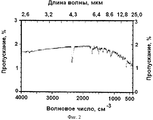
На фиг.2 - спектр пропускания поглощающего покрытия при различных длинах волн и волновых числах.Figure 2 - transmission spectrum of the absorbing coating at different wavelengths and wave numbers.
На фигуре представлена зависимость пропускания инфракрасного излучения поглощающим покрытием в диапазоне длин волн от 2,0 до 25,0 мкм, которая показывает минимальное пропускание около 2% и максимальное поглощение падающего на покрытие излучения (с учетом диффузного отражения).The figure shows the dependence of the transmission of infrared radiation by an absorbing coating in the wavelength range from 2.0 to 25.0 μm, which shows a minimum transmittance of about 2% and maximum absorption of the radiation incident on the coating (taking into account diffuse reflection).
Осуществление и пример реализации изобретенияThe implementation and example implementation of the invention
Заявленный способ изготовления покрытия с высокой поглощающей способностью инфракрасного излучения был применен при создании эталонов абсолютно черного тела в имитаторах излучения для аппаратуры дистанционного зондирования земли со стабильными характеристиками. Изготовление поглощающего покрытия (см. фиг.1, а-е) осуществляли следующим образом.The claimed method of manufacturing a coating with a high absorption capacity of infrared radiation was used to create black body standards in radiation simulators for remote sensing equipment with stable characteristics. The manufacture of an absorbent coating (see figure 1, ae) was carried out as follows.
На пластине-носителе (1) из кремния формируют адгезионный слой (2) (фиг.1, (а)) на основе γ-аминопропилтриэтоксисилана и пол ними дный слой с углеродными нанотрубками (3) (фиг.1, (б)) с концентрацией до 10 масс % из раствора пиромилитового диангидрида и оксидианилина в полярном растворителе методом центрифугирования или полива с последующей сушкой в течение 30-60 минут при температуре от плюс 60°C до плюс 100°C. На высушенном полиимидном слое с углеродными нанотрубками (3) формировали методом полива или центрифугирования с последующей сушкой слой из дисперсии углеродных нанотрубок в полярном растворителе (4) диметилформамиде с концентрацией последних до 80 масс.% (фиг.1, (в)), при этом верхняя часть полиимидного слоя (5) растворяется и нанотрубки из дисперсии частично внедряются в этот приповерхностный слой полиимида (фиг.1, (г)). Далее проводили имидизацию полиимидного слоя (3) с нанотрубками и внедренным слоем из нанотрубок (6). После термоимидизации на поверхности углеродных нанотрубок (6) (фиг.1, (д)), внедренных в полиимид, формировали упрочняющий и поглощающий слой (фиг.1, (е)) из нитрида кремния (7) методом плазмохимического осаждения толщиной до 1,0 мкм. Изготовленные образцы испытывали с помощью ИК-спектрофотометра Shimadzu IRAffinity-1 (фиг 2). Как видно из спектра, поглощающее покрытие имеет коэффициент поглощения приблизительно 0,98% после воздействия температур от минус 196°C до плюс 400°C спектр поглощения не изменялся.On the carrier plate (1) of silicon, an adhesive layer (2) is formed (Fig. 1, (a)) based on γ-aminopropyltriethoxysilane and a half-layer with carbon nanotubes (3) (Fig. 1, (b)) with concentration of up to 10 mass% from a solution of pyromilite dianhydride and oxydianiline in a polar solvent by centrifugation or irrigation followed by drying for 30-60 minutes at a temperature of from + 60 ° C to + 100 ° C. On a dried polyimide layer with carbon nanotubes (3), a layer was formed by watering or centrifugation followed by drying of a layer of a dispersion of carbon nanotubes in a polar solvent (4) dimethylformamide with a concentration of the latter up to 80 wt.% (Fig. 1, (c)), while the upper part of the polyimide layer (5) dissolves and the nanotubes from the dispersion are partially embedded in this surface layer of the polyimide (Fig. 1, (d)). Next, they imidized the polyimide layer (3) with nanotubes and an embedded layer of nanotubes (6). After thermal imidization on the surface of carbon nanotubes (6) (Fig. 1, (e)) embedded in the polyimide, a reinforcing and absorbing layer (Fig. 1, (f)) was formed from silicon nitride (7) by plasma-chemical deposition with a thickness of up to 1, 0 microns. The prepared samples were tested using a Shimadzu IRAffinity-1 IR spectrophotometer (FIG. 2). As can be seen from the spectrum, the absorbing coating has an absorption coefficient of approximately 0.98% after exposure to temperatures from minus 196 ° C to plus 400 ° C, the absorption spectrum did not change.
Таким образом, поглощающее покрытие, изготовленное вышеописанным способом, имеет качественное исполнение без разрывов и трещин с коэффициентом поглощения до 0,98%, с возможностью работать в широком диапазоне температур.Thus, the absorbent coating made by the above method has a high-quality performance without tears and cracks with an absorption coefficient of up to 0.98%, with the ability to work in a wide temperature range.
Claims (1)
- адгезионный слой;
- полиимидный слой с углеродными нанотрубками из раствора пиромилитового диангидрида и оксидианилина в полярном растворителе методом центрифугирования или полива с последующей сушкой;
- на высушенном полиимидпом слое с углеродными нанотрубками формируют методом центрифугирования или полива слой из дисперсии углеродных нанотрубок в полярном растворителе - диметилформамиде или диметилацетамиде;
- проводят сушку и тсрмоимидизацию полиимидного слоя с углеродными нанотрубками и с углеродными нанотрубками из дисперсии, внедренными частично в растворенный приповерхностный слой полиимида;
- на слое из углеродных нанотрубок, внедренных и выступающих из полиимидного слоя, прошедшего термоимидизацию, формируют упрочняющий и поглощающий слой из нитрида кремния методом плазмохимического осаждения. A method of manufacturing an absorbent coating, which consists in the following:
- adhesive layer;
- a polyimide layer with carbon nanotubes from a solution of pyromilite dianhydride and oxydianiline in a polar solvent by centrifugation or irrigation followed by drying;
- on a polyimide-dried layer with carbon nanotubes, a layer is formed by centrifugation or irrigation of a dispersion of carbon nanotubes in a polar solvent dimethylformamide or dimethylacetamide;
- carry out drying and thermoimidization of the polyimide layer with carbon nanotubes and carbon nanotubes from the dispersion, partially embedded in the dissolved surface layer of polyimide;
- on the layer of carbon nanotubes embedded and protruding from the polyimide layer that has undergone thermal imidization, a reinforcing and absorbing layer of silicon nitride is formed by plasma chemical deposition.
Priority Applications (1)
| Application Number | Priority Date | Filing Date | Title |
|---|---|---|---|
| RU2012157898/04A RU2503103C1 (en) | 2012-12-27 | 2012-12-27 | Method of making absorbent coating |
Applications Claiming Priority (1)
| Application Number | Priority Date | Filing Date | Title |
|---|---|---|---|
| RU2012157898/04A RU2503103C1 (en) | 2012-12-27 | 2012-12-27 | Method of making absorbent coating |
Publications (1)
| Publication Number | Publication Date |
|---|---|
| RU2503103C1 true RU2503103C1 (en) | 2013-12-27 |
Family
ID=49817826
Family Applications (1)
| Application Number | Title | Priority Date | Filing Date |
|---|---|---|---|
| RU2012157898/04A RU2503103C1 (en) | 2012-12-27 | 2012-12-27 | Method of making absorbent coating |
Country Status (1)
| Country | Link |
|---|---|
| RU (1) | RU2503103C1 (en) |
Cited By (4)
| Publication number | Priority date | Publication date | Assignee | Title |
|---|---|---|---|---|
| RU2606350C1 (en) * | 2015-05-19 | 2017-01-10 | Федеральное государственное автономное образовательное учреждение высшего образования "Национальный исследовательский Томский государственный университет" (ТГУ) | Protective coating based on polymer composite radio material |
| RU2645536C1 (en) * | 2016-11-01 | 2018-02-21 | Федеральное государственное бюджетное научное учреждение "Технологический институт сверхтвердых и новых углеродных материалов" (ФГБНУ ТИСНУМ) | Light-absorption material |
| RU2655187C1 (en) * | 2017-04-12 | 2018-05-25 | Открытое акционерное общество "Завод Магнетон" | Radar-absorbent composite material for construction applications and method for production thereof |
| CN114347517A (en) * | 2022-01-19 | 2022-04-15 | 成都佳驰电子科技股份有限公司 | Electromagnetic function structure integrated wave-absorbing edge design method |
Citations (5)
| Publication number | Priority date | Publication date | Assignee | Title |
|---|---|---|---|---|
| RU2215764C1 (en) * | 2002-11-13 | 2003-11-10 | Титомир Александр Козмович | Composition for coatings shielding electromagnetic emissions |
| US7118693B2 (en) * | 2001-07-27 | 2006-10-10 | Eikos, Inc. | Conformal coatings comprising carbon nanotubes |
| US7589661B2 (en) * | 2006-09-26 | 2009-09-15 | Bridgestone Corporation | Radio wave absorber |
| RU2404219C2 (en) * | 2004-12-03 | 2010-11-20 | Констракшн Рисерч Энд Текнолоджи Гмбх | Dark flat element with low thermal conductivity, low density and low solar radiation absorption |
| RU2420549C2 (en) * | 2009-07-16 | 2011-06-10 | Общество с ограниченной ответственностью "Научно-производственное объединение "Технопром" | Varnish and paint composition |
-
2012
- 2012-12-27 RU RU2012157898/04A patent/RU2503103C1/en active
Patent Citations (5)
| Publication number | Priority date | Publication date | Assignee | Title |
|---|---|---|---|---|
| US7118693B2 (en) * | 2001-07-27 | 2006-10-10 | Eikos, Inc. | Conformal coatings comprising carbon nanotubes |
| RU2215764C1 (en) * | 2002-11-13 | 2003-11-10 | Титомир Александр Козмович | Composition for coatings shielding electromagnetic emissions |
| RU2404219C2 (en) * | 2004-12-03 | 2010-11-20 | Констракшн Рисерч Энд Текнолоджи Гмбх | Dark flat element with low thermal conductivity, low density and low solar radiation absorption |
| US7589661B2 (en) * | 2006-09-26 | 2009-09-15 | Bridgestone Corporation | Radio wave absorber |
| RU2420549C2 (en) * | 2009-07-16 | 2011-06-10 | Общество с ограниченной ответственностью "Научно-производственное объединение "Технопром" | Varnish and paint composition |
Cited By (5)
| Publication number | Priority date | Publication date | Assignee | Title |
|---|---|---|---|---|
| RU2606350C1 (en) * | 2015-05-19 | 2017-01-10 | Федеральное государственное автономное образовательное учреждение высшего образования "Национальный исследовательский Томский государственный университет" (ТГУ) | Protective coating based on polymer composite radio material |
| RU2645536C1 (en) * | 2016-11-01 | 2018-02-21 | Федеральное государственное бюджетное научное учреждение "Технологический институт сверхтвердых и новых углеродных материалов" (ФГБНУ ТИСНУМ) | Light-absorption material |
| RU2655187C1 (en) * | 2017-04-12 | 2018-05-25 | Открытое акционерное общество "Завод Магнетон" | Radar-absorbent composite material for construction applications and method for production thereof |
| CN114347517A (en) * | 2022-01-19 | 2022-04-15 | 成都佳驰电子科技股份有限公司 | Electromagnetic function structure integrated wave-absorbing edge design method |
| CN114347517B (en) * | 2022-01-19 | 2024-04-05 | 成都佳驰电子科技股份有限公司 | Electromagnetic functional structure integrated wave-absorbing edge design method |
Similar Documents
| Publication | Publication Date | Title |
|---|---|---|
| RU2503103C1 (en) | Method of making absorbent coating | |
| Fardoost et al. | Design of a multilayer graphene-based ultrawideband terahertz absorber | |
| JP3068213B2 (en) | Laser-cuttable polymer dielectric and method of forming the same | |
| US20080311373A1 (en) | Electromagnetic wave absorbing material and method for preparing the same | |
| Zhou et al. | A novel light diffuser based on the combined morphology of polymer networks and polymer balls in a polymer dispersed liquid crystals film | |
| He et al. | High efficiency THz-wave modulators based on conjugated polymer-based organic films | |
| EP1727847A1 (en) | Functional layers for optical applications based on polythiophenes | |
| Jabbar et al. | Optical characterization of silver doped poly (vinyl alcohol) films | |
| CN108045060A (en) | A kind of explosion-proof broadband absorbing composite material and preparation method thereof | |
| CN109143655A (en) | A kind of intelligent dimming glass and its preparation method and application including metal organic frame film | |
| CN111286054B (en) | A kind of poly-4-methylpentene and SiO2 microsphere composite film and preparation method thereof | |
| CN109283765B (en) | Preparation method and application of porous polyether-ether-ketone electrolyte membrane | |
| Gao et al. | Preparation of paraffin wax-modified floating aluminum powder and composite coating with infrared stealth and wave-transparent function | |
| Li et al. | A non-conjugated photothermal polymer complex absorbing light in visible and infrared windows | |
| Basit et al. | Structural, thermal and optoelectrical study of PVA/iron oxide nanocomposite films | |
| Hu et al. | Photo-induced high modulation depth terahertz modulator based on VO x–Si–VO x hybrid structure | |
| CN101561614A (en) | Solid naphthalocyanine device with optical limiting properties | |
| Bhagat et al. | Novel photoluminescence and optical investigation of poly (vinyl acetate)/polyindole composites synthesized via chromium chloride as oxidant | |
| CN105086463A (en) | Composite absorbing material, preparation method and application thereof | |
| Hu et al. | Mie-optimized PMMA particles for fully polymer-based radiative cooling coatings with high reflectance and hydrophobicity | |
| RU2020115743A (en) | REPELLING EARTH AND DIRT COATINGS FROM POWDER MATERIAL | |
| Yang et al. | Dynamic graphical control of camouflage color with microwave/infrared stealth based on electromagnetic metastructures | |
| CN104829906A (en) | Anti-aging high-temperature-resistant silane crosslinked polyethylene cable material and preparation method therefor | |
| KR102430280B1 (en) | Self-healable infrared transmitting polyimide optical polymeric material with high refractive index and their hybrids | |
| Asano | Formation and properties of plasma-polymerized carbon disulfide films |