RU2467103C2 - Method of formation and preparing twist-free flax roving for spinning and device for its implementation - Google Patents
Method of formation and preparing twist-free flax roving for spinning and device for its implementation Download PDFInfo
- Publication number
- RU2467103C2 RU2467103C2 RU2009147634/12A RU2009147634A RU2467103C2 RU 2467103 C2 RU2467103 C2 RU 2467103C2 RU 2009147634/12 A RU2009147634/12 A RU 2009147634/12A RU 2009147634 A RU2009147634 A RU 2009147634A RU 2467103 C2 RU2467103 C2 RU 2467103C2
- Authority
- RU
- Russia
- Prior art keywords
- roving
- spinning
- flax
- formation
- electrochemically activated
- Prior art date
Links
Images

Landscapes
- Inorganic Fibers (AREA)
- Yarns And Mechanical Finishing Of Yarns Or Ropes (AREA)
- Paper (AREA)
- Water Treatment By Electricity Or Magnetism (AREA)
Abstract
Description
Изобретение относится к текстильной промышленности, в частности к льнопрядильному производству, где, на последнем технологическом переходе, для выработки льняной пряжи используют полуфабрикат в виде ровницы.The invention relates to the textile industry, in particular to flax spinning production, where, at the last technological transition, a semi-finished product in the form of rovings is used to produce linen yarn.
Последовательность процессов получения льняной пряжи состоит из формирования волокнистого продукта в виде ленты, имеющего постоянный развес (линейную плотность), с ее утонением - понижением линейной плотности, на последующих технологических переходах. Заканчивается технология подготовки волокна к прядению формированием ровницы - продукта с линейной плотностью 0,25-2,0 ктекс. Для наматывания ее на паковку, удобную для использования на дальнейших технологических переходах, ровница должна иметь определенную прочность. Наряду с используемым в промышленности способом упрочнения ровницы, ее подкручиванием, известен способ получения льняной ровницы (RU №2208070 С, 01.07.2001), в котором для повышения ее прочности при формировании тонкий пучок волокон - мычку, выходящую из вытяжного прибора, смачивают водой. При этом происходит склеивание технических волокон льна пектиновыми веществами, входящими в состав льняного волокна.The sequence of processes for obtaining flax yarn consists of the formation of a fibrous product in the form of a tape having a constant weight (linear density), with its thinning - a decrease in linear density, at subsequent technological transitions. The technology for preparing the fiber for spinning by the formation of rovings, a product with a linear density of 0.25-2.0 kteks, is ending. To wrap it on a package that is convenient for use in further technological transitions, the roving must have a certain strength. Along with the method of hardening rovings used in industry, twisting them, there is a known method for producing flax rovings (RU No. 2208070 C, 07/01/2001), in which to increase its strength during formation a thin fiber bundle - the sliver coming out of the fume hood is moistened with water. In this case, gluing of technical flax fibers with pectin substances that are part of the flax fiber occurs.
Для обеспечения процесса пряжеобразования и стабильности его протекания ровница подвергается химической обработке (Лазарева С.Е. и др. Прядение льна с варкой ровницы. - М.: Легкая индустрия, 1966).To ensure the process of yarn formation and the stability of its course, the roving is subjected to chemical treatment (Lazareva S.E. et al. Spinning of flax with cooking rovings. - M.: Light Industry, 1966).
Целью этого процесса является ослабление связей между элементарными волокнами в комплексах технического волокна. В результате химической обработки ровницы появляется возможность вырабатывать пряжу, отвечающую требованиям стандарта в широком диапазоне линейных плотностей при стабильном технологическом процессе.The purpose of this process is to weaken the bonds between elementary fibers in the complexes of technical fibers. As a result of chemical processing of rovings, it becomes possible to produce yarn that meets the requirements of the standard in a wide range of linear densities with a stable technological process.
Процесс химической обработки обладает рядом недостатков, к которым относятся - большие затраты энергии (4200 кДж на 1 кг ровницы), использование химикатов, большой расход воды, нарушение поточности технологического процесса, обязательное наличие очистных сооружений.The chemical treatment process has several disadvantages, which include - high energy costs (4200 kJ per 1 kg of roving), the use of chemicals, high water consumption, disruption of the process flow, the mandatory presence of treatment facilities.
Известен способ подготовки лубоволокнистого материала (RU №2139374 С1, 11.12.98), в котором, для нарушения связей между комплексами и элементарными волокнами, используется электрохимически активированный (ЭХА) водный раствор с окислительно-восстановительным потенциалом от минус 1000 мВ до плюс 1000 мВ, с кислотностью 2-11 pH, при температуре 16-40°С. Высокая активность ЭХА объясняется наличием в его составе неустойчивых ионов, которые отсутствуют в растворах, достигших термодинамического равновесия. Активность ЭХА зависит от времени релаксации, которое составляет около несколько суток. Причем снижение активности происходит по экспоненциальному закону, т.е. в первые несколько минут в растворе распадаются или вступают в реакции наиболее активные ионы, происходит интенсивное снижение активности раствора, а затем его темпы замедляются, однако в таком растворе отсутствуют наиболее активные ионы. Согласно известному способу (RU №2139374 С1, 11.12.98) обработке подвергается короткое льняное волокно или льняной очес, предназначенные для получения котонина и последующей переработки по хлопковой технологии. Использование полученного в результате такой обработки продукта в качестве ровницы не представляется возможным.A known method of preparing bast-fiber material (RU No. 2139374 C1, 12/11/98), in which, to break the bonds between the complexes and elementary fibers, an electrochemically activated (ECA) aqueous solution with a redox potential from minus 1000 mV to plus 1000 mV is used, with an acidity of 2-11 pH, at a temperature of 16-40 ° C. The high activity of ECA is explained by the presence of unstable ions in its composition, which are absent in solutions that have reached thermodynamic equilibrium. ECA activity depends on the relaxation time, which is about several days. Moreover, the decrease in activity occurs exponentially, i.e. in the first few minutes, the most active ions decompose or react in the solution, an intensive decrease in the activity of the solution occurs, and then its rate slows down, but the most active ions are absent in such a solution. According to the known method (RU No. 2139374 C1, 12/11/98), a short flax fiber or linen tow is processed, intended for the production of cotonin and subsequent processing by cotton technology. Using the resulting product as a roving is not possible.
Прототипом предлагаемого изобретения в части способа является изобретение (RU №2227824 С1, 25.02.2003), в котором мычка из льняных волокон при выходе из вытяжного прибора смачивается раствором кальцинированной соды Na2СО3 с концентрацией от 10 до 35 г/л, и таким образом формируется бескруточная ровница. Использование кальцинированной соды позволяет проводить процесс химической обработки ровницы, начиная с момента ее формирования на ровничной машине. Но завершить полный цикл химической обработки на ровничной машине при таком способе не удается, т.к. для этого требуется высокие температуры и продолжительное время контакта мычки с раствором, что не может быть обеспечено, в основном, из-за большой скорости выпуска сформированной ровницы.The prototype of the invention in terms of the method is the invention (RU No. 2227824 C1, 02.25.2003), in which a sliver of flaxseeds upon exiting the fume hood is wetted with a solution of soda ash Na 2 CO 3 with a concentration of from 10 to 35 g / l, and such a way to form a grooveless roving. The use of soda ash allows the process of chemical processing of roving, starting from the moment of its formation on the roving machine. But it is not possible to complete the full cycle of chemical treatment on a roving machine with this method, because this requires high temperatures and a long contact time of the sliver with the solution, which cannot be ensured, mainly due to the high speed of release of the formed roving.
Прототипом предлагаемого изобретения в части устройства является изобретение (RU 2078737 С1, 1994.05.26), в котором реактор для электрохимической обработки воды содержит электрохимическую ячейку, выполненную из вертикальных коаксиально расположенных стержневого и цилиндрического электродов, керамической диафрагмы, коаксиально размещенной между электродами и разделяющую межэлектродное пространство на электродные камеры, а также источник тока, соединенный с электродами через узел коммутации. Стержневой электрод имеет переменное сечение и диаметр его концевых частей составляет 0,75 диаметра его средней части, при этом его средняя часть с большим диаметром расположена на уровне, ограниченном каналами в верхней и нижней диэлектрических головках. Недостатком прототипа является отсутствие в нем центрального канала, предназначенного для пропускания через него обрабатываемого текстильного продукта, а также вертикальная ориентация электродов, ограничивающая положение линии заправки на ровничной машине.The prototype of the invention in terms of the device is the invention (RU 2078737 C1, 1994.05.26), in which the reactor for the electrochemical treatment of water comprises an electrochemical cell made of vertical coaxially arranged rod and cylindrical electrodes, a ceramic diaphragm coaxially placed between the electrodes and separating the interelectrode space to the electrode chambers, as well as a current source connected to the electrodes through a switching unit. The rod electrode has a variable cross section and the diameter of its end parts is 0.75 of the diameter of its middle part, while its middle part with a large diameter is located at a level bounded by channels in the upper and lower dielectric heads. The disadvantage of the prototype is the lack of a central channel for passing through the processed textile product, as well as the vertical orientation of the electrodes, limiting the position of the filling line on the roving machine.
Технической задачей предлагаемого изобретения является сокращение времени, снижение энергозатрат и расхода воды на химическую обработку ровницы, отказ от химикатов, что приведет к снижению затрат на утилизацию, полученных в результате химической обработки ровницы, растворов.The technical task of the invention is to reduce time, reduce energy and water consumption for the chemical treatment of rovings, the rejection of chemicals, which will reduce the cost of disposal resulting from the chemical treatment of rovings, solutions.
Указанная цель достигается тем, что ровница формируется путем увлажнения мычки электрохимически активированным раствором, причем процессы электрохимической активации раствора и формирования ровницы совмещены и производятся в одном устройстве.This goal is achieved by the fact that the roving is formed by moistening the sliver with an electrochemically activated solution, and the processes of electrochemical activation of the solution and the formation of the roving are combined and carried out in one device.
На фиг.1 приведена технологическая схема устройства для реализации заявляемого способа получения и подготовки ровницы к прядению.Figure 1 shows the technological diagram of a device for implementing the inventive method for producing and preparing rovings for spinning.
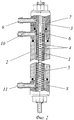
На фиг.2 приведена конструктивная схема реактора для получения электрохимически активированного раствора и обработки в нем льняной ровницы.Figure 2 shows a structural diagram of a reactor for producing an electrochemically activated solution and processing flax rove therein.
Предлагаемый способ формирования ровницы и подготовки ее к прядению заключается в следующем. Мычка, сформированная в вытяжном приборе ровничной машины, с линейной плотностью от 0,25 до 2,0 ктекс, выходит из вытяжной пары 1 (фиг.1) вытяжного прибора, проходит через отверстие в центральном электроде электрохимического реактора 2, где подвергается обработке электрохимически активированным раствором (анолитом или католитом), который получается при разложении слабоминерализованной воды, подаваемой в реактор через штуцеры 3. При этом происходит разрушение лигнина в срединных пластинках технических волокон и ослабление связей между элементарными волокнами, что обеспечивает в дальнейшем стабильное протекание процесса вытягивания полученной ровницы в вытяжном приборе прядильной машины. Не используемый для обработки раствор католит или анолит соответственно отводится через штуцер 4. Движение продукта через реактор обеспечивается за счет подачи его в зону обработки вытяжной парой 1 и вывода из зоны обработки тянульной парой 5. Для упрочнения мычки в зоне обработки установлен вьюрок 6, вращающийся вокруг своей оси. Он зажимает мычку подпружиненными губками 7 и сообщает ей ложную крутку. В результате действия на льняную мычку электрохимически активированного раствора и упрочнения ее в зоне обработки ложной круткой происходит формирование ровницы, пригодной для переработки в пряжу на машинах мокрого прядения льна без дополнительной обработки.The proposed method of forming a roving and preparing it for spinning is as follows. The sliver formed in the exhaust device of the roving machine, with a linear density of 0.25 to 2.0 ktex, leaves the exhaust pair 1 (Fig. 1) of the exhaust device, passes through the hole in the central electrode of the
Для реализации предложенного способа формирования и подготовки к прядению льняной ровницы используется химический реактор (фиг.2). Он состоит из двух коаксиально расположенных электродов, внутреннего 1 и наружного 2. Электроды располагаются наклонно, таким образом, чтобы их ось совпала с осью обрабатываемой ровницы. Внутренний электрод представляет собой трубку с центральным каналом 3. В средней части электрод 1 имеет перфорацию 4, соединяющую центральный канал с межэлектродным пространством. Между электродами 1 и 2 находится диафрагма 5, разделяющая межэлектродное пространство на две камеры - анодную и катодную. Полость камер герметизирована втулками 6, 7 и 8, изготовленными из изоляционного материала. Штуцеры 9 и 10 предназначены для подачи в реактор исходного раствора NaCl. Штуцер 11 предназначен для слива раствора, не используемого для обработки ровницы.To implement the proposed method of forming and preparing for spinning flax rovings, a chemical reactor is used (figure 2). It consists of two coaxially arranged electrodes, inner 1 and outer 2. The electrodes are located obliquely, so that their axis coincides with the axis of the processed roving. The inner electrode is a tube with a
Устройство работает следующим образом. К электродам 1 и 2 подводится постоянный ток, полярность которого выбирается в зависимости от того, каким раствором должна производиться обработка ровницы. При подключении отрицательного полюса к внутреннему электроду для обработки будет использоваться анолит, а при подключении положительного полюса - католит. Через штуцеры 9 и 10 в полость реактора подается раствор NaCl, который под действием электрического тока разлагается на анолит и католит. Раствор, используемый для обработки ровницы, вытекает из межэлектродного пространства в канал 3, через который движется волокнистая мычка. В этом канале происходит пропитка ее соответствующим раствором и начинается разрушение лигнина, содержащегося в волокне. Раствор, не используемый для обработки ровницы, стекает через штуцер 11.The device operates as follows. A direct current is supplied to
Раствор смачивает мычку, при этом за счет сил поверхностного натяжения жидкости возникают силы, прижимающие волокна друг к другу. Это приводит к тому, что сформированный таким образом продукт - ровница, имеет прочность достаточную для его наматывания на катушку. Одновременно с формированием ровницы начинается расщепление комплексов, содержащихся в техническом волокне, на элементарные волокна, причем нарушение связей между волокнами продолжается в ровнице, намотанной на катушку. Выбор диапазона указанных параметров электрохимически активированного раствора определяется требованиями, предъявляемыми к обработанной ровнице, и зависит от свойств исходного волокна, подготавливаемого к производству пряжи. Экспериментально установлено, что при правильном выборе активности раствора нарушение связи между элементарными волокнами в комплексах технического волокна происходит в течение 30 минут, после чего ровница готова к формированию пряжи на прядильной машине.The solution wets the sliver, while due to the forces of the surface tension of the liquid, forces arise that press the fibers to each other. This leads to the fact that the product thus formed - the roving, has a strength sufficient to wind it onto a reel. Simultaneously with the formation of the roving, the splitting of the complexes contained in the technical fiber into elementary fibers begins, and the breaking of bonds between the fibers continues in the roving wound on the spool. The choice of the range of the indicated parameters of the electrochemically activated solution is determined by the requirements for the treated roving and depends on the properties of the initial fiber prepared for the production of yarn. It was experimentally established that with the right choice of the activity of the solution, the bond between the elementary fibers in the complexes of the technical fiber breaks within 30 minutes, after which the roving is ready to form yarn on a spinning machine.
Электрохимически активированный раствор в течение трех суток теряет свои свойства, превращаясь в воду, которая не нуждается в специальной очистке для ее утилизации.An electrochemically activated solution loses its properties within three days, turning into water, which does not need special treatment for its disposal.
Осуществление предлагаемого способа поясняется следующими примерами.The implementation of the proposed method is illustrated by the following examples.
Определение параметра заряда электрохимически активированного раствора для достижения уровня готовность (нарушение связей между элементарными волокнами) ровницы к процессу пряжеобразования зависит от типа используемого волокна.The determination of the charge parameter of an electrochemically activated solution to achieve the level of readiness (breaking bonds between elementary fibers) of the roving to the process of yarn formation depends on the type of fiber used.
Для достижения поставленной цели - получение полуфабриката, пригодного к переработке в пряжу, отвечающую требованиям стандарта, необходимо соблюдать режимы обработки, приведенные в таблице. В последней колонке таблицы приведена качественная характеристика процесса вытягивания ровницы, полученной согласно предлагаемому способу, в вытяжном приборе прядильной машины, в зависимости от времени обработки. Приведенные данные позволяют установить минимальное время, необходимое для получения положительного эффекта, - 30 минут.To achieve this goal - to obtain a semi-finished product suitable for processing into yarn that meets the requirements of the standard, it is necessary to observe the processing modes listed in the table. The last column of the table shows the qualitative characteristics of the process of pulling rovings obtained according to the proposed method in the exhaust device of a spinning machine, depending on the processing time. These data allow you to set the minimum time required to obtain a positive effect - 30 minutes.
ки, минProcessing time
ki min
Полезный эффект от предлагаемого изобретения заключается в ускорении процесса формирования и подготовки ровницы к прядению и исключении из него громоздкого и дорогостоящего оборудования, предназначенного для химической обработки ровницы, снижении энергозатрат с 4200 кДж на 1 кг ровницы до 5 Дж/кг, обеспечение экологической безопасности процесса за счет того, что в нем не используются химически опасные компоненты.The useful effect of the present invention is to accelerate the process of forming and preparing rovings for spinning and eliminating bulky and expensive equipment intended for chemical processing of rovings, reducing energy consumption from 4200 kJ per 1 kg of rovings to 5 J / kg, ensuring environmental safety of the process for due to the fact that it does not use chemically hazardous components.
Claims (2)
Priority Applications (1)
| Application Number | Priority Date | Filing Date | Title |
|---|---|---|---|
| RU2009147634/12A RU2467103C2 (en) | 2009-12-21 | 2009-12-21 | Method of formation and preparing twist-free flax roving for spinning and device for its implementation |
Applications Claiming Priority (1)
| Application Number | Priority Date | Filing Date | Title |
|---|---|---|---|
| RU2009147634/12A RU2467103C2 (en) | 2009-12-21 | 2009-12-21 | Method of formation and preparing twist-free flax roving for spinning and device for its implementation |
Publications (2)
| Publication Number | Publication Date |
|---|---|
| RU2009147634A RU2009147634A (en) | 2011-06-27 |
| RU2467103C2 true RU2467103C2 (en) | 2012-11-20 |
Family
ID=44738688
Family Applications (1)
| Application Number | Title | Priority Date | Filing Date |
|---|---|---|---|
| RU2009147634/12A RU2467103C2 (en) | 2009-12-21 | 2009-12-21 | Method of formation and preparing twist-free flax roving for spinning and device for its implementation |
Country Status (1)
| Country | Link |
|---|---|
| RU (1) | RU2467103C2 (en) |
Citations (3)
| Publication number | Priority date | Publication date | Assignee | Title |
|---|---|---|---|---|
| US2139374A (en) * | 1934-03-29 | 1938-12-06 | Gen Motors Corp | Lamp bulb mounting |
| RU2139374C1 (en) * | 1998-12-11 | 1999-10-10 | ООО "Петербургский текстиль" | Method of preparing bast material |
| RU2164567C1 (en) * | 2000-03-27 | 2001-03-27 | Научно-производственное объединение "Мировые технологии" | Roving and roving manufacture method |
-
2009
- 2009-12-21 RU RU2009147634/12A patent/RU2467103C2/en not_active IP Right Cessation
Patent Citations (3)
| Publication number | Priority date | Publication date | Assignee | Title |
|---|---|---|---|---|
| US2139374A (en) * | 1934-03-29 | 1938-12-06 | Gen Motors Corp | Lamp bulb mounting |
| RU2139374C1 (en) * | 1998-12-11 | 1999-10-10 | ООО "Петербургский текстиль" | Method of preparing bast material |
| RU2164567C1 (en) * | 2000-03-27 | 2001-03-27 | Научно-производственное объединение "Мировые технологии" | Roving and roving manufacture method |
Also Published As
| Publication number | Publication date |
|---|---|
| RU2009147634A (en) | 2011-06-27 |
Similar Documents
| Publication | Publication Date | Title |
|---|---|---|
| KR100547491B1 (en) | Manufacturing method of fiber pulp produced using bamboo and its pulp | |
| DE631055C (en) | Process for bleaching cellulose fibers | |
| CN109930225B (en) | Chlorine-bleaching-free high-whiteness viscose fiber and preparation method thereof | |
| US2131409A (en) | Washing, desulphurizing, bleaching, finishing, and like treatments of artificial yarns | |
| RU2040616C1 (en) | Method for bleaching of cellulose staple fibers | |
| KR20230046976A (en) | Lyocell material with controlled whiteness by hydrogen peroxide treatment and manufacturing method thereof | |
| RU2404300C2 (en) | Method for formation and preparation of linen roving for spinning | |
| CN114753012A (en) | Preparation method of industrial cotton hemp fiber | |
| KR101602121B1 (en) | Chemical treatment of lignocellulosic fiber bundle material, and methods and systems relating thereto | |
| US2086888A (en) | Manufacture of a substitute for wool | |
| US2468771A (en) | Process of preparing fibers and yarns | |
| DE573341C (en) | Process for the production of cellulose, in particular for the manufacture of rayon | |
| RU2200215C1 (en) | Waste paper mass processing method | |
| RU159597U1 (en) | DEVICE FOR FORMING AND PREPARING A LINEN LINING FOR SPINNING | |
| RU2139374C1 (en) | Method of preparing bast material | |
| RU2227824C1 (en) | Method of forming untwisted roving from flax fibers | |
| CN116356442B (en) | Superfine denier regenerated cellulose fiber and preparation method thereof | |
| CN102154721B (en) | Short-process low-energy-consumption production method of bamboo viscose fibers | |
| SU129115A1 (en) | The way of bleaching and brush roving | |
| GB377768A (en) | A method of treating fibrous material | |
| CN211665350U (en) | Device for reducing fiber damage rate | |
| DE1046467B (en) | Process for bleaching pulp | |
| RU2578586C1 (en) | Method of producing bast-fibre bleached pulp | |
| CN119194685A (en) | A method for preparing long linen yarn based on photocatalysis and pectinase combined degumming | |
| US606017A (en) | Alexander mitscherlich |
Legal Events
| Date | Code | Title | Description |
|---|---|---|---|
| MM4A | The patent is invalid due to non-payment of fees |
Effective date: 20121222 |