RU2440373C1 - Method of curing novolac resin - Google Patents
Method of curing novolac resin Download PDFInfo
- Publication number
- RU2440373C1 RU2440373C1 RU2010125485/05A RU2010125485A RU2440373C1 RU 2440373 C1 RU2440373 C1 RU 2440373C1 RU 2010125485/05 A RU2010125485/05 A RU 2010125485/05A RU 2010125485 A RU2010125485 A RU 2010125485A RU 2440373 C1 RU2440373 C1 RU 2440373C1
- Authority
- RU
- Russia
- Prior art keywords
- novolac resin
- minutes
- curing
- chloride
- mol
- Prior art date
Links
- 229920003986 novolac Polymers 0.000 title claims description 13
- 238000000034 method Methods 0.000 title claims description 9
- VSCWAEJMTAWNJL-UHFFFAOYSA-K aluminium trichloride Chemical compound Cl[Al](Cl)Cl VSCWAEJMTAWNJL-UHFFFAOYSA-K 0.000 claims abstract description 14
- FAPDDOBMIUGHIN-UHFFFAOYSA-K antimony trichloride Chemical compound Cl[Sb](Cl)Cl FAPDDOBMIUGHIN-UHFFFAOYSA-K 0.000 claims abstract description 5
- 125000003118 aryl group Chemical group 0.000 claims abstract description 3
- 230000000694 effects Effects 0.000 abstract description 2
- 239000002861 polymer material Substances 0.000 abstract description 2
- 239000000126 substance Substances 0.000 abstract 1
- UHOVQNZJYSORNB-UHFFFAOYSA-N Benzene Chemical compound C1=CC=CC=C1 UHOVQNZJYSORNB-UHFFFAOYSA-N 0.000 description 12
- 239000000047 product Substances 0.000 description 9
- 238000001723 curing Methods 0.000 description 7
- 239000012670 alkaline solution Substances 0.000 description 4
- 238000006243 chemical reaction Methods 0.000 description 4
- VKYKSIONXSXAKP-UHFFFAOYSA-N hexamethylenetetramine Chemical compound C1N(C2)CN3CN1CN2C3 VKYKSIONXSXAKP-UHFFFAOYSA-N 0.000 description 4
- 229920002521 macromolecule Polymers 0.000 description 4
- 229910001261 rose's metal Inorganic materials 0.000 description 4
- 239000000463 material Substances 0.000 description 3
- IJGRMHOSHXDMSA-UHFFFAOYSA-N Atomic nitrogen Chemical compound N#N IJGRMHOSHXDMSA-UHFFFAOYSA-N 0.000 description 2
- 239000000853 adhesive Substances 0.000 description 2
- 230000001070 adhesive effect Effects 0.000 description 2
- 239000011230 binding agent Substances 0.000 description 2
- 239000006227 byproduct Substances 0.000 description 2
- 239000010408 film Substances 0.000 description 2
- 238000010525 oxidative degradation reaction Methods 0.000 description 2
- 239000004033 plastic Substances 0.000 description 2
- 229920003023 plastic Polymers 0.000 description 2
- 238000004566 IR spectroscopy Methods 0.000 description 1
- 239000002841 Lewis acid Substances 0.000 description 1
- 238000010521 absorption reaction Methods 0.000 description 1
- 230000015572 biosynthetic process Effects 0.000 description 1
- 239000003054 catalyst Substances 0.000 description 1
- 238000000576 coating method Methods 0.000 description 1
- 239000002131 composite material Substances 0.000 description 1
- 239000011152 fibreglass Substances 0.000 description 1
- 239000002657 fibrous material Substances 0.000 description 1
- 239000012634 fragment Substances 0.000 description 1
- 238000010438 heat treatment Methods 0.000 description 1
- 235000010299 hexamethylene tetramine Nutrition 0.000 description 1
- 239000004312 hexamethylene tetramine Substances 0.000 description 1
- 239000001257 hydrogen Substances 0.000 description 1
- 229910052739 hydrogen Inorganic materials 0.000 description 1
- 238000002955 isolation Methods 0.000 description 1
- 239000002648 laminated material Substances 0.000 description 1
- 150000007517 lewis acids Chemical class 0.000 description 1
- 125000000325 methylidene group Chemical group [H]C([H])=* 0.000 description 1
- 239000000203 mixture Substances 0.000 description 1
- 229910052757 nitrogen Inorganic materials 0.000 description 1
- 239000004848 polyfunctional curative Substances 0.000 description 1
- 229920000642 polymer Polymers 0.000 description 1
- 230000008092 positive effect Effects 0.000 description 1
- 238000001228 spectrum Methods 0.000 description 1
- 230000004580 weight loss Effects 0.000 description 1
Landscapes
- Phenolic Resins Or Amino Resins (AREA)
- Polyesters Or Polycarbonates (AREA)
Abstract
Description
Изобретение относится к способу отверждения новолачной смолы, которая может быть использована в различных областях техники в качестве высокопрочной и высокотермостойкой связующей для пластмасс, слоистых и волокнистых материалов, клеев и пленок.The invention relates to a method for curing novolac resin, which can be used in various fields of technology as a high-strength and high-temperature binder for plastics, laminated and fibrous materials, adhesives and films.
Известны (Fufe C.A., McKinnon M.S., Rudin A., Tchir W.J. // Macromolecules - 1983. - V.16. - P.1216-1219, Maciel G.E., Chuang I.-S., Gollob L. // Macromolecules - 1984. - V.17. - P.1081-1087, Hatfield G.R., Maciel G.E. // Macromolecules - 1987. - V.20. - P.608-615), где традиционно для отверждения новолачной смолы используется уротропин (гексаметилентетрамин). При этом образуются сложные трехмерные нерастворимые полимеры, а между молекулами олигомера образуются метиленовые мостиковые группы. Наличие таких фрагментов определяет невысокую температуру эксплуатации и низкие прочностные показатели, что и является одним из главных недостатков получаемых полимерных материалов. Более того, в процессе отверждения выделяется азот, что создает трудности при получении высокопрочных наполненных композитов.Known (Fufe CA, McKinnon MS, Rudin A., Tchir WJ // Macromolecules - 1983. - V.16. - P.1216-1219, Maciel GE, Chuang I.-S., Gollob L. // Macromolecules - 1984 . - V.17. - P.1081-1087, Hatfield GR, Maciel GE // Macromolecules - 1987. - V.20. - P.608-615), where urotropine (hexamethylenetetramine) is traditionally used for curing novolac resin. In this case, complex three-dimensional insoluble polymers are formed, and methylene bridge groups are formed between the oligomer molecules. The presence of such fragments determines a low operating temperature and low strength indicators, which is one of the main disadvantages of the obtained polymer materials. Moreover, nitrogen is released during the curing process, which makes it difficult to obtain high-strength filled composites.
Наиболее близким по технической сущности и достигаемому эффекту является способ отверждения (Kelusky E.C., Fufe C.A., McKinnon M.S., Rudin A., Tchir W.J. // Macromolecules - 1986. - V.19. - P.329-332), принятый за прототип, основанный на использовании уротропина для отверждения новолачной смолы. Процесс проходит при термообработке в течение 15-30 минут при 150-160°С и далее при 180°С 1 час.The closest in technical essence and the achieved effect is the curing method (Kelusky EC, Fufe CA, McKinnon MS, Rudin A., Tchir WJ // Macromolecules - 1986. - V.19. - P.329-332), adopted as a prototype, based on the use of urotropine for curing novolac resin. The process takes place during heat treatment for 15-30 minutes at 150-160 ° C and then at 180 ° C for 1 hour.
Техническим результатом изобретения является то, что процесс идет без выделения побочных продуктов и обеспечивает повышение стойкости к термоокислительной деструкции и улучшение прочностных показателей материалов, что достигается за счет образования имидатной связи между молекулами олигомера, которая намного прочнее метиленовой и способной также к образованию межмолекулярных водородных связей.The technical result of the invention is that the process proceeds without isolation of by-products and provides an increase in resistance to thermal oxidative degradation and an improvement in the strength characteristics of materials, which is achieved due to the formation of an imidate bond between oligomer molecules, which is much stronger than methylene and also capable of forming intermolecular hydrogen bonds.
Для достижения технического результата предложено использовать в качестве отвердителя ароматические динитрилы. Процесс идет при температуре 150-200°С в течение 10-30 минут в присутствии кислот Льюиса, хлорида сурьмы (III) или хлорида алюминия по следующей схеме:To achieve a technical result, it is proposed to use aromatic dinitriles as a hardener. The process proceeds at a temperature of 150-200 ° C for 10-30 minutes in the presence of Lewis acids, antimony (III) chloride or aluminum chloride according to the following scheme:
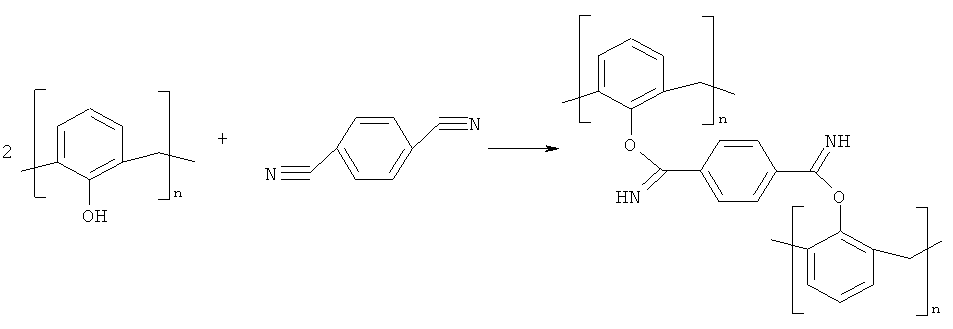
Термостойкость по данным ТГА (5°С/мин, воздух) составляет 340-380°С, что соответствует 10%-ной потере массы.According to the TGA (5 ° C / min, air), the thermal stability is 340-380 ° C, which corresponds to a 10% weight loss.
Строение подтверждено данными ИК-спектроскопии. Так, на спектрах отвержденного продукта присутствуют характеристические полосы поглощения при 1653 см-1 (C=N) и при 1103 см-1 (С-O).The structure is confirmed by infrared spectroscopy. So, in the spectra of the cured product there are characteristic absorption bands at 1653 cm -1 (C = N) and at 1103 cm -1 (C-O).
Получение пресс-материалов осуществляли следующим способом. Расплав смеси 12.8 г новолачной смолы, 21.2 г 1,4-динитрилбензола и катализатора в количестве 2.67 г хлорида алюминия или 2.285 г хлорида сурьмы (III), нагретой до 170°С и выдержанной 5 минут, переливали в пресс-форму, предварительно нагретую до 180°С, и прессовали при давлении 70-75 МПа при 1,80°С в течение 10-15 минут. Удельная ударная вязкость (ГОСТ 4647-80), составляла 80.4-85.8 МПа, а разрушающее напряжение при растяжении (ГОСТ 4648-71) 130.2-134.6 МПа.Obtaining press materials was carried out in the following way. Melt of the mixture 12.8 g of novolac resin, 21.2 g of 1,4-dinitrile benzene and catalyst in the amount of 2.67 g of aluminum chloride or 2.285 g of antimony (III) chloride, heated to 170 ° C and aged for 5 minutes, was poured into a mold pre-heated to 180 ° C, and pressed at a pressure of 70-75 MPa at 1.80 ° C for 10-15 minutes. The specific impact strength (GOST 4647-80) was 80.4-85.8 MPa, and the ultimate tensile stress (GOST 4648-71) was 130.2-134.6 MPa.
Предлагаемый способ подтверждается следующими нижеприведенными примерами отверждения новолачной смолы.The proposed method is confirmed by the following examples of curing novolac resin.
Пример 1. В круглодонную колбу при комнатной температуре загружали 12.8 г новолачной смолы, 21.2 г (0.1 моль) 1,4-динитрилбензола и 26.7 г (0.2 моль) хлорида алюминия, тщательно перемешивали и помещали в сплав Розе, нагретый до 160°С. По истечении 15 минут продукт извлекали из реакционной колбы в слабощелочной раствор и кипятили в течение 10-15 минут. Затем полученный продукт отфильтровали на мелкопористой воронке Шотта. Сушили в вакуумном шкафу при 60-70°С до постоянной массы.Example 1. 12.8 g of novolac resin, 21.2 g (0.1 mol) of 1,4-dinitrile benzene and 26.7 g (0.2 mol) of aluminum chloride were charged into a round-bottom flask at room temperature, thoroughly mixed, and placed in a Rose alloy heated to 160 ° C. After 15 minutes, the product was removed from the reaction flask in a slightly alkaline solution and boiled for 10-15 minutes. Then the resulting product was filtered on a finely porous Schott funnel. Dried in a vacuum oven at 60-70 ° C to constant weight.
Пример 2. В круглодонную колбу при комнатной температуре загружали 12.8 г. новолачной смолы, 21.2 г (0.1 моль) 1,4-динитрилбензола и 20.025 г (0.15 моль) хлорида алюминия, тщательно перемешивали и помещали в сплав Розе, нагретый до 180°С. По истечении 15 минут продукт извлекали из реакционной колбы в слабощелочной раствор и кипятили в течение 10-15 минут. Затем полученный продукт отфильтровали на мелкопористой воронке Шотта. Сушили в вакуумном шкафу при 60-70°С до постоянной массы.Example 2. In a round-bottom flask at room temperature, 12.8 g of novolac resin, 21.2 g (0.1 mol) of 1,4-dinitrile benzene and 20.025 g (0.15 mol) of aluminum chloride were loaded, mixed thoroughly and placed in a Rose alloy heated to 180 ° C. . After 15 minutes, the product was removed from the reaction flask in a slightly alkaline solution and boiled for 10-15 minutes. Then, the resulting product was filtered on a finely porous Schott funnel. Dried in a vacuum oven at 60-70 ° C to constant weight.
Пример 3. В круглодонную колбу при комнатной температуре загружали 12.8 г новолачной смолы, 21.2 г (0.1 моль) 1,4-динитрилбензола и 22.85 г (0.1 моль) хлорида сурьмы (III), тщательно перемешивали и помещали в сплав Розе, нагретый до 180°С. По истечении 20 минут продукт извлекали из реакционной колбы в слабощелочной раствор и кипятили в течение 10-15 минут. Затем полученный продукт отфильтровали на мелкопористой воронке Шотта. Сушили в вакуумном шкафу при 60-70°С до постоянной массы.Example 3. In a round-bottom flask at room temperature, 12.8 g of novolac resin, 21.2 g (0.1 mol) of 1,4-dinitrile benzene and 22.85 g (0.1 mol) of antimony (III) chloride were charged, mixed thoroughly, and placed in a Rose alloy heated to 180 ° C. After 20 minutes, the product was removed from the reaction flask in a slightly alkaline solution and boiled for 10-15 minutes. Then the resulting product was filtered on a finely porous Schott funnel. Dried in a vacuum oven at 60-70 ° C to constant weight.
Пример 4. В круглодонную колбу при комнатной температуре загружали 12.8 г новолачной смолы, 21.2 г (0.1 моль) 1,3-динитрилбензола и 20.025 г (0.15 моль) хлорида алюминия, тщательно перемешивали и помещали в сплав Розе, нагретый до 180°С. По истечении 15 минут продукт извлекали из реакционной колбы в слабощелочной раствор и кипятили в течение 10-15 минут. Затем полученный продукт отфильтровали на мелкопористой воронке Шотта. Сушили в вакуумном шкафу при 60-70°С до постоянной массы.Example 4. 12.8 g of novolac resin, 21.2 g (0.1 mol) of 1,3-dinitrilebenzene and 20.025 g (0.15 mol) of aluminum chloride were charged into a round-bottom flask at room temperature, mixed thoroughly, and placed in a Rose alloy heated to 180 ° С. After 15 minutes, the product was removed from the reaction flask in a slightly alkaline solution and boiled for 10-15 minutes. Then the resulting product was filtered on a finely porous Schott funnel. Dried in a vacuum oven at 60-70 ° C to constant weight.
Как видно из приведенных данных, предлагаемый способ отверждения новолачной смолы динитрилами выгодно отличается тем, что прост, побочные продукты не выделяются, полученные материалы имеют более высокую стойкость к термоокислительной деструкции и физико-механические свойства.As can be seen from the above data, the proposed method for curing novolac resin with dinitriles compares favorably with the fact that it is simple, no by-products are emitted, the materials obtained have higher resistance to thermal oxidative degradation and physico-mechanical properties.
Выше перечисленный комплекс практически полезных свойств определяет положительный эффект изобретения. Отвержденная таким образом новолачная смола может быть использована в различных областях техники в качестве высокопрочных и высокотермостойких покрытий, связующих для пластмасс, стеклопластиков, пленок и клеев.The above complex of practically useful properties determines the positive effect of the invention. The novolac resin cured in this way can be used in various fields of technology as high-strength and high-temperature-resistant coatings, binders for plastics, fiberglass, films and adhesives.
Claims (1)
Priority Applications (1)
| Application Number | Priority Date | Filing Date | Title |
|---|---|---|---|
| RU2010125485/05A RU2440373C1 (en) | 2010-06-21 | 2010-06-21 | Method of curing novolac resin |
Applications Claiming Priority (1)
| Application Number | Priority Date | Filing Date | Title |
|---|---|---|---|
| RU2010125485/05A RU2440373C1 (en) | 2010-06-21 | 2010-06-21 | Method of curing novolac resin |
Publications (1)
| Publication Number | Publication Date |
|---|---|
| RU2440373C1 true RU2440373C1 (en) | 2012-01-20 |
Family
ID=45785673
Family Applications (1)
| Application Number | Title | Priority Date | Filing Date |
|---|---|---|---|
| RU2010125485/05A RU2440373C1 (en) | 2010-06-21 | 2010-06-21 | Method of curing novolac resin |
Country Status (1)
| Country | Link |
|---|---|
| RU (1) | RU2440373C1 (en) |
Citations (3)
| Publication number | Priority date | Publication date | Assignee | Title |
|---|---|---|---|---|
| SU697530A1 (en) * | 1978-06-26 | 1979-11-15 | Кемеровский Научно-Исследовательский Институт Химической Промышленности Кемеровского Научно-Производственного Объединения "Карболит" | Composition for preparing cellular plastic material |
| CN101519384A (en) * | 2008-03-28 | 2009-09-02 | 合肥工业大学 | Chiral oxazoline and synthesis method thereof |
| JP2010065031A (en) * | 2008-08-25 | 2010-03-25 | Air Products & Chemicals Inc | Curing agent for low-temperature cure application |
-
2010
- 2010-06-21 RU RU2010125485/05A patent/RU2440373C1/en not_active IP Right Cessation
Patent Citations (3)
| Publication number | Priority date | Publication date | Assignee | Title |
|---|---|---|---|---|
| SU697530A1 (en) * | 1978-06-26 | 1979-11-15 | Кемеровский Научно-Исследовательский Институт Химической Промышленности Кемеровского Научно-Производственного Объединения "Карболит" | Composition for preparing cellular plastic material |
| CN101519384A (en) * | 2008-03-28 | 2009-09-02 | 合肥工业大学 | Chiral oxazoline and synthesis method thereof |
| JP2010065031A (en) * | 2008-08-25 | 2010-03-25 | Air Products & Chemicals Inc | Curing agent for low-temperature cure application |
Similar Documents
| Publication | Publication Date | Title |
|---|---|---|
| CN101700705B (en) | Thermosetting resin glass fiber laminating composite material and preparation method thereof | |
| Chen et al. | Renewable bio-based adhesive fabricated from a novel biopolymer and soy protein | |
| CN107428946A (en) | Activated wooden promotor composition, for its manufacture method with and application thereof | |
| EP2746337B1 (en) | Carbon fiber composite material | |
| CN101654518A (en) | Thermosetting polyimide resin and preparation method and application thereof | |
| Zhang et al. | Improving the interfacial properties of carbon fibers/vinyl ester composites by vinyl functionalization on the carbon fiber surface | |
| Zhao et al. | 4-Hydroxybenzenesulfonic acid triggers rapid preparation of phenolic aerogel composites by ambient pressure drying | |
| CN103060941B (en) | A kind of preparation method of high molecular weight phenolic fiber | |
| CN103012484A (en) | Phosphorous benzoxazine resin, preparation method and application | |
| CN104829832B (en) | A kind of preparation method of organic-silicon-modified fire-retardant Nylon 6 | |
| JP6550059B2 (en) | Furan resin and method for producing the same, thermosetting furan resin composition, cured product, and furan resin composite | |
| CN102212179B (en) | Preparation method of phenolic resin used for hand lay-up fiberglass-reinforced plastic | |
| Zhao et al. | Biobased composites prepared using an environmentally friendly water-slurry methodology | |
| KR102712206B1 (en) | Curable epoxy system | |
| RU2474591C1 (en) | Cooligophenol-formaldehyde phthalimidine-containing novolacs for producing cross-linked phthalimidine-containing copolymers, method for production thereof and cross-linked phathalimidine-containing copolymers as engineering polymers | |
| Saikia et al. | Preparation and characterization of an azide–alkyne cycloaddition based self-healing system via a semiencapsulation method | |
| TWI461468B (en) | Continuous process for preparing a reactive polymer | |
| TW202536026A (en) | Benzo[omicron]n compounds and uses thereof | |
| CN104513392B (en) | Hydroxyl and pi-allyl aromatic polyamide resin and preparation method and application | |
| CN102040717B (en) | The preparation method of phenolic resin | |
| CN106279587A (en) | A kind of preparation method of ciclafrine urea formaldehyde | |
| Jayasree et al. | Development and characterisation of functionalised AL‐MCM‐41 reinforced caprolactam toughened DGEBA epoxy‐cyanate ester polymer nanocomposites | |
| RU2569310C1 (en) | Co-oligophenol-formaldehyde novolacs, methods for production thereof (versions) and crosslinked copolymers based thereon | |
| Fedoseev et al. | Catalytic curing of epoxy–anhydride binders under the action of azo compounds | |
| Peng et al. | Study on the phenolic-epoxy resin system |
Legal Events
| Date | Code | Title | Description |
|---|---|---|---|
| MM4A | The patent is invalid due to non-payment of fees |
Effective date: 20120622 |