RU2433103C1 - Method of preparing electrical periclase powder - Google Patents
Method of preparing electrical periclase powder Download PDFInfo
- Publication number
- RU2433103C1 RU2433103C1 RU2010118913/03A RU2010118913A RU2433103C1 RU 2433103 C1 RU2433103 C1 RU 2433103C1 RU 2010118913/03 A RU2010118913/03 A RU 2010118913/03A RU 2010118913 A RU2010118913 A RU 2010118913A RU 2433103 C1 RU2433103 C1 RU 2433103C1
- Authority
- RU
- Russia
- Prior art keywords
- periclase
- powder
- periclase powder
- carbon
- reaction
- Prior art date
Links
- CPLXHLVBOLITMK-UHFFFAOYSA-N Magnesium oxide Chemical compound [Mg]=O CPLXHLVBOLITMK-UHFFFAOYSA-N 0.000 title claims abstract description 81
- 239000000395 magnesium oxide Substances 0.000 title claims abstract description 41
- 235000012245 magnesium oxide Nutrition 0.000 title claims abstract description 41
- 239000000843 powder Substances 0.000 title claims abstract description 20
- 238000000034 method Methods 0.000 title claims abstract description 17
- XLYOFNOQVPJJNP-UHFFFAOYSA-N water Substances O XLYOFNOQVPJJNP-UHFFFAOYSA-N 0.000 claims abstract description 20
- 239000003638 chemical reducing agent Substances 0.000 claims description 8
- 238000010438 heat treatment Methods 0.000 claims description 4
- 239000007787 solid Substances 0.000 claims description 3
- UQSXHKLRYXJYBZ-UHFFFAOYSA-N Iron oxide Chemical compound [Fe]=O UQSXHKLRYXJYBZ-UHFFFAOYSA-N 0.000 abstract description 17
- 239000000654 additive Substances 0.000 abstract description 13
- 230000000996 additive effect Effects 0.000 abstract description 12
- 238000010304 firing Methods 0.000 abstract description 7
- 238000004519 manufacturing process Methods 0.000 abstract description 3
- 238000005192 partition Methods 0.000 abstract description 3
- 238000010292 electrical insulation Methods 0.000 abstract description 2
- 230000000694 effects Effects 0.000 abstract 1
- 239000007858 starting material Substances 0.000 abstract 1
- 239000000126 substance Substances 0.000 abstract 1
- OKTJSMMVPCPJKN-UHFFFAOYSA-N Carbon Chemical compound [C] OKTJSMMVPCPJKN-UHFFFAOYSA-N 0.000 description 20
- 229910052799 carbon Inorganic materials 0.000 description 20
- PNEYBMLMFCGWSK-UHFFFAOYSA-N aluminium oxide Inorganic materials [O-2].[O-2].[O-2].[Al+3].[Al+3] PNEYBMLMFCGWSK-UHFFFAOYSA-N 0.000 description 7
- 239000007789 gas Substances 0.000 description 7
- 235000013980 iron oxide Nutrition 0.000 description 7
- UFHFLCQGNIYNRP-UHFFFAOYSA-N Hydrogen Chemical compound [H][H] UFHFLCQGNIYNRP-UHFFFAOYSA-N 0.000 description 6
- VYPSYNLAJGMNEJ-UHFFFAOYSA-N Silicium dioxide Chemical compound O=[Si]=O VYPSYNLAJGMNEJ-UHFFFAOYSA-N 0.000 description 6
- 229910052739 hydrogen Inorganic materials 0.000 description 6
- 239000001257 hydrogen Substances 0.000 description 6
- 239000000571 coke Substances 0.000 description 5
- XEEYBQQBJWHFJM-UHFFFAOYSA-N Iron Chemical compound [Fe] XEEYBQQBJWHFJM-UHFFFAOYSA-N 0.000 description 4
- 239000011335 coal coke Substances 0.000 description 4
- 230000003993 interaction Effects 0.000 description 4
- 239000000919 ceramic Substances 0.000 description 3
- 239000011521 glass Substances 0.000 description 3
- 239000002994 raw material Substances 0.000 description 3
- 239000000377 silicon dioxide Substances 0.000 description 3
- 239000011248 coating agent Substances 0.000 description 2
- 238000000576 coating method Methods 0.000 description 2
- 238000002474 experimental method Methods 0.000 description 2
- 229910052742 iron Inorganic materials 0.000 description 2
- 239000001095 magnesium carbonate Substances 0.000 description 2
- ZLNQQNXFFQJAID-UHFFFAOYSA-L magnesium carbonate Chemical compound [Mg+2].[O-]C([O-])=O ZLNQQNXFFQJAID-UHFFFAOYSA-L 0.000 description 2
- 235000014380 magnesium carbonate Nutrition 0.000 description 2
- 229910000021 magnesium carbonate Inorganic materials 0.000 description 2
- 238000002156 mixing Methods 0.000 description 2
- 239000008400 supply water Substances 0.000 description 2
- 229910018072 Al 2 O 3 Inorganic materials 0.000 description 1
- UGFAIRIUMAVXCW-UHFFFAOYSA-N Carbon monoxide Chemical compound [O+]#[C-] UGFAIRIUMAVXCW-UHFFFAOYSA-N 0.000 description 1
- 229910004298 SiO 2 Inorganic materials 0.000 description 1
- 230000015572 biosynthetic process Effects 0.000 description 1
- 229910052599 brucite Inorganic materials 0.000 description 1
- 239000002008 calcined petroleum coke Substances 0.000 description 1
- 229910002091 carbon monoxide Inorganic materials 0.000 description 1
- 238000001816 cooling Methods 0.000 description 1
- 238000000605 extraction Methods 0.000 description 1
- 238000000227 grinding Methods 0.000 description 1
- 239000008236 heating water Substances 0.000 description 1
- 150000002431 hydrogen Chemical class 0.000 description 1
- 239000012535 impurity Substances 0.000 description 1
- 238000009434 installation Methods 0.000 description 1
- VBMVTYDPPZVILR-UHFFFAOYSA-N iron(2+);oxygen(2-) Chemical class [O-2].[Fe+2] VBMVTYDPPZVILR-UHFFFAOYSA-N 0.000 description 1
- 238000011068 loading method Methods 0.000 description 1
- 239000000203 mixture Substances 0.000 description 1
- 239000002006 petroleum coke Substances 0.000 description 1
- 229920001296 polysiloxane Polymers 0.000 description 1
- 235000019353 potassium silicate Nutrition 0.000 description 1
- 238000012216 screening Methods 0.000 description 1
- 239000003039 volatile agent Substances 0.000 description 1
Images
Landscapes
- Compositions Of Oxide Ceramics (AREA)
Abstract
Description
Изобретение относится к огнеупорной промышленности, а именно к способам получения порошков электротехнического периклаза, используемого, в основном, для электротехнической изоляции при производстве трубчатых электронагревателей (ТЭНов).The invention relates to the refractory industry, and in particular to methods for producing powders of electrical periclase, used mainly for electrical insulation in the production of tubular electric heaters (TENOV).
Известен способ получения электротехнического периклаза (патент РФ №2224728, С04В 35/04, С04В 35/657, 27.02.2004 г.), включающий загрузку сырья в реакционный объем, его нагрев в присутствии углеродистой добавки с последующим охлаждением.A known method of producing electrotechnical periclase (RF patent No. 2224728, С04В 35/04, С04В 35/657, 02/27/2004), comprising loading the raw material into the reaction volume, heating it in the presence of a carbon additive, followed by cooling.
Недостатком данного способа является то, что примеси, находящиеся в углеродистой добавке, непосредственно переходят в периклаз и загрязняют его, кроме того, получаемый периклаз может быть загрязнен углеродом, который в свою очередь ухудшит электротехнические свойства получаемого периклаза при высоких температурах, несмотря на то, что в качестве исходного сырья используется более чистый по примесям брусит, а не магнезит.The disadvantage of this method is that the impurities in the carbon additive directly go into periclase and pollute it, in addition, the resulting periclase may be contaminated with carbon, which in turn will impair the electrical properties of the resulting periclase at high temperatures, despite the fact that brucite, rather than magnesite, is used as the raw material for admixtures.
Известен способ обжига керамических изделий, RU 2096382, С04В 33/32, 20.11.1997, где обжиг керамических изделий ведут в присутствии твердого углеродистого восстановителя, включающий укладку изделий и восстановителя в реакционном объеме с газонепроницаемым сводом, а нагрев осуществляют в атмосфере водорода.A known method of firing ceramic products, RU 2096382, С04В 33/32, 11/20/1997, where the firing of ceramic products is carried out in the presence of a solid carbon reducing agent, including laying the products and reducing agent in the reaction volume with a gas tight vault, and heating is carried out in a hydrogen atmosphere.
Недостатком данного способа является зависимость выделяемого количества воды от наличия легковосстанавливаемых оксидов по реакции:The disadvantage of this method is the dependence of the allocated amount of water on the presence of easily reducible oxides by reaction:
МеО+Н2=Me+Н2О. Периклаз при 1300°С водородом не восстанавливается и как следствие для его осуществления требуется длительное время - около 70 часов. Кроме того, глубокого извлечения железа при этом способе достичь невозможно.MeO + H 2 = Me + H 2 O. Periclase at 1300 ° C is not restored by hydrogen and, as a result, it takes a long time to complete it - about 70 hours. In addition, deep extraction of iron with this method is impossible to achieve.
Задачей данного способа является получение периклаза с низким содержанием оксида железа при использовании низкосортного исходного сырья и перевода его, за счет снижения оксида железа, в более высокую марку.The objective of this method is to obtain periclase with a low content of iron oxide when using low-grade feedstock and translate it, by reducing iron oxide, into a higher grade.
Решение поставленной задачи достигается тем, что в способе получения порошка электротехнического периклаза в присутствии твердого углеродистого восстановителя, включающем укладку периклаза и восстановителя в реакционный объем с газонепроницаемым сводом, нагрев и изотермическую выдержку, через углеродистый восстановитель продувают пары воды, а процесс ведут при 1200-1400°С, в течение 60 мин.The solution to this problem is achieved by the fact that in the method for producing electrotechnical periclase powder in the presence of a solid carbon reducing agent, including laying periclase and a reducing agent in a reaction volume with a gas-tight arch, heating and isothermal exposure, water vapor is blown through the carbon reducing agent, and the process is carried out at 1200-1400 ° C, for 60 minutes
При получении порошка электротехнического периклаза по предлагаемому способу используется порошок периклаза низких сортов, углеродистая добавка (каменноугольный кокс) и пары воды, которые, в свою очередь, взаимодействуют с углеродистой добавкой с образованием газообразных водорода и оксида углерода по реакции:Upon receipt of electrotechnical periclase powder according to the proposed method, low grade periclase powder, carbon additive (coal coke) and water vapor are used, which, in turn, interact with the carbon additive to form hydrogen gas and carbon monoxide by the reaction:

Последние восстанавливают оксиды железа, содержащиеся в порошке периклаза, до железа, которое, взаимодействуя с водородом, образует летучее соединение FeH, уносящееся с отходящими газами.The latter reduces the iron oxides contained in the powder of periclase to iron, which, interacting with hydrogen, forms a volatile compound FeH, carried away with the exhaust gases.
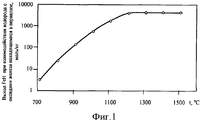
Термодинамический расчет, сделанный по программе Астра-4, взаимодействия водорода с периклазом, близким по составу с электротехническим порошком периклаза ППЭ-3МО, показал образование FeH при температуре 700°С, а максимальный выход с 1200°С (фиг.1). Верхний предел температуры 1400°С выбран с учетом стойкости футеровки, в которой осуществляют реакционный обжиг, а также для того, чтобы исключить возможное взаимодействие футеровки с периклазом.Thermodynamic calculation made according to the Astra-4 program, the interaction of hydrogen with periclase, similar in composition to the electrotechnical powder of periclase PPE-3MO, showed the formation of FeH at a temperature of 700 ° C, and the maximum yield from 1200 ° C (figure 1). The upper temperature limit of 1400 ° C is selected taking into account the stability of the lining in which the reaction firing is carried out, as well as in order to exclude the possible interaction of the lining with periclase.
Для получения порошка электротехнического периклаза по заявляемому способу использовалось колпаковое устройство (керамический тигель, опрокинутый вверх дном для предотвращения выхода газов), в верхнюю часть которого загружали порошок периклаза, а в нижнюю - углеродистую добавку - каменноугольный кокс. Периклаз и каменноугольный кокс разделены картонной перегородкой для предотвращения перемешивания при установке тигля в печь. В дне тигля просверлено отверстие, в которое вставлена алундовая трубка, для подачи паров воды, опущенная до середины высоты занимаемой углеродистой добавкой. Место сочленения алундовой трубки и тигля уплотнено газонепроницаемой обмазкой для предотвращения выхода газов.To obtain electrotechnical periclase powder according to the claimed method, a bell device (a ceramic crucible tilted upside down to prevent the escape of gases) was used, periclase powder was loaded into the upper part and coal coke was added to the lower part. Periclase and coal coke are separated by a cardboard partition to prevent mixing when the crucible is installed in the furnace. A hole was drilled in the bottom of the crucible into which the alundum tube was inserted to supply water vapor, lowered to the middle of the height occupied by the carbon additive. The junction of the alundum tube and crucible is sealed with a gas-tight coating to prevent the escape of gases.
В качестве исходных продуктов использовали порошок периклаза, полученного из магнезитового сырья методом электропечного переплава класса ППЭ-ЗМО Раздолинского периклазового завода состава мас.%: MgO - 96,09; SiO2 - 1,62; Al2O3 - 0,95; CaO - 1,12; FeO - 0,22 с последующим дроблением, измельчением и грохочением фракции не более - 0,5 мм, и углеродистую добавку - каменноугольный кокс с содержанием углерода ~ 92%. Отношение массы воды к массе углеродистой добавки по содержанию в ней углерода выбирают равным 1:5.As the starting products used periclase powder obtained from magnesite raw materials by electric furnace remelting of the PPE-ZMO class of the Razdolinsky periclase plant, wt.%: MgO - 96.09; SiO 2 - 1.62; Al 2 O 3 - 0.95; CaO - 1.12; FeO - 0.22, followed by crushing, grinding and screening of a fraction of not more than 0.5 mm, and the carbon additive is coal coke with a carbon content of ~ 92%. The ratio of the mass of water to the mass of carbon additives by the content of carbon in it is chosen equal to 1: 5.
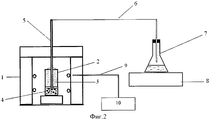
Опыты проводили на установке, показанной на фиг.2.The experiments were performed on the installation shown in figure 2.
На фиг.2: 1 - силитовая печь, 2 - реакционный стакан, 3 - периклаз, 4 - обожженный нефтекокс, 5 - алундовая трубка, 6 - магистраль подачи паров воды, 7 - колба с водой, 8 - печь сопротивления; 9 - ПП термопара; 10 - автоматический регулятор температуры ВРТ-1.In Fig.2: 1 - a silica furnace, 2 - a reaction beaker, 3 - periclase, 4 - calcined petroleum coke, 5 - alundum tube, 6 - water vapor supply line, 7 - water flask, 8 - resistance furnace; 9 - PP thermocouple; 10 - automatic temperature controller VRT-1.
Способ реализуется следующим образом. В реакционный стакан, представляющий собой перевернутый вверх дном алундовый тигель 2, помещается слой периклаза 3 и слой обожженного нефтекокса, разделенные между собой картонной перегородкой для предотвращения перемешивания периклаза и нефтекокса. Алундовый стакан 2 помещался в силитовую печь 1, работающую в области температур 20-1300°С. В верхнюю часть стакана вставлена алундовая трубка 5 для подачи паров воды. Место крепления трубки 5 к стакану 2 заделывалось огнеупорной обмазкой на основе жидкого стекла и кремнезема для предотвращения выхода водорода. Через алундовую трубку, соединенную с мерной колбой 7 с помощью силиконовой магистрали 6, продували пары воды, а количество испаренной воды определяли по мерной колбе. Пары воды образовывались в результате нагревания воды в колбе 7 печью сопротивления 8. Температура в печи измерялась с помощью термопары 9 и стабилизировалась автоматическим регулятором температуры 10. Водород образовывался в результате взаимодействия паров воды с углеродом нефтекокса по реакции 1 с 740°С.The method is implemented as follows. A
Пары воды подавались в реакционный стакан по достижении температуры опыта, значительно превосходящей температуру начала взаимодействия паров воды с углеродом. Масса подаваемого пара измерялась по количеству испаренной воды в мерной колбе 7, отношение массы воды к массе углеродистой добавки (по реакции (1)) по содержанию в ней углерода выбирают равным 1,5, которое поддерживалось во всех опытах одинаковым.Water vapor was fed into the reaction beaker upon reaching the experimental temperature, significantly exceeding the temperature at which the interaction of water vapor with carbon began. The mass of the supplied steam was measured by the amount of evaporated water in the volumetric flask 7, the ratio of the mass of water to the mass of carbon additive (according to reaction (1)) was chosen to be 1.5 by the carbon content in it, which was maintained the same in all experiments.
Осуществление заявляемого способа в промышленных условиях можно проводить в колпаковой печи, например, марки СГЗ-3.4/7.The implementation of the proposed method in an industrial environment can be carried out in a bell furnace, for example, grade SGZ-3.4 / 7.
Пример 1Example 1
Порошок периклаза подвергался обжигу в колпаковом устройстве совместно с углеродистой добавкой. При температуре 1100°С через кокс продували пары воды в течение 60 мин. Полученные газы продувались через слой порошка периклаза. После обжига периклаз анализировался на содержание оксида железа, которое составляло 0,18 мас.%.The periclase powder was fired in a bell-type device together with a carbon additive. At a temperature of 1100 ° C, water vapor was blown through the coke for 60 minutes. The resulting gases were purged through a layer of periclase powder. After firing, periclase was analyzed for the content of iron oxide, which was 0.18 wt.%.
Пример 2Example 2
Порошок периклаза подвергался обжигу в колпаковом устройстве совместно с углеродистой добавкой. При температуре 1200°С через кокс продували пары воды в течение 60 мин. Причем полученные газы продувались через слой порошка периклаза. После обжига периклаз анализировался на содержание оксида железа, которое составляло 0,12 мас.%.The periclase powder was fired in a bell-type device together with a carbon additive. At a temperature of 1200 ° C, water vapor was blown through the coke for 60 minutes. Moreover, the resulting gases were blown through a layer of periclase powder. After firing, periclase was analyzed for the content of iron oxide, which was 0.12 wt.%.
Пример 3Example 3
Порошок периклаза подвергался обжигу в колпаковом устройстве совместно с углеродистой добавкой. При температуре 1300°С через кокс продували пары воды в течение 60 мин. Причем полученные газы проходили через слой порошка периклаза. После обжига периклаз анализировался на содержание оксида железа, которое составляло 0,12 мас.%.The periclase powder was fired in a bell-type device together with a carbon additive. At a temperature of 1300 ° C, water vapor was blown through the coke for 60 minutes. Moreover, the resulting gases passed through a layer of periclase powder. After firing, periclase was analyzed for the content of iron oxide, which was 0.12 wt.%.
Таким образом, заявляемый способ позволяет повысить качество периклаза за счет снижения в нем оксида железа, а осуществить его можно в существующих колпаковых печах.Thus, the claimed method can improve the quality of periclase by reducing iron oxide in it, and it can be implemented in existing bell-type furnaces.
Claims (1)
Priority Applications (1)
| Application Number | Priority Date | Filing Date | Title |
|---|---|---|---|
| RU2010118913/03A RU2433103C1 (en) | 2010-05-11 | 2010-05-11 | Method of preparing electrical periclase powder |
Applications Claiming Priority (1)
| Application Number | Priority Date | Filing Date | Title |
|---|---|---|---|
| RU2010118913/03A RU2433103C1 (en) | 2010-05-11 | 2010-05-11 | Method of preparing electrical periclase powder |
Publications (1)
| Publication Number | Publication Date |
|---|---|
| RU2433103C1 true RU2433103C1 (en) | 2011-11-10 |
Family
ID=44997199
Family Applications (1)
| Application Number | Title | Priority Date | Filing Date |
|---|---|---|---|
| RU2010118913/03A RU2433103C1 (en) | 2010-05-11 | 2010-05-11 | Method of preparing electrical periclase powder |
Country Status (1)
| Country | Link |
|---|---|
| RU (1) | RU2433103C1 (en) |
Citations (4)
| Publication number | Priority date | Publication date | Assignee | Title |
|---|---|---|---|---|
| DE3911880A1 (en) * | 1989-04-11 | 1990-10-18 | Radex Heraklith | METHOD FOR PRODUCING PERICLAS CRYSTALS |
| RU2096382C1 (en) * | 1995-10-09 | 1997-11-20 | Санкт-Петербургский государственный горный институт им.Г.В.Плеханова (технический университет) | Method for roasting ceramic articles |
| RU2224728C1 (en) * | 2003-02-26 | 2004-02-27 | Богдановичское ОАО по производству огнеупорных материалов | Process of production of electrotechnical periclase |
| RU2347768C1 (en) * | 2007-07-10 | 2009-02-27 | Сергей Викторович Дигонский | Method of burning ceramics |
-
2010
- 2010-05-11 RU RU2010118913/03A patent/RU2433103C1/en not_active IP Right Cessation
Patent Citations (4)
| Publication number | Priority date | Publication date | Assignee | Title |
|---|---|---|---|---|
| DE3911880A1 (en) * | 1989-04-11 | 1990-10-18 | Radex Heraklith | METHOD FOR PRODUCING PERICLAS CRYSTALS |
| RU2096382C1 (en) * | 1995-10-09 | 1997-11-20 | Санкт-Петербургский государственный горный институт им.Г.В.Плеханова (технический университет) | Method for roasting ceramic articles |
| RU2224728C1 (en) * | 2003-02-26 | 2004-02-27 | Богдановичское ОАО по производству огнеупорных материалов | Process of production of electrotechnical periclase |
| RU2347768C1 (en) * | 2007-07-10 | 2009-02-27 | Сергей Викторович Дигонский | Method of burning ceramics |
Similar Documents
| Publication | Publication Date | Title |
|---|---|---|
| KR101460286B1 (en) | Method for manufacturing magnesium | |
| NO156333B (en) | SYSTEM FOR PREFABRICATED CONCRETE ELEMENTS. | |
| CN102285806B (en) | Synthetic calcium magnesite and preparation method thereof | |
| Orosco et al. | Synthesis of cordierite by dolomite and kaolinitic clay chlorination. Study of the phase transformations and reaction mechanism | |
| Kuusik et al. | High temperature behavior of NiO-based oxygen carriers for Chemical Looping Combustion | |
| US20150353421A1 (en) | Method for burning lump material | |
| Lee et al. | Effect of fe 2 o 3 additions on the hydration resistance of cao | |
| Bobkov et al. | Study of the thermal characteristics of phosphate raw materials in the annealing temperature range | |
| RU2433103C1 (en) | Method of preparing electrical periclase powder | |
| TWI647315B (en) | Steel dust treatment method, zinc production method, and steel material production method | |
| TW201538453A (en) | Refractory ceramic batch, use of a batch of this kind and a metallurgical melting vessel | |
| AU2014365267A1 (en) | Siliceous composition and method for obtaining same | |
| JP5742495B2 (en) | Sintering experiment equipment | |
| RU2553116C1 (en) | Method of metallurgical coke production | |
| Ma et al. | Effects of reducing environment and fusible components on carbothermal reduction–nitridation reaction of coal gangue at high temperature under N2 atmosphere | |
| Sokić et al. | The possibilities of obtaining metallic calcium from Serbian carbonate mineral raw materials | |
| Salomão et al. | A novel magnesia based binder (MBB) for refractory castables | |
| CN103265292B (en) | Combustion-synthesis fusion-casting method of Al23O27N5 ceramic | |
| Pereira et al. | Brazilian refractory grade bauxite: a new alternative to refractories makers and users | |
| RU2602137C1 (en) | Method of producing magnesium oxide | |
| JP5880883B2 (en) | Plate brick for slide plate device and manufacturing method thereof | |
| RU2347768C1 (en) | Method of burning ceramics | |
| RU2415096C1 (en) | Method of burning vermiculite | |
| NO115234B (en) | ||
| RU2552544C2 (en) | Method of producing higher titanium sulphides |
Legal Events
| Date | Code | Title | Description |
|---|---|---|---|
| MM4A | The patent is invalid due to non-payment of fees |
Effective date: 20150512 |