RU2383503C1 - Luminescent germanate glass - Google Patents
Luminescent germanate glass Download PDFInfo
- Publication number
- RU2383503C1 RU2383503C1 RU2008145810/03A RU2008145810A RU2383503C1 RU 2383503 C1 RU2383503 C1 RU 2383503C1 RU 2008145810/03 A RU2008145810/03 A RU 2008145810/03A RU 2008145810 A RU2008145810 A RU 2008145810A RU 2383503 C1 RU2383503 C1 RU 2383503C1
- Authority
- RU
- Russia
- Prior art keywords
- glass
- ions
- luminescence
- luminescent
- mol
- Prior art date
Links
- 239000011521 glass Substances 0.000 title claims abstract description 28
- 229910018072 Al 2 O 3 Inorganic materials 0.000 claims description 7
- 229910005793 GeO 2 Inorganic materials 0.000 claims description 7
- 229910021193 La 2 O 3 Inorganic materials 0.000 claims description 3
- 238000004020 luminiscence type Methods 0.000 abstract description 20
- 150000002500 ions Chemical class 0.000 abstract description 17
- 238000010521 absorption reaction Methods 0.000 abstract description 4
- 230000005855 radiation Effects 0.000 abstract description 4
- 230000003321 amplification Effects 0.000 abstract description 2
- 238000003199 nucleic acid amplification method Methods 0.000 abstract description 2
- 239000000126 substance Substances 0.000 abstract description 2
- YBMRDBCBODYGJE-UHFFFAOYSA-N germanium dioxide Chemical compound O=[Ge]=O YBMRDBCBODYGJE-UHFFFAOYSA-N 0.000 abstract 2
- PNEYBMLMFCGWSK-UHFFFAOYSA-N aluminium oxide Inorganic materials [O-2].[O-2].[O-2].[Al+3].[Al+3] PNEYBMLMFCGWSK-UHFFFAOYSA-N 0.000 abstract 1
- 229910052593 corundum Inorganic materials 0.000 abstract 1
- 230000000694 effects Effects 0.000 abstract 1
- VQCBHWLJZDBHOS-UHFFFAOYSA-N erbium(III) oxide Inorganic materials O=[Er]O[Er]=O VQCBHWLJZDBHOS-UHFFFAOYSA-N 0.000 abstract 1
- MRELNEQAGSRDBK-UHFFFAOYSA-N lanthanum oxide Inorganic materials [O-2].[O-2].[O-2].[La+3].[La+3] MRELNEQAGSRDBK-UHFFFAOYSA-N 0.000 abstract 1
- KTUFCUMIWABKDW-UHFFFAOYSA-N oxo(oxolanthaniooxy)lanthanum Chemical compound O=[La]O[La]=O KTUFCUMIWABKDW-UHFFFAOYSA-N 0.000 abstract 1
- 238000005086 pumping Methods 0.000 abstract 1
- 231100000489 sensitizer Toxicity 0.000 abstract 1
- 229910001845 yogo sapphire Inorganic materials 0.000 abstract 1
- FIXNOXLJNSSSLJ-UHFFFAOYSA-N ytterbium(III) oxide Inorganic materials O=[Yb]O[Yb]=O FIXNOXLJNSSSLJ-UHFFFAOYSA-N 0.000 abstract 1
- 230000007704 transition Effects 0.000 description 7
- 239000000203 mixture Substances 0.000 description 6
- 230000007423 decrease Effects 0.000 description 5
- 239000000835 fiber Substances 0.000 description 5
- 238000006243 chemical reaction Methods 0.000 description 3
- 150000001875 compounds Chemical class 0.000 description 3
- 230000003595 spectral effect Effects 0.000 description 3
- 229910016036 BaF 2 Inorganic materials 0.000 description 2
- 229910004261 CaF 2 Inorganic materials 0.000 description 2
- 238000002425 crystallisation Methods 0.000 description 2
- 230000008025 crystallization Effects 0.000 description 2
- 230000005284 excitation Effects 0.000 description 2
- BASFCYQUMIYNBI-UHFFFAOYSA-N platinum Chemical compound [Pt] BASFCYQUMIYNBI-UHFFFAOYSA-N 0.000 description 2
- 238000010791 quenching Methods 0.000 description 2
- 230000000171 quenching effect Effects 0.000 description 2
- 239000005368 silicate glass Substances 0.000 description 2
- SITVSCPRJNYAGV-UHFFFAOYSA-L tellurite Chemical compound [O-][Te]([O-])=O SITVSCPRJNYAGV-UHFFFAOYSA-L 0.000 description 2
- FGRBYDKOBBBPOI-UHFFFAOYSA-N 10,10-dioxo-2-[4-(N-phenylanilino)phenyl]thioxanthen-9-one Chemical compound O=C1c2ccccc2S(=O)(=O)c2ccc(cc12)-c1ccc(cc1)N(c1ccccc1)c1ccccc1 FGRBYDKOBBBPOI-UHFFFAOYSA-N 0.000 description 1
- 241001289141 Babr Species 0.000 description 1
- 229910052691 Erbium Inorganic materials 0.000 description 1
- 229910005191 Ga 2 O 3 Inorganic materials 0.000 description 1
- 229910004379 HoF 3 Inorganic materials 0.000 description 1
- 229910018068 Li 2 O Inorganic materials 0.000 description 1
- 101100496858 Mus musculus Colec12 gene Proteins 0.000 description 1
- 229910017493 Nd 2 O 3 Inorganic materials 0.000 description 1
- 206010070834 Sensitisation Diseases 0.000 description 1
- 229910004298 SiO 2 Inorganic materials 0.000 description 1
- 229910000831 Steel Inorganic materials 0.000 description 1
- 239000011149 active material Substances 0.000 description 1
- 229910052783 alkali metal Inorganic materials 0.000 description 1
- 150000001340 alkali metals Chemical class 0.000 description 1
- 229910052782 aluminium Inorganic materials 0.000 description 1
- XAGFODPZIPBFFR-UHFFFAOYSA-N aluminium Chemical compound [Al] XAGFODPZIPBFFR-UHFFFAOYSA-N 0.000 description 1
- 229910052792 caesium Inorganic materials 0.000 description 1
- 238000005266 casting Methods 0.000 description 1
- 238000005234 chemical deposition Methods 0.000 description 1
- UYAHIZSMUZPPFV-UHFFFAOYSA-N erbium Chemical compound [Er] UYAHIZSMUZPPFV-UHFFFAOYSA-N 0.000 description 1
- 229910052732 germanium Inorganic materials 0.000 description 1
- GNPVGFCGXDBREM-UHFFFAOYSA-N germanium atom Chemical compound [Ge] GNPVGFCGXDBREM-UHFFFAOYSA-N 0.000 description 1
- 229910052744 lithium Inorganic materials 0.000 description 1
- 238000004519 manufacturing process Methods 0.000 description 1
- 230000008018 melting Effects 0.000 description 1
- 238000002844 melting Methods 0.000 description 1
- 238000000034 method Methods 0.000 description 1
- 230000005012 migration Effects 0.000 description 1
- 238000013508 migration Methods 0.000 description 1
- 230000003287 optical effect Effects 0.000 description 1
- 238000005424 photoluminescence Methods 0.000 description 1
- 229910052697 platinum Inorganic materials 0.000 description 1
- 229910001404 rare earth metal oxide Inorganic materials 0.000 description 1
- 229910052701 rubidium Inorganic materials 0.000 description 1
- 230000008313 sensitization Effects 0.000 description 1
- 229910052708 sodium Inorganic materials 0.000 description 1
- 238000001228 spectrum Methods 0.000 description 1
- 239000010959 steel Substances 0.000 description 1
Images
Landscapes
- Lasers (AREA)
- Glass Compositions (AREA)
Abstract
Description
Изобретение относится к легированным стеклам, в частности к Er-содержащему германатному стеклу, которое может использоваться в качестве активного материала лазеров и усилителей инфракрасного диапазона. В частности, для спектральной области при λ~1,55 мкм, широко используемой в волоконно-оптической связи и лазерной локации.The invention relates to doped glasses, in particular to Er-containing germanate glass, which can be used as the active material of lasers and infrared amplifiers. In particular, for the spectral region at λ ~ 1.55 μm, which is widely used in fiber optic communication and laser ranging.
Известно легированное эрбием теллуритное стекло следующего состава, мол.%: 80TeO2-10Na2O-9ZnO-1Er2O3 (S.Shen, A.Jha, X.Liu et al. Tellurite Glasses for Broadband Amplifiers and Integrated Optics, J. Am. Ceram. Soc. (2002), vol.85, no.6, p.1391-1395). Основными недостатками известного стекла являются недостаточно высокое значение эффективной полуширины полосы люминесценции (Δλэф= 62-75 нм) в переходе 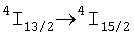
Известно легированное эрбием, алюминием и германием силикатное стекло, включающее (2900-5600 ppm) Er, (2,6-5,2 мол.%) Al2O3, (16,1-17,9 мол.%) GeO2, остальное - SiO2 (А.В.Холодков, К.М.Голант. Особенности фотолюминесценции ионов Er3+ в силикатных стеклах, полученных плазмохимическим осаждением в СВЧ-разряде при пониженном давлении. ЖТФ (2005), том 75, вып.6, с.46-53). Недостатком известного стекла является невысокое значение (47 нм) полуширины полосы люминесценции в переходе 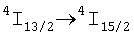
Известно легированное тулием германатное стекло следующего состава, мол. %: по меньшей мере 20GeO2, (0,001-2,0) Tm2O3, (2-40) Ga2O3, может включать 0< и <40 щелочноземельных соединений, выбранных из MgO, CaO, SrO,BaO, BaF2, MgF2, CaF2, SrF2, BaCl2, MgCl2, CaCl2, SrCl2, BaBr2, MgBr2, CaBr2, SrBr2, и их комбинации, а также может включать 0< и <20 щелочных соединений, выбранных из Li2O, Na2O, K2O, Rb2O, Cs2O, Li2Cl2, Na2Cl2, K2Cl2, Rb2Cl2, Cs2Cl2, Li2Br2, Na2Br2, K2Br2, Rb2Br2, Cs2Br2, и их комбинации (патент США №6589895 от 2003.07.08, МПК: C03C 13/00; C03C 3/253; C03C 4/12; C03C 13/04; C03C 4/00; C03C 3/12; H01S 3/17; H01S 3/16; C03C 004/12; C03C 003/23; C03C 003/253; C03C 013/04). Недостатком известного стекла является отсутствие люминесценции в спектральной области 1,55-1,65 мкм, что не позволяет получать в этой области усиление либо генерацию.Known thulium-doped germanate glass of the following composition, pier. %: at least 20GeO 2 , (0.001-2.0) Tm 2 O 3 , (2-40) Ga 2 O 3 , may include 0 <and <40 alkaline earth compounds selected from MgO, CaO, SrO, BaO, BaF 2 , MgF 2 , CaF 2 , SrF 2 , BaCl 2 , MgCl 2 , CaCl 2 , SrCl 2 , BaBr 2 , MgBr 2 , CaBr 2 , SrBr 2 , and combinations thereof, may also include 0 <and <20 alkaline compounds selected from Li 2 O, Na 2 O, K 2 O, Rb 2 O, Cs 2 O, Li 2 Cl 2 , Na 2 Cl 2 , K 2 Cl 2 , Rb 2 Cl 2 , Cs 2 Cl 2 , Li 2 Br 2 , Na 2 Br 2 , K 2 Br 2 , Rb 2 Br 2 , Cs 2 Br 2 , and combinations thereof (US patent No. 6589895 from 2003.07.08, IPC: C03C 13/00; C03C 3/253; C03C 4/12; C03C 13/04; C03C 4/00; C03C 3/12; H01S 3/17; H01S 3/16; C03C 004/12; C03C 003/23; C03C 003/253; C03C 013/04). A disadvantage of the known glass is the lack of luminescence in the spectral region of 1.55-1.65 μm, which does not allow gain or generation in this region.
Наиболее близким к заявляемому стеклу по технической сущности является стекло для лазеров и волоконных усилителей системы BaGe4O9-Ba(PO3)2-RFx следующего состава, мол. %: (10-70) (BaF2, CaF2, MgF2, BiF3, PbF2), (7,31-58,48) GeO2, (4,81-38,50)Closest to the claimed glass in technical essence is glass for lasers and fiber amplifiers of the BaGe 4 O 9 -Ba (PO 3 ) 2 -RF x system of the following composition, mol. %: (10-70) (BaF 2 , CaF 2 , MgF 2 , BiF 3 , PbF 2 ), (7.31-58.48) GeO 2 , (4.81-38.50)
P2O5, (7,86-62,94) BaO, где легирующие соединения взяты выше 100% в вес %: (0,5-15) Nd2O3(NdF3), (0,2-12) Er2O3(ErF3), (1,0-15) Yb2O3(YbF3), (1,0-10) Ho2O3(HoF3), (0,5-12) Pr2O3(PrF3), (0,2-10) Tm2O3(TmF3), (0,1-10) Tb2O3(TbF3), (0,5-20) MnO(MnF2) (Стекло для лазеров и волоконных усилителей и метод его производства. Патент США №6495481 от 17 декабря 2002 г., МПК: C03C 3/247, C03C 3/253, C03C 3/16, C03C 3/23, C03C 3/32).P 2 O 5 , (7.86-62.94) BaO, where the doping compounds are taken above 100% by weight%: (0.5-15) Nd 2 O 3 (NdF 3 ), (0.2-12) Er 2 O 3 (ErF 3 ), (1.0-15) Yb 2 O 3 (YbF 3 ), (1.0-10) Ho 2 O 3 (HoF 3 ), (0.5-12) Pr 2 O 3 (PrF 3 ), (0.2-10) Tm 2 O 3 (TmF 3 ), (0.1-10) Tb 2 O 3 (TbF 3 ), (0.5-20) MnO (MnF 2 ) (Glass for lasers and fiber amplifiers and the method of its production. US Patent No. 6495481 of December 17, 2002, IPC: C03C 3/247, C03C 3/253, C03C 3/16, C03C 3/23, C03C 3/32 )
Основными недостатками прототипа являются невысокое значение полуширины полосы люминесценции ионов Er3+ в переходе
Указанные недостатки не позволяют использовать это стекло в широкополосных усилителях, обеспечивающих большое число информационных каналов в спектральной области при λ~1,55 мкм, и ограничивают возможности снижения толщины микрочип лазеров.These shortcomings do not allow the use of this glass in broadband amplifiers that provide a large number of information channels in the spectral region at λ ~ 1.55 μm, and limit the possibility of reducing the thickness of the microchip lasers.
Задачей предлагаемого изобретения является создание стекла с высоким значением эффективной полуширины полосы люминесценции в переходе
Для решения поставленной задачи люминесцирующее германатное стекло, содержащее GeO2, Er2O3 и Yb2O3, дополнительно содержит B2O3, Al2O3 и La2O3 при следующем соотношении компонентов, мол.%: (40-60) GeO2, (0,01-5) Er2O3, (1-28) Yb2O3, (15-30) B2O3, (1-5) Al2O3, (1-25) La2O3.To solve this problem, luminescent germanate glass containing GeO 2 , Er 2 O 3 and Yb 2 O 3 additionally contains B 2 O 3 , Al 2 O 3 and La 2 O 3 in the following ratio of components, mol.%: (40- 60) GeO 2 , (0.01-5) Er 2 O 3 , (1-28) Yb 2 O 3 , (15-30) B 2 O 3 , (1-5) Al 2 O 3 , (1- 25) La 2 O 3 .
Стекло получали плавлением шихты в платиновом тигле при температуре 1450°C. После отливки стекло охлаждали между двумя стальными листами.Glass was obtained by melting the mixture in a platinum crucible at a temperature of 1450 ° C. After casting, the glass was cooled between two steel sheets.
Уменьшение концентрации Er2O3 ниже заявляемой нецелесообразно из-за трудности реализации превышения коэффициента усиления над коэффициентом потерь; увеличение концентрации Er2O3 сверх заявляемой нецелесообразно из-за снижения интенсивности люминесценции, обусловленного ростом потерь на "up"-конверсию. Уменьшение концентрации Yb2O3 ниже заявляемой нецелесообразно из-за снижения эффективности миграционной контролируемой сенсибилизации люминесценции ионов Er3+; увеличение концентрации Yb2O3 выше заявляемой нецелесообразно из-за появления кристаллизации стекла. Введение B2O3 используется для повышения растворимости редкоземельных оксидов и ускорения перехода 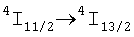
Составы заявляемого стекла и значения эффективной полуширины (Δλэф) и интегральной относительной интенсивности полосы люминесценции
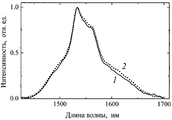
На чертеже изображены «квантовые» спектры люминесценции образца 3 в переходе
Как видно из таблицы, при увеличении концентрации Er2O3 с 1 до 2 и 5 мол. % и близкой к предельной концентрации Yb2O3 значение Iлюм увеличивается с 0,9 до 1 и уменьшается до 0,5 относительных единиц (ср. образцы 3, 4 и 1 в табл.). Это свидетельствует о слабом "up"-конверсионном тушении люминесценции Er3+ из состояний 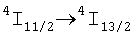
Yb3+ (λв=974 нм) свидетельствует о высокой однородности оптических центров Er3+, а большое значение Δλэф позволяет расширить число информационных каналов волоконных усилителей и элементов интегральной оптики.Yb 3+ (λ in = 974 nm) indicates a high homogeneity of the optical centers Er 3+ , and a large value of Δλ eff allows you to expand the number of information channels of fiber amplifiers and elements of integrated optics.
Таким образом, заявляемое люминесцирующее германатное стекло значительно (в 2,4 раза) превосходит прототип по ширине полосы люминесценции и может обеспечивать примерно вдвое превышающую величину поглощения возбуждающего излучения сенсибилизатором люминесценции при невысокой эффективности "up"-конверсионного тушения люминесценции. Эти характеристики обеспечивают заявляемому стеклу существенные преимущества при использовании его в качестве активных элементов лазеров и усилителей с широкополосным рабочим диапазоном вблизи λ~1,55 мкм (в том числе в виде микрочипа и волокна).Thus, the claimed luminescent germanate glass significantly (2.4 times) exceeds the prototype in terms of the width of the luminescence band and can provide approximately twice the amount of absorption of the exciting radiation by a luminescence sensitizer with a low efficiency of "up" conversion luminescence quenching. These characteristics provide the claimed glass with significant advantages when used as active elements of lasers and amplifiers with a broadband operating range near λ ~ 1.55 μm (including in the form of a microchip and fiber).
Claims (1)
Priority Applications (1)
| Application Number | Priority Date | Filing Date | Title |
|---|---|---|---|
| RU2008145810/03A RU2383503C1 (en) | 2008-11-19 | 2008-11-19 | Luminescent germanate glass |
Applications Claiming Priority (1)
| Application Number | Priority Date | Filing Date | Title |
|---|---|---|---|
| RU2008145810/03A RU2383503C1 (en) | 2008-11-19 | 2008-11-19 | Luminescent germanate glass |
Publications (1)
| Publication Number | Publication Date |
|---|---|
| RU2383503C1 true RU2383503C1 (en) | 2010-03-10 |
Family
ID=42135176
Family Applications (1)
| Application Number | Title | Priority Date | Filing Date |
|---|---|---|---|
| RU2008145810/03A RU2383503C1 (en) | 2008-11-19 | 2008-11-19 | Luminescent germanate glass |
Country Status (1)
| Country | Link |
|---|---|
| RU (1) | RU2383503C1 (en) |
Cited By (8)
| Publication number | Priority date | Publication date | Assignee | Title |
|---|---|---|---|---|
| RU2534138C2 (en) * | 2012-10-26 | 2014-11-27 | Государственное Научное Учреждение "Институт Физики Имени Б.И. Степанова Национальной Академии Наук Беларуси" | Luminiscent glass (versions) |
| RU2548638C1 (en) * | 2014-01-10 | 2015-04-20 | Государственное Научное Учреждение "Институт Физики Имени Б.И. Степанова Национальной Академии Наук Беларуси" | Luminescent glass |
| RU2548634C1 (en) * | 2014-01-10 | 2015-04-20 | Государственное Научное Учреждение "Институт Физики Имени Б.И. Степанова Национальной Академии Наук Беларуси" | Luminescing glass |
| RU2553879C2 (en) * | 2012-10-01 | 2015-06-20 | Учреждение образования "Белорусский государственный технологический университет" | Luminescent glass |
| RU2574223C1 (en) * | 2014-12-30 | 2016-02-10 | Учреждение образования "Белорусский государственный технологический университет" | Luminescent glass |
| RU2579056C1 (en) * | 2014-12-30 | 2016-03-27 | Учреждение образования "Белорусский государственный технологический университет" | Luminescent nano-glass-ceramic |
| RU2637540C1 (en) * | 2016-10-04 | 2017-12-05 | Учреждение образования "Белорусский государственный технологический университет" | Ap-conversion fluorescent nano-glass ceramics |
| RU2654032C1 (en) * | 2017-02-09 | 2018-05-15 | Федеральное государственное бюджетное учреждение науки Институт химии твердого тела Уральского отделения академии наук | Compound sodium germanate of lanthanum, neodymium and holmium as luminescent material for conversion of monochromatic laser radiation and method for production thereof |
Citations (6)
| Publication number | Priority date | Publication date | Assignee | Title |
|---|---|---|---|---|
| SU1310350A1 (en) * | 1985-12-10 | 1987-05-15 | Институт физики АН БССР | Luminescent glass |
| RU2079456C1 (en) * | 1993-12-08 | 1997-05-20 | Научно-исследовательский и технологический институт оптического материаловедения Всероссийского научного центра "Государственный оптический институт им.С.И.Вавилова" | Irradiation resistant glass |
| US6495481B1 (en) * | 2001-05-21 | 2002-12-17 | Nano Technologies | Glasses for laser and fiber amplifier applications and method for making thereof |
| US6589895B2 (en) * | 2001-06-29 | 2003-07-08 | Corning Incorporated | Thulium-doped germanate glass composition and device for optical amplification |
| RU2280625C1 (en) * | 2005-03-29 | 2006-07-27 | Учреждение образования "Белорусский государственный технологический университет" | Color filter glass |
| RU2302066C1 (en) * | 2005-09-22 | 2007-06-27 | Научный центр волоконной оптики при Институте общей физики им. А.М. Прохорова Российской академии наук | Fiber optic conductor for optical intensification of radiation at wavelengths ranging between 1000 and 1700 nm, methods for its manufacture, and fiber laser |
-
2008
- 2008-11-19 RU RU2008145810/03A patent/RU2383503C1/en not_active IP Right Cessation
Patent Citations (6)
| Publication number | Priority date | Publication date | Assignee | Title |
|---|---|---|---|---|
| SU1310350A1 (en) * | 1985-12-10 | 1987-05-15 | Институт физики АН БССР | Luminescent glass |
| RU2079456C1 (en) * | 1993-12-08 | 1997-05-20 | Научно-исследовательский и технологический институт оптического материаловедения Всероссийского научного центра "Государственный оптический институт им.С.И.Вавилова" | Irradiation resistant glass |
| US6495481B1 (en) * | 2001-05-21 | 2002-12-17 | Nano Technologies | Glasses for laser and fiber amplifier applications and method for making thereof |
| US6589895B2 (en) * | 2001-06-29 | 2003-07-08 | Corning Incorporated | Thulium-doped germanate glass composition and device for optical amplification |
| RU2280625C1 (en) * | 2005-03-29 | 2006-07-27 | Учреждение образования "Белорусский государственный технологический университет" | Color filter glass |
| RU2302066C1 (en) * | 2005-09-22 | 2007-06-27 | Научный центр волоконной оптики при Институте общей физики им. А.М. Прохорова Российской академии наук | Fiber optic conductor for optical intensification of radiation at wavelengths ranging between 1000 and 1700 nm, methods for its manufacture, and fiber laser |
Cited By (8)
| Publication number | Priority date | Publication date | Assignee | Title |
|---|---|---|---|---|
| RU2553879C2 (en) * | 2012-10-01 | 2015-06-20 | Учреждение образования "Белорусский государственный технологический университет" | Luminescent glass |
| RU2534138C2 (en) * | 2012-10-26 | 2014-11-27 | Государственное Научное Учреждение "Институт Физики Имени Б.И. Степанова Национальной Академии Наук Беларуси" | Luminiscent glass (versions) |
| RU2548638C1 (en) * | 2014-01-10 | 2015-04-20 | Государственное Научное Учреждение "Институт Физики Имени Б.И. Степанова Национальной Академии Наук Беларуси" | Luminescent glass |
| RU2548634C1 (en) * | 2014-01-10 | 2015-04-20 | Государственное Научное Учреждение "Институт Физики Имени Б.И. Степанова Национальной Академии Наук Беларуси" | Luminescing glass |
| RU2574223C1 (en) * | 2014-12-30 | 2016-02-10 | Учреждение образования "Белорусский государственный технологический университет" | Luminescent glass |
| RU2579056C1 (en) * | 2014-12-30 | 2016-03-27 | Учреждение образования "Белорусский государственный технологический университет" | Luminescent nano-glass-ceramic |
| RU2637540C1 (en) * | 2016-10-04 | 2017-12-05 | Учреждение образования "Белорусский государственный технологический университет" | Ap-conversion fluorescent nano-glass ceramics |
| RU2654032C1 (en) * | 2017-02-09 | 2018-05-15 | Федеральное государственное бюджетное учреждение науки Институт химии твердого тела Уральского отделения академии наук | Compound sodium germanate of lanthanum, neodymium and holmium as luminescent material for conversion of monochromatic laser radiation and method for production thereof |
Similar Documents
| Publication | Publication Date | Title |
|---|---|---|
| RU2383503C1 (en) | Luminescent germanate glass | |
| Jiang et al. | Er3+-doped phosphate glasses for fiber amplifiers with high gain per unit length | |
| Wang et al. | Influence of Al 3+ and P 5+ ion contents on the valence state of Yb 3+ ions and the dispersion effect of Al 3+ and P 5+ ions on Yb 3+ ions in silica glass | |
| JP5917867B2 (en) | Aluminophosphate glass composition | |
| Herrmann et al. | Structure and fluorescence properties of ternary aluminosilicate glasses doped with samarium and europium | |
| US6503860B1 (en) | Antimony oxide glass with optical activity | |
| Gao et al. | Tm3+-doped tellurium germanate glass and its double-cladding fiber for 2 μm laser | |
| US6589895B2 (en) | Thulium-doped germanate glass composition and device for optical amplification | |
| Liu et al. | Realization of 2 µm laser output in Tm3+-doped lead silicate double cladding fiber | |
| Lakshminarayana et al. | Fluorescence features of Tm3+-doped multicomponent borosilicate and borotellurite glasses for blue laser and S-band optical amplifier applications | |
| Kiwsakunkran et al. | Synthesis and optical behavior of neodymium ion doped borophosphate glass for laser applications | |
| US6583927B2 (en) | Optical amplifier incorporating therein holmium-doped optical fiber | |
| CN101414025A (en) | Germanate glass optical fiber with emission wavelength of 1.5-2.2 mu m | |
| US6859606B2 (en) | ER3+ doped boro-tellurite glasses for 1.5 μm broadband amplification | |
| JP4673363B2 (en) | Multi-component tellurite glass composition, optical amplifier and laser equipment | |
| Zhou et al. | Broadband near-infrared emission from Bi-doped aluminosilicate glasses | |
| Scarnera et al. | Green up-conversion in Yb3+–Tb3+ and Yb3+–Tm3+–Tb3+ doped fluoro-germanate bulk glass and fibre | |
| US20040037538A1 (en) | Silicate glass for upconversion fluorescence | |
| Yinggang et al. | Effect of alkali metal oxides R2O (R= Na, K) on 1.53 μm luminescence of Er3+-doped Ga2O3-GeO2 glasses for optical amplification | |
| Reiche et al. | Blue and green upconversion in Er3+-doped fluoroindate glasses | |
| Gangfeng et al. | Broadband 1.53 μm emission in Er3+-doped Ga-Bi-Pb-Ge heavy metal oxide glasses | |
| Yang et al. | Laser-diode-excited intense luminescence and green-upconversion in erbium-doped bismuth–germanate–lead glasses | |
| JP6901560B2 (en) | Fluorophosphate-based glass for active devices | |
| Reddeppa et al. | Visible and NIR steady-state luminescence properties of Dy3+ ions-doped calcium phosphate glasses for light-emitting diodes | |
| CN102211871B (en) | Ytterbium-bismuth co-doped alkali-free borophosphate optical glass and preparation method thereof |
Legal Events
| Date | Code | Title | Description |
|---|---|---|---|
| MM4A | The patent is invalid due to non-payment of fees |
Effective date: 20111120 |