RU2258373C1 - Method for producing of extruded grain sticks - Google Patents
Method for producing of extruded grain sticks Download PDFInfo
- Publication number
- RU2258373C1 RU2258373C1 RU2004109744/13A RU2004109744A RU2258373C1 RU 2258373 C1 RU2258373 C1 RU 2258373C1 RU 2004109744/13 A RU2004109744/13 A RU 2004109744/13A RU 2004109744 A RU2004109744 A RU 2004109744A RU 2258373 C1 RU2258373 C1 RU 2258373C1
- Authority
- RU
- Russia
- Prior art keywords
- product
- extruder
- products
- extruded
- sticks
- Prior art date
Links
- 238000004519 manufacturing process Methods 0.000 title claims description 4
- 238000000034 method Methods 0.000 claims abstract description 14
- 239000011782 vitamin Substances 0.000 claims abstract description 11
- 229940088594 vitamin Drugs 0.000 claims abstract description 11
- 235000009419 Fagopyrum esculentum Nutrition 0.000 claims abstract description 10
- 235000010469 Glycine max Nutrition 0.000 claims abstract description 10
- 239000002245 particle Substances 0.000 claims abstract description 10
- 244000068988 Glycine max Species 0.000 claims abstract description 8
- 238000002156 mixing Methods 0.000 claims abstract description 5
- 238000000227 grinding Methods 0.000 claims abstract description 4
- 240000008620 Fagopyrum esculentum Species 0.000 claims abstract 2
- 239000000047 product Substances 0.000 claims description 47
- 239000000203 mixture Substances 0.000 claims description 20
- 239000011159 matrix material Substances 0.000 claims description 15
- 239000013589 supplement Substances 0.000 claims description 4
- 235000013339 cereals Nutrition 0.000 abstract description 17
- 239000000126 substance Substances 0.000 abstract description 5
- 239000000654 additive Substances 0.000 abstract description 2
- 230000000996 additive effect Effects 0.000 abstract description 2
- 239000012141 concentrate Substances 0.000 abstract description 2
- 230000000694 effects Effects 0.000 abstract 1
- 230000000050 nutritive effect Effects 0.000 abstract 1
- 239000011369 resultant mixture Substances 0.000 abstract 1
- 238000001125 extrusion Methods 0.000 description 10
- 235000016709 nutrition Nutrition 0.000 description 9
- 241000219051 Fagopyrum Species 0.000 description 8
- 235000012438 extruded product Nutrition 0.000 description 7
- 235000013305 food Nutrition 0.000 description 7
- 235000018102 proteins Nutrition 0.000 description 7
- 108090000623 proteins and genes Proteins 0.000 description 7
- 102000004169 proteins and genes Human genes 0.000 description 7
- 239000002994 raw material Substances 0.000 description 6
- 235000013343 vitamin Nutrition 0.000 description 6
- 229930003231 vitamin Natural products 0.000 description 6
- 150000001413 amino acids Chemical class 0.000 description 5
- 235000014633 carbohydrates Nutrition 0.000 description 5
- 150000001720 carbohydrates Chemical class 0.000 description 5
- 229910052500 inorganic mineral Inorganic materials 0.000 description 5
- 239000011707 mineral Substances 0.000 description 5
- 239000003925 fat Substances 0.000 description 4
- 235000019197 fats Nutrition 0.000 description 4
- XLYOFNOQVPJJNP-UHFFFAOYSA-N water Substances O XLYOFNOQVPJJNP-UHFFFAOYSA-N 0.000 description 4
- 238000004458 analytical method Methods 0.000 description 3
- 238000005516 engineering process Methods 0.000 description 3
- 239000000155 melt Substances 0.000 description 3
- 229920001169 thermoplastic Polymers 0.000 description 3
- 239000004416 thermosoftening plastic Substances 0.000 description 3
- CIWBSHSKHKDKBQ-JLAZNSOCSA-N Ascorbic acid Chemical compound OC[C@H](O)[C@H]1OC(=O)C(O)=C1O CIWBSHSKHKDKBQ-JLAZNSOCSA-N 0.000 description 2
- 235000015496 breakfast cereal Nutrition 0.000 description 2
- 230000006835 compression Effects 0.000 description 2
- 238000007906 compression Methods 0.000 description 2
- 239000007788 liquid Substances 0.000 description 2
- 239000000463 material Substances 0.000 description 2
- 235000010755 mineral Nutrition 0.000 description 2
- 230000035764 nutrition Effects 0.000 description 2
- 230000006641 stabilisation Effects 0.000 description 2
- 238000011105 stabilization Methods 0.000 description 2
- 230000009466 transformation Effects 0.000 description 2
- OYPRJOBELJOOCE-UHFFFAOYSA-N Calcium Chemical compound [Ca] OYPRJOBELJOOCE-UHFFFAOYSA-N 0.000 description 1
- ZZZCUOFIHGPKAK-UHFFFAOYSA-N D-erythro-ascorbic acid Natural products OCC1OC(=O)C(O)=C1O ZZZCUOFIHGPKAK-UHFFFAOYSA-N 0.000 description 1
- 108010082495 Dietary Plant Proteins Proteins 0.000 description 1
- 108010073771 Soybean Proteins Proteins 0.000 description 1
- 229920002472 Starch Polymers 0.000 description 1
- 229930003268 Vitamin C Natural products 0.000 description 1
- 230000037208 balanced nutrition Effects 0.000 description 1
- 235000019046 balanced nutrition Nutrition 0.000 description 1
- 230000015572 biosynthetic process Effects 0.000 description 1
- 239000011575 calcium Substances 0.000 description 1
- 229910052791 calcium Inorganic materials 0.000 description 1
- 210000002421 cell wall Anatomy 0.000 description 1
- 239000011248 coating agent Substances 0.000 description 1
- 238000000576 coating method Methods 0.000 description 1
- 238000005056 compaction Methods 0.000 description 1
- 230000000052 comparative effect Effects 0.000 description 1
- 230000006378 damage Effects 0.000 description 1
- 238000010586 diagram Methods 0.000 description 1
- 235000005911 diet Nutrition 0.000 description 1
- 230000037213 diet Effects 0.000 description 1
- 235000021245 dietary protein Nutrition 0.000 description 1
- 238000009826 distribution Methods 0.000 description 1
- 235000020776 essential amino acid Nutrition 0.000 description 1
- 239000003797 essential amino acid Substances 0.000 description 1
- 238000000265 homogenisation Methods 0.000 description 1
- 230000007062 hydrolysis Effects 0.000 description 1
- 238000006460 hydrolysis reaction Methods 0.000 description 1
- 238000010335 hydrothermal treatment Methods 0.000 description 1
- 238000011835 investigation Methods 0.000 description 1
- 238000011068 loading method Methods 0.000 description 1
- 238000002844 melting Methods 0.000 description 1
- 230000008018 melting Effects 0.000 description 1
- 229910052751 metal Inorganic materials 0.000 description 1
- 239000002184 metal Substances 0.000 description 1
- 230000000704 physical effect Effects 0.000 description 1
- 239000011148 porous material Substances 0.000 description 1
- 238000002360 preparation method Methods 0.000 description 1
- 229940001941 soy protein Drugs 0.000 description 1
- 235000019698 starch Nutrition 0.000 description 1
- 239000008107 starch Substances 0.000 description 1
- 238000003860 storage Methods 0.000 description 1
- 230000008961 swelling Effects 0.000 description 1
- 230000002277 temperature effect Effects 0.000 description 1
- 230000001225 therapeutic effect Effects 0.000 description 1
- 238000005979 thermal decomposition reaction Methods 0.000 description 1
- 238000000844 transformation Methods 0.000 description 1
- 235000019154 vitamin C Nutrition 0.000 description 1
- 239000011718 vitamin C Substances 0.000 description 1
- 150000003722 vitamin derivatives Chemical class 0.000 description 1
- 235000019195 vitamin supplement Nutrition 0.000 description 1
Images
Landscapes
- Coloring Foods And Improving Nutritive Qualities (AREA)
- Cereal-Derived Products (AREA)
Abstract
Description
Изобретение относится к пищеконцентратной промышленности, в частности к способам производства экструдированных продуктов.The invention relates to food-concentrate industry, in particular to methods for the production of extruded products.
Наиболее близким к предлагаемому по технической сущности является способ приготовления экструзионных продуктов (Патент №1829916, МКИ3 А 23 Р 1/08, опубл. 23.07.1993 г., Б.И. №27), заключающийся в смешивании продуктов с последующим экструдированием смеси.Closest to the proposed technical essence is the method of preparation of extrusion products (Patent No. 1829916, MKI 3 A 23 P 1/08, publ. 07/23/1993, B.I. No. 27), which consists in mixing products with subsequent extrusion of the mixture .
Недостатками известного способа являются ограниченность его применения в плане переработки зернового сырья, а также жесткие режимы процесса - высокие давления и температуры, что нежелательно при экструдировании термолабильных пищевых смесей.The disadvantages of this method are the limitations of its application in terms of processing grain raw materials, as well as the harsh process conditions - high pressures and temperatures, which is undesirable when extruding heat-sensitive food mixtures.
Техническая задача изобретения - получение комбинированного экструдированного продукта высокого качества, повышение его пищевой ценности и расширение ассортимента выпускаемых экструдированных изделий.The technical task of the invention is to obtain a combined extruded product of high quality, increasing its nutritional value and expanding the range of extruded products.
Поставленная задача достигается тем, что в способе производства экструдированных зерновых палочек, включающем измельчение исходных продуктов, смешивание и экструдирование полученной смеси, новым является то, что в качестве продуктов используют гречневую крупу и сою, культуры измельчают до размера частиц от 0,32 до 0,63 мм, смешивают в пропорции 6:1, увлажняют до 14...18% и осуществляют обработку на экструдере при температуре продукта перед матрицей 450...455К и давлении в предматричной зоне экструдера 6,5...7,0 МПа, полученный экструдат дражируют сахаровитаминной добавкой.The problem is achieved in that in a method for the production of extruded grain sticks, including grinding the starting products, mixing and extruding the resulting mixture, it is new that buckwheat and soybeans are used as products, the crops are ground to a particle size of 0.32 to 0, 63 mm, mixed in a proportion of 6: 1, moistened to 14 ... 18% and processed on an extruder at a product temperature in front of the matrix 450 ... 455 K and a pressure in the prematrix zone of the extruder 6.5 ... 7.0 MPa, obtained extrudate sugar sugar vitamin supplements.
Технический результат изобретения заключается в получении качественного экструдированного продукта с высокой пищевой ценностью при соблюдении рациональных параметров процесса (температуры и давления перед матрицей и др.), а также в расширении ассортимента выпускаемых экструдированных изделий.The technical result of the invention is to obtain a high-quality extruded product with high nutritional value, subject to rational process parameters (temperature and pressure in front of the matrix, etc.), as well as expanding the range of extruded products.
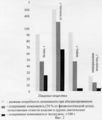
На фиг.1 изображена сравнительная характеристика аминокислотного состава экструдированных зерновых палочек и эталонного белка по шкале ФАО/ВОЗ палочек; на фиг.2 - диаграмма пищевой ценности экструдированных палочек в сравнении с формулой сбалансированного питания.Figure 1 shows a comparative description of the amino acid composition of extruded grain sticks and a reference protein according to the FAO / WHO scale of sticks; figure 2 is a diagram of the nutritional value of extruded sticks in comparison with the balanced nutrition formula.
При выборе рецептурного состава зерновой смеси гречихи и сои учитывали ряд факторов. Во-первых, необходимость максимального обогащения экструдированного продукта, в основном содержащем углеводы, белками и минеральными веществами для достижения их лечебно-профилактической или физиологической дозы. Во-вторых, достижение приятного вкуса и привлекательной структуры, характерной для продуктов данного класса. Стоит отметить, что именно внешний вид является одним из основных факторов при выборе потребителем продуктов питания, поэтому необходимо наряду с развитой структурой экструдатов стремиться к получению сбалансированных по пищевой ценности продуктов. Включение растительных белков в пищевые продукты с целью повышения их содержания в рационах, замены традиционных белков или создания новых видов продовольственных товаров и кулинарных изделий должно удовлетворять определенным требованиям с точки зрения гигиены и питательности.When choosing the prescription composition of the grain mixture of buckwheat and soybeans, a number of factors were taken into account. Firstly, the need for maximum enrichment of the extruded product, mainly containing carbohydrates, proteins and minerals to achieve their therapeutic and physiological dose. Secondly, the achievement of a pleasant taste and attractive structure characteristic of products of this class. It is worth noting that it is appearance that is one of the main factors when choosing food products by a consumer, therefore, along with a developed structure of extrudates, it is necessary to strive to obtain products that are balanced in nutritional value. The inclusion of vegetable proteins in food products in order to increase their content in diets, replace traditional proteins or create new types of food products and culinary products must meet certain requirements in terms of hygiene and nutrition.
Способ осуществляется следующим образом. В качестве исходного сырья использовали: гречневую крупу (ГОСТ 5550-74) и сою (ГОСТ 17109-88). Исходное сырье измельчали в дробилке и отсеивали через сито №2 с целью выравнивания гранулометрического состава от 0,32 до 0,63 мм, затем загружали в смеситель и тщательно смешивали в пропорции 6:1, увлажняют до 14...18%. Далее осуществляли обработку смеси на двушнековом экструдере при температуре продукта перед матрицей 450...455К и давлении в предматричной зоне экструдера 6,5...7,0 МПа.The method is as follows. As the source of raw materials used: buckwheat (GOST 5550-74) and soy (GOST 17109-88). The feedstock was crushed and sieved through a No. 2 sieve in order to equalize the particle size distribution from 0.32 to 0.63 mm, then it was loaded into the mixer and thoroughly mixed in a ratio of 6: 1, moistened to 14 ... 18%. Next, the mixture was processed on a twin-screw extruder at a product temperature in front of the matrix of 450 ... 455 K and a pressure in the prematrix zone of the extruder of 6.5 ... 7.0 MPa.
Перерабатываемый материал через загрузочный патрубок поступает в рабочую камеру, где перемещается шнеком к матрице. По мере продвижения продукт в зоне смешения частично перемешивается, в зоне сжатия происходит скачкообразное увеличение давления и уплотнение продукта вследствие резкого уменьшения размеров винтового канала. В зоне пластификации осуществляется частичное превращение частиц продукта в расплав за счет трения между частицами продукта и витками шнека. Затем происходит дальнейшее сжатие продукта. Далее в зоне гомогенизации происходит превращение размягченных частиц в однородный расплав за счет возрастания давления. Давление расплава продукта в зоне дозирования достигает необходимого значения, обеспечивается окончательное расплавление мелких включений и образуется расплав однородный по структуре и температуре. В зоне стабилизации происходит выравнивание давления и температурных полей расплава продукта. Затем он попадает в предматричную зону и продавливается через выходное отверстие в матрице. После выхода продукта из матрицы в результате резкого перепада температуры и давления происходит мгновенное испарение влаги, что приводит к образованию пористой структуры и увеличению объема экструдата (вспучиванию), при этом происходят глубокие преобразования его структуры: разрыв клеточных стенок, деструкция, гидролиз [Термопластическая экструзия: научные основы, технология, оборудование// Под. ред. А.Н. Богатырева, В.П. Юрьева. - М.: Ступень, 1994. - 200 с.].The processed material through the loading pipe enters the working chamber, where it is moved by a screw to the matrix. As you move the product in the mixing zone is partially mixed, in the compression zone there is an abrupt increase in pressure and compaction of the product due to a sharp decrease in the size of the screw channel. In the plasticization zone, the product particles are partially converted to melt due to friction between the product particles and the screw turns. Then there is further compression of the product. Further, in the homogenization zone, the transformation of softened particles into a homogeneous melt occurs due to an increase in pressure. The melt pressure of the product in the dosing zone reaches the required value, the final melting of small inclusions is ensured, and a melt is formed uniform in structure and temperature. In the stabilization zone, the pressure and temperature fields of the melt of the product are equalized. Then it enters the pre-pricing zone and is forced through the outlet in the matrix. After the product leaves the matrix as a result of a sharp drop in temperature and pressure, moisture evaporates instantly, which leads to the formation of a porous structure and an increase in the volume of the extrudate (expansion), with deep transformations of its structure: breaking of the cell walls, destruction, hydrolysis [Thermoplastic extrusion: scientific foundations, technology, equipment // Pod. ed. A.N. Bogatyreva, V.P. St. George's. - M.: Step, 1994. - 200 p.].
При этом получают хрустящие зерновые палочки хорошего качества, степень вспучивания которых составляет около 400% при диаметре матрицы 3·10-3 м (степень вспучивания определяется как отношение площади поперечного сечения экструдата к площади выходного отверстия матрицы экструдера).In this case, crispy grain sticks of good quality are obtained, the degree of expansion of which is about 400% with a matrix diameter of 3 · 10 -3 m (the degree of expansion is defined as the ratio of the cross-sectional area of the extrudate to the area of the exit hole of the extruder matrix).
Полученные экструдированные зерновые палочки загружали в дражировочный барабан и дражировали сахаровитаминной добавкой в течение 5 мин. В состав добавки входят: сахар с размером частиц не более 0,1 мм - 5 г/ 100 г продукта, витамин С - 200 мг/ 100 г продукта, кальций - 150 мг/ 100 г продукта.The obtained extruded grain sticks were loaded into a coating drum and drained with a sugar-vitamin supplement for 5 minutes. The composition of the additive includes: sugar with a particle size of not more than 0.1 mm - 5 g / 100 g of the product, vitamin C - 200 mg / 100 g of the product, calcium - 150 mg / 100 g of the product.
Способ поясняется следующими примером.The method is illustrated by the following example.
Гречневую крупу и сою измельчают до размера частиц от 0,32 до 0,63 мм, тщательно смешивают в пропорции 6:1, увлажняют до 14...18% и осуществляют обработку на экструдере при температуре продукта перед матрицей 450...455 К и давлении в предматричной зоне экструдера 6,5...7,0 МПа. При этом степень вспучивания экструдированных зерновых палочек составляет 400%.Buckwheat and soybeans are crushed to a particle size of 0.32 to 0.63 mm, thoroughly mixed in a 6: 1 ratio, moistened to 14 ... 18% and processed on an extruder at a product temperature in front of a matrix of 450 ... 455 K and pressure in the prematrix zone of the extruder 6.5 ... 7.0 MPa. Moreover, the degree of expansion of extruded grain sticks is 400%.
Необходимость увлажнения смеси (до 14...18%) обусловлена следующими соображениями. Доказано, что расширение продукта на выходе из отверстий матрицы непосредственно является следствием физических свойств воды [Термопластическая экструзия: научные основы, технология, оборудование. /Под. ред. А.Н. Богатырева, В.П. Юрьева. - М.: Ступень, 1994. - 200 с.]. При таких термических условиях (изменение температуры в экструдере может быть в пределах от 130 до 200°С) и под очень большим давлением вода существует только в жидком состоянии. Когда пластифицированный материал выходит из матрицы и достигает атмосферного давления, вода из состояния перегретой жидкости мгновенно превращается в пар, выделяя значительное количество энергии. Под действием давления пара в продукте образуются поры, а оставшиеся целыми крахмальные зерна разрываются. Если влаги в смеси было менее 14%, то ее оказывалось недостаточно и продукт на выходе из экструдера не вспучивался. И наоборот, если влаги в продукте было более 18%, это также приводило к снижению степени вспучивания, так как при этом формируется более плотная структура продукта с грубой консистенцией. Причина этих изменений заключается в том, что при увеличении влажности повышается пластичность массы, а это обуславливает снижение механических напряжений в экструдате. Следовательно, количество теплоты, выделяемой в результате работы сил вязкого трения, оказывалось недостаточно для получения вспученной структуры.The need to moisten the mixture (up to 14 ... 18%) is due to the following considerations. It is proved that the expansion of the product at the exit from the holes of the matrix is directly a consequence of the physical properties of water [Thermoplastic extrusion: scientific foundations, technology, equipment. /Under. ed. A.N. Bogatyreva, V.P. St. George's. - M.: Step, 1994. - 200 p.]. Under such thermal conditions (the temperature in the extruder can vary from 130 to 200 ° C) and under very high pressure, water exists only in a liquid state. When the plasticized material leaves the matrix and reaches atmospheric pressure, water from a state of superheated liquid instantly turns into steam, releasing a significant amount of energy. Under the influence of vapor pressure, pores are formed in the product, and the remaining whole starch grains break. If the moisture in the mixture was less than 14%, then it was not enough and the product did not swell at the exit of the extruder. Conversely, if the moisture in the product was more than 18%, this also led to a decrease in the degree of expansion, since this forms a denser product structure with a rough consistency. The reason for these changes is that with increasing humidity, the plasticity of the mass increases, and this leads to a decrease in mechanical stresses in the extrudate. Consequently, the amount of heat released as a result of the work of viscous friction forces was not enough to obtain an expanded structure.
Экструдер должен работать при давлении продукта в предматричной зоне, не превышающем оптимального значения. Это необходимо, так как величина давления однозначно определяет температуру обработки продукта, от которой в свою очередь зависит качество готового изделия. Установлено [Термопластическая экструзия: научные основы, технология, оборудование./ Под. ред. А.Н.Богатырева, В.П.Юрьева. - М.: Ступень, 1994. - 200 с.], что основные компоненты (углеводы, белки, жиры, витамины и др.) пищевых продуктов имеют различную оптимальную температуру, необходимую для протекания полных и качественных физико-химических изменений при экструзии.The extruder should operate at a product pressure in the pre-matrix zone that does not exceed the optimum value. This is necessary, since the pressure value uniquely determines the temperature of the product processing, on which the quality of the finished product, in turn, depends. Established [Thermoplastic extrusion: scientific foundations, technology, equipment. / Under. ed. A.N. Bogatyreva, V.P. Yuryev. - M .: Step, 1994. - 200 p.] That the main components (carbohydrates, proteins, fats, vitamins, etc.) of food products have different optimal temperatures necessary for complete and qualitative physicochemical changes during extrusion.
Для эффективного и качественного протекания экструзии необходимо подобрать такой характер изменения температуры, при котором основные компоненты продуктов подвергались бы, с одной стороны, полной гидротермической обработке, а с другой - на них оказывалось «мягкое» (щадящее) температурное воздействие, предотвращающее их термическое разложение.For an efficient and high-quality extrusion process, it is necessary to select the nature of the temperature change at which the main components of the products are subjected, on the one hand, to a complete hydrothermal treatment, and on the other, they have a “soft” (sparing) temperature effect that prevents their thermal decomposition.
Анализ теоретических и экспериментальных данных [Рудометкин А.С. Исследование реологических свойств смеси гречихи и сои как объекта экструзии./ А.С.Рудометкин, А.Н.Остриков, О.В.Абрамов// Хранение и переработка сельхозсырья. - 2001. - №12. С.32-34] показал, что для качественного проведения экструзионной обработки необходимо плавное повышение температуры продукта с последующей стабилизацией. Экспериментально установлено, что для данного продукта температура перед матрицей Т=450...455К позволяет достичь давления в предматричной зоне экструдера Р=6,5...7,0 МПа. Именно в этом диапазоне температур в смеси происходят полные и глубокие физико-химические изменения белков, углеводов и других компонентов, придающие им свойства, наиболее приемлемые для полного усваивания человеческим организмом.Analysis of theoretical and experimental data [Rudometkin A.S. Investigation of the rheological properties of a mixture of buckwheat and soy as an extrusion object / A.S. Rudometkin, A.N. Ostrikov, O.V. Abramov // Storage and processing of agricultural raw materials. - 2001. - No. 12. S.32-34] showed that for high-quality extrusion processing it is necessary to gradually increase the temperature of the product with subsequent stabilization. It was experimentally established that for this product, the temperature in front of the matrix T = 450 ... 455K allows pressure to be reached in the prematrix zone of the extruder P = 6.5 ... 7.0 MPa. It is in this temperature range that the mixture undergoes full and deep physico-chemical changes in proteins, carbohydrates and other components, giving them the properties most suitable for complete assimilation by the human body.
Полученные при рациональных параметрах процесса экструдированные зерновые палочки были исследованы по комплексу показателей, характеризующих потребительские свойства, пищевую и энергетическую ценность готового изделия. Их измельчали, просеивали через металлическую сетку №025 (ГОСТ 4601-73) и подвергали анализам. Экструдированные зерновые палочки анализировали по органолептическим показателям по ГОСТ 15113.3-77, влажности - по ГОСТ 15113.4-77, кислотности - по ГОСТ 15113.5-77.The extruded grain sticks obtained with rational process parameters were investigated by a set of indicators characterizing the consumer properties, nutritional and energy value of the finished product. They were crushed, sieved through a metal mesh No. 025 (GOST 4601-73) and subjected to analysis. Extruded grain sticks were analyzed according to organoleptic indicators according to GOST 15113.3-77, humidity according to GOST 15113.4-77, acidity according to GOST 15113.5-77.
Органолептические показатели: получен продукт в виде прямых или изогнутых коротких палочек округлого поперечного сечения, с шероховатой поверхностью и развитой пористостью. По цвету (кремовому с коричневатым оттенком), вкусу и аромату (соответствующему исходному сырью) экструдат имеет удовлетворительные потребительские данные, характерные для такой группы пищевых продуктов, как «сухие завтраки».Organoleptic characteristics: the product was obtained in the form of straight or curved short sticks of rounded cross section, with a rough surface and developed porosity. In terms of color (creamy with a brownish tint), taste and aroma (corresponding to the raw material), the extrudate has satisfactory consumer data characteristic of such a group of food products as “breakfast cereals”.
Для оценки качественных характеристик экструдированных гороховых палочек были исследованы следующие их физико-химические свойства: набухаемость - 3,1 г/г, растворимость - 41,2% и водоудерживающая способность измельченного экструдата - 4,55 г/г. Установлено, что данные показатели зерновых палочек соответствуют аналогичным, свойственным традиционным сухим завтракам.To assess the quality characteristics of extruded pea sticks, the following physicochemical properties were studied: swelling - 3.1 g / g, solubility - 41.2% and the water holding capacity of the crushed extrudate - 4.55 g / g. It was found that these indicators of cereal sticks correspond to the same characteristic of traditional breakfast cereals.
Другие физико-химические характеристики (табл.) также соответствовали нормам для этой категории изделий. Энергетическая ценность полученного продукта составляет 1544,1 кДж/100 г.Other physico-chemical characteristics (table) also corresponded to the standards for this category of products. The energy value of the resulting product is 1544.1 kJ / 100 g.
Определение биологической ценности экструдатов. Оценку аминокислотной сбалансированности и биологической ценности продуктов проводили по следующим показателям: коэффициент различия аминокислотного скора (КРАС) и биологическая ценность (БЦ) пищевого белка.Determination of the biological value of extrudates. Assessment of amino acid balance and biological value of products was carried out according to the following indicators: the difference coefficient of amino acid scores (KRAS) and the biological value (BC) of food protein.
Внесение в рецептурную смесь сои, характеризующейся высоким содержанием белков, обуславливает почти двукратное увеличение калорийности экструдированных зерновых палочек.The introduction of soybeans, characterized by a high protein content, into the prescription mixture causes an almost twofold increase in the calorific value of extruded grain sticks.
Количество аминокислот в экструдате превышает их содержание в гречневой крупе, это обусловлено уменьшением конечной влажности экструдата и частично его обогащением белковыми веществами сои, что является подтверждением высокой биологической ценности продукта и целесообразности переработки смеси гречневой крупы и сои экструзией.The amount of amino acids in the extrudate exceeds their content in buckwheat, this is due to a decrease in the final moisture content of the extrudate and partly its enrichment with soy protein substances, which confirms the high biological value of the product and the advisability of processing the buckwheat and soybean mixture by extrusion.
Физико-химические показатели экструдатаTable
Physico-chemical characteristics of the extrudate
Анализ пищевой ценности разработанного экструдированного продукта. Одним из основных требований к продуктам питания, помимо высоких потребительских свойств, является сбалансированность их состава.Nutritional analysis of the developed extruded product. One of the main requirements for food products, in addition to high consumer properties, is the balance of their composition.
Соотношение компонентов в «идеальном» продукте, обоснованное Институтом Питания Академии медицинских наук РФ, в сравнении с составом полученных экструдатов представлено на фиг.2. За счет потребления 100 г экструдированных зерновых палочек можно удовлетворить суточную потребность в белке на 29,7%, углеводах - 69,2%, минеральных веществах - 36%.The ratio of components in the "ideal" product, justified by the Institute of Nutrition of the Academy of Medical Sciences of the Russian Federation, in comparison with the composition of the obtained extrudates is presented in figure 2. Due to the consumption of 100 g of extruded grain sticks, it is possible to satisfy the daily need for protein by 29.7%, carbohydrates - 69.2%, minerals - 36%.
При достаточно высоком содержании белков, углеводов, витаминов и минеральных веществ готовый продукт беден жирами, минеральными веществами и витаминами. Невысокое содержание жиров и минеральных веществ обусловлено небольшим их содержанием в исходной смеси. В экструдате были обнаружены следы водорастворимых витаминов (группы B1, В2, С), жирорастворимые витамины (группы A, D, Е, РР) лучше сохраняются в экструдате, но также в незначительном количестве.With a sufficiently high content of proteins, carbohydrates, vitamins and minerals, the finished product is poor in fats, minerals and vitamins. The low content of fats and minerals is due to their low content in the initial mixture. Traces of water-soluble vitamins (groups B 1 , B 2 , C) were found in the extrudate, fat-soluble vitamins (groups A, D, E, PP) are better preserved in the extrudate, but also in a small amount.
Поэтому применяется дражирование экструдированных зерновых палочек сахаровитаминной добавкой с целью повышения витаминной ценности готового продукта.Therefore, pelleting of extruded grain sticks with a sugar-vitamin supplement is used to increase the vitamin value of the finished product.
Как видно из примера и вышеизложенного, в способе производства экструдированных зерновых палочек наиболее эффективным является то, что в качестве продуктов используют гречневую крупу и сою, культуры измельчают до размера частиц от 0,32 до 0,63 мм, смешивают в пропорции 6:1, увлажняют до 14...18% и осуществляют обработку на экструдере при температуре продукта перед матрицей 450...455К и давлении в предматричной зоне экструдера 6,5...7,0 МПа, полученный экструдат дражируют сахаровитаминной добавкой.As can be seen from the example and the foregoing, in the method of producing extruded grain sticks, the most effective is that buckwheat and soybeans are used as products, the cultures are crushed to a particle size of 0.32 to 0.63 mm, mixed in a ratio of 6: 1, moisturize to 14 ... 18% and carry out processing on an extruder at a product temperature in front of the matrix 450 ... 455K and a pressure in the prematrix zone of the extruder 6.5 ... 7.0 MPa, the resulting extrudate is dragged with a sugar-vitamin supplement.
Предлагаемый способ по сравнению с базовым позволит:The proposed method in comparison with the base will allow:
- получать экструдированные зерновые палочки с хорошими потребительскими свойствами и достаточно высокой биологической и пищевой ценностью; они более сбалансированы по составу незаменимых аминокислот, а также оптимизированы по критерию «коэффициент различия аминокислотного скора» (КРАС);- receive extruded grain sticks with good consumer properties and a sufficiently high biological and nutritional value; they are more balanced in the composition of essential amino acids, and are also optimized according to the criterion “coefficient of difference of amino acid scores” (KRAS);
- использовать в качестве исходных компонентов смеси широко распространенные и недорогие виды сырья;- use widespread and inexpensive types of raw materials as initial components of the mixture;
- расширить ассортимент выпускаемой продукции при переработке различного сырья с нестабильными свойствами.- expand the range of products during the processing of various raw materials with unstable properties.
Claims (1)
Priority Applications (1)
| Application Number | Priority Date | Filing Date | Title |
|---|---|---|---|
| RU2004109744/13A RU2258373C1 (en) | 2004-03-30 | 2004-03-30 | Method for producing of extruded grain sticks |
Applications Claiming Priority (1)
| Application Number | Priority Date | Filing Date | Title |
|---|---|---|---|
| RU2004109744/13A RU2258373C1 (en) | 2004-03-30 | 2004-03-30 | Method for producing of extruded grain sticks |
Publications (1)
| Publication Number | Publication Date |
|---|---|
| RU2258373C1 true RU2258373C1 (en) | 2005-08-20 |
Family
ID=35845969
Family Applications (1)
| Application Number | Title | Priority Date | Filing Date |
|---|---|---|---|
| RU2004109744/13A RU2258373C1 (en) | 2004-03-30 | 2004-03-30 | Method for producing of extruded grain sticks |
Country Status (1)
| Country | Link |
|---|---|
| RU (1) | RU2258373C1 (en) |
Cited By (1)
| Publication number | Priority date | Publication date | Assignee | Title |
|---|---|---|---|---|
| CN102960393A (en) * | 2012-12-04 | 2013-03-13 | 毕节永盛食品有限责任公司 | Buckwheat bread and making method thereof |
Citations (2)
| Publication number | Priority date | Publication date | Assignee | Title |
|---|---|---|---|---|
| SU1829916A3 (en) * | 1987-11-04 | 1993-07-23 | Khajnts Shaaf Okhg | Method for producing extrusion products |
| RU2001113857A (en) * | 2001-05-21 | 2003-05-27 | Георгий Николаевич Дегтяренко | Ingredients for Extruded Products, such as Breakfast Cereals |
-
2004
- 2004-03-30 RU RU2004109744/13A patent/RU2258373C1/en not_active IP Right Cessation
Patent Citations (2)
| Publication number | Priority date | Publication date | Assignee | Title |
|---|---|---|---|---|
| SU1829916A3 (en) * | 1987-11-04 | 1993-07-23 | Khajnts Shaaf Okhg | Method for producing extrusion products |
| RU2001113857A (en) * | 2001-05-21 | 2003-05-27 | Георгий Николаевич Дегтяренко | Ingredients for Extruded Products, such as Breakfast Cereals |
Cited By (1)
| Publication number | Priority date | Publication date | Assignee | Title |
|---|---|---|---|---|
| CN102960393A (en) * | 2012-12-04 | 2013-03-13 | 毕节永盛食品有限责任公司 | Buckwheat bread and making method thereof |
Similar Documents
| Publication | Publication Date | Title |
|---|---|---|
| RU2616379C2 (en) | Ready-to-eat product and production method thereof | |
| EP2348898B1 (en) | Pet food and process of manufacture | |
| CN116193996A (en) | Method for preparing dehydrated imitation meat product | |
| CN108471778A (en) | The method and systematism food of manufacture systematism food | |
| CN105686034A (en) | Method for preparing coarse cereal food based on single-screw extruder | |
| RU2389346C1 (en) | Method for production of extruded texturates | |
| RU2399295C2 (en) | Method of preparation of extruded dry feed for companion animal, primarily - rodents | |
| KR102406396B1 (en) | Method for producing puffing seaweed snack using extrusion molding | |
| RU2471361C1 (en) | Method for production of protein-and-vitamin concentrates for piglets | |
| RU2313953C1 (en) | Method for producing of extruded foods | |
| CN1092612A (en) | Cereal product | |
| JP2004180674A (en) | Re-molded cereal granule product | |
| EP0291566A1 (en) | Process for the preparation of a quick-cooking granular rice product | |
| RU2266005C1 (en) | Grain stick production method | |
| CN1023056C (en) | Method for producing instant rice flakes | |
| RU2262856C1 (en) | Method for producing of extruded pea sticks | |
| RU2312521C2 (en) | Method for producing of extruded cheese grain chips (versions) | |
| RU2259146C1 (en) | Method for production of extruded potato sticks | |
| RU2486753C2 (en) | Bakery products production method | |
| WO2024188909A1 (en) | Protein-containing texturate and process for production thereof | |
| RU2262855C1 (en) | Method for producing of crunchy bread sticks | |
| RU2579488C1 (en) | Bakery products manufacture method | |
| RU2266006C1 (en) | Method for producing of extruded grain sticks | |
| RU2265334C1 (en) | Method for producing of lentil sticks | |
| RU2110934C1 (en) | Method for producing dry food products |
Legal Events
| Date | Code | Title | Description |
|---|---|---|---|
| MM4A | The patent is invalid due to non-payment of fees |
Effective date: 20060331 |