RU2227110C2 - Method and device for food heat-treatment into plastic bags - Google Patents
Method and device for food heat-treatment into plastic bagsInfo
- Publication number
- RU2227110C2 RU2227110C2 RU2001134615/12A RU2001134615A RU2227110C2 RU 2227110 C2 RU2227110 C2 RU 2227110C2 RU 2001134615/12 A RU2001134615/12 A RU 2001134615/12A RU 2001134615 A RU2001134615 A RU 2001134615A RU 2227110 C2 RU2227110 C2 RU 2227110C2
- Authority
- RU
- Russia
- Prior art keywords
- container
- heat exchanger
- liquid
- food products
- pipes
- Prior art date
Links
- 235000013305 food Nutrition 0.000 title claims abstract description 35
- 238000000034 method Methods 0.000 title claims abstract description 30
- 238000010438 heat treatment Methods 0.000 title abstract description 16
- 239000007788 liquid Substances 0.000 claims abstract description 27
- XLYOFNOQVPJJNP-UHFFFAOYSA-N water Substances O XLYOFNOQVPJJNP-UHFFFAOYSA-N 0.000 claims abstract description 16
- 230000001954 sterilising effect Effects 0.000 claims abstract description 7
- 238000004659 sterilization and disinfection Methods 0.000 claims abstract description 5
- 239000002184 metal Substances 0.000 claims abstract description 3
- 238000009928 pasteurization Methods 0.000 claims description 9
- 235000013324 preserved food Nutrition 0.000 claims description 6
- 230000003247 decreasing effect Effects 0.000 claims 1
- 238000001816 cooling Methods 0.000 abstract description 11
- 239000000126 substance Substances 0.000 abstract description 5
- 239000000463 material Substances 0.000 abstract description 4
- 239000011888 foil Substances 0.000 abstract description 3
- 238000007789 sealing Methods 0.000 abstract description 3
- 238000011109 contamination Methods 0.000 abstract description 2
- 230000000694 effects Effects 0.000 abstract 1
- 238000012856 packing Methods 0.000 abstract 1
- 230000002265 prevention Effects 0.000 abstract 1
- 239000012530 fluid Substances 0.000 description 10
- 238000005516 engineering process Methods 0.000 description 5
- 239000011521 glass Substances 0.000 description 3
- 230000000813 microbial effect Effects 0.000 description 3
- 238000009924 canning Methods 0.000 description 2
- 230000006378 damage Effects 0.000 description 2
- 239000005022 packaging material Substances 0.000 description 2
- 241000894006 Bacteria Species 0.000 description 1
- 206010073306 Exposure to radiation Diseases 0.000 description 1
- 240000004713 Pisum sativum Species 0.000 description 1
- 235000010582 Pisum sativum Nutrition 0.000 description 1
- 240000008042 Zea mays Species 0.000 description 1
- 235000005824 Zea mays ssp. parviglumis Nutrition 0.000 description 1
- 235000002017 Zea mays subsp mays Nutrition 0.000 description 1
- 235000005822 corn Nutrition 0.000 description 1
- 238000005429 filling process Methods 0.000 description 1
- -1 for example Substances 0.000 description 1
- 230000005484 gravity Effects 0.000 description 1
- 208000015181 infectious disease Diseases 0.000 description 1
- 238000004519 manufacturing process Methods 0.000 description 1
- 238000011169 microbiological contamination Methods 0.000 description 1
- 238000012986 modification Methods 0.000 description 1
- 230000004048 modification Effects 0.000 description 1
- 238000004806 packaging method and process Methods 0.000 description 1
- 239000002245 particle Substances 0.000 description 1
- 230000035515 penetration Effects 0.000 description 1
- 239000002699 waste material Substances 0.000 description 1
Images
Landscapes
- Food Preservation Except Freezing, Refrigeration, And Drying (AREA)
Abstract
Description
Область техники, к которой относится изобретение.The technical field to which the invention relates.
Настоящее изобретение относится к аппарату и способу тепловой обработки пищевых продуктов в пластиковых пакетах.The present invention relates to an apparatus and method for heat treating food in plastic bags.
Уровень техники.The level of technology.
В консервной промышленности применяют главным образом два упаковочных материала, а именно контейнеры в виде стеклянных и консервных банок. Предпринимаются попытки использовать для упаковки законсервированных продуктов питания современные пластиковые материалы, например, в составе многослойных и теплостойких модификаций фольги. Преимущество этих материалов заключается в легкости их выкройки, что создает возможность изготовления изделий такого рода с большими размерами. Традиционные упаковочные материалы, т.е. стеклянные и консервные банки, по механическим и финансовым причинам для таких целей не пригодны. В плане сбыта требование большого размера и низких цен консервированных пищевых продуктов диктуется индустрией обслуживания, например, госпиталей, школ, буфетов и т.д.In the canning industry, mainly two packaging materials are used, namely containers in the form of glass and cans. Attempts are being made to use modern plastic materials for packaging canned food, for example, as part of multilayer and heat-resistant foil modifications. The advantage of these materials is the ease of their pattern, which makes it possible to manufacture products of this kind with large sizes. Traditional packaging materials, i.e. glass and cans, for mechanical and financial reasons, are not suitable for such purposes. In terms of sales, the demand for the large size and low prices of canned food is dictated by the service industry, such as hospitals, schools, cafeterias, etc.
Проблема заключается в том, что для нагрева и последующего охлаждения изделий такого рода с большими размерами традиционные технологии не годятся с точки зрения обеспечения требуемой температуры также и в центре банки, т.к. контейнер обычно заполняют пищевыми продуктами и нагревают путем воздействия нагретой воды или пара на внешнюю поверхность контейнера.The problem is that traditional technologies are not suitable for heating and subsequent cooling of products of this kind with large sizes in terms of ensuring the required temperature also in the center of the can, because the container is usually filled with food and heated by exposing heated water or steam to the outer surface of the container.
Из статьи "Новые возможности заполнения в асептических упаковках типа "пакет в коробке", опубликованной Р. Decio, известны основы асептического способа, включающего в себя три этапа перед вводом продукта в асептическую среду: нагрев продукта с повышением температуры до желаемого уровня, выдерживание продукта при высокой температуре в течение заданного времени, охлаждение продукта с максимально возможной скоростью до температуры 35°С или менее.From the article “New Opportunities for Filling in Aseptic Packages of the Package in a Box” Published by R. Decio, the basics of the aseptic method are known, which includes three steps before introducing the product into an aseptic medium: heating the product with increasing temperature to the desired level, keeping the product at high temperature for a given time, cooling the product as fast as possible to a temperature of 35 ° C or less.
Поскольку во время процесса заполнения температура пищевых продуктов невысока (35°С или менее), контейнер следует предварительно стерилизовать посредством воздействия облучения или химических реактивов. К другим особенностям асептической технологии относятся: введение стерилизованных пищевых продуктов в асептическую среду, что представляет собой относительно сложный ВТКВ-процесс (высокая температура на короткое время). Данный процесс, применяющийся в асептических технологиях, предусматривает выдерживание пищевых продуктов при высокой температуре (приблизительно 140°С), в связи с чем приходится использовать сложные теплообменники и паровой котел.Since the temperature of foodstuffs is not high (35 ° C or less) during the filling process, the container should be pre-sterilized by exposure to radiation or chemicals. Other features of aseptic technology include the introduction of sterilized food into an aseptic environment, which is a relatively complex VTKV process (high temperature for a short time). This process, which is used in aseptic technologies, involves keeping food at a high temperature (approximately 140 ° C), and therefore it is necessary to use complex heat exchangers and a steam boiler.
При применении этого способа проблема обработки объемных продуктов не имеет надежного решения.When applying this method, the problem of processing bulk products does not have a reliable solution.
В патентных документах US-A-4092111 и DE 4442709 А1 описан аппарат для тепловой обработки продуктов, содержащихся в плотно закрытых контейнерах. Этот аппарат содержит теплообменник, насос и соединительные трубы для циркуляции жидкости во время процесса пастеризации.In patent documents US-A-4092111 and DE 4442709 A1 describes an apparatus for the heat treatment of products contained in tightly closed containers. This apparatus contains a heat exchanger, a pump and connecting pipes for circulating liquid during the pasteurization process.
В способе по указанному патенту США циркулирующая жидкость в то же время является нагревающим-охлаждающим веществом (на практике это вода), переносящим энергию нагрева или охлаждения к внешней поверхности контейнера, подлежащего пастеризации. Поэтому один конец труб присоединен к дну емкости (автоклава) для сбора жидкости, "поступающей самотеком" перед переходом ее к теплообменнику и обратно к емкости "для переноса жидкости в верхнюю часть аппарата после прохождения через теплообменник".In the method of the aforementioned US patent, the circulating liquid is at the same time a heating-cooling substance (in practice, it is water) that transfers the heating or cooling energy to the outer surface of the container to be pasteurized. Therefore, one end of the pipes is attached to the bottom of the tank (autoclave) to collect the fluid, "flowing by gravity" before moving it to the heat exchanger and back to the tank "to transfer fluid to the upper part of the apparatus after passing through the heat exchanger".
В патентном документе DE 4442709 А1 обсуждается минимизация отходов, вызванных загрязнением нагревающего-охлаждающего вещества в результате разрушения контейнера, заполненного пищевыми продуктами, во время процесса нагревания. Энергия нагрева-охлаждения передается через теплообменник, а циркуляция вещества осуществляется посредством насоса.DE 4442709 A1 discusses minimization of waste caused by contamination of a heating-cooling substance as a result of the destruction of a container filled with food products during the heating process. The heating-cooling energy is transmitted through a heat exchanger, and the substance is circulated through a pump.
В документе JA-P-59210874 способ термообработки продуктов (нагрев с последующим охлаждением) рассмотрен в неконкретной форме, но в описании указано, что "открывающуюся часть контейнера плотно закрывают при соблюдении безмикробных условий". Практическое решение этой проблемы не описано, но термин "безмикробные условия" означает стерилизацию внешней поверхности контейнера, создание безмикробного пространства вокруг открывающейся части контейнера, а также использование инструмента, обеспечивающего плотное закрывание. Обычно выполнение этого условия обеспечивают посредством пара, а закрывание проводят механическим способом.JA-P-59210874 describes a method for heat treatment of products (heating followed by cooling) in a non-specific form, but the description states that "the opening of the container is tightly closed under microbial conditions." A practical solution to this problem has not been described, but the term "microbial conditions" means sterilizing the outer surface of the container, creating a microbial space around the opening of the container, and also using a tight closing tool. Usually, this condition is ensured by means of steam, and closing is carried out mechanically.
Кроме асептического способа, существуют еще два способа пастеризации.In addition to the aseptic method, there are two more ways of pasteurization.
1. Так называемый способ "горячего заполнения", который включает в себя: заполнение контейнера пищевыми продуктами при относительно высокой температуре (приблизительно 85°С), причем возможное микробиологическое заражение контейнера исключается самими горячими продуктами. Недостатком этого способа является невозможность быстрого охлаждения. Кроме того, для пищевых продуктов с высоким значением рН требуется дополнительная стерилизация в уже закрытом контейнере.1. The so-called "hot filling" method, which includes: filling the container with food products at a relatively high temperature (approximately 85 ° C), and possible microbiological contamination of the container is excluded by the hot products themselves. The disadvantage of this method is the impossibility of rapid cooling. In addition, for foods with a high pH value, additional sterilization is required in an already closed container.
2. Тепловая обработка пищевых продуктов, традиционно проводимая посредством нагрева предварительно закрытого контейнера (консервная или стеклянная банка). Как следствие, размер контейнера ограничен, поскольку возможен перегрев частиц пищи около внешней поверхности контейнера, в то время как центр его может остаться относительно холодным.2. Heat treatment of food products, traditionally carried out by heating a pre-closed container (can or glass jar). As a result, the size of the container is limited, since food particles may overheat near the outer surface of the container, while its center may remain relatively cold.
Сущность изобретения.SUMMARY OF THE INVENTION
Проблемы, возникшие на существующем уровне техники, можно разрешить с помощью аппарата и способа согласно настоящему изобретению. Тепловую обработку в данном случае проводят следующим образом. Пластиковый контейнер после заполнения пищевыми продуктами плотно закрывают, но для обеспечения циркуляции заливаемой жидкости внутрь контейнера вводят две трубы, т.е. отверстия для труб локализованы выше уровня заливаемой жидкости, а концы труб расположены ниже этого уровня. Для уплотнения отверстия должны быть меньше диаметра труб. Указанные трубы через насос присоединены к вторичному контуру теплообменника. С помощью нагретой воды или нагретого пара в первичном контуре заливаемая жидкость нагревается, причем одновременно в контейнере, трубах и теплообменнике. Поскольку контур заливаемой жидкости герметично закрыт, она пастеризуется в одно и то же время в контейнере, насосе, трубах и теплообменнике. Пищевые продукты охлаждаются с использованием холодной воды в первичном контуре теплообменника. После пастеризации трубы удаляют, а контейнер, для исключения возможности любой инфекции, сразу же плотно закрывают ниже уровня отверстий.The problems that have arisen in the prior art can be solved by using the apparatus and method according to the present invention. Heat treatment in this case is carried out as follows. The plastic container is tightly closed after filling with food, but two pipes are introduced into the container to ensure circulation of the liquid being poured into the container, i.e. the holes for the pipes are located above the level of the liquid being poured, and the ends of the pipes are located below this level. To seal the holes must be smaller than the diameter of the pipes. These pipes through the pump are connected to the secondary circuit of the heat exchanger. With the help of heated water or heated steam in the primary circuit, the liquid to be filled is heated, at the same time in the container, pipes and heat exchanger. Since the liquid circuit is hermetically closed, it is pasteurized at the same time in the container, pump, pipes and heat exchanger. Food products are cooled using cold water in the primary circuit of the heat exchanger. After pasteurization, the pipes are removed, and the container, to exclude the possibility of any infection, is immediately tightly closed below the level of the holes.
Согласно изобретению аппарат для тепловой обработки пищевых продуктов в пластиковых пакетах содержит теплообменник для нагрева и последующего охлаждения заливаемой жидкости, насос во вторичном контуре теплообменника, металлические или пластиковые трубы, соединяющие теплообменник, насос и по меньшей мере один заполненный пищевыми продуктами контейнер. Отличительной особенностью предлагаемого аппарата является то, что упомянутые трубы введены внутрь контейнера с обеспечением возможности циркуляции заливаемой жидкости, причем эта жидкость герметично изолирована в контейнере, насосе, трубах и теплообменнике.According to the invention, the apparatus for the heat treatment of food products in plastic bags contains a heat exchanger for heating and subsequent cooling of the liquid to be poured, a pump in the secondary circuit of the heat exchanger, metal or plastic pipes connecting the heat exchanger, the pump and at least one container filled with food products. A distinctive feature of the proposed device is that the pipes are introduced into the container with the possibility of circulation of the liquid being poured, and this liquid is hermetically isolated in the container, pump, pipes and heat exchanger.
В предпочтительном варианте аппарат содержит герметичную емкость или автоклав, в которых установлен по меньшей мере один заполненный пищевыми продуктами контейнер. Емкость или автоклав выполнены с обеспечением возможности повышения и понижения в них давления во время соответственно процесса нагрева и процесса охлаждения.In a preferred embodiment, the apparatus comprises a sealed container or autoclave in which at least one container filled with food products is installed. The tank or autoclave is made with the possibility of increasing and lowering the pressure in them during the heating process and the cooling process, respectively.
Предлагаемый способ пастеризации пищевых продуктов в пластиковом контейнере осуществляют посредством вышеописанного аппарата. Согласно этому способу осуществляют циркуляцию заливаемой жидкости в по меньшей мере одном заполненном пищевыми продуктами контейнере, причем возможность циркуляции упомянутой жидкости обеспечивается введенными внутрь контейнера трубами, повышают температуру заливаемой жидкости за счет нагретой воды или пара в первичном контуре теплообменника, уменьшают температуру заливаемой жидкости за счет холодной воды в первичном контуре теплообменника.The proposed method for pasteurization of food products in a plastic container is carried out by means of the above apparatus. According to this method, the filling fluid is circulated in at least one container filled with food products, the possibility of circulating said fluid is provided by pipes introduced into the container, the temperature of the filling fluid is increased due to heated water or steam in the primary circuit of the heat exchanger, the temperature of the filling fluid is reduced due to cold water in the primary circuit of the heat exchanger.
Предлагаемый способ стерилизации пищевых продуктов в пластиковом контейнере осуществляют посредством упомянутого предпочтительного варианта выполнения аппарата. Согласно этому способу осуществляют циркуляцию заливаемой жидкости в заполненном пищевыми продуктами контейнере, повышают температуру заливаемой жидкости за счет нагретой воды или пара в первичном контуре теплообменника, одновременно повышая давление в герметичной емкости с обеспечением температуры заливаемой жидкости выше 100°С, уменьшают температуру заливаемой жидкости за счет холодной воды в первичном контуре теплообменника, одновременно понижая давление в герметичной емкости.The proposed method of sterilization of food products in a plastic container is carried out by means of the aforementioned preferred embodiment of the apparatus. According to this method, the filling fluid is circulated in a container filled with food products, the temperature of the filling fluid is increased due to heated water or steam in the primary circuit of the heat exchanger, while the pressure in the sealed container is increased to ensure the temperature of the filling fluid is above 100 ° C, the temperature of the filling fluid is reduced due to cold water in the primary circuit of the heat exchanger, while lowering the pressure in the sealed container.
В предпочтительном варианте описанных способов по завершении процесса соответственно пастеризации или стерилизации запечатывают контейнер для получения консервированных пищевых продуктов в запечатанном контейнере.In a preferred embodiment of the described methods, upon completion of the pasteurization or sterilization process, the container is sealed to obtain canned foods in a sealed container.
Перечень фигур чертежей.The list of figures drawings.
Более наглядно изобретение будет представлено с помощью детального описания предпочтительных вариантов осуществления, приведенных только в качестве примеров, со ссылками на прилагаемые чертежи, из которых:The invention will be presented more clearly by means of a detailed description of the preferred embodiments, given only as examples, with reference to the accompanying drawings, of which:
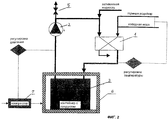
фиг.1 представляет собой схематичное изображение предпочтительного варианта осуществления аппарата согласно изобретению,figure 1 is a schematic representation of a preferred embodiment of an apparatus according to the invention,
на фиг.2 схематично представлен другой предпочтительный вариант осуществления изобретения.2 schematically shows another preferred embodiment of the invention.
Сведения, подтверждающие возможность осуществления изобретения. Фиг.1 иллюстрирует предпочтительный вариант осуществления аппарата и способа согласно изобретению. Проблемы, возникшие на существующем уровне техники, можно разрешить посредством настоящего изобретения, прежде всего с помощью предпочтительного варианта осуществления, в котором пластиковый контейнер 3 плотно закрывают после заполнения пищевыми продуктами и заливки жидкости и помещают в емкость 4. При этом внутрь контейнера 3 вводят две трубы, обеспечивающие возможность циркуляции заливаемой жидкости. Для этого отверстия для труб локализованы выше уровня заливаемой жидкости, а концы труб расположены ниже этого уровня. Для уплотнения отверстия должны быть меньше диаметра труб. Указанные трубы через насос 2 присоединены к вторичному контуру теплообменника 1. За счет нагретой воды или пара в первичном контуре теплообменника 1 заливаемая жидкость нагревается одновременно в контейнере 3, трубах и теплообменнике 1. Поскольку контур заливаемой жидкости герметично закрыт, она пастеризуется в одно и то же время в контейнере 3, насосе 2, трубах и теплообменнике 1. За счет холодной воды в первичном контуре теплообменника пищевые продукты охлаждаются. После пастеризации трубы удаляют, а контейнер 3, для исключения возможности проникновения бактерий, сразу же запечатывают. Для запечатывания может быть использован дополнительный материал, например, фольга. В наиболее простом варианте контейнер условно разделяют на две части, в одной из которых находятся отверстия, а в другой - пищевые продукты. Затем пластиковые стенки контейнера сваривают между собой по линии раздела и отрезают часть с продуктами. В результате получают консервированные пищевые продукты в запечатанной упаковке.Information confirming the possibility of carrying out the invention. Figure 1 illustrates a preferred embodiment of the apparatus and method according to the invention. The problems that have arisen in the prior art can be solved by means of the present invention, first of all, with a preferred embodiment, in which the plastic container 3 is tightly closed after filling with food products and pouring liquid and placed in the container 4. In this case, two pipes are introduced into the container 3 providing the possibility of circulation of the poured liquid. For this, the holes for the pipes are located above the level of the liquid being poured, and the ends of the pipes are located below this level. To seal the holes must be smaller than the diameter of the pipes. These pipes through the
Очевидно, что во вторичном контуре теплообменника 1 можно в одно и то же время пастеризовать несколько контейнеров 3.Obviously, in the secondary circuit of the
На фиг.2 показан другой предпочтительный вариант осуществления изобретения, с помощью которого описанную технологию можно применять для консервирования пищевых продуктов с низким значением рН при температуре ниже 100°С. Поместив контейнер (контейнеры) 3, заполненный (заполненные) пищевыми продуктами, в герметичную емкость (автоклав) 6, можно увеличить давление во время нагрева, не доводя заливаемую жидкость до кипения. Таким же образом можно провести обработку при температуре выше 100°С, а также консервировать, т.е. стерилизовать пищевые продукты с высоким значением рН (например, зеленый горошек и кукурузу).Figure 2 shows another preferred embodiment of the invention by which the described technology can be used for canning food products with low pH at temperatures below 100 ° C. By placing the container (s) 3 filled (filled) with food products in an airtight container (autoclave) 6, you can increase the pressure during heating without bringing the liquid to boil. In the same way, it is possible to carry out processing at temperatures above 100 ° C, as well as preserve, i.e. sterilize high pH foods (e.g. green peas and corn).
При осуществлении способа по изобретению работу насоса 2, обеспечивающего требуемое количество тепла, контролируют по температуре в контейнере (контейнерах) 3. До начала процесса, для обеспечения стабильного уровня заливаемой жидкости в контейнере (контейнерах), трубы во вторичном контуре нужно провентилировать.When implementing the method according to the invention, the operation of the
После окончания обработки контейнер (контейнеры) 3 следует поместить в картонную коробку, чтобы исключить возможность повреждения (упаковка типа "пакет в коробке").After processing, the container (s) 3 should be placed in a cardboard box to exclude the possibility of damage (package type "package in a box").
Claims (6)
Priority Applications (1)
| Application Number | Priority Date | Filing Date | Title |
|---|---|---|---|
| RU2001134615/12A RU2227110C2 (en) | 1999-06-23 | 1999-06-23 | Method and device for food heat-treatment into plastic bags |
Applications Claiming Priority (1)
| Application Number | Priority Date | Filing Date | Title |
|---|---|---|---|
| RU2001134615/12A RU2227110C2 (en) | 1999-06-23 | 1999-06-23 | Method and device for food heat-treatment into plastic bags |
Publications (2)
| Publication Number | Publication Date |
|---|---|
| RU2001134615A RU2001134615A (en) | 2004-03-27 |
| RU2227110C2 true RU2227110C2 (en) | 2004-04-20 |
Family
ID=32464923
Family Applications (1)
| Application Number | Title | Priority Date | Filing Date |
|---|---|---|---|
| RU2001134615/12A RU2227110C2 (en) | 1999-06-23 | 1999-06-23 | Method and device for food heat-treatment into plastic bags |
Country Status (1)
| Country | Link |
|---|---|
| RU (1) | RU2227110C2 (en) |
Cited By (1)
| Publication number | Priority date | Publication date | Assignee | Title |
|---|---|---|---|---|
| RU2604919C2 (en) * | 2015-03-04 | 2016-12-20 | Федеральное Государственное Бюджетное Образовательное Учреждение Высшего Профессионального Образования "Дагестанский Государственный Технический Университет" (Дгту) | Apparatus for high-temperature heat sterilization of preserved products |
Citations (2)
| Publication number | Priority date | Publication date | Assignee | Title |
|---|---|---|---|---|
| US4059919A (en) * | 1975-04-25 | 1977-11-29 | H. J. Heinz Company Limited | Heat treating particulate material |
| US4092111A (en) * | 1974-10-24 | 1978-05-30 | F. Hanau S. A. | Apparatus for the heat treatment of products contained in sealed containers |
-
1999
- 1999-06-23 RU RU2001134615/12A patent/RU2227110C2/en not_active IP Right Cessation
Patent Citations (2)
| Publication number | Priority date | Publication date | Assignee | Title |
|---|---|---|---|---|
| US4092111A (en) * | 1974-10-24 | 1978-05-30 | F. Hanau S. A. | Apparatus for the heat treatment of products contained in sealed containers |
| US4059919A (en) * | 1975-04-25 | 1977-11-29 | H. J. Heinz Company Limited | Heat treating particulate material |
Cited By (1)
| Publication number | Priority date | Publication date | Assignee | Title |
|---|---|---|---|---|
| RU2604919C2 (en) * | 2015-03-04 | 2016-12-20 | Федеральное Государственное Бюджетное Образовательное Учреждение Высшего Профессионального Образования "Дагестанский Государственный Технический Университет" (Дгту) | Apparatus for high-temperature heat sterilization of preserved products |
Also Published As
| Publication number | Publication date |
|---|---|
| RU2001134615A (en) | 2004-03-27 |
Similar Documents
| Publication | Publication Date | Title |
|---|---|---|
| US6135015A (en) | Industrial apparatus for the aseptic packaging of perishables to extend shelf life without refrigeration | |
| RU2592377C2 (en) | Device and method for heat treatment and sterilisation of liquid food | |
| US2748005A (en) | Method of canning foods | |
| RU2227110C2 (en) | Method and device for food heat-treatment into plastic bags | |
| US20090181139A1 (en) | Pressure Assisted Thermal Sterilisation or Pasteurisation Method and Apparatus | |
| JP2683227B2 (en) | How to sterilize food | |
| JP2001009009A (en) | Microwave sterilization method | |
| ES2201731T3 (en) | APPARATUS AND PROCEDURE FOR THE THERMAL TREATMENT OF FOOD PRODUCTS CONTAINED IN PLASTIC BAGS. | |
| NO882704L (en) | PROCEDURE FOR THE PREPARATION OF COMPLETE SAUCE ON SEALED CONTAINERS. | |
| WO2002034059A1 (en) | Apparatus and method of aseptic packaging perishables | |
| PT1891835E (en) | PROCESS FOR HOMOGENEOUS PRODUCT HEATING | |
| CN1352612A (en) | Apparatus and method for thermally treating food products in plastic bags | |
| Sandeep et al. | Developments in aseptic processing | |
| Boz et al. | Thermal processing: canning and aseptic processing | |
| JP2002193219A (en) | Sterilization method and sterilizer for pouch with spout | |
| David | Industry research and development, and management needs and challenges | |
| JP2935724B2 (en) | Sterilization equipment for food etc. | |
| RU2276499C2 (en) | Apparatus and method for aseptic processing of perishable product without using preservatives | |
| JP3162032B2 (en) | Sterilization method of food etc. | |
| Paine | Aseptic packaging | |
| Clark | Putting on the Pressure | |
| JPH0776022B2 (en) | Aseptic filling method | |
| JP3056614U (en) | Cooling device for bags containing small bag packages | |
| JPH0479955A (en) | Device for disinfecting and packing fluid | |
| David | Industry research and development, and management |
Legal Events
| Date | Code | Title | Description |
|---|---|---|---|
| MM4A | The patent is invalid due to non-payment of fees |
Effective date: 20100624 |