RU2204012C2 - Plugging mortar - Google Patents
Plugging mortar Download PDFInfo
- Publication number
- RU2204012C2 RU2204012C2 RU2001122149/03A RU2001122149A RU2204012C2 RU 2204012 C2 RU2204012 C2 RU 2204012C2 RU 2001122149/03 A RU2001122149/03 A RU 2001122149/03A RU 2001122149 A RU2001122149 A RU 2001122149A RU 2204012 C2 RU2204012 C2 RU 2204012C2
- Authority
- RU
- Russia
- Prior art keywords
- cement
- paraffin
- water
- surfactant
- stone
- Prior art date
Links
- 239000004570 mortar (masonry) Substances 0.000 title abstract description 10
- 239000004568 cement Substances 0.000 claims abstract description 27
- XLYOFNOQVPJJNP-UHFFFAOYSA-N water Substances O XLYOFNOQVPJJNP-UHFFFAOYSA-N 0.000 claims abstract description 17
- 239000012188 paraffin wax Substances 0.000 claims abstract description 16
- 239000004372 Polyvinyl alcohol Substances 0.000 claims abstract description 12
- 229920002451 polyvinyl alcohol Polymers 0.000 claims abstract description 12
- 239000004094 surface-active agent Substances 0.000 claims abstract description 11
- 239000004615 ingredient Substances 0.000 claims abstract description 5
- 239000002002 slurry Substances 0.000 claims description 12
- 239000012530 fluid Substances 0.000 claims description 6
- 238000002156 mixing Methods 0.000 claims description 6
- -1 and additionally Substances 0.000 abstract description 2
- 230000015572 biosynthetic process Effects 0.000 abstract description 2
- 238000010276 construction Methods 0.000 abstract description 2
- 239000000126 substance Substances 0.000 abstract description 2
- 239000003643 water by type Substances 0.000 abstract description 2
- 239000007788 liquid Substances 0.000 abstract 1
- 239000004575 stone Substances 0.000 description 18
- 230000007797 corrosion Effects 0.000 description 9
- 238000005260 corrosion Methods 0.000 description 9
- VYPSYNLAJGMNEJ-UHFFFAOYSA-N Silicium dioxide Chemical compound O=[Si]=O VYPSYNLAJGMNEJ-UHFFFAOYSA-N 0.000 description 4
- 238000002474 experimental method Methods 0.000 description 4
- 238000001914 filtration Methods 0.000 description 4
- 238000007654 immersion Methods 0.000 description 4
- VEXZGXHMUGYJMC-UHFFFAOYSA-N Hydrochloric acid Chemical compound Cl VEXZGXHMUGYJMC-UHFFFAOYSA-N 0.000 description 2
- PMZURENOXWZQFD-UHFFFAOYSA-L Sodium Sulfate Chemical compound [Na+].[Na+].[O-]S([O-])(=O)=O PMZURENOXWZQFD-UHFFFAOYSA-L 0.000 description 2
- 239000002253 acid Substances 0.000 description 2
- 239000003638 chemical reducing agent Substances 0.000 description 2
- 239000012153 distilled water Substances 0.000 description 2
- 238000002844 melting Methods 0.000 description 2
- 230000008018 melting Effects 0.000 description 2
- 239000000203 mixture Substances 0.000 description 2
- 230000035699 permeability Effects 0.000 description 2
- 238000004062 sedimentation Methods 0.000 description 2
- 239000000377 silicon dioxide Substances 0.000 description 2
- 229910052938 sodium sulfate Inorganic materials 0.000 description 2
- 235000011152 sodium sulphate Nutrition 0.000 description 2
- 239000003381 stabilizer Substances 0.000 description 2
- 229920000663 Hydroxyethyl cellulose Polymers 0.000 description 1
- 239000004354 Hydroxyethyl cellulose Substances 0.000 description 1
- 239000011398 Portland cement Substances 0.000 description 1
- FAPWRFPIFSIZLT-UHFFFAOYSA-M Sodium chloride Chemical compound [Na+].[Cl-] FAPWRFPIFSIZLT-UHFFFAOYSA-M 0.000 description 1
- 238000001816 cooling Methods 0.000 description 1
- 230000006378 damage Effects 0.000 description 1
- 239000006185 dispersion Substances 0.000 description 1
- 238000005516 engineering process Methods 0.000 description 1
- 238000009472 formulation Methods 0.000 description 1
- 239000011521 glass Substances 0.000 description 1
- 239000007970 homogeneous dispersion Substances 0.000 description 1
- 235000019447 hydroxyethyl cellulose Nutrition 0.000 description 1
- 239000000155 melt Substances 0.000 description 1
- 229910052751 metal Inorganic materials 0.000 description 1
- 239000002184 metal Substances 0.000 description 1
- 238000000034 method Methods 0.000 description 1
- 229920002401 polyacrylamide Polymers 0.000 description 1
- 239000011148 porous material Substances 0.000 description 1
- 239000011780 sodium chloride Substances 0.000 description 1
- 239000000725 suspension Substances 0.000 description 1
- 238000005303 weighing Methods 0.000 description 1
Images
Landscapes
- Curing Cements, Concrete, And Artificial Stone (AREA)
- Soil Conditioners And Soil-Stabilizing Materials (AREA)
Abstract
Description
Изобретение относится к области строительства нефтяных и газовых скважин, а именно к их креплению и ремонту. The invention relates to the field of construction of oil and gas wells, namely to their fastening and repair.
Известен тампонажный раствор /А. С. 1703807/, состоящий из, мас.%: портландцемента100, понизителя водоотдачи 0,2-1,2; гидросила 1,0-9,0; сульфата натрия 1,0-4,0 и воды 50,5-76,3. Known grouting mortar / A. S. 1703807 /, consisting of, wt.%: Portland
В качестве понизителя водоотдачи тампонажный раствор содержит КМЦ или оксиэтилцеллюлозу /ОЭЦ/ или поливиниловый спирт /ПВС/ или полиакриламид /ПМ/. Гидросил - мелкодисперсный кремнезем для кольматации пор в гелевой структуре цементного камня. Сульфат натрия - поверхностно-активное вещество. Недостатком данного решения является то, что полученный на основе предложенннго решения тампонажный камень обладает низкой коррозионной устойчивостью. As a fluid loss reducer, cement slurry contains CMC or hydroxyethyl cellulose / OEC / or polyvinyl alcohol / PVA / or polyacrylamide / PM /. Hydrosil is a finely divided silica for pore clogging in the gel structure of cement stone. Sodium sulfate is a surfactant. The disadvantage of this solution is that the cement stone obtained on the basis of the proposed solution has low corrosion resistance.
Наиболее близким к заявляемому объекту является стабилизатор тампонажных растворов /А. С. 1838585/, состоящий из ПВС, кремнеземсодержащего вещества и триксана. Стабилизатор тампонажных растворов растворяют в воде и на приготовленной жидкости затворения получают тампонажный раствор по общепринятой технологии. Closest to the claimed object is a stabilizer of cement slurries / A. S. 1838585 /, consisting of PVA, silica-containing substance and trixane. The stabilizer of grouting mortars is dissolved in water and grouting mortar is prepared on the prepared mixing fluid using conventional technology.
Анализ указанного решения показывает, что тампонажный раствор, полученный в разных соотношениях приведенных ингредиентов, обладает высокими технологическими показателями, однако цементный камень из такого раствора не обладает повышенной коррозионной устойчивостью. An analysis of this solution shows that the grouting mortar obtained in different ratios of the given ingredients has high technological parameters, however, cement stone from such a mortar does not have increased corrosion resistance.
Техническим решением предлагаемого изобретения является получение долговечного тампонажного камня, устойчивого в высокоминерализованных пластовых водах. The technical solution of the invention is to obtain a durable cement stone, stable in highly saline formation waters.
Поставленная задача достигается тем, что в тампонажном растворе, включающем цемент и жидкость затворения, содержащую воду, ПВС и ПАВ, жидкость затворения дополнительно содержит парафин при следующем соотношении ингредиентов, мас.%:
Цемент - 64,00-65,70
Парафин - 0,98-3,28
ПВС - 0,32-0,34
ПАВ - 0,16-0,32
Вода - Остальное
В качестве ПАВ используют оксиэтилированные алкилфенолы марки 3-АИ.The problem is achieved in that in a cement slurry, including cement and a mixing fluid containing water, PVA and surfactant, the mixing fluid additionally contains paraffin in the following ratio of ingredients, wt.%:
Cement - 64.00-65.70
Paraffin - 0.98-3.28
PVA - 0.32-0.34
Surfactant - 0.16-0.32
Water - Else
As surfactants, 3-AI grade ethoxylated alkyl phenols are used.
Тампонажный раствор готовят следующим образом. В определенный объем воды вводят расчетную массу ПВС и парафина и нагревают до расплавления парафина. После расплавления парафина добавляют расчетную массу ПАВ и интенсивно перемешивают с помощью электромешалки до получения однородной дисперсии. Cement slurry is prepared as follows. The calculated mass of PVA and paraffin is introduced into a certain volume of water and heated until the paraffin melts. After melting the paraffin, the calculated surfactant mass is added and intensively mixed with an electric mixer until a homogeneous dispersion is obtained.
Остывшей воднопарафиновой дисперсией затворяют цемент /В/Ц=0,5, тщательно перемешивают и приготовленный тампонажный раствор испытывают на растекаемость, седиментационную устойчивость и сроки схватывания. Растекаемость тампонажного раствора измеряли конусом АзНИИ, седиментационную устойчивость - по объему отделившейся жидкости затворения из тампонажного раствора, залитого в стеклянный цилиндр объемом 200 мл за 30 мин, а сроки схватывания - с помощью иглы Вика. The cooled water-paraffin dispersion is shut cement / W / C = 0.5, mix thoroughly and the prepared cement slurry is tested for flowability, sedimentation stability and setting time. The spreadability of the cement slurry was measured by the AzNII cone, sedimentation stability - by the volume of the separated mixing fluid from the cement slurry, poured into a 200 ml glass cylinder in 30 minutes, and setting time - using a Vic needle.
Коррозионную устойчивость цементного камня оценивали по проницаемости, которую определяли по коэффициенту фильтрации дистиллированной воды через образец цементного камня и по разности масс образцов камня до погружения в агрессивную среду и после погружения. Corrosion resistance of cement stone was evaluated by permeability, which was determined by the coefficient of filtration of distilled water through a cement stone sample and by the difference in mass of stone samples before immersion in an aggressive environment and after immersion.
Для определения коэффициента фильтрации дистиллированной воды через образец исследуемого камня поступали следующим образом. В медицинский шприц /20 см3/ заливали исследуемый тампонажный раствор высотой 1,0 см и оставляли затвердевать. После 3-суточного твердения в шприц заливали воду и продавливали ее через камень под определенным давлением, которое создавали нагрузкой на поршень разновесами.To determine the filtration coefficient of distilled water through a sample of the studied stone, we acted as follows. In the medical syringe / 20 cm 3 / the test cement slurry 1.0 cm high was poured and left to harden. After 3-day hardening, water was poured into the syringe and squeezed through the stone under a certain pressure, which was created by loading the piston with weights.
По объему прошедшей через образец воды за определенное время оценивали коэффициент фильтрации. Чем больше проницаемость цементного камня, тем больше коэффициент фильтрации. The volume of water passed through the sample for a certain time was estimated filtration coefficient. The greater the permeability of cement stone, the greater the filtration coefficient.
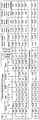
Экспресс-гравитационная методика определения коррозионной устойчивости цементного камня заключалась в следующем. Исследуемый образец камня погружали в сосуд с водой и взвешивали на электронных весах. После взвешивания образец камня помещали в раствор соляной кислоты с массовой долей 10%. Через определенный промежуток времени образец извлекали из кислоты, помещали в сосуд с водой и снова взвешивали. По разности масс до погружения в раствор кислоты и после погружения определяли потерю массы, по которой определяли коэффициент коррозионного разрушения. Коэффициент коррозионного разрушения - величина, определяемая отношением массы растворившегося камня к исходной массе камня /см. таблицу/. The express-gravity method for determining the corrosion resistance of cement stone was as follows. The studied sample of stone was immersed in a vessel with water and weighed on an electronic balance. After weighing, a stone sample was placed in a solution of hydrochloric acid with a mass fraction of 10%. After a certain period of time, the sample was removed from the acid, placed in a vessel with water and weighed again. From the mass difference before immersion in the acid solution and after immersion, the mass loss was determined by which the coefficient of corrosion failure was determined. Corrosion destruction coefficient is a value determined by the ratio of the mass of the dissolved stone to the initial mass of the stone / cm. table.
Пример: опыт 3. В 100 мл воды ввели 1,0 г ПВС и 3 г парафина. Example:
Содержимое нагрели до полного растворения парафина. После расплавления парафина добавили 0,5 г ПАВ и интенсивно перемешали электромешалкой до получения однородной суспензии. После остывания водно-парафиновой суспензии ввели 200 г цемента и тщательно перемешали, после чего определяли параметры тампонажного раствора /см. таблицу/. The contents were heated until paraffin was completely dissolved. After melting paraffin, 0.5 g of surfactant was added and intensively mixed with an electric mixer until a homogeneous suspension was obtained. After cooling the water-paraffin slurry, 200 g of cement was added and mixed thoroughly, after which the parameters of the cement slurry / cm were determined. table.
Для определения прочности камня на сжатие приготовленный тампонажный раствор заливали в металлические формы /20х20х100 мм/, помещали их в эксикатор с водой и после определенного времени твердения определяли прочность камня на сжатие и коррозионную устойчивость /см. таблицу/. To determine the compressive strength of the stone, the prepared grouting mortar was poured into metal molds / 20x20x100 mm /, placed in a desiccator with water, and after a certain hardening time, the compressive strength and corrosion resistance of the stone were determined / cm. table.
Из табличных данных следует, что наилучшие показатели достигаются при соотношении ингредиентов, приведенных в опытах 3-5 /см. таблицу/. From the tabular data it follows that the best performance is achieved with a ratio of ingredients given in experiments 3-5 / cm. table.
Большее чем оптимальное содержание парафина /опыт 8/ приводит к изменению реологических параметров тампонажного раствора /он становится не прокачиваемым: растекаемость 10 см/, а меньшее содержание парафина /опыт 7/ приводит к потере коррозионной устойчивости камня. Larger than the optimal paraffin content (experiment 8) leads to a change in the rheological parameters of the cement slurry / it becomes not pumpable:
Дополнительный технический эффект от использования изобретения заключается в расширении номенклатуры рецептур коррозионно-устойчивых тампонажных растворов, необходимых для цементировочных работ. An additional technical effect of the use of the invention is to expand the range of formulations of corrosion-resistant grouting mortars required for cementing.
Claims (1)
Цемент - 64,20 - 65,70
Парафин - 0,98 - 3,28
ПВС - 0,33 - 0,40
ПАВ - 0,16 - 0,32
Вода - ОстальноеA cement slurry comprising cement and a mixing fluid containing water, polyvinyl alcohol PVA and a surfactant surfactant, characterized in that the mixing fluid additionally contains paraffin in the following ratio of ingredients, wt. %:
Cement - 64.20 - 65.70
Paraffin - 0.98 - 3.28
PVA - 0.33 - 0.40
Surfactant - 0.16 - 0.32
Water - Else
Priority Applications (1)
| Application Number | Priority Date | Filing Date | Title |
|---|---|---|---|
| RU2001122149/03A RU2204012C2 (en) | 2001-08-07 | 2001-08-07 | Plugging mortar |
Applications Claiming Priority (1)
| Application Number | Priority Date | Filing Date | Title |
|---|---|---|---|
| RU2001122149/03A RU2204012C2 (en) | 2001-08-07 | 2001-08-07 | Plugging mortar |
Publications (1)
| Publication Number | Publication Date |
|---|---|
| RU2204012C2 true RU2204012C2 (en) | 2003-05-10 |
Family
ID=20252447
Family Applications (1)
| Application Number | Title | Priority Date | Filing Date |
|---|---|---|---|
| RU2001122149/03A RU2204012C2 (en) | 2001-08-07 | 2001-08-07 | Plugging mortar |
Country Status (1)
| Country | Link |
|---|---|
| RU (1) | RU2204012C2 (en) |
Cited By (1)
| Publication number | Priority date | Publication date | Assignee | Title |
|---|---|---|---|---|
| RU2689010C2 (en) * | 2014-03-31 | 2019-05-23 | Курарей Ко., Лтд. | Additive for solution, drilling solution and cement solution |
Citations (5)
| Publication number | Priority date | Publication date | Assignee | Title |
|---|---|---|---|---|
| US4064943A (en) * | 1976-12-06 | 1977-12-27 | Shell Oil Co | Plugging permeable earth formation with wax |
| SU1388546A1 (en) * | 1986-02-05 | 1988-04-15 | Филиал Северо-Кавказского Государственного Научно-Исследовательского И Проектного Института Нефтяной Промышленности | Plugging composition |
| RU2051274C1 (en) * | 1992-11-10 | 1995-12-27 | Рауф Рахимович Лукманов | Method for well completion |
| RU2078906C1 (en) * | 1993-12-17 | 1997-05-10 | Акционерное общество открытого типа "Сибирский научно-исследовательский институт нефтяной промышленности" | Grouting mortar |
| RU2162510C2 (en) * | 1999-02-18 | 2001-01-27 | Мильштейн Всеволод Михайлович | Method of preparing light-weight grouting mortar |
-
2001
- 2001-08-07 RU RU2001122149/03A patent/RU2204012C2/en not_active IP Right Cessation
Patent Citations (5)
| Publication number | Priority date | Publication date | Assignee | Title |
|---|---|---|---|---|
| US4064943A (en) * | 1976-12-06 | 1977-12-27 | Shell Oil Co | Plugging permeable earth formation with wax |
| SU1388546A1 (en) * | 1986-02-05 | 1988-04-15 | Филиал Северо-Кавказского Государственного Научно-Исследовательского И Проектного Института Нефтяной Промышленности | Plugging composition |
| RU2051274C1 (en) * | 1992-11-10 | 1995-12-27 | Рауф Рахимович Лукманов | Method for well completion |
| RU2078906C1 (en) * | 1993-12-17 | 1997-05-10 | Акционерное общество открытого типа "Сибирский научно-исследовательский институт нефтяной промышленности" | Grouting mortar |
| RU2162510C2 (en) * | 1999-02-18 | 2001-01-27 | Мильштейн Всеволод Михайлович | Method of preparing light-weight grouting mortar |
Cited By (2)
| Publication number | Priority date | Publication date | Assignee | Title |
|---|---|---|---|---|
| RU2689010C2 (en) * | 2014-03-31 | 2019-05-23 | Курарей Ко., Лтд. | Additive for solution, drilling solution and cement solution |
| US10563109B2 (en) | 2014-03-31 | 2020-02-18 | Kuraray Co., Ltd. | Additive for slurry, drilling mud, and cement slurry |
Similar Documents
| Publication | Publication Date | Title |
|---|---|---|
| Qian | Effect of polycarboxylate ether (PCE) superplasticizer on thixotropic structural build-up of fresh cement pastes over time | |
| Ferron et al. | Rheological method to evaluate structural buildup in self-consolidating concrete cement pastes | |
| US5389706A (en) | Well cement compositions having improved properties and methods | |
| CA2102040A1 (en) | Low fluid loss cement compositions, fluid loss reducing additives and methods | |
| NO326687B1 (en) | Method of treating underground zone with a liquid-reducing reducing agent | |
| CN110423316A (en) | A kind of liquid segregation reducing agent and preparation method thereof | |
| EP0607039A1 (en) | Set retarded cement compositions | |
| CA2853628C (en) | Delayed, swellable particles for prevention of fluid migration through damaged cement sheaths | |
| WO2005051865A1 (en) | Dispersant compositions for cement compositions and related methods | |
| CA1224916A (en) | Non-retarding fluid loss additives for well cementing compositions | |
| RU2186942C1 (en) | Method of preparation of grouting composition | |
| RU2204012C2 (en) | Plugging mortar | |
| Shadizadeh et al. | Experimental investigation of silica fume as a cement extender for liner cementing in Iranian oil/gas wells | |
| Khayat et al. | High-performance cement grout for post-tensioning applications | |
| RU2149981C1 (en) | Grouting mortar | |
| US4508572A (en) | Cement composition for laying underwater | |
| RU2151267C1 (en) | Light grouting mortar | |
| RU2172812C2 (en) | Method of preparing light-weight grouting mortar | |
| RU2194149C1 (en) | Complex reagent for plugging mortars | |
| SU1703807A1 (en) | Cement slurry | |
| B. Hernandez et al. | Temperature Activated Modified Natural Polymer for High Temperature Cement Slurry Rheology Control | |
| RU2821870C1 (en) | Self-healing plugging material | |
| RU2179231C2 (en) | Complex reagent for grouting mortars | |
| SU1700201A1 (en) | Oil-well slurry for saline sediments | |
| RU2129649C1 (en) | Combination reagent for plugging systems |
Legal Events
| Date | Code | Title | Description |
|---|---|---|---|
| MM4A | The patent is invalid due to non-payment of fees |
Effective date: 20030808 |