RU2160373C2 - Internal combustion engine operation method - Google Patents
Internal combustion engine operation method Download PDFInfo
- Publication number
- RU2160373C2 RU2160373C2 RU99100740A RU99100740A RU2160373C2 RU 2160373 C2 RU2160373 C2 RU 2160373C2 RU 99100740 A RU99100740 A RU 99100740A RU 99100740 A RU99100740 A RU 99100740A RU 2160373 C2 RU2160373 C2 RU 2160373C2
- Authority
- RU
- Russia
- Prior art keywords
- expansion
- compression
- working volume
- working
- volume
- Prior art date
Links
- 238000000034 method Methods 0.000 title claims abstract description 50
- 238000002485 combustion reaction Methods 0.000 title claims abstract description 20
- 238000007906 compression Methods 0.000 claims abstract description 26
- 230000006835 compression Effects 0.000 claims abstract description 16
- 239000000446 fuel Substances 0.000 claims abstract description 6
- 238000006243 chemical reaction Methods 0.000 claims abstract description 4
- 238000006073 displacement reaction Methods 0.000 claims description 3
- 230000000694 effects Effects 0.000 abstract 1
- 239000000126 substance Substances 0.000 abstract 1
- 239000007789 gas Substances 0.000 description 10
- 238000010586 diagram Methods 0.000 description 7
- 230000008602 contraction Effects 0.000 description 6
- 238000013459 approach Methods 0.000 description 1
- 230000000052 comparative effect Effects 0.000 description 1
- 230000010354 integration Effects 0.000 description 1
- 239000000463 material Substances 0.000 description 1
- 239000000203 mixture Substances 0.000 description 1
Images
Classifications
-
- F—MECHANICAL ENGINEERING; LIGHTING; HEATING; WEAPONS; BLASTING
- F02—COMBUSTION ENGINES; HOT-GAS OR COMBUSTION-PRODUCT ENGINE PLANTS
- F02B—INTERNAL-COMBUSTION PISTON ENGINES; COMBUSTION ENGINES IN GENERAL
- F02B41/00—Engines characterised by special means for improving conversion of heat or pressure energy into mechanical power
-
- F—MECHANICAL ENGINEERING; LIGHTING; HEATING; WEAPONS; BLASTING
- F02—COMBUSTION ENGINES; HOT-GAS OR COMBUSTION-PRODUCT ENGINE PLANTS
- F02B—INTERNAL-COMBUSTION PISTON ENGINES; COMBUSTION ENGINES IN GENERAL
- F02B75/00—Other engines
- F02B75/02—Engines characterised by their cycles, e.g. six-stroke
Landscapes
- Engineering & Computer Science (AREA)
- Chemical & Material Sciences (AREA)
- Combustion & Propulsion (AREA)
- Mechanical Engineering (AREA)
- General Engineering & Computer Science (AREA)
- Output Control And Ontrol Of Special Type Engine (AREA)
- Nitrogen And Oxygen Or Sulfur-Condensed Heterocyclic Ring Systems (AREA)
Abstract
Description
Изобретение относится к энергетическому машиностроению и может быть использовано в двигателях внутреннего сгорания, с оптимальными циклами, для мобильного и стационарного исполнения. The invention relates to power engineering and can be used in internal combustion engines, with optimal cycles, for mobile and stationary execution.
Известен способ работы двигателя внутреннего сгорания, включающий превращение термохимической энергии топлива (теплоты) в механическую в ограниченном изменяемом объеме через повторяющиеся процессы впуск, сжатие, расширение, выпуск - по индикаторной диаграмме (1) и (2). A known method of operation of an internal combustion engine, including the conversion of thermochemical energy of fuel (heat) into mechanical energy in a limited variable volume through repeated processes of intake, compression, expansion, release, according to the indicator diagram (1) and (2).
Недостатками известных способов работы двигателей внутреннего сгорания по известным циклам являются: низкий КПД циклов, высокий уровень шумов при выпуске отработанных газов по причине проведения рабочих процессов расширения в симметричных, линейных изменяемых объемах, который изменяют в прямолинейной зависимости от аргумента (в первом приближении), что приводит к потере значительного количества тепла в стенках, ограничивающих рабочие объемы и при выбросе с отработанными газами. The disadvantages of the known methods of operation of internal combustion engines according to known cycles are: low efficiency of cycles, high noise levels during exhaust gas discharge due to expansion work processes in symmetric, linear variable volumes, which vary in a straightforward manner depending on the argument (to a first approximation), which leads to the loss of a significant amount of heat in the walls, limiting the working volume and when emitted with exhaust gases.
Задачей настоящего изобретения является увеличение КПД (эффективности ДВС) при превращении термохимической энергии топлива (теплоты) в механическую в ограниченном несимметричном и нелинейно изменяемом объеме, снижение уровня шума при выпуске отработанных газов, упрощение конструкции. The objective of the present invention is to increase the efficiency (ICE efficiency) when converting the thermochemical energy of the fuel (heat) into mechanical energy in a limited asymmetric and non-linearly variable volume, reducing the noise level in the exhaust gas discharge, simplifying the design.
Поставленная задача достигается за счет того, что процесс расширения и/или сжатия циклов ДВС осуществляют в несимметричном, относительно половины хода рабочего органа, нелинейном рабочем объеме, который изменяют по степенной зависимости от аргумента, по уравнению:
V = a + b (x + c)m,
где V - рабочий объем;
x - аргумент;
a, b, c - действительные числа;
m - показатель степени,
а показатель степени выбирают в соответствии с неравенствами:
0 < m < 1, 1 < m < 2,
при этом процесс расширения и/или сжатия производят в несимметричном рабочем объеме относительно половины хода рабочего органа по меньшей мере до соотношения 2:1.The problem is achieved due to the fact that the process of expansion and / or compression of the ICE cycles is carried out in an asymmetric, relative to half the stroke of the working body, non-linear working volume, which is changed according to a power-law dependence on the argument, according to the equation:
V = a + b (x + c) m ,
where V is the working volume;
x is an argument;
a, b, c are real numbers;
m is an exponent
and the exponent is chosen in accordance with the inequalities:
0 <m <1, 1 <m <2,
the process of expansion and / or compression is carried out in an asymmetric working volume relative to half the stroke of the working body, at least to a ratio of 2: 1.
Существующие способы работы двигателей внутреннего сгорания базируются на представлении о линейном изменении рабочего объема в зависимости от аргумента. Ось x, к примеру, по (4) стр. 12 рис. 2,1 b) совпадает с направлением перемещения поршня и является аргументом. Возможен вариант - аргументом принят угол поворота коленчатого вала (выходного вала). Одновременно необходимо отметить, что все известные способы работы ДВС основаны на симметричном изменении рабочего объема относительно половины хода рабочего органа. Это можно представить, условно разделив рабочий объем пополам в точке, соответствующей половине хода рабочего органа, и равенство объемов очевидно, и количественная симметрия как 1:1 также представима. На графике зависимости изменения объема от аргумента или от перемещения поршня (рабочего органа) также половина хода рабочего органа соответствует половине измененного рабочего объема, фиг.1. Existing methods of operation of internal combustion engines are based on the idea of a linear change in the working volume depending on the argument. The x axis, for example, according to (4) p. 12 fig. 2.1 b) coincides with the direction of movement of the piston and is an argument. The option is possible - the angle of rotation of the crankshaft (output shaft) is accepted as an argument. At the same time, it should be noted that all known methods of ICE operation are based on a symmetric change in the working volume relative to half the stroke of the working body. This can be imagined by conditionally dividing the working volume in half at a point corresponding to half the stroke of the working body, and the equality of volumes is obvious, and quantitative symmetry as 1: 1 is also representable. On the graph of the dependence of the volume change on the argument or on the displacement of the piston (working body) also half the stroke of the working body corresponds to half of the changed working volume, Fig.1.
Сущностью данного изобретения является то, что по сравнению с существующими способами работы ДВС по известным циклам, процессы расширения и/или сжатия осуществляют в несимметричном, нелинейном рабочем объеме, который изменяют по степенной зависимости от аргумента, по уравнению:
V = a + b (x + c)m,
где V - рабочий объем;
x - аргумент;
a, b, c - действительные числа;
m - показатель степени,
показатели степени выбирают в интервалах 0 < m < 1, 1 < m < 2, при этом процесс расширения и/или сжатия производят в несимметричном рабочем объеме, относительно половины хода рабочего органа, по меньшей мере до соотношения 2: 1 в геометрическом представлении. Достигнутое опытным путем, несимметричное, нелинейное изменение рабочего объема сравнимо в первом приближении с графиком зависимости от аргумента на функцию V = xm. При анализе этого графика выяснилось, что действительные числа a, b, c незначительно влияют на местонахождение зависимости V = xm и по форме близко совпадают с ним. К примеру, "а" показывает смещение графика V = xm вверх или вниз по оси ординат; "b" - деформацию графика (растяжение или сжатие; "с" - показывает смещение графика влево или вправо по оси абсцисс.The essence of this invention is that, in comparison with the existing methods of ICE operation according to known cycles, the expansion and / or compression processes are carried out in an asymmetric, non-linear working volume, which is changed in a power-law dependence on the argument, according to the equation:
V = a + b (x + c) m ,
where V is the working volume;
x is an argument;
a, b, c are real numbers;
m is an exponent
exponents are selected in the intervals 0 <m <1, 1 <m <2, while the process of expansion and / or compression is performed in an asymmetric working volume, relative to half the stroke of the working body, at least to a ratio of 2: 1 in a geometric representation. Experienced, asymmetric, non-linear change in the working volume is comparable in a first approximation with the graph of the dependence on the argument to the function V = x m . When analyzing this graph, it turned out that the real numbers a, b, c slightly affect the location of the dependence V = x m and in shape closely match it. For example, “a” shows the graph offset V = x m up or down along the ordinate; "b" - deformation of the graph (expansion or contraction; "c" - shows the displacement of the graph to the left or right along the abscissa.
По этой причине, а также с целью упрощения математических накладок действительные числа принимаются:
a = 0, b = 1, c = 0,
итак, в предлагаемом способе работы ДВС по циклу автора: перемещению рабочего органа по оси соответствует степенное изменение рабочего объема:
V = xm или 
В известных термодинамических циклах ДВС процессы расширения и сжатия (3) принимаются адиабатными. Дифференциальное уравнение состояния газа:

где P - давление;
V - обьем;
P и V - параметры состояния газов;
K - показатель адиабаты.For this reason, and also in order to simplify mathematical overlays, real numbers are accepted:
a = 0, b = 1, c = 0,
So, in the proposed method of ICE operation according to the author’s cycle: the movement of the working body along the axis corresponds to a power-law change in the working volume:
V = x m or
In the well-known thermodynamic cycles of internal combustion engines, the expansion and contraction processes (3) are assumed to be adiabatic. Differential gas equation of state:
where P is the pressure;
V - volume;
P and V are gas state parameters;
K is the adiabatic exponent.
После применения дифференциальное уравнение примет вид:
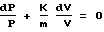
Интегрирование при K = const, имеем 

m ≠ 0, и при m = 1, уравнение адиабаты для известных циклов ДВС при процессах расширения и сжатия. При показателе степени, удовлетворяющем неравенству 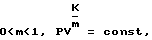
1. 1 < m < K;
2. m=K;
3. K < m < 2.After application, the differential equation takes the form:
Integration at K = const, we have
m ≠ 0, and for m = 1, the adiabatic equation for the known ICE cycles during expansion and contraction processes. With an exponent satisfying the inequality
1.1 <m <K;
2. m = K;
3. K <m <2.
Первый вариант обеспечивает размещение гиперболической кривой по крутизне между адиабатой известных циклов ДВС и изотермой линейных изменений рабочих объемов. Второй вариант обеспечивает совпадение с изотермой линейных изменений рабочих объемов. При третьем варианте кривая проходит положение той же изотермы. The first option provides the placement of the hyperbolic curve along the steepness between the adiabat of the known ICE cycles and the isotherm of linear changes in working volumes. The second option provides a coincidence with the isotherm of linear changes in working volumes. In the third embodiment, the curve passes the position of the same isotherm.
Исходя из вышеизложенного по (V, P) - диаграмме можно сделать однозначный вывод о том, что в предлагаемом цикле ДВС процесс расширения и/или сжатия, если их осуществляют в несимметричном, нелинейном рабочем объеме, который изменяют по степенной зависимости от аргумента по уравнению:
V = a + b (x + c)m,
а показатель степени выбирают в соответствии с неравенствами:
0 < m < 1, 1 < m < 2,
то реально существует значительное количество вариантов способов работы ДВС, не известных ранее с наиболее эффективными условиями прохождения процессов преобразования энергии термодинамических процессов. К примеру, если расширяют по предлагаемой неравнобокой гиперболе с показателем степени изменения рабочего объема 0 < m < 1, можно значительно повысить термический КПД цикла ДВС (будет показано ниже), а также обеспечить бесшумный выброс отработанных газов, что явствует из того, что кривая 
V = a + b (x + c) m ,
and the exponent is chosen in accordance with the inequalities:
0 <m <1, 1 <m <2,
then in reality there are a significant number of options for the operation of internal combustion engines, previously unknown with the most effective conditions for the passage of energy conversion processes of thermodynamic processes. For example, if you expand according to the proposed unequal hyperbole with an indicator of the degree of change in the working volume 0 <m <1, you can significantly increase the thermal efficiency of the ICE cycle (it will be shown below), as well as ensure a silent emission of exhaust gases, which is clear from the fact that the curve
Термический КПД известных циклов ДВС определяется по формулам 22 по (4). В частности, для двигателей с подводом теплоты при постоянном объеме (быстрого сгорания) термически КПД имеет вид:
ηt= 1-1/εK-1,
где ηt - термический КПД цикла;
ε - степень сжатия;
K - показатель адиабата.The thermal efficiency of the known ICE cycles is determined by formulas 22 according to (4). In particular, for engines with heat supply at a constant volume (fast combustion) thermally, the efficiency is:
η t = 1-1 / ε K-1 ,
where η t is the thermal efficiency of the cycle;
ε is the compression ratio;
K is the adiabatic exponent.
Для предлагаемого автором цикла при расширении и сжатии, что осуществляют в несимметричном, нелинейном рабочем объеме, который изменяют по степенной зависимости от аргумента: V = xm, а показатель степени выбирают в пределах 0 < m < 1, формула термического КПД имеет вид: 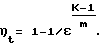
Процессы в нелинейном рабочем объеме, который изменяют по степенной зависимости от аргумента V = a + b (x + c)m, одновременно сопровождаются несимметричным его изменением относительно половины хода рабочего органа (5), по меньшей мере, до соотношения 2:1. Эта асимметрия, к примеру 2:1, относительно половины хода рабочего органа в геометрическом представлении означает: при разделении (условном) всего рабочего объема на три равные части происходит изменение его двух частей до половины хода рабочего органа и одной части - после половины хода рабочего органа. В термодинамическом представлении это соотношение 2/3: 1/3 означает: две части всего рабочего объема задействовано до половины хода рабочего органа и одна часть после. В то время как у известных способов работы ДВС в геометрическом представлении симметрично 1:1, а в термодинамическом 2:1. Геометрическая несимметричность объема является важным фактором для способа работы ДВС, так как в первой половине расширения или в начале расширения большие потери тепла в стенки, а в предлагаемом цикле ДВС это тепло в основном превращается в механическую работу.Processes in a nonlinear working volume, which vary in a power-law dependence on the argument V = a + b (x + c) m , are simultaneously accompanied by its asymmetric change with respect to half the stroke of the working body (5), at least to a 2: 1 ratio. This asymmetry, for example 2: 1, with respect to half the stroke of the working body in geometric representation means: when the (conditional) total volume of the working volume is divided into three equal parts, its two parts change to half the stroke of the working body and one part after half the stroke of the working body . In the thermodynamic representation, this
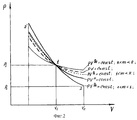
На графическом материале по фиг. 1 изображен график зависимости изменения рабочего объема от хода поршня или рабочего органа (h). I - при известном способе работы ДВС, где процессы расширения и/или сжатия осуществляют в симметричном и линейном рабочем объеме, который изменяют по прямолинейной зависимости от аргумента V = f(x). Штрихпунктирной линией показано фактическое незначительное отклонение от линейного. Симметрия показана относительно половины хода рабочего органа. II - при предлагаемом способе работы ДВС по циклу автора, где процессы расширения и/или сжатия осуществляют в несимметричном, нелинейном рабочем объеме, который изменяют по степенной зависимости от аргумента по уравнению: V = a + b(x + c)m, а показатель степени выбирают в соответствии с параметрами 0 < m < 1 (III - для показателя степени 1 < m < 2), при этом процесс расширения и/или сжатия производят в несимметричном рабочем объеме относительно половины хода рабочего органа по меньшей мере до соотношения 2: 1. По фиг. 2 изображены гиперболические кривые расширения и/или сжатия индикаторных диаграмм на (V, P) - координатах. Кривая 


Возможность осуществления предлагаемого способа работы двигателя внутреннего сгорания характеризуется использованием устройств, известных из патентов Российской Федерации NN 2062893 и 2043550, 2073803. Предлагаемый способ работы двигателя внутреннего сгорания по циклу автора осуществляют следующим образом: в ограниченном изменяемом объеме термохимическую энергию топлива превращают в механическую энергию перемещения (поршня) рабочего органа с последующей передачей на выходной вал, для чего впускают рабочую смесь, ее сжимают в линейно изменяемом и симметричном относительно половины хода рабочего органа (поршня) объеме, затем сжигают и расширяют в несимметричном относительно половины хода рабочего органа (поршня), нелинейно изменяемом рабочем объеме от аргумента по степенной зависимости по уравнению: V = a + b (x + c)m, с показателем степени, который выбирают в соответствии с неравенством 0 < m < 1, при этом несимметричность объема процесса расширения доводят, по меньшей мере, до соотношения 2:1, далее выпускают отработанные газы.The possibility of implementing the proposed method of operation of an internal combustion engine is characterized by the use of devices known from patents of the Russian Federation NN 2062893 and 2043550, 2073803. The proposed method of operation of an internal combustion engine according to the author’s cycle is as follows: in a limited variable volume, the thermochemical energy of the fuel is converted into mechanical energy of movement ( piston) of the working body with subsequent transfer to the output shaft, for which the working mixture is admitted, it is compressed into a linear variable ohm and symmetric with respect to half the stroke of the working body (piston) volume, then burn and expand in the asymmetric with respect to half the stroke of the working body (piston), a nonlinearly variable working volume of the argument according to the power law according to the equation: V = a + b (x + c) m , with an exponent that is selected in accordance with the inequality 0 <m <1, while the asymmetry in the volume of the expansion process is adjusted to at least a ratio of 2: 1, then exhaust gases are released.
Оптимальный вариант осуществления изобретения, способа работы ДВС по циклу автора, когда процесс сжатая проводят в интервале показателя степени 1 < m < 2, а процесс расширения проводят в интервале 0 < m < 1. При данном варианте осуществления изобретения площадь индикаторной диаграммы будет максимальной, а потеря тепла на стенки и с выбросом отработанных газов минимальной. The optimal embodiment of the invention, the method of operation of the internal combustion engine according to the author’s cycle, when the compressed process is carried out in the range of the exponent 1 <m <2, and the expansion process is carried out in the range 0 <m <1. In this embodiment, the area of the indicator diagram will be maximum, and heat loss to the walls and with the emission of exhaust gases is minimal.
Способ работы двигателя внутреннего сгорания по циклу автора, в котором процессы расширения и/или сжатия осуществляют в несимметричном, нелинейном рабочем объеме, который изменяют по степенной зависимости от аргумента, по уравнению: V = a + b (x + c)m, а показатель степени выбирают в соответствии с неравенствами 0 < m < 1, 1 < m < 2, при этом процесс расширения и/или сжатия производят в несимметричном рабочем объеме, относительно половины хода рабочего органа, по меньшей мере, до соотношения 2:1, позволяет увеличить КПД существующих циклов ДВС, при превращении термохимической энергии топлива (теплоты) в механическую работу, снизить уровень шума при выпуске отработанных газов до отказа от систем глушения шумов и упростить конструкцию ДВС.The method of operation of the internal combustion engine according to the author’s cycle, in which the expansion and / or compression processes are carried out in an asymmetric, non-linear working volume, which is changed in a power-law dependence on the argument, according to the equation: V = a + b (x + c) m , and the indicator the degrees are chosen in accordance with the inequalities 0 <m <1, 1 <m <2, while the expansion and / or compression process is carried out in an asymmetric working volume, relative to half the stroke of the working body, at least to a ratio of 2: 1, allows you to increase Efficiency of existing ICE cycles, when schenii fuel thermochemical energy (heat) to mechanical work, to reduce noise at the release of exhaust gases to the rejection of noise muffling system and simplify the design of the engine.
Круговой цикл работы ДВС с участием хотя бы одного нового процесса, проходящего при несимметричном нелинейном изменении объема (рабочего объема), описываемого математической формулой:

при 0 < m < 1, 1 < m < 2 с учетом работы (5), является или называется по циклу автора, пример (6).The circular cycle of the internal combustion engine with the participation of at least one new process taking place with an asymmetric nonlinear change in volume (working volume), described by the mathematical formula:
for 0 <m <1, 1 <m <2, taking into account (5), is or is called according to the author’s cycle, example (6).
Предлагаемый способ работы ДВС по предлагаемому циклу автора, где процессы расширения и/или сжатия осуществляют в несимметричном нелинейном рабочем объеме, который изменяют по степенной зависимости от аргумента по уравнению: V = a + b(x + c)m, а показатель степени выбирают в соответствии с неравенствами: 0 < m < 1, 1 < m < 2, при этом процесс расширения и/или сжатия производят в несимметричном рабочем объеме, относительно половины хода рабочего органа, по меньшей мере, до соотношения 2:1, соответствует критериям изобретения, является новым, имеет изобретательский уровень и промышленно применим.The proposed method of ICE operation according to the author’s proposed cycle, where the expansion and / or compression processes are carried out in an asymmetric nonlinear working volume, which is changed in a power-law dependence on the argument according to the equation: V = a + b (x + c) m , and the exponent is selected in in accordance with the inequalities: 0 <m <1, 1 <m <2, while the process of expansion and / or compression is carried out in an asymmetric working volume, relative to half the stroke of the working body, at least to a ratio of 2: 1, meets the criteria of the invention, is new, has an image skill level and industrially applicable.
Источники информации:
1. Авторское свидетельство на изобретение 1712642, 5 F 02 B 77/04, по заявке N 14671152/06 от 03.04.89 г., опубл. ОПБ "Изобретения", N 6, 1992 г.Sources of information:
1. Copyright certificate for the invention 1712642, 5 F 02 B 77/04, according to the application N 14671152/06 of 04/03/89, publ. OPB "Inventions", N 6, 1992
2. "Двигатели внутреннего сгорания", Учебник для ВУЗОв, М., Высшая школа, 1978 г., авт. А.С.Хачиян, К.А.Морозов, В.И.Трусов. 2. "Internal combustion engines", Textbook for Universities, M., Higher School, 1978, ed. A.S. Khachiyan, K.A. Morozov, V.I. Trusov.
3. "Техническая термодинамика", авт. В.И.Кругов, С.И.Исаев, Н.А.Кожинов и др. М., Высшая школа, 1991 г. 3. "Technical thermodynamics", ed. V.I. Krugov, S.I. Isaev, N.A. Kozhinov and others M., Higher School, 1991
4. "Техническая термодинамика и теплопередача", В.И. Кушнарев, В.И.Лебедев, В.А.Павленко и др. М., "Стройиздат", 1986 г. 4. "Technical thermodynamics and heat transfer", V.I. Kushnarev, V.I. Lebedev, V.A. Pavlenko and others M., "Stroyizdat", 1986
5. Заявка на изобретение N 98108789/06 (009888) с приоритетом 06.05.98 г. , заявитель-автор Яримов М.О., с назначением "Способ работы ДВС" с решением о выдаче патента России. 5. Application for the invention N 98108789/06 (009888) with a priority of 05/06/98, the applicant is the author M. Yarimov, with the designation "Method of operation of the internal combustion engine" with the decision to grant a patent of Russia.
6. Патент N 2062893 на изобретение, РОССИЯ, приоритет 1992 г., с названием "Двигатель внутреннего сгорания автора". 6. Patent N 2062893 for an invention, RUSSIA, 1992 priority, with the name "Author's Internal Combustion Engine".
Claims (1)
V = a + b (x + c)m;
где V - рабочий объем;
x - аргумент;
a, b, c - действительные числа;
m - показатель степени,
а показатель степени выбирают в соответствие с неравенствами
0 < m < 1; 1 < m < 2,
при этом процесс расширения и/или сжатия производят в несимметричном рабочем объеме относительно половины хода рабочего органа по меньшей мере до соотношения 2 : 1.The method of operation of an internal combustion engine, including the conversion of thermochemical energy of fuel into mechanical energy in a limited variable volume through repeated processes of inlet, compression, expansion, exhaust, characterized in that the expansion and / or compression processes are carried out in an asymmetric displacement, which varies in degree depending on argument, by equation
V = a + b (x + c) m ;
where V is the working volume;
x is an argument;
a, b, c are real numbers;
m is an exponent
and the exponent is chosen in accordance with the inequalities
0 <m <1; 1 <m <2,
the process of expansion and / or compression is carried out in an asymmetric working volume relative to half the stroke of the working body, at least to a ratio of 2: 1.
Priority Applications (3)
| Application Number | Priority Date | Filing Date | Title |
|---|---|---|---|
| RU99100740A RU2160373C2 (en) | 1999-01-11 | 1999-01-11 | Internal combustion engine operation method |
| AU25836/00A AU2583600A (en) | 1999-01-11 | 1999-12-09 | Method for operating an internal combustion engine according to the yarimov's cycle |
| PCT/RU1999/000490 WO2000042304A1 (en) | 1999-01-11 | 1999-12-09 | Method for operating an internal combustion engine according to the yarimov's cycle |
Applications Claiming Priority (1)
| Application Number | Priority Date | Filing Date | Title |
|---|---|---|---|
| RU99100740A RU2160373C2 (en) | 1999-01-11 | 1999-01-11 | Internal combustion engine operation method |
Publications (2)
| Publication Number | Publication Date |
|---|---|
| RU99100740A RU99100740A (en) | 2000-10-27 |
| RU2160373C2 true RU2160373C2 (en) | 2000-12-10 |
Family
ID=20214654
Family Applications (1)
| Application Number | Title | Priority Date | Filing Date |
|---|---|---|---|
| RU99100740A RU2160373C2 (en) | 1999-01-11 | 1999-01-11 | Internal combustion engine operation method |
Country Status (3)
| Country | Link |
|---|---|
| AU (1) | AU2583600A (en) |
| RU (1) | RU2160373C2 (en) |
| WO (1) | WO2000042304A1 (en) |
Citations (6)
| Publication number | Priority date | Publication date | Assignee | Title |
|---|---|---|---|---|
| FR2542809A1 (en) * | 1983-03-18 | 1984-09-21 | Bertin & Cie | Method for improving the efficiency of a controlled-ignition heat engine |
| EP0144277A1 (en) * | 1983-09-07 | 1985-06-12 | Alain Kervagoret | Combustion engine running process, device for carrying out this process and an internal-combustion engine fitted with this device |
| FR2612253A1 (en) * | 1987-03-13 | 1988-09-16 | Duvant Crepelle Sa Moteurs | Method with the purpose of improving the operating conditions of an internal combustion engine |
| RU2043550C1 (en) * | 1991-11-12 | 1995-09-10 | Марат Отеллович Яримов | Four-link pivot crank mechanism |
| RU2062839C1 (en) * | 1993-07-27 | 1996-06-27 | Новационная фирма "Кузбасс-Нииогр" | Device for protection of pipeline from freezing |
| RU2073803C1 (en) * | 1992-01-22 | 1997-02-20 | Марат Отеллович Яримов | Pivot four-link mechanism |
Family Cites Families (4)
| Publication number | Priority date | Publication date | Assignee | Title |
|---|---|---|---|---|
| GB1591124A (en) * | 1976-10-19 | 1981-06-17 | Blaser Richard Florencio | Method and apparatus for control of pressure in internal combustion engines |
| DE2840621A1 (en) * | 1978-09-19 | 1980-03-27 | Gunnar Weslien | Improved efficiency otto or Diesel IC engine - uses only part of upward piston stroke for compression but full stroke for expansion |
| CA1209925A (en) * | 1979-05-22 | 1986-08-19 | Haakon H. Kristiansen | Internal combustion engine and operating cycle |
| SU1035256A1 (en) * | 1980-12-01 | 1988-04-07 | Babich G S | Method of operating i.c. engine carburettor and carburettor i.c. engine |
-
1999
- 1999-01-11 RU RU99100740A patent/RU2160373C2/en not_active IP Right Cessation
- 1999-12-09 AU AU25836/00A patent/AU2583600A/en not_active Abandoned
- 1999-12-09 WO PCT/RU1999/000490 patent/WO2000042304A1/en not_active Ceased
Patent Citations (6)
| Publication number | Priority date | Publication date | Assignee | Title |
|---|---|---|---|---|
| FR2542809A1 (en) * | 1983-03-18 | 1984-09-21 | Bertin & Cie | Method for improving the efficiency of a controlled-ignition heat engine |
| EP0144277A1 (en) * | 1983-09-07 | 1985-06-12 | Alain Kervagoret | Combustion engine running process, device for carrying out this process and an internal-combustion engine fitted with this device |
| FR2612253A1 (en) * | 1987-03-13 | 1988-09-16 | Duvant Crepelle Sa Moteurs | Method with the purpose of improving the operating conditions of an internal combustion engine |
| RU2043550C1 (en) * | 1991-11-12 | 1995-09-10 | Марат Отеллович Яримов | Four-link pivot crank mechanism |
| RU2073803C1 (en) * | 1992-01-22 | 1997-02-20 | Марат Отеллович Яримов | Pivot four-link mechanism |
| RU2062839C1 (en) * | 1993-07-27 | 1996-06-27 | Новационная фирма "Кузбасс-Нииогр" | Device for protection of pipeline from freezing |
Non-Patent Citations (1)
| Title |
|---|
| 1. ХАЧИЯН А.С. и др. Двигатели внутреннего сгорания. Учебник для ВУЗов. - М.: Высш.шк., 1978. 2. * |
Also Published As
| Publication number | Publication date |
|---|---|
| WO2000042304A1 (en) | 2000-07-20 |
| AU2583600A (en) | 2000-08-01 |
Similar Documents
| Publication | Publication Date | Title |
|---|---|---|
| Caton | Combustion phasing for maximum efficiency for conventional and high efficiency engines | |
| US6758188B2 (en) | Continuous torque inverse displacement asymmetric rotary engine | |
| Gonca | Performance analysis and optimization of irreversible Dual–Atkinson cycle engine (DACE) with heat transfer effects under maximum power and maximum power density conditions | |
| Yang et al. | Experimental study and performance analysis of a hydraulic diaphragm metering pump used in organic Rankine cycle system | |
| Dobrucali | The effects of the engine design and running parameters on the performance of a Otto–Miller Cycle engine | |
| Ge et al. | Performance of Diesel cycle with heat transfer, friction and variable specific heats of working fluid | |
| Jeng et al. | The intake and exhaust pipe effect on rotary engine performance | |
| Gonca et al. | Performance assessment of a modified power generating cycle based on effective ecological power density and performance coefficient | |
| Ge et al. | Performance of endoreversible Atkinson cycle | |
| Ebrahimi | A new design method for maximizing the work output of cycles in reciprocating internal combustion engines | |
| Noga et al. | Increase of efficiency of SI engine through the implementation of thermodynamic cycle with additional expansion | |
| Buchman et al. | Method for turbocharging single cylinder four stroke engines | |
| Gonca et al. | Introduction of a performance analysis criterion called effective exergetic performance coefficient and application to an engine operated on seven-process cycle | |
| RU2135793C1 (en) | Method of operation of internal combustion engine | |
| Yuan et al. | An elastic rotating energy converter with Humphrey thermodynamic cycle and real constant volume combustion | |
| Ust et al. | A theoretical performance investigation of irreversible internal combustion engine named as dual-miller cycle | |
| Ismatov et al. | Formalization of the concepts of “adiabatization” and reduction of heat losses in the operating cycle of diesel engines | |
| RU2133354C1 (en) | Method to provide working processes in internal combustion engines | |
| RU2808328C1 (en) | Engine with variable volume prechamber operating in cycle with mixed combustion | |
| CN104791084A (en) | Deep expansion internal combustion engine | |
| Sharma et al. | Influence of Piston Bowl Shape on Flow and Combustion Characteristics in HCCI Engine: A CFD Study | |
| MIJA et al. | INTERACTIVE MODELING AND SIMULATION OF THE OTTO THERMODYNAMIC CYCLE. | |
| Ust et al. | Heat transfer effects on the performance of an air-standard irreversible Otto cycle | |
| Abakumov et al. | Improving the Ecological Performance of Free-Piston Gas Generator by Air-Gas Mixture Self-Ignition | |
| Șugar et al. | Experimental study regarding the computation of the effective power of a spark-ignition |
Legal Events
| Date | Code | Title | Description |
|---|---|---|---|
| MM4A | The patent is invalid due to non-payment of fees |
Effective date: 20100112 |