RU2024373C1 - Method of connecting ceramic of quartz tube with metal sleeve - Google Patents
Method of connecting ceramic of quartz tube with metal sleeveInfo
- Publication number
- RU2024373C1 RU2024373C1 SU5009124A RU2024373C1 RU 2024373 C1 RU2024373 C1 RU 2024373C1 SU 5009124 A SU5009124 A SU 5009124A RU 2024373 C1 RU2024373 C1 RU 2024373C1
- Authority
- RU
- Russia
- Prior art keywords
- sleeve
- tube
- press
- fitting
- hardening
- Prior art date
Links
- 229910052751 metal Inorganic materials 0.000 title claims abstract description 15
- 239000002184 metal Substances 0.000 title claims abstract description 15
- 239000000919 ceramic Substances 0.000 title claims abstract description 8
- 238000000034 method Methods 0.000 title claims description 11
- 239000010453 quartz Substances 0.000 title abstract description 10
- VYPSYNLAJGMNEJ-UHFFFAOYSA-N silicon dioxide Inorganic materials O=[Si]=O VYPSYNLAJGMNEJ-UHFFFAOYSA-N 0.000 title abstract description 10
- 238000010438 heat treatment Methods 0.000 claims abstract description 8
- 229910045601 alloy Inorganic materials 0.000 claims description 7
- 239000000956 alloy Substances 0.000 claims description 7
- 238000003825 pressing Methods 0.000 claims description 5
- 238000010791 quenching Methods 0.000 claims description 5
- 230000000171 quenching effect Effects 0.000 claims description 5
- 238000004881 precipitation hardening Methods 0.000 claims description 4
- 239000000463 material Substances 0.000 abstract description 9
- 238000004519 manufacturing process Methods 0.000 abstract description 7
- 239000006185 dispersion Substances 0.000 abstract 1
- 230000000694 effects Effects 0.000 abstract 1
- 238000005728 strengthening Methods 0.000 abstract 1
- 239000000126 substance Substances 0.000 abstract 1
- 230000015572 biosynthetic process Effects 0.000 description 5
- 150000001875 compounds Chemical class 0.000 description 4
- 238000009792 diffusion process Methods 0.000 description 4
- 238000003466 welding Methods 0.000 description 4
- 238000001816 cooling Methods 0.000 description 2
- RYGMFSIKBFXOCR-UHFFFAOYSA-N Copper Chemical compound [Cu] RYGMFSIKBFXOCR-UHFFFAOYSA-N 0.000 description 1
- 229910052782 aluminium Inorganic materials 0.000 description 1
- XAGFODPZIPBFFR-UHFFFAOYSA-N aluminium Chemical compound [Al] XAGFODPZIPBFFR-UHFFFAOYSA-N 0.000 description 1
- 229910052802 copper Inorganic materials 0.000 description 1
- 239000010949 copper Substances 0.000 description 1
- 230000006378 damage Effects 0.000 description 1
- 238000004870 electrical engineering Methods 0.000 description 1
- 238000005304 joining Methods 0.000 description 1
- 239000007788 liquid Substances 0.000 description 1
- 230000000930 thermomechanical effect Effects 0.000 description 1
Images
Landscapes
- Pressure Welding/Diffusion-Bonding (AREA)
Abstract
Description
Изобретение относится к электротехнике и может быть использовано при изготовлении газоразрядных ламп, электровакуумных приборов, в двигателе- и ракетостроении и других областях техники. The invention relates to electrical engineering and can be used in the manufacture of discharge lamps, vacuum devices, in engine and rocket science and other technical fields.
Известен способ соединения кварцевой или керамической детали, имеющий форму трубки с металлической деталью с помощью диффузионной сварки. Сущность метода заключается в образовании физического контакта между трубкой и металлической деталью под воздействием давления и температуры с выдержкой при определенной температуре для образования диффузионного слоя на границе соединяемых поверхностей. На соединяемые поверхности может предварительно наноситься слой из пластичного металла для обеспечения релаксации внутренних напряжений, образовавшихся в процессе диффузионной сварки для приближения коэффициентов термического расширения (КТР) свариваемых материалов, для снижения температуры сварки. Недостатком данного способа соединения является его малая надежность при работе в условиях циклически изменяющихся температуры и механической нагрузки. Разрушения сварочного соединения имеют, как правило, усталостный характер и являются следствием наличия на границе двух несогласованных по КТР материалов достаточно хрупкого диффузионного слоя. Практическая ценность метода ограничена масштабным фактором и термомеханическими условиями эксплуатации изделий - амплитудой изменения температуры и механической нагрузки и количеством циклов их изменения. Например, сварное соединение охватывающего типа кварцевой трубки диаметром 30 мм с алюминием выдерживает до разрушения не более 400 циклов изменения температуры от 300 до 500 К; керамические детали, сваренные с металлом после предварительно нанесенными на свариваемые поверхности слоями из пластичного металла, выдерживают несколько десятков циклов до потери вакуумной плотности. A known method of joining a quartz or ceramic part, having the form of a tube with a metal part using diffusion welding. The essence of the method is the formation of physical contact between the tube and the metal part under the influence of pressure and temperature with exposure at a certain temperature to form a diffusion layer at the boundary of the connected surfaces. A layer of ductile metal can be preliminarily applied to the surfaces to be joined to provide relaxation of internal stresses generated during diffusion welding to approximate the thermal expansion coefficients (CTE) of the materials being welded, in order to reduce the welding temperature. The disadvantage of this method of connection is its low reliability when working in conditions of cyclically changing temperature and mechanical load. Failures of the welding joint are, as a rule, fatigue-like and are the result of the presence of a sufficiently brittle diffusion layer at the boundary of two materials not coordinated by KTP. The practical value of the method is limited by the scale factor and thermomechanical conditions of product operation - the amplitude of temperature and mechanical load changes and the number of cycles of their change. For example, a welded joint of an enclosing type of a quartz tube with a diameter of 30 mm with aluminum withstands up to destruction not more than 400 cycles of temperature changes from 300 to 500 K; ceramic parts, welded with metal after being previously applied to the surfaces to be welded with plastic metal layers, can withstand several tens of cycles until the vacuum density is lost.
Наиболее близким по технической сущности к изобретению является способ соединения цилиндрической кварцевой колбы с металлическим цоколем, который образуется при помощи нагрева цоколя, посадки конца колбы в цилиндрическую часть цоколя и образования сжимающей посадки при охлаждении соединения до нормальной температуры [1]. Недостатком способа является ненадежность обеспечения вакуумной плотности соединения из-за некачественного физического контакта соединяемых поверхностей, получаемого в условиях незначительной пластической сдвиговой деформации при образовании натяга. Кроме того, данный способ предполагает применение дорогостоящих кварцевых труб с прецизионно-точным диаметром или высокоточного изготовления цоколя для его соединения с трубой фактического диаметра, что составляет большую трудоемкость. The closest in technical essence to the invention is a method of connecting a cylindrical quartz flask with a metal base, which is formed by heating the cap, fit the end of the flask into the cylindrical part of the cap and the formation of a compressive fit when the compound is cooled to normal temperature [1]. The disadvantage of this method is the unreliability of ensuring the vacuum density of the connection due to poor-quality physical contact of the joined surfaces obtained under conditions of slight plastic shear deformation during the formation of interference. In addition, this method involves the use of expensive quartz tubes with precision-accurate diameter or high-precision manufacturing of the cap for its connection with the pipe of the actual diameter, which is very labor intensive.
Задачей изобретения является повышение надежности при снижении трудоемкости и стоимости получения соединения керамической или кварцевой детали с металлической втулкой, а также увеличение усталостной долговечности соединения при его работе в условиях циклически изменяющихся температур и механической нагрузки. The objective of the invention is to increase reliability while reducing the complexity and cost of obtaining a connection of a ceramic or quartz part with a metal sleeve, as well as an increase in the fatigue life of the compound when it is operated under conditions of cyclically changing temperatures and mechanical stress.
Поставленная задача решается тем, что в зону соединения по меньшей мере на одну из соединяемых поверхностей наносят слой из пластичного металла. В нагретую втулку запрессовывают конец кварцевой или керамической трубки с завальцованным краем. Наружный диаметр трубки выполняют с превышением по отношению к внутреннему диаметру втулки для получения натяга, который обеспечивал бы деформацию стенки трубки при запрессовке в пределах запаса пластичности ее материала. При этом осуществляется сдвиговая пластическая деформация промежуточного слоя, обеспечивающая образования надежного физического контакта по всей поверхности соединения. Сдвиг металла слоя облегчается наличием завальцованного края. The problem is solved in that a layer of ductile metal is applied to the connection zone of at least one of the surfaces to be joined. The end of a quartz or ceramic tube with a sealed edge is pressed into the heated sleeve. The outer diameter of the tube is exceeded with respect to the inner diameter of the sleeve to obtain an interference fit that would ensure the deformation of the tube wall during press fitting within the ductility margin of its material. In this case, shear plastic deformation of the intermediate layer is carried out, which ensures the formation of reliable physical contact over the entire surface of the joint. The shift of the metal layer is facilitated by the presence of a rolled edge.
Для повышения уровня упругих и прочностных свойств материал втулки подвергают термообработке. Термообработку втулки осуществляют после или во время проведения запрессовки. Запрессовка трубки во втулку, изготовленную из дисперсионно-твердеющих сплавов, проводят перед дисперсионным твердением. Если втулку изготавливают из сплава, упрочняемого закалкой, то запрессовку проводят при температуре нагрева под закалку с последующим охлаждением в закалочной жидкости. Затем проводят отпуск. To increase the level of elastic and strength properties of the material of the sleeve is subjected to heat treatment. Heat treatment of the sleeve is carried out after or during pressing. Pressing the tube into a sleeve made of precipitation hardening alloys is carried out before dispersion hardening. If the sleeve is made of an alloy hardened by quenching, the press-in is carried out at a heating temperature for quenching, followed by cooling in the quenching liquid. Then spend a vacation.
Технологические допуски на изготовление трубки и втулки обуславливаются физико-механическими свойствами применяемого сплава и толщиной стенки втулки, прочностью материала трубки и необходимой прочностью конструкции. Technological tolerances for the manufacture of tubes and sleeves are determined by the physicomechanical properties of the alloy used and the thickness of the walls of the sleeves, the strength of the tube material and the necessary structural strength.
Для изготовления токовводов газоразрядных ламп наиболее оптимальные толщины стенки втулки лежат в пределах 0,1-0,3 мм, что позволяет при применении распространенных сплавов, при широких допусках изготовления внешнего диаметра трубки и внутреннего диаметра втулки получать качественное вакуумноплотное соединение. Это снижает стоимость и позволяет автоматизировать процесс производства токовводов. For the manufacture of current leads for gas-discharge lamps, the most optimal sleeve wall thicknesses are in the range 0.1-0.3 mm, which makes it possible to obtain high-quality vacuum tight joints with wide tolerances for manufacturing the outer diameter of the tube and the inner diameter of the sleeve. This reduces the cost and allows you to automate the production of current leads.
При эксплуатации соединения в условиях температурных нагрузок изменения линейных размеров втулки практически равны изменениям соединяемой части трубки. Согласованность изменения линейных размеров материалов, имеющих разные КТР, достигается тем, что материал втулки, имеющий большее его значение, деформирован на растяжение. Эта деформация сохраняется в широком диапазоне температур. When the connection is operated under temperature loads, changes in the linear dimensions of the sleeve are almost equal to changes in the connected part of the tube. The consistency of the change in the linear dimensions of materials having different CTEs is achieved by the fact that the material of the sleeve, which is of greater importance, is deformed in tension. This deformation is maintained over a wide temperature range.
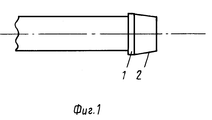
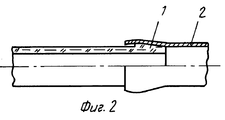
На фиг. 1 изображена трубка со сформованным кольцом 1, завальцованный край 2; на фиг.2 - соединение конца трубки 1 с металлической втулкой 2. In FIG. 1 shows a tube with a molded
Кварцевая или керамическая трубка запрессовывается в предварительно нагретую втулку 2. Наружный диаметр кольца выполняется с превышением внутреннего диаметра втулки для образования натяга, обеспечивающего пластическую деформацию стенки втулки. На одну из поверхностей предварительно или в процессе образования соединения наносят слой из пластичного металла. После проведения запрессовки материал втулки упрочняется. A quartz or ceramic tube is pressed into the preheated
П р и м е р. Кварцевая трубка диаметром 17,0 мм, толщиной стенки 2,5 мм с концом для соединения, имеющим конус с углом между образующей и основанием 80о, с кольцом шириной 1 мм и диаметром 18,0 ± 0,1 мм запрессовывалась во втулку, изготовленную их сплава 36НХТЮ с толщиной стенки 0,2 мм и внутренним диаметром 17,0 ± 0,1 мм при температуре 1100 К. Внутренняя поверхность втулки предварительно покрывалась слоем из меди толщиной 6-9 мкм. После запрессовки сплав втулки подвергался упрочнению термоообработкой при температуре 1000 + 10 К в течение 6 ч. Проведенные испытания на термическую усталость путем многократного нагрева и охлаждения в диапазоне температур 300-870 К показали, что вакуумная плотность соединения не нарушается в течение 10000 циклов.PRI me R. A quartz tube with a diameter of 17.0 mm, a wall thickness of 2.5 mm with an end for connection, having a cone with an angle between the generatrix and the base of 80 about , with a
Claims (3)
Priority Applications (1)
| Application Number | Priority Date | Filing Date | Title |
|---|---|---|---|
| SU5009124 RU2024373C1 (en) | 1991-11-14 | 1991-11-14 | Method of connecting ceramic of quartz tube with metal sleeve |
Applications Claiming Priority (1)
| Application Number | Priority Date | Filing Date | Title |
|---|---|---|---|
| SU5009124 RU2024373C1 (en) | 1991-11-14 | 1991-11-14 | Method of connecting ceramic of quartz tube with metal sleeve |
Publications (1)
| Publication Number | Publication Date |
|---|---|
| RU2024373C1 true RU2024373C1 (en) | 1994-12-15 |
Family
ID=21588788
Family Applications (1)
| Application Number | Title | Priority Date | Filing Date |
|---|---|---|---|
| SU5009124 RU2024373C1 (en) | 1991-11-14 | 1991-11-14 | Method of connecting ceramic of quartz tube with metal sleeve |
Country Status (1)
| Country | Link |
|---|---|
| RU (1) | RU2024373C1 (en) |
Cited By (1)
| Publication number | Priority date | Publication date | Assignee | Title |
|---|---|---|---|---|
| RU2433026C1 (en) * | 2010-07-12 | 2011-11-10 | Государственное образовательное учреждение высшего профессионального образования "Сибирский государственный аэрокосмический университет имени академика М.Ф. Решетнева" (СибГАУ) | Method to join heat-resistant cobalt-based alloy and ceramics based on silicon nitride |
-
1991
- 1991-11-14 RU SU5009124 patent/RU2024373C1/en active
Non-Patent Citations (1)
| Title |
|---|
| Патент США N 4453106, кл. H 01J 5/50, 1984. * |
Cited By (1)
| Publication number | Priority date | Publication date | Assignee | Title |
|---|---|---|---|---|
| RU2433026C1 (en) * | 2010-07-12 | 2011-11-10 | Государственное образовательное учреждение высшего профессионального образования "Сибирский государственный аэрокосмический университет имени академика М.Ф. Решетнева" (СибГАУ) | Method to join heat-resistant cobalt-based alloy and ceramics based on silicon nitride |
Similar Documents
| Publication | Publication Date | Title |
|---|---|---|
| US4297779A (en) | Method of joining structural elements | |
| US4167351A (en) | Metal-to-ceramic seals | |
| KR930002866B1 (en) | Manufacturing method of high pressure fluid supply pipe | |
| US3968982A (en) | Coaxial metallurgical connection | |
| RU2024373C1 (en) | Method of connecting ceramic of quartz tube with metal sleeve | |
| JP3947576B2 (en) | Proximity switch | |
| US20260097453A1 (en) | Bonding element for diffusion bonding, comprising a heating element and a bonding structure with an outer metal surface | |
| US4930546A (en) | Heat-insulating metal-ceramic structure | |
| RU2109606C1 (en) | Method of making soldered telescopic structures | |
| RU2207236C1 (en) | Titanium-steel reducer | |
| US3573021A (en) | Method of making a ceramic-metallic composite | |
| JPS635887A (en) | How to join pipes made of different materials | |
| RU2104838C1 (en) | Method of brazing of two layer articles | |
| RU2301732C1 (en) | Method for diffusion welding of tubes of different-property materials | |
| JPS6362592B2 (en) | ||
| RU2537979C2 (en) | Production of bimetal pipes by soldering | |
| RU2106230C1 (en) | Method for manufacture of soldered telescopic construction | |
| RU2815735C1 (en) | Method of making vacuum-tight outlet beryllium window | |
| RU2224167C2 (en) | Method of silphon compensator production | |
| JPS5950430B2 (en) | Clad pipe manufacturing method | |
| RU2300027C1 (en) | Joint for cylindrical parts of same diameter | |
| RU2736581C2 (en) | Method of soldering a telescopic structure | |
| SU1546219A1 (en) | Method of press soldering of parts | |
| SU1123157A1 (en) | Method and apparatus for producing laminated articles | |
| RU2096143C1 (en) | Method of soldering telescopic structures |