RU2007373C1 - Method for making automotive triplex windshield - Google Patents
Method for making automotive triplex windshield Download PDFInfo
- Publication number
- RU2007373C1 RU2007373C1 SU4875851A RU2007373C1 RU 2007373 C1 RU2007373 C1 RU 2007373C1 SU 4875851 A SU4875851 A SU 4875851A RU 2007373 C1 RU2007373 C1 RU 2007373C1
- Authority
- RU
- Russia
- Prior art keywords
- glass
- tube
- package
- glasses
- mixture
- Prior art date
Links
- 238000000034 method Methods 0.000 title claims abstract description 10
- 239000011521 glass Substances 0.000 claims abstract description 28
- 238000007789 sealing Methods 0.000 claims abstract description 18
- 239000000203 mixture Substances 0.000 claims abstract description 11
- 230000006835 compression Effects 0.000 claims abstract description 4
- 238000007906 compression Methods 0.000 claims abstract description 4
- 239000000178 monomer Substances 0.000 claims abstract description 3
- 238000000016 photochemical curing Methods 0.000 claims description 8
- 239000007788 liquid Substances 0.000 claims description 6
- 238000004519 manufacturing process Methods 0.000 claims description 5
- BPQQTUXANYXVAA-UHFFFAOYSA-N Orthosilicate Chemical compound [O-][Si]([O-])([O-])[O-] BPQQTUXANYXVAA-UHFFFAOYSA-N 0.000 claims description 2
- 238000005816 glass manufacturing process Methods 0.000 abstract 1
- 230000005855 radiation Effects 0.000 abstract 1
- 239000000126 substance Substances 0.000 abstract 1
- 239000000463 material Substances 0.000 description 2
- 239000002184 metal Substances 0.000 description 2
- 239000005368 silicate glass Substances 0.000 description 2
- 239000000853 adhesive Substances 0.000 description 1
- 230000001070 adhesive effect Effects 0.000 description 1
- 238000005266 casting Methods 0.000 description 1
- 238000001723 curing Methods 0.000 description 1
- 239000003292 glue Substances 0.000 description 1
- 239000005340 laminated glass Substances 0.000 description 1
- 230000003287 optical effect Effects 0.000 description 1
- 230000001681 protective effect Effects 0.000 description 1
Images
Landscapes
- Joining Of Glass To Other Materials (AREA)
Abstract
Description
Изобретение относится к технике изготовления изделий остекления, склеенных с применением жидких композиций, полимеризующихся в процессе отверждения. The invention relates to techniques for the manufacture of glazed products glued using liquid compositions polymerized during curing.
Наиболее близким к предлагаемому изобретению является способ изготовления многослойного стекла, согласно которому сборку стеклопакета осуществляют с использованием уплотнительной прокладки определенной толщины. В зазор между стеклами вводят определенное количество неотвержденной композиции и сжимают центральную часть стекол с таким расчетом, чтобы зазор в центральной части был бы меньше толщины прокладки. Closest to the proposed invention is a method of manufacturing a laminated glass, according to which the assembly of the glass is carried out using a gasket of a certain thickness. A certain amount of the uncured composition is introduced into the gap between the glasses and the central part of the glasses is compressed so that the gap in the central part is less than the thickness of the gasket.
Недостатком способа является значительная трудоемкость сборки, необходимость контроля толщины изделия в каждой точке, значительная разнотолщинность и невозможность получения изделий сложной конфигурации из тонких стекол. The disadvantage of this method is the significant complexity of the assembly, the need to control the thickness of the product at each point, significant thickness variation and the inability to obtain products of complex configuration from thin glasses.
Техническим результатом изобретения является получение автомобильного ветрового стекла - триплекc заданной толщины и геометрических размеров, а также снижение трудоемкости изготовления изделий. The technical result of the invention is to obtain an automobile windshield - a triplex of a given thickness and geometric dimensions, as well as reducing the complexity of manufacturing products.
Поставленная цель достигается тем, что в способе изготовления триплекса с применением жидких олигомер-мономерных фотоотверждаемых композиций путем сборки стеклопакета с помощью эластичной герметизирующей прокладки, сжатия, заполнения зазора жидкой смесью и последующего фотоотверждениz, сборку стеклопакета ведут при одновременном введении между стекол эластичной герметизирующей прокладки и ее сжатия по периметру изделия прозрачными калибрами, устанавливая их с шагом 50 - 200 мм, а фотоотверждение проводят на профилированной форме. This goal is achieved by the fact that in the method of manufacturing triplex using liquid oligomer-monomeric photocurable compositions by assembling a double-glazed unit using an elastic sealing pad, compressing, filling the gap with a liquid mixture and subsequent photo-curing, the assembly of the double-glazed unit is carried out by simultaneously introducing an elastic sealing pad between the glasses and it compression along the perimeter of the product with transparent gauges, setting them in increments of 50 - 200 mm, and photo-curing is carried out on a profiled form.
Прозрачные калибры могут быть выполнены из силикатного или органического стекла и соединены между собой упругим элементом. Transparent gauges can be made of silicate or organic glass and interconnected by an elastic element.
Эластичная герметизирующая прокладка выполнена в виде П-образного, либо Т-образного профиля с эластичным наконечником в виде трубки, гофра или ласточкина хвоста. The elastic sealing gasket is made in the form of a U-shaped or T-shaped profile with an elastic tip in the form of a tube, corrugation or dovetail.
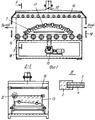
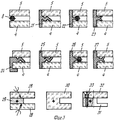
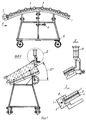
На фиг. 1 изображен ложемент для сборки и заливки стеклопакета; на фиг. 2 - конвейер фотоотверждения со стеклопакетом; на фиг. 3 - герметизирующие профили и калибрующие устройства. In FIG. 1 shows a lodgement for the assembly and filling of a double-glazed window; in FIG. 2 - photocuring conveyor with a double-glazed window; in FIG. 3 - sealing profiles and calibrating devices.
Ложемент для сборки и заливки стеклопакета состоит из следующих узлов: 1 - профиль для установки стекла; 2, 3 - калибр из органического стекла; 4, 5 - нижнее и верхнее стекла пакета; 6 - олигомер-мономерная композиция (ОМК) внутри стеклопакета; 7 - упругий соединительный элемент (например, леска); 8 - эластичная герметизирующая прокладка (эластичная трубка); 9 - тележка с колесами; 10 - заливочная воронка; 11 - узел поворота и фиксации профиля для установки стекла; 12 - шарнирный узел. The lodgement for the assembly and pouring of a double-glazed unit consists of the following units: 1 - a profile for installing glass; 2, 3 - caliber from organic glass; 4, 5 - lower and upper glass of the package; 6 - oligomer-monomer composition (OMK) inside the glass; 7 - elastic connecting element (for example, fishing line); 8 - elastic sealing gasket (elastic tube); 9 - a trolley with wheels; 10 - filling funnel; 11 - node rotation and fixing the profile for installing glass; 12 - hinge assembly.
Конвейер фотоотверждения со стеклопакетом заполнен ОМК 13 и установлен на профилированной форме 1. Конвейер фотоотверждения состоит из роликового транспортеpа 14, привода 15, ламп ЛУФ-80 16, светоотражающего экрана 17, станины 18, защитных экранов 19 и вытяжного короба 20. The photo-curing conveyor with a double-glazed window is filled with OMK 13 and mounted on profiled
В качестве герметизирующих профилей используют: 8 - трубку; 21 - Т-образный профиль с гофрированным уплотняющим наконечником; 22 - Т-образный профиль с трубкой в качестве уплотняющего элемента, 23 - Т-образный профиль с уплотняющим элементом в виде ласточкина хвоста, 24 - П-образный профиль с калибрующим сечением и гофрированным уплотняющим элементом; 25 - Т-образный профиль с калибрующим сечением и гофрированным уплотняющим элементом; 26 - Т-образный профиль с калибрующим сечением и уплотняющим элементом в виде трубки; 27 - Т-образный профиль с калибрующим сечением и уплотняющим элементом в виде ласточкина хвоста. As sealing profiles use: 8 - tube; 21 - T-shaped profile with corrugated sealing tip; 22 - T-shaped profile with a tube as a sealing element, 23 - T-shaped profile with a sealing element in the form of a dovetail, 24 - U-shaped profile with a calibrating section and corrugated sealing element; 25 - T-shaped profile with a calibrating section and a corrugated sealing element; 26 - T-shaped profile with a calibrating section and a sealing element in the form of a tube; 27 - T-shaped profile with a calibrating section and a sealing element in the form of a dovetail.
Показаны калибрующие устройства трех типов: 28, 29 - из силикатных стекол 28 и металлической пластины 29, которые склеены клеем; 30 - из органического стекла; 31, 32, 33 - из металлической пластины 31 и накладки 32 из органического стекла, которая крепится механически винтом 33. Calibration devices of three types are shown: 28, 29 - from
П р и м е р. Вымытое и обработанное адгезионным подслоем стекло укладывают на ложемент для сборки стекла (фиг. 1), затем устанавливают с зазором внешнее стекло и по периметру вводят эластичную герметизирующую прокладку, например, трубку, при этом в месте введения трубки стекла сжимают до толщины меньшей, чем заданная, а в точке сжатия стекла защемляют калибром. Таким образом, постепенно вводя трубку и устанавливая прозрачные калибры, герметизируют стеклопакет, оставляя открытой зону подачи смеси. PRI me R. The glass washed and treated with an adhesive underlayer is placed on a glass assembly lodgement (Fig. 1), then an external glass is installed with a gap and an elastic sealing gasket, for example, a tube, is introduced along the perimeter, while at the point of introduction of the glass tube, they are compressed to a thickness less than a specified , and at the compression point the glass is jammed with a caliber. Thus, gradually introducing the tube and installing transparent gauges, seal the double-glazed window, leaving the mixture supply zone open.
Затем изделие поворачивают, как показано на фиг. 1 (вид А), устанавливают воронку 10 и выливают в нее определенную порцию ОМК. После того, как воронка опорожнилась, ее снимают, герметизируют зону подачи смеси и переводят заполненный стеклопакет в горизонтальное положение и одновременно с помощью иглы удаляют воздушный пузырь. Then the product is rotated as shown in FIG. 1 (view A), a
Затем контролируют внешний вид детали на отсутствие пузырей, если где-либо наблюдается пузырь, его удаляют иглой. Then the appearance of the part is checked for the absence of bubbles, if a bubble is observed somewhere, it is removed with a needle.
После этого деталь снимают с ложемента сборки-заливки и устанавливают на профилированную форму (фиг. 2 (III)), которая поступает на конвейер фотоотверждения. В процессе перемещения на конвейере внутри тоннеля изделие отверждается, а затем выходит из зоны облучения. При этом калибры снимают, готовое изделие моют, контролируют и упаковывают. After that, the part is removed from the lodgement of the assembly-casting and installed on the profiled form (Fig. 2 (III)), which enters the photocuring conveyor. In the process of moving on a conveyor inside the tunnel, the product cures and then leaves the irradiation zone. At the same time, the gauges are removed, the finished product is washed, controlled and packaged.
В таблице представлена зависимость зазора калибра и толщины готового ветрового стекла - триплекс от толщин используемых силикатных стекол при постоянной (1,5 мм) заданной толщине промежуточного слоя. The table shows the dependence of the caliber gap and the thickness of the finished windshield - triplex on the thicknesses of the silicate glasses used with a constant (1.5 mm) given thickness of the intermediate layer.
Толщина промежуточного слоя определяется свойствами полимерного материала, исходя из необходимого условия - удовлетворять всему комплексу требований к ветровому стеклу. The thickness of the intermediate layer is determined by the properties of the polymeric material, based on the necessary condition - to satisfy the whole range of requirements for the windshield.
В зависимости от свойств материала толщина промежуточного слоя может варьироваться от 0,8 до 1,5 мм. Разнотолщинность детали, получаемая при данном способе, составляет ± 0,1 мм. Depending on the properties of the material, the thickness of the intermediate layer can vary from 0.8 to 1.5 mm. The thickness difference of the part obtained with this method is ± 0.1 mm
Предложенный способ позволяет получать ветровые стекла-триплекс для автомобилей с заданной толщиной, герметическими и оптическими характеристиками с использованием жидких олигомер-мономерных фотоотверждаемых составов. (56) Патент Японии N 54-27364, НКИ 21 B 5, 1979. The proposed method allows to obtain triplex windshields for cars with a given thickness, hermetic and optical characteristics using liquid oligomer-monomeric photocurable compositions. (56) Japanese Patent N 54-27364, NKI 21
Claims (3)
Priority Applications (1)
| Application Number | Priority Date | Filing Date | Title |
|---|---|---|---|
| SU4875851 RU2007373C1 (en) | 1990-09-13 | 1990-09-13 | Method for making automotive triplex windshield |
Applications Claiming Priority (1)
| Application Number | Priority Date | Filing Date | Title |
|---|---|---|---|
| SU4875851 RU2007373C1 (en) | 1990-09-13 | 1990-09-13 | Method for making automotive triplex windshield |
Publications (1)
| Publication Number | Publication Date |
|---|---|
| RU2007373C1 true RU2007373C1 (en) | 1994-02-15 |
Family
ID=21541470
Family Applications (1)
| Application Number | Title | Priority Date | Filing Date |
|---|---|---|---|
| SU4875851 RU2007373C1 (en) | 1990-09-13 | 1990-09-13 | Method for making automotive triplex windshield |
Country Status (1)
| Country | Link |
|---|---|
| RU (1) | RU2007373C1 (en) |
Cited By (5)
| Publication number | Priority date | Publication date | Assignee | Title |
|---|---|---|---|---|
| RU2132825C1 (en) * | 1997-09-11 | 1999-07-10 | Товарищество с ограниченной ответственностью "Нелжа" | Method of manufacturing laminated glass |
| RU2162064C2 (en) * | 1998-12-23 | 2001-01-20 | Открытое акционерное общество "Саратовский институт стекла" | Method of producing multilayer laminated glass of complicated configurations |
| RU2311434C2 (en) * | 2002-06-12 | 2007-11-27 | Дау Глобал Текнолоджиз Инк. | Method of coating of the adhesive undercoat on the window glass |
| RU2700387C2 (en) * | 2014-09-30 | 2019-09-16 | Секисуй Кемикал Ко., Лтд. | Intermediate film for multilayer glass, rolled article, multilayer glass, method of producing intermediate film for multilayer glass and method of producing rolled article |
| RU2747406C1 (en) * | 2018-01-11 | 2021-05-04 | Сэн-Гобэн Гласс Франс | Vehicle glass, vehicle and manufacturing method |
-
1990
- 1990-09-13 RU SU4875851 patent/RU2007373C1/en active
Cited By (5)
| Publication number | Priority date | Publication date | Assignee | Title |
|---|---|---|---|---|
| RU2132825C1 (en) * | 1997-09-11 | 1999-07-10 | Товарищество с ограниченной ответственностью "Нелжа" | Method of manufacturing laminated glass |
| RU2162064C2 (en) * | 1998-12-23 | 2001-01-20 | Открытое акционерное общество "Саратовский институт стекла" | Method of producing multilayer laminated glass of complicated configurations |
| RU2311434C2 (en) * | 2002-06-12 | 2007-11-27 | Дау Глобал Текнолоджиз Инк. | Method of coating of the adhesive undercoat on the window glass |
| RU2700387C2 (en) * | 2014-09-30 | 2019-09-16 | Секисуй Кемикал Ко., Лтд. | Intermediate film for multilayer glass, rolled article, multilayer glass, method of producing intermediate film for multilayer glass and method of producing rolled article |
| RU2747406C1 (en) * | 2018-01-11 | 2021-05-04 | Сэн-Гобэн Гласс Франс | Vehicle glass, vehicle and manufacturing method |
Similar Documents
| Publication | Publication Date | Title |
|---|---|---|
| US4807419A (en) | Multiple pane unit having a flexible spacing and sealing assembly | |
| CN1193158C (en) | Thermally insulating glazing and its manufacturing method | |
| US5120584A (en) | Insulating glass pane for motor vehicles | |
| CN101600846B (en) | Insulating window element comprising a convex pane | |
| FI107325B (en) | A method of making a car glass pane | |
| US5033249A (en) | Insulating glazing | |
| FI109343B (en) | A profile frame, especially a car glass pane, and a method and apparatus for making such a glass pane | |
| SE508620C2 (en) | Glazing unit and methods for its manufacture | |
| JPS6470220A (en) | Automobile window glass for direct bonding | |
| EP0056762A3 (en) | Manufacture of multiple glazing with gas filling | |
| CN88100783A (en) | Fire-resistant safety glass | |
| CA1068097A (en) | Multiple pane insulating panel having a thick seal and a method for use in making same | |
| NL8620064A (en) | ENCAPSULED MULTIPLE WINDOW UNIT. | |
| GB1600867A (en) | Safety glass | |
| US20040261933A1 (en) | Method for the adhesion of windowpanes | |
| EP0192363A1 (en) | Multiple glazing | |
| AU2019226028A1 (en) | Glass heating mechanisms and methods of making insulating glass units using the same | |
| YU43165B (en) | Process for obtaining differently hardended areas of glass panes, especially of wind screens of motor vehicles | |
| CN111217541A (en) | Integrated pouring type composite fireproof glass and preparation method thereof | |
| RU2031873C1 (en) | Method of triplex glass production | |
| SU743963A1 (en) | Device for gluing multilayer vitrification articles | |
| GB2144475A (en) | Hollow glazing panels | |
| US20250250848A1 (en) | Aerogel mounting and encapsulation technology, manufacturing methods, insulating glass units and related subassemblies | |
| SU1481217A1 (en) | Laminated glass | |
| SU767038A1 (en) | Glass package and its manufacturing method |