NL2010581C2 - Method and system for reduction of caking. - Google Patents
Method and system for reduction of caking. Download PDFInfo
- Publication number
- NL2010581C2 NL2010581C2 NL2010581A NL2010581A NL2010581C2 NL 2010581 C2 NL2010581 C2 NL 2010581C2 NL 2010581 A NL2010581 A NL 2010581A NL 2010581 A NL2010581 A NL 2010581A NL 2010581 C2 NL2010581 C2 NL 2010581C2
- Authority
- NL
- Netherlands
- Prior art keywords
- dispersion
- amount
- liquid development
- viscosity
- liquid developer
- Prior art date
Links
- 238000000034 method Methods 0.000 title claims abstract description 44
- 230000009467 reduction Effects 0.000 title description 7
- 239000007788 liquid Substances 0.000 claims abstract description 239
- 239000006185 dispersion Substances 0.000 claims abstract description 211
- 239000002270 dispersing agent Substances 0.000 claims abstract description 93
- 238000011161 development Methods 0.000 claims abstract description 56
- 239000002245 particle Substances 0.000 claims abstract description 49
- 238000012546 transfer Methods 0.000 claims abstract description 9
- 239000000203 mixture Substances 0.000 claims description 61
- 239000007787 solid Substances 0.000 claims description 26
- 150000001875 compounds Chemical class 0.000 claims description 6
- 239000012141 concentrate Substances 0.000 claims description 6
- 239000012530 fluid Substances 0.000 claims description 4
- 238000011144 upstream manufacturing Methods 0.000 claims description 3
- WHNWPMSKXPGLAX-UHFFFAOYSA-N N-Vinyl-2-pyrrolidone Chemical compound C=CN1CCCC1=O WHNWPMSKXPGLAX-UHFFFAOYSA-N 0.000 claims description 2
- 229920002873 Polyethylenimine Polymers 0.000 claims description 2
- 150000001336 alkenes Chemical class 0.000 claims description 2
- 229920000083 poly(allylamine) Polymers 0.000 claims description 2
- 229920001610 polycaprolactone Polymers 0.000 claims description 2
- 239000004632 polycaprolactone Substances 0.000 claims description 2
- 229920000642 polymer Polymers 0.000 claims description 2
- 229920006301 statistical copolymer Polymers 0.000 claims description 2
- 238000007599 discharging Methods 0.000 claims 1
- 238000003384 imaging method Methods 0.000 abstract description 17
- 230000008569 process Effects 0.000 abstract description 11
- 238000004064 recycling Methods 0.000 abstract 1
- 239000003795 chemical substances by application Substances 0.000 description 10
- 238000005259 measurement Methods 0.000 description 6
- 229920005989 resin Polymers 0.000 description 6
- 239000011347 resin Substances 0.000 description 6
- 239000004615 ingredient Substances 0.000 description 5
- 239000011230 binding agent Substances 0.000 description 4
- 239000000758 substrate Substances 0.000 description 4
- 239000000243 solution Substances 0.000 description 3
- 238000010586 diagram Methods 0.000 description 2
- 238000007865 diluting Methods 0.000 description 2
- 238000003801 milling Methods 0.000 description 2
- 238000012360 testing method Methods 0.000 description 2
- 239000004215 Carbon black (E152) Substances 0.000 description 1
- 239000002253 acid Substances 0.000 description 1
- 230000009471 action Effects 0.000 description 1
- 239000000654 additive Substances 0.000 description 1
- 239000011324 bead Substances 0.000 description 1
- 230000008901 benefit Effects 0.000 description 1
- 230000015572 biosynthetic process Effects 0.000 description 1
- 230000008859 change Effects 0.000 description 1
- 230000001419 dependent effect Effects 0.000 description 1
- 239000012895 dilution Substances 0.000 description 1
- 238000010790 dilution Methods 0.000 description 1
- 230000005684 electric field Effects 0.000 description 1
- 230000002708 enhancing effect Effects 0.000 description 1
- 229930195733 hydrocarbon Natural products 0.000 description 1
- 150000002430 hydrocarbons Chemical class 0.000 description 1
- 238000004898 kneading Methods 0.000 description 1
- 238000004519 manufacturing process Methods 0.000 description 1
- 239000000693 micelle Substances 0.000 description 1
- 239000000049 pigment Substances 0.000 description 1
- 229920001225 polyester resin Polymers 0.000 description 1
- 239000004645 polyester resin Substances 0.000 description 1
- 229920001296 polysiloxane Polymers 0.000 description 1
- 238000010008 shearing Methods 0.000 description 1
- 230000002459 sustained effect Effects 0.000 description 1
- 238000010998 test method Methods 0.000 description 1
- 235000015112 vegetable and seed oil Nutrition 0.000 description 1
- 239000008158 vegetable oil Substances 0.000 description 1
Classifications
-
- G—PHYSICS
- G03—PHOTOGRAPHY; CINEMATOGRAPHY; ANALOGOUS TECHNIQUES USING WAVES OTHER THAN OPTICAL WAVES; ELECTROGRAPHY; HOLOGRAPHY
- G03G—ELECTROGRAPHY; ELECTROPHOTOGRAPHY; MAGNETOGRAPHY
- G03G15/00—Apparatus for electrographic processes using a charge pattern
- G03G15/06—Apparatus for electrographic processes using a charge pattern for developing
- G03G15/10—Apparatus for electrographic processes using a charge pattern for developing using a liquid developer
- G03G15/11—Removing excess liquid developer, e.g. by heat
-
- G—PHYSICS
- G03—PHOTOGRAPHY; CINEMATOGRAPHY; ANALOGOUS TECHNIQUES USING WAVES OTHER THAN OPTICAL WAVES; ELECTROGRAPHY; HOLOGRAPHY
- G03G—ELECTROGRAPHY; ELECTROPHOTOGRAPHY; MAGNETOGRAPHY
- G03G15/00—Apparatus for electrographic processes using a charge pattern
- G03G15/06—Apparatus for electrographic processes using a charge pattern for developing
- G03G15/10—Apparatus for electrographic processes using a charge pattern for developing using a liquid developer
- G03G15/104—Preparing, mixing, transporting or dispensing developer
-
- G—PHYSICS
- G03—PHOTOGRAPHY; CINEMATOGRAPHY; ANALOGOUS TECHNIQUES USING WAVES OTHER THAN OPTICAL WAVES; ELECTROGRAPHY; HOLOGRAPHY
- G03G—ELECTROGRAPHY; ELECTROPHOTOGRAPHY; MAGNETOGRAPHY
- G03G9/00—Developers
- G03G9/08—Developers with toner particles
- G03G9/12—Developers with toner particles in liquid developer mixtures
- G03G9/13—Developers with toner particles in liquid developer mixtures characterised by polymer components
- G03G9/132—Developers with toner particles in liquid developer mixtures characterised by polymer components obtained otherwise than by reactions only involving carbon-to-carbon unsaturated bonds
Landscapes
- Physics & Mathematics (AREA)
- General Physics & Mathematics (AREA)
- Chemical & Material Sciences (AREA)
- Chemical Kinetics & Catalysis (AREA)
- Wet Developing In Electrophotography (AREA)
- Liquid Developers In Electrophotography (AREA)
- Emulsifying, Dispersing, Foam-Producing Or Wetting Agents (AREA)
Abstract
Disclosed is a liquid toner dispersion which has a relative low shear viscosity between 1.25 and 225 and a relative conductivity between 0.3 and 30. The liquid toner dispersion includes toner particles in a non-polar carrier liquid, as well as a dispersing agent. This liquid toner dispersion is used in a digital printing process including adding dispersing agent during recycling of excess liquid toner dispersion remaining on a development member after patterned transfer of liquid toner dispersion to the imaging member.
Description
Method and system for reduction of caking
This invention relates to a method and a system for reducing caking in liquid developer dispersion in a digital printing process.
Liquid developer dispersions are known in the art and are used for electrophotography and developing electrostatic latent images formed on a latent image carrying member in a digital printing process. An example of such printing apparatus is provided in US patent with publication number 7,995,953, the content of which is incorporated into this application in its entirety by reference.
A digital printing apparatus using liquid developer dispersion is often provided with means to collect excess liquid developer dispersion. Excess liquid developer dispersion is liquid developer dispersion that remains on a member and that is not transferred to the substrate during the printing process. The collected excess liquid developer dispersion can be recycled and can be reused. A problem of the known liquid developer dispersions is that the excess liquid developer dispersion remaining on the developer roll has a tendency to show caking. Caking is the formation of lumps in the dispersion resulting in a liquid where there is no uniform dispersion of the marking particles. Caking often results in an increase of viscosity of the liquid. Caking in liquid developer dispersion is the process where marking particles are no longer evenly dispersed in the carrier liquid and are not acting anymore as individual particles. Liquid developer dispersion that shows caking cannot be used for printing as such and needs to be treated first in order to re-obtain a homogeneously dispersed liquid toner which has similar conductivity and viscosity properties as the starting liquid developer dispersion. It is thought that caking is the result of marking particles that come so close into each others neighborhood on the developing member, so that they start to feel each others presence and start interacting with each other. Caking can also be the result of injecting charge and applying high shearing forces which are typically present when a thin layer of liquid developer dispersion passes through a very narrow gap between two members of the printing apparatus.
It is an object of the invention, amongst other objects, to provide excess liquid developer dispersion with reduced or no caking.
It is another object of the invention to reduce caking in excess liquid developer dispersion, so that it can be reused as such, or can be reused by applying only a small number of steps required for obtaining a homogenously dispersed liquid developer dispersion.
These objects, amongst other objects, are met at least partially, if not completely by a method for reducing caking according to claim 1.
These objects, amongst other objects, are met at least partially, if not completely by a method for the reduction of caking of excess liquid developer dispersion that remains present on the surface of a member after transfer of liquid developer dispersion from one member to another member in a digital printing apparatus, comprising the step of adding a dispersing composition to the excess liquid developer dispersion, wherein the dispersing composition comprises a dispersing agent. The dispersing agent is added with an amount that is sufficient to provide a reduction of caking
The inventors surprisingly found that by adding a dispersing composition to the excess liquid developer dispersion, the caking of the excess liquid developer significantly reduces. Furthermore, the inventors surprisingly found that by adding a dispersing composition to the excess liquid developer, the electrical conductivity and the viscosity of the excess liquid developer dispersion are similar to the viscosity and the electrical conductivity of liquid developer dispersion.
Without being bound to a theory, it is thought that the added dispersing agent in the dispersing composition adheres to the surface of the marking particles and tends to restore the dispersing properties of the dispersing agents already adhered on the marking particles. The dispersing agents that are already adhered on the marking particles seem to have lost the dispersing properties due to certain steps in the printing process. The steps that may be of influence on the dispersing properties are most likely a combination of the corona charger and/or discharger to charge/discharge marking particles in the liquid toner on the developer roller, and the fact that the liquid developer dispersion is forced to form a very thin layer on the members of the printing apparatus. Both steps may result in the dispersing agent being rearranged on the marking particles, causing the caking phenomenon. In this respect it is important to note that there is a difference between the dispersing agents already adhered on the marking particles in the liquid developer dispersion, and the dispersing agent in the dispersing composition according to the invention that is added in the method according to the invention. The dispersing agent that is already adhered to the marking particle is added at the time of manufacturing liquid developer dispersion. Then, marking particles, dispersing agent and carrier liquid are milled whereupon the dispersing agent adheres to the marking particles to form a homogenous dispersion according to techniques known in the art.
The dispersing composition according to the invention comprises dispersing agent with an amount that is sufficient to reduce caking in excess liquid developing dispersion.
In one embodiment the dispersing composition according to the invention comprises dispersing agent that is free in the composition, wherein the free dispersing agent is present in an amount that is sufficient to be capable of reducing caking by adding dispersing composition to excess liquid developer dispersion. In a possible embodiment illustrated in figure 1A, the dispersion composition comprises only free dispersing agent, i.e. only dispersing agent not residing on particles. In other embodiments the dispersing composition can comprise both free dispersing agent as well as dispersing agent adhered to particles, see figure IB. If the dispersing composition comprises particles, such as marking particles or other particles, on which the dispersing agent resides, the dispersing composition also comprises dispersing agent that is free, wherein the amount of free dispersing agent is sufficient to be capable of reducing caking in excess liquid developing dispersion.
The free dispersing agents can form a micelle in the composition. Preferably, the dispersing composition is a mixture of a dispersing agent and a carrier liquid.
In this invention, "dispersing agent", can refer to one type of dispersing agent or also to a combination of several dispersing agents.
According to the invention, a liquid developer dispersion comprises marking particles, carrier liquid and dispersing agent. It may also comprise further compounds such as compounds for arranging the viscosity or charge control agent (CCA), charge enhancing agents (CEA), wax, and other additives.
In this invention, when is referred to a concentration of "liquid developer dispersion" it refers to a concentration wherein the liquid developer dispersion has a solid content so that it can be used as such in a digital printing process. In other words, the liquid developer dispersion according to the invention has a solid content that is at working strength and does not require a dilution. On the contrary, "concentrated liquid developer dispersion" has a solid content which is too high to be used for printing and is generally diluted with carrier liquid to obtain a liquid developer dispersion which is ready to be used in a digital printing process. A typical solid content of a liquid developer dispersion is a solid content of between 10 to 30 wt%, such as a solid content of 25 wt%.
According to this invention, "solid content" means the amount of marking particles in wt% with regard to the total liquid developer dispersion.
According to this invention, "excess liquid developer dispersion" is the liquid developer dispersion that remains present on the surface of a member, such as the developing member, after a part of liquid developer dispersion has been transferred to another member, such as the imaging member. The concentration of toner particles (solid content) in excess liquid developer dispersion will vary depending on the amount of marking particles that need to be developed. The two most extreme situations of developing are that all the liquid developer dispersion is developed, or none of the liquid developer dispersion is developed. The latter results in a substrate without printed image. When no liquid developer dispersion is developed and all the marking particles remain on the developing member and thus reside in the excess liquid developer dispersion, the solid content is higher than in the liquid developer dispersion. On the contrary, if all the liquid developer dispersion is developed, the excess liquid developer dispersion remaining on the developer roller will comprise almost no marking particles resulting in an excess liquid developer dispersion that mainly comprises carrier liquid. A person skilled in the art will understand that the solid content and the concentration of the carrier liquid in the excess liquid developer dispersion will vary between these two extremes depending on what needs to be developed. Typically, during the printing process a certain amount of carrier liquid is lost. Typically, the viscosity of the excess liquid developing dispersion is increased compared to the viscosity of liquid developing dispersion. The increase of the viscosity is due to the loss of carrier liquid and due to caking. Caking causes a structural change in the liquid developing dispersion and has a significant contribution to the increase of viscosity of the excess liquid developer dispersion.
When there is referred to a concentration of dispersing agent or another compound in excess liquid developing dispersion in wt%, in this invention, than it is intended to refer to a concentration of dispersing agent or another compound compared to the weight of excess liquid developing dispersion that remains on the member of the carrier liquid, unless it is clear that something else is meant.
The marking particles, according to this invention, comprise colored particles (also called ink particles or pigment) and a binder resin. The binder resin is a polymer, preferably transparent, that embeds the ink particles and optionally other compounds. The marking particles are particles with a diameter of typically about 0.5 to 4.0 pm. The marking particles have a concentration of about 40-95 % of the binder resin. Preferably a polyester resin is used as binder resin. Also other types of resin having a very low or no compatibility with the carrier liquid and dispersing agent can be used. Preferably, the resin has a high transparency, provides good color developing properties and has a high fixing property on the substrate.
The carrier liquid according to the invention, can be any suitable liquid as is known in the art, and may be silicone fluids, hydrocarbon liquids and vegetable oils, or any combinations thereof.
According to the invention, the dispersing composition is added to excess liquid developing dispersion. Excess liquid developing dispersion is the liquid that resides on or has been removed from a member, such as a development member, after a part of liquid developing dispersion has been transferred to another member, such as the imaging member.
In one embodiment, the dispersing composition is added after excess liquid developing dispersion has been removed from the member on which the excess liquid developer dispersion resides and collected.
In another embodiment, the dispersing composition is added before excess liquid developing dispersion is removed from the member on which the excess liquid developer dispersion resides.
In yet another embodiment, the dispersing composition is added before and after excess liquid developing dispersion has been removed from the member on which the excess liquid developer dispersion resides and collected.
In one embodiment according to the invention, the dispersing agent in the dispersing composition is added with an amount that is sufficient to obtain a concentration of between 0.005 wt% and 0.5 wt%, preferably between 0.01 wt% and 0.3 wt%, and most preferably between 0.02 wt% and 0.2 wt% of added dispersing agent with regard to the total weight of excess liquid developer dispersion. The inventors surprisingly found that adding such a small amount of dispersing agent is sufficient to reduce caking of excess liquid developer dispersion, and is able to restore the viscosity and conductivity of the excess liquid developer dispersion to a conductivity and viscosity which is roughly the same as that of liquid developer dispersion.
In another embodiment, the invention is related to a method wherein the dispersing agent in the dispersing composition is selected from the group consisting of polymeric dispersing agents with a polyethylenimine or polyallylamine backbone and polyhydroxystearate and/or polycaprolactone grafts; statistical copolymer of vinylpyrrolidone and long chain olefins.
Typical examples of dispersing agents are solsperse 11000, solsperse 13940 solsperse 11200, Antaron V220, Ajispers 817, tilosperse 8300 or tilosperse 13000. Preferably the dispersing agent is solsperse 13940.
In yet another embodiment, the invention is related to a method wherein the amount of the dispersing agent in the dispersing composition that is added is sufficient to decrease a viscosity of the excess liquid developer dispersion.
In yet another embodiment, the invention is related to a method wherein the viscosity of the treated excess liquid developer dispersion is between 1.1 and 25 times lower, preferably between 1.5 and 15 times lower and most preferably between 2 and 10 times lower compared to the viscosity of untreated excess liquid developer dispersion, when the viscosity is measured at 25°C at a shear rate of 0.88 1/s. As example the viscosity of the liquid developer dispersion and carrier liquid is measured with a Haake
Rheostress RS600 whereby the instrument is equipped with a cone/plate geometry type C60/l° and the gap is set to 0.052mm.
In yet another embodiment, the invention is related to a method comprising the step of collecting excess liquid developer dispersion.
In yet another embodiment, the invention is related to a method further comprising the step of mixing the collected excess liquid developer dispersion with dispersing composition by suitable mixing means.
In yet another embodiment, the invention is related to a method also comprising the step of determining an amount of dispersing composition to be added to reduce caking of excess liquid developer dispersion, wherein the adding comprises adding the determined amount. In further developed embodiments the determining of an amount to be added may be based on a measurement of the viscosity of the excess liquid developer dispersion and/or on image information.
In yet another embodiment, the invention is related to a method wherein the dispersing composition consists of dispersing agent or a combination of dispersing agents.
In yet another embodiment, the invention is related to a method wherein the dispersing composition consists of a mixture of dispersing agent or a combination of dispersing agents and a carrier liquid.
According to a further developed embodiment of the method of the invention, image information about an image that is being printed in the digital printing apparatus is collected, wherein the image information is representative for the fraction of liquid developer dispersion that is being developed. The amount of dispersion composition to be added is determined based on the collected image information, the determined amount of dispersion composition is added.
Such embodiments are based inter alia on the insight of the inventors that the liquid toner properties, such as the viscosity and electrical conductivity, of the remaining non used excess liquid developer dispersion are a function of the amount of toner and/or liquid used during the development process. When no image has been developed only carrier liquid with a small amount of dispersing agent is transferred from the development member to the imaging roller. In a situation where a full density over the complete width has been developed, mostly only carrier liquid remains of the surface of the development roller.
More in particular, the inventors have realized that the concentration of the dispersing agent in the excess liquid developer dispersion will be a function of the coverage of the developed image: a larger developed area leads to less reduction in dispersing agent concentration. In other words, using the image information, a suitable amount of dispersion agent to be added can be determined.
According to another aspect of the invention there is provided a digital printing system comprising a first member in rotational contact with a second member; said first and second member being configured for transferring liquid developer dispersion from the first member to the second member, such that an excess liquid developer dispersion remains present on the surface of the first member after transfer of liquid developer dispersion to the second member. The system further comprises adding means configured for adding an amount of dispersing agent to the excess liquid developer dispersion, and control means for controlling the adding means such that the amount added is sufficient to reduce caking in the excess liquid developer dispersion.
Preferably, the control means are configured for controlling the adding means such that the amount added is sufficient to decrease the viscosity of the excess liquid developer dispersion.
Preferably, the control means are configured for controlling the adding means such that the amount added is sufficient the obtain a viscosity of treated excess liquid developer dispersion that is 1.1 and 25 times lower, preferably between 1.5 and 15 times lower, and most preferably between 2 and 10 times lower compared to the viscosity of untreated excess liquid developer dispersion, when the viscosity is measured at 25°C at a shear rate of 0.88 1/s.
According to a further developed embodiment the system further comprises collecting and determining means configured for collecting image information about an image that is being printed in the digital printing system, wherein the image information is representative for a fraction of liquid developer dispersion that is being developed on the development roller; and for determining an amount of dispersion agent to be added based on the collected image information. In addition, the control means may be configured for controlling the adding means using the determined amount of dispersion agent to be added.
According to a preferred embodiment the second member is an imaging member adapted to sustain a pattern of electric charge forming a latent image on its surface; and the first member is a development member arranged to receive a quantity of liquid developer dispersion, and to develop said latent image by transferring a portion of said quantity of liquid developer dispersion onto said imaging member in accordance with said pattern. The image information as defined above is directly related to the pattern and is a measure for the fraction of developer dispersion that is being developed.
According to yet another embodiment, the system comprises a viscosity sensor arranged for measuring the viscosity of the excess liquid developer dispersion. The controller may then be configured for controlling the adding means based on the measured viscosity. Alternatively or in addition, the system comprises a conductivity sensor arranged for measuring the conductivity of the excess liquid developer dispersion, wherein the controller is configured for controlling the adding means based on the measured conductivity.
According to a preferred embodiment, the digital printing system comprises a first reservoir adapted for collecting the excess liquid developer solution, wherein the adding means are arranged for adding an amount of dispersing agent in the first reservoir. This first reservoir is typically relatively small and may be provided with a suitable mixing means for mixing the excess liquid developer solution with an amount of dispersing agent. The system further comprises a second reservoir, typically larger than the first reservoir, adapted for mixing the excess liquid developer solution in which the amount of dispersing agent is added, with carrier liquid and/or toner concentrate. To that end there are provided carrier liquid adding means arranged for adding an amount of carrier liquid in the second reservoir, and toner concentrate adding means arranged for adding an amount of toner concentrate in the second reservoir. Typically, the second reservoir is connected to the main reservoir for returning recycled developer dispersion to a main reservoir comprising a feeding means for feeding a developer roller. Such a system has the advantage that caking in the collected excess liquid developer dispersion can be adequately addressed in the first reservoir, whilst the solid content can be brought to a suitable level in the second reservoir.
The above generally describes the invention but to assist with understanding, reference will now be made to the figures and non-limiting examples which show embodiments of the invention.
Figure 1 is a representation of a dispersing composition according to the invention;
Figure 2 is a schematic diagram of a system according to a first embodiment of the present invention; and
Figure 3 is a schematic diagram of a system according to a second embodiment of the present invention.
Figure 1 illustrates schematically a dispersing composition according to the invention. The dispersing agent is represented by little circles with a coil. Particles are represented with dark balls. The grey area represents liquid in which dispersing agent and/or marking particles reside. Figure 1A represents dispersing composition without particles, Figure IB represents dispersing composition with particles .
Figure 2 schematically illustrates the application of an amount of liquid developer dispersion 100, initially stored in a liquid developer dispersion reservoir 110, also called main reservoir, via a toner supply member 120, a development member 130, an imaging member 140, and an optional intermediate member 150, to a substrate 199.
Without loss of generality, the aforementioned members are all illustrated and described as rollers. The development member 130, imaging member 140, and intermediate member 150 all transfer part of the liquid developer dispersion 100 adhering to their surface to their successor; the part of the liquid developer dispersion 100 that remains present on the member's surface, thus the excess liquid developer dispersion is removed after the transfer stage by appropriate means. These means are schematically illustrated as respective removal means 133, 146, 153.
The excess liquid developer dispersion removed by scraper 133 is added to a first reservoir 170. Optionally the excess liquid developer dispersion removed by scrapers 146 and 153 may be added to the same reservoir 170. Alternatively there may be provided separate reservoirs/lines for the collection of excess liquid developer dispersion removed by scrapers 146 and 153. Dispersing composition comprising free dispersing agent (DA) is added to the first reservoir 170 using DA adding means 171. The DA adding means 171 may be controlled by a controller 172 configured to determine a suitable amount of dispersion composition to be added. Optionally there may be provided a viscosity sensor 175 to determine the viscosity of the excess liquid toner dispersion 173, and the controller 172 may be configured to determine the amount to be added based on the viscosity measured by the sensor 175. Alternatively or additionally, the controller may be configured to determine the amount to be added based on image information (not illustrated in figure 2).
In the illustrated embodiment the sensor 175 is provided in the line between the scraper 133 and the reservoir first 170. Alternatively or in addition, a viscosity sensor could be provided in the line between the first reservoir 170 and a second reservoir 180 or in the line between the second reservoir 180 and the main reservoir 110. Al so there may be provided more than one viscosity sensor 175, in order to further improve the control accuracy.
Optionally dispersing composition and/or carrier liquid may be added to the excess liquid developer dispersion before being removed, see reference numeral 154.
Optionally the collected excess liquid developer dispersion 173 is mixed using a suitable mixing means 176. Next, the excess liquid developer dispersion with added dispersion agent is introduced in a second reservoir 180 having a larger volume than the first reservoir 170 and comprising a suitable mixing means 186. In the exemplary embodiment of figure 2, the second reservoir 180 is used for bringing the solid content (SC) of the excess liquid developer dispersion on a suitable level for reintroduction in the main reservoir 110. To that end there are provided carrier liquid adding means 183 and toner adding means 184. The solid content is measured using a solid content sensor 185 in the line between the second reservoir 180 and the main reservoir 110, and there is provided a controller 182 to control the amount of carrier liquid and the amount of toner concentrate to be added based on the measured solid content.
According to a non-illustrated embodiment there may be provided one or more conductivity sensors to measure the conductivity of the excess liquid developer dispersion.
Those one or more conductivity sensors may be provided at the same locations defined above for the viscosity sensor.
In such an embodiment the controller may further take into account the conductivity measurements to determine the amount of dispersing agent to be added.
According to a non-illustrated further embodiment there may be provided a single mixing reservoir in which dispersion composition, carrier liquid and toner concentrate are separately added using dispersing composition adding means, carrier liquid adding means and toner adding means, respectively. Also in such an embodiment a viscosity sensor may be added to measure the viscosity of the excess liquid developer dispersion, preferably before it is introduced in the reservoir. Again this measurement may be used by a controller for controlling the added amount of dispersing composition.
Figure 3 illustrates a second embodiment of a digital printing system of the invention. The system comprises an imaging member 140 adapted to sustain a pattern of electric charge forming a latent image on its surface, and a development member 130 arranged to receive a quantity of liquid developer dispersion from a feed roller 120, and to develop said latent image by transferring a portion of said quantity of liquid developer dispersion onto said imaging member 140 in accordance with said pattern, such that an excess liquid developer dispersion remains present on the surface of the development member. This excess liquid developer dispersion is removed by a scraper 133 and added to a mixing container 170, see arrow 230. The system further comprises DA adding means 171 configured for adding an amount of dispersing composition to the excess liquid developer dispersion 173, and control means 200 for controlling the adding means such that the amount added is sufficient to reduce caking in the removed excess liquid developer dispersion. The control means may receive image information, directly related to the pattern sustained on the imaging member 140, from a computer 210 in order to control the imaging member 140 as well as the adding means 171. Preferably, the control means 200 are configured for controlling the DA adding means 171 such that the amount of dispersion agent added is sufficient to decrease the viscosity. The image information is representative for a fraction of liquid developer dispersion that is being developed on the development roller; and is used to determine an amount of dispersion agent to be added. In the embodiment of figure 3 the computer 210 may obtain the image information in function of the time and calculate an amount of dispersion agent to be added in function of the time.
Also a loosening roller/member 240 to reduce caking may be provided downstream of the area of contact between the developer roller and the imaging roller, as disclosed in unpublished European patent application No. EP 13 162 577.4 in the name of the Applicant, the content of which is included herein by reference. According to an embodiment of the invention the dispersing agent may be added on such a loosening roller/member, see arrow 250. In that case the adding of dispersion agent (arrow 260) in the container 170 may be omitted. Optionally there may be provided a (non-illustrated) viscosity sensor to measure the viscosity of the excess liquid developer dispersion. Such a measurement may be used by the control means 200 to control the DA adding means 171. More in particular the control means 200 may be configured for controlling the DA adding means 171 such that the amount added results in the shear viscosity of the excess liquid developer dispersion being between 1.1 and 25 times lower, preferably between 1.5 and 15 times lower, and most preferably between 2 and 10 times lower, after adding the amount of dispersion composition.
The skilled person understands that the features of the embodiments of figure 2 may be combined with the features of figure 3. Such combinations also fall within the scope of the invention. More in particular the skilled person understands that the embodiment of figure 3 may further comprise a second reservoir 180 in combination with adding means 183, 184 as disclosed in figure 2.
It has been observed that the liquid toner properties, such as the viscosity and electrical conductivity of the remaining non used excess liquid developer dispersion are dependent upon the amount of toner and/or liquid that has been used during the development process. In case no image has to be developed, only carrier liquid with some dispersing agents has been removed from the compacted liquid toner layer. In a situation where a 50 % screened image has been developed, both toner and carrier liquid have been taken out of the layer on the development roller. In a situation where a full density over the complete width has been developed, mostly only carrier liquid remains on the surface of the development roller.
Based on the considerations above, it becomes clear that in real printing conditions the remaining composition on the development roller can be predicted based on the image information. More in particular, the inventors have realized that the concentration of the dispersing agent in the excess liquid developer dispersion will be a function of the development density: more development leads to less reduction in dispersing agent concentration. Less development results in an excess liquid developer dispersion layer having a higher solid content on the surface of the development roller, with a reduced conductivity, resulting in a more viscous and more structured excess liquid developer dispersion layer. Adding an amount of dispersing agent as a function of the image content, optionally in combination with a mixing action, may increase the conductivity and reduce the viscosity, and in particular may bring the excess liquid developer dispersion in a condition showing substantially the same viscosity and conductivity behavior as the starting product.
Non-illustrated embodiments of the system of the invention may further comprise an upstream corona charger arranged opposite to a surface of the developer roller, upstream of the area of its rotational contact with the imaging roller, in order to charge the imaging particles contained in the liquid toner before reaching the imaging roller, and a downstream discharge corona, downstream of the area of contact between the developer roller and the imaging roller .
Examples 1. Test methods 1.1 Conductivity
The conductivity is measured with a device as described in EP1120647 with an electric field strength of 1.25x10s V/m.
1.2 Viscosity
The viscosity of the liquid developer dispersion and carrier liquid is measured with a Haake Rheostress RS600 operated in shear rate sweep from 0.1 to 30001/s at 25°C The instrument is equipped with a cone/plate geometry type C60/l° and the gap is set to 0.052 mm.
1.3 Particle size distribution
The particle size distribution is measured by a Mastersizer MS2000 from Malvern.
The milled down liquid developer dispersion is diluted before the measurement so as to obtain 10% obscuration during the measurement.
2. Results 2.1 Preparing liquid developer dispersion A liquid developer dispersion is prepared and comprises marking particles, carrier liquid and dispersing agents. The ingredients used to prepare the marking particles and the liquid developer dispersions are summarized in table 1.
Table 1: Ingredients
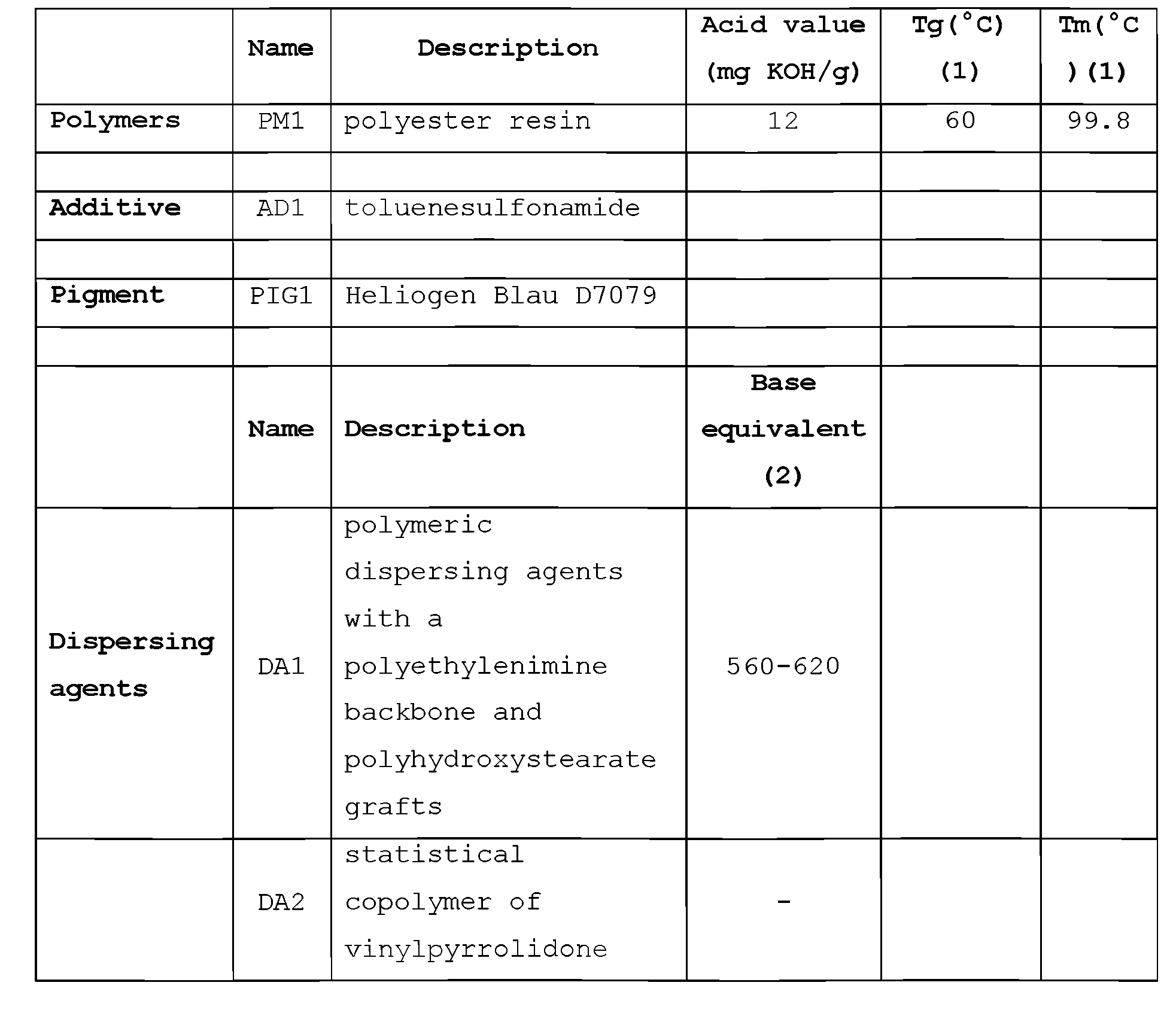

(1) measured according to ASTM D3418 (2) the amount of dispersing agent that is needed to neutralize 1 mol of acid
The marking particles are prepared by kneading the ingredients as mentioned in table 2 at a temperature of 100 to 120°C for 45 minutes. This mixture is cooled down and milled down to 10 pm by a fluidized bed mill.
Table 2: Composition of marking particles
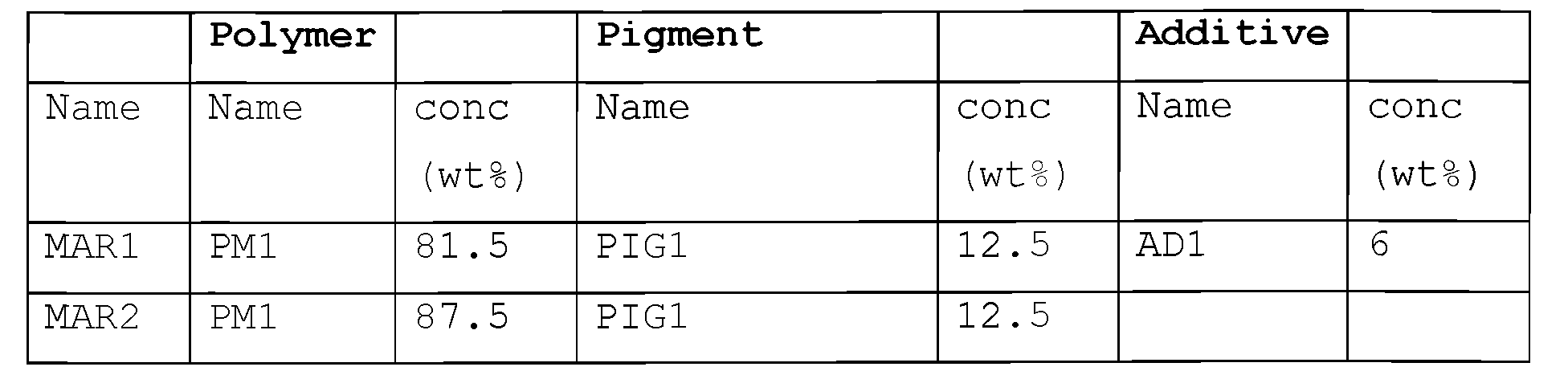
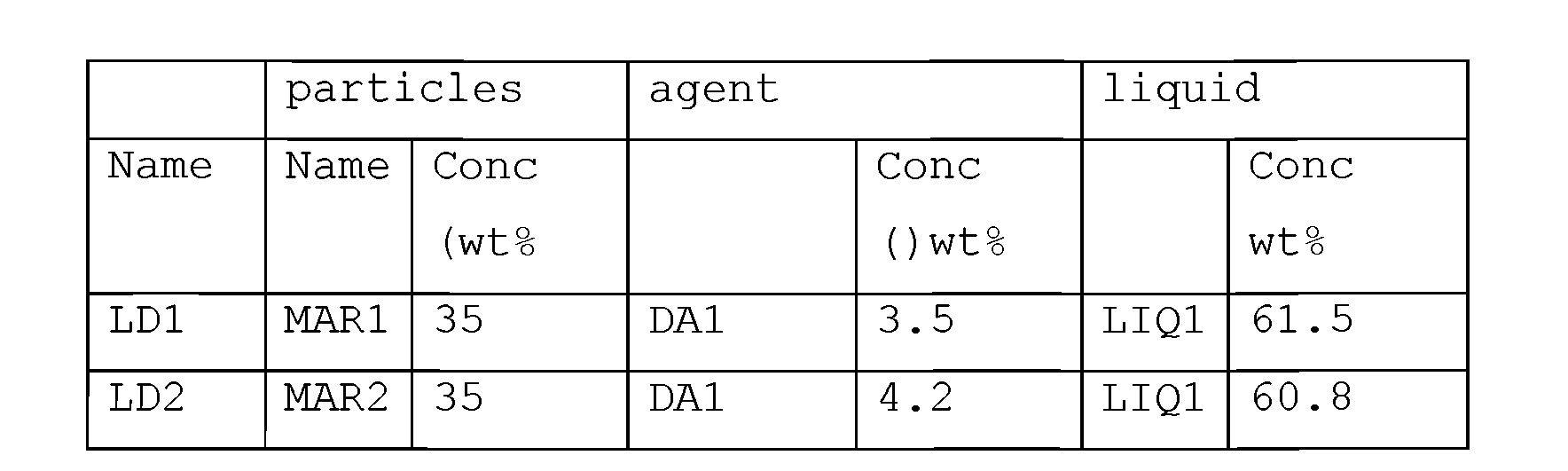
Afterwards, the liquid developer dispersions having the ingredients as described in table 3 are prepared. A predispersion of the ingredients is made and stirred for 10 min at room temperature. The pre-dispersion is than brought into the liquid milling device. The liquid developer dispersion is milled down to a dv50 of 1.5 to 2.5 pm with a bead mill. The milling was done until the desired particle size, viscosity and conductivity was obtained.
Table 3: Composition of liquid developer dispersion

2.2 Printing test A printing test was performed with liquid developer dispersions LD1 and LD2 in a printer having a setup as illustrated in figure 2. LD 1 and LD2 were first diluted to obtain a solid content of 25 wt%.
The excess liquid developer dispersion (in table 4 mentioned as LD1 and LD2 caking) was collected using removal means. A dispersion composition comprising free dispersing agent was added to the excess liquid developer dispersion, at different concentrations which can be found in Table 4. In some cases the excess liquid developer dispersion is diluted to a solid content of 25 wt% after DAI has been added (sample 6 and 7). In other cases the excess liquid developer dispersion is concentrated by adding concentrated liquid developer dispersion to obtain a solid content of 25 wt% (sample 11, 12). The concentration of DA that is added is given in wt% with regard to the weight of excess liquid developer dispersion before it is diluted or concentrated.
Table 4: Properties of collected excess liquid developer dispersion
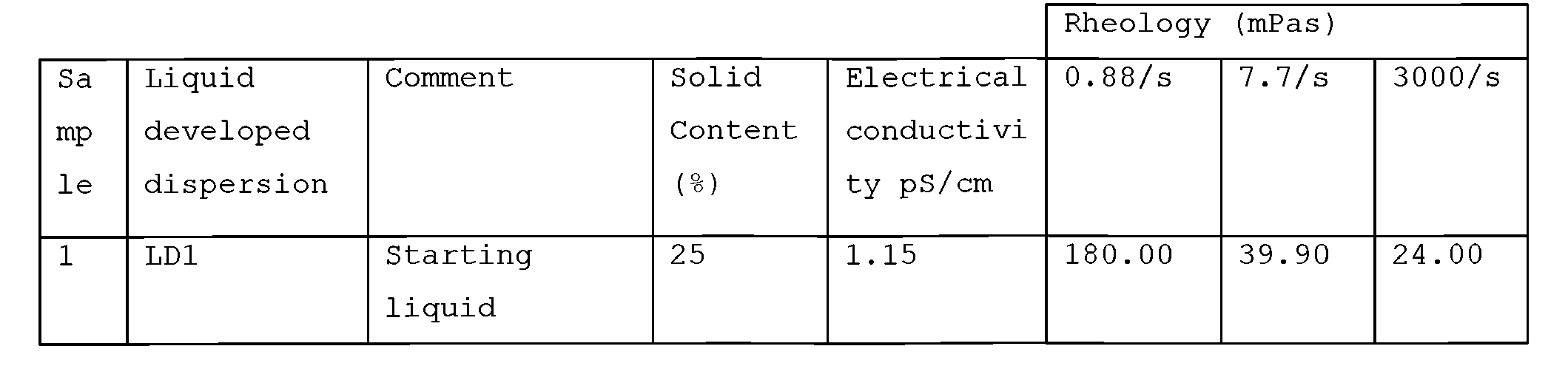
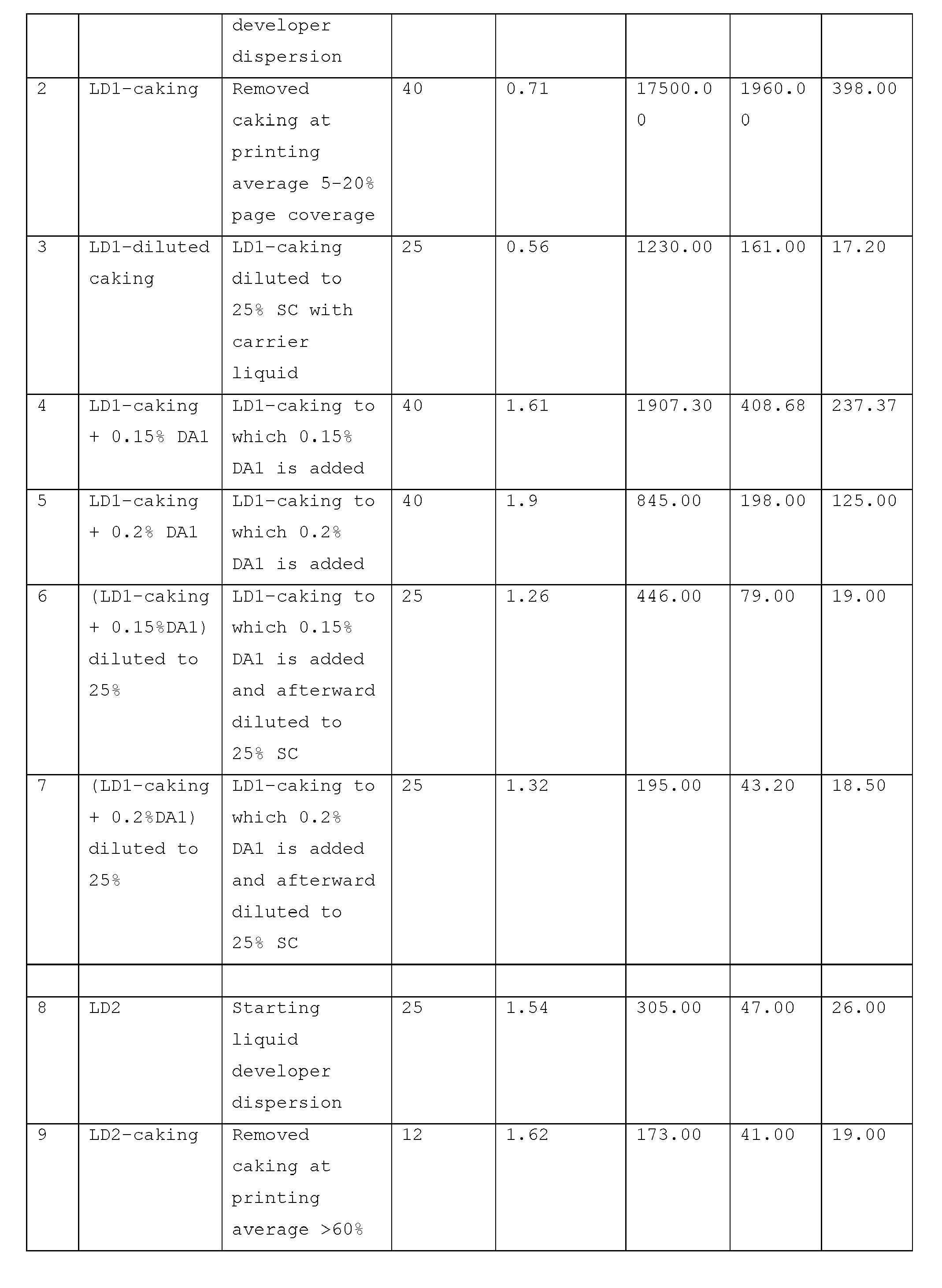

Table 4 shows that by adding a small amount of dispersing agent, a reduction in viscosity is obtained (compare sample 2 with sample 4 or 5). In addition, diluting the treated excess liquid developer dispersion results in a viscosity that is similar with the liquid developer dispersion (compare sample 1 with sample 7). As is clear from sample 3, diluting caked excess liquid developer dispersion without adding dispersing agent, is not enough to obtain a viscosity that is similar to the viscosity obtained in sample 1. Furthermore, it is worth to note that the conductivity values of the treated samples tend to be the same as the conductivity value of starting liquid developer dispersion, when both samples have the same solid content (compare sample 6 and 7 with sample 1).
Furthermore, table 4 shows that when a high image coverage is printed, the solid content of excess liquid developer dispersion is lower than 25% (sample 9). The viscosity of the excess liquid developer dispersion is in this case lower than the viscosity of the starting liquid developer dispersion because the solid content of the excess liquid developer dispersion is very low. The caking of the low content excess liquid developer dispersion LD2 can be significantly reduced by adding 0.05% DAI (compare sample 9 and 10). Concentration of the treated excess liquid developer dispersion by adding concentrated liquid developer dispersion with a solid content of 35% to obtain a solid content of 25%, results in a viscosity that is similar with the viscosity of starting liquid developer dispersion (compare sample 8 and 12). The addition of concentrated LD2 to the caked excess liquid developing dispersion that is not treated, does not reduce the caking problem and results in an increase of viscosity due to the increase of solid content (compare sample 8 with 11).
Claims (27)
Priority Applications (8)
| Application Number | Priority Date | Filing Date | Title |
|---|---|---|---|
| NL2010581A NL2010581C2 (en) | 2013-04-05 | 2013-04-05 | Method and system for reduction of caking. |
| EP20140161752 EP2787395A1 (en) | 2013-04-05 | 2014-03-26 | Method and system for reduction of caking |
| US14/244,642 US9285715B2 (en) | 2013-04-05 | 2014-04-03 | Method and system for reduction of caking |
| JP2016505850A JP2016519334A (en) | 2013-04-05 | 2014-04-04 | Digital printing process and toner dispersion |
| PCT/EP2014/056871 WO2014162004A1 (en) | 2013-04-05 | 2014-04-04 | Digital printing process and liquid toner dispersion therefore |
| US14/782,499 US9500998B2 (en) | 2013-04-05 | 2014-04-04 | Liquid toner dispersion having a specified relative conductivity and relative viscosity and process for transferring an image to a substrate |
| JP2014077623A JP2014225000A (en) | 2013-04-05 | 2014-04-04 | Method and system for reducing caking |
| EP14715313.4A EP2981865B1 (en) | 2013-04-05 | 2014-04-04 | Digital printing process and liquid toner dispersion therefore |
Applications Claiming Priority (2)
| Application Number | Priority Date | Filing Date | Title |
|---|---|---|---|
| NL2010581 | 2013-04-05 | ||
| NL2010581A NL2010581C2 (en) | 2013-04-05 | 2013-04-05 | Method and system for reduction of caking. |
Publications (1)
| Publication Number | Publication Date |
|---|---|
| NL2010581C2 true NL2010581C2 (en) | 2014-10-08 |
Family
ID=48577825
Family Applications (1)
| Application Number | Title | Priority Date | Filing Date |
|---|---|---|---|
| NL2010581A NL2010581C2 (en) | 2013-04-05 | 2013-04-05 | Method and system for reduction of caking. |
Country Status (5)
| Country | Link |
|---|---|
| US (2) | US9285715B2 (en) |
| EP (2) | EP2787395A1 (en) |
| JP (2) | JP2014225000A (en) |
| NL (1) | NL2010581C2 (en) |
| WO (1) | WO2014162004A1 (en) |
Cited By (2)
| Publication number | Priority date | Publication date | Assignee | Title |
|---|---|---|---|---|
| US9575436B2 (en) | 2013-09-04 | 2017-02-21 | Xeikon IP B.V. | Method of digitally printing an image on a substrate and system therefor |
| US9606475B2 (en) | 2013-09-04 | 2017-03-28 | Xeikon IP B.V. | Method of digitally printing and a digital printing system |
Families Citing this family (7)
| Publication number | Priority date | Publication date | Assignee | Title |
|---|---|---|---|---|
| BE1022066B1 (en) * | 2013-06-28 | 2016-02-15 | Chemstream Bvba | SURFACE ACTIVE AND PREPARATION THEREOF |
| NL2013779B1 (en) * | 2014-11-12 | 2016-10-07 | Xeikon Ip Bv | Stirring apparatus and method for stirring a liquid. |
| JP6435929B2 (en) * | 2015-03-05 | 2018-12-12 | 富士ゼロックス株式会社 | Liquid developer supply device and image forming apparatus |
| JP6848315B2 (en) * | 2016-10-05 | 2021-03-24 | 富士ゼロックス株式会社 | Image forming device |
| DE102016123650A1 (en) * | 2016-12-07 | 2018-06-07 | Endress+Hauser Conducta Gmbh+Co. Kg | Method for determining a measured variable correlated with an extinction and corresponding sensor arrangement |
| JP6487486B2 (en) * | 2017-04-26 | 2019-03-20 | 花王株式会社 | Liquid developer |
| WO2021086324A1 (en) * | 2019-10-29 | 2021-05-06 | Hewlett-Packard Development Company, L.P. | Image formation with a concentrated ink mixture |
Citations (3)
| Publication number | Priority date | Publication date | Assignee | Title |
|---|---|---|---|---|
| GB1353207A (en) * | 1970-07-27 | 1974-05-15 | Xerox Corp | Imaging system |
| JPS5879276A (en) * | 1981-11-06 | 1983-05-13 | Canon Inc | image forming device |
| JPH04220498A (en) * | 1990-12-20 | 1992-08-11 | Ricoh Co Ltd | Liquid cleaner for liquid developer |
Family Cites Families (39)
| Publication number | Priority date | Publication date | Assignee | Title |
|---|---|---|---|---|
| US4454215A (en) * | 1981-05-27 | 1984-06-12 | Savin Corporation | Improved composition for developing latent electrostatic images for gap transfer to a carrier sheet |
| US5061583A (en) * | 1990-01-19 | 1991-10-29 | Minnesota Mining And Manufacturing Company | Color electrophotography for high quality half-tone images |
| JPH0744025A (en) * | 1993-07-30 | 1995-02-14 | Fuji Xerox Co Ltd | Developer concentration controller for wet image forming apparatus |
| DE69435298D1 (en) * | 1993-11-30 | 2010-08-05 | Canon Kk | Toner and developer for electrostatic images, their production process, and image forming process |
| JPH08114950A (en) * | 1994-10-14 | 1996-05-07 | Minolta Co Ltd | Liquid developer for replenishment |
| US5515141A (en) * | 1995-02-02 | 1996-05-07 | Hewlett-Packard Company | In-line tubular mixing device for liquid electrophotographic purposes |
| JPH11174850A (en) * | 1997-12-05 | 1999-07-02 | Ricoh Co Ltd | Wet image forming device |
| US6088560A (en) * | 1998-07-07 | 2000-07-11 | Imation Corp. | Liquid ink replenishment system for liquid electrographic imaging devices |
| JP2000066457A (en) * | 1998-08-20 | 2000-03-03 | Minolta Co Ltd | Liquid developing method, concentrated liquid developer, diluent, and method for producing diluent |
| JP2000181148A (en) * | 1998-12-15 | 2000-06-30 | Dainippon Printing Co Ltd | Wet developer and printing system |
| JP3914658B2 (en) * | 1999-05-27 | 2007-05-16 | 株式会社リコー | Wet image forming device |
| US6287741B1 (en) * | 1999-09-03 | 2001-09-11 | Research Laboratories Of Australia Pty Ltd | Liquid toner composition |
| AUPQ529000A0 (en) | 2000-01-28 | 2000-02-17 | Research Laboratories Of Australia Pty Ltd | Toner characterization cell |
| US6815136B1 (en) * | 2000-02-28 | 2004-11-09 | Xerox Corporation | Liquid developers and processes thereof |
| US6600884B2 (en) * | 2001-11-26 | 2003-07-29 | Kabushiki Kaisha Toshiba | Method and apparatus for forming image |
| US20050160938A1 (en) * | 2002-01-08 | 2005-07-28 | Samsung Electronics Co., Ltd. | Liquid inks comprising stabilizing organosols |
| US6905807B2 (en) * | 2002-01-08 | 2005-06-14 | Samsung Electronics Co., Ltd. | Liquid inks comprising stabilizing organosols |
| US6897002B2 (en) * | 2002-03-25 | 2005-05-24 | Ricoh Company, Ltd. | Liquid developer, image-fixing apparatus using the same, and image-forming apparatus using the same |
| US7333754B2 (en) * | 2003-09-17 | 2008-02-19 | Seiko Epson Corporation | Image forming apparatus and method using liquid development |
| JP2006150925A (en) * | 2004-11-02 | 2006-06-15 | Fuji Photo Film Co Ltd | Inkjet recorder |
| JP2007041162A (en) * | 2005-08-01 | 2007-02-15 | Seiko Epson Corp | Method for producing liquid developer and liquid developer |
| US7995953B2 (en) | 2005-09-09 | 2011-08-09 | Xeikon IP B.V. | High speed electrographic printing |
| JP2008107424A (en) * | 2006-10-23 | 2008-05-08 | Seiko Epson Corp | Liquid developer, method for producing liquid developer, and image forming apparatus |
| JP4382065B2 (en) * | 2006-07-19 | 2009-12-09 | シャープ株式会社 | Toner supply method, toner supply device, and program |
| JP2008170603A (en) * | 2007-01-10 | 2008-07-24 | Seiko Epson Corp | Image forming method and image forming apparatus using liquid developer |
| US7729626B2 (en) * | 2007-06-25 | 2010-06-01 | Konica Minolta Business Technologies, Inc. | Apparatus and method for adjusting concentration of liquid developer |
| WO2009041634A1 (en) * | 2007-09-28 | 2009-04-02 | Sakata Inx Corp. | Process for producing liquid developer |
| US8299141B2 (en) * | 2007-12-21 | 2012-10-30 | Eastman Kodak Company | Mixed phase method of manufacturing ink |
| JP2009251087A (en) * | 2008-04-02 | 2009-10-29 | Konica Minolta Business Technologies Inc | Wet developer |
| JP5168035B2 (en) * | 2008-04-02 | 2013-03-21 | コニカミノルタビジネステクノロジーズ株式会社 | Wet developer |
| JP2009300875A (en) * | 2008-06-16 | 2009-12-24 | Konica Minolta Business Technologies Inc | Wet image forming apparatus |
| US8958722B2 (en) * | 2009-10-28 | 2015-02-17 | Kyocera Mita Corporation | Extractor for extracting a dispersoid and a dispersion medium and imaging forming apparatus employing this extractor |
| JP2011180434A (en) * | 2010-03-02 | 2011-09-15 | Seiko Epson Corp | Image forming apparatus and method for evaluating degree of aggregation of liquid developer |
| JP5640789B2 (en) * | 2010-03-03 | 2014-12-17 | コニカミノルタ株式会社 | Liquid developing apparatus and cleaning method |
| EP2378376A1 (en) | 2010-04-08 | 2011-10-19 | Miyakoshi Printing Machinery Co., Ltd. | Wet type developing apparatus and wet type developing method |
| JP5444179B2 (en) * | 2010-09-22 | 2014-03-19 | 株式会社ミヤコシ | Wet development apparatus and wet development method |
| JP2012185359A (en) * | 2011-03-07 | 2012-09-27 | Toyo Ink Sc Holdings Co Ltd | Liquid developer |
| JP5947133B2 (en) * | 2012-07-17 | 2016-07-06 | シャープ株式会社 | Vapor phase growth apparatus and semiconductor device manufacturing method |
| JP5879276B2 (en) | 2013-01-22 | 2016-03-08 | 京セラドキュメントソリューションズ株式会社 | Information processing apparatus and creation program |
-
2013
- 2013-04-05 NL NL2010581A patent/NL2010581C2/en not_active IP Right Cessation
-
2014
- 2014-03-26 EP EP20140161752 patent/EP2787395A1/en not_active Withdrawn
- 2014-04-03 US US14/244,642 patent/US9285715B2/en not_active Expired - Fee Related
- 2014-04-04 EP EP14715313.4A patent/EP2981865B1/en not_active Not-in-force
- 2014-04-04 JP JP2014077623A patent/JP2014225000A/en active Pending
- 2014-04-04 JP JP2016505850A patent/JP2016519334A/en active Pending
- 2014-04-04 US US14/782,499 patent/US9500998B2/en not_active Expired - Fee Related
- 2014-04-04 WO PCT/EP2014/056871 patent/WO2014162004A1/en not_active Ceased
Patent Citations (3)
| Publication number | Priority date | Publication date | Assignee | Title |
|---|---|---|---|---|
| GB1353207A (en) * | 1970-07-27 | 1974-05-15 | Xerox Corp | Imaging system |
| JPS5879276A (en) * | 1981-11-06 | 1983-05-13 | Canon Inc | image forming device |
| JPH04220498A (en) * | 1990-12-20 | 1992-08-11 | Ricoh Co Ltd | Liquid cleaner for liquid developer |
Cited By (2)
| Publication number | Priority date | Publication date | Assignee | Title |
|---|---|---|---|---|
| US9575436B2 (en) | 2013-09-04 | 2017-02-21 | Xeikon IP B.V. | Method of digitally printing an image on a substrate and system therefor |
| US9606475B2 (en) | 2013-09-04 | 2017-03-28 | Xeikon IP B.V. | Method of digitally printing and a digital printing system |
Also Published As
| Publication number | Publication date |
|---|---|
| WO2014162004A1 (en) | 2014-10-09 |
| US20160041506A1 (en) | 2016-02-11 |
| EP2787395A1 (en) | 2014-10-08 |
| EP2981865A1 (en) | 2016-02-10 |
| US20140301756A1 (en) | 2014-10-09 |
| US9500998B2 (en) | 2016-11-22 |
| JP2016519334A (en) | 2016-06-30 |
| EP2981865B1 (en) | 2017-03-15 |
| US9285715B2 (en) | 2016-03-15 |
| JP2014225000A (en) | 2014-12-04 |
Similar Documents
| Publication | Publication Date | Title |
|---|---|---|
| US9285715B2 (en) | Method and system for reduction of caking | |
| US8496324B2 (en) | Ink composition, digital printing system and methods | |
| CN110561746B (en) | ABS component materials for electrophotography-based additive manufacturing | |
| EP2922701B1 (en) | Methods of printing on a plastic substrate and electrostatic ink compositions | |
| DE69727446T2 (en) | Non-magnetic toner for the development of electrostatic images, production process for non-magnetic toner particles, and their use in the image forming process | |
| CN100472337C (en) | Method of improving physical and electrical properties of liquid xerographic toners or liquid inkjet inks | |
| JP5168035B2 (en) | Wet developer | |
| CN103391978A (en) | Liquid toner composition | |
| KR102101768B1 (en) | Liquid developing agent | |
| NL2011955C2 (en) | Liquid toner dispersion and use thereof. | |
| JP5010436B2 (en) | Liquid developer | |
| EP2084577B1 (en) | High solids liquid toner concentrate and method of its production | |
| US20100151373A1 (en) | Toner Particle Having Excellent Charging Characteristics,Long term Credibility and Transferring Property, Method for Producing the Same and Toner Containing Said Toner Particle | |
| JP2009157346A (en) | Wet developer and fixing method | |
| JP2015060142A (en) | Liquid developer | |
| NL2012115C2 (en) | Liquid toner dispersion and use thereof. | |
| US20110177448A1 (en) | Liquid Developer and Image-Forming Apparatus | |
| NL2010807C2 (en) | Liquid developer dispersion with reduced caking. | |
| KR20160118254A (en) | Liquid developer | |
| JP2014081629A (en) | Liquid developer dispersion for digital printing process | |
| US20100015546A1 (en) | Process for Producing Toner for Liquid Developer, Toner for Liquid Developer, Process for Producing Liquid Developer, Liquid Developer, and Image Forming Apparatus | |
| JP2006267365A (en) | Liquid developer for electrostatic latent image and developing method | |
| EP2223188A1 (en) | Regulated cooling for chemically prepared toner manufacture | |
| KR102292806B1 (en) | Liquid electrophotographic ink composition | |
| DE60217468T2 (en) | Aqueous coating composition for a donor element |
Legal Events
| Date | Code | Title | Description |
|---|---|---|---|
| PD | Change of ownership |
Owner name: XEIKON MANUFACTURING NV; BE Free format text: DETAILS ASSIGNMENT: CHANGE OF OWNER(S), ASSIGNMENT; FORMER OWNER NAME: XEIKON IP B.V. Effective date: 20170411 |
|
| MM | Lapsed because of non-payment of the annual fee |
Effective date: 20180501 |