KR900008552B1 - Process for the preparation vinylthio acetamido-oxacepalosphorine derivatives - Google Patents
Process for the preparation vinylthio acetamido-oxacepalosphorine derivatives Download PDFInfo
- Publication number
- KR900008552B1 KR900008552B1 KR1019830004623A KR830004623A KR900008552B1 KR 900008552 B1 KR900008552 B1 KR 900008552B1 KR 1019830004623 A KR1019830004623 A KR 1019830004623A KR 830004623 A KR830004623 A KR 830004623A KR 900008552 B1 KR900008552 B1 KR 900008552B1
- Authority
- KR
- South Korea
- Prior art keywords
- compound
- mixture
- acid
- yield
- dissolved
- Prior art date
- Legal status (The legal status is an assumption and is not a legal conclusion. Google has not performed a legal analysis and makes no representation as to the accuracy of the status listed.)
- Expired
Links
- 0 I*C=C1S*CS1 Chemical compound I*C=C1S*CS1 0.000 description 4
Classifications
-
- C—CHEMISTRY; METALLURGY
- C07—ORGANIC CHEMISTRY
- C07F—ACYCLIC, CARBOCYCLIC OR HETEROCYCLIC COMPOUNDS CONTAINING ELEMENTS OTHER THAN CARBON, HYDROGEN, HALOGEN, OXYGEN, NITROGEN, SULFUR, SELENIUM OR TELLURIUM
- C07F9/00—Compounds containing elements of Groups 5 or 15 of the Periodic Table
- C07F9/02—Phosphorus compounds
- C07F9/28—Phosphorus compounds with one or more P—C bonds
- C07F9/535—Organo-phosphoranes
- C07F9/5352—Phosphoranes containing the structure P=C-
-
- A—HUMAN NECESSITIES
- A61—MEDICAL OR VETERINARY SCIENCE; HYGIENE
- A61K—PREPARATIONS FOR MEDICAL, DENTAL OR TOILETRY PURPOSES
- A61K31/00—Medicinal preparations containing organic active ingredients
- A61K31/33—Heterocyclic compounds
- A61K31/395—Heterocyclic compounds having nitrogen as a ring hetero atom, e.g. guanethidine or rifamycins
- A61K31/535—Heterocyclic compounds having nitrogen as a ring hetero atom, e.g. guanethidine or rifamycins having six-membered rings with at least one nitrogen and one oxygen as the ring hetero atoms, e.g. 1,2-oxazines
-
- A—HUMAN NECESSITIES
- A61—MEDICAL OR VETERINARY SCIENCE; HYGIENE
- A61P—SPECIFIC THERAPEUTIC ACTIVITY OF CHEMICAL COMPOUNDS OR MEDICINAL PREPARATIONS
- A61P31/00—Antiinfectives, i.e. antibiotics, antiseptics, chemotherapeutics
- A61P31/04—Antibacterial agents
-
- C—CHEMISTRY; METALLURGY
- C07—ORGANIC CHEMISTRY
- C07C—ACYCLIC OR CARBOCYCLIC COMPOUNDS
- C07C309/00—Sulfonic acids; Halides, esters, or anhydrides thereof
-
- C—CHEMISTRY; METALLURGY
- C07—ORGANIC CHEMISTRY
- C07C—ACYCLIC OR CARBOCYCLIC COMPOUNDS
- C07C323/00—Thiols, sulfides, hydropolysulfides or polysulfides substituted by halogen, oxygen or nitrogen atoms, or by sulfur atoms not being part of thio groups
-
- C—CHEMISTRY; METALLURGY
- C07—ORGANIC CHEMISTRY
- C07D—HETEROCYCLIC COMPOUNDS
- C07D241/00—Heterocyclic compounds containing 1,4-diazine or hydrogenated 1,4-diazine rings
- C07D241/02—Heterocyclic compounds containing 1,4-diazine or hydrogenated 1,4-diazine rings not condensed with other rings
- C07D241/06—Heterocyclic compounds containing 1,4-diazine or hydrogenated 1,4-diazine rings not condensed with other rings having one or two double bonds between ring members or between ring members and non-ring members
- C07D241/08—Heterocyclic compounds containing 1,4-diazine or hydrogenated 1,4-diazine rings not condensed with other rings having one or two double bonds between ring members or between ring members and non-ring members with oxygen atoms directly attached to ring carbon atoms
-
- C—CHEMISTRY; METALLURGY
- C07—ORGANIC CHEMISTRY
- C07D—HETEROCYCLIC COMPOUNDS
- C07D339/00—Heterocyclic compounds containing rings having two sulfur atoms as the only ring hetero atoms
-
- C—CHEMISTRY; METALLURGY
- C07—ORGANIC CHEMISTRY
- C07D—HETEROCYCLIC COMPOUNDS
- C07D505/00—Heterocyclic compounds containing 5-oxa-1-azabicyclo [4.2.0] octane ring systems, i.e. compounds containing a ring system of the formula:, e.g. oxacephalosporins; Such ring systems being further condensed, e.g. 2,3-condensed with an oxygen-, nitrogen- or sulfur-containing hetero ring
-
- Y—GENERAL TAGGING OF NEW TECHNOLOGICAL DEVELOPMENTS; GENERAL TAGGING OF CROSS-SECTIONAL TECHNOLOGIES SPANNING OVER SEVERAL SECTIONS OF THE IPC; TECHNICAL SUBJECTS COVERED BY FORMER USPC CROSS-REFERENCE ART COLLECTIONS [XRACs] AND DIGESTS
- Y02—TECHNOLOGIES OR APPLICATIONS FOR MITIGATION OR ADAPTATION AGAINST CLIMATE CHANGE
- Y02P—CLIMATE CHANGE MITIGATION TECHNOLOGIES IN THE PRODUCTION OR PROCESSING OF GOODS
- Y02P20/00—Technologies relating to chemical industry
- Y02P20/50—Improvements relating to the production of bulk chemicals
- Y02P20/55—Design of synthesis routes, e.g. reducing the use of auxiliary or protecting groups
Landscapes
- Chemical & Material Sciences (AREA)
- Organic Chemistry (AREA)
- Health & Medical Sciences (AREA)
- Life Sciences & Earth Sciences (AREA)
- General Health & Medical Sciences (AREA)
- Biochemistry (AREA)
- Molecular Biology (AREA)
- Animal Behavior & Ethology (AREA)
- Veterinary Medicine (AREA)
- Pharmacology & Pharmacy (AREA)
- Medicinal Chemistry (AREA)
- Public Health (AREA)
- Oncology (AREA)
- Communicable Diseases (AREA)
- Epidemiology (AREA)
- Chemical Kinetics & Catalysis (AREA)
- General Chemical & Material Sciences (AREA)
- Nuclear Medicine, Radiotherapy & Molecular Imaging (AREA)
- Pharmaceuticals Containing Other Organic And Inorganic Compounds (AREA)
- Cephalosporin Compounds (AREA)
- Organic Low-Molecular-Weight Compounds And Preparation Thereof (AREA)
- Nitrogen And Oxygen Or Sulfur-Condensed Heterocyclic Ring Systems (AREA)
Abstract
내용 없음.No content.
Description
본 발명은 일반식(Ⅰ)의 7β-치환된 비틸디오 아세트아미도-7α-메톡시-3-치환된 메틸-1-데리아-1-옥사-3-세펨-4-카르복실산 유도체의 제조방법에 관한 것이다.The present invention provides compounds of the 7β-substituted bityldio acetamido-7α-methoxy-3-substituted methyl-1-deria-1-oxa-3-cepem-4-carboxylic acid derivatives of general formula (I). It relates to a manufacturing method.

(상기 식중에서 u는 수소, 카르복사미도, N-히드록시 카르복사미도, 카르복시, 아지도, C6∼C12아실 아미노, 보호된 카르복시 또는 N-C1∼C5-알콕시카르복사미도를 나타내거나, v와 함께 -S- 또는 -CH2S-를 나타낼 수 있으며; v는 수소, 할로겐, 시아노 또는 C1∼C5알킬티오를 나타내거나, u와 함께 -S- 또는 -CH2S-를 나타내거나, w와 함께 -(CH2)3CO-를 나타낼 수 있으며; w는 수소, 카르바모일, 시아노, 카르복시, N-C1∼C5-알킬카르바모일, C1∼C5아킬, C6∼C12아릴, 보호된 카르복시 또는 5 또는 6원의 질소-, 산소- 또는 황-함유 복소환를 나타내거나, v와 함께 -(CH2)3CO-를 나타낼 수 있으며; x는 할로겐, 트리플루오로메틸, C1∼C5알킬티오 또는 C6∼C12아릴티오를 나타내며; y는 수소, 경금속 또는 카르복실산 보호기를 나타내고; z는 C1∼C12아실옥시 또는 상기와 같은 복소환-티오를 나타낸다).Wherein u represents hydrogen, carboxamido, N-hydroxy carboxamido, carboxy, azido, C 6 -C 12 acyl amino, protected carboxy or NC 1 -C 5 -alkoxycarboxamido , v may represent -S- or -CH 2 S-, v represents hydrogen, halogen, cyano or C 1 -C 5 alkylthio, or together with u -S- or -CH 2 S- Or may represent — (CH 2 ) 3 CO— with w; w is hydrogen, carbamoyl, cyano, carboxy, NC 1 -C 5 -alkylcarbamoyl, C 1 -C 5 alkyl , C 6 -C 12 aryl, protected carboxy or a 5 or 6 membered nitrogen-, oxygen- or sulfur-containing heterocycle, or together with v can represent-(CH 2 ) 3 CO-; x is halogen , trifluoromethyl represents a methyl, C 1 ~C 5 alkylthio or C 6 ~C 12 arylthio; y represents hydrogen, a light metal or a carboxylic acid protecting group; z is a C 1 ~C 12 acyloxy Or a heterocyclic ring as described above - represents a thio).
u, v, w, x, y 및 z의 기호로 표시되는 상기의 각 기들은 할로겐 또는 탄소-, 질소-, 산소- 또는 황-함유 관능기에 의해 임의로 치환될 수 있다.Each of the above groups represented by the symbols u, v, w, x, y and z may be optionally substituted by halogen or carbon-, nitrogen-, oxygen- or sulfur-containing functional groups.
본 명세서에서, 용어의 바람직한 범위는 하기와 같다.In the present specification, the preferred range of terms is as follows.
"알킬"이라는 용어는 히드록시, 할로겐, 시아노, 카르복사미도, 카르바모일, 옥소, C1∼C5알킬, C1∼C5알콕시, C1∼C12아실옥시, 아미노, C1∼C12아실 아미노, 디-C1∼C5- 알킬 아미노, 포르밀이미도일 아미노 또는 보호된 카르복시에 의해 임의 치환된 직쇄 C1∼C5알킬, 또는 상치 치환체의 어떤 것에 의해 임의 치환된 C4∼C7시클로알킬을 나타낸다. 이들 치환체는 이후 "보통 치환체"로 한다.The term "alkyl" refers to hydroxy, halogen, cyano, carboxamido, carbamoyl, oxo, C 1 -C 5 alkyl, C 1 -C 5 alkoxy, C 1 -C 12 acyloxy, amino, C 1 -C 12 acyl amino, di-C 1 -C 5 -alkyl amino, formylimidoyl amino or straight chain C 1 -C 5 alkyl optionally substituted by protected carboxy, or C optionally substituted by any of the substituents ~C 4 shows a 7 cycloalkyl. These substituents are hereinafter referred to as "common substituents".
"아실"이라는 용어는 질소, 산소 또는 황에서 선택된 복소원을 환에 임의로 함유하는 직쇄 또는 측쇄 C1∼C7알카노일, C4∼C7시클로알킬 카르보닐, 모노시클릭 또는 비시클릭 C7∼C13아로일, C8∼C14아르알카노일 또는 C9∼C15아릴알케노일, C1∼C5알킬술포닐, C6∼C12아릴술포닐, 카르바모일, 카르보 -C1∼C5- 알콕시, 카르보 -C7∼C13- 아르알콕시 또는 술포를 나타낸다. 이들 아실기는 상술한 하나 이상의 보통 치혼체를 임의로 포함할 수 있다.The term "acyl" refers to a straight or branched C 1 -C 7 alkanoyl, C 4 -C 7 cycloalkyl carbonyl, monocyclic or bicyclic C 7 optionally containing heterocycle selected from nitrogen, oxygen or sulfur in the ring. -C 13 aroyl, C 8 -C 14 aralkanoyl or C 9 -C 15 arylalkenoyl, C 1 -C 5 alkylsulfonyl, C 6 -C 12 arylsulfonyl, carbamoyl, carbo-C 1 -C 5 -alkoxy, carbo-C 7 -C 13 -arkoxy or sulfo. These acyl groups may optionally include one or more of the common interdentates described above.
"아릴"이라는 용어는 상술한 하나 이상의 보통 치환체를 임의로 운반하는 5 또는 6원 모노 또는 비시클릭 C5∼C12아릴기를 나타낸다.The term "aryl" refers to a 5 or 6 membered mono or bicyclic C 5 to C 12 aryl group which optionally carries one or more of the usual substituents described above.
"복소환"이라는 용어는 하나의 산소원자 또는 하나의 황원자 및/또는 1∼4질소원자를 갖는 5 또는 6원 모노 또는 비시클릭 복소환기를 나타낸다. 복소환의 예로는 푸릴, 티에닐, 피로닐, 티오피로닐, 피롤릴, 피라졸릴, 옥사졸릴, 티아졸릴, 이미다졸릴, 옥사디아졸릴, 옥사트리아졸릴, 티아디아졸릴, 트리아졸릴, 옥사트리아졸릴, 티이트리아졸릴, 테트라졸릴, 피리딜, 피리미딜, 피라디닐, 피리다지닐, 트리아지닐, 인돌릴, 벤조피로닐, 벤조푸릴, 벤조티에닐, 테트라졸로 피라다지닐, 푸리닐, 이소퀴놀릴, 퀴놀릴, 피리미도피리딜 등이 있다. 이들 복소환은 임의로 보호된 히드록시에틸, 카르바모일메틸, 알킬 카르바모일메틸 및 "알킬"기의 설명에서 언급된 보통 치환체 중에서 선택된 하나 이상의 치환체를 운반할 수 있다. 히드록시 에틸에 대한 보호기의 예를 들면 아르알킬; 카르보닐 아실, 알카노일, 아르알카노일, 아로일과 같은 아실레이트 형성기; 메톡시메틸, 테트라히드로피라닐과 같은 아세탈 형성기가 있다.The term "heterocycle" denotes a 5 or 6 membered mono or bicyclic heterocyclic group having one oxygen atom or one sulfur atom and / or 1 to 4 nitrogen atoms. Examples of heterocycles include furyl, thienyl, pyronil, thiopyronyl, pyrrolyl, pyrazolyl, oxazolyl, thiazolyl, imidazolyl, oxadiazolyl, oxatriazolyl, thiadiazolyl, triazolyl, oxatria Zolyl, titriazolyl, tetrazolyl, pyridyl, pyrimidyl, pyridinyl, pyridazinyl, triazinyl, indolyl, benzopyronyl, benzofuryl, benzothienyl, tetrazolo pyrazazinyl, furinyl, iso Quinolyl, quinolyl, pyrimidopyridyl and the like. These heterocycles may optionally carry one or more substituents selected from protected hydroxyethyl, carbamoylmethyl, alkyl carbamoylmethyl and common substituents mentioned in the description of the "alkyl" group. Examples of protecting groups for hydroxy ethyl are aralkyl; Acylate forming groups such as carbonyl acyl, alkanoyl, aralkanoyl, aroyl; Acetal formers such as methoxymethyl, tetrahydropyranyl.
보호기 중에서, 분자의 다른 부분에 역 효과없이 화합물(Ⅰ)로부터 도입 또는 탈보호 될 수 있는 것이 바람직하다.Among the protecting groups, it is preferred that they can be introduced or deprotected from compound (I) without adverse effects on other parts of the molecule.
카르복시 보호기는 β-락탐환에 역 효과를 주지않고 3-또는 4-카르복실기를 보호하기 위해 페니실린-세팔로스포린 기술에 일반적으로 사용되는 것이다. 이들 보호기의 예로는 예를들면 벤질, 메틸 벤질, 디메틸 벤질, 메톡시 벤질, 에톡시 벤질, 니트로 벤질, 아미노 벤질, 디페닐메틸, 프탈리딜 또는 펜아실과 같은 C7∼C14아르알킬; 트리클로로에틸, t-부틸 또는 알릴과 같은 치환된 C1∼C5알킬; 텐타 클로로페닐 또는 인다닐과 같은 C6∼C12아릴; 아세톤옥심, 아세토페논옥심, 아세트알독심 또는 N-히도록시프탈이미드로 형성된 에스테를 잔기; 탄산 또는 C1∼C14카르복실산으로 형성된 산무수물 잔기가있다. 또한 보호기는 아미드 잔기, 바람직하게는 히드록시아미드 또는 알콕시아미드 잔기, 아미드 잔기 및 히드라지드 잔기가 있다. 보호기는 "알킬"기의 설명에 언급된 하나 이상의 보통 치환체를 함유할 수 있다.Carboxylic protecting groups are those commonly used in penicillin-cephalosporin techniques to protect 3- or 4-carboxyl groups without adversely affecting the β-lactam ring. Examples of these protecting groups include, for example, C 7 -C 14 aralkyl such as benzyl, methyl benzyl, dimethyl benzyl, methoxy benzyl, ethoxy benzyl, nitro benzyl, amino benzyl, diphenylmethyl, phthalidyl or phenacyl; Substituted C 1 -C 5 alkyl such as trichloroethyl, t-butyl or allyl; C 6 -C 12 aryl such as tenta chlorophenyl or indanyl; An ester formed of acetone oxime, acetophenone oxime, acetaldoxin, or N-hydroxyphthalimide; There are acid anhydride residues formed from carbonic acid or C 1 to C 14 carboxylic acids. Also protecting groups are amide residues, preferably hydroxyamide or alkoxyamide residues, amide residues and hydrazide residues. The protecting group may contain one or more common substituents mentioned in the description of the "alkyl" group.
여기서 사용된 "카르복시보호기"는 약학적으로 활성인 에스테르 형성기이다. "약학적으로 활성인 에스테르"는 경구 또는 비경구 투여 하였을때 항균 활성을 나타내는 일반식(Ⅰ)의 에스테르를 나타낸다.As used herein, a "carboxyprotecting group" is a pharmaceutically active ester forming group. "Pharmaceutically active ester" refers to an ester of formula (I) which exhibits antimicrobial activity upon oral or parenteral administration.
약학적으로 활성인 에스테르 형성기는 페니실린-세팔로 스포린 기술에서 공지이다. 이들 기의 전형적인 예는 알카노일옥시알킬, 알콕시포르밀옥시알킬, 메톡시메틸, 테트라히드로피라닐 및 2-옥소-1, 3-디옥소레닐메틸과 같은 치환된 알킬기; 펜아실 및 프탈리딜과 같은 치환된 아르알킬기; 페닐, 크실릴 및 인다닐과 같은 치환된 아릴기; 및 상술한 하나 이상의 보통 치환체에 의해 치환된 상기의 기가 있다.Pharmaceutically active ester formers are known in the penicillin-cephalosporin technology. Typical examples of these groups include alkanoyloxyalkyl, alkoxyformyloxyalkyl, methoxymethyl, tetrahydropyranyl and substituted alkyl groups such as 2-oxo-1, 3-dioxorenylmethyl; Substituted aralkyl groups such as phenacyl and phthalidyl; Substituted aryl groups such as phenyl, xylyl and indanyl; And those groups substituted by one or more common substituents described above.
"경금속"이라는 용어는 체액에 생리적으로 무독인 이온을 제공하는 주기율표 Ⅰ∼Ⅲ족의 2∼4주기에 속하는 금속이다. 대표적인 경금속은 리튬, 소듐, 포타슘, 마그네슘, 칼슘 및 알루미늄이다.The term "light metal" is a metal belonging to cycles 2-4 of the Periodic Table I-III which provides physiologically nontoxic ions to body fluids. Representative light metals are lithium, sodium, potassium, magnesium, calcium and aluminum.
이후의 설명에서 경금속, 및 경금속의 염 또는 염기의 간단히 하기 위해 "금속", "염" 또는 "염기"로 약칭하기로 한다.In the following description, for the sake of simplicity of the light metal, and salts or bases of the light metal, it is abbreviated as "metal", "salt" or "base".
본 발명의 화합물(Ⅰ)은 각종 미생물에 강한 항균 활성 및 다른 항생물질에 대한 저항성을 나타낸다.Compound (I) of the present invention exhibits strong antibacterial activity against various microorganisms and resistance to other antibiotics.
포유동물에 투여되었을 때, 화합물(Ⅰ)은 어떤 부작용도 없이 흡수, 역할, 대사 및 분비되는 관점에서 우수한 약학적 특성을 나타낸다. 또한 화합물(Ⅰ)은 화학적으로 안정하기 때문에 장기간 저항될 수 있다.When administered to a mammal, compound (I) exhibits good pharmaceutical properties in terms of absorption, role, metabolism and secretion without any side effects. In addition, compound (I) is chemically stable and can be resisted for a long time.
그러므로, 화합물(Ⅰ)은 각종 그람 양성 및 음성 박테리아에 대한 우수한 항생물질이며, 인체 및 가축용 약제로써 사용될 수 있다. 이것은 그람 양성 박테리아 〔즉, 스타필로코쿠스 아우레우스(Staphylococcus aureus), 스트랩토코쿠스 피오게네스(Streptococcus pyogenes), 바실루스 서브틸리스(Bacillus subtilis), 바실루스 세레우스(Bacillus cereus), 디플로코쿠스 뉴모니아(Diplococcus pneumoniae), 코리네박테리움 디프테리아(Corynebacterium diphtheriae)〕 및 그람 음성 박테리아 〔즉, 에스케리키아 콜리(Escherichia coli), 클렙시엘라 뉴모니아(Klebsiella pneumoniae), 프로테우스 미라빌리스(Proteus mirabilis), 프로테우스 불가리스(Proteus vulgaris), 프로테우스 레트게리(Proteus rettgeri), 프로테우스 모르가니(Proteus morganii), 엔테로박터 클로아카에(Enterobacter cloacae), 시겔라숀네이(Shigella sonnei), 살로넬라 파라티피(Salmonella paratyphi), 살모넬라 티피(Salmonella typhi), 세라타아 마르세센스(Serratia marsescens)〕에 의해 일어나는 감염을 치료 또는 예방하기 위해 사용될 수 있으며, 어떤 것은 혐기성 박테리아 〔즉, 박테로이테스 프라질리스(Bacteroides fragilis), 유박테리움 렌툼(Eubacte-rium lentum)〕에 대해서도 활성을 나타낸다. 이 화합물은 부패가 쉬운 물질 및 사료 첨가제의 부패를 막거나 위생 물질의 박테리아 성장을 방해하기 위한 감염 방지제로써 사용될 수 있다.Therefore, compound (I) is an excellent antibiotic against various Gram-positive and negative bacteria and can be used as a medicament for human and livestock. This can be attributed to Gram-positive bacteria (ie Staphylococcus aureus, Streptococcus pyogenes, Bacillus subtilis, Bacillus cereus, Diplococcus). Diplococcus pneumoniae, Corynebacterium diphtheriae and Gram-negative bacteria (ie, Escherichia coli, Klebsiella pneumoniae, Proteus mirabilis) Proteus mirabilis, Proteus vulgaris, Proteus rettgeri, Proteus morganii, Enterobacter cloacae, Shigella sonnei, Salonella paratipi Salmonella paratyphi, Salmonella typhi, and Serratia marsescens] It is used to prevent, and some are shown for anaerobic bacteria [i.e., plastic foil teroyi test jilriseu (Bacteroides fragilis), oil cake Te Solarium rentum (Eubacte-rium lentum)] active for as well. This compound can be used as an anti-infective agent to prevent the decay of susceptible substances and feed additives or to prevent bacterial growth of hygienic substances.
화합물(Ⅰ)은 단독으로 또는 다른 공동 작용 물질과 혼합하여 각종의 경구 또는 비경구 투여형태로 사용될 수 있다. 약학적 조성물은 0.01∼99%의 화합물(Ⅰ)과 이 화합물이 용해, 분산 또는 현탁될 수 있는 고체 또는 액체의 담체의 혼합물일 수 있다. 이것은 단위 투여 형태일 수 있다. 고체 조성물은 정제, 분말, 건조시럽, 트로키 과립, 캡슐, 필, 좌약 또는 기타 고체 제제의 형태로 취해질 수 있다. 액체 조성물은 주사액, 연고, 분산액, 흡입제, 현탁액, 용액, 유제, 시럽 또는 엘릭시트의 형태로 취해질 수 있다. 이들은 풍미되거나 색을 나타낼 수 있으며, 정제, 과립 및 캡슐은 코우팅될 수 있다.Compound (I) may be used alone or in combination with other synergistic substances in various oral or parenteral dosage forms. The pharmaceutical composition may be a mixture of 0.01 to 99% of compound (I) and a carrier of a solid or liquid in which the compound may be dissolved, dispersed or suspended. This may be in unit dosage form. The solid composition may be taken in the form of tablets, powders, dry syrups, troche granules, capsules, pills, suppositories or other solid preparations. Liquid compositions can be taken in the form of injections, ointments, dispersions, inhalants, suspensions, solutions, emulsions, syrups or elixirs. They can be flavored or colored and tablets, granules and capsules can be coated.
모든 희석제(예를들면 녹말, 슈크로오즈, 락토오즈, 탄산칼슘, 카올린); 벌킹제(예를들면 락토오즈, 설탕, 염, 글리신, 녹말, 탄산칼슘, 인산칼슘, 카올린, 벤토나이트, 활석, 소르비톨); 결합제(예를들면 녹말, 아카시아, 젤라틴, 글로코오즈, 소듐 알기네이트, 트라가칸트, 카르복시메틸 셀루로오즈, 시럽, 소르비톨, 폴리비닐 피롤리돈); 분해제(예를들면 녹말, 한천, 카르보네이트, 소듐, 라우필 셀페이트); 윤활제(예를들면 스테아르산, 활석, 피라핀, 보르산, 실리카, 벤조산 나트륨, 폴리에틸렌 글리콜, 카카오유, 마그네슘 스테아레이트); 유화제(예를들면 레시틴, 소르비탄 모노올레이트, 아카시아); 현탁제(예를들면 소르비톨, 메틸 셀룰로오즈, 글루코오즈 또는 설탕 시럽, 젤라틴, 히드록시 에틸 셀룰로오즈, 카르복시메틸 셀루로오즈, 알루미늄 스테아레이트 겔, 경화 지방); 용매(예를들면 물, 완충액, 피닛유, 참깨유, 메틸올레이트); 보존재(예를들면 메틸 또는 에틸 p-히드록시벤조에이트, 소르브산); 식용 색소, 방향족 물질, 용해제, 완충액, 안정제, 강장제, 분산제, 수화제, 산화방지제 등은 화합물에 역효과를 나타내지 않는다면 공지의 방법에 따라 사용될 수 있다.All diluents (eg starch, sucrose, lactose, calcium carbonate, kaolin); Bulking agents (eg lactose, sugar, salts, glycine, starch, calcium carbonate, calcium phosphate, kaolin, bentonite, talc, sorbitol); Binders (eg starch, acacia, gelatin, glocose, sodium alginate, tragacanth, carboxymethyl cellulose, syrup, sorbitol, polyvinyl pyrrolidone); Disintegrants (eg starch, agar, carbonate, sodium, laufil sulphate); Lubricants (e.g. stearic acid, talc, pyrazin, boric acid, silica, sodium benzoate, polyethylene glycol, cacao oil, magnesium stearate); Emulsifiers (eg lecithin, sorbitan monooleate, acacia); Suspending agents (eg sorbitol, methyl cellulose, glucose or sugar syrup, gelatin, hydroxy ethyl cellulose, carboxymethyl cellulose, aluminum stearate gel, hardened fat); Solvents (eg water, buffers, pine oil, sesame oil, methyl oleate); Preservatives (eg methyl or ethyl p-hydroxybenzoate, sorbic acid); Food colorings, aromatics, solubilizers, buffers, stabilizers, tonics, dispersants, hydrating agents, antioxidants and the like can be used according to known methods as long as they do not adversely affect the compound.
카르복신산염기를 갖는 화합물(Ⅰ)은 물에 용해되며, 공지방법에 따라 정맥내, 근육내 도는 피하 주사용 용액으로써 편리하게 사용된다. 이 화합물은 수성 또는 유성 용매에 용해된 엠푸울 주사용액일 수 있으며, 일반적으로 결정, 분말, 미세 결정 또는 화합물(Ⅰ)의 가수분해물을 함유한 바이알 제제로 만들어져 저장기간을 길게할 수 있으며, 사용전에 상기 용매에 용해 또는 현탁시켜서 사용한다.Compound (I) having a carboxylate group is dissolved in water and conveniently used as a solution for intravenous, intramuscular or subcutaneous injection according to a known method. The compound may be an empoule injectable solution dissolved in an aqueous or oily solvent, and is generally made of a vial formulation containing crystals, powders, microcrystals or hydrolysates of compound (I) to prolong shelf life and use. Before use, it is dissolved or suspended in the solvent.
이 제제는 바람직하게는 상기 보존재를 함유할 수 있다. 바이알 제제 또는 주사액은 감염된 박테리아, 환자의 조건 및 투여 간격에 따라 일일 0.2∼5g 양으로 환자에게 투여된다.This formulation may preferably contain said preservative. Vials or injections are administered to the patient in an amount of 0.2-5 g per day, depending on the infected bacteria, the condition of the patient and the interval of administration.
약학적으로 무독인 에스테르(에를들면 인다닐, 아세톡시메틸, 피발로옥시메틸, 에톡시카르보닐옥시에틸, 펜아실, 프틸리딜, 페닐, 톨릴, 크실릴, 메톡시페닐에스테르)인 화합물(Ⅰ)은 소화관을 통해 어느 정도 흡수될 수 있으며, 분말, 정제, 과립, 캡슐, 건조 시럽, 유제, 용액, 현탁액 및 기타 경구 제제로써 인체 또는 가축에 투여될 수 있다.Compounds that are pharmaceutically non-toxic esters (e.g. indanyl, acetoxymethyl, pivalooxymethyl, ethoxycarbonyloxyethyl, phenacyl, phthalidyl, phenyl, tolyl, xylyl, methoxyphenyl ester) I) can be absorbed to some extent through the digestive tract and can be administered to humans or livestock as powders, tablets, granules, capsules, dry syrups, emulsions, solutions, suspensions and other oral preparations.
이들은 순수 화합물 또는 화합물(Ⅰ) 및 상기 약학적 담체를 함유한 조성물일 수 있다. 제제는 공지의 방법에 따라 제조될 수 있으며 환자의 조건 및 질병에 따라 일일 1∼2g의 양으로 환자에게 투여될 수 있다.These may be pure compounds or compositions containing compound (I) and said pharmaceutical carrier. The formulations may be prepared according to known methods and may be administered to the patient in an amount of 1-2 g per day, depending on the condition and disease of the patient.
또한, 화합물(Ⅰ)은 공지의 방법에 따라 제조할 수 있는 좌약, 국부 또는 시각용 연고, 국부용 분말 및 기타 제제의 형태로 사용될 수 있다. 제제는 0.01∼99%의 화합물(Ⅰ)과 함께 필요한 량의 상기 약학적 담체를 함유할 수 있다. 제제의 필요한 량, 즉 1㎛∼1mg을 필요한 부위에 사용할 수 있다.In addition, compound (I) may be used in the form of suppositories, topical or visual ointments, topical powders and other preparations which may be prepared according to known methods. The formulations may contain the required amount of said pharmaceutical carrier with 0.01-99% of compound (I). The required amount of the preparation, i.
본 발명은 또한 인체 또는 동물에 유효량, 즉 주사시 일일 0.2∼5g 또는 경구투여시 일일 1∼2g, 또는 국부사용시 1㎛∼1mg의 화합물(Ⅰ)을 3∼12시간 간격으로 투여함을 특징으로 하는 인체 또는 가축 박테리아 감염의 치료 또는 예방 방법을 제공한다.The present invention is also characterized by administering to the human body or animal an effective amount of compound (I) at an interval of 3 to 12 hours, i.e. 0.2 to 5 g per day for injection or 1 to 2 g per day for oral administration, or 1 to 1 mg for topical use. It provides a method for the treatment or prevention of human or livestock bacterial infection.
이 방법은 화합물(Ⅰ)에 민감한 박테이라에 의해 야기되는 질병, 즉 폐렴, 기관지염, 페질환, 축농증, 비인두염, 편도염, 비염, 피부염, 농포증, 궤양, 결여증, 상처 및 연조직 감염, 귀감염, 골수염, 폐혈증, 위장염, 장염, 요로감염 및 신우신염의 치료 및 예방을 위해 사용될 수 있다.This method is used to treat diseases caused by Bacteria sensitive to compound (I), namely pneumonia, bronchitis, lung disease, sinusitis, nasopharyngitis, tonsillitis, rhinitis, dermatitis, pustules, ulcers, deficiencies, wounds and soft tissue infections, ears It can be used for the treatment and prevention of infections, osteomyelitis, pneumonia, gastroenteritis, enteritis, urinary tract infection and pyelonephritis.
화합물(Ⅰ)은 약학적 제제의 형태, 예를 들면 분말, 건조시럽, 정제, 트라키, 과립, 캡슐, 필, 좌약, 주사제, 연고, 분산제, 흡입제, 현탁액, 용액, 유제, 시럽 및 엘릭시르 형태로 환자에게 투여된다. 이들은 단위 투여 형태, 예를들면 분리된 용기 또는 포장의 정제, 트로키, 캡슐, 주사제, 바이알, 과립 또는 분말일 수 있다.Compound (I) may be in the form of pharmaceutical preparations, for example powders, dry syrups, tablets, Thraki, granules, capsules, pills, suppositories, injections, ointments, dispersants, inhalants, suspensions, solutions, emulsions, syrups and elixirs To the patient. They may be in unit dosage form, eg, tablets, troches, capsules, injections, vials, granules or powders in separate containers or packages.
상기에 기재된 모든 약학적 제제는 공지의 방법으로 제조될 수 있다.All of the pharmaceutical formulations described above can be prepared by known methods.
화합물(Ⅰ)이 살균제 또는 항균제로 사용될 수 있다는 것은 공지의 기술에서 이해될 수 있다. 또한 이 화합물은 일반식(Ⅰ)의 다른 화합물을 제조하기 위한 출발 물질로서 및 미생물 감수성 시험을 위한 항생제로서 유용하다.It can be understood in the art that compound (I) can be used as a bactericide or antibacterial agent. This compound is also useful as a starting material for preparing other compounds of general formula (I) and as antibiotics for microbial susceptibility testing.
본 발명의 바람직한 화합물(Ⅰ)은 x가 트리플루오로메틸, 할로겐 또는 알킬티오인 것이다. 그들 중에서, x가 할로겐, 특히 플루오르 또는 염소이고, w가 카르바모일 또는 알킬카르바모일이며, z가 치환된 테트라졸릴티오인 화합물(Ⅰ)이 특히 바람직하다.Preferred compounds (I) of the present invention are those wherein x is trifluoromethyl, halogen or alkylthio. Among them, particular preference is given to compounds (I) in which x is halogen, in particular fluorine or chlorine, w is carbamoyl or alkylcarbamoyl and z is tetrazolylthio substituted.
일반식(Ⅰ)의 화합물은 하기의 각종 방법에 의해 제조될 수 있다.The compound of general formula (I) can be manufactured by the following various methods.
[1) 염의 제조][1] Preparation of Salt
y가 수소인 화합물(Ⅰ)이 염기 또는 약카르복실산의 염과 반응하면 y가 경금속인 화합물(Ⅰ)이 생성된다. 이 반응은 공지의 방법에 따라 수행된다. 바람직한 방법은 유리산(Ⅰ)을 중탄산 금속으로 중화하는 것이다.When compound (I) in which y is hydrogen reacts with a salt of a base or weak carboxylic acid, compound (I) in which y is light metal is produced. This reaction is carried out according to known methods. A preferred method is to neutralize the free acid (I) with metal bicarbonate.
또 다른 방법은 유리산(Ⅰ)을 극성 유기 용매에서 저급 카르복실산의 염과 교환 반응시키고 필요한 염(Ⅰ)이 용해되도록 용매를 가하는 방법이다.Another method is to exchange free acid (I) with a salt of a lower carboxylic acid in a polar organic solvent and add a solvent to dissolve the required salt (I).
상기 반응은 50℃ 이하의 온도에서 수행될 때 1∼10분후에 완결된다. 필요하다면, 어떤 부반응이 일어나지 않는다는 조건하에 더 오랜 시간 동안 반응 혼합물을 유지할 수 있다.The reaction is complete after 1 to 10 minutes when carried out at a temperature of up to 50 ° C. If necessary, the reaction mixture can be maintained for a longer time under the condition that no side reaction occurs.
[2) 카르복실산 보호기의 제거][2) removal of carboxylic acid protecting group]
하기에 기재된 어떤 탈보호 반응에 따라, y가 카르복시 보호기인 일반식(Ⅰ)의 화합물 y가 수소인 화합물(Ⅰ)로 전환시킬 수 있다.According to any deprotection reaction described below, compound y of general formula (I) in which y is a carboxy protecting group can be converted to compound (I) in which hydrogen.
하기의 설명에서, 카르복실산 보호기는 설명의 복잡성을 피하기 위해 카르복실산과 카르복실산을 보호하는 화합물 사이의 반응에 의해 생성된 기에 해당하는 이름으로 표시될 수 있다. 그러므로, 일반식 -COOR 또는 -CONHR의 분자체에 포함된 보호기 "R" 또는 "NHR"은 각각 "에스테르" 또는 "아미드"로 명명될 수 있다.In the following description, carboxylic acid protecting groups may be represented by names corresponding to groups produced by the reaction between the carboxylic acid and the compound protecting the carboxylic acid to avoid complexity of the description. Therefore, the protecting groups "R" or "NHR" contained in the molecular sieve of the general formula -COOR or -CONHR can be named "ester" or "amide", respectively.
a) 높은 반응성의 에스테르, 아미드 및 무수물과 같은 높은 반응성의 보호기를 갖는 화합물(Ⅰ)은 수용액에서 산, 염기, 완충액 또는 이온 교환수지와 접속시킴으로써 탈보호될 수 있다. 트리클로로에틸 또는 p-니트로벤질과 같은 반응성이 적은 보호기는 금속 및 산의 배합물 또는 디티오네이트로 처리하거나 촉매적 환원시킴으로써 제거될 수 있다.a) Compounds (I) having highly reactive protecting groups such as highly reactive esters, amides and anhydrides can be deprotected by contacting with acids, bases, buffers or ion exchange resins in aqueous solution. Less reactive protecting groups such as trichloroethyl or p-nitrobenzyl can be removed by treatment or catalytic reduction with a combination of metals and acids or dithionate.
b) 아르알킬 에스테르는 촉매로써 예를들면 백금, 팔라듐 또는 니켈을 사용하여 수소화 함으로써 제거될 수 있다.b) Aralkyl esters can be removed by hydrogenation using, for example, platinum, palladium or nickel as catalyst.
c) 아르알킬 에스테르, 시클로프로필 메틸 에스테르 및 술포닐에틸 에스테르는 무기산, 염화 알루미늄, 염화 주석 및 사염화티탄과 같은 루이스산, 메탄술폰산 및 트리플루오로 메탄술폰산과 같은 술폰산, 또는 트리플루오로아세트산과 같은 강한 카르복실산을 사용하여 필요하다면 양이온 스카벤저 존재하 기용매 분해시킴으로써 제조될 수 있다.c) Aralkyl esters, cyclopropyl methyl esters and sulfonylethyl esters are inorganic acids, Lewis acids such as aluminum chloride, tin chloride and titanium tetrachloride, sulfonic acids such as methanesulfonic acid and trifluoro methanesulfonic acid, or trifluoroacetic acid It can be prepared by using a strong carboxylic acid, if necessary, by solvent decomposition in the presence of a cationic scavenger.
d) 펜아실 에스테르, 알케닐 에스테르 및 히드록시 아르알킬 에스테르는 염기 또는 친핵성 물질의 작용에 의해 제거될 수 있다. 광화학적으로 활성인 펜아실 에스테르는 빛의 조사에 의해 제거될 수 있다.d) Penacyl esters, alkenyl esters and hydroxy aralkyl esters can be removed by the action of bases or nucleophilic materials. Photochemically active phenacyl esters can be removed by irradiation of light.
e) 2-알카닐 에스테르는 알칼리 금속 알카노에이트 및 팔라듐 트리페닐포스핀과의 반응에 의해 알칼리 금속염으로 전환될 수 있다.e) 2-alkanyl esters can be converted to alkali metal salts by reaction with alkali metal alkanoates and palladium triphenylphosphine.
f) 카르복시보호기를 탈보호하는 기타 공지의 방법이 본 발명에 사용될 수 있다.f) Other known methods of deprotecting carboxyprotecting groups can be used in the present invention.
[3) z기의 도입][3] Introduction of z
z가 이탈기인 화합물(Ⅰ)을 임의로 치환된 복소환티올 또는 그의 반응성 유도체와 반응시킴으로써, z가 임의로 치환된 복소환-티오기인 화합물(Ⅰ)을 수득한다.By reacting compound (I) in which z is a leaving group with an optionally substituted heterocyclic thiol or a reactive derivative thereof, compound (I) in which z is optionally substituted heterocyclic-thio group is obtained.
바람직한 이탈기는 할로겐, 술포닐옥시, 알카노일옥시, 디할로아세톡시, 트리할로아세톡시 등이다. 복소환-티올의 바람직한 반응성 유도체은 티올의 알칼리 금속염, 암모늄염 및 카르복실레이트이다.Preferred leaving groups are halogen, sulfonyloxy, alkanoyloxy, dihaloacetoxy, trihaloacetoxy and the like. Preferred reactive derivatives of heterocycle-thiols are alkali metal salts, ammonium salts and carboxylates of thiols.
이 반응은 0∼60℃에서 무수물 또는 수성 유기 용매중에서 수행된다. 탈수제 또는 포스포릴 클로라이드는 반응을 촉진시킨다.This reaction is carried out in anhydride or aqueous organic solvent at 0-60 ° C. Dehydrating agent or phosphoryl chloride promotes the reaction.
[4) 아미드화][4) amidation
일반식(Ⅰ)의 화합물은 일반식(Ⅱ)의 화합물 또는 그의 반응성 유도체를 일반식(Ⅲ)의 치환된 비닐티오 아세트산 또는 그의 반응성 유도체와 반응시킴으로써 제조될 수 있다.Compounds of formula (I) may be prepared by reacting a compound of formula (II) or a reactive derivative thereof with substituted vinylthio acetic acid or a reactive derivative thereof.

(식중, y, z, u, v, w, x는 상술한 바와 같다)(Wherein y, z, u, v, w and x are as described above)
아민(Ⅱ)의 전형적인 반응성 유도체는 7위치의 아미노기가 트리메틸실릴, 메톡시 디메틸실릴 또는 t-부틸 디메틸실릴과 같은 실릴기; 트리메틸스타닐과 같은 스타닐기; 알데히드, 아세톤, 아세틸아세톤, 아세토아세틱 에스테르, 아세토아세토니트닐, 아세토아세트아닐리드, 시클로펜타디온 또는 아세틸부티롤아세톤과 같은 엔아민-형성 화합물의 엔아미노 형성 알킬렌기; 1-할로알킬리덴, 1-할로아르알킬리덴, 1-알콕시알킬리덴, 1-알콕시아르알킬리덴, 1-알콕시-1-페녹시 알킬리덴, 알킬리덴 또는 아르알킬리덴과 같은 알킬리덴기 : 무기산, 카르복실산 또는 술폰산과 같은 산(아미노기와 함게 염을 형성하는 산); 또는 알카노일과 같은 이탈이 쉬운 아실기에 의해 활성화 된 것이다.Typical reactive derivatives of amine (II) include silyl groups such as trimethylsilyl, methoxy dimethylsilyl or t-butyl dimethylsilyl, in which the amino group at the 7 position is trimethylsilyl; Stanyl groups such as trimethylstannyl; Enamino-forming alkylene groups of enamine-forming compounds such as aldehydes, acetone, acetylacetone, acetoacetic esters, acetoacetonitrile, acetoacetanilide, cyclopentadione or acetylbutyrolacetone; Alkylidene groups, such as 1-haloalkylidene, 1-haloaralkylidene, 1-alkoxyalkylidene, 1-alkoxyaralkylidene, 1-alkoxy-1-phenoxy alkylidene, alkylidene or aralkylidene: inorganic acids Acids such as carboxylic acids or sulfonic acids (acids forming salts with amino groups); Or it is activated by easy acyl groups such as alkanoyl.
화합물(Ⅱ)의 7위치의 아미노기를 활성화시키는 상기의 기는 "알킬"의 용어 설명에서 언급된 보통 치환체의 어떤 것을 운반할 수 있다.The group which activates the amino group at position 7 of compound (II) may carry any of the usual substituents mentioned in the terminology of “alkyl”.
치환된 비닐티오 아세트산(Ⅲ)의 반응성 유도체는 무수물, 할라이드, 활성화 에스테르, 활성화 아미드 및 아지드와 같은 공지의 산의 아실화 유도체이다.Reactive derivatives of substituted vinylthio acetic acid (III) are acylated derivatives of known acids such as anhydrides, halides, activated esters, activated amides and azides.
화합물(Ⅱ) 및 화합물(Ⅲ) 사이의 반응은 반응물의 성질에 따라 하기에 설명된 것과 같이 다른 방법으로 수행된다.The reaction between compound (II) and compound (III) is carried out in different ways as described below depending on the nature of the reactants.
[1) 유리산][1] free acid]
1몰의 아민(Ⅱ)를 유기용매, 바람직하게는 할로겐화 탄화수소, 니트릴, 에테르, 아미드 또는 그의 혼합물과 같은 극성 비양자성 유기 용매 중에서 1∼2몰의 축합제 존재하 1∼2몰의 산(Ⅲ)과 반응시킨다. 적당한 축합제는, 예를들면 N, N'-디에틸 카르보디이미드 및 N, N'-디시클로헥실카르보디이미드와 같은 카르보디이미드; 카르보닐디이미다졸과 같은 카르보닐 화합물; 이속사졸륨염; 2-에톡시-에톡시카르보닐-1, 2-디히드로퀴놀린과 같은 아실 아미노 화합물; 아미드화를 위한 효소 등이 있다.1 mole of amine (II) is dissolved in an organic solvent, preferably 1 to 2 moles of acid (III) in the presence of 1 to 2 moles of condensing agent in a polar aprotic organic solvent such as halogenated hydrocarbons, nitriles, ethers, amides or mixtures thereof. Reaction). Suitable condensing agents include, for example, carbodiimides such as N, N'-diethyl carbodiimide and N, N'-dicyclohexylcarbodiimide; Carbonyl compounds such as carbonyldiimidazole; Isoxazolium salts; Acyl amino compounds such as 2-ethoxy-ethoxycarbonyl-1, 2-dihydroquinoline; Enzymes for amidation, and the like.
[b) 산무수물 유도체][b) acid anhydride derivatives]
화합물(Ⅲ)의 산무수물 유도체 1∼2몰을 0∼1몰의 산 스카벤저 존재하 유기 용매, 바람직하게는 할로겐화 탄화수소, 니트릴, 에테르, 아미드 또는 그의 혼합물과 같은 극성 비양자성 유기용매 중에서, 또는 쇼텐-바우멘(Schotten-baumann) 반응조건하 수성 매질에서 1몰의 아민(Ⅱ)과 반응시킨다.1-2 moles of the acid anhydride derivative of compound (III) in an organic solvent, preferably a polar aprotic organic solvent such as halogenated hydrocarbon, nitrile, ether, amide or mixtures thereof in the presence of 0-1 mole of acid scavenger, or The reaction is carried out with 1 mole of amine (II) in an aqueous medium under Schotten-baumann reaction conditions.
반응에 사용된 산 무수물은 산(Ⅲ)의 대칭적 무수물; 산(Ⅲ)과 인산, 황산 또는 세미카르보네이트와 같은 무기산 또는 알칸산, 아르알칸산 또는 술폰산과 같은 유기산과의 혼합 무수물; 케톤 및 이소시아네이트와 같은 분자내 무수물 등이 있다.Acid anhydrides used in the reaction include symmetric anhydrides of acids (III); Mixed anhydrides of acids (III) with inorganic acids such as phosphoric acid, sulfuric acid or semicarbonates or organic acids such as alkanoic acid, aralkanoic acid or sulfonic acid; Intramolecular anhydrides such as ketones and isocyanates.
하기의 화합물은 본 반응에서 사용된 산 스카벤저로써 특히 유용하다 : 알칼리 금속 또는 알칼리 토금속의 산화물, 수산화물, 탄산염 및 중탄산염과 같은 무기 염기; 3차 아민 및 방향족 아민과 같은 유기 염기; 알킬렌 산화물 및 아르알킬렌 산화물과 가은 옥시란; 트리피리디늄 트리아진 트리클로라이드와 같은 피리디늄염; 셀라이트와 같은 흡착제 등.The following compounds are particularly useful as acid scavengers used in this reaction: inorganic bases such as oxides, hydroxides, carbonates and bicarbonates of alkali or alkaline earth metals; Organic bases such as tertiary amines and aromatic amines; Alkylene oxides and aralkylene oxides with fine oxiranes; Pyridinium salts such as tripyridinium triazine trichloride; Adsorbents such as celite and so on.
[c) 산 할라이드 유도체][c) acid halide derivatives]
화합물(Ⅲ)의 산 할라이드 유도체 1∼2몰을 상기 b)에서 언급된 산 스카벤저 1∼10몰 존재하 할로겐화 탄화수소, 니트릴, 에테르 에스테르, 케톤, 디알킬아미드, 수성 매질 또는 그의 혼합물과 같은 용매 중에서, 또는 쇼텐-바우맨 반응 조건하 수성 매질에서 1몰의 아민(Ⅱ) 또는 그의 반응성 유도체를 반응시킨다.Solvents such as halogenated hydrocarbons, nitriles, ether esters, ketones, dialkylamides, aqueous media or mixtures thereof in the presence of 1 to 2 mol of the acid halide derivative of compound (III) in the presence of 1 to 10 mol of the acid scavenger mentioned in b). 1 mole of amine (II) or a reactive derivative thereof is reacted in an aqueous medium or under a Shoten-Bowman reaction condition.
[d) 활성화 에스테르 유도체][d) activated ester derivatives]
화합물(Ⅲ)의 활성화 에스테르 유도체 1∼2몰을 유기용매, 바람직하게는 할로겐화 탄화수소, 에테르, 케톤, 니트릴, 에스테르, 아미드 또는 그의 혼합물과 같은 극성 비양자성 유기용매 중에서 -20℃∼40℃의 온도에서 1∼5시간 동안 아민(Ⅱ) 또는 그의 반응성 유도체와 반응시킨다.1-2 moles of the activated ester derivative of compound (III) in an organic solvent, preferably in a polar aprotic organic solvent such as halogenated hydrocarbons, ethers, ketones, nitriles, esters, amides or mixtures thereof, at a temperature of -20 ° C to 40 ° C. React with amine (II) or a reactive derivative thereof for 1 to 5 hours.
이 반응에 사용된 활성화 에스테르의 예를들면 비닐 에스테르 및 이소프로페닐 에스테르와 같은 에놀 에스테르; 페닐에스테르, 할로페닐 에스테르 및 니트로페닐 에스테르와 같은 아릴 에스테르; 피리딜 에스테르 및 벤조트리아졸릴 에스테르와 같은 복소환 에스테르; N-히드록시 화합물로 형성된 에스테르; N-히드록시 숙신이미드 및 N-히드록시프탈이미드와 같은 디아실 히드록실아민으로 형성된 에스테르; 아르알킬 에스테르 및 테트라졸릴티올 에스테르와 같은 티올 에스테르; 및 기타 공지의 활성화 에스테르가 있다.Examples of activated esters used in this reaction include enol esters such as vinyl esters and isopropenyl esters; Aryl esters such as phenyl esters, halophenyl esters and nitrophenyl esters; Heterocyclic esters such as pyridyl esters and benzotriazolyl esters; Esters formed with N-hydroxy compounds; Esters formed with diacyl hydroxylamines such as N-hydroxy succinimide and N-hydroxyphthalimide; Thiol esters such as aralkyl esters and tetrazolylthiol esters; And other known activated esters.
효소적으로 활성인 화합물(Ⅲ)의 저급알킬 에스테르를 수성매질에서 공지방법에 따른 아미드화 효소 존재하아민(Ⅱ)와 반응시킬 수 있다.Lower alkyl esters of enzymatically active compound (III) can be reacted with amine (II) in the presence of an amidation enzyme according to a known method in an aqueous medium.
[e) 활성화 아미드 유도체][e) activated amide derivatives]
화합물(Ⅲ)의 활성화 아미드 유도체를 상기의 활성화 에스테르와 같은 방법으로 아민(Ⅱ) 또는 그의 반응성 유도체와 반응시킨다. 이 반응에 사용된 아미드 유도체는 이미다졸, 트리아졸, 2-에톡시-1, 2-디히드로퀴놀린 등과 같은 방향족 화합물과 형성된 것이 있다.The activated amide derivative of compound (III) is reacted with amine (II) or a reactive derivative thereof in the same manner as the above activated ester. Amide derivatives used in this reaction are those formed with aromatic compounds such as imidazole, triazole, 2-ethoxy-1, 2-dihydroquinoline and the like.
포름 아미노 화합물(예를들면, N, N-디메틸포름이미노 에스테르 할라이드)과 같은 화합물(Ⅲ)의 기타 반응성 유도체가 아미드화 반응에 사용될 수 있다.Other reactive derivatives of compound (III), such as form amino compounds (eg, N, N-dimethylformimino ester halide), can be used in the amidation reaction.
[5) 메톡시기의 도입][5) Introduction of Methoxy Group]
화합물(Ⅰ)은 7-위치의 메톡시가 수소에 대치된 화합물(Ⅰ)에 해당되는 출발 화합물을 N-할로겐화제 및 계속해서 탈수소 할로겐화제 및 메탄올과 반응 시킴으로써 제조될 수 있다. 이 반응은 출발물질의 4-위치의 수소원자의 배열에 상관없이 7β-아미도-7α-메톡시 화합물(Ⅰ)을 생성한다. 이 반응은 하기의 어떤 방법에 따라 수행될 수 있다.Compound (I) can be prepared by reacting the starting compound corresponding to compound (I) in which methoxy at 7-position is replaced with hydrogen with an N-halogenating agent and then with a dehydrogen halide and methanol. This reaction produces 7β-amido-7α-methoxy compound (I) regardless of the arrangement of the hydrogen atoms in the 4-position of the starting material. This reaction can be carried out according to any of the following methods.
a) 출발 화합물을 메탄올 중에서 알킬 히포클로라이트(예를들면 t-부틸 히포클로라이트) 및 알칼리 금속 메톡시드(예를들면 리듐 메톡시드, 소듐 메톡시드)와 반응시켰다.a) The starting compound was reacted with alkyl hypochlorite (eg t-butyl hypochlorite) and alkali metal methoxide (eg lithium methoxide, sodium methoxide) in methanol.
b) 출발 화합물을 메탄올 중에서 할로겐 분자 및 금속알콕시드(예를들면 리튬 메톡시드, 소듐 메톡시드, 마그네슘 메톡시드), 1,5-디아자비시클로〔5,4,0〕-5-운데켄(DBU), 트리에틸아민, 피콜린 등과 같은 염기와 반응시킨다.b) starting compounds in methanol with halogen molecules and metal alkoxides (e.g. lithium methoxide, sodium methoxide, magnesium methoxide), 1,5-diazabicyclo [5,4,0] -5-undecene ( DBU), triethylamine, picoline and the like.
c) 출발 화합물을 N-할로겐화제(예를들면 히포할로겐산, N-할로아미드, N-할로아미드) 및 탈수소할로겐화제(예를 들면 알칼리금속 알콕시드, 아릴 알칼리금속), 및 계속해서 메틸알콜과 반응시킨다.c) starting compounds with N-halogenating agents (e.g. hypohalogenic acid, N-haloamide, N-haloamide) and dehydrohalogenating agents (e.g. alkali metal alkoxides, aryl alkali metals), and subsequently methyl alcohol React with
메톡시기의 도입을 위해 기타 공지의 방법을 이용할 수 있다.Other known methods can be used for the introduction of the methoxy group.
[6) 아실 분자체의 변형][6) Modification of Acyl Molecular Sieves]
7위치 측쇄의 아실 분자체가 본 발명의 화합물(Ⅰ)과 다른 화합물(Ⅰ)에 해당하는 각종 화합물을 아실 분자체의 하기 변형 방법에 의해 화합물(Ⅰ)로 전환시킬 수 있다.The acyl molecular sieve of the 7-position side chain can convert various compounds which correspond to compound (I) of this invention and compound (I) to compound (I) by the following modification method of acyl molecular sieve.
단지 아실분자체만 화합물(Ⅰ)과 다른 출발 화합물을 편리를 위해 "전-화합물(Ⅰ)"로 표시한다.Only acyl molecules are designated as "pre-compounds (I)" for the convenience of compounds (I) and other starting compounds.
[a) 환원 제거][a) reduction reduction]
1'- 및 2'-위치의 이탈기를 갖는 에틸티오기에 의해 치환된 아세트아미도기를 갖는 전-화합물(Ⅰ)을 환원제(예를들면 금속 및 산, 보로하이드라이드착제)로 처리하여 7-위치에 비닐티오아세트아미드기를 갖는 화합물(Ⅰ)을 수득한다. 이탈기로써 할로겐, 알킬티오, 술피닐, 히드록시, 아실옥시 등이 예시될 수 있다.The pre-compound (I) having an acetamido group substituted by an ethylthio group having leaving groups in the 1'- and 2'-positions was treated with a reducing agent (e.g., metal and acid, borohydride complex) to give 7- Compound (I) having a vinylthioacetamide group in the position is obtained. Halogen, alkylthio, sulfinyl, hydroxy, acyloxy and the like can be exemplified as the leaving group.
이 반응은 불활성 용매에 수행될 수 있다.This reaction can be carried out in an inert solvent.
b) 제거b) removal
1'- 또는 2'-위치에 이탈기 및 다른 위치에 수소기를 갖는 에틸티오기에 의해 치환된 아세트아미도기를 갖는 전-화합물(Ⅰ)을 염기와 반응시켜 비닐티오아세트아미도기를 갖는 화합물(Ⅰ)을 수득한다. 이탈기는 상기와 같을 수 있다. 이 반응에 사용된 염기의 예를들면 DBU, 1,5-디아자비시클로〔4,3,0〕-5-노넨(DBN), 3차 염기, 방향족 염기 등이 있다.A compound having a vinylthioacetamido group by reacting a pre-compound (I) having an acetamido group substituted with an leaving group at the 1'- or 2'-position and an ethylthio group having a hydrogen group at another position with a base ( I) is obtained. The leaving group may be the same as above. Examples of bases used in this reaction include DBU, 1,5-diazabicyclo [4,3,0] -5-nonene (DBN), tertiary bases, aromatic bases and the like.
이탈기가 할로겐일때, 리튬 할라이드 및 디메틸포름아미드의 배합물과 같은 공지의 탈수소 할로겐화제가 편리하게 사용될 수 있다. 이탈기가 히드록시 일때, 티오닐클로라이드 및 염기의 배합물과 같은 탈수제가 사용될 수 있다.When the leaving group is halogen, known dehydrogenating halogenating agents such as combinations of lithium halides and dimethylformamide can conveniently be used. When the leaving group is hydroxy, dehydrating agents such as combinations of thionylchloride and base may be used.
또한 전-화합물(Ⅰ)을 피롤리시스에 의해 화합물(Ⅰ)로 전환시킬 수 있다. 중금속 촉매의 첨가는 전환을 가속화 할 수도 있다.It is also possible to convert pre-compound (I) to compound (I) by pyrrolisis. The addition of heavy metal catalysts may accelerate the conversion.
[c) 첨가반응][c) addition reaction]
7β-위치에 할로티오아세트아미도기를 갖는 전-화합물(Ⅰ)과 에티닐 화합물 사이의 반응은 할로비닐티오아세트아미도기를 갖는 상응하는 화합물(Ⅰ)을 생성한다. 마찬가지로, 메르캅토 아세트아미도기를 갖는 전-화합물(Ⅰ)은 할로에티닐 화합물과의 반응에 의해 할로비닐티오아세트아미도기를 갖는 화합물(Ⅰ)을 제공한다. 에티닐티오아세트아미도기를 갖는 전-화합물(Ⅰ)에 알킬 메르갑탄 또는 수소할라이드를 가함으로써 상응하는 일반식(Ⅰ)의 화합물을 수득할 수 있다.The reaction between the pre-compound (I) having an halothioacetamido group at the 7β-position and the ethynyl compound yields the corresponding compound (I) having a halovinylthioacetamido group. Similarly, all-compound (I) having a mercapto acetamido group provides compound (I) having a halovinylthioacetamido group by reaction with a haloethynyl compound. The corresponding compound of formula (I) can be obtained by adding alkyl mergatan or hydrogen halide to the pre-compound (I) having an ethynylthioacetamido group.
[d) 치환 및 축합][d) substitution and condensation]
7β-위치에 포르밀메틸티오아세트아미도기를 갖는 전-화합물(Ⅰ)을 포스포러스 펜타할로게니드, 포스포러스 옥시할로게니드, 알킬메르캅탄 등을 사용하여 에놀-치환 반응을 시켜 비닐티오아세트아미도기를 갖는 최종 생성물(Ⅰ)을 수득한다.Pre-Compound (I) having a formylmethylthioacetamido group at the 7β-position was subjected to enol-substitution reaction using phosphorus pentahalogenide, phosphorus oxyhalogenide, alkyl mercaptan, or the like. The final product (I) with thioacetamido group is obtained.
메르캅토아세트아미도기를 갖는 전-화합물(Ⅰ)은 피콜린과 같은 방향족 염기 존재하 비닐렌디할라이드와의 반응에 의해 일반식(Ⅰ)의 할로비닐티오아세트 아미드 화합물로 전환될 수 있다.The pre-compound (I) having a mercaptoacetamido group can be converted to the halovinylthioacetamide compound of the general formula (I) by reaction with vinylenedihalide in the presence of an aromatic base such as picoline.
일반식(Ⅰ)의 할로비닐티오아세트 아미드 화합물은 7β-위치에 할로아세트아미도기를 갖는 전-화합물(Ⅰ)을 염기 존재하 할로티오아세트 알데히드와 반응시킴으로써 수득될 수 있다. 같은 방법으로, 트리플루오로메틸티오아세트 알데히드 또는 알킬티오 아세트 알데히드를 할로아세트아미도 전-화합물(Ⅰ)과 반응시켜 상응하는 일반식(Ⅰ)의 비닐티오아세트아미드 화합물을 수득할 수 있다.The halovinylthioacet amide compound of general formula (I) can be obtained by reacting all-compound (I) having a haloacetamido group at the 7β-position with halothioacetaldehyde in the presence of a base. In the same manner, trifluoromethylthioacetaldehyde or alkylthio acetaldehyde can be reacted with haloacetamido pre-compound (I) to give the corresponding vinylthioacetamide compound of general formula (I).
보호 카르복시메틸렌 디티에탄 카르복사미도 또는 트리 알킬실릴-치환 보호 카르복시메틸렌 디티에탄카르복사미도기를 갖는 전-화합물(Ⅰ)을 할로겐화제로 처리하여 상응하는 일반식(Ⅰ)의 보호 카르복시할로메틸렌디티에탄 카르복사미드를 수득한다.Protective carboxymethylenedithiethane of the corresponding general formula (I) by treatment of a pre-compound (I) having a protective carboxymethylene dithiethane carboxamido or trialkylsilyl-substituted protective carboxymethylene dithiethanecarboxamido group with a halogenating agent Carboxamide is obtained.
6-a)∼6-d)에 기재된 반응에 사용된 각 출발물질을 일반식(Ⅱ)에 상술한 아민을 상응하는 아실기를 함유한 카르복실산의 반응 시킴으로써 수득될 수 있다.Each starting material used in the reactions described in 6-a) to 6-d) can be obtained by reacting the amines described in general formula (II) with carboxylic acids containing the corresponding acyl groups.
화합물(Ⅰ)의 7β-위치에 아실아미노기를 구성하는 아실기는 공지의 방법, 예를들면 하기에서 선택된 방법에 따라 공지의 화합물로부터 제조될 수 있다 :Acyl groups constituting the acylamino group at the 7β-position of compound (I) may be prepared from known compounds according to known methods, for example, the method selected below:
ⅰ) 제거 반응Iii) removal reaction
1, 2-이 치환된 에틸티오아세트산 유도체를 제거반응에 의해 상응하는 비틸티오아세트산 유도체로 전환시킨다. 치환체로써 할로겐, 알킬티오, 아실옥시, 히드록시, 포스포늄 등이 예시될 수 있다. 제거반응은 보통이 치환된 에틸티오 아세트산 유도체를 불활성 용매중에서 금속 및 산의 배합물 또는 보로하이드라이드착제 및 산의 배합물과 같은 환원제와 반응시킴으로써 수행된다.The ethylthioacetic acid derivative substituted with 1, 2- is converted to the corresponding bitylthioacetic acid derivative by a removal reaction. As the substituent, halogen, alkylthio, acyloxy, hydroxy, phosphonium and the like can be exemplified. The removal reaction is usually carried out by reacting a substituted ethylthio acetic acid derivative with a reducing agent such as a combination of metals and acids or a combination of borohydride complexes and acids in an inert solvent.
1'- 또는 2'-위치에 할로겐, 아실옥시, 알콕시 또는 히드록시와 같은 이탈기 및 다른 위치에 수소원자를 갖는 에틸티오아세트산 유도체는 염기로 처리함으로써 상응하는 비닐티오아세트산 유도체로 전환될 수 있다. 염기는 DBU, DBN, 3차 아민등과 같은 강염기 및 피리딘, 피콜린 등과 같은 약염기로부터 다양하게 선택될 수 있다.Ethylthioacetic acid derivatives having leaving groups such as halogen, acyloxy, alkoxy or hydroxy in the 1'- or 2'-position and hydrogen atoms in other positions can be converted to the corresponding vinylthioacetic acid derivatives by treatment with a base . The base can be variously selected from strong bases such as DBU, DBN, tertiary amines and the like and weak bases such as pyridine, picoline and the like.
제거 반응에서, 염화리튬 및 디메틸 포름아미드의 배합물과 같은 탈수소 염소화제, 및 염화티오닐 및 염기의 배합물과 같은 탈수제가 사용될 수 있다. 또한 제거를 위해 피롤리시스가 이용될 수도 있다.In the removal reaction, dehydrochlorination agents such as combinations of lithium chloride and dimethyl formamide, and dehydrating agents such as combinations of thionyl chloride and base can be used. Pyrrolisis may also be used for removal.
ⅱ) 첨가Ii) addition
에티닐티오 화합물 또는 그의 유도체를 염기, 바람직하게는 방향족 염기와 같은 약염기 존재하에 알킬 메르캅탄과 반응시키면 알킬티오 비닐티오아세트산 또는 그의 유도체가 수득된다. 에티닐 화합물을 티오글리콜산 또는 반응성 유도체와 반응시킴으로써 비닐티오아세트산 또는 그의 유도체를 얻을 수 있다.Reaction of an ethynylthio compound or derivative thereof with an alkyl mercaptan in the presence of a base, preferably a weak base such as an aromatic base, yields an alkylthio vinylthioacetic acid or derivative thereof. Vinylthioacetic acid or a derivative thereof can be obtained by reacting an ethynyl compound with thioglycolic acid or a reactive derivative.
ⅲ) 치환치환) substitution
티오글리콜산 유도체를 이탈기에 의해 치환된 비닐 화합물과 반응시킬때, 비닐티오아세트산 유도체가 수득될 수 있다. 이런류의 반응은 전체 반응을 생각할때 치환 반응에 해당되지만 첨가-제거 반응이다.When the thioglycolic acid derivative is reacted with a vinyl compound substituted by a leaving group, a vinylthioacetic acid derivative can be obtained. This kind of reaction is a substitution reaction when considering the whole reaction, but it is an addition-removal reaction.
ⅳ) 이와 같이 제조된 비닐티오 아세트산 또는 그의 유도체가 분자내에 관능기 또는 기들을 가질 때, 공지의 방법에 따라 관능기 또는 기들을 변형시킴으로써 다른 비닐티오아세트산 또는 그의 유도체로 전환시킬 수 있다.Iii) When the vinylthio acetic acid or derivatives thereof thus prepared have functional groups or groups in the molecule, it can be converted to other vinylthioacetic acid or derivatives thereof by modifying the functional groups or groups according to known methods.
[7) 카르복실산 및 기타 반응성 관능기의 보호][7) protection of carboxylic acids and other reactive functional groups]
이후 각종 반응을 수행하거나 화합물(Ⅰ)을 다른 화합물(Ⅰ)로 전환시키는데 있어서, 반응에 포함된 반응기 이외의 반응성 관능기를 보호할 필요가 있다.Thereafter, in carrying out various reactions or converting compound (I) to another compound (I), it is necessary to protect reactive functional groups other than the reactor included in the reaction.
이 목적을 위해, 보호를 위한 각종 공지의 기술이 본 발명의 방법에 사용될 수 있다. 이 기술은 예를 들면, J.F.W. 맥오미 판, "Protective Groups in Organic Chemistry" pp183. PLEUM 출판사, 뉴욕 1973; S. 파타이 판, "The Chemistry of Functional Groups", pp505, 인터사이언스 퍼블릭, 존월리 & 손스 Ltd. 런던, 1969; 및 플라인 판, "Cephalosporins and Penicillins", 아카데믹 프레스, 뉴욕 1972와 같은 문헌에 기재되어 있는 것이다. 반응성 관능기의 보호에 대한 전형적인 예는 히드록실기의 아실화 및 에스테르화, 아미노기의 아실화, 엔아민화 및 실릴화 및 카르복실산의 에스테르화, 아미드화, 산 무수물화가 있다.For this purpose, various known techniques for protection can be used in the method of the present invention. This technique is described, for example, in J.F.W. McOmi Edition, "Protective Groups in Organic Chemistry" pp183. PLEUM Publishing House, New York 1973; S. Patay Edition, "The Chemistry of Functional Groups", pp505, Interscience Public, John Wally & Sons Ltd. London, 1969; And Flyne Plate, "Cephalosporins and Penicillins", Academic Press, New York 1972. Typical examples for the protection of reactive functional groups are acylation and esterification of hydroxyl groups, acylation of amino groups, enamineization and silylation and esterification, amidation, acid anhydration of carboxylic acids.
[8) 반응 조건][8) reaction conditions]
상기 1)∼7)에 기재된 대부분의 반응은 보통 -30∼100℃의, 특히 -20∼50℃의 온도에서 10분∼10시간 동안 적당한 용매중에서, 필요하다면 무수의 조건하 수행된다.Most of the reactions described in 1) to 7) above are usually carried out under anhydrous conditions in a suitable solvent for 10 minutes to 10 hours at a temperature of -30 to 100 ° C, in particular -20 to 50 ° C.
본 발명의 방법에 사용될 수 있는 용매의 예를 들면 하기와 같다 : 탄화수소(예를 들면, 펜탄, 헥산 옥탄, 벤젠, 톨루엔, 크실렌), 할로겐화 탄화수소(예를 들면, 디클로로메탄, 클로로포름, 사염화탄소, 디클로로에탄, 트리클로로에탄, 클로로벤젠), 에테르(예를 들면 디에틸에테르, 메틸이소부틸 에테르, 디옥산, 테트라히드로푸란), 케논(예를 들면, 아세톤, 메틸에틸케톤, 시클로헥사논), 에스테르(예를 들면 에틸 아세테이트, 이소부틸 아세테이트, 메틸벤조에이트), 니트로 탄화수소(예르 들면, 니트로메탄, 니트로벤젠), 니트릴(예를 들면, 아세토니트릴, 벤조니트릴), 아미드(예를 들면, 포름아미드, 아세트아미드, 디메틸포름아미드, 디메틸아세트아미드, 헥사메틸포스포로트리아미드), 술폭시드(예를 들면, 디메틸술폭시드), 카르복실산(예를 들면, 포름산, 아세트산, 프로피온산), 유기염기(예를 들면, 디에틸아민, 트리에틸아민, 피리딘, 피콜린, 콜리딘, 퀴놀린), 알콜(예를 들면, 메탄올, 에탄올, 프로판올, 헥산올, 옥탄올, 벤질알콜), 물 기타 공업적으로 유용한 용매, 및 그의 혼합물.Examples of solvents that may be used in the process of the present invention are the following: hydrocarbons (eg pentane, hexane octane, benzene, toluene, xylene), halogenated hydrocarbons (eg dichloromethane, chloroform, carbon tetrachloride, dichloro Ethane, trichloroethane, chlorobenzene), ethers (e.g. diethyl ether, methylisobutyl ether, dioxane, tetrahydrofuran), kenones (e.g. acetone, methylethylketone, cyclohexanone), esters (E.g. ethyl acetate, isobutyl acetate, methylbenzoate), nitro hydrocarbons (e.g. nitromethane, nitrobenzene), nitrile (e.g. acetonitrile, benzonitrile), amides (e.g. formamide , Acetamide, dimethylformamide, dimethylacetamide, hexamethylphosphorotriamide, sulfoxide (e.g. dimethyl sulfoxide), carboxylic acid (e.g. Acids, acetic acid, propionic acid), organic bases (e.g. diethylamine, triethylamine, pyridine, picoline, collidine, quinoline), alcohols (e.g. methanol, ethanol, propanol, hexanol, octanol , Benzyl alcohol), water and other industrially useful solvents, and mixtures thereof.
[a) 완성 과정][a) Completion Process]
흡수, 용출, 증류, 침전, 농축, 크로마토그래피 등과 같은 공지의 방법 또는 그의 배합에 의해 반응 혼합물로부터 본 발명의 최종 생성물(Ⅰ)을 분리한 후 추출, 증발, 세척, 여과, 건조 등과 같은 공지의 방법에 의해 출발물질, 부산물 및 용매와 같은 불순물을 제거한다.The final product (I) of the present invention is separated from the reaction mixture by a known method such as absorption, elution, distillation, precipitation, concentration, chromatography or the like, followed by extraction, evaporation, washing, filtration, drying, and the like. The method removes impurities such as starting materials, by-products and solvents.
본 발명의 실제적이고 바람직한 예를 하기 실시예 및 제법에 나타내며, 여기서, 생성물의 물리-화학적 데이타는 모두 표 Ⅰ∼Ⅲ에 기재되어 있다. 부 및 %는 다른 지시가 없는 한 모두 중량에 의한 것이다. IR 및 NMR 데이타는 각각 υ(cm-1) 및 δ(ppm) 값(결합상수 J는 Hz)으로 표시되며, 하기의 약자가 사용된다. Me(=메틸), Et(=에틸), Ph(=페닐), Ms(=메탄술포닐), STetCH3(1-메틸-테트라졸-5-일), THF(=테트라히드로푸란), DMF(=디메틸포름아미드), Het(=복소환기).Practical and preferred examples of the present invention are shown in the following examples and preparations, wherein the physico-chemical data of the products are all listed in Tables I-III. Parts and percentages are by weight unless otherwise indicated. IR and NMR data are represented by ν (cm −1 ) and δ (ppm) values (coupling constant J is Hz), respectively, and the following abbreviations are used. Me (= methyl), Et (= ethyl), Ph (= phenyl), Ms (= methanesulfonyl), STetCH 3 (1-methyl-tetrazol-5-yl), THF (= tetrahydrofuran), DMF (= Dimethylformamide), Het (= heterocyclic group).
[제법 1][Preparation 1]
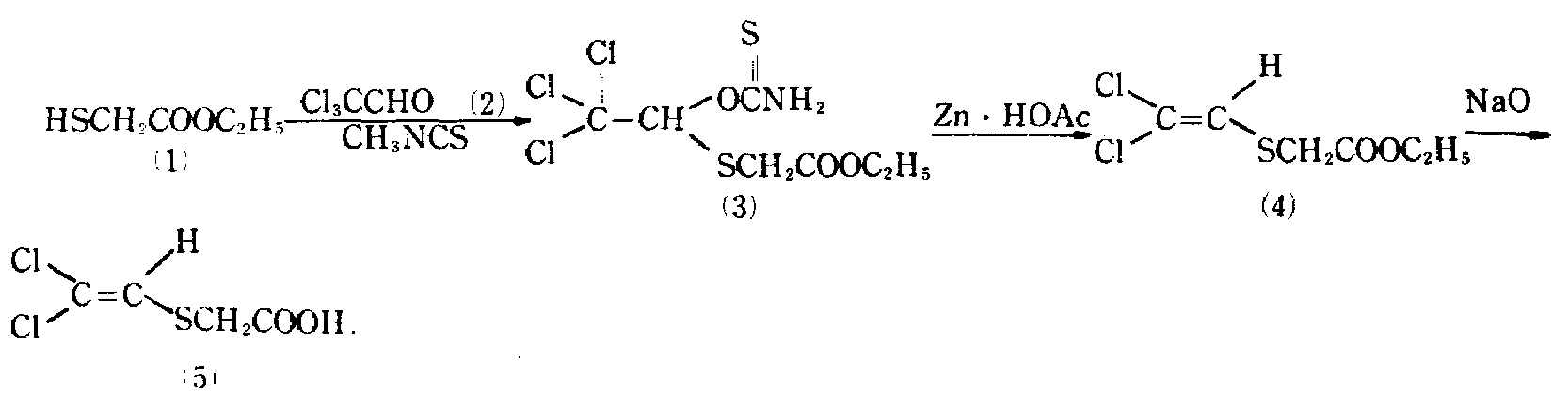
ⅰ) 벤젠(200ml)에 용해된 클로랄(2)(25g), 트리에틸아민(0.7ml) 및 에틸 테오클리콜레이트(1)(18.6ml)를 1.5시간 동안 교반한다. 트리에틸아민(1.5ml) 및 메틸이소티오시아네이트(10.2ml)를 상기 용액에 가하고 혼합물을 3시간 동안 교반한다. 반응 혼합물을 물에 가하고, 에틸 아세테이트로 추출한다. 추출물을 수세하고, 증발 건조시켜 에틸 2-(2, 2, 2-트리클로로-1-티오카르바모일에틸) 티오아세테이트(3)을 수득한다.Viii) Chloral (2) (25 g), triethylamine (0.7 ml) and ethyl theochocholate (1) (18.6 ml) dissolved in benzene (200 ml) are stirred for 1.5 hours. Triethylamine (1.5 ml) and methylisothiocyanate (10.2 ml) are added to the solution and the mixture is stirred for 3 hours. The reaction mixture is added to water and extracted with ethyl acetate. The extract was washed with water and evaporated to dryness to afford ethyl 2- (2, 2, 2-trichloro-1-thiocarbamoylethyl) thioacetate (3).
수율 : 10.4g.Yield: 10.4 g.
NMR(CDCl3) : 6.47.NMR (CDCl 3 ): 6.47.
ⅱ) 에틸티오아세테이트(3)(10.9g), 아세트산(45ml) 및 아연분말(10g)을 혼합물을 실온에서 20분간 교반한다. 반응 혼합물을 여과하고, 여과액을 진공 증발시킨다. 잔류물을 디클로로메탄에 용해시키고, 생성된 용액을 수세 및 건조시킨다. 용매를 증발시켜 에틸 클로로비닐티오아세테이트(4)를수득한다. 수율 : 3g.Ii) Ethylthioacetate (3) (10.9 g), acetic acid (45 ml) and zinc powder (10 g) were stirred at room temperature for 20 minutes. The reaction mixture is filtered and the filtrate is evaporated in vacuo. The residue is dissolved in dichloromethane and the resulting solution is washed with water and dried. The solvent is evaporated to obtain ethyl chlorovinylthioacetate (4). Yield: 3 g.
IR(CHCl3) : 1725cm-1 IR (CHCl 3 ): 1725cm -1
ⅲ) 아세톤에 용해된 티오아세테이트(4)(1.08g)을 2N NaOH 용액(5ml)를 가하면서 30분간 가수분해 한다. 혼합물을 물로 희석하고, 에틸 아세테이트로 세척한 후, 산성화하고, 에틸 아세테이트로 추출하여 디클로로비닐티오아세트산(5)을 수득한다. 수율 : 1.1g.V) Thioacetate (4) (1.08 g) dissolved in acetone is hydrolyzed for 30 minutes with 2N NaOH solution (5 ml). The mixture is diluted with water, washed with ethyl acetate, acidified and extracted with ethyl acetate to give dichlorovinylthioacetic acid (5). Yield: 1.1 g.
NMR(CDCl3) : 3.43(s, 2H), 6.43(s, 1H), 10.17(s, 1H).NMR (CDCl 3 ): 3.43 (s, 2H), 6.43 (s, 1H), 10.17 (s, 1H).
[제법 2][Method 2]

ⅰ) 물(120ml)에 메르캅토에틸알콜(1)(30.8g) 및 K2CO3(54.5g)을 녹인 용액에 에틸 아세테이트(80ml) 및 테트리부틸암모늄 브로마이드(0.7g)을 가한다. 메틸 모노클로로아세테이트(2)(38ml)를 교반하면서 혼합물에 적가한다. 140분간 더 교반한 후, 유기층을 소금물로 세척하고 건조시킨 후, 진공 증발시켜 메틸 히드록시에틸티오아세테이트(3)를 오일로써 수득한다. 수율 : 51.4g, b.p. 126∼127℃/1mmHg.V) Ethyl acetate (80 ml) and tetratriammonium bromide (0.7 g) are added to a solution of mercaptoethyl alcohol (1) (30.8 g) and K 2 CO 3 (54.5 g) in water (120 ml). Methyl monochloroacetate (2) (38 ml) is added dropwise to the mixture with stirring. After further stirring for 140 minutes, the organic layer is washed with brine, dried and evaporated in vacuo to afford methyl hydroxyethylthioacetate (3) as an oil. Yield: 51.4 g, bp 126-127 ° C./1 mmHg.
ⅱ) 티오닐 클로라이드(25ml)를 에스테르(3)(47.6g)에 적가한다. 30℃에서 30분 후, 혼합물을 진공에서 증류한다(b.p. 104∼105℃/7mmHg 수율 : 43g). 증류물에 벤젠(82ml) 및 DBU(42ml)를 가하고, 혼합물을 환류하 1.5시간 동안 가열한다. 반응 혼합물을 수세하고 진공에서 증류시켜 메틸 비닐티오아세테이트(4)를 수득한다. 수율 : 24.7g, b.p. 59∼65.5℃/4-5mmHg.Ii) Thionyl chloride (25 ml) is added dropwise to ester (3) (47.6 g). After 30 minutes at 30 ° C., the mixture is distilled in vacuo (b. P. 104-105 ° C./7 mmHg yield: 43 g). Benzene (82 ml) and DBU (42 ml) are added to the distillate and the mixture is heated at reflux for 1.5 hours. The reaction mixture was washed with water and distilled in vacuo to afford methyl vinylthioacetate (4). Yield: 24.7 g, b.p. 59-65.5 ° C./4-5 mmHg.
ⅲ) 비닐에스테르(4)(11.7g)을 메틸렌 클로라이드중에서 -60℃에 CCl4(75ml)에 녹인 1.25N 염소 용액으로 반응시킨다. 15분 후, 혼합물을 아황산나트륨 용액 및 물로 세척하고 농축한다. 디메틸포름아미드(50ml) 및 염화리튬(10g)을 잔류물과 혼합하고, 생성된 혼합물을 70℃에서 3시간 가온한다. 혼합물을 물로 희석하고, 에틸 아세테이트로 추출한다. 추출물을 수세하고 진공 증류시켜 메틸클로로비닐티오아세테이트(5)를 수득한다. 수율 : 11.8g, b.p. 75∼85℃/2mmHg.V) Vinyl ester (4) (11.7 g) is reacted with 1.25 N chlorine solution dissolved in CCl 4 (75 ml) at -60 ° C in methylene chloride. After 15 minutes, the mixture is washed with sodium sulfite solution and water and concentrated. Dimethylformamide (50 ml) and lithium chloride (10 g) are mixed with the residue and the resulting mixture is warmed at 70 ° C. for 3 hours. The mixture is diluted with water and extracted with ethyl acetate. The extract was washed with water and vacuum distilled to afford methylchlorovinylthioacetate (5). Yield: 11.8 g, bp 75-85 ° C./2 mmHg.
ⅳ) 메탄올에 용해된 클로로비닐티오아세테이트(5)(6.7g)을 3N NaOH 수용액을 가하여 가수분해한다. 반응 혼합물을 산성화하고 에틸 아세테이트로 추출하여 상응하는 카로복실산(6)을 수득한다. 수율 : 4.2g, m.p. 65∼66℃(벤젠/헥산으로 재결정).V) chlorovinylthioacetate (5) (6.7 g) dissolved in methanol is hydrolyzed by adding 3N NaOH aqueous solution. The reaction mixture is acidified and extracted with ethyl acetate to give the corresponding carboxylic acid (6). Yield: 4.2 g, m.p. 65-66 ° C. (recrystallized from benzene / hexanes).
[제법 3][Process 3]

ⅰ) 트리클로로에탄(1)(20ml), N,N-디메틸포름아미드(DMF)(20ml), 에틸티오글리콜레이트(12ml) 및 트리에틸아민(15ml)의 혼합물을 70℃에서 90분간 반응시킨다. 반응 혼합물을 물에 붓고, 에틸 아세테이트로 추출한다. 추출물을 5% NaOH 용액 및 물로 세척하고, 건조 농축한다. 잔류물을 진공에서 증류시켜 에킬 디클로로 에틸티오아세테이트(2)를 수득한다. 수율 : 5.7g, b.p. 87∼94℃/2mmHg.V) A mixture of trichloroethane (1) (20 ml), N, N-dimethylformamide (DMF) (20 ml), ethyl thioglycolate (12 ml) and triethylamine (15 ml) is reacted at 70 DEG C for 90 minutes. . The reaction mixture is poured into water and extracted with ethyl acetate. The extract is washed with 5% NaOH solution and water and concentrated to dryness. The residue is distilled in vacuo to give ethyl dichloro ethylthioacetate (2). Yield: 5.7 g, b.p. 87 to 94 ° C / 2 mmHg.
ⅱ) 에틸에스테르(2)(2.17g) 및 DBU(1.36g)를 벤젠(10ml)에서 80℃로 30분간 반응시킨다. 혼합물을 묽은 HCl 및 소금물로 세척하고 진공에서 농축한 후, 실리카겔로 크로마토그래피하여 비닐 화합물(3)을 수득한다. 수율 : 0.45g.Ii) Ethyl ester (2) (2.17 g) and DBU (1.36 g) were reacted for 30 minutes at 80 DEG C in benzene (10 ml). The mixture is washed with dilute HCl and brine, concentrated in vacuo and chromatographed with silica gel to give the vinyl compound (3). Yield: 0.45 g.
IR(CHCl3) : 1725cm-1.IR (CHCl 3 ): 1725 cm −1 .
ⅲ) 아세톤(10ml)에 용해된 비닐 화합물(3)(1.15g)에 2N NaOH 수용액(4.4ml)을 가하여 실온에서 20분간 가수분해시킨다. 제법 2와 같은 방법으로 반응 혼합물로부터 상응하는 카르복실산을 수득한다. 수율 : 1.2g.V) 2N NaOH aqueous solution (4.4 ml) is added to vinyl compound (3) (1.15 g) dissolved in acetone (10 ml) and hydrolyzed at room temperature for 20 minutes. In the same manner as in Preparation 2, the corresponding carboxylic acid is obtained from the reaction mixture. Yield: 1.2 g.
IR(CHCl3) : 1710cm-1.IR (CHCl 3 ): 1710 cm −1 .
[제법 4][Process 4]

모노클로로아세트알데히드(7.1ml)의 50% 수용액 및 메틸티오 글리콜레이트(4.5ml)의 혼합물을 빙냉하면서 HCl 기체로 포화시킨다. 4시간 후, 반응 혼합물을 디클로로 메탄으로 추출한다. 추출물을 수세, 건조 및 농축하여 메틸(1,2-디클로로에틸) 티오아세테이트(7.19g)를 수득하며, 이것을 N,N-디메틸포름아미드(22ml)에 용해시킨다. 수득된 용액에 염화리튬(5g)을 가하고, 혼합물을 80∼90℃에서 한시간 교반한 후 에틸 아세테이트 및 물의 혼합물에 붓는다. 유기층을 분리하여 수세, 건조시키고 진공 농축한다. 진공에서 잔류물을 증류한 후, 메틸(2-클로로비닐) 티오아세테이트를 수득한다. 수율 : 3.21g, b.p. 75∼85℃/7mmHg.A mixture of 50% aqueous solution of monochloroacetaldehyde (7.1 ml) and methylthio glycolate (4.5 ml) is saturated with HCl gas with ice cooling. After 4 hours, the reaction mixture is extracted with dichloromethane. The extract was washed with water, dried and concentrated to afford methyl (1,2-dichloroethyl) thioacetate (7.19 g), which was dissolved in N, N-dimethylformamide (22 ml). Lithium chloride (5 g) is added to the obtained solution, and the mixture is stirred at 80 to 90 DEG C for one hour, and then poured into a mixture of ethyl acetate and water. The organic layer is separated, washed with water, dried and concentrated in vacuo. After distillation of the residue in vacuo, methyl (2-chlorovinyl) thioacetate is obtained. Yield: 3.21 g, b.p. 75 to 85 ° C./7 mmHg.
[제법 5][Method 5]

클로로아세트알데히드 디메틸아세탈(14.9ml), 메틸티오글리콜레이트(10.6g), p-톨루엔 술폰산 모노히드레이트(2g) 및 벤젠(150ml)의 혼합물을 분자체로 가득찬 딘-스타크(Dean-Stark) 수 분리기를 사용하여 환류하 4시간 동안 가열한다. 반응 혼합물을 물에 부은 후, 유기층을 분리하여 건조시키고, 진공 농축한다. 잔류물을 진공 증류하여 메틸 2-클로로비닐티오아세테이트를 수득한다. 수율 : 1.93g, b.p. 75∼85℃/2mmHg.Dean-Stark filled with a molecular sieve filled with a mixture of chloroacetaldehyde dimethylacetal (14.9 ml), methylthioglycolate (10.6 g), p-toluene sulfonic acid monohydrate (2 g) and benzene (150 ml) Heat at reflux for 4 hours using a water separator. After the reaction mixture is poured into water, the organic layer is separated, dried and concentrated in vacuo. The residue is distilled in vacuo to afford methyl 2-chlorovinylthioacetate. Yield: 1.93 g, b.p. 75 to 85 ° C./2 mmHg.
[제법 6][Preparation 6]

N,N-디메틸포름아미드(50ml)에 용해된 에틸티오글리콜레이트(5.5ml)에 2-디클로로에틸렌(21ml) 및 DBU(7.5ml)를 N2대기하 가한다. 혼합물을 실온에서 24시간 방치한 후 물에 붓고, 에틸 아세테이트로 추출한다.To ethylthioglycolate (5.5 ml) dissolved in N, N-dimethylformamide (50 ml), 2-dichloroethylene (21 ml) and DBU (7.5 ml) were added under N 2 atmosphere. The mixture is left at room temperature for 24 hours, then poured into water and extracted with ethyl acetate.
추출물을 묽은 HCl, 5% K2CO3용액 및 포화 NaCl 용액으로 세척한 후, 건조시키고 진공 증발시킨다. 잔류물(7.54g)을 감압하 증류하여 에틸 2-클로로비닐티오아세테이트를 수득한다. 수율 : 3.67g(40.8%), b,p, 93℃/3mmHg.The extract is washed with dilute HCl, 5% K 2 CO 3 solution and saturated NaCl solution, then dried and evaporated in vacuo. The residue (7.54 g) was distilled off under reduced pressure to afford ethyl 2-chlorovinylthioacetate. Yield: 3.67 g (40.8%), b, p, 93 ° C./3 mm Hg.
NMR(CDCl3) : 1.28(t, 3H, J=7Hz), 3.42(s, 2H), 4.21(q, 2H, J=7Hz), 6.12(d, 1H, J=6Hz), 6.50(d, 1H, J=6Hz).NMR (CDCl 3 ): 1.28 (t, 3H, J = 7Hz), 3.42 (s, 2H), 4.21 (q, 2H, J = 7Hz), 6.12 (d, 1H, J = 6Hz), 6.50 (d, 1H, J = 6 Hz).
[제법 7][Process 7]

ⅰ) 에틸 에테르(300ml)에 녹인 메틸트리페닐포스포늄 브로마이드(22.4g) 및 헥산(44ml)에 녹인 1.4N 부틸리튬 용액을 -70℃에서 교반하고 0℃로 30분간 가온한다. -60℃에서 에틸 트리플루오로아세테이트(7.1ml)를 가하고, 혼합물을 다시 15℃로 20분간 가온한다. 반응 혼합물을 2% HCl에 붓고 트리페닐포스포라닐리덴 화합물(2)의 침전된 결정을 여과한다. 수세한 후 유기층을 증발시켜 제2생성물을 수득한다. 총 수율 : 8.5g.V) Methyltriphenylphosphonium bromide (22.4 g) dissolved in ethyl ether (300 ml) and 1.4 N butyllithium solution dissolved in hexane (44 ml) are stirred at -70 ° C and warmed to 0 ° C for 30 minutes. Ethyl trifluoroacetate (7.1 ml) is added at -60 ° C and the mixture is warmed to 15 ° C for 20 minutes. The reaction mixture is poured into 2% HCl and the precipitated crystals of triphenylphosphoranylidene compound (2) are filtered off. After washing with water, the organic layer is evaporated to obtain a second product. Total yield: 8.5 g.
IR(CHCl3) : 1580cm-1.IR (CHCl 3 ): 1580 cm −1 .
ⅱ) 디(에톡시카르보닐메틸) 디설파이드(1.2g)를 용매로써 THF중 CCl4(4ml)에 녹인 1.25N 염소 용액과 -20℃에서 10분간 반응시킴으로써 수득된 에틸 클로로티오아세테이트와 상기에 수득된 생성물(2)(3.7g)을 0℃에서 10분간 반응시킨다. 반응 혼합물을 NaHCO3용액에 붓고, 디클로로메탄으로 추출한다. 추출물을 수세하고, 용매를 증발시킨다. 잔류물을 디클로로메탄 및 에틸 에테르의 혼합물로 재결정하여 에틸 트리플루오로아세틸 트리페닐포스포라닐리덴 메틸티오아세테이트(3)를 수득한다. 수율 : 4g.Ii) Ethyl chlorothioacetate obtained by reacting di (ethoxycarbonylmethyl) disulfide (1.2 g) with 1.25 N chlorine solution dissolved in CCl 4 (4 ml) in THF as a solvent for 10 minutes at -20 DEG C. Product (2) (3.7 g) is reacted at 0 ° C for 10 minutes. The reaction mixture is poured into NaHCO 3 solution and extracted with dichloromethane. The extract is washed with water and the solvent is evaporated. The residue is recrystallized from a mixture of dichloromethane and ethyl ether to give ethyl trifluoroacetyl triphenylphosphoranilidene methylthioacetate (3). Yield: 4 g.
IR(CHCl3) : 1720, 1555cm-1.IR (CHCl 3 ): 1720, 1555 cm -1 .
ⅲ) 상기에 수득된 생성물(3)(3g) 및 소듐 시아노보로하이드라이드(3g)의 혼합물을 아세트산(30ml)중 실온에서 4시간 교반한다. 용매를 증발시킨 후, 잔류물을 NaHCO3용액에 붓고, 에틸 아세테이트로 추출한다. 추출물을 수세 및 건조시키고 증발하여 용매를 제거하고, 에틸 트리플루오로 메틸비닐티오아세테이트(4)를 수득한다. 수율 : 370mg.Iii) The mixture of product (3) (3 g) and sodium cyanoborohydride (3 g) obtained above is stirred for 4 hours at room temperature in acetic acid (30 ml). After evaporating the solvent, the residue is poured into NaHCO 3 solution and extracted with ethyl acetate. The extract is washed with water, dried and evaporated to remove the solvent, to obtain ethyl trifluoro methylvinylthioacetate (4). Yield: 370 mg.
IR(CHCl3) : 1725, 1615cm-1.IR (CHCl 3 ): 1725, 1615 cm -1 .
ⅳ) 메탄올(2ml)에 용해된 비닐티오아세테이트(4)(370mg)을 실온에서 20분간 1N NaOH 용액으로 처리한다. 반응 혼합물을 공지 방법으로 처리하여 트리플루오로 메틸비닐오아세트산(5)을 수득한다. 수율 : 278mg.V) Vinylthioacetate (4) (370 mg) dissolved in methanol (2 ml) is treated with 1N NaOH solution for 20 minutes at room temperature. The reaction mixture is treated by a known method to give trifluoro methylvinylacetic acid (5). Yield: 278 mg.
NMR(CDCl3) : 3.47(s, 2H), 5.63(dq. 1H. J=11.9Hz), 6.77(d. 1H, J=11Hz), 10.93(s, 1H).NMR (CDCl 3 ): 3.47 (s, 2H), 5.63 (dq. 1H. J = 11.9 Hz), 6.77 (d. 1H, J = 11 Hz), 10.93 (s, 1H).
[제법 8][Process 8]

ⅰ) CCl4(67ml)에 녹인 프로피올산(1)(1.4g) 및 1.48N 염소의 혼합물을 빙냉하면서 텅스텐램프로 조사한다. 30분 후, 혼합물을 감압하 농축하여 디클로로아크릴산(2)를 통해 생성된 테트라클로로피로피온산(3)을 수득한다. 수율 : 4.3g.V) A mixture of propiolic acid (1) (1.4 g) and 1.48 N chlorine dissolved in CCl 4 (67 ml) is irradiated with tungsten lamp while ice-cooling. After 30 minutes, the mixture is concentrated under reduced pressure to afford tetrachloropyrionic acid (3) produced through dichloroacrylic acid (2). Yield: 4.3 g.
NMR(CCl4) : 6.27(s, 1H), 10.67(s, 1H).NMR (CCl 4 ): 6.27 (s, 1H), 10.67 (s, 1H).
ⅱ) 프로피온산(3)(15.3g), 디페닐메탄올(16g), 피리딘(21ml), 메탄술포닐클로라이드(9.95ml) 및 디클로로메탄(100ml)를 0℃에서 혼합하고 2시간 교반한다. 반응 혼합물을 물에 붓고, 에틸아세테이트로 추출한다. 추출물을 수세하고 증발시켜 용매를 제거한다. 잔류물을 실리카겔 크로마토그래피에 의해 정제하여 순수 디페닐메틸 에스테르 화합물(4)을 수득한다. 수율 : 21g. m.p 101∼103℃(에틸 에테르/펜탄으로 재결정).Ii) Propionic acid (3) (15.3 g), diphenylmethanol (16 g), pyridine (21 ml), methanesulfonylchloride (9.95 ml) and dichloromethane (100 ml) are mixed at 0 ° C and stirred for 2 hours. The reaction mixture is poured into water and extracted with ethyl acetate. The extract is washed with water and evaporated to remove the solvent. The residue is purified by silica gel chromatography to give pure diphenylmethyl ester compound (4). Yield: 21 g. m.p 101-103 ° C. (recrystallized from ethyl ether / pentane).
ⅲ) 디페닐메틸 에스테르(4)(1.53g), 티오글리콜산(0.7ml), 피리딘(1.6ml), THF(20ml) 및 트리메틸실릴 클로라이드(1.3ml)의 혼합물을 빙냉하면서 30분간 및 실온에서 20시간 교반한다. 반응 혼합물을 물에 붓고 에틸 아세테이트로 추출한다. 추출물을 감압하 농축하고 잔류물을 디클로로메탄에 용해시킨다. 유기 용액을 수세하고 증발 건조시켜 디페닐메톡시카르보닐 클로로비닐티오아세트산(5)를 수득한다. 수율 : 1.49g.V) a mixture of diphenylmethyl ester (4) (1.53 g), thioglycolic acid (0.7 ml), pyridine (1.6 ml), THF (20 ml) and trimethylsilyl chloride (1.3 ml) with ice cooling for 30 minutes and at room temperature Stir for 20 hours. The reaction mixture is poured into water and extracted with ethyl acetate. The extract is concentrated under reduced pressure and the residue is dissolved in dichloromethane. The organic solution was washed with water and evaporated to dryness to afford diphenylmethoxycarbonyl chlorovinylthioacetic acid (5). Yield: 1.49 g.
IR(CHCl3) : 3300∼3100, 1710cm-1.IR (CHCl 3 ): 3300 to 3100, 1710 cm -1 .
[제법 9][Method 9]

클로로비닐티오아세트산(1.4g), 메탄올에 녹인 메탄티올 30% 용액(2.08ml), 4.6N 소듐 메틸레이트 용액(5.65ml) 및 물(2ml)의 혼합물을 환류하 40분간 가열한다. 반응 혼합물을 묽은 HCl에 붓고 에틸 아세테이트로 추출한다.A mixture of chlorovinylthioacetic acid (1.4 g), a 30% solution of methanethiol (2.08 ml) dissolved in methanol, a 4.6 N sodium methylate solution (5.65 ml) and water (2 ml) was heated to reflux for 40 minutes. The reaction mixture is poured into dilute HCl and extracted with ethyl acetate.
추출물을 수세하고 증발시켜 용매를 제거하고 메틸티오비닐티오아세트산(3)을 수득한다. 수율 : 1.3g.The extract was washed with water and evaporated to remove the solvent to afford methylthiovinylthioacetic acid (3). Yield: 1.3 g.
NMR(CDCl3) : 2.32(s, 3H), 3.43(s, 2H), 6.15(s, 2H), 11.23(s, 1H).NMR (CDCl 3): 2.32 (s, 3H), 3.43 (s, 2H), 6.15 (s, 2H), 11.23 (s, 1H).
[제법 10][Manufacturer 10]

ⅰ) 트리클로로에틸렌(1)(35ml), 에틸티오글리콜레이트(9ml) 및 소듐 에틸레이트(8g)를 에탄올(20ml)에 용해시킨다. 혼합물을 환류하 90분간 가열하여 디클로로아세틸렌(2)를 통해 생성된 에틸 디클로로 비닐티오 아세테이트(3)를 수득한다. 수율 : 11.4g.Iii) Trichloroethylene (1) (35 ml), ethyl thioglycolate (9 ml) and sodium ethylate (8 g) are dissolved in ethanol (20 ml). The mixture is heated at reflux for 90 minutes to afford ethyl dichloro vinylthio acetate (3) through dichloroacetylene (2). Yield: 11.4 g.
IR(CHCl3) : 1725cm-1.IR (CHCl 3 ): 1725 cm −1 .
ⅱ) 아세톤(8ml)에 용해된 에틸에스테르(3)(0.8g)에 2N NaOH 용액(2.5ml)을 가한다. 혼합물을 실온에서 15분간 교반하고, 중성 부분을 혼합물로부터 제거한다. 1, 2-디클로로 비닐티오아세트산(4)을 산성 부분으로부터 수득한다. 수율 : 0.72g.Ii) 2N NaOH solution (2.5 ml) was added to ethyl ester (3) (0.8 g) dissolved in acetone (8 ml). The mixture is stirred at room temperature for 15 minutes and the neutral portion is removed from the mixture. 1, 2-dichloro vinylthioacetic acid (4) is obtained from the acidic portion. Yield: 0.72 g.
NMR(CDCl3) : 3.68(s, 2H), 6.40(s, 1H), 10.10(s, 1H).NMR (CDCl 3 ): 3.68 (s, 2H), 6.40 (s, 1H), 10.10 (s, 1H).
[제법 11][Manufacturer 11]

ⅰ) 메틸(2-카르복시-2-클로로비닐) 티오아세테이트(1)(1.48g), 피리딘(0.65ml), 및 에틸 클로로카르보네이트(0.6ml)의 혼합물 THF중 -30℃에서 5분간 및 0℃에서 10분간 교반한다. 수듐 보로하이드라이드(0.8g)을 가하고, 혼합물을 0℃에서 2시간 교반한다. 반응 혼합물을 묽은 HCl에 붓고 에틸 아세테이트로 추출한다. 에틸 아세테이트 추출물을 수세하고, 진공에서 농축한 후 실리카겔 크로마토그래피하여 메틸(2-히드록시메틸-2-클로로비닐) 티오아세테이트(2)를 수득한다. 수율 : 492mg.Viii) a mixture of methyl (2-carboxy-2-chlorovinyl) thioacetate (1) (1.48 g), pyridine (0.65 ml), and ethyl chlorocarbonate (0.6 ml) for 5 minutes at -30 ° C. in THF and Stir at 0 ° C. for 10 minutes. Sodium borohydride (0.8 g) is added and the mixture is stirred at 0 ° C. for 2 hours. The reaction mixture is poured into dilute HCl and extracted with ethyl acetate. The ethyl acetate extract was washed with water, concentrated in vacuo and silica gel chromatography to afford methyl (2-hydroxymethyl-2-chlorovinyl) thioacetate (2). Yield: 492 mg.
IR(CHCl3) : 3580, 3460. 1730cm-1.IR (CHCl 3 ): 3580, 3460 1730 cm -1 .
ⅱ) 수득된 히드록시메틸 화합물(2)(490mg)을 디히드로피란(0.25ml) 및 디클로로메탄(10ml)에 녹인 p-톨루엔 술폰산 모노히드레이트(5mg)과 혼합하고, 혼합물을 실온에서 30분간 교반한다. 반응 혼합물을 NaHCO3 용액에 붓고 에틸 아세테이트로 추출한다. 추출물을 농축하여 아세톤에 용해된 잔류물을 수득한다. 아세톤 용액을 1N NaOH 용액(2.6ml)를 가하면서 실온에서 20분간 교반한다. 수용액을 물로 희석하고 인산으로 산성화한 후, 에틸 아세테이트로 추출한다. 추출물을 진공 증발시켜 필요한 테트라히드로피라닐옥시 화합물(3)을 수득한다. 수율 : 500mg.Ii) The obtained hydroxymethyl compound (2) (490 mg) was mixed with p-toluene sulfonic acid monohydrate (5 mg) dissolved in dihydropyran (0.25 ml) and dichloromethane (10 ml), and the mixture was mixed at room temperature for 30 minutes. Stir. The reaction mixture is poured into NaHCO 3 solution and extracted with ethyl acetate. The extract is concentrated to give a residue dissolved in acetone. The acetone solution is stirred for 20 minutes at room temperature while adding 1N NaOH solution (2.6 ml). The aqueous solution is diluted with water and acidified with phosphoric acid and then extracted with ethyl acetate. The extract is evaporated in vacuo to afford the required tetrahydropyranyloxy compound (3). Yield: 500 mg.
Rf(에틸 아세테이트) : 0.15(유리산), Rf(벤젠/에틸 아세테이트=4/1) : 0.7(메틸 에스테르).Rf (ethyl acetate): 0.15 (free acid), Rf (benzene / ethyl acetate = 4/1): 0.7 (methyl ester).
[제법 12][Manufacturer 12]

메틸(2-카르복시-2-클로로비닐) 티오아세테이트(1)(1g), 트리에틸아민(0.78ml) 및 에틸클로로 카르보네이트(0.46ml)의 혼합물을 -30℃에서 20분간 디클로로메탄에서 교반한다. 혼합물에 NH3(1g)을 가하고 -30℃∼0℃에서 교반한다. 반응 혼합물을 물에 붓고 에틸 아세테이트로 추출한다. 추출물을 묽은 HCl로 세척하고 진공 농축한다. 생성된 잔류물(786ml)을 70% 메탄올에 용해하고, Na2CO3(644mg)을 가하여 실온에서 5시간 가수분해한다. 혼합물을 물에 붓고 에틸 아세테이트로 세척하여 중성 물질을 제거한다. 수층을 HCl로 산성화하고 메탄올을 함유한 에틸 아세테이트로 추출한다. 추출물을 진공 증발시키고, 잔류물을 에틸에테르로 세척한다. 카르바모일클로로 비닐티오아세트산(2)을 수득한다. 수율 : 568mg.A mixture of methyl (2-carboxy-2-chlorovinyl) thioacetate (1) (1 g), triethylamine (0.78 ml) and ethylchloro carbonate (0.46 ml) was stirred in dichloromethane at -30 ° C. for 20 minutes. do. NH 3 (1 g) is added to the mixture, and the mixture is stirred at -30 ° C to 0 ° C. The reaction mixture is poured into water and extracted with ethyl acetate. The extract is washed with dilute HCl and concentrated in vacuo. The resulting residue (786 ml) is dissolved in 70% methanol and Na 2 CO 3 (644 mg) is added and hydrolyzed at room temperature for 5 hours. The mixture is poured into water and washed with ethyl acetate to remove neutrals. The aqueous layer is acidified with HCl and extracted with ethyl acetate containing methanol. The extract is evaporated in vacuo and the residue is washed with ethyl ether. Carbamoylchloro vinylthioacetic acid (2) is obtained. Yield: 568 mg.
m.p 205∼206℃.m.p 205-206 degreeC.
[제법 13][Process 13]

ⅰ) 메틸 (2-클로로비닐) 티오아세테이트 (1)(2g) 및 리튬디이소프로필아미드(1.08g)을 THF(2ml)중 -60℃에서 15분간 교반한다. 드라이아이스(5g)을 가한후, 혼합물을 30분간 교반하고 실온으로 가온한다. 반응 혼합물을 물에 붓고 에틸아세테이트로 세척하여 중성 물질을 제거한다. 남아있는 수용액을 HCl로 산성화하고 에틸아세테이트로 추출한다. 추출물을 수세하고 진공증발시켜 필요한 말론산 에스테르(2)를 수득한다. 수율 : 747mg.V) Methyl (2-chlorovinyl) thioacetate (1) (2 g) and lithium diisopropylamide (1.08 g) are stirred for 15 min at -60 ° C in THF (2 ml). After adding dry ice (5 g), the mixture is stirred for 30 minutes and warmed to room temperature. The reaction mixture is poured into water and washed with ethyl acetate to remove neutrals. The remaining aqueous solution is acidified with HCl and extracted with ethyl acetate. The extract was washed with water and evaporated in vacuo to afford the required malonic acid ester (2). Yield: 747 mg.
IR(CHCl3) : 1725cm-1 IR (CHCl 3 ): 1725cm -1
ⅱ) 말론산 에스테르 (2)(747mg), N,N-디메틸 포름아미드(75mg) 및 옥살릴 클로라이드(370μl)의 혼합물을 실온에서 20분간 벤젠중에서 교반한다. 반응 혼합물을 진공 농축하고, 생성된 잔류물을 디클로로메탄(15ml)에 용해시킨다. 액체 암모니아(1ml)를 가한후 디클로로메탄용액을 15분간 교반한다. 혼합물을 진공 증발시키고, 수득된 잔류물을 에틸 아세테이트에 용해시킨다. 에틸아세테이트용액을 수세하고 건조시켜 아미드에스테르(최종 화합물(3)의 메틸에스테르의 해당)를 수득한다. 수율 : 450mg.Ii) A mixture of malonic ester (2) (747 mg), N, N-dimethyl formamide (75 mg) and oxalyl chloride (370 μl) is stirred in benzene for 20 minutes at room temperature. The reaction mixture is concentrated in vacuo and the resulting residue is dissolved in dichloromethane (15 ml). After adding liquid ammonia (1 ml), the dichloromethane solution is stirred for 15 minutes. The mixture is evaporated in vacuo and the residue obtained is dissolved in ethyl acetate. The ethyl acetate solution was washed with water and dried to obtain an amide ester (corresponding to the methyl ester of the final compound (3)). Yield: 450 mg.
Ir(CHCl3) : 3480, 3370, 1725, 1690cm-1.Ir (CHCl 3 ): 3480, 3370, 1725, 1690 cm -1 .
ⅲ) 상기에서 수득된 아미드 에스테르(200ml)를 메탄올(3ml)에 용해시키고, 1N NaOH용액(2ml)를 가하면서 35℃에서 1시간 가수분해한다. 반응 혼합물을 진공 농축하고, 생성된 잔류물을 물 및 에틸아세테이트 사이에 분배한다. 수층을 HCl로 산성화하고 에틸아세테이트로 추출한다. 추출물을 수세하고 농축하여 (2-클로로비닐) 티오카르바모일아세트산(3)을 수득한다. 수율 : 100mg.V) The amide ester (200 ml) obtained above is dissolved in methanol (3 ml) and hydrolyzed at 35 ° C. for 1 hour while adding 1N NaOH solution (2 ml). The reaction mixture is concentrated in vacuo and the resulting residue is partitioned between water and ethyl acetate. The aqueous layer is acidified with HCl and extracted with ethyl acetate. The extract was washed with water and concentrated to afford (2-chlorovinyl) thiocarbamoylacetic acid (3). Yield: 100 mg.
[제법 14][Manufacturer 14]

ⅰ) 메틸 2-(2-클로로비닐)티오-2-카르복시 아세테이트 (1)(1몰), t-부탄올(1.2몰), 피리딘(2.3몰) 및 메탄술포닐 클로라이드(1.2몰)의 혼합물을 0℃에서 3시간동안 디클로로메탄(출발물질 (1)의 5중량부)에서 반응시킨다. 산성 부분을 반응 혼합물로부터 분리하고 정제하여 t-부틸 메틸(2-클로로비닐) 티오말로네이트(필요한 생성물(2)의 메틸에스테르에 상응)를 수득한다. 수율 73%V) a mixture of methyl 2- (2-chlorovinyl) thio-2-carboxy acetate (1) (1 mol), t-butanol (1.2 mol), pyridine (2.3 mol) and methanesulfonyl chloride (1.2 mol) The reaction is carried out at 0 ° C. for 3 hours in dichloromethane (5 parts by weight of starting material (1)). The acidic portion is separated from the reaction mixture and purified to give t-butyl methyl (2-chlorovinyl) thiomalonate (corresponding to the methyl ester of the required product (2)). Yield 73%
NMR(CDCl3) : 1.5(s, 9H), 3.81(s, 3H), 4.28(s, 1H), 6.21(d, 1H, J=7Hz), 6.64(d, 1H, J=7Hz).NMR (CDCl 3 ): 1.5 (s, 9H), 3.81 (s, 3H), 4.28 (s, 1H), 6.21 (d, 1H, J = 7 Hz), 6.64 (d, 1H, J = 7 Hz).
ⅱ) 수성 메탄올에 용해된 상기에서 수득된 t-부틸메틸 (2-클로로비닐) 티오말로네이트(1.2몰)을 KOH(1.2몰)을 가하면서 0℃에서 4시간 가수분해한다. 중성부분을 반응 혼합물로부터 제거하고, 산성물질을 정제하여 2-(2-클로로비닐) 티오-2-t-부톡시카르보닐아세트산(3)을 수득한다. 수율 : 94%.Ii) The t-butylmethyl (2-chlorovinyl) thiomalonate (1.2 mol) obtained above dissolved in aqueous methanol is hydrolyzed at 0 ° C. for 4 hours while adding KOH (1.2 mol). The neutral portion is removed from the reaction mixture and the acid is purified to give 2- (2-chlorovinyl) thio-2-t-butoxycarbonylacetic acid (3). Yield 94%.
NMR(CDCl3) : 1.51(s, 9H), 4.30(s, 1H), 6.18(d, 1H, J=7Hz), 6.63(d, 1H, J=7Hz), 10.49(s, 1H).NMR (CDCl 3 ): 1.51 (s, 9H), 4.30 (s, 1H), 6.18 (d, 1H, J = 7 Hz), 6.63 (d, 1H, J = 7 Hz), 10.49 (s, 1H).
[제법 15][Manufacturer 15]

ⅰ) 메틸 2-(2-클로로비닐) 티오-2-카르복시아세테이트(1) (450mg), 옥살릴클로라이드(325mg) 및 디메틸포름아미드(50mg)의 혼합물을 실온에서 30분간 디클로로메탄(2ml)에서 교반한다. 아세톤(2ml) 및 물(2ml)에 용해된 소듐아지드(550ml)의 용액을 혼합물에 가한다. 혼합물을 30분간 교반하고, 디클로로메탄으로 희석한후, 물로 희석하고 진공 농축하여 아지드(2)를 수득한다. 수율 : 430mg.V) a mixture of methyl 2- (2-chlorovinyl) thio-2-carboxacetate (1) (450 mg), oxalyl chloride (325 mg) and dimethylformamide (50 mg) in dichloromethane (2 ml) for 30 minutes at room temperature. Stir. A solution of sodium azide (550 ml) dissolved in acetone (2 ml) and water (2 ml) is added to the mixture. The mixture is stirred for 30 minutes, diluted with dichloromethane, diluted with water and concentrated in vacuo to afford azide (2). Yield: 430 mg.
NMR(CDCl3) : 3.80(s, 3H), 4.40(s, 1H), 6.23(d, 1H, J=7Hz), 6.63(d, 1H, J=7Hz).NMR (CDCl 3 ): 3.80 (s, 3H), 4.40 (s, 1H), 6.23 (d, 1H, J = 7 Hz), 6.63 (d, 1H, J = 7 Hz).
ⅱ) 수득된 아지드(20)(510mg)을 1-에틸-2, 3-디옥소피페라진(750mg) 및 THF(10ml)와 혼합하고, 혼합물을 환류하 4시간동안 가열한다. 반응 혼합물을 진공 증발시켜 우레이도 에스테르(3)를 수득한다. 수율 : 400mg.Ii) The obtained azide (20) (510 mg) is mixed with 1-ethyl-2, 3-dioxopiperazine (750 mg) and THF (10 ml) and the mixture is heated at reflux for 4 hours. The reaction mixture is evaporated in vacuo to afford ureido ester (3). Yield: 400 mg.
IR(CHCl3) : 3250, 1720, 1690cm-1.IR (CHCl 3 ): 3250, 1720, 1690 cm -1 .
ⅲ) 아세트산(2ml)에 용해된 우레이도에스테르(3)(400mg)을 6N HCl(2ml)를 가하면서 50℃∼60℃에서 3시간동안 가수분해하고 진공 농축한다. 잔류물을 에틸아세테이트에 용해시키고, 에틸아세테이트 용액을 수세한다. 산성 물질을 용액으로부터 분리하여 상기와 같은 방법으로 정제하고 우레이도 카르복실산(4)을 수득한다. 수율 : 136mg.V) Ureido ester (3) (400 mg) dissolved in acetic acid (2 ml) was hydrolyzed at 50 ° C. to 60 ° C. for 3 hours with 6N HCl (2 ml) and concentrated in vacuo. The residue is dissolved in ethyl acetate and the ethyl acetate solution is washed with water. The acidic substance is separated from the solution and purified in the same manner as above to obtain ureido carboxylic acid (4). Yield: 136 mg.
IR(누졸) : 3250, 1700, 1650cm-1.IR (nusol): 3250, 1700, 1650 cm -1 .
[제법 16][Preparation 16]

ⅰ) 메틸 2-브로모아세테이트(7.6g), 메르캅토에탄올(2.25ml) 및 소듐금속(1.5g)의 혼합물을 메탄올(30ml)중 0℃에서 40분간 교반한다. 반응 혼합물을 HCl/메탄올로 중화하고 진공 증발시킨다. 디클로로메탄을 잔류물에 가하고, 침전된 고체를 여거한다. 여과액을 감압하 증발 건조시켜 히드록시에틸 화합물(2)을 수득한다. 수율 : 6g.V) A mixture of methyl 2-bromoacetate (7.6 g), mercaptoethanol (2.25 ml) and sodium metal (1.5 g) is stirred for 40 minutes at 0 ° C. in methanol (30 ml). The reaction mixture is neutralized with HCl / methanol and evaporated in vacuo. Dichloromethane is added to the residue and the precipitated solid is filtered off. The filtrate is evaporated to dryness under reduced pressure to give hydroxyethyl compound (2). Yield: 6 g.
NMR(CDCl3) : 2.22(s, 1H), 2.73(t. 2H, J=6Hz), 3.70(t, 2H, J=6Hz), 3.73(t, 3H), 4.67(s, 1H), 7.23∼7.60(m, 5H).NMR (CDCl 3 ): 2.22 (s, 1H), 2.73 (t. 2H, J = 6Hz), 3.70 (t, 2H, J = 6Hz), 3.73 (t, 3H), 4.67 (s, 1H), 7.23 -7.60 (m, 5H).
ⅱ) 히드록시에틸 화합물(2)(2.9g)을 티오닐클로라이드(1.1ml)와 합하고, 혼합물을 -5℃∼실온에서 교반하고, 감압하 증발 시킨다. 생성된 잔류물을 실리카겔 크로마토그래피에 의해 정제하여 클로로에틸 화합물(3)을 수득한다. 수율 : 2.6g.Ii) hydroxyethyl compound (2) (2.9 g) is combined with thionyl chloride (1.1 ml) and the mixture is stirred at -5 ° C to room temperature and evaporated under reduced pressure. The resulting residue is purified by silica gel chromatography to give chloroethyl compound (3). Yield: 2.6 g.
NMR(CDCl3) : 2.85(t, 2H, J=7Hz), 3.53(t, 2H, J=7Hz), 3.72(s, 3H), 4.65(s, 1H), 7.23∼7.60(m, 5H).NMR (CDCl 3 ): 2.85 (t, 2H, J = 7 Hz), 3.53 (t, 2H, J = 7 Hz), 3.72 (s, 3H), 4.65 (s, 1H), 7.23-7.60 (m, 5H) .
ⅲ) 클로로에틸 화합물 (3)(1.75g) 및 DBU(1.25g)을 벤젠(5ml)에서 2시간동안 환류한다. 반응 혼합물을 수세하고 진공 농축한다. 잔류물을 크로마토그래피로 정제하여 비닐티오화합물(4)을 수득한다. 수율 : 640mg.V) Chloroethyl compound (3) (1.75 g) and DBU (1.25 g) are refluxed in benzene (5 ml) for 2 hours. The reaction mixture is washed with water and concentrated in vacuo. The residue is purified by chromatography to give the vinylthio compound (4). Yield: 640 mg.
NMR(CDCl3) : 3.72(s, 3H), 4.78(s, 1H), 5.12(d, 1H, J=4Hz), 5.33(d, 1H, J=4Hz), 6.17, 6.43(dd, 1H, J=10Hz), 7.17∼7.58(m, 5H).NMR (CDCl 3 ): 3.72 (s, 3H), 4.78 (s, 1H), 5.12 (d, 1H, J = 4Hz), 5.33 (d, 1H, J = 4Hz), 6.17, 6.43 (dd, 1H, J = 10 Hz), 7.17-7.58 (m, 5H).
ⅳ) 비닐티오 화합물(4)(640mg)을 디클로로메탄(10ml) 및 CCl4(2.1ml)에 녹인 1.48M 염소 용액과 혼합하고, 혼합물을 -40∼-45℃에서 1시간 교반한다. 반응 혼합물을 소듐티오설페이트 용액 및 물로 세척하고 진공 농축한다. 디케닐포름아미드(3ml)에 용해된 잔류물을 염화리륨(500ml)을 가하면서 65∼70℃에서 30분간 가온한다. 혼합물을 물로 희석하고, 에틸아세테이트로 추출한다. 계속 세척, 건조하고 추출물을 증발시켜, 클로로비닐티오 화합물(5)을 수득한다. 수율 : 390mg.V) Vinylthio compound (4) (640 mg) is mixed with a 1.48 M chlorine solution dissolved in dichloromethane (10 ml) and CCl4 (2.1 ml), and the mixture is stirred at -40 to -45 ° C for 1 hour. The reaction mixture is washed with sodium thiosulfate solution and water and concentrated in vacuo. The residue dissolved in dikenylformamide (3 ml) is warmed at 65-70 ° C. for 30 minutes with the addition of lithium chloride (500 ml). The mixture is diluted with water and extracted with ethyl acetate. Continue washing, drying and evaporation of the extract to afford chlorovinylthio compound (5). Yield: 390 mg.
NMR(CDCl3) : 3.75(s, 3H), 4,82(s, 1H), 6.05(d, 1H, J=6Hz), 6.32(d, 1H, J=6Hz), 7.17∼7.77(m, 5H).NMR (CDCl 3 ): 3.75 (s, 3H), 4,82 (s, 1H), 6.05 (d, 1H, J = 6Hz), 6.32 (d, 1H, J = 6Hz), 7.17∼7.77 (m, 5H).
ⅴ) 메탄올에 용해된 클로로비닐티오 화합물(5)(390mg)을 1N NaOH 용액(2ml)을 가하면서 5∼10℃에서 3.5시간동안 가수분해하여 필요한 카르복실산(6)을 수득한다. 수율 : 260mg.V) hydrochloric acid (5) (390 mg) dissolved in methanol is hydrolyzed at 5 to 10 DEG C for 3.5 hours while adding 1N NaOH solution (2 ml) to obtain the required carboxylic acid (6). Yield: 260 mg.
NMR(CDCl3) : 4.82(s, 1H), 6.07(d, 1H, J=6Hz), 6.35(d, 1H, J=6Hz), 7.20∼7.73(m, 5H), 10.53(s, 1H)NMR (CDCl 3 ): 4.82 (s, 1H), 6.07 (d, 1H, J = 6Hz), 6.35 (d, 1H, J = 6Hz), 7.20∼7.73 (m, 5H), 10.53 (s, 1H)
[제법 17][Manufacturer 17]

ⅰ) t-부틸 트리메틸실릴아세테이트 (1)(9.42g), N-시클로헥실-N-이소프로필아민(10ml), 헥산에 녹인 n-부틸리듐의 1.68N 용액(33ml) 및 디메톡시에탄(400ml)의 혼합물을 -70℃에서 30분간 교반한다. 이황화탄소(3.3ml) 교반하면서 30분간 가하고, 혼합물을 20분 더 교반한다. 헥산에 녹인 n-부틸 리튬 용액(33ml)을 1시간 적가하고, 30분간 교반을 계속한다. 이 혼합물에 석유에 녹인 50% 소듐하이드라이드(2.4g) 및 디메톡시에탄(75ml)에 녹인 요오드아세트산(15.59g)을 반응시킴으로써 수득된 소듐요오드 아세테이트를 가한다. 실온에서 1시간 교반한후, 반응 혼합물을 진공 증발 시키고, 생성된 잔류물을 합한 후, 에틸 에테르(300ml) 및 4N HCl(32ml)와 함께 교반한다. 에테르층을 증발 건조시켜 트리메틸실릴 화합물(2)을 수득한다.V) t-butyl trimethylsilyl acetate (1) (9.42 g), N-cyclohexyl-N-isopropylamine (10 ml), 1.68 N solution of n-butyllidium dissolved in hexane (33 ml) and dimethoxyethane (400 ml) ) Mixture is stirred at -70 ° C for 30 minutes. Carbon disulphide (3.3 ml) was added for 30 minutes with stirring, and the mixture was further stirred for 20 minutes. The n-butyl lithium solution (33 ml) dissolved in hexane was added dropwise for 1 hour, and stirring was continued for 30 minutes. To this mixture is added sodium iodine acetate obtained by reacting 50% sodium hydride (2.4 g) dissolved in petroleum and ioacetic acid (15.59 g) dissolved in dimethoxyethane (75 ml). After 1 h of stirring at room temperature, the reaction mixture is evaporated in vacuo, the resulting residues are combined and stirred with ethyl ether (300 ml) and 4N HCl (32 ml). The ether layer is evaporated to dryness to afford trimethylsilyl compound (2).
NMR(CCl4) : 4.95(s, 4H), 3.87(s, 3H), 1.52(s, 9H), 0.22(s, 9H).NMR (CCl 4 ): 4.95 (s, 4H), 3.87 (s, 3H), 1.52 (s, 9H), 0.22 (s, 9H).
트리메틸실릴 화합물(2)을 묽은 HCl로 처리하고, 반응 혼합물을 공지의 방법으로 처리하여 메틸렌 카르복실산(3)을 수득한다. 수율 : 10.13g.Trimethylsilyl compound (2) is treated with dilute HCl and the reaction mixture is treated by a known method to give methylene carboxylic acid (3). Yield: 10.13 g.
ⅱ) 카르복실산 (3)(5.9g)을 디클로로메탄(30ml)에 용해시키고 과량의 디아조메탄으로 에스테르화 한다. 수득된 에스테르를 디클로로메탄에 용해시키고, 피리딘(3.80ml) 및 CCl4에 녹인 1.19M 염소용액(27ml)과 함께 -78℃에서 합한다. 반응 혼합물을 소듐티오설페이트 용액으로 세척하고 진공 농축한다. 생성된 잔류물을 실리카겔 크로마토그래피로 정제하여 클로로에틸화합물(최종 생성물(4)의 메틸에스테르에 상당)을 수득한다. 수율 : 4g.Ii) carboxylic acid (3) (5.9 g) is dissolved in dichloromethane (30 ml) and esterified with excess diazomethane. The obtained ester is dissolved in dichloromethane and combined at -78 ° C with pyridine (3.80 ml) and 1.19 M chlorine solution (27 ml) dissolved in CCl 4 . The reaction mixture is washed with sodium thiosulfate solution and concentrated in vacuo. The resulting residue is purified by silica gel chromatography to give a chloroethyl compound (corresponding to the methyl ester of the final product (4)). Yield: 4 g.
ⅲ) 클로로에틸 화합물을 NaOH 용액으로 가수분해하여 상응하는 카르복실산(4)를 정량적 수율로 수득한다. 또한 디티에탄 화합물(2)을 디아조메탄으로 메틸에스테르화하고, 생성된 에스테르를 상기 ⅱ)와 같이 염소로 처리한 후, 염소화된 화합물을 가수분해함으로써 카르복실산(4)을 수득한다. 수율 : 38%.Viii) The chloroethyl compound is hydrolyzed with NaOH solution to give the corresponding carboxylic acid (4) in quantitative yield. In addition, the dithiethane compound (2) is methyl esterified with diazomethane, the resulting ester is treated with chlorine as in ii), and the chlorinated compound is hydrolyzed to obtain a carboxylic acid (4). Yield 38%.
NMR(CDCl3) : 8.17(s, 1H), 4.85(s, 1H), 1.50(s, 9H).NMR (CDCl 3 ): 8.17 (s, 1 H), 4.85 (s, 1 H), 1.50 (s, 9 H).
[제법 18][Manufacturer 18]

ⅰ) 시클로헥산-1,3-디온 (1)(3.42g), 에틸 티오글리콜레이트(2.4g) 및 p-톨루엔술폰산 모노히드레이트(40ml)의 혼합물로 환류하 톨루엔(20ml)에서 2.5시간 가열한다. 반응 혼합물을 공지의 방법으로 처리하여 에틸 3-옥소-1-시클로헥세닐티오아세테이트 (2)를 수득한다. 수율 : 2.8g.Iii) 2.5 hours heating in toluene (20 ml) under reflux with a mixture of cyclohexane-1,3-dione (1) (3.42 g), ethyl thioglycolate (2.4 g) and p-toluenesulfonic acid monohydrate (40 ml) do. The reaction mixture is treated by a known method to give ethyl 3-oxo-1-cyclohexenylthioacetate (2). Yield: 2.8 g.
NMR(CDCl3) : 1.27(t, 3H, J=8Hz), 1.95∼2.18(m, 2H), 2.33∼2.57(m, 4H), 3.63(s, 2H), 4.23(q, 2H, J=8Hz), 5.88(bs, 1H).NMR (CDCl 3 ): 1.27 (t, 3H, J = 8 Hz), 1.95 to 2.18 (m, 2H), 2.33 to 2.57 (m, 4H), 3.63 (s, 2H), 4.23 (q, 2H, J = 8 Hz), 5.88 (bs, 1 H).
ⅱ) 수득된 아세테이트 (2)(214mg)을 프로필렌옥시드(200μl) 및 디클로로메탄(5ml)에 녹인염소 (아세테이트와 비교해서 1.2몰 당량)와 -70℃에서 합한다. 반응 혼합물을 진공 증발시키고, 잔류물을 실리카겔 크로마토그래피에 의해 정제하여 클로로카르복실산 화합물(3)의 에틸에스테르를 수득한다. 수율 : 120mg, m.p.96℃.Ii) The obtained acetate (2) (214 mg) is combined with chlorine (1.2 molar equivalents in comparison to acetate) in propylene oxide (200 μl) and dichloromethane (5 ml) at -70 ° C. The reaction mixture is evaporated in vacuo and the residue is purified by silica gel chromatography to give ethyl ester of chlorocarboxylic acid compound (3). Yield: 120 mg, m.p. 96 ° C.
에탄올에 용해된 에틸에스테르를 1N NaOH 용액(1ml)를 가하면서 실온에서 15분간 가수분해하여 3-옥소-2-클로로-1-시클로헥산-1-일-티오아세트산(3)을 수득한다. 수율 : 70mg, m.p.190℃.The ethyl ester dissolved in ethanol was hydrolyzed at room temperature for 15 minutes while adding 1N NaOH solution (1 ml) to give 3-oxo-2-chloro-1-cyclohexane-1-yl-thioacetic acid (3). Yield: 70 mg, m.p. 190 ° C.
[제법 19][Manufacturer 19]

ⅰ) 메틸 2-(t-부톡시카르보닐메틸렌)-1,3-디티에탄-4-카르복실레이트(614mg). 피리딘(300μl) 및 메탄술페닐클로라이드(카르복실레이트의 당량)의 혼합물을 출발 카르복실레이트가 검출되지 않을때까지 디클로로메탄으로 반응시킨다. 반응 혼합물을 5% 소듐티오설페이트 용액 및 10% HCl로 세척하고, 에틸아세테이트로 추출한다. 추출물을 수세, 건조하고 진공 증발시켜 메틸 2-(1-t-부톡시카르보닐-1-메틸티오메틸렌)-1, 3-디티에탄-4-카르복실레이트를 수득한다. 수율 : 653mg(91%)Viii) methyl 2- (t-butoxycarbonylmethylene) -1,3-diethane-4-carboxylate (614 mg). A mixture of pyridine (300 μl) and methanesulphenylchloride (equivalent of carboxylate) is reacted with dichloromethane until no starting carboxylate is detected. The reaction mixture is washed with 5% sodium thiosulfate solution and 10% HCl and extracted with ethyl acetate. The extract is washed with water, dried and evaporated in vacuo to afford methyl 2- (1-t-butoxycarbonyl-1-methylthiomethylene) -1, 3-diethane-4-carboxylate. Yield: 653 mg (91%)
IR(CHCl3) : 1745, 1700, 1660, 1525cm-1 IR (CHCl 3 ): 1745, 1700, 1660, 1525cm -1
NMR(CDCl3) : 1.50(s, 9H), 2.21(s, 3H), 3.86(s, 3H), 4.74(s, 1H).NMR (CDCl 3 ): 1.50 (s, 9H), 2.21 (s, 3H), 3.86 (s, 3H), 4.74 (s, 1H).
ⅱ) 수득된 카르복실레이트(495mg)을 아세톤(6ml)에 용해시키고, 빙냉하면서 1N NaOH용액(1.9ml)와 15분간 반응시킨다. 1N HCl(2ml)를 가한후, 반응 혼합물을 에틸아세테이트로 추출한다. 추출물을 수세, 건조하고, 감압하 증발시켜 2-(1-t-부톡시카르보닐-1-메틸티오메틸렌)-1, 3-디티에탄-4-카르복실산을 수득한다. 수율 : 538mg.Ii) The obtained carboxylate (495 mg) is dissolved in acetone (6 ml) and reacted with 1N NaOH solution (1.9 ml) for 15 minutes with ice cooling. After addition of 1N HCl (2 ml), the reaction mixture is extracted with ethyl acetate. The extract is washed with water, dried and evaporated under reduced pressure to yield 2- (1-t-butoxycarbonyl-1-methylthiomethylene) -1, 3-diethaneethane-4-carboxylic acid. Yield: 538 mg.
IR(CHCl3) : 1725, 1700, 1660, 1545cm-1 IR (CHCl 3 ): 1725, 1700, 1660, 1545 cm -1
NMR(CDCl3) : 1.51(s, 9H), 2.21(s, 3H), 4.77(s, 1H), 8.7(브로드, 1H).NMR (CDCl 3 ): 1.51 (s, 9H), 2.21 (s, 3H), 4.77 (s, 1H), 8.7 (broad, 1H).
[제법 20][Manufacturer 20]

ⅰ) 메틸 2-(t-부톡시카르보닐메틸렌)-1, 3-디티에탄-4-카르복실레이트(689mg), 피리딘(430μl) 및 벤젠술페닐클로라이드의 혼합물을 출발 카르복실레이트가 검출되지 않을때까지 0℃에서 메틸렌클로라이드중에서 반응시킨다. 반응 혼합물을 수세, 건조하고, 진공 증발시켜 메틸 2-(1-t-부톡시카르보닐-1-페닐티오메틸렌)-1, 3-디티에탄-4-카르복실레이트를 수득한다. 수율 : 713mg(73%).Viii) A mixture of methyl 2- (t-butoxycarbonylmethylene) -1, 3-dithiethane-4-carboxylate (689 mg), pyridine (430 μl) and benzenesulphenylchloride was not detected. The reaction is carried out in methylene chloride at 0 ° C. until not. The reaction mixture was washed with water, dried and evaporated in vacuo to afford methyl 2- (1-t-butoxycarbonyl-1-phenylthiomethylene) -1, 3-diethane-4-carboxylate. Yield: 713 mg (73%).
IR(CHCl3) : 1740, 1705, 1660, 1535cm-1 IR (CHCl 3 ): 1740, 1705, 1660, 1535 cm -1
NMR(CDCl3) : 1.38(s, 9H), 3.58(s, 3H), 4.76(s, 1H), 7.26(s, 5H).NMR (CDCl 3 ): 1.38 (s, 9H), 3.58 (s, 3H), 4.76 (s, 1H), 7.26 (s, 5H).
ⅱ) 수득된 메틸에스테르(635mg)를 아세톤에 용해시키고 1N NaOH용액(2ml)로 0℃에서 37분간 반응시킨다. 1N HCl(2.2ml)를 가한후, 반응 혼합물을 에틸아세테이트로 추출한다. 추출물을 수세, 건조시키고, 증발시켜 2-(1-t-부톡시카르보닐-1-페닐티오메틸렌)-1, 3-디타에탄-4-카르복실산을 수득한다 수득율 : 649mg.Ii) The obtained methyl ester (635 mg) was dissolved in acetone and reacted with 1N NaOH solution (2 ml) at 0 ° C. for 37 minutes. After addition of 1N HCl (2.2 ml), the reaction mixture is extracted with ethyl acetate. The extract was washed with water, dried and evaporated to afford 2- (1-t-butoxycarbonyl-1-phenylthiomethylene) -1, 3-diethane-4-carboxylic acid. Yield: 649 mg.
IR(CHCl3) : 3400, 1730, 1710, 1660, 1530cm-1 IR (CHCl 3 ): 3400, 1730, 1710, 1660, 1530 cm -1
NMR(CDCl3) : 1.40(s, 9H), 4.78(s, 1H), 7.25(s, 5H).NMR (CDCl 3 ): 1.40 (s, 9H), 4.78 (s, 1H), 7.25 (s, 5H).
[제법 21][Manufacturer 21]

ⅰ) 메틸 2-(t-부톡시카르보닐메틸렌)-1,3-디티에탄-4-카르복실레이트(1.05g)을 반응 혼합물에 출발 카르복실레이트가 검출되지 않을때까지 피리딘(0.65ml) 존재하 실온에서 디틀로로메탄(5ml)중에서 디플루오로메틸벤질티오에테르(1.74g) 및 염소로부터 합성된 디플루오로메틸술페닐클로라이드와 반응시킨다. 혼합물을 5% 티오황산나트륨용액 및 10% HCl로 세척하고 건조시킨 후, 진공 농축하여 메틸 2-(1-t-부톡시카르보닐-1-디플루오로메틸티오메틸렌)-1,3-디티에탄-4-카르복실레이트를 수득한다. 수율 : 1.08g(78%).Viii) Methyl 2- (t-butoxycarbonylmethylene) -1,3-diethane-4-carboxylate (1.05 g) until pyridine (0.65 ml) is not detected in the reaction mixture without starting carboxylate. In the presence of difluoromethylbenzylthioether (1.74 g) and difluoromethylsulphenylchloride synthesized from chlorine in dichloromethane (5 ml) at room temperature. The mixture was washed with 5% sodium thiosulfate solution and 10% HCl, dried and concentrated in vacuo to methyl 2- (1-t-butoxycarbonyl-1-difluoromethylthiomethylene) -1,3-diethane Obtain 4-carboxylate. Yield: 1.08 g (78%).
IR(CHCl3) : 1745, 1710, 1665, 1535cm-1 IR (CHCl 3 ): 1745, 1710, 1665, 1535 cm -1
NMR(CDCl3) : 1.51(s, 9H), 3.87(s, 3H), 4.79(s, 1H), 6.68(t, 1H, J=59Hz).NMR (CDCl 3 ): 1.51 (s, 9H), 3.87 (s, 3H), 4.79 (s, 1H), 6.68 (t, 1H, J = 59 Hz).
ⅱ) 수득된 생성물(511mg)을 아세톤(2ml)에 용해시키고, 0℃에서 10분간 1N NaOH용액(1.6ml)과 반응시킨다. 반응 혼합물을 1N HCl로 산성화하고, 에틸아세테이트로 추출한다. 추출물을 수세하고 건조하여 2-(1-t-부톡시카르보닐-1-디플루오로메틸티오메틸렌)-1, 3-디티에탄-4-카로복실산을 수득한다. 수율 : 503mg.Ii) The obtained product (511 mg) is dissolved in acetone (2 ml) and reacted with 1N NaOH solution (1.6 ml) at 0 ° C. for 10 minutes. The reaction mixture is acidified with 1N HCl and extracted with ethyl acetate. The extracts were washed with water and dried to afford 2- (1-t-butoxycarbonyl-1-difluoromethylthiomethylene) -1,3-diethane-4-carroic acid. Yield: 503 mg.
NMR(CDCl3) : 1.51(s, 9H), 4.83(s, 1H), 6.68(t, 1H, J=58Hz).NMR (CDCl 3 ): 1.51 (s, 9H), 4.83 (s, 1H), 6.68 (t, 1H, J = 58 Hz).
[제법 22][Manufacturer 22]

ⅰ) 메틸 2-(1-카르복시-1-클로로메틸렌)-1,3-디티에탄-4-카르복실레이트(1.29g) 및 옥살릴클로라이드(700μl)를 N,N-디메틸포름아미드(50μl) 존재하 에틸에테르에서 반응시키고, 반응 혼합물을 감압하 농축한다. 2-(1-클로로카르보닐-1-클로로메틸렌)-1, 3-디티에탄-4-카르복실레이트를 함유하는 상기 잔류물 THF(70ml)에 용해시키고, -78℃에서 30분동안 리튬 트리-t-부톡시알미늄 하이드라이드(1.36g)과 반응시킨다. 반응 혼합물을 에틸아세테이트 및 묽은 HCl의 혼합물로 희석하고, 거세게 교반한 후 유기층을 분리한다. 분리된 유기층을 건조시키고 진공 농축한 후 실리카겔 크로마토그래피로 정제하여 메틸 2-(1-클로로-1-포르밀메틸렌)-1, 3-디티에탄-4-카르복실레이트를 수득한다. 수율 : 328mg(27%)V) methyl 2- (1-carboxy-1-chloromethylene) -1,3-diethane-4-carboxylate (1.29 g) and oxalyl chloride (700 μl) are added to N, N-dimethylformamide (50 μl). In the presence of ethyl ether and the reaction mixture is concentrated under reduced pressure. Dissolve in the residue THF (70 ml) containing 2- (1-chlorocarbonyl-1-chloromethylene) -1, 3-dithiethane-4-carboxylate and lithium tri-acid at -78 ° C for 30 minutes. React with -t-butoxyaluminum hydride (1.36 g). The reaction mixture is diluted with a mixture of ethyl acetate and dilute HCl, stirred vigorously and the organic layer is separated. The separated organic layer was dried, concentrated in vacuo and purified by silica gel chromatography to afford methyl 2- (1-chloro-1-formylmethylene) -1,3-diethane-4-carboxylate. Yield: 328 mg (27%)
IR(CHCl3) : 1740cm-1 IR (CHCl 3 ): 1740 cm -1
NMR(CDCl3) : 3.88(s, 3H), 5.20(s, 1H), 9.27(s, 1H).NMR (CDCl 3 ): 3.88 (s, 3H), 5.20 (s, 1H), 9.27 (s, 1H).
ⅱ) 상기에 수득된 카르복실레이트(262mg)을 아세톤에 용해시키고 1N NaOH 용액(0.8ml)를 가하면서 가수분해하여 2-(1-클로로-1-포르밀 메틸렌)-1, 3-디티에탄-4-카르복실산을 수득한다.Ii) The carboxylate (262 mg) obtained above was dissolved in acetone and hydrolyzed with addition of 1N NaOH solution (0.8 ml) to 2- (1-chloro-1-formyl methylene) -1, 3-dithiethane Obtain 4-carboxylic acid.
수율 : 252mgYield: 252 mg
NMR(CDCl3); 5.35(s, 1H), 8.98(s, 1H), 9.20(s, 1H).NMR (CDCl 3 ); 5.35 (s, 1 H), 8.98 (s, 1 H), 9.20 (s, 1 H).
[제법 23][Manufacturer 23]

ⅰ) DMF(30ml)에 용해된 칼륨염(1)(3.50g)에 메탄술포닐클로라이드(1.55ml)를 실온에서 가하고 20분간 교반한다. 반응 완결한 후, 혼합물을 물에 붓고 에틸아세테이트로 추출한다. 추출물을 수세하고 증발시켜 용매를 제거한다. 잔류물을 실리카겔 크로마토그래피로 정제하여 유성 화합물(2)을 수득한다. 수율 : 2.21gV) Methanesulfonyl chloride (1.55 ml) is added to potassium salt (1) (3.50 g) dissolved in DMF (30 ml) at room temperature and stirred for 20 minutes. After completion of the reaction, the mixture is poured into water and extracted with ethyl acetate. The extract is washed with water and evaporated to remove the solvent. The residue is purified by silica gel chromatography to give an oily compound (2). Yield: 2.21 g
IR(CHCl3) : 1730, 1680cm-1 IR (CHCl 3 ): 1730, 1680 cm -1
NMR(CDCl3) : 1.33(t, 3H, J=7Hz), 3.23(s, 3H), 4.32(q, 2H, J=7Hz), 7.40(d, 1H, J=16Hz).NMR (CDCl 3 ): 1.33 (t, 3H, J = 7 Hz), 3.23 (s, 3H), 4.32 (q, 2H, J = 7 Hz), 7.40 (d, 1H, J = 16 Hz).
ⅱ) 상기의 수득된 화합물(2)(2.0g)을 DMF(10ml)에 용해시키고, 피리딘(1.5ml) 및 메틸 메르캅토아세테이트(1.3ml)를 가한다. 혼합물을 실온에서 밤새 교반한 후, 빙수에 붓고 에틸아세테이트로 추출한다. 추출물을 실리카켈 크로마토그래피로 정제하여 화합물(3)을 수득한다. 수율 : 1.38gIi) The obtained compound (2) (2.0 g) was dissolved in DMF (10 ml), and pyridine (1.5 ml) and methyl mercaptoacetate (1.3 ml) were added. The mixture is stirred at room temperature overnight, then poured into ice water and extracted with ethyl acetate. The extract is purified by silica gel chromatography to give compound (3). Yield: 1.38 g
NMR(CDCl3) : 1.32(t, 3H, J=7Hz), 3.52(s, 2H), 3.77(s, 3H), 4.27(q, 2H, J=7Hz), 6.93(d, 1H, J=32Hz).NMR (CDCl 3 ): 1.32 (t, 3H, J = 7Hz), 3.52 (s, 2H), 3.77 (s, 3H), 4.27 (q, 2H, J = 7Hz), 6.93 (d, 1H, J = 32 Hz).
ⅲ) 아세톤(7ml)에 용해된 상기 생성물(3)(1.38g)의 용액에 1N NaOH 용액(6ml)를 가하고 -15∼-5℃에서 40분간 교반한다. 반응 혼합물을 물에 붓고, 에틸아세테이트로 세척하여 중성물질을 제거한다. 수층을 HCl로 산성화하고, 에틸 아세테이트로 두번 추출한다. 추출물을 수세하고 증발 건조시켜 화합물(4)를 수득한다.V) 1N NaOH solution (6 ml) is added to a solution of the product (3) (1.38 g) dissolved in acetone (7 ml) and stirred for 40 minutes at -15? -5 占 폚. The reaction mixture is poured into water and washed with ethyl acetate to remove neutrals. The aqueous layer is acidified with HCl and extracted twice with ethyl acetate. The extract is washed with water and evaporated to dryness to afford compound (4).
NMR(CDCl3) : 1.33(t, 3H, J=7Hz), 3.62(s, 2H), 4.30(q, 2H, J=7Hz), 6.98(d, 1H, J=32Hz), 10.45(brs, 1H).NMR (CDCl 3 ): 1.33 (t, 3H, J = 7 Hz), 3.62 (s, 2H), 4.30 (q, 2H, J = 7 Hz), 6.98 (d, 1H, J = 32 Hz), 10.45 (brs, 1H).
ⅳ) 또한 화합물(4)는 화합물(2)(1몰)과 티오글리클산(1몰)을 DMF(화합물(2)의 5중량부)중에서 트리에틸아민(2몰) 존재하 0∼5℃에서 1시간 반응시킴으로써 수득될 수 있다. 화합물(4)를 통상의 방법에 따라 반응 혼합물로부터 회수한다. 수율 : 80%I) In addition, compound (4) is compound (2) (1 mol) and thioglycolic acid (1 mol) in the presence of triethylamine (2 mol) in DMF (5 parts by weight of compound (2)). It can be obtained by making it react at 1 degreeC. Compound (4) is recovered from the reaction mixture according to a conventional method. Yield: 80%
ⅴ) 수득된 화합물(4)(0.54g)을 28% NH4OH용액(2ml)에 용해시키고, 용액을 실온에서 밤새 방치한다. 용액을 진공에서 1ml로 농축하고 농 HCl로 산성화 한후, 화합물(5)의 침전된 결정을 여과에 의해 수집한다. 수율 0.44g, 융점 : 204-6℃Viii) Compound (4) (0.54 g) obtained is dissolved in 28% NH4OH solution (2 ml) and the solution is left at room temperature overnight. The solution is concentrated in vacuo to 1 ml and acidified with concentrated HCl, after which the precipitated crystals of compound (5) are collected by filtration. Yield 0.44g, Melting Point: 204-6 ℃
IR(누졸) : 3430, 3210, 1710, 1660, 1640, 1610, 1580cm-1.IR (nusol): 3430, 3210, 1710, 1660, 1640, 1610, 1580 cm -1 .
NMR(DMSO-d6) : 3.72(s, 2H), 6.90(d, 1H, J=36Hz), 7.40-8.10(m, 2H).NMR (DMSO-d 6 ): 3.72 (s, 2H), 6.90 (d, 1H, J = 36 Hz), 7.40-8.10 (m, 2H).
[제법 24][Manufacturing 24]
ⅰ) 2-아미노 에탄올 (7g)을 N2 대기하 메틸렌 클로라이드(35ml)에 용해시키고, 피리딘(7.5ml) 및 디메틸아미노피리딘(283mg)을 10℃에서 가한다. 벤질 클로로포르메이트(11.2ml)를 교반하면서 생성된 혼합물에 가한다. 혼합물을 실온에서 30분간 교반하고, 빙-묽은 HCl에 부은후, 디클로로메탄으로 추출한다. 추출물을 NaHCO3용액 및 물로 세척하고 건조시킨후 감압하 농축한다.V) 2-amino ethanol (7 g) is dissolved in methylene chloride (35 ml) under N2 atmosphere and pyridine (7.5 ml) and dimethylaminopyridine (283 mg) are added at 10 ° C. Benzyl chloroformate (11.2 ml) is added to the resulting mixture with stirring. The mixture is stirred at rt for 30 min, poured into ice-dilute HCl and extracted with dichloromethane. The extract is washed with NaHCO 3 solution and water, dried and concentrated under reduced pressure.
생성된 잔류물을 디클로로메탄 및 에틸에테르의 혼합물로 결정화하여 메틸 N-(2-벤질옥시카르보닐옥시에틸)크산테이트를 수득한다. 수율 : 10g(76%), 융점 : 54-56℃.The resulting residue is crystallized with a mixture of dichloromethane and ethyl ether to give methyl N- (2-benzyloxycarbonyloxyethyl) xanthate. Yield: 10 g (76%), melting point: 54-56 ° C.

IR(CHCl3) : 3385, 1747cm-1.IR (CHCl 3 ): 3385, 1747 cm −1 .
NMR(CDCl3) : 2.62(s, 3H), 4.05(t, 2H, J=5.0Hz), 4.38(t, 2H, J=5.0Hz), 5.17(s, 2H), 7.33(s, 6H).NMR (CDCl 3 ): 2.62 (s, 3H), 4.05 (t, 2H, J = 5.0Hz), 4.38 (t, 2H, J = 5.0Hz), 5.17 (s, 2H), 7.33 (s, 6H) .
ⅱ) 수득된 크산테이트(2.85g) 및 소듐아지드(650mg)을 아세토니트릴(20ml)에서 환류하 110분간 가열한다. 반응 혼합물을 약 10ml로 농축하고, NaHCO3용액에 붓고 에틸아세테이트로 세척한다.Ii) The obtained xanthate (2.85 g) and sodium azide (650 mg) are heated for 110 minutes under reflux in acetonitrile (20 ml). The reaction mixture is concentrated to about 10 ml, poured into NaHCO 3 solution and washed with ethyl acetate.
HCl로 수층의 pH를 2로 맞추고, 에틸 아세테이트로 추출한다. 추출물을 수세하고, 건조시킨후, 진공 증발시킨다. 잔류물을 실리카겔 크로마토그래피로 정제하여 1-(벤질옥시카르보닐옥시에틸)-1H-테트라졸-5-티올을 수득한다.The pH of the aqueous layer is adjusted to 2 with HCl and extracted with ethyl acetate. The extract is washed with water, dried and evaporated in vacuo. The residue is purified by silica gel chromatography to give 1- (benzyloxycarbonyloxyethyl) -1H-tetrazol-5-thiol.

IR(CHCl3) : 3683, 3423, 1748, 1600cm-1 IR (CHCl 3 ): 3683, 3423, 1748, 1600cm -1
NMR(CD3COCD3) : 4.63(s, 4H), 5.13(s, 2H), 7.38(s, 5H).NMR (CD 3 COCD 3 ): 4.63 (s, 4H), 5.13 (s, 2H), 7.38 (s, 5H).
[실시예 1]Example 1

7β-클로로비닐티오아세트아미도-7α-메톡시-3-(1-디메틸아미노에틸-5-테트라졸릴)티오메틸-1-데티아-1-옥사-3-세펨-4-카르복실산 (1몰) 및 메탄올에 녹인 소듐 2-에틸 헥사노에이트의 1.8M 용액(2.6몰)의 혼합물을 메탄올(출발산의 7중량부)중 실온에서 10분간 반응시킨다. 에틸아세테이트를 반응 혼합물에 가하고, 생성된 침전물을 여과하고 세척하여 상응하는 소듐염을 수득한다. 수율 : 90-98%.7β-Chlorovinylthioacetamido-7α-methoxy-3- (1-dimethylaminoethyl-5-tetrazolyl) thiomethyl-1-dethia-1-oxa-3-cepem-4-carboxylic acid ( 1 mole) and a mixture of 1.8 M solution (2.6 moles) of sodium 2-ethyl hexanoate dissolved in methanol are reacted for 10 minutes at room temperature in methanol (7 parts by weight of starting acid). Ethyl acetate is added to the reaction mixture, and the resulting precipitate is filtered and washed to give the corresponding sodium salt. Yield: 90-98%.
[실시예 2]Example 2

7β-클로로비닐 티오아세트아미드-7α-메톡시-3-(1-히드록시에틸-5-테트라졸릴)티오메틸-1-데티아-1-옥사-3-세펨-4-카르복실산(4g)을 NaHCO3수용액(24g)에 용해시킨다. 용액의 pH를 6.5로 맞추고 탈염하기 위해 스티렌-디비닐 벤젠 공중합체로 채워진 컬럼을 통과시킨다. 용출액을 4바이알로 나우고, 공지의 방법으로 동결 건조시킨다. 상응하는 소듐염을 수득한다.7β-chlorovinyl thioacetamide-7α-methoxy-3- (1-hydroxyethyl-5-tetrazolyl) thiomethyl-1-dethia-1-oxa-3-cepem-4-carboxylic acid (4 g ) Is dissolved in an aqueous NaHCO 3 solution (24 g). The pH of the solution is adjusted to 6.5 and passed through a column filled with styrene-divinyl benzene copolymer for desalting. The eluate is divided into 4 vials and lyophilized by a known method. The corresponding sodium salt is obtained.
[실시예 3]Example 3

7β-(2카르바모일-2-플루오로)비닐티오 아세트아미도-7α-메톡시-3-(1-카르바모일 메틸-5-테트라졸릴)티오메틸-1-데티아-1-옥사-3-세펨-4-카르복실산(1g)을 0.5% NaHCO3수용액(5ml)에 용해시킨다. HCl로 수용액의 pH를 7로 맞추고, 에틸 아세테이트로 세척하고, 탈염한 후 10ml바이알에 채우고 공지의 방법으로 동결 건조시킨다. 상응하는 소듐염을 수득한다.7β- (2carbamoyl-2-fluoro) vinylthio acetamido-7α-methoxy-3- (1-carbamoyl methyl-5-tetrazolyl) thiomethyl-1-dethia-1-oxa 3-Cefe-4-carboxylic acid (1 g) is dissolved in 0.5% NaHCO 3 aqueous solution (5 ml). The pH of the aqueous solution is adjusted to 7 with HCl, washed with ethyl acetate, desalted and filled into 10 ml vials and lyophilized by known methods. The corresponding sodium salt is obtained.
실시예 1, 2 또는 3과 같은 방법으로, 표Ⅱ에 기재된 화합물(Ⅰ)의 각종 경금속염을 수득한다.In the same manner as in Example 1, 2 or 3, various light metal salts of compound (I) described in Table II were obtained.
실시예 2에서 수득된 소듐 7β-(2-카르바모일-2-플루오로)비닐티오아세트아미도-7α-메톡시-3-(1-카르바모일메틸-5-테트라졸릴)티오메틸-1-테티아-1-옥사-3-세펨-4-카르복실레이트를 살균 조건하 주사용 증류수(4g)에 용해시킨다. 용액을 하루에 2번 정맥내 투여하여 스타필로코쿠스 아우레우스로 간염된 환자를 치료한다.Sodium 7β- (2-carbamoyl-2-fluoro) vinylthioacetamido-7α-methoxy-3- (1-carbamoylmethyl-5-tetrazolyl) thiomethyl- obtained in Example 2 1-tetia-1-oxa-3-cepem-4-carboxylate is dissolved in distilled water for injection (4 g) under sterile conditions. The solution is administered intravenously twice a day to treat patients infected with Staphylococcus aureus.
이 염의 스트랩토코쿠스 피오게네스 C-203 및 에스케리키아 콜리 JC-2에 대한 최소 억제 농도치는 니뽕 가가꾸 료호 가까이의 표준방법(Japan Society of Chemotherapy)에 따라 측정하였을 때 각각 0.1㎍/ml 및 0.1㎍/ml이상이다.The minimum inhibitory concentrations of the salts for Straptococcus piogenes C-203 and Escherichia coli JC-2 were 0.1 μg / ml and respectively, as measured according to the Japan Society of Chemotherapy, close to Nippon Kagaku Ryouho. 0.1 µg / ml or more.
[실시예 4]Example 4

디페닐메틸 7β-비닐티오아세트아미도-7α-메톡시-3-(1-메틸-5-테트라졸릴)티오메틸-1-데티아-1-옥사-3-세펨-4-카르복실레이트(1부), 아니솔(1부) 및 트리플루오로 아세트산(0.5부)를 디클로로메탄(5부)에 용해시키고, 혼합물을 빙냉하면서 30∼120분간 교반한다. 반응 혼합물에 감압하 농축한다. 잔류물을 에틸 에테르와 혼합하고 교반하여 상응하는 카르복실산을 침전시킨다.Diphenylmethyl 7β-vinylthioacetamido-7α-methoxy-3- (1-methyl-5-tetrazolyl) thiomethyl-1-dethia-1-oxa-3-cepem-4-carboxylate ( 1 part), anisole (1 part) and trifluoro acetic acid (0.5 part) are dissolved in dichloromethane (5 parts), and the mixture is stirred for 30 to 120 minutes with ice cooling. The reaction mixture is concentrated under reduced pressure. The residue is mixed with ethyl ether and stirred to precipitate the corresponding carboxylic acid.
또는, 반응 혼합물을 NaHCO3용액에 붓고 에틸아세테이트로 세척한 후, 산성화하고 에틸아세테이트로 추출한다. 추출물을 진공 증발시키고, 생성된 잔류물을 에테르에서 교반하여 카르복실산을 침전시킨다. 수율 80-90%.Alternatively, the reaction mixture is poured into NaHCO 3 solution, washed with ethyl acetate, acidified and extracted with ethyl acetate. The extract is evaporated in vacuo and the resulting residue is stirred in ether to precipitate the carboxylic acid. Yield 80-90%.
상기와 같은 일반적 방법에 따라 표Ⅱ에 기재된 유리산(Ⅰ)을 수득한다.According to the general method as described above, the free acid (I) described in Table II is obtained.
[실시예 5]Example 5

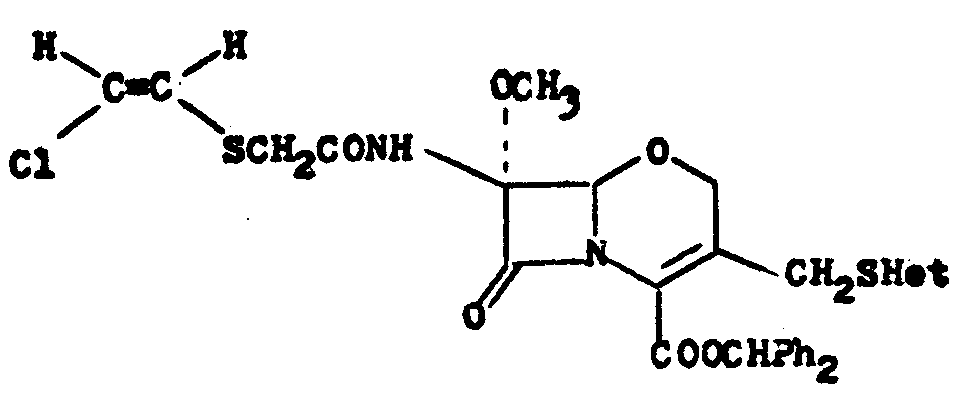
디페닐 메틸 7β-클로로비닐티오아세트아미도-7α-메톡시-3-클로로메틸-1-데티아-1-옥사-3-세펨-4-카르복실레이트(1부), 복소환 티올의 소듐염(1.2몰 당량) 및 DMF(3∼5부)의 혼합물을 30분간 교반한다. 반응 혼합물을 물에 붓고 에틸아세테이트로 추출한다. 추출물을 수세하고 진공 증발시킨다. 생성된 잔류물을 실리카겔 크로마토 그래피에 의해 정제하여 상응하는 디페닐메틸 7β-클로로비닐티오아세트아미도-7α-메톡시-3-복소환 티오메틸-1-데티아-1-옥사-3-세펨-4-카르복실레이트를 수득한다. 수득율 : 80∼90%Diphenyl methyl 7β-chlorovinylthioacetamido-7α-methoxy-3-chloromethyl-1-dethia-1-oxa-3-cepem-4-carboxylate (1 part), sodium of heterocyclic thiol The mixture of salt (1.2 molar equivalents) and DMF (3-5 parts) is stirred for 30 minutes. The reaction mixture is poured into water and extracted with ethyl acetate. The extract is washed with water and evaporated in vacuo. The resulting residue was purified by silica gel chromatography to give the corresponding diphenylmethyl 7β-chlorovinylthioacetamido-7α-methoxy-3-heterocyclic thiomethyl-1-dethia-1-oxa-3-cepem. Obtain 4-carboxylate. Yield: 80-90%
[실시예 6]Example 6

디페닐메틸 7β-클로로비닐티오아세트아미도-7α-메톡시-3-클로로메틸-1-데티아-1-옥사-3-세펨-4-카르복실레이트(1부), 복소환 티올의 소듐염(1.2몰 당량) 및 디클로로메탄(10∼20부)의 혼합물을 촉매량의 테트라부틸암모늄 브로마이드 존재하 실온에서 30분∼2시간 교반한다. 유기층을 수세하고 건조시킨후, 감압하 농축한다. 잔류물을 실리카겔 크로마토그래피하여 필요한 디페닐메틸 7β-클로로비닐티오아세트아미도-7α-메톡시-3-복소환 티오메틸-1-데티아-1-옥사-3-세펨-4-카르복실레이트를 수득한다. 수율 : 80∼90%Diphenylmethyl 7β-chlorovinylthioacetamido-7α-methoxy-3-chloromethyl-1-dethia-1-oxa-3-cepem-4-carboxylate (1 part), sodium of heterocyclic thiol A mixture of salt (1.2 molar equivalents) and dichloromethane (10-20 parts) is stirred for 30 minutes to 2 hours at room temperature in the presence of a catalytic amount of tetrabutylammonium bromide. The organic layer was washed with water, dried and concentrated under reduced pressure. The residue was subjected to silica gel chromatography to obtain the required diphenylmethyl 7β-chlorovinylthioacetamido-7α-methoxy-3-heterocyclic thiomethyl-1-dethia-1-oxa-3-cepem-4-carboxylate. To obtain. Yield: 80-90%
상기 실시예 5 및 6에 기재된 방법에 의해 제조된 본 발명의 화합물(Ⅰ)은 표 Ⅲ에 기재되어 있다.Compound (I) of the present invention prepared by the method described in Examples 5 and 6 above is shown in Table III.
[실시예 7]Example 7


디페닐메틸 7α-(2-메탈카르바모일-2-플루오로)비닐티오아세트아미도-3-(1-카르바모일메틸-5-테트라졸릴)티오메틸-1-데티아-1-옥사-3-세펨-4-카르복실레이트(1부)를 디클로로메탄(10부)에 용해시킨다. t-부틸히포클로라이드(1.1몰당량)을 가한 후, 혼합물을 -20℃에서 3시간 방치한다. 메탄올에 용해된 리튬 메톡사이드(1.2몰 당량)을 가하고, 혼합물을 30분간 반응시킨다.Diphenylmethyl 7α- (2-metalcarbamoyl-2-fluoro) vinylthioacetamido-3- (1-carbamoylmethyl-5-tetrazolyl) thiomethyl-1-dethia-1-oxa 3-Cefe-4-carboxylate (1 part) is dissolved in dichloromethane (10 parts). After addition of t-butyl hypochloride (1.1 molar equivalents), the mixture is left at -20 ° C for 3 hours. Lithium methoxide (1.2 molar equivalents) dissolved in methanol is added and the mixture is allowed to react for 30 minutes.
반응 혼합물을 아세트산으로 산성화하고 디클로로메탄으로 희석한다. 희석된 혼합물을 세척, 건조하고 진공 농축하여 상응하는 디페닐메틸 7β-(2-메틸카르바모일-2-플루오로)비닐티오아세트아미도-7α-메톡시-3-(1-카르바모일메틸-5-테트라졸릴)티오메틸-1-데티아-1-옥사-3-세펨-4-카르복실레이트를 수득한다. 수율 : 40∼85%The reaction mixture is acidified with acetic acid and diluted with dichloromethane. The diluted mixture was washed, dried and concentrated in vacuo to give the corresponding diphenylmethyl 7β- (2-methylcarbamoyl-2-fluoro) vinylthioacetamido-7α-methoxy-3- (1-carbamoyl Methyl-5-tetrazolyl) thiomethyl-1-dethia-1-oxa-3-cefe-4-carboxylate is obtained. Yield: 40-85%
상기 방법에 따라, 표 Ⅲ에 기재된 화합물(Ⅰ)이 수득된다.According to this method, the compound (I) described in Table III is obtained.
[실시예 8]Example 8

(Y=CHPh2, z'=CH3) :(Y = CHPh 2 , z '= CH 3 ):
디페닐메틸 7β-아미노-7α-메톡시-3-(1-메틸-5-테트라졸릴)티오메틸-1-데티아-1-옥사-3-세펨-4-카르복실레이트(Ⅱ)(1부), 피리딘(2몰 당량), 포스포러스옥시클로라이드(1.1몰 당량) 및 일반식(Ⅲ)의 카르복실산(1.1몰 당량)을 디클로로메탄(10∼15부)에 용해시키고, 빙냉하 30분간 반응시킨다.Diphenylmethyl 7β-amino-7α-methoxy-3- (1-methyl-5-tetrazolyl) thiomethyl-1-dethia-1-oxa-3-cefe-4-carboxylate (II) (1 Parts), pyridine (2 molar equivalents), phosphorus oxychloride (1.1 molar equivalents) and carboxylic acid (1.1 molar equivalents) of general formula (III) are dissolved in dichloromethane (10-15 parts) and cooled on ice 30 React for a minute.
반응 혼합물을 수세하고 Na2SO4로 건조시킨 후 감압하 농축한다. 잔류물을 실리카겔 크로마토그래피하여 상응하는 디페닐메틸 7β-아세트아미도-7α-메톡시-3-(1-메틸-5-테트라졸릴)티오메틸-1-데티아-1-옥사-3-세펨-4-카르복실레이트(Ⅰ)를 수득한다. 수율 : 70∼95%The reaction mixture is washed with water, dried over Na 2 SO 4 and concentrated under reduced pressure. The residue was subjected to silica gel chromatography to give the corresponding diphenylmethyl 7β-acetamido-7α-methoxy-3- (1-methyl-5-tetrazolyl) thiomethyl-1-dethia-1-oxa-3-cepem Obtain 4-carboxylate (I). Yield: 70-95%
하기의 방법에 따라 일반식(Ⅱ)의 아민을 일반식(Ⅲ)의 카르복실산 또는 그의 반응성 유도체와 반응시킴으로써 본 발명의 화합물(Ⅰ)을 수득한다. 하기 1)∼27)항에서, 부는 출발아민(Ⅱ)의 중량에 대한 부피에 의한 것이다.Compound (I) of the present invention is obtained by reacting an amine of formula (II) with a carboxylic acid of formula (III) or a reactive derivative thereof according to the following method. In the following items 1) to 27), the part is based on the volume by weight of the starting amine (II).
1) Y가 H인 아민(Ⅱ)(1몰)을 NaHCO3(2.5몰)함유 물(10부)에 용해시킨다. 화합물(Ⅲ)의 산 클로라이드 유도체(1.1몰)을 적가하고, 혼합물을 -5℃∼실온에서 30분∼2시간 동안 반응시킨다.1) Dissolve the amine (II) (1 mol) Y is H in NaHCO 3 (2.5 mol) water (10 parts). Acid chloride derivative (1.1 mol) of compound (III) is added dropwise, and the mixture is reacted at -5 ° C to room temperature for 30 minutes to 2 hours.
2) Y가 H인 아민(Ⅱ)(1몰)을 트리에틸아민(1.2몰)존재하에 트리메틸실릴클로라이드(1.2몰)와 반응시킨다. 수득된 화합물(Ⅱ)의 실릴 에스테르를 화합물(Ⅲ)의 산클로라이드(1.1몰) 및 피리딘(4몰)과 함께 -30℃에서 합하고, 혼합물을 30분∼2시간 동안 반응시킨다. 실릴 에스테르를 산으로 가수분해한다.2) Amine (II) (1 mol), wherein Y is H, is reacted with trimethylsilyl chloride (1.2 mol) in the presence of triethylamine (1.2 mol). The silyl ester of compound (II) obtained is combined with acid chloride (1.1 mole) and pyridine (4 mole) of compound (III) at −30 ° C., and the mixture is reacted for 30 minutes to 2 hours. The silyl ester is hydrolyzed with acid.
3) 아민(Ⅱ)(1몰) 및 화합물(Ⅲ)의 산클로라이드(1.2몰)을 디클로로메탄(20부)에서 피콜린(4몰) 존재하 -30∼0℃에서 30분∼2시간 동안 교반한다.3) Amine (II) (1 mole) and acid chloride (1.2 mole) of compound (III) in dichloromethane (20 parts) in the presence of picoline (4 moles) at -30 to 0 DEG C for 30 minutes to 2 hours. Stir.
4) 아민(Ⅱ)(1몰), 화합물(Ⅲ)의 산클로라이드(1.1몰), 에틸아세테이트(10부) 및 트리에틸아민(1.1몰)의 혼합물을 0∼-20℃에서 30분∼3시간 교반한다.4) A mixture of amine (II) (1 mole), acid chloride (1.1 mole) of compound (III), ethyl acetate (10 parts) and triethylamine (1.1 mole) at 0 to -20 deg. Stir for time.
5) 아민(Ⅱ)(1몰), 이소부톡시포름산(1몰)과 함께 생성된 화합물(Ⅲ)의 혼합 무수물(1몰), 클로로포름(10부), 디메톡시에탄(10부) 및 피리딘(1.5몰)의 혼합물을 -5∼10℃에서 30분∼6시간 교반한다.5) Mixed anhydride (1 mole), chloroform (10 parts), dimethoxyethane (10 parts), and pyridine of the resulting compound (III) with amine (II) (1 mole), isobutoxy formic acid (1 mole) 1.5 mol) is stirred at -5 to 10 DEG C for 30 minutes to 6 hours.
6) 아민(Ⅱ)(1몰), 화합물(Ⅲ)의 비스 무수물(1.1몰), 에틸아세테이트(10부), 1, 2-디클로로메탄(10부) 및 N-메틸모르폴린(1.5몰)의 혼합물을 환류하 10분∼2시간 동안 가열한다.6) amine (II) (1 mole), bis anhydride (1.1 mole) of compound (III), ethyl acetate (10 parts), 1, 2-dichloromethane (10 parts) and N-methylmorpholine (1.5 mole) The mixture is heated at reflux for 10 minutes to 2 hours.
7) 아민(Ⅱ)(1몰), 메탄술폰산으로 생성된 화합물(Ⅲ)의 혼합 무수물(1.1몰) 및 피리딘(1.5몰)을 0℃에서 실온으로 상승되는 온도에서 1∼3시간 동안 교반한다.7) Amine (II) (1 mole), mixed anhydride (1.1 mole) and pyridine (1.5 mole) of compound (III) formed from methanesulfonic acid are stirred for 1 to 3 hours at a temperature rising from 0 ° C. to room temperature. .
8) DMF(5부)에 녹인 아민(Ⅱ)(1몰)을 디메틸아닐린(1.3몰)존재하에 카르복실산(Ⅲ) 및 DMF를 함유한 빌스데이에 시약과 함께 실온에서 1∼5시간 반응시킨다.8) Reaction of amine (II) (1 mol) dissolved in DMF (5 parts) with Vilsdaye reagent containing carboxylic acid (III) and DMF in the presence of dimethylaniline (1.3 mol) at room temperature for 1-5 hours. Let's do it.
9) 아민(Ⅱ)(1몰)을 에틸아세이트(10부)에서 피리딘(1.5몰) 존재하에 디에틸포스페이트로 형성된 화합물(Ⅲ)의 혼합 무수물(1.5몰)과 0∼10℃에서 1∼5시간 동안 반응시킨다.9) A mixed anhydride (1.5 mol) of compound (III) formed of diethylphosphate in the presence of pyridine (1.5 mol) in amine (II) (1 mol) in ethyl acetate (10 parts), and from 1 to 10 캜. Reaction for 5 hours.
10) 아민(Ⅱ)(1몰)을 에틸아세테이트(7부), 디클로로메탄(10부) 및 피리딘(1몰)존재하에 이염화인으로 형성된 화합물(Ⅲ)의 혼합 무수물(1.1몰)과 0℃∼실온에서 1∼3시간 동안 반응시킨다.10) Mixed anhydride (1.1 mol) of compound (III) formed of phosphorus dichloride in the presence of amine (II) (1 mole) with ethyl acetate (7 parts), dichloromethane (10 parts) and pyridine (1 mole); The reaction is carried out at room temperature for 1 to 3 hours.
11) 아민(Ⅱ)(1몰), 루티딘(1.5몰), 디클로로메탄(10ml) 및 모노클로로포스포러스 디메틸아미드와 함께 형성된 화합물(Ⅲ)의 혼합 무수물(1.1∼2몰)의 혼합물을 0∼30℃에서 1∼4시간 동안 교반한다.11) Mix a mixture of anhydrides (1.1-2 mol) of compound (III) formed with amine (II) (1 mol), lutidine (1.5 mol), dichloromethane (10 ml) and monochlorophosphorus dimethylamide. Stir at ˜30 ° C. for 1-4 h.
12) 아민(Ⅱ)(1몰), 카르보닐디이미다졸(1.1몰), THF(10부), 디메틸아세트아미드(5부) 및 카르복실산(Ⅲ)(1.1몰)의 혼합물을 0℃∼실온에서 1∼5시간 동안 교반한다.12) Mix a mixture of amine (II) (1 mol), carbonyldiimidazole (1.1 mol), THF (10 parts), dimethylacetamide (5 parts) and carboxylic acid (III) (1.1 mol) at 0 ° C. Stir for 1 to 5 hours at room temperature.
13) 아민(Ⅱ)(1몰), 디클로로메탄(10부), DMF(5부), N, N'-디시클로헥실카르보디이미드(1.1몰), 피콜린(1.2몰) 및 카르복실산(Ⅲ)(1.1몰)의 혼합물을 2∼24시간 동안 가열한다.13) amine (II) (1 mole), dichloromethane (10 parts), DMF (5 parts), N, N'-dicyclohexylcarbodiimide (1.1 mole), picoline (1.2 mole) and carboxylic acid (III) The mixture of (1.1 mol) is heated for 2 to 24 hours.
14) 아민(Ⅱ)(1몰), 디클로로메탄(10부), 2-에톡시-1-에톡시카르보닐-1, 2-디히드로퀴놀린(1.1몰), N, N'-디시클로헥실카르보디이미드(1.1몰), 피리딘(1.5몰) 및 카르복실산(1.1몰)의 혼합물을 0℃∼실온에서 1∼6시간 동안 교반한다.14) amine (II) (1 mole), dichloromethane (10 parts), 2-ethoxy-1-ethoxycarbonyl-1, 2-dihydroquinoline (1.1 mole), N, N'-dicyclohexyl A mixture of carbodiimide (1.1 mole), pyridine (1.5 mole) and carboxylic acid (1.1 mole) is stirred at 0 ° C. to room temperature for 1-6 hours.
15) 아민(Ⅱ)(1몰), 디클로로메탄(30부), 시아누릭 클로라이드(1.1몰), 피리딘(4몰) 및 카르복실산(1.1몰)의 혼합물을 -30∼10℃에서 30분∼2시간 동안 교반한다.15) A mixture of amine (II) (1 mole), dichloromethane (30 parts), cyanuric chloride (1.1 mole), pyridine (4 mole) and carboxylic acid (1.1 mole) at -30 to 10 < 0 > C for 30 minutes Stir for ˜2 hours.
16) 아민(Ⅱ)(1몰), 디클로로메탄(3부), 포스포러스 옥시클로라이드(1.1몰) 피리딘(1.5몰) 및 카르복실산(1.1몰)의 혼합물을 -10∼10℃에서 20분∼2시간 동안 교반한다.16) A mixture of amine (II) (1 mole), dichloromethane (3 parts), phosphorus oxychloride (1.1 mole) pyridine (1.5 mole) and carboxylic acid (1.1 mole) at -10 to 10 ° C. for 20 minutes Stir for ˜2 hours.
17) 아민(Ⅱ)(1몰)을 트리메틸실릴 클로라이드와 반응시켜 상응하는 N-트리메틸실릴아민을 제조한다. N-실릴화화합물(1몰)을 포스포러스 옥시클로라이드(1.5몰), 카르복실산(Ⅲ)(1.2몰), 피리딘(4몰) 및 디클로로메탄(5부)의 혼합물로 0℃∼실온에서 30분∼2시간 동안 처리한다.17) React amine (II) (1 mole) with trimethylsilyl chloride to produce the corresponding N-trimethylsilylamine. N-silylated compound (1 mol) is a mixture of phosphorus oxychloride (1.5 mol), carboxylic acid (III) (1.2 mol), pyridine (4 mol) and dichloromethane (5 parts) at 0 ° C to room temperature. Treat for 30 minutes to 2 hours.
18) 아민(Ⅱ)(1몰), 디클로로메탄(8부), 티오닐클로라이드(1.5몰), 피리딘(2.5몰) 및 카르복실산(1.1몰)의 혼합물을 -30∼0℃에서 1∼5시간 동안 교반한다.18) A mixture of amine (II) (1 mole), dichloromethane (8 parts), thionyl chloride (1.5 mole), pyridine (2.5 mole) and carboxylic acid (1.1 mole) at 1-30 ° C. Stir for 5 hours.
19) 아민(Ⅱ), (1몰), 디클로로메탄(20부), 1-히도록시벤즈트리아졸(2.1몰), N, N'-디시클로헥실카르보디이미드(2.5몰) 및 카르복실산(Ⅲ)(2몰)의 혼합물을 실온에서 1∼15시간 동안 교반한다.19) amine (II), (1 mole), dichloromethane (20 parts), 1-hixishibenztriazole (2.1 mole), N, N'-dicyclohexylcarbodiimide (2.5 mole) and carboxylic acid The mixture of (III) (2 moles) is stirred at room temperature for 1-15 hours.
20) 아민(Ⅱ)(1몰), 디클로로메탄(5부), 트리플루오로아세트산 무수물(1.5몰), 피리딘(3몰) 및 카르복실산(1.5몰)의 혼합물을 0℃∼실온에서 1∼5시간 동안 교반한다.20) Mixture of amine (II) (1 mol), dichloromethane (5 parts), trifluoroacetic anhydride (1.5 mol), pyridine (3 mol) and carboxylic acid (1.5 mol) at 0 ° C to room temperature Stir for ˜ 5 hours.
21) 아민(Ⅱ)(1몰), 디(2-피리딜)설파이드(1.1몰), 트리페닐포스핀(1.1몰) 및 카르복실산(Ⅲ)(1.1몰)의 혼합물을 10∼50℃에서 2∼6시간 동안 교반한다.21) A mixture of amine (II) (1 mole), di (2-pyridyl) sulfide (1.1 mole), triphenylphosphine (1.1 mole) and carboxylic acid (III) (1.1 mole) Stir at 2-6 h.
22) 아민(Ⅱ)(1몰), 디클로로메탄(3부), 1, 3, 5-트리피리디늄트리아진 트리클로라이드(4몰) 및 카르복실산(Ⅲ)(1.1몰)의 혼합물을 -10∼10℃에서 1∼5시간 동안 교반한다.22) a mixture of amine (II) (1 mole), dichloromethane (3 parts), 1, 3, 5-tripyridinium triazine trichloride (4 moles) and carboxylic acid (III) (1.1 moles) Stir at 10-10 ° C. for 1-5 hours.
23) 아민(Ⅱ)(1몰), CCl4(30부), N-메틸 모르폴린(1.5몰), 트리스디에틸아미노포스핀(1.1몰) 및 카르복실산(Ⅲ)(1.1몰)의 혼합물을 -20∼10℃에서 1∼5시간 동안 방치한다.23) of amine (II) (1 mole), CCl 4 (30 parts), N-methyl morpholine (1.5 mole), trisdiethylaminophosphine (1.1 mole) and carboxylic acid (III) (1.1 mole) The mixture is left at -20 to 10 DEG C for 1 to 5 hours.
24) 아민(Ⅱ)(1몰), 디옥산(10부), N, N'-디시클로헥실카르보디이미드(2몰) 및 카르복실산(Ⅲ)의 프탈이미드(2몰) 혼합물을 10∼50℃에서 2∼8시간 동안 교반한다.24) A phthalimide (2 moles) mixture of amine (II) (1 mole), dioxane (10 parts), N, N'-dicyclohexylcarbodiimide (2 moles) and carboxylic acid (III) Stir at 10-50 ° C. for 2-8 hours.
25) 아민(Ⅱ)(1몰), 메틸이소부틸케톤(10부), N, N'-디시클로헥실카르보디이미드(1.5몰) 및 화합물(Ⅲ)의 숙신이미드(1.5몰)의 혼합물을 0∼40℃에서 2∼9시간 동안 교반한다.25) A mixture of amine (II) (1 mole), methyl isobutyl ketone (10 parts), N, N'-dicyclohexylcarbodiimide (1.5 mole) and succinimide (1.5 mole) of compound (III) Stir at 0-40 ° C. for 2-9 hours.
26) 아민(Ⅱ)(1몰), 디클로로메탄(20부), 피리딘(3몰), N, N'-디시클로헥실카르보디이미드(3몰) 및 카르복실산(Ⅲ)의 1-옥사벤즈 트리아졸 에스테르(3몰)의 혼합물을 10∼50℃에서 5∼30시간 동안 교반한다.26) 1-oxa of amine (II) (1 mol), dichloromethane (20 parts), pyridine (3 mol), N, N'-dicyclohexylcarbodiimide (3 mol) and carboxylic acid (III) The mixture of benz triazole esters (3 moles) is stirred at 10-50 ° C. for 5-30 hours.
27) 아민(Ⅱ)(1몰), 클로로포름(3부), 톨루엔(1부), 피콜린(2몰), 옥살릴클로라이드(1몰) 및 카르복실산(1.1몰)의 혼합물을 -50∼10℃에서 10분∼2시간 동안 교반한다.27) Mixing a mixture of amine (II) (1 mole), chloroform (3 parts), toluene (1 part), picoline (2 moles), oxalyl chloride (1 mole) and carboxylic acid (1.1 mole) Stir for 10 minutes to 2 hours at ˜10 ° C.
상기 방법에 따라 제조된 화합물(Ⅰ)의 표 Ⅱ 및 Ⅲ에 기재되어 있다.It is shown in Tables II and III of compound (I) prepared according to the above method.
[실시예 9]Example 9

디페닐 메틸 7β-(2,2-디클로로-1-티오카르바모일옥시에틸)티오아세트아미도-7α-메톡시-3-[1-(히드록시에틸)-5-테트라졸릴]티오메틸-1-데티아-1-옥사-3-세펨-4-카르복실레이트(1.5g)을 아연 분말(0.75g), 디옥산(5ml) 및 아세트산(1ml)와 합하고, 혼합물을 실온에서 20분간 교반한다. 반응 혼합물을 여과 한다. 여과액을 디클로로메탄으로 희석하고, 수세한 후, 진공농축하여 디페닐메틸 7β-클로로비닐티오 아세트아미도-7α-메톡시-3-[1-(히드록시에틸)-5-테트라졸릴]티오메틸-1-데티아-1-옥사-3-세펨-4-카르복실레이트를 수득한다. 수율 : 40%Diphenyl methyl 7β- (2,2-dichloro-1-thiocarbamoyloxyethyl) thioacetamido-7α-methoxy-3- [1- (hydroxyethyl) -5-tetrazolyl] thiomethyl- Combine 1-dethia-1-oxa-3-cepem-4-carboxylate (1.5 g) with zinc powder (0.75 g), dioxane (5 ml) and acetic acid (1 ml) and stir the mixture at room temperature for 20 minutes. do. The reaction mixture is filtered. The filtrate was diluted with dichloromethane, washed with water, concentrated in vacuo to diphenylmethyl 7β-chlorovinylthio acetamido-7α-methoxy-3- [1- (hydroxyethyl) -5-tetrazolyl] thio Obtain methyl-1-dethia-1-oxa-3-cefe-4-carboxylate. Yield: 40%
[실시예 10]Example 10

디페닐메틸 7β-(1,2-디클로로에틸)티오아세트아미도-7α-메톡시-3-(1-시아노메틸-5-테트라졸릴)티오메틸-1-데티아-1-옥사-3-세펨-4-카르복실레이트(4.2g), 염화리튬(3g) 및 DMF(20ml)의 혼합물을 70∼75℃에서 3시간 동안 가열한다.Diphenylmethyl 7β- (1,2-dichloroethyl) thioacetamido-7α-methoxy-3- (1-cyanomethyl-5-tetrazolyl) thiomethyl-1-dethia-1-oxa-3 A mixture of cefem-4-carboxylate (4.2 g), lithium chloride (3 g) and DMF (20 ml) is heated at 70-75 ° C. for 3 hours.
반응 혼합물을 빙수로 희석하고, 에틸아세테이트로 추출한다. 추출물을 수세 및 건조시키고, 감압하 농축하여 디페닐 메틸 7β-클로로비닐티오 아세트아미도-7α-메톡시-3-(1-시아노에틸-5-테트라졸릴)티오메틸-1-데티아-1-옥사-3-세펨-4-카르복실레이트를 수득한다. 수율 : 2.5gThe reaction mixture is diluted with ice water and extracted with ethyl acetate. The extract was washed with water, dried and concentrated under reduced pressure to give diphenyl methyl 7β-chlorovinylthio acetamido-7α-methoxy-3- (1-cyanoethyl-5-tetrazolyl) thiomethyl-1-dethia- Obtain 1-oxa-3-cefe-4-carboxylate. Yield: 2.5 g
[실시예 11]Example 11

메틸술포닐에틸 7β-메르캅토아세트아미도-7α-메톡시-3-(1-메틸-5-테트라졸릴)티오메틸-1-데티아-1-옥사-3-세펨-4-카르복실레이트를 디클로로메탄에 용해시킨다.Methylsulfonylethyl 7β-mercaptoacetamido-7α-methoxy-3- (1-methyl-5-tetrazolyl) thiomethyl-1-dethia-1-oxa-3-cepem-4-carboxyl The rate is dissolved in dichloromethane.
이 용액을 과량의 클로로아세틸렌을 함유한 에테르용액과 함께 -70℃에서 합한다.This solution is combined at −70 ° C. with an ether solution containing excess chloroacetylene.
반응 혼합물의 온도를 3시간에 걸쳐 실온으로 상승시키고 수세한 후 진공 증발시켜 메탄술포닐에틸 7β-클로로비닐티오아세트아미도-7α-메톡시-3-(1-메틸-5-테트라졸릴)티오메틸-1-데티아-1-옥사-3-세펨-4-카르복실레이트를 수득한다. 수율 : 63%The temperature of the reaction mixture was raised to room temperature over 3 hours, washed with water and evaporated in vacuo to methanesulfonylethyl 7β-chlorovinylthioacetamido-7α-methoxy-3- (1-methyl-5-tetrazolyl) thio Obtain methyl-1-dethia-1-oxa-3-cefe-4-carboxylate. Yield: 63%
[실시예 12]Example 12


A. [x=H-]A. [x = H-]
ⅰ) 디페닐메틸 7β-트리메틸실릴아미노-7α-메톡시-3-(1-메틸-5-테트라졸릴)티오메틸-1-데티아-1-옥사-3-세펨-4-카르복실레이트(1)(1부), 포스포러스옥시클로라이드(1.5몰), t-부톡시카르보닐메틸렌-1,3-디에탄카르복실산(1.2몰) 및 r-피콜린(1.5몰)의 혼합물을 디클로로메탄(5부)중에 0℃에서 30분간 교반한다.(Iv) diphenylmethyl 7β-trimethylsilylamino-7α-methoxy-3- (1-methyl-5-tetrazolyl) thiomethyl-1-dethia-1-oxa-3-cepem-4-carboxylate ( 1) (1 part), a mixture of phosphorus oxychloride (1.5 moles), t-butoxycarbonylmethylene-1,3-dietancarboxylic acid (1.2 moles) and r-picoline (1.5 moles) Stir for 30 minutes at 0 ° C. in methane (5 parts).
반응 혼합물을 수세하고 건조시킨 후, 진공증발시켜 디페닐메틸 7β-t-부톡시카르보닐메틸렌디티에탄카르보닐아미노-7α-메톡시-3-(1-메틸-5-테트라졸릴)티오메틸-1-데티아-1-옥사-3-세펨-4-카르복실레이트(2)를 수득한다. 수율 60.7%The reaction mixture was washed with water and dried and then evaporated in vacuo to diphenylmethyl 7β-t-butoxycarbonylmethylenedithiethanecarbonylamino-7α-methoxy-3- (1-methyl-5-tetrazolyl) thiomethyl- 1-dethia-1-oxa-3-cepem-4-carboxylate (2) is obtained. Yield 60.7%
ⅱ) 상기에 수득된 생성물(1부)를 디클로로메탄(20부)에 용해시킨다. -50℃로 냉각된 디클로로메탄 용액에 CCl4(2.5몰) 및 피리딘(2몰)에 녹인 1.2M 염소용액을 가한다. 30분 교반후, 반응 혼합물을 실온으로 가온하고, 티오황산나트륨 수용액으로 세척한 후 감압하 농축한다. 잔류물을 실리카겔크로마토 그래피에 의해 정제하여 디페닐메틸 7β-t-부톡시카르보닐 클로로메틸렌-1,3-디티에탄카르보닐아미노-7α-메톡시-3-(1-메틸-5-테트라졸릴)티오메틸-1-데티아-1-옥사-3-세펨-4-카르복실레이트(3) Hal=Cl)을 수득한다. 수율 57%Ii) The product obtained above (1 part) is dissolved in dichloromethane (20 parts). To a dichloromethane solution cooled to −50 ° C. add 1.2 M chlorine solution dissolved in CCl 4 (2.5 moles) and pyridine (2 moles). After stirring for 30 minutes, the reaction mixture is warmed to room temperature, washed with aqueous sodium thiosulfate solution and concentrated under reduced pressure. The residue was purified by silica gel chromatography to give diphenylmethyl 7β-t-butoxycarbonyl chloromethylene-1,3-diethanecarbonylamino-7α-methoxy-3- (1-methyl-5-tetrazolyl ) Thiomethyl-1-dethia-1-oxa-3-cepem-4-carboxylate (3) Hal = Cl) is obtained. Yield 57%
ⅲ) 상기 반응에서 염소 대신 브롬을 사용할 때, 상응하는 7β-t-부톡시-카르보닐브로모메틸렌 화합물((3), Hal=Br)을 수득한다. 수율 : 87%V) When bromine is used instead of chlorine in the reaction, the corresponding 7β-t-butoxy-carbonylbromomethylene compound ((3), Hal = Br) is obtained. Yield: 87%
ⅳ) 상기 ⅰ)에서 생성물(1부)를 피리딘(2몰), 헥사메틸포스포로트리아미드(2몰) 및 N-요오도숙신이미드(3몰)과 혼합한다. 혼합물을 실온에서 교반하고 수세한 후, 진공농축한다. 잔류물을 실리카겔크로마토그래피에 의해 정제하여 디페닐메틸 7β-t-부톡시카르보닐요오도메틸렌디티에탄카르복시아미노-7α-메톡시-3-(1-메틸-5-테트라졸릴)티오메틸-1-데티아-1-옥사-3-세펨-4-카르복실레이트((3) Hal=I)를 수득한다. 수율 80%Iii) The product (1 part) in iii) is mixed with pyridine (2 moles), hexamethylphosphorotriamide (2 moles) and N-iodosuccinimide (3 moles). The mixture is stirred at room temperature, washed with water and concentrated in vacuo. The residue was purified by silica gel chromatography to give diphenylmethyl 7β-t-butoxycarbonyliodomethylenedithiethanecarboxyamino-7α-methoxy-3- (1-methyl-5-tetrazolyl) thiomethyl-1 -Dethia-1-oxa-3-cepem-4-carboxylate ((3) Hal = I) is obtained. Yield 80%
ⅴ) 상기와 같은 방법으로, N-요오드숙신아미드 대신 각각 N-브로모숙신아미드 또는 N-클로로숙신이미드를 사용하여 브로모메틸렌((3) Hal-Br) 또는 클로로메틸렌 화합물((3) Hal-Cl)을 수득한다.V) Bromomethylene ((3) Hal-Br) or chloromethylene compound ((3) using N-bromosuccinamide or N-chlorosuccinimide, respectively, instead of N-iodine succinamide Hal-Cl) is obtained.
B. [x-(CH3)3Si-]B. [x- (CH 3 ) 3 Si-]
상기 A. ⅰ)∼A. ⅴ)와 같은 방법으로 트리메틸실릴 메틸렌 화합물(2b)로부터 할로메틸렌 화합물을 제조한다.Said A. i) -A. A halomethylene compound is prepared from trimethylsilyl methylene compound ( 2b ) in the same manner as in (iii).
상기 실시예 9∼12에 기재된 방법에 의해 제조된 화합물(Ⅰ)은 표 Ⅱ 및 Ⅲ에 기재되어 있다.Compounds (I) prepared by the methods described in Examples 9-12 above are listed in Tables II and III.
[실시예 13]Example 13
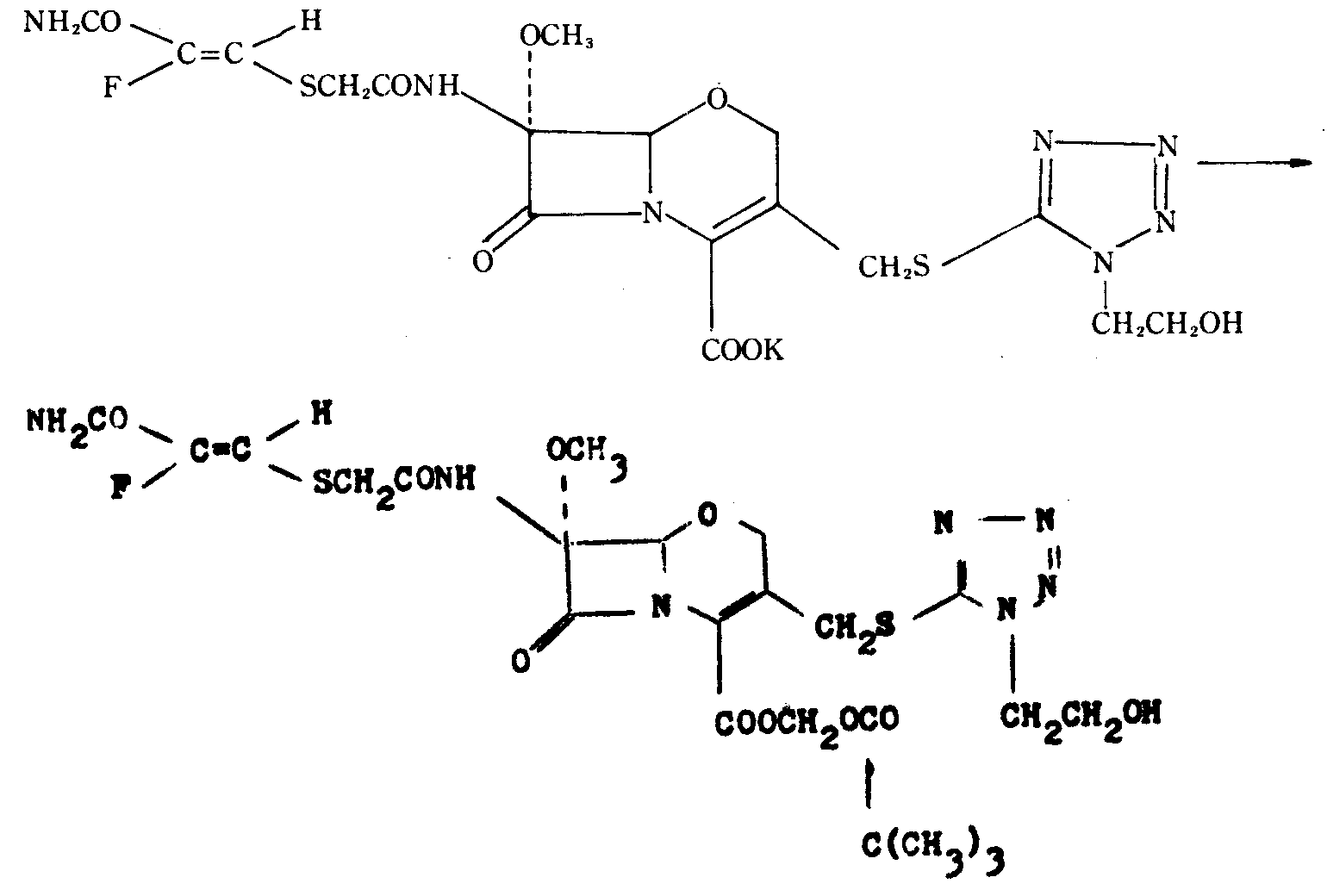
ⅰ) 포타슘 7β-(2-카르바모일-2-플루오로)비닐 티오아세트아미도-7α-메톡시-3-(1-히드록시에틸-5-테트라졸리)티오메틸-1-데티아-1-옥사-3-세펨-4-카르복실레이트(1밀리몰)을 DMF (2∼5부)에 용해시킨다.Iii) potassium 7β- (2-carbamoyl-2-fluoro) vinyl thioacetamido-7α-methoxy-3- (1-hydroxyethyl-5-tetrazoli) thiomethyl-1-dethia- 1-oxa-3-cepem-4-carboxylate (1 mmol) is dissolved in DMF (2-5 parts).
이 용액에 요오도메틸피발레이트(1∼2밀리몰)를 빙냉하면서 가하고, 혼합물을 15분∼2시간 교반한다. 반응 혼합물을 에틸아세테이트로 희석하고, 방수 및 NaHCO3용액으로 세척한 후, 건조시키고 감압하 증발시킨다. 생성된 잔류물을 에틸아세테이트로 결정화하여 피발로일옥시메틸 7β-(2-카르바모일-2-플루오로)비닐티오아세트아미도-7α-메톡시-3-(1-히드록시에틸-5-테트라졸릴)티오메틸-1-데티아-1-옥사-3-세펨-4-카르복실레이트를 수득한다.Iodomethyl pivalate (1-2 mmol) is added to this solution while ice-cooling, and the mixture is stirred for 15 minutes to 2 hours. The reaction mixture is diluted with ethyl acetate, washed with water-proof and NaHCO 3 solution, dried and evaporated under reduced pressure. The resulting residue was crystallized from ethyl acetate to give pivaloyloxymethyl 7β- (2-carbamoyl-2-fluoro) vinylthioacetamido-7α-methoxy-3- (1-hydroxyethyl-5 -Tetrazolyl) thiomethyl-1-dethia-1-oxa-3-cepem-4-carboxylate is obtained.
ⅱ) 상기와 같은 방법으로, 포타슘염 대신 소듐염을 사용하여 상기에 수득된 피발로일옥시메틸 에스테르를 제조한다.Ii) In the same manner as above, the pivaloyloxymethyl ester obtained above is prepared using sodium salt instead of potassium salt.
ⅲ) 피발로옥시메틸에스테르(250g), 옥수수전분(150g) 및 마그네슘스테아레이트(5g)를 균일하게 혼합하고, 과립화한 후, 공지의 방법으로한 캡슐에 25mg의 피발로일옥시메틸에스테르가 포함되도록 젤라틴 캡슐에 채운다.Viii) Pivalooxymethyl ester (250 g), corn starch (150 g) and magnesium stearate (5 g) are uniformly mixed, granulated and 25 mg of pivaloyloxymethyl ester is added to a capsule by a known method. Fill gelatin capsules for inclusion.
스트렙토코쿠스피오게네스 감염을 치료하기 위해 상기 캡슐을 환자에게 경구 투여한다. 일일용량은 3∼9캡슐이며 보통 3번에 나누어서 투여한다.The capsules are orally administered to the patient to treat Streptococcus piogenes infection. The daily dose is 3 to 9 capsules, usually divided into three doses.
[실시예 14]Example 14
5ml 바이알에 든 7β-클로로비닐티오아세트아미도-7α-메톡시-3-(1-디메틸아미노에틸-5-테트라졸릴)티오메틸-1-데티아-1-옥사-3-세펨-4-카르복실산의 소듐염(100mg)을 사용전 주사용 멸균수(1ml)에 용해시키고, 이것을 신우염 성인 환자에게 정맥주사를 통해 투여한다.7β-chlorovinylthioacetamido-7α-methoxy-3- (1-dimethylaminoethyl-5-tetrazolyl) thiomethyl-1-dethia-1-oxa-3-cepem-4- in 5 ml vial Sodium salt of carboxylic acid (100 mg) is dissolved in sterile water for injection (1 ml) before use, and it is administered by intravenous injection to adult patients with pyelonephritis.
[실시예 15]Example 15
7β-(2-카르바모일-2-플루오로)비닐티오아세트아미도-7α-메톡시-3-(1-히드록시-5-테트라졸릴)티오메틸-1-데티아-1-옥사-3-세펨-4-카르복실산을 탄산수소나트륨에 의해 pH 7.0으로 중화한 후의 동결건조물(1g)을 150ml바이알에 넣는다.7β- (2-carbamoyl-2-fluoro) vinylthioacetamido-7α-methoxy-3- (1-hydroxy-5-tetrazolyl) thiomethyl-1-dethia-1-oxa- The freeze-dried product (1 g) after neutralizing 3-cefe-4-carboxylic acid to pH 7.0 with sodium hydrogen carbonate is put into a 150 ml vial.
동결건조물을 주사용 살균수(100ml)에 용해시키고, 수술후의 박테리아 감염을 예방 및 치료하기 위해 암의 외과 수술 동안 또는 수술후 즉시 성인 환자에게 정맥내 투여한다.The lyophilisate is dissolved in sterile water for injection (100 ml) and administered intravenously to adult patients during or immediately after surgery of cancer to prevent and treat postoperative bacterial infection.
[실시예 16]Example 16
5ml바이알에든 7β-(2-카르바모일-2-플루오로)비닐티오아세트아미도-7α-메톡시-3-(1-카르바모일메틸-5-테트라졸릴)티오메틸-1-데티아-1-옥사-3-세펨-4-카르복실산(200mg)미세결정을 2ml의 프로카인(2ml)를 함유한 주사용 멸균수에 현탁시키고, 스타필로코쿠스 아우레우스로 인한 화농성염증 환자에게 근육내 투여한다.5 ml vials 7β- (2-carbamoyl-2-fluoro) vinylthioacetamido-7α-methoxy-3- (1-carbamoylmethyl-5-tetrazolyl) thiomethyl-1-dethia -1-oxa-3-cefe-4-carboxylic acid (200 mg) microcrystals were suspended in sterile water for injection containing 2 ml of procaine (2 ml) and purulent inflammation caused by Staphylococcus aureus. Intramuscularly.
[실시예 17]Example 17
결정성 피발로일옥시메틸 7-(2-카르바모일-2-플루오로)비닐티오아세트아미도-7-메톡시-3-(1-히드록시에틸-5-테트라졸릴)티오메틸-1-데티아-1-옥사-3-세펨-4-카르복실레이트(200mg)을 참기름(0.25ml)에 용해시키고, 딱딱한 젤라틴캡슐에 채운다. 이 캡슐을 스트렙토코쿠스 피오게네스에 의한 순환기 감염 환자에게 4시간 간격으로 경구 투여한다.Crystalline pivaloyloxymethyl 7- (2-carbamoyl-2-fluoro) vinylthioacetamido-7-methoxy-3- (1-hydroxyethyl-5-tetrazolyl) thiomethyl-1 Dethia-1-oxa-3-cepem-4-carboxylate (200 mg) is dissolved in sesame oil (0.25 ml) and filled into hard gelatin capsules. This capsule is orally administered to patients with circulatory infection caused by Streptococcus pyogenes at 4 hour intervals.
[실시예 18]Example 18
분말상 7-클로로비닐티오아세트아미도-7-메톡시-3-(1-히드록시에틸-5-테트라졸릴)티오메틸-1-데티아-1-옥사-3-세펨-4-카르복실산(100mg)을 옥수수전분(150mg) 및 활석(100mg)과 잘 혼합하여 분말화하고 딱딱한 젤라틴 캡슐(250mg 부피)에 채운다. 각 캡슐을 에스케리키아 콜리에 의해 요로 감염된 성인 환자에게 3시간 간격으로 경구 투여한다.Powdered 7-chlorovinylthioacetamido-7-methoxy-3- (1-hydroxyethyl-5-tetrazolyl) thiomethyl-1-dethia-1-oxa-3-cepem-4-carboxylic acid (100 mg) is mixed well with corn starch (150 mg) and talc (100 mg) and filled into powdered and hard gelatin capsules (250 mg volume). Each capsule is administered orally every three hours to an adult patient urinary tract infected with Escherichia coli.
[실시예 19]Example 19
피발로일옥시 메틸 7β-(2-카르바모일-2-플로오로)비닐티오아세트아미도-7α-메톡시-3-(1-히드록시에틸-5-테트라졸릴)티오메틸-1-데티아-1-옥사-3-세펨-4-카르복실레이트(10g), 락토오즈(50g), 옥수수전분(2g), 마그네슘 스테아레이트(0.3g), 슈크로오즈(10g), 및 필요량의 아카시아 및 활석의 혼합 분말을 과립화 한다. 사용전에 과립을 물과 혼합하여 현탁액을 만들고 1티스푼량의 현탁액을 크랩시엘라 뉴모니아에 의한 폐렴에 걸린 유아에게 경구투여한다.Pivaloyloxy methyl 7β- (2-carbamoyl-2-fluoro) vinylthioacetamido-7α-methoxy-3- (1-hydroxyethyl-5-tetrazolyl) thiomethyl-1-de Thia-1-oxa-3-cepem-4-carboxylate (10 g), lactose (50 g), corn starch (2 g), magnesium stearate (0.3 g), sucrose (10 g), and the required amount of acacia And the mixed powder of talc is granulated. Prior to use, the granules are mixed with water to make a suspension and 1 teaspoon of suspension is orally administered to infants with pneumonia caused by crab siella pneumoniae.
[표 1]TABLE 1


[표 2a]TABLE 2a


[표 2b]TABLE 2b

[표 2c]TABLE 2c

[표 2d]TABLE 2d

[표 2e]TABLE 2e

[표 2f]TABLE 2f

[표 2g]Table 2g

[표 2h]Table 2h

[표 2i]TABLE 2i

[표 2j]TABLE 2j

[표 2k]Table 2k

[표 2l]TABLE 2L

[표 2m][Table 2m]

[표 2n]TABLE 2n

[표 2o]Table 2o

[표 2p]TABLE 2p

[표 2q]TABLE 2q
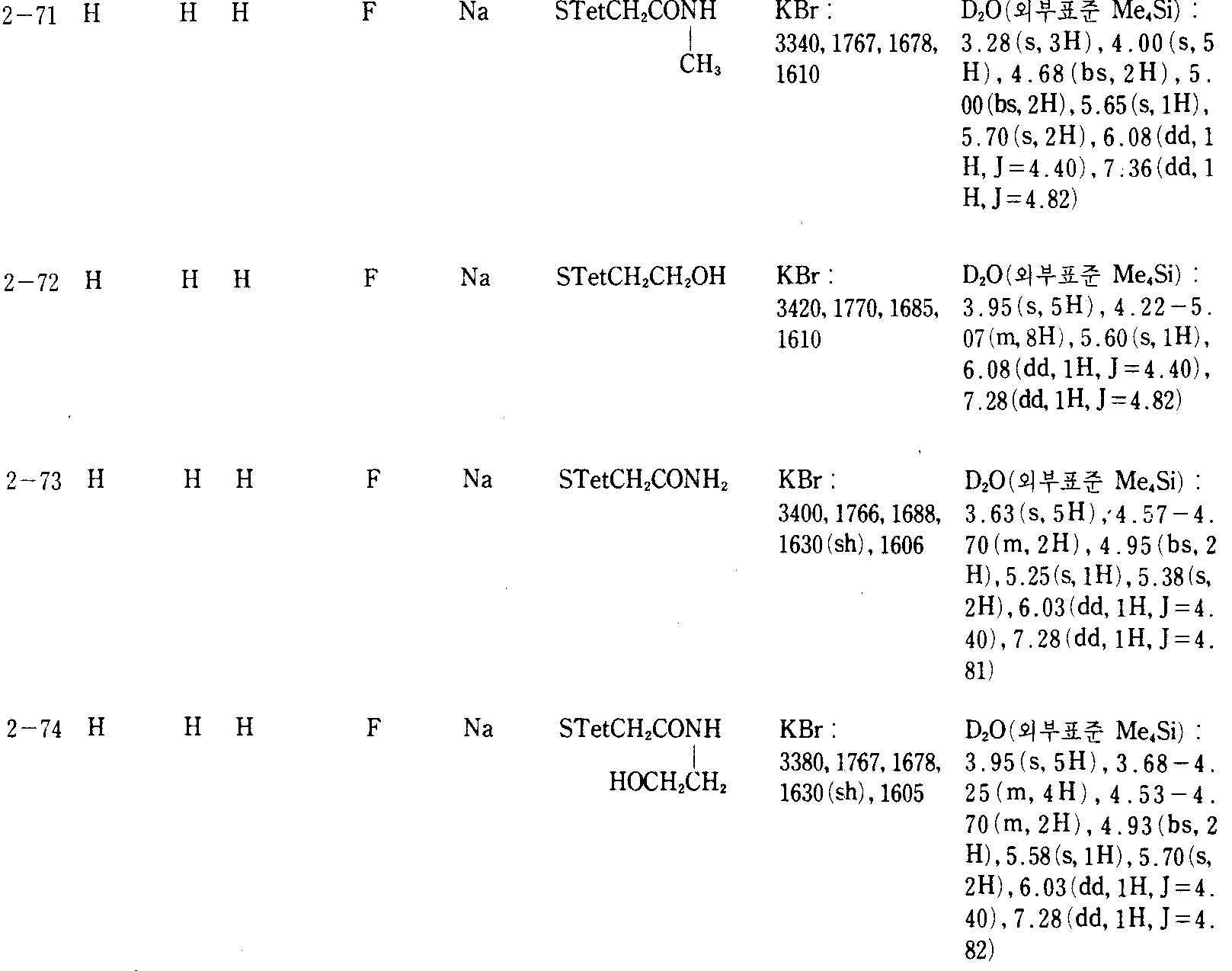
[표 2r]TABLE 2r
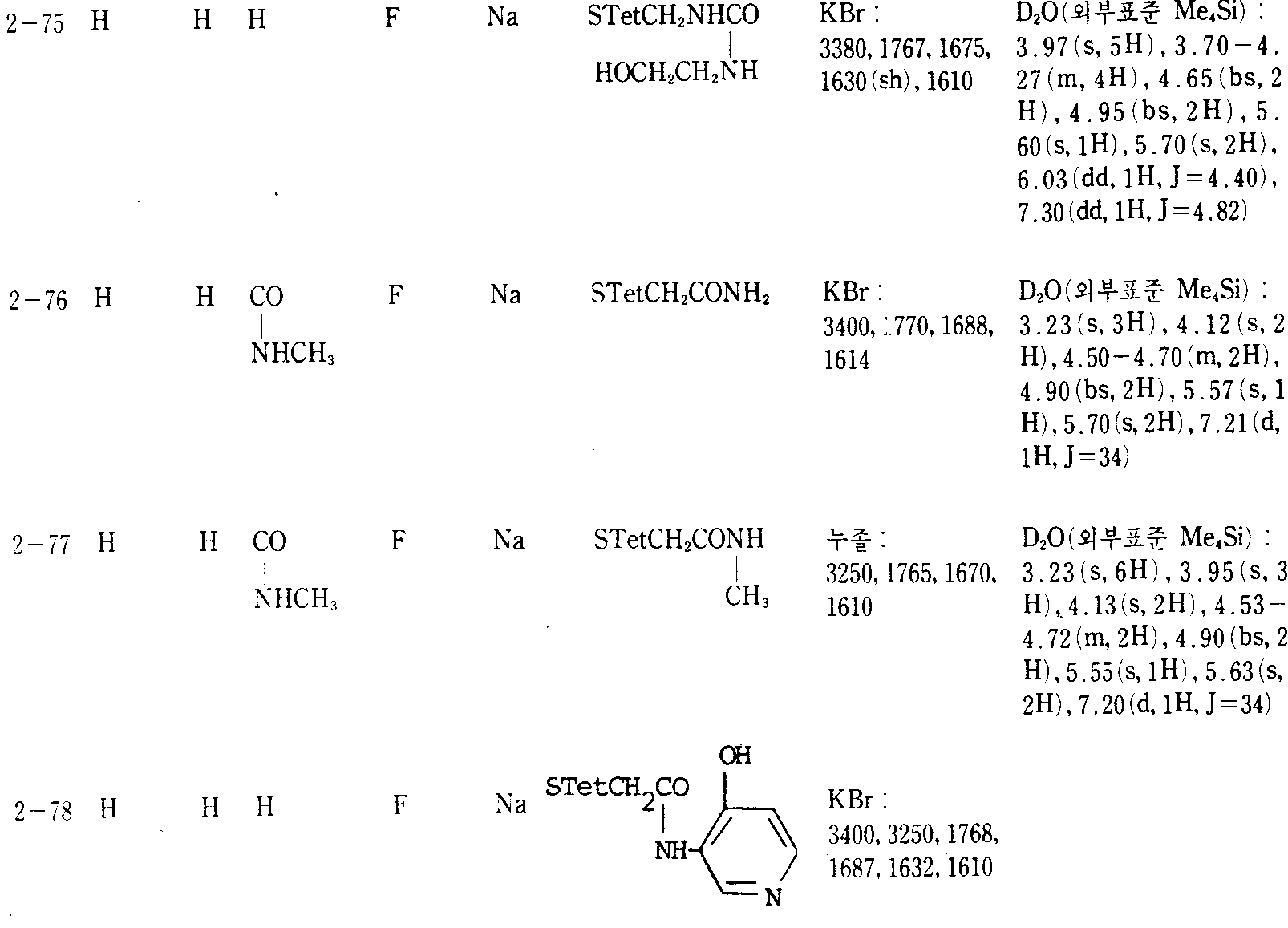
[표 2s]TABLE 2S

[표 3a]TABLE 3a

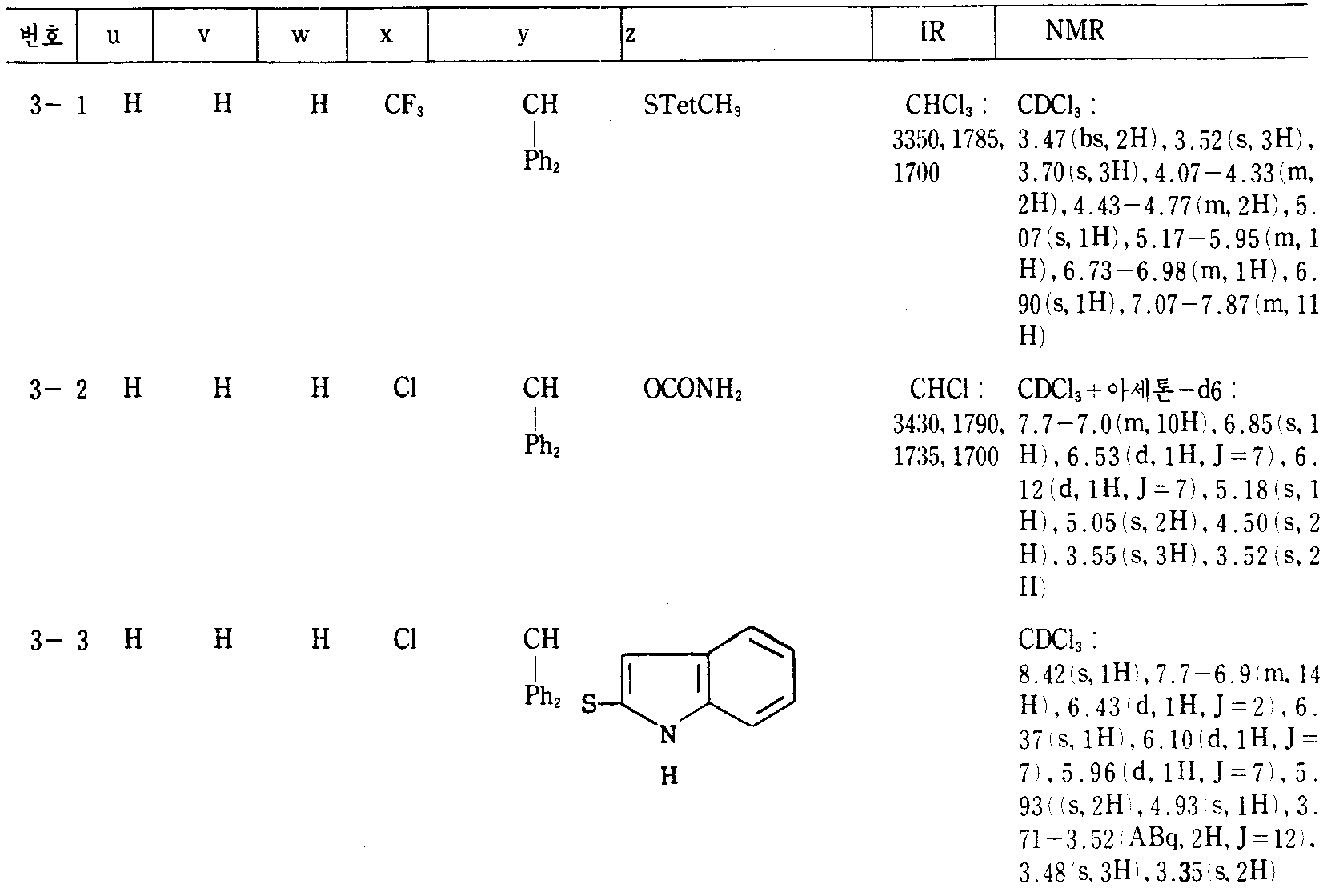
[표 3b]TABLE 3b

[표 3c]TABLE 3c

[표 3d]Table 3d

[표 3e]Table 3e

[표 3f]Table 3f

[표 3g]Table 3g

[표 3h]Table 3h
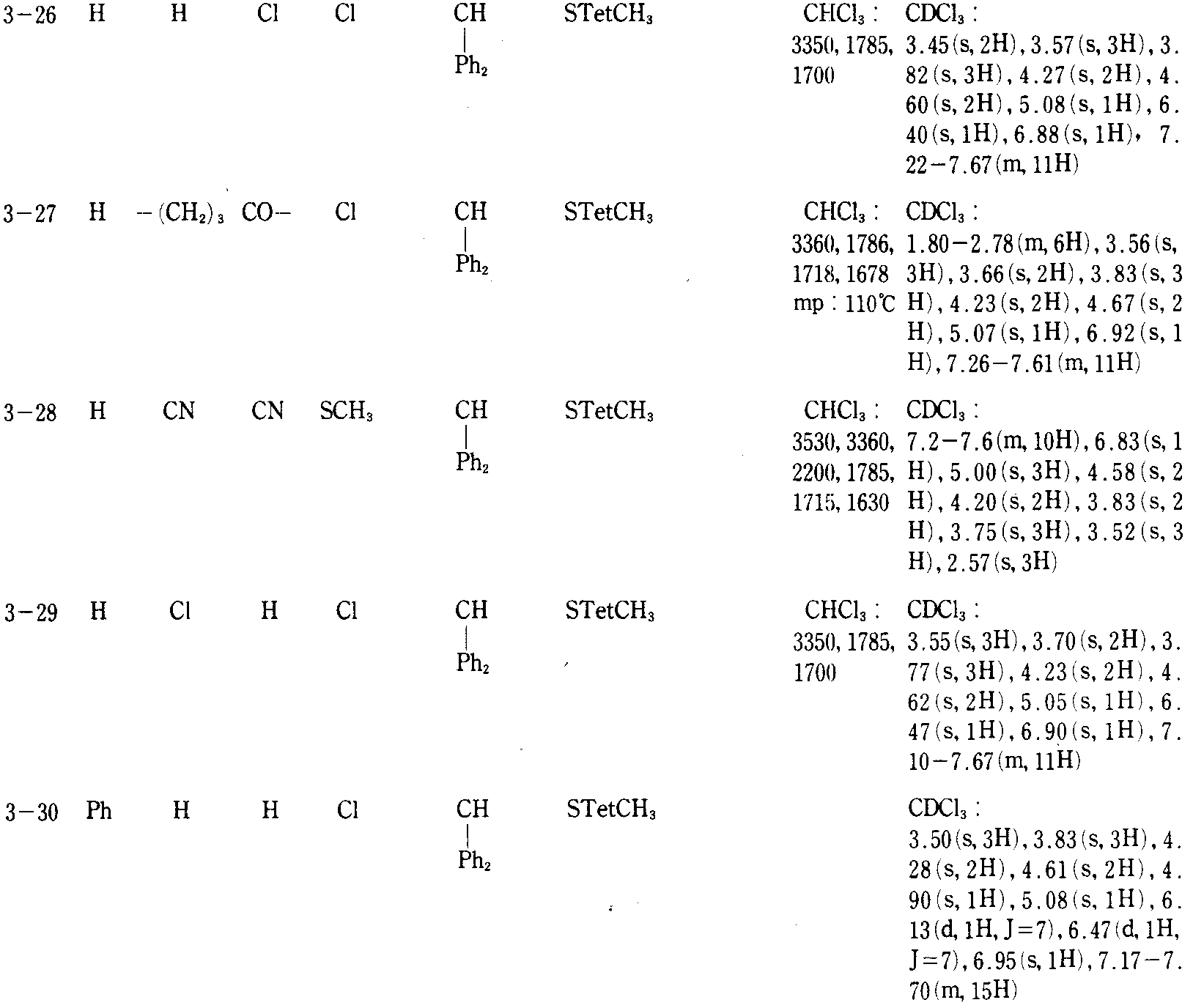
[표 3i]TABLE 3i

[표 3j]TABLE 3j

[표 3k]Table 3k
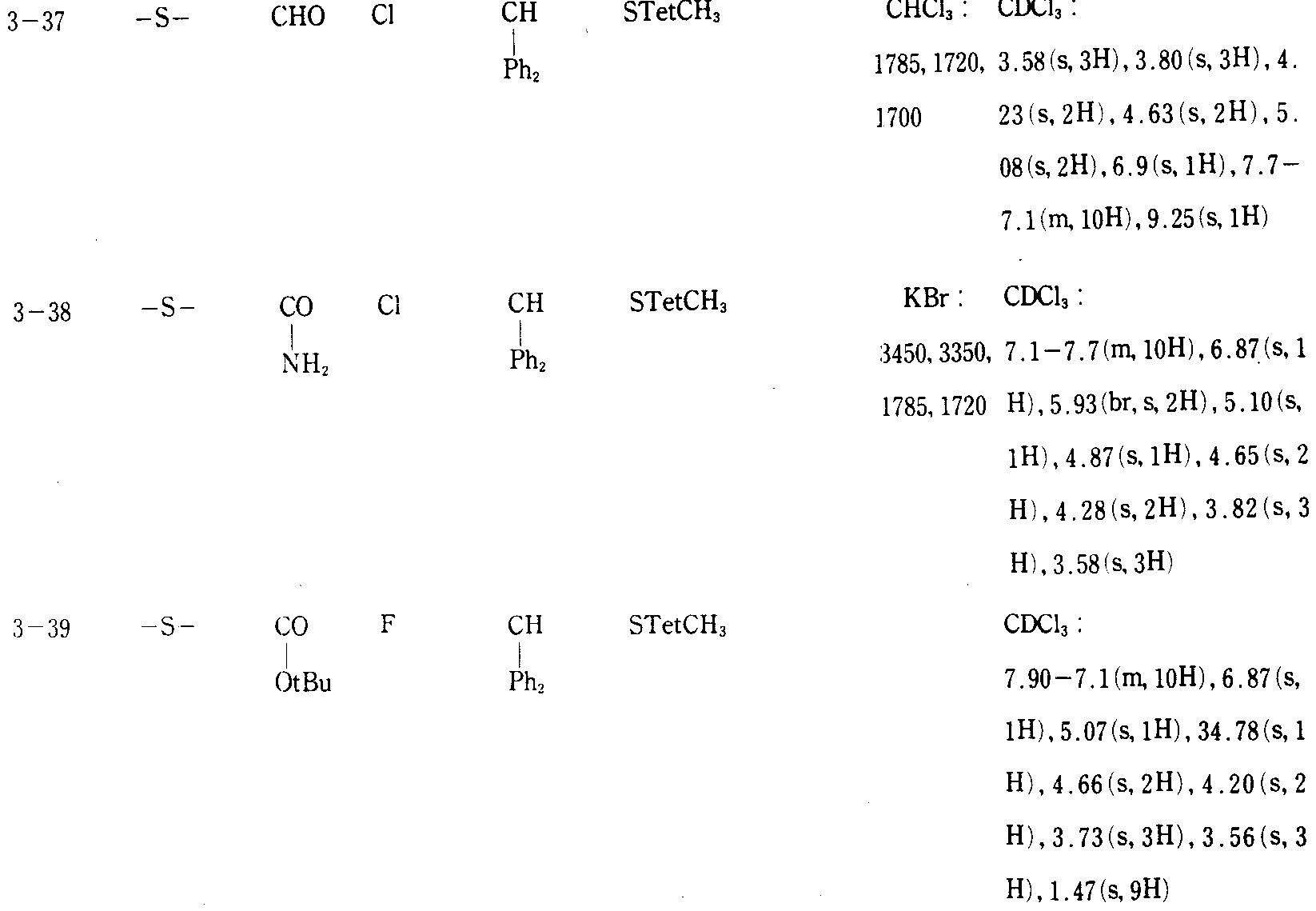
[표 3l]TABLE 3L

[표 3m][Table 3m]

[표 3n]TABLE 3n

[표 3o]Table 3o

[표 3p]Table 3p
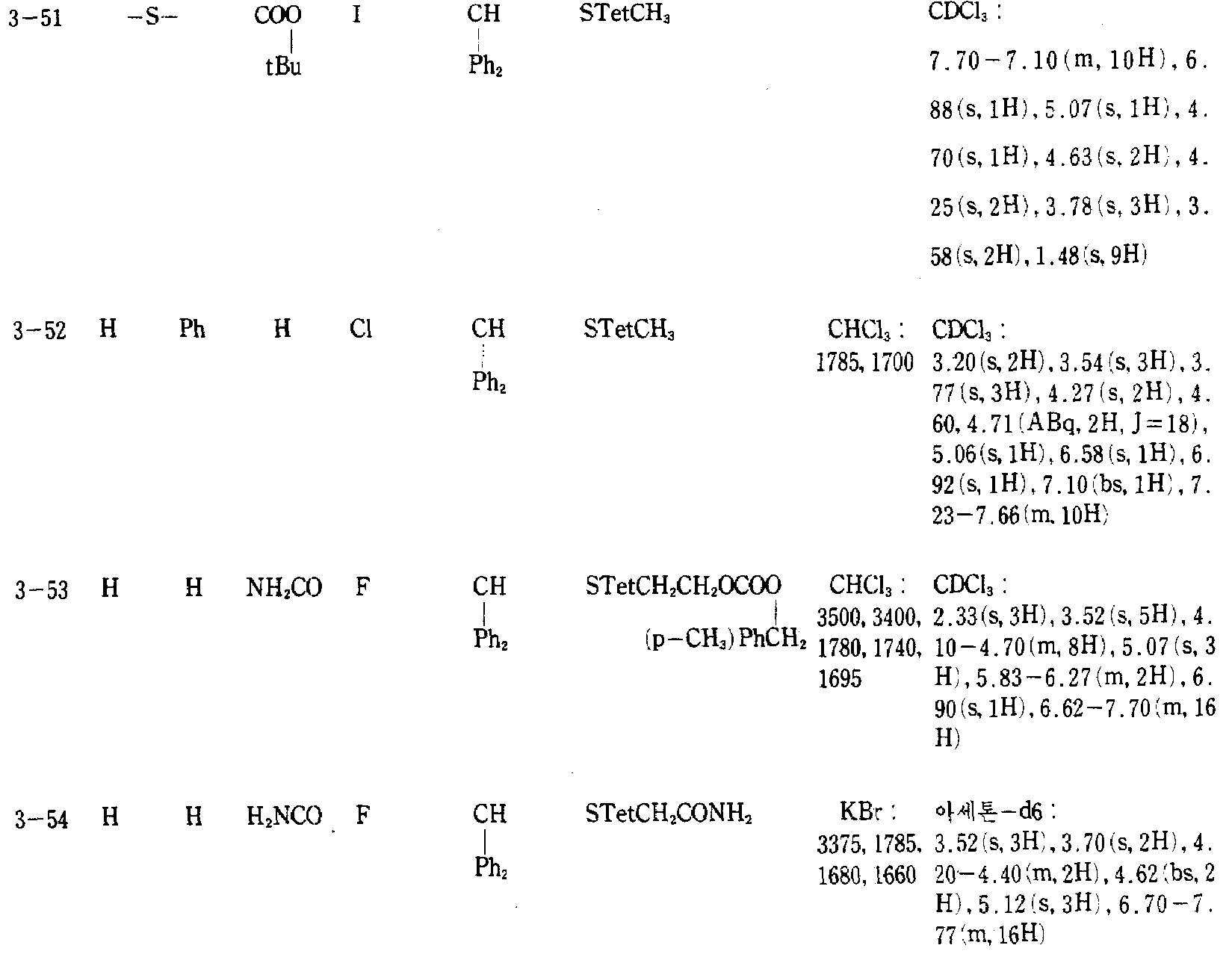
[표 3q]TABLE 3q

[표 3r]TABLE 3r

[표 3s]Table 3s

[표 3t]Table 3t

[표 3u]TABLE 3u

[표 3v]Table 3v

Claims (1)
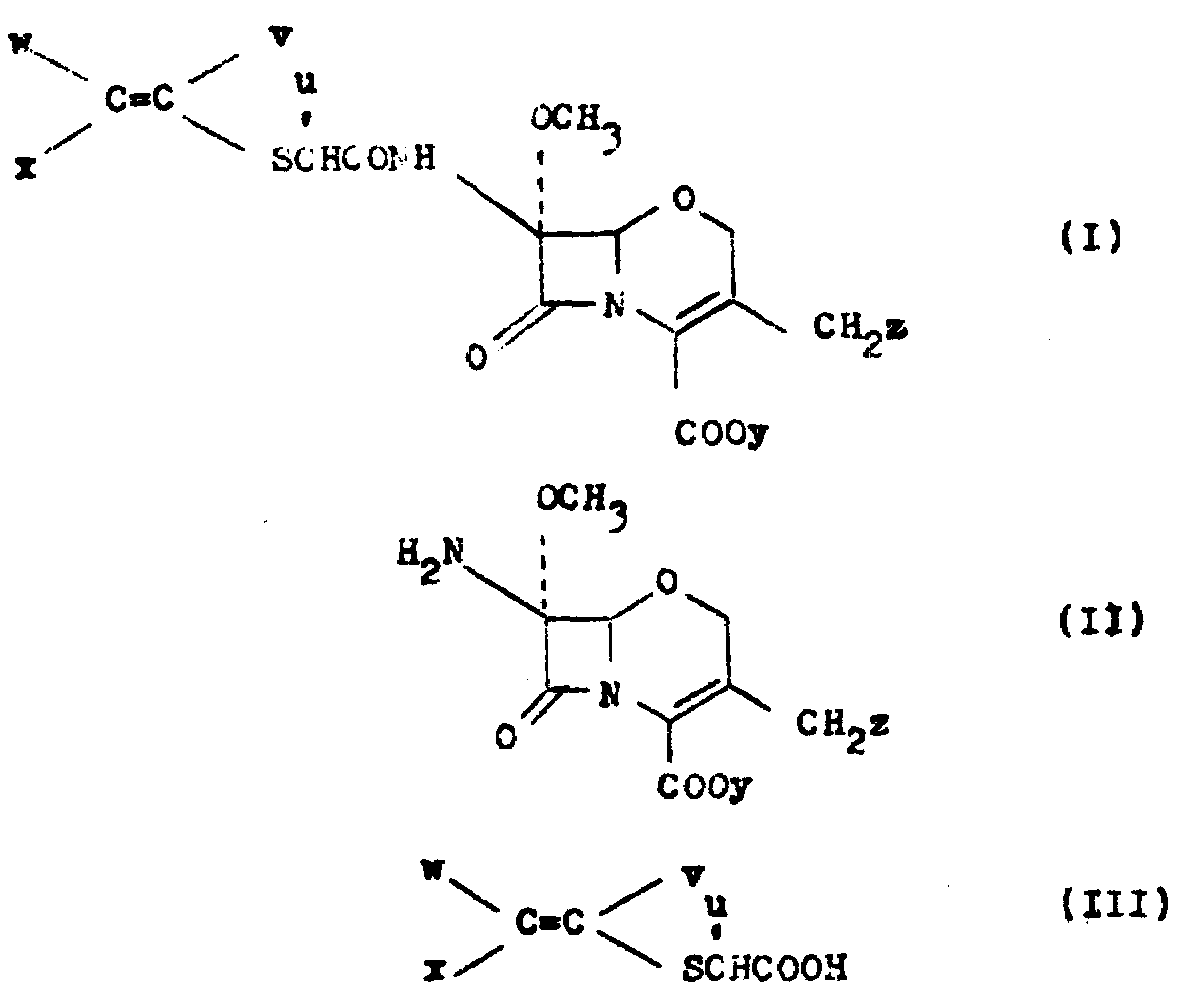
Applications Claiming Priority (5)
| Application Number | Priority Date | Filing Date | Title |
|---|---|---|---|
| JP172907/1982 | 1982-09-30 | ||
| JP57172907A JPS5962596A (en) | 1982-09-30 | 1982-09-30 | Vinylthio-oxacephalosporin derivative |
| JP172907 | 1982-09-30 | ||
| JP58128116A JPS6019791A (en) | 1983-07-13 | 1983-07-13 | Fluorovinylthioxacephalosporin compound |
| JP128116 | 1983-07-13 |
Publications (2)
| Publication Number | Publication Date |
|---|---|
| KR840006252A KR840006252A (en) | 1984-11-22 |
| KR900008552B1 true KR900008552B1 (en) | 1990-11-24 |
Family
ID=26463879
Family Applications (1)
| Application Number | Title | Priority Date | Filing Date |
|---|---|---|---|
| KR1019830004623A Expired KR900008552B1 (en) | 1982-09-30 | 1983-09-29 | Process for the preparation vinylthio acetamido-oxacepalosphorine derivatives |
Country Status (13)
| Country | Link |
|---|---|
| US (1) | US4529721A (en) |
| EP (1) | EP0107928B1 (en) |
| KR (1) | KR900008552B1 (en) |
| AU (1) | AU558772B2 (en) |
| CA (1) | CA1219866A (en) |
| DE (1) | DE3375141D1 (en) |
| DK (1) | DK163000C (en) |
| ES (1) | ES8600311A1 (en) |
| FI (1) | FI74015C (en) |
| GB (2) | GB2168349B (en) |
| IE (1) | IE55977B1 (en) |
| NO (1) | NO168478C (en) |
| PH (2) | PH20013A (en) |
Families Citing this family (9)
| Publication number | Priority date | Publication date | Assignee | Title |
|---|---|---|---|---|
| JPS61130223A (en) * | 1984-11-28 | 1986-06-18 | Shionogi & Co Ltd | Freeze-dried antibacterial preparation |
| KR960002856B1 (en) * | 1987-03-09 | 1996-02-27 | 오쓰까 세이야꾸 가부시끼가이샤 | 2-oxa-isocephem compounds, the compositions containing the same and the process for preparing the same |
| EP0594583A1 (en) * | 1990-01-12 | 1994-05-04 | The Dow Chemical Company | Composition and use of substituted 3-thio-2-propynenitriles as an industrial antimicrobial |
| US5198445A (en) * | 1990-01-12 | 1993-03-30 | The Dow Chemical Company | Composition and use of substituted 3-thio-2-propynenitriles as industrial antimicrobials |
| US5126349A (en) * | 1990-01-12 | 1992-06-30 | The Dow Chemical Company | Composition and use of substituted 3-thio-2-propynenitriles as an industrial antimicrobial |
| US5155119A (en) * | 1992-03-05 | 1992-10-13 | The Dow Chemical Company | 3-(2-pyridinylthio)-N-oxide, 2-halo-2-propenenitrile compounds useful as antimicrobials |
| US5157051A (en) * | 1992-03-05 | 1992-10-20 | The Dow Chemical Company | Composition and use of 3-thiocyano-2-halo-2-propenenitriles as antimicrobial agents |
| US5206227A (en) * | 1992-06-02 | 1993-04-27 | The Dow Chemical Company | Composition and use of phosphonic acid, (2-halo-2-cyanoethenyl)-dialkyl esters as antimicrobials |
| US5958462A (en) * | 1997-05-23 | 1999-09-28 | Mclean; Linsey | Therapeutic bath salts and method of use |
Family Cites Families (7)
| Publication number | Priority date | Publication date | Assignee | Title |
|---|---|---|---|---|
| GB1604738A (en) * | 1977-07-28 | 1981-12-16 | Yamanouchi Pharma Co Ltd | 1,3-dithietane-2-carboxylic acid derivatives and the preparation thereof |
| DE2821639A1 (en) * | 1978-05-18 | 1979-11-22 | Hoechst Ag | Bactericidal thio:enol ether cpds. - also useful as fungicides |
| GB2045233B (en) * | 1979-03-23 | 1983-05-11 | Erba Farmitalia | Unsaturated 3-heterocyclylthiomethyl-7a-methoxy-7-acylamido-3-cephem-4-carboxylic acid derivatives |
| JPS5690088A (en) * | 1979-11-02 | 1981-07-21 | Meiji Seika Kaisha Ltd | Novel cephalosporin analog compound |
| JPS56103185A (en) * | 1980-01-22 | 1981-08-18 | Shionogi & Co Ltd | Malonamidoxa-dethia-cephem compound |
| IL63965A (en) * | 1980-10-10 | 1985-01-31 | Sparamedica Ag | 7-(2-(2-amino-4-selenazoyl)acetamido)cephalosporin derivatives,and intermediates therefor,their preparation and pharmaceutical compositions containing them |
| FR2496666A1 (en) * | 1980-12-22 | 1982-06-25 | Ici Pharma | NOVEL CEPHALOSPORINE DERIVATIVES AND PHARMACEUTICAL COMPOSITION CONTAINING SAME |
-
1983
- 1983-09-19 DK DK426683A patent/DK163000C/en not_active IP Right Cessation
- 1983-09-20 FI FI833348A patent/FI74015C/en not_active IP Right Cessation
- 1983-09-21 US US06/534,147 patent/US4529721A/en not_active Expired - Fee Related
- 1983-09-21 CA CA000437258A patent/CA1219866A/en not_active Expired
- 1983-09-29 NO NO833521A patent/NO168478C/en unknown
- 1983-09-29 IE IE2310/83A patent/IE55977B1/en not_active IP Right Cessation
- 1983-09-29 AU AU19752/83A patent/AU558772B2/en not_active Ceased
- 1983-09-29 PH PH29619A patent/PH20013A/en unknown
- 1983-09-29 KR KR1019830004623A patent/KR900008552B1/en not_active Expired
- 1983-09-29 ES ES526130A patent/ES8600311A1/en not_active Expired
- 1983-09-30 GB GB08601753A patent/GB2168349B/en not_active Expired
- 1983-09-30 GB GB08326244A patent/GB2127825B/en not_active Expired
- 1983-09-30 DE DE8383305958T patent/DE3375141D1/en not_active Expired
- 1983-09-30 EP EP83305958A patent/EP0107928B1/en not_active Expired
-
1985
- 1985-02-08 PH PH31837A patent/PH20224A/en unknown
Also Published As
| Publication number | Publication date |
|---|---|
| IE832310L (en) | 1984-03-30 |
| NO833521L (en) | 1984-04-02 |
| DK163000C (en) | 1992-06-01 |
| GB8601753D0 (en) | 1986-02-26 |
| ES526130A0 (en) | 1985-10-01 |
| AU558772B2 (en) | 1987-02-05 |
| GB2168349A (en) | 1986-06-18 |
| IE55977B1 (en) | 1991-03-13 |
| DK426683D0 (en) | 1983-09-19 |
| GB8326244D0 (en) | 1983-11-02 |
| FI833348A7 (en) | 1984-03-31 |
| PH20224A (en) | 1986-10-23 |
| FI833348A0 (en) | 1983-09-20 |
| GB2127825A (en) | 1984-04-18 |
| DE3375141D1 (en) | 1988-02-11 |
| ES8600311A1 (en) | 1985-10-01 |
| AU1975283A (en) | 1984-04-05 |
| EP0107928B1 (en) | 1988-01-07 |
| FI74015B (en) | 1987-08-31 |
| NO168478B (en) | 1991-11-18 |
| DK426683A (en) | 1984-03-31 |
| GB2127825B (en) | 1987-03-11 |
| US4529721A (en) | 1985-07-16 |
| FI74015C (en) | 1987-12-10 |
| EP0107928A1 (en) | 1984-05-09 |
| NO168478C (en) | 1992-02-26 |
| GB2168349B (en) | 1987-03-11 |
| CA1219866A (en) | 1987-03-31 |
| KR840006252A (en) | 1984-11-22 |
| PH20013A (en) | 1986-08-28 |
| DK163000B (en) | 1992-01-06 |
Similar Documents
| Publication | Publication Date | Title |
|---|---|---|
| KR880002376B1 (en) | Process for preparing carboxyalkenamido-cephalosporins | |
| CA1085392A (en) | Arylmalonamido-1-oxadethiacephalosporins | |
| US4201782A (en) | Thiadiazolyl cephalosporin analogs | |
| JP2969283B2 (en) | Piperazinio cephalosporin | |
| JP2618119B2 (en) | Thioalkylthiocephalosporin derivatives | |
| US4254119A (en) | 3-Unsubstituted-3-cephem compounds | |
| EP0107928B1 (en) | Vinylthioacetamido oxacephalosporin derivatives, and intermediates therefor, their preparation, formulations containing the same and their antibacterial use | |
| KR930004015B1 (en) | Process for preparing alkylcarbamoyl oxymethylcephem compounds | |
| EP0114752B1 (en) | Beta-lactam antibacterial agents | |
| EP0111421B1 (en) | Oxacephalosporin derivatives, their preparation and use | |
| EP0287734A1 (en) | 2-Beta-substituted methyl-penam derivatives | |
| US4629726A (en) | Penem carboxylic acids | |
| JPS59231090A (en) | Fluoromethylthioxacephalosporin | |
| US5362724A (en) | Thioalkylthio carbacephalosporin derivatives | |
| US4835150A (en) | Cephem compounds | |
| EP0117143A2 (en) | Cephalosporin hydroxamic acids, their preparation, antibacterial formulations comprising the same, and their use in combating bacteria | |
| US4661480A (en) | Formamido oxacephems | |
| IE47929B1 (en) | Substituted imidazolidinyl-3-chloro-3-cephem-4-carboxylic acids | |
| JPH0359073B2 (en) | ||
| EP0131611A1 (en) | $g(b)-LACTAM ANTIBACTERIAL AGENTS | |
| JP2566680B2 (en) | Vinyl thioacetic acid derivative | |
| EP0115969A1 (en) | Penem compounds, their preparation , formulations containing the same and their use in combating bacteria | |
| GB2151615A (en) | Malonyl-oxacephemcarboxylic acid derivatives | |
| JPS60197689A (en) | Vinylthio derivative of oxacephalosporin | |
| IE46627B1 (en) | Haloarylmalonamidooxacephalosporins |
Legal Events
| Date | Code | Title | Description |
|---|---|---|---|
| PA0109 | Patent application |
St.27 status event code: A-0-1-A10-A12-nap-PA0109 |
|
| R17-X000 | Change to representative recorded |
St.27 status event code: A-3-3-R10-R17-oth-X000 |
|
| PG1501 | Laying open of application |
St.27 status event code: A-1-1-Q10-Q12-nap-PG1501 |
|
| A201 | Request for examination | ||
| P11-X000 | Amendment of application requested |
St.27 status event code: A-2-2-P10-P11-nap-X000 |
|
| P13-X000 | Application amended |
St.27 status event code: A-2-2-P10-P13-nap-X000 |
|
| PA0201 | Request for examination |
St.27 status event code: A-1-2-D10-D11-exm-PA0201 |
|
| E902 | Notification of reason for refusal | ||
| PE0902 | Notice of grounds for rejection |
St.27 status event code: A-1-2-D10-D21-exm-PE0902 |
|
| P11-X000 | Amendment of application requested |
St.27 status event code: A-2-2-P10-P11-nap-X000 |
|
| P13-X000 | Application amended |
St.27 status event code: A-2-2-P10-P13-nap-X000 |
|
| G160 | Decision to publish patent application | ||
| PG1605 | Publication of application before grant of patent |
St.27 status event code: A-2-2-Q10-Q13-nap-PG1605 |
|
| E701 | Decision to grant or registration of patent right | ||
| PE0701 | Decision of registration |
St.27 status event code: A-1-2-D10-D22-exm-PE0701 |
|
| GRNT | Written decision to grant | ||
| PR0701 | Registration of establishment |
St.27 status event code: A-2-4-F10-F11-exm-PR0701 |
|
| PR1002 | Payment of registration fee |
St.27 status event code: A-2-2-U10-U11-oth-PR1002 Fee payment year number: 1 |
|
| PR1001 | Payment of annual fee |
St.27 status event code: A-4-4-U10-U11-oth-PR1001 Fee payment year number: 4 |
|
| FPAY | Annual fee payment |
Payment date: 19941019 Year of fee payment: 5 |
|
| PR1001 | Payment of annual fee |
St.27 status event code: A-4-4-U10-U11-oth-PR1001 Fee payment year number: 5 |
|
| LAPS | Lapse due to unpaid annual fee | ||
| PC1903 | Unpaid annual fee |
St.27 status event code: A-4-4-U10-U13-oth-PC1903 Not in force date: 19951125 Payment event data comment text: Termination Category : DEFAULT_OF_REGISTRATION_FEE |
|
| PC1903 | Unpaid annual fee |
St.27 status event code: N-4-6-H10-H13-oth-PC1903 Ip right cessation event data comment text: Termination Category : DEFAULT_OF_REGISTRATION_FEE Not in force date: 19951125 |
|
| PN2301 | Change of applicant |
St.27 status event code: A-5-5-R10-R13-asn-PN2301 St.27 status event code: A-5-5-R10-R11-asn-PN2301 |
|
| P22-X000 | Classification modified |
St.27 status event code: A-4-4-P10-P22-nap-X000 |